Pacilic Islands Monthly

News Magazine Of The South Pacific
October, 1973
Australia, N.Z., Western Samoa 60C
P.N.G., FIJI, COOKS, TONGA, G.E.1.C., 8.5.1. P., N. HEBRIDES 50c
Nauru, Niue, Norfolk 50C
American Samoa 70C Hawaii, Micronesia $L.Oo
wc\a/ rAicnnwiA anh prfmth POLYNESIA 100 CFP
Our Cover
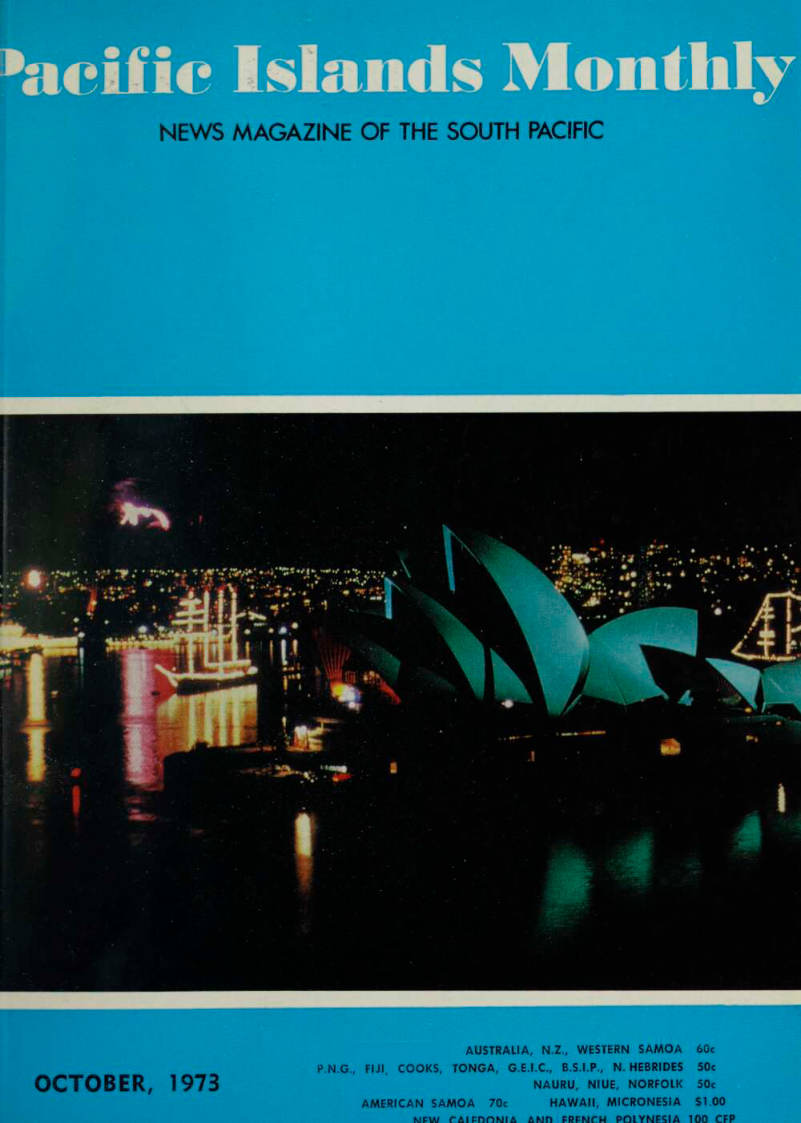
In this striking shot of Sydney Harbour by PIM staffman Barry Badger, the Opera House, Sydney's pride and joy, floats along with green sails. But they're really white. It's a trick of the lighting. The lights in the sky are fireworks and there are illuminated ships because the picture was taken during the Captain Cook bicentenary celebrations. Three hundred Islanders will be performing in the Opera House in Octo ber as part of the grand celebrations of the opening by Queen Elizabeth. The scene should be the same.
Advertisements & other items, p. 2 (1 item)
lightest 35-SLR is more than the smallest,
S.
V 5VSr e, a* 6 W °J-n* o*«° 2 m * o Si
fSAS
nQ
The world’s smallest,
lightest 35-SLR is more than the smallest,
lightest 35-SLR in the world.
That’s because it is part of the world’s biggest, most comprehensive 35mm photographic system.
Five years ago, when the Olympus OM-1 project started, we had two main design objectives. The first was to create a 35-SLR camera meeting the highest optical and engineering standards, yet easier to handle and above all far smaller, lighter and quieter in operation than existing cameras of this type. Our other target was designing an entire 35mm system of unprecedented versatility.
The measure of our success is a camera 35% lighter, 35% smaller, and with only about half the shutter noise of the average SLR. It is also a 280-piece system including 38 superb lenses, the world’s lightest motor drive and an incomparable selection of macrophoto and photomicro equipment.
The Olympus OM-1 is proof that sometimes less can be more.
OLYMPUS
OM-1
In This Issue
Meral 1 Mil
ith Pacific Conference 6 ►test yachtsman's story 11 w Capt Cook missed Vava'u 47 re freight rate increases 83 mders pay for ANZ revaluation 97
Lerican Samoa
vernor on trial 14 reased profits in Pago harbour ... 81 refinery likely 97
Ok Islands
►test yachtsman's story 11 p superseded by jet 79 rbour study 102 I friendly rugby 16 Inutrition on the increase 35 lighter converted to cruise ship 79 pping services stepped up 81 gar shortage 101 ilti-million land deal 101
Ench Polynesia
>test yachtsman's story 11
Lbert And Ellice Islands
m star (pic) 13 iit by Japanese trawlers 81
Luru
na G sails 13 luru Centre construction delay 101
New Caledonia
Caledonian youth speaks out 9 Debate on tourism 9
New Hebrides
Tax haven discussed 13 Controlling land speculation 97
Papua New Guinea
Matthias Tollman's death 8 and 109 The budget 8 Somare answers Abaijah 11 Air Niugini 13 The budding tourist industry 21 Percy Chatterton's Footnotes 26 Trouble on the waterfront 77 Investment Corporation shares 98
Pitcairn Island
Keeping Pitcairn alive 14
Solomon Island
Honiara Bamboo Band (pic) 14 The value of traditional art 15 Story of Timothy George 49 New fish factory 99
Tonga
Schoolgirl upsets MPs with speech 5 Tongans in the 'big smoke' 37 How Capt Cook missed Vava'u 47
United States Trust Territory
Talks held up H Salvaging war remains for profit 15
Western Samoa
Government criticised 31 Family planning 33 Seamen leave ship 81
PARTMENTS: Up front with the Editor, 3; Tropicalities, 14; Editor's mailbag, 37; agazine section, 47; Yesterday, 52; AAANA, 61; From the Islands Press, 69; Books, 71; cific shipping, 77; Cruising yachts, 85; Business and development, 97; Produce, 102; ipping and airways information, 103; Deaths of Islands people, 109; Advertisers index, 112.
Pacific Islands
Monthly
FOUNDED BY R. W. ROBSON IN 1930
Published Monthly By
Pacific Publications (Aust.) Pty. Ltd.,
2 9 ALBERTA ST., SYDNEY, N.S.W., 2000.
Postal Address: G.P.O. BOX 3408, SYDNEY
N.S.W., 2001.
Telegraphic Address: PACPUB, Sydney Telex 25168.
Telephones: 61-9197, 61-7101, 61-4369.
Consulting Directors: R. W. Robson, Judy Tudor.
Chief Executives: Manager: Selwyn Hughes.
Publisher: Stuart Inder.
Director of Advertising: W. A. Gasnier.
Pacific Islands Monthly
Editor: Stuart Inder.
Assistant Editor: John Carter.
Advertising Manager: W. A. Gasnier.
Circulation Manager: Barry Badger.
Subscription Rates:
"Pacific Islands Monthly" is airfreighted to all subscribers and agents in the Pacific Islands and the U.S.A.; copies to Nauru and other areas go by surface mail.
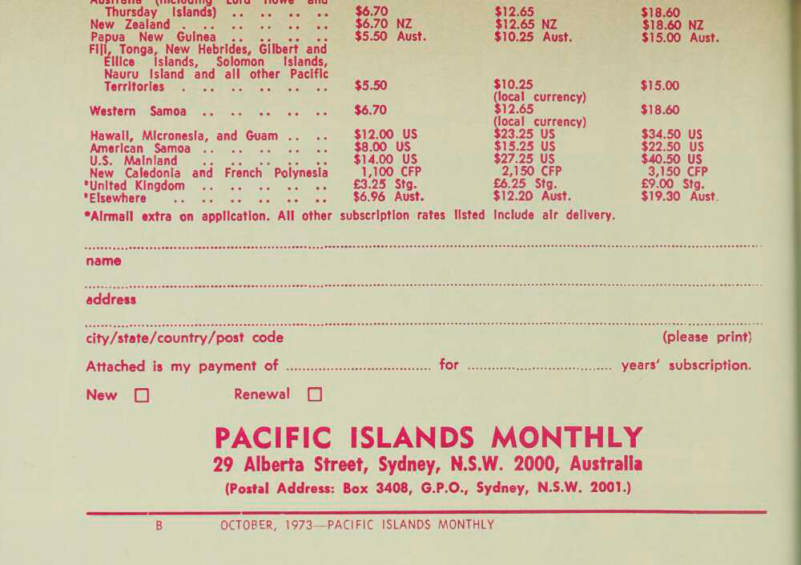
Australia (incl. Lord Howe and Thursday Is.): 56.70 Aust., Papua New Guinea: $5.50 Aust.; f 1 Tonga, New Hebrides, Gilbert & Ellice Islands, Solomon Islands, Nauru Island and all o her Pacific territories: $5.50 (local currency); Western Samoa: $6.70 (local currency); New Zealand: $6.70 NZ; Hawaii, Micronesia and Guam: $12.00 US; US Mainland: $14.00 US- Caledonia and French Polynesia: 1,100 $6 P 96 UnitCd Kingdom: £3 - 25 ; Elsewhere:
Representatives
Fi A ‘ l: A- F -. Woods Imex (Pacific) Limited, Suite ?w V,C cmwa A l<:ade Suva ' F 'i'- p -°- Box 3117, Lami, SUVA. Telephone: 22-502. Telex: 2124. dlra 3 .m NC * 6 c uinea: LAE, P.O. Box 227; RABAUL, Mr. Steve Simpson, P.Q. Box 433 (c/- Rabaul Photographic. Tel.: 2677.) French Polynesia: Distribution— Hachette Pacl tique, 10 Ave Bruat, Papeete.
Zealand: Pacific Publications, C.P.O. Box 2229, Auckland. 379-494. Representative: John Speddmg, Civic House, 291 Queen St., Auckland Tel.: 379-494.
United Kingdom; I. B. Graham, Park House 22 Park Street, Croydon, CR9 3NP. Tel.: 01-6884177.
Overseas Newspapers (Agencies) Ltd., Cromwell House, Fulwood Place, London, W C.l Tel • 01-242-0661. Cables: WESNEWS,' London, DS4.
Japan: Advertising—Universal Media Corpora tion, C.P.O. Box 46, Tokyo. Tel.; 666-3036.
"ctoria: n Advertising Pacific Publications [Aust.) Pty. Ltd., 33 Lonsdale Street, Melbourne, Vic. 3006. Telephone: 662-3263.
Queensland: Advertising—Beale Media Services 232 St. Paul's Terrace, Fortitude Valley Qld 4006. Tel.: 52-5827.
Hawaii and U.S. Mainland only: N. Grogan 3354 Hayden Street, Honolulu, 96815. (Send change of address notices. Form 3579 and new subscriptions to P.O. Box 2193 Honolulu, Hawaii, U.S.A. 96805).
Second class postage paid at Honolulu, Hawaii.
Copyright ©, 1973,
Pacific Publications (Aust.) Pty. Ltd.
October, 1973 Vol. 44, No. 10
Up Front
with the a guest
Guest commentary by L. G. USHER , former editor and publisher of The Fiji Times.
TN a discussion with Stuart Inder about the progress of Papua New Guinea towards independence I said, “somebody ought to pass on to the constitution-makers there the advice the Prime Minister of Mauritius, Sir Seewoogasur Ramgoolam, gave when Fiji’s constitution was being dis cussed.
Stuart said, “All right. You pass it on, in PIM”.
I talked to Sir Seewoogasur in Mauritius, on the way to London in 1970 just before the Fiji Constitu tional Conference. The gist of what he said was, “You should never let anybody rush you when you are making a constitution. Under pres sure you can make mistakes which you don’t realise at the time. And don’t forget that once a constitution comes into force it is very difficult to alter it”.
Mauritius was unfortunate. Soon after independence, communal con flict brought rioting, with violence and death, and the new government had to ask Britain for the help of troops.
This move, and others needed to restore order, could be made only under a State of Emergency.
Under the constitution, the Governor-General was empowered to proclaim a State of Emergency, or it could come into being by vote of a majority of all the members of the Legislative Assembly. There was no time to call the assembly together, so on the advice of the Prime Minister the Governor-General pro claimed a State of Emergency and the call for help went to Britain.
But the constitution said that a State of Emergency proclaimed in this way must lapse unless it was en dorsed within seven days if the assembly was already in session or was due to meet within seven days, or within 21 days if the assembly had to be called together specially.
The approval required the vote of a majority of all the members of the assembly— not just of those present and voting.
The assembly had to meet vote in the time set down. If it not do so, or if a majority of all members were not present or for reason or another did not vote for continuation of the State of Er gency, the proclamation would f lapsed and there was no constitutk way of restoring it. The rioting wc meanwhile have continued, pe< would have gone on being hurt property destroyed.
As things turned out, the requi approval was forthcoming before deadline but there were some anxi days meanwhile.
Suppose that, through illness accident, or perhaps injury or trs disruption caused by the rioting, through some members being abr and not being able to get back time, more than half the total num of members of the assembly had been present at the time and pi where the vote was taken, and time remained under the constituti for another vote.
There would then have been constitutional way of maintaining State of Emergency which essential if order was to be restore All new nations learn from experience of others, and the St of Emergency provision in Fi constitution is much more reali: and flexible than that of Mauril was. The period within which par mentary approval of a govern general’s proclamation is mandat* is, for instance, six months. 1 there are things in Fiji’s three-ye old constitution which, if it w being drawn up today, would aim certainly be changed.
One example is sufficient to ill trate the point.
The House of Representatives t year passed a vote of no confidei in the Speaker, and it can be saf assumed that at the time the major (in fact all the government membei would have preferred him to be placed. But they were powerless bring this about because, althou the government has a majority of
in the House, it has less than two thirds of the total membership and the constitution says that the Speaker can be removed from office only by resolution supported by the votes of at least two-thirds of all the members.
The Mauritius Prime Minister’s second point was a crucial one. A constitution, once adopted, cannot easily be changed. Indeed, an in volved process, usually including delays, is usually written into the constitution to make change difficult.
There is good reason for this.
Chaos, or certainly instability and un certainty, could soon be created if the rules by which a country is governed could be frequently or capriciously altered.
Papua New Guinea will become self-governing in December by virtue of an enactment by the Australian Parliament. The independence that will follow will come in the same way, but there will be an all-important difference between the results of the two documents.
The first sentence of the act making Fiji independent reads: “On and after . . the appointed day, Her Majesty’s Government in the United Kingdom shall have no responsibility for the Government of Fiji”.
With the names changed, some thing of this sort will state the position of independent Papua New Guinea. The meaning clearly is, “You’re on your own, chum”.
The affairs of independent Papua New Guinea will have to be con ducted wholly in terms of the con stitution which comes into effect on the “appointed day” of independence.
If, before that day any mistakes or errors of judgment have crept into that constitution, or if there has been any failure to realise in advance the full and precise implications of every part of the document, the results could show up in future in, at best, embarrassment and at worst, serious difficulty for the government and people of the new nation.
I offer the opinion, from observa tion and experience, that thorough ness in preparation and the degree of thoroughness of consultation that makes sure that what is in the con stitution is what the people of the country really want are more im portant than meeting some fixed date for producing the final document.
There is one thing, though. If pressures to fix a rigid but premature date for Papua New Guinea’s inde pendence come strongly from Mr Whitlam’s government it should be possible to reply delicately, “Well, we’ve been hearing from Australia recently that changing a constitution once it has been adopted is not an easy thing. We would like absolutely sure of ours in advance”.
Advertisements & other items, pp. 5-6 (2 items)
3
IFIC ISLANDS MONTHLY —OCTOBER, 1973
beauty
Make the most of your
natural
assets
By a Leading Skin Care Consultant.
Every woman is born with a beautifully soft flawless skin and this is a beauty asset that should be treasured all through the years.
Today it is possible to retain a smooth youthful complexion, regardless of your age, if you make the effort to carry out a basic skin care plan and conscientiously follow it every day. Here are some suggestions to help you realise the full potential of your own natural beauty—so that your complexion will look its best all the time.
A Beautiful Complexion
yourself with an aura of loveliness when you start the day. After cleansing, tone and refine your complexion and then smooth in a film of a tropically moist oil blend. This Oil of Ulan will nurture your skin, help banish wrinkle dryness and give your complexion a youthful bloom besides protecting it against the effects of wind and weather. This unique beauty fluid should also be used at night before retiring.
For a Smooth Neckline
VTOUR neck can show signs of age especially early, so it needs much care and pampering. Before retiring every night lavishly smooth Oil of Ulan moist oil blend into your neck, stroking upward with gentle movements. While you sleep the unique penetrating fluid will continue to smooth and beautify your skin.
Beautiful Eyes
you laugh, squint, grimace or smile, you stretch the delicate skin around your eyes. Therefore this area is particularly prone to wrinkles and needs the gentle care and nurturing of a tropically moist oil blend. This Oil of Ulan should be gently finger-printed on, in an anti-clockwise motion starting from beneath the eyes and extended on to the temples. The unique beauty fluid rapidly penetrates, helping to keep the skin supple and restores the delicate oil and moisture balance which keeps the complexion soft and beautifully smooth.
The rich and golden eggs’n’butter shortbread: Brockhoff
Edinburgh
Shortbread.
There’s value, variety and quality in
BROCKHOff
BISCUITS
Farm fresh eggs and creamy dairy butter a quarter by weight, make Edinburgh Shortbread melt in your mouth. Traditional Scottish biscuits that serve so deliciously with coffee or tea.
Edinburgh Shortbread is baked oven-crisp with the flavour-fresh goodness that’s unmistakably Brockhoff. brockhoff 6442/BX6
Pacific Islands Monthly
15-Year-Old Schoolgirl Speaks,
And Shakes Some Tongan Nobles
Prom a Nukualofa correspondent
; winds of change, which blew ial governments out of the i Pacific Islands, didn’t even le dust in Tonga, but a Tongan Igirl has created a storm in the om with a speech on “Tonga d be more democratic”, e speech won the first prize for a High School sixth-former Lata li in a school English speaking st, upset some of the nobles nembers of parliament, who had ill-fledged debate on it, and rht the wrath of the MPs on the a Chronicle for printing the h. ta’s speech, judged the winner tie sole judge, Mr Futa Helu, ler and principal of the ’Atenisi emy, put into sharp focus the tdedness of a parliament in which nobility of 33 has seven re latives, the same number as est of the population of about 10. ta said “. . . The distribution of g power is surely prejudiced in ir of the nobles, unbalanced, r and simply undemocratic.” She i for a greater opportunity for r citizen to have a say in running :ountry. the past, she said, the educated le of Tonga were mainly from nobility. They had the respon ty of running the people, and the ucated mass accepted that. But y, the situation was changing more and more common people ming educated. ita referred to the downfall of ties in Russia in 1917 and China [949 when the people became rated with their overlords and undemocratic systems of govern t. They rebelled and seized power themselves. She would not say i would be such an extreme ition in Tonga, but unless the :m of government was modified, intent, disillusionment and per even rebellion on a smaller ; would happen. That rebellion d be a “brain drain” with :ated people leaving the country
because of dissatisfaction with an undemocratic form of government.
At least one of the nobility was sufficiently upset to raise the matter in the Legislative Assembly. However, majority opinion seemed to be that it was only a speech contest and, any way, the constitution of Tonga guaranteed free speech.
The Hon Vaha’i, representative of the Tongatapu nobles, said he was very concerned at the criticism, which implied the government was not democratic. But King Tupou I had given the people their emancipa tion.
Hon Vaha’i said the Legislative Assembly was a Christian assembly for a Christian government.
“I am saddened by this recent manifestation of criticism of His Majesty and the government, and what, may I ask, is undemocratic in His Majesty’s government,” he said.
He said the Minister of Police should
assign investigators “to investigate this foreign element that is in to induce these criticisms”.
The Speaker, Hon Ma’afu, said the incident was only a speech contest, and teachers encouraged people to take part. The Acting Prime Minister, Hon Tuita, reminded the assembly there was a clause in the constitution which provided for freedom of ex pression, and there was no way of forbidding it.
Mr Tu’ilatai Mataele, Tongatapu No 1 People’s Representative, took the newspaper to task. He felt it should consider carefully what it pub lished.
“There was a lot of controversy when the paper was established and a lot of people advocated that the paper should be both for government and the people,” he said. “Anyway, the paper got off to a good start, but just lately has deteriorated. 1 have also noticed that when the palagi (European) editor was here, nothing of this nature happened, but this time with the present editor, this incident has cropped up”.
However, he agreed with the Speaker, that it was only an exercise, and he could assure his many kava party companions that Tonga was still democratic.
The Minister of Health, the Hon Tapa, said it was important to openly express one’s opinions rather than suppress them, and have them emerge later, which would be more dangerous. .
The Hon Malupo said the article was well within the constitution, and no matter how much discontent there was in the kingdom, the people were still patriotic. Some good might come out of the issue.
The Speaker, summing up, con cluded: “Whatever is the will of God, that is what will take place. We are still human and it is also possible that the nobles’ estates are too big and should be re-divided, and I ask you not to be too concerned, as the issue might be bigger than we realise”.
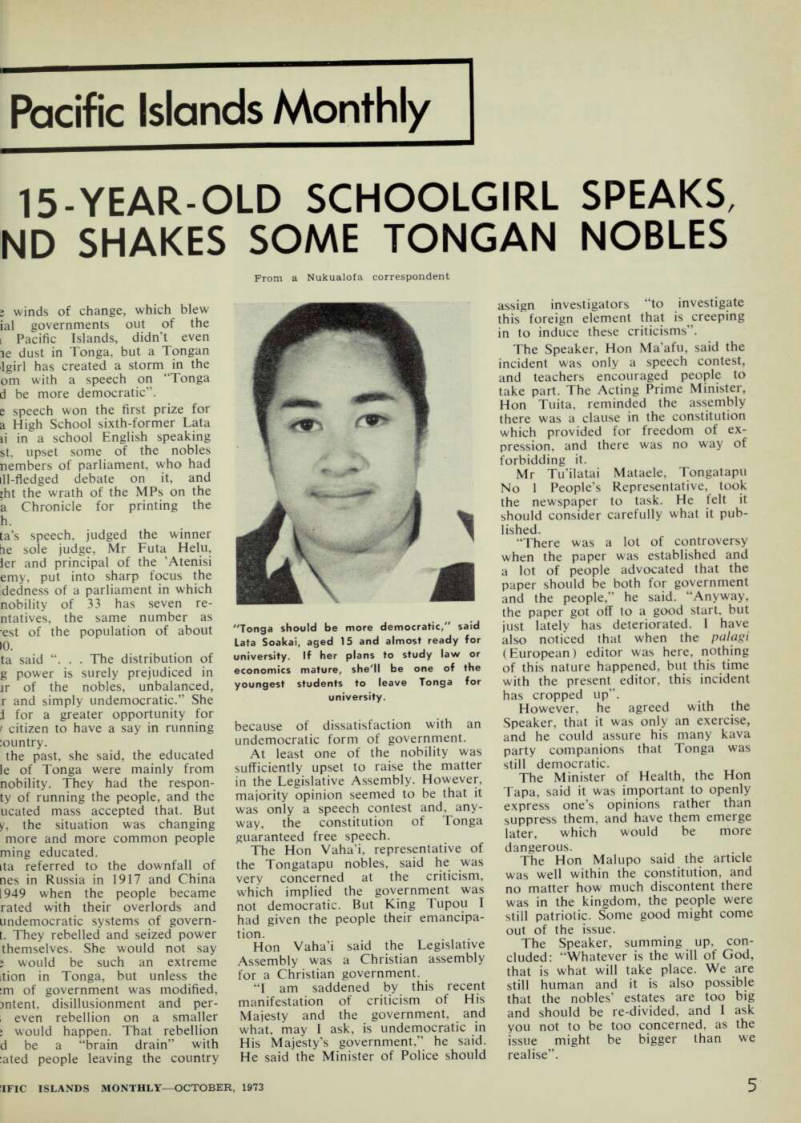
"Tonga should be more democratic," said Lata Soakai, aged 15 and almost ready for university. If her plans to study law or economics mature, she'll be one of the youngest students to leave Tonga for university.
Advertisements & other items, p. 7 (1 item)
5
IFIC ISLANDS MONTHLY—OCTOBER, 1973
All—except France—agog for change
in South Pacific Commission
From DICK WILLIAMS, of UPI, and PIM special correspondents in Guam
Isolated and without a friend in the room, France, in the person of her senior commissioner Mr Henri Nettre, walked out of the 13th South Pacific Conference at Guam on the fifth day when France was arraigned by resolution for her nuclear tests.
French Polynesian delegate Alfred Grand and the French-speaking New Hebrides delegate walked out with him. This was even before the reso lution, tabled by the Cook Islands Dr Joseph Williams, was put to the vote.
When the conference did vote on it, on the sixth day, and named France as the offender, Guy Champmoreau of New Caledonia, who had stayed as France’s only champion, joined his compatriots on the outside.
The walkout was inevitable. All had been sweet reason for the first couple of days but the Islanders in particular had been spoiling for a fight with France over the tests.
The Cook Islands resolution con demned France by name and this was something New Caledonian Champmoreau tried to fight. He did not object to the resolution that would condemn the nuclear testing.
He objected to naming France.
The Cook Islands was just as adamant in its insistence that France be named since that country was the only Power that has been testing in the Pacific of late. Dr Williams even suggested that the conference would be composed of hypocrites if the resolution was to be adopted elimi nating France’s name.
Cooks Premier Albert Henry, who was absent, was even more forthright in a message he sent to the con ference. “If France walks out of the conference,” he wrote, “it is our duty to help France walk out, not only of the conference, but also of the Pacific.”
When the conference adopted the resolution, Champmoreau announced, “I can no longer take part in dis cussions by this body which has just condemned one of its members. I was born in what was known as the French Union, and I shall never turn against France.
“I bid you farewell and I hope you don’t have nightmares about what you have done,” the Frenchman con cluded, and with that he walked out of the conference room. This left the conference with no French repre-
sentation with three more days of business to conduct, including the all important report of the future status committee appointed to study methods for implementing Australian sugges tions for changing the SPC setup, and proposals from Guam.
Mr Champmoreau returned the fol lowing day, however, saying that he was deeply touched by the delegates’ pleas for him to return. The New Caledonian glossed the whole thing over by adding that, had he not come back, there would be no French dele gate so that the interpreters would be out of a job. But, he was alone.
Mr Nettre and his companions did not return.
Australia had earlier circularised her suggestion for sweeping changes in the commission and conference and, surprisingly, because Australia had anticipated some opposition, everybody, with some reluctance from France over some matters, was all for the proposals.
Australia proposed that the SPC be financed on a part-voluntary basis and that there be a de facto merger of the commission and conference sessions.
Australia believed that a substantial extension of voluntary financing could lead to a significant increase in the
commission’s income. What was I visaged was that administrative s vices be financed on the present hi of fixed percentage shares amd commission governments, but that] part covering the work progranJ should be financed on a volj tary basis. It would be entirely! to the governments concerned asl how much they would want to pi vide for the programme.
Australia also argued that such merger could result in saving in] unduly long time now given to session and the conference sitt separately.
Australian delegation leal Senator Don Willesee, Sped Minister of State, told the confereij a merger would also more fully] volve all conference members in i whole operations of the SPC a conference and would increase thj interest and feeling of participation.
The Australian senator’s spel was delivered in a mild, low-key a conciliatory manner. There was] evidence that Australia was issuj an ultimatum to the SPC or seek! a fight with France, which has seem less enthusiastic about reforming t SPC than some others.
Friday, September 14, w scheduled for discussion of the Ai tralian proposal and for other ii provements to the SPC suggested] Guam.
The discussion began positive; Already a strong spirit of co-operati was developing among delegates, ai the previous two days had seen qui a bit of give and take on all sides.
Australia’s senior commission* Mr C. E. Reseigh, taking over tl detailed work from the senator, e plained at length the advantages th Australia saw in bringing the coi mission and conference togethe stressing that the rationalisath would permit better control of a ministrators and allow governmer to become more committed to tl organisation.
Mr Reseigh had hardly finish* when Mr Nettre wanted to spea and it appeared battle was about i begin. But there was no showdow France’s critique was cautious ar considerate.
France, as the conference ha already learned, agreed with Au tralia’s suggestion for part-voluntai financing, and herself produced j
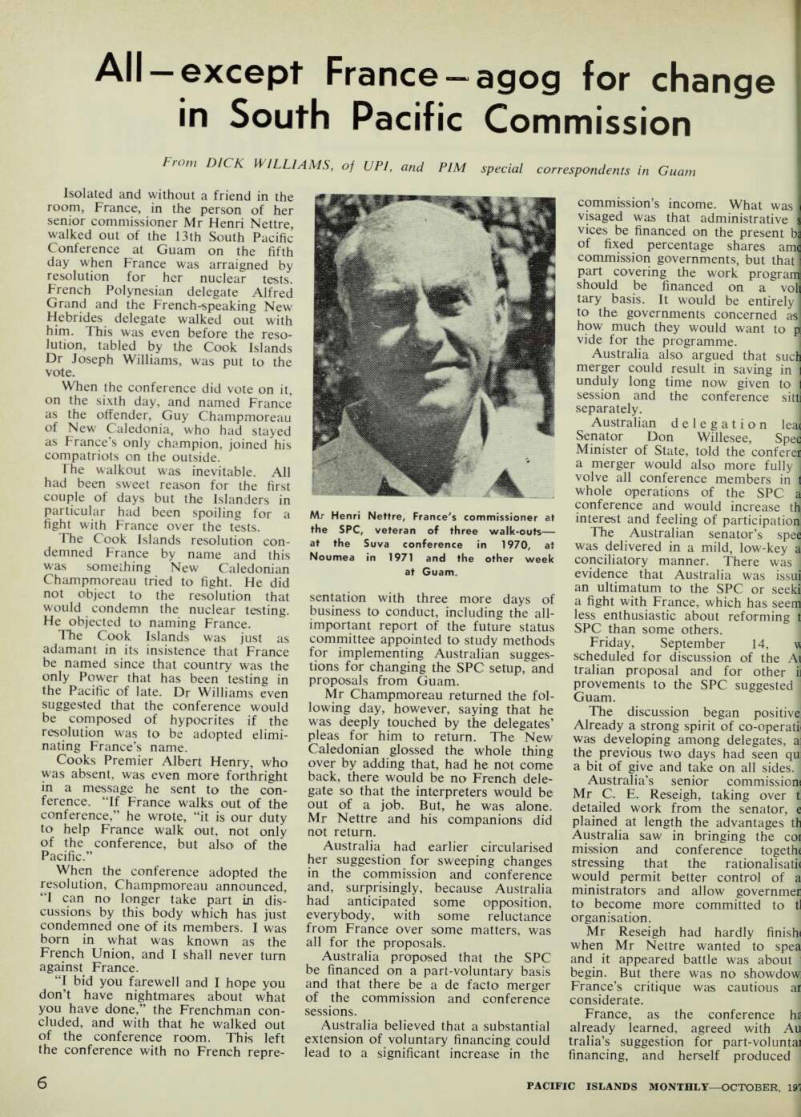
Mr Henri Nettre, France's commissioner at the SPC, veteran of three walk-outs— at the Suva conference in 1970, at Noumea in 1971 and the other week at Guam.
lintary contribution of 5A50,000. nough not large in comparison to half million dollar contribution in Australia and New Zealand übined, France’s showing was er than Britain’s and America’s, > produced nothing. ;ut France was less certain about idea of merging. Mr Nettre thought light inhibit the freedom of the 1s- Jers with the work programme if metropolitan governments had the 3 at the annual conferences. He > implied that the conference uld not involve itself in commis i “housekeeping”; as donor govern its should control input and the nders the output. tot all of Mr Nettre’s old fire was He made the most of three asions to remind delegates that, ler the present arrangement, the iference could not decide. Only commission session could. All conference could do, Mr Nettre sssed, was “to express a wish”, lis comments provided some dele ss with the chance to attack the inch position. Mr Albert Maori :i of Papua New Guinea told the ference that it was time for the ;gates from colonial governments “shut up” and let the Pacific aiders get on with their job. fhe delegate from the Gilbert and ice Islands, Isakala Paeniu, ob ed to France reminding the con ;nce that after all it was the com >sion session which must decide, j SPC must come under the con . of the Islands’ governments, he 1.
Dr Gideon Zoleveke of the Scio ns suggested it was time the con duce considered moving SPC head irters from Noumea, which he nd quite unsuitable. And Dr eph Williams told Mr Nettre that comments about the limited vers of the conference were reason ►ugh to alter the Canberra Agree nt itself. Dr Williams added that France continued to object U> the arms then the Cook Islands would ipose that the commission session abolished altogether and the con ence put officially in full charge of
Spc.
rleady stuff! But the rough vibra [is between some Pacific Islands’ egates and the French, and a lor disagreement between the mch and New Zealand commis ners, were the nearest that the late on the reform proposals came conflict. Australia’s careful pre ration and considerate presenta n of its ideas, France’s moderate ticisms, and \ hat turned out to overwhelming support from the iference delegates, ensured a rela sly safe and pleasant passage for : ship of reform.
One by one the Pacific Island’s delegates indicated their support for Australia’s proposals. Western Samoan Commissioner Mr Tulai Toma argued that if the SPC was to survive both the programme and the organisation would have to change. Unless the conference’s view was paramount the progress of the last few years had been a sham. When Mr Grand, of French Polynesia spoke firmly in favour of Australia’s proposal, the die was well and truly cast.
Apart from those of Mr Nettre, there were no serious objections to the Australian proposal. Only the delegates from the remaining French colonies varied a little from the run of play. The Wallis and Futuna delegate, Mr M. Muliloto, noted that majority approval was a fait accompli and gave full support to the proposal.
In a rather disgruntled manner Mr Champmoreau asked the conference “When everybody else supports the proposal, how can I oppose it?”
However, he raised a laugh when he suggested that he would be “quite a popular boy with some people around here if I opposed what France has said!”
But that wasn’t the end. The “status committee” had yet to decide on how to implement the principles and also discuss more radical reforms proposed by the Guam delegation.
This envisaged a new body, the South Pacific Development Agency, to handle funding of all aid projects for South Pacific countries; the South Pacific Conference to direct the allo cation of funds as well as activities of the existing South Pacific Bureau
of Economic Co-operation; and finally the South Pacific Forum, which would provide the political arm of the total operation.
When the Future Status Committee tabled its resolution, which favoured all Australia’s suggestions, no men tion was made of Guam’s proposal.
Committee members, it is believed, thought Guam’s suggestion for a de velopment agency was looking too far ahead.
The resolution recognised the “Can berra Agreement is now out of date.
It recommends, therefore, that the Australian Government initiate dis cussion immediately with all partici pating governments at the highest ap propriate level to revise the Canberra Agreement in such a way that it will reflect the needs and aspirations of the Pacific people.”
Meantime, modification of the SPC and conference should be by agree ment. The resolution set down the procedures to be followed on pre paring and presenting the budget and works programme. Member govern ments would try to indicate by each January how much their contribution would be, and governments would meet informally immediately be fore the conference. Conference and session would be merged and in the conference, lasting five days, all would have ane vote.
Pending revision of the Canberra Agreement, governments would have the right to withdraw from the con ference on any matter of vital in terest to any one of them, but the committee hoped that device would not be invoked.
The resolution, along with all other conference decisions, went to the com missioners’ session which opened on September 21. It was attended by Mr Nettre, who, in true Gallic fashion, saved face on the nuclear tests resolution. This has gone to the United Nations in the name of the conference and not the commission.
Mr Nettre managed to get on the record his point of order that neither the conference nor the commission was competent to consider and pass such a resolution. With that he was satisfied and played a full part in the proceedings.
There was no opposition to the Status Committee’s resolution from Mr Nettre or anyone else but it’s be lieved that any opposition which France intends to mount against changing the Canberra Agreement will be declared at the conference of the eight member governments, expected to be in Wellington in Febru ary. It could, however, be in London or Paris.
Wherever it is, the South Pacific Commission will never be the same after it.
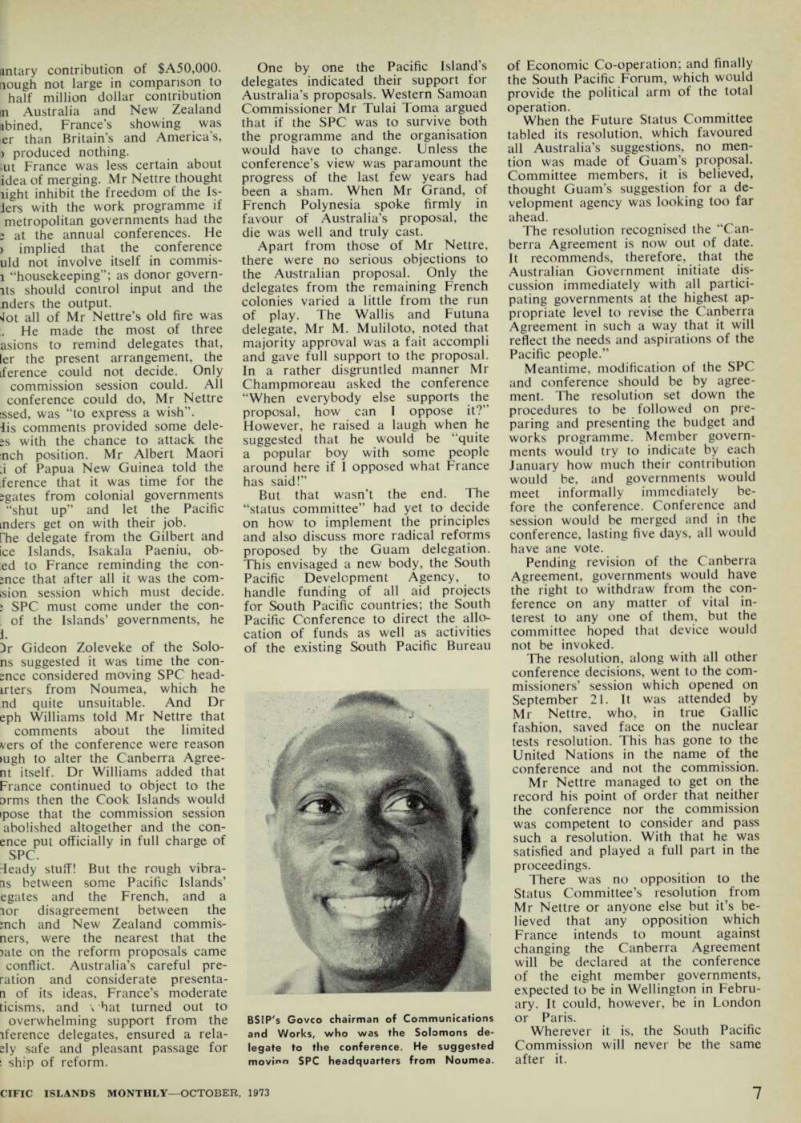
BSIP's Govco chairman of Communications and Works, who was the Solomons de legate to the conference. He suggested moving SPC headquarters from Noumea.
Advertisements & other items, p. 9 (1 item)
7
HFIC ISLANDS MONTHLY—OCTOBER, 1973
hangover
PNG's tax hangover for soft drinkers
From Percy Chatterton
in Port Moresby
Again, as in 1972, PNG’s House of Assembly’s Budget meeting has straddled the celebration of National Day on September 15. Consequently, after a two-week run of sittings which began on August 27, members dispersed for a week’s break in their electorates, to return for a further stint of legislative activity on Sep tember 17.
One of the “firsts” scored at this meeting has been the broadcast by the Australian Broadcasting Commis sion of Finance Minister Julius Chan’s Budget speech on the evening of August 28, and of the opening Opposition speech in reply to it, de livered by the United Party’s shadow Finance Minister, John Middleton.
The delivery of both these speeches was of a calibre which could hold its own with that of similar performances in most sophisticated legislatures.
The 1973 PNG Budget may take its place in history as the “Lolly Water Budget”. Taxes on alcoholic beverages are a commonplace of budgetry, but a tax on soft drinks is something of a novelty, and might indeed be a “first” worthy of a place in the Guiness Book of Records.
In addition to an increase in import duty on soft drinks from 50 cents to 75 cents a gallon, an excise duty of 10 cents a gallon is to be levied on the locally-manufactured product.
And this was about the only sur prise the Budget did spring.
In the field of income tax, people earning $5,000 a year or more will pay 4i per cent more in tax. This increase will mainly hit expatriate taxpayers, since less than 1 per cent of tax-paying Paguineans are in this income bracket. Some concessional deductions are also being abolished or reduced; this again will affect mainly expatriate taxpayers. On the other hand, company tax will not be increased.
Other imposts are a S 2 tax on out going international air passengers, in cluding those going to Australia, and an increased fee (from $2 to $5) for drivers’ licences.
On one issue Mr Chan had to admit himself stymied. It is fairly easy to make sure that wage and salary earners pay their income tax, but in this country it is very difficult to ensure that indigenous producers of cash crops such as coffee, cocoa and copra, and villagers who sell their produce in local markets, do so. Some of these people earn very substantial incomes, but few are sufficiently literate to keep records of their trans actions, and the Finance Minister has reluctantly decided that, while it would be possible to plug this loop hole, it would be too costly an opera tion to justify itself.
On the same day on which the Budget was brought down, the gov ernment tabled an eight-point “Im provement Plan” for 1973-74, which it described as its “first step towards building the kind of society that meets the needs of our people”. The plan focuses on a greater share in the economy by local people, and more equal development of the resources of areas and regions.
Altogether, it was a low-key budget, and the Opposition’s attack on it was also low-keyed.
Mr Middleton understandably criti cised the government’s continuing failure to simplify the tax structure on the lines proposed in a White Paper tabled in the last House but never implemented, and pointed out that the complexity of the present system was holding up localisation, that is, the replacement of expatriates by indigenous officers, in the taxation division of Mr Chan’s department.
The shadow minister drew attention to the danger of relying too heavily
for revenue raising on the dwindli expatriate sector, and urged less e phasis on increased taxation and me on increasing the gross national pi duct.
Finally, he pointed out that mii of the proposed expenditure was] be on power transferals needed 1 independence but not necessarily j self-government, a fact which led party to suspect that the governmi was, like Mr Whitlam, trying hustle the country into an early iru pendence which the majority of t people did not want.
Mr Tollman's death As the two weeks of sittings dn to a close, tragedy struck. Opposite leader Matthias Toliman was tak ill in the precincts of the House a: was rushed to hospital, but si cumbed to a heart attack shortly afl admission. The Speaker annound his death to a stunned House, ai the sittings came to an abrupt ei 24 hours earlier than had been e pected.
Matthias Toliman was a man great sincerity and integrity, with genius for friendship. The respon bilities of leadership, shouldered conscientiously, took a heavy to and, by temperament a man of pea( the bitter dissensions which hi divided his Tolai people in rece years must have weighed heavily I his spirit. His passing represents J incalculable loss to Papua Ne Guinea at a moment when tl qualities he displayed are so mui needed.
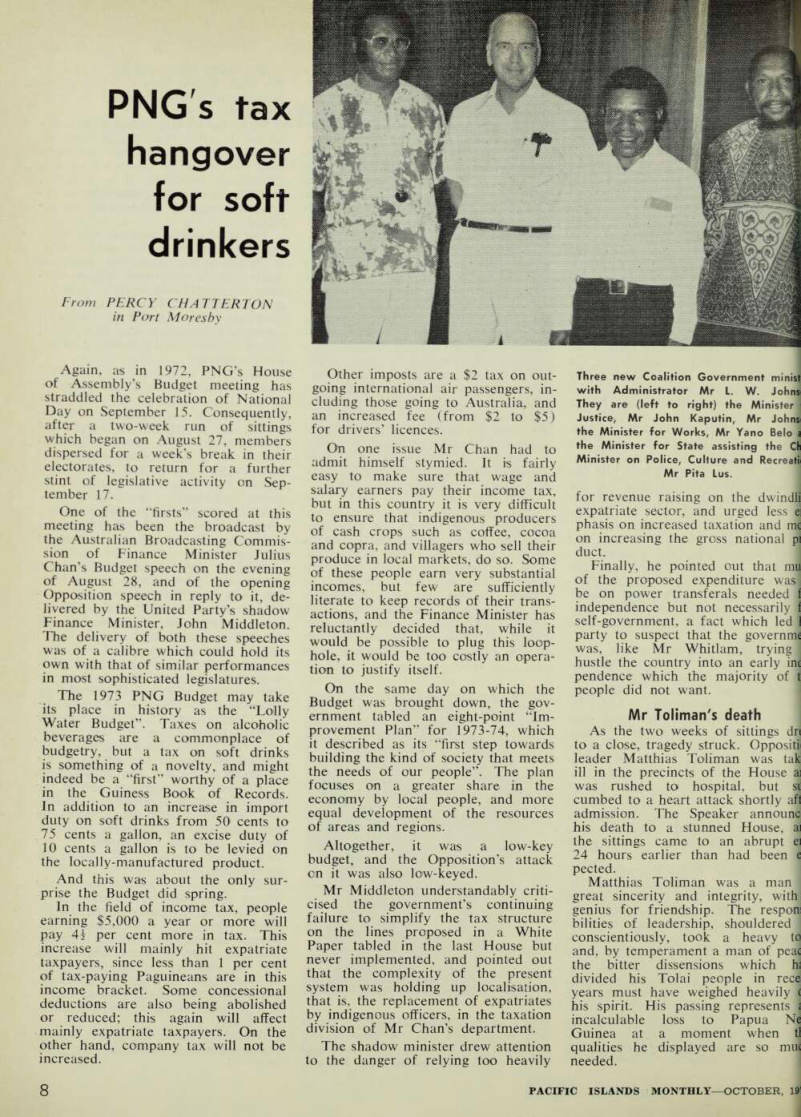
Three new Coalition Government minist with Administrator Mr L. W. Johnsi They are (left to right) the Minister I Justice, Mr John Kaputin, Mr Johnsi the Minister for Works, Mr Yano Belo a the Minister for State assisting the Ch Minister on Police, Culture and Recreatii Mr Pita Lus.
Their Caledonia!
ES of “Vive la nation caledo nienne” and “Long live OUR Caledonia” marked a senes of nent speeches in July when the in of Caledonian Youth (UJC) its second public meeting m nea. They have since organised try meetings. lis new youth movement, formed lay, is led by local autonomist ps such as the Union Caledo ie the largely-Melanesian Union iraciale and the Mouvement ilaire Caledonien.
Jdressing more than 400 young le, about 20 speakers condemned present French Administration s nialist policy with economic ex ation of the locals to the ad age of Paris. Speakers also ►unced the elimination of Cale ans from responsible positions the suppression of local aspira j particularly through the display rmed force. embers also traced the support ;h the Caledonian Youth Union given to recent protest movements Caledonian farmers and mine kers, complaining of the poor nent made to the farmer and the of work by the latter, jeakers included a local company ager, Melanesian Nidoishe Nais ie and Maurice Lenormand. ident of the UJC is Max Chivot, aledonian graduate in economics political science, who lost his in the local public service last ■ after showing interest in the •t proceedings against Naisseline. he youth meeting called for the tiding of the Caledonian nation, ;h means a free and independent v Caledonia”. Bernard Deschamps the meeting that all possibilities development were blocked for
on political, economic anc j soc i a f plane This young civil servant said the present “retrograde” , “must give way,
t (fan aut£
voluntarily or oy » “ eed of an oiUside He thre ’ atenec i t h a t the present administrators “reactionaries coloniaforeigners will be kicked out lists for - g , tb do not allow “ “e terr tor Y iney ' field , he continued,
£ demenTs are exploiting the
territory for the benefit of big comdirected from Paris. Their P' . b in suppo rt from local i pp bHc lending P As far as social security is con- •££ unbearable situation imposed from . b the co i on ial presence”. outs y Caledonian people tQ H ™ d con- : n order to develop a
mjd
Caledon d M ty lanesian orator One young l asked, hy * nd the colonialist land fro admin i st ration which and dictator coni .in i es th^ ff 2 Q tb cen tury .. . of pi inferiority complex wh\ch our in us in order to explo.t us .
From a Noumea correspondent
Another Melanesian spoke of the growing “anti-zozo feeling (against metropolitan French) which signals the awakening of a Caledonian national awareness According to another, young people were questioning the future of “our country, ruled in such disastrous fashion and exposed to the dictatorial whims of a misguided administra tion”. Replying to popular charges of being anti-French, the Caledonian said he saw no good for the territory in those people, French or not, who flew to the island only to draw out a quick profit.
Denouncing the local use of fear by force , he said “This is France and France is the army, prestigious and efficient, especially in the repression
“we*wiU*never'
iS, T*his speaker was concerned at the
Z’lssfsrss s. srsa
blamed this upon the poor state of information locally and the fact that the locals “had always been carefully kept apart from any control of the affairs of their country . 0f course . the whole weakness in this new grouping of autonomist interests lies in the build-up of a class struggle: this added conflict, with its attack upon the more affluent sector of Caledonian society, plays straight into the hands of the French Administration, to keep the “ans divided in fearfu. con fusion.
Fall-Out Ox Tourism
From a Noumea correspondent
he stress of the Pacific boycott imposed on UTA ich Airlines has contributed to a vehement debate the value of tourism in New Caledonia, i lengthy exchange of open letters in the Noumea y press began when the Territorial Assembly was eked for giving insufficient support to the tourist istry. The charge came from Ascadeto, a local •ist development association of airline and hotel rators etc, which includes a representative of the nch airline.
'our months of boycott brought a substantial loss Pacific trade for UTA, besides hitting the Chateau ,al hotel to which it traditionally directs its Noumea tors.
Metropolitan French tourist interests have continually bied for the territory to spend more freely to attract rists to Noumea and have particularly criticised the budget of the Caledonian Tourist Office, which is ;ricted to around 5A150,000 a year, n the present attack, Caledonian members of the
Territorial Assembly have retaliated by condemning what they claim to be monopolist activities of the French airline. They have also condemned the French Administration for allegedly preventing a non-French airline, Pan-Am, from building a hotel m Noumea.
At the same time, members of the assembly autonomist party Union Caledonienne have pro tested at the bad overseas image created for the territory by local hoteliers who have charged exorbitant prices and refused accommodation to bona fide tourists during the island’s economic boom around 1970, when rooms were occupied on a monthly basis by the insurge of mainly French businessmen.
The autonomists also underlined the responsibility of Paris with its nuclear programme in the Pacific prompting the current difficulties in the Caledonian tourist industry.
Finally, instead of advocating further subsidies and costly publicity, the Caledonian politicians urged tourist promoters to make greater use of welcoming smiles and courtesy, characteristics for which some tourist representatives have not been particularly famous.
Advertisements & other items, pp. 11-12 (2 items)
9
:iFIC ISLANDS MONTHLY—OCTOBER, 1973
Completely ,
Pyrethrins: Nature’s
pest control
From the small, innocent-looking white Pyrethrum daisy! modern chemistry extracts pure pyrethrins. This syruj fluid is so deadly to all insects, even the microscopic quantil ties carried in droplets of Pea-Beu spray kill instantly or contact. Yet pyrethrins are absolutely harmless to the human system, even in infants. Pea-Beu aerosol in] secticide is also guaranteed safe near any warm-blooded domestic animal and near food. Even in the pure state, the odour of pyrethrins is neither overpowering nor unpleasant.
Harmless to spray freely
anywhere
As a powerful space spray, Pea-Beu effectively rids any room of dangerous cockroaches, mosquitoes and other biting insects and plays a major role in family health-protection. In addition it is perfectly safe to spray in kitchen cupboards or on pantry shelves, with no risk of food contamination. The unique strength of the Pea-Beu formula kills the toughest cockroach and colonies of ants rapidly too, yet cannot affect humans or pets in any way.
Pea-Beu aerosol insecticide is so strong it is effective in killing flies, mosquitoes and every type of insect pest.
Powerful Pea-Beu kills all insects—yet it’s so pure it’s safe to spray anywhere
Start precautions against
disease carrying insects with. . .
The Insect Spray
that is
Completely ,
Completely
Effective
/A m mm
Rigid testing selects only
pure, safe ingredients In formulating insect sprays, the aim is maximum effectiveness against many species of pests with maximum safety for humans and pets. A.N.I. Research Chemists are at work world-wide to ensure that concentrated Pea- Beu aerosol insecticide satisfies in all respects. Its active insecticidal ingredient is pyrethrins . . . proven the most potent insect-killing substance available. All raw materials must conform to rigid specifications of chemical purity. A programme of progress checking then operates at every stage of processing from mixing the insectkilling concentrate and high-grade ‘carrier’ to injecting the propellant which produces Pea-Beu’s high-speed spray Rigid quality control of every stage of manufacture ensures that Pea-Beu is brought to you in the purest, safest and most effective form. Because of this Pea-Beu is also really effective against every type of insect pest including flies and mosquitoes.
Pea-Beu the safe, powerful insecticide
Yachtsman 'scratches'
France's conscience
PEELED by the French from French Polynesian waters, single ier protest yachtsman Michael :iall berthed his 30 ft sloop nen at Rarotonga in mid-August declared that “the French nuclear ig is surely the ultimate act of nialism”. r Wignall, ex-Senior Crown Pro tor in Papua New Guinea, where ✓orked from 1966 to 1970, sailed yacht into the test area after tell the French in a letter, “If my >n causes some impediment to • government’s will and scratches consciousness of a few more an beings, then this short voyage have achieved much.” e was almost 100 miles away from uroa when the first bomb was ex ed. He sailed Carmen into French mal waters at Tureia on July ind reached Mururoa the follow day after being buzzed by French tary aircraft. ar three days he remained with 'rench territorial waters at Muru and once sailed close enough to that the atoll rose only a few above sea level, that it had no »nut palms and that several build , three and four storeys high, had t built there. He sailed almost up the island because he was not
equipped to transmit radio messages and he wanted the French to find him.
They did. A French naval vessel, Orage, circled him all one morning, then he was boarded by a party of three naval officers and two gen darmes. He was handed a notice, written in French and English, tel ling him that he had entered French territorial waters on two occasions— at Tureia on July 28 and Mururoa on July 29, and that if he did so again his yacht would be seized.
Michael Wignall noticed that the young, English-speaking officers looked embarrassed. The Carmen was then towed beyond the 12-mile limit.
He was between 40 and 50 miles from Mururoa and bound for Raro tonga when the second bomb was ex ploded. He saw nothing of the ex plosion as the sky was overcast and cloudy. The absence of land birds around the atoll made him wonder if the tests had anything to do with
From W. H. PERCIVAL in Rarotonga
it. Normally, he said, one saw noddies and white terns up to a 20-mile radius from an island and frigate birds up to 70 miles from land. It seemed that nobody had yet made a study of the effect of nuclear blasts on bird life.
Mr Wignall, who also told the French that their tests were “an of fence against all Pacific peoples and a crime against the Earth itself,” said, on arrival at Rarotonga, “The Poly nesians of the Eastern Pacific have already suffered greatly at the hands of Europeans. What is left is to be risked again, if not at Mururoa, then at Eiao where underground testing is contemplated in the future.
“Few people in the world have less real voice than the people of French Polynesia. It is inconceivable to me that the United Nations have not al ready, under the General Assembly’s Declaration on the Granting of In dependence to Colonial countries and Peoples, directed their attention to French Polynesia. The French posi tion is in essence no different to the Portugese position in Africa. The French nuclear testing is surely the ultimate act of colonialism.”
Fiji’s Prime Minister, Ratu Sir Kamisese Mara, agrees. He told Fiji Parliament in September that the most effective action Fiji could take against French nuclear explosions was “to persuade the Committee of 24 on Colonialism to hasten the liberation of the islands which are at present regarded as French territory”.
Micronesian Talks Held Up
fith several stiff hurdles to clear ire both sides can agree on an ida, the opening date and the ic for the seventh round of talks yeen the United States and the gress of Micronesia’s Joint Com ee on Future Status are still un ded. But, after talks early in ;ember in Guam between Ambas >r Franklyn H. Williams, Presi t Nixon’s personal representative Jing the United States team, and ator Lazarus Salii, chairman of status committee, it looked as if talks might get under way late in aber or early November, he biggest hurdles are the land stion —who owns what and where, what control the United States tary should be allowed to exer over the bases it occupies—and subject of the separate talks be ;n the US and the Marianas to ch the Micronesian Congress has jcted. Tinian in the Marianas will i figure largely because the United es, which has announced that it its a large chunk of the island for ase, has declared a moratorium on economic development there. An it row to be cleared up is that sed by Washington’s refusal to re e certain land records which the :ronesians say they must see be
fore they can discuss the land ques tion.
The separate talks between the US and the Marianas are expected to open in mid-November, but whatever agreement over future status is made, it will be subject to a plebiscite among the Marianas people. The rest of Micronesia may also want a say in that decision.
Abaijah's 'Impossible Dream'
PNG’s Chief Minister Mr Michael Somare in September put paid to Josephine Abaijah’s Papuan independence aspirations (PIM, Sept, p 4). In Canberra, Mr Somare, describing Papua as a “colonial invention”, said Miss Abaijah promised violence and bloodshed if she did not get her way, but his government was determined that Papua would remain part of a unified country.
The Australian Government was determined that PNG would reach self government as a single nation.
“Miss Abaijah’s concept of a separate Papua is, therefore, an impossible dream,” he said.
Australian Minister for External Territories Mr Morrison used the same theme when he described how he had finally met up with Miss Abaijah, in Canberra. He said he pointed out to her that a unified Papua New Guinea was not merely the Labor Government’s policy but that of the previous government. PNG unity was not to be inhibited by inherited artificial colonial boundaries.
Miss Abaijah’s reaction in Port Moresby, was, “Mr Somare has forgotten that we are such stuff as dreams are made on . . . It is better to live with an impossible dream than to live with an impossible nightmare”.
Nevertheless, Mr Somare’s blunt assault on Miss Abaijah’s ambitions has taken the heat out of the free-Papua movement.
Advertisements & other items, pp. 13-14 (2 items)
11
IIFIC ISLANDS MONTHLY—OCTOBER, 1973
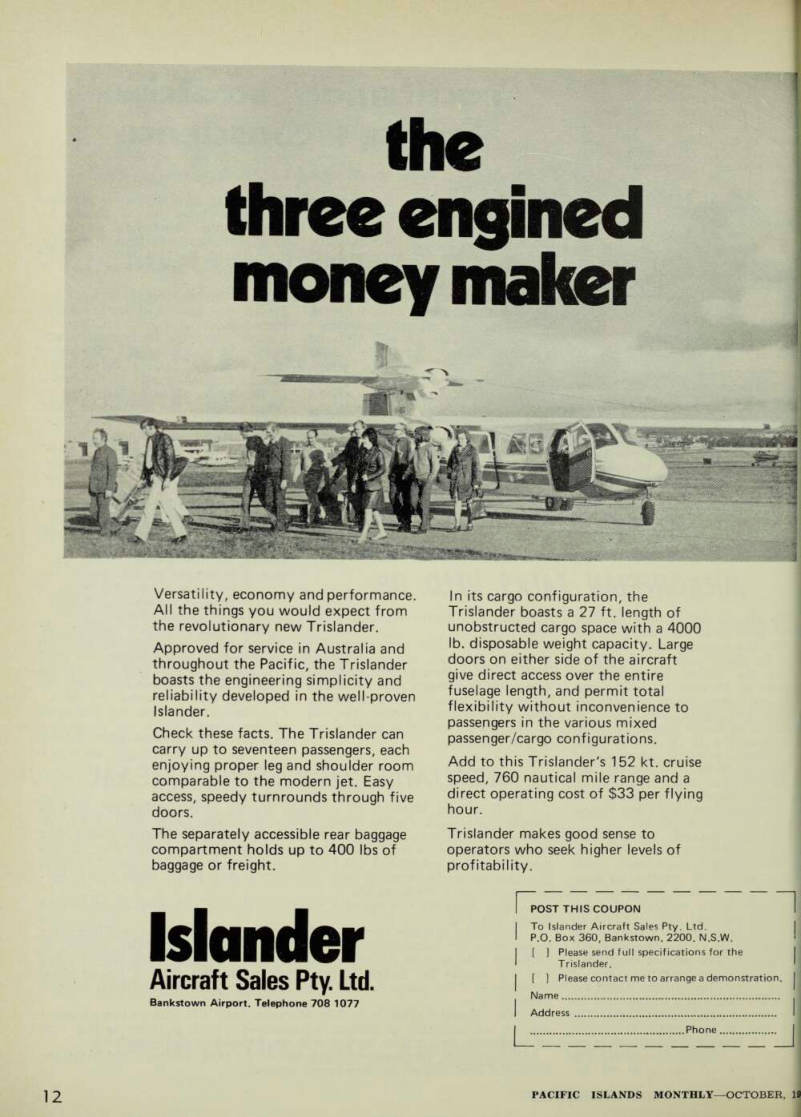
three engined
the
money maker
ft m.
"V ‘ ft : 5 A 6*? % *m' m* Versatility, economy and performance.
All the things you would expect from the revolutionary new Trislander.
Approved for service in Australia and throughout the Pacific, the Trislander boasts the engineering simplicity and reliability developed in the well-proven Islander.
Check these facts. The Trislander can carry up to seventeen passengers, each enjoying proper leg and shoulder room comparable to the modern jet. Easy access, speedy turnrounds through five doors.
The separately accessible rear baggage compartment holds up to 400 lbs of baggage or freight.
Islander
Aircraft Sales Pty. Ltd.
Bankstown Airport. Telephone 708 1077 In its cargo configuration, the Trislander boasts a 27 ft. length of unobstructed cargo space with a 4000 lb. disposable weight capacity. Large doors on either side of the aircraft give direct access over the entire fuselage length, and permit total flexibility without inconvenience to passengers in the various mixed passenger/cargo configurations.
Add to this Trislander's 152 kt. cruise speed, 760 nautical mile range and a direct operating cost of $33 per flying hour.
Trislander makes good sense to operators who seek higher levels of profitability.
I POST THIS COUPON
I To Islander Aircraft Sales Pty. Ltd.
I P.O. Box 360, Bankstown. 2200. N.S.W.
I [ ] Please send full specifications for the Trislander. • [ ] Please contact me to arrange a demonstration. Name J I Address I
J Phone
Air Niugini Gets Off
The Ground Fast
Papua New Guinea’s airline, Air iueini will fly into Brisbane from yrt B Moresby from November 1, a onth ahead of the target date of ecember 1 to get it “off the ound”. The date was changed to ve the fledgling airline time to ittle down before the heavy Christoc trcfFir ias iranic.
Air Niugmi will charter a rcraft th f. pr t?? nt - c - arn -n rs l,^" S '% ner AA. Air Niugmi will have 50 per mt of the traffic and TAA and •nsett 25 per cent each on the Port loresby - Brisbane service. A liugini’s share of the traffic from Australian airports to Port Moresby r iH be 1 685 than 50 per cent.
On November 1, Air Niugini will ike over all internal services from msett and TAA, either buying air raft from those airlines, or charter ig them. It is expected Air Niugini dll also take over the overseas serices operated by TAA to Honiara nd West Irian, and operate them mder a charter arrangement with Qantas.
When Papua New Guinea becomes ndependent, its government and he Australian Government will negotiate l bilateral agreement for air services ictween the two countries. No Ausrahan domestic operator will then be illowed to operate an international -vice out of Papua New Guinea itaff US for
,S 'tJTZtTs
in organisation acting on behalf of he PNG Government.
The Director of Civil Aviation has
not yet been named, but it is pre sumed it will be Dr K. N. E. Brad field, at present civil aviation adviser to the PNG Government.
One of the last obstacles to launch ing the airline was removed at a conference in Brisbane on September 18-19, attended by the general manager of Air Niugini, Mr Ralph Conley, representatives of Qantas, TAA and Ansett and Mr D. G. Cole man, federal secretary of the Aus tralian Licensed Aircraft Engineers’
Association. Mr Coleman said after the conference Air Niugini was now “a goer” from the point of view of his association.
It had placed the embryo airline under a black ban unless a number of demands about expatriate staff were met.
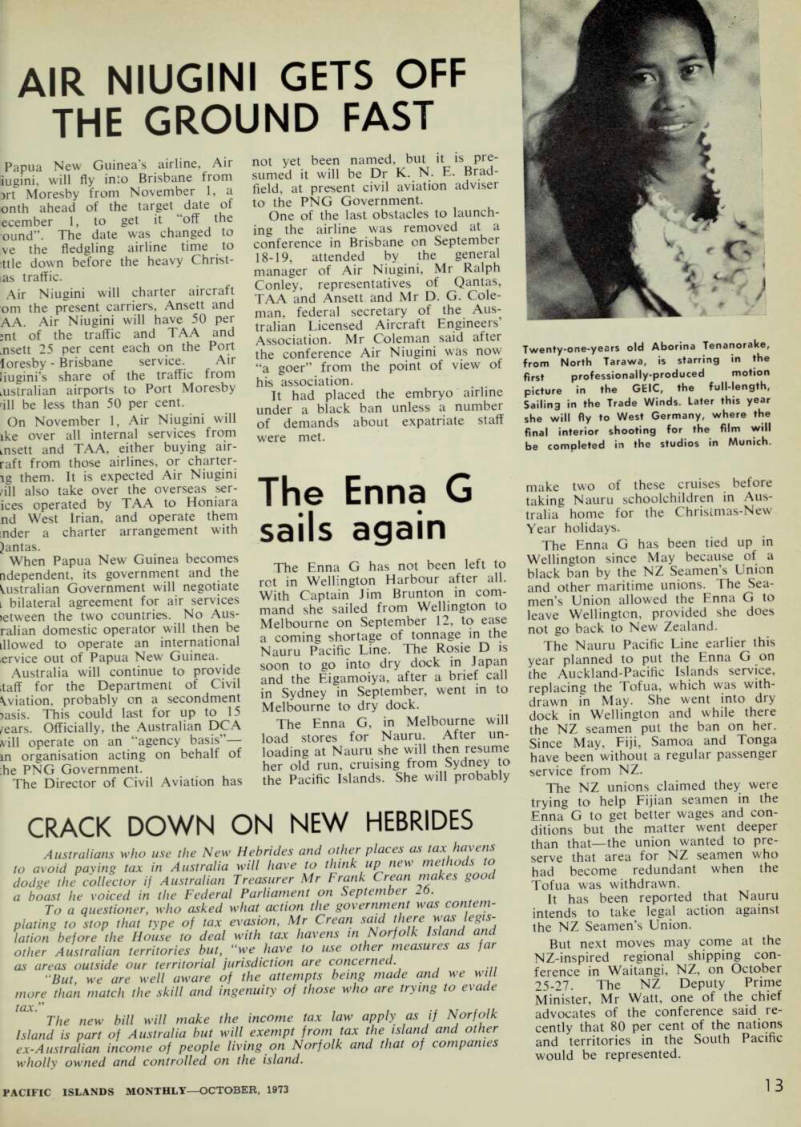
Twenty-one-years old Aborina Tenanorake, from North Tarawa, is starring in the first professionally-produced motion picture in the GEIC, the full-length, Sailing in the Trade Winds. Later this year she will fly to West Germany, where the final interior shooting for the film will be completed in the studios in Munich.
Crack Down On New Hebrides
Australians who use the New Hebrides and other places as tax havens to avoid paying tax in Australia will have to think up new methods to dodge the collector if Australian Treasurer Mr Frank Crean makes good a boast he voiced in the Federal Parliament on September 2b.
To a questioner, who asked what action the government was contem plating to stop that type of tax evasion, Mr Crean said there was legis lation before the House to deal with tax havens in Norfolk Island and other Australian territories but, “we have to use other measures as far as areas outside our territorial jurisdiction are concerned.
“But, we are well aware of the attempts being made and we will more than match the skill and ingenuity of those who are trying to evade tGX ' The new bill will make the income tax law apply as if Norfolk Island is part of Australia but will exempt from tax the island and other ex-Australian income of people living on Norfolk and that of companies wholly owned and controlled on the island.
The Enna G
sails again
Enna Q has nQt been left to Jn Wellington Harbour after all. c ap t a in Jim Brunton in com mand sh £ saded f rom Wellington to Melbourne G n September 12, to ease ivieioournc uu p tonnaee in the * com % B j£° rt T a fn P RoL D is
in Ja^an
Melbourne to dry doc£ loading at Nauru.she willthen resume her old run, cruising from Sydney to the Pacific Islands. She will probably
make two of these cruises before taking Nauru schoolchildren in Aus tralia home for the Christmas-New Year holidays.
The Enna G has been tied up in Wellington since May because of a black ban by the NZ Seamen’s Union and other maritime unions. The Sea men’s Union allowed the Enna G to leave Wellington, provided she does not go back to New Zealand.
The Nauru Pacific Line earlier this year planned to put the Enna G on the Auckland-Pacific Islands service, replacing the Tofua, which was with drawn in May. She went into dry dock in Wellington and while there the NZ seamen put the ban on her.
Since May, Fiji, Samoa and Tonga have been without a regular passenger service from NZ.
The NZ unions claimed they were trying to help Fijian seamen in the Enna G to get better wages and con ditions but the matter went deeper than that —the union wanted to pre serve that area for NZ seamen who had become redundant when the Tofua was withdrawn.
It has been reported that Nauru intends to take legal action against the NZ Seamen’s Union.
But next moves may come at the NZ-inspired regional shipping con ference in Waitangi, NZ, on October 25-27. The NZ Deputy Prime Minister, Mr Watt, one of the chief advocates of the conference said re cently that 80 per cent of the nations and territories in the South Pacific would be represented.
Tropicalities
Tough For
Big Fish
Big fish in little American pools don’t have the constitutional defences that US President Richard Nixon has been able to resort to in his fight to convince people that he’s not the rogue some would make him out to be over the Watergate kerfuffle.
Two US colonial executives, High Commissioner Edward E. Johnston of the US Trust Territories, and Governor John Haydon Jr of American Samoa, have found themselves, directly or in directly, in the firing line of the people they are looking after.
Hicom Johnston, as Trust Terri torians know him, is reported to have had a “class action suit” filed against him by four residents of Saipan. The plaintiffs were demand ing that Johnston issue deeds of con veyance for their homestead land.
One plaintiff, according to the Pacific Daily News, said she had waited for nine years for a deed to her homestead site even though she had fully complied with TT homestead laws.
In American Samoa things looked grimmer for Governor Haydon. He was charged by the Civil Service Commission, allegedly as a result of complaints by Samoans including members of the legislature, of having used his position to influence the territorial election in 1972.
It is alleged that Governor Haydon had used the government radio and television on election day and the day before to “propagandise against a ballot proposition that Samoans elect their own governor”.
Another charge was that Haydon had urged Samoans not to vote for a white businessman arguing that palangi —white foreigners—should not be in the Fono (legislature).
Haydon was charged under the Hatch Act which forbids Federal
employees and territorial governors from involving themselves in elec tions. The trial opened in Pago Pago on September 11 but was adjourned when the trial judge. Judge John J.
McCarthy, was taken ill.
Saving Pitcairn
from the drain
Two Royal Engineers and Britain’s sense of “romance” and “history” could mean revival rather than evacu ation for the people of Pitcairn Island.
Before British High Commissioner in NZ D. A. Scott, who doubles as Gov ernor of Pitcairn, visited the island recently, Tom Christian was sounding glum on his weekly hook-up with the Seventh-day Adventists’ radio station, the Voice of Prophecy, in California.
Tom said: “There has been some talk about either taking the people from Pitcairn or opening the island up to outsiders. We don’t know that our Governor is going to talk to us
about these questions but it is reason able to think that he might. What th« response of the people here will b( of moving from Pitcairn or bringinj outsiders to the island, as suggested I don’t know.”
What he was talking about was thi dwindling Pitcairn population—dowi to 73 plus nine “foreigners”—whid is making it difficult to find enougt manpower to keep the island’s serf vices running, particularly the long boat service to passing vessels.
When Governor Scott returned from his four-day visit his tone was upbeat: two Sappers (engineers) had come up with ideas for improving Pitcairn Harbour facilities and he was very keen to see the Pitcairn popula tion built up again to around 150.
Agreeing that Britain’s determina tion to maintain the island was due mainly to its romantic and historical associations, Governor Scott said] “Pitcairn is a small, independently minded community we don’t want to see go down the drain.”
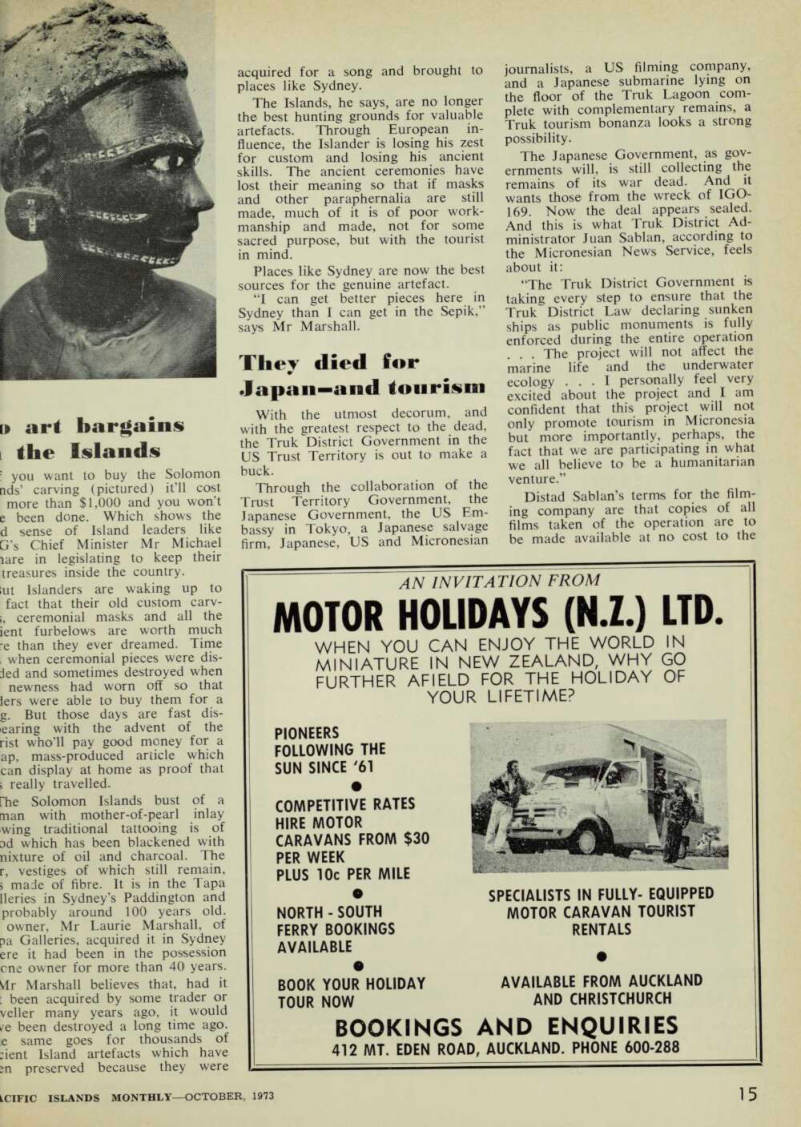
This is the Honiara Bamboo Band, certain to be a popular novelty in Sydney when it performs during the opening celebrations of the Sydney Opera House at two concerts on October 23 which will feature 300 Pacific Islanders. The Islanders, whose pro gramme will be directed by Victor Carell, director of the Arts Festival at Suva, will also perform at various centres in Sydney and the suburbs. The Islanders will come from Fiji, Tonga, Western Samoa, Papua New Guinea, New Zealand, the Banabans of Rabi, BSIP and the Cooks.
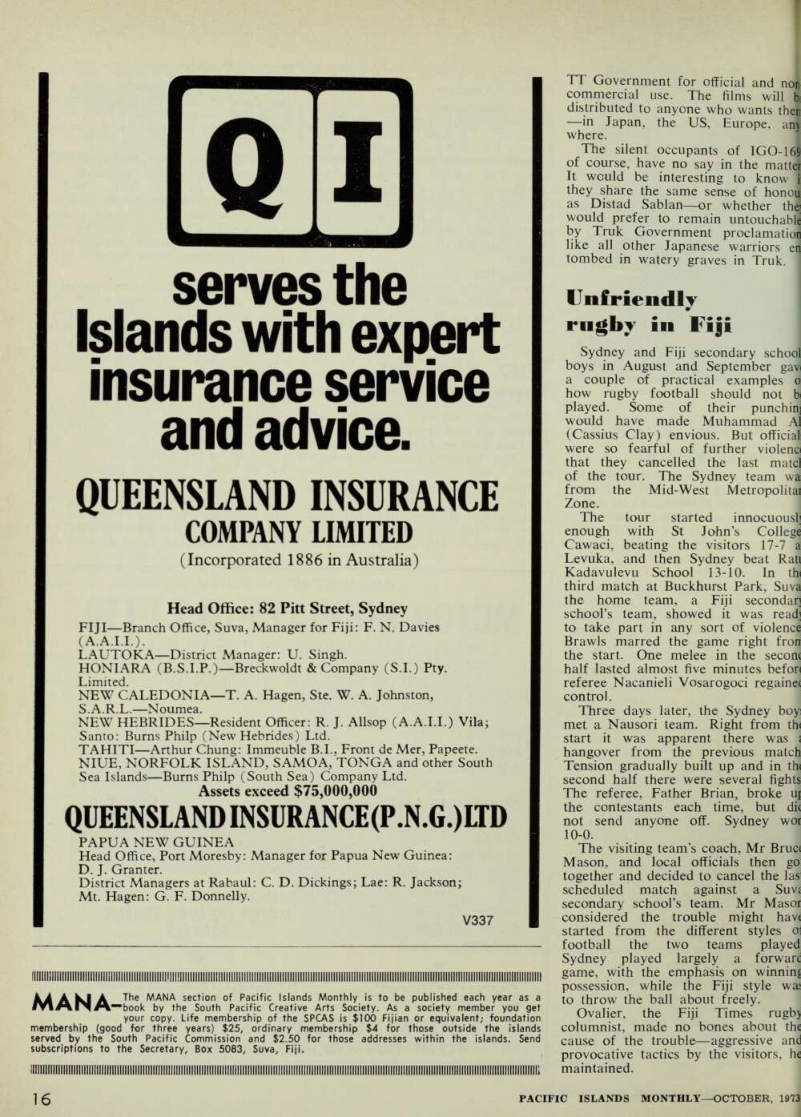
i> art bargains
i the Islands
: you want to buy the Solomon nds’ carving (pictured) it’ll cost more than SI,OOO and you won’t e been done. Which shows the d sense of Island leaders like G’s Chief Minister Mr Michael lare in legislating to keep their treasures inside the country, iut Islanders are waking up to fact that their old custom carv ceremonial masks and all the lent furbelows are worth much 'e than they ever dreamed. Time , when ceremonial pieces were dis led and sometimes destroyed when newness had worn off so that lers were able to buy them for a g. But those days are fast dis earing with the advent of the rist who’ll pay good money for a ap, mass-produced article which can display at home as proof that ► really travelled. fhe Solomon Islands bust of a man with mother-of-pearl inlay wing traditional tattooing is of ad which has been blackened with nixture of oil and charcoal. The r, vestiges of which still remain, 5 made of fibre. It is in the Tapa lleries in Sydney’s Paddington and probably around 100 years old. owner, Mr Laurie Marshall, of pa Galleries, acquired it in Sydney ere it had been in the possession one owner for more than 40 years.
Vlr Marshall believes that, had it : been acquired by some trader or veller many years ago, it would /e been destroyed a long time ago. e same goes for thousands of :ient Island artefacts which have ;n preserved because they were
acquired for a song and brought to places like Sydney. fluence, the Islander is losing his zest for custom and losing his ancient skills. The ancient ceremonies have lost their meaning so that if masks and other paraphernalia are still made, much of it is of poor workmanship and made, not for some sacred purpose, but with the tourist in mind.
Places like Sydney are now the best sources for the genuine artefact.
“I can get better pieces here in Sydney than I can get in the Sepik,’’ says Mr Marshall. ma J. J «
ft Itey died tor
Japan-and tourism
With the utmost decorum, and with the greatest respect to the dead, the Truk District Government in the US Trust Territory is out to make a Through the collaboration of the Trust Territory Government, the Japanese Government, the US Embassy in Tokyo, a Japanese salvage firm, Japanese, US and Micronesian
journalists, a US filming company, and a Japanese submarine lying on possibility.
The Japanese Government, as gov ernments will, is still collecting the remains of its war dead. And it wants those from the wreck of 1GU U 169. Now the deal appears sealed, And this is what Truk District Ad ministrator Juan Sablan, according to the Micronesian News Service, feels about it: “The Truk District Government is taking every step to ensure that the Truk District Law declaring sunken
ships as public monuments is fully
enforced during the entire operation ... The project will not affect the marine life and the underwater “°|° g d y about Ihe^prolect 7 and' iTm confident that this project will not only promote toumm
but more importantly, perhaps,
fact that we are participating in what we all believe to be a humanitarian venture.
Distad Sablan s terms for the filrn ing company are that copies of all films taken of the operation are to be made available at no cost to the
TT Government for official and non commercial use. The films will b t distributed to anyone who wants their —in Japan, the US, Europe, any where.
The silent occupants of IGO-169 of course, have no say in the matter It would be interesting to know 1 they share the same sense of honoui as Distad Sablan—or whether thei would prefer to remain untouchable by Truk Government proclamation like all other Japanese warriors en tombed in watery graves in Truk. I
Unfriendly
rugby in Fiji
Sydney and Fiji secondary school boys in August and September gavi a couple of practical examples 0: how rugby football should not b( played. Some of their punchinj would have made Muhammad A 1 (Cassius Clay) envious. But official were so fearful of further violent that they cancelled the last matcl of the tour. The Sydney team wa from the Mid-West Metropolitai Zone.
The tour started innocuousl] enough with St John’s College Cawaci, beating the visitors 17-7 a Levuka, and then Sydney beat Rah Kadavulevu School 13-10. In th< third match at Buckhurst Park, Suva the home team, a Fiji secondary school’s team, showed it was read] to take part in any sort of violence Brawls marred the game right fronj the start. One melee in the seconc half lasted almost five minutes befon referee Nacanieli Vosarogoci regainec control.
Three days later, the Sydney boyi met a Nausori team. Right from th< start it was apparent there was \ hangover from the previous match Tension gradually built up and in th< second half there were several fights The referee, Father Brian, broke ug the contestants each time, but die not send anyone off. Sydney wot 10-0.
The visiting team’s coach, Mr Bruc< Mason, and local officials then go together and decided to cancel the lasi scheduled match against a Suv* secondary school’s team. Mr Masoi considered the trouble might have started from the different styles oj football the two teams played Sydney played largely a forward game, with the emphasis on winning possession, while the Fiji style wat to throw the ball about freely.
Ovalier, the Fiji Times rugby columnist, made no bones about the cause of the trouble —aggressive and provocative tactics by the visitors, he maintained.
Advertisements & other items, pp. 17-22 (3 items)
15
CIFIC ISLANDS MONTHLY —OCTOBER, 1973
Motor Holidays (N.Z.) Ltd.
AN INVITATION FROM
WHEN YOU CAN ENJOY THE WORLD IN
MINIATURE IN NEW ZEALAND, WHY GO
FURTHER AFIELD FOR THE HOLIDAY OF
YOUR LIFETIME?
PIONEERS
FOLLOWING THE
SUN SINCE '6l
COMPETITIVE RATES
HIRE MOTOR
CARAVANS FROM $3O
PER WEEK
PLUS 10c PER MILE
NORTH - SOUTH
FERRY BOOKINGS
AVAILABLE
BOOK YOUR HOLIDAY
TOUR NOW
7
SPECIALISTS IN FULLY- EQUIPPED
MOTOR CARAVAN TOURIST
RENTALS
AVAILABLE FROM AUCKLAND
AND CHRISTCHURCH
BOOKINGS AND ENQUIRIES
412 MT. EDEN ROAD, AUCKLAND. PHONE 600-288
serves the
Islands with expert
insurance service
and advice.
QUEENSLAND INSURANCE
COMPANY LIMITED
(Incorporated 1886 in Australia)
Head Office: 82 Pitt Street, Sydney FIJI —Branch Office, Suva, Manager for Fiji: F. N. Davies (A.A.1.1.).
LAUTOKA—District Manager: U. Singh.
HONIARA (8.5.1. P.) —Breckwoldt & Company (5.1.) Pty.
Limited.
NEW CALEDONIA—T. A. Hagen, Ste. W. A. Johnston, S.A.R.L.—Noumea.
NEW HEBRlDES—Resident Officer: R. J. Allsop (A.A.1.1.) Vila; Santo: Bums Philp (New Hebrides) Ltd.
TAHlTl—Arthur Chung: Immeuble 8.1., Front de Mer, Papeete, NIUE, NORFOLK ISLAND, SAMOA, TONGA and other South Sea Islands—Burns Philp (South Sea) Company Ltd.
Assets exceed $75,000,000
QUEENSLAND INSURANCE (P.N.G.) LTD
PAPUA NEW GUINEA
Head Office, Port Moresby: Manager for Papua New Guinea: D. J. Granter.
District Managers at Rabaul: C. D. Dickings; Lae: R. Jackson; Mt. Hagen: G. F. Donnelly.
V 337
LA AA! A The MANA section of Pacific Islands Monthly is to be published each year as a by the South Pacific Creative Arts Society. As a society member you get your copy. Life membership of the SPCAS is $lOO Fijian or equivalent; foundation membership (good for three years) $25, ordinary membership $4 for those outside the islands served by the South Pacific Commission and $2.50 for those addresses within the islands. Send subscriptions to the Secretary, Box 5083, Suva, Fiji.
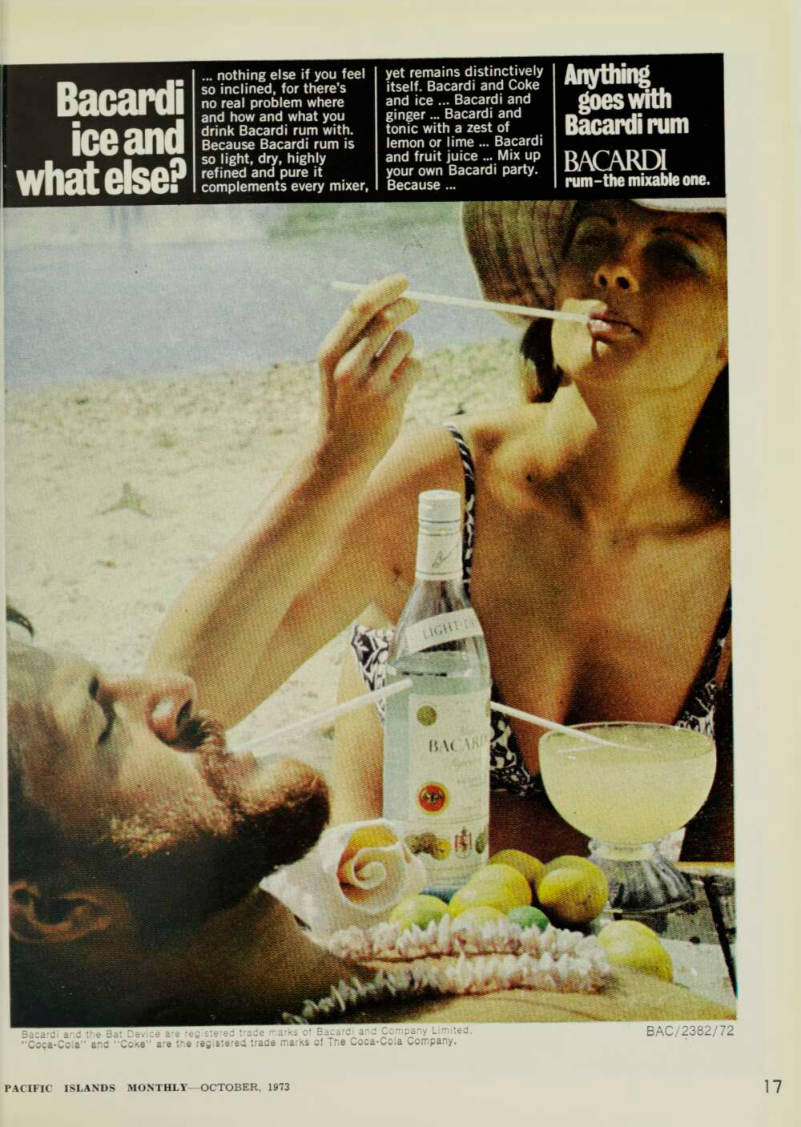
Bacardi
ice and
what else?
... nothing else if you feel so inclined, for there’s no real problem where and how and what you drink Bacardi rum with.
Because Bacardi rum is so light, dry, highly refined and pure it complements every mixer, yet remains distinctively itself. Bacardi and Coke and ice ... Bacardi and ginger... Bacardi and tonic with a zest of lemon or lime ... Bacardi and fruit juice ... Mix up your own Bacardi party.
Because ...
Anything
goes with
Bacardi rum
BACARDI
rum-the mixable one. * i !V\< Bacardi and the Bat Device are registered trade marks of Bacardi and Company Limitec “Coca-Cola” and “Coke” are the registered trade marks of The Coca-Cola Company.
BAC/2382/72
fTHRUM
skilful industrious Burns Philp folk!
Cocoa and coffee, cattle and copra, they’re all nature’s gifts to man. In return, they all demand effort by man. And woman.
The same is true of all the other good and useful things that grow in the Islands.
And wherever they grow, you’ll find Burns Philp people doing important work. Improving cattle breeds and crop yields, trading, shipping and insuring raw materials, caring for the land and the produce.
The Burns Philp involvement in the Islands’ agriculture and animal husbandry has a most beneficial history. Today and tomorrow the people of the Burns Philp Group of Companies will go on making things grow better for themselves, for the Islands, for all the world.
DOING GOOD BUSINESS FOR THE ISLANDS
BURn/ PHILP
GROUP OF COMPANIES
PRINCIPAL OFFICE—7 BRIDGE STREET SYDNEY NSW 2000 AUSTRALIA
28940
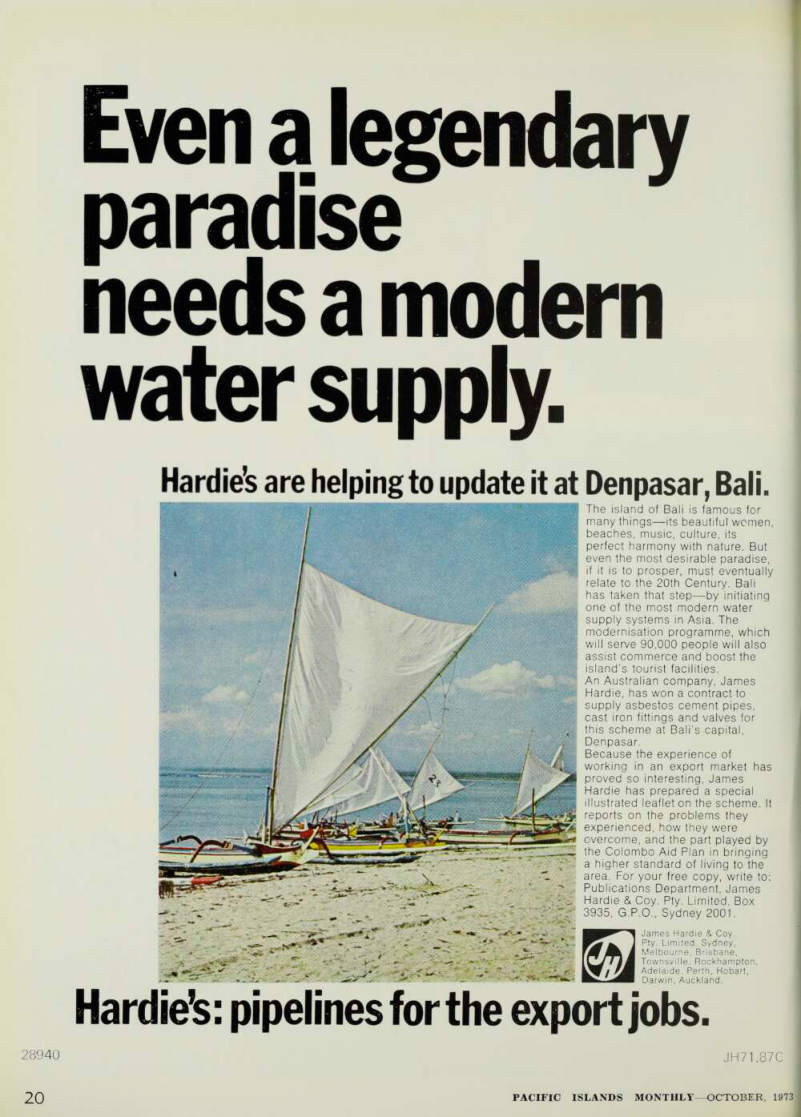
Even a legendary
paradise
needs a modem
water supply.
Hardie’s are helping to update it at Denpasar, Bali. y d mms me . t ‘ The island of Bali is famous for many things—its beautiful women, beaches, music, culture, its perfect harmony with nature. But even the most desirable paradise, if it is to prosper, must eventually relate to the 20th Century. Bali has taken that step—by initiating one of the most modern water supply systems in Asia. The modernisation programme, which will serve 90,000 people will also assist commerce and boost the island’s tourist facilities.
An Australian company, James Hardie, has won a contract to supply asbestos cement pipes, cast iron fittings and valves for this scheme at Bali's capital.
Denpasar.
Because the experience of working in an export market has proved so interesting, James Hardie has prepared a special llustrated leaflet on the scheme. It reports on the problems they experienced, how they were overcome, and the part played by the Colombo Aid Plan in bringing a higher standard of living to the area. For your free copy, write to: Publications Department, James Hardie & Coy. Pty. Limited, Box 3935, G.P.0., Sydney 2001.
James Hardie & Coy.
Pty. Limited. Sydney, Melbourne, Brisbane, Townsville, Rockhampton, Adelaide, Perth, Hobart, Darwin, Auckland.
Hardie’s: pipelines for the export jobs.
JH71.87C
19
ACIFIC ISLANDS MONTHLY —OCTOBER, 1973
Off The Beaten Track At


The Bird And The Pap
By Judy Tudor
According to the United Nations, tourist is anyone who spends a ht away from home. And what’s )d enough for the UN, is good nigh for Papua New Guinea when :omes to counting heads. Anyone, er than a resident, who spends a ht in PNG, automatically gets inted and by this method the local urist Board reckons that there were 734 tourists in 1972.
Fhat’s what the Tourist Board says. e local Bureau of Statistics says nething different. According to it, y 19,940 people arrived in PNG 1972 for a holiday; the rest of the , es t fn rm mtad iValS haVing ° ther However, as a casual observer in ; country, you could conclude that th the Tourist Board and the itistician are wide of the mark.
New Guinea doesn’t feel like a irist country, doesn’t act like one, ;mingly doesn’t care a damn about irists and obviously doesn’t need ;m. Unless you look hard for them ;re are few signs that homo irisimo is abroad in the land at , and you are forced to the conision that many of those 19,940 liday makers are visiting relatives d are quick to take on local lourisation.
No swarms of blue-rinsed Pasadena dows or pale skinned Mid-Westem lies in funny shorts and little sox, itooned with Polaroid and movie meras; no great piles of luggage in tel lobbies as parties move in and it—all of which are part of the
scene in other, less boisterous, more touristy parts of the Pacific.
Yet, as everyone in Papua New Guinea is fond of telling you, the country has a great deal going for it.
It is bigger than, different from, more varied than anything else in the Pacific. The scenery is spectacular, from offshore islet to 14,000 ft mountain peak. You can chug up the Sepik River in a house-boat; or go see naked villagers, mud covered vil lagers or villagers with 18-inch long gourds on their penises. (Although you will have to travel far and look hard for all three categories, as most people now disappointingly wear pants). In a sentence, Papua New Guinea is great for those tourists who want to see something different; for people who really want to get off that beaten track they talk about.
For the other 99i per cent of tourists, who want things to be dif ferent but, at the same time, just like back home. Papua New Guinea is something else again. Stroll along the beach in the moonlight? Not on your life, say the locals. You could be bashed, robbed or raped.
Hire a car? Certainly, if you are well-heeled, but if someone walks in front of you and gets knocked, go for your life. Report to the nearest police station, but don’t stop. If you do, the car could be overturned and you could get beaten to death by the mob that will materialise apparently from nowhere.
Dress and undress behind locked doors and drawn blinds otherwise
you’ll encourage P**JW to j5 s - ** female, don t be su P make obscene gestures i street, proposition you with rude four letter words or hack at * he r thl^ k mesh on your window to try to get a y °u during th.e iig . yoi J g 9 ,1 t g r ;^? d^ ar y nr could get mixed up in a tn a drunken orgy " ot 8 European man and his wife were stoned, beaten, f st ’ d picturesque bit of all,^ g was stolen, killed versus New involved in a r £ ap “f l in iffiv “Sle town seems to have spent two day s sheltering loC ft£ doors. (Astral an Externa! Terntones says it was exaggerated and factions) antag °9 lsm b iYnkp n th it ?«,nossibleto in Thtcountnf and have spend weeks in the , none of these e^^X ng tb ngs b b^ pen to you ’ a [ th( ?^ gh t - d antly clear that they so, Ao happen to o woman public s er
iocalnewspaperthus
nTehtlv
subjected to attacks almos. n igh tly as we leave our cars to return to our rooms we all *tand toe mJt oi serious ! n^ ry - Eacb to are advised yet nothing protect us. whh neonle a^er , dark ’ sb ®, sa ,’ P P scared to leave their homes.
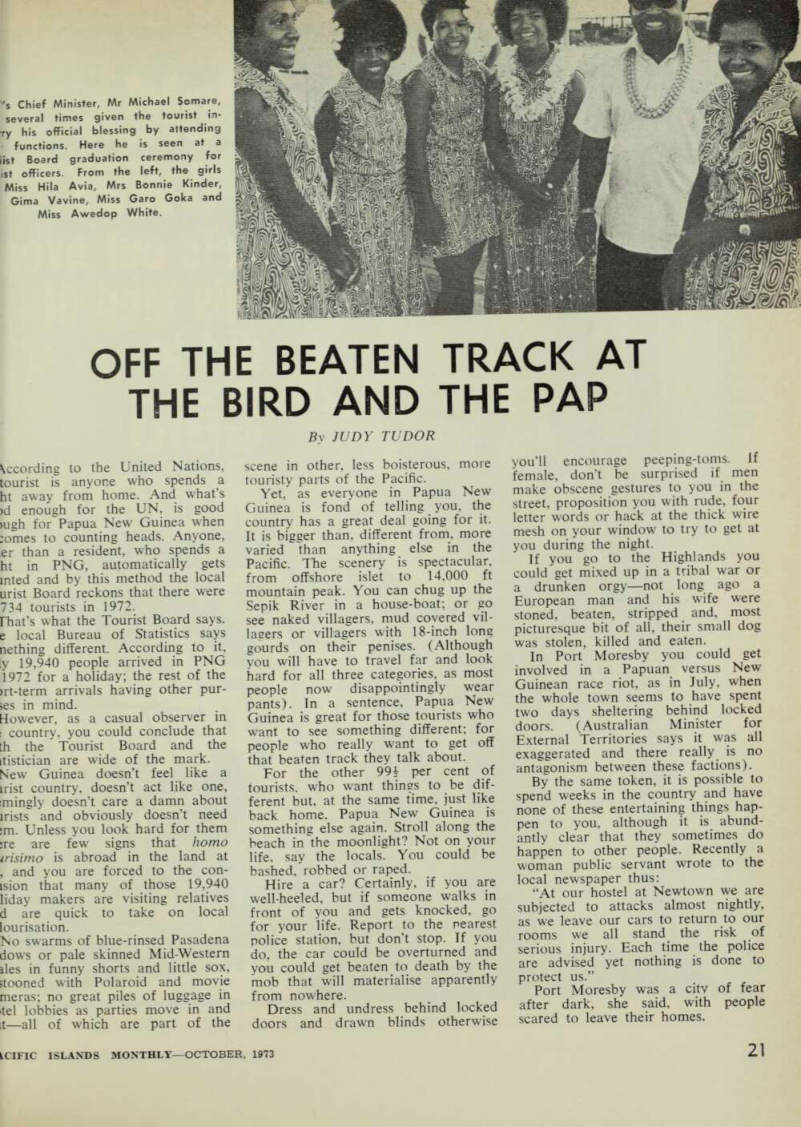
"s Chief Minister, Mr Michael Somare, several times given the tourist ln- T y his official blessing by attending functions. Here he is seen at a list Board graduation ceremony for ist officers. From the left, the girls Miss Hila Avia, Mrs Bonnie Kinder, Gima Vavine, Miss Garo Goka and Miss Awedop White.
Ejecting A Png Image
i>he ended her letter: “Bring irists to Port Moreby? They must joking . . \ lot of residents agree with her the local Tourist Board has gone :ough the motions of fostering an erest in tourism in the face of :at government indifference in the t and what are likely to be other acuities in the future, including fragile feelings of local politins.
Recently Minister for Interior John .ise took tourist associations to task “projecting Papuans and New lineans as objects of curiosity.” low should they be projected? As ive westernised intellectuals? He to be joking. Of course, the local )ple are objects of curiosity to irists not in any unkind way, but ause many of them are so difent from the people the visitor dws back home.
Once they are all reduced to being thed suburbanites, with office is, and this process has proceeded ite a long way already, what will the point of spending all that Ligh getting to New Guinea in the ;t place? According to the Tourist ard the average visitor spends $55
a day while in PNG and my own experience suggests that in this the Board is only too terribly right.
Whether it’s the tall, elegant and disdainful Mekeo, a rampaging High lander or a snotty-nosed child grovel ling in the grime of the floor of Port Moresby’s airport while his mother sits, natters and waits for God-knows what, it is these and all the thousands like them, sophisticated or savage, all the way from Daru to Vanimo or Lae to Wabag who are the focus of attention of every visitor.
There are plenty of countries with scenery, better beaches and more tolerable climate. PNG has no fabulous hotel resorts or jet-set hide aways, although accommodation available has improved a hundred fold since the days when I used to write articles on the theme that “a Tudor never slept here.”
But in spite of the improvements you would never mistake most PNG hotels for similar establishments in a more tourist-orientated country.
The atmosphere is different, more attuned to the eating and drinking habits of local people than to inter national travellers. The resident guests are more likely to be ter
ritorians on the move, travelling salesmen or experts up from South, with the genuine tourists taking a minor and unobtrusive role.
Hotels and motels can be full of exuberant noises or have strange architectural devices like the Bird of Paradise Hotel at Goroka where to get to one lot of bedrooms you have to climb one set of stairs and then immediately go down another in an up-and-over exercise. No doubt the original owners named that place in good faith but in true New Guinea fashion the name has been lopped down to size and the establishment is now popularly and unfortunately known as The Bird.
Some PNG hotel operators have an informal approach to their clients’ clothing although with most the favourite bete noir is rubber thongs. These are out in all but public bars, where only wild tribesmen go anyhow. Other mores, the subject of printed notices outside public rooms in a few hotels, concern the wearing of long trousers and ties after 6 pm, although the Papua in Port Moresby breaks it down and stipulates ties and long pants for gentlemen in the evening or native dress.
Native dress? A Red Indian in
Modernisation
skskin, maybe; or a Swiss in a mdl? Or even a New Guinea High ider in a bark belt and a couple of others? Somehow you get the idea nt it is really meant as an insurance ainst some possible occasion when lief Minister Michael Somare mes to dinner wearing one of his /ourite bula shirts.
The Papua has had several face ts since the days when you were pected to share a room with one more strangers, but still retains jch that is typical of PNG.
It has several new drinking places, carpeted foyer and dining room lere music is supplied nightly by a an who plays an organ with one nd and a piano with the other. ;ry versatile, and appreciated, pecially by the waiters who alone long that fraternity in PNG, who iw come dressed in anything from xedos to red mess jackets, still wear >or-length white lap-laps.
The Papua (sometimes in col quial speech referred to as The ip), has a newish wing of bed oms which, due to some misplaced al on the part of the booking ent, I did not get to see. I was r a while in June allocated what e receptionist said was a room just
as good except that the airconditioner was “rather noisy”.
Time was when I never went to New Guinea without a packet of bobby-pins to cobble up holes in the mosquito nets and a can of pres surised insecticide to kill off those insects already inside. These days a manual on airconditioning is much more to the point but in this case someone with malice aforethought had removed all the knobs from the machine. Above the promised noise that sounded like a mix-master let loose in a tin of ball-bearings, it emitted nothing but warm, humid air into the small room with its fixed, non-opening windows.
The following morning a Papuan mechanic and I attacked the machine together and, among other things, washed out the filter, whereupon the monster started to emit air so mar row freezing in intensity it was guaranteed to reduce even an Eskimo to a shivering wreck.
I asked the housekeeper for a blanket but she was sorry. There were only four blankets in the establishment and these were all “out”. She offered an extra bed quilt as a substitute.
I ended with three bed quilts and my legs thrust into the sleeves of a wool sweater and thus survived suf
ficient of the arctic night for the public bar to be cleared out under neath and the noise of the last truck to rumble past and fade into the distance. It was then time to switch off and in the small hours till dawn, gradually to thaw out and get the blood circulating again.
No one can say that Papua New Guinea isn’t different, unusual, curious and very much itself. And you can say that the local Tourist Board does its best in a conventional way on the $170,000 allowed it by a not over-enthusiastic government. It has produced some interesting propa ganda films and posters, and more recently a very elaborate tourist manual at a cost of about $35 per book, designed primarily for over seas travel agents.
But you can still wonder why the big talk of a bigger and better tourist industry continues in a country which has so many other economic strings to its bow; where tourism can never be No 1, as in Fiji, Tahiti or Hawaii; where the mood of the country is not particularly favourable to it; and where only a tiny minority of the total population benefit from it.
Why not leave Papua New Guinea to the real, off-the-beaten-track travel lers and cut all the other cackle?
Advertisements & other items, pp. 23-27 (4 items)
21
ICIFIC ISLANDS MONTHLY —OCTOBER, 1973
6C9N
m m ®mrn I i § M ; i 1 I V 1 PS. ar fS ■ i m ml
DAIWA BANK SERVING YOU IN THE PACIFIC BASIN * Head Office Osaka,Japan With 137 Branches throughout Japan Los Angeles Agency 555 South Flower St. Suite 4040 Los Angeles, Calif. 90071 Affiliated Bank P.T. BANK PERDANIA Djalan Raya Mangga Besar 7&9 Djakarta f Our Correspondent Banks are in city— Apia, Suva, Lae, Madang Port Moresby, Rabaul, Wewak. Guam, all Principal cities in Australia and New Zealand Contact your banker or our office. y Sydney Representative Office Bth Floor Prudential Building 39-49, Martin Place, Sydney
THE DAIWA BANK LTD
Head Office : 21. Bingomachi 2-chome, Higashi-ku, Osaka, Japan Overseas ; London, New York, Los Angeles, Frankfurt, Sydney
Take fliaht with
Pan Am’s Big Bird
m.
Three times every week a Pan Am 747 takes off for the world. Three times every week you have the chance to escape to just about anywhere in the world you feel like escaping to.
Every Sunday, Tuesday and Thursday Pan Am has a morning flight to Australia. And an evening flight to the U.S.A. and Europe. And because Pan Am takes care of everything, on the ground and in the air, all you have to worry about is where you want to go.
You’ll enjoy all the comforts that have made Pan Am’s Big Bird famous.
But it’s the extra things you’ll really appreciate. Extras like Pan Am’s world wide connections and extensive services.
Extras like immediate connections from Nadi to Suva. And extras like the U.S.A.
The U.S.A. where you can take a stopover on the way to London. A night in Los Angeles or San Francisco fc $lO. See the sights and enjoy a good night’s sleep before continuing on Pan Am’s Polar route to London.
So if you’re thinking of taking a fligl ask your travel agent about Pan Am’s B Bird and wing your way to the world.
Even) country has an airline
The world has Pan Am.
£2 w
l¥W/W[
Nadi: Nadi Airport 72.100 Suva: 38 Thompson Street 22.641 250
HELLABY
1873 1973 One Hundred Years in the South Pacific and still the same consistently high quality
Hellaby’s Canned Meats
Quay St., Auckland. 6*lBll4*o*
PACIFIC
ARRO
tin
23
CIFIC ISLANDS MONTHLY—OCTOBER, 1973
25
iCIFIC ISLANDS MONTHLY—OCTOBER, 1973
Rebels against
Footnotes WITH PERCY CHATTERTON in Port Moresby Rebels against a cruel society
THE riot which followed the Papua v New Guinea rugby league football match in Port Moresby in July has received its fair share of attention from the news media, and “explanations” have been as plentiful as blackberries as everyone with an axe to grind rushed in to use it as a grindstone.
A very similar riot occurred after a simi lar match in 1968. On that occasion I suggested in PIM that if we were really serious about national unity it might be a good idea to drop Papua v New Guinea sporting events, but of course no one took any notice. Now a lot of people are clamouring for such a ban.
These two riots, five years apart, seem to have had similar origins and to have followed similar courses. In each case New Guineans with a dislike for Papuans appear to have planned beforehand to exploit the occasion to work off some of their dislike in
a practical way by bashing up Papuans, their homes and their cars.
The close similarity of the two riots discounts the claim that the second one was pro voked by Miss Abaijah’s Papua Besena Movement. At the most, it may have been a minor contributory factor. But if the riot was aimed at Miss Abaijah’s movement, its most likely effect will have been to strengthen it.
The origins of New Guinea dislike for Papuans goes back to the between-the-wars period, when Papua and New Guinea, though both under Australian rule, were administered as two separate territories, which had inherited on the one hand a British and on the other a German tradition of colonial rule.
In Papua education was entirely, and in New Guinea almost entirely, in the hands of the missions. In Papua, while basing their cur ricula on the local vernaculars, the missions were teaching their pupils a modicum of
Rebels against a cruel society
English, and with the encouragement of Sir Hubert Murray’s administration the quality and quantity of this teaching was being stepped up In New Guinea, except for one or two Eng lish teaching administration schools in the Gazelle Peninsula, “church languages” and Pidgin were taught and used in the schools From the point of view of the greatest good for the greatest number this was a sound policy, but it was later to handicap the pupils of those schools in the rat race for jobs in the burgeoning western-style economy.
As a result, when, following the outbreak of the Pacific war in 1942, the two territories
were amalgamated, first under a military and later under a civil administration, Papuans and young Tolais got a head start over the rest of young New Guineans.
Not only did they monopo lise the first post-war adminis tration school at Sogeri, near Port Moresby (actually estab lished by the military adminis tration before the war was over), but they tended to monopolise the best jobs in
fast-growing Port Moresby. Worse still, en terprising Papuans began to migrate to New Guinea, something which they had never been able to do before, and there too, thanks to their better schooling, to mop up the best jobs, New Guinean resentment of this situation was natural enough, and its flames were fanned by expatriates who found the Papuans less subservient than the New Guineans and quickly dubbed them “big-heads”.
Since those early post-war years things have changed a lot. There are now many very able
Young New Guinean mainlanders and highlanders occupying middle and upper level public service positions, and there is at least one highlander among our embryo diplomats, but a look around Konedobu reveals that all the indigenous heads of departments appointed to date are (unless I have missed one and I don’t think I have) either Papuans or Tolais.
It looks as if they have maintained the lead which chance gave them in the 1950s.
However, this is a situation which should iron itself out within the next few years, without any need for abandoning the principle of appointment by ability in favour of the regional apportioning of top jobs demanded by the Highlands Liberation Front.
So New Guinean resentment of Papuans may be described as a hangover, abandoned by most of the educated, but kept alive by the hordes of unskilled New Guineans, mainly from the Highlands, who are lured to the bright lights of Moresby only to find themselves either menially employed or jobless. It becomes increasingly clear that no method of maintaining law and order in Papua New Guinea’s urban areas can succeed without some kind of control over movement into those areas, however repugnant such an idea may be to those who regard freedom of movement as a basic human right. In retrospect I think that those who persuaded me to leave this “right” out of my Human Rights Bill in 1971 were wise.
But the Highlanders in our midst, though ...ectacular, are perhaps not the greatest threat to the maintenance of law and order in Port Moresby. A more insidious threat comes from within.
Recently a police spokesman told us that cost of the “breaking and entering” cases which are an almost nightly occurrence in Port Moresby nowadays are carried out by gangs of boys ranging in age from eight to fourteen, schools are among their favourite targets, hundreds of dollars worth of equipment is often stolen, and much damage done that is sheer vandalism.
Most of these youngsters have been born and have grown up in the city, completely
estranged from traditional culture and tradi tional sanctions. Some never managed to get into school at all. Others received a schooling which only fitted them for the ranks of the unemployed. They are a rootless, motiveless generation, and there are more and more of them every year. Their parents have little or no control over them, and some are not averse from converting to their own use the booty their children bring home, though they must know that it has been stolen.
Basically these kids are not so much thieves as rebels, in bitter revolt against a society which has given them a raw deal and con demned them to frustration. “Savage” Papua New Guinea, for all its cruelty, was not as cruel as this.
Perhaps this is why the targets for their malice are so frequently schools.
In those parts of the city where people are living in compact, uni-tribal groups, as they are in the Motu and Koitabu villages and in many of the shanty settlements, much could be done, as Nigel Oram has suggested, by giving com munity leaders responsibility and authority to handle law and order problems within their communities.
Such a plan would be much more difficult to implement in the tribally and racially mixed suburbs, but initiatives taken by Port Moresby’s well clued and well staffed Com munity Development Group in the new no covenant suburb of Morata suggest that it need not be written off as impossible.
In the meantime, the Port Moresby City Council is doing its best to make us good by regulation. Newly promulgated council rules make it an offence to ignite fire crackers in the streets or to fly kites in the vicinity of power lines. We must not, between the hours of 10 pm and 7 am make noises which distress, annoy or irritate other people. Nor must we harbour dangerous reptiles, fowls or weevils on our premises.
What will our worthy councillors frown on next?
Bed-bugs perhaps!
Advertisements & other items, pp. 30-32 (1 item)
u
mm -■ ; ’ ■ . f w ew
I J I
IL«U«
? « ■ ii
MARINE & GENERAL ENGINEERS, SHIPBUILDERS IN WOOD & STEEL, SHI MAINTENANCE & REPAIR, METALOCK COLD REPAIR PROCESS, STRUCTURAL STEE & SHEETMETAL FABRICATORS, REFRIGERATION & AIRCONDITIONING ENGINEER' ELECTRICAL INSTALLATIONS & SERVICING, COMMERCIAL KITCHEN, COOLSTORE BAR INSTALLATIONS, JOINERY, UPHOLSTERY & FURNITURE MANUFACTURER'
t i \ e ■J
AABER, PLYWOOD, HARDWARE & STEEL STOCKISTS, SEWAGE PURIFICATION PLANT
ISTALLATION, FOUNDRYMEN.
CARPENTERS FIJI LIMITED
.0. BOX 296 CABLES: MILLERS, SUVA, FIJI IS.
S. E. TATHAM & CO. PTY. LTD.
ASKEW HOUSE, 364 LONSDALE ST.,
MELBOURNE, 3001, AUSTRALIA.
G.P.O. BOX B—CABLES "SET"
TELEPHONE: 601125
Buyers for the Pacific Islands
PAPUA NEW GUINEA: S. E. TATHAM (P.N.G.) PTY. LTD.,
LAE: MALEKULA ST. (P.O. BOX 1562).
PORT MORESBY: CNR. GOROA & MUNAHU STS., GORDON
(P.O. BOX 6733, BOROKO).
FIJI: S. E. TATHAM (FIJI) LTD.,
LAUTOKA P.O. BOX 366,
SUVA G.P.O. BOX 671,
AND IN
YOUR GUARANTEE
FOR SERVICE
SINCE 1924
Changing

Times are Changing In W. Samoa
From FELISE VA’A In Apia Things aren’t what they used to in the Western Samoa Parliament, the old days—say up to the time the Tamasese government—mem ;rs spoke with bated breath when ey criticised the Tama Aiga, (Royal ms) and held ministers in awe.
Now, however, everything goes, he Tama Aiga are not free from e members’ caustic remarks, as [ataafa has found out. Since be >ming Prime Minister for the sec id time he was accused in parlia ent by Toluono of having shown srespect to the Head of State, H. H. lalietoa Tanumafili 11, during the In jpendence celebrations. Apparently, le Head of State had arrived at Par ament House at a time when the rime Minister was not there to re vive him. Needless to say, Mataafa mied the charge.
Other cabinet ministers being con antly bombarded in parliament in lude the Minister of Finance, Sam aili, and the Minister of Health, Seiuli aulafo, the former for some un opular economic policies, the latter )r the unpopular hospital fees re using local residents to pay 10 sene very time they have to visit the out atients’ department.
What is unique about the criticism f the government in parliament is s generality and acuteness. Strange i say most of the criticism is com ig from a group of liberals led by the armer Minister of Works, Tupuola tfi. Members of this group include 'it former Secretary to Government, 'ofa Lauofo Meti, former Secretary f Finance. Aumua loane, Vaovasa aanaia Filipo, a barrister and olicitor, Fuimaono Mimio, Toluono, Eikeni, a director of the Samoa rimes, Aeau Taulupoo, Leaupepe 7 aimaala, Western Samoa’s first lady larliamentarian and former deputy peaker of the House.
Whether these members are acting n concert or separately is not clear, mt they have certainly succeeded in earing the cabinet’s policies to pieces.
K government attempt to raise duties in more items has been de bated as has an attempt to nake a down-payment of $26,125 in about 400 acres of land the govern nent wanted to buy from private andowners. The total purchase price ivas around $200,000.
As Asi Eikeni put it, “There is
Ihing wrong with the government’s empt to buy land. The only thing ting is that the government is crying out having no money while at the ne time it is planning to buy land, isumably for development. But why esn’t the government make avai le the land it already has for de
lopment?”
And a barb from Tupuola! The vernment talks about the poor fin icial situation it is in, so it proceeds to op some projects, cut allocations, r off workers and limit credit avai oility. Yet, this same government s proceeded to suspend the hotel d tax, and is now planning to let » merchants handle the liquor distn tion. As a result, the government is sing and will lose a lot of money at could be used to finance govern snt activities.”
Tupuola is not against the distri ition of liquor by merchants. He lestions whether it is timely to allow e merchants to take over the liquor stribution especially when the ►vernment needs extra funds.
Then comes the natural question tiy Opposition attack against the ►vernment is so strong and con ntrated. And the answer, in the □rds of the song, is that times are a langing; that Western Samoa must id new methods of solving new pro ems. It seems that the traditional adership is no longer seen to be ; competent as it used to be when imoa’s needs were simple and fewer.
Secondly, a pattern of partisanship slowly emerging in parliament but party system, if it does exist, is rgely informal at this stage.
What the future of the present [ataafa government will be is diffi ilt to say. But certainly, no govern ient in Samoa has had such a rougn eginning.
Amily Planning
5 Catching On
Family planning is catching on in Vestern Samoa according to the lealth Department which reported tiat it is having difficulty in limiting tie crowds wanting to see the family ilanning movie shows. Even the child en are trying to get in.
In a survey of the nation’s bed ooms, the department found that he intra-uterine device was the most lopular method, followed by the pill md then the condom. Statistics re garding the use of the rhythm and ivulation methods were not available nit figures are spiralling for the in :ra-uterine device. It was reported hat 255 persons used it in March, 287 in April and 382 in May.
The pill was used by 247 persons in March, 261 April, 269 May.
Advertisements & other items, pp. 33-40 (4 items)
Thompson
COCHRAN
■ -n > II
OIL FIRED PACKAGED
STEAM BOILERS
250 to 35,000 Ib'hr
air Complete mechanical contractors for the South Pacific. Fully owned and staffed within Fiji. r
■conditioning (south pacific) limited
Tel: 38-3405. Box 526, Suva, Fiji.
THE BIG FLAVOURS COME TO THE
% r m P
RTAND.S
■A &
uiger
°O« E 0
SOUTH PACIFIC
The red hibiscus symbol proudly marks the introduction of some of New Zealand's most popular soft drinks by Island Bottlers of Fiji Ltd., from their new modern factory.
In Apia in Western Samoa the same flavourful range is produced by the Apia Bottling Company and people everywhere are asking for these famous names -
LEMON and PAEROA, TARTAN DRY GINGER
ALE and the colourful fruity range of JU'CY
SOFT DRINKS.
They're yours to enjoy . . . time after time.
Manufactured under franchise to Innes Tartan Ltd., Auckland, New Zealand by-
B ISLAND BOTTLERS OF FIJI LTD.
APIA BOTTLING COMPANY LTD.
Kerr Bros., the Parker
FOR PACIFIC
ISLANDS
Parker Furniture undoubted leader in Australia's domestic furniture industry Manufacturers of modern dining, lounge, occasional and bedroom furniture.
KERR BROTHERS PTY. ITD.
Island Merchants,
65 York Street, Sydney.
CABLES; CAREFULNESS, SYDNEY.
wil
Furniture people.
"Why did I ewer
leave school so early?
Collier Macmillan Schools courses
offer a second chance.
These days, it’s the man with education who gets ahead. If you’ve got the qualifications you’re well on the way to big money and a real career. Collier Macmillan Schools can show you 264 ways to do it. Our Home Study Programmes can help you achieve the specialised knowledge, the training you need to really go places in a career. We can give you the qualifications for success. While you're still working you can prepare yourself for a better job, a successful career, with one of our Home Study Courses. Clip the coupon for more details on our huge selection of Collier Macmillan Schools Courses.
Now’s the time to think of your future.
Collier Macmillan Schools
Incorporating British Institute of Careers and British Institute of Engineering Technology.
A Australia: 113 Pacific Highway, Nth. Sydney,
NSW, 2060.
List of Courses available: Accountancy Improve Your English Auditing General Education Book-keeping Foreign Languages Commercial Law Fiction Writing Costing Articles Practical Typewriting Writing for Children Shorthand Reporting Private Secretary’s Practical Photography Pitman Script Art Travel Music. Piano, Guitar Shipping Sociology Business Management Rapid Reading Office Management Word Power Business Training Diesel Engines Mamt ce Office Organisation General Mech. Eng g Personnel Management Advanced Mech. Eng g Advanced Management Maintenance Eng g E.d.p. Boiler Insp. & Operation Compiit. Prog. Welding Techniques Eng’g Metallurgy Production Engineering Refrig. Serv. & Mamt.
Advanced Prod. Eng’g Council of Eng’g Inst s Works Management (C.E.1.) Examinations Foremanship Aust. Inst, of Travel Quantity Surveying (A.1.T.) Exams , Materials Handling Aust. Chamber of Ship g Process & Work Study Examinations Marketing Inst, of Automotive Marketing Management Mechanical Eng’rs Sales Management Soc’y of Engineers— Natural & Synth. Rubber Civil, Mech, Elec, Petroleum Technology (A.M.S.E.) Exams Plastics 2nd Class M.O.T. (Mar.) Urn. of London G.C.E. Gen. Electrical Eng’g English Language TAn . v Mathematics Post this coupon TODAY Elec. Instal. & Wiring Advanced Elec. Eng’g Gen. Automobile Eng’g Practical Motor Eng g Serv. Station Manage’t General Aero Eng’g Airframes Aircraft Engines— Piston. Turb.. Jet Electronic Eng’g Transistors Computer Electronics Radio & Electron. Eng’g Radio Serv. Mamt. & Rep.
TV Servicing Radio Operators Cert.
Colour TV Surveying & Levelling Civil Eng’g Civil & Mumcip. Eag.
Geology Air Conditioning Road Eng’g & Construct Structural Eng’g General Building Air Conditioning Arch. Drawing & Design Architecture Basic Architecture Carpentry & Joinery Technical Drawing Adv’d Draughtsmanship Mechanical Eng’g Design Elem. Draughtsmanship
Many other
courses available
Collier Macmillan Schools Dept.
Australia: 113 Pacific Highway, Nth. Sydney, N.S.W., 2060. 48-31-3 me the appropriate Career-book without obligation.
Name (please print) Address Postcode Age Occupation I code, stand Wa,dll careers .deice Is on or persona! I application and that no representative will ca//__
X tD d % y > Z.U.
GOOD-YEAR
TRACTION HI-MILER HI-MILER G 8 TRACTION 100 SUPER ROAD LUG ALL SERVICE For rugged 'stop-go' de- Round shoulder tire With 3-T cord. Abrasion resistant ex- A non-directional er m 7° rk ' I°' h ' 9hway trucks ' stron 9 er than steel, tra-thick tread and mud and snow tire steerTno ' 6aS ' er , T*S™' '° r buS dee P9rooved, sharp an- Reduces skidding fon on all surfaces, and highway trucks, gle lugs assure positive and weaving, wet and dry. traction on all types of road surfaces.
II / > S fl s i m % *•> j v M M i is OT. £l i < % m Ya P
THE RIGHT TIRE FOR EVERY JOB
HIGHWAY - ON/OFF THE ROAD - CROSS COUNTRY Boroko Motors Ltd.
P.O. Box 1259 Boroko, Port Moresby
Papua, NEW GUINEA
Solomon Motors Ltd.
P.O. Box 20, Mendana Avenue, Honiara Guadalcanal, SOLOMON ISLANDS Societe Generate d'Automobiles B.P. 554 Noumea
NEW CALEDONIA
Coral Island Traders P.O. Box 296 Suva
FIJI
Guam Tire & Supply Co.
P.O. Box 1486 Agana
GUAM
SOHECO
B.P. 208 Port Vila
NEW HEBRIDES
Morris Hedstrom Ltd.
Apia
WESTERN SAMOA
Haleck Service Center P.O. Box 1138 Pago Pago
AMERICAN SAMOA 96920
Service Mobil B.P. 306 Papeete
TAHITI
Santo Engineers Santo
NEW HEBRIDES
Morris Hedstrom Ltd.
Nukualofa
TONGA
Q 641
Shshssai
Malnutrition, a new problem in Fiji
From SEONA MARTIN in Suva
iji-s rising cos, of living is bening to affect the health of some n lie it remains true there is no there was little appearance of Iniitrition before 1969 In 1971, /M Hospital admitted 77 children ferine from malnutrition. It admitanother 58 severe cases last year 1 39 to June this year. 3ne of the reasons was the steep * in the cost of living during the 5t three years, the doctors said.
Fhe mostly badly affected seemed to families living in areas just oute urban Suva, according to Dr ae Stone. Malnutrition was rarely in in remote rural areas.
But around Suva, the head of the nily commonly travelled long disices to the city to work and had le time for fishing or growing food.
verr/ ST- “
on buying the> food he might formerly vege tables of-
sHSHSSAI
Bebe damage, which occurred last October was also causing prolonged hardship.
When they discuss the cost of living, doctors shrug their shoulders and say.
“We cannot change the economic situation, or expect the government to change it overnight. What wehave-to do is to teach people how to mak the^m^ St n f convinced edu- Dr K. D. s harma is convinced ed cation wi! play a major role in fighting malnutntion He said mo , families, village ea £ers and the oc> mumty as a whole bad to learn about nutrition and prevention of malnutntion. Nurses are already giving ampie dietary instructions with ad c and practical demonstrations, Stone said malnutrition hit most
often a^ch.ld
of the correct foods Fijian children
« d^TnSchildren o°bt led
r.!^ftS°ttfco^^
a severe f orm Q f malnutrition, kwashiorkor, a pro tein deficiency. All malnutrition cases reC orded at CWM Hospital so far th i s year were Fijians although doctors a lso saw plenty of borderline cases amo ng Indian children. while youn g breadwinners in the Suva area are stid searching for elusive cash-earning jobs, some of the older people are rediscovering the Qf finding their own food i? . stead In a sma ii Fijian community in burban Suva the young men sit at home or search for work while the dmothers go fishing to feed their
f amilies .
p rote i n rich fish will keep kwa shiorkor from the door fo P r their
grandchildren, anyway.
35
ACIFIC ISLANDS MONTHLY —OCTOBER, 1973
Huon Gulf Motel
11l Lae, we’re the motel
people come back to.
They come back for a dip in our pool, the individually air conditioned, comfortably fitted units, first class fully licensed restaurant, our friendliness, our cocktail bar, and attention to the finest detail.
In Lae, stay at the Huon Gulf, and next time round you 11 come back Book direct, or through any office of Ansett Airlines.
Huon Gulf Motel
Markham Road Lae. Phone: Lae 3204 (As from October Ist phone 42 4844) A Division of Ansett Transport Industries Limited
AHO/228
VCHANNEI
MD SfOH
K I -"I
mmm
"■ r*j I'i:, ml ■p if ■■.
I » - -i
KCD-2
fc. : ' '4 4 ei <• G \UV A fu'* 1«C
How to Use?
iuf' s
Either Way Terrific!
a c > 3 8340 KR 6340 There's an agony and an ecstasy about owning a KENWOOD two-four stereo receiver. The problem is this: Which form of stereo entertainment is better? The answer: it all depends on you —on your mood of the moment. Two-channel stereo buffs can feel secure in the knowledge that KR-8340 and KR-6340 have compatible BTL (Balanced Transformer-Less) systems for two-four use. So with these modelsyou have the best of both possible stereo worlds. For 4-channel enthusiasts, the built-in decoders for SQ and RM and the plug-in type CD-4 (KCD-2) disc demodulator offers all the possibilities of 4-channel disc stereo. Add the KR-9340 and you have three models which satisfy all the varied requirements of 4-channel and 2-channel receivers. With KENWOOD you always have a wide area of choice. the sound approach to quality
fKENWOOD
For minute Information, write to: P-SECTION, TRIO ELECTRONICS, INC. 6-17, 3-chome, Aobadai, Meguro-ku, Tokyo, Japan
Islands
Monthly
MAGAZINE*
keeps you informed on Pacific happenings
The Pacific is PIM!
For more than 40 years PIM has been reporting on events in the Pacific. Social and political changes, economic development, historical background, regular columnists and commentators, personalities and travel.
You’ll read:— • A big magazine section • Extracts from the Islands Press • Fascinating historical articles • Island creative writers • Tropicalities • Shipping and cruising yachts News of sport Letters from readers Shipping, airways' schedules Business and development news Regular big picture section Plus all the latest Pacific news and views Become a part of PlM’s Pacific and subscribe now.
Rates and subscription form overleaf.
nuji" umu iiviuvilllkuiu i iunc anu Thursday Islands) $6.70 New Zealand $6.70 NZ Papua New Guinea $5.50 Aust.
Fiji, Tonga, New Hebrides, Gilbert and Ellice Islands, Solomon Islands, Nauru Island and all other Pacific Territories $5.50 Western Samoa $6.70 Hawaii, Micronesia, and Guam .. .. $12.00 US American Samoa $B.OO US U.S. Mainland $14.00 US New Caledonia and French Polynesia 1,100 CFP ‘United Kingdom £3.25 Stg. ‘Elsewhere $6.96 Aust. $12.65 $12.65 NZ $10.25 Aust. $10.25 (local currency) $12.65 (local currency) $23.25 US $15.25 US $27.25 US
2,150 CFP
£6.25 Stg. $12.20 Aust. •Airmail extra on application. All other subscription rates listed Include air delivery. $18.60 $18.60 NZ $15.00 Aust. $15.00 $18.60 $34.50 US $22.50 US $40.50 US
3,150 CFP
£9.00 Stg. $19.30 Aust. name address city/state/country/post code (please print) Attached is my payment of for years' subscription.
New □ Renewal □
PACIFIC ISLANDS MONTHLY
29 Alberta Street, Sydney, N.S.W. 2000, Australia (Postal Address: Box 3408, G.P.0., Sydney, N.S.W. 2001.)
B OCTOBER, 1973—PACIFIC ISLANDS MONTHLY
The Editor's Mailbag
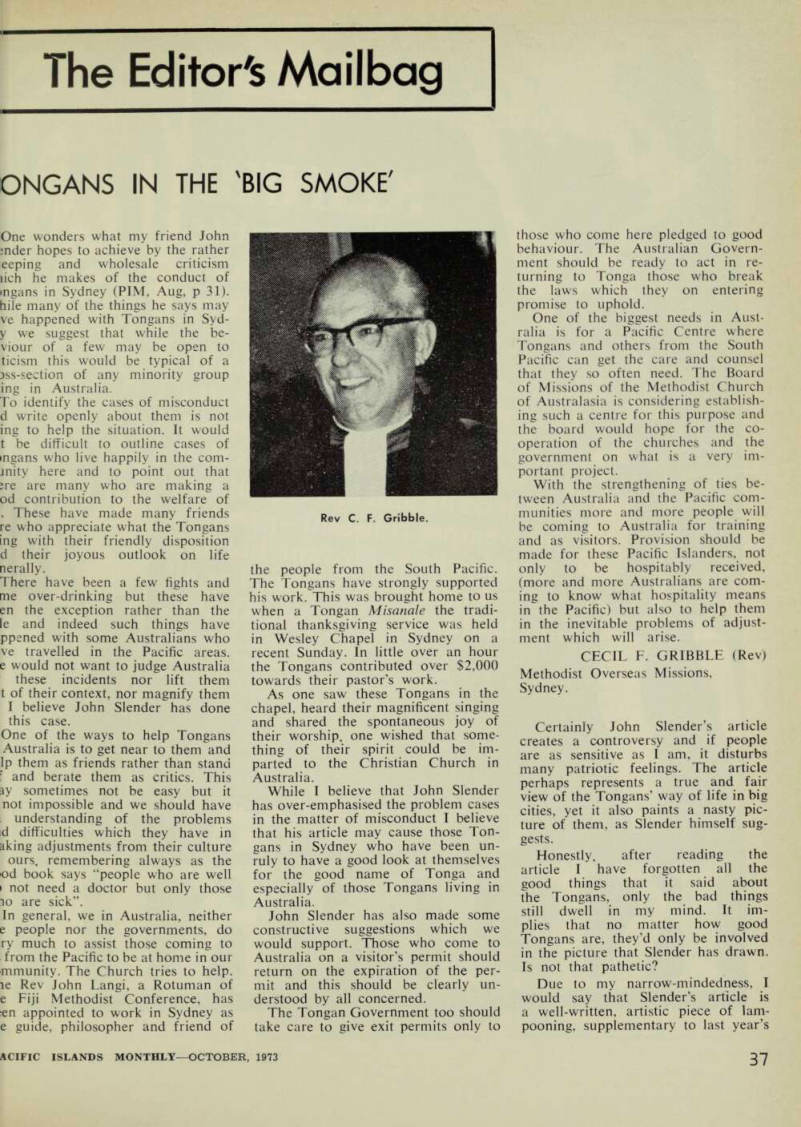
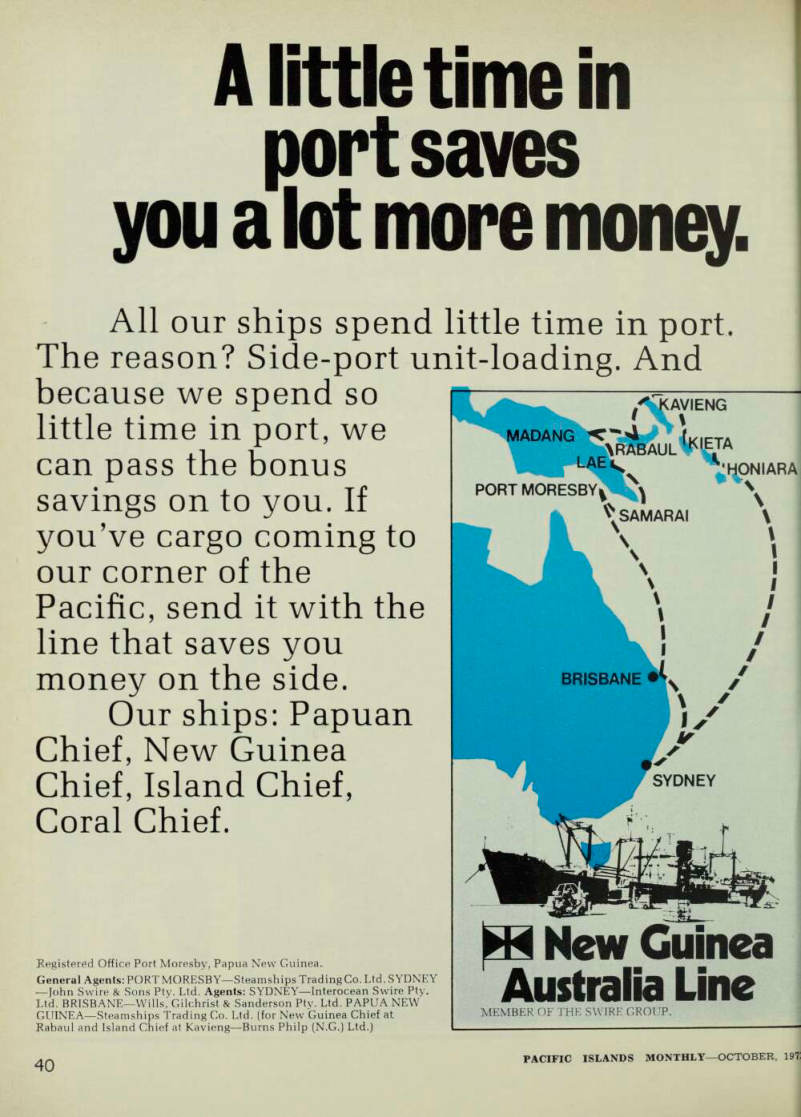
[?]Ongans In The 'Big Smoke'
One wonders what my friend John mder hopes to achieve by the rather eeping and wholesale criticism uch he makes of the conduct of •ngans in Sydney (PIM, Aug, p 31). hile many of the things he says may ve happened with Tongans in Syd y we suggest that while the be viour of a few may be open to ticism this would be typical of a Dss-section of any minority group ing in Australia.
To identify the cases of misconduct d write openly about them is not ing to help the situation. It would t be difficult to outline cases of mgans who live happily in the com mity here and to point out that ire are many who are making a od contribution to the welfare of . These have made many friends re who appreciate what the Tongans ing with their friendly disposition d their joyous outlook on life nerally.
There have been a few fights and me over-drinking but these have en the exception rather than the le and indeed such things have ppened with some Australians who ve travelled in the Pacific areas, e would not want to judge Australia these incidents nor lift them t of their context, nor magnify them I believe John Slender has done this case.
One of the ways to help Tongans Australia is to get near to them and Ip them as friends rather than stand I and berate them as critics. This ay sometimes not be easy but it not impossible and we should have understanding of the problems d difficulties which they have in aking adjustments from their culture ours, remembering always as the od book says “people who are well i not need a doctor but only those ao are sick”.
In general, we in Australia, neither e people nor the governments, do ry much to assist those coming to from the Pacific to be at home in our immunity. The Church tries to help, le Rev John Langi, a Rotuman of e Fiji Methodist Conference, has ;en appointed to work in Sydney as e guide, philosopher and friend of
the people from the South Pacific.
The Tongans have strongly supported his work. This was brought home to us when a Tongan Misanale the tradi tional thanksgiving service was held in Wesley Chapel in Sydney on a recent Sunday. In little over an hour the Tongans contributed over 52,000 towards their pastor’s work.
As one saw these Tongans in the chapel, heard their magnificent singing and shared the spontaneous joy of their worship, one wished that some thing of their spirit could be im parted to the Christian Church in Australia.
While I believe that John Slender has over-emphasised the problem cases in the matter of misconduct I believe that his article may cause those Ton gans in Sydney who have been un ruly to have a good look at themselves for the good name of Tonga and especially of those Tongans living in Australia.
John Slender has also made some constructive suggestions which we would support. Those who come to Australia on a visitor’s permit should return on the expiration of the per mit and this should be clearly un derstood by all concerned.
The Tongan Government too should take care to give exit permits only to
those who come here pledged to good behaviour. The Australian Govern ment should be ready to act in re turning to Tonga those who break the laws which they on entering promise to uphold.
One of the biggest needs in Aust ralia is for a Pacific Centre where Tongans and others from the South Pacific can get the care and counsel that they so often need. The Board of Missions of the Methodist Church of Australasia is considering establish ing such a centre for this purpose and the board would hope for the co operation of the churches and the government on what is a very im portant project.
With the strengthening of ties be tween Australia and the Pacific com munities more and more people will be coming to Australia for training and as visitors. Provision should be made for these Pacific Islanders, not only to be hospitably received, (more and more Australians are com ing to know what hospitality means in the Pacific) but also to help them in the inevitable problems of adjust ment which will arise.
Cecil F. Cribble (Rev)
Methodist Overseas Missions, Sydney.
Certainly John Slender’s article creates a controversy and if people are as sensitive as 1 am, it disturbs many patriotic feelings. The article perhaps represents a true and fair view of the Tongans’ way of life in big cities, yet it also paints a nasty pic ture of them, as Slender himself sug gests.
Honestly, after reading the article I have forgotten all the good things that it said about the Tongans, only the bad things still dwell in my mind. It im plies that no matter how good Tongans are, they’d only be involved in the picture that Slender has drawn.
Is not that pathetic?
Due to my narrow-mindedness, I would say that Slender’s article is a well-written, artistic piece of lam pooning, supplementary to last year’s
Rev C. F. Gribble.
Letters
•tide in NZ Truth which claimed lat Tongans live like pigs. The article provocative and a menace to Ton ans’ contact and affiliation with peo e of other countries. I may be wrong ut Tongans, to many who have ;ad Slender’s article, will now be ssociated with stowaways, drinkers, ealers and street-rowdies.
Definitely, the article has no con ructive effects. If it was written with itentions of unearthing problems, icn certainly there were other aven es for doing so rather than this üblic exposure which led to people :offing at many innocent Tongans, » myself. Also, these problems are orld-wide pitfalls as one type of thnic group, culture, country etc, iffers from the other. Let those ho are free from these problems ast the first stones at the Tongans. 1 wonder how the Aussies, especi lly my dark brothers from the In :rior, would fare in New York, aris or Tokyo? You don’t have to e Tongan to have problems with owawaying, drinking, communi ition and sex. The prosaic lives that lany people have experienced led lem to their search for something ore fascinating and flamboyant. May e that’s why this ill-defined group f Tongans in Sydney end up this 'ay. Its a problem of adaptation and are cultural shock. Maybe that’s why ippies cut themselves off from society i many parts of the world. Maybe lat’s why many Aussies attempt to art new lives in other countries.
I cannot help thinking that Slender as deliberately tried to establish a ad ethos for the Tongans. What /er he tried to show in his article j’d only find people commiserating so e has smothered any good reputation lat has been built up in the past. I’m ire I’m not the sole adjudicator ho agrees with this.
I want to elucidate that I’m not :pudiating the things presented in the rticle as most of them seem plau ble. I only question its salutary Tects, its constructivity and its ex ediency. The article, in my view, •eates consternation and repugnancy, ome people must learn to under and, not to judge.
Fatai, (ie Mrs Slender) congratu itions on your appointment as re resentative for Tonga Visitors Bureau. 3hn, I hereby appoint you as the sw Tongans’ Criminal Record Keeper i the Sydney branch. ‘Ofa atu.
Lisiate 'A ‘Akolo
Wellington, NZ.
As a regular reader of PIM I came across an article about Tongan people in Sydney by Mr Slender.
After I arrived in Sydney as a tourist I met quite a few Tongan educated people, hard working and kind. Their hospitality is great and very helpful and makes me feel at home while in this country.
How the individual behaves and where he chooses a home is entirely his own business. (It’s a free country in case Mr Slender doesn’t know.) The faults mentioned by Mr Slender of stowaways, workers and students are not uncommon anywhere in the world.
He also forgot to mention that his
wife entered Australia as a tourist.
When her permit had almost expired, not wanting to return to Tonga, she wanted to study nursing, so, with the help of the church authorities, she commenced nursing at Waverley District Hospital.
Honestly, Mr Slender must have known different Tongans from those I’ve met but, as they say, “Birds of a feather flock together”.
My advice to Mr Slender is to mind his own business.
Uatesoni Lapu’Aho.
Homebush, Sydney.
• Mrs Slender came to Sydney to work for the church after meeting its representatives in Papua New Guinea.
1 their suggestion, she took and pas d a nursing aid course state final 'animation with distinction. Then she St Mr Slender, returned to Tonga to i d out her parents’ reaction to her arriage. They approved and she re rned to Sydney where her husband’s 9rk is. Her actions were never diet ed by a desire to live in Australia.
Sex In The Trobriands
I am most grateful to critic Peter vingston for the good reception he s given my paintings reproduced in t book Islands of Love (PIM July).
Some verification I feel is warranted ncerning his statements about the ff describing the Trobriand Islands.
Some time ago, while work l on paintings for a book Papua New Guinea leg ds I was able to profit from ter’s thorough knowledge of the puan Gulf Districts. I now feel that believes customs in Melanesia uldn’t be as different as I have scribed.
Although the Trobriands are in e the ethnic boundaries of Melane , the Trobriander is only as much danesian as, for example the peo -5 of the Mortlock or Tasman Is ids. To compare the highly-refined dal structure of the Trobriander th the customs of the Goaribari mot stand a test According to F. E. Williams, pro tution was socially approved in the rari Delta and the Goaribari were own to have conducted expeditions neighouring tribes for the purpose prostituting their wifes for shell laments. Nothing the like applies to ; Trobriand Islands, where free sex l expression can only be resorted by the unmarried. Sexual favours mot be bought: a transaction of >acco or a handful of betelnuts must considered a token of friendship the sign of intention as this could said of the European who presents girl with flowers or chocolates, t is to answer Peter’s question in ;ard to the sexual aspect of two deties “Why the Trobriands and t the Goaribari?”, that I must plain not having been influenced my choice by the sexual behaviour the Trobriander. But had I rea led according to this factor I would o have “picked” on the Trobriander. dinowski’s statements on these is ids do still largely apply, while, I have learned during a stay at okolo, the discriptions of F. E. illiams on the sexual life in the ilf District, have drastically been
altered through far reaching Mission influence.
Peter wrote further: “Sex in the Trobriand Islands is no different from anywhere else” and, “I am sure that Kurt Pfund is well aware, that women who do not use any known contraceptive methods, have intercourse with many lovers, but do not conceive until they marry are found, not only in the Trobriands, but in many parts of Melanesia and investigators from Malinowski on wards have given some very simple explanations for this fact.”
Even the Tahitians or the Knabibu Indians of the Upper Orinoko would not have sexual intercourse as fre quently as is the case with the un married Trobriander. The act in it self is different to that in other parts of the world.
Most certainly, I am not aware that there exists any other society in Melanesia apart from that in the Trobriands, where it is the rule that unmarried women do not con ceive, except for places where a strict tambu on sexual licence before mar riage is observed. It follows that I also have never heard of some very simple explanations for this fact.
Malinowski had no answer to what he called “a phenomenon”. In 1937, Dr Fritz Kahn described the discovery of antibodies produced by the female of species towards the male sperm (Unser Geschlechtsleben, Keller & Co, A. G. Lucerne). I understand studies are still conducted on this matter, especially in Japan and I was informed by the specialist on the subject at the Medical Faculty in Port Moresby, that this concept has never been applied to any society in PNG as being crucial to its way of life.
Finally, the crux of the matter is that Islands of Love is a book of my paintings on the Trobriand Is lands, including a reference to what I learned while living and working for several months in the village of Kaibola.
My explanation of “the pheno menon” has never before been quoted and I have done so in the hope it may induce scientific enquiry and bio chemical research into this matter be fore what Malinowski first described
becomes history.
May I add, as a postscript, that I make a strong point in Islands of Love of the fact that the white man who seeks unrestricted sexual bliss in the Trobriands may be sadly disappointed. For obvious reasons, the letter as it is could result in visitors to the islands who would be little appreciated.
Kurt Pfund
Boroko, PNG.
That 'Western Myth'
Percy Chatterton’s Footnotes (PIM, Aug, p 28) were most appropriate.
It would certainly not be my aim to try to justify all and every action carried out under the name of Chris tianity, either in PNG in the last 100 years or the world in the last 2,000 years. But it certainly is illogical or ignorant to endorse the opinion, common in PNG, that Christianity is some form of Western myth or cult.
Perhaps an intelligent discussion be tween Papua New Guineans and Westerners may help both with their problems. The Bible message is con tained in real life events, but in an Eastern setting. It's hard for Aust ralians to understand this setting, as we don’t have clan and tribal or ganisations, intricate land tenure pat terns and defined marriage alliances.
Bride price payments, garden magic, animal sacrifices, sacred objects and carvings, ceremonial initiations, plural wives, harvest celebrations and many other things commonly referred to in the Bible, are practically unknown to Australians.
Until an old man in a Papua New Guinean village had spent hours telling me his lineage back for 11 generations and shown me how this linked up with his land ownership and clan organisation, I thought genealogies were just long lists of names. It’s because we haven’t under stood such lists of names in the Bible or been able to appreciate the background in which the biblical mes sage is set, that many Europeans do have trouble understanding or inter preting the Bible.
It is not coincidence that Papua New Guineans are needed to help our understanding of Christianity.
As often requested by the Chief Minister, we need to work together to solve our problems.
Bruce R. French
Kerevat, East New Britain.
Drinking In Png
One could not help but notice the peaceful behaviour of 120,000 High landers at the “dry” Mt Hagen show in contrast with the riotous behaviour of a much smaller number of fighting Tolais and Highlanders in Kokopo, at the Tavern, on the same weekend.
This stark contrast of behaviour has led our students and staff to send the following telegram to Chief Minister Michael Somare urging much stiffer laws regulating drinking in Papua New Guinea:
Students And Staff Of Sonoma College
Congratulate You And Your Government
And Highland People On Peace And
TY AT MT HAGEN SHOW. WE BELIEVE
U-Avai Lability Of Alcoholic Liquor
Itributed Much To Peace Of This
Bering. It Is Significant That Kokopo
TS AND FIGHTING BEGAN AT THE TAVERN.
Believe Tight National Restrictions
Liquor Sales Could Have Prevented
Y Situation Which Has Already Taken
> Lives And Caused Much Bloodshed
Fering Anct Fear. Alcohol Is A
Ognised Cause Of Violence And Law
Sness. Sonoma College Students
Ently Surveyed 2283 Papua New
Neans On Gazelle Peninsula, 64 Per
IT SAID THAT ALL LIQUOR SALES SHOULD P, 91 PER CENT SAID THERE IS TOO MUCH NKING AND 53 PER CENT HAD AT SOME- E BEEN HURT BY SOMEONE WHO WAS
Ink. We Believe That The Temporary
AL BAN ON LIQUOR SALES MAY HELP
Urgently Request Government To
Irageously Curtail Nation-Wide Liquor
ES. . . .
Phe telegram refers to some figures tained in a random survey of 2,283 ligenes in the Gazelle peninsula, fuller tabulation of the result of 5 survey appears below: )1% of those questioned believed that there is too much drink
ing.
10% stated that there should be greater restriction on the sale of liquor. 54% said that liquor sales should be stopped altogether. >3% stated that they had at some time been injured by some one who was drunk. >2% said that someone else in their family had been injured by someone who was drunk. 50% reported being short of food, clothing, etc, at some time because money had been spent on drink instead of providing more necessary items.
K. D. Morgan
dal Science Dept, loma Adventist College, kopo, PNG.
Golden Courtesy
’ have studied the account (PIM, g, p 10) of the funeral of Ratu Edward Cakobau with interest and ireciation slightly tinctured with satisfaction. fhere is meat here for the archivist, 1 meat, too, certainly, for the icral reader. But I’m less sure that i could describe that article as a dial for drooping spirits. What ?ody seems to have bothered to ntion was the extraordinary cour / of Ratu Sir Edward shining round i like a golden light.
Tow very well do I remember my
last encounter with this elevated gentleman! ‘Elevated’ in many more senses than one. Absolutely by chance I happened to learn one afternoon earlier this year that the acting Prime Minister was in Savusavu, and had just left the township boundaries, and was on his way back to the airport.
Decorum seemed to indicate that as a member of the small local Advisory Council (struggle with rural development) I should be seen among those assembled to bid farewell to the great man.
I drove over to the airport, stopping the car a discreet distance away. The acting Prime Minister was certainly
there. Ratu Sir Edward stood out like a mountain among a collection of anthills. A little sheepish and self conscious I advanced towards him with the intention, so soon as civilities had been exchanged, of retreating at high speed into the background. But this was not to be.
Ratu Sir Edward noticed me at once: came forward and shook me warmly by the hand. Ratu Sir Edward, filled with enthusiasm, seemed to be all over me. So I heard how ‘Sir, the government means to take a strong line over Nadi airport’ and, too, how ‘Sir, the government in tends to adopt fresh tactics.’ He went on to explain that ‘Sir, the government
II plans for something else’ while d ‘Sir, we are proposing to go ;;ad with some other course.’ Mark j, it was ‘Sir, this’ and ‘also, Sir, t’ the whole time till after about quarter of an hour, with a genial ve of the arm, he placed his lengthy 1 distinguished person inside the craft and flew off.
Comparing that incident with peo ’s verbal expressions today, I nder whether the reason so many med doubly sad at the loss of Ratu Edward was a vague kind of feel ; that they might be attending two lerals. Together with the one taking ice before their eyes, a second rial, I suspect, could have been mrring. So far as Fiji is concerned, I Ratu Sir Edward carry with him o the grave the use of that short rd ‘Sir’?
M. E. Basden (Rev)
/usavu, Fiji.
Into The Wahgi
After tramping around the New linea Highlands for a couple of irs before the Administration had ;n become aware of their existence, >ssing the country from north to ith down the Purari River, dis /ering and reporting the existence the Wahgi-Hagen Valley to the [ministration in 1933, I note we are w relegated to being LED into the igen area in 1933 (ref PIM, Aug, 53, article on Fr Ross by “A Port jresby Correspondent”).
But for Jim Taylor’s personal thusiasm and interest when he was tioned in Kainantu, in all pro bility the discovery and potential the Highlands would have been lored by the Administration for irs.
But —Jim never LED us anywhere, d he has NEVER claimed to have ne so. He was always an en isiastic and congenial member of “ New Guinea Goldfields-Admini ation joint 1933 expedition into ; Wahgi-Hagen area.
I would suggest that your Port aresby correspondent checks the :ts in his sloppy reporting—and sps the record straight!
Michael J. Leahy.
nag, PNG. • Apologies to pioneer Leahy for sloppy use of words. We note with tisfaction that his own use of words as direct as ever.
Advertisements & other items, pp. 41-50 (5 items)
37
ACIFIC ISLANDS MONTHLY—OCTOBER, 1973
Rlinrii
r J
kunrs
the most versatile ply for tropic^
application
Whatever the joh in hand, treated to vothstand tot humid conditions, tor -4 »2S .our building-count on Klmla
y »igK£S
Commonwealth from leading suppliers and are andPaeiflc areas. v ■ !<•/ , i/JH / v \
count on
RLINRII
m
VENTILATING
LO
JAMES SANDY & COY.
637 GARDENERS ROAD,
MASCOT, NSW 2020, AUST.
" *. * • 111 m'mmk
VRE
ows
IN THE HOME
Add beauty and sunshine to your home by installing Australia's most economical, attractive louvre windows ... Sandy adjustable all-louvre windows.
Every modern feature is incorporated-in them, and they can be fitted with plain or figured glass blades also, temperature reducing folded aluminium blades.
IN INDUSTRY
The most practical answer to provide weather-resistance and controlled ventilation to factories, offices and stores is the use of Sandy Adjustable Alumnium Louvres. They are most economical in installation and offer durability at such low cost!
A little time in
portsaves
you a lot more money.
MADANG
WBAUL
LAE^,
PORT MORESBY^
KAVIENG
(kieta m All our ships spend little time in port.
The reason? Side-port unit-loading. And
because we spend so
little time in port, we
can pass the bonus
savings on to you. If
you’ve cargo coming to
our corner of the
Pacific, send it with the
line that saves you
money on the side.
Our ships: Papuan
Chief, New Guinea
Chief, Island Chief,
Coral Chief.
HONIARA
BRISBANE
✓ S f If f
SYDNEY
Registered Office Port Moresby, Papua New Guinea, General Agents; PORT MORESBY—Steamships Trading Co. Ltd. SYDNEY —John Swire & Sons Pty. Ltd. Agents: SYDNEY —Interocean Swire Pty.
Ltd. BRISBANE—WiIIs, Gilchrist & Sanderson Pty. Ltd. PAPUA NEW GUlNEA—Steamships Trading Co. Ltd. (for New Guinea Chief at Rabaul and Island Chief at Kavieng—Burns Philp (N.G.) Ltd.)
|B9 New Guinea
Australia Line
MEMBER OF THE SWIRE GROUP.
WILD COLOURS
COOI COMFORT
1973 FRENCH KNIT RANGE OF CAR SEAT COVERS AND BEACH WEAR ARE THE "IN THING GIVE YOUR CAR THE BIG LIFT WITH RELAXARIDE ... THE SUPERIOR CAR SEAT COVE
Knit
NYLON
a -■• -
RELAXARIDE
I m ~r imm ■ i ■ I i 1 .C'> I I
AVAILABLE FROM:
FRENCH KNIT PTY. LTD., French Knit House, 18 Commonwealth Street, Sydney, 2000. Cable: Knitmill
TRADE ENQUIRIES:
PETER FISHER TRADING PTY. LTD., 321 Pitt Street, Sydney, 2000. Cable: Fisherion, Mercedes Benz 300 SL Roadster by courtesy of Mr. Adrian Ashton, Melbourne, Victoria.
KEEP SLIM, TRIM
and HEALTHY . . .
take FORD PILLS
Ford Pills and the Ford Pill diet chart help you to lose that extra weight.
Ford Pills are a mild laxative containing the gentlest of ingredients to rid your body of excess fluids and toxins.
AVAILABLE FROM CHEMISTS AND
STORES EVERYWHERE.
a/ BRITISH MEDICAL LABORATORIES,
BML 115-125 Turrella Street, Turrella, N.S.W. 2205, Australia. m
pi L
120
t
• I ** * I ■ fs m V-r; ' ii ■ > 1 . m m % Ml# ■ ■
JWNEYN.SM
*PHSff«s TfiAu
25 KG m
■ ■- . - A m -4^
the most important ingredient
BREAD FLOURS:
CAKE FLOURS:
BISCUIT FLOURS:
SPECIALITY FLOURS:
• MAINTOP —high protein bread flour • ANCHOR —bakers flour • 50/50 MEAL —brown bread • MEDIUM —cake and pastry • SPONGE —sponge cakes • SPECIAL CAKE —madeira and cup cakes • STRONG —cracker biscuits • MEDIUM —Shortbreads • SOFT —sweet biscuits • RYE flour • RYE meal • KIBBLED RYE • SHARPS— roti and chapati flour • ioo% STONE GROUND
WHOLEMEAL
GILLESPIE BROS. PTY. LTD.
HEAD OFFICE; BRISBANE OFFICE;
52 UNION ST., PYRMONT, SYDNEY, N.S.W. CABLE ADDRESS: ALBION, BRISBANE, QUEENSLAND. (G.P.O. BOX 2518, SYDNEY, 2001.) "GILLESPIE", (P.O. BOX 8, ALBION, BRISBANE, 4010.
PHONE: 660-4933. SYDNEY AND BRISBANE. PHONE: 6-1121.
Our ship is
still the same-
we’re just sailing
wider oceans
Harvey Trinder, one of Australia’s leading insurance brokers and risk management consultants, is now called Bain Dawes.
But nothing about our operation has changed. Our new name simply emphasises that we’re part of the very large world-wide Bain Dawes organisation and that the thorough, personalised service you associate with Harvey Trinder is backed by global resources and experience. Nothing has changed except our horizons.
Bain Dawes
A>. means Harvey Trinder insurance service on a world-wide scale.
Hunter Street,
Port Moresby.
Phone 2241.
And at Sydney, Newcastle, Melbourne, Brisbane, Adelaide, Perth, Hobart, Launceston.
UNITED KINGDOM, EUROPE, NORTH AMERICA, NEW ZEALAND.
BD2/HT6I92PM
PAPUA NEW GUINEA
Ela Motors Limited, P.O. Box 75.
PORT MORESBY
Branches and Dealers throughout Papua New Guinea
FIJI. TONGA. WESTERN
SAMOA AND OTHER SOUTH
PACIFIC TERRITORIES
Motor Division, Burns Philp (South Sea) Co. Ltd., P.O. Box 355.
SUVA. FIJI
Branches throughout the region
NEW CALEDONIA
Pacific Motors S.A.,
NOUMEACEDEX
BRITISH SOLOMON (SUNOS
R. C. Symes Pty. Ltd.,
HONIARA. GUADALCANAL
Ets, Donald,
P.O. Box 131, PAPEETE
NEW HEBRIDES
CONDOMINIUM
Pentecost Pacific S.A., Santo and Port Vila
These MF distributors,
can show you, the greater
the load on the MF2I Trailer
the better the grip!
The all-steel, hydraulictipping MF2I is a “goanywhere” unit with large section tyres to give good flotation on wet ground and MF’s famous rear axle design.which puts 25% of the load on the tractor’s rear wheels. The bigger the load, the better the grip! Capacity is 3V2 tons, tray area 60 square feet. A powerful MF MF 73045 V massey / mm * r a hydraulic ram tips the tray to 56 degrees for fast, clean unloading. Everything about this trailer is planned for one-man operation. What’s more, it’s built for years of tough work in the field or on the road. m
Letters
41
CIFIC ISLANDS MONTHLY—OCTOBER, 1973
Letters
43
CIFIC ISLANDS MONTHLY—OCTOBER, 1973
Letters
45
CIFIC ISLANDS MONTHLY—OCTOBER. 1973
Magazine Section
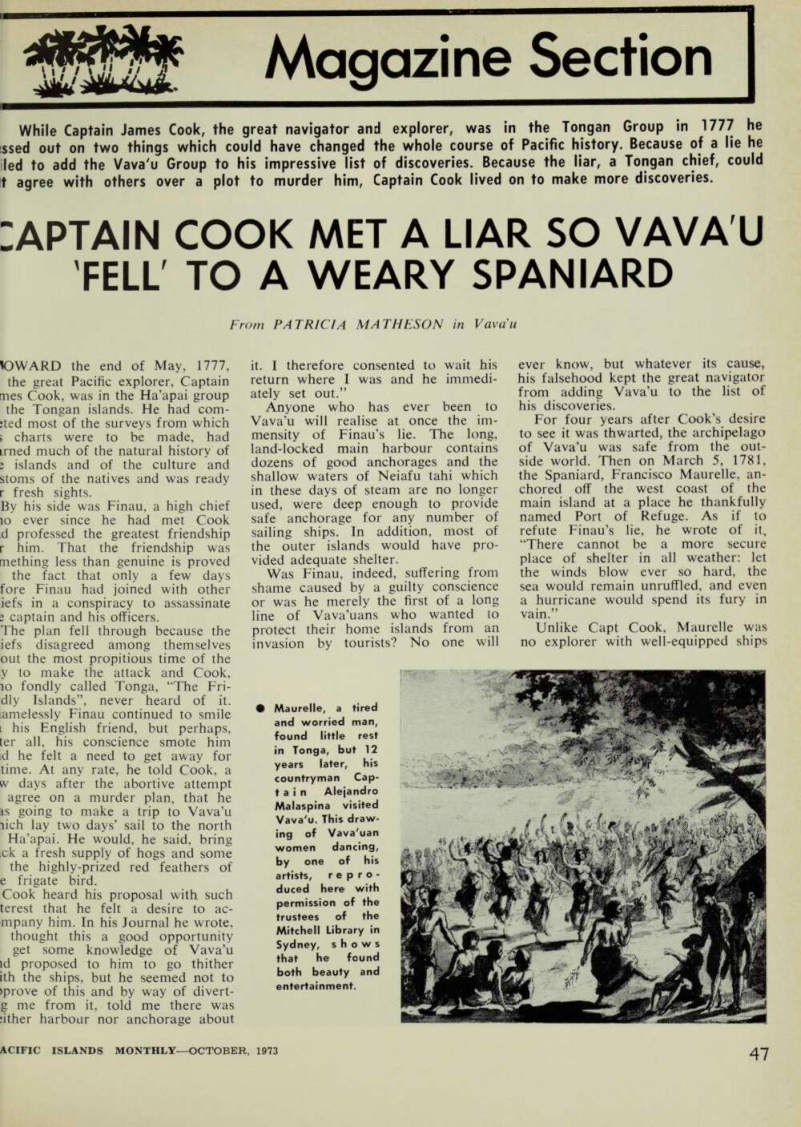
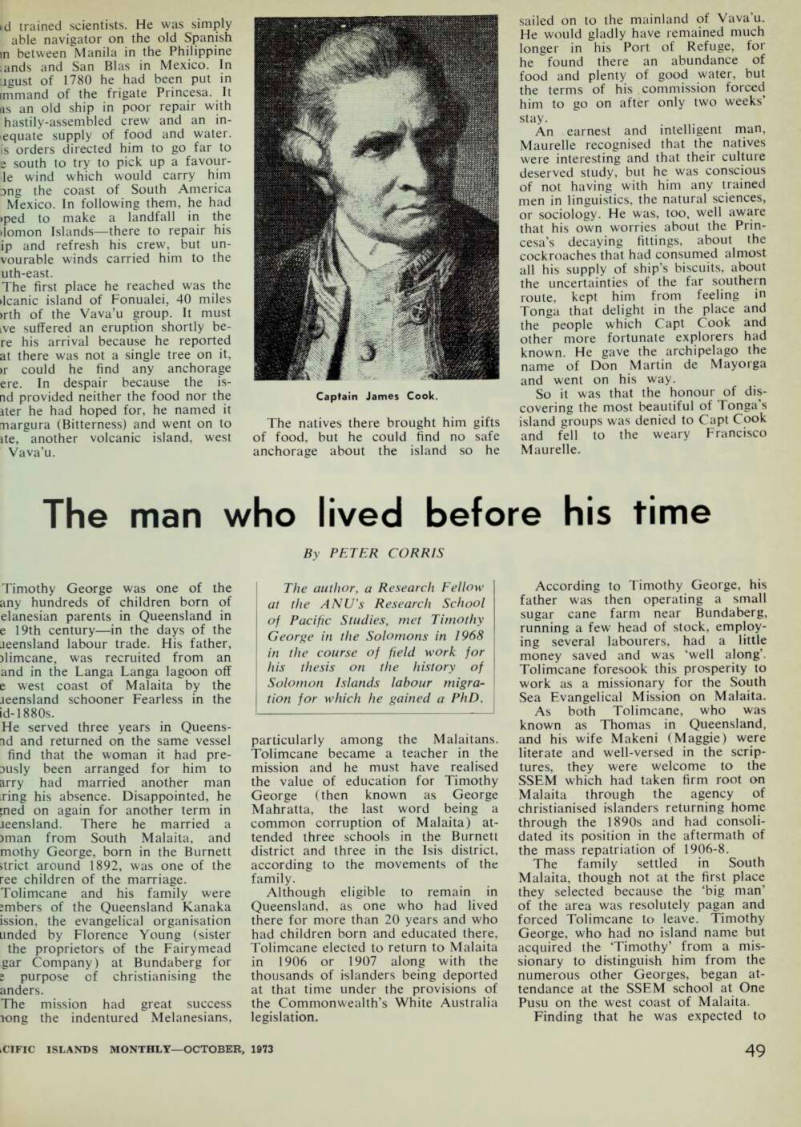
CAPTAIN COOK MET A LIAR SO VAVA'U
'Fell' To A Weary Spaniard
While Captain James Cook, the great navigator and explorer, was in the Tongan Group in 1777 he ssed out on two things which could have changed the whole course of Pacific history. Because of a lie he led to add the Vava'u Group to his impressive list of discoveries. Because the liar, a Tongan chief, could it agree with others over a plot to murder him, Captain Cook lived on to make more discoveries.
From PATRICIA MATHESON in Vava’u
HOWARD the end of May, 1777, the great Pacific explorer, Captain mes Cook, was in the Ha’apai group the Tongan islands. He had com ;ted most of the surveys from which i charts were to be made, had irned much of the natural history of i islands and of the culture and stoms of the natives and was ready r fresh sights.
By his side was Finau, a high chief 10 ever since he had met Cook d professed the greatest friendship r him. That the friendship was mething less than genuine is proved the fact that only a few days fore Finau had joined with other iefs in a conspiracy to assassinate ; captain and his officers.
The plan fell through because the iefs disagreed among themselves out the most propitious time of the y to make the attack and Cook, 10 fondly called Tonga, “The Fri dly Islands”, never heard of it. lamelessly Finau continued to smile i his English friend, but perhaps, ter all, his conscience smote him d he felt a need to get away for time. At any rate, he told Cook, a w days after the abortive attempt agree on a murder plan, that he is going to make a trip to Vava’u lich lay two days’ sail to the north Ha’apai. He would, he said, bring ck a fresh supply of hogs and some the highly-prized red feathers of e frigate bird.
Cook heard his proposal with such terest that he felt a desire to ac mpany him. In his Journal he wrote, thought this a good opportunity get some knowledge of Vava’u id proposed to him to go thither ith the ships, but he seemed not to iprove of this and by way of divert g me from it, told me there was sither harbour nor anchorage about
it. 1 therefore consented to wait his return where I was and he immedi ately set out.”
Anyone who has ever been to Vava’u will realise at once the im mensity of Finau’s lie. The long, land-locked main harbour contains dozens of good anchorages and the shallow waters of Neiafu tahi which in these days of steam are no longer used, were deep enough to provide safe anchorage for any number of sailing ships. In addition, most of the outer islands would have pro vided adequate shelter.
Was Finau, indeed, suffering from shame caused by a guilty conscience or was he merely the first of a long line of Vava’uans who wanted to protect their home islands from an invasion by tourists? No one will
ever know, but whatever its cause, his falsehood kept the great navigator from adding Vava’u to the list of his discoveries.
For four years after Cook’s desire to see it was thwarted, the archipelago of Vava’u was safe from the out side world. Then on March 5, 1781, the Spaniard, Francisco Maurelle, an chored off the west coast of the main island at a place he thankfully named Port of Refuge. As if to refute Finau’s lie, he wrote of it, “There cannot be a more secure place of shelter in all weather: let the winds blow ever so hard, the sea would remain unruffled, and even a hurricane would spend its fury in vain.”
Unlike Capt Cook, Maurelle was no explorer with well-equipped ships
• Maurelle, a tired and worried man, found little rest in Tonga, but 12 years later, his countryman Cap
tain Alejandro
Malaspina visited Vava'u. This draw ing of Vava'uan women dancing, by one of his artists, repro duced here with permission of the trustees of the Mitchell Library in Sydney, shows that he found both beauty and entertainment.
• d trained scientists. He was simply able navigator on the old Spanish in between Manila in the Philippine ands and San Bias in Mexico. In agust of 1780 he had been put in immand of the frigate Princesa. It as an old ship in poor repair with hastily-assembled crew and an in equate supply of food and water, is orders directed him to go far to e south to try to pick up a favour le wind which would carry him ang the coast of South America Mexico. In following them, he had »ped to make a landfall in the domon Islands—there to repair his ip and refresh his crew, but un vourable winds carried him to the uth-east.
The first place he reached was the ilcanic island of Fonualei, 40 miles ►rth of the Vava’u group. It must ,ve suffered an eruption shortly he re his arrival because he reported at there was not a single tree on it, ►r could he find any anchorage ere. In despair because the is nd provided neither the food nor the iter he had hoped for, he named it nargura (Bitterness) and went on to ite, another volcanic island, west Vava’u.
The natives there brought him gifts of food, but he could find no safe anchorage about the island so he
sailed on to the mainland of Vava’u.
He would gladly have remained much longer in his Port of Refuge, for he found there an abundance of food and plenty of good water, but the terms of his commission forced him to go on after only two weeks’ stay.
An earnest and intelligent man, Maurelle recognised that the natives were interesting and that their culture deserved study, but he was conscious of not having with him any trained men in linguistics, the natural sciences, or sociology. He was, too, well aware that his own worries about the Prin cesa’s decaying fittings, about the cockroaches that had consumed almost all his supply of ship’s biscuits, about the uncertainties of the far southern route, kept him from feeling in Tonga that delight in the place and the people which Capt Cook and other more fortunate explorers had known. He gave the archipelago the name of Don Martin de Mayorga and went on his way.
So it was that the honour of dis covering the most beautiful of Tonga s island groups was denied to Capt Cook and fell to the weary Francisco Maurelle.
Captain James Cook.
Advertisements & other items, p. 52 (1 item)
I Diesel Embime\
Reliable YANMAR YANMAR is a Japanese diesel engine maker, and was the first in the world to succeed to developing a truly small diesel engine. From 3HP up to 2,000 HP, YANMAR is producing a full range of diesel engines, ideal for an unlimited variety of applications. YANMAR diesel engines are already winning high reputations in more than 130 countries around the world.
In the YSE, TE, and KDE series, YANMAR has developed a line of high performance diesels specially for marine power units. The secret of the exceptional power which these units develop lies in the unique combustion performance, not attainable by any competitive unit.
YANMAR diesels are ideal for the rationalization of the fishing industry among the pacific islands and for inter-island transport.
DEALERSHIPS
YANMAR is seeking dealers on the following islands. Those who would like to be considered are invited to contact the company representative at the address below.
Fiji, New Hebrides, New Caledonia. Gilbert* and Ellice, Tahiti, Tonga, Nauru, American Samoa, Western Samoa. Cook Is., Norfolk Is.
KDE Series
82~265HP
YAMMMR
I DIESEL EMBIMe\
I K Series 22%37HP Series 5~12HP
YANMAR DIESEL ENGINE CO LTD
1-11-1, Marunouchi, Chiyoda-ku, Tokyo, JAPAN Telex: TOK 0222-2310
CABLE: YANMAR TOKYO
The man who lived before his time

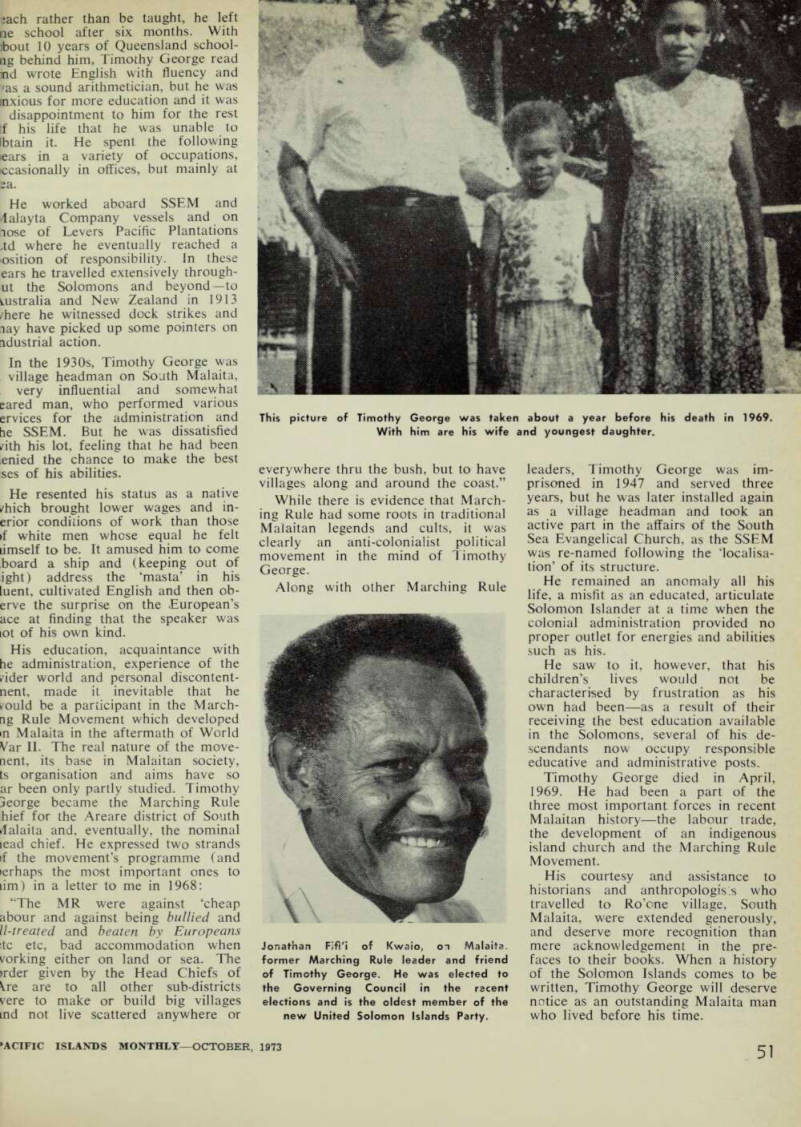
By Peter Corris
Timothy George was one of the any hundreds of children born of elanesian parents in Queensland in e 19th century—in the days of the aeensland labour trade. His father, )limcane, was recruited from an and in the Langa Langa lagoon off e west coast of Malaita by the aeensland schooner Fearless in the id-1880s.
He served three years in Queens rid and returned on the same vessel find that the woman it had pre ausly been arranged for him to arry had married another man ring his absence. Disappointed, he jned on again for another term in aeensland. There he married a )man from South Malaita, and mothy George, born in the Burnett strict around 1892, was one of the ree children of the marriage.
Tolimcane and his family were jmbers of the Queensland Kanaka ission, the evangelical organisation unded by Florence Young (sister the proprietors of the Fairy mead gar Company) at Bundaberg for s purpose of christianising the anders.
The mission had great success long the indentured Melanesians,
The author, a Research Fellow at the ANU’s Research School of Pacific Studies, met Timothy George in the Solomons in 1968 in the course of field work for his thesis on the history of Solomon Islands labour migra tion for which he gained a PhD.
particularly among the Malaitans.
Tolimcane became a teacher in the mission and he must have realised the value of education for Timothy George (then known as George Mahratta, the last word being a common corruption of Malaita) at tended three schools in the Burnett district and three in the Isis district, according to the movements of the
family.
Although eligible to remain in Queensland, as one who had lived there for more than 20 years and who had children born and educated there, Tolimcane elected to return to Malaita in 1906 or 1907 along with the thousands of islanders being deported at that time under the provisions of the Commonwealth’s White Australia
legislation.
According to Timothy George, his father was then operating a small sugar cane farm near Bundaberg, running a few head of stock, employ ing several labourers, had a little money saved and was ‘well along’.
Tolimcane foresook this prosperity to work as a missionary for the South Sea Evangelical Mission on Malaita.
As both Tolimcane, who was known as Thomas in Queensland, and his wife Makeni (Maggie) were literate and well-versed in the scrip tures, they were welcome to the SSEM which had taken firm root on Malaita through the agency of christianised islanders returning home through the 1890 s and had consoli dated its position in the aftermath of the mass repatriation of 1906-8.
The family settled in South Malaita, though not at the first place they selected because the ‘big man’ of the area was resolutely pagan and forced Tolimcane to leave. Timothy George, who had no island name but acquired the ‘Timothy’ from a mis sionary to distinguish him from the numerous other Georges, began at tendance at the SSEM school at One Pusu on the west coast of Malaita.
Finding that he was expected to
■jach rather than be taught, he left ne school after six months. With jbout 10 years of Queensland school ng behind him, Timothy George read md wrote English with fluency and vas a sound arithmetician, but he was mxious for more education and it was disappointment to him for the rest [f his life that he was unable to Ibtain it. He spent the following iears in a variety of occupations, iccasionally in offices, but mainly at ea.
He worked aboard SSEM and vlalayta Company vessels and on Hose of Levers Pacific Plantations ,td where he eventually reached a •osition of responsibility. In these ears he travelled extensively through ut the Solomons and beyond—to Australia and New Zealand in 1913 riiere he witnessed dock strikes and nay have picked up some pointers on idustrial action.
In the 19305, Timothy George was village headman on South Malaita, very influential and somewhat eared man, who performed various ervices for the administration and be SSEM. But he was dissatisfied /ith his lot, feeling that he had been enied the chance to make the best ses of his abilities.
He resented his status as a native riiich brought lower wages and in erior conditions of work than those if white men whose equal he felt ilmself to be. It amused him to come board a ship and (keeping out of ight) address the ‘masta’ in his luent, cultivated English and then ob erve the surprise on the European’s ace at finding that the speaker was lot of his own kind.
His education, acquaintance with he administration, experience of the rider world and personal discontent nent, made it inevitable that he /ould be a participant in the March ig Rule Movement which developed m Malaita in the aftermath of World Var 11. The real nature of the move nent, its base in Malaitan society, ts organisation and aims have so ar been only partly studied. Timothy jeorge became the Marching Rule hief for the Areare district of South dalaita and, eventually, the nominal lead chief. He expressed two strands if the movement’s programme (and icrhaps the most important ones to lim) in a letter to me in 1968: “The MR were against ‘cheap abour and against being bullied and 11-treated and beaten by Europeans :tc etc, bad accommodation when vorking either on land or sea. The >rder given by the Head Chiefs of V.re are to all other sub-districts vere to make or build big villages md not live scattered anywhere or
everywhere thru the bush, but to have villages along and around the coast.”
While there is evidence that March ing Rule had some roots in traditional Malaitan legends and cults, it was clearly an anti-colonialist political movement in the mind of Timothy George.
Along with other Marching Rule
leaders, Timothy George was im prisoned in 1947 and served three years, but he was later installed again as a village headman and took an active part in the affairs of the South Sea Evangelical Church, as the SSEM was re-named following the ‘localisa tion’ of its structure.
He remained an anomaly all his life, a misfit as an educated, articulate Solomon Islander at a time when the colonial administration provided no proper outlet for energies and abilities such as his.
He saw to it, however, that his children’s lives would not be characterised by frustration as his own had been—as a result of their receiving the best education available in the Solomons, several of his de scendants now occupy responsible educative and administrative posts.
Timothy George died in April, 1969. He had been a part of the three most important forces in recent Malaitan history—the labour trade, the development of an indigenous island church and the Marching Rule Movement.
His courtesy and assistance to historians and anthropologist who travelled to Ro’cne village, South Malaita, were extended generously, and deserve more recognition than mere acknowledgement in the pre faces to their books. When a history of the Solomon Islands comes to be written, Timothy George will deserve notice as an outstanding Malaita man who lived before his time.
This picture of Timothy George was taken about a year before his death in 1969.
With him are his wife and youngest daughter.
Jonathan Fifi'i of Kwaio, on Malaita. former Marching Rule leader and friend of Timothy George. He was elected to the Governing Council in the recent elections and is the oldest member of the new United Solomon Islands Party.
Advertisements & other items, pp. 54-55 (2 items)
Motospecs didn’t
win a New Zealand
Export Award
just because of the
names behind
jB Names like SCANIA. WIX. MONROE-WYLIE.
{jut lidlllUff REPCO. ARMOURED KNIGHT. TURTLE
WAX. ARROW INSTRUMENTS. S-K WAYNE. WOLF. RUBERY OWEN. BLACK- HAWK. SIDCHROME. Etc. Etc. Big names that mean, quite simply, the best automotive/industrial parts in the World. Of course, the quality of our products played an important part in our winning the Export Award. But so did service. And remarkable sales success. Which explains why Motospecs are New Zealand's largest exporters of automotive/industrial parts, and why our reputation for efficient, personal service is known throughout the South Pacific. We can prove it. Think of a problem, drop Motospecs a line, and we'll solve it. Personally.
DISTRIBUTED BY
MOTOR SPECIALTIES LTD
HEAD OFFICE. 80-90 ANZAC AVENUE, AUCKLAND, I.
MOTOR SPECIALITIES INDUSTRIES LIMITED
GROUP EXPORT DIVISION, P.O. BOX 3201
AUCKLAND, NEW ZEALAND
'BRANCHES THROUGHOUT NEW,ZEALAND.'
51
ACIFIC ISLANDS MONTHLY—OCTOBER, 1973
Yesterday
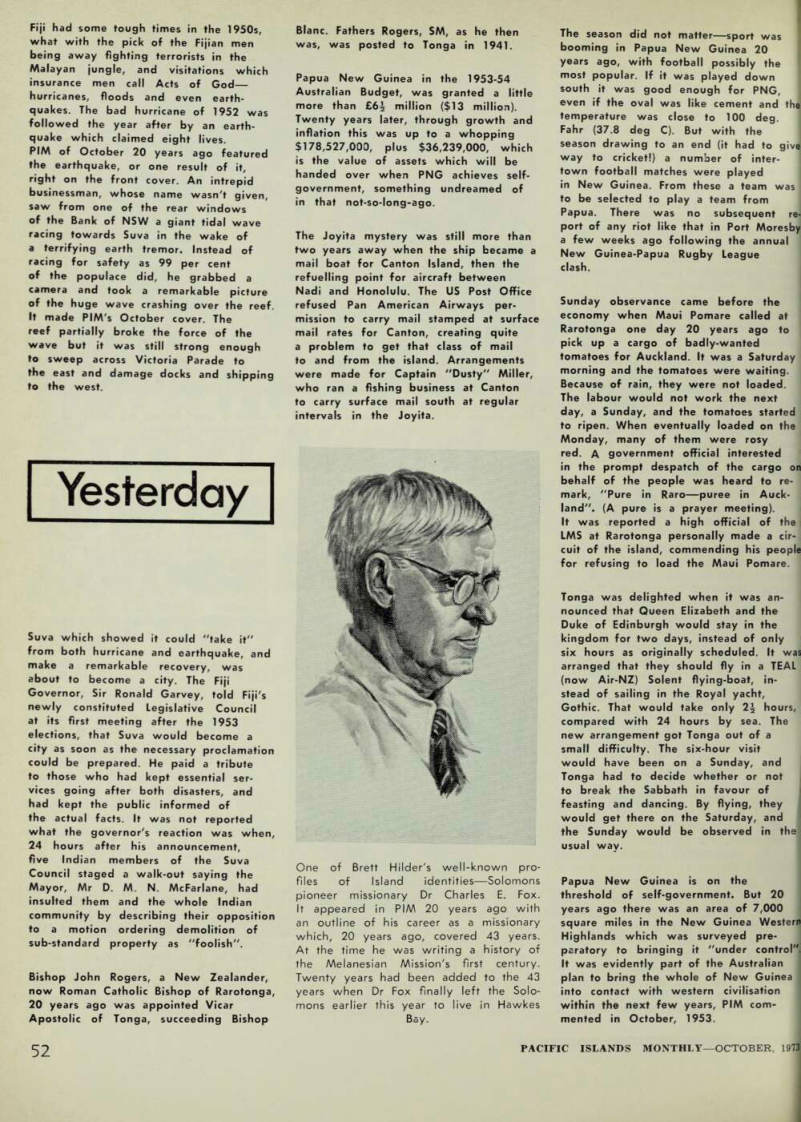
Fiji had some tough times in the 19505, what with the pick of the Fijian men being away fighting terrorists in the Malayan jungle, and visitations which insurance men call Acts of God— hurricanes, floods and even earth quakes. The bad hurricane of 1952 was followed the year after by an earth quake which claimed eight lives.
PIM of October 20 years ago featured the earthquake, or one result of it, right on the front cover. An intrepid businessman, whose name wasn't given, saw from one of the rear windows of the Bank of NSW a giant tidal wave racing towards Suva in the wake of a terrifying earth tremor. Instead of racing for safety as 99 per cent of the populace did, he grabbed a camera and took a remarkable picture of the huge wave crashing over the reef.
It made PlM's October cover. The reef partially broke the force of the wave but it was still strong enough to sweep across Victoria Parade to the east and damage docks and shipping to the west.
Suva which showed it could "take it" from both hurricane and earthquake, and make a remarkable recovery, was about to become a city. The Fiji Governor, Sir Ronald Garvey, told Fiji's newly constituted Legislative Council at its first meeting after the 1953 elections, that Suva would become a city as soon as the necessary proclamation could be prepared. He paid a tribute to those who had kept essential ser vices going after both disasters, and had kept the public informed of the actual facts. It was not reported what the governor's reaction was when, 24 hours after his announcement, five Indian members of the Suva Council staged a walk-out saying the Mayor, Mr D. M. N. McFarlane, had insulted them and the whole Indian community by describing their opposition to a motion ordering demolition of sub-standard property as "foolish".
Bishop John Rogers, a New Zealander, now Roman Catholic Bishop of Rarotonga, 20 years ago was appointed Vicar Apostolic of Tonga, succeeding Bishop
Blanc. Fathers Rogers, SM, as he then was, was posted to Tonga in 1941.
Papua New Guinea in the 1953-54 Australian Budget, was granted a little more than million ($l3 million).
Twenty years later, through growth and inflation this was up to a whopping $178,527,000, plus $36,239,000, which is the value of assets which will be handed over when PNG achieves self government, something undreamed of in that not-so-long-ago.
The Joyita mystery was still more than two years away when the ship became a mail boat for Canton Island, then the refuelling point for aircraft between Nadi and Honolulu. The US Post Office refused Pan American Airways per mission to carry mail stamped at surface mail rates for Canton, creating quite a problem to get that class of mail to and from the island. Arrangements were made for Captain "Dusty" Miller, who ran a fishing business at Canton to carry surface mail south at regular intervals in the Joyita.
One of Brett Hilder's well-known pro files of Island identities —Solomons pioneer missionary Dr Charles E. Fox.
It appeared in PIM 20 years ago with an outline of his career as a missionary which, 20 years ago, covered 43 years.
At the time he was writing a history of the Melanesian Mission's first century.
Twenty years had been added to the 43 years when Dr Fox finally left the Solo mons earlier this year to live in Hawkes Bay.
The season did not matter—sport was booming in Papua New Guinea 20 years ago, with football possibly the most popular. If it was played down south it was good enough for PNG, even if the oval was like cement and the temperature was close to 100 deg.
Fahr (37.8 deg C). But with the season drawing to an end (it had to give way to cricket!) a number of inter town football matches were played in New Guinea. From these a team was to be selected to play a team from Papua. There was no subsequent re port of any riot like that in Port Moresby a few weeks ago following the annual New Guinea-Papua Rugby League clash.
Sunday observance came before the economy when Maui Pomare called at Rarotonga one day 20 years ago to pick up a cargo of badly-wanted tomatoes for Auckland. It was a Saturday morning and the tomatoes were waiting.
Because of rain, they were not loaded.
The labour would not work the next day, a Sunday, and the tomatoes started to ripen. When eventually loaded on the Monday, many of them were rosy red. A government official interested in the prompt despatch of the cargo oi behalf of the people was heard to re mark, "Pure in Raro —puree in Auck land". (A pure is a prayer meeting).
It was reported a high official of the LMS at Rarotonga personally made a cir cuit of the island, commending his peopk for refusing to load the Maui Pomare.
Tonga was delighted when it was an nounced that Queen Elizabeth and the Duke of Edinburgh would stay in the kingdom for two days, instead of only six hours as originally scheduled. It wa arranged that they should fly in a TEAL (now Air-NZ) Solent flying-boat, in stead of sailing in the Royal yacht, Gothic. That would take only hours, compared with 24 hours by sea. The new arrangement got Tonga out of a small difficulty. The six-hour visit would have been on a Sunday, and Tonga had to decide whether or not to break the Sabbath in favour of feasting and dancing. By flying, they would get there on the Saturday, and the Sunday would be observed in the usual way.
Papua New Guinea is on the threshold of self-government. But 20 years ago there was an area of 7,000 square miles in the New Guinea Westen Highlands which was surveyed pre paratory to bringing it "under control"
It was evidently part of the Australian plan to bring the whole of New Guinea into contact with western civilisation within the next few years, PIM com mented in October, 1953.
Advertisements & other items, pp. 57-64 (3 items)
for extra freshness
Come up to Kool
C r mm m ■mm.. •' 'V , -a % I
KQDI
mm j* 4 rj* * L* II / y^r p U597-8/71
SONY SOUNDS
BETTER
-C CF-320 Cassette-Corder FM-AM Radio CF -150 Cassette-Corder FM-AM Radio CF-410 Cassette-Corder/ FM-SW-MW Radio
Presenting Sony’s
popular portables
Three different models—the same great sound!
New from Sony! Three great cassette-corder/ radios that give you everything you've always wanted in portable sound.
Lightweight CF-150 has an FM/AM radio. The oowerful CF-320 has FM/AM radio with AFC driftaroof reception. And CF-410 in addition to FM and Medium wave also offers Shortwave band recep- :ion.
All have a built-in Electret Condenser Microphone and SONY-O-MATIC automatic recording level control —so the sound you record is always clearer.
All have Sony's precision amplifier, large loudspeaker, and tone controls —so the sound you hear is always better And with multi-position AC plus DC power op- j tion, you can use any of the three models just about anywhere.
Right now, your local Sony dealer is ready to show you Sony's whole range of exciting cassettecorder/radio combinations.
See Sony, hear Sony first!
See and hear Sony's popular portables today, I you'll agree, Sony Sounds Better.
Research Makes the Difference
SONY
PARAMOUNT
H P.
It’s a great
new shirt
dll
All the world loves a lover. And you’ll love Paramount Casanova Australia’s great new range of fashion shirts. Brilliant styling, latest fabrics. For younger, smarter men of all ages. Get into a Paramount Casanova you’ll love what it does for you.
Now at leading department stores and menswear stores throughout the Pacific.
Trade Enquiries: PARAMOUNT SHIRT CO. PTY. LTD, 52 Commonwealth Street, Darlinghurst NSW 2010 Australia.
* " : 1 £ % - 1 v* -r- -■ - \; «* ♦ * * * *.-*■• . y<♦ .S^v^** j'v. 3." 'V * ’ * '•• ‘ ’ * . ■ I. \ it* ,*•■ c».‘ '♦ . „ *-■-., - 4 " , . * *•* * ..; • »'*'*, .r> - s * \: .'V* • * » , • »,*• * . • ' * ' 1 V % 1 ' ' ' ". *r.;*#'>■ •*^ •••-• •»■• ’* •* •., ♦ - \ % S‘ V’*’ •* * * "•, / • * . * . k; • :*•.] "v >‘ * ' ■■ ; ' - '• ’.■ •■■ ■ •■- - ■ \t .. • * ‘ %'V. ■• * i ' 't, * ,v» ' ■ \ ■ I • /,*. ■* \ \ ' . ‘ V f< ‘ ■ ' % J . , **.•». 4 * , t * i ;i ’ * K \f A 4 s'f, , ■ ;, . )fV/#/.•> * * ' i ; * ’'* - ;• '
/V '*lM
x 4 \ N \ w•: *• g|Hte r - - .
**•jpr. *'
4 - V'3p >'■
and Cruiser
;rV
OTA
Dyna &
Get through
m auus L-i k!
When the going gets roughest, depend on Toyota to get you through everytime.
Road conditions, water,extremes of heat and cold—nothing,but nothing stops Toyota from coming through for you with the biggest loads faster and more economically.
World-famous for the engineering excellence of its automobiles, Toyota also makes a complete line of rugged, versatile commercial vehicles designed to keep costs down, profits rising.
The Toyota Land Cruiser defies all obstacles to get the job done.
The Dyna and Stout trucks come through better in the light and medium pickup categories, while the Hi-Ace makes an excellent all-purpose vehicle.
For the big jobs, Toyota offers the heavy-duty truck - to keep profits rising load after load. And for the big family, Toyota offers two roomy station wagons the trusty Toyota 1000 and the luxurious Corolla.
Make it a point to see your nearest Toyota dealer soon. When you do, ask him to prove how Toyota can keep coming through for you again and again.
TOYOTA Stout TOYOTA Land Cruiser mm TOYOTA Truck
TOYOTA 1000
TOYOTA Hi Ace
TOYOTA Corolla
TOYOTA
PAPUA NEW GUINEA; ELA MOTORS LIMITED. Scratchley Rd., Badili, Papua U.S. TRUST TERRITORY: MICROL CORPORATION, P.O. Box 267, Saipan FIJI ISLANDS: AUTOMOTIVE SUPPLIES CO , LTD., G.P.O. Box 355, Suva AMERICAN SAMOA: BURNS PHILP (SOUTH SEA) CO., LTD.,Pago Pago WESTERN SAMOA: BURNS PHILP (SOUTH SEA) LTD., P.O. Box 188, Apia GUAM: RICKV's AUTO CO , P.O. Box 1458, Agana NEW HEBRIDES: NEW HEBRIDES MOTORS LTD., P.O. Box 18, Vila SOLOMON ISLANDS: ZEPHYR SERVICE STATION PTY LTD., P.O Box 174, Honiara NEW CALEDONIA: SOCIETE DTMPORTATION AUTOMOBILE DU PACIFIC, B.P. 438, Noumea TAHITI: ETABLISSEMENTS E.A. MARTIN & FILS, B.P 61 Papeete COOK ISLANDS: COOK ISLANDS TRADING CORPORATION LTD., P.O. Box 92, Rarotonga
Fly the only DC-10
DIRECT TO THE U.S.A. FROM FIJI
Only AIR NEW ZEALAND has it. The direct DC-10 flight from Fiji to Honolulu and on to Los Angeles.
Depart Nadi every Friday at 00.30 hours for the most comfortable ride in the sky with softer seats, more room, more comfort, less noise.
Catch the Big 10, the wide-bodied jet that has captured the imagination of all Pacific travellers.
From Nadi. Every Friday.
air new zEaiann
WE ARE THE PA CIF/C ANZ.IS2
Sound has "heart”...
T
r pK
iiiiillY
You can feel it with TDK SO Cassette True High-Fidelity Sound Reproduction in cassettes has never been achieved until TDK SD cassettes. TDK, specialist in tape technology, developed SD cassettes only 4 years ago, and now they are favoured by audiophiles in as many as 93 countries. SD cassettes give the people such a true sound emotion as no other tape could. True High-Fidelity that's what TDK has! • SD Cassettes are offered in both the popular C-60, C-90 and the C-30 type, as well as reel type 1800-SD and 1200-SD. *Also available low noise cassettes in C-30, C-40, C-60, C-90 and C-120.
§TDK
TDK ELECTRONICS CO.. LTD.
2-14-6, Uchikanda, Chiyoda-ku, Tokyo, Japan
DISTRIBUTORS WANTED FOR:
New Caledonia, New Hebrides, Tonga, West Samoa, American Samoa, Marquesas Nauru, Cook Islands, British Solomon Islands.
TDK Authorised distributors; Australia
CONVOY INTERNATIONAL PTY. LTD.
Cnr. Plunkett and Maclean Sts.
Woolloomooloo 2011
Sydney, Australia
New Guinea & Papua Turner & Davey Electrical Pty. Ltd.
P.O. Box 255, Lae, P.N.G.
Tahiti
Ets. WIKING
132 Rue du Marechal Foch Papeete, Tahiti Fiji C. Maganlal & Co. 119 Vitogo Parade Lautoka, Fiji
Cable: TDK CORE TOKYO
Telex: TODENKA J 24270
Big enough to build a meal on!
Acific Islands Monthly—October, 1973
59
CIFIC ISLANDS MONTHLY—OCTOBER, 1973
Mana
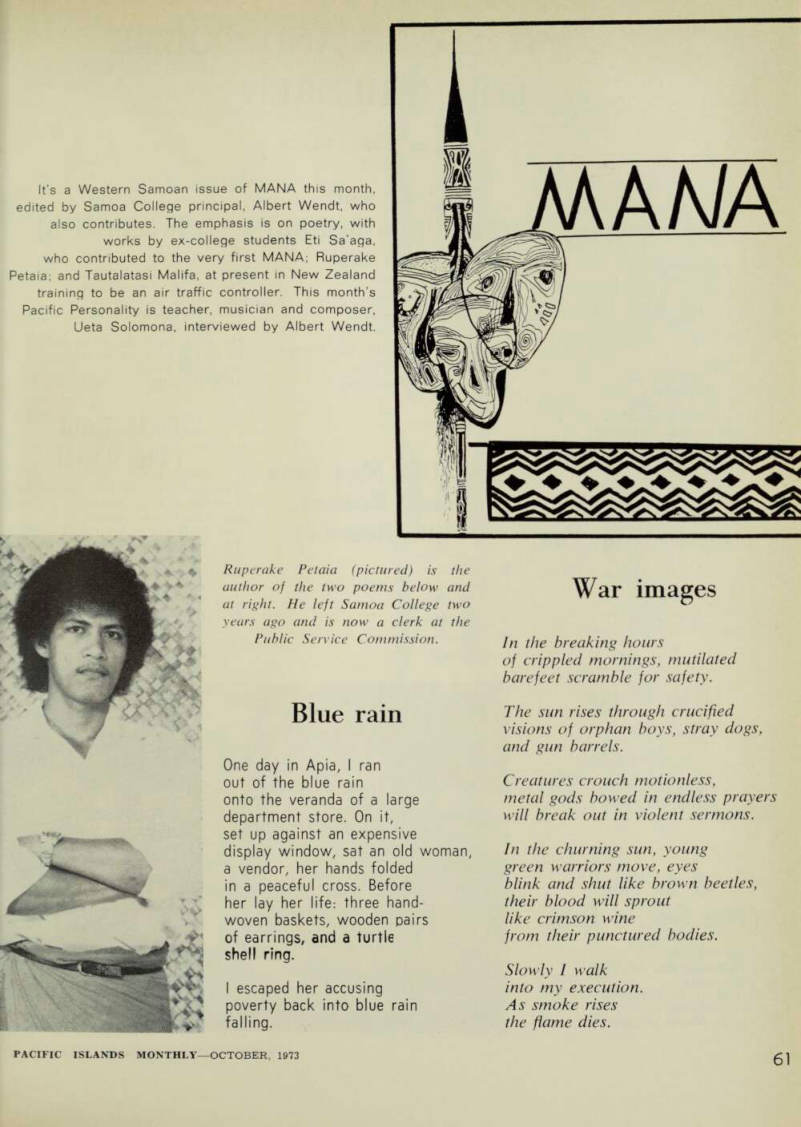
It’s a Western Samoan issue of MANA this month, edited by Samoa College principal, Albert Wendt, who also contributes. The emphasis is on poetry, with works by ex-college students Eti Sa’aga, who contributed to the very first MANA; Ruperake Petaia; and Tautalatasi Malifa, at present in New Zealand training to be an air traffic controller. This month’s Pacific Personality is teacher, musician and composer, Ueta Solomona, interviewed by Albert Wendt.
Blue rain
One day in Apia, I ran out of the blue rain onto the veranda of a large department store. On it, set up against an expensive display window, sat an old woman, a vendor, her hands folded in a peaceful cross. Before her lay her life: three hand woven baskets, wooden pairs of earrings, and a turtle shell ring.
I escaped her accusing poverty back into blue rain falling.
Ruperake Petaia (pictured) is the author of the two poems below and at right. He left Samoa College two years ago and is now a clerk at the Public Service Commission.
War images
In the breaking hours of crippled mornings, mutilated barefeet scramble for safety.
The sun rises through crucified visions of orphan boys, stray dogs, and gun barrels.
Creatures crouch motionless, metal gods bowed in endless prayers will break out in violent sermons.
In the churning sun, young green warriors move, eyes blink and shut like brown beetles, their blood will sprout like crimson wine from their punctured bodies.
Slowly I walk into my execution.
As smoke rises the flame dies.
Samoan Songs And Poems
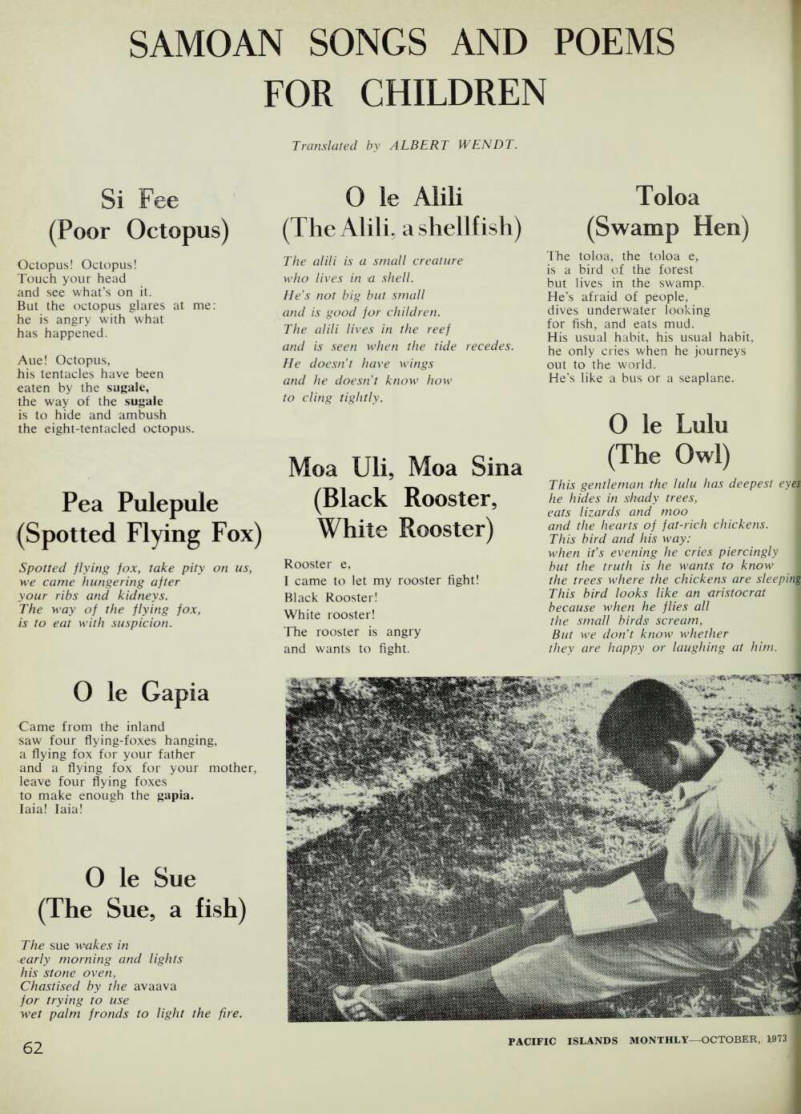
For Children
Translated by ALBERT WENDT.
Si Fee
(Poor Octopus)
Octopus! Octopus!
Touch your head and see what’s on it.
But the octopus glares at me: he is angry with what has happened.
Aue! Octopus, his tentacles have been eaten by the sugale, the way of the sugale is to hide and ambush the eight-tentacled octopus.
Pea Pulepule
(Spotted Flying Fox)
Spotted flying fox, take pity on us, we came hungering after your ribs and kidneys.
The way of the flying fox, is to eat with suspicion.
O le Gapia
Came from the inland saw four flying-foxes hanging, a flying fox for your father and a flying fox for your mother, leave four flying foxes to make enough the gapia. laia! laia!
0 le Sue
(The Sue, a fish)
The sue wakes in early morning and lights his stone oven, Chastised by the avaava for trying to use wet palm fronds to light the fire.
0 le Alili
(The Alili, a shellfish)
The alili is a small creature who lives in a shell.
He’s not big but small and is good for children.
The alili lives in the reef and is seen when the tide recedes.
He doesn’t have wings and he doesn’t know how to cling tightly.
Moa Uli, Moa Sina
(Black Rooster,
White Rooster)
Rooster e, I came to let my rooster fight!
Black Rooster!
White rooster!
The rooster is angry and wants to fight.
Toloa
(Swamp Hen)
The toloa, the toloa e, is a bird of the forest but lives in the swamp.
He’s afraid of people, dives underwater looking for fish, and eats mud.
His usual habit, his usual habit, he only cries when he journeys out to the world.
He’s like a bus or a seaplane.
0 le Lulu
(The Owl)
This gentleman the lulu has deepest eyes, he hides in shady trees, eats lizards and moo and the hearts of fat-rich chickens.
This bird and his way: when it’s evening he cries piercingly but the truth is he wants to know the trees where the chickens are sleeping This bird looks like an aristocrat because when he flies all the small birds scream, But we don’t know whether they are happy or laughing at him.
A Comic Love Song
ALBERT WENDT collected and translated this song from the smallest inhabited island in Western Samoa, Apolima.
Ou te le tala ole, Silisili tama o le lole.
E alaala poo fai sau sofesofe.
Tunu faavave sau kofe, Aua lou moa nei mole.
Tamoe tele vave ma le ofe Seu mai se atule ma se safole, E tali ai o lou popole.
Tuu lou ata i tama, Tamaiti ula leaga, Nei ou mao alu atu i se malaga Soli mai ou tofaga.
Tiga ona e vae vale Faitalia au ma lolase.
Peta te o ane i le falemai E tui ai ou paumasi.
E ui ina lafa lou ulu Ma poupona lou gutu, Ae ou te tautino atu, Ou te le musu, Faitalia au ma fufulu.
Tali: Togo maia e fusi atu au E faamafanafana i lou fatu.
Ona ou tago alu lea Fusi mai oe Ma popo faamoemoe.
I’m not boasting: the boys of the candy are the greatest.
In the evening cook some sofesofe, boil some coffee quickly in case your stomach suffocates.
Run swiftly with the fishing rod catch some atule and safole to satisfy your worry.
Stop smiling at other boys, boys who misbehave badly, or I may come on a trip and trample all over your bed.
Even if your legs are bandy I’ll straighten them, or we may go to the hospital and get your yaws injected.
Even if your head is ringwormed and your mouth is dotted with sores,
I’m telling you truly
I won’t refuse, I’ll wash your sores.
Chorus: Reach out and embrace me to warm your heart, and I’ll reach out and embrace you and pat you to sleep.
How it will be
By Eti Sa’Aga
This is how I think it will be, When the cool Virus of Progress Spreads slowly over These islands, Covering the warmth Of the healing sun, The face of every man: That is, When the phallic towers Pierce the womb Of the skies, And jets, Like mosquitoes, Hum my dreams Into nightmares Of sterile materialism; Where mountains crumble Under a synthetic green, Whose serenity Will not again chant The hymns of the ages, But vomit only a sweet fragrance Of burnt plastic waste; Where seas harvest Only shadows Of dead fish, And dry fingers of coral Will be corroded Into white sand By acidic waves.
And I Shall take my counselling From movies, And instructions From advertisements In daily newspapers.
Then half-baked With a thin veneer of culture And a smattering knowledge Of technology, I shall send My children To the temples Of the money worshippers To learn the gospel Of the miracle makers And give praise To all papalagi Who come in With cameras.
Then aged And highly decorated For a fake loyalty To the country’s culture, I shall cherish These islands In the common graveyard Of a polluted wilderness.
Little fale
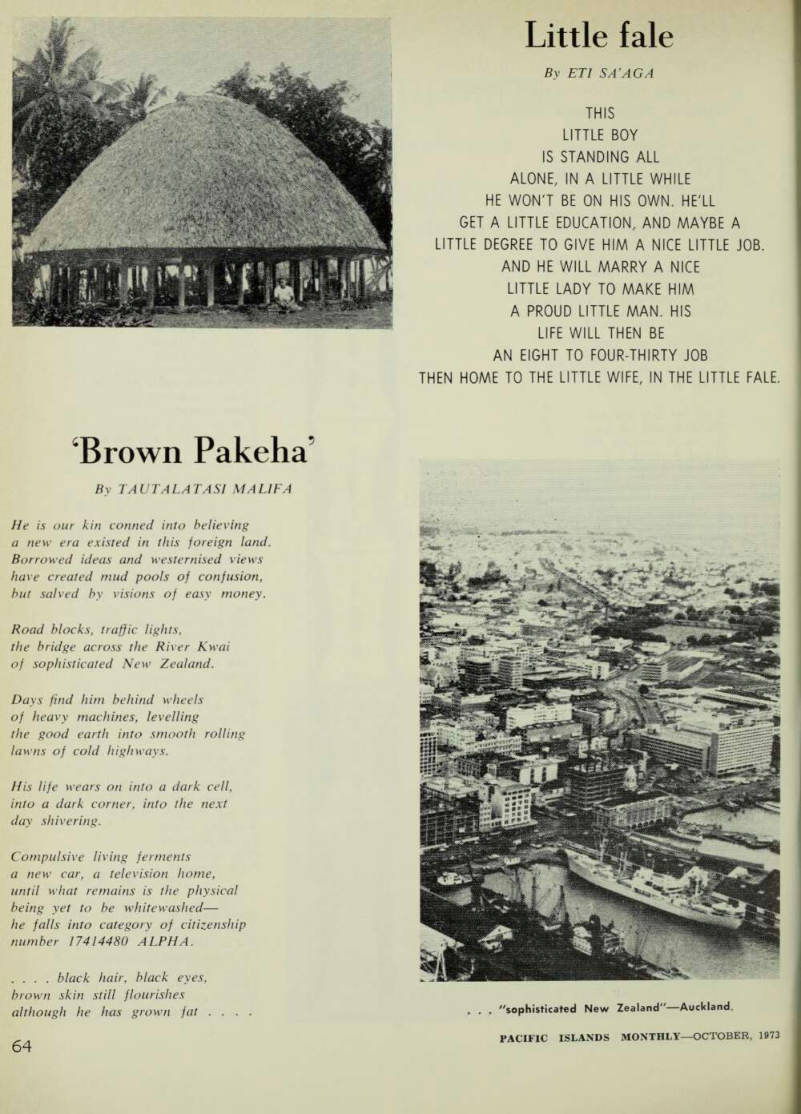
By Eti Sa’Aga
This
Little Boy
Is Standing All
Alone, In A Little While
HE WON'T BE ON HIS OWN. HE'LL GET A LITTLE EDUCATION, AND MAYBE A LITTLE DEGREE TO GIVE HIM A NICE LITTLE JOB.
And He Will Marry A Nice
Little Lady To Make Him
A Proud Little Man. His
Life Will Then Be
An Eight To Four-Thirty Job
THEN HOME TO THE LITTLE WIFE, IN THE LITTLE FALE.
‘Brown Pakeha’
By Tautalatasi Malifa
He is our kin conned into believing a new era existed in this foreign land.
Borrowed ideas and westernised views have created mud pools of confusion, but salved by visions of easy money.
Road blocks, traffic lights, the bridge across the River Kwai of sophisticated New Zealand.
Days find him behind wheels of heavy machines, levelling the good earth into smooth rolling lawns of cold highways.
His life wears on into a dark cell, into a dark corner, into the next day shivering.
Compulsive living ferments a new car, a television home, until what remains is the physical being yet to be whitewashed— he falls into category of citizenship number 17414480 ALPHA. . . . . black hair, black eyes, brown skin still flourishes although he has grown fat ... .
. . . "sophisticated New Zealand"—Auckland.
Musician, Composer
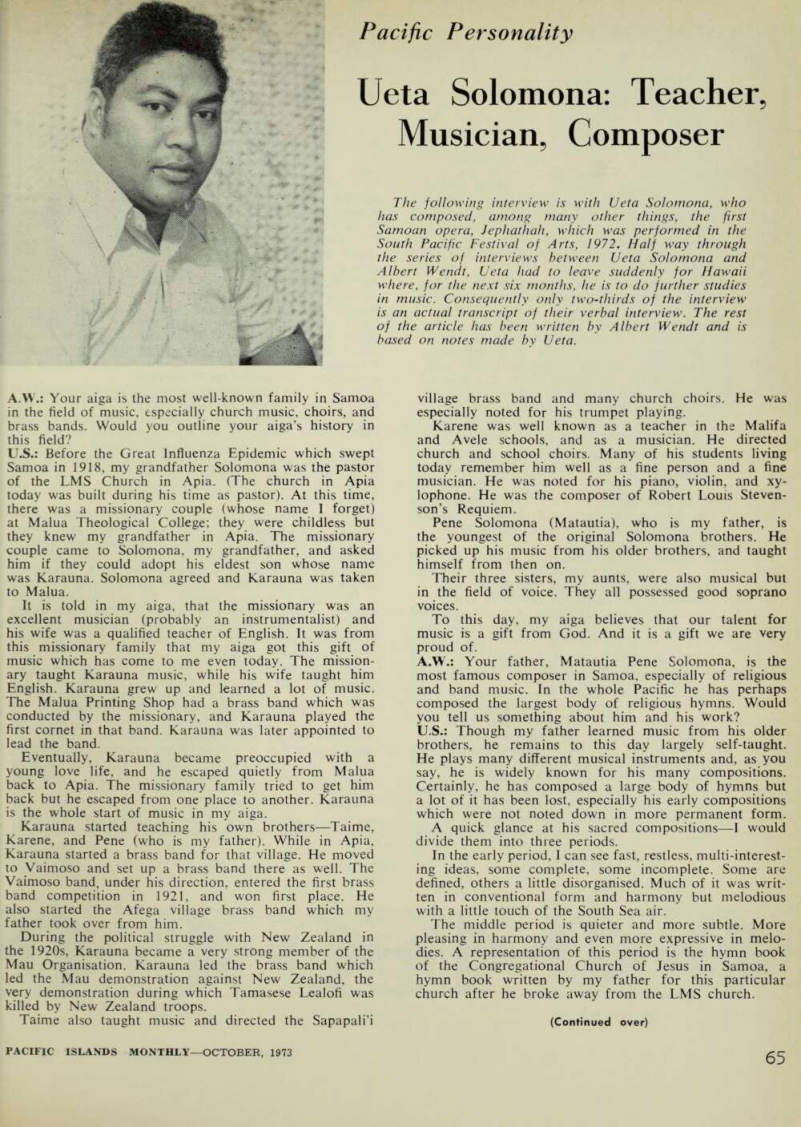
Pacific Personality Ueta Solomona: Teacher,
The following interview is with Ueta Solomona, who has composed, among many other things, the first Samoan opera, Jephathah, which was performed in the South Pacific Festival of Arts, 1972. Half way through the series of interviews between Ueta Solomona and Albert Wendt, Ueta had to leave suddenly for Hawaii where, for the next six months, he is to do further studies in music. Consequently only two-thirds of the interview is an actual transcript of their verbal interview. The rest of the article has been written by Albert Wendt and is based on notes made by Ueta.
A.W.: Your aiga is the most well-known family in Samoa in the field of music, especially church music, choirs, and brass bands. Would you outline your aiga’s history in this field?
U.S.: Before the Great Influenza Epidemic which swept Samoa in 1918, my grandfather Solomona was the pastor of the LMS Church in Apia. (The church in Apia today was built during his time as pastor). At this time, there was a missionary couple (whose name I forget) at Malua Theological College; they were childless but they knew my grandfather in Apia. The missionary couple came to Solomona, my grandfather, and asked him if they could adopt his eldest son whose name was Karauna. Solomona agreed and Karauna was taken to Malua.
It is told in my aiga, that the missionary was an excellent musician (probably an instrumentalist) and his wife was a qualified teacher of English. It was from this missionary family that my aiga got this gift of music which has come to me even today. The mission ary taught Karauna music, while his wife taught him English. Karauna grew up and learned a lot of music.
The Malua Printing Shop had a brass band which was conducted by the missionary, and Karauna played the first cornet in that band. Karauna was later appointed to lead the band.
Eventually, Karauna became preoccupied with a young love life, and he escaped quietly from Malua back to Apia. The missionary family tried to get him back but he escaped from one place to another. Karauna is the whole start of music in my aiga.
Karauna started teaching his own brothers —Taime, Karene, and Pene (who is my father). While in Apia, Karauna started a brass band for that village. He moved to Vaimoso and set up a brass band there as well. The Vaimoso band, under his direction, entered the first brass band competition in 1921, and won first place. He also started the Afega village brass band which my father took over from him.
During the political struggle with New Zealand in the 19205, Karauna became a very strong member of the Mau Organisation. Karauna led the brass band which led the Mau demonstration against New Zealand, the very demonstration during which Tamasese Lealofi was killed by New Zealand troops.
Taime also taught music and directed the Sapapali’i
village brass band and many church choirs. He was especially noted for his trumpet playing.
Karene was well known as a teacher in the Malifa and Avele schools, and as a musician. He directed church and school choirs. Many of his students living today remember him well as a fine person and a fine musician. He was noted for his piano, violin, and xy lophone. He was the composer of Robert Louis Steven son’s Requiem.
Pene Solomona (Matautia), who is my father, is the youngest of the original Solomona brothers. He picked up his music from his older brothers, and taught himself from then on.
Their three sisters, my aunts, were also musical but in the field of voice. They all possessed good soprano voices.
To this day, my aiga believes that our talent for music is a gift from God. And it is a gift we are very proud of.
A.W.: Your father, Matautia Pene Solomona, is the most famous composer in Samoa, especially of religious and band music. In the whole Pacific he has perhaps composed the largest body of religious hymns. Would you tell us something about him and his work?
U.S.: Though my father learned music from his older brothers, he remains to this day largely self-taught.
He plays many different musical instruments and, as you say, he is widely known for his many compositions.
Certainly, he has composed a large body of hymns but a lot of it has been lost, especially his early compositions which were not noted down in more permanent form.
A quick glance at his sacred compositions—l would divide them into three periods.
In the early period, I can see fast, restless, multi-interest ing ideas, some complete, some incomplete. Some are defined, others a little disorganised. Much of it was writ ten in conventional form and harmony but melodious with a little touch of the South Sea air.
The middle period is quieter and more subtle. More pleasing in harmony and even more expressive in melo dies. A representation of this period is the hymn book of the Congregational Church of Jesus in Samoa, a hymn book written by my father for this particular church after he broke away from the LMS church.
(Continued over)
The present period is much more influenced by Roman Catholic chants. Much slower rhythm with little change in harmony. I cannot say much about this period because he is still tapping and developing a new vein of inspiration.
I think the differences of these styles of writing are due to different influences in religious beliefs and cus toms of the different denominations to which he has belonged. He was born and raised in the LMS Church.
The middle period starts with his breaking away from the LMS and joining the Congregational Church of Jesus in Samoa in about 1940. The present period is heavily influenced by Roman Catholicism; he became a Roman Catholic in about 1961.
My father has also written secular songs in a light and happy mood, mostly love songs. He has composed a lot of music for brass bands in different styles— marches, novels, dances and a little jazz.
My father continues to surprise me with his boundless energy and devotion to music. He is a self-taught musician and has never trained overseas. He still com poses, trains brass bands and church choirs. He does all this in his spare time as he works as a fitter and turner in the Public Works Department. I think he has offered a lot of music to our country, not only in the form of music but through the musicians he has trained.
A.W.: When did you learn music? Did you teach your self how to play the many musical instruments that
you play?
U.S.: I began to play the piano when I was about five years old. This I remember because I played the piano before I started primary school at the Marist Brothers School when I was six years old.
Like many other people who were started off by their parents, so my father started me on the piano.
Later, I continued to teach myself the piano until I went to university in the States on my 23rd birthday.
I taught myself the basic techniques of many musical instruments but my knowledge of band and orchestral instruments was certainly improved while studying at uni versity. 1 learned better methods at university.
A.W.: When did you start composing your own music?
U.S.: I started composing before I was 20 years old.
I wrote some hymns in conventional and homophonic style. Even tried some brass band music and songs. At that time, I used to accompany my father when he went out to teach brass bands and church choirs. Sometimes, he composed the hymns and songs, and I taught them. I used to spend every Sunday playing the organ in church. I also used to play in my father’s brass bands.
I think I owe my father nearly all that I know about composing and teaching music and singing.
At university, I really began to write music in a more
sophisticated way. Up to now, I continue to compose vocal, choral, and instrumental music. At university, one of the things I wrote was a Piano and Violin One Movement Sonatina—it won second place in the Music Composition Competition at university. Just one of those happy memories about university.
In 1959, Ueta Solomona was awarded a Fulbright Scholarship to study music at the State University of New York. In 1963, he graduated with a BSc degree in music, the first Samoan to do so. When he returned to Western Samoa, he was appointed Music Specialist for all government schools; a position he holds up to now.
From 1964 to 1970, he also taught music over the radio to all primary and intermediate schools in the country.
In 1964, he founded the first Ecumenical Easter Service which was produced by the combined choirs of two schools and the Teachers’ Training College. Two years later, he organised and produced the first Music Festival involving choirs from all the high schools in Western Samoa. He still directs the music festival every year.
Still two years later, he helped promote and establish the Mafutaga a Aufaipese (Fellowship of Church Choirs) which is made up of 15 choirs from the Congregational Christian Church. Besides workshops, this organisation has given many live sacred music concerts.
At the same time and up to now, Ueta Solomona has lectured about music to many organisations and groups.
He has also directed and still teaches church choirs and village brass bands. He has been one of the main judges in the Samoan Traditional Singing Contests and Band Contests in national celebrations both in Western and American Samoa. At present, he is helping to revise and re-edit the Congregational Christian Churches hymn book.
He has composed, arranged and transcribed hymns and Samoan traditional folk songs for choirs and bands.
He still does this today. Perhaps the most recent high light of his creative activity is the first Samoan opera he composed based on a biblical theme. This opera was performed at the South Pacific Arts Festival in Suva, 1972. Ueta Solomona directed his own opera at the Festival. At the moment he is working on a new opera to be called Vaea and Apaula which is based on a well known Samoan legend. He has completed the first part of this two-part opera.
In 1972, he started to build an orchestra which he hopes to expand into a real standard symphony orchestra.
This year, the beginnings of this orchestra gave its first public performance. The establishment of the orchestra is a major undertaking as Samoa does not yet have the musicians needed for a symphony orchestra. Ueta Solo mona knows that he will have to train musicians himself, and he has already started on this work. If he succeeds he would be giving Western Samoa its first symphony orchestra.
Apart from all this activity, he gives private piano les sons to 60 students, the youngest students are five years old. This group gives regular public recitals.
Advertisements & other items, p. 70 (1 item)
66
PACIFIC ISLANDS MONTHLY—OCTOBER, 1973
Ueta Solomona . . . (Continued from p 65)
Mana Contributions
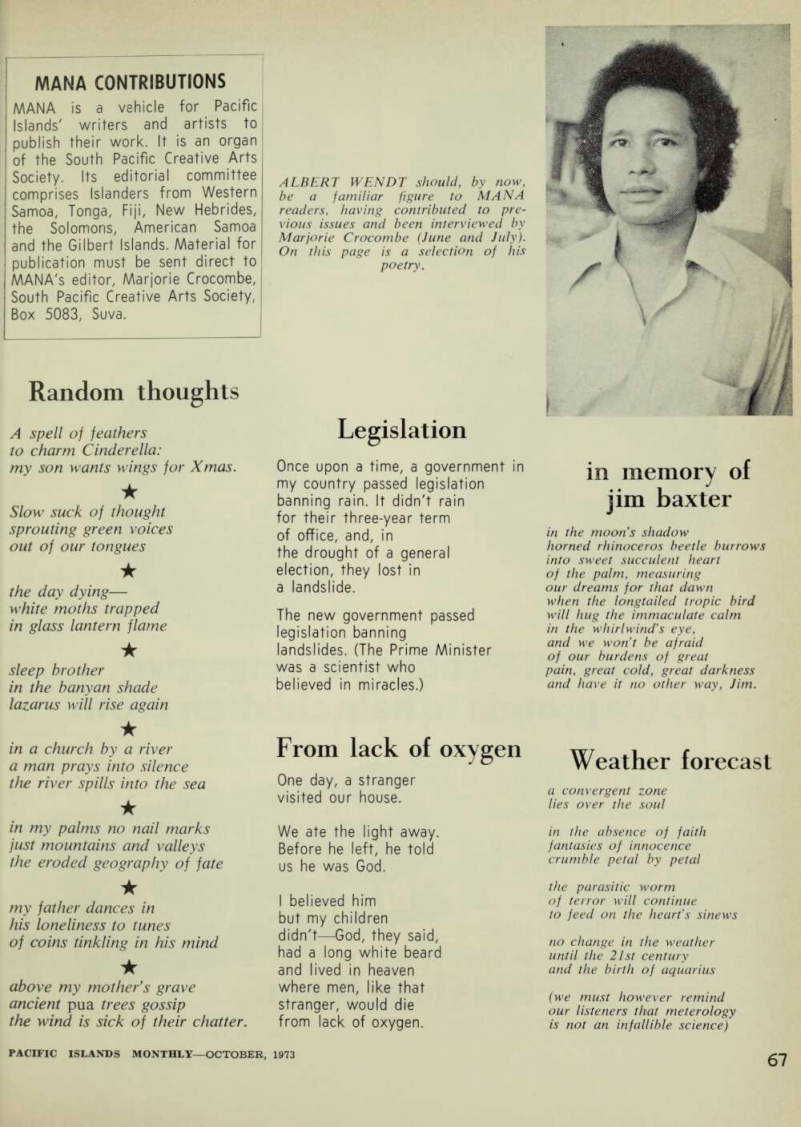
MANA is a vehicle for Pacific Islands' writers and artists to publish their work. It is an organ of the South Pacific Creative Arts Society. Its editorial committee comprises Islanders from Western Samoa, Tonga, Fiji, New Hebrides, the Solomons, American Samoa and the Gilbert Islands. Material for publication must be sent direct to MANA's editor, Marjorie Crocombe, South Pacific Creative Arts Society, Box 5083, Suva.
Legislation
Random thoughts
A spell of feathers to charm Cinderella: my son wants wings for Xmas. ★ Slow suck of thought sprouting green voices out of our tongues ★ the day dying— white moths trapped in glass lantern flame ★ sleep brother in the banyan shade lazarus will rise again ★ in a church by a river a man prays into silence the river spills into the sea ★ in my palms no nail marks just mountains and valleys the eroded geography of fate ★ my father dances in his loneliness to tunes of coins tinkling in his mind ★ above my mother's grave ancient pua trees gossip the wind is sick of their chatter.
Once upon a time, a government in my country passed legislation banning rain. It didn't rain for their three-year term of office, and, in the drought of a general election, they lost in a landslide.
The new government passed legislation banning landslides. (The Prime Minister was a scientist who believed in miracles.)
From lack of oxygen
One day, a stranger visited our house.
We ate the light away.
Before he left, he told us he was God.
I believed him but my children didn't—God, they said, had a long white beard and lived in heaven where men, like that stranger, would die from lack of oxygen.
in memory of
jim baxter
in the moon’s shadow horned rhinoceros beetle burrows into sweet succulent heart of the palm, measuring our dreams for that dawn when the longtailed tropic bird will hug the immaculate calm in the whirlwind’s eye, and we won’t be afraid of our burdens of great pain, great cold, great darkness and have it no other way, Jim.
Weather forecast
a convergent zone lies over the soul in the absence of faith fantasies of innocence crumble petal by petal the parasitic worm of terror will continue to feed on the heart’s sinews no change in the weather until the 21st century and the birth of aquarius (we must however remind our listeners that meterology is not an infallible science)
ALBERT WENDT should, by now, be a familiar figure to MANA readers, having contributed to pre vious issues and been interviewed by Marjorie Crocombe (June and July).
On this page is a selection of his poetry.
Advertisements & other items, p. 72 (1 item)
Four Hi-Protin milk rings give
extra protein to help children grow.
Protein is vital in assisting the healthy growth of children.
HI-PROTIN milk rings also contain essential vitamins and minerals for balanced development.
HI-PROTIN is specially baked to assist the healthy development of infants gums and jaws.
Delicious HI-PROTIN, good for everyone-from baby to grandpa.
All enquiries: Arnott-Brockhoff-Guest Pty. Ltd., Burwood, Victoria. Australia. 3125
Kids love them
Islands Press
From the Islands Press
A letter from lev Teufolau in the Tonga Chronicle: I wish to submit a request to People’s Representative Taniela Manu and Hon Ma’afu to please realise that his Majesty and nobles are not the only ones requiring a raise in their emoluments. There are civil servants who are suffering under rising costs today, and a perfect example is that mutton has gone up from 17 to 37 seniti a pound.
From the British Newsletter, New Hebrides: Large quantities of custom poisons or nakaimas were thrown into the sea round south-east Ambrym following a campaign by a Presbyterian Evangelical team led by Lay Pastor Jimmy Anson, says a report from Ulei. People who possess nakaimas may use it either for guarding themselves from danger, or to kill enemies. Pastor Anson and his team of 48 people are carrying on with their successful efforts to persuade people to throw away their poisons and lead a new life. They hope to complete their work in south-east Ambrym villages by next week.
The Tohi Tala Niue commenting on a statement by the retiring Resident Commissioner Mr Wilson that Niueans had, at last, learnt the art of social
drinking:
Alas, he was a little too kind. The fact is that quite a number of the drinking population have not, and we might also add that they don’t know when to stop. Drinking 24 bottles of beer on your own in less than two hours, or a mouthful of a mixture of gin, whisky and rum every five minutes, cannot by any stretch of the imagination be called social drinking. It appears also that an all-day all-night session has a particular attraction to some.
From a letter by J. A. Arnott in Atoll Pioneer, GEIC: The Otintai Hotel is not the only, nor necessarily the best, restaurant in South Tarawa. There are several on Betio, one of which, for my money, is streets ahead of the Otintai Hotel. For those who are interested, its toilet facilities are vastly superior to anything the Otintai Hotel has so far been able to provide.
From The Fiji Times: Famous British character actor Robert Morley expressed surprise when a Nadi businessman, Mr Mahendra Patel, of Motibhai and Co Ltd, recognised him in a group of passengers passing through Nadi Airport. Mr Morley, well-known for his upper-crust accent and evocative facial expressions, has returned to Britain with souvenirs of Fiji — Mr Patel gave him some Fiji police dolls.
From the Arawa Bulletin, Bougainville: Arawa may be thousands of miles away from the fashion houses of the world, but the girls here are not lacking in imagination. At a Tuesday night social evening at the Davara over Easter the natural look was certainly predominant, with the eye-catcher of the evening being Mrs C.
Bissett’s magnificent flared matador pants in the military colours of red, white and blue.
From a letter by R. C. B. Clark in Atoll Pioneer, GEIC: The Rest House (at Abaokoro) is more true to its name than the place which bears an eclectic title in Bikenibeu. It’s less than a two-hour launch trip from Betio, and offers the peace of an outer island, and an escape from the noise and dust of Urban Tarawa. Admittedly, there is no stove, lamp, cutlery, table and bed linen in the Rest House, and there are rats in the roof . . . And don’t expect to find a current copy of the Atoll Pioneer. It usually arrives there two weeks after publication.
Mr W. T. Bai, acting Commissioner for Corrective Services in PNG Post-Courier: Mistreatment of detainees in legal custody in Papua New Guinea is not and never has been condoned by the correctional services of Papua New Guinea. However, all human beings can, and sometimes do, err.
From Private Eye in Unispac, the USP students' newspaper: To solve our accommodation problem at USP, the Director of Student Services has suggested students volunteer to get married so that two can share one bed.
Application should be addressed to the office of the Director of Student Services.
From Group Radio News, New Hebrides: The sth of May was a special day for some people round the southern parts of Malekula. Report from Medical Assistant at South West Bay, Mr Willie Anson, said that in the three villages of Bonvar, Wintua and Law a over 100 people gathered in each village to celebrate the New Yam feast.
At Bonvar village more than 100 yams went to the feast. Wintua had over 120 people with one bullock and over 100 yams to eat. But Law a village could not manage a bullock, and provided two pigs for the meat and also many yams for the feast.
From Joe Murphy's Pipe Dreams column,
Pacific Daily News, Guam:
As you drive down Marine Drive this Friday afternoon, are you thinking the same thought as I am, which is, are our Guam auto dealers having the same banner this year that they had in 1972? The fact that the number of private autos on Guam jumped by 11,042 in a single year has been pretty widely publicised. You've got to assume that additional thousands died along the way, although you can also figure that the military brought in a few of the new ones. From 1963 to 1967 the average growth rate was about 1,000 cars a year. In 1971, the jump was 5,000, and the last year it leapt dramatically to 11,000.
I think they must have learned to reproduce.
Advertisements & other items, p. 74 (1 item)
pocket Instamatic
New Kodak
camera*
The little camera for big pictures
❖ Camera measures: 4 1 /2 x 2" x 1"
Small enough to slip into your pocket. Light enough to carry anywhere. So simple to use—just drop in the new 110-size film cartridge, aim, and shoot. Yet it takes big SVa" x 4Va" color pictures. Choose from the range of five new Kodak pocket Instamatic camera outfits —each complete with wrist strap, Kodacolor II film, magicube and instructions. There’s one priced to suit your pocket. See your local Island photo dealer.
KODAK (Australasia) PTY. LTD.
IHH ' ' - ; K6t/4391
Books, Reviews, writers

Crank Engineer's Dream Solves
The Secrets Of The Sea-Bed
With much interesting, hitherto un published information regarding most Island regions of the Pacific, com piled by authors from several nations and assembled into this large new volume, The Western Pacific-Island Arcs, Marginal Seas and Geochemistry is a recent concensus of general scien tific knowledge.
Its editor is no stranger to the peoples of Melanesia where he, with his colleagues Dick Stanton et al, shared the hardships and triumphs of pioneering discovery, with hammer, hand lens and bag—the tools with which the frontiers of Empire were being mapped 20 years ago.
The changes since then—and the contents of this volume—have been primarily due to developments in electronics that have been little short of astonishing. Data has been collected and processed at a tremendous rate.
Individual pigeon-holes of 20 years ago have had their partitions disinte grate through sheer activity; each sub ject has been rejuvenated by other branches of science. In particular geology has been transformed by the impact of geophysical and geochemi cal findings by land, sea and air.
After lying on the shelf for 120 years as the dream of a “crank” en gineer, computers have become a rea lity. A university master’s degree in mathematics is said to deal with knowledge only to the year 1904. The full implication of computer availa bility to earth scientists boggles the imagination.
In the 19505, a sea gravity survey required a submarine; each single reading was a separate naval opera tion involving a star-sight for loca tion and a dive to lie at 200 ft so that two pendulums could be swung in opposition on the same bar, and timed. Today, shipboard gravity meters make continuous recordings —teething troubles had been ironed out by the time of the Solomons Sea Gravity Survey by HMS Dampier in 1965. Magnetic measurements used to involve cumbersome equipment. Today it involves an ordinary plastic bottle
of water with an intermittently-acti vated coil of electric wire around it, held by hand or towed in a “fish” by a ship or in the tail “stinger” of an aircraft—with continous recording.
In the Solomons in 1960 a seven year Tellurometer survey began with distance being measured to a fraction of an inch in 40 miles. In 1967 these measurements were extended beyond the horizon by three army-manned mobile satellite tracking stations— with satellites sent up specially from Cape Kennedy.
Aerial photography permits the most precise measurement of river widths, bank heights, tree and grass heights and contoured maps. Side-look radar can produce maps by electro magnetic responses that closely re semble aerial photos—taken through impenetrable cloud cover as though it does not exist. Similarly—and it is described in this volume —towed vehicles travelling close to the sea
bed exploring valleys and plains are equipped with side-look sonar that plots sea-bed outcrops and structures to 1 km on each side. The American Government has presented countries around the world with World Stan dard Seismological Stations and all accoutrements —this has helped us im measurably in earthquakes studies by providing more accurate hypecentres.
Developments have been startling in any language, making such a volume as this possible.
Heavily dominated by the so-called “New Global Tectonics” or “Plate Tectonics” hypothesis referred to sceptically by one writer as the“ Co nveyor Belt Theory”, Coleman asks whether this aspect of the volume is essentially an American phenomenon.
Nearly all scientists have come to accept that the ocean floor is being added to out of mid-oceanic rises because magnetic surveys show strips of matching magnetism, signifying comparable volcanic extrusions equi distant on each side of these mid oceanic rises. But “Plate” supporters say that Earth does not expand and there must be comparable “conveyor belting” of crust down into the tren ches (“subduction”) —the present fashionable hypothesis.
Only one contributor, Professor Sam, Carey, throws very heavy, well reasoned doubts, believing it to be a passing fad, pointing out that earth quake profiles below the trenches do not show thousands of km of crustal shortening but rather expansion of the Earth: recent work in New Britain and Solomons seems to lend support.
In 1939 “continental drift” was similarly denied and supporters were scorned until the mid-fifties. Today, while proclaiming this separation of continents, geophysicists deny ex pansion, insisting on “subduction” in to the trenches, while most geologists rush to concur and will not look at contrary evidence. Why is expansion so unspeakable?
Space will not allow treatment of individual papers by a distinguished collection of authors, well illustrated
by maps and sketches.
A list of Collected References con tains all references named by authors.
Although seismicity of the New Heb rides is a subject, the absence of mention of Blot’s papers from a de cade of five-dimensional studies by ORSTOM is notable. It would also seem that most workers are not aware of the five volumes published by the British Solomon Islands Pro tectorate Geological Survey and other publications by the ensuing United Nations Project. Fortunately, the works of Woollard, Laudon, Rose and Furumoto on this critical area have received honourable mention.
A useful comprehensive index con cludes the volume.
Those involved in island arc or marginal field studies or in teaching earth sciences would do well to pos sess a copy of this volume as a con venient reference to current thinking.
John Grover.
(The Western Pacific-Island
Arcs, Marginal Seas And Geo
CHEMISTRY. Edited by P. J. Coleman.
Western Australian University Press. $24).
Teamwork In The
Mission Field
• Since May 1891 the Methodist Church of Australasia has published without a break a missionary journal —The Missionary Review, a mine of information concerning the growth and development of the Christian church in the Pacific area and also a record of the missionary work of the church in Asia and other areas. More and more these volumes are being used by research students studying Pacific affairs.
The Review is published quarterly and this year the Congregational Council for World Mission, Australia and New Zealand, previously the London Missionary Society, has joined with Methodist Overseas Missions in the publication of the journal. The Missionary Review is now the official organ of Methodist Overseas Mis sions and the Congregational Council for World Mission.
Advertisements & other items, p. 76 (1 item)
Ar
*WM awwws 3 f.f&fe;
Pick of the paperbacks
The Godfather Papers, By Mario
Puzo, who evidently believes that, if you've got a good thing stick to it.
Which is what he does with this ac count of how his best-seller The God father, the shock novel about the Mafia in the United States, came to be written and filmed. It's also a warn ing against being too successful. (Pan, $1.40.) COME INTO MY WORLD, by Buster Lloyd-Jones, is an ex-society vet's reminiscences of the animals and people he met during his career, a career which polio ended for him. As a sequel to his first book The Animals Came in One by One, it is another treat for animal lovers, though there's nothing sugary in it. It's hard to say who made his job so humour-filled, animals or humans—or ghosts! (Fon tana, $1.00.)
The Wrong People, By Robin
Maugham, is something entirely dif ferent from one of his previous books about the Joyita mystery, which he wrote after buying, then selling the successor to the Marie Celeste, Joyita, which ended its days on Levuka's beach. The Wrong People, to some, will be the wrong people. It's a discretionary story of a repressed homosexual schoolmaster's passion for an Arab boy. Ugh! (Pan, $1.40.)
Onward Virgin Soldiers, By
Leslie Thomas, is a lusty sequel to his first best-seller The Virgin Soldiers, which was all about love and war during the Emergency in Malaya. This one's about love (lust) and army life in Hong Kong. Unlike the adventure in Malaya, there are no narrow escapes from bandits, only from cuckolded husbands. (Pan, $1.50.)
A Chance To Sit Down, By
Meredith Daneman, is described as a "heady insight into a woman's deepest feelings". As the author's a woman, she should know what she's writing about—the career of a ballet dancer, on the stage, in the dressing-room and in bed, several beds. It all adds up to a problem which some women have faced since the day after the dawning of time—whether to enjoy one's career, or one's men, or motherhood. (Pan, $1.00.)
Anthropology In Papua New
GUINEA, edited by lan Hogbin, is sub titled Readings from the Encyclopaedia of Papua New Guinea, and in fact is a collection of anthropological papers from that massive tome, but updated.
As Professor Hogbin points out, some of the pieces were first prepared by their authors as long ago as 1967, and much has happened since. Melbourne University Press, which published the
encyclopaedia, also publishes this
large format paperback, which includes pieces on PNG social structure, child rearing, sorcery and witchcraft, tradi tional political organisation, land ten ure, religion, magic, and many others.
There is also a glossary of anthro pological terms and an invaluable list of Papua New Guinea groups and where they live. Who would guess that there are Yam people (they come from Astrolabe Bay, Madang)! (Mel bourne University Press $5.70.) THE MICKS, by Peter Verney, should appeal to all Irishmen, and others, in the South Pacific. It is the story of the Irish Guards in the two World Wars and in cleaning-up oper ations in some of the post-war trouble spots. (Pan $1.65.)
There's money

and soup for sea farmers
I had not realised until I read Australian Sea Turtles that turtle soup is not made from the fleshy parts of the beast but from a sub stance called calipee prepared from its lower shell.
To slay a turtle weighing some two or three hundred pounds for the sake of a few ounces of heavily flavoured gelatin might be accounted a wanton sacrifice but, of course, a turtle also yields a good quantity of meat and oil as well as excellent leather and shell. So it is a much sought after creature, and since human demand continues to rise, one is not surprised to learn that in many parts of the world turtle populations have been drastically reduced.
The Australian region is one of the few happy exceptions, but as the author. Dr Robert Bustard, points out, it is only a matter of time be fore the rookeries of the Barrier Reef and the Torres Strait islands will be as heavily pressured as most others.
He argues in this book that now is the time to take steps that will not only preserve our local popu lations but also help to restore the global population to its former high level. If we were to do this, har vesting could continue without danger of bringing turtles to the point of extinction.
Much of Dr Bustard’s book deals with the general biology of turtles.
Since the seven species are widely spread throughout the warmer seas of the world, the title of the book is at first sight something of a mis nomer. BuT, as Dr Bustard indicates, a significant section of his subject matter deals with methods and results of his surveys and estimates of turtle population numbers, rookery sites, and so on, around the Queensland coasts, and hence there is some justification for giving a national bias to the title.
So do not be misled: while the book is a specific contribution to Australian natural history it is also of considerable interest to anyone con cerned with turtles, whether from a biological or an economic point of view, anywhere in the world.
The final section of the book deals with the prospects of conserving turtle populations, and even of farming them. Dr Bustard is very keen on farming them and after discussing
some of his own pilot schemes oper ating on Darnley and Murray is lands, as well as the experience of ;he world’s first turtle farm in the British West Indies, he comments that ‘it may not be long before the green ;urtle is added to the short but growing Ist of animals domesticated by man”.
He points out that those factors 3f turtle biology that make them
susceptible to human predation are the very factors that make them ideal creatures for farming. The problems are not technical but economic, legal and political.
Dr Bustard is well qualified to write this book. He is well-known to Australian zoologists as a herpeto logist and they have followed his work on reptiles in general, and turtles in particular, with keen interest. This book, well written and handsomely illustrated as well as containing a good bibliography and index, will be received by them with considerable gratitude. —John Simons.
(Australian Sea Turtles. By Robert
Bustard. Collins. $5.95).
Advertisements & other items, p. 78 (1 item)
8-Speed
j i
Power
Blender
-the
appliance
you can use
every meal.
With powerful, Solid-state motor. Solid-state means added versatility for exactly the blending action you need —to stir, puree, cream, whip, grate, mix, chop or liquefy.
Stainless steel cutters operate at high speed for fast food preparation.
Switch from speed to speed without turning off.
L 83.3335
A Formidable People The Chimbus!
What a valuable book Paula Brown las written with The Chimbu, but low many will read it? I mean resi lents of New Guinea, both black and vhite. There are those who say there is a sort of contest between the Tolai md the Chimbu for control of New Suinea.
The proponents of this theory night find much they did not realise n Dr Brown’s book, and, read in con unction with the Epsteins whom she quotes, might make an interesting comparison between the Tolais’ con cern with the past and the Chimbus’ attachment to the present. To say that Dr Brown’s work is useful is the best compliment I can pay, for I think he work of anthropologists now should be of practical use. I think Dr Brown’s work is useful, and I lope use is made of it.
What a formidable people the Chimbu are. Paula Brown should enow since she has been finding out about them for 15 years. For in stance, what other people are there vho “did not readily compartmen :alise their activities as ‘before’ and now’, or ‘old Chimbu’ and ‘white man’s’; rather they lived in the recognising that the only constant is change.” A unique people? [ think so, and therefore a people to oe reckoned with.
Dr Brown has covered what seems :o me to be every aspect of the life md living of the Chimbu people. Of course, such a work must contain some of the jargon of science, but Fhe Chimbu is much more readable ban many such books. I need hardly say it deals with the people who are ■eally Chimbu and not those from Dther parts of the Highlands dubbed Chimbu by ignorant coastal people.
To many, the Chimbu will emerge
from the book a people very different from what imagination has made them. The chapter on their pre history is fascinating. It is a pity there is not a Paula Brown for every ethnic group in New Guinea for this is a book which might be read with ad vantage by those about to take over the government of Papua New Guinea.
The white administrators have been badly informed about most of the in digenous people of New Guinea, but then so have the indigenous people about their fellow New Guineans.
Peter Livingston. (THE CHIMBU. By Paula Brown.
Schenkman Publishing Co Inc, Cambridge, Mass. USA. Distributed by General Learn ing Press, Morristown, New Jersey).
history here
There's no dry history here
Few people, who were post adolescents in Britain in the dark days of 1940 when the “phony war” ex ploded into the real thing and the French Republic, in its shameful col lapse, was revealed as a corrupt institution, riddled with treachery and intrigue, will forget that tense, worried look, almost fear, which most people wore on their faces.
What went on in France at that time? Why should the Third Republic, with a seemingly impregnable Maginot Line and months in which to com plete its defence plans, have collapsed like a pack of cards? The answers lie in the history of the republic from 1871 onwards as told by American author and historian William L.
Shirer, who needs no introduction other than that he was the author of Rise and Fall of the Third Reich.
The Collapse of the Third Republic, a fat Pan paperback ($2.30), is no dry-as-dust history. He puts drama into his facts, and he writes of many incidents —the rape of Czechoslo vakia, the Nazi-Communist pact which left the way open for Hitler’s invasion of Poland, the invasion of Norway and the fall of France — through the eyes of many witnesses, the famous and the unknown, those who recorded events before they too were overtaken by them and perished, and those who lived to tell the tale.
The whole is immensely readable; an index and an extensive biblio graphy add to the book’s value.— JC.
Advertisements & other items, pp. 79-82 (2 items)
75
ACIFIC ISLANDS MONTHLY—OCTOBER, 1973
The Journal of Pacific History
A scholarly journal concerned with the history of the peoples of the Pacific Islands, containing much of the most authoritative writing on the subject.
VOLUME VII 1972
256 pages: articles based on recent research, sections on Current Developments, Manuscripts and Publications, Book Reviews, and Index to volumes I-VI.
Published annually—subscription $A4.75 or equivalent
(SUS6.OO).
Correspondence and subscriptions to Editors, The Journal of Pacific History, Australian National University, Box 4, P. 0., Canberra, A.C.T. 2600, Australia.
; j - > <* - - " ■ . „ - * '- • :>-«► . ** *'*«*£* m:0?0& nimH' 111 ” “" ' 11 V -'' C , i ■ " •x U' - --• tjf*'
£* 'iii;;
. ■ : -. : - T m - -r: -■*..*>: 4IJ jpg . * II ■ m - ;-■ M , ’ **
mSoBW?.
The Choice of the PROFESSIONALS
Twin GARDNER BLXB Engines and a GARDNER 4LW auxiliary are the choice of Mr. Roco Musemici of Wollongong, N.S.W., to power the "JOSEPHINE JEAN", 70 ft. x 20 ft. x 8 ft. 6 ins., speed 1 2i knots with a total fuel consumption of only
gallons per hour.
*9% /bV""- GARDNER Diesel Engines are the only choice of
the Profesional Fiherman who demands reliability
and economy second to none.
GARDNER Diesels 56 to 230 H.P. are now avail-
able for immediate delivery from:
PTY
LTD-
KNOX SCHLAPP
135-139 McEvoy St., Alexandria, N.S.W. 2015. Tel.: 699-8333
Telex: AA20483 Telegrams: "Knoxschlap", Sydney.
SUB DISTRIBUTORS: SHERWOOD ENGINEERING, RABAUL;
S. A. HEATH & SONS, PORT MORESBY.
unspoiled areas in the world
THE SOLOMON ISLANDS
Janet Kent
All you wanted to know about the Solomon Islands, and couldn’t find until now. Janet Kent tells the Solomons story ... the people, the geography, the history, World War II and its aftermath ... in this 221-page book which includes 19 pages of illustrations and maps. She brings the Solomons up to date, and adds a chapter on Horiara Holidays—where to stay and what to do. Published by Wren Publishing, but available to PIM readers at a special price.
Full details and Order Form overleaf.
Please send copy(ies) "The Solomon Islands" to: — name address city/state/country/post code for which payment of is enclosed.
Pacific Publications (Ausf.) Pty. Ltd., t 29 Alberta Street, Sydney, N.S.W. 2000. (Postal address: Box 3408, G.P.0., Sydney, N.S.W. 2001) When ordering ask for our Pacific book catalogue
D OCTOBER, 1973—PACIFIC ISLANDS MONTHLY
Pacific Shipping
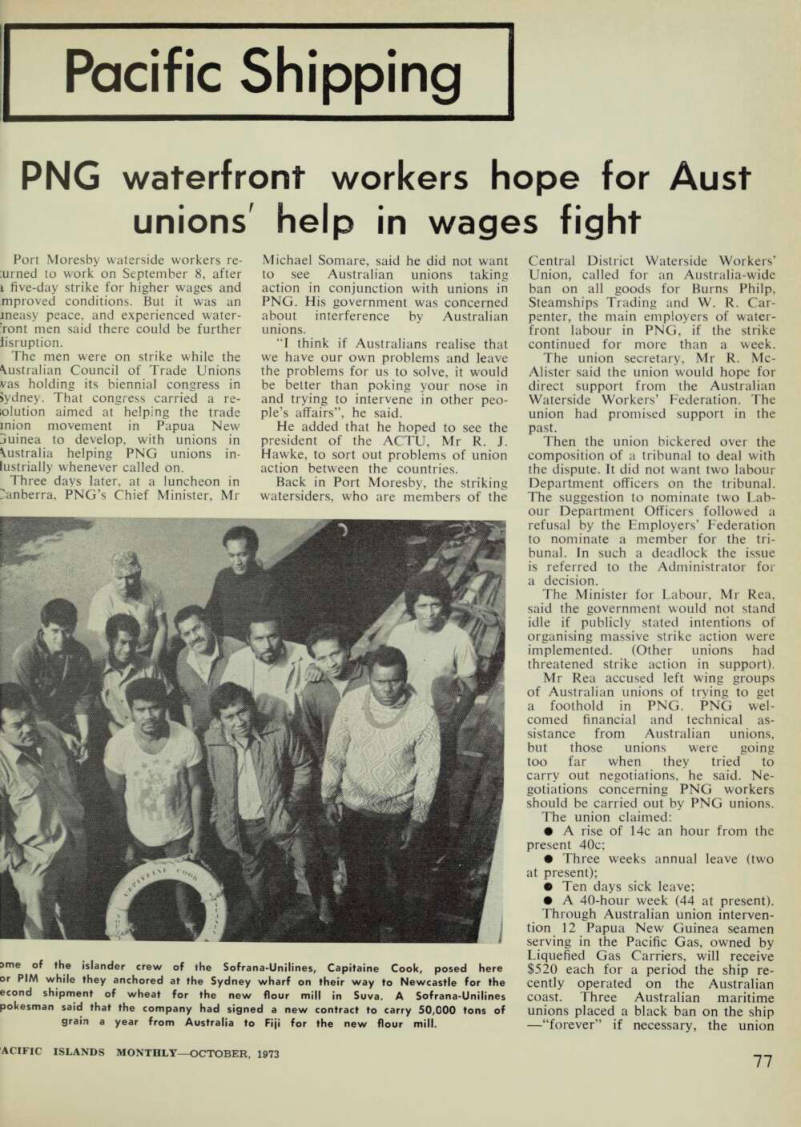
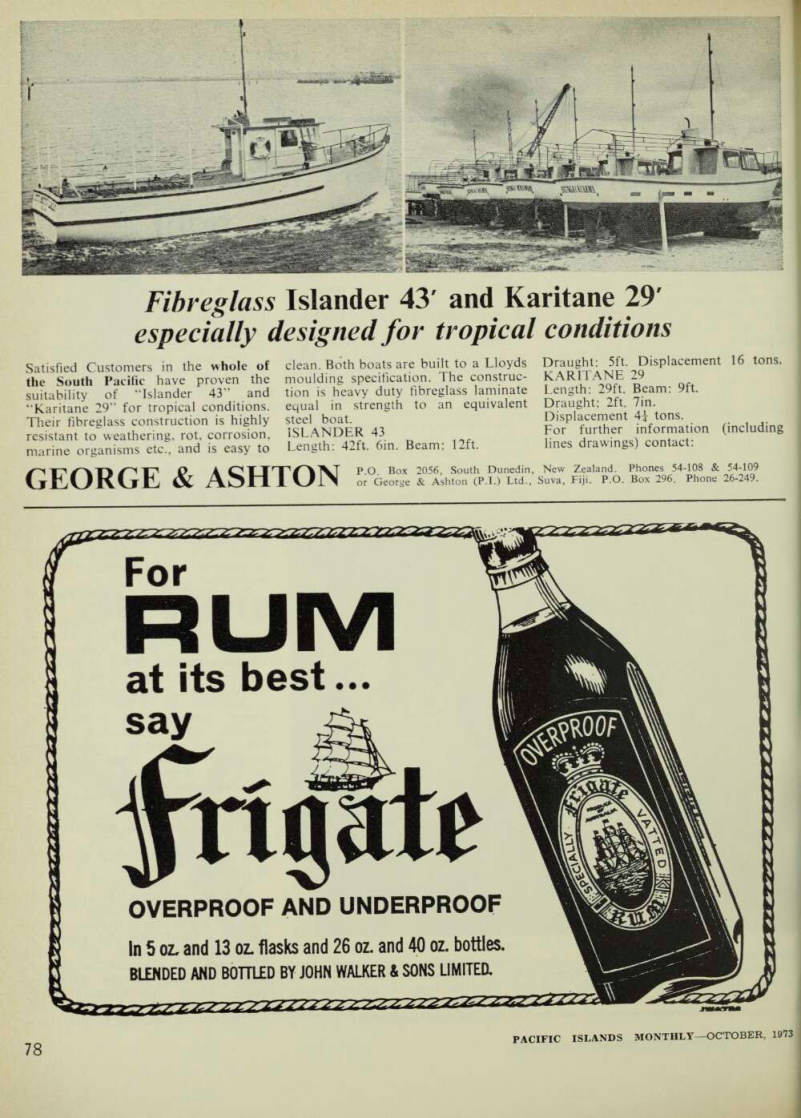
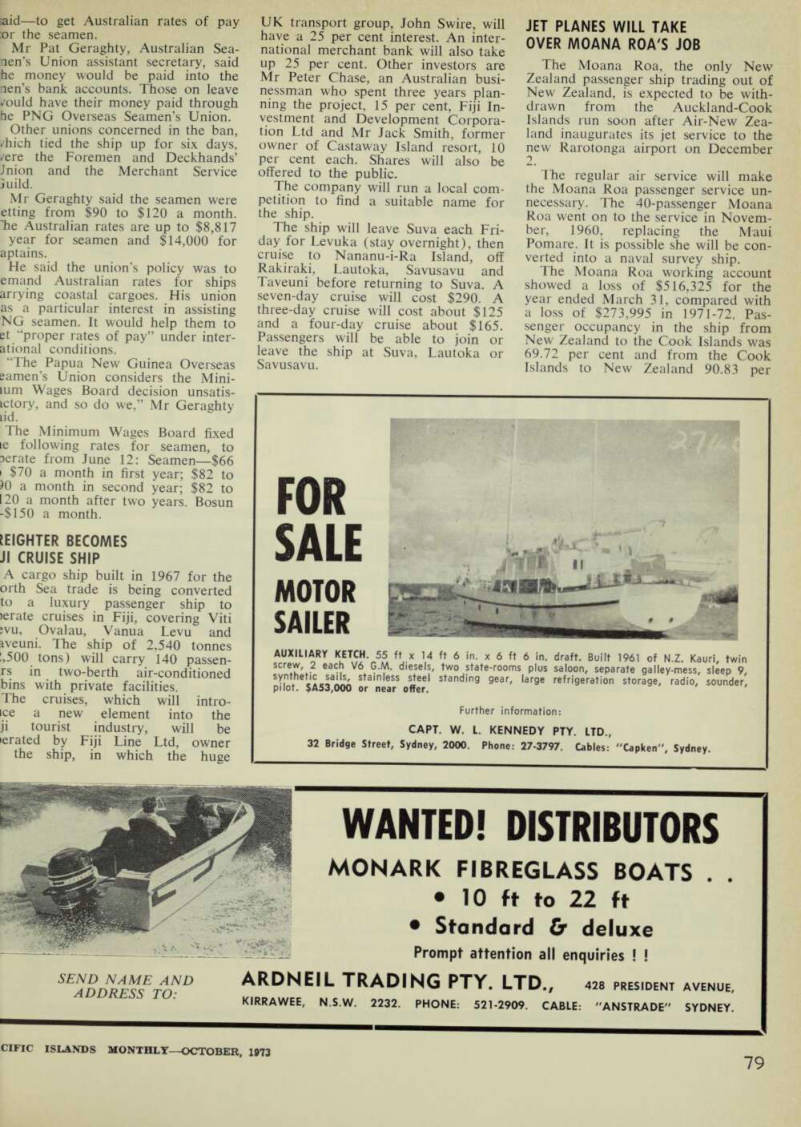

PNG waterfront workers hope for Aust unions' help in wages fight
Port Moresby waterside workers re ;urned to work on September 8, after i five-day strike for higher wages and mproved conditions. But it was an ineasy peace, and experienced water :ront men said there could be further iisruption.
The men were on strike while the \ustralian Council of Trade Unions vas holding its biennial congress in Sydney. That congress carried a re olution aimed at helping the trade inion movement in Papua New juinea to develop, with unions in Australia helping PNG unions in lustrially whenever called on.
Three days later, at a luncheon in Canberra, PNG’s Chief Minister, Mr
Michael Somare, said he did not want to see Australian unions taking action in conjunction with unions in PNG. His government was concerned about interference by Australian unions.
“I think if Australians realise that we have our own problems and leave the problems for us to solve, it would be belter than poking your nose in and trying to intervene in other peo ple’s affairs”, he said.
He added that he hoped to see the president of the ACTU, Mr R. J.
Hawke, to sort out problems of union action between the countries.
Back in Port Moresby, the striking watersiders, who are members of the
Central District Waterside Workers’
Union, called for an Australia-wide ban on all goods for Burns Philp, Steamships Trading and W. R. Car penter, the main employers of water front labour in PNG, if the strike continued for more than a week.
The union secretary, Mr R. Mc- Alister said the union would hope for direct support from the Australian Waterside Workers’ Federation. The union had promised support in the past.
Then the union bickered over the composition of a tribunal to deal with the dispute. It did not want two labour Department officers on the tribunal.
The suggestion to nominate two Lab our Department Officers followed a refusal by the Employers’ Federation to nominate a member for the tri bunal. In such a deadlock the issue is referred to the Administrator for a decision.
The Minister for Labour, Mr Rea, said the government would not stand idle if publicly stated intentions of organising massive strike action were implemented. (Other unions had threatened strike action in support).
Mr Rea accused left wing groups of Australian unions of trying to get a foothold in PNG. PNG wel comed financial and technical as sistance from Australian unions, but those unions were going too far when they tried to carry out negotiations, he said. Ne gotiations concerning PNG workers should be carried out by PNG unions.
The union claimed: • A rise of 14c an hour from the present 40c; • Three weeks annual leave (two at present); • Ten days sick leave; • A 40-hour week (44 at present).
Through Australian union interven tion 12 Papua New Guinea seamen serving in the Pacific Gas, owned by Liquefied Gas Carriers, will receive 5520 each for a period the ship re cently operated on the Australian coast. Three Australian maritime unions placed a black ban on the ship —“forever” if necessary, the union
Some of the islander crew of the Sofrana-Unilines, Capitaine Cook, posed here for PIM while they anchored at the Sydney wharf on their way to Newcastle for the second shipment of wheat for the new flour mill in Suva. A Sofrana-Unilines spokesman said that the company had signed a new contract to carry 50,000 tons of grain a year from Australia to Fiji for the new flour mill.
laid —to get Australian rates of pay :or the seamen.
Mr Pat Geraghty, Australian Sea tien’s Union assistant secretary, said he money would be paid into the nen’s bank accounts. Those on leave /ould have their money paid through he PNG Overseas Seamen’s Union.
Other unions concerned in the ban, ✓hich tied the ship up for six days, /ere the Foremen and Deckhands’
Jnion and the Merchant Service juild.
Mr Geraghty said the seamen were etting from $9O to $l2O a month.
Tie Australian rates are up to $8,817 year for seamen and $14,000 for aptains.
He said the union’s policy was to emand Australian rates for ships arrying coastal cargoes. His union as a particular interest in assisting NG seamen. It would help them to et “proper rates of pay” under inter ational conditions.
“The Papua New Guinea Overseas eamen’s Union considers the Mini mm Wages Board decision unsatis ictory, and so do we,” Mr Geraghty lid.
The Minimum Wages Board fixed le following rates for seamen, to ?erate from June 12: Seamen—s 66 • $7O a month in first year; $B2 to )0 a month in second year; $B2 to 120 a month after two years. Bosun -$l5O a month.
Lighter Becomes
Jl Cruise Ship
A cargo ship built in 1967 for the orth Sea trade is being converted to a luxury passenger ship to >erate cruises in Fiji, covering Viti ;vu, Ovalau, Vanua Levu and iveuni. The ship of 2,540 tonnes '>soo tons) will carry 140 passen rs in two-berth air-conditioned bins with private facilities.
The cruises, which will intro ice a new element into the ji tourist industry, will be •crated by Fiji Line Ltd, owner the ship, in which the huge
UK transport group, John Swire, will have a 25 per cent interest. An inter national merchant bank will also take up 25 per cent. Other investors are Mr Peter Chase, an Australian busi nessman who spent three years plan ning the project, 15 per cent, Fiji In vestment and Development Corpora tion Ltd and Mr Jack Smith, former owner of Castaway Island resort, 10 per cent each. Shares will also be offered to the public.
The company will run a local com petition to find a suitable name for the ship.
The ship will leave Suva each Fri day for Levuka (stay overnight), then cruise to Nananu-i-Ra Island, off Rakiraki, Lautoka, Savusavu and Taveuni before returning to Suva. A seven-day cruise will cost $290. A three-day cruise will cost about $125 and a four-day cruise about $165.
Passengers will be able to join or leave the ship at Suva, Lautoka or Savusavu.
Jet Planes Will Take
Over Moana Roa's Job
The Moana Roa, the only New Zealand passenger ship trading out of New Zealand, is expected to be with drawn from the Auckland-Cook Islands run soon after Air-New Zea land inaugurates its jet service to the new Rarotonga airport on December The regular air service will make the Moana Roa passenger service un necessary. The 40-passenger Moana Roa went on to the service in Novem ber, 1960, replacing the Maui Pomare. It is possible she will be con verted into a naval survey ship.
The Moana Roa working account showed a loss of $516,325 for the year ended March 31, compared with a loss of $273,995 in 1971-72. Pas senger occupancy in the ship from New Zealand to the Cook Islands was 69.72 per cent and from the Cook Islands to New Zealand 90.83 per
;cent in 1972-73. In 1971-72, the occu pancy rates were 81.5 per cent to the Cook Islands and 99.25 per cent to New Zealand.
Boom Time In
Pago Harbour
The Department of Port Adminis tration in American Samoa earned revenue of $656,792 in the 12 months to June 30, an increase of 33 per cent aver the previous 12 months. In creases were recorded in 11 major categories of the department’s activi ties, including water transport charges vhich increased by 82 per cent to 579,539. Most of the other substantial ncreases reflected a 6 per cent in crease in the number of vessels enter ng Pago Pago harbour—from 1,091 n 1971-72 to 1,166 in 1972-73. Other ncreases included (1971-72 figures n brackets): Dockage, $66,014 $35,031); pilotage, $44,333 $31,250); tonnage tax, $148,096 $114,645); wharfage, $287,863 $213,076).
[Arlander Steps Up
Ul Services
Karlander (Aust) Line has stepped ip its services into Fiji from Austra ia. The Salamaua is now taking in 7 iji after calling at the New Hebrides nd two ships of the Mexican line, 4ardina, for which Karlander is Australian agent, are now calling at >uva and Lautoka. These are the .astragoni and the Mardina Exporter, /hich carry refrigerated cargo be ween Australia and Mexico. Both hips will also call at Papeete on the 'ay from Australia to Mexico. Kar mder also services Fiji with the levik.
Karlander recently sold the Slembe, 'hich was on the Australia to /ewak, Manus and Dayapura run to ar Eastern interests, and replaced with the Alderjo. • Fourteen Samoan seamen left le Samoan Bay at Suva in August ecause the ship was not calling at ipia. The Samoan Bay, operated by United Steam Ship Ltd, of Vila, was n a “shakedown” return trip to Fiji om Sydney. She did not have lough cargo to warrant a call at pia. The Samoans were replaced by 3 Fijians. • Without so much as “by your ave”, two Japanese trawlers “in ided” GEIC territorial waters :cently without clearance from the ithorities, and the crew of one ship, ie Tonyso, which anchored at enualanga Islet, went ashore on ukulaelae and took some coconuts, hey visited the main village where ieir request for pork and chickens as refused.
Advertisements & other items, pp. 83-88 (4 items)
77
ACIFIC ISLANDS MONTHLY—OCTOBER, 1973
friptc
u U •V •’
Fibreglass Islander 43' and Karitane 29'
especially designed for tropical conditions
Satisfied Customers in the whole of the South Pacific have proven the suitability of “Islander 43” and “Karitane 29” for tropical conditions.
Their fibreglass construction is highly resistant to weathering, rot, corrosion, marine organisms etc., and is easy to clean. Both boats are built to a Lloyds moulding specification. The construction is heavy duty fibreglass laminate equal in strength to an equivalent steel boat.
ISLANDER 43
Length: 42ft. 6in. Beam: 12ft.
GEORGE & ASHTON
P.O. Box 2056, South Dunedin, or George & Ashton (P. 1.) Ltd., Draught: sft. Displacement 16 tons.
KARITANE 29
Length; 29ft. Beam; 9ft.
Draught: 2ft. 7in.
Displacement 4i tons.
For further information (including lines drawings) contact: New Zealand. Phones 54-108 & 54-109 Suva, Fiji. P.O. Box 296. Phone 26-249.
T7 TZZZZSZSXZZ
For
RUM
at its best...
say
friptc
OVERPROOF AND UNDERPROOF
In 5 oz. and 13 oz. flasks and 26 oz. and 40 oz. bottles.
BLENDED AND BOTTLED BY JOHN WALKER & SONS LIMITEa 2 X
I*o lb# iJ if sm
FOR
SALE
MOTOR
SAUER
AUXILIARY KETCH. 55 ft x 14 ft 6 in. x 6 ft 6 in. draft. Built 1961 of N.Z. Kauri, twin serew, 2 each V 6 G.M. diesels, two state-rooms plus saloon, separate galley-mess, sleep 9, synthetic sails, stainless steel standing gear, large refrigeration storage, radio, sounder, pilot. $A53,000 or near offer.
Further information:
CAPT. W. L. KENNEDY PTY. LTD.,
32 Bridge Street, Sydney, 2QOO. Phone: 27-3797. Cables: "Capken", Sydney.
9
WANTED! DISTRIBUTORS
MONARK FIBREGLASS BOATS . .
• 10 ft to 22 ft • Standard & deluxe Prompt attention all enquiries ! !
SE aEdr A ess E to^ D ARONEIL TRADING PTY. LTD., 4 28 president avenue KIRRAWEE, N.S.W. 2232. PHONE: 521-2909. CABLE: "ANSTRADE'' SYDNEY
• To Islands Cordial-makers . . . Pastrycooks
FOLLOW THE EXAMPLE OF
Confectioners . . .Canners .
AUSTRALIA'S LEADING FOOD PROCESSORS
WHO FOR 30 YEARS HAVE CONSISTENTLY USED
GOLD BADGE
FINE QUALITY
ESSENCES and EDIBLE COLOURS
c
BRAND
O.LT
Samples are available for manufacturers We ore Flavouring Specialists producing highly concentrated soluble essences for the food industries and invite your enquiries, either direct or through your usual buying channels
KEITH HARRIS & CO. LTD.
Sefton Road, Thornleigh, N.S.W.
Cables: Kehar, Sydney 1015 Ann Street, Valley N.l, Qld Cables: Keharbris, Brisbane
PROJECTS ANY FLAT IMAGE (4" wide or less)
UP TO 6 FEET WIDE
FOR A “HOME THEATRE "
ON YOUR WALL!
AMAZING HOME THEATRE
¥ a- Actual photo of this
high quality
projector — Size 12" x 8"
FULL GUARANTEE WITH EVERY PROJECTOR
Now project a modest 4" wide illustration—and enlarge it monumentally up to 324 times its original picture area . . . breathtakingly sharp°and clear! A 3*" x 3" illustration enlarges 035 x 30" if screen is ft away from projector—larger picture if screen is further away. No films or negatives required. Proiects anything flat —magazine or book pages, photos, diagrams, draw-
FOR ONLY
FOR ONLY
CIO - p^us 90c I 7 post and pack) $37 (post free) mgs, charts, coins, snapshots, postcards, stamps, etc.. “ black-and-white or beautiful true-to-life color! Has adjustable j)rofessional-type lenses. Great fun for all ages—educational sate and simple to operate. But hurry! Special prices for ••mited time only! Agents who can stock a minimum of 6 of these projectors are required in all areas. Enquiries welcome.
TO: R. HALL, 19 MARK STREET, NEW FARM, BRISBANE, QUEENSLAND, 4005. , „ 7) Please rush ,o me - □ 1 Home Theatre Projector (I enclose $19.90) □ 2 Home Theatre Protectors (I enclose $37).
ADDRESS
PIM 10/73
NAME
PETER FISHER TRADING
PTY. LTD.
321 PITT STREET, SYDNEY, 2000, AUSTRALIA
TELEPHONE: 26-1109 CABLES: "FISHERION", SYDNEY
EXPORTERS TO THE PACIFIC
ISLANDS
Some of the firms and products we represent: GREENLITES waterproof matches LUCKY STAR tinned fish REDHEADS safety matches RENA vegetables in glass jars
MAURI BROS, yeast FOREMOST FOODS CO.
PMU food products FOREMOST CONSOLIDATED TOOHEYS beer
CARLTON UNITED beer
CLUB RUM
ROGOVI VODKA
FRENCH KNIT car seat covers THREE STAR corned beef
CRAVEN confectionery
BROWNBUILT office furniture ADVANCE containers HARDIE'S building products SEBEL furniture BEARD beds and mattresses HUNTER DOUGLAS furniture KLINKII plywood STERLING bakery machinery WHITE ABBEY Scotch whisky BATA shoes SPC tinned fruit
LIFESAVERS confectionery
CHILTONIAN biscuits
MACHETTES
ATLAS plastic ware POLARIS stainless steel ware FOSTER—Beer in bottles or cans V.B.—Beer in bottles or cans BOND'S underwear BOND'S outerwear ANDY spotlights COUNTRY CLUB shirts FILLETTA tinned fish PAULCALL tools ASTRA razor blades WENGER quality knives GLYNGORE tinned fish VAN DER LAAN tinned meat DEROPA gift paper WARBURTON FRANKI coolrooms DURABUILT prefabricated houses THREE X (XXX) tinned hake BRONTE tinned meat HEINEKEN beer
SHEATH KNIVES
GOLDEN STATE evaporated milk SMALL chocolate TULIP chocolate GOLDSTEIN—Food equipment
AND MANY MORE
PROPERTY INVESTMENT
SUNSHINE COAST—QUEENSLAND
We invite inquiries regarding living or investment in this area.
We have a full coverage of holiday lettings, flats, motels, homes, farms, businesses and sub-divisional land.
Write direct to MABIN & BLOWERS Pty. Ltd. (Members R.E.1.Q.),
11 BURNETT STREET—BUDERIM, Q., 4556
Sfe^SL-
/5 dsMst£ amoy <so2..
Q ''AS ,
*2? »*r
I'kjhj
fy-ks# 75 o
710 y'&CsJ*
Just dial a different angle until the nib position is exactly how you want it.
Your fingers rest in the curved grip of a : Parker 75, so you write relaxed.
Fill up from an ink bottle, or load with a special Parker cartridge. It has a 'tap tank in reserve, for up to 700 more words after you think your ink's run out!
Every Parker 75 passes 792 inspections before you see it. Sterling quality, so it’s sterlin g silver Or rolled gold, or Vermeil which is 14 ct gold on silver.
+PARKER
Maker of the world's wom wanted pens <■ •‘as*.-.-.'
Cific Islands Monthly—October, 1973
81
ICIFIC ISLANDS MONTHLY—OCTOBER, 1973
Islands face more freight rate rises
Freight rates in a number of Pacific reas are about to rise, or have risen, Kth one refreshing exception—Trans ■ac Lines Inc substantially reduced hem for rice, flour and milk for licronesian consignees from Septem er 1.
American Samoa is bitterly con *sting attempts by Pacific Islands ransport Line (PITL) and Poly esia Line Inc (PLL) for increases s high as 25 per cent on the US est coast-Pago Pago services.
The Cook Islands Shipping Co fted its rates by 10 per cent, from ugust 22, for cargo carried from ew Zealand to Rarotonga. Cargo om the Far East (Hong Kong, aiwan and the Philippines) for apua New Guinea, plus Australia id New Zealand will cost 15 per nt more from December 1, accord g to a decision by the Australian id New Zealand Shipping Con rences. Both these rises were aud ited to increased handling charges id ship costs.
The general manager of Transpac, r Douglas Echols, said that in mak g its decision to reduce the freight arges on staple items, the board had aked at the rising cost of those mmodities in Micronesia. Before anspac went into container cargoes nsignees paid $26 a ton. That lount was reduced to $l6 with the reduction of containers.
About the same time it happened us that the price of rice in the <^u ket L went U P’" Mr Echols d. With the rising cost of staple ms in Micronesia, we’re trying to ure out what to do. We don’t know It s too early in the game to have 3ugh experience on the actual eco mics of the container and how re doing it, but we hope to have it pretty soon, but as a matter of icy, we m Transpac want to make exception for the three commodi * nee, flour and milk from the st coast.”
Vlr Echols said that to offset the uctions, Transpac would “readjust” euphemism for “increase”) rates on er cargo.
Governor John M. Haydon and the lencan Samoa business community led forces to fight PITL and PLL.
L sought an average increase of per cent with certain exceptions westbound cargo, such as 6 per * or refrigerated cargo and iber and 40 per cent on the mini m Pill of lading for motion picture is and advertising matter. PLL ited to lift rates by 24 per cent some cargo, both eastbound and tbound.
The Federal Maritime Commission, in response to protests, postponed increases till August 13, in compliance with an order by President Nixon to freeze prices. The commission then ordered a further suspension of any increase and a public investigation and hearing to see whether increases were “unjust, unreasonable or other- Wl ?c un^aw / u l under federal statutes.
There will be a hearing before one of the commission’s administrative law judges. Governor Haydon has also Pacific Far East Lines (PFEL) be included as a respondent
because of reports it proposed to in crease freight rates, The commission has ordered that individuals and firms, who made such a vigorous fight against the increases, be named as complainants in the pro ceedings. These are American Can Co, American Samoa Chamber of Commerce, Ivi S. Pele, Senate Presi dent Salanoa, acting House Speaker Fa’asuka Lutu, Senator Tagaloa, Rep resentative Seufagafaga Langkilde, Sawyer Sifoa Co, Mrs W. R. Seacord and the US Department of the In terior.
Advertisements & other items, pp. 89-90 (2 items)
Ific Islands Monthly—October, 1973
James Gready Pty. Ltd.
GLASS-JUG WASHERS
• HYGIENIC • LIFT OFF DOOR • HEAVY DUTY
® RELIABLE • CHANGEOVER COMPONENT SERVICE
We also manufacture: |* S J_ URINALS • TANKS, VATS • SPECIAL PURPOSE EQUIPMENT £ OO P EQUIPMENT • s.s. BAIN MARIE • S.S
FOOD TROLLEYS
JAFFLE COOKERS
PORTABLE S.S. BAR-B-Qs!
James Gready Pty. Ltd.
Pentex St., Salisbury North, Brisbane, Qld. 4107. Ph. 47-3966
Package Convenience
■ You can order complete electric set packages from your Caterpillar Dealer. ■ Plus add-on flexibility with other accessories and options. ■ One source of responsibility... optimum economic value from your Caterpillar Dealer.
A - % %
JisEJ
%n. i
CATERPILLAR
electric sets
Support from Your \
Caterpillar Dealer..
Final Assurance of Long-Term Satisfaction with Cat Electric Sets
CARPENTERS
TRACTOR E EQUIPMENT
m
YOUR
CATERPILLAR
DEALER
FORMERLY CATERPILLAR DIV. SUVA MOTORS
SERVING THE SOUTH PACIFIC ISLANDS
TELEX: CARPTRAC FJ2190 SUVA. PHONE: 24051-4
•Ratings are with 85" F water to allercooler on TA models except D 334.
D 336 and 50 Hz D 346.
Cruising
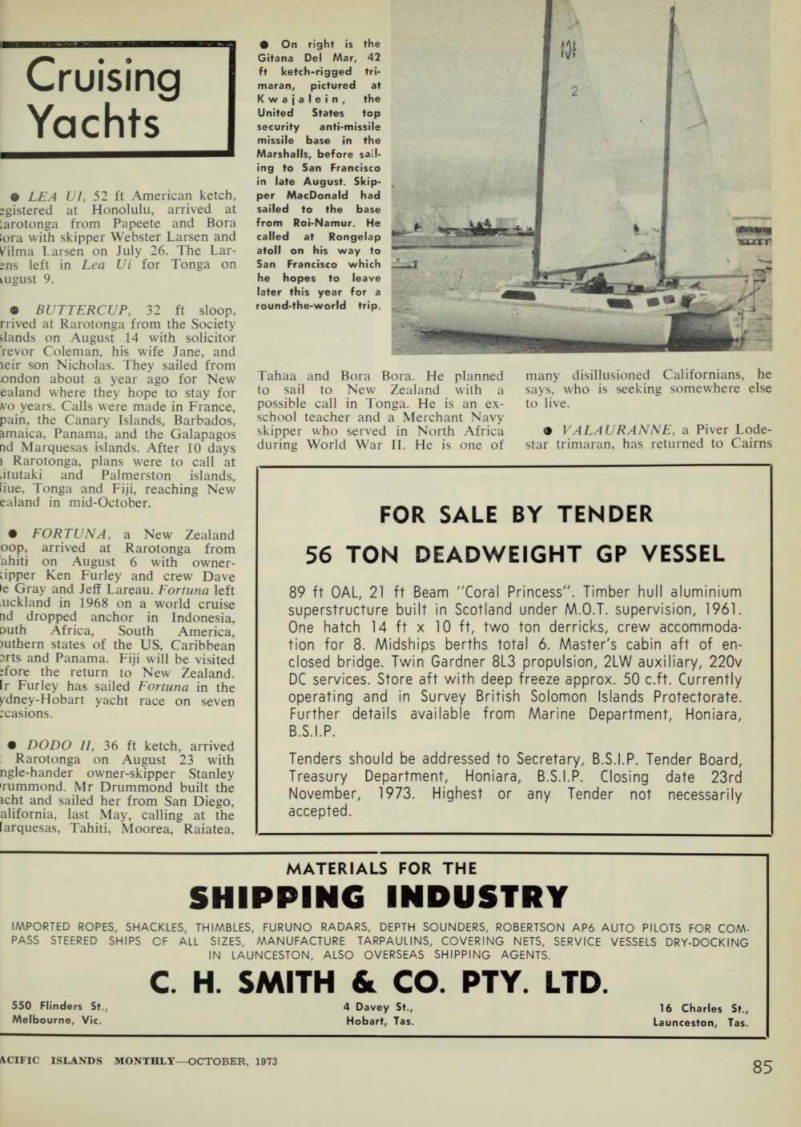

Yachts
& LEA UI, 52 ft American ketch, at Honolulu, arrived at Larotonga from Papeete and Bora iora with skipper Webster Larsen and yilma Larsen on July 26. The har ms left in Lea Ui for Tonga on mgust 9. 9 BUTTERCUP, 32 ft sloop, rrived at Rarotonga from the Society dands on August 14 with solicitor revor Coleman, his wife Jane, and ieir son Nicholas. They sailed from ondon about a year ago for New ealand where they hope to stay for vo years. Calls were made in France, pain, the Canary Islands, Barbados, amaica, Panama, and the Galapagos ad Marquesas islands. After 10 days i Rarotonga, plans were to call at atutaki and Palmerston islands, liue, Tonga and Fiji, reaching New ealand in mid-October. • FORTUNA, a New Zealand oop, arrived at Rarotonga from ahiti on August 6 with owner dipper Ken Furley and crew Dave •e Gray and Jeff Lareau. Fortuna left uckland in 1968 on a world cruise nd dropped anchor in Indonesia, Duth Africa, South America, )uthern states of the US, Caribbean mts and Panama. Fiji will be visited -fore the return to New Zealand. lr Furley has sailed Fortuna in the ydney-Hobart yacht race on seven :casions. • DODO 11, 36 ft ketch, arrived ; Rarotonga on August 23 with ngle-hander owner-skipper Stanley 'rummond. Mr Drummond built the icht and sailed her from San Diego, alifornia, last May, calling at the larquesas, Tahiti, Moorea, Raiatea,
Tahaa and Bora Bora. He planned to sail to New Zealand with a possible call in Tonga. He is an exschool teacher and a Merchant Navy skipper who served in North Africa during World War 11. He is one of
many disillusioned Californians, he says, who is seeking somewhere else to live, ® VALAURANNE, a Piver Lode star trimaran, has returned to Cairns
• On right is the Gitana Del Mar, 42 ft ketch-rigged tri maran, pictured at Kwajalein, the United States top security anti-missile missile base in the Marshalls, before sail ing to San Francisco in late August. Skip per MacDonald had sailed to the base from Roi-Namur. He called at Rongelap atoll on his way to San Francisco which he hopes to leave later this year for a round-the-world trip.
lifter cruising for 20 months through Papua New Guinea calling at East New Britain, Buka and Bougainville ;hen the BSIP with Val and Ray Goldston. • PANDEMONUM, motor ketch, las arrived at Cairns with Keith McCarthy after a cruise along the Papuan coast. On the return to Aus ;ralia the Pandemonum visited Dam and Thursday Island. The ultimate destination is the Gold Coast. • KOHATU, a ferro-cement ketch :rom Auckland carrying Terry and Maxine Paterson passed through Port Moresby in early August on her vay to the Indian Ocean. • WILD GOOSE, a 32 ft Atkins iesign ketch from California arrived n Port Moresby in early August. This rip has taken Ken Matson, his wife Lu and son Mark from Brisbane up hrough the Barrier Reef to Cairns hen across to Port Moresby. • OKERE is a 58 ft immaculate erro-cement Herreshoff design ketch ;rom Auckland. She sailed in the ~nd-Suva race, then came on to 3 ort Moresby via Fiji, New Hebrides md the Solomon Islands to arrive in nid-August. After a few weeks stay, Ikere with Jack Hargraves, Jon }lsen, Mike Gardiner, Bill Galbraith md Jocelyn Adams sailed for Indo lesia and South Africa. • SANDRA 11, a 27 ft fibreglass loop with Dima Grinups on board, ailed from Kristinehamn, Sweden, in nid-1971 to arrive in Port Moresby ate August after an interesting trip hrough the Pacific. After a couple >f weeks stay, he plans to sail to louth Africa via Christmas Island. • WHITE SQUALL 11, with Ross nd Minene Norgrove, last mentioned i these columns in August, after laving made a run for Fiji as a result if a violent storm off Tonga, finished tie repairs at Millers yards, Suva, in arly September. They also took the ipportunity of making some improve ments to the 70 ft schooner which or many years they ran as a charter oat in the Caribbean, where Minene /as born. They look like making a ermanent home in Fiji now. • SOUNION, a 28 ft sloop sailed y single-hander Herman Jansen, rrived at Rarotonga on September 7 rom Tahiti. Mr Jansen sailed from Amsterdam and called at the Canary dands, West Indies, Panama, Gala agos, Marquesas and Society Islands, le planned to visit Fiji then spend ic hurricane season in New Zealand,
Advertisements & other items, pp. 91-94 (3 items)
85
ACIFIC ISLANDS MONTHLY—OCTOBER, 1973
Shipping Industry
FOR SALE BY TENDER
56 TON DEADWEIGHT GP VESSEL
89 ft OAL, 21 ft Beam “Coral Princess''. Timber hull aluminium superstructure built in Scotland under AA.O.T. supervision, 1961.
One hatch 14 ft x 10 ft, two ton derricks, crew accommodation for 8. Midships berths total 6. Master's cabin aft of enclosed bridge. Twin Gardner BL3 propulsion, 2LW auxiliary, 220 v DC services. Store aft with deep freeze approx. 50 c.ft. Currently operating and in Survey British Solomon Islands Protectorate.
Further details available from Marine Department, Honiara, 8.5.1. P.
Tenders should be addressed to Secretary, 8.5.1. P. Tender Board, Treasury Department, Honiara, 8.5.1. P. Closing date 23rd November, 1973. Highest or any Tender not necessarily accepted.
MATERIALS FOR THE
SHIPPING INDUSTRY
IMPORTED ROPES, SHACKLES, THIMBLES, FURUNO RADARS, DEPTH SOUNDERS, ROBERTSON AP6 AUTO PILOTS FOR COM- PASS STEERED SHIPS OF ALL SIZES, MANUFACTURE TARPAULINS, COVERING NETS, SERVICE VESSELS DRY-DOCKING
IN LAUNCESTON, ALSO OVERSEAS SHIPPING AGENTS.
C. H. SMITH & CO. PTY. LTD. 550 Flinders St... 4 Davey St., 16 Charles St., Melbourne, Vic. Hobart, Tas. Launceston, Tas.
PmPim 'peM iron
/ Australia's best selling non-electric Iron! For reliability, ease of handling, and excellence of quality at a low price, you can't beat the HANOI. It's simplicity itself to operate—NO PUMPING IS REQUIRED. IT'S IMPOSSIBLE TO OVERFILL THE FUEL TANK and one filling does approximately 2 hours effortless ironing. Attractively finished in nickel plate. Spare parts always available.
THE PORTABLE OUTDOORS COOKER at a sensible price!
Twin independent burners for fast cooking. Twin tanks for double capacity. Steel case, when opened, acts as triple-wind shield. Rustproof. Noisy or silent burners as required. Small or large porcelain enamel ovens also available separately. HANOl—the lowest priced QUALITY Twin Burner Portablel
iirrnm rw
Evans Rd., Salisbury North, ph. 47 2121
BRISBANE, QUEENSLAND, AUSTRALIA
RES 48 P
CRUSHED ICE maker
The STURT
Over storage bin
for the co-operative and
professional fishermen
STURT
Vz TON ICE MAKER
Crushed-ice maker 1 to 15 ton Block-ice maker THE STURT is a labour-saving, self-contained V 2 ton crushed ice manufacturing unit designed for volume ice production at low capital cost.
FEATURES INCLUDE:
• Installs over existing ice-vending depots, rooms or separate ice storage containers. • Construction is polyurethane foam fibreglass panels. Produces and crushes ice automatically. Passes through 36" doorway, assembled. • Low maintenance air cooled condenser. • Rugged ■yijr hermetically sealed compressor. • Prewired ready to ItlC connect to 415 V, 3 phase and neutral power supply. • 4 lifting eyes for easy site location. Also available: Ice making units, V 2 to 15 tons daily capacity with or without storage bins, pre-fab. rooms or coin-op. vending depots.
You are invited to phone or write to Resco for Literature and prices for ice-making vending equipment and modular prefab. rooms. Detail YOUR need, Resco can supply.
Module-Bild Cool Room
MANUFACTURING REFRIGERATION ENGINEERS
98 GRAND JUNCTION ROAD, KILBURN
p TY S.A. 5084. TELEPHONE 62 5011
LT q' Telegrams “RESCORP”
EXPORTERS
to the Pacific Islands!
BRECKWOLDT & CO.
PTY. LTD.
276 Pitt Street, Sydney 2000
Box 5027, G.P.0., Sydney. Cable Address: "BREWO", Sydney.
Pacific-Islands Branches:
P.O, Box 222, RABAUL.
P.O. Box 1549, Boroko, PORT MORESBY.
P.O. Box 185, MADANG.
P.O. Box 1188, LAE.
P.O. Box 72, KIETA.
P.O. Box 237, MT. HAGEN.
P.O. Box 178, WEWAK.
BRECKWOLDT & CO.
P.O. Box 47, APIA.
BRECKWOLDT & CO. (5.1.) LTD.
P.O. Box 140, HONIARA.
BRECKWOLDT S.A.R.L.
B.P. 65, NOUMEA.
Head Office:
BRECKWOLDT & CO., HAMBURG/GERMANY.
Offices at: Milan, London, Antwerp, Kuala Lumpur, Bangkok, Hong Kong.
Enquiries from Australian Manufacturers invited.
BRECKWOLDT & CO.
(N.G.) PTY. LTD.
i 4 * - ,*;i
THE
YORKSHIRE INSURANCE
CO. LTD.
(Incorporated in England)
A MEMBER OF THE GENERAL ACCIDENT GROUP OF COMPANIES
ALL CLASSES OF INSURANCE
AUSTRALIAN HEAD OFFICE: 10-12 Spring Street, Sydney.
General Manager for Australia: J. Adam.
PAPUA AND NEW GUINEA BRANCH: Douglas Street, Port Moresby Manager: H. M. Harvey.
CHIEF ISLAND REPRESENTATIVES
Rabaul, A.S.P. (N.G.) Ltd.; Lae, Radio Cabs (Lae) Pty. Ltd.; Madang, W. Stokes; Manus, Edgell & Whiteley Ltd.; Honiara, 8.5.1. P., E. V. Lawson Ltd.; Suva, Williams & Gosling Ltd.; Noumea, R. Laubreaux; Norfolk Island, Martin's Agencies; Apia, E. A. Coxon & Co.; Vila, C. Sullivan (INT) Pty. Ltd.
Bank of Hawaii is the bank of the Pacific.
You can bank on it...
in Guam2&Tamuning£
Koror Yap Jf Saipan Roi Namur aUL Kwajalein JttPonape Tahiti*-2Lk-2* American Samoa.
All in all, we have 70 branches throughout Hawaii and the Pacific offering full banking services. May we help you?
Bank of Hawaii the bank of the Pacific® affiliate of Banque de Tahiti
87
CIFIC ISLANDS MONTHLY—OCTOBER, 1973
News
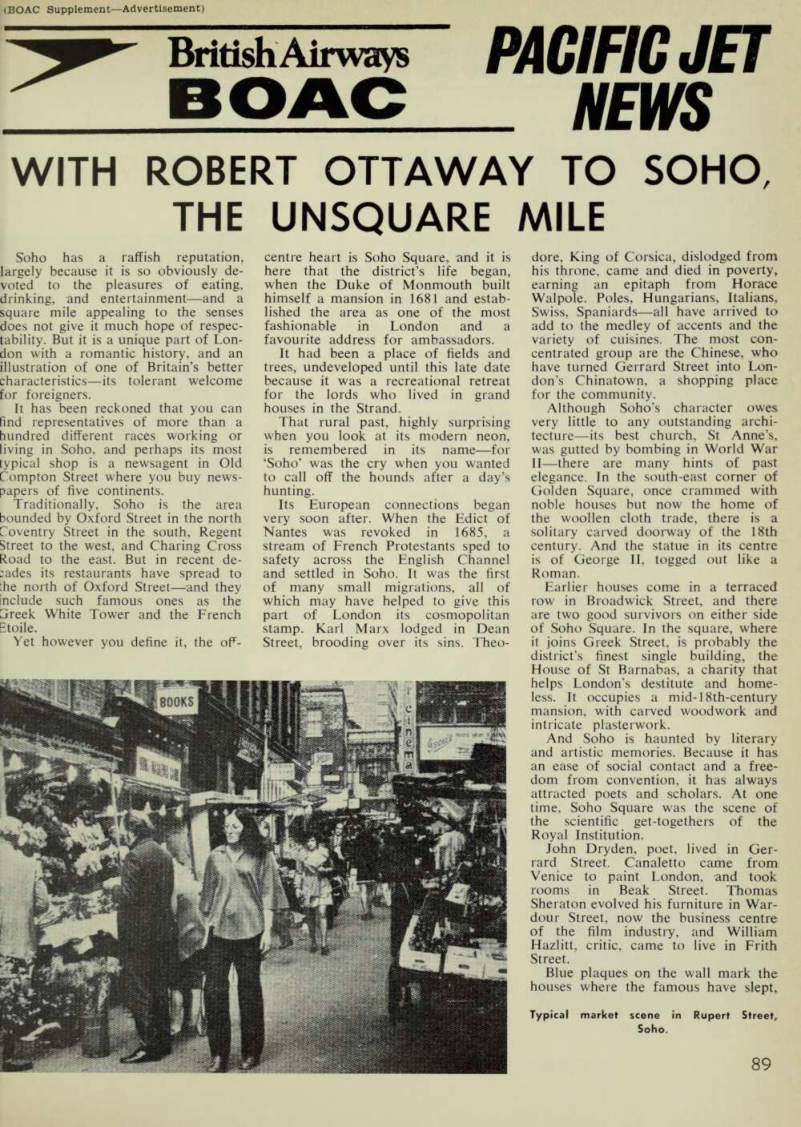
British Airways
Boac
Pacific Jet
News
With Robert Ottaway To Soho,
The Unsquare Mile
(BOAC Supplement—Advertisement)
Soho has a raffish reputation, largely because it is so obviously de voted to the pleasures of eating, drinking, and entertainment—and a square mile appealing to the senses does not give it much hope of respec tability. But it is a unique part of Lon don with a romantic history, and an illustration of one of Britain’s better characteristics—its tolerant welcome for foreigners.
It has been reckoned that you can find representatives of more than a hundred different races working or living in Soho, and perhaps its most typical shop is a newsagent in Old Compton Street where you buy news papers of five continents.
Traditionally, Soho is the area bounded by Oxford Street in the north Coventry Street in the south, Regent Street to the west, and Charing Cross Road to the east. But in recent de :ades its restaurants have spread to ;he north of Oxford Street—and they nclude such famous ones as the Creek White Tower and the French itoile.
Yet however you define it, the ofi
centre heart is Soho Square, and it is here that the district’s life began, when the Duke of Monmouth built himself a mansion in 1681 and estab lished the area as one of the most fashionable in London and a favourite address for ambassadors.
It had been a place of fields and trees, undeveloped until this late date because it was a recreational retreat for the lords who lived in grand houses in the Strand.
That rural past, highly surprising when you look at its modern neon, is remembered in its name—for ‘Soho’ was the cry when you wanted to call off the hounds after a day’s
hunting.
Its European connections began very soon after. When the Edict of Nantes was revoked in 1685, a stream of French Protestants sped to safety across the English Channel and settled in Soho. It was the first of many small migrations, all of which may have helped to give this part of London its cosmopolitan stamp. Karl Marx lodged in Dean Street, brooding over its sins. Theo-
dore, King of Corsica, dislodged from his throne, came and died in poverty, earning an epitaph from Horace Walpole. Poles, Hungarians, Italians, Swiss, Spaniards—all have arrived to add to the medley of accents and the variety of cuisines. The most con centrated group are the Chinese, who have turned Gerrard Street into Lon don’s Chinatown, a shopping place for the community.
Although Soho’s character owes very little to any outstanding archi tecture—its best church, St Anne’s, was gutted by bombing in World War II —there are many hints of past elegance. In the south-east corner of Golden Square, once crammed with noble houses but now the home of the woollen cloth trade, there is a solitary carved doorway of the 18th century. And the statue in its centre is of George 11, togged out like a Roman.
Earlier houses come in a terraced row in Broadwick Street, and there are two good survivors on either side of Soho Square. In the square, where it joins Greek Street, is probably the district’s finest single building, the House of St Barnabas, a charity that helps London’s destitute and home less. It occupies a mid-18th-century mansion, with carved woodwork and intricate plasterwork.
And Soho is haunted by literary and artistic memories. Because it has an ease of social contact and a free dom from convention, it has always attracted poets and scholars. At one time, Soho Square was the scene of the scientific get-togethers of the Royal Institution.
John Dryden, poet, lived in Ger rard Street. Canaletto came from Venice to paint London, and took rooms in Beak Street. Thomas Sheraton evolved his furniture in War dour Street, now the business centre of the film industry, and William Hazlitt, critic, came to live in Frith Street.
Blue plaques on the wall mark the houses where the famous have slept.
Typical market scene in Rupert Street, Soho.
and a little street named Manette, off Greek Street, recalls that Dickens sent the doctor to live here for the pur poses of the plot of Tale of Two Cities.
Handy for theatres, especially the four in Shaftesbury Avenue, which bisects Soho, its restaurants are its chief attraction for visitors. Any guide to the best food in London will include more entries for Soho than for any other district, so it is a daunting business to make a choice among them. Some, like Kettner’s and Gennaro’s, have proud culinary traditions going back to Edwardian days; more recent restaurants, like La Terrazza, have come along to share in their popularity.
But perhaps it is the brisk bustle of its street life, its clamour of tongues, and its sudden switch of mood that distinguishes Soho from any other part of London. There is a vivid and noisy street market in Berwick Street, where office workers shop for their evening meals. There is the best jazz in London, at Ronnie Scott’s, often given by celebrities like Oscar Peter son or Stan Getz. Above all, it doesn’t go to sleep till the early hours of the morning, when the last stragglers are disgorged from the cabarets.
The Duke of Monmouth, who be gan it all, is merely remembered now by a small street. His house was destroyed, and the aristocrats moved west.
More British Airwoys-
BOAC Jumbo Services
British Airways-BOAC is to in crease its 747-jumbo jet services from Australia to London from six to eight a week when the airline’s new schedules start on October 28.
There will be daily flights from Sydney to London—all by 747 except on Mondays which will be by VC 10.
Melbourne 747 flights to London via the Orient will be increased from two to five a week, plus one VCIO.
These are in addition to the five VCIO services to London via Nadi, Hono lulu and Los Angeles, which will con tinue as at present.
Brisbane services will be operated by VC 10s, twice weekly. They will originate from Brisbane and will be the only air services linking the Queensland city with London. Both flights will call at Darwin.
(BOAC Supplement—Advertisement)
Down by the Riverside:
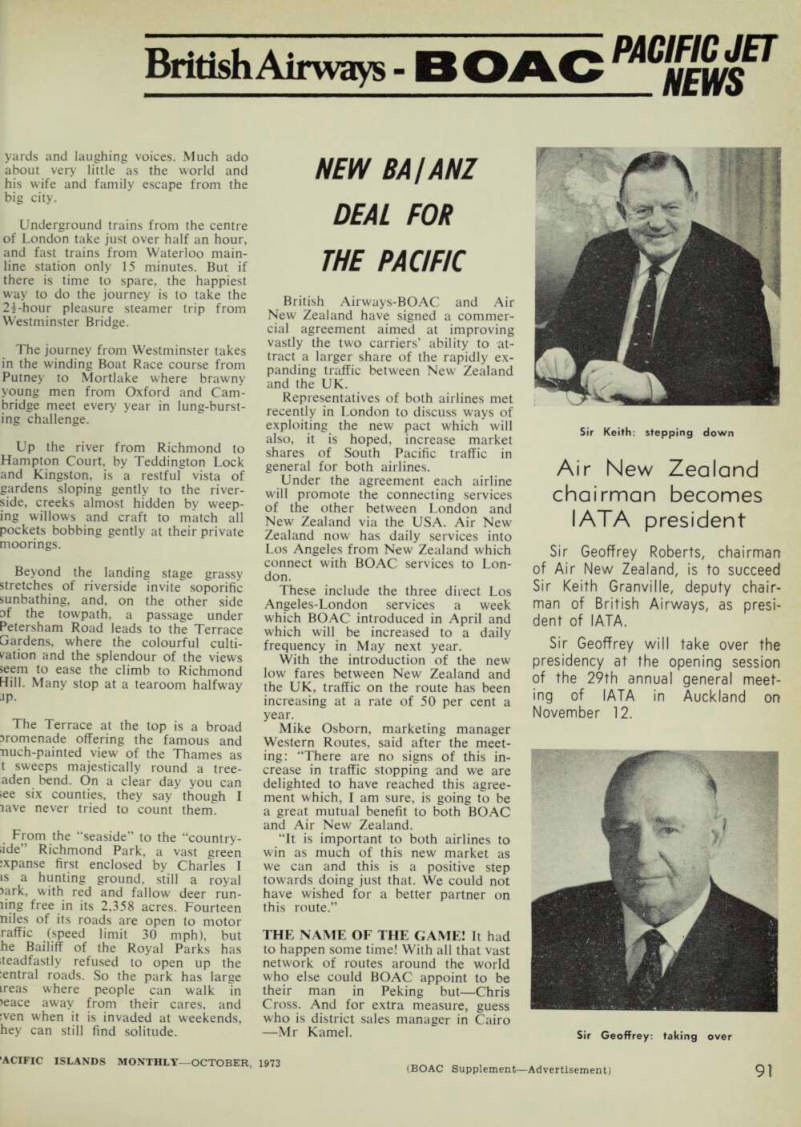
Pubs and Laughing Voices
By William Inglis
When friends come for the first time to Richmond, I usually take them on a guided tour—a not-too arduous walk round, for in any metropolitan area, there can’t be many pleasanter places to live.
It’s so near to London: “VIII miles from Hyde Park Comer” says an old milestone. Visitors to London should escape there for a while.
They will find “countryside”, a stretch of river with a seaside at mosphere, and an old town with many fine buildings, a long history of royalty and riches, an attractive old theatre, an international range of restaurants, and one of the finest views in England.
First there is the Green, a few minutes’ walk turning left outside the railway station. The immediate impression is of a village green criss crossed with paths. In the centre is the cricket square. If the sun is shin ing, deckchairs will be out, and there may be a match in progress.
A second longer look at the Green’s tall terraces, its trees and its spacious ness, and it becomes too stately for a village. You can feel yourself in the 18th century among the Queen Anne and Georgian houses. Just off the Green are lanes which are a magnet for lovers of antiques and bric-a-brac.
In the south-east comer, pleasant and leafy, is the Little Green, facing the splendidly ornate Richmond Theatre. The original “Theatre on the Green” was built in the north-east corner around 1765 and the present one—recently equipped with comfor table new seating—in 1899.
Sometimes it has the excitement of a pre-London try-out. After the show, round the corner in the Cobwebs you can often rub shoulders at the bar with people you have just seen on the stage.
On the west side of the green is the imposing and elegant Maids of Honour Row, built in George I’s time for ladies of the Court. Next to it is all that remains of the Old Palace, built by the first Tudor, Henry VII, around 1500. In those days
the Green was part of the Palace grounds, a scene of pageants, revels and jousting.
An archway facing the Green still bears the time-worn arms of Henry VII. Behind it a peaceful courtyard leads out to Old Palace Lane, where once-humble cottages are now much sought-after residences. Down the lane is the Thames. Turning left along the towpath is an inspiring view of the handsome, five-arched, 18th cen tury Richmond Bridge with the Ter race Gardens and Richmond Hill heaped handsomely behind it.
A stroll along the towpath is like being at the seaside. Pleasure steamers and boats for hire. Deckchairs and ice cream. Pubs with open court
The Watermans Arms, Water Lane, Rich mond.
yards and laughing voices. Much ado about very little as the world and his wife and family escape from the big city.
Underground trains from the centre of London take just over half an hour, and fast trains from Waterloo main line station only 15 minutes. But if there is time to spare, the happiest way to do the journey is to take the 2i-hour pleasure steamer trip from Westminster Bridge.
The journey from Westminster takes in the winding Boat Race course from Putney to Mortlake where brawny young men from Oxford and Cam bridge meet every year in lung-burst ing challenge.
Up the river from Richmond to Hampton Court, by Teddington Lock and Kingston, is a restful vista of gardens sloping gently to the river side, creeks almost hidden by weep ing willows and craft to match all pockets bobbing gently at their private moorings.
Beyond the landing stage grassy stretches of riverside invite soporific sunbathing, and, on the other side af the towpath, a passage under Petersham Road leads to the Terrace Gardens, where the colourful culti vation and the splendour of the views seem to ease the climb to Richmond Hill. Many stop at a tearoom halfway jp.
The Terrace at the top is a broad iromenade offering the famous and nuch-painted view of the Thames as t sweeps majestically round a tree aden bend. On a clear day you can iee six counties, they say though I lave never tried to count them.
From the “seaside” to the “country wide ’ Richmond Park, a vast green ;xpanse first enclosed by Charles I is a hunting ground, still a royal lark, with red and fallow deer run ling free in its 2,358 acres. Fourteen niles of its roads are open to motor raffic (speed limit 30 mph), but he Bailiff of the Royal Parks has teadfastly refused to open up the :entral roads. So the park has large ireas where people can walk in )eace away from their cares, and iven when it is invaded at weekends, hey can still find solitude.
New Ba/Anz
Deal For
The Pacific
British Airways-BOAC and Air New Zealand have signed a commer cial agreement aimed at improving vastly the two carriers’ ability to at tract a larger share of the rapidly ex panding traffic between New Zealand and the UK.
Representatives of both airlines met recently in London to discuss ways of exploiting the new pact which will also, it is hoped, increase market shares of South Pacific traffic in general for both airlines.
Under the agreement each airline will promote the connecting services of the other between London and New Zealand via the USA. Air New Zealand now has daily services into Los Angeles from New Zealand which connect with BOAC services to Lon don.
These include the three direct Los Angeles-London services a week which BOAC introduced in April and which will be increased to a daily frequency in May next year.
With the introduction of the new low fares between New Zealand and the UK, traffic on the route has been increasing at a rate of 50 per cent a year.
Mike Osborn, marketing manager Western Routes, said after the meet ing: “There are no signs of this in crease in traffic stopping and we are delighted to have reached this agree ment which, I am sure, is going to be a great mutual benefit to both BOAC and Air New Zealand.
“It is important to both airlines to win as much of this new market as we can and this is a positive step towards doing just that. We could not have wished for a better partner on this route.”
THE NAME OF THE GAME! It had to happen some time! With all that vast network of routes around the world who else could BOAC appoint to be their man in Peking but—Chris Cross. And for extra measure, guess who is district sales manager in Cairo
Mr Kamel.
(BOAC Supplement—Advertisement)
IATA president
Air New Zealand chairman becomes IATA president
Sir Geoffrey Roberts, chairman of Air New Zealand, is to succeed Sir Keith Granville, deputy chair man of British Airways, as presi dent of lATA.
Sir Geoffrey will take over the presidency at the opening session of the 29th annual general meet ing of lATA in Auckland on November 12.
Sir Keith: stepping down
Sir Geoffrey: taking over
Advertisements & other items, p. 97 (1 item)
British Airways - BOAC
91
ACIFIC ISLANDS MONTHLY—OCTOBER, 1973
New Seats For
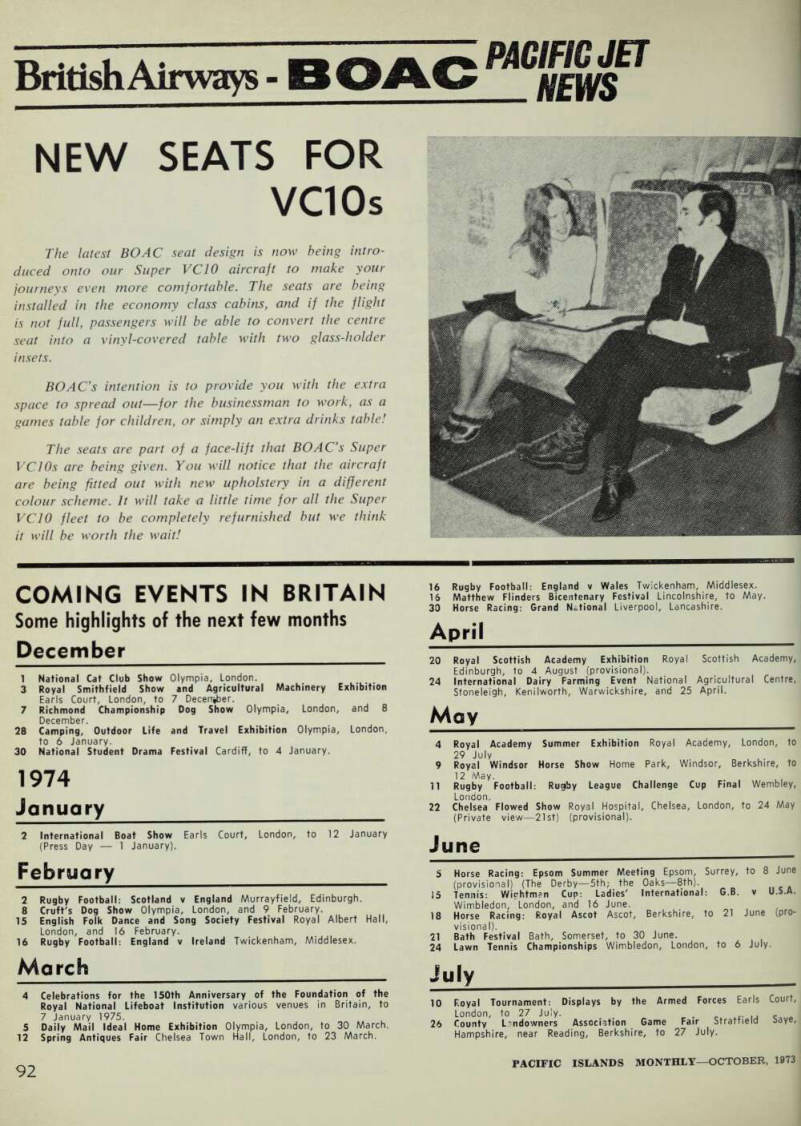
VC10s
The latest BO AC seat design is now being intro duced onto our Super VC 10 aircraft to make your journeys even more comfortable. The seats are being installed in the economy class cabins, and if the flight is not full, passengers will be able to convert the centre seat into a vinyl-covered table with two glass-holder insets.
BO AC’s intention is to provide you with the extra space to spread out —for the businessman to work, as a games table for children, or simply an extra drinks table!
The seats are part of a face-lift that BO AC’s Super VC 10s are being given. You will notice that the aircraft are being fitted out with new upholstery in a different colour scheme. It will take a little time for all the Super VCIO fleet to be completely refurnished but we think it will be worth the wait!
January
Coming Events In Britain
Some highlights of the next few months
December
1 National Cat Club Show Olympia, London. 3 Royal Smithfield Show and Agricultural Machinery Exhibition Earls Court, London, to 7 Deceniber. 7 Richmond Championship Dog Show Olympia, London, and 8 December. 28 Camping, Outdoor Life and Travel Exhibition Olympia, London, to 6 January. 30 National Student Drama Festival Cardiff, to 4 January. 1974
January
2 International Boat Show Earls Court, London, to 12 January (Press Day 1 January).
February
2 Rugby Football: Scotland v England Murrayfield, Edinburgh. 8 Cruft's Dog Show Olympia, London, and 9 February. 15 English Folk Dance and Song Society Festival Royal Albert Hall, London, and 16 February. 16 Rugby Football: England v Ireland Twickenham, Middlesex.
March
4 Celebrations for the 150th Anniversary of the Foundation of the Royal National Lifeboat Institution various venues in Britain, to 7 January 1975. 5 Daily Mail Ideal Home Exhibition Olympia, London, to 30 March. 12 Spring Antiques Fair Chelsea Town Hall, London, to 23 March.
16 Rugby Football: England v Wales Twickenham, Middlesex. 16 Matthew Flinders Bicentenary Festival Lincolnshire, to May. 30 Horse Racing: Grand National Liverpool, Lancashire.
April
20 Royal Scottish Academy Exhibition Royal Scottish Academy, Edinburgh, to 4 August (provisional). 24 International Dairy Farming Event National Agricultural Centre, Stoneleigh, Kenilworth, Warwickshire, and 25 April.
May
4 Royal Academy Summer Exhibition Royal Academy, London, to 29 July , , 9 Royal Windsor Horse Show Home Park, Windsor, Berkshire, to 12 May. 11 Rugby Football: Rughy League Challenge Cup Final Wembley, London. 22 Chelsea Flowed Show Royal Hospital, Chelsea, London, to 24 May (Private view—2lst) (provisional).
June
5 Horse Racing: Epsom Summer Meeting Epsom, Surrey, to 8 June (provisional) (The Derby—sth; the Oaks —Bth). 15 Tennis: Wi?htm?n Cup: Ladies' International: G.B. v U.5.A.
Wimbledon, London, and 16 June. 18 Horse Racing: Royal Ascot Ascot, Berkshire, to 21 June (pro visional). 21 Bath Festival Bath, Somerset, to 30 June. 24 Lawn Tennis Championships Wimbledon, London, to 6 July.
•Euiy -
10 Royal Tournament: Displays by the Armed Forces Earls Court, London, to 27 July. . . .. c 26 County Landowners Association Game Fair Strattie Id oaye, Hampshire, near Reading, Berkshire, to 27 July.
Advertisements & other items, pp. 98-102 (2 items)
British Airways - B OAC
92
PACIFIC ISLANDS MONTHLY —OCTOBER, 1973
Minolta
SR TlOl it i Minolta Hi-matic F minolfa r mmoifa
M'-MATIC f
s=<
JOI
I 3
PERFECT PERFECTER PERFECTEST
Minolta has the perfect camera.
It’s called the 16 QT “Spyfinder’ subminiature. Or the electronic exposure Hi-matic F. Or the full system SR-TlOl.
Whatever, wherever, whenever, you want to shoot...
Minolta has the perfect camera.
The SR-TlOl offers perfection in depth. A precision 35mm SLR, the 101 is backed by the Minolta system of over 150 accessories and fine Rokkor Lenses.
With the SR-TlOl you can do anything you want to do perfectly.
The Hi-matic F is perfection with speed. Automatic exposure and automatic flash ensure electronic accuracy at computer speed. Full 35mm format in a palm sized, speedy package.
The 16 QT is perfectly secret.
Shoot anywhere, anytime without being detected or carrying a lot of equipment. Just drop in a film cartridge and shoot.
Attach the “Spyfinder” eye piece and you can even shoot around comers.
The perfect camera...by Minolta What we call it depends on how you use it.
Minolta
mm* <*■* if ■ *
ma&st.
• • « HK •jy ,v v Cl* i ,
-.^<c.' f ;.. t^
:' ■■ ■■• -V ; -' ;V "A ts* 'M i/v* .. - , , V|l*‘ ••'' y .C-vr, - •'*<•’ v -‘ ■
r '^J" J I 4 *'
j> V - -X s '.
Sfc *' '* ■# £$ .«f? • -* *5 15 i • *» !*•% if tW s r •! 9 •*■; ••;.*> -c\ "' • /• V > ; ,W s£**•* '•!,■ e 'n-- •.fv, 5 ;%% £ 'f* 4 ii- ■ •■ '■/■'■<*.*s . ■' . t, •»-’ •■; '
liS iiifiiii %#* «-' w
■-. *>rt-!« - <*# **#*• ■? v#. * -f ->*<*• gjtfn9*.i =*r*S« ; «*6 • • u»» The flag we’ve flown for a hundred years Two paddle steamers on the Yangtse River in 1873 marked the beginning of the China Navigation Company. Today, the same flag flies above eighteen modern motor ships plying an extensive network of cargo routes between Papua New Guinea and Pacific Island ports (as far East as Tahiti] and Japan, New Zealand, Australia
and Thailand. u
For 100 years, the flag of the China Navigation Company has meant experience, reliability and speed across the sea. Today, it s lying as strong as ever. or further details and all enquiries there are Agents at the following 1 >V.f* s HedL^rTm 11 *1 f) S ’"su l faJtoka ”VVestern* Samoa; Morris Hedstrom Ltd., Apia, abaul, Kieta. Burns Philp (New Guinea) Ltd Wewak. Kavieng F.,?: Morxis Papeete New Caledonia: Etablissements Ballande. Noumea. onga: Morris Hedstrom Ltd., Nukualofa and \ a / a * a^ l,l: y a^^ r n *P r °° a Y s d esN ouvmlles-Hebrides,Vilaand Santo. AHSTRALIA-Sydneyilnterocean .5.1. P.: British Solomons Trading Co. Ltd., Honiara, New Hebrides: & Sanderson Pty. Ltd. NEW ZEALAND-P. & O. (N.Z ) Ltd *<*>- Vok.h.m., Osaka. Kobe an<i Nagoya. Eas.arn Managers: Baberf.eld Swire, 9 Connaught Rd., Central, Hong Kong.
JOHN SWIRE & SONS PTY. LTD. General Agents in Australia, 8 Spring Street, Sydney, 9351
THE CHINA NAVIGATION CO LT
MEMBER OF THE SWIRE GROUP.
CN co
Pioneer’s cassette sounds...
they leap at you like they’re live! mum m Notes with the purity of a nightingale’s call or the depth of a bullfrog’s complaint. This magnificent little cassette deck reproduces all, and better, because it has Dolby.'Dolby: An incredibly effective noise reduction system that makes natural sounds leap from the deck, especially with new chromium dioxide tape. It makes everything you record seem super-realistic like looking through a highly polished mirror.
Other sets have Dolby. But other sets don’t have the name Pioneer and extra quality features that go with the name. On the CT-4141 there’s a selector for your special chrome tapes. There’s automatic stop at tape-end in all tape travel functions. And there’s an ultra-smooth ferrite solid head (it just lasts and lasts).
We could go on and on, but your best bet is to flip on the CT-4141 at the nearest Pioneer dealers. & © « U © a
CrD PIONEER
Brijlal & Company, G.P.O. Box No. 362, Suva, Fiji Islands Tel: 222 58 Astronics Australasia Pty. Ltd. 161-173 Sturt Street, South Melbourne, Victoria 3205 Australia Hagemeyer (Australasia) N.V. P.O. Box No. 90, Lae.
New Guinea Tel: 2718 P.O. Box No. 63, Rabaul, New Guinea Tel: 2633 P.O. Box No. 673, Madang, T.P.N.G. Tel; 2445 Tee Vee Radio Ltd. P.O. Box No. 5029, Auckland, New Zealand Tel: 763-064 Burns Philp (South Sea) Co. Ltd. Norfolk Islands, South Pacific Jacob Enterprises, P.O. Box No. 4, Nauru island Ets. PERFECT, B.P, 594, Papeete,Tahiti Tel: 20 407 Menard Freres, B.P. 123, Noumea, New Caledonia Tel: 52-22 Transpac Corporation, P.O. Box 1477, Pago Pago, American Samoa 96799 Tel: 2227
Business and Development
Anz Revaluation Hits Island
Families In The Breadbasket
The New Zealand (10 per cent) and Australian (five per cent) re valuation of currencies on September 9 had the immediate effect of sending up the cost of imported food in a number of Pacific countries and ter ritories already battling hard to com bat the world-wide problem of in flation.
Overall the effects were varied.
Fiji had something of a “mixed grill” as it announced at the same time that preferential tariffs were to be abolish ed in January, 1974, in favour of a single line tariff. And on September 10, Fiji revalued its currency by five >er cent to offset higher prices for a number of key commodities and appliances it imports from Australia, aer biggest supplier.
Papua New Guinea was in a cleft stick as it operates within the Aus ralian monetary system. PNG trade vith Australia was unaffected.
Primary producers will now receive ess for their goods which are sold o the US, the UK, Europe and fapan. Copra and cocoa planters are mjoying high prices at present, ilthough lower than those of three nonths ago. Coffee and rubber prices are fairly good, but the tea narket is depressed, and the revalua ion is another knock to growers.
On the importing side, Papua New Guinea will pay less. Two of the nain suppliers, apart from Australia, ire Japan and the UK.
Bougainville Copper, overall, will irobably gain from the revaluation. \ gain of five per cent on loans of ibout $203 million is worth more han $lO million to the company.
Shipment and treatment charges, >aid in US dollars, mean another aving. The sales contracts are yritten in US dollars which, theore ically, means a drop of five per cent n earnings. But a forward cover for ix months at pre-revaluation prices vill offset much of that loss.
New Caledonia and the New iebrides which are big custo ners of Australia, now have to pay nore for imports, or cut them to the ame monetary value which operated >efore revaluation.
Fiji has been struggling hard to combat galloping inflation, parti cularly in food prices. That was one of the country’s reasons for abolish ing the preferential tariff as a number of importers found they could land food more cheaply from the US, than Australia and New Zealand.
By revaluing five per cent Fiji wiped out any possible adverse effect on imports from Australia; but it is still five per cent worse off in relation to New Zealand, from where it draws most of its meat, and a pro portion of butter, cheese and ghee.
The tourist industry will suffer to some extent. There will be no change for Australian tourists, regarded as the biggest spenders, but Americans will have to pay more, which may cause them to look elsewhere. New Zealanders will have cheaper holidays in Fiji, The Cook Islands will be unaffected in trade with New Zealand. Western Samoa, too, will not be affected much in dealings with NZ, but will have to pay more for Australian imports.
Tonga will have to pay more for imports from Australia and New Zealand, which are two big suppliers.
French Polynesia has been attracting a growing interest from Australian and New Zealand exporters, and will
have a bigger import bill with those countries.
Mr Julius Chan, the PNG Finance Minister, said the Australian dollar had, in effect, been devalued by more than 5 per cent since February because it was tied to the US dollar.
The latest move merely redressed some of the effective devaluation.
The prices of most of PNG exports were much higher than a few months ago. The revaluation would cause problems to one or two industries, but the government would keep those problems under review.
A. Samoa may
get refinery
A SUS3OO million oil refinery is a possibility for American Samoa. Gov ernor John M. Haydon is against it as an environmentalist, but as an ad ministrator he has to consider the impact of a refinery on the terri tory’s economy. The Office of Samoan Affairs will be asked to find out from the people just what they think about it.
Should the project go ahead it will eliminate Samoa’s dependence on the United States for money. A Texas firm, Guam Oil Refining Co, has in
dicated it would like to go ahead with the refinery as soon as possible.
Some of the benefits would be: • Employment for 1,500 for two years; • Permanent employment for 300 to 400; • Revenue of about $14.6 million a year.
The plant would be able to refine 200,000 barrels a day. An offshore pumping station for tankers of more than 250,000 tonnes would need to be constructed a mile from the coast between Leone and Vailoatai. The company would be expected to con struct a $1.5 million boat harbour facility at Leone, not only to serve tankers, but to provide a terminal for inter-island vessels. As a side benefit, this would cut nearly one third off the run to Western Samoa.
Also to be considered in the plan is a fair rent for 900 acres of land involved, crop losses and the reloca tion of people living in the area.
Only a small area of the land would be used for the plant. The remainder would be used for offices, ware houses, water treating basins, and a large tank farm. Some would be held for future use.
Under American Samoa law the land can only be leased for a maxi mum of 30 years, with an option to renew.
Land buyers lose in New Hebrides
Joint legislation by the British and French resident commissioners in the New Hebrides to control land speculation by refusing applications for sub-dividing land has been upheld by the French National Court sitting at Vila.
The court rejected an application by Mr Martial Huguet, of Santo, for a declaration that the legislation was invalid. Mr Huguet, who was also re fused damages by the court, bought a block of land at Hog Harbour from the Hong Kong-based company Lokalee Limited. After paying for the land, he found that the title deed would not be registered by the Registrar of Land Titles because the land was part of a section for which sub-division was refused by a decision of the resident commissioners made on January 19 this year.
Mr Huguet agreed on January 30, 1969, to buy the land from Lokalee. The company applied on June 27, 1972, for sub-division approval and this was refused on January 19 this year.
Under the regulations, the Resident Commissioners have rejected applications for six major sub-division schemes involving 5,500 acres at Lokalee, Cape Queiros and Palekula on Espiritu Santo.
Other buyers have indicated that they would challenge the validity of the legislation in the British High Court in London.
Advertisements & other items, p. 103 (1 item)
97
’ACIFIC ISLANDS MONTHLY—OCTOBER, 1973
Buying Back The Farm...
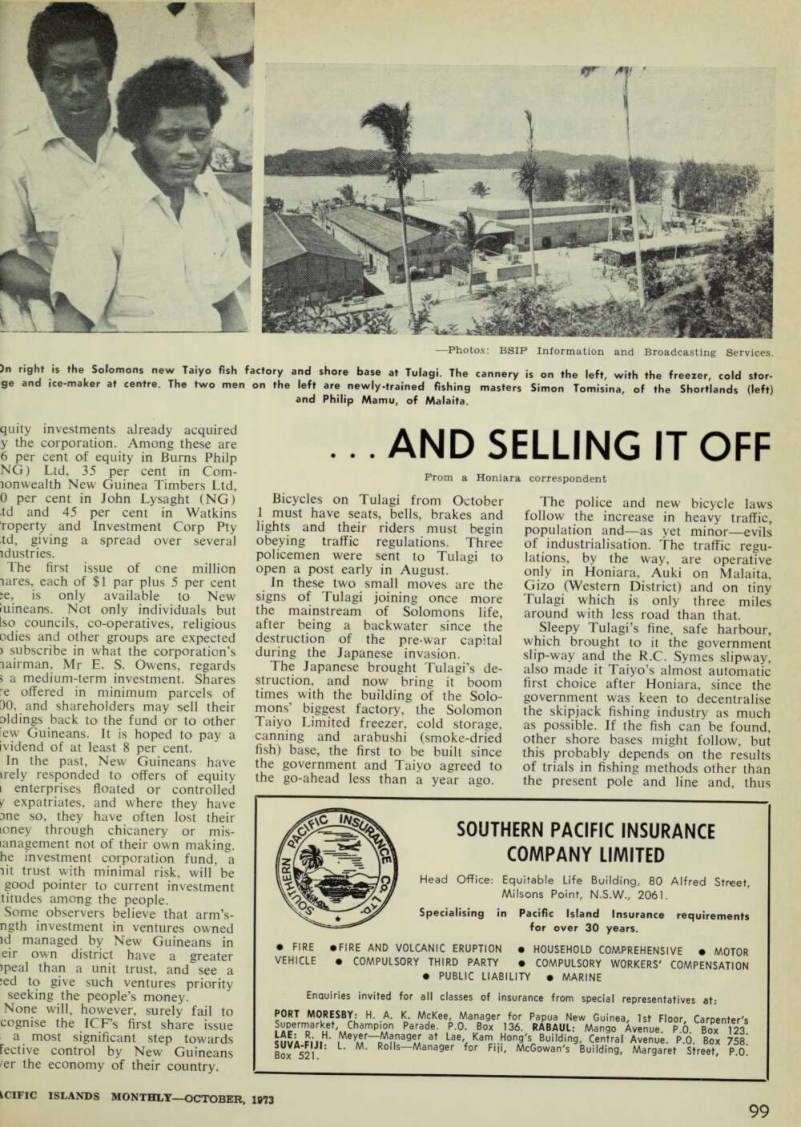
By Harry Jackman
Next to inflation, buying back the farm continues to be the big economics issue in Canada, Australia and several other industrialised nations. It is, or soon will be, a very hot political potato in those Pacific countries where foreign interests own and/or control the greater part of industry, commerce and banking. n VT v , ® jb , hat a ess • , " ra , e nal f ’ *l as a B rowi ng nee .^ lr T capita investment
/,f yh ,T 8 /
™te ° f the last decade ,s t 0 be mam '
tamea ‘
The present coalition government knows this. In December, 1972, the Chief Minister, Mr Michael Somare, said that foreign investment and selfemployed New Guinean businessmen are the backbone of the economy, The retention of the ‘mixed’ economy is indicated by the Improvement Programme, the new economic plan announced last March, but there are to be considerable changes in its structure.
To quote the first of the pro gramme’s eight basic aims, there is to be “a rapid increase in the pro portion of the economy under the control of New Guinean individuals and groups, and in the proportion of personal and property income that goes to New Guineans”, New Guineans are currently receiv ing no more than 36.4 per cent of monetary sector income and, unless «hey gain a growing share in owner ship’ this P crcenta gc must decrease as technological progress requires in creasing capital-intensity in just about every industry. Therefore, it is not surprising that the Minister for Finance, Mr Julius Chan, praised the Investment Corporation Fund of Papua New Guinea’s first share issue on September 1.
The investment corporation itself, a statutory body, began in 1972 to acquire equity in locally-based large enterprises on behalf of New Guineans. The corporation now has holdings valued at $10.3 million, The fund, which it has set up and manages, will use the money it re ceives from its shareholders to buy
quity investments already acquired y the corporation. Among these are 6 per cent of equity in Burns Philp NG) Ltd, 35 per cent in Com lonwealth New Guinea Timbers Ltd, 0 per cent in John Lysaght (NG) td and 45 per cent in Watkins roperty and Investment Corp Pty -td, giving a spread over several idustries.
The first issue of one million lares, each of $1 par plus 5 per cent ;e, is only available to New luineans. Not only individuals but iso councils, co-operatives, religious odies and other groups are expected > subscribe in what the corporation’s lairman, Mr E. S. Owens, regards > a medium-term investment. Shares "e offered in minimum parcels of JO, and shareholders may sell their hidings back to the fund or to other iew Guineans. It is hoped to pay a ividend of at least 8 per cent.
In the past, New Guineans have irely responded to offers of equity 1 enterprises floated or controlled Y expatriates, and where they have Dne so, they have often lost their Loney through chicanery or mis lanagement not of their own making, he investment corporation fund, a lit trust with minimal risk, will be good pointer to current investment titudes among the people.
Some observers believe that arm’s ngth investment in ventures owned id managed by New Guineans in eir own district have a greater ipeal than a unit trust, and see a ;ed to give such ventures priority seeking the people’s money.
None will, however, surely fail to cognise the ICFs first share issue a most significant step towards Fective control by New Guineans 'er the economy of their country.
Prom a Honiara correspondent
Bicycles on Tulagi from October 1 must have seats, bells, brakes and lights and their riders must begin obeying traffic regulations. Three policemen were sent to Tulagi to open a post early in August.
In these two small moves are the signs of Tulagi joining once more the mainstream of Solomons life, after being a backwater since the destruction of the pre-war capital during the Japanese invasion.
The Japanese brought Tulagi’s de struction, and now bring it boom times with the building of the Solo mons’ biggest factory, the Solomon Taiyo Limited freezer, cold storage, canning and arabushi (smoke-dried fish) base, the first to be built since the government and Taiyo agreed to the go-ahead less than a year ago.
The police and new bicycle laws follow the increase in heavy traffic population and—as yet minor—evils of industrialisation. The traffic regu lations, by the way, are operative only in Honiara, Auki on Malaita Gizo (Western District) and on tiny Tulagi which is only three miles around with less road than that Sleepy Tulagi’s fine safe harbour which brought to it the government slip-way and the R.C. Symes slipway also made it Taiyo’s almost automatic first choice after Honiara since the government was keen to decentralise the skipjack fishing industry as much as possible. If the fish can be found other shore bases might follow, but this probably depends on the results of trials in fishing methods other than the preSent pole and line and ' thus
Photos: BSIP Information and Broadcasting Services.
On right is the Solomons new Taiyo fish factory and shore base at Tulagi. The cannery is on the left, with the freezer, cold stor age and ice-maker at centre. The two men on the left are newly-trained fishing masters Simon Tomisina, of the Shortlands (left) and Philip Mamu, of Malaita.
on a new agreement between Taiyo and government.
At present, Solomon Taiyo is re stricted to 30,000 tons of skipjack a year, but nobody is saying whether that much is being caught. All the indications are that it is not, although catches would have to be far below that to interfere with the profitability of the joint venture.
The opening of the factory was quite a day. Taiyo chartered half a dozen small ships to take its invited guests over in comfort, with parti cular government officials going on the showpiece Shinpo Maru, crewed virtually by Solomon Islanders.
Large flags of all nations filled the boulevarde between the freezing and cold storage works and the nearly finished canning factory with its mix ture of new and second-hand Heath- Robinson devices. A few small piles of cans, shiny-gold inside, were lying near the machines to give people some idea of what would happen Taiyo officials later told how 15U people would shortly set the cannery into steaming, clattering life. I The biggest thrill of this carnival day for Solomon islanders was to dash from the 87 degrees Fahr outside air through the freezer doors, a rubber curtain, a completely toggea up ante-room, then another rubber curtain into the huge cold-storage room —minus 19 degrees. Sweaty clothes helped the impression enor mously, and some came hurtling bacK out through the curtains.
Afterwards, there was a feast oi
local and imported foods laid out on tables 30 yards long under heavy yellow plastic sheeting. All the food and drink disappeared very rapidly with the dozens if not hundreds of gate-crashers, but nobody minded too much. Naturally, the beer was good and cold and everyone enjoyed them selves.
Besides, there were the celebra tions at Taroniara on the main island of Gela, for the Diocese of Melane sia’s Sister Christine Woods who was celebrating her 40th year in the Solomons with the honour of a re vived custom dance in which she appeared as the long-gone Queen of Gela (the Florida Islands). Sister Woods was Matron of the Central Hospital for 10 years, then “retired” to the service of the Anglican Mission where one of her self-appointed tasks was the care of pioneer missionary Dr Charles E. Fox until he finally returned to his New Zealand home at the age of 94 in March this year.
Gela had not been so lively in a long time.
Fiji's multi-million
dollar land deal
Some of Fiji’s best cattle country, at Navua and Naitonitoni, about 30 miles west of Suva, has changed hands. W. R. Carpenter (South Pacific) Ltd will receive $4.2 million over three years for the Naitonitoni land, held in the name of Morris Hedstrom Ltd, and for their 54 per cent share of the Fiji Pastoral Co’s land at Navua. The remaining 46 per cent in the Fiji Pastoral Co was held by private shareholders. One of these was Mr J. M. Hedstrom, a Carpenter director whose interest was 25 per cent.
The purchaser was Property, Development and Agricultural Co of Fiji Ltd, which, according to Mr Charles Scott, whose company, Inter national Lands Developments Ltd, was agent for the transaction, is owned mainly by local businessmen.
The transaction involved the 5,818acre Fiji Pastoral Co dairy and beef cattle farm on the western side of the Navua River, and 1,048 acres at Naitonitoni, between Navua town and the Navua Hills. The Naitonitoni property has a long beach front.
Mr Lyle Cupit, managing director of the Carpenter group in Fiji said the $4.2 million would finance further development of the group’s operations in Fiji.
Castaway Island resort on Qalito Island in Fiji’s Mamanuca group, has been bought by a Hong Kong Com pany, Castaway Resort Ltd, for $1 million. The resort was built 14 years
ago by Sydney businessman Mr Richard Smith.
A number of other Fiji properties have sold at high prices recently.
Overseas buyers have paid from $300,000 to $412,000 for three 1,500 to 2,000-acre coconut plantations in Taveuni, and $550,000 for 437 acres of freehold land at Momi Bay on the south-west coast of Viti Levu.
Another property near Momi was sold to three Californian investors for $461,000.
Strike trouble
tor Nauru Centre
Construction on the 51-storey Nauru Centre in Melbourne has fallen behind schedule through a dogmen’s strike which has hit all the city’s major high-rise building pro jects. It now seems certain that the first tenants will not move into the lower sections of the Nauru Centre tower until early next year, rather than in November or December as had been planned originally.
The strike followed rejection of a claim by 50 dogmen—the daredevils who swing at the end of cranehooks manipulating loads—for a 30 per cent increase in pay. This would have brought them into line with crane drivers who make SAI3S for a 40hour week, but often double that with their overtime earnings.
The main problem for Nauru is that the strike may result in their having to adjust the project’s cash flow. For every week the cranes aren’t working (the crane drivers went on strike in support of the dogmen’s claim) it is costing Nauru about $A13,250.
Before the strike the project was running slightly ahead of schedule.
It is doubtful that the time lost through the strike will be made up, although the vague mid-1975 com pletion date talked about by Nauru government officials still seems well within the bounds of possibility.
The other question-mark hanging over the whole project is the escala tion of building costs. When the project began it was estimated that it would cost SABO million, but if inflation runs at 10 per cent over the next two years the total cost is more likely to be SA36 million to SA37 million.
Fiji shops
out of sugar
Sugar is Fiji’s number one industry, but for weeks the country’s shop shelves were sugarless.
Just before the beginning of the annual cane crushing season, local supplies of Fiji-produced sugar often run short, but there is usually enough to get by if consumers do not panic, and shelves are re-stocked as soon as crushing begins.
This year, however, a three-week strike by the Fiji Sugar and General Workers’ Union caused a real shortage. Some local sweets and soft drinks manufacturers had to cut pro duction because their stocks ran out, and a brewery nervously watched its supplies dwindle dangerously low.
Disgruntled consumers com plained: “First rice was unavailable.
Then there was no flour. Now we can’t buy our own sugar.” Long awaited shipments of flour, sharps and rice relieved the shortage of these
basics, but sugar remained in short supply until well after the 2,700 strikers went back to work.
In spite of the inconvenience, and the high cost of buying imported castor or lump sugar, most people sympathised with the strikers.
They opposed the idea of the government stepping in as it had in a strike of airport workers at Nadi, when it recruited volunteer labour to replace those who walked out.
They felt such a move would ag gravate the situation and wreck the mills. Certainly, the mill workers did skilled jobs.
Most believed the union was justi fied in its claim for an increase from 40c to 50c an hour, and felt the award of 3c handed down by the chairman of the Prices and Incomes Board, Dr Norman Ross, the sole arbitrator was miserably small.
The strike cost $330,000 in lost sugar exports, the Minister for Agri culture, Mr Doug Brown estimated.
This money now comes out of Fiji’s pocket, not some overseas-based private company.
Harbour study
in the Cooks
Engineers recently visited Atiu Island in the Cooks to study the possibility of establishing a harbour.
In the team with New Zealand public works engineers Don Haliburton and Donald Matheson were Colonel J.
Harman, chief engineer in the NZ Army, and Squadron Leader R.
Padamson of the RNZAF.
The two defence department en gineers also inspected the airstrip on Atiu to see how much work would be necessary to make it capable of carrying C-130 Hercules aircraft. If the strip can be strengthened adequately it is thought army en gineers, explosives and heavy equip ment could be flown in. • Credit for a gift of $60,000 for a chair of administrative studies at the University of Papua New Guinea was given by PIM (Sept, p 43) to the tobacco firm of W. D. & H. O.
Wills (Aust) Ltd. In fact charity be gan at home. The giver was its re lation, Wills (PNG) Ltd which em ploys more than 400 Papua New Guineans with less than 10 ex patriates. • Wuvulu Holdings Pty Ltd is advertising one acre beachfront blocks on Wuvulu Island, PNG, for $lO,OOO in Sydney newspapers. The company was formed in 1970 to de velop the island as an exclusive re treat.
Advertisements & other items, pp. 104-106 (2 items)
Lli V A
s u
MELBOURNE
AUCKLAND
LLI V A
SYDNEY
C. SULLIVAN (EXPORT) PTY. LTD.,
4TH FLOOR, KEMBLA BUILDING,
60 MARGARET STREET. SYDNEY
(G.P.O. BOX 3373).
CABLES AND TELEGRAMS: “CHASULL".
N S
BRISBANE
LONDON
OFFERS A COMPREHENSIVE AND EFFICIENT
BUYING SERVICE TO THE PACIFIC ISLANDS
OFFICES AT:
PORT MORESBY • LAE • RABAUL • KIETA • MOUNT HAGEN • BULUMA • SUVA • LAUTOKA • NOUMEA • HONIARA • PORT VILA
"SULLIVANS for SERVICE"
SOUTHERN PACIFIC INSURANCE
COMPANY LIMITED
Head Office: Equitable Life Building, 80 Alfred Street, AAilsons Point, N.S.W., 2061.
Specialising in Pacific Island Insurance requirements for over 30 years. • FIRE • FIRE AND VOLCANIC ERUPTION • HOUSEHOLD COMPREHENSIVE • MOTOR VEHICLE • COMPULSORY THIRD PARTY • COMPULSORY WORKERS' COMPENSATION
• PUBLIC LIABILITY • MARINE
Enauiries invited for all classes of insurance from special representatives at: PORT MORESBY: H. A. K. McKee, Manager for Papua New Guinea, Ist Floor, Carpenter's Supermarket Champion Parade. P.O. Box 136. RABAUL: Mango Avenue. P. 6. Box 123 cnuA Meyer Manager at Lae, Kam Hong's Building, Central Avenue. P.O. Box 758 : L * M R ° S — Manager for Fi|i ' McGowan's Building, Margaret Street, P.O.
BRAYBON PORTABLE
PETROL ELECTRIC SETS FOR:
.cold stores
* refrigeration
appliances
♦ milking
machines
♦workshop plant
♦fencing
4
1 K.V.A.
(240 Volt)
BRAYBON/LISTER
DIESEL ELECTRIC
SETS FOR:
• MOBILE
WORKSHOP
9 REFRIGERATED
VAN
9 ICE CREAM
DISPENSING
UNITS
• SHIPS AUXILIARY
POWER
• HOTEL AND
DOMESTIC POWER
Braybon Bros
17 PTY. LTD.,
2 ROTHWELL AVENUE, CONCORD WEST 2138
Tel.: 73-3246.
SYDNEY, AUSTRALIA.
SETS AVAILABLE
FROM 2 K.V.A.
TO 200 K.V.A.
Write for obligation free brochure and c.i.f. price Pacific Islands.
...And Selling It Off
99
LCIFIC ISLANDS MONTHLY—OCTOBER, 1973
Who Owns What
The BSIP has a 25 per cent interest in the cannery as part of an agreement made with Taiyo in Nov ember, 1972. The government has the option to buy up to 24 per cent more of the shares.
Taiyo has invested about $1 mil lion. When the factory is fully opera tional it will employ a staff of 150, producing 1,000 cases of 48 227 g (i lb) cans a day. It is expected to be working near peak capacity at the start of 1974. At present it is pro ducing at the rate of 100,000 to 150,000 cases of 48 227 g cans a year.
That amount caters for about one third of the catch. The remainder, frozen, will go to either Japan or American Samoa for canning. Some of the catch may be sold in the BSIP, depending on distribution arrange ments. Overseas marketing will he handled by Tokyo companies. Special arrangements will be made for the Pacific if there is a demand.
Advertisements & other items, p. 107 (1 item)
printing co. ply. ltd.
D apua new guinea
Serving the Country from Aitape to Alotau, Manus to Moresby.
Leaders in Commercial Offset and Letterpress Printing. • Stationery Office Supplies • Office Equipment • Rubber Stamps • Self-Adhesive Labels • In Fact:— Everything For The Office.
P.O. Box 633, Fort Moresby P.O. Box 759, Lae P.O. Box 30, Mt Hagen P.O. Box 1239, Rabaul P.O. Box 466, Kieta
Produce Prices
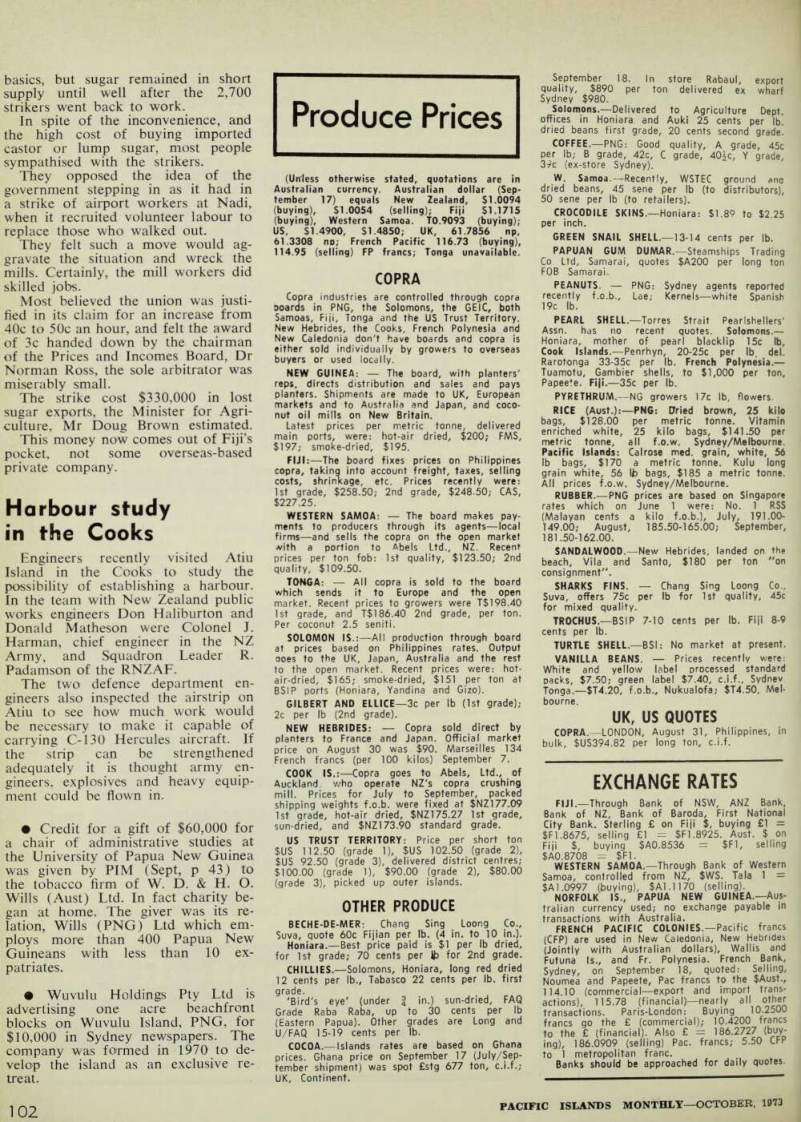
(Unless otherwise stated, quotations are in Australian currency. Australian dollar (Sep tember 17) equals New Zealand, $1.0094 (buying), $1.0054 (selling); Fiji $1.1715 (buying), Western Samoa. T 0.9093 (buying); US, $1.4900, $1.4850, UK, 61.7856 np, 61.3308 no; French Pacific 116.73 (buying), 114.95 (selling) FP francs; Tonga unavailable.
Copra
Copra industries are controlled through copra boards in PNG, the Solomons, the GEIC, both Samoas, Fiji, Tonga and the US Trust Territory.
New Hebrides, the Cooks, French Polynesia and New Caledonia don't have boards and copra is either sold individually by growers to overseas buyers or used locally.
NEW GUINEA: The board, with planters' reps, directs distribution and sales and pays planters. Shipments are made to UK, European markets and to Australia and Japan, and coco nut oil mills on New Britain.
Latest prices per metric tonne, delivered main ports, were: hot-air dried, $200; FMS, $197; smoke-dried, $195.
FIJI: —The board fixes prices on Philippines copra, taking into account freight, taxes, selling costs, shrinkage, etc. Prices recently were: Ist grade, $258.50; 2nd grade, $248.50; CAS, $227.25.
WESTERN SAMOA: The board makes pay ments to producers through its agents—local firms—and sells the copra on the open market with a portion to Abels Ltd., NZ. Recent prices per ton fob: Ist quality, $123.50; 2nd quality, $109.50.
TONGA: All copra is sold to the board which sends it to Europe and the open market. Recent prices to growers were T 5198.40 Ist grade, and T 5186.40 2nd grade, per ton.
Per coconut 2.5 seniti.
SOLOMON IS.: —All production through board at prices based on Philippines rates. Output ooes to the UK, Japan, Australia and the rest to the open market. Recent prices were; hot air-dried, $165; smoke-dried, $l5l per ton at BSIP ports (Honiara, Yandina and Gizo).
GILBERT AND ELLICE— 3c per lb (Ist grade); 2c per lb (2nd grade).
NEW HEBRIDES: Copra sold direct by planters to France and Japan. Official market price on August 30 was $9O. Marseilles 134 French francs (per 100 kilos) September 7.
COOK IS.: —Copra goes to Abels, Ltd., of Auckland, who operate NZ's copra crushing mill. Prices for July to September, packed shipping weights f.o.b. were fixed at $NZ177.09 Ist grade, hot-air dried, $NZ175.27 Ist grade, sun-dried, and $NZ173.90 standard grade.
US TRUST TERRITORY: Price per short ton SUS 112.50 (grade 1), SUS 102.50 (grade 2), SUS 92.50 (grade 3), delivered district centres; $lOO.OO (grade 1), $90.00 (grade 2), $BO.OO (grade 3), picked up outer islands.
Other Produce
BECHE-DE-MER: Chang Sing Loong Co., Suva, quote 60c Fijian per lb. (4 in. to 10 in.).
Honiara— Best price paid is $1 per lb dried, for Ist grade; 70 cents per $ for 2nd grade.
CHILLIES. —SoIomons, Honiara, long red dried 12 cents per lb.. Tabasco 22 cents per lb. first grade.
'Bird's eye' (under in.) sun-dried, FAQ Grade Raba Raba, up to 30 cents per lb (Eastern Papua). Other grades are Long and U/FAQ 15-19 cents per lb.
COCOA. —Islands rates are based on Ghana prices. Ghana price on September 17 (July/Sep tember shipment) was spot £stg 677 ton, c.i.f.; UK, Continent.
September 18. In store Rabaul, export quality, $B9O per ton delivered ex wharf Sydney $9BO.
Solomons. —Delivered to Agriculture Dept, offices in Honiara and Auki 25 cents per lb. dried beans first grade, 20 cents second grade.
COFFEE.—PNG: Good quality, A grade, 45c per lb; B grade, 42c, C grade, 40£c, Y grade, 39c (ex-store Sydney).
W. Samoa. —Recently, WSTEC ground ana dried beans, 45 sene per lb (to distributors), 50 sene per lb (to retailers).
CROCODILE SKlNS.—Honiara: $1.89 to $2.25 per inch.
GREEN SNAIL SHELL—I 3-14 cents per lb.
PAPUAN GUM DUMAR.— Steamships Trading Co Ltd, Samarai, quotes SA2OO per long ton FOB Samarai.
PEANUTS. PNG: Sydney agents reported recently f.0.b., Lae,- Kernels—white Spanish 19c lb.
PEARL SHELL. —Torres Strait Pearlshellers' Assn, has no recent quotes. Solomons. — Honiara, mother of pearl blacklip 15c lb.
Cook Islands. —Penrhyn, 20-25 c per lb. del.
Rarotonga 33-35 c per lb. French Polynesia. — Tuamotu, Gambler shells, to $l,OOO per ton, Papeete. Fiji. —3sc per lb.
PYRETHRUM.— NG growers 17c lb, flowers.
RICE (Aust.):— PNG: dried brown, 25 kilo bags, $128.00 per metric tonne. Vitamin enriched white, 25 kilo bags, $141.50 per metric tonne, all f.o.w. Sydney/Melbourne.
Pacific Islands; Calrose med. grain, white, 56 lb bags, $l7O a metric tonne. Kulu long grain white, 56 lb bags, $lB5 a metric tonne.
All prices f.o.w. Sydney/Melbourne.
RUBBER. —PNG prices are based on Singapore rates which on June 1 were: No, 1 RSS (Malayan cents a kilo f.0.b.), July, 191.G0-149 149 .00; August, 185.50-165.00; September, 181.50-162.00.
SANDALWOOD. —New Hebrides, landed on the beach, Vila and Santo, $lBO per ton "on consignment".
SHARKS FINS. Chang Sing Loong Co., Suva, offers 75c per lb for Ist quality, 45c for mixed quality.
TROCHUS.— BSIP 7-10 cents per lb. Fiji 8-9 cents per lb.
TURTLE SHELL.— BSI: No market at present.
VANILLA BEANS. Prices recently were: White and yellow label processed standard packs, $7.50; green label $7.40, c.i.f., Sydnev Tonga.—sT4.2o, f.0.b., Nukualofa; $T4.50, Mel bourne.
Uk, Us Quotes
COPRA.— LONDON, August 31, Philippines, in bulk, $U5394.82 per long ton, c.i.f.
Exchange Rates
FlJl.—Through Bank of NSW, ANZ Bank, Bank of NZ, Bank of Baroda, First National City Bank. Sterling £ on Fiji $, buying £1 = $F1.8675, selling £1 = $F1.8925. Aust. $ on Fiji $, buying $A0.8536 = SFI, selling
$A0.8708 = Sfi.
WESTERN SAMOA.—Through Bank of Western Samoa, controlled from NZ, SWS. Tala 1 = $A1.0997 (buying), $A1.1170 (selling).
Norfolk Is., Papua New Gulnea.—Aus
tralian currency used; no exchange payable in transactions with Australia.
FRENCH PACIFIC COLONIES.—Pacific francs (CFP) are used in New Caledonia, New Hebrides (Jointly with Australian dollars), Wallis and Futuna Is., and Fr. Polynesia. French Bank, Sydney, on September 18, quoted: Selling, Noumea and Papeete, Pac francs to the sAust., 114.10 (commercial —export and import trans actions), 115.78 (financial)— nearly all other transactions. Paris-London; Buying 10.2500 francs go the £ (commercial); 10.4200 francs to the £ (financial). Also £ = 186.2727 (buy ing), 186.0909 (selling) Pac. francs; 5.50 CFP to 1 metropolitan franc.
Banks should be approached for daily quotes.
Shipping & Airways Information
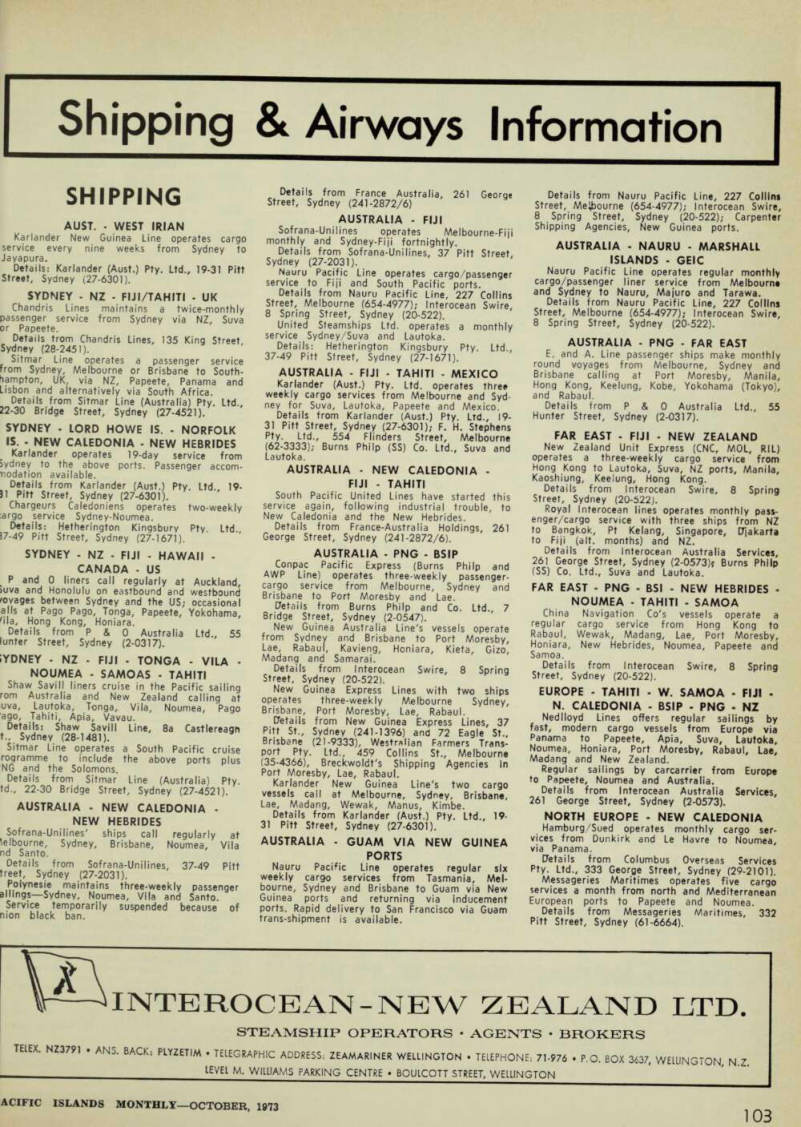
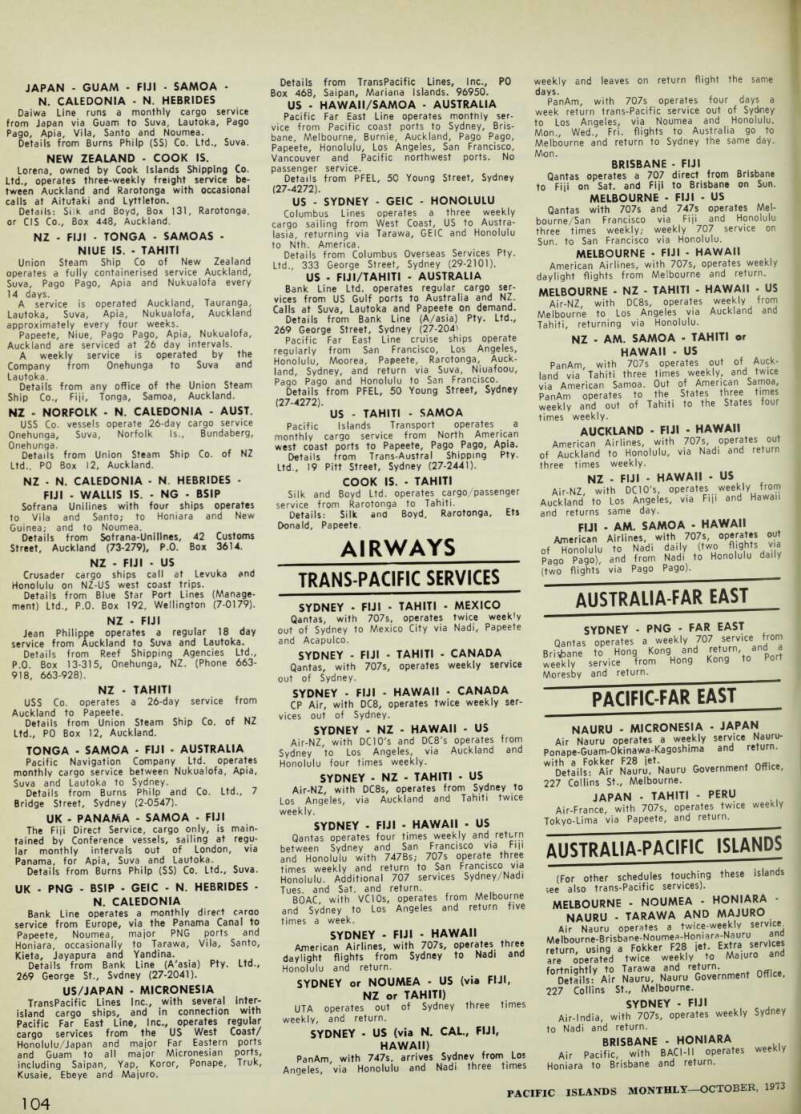
Shipping
Aust. - West Irian
Karlander New Guinea Line operates cargo service every nine weeks from Sydney to Jayapura.
Details: Karlander (Aust.) Pty. Ltd., 19-31 Pitt Street, Sydney (27-6301).
SYDNEY - NZ - FIJI/TAHITI - UK Chandris Lines maintains a twice-monthly passenger service from Sydney via NZ, Suva or Papeete.
Details trom Chandris Lines, 135 King Street Sydney (28-2451).
Sitmar Line operates a passenger service from Sydney, Melbourne or Brisbane to South hampton, UK, via NZ, Papeete, Panama and Lisbon and alternatively via South Africa.
Details from Sitmar Line (Australia) Pty. Ltd., 22-30 Bridge Street, Sydney (27-4521).
SYDNEY - LORD HOWE IS. - NORFOLK IS. - NEW CALEDONIA - NEW HEBRIDES Karlander operates 19-day service from Sydney to the above ports. Passenger accom nodation available.
Details from Karlander (Aust.) Pty. Ltd. 19- 11 Pitt Street, Sydney (27-6301).
Chargeurs Caledoniens operates two-weekly :argo service Sydney-Noumea.
Details: Hetherington Kingsbury Pty. Ltd. 17-49 Pitt Street, Sydney (27-1671).
SYDNEY - NZ - FIJI - HAWAII -
Canada - Us
, P and 0 liners call regularly at Auckland, >uva and Honolulu on eastbound and westbound rovages between Sydney and the US; occasional alls at Pago Pago, Tonga, Papeete, Yokohama, hla, Hong Kong, Honiara.
Details from P & 0 Australia Ltd., 55 lunter Street, Sydney (2-0317).
IYDNEY - NZ - FIJI - TONGA - VILA -
Noumea - Samoas - Tahiti
Shaw Savill liners cruise in the Pacific sailing rom Australia and New Zealand calling at uva, Lautoka, Tonga, Vila, Noumea, Pago ago, Tahiti, Apia, Vavau.
Details: Shaw Savill Line, 8a Castlereagn t.. Sydney (28-1481).
Sitmar Line operates a South Pacific cruise rogramme to include the above ports plus NG and the Solomons, Details from Sitmar Line (Australia) Pty. td., 22-30 Bridge Street, Sydney (27-4521).
Australia - New Caledonia ■
New Hebrides
Sofrana-Unilines' ships call regularly at \elbourne, Sydney, Brisbane, Noumea, Vila nd Santo.
Details from Sofrana-Unilines, 37-49 Pitt treet, Sydney (27-2031).
Polynesia maintains three-weekly passenger allmgs —Sydney, Noumea, Vila and Santo.
Service temporarily suspended because of nion black ban.
Details from France Australia, 261 George Street, Sydney (241-2872/6)
Australia - Fiji
Sofrana-Unilines operates Melbourne-Fiji monthly and Sydney-Fiji fortnightly.
Details from Sofrana-Unilines, 37 Pitt Street, Sydney (27-2031).
Nauru Pacific Line operates cargo/passenger service to Fiji and South Pacific ports.
Details from Nauru Pacific Line, 227 Collins Street, Melbourne (654-4977); Interocean Swire, 8 Spring Street, Sydney (20-522).
United Steamships Ltd. operates a monthly service Sydney/Suva and Lautoka.
Details: Hetherington Kingsbury Pty. Ltd., 37-49 Pitt Street, Sydney (27-1671), AUSTRALIA - FIJI - TAHITI - MEXICO Karlander (Aust.) Pty. Ltd. operates three weekly cargo services from Melbourne and Syd ney for Suva, Lautoka, Papeete and Mexico.
Details from Karlander (Aust.) Pty. Ltd., 19- 31 Pitt Street, Sydney (27-6301); F. H. Stephens Pty. Ltd., 554 Flinders Street, Melbourne (62-3333); Burns Philp (SS) Co. Ltd., Suva and Lautoka.
Australia - New Caledonia -
Fiji - Tahiti
South Pacific United Lines have started this service again, following industrial trouble, to New Caledonia and the New Hebrides.
Details from France-Australia Holdings, 261 George Street, Sydney (241-2872/6).
Australia - Png ■ Bsip
Conpac Pacific Express (Burns Philp and AWP Line) operates three-weekly passenger cargo service from Melbourne, Sydney and Brisbane to Port Moresby and Lae.
Details from Burns Philp and Co. Ltd. 7 Bridge Street, Sydney (2-0547).
New Guinea Australia Line's vessels operate from Sydney and Brisbane to Port Moresby, Lae, Rabaul, Kavieng, Honiara, Kieta, Gizo, Madang and Samarai.
Details from Interocean Swire, 8 Spring Street, Sydney (20-522).
New Guinea Express Lines with two ships operates three-weekly Melbourne Sydney, Brisbane, Port Moresby, Lae, Rabaul.
Details from New Guinea Express Lines, 37 Pitt St., Sydney (241-1396) and 72 Eagle St., Brisbane (21-9333), Westralian Farmers Trans port Pty. Ltd., 459 Collins St., Melbourne (35-4366), Breckwoldt's Shipping Agencies In Port Moresby, Lae, Rabaul.
Karlander New Guinea Line's two cargo vessels call at Melbourne, Sydney, Brisbane, Lae, Madang, Wewak, Manus, Kimbe.
Details from Karlander (Aust.) Pty. Ltd., 19 31 Pitt Street, Sydney (27-6301).
Australia - Guam Via New Guinea
Ports
Nauru Pacific Line operates regular six weekly cargo services from Tasmania, Mel bourne, Sydney and Brisbane to Guam via New Guinea ports and returning via inducement ports. Rapid delivery to San Francisco via Guam trans-shipment is available.
Details from Nauru Pacific Line, 227 Collin* Street, Melbourne (654-4977); Interocean Swire, 8 Spring Street, Sydney (20-522); Carpenter Shipping Agencies, New Guinea ports.
Australia - Nauru - Marshall
Islands - Geic
Nauru Pacific Line operates regular monthly cargo/passenger liner service from Melbourne and Sydney to Nauru, Majuro and Tarawa.
Details from Nauru Pacific Line, 227 Collin* Street, Melbourne (654-4977); Interocean Swire, 8 Spring Street, Sydney (20-522).
Australia - Png - Far East
E. and A. Line passenger ships make monthly round voyages from Melbourne, Sydney and Brisbane calling at Port Moresby, Manila, Hong Kong, Keelung, Kobe, Yokohama (Tokyo), and Rabaul.
Details from P & 0 Australia Ltd., 55 Hunter Street, Sydney (2-0317).
FAR EAST - FIJI - NEW ZEALAND New Zealand Unit Express (CNC, MOL, RIL) operates a three-weekly cargo service from Hong Kong to Lautoka, Suva, NZ ports, Manila, Kaoshiung, Keelung, Hong Kong.
Details from Interocean Swire, 8 Spring Street, Sydney (20-522).
Royal Interocean lines operates monthly pass enger/cargo service with three ships from NZ to Bangkok, Pt Kelang, Singapore, Djakarta to Fiji (alt. months) and NZ.
Details from Interocean Australia Services, 26] George Street, Sydney (2-0573); Burns Phllp (SS) Co. Ltd., Suva and Lautoka.
FAR EAST - PNG - BSI - NEW HEBRIDES ■
Noumea - Tahiti - Samoa
China Navigation Co's vessels operate a regular cargo service from Hong Kong to Rabaul, Wewak, Madang, Lae, Port Moresby, Honiara, New Hebrides, Noumea, Papeete and Samoa.
Details from Interocean Swire, 8 Spring Street, Sydney (20-522).
EUROPE ■ TAHITI - W. SAMOA - FIJI .
N. CALEDONIA • BSIP - PNG - NZ Nedlloyd Lines offers regular sailings by fast, modern cargo vessels from Europe via Panama to Papeete, Apia, Suva, Lautoka, Noumea, Honiara, Port Moresby, Rabaul, Lae, Madang and New Zealand.
Regular sailings by carcarrier from Europe to Papeete, Noumea and Australia.
Details from Interocean Australia Services, 261 George Street, Sydney (2-0573).
North Europe - New Caledonia
Hamburg/Sued operates monthly cargo ser vices from Dunkirk and Le Havre to Noumea, via Panama.
Details from Columbus Overseas Services Pty. Ltd., 333 George Street, Sydney (29-2101).
Messageries Maritimes operates five cargo services a month from north and Mediterranean European ports to Papeete and Noumea.
Details from Messageries Maritimes, 332 Pitt Street, Sydney (61-6664).
JAPAN - GUAM - FIJI • SAMOA -
N. Caledonia - N. Hebrides
Daiwa Line runs a monthly cargo service from Japan via Guam to Suva, Lautoka, Pago Pago, Apia, Vila, Santo and Noumea.
Details from Burns Philp (SS) Co. Ltd., Suva.
New Zealand - Cook Is.
Lorena, owned by Cook Islands Shipping Co.
Ltd., operates three-weekly freight service be tween Auckland and Rarotonga with occasional calls at Aitutaki and Lyttleton.
Details; Silk and Boyd, Bo* 131, Rarotonga, or CIS Co., Box 448, Auckland.
NZ • FIJI • TONGA • SAMOAS ■
Niue Is. - Tahiti
Union Steam Ship Co of New Zealand operates a fully containerised service Auckland, Suva, Pago Pago, Apia and Nukualofa every 14 days.
A service is operated Auckland, Tauranga, Lautoka, Suva, Apia, Nukualofa, Auckland approximately every four weeks.
Papeete, Niue, Pago Pago, Apia, Nukualofa, Auckland are serviced at 26 day intervals.
A weekly service is operated by the Company from Onehunga to Suva and Lautoka.
Details from any office of the Union Steam Ship Co., Fiji, Tonga, Samoa, Auckland.
NZ ■ NORFOLK - N. CALEDONIA - AUST.
USS Co. vessels operate 26-day cargo service Onehunga, Suva, Norfolk Is., Bundaberg, Onehunga.
Details from Union Steam Ship Co. of NZ Ltd., PO Box 12, Auckland.
NZ - N. CALEDONIA - N. HEBRIDES • FIJI - WALLIS IS. - NG - BSIP Sofrana Unilines with four ships operates to Vila and Santo; to Honiara and New Guinea; and to Noumea.
Details from Sofrana-Unillnes, 42 Customs Street, Auckland (73-279), P.O. Box 3614.
Nz - Fiji - Us
Crusader cargo ships call at Levuka and Honolulu on NZ-US west coast trips.
Details from Blue Star Port Lines (Manage ment) Ltd., P.O. Box 192, Wellington (7-0179).
Nz • Fiji
Jean Philippe operates a regular 18 day service from Auckland to Suva and Lautoka.
Details from Reef Shipping Agencies Ltd., P.O. Box 13-315, Onehunga, NZ. (Phone 663- 918, 663-928).
Nz - Tahiti
USS Co. operates a 26-day service from Auckland to Papeete.
Details from Union Steam Ship Co. of NZ Ltd., PO Box 12, Auckland.
TONGA - SAMOA - FIJI • AUSTRALIA Pacific Navigation Company Ltd. operates monthly cargo service between Nukualofa, Apia, Suva and Lautoka to Sydney.
Details from Burns Philp and Co. Ltd., 7 Bridge Street, Sydney (2-0547).
UK • PANAMA - SAMOA - FIJI The Fiji Direct Service, cargo only, is main tained by Conference vessels, sailing at regu lar monthly intervals out of London, via Panama, for Apia, Suva and Lautoka.
Details from Burns Philp (SS) Co. Ltd., Suva.
UK - PNG - BSIP - GEIC - N. HEBRIDES -
N. Caledonia
Bank Line operates a monthly direct caroo service from Europe, via the Panama Canal to Papeete, Noumea, major PNG ports and Honiara, occasionally to Tarawa, Vila, Santo, Kieta, Jayapura and Yandina.
Details from Bank Line (A'asia) Pty. Ltd., 269 George St., Svdney (27-2041).
Us/Japan - Micronesia
Transpacific Lines Inc., with several inter island cargo ships, and in connection with Pacific Far East Line, Inc., operates regular cargo services from the US West Coast/ Honolulu/Japan and major Far Eastern ports and Guam to all major Micronesian ports, including Saipan, Yap, Koror, Ponape, Truk, Kusaie, Ebeye and Majuro.
Details from Transpacific Lines, Inc., PO Box 468, Saipan, Mariana Islands. 96950.
Us - Hawaii/Samoa - Australia
Pacific Far East Line operates monthly ser vice from Pacific coast ports to Sydney, Bris bane, Melbourne, Burnie, Auckland, Pago Pago, Papeete, Honolulu, Los Angeles, San Francisco, Vancouver and Pacific northwest ports. No passenger service.
Details from PFEL, 50 Young Street, Sydney (27-4272).
US - SYDNEY - GEIC - HONOLULU Columbus Lines operates a three weekly cargo sailing from West Coast, US to Austra lasia, returning via Tarawa, GEIC and Honolulu to Nth. America.
Details from Columbus Overseas Services Pty.
Ltd., 333 George Street, Sydney (29-2101).
Us • Fiji/Tahiti - Australia
Bank Line Ltd. operates regular cargo ser vices from US Gulf ports to Australia and NZ.
Calls at Suva, Lautoka and Papeete on demand.
Details from Bank Line (A/asia) Pty. Ltd., 269 George Street, Sydney (27-204' Pacific Far East Line cruise ships operate regularly from San Francisco, Los Angeles, Honolulu, Moorea, Papeete, Rarotonga, Auck land, Sydney, and return via Suva, Niuafoou, Pago Pago and Honolulu to San Francisco.
Details from PFEL, 50 Young Street, Sydney (27-4272).
Us - Tahiti - Samoa
Pacific Islands Transport operates a monthly cargo service from North American west coast ports to Papeete, Pago Pago, Apia.
Details from Trans-Austral Shipping Pty.
Ltd., 19 Pitt Street, Sydney (27-2441).
Cook Is. • Tahiti
Silk and Boyd Ltd. operates cargo/passenger service from Rarotonga to Tahiti.
Details: Silk and Boyd, Rarotonga, Ets Donald, Papeete.
Advertisements & other items, p. 109 (2 items)
103
CIFIC ISLANDS MONTHLY—OCTOBER, 1973
Interocean-New Zealand Ltd.
VB
STEAMSHIP OPERATORS • AGENTS • BROKERS
TELEX. NZ3791 . ANS. BACK: PLYZETIM • TELEGRAPHIC ADDRESS: ZEAMARINER WELLINGTON • TELEPHONE: 71-976 • P.O. BOX 3637, WELLINGTON, N.Z.
LEVEL M. WILLIAMS PARKING CENTRE • BOULCOTT STREET, WELLINGTON
Airways
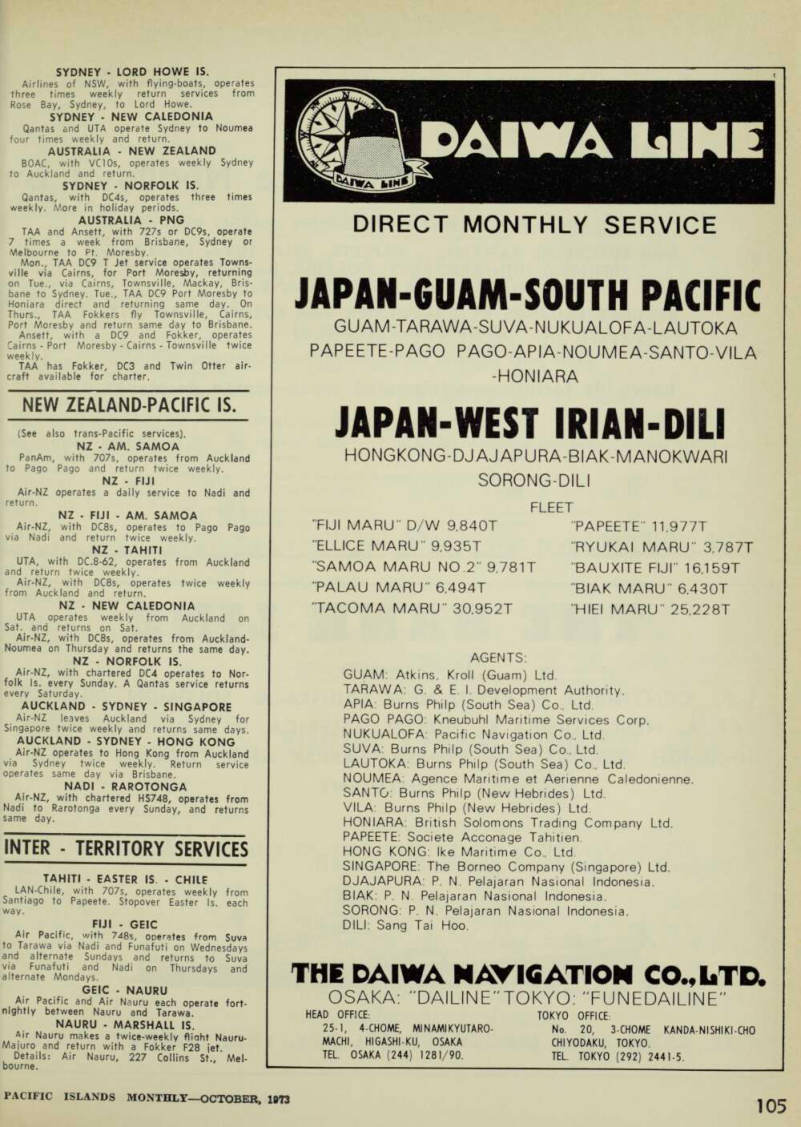
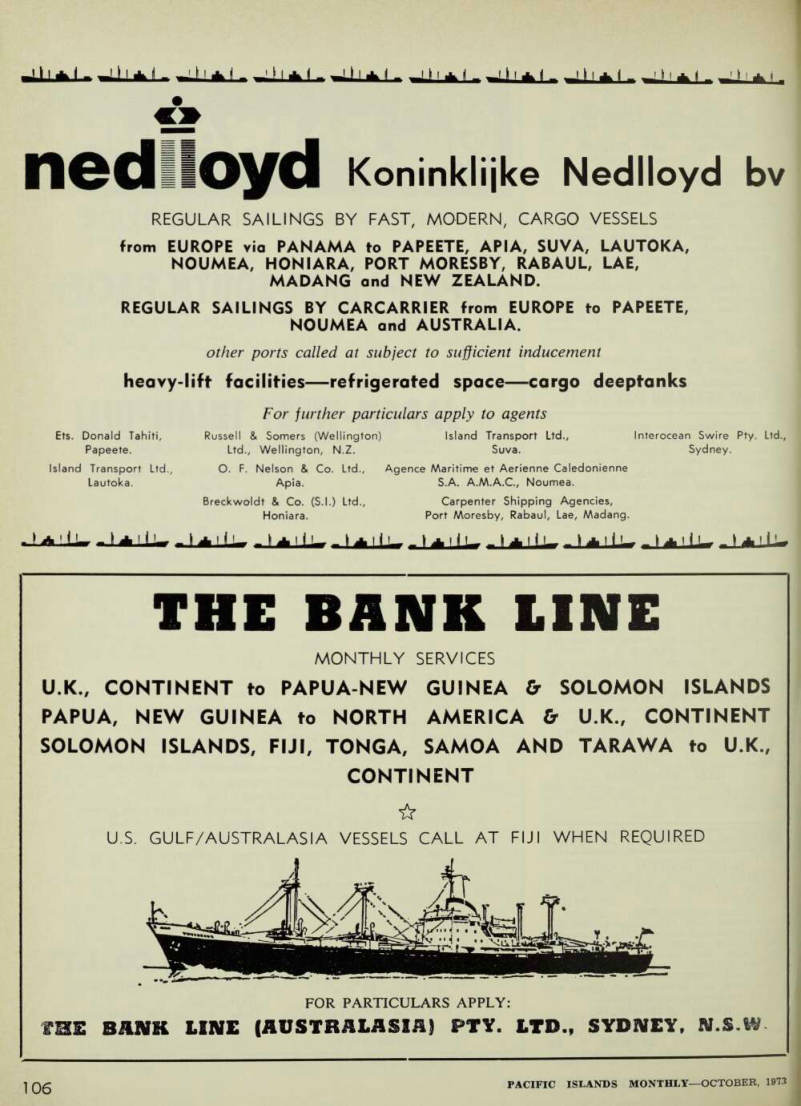
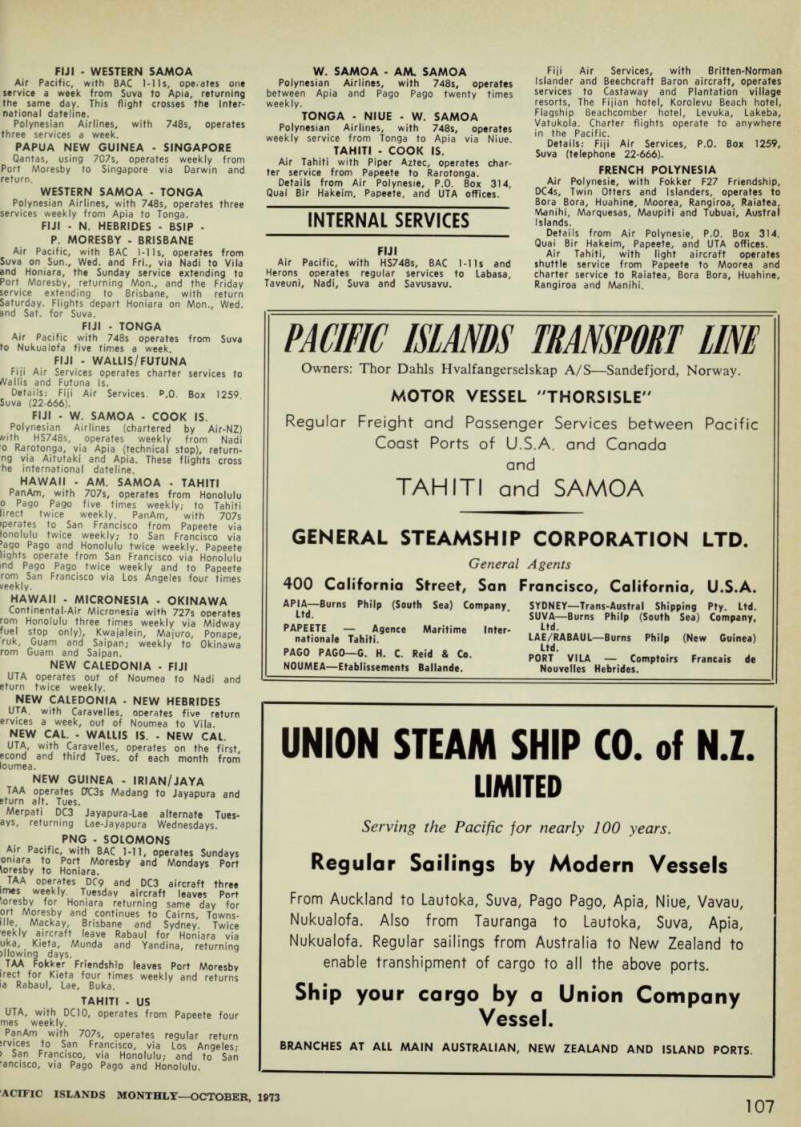
Trans Pacific Services
SYDNEY - FIJI • TAHITI • MEXICO Qantas, with 7075, operates twice weekly out of Sydney to Mexico City via Nadi, Papeete and Acapulco.
SYDNEY - FIJI - TAHITI - CANADA Qantas, with 7075, operates weekly service out of Sydney.
SYDNEY • FIJI - HAWAII - CANADA CP Air, with DCS, operates twice weekly ser vices out of Sydney.
SYDNEY - NZ - HAWAII - US Air-NZ, with DClO's and DCB's operates from Sydney to Los Angeles, via Auckland and Honolulu four times weekly.
SYDNEY - NZ - TAHITI ■ US Air-NZ, with DCBs, operates from Sydney to Los Angeles, via Auckland and Tahiti twice weekly.
SYDNEY - FIJI - HAWAII - US Qantas operates four times weekly and return between Sydney and San Francisco via Fi|i and Honolulu with 74785; 707 s operate three times weekly and return to San Francisco via Honolulu. Additional 707 services Sydney/Nadi Tues. and Sat. and return.
BOAC, with VClOs, operates from Melbourne and Sydney to Los Angeles and return five times a week.
Sydney - Fiji • Hawaii
American Airlines, with 7075, operates three daylight flights from Sydney to Nadi and Honolulu and return.
SYDNEY or NOUMEA - US (via FIJI,
Nz Or Tahiti)
UTA operates out of Sydney three times weekly, and return.
SYDNEY - US (via N. CAL, FIJI,
Hawaii)
PanAm, with 7475, arrives Sydney from Los Angeles, via Honolulu and Nadi three times
weekly and leaves on return flight the same days.
PanAm, with 707 s operates four days a week return trans-Pacific service out of Sydney to Los Angeles, via Noumea and Honolulu.
Mon., Wed., Fri. flights to Australia go to Melbourne and return to Sydney the same day.
Mon.
Brisbane - Fiji
Qantas operates a 707 direct from Brisbane to Fiji on Sat. and Fiji to Brisbane on Sun.
Melbourne • Fiji • Us
Qantas with 707 s and 747 s operates Mel bourne/San Francisco via Fiji and Hpnolulu three times weekly; weekly 707 service on Sun. to San Francisco via Honolulu.
Melbourne - Fiji - Hawaii
American Airlines, with 7075, operates weekly daylight flights from Melbourne and return.
MELBOURNE - NZ • TAHITI - HAWAII - US Air-NZ, with DCBs, operates weekly from Melbourne to Los Angeles via Auckland and Tahiti, returning via Honolulu.
NZ - AM. SAMOA • TAHITI or
Hawaii - Us
PanAm, with 707 s operates out of Auck land via Tahiti three times weekly, and twice via American Samoa. Out of American Samoa, PanAm operates to the States three times weekly and out of Tahiti to the States four times weekly.
Auckland • Fiji • Hawaii
American Airlines, with 7075, operates out of Auckland to Honolulu, via Nadi and return three times weekly.
NZ - FIJI - HAWAII - US Air-NZ, with DClO's operates , weekly from Auckland to Los Angeles, via Fiji and Hawaii and returns same day.
Fiji - Am. Samoa - Hawaii
American Airlines, with 7075, operates out of Honolulu to Nadi daily (two fl| 9 h ts Xja Pago Pago), and from Nadi to Honolulu daily (two flights via Pago Pago).
Australia-Far East
Sydney - Png - Far East
Qantas operates a weekly 707 service from Brisbane to Hong Kong and return, and a weekly service from Hong Kong to ron Moresby and return.
Pacific-Far East
Nauru - Micronesia - Japan
Air Nauru operates a weekly service Nauru- Ponape-Guam-Okinawa-Kagoshima and return, with a Fokker F2B jet.
Details; Air Nauru, Nauru Government Office, 227 Collins St., Melbourne.
Japan - Tahiti - Peru
Air-France, with 7075, operates twice weekly Tokyo-Lima via Papeete, and return.
Australia-Pacific Islands
(For other schedules touching these islands ;ee also trans-Pacific services).
Melbourne - Noumea - Honiara
Nauru ■ Tarawa And Majuro
Air Nauru operates a twice-weekly service Me Ibourne-Brisbane-Noumea-Hon,, a * 2 return, using a Fokker F2B let Extra services are operated twice weekly to Maiuro ana fortnightly to Tarawa and return. t 0 Details: Air Nauru, Nauru Government Office, 227 Collins St., Melbourne.
Sydney - Fiji
Air-lndia, with 7075, operates weekly Sydney to Nadi and return.
Brisbane ■ Honiara
Air Pacific, with BACI-ll operates weekly Honiara to Brisbane and return.
Sydney - Lord Howe Is.
Airlines of NSW, with flying-boats, operates three times weekly return services from Rose Bay, Sydney, to Lord Howe.
Sydney - New Caledonia
Qantas and UTA operate Sydney to Noumea four times weekly and return.
Australia - New Zealand
BOAC, with VClOs, operates weekly Sydney to Auckland and return.
Sydney - Norfolk Is.
Qantas, with DC4s, operates three times weekly. More in holiday periods.
Australia - Png
TAA and Ansett, with 727 s or DC9s, operate 7 times a week from Brisbane, Sydney or Melbourne to Pt. Moresby.
Mon., TAA DC9 T Jet service operates Towns ville via Cairns, for Port Moresby, returning on Tue., via Cairns, Townsville, Mackay, Bris bane to Sydney. Tue., TAA DC9 Port Moresby to Honiara direct and returning same day. On Thurs., TAA Fokkers fly Townsville, Cairns, Port Moresby and return same day to Brisbane.
Ansett, with a DC9 and Fokker, operates Cairns - Port Moresby - Cairns - Townsville twice weekly.
TAA has Fokker, DCS and Twin Otter air craft available for charter.
New Zealand-Pacific Is.
(See also trans-Pacific services).
Nz - Am. Samoa
PanAm, with 7075, operates from Auckland to Pago Pago and return twice weekly.
Nz - Fiji
Air-NZ operates a daily service to Nadi and return.
Nz - Fiji ■ Am. Samoa
Air-NZ, with DCBs, operates to Pago Pago via Nadi and return twice weekly.
Nz - Tahiti
UTA, with DC.B-62, operates from Auckland and return twice weekly.
Air-NZ, with DCBs, operates twice weekly from Auckland and return.
Nz - New Caledonia
UTA operates weekly from Auckland on Sat. and returns on Sat.
Air-NZ, with DCBs, operates from Auckland- Noumea on Thursday and returns the same day.
Nz • Norfolk Is.
Air-NZ, with chartered DC4 operates to Nor folk Is. every Sunday. A Qantas service returns every Saturday.
Auckland - Sydney - Singapore
Air-NZ leaves Auckland via Sydney for Singapore twice weekly and returns same days.
Auckland - Sydney - Hong Kong
Air-NZ operates to Hong Kong from Auckland via Sydney twice weekly. Return service operates same day via Brisbane.
Nadi - Rarotonga
Air-NZ, with chartered HS74B, operates from Nadi to Rarotonga every Sunday, and returns same day.
Inter - Territory Services
Tahiti - Easter Is. - Chile
LAN-Chile, with 7075, operates weekly from Santiago to Papeete. Stopover Easter Is. each way.
Fiji - Geic
Air Pacific, with 7485, operates from Suva to Tarawa via Nadi and Funafuti on Wednesdays and alternate Sundays and returns to Suva via Funafuti and Nadi on Thursdays and alternate Mondays.
Geic • Nauru
Air Pacific and Air Nauru each operate fort nightly between Nauru and Tarawa.
Nauru - Marshall Is.
Air Nauru makes a twice-weekly fliaht Nauru- Majuro and return with a Fokker F2B jet.
Details: Air Nauru, 227 Collins St., Mel bourne.
Fiji - Western Samoa
Air Pacific, with BAC 1-1 Is, operates one service a week from Suva to Apia, returning the same day. This flight crosses the Inter national dateline.
Polynesian Airlines, with 7485, operates three services a week.
Papua New Guinea - Singapore
Qantas, using 7075, operates weekly from Port Moresby to Singapore via Darwin and return.
Western Samoa - Tonga
Polynesian Airlines, with 7485, operates three services weekly from Apia to Tonga.
FIJI - N. HEBRIDES - BSIP -
P. Moresby - Brisbane
Air Pacific, with BAC 1-lls, operates from Suva on Sun., Wed. and Fri., via Nadi to Vila and Honiara, the Sunday service extending to Port Moresby, returning Mon., and the Friday service extending to Brisbane, with return Saturday. Flights depart Honiara on Mon., Wed. and Sat. for Suva,
Fiji - Tonga
Air Pacific with 748 s operates from Suva to Nukualofa five times a week.
Fiji - Wallis/Futuna
Fiji Air Services operates charter services to Wallis and Futuna Is.
Details: Fiji Air Services. P.O. Box 1259 Suva (22-666).
FIJI - W. SAMOA - COOK IS.
Polynesian Airlines (chartered by Air-NZ) with HS74Bs, operates weekly from Nadi o Rarotonga, via Apia (technical stop), return ng via Aitutaki and Apia. These flights cross he international dateline.
Hawaii - Am. Samoa - Tahiti
PanAm, with 7075, operates from Honolulu o Pago Pago five times weekly; to Tahiti lirect twice weekly. PanAm, with 707 s iperates to San Francisco from Papeete via lonolulu twice weekly; to San Francisco via ’ago Pago and Honolulu twice weekly. Papeete lights operate from San Francisco via Honolulu md Pago Pago twice weekly and to Papeete rom San Francisco via Los Angeles four times weekly.
Hawaii - Micronesia - Okinawa
Continental-Air Micronesia with 727 s operates
rom Honolulu three times weekly via Midway fuel stop only), Kwajalein, Majuro, Ponape, ruk, Guam and Saipan; weekly to Okinawa rom Guam and Saipan.
New Caledonia - Fiji
UTA operates out of Noumea to Nadi and eturn twice weekly.
New Caledonia - New Hebrides
UTA, with Caravelles, operates five return ervices a week, out of Noumea to Vila.
NEW CAL. - WALLIS IS. - NEW CAL.
UTA, with Caravelles, operates on the first, econd and third Tues. of each month from loumea.
New Guinea - Irian/Jaya
TAA operates [TC3s Madang to Jayapura and eturn alt. Tues.
Merpati DC3 Jayapura-Lae alternate Tues ays, returning Lae-Jayapura Wednesdays.
Png - Solomons
Air Pacific, with BAC 1-11, operates Sundays omara to Port Moresby and Mondays Port loresby to Honiara.
TAA operates DCg and DC3 aircraft three imes weekly. Tuesday aircraft leaves Port loresby for Honiara returning same day for ort Moresby and continues to Cairns, Towns ille, Mackay, Brisbane and Sydney. Twice eekly aircraft leave Rabaul for Honiara via uka, Kieta, Munda and Yandina, returninq mowing days.
TAA Fokker Friendship leaves Port Moresby irect for Kieta four times weekly and returns ia Rabaul, Lae, Buka.
Tahiti - Us
UTA, with DC 10, operates from Papeete four mes weekly.
PanAm with 7075, operates regular return srvices to San Francisco, via Los Angeles; » San Francisco, via Honolulu; and to San 'ancisco, via Pago Pago and Honolulu.
W. Samoa - Am. Samoa
Polynesian Airlines, with 7485, operates between Apia and Pago Pago twenty times weekly.
Tonga - Niue - W. Samoa
Polynesian Airlines, with 7485, operates weekly service from Tonga to Apia via Niue.
Tahiti - Cook Is.
Air Tahiti with Piper Aztec, operates char ter service from Papeete to Rarotonga.
Details from Air Polynesie, P.O. Box 314, Quai Bir Hakeim, Papeete, and UTA offices.
Internal Services
Fiji
Air Pacific, with HS74Bs, BAC 1-lls and Herons operates regular services to Labasa, Taveuni, Nadi, Suva and Savusavu.
Fiji Air Services, with Britten-Norman Islander and Beechcraft Baron aircraft, operates services to Castaway and Plantation village resorts. The Fijian hotel, Korolevu Beach hotel, Flagship Beachcomber hotel, Levuka, Lakeba, Vatukola. Charter flights operate to anywhere in the Pacific.
Details: Fiji Air Services, P.O. Box 1259, Suva (telephone 22-666).
French Polynesia
Air Polynesie, with Fokker F 27 Friendship, DC4s, Twin Otters and Islanders, operates to Bora Bora, Huahine, Moorea, Rangiroa, Raiatea, Manihi, Marquesas, Maupiti and Tubuai, Austral Islands.
Details from Air Polynesie, P.O. Box 314, Quai Bir Hakeim, Papeete, and UTA offices.
Air Tahiti, with light aircraft operates shuttle service from Papeete to Moorea and charter service to Raiatea, Bora Bora, Huahine, Rangiroa and Manihi.
Advertisements & other items, pp. 111-114 (2 items)
Daiwa Line
m m
DIRECT MONTHLY SERVICE
JAPAN-GUAM-SOUTH PACIFIC
GUAM-TARAWA-SUVA-NUKUALOFA-LAUTOKA
PAPEETE-PAGO PAGO-APIA-NOUMEA-SANTO-VILA
-HONIARA
JAPAN-WEST IRIAN-DILI
HONGKONG-DJAJAPURA-BIAK-MANOKWARI
SORONG-DILI
FLEET
"FIJI MARU" D/W 9.840 T
"ELLICE MARU" 9.935 T
"SAMOA MARU N 0.2" 9,7811
"PALAU MARU" 6.494 T
TACOMA MARU" 30,9527
"PAPEETE" 11,9777
"RYUKAI MARU" 3.787 T
"BAUXITE FIJI" 16.159 T
"BIAK MARU" 6.430 T
"HIEI MARU" 25,2287
AGENTS:
GUAM: Atkins, Kroll (Guam) Ltd.
TARAWA: G. & E. I. Development Authority.
APIA: Burns Philp (South Sea) Co., Ltd.
PAGO PAGO: Kneubuhl Maritime Services Corp.
NUKUALOFA: Pacific Navigation Co., Ltd.
SUVA: Burns Philp (South Sea) Co.. Ltd.
LAUTOKA: Burns Philp (South Sea) Co., Ltd.
NOUMEA: Agence Maritime et Aerienne Caledonienne.
SANTO: Burns Philp (New Hebrides) Ltd.
VILA: Burns Philp (New Hebrides) Ltd.
HONIARA: British Solomons Trading Company Ltd.
PAPEETE: Societe Acconage Tahitien.
HONG KONG: Ike Maritime Co., Ltd.
SINGAPORE: The Borneo Company (Singapore) Ltd.
DJAJAPURA: P. N. Pelajaran Nasional Indonesia.
BIAK: P. N Pelajaran Nasional Indonesia.
SORONG: P. N. Pelajaran Nasional Indonesia.
DILI: Sang Tai Hoo.
THE DAIWA NAVIGATION CO., LTD.
OSAKA: "DAILINE"TOKYO: "FUNEDAILINE"
HEAD OFFICE: TOKYO OFFICE:
25-1, 4-CHOME, MINAMIKYUTARO- No. 20, 3-CHOME KANDA-NISHIKI-CHO
MACHI, HIGASHI-KU, OSAKA CHIYODAKU, TOKYO.
TEL. OSAKA (244) 1281/90. TEL. TOKYO (292) 2441-5.
nediioyd Koninklijke Nedlloyd bv
REGULAR SAILINGS BY FAST, MODERN, CARGO VESSELS from EUROPE via PANAMA to PAPEETE, APIA, SUVA, LAUTOKA,
NOUMEA, HONIARA, PORT MORESBY, RABAUL, LAE,
MADANG and NEW ZEALAND.
REGULAR SAILINGS BY CARCARRIER from EUROPE to PAPEETE,
NOUMEA and AUSTRALIA.
other ports called at subject to sufficient inducement
heavy-lift facilities —refrigerated space—cargo deeptanks
Ets. Donald Tahiti, Papeete.
Island Transport Ltd., Lautoka.
For further particulars apply to agents Russell & Somers (Wellington) Island Transport Ltd., Interocean Swire Pty. Ltd., Ltd., Wellington, N.Z. Suva. Sydney.
O. F. Nelson & Co. Ltd., Agence Maritime et Aerienne Caledonienne Apia. S.A. A.M.A.C., Noumea.
Breckwoldt & Co. (5.1.) Ltd., Carpenter Shipping Agencies, Honiara. Port Moresby, Rabaul, Lae, Madang.
THE BANK LINE
MONTHLY SERVICES
U.K., CONTINENT to PAPUA-NEW GUINEA & SOLOMON ISLANDS PAPUA, NEW GUINEA to NORTH AMERICA & U.K., CONTINENT SOLOMON ISLANDS, FIJI, TONGA, SAMOA AND TARAWA to U.K.,
CONTINENT
☆ U.S. GULF/AUSTRALASIA VESSELS CALL AT FIJI WHEN REQUIRED /
FOR PARTICULARS APPLY;
BANK LINE (AUSTRALASIA) PTY. LTD., SYDNEY. N.S.W
PACIFIC ISLANDS TRANSPORT LINE
Owners: Thor Dahls Hvalfangerselskap A/S —Sandefjord, Norway.
MOTOR VESSEL "THORSISLE"
Regular Freight and Passenger Services between Pacific
Coast Ports of U.S.A. and Canada
and
TAHITI and SAMOA
GENERAL STEAMSHIP CORPORATION LTD.
General Agents
400 California Street, San
APlA—Burns Philp (South Sea) Company.
Ltd.
PAPEETE Agenee Maritime Internationale Tahiti.
PAGO PAGO—G, H. C. Reid & Co.
NOUMEA—Etablissements Ballande.
Francisco, California, U.S.A.
SYDNEY—Trans-Austral Shipping Pty. Ltd.
SUVA —Burns Philp (South Sea) Company, Ltd.
LAE/RABAUL—Burns Philp (New Guinea) Ltd.
PORT VILA Comptoirs Francais de Nouvelles Hebrides.
UNION STEAM SHIP CO. of N.Z.
LIMITED
Serving the Pacific for nearly 100 years.
Regular Sailings by Modern Vessels
From Auckland to Lautoka, Suva, Pago Pago, Apia, Niue, Vavau, Nukualofa. Also from Tauranga to Lautoka, Suva, Apia, Nukualofa. Regular sailings from Australia to New Zealand to enable transhipment of cargo to all the above ports.
Ship your cargo by a Union Company
Vessel.
BRANCHES AT ALL MAIN AUSTRALIAN, NEW ZEALAND AND ISLAND PORTS.
DUNLITE GENERATING SETS
SSnd 0 »Jt o Schiev EME nt give you totally reliable A.C. power and plenty of it!
DUNLITE
PORTABLE
POWER PACKS
Dunlite provides “on-the-job” power for any project! Dunlite 240 volt A.C. Power Packs weigh as little as 80 lbs., have capacities ranging from 500 watts (Va K.V.A.) to 5 K.V.A., and are made by Australia’s largest and most experienced generating set manufacturers. Available with either petrol or diesel engine, Dunlite Power Packs provide the world’s most dependable portable electric power.
J Enjoy all the comforts of a city power supply. Dunlite A.C. generating sets provide full 240 volt power to your home so you can use any electrical appliances at all. Famous Dunlite generating sets are powered by diesel engines of world-wide renown, and have output capacities from 2 K.V.A. to 350 K.V.A. You’ll get years of trouble-free operation from your Dunlite generating set, plus the comfort and convenience of an ample supply of electric power. *BELOW: Dunlite 6 K.V.A. Brushless Alternator Plant, powered by Lister SR2 Diesel Engine.
P*WtY|DUNUTt
ELECTRICAL COMPANY
OIVIWAN Of m INOUSTRIU
*See your local Dunlite Dealer or mail this coupon.
To: DUNLITE ELECTRICAL COMPANY,
2-22 HARGREAVES ST., HUNTINGDALE,
VICTORIA, 3166, AUSTRALIA.
Please post details of Dunlite Generating Sets.
Name Address -
DP5669/V
Save hundreds of dollars
on Australians most efficient
WALK IN, ALUMINIUM
COOLROOMS AND
FREEZE ROOMS
Hundreds already installed! The most economical supplementary coolrooms for bottles and food, providing the largest storage capacity of any comparable coolrooms of the same exterior dimensions. Five sizes —from 90-360 cu. ft. capacity; 16 models offering normal temp., two temp., deep freeze, or for pastry and ice storage applications. White vinyl interior, embossed rustproof aluminium exterior. • SUPPLIED IN EASY-TO-ERECT, DO-IT-YOURSELF KIT FORM • PETROL AND PETROL-ELECTRIC MODELS ARE AVAILABLE FOR AREAS WHERE POWER IS LIMITED OR NON-EXISTENT Available from: AUSTRALIAN NEW CALEDONIA EXPORTS (SILVER & BARDA), 363 George St., Sydney, 2000 and Branches.
BRECKWOLDT & CO., 276 Pitt St., Sydney, 2000 and Branches.
PETER FISHER TRADING PTY. LTD., 321 Pitt St., Sydney, 2000.
HAGEMEYER (A'SIA), 59 Anzac Pde., Kensington, 2033 and Branches.
Manufactured by:
KERR BROS, 65 York St., Sydney, 2000.
NELSON & ROBERTSON PTY. LTD., 197 Clarence St., Sydney 2000.
RABAUL TRADING CO. PTY. LTD., P.O. Box 219, Rabaul and Branches.
ROY GALLIMORE & ASSOCIATES, P.O. Box 179, Vila New Hebrides C. SULLIVAN (EXPORT) PTY. LTD., 60 Margaret St., Sydney, 2000 and w ran s C CS fAIT & CO. PTY. LTD., 31 Macquarie Place, Sydney, 2000 and Branches.
WARBURTON FRANK!
199 Parramatta Road, Cnr. Skarratt Street, Auburn, N.S.W. 2144, Australia. Phone: 648-1711.
Powered by Kelvinator.
Five-year warranty on compressor. Early delivery.
107
ACIFIC ISLANDS MONTHLY—OCTOBER, 1873
Deaths
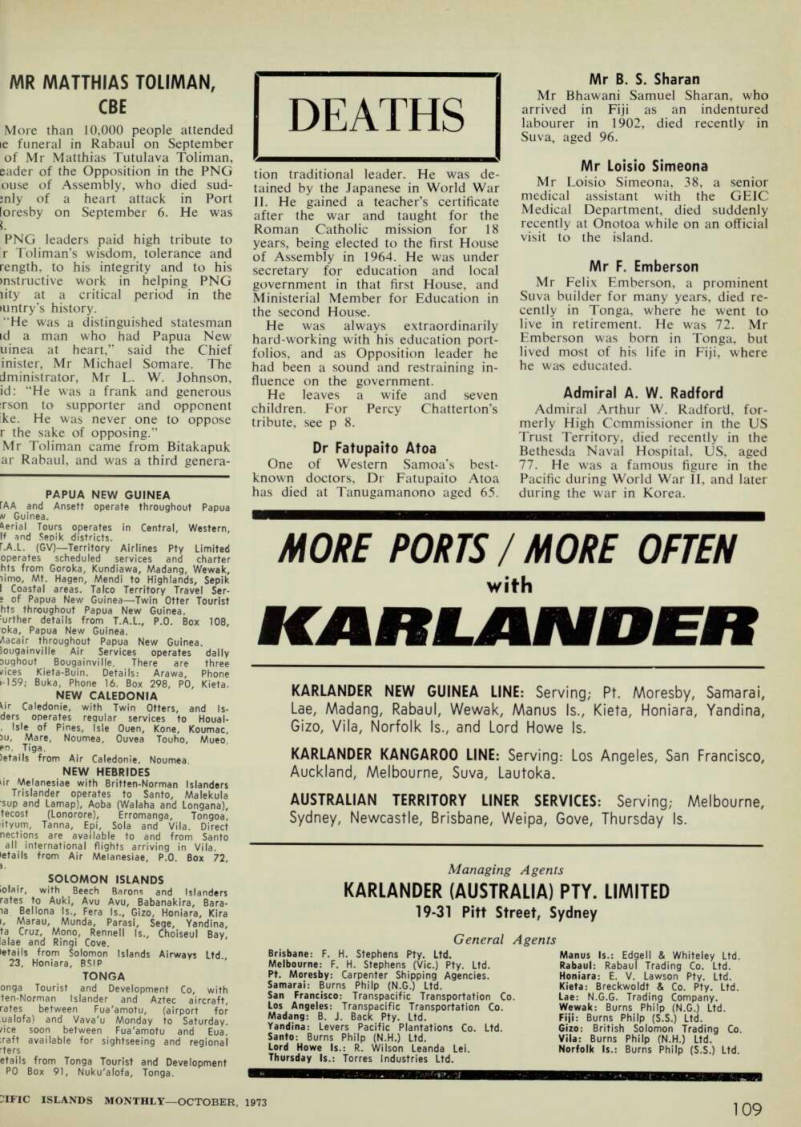
Mr Matthias Toliman,
Cbe
More than 10,000 people attended ic funeral in Rabaul on September of Mr Matthias Tutulava Toliman, eader of the Opposition in the PNG ouse of Assembly, who died sud mly of a heart attack in Port [oresby on September 6. He was I PNG leaders paid high tribute to r Toliman’s wisdom, tolerance and rength, to his integrity and to his instructive work in helping PNG lity at a critical period in the »untry’s history.
“He was a distinguished statesman id a man who had Papua New uinea at heart,” said the Chief inister, Mr Michael Soma re. The dministrator, Mr L. W. Johnson, id: “He was a frank and generous :rson to supporter and opponent ike. He was never one to oppose r the sake of opposing.”
Mr Toliman came from Bitakapuk ar Rabaul, and was a third genera-
Papua New Guinea
FAA and Ansett operate throughout Papua n Guinea.
Aerial Tours operates in Central, Western, It and Sepik districts. r.A.L. (GV) —Territory Airlines Pty Limited operates scheduled services and charter hts from Goroka, Kundiawa, Madang, Wewak, limo, Mt. Hagen, Mendi to Highlands, Sepik I Coastal areas. Talco Territory Travel Ser i of Papua New Guinea—Twin Otter Tourist hts throughout Papua New Guinea. : urther details from T.A.L., P.O. Box 108, oka, Papua New Guinea.
Aacair throughout Papua New Guinea.
Bougainville Air Services operates daily Dughout Bougainville. There are three /ices Kieta-Buin. Details: Arawa, Phone *■ls9; Buka, Phone 16. Box 298, PO, Kieta.
New Caledonia
Ur Caledonie, with Twin Otters, and Is ders operates regular services to Houai , Isle of Pines, Isle Ouen, Kone, Koumac, 3u, Mare, Noumea, Ouvea Touho, Mueo, en, Tiga. >etails from Air Caledonie, Noumea
New Hebrides
*ir Melanesiae with Britten-Norman Islanders Trislander operates to Santo, Malekula sup and Lamap), Aoba (Walaha and Longana), tecost (Lonorore), Erromanga, Tongoa, ityum, Tanna, Epi, Sola and Vila. Direct nections are available to and from Santo all international flights arriving in Vila, details from Air Melanesiae, P.O. Box 72, 3.
Solomon Islands
lOlair, with Beech Barons and Islanders rates to Auki, Avu Avu, Babanakira, Bara ia. Bellona Is., Fera Is., Gizo, Honiara, Kira i, Marau, Munda, Parasi, Sege, Yandina, ta Cruz, Mono, Rennell Is., Choiseul Bay alae and Ringi Cove. •etails from Solomon Islands Airways Ltd 23, Honiara, BSIP
Tonga
onga Tourist and Development Cos, with ten-Norman Islander and Aztec aircraft, rates between Fua'amotu, (airport for ualofa) and Vava'u Monday to Saturday, /ice soon between Fua'amotu and Eua. :raft available for sightseeing and regional rters etails from Tonga Tourist and Development P 0 Box 91, Nukualofa, Tonga.
Deaths
tion traditional leader. He was de tained by the Japanese in World War 11. He gained a teacher’s certificate after the war and taught for the Roman Catholic mission for 18 years, being elected to the first House of Assembly in 1964. He was under secretary for education and local government in that first House, and Ministerial Member for Education in the second House.
He was always extraordinarily hard-working with his education port folios, and as Opposition leader he had been a sound and restraining in fluence on the government.
He leaves a wife and seven children. For Percy Chatterton’s tribute, see p 8.
Dr Fatupaito Atoa One of Western Samoa’s best known doctors, Dr Fatupaito Atoa has died at Tanugamanono aged 65.
Mr B. S. Sharan Mr Bhawani Samuel Sharan, who arrived in Fiji as an indentured labourer in 1902, died recently in Suva, aged 96.
Mr Loisio Simeona Mr Loisio Simeona, 38, a senior medical assistant with the GEIC Medical Department, died suddenly recently at Onotoa while on an official visit to the island.
Mr F. Emberson Mr Felix Emberson, a prominent Suva builder for many years, died re cently in Tonga, where he went to live in retirement. He was 72. Mr Emberson was bom in Tonga, but lived most of his life in Fiji, where he was educated.
Admiral A. W. Radford Admiral Arthur W. Radford, for merly High Commissioner in the US Trust Territory, died recently in the Bethesda Naval Hospital, US, aged 77. He was a famous figure in the Pacific during World War 11, and later during the war in Korea.
Advertisements & other items, pp. 115-118 (3 items)
109
IFIC ISLANDS MONTHLY—OCTOBER, 1973
Karlmkvoer
MORE PORTS / MORE OFTEN
with
KARLANDER NEW GUINEA LINE: Serving; Ft. Moresby, Samarai, Lae, Madang, Rabaul, Wewak, Manus Is., Kieta, Honiara, Yandina, Gizo, Vila, Norfolk Is., and Lord Howe Is.
KARLANDER KANGAROO LINE: Serving; Los Angeles, San Francisco, Auckland, Melbourne, Suva, Lautoka.
AUSTRALIAN TERRITORY LINER SERVICES: Serving; Melbourne,
Sydney, Newcastle, Brisbane, Weipa, Gove, Thursday Is.
Managing Agents
KARLANDER (AUSTRALIA) PTY. LIMITED
19-31 Pitt Street, Sydney
General Agents
Brisbane: F. H. Stephens Pty. Ltd.
Melbourne: F. H. Stephens (Vic.) Pty. Ltd.
Pt. Moresby: Carpenter Shipping Agencies.
Samarai: Burns Philp (N.G.) Ltd.
San Francisco; Transpacific Transportation Co.
Los Angeles; Transpacific Transportation Co.
Madang; B. J. Back Pty. Ltd.
Yandina: Levers Pacific Plantations Co. Ltd.
Santo: Burns Philp (N.H.) Ltd.
Lord Howe Is.: R. Wilson Leanda Lei.
Thursday Is.: Torres Industries Ltd.
Manus Is.: Edgell & Whiteley Ltd.
Rabaul: Rabaul Trading Co. Ltd.
Honiara: E. V. Lawson Pty. Ltd.
Kieta: Breckwoldt & Co. Pty. Ltd.
Lae: N.G.G. Trading Company.
Wewak: Burns Philp (N.G.) Ltd.
Fiji: Burns Philp (S.S.) Ltd.
Gizo: British Solomon Trading Co.
Vila: Burns Philp (N.H.) Ltd.
Norfolk Is.: Burns Philp (S.S.) Ltd.
§s) LnnJ §s) Lnnl P 3 i i LnnJ 1 1
For Warm and Friendly
Samoan Hospitality
Apia, Western Samoa Phone: 880. Cable; 'Aggies'.
Tariff includes all meals.
FIJI
Ite
I
irk *fn
. m m mm #5 ■ ¥S<&
NAMALE PLANTATION
ESCAPE
FROM THE ORDINARY
Here is an idyllic paradise where you can •enjoy the unspoiled beauty and serenity of a working coconut plantation. This privatelyowned Pacific retreat has been designed for a maximum of 16 people. Gracious surroundings, friendly service, relaxed 'Bure' accommodation overlooking the sea with individual balconies and private facilities. Licensed cocktail bar. Entire plantation available to groups of 14-16 people.
Activities available include: Deep sea fishing, reef and shell hunting, skin diving, snorkelling, water skiing, hiking, turf tennis court, badminton, horse riding, croquet course and a beautiful tropical garden to relax in. Sports equipment available on a complimentary basis include aquascopes, snorkelling and fishing equipment, inflatable rafts, tennis racquets etc. Coastal tours by boat or mini-bus on request. Boats for hire. Baby sitting service also available.
Write for a Free Brochure to:
THE MANAGER,
NAMALE PLANTATION,
SAVUSAVU, FIJI.
Or: Namale Plantation, P.O. Box 64, Suva, Fiji.
beachcomber
hotel
PACIFIC HARBOUR, FIJI
Sophistication in the midst of uninhabited natural beauty.
Nestled snugly in a reef-protected bay on 5 miles of classical palm fringed Deuba beach. Far enough from Fiji's capital, Suva, to forget the worries of city life. Near enough to take in the colour and the Duty Free Bazaars.
Every suite is self-contained and airconditioned. The cuisine is as the service, superb.
PO Box 216, Suva. Telephone; Navua 43.
Telex 2324. Cables: FLAGTELS, Fiji. For reservations or information contact your travel agent.
Primitive luxury
(Polynesian style) Nestled away in the untouched Kingdom of Tonga is new, luxurious "Port of Refuge" International resort. Here is a unique opportunity for your clients to experience the tranquil and relaxed Tongan atmosphere while they enjoy the picturesque surroundings of the new "Port of Refuge". And only a short flight from Fiji.
Reasonable tariffs from $17.50 with special concessions for children. Agents commission 10 per cent.
Tonga's
Port of Refuge
JM. international resort Uava’u Tonfia Cables: “Refuge” Tonga or “Tongatours” Sydney Phone: Sydney 85-1603 or 221-3799
In Lae stay at the
Huon Gulf Motel
FOR THE BEST OF EVERYTHING.
BOOK DIRECT OR THROUGH ANY OFFICE OF ANSETT AIRLINES.
Huon Gulf Motel
MARKHAM ROAD, LAE. PHONE: 42-4844.
A Division of Ansett Transport Industries Limited.
PARK VIEW MOTEL—BRISBANE
Quiet location—opp. Botanic Gardens.
Single, double, family suites, all with refrig., air conditioning, phone, TV, radio, tea making facilities, from $lO. Pool and restaurant.
Phone 31-2695—Telex 40270.
Write for coloured brochure — Park View Motel, 128 Alice St, BRISBANE, Old., 4000.
Line Advertisements
Per line, $1.15 Aust., Minimum rate. 4 lines
mana
IfUMD
Mana Island: 300 acres of lush, tropical vegetation surrounded by miles of palm fringed beach and sheltered lagoons.
Recreation: Snorkelling, scuba, skiing, spear, bottom and deep sea fishing, swimming excursions. Modest charges.
Accommodation: Resort hotel, secluded accommodation in 60 individual Fijiantype cottages. Self-contained bures with shower, toilet, refrigerator, tea and coffee facilities and exhaust fans.
International Standard Restaurant: Fijian and Continental cuisine. Terrace dancing to Fijian Band. Beach Bars - Feast Nights.
Facilities: Island shop, travel agent, hairdresser, child minding and first aid.
Tariff: Single occupancy: SFIB.OO Double occupancy: $F22.00 Triple occupancy: $F26.00 Children under 12: Half Rate Babies in cot: Free Duplex Bure from: $F42.00 Rates subject to change.
Pre paid tours through agents.
Transport: Bus or taxi Nadi to Lautoke (Bus fare 80c). SFB.OO return by fast 90' cruiser Lautoka to Mana Island.
Schedule: Dep. Lautoka 9.30 a.m. Arr.
Mana 11.20 a.m. Dep. Mana 3.30 p.m.
Arr. Lautoka 5.20 p.m. Water Taxi subject to reservations; $F6.00 per person one way, a minimum $F45.00 per trip.
CHECK OUT TIME - 1 1.00 a.m.
CANCELLATION NOTICE - 48 hours.
DEPOSITS Groups and ITX Prepaid.
Individual bookings, one night deposit required.
Bookings; Aust. & N.Z.; C.J. Henry & Associates.
Offices: Mana Island Resort (FIJI) Limited P.O. Box M 94, Sydney Mail Exchange 2012 69.5061 or P.O. Box 610, Lautoka, FIJI 61.210, 61.455 Telegrams and Telex: Mana Island, Lautoka, FIJI '•f-b ■ ’ • i
TRIMARAN TOPAZ. Fiver AA 48 ft. design, luxuriously appointed to suit chartering or cruising, 4 months old, Ford diesel, full electrics including refrigeration. 4 double staterooms with shower and toilet, 2 twin cabins, all gear to sail immediately. Ocean tested. Contact; Yacht Topaz, c/- Tradewinds Hotel, Suva, Fiji.
CONCRETE BLOCK MACHINE. Makes
blocks, flags, edgings, screen-blocks, garden stools —up to 8 at once and 96 an hour. SAIO7 c.i.f. main ports. Send for leaflets. Forest Farm Research, Londonderry, N.S.W., 2753.
ALL BOOKS AND JOURNALS ON AUST-
RALASIA AND THE PACIFIC BOUGHT
AND SOLD. Catalogues issued and sent free on application. Correspondence invited. Berkelouw, 15-10 Boundary St..
Rushcutters Bay. Sydney. 2011. Phone: 81-8215.
YOUNG ITALIAN MAN would appreciate friendly correspondence and, eventually, stamp exchange with residents in any independent Island. Write to: Giovanni de Santis, Casella Postale 97. 70100 Bari, Italy.
BUTTERFLIES from Trobriand Islands.
Beautiful specimens Papilio Ulysses telemachus, Ornithopter priamus demophanes and others. Write; M, V. Glanville, Carvings and Artifacts, P.O. Box 29, Losuia, Papua New Guinea.
FLEETS, 40 ft bridge deck carvel cruiser, profess, bit. 1960, mar. diesel, exc. accom., shower etc., 8 man raft, radio, sounder, dinghy and outboard, $23,000. Fleets, Rowe’s Bldg. Edward St, Brisbane. Cable “Fleets”. Brisbane.
STAMPS used of the world, exchange for stamps of Papua New Guinea or other Pacific Islands. Thomson, 57 Bombard St., Mount Pleasant, W.A., 6153, Aust.
PEN FRIENDS OVERSEAS. Individual world wide postal introduction service!
Plus optional illustrated magazine! Write for details today! Five Continents Co. Ltd., P.O. Box 21219, Henderson, N.Z.
GENEALOGY. Family histories traced through authentic authorities, British and European. Send airmail letter, in first instance, for details of charges together with name and all known details. Confidential. Heraldic Arts, c/- Kunua Plantation, via P.O. Buka, Bougainville, P.N.G.
INTERNATIONAL
DATELINE HOTEL
TONGA
EL«® "Friendly Hotel" of the "Friendly Islands"
Situated along the Nukualofa waterfront. Only five minutes walk from town. Single, double, family suites, airconditioning, and hot and cold water showers. Pool, bar, restaurant, duty-free shop, tour desk and boutique.
Book through your travel agent or write to International Dateline Hotel, P.O. Box 62, Nukualofa Tonga!
Cable Address: "DATELINE".
Represented Overseas by: Charles J. Henry and Associates Pty. Ltd.
Sydney and Melbourne.
FOR SALE
Business and property on 99 year leasehold. Plot 118' x 55'.
Situated Main Road Central Honiara. Two conditioned shops and large upstair 15 year old first class, softgoods, jewellery, cosmetics, handicrafts business.
Genuine enquiries only. Please apply Lillian A. Dennis (Ent) Ltd, PO Box 200 Honiara, 8.5.1. P.
WANTED
FREEHOLD LAND
Am interested in buying a large tract of freehold land in the South Pacific.
Might pay cash. Please write: "PAM", c/- G.P.O.
Box 3408, Sydney, N.S.W. 2001, Australia.
Turners and Growers
FRESH FRUIT & VEGETABLES
AT A LOSS
TO COMFORT BABY?
Those distressing symptoms that come with teething troubles —sore gums, digestive disorders, intestinal upsets, can be, if used as directed, safely and quickly soothed with Fisher's Teething Powders. You'll be delighted at what an effective and soothing aid they are to baby— and when baby's happy your upsets and nervous tension will be soothed, too. Fisher's Teething Powders are available from your chemist or store, only 30c for 20 powders. Fisher & Co., Manufacturing Chemists (Est. 1876), 17 May St., St. Peters, N.S.W. 2044.
PIM 809/72
FOR INVESTMENT IN THE
BRITISH SOLOMON ISLANDS
PLEASE CONTACT
R. C. SYMIS PTY. LIMITED
ADDRESS; P.O. BOX 88, HONIARA, 8.5.1. P.
TELEPHONE: 06-28
CABLE: "SYMECO"
Turners
SupplyCo
FRESH FRUIT & VEGETABLES
9813
W. H. GROVE & SONS LTD
ESTABLISHED 1896
ISLAND MERCHANTS
Exporters to the Pacific of Dairy Products and all New Zealand consumer and manufactured goods.
ENTRUST YOUR REQUIREMENTS TO THE
ESTABLISHED FIRM
P.O. Box 3718,
AUCKLAND
Cables
GROVE AUCKLAND
SAY IT IN
FIJIAN
helps you enjoy Fiji more by learning and using its language.
Priced at $1.20 Aust., plus 12c posted. $1.50 U.S. posted.
Pacific Publications (Aust.) Pty. Ltd., G.P.O. Box 3408, Sydney,
N.S.W. 2001.
111
ACIFIC ISLANDS MONTHLY—OCTOBER, 1973
Index to Advertisers
Adams Ind 3, 10 Aggie Grey 110 Airconditioning (South Pacific) 31 Air New Zealand 58 Allied Manufacturing & Trading Industries 53 Ansett Hotels 35, 110 Ardneil 79 Arnott's Biscuits 60 Aust. National University 75 Bacardi 17 Bank of Hawaii 88 Bank Line 106
Beachcomber Hotel 110 8.0.A.C. 97-100 Braybon 100 Breckwoldt 87 British Med Lab 43 Brockhoff's 4, 68 Brunton 72 Burns Philp 18, 19, 85 Carpenter 28, 29, 84 Colgate 22 Collier Macmillan 33 Com. N. G. Timbers 38 Daiwa Bank 23 Daiwa Line 105 Davey Dunlite 108
Fisher, Peter 81 French Knit 42 Frigate Rum 78 George & Ashton 78 Gillespie Bros 44 Goodyear 34 Grove, W. H. 112 Hall, R. 80 Handi Works 86 Harris, Keith 80 Hellaby, R. & W. 25 Honda cov. in Innes Tartan 32 Islander Aircraft 12 James Hardie 20
Karlander Line 109 Knox Schlapp 76 Kennedy, Capt 79 Kerr Bros 32 Kodak 70 Mabin Blowers 81 Mana Island Resort 111 Massey-Ferguson 46 Minolta 93 Motor Specialties 50 Namale Plantation 110 Nedlloyd 106 Nissan cov. iv N.Z. Breweries 96 Olympus cov. ii
Pacific Line 107
P.A.A. 24
Paramount Shirts 55 Parker Pen 82 Pioneer Electric 54 PNG Printing 101 Resco Pty. Ltd. 86 Ring Rolling 83 Sandy, James 39 Smith, C. H. 85 Sony 95 Southern Pac Ins 99 Sullivan, C. 98 Sunbeam 74
Symes, R. C. 112 Swire, John 40, 94 Tatham, S. E. 30 T.D.K. Electronics 59 Tonga's Port of Refuge 11"
Fovota 50, o/ Trio Electronics 30 Turners Supply 110, 114 Union S.S. Co 107 Warburton Franki 108 Yanmar Diesels 48 Yorkshire Insurance 8/
Advertisements & other items, pp. 118-120 (2 items)
W h ol. y set up and printed in Austria * y PTY. I**-. > AiPerfa street, s y dne y , .00.
REGISTERED A AT r THE GPO STOREY ™ R fr^ A NSmSSION POST .'oS” 08 "
Honda.
The blue beyond. The earth below.
A path between the two. That only youth may
Making the endless blue and
bleach-white sands one...
HONDA.
A young man whose desire to reach the summit of success knows no limits. At work or at play, he thrives on new challenges, new ways to satisfy his zest for the active life. Every day more people are finding themselves in HONDA. Leader in motorcycles. Holder of the title of having % of the world’s market. With sales in more than countries. By offering the right combination of power, performance, and ride in a wide range to suit every individual. It’s all of what it takes to be a world leader in motorcycles
... HONDA!
W HO 15 m 4
lAu
f ' ! if «> RITORY: J.C. Tenorio Enterprise P.O. Box 137, Saipan/ sfandli Ojevelopment Auf^OrnyGifemfe. |.M.J«nH Ltd. P.O Sox 34, Nukualofa /SOLOMON Box
m 7* m m m - 1 % * ♦ \ K t ■V t
CsV
i Ws. /* Vs. - ■* 9?0 w
ifafet
' ‘ *'■>■ - - And wherever you’ll go in over 120 nations throughout the world you’ll find proud DATSUN drivers.
Perhaps the main reason is that DATSUN was designed to meet a wide variety of conditions—mountain roads and super highways, blistering suns and freezing temperatures. DATSUN is indeed the international car that has precision engineering and a stunning string of rally victories behind it.
Its superb handling, safety features and high speed efficiency make DATSUN the choice of young and old alike. DATSUN-the car that really satisfies the world over.
DATSUN
NISSAN
A DATSUN distributor network covers the following areas; LbMMIH •«. -r /-I nr n XT \TaVV W oKri Pfl •