Pacific Islands Monthly
News Magazine Of The South Pacific
February, 1972
Australia, Nz, Geic, Bsip 50C
PNG, FIJI, COOKS, TONGA, W. SAMOA, N. HEBRIDES 45c
Nauru, Norfolk, Niue 45C
AMERICAN SAMOA 70c HAWAII 80c MICRONESIA 90c NEW CALEDONIA 65 CFP FRENCH POLYNESIA 90 CFP
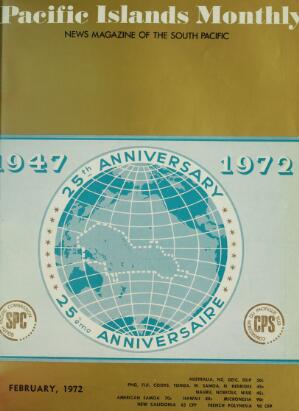
Our Cover
To mark the 25th anniversary of th< South Pacific Commission in February thi commission has printed 10,000 copies o this sticker, which it will attach to it: outgoing correspondence. In addition al most every South Pacific territory i issuing its own commemorative stamp: to mark the anniversary of the SPC. Th« eight gold stars on the SPC emblen represent the eight member countries— Australia, France, Fiji, New Zealand Nauru, UK, USA and Western Samoa.
Advertisements & other items, p. 2 (1 item)
Territory.
Travel
the TAA~ serviced
NEW GUINEA
LAE
DARWIN
I
CORAL SEA
50 centres throughout Papua and New Guinea on a 12,000 mile network. 100 centres in Australia.
TAA serves the lot.
Across the Territory we give you more flights to pick from.
More seats. More cargo space.
Including daily Friendship services between Moresby and all major centres. Plus daily ‘Bird of Paradise’ T-Jet flights connecting the Territory with Brisbane, Sydney, Melbourne, Adelaide and Perth.
If you plan to take off soon, travel the Territory with TAA.
TAA
AIRLINES OF NEW GUINEA
No. 1- the friendly one
Call your Travel Agent. Or TAA. • Port Moresby 2101 • Boroko 5 3541 • Lae 3191 • Madang 2478 • Kieta 18 • Rabaul 2567 • Goroka 8 • Mt. Hagen 4 or 301 • Wewak 103 319 3322/7
Facific Islands
Monthly
For the editorial contents of this issue, see p. 21
FOUNDED BY R. W. ROBSON IN 1930
Owned And Published By
»Acific Publications (Aust.) Pty. Ltd.,
29 Alberta St., Sydney, N.S.W., 2000.
ostal Address: G.P.O. BOX 3408, SYDNEY
N.S.W., 2001.
Telegraphic Address: PACPUB, Sydney
Elephones: 61-9197, 61-7101, 61-4369.
isulting Directors: R. W. Robson, Judy Tudor.
Chief Executives: General Managers Selwyn Hughes.
Publisher; Stuart Inder.
Mrector of Advertising: W. A. Gasnier
Pacific Islands Monthly
Editor: Stuart Inder.
Assistant Editor: John Carter.
Advertising Manager: W. A. Gasnier.
Circulation Manager: Barry Badger.
Representatives
: Pacific Publications (Fiji) Ltd., Fiji Time Iding, 20 Gordon Street, Suva. Tel.: 25601 Times Office, Mayfair Building, Namol e., LAUTOKA, Telex: 1144 Tel.: 60-422 ua New Guinea: LAE, P.O. Box 227, AUL, Mr. Steve Simpson, P.O. Box 433 :/- Rabaul Photographic. Tel.s 2677). ich Polynesia: Distribution—Hachette Paci e, 10 Ave Bruat, Papeete.
Zealand: Pacific Publications, C.P.O. Box 9, Auckland. 379-494. Representative: John iding, Civic House, 291 Queen St., Auckland, Tel.: 379-494. ed Kingdom: S. R. Warman, Park House Park Street, Croydon, CR9 3NP. lei. 01-6884177. seas Newspapers (Agencies) Ltd., Cromwel ie, Fulwood Place, London, W.C.I. Tel. 42-0661. Cables: WESNEWS, London, DS4 m: Advertising—Universal Media Corpora n, C.P.O Box 46, Tokyo. Tel.: 666-3036 aria: Advertising—Wilke & Co. Ltd. 37 m's Road, Clayton, Vic., 3168. Tel..- 544-8222. ■nsland; Advertising—Beale Media Services St. Paul's Terrace, Fortitude Valley, Qld 4006. Tel.: 51-5827.
Subscription Rates:
:ific Islands Monthly" is air-freighted to ubscribers and agents in the Pacific Islands, pies to other areas go by surface mail, ralia (including Lord Howe and Thursday B.S.I.P., Gilbert and Ellice Is.: $5.50 Austr ia-New Guinea, Norfolk Island, Nauru a and New Hebrides: $5.00 Aust.; New and: $5.50 N2; Fiji, Cook Islands, Niue Western Samoa: $5.00 (local currency), ncan Samoa: $8.00 US; U.S. Mainland onesia (including Guam); $10.00 US; ah: $9.00 US; New Caledonia; 750 French ic francs; Tahiti and French Polynesia: French Pacific francs; United Kingdom ano elsewhere: £3.25.
Copyright ©, 1972,
acific Publications (Aust.) Pty. Ltd. 4k
•*Udit
Iureau Op
Tculatiohs^
Advertisements & other items, pp. 3-16 (9 items)
1
IFIC; ISLANDS MONTHLY—FEBRUARY, 1972
(afnation
m
PEACOCK
i»*of ma«*
Condensed
M I L.K
' JLL cream" " b ?weete^ d
(afnation
PRODUCT
Now you can enjoy Peacock Full Cream Sweetened Condensed Milk... a top quality condensed milk made by the producers of Carnation Evaporated Milk. It’s on sale at your local store at a value-for-money price.
R
mm H:-- ■
Expert advice
for your sick
swimming pool
Green slime in your swimming pool?
Trouble keeping accurate chlorine levels?
For sound advice on the best way to deal with all your swimming pool problems, contact ICI in Lae.
ICI have been dealing with swimming pool treatment and care for many years. We’ll tell you how to tackle your pool troubles whether they’re backyard or Olympic size.
ICI
ICI (N.G.) Pty. Ltd., Box 1105 Post Office, Lae.
Telephone: Lae 3301.
Cables: ‘lmpkemix’.
R 1313
Australian engineering equipment
means higher volume
at lower unit cost
Australia's engineering industry produces everything from home appliances to scientific equipment, electronics to hand tools.
Much of the machinery that equips Australia's 62,500 factories is designed and built within Australia.
This machinery is recognized in the U.S.A., Great Britain, Africa and S.E. Asia for its technical excellence, reliability and ease of servicing.
Look with confidence to Australia to satisfy your engineering needs to enable you to achieve greater efficiency at lower production cost, with a minimum of maintenance.
If you are looking for machine tools and equipment for local manufacture, or if you are looking for finished products in the engineering field - look to Australia.
what's in Australia for you? 3 (k Find out today. All you have to do is contact the Australian Government Trade Commissioner who will put you in touch with suppliers of Australian products: cnr. Pratt and Joske Streets, SUVA (P.O. Box 1252). Tel; 25624.
Australian Department of Trade and Industry
a
S. E. TATHAM
& Co. Pty. Ltd.
MELBOURNE, AUSTRALIA
P.O. Box 8, Cables "SET"
Telephone 60-1125
SOME OF THE FIRMS
WE REPRESENT ARE:
Frappier (French Brandy) Huvet (French Brandy) Sunshine Biscuits Sunrise (Confectionery) Flamenco (Instant Coffee) Quaker Products (Oats, Jets) Merchants (Canned Soft Drinks, Cordials) Hancocks (Spaghetti, Cereals) Melbourne Canning (Jams) Water Wheel (Flour, Sharps, Wheat) A. P. & D. (Twisites, Twirlies) Edward Zorn (Margarine, Cooking Fats) Allens (Confectionery) Robert Timms (New Guinea Gold Instant Coffees and Teas) Highness (Canned Vegetables, Fruit Juices) S.P.C. (Abalone) Lunchtime (Honey) Wing Lee (See You Sauce) Magnet (Mattresses) Esteel (Cookware) Warner-Drayton (Fans) Mitchell's (Abrasives) Regent (Swiss Watches) Gainsborough (Furniture) Austramax (Pressure Lanterns) Preservene (Soap Products) Lawn Chair; Tubco (Garden Furniture) Sunrise Lustertone (S.S. Sinks, Plumbers' Supplies) Electronic Industries (Electrical Household Appliances) Jex (Steelwool) Arnbro (Folding Beds) Elmaco (Plastics —Electrical Fittings) B.X. (Plastics) Franklite (Light Fittings) 5* %
EXPORT AGENTS
PACIFIC ISLANDS
AGENTS
Australian buying and shipping agents for the Gilbert and Ellice Islands Colony Wholesale Society
DIRECT ENQUIRIES WELCOMED
Associate Company
S. E. TATHAM (FIJI) LTD.
Suva, G.P.O. Box 671.
Lautoka, P.O. Box 366.
SINCE 1924
1
S' Mier ;SsCra<*^'
CheeseV g , m * The slender £*% Jg and » ™ ne a,, o, added OhScrachers are balre to.
(SB$M
•m «* r^/v :VN v.V » Mg m ::r ■*
BROCKWOff
U I s» •$ I.^v It ■=#; *§ * •S', *c & M & '# -> ‘•ti mm % X i w> ft ■■*■: i -'* r?.V:
There’s value, variety and quality in
BROCKHOff BISCUITS
5544/3x6^4
ra
MORRIS
HEDSTROM
LIMITED
HEAD OFFICE: SUVA-FIJI
LONDON OFFICE;
MORRIS HEDSTROM LTD.,
Park House,
22 Park Street,
CROYDON, CR9 3NP.
AUSTRALIAN REPRESENTATIVE:
W. R. CARPENTER & CO. LTD.,
(MERCHANDISE DIVISION),
The A. Gr N.Z. Building,
68 Pitt Street,
SYDNEY, 2000.
Registered Cable Addresses:
MORRISHED SUVA, APIA, NUKUALOFA. • SUVAMARK LONDON.
MORSTROM —SYDNEY.
AGENTS AND DISTRIBUTORS FOR:
BQ
GENERAL
SHIPPING
China Navigation Company Lloyd's Lloyd Triestino Mitsui OSK Lines Pacific Australia Direct Line Pacific Far East Line, Inc.
MOTOR
Alfa-Laval A.R.A. Airconditioners Assoc. Battery Makers of Aust. Ltd.
Champion Spark Plug Co.
Chrysler U.K. Ltd.
D. H. Davies & Co. Ltd.
Ferodo Ltd.
Ford Motor Co.
Fram Filters Ltd.
Good year Tyre & Rubber Co.
Hayfer Exports Ltd.
Howard Rotavators Pty. Ltd, Napier Bros. Ltd.
Norton-Villiers Outboard Marine International W. H. Wylie Addis Limited Benford Ltd.
Crittall-Hope Export Electrolux Ltd.
Imperial Chemical Industries Ltd.
James A. Jobling Ltd.
John Steventon & Sons (Export) Ltd.
H. & R. Johnson Ltd. .
KelvinatOr International Inc. (Leonard Refrigerators) Longines SA Marley Floor Tile Co.
Nippon Kogaku (Nikon Cameras) Noritake Co. Ltd.
Olympus Optical Parker/Eversharp Pen Co.
Pilkingfon Bros. ltd.
Procter & Gamble Ronson Ltd.
Rowntree & Co. Ltd.
Sanyo Electrical Singer Australia Ltd.
Wiltshire File Co. Pty. Ltd.
Winstone Ltd.
Yorkshire Imperial Metals Bacardi International Drambuie Liqueur Co. Ltd.
Guinness Exports Jas. Hennessy & Co.
John Dewar & Sons Ltd.
McWilliams Wines Pty. Ltd.
Tanqueray Gordon & Co. Ltd.
PHARMACEUTICALS & COSMETICS
Burroughs Wellcome & Co. N.Z. Ltd.
Ciba Laboratories Cynamid DHA Pty. Ltd.
Elizabeth Arden Glaxo Laboratories Ltd.
Lentheric Perfumes Max Factor Rimmel Ltd.
Smith & Nephew Ltd.
West Silten Pharmaceuticals
for friendly service
and complete
satisfaction its .. .
MORRIS HEDSTROM
LIMITED
Fiji—Western Samoa—Tonga
From birth control to relief of the common cold, pills, tablets and capsules in their coats of many colours, play a major role in the life of modern man. Never before have we relied so much on these tiny objects.
But consider, if you will, how much more we rely on people. People on whose knowledge and skill we depend for the reliable performance of the finished product. To achieve this, incredibly fine degrees of accuracy and fail-safe production methods are paramount. In this field, Kempthorne's are beyond compare. Individual testing of every ingredient for purity . . . stage by stage
THE PILL...
tablets , capsules and things! « .. m examination during manufacture . . . intensive screening of imported lines before redistribution . . .
Kempthorne's stringent standards of quality control bring us a product which will function perfectly. A product on which we can rely. What more can be asked of—the pill ?
S Enquiries to The Marketing Manager, Kempthorne Prosser & Co. Limited, P.O. Box 379, Dunedin.
SKIN
SCUBA
NORFOLK ISLAND Agents
Norfolk Island Sporting Centre Ltd NEW ZEALAND Agents Allan G. Mitchell (N.Z.) Ltd. „ „ "mw -t, ror full particulars on our lines, write to: The TABATA line offers the importer a complete range of RUBBER
SKIN & SCUBA DIVING
EQUIPMENT and ACC-
ESSORIES for both the professional and amateur. Years of specialized manufacturing experlS| ience has established our line's
REPUTATION FOR QU-
ALITY, ATTRACTIVE
and PRACTICAL DESI -
GNS and VERY COMP -
ETITIVE PRICES. We a-
Iso offer a varied line of rubber sundries for golfing, skiing and other popular sports.
Yajima Bldg
Manufacturers TABATA CO., LTD.
,2-2Yoshi-cho. Nihonbashi .Chuo-ku.Tokyo Cable:"EASTAßA’Tokyo TELEX:2S2 -2806 EASTABATA TOK Tel: (663)8651
For
RUM
at its best...
say
OVERPROOF AND UNDERPROOF
In 5 oz. and 13 oz. flasks and 26 oz. and 40 oz. bottles.
BLENDED AND BOTTLED BY JOHN WALKER & SONS LIMITED. 3S
JW«TU
great bunch
of flours.
Robert Hutchinson makes the greatest bunch of flours in the Pacific. Bakers’ flour.
Superlite cake and sponge flours.
Biscuit flour and cracker flour.
Wheaten sharps and wheaten meal.
We’re particularly proud of our bunch of flours. So we have a technical advisory service to help you use them properly.
So next time you see a Robert Hutchinson flour (or even one of our Hutmill stock feeds), remember it’s just one of the bunch am 4 ~sr m m /■< MW
ROBERT
HUTCHINSON
LIMITED
theflourpeople
Hattiogton Sired, Gfenray, Victoria, Australia. 3046. Telephone Meltoama 306 7261
FLEXIBLE POWER TO SHIFT FORESTS
1 iv'-Vm)
»?< VJ W We have built Fork Lift trucks to lift 55,000 lbs U Trucks for container shipping Fork Lift with grabber holds for timber and log work in forests and on the wharves log skidders for moving logs sideways or any way required. Model illustrated features a 4 speed power-shift transmission, and power steering.
Power comes from a 100 h.p. Ford diesel unit.
Over the years we've acquired a lot of ‘knowhow’ on loading problems for every conceivable type of product if you've a problem then we’ll solve it for you. Just ask us! Our deliveries are prompt our prices competitive.
LEES INDUSTRIES LIMITED
PRIVATE BAG, PAPAKURA, N.Z.
PHONE; 86-019 PAPAKURA
886875/771
immMhwjSl
Get expert advice on all
your Aluminium window
and door problems from
Wunderlich.
The huge Wunderlich range of aluminium windows and doors offers almost limitless combinations.
So many that it can be confusing. But not to worry.
Just contact Wunderlich and you can have your special problems solved immediately.
Wunderlich Aluminium Sliding Doors are scientifically designed and precision made to operate smoothly on nylon-sheathed ball-bearing rollers that never need oiling. No servicing necessary, either, as dust or water cannot enter the sealed bearings.
As a result of Wunderlich research all Standard Wunderlich Series D" Windows and combinations have one thing in common and that is, the outside frame. This common frame suits all types of building construction including—brick—brick veneer—concrete block and timber frame.
Wunderlich aluminium windows and doors never need painting; never warp, shrink or rattle; work smoothly, silently. Swinging or sliding glass doors, too.
All yours—including expert advice—from Wunderlich.
ALUMINIUM WINDOWS & DOORS
Wunderlich Limited, Head Office: 393 Cleveland St., Redfern, N.S.W., Australia 2016 Ph • 69 0366 Showrooms: Sydney, Newcastle, Canberra, Wollongong. 139/1/2
j •' sM*. ifeat 91 ■a» \ns £v£ avs MR snt MB •zGci m ss s»atf *ws !*?«5 r mz » m %-'Vt- IM
How to win friends...
Serve Arnott’s Fancy Biscuits
Whenever friends arrive, here’s the way to please them best serve a selection of Arnott’s famous fancy biscuits.
Lots to choose from, including Monte Carlo, Delta Creams, Lemon Crisp and Spicy Fruit Roll. So fresh and crisp, so chock-full of delicious melt-in-the-mouth flavour. Always have some handy for your friends...enjoy them any time!
The triple-wrapped packs keep the biscuits fresh,
Qrnotts Biscuits
There is no Substitute for Quality
3
CIFIC ISLANDS MONTHLY—FEBRUARY, 1972
5
ACIFIC ISLANDS MONTHLY— FEBRUARY, 1972
Fic Islands Monthly—February, 1972
11
iCIFIC ISLANDS MONTHLY—FEBRUARY, 1972
From the
Islands Press
NG Government Press release: >ne bundle of cassowary wing bones as part of bride-price payment has been valued at $1 y the Bali-Witu Local Government Council in y est New Britain. In its new bride-price rule .. . le Bali-Witu Council has fixed the maximum
tstomary marriage settlement at $6O. One
issowary leg bone is worth 10 cents in bride 7ce, the council has decreed. om a letter by Joel Patrick, of Martyr's Memorial
hooi, Agenhambo, Popondetta, Northern District,
the PNG Information Department's 'Our News': ride-price can cause unhappiness in some families. means that the woman is not a person. Her is hand s family has authority' over her because they lid money or goods for her. Some husbands treat eir wives as servants. Another bad thing about is that two people who love each other cannot get arried if the man does not have enough for the ide-price. Most girls think about marrying a rich an because this means her parents will make money selling her to her husband. tract from an article in the PNG 'United News'
pollution dangers to the fishing industry:
is common practice to use detergent to break oil slicks it are left by faulty vessels . . , This method, while minating the oil from view, is virtually sweeping it der the carpet, so to speak. The detergent merely ;aks' the oil into sinkable molecules which then settle the sea floor. Though the incidents do not happen en, the residual deposits of oil over a period of f eral years will upset the balance of nature. 'United News' isiders the apathy and disinterest of authorities in such tters to be almost as dangerous as the pollution itself.
Iracf from a report in the 'Cook Islands News'
the meeting of the Legislative Assembly:
plying to Hon. Tangaroa’s comment that the
vernment had ‘gone bankrupt’, Mr. Moana
d they had ‘only run short of money’ and s was because the money had been spent on
ejects of benefit to the people.
mi Coconut Radio' in the magazine '0 Tahiti' o more bronze titis" was the headline in the local 'La aeche' in mid-October over an article announcing that gendarmes had started a crack-down on the law linst sun-bathing in monokinis on nublic beaches. It ms that a few of the local vahines had fallen into habit of taking sun baths on the beach of the Maeva.
Beach Hotel without bikini tops, a common practice around Polynesia's private beaches; and someone brought it to the attention of the law—probably a tourist from Boston.
The offenders were cited and warned that there is a three month to two year prison sentence and a fine of from $25 to $225 for such outrageous behaviour. Another step towards progress in a land where women wore nothing but waist pareus up until a few decades ago.
From a report in the 'Micronitor' of a lecture by Dr. A/iargaret Ward at the Ponape Islands Central School: Women in Kolonia have the highest blood pressure in Ponape District. What kind of work do the women in Kolonia have to do? Nothing! All they do is worry—worry about their kids getting into trouble, worry about them going to school, worry about their husbands’ jobs, worry about the bars closing . . . One example is that the highest rates of blood pressures in Ponape are found among women in Kolonia, of age 40 and up. One of the reasons, a simple, simple reason—is that they are too FAT.
From an editorial in 'The Fiji Times' on the controversy over the appointment of Australian judge Sir John Nimmo as Chief Justice of Fiji: If you pour water into a saucer, and then blow hard on the water you will raise waves which, though in fact tiny and insignificant, can be considered large and even menacing if you shut your mind to everything except what is happening in the saucer. While you are thus living in an atmosphere of illusion, the rest of the world will go on placidly, unaware of and uninterested in the trivial turmoil which your personal huffing and puffing has created. This is a parallel to the fuss which a handful of Fiji politicians are making about the appointment of a new Chief Justice, and which they are trying to picture to the outside world as important.
Extracts from a report in the BSIP News Sheet of a political forum held by Solomon Islands students from the University of Papua New Guinea: Other points made by speakers included : Capitalism is out of place in the communal system of the Solomons; people may throw off the yoke of political colonialism hut not see the yoke of economic colonialism that falls into its place; my university degree is just a bit of paper, it is what is in me that counts; our leaders must be prepared to work and sweat in the villages and not just sit up there in a chair.
From the GEIC 'lnformation Notes': Due to the efforts of the intrepid explorer. Dr. R.
N. Bryden, a new species of grasshopper has been described as ravishing the coconut palms of Bern. This otherwise undistinguished insect is, however, remarkable for the small and slender aspect of certain appendages. The female is larger than the male in any case, so, presumably, there are no anatomical hang-ups. The presence of 18 spines on the hind tibia has, however, led to some discussion on this subject.
The general consensus of opinion is that, although the prostenal spine is straight and conical with a subacute apex, this is offset by the meosternal lobes being slightly longer than wide. Everything taken into account. Valanga gilbertensis sp.n. is here to say.
13
CIFK ISLANDS MONTHLY—FEBRUARY. 1972
Rtrk&r ?5a^*6&>
4*- £fa^,’
Pa*far f6 *4J*stsaeadty
fcfcT
j £4c4/ /s £*iyU<d&S
Rtrk&r ?5a^*6&>
? >%> y'&cxJ Ary^-^^y^
*r< just dial a different angle until the nib position rs exactly how you want it Your fingers rest in the curved grip of a Parker 75, so you write relaxed, fill up from,an ink bottle, or load with a special Parker cartridge. It has a 'tap tank 7 in reserve, for up to 700 more words after you think your ink's run out!
Every Parker 75; passes 792 inspections before you see it. Sterling quality, so it’s sterling silver. Or rolled gold, or Vermeil which is 14 ct gold on silver.
<t>PARKER
Maker or the world v roost wanted pens
Up Front
with the Editor
This is the month for passing judgment on the South Pacific Commission, which celebrates its 25th birthday. If you want to hear mine, the very knowledge that it has attained such mature years underlines the fact that the SPC is a success.
There you are, I’ve said it aloud —what we’ve all avoided saying hese many years. The SPC is a uccess! A quarter of a century is esting time enough, and the com nission is still intact, it’s got more nembers and not fewer, it’s got no ignificant opponents, and it has lone and is doing some worthwhile /ork. That’s success enough in this /ooden world.
It’s had its moments of course, tefore the commission was even out f its teens it was beginning to die rom hardening of the arteries. But t that time, back in 1965, Fiji’s ’atu Sir Kamisese Mara attacked as an “exclusive club” of metro olitan powers, run by a committee f stuffy colonial administrators, and s a result it got a life-saving injec on.
Ratu Mara’s fearless lead—he r as then Chief Minister in a alonial Fiji—woke up the Estab shment and set the commission n a more democratic course. Today le commission is virtually run by le Islanders, mainly through con ol exercised at the annual South acific Conference of Islands dele tes.
Not that the South Pacific Com mission is efficient. It has spent too much money on experts not worth leir salaries in relation to work r oduced (people who have taken me SPC for a ride), but in particular 3t worth their money in relation • the practical benefits their work as brought to the area.
Yet despite this inefficiency, and me fact that the present arrange ents with the various governments e not perfect (hedged round, as icy are, by so many restrictions iposed by the very variety of the ations which compose SPC mem irship), the commission is still a iccess.
It’s a success because 1 believe lat without the commission the acific Islands would not have de
veloped as fast as they have, or have the present sense of unity. The SPC has been an Islands rallying point.
The Islanders have not turned their backs on the SPC even when it has become apparent that there are some jobs it cannot do because of inherent restrictions. Thus we saw established the Pacific Islands Pro ducers Association and more re cently the South Pacific Forum, by the same people who comprise the SPC membership, but who hold the SPC in no less respect.
PIPA was established by some Island governments as an effective arm of regional commercial ambi tion—a pressure group with the job of getting the best deal for Island produce, and with the responsibility of making Island producers more efficient. One can say that this is also an SPC function, yet PIPA can be more effective because it can work faster—hence its establish ment outside the framework of the commission.
Similarly, the South Pacific Forum was created last year, again outside the commission, so that the Islanders could discuss sensitive racial, social, commercial and poli tical problems at the highest level.
The second meeting of the forum will be held in Canberra later this month, and we may expect from it the kind of swift action the leading Pacific nations cannot get from their membership of the commission. Yet they will still retain, and value, their commission membership.
The special needs of the region that PIPA and the SPF were estab lished to meet were only obvious to the territories as a result of the experience that the territories gained over the years from the South Paci fic Commission. Only the SPC has provided the machinery which has enabled the territories to get to gether, and thus identify their problems faster.
Without the SPC there would be
no South Pacific Games—and the Games have done more than any thing else to bring the peoples o: the Islands together.
The need for a co-ordinating bod} such as the SPC was espoused a: long ago as 1931 by PlM’s founder R. W. Robson, who first pleaded ir PIM (January, 1931) for a "Pacific Islands Association” that woulc enable the territories to consult wit! each other and “secure united actior on many matters of vital interest”
He pushed his argument over the years, and in Suva in 1936 in a radic broadcast he suggested that such “inter-territorial consultation anc co-operation” be launched with the British, Australian and New Zealand territories, and that the French anc the United States be invited to joir later.
Similar urgings by others resulted in the commission being established in 1947.
Today, of course, this regional body aids four million Pacific people throughout 12 million square miles of ocean, taking in 19 nations and territories, three of which— Western Samoa, Nauru and Fiji— are full members of the commission Other full members are Britain.
Australia, New Zealand, France and the United States, What of the commission’s next 25 years?
I think the establishment of the South Pacific Forum has taken the pressure off the commission by those who believed that unless the SPC recognised the existence of politics in the South Seas it had no future. The forum can now pursue those matters while the SPC gets on with the task of co-ordinating social and technical aid without un due interference. And this in itself is a big task, with many pitfalls, which could fully occupy all the talents of any organisation. The SPC should attack this role with deter mination.
Advertisements & other items, pp. 17-22 (2 items)
15
ACIFIC ISLANDS MONTHLY—FEBRUARY, 1972
1
PAPUA
NEW GUINEA
PRINTING CO.
PTY. LTD.
Commercial Offset and Letterpress printers to the territory.
Factories in Port Moresby and Lae.
And we also can supply your regular and specialised stationery needs.
OFFICE EQUIPMENT
RUBBER STAMPS
We welcome your mail orders.
P.O. Box 633, Port Moresby P.O. Box 759, Lae P.O. Box 30, Mount Hagen Cables & Telegrams; PRINTER Port Moresby and Lae
Glamapyne on cupboard doors and walls.
Glamapyne
transforms rooms
into havens of
comfort and beauty
Glamapyne is Pyneboard, a building board surfaced on both sides with durable, easily cleaned melamine plastic laminate. Glamapyne is ideal for kitchen cupboards, furniture and built-ins. Choose from 11 popular woodgrains and crisp white. Matching edge laminate available.
I MELAMINE SURFACED PYNEBOARD
glamapyne
m Pyneboard built-in, quick easy construction.
Save money on
time and labour
with Pyneboard
Pyneboard is a quality particle board, as easy to work with as softwood. The board can be cut to any shape. Off-cuts can be butt glued and used, reducing wastage. A good range of sizes Is available including 16' x 6' sheets in fine surface Pyneboard.
PYNEBOARD
FOR FURNITURE AND BUILT-INS
MADE IN AUSTRALIA BY PYNEBOARD PTY. LTD.
EXPORT SALES: 5 O’CONNELL STREET, SYDNEY, AUSTRALIA 2000
EXP.P.2IBX
f I you are cordially invited to visit The House of Dunhi • "it— Dunhill King Size Filter Cigarette, ted and perfected by our blenders ; the best
inia cigarette
e world. i I %
unni
XJN FARE NEW YORK
e most distinguished tobacco house in the wor
11 j .1 <•* % -" ' « V
Hong Kong has grown since 1873
and so has
the China Navigation Company
Above is the China Navigation Company’s old office in Hong Kong. Those were the days when the company had two paddle steamers and one trading area; the Yangtze River.
Today, the China Navigation Company has a fleet of twenty-six ships serving over forty ports, an area of operation extending from Japan to New Zealand, and from the U.S.A. to the Malay Peninsula, and carries well over a million tons of cargo every year.
Instead of the one office of a hundred years ago, the company today has offices and representation throughout the world.
Since those early days the pattern of trading has changed many times, but the company has proved sufficiently flexible to adapt itself . . . and grow.
The China Navigation Company that has become synonymous with experience . . .
reliability . . . speed
. . . service.
For further details and all enquiries there are Agents at the following ports: Melbourne; P. & 0. Lines of Australia Pty. Ltd.
Brisbane; Wills, Gilchrist & Sanderson Pty. Ltd.
Papua and New Guinea; Steamships Trading Co. Ltd., Port Moresby, Samarai, Lae, Madang, Rabaul, Kieta.
Wewak: Kavieng: Burns Philp (New Guinea) Ltd.
Fiji: Morris Hedstrom Ltd., Suva, Lautoka.
Western Samoa; Morris Hedstrom Ltd., Apia.
Tonga: Morris Hedstrom Ltd., Nukualofa and Vava’u.
Tahiti: Etablissements Donald, Papeete.
Japan: Swire McKinnon, Tokyo, Yokohama, Osaka, Kobe and Nagoya.
Eastern Managers: Butterfield & Swire, 9 Connaught Rd., Central, Hong Kong.
New Caledonia: Etablissements Ballande, Noumea. 8.5.1. P.: British Solomons Trading Co. Ltd., Honiara.
New Hebrides: Les Comptoirs Francais des Nouvelles-Hebrides, Vila and Santo.
VON) SWIRE & GILCHRIST PTY. LTD..
\^CO>/ General Agents in Australia, 8 Spring Street, Sydney. Phone: 27-4701.
THE CHINA NAVIGATION CO LTD
Member of the Swire Group
SGO2B
■a j.
K v’ \ s NX V V\ hSm
wtffio^scorrs
« « »n c- 1
i/WcvQ
\ o so
lAN
a
pPERBI
AUSTRALIA
IS IB ' 0B K E9R ,v.- ‘ ?¥&&re9«v faq m
Flour that’s milled fresh
when called for by your shipping agent a a ; 11 i i i_ i ■>
MUNGO SCOTT -
FLOUR MILLERS
A DIVISION OF ALLIED MILLS INDUSTRIES PTY. LTD.
Milled fresh—when called for—then packed in clean, strong sacks or drums. That's the reason why Mungo Scott's have the largest output of any mill in Australia Mungo Scott's skilled laboratory staff put to practice every modern method to ensure you receive the finest quality entoleted flour.
Since 1894 . . . Mungo Scott "a good firm to do business with". We pride ourselves on documentation.
BAKERS FLOUR 9 SHARPS 9 MEALS
CAKE FLOUR • BISCUIT FLOUR O SPONGE FLOUR Summer Hill, N.S.W., Australia Cable & Telegraphic SUPERB Sydney, Phone: 797-8333 mm*
HOW TO KEEP HULK
FRESH FOR MONTHS
NESTLE
SUNSHINE
■ xiv •
NET 3 LB-AUSTRALIA
Take dairy milk at its freshest. Now take out the water. What’s left? All the rich milk powder. Nestle’s Sunshine Milk.
Sealed in its can, Nestle’s Sunshine Milk keeps indefinitely. Enough to make 16 pints, or 1 pint or whatever amount of fresh milk you want.
Nestle’s Sunshine Milk is the freshest milk in the Islands. It’s the full cream powdered milk that’s ready when you are. Today, next week, next month.
Now.Reody for some fresh cooking ideas? Lets g 0... (recipes at your store)
BACON AND EGGS-EASYAS PIE!
The family will love it. Rich in fresh flavour and vitamins, thanks to Sunshine. That crispy pastry is a Sunshine special too!
MR < ■ >- «•* m
GIVE THEM A
TEA-TIME TREAT
Piping hot pikelets.
Such an Inexpensive treat for your whole family. Money-saving Sunshine does it again.
A FAMILY-SIZE CASSEROLE
Full of creaminess and nourishment you can afford to heap in. How? Because Sunshine is so economical.
And nutritious.
NLS24BS
In This Issue
General
South Pacific judicial conference ... 31 Islands' sporting scene 49 Minerva Reef annexed 104 Islands' women confer 104
American Samoa
Judicial conference 31
Washington wedding 32
Feud resumed 105
Cook Islands
Escaper nearly doesn't 25 Police chief resigns 32 "Lorena" crewless 91 Population spirals 134 Death of Capt. W. C. Blair 116
Fiji
Diplomatic staff moves 32 College principal retires 32 Inflation report 40 Sue Wendt's "Fiji Talanoa" 46 Black coral carving 54 Fiji gold mine 57 "Red Ted" Fiji Emperor 79 New tuna boat 91 Rise in freight costs 93 Copra market in trouble 101 Road cost soars 105 Steakhouse venture 131 Families share hotel profits 135
French Polynesia
Lucky escape from sea 25 Tahiti letter 44
Gilbert And Ellice Islands
Colony leaves High Commission 22 Plan to buy islands 23 Rowers on the reef 25 Ex-queen to return to sea 93
Nauru
Jet plane for national day 29
New Caledonia
Helen Rousseau's diary 34
New Hebrides
Political mini-development 23 Cyclone destruction 24 Immigrants unwanted 62 New wharf for Vila 95 Airline thrives 103 Cattle counted 134
Niue
New stamps 75 UN independence call 133 Tapa returns 133
Papua New Guinea
Party politics blooms ... 26 Peacock, Territories' Minister 27 Better recipe for drinking 28 Tariff Committee appointment 32 New approach to private development 36 Percy Chatterton's column 52 Archaeological mystery 55 New shipping line 91 New freight costs 93 Survivors' 17 hours in cyclone 94
Fisheries development 95 Oil drilling ban annoys 102 Uni. Vice-Chancellor 105 Death of Mr. J. R. Fold! 116 Jack Emanuel honoured 116
Pitcairn Island
Christmas poll 131
Solomon Islands
Cyclone destruction 24 Royal Navy takes revenge 73
Tonga
New ship on Australia run 91 Chauffeur returns 135
U S. Trust Territory
Kusaie development 60 Greek sailors arrested 89 "Solar Trader" grounded 94 Mill reorganisation 95 Death of Judge W. O. Wally 116
Western Samoa
Judicial conference 31 Film ban 61 New ship 91 Airline takeover 101 Death of Mr. E. F. Paul 115
DEPARTMENTS; From the Islands Press, 13; Up Front with the Editor, 15; People, 32; Magazine Section, 73; Yesterday, 77; Book Reviews, 79; Pacific Shipping, 89; Cruising Yachts, 96; BOAC Jet News, 97; Business and Development, 101; Tropicalities, 104; Produce Prices, 107; Shipping and Airways Information, 109; Deaths of Islands People, 115; Letters, 121; Postscripts, 131; Advertisers' Index, 116.
Pacific Islands Monthly
GEIC WILL STEER ITS OWN CANOE BUT
Britain Still Foots The Bill
The separation of the Gilbert and Ellice Islands Colony from the West ern Pacific High Commission after 80 years, brings a new era and a new set of problems. The separation took place on January 1.
Resident Commissioner Sir John Field was sworn in as the first Governor by the colony’s Senior Magistrate, acting on behalf of the Chief Justice for the Western Pacific.
With the elevation of the colony’s top administrative post, and its new “separate” status, some other senior positions in the colony’s civil service will also be upgraded.
It has been suggested that, in fact, the $lO,OOO which has been the colony’s contribution to the WPHC over the past few years will be more than absorbed at home by the salary increases that will accompany the new gradings at the top end of the pecking order.
The colony will retain its judicial link with the other WPHC territories (the Solomons and New Hebrides) but administratively the colony will now deal direct with London, thus severing a connection that began in 1892.
In that year, in response to pres sure from the German Government (the latter feared the expansion of American influence in the region) the British Government agreed to place the Gilbert Islands, and later the Ellice Islands, under its protec tion. Then, in 1915, the two groups were joined to form a colony; other pieces of (relatively) adjacent British real estate—Ocean Island, the Northern Line Islands, the Phoenix Islands and, for a period, the Tokelaus—were subsequently added.
For decades the link with the WPHC was a tenuous one—distance, lack of transport, and relative poverty ensured that it was so. On January 1, 1953, the office of the High Com missioner was transferred to Honiara, in the Solomons. Previously, the post had been conjoint with the governor ship of Fiji.
It was inevitable that over a span
of 80 years the interest in, and knowledge of, the Gilbert and Ellice Islands Colony on the part of suc cessive High Commissioners would vary a great deal. Some were able and perceptive administrators, others chose to ignore it as far as possible, leaving effective decision making to their subordinates; yet others, with mixed success, tried to impose policies that had been found suitable in Fiji, or the Solomons, or West Africa, or . . .
In recent years, improved com munications have allowed more fre quent visits and discussions, and the sharing of personnel with specialised skills but, at the same time, there has been a gradual loosening of the ties.
Increasingly the colony has been dealing direct with London with the High Commissioner exercising only a general oversight for GEIC affairs.
The preparations for separation have been made over a period of some years. It was inevitable that, sooner or later, the GEIC and the BSIP would progress at least to internal self-government (if not to full independence on which neither appears to be over-keen) and that the office of High Commissioner would become an anachronism. But will it entirely?
The ultimate fate of the New Hebrides is as much in doubt as ever and perhaps protocol will demand that the British and French hierarchies remain parallel.
Pressure for separation from the WPHC had been building up for some years when, in November, 1970, a motion on the subject was brought before the House of Representatives by Reuben Uatioa (then Chief Elected Member and now Leader of Govern ment Business). It stated that dependence on the WPHC was “in compatible with the legitimate aspirations of the people of the colony towards more constitutional progress and greater political freedom” and called upon the Secretary of State to remedy the situation.
The supporting arguments were
familiar: a desire to deal direct with London when internal self-govern ment is achieved and a consequent need to establish the machinery of communication; delays in the High Commissioner’s office; that sometimes the High Commissioner’s limited knowledge of the GEIC worked to the colony’s detriment.
The practicalities involved in effecting the transfer have thus taken a year. The British Government has taken almost as long to answer another motion passed at the Nov ember, 1970, meeting of the House.
Again, it was Reuben Uatioa who initiated the request for a clarifica tion of future British aid policy for the GEIC. The answer has only recently been released, and then in a statement by Lord Lothian to the House of Lords before the people of the colony or their representatives were informed.
Although the British Government is not prepared to commit itself or its successors to any specific level of aid, the Gilbertese and Ellice Islanders need not feel too des pondent. After the exhaustion of the Ocean Island phosphates the British Government has promised it “will continue to make substantial funds and other forms of assistance avail able for developing the economy in other directions”. There are the usual catches and qualifications, of course— levels of aid will be determined by the “needs and circumstances prevail ing at that time”; and aid will be in “the form appropriate to the economic circumstances of the GEIC”, but no matter.
The British Government has, in effect, restated its 1964 pledge that, whatever the colony’s future political status, living standards will be main tained.
Naturally the British Government is hoping that economic diversifica tion and development will obviate at least part of the need for aid. It is doubtful, however, whether the land will be significant in providing a solution despite a steady consolidation of land plots for co-operative agri
cultural ventures over the past couple of years. With a rapidly growing population, increased coconut pro duction will be able to give those living on the outer islands their sub sistence and a small cash income, but how much more than this remains to be seen.
If there is a solution, it seems to lie in, or on, the sea.
Under a research and profit sharing scheme vessels owned by the GEIC and the Van Camp Seafood Company are conducting a programme to in vestigate the prospects for a com mercial fishing industry. And the marine training scheme continues to provide crews for overseas shipping companies. These men do not work in the GEIC and, to date, little at tention has been paid to the social effects of a drain of adult males from the community, but the remit tances from the seamen are a very real factor in the economy. It will take some years to fill the labour shortage on German vessels alone, and the advice of those who would
switch training facilities for this assured market into a locally-based fishing industry must be questioned.
Thus 1972 brings the GEIC a year closer to the time when the phospha.es are exhausted and the relative roles of coconuts, aid, fisheries and remit tances in the economy will work themselves out.
It should be noted, however, that the Banabans, formerly of Ocean Island and now of Rabi, in the Fiji group, are reported to be making renewed efforts to claim what they believe to be rightfully theirs. They deny a quarrel with the GEIC but argue that for 70 years the British Government has been using Banaban money to finance a non-viable colony.
The Banabans are aware that for them (like the GEIC) time is running out. Should this campaign of the Banabans meet with success the economy of the GEIC will have to be re-structured a little earlier than anticipated with, no doubt, an in crease in aid to offset the loss of phosphate royalties.
In Search Of Living Space Geic
Plans A Two-Island Takeover
Burns Philp and Co. Ltd. may be forced to sell Fanning and Washington Islands, in the Line Group, to e x and Ellice l slands ST.T' r Pin n re K S ys lh l t e ?n .£ ™ „ aPP u a ,‘i . d ,K Ur u S p £ llp on the matter and that there has been correspondence.
The GEIC wants the two islands because of the pressure on land in the colony.
This is not the first time that efforts have been made to part Burns Philp from Washington and Fanning, although presumably this is the most
determined, and in view of who it is that is asking, it might be difficult for the Big Firm to refuse.
About 12 months ago a Canadian syndicate wanted to buy the islands for development, but nothing came of it After that there were questions in the GEIC House of Representatives, when it was suggested by a member * at J, he islands should be “nationa lised.”
Burns Philp have copra estates on both islands.
Washington Island.
Giant political
New Hebrides: Giant political leap sideways
By a staff writer
There can be little doubt that the visit made by British Minister, Mr.
Anthony Kershaw, to the New Hebrides in January was tied directly to the growing frustration in the condominium over lack of constitu tional progress.
During recent years, appeal after appeal has been made in the ter ritory’s Advisory Council for even the most modest constitutional steps to be taken, particularly towards a Legislative Council. The only result so far has been a “Joint Statement” made by the Resident Commissioners at the conclusion of the 22nd Session of the Advisory Council in mid- December which can only be de scribed as a giant step sideways.
The statement began: “The Metro politan Governments are willing to see a progressive extension of the competence of Advisory Council to enable it to participate more actively in the affairs of the territory. . .
This was a promising start, and Adco members must have been all ears, as it continued: “To this end they have recently agreed: (i) to the amendment of Joint Regulation No. 6 of 1957 to make it mandatory for the Resident Commissioners to consult the Ad visory Council on the following matters: the condominium budget; condominium taxes and duties; and town planning.”
But hasn’t that been the situation already for some years?
As we understand it, it certainly has but, as has been made clear by more than one Adco member, although the de facto obligation to consult has existed, there has never been any obligation on the part of the Resident Commissioners to pay any attention to what was said. There is certainly no intimation here that they should start doing so now, so the net effect of this statement is that there is no change.
And that marks the entire “pro gressive extension of competence of Advisory Council” which the French and British governments are willing to see!
A little more hope was held out in the remainder of the statement, since it involves two amendments to the 1914 Protocol, the document
Political leap?
which, said New Hebridean priest Father Leymang in his widely pub licised speech in the Advisory Council a year ago, “oozes from every pore the stench of an anti quated colonial policy”. (PIM, Jan.. 1971).
The several attempts made by the British in the past to get the French to agree to significant amendments to the Protocol have invariably been unsuccessful. The recent Joint State
ment is no exception but it may be the thin end of the wedge. Its text continues; “(ii) in a similar spirit to amend the Protocol to provide for the establishment of municipal councils.
The two governments will also be considering together the method of election by universal suffrage and the nature of these councils; (iii) to amend the Protocol to provide for the appointment of native assessors to the Courts of First Instance; (iv) to accept in principle to pro
vide a right of appeal by New Hebrideans in all criminal cases.”
A right of appeal by New Hebri deans? What will they think of next!
The fact that these moves should apparently be considered by the two governing powers to be significantly progressive needs no comment. The implications are obvious and the dangers apparent.
Political consciousness is growing rapidly in the New Hebrides, on all sides, and the frustration caused by the mercifully unique condominium administration is increasing equally fast.
Unless France and Britain, and particularly France, recognise this fact soon, the population may turn to other than constitutional methods to achieve its ends.
Mr. Kershaw, who is an Under secretary of State at Britain’s Foreign and Commonwealth Office, pre sumably went to the territory in order to decide for himself whether this is so.
In five days he spoke to a lot of people but, even if he draws the same conclusions, is the British Government willing to make a fuss about it in the present state of euphoria following Britain’s accep tance into the Common Market?
Will a “don’t rock the boat” policy overwhelm the moral obligations which British officials in the New Hebrides have recognised for years?
It shouldn’t be long before we find out.
Meanwhile, in a spirit of pessimism, we quote the final paragraph of the Joint Statement made in December.
It must rank among the first order of meaningless pronouncements made by politicians.
“The two Resident Commissioners express the will of the two govern ments to attach a very particular interest to the questions concerning the development of the condominium and to continue their consultations on this subject.”
Don’t try reading it again; it doesn’t get any clearer.
Advertisements & other items, p. 26 (1 item)
Sksbfts*
Carlotta cuts a caper in the New Hebrides
From a Vila correspondent
Following its assault on the Solomon Islands on January 11/12, Cyclone Carlotta spent several days wandering in the Coral sea, including a brief flirtation with the northern New Hebrides, before really moving in from the west on the 18th and giving the southern islands of the New Hebrides a real going over. All the islands south of Efate, where the capital, Vila, is situated, were badly hit but it seems that Tanna took the worst of it. Government Officers there described the damage as catastrophic” with whole villages flattened, food gardens ruined and forest splintered into firewood.
It was a textbook attack H.vin a a qo,? k atta s k -. Havm .f moved in at 90 deg. to the target it turned south and moved steadily
eacT in turn 6 l'™ ?;
hgh t Seas m llVing y ' In Vila itself no large buildings were lost, though several lost their roofs—part of the French Residency’s roof took off and landed 150 yards away—and there was much minor damage through falling trees. Such sea wall as exists along Vila’s waterfront was battered out of recognition, the section in front of the Rossi Hotel being smashed completely, so that for a while there were fears for part of the foundations. Overhead power lines were brought down and telephone wires cut in many places while radio communication masts were felled, leaving Vila with virtually no communications the following morning. It is a tribute to the organisations concerned—Unelco, the
Post Office and the Radio Depart ment—that these services were restored in such a short time To the regret of aesthetes the two buildings they would not have been sorry to lose, the old Post Office and the new air terminal at Bauerfield were unaffected though two of Air Melanesia’s hangar doors blew in, seriously damaging one of the air line’s Islander aircraft. The old Post Office has led a charmed life it doesn’t deserve, It will be years before the capital town recovers its tropic garden beauty but that is a minor consideration compared to the serious food shortage * acin S village Peoples in the southern islands. Apart from some root crops, virtually all their vegetables and
fI X 4« ft
like 'y that ,he administration will be
SKSBftS*
forest, particularly to “leaf palms”, it will be a long time before villagers a ij e ade *° re Pl ace the hundreds houses destroyed or seriously damaged. • Cyclone Carlotta left destruction in its wake estimated by the Depart ment of Public Works in the Solo mons at about $BOO,OOO. Official figures had not been compiled at the end of January, but a number of villages were destroyed by the cyclone and many village gardens ruined, Villagers paddled their canoes to flooded gardens in some areas and dived down in an attempt to rescue their potatoes. An appeal has been made to Britain for financial help to restore damage and provide food relief for those whose crops and gardens were devastated.
BOAC "Pacific Jet News"
in this issue
Turn to p. 97 for "Pacific Jet News", the first of a series of regular four-page supplements of news of avia tion interest by BOAC which will appear in PIM every month from now on.
Rue Britannia!
They might be tourists, these two yarning under the coconut tree. But they’re two of the First-Time-It’s- Ever-Been-Done fraternity Sylvia Cook and John Fairfax, who are making the first-ever rowing boat trip across the Pacific to Australia. The tree is on the beach at Tarawa, capital of the GEIC. Their 35 ft Britannia II rowing boat, below, hit the Onotoa reef in the Gilberts on January 9, after they pulled all the way from Mexico.
Their navigation wasn’t at fault. They were swept on to the reef by strong currents. Britannia II was taken in tow by the MV Nareau, formerly the LMS ship John Williams VII, and brought to Tarawa for repairs. It was only their second time on dry land in 163 days. One hundred and five days after leaving Mexico they arrived at Washington Island, stayed there for 37 days and then resumed the row. They landed on the reef, unharmed but with slight damage to Britannia II 1,650 miles later.
Australia was their goal but they now think the currents will force a New Guinea landfall.
...and nearly
an escape to paradise
Fed up with conditions in the Cook Islands—his home for 25 years—Jim Price set sail for Honolulu in Novem ber in his gaff-rigged cutter Escape from Paradise and almost landed in the next world.
Injured by a blow from the swing ing boom, he lay helpless for several days as the cutter, manned only by a novice yachtsman, was battered by a heavy storm. Then the rudder broke.
“I was very tired,” Jim told PlM’s man later. “I had even thought about jumping overboard, but there was a little thread which kept me hooked to life.”
Rescued in Bora Bora passage and taken to Vaitape on Bora Bora, Jim told his story to Jim Boyack.
An American, with a Rarotongan wife and family now living in Hono lulu, Jim Price had failed to “make a go” with his cutter as a refrigerated fish-transport vessel, so he decided to get out.
He was fed up with the political set-up in the Cooks and felt his per sonal ambitions were thwarted by general attitudes to life there.
His cutter was his only means of escape. Its name was Tally Ho. He changed it to Escape from Paradise and left on November 26 with Cook Islander Taua Tua as crew. His de parture was a hasty one. There was a $2 a day harbour charge and the hurricane season was upon them.
“Everything seemed to have a deadline, so everything was slap-banged together—including the rudder which had been poorly welded,” he said.
They were seven days out of Rarotonga and only three degrees south of the equator when a storm struck, The very heavy boom was jibed by Taua just as Jim was mounting the gangway and he took the full shock of the swinging boom on the top of his head. He was hurled down the stairs to the cabin floor and there he lay for several days, at times hardly conscious.
He decided to head back to Penrhyn Island in the Cooks for medical attention.
“There was blood all over the place. I thought I had cracked my skull.”
Rough seas and a sky completely
blanketed by cloud prevented a land fall, and Jim was unable to navigate for four days because of dizziness and a headache.
He was in latitude six or seven and decided that, as he couldn’t find Penrhyn, he would make for Bora Bora. Then the poorly-welded rudder broke. He hooked a spare boom to the stern, but heavy seas prevented it from functioning as a makeshift rudder and threatened to toss it back on to the deck or drive it through the stern.
The only chance was to tie two ropes to it and manoeuvre it as con ditions allowed, but this required con stant effort and Jim was often on deck for 48 hours at a time. Decem ber 16 came at this stage and with it his birthday. He and Taua cele brated—with a can of peaches, one
man holding the makeshift rudder while the other ate; then vice-versa.
On Christmas Day they were still fighting for survival but they had another celebration.
“We opened a can of peas, or something. Maybe it was carrots.”
Three days later, in Bora Bora pass, a Bonito fishing boat belonging to Guy Winchester spotted Escape and the ordeal was over. Winchester towed the cutter to Vaitape and Jim spent New Year’s Day in the comfort of the Hotel Bora Bora as guest, with Taua, of the hotel management.
The French Navy also came to the rescue. The matelots heard of Jim’s exploits and that repairs were needed to the Escape from Paradise, includ ing the replacement of a brass part.
They were the only people on Bora Bora capable of doing the work.
They volunteered, without pay to demonstrate their admiration and res pect of Jim. They also planned to build him a new rudder.
Now in Tahiti, Jim hopes to leave within a month. He will have a new rudder by then and determination un dimmed to make a new life for him self in America.
“I might go back to the Cooks some day, especially if they have a change of government,” he said.
His current plan is to find work in Honolulu and spend his free time with Escape. And there’ll be plenty
of time to think about the past which, for Jim, extends from his birth in Seoul, Korea, 71 years ago.
Taua Tua isn’t sure what he wants to do. He’s content for the present to luxuriate in safe surroundings on dry land.
He admits he was worried when they were fighting the storm with Escape. It was the first time he’d been on a sailing vessel!
French Navy engineers lend a hand while Jim Price, with pipe in mouth, directs opera tions. And they didn't present him with a bill when the job was done. They worked for nothing, glad, they said, to help a fellow sailor whose courage they admired so much. Below, close-up of a smiling Jim.
Party politics
to the fore in PNG poll
From a Port Moresby correspondent
Papua New Guinea managed to get a final list of the candidates who will be offering themselves for the 100 seats in the general elections which begin in the territory on February 19, and was surprised to learn that a grand total of 611 are standing. Earlier figures put it at about 530, but other notifications dribbled in to Port Moresby from the outstations after nominations had closed on December 29.
Two candidates have been returned unopposed, and in 10 electorates there will be a straight fight between two candidates. At the other end of the scale, 16 electo rates have 10 or more candidates each, the top scorer being the High lands electorate of Gumine Open, with 14 candidates.
Remembering that in the Papua New Guinea voting system the re cording of preferences after the first is optional, the result of multi ple candidate polls of this kind becomes more or less a lucky-dip.
The Secretary for External Terri tories in the Australian Government has suggested that the large number of candidates is indicative of a growing political awareness among Papuans and New Guineans. This view is perhaps a trifle naive.
The salary of a member of the second House of Assembly was $3,000 per annum plus allowances, and members of the third House are likely to get a substantial increase.
Of the 100 seats in the new House only 18 require of candidates an educational qualification; for the 82 “open” seats not even a knowledge of, or basic literacy in, one or other of the three official languages (English, Pidgin, Motu) is necessary.
Many of these seats will probably be won by men who in other walks of life would not qualify for a job at more than $lO a week. Others have several wives apiece who will keep the crops, including the cash crops, growing while their lords and masters are attending to the nation’s affairs.
No doubt some of these men are genuinely concerned to serve their country but, to suppose that all of them are highly motivated or even politically motivated at all in contest ing the election is more than a little
starry-eyed. Success in the elections means for many an affluence far in excess of anything they could other wise achieve.
On the other hand, in both regional and open electorates, there are highly educated candidates who, if they are successful at the polls, will be no better off and in some cases perhaps worse off financially than they were before resigning from lucrative jobs to contest the election; and it is right and necessary that the pay of parliamentarians should be adequate to attract men, and women, of this calibre to a parliamentary career.
Although the voting begins on Feb ruary 19, it doesn’t end until March 11, and in the meantime, what are the candidates up to?
This is something which is very hard to find out, as election camp aining in Papua New Guinea is not a matter of addressing public meetings with reporters present, but rather of patient plodding from village to village, settlement to settlement, and even house to house, meeting with and talking to individual voters or small groups of voters.
This is what the voters look for, and the candidate who undertakes this arduous task—and in Papua New Guinea’s terrain it often is very arduous—is the one with the best chance of winning.
However, though it is not easy to find out what individual candidates are doing, we do know what the parties are doing, and saying.
The right-wing United Party is con fident of obtaining a clear majority, not less than 60 it claims, in a House of 100. Perhaps it is over-confident, in view of two unknown factors—how the votes of the “new” voters in the 18-24 age group will go, and the strength or otherwise of support in the Highlands for radical young Thomas Kavali’s New Guinea National Party. Added to this is the fact that only a few more sophisticated voters will actually vote for a party; the majority will vote for a person they know and trust.
The United Party is working hard to live down its “Highlands party” image, and predicts that its anticipa ted majority will be made up of reasonably well-balanced groups from the four regions—Highlands, New Guinea Coast, New Guinea Islands and Papua. If the Party is indeed going to find itself in a position to form a government, it is very much to be hoped that this balance will be achieved, otherwise there will be stormy times ahead, both for the party and the country.
A United Party spokesman has
(Continued on p. 106)
rather brashly stated that if the party does not get a clear majority it will not form a coalition with one of the other parties, but will try to form a government with the support of the more conservatively minded non aligned members.
This sounds rather a chancy policy, and its announcement at this stage has given Pangu Pati the opportunity of declaring virtuously that it is not so hoity-toity, but will be prepared to form a coalition with the People’s Progress Party if it gets the chance.
The P.P.P. has made a rather more cautious pronouncement on the same lines.
Perhaps a more fundamental quest ion is whether the United Party will be able to hold together or will fragment under stress. Some com petent observers predict that it will fragment.
The three major parties have been hard at work putting out their policy talks in English, Pidgin and Motu over A.B.C. and Administration net works. In one of these, the People’s Progress Party sought rather naughtily to make a bit of mileage out of the internal stresses of the other two parties. Pangu Pati has recently washed some dirty linen in public, while the United Party spokesman already quoted has predicted that, if his party does get a mandate to govern, a power struggle will develop among its leaders for occupancy of the $50,000 prestige home currently being built for the future Chief Minis ter. Significantly, two of the three likely contenders he mentions by name are Highlanders.
In this situation the People’s Pro
gress Party has tried to project an image of itself as a happy band of brothers selflessly devoted to a com mon cause.
When we come to look at the parties’ platforms, it becomes evident that the gaps between them are not as great as their mutual bickering might lead one to suppose. And this is not surprising, because our short term needs are fairly obvious —more balanced development of well de veloped and under-developed areas, an effective form of decentralisation, both in government and administra tion, and a hard search for a solution of the twin problems of urbanisation and educational programmes and ob jectives.
The main difference between the parties lies in their attitudes to self government, and in this area their dissensions take on more and more the appearance of shadow boxing.
A rather ugly feature of the camp aign has been a series of allegations that some Administration field offi cers are foresaking the neutrality to be expected of public servants to support the electioneering of partic ular candidates. Predictably these alle gations have been strenuously denied by the Administration, and the Chief Electoral Officer has described them as being without foundation.
However, Pangu’s Michael Somare has continued to press the charge in one particular case, and has further alleged that the contents of telegrams sent by him to Port Moresby have been illegally divulged to interested Administration officers at the point of despatch—an allegation which the Department of Posts and Telegraphs has undertaken to investigate.
Aust. Territories
New Boss Of
Mr. C. E. Barnes has relinquished his portfolio as Minister for Austra lian External Territories. He is retiring from the ministry to make way for a younger man before the new Austra lian elections, to be held later this year. Mr. Barnes announced last year that he would not be a contestant at the elections. He is 70.
The new Minister for External Territories, Mr. Andrew Peacock, at 33, is alert, quick-witted, shrewd, and probably the most Left-wing of the Liberals in the Ministry. He was advocating Australian recognition of China years ago.
Mr. Peacock a Melbourne legal man, is a “swinger”, a member of late Prime Minister Holt’s social set and a friend and colleague of Nick Holt. He’s an elegant dresser, as is his young and attractive wife. They lead a busy social life.
Mr. Peacock is a career politician, who realises that if he makes a success of this difficult new portfolio, his career is assured. He has been in Federal Parliament since 1966.
Mr. Andrew Peacock
Change is
welcomed by local opinion
From AAP correspondent DONALD WOOLFORD, in Port Moresby The end of Charles Barnes’ long reign as Minister for External Ter ritories and his replacement by a man less than half his (age has been generally welcomed in Papua New Guinea.
Mr. Barnes, 70, who became minister in 1963 has presided over the territory’s difficult progress towards self-government.
Deputy chairman of the United Party, Sinake Giregire, said follow ing the announcement that a party delegation met Mr. Peacock in Canberra in December and felt he would be an excellent choice as Barnes’ successor.
“He is interested in the territory and aware of its problems,” Mr.
Giregire said.
Peoples Progress Party spokesman, and Ministerial Member for Labour, Mr. T’oua Kapena, welcomed the “New Blood” Mr. Peacock would bring to the post.
Of the major parties, only Pangu had reservations about the new ap pointment.
Pangu national secretary, Albert Maori Kiki, said he would have pre ferred a minister who had not come from a service portfolio—a comment which reflects his party’s concern over the future role of the Army in the territory.
As Minister for the Army, Mr.
Peacock has been involved in a con troversial United Party call for Aus tralian Army officers to be attached to police units in the territory.
In fact Mr. Peacock was to have begun a territory visit on January 26, during which he would have studied the proposal. The visit was cancelled when the new appointment was an nounced. He now is expected to arrive for the opening of the new House of Assembly on April 22.
Mr. Kiki also criticised the Aus tralian Government for not abolish ing the Department of External Ter ritories. He said Papua New Guinea was approaching independence and Australia should now treat it as a separate country through the Depart ment of Foreign Affairs.
Of Mr. Barnes, Mr. Kiki said, “he should have gone a long time ago.
Let him go and look after his horse.”
There was speculation outside Pangu that Mr. Peacock’s experience
in the Army portfolio may have been one of the factors that determined his appointment.
One of the delicate tasks facing the Australian Government is the handover of resnonsibilitv for the armed forces to locaTfu horitv whne safeeuardina as far We The r
Iwafty to tL civ lian govZmen
The y will soon announce major changes in the
here,"which w°f.
Mr. Peacock being a Liberal, while Mr. Barnes was a Country Party member.
Some local politicans, most recently Mr. Paulus Arek (Ijivitari), have accused the Country Party of deliberately retarding sugar and rice industries here so Australian producers would not face extra competition.
As if symbolising this change, Mr.
Bill Yates a New South Wales Country Party organiser who had been seconded to the United Party, flew home permanently yesterday.
Mr. Peacock’s appointment was a so seen m some quarters as completmg the new look of the territory Administration, the basis for which was laid in the middle of 1970, when
Mr. L. W. Johnson became administrator and Mr. D. O, Hay moved to Canberra as permanent departmental head in place of Mr. George Warwick Smith. hlle u commenta ‘o r s were unan,mous that a V oun ß country needed a younse f r {“£ tha P Mr ' Bames 1 ’ some 1°”°“ feU ‘ he Cha " ge may be *°° The Department of External Ter J' . furthermore, some senior public service sources pointed out that Mr.
Peacock, as a y°oog ajid ambitious P°htican who would fully realise the danger of burning his fingers m his new Job ,’ m ,. lgbt therefore be no more P re Pared for innovation that his predecessor.
A promising career could easily be damaged m the maelstrom of confllctm * d ! mand . ( that will be the P ° l,t,CS m the y . .
Mataungan Association leader Oscar Tammur said the Tolai people were disgusted at Mr. Barnes’ resignation.
Mr. Barnes had blundered repeatedly in the territory, in particular in
the Gazelle, and now he had thrown the ball into someone else’s court, Mr. Tammur said.
“Mr. Barnes is pulling out now that he has instituted dozens of policies that don’t take into con sideration the customs of the people of Papua New Guinea,” Mr. Tammur said. “All our troubles have emerged during his term of office.
“He has mucked up our education system, allowed Japanese to fish our waters, ruin our economy and made our country like a police state.
“The least he could have done was stay around until he straightened up his blunders.
“As far as I am concerned, as leader of the Mataungan Association, I say Mr. Barnes is a coward,” he said. He knew little about the new Minister for External Territories, Mr.
Peacock, except that he understood Mr. Peacock was a shrewd and hard man.
Mr. Tammur earlier had com plained to police at Kokopo that he had heard rumours that plantation labourers, two men in particular, intended to kill him. Police in Rabaul later confirmed that Mr. Tammur had made the complaint; however, the Mataungan leader would not com ment on the allegations.
New Guinea thinks it has a better
recipe for sane drinking laws
From PERCY CHATTERTON in Port Moresby
Up to 1963, the supply of alcoholic liquor to indigenes of Papua New Guinea was prohibited by law; non indigenes, including persons of mixed race (sometimes a fairly elastic term) could obtain and consume it.
By 1960 it had become clear that this arrangement, benevolent in inten tion as it may have been, was increasingly resented as discriminat ory, and that the illicit supply and consumption of alcoholic liquor to indigenes was rife; also that the preparation of home brews, and even the home distillation of spirits, was widespread.
Further, the drinking of methylated spirit, and even of more noxious sub stances, presented a danger to health, and sometimes to life. 1 myself, as a minister of religion, was called upon on one occasion to officiate at a mass funeral of 10 Papuans who had indulged in an all-night spree with a can of methyl alcohol.
Under these circumstances, in 1962, a commission of inquiry was set up, and as a result of its recommendations a new Liquor Licensing Ordinance was enacted in 1963, the effect of which was to enable Papuans and New Guineans to buy and consume alcoholic drinks on the same basis as persons of other races.
Eight years later, in 1971, in res ponse to widespread public unease, a second commission of inquiry was set up to assess the situation which had arisen consequent upon the law of 1963.
There were some interesting diff erences between the two commissions.
The 1962 commission had an Aust ralian judge (Judge Nelson) as its chairman, and its membership was predominantly expatriate though it did have two indigenous members.
The 1971 commission had a judge of the PNG Supreme Court (Mr. Justice Clarkson) as its chairman, and the
rest of its membership was exclus ively indigenous. In addition, the terms of reference of the second commission were much wider than those of the first.
After four months of strenuous activity, the 1971 commission has turned in a report which has been widely acclaimed as an able and well-balanced survey of the situation.
The commission only dissents from the recommendations of the 1962 commission on one major point, that of the appropriate size for public bars and taverns. The 1962 comm ission favoured a few, large, well appointed and well controlled estab lishments, and was afraid that small establishments would degenerate into shabby, insanitary beer-houses.
The 1971 commission points out that in fact the few, large establish ments have, in the main, been neither well-appointed nor well-con
trolled, and favours a larger number of smaller drinking places.
While appreciating the difficulties under which it has worked, the report is critical of the way in which the Liquor Licensing Commission set up under the 1963 ordinance has oper ated, and opines that the method and results of its operations have not been those intended by the 1962 commission. As a member of that commission I can only comment, “Too right”.
After expressing dissatisfaction with the statistics available to it, the com mission comes to the conclusion that while the average wage earner in Australia spends about 4% of his income on liquor, his non-indigenous counterpart in Papua New Guinea spends 9.5%, and his indigenous counterpart something like 20%.
The commission questions the des irability of the widespread granting of licences to trade stores to sell bottled liquor, and stresses the danger of these becoming the shabby, insan itary beer-houses which the 1962 commission feared taverns might be come. It would like to see the number of outlets for bottled liquor reduced and the sale of bottled liquor divorced from the sale of food.
It also wants to see the consumption of beer encouraged at the expense of other alcoholic drinks by increasing duties on spirits and fortified wines, and by creating “beer only” licences for public bars, taverns and some clubs.
The commission also suggests that the permitted alcohol content of beer to be sold in the country should be fixed at 3,5% by weight maximum.
This is at the lower end of the range of imported Australian beers and somewhat below the strength of beer currently being brewed in Papua New Guinea.
This proposal may well upset din kum Aussies to whom beer is not so much a beverage as a way of life.
However, the commission experi mented on itself, and declares itself unable to distinguish between the stronger and the weaker beers by heir taste.
The commission has come down leavily on the side of those who lave urged shorter trading hours for lotels, taverns and clubs. The old rading hours were 10 a.m. to 10 p.m. )n weekdays, with substantially shor er hours on Sunday. The new hours ■ecommended by the commission will )e from 11 a.m. to 2 p.m. and from 4 >.m. to 8 p.m. on Mondays to Fridays, 0 a.m. to 2 p.m. and 4 p.m. to 8 ).m. on Saturdays, and 11 am to 1 >m. and 5 p.m. to 7 p.m. on Sundays.
The commission thinks that the >reak in the afternoon will be of alue in restraining immoderate drink-
Percy Chatterton, who wrote the report below, was awarded an 0.8. E. in the Queen’s New Year Honours List on January 1. The rank of Officer of the Order of the British Empire was conferred “for long and outstanding service to the peo ple and the country of Papua New Guinea in the fields of education and welfare.” He has been involved in the affairs of the people since his arrival in Port Moresby in 1924. Reg ular PIM readers are familiar with his, racey contributions to these pages.
ing and maintaining good order, and I understand that many licensees fav our this plan.
The 8 p.m. closure will not meet the wishes of those indigenous leaders who favour closing the pubs before nightfall to avoid lawless behaviour during dispersal. However, it seems a reasonable compromise, and, pro vided that both licensed premises and their immediate environs are well lighted (and this should be a require ment for a licence), there should at any rate be fewer dispersal problems than there are with the present 10 p.m. closing time.
A finding which has already come under fire is that which recommends that “the duty to maintain order on licensed premises be placed clearly on the licensee”. Licensees protest that they cannot do the job without police assistance, and paint a picture of current conditions which suggest that playing the part of mine host in a Paguinean pub is a pretty un enviable job.
Wherever the responsibility may technically lie, it might be better to have the official police force hand ling the job rather than to force licensees to recruit what would in effect be a private police force.
Other recommendations made by the commission relate to the comp osition of the Liquor Licensing Com mission, the appointment of full-time licensing inspectors, the creation of a Liquor Branch of the Police Force, drinking conditions, licence fees, advertising (complete prohibition ex cept on licensed premises), prohibition orders (including a recommendation that courts should be empowered to order the employer of an excessive drinker to pay part of the employee’s wages to his wife), and creation of a Research and Education Section of the Liquor Commission.
The commission has done its job and done it well. It is now up to the third House of Assembly to decide on the next moves.
Nauru inaugural
VIPs miss on Nauru inaugural
Refusal of the Australian Depart ment of Civil Aviation to grant a licence, resulted in the last-minute cancellation of Air Nauru’s inaugural Fokker Fellowship jet service between Melbourne and Nauru in January.
The inaugural flight, carrying about 40 VIP guests, was scheduled to take off from Melbourne on January 29 and return on February 1. Guests were informed two days before that technical difficulties had delayed the inaugural flight.
The aircraft went without the VIPs, and was designated a non-commercial proving flight.
DCA had refused to grant the licence because it said it was still awaiting technical information from Air Nauru about the state of the Nauru airfield, including radio and technical facilities, and it could not clear the new and bigger aircraft until this information was available (Air Nauru was chartering the smaller Falcon fan jet until it took delivery of its own F2B in January)..
It put DCA officials aboard the proving flight to get the information, and a licence is now expected.
Air Nauru’s new service is twice weekly, leaving Melbourne Saturdays and Thursday, and calling at Brisbane, Noumea, Honiara and Nauru—with twice weekly extensions from Nauru to Majuro and once weekly to Tarawa.
The addition of Noumea on the route is a new development, and it was still not clear at the end of January what traffic rights are avail able. Air Nauru has no traffic right)* at Honiara.
In Sydney, in January, President Deßoburt said Air Nauru was sellirig a way to fly from the north to the south or from the south to the north Pacific in a leisurely fashion.
On other matters, President De- Roburt said Nauru had had discus sions with India on the possibility of India buying Nauruan phosphate, and India had asked for samples.
But the talks had got no further than that.
He said he had been reported in Suva as saying he felt the South Pacific Forum should be located in Suva, but what he had said was that Suva could be a permanent address for a secretariat, or clearing house, for the forum. It had already bedn decided that the forum itself should meet in various capitals.
Advertisements & other items, p. 31 (1 item)
29
ACIFIC ISLANDS MONTHLY— FEBRUARY, 1972
Islands Brothers-In-Law Now
The first South Pacific judicial con ference was held in January in Apia and Pago Pago, attended by judges and law officials from the Islands, Australia and New Zealand.
Total number of delegates, official and unofficial, was approximately 130. A more accurate count is impossible, as there were late and unannounced arrivals and early departures.
In a pre-conference session the delegates voted, 22-21, to exclude the Press from all conference ses sions. This movement was led by Sir
Richard Wild, Chief Justice of the Supreme Court of New Zealand, with the endorsement of Barrie C. Spring, Chief Justice of the Supreme Court of Western Samoa.
As it developed, the Press ban was mostly pro forma. But it was the sentiment of the magistrates and judges present that they could not speak freely in the presence of the Press. One can interpret the move as the difference in the attitude toward the Press that one finds in British territories and in the United States.
Delegates from the US and from US
possessions inclined toward admitting the Press to all sessions, while those from Australia and New Zealand, and from Island states tied in some way to those countries, favoured keeping the Press out.
One of the more interesting dis cussions in the plenary session was on the subject of a regional court of appeal. This was an open discussion chaired by Sir Garfield Barwick, Chief Justice of the High Court of Australia. This idea—a regional court of appeal serving all the islands of the South Pacific—has been knocking around for at least a decade.
As Justice Marsack noted during the discussion, a quasi regional court of appeal has been sitting for some time in Suva, Fiji, where it hears appeals not only from the Supreme Court of that country but from the Solomon Islands and the Gilbert and Ellice Islands as well.
Since Western Samoa gained independence in 1962, it has thrice lodged appeals to that appellate court in Fiji, all in the year 1964. But, as Barrie Spring pointed out, the costs were prohibitively expensive, not just to Western Samoa but to the ap pellant, since it was felt necessary to send three judges from New Zealand to sit on Fiji’s regional appellate bench.
In summing up the discussion on this issue, Sir Garfield Barwick made reference to these points: e It was the consensus of the countries represented at the con
Three of the judges at the conference.
Left to right, Sir Richard Wild, NZ's Chief Justice, Justice Spring, Chief Justice of Western Samoa.
Mr. Justice Marsack of Fiji and Mr.
Sir Garfield Barwick, Chief Justice of the High Court of Aus tralia, who chaired one of the sessions of the judicial con ference. Background is Mr. Justice Moti Tikaram, acting Chief Justice of Fiji.
ference that a regional court of appeals serving all of the Pacific would be welcome, that there would be difficulties (the main one being the considerable variety of judicial systems existing in the Pacific) but that the difficulties were not insuper able. Sir Garfield also noted that the delegates were in majority agreement that such a regional court should be peripatetic; that is, that it should sit in that country or island from which the appeal originated. • Australia and New Zealand, having satisfactory appellate machinery of their own, would not use a Pacific regional court of appeal, should one be established. • Sir Garfield also proposed that a committee be appointed to explore the matter further, but there is no record that any action was taken on his suggestion.
Judge C. C, Marsack, former Chief Justice of Western Samoa and a member of the Fiji Court of Appeal had an interesting contribution to make on the place of Common Law in the Islands’ pattern of justice.
Judge Marsack argued that Euro pean judges steeped in British law could make errors in decisions in Islands courts if they relied too heavily on the British interpretation of Common Law. British Common Law had its origins in the customs of the British people and applied principles designed for the average “reasonable” Briton in the country in which he lived. But what was a “reasonable” Islander?
As an example he cited the case of a murder charge against a West ern Samoan who had killed a man with a bush knife after he had taunted him about his withered leg.
Under strict British principles he should have been convicted of murder, but the Samoan assessors held that it was manslaughter—that ;aunting about a physical deformity vas sufficient provocation for the Samoan in this case to lose his self :ontrol and strike the man with the
landiest weapon.
“My experience in the Islands has aught me that the average Islander s very proud of his physique and ipt to be extremely sensitive on the übject if he suffers from any
ihysical abnormality,” Judge Marsack
aid. “I agreed with the decision.”
He said that in his experience there vas nearly always the question of 'revocation in murder trials because here were few cases of murders being ommitted in the course of warfare, t feuds, or for “just sheer blood nindedness”. The killing was usually i some way provoked, yet as far as e knew there was little Islands jgislative provision laying down what onstituted provocation.
(Judge Marsack mentioned, in pas sing, that the average Islander had little to do with the civil courts; his brushes with the law were almost entirely on the criminal side).
Judge Marsack concluded that judges with long experience of their territories might understand the dif ference of character and be able to take it into account when deciding on cases, but many instances must occur when behaviour was shrouded in mystery, and the solution might lie in the setting up in the Pacific of a judicial system such as that in force in Samoa, where local assessors formed part of the court in serious criminal trials, and could explain fully to the trial judge the reasons actuating them in arriving at their verdict; or where judges might be associated with Samoan judges who could help him in the matter of Samoan character and of the age-old customs by which their lives were
largely regulated.
An address that was different but of special interest, was by John Lee, special agent in charge of the Honolulu Bureau of Narcotics and Dangerous Drugs, who summarised the pattern of the world-wide drug traffic and added; “You may be wondering what international drug traffic has to do with this judicial conference. The drug problem reaches all areas. Not any longer can any place be con sidered off the beaten track.
“Five years ago, when I first came
to the Hawaii District Office, Hawaii was considered to have a minor problem. A few heroin addicts and their sources of supply were all that the drug enforcement people had to worry about in the way of illegal use of drugs. A pound of marihuana was considered to be a large seizure.
Today the drug problem has increased tremendously in Hawaii, just as it has throughout the continental United States.
“Seizure of illicit drugs is measured in pounds of heroin and marihuana.
Undercover buys by my agents are more frequent and the amounts available for purchase are larger.
“During my time in Hawaii I have seen LSD, cocaine and hashish intro duced to the islands. The use of these drugs is increasing despite efforts to stop the flow. What is happening in Hawaii can happen in other Pacific Islands. No market is considered to be too distant by the sellers of illicit drugs.
“There is another cause for con cern in the Pacific. The Turkish Government is phasing out the growth of opium poppies in that country. The criminal organisations will have to look to India and South east Asia for new sources of raw material. Drugs coming from South east Asia will be trans-shippped across the Pacific. An increasing portion of these drugs will inevitably be used for local consumption.
“Guam has already seen the begin
(Continued on p. 113)
Helen Schirmer pro vided the glamour for the conference's closing stages. She is photographed presid ing as taupou at the kava ceremony on the verandah of the Intercontinental Hotel at Pago Pago. Miss Schirmer is chief clerk of the High Court of American Samoa.
ning of this. In one case last year officials in Guam seized 20 lb of opium and three lb of morphine.
Another case resulted in the seizure of 80 lb of marihuana. All of these drugs were destined for local con sumption.
“Although drug abuse is often con sidered a local problem, its scope is international and the eventual con trol of the drug problem will require international co-operation.”
At the conference’s final business session, in the Pago Pago Inter- Continental Hotel in American Samoa, delegates took up the matter of making the South Pacific Judicial Conference a regular affair. With a single (and unidentifiable) dissenting vote, the delegates voted to do so.
In other voice votes, Barrie Spring was appointed to be the conference’s continuing chairman (Chief Justice Donald H. Crothers, of the High Court of American Samoa, who with Spring was responsible for conceiving and organising this first conference is returning to the United States in February); and it was agreed un animously that the conference should meet again within three years.
At the kava ceremony that closed the conference, the taupou was Miss Helen Schirmer, who is also chief clerk of the High Court of American Samoa, and very attractive, too.
This first conference was a con siderable success. It achieved its purpose, which was to assemble Representatives of the three indigenous
south Pacific cultures, Micronesia,
Polynesia, and Melanesia, to discuss Troblems that concern them all.
Advertisements & other items, p. 33 (1 item)
31
ACIFIC ISLANDS MONTHLY—FEBRUARY, 1972
People
• Mr. Tangata Nekeare, Super intendent of Police in the Cook Islands, went to New York last October for a course on narcotics with the New York police—and met Dr. Tom Davis, world-renowned re search physician who has returned to the Cook Islands and founded a new political party, the Democratic Party.
The meeting looks like changing Mr.
Nekeare’s whole life. He resigned as Superintendent of Police in January and has joined the Democratic Party, which is opposed to the ruling Cook Islands Party of Premier Albert Henry. His resignation caused quite a stir in the Cooks where he has a reputation for square-dealing, some of which should rub off on to the new party.
Mr. Henry was annoyed. That was apparent in the Legislative Assembly.
Generously, he described Mr. Nekeare as a capable Chief of Police—better than an expatriate—but complained that the government had wasted a great deal of money on his training.
Clearly, the Premier was regretting the fact that he had lost a good officer and gained a political op ponent. Maybe his training won’t be wasted. If Dr. Tom Davis’ party wins the elections. Mr. Nekeare
would make a knowledgeable Minister of Police. • Staff changes for Fiji’s overseas diplomatic missions, announced in January, include a new posting for Ratu Epeli Nailatikau, formerly Second Secretary in the Fiji High Commission in Canberra, Popular Ratu Epeli, who is a son of Ratu Sir Edward Cakobau, has been appointed Second Secretary in Fiji Mission in the United Nations.
Mr. Malakai Gucake, Assistant Secretary (Protocol) in the Depart ment of Foreign Affairs, will replace him in Canberra. Mr, V. D, Prasad.
Controller of Organisation and Establishments, has been appointed Counsellor at the Fiji Mission at the UN. Mr. Esira Rabuno, Assistant Secretary in the Cabinet Office, is being posted to London as Second Secretary in the Fiji High Commis sion. He replaces Mrs. Akanisi Dreunamisimisi, who was due to return to Fiji with her husband in February. • Dr. George A. F. Knight, the first principal of the Pacific Theo logical College, Suva, has retired. His successor is the Rev. Alan Quigley, a Presbyterian minister from Timaru, NZ. Mr. Quigley was guest professor at the college for nine months in 1967. Dr. Knight, the author of a number of books on Biblical theology, although he has retired, has accepted an invitation to be guest professor at the University College of St.
Andrews, Sydney, for the next two years. • Mr. Richard Boyer, a member of the Australian Tariff Board, has been appointed chairman of the Papua New Guinea Tariff Advisory Committee. He succeeds Sir Leslie Melville, who has retired. Mr.
Boyer is a son of the late Sir Charles Boyer, a former chairman of the Australian Broadcasting Commission.
He is a graduate of Sydney and Oxford Universities. He joined the Tariff Board in 1959. He presided over the board inquiry into an ap plication for protection for the PNG pyrethrum industry. • Mr. John Greenlees, well known in Rabaul business circles, returned to Australia with his family in January after nearly five years in Papua New Guinea. During this time, he was stationed in Rabaul and re presented territory cigarette manu facturer, W.D. & H.O. Wills (PNG) Limited in New Britain, New Ireland, Bougainville and adjacent islands. He has been appointed area super intendent, Adelaide (South Australia) sales division with W.D, & H.O. Wills (Australia) Ltd.
Mr. Nekeare.
Samoan Bride
Ex-American Samoa Governor Peter Cole man, now US Trust Territory Deputy Com missioner, saw his daughter, Amata Catherine, married at the National Presby terian Church in Washington, DC, in December. Here is the smiling bride in a white floor-length gown of peau de soie with veil and train, and her bridegroom, Mr. Fred Radewagen, of Illinois. They honeymooned in the Virgin Islands and San Juan.
Advertisements & other items, p. 35 (1 item)
Cool
THE CAR ACCESSORY
THAT REVOLUTIONISED
THE TRADE!
I § § § ai
KEEP COOL IN COMFORTABLE, LUXURIOUS
"FRENCH KNIT" TERRY TOWELLING
OR STRETCH NYLON CAR SEAT COVERS.
Vimch Knit
FITS ALL MAKES OF CARS
TRADE ENQUIRIES:
FRENCH KNIT PTY. LTD., French Knit House, 18 Commonwealth Street, Sydney, 2000. Cable: Knitmills.
PETER FISHER TRADING PTY. LTD., 321 Pitt Street, Sydney, 2000. Cable: Fisherion.
the pebble
Big tussle conning for the pebble
New Caledonia Diary
with
Helen Rousseau
in Noumea
The wet summer season in Noumea restricts some organised sports, but no amount of bad weather can stop one game, which operates by peculiarly French rules and promises to be the Galedonians toughest championship event over the next few months.
Local interest in this contest may be gauged by the fact that there are already seven official teams entered, while the betting is for high stakes, since the trophy is none other than Le Caillou itself—this “pebble” as the Caledonians fondly call their little island. Since the “pebble” is all nickel-ridden, the tussle for this prize is expected to provide an extra amount of rough play as the game, “polit-ball”, advances. The final round, when the public will vote for its favourite team, could be any time after March.
Caledonian “polit-ball” is not unlike many other ball games: players face in two opposing directions. While all speak French and all claim to be competing under the same colours, some teams are playing for Paris and others for Noumea. One notes a profusion of coaches and barrackers and, as at the South Pacific Games, loyalties become strained between fervour for France and enthusiasm
for la Caledonie, the home island.
Of course, there are umpires on the field, but their task is complicated by so much swift manipulation from the sidelines, from folk in high places that Anglo-Saxon rules would never permit to be involved at all.
Officially, the cheering is directed towards those who score a goal at the Paris end, while anyone working towards the Noumea goal is labelled “anti-French”, “Maoist” or “trouble-maker”
However, the Noumea “autonomist” teams now claim that if their score is not recognised, it may become difficult to find enough Caledonians to enter the Paris-supporting team.
The game has that special excitement and intrigue which the French revel in, and with seven “polit-clubs” already practising in the Territorial Assembly, and more rumoured in the making, the spectator value is highly promising.
At the beginning of their present five-year term, the 35 members of the Territorial Assembly were divided into three groups. First to split was a two-man alliance, followed by two splits in the original autonomist party Union Caledonienne and, more recently, a split in the pro- Administration
Entente coalition. Major issue provoking the splits seems to in volve the demand for autonomic interne or internal self-govern ment, within the French Republic, The December split in the pro- Administration camp has led to barrister Georges Chatenay remaining within the ranks of the Union Democratique Party, while Noumea Mayor Roger Laroque and members of the Lafleur clan have resigned and formed a new group called Entente Democratique et Sociale.
On the other side of the House, Union Civique (one member) has combined forces with Union Cale donienne (12) and invited others to join their “Caledonian Front for Autonomy”. Signatories to the agreement forming the new Front include Maurice Lenormand, who has returned to politics as Corn missioner-General of the Union Caledonienne. After a court case several years ago, Lenormand was barred from his former seat of Deputy for New Caledonia in Paris.
Lenormand is a “petit mineur”, independent nickel miner, as is his rival Senator Henri Lafleur. while Georges Chatenay is legal adviser to the International Nickel Company of Canada, The major force on the cale
Unpretentious-looking from this angle per haps . . . but in fact modern and luxurious is the residence of Governor Louis Verger.
donian scene is, of course, the Paris-based nickel company, the Societe Le Nickel (SLN), which has also been busy trying to win friends and influence people.
While the SLN has long con trolled the daily newspaper La France Australe, since this year it also controls the twice-weekly Bulletin du Commerce, where SLN PR-man Remy Le Goff has now taken over as managing editor.
As forces converge, the tussle for the Caledonian nickel cake is obviously going to have some heavy-weights thrown in.
At what may be described as the end of the first round of encounters, in mid-January, Mr.
Henri de Camaret, speaking on the state-controlled radio and TV, gave a detailed summary of pro jects being undertaken in the territory by the present Admin istration. It was stated that Gov ernor Louis Verger would make four trips to inland centres within the following month. Mr. de Camaret also quoted the gov ernor as saying that the French Government would not allow the territory to obtain internal auto nomy as understood in some political circles, that internal self government could only lead to independence, and that he would >ay “oui” to decentralisation, but ‘non” to autonomy.
In a statement the following lay, New Caledonia’s sole deputy o the French National Assembly n Paris, Melanesian Mr. Rock 3 idjot, said “I wish to point out hat similar declarations have )een made to Djibouti, to the Comoro Islands (Africa) and )thers. and that this did not stop ither Djibouti or the Comoros rom obtaining internal autonomy vithin the French Republic”.
Cyclone Carlotta was hovering •etween the New Hebrides and *ew Caledonia as this debate took •lace. The heavy rains cut roads nd bridges along both the east nd west coasts.
After the success of the Noel
'Hle (Christmas-Town) telephone,
city store had operated for oungsters to talk to Pere Noel efore Christmas, the weather ureau installed a special auto latic answering device as the
cyclone approached. This enabled Caledonians to telephone and receive instant details of Carlotta’s latest movements.
The wet season occurs within the island’s long summer vacation, when schools are closed for three months until the beginning of March. Serious doubts have been raised this year as to whether the Administration has provided enough places to take all the Caledonian youngsters wishing to proceed through high school. The problem is provoked by the influx of new settlers arriving especially from metropolitan France.
Meanwhile, hundreds of Cale donians were, of course, spending their vacation outside the ter ritory. For some, this period means skiing trips in the French alps; others are involved in student exchanges, particularly with New Zealand schools, while many in vade the apartments of Kings Cross in Sydney. For those who stay at home on the island, holiday camps are always organised for groups of children.
Especially popular are the “Open Air Clubs”, with sport and com petitions held at Noumea’s main beaches.
At the same time, groups of French-language teachers from Australia and New Zealand flew to the island in January to join the annual summer school of French Civilisation, operated by teachers from Paris and Noumea.
It seems that the French Govern ment regards French culture as one of New Caledonia’s main ex port lines, for regional trade in the Pacific.
The island’s chief industrial production, nickel metal, seemed unlikely to exceed 46,000 tons for 1971, after the recession and strike had cut the initial target which was up to 65,000 tons.
Output at the SLN smelters for the 11 months to the end of November, 1971, was 40,886 tons, including 26,772 tons of ferro nickel, the remainder being matte.
Nickel metal exports for the same period reached 40,318 tons, while nickel ore exports to Japan amounted to 3.6 million tons.
Both metal and ore were just slightly below the volume ex ported in the corresponding period
of 1970, and metal was well below the target originally planned for the expansion programme.
As a result, revenue from nickel export tax for the territorial coffers was 15 per cent, below budget estimates. This represented a loss of $A2.5 million, although the export tax still earned $l4 million to the end of November.
The territory’s imports for the whole of 1971 were valued at SA2OO million, i.e. the same as for 1970. The island’s increased popu lation led to a rise in food and textile imports, but as the ac celerated mining expansion did not continue, there was a drop in metal products and machinery imports.
As a further index of the ter ritory’s economy, motor vehicle registrations reached 3,304 for the latter half of 1971, after recording 4,136 in the first half of the year.
This made a total of 7,440 for the year, an overall drop of 6 per cent, over the 7,923 vehicles registered in 1970. The main reduction occurred in the sale of trucks, hit by the slowing down of ore mining activity.
There was, of course, no reduc tion in the cost of living index, which last year rose a total of 10 points. Calculated on the base of 100 in March, 1969, the index reached 124 points in December, 1971.
Governor Verger says hello . . .
He'd say 'Oui' to decentralisation but 'non' to autonomy.
Advertisements & other items, p. 37 (1 item)
35
ACIFIC ISLANDS MONTHLY—FEBRUARY, 1972
New pattern of development for an
elite New Guinea island retreat
By a staff writer
The Papua New Guinea Govern ment has formally approved a $l - scheme by an Australian syndicate to develop an off-shore New Guinea island as a get-away from-it-all retreat for a limited few of the well-heeled.
The development is on Wuvulu (or Maty) Island, 112 miles off the north coast or 55 minutes flight by light aircraft from Wewak. The plan differs from other development schemes in the South Pacific in that people who buy land on the island will be formed into a private club, with privileges and responsibilities.
And only 181 one-acre blocks on the 3,600-acre island are for sale. No further subdivision is permitted.
An agreement between the PNG Administration and the developers was signed in December personally by the PNG Administrator, Mr. L.
W. Johnson, and by Mr. Colin Helliar and Mr. Paul Stocker, both of Sydney.
Mr. Helliar, 33, senior partner in the Sydney law firm of Colin Helliar and Co,, is managing director of the development company, Wuvulu Hold ings Pty. Ltd., registered in Port Moresby. Mr. Stocker, 48, a land developer, is a director. Together with Mr. Bob Anthony, a public relations man who is elder brother of Australia’s deputy Prime Minister, Mr, Doug Anthony, they are prin cipals in the syndicate of about 10 men and a woman who are mostly Sydney lawyers.
Wuvulu Holdings was formed to purchase, in 1970, the 2,760-acre Agita Plantation on Wuvulu from Mrs. Joan Lean, sole owner follow ing the death of her husband in a motor accident. The Leans had bought the plantation after World War II and lived there. Sale price was “something less than $250,000,” says Mr. Helliar.
Agita comprises all but about 840 acres of the island, the remainder being two separate blocks of native land, occupied by about 540 Wuvulu islanders in two villages, Onne (sunset) and Aunu (sunrise). The plantation is a freehold property and was ex propriated from the Germans after World War I by the Australian Gov ernment and sold by tender in 1927 for £60,100.
The plantation at present produces 240 tons of copra a year and is
managed by Mr. Brian Cullinan, who will continue to operate it for the new owners, Mr. Helliar said in Sydney in January that it was planned to main tain the island in its present un spoiled condition by strict covenants on the land. The 181 one-acre blocks had already been pegged, each with a beach frontage and road access.
No private jetties were permitted, houses could not be built within 50 ft of the water frontage or within 60 ft of the road, nothing could be erected on the sand, building design had to be approved, and no fences were permitted. Every person had right of access to any block, and there were no private enclaves.
Sale price of the one-acre blocks will be $30,000 each, and in addition buyers must contribute $2OO each a year to a corporate organisation to be called the Bismarck Planters Society. These contributions, totalling $36,000 a year, will be devoted to the welfare of the native islanders.
The society under the agreement with the Administration, will be responsible for the provision of medical, dental and optical services to the islanders, the eradication of mosquitoes (to help do this the society will turn a swamp into a lake), the maintenance and improvement of roads, the provision of electric lights on the roads, the building of an air strip, the establishment of a co operative store and a training scheme to run it, and the maintenance of adequate water supplies.
All these things must be done within five years, and at the end of five years a committee of three (representing the Administration, the islanders and the society) will be set up to determine whether the islanders require more land for their own use, in which case Wuvulu Holdings has agreed to allocate to a trustee on the islanders’ behalf anything from 200 to 300 acres on a 99-year lease at $1 a year.
The company has already built the airstrip (Islander aircraft standard, coral sand), and has spent a total of $lOO,OOO so far on development work.
The $l-million budget includes ex penditure on erection of a com fortable 28-unit club house (in reality a hotel) for the Bismarck Planters Society. A maximum of 1,000 associate members at a nominal annual fee will also be invited to join the society,
and this entitles them to stay on the island.
Mr. Stocker said it was not im portant to the development whether all the blocks had houses built on them or not. An “unspoiled, away from-it-all atmosphere” was sought.
The society’s hotel would be there for those members who wanted to use it, and the plantation would continue to operate at a profit.
“In early February we’re having Mr. Jean-Michel Cousteau and an expert team give us a report on how we can look after the reef and the fish in the area,” Mr. Stocker said.
Jean-Michel Cousteau is president of the Living Sea Corporation, and a son of Jacques-Yves Cousteau.
Mr. Stocker added that the design for the hotel, by Sydney architects Rommel Moorcroft and Partners, reflected the old German bungalow style architecture seen in the Bismarck Archipelago.
“It’s a link with history, with Queen Emma’s day, with Whalen and von Hagen and the rest,” he said.
“We’d like to retain some of that colour.”
Mr. Stocker is an American who has been eight years in Australia and now says he’s Australian. He has a wife and three children in Sydney.
From Oregon, he took a law degree after being discharged from the Navy Air Corps at the end of World War 11, and for eight years was an elected member of the Washington State legislature. He became interested in development when he helped stage the Seattle World Fair, and then helped former Governor H. Rex Lee, of American Samoa, erect a Poly nesian Village at the New York World Fair.
He moved to Australia from Ame rican Samoa and helped to develop the 3,000 acre Ocean Shores estate at Brunswick Heads, NSW, and later sold his interest.
Among the subjects Colin Helliar took at Sydney University were archaeology and anthropology, and he says both have resulted in his getting much more closely involved with the Wuvulu plans than he had expected.
“It’s absorbing . . . it’s fun . . .
Wuvulu has changed our lives!” he said. “We’re in it for business, but: we are trying to do the right thing; by everybody, and we think the i recipe is right.”
Above, Wuvulu from the air. It's freehold except for two areas of native-owned land on the far point. One of the two native villages is at left. A small airstrip was recently opened, and there are hopes of a regular service connecting the main land through Wuvulu to the Ninigo group to the north.
Subdivided land is spread along the beach foreground and around the point, right foreground, in the top pic ture, Below left, Wuvulu youngster, and right, in specting Wuvulu by copra trailer, the principals, Messrs.
Colin Helliar, Paul Stocker, Bob Anthony, with Mrs. Joan Lean, who owned the plan tation. Wuvulu islanders are driving the tractor.
Advertisements & other items, pp. 40-41 (1 item)
fibreglass water
m
All this Packs like This!
r +'l * t^3-Sc" —"i " : 1 ! !
V jH :: ..: J.-w s < I » him— IN-i
31 FONTANA FIBREGLASS RIBBED TANKS FOR THE MARSHALL ISLANDS. SO LIGHT AND EASY TO PACK, SHIP AND ASSEMBLE.
Fontana covers
the Pacific with
fibreglass water
storagetanks
for every purpose
No others match the versatility of Fontana fibreglass ribbed tanks. Available in sizes from 100 gals, up to 20,000 gals, with or without reinforced covers.
Ribbed tanks come to you in light compact “knock-down” form ready to assemble from simple instructions. Nothing to rust or corrode, no maintenance. Guaranteed to outlast all others.
Fontana Fibreglass ribbed tanks are being used throughout the Pacific Islands by Government Institutions, Works Departments, Health Departments, Hospitals, Schools and Missions, Plantations, Military Establishments, Lighthouses, Weather Stations, Research Stations, Factories, etc. / /
FONTANA FIBREGLASS TANKS
HAVE PROVED TO BE THE MOST
RESISTANT TO EARTHQUAKES
AND TREMORS.
Fibreglass makes them ideal for a variety of uses; drinking water (No tainting), fruit juices and oils, mineral oils and other fuels, cooling tanks for engines and airconditioners, highly corrosive Brine storage, fermentation tanks and all situations where plentiful supplies of soft water are needed.
Also ideal bore water storage. $
Fontana, unconditionally guaranteed against corrosion.
For full details write to;
FONTANA DISTRIBUTING CO.
Railway Parade, P.O. Box 54 Banyo, Qld., Australia 4014 Phone 60 5129 Telegraphic Address: Fontank. 1:3:71
Assembled and installed according to our directions Fontana spherical tanks will give a lifetime of service and will survive against corrosion in any weather condition.
Several 5,000 gals, spherical tanks (as shown) have been installed at the government weather station on Willis Island and at most lighthouses on the Queensland Coast, some many years ago, and all are still in perfect condition.
The Willis Island tanks have survived 11 Cyclones at wind velocities of up to 150 M.P.H. without damage.
Fontana fibreglass means lightness with great strength.
Even the largest tanks can be man handled easily during assembly with no special equipment needed. Perfect for places where handling equipment is not available.
For shipping, the spherical halves nest within each other and are light, compact and economical to ship.
Fontana, unconditionally guaranteed against corrosion.
For full details write to:
FONTANA
DISTRIBUTING CO.
Railway Parade,P.o. 80x54 Banyo, Q., Australia 4014 Ph6o 5129 Telegraphic Address: Fontank.
FIBREGLASS
SPHERICAL
TANKS
Illustration shows the completed 5,000 gal. tank prior to installation.
Fiji Does Its Own Thing Over
World Problem Of Inflation
Fiji’s long-awaited inflation report has been finally released to Parliament and to the public —although in very limited numbers. This special report from Suva reviews all the major features of the report and presents most of the committee's recommendations to the government.
Special report by a SUVA correspondent
On February 19, 1971, Mr. Vijay R. Singh, the Minister for Commerce and Industry, announced in parlia ment that, “Government was be coming increasingly concerned about inflation and had therefore decided to set up a committee to study this subject and make recommendations for consideration by government.”
The committee’s terms of reference were “to examine the nature and causes of inflation in Fiji” and to report specifically on, • A prices and incomes policy; • On ways and means of in creasing productivity in the building and agricultural sector and; • On how further increases in costs and prices could be curbed.
The report was to have been sub mitted to government by April 16, but was delayed and was not sub mitted until May 31, 1971.
It has now been released—more than seven months later!
Membership of the committee re flected an interesting balance between the various parties involved in the inflation issue. For the government there was the chairman, Mr. Vijay R. Singh, Minister for Commerce, Industry and Co-operatives, Mr. J. P.
Barron, Director of Public Works, Mr. L. Hewitt, Deputy Comptroller of Customs (now Comptroller of Customs), Mr. E. Jones, principal agricultural economist, Mr. M.
Qionibaravi, Secretary for Finance and Mr. Tomasi R. Vakatora, Sec retary and Commissioner for Labour.
For the private sector there was Mr. C. D. Aidney, of Williams and Gosling (who is also president of the Fiji Employers Consultative Associa tion), Mr. G. S. Barrack (a seasoned campaigner on such committees) of Carpenters Fiji Ltd., Mr. G. Chenery, manager of the Bank of New South Wales and Mr. J. Grundy, executive director of the Fiji Employers’ Con sultative Association. The trade union movement was represented by Mr.
S. Waqanivavalagi, secretary of the Fiji Mineworkers’ Union and president of the Trade Unions Congress, Mr.
James Raman, secretary of the Factory and Commercial Workers’
Union, Mr. Mohammed Ramzan,
secretary of the Trade Unions Con gress and Mr. Taniela Veitata, sec retary of the Fiji Dockworkers’ Union.
Other members were Mr. Derek Robinson of the Fiji Consumers’ As sociation and Mrs. Sharan of Labasa.
Mr. Veitata, apparently engaged in devoting his complete energies to the planning and successful conclusion of the month-long dockworkers’ strike, did not respond to letters sent to him and did not attend any of the meetings.
Basically, inflation is the problem of rising prices. It is a worldwide problem and affects developed and developing countries alike. For example, over the two years 1969 and 1970 the consumer price index rose by 9 per cent, in Fiji, by 7 per cent, in Australia and by 13 per cent, in New Zealand. Obviously, inflation is not limited to Fiji.
Economists are divided as to just how undesirable inflation is. While
rising prices are in part “a necessary factor in economic development,” they also have many undesirable con sequences. For example, export prices may rise as compared with import prices, so reducing exports and in creasing imports and causing a worsening in the balance of payments.
Where export prices are fixed on world markets, as is the case with Fiji’s major exports such as sugar, coconut oil, etc., then the local export industry might find itself faced with rising local costs, while facing fixed export prices. Similarly, local manu facturing industries might find that rising local costs would push up the prices of their products so that they would be less successful in selling in the domestic market md in the neighbouring export markets.
Inflation also tends to re-distribute income so that the rich get richer and the poor get poorer. Obviously, the potential consequences of this in Fiji
Lautoka, main centre of Fiji's sugar industry, at present the corner stone of the dominion's economy. Left in the middle distance is the sugar mill, one of the biggest in the southern hemisphere, and in the background is the sugar wharf from which Fiji sends its sugar to its world markets.-Photo: A. G. Shearer.
might not be too good. With so much of Fiji’s rural community depending on the production of sugar and copra, a situation of rising local prices with export prices fixed in world markets, could lead to increas ing poverty in the rural areas.
The two main causes of inflation are increasing costs, which then lead to rising prices, and also increasing demand, which pushes up prices. In this last situation there are too many people chasing too few goods and services and so people are willing and able to pay the higher prices demanded by businessmen selling the goods.
In Fiji’s case, consumer prices were increasing by only one or two per cent, a year before 1968. Since then, prices have increased by four or five per cent, a year and will doubtless go higher yet. It is these recent increases which are the problem.
Changes in prices are measured by the Consumer Prices Index which is calculated from the prices of various food-stuffs, housing, household items, clothing, footwear, transport and the like. Account is naturally taken in the index of the fact that in Fiji people spend more money on items such as food than on, say, clothing and footwear.
The most important price increases have been in relation to local and imported foods. Since people spend over 40 per cent, of their income on food then food prices will naturally be important in the cost of living.
The prices of other items, notably housing and household expenses, have also increased quite sharply.
An important cause of many of these price increases is quite simply the fact that Fiji relies heavily on imports, and the price of imports and of the freight rates for transport ing them to Fiji have been rising at an increasing rate. Obviously little or nothing can be done about this problem.
Other price increases, notably the prices of local food in the Suva and Nausori markets and the price of nouses probably reflect increased demand for food and houses which s permitting sellers to push the prices ap.
While the whole problem of infla lon is a relatively recent one; “the general atmosphere of accelerating vage demands, indications of widen ng margins in the distribution sector, md the great interest in, and attention o rising land prices, creates a dis urbing overall picture of rising costs md prices”, the report says.
This is creating “a widespread ex »ectation of continuing price rises, a tate of psychology that is dangerous”, ndeed were prices to continue rising
at their present rate then, “this alone would cast doubt upon the ability of government to achieve the develop ment targets set out in Develop ment Plan Six; and the economy’s competitive position in export markets might very well be jeopardised along with its ability to continue to attract tourists and new industries.”
Perhaps most significant of all, in any inflationary situation, “an ex pectation of continuing rapid price rises can cause in actual fact a more rapid rise” and then everybody wants to get on the bandwagon by pushing up wage demands, profit margins and selling prices, thus making the infla tion even more serious.
The committee’s profound con clusion from the arguments discussed above is, “that the present inflationary situation is becoming increasingly serious.” The mind boggles that the government needed a committee to tell them this.
Because of the tremendous importance of foodstuffs in people’s total spending, it is important to look a little more closely at the rising prices of foodstuffs. As far as local foodstuffs are concerned, the major price increases have been for beef, sausages, fresh fish, eggs, dalo, cas sava and fresh vegetables. Dairy pro ducts, however, have hardly increased in price. Many of these price increases result from higher prices charged for local foodstuffs sold at markets. The main problem here seems to be that a rising population, and an increasing number of people living in the towns, has pushed up the demand for local foodstuffs, but farmers have not in
creased their production to supply this demand. Obviously, action is required to increase farmers’ pro duction of foodstuffs.
The retail price of imported food has increased more slowly than the price of local food, but the price increases have still been quite high.
One problem is that the cost of food stuffs purchased from New Zealand, Australia and other overseas countries is increasing steadily, while freight rates for transporting the food to Fiji increased by 11 per cent., for example, between 1969 and 1970.
Increases in inter-island freight rates made in mid-1971 have also led to rises in food prices outside of Viti Levu.
While wage levels in the retail and distribution sectors have increased in recent years, there is no evidence that the increases have been substantial or could explain to a significant degree the rises observed in the prices of imported foodstuffs.
There is evidence, however, that gross markups, that is the percentage added to the landed cost of the goods to give the retail price, have been rising. Gross markups in a sample survey of imported foodstuffs in July, 1968, ranged from 12 per cent, to 70 per cent, and by December, 1970. the range of markups had risen to a minimum of 22 per cent, and a maximum of 89 per cent. If gross markups have increased by 30 per cent, over a 2J-year period then the likely contribution to inflation from this source could be considerable.
The fact that in the past, “the con centration of a substantial portion of business in a limited number of com panies may have inhibited com petition; thus resulting in an un necessarily high price level” could be an important contributory factor in the growth of inflationary forces.
Similarly, “the concentration of sole agencies in the hands of relatively few importers” can make it “parti cularly easy for the firm concerned to increase its gross markup with little fear of reduction in sales.”
It is obvious, therefore, that pro duction of local foodstuffs can and should be increased to bring down their prices. Import prices are deter mined by foreign suppliers and so are outside Fiji’s control. The markups on imported goods can be controlled by government, however, and this has already been implemented under the Price Control Ordinance.
The committee recommended, there fore, the continuation of the present price control arrangements. To in crease the supply of local foodstuffs the committee recommended that the Department of Agriculture should
“take positive steps to introduce integrated poultry-meat production,” to continue “efforts to raise beef pro duction by, among other things, bringing new farms into production” and to give high priority to market garden crops. These steps, it was re commended, should be supplemented by a government “Grow more Food” campaign.
The availability of suitable agri cultural land with security of tenure is important to increased agricultural activity and so the committee re commended that government should survey “the demand for and supply of suitable new farms” and in con junction with the Native Land Trust Board co-ordinate policies so as to allocate farms to suitably skilled people. Finance is also important in raising farm productivity and the Fiji Development Bank is urged “to take a more imaginative approach in its lending to farmers and fisher men”.
A further important factor in the inflation equation is the level of wages, salaries and profits, for these show up in the costs of producing and manufacturing goods and provide the cash with which the public buy goods and services. From the little informa tion available, wages and salaries ap pear in recent years to have been increasing at about the same rate as prices. Increased wages inevitably lead to higher production costs, unless productivity improves, and so wage increases may have a serious effect on price levels.
While responsible trade unions will keep wage demands within reason able limits, “it only requires a few excessive wage increases to trigger off a new round of cost-push infla tion.” The committee considered in this respect that voluntary wage restraint would not work and so re commended “the effective implementa tion of an incomes policy, covering wages, salaries and dividends; and profit margins in areas which significantly affect the cost of living.”
Locally-paid dividends are not treated under existing tax legislation as income, but are subject to a special tax rate of 5 per cent. This means that where a few individuals own a company they can pay them selves a low salary and declare for themselves a high rate of dividend taxable at only 5 per cent. The com mittee, therefore, recommended that this inequity be abolished by “all dividends exceeding a reasonable return being treated as income for tax purposes.”
An important factor in inflation is the supply of money and credit, and “the sharp increase in bank credit, particularly in 1970, cannot be
ignored as an important manifestation goods 6 in and eaSl s n e?vrc V e e s ra har is nd t r, « and , s< r rvices that is unin the C< current y |nfladonar ’ ,r ° C currenl mna tionary trend.
Pll^ e . m , eans . are u necessary to
S so aftomke fS- SOUrCeS °!
of purchasinc nower nn TT economy In the tone term a ftnfrM Rnnl m'ni? u !2 ng u a Central achieving B ?Ws but in th‘e S' ° f the committee n ta^tion UC on S °^ le form °l luxury good?’ and farther "S t£ f
wheel' fax on private cars‘te* hf
creased It is .w increased revenueseffected bv mv ernment from the taxationofXxure penditure since the The nfl a»ity S 'lTrdit is assumed to be associated with r , * IJSI Ifs » the nhm government should set a guideline md that°“legislatfon rai governin C g ed he
terms and conditions of credit sales”
be^ troduced - f
There are two types of government V* ndin l in Fiji ’ development spendmg and recurrent spending, this ast representing the normal running costs of the B ovem ment. In recent g years, . nA ' n h has been in ‘ "TIS? a . bout . l3 .per cent a year and this is largely because the size ° f the ?, ub !j C Se D rvice has b «" * pendin B on development projects, does contribute to a worsening of the S inflatlonar y. problems and yet tbe government is expected to P rovide m ore.services in response to *t publlcs ™“« expectations. it 3SS? this . b * combmed w i tb a critical review ° f ce f?. Vernment P™cedures and prac- The construction industry is a major
seined
by the demands being placed on it These “ds from the activities of the Housing Authoritv home finance advances, government building and private sector oroiects The pressure on consZction fs not ifkelyto ease eUher as the PDC and other resort projects get into full swing. One of the major problems is the shortage of skilled manpower and this his beenag ° f SkU ' ed A major point of concern is the rate at which the price of houses and buildings is increasing. Annual increases of 40 to 50 per cent, for the past few years are quite common for private housing in Suva. To some
pL %S.°xLS ‘in
wage and material costs cannot ex plain the high increases in building Of the fery hifh l'evel of demlld ‘°
• Continued on p. 106
up their prices to make what must in many cases be large profits.
The capacity of the building industry must be increased, both by training more skilled staff and by improving management standards. In the short term, the excess of demand over capacity must be reduced by credit restrictions and licensing, while in the long term, the capacity of the industry must be increased by training a larger working force. So the com mittee recommended that credit for building purposes be restrained with the exception of non-luxury housing and Housing Authority spending.
A system of licensing of building projects was considered by the com mittee but the repercussions of such a system upon major resort projects, such as the Deuba development, were felt to be too great. Never theless, it was recommended that government consider suspending the benefits available under the Hotel Aids Ordinance for certain areas.
The skilled labour problem was felt to be tackled in the best way by a crash training programme and that the major burden of providing such a programme must, in the short and long term, fall upon the building industry. In the short term, overseas personnel can be recruited to fill the gap at the higher levels, while new major building projects should make provision for training local personnel for work on the project.
Rising land costs are a further cause of high building costs and can only be reduced by making more land available. This can be solved by “speeding up the administrative procedures in handing sub-division applications”, by reviewing standards for building and sub-divisions and by encouraging the Native Land Trust Board to make more land available.
In part, rising land costs reflect the buying activities of overseas investors/speculators. Therefore, gov ernment advised that legislation should be introduced “which would have the effect of prohibiting transfers of land titles to overseas purchasers except on the basis of an approved development programme.”
A symptom of rising land and building costs is that of rising rents.
These have been controlled up to a value of $6,000 but it is recom mended that the value be increased to $12,000. The Fair Rents Ordinance will only operate successfully if people are aware of its existence, so the committee recommended that much wider publicity be given to it.
There is no doubt that, were the
government to accept all the com mittee’s recommendations —and there are 30 of them—while the problem of inflation would not be solved completely, it would be much reduced.
All in all, the report is a fair attempt at reducing the inflation problem. It is unfortunate, however, that some of the major issues, such as the rising level of retail markups, the existence of highly profitable sole agencies and the high profits being made by some of the large building firms, are hidden away in the body of the report. This has meant that they have largely been missed by the Press and radio here in Fiji, who never seem to have got past the first few sections of the report.
It is well known in government circles that the committee had some difficulty in agreeing upon the
emphasis which should be given to different aspects of the report. Mr.
Vijay Singh, for example, is said to have insisted on toning down com ments on high profit levels in the building industry.
The fact that the report was sub mitted on May 31, 1971, and yet was not issued to the public and to parliamentarians until December 14, 1971, is most unsatisfactory.
The excuse given by Mr. Singh that the issue of the report was delayed until after the Budget, because of the budgetary implications of the report, seems a rather lame one, particularly in view of the im portance of the report. Presumably, inflation continued apace from May 31 to December 14, 1971, while the government dallied and decided what action to take.
Advertisements & other items, pp. 43-44 (1 item)
IFPffiD
News magazine of the South Pacific
For more than 40 years Pacific Islands Monthly has been reporting on events in the Pacific Islands. Not the glossy travel brochure version but the significant things. Social and political changes, commercial development, historical background, extracts from the Islands Press, personalities and PlM's correspondence columns are a noted exchange mart of Pacific Islands opinion.
Take out a subscription and dip yourself each month into the real South Pacific.
USE THE FORM OVERLEAF TO BECOME A REGULAR READER
t Australia (including Lord Howe and Thursday Is.), B.S.I.P., Gilbert and Ellice Is Papua-New Guinea, Norfolk Island, Nauru, Tonga and New Hebrides ..
New Zealand Fiji, Cook Islands, Niue and Western Samoa American Samoa U.S. Mainland, Micronesia (including Guam) Hawaii New Caledonia Tahiti and French Polynesia United Kingdom and Elsewhere ..
Please enrol me as a subscriber to “Pacific Islands Monthly”.
Attached find payment of for years
subscription.
□ NEW □ RENEWAL
(CAPITAL LETTERS)
NAME
ADDRESS
COUNTRY
PACIFIC ISLANDS MONTHLY
Box 3408, G.P.O., Sydney, N.S.W. 2001, Australia. 29 Alberta Street, Sydney, N.S.W. 2000.
B FEBRUARY, 1972—PACIFIC ISLANDS MONTHLY
Proof Of The
(Dalo) Pudding
A special Suva correspondent, author of this article, who is well informed on economic affairs, has underlined the importance of relating supply to demand, particularly with regard to locally-produced food, in any attempt to contain inflation.
A graphic example of this comes in a Suva report of action by the National Marketing Authority which resulted in a cut in the price of dalo.
The authority had planned to ship dalo from Taveuni, Kadavu and other islands to Viti Levu in an effort to increase supplies. One shipment of dalo weighing 10 tons was brought in.
Before it went on the market, dalo prices had risen from between 60c and 80c to about $1.20 a bundle.
After the shipment reached the public, down went the price—to as low as 4c and 5c a lb!
Advertisements & other items, pp. 45-46 (2 items)
41
*ACIFIC ISLANDS MONTHLY—FEBRUARY, 1972
Concentrated Pea-Ben
is lethal to flies, mosquitoes
and all insect pests ...
Yet so pure it’s safe to spray anywhere With summer heat and humidity providing ideal conditions for prolifically breeding flies and mosquitoes, Australians face serious outbreaks of disease spread by swarms of insect invaders. Once more, householders are urged to combat this threat to public health by killing every disease-carrying insect seen. A.N.I. Research Chemists are constantly at work world-wide to ensure that Pea-Beu aerosol insecticide is effective in eliminating flies and mosquitoes from households. Pea-Beu is specifically formulated to contain Pyrethrins, one of the most powerful insecticidal ingredients known—deadly to flies and mosquitoes and yet harmless to man and his pets.
The deadliest traffickers of disease Four centuries ago, flies were suspected of spreading tropical ulcers.
Modern pathologists have proved they spread a whole list of infections, ranging from mild but unpleasant summer stomach upsets to infective hepatitis, bacillary dysentery, typhoid and persistent ameobiasis.
Worse still, flies transmit crippling scourges such as cholera, smallpox, poliomyelitis, opthalmia and trachoma. A highly efficient method of fly extermination is to use powerful Pea-Beu aerosol insecticide.
A few short bursts of Pea-Beu in a room will kill all flies on the wing.
The permeating action of Pea-Beu also spreads into hidden corners of the room, thus eliminating any hidden insects.
The mosquitoes’ record is just as grim. Besides wrecking your night’s rest with their irritating whine and inflicting painful toxic bites, mosquitoes pass on many serious diseases including malaria, hepatitis, dengue and yellow fever, disfiguring elephantiasis and encephalitis.
Total killing power with total safety Controlling these dangerous diseasespreaders demands rapid destruction wherever they appear. Long-term research was needed to formulate the insect spray that combines high killing potential with complete safety for users, as powerful Pea-Beu aerosol does. Pea-Beu is particularly effective against flies and mosquitoes as the wide action spray ensures total coverage of any room. Pea-Beu’s efficient spray seeks out and destroys flies and mosquitoes before they have a chance to bring irritation and illness to your family.
CB ©3
Pea-Beu-the safe, powerful insecticide
Fiji's Fight Against Inflation
Raw Mara Starts Ball Rolling In
Fiji’s consumer prices index rose by 1.7 in December, compared with the previous month a situation caused, according to an official government statement, by “seasonal demand coupled with weather conditions.”
The index for December stood at 119.7. Back in January, 1971, the index was 112.8. In July, 1968, it was 100.
Meanwhile, action has already been taken on some of the 30 re commendations put forward by the committee set up to study inflationary trends and causes in Fiji. One recommendation was the implementation of a prices and incomes policy covering wages, salaries, dividends and profit margins.
To establish understanding of such a policy, the Prime Minister, Ratu Sir Kamises Mara, has led discussions between merchants, employers and trade union re presentatives. There were also discussions during an industrial relations seminar at the University of the South Pacific and further talks are planned.
Action has already been taken on the question of continuing selective price control in Fiji. The
range of eligible consumer goods has been extended and govern ment is looking at the possibility of controlling building materials and other goods.
To encourage the “Grow More Food” campaign in Fiji, the recently-established National Marketing Authority is buying crops at the farm gate and selling them in urban centres.
On the Inflation Committee re commendations, a government spokesman said there had been criticism over the unimaginative approach shown by the Fiji Development Bank, with regard to loans for farmers and fisher men. Arrangements had been made for a team from the Asian Development Bank to visit Fiji.
It would assist in the reorganisa tion of the FDB, so that it could direct more aid to fishermen and farmers. It was hoped that fol lowing reorganisation, more money would be available for loans.
The question of dividends is being considered, together with a report on the tax structure in Fiji.
Import tax on cars has already been increased. Requests by public service departments for additional staff this year have been cut by
half and government procedures and practices are under review.
“Two other recommendations by the committee are being carefully studied because they wiU need legislation, which cannot be hastily introduced,” said the spokesman. “These are that the government should set a guideline for the overall restraint of credit and that there should be legisla tion governing credit sales.”
A Central Monetary Authority was being planned.
To meet recommendations relating to Fiji’s critical shortage of skilled tradesmen, a new centre at Vatuwaqa is being established.
A grant levy system is proposed so that industry itself can play its part in training skilled men.
Immigration authorities have been instructed to consider favourably applications for overseas recruit ment of supervisory and skilled personnel for the construction industry.
Fiji’s immigration policy also sets down that overseas investors involved in large-scale building projects and who “import” skilled men, should train local counter parts.
Draft legislation has been pre pared with the intention of stream lining procedures for sub-division applications and new legislation to curb land speculation is expected soon.
Tahiti
Letter
From James Boyack
The local Territorial Assembly vaulted into this election year with a flourish of activity that climaxed in a controversial vote on the 1972 budget of CFP3.862 billion (about 5A35.7 million).
The budget packed a volume as thick as a small city’s telephone directory, but the counsellors approved the entire package in less than seven hours—a record.
They did have to sit on their hands 24 hours before setting this record. The minority group walked out of the initial budget session to protest alleged electioneering.
There were two long plenary sessions in the weeks preceding discussion of the budget. These produced a spate of 25 resolutions. Many of them were tinged with the odour of the “pork-barrel”. Others were politically controversial. The 1972 election campaign had begun. This charge came from all quarters. The windy plenary sessions were a prelude to the budget showdown on who was playing politics.
Budgetary debate began calmly enough. CAFES Financial Commission reporters Yannick Amaru and Daniel Millaud reviewed the budget’s character and aims. They noted, as had the governor when he forwarded the budget to the assembly for approval, that social services (health, welfare and youth-oriented projects) were to be accented in 1972 much as services related to production were favoured in 1971. The reporters regretted that a “very evident” slowdown in the territory’s economic expansion ruled out additions to original propositions. The expected 6 per cent, increase in receipts from import duties and related indirect taxes would be the product of higher prices worldwide and not increased prosperity. They mourned that again the lion’s share of revenue would underwrite public services rather than go for infrastructural im provement. They happily confirmed that there would be no new or increased taxes.
Strangely enough, Article 1, Chapter 1 of the budget referred to a new tax voted the previous week. This tax bill was the most controversial of the 25 that flowed into newspaper headlines during pre-budget sessions.
It would take 2 per cent, of all funds exported from the territory. Exempt would be commercial transfers and those made by beneficiaries of the Investment Code (which, among other things, liberates profits for foreign exchange).
The sponsors of the bill reasoned that those who get
rich here, but bank elsewhere, would, with such a tax, contribute to the territory’s development. Particular offenders were not singled out, but the bill was evidently aimed at metropolitan functionaries, military and scientific personnel, and at transient entrepreneurs and other businessmen with overseas interests.
The administration had declared the bill illegal prior to passage. The transfer of funds within the franc zone was unrestricted, it recalled, and foreign exchange con trol was a prerogative only of the French Government.
In passing, it also noted that much of the money to be so taxed was shipped in from France and could, with out interference from the Territorial Assembly, be shipped back.
Sponsor Henri Bouvier took the budgetary session as an occasion to withdraw the bill. Its presence in the budget would give the administration a fool-proof excuse to block the release of 1972 funds. Discussion of this thorny matter reminded minority delegates of their exclusion from budget decisions. The autonomist majority, exclusive members of the Financial Commis sion, was entirely responsible for the budget’s wording.
The Gaullist Mayor of Pirae, Gaston Flosse, blurted out that the majority had written “an electoral budget”.
He said it was “a sprinkling of little operations to please this district, that island and that valley”. He reminded Assembly President John Teariki of the autonomist’s own plea that electoral considerations should not influence budget discussions.
This comment, and several others by the minority, were ignored by the floor. Flosse, by now fuming, again interjected, “What? We don’t even have the right to ex press our opinion . . . and I even heard one of the budget reporters (Amaru) say, ‘He’s a pain in the ass’ (// nous emmerde )”. When the floor shrugged aside even this outburst, Flosse demanded that the session be suspended.
The minority left the hall to confer.
When it returned, Frantz Vanizette spoke: “This preliminary discussion, the resolutions of the past days . . . everything pursuades us this is an electoral budget and as such a budget of the majority. In addition, this vote is being taken without regard to our comments.
Since we can’t make ourselves heard, since it’s a majority budget, you can vote it without us. Make your own propaganda and don’t use us as witnesses or ac complices.”
President Teariki, a demure man, replied that for the first time in memory, a majority had, in fact, granted minority requests for specific projects in the islands.
This interesting fact was the final straw for Mr.
Flosse. He viewed it as indisputable proof that the budget was electoral. He led his colleagues out of the door. The session had to be postponed until the next day when it did not matter whether there was a quorum or not.
Many of the minority members had second thoughts about their boycott the next day. They dutifully took their places for the final vote. Had they not put in an appearance, there was every likelihood that money allotted to their constituencies by the CAFES would, during the vote, be transferred to majority projects.
Nothing is more fatal to a politician, especially one who represents distant, poor islands, than a failure to bring home the bacon.
The perfunctory budget vote came alive only during debate about funds controversially withheld by the Financial Commission.
The Tahiti Tourist Development Board was allocated CFP3O million less than it had requested, and Tahiti’s participation in the South Pacific Arts Festival was squelched when CFPS.3 million necessary for this was vetoed.
The governor himself (actually the acting governor, Secretary-General Jean Tissier) ventured into the lion’s den to do battle for the extra TTDB resources. He offered a personal defence of no other portion of the budget.
As its name indicates, the TTDB is the government branch responsible for the development of tourism in these islands. Its difficult and delicate mission is to nurture Tahiti’s first real industry, to build to maturity the territory’s first authentic basis for self-support (it should be mentioned here that fishing, exploitation of the ocean and lagoons is a priority of equal importance for many local observers, and the 1972 budget generously provided for efforts in this domain at local and South Pacific Commission levels).
The TTDB asked the assembly for more than CFP9O million in 1972. (Its overall budget, one that includes loans and other revenue, is about 135 million).
The legislature offered 71 million. This difference of millions sparked the day’s major debate. It demonstrated the disregard, even disdain many of the assemblymen harbour for tourism.
Acting Governor Tissier vigorously defended the TTDB’s request for additional funds. He said the amount was indispensable to the CFP4O million market ing budget. To withhold it, he said, would be to limit funds for advertising, publications, research, public relations and other promotional efforts. It would also force the board to cut back its staff.
Tissier implored the assembly to find at least 10 of the desired 30 million.
The counsellors were not impressed. Some were incensed. Henri Bouvier defended the assembly’s stand.
He said that the TTDB got along with a restricted budget in 1971 (65.5 million) and that more money could be offered now only to the territory’s detriment, particularly in the domain of infrastructural improve ment.
Moreover, he said, “the TTDB’s funds go, in large part, to promotion outside Tahiti. To what end? To fill the big hotels, those owned by PanAm and UTA The more the territory spends, the less those inter national trusts have to lay out. They came here with promises to support tourism, but they have been acting more like procurers. We don’t need pimps! . . They came here to exploit the charms of
Polynesia, to make her into a prostitute. Let the pimps pay!”
Mr. Tissier stayed cool. He replied that the hotels and airlines often provide services without charge to assist government promotions (TTDB Director Alec Ata estimated that the local industry contributed almost CFPIO million in this way last year).
The assembly remained intransigent. The budget reporters suggested that the TTDB deficit would dis appear if private enterprise contributed cash and if a 15 per cent, hotel tax was levied. Both propositions could be studied, Mr. Tissier said, but neither would produce revenue before 1973. He stressed that pro motion is a long-range affair. It cannot be suspended for a year and resumed effectively.—“To interrupt an advertising campaign in mid-stream is an extraordinary demand.”
Tourism Director Ata explained after the session: “Efforts today produce visible results 18 months hence.
Our 1972 campaign was geared to the opening of Travelodge at the end of 1973. We had scheduled a 20 per cent, increase in marketing for 1972. The assembly has forced us to compress our budget to the 1971 plateau (27 million).”
He said the main austerity victim will be Tahiti’s market diversification programme, particularly in Japan.
Some of the majority assemblymen began calling for a compromise. They admitted tourism was a significant part of the future. “After all,” Jean Millaud said, “tourism is producing an officially-controlled CFP2 billion, 2,000 new jobs and many other activities.
Since we are always talking about autonomic interne, we’d better start looking for resources.”
Yannick Amaru finally pushed through an extra 10 million on condition a visitor tax was proposed in 1972. The vote was 7-6.
Another 7-6 decision denied CFPS.3 million for a Tahitian delegation at the South Pacific Arts Festival.
Henri Bouvier was appalled. “If it were for a French bowls championship,” he said, “everybody would vote yes. But as soon as it’s a question of the mind and spirit, forget it! We want to prove the Tahitians are the strongest or most handsome, like at the Fourth Games, but we also show they are the dumbest.”
A public uproar at time of writing, looks like forcing the Administration to produce the funds for such a delegation after all.
• Mr. Henri Bouvier ... He
was appalled.
fiji talanoa
With Sue Wendt, In Suva
"When I get home," declared the visiting Melbourne businessman, "I'm going to write an article for anyone who'll print it. It'll be called 'The Rape o? the Fijian People'!"
It's not unusual to hear "instant ex perts" declaiming about social injustices in Fiji, but few visitors wax as adamant about the doom of the Fijians as the eloquent gent I met during a recent cruise through the Yasawas.
Although it was, doubtless, pre sumptuous of him to comment after only two weeks in the country, he said, he was convinced that a great crime was being perpetrated against the Fijian people.
"Fijians have a dreamlike purity . . . never in my life have I seen people who walk so tall, with so much natural pride.
But they are being pushed towards their own destruction in the name of progress," he asserted.
Head of a large Melbourne manufac turing firm, he was too much enmeshed in the rat race to even consider opting out himself, he said—and yes, living without sewerage or water supplies or medical attention might indeed prove a hardship. Nevertheless, he lamented the fact that Fijians were being forced into the kind of cash-orientated "progressive" society he deplored—and gloomily pre dicted the demise of what he called the "uncomplicated warmth of the Fijian character." It was spurious to talk about the benefits of education and economic development, he insisted, when Fijians already had the kind of simple, pressure free life the whole of mankind yearned after. "It's heartbreaking to see it being destroyed!"
Worst of all, he felt, were the big land developments —and he'd seen evidence of the corrupting effects of such projects when he visited a village near The Fijian hotel.
"The people said they wanted to see the law changed, so they'd be free to sell their land if they chose. They thought some big investor might be interested in buying the village—then they could move elsewhere and live in comfort. I told
them—they asked my opinion—that it would be a disaster for them," he said.
Newcomers might be forgiven for mourning the passing of an era they envisage as a far, better one than this.
However, their "preserve the happy natives" philosophy has become —in today's Fiji—more offensive than they realise. The sentiment has been expressed before, but Fijians are not exhibits in a zoo, to be preserved in natural state so that visitors may observe a Utopia un trammelled by money, comforts, cars, modern housing and similar scourges. The turning point is long past and to avoid being pushed towards destruction, Fijians are equipping themselves with the means for survival.
Latest example of Fijian initiative is the formation of the Naitasiri Indepen dence Development Company, by the people of one of Fiji's largest provinces.
With a board of 20 directors, who are chiefs of the province and members of the Naitasiri Provincial Council, the com pany has some big plans. They include finding new outlets for the province's timber resources and establishing at least 200 farmers on individual beef-ranching lots of about 100 acres each. A long term aim is to establish a butchery, to supply meat direct to the consumer.
Resourcefulness of another kind is evinced by the policies of the small but
potentially-interesting Fijian Independent
Party. Party president Mr. Viliame Savu, ex-Suva councillor, has announced that the party platform for the coming general election will be based on the highly con tentious land issue. The party has declared that it wants "the immediate return of all Crown and freehold lands in Fiji to the rightful native owners—with the present holders being given priority by the native owners to lease."
Cornerstone of the party's philosophy is that Fijians alone "should decide the destiny of their lands."
The FIP will also seek an increase in Fijian representation in the House of Representatives from 22 to 32 seats; the replacement of the present Governor- General by a Fijian as soon as possible
and retention of the present citizenship provisions of the Constitution.
While the party's influence and support is as yet unproved, its platform could be popular with those who adhere to the "Fiji for the Fijians" school of thought.
Party president Mr. Savu said the FIR would be contesting national seats in the general election because its policies also had the support of "a lot of Indians, some Europeans, part-Europeans and Chinese."
Although it's hardly true that Fiji is yet in the grip of pre-election fever (the election is scheduled for April), interest is on the upsurge. The governing Alliance Party has endorsed candidates for 48 of the 52 seats in the House of Representa tives. Although the Alliance is not really expected to lose, this first post-indepen dence election could see a strong swing towards the National Federation Party, particularly among young Fijians. The Opposition Party in January was con ducting its pre-election publicity along cautious lines, but Leader Mr. S. M. Koya warned the Alliance that it was in for some real surprises when the NFP dis closed its election platform in February.
The party —once exclusively Indian— would sponsor European candidates for the general electors' seats, in addition to Indians and Fijians, Mr. Koya said.
The NFP leader, whose public image these days is that he is the most reason able and approachable of men, said he was duty-bound to point out that the party was dedicated to the continuance of parliamentary institutions, the rule of law and for the continuance of a multi racial society in Fiji. Parliamentary institutions, he declared, could be main tained only as long as people were pre pared to tolerate each other's political views and were prepared to disagree without rancour and accept election results as reasonable and law-abiding citizens.
All very sensible and reassuring. Could it be that the mud-slinging and hot tempers of previous elections will be con spicuous by their absence —on both sides?
Seems a bit too much to expect . . .
Meanwhile, from the "plans for 1972" department, comes news of a $1 million Honolulu-style International Market Place to be built near Nadi Airport. Managing director of the company behind the pro ject is controversial real estate man Mr.
Chick Jonnick, who after long delay has been granted a three-year permit to live and work in Fiji. He heads the recently formed International Market Place (Fiji) Ltd. Another of Mr. Jonnick's companies, General Investments Corporation, which has an office at Nadi, was involved in plans for a 250-acre commercial and residential subdivision at Savusavu, on Vanua Levu. Little has been heard on that front since the government rejected original plans for the sub-division on the grounds that it didn't conform to required
development standards.
The market place project looks more promising and has attracted the support of some of Fiji's most astute businessmen.
Government has given its approval in principle and final plans, prepared by Sydney architect Douglas B. Snelling, are to be submitted within the next month or two. The plans encompass 70 retail outlets, including 16 food shops (hot dogs, pizzas, ice-cream parlours, take-away Mexican and Chinese meals, etc.); an 8,000 sq. ft nightclub and restaurant; a 4,000 sq. ft steak and lobster house; a teahouse surrounded by land scaped garden and an open-air theatre for the staging of local and overseas entertainment.
The feasibility study was prepared by Sydney hotel and restaurant consultant, Mr. Renzo Romano, who plans to take over management of at least one of the fwo big restaurants—and possibly both,
he says.
According to one director, former Nadi
Town Clerk Mr. P. D. Jogia, "One of our aims is to have only the most reputable businessmen operating shops in the centre. The prices will be fixed, at a duty-free level. We're hoping this will eliminate a very unpleasant trend now obvious at Nadi—that of shopkeepers touting in the streets for business, telling tourists they could have bought a parti cular article more cheaply. This sort of thing is leaving visitors with a very bad feeling about Fiji."
Other disturbing trends in Fiji tourism came under fire in January—and none too soon. A dangerous complacency is growing in several spheres—and one or two hoteliers are almost arrogant in their disregard for visitor complaints.
Overcharging by taxis is not uncommon, the food in some hotels hasn't improved in two years; and neither has the service.
And more and more complaints are being heard about theft from hotel rooms.
Spearheading the recent attack was outspoken general manager of the Fiji Visitors Bureau, Mr. Rory Scott, a man never afraid to call a spade a spade and one whose criticisms are always both valid and constructive. While he did not suggest that the general level of tourism service was poor in Fiji, he said, there was evidence of an increasingly slipshod attitude in certain sectors of the industry and in certain organisations. Complaints from visitors were more numerous than he could ever recall. They were prompted by such occurrences as coach transport breakdowns and loss of luggage, hotels discounting travellers' cheques by as much as 14 per cent., hotels running out of food for guests at critical periods and vouchers issued to visitors not being honoured.
Touting in the markets and in the streets was another activity which annoyed visitors—and publicity had been given recently to hijacking and overcharging by taxis. People immediately concerned with tourism should ask themselves whether they were to blame for exploitation or lowering of standards, Mr. Scott warned.
His remarks were endorsed a few days later by Travelodge International executive Mr. B. L. Manfred, in Fiji to announce the appointment of Mr. Colin Thompson, formerly Fiji manager for the hotel chain, to the job of manager, Victoria. (He is succeeded by Mr. Ken Oates, formerly manager of Suva Travelodge).
While agreeing with Mr. Scott's com ments, Mr. Manfred added that the fact that Fiji's tourist industry was going through a period of self-criticism was in itself a healthy sign. Travelodge was showing its faith in the dominion by going ahead with plans for its fifth and largest hotel, to be built on Navo Island, off the Coral Coast. Mr. Manfred said there were also plans to add extra ac commodation to both Nadi and Suva Travelodges.
Accusations of "hijacking" of visitors by taxi drivers brought energetic denials from taxi unions in Suva and Nadi, with union officials objecting strongly to the term hijack—" This is not Cuba"—and declaring that taxi owners had not received a single complaint. The union rejected allegations that drivers had been taking visitors to hotels other than those they requested and that they had been accepting commissions from duty-free dealers. The recent publicity, they claimed, was in fact a dastardly plot "by hoteliers and the like to break the union, wreck the taxi industry and introduce more rental cars."
Visitors to Fiji sometimes exhibit a not very-endearing naivety which can make them seem unintentionally patronising.
The locals, however, are getting pretty good at giving tit for tat.
Take the recent performance in Suva of an enthusiastic singing group from the States, the New Oregon Singers. Employ ing that frequently humiliating gimmick of dragging unsuspecting members of the audience on stage for an interview, the group's ebullient leader found him self confronted with a handsome Fijian in a sulu.
Having commented on the "unusual costume", the visitor then remarked that his victim seemed very intelligent . . . and trotted out that old chestnut "you speak such good English—where did you learn?"
The reply came without hesitation; "Well sir, at school. English is of course a very difficult language . . . Fijian is much easier. I could speak that when I was three years old!"
A nicely subtle send-up indeed!
• "Fijians have a dreamlike purity" says visiting Mel bourne businessman who is worried about the Fijians' future.
"They are being pushed towards their own destruction".
These Fijian boys pictured by Sheree Lipton at Namataku, near Keiyasi, don't seem to be disturbed about being pushed anywhere, nor are the adult Fijians, who, with wise leaders, are making a good job of independence.
Advertisements & other items, p. 52 (1 item)
The Qanitas747B
•m t&JSh.
mm‘fcMi ,
;■ < 5 ‘ s*. ; „ '). • ‘ :■• -;v- -V;v' ->■ % ' JS& ' \ U- : m: if • •.' &: ■ C SO %■ $ \ ,•!••• $ v;>. -i'-Xi >>’ ■ *; , -
WmM SSIS
.;. -fi'f;
The Qanitas747B
a better way to fly.
Qantas gives you the big, smooth, quiet and beautiful 7478. This is the plane with the biggest First Class Lounge in the skies. The one with movies and stereo*, with wide, wide aisles and wide custombuilt seats. The Qantas 7478 has 15 washrooms. Separate Shaver Bars.
And it’s a quieter plane from nose to tail.
Even the main galley is below, so you’re really away from any noise. You can now fly the Qantas 7478 between Fiji, Flonolulu and San Francisco, and between Fiji and Australia and on to Europe.
anntas
7478 The service is as big as the plane. *|ATA regulations require us to make a charge of $2.25 for headsets.
QANTAS, with AIR INDIA, AIR NEW ZEALAND, BO AC and MSA.
L 81.1169
QiMm
Distance Lends Disenchantment To
The Islands' Sporting Scene
By MIKE HOHENSEE, former editor of the Fiji monthly, “Fiji Sport”.
It is not easy keeping abreast of the developments and individual achievements on the sporting front in the South Pacific. Although there are those who are capable of apprais ing their own particular sport, an authoritative, overall picture is hard to come by. This is possibly because of the lack of contact between Island sporting associations.
Each time a South Pacific Games comes to a close an important link is broken.
Last year, after nearly two weeks of competition in Tahiti, over 1,000 competitors and officials went their own way. They may not come to gether again for four years—at the next Games in Guam in 1975.
This causes problems, as I will de scribe later.
One sport at least is trying to bridge the gap. The territories which took part in the swimming events at the last Games agreed at the technical meeting held in Papeete that they will keep in touch by circulating the results of their annual champion ships.
In this way every member territory will be able to keep up to date on the performances of their rivals and in addition, determine what sort of op position they can expect in inter national competition.
In theory this seems a good scheme; potential medal winners will know approximately what thev must do to be m the running at forthcoming meetings. But it could be argued that many territories could be frightened away from the Games on receiving some of the result sheets sent out by Papua New Guinea and New Cale donia. These two dominated the swimming events at the Tahiti Games to such an extent that it wasn’t funny.
Papua New Guinea won the 10
gold medals in the men’s events, and broke nine records as they did so, and New Caledonia won all but one of the gold medals available in the women’s section.
It would not necessarily be a bad thing for all the territories to be fully aware of what they were up against for too many, I feel sure, go to the Games almost oblivious of inter national standards. By studying the performances of the top-class swim mers, (and this could apply to athle tics and other sports), the weaker territories could prune quite consid erably the numbers they send to the Games.
The pruning should not be too drastic. There is always room for the young and inexperienced in inter national sport. The Games afford them the only opportunity to witness top athletes in action.
Anyone who is anyone in sport has agreed that the Games inspire good, clean competition and that they are an excellent way of bringing the peoples of the South Pacific together in one arena. They have, however, a
disturbing side-effect.
When the Games’ flag is lowered and the symbolic flames are no more, it is the signal for many competitors to sit back and gaze wondrously at
Not a scene from a ballet but Tahitian (in the shorts) and Cook Islands girls in a basketball encounter at the Fourth South Pacific Games in Papeete. They Will probably not meet again until the next Games in Guam in 1975—but what can be done to keep them in touch with form meanwhile?
Islands' sporting scene
their medals—if they were lucky enough, or of sufficient ability, to have won any. And, in many instances it is many, many months before they become mobile again!
Often, dedication to training is only apparent a season before the Games and it is no secret that the aim of some athletes is to do sufficient to acquire a seat on the plane going to the Games rather than battle for rec ognition. To some, the Games and their location are the attractions, not what can be achieved by competing in them.
Fortunately, this outlook does not apply to the vast majority but there is little doubt, especially on the athle tic field, that interest takes a dive immediately after the Games have ended. On that basis, we can possibly expect poor performances for a couple of years yet!
The Fiji Amateur Athletic Asso ciation earlier this year had great difficulty getting its new season under way. Few athletes of any stand ard turned out for competition at Suva’s Buckhurst Park and weeks after the official start to the season not one woman had registered. And without registration they cannot com pete.
Footnote: The swimming frater nity have gone one step further in their attempt to bring the islands to gether. New Caledonia has suggested that an inter-regional meet be held in Fiji in 1973 and that New Zealand and Australia be invited to take part also. ☆ ☆ ☆ I was studying the merits of the entries for the New South Wales Open tennis championships which were held at Sydney’s White City stadium in January when my gaze stopped at player number nine. The name was Wanaro N’Godrella, who at the South Pacific Games last year literally strol led through the opposition to win three individual gold medals: the singles, the doubles and the mixed doubles.
At that time, I said somewhere that his inclusion in the New Cale donian Games team did not achieve very much for tennis. He certainly hadn’t a chance to improve his stand ard of play and his opponents were lucky if they could get their racquets to the ball let alone master N’God rella s use of topspin. In winning his three medals he lost 24 games only. « He was in a different league at White City and he was representing France where, it appears, he plays
most of his tennis. In the singles he was put out in the second round by N. Giltinan of New South Wales, 6-4, 7-6, 6-4. Partnered with country man Meyer, he went out of the doubles in the secound round also, to Bartlett and Ball. ☆ ☆ ☆ This year the Papua-New Guinea Amateur Golf Association will hold its annual championships at the 18hole Lae course over the Easter holiday. Originally planned for Port Moresby the venue had to be switched because of alterations being carried out there.
As in recent years the men’s championships will be held over 54 holes and the women’s over 36. The men’s title should be a foregone con clusion if South Pacific Games gold medallist John Wilkinson is around.
He could only expect serious opposi tion from Games silver medallist and team-mate, Philip Frame. ☆ ☆ ☆ Samu Yavala, one of Fiji’s top track athletes, thought all his troubles were over when he was awarded an athletic scholarship at the Eastern New Mexico University in the United States. He would be able to train alongside and compete against some of the world’s best in preparation for an assault on the Olympic 400-metre event in Munich in August.
But in January he was faced with another problem. Where was he going to get SFSOO for his air fare to the States? He turned to the Fiji Govern ment without success. They had al ready doled out $F 12,000 to get the Fiji contingent to Tahiti.
It looked as though the South Pacific Games 400-metre record hold er would be a non-starter in the race against time. He had less than two weeks to raise the money for he was required to report to the university, which had granted him a four-year scholarship, before January 10.
At this point Fiji’s daily newspaper.
The Fiji Times, stepped in. It laun ched a public appeal, and Yavala was off!
Like Yavala, Seru Gukilau, Fiji’s number one hurdler, has had to go overseas to find competition. In an effort to improve his times Gukilau left for New Zealand last month for three months to train under former Fiji coach Mike D’Ath.
Both Yavala and Gukilau had run out of challengers. Yavala was the fastest man in Fiji from 100 to 800 metres and Gukilau was the all comers record holder for the 110 and 400 metres hurdles. In Tahiti Gukilau (23) and Yavala (23) were members of the gold medal winning 4 x 400 metres relay team.
Advertisements & other items, pp. 54-55 (1 item)
V°9 d morning! ** *****,,•
Good .morning. G oor /
V°9 d morning! ** ***,,•
s I V .
Sr .
L n You’ll get just as many good mornings out of the new-look Weet-Bix pack as you got out of the old one.
And a hearty helping of 100% whole grain Weet-Bix natural wheat goodness.
So you see, nothing important has changed.
SANITARIUM HEALTH FOOD CO., SYDNEY, AUSTRALIA.
Keep well informed
on
New Guinea affairs
by reading
NEW
GUINEA
AND AUSTRALIA,
THE PACIFIC AND
SOUTH EAST ASIA.
75c a copy ($2.80 Aust. a year) at your bookstore, or direct from: The Sydney and Melbourne Publishing Co. Pty. Ltd.
29 ALBERTA STREET, SYDNEY,
N.S.W. 2000.
(Postal Address: Box 1813, G.P.0., Sydney, N.S.W. 2001.)
Footnotes
A soldier’s job is to kill people. A policeman’s job is to prevent people being killed. These are the tasks for which they are trained and which they carry out to the best of their ability.
They are not always successful, of course.
Our Papua New Guinea police were not success ful in preventing the killing of Jack Emanuel, but there is no reason to suppose that the sold iers would have done any better, though in earlier colonial days the government would, no doubt, have mounted a punitive expedition after the event and killed a lot of people who had had nothing to do with the murder.
Soldiers are not always successful either.
While good at killing people, it turns out with rather distressing frequency that they have killed the wrong people.
What appears to have in it the makings of a major political row has recently flared up in Papua New Guinea over the respective functions
of police and soldiers.
It began with the news that a deputation from the United Party had waited on the Minister for External Territories and the Minister for the Army in Can berra with a proposal that Aust ralian military personnel should be seconded to the Papua New Guinea police force to lead riot
squads.
It is, perhaps, not unduly cynical to suspect that this was
a political ploy which the United Party hoped would assist it in its current election campaign, in which, due to the rising tide of lawlessness in some parts of Papua New Guinea and par ticularly in the Highlands, law’n’order is a very live issue.
What is surprising is that to all appearances this party delegation was received in Canberra as if it Were a delegation from the government and people of Papua New Guinea.
It is true, of course, that the United Party hopes to become the government when the new House of Assembly convenes in April. It is not unreasonable to think that Australia’s Liberal- Country Party Government would like to see
Red Faces
When Red
Lights Blinked
the United Party become the government. But to jump the gun in this way seems going a bit far.
Anyway the ploy misfired. It was predictable that the Pangu Party would declare its opposi tion to the proposal. Michael Somare, the Party’s parliamentary leader, already returned unopposed to the West Sepik Regional seat, and Tony Voutas, now the party’s backroom boy, both
came out with hard-hitting state ments. They were joined by the Police Association, which not only declared its opposition to the proposal but went on to express its unease about the para-military functions which it is sometimes called upon to perform.
It suggested that a more for ward-looking plan than that advo cated by the United Party would be to send indigenous officers overseas for advanced training.
In the meantime, the United Party had app arently seen the red lights blinking. Bill Field ing, member for Northern Regional in the second House and now, for some reason best known to himself, standing for Central Regional, had been a member of the party’s deputation to Can berra.
He now, disarmingly if somewhat belatedly, explained that the proposal they had taken to Canberra had not originated from the United Party at all, but from Police Commissioner (and former Army Brigadier) Nicholls. He did not explain why the United Party had apparently been prepared to take the credit for it until it started to go sour.
With Percy Chatterton
in Port Moresby
The gallant brigadier being on leave, his deputy, acting Commissioner Holloway, a very experienced police officer, did a bit of skilful fence sitting. The Administrator, too, appears to have cautiously blocked the balls bowled to him at Press conferences. But Assistant Administrator Tony Newman jumped in with his usual aplomb to assure us that if Australian army personnel were seconded to the Papua New Guinea police force they would not be allowed to lead riot squads, though they might be used to train them. Train them for what? To kill?
The most recent personality to enter the fray, as I write this, has been that astute politi cian, ex-policeman and Speaker of the second House, Dr. John Guise, who claims that the whole incident highlights the need for the police to be placed under control of an elected minister.
“The sooner this is done, the better it will be for this country”, he added tartly.
In the midst of all the clamour for the main tenance of law and order, it was intriguing to find Dr. Guise, perhaps with the Christmas spirit still upon him, calling not for law and order but for peace and goodwill.
And surely he is right. The maintenance of law and order may be all right as a short-term objective. It is the job of the police force. In ex treme circumstances it may be necessary to hand it over to the army, though recent events in Nor thern Ireland and Bangla Desh do not inspire confidence in the effectiveness of this expedient.
The lesson of both the places I have mentioned surely is that when things get to such a pass the only effective solution is a political one.
The long-term objective must be, in Dr.
Guise’s words, the maintenance of peace and goodwill; in other words the establishment and maintenance of good relations between various sections of the public and between the public and the forces of law and order. It is good news that a civilian public relations officer is to be appoin ted to the police force. But whether an expatri ate (and it is clear from the salary offered that an expatriate appointment is envisaged) is the best person to cultivate good relations between an indigenous police force and an indigenous public is open to question.
I have a great deal of sympathy with those who are calling for more condign punishment of offenders. While there are some who, whether because they regard themselves as fighting in a righteous cause or are exasperated contenders in long, unresolved land disputes or, in the towns, are jobless and hungry and steal to live, may be deserving of clemency, a large proportion of of fenders are just plain thugs, and some of the sentences passed on them seem to me to be
quite inadequate.
It should be remembered, though, that our judges and magistrates work within a frame work of maximum and minimum penalties laid down by law. Perhaps it’s time the legislature overhauled them.
There is certainly no place in this country for the beer, glorious beer sentimentality which regards the fact that an offender was drunk when he committed his offence as an extenuating cir cumstance.
But, while I sympathise with the demand for heavier penalties, I have no sympathy at all with the fire-eaters who want to sweep away our, to them, cumbrous, legal system and establish, if I understand them correctly, some kind of civi lian equivalent of a drumhead court martial.
The prolixities of our legal system may be irritating at times, but they do make sure, as far as it is possible to do so, that those adjudged guilty really are guilty. And those of us who know anything about Paguinean village life know that such safeguards are even more necessary in this country than they are in the more sophisti cated countries of the western world.
• Bill Fielding . . .
"It wasn't our idea!"
Deep diver
carves a bright future out of black coral
From a Suva correspondent
GERMAN-BORN Peter Frey did not make the headlines two years ago when he surfaced clutching a branch of black coral. However, he was probably the first to discover it grow ing in Fiji waters at depths below 150 ft.
The depth was important to Frey.
His belief, based on experience, was that the greater the depth at which black coral grew the less impurities he was likely to find. And, if this were true, it would more readily lend itself to be worked on.
“I took samples to Hawaii and Switzerland where I had them tested for quality and hardness”, said Frey (37), with his strong German accent.
“The tests proved that the coral found in deep water was particularly suitable for carving, and coral grow ing at depths from 60 to 150 ft was suitable for plain jewellery when polished.”
His deep-sea discovery was in suf ficient quantities to supply a small carving and jewellery industry. So, last year, he returned to Fiji to fur ther his experiments and to select the tools best suited to work on black coral which, in its raw state, has the appearance of petrified wood. His experiments proved successful and to day he is producing, without assist ance, finely-carved pendants, rings, earrings and matching pieces from his Waimanu Road flat in Suva. Few are more than two inches long and one pendant can take him two days to complete.
“The work is so fine I have to work with a large microscope”, said the much-travelled Frey. “It’s very demanding on the eyes and it is impossible to work for very long periods. I work for four hours and then go away for a swim. I may come back in a couple of hours and start again. Once, I carved for 16 hours without a long break but after that I couldn’t see properly for two days!”
“The most dangerous part is div ing for the coral but fortunately I can collect enough for a year’s work in a series of dives.”
Black coral, a species of Horn coral, has been used as jewellery for hundreds of years in the Middle and Far East where it is known as Black Ivory. More recently, the commercial production of jewellery began in Hawaii through the efforts of the Maui divers and today has become an important part of the tourist in dustry.
It is found in many parts of the world including the Red Sea, Persian Gulf, Philippines, Bahamas and New Zealand. There are over six species, says Frey, “but only one is suitable for my purpose.”
His carvings are based on authentic Polynesian and Melanesian designs although he admits there is little car ving done in Fiji to which he can refer.
“I spent a great deal of time dur ing my holidays in London studying
the arts of the South Pacific at the British Museum”, said Frey. His association with carving goes back to his childhood in Garmisch-Parten kirchen in Bavaria, an area renowned for the production of hand-carved violins, religious ornaments and fine woodwork.
“Since I can remember I have al ways been interested in carving. It was compulsory at school, although I graduated in engineering at Munich University.”
However, his work is not all car ving. The preparation of the black coral for carving can often be a lengthy and painful operation. “1 have to remove the outer surface and dry it at different stages to avoid cracking”, said Frey. “That can take a long time.”
In addition, he manufactures by hand the solid silver attachments and rings; the only machine used in the whole operation is a small electric polisher for cleaning the small crevi
German-born Peter Frey ... he came up with the goods—black coral —from 150 ft under the sea.
Mounted on a section of whaletooth this statuette, about five inches high, was Peter Frey's biggest undertaking in black coral. Normally his jewellery pieces are no more than two inches in length.
ces “where the finger can’t get to.”
Tlie blond, stocky Frey has two sec rets. He will not divulge the location of the black coral “field” nor will he reveal the ingredients of his “special” polishing mixture, a recipe which, he claims, was given to him by a Mexi can carver and jeweller.
“It is this polish that gives my work the finishing touch.”
“There is a small company in Suva producing black coral jewellery and trinkets but there is little carving done.
Mostly polishing round comers. There is no real competition between us”, said Frey. “I only know two others in the world specialising in fine car ving work.”
“Recently I received an order from overseas for 10,400 pieces of varying dimensions for rings and beads. I could never produce such quantities. I’m only interested in fine carving. I have also received orders for the raw mat erial but I’d be cutting my own throat!”
Frey’s patience and craftsmanship is reflected in the end product; he can spend hours just polishing by hand. But it is the very nature of his work which limits output of the pieces which sell, according to size and effort, for around SF2O-$3O.
“I should like to train local assist ants and in turn improve the carving techniques in Fiji. Later they could turn to wood, if necetesary. With help it would enable me to devote some of
my time to experimental carving of pearl shell in the Polynesian styles and to investigate the potential of carving in ebony (kankanloa),” said Frey.
“But the most important attribute is patience. I think handicapped people would be the best for this work. They have learned to live with it.”
His artistic appreciation and ideas on promoting a small business in Fiji have not gone unnoticed. Victor Carell, executive director of the forth coming South Pacific Festival of Arts to be held in Suva in May, feels that Frey should be encouraged to train local people “in this form of artistic expression.” Carell hopes to exhibit some of Frey’s work at the festival.
Miss Annie Williams, supervisor at the Soqosoqo Vakamarama handi crafts centre just outside Suva, believes that Frey’s efforts could create an entire industry. “He has demon strated”, she says, “an ability to carve black coral into jewellery which is unsurpassed in Fiji.”
Frey has held down many jobs in the past. For two years he ventured across India on a zoological expedi tion, was assistant manager of a large hotel in Europe and spent some years as public relations officer at the German Embassy in Singapore.
In between time he did much sailing and underwater swimming.
But at last, he has found what he has been searching for in a country which he has come to love. “I wasn’t the first to find black coral but I think I was the first to bring coral up from any sort of depth in Fiji and do something with it!” he said.
Innate skill, patience, a good eye and a microscope are the requirements for suc cessful carving of black coral. Here, Peter Frey works on a double-faced pendant.
Riddle Of The Round Stones
Archaeological research workers from the Uni versity of Papua New Guinea and the Australian National University plan a dig at the New Guinea village of Rang in the Dei Council area near Hagen in an effort to solve the mystery of 19 stones un earthed by two Tibiga clansmen while preparing a site for a house. The men, Kunjil Engk—left in pic ture —and Engk Gul, found the stones arranged in a complete circle with one piece in the centre. Nine of the stones were clearly marked with faces and others appeared to have beards chiselled on the stone. The men took one look at their find and ran away frightened. They plucked up courage later and took the stones home. That was in July, 1969.
Now, the stones have been brought out of hiding to present the archaeologists with a riddle. Are they remnants of an earlier race of people?
Advertisements & other items, p. 60 (1 item)
Pull a lever and the job’s
as good as done!
You’ll do a first class job every time with these simple to operate IH ploughs and harrows ... Just hitch them up to any 3 pt. linkage tractor and away you go! mt PR i m m m
INTERNATIONAL Al-41
Disc & Mouldboard Ploughs
This unit is built around a strong frame comprising a hat section’ main beam rockshaft clamp and headstock, and the one frame suits both mouldboards and discs as required. You can have a number of combinations from 1 furrow mouldboard to 4 furrow mouldboard, or from 2 furrow 26 in. discs to 4 furrow 28 in. discs.
It’s an ‘as-you-want-it’ plough with excellent side draft control.
INTERNATIONAL 3-3
Disc Harrow-offset
You’re looking at the biggest breakthrough In 3 pt. linkage harrow design ever to be released! You get up to twice the offset without a trace of excessive side-draft. You’ll find the 3-3 easier to use, easier to manoeuvre, more convenient to store. Choose the size to suit your job the 3-3 is available in category 1 and 2 3-pt. hitch in 5Va, 6,6% and 7 1 /2 ft. sizes.
INTERNATIONAL Al-54
Disc & Mouldboard Ploughs
You could call this a more robust version of the Al-41, for It is ideal for the tough job of opening up land. The Al-54 model also allows you to step up to 5 furrows. The offset headstock gives excellent side-draft control. As the plough tends to move left because of side draft, the top link distance between the headstock and the tractor lengthens, thus pushing the rear plough disc deeper into the soil.
For further details see your local distributor or send this coupon.
PAPUA: Steamships Trading Co. Ltd., Port Moresby.
SOLOMON ISLANDS: Solomon Motors Ltd., Honiara.
NEW HEBRIDES: Kerr Bros. Pty. Ltd., Sydney.
FIJI; Niranjan's Auto Port, Suva and Lautoka.
NEW GUINEA: N.G.G. Trading Co., Lae.
Steamships Trading Co. Ltd., Rabaul.
New Guinea Goldfields Ltd., Wau.
Wewak Engineers, Wewak.
Govt. Council, Mt. Hagen.
NEW CALEDONIA; Marine Agricole Electrique, Noumea.
TAHITI: Produits Shelltex, Papeete. 6708
EXPORT SALES DEPT.
International Harvester Company of Australia Pty. ltd., 171-205 City Road, South Melbourne, Vic. Aust. 3205 Please send me complete details of the equipment indicated.
Al-41 Disc & Mouldboard Ploughs Al-54 Disc & Mouldboard Ploughs 3-3 Disc Harrow offset
NAME.
ADDRESS
CITY POSTCODE...
to Fiji's
It's open sesame now to Fiji's Aladdin's Cave
From WAYNE BUTLER in Suva.
DIVERSIFICATION is certainly the atchword at Vatukoula these days —home of Fiji’s only gold mine.
A recent visit to the picturesque lining town and a guided tour over le sprawling surface installations con inced me that Emperor Mines Ltd. nd its many varied subsidaries are taking a genuine effort to pull them ;lves out of the red.
Driving force behind the fight for irvival is general manager Jim Kelly ad a small team of experts guided y a predominantly New Zealand aard of directors, who took over •om an Australian-dominated group >me 14 months ago.
The new board believes that the lose that laid the golden eggs didn’t a so in only the one basket. It is aing its damndest to see that Vatuk ila doesn’t become another ghost wn (it has been said that known e reserves would be exhausted in >out three years if mining continues its present rate).
With this in mind and armed with Fiji Government grant of $150,000, nperor Gold Mining Co. Ltd. has idertaken deep exploration in the irthwick shaft—one of three—and is come up with some exciting suits.
Says Jim Kelly; “We are getting o. new structures and things are aking a lot better—even to the ex it of us expecting increased pro ction very soon.
“We are very definitely confident it if these finds prove economic will provide a fairly long life * the mine—as long as gold’s place the money world is re-estab aed.”
The weekly average since the new ard took over has been about 2,000 nces a level which has been fairly
The grizzled old-time gold digger above and the cheery group below all find jobs in Vatukoula's diversified gold mines. While the miner digs, Manasa and the girls welcome the tourists who pay $1.50 to see what a gold mine is like.
Open sesame to Aladdin's Cave
constant for the past two or three years.
“While there has been no signifi cant increase in production, operating costs have been cut substantially. It is these costs in which the major difficulties lie.”
Diversification began in earnest back in February last year, when employees who were only semi-pro ductive in their jobs were re-distribu ted in the company’s subsidiaries.
The company has ventured into the tourism business by opening its surface installations to visitors at $1.50 a head. Says Mr. Kelly: “We thus hope to combine one of the country’s oldest and most historic industries with the newest —tourism.”
Mr. Kelly says there are “thoughts, not yet plans”, to build a hotel at Vatukoula catering mainly for over nighters or those wishing to stay two or three days.
Of the $1.50 charge per head, 15 per cent, goes to the tour operator and the rest to the company. The operator supplies the transport and the company provides a Fijian guide.
Several local women are also em ployed to make and sell handicrafts and refreshments, and gold ore and quartz specimens—all mounted and numbered —are also on sale.
Tours operate twice a day, five days a week, and visitors can make use of the company golf course, bowling green or tennis courts for i small fee.
The company makes no bones ibout the fact that it thinks any dnancially rewarding venture is worth mdertaking.
“The potential here is unlimited,” ;ays Harry Morris, busy sales rep resentative for the whole group. “We ire prepared to listen to suggestions :rom anybody. If it sounds all right, ve will undertake a feasibility study.”
The timber industry has been given op priority and is one in which Jim telly sees a great future.
Since the new board took over, out put from Emperor Timber Industries Td. has been increased by 50 per ent., and a similar production in rease is planned during the next six lonths. The mill it operates at Vatuk 'ula turns out mine props, railway leepers and timber for construction nd other work.
A new band mill will shortly be uilt at Vatukoula by the company nd will also be used by the Forestry )epartment as a training group for taff.
Another company, Emperor Forest
Developments Ltd., has big leases on Viti Levu’s south coast from which it hopes to produce timber for ex port. The leases cover almost the entire province of Naitasiri.
Big things are also planned by another associated company, Empe ror Quarry Industries Ltd., which has already tendered for the supply of metal for reconstruction of the Suva-Nadi highway.
The company has leases for river and other gravel between Nadi and Suva.
Emperor Gravel Supplies Ltd. op erates out of Vatukoula itself— its major task being the construction and maintenance of roads within the township and mining complex.
The subsidiary Tavua Power Ltd. operates the massive power station which supplies electricity for the mine and Vatukoula, and the nearby towns of Ba and Tavua. Its output is greater than that of Kinoya power house, which supplies Suva’s needs, and it costs less.
Said Mr. Morris: “We are able to supply power to the Fiji Electri city Authority for Ba and Tavua, and to the mine and the rest of Vatukoula, and yet still make a pro fit. And all we charge our ordinary
local workers is $1.50 a month for rent, water and power.”
He said that during the wet season it was not unusual for more than three million gallons of water to be pumped from the mines a day—all with electricity drawn from the powerhouse.
Mr. Morris—who has been travelling up to 1,000 miles a week around Fiji to set up various projects— recently had talks with Fiji’s Minister of Communications, Works and Tourism. Mr. Charles Stinson, on the possibility of Emperor Engineering Ltd. undertaking work for the Marine Department.
The other subsidiaries—Emperor
Industrial Gases Ltd. and Emperor Drilling Co. Ltd., are also being injected with initiative and are tak ing every opportunity to expand the scope of their activities, Diversification is, in fact, a valiant effort on the part of the company to increase profits and to keep its some 2,000 local employees in steady jobs.
Pay strikes and dismissals at the mine towards the end of last year made it even more vital that diver sification take place. To date most of those laid off have now been re employed, although many are not doing the same jobs as before.
The township itself appears pros
perous. There are new police barracks and the modem high school is being extended so company staff can initiate adult training in addition to normal classes for young students.
The dispensary run for years by the company was taken over by the government in December.
Social activities are varied and multi-racial and there is a definite atmosphere of harmony and good will between the many races.
The Methodist church at Vatuk oula is the second largest in Fiji and can accommodate 1,000 people.
The visual impact of the surroun ding countryside is not as one would expect. There are no scars or ero sion, thanks to a conscientious re planting programme initiated by the local Member of the House of Rep resentatives, Mr. R. H. Yarrow.
As Harry Morris says: “With this new management things are really going to happen.”
• See, "How Red Ted of Queens land became Emperor of Fiji," p. 79.
Advertisements & other items, pp. 61-64 (3 items)
Cific Islands Monthly—February, 1972
All the best from Australia
BERTRAM
7 MODELS
18' to 35'
PRIDE
11 MODELS
14' to 21' X
CARIBBEAN
COLUMBIA
3 MODELS
22', 27' & 34' All the best from Australia is available for export from the International Group: Bertram the boat the experts are buying.
Caribbean 12 beautiful ways to run away to sea.
High performance Pride Sports Boats. Mercury world’s number one outboard and Mer Cruiser stern drives can be supplied fitted to any boat in the International Group range. Caribbean Columbia fibreglass yachts with racing performance and all the comforts of home. And the International Group a wide range of trailers and practical marine accessories from steering wheels to
CARIBBEAN
12 MODELS
13' to 21'
MERCURY
10 MODELS
4 hp to 135 hp m U
TRAILERS AND
ACCESSORIES
cruisetanks. Write for free colour brochure, further details and name of nearest dealer to: The Export Marketing Manager, The International Group, Ferntree Gully Rd, Scoresby, Victoria 3179, Australia.
THE INTERNATIONAL GROUP
Australia’s largest manufacturer of fibreglass boats, Melbourne Sydney Brisbane Adelaide Perth Port Moresby.
MP97®
COCOA, COFFEE & COPRA
CROP DRIERS
it/ Nu - Way fully automatic burner.
Illustrated is a Rotary coffee or cocoa dryer capable of handling wet beans straight from the fermentry. Can be supplied with auto cleaning brooms.
Heat exchanger designed to burn rubber-wood and coffee husk. (Patent pending)
C.P. ENGINEERING MANUFACTURE:
DRYING EQUIPMENT:
Industrial, Commercial and Agricultural. Rotary, cocoa, coffee, copra driers. Heat exchangers— oil, coffee, husk or solid fuel fired. Air heaters —oil fired.
FURNACES FOR:
Heat treatment, normalising stress relieving, metal melting and forging.
STEEL FABRICATION:
Design, manufacture and installation.
POLLUTION CONTROL;
After Burner, gas scrubbing and Cupola water spray systems.
AGENCIES FOR BURNER EQUIPMENT:
Nu-Way, Eclipse and Carlisle gas; Todd oil and gas, Nu-Way Benson air heaters.
INCINERATION:
Domestic, Commercial, Industrial, Pathological, Municipal, noxious fumes and chemical wastes.
Sole Agents in Queensland and New Guinea for NU-WAY OIL BURNERS
COMBUSTION & POLLUTION
ENGINEERING
PTYLTD
Cnr. Boundary Road and Priority Street, Wacol Industrial Estate, Brisbane, Qld. 4076 Telegrams and Cables: "COMPOLENG" Brisbane. Telephone: 72-2611.
Tony
Charlton
says:
“Right now, you can earn
aGUARANTEED
ll%p.a.with
month y dividend
cheques,through
a project ol The Atlas Fund Pty. ltd.;rg.riß ping centres income-earning properties that you could not afford on your own can now be yours through participation in a project of The Atlas Fund Pty. Ltd. All it takes is $l,OOO or more, and you become partowner of an expertly selected property guaranteeing you a return of 11% p.a. and offering: 1. Security. 2. Capital growth, 3. Monthly income. 4. Negotiability.
“The newest project of The Atlas Fund Pty. Ltd. is filling rapidly, and you should act now to take full benefit of this high-return investment.”
SEND FOR OBLIGATION-FREE 24-PAGE BOOKLET.
NAME.
ADDRESS.
.PHONE
POST NOW TO:
Pl-V.l/72 m
THE ATLAS FUND PTY. LTD.
61 MacArthur Place, Carlton, Victoria, 3053.
Independent Trustee, Burns Philp Trustee Co. Ltd.
Also at 667 Ipswich Road. Annerley. Old. 195 Me'boume St., North Ade aide
59
ACIFIC ISLANDS MONTHLY—FEBRUARY, 1972
Face To World
Kusaie To Show
With the work now going ahead on the airstrip at Kusaie, the time is close when Kusaie, one of the most attractive islands in Micronesia, will be added to the Island round.
At the moment, it is hard to get to it, but when a 3,500 ft runway— later to be doubled in length—is completed, the island will be open to small plane traffic and, inevitably, to discovery by the tourist. A master plan drawn up in 1970 by Hawaii Architects and Engineers observes that Kusaie “has nor been an im portant centre under American Administration” although the Administration had major capital improvements in mind. Now that political changes are coming, a popular tourist centre at Kusaie would help the territory towards the self sufficiency goal.
There have been recent meetings of public works and planning officials at Saipan and plans they have dis cussed for the island include the airfield, a new hospital and high school, a power plant and roads designed to open up agricultural land and an easy route to the many scenic attractions which visitors love.
With 42 square miles, most of it undeveloped, and 4,000 mouths to feed, Kusaie has been one of the Cinderellas of the TT but there are signs at last that the TT government is ready to spend some money on an island which is the fourth largest in the territory.
You Can Show It Like It Is
But Not In W. Samoa
From FELISE VA’A, in Apia
Telling it like it is isn’t going down well in Western Samoa —at any rate not with the film censors who’ve just made local history by banning a film, Carlo Pond’s Zabriskie Point.
There’s never been a film banned in Western Samoa before, say the film fans, but the management of the Savalo Grand, which imported the film, takes a dim view of having a share in such an historical event. It hoped to show its patrons what monkey tricks people get up to else where, but what goes on, the Films Censorship Committee has ruled, shouldn’t be seen in Apia.
What the censors were against were the scenes of violence and sex in the film, particularly scenes of a sex orgy.
They felt they were not suitable for Samoans.
But, argued theatre manager Mr.
Rudolf Keil, the film already carried a New Zealand censor’s clearance— an R. 16 certificate rating—and it had already been shown in all the larger cities in New Zealand and, more recently, in Fiji.
Mr. Keil said it was not his wish to show the film merely for the scenes in it, but to show the Samoan people life among youth as it is in other countries. ‘The scenes portray the facts of life,” he said, and pointed out that it was no mere trashy film because it had been produced by Carlo Ponti, an internationally-known producer.
Mr. Ponti is also the husband of that dish Sophia Loren.
The censors remained unimpressed and, in case the temptation to take the film out of the can and open up the outside world to the Samoans was too great to be resisted, the police stepped in. They threatened to close the cinema if the ban was violated.
And they could too. They got the use of the big stick in the Censorship of Films Ordinance, 1960 and the 1971 Amendment to the Police Offences Ordinance.
At the time of writing, the battle of Zabriskie Point was still on, under lining the increasing concern of the more conservative members of the Samoan community over the kind of films depicting sex and violence that are increasingly being imported into the country.
During the last meeting of parlia ment, one member, Laufili Time, who thought Ryan’s Daughter wasn’t a
nice type of girl, criticised what he considered was the government’s lenient policy towards film censorship, and urged the government to do something about it.
Mr. Laufili represents the typical politician’s viewpoint towards film censorship and also that of the typical village leader, but, say some, it is rather doubtful in a world in
creasingly affected by changing ideas on sex, how long the conservatives’ point of view will persist. In a world, which is now flooded with “sex” films and “violence” films, the choice between the pure and the impure is being narrowed down and theatre owners argue they have little alter native but to import such films if they want to keep their screens oc
cupied.
Maybe the theatre owners in Samoa can take heart from the fact that Fiji’s censors, only a few years ago, banned the film Never on Sundays. Now see what they’ll pass.
As Mr. Keil said, “It’s the facts of life.”
Advertisements & other items, pp. 65-66 (1 item)
f time* 3
o f©
TIME TO TURN
GRASS
INTO LAWN!
A model available to suit all conditions and every purpose.
Obtainable from:
SUVA MOTORS LTD.
Suva, Lautoka.
ISLAND PRODUCTS LTD.
Port Moresby.
NEW GUINEA CO. LTD.
ftabaul, Madang, Lae, Mount Hagen, Minj, Goroka.
Beauty Salon Hints
by Margaret Merril Skin-Care Consultant w i / i ; ::v \ va*-- A YOUTHFULLY radiant skin is the desire of every woman, particularly those whose first youth has passed. In fact, many leading beauticians say that their most vibrantly attractive clients will never see 40 again. The way to keep your attractive good looks is to make a “must” of simply daily care. This will help nature to make you feel and look more youthfully beautiful. Here are some suggestions to help you on your way to radiant loveliness.
Constantly Lovely
KEEP your complexion constantly beautiful by anointing the skin every day with a film of tropical mist oil. This unique beauty fluid is important to every type of complexion, because it assists Nature in the maintenance of a natural oil and moisture balance on the skin surface. Stroke the moist oil of Ulan in an upward direction from the neck until the entire complexion is covered with a lovely, dew-like film. Used as a make-up base, you will find that oil of Ulan not only beautifies and protects the skin against drying, wrinkle-making effects of the weather, but ensures that your make-up smoothes on evenly and has a remarkably finer finish.
Beauty Facial for Dry Skin
A BEAUTY mask or face pack is the classical method for improving the texture of the skin. One of the best for a dry skin is the egg pack. Beat the egg well until it is fluffy, like light cream, and then add two teaspoons of isotonic moist oil of Ulan and spread the mixture thickly over your face and neck. Allow the pack to remain on the skin for 15 minutes and then rinse it off with cold water. Finally, smooth a film of the moist oil over the complexion after your face pack to hold the good imparted to the skin.
Smoothing the Elbows
LOVELY smooth elbows are truly a feminine asset and to keep them smooth and lovely use this simple beauty pack. Combine a teaspoon each of white sugar, lemon juice and oil of Ulan, and rub a mixture well into the elbows until the skin becomes pink and clean. Remove the pack with warm water, dry thoroughly and then smooth in a generous film of oil of Ulan to soften and promote a silky smooth surface.
Hebrides
Not Wanted
In The New
PIM in January received the fol lowing letter from an American now living in Sydney. It tells of his plans to start a new life in the New Hebrides, as a visitor with a business interest. He didn’t make it. He has some pertinent comment on Islands attitudes to visitors.
Dear Mr. Editor: Apparently this will be one of the few letters you have received that is not from an Islander, unless you con sider Australia or America an island.
We would have been Islanders by this time, except for some unusual laws written by the Joint Administration of the New Hebrides.
My wife and I, with our two girls, ages 2i and 6, bought two half-acre blocks of Gene Peacock’s Palikula Village, about four miles from the town of Luganville on Espiritu Santo.
We were on holiday in Hawaii in March, 1971, paid the deposit to Peacock’s Amalgamated Land In corporated and started the monthly payments. We all were excited about starting our new life with only 12,000 Melanesians and a little over 1,000 “Europeans” on that enormous island.
I sold my business in California for about 20 per cent, of its worth, we liquidated all of our holdings including an Avocado Ranch near San Diego at a sacrifice and we banked our monies until I could visit the New Hebrides with Peacock’s first tour group of owners in June, 1971.
Leaving my family behind for eight weeks, I joined 31 other new land buyers, all through Amalgamated Land Inc. in Honolulu, to see for the first time what we had bought.
On arriving in Port Vila, the capital city, we quickly met some very warm and friendly French people in the administration. Later in Santo, in Peacock’s Lokalee Beach Hotel, we met more friendly Frenchmen and British Government people. The whole atmosphere was so pleasant that I took an eight hour hike through the “bush” from Lokalee Beach to the St. Thomas and St.
Philips Bay (Big Bay) with a hill tribesman. Sure, I had read of the Na-Griamel movement in PIM and all about Jimmy (Chief Moses) Stephens. I even came out on to Big Bay in a village which was a “hot bed” for the Na-Griamel, which
(continued on p. 64)
amounted to running their flag up a pole at daybreak and tak* ig it down at dusk. I photographed the whole ceremony by the oldest son of the chief of that village.
I went back to Vila for several days, on to Sydney for two weeks, and then back to Vila for several more days. What I found was the “delight” of an engineer-turned manufacturer’s heart: a project in which I could earn my way in “my new found homeland”. There was, and is, an extreme shortage of hous ing throughout the New Hebrides.
So profound is this need that both London and Paris put up S 4 million to sponsor “low-cost” homes.
I tried my ideas to solve these
shortages on the locals, the French and British Government people, my fellow tourist/landowners from Hawaii, and the ideas caught on.
I flew back to California to work out all of the details, get my family together and migrate to Vila, when we received copies of Joint Regula tions 16 and 17. I knew as soon as I read them that the paradise in the South Pacific was once again an illusion. [These regulations taxed land sub divisions and also imposed a ban on virtually all but the most necessary immigration].
We had already sent all of our money to Vila. We had started to form a New Hebridean company to
prefabricate the Melanesian-styled homes. We had arranged to use the native timber from the local New Hebridean company.
We had arranged for Melanesians to weave bamboo wall surfaces and produce native artforms for the prefab. We had a resident partner in Vila to help with the running of the company. In short, we were going to provide an industry which would have been beneficial for the New Hebrides as well as our financial backers.
Now that dream is over. There will be no new migrant residents who need homes.
We have read every issue of PIM since we bought land last March. We still read them avidly, even if now a little sadly. The one expression we are almost sure to find in every issue is similar to the last paragraph on “Signs that New Hebrides land rush is ending” (PIM, Jan., p. 39): The condominium chants the litany of every other Pacific territory: “Who wants another Honolulu?”
With the “rape of the land” that nickel has brought to New Caledonia (PIM, Jan., p. 34); the continued slump of the copra market (PIM.
Jan., p. 105); inflation which grips the “independent nations” (PIM, Jan., p. 24); the growing labour crisis (PIM, Jan., p. 32); and the false hopes about Tongan oil (PIM, Jan., p. 134), what is wrong with having a tourist industry?
In the words of the Director of Tourism who almost singlehandedly organised the rebuilding of the water front in Papeete, Tahiti, from a “slum” in 1964 (when I first visited there) into a beautiful welcome for visitors to the Games in 1971: “Tourists do not take anything away from the island, except a little sun on their skins, and do not bring any thing to the island, except their money which they freely leave behind.”
And that money, Mr. Editor, which costs the Islanders and the Islands nothing except a little patience, raises the standard of living of the Islanders. That has to be the prime goal of any humanitarian effort for the Islands.
“Who wants another Honolulu?”
When tourism in Hawaii fell 4 per cent, in August, 1971, and tourist space was overbuilt by 6 per cent., it threatened a statewide crisis. Why does everyone continue to knock Honolulu? Is it any worse than New York, London, Paris, Tokyo or Sydney?
Isn’t the problem really over population and affluence?
Respectfully yours,
W. C. Macpherson.
Advertisements & other items, pp. 67-76 (1 item)
Japans audio-only specialist
A new audio product from
"Tf
>ansui's 210A solid-state
l-band SW/MW tuner with stereo amplifier
ou seldom find a high-class receiver and stereo amplifier in ne compact package. But here it is. ie 210A offers flawless reception in )th MW and SW bands and boasts ch big-receiver characteristics as extrage tuning meter, direct tape monitor /itch, and high-sensitivity ferrite bar tenna.
Silicon circuitry throughout guarantees ceptional signal-to-noise ratio and very wide dynamic range for fine-grained, high-linearity sound.
All of this is housed in one luxurious walnut cabinet with silver-gold aluminum panel. Uncompromising quality from the inside out. From Sansui, Japan's audioonly specialist.
ScLTLSTjJ_
70183 / w° US p , ' M dS '° ne S,reet ' GrCy Lynn Auckland 2 . Zealand. Tel: 763064 / PRABHU BROTHERS LTD. P.O. Box 183, Nadi, Fiji Islands : 56406 I r^> de Qrh°^ IUS CnS ,e6,e ' ° 3 ' 29 / OCEANIA INDENT AGENCY P.O. Box 5518, Boroko, Pori Moresby, Papua & New Guinea, c’ 224 Id 1 ”* MCEN & SONS P / L Taban Place ' P ° Box 1106 ' Boroko - Tel: 56546/Kamarere Street, P.O. 56445 I pings (MT PIl P n l 5 1 ? ° B ° X 11 ° 6 ' B ° rok ° Te ' : 56338 / SEETO KONG & SONS P/L Taurama Road, P.O. Box 1218, Boroko.
CHEL MERC M n R Ti c 385 1 BOUCAINVILLE COPPER Canteen, Panguna / PHOTOSONIC P.O. Box 519, Madang. Tel: 2503 / 'inami-ku Tokyo fa eS Rues Alma Sebasto P o1 B.P. 1123 Noumea, Nouveue-Caledonia. Tel: 59-11 et 40-78 / SANSUI ELECTRIC CO., LTD. 14-1, 2-chome Izumi
PETER FISHER TRADING
PTY. LTD.
321 PITT STREET, SYDNEY, 2000, AUSTRALIA
TELEPHONE: 26-110? CABLES; "FISHERION", SYDNEY
EXPORTERS TO THE PACIFIC
ISLANDS
Some of the firms and products we represent: BRYANT & MAY matches MAURI BROS, yeast
PMU FOOD PRODUCTS
TOOHEYS beer FRENCH KNIT car seat covers REPCO automotive parts CRAVEN confectionery BROWNBUILT office furniture
ADVANCE CONTAINERS
HARDIE'S building products SEBEL furniture BEARD beds and mattresses HUNTER DOUGLAS furniture WHITE ABBEY Scotch whisky PETROMAX pressure lamps CHILTONIAN biscuits ATLAS plastic ware POLARIS stainless steel ware
ADVANCE PLASTICS
WALKER frozen meat BOND'S underwear ANDY spotlights COUNTRY CLUB shirts WILLOW metal ware FILLETTA tinned fish
PAULCALL TOOL INDUSTRIES
AND MANY MORE
Supplying butchers' knives, cooks' knives, sheath knives and pocket knives from Switzerland, Sweden, Norway, Finland and other countries.
Machettes and bush knives from Portugal, Spain and other countries.
Double Your
Pleasure
Buy two Toyotas. The Toyota Corolla on top.
The Toyota Celica below. You get a big double combination That a single car can't give you. For more or less the same price. You get twice the beauty, power and economy.
The Corolla really skips along With famous Toyota good mileage. The Celica skips and skimps about the same. And you have a choice of five youthful, sporty models. But in both cars you get: Fresh air flow-through ventilation. Thick fully reclining front bucket seats. Safety padded interior. Unit construction. Plus two Toyotas.
Toyota Corolla New Toyota Celica % % NEWGUINEA: ELA MOTORS LIMITED. Scratchley Rd., Badili, Papua U.S. TRUSTTERRITORY: MICROL CORPORATION, P.O. Box 267, Saipan FIJI ISLANDS: AUTOMOTIVE SUPPLIESCO LTD P 0 U^ s p^:rpTn E ,^ C " N C S . AM ° A ; BURNS PHILP (SOUTH SEA) CO.,LTD.,Pago Pago WESTERN SAMO* m LP SOUTH SEA) LTD., A p| a GUAM: RICK Y's AUTO CO., P.O. Box! 458, A gana NEW HEBRIDES’ ■ MB * SOC^ETF^n'lM E In;^ OXIB ' Vila SOLOMON ISLANDS: ZEPHYR SERVICE STATION PTY LTD.,Honiara NEW CALEDONIA:
PACIFIC ISLANDS MONTHLY—FEBRUARY, 1972
TOYOTA
New Guinea Express Lines
are proud to announce a
FAST NEW
SERVICE IN
FAST NEW
SHIPS
M.V.s Lae Express/Moresby Express Commencing March 1972 Direct Express Services Melbourne Sydney Moresby Lae Sydney Brisbane Lae 80ft Hatches 25 ton lifts 20 ton Refrigerated containers, Unitised and Palletised, General Cargo Sydney Refrigerated Express Lines (A/Asia) Pty Ltd, 37 Pitt Street, Sydney Telephone 241 1396 Brisbane Refrigerated Express Lines (A/Asia) Pty Ltd, 70 Eagle Street, Brisbane Telephone 21 9333 Melbourne Westralian Farmers Transport Pty Ltd, 459 Collins Street,Melbourne Telephone 35 4366 ■I: bmBSBmBL, vBB
sill
Ban*
KL-4080 KP-3021 KW-5066 > % mm mm I I KH -51 > j * y m * i,,
j-femg
KX-7010A
4 #• KA-4002 Spell it perfection and temporarily misplace your headphones. You’ll want to live every beat of new Kenwood stereo direct now that a real breath-of-life system is waiting to take you away —not astray —to where your sights are set..
A whole new world of exciting, throbbing sound.
Kenwood sound surround, and the mix and match magic that’s yours in Kenwood components are as beautiful as they are potent.
Kenwood components were meant to be mixed and matched ... and sound-engineered to make the magic of sound reproduction more potent!
KA-4002: 95W Solid State Stereo Amplifier.
KP-3021: Electrical Automatic Stereo Turntable.
KW-5066: 4-Head Solid State Stereo Tape Deck.
KX-7010A: Stereo Cassette Deck with Tape Selector. the sound approach to quality
Ikenwood
KF-6011: KL-4080: KH-51: Solid State Audio Denoiser.
SOW Damped Pipe Duct 3-Way 4-Speaker System.
Stereo Headphones with floating speaker unit.
TRIO ELECTRONICS, IINJO.
.inu.e information, write to: 2P —SECTION. TRIO ELECTRONICS, INC. 6-5. 1-chome, Shibuya, Shibuya-ku, Tokj-o, Japan
n * ■ ffl r%£ * ’ 0
IZrZ'Ji?
* ?***: ** ♦ - *t ' .* ¥s
Rcillyho!
The searing sun of South East Africa ’7l blazed down upon the drivers of 113 cars as they raced across burning sands, dried sloughs, plunging straight over tumbling weeds and dried bones turned white under the dry and ofttimes steaming heat of the desert. Car by car dropped out, sometimes due to mechanical failure, ofttimes tumbling end over end landing against solid embankments, or cracking into large boulders hidden by the drifting sands until there were only 32 entrants left in the 1971 East Africa Safari. A battered, white silty-sand covered Datsun 240-Z driven by Edgar Herrmann and Hans Schuller covered the 3,900 mile course which included 620 of the toughest miles thru Tanzania ever driven in a rally competition... to sweep a winning stake of Ist, 2nd & 7th in outright, class and team events...for the second year in a row.
' In 1970, a very wet year for rallies in East Africa, the Datsun 1600 SSS ploughed through gully washes, swift moving shallow streams, through torrential downpours... to come in Ist, 2nd, 4th and 7th in outright. and Ist in team and class event.
A great victory!
Sweltering heat prevailed in the 1969 East Africa Safari Rally in the world’s toughest, gruelling jungle-to-mountain 3,100 mile course—and the Datsun emerged triumphantly as the top winner—sweeping Ist through 6th places in class event, outright 3rd and sth and taking Ist in team event.
An unparalleled triumph!
Datsun research and engineering has come a long way since they entered their first African Rally in 1963 with two Datsuns completing the course, although there were no prizes that year.
It has been good years for, in every rally, Nissan has learned and benefited from the knowledge and experience acquired through the rugged rally courses —and Nissan’s technology gained from these experiences goes into each and every car that rolls off their assembly line. See your nearest distributor for a true rally winner.
To bigger and better things —to Datsuns a cheering Rally Ho!
NISSAN MOTOR CO.. LTD.
DATSUN
DATSUN
Around the islands with: BOROKO MOTORS LTD. Port Moresby, Lae, Madang, Mt. Hagen. RABAUL GARAGE LTD MOTORS LTD Suva < Lautoka. MORRIS HEDSTROM LTD. Apia. AGENCE ALMA. Noumea qfp Ja^ ACIFIC S A P ° rt Vila ’ Sant ° R C SYMES PTY LTD Honiara. B.F. KNEUBUHL. Pago Pago SIRIUS SERVICE STATION. Norfolk. SOCIEDADE AGRICOLA PATRIA E TRABALHO LDA. Dili. JACOB ENTERPRISES Nauru. RICKLEMAN BROTHERS. Nukualofa. J.C. TENORIO ENTERPRISES. Saipan. J&G MOTOR CO LTD Guam
s sa : = H es m Mi rf i M m & ft a s :S wm » ■ IS 1 1 1
PRODUCERS OF BRUNTONS
it 11 US
FLO
Kl :RS RS OUf
CAKE, 8r:
mm NO
ODtE
AP
FLOUR
BWi
ETC
i - 5 >:'4; mm , : V. ■ I IK ■
nurnm.
Agfacolor CT 18 ...with the natural colours.
Take no chances - make sure with Agfacolor CTIB. The formula for success. For sharp, brilliant slides with natural colours. Insist on Agfacolor CT 18. Known throughout the U.S.A. and Canada as Agfachrome CT 18 slide film.
tSiTi
ij r;
£ %
Sri
i
CHICKEN
°HION&HA f
pe/ 5
celebv , I
-s- -*9 "r Heinz made the world’s first rich, thick, full cream soups. So full of cream you only add water.
Homogenized by an exclusive process so the flavour goes right through.
This is just one of the examples of Heinz leadership in product research and development.
In being first to create products to suit all tastes-satisfy all needs.
Try any Heinz product and enjoy the taste that makes them leaders.
Magazine Section
When The Navy Went To War
Against The Solomon Islanders
Her Majesty’s ship Diamond, in the command of Capt. Alfred Dale, was on patrol in the Western Pacific between May and August, 1882, under instructions to visit all trading and mission stations in those islands, to supervise the traffic in black labour and to “render such protection and assistance as may be in your power to British subjects and other persons located in these islands and carrying on their lawful occupations”.
But more particularly Captain Dale had been instructed (by Commodore James Erskine, in charge of Royal Navy vessels on the Australian station at that time) to undertake two specific duties. One was to inquire into the reported massacre of the crew of the Queensland brig Janet Stewart by men of Malaita, in the Solomons, and to deal with the culprits, “as you may consider proper by Act of War”.
The other task was to make yet another attempt to capture a Florida island man named Puko, who had taken part in the murder of four Royal Navy men of HMS Sandfly two years previously, including the vessel’s commander, Lieut. Bower.
When Puko was captured Captain Dale’s instructions were clear—he was to “cause him to be executed in such a manner and in such a place as you may consider most likely to have a deterrent and impressive effect.”
The Royal Navy already had extracted considerable retribution in the case of the Sandfly massacres, but the attack had caused public outcry in the Australian colonies and particularly back home in England, and the navy wasn’t yet ready to call it a day.
HMS Sandfly was a Royal Navy schooner on patrol duty in the Western Pacific with a crew of 30 men. In October, 1880, Lieut. Bower and four of his men had taken the whaleboat and gone on a separate surveying expedition off the coast of Florida, leaving the Sandfly in charge of a sub-lieutenant.
What they didn’t know was that
some of the Florida natives were looking for heads for the benefit of a local chief, Kalekona, who was sulking over some slight and had demanded them.
When the four naval men landed on a small island for a rest and a swim, five natives, including Kale kona’s son, Vuria, surprised them and fell on them with tomahawks.
They cut down three straight away; a fourth sailor decided it was prefer able to risk the sharks and drowning by attempting to swim to the Florida mainland; and plucky Lieut. Bower put up such a fight single-handed (and unarmed) that they left him alone—for the time being. But they later returned, flushed him out of a hollow tree he had hidden in after he had found it impossible to launch the whale boat on his own, and killed him too.
The man who had dared the sharks lived to raise the alarm.
The Sandfly returned to bury the headless bodies and to destroy Kale kona’s canoe house, canoes and shore huts, losing another man in the process.
Within three months a larger vessel, HMS Emerald, had returned to Florida, and blue jackets made many landings, burning houses and firing their rifles where they saw any thing to fire at, generally terrorising the area in an effort to have the guilty men delivered up.
With no access to their food gardens, several of the old and weak natives died. The natives were now satisfied that a man-of-war meant business, for up to that time they were inclined to ridicule them.
Rev. Alfred Penny, of the Mela nesian Mission, told later how a group of local people, after the event, had explained to him how they had watched the Emerald while she was two miles out from the shore and seen a white puff of smoke leap from her side.
Incredibly, something had passed through a house where they were standing, and burst, and they had “flung down their arms and fled in all directions, while the people in the house crawled out like serpents”.
But none of the murderers of the naval men was killed or captured.
HMS Emerald returned to Sydney, and yet another expedition was sent to Florida consisting of HMS Cormorant and two small RN schooners. This time the Navy made use of the good offices of the mis sionaries in parleying with the natives, and ultimately it was agreed that Kalekona’s life should be spared and that of his son Vuria on con dition that Kalekona use his power to capture the remaining four murderers.
Vuria would be held as hostage as security for his father’s good inten tions.
As a result of this arrangement three of the murderers were soon caught, and the Cormorant’s com mander proceeded to despatch them with what he believed to be a deter ring, impressive effect.
One was shot at the scene of the massacre, a second was hanged by
This was the Western Pacific which men of-war like HMS Diamond had the res ponsibility of patrolling towards the end of last century. The activity in the ac companying story was centred around the Solomons.
the local people under supervision of the Royal Navy, and the third was taken to another nearby island and shot there.
Puko alone was still at large.
So now, two years after the mas sacres, Captain Dale and yet another vessel, HMS Diamond, were on the scene in an effort to complete the task of retribution. Vuria was still being held hostage, at Ugi, elsewhere in the Solomons.
The massacre of the people on the Janet Stewart was a far more recent incident, and no investigation had yet been made into it.
News of this massacre had reached Sydney on May 2, 1882, a fortnight before Captain Dale had received his sailing orders. Captain S. Thomas of the Janet Stewart, together with the second mate, had just arrived at Mackay, Queensland, aboard the schooner Isabella, telling how he and
7 heard yells—the attack had begun '
the second mate had returned to the
ship from a recruiting expedition to
find that the Malaita natives had attacked the ship in their absence and killed all aboard except a seaman named Gustavus, who had hidden.
Those killed were the Government Agent aboard the recruiting vessel, a Mr. Lockhead, the chief mate, Mr. Penny, and four crew members.
The Malaita natives had then set fire to the 202 ton wooden brig after
plundering her.
The captain and the two other survivors had escaped in one of the ship’s boats and had made contact with a local trader. The incident had happened in February.
Captain Dale was an experienced officer, and in the Solomons he soon located the only survivor of those
who had been on the Janet Stewart when she was attacked—Gustavus— real name Gustave Germain, a Frenchman.
Germain gave the following story to Captain Dale in writing: “We had anchored in Quahquahroo Bay, Solomons, on February 9, 1882, for the purpose of obtaining labour.
We had 35 recruits on board, which we chiefly got at Port Adam. On the morning of the second day after our arrival the captain and second mate went away in two boats to get labour, leaving on board the first mate and the Government Agent who was sick, the cook, two seamen and one native boy, and myself.
“Soon after 7 o’clock the natives came off to the ship; they brought three recruits for which the mate paid them in trade tomahawks. Soon the ship was crowded with natives.
“I did not like the look of things and I tried to get a revolver from the mate, but he said he had only his own. I went then and had my break fast, but afterwards I went down into the forecastle to get something to defend myself with, as I felt sure the natives were intent on mischief.
“Whilst in the forecastle I heard yells, and then I knew the attack had begun, and I had seen that the mate and the Government Agent were un armed. Before I could get up the ladder two natives came down into the forecastle; they attacked a sick man there but I killed one with my knife; the other ran on deck. I tried to get the sick man to come with me into the chain lockers, but he would not. I remained in the chain lockers until the captain came aboard about 2 o’clock. The natives had left before he came, after killing every one, and had set the ship on fire forward.
“When I heard the captain I came out of my hiding-place. The captain gave orders to put the fire out. The wheel and everything was broken, and the rigging all cut.
“We got some biscuits, etc., and left the ship, and after we had shoved off a big fire broke out under the poop. I went into the captain’s cabin before leaving and I don’t think there was any fire there then. I left the captain and second mate in the cabin.
I heard the natives who attacked the ship speak broken English.”
Captain Dale reported to Com modore Erskine that Germain was “a most intelligent man” and that he thought reliance could be placed on his statement. On the strength of it,
The Solomons were raw and wild in Captain Dale's time, but they weren't much better many years later, and only since World War II has real development begun.
These early photographs were taken some time between 1910 and 1920, and show the Tulagi area. Top is Gavutu, with Lever's wharf and buildings at left. Below shows Tulagi and the early stages of Chinatown. The view was taken from Dick Laycock's residence. The photos were taken by William Sinclaire.
Captain Dale decided that the attack on the Janet Stewart was to a great extent invited “by the culpable negligence of the mate and Govern ment Agent”, who had remained un armed when there were 200 or 300 natives aboard. The mate had not even attempted to get his own revolver when Germain had asked for one.
Dale reported that the boarding natives were evidently returned labourers, and that the 35 recruits aboard had probably been taken ashore and themselves killed.
The Diamond next sailed to the spot where the brig had been attacked, but found no trace of it. Presumably it had burned and sunk.
All up and down the nearby Malaita coast fires were burning, which Captain Dale believed were for the purpose of warning the locals that the man-of-war was on the war path. Villages showed signs of having only recently been vacated, and in one, several articles from the Janet Stewart were discovered, including a chest belonging to one of the crew.
Captain Dale reported to the com modore: “The conduct of the natives in deserting their villages and avoid ing any communication with us, was very different from their behaviour on the visit of the Emerald in this harbour in December, 1880. At that time they flocked aboard in their canoes, were most friendly, and also knew perfectly well that the Emerald’s visit was to inquire into the conduct of a neighbouring tribe with regard to the massacre on the Borealis.
“Taking this into consideration, and the fact that this ship [the Diamond ] would be the Emerald to them, and the finding in the village of the articles belonging to the brig, I very reluctantly gave orders for the village to be destroyed, and a portion of the coconut trees to be cut down.
I waited for three days, before taking any active steps, hoping to be able to induce the natives to enter into communication, but without success.”
Thus the murderers of the men on the Janet Stewart escaped the worst of the fate that had been visited upon the murderers of the Sandfly men.
Captain Dale now went looking for Puko, the remaining Sandfly murderer at large. Again the Navy appealed to the missionaries for help, and Mr.
Penny agreed to talk to Kalikona, the chief who had started it all.
Kalikona said that the wanted man had returned to his own people and was now out of his power.
Captain Dale and Mr, Penny made contact with two more influential
chiefs, and finally heard that Puko was being harboured by his brother Tinge in a village in which Tinge was chief. They approached Tinge.
Tinge admitted that he had harboured Puko for some time but he said he wasn’t now there and he didn’t know where to find him. He was probably dead. He offered to have the village destroyed, and he and his people moved to another island, in order to avoid having war made on them by the Diamond for harbouring the wanted man.
Captain Dale gave directions for
the village to be destroyed the same afternoon, Tinge himself pointing out the location of the huts. And that was almost the last chapter Sandfly story, Puko never was brought to justice, and the missionary Penny, who was stationed in the district, reported that after the visit of the Diamond he never heard Puko’s name mentioned again, or heard anything to indicate that he was still alive, Thc after (he v i s i t , Vuria the hostage was released to his father and friends.
Advertisements & other items, pp. 79-80 (1 item)
§ Niue
miTt'vrrw 4 Mil KC *■ *0
ry*K 8
■: 4 < ■ '■ - ! ' v S' >,. 5 C
The faces of Niue
Ethnically—and for other reasons, of course—the Niueans are among the most interesting of the Pacific Islanders. There are few races in the Islands which can boast of such a remarkable racial mixture. There is the Papuan strain, the Tongan, the Samoan, the Ellice islander, the Fijian and the Marshallese. And credit for the diversity has been given to the Niuean pastors. They were a romantic lot, many of them loving and marrying while serving overseas. They brought back their foreign-born wives and their children. The Niuean worker takes some of the credit. He has a reputation for working his guts out so he’s been in great demand outside his own island. He's worked overseas and married overseas.
Some hint of the special racial mixture can be seen in the features of some of the Niueans whose portraits were selected for four stamps, two of which, featuring a man and a woman, are seen above. The stamps were issued by the New Zealand Post Office for Niue and are in denominations of 4c, 6c, 9c and 14c. Two of a special three-stamp issue of three varieties of the island’s birds are also seen above. One, on the 10c stamp, is the kulukulu, or crimson-crowned fruit dove (ptilinopus porphyraceus), which lives in the tree tops and is often very hard to see. Its nest is an untidy structure of sticks and its call is two long and three short notes. The heahea, or Polynesian triller (halase maculosa) on the 5c stamp, is a member of the cuckoo-shrike family. It feeds in little parties, eating caterpillars and other insects and fruit. Its call, a chatter followed by a trill, is easily recognisable. Third bird featured on the stamps is the henga, a blue-crowned lory (vini Australis), seen on the 20c stamp. It feeds on the nectar of flowers and also on fruits such as banana and papaw.
\L/\
the pacific
FIJI, SAMOA,TONGA, NIUE Is,NORFOLK Is.
BURNS PHIIP
(SOUTH SEA! CO. LTD.
REGISTERED OFFICE: SUVA, FIJI,
TELEPHONE NO: 22661
TELEX NO: FJ1127
Code Address; "BURNSOUTH' aiF -
SHIPPING AGENCIES
The New Zealand Shipping Co. Ltd.
Shaw Savill & Albion Co. Ltd.
Blue Star Port Line (Management) Ltd.
Bank Line Ltd.
General Steamship Corporation Ltd.
Compagnie des Messageries Maritimes Royal Interocean Lines Daiwa Navigation Company Ltd.
Sitmar Line Flotta Lauro (Lauro Lines) Australasia Pty. Ltd.
Tonga Shipping Agency.
Karlander Kangaroo Line
EXCLUSIVE
DISTRIBUTORSHIPS
INCLUDE
Akai Taperecorders Sunbeam Appliances Dunlop Products Hitachi Electronics Holden Motor Vehicles Rolex Watches Revlon Cosmetics Pentax Cameras Massey-Ferguson Tractors Olympic Tyres Penfold Wines
AGENTS FOR
Queensland Insurance Co. Ltd.
Shell Company (P. 1.) Ltd.
Bureau Veritas
ASSOCIATED COMPANIES
Burns Philp (New Hebrides) Ltd.
Burns Philp Trustee Co. Ltd.
Automotive Supplies Co. Ltd.
Corrie & Co. Ltd.
Wrought Iron and Steel Construction Co. Ltd.
Bish Ltd.
SPECIALISED SERVICES
Expert advice on Shipping,- Forwarding; Customs formalities; Insurance.
COMPLETE TRAVEL
SERVICE
accredited agents for the
INTERNATIONAL AIR
TRANSPORT ASSOCIATION
OVERSEAS AGENTS: SYDNEY • LONDON • SAN FRANCISCO
Yesterday
Top topic for talkers in the Islands 20 years ago this month was the one the British usually use as an opening gambit when feeling their way through a new situation—the weather, wet, windy weather produced by a couple of hurricanes.
It was PlM's top topic as well, of course, with page after page after page of meaty facts about Fiji's agony when a 150 mph hurricane almost tore Suva's heart out on January 28. Damage was estimated at £1 million plus; a bonanza banana year was shattered; the wharf ripped to pieces and houses and shops flattened. As "Yesterday" said last month, more than 20 people were killed. "A time of utter misery" said PIM. "Suva, hitherto a tidy, foliage-embowered little town of 23,000 people, was a tangled wreck." It recovered, as all places do. Today, it has almost quad rupled its population and is no longer a little town —more's the pity, think some.
The Solomons was hit round about the same time with another hurricane and once again there were the familiar tales of damage. But the thing which really agitated PIM was the fact that the hurricane-warning system seemed to have broken down all over the place.
Suva got 90 minutes warning even though meteorological stations in New Zealand had been tracking the thing for days from its birth-place west of the Solomons. Today, of course, the Spy in the Sky keeps watch!
Still kicking the hurricane business around, PIM managed to link them with termites in a story about a hurricane shelter on the Cooks' tiny Suwarrow atoll. It was built during World War II and was the only one of its kind in the South Pacific. Which was perhaps as well. To look at a picture of it—that's it on the right—any self-respecting hurricane could have blown it away in a few minutes. It had a concrete base from which it was lifted on four legs to a height of 8 ft, presumably to escape floods. No hurricane ever tested it, but it perished just the same —eaten away by termites.
PIM was full of interesting topics that month—of the drinking of methylated spirits in PNG, of the PNG Administration getting a kick in the pants over the condition of the
wharf at Port Moresby, the (now) late, unlamented Bung Sukarno firing one of his first shots at the Dutch New Guinea target, more about copra prices—great news, the British MOF had raised the price by about £7-10-0 a ton —opening of Lautoka's new market, the coming of Italian copra cut ters to the New Hebrides and a dozen other worthwhile stories, but the most piquant of all the gossipy tales was one about the remarkable taxation figures produced by the Indian businessmen in Fiji. PIM listed these figures for company taxation in 1950: European, trading £636,139; shipping and insurance £15,009; total £651,148. Indian, trading £629; shipping and insurance £1,008; total £1,637.
A statistician, PIM said, had worked it out that, as company taxation was set at 6s. 3d. in the £, all the registered Indian companies in Fiji between them had amassed the truly amazing profit of £2,012 in 1950. Some people look on tax evasion (if they're guilty of it) as something to be encouraged. There must have been some people in Fiji jealous of the success of the Indian practitioners of the art.
There was another taxation story which could give the rulers of struggling, newly-independent countries some ideas on raising the wind. This was about a residential tax, imposed by the authorities in Tahiti on foreigners living within the Papeete city limits, being increased fourfold—from 75 francs a month to 300 francs. In country districts the rate of 75 francs a month was doubled. Vegetable growers (???), aged persons and special cases had their tax reduced at the Governor's discretion. As the tax was not payable until after the sixth month of residence, it didn't hit the tourists.
As the tax is never mentioned these days, it looks as if it faded out but it seems a good idea.
One correspondent signing himself Old NH Planter wasn't worried about taxing foreigners. He was worried about the number of Chinese being allowed into the New Hebrides as labourers.
Chinese make estimable citizens, but the old planter was worried about the newcomers' political affiliations.
"I have learned that the last party are not Chinese born in Hong Kong but are men born in China, and Chinese nationals," he wrote. "They carry passports issued by the Chinese Communist Government. There now are Chinese communities established in New Guinea, Solomon Islands and New Hebrides.
Doesn't Australia care?" What Australia had to do with the New Hebrides wasn't clear but, anyway, Mao's still not Chairman of the condominium.
Oh yes, still on foreigners, a special correspondent in Port Vila waxed sarcastic about bringing Italian copra cutters into the place. Said he: "From the economic viewpoint, can Italians take the place of natives in copra cutting? They get better wages and they must get better food and housing.
They must be protected against malaria.
Presumably, it will be necessary to keep them under shelter and bring the nuts to them."
Tahitians were also migrating to the New Hebrides, attracted by the high wages offered in an effort to beat the labour famine. The old Tahitian warhorse, Pouvanaa a Oopa, was opposed to Tahiti losing its young men and women especially with the Tuamotus being also short of labour. Whatever happened in the end? (Pouvanaa is today a Senator after many ups and downs).
Piquant is also the word for another story in that 20-year-old PIM featuring PlM's good friend in PNG, Fred Archer, who was then at Jame plantation.
Fred's "No. 1 Boss Boy" Siarua had been hauled into court at Sohano, Buka Passage for "spreading false reports".
Fred, convinced of Siarua's innocence, did something no employer had ever done in PNG. He requested a special magistrate for the case and engaged counsel, flying the gentleman 180 miles.
As Fred said, all Siarua had done was to put a patrolling constable in the picture with regard to rumours circulating in the area. The magistrate threw out the case and there was a hint that somebody would get hauled over the coals. Siarua had worked for Fred Archer for nearly 29 years and had been decorated for his work as a scout with the Bougainville coastwatchers.
The Suwarrow shelter, food for termites.
Advertisements & other items, p. 82 (1 item)
Bright new label
r
AV CONTENTS 50 MADE IN AUSTRALIA
Brymay
Waterproof matches
&k> ■
Bright new label
and still the only matches in
the world that light when wet.
Greenlites are made for your part of the world.
They’re tropical matches— waterproof matches.
Ask for them.
MADE IN AUSTRALIA BY BRYANT & MAY
•MS3P
Book Reviews
How Red Ted Of Queensland
Became Emperor Of Fiji
“I think there could be payable gold in Guadalcanal. The indications were good enough to justify a bit of exploration. Our group ear-marked a big sum several years ago to cover a search. But you can tell your Solo mon Islands readers that it’s all off.
We had men and equipment ready to start the search. We cancelled the plans today.”
It was just after the war, and the speaker was E. G. Theodore, and I had gone to see him at the Daily Tele graph office in Sydney, at his request.
I was then editor/publisher of PIM.
This was the man who had told me in Fiji, just before Japan turned the Pacific Islands into a war zone, that he and his associates in Emperor Mines Ltd., intended to seek a new goldfield in the Solomons. He had assured me, when Pearl Harbour intervened, that they would go on with the enterprise when the war was over.
Now, in Sydney, I naturally wanted to know what had happened to cancel these plans. He seemed really upset.
I had known Theodore for many years, when he was Premier of Queensland and Commonwealth Treasurer and I was a newspaper reporter. He had been engaged many times in fiery political battles, when he was almost always cool and equable. Now he was not.
“That fool !” he exploded— and he named a member of the Brit ish Government.
As we all remember, Churchill took Britain into a general election as soon as the war was over and—to the great surprise of the world, and Churchill—the British Labour Party had received a mandate to govern.
The new British Government shed some of its red lustre as time went on, but in the beginning it was ready to nationalise everything, and that
included mining enterprises. One minister, whom Theodore described to me as a “bloody unimaginative Socialist” had announced new reg ulations which provided for mining companies in British territories like the Solomons a scale of taxation which would rob them of most of the rewards which lucky miners had a right to expect.
As the search for gold in Guadal canal would have been very much of a gamble, Theodore and his associates withdrew; with remarks which still burn brightly.
I recalled that incident of many years ago when the present PIM editor handed me, for review, a copy of Theodore His Life and Times, by Irwin Young, just published. I found the book intensely interesting, because I had known the man, and greatly admired his quality; but apart from that, it is a fascinating story of how a boy, humbly born in Aust ralia of Roumanian parents, fought his way unaided into the top ranks of Government and Big Business,
and into the records as a great Aust ralian.
Theodore began life as a labourer, carrying his swag between back blocks mine settlements. Somehow, he acquired education; became a trade union organiser; a Labour Party poli tician; and a member of the Queens land Parliament.
Thenceforward, Theodore’s career is a matter of history.
He entered parliament as an aca demic Socialist intensely conscious of the social injustices suffered by the poorer classes. His intellect and his strength of character carried him to the top echelon in State and Com monwealth governments, where he tried very hard to introduce a form of Socialism based on frank recog nition of the facts that men are not born with equal ability, and that there can be no worthwhile progress in human affairs unless government makes adequate provision for indivi dual freedom and enterprise.
Inevitably, Theodore came into
• This is Vatukoula today, the gold mining centre which Theodore created out of that drive and energy which had earlier made him a top politician.
conflict—as did other famous Aust ralian Labour leaders, like Holman, Lyons, and Hughes—with the class conscious, uncompromising Leftists of the Australian Labour Party.
From 1919 (when he became Queens land Premier at the age of 35) until 1932 (when he was forced out of the Commonwealth Treasureship, and Deputy Leadership, and his seat in parliament), he was engaged in pol itical battles in which he neither gave nor received any quarter.
The open contempt with which he treated the little men who yelped on his trail during his career in Canberra created a pack of Theodore-haters who never gave up: they screamed at the mention of his name even years later, when he had made a sensational success of the Emperor goldmines in Fiji, and when his dir ection and control of the Allied Works Council in World War II had earned him the grateful thanks of the Australian nation.
Fiji has reason to be very grateful to some of NSW’s most notorious Leftists—Ward, Lang, Bailey, Beazley and Garden because they were the backbone of the gang which ultimately drove Theodore out of Australian politics and into the establishment of the Fiji goldmin ing industry at Vatukoula.
It is an exciting story, that one of Fiji gold. Old Bill Borthwick, grub staked by Pat Costello, found the gold in the Tavua hills. It was De pression time, and gold then was very valuable, and many experts hastened to Fiji to look it over. But the tellu rite ores, from which the Borthwick prospects stemmed, were unknown to men familiar only with Australian and New Guinea goldfields, and they were unimpressed.
Somehow, Costello got word to John Wren, then a famous Melbourne financier; and Wren passed it over to his ex-politician friend Theodore, then playing with newspaper enter prises in Sydney.
Theodore went to Fiji; investigated; and then, backing his judgment against the almost unanimous thumbs down attitude of his associates (in cluding a reluctant John Wren) he went ahead and established the Emperor. Loloma and Dolphin mines.
Up to 1964, those three produced two million ounces of gold, worth SA6O million (the industry sickened after that, while the world’s gold price was held down. But the shackles are nearly off gold now, and Emperor mines should recover).
From 1932, until the Japanese in vaded the Pacific 10 years later, Theo dore spent an increasing amount of his time in Fiji, and became a prom inent citizen there a famous host at his residence, Vunikawi, 10 miles out of Suva, and at his huge bure at the mining town of Vatukoula.
He personally designed and super vised the building of this pretty little town, where he provided amen
ities of all kinds for the various racial communities engaged there.
Young’s book has many piquant stories of Theodore’s early experien ces in establishing Emperor mines.
Equipment and supplies were ship ped to Lautoka, thence on the CSR sugar-trains 35 miles to Tavua, thence carried or hauled over raw, unroaded country five miles to Vatukoula.
Supervising it, Theodore had regularly to swim a river, and he trained Fiji boys to swim with him, and carry his clothes on their heads.
He decided early to import a dynamo and diesel engine weighing many tons, and to bring in an Austra lian bullocky to take charge of the
waggon and bullock-team which, almost yard by yard, dragged the equipment over five miles to the mine.
Young says that this became a great popular attraction, the Fijians coming miles to listen to the Australian swearing at the bullocks.
They took in gelignite and deton ators, which they kept in a gal vanised iron shed, but Theodore and his son soon had to sleep in that store, to protect their property be cause the Fijians had discovered that the explosives were surprisingly ef fective in killing lagoon fish.
The book reveals how Theodore fought money interests in his early career so doughtily that they called him “Red Ted of Queensland”; how his political enemies in Sydney con spired with a Queensland gang to involve him in the Mungana Leases scandal, and—although he was cleared by courts and official inquiries —how that smear lay permanently upon his reputation; how he investi gated, and condemned, certain min ing prospects in Borneo.
This is a fascinating account of a poverty-to-riches career. There are many such in the South Pacific, but this is unique in showing how a great individualist, starting life as a convin ced Socialist, can be driven slowly into the opposite political camp by the sheer inability of the professional type of trade-union politician to understand politico-economic issues, and because of the readiness of the union bosses to drag down any one of their number who disclosed quali ties of leadership and independent thinking.
Theodore himself never made pub lic comment upon this aspect of his political career; but he said in a letter to Prime Minister Curtin about 1935 when they were trying to induce him to go back into politics: I have not lost faith in myself nor my belief in the soundness of the policy I have advocated, but my faith in the intelligence of the workers is sadly shaken. When I see a great mass of workers deifying the char latan Lang, and tolerating the egreg ious Garden, and allowing the Labour policy to be treated with contempt and contumely. I begin to lose hope.” — R. W. Robson.
(Theodore— His Life And Times. By
Irwin Young. Alpha Books, Sydney. $4.50).
Advertisements & other items, pp. 84-86 (1 item)
before it all changes
Now.
ft m y «
Take a picture on Kodak film
Today happens only once. Tomorrow won’t be the same. And your fondest memories may start to fade. So take a picture now. It’s so easy with a Kodak Instamatic Camera and Kodak Color Film for either color prints or color slides. Just drop in the film cartridge, aim, shoot and you’ve captured a memory. Color outfits available from your photo dealer.
Kodak film
does make a difference.
KODAK (Australasia) PTY, LTD.
K6l/4067
BENEFIT FROM 86 YEARS
OF INSURANCE EXPERIENCE
QUEENSLAND
INSURANCE
Company Limited
(INCORPORATED 1886 IN AUSTRALIA)
HEAD OFFICE; 82 Pitt Street, Sydney Fl Jl —Branch Office, Suva, Manager for Fiji: K. Galloway.
LAUTOKA, BA, LEVUKA, LABASA—Burns Philp (South Sea) Co. Limited. District Manager at Lautoka: U. Singh.
PAPUA-NEW GUlNEA—Branch Office, Port Moresby: Manager for Papua & New Guinea: D. J. Granter.
SAMARAI, LAE, MADANG, RABAUL, KAVIENG,
MT. HAGEN—Bums Philp (New Guinea) Limited.
District Manager at Rabaul: C. D. Dickings. Acting District Manager at Lae: B. Wain. District Manager at Mt. Hagen: G. F. Donnelly.
HONIARA (b.s.i.p.) —Breckwoldt & Company (s.i.) Pty. Limited.
NOUMEA—W. Johnston.
VlLA—Burns Philp (New Hebrides) Limited.
SANTO—Bums Philp (New Hebrides) Limited.
NORFOLK ISLAND—Bums Philp (South Sea) Co. Limited.
TAHlTl—Arthur Chung; Immeuble 8.1., Front deMer, Papeete.
OTHER SOUTH SEA ISLANDS—Bums Philp (South Sea) Co. Limited.
Assets exceed $A65,000,000
When we fly
you around Papua
New Guinea...
youVe seen eierything!
m m f*
Airlines of Papua New Guinea
That’s the advantage of having ports throughout the Territory served by 150 flights weekly. There’s such a lot to see from Wewak in the Sepik to busy Port Moresby. From the stone-age to the twentieth century. From dawn to dusk. All the things you want to see are within our reach. Quickly and conveniently.
A bold statement in such a fascinating land would be “Getting there is half the fun”. But with our personalised service every mile of the way, it is half the fun. Nothing is too much for our hostesses.
Nothing is a trouble.
Remember, the best way to see Papua New Guinea is with Ansett Airlines of Papua New Guinea. You’ll be impressed with our regular schedules and our connections! \
SETT
AIRLINES OF PAPUA NEW GUINEA
in conjunction with ANSETT AIRLINES OF AUSTRALIA
the Papuan pioneers
Literary licence among the Papuan pioneers
No one could say that Maslyn Williams latest novel, The Benefac tors, hasn’t got everything; New Gui nea cannibals with other nasty habits; sacrificial rites; gin-sodden lugger cap tains; unscrupulous traders and land grabbers; fanatical missionaries; stiff necked officials with invalid wives and sexpot daughters.
It’s a rollicking adventure in darkest Papua through which stalk old ghosts —imaginative distillations of just about every hero and anti-hero of the last quarter of the last century, all telescoped together in character and time for the purpose of this story.
Through this mish-mash one dimly sees Chester, real-life magistrate of Thursday Island, who abortively ran up the British flag at Port Moresby in 1883 but, in the novel, also en dowed with some of the Victorian upper-crust bigotry of Sir Peter Scratchley, Special Commissioner of British New Guinea, 1884-5.
There’s a great non-conformist missionary compounded of the Lon don Missionary Society’s Dr. Lawes (who lived to a ripe old age) and the same LMS’s Chalmers (who managed to get himself killed and eaten in
Western Papua). There are the proto type Roman Catholic missionaries who defied authority to set up in business at Yule Island; and there is even the shade of Queen Emma of New Guinea in the headstrong daughter of the magistrate who plays sex games with the younger son of British aristocracy who for the mom ent is serving as Dad’s assistant.
Schooner captains, blackbirders, traders and other baddies of the period, who are already too well stereotyped to need prototypes in this or any other novel of the South West Pacific, make up the rest of the dramatis personae.
As the novel opens Thomas Goffett (Chester/Scratchley) finds himself Magistrate on a “tiny island settle ment on the extreme tip of the colony of Queensland”. He has come to the end of the line as far as his career is concerned and feels that he has let his upper-class wife and children down.
He eagerly grasps the opportunity, therefore, when his great friend Dr.
Hogbin (Lawes/Chalmers) arrives with sealed orders from the Queens land Government instructing him to
proceed forthwith to raise the flag at Port Moresby.
He does just that even though Dr.
Hogbin disapproves of annexation as strongly as he disapproves of traders, but as the real life Chester and the fictitious Goffett both learned, the British Government swiftly repudiated the annexation and Goffett therefore finds himself out of a job.
Meantime daughter Charlotte, who has none of her father’s social inhibi tions, has tired of playing games with aristocratic Anthony and has married the trader Gaimon, arch-enemy of Goffett and Hogbin.
The novel then winds to its climax somewhere west of Port Moresby in a free-for-all between missionaries, cannibalistic Papuans, traders. Magist rate Goffett and the British Navy.
Charlotte and husband, rescued in the nick of time from being sacrificial offerings at an orgy, are subsequently deported to the Carolines where hus band dies, Charlotte marries a Ger man Baron (who also dies) and lives on to become the most famous plan ter/widow in the Pacific.
There have been thousands of such novels published about similar exploits in other parts of the world and no particular reason why there should not be many more about Papua New Guinea. While some of the incidents are far-fetched, the back ground is authentic enough and, on the whole, it is quite good fun.
However, it does not come into the category of a serious novel; nor does it tell us anything new about this era or this area; or point up a moral or a point of view that might escape us in a book of non-fiction.
It seems odd, therefore, that this book should have been written with the assistance of the Commonwealth Literary Fund. I have always under stood that the purpose of the fund was to finance struggling authors not yet established or to help publish material that was important but not commercially viable.
Maslyn Williams has half-a-dozen published books to his credit and al though this novel is entertaining en ough, it would not matter to literature, Papua or the world at large if it had never been written at all. —Judy Tudor. < The o Be " e f ac tom, By Maslyn Williams.
Angus & Robertson. $3.95.)
Advertisements & other items, pp. 87-88 (1 item)
Australia's top record retailer
offers mail order service!
ror over 30 years, Edels have been renowned for customer service and supply of all types of recordings.
Now you can select from the largest stock of local and imported records in Australia—every type—country and western, popular, rhythm and blues, etc., etc.
You are invited to add your name to our mailing list (we already have many customers in the Pacific Islands) and receive listings of the latest release recordings available through our C.O.D. mail order system.
To Edels Pty. Ltd. 437-439 George Street, Sydney. N.S.W. 2000 Please send me by post, pamphlets on (Name type of music you are interested in) (Name items of interest, records, tapes, etc.) Name Address I understand that this places me under no obligation of any kind.
PIM 7/69
MERCHANDISE
FROM
UNITED KINGDOM • WESTERN GERMANY
automotive parts • air conditioners • agricultural sprayers and tractors • brushware • bakery machinery • car batteries • dry batteries • biscuits • biscuit making machinery • bottle coolers • gas stoves • battery chargers • beer • carpets • canned vegetables • concrete mixers • canned meats • champagne • chickens • curtain materials • confectionery • clocks • ceiling fans o cigars • clothes pegs o cosmetics • cement blockmaking machinery • deep freezers • drycleaning machinery • decorative plywood • ready made doors ® dish washers • essences • electrodes • electric tools 9 floor tiles • furniture 9 fork lifts • floor coverings • generators • garage lifts 9 hardwood • hardboard • household appliances • insulation paper
THROUGH THE INTERMEDIARY OF:
DEMKA
TO inner spring mattresses o garage jacks • laminated plastic sheets e liqueurs • louvre blades o lamps and fittings • milk • motor cycles • outboard engines • pressure lamps • perfumes c ports and sherries • plywood • passenger vehicles 9 plastics • paper bags • PVC 9 piping and fittings 9 petrol and diesel engines 9 pianos 9 refrigerators 9 radios 9 sealing equipment 9 sanitary ware 9 stainless steel sinks 9 spin dryers 9 sanitary napkins 9 serviettes 9 slicers 9 trucks 9 tubular furniture 9 timber 9 toilet paper 9 tractors 9 towels 9 tyres and tubes 9 tape recorders 9 umbrellas o vinyltiles 9 vodka 9 whisky 9 washing machines 9 wash basins 9 window glass 9 welding equipment 9 wines, etc., etc.
BRITISH SOLOMON ISLANDS • FIJI
NEW CALEDONIA • AMERICAN SAMOA
WESTERN SAMOA • NORFOLK ISLAND
PAPUA NEW GUINEA • COOK ISLANDS
WALLIS & FUTUNA ISLANDS • TAHITI
GILBERT & ELLICE IS. • NEW HEBRIDES 2-12 CARRINGTON ST. (SHELL HOUSE), SYDNEY. CABLE: "DEMKAY", SYDNEY
when a cyclone comes
You've got to be ready when a cyclone comes
When cyclone Althea hit Townsville in northern Queensland on hnstmas Eve it caught many people unprepared. Which is rather peculiar as Queensland has a long and sorry history of tragedy and devastation trom cyclones, or hurricanes, or typhoons, call them what you will They are all the same. ' , A .. c ... . .
Now had it hit Fiji, for instance, tew of those having anything to prepare wouJd have been unprepared.
With vivid memories of the 1952 hurricane when Suva had only 90 minutes warning of one of the worst storms in its history, most people today are as ready as ever they can SSW h h a e ve W °„ r lb A ere d 80V := The same goes for many houses.
Every year, as the hurricane season approaches, advice is given on the precautions to take. The dominion’s <u y, A T u Fl J l Times > Publishes the full drill and everywhere, m population centres, can be seen men cutting back trees and bushes which. with branches too near power or telephone lines, can pose a threat in high winds. All this doesn't mean
that hurricanes need hold no fears for those ready for them. Even with the modern, sophisticated methods of tracking them, hurricanes remain exceedingly unpleasant visitations, Preparedness, however, can save lives, T u * . .. th Th h e . S™ ? a th sf at comes not from the hl gh winds, but from the floods which follow in the hurricane’s wake Twelve people were drowned in Fiji in the 1964 hurricane, but this was a minor occurrence compared with the one which claimed some thing like 500 lives in Queensland in 1899 when the pearling fleet was lost Th)c n nH u
coScted^ome
facts about 50 cyclones and floods which have hit Queensland between 1867 and 1970. After wading through those, one realises that there are worse places to live, weatherwise for one thing, than the Pacific Islands, . . „ Ltd s7so” y tor Holthouse Ri e b y
Advertisements & other items, pp. 89-90 (1 item)
and efficiency
Wenger Swiss Army
unique in precision
Sole Importers:
PETER FISHER
TRADING PTY.LTD,
321 Pitt Street
SYDNEY
Telephone 26 1109 a
Knives,
and efficiency
WENGER
* A For a real job of good, deep p our MF6S is acres ahead in any field The MF6S Disc Plough is a most practical* implement that can be used on any farm and it’s more than a match for the hardest job! It’s equally suitable for deep or shallow ploughing in hard or light soils. There’s plenty of clearance beneath the beam and between the discs on the MF6S for handling heavy surface trash without clogging. 26" or 28" plain discs or 28" notched discs are available to suit all conditions. Once-a-season lubrication is all the disc bearings ever need. You’ll find the MF6S an easy plough to set up and easy to adjust. Take your choice of 2, 3 or 4 disc sizes.
The MF6S Disc Plough is perfectly matched to the :MFI6S tractor. Being fully mounted means you can take the plough anywhere the tractor will go and for precise implement control on the linkage, nothing equals the famous Ferguson System. What’s more, there’s plenty of deep down lugging power available from the MFI6S and the speed range is most flexible.
Multi-Power flip-switch changing on the move with 12 forward speeds is available.
Like to see an MF6S Disc Plough and MFI6S Tractor go through their paces on your farm? Then set the date . . , your MF distributor will demonstrate!
MF 1 '3 :
Massey Ferguson
World’s largest maker of tractors, headers, cane harvesters, diesel Q engines, backhoes and loaders. Mr 720U5# ASK YOUR MASSEY FERGUSON DISTRIBUTOR FOR COMPLETE DETAILS ... THE MAN TO SEE IS HERE
PAPUA NEW GUINEA
Ela Motors Limited, P.O. Box 75.
PORT MORESBY
Branches and Dealers throughout Papua New Guinea
FIJI, TONGA, WESTERN
SAMOA AND OTHER SOUTH
PACIFIC TERRITORIES
Motor Division, Burns Philp (South Sea) Co. Ltd., P.O. Box 355,
SUVA, FIJI
Branches throughout the region
NEW CALEDONIA
Pacific Motors, S.A.,
B.P. 41, NOUMEA
BRITISH SOLOMON ISLANDS
R. C. Symes Pty. Ltd.,
HONIARA, GUADALCANAL
TAHITI
Ets, Donald,
P.O. Box 131, PAPEETE
NEW HEBRIDES
CONDOMINIUM
Pentecost Pacific S.A., Santo and Port Vila
Athletics, The
Australian Way
If Athletics the Australian Way had set out only to inspire the young athlete, the authors could have claimed a modicum of success. But it attempts, with the aid of over 20 past and present Australian athletes, to cover too much ground.
In 25 chapters every track and field event is reviewed, either by a title-holding athlete or a former star.
Inevitably, the big names are there, Ron Clarke, Herb Elliott, John Landy, Ralph Doubell and current world steeplechase record holder, Kerry O’Brien.
Each gives an insight into the demands, the skills and the tech niques required of their individual events but they overrun themselves when they touch on the aspects of training and instruction. We don’t get enough information about train ing and instruction, but this is not the book for it anyway.
These are two very important issues which should have been left to Athletics the Australian Way, Part 11.
Then, the coaches could have had their say. As it is, Australian Olympic ’ ay Weinberg, in chapter four (half a page), is emphatic that every athlete needs a coach.
The authors could have accom plished more had they furthered their comments on the human side of athletics—the thrills, tensions and disappointments of competition. •ii 128-page book, liberally illustrated with black and white action and strip photographs, is more an annual and not, as the dust cover claims, a manual.—MH.
(Athumcs The Australian Way,
$4 sof by R ° n C arke - Lansdowne Press.
Dr Sione Latukefu, acting head of the History Department of the Uni versdy of Papua and New Guinea, !u° rt »^ oresby ’ has recen tly completed tbe w S ? OT . a book on the influence ot Methodist missionaries on the develo P ment of Tonga, ioZz-75. He is currently researching a work on the impact of Methodist missionaries in Melanesia from 1875 to World War 11, particularly Islander missionaries, and would be glad to bear of relevant unpublished materid.
Highlanders, by a Highlander
A picture book with a difference is James Sinclair’s The Highlanders (Jacaranda Press, $3.95). Sinclair is a first-rate New Guinea field officer who also happens to be a first-rate photographer, who also happens to be v ery handy with his pen. So we get the kind of photo-journalism which is really involved with its subject, and not done on a quick Cooks tour under the sponsorship of airlines and hotels. (In fact, the author can t resist commenting at the end of the book that all the photographic equipment he used is his own and that “no photo graphic or business firms have in any way assisted in the book’s produc tion .) The colour reproductions of the people and the places of the New Guinea Highlands are the best I’ve seen—with colourful head dresses contrasting with the muted greens and blues of the Highlands valleys. The large format of the 136 pages displays the sharpness of Sinclair s lens.
The pictures dominate the book, for it is primarily a picture book The text gives the background to the Highlands, and its people, and it adds little to what we already know except for some detailed in formation on pioneer air flights into the Highlands before the war Sinclair, currently Deputy District Commissioner of the Eastern High lands, is working on a history of PNG aviation, so he knows.— Sl
Pick of the Paperbacks
There are two events in Russian history which, separately, excite ad miration and horror. Pan Books have just issued two paperbacks dealing with these two events—one of 590 pages which tells the story of the last of the Tzars, Nicholas II, Queen Vic toria’s “Dear Nicky”, and the horror of his death and that of his whole family in a cellar at the hands of the Bolsheviks. The other, of 760 pages is the story of Leningrad’s heroic 900 days’ defiance of the Nazi invaders in World War II.
It’s hardly likely that the Emperor and his consort Alexandra knew much about the sufferings of the Russian working class. They lived in the days when, even in England, those out of the top drawer thought it was the Almighty’s will that the rich should prosper and the poor should suffer, that the working man shouldn’t own a watch; his betters would count the hours.
But, whatever the condition of the lower classes, Communism was not really out to elevate it. Its real aim was to achieve an impossible ideal, to propagate, and prove a myth and a fallacy—that the human race, given a classless society and equality of wealth and opportunity, would banish greed, selfishness and even the state and law and order. There would be no need for any of the trammels of capitalism. But, although more than half a century has elapsed, there are no signs in Russia of the withering away of the state and formal rule.
There is no classless society. True, there is no blue-blooded aristocracy.
It perished in an Ekaterinburg cellar and has been replaced by a Red elite.
The 900 Days, the story of the agony of a city and the heroism of a people, has little to do with the philosophies of communism. Harrison E. Salisbury went to many sources for his story—the survivors of the siege, war despatches, party records and imagination, which always sup plies the most dramatic episodes. The result is a thrilling, dramatic and horror-filled story with much of the horror stemming from human vice and frailty which no “ism”, least of all Communism will ever abolish — JC.
(Nicholas And Alexandra, By
Robert K. Massie, Pan Books. $1.55 THE
900 Days: The Siege Of Leningrad
by Harrison E. Salisbury, Pan Books. $3.) For lovers of love stories involving humans and animals, Joy Adamson produced an unforgettable classic in Born Free, a fascinating study which, as far as it could, seemed to bridge the gap between animal and man.
The relationship achieved by Joy and her husband George with the lioness Elsa was as near-perfect as possible. There were many sad hearts when Born Free readers learned of the death of Elsa. But, the love story continued with Elsa’s cubs. Fontana has earned the gratitude of Elsa lovers by its offering of three volumes covering the whole romance. — Born Free, $1.10. Living Free, $1.10.
Forever Free, $1.25.
Advertisements & other items, p. 92 (1 item)
Millers Limited
MARINE & GENERAL ENGINEERS
BARGE & BOAT BUILDERS FOUNDRYMEN
BOILERMAKERS SHIP REPAIRERS
METALOCK AGENTS
FIJI'S LARGEST BARGE—built for Marine Pacific Ltd., by MILLERS, of course!
Vessels up to 1,000 tons can be overhauled and fitted out at Millers' wharf and slipping facilities are available to Millers on the Government slipways. Millers have the largest workshops in Fiji, which house the latest machinery, providing prompt and efficient service. Millers can handle almost any job—Building Construction, Automotive Engineering, Joinery, Air Conditioning and Refrigeration plus Furniture and Upholstery factories.
I I\SII
FIJI.
BOX
296, SUVA,
PHONE 23031.
Pacific Shipping
Storm over Palau police 'naval' action
The Greek freighter Pacific Paul, under charter to Micronesian Inter ocean Line Inc., in January was the storm centre of serious charge and counter charge at Palau, in the Caro lines.
The trouble started on December 28 when a party of about a dozen Palau police boarded the vessel while she was unloaded at the Koror dock and, after a search, arrested three crew members, all Greeks, and charged them with theft of cargo on the high seas. A fourth man was ar rested and charged with having at tempted to sell stolen goods to Palau citizens.
District Attorney James White said a good deal of contraband was found in the search, and that the police had a search warrant.
Meanwhile, with the men in cust ody, the Pacific Paul remained in the harbour, and the captain, in a written statement, protested that his ship was illegally searched, that he and his en tire crew had been held “at gun point” for several hours, that he was prevented from seeking counsel, that the MILI agent in Palau had done nothing to help him but had support ed the search and that the ship’s logs were stolen.
Public Defender Arthur Rothen berg, of Yap, who went to Palau to represent the charged men, alleged that the situation was an “outrage”, that the search had been illegal and the captain had been intimidated; that the ship was being held in Palau because the radio operator was being held in protective custody by the police as a material witness.
Rothenberg also claimed that the local police and MILI had staged the raid because they had believed for some time that crew members were stealing cargo.
The District Attorney replied that the police had been armed but he was not aware guns had been pointed “in any specific direction”. The ship’s
logs had been taken for examination and later returned.
He said the ship was remaining in Palau “pending a request for permission to clear port by the master”, and added that he would be glad to see the case publicised “as a warning to other ship operators that the Trust Territory intends to fully enforce its laws regarding cargo theft”.
The next development was a further search of the ship by police, when a further five crewmen and the captain, Vassilios Gianoutsos, were charged with stealing cargo. Three of these were kept in custody, unable to p ost bail A court hearing began on January 12 in Palau, on a motion by Rothenberg asking the court to suppress evidence obtained by police in the original raid on the ground that the raid was illegal. Captain Gianoutsos told the court that the crew were kept at gunpoint for five hours while the ship was being searched. He said he had been emotionally upset by the attitude of the police.
The next day, in court Mike Maione, of Saipan, who is Micronesia correspondent for Guam’s Pacific Daily News, was served with a subpoena to supply to the court any written statement made by the captain to him as a result of an interview Malone had had with him (and which
had resulted in a story in his news paper).
Malone in court declined to say where the statements and notes were and said he would decline to produce them if requested by the court. He believed that a reporter’s notes were privileged information.
Judge Arvin H. Brown warned Malone that he could be dealt with for contempt of court and stood him down, ordering him to remain in Palau for the next few days, • The case was proceeding at the time of going to Press, uss roros MAY rnM r Tn K , AMnc
T 0 Islands
Pacific Islands ports may be ser viced by Union Steam Ship Co. roll on, roll-off ships (roros) if required, The new owners of the company, Tasman Union Ltd., plan to consult governments in the Pacific on this point.
The chairman of Tasman Union, Sir Peter Abeles, said in Wellington early in January that the USS Co. operations might be extended to French possessions.
The company will study new routes and the need for more ships to operate them. If there is an im mediate need for more ships they will be chartered or ordered.
Destined to become a familiar sight in PNG ports, the "Lae Express" which will open a new Australia-PNG cargo service for New Guinea Express Lines, a subsidiary of Refrigerated Express Lines. Of 4,500 tons deadweight, the "Lae Express" will carry unitised and general cargo between Sydney, Brisbane and Lae, while her sister ship "Port Moresby Express" will be on the Sydney-Brisbane-Port Moresby service. Built in Holland, the two ships are chartered from West German owners. See p. 91.
Rel Has No Fear
Of Profit Carve-Up
Refrigerated Express Lines has little fear that, in a free-for-all carve up of profits from cargo carrying be tween Australia and PNG, its new subsidiary, New Guinea Express Line, will go short.
PIM reported in January that ship ping circles had doubts about the ad vent of a new service at a time when cargoes were scarce, but REL had no doubts at all, especially with new ships admirably suited for the ser vice, with fast cargo-handling equip ment and capable of a speedy turn round.
“REL has operated successfully be tween Australia and the East and West coasts of America with a simi lar service for the last four years,” said its spokesman.
“The company is going into this trade because we feel we can give better service than before. We have something not before used on this run—brand new ships ideally suited for a unitised service.”
To show it means business, REL has appointed a full-time representa tive in PNG as well as having an agent. REL’s man in PNG is 27-year old Captain Peter Sharp, master, at the age of 26, of the MV Sletholm.
It’s little wonder that he has begun early to make a name for himself in maritime circles.
His father was a lieutenant in the RNR, retiring as a lieutenant com mander, and is now harbour pilot at Brisbane. His grandfather was extra master sail and steam, first staff cap tain of the RMS Queen Mary and holder of the OBE which he got for his work at St. Nazair while with the Lancastrian. Then he became master of the Laconia and went down with his torpedoed ship.
In his early years, Captain Sharp was never in one place for very long.
He was born in Bombay and went to school in Japan, Pakistan, the UK, New Zealand, in Sydney at Wah roonga, NSW, and finished up at Waverley College, Sydney. Obtaining a cadetship with Ampol Petroleum, his first ship was the MV Leslie J.
Thompson. He was acting third mate at 19 and in 1964 passed two more milestones—he got a wife and his second mate’s certificate. His mate’s certificate came in December, 1966, and three months later he joined Karlander New Guinea Line as sec ond mate in the MV Sarang. He waited only three months for promo tion to chief officer and then, 19 days after his 26th birthday, was given command of the Sletholm in
which he had been chief officer since the change of registry in October. 1968.
'Lorena' Doesn't
Need A Crew
Deregistration of their union has had little apparent effect on the habits of recalcitrant New Zealand seamen.
Three times in recent months the Lorena, on charter to the Cook Islands Shipping Co., has gone to sea without a crew and manned only by the officers.
Twice it was the fault of the sea men. On the other occasion the crew was paid off in Nukualofa (in November) after the ship was towed into port with an engine breakdown.
Earlier, at Rarotonga, the master took the ship to sea because the crew failed to return by sailing time.
The third occasion was early in January when the ship sailed from Lyttelton to Auckland manned only by the master, two deck officers and three engineer officers. The crew had refused to sail at Lyttelton because one man was missing, and was dis charged. Outside the officers the nor mal complement comprises a motor man, six deckhands, a cook and a steward. The secretary of the deregis tered union, Mr. W. Martin, was re ported to have agreed that the crew deserved to be discharged at Lyttel ton.
Sailing without a crew does not present a great deal of difficulty to the Lorena because she is fully auto mated. Once her course is determined, she has every modern aid to keep
her on course. Even though it is prudent to have a lookout, the bridge could be left alone with its electronic devices and still arrive at her des tination. The engineroom, too, is modern, with built-in warning de vices to advise the engineer on watch of any abnormality.
Even in port, the Lorena needs little manpower. The hatches may be opened with minimum assistance by the ship’s own cranes.
Fiji And Samoa As
Joint Ship Builders
The Western Samoa Government plans to build a new ship with the help of Fiji—the Samoans providing the timber and the engine, and Fiji building it in the government’s ship yard in Suva.
The vessel will improve services between Savaii and Upolu, calling at Apia, Salelologa and Asau with both cargo and passengers.
Potlatch Timber Co. is also con sidering buying a $70,000 ship to serve Apia and Asau and possibly Fiji and Australian ports, but it will be mainly for cargo.
Replacement For
Wrecked Tuna Boat
The Japanese tuna boat Shinpo Maru // has arrived in Suva to work for the United Nations and Fiji Gov ernment tuna fishing research project.
She replaces another, slightly big ger vessel, the Sasano Maru, which was wrecked in the Yasawa Islands last August.
Owned by Taiyo Fisheries Ltd., of Tokyo, the 80 ft Shinpo Maru has been chartered by the UN De velopment Fund and the FAO, which are working with the Fiji Govern ment on the tuna project.
Aim of the two-year, $450,000 pro gramme is to investigate the potential for establishing a commercial tuna fleet in Fiji.
Tonga's 'Tauloto'
On Australia Run
Tonga’s new ship has been named the Tauloto. She was formerly the Tsingtao, and before that was the Island Chief. The Tauloto went into service on January 20, sailing with unitised cargo from Melbourne to Sydney, Lautoka. Apia, Pago Pago and Nukualofa.
She is now servicing all those ports on a 30-day turn round. As well as palletised and containerised cargo, the Tauloto will handle heavy lifts up to
NEL's man in PNG, Captain Peter Sharp, a ship's master at 26 and fourth genera tion of a seafaring family.
20 tons. Rough or awkward cargo will be pre-slung and stowed in No. 1 hold. The Tauloto also has 100 tons of refrigerated space.
The Tauloto was built in 1954, and has a service speed of 16 knots.
She was converted to a unit type vessel in 1968, when she was trading on the Australia-New Guinea service as the Island Chief.
Facilities in the Tauloto include two sideport loading platforms, which combine with deck openings to enable a forklift truck operating on the wharf to deliver or accept cargo in dependently of tide movements.
“With reduced manual handling there will also be less risk of loss, damage and pilferage,” the agents, Burns Philp and Co., point out.
"Enna G" Trouble
Nauru Pacific Shipping’s Enna G, 10,000 tons, struck two kinds of trouble in Suva in January. She underwent engine repairs, and then put to sea en route for Australia, but broke down and began drifting 20 miles out of Suva. She was towed back to port to have a main engine turbo charger replaced.
She was scheduled to leave Suva again on January 26—but without seven Fijian seamen who were dis missed after disobeying orders not to go ashore in Suva. The Fiji Seamen’s Union intervened unsuccess fully.
Advertisements & other items, pp. 94-96 (1 item)
in your work with
X' & m r G.M. Bedford Industrial Diesel Engine, Models 330, 330 T.
CLAE make engines. Engines for trucks. For boats. For industry. Generators, power units and pumping sets.
CLAE are proud of their hard-earned reputation as the most reliable name in the business of precision. They look after you from the moment your enquiry is received. And they keep looking after you—long after the sale is made— by efficient, expert after-sales service and by the very largest spare parts department in the country.
If your equipment is not running as well as it should —if your costs are too high—if you’re too long off the fob through costly delays in finding spare parts—you NEED Clae!!
CLAE Parts and Service back-up guarantees down-time being kept to an absolute minimum. Send us details of your application NOW.
It’ll be different from all the rest, and that’s the kind of challenge we like the best.
jf T 3 G.M. Bedford Diesel Generator CLAE 8D145 Diesel Marine Engine, 145 h.p. Paragon P4OO Series Hy- G.M Bedford 6 cyl. 466 c.I.
Sets, Models 220 G and 330 G. drauhc Transmission. fitted with 15 Flood Pump IClae Engine Sales & Service, 31 Hoskins Ave., Bankstown, N.S.W. 2200.
Clae Engine (Old.) Pty. Ltd., Lavarack Ave., Eagle Farm, Queensland 4007.
Please send me details of II HIM Hl*
Name //iiSSk H
I Address
Date mm mmm mmm mmm mm mm mass mm msm msm DISTRIBUTED BY: Townsville: Nth. Queensland Diesel Services Pty, Ltd. Ph. 79 3688 • Melbourne: Motor Spares Ltd. Ph, 30 Adelaide: Rasch Motors (S.A.) Pty. Ltd. Ph. 51 5371-3 • Launceston: Highline Marine Services, Ph. 31 3082 • Perth: Attwoods Marine Ph. 28 3155 • Hobart: Motors Pty. Ltd. Ph. 2 0571 f 0271 Centre.
AT LAST! I
the engine
you have been
waiting for...
the new
BLXB
MARINE DIESEL ENGINE
When Gardner introduce a new engine . . . you can bet your sweet life it's "something special"!
Like all Gardner engines, the BLXB is a meticulously designed and superlative piece of workmanship... the result of years of research, development and testing.
One of the special features of the new BLXB is its "compactness". It is a lightweight engine... due to the extensive use of aluminium a110y... and its overall size is considerably reduced by the introduction of an integrated hydraulic gearbox.
With an engine rating of 153 h.p. at 1300 r.p.m., exceptional power to weight and power to bulk ratios, the BLXB is ideal for heavy duty commercial craft. It is also suitable for installation in larger sailing vessels and motor cruisers.
For information on availability - or technical data - contact:
KNOX SCHLAPP
PTY
LTD.
135-139 McEvoy St., Alexandria, N.S.W. 2015. Tel.: 699-8333, Telex; AA20483 Telegrams: "Knoxschlap", Sydney.
Agents in N.S.W. and Pacific Islands for Gardner Diesels.
MARINE • GENERATING • AUTOMOTIVE • RAIL TRACTION A' GM/2
Ex-queen waits to go to sea again
How many people in the GEIC would recognise this wooden ketch which is lying in Bougainville’s Anewa Bay? Few perhaps because she’s been re-rigged since she sailed in and out of the Colony’s ports. She’s the Kia Kia , once the Queen of the GEIC fleet, now owned by Bill Culver, who works on the Bougainville project. Her name in Gilbertese means White Love Tern.
Built in Hong Kong in 1938 as a Marconi-rigged ketch of solid teak, she served as a general administra tion and dispatch vessel for the GEIC Government.
When the Pacific War broke out, Kia Kia was in Fiji and so escaped capture by the Japanese. She was used by the Fiji RNVR as a supply ship until war’s end when she returned to the GEIC.
Found to have dry rot, her teak transom mast and stern were removed and replaced by Fiji kauri, and she was re-rigged as a gaffed ketch. Declared redundant in 1960, Kia Kia was bought by Tarawa resident Simon Edwards who used her as a general trading vessel and also gave her a job few ketches have had—as a travell ing cinema, showing films up and down the Solomons.
Bill Culver bought her in 1971, re-rigged her and hopes to take her back to sea again this year—perhaps even back home to the Gilberts.
Fiji Freight Rates Up, But Png
Govt Puts The Brake On
Shipping companies’ New Year “present” to Fiji importers was another hike in freight rates.
The Fiji-Australia Line and Karlan der, on January 15 introduced a new general cargo rate of $A33.70 (up $2.10) from Sydney and Brisbane to Suva and Lautoka. Other rates, ranging from a minimum of $5 to $5O, depending on the type of cargo, were raised by $2 a ton.
The Tonga Shipping Agency was reported to be considering new rates.
Karlander also lifted its Sydney-Mel bourne-Fiji charges to bring them into line with the Nauru Pacific Shipping charges. Nauru Pacific Shipping on November 15 lifted the Melbourne-Fiji rates by 22\ per cent, to about $29.30 a ton and the Sydney-Fiji rate by 15 per cent, to about $33.69.
Rising costs in handling cargo on the Australian and Fiji waterfronts were blamed for the increases. In Fiji, because of congestion in the wharf sheds, discharging of cargo is often interrupted, and this adds to costs. Fiji importers are allowed free storage on the wharf for a certain period after discharge, and they take full advantage of this privilege, even though it causes con gestion and delays ships at the wharf.
Within Fiji, too, freight rates con tinue to rise. The latest rises were imposed by the Maritime Co-op.
Shipping Association Ltd., which operates the Uluilakeba between Suva and the Lau islands. Hie operating company is owned by co-op. societies in Suva and Lau.
The new rates a ton, from Suva, are: To Northern Lau. $18.40 (up $3); to southern Lau, $2O (up $3); to Vatoa and Ono-i-Lau, $2O (up $2). Fares have also been increased, depending on distance, by up to $2.
As a result of a compromise between the PNG Government and the ship ping lines, coastal freight rate in creases announced by Burns Philp (NG) Ltd. and Steamships Trading Co. in November have been whittled down slightly.
When they announced their in
• Continued on p. 94
creases, the government stepped in and warned that unless they could justify increases of up to 34 per cent. the Administrator, Mr. L. W. Johnson, would fix the maximum freight rates for the coastal trade.
After a get-together between the shipping lines and the government, it was announced in January: “On examination of the figures made available to it, the Administration concluded that a general rise—the first since 1961—could not be reasonably denied, but that certain rates considered to be anomalous—those with increases well in excess of the average rise—should be negotiated with the companies.”
Cuts were made in the rises.
Agreed rates with the original rates in brackets, are: • Port Moresby to Samarai/ Alotau, $16.83 ($19); • Port Moresby to Abau, Dedele, Robinson River, Baubaguina, $l5 ($15.50); • Port Moresby to Kikori, Airds Hill, Veiru, $lB ($l9).
There will be no increase on the Port Moresby to Hula, Wainapuna service.
Later, the Administrator told the companies—no doubt as a result of the compromise—that he did not pro pose, in the circumstances to use his powers to fix maximum freight rates for the outport trade, but that the Administration reserved the right to
review the situation in the light of any subsequent developments.
Karlander had also some good news to impart, however. It an nounced on January 17 cuts in the freight rates from Australia to Wewak as a result of a reduction in operational costs with the comple tion of the new wharf at Wewak.
Rates for all outward cargo, ex cluding bagged flour, rice and sugar, will be reduced by $1.50 per manifest ton, and for bagged flour, rice and sugar by $2.50 a ton.
Twenty-One Survive
Foundering Off Papua
Twenty-one people including two women—the entire complement of the vessel—survived when the 200-ton Papua New Guinea coastal vessel Sumiho had to be abandoned in heavy seas about 20 miles off Samarai, Papua, on January 11, They took to a 10-man inflatable raft and were picked up after more than 17 hours by a fishing trawler, the Gloria Maris, about 25 miles off Samarai.
The stricken vessel was owned by Bishop’s Shipping Services Pty.
Ltd., and her master was Brian Thompson, 27, of Newcastle, NSW.
Among those aboard were his wife.
Dale, the engineer, Brian McKinnell, 32, of Brisbane, and 17 New Guineans.
Sumiho was en route from Lae to Port Moresby when she radioed that she had developed a 20 degree list in heavy seas after her cargo shifted.
Cyclone Carlotta was then moving towards the area.
Captain Thompson said that waves began battering the ship and finally rolled her over, throwing everybody into the water. A life-raft had floated free of the ship and all managed to assemble around it and climb aboard.
The Sumiho was last seen drifting, overturned.
A plane sent out by the PNG Civil Defence organisation located the drifting raft, and dropped supplies, and the captain of the Gloria Maris, Jack Burnett, found the survivors “exhausted and thoroughly chilled” after nearly 17 hours in the cyclone.
They had drifted about 40 miles.
Salvage Attempt In
The Carolines
In mid-January, attempts were being made to salvage the Japanese operated, Somalia-registered freighter Solar Trader, 7,145 tons, aground on a reef at the West Fayu atoll, about 400 miles east of Yap, in the Carolines. The atoll is part of the US Trust Territory, and uninhabited.
Solar Trader, owned by the Union
Pacific Shipping Company of Hong Kong, and under charter to Yamashita Shinnohon Kisen of Tokyo, was en route from Nagoya to Sydney when she struck the reef at 3.15 a.m. on December 21.
The TT field vessel Hafa Adai arrived on the scene on December 22, but found the seas too rough to be able to approach the stranded vessel and take the crew off directly.
Instead Captain Hideo Tell took the Hafa Adai through the narrow channel into the atoll lagoon and anchored.
His rescue party then waded across the reef and rigged a bosun’s chair between a rock and the Solar Trader, three quarters of which was grounded.
The entire crew of 33, all Korean, was recovered without injury.
Captain Kaechun Lee, of the Solar Trader, said the ship went aground because of a radar error. She was carrying a valuable cargo of 263 motor vehicles and some general merchandise.
Within a fortnight of the rescue a joint salvage venture for the ship was formed by Transco Shipping Co., of Truk, and Micronesia Interocean Line Inc., which chartered the TT' vessels Pacific and Wandank to assist.
Captain Douglas Echols, chairman of MILI’s new management com mittee, said if the hull proved in salvageable, steps would be taken to remove the vessel’s fuel oil and all accessible cargo. If she could be salvaged she would be brought to port and turned over to her owners.
The People Who
Control Mili
PIM in January received the fol lowing letter about the reconstruction of MILI: Sir, —As a Class B (non-Micro nesian), non-Marine Chartering Co., Inc. shareholder in Micronesia Inter ocean Line, Inc. (MILI), I am privy to the actualities of the recent re organisation and, thus, would like to enlarge upon the “facts” as con tained on p. 103, PIM, January, regarding the resignation of president/ general manager Gilbert Hofling.
To summarise my point at the out set, “local Micronesian control” of MILI is far from complete; to the contrary, executive functions have been assumed largely by US/TT gov ernment employees, viz. a viz.: The management committee (who, Mr. Hofling asserted, had usurped areas of decision beyond the authority originally granted them by the board of directors) is now chaired by Mr.
Douglas Echols, replacing Mr. Pedro Tenorio of Saipan who resigned in protest. Mr. Echols (from San Francisco Waterfront Clerks Local 34) has served as a SIOO a day
consultant to the TT Government of Transportation since Of the remaining five members of the management committee, two more are foreigners: Messrs. Wayne Thiessen, Director of Transportation (from Hawaii) and Richard Miyamoto, Attorney General (also from Hawaii). The remaining three are Micronesians: Mr. Elias Okamura, Acting Chief of Transportation and Communication for the TT government, and two members of the MILI board of directors, not connected with the government, namely, Messrs. Benjamin Okurum of Koror, and Bernard Helgenberger of Ponape both of whom seldom find themselves in Saipan Mr. Masatoki 'Stephen (elected to replace Hofling as MILI president) operates from his residence in Truk, E. Caroline Islands; while Mr. C. L.
Dodd (a retired United States Line employee) replaced Hofling as general manager in Saipan.
The “old” MILI board of directors consisted of seven Micronesian and five US businessmen, all shareholders on a 50 per cent. Micronesian/50 per cent, foreign capital basis. The present board consists of seven Micronesian shareholders and five Trust Territory, non-shareholding, government employees, also Microne ?i an - • PS.: The management committee also dispensed with the Annual Review Board, set up to guard the interests of the Micronesian consumer.
Holger Peters.
San Anselmo, California.
Png Tuna Future
T 0 Be Negotiated
£ Thr , ee . commercial fishing surveys £ or s^ * una J. n . tbe Bismarck a area of , N e w Guinea have now n ■ . com pl etec h ar *d the PNG Administration expects to negotiate ,n March ™ th th e companies con cerned over future operations in PNG
waters -
A group of senior Australian and Papua New Guinea government officers was in Japan in late January to discuss the whole question of PNG fisheries development. . , Meanwhile the Administration has ?^ n , de ;, cha I rt ,5 r the S , ta L' K ,‘ St J°^ ds (PNG) Pty. Ltd. vessel Redonda for a ,u ? a survey in the Solomon and £? ral seas ; c She IS . operating from lota “ and . Samaral - an , d expects to l^ e job by April 1.
PNG Minister for Agriculture, Stock and Fisheries, Tei Abal, says particular attention is being paid to the feasibility of introducing purse seine techniques to the PNG tuna industry, and the Redonda survey may be followed by commercial fishing in the area with a commercial purse seine vessel. • Vila’s new wharf, to provide 700 ft of berthing space in 35 ft of water, and modern cargo handling facilities with 350,000 cubic ft of storage space, is due to be completed in M ay. The opening of the wharf sho uld coincide with the delivery of a tug being built in Australia for work in Vila harbour.
As the South Pacific Islands develop their trade with the outside world, more and better communications are needed. The Cook Islands is one territory which has im proved its harbour facilities as can be seen in this aerial view of Rarotonga with the newly-constructed boat harbour lower centre.—Photo: A. G. Shearer.
Advertisements & other items, pp. 97-98 (1 item)
For Sale
STEEL CARGO BOAT, architect designed and professionally built 1959, 55 ft x 18 ft x 9 ft 6 in., twin Gardner 4L3s, accom. 6, LWL 4 ft 6 in. in current survey, Ige. hold approx. 2700 c/ft., can carry 40 tons deadweight at 9 knots. Reply; “Cargo Boat”, c/- P.O. Palm Beach, 2108, Sydney 919-4993.
NEED A BOAT ?
M IW * > m*m r. j T
we build 'em all
in steel
■ TRAWLERS ■ CARGO BOATS
■ WORK BOATS ■ LAUNCHES
SHIP REPAIRS WHARF & SLIP ACCOMMODATION
I HORN
ENGINEERING
IlilUl
PTY. LIMITED
ROTHERHAM ST., KANGAROO POINT, BRISBANE 4169 PH. 91 5544
Cruising
Yachts
• TRIPTYCH, a 65 ft trimaran (pictured)—believed to be the big gest in the world at the time of her launching in 1965—wi1l be based at Suva until the hurricane season ends in April.
Her Canadian owner, Mr. Mat thew Burpee, was hoping to start a charter business in Fiji, but now plans to move on to New Zealand at end of the hurricane season.
“We’ve heard that the Fiji authori ties want to save the charter business for local people,” he says. “However, we wouldn’t be taking anything from anybody. We do our own advertising in the United States, and most of our passengers would be repeat passen gers who went with us in the West Indies.”
He left his former cruising base in Grenada, he said, because the local political situation had made it diffi cult for charter yachts to operate.
A retired Ottawa dairy farmer, Mr.
Burpee and wife Betty had Triptych built in England at a cost of more than $lOO,OOO.
Under sail, the big tri has reached a speed of 16 knots. Her normal cruising maximum is around 10 knots. • WHITE SQUALL IPs skipper Ross Norgrove was inquiring (PIM, Aug., p. 99) about an “old sparring partner Jim Shortall”. Jim has written to PIM after reading the inquiry.
He left the ship’s radio officer busi ness and became a crayfisherman operating off NZ’s Bay of Plenty.
“There is a strong possibility that Shortall will be back on a chop suey diet, several thousand dollars poorer but with a clearer understanding of why the price of crayfish is so high,”
Jim wrote. And he was right. Not long afterwards he was back in Auckland. • EXPLORER, a Swedish fishing vessel, arrived at Rarotonga on Janu ary 5 and sailed two days later for Australia via Norfolk Island. On board were the skipper, Roland Pers son, and co-owners Tony Ludvigsson, Dan Magnusson and Eskill Carlsson, with crew Kent Wallin, Jon Halus stedt and Kjell Klingwall. Explorer left Sweden on September 28, 1971. and called at Heligoland, Denmark, Canary Islands, Barbados and the Galapagos Islands before arriving at Rarotonga.
• SUNSET SUE, 35 ft Hong Kong-built ketch and a newcomer to the world of cruise yachts, was due to leave Suva late January en route to Florida, via Tahiti, Galapagos and Panama. She was built last year for Florida yacht broker and paper mill manager A 1 Crocker, who shipped her to Sydney before sailing her to Fiji with his wife Nancy and 13-yearold daughter Susan aboard. A self steering vane was fitted during the ketch’s two-month stav in Fiji.
• Thekla Christina, 60 Ft
steel-hulled sloop, owned and built by Melbourne man Ernst Eggers, arrived in Suva early December on her annual cruise to Fiji. Mr. Eggers, who has interests in a honey factory in Suva, planned to spend a few weeks in Fiji waters.
Also in Suva in January were the 36 ft Swedish sloop SUZIE H\ the 69 ft Honolulu yacht BA RUN A , now based semi-permanently in Fiji; the 40 ft Seattle-registered yawl SHAULA and the Los Angeles sloop VAGA-
Bunda
• KELASA, gaff-rigged cutter, which left Sydney in April, 1968, is still afloat, writes her crew, Adrienne Matzenik, to PIM. She and the skipper, fiance Harry Gilbert, have been becalmed for two years in Durban after sailing through the Pacific Islands and wherever the spirit and wind took them. Now they are afloat again, still with Kelasa. They left at the end of November with a course lying for Cape Town, St. Helena, Ascension, Barbados and a “general meander” through the West Indies; then through the Panama Canal with, if time permits, a stop at Galapagos,
and on to Hawaii, Canada and Cali fornia. Adrienne writes that also anchored in Durban at different times were Allan Quigley with YOUTH from Adelaide, Keith and Angela Higgins (NZ) in WINDCALL —the Higgins acquired another crew mem ber in Durban, a baby daughter— Ken Furley in FORTEENA (NZ) and John Morrison in MARISTELLA. • RIGADOON, a cruising ketch from Miami, Florida, USA, is anchored in front of the Cairns
(Queensland) Sailing Club planning
for a May 1 departure for the Torres Straits and the Indian Ocean. Since leaving Hog Harbour in the New Hebrides, owners Jeanne and Carl Moesly have cruised the Banks Islands, the Torres, Solomons, Bougainville, Buka, New Britain, the Trobriands, Ampletts and New Guinea. They sailed direct to Cairns from Samarai. Writes Jean and Carl: “Hospitality has been marvellous at all stops and the cruising just great. ,• , • LE TAKINAL, 32 ft diesel cruiser was in Port Moresby in January taking on supplies for the last half of her 8,000 km delivery cruise from Singapore to Marshall Islands in Micronesia. The crew of five Americans, according to letter from member Jerry Myers, is in corporating the “little ship” delivery with a grand sightseeing tour, Le Takinal will be used for charter big-game fishing and diving in her home-port of Majuro. Ports of call after Singapore were Pontianak
(Borneo), Benoa (Bali). Timor,
Darwin, Thursday island and Port Moresby. Still on the list are Kusaie (East Carolines) and Majuro.
The "Triptych" at 65 ft one of the biggest tris in the world, has reefed her sails at Suva and waits for the end of the hurricane season.
Advertisements & other items, pp. 101-102 (1 item)
Emma
The Samoan-American gi who founded a
commerial empire in 19th century New Guinea Pacific Publications is proud to announce the reprinting of Queen Emma, by R. W. Robson. Queen Emma was first published in 1965 and has been out of print for a considerable time. However, due to a continued demand for the book, the publishers have now printed a limited second edition.
The new edition will contain photographs not previously published, as well as bringing other relevant information up to date.
Emma
R. W. ROBSON
Use the form overleaf when ordering
gmmmmmmmmmm, OHHKH
"QUEEN EMMA" sells in Australia and P.N.G. for $4.00 Aust. plus 30c posted; Pacific Islands and overseas countries $4.00 Aust., plus 70c posted- USA $5.40 U.S., posted.
Please send copy(ies) “QUEEN EMMA” to
NAME
ADDRESS
(BLOCK LETTERS, PLEASE)
for which payment of is enclosed.
Publications (Australia) Pty. Ltd.
29 Alberta Street, Sydney, N.S.W. 2000. (Postal address: Box 3408, G.P.O., Sydney, N.S.W. 2001) When ordering ask for our Pacific book catalogue
D FEBRUARY, 1972—PACIFIC ISLANDS MONTHLY
Pacific
Boac
Pacific Jet News
Plenty Of Choice To
Anywhere By Boac
BOAC °P erates onl Y one tyP e °f aeroplane— and it’s the famous VC 10!—from Fiji to London five times a week, on Mondays, Wednesdays, Fridays, Saturdays and Sundays.
Services now leave Nadi for London, by way of Honolulu, Los Angeles and New York at 0105.
Reporting time at the airport is 0005 (five minutes past midnight) which is convenient for people in the Suva area who can catch the 2200 Air Pacific flight to join the flight with time to spare. Services arrive at London Airport at 2150 the same day.
Flights to Sydney and Melbourne leave Nadi at 0700 hours on Sun days, Tuesdays, Thursdays, Fridays and Saturdays.
There are also two VC 10 flights a week which leave Nadi at 0500 on Sundays and Tuesdays to link at Auckland with BOAC flights via Sydney, Perth and Singapore to London.
Friday’s VC 10 to Sydney provides a convenient link with BOAC’s 747 jumbo jet which flies to London by way of Hong Kong, Teheran, Beirut and Zurich.
So, there’s plenty of choice by
Boac!
Good Luck!
Air Pacific are BOAC's General Sales Agent in the South Pacific Islands. Their regional and domestic ser vices connect with our VCIO flights at Nadi.
Mr. Allan Cameron, Com mercial Manager says: "I wish BOAC every success with Pacific Jet News supplement in PIM. Air Pacific as BOAC's agent looks forward to the regular mon thly supplement which should be of interest and practical use to our travel ling friends throughout the South Pacific Islands/'
Advertisements & other items, p. 103 (1 item)
BOAC launches
Pacific Jet News
Through the BO AC’s Pacific Jet News, this new venture that we have embarked upon with the co-operation of ‘Pacific Islands Monthly / we intend to bring you month by month news of interesting things happening in BOAC and of events in many parts of the world that may arouse your interest.
We hope you will find these columns interesting AND informative and that they may give you ideas of places to visit on your travels from the South Seas to other parts of the world.
We also plan from time to time to bring you items of interest concerning the local travel scene.
Happy travelling on BOAC!
Charles B. Pollock Manager South Pacific Islands BOAC Suva.
Boac Trains Fiji
Apprentices
TWO young Fijian men are at present in London working as apprentices with BOAC under a scheme sponsored by the airline.
When they return to Fiji, at the end of a course of training as good as any they could get in the world— if not better—they will be fully-trained airline men, capable of any of the many ground jobs which are part of a worldwide airline’s day.
When he was in London recently as BOAC’s guest on the inaugural 747 jumbo jet flight from Sydney, via Hong Kong to London, the Minister for Communica tions, Works and Tourism (the Hon. Charles Stinson) made a special point of seeing the two lads at BOAC’s offices in Victoria, London.
In the picture, the minister (second from right) is seen with Mr. R. Middleton, BOAC’s General Training Officer; Mr. j. Rabukawaqa, High Commissioner for Fiji in London; Ratenda Singh; Dixon Seeto; and (at right of picture) Mrs. Stinson.
Dixon Seeto, who is 20, was awarded the first General Apprentice Scholarship in July, 1970. He was born in Suva and was educated at the Marist Brothers’ High School. Before going to London he worked with Air Pacific as a junior traffic officer.
Ratenda Singh, who comes from Sigatoka, also attended the Marist Brothers’ High School. His General Apprentice Scholarship was the second awarded (May, 1971), Twenty-one year old Ratenda was at Auckland University before joining Air Pacific in May, 1971, as a commercial trainee.
The VC10 is—oh! so comfortable
The British-built V C 1 0 has nrnvvrJ itcpli thp most nrmptoveci itself the most popular passenger aircraft in the
world. Its comfort, quietness,
and smoothness have made it a Ti • . , • , ;r talking point among air travellers
everywhere.
Of it, Mrs. Shirley Barker, who recently’ returned to Fiji by VC 10, said: “Someone recently remarked to me that the air-conditioning aboard a VC 10 is noisier than the engines.
While such a fine distinction has escaped me, I must confess it’s the quietest and most soothing aircraft Fve travelled in.
“The VC 10 has style; from the look of it as you cross the tarmac and see that elegantly-soaring tail, to the service you get aboard. Pure imagination, I’m sure, but I always feel that BOAC puts its best cabin crews on the VC 10s.”
The seats, which Shirley also said
she liked so much, were scientifically designed and are undoubtedly the most comfortable aircraft seats in the world. But then they have to be —on a long journey a passenger may sit for seven or eight hours, far longer than normal, even at home.
The legroom offered is much greater, because the base of the seat does not have a bar to get in the way of stretched-out legs. When a lever in the armrest is pressed, the seat sinks back hydraulically to the angle required for complete relaxation.
Built-in tables fold down in two parts from the rear of the seat in front. The first position offers a ledge for drinks, cocktail snacks or magazines. It opens again to twice that size to offer a full table for use as a working desk and for meals.
The air-conditioning is so good that even when the VC 10 is parked at a tropical airport in 120 degrees fahrenheit, the interior remains com-
fortable. Not only that, but the temperature is even—no more cold feet and hot faces or vice versa.
The cabin too, is light and spacious.
The cabin decor of the VClO— work of English designer Robin Dav—solves a problem common to all high-flying jets; the effect of brilliant eight-mile-high sunlight on a colour scheme, While the VClO’s pastel shades are attractive and restful, the blends of colours are chosen so that they will not be “washed out” by the strong light. Colours of seat covers, head rests, seat belts and carpets are chosen to contrast with the softer back
ground colours.
Much research went into the choice of materials too.
Plastic wall linings, for examp e, with the wrong type °i B rain > bold onto stains, while a proper y chosen covering washes easily an
thoroughly.
The enclosed overhead racks are
a feature in BOAC aircraft, and were a “first” in the industry. Now BOAC passengers can safely dispose of the small luggage which is so often cluttered around their feet, saving valuable legroom.
The rear-mounted Rolls-Royce Conway engines provide up to 40 tons of thrust to enable the jet to cruise at around 600 mph, and to soar away from the ground on take-off.
An advantage of the engine position is that the gracefully swept-back wings are left free to provide extra “lift”. Because of the engine power and the extra lift devices which can be used on this “clean” wing design, the take-off performance is excellent.
It has much shorter take-off distance than any other big jetliner in the world, and at the other end of the scale, it can approach the runway much more slowly and land at slower speeds.
The VC 10 is the strongest civil air liner ever built, with much of its structure machined from solid metal.
It was the first jetliner specifically designed to incorporate fully auto matic all-weather landing.
The VC 10 has proved itself enormously popular wherever it has been introduced by BOAC. Thousands of passengers in four continents have discovered for themselves the true meaning of “hushpower”.
THE TOWER OF LONDON , sinister looking landmark of history where many famous people met their ends including Anne Boleyn, second wife of King Henry VIII, who was beheaded. Today the Tower is open to the public and there visitors can see replicas of the Crown Jewels.
Advertisements & other items, p. 104 (1 item)
Nnar Pacific Jet
BOAC NEWS
Hush Power!
Rory Scott, General Manager of the Fiji Visitors Bureau was also recently in Britain and returned to Fiji by VCIO. He said: “‘Hushpower’ is a word that the BOAC people in Australia coined and very apt it is too. All around the world I think that the VC 10 is one of the very best aeroplanes I have flown in. I go for it every time I can.” • P.S. Shirley was wrong about the best cabin crews being on VClOs.
They’re ALL highly-trained and very good. — Editor.
BOAC’s famous VC10, a familiar sight in the Fiji sky. From Nadi airport it serves Honolulu, Los Angeles, New York and London in one direction and Auckland, Sydney and Melbourne in the other. There are convenient connections to other parts of BOAC’s worldwide system covering Europe, the Americas, Africa and the Orient from many of these points.
Mr. Boac Of The
South Seas
Charles Pollock, “Mr. BOAC” in Fiji, who has previously been known as Manager Fiji, has had his title changed to Manager South Pacific Islands.
This is a more correct designation of the territory in his “parish”—one of the largest in BOAC—which includes Fiji, the British Solomon Islands, the Gilbert and Ellice Islands, The Samoas, the Cook Islands, Tonga and New Caledonia.
Advertisements & other items, p. 105 (1 item)
Pacific Jet
° OAC NEWS
Passengers
Boac
Carries
More
Passengers
BOAC carried a total of 2,053,000 passengers during the calendar year 1971 —an increase of 8.2 per cent, or 156,000 over 1970 —according to provisional fig ures announced by the airline.
Cargo at 67,089 short tons was up 11.8 per cent.
However, the overall passenger and cargo load factor (the percent age of aircraft capacity occupied) was down from 49.9 per cent, to 48.1 per cent. The passenger load factor was down from 54.4 per cent, to 53.8 per cent.
This is Britain, rich in art and culture
CHILHAM Keep, Kent, one of the best preserved Norman buildings, home of the 13th Viscount Massereene and Ferrard, is one of many historic buildings in Britain where the visitor can step back in time.
Here he can sit down to a banquet of the sort enjoyed by medieval land owners who used to live there.
Presented by serving wenches in velvet gowns, the menu includes such delicacies as spitroasted venison served with sauce prepared from Kentish crab apples.
Interested in this sort of thing, or in all the art and culture for which Britain is renowned? If you are, why not ask your travel agent for a copy
of the brochure issued by the British Arts Festivals Associations?
This tells you all about such famous events as the Edinburgh Festival, the Aldeburgh Festival, the English Beach
Festival and Glyndebourne.
Your agent will also be pleased to make the arrangements for your travel to Britain —by BOAC VCIO, of course!
Horse Guards Parade, London, Where
mounted soldiers of the Life Guards stand guard. Not far from here is the statue of King Charles I, who was beheaded in 1649, and the Cenotaph commemorating the dead of two world wars.
Advertisements & other items, p. 106 (1 item)
Nnar Pacific Jet
100
PACIFIC ISLANDS MONTHLY —FEBRUARY, 1972
(BOAC Jet News Supplement—Advertisement)
nnAr PACIFIC JET
BOAC NEWS
Business and Development
Sad days for the Fiji copra industry
Fiji’s ailing copra industry—re puted to be almost on its last legs— will receive some relief when the Fiji Government introduces its proposed freight subsidies.
TTie subsidies, for which final draft recommendations were being studied in January, will apply to cargo being carried to and from outlying areas of Fiji.
Although the government has deliberately not tied the subsidy to copra, it expects copra producers to be the main beneficiaries.
They certainly need it.
The situation has grown desperate for small growers in the outer islands.
In the Lau Group, people were still cutting copra in January—they had little alternative—but they were receiving only $B4 a ton.
The freight from central Lau was $l7 a ton, reducing the producer’s return even further.
Meanwhile, some of the biggest and longest-established producers in Fiji had either put their plantations up for sale or were thinking about doing so. People like Taveuni planter Mr.
Val Tarte, a third-generation copra man, says that unless copra-processing factories are established in the islands, the industry—Fiji’s second most im portant agricultural industry—will die.
Others predict that planters as a breed will become as extinct as the dodo and that the whole industry will revert to the peasant-farm sub sistence level.
In a series of features investigating the copra crisis, The Fiji Times drew a grim picture of planters selling out, others laying off workmen—and observed that although export earnings from copra are only one-sixth of the earnings from sugar, copra produc tion has almost the same number of people dependent upon it.
Copra however, does not have the protection of international agreements about price and production quotas.
Where in recent years producers have been able to ride out the
difficult times in reasonable comfort, they’ve never had to contend with the additional crippling problem of inflation.
Low returns and the highest-ever production costs are creating hard ships from which some producers— specially those too small to diversify say they will never recover.
Among those also talking of selling out is Mr. Reg Douglas, who like Mr. Tarte, is a member of a pioneer mg planting family. By mid-Dec ember, almost all of Taveuni’s other plantations had virtually closed down.
One exception was Nagasau Estate, owned by 44-year-old Scotsman Mr.
Ronald Paton. Mr. Paton says he will probably emerge from the crisis in a reasonably healthy position—but stresses that the only reason for his success is the existence on Nagasau of a hydro-electric power station, This, he explains, has got his copra drying costs down to $45 a ton.
Copra supplies reaching Suva were so small in December that one of the millers, Cope Allman, closed before Christmas and did not reopen tiH the second week in January,
Island Industries, the bigger crusher, closed its Suva mill from December 23 to January 10 to allow copra SUp plies to build Up.
The Fiji COpra production for 1971 was 28,259 tons. In 1970 it was 500 tons more. The drop in total produc tion * s small, less than 2 per cent, the total co P ra cheque for 1971 be muc h more than 2 per cent, down on the 1970 return. The actual drop mone y w iH n °t be known till official statistics are released,
Sam On Govf
• *D A I *
In Pal F'qkgovci'
There were reports of a serious flare-up within Polynesian Airlines, mainly, it is believed, to do with what type of plane the company should buy. When this became hot enough, the various groups attempted to manoeuvre for power.
In this atmosphere, it was easy for the government to step into the breach and announce it would take control of PAL.
Perhaps, because Polynesian has already been designated as the national flag carrier of Western Samoa, any conflicts of a serious nature in the company would naturally be viewed with alarm by the government whose interests lie in guaranteeing secure communica tions with the outside world and in
A Niue islander prepares copra for the dryer. In common with other Island terri tories, Niue's copra industry is experienc ing hard times and without the incentive of high prices production is dropping.
Photo: A. G. Shearer.
giving Polynesian an attractive image to that world.
This, and the fact that more and more, costs of maintaining and developing Polynesian were getting too much for the shareholders’ pockets have prompted the government move, and provided an excuse for inter vening in business.
As a result, the government will buy 100,000 shares of $2 each in the recapitalisation of Polynesian.
It already holds 10,000 shares.
Together with any other shares the government may buy from private shareholders, its total shareholding in Polynesian will be at least 51 per cent.
PAL could do little to oppose the government’s action for it absolutely depended on the government for support in the purchase of one new Hawker Siddeley 748 turbo-prop air craft. The government’s part was to guarantee the purchase of the air craft, and this had already been done when, in November 10, the Head of State signed the guarantee.
Polynesian’s chief engineer left recently for the United Kingdom to help in bringing the aircraft scheduled to arrive on January 20. It is ex pected to be operational by February Defending government involve ment, Minister of Civil Aviation, Tupuola Efi, said; “In a state as small and isolated as ours with an increasing requirement for travel to our island neighbours and other countries and with an increasing flow of visitors from abroad, it is essential that government should have some control over and play a significant role in the instrument of airline responsibility for providing this communication.”
Barnes' last decision
strikes no oil
Mr. Charles Barnes went out on a limb as far as Papua New Guinea was concerned in one of his last acts as Australian Minister for Ex ternal Territories. His decision to ban further off-shore gas and oil explora tion in the Gulf of Papua for the present met a hostile reception.
It put the PNG Ministerial Mem ber of Mines, Mr. Roy Ashton, in a huff. He said he would unilaterally give oil companies permission to continue drilling unless the Austra lian Government reviewed its decision immediately. The United Party sent a telegram to Mr. Barnes seeking reconsideration of the decision. Mr.
Gala Oala-Rarua, Assistant Ministerial Member for the Treasury, took a similar stand, and finally the Admin istrator’s Executive Council asked that drilling of the two Phillips’ wells in the Gulf of Papua should “proceed immediately”.
Phillips had applied to restart drilling programmes at Uramu, near Deception Bay, and at Pasca.
Mr. Barnes said the Barrier Reef Royal Commission headed by Sir Gordon Wallace, had information on exploration in the Gulf of Papua. The decision to postpone drilling would allow the commission to consider the matter. The government decision was consistent with an official statement early in 1970, which said the govern
merit did not wish drilling to take place on or near the reef pending the commission’s report.
Mr. Ashton said he regarded the decision as “politically unwise”.
Mr. Oala-Rama, who said Mr.
Barnes had replied that the decision would stand, added that drilling was of “vital importance” to Papua, which was given a raw deal.
Mr. Oala-Rarua and Mr. Toua Kapena, Ministerial Member for Labour, launched a campaign to seek UN intervention.
The Administrator’s Executive Council, passed a resolution saying it was deeply concerned at the Aus tralian Government decision.
The AEC in an urgent message to Canberra, said it again wished to bring to the attention of the Austra lian Government its opinion that there was little risk of the reef being polluted by activity in the Gulf of Papua because of the considerable distance between the Great Barrier Reef and the proposed drilling sites.
There should be no obstacle to developing a possibly rich natural resource, particularly as it was in a relatively impoverished and little developed area.
The AEC also decided to set up a committee to examine mining policy and legislation. The committee, to be known as the Mining Policy and Legislative Committee, will prepare its proposals for consideration in 1973. The legislation will cover the exploration and exploitation of PNG’s mineral resources.
Santo airfield
almost completed
Pekoa airfield at Santo in the New Hebrides may be officially opened to traffic in February or March.
The terminal building, which includes a passenger transit lounge fitted with a bar and a pilot’s room, was completed at the end of Dec ember. The 6,500 ft runway is almost finished and drains are being dug round the perimeter. Other facilities include a technical block with a control tower and weather observa tion centre, a radio centre and a fire station.
Good start for
Air Melanesia
Air Melanesia had a successful first year of operation as a joint Qantas- New Hebrides Airways Ltd. venture.
There was a marked increase in traffic between Vila and Santo after UTA withdrew from that sector. Now the
airline plans for a 20 per cent, in crease in traffic in the current financial year.
New schedules came into operation on January 1. These will be changed in April to fit in with Air Pacific when the latter introduces its pure jet BAC-111. Plans are being made for Air Melanesia to handle cargo, re fuelling, loading and unloading and documents for both Air Pacific and
Uta.
The Air Melanesia board has agreed that an extra commuter bus should be introduced to run between Vila and the airport because of the build-up in the passenger traffic.
Mr. C. D. Ritchie, of Qantas, is chairman of Air Melanesia. He was formerly manager of Fiji Airways and is a twin brother of Captain R.
J. Ritchie, general manager of Qantas.
Brittens are
now flying high
Britten-Norman (Bembridge) Ltd., which took over the ailing Britten- Norman Ltd. late in 1971, has made a good start. It has sold its first Trislander aircraft—one to Gabon and another to Kenya.
The new company’s first delivery for 1972 was a 260 hp Islander to the Royal Hong Kong Auxiliary Air Force. This was quickly followed by a second delivery to the Far East.
The number of Islander deliveries is now 326, of which 32 are operating in the Pacific Islands.
Efforts to avoid
copper cut bock
Rio Tinto Zinc, major shareholder in Bougainville Copper Company, will suffer a loss of earnings of nearly SA7 million should current requests by Japan’s six major copper smelters for up to a 30 per cent, cutback in Bougainville copper shipments be ap proved.
The smelters in early January asked RTZ’s Australian affiliate, CRA, to reduce shipments between 20 and 30 per cent, this year.
With the mine due to produce in April, the smelters had originally agreed to take 95,000 tons annually a considerable proportion of Japan’s annual forecast of 710,000 tons total output of copper.
The smelters have asked for the cutback because of an 18-month recession in Japan and a drop in world trade.
Bougainville Copper’s chairman.
Frank Espie, visited Japan in December, but failed to solve the cutback problem.
RTZ’s chairman, Sir Val Duncan.
was due in Japan in January to try again.
One solution could be a Japanese Government stockpile of raw materials for all material excess to current needs until the recession ends, hopefully in 1973. Sir Val will sup port this idea.
Backing the field
Bougainville Mining Ltd., major shareholder in the Bougainville copper project, is making sure it backs the right horse for the PNG election stakes.
The company plans to contribute $3,000 for election funds to each of the territory’s three major political parties.
Fiji target for
NZ sales drive
Fiji and nearby markets will be the target of a sales drive being arranged by the NZ Manufacturers’
Federation in association with the NZ Department of Industries and Com merce. Early in July there will be a display of NZ export goods in the Suva Town Hall. Sporting and cul tural activities and other aspects of the NZ way of life will be arranged to coincide with the display.
Goods on display are expected to include foodstuffs, building materials, electrical appliances, hardware, fur niture, floor coverings, glassware, textiles and toiletries, NZ businessmen who take part in the Suva fair will probably visit other island groups such as Samoa and Tonga when the fair ends.
Wanted rich
developer for PNG
The successful tenderer for land for a new hotel at Port Moresby will have to meet a number of stringent conditions—and he will need a lot of money. The site is in the Mary Street area and overlooks Ela Beach.
Any project should cost millions of dollars. Offered is a 99-year lease of the land for a hotel and ancillary purposes, but alternative plans for restaurant and commercial premises or shops designed to cater for hotel clientele will almost certainly be ap proved.
The minimum tender price is $lOO,OOO above the upset price set for the lease. The rent will be $14,000 a year for the first 10 years. It will be reassessed at the rate of 5 per cent, a year on the unimproved value of the land every 10 years.
The lessee will have to submit full detailed plans of all development proposed within six months of the grant of the lease for approval by the Director of Lands.
An expected condition of the lease will be that improvements must be worth a minimum of $2 million within three years. Development of open areas will have to be in ac cordance with a landscaping scheme approved by the Lands Director.
The lessee will also be required to widen Mary Street, grade and con struct the roadway connecting Douglas and Mary Streets, and provide foot paths, gutters, etc.
Tenders close on April 12.
Advertisements & other items, pp. 108-109 (1 item)
I need rest-
(Advertisement)
baby's exhausted,
too —
What would
you do?
I've tried to be an attentive mother but so many times I've felt at a loss to know just how to comfort my little one.
Baby, having arrived so much later than Tim and Jen, I'd really forgotten the distressing symptoms that come with teething troubles.
Then, in desperation I remembered Fisher's Teething Powder.
You'd be amazed what an effective and soothing aid they are to baby's sore gums, digestive disturbances and intestinal upsets which are natural teething disorders.
Another great virtue of Fisher's Teething Powders is their safety, They do not contain Calomel, Opiates, Bromides or any harmful substances. Even if the baby by mischance should eat several, they could do no harm.
By giving your baby a Fisher's Teething Powder as needed, you not only keep the little one happy and well, but save yourself all those upsets and nervous tensions that beset a mother when her baby suffers distress. Be sure to get a supply of Fisher's Teething Powders from your chemist or store. Only 30 cents for 20 powders, write direct to Fisher & Co., Manufacturing Chemists, 17 May St., St. Peters, N.S.W. Postcode 2044.
NEW GUINEA HOTEL FOR SALE
HOTEL MADANG
MADANG, TERRITORY OF PAPUA AND NEW GUINEA TEN m E ? S are invited and called for the purchase of the Hotel Madang on the waterfront at Madang in the Territory of Papua and New Guinea comprising Crown Leases of Allotments 1 and 2, Section 8, Town of Madang, containing in all 6 acres 2 roods and 4.5 perches and having respectively times to run of 99 years from the 27th June, 1951 and 85 years and 330 days from the Ist August, 1964, as a going concern, together with the chattels, furniture and fittings therein, stock-in-trade and book debts to be taken over at the time of completion on a walk-in walk-out basis in accordance with the terms of the Contract of Sale of the Vendors. Particulars of, title and all improvements and a copy of the Contract of Sale, which the Purchaser shall be required to execute r be .,. obta ! ned from Burns Philp Trustee Company Limited, 51 Pitt Street, Sydney; 446 Collins Street Melbourne; Rodwell Road, Suva, Fiji; Burns Philp Trustee Company r C u a r"| b 8 m r in kll ed; o C^' L c ß l^ ll . dmg ' , Uni versity Avenue, Canberra; or from Messrs V &"« V W cCIJ . hber y 0 & Co., Solicitors for the Estate, of Port Moresby, or from Messrs.
Hancock Woodward & Neill, Accountants, Madang. Tenders on the Tender Form and in the envelope obtainable from the above, accompanied by a Bank cheque for 10 per cent of the amount tendered for the premises, and goodwill, must be lodged with the Manager doo? D Phll P J ru u stee Company Limited, 51 Pitt Street, Sydney, N.S.W. 2000 (or Box Monday °the STy of MaS?' l| V 72 neV ' N ' SW ' 2 °° o) la,er ,han ' loo The highest or any tender will not necessarily be accepted and any sale shall be sub|ect to statutory approval.
Cyril P. McCubbery & Co., Solicitors for Burns Philp Trustee Co. Limited and John Louis Gilmore, (Executors of the Estate of the late F. D. Gilmore).
Tropicalities
Ruritania on a reef
The first handmade country in the world has been created and its makers have asked world states to recognise it as a republic.
An international group calling itself the Ocean Life Research Foundation is planning to found a “sea city” on crescent-shaped Minerva Reef, grave yard of several ships, about 450 miles south of Fiji.
There are several obstacles to creating a new country and one is to find a piece of real estate which doesn’t belong to any other country.
The founders of the foundation think they’ve cleared the first obstacle by choosing Minerva Reef, which they believe belongs to no-one.
But we’ve got news for the founders. Minerva Reef was annexed on November 24, 1966 on behalf of Tonga by the one man who should have a claim to it because he’s lived on it—Captain Tevita Fifita, leader of the 16 men of the ill-fated yacht Tuaikaepau who spent 100 days on the reef in 1962 after the yacht foundered on the reef.
Tevita visited the reef in Nov ember, 1966, in the Auckland trawler Loch Lein of which he was master and carried out a solemn ceremony of annexation. He raised the Tongan flag and his Tongan crew sang the national anthem.
Then they reburied a member of the Tuaikaepau's crew who died on the reef and buried a copy of Olaf Ruhen’s Minerva Reef, the story of the stranding.
It’s not clear whether the Tongan Government recognised the an nexation but PIM has no record of rejection.
Another obstacle is that, although reefs in international waters are believed to belong to no one, they can, according to the founders’ spokesman. United States citizen Mr.
Mark Oliver, be claimed by an nexation if the land on them is above the sea and can be built on.
So, Mr. Oliver says, they’ve con structed two small islands of coral and sand and are hoping for the best.
To show they are in earnest, the
founding fathers —scientists, doctors, scholars and businessmen recruited from all over the world—have already spent about $151,000 on the project. Their republic consists at present of the two mounds with radar beacons and light-houses.
Without any trumpeted fanfares, the pioneers gathered at Suva in January and set sail for their Pro mised Land, raising the flag of the republic on the reef, the two mounds of sand and coral, the radar beacons and light-houses on January 20.
According to Mr. Oliver (Minerva’s first prime minister?), two dredges will arrive at Minerva in a few weeks to begin reclaiming up to 400 acres of land.
“Reclaiming” would hardly be the word though for here is no Atlanta invaded by the sea but a genuine piece of Davey Jones’ Locker which the sea nymphs have built on.
But that’s by the way. Mr. Oliver believes they’ve begun to make a reality out of an ideal—a sea city republic which will be a haven for people who want to escape from crippling taxes, riot, crime and drug addicts.
People set out from Britain in the Mayflower imbued with the same idea.
Now look at their Utopia!
Women power here
but not women's Lib.
More than 200 women, half of them from the Pacific Islands, met and talked for several days at Auck land University in January. Not once did they talk about Women’s Lib.
But they did talk about Women Power —in the sense that women made up half the human resources.
The women were all delegates from women’s organisations in about eight countries attending the 12th triennial conference of the Pan Pacific South east Asia Women’s Association (PPSEAWA), familarly known in the Islands as Perseewa.
It’s got a good hold in the Islands where the women are giving increas ing support to organisations aiming at mutual help, international friend ship, knowledge of how the “other side” lives—anything which will im prove family life.
There were women from the Philippines, from Japan, Hawaii,
Korea and Singapore but the women from the Islands stole the show. They paraded their colours —their own native dress, Fiji’s 20-strong con tingent providing the highlight of the whole thing with a pageant on The Winds of Change, a charade of all the things which have been happen ing in the dominion—independence and the rest.
The group used film, slides, songs and dances to depict life in Fiji but the best illustration of the main theme, racial unity, was in the delegates themselves —Fijians, Indians, Europeans, each wearing the dress of the others and providing an example of life with racial barriers down that was talked about for the rest of the conference.
One delegate opined that, if there had been nothing else, the Fiji show would have been enough to make the trip to Auckland worthwhile.
The Western Samoa branch did their country proud by bringing the largest contingent of any, 35 delegates led by Mrs. Falenaoti Tiresa Malietoa.
She presented the Gospel according to the Samoan women—“ The Samoan people believe that the family is the most important institution, the most important unit, the most important organisation that God has given to this world. And the family is not just a biological unit. It involves hundreds of people and gives a sense of identification, of security, of pride, of belonging, of relating.”
She brought in Women Power — but not Women’s Lib.
“Women are the origin of life.
And without the hope, faith and con fidence in us as women, I think the world will be doomed. Our Samoan message is that women have power in themselves that even the mightiest atom could never get through.”
There were 20 delegates from Tonga and the same number from American Samoa while the Cook Islands sent four for its first appear ance at a PPSEAWA conference.
Cooks leader Mrs. Louise Graham was surprised to find that, as with sex, there wasn’t much difference in the way of doing things anywhere.
Said she; “The most surprising thing we’ve found is that although our organisation has had no com munications with women’s groups in other countries, we have been work ing along similar lines.”
Governor and Jake
aren't joking
They’re afeuding agin in American Samoa, Jake King and Governor John M. Hay don.
The last skirmish ended in a win for King who managed to get a court order quashing an expulsion order made by the Governor. Now, King has filed a libel suit in the High Court suing the Governor for $60,000.
According to the official govern ment Samoa News Bulletin, King alleges that Governor Haydon, in a telephone interview with a Washing ton Post reporter referred to King as an “incompetent television repairman who roamed the island on drinking escapades that resulted in his wreck ing a school bus and that the plaintiff (King) was a shame and embarrass ment to all Americans on the island”.
King alleges that, through this, he lost advertising revenue and circula tion for the Samoa News. That case is pending.
About the same time, Mr. King wasn’t exactly backward himself, in throwing the book at the Governor in an article in the Samoa News under his own name. He also sug gested the High Court of American Samoa was subject to control by the Governor.
In the editorial there were such little bouquets as “Haydon’s conduct with our Judiciary has been an ‘all time disgrace’ “We would like to urge John Haydon to resolve for the New Year to learn to like people, even us Samoans, instead of trying to crush everyone”; “Never has anyone with less manners ever come to be Governor in this territory”; “Don’t walk around in public with a cigarette hanging out of the corner of your mouth like a Chicago gangster in the old movies”. There were lots more, perhaps enough for Governor Haydon to do a tit for tat himself in the libel suit line.
'That Road' suddenly
looks distant
The cost of rebuilding the 110-mile Nadi-Suva road looks like becoming as much a joke—though a rather more tragic one—as the cost of providing Sydney with its long awaited Opera House.
Shock of the month in Fiji was the news that of nine tenders received to rebuild the first stages of The Road, even the lowest was double the original estimate of around $l3 million.
But it shouldn’t have been a shock.
The whole project has taken so long
to reach even this stage of non development that we could hardly have expected anything else.
The cost of building even a modest home in Fiji has doubled in the last 12 months. A project as ambitious as transforming the tortuous hazard strewn Queens Road into a modern sealed highway must obviously be affected by the same inflationary factors.
The Fiji Government called tenders last September after receiving as surance from the World Bank of a $lO million loan to cover most of the cost of rebuilding the 28-mile stretch between Suva and Taunovo and 44-mile stretch from Nadi to Korotogo. The lowest tender was for $26 million and the highest $37 mil lion.
“It is felt,” said Communications, Works and Tourism Minister Mr.
Charles Stinson, that the discrepancy between estimates and tenders is “far too great for us to accept that it is based on the normal profit margins tenderers would be looking for.”
Mr. Stinson was due to fly to Washington for talks about the road in late January. One problem to be sorted out was whether the World Bank would lend the $lO million if Fiji decided to undertake the project itself.
If the worst does come to the worst and the PWD is left to do the job, it could take more than a decade to rebuild the road.
According to Mr. Stinson the PWD could rebuild eight to 10 miles of Queens Road a year for $BOO,OOO.
The speed would be trebled if three times the money was available.
Redevelopment of the Queens Road is the biggest single project contained in Fiji’s 1971-1975 Development Plan Six, accounting for nearly one-seventh of total government capital spending during this period.
This latest setback is an enormous blow, not only to government plan ning and to scores of bus, taxi and heavy transport drivers travelling daily between Nadi and Suva, but also for investors who’ve moved into developments along the Queens Road in anticipation of seeing at least part of The Road transformed within three years.
Bus company operators must be crying tears of blood.
Recently, Mr. Charles Chun, general manager of Pacific Transport Ltd., described Fiji’s roads as “atrocious, probably the worst to be found anywhere in the world.”
During the month of November, he said despairingly, repair and main tenance costs were almost $ll,OOO for 24 buses and coaches which covered nearly 100,000 miles.
The two faces of
the vice-chancellor
PlM’s December picture (above) of Professor Ken Inglis, Vice-Chan cellor elect of the University of Papua and New Guinea (he takes over from Dr. John Gunther in April), was noted at least by Prof essor Inglis, who sent the editor the following cryptic note: “I was planning to shave it off anyway before I go back at the end of March, but that picture made me reach for the razor sooner than I had intended. A happy new year.”
The emergent Inglis is below.
Professor Inglis in December.
Professor Inglis in January.
Advertisements & other items, p. 112 (1 item)
Parties line up in PNG
PACIFIC ISLANDS MONTHLY—FEBRUARY 1972
Fiji inflation (Continued from p. 43)
(Continued from p. 27)
Produce Prices
(Unless otherwise stated, quotations are in Australian currency. Australian dollar equals $l.OO New Zealand; 97 cents Fiji; 81 sene Western Samoa; $l.OO Tonga, 46.6 new pence UK, 111 French Pacific francs, 1.19 SUS.)
Copra
Copra industries are controlled through copra boards in NG, the Solomons, the GEIC, both Samoas, Fiji, Tonga and the US Trust Territory.
New Hebrides, the Cooks, French Polynesia and New Caledonia don't have boards and copra is either sold individually by growers to overseas buyers or used for local making of soap, etc.
The boards were born after World War II and their functions, which vary among terri tories, include orderly selling overseas, main taining stabilisation funds, raising government revenue and developing copra on long-term bases.
NEW GUINEA; The board, with planters' reps, directs distribution and sales and pays planters. Shipments are made to UK, European markets and to Australia and Japan, and coco nut oil mills on New Britain.
Latest prices, delivered main ports, were: hot-air dried, $llO per ton; FMS, $lO7 per ton; smoke-dried, $lO5 per ton.
FIJI;—The board fixes prices on Philippines copra, taking into account freight, taxes, selling costs, shrinkage, etc. Prices recently were: Ist grade, $F84.50; 2nd grade, $F74.50, CAS,
Sfs4.
WESTERN SAMOA: The board makes pay ments to producers through its agents—local firms—and sells the copra on the open market with a portion to Abels Ltd., NZ. Recent prices; Ist quality, $84.10; 2nd quality, 5/0.40.
TONGA: All copra is sold to the board which sends it to Europe and the open market. Recent prices to growers were T 570.70 Ist grade, and T 558.70 2nd grade, per ton Per coconut 1.2 c.
SOLOMON IS.:—All production through board at prices based on Philippines rates. Output goes to the UK, Japan, Australia and the rest °P en market. Recent prices were; Ist grade, $100; 2nd grade, $96; 3rd grade, $B6 per ton, BSIP ports (Honiara, Yandina and
Glzo).
D J EUI S E r 2ic per lb " st grade); 2c per lb (2nd grade).
NEW HEBRIDES; Copra sold direct by planters to France and Japan. Official market price on Dec. 28 for $42. Marseilles 771 French francs (per 100 kilos) Jan 7
De luxe living
Exchange Rates
n 3 F I JI, T T M r , oug „ h , Bar * of NSW ' ANZ Bank, Bank of NZ Bank of Baroda, First National SF9 V nR^ nk ‘ n- 6r ir ri £ Or V Fi '' bu V in 9 = SF2 085; selling £1 = $2.11. Aust. $ on Fiji - in'" 9 SAIOII7 = * F b selling $A1.0288 WEBERN SAMOA —Through Bank of Western rwT a fa| C a° nt i ro,,ed fr ° m NZ> S6,ler SAI - 2470 t 0
Norfolk Is., Papua New Gulnea.—Aus
tralian currency used; no exchange payable In transactions with Australia.
FRENCH PACIFIC COLONIES.-Pacific francs iT? ) ., are "lt d N ew Caledonia, New Hebrides .with Australian dollars), Wallis and ™/. u „ na ls -' and Fr. Polynesia. French Bank, Sydney, on Jan. 25, quoted: Selling, Noumea and Papeete, 110.77 Pac. francs to the sAust. ; Pans-London: Buying, 13.33 francs to the n 9?®f C i a e * xpo /u a 2 d J mport transactions). 13.3125 francs to the £ (financial—nearly all other transactions). Also £ equals 242.3636 (buying) ' 2 4 2 181 8 ( Se ||ing ) Pac f rancs . 5 50
£ d 7 metropolitan franc.
Banks should be approached for daily quotes
COOK IS.:—Copra goes to Abels, Ltd., of Auckland, who operates NZ's copra crushing mill. Prices for Jan. 1 to Mar. 31, packed shipping weights f.0.b., were fixed at SNZI23 55 Ist grade, hot air dried, $NZ121.48. Ist grade sun dried, and $NZ119.92 standard grade.
Us Ikust Territory: $122.50 (Grade 1),
$112.50 (grade 2), $102.30 (grade 3), delivered district centres; $llO (grade 1), $lOO (grade 2), $9O (grade 3), picked up outer islands.
Other Produce
BECHE-DE-MER: Chang Sing Loong Co Suva, quote 45c (4 in. to 10 in.).
Honiara.—Live slugs, over six inches, black —six for 10c, other colours—l2 for 10c.
CHILLIES.—SoIomons, Honiara, Tabasco, grade one, dried 22c per lb; long red, grade one. dried, 12c per lb.
COCOA.—lslands rates are based on Ghana prices. Ghana price on Jan. 25 (Jan./Mar. shipment) was spot £stg2o2 ton, c.i.f., UK, Continent.
Jan. 25, Quote No. 1: In store Rabaul, export quality, $350 per ton, delivered ex wharf Sydney, $420. Quote No. 2: Best quality ex wharf Sydney $445 (Jan./Mar. shipment); i n store NG ports, $360 (Jan./Mar. shipment).
W. Samoa.—No recent quotes.
Solomons.—4 cents a lb delivered to a rermentary, 3 cents a lb at buying points.
COFFEE.—PNG: Jan. 25, good quality, A grade, 36c per lb; B grade, 33£c; C grade, 31 c; Y grade, 30£c (ex-store Sydney).
W Samoa.—Recently, WSTEC ground and dried beans, 49 sene per lb (wholesale).
CROCODILE SKlNS.—Honiara: $1.89 to $2.25 per sq. in.
Green Snail Shell.—S3So A Ton F.O.B.
(nominal).
PAPUAN GUM.—Graded gum $215 per ton, f.o.b.
PASSIONFRUIT.—Cook Islands, Islands Foods Ltd. pays growers NZ2.5c per lb for good fruit PAPAW.—Cook Islands, Island Foods Ltd pays growers NZ2c per lb for good fruit.
PEANUTS. P-NG; Sydney agents reported recently f.0.b., Lae; Kernels—white Spanish 17.25 c lb.
PEARL SHELL.—Torres Strait Pearlshellers' Assn, has no recent quotes. Solomons.— Honiara, mother of pearl blacklip 15c lb, qold hp 20c lb. Cook Islands.—Penrhyn, 20-25 c per lb, del. Rarotonga 33-35 c per lb. French Poly nesia—Tuamotu, Gambier shells, to $1 000 per ton, Papeete.
PYRETHRUM —NG growers 17c lb, flowers RICE (Aust.): —PNG: Dried brown, 112 lb bags, $123 a ton, 40 lb bags, $133 a ton; vitamm enriched white, 56 lb bags, $136.50 a ton; all f.o.w. Sydney/Melbourne. Pacific Is »C.a Se T 1 - 9 rain ' white ' 56 'b bags, rz a long ton. Kulu long grain white, 56 lb bags, SAI64-SAI67 a long ton. All prices f.o.w. Sydney/Melbourne.
RUBBER.—PNG prices is based on Singapore rates which on Jan. 14 were: No. 1 RSS (Malayan cents a kilo fob), Feb. 90.25-92 25- Mar. 92.50-94.50; Apr./June 97.25-99.75.
SANDALWOOD.—New Hebrides, landed on thf beach, Vila and Santo, no recent quotes.
SHARKS FINS.— Chang Sing Loong Co., Suva, offers 75c per lb for Ist quality, 45c for mixed quality.
TROCHUS.—BSIP 4c (uncleaned), 5c (cleaned) per lb (with one buyer offering 7c to 8c).
TURTLE SHELL— BSI: 20c to $1.20 per lb, depending on size and quality. ..VANILLA BEANS. Prices recently were: White and yellow label processed standard packs, $7.50; green label $7.40, c.i.f., Sydney.
Tonga.—sT4.2o, f.0.b., Nukualofa; $T4.50, Mel bourne.
Uk, Us Quotes
COPRA.—LONDON, Jan. 24, Philippines, in bulk, SUSI4S (Feb. reseller) per long ton, c.i.f,. UK/North European ports; US Pacific coast, b SUSI 24, s SUSI 29.
Coconut Oil.—London, Jan. 24, £Stgllb
(Feb./Mar. reseller).
RUBBER.—London, No. 1 RSS spot (per kilo), Jan. 10-14, prompt shipment, 13.86 p (c. and
Lae food school
contract let
D. C. Watkins (Overseas) Ltd. won the contract to build the first stage of the Food and Catering School at Lae Technical College. Stage I will comprise a kitchen mess, kitchen block, service block, lecture room, laundry lecture room, the Cecil Livien Memorial Hall and a pump house.
The first group of students will be enrolled later this year, to be trained as restaurateurs, receptionists and caterers. Stage I is expected to cost about $90,000. Tenders for Stage II —the administration block and a dormitory—will be called later this year.
De luxe living
in the New Hebrides
The Melanesia International Trust Co. Ltd. (Melitco) is planning the most luxurious building in the New Hebrides, a three-storey, all-aircon ditioned block of offices fronting on to the Rue Pasteur in Vila.
Built on a coral base, with total floor area of 16,000 sq ft, the build ing is designed to resist earthquakes and cyclones and will be of sand coloured, reinforced concrete.
The company will occupy about 2,500 sq ft of the first floor and let the rest.
Stock Market
Sydney Sellers
Sydney Stock Exchange share price index for ordinaries on Dec. 24 was 498.69. On Jan. 25 it was 494.44.
ANG Hold. 1.00 . .
Dec. 24 Jan. 25 1.00 1.04 Bali Plantations .50 .45 .40 Burns Philp 1.00 . 4.00 3.00 Burns Philp (SS) 2.05 b3.00 3.97 Carpenter .50 2.30 2.47 Choiseul Plntn. 1.00 . b2.90 3.00
C.S.R. 1.00 . . .
5.20 5.00 Dylup Plntn. .50 . b.60 .64 Fiji Industries 1.02 . 2.10 bl.90 Kerema Rubber .50 . b.07 b.10 Koitaki Rubber .50 , .55 b.52 Lolorua Rubber .50 . .19 b.15 Makurapau Plntn. .50 .63 .62 Mariboi Rubber .50 . .13 .08 PNG Motors .50 .47 .45 Plantation Hldgs. .50 .80 .80 Queensland Ins. 1.00 3.85 4.00 Rubberlands, .50 b.06 b.07 Sogeri Rubber, .50 . .50 .52 Sth. Pac. Ins., .50 . b 1.67 1.75 Steamships Tdg., .50 .72 .72 Territory Brewery, .50 .35 .30
Oil And Mining Shares
Bougainville .50 . 2.65 2.42 Buka Min. .10 . .02 £ •02i
C.R.A. .50 . . .
6.80 6.00 Cultus Pacific .25 . b.11 b.13 Emperor .10 . .42 .48 Highland Gold .20 . .15 .10 NG Gold Ltd. .35 . .45 .42 Oil Search .50 . .18 .20 Pacific 1. Mines .25 b.04^ .06 Placer Dev.* . 25.50 b24.00 Southland .25 * No sar value .72 .62
Advertisements & other items, p. 114 (1 item)
Service
THE BANK LINE
MONTHLY SERVICES
U.K., CONTINENT to PAPUA-NEW GUINEA & SOLOMON ISLANDS PAPUA, NEW GUINEA to NORTH AMERICA & U.K., CONTINENT SOLOMON ISLANDS, FIJI, TONGA, SAMOA AND TARAWA to U.K.,
CONTINENT
☆ U.S. GULF/AUSTRALASIA VESSELS CALL AT FIJI WHEN REQUIRED / & 2Sg f
FOR PARTICULARS APPLY:
THE BANK LINE (AUSTRALASIA) PTY. LTD., SYDNEY, N.S.W.
FIJI
DIRECT
SERVICE
The cargo link with the U.K.
Sailings every four weeks
m LONDON
To APIA (W. SAMOA) SUVA & LAUTOKA Also cargo at through rates with transhipment in Suva for Levuka Labasa, Nukualofa, Vavau, Niue and Pago Pago.
BETHELL, GWYN b CO. LTD.,
Beaufort House, St. Botolph Street, London, E.C.3., England.
BURNS PHILP
(SOUTH SEA) CO. LTD.,
Suva, Fiji
Shipping
& Airways Information
Sydney - West Irian - Indonesia
P.N. Djakarta Lloyd Shipping Company operates a six to seven weeks' cargo service from Indonesia to Sydney, Melbourne and Fremantle; there are inducement calls at Brisbane.
Details from John Manners and Co. (Aust) Pty. Ltd., 4 Bridge Street, Sydney (27-9164)
Aust. - West Irian
Karlander New Guinea Line with Slembe operates cargo service every nine weeks from Sydney to Diayapura.
Detail: Keriander Aust. Pty. Ltd., 19-31 Pitt Street, Sydney (27-6301).
SYDNEY - NZ - FIJI/TAHITI - UK Chandns Lines, with Australis, Britanis and tilims, maintains a twice-monthly passenger rV, M 7 fr T m u-M n D e V via NZ ' Suva (Australis), via N? Tahiti (Britanis and Ellinis).
Sydney Is(2B™4sl,handriS 1 $ (28™45I, handriS Line ' 135 Ki " 9 S,raa ’' Sitmar Line, with two liners, operates a six-weekly passenger service from Sydney, Mel bourne or Brisbane to Southampton, UK, via NZ Papeete, Panama and Lisbon Sydney ray-Sif™' tin,> 22 B,id9e S,ree ’' SYDNEY - LORD HOWE IS. - NORFOLK
Is. - New Caledonia
operates 16-day service from Sydney to Lord Howe, Norfolk and New Cale- DetaHs from Karlander Aust. Ltd., 19-31 Pitt Street, Sydney (27-6301).
Charqeurs Caledoniens, with the Ville de si ?d P ne r ;. , N S o U m”' W ' ekly 9assa "9 a '/«W . sSSSTSSs, », y , p,y - L,d -
Sydney - Geic - Honolulu
. Columbus Lines operates monthly passenger -argo sailings from West Coast, US to Ausl aS ;o S 'N,h Ur t?ri V cL a Tara ” a ' GEIC a " d H °"°f P eta jii Columbus Overseas Services Pty. -td., 333 George Street, Sydney (29-2101)
Sydney - New Caledonia -
New Hebrides
Polynesia maintains three-weekly passenger ‘n n . 9S -7~ S Y dne V, Noumea, Vila and Santo 9 Details from France Australia, 261 George •treet, Sydney (27-2654). 9
Sydney - Brisbane - Noumea
With - Capitaine Scott, operates a ortmghtly service.
Detaiis from France Australia, 261 George treet, Sydney (27-2654). 9
Aust. - Fiji - N. Caledonia
Fm-Australia Line's MV Taiyuan offers a ?m ar ßrk&' Wee s ly c P assen 3er/cargo service rd Noumea and Svdney - ,0 Lau,oka ' Suva Details from Swire and Gilchrist, 8 Spring uv S et ' a n S J d |' ey + ( u°' s22) ' Morris Nedstrom Ltd. 9 uva and Lautoka.
SYDNEY - NZ - FIJI - HAWAII -
Canada - Us
l a :n d .i L r, rs caM re 9 u,ar, y at Auckland, u *° 0 u c eastt) ound and westbound Us 9 at b p e lnn e p Sydney a ? d the US; occasional ills at Pago Pago and Tonga Details from P & 0 Lines of Aust. Pty. rd„ 55 Hunter Street, Sydney (2-0317).
SYDNEY - NZ - FIJI - AM. SAMOA ■
Hawaii - Cooks - Tahiti
Shaw Savill's Northern Star and Ocean Monarch make round-the-world voyages each year, and also cruise in Pacific. They sa'l from Southampton, alternately via South Africa and Panama, calling at Sydney Wellington, Auckland, Suva, Pago Pago, Hono lulu, Rarotonga and Papeete.
Details from Shaw Savill and Albion, 8a Castlereagh Street, Sydney (28-1481).
Australia - Fiji
Nauru Pacific Shipping Lines operates regu lar passenger/cargo service from Melbourne and Sydney, to Suva and Lautoka.
Details from Nauru Pacific Shipping Lines, S JS^f ner ' 227 Co,,ins Street, Melbourne (654-4977); Interocean Australia Services, 261 George St., Sydney (2-0573).
AUSTRALIA - FIJI - US - NZ Karlander (Aust.) Pty. Ltd. operates three weekly cargo services from Melbourne and Syd ney for Suva, Lautoka, Los Angeles, San Francisco and Auckland with sideport door ships, Woolgar, Slevik and Wyvern.
Details from Karlander (Aust.) Ltd., 19-31 Pitt Street, Sydney (27-6301); F. H. Stephens d 554 Flinders Street, Melbourne 62-3333); Burns Philp (SS) Co. Ltd., Suva and Lautoka.
Australia - New Caledonia -
Fiji - New Hebrides
Messageries Maritimes Line with Gange operates monthly cargo service from Adelaide Melbourne, Port Kembla (occasional), Sydney!
Newcastle (occasional), and Brisbane (occa sional), to Noumea, Suva, Lautoka, Port Vila and Santo.
Inquiries from France Australia, 261 George Street, Sydney (27-2654). 9
Australia - Png - Bsip
Aum np . ac Pacific Express (Burns Philp and AWP Line) operates three-weekly passenger cargo device from Sydney and Brisbane to Lae with Tenos, and to Port Moresby with Nimos Details from Burns Philp and Co Ltd 7 Bridge Street, Sydney (2-0547).
New Guinea Australia Line's vessel Coral Chief operates every 15-17 days from Sydney to Brisbane, Port Moresby and Samarai (alt voyages); Island Chief operates every 20/22 days from Sydney to Brisbane, Lae and Rabaul, calling Kavieng alt. voyages; Papuan Chief operates every 21 days from Sydney and Brisbane to Honiara, Kieta and Gizo; New Guinea Chief operates every 21 days from Sydney and Brisbane to Rabaul and Madang.
All are cargo services.
Details from Swire and Gilchrist, 8 Spring Street, Sydney (20-522).
Amplex NG, with Jette Bue, operates monthly cargo service Sydney-Rabaul-Lae, Fulleborne, Wilelo and Bakada.
Details: Hetherington Kingsbury, 4 Bridge Street, Sydney (27-1671).
New Guinea Express Line with two ships operates three-weekly from Sydney and Bris bane to Port Moresby (Moresby Express) and Lae (Lae Express).
Details from New Guinea Express Line, 37 Pitt St., Sydney (241-1396) and 72 Eagle St., Brisbane (21-9333).
AUST. - PNG - BSIP - NEW HEBRIDES Karlander New Guinea Line's seven cargo vessels call at Brisbane, Lord Howe, Port
Morphy Samarai, Rabaul, Lae, Madang, Wewak, Kieta, Honiara, Gizo, Yandina, Manus, Vila, Santo, Norfolk Island. Three carry passengers!
Details from Karlander Aust. Ltd., 19-31 Pitt Street, Sydney (27-6301).
AUSTRALIA - PNG - NAURU - GUAM -
Geic
Nauru Pacific Shipping Lines operates regular passenger/cargo service from Melbourne and Sydney to Port Moresby, Lae, Rabaul, Kieta, Nauru, Guam and Tarawa. rom Nauru Pacific Shipping Lines, 227 Collins Street, Melbourne. (654-4977); Interocean Australia Services, 261 George St., Sydney (2-0573).
Australia - Guam
Karlander New Guinea Line operates a five weekly cargo service from Sydney, via Bris bane, to Guam.
Details: Karlander Aust. Ltd., 19-31 Pitt Street, Sydney (27-6301).
Australia - Png - Far East
Austasia Line, with Malaysia, runs six-weekly cargo/passenger service from Australia to PNG and Malaysia.
Details: Macquarie Travel, 183 Macquarie Street, Sydney (221-3799).
E - ar >d A. Line passenger ships, Cathay and t/ 3 ' monthly round voyages from Melbourne, Sydney and Brisbane calling at Port Moresby, Manila, Hong Kong, Keelung, Kobe, Nagoya, Yokohama, Tokyo and Rabaul.
Details from P. and 0. Lines of Aust. Pty.
Ltd., 55 Hunter Street, Sydney (2-0317).
FAR EAST - FIJI . NEW ZEALAND China Navigation operates a three-weekly cargo service from Hong Kong to Lautoka, Suva, NZ ports, Manila, Kaoshiung, Keelung, Hong Kong.
Details from Swire and Gilchrist, 8 Spring Street, Sydney (20-522).
Royal Interocean lines operates monthly pass enger/cargo service with three ships from NZ to Djakarta (alt. months), Bangkok, Pt. Swett enham, Singapore to Suva, Lautoka and NZ.
Details from Interocean Australia Services, 261 George Street, Sydney (2-0573); Burns Philp (SS) Co. Ltd., Suva and Lautoka.
Far East - Png - Bsi
China Navigation operates regular cargo service from Hong Kong to Wewak, Madang, Lae, Rabaul, Kieta, Honiara, Port Moresby.
Details from Swire and Gilchrist, 8 Spring Street, Sydney (20-522).
FAR EAST - NEW GUINEA - S. PACIFIC China Navigation Co. Ltd. operates monthly cargo service from Japan to NG and South Pacific ports.
Details from Swire and Gilchrist, 8 Spring Street, Sydney (20-522).
Europe - Tahiti - W. Samoa
Fiji - N. Caledonia - Nz
Nedlloyd Lines operates from Europe three weekly cargo service via Panama to Tahiti, Apia, Fiji and New Caledonia; every alternate month from the Continent to Tahiti, New Cale donia and NZ.
Details from Interocean Australia Services, 261 George Street, Sydney (2-0573).
North Europe - New Caledonia
Hamburg/Sued operates monthly cargo ser vices from Dunkirk to Le Havre to Noumea, via Panama.
Details from Columbus Overseas Services Pty. Ltd., 333 George Street, Sydney (29-2101).
Europe - Tahiti - New Caledonia
Messageries Maritimes operates five cargo services a month from north and Mediterranean European ports to Papeete and Noumea, one returning direct from Papeete, two returning direct from Noumea, one returning via Japan (after Noumea) and one returning via NZ (after Noumea).
Details from Messageries Maritimes, 332 Pitt Street, Sydney (61-6664) JAPAN - GUAM - FIJI - SAMOA -
N. Caledonia - N. Hebrides
Daiwa Line runs a monthly cargo service from Japan via Guam to Suva, Lautoka, Pago Pago, Apia, Vila, Santo and Noumea.
Details from Burns Philp (SS) Co. Ltd., Suva.
Japan - New Guinea
Mitsui and China Nav. vessels provide fortnightly cargo services from major Japanese cities to major NG ports and return.
Details from Swire and Gilchrist, 8 Spring Street, Sydney (20-522).
New Zealand - Cook Is.
NZGS Moana Roa (40 passengers) makes monthly trips from Auckland to Rarotonga, with calls at Niue and lower Cook Islands when cargo warrants.
Details from NZ Department of Maori and Island Affairs, Wellington (71-846) or any office of Union SS Co. of NZ Ltd.
Lorena, on charter to Cl Shipping Co. Ltd., operates three-weekly freight service from Auckland to Rarotonga and call at Aitutaki alt. voyages. Also calls at Lyttelton.
Details: Silk and Boyd, Box 131, Rarotonga, or CIS Co., Box 448, Auckland.
Jeane Philippe, on charter to Gammon-Milne, calls monthly at Whangarei and other NZ ports en route to Rarotonga.
Nz - Cook Is. - Tahiti
Holm Shipping Co. Ltd. operates a 24-day service from NZ to Rarotonga and Papeete.
Details from Holm Shipping Co. Ltd., John Bates Building, 10 Customs St. E., Auckland (33-946).
NZ - FIJI - TONGA - SAMOAS - NIUE IS.
Union Steam Ship Co. of NZ Ltd. operates three vessels from Auckland. Tofua (passenger cargo), calls at Suva, Pago Pago, Apia, Vavau, and Nukualofa, Suva, Auckland, every four weeks. Taveuni (cargo only) calls at Lau toka, Suva, Pago Pago, Apia, Nukualofa, Suva, Niue, Auckland, also every four weeks to provide with Tofua a regular alternate fortnightly service. In addition, Waimea (cargo only) leaves Tauranga and Auckland at approximately six weekly intervals on the route followed by Taveuni.
Details from any office of Union Steam Ship Co., Fiji, Tonga, Samoa, Auckland.
NZ ■ NORFOLK - N. CALEDONIA - AUST.
Holm Shipping Co. vessel, Holmburn, operates 26-day passenger-cargo service Auckland (Onehunga), Norfolk Is., Noumea, Brisbane, Lyttelton, Auckland.
Details from Holm Shipping Co. Ltd., John Bates Building, Customs St. E., Auckland (33-946).
NZ - N. CALEDONIA - N. HEBRIDES - FIJI - WALLIS IS. - NG - BSIP - TAHITI Sofrana, with four ships, operates cargo service from Auckland and Tauranga (NZ) to Noumea, Vila, Santo, Suva, Lautoka, Futuna, Wallis, New Guinea, BSIP ports and Tahiti, Details from Sofrana, 42 Customs Street, Auckland (37-2228, 36-4521), P.O. Box 3614.
Nz - Fiji - Us
Crusader cargo ships call at Levuka and Honolulu on NZ-US west coast trips.
Details from Crusader Shipping Co. Ltd., P.O.
Box 3649, Wellington (46-439).
Tonga - Fiji - Australia
Tonga Shipping Line's Tauloto operates monthly cargo service between Nukualofa, Apia, Suva and Lautoka, to Melbourne and Sydney.
Details from Burns Philp and Co. Ltd., 7 Bridge Street, Sydney (2-0547).
UK - PANAMA - SAMOA - FIJI The Fiji Direct Service, cargo only, is main tained by Conference vessels, sailing at regu lar monthly intervals out of London, via Panama, for Apia, Suva and Lautoka.
Details from Burns Philp (SS) Co. Ltd., Suva.
UK - PNG - BSIP - GEIC - N. HEBRIDES -
N. Caledonia
Bank Line operates a monthly direct cargo service from Europe, via South Africa, to Pt.
Moresby, Samarai, Lae, Madang, Wewak, Kavi eng, Rabaul and Honiara, occasionally extend ing to Tarawa, Vila, Santo, Kieta, Djayapura and Yandina. Each alternate month vessels sail via Panama and call direct at Noumea before Pt. Moresby.
Details from Bank Line (A'asia) Pty. Ltd., 269 George St., Sydney (27-2041).
Us/Japan - Micronesia
MI LI, with several inter-island passenger cargo ships, operates regular services out of ♦he US west coast and Japan, via Honolulu
and Guam to all major Micronesian ports, including Saipan, Yap, Koror, Ponape, Truk, Kusaie, Kwajalein and Majuro.
Details from Ml LI, PO Box 468, Saipan, Mariana Islands.
Us - Hawaii/Samoa - Australia
Pacific Far East Line operates monthly ser vice from Los Angeles with the Samoa Bear, Korea Bear, and America Bear to Sydney, Bris bane, Melbourne, Burnie, Auckland, Pago Pago, Honolulu, Los Angeles and San Francisco. All carry passengers.
Details from PFEL, 50 Young Street, Sydney (27-4272).
Us ■ Fiji/Tahiti - Australia
Bank Line Ltd. operates regular cargo ser vices from US Gulf ports to Australia and NZ.
Calls at Suva, Lautoka and Papeete on demand.
Details from Bank Line (A/asia) Pty. Ltd., 269 George Street, Sydney (27-204).
Pacific Far East Line cruise ships, Mariposa and Monterey operate regularly from San Fran cisco, Los Angeles, Moorea, Papeete, Rarotonga, Auckland, Sydney, and return via Suva, Niua foou, Pago Pago and Honolulu to San Fran cisco. , Details from PFEL 50 Young Street, Sydney (27-4272).
USA - TAHITI - SAMOA ■ FIJI - NEW
Caledonia
Pacific Islands Transport's Thorsgaard, Thorsisle and Thor I operate three-weekly cargo services from North American west coast ports to Papeete, Pago Pago, Apia, Suva, Lautoka, Noumea and occasionally Santo, Vila.
Details from Trans-Austral Shipping Pty.
Ltd., 19 Pitt Street, Sydney (27-2441).
Cook Is. - Tahiti
Silk and Boyd Ltd. operates service from Rarotonga to Tahiti with Bodmer, Akatere, and Manutai, for general cargo and passengers.
Details: Silk and Boyd, Rarotonga, Ets Donald, Papeete.
Advertisements & other items, p. 115 (1 item)
Acific Islands Monthly—February, 1972
Airways
Trans Pacific Services
US - HAWAII - BRISBANE - SYDNEY Qantas, with 7075, operates via Brisbane, leaving Sydney on Thurs., departing from San Francisco on Thurs.
SYDNEY - FIJI - TAHITI - MEXICO Qantas, with 7075, operates twice weekly out of Sydney on Tues. and Fri. and return out of Mexico City on Tues. and Sat. Stops at Acapulco.
SYDNEY ■ FIJI - HAWAII - CANADA CP Air, with DCBs, operates weekly services out of Sydney on Sat. and Vancouver on Thurs.
SYDNEY - NZ - HAWAII - US Air-NZ with DCBs, operates from Sydney to Los Angeles, via Auckland and Honolulu on Mon., Fri., and Sat. and returns Mon., Wed., and Sat.
SYDNEY - NZ - TAHITI - US Air-NZ, with DCBs, operates from Sydney to Los Angeles, via Auckland and Papeete on Sun. and returns Fri.
SYDNEY - FIJI - HAWAII - US Qantas, with 7075, operates daily services between Sydney and San Francisco via Fiji (except Thurs.) and Honolulu with 7478'5, Mon,.
Wed., Sat. Additional services between Aust. and Fiji on Fri., Sat. and Sun.
BOAC, with VClOs, operates from Melbourne and Sydney to Los Angeles on Tues., Thurs., Fri., Sat. and Sun., and Los Angeles to Sydney and Melbourne daily except Mon. and Sat.
American Airlines, with 7075, operates three daylight flights from Sydney to Nadi and Honolulu (Sat., Sun., Mon.), returning from Honolulu to Nadi and Sydney Thurs., Fri. and Sat.
Sydney - Fiji - Hawaii
American Airlines, with 7075, operates day light flights Sat., Sun., Mon., returning Thurs., Fri., Sat.
SYDNEY or NOUMEA - US (via FIJI,
Nz Or Tahiti)
UTA, with DCBs, operates out of Sydney on Tues. and Fri. and Noumea on Mon., Wed., Thurs., and Sun., NZ on Thurs.
SYDNEY ■ US (via N. CAL., FIJI,
Or Hawaii)
PanAm, with 7475, arrives Sydney from Los Angeles, via Honolulu and Nadi, on Sun., Tues. and Thurs. and leaves on return flight the same days.
PanAm, with 7075, operates four days a week return trans-Pacific service out of Sydney and Los Angeles; Mon., Wed. and Fri. flights to Australia go to Melbourne and return to Sydney the same day. Mon. Sydney-LA flight is via Noumea and Honolulu. Jets connect with services to London, Europe and Far East. Jets fly Sydney-Hawaii non-stop both ways Wed., Fri. and Sat.
Melbourne • Fiji
Qantas with 707 s operates Fiji, Fri., Sat., and Sun. (Sun. flight via Sydney).
Melbourne • Fiji • Us
Qantas, with 7075, operates from Melbourne to San Francisco via Fiji on Tues. , Fri. and Sun.
Melbourne ■ Fiji - Hawaii
American Airlines, with 7075, operates day light flights from Melbourne Tues. and Thurs., leaving Honolulu on return Tues. and Sun.
MELBOURNE - NZ - HAWAII - US Air-NZ, with DCBs, leaves Melbourne for Los Angeles via Auckland and Honolulu, on Sat. and returns Wed.
MELBOURNE - NZ ■ TAHITI - US Air-NZ, with DCBs, operates from Melbourne to Los Angeles via Auckland and Papeete on Wed., returning on Sun.
NZ - AM. SAMOA - TAHITI or
Hawaii ■ Us
PanAm, with 7075, operates out of Auck land, via Tahiti, on Mon. and Wed., and via American Samoa and Honolulu on Thurs. and Sat. Los Angeles and San Francisco.
American Airlines, with 7075, operates out of Auckland to Honolulu, via Nadi on Wed. and Fri. and from Honolulu to Auckland, via Nadi on Mon. and Wed.
NZ - FIJI - HAWAII - US Air-NZ, with DCBs, leaves Auckland for Los Angeles, via Fiji and Hawaii on Thurs. and leaves on return same day.
Fiji - Hawaii
American Airlines, with 7075, operates out of Honolulu to Nadi daily (Mon. and Wed. flights via Pago Pago), and from Nadi to Hono lulu daily (Wed. and Fri. flights via Pago Pago).
Canada - Fiji
CP Air with DCBs, operates from Vancouver to Nadi on Mon., returning Wed.
Australia-Far East
Sydney - Png - Far East
Qantas, with 7075, operates services out o\ Sydney on Mon. to Port Moresby and Hone Kong, and returns from Hong Kong on Toes, and Sun. via Manilla.
Australia-New Zealand
Qantas, Air-NZ, BOAC and UTA operati regular trans-Tasman services. Qantas and Air-N2 link major NZ cities with Australian eas' coast cities.
Australia-Pacific Islands
(For other schedules touching these island: see also trans-Pacific services.)
Melbourne - Noumea - Tarawa
And Majuro
Air Nauru in late January was schedule to begin a twice-weekly service, Melbourne
Bnsbane-Noumea-Honiara-Nauru and return (with extra services Nauru-Majuro, Nauru- Tarawa), using a Foxker 28 jet. At the last minute the service was suspended because of technical considerations, but it was expected to go ahead in early Feoruary. The Meioourne- Nauru service has tormeny oeen once-weekly. using a chartered Falcon fan jet.
Details: Nauruan Government Office, 227 Collins St., Melbourne.
Sydney - Fiji
Air-1 ndia, with 7075, operates weekly services to Nadi on Tues., returning to Sydney on Wed.
Sydney - Lord Howe Is.
Airlines ot NSW, with flying-boats, operates tour times weekly, return services from Rose Bay, Sydney, to Lord Howe. Extras on holidays
Sydney - New Caledonia
Qantas and UTA operate Sydney to Noumea X°V. Tues -' ed -' r ‘-/ Sun.; and Noumea to Sydney on Mon., Wed., Fri., Sat. and Sun
Sydney - New Zealand - Fiji
BOAC, with VC 10s, operates services out of Sydney on Mon. and Sat., and out of Nadi on Tues. and Sun. NZ call is at Auckland.
Sydney - Norfolk Is.
w,th °P eraf es three times weekly. More m holiday periods.
Australia - Png
TAA and Ansett, with 727 s or DC9s, operate M t'mes a week from Brisbane, Sydney or Melbourne to Pt. Moresby. y TAA Fokkers operete Townsville, via Cairns, tor Port Moresby on Mon,, returning same day dy sa A ™ r ° ute - Tl {es., Townsville via Cairns to Port Moresby, and Port Moresby to Brisbane via Cairns, Townsville, on Thurs 1 Ansett, with Fokkers, operates Wed, service Camns-Port Moresby-Cairns-Townsville, and a Thursday service Port Moresby-Cairns.
New Zealand-Pacific Is.
(See also trans-Pacific services.)
Nz - Am. Samoa
to P p^ m, p W,th 707s ' °P erates from Auckland in wVand'fri ' and Sat " and re ' urns
A . Nz - Fiji
Atr-NZ, with DCBs, operates daily return services from Auckland to Nadi. a M, NZ ' FUI ' AM - SAMOA Auckland' DCBs ' ° pe^ates services out of Pann T Tues j and Sat - and from Pago Pago on Tues. and Fri. M
Nz - Tahiti
Auckland ? w^ 5 ' . op c e f ates , weekly from A- d - an , d Fn - and returns Mon. nd Wed. Air-NZ, with DCBs, operates weeklv from Auckland on Sun., returning Sat V
Ijr* . "V New Caledonia
uia, with Caravelles, operates weeklv from Noumea on Wed and returns same day* w NZ ' Wlth _. DCBs ' ,eaves Auckland Sundays for Noumea and returns same day. ounaays
Nz ‘ Caledonia - New Hebrides
frturns Mon. ' N ° umea ' Wed - and
Nz ■ Norfolk Is.
nn r‘ NZ 'ir th , chartered Qantas DC4s, operates s“ vin9 No,folk ls - on Sst - and .. , l 7 NZ - FIJI . HAWAII i „. W| fh DCBs, operates out of Auck land to Fjn and Honolulu on Thurs., and out of Honolulu to Fiji and Auckland on Thurs
Nz - Fiji - Hawaii
Amencan Airlines, with 7075, leave Auck land for Honolulu, via Nadi, on Wed. and Fri and return over same route Mon. and Wed’
Inter - Territory Services
iam rI^ HITI : EASTER ,s - ■ chile na LA W t£ 707s ' °P erates weekly, leav ng Santiago Thurs., arriving Papeete Thurs.
evening, dep. Fri. evening, arr. Santiago Sat.
Stopover Easter Is. each way.
Details LAM-Chife, nth floor, Carlton Centre, 55 Elizabeth St., Sydney (28-9629, 28-5621); 95 Queen St., Auckland (375-840). ‘
Fiji - Geic
Air Pacific, with 7485, operates from Suva to Tarawa via Nadi and Funafuti on Satur days and returns to Suva via Funafuti and Nadi on Sundays.
Geic - Nauru
Air Pacific and Air Nauru each operate fort nightly between Nauru and Tarawa (weeklv service), 1
Nauru - Marshall Is.
Air Nauru makes a fortnightly flight Nauru- Maiuro and return.
Fiji - Western Samoa
Air Pacific, with 7485, operates one service a week from Nadi to Apia via Suva, leaving
Fin Thurs. Return service from Apia to Nadi via Suva, leaves Apia Mon.
Polynesian Airlines, with 7485, operates one service a week from Nadi to Apia, leaving Nadi on Mon. Return service from Apia to Nadi, leaves Apia on Thurs.
Western Samoa . Tonga
Polynesian Airlines, with 7485, operates a twice weekly service from Apia to Tonga, leav in 9 ." un - and Wed. from Apia, arriving Tonga on Mon. and Thurs. respectively. Return service 'eaves Tonga on Tues. and Fri., arriving Apia on Mon. and Thurs. respectively.
FIJI - N. HEBRIDES - BSIP - P. MORESBY Air Pacific, with 7485, operates from Suva on Wed., Fri. and Sun., via Vila and Santo, to Honiara. Planes leave Honiara on Tues., Thurs. and Sat. for Suva. On Mon. 748 s fly direct to Pt. Moresby from Honiara and return to Honiara same day, staying overnight before flying to Fiji Tues.
Fiji • Tonga
Air Pacific with 748 s operates from Suva to Nukualofa four times a week.
Fiji - Wallis/Futuna
Fiji Air Services operates weekly services to Wallis and Futuna Is.
Details: Fiji Air Services, P.O. Box 1259, Suva (22-666).
Fiji - Am. Samoa ■ Hawaii
American Airlines, with 7075, operates out of Honolulu to Nadi daily (Mon. and Wed. via Pago Pago), and Nadi to Honolulu (Wed. and Fri., via Pago Pago).
FIJI - AM. SAMOA - COOK IS.
Air Pacific (chartered by Air-NZ) with HS74Bs, operates fortnightly service from Nadi to Rarotonga, via Pago Pago (technical stop), returning via Aitutaki and Pago Pago. Service leaves Nadi on Thurs. and returns on Fri.
Hawaii - Am. Samoa
PanAm, with 7075, operates from Honolulu' to Pago Pago on Wed., Thurs., Fri. and Sat.
Hawaii - Am. Samoa - Tahiti
PanAm, with 7075, operates to Tahiti, via Pago Pago on Thurs. and Sat. and to Tahiti on Tues. and Sat.
Hawaii - Micronesia - Okinawa
Continental-Air Micronesia with 727 s operates from Honolulu, Wed. and Sun. via Midway (fuel stop only), Kwajalein, Majuro, Ponape, Truk, Guam and Saipan; Tues. to Okinawa from Guam and Saipan. Return to Honolulu Wed. and Sat.
New Caledonia - New Hebrides
UTA, with Caravelles, operates five return services a week, out of Noumea on Mon., Wed., Thurs., Fri. and Sat. to Vila. Returning Mon., Wed., Fri. (2 flights) and Sat.
NEW CAL. ■ WALLIS IS. ■ NEW CAL.
UTA, with Caravelles, operates a twice monthly service, leaving Noumea on the second and third Tues. of the month.
New Guinea - West Irian
TAA operates D’CSs Madang to Djayapura and return alt. Tues.
Png ■ Solomons
TAA operates Fokker and DC3s three times weekly. Wed. aircraft leaves Pt. Moresby for Honiara, returning Thurs. Tues. and Sat. air craft leave Rabaul for Honiara via Buka, Kieta, Munda, Yandina, returning Wed. and Sun. A daily Fokker also leaves Pt. Moresby direct to Kieta, returning next morning.
Tahiti - Us
UTA, with DCBs, operates on Sun., Tues., Wed., Thurs., Fri., Sat. (non-stop from Papeete to Los Angeles), and returns the same day.
PanAm, with 7075, operates to San Francisco, via Los Angeles on Mon., Tues. and Fri.; to San Francisco, via Honolulu on Tues. and Sat.; and to San Francisco, via Pago Pago and Honolulu, on Sun. and Thurs.; from San Francisco via Honolulu and Pago Pago, to Tahiti on Sat., and from San Francisco, via Los Angeles, to Tahiti on Mon., Wed. and Sat.
Air-NZ, with D’CSs, flies to Los Angeles from Papeete on Sun., leaves Los Angeles Fri.
W. Samoa - Am. Samoa
Polynesian Airlines, with DC3s, operates between Apia and Pago Pago (four services, Fri.; three Mon., Thurs., Sat., Sun.; two Tues., Wed., all flights 45 min.).
Tonga - Niue - W. Samoa
Polynesian Airlines, with 7485, operates weekly service from Tonga to Niue, leaving Tues., arriving Niue Mon., leave Niue Mon., arrive Apia same day.
Tahiti - Cook Is.
Air Tahiti with Piper Aztec, operates char ter service from Papeete to Rarotonga.
Internal Services
Fiji
Air Pacific, with HS74Bs, DC3s and Herons operates regular services to Labasa, Matei, Nadi, Nausori and Savusavu.
Fiji Air Services, with Beech Baron and Nor man Islander aircraft, operates ho Ovalau Is., Korolevu, Natadola, Deuba and Castaway Island resort.
Details; Fiji Air Services, P.O. Box 1259, Suva (telephone 22-666).
French Polynesia
Air Polynesie, with DC4s, Twin Otters and Islanders, operates to Bora Bora, Huahine, Moorea, Rangiroa, Raiatea, Manihi and Mar qUDetails from Air Polynesie, P.O. Box 314, Quai Bir Hakeim, Papeete, and UTA offices.
Air Tahiti, with light aircraft, operates shuttle service from Papeete to Moorea and charter service to Raiatea, Bora Bora, Huahine, Rangiroa and Manihi.
Gilbert And Ellice Islands
Air Pacific, with Herons, operates regular services between Tarawa, Butaritari, North Tabiteuea and Abemama.
Guam - Us Trust Territory
Continental-Air Micronesia with 727 s and DC6s operates regular service connecting Honolulu, Okinawa and Guam with Saipan, Rota, Yap, Palau, Truk, Ponape, Kwajalein and Majuro.
Details from Air Micronesia, Saipan.
Air Pacific Inc. (not connected with the Fin based Air Pacific) with Piper Navajos, operates regular services linking Guam, Saipan, Tinian, and Rota, and charter services are available to other Trust Territory islands.
Details, Air Pacific Inc., Saipan.
Lagoon Aviation Inc. with Grumman Wio geons, operates charter services for the Mar shads district, based on Majuro.
Papua New Guinea
TAA operates scheduled services throughout the territory, and has Fokker, DCS and Twir Otter aircraft available for charter.
Ansett operates throughout the territory.
Aerial Tours operates in Central, Western Gulf and Sepik districts. , .. . . , Territory Airlines, a charter and third leve airline, operates from Madang, Goroka, Mt, Hagen, Chimbu and Mendi to Highland ant coastal centres.
Macair operates throughout the territory.
Bougainville Air Services operates charter and fare services daily throughout Bougain ville, in Cessna and Britten-Norman Islander aircraft. Details: Kieta, Phone 159; Buka, Phone 16.
New Caledonia
Air Caledonie, with Twin Otters, and Is landers operates regular services to Houai lou. Isle of Pines, Isle Ouen, Kone, Koumac, Lifou, Mare, Noumea, Ouvea Touho, Mueo, Belep, Tiga.
Details from Air Caledonie, Noumea.
New Hebrides
Air Melanesiae with Britten-Norman Islanders operates to Santo, Malekula (Norsup and Lamap), Aoba (Walaha and Longana), Pentecost (Lono rore), Erromanga, Tongoa, Aneityum, Tanna and Vila. Twenty-one direct flights connect with all UTA flights Noumea-Vila and return.
Details from Air Melanesiae, P.O. Box 72, Vila.
Solomon Islands
Solair, with Beech Barons and Islanders operates to Auki, Avu Avu, Barakoma, Bellona Is., Fera Is., Gizo Honiara, Kira Kira, Marau, Munda, Parasi, Sege, Yandina, Santa Cruz, Mono, Rennell Is., Choiseul Bay and Ballalae.
Details from Solomon Islands Airways Ltd., Box 23, Honiara, BSIP.
Advertisements & other items, pp. 117-120 (3 items)
Acific Islands Monthly—February, 1972
Corporation
FURNESS INTEROCEAN
GENERAL AGENTS
310 Sansome Street, San Francisco, California 94104 Telephone WU 340929 RCA 27207 (415)398 2000 INTERCO B SFO INTER UR Cables
INTERCO'
POLYNESIA LINE, LTD.
Fast independent, regular liner service — Freight and Passenger - between U.S. West Coast and the South Seas
INTEROCEAN NEW ZEALAND, LTD
Operators, brokers and agents serving New Zealand and the South Seas \r" \V
CUTLASS STEAMSHIP CORP
Liner service from U.S. and Canadian Pacific Ports to Manila, Bangkok and ports in
Borneo, Java and Malaysia
PORT AGENTS:
FIJI
W. R. Carpenter & Co. (Fiji) Ltd.
P. O. Box 299, Suva Telephone: 23801 Cables: Camohe
SAMOA
Kneubuhl Maritime Services Corp.
Pago Pago, American Samoa Telephone: 32617 Cables: Kneubuhlinc
TAHITI
Maison Morgan-Vernex Boite Postale 449 Papeete Telephone: 309 Cables: Morex
INTEROCEAN
NEW ZEALAND
P. O. Box 3637 Wellington Telephone: 71-233
UNION STEAM SHIP CO. of N.Z.
LIMITED
Serving the Pacific for nearly 100 years.
Regular Sailings by Modern Vessels
From Auckland to Lautoka, Suva, Pago Pago, Apia, Niue, Vavau, Nukualofa. Also from Tauranga to Lautoka, Suva, Apia, Nukualofa. Regular sailings from Australia to New Zealand to enable transhipment of cargo to all the above ports.
Ship your cargo by a Union Company Vessel.
BRANCHES AT ALL MAIN AUSTRALIAN, NEW ZEALAND AND ISLAND PORTS.
PACIFIC ISLANDS TRANSPORT LINE
Owners: Thor Dahls Hvalfangerselskap A/S —Sandefjord, Norway.
Motor Vessels "Thorsisle", "Thorsgaard" and 'Thor I"
Regular Freight and Passenger Services between Pacific Coast Ports of U.S.A. and Canada and TAHITI - SAMOA - TONGA FIJI NEW CALEDONIA
NEW HEBRIDES
GENERAL STEAMSHIP CORPORATION LTD.
General Agents 400 California Street, San Francisco, California, U.S.A.
APIA-Burns PhHp (So„.h Se,) Co.p.ny, fYDNEY PAPEETE Agence Maritime Inter- LAE/RABAUL —Burns Philp (New Guinea) nationale Tahiti.
PAGO PAGO—G. H. C. Reid & Co. PORT VILA Comptoirs Francais de NOUMEA—Etablissements Ballande. Nouvelles Hebrides.
DIRECT MONTHLY SERVICE
JAPAN -GUAM-SOUTH PACIFIC
GUAM-TARAWA-SUVA-NUKUALOFA-LAUTOKA
PAGO PAGO-APIA-NOUMEA-SANTO-VILA
JAPAN-WEST IRIAN-DILI
HONGKONG-DJAJAPURA-BIAK-MANOKWARI
SORONG-DILI
FLEET
"FIJI MARU" D/W 9,840 T
"ELLICE MARU" 9.935 T
"SAMOA MARU" 9,519 T
"PALAU MARU" 6,494 T
"TOKELAU MARU" 11.997 T
"RYUKAI MARU" 3,787 T
"TAHITI MARU" 9.058 T
"BIAK MARU" 6.430 T
AGENTS:
GUAM: Atkins, Kroll (Guam) Ltd.
TARAWA: The Wholesale Society.
APIA: Borns Philp (South Sea) Company Ltd.
PAGO PAGO: B.F. Kneubuhl., Inc.
NUKUALOFA: Tonga Shipping Agency.
SUVA; Burns Philp (South Sea) Co. Ltd.
LAUTOKA: Burns Philp (South Sea) Co., Ltd.
NOUMEA; Agence Maritime Pentecost.
SANTO: South Pacific Fishing Co, (N. 1.1.) Pty. Ltd.
VILA: Burns Philp (New Hebrides) Ltd.
HONIARA: British Solomons Trading Company Ltd.
PAPEETE: Establissements Baldwin.
HONG KONG: Ike Maritime Co. Ltd.
SINGAPORE: The Borneo Company (Singapore) SDN BHD.
DJAJAPURA: P.N. Pelajaran Nasional Indonesia.
BIAK: P.N. Pelajaran Nasional Indonesia.
SORONG: P.N. Pelajaran Nasional Indonesia.
DILI: Sang Tai Hoo.
THE DAIWA NAVIGATION CO..LTD.
OSAKA: "DAILINE" TOKYO: "FUNEDAILINE"
HEAD OFFICE:
No. 2, 5-CHOME AWAJIMACHI
HIGASHIKU, OSAKA.
TEL. OSAKA (203) 1871-5.
TOKYO OFFICE:
No. 20, 3-CHOME KANDA-NISHIKI-CHO
CHIYODAKU, TOKYO.
TEL. TOKYO (292) 2441-5.
Classified Advertisements
Per line, 950 Aost.; Minimum rate. 4 lines.
FOR SALE
M. V. LAURABADA at Port Moresby, Papua/N.G., coastal trading vessel. Timber construction. Built 1925, NSW, extensively rebuilt 1964. Length 105 ft. Beam 22 ft.
Draught 9 ft. loaded. Reg. tons 49.83.
Gross tons 95.84. Two holds, twin screw, Bedford Marine 6 cylinder diesels, 2 years old. Electrical winches, Lister auxiliaries, fuel bunker cruising range 1,000 miles, speed 9 knots. Vessel sound, just completed annual survey. Can be purchased now with full seagoing certificates for $29,000. Terms considered. Delivery arranged if required. E. H. Yabsley, P.O.
Box 697, Port Moresby, Papua/N.G.
CONCRETE BLOCK MACHINE, Makes
blocks, flags, edgings, screen-blocks, garden stools—up to 8 at once and 98 an hour. SAIO7 c.l.f. main ports. Send for leaflets. Forest Farm Research, Londonderry, N.S.W., 2753.
FLEETS. Steel workboats; 30 ft., $7,500. 36 ft., $8,500. 50 ft., big refrigerated space, $40,000. 60 ft., 240 h.p. Caterpillar, $57,500.
Fleets, Rowe’s Bldg., Edward St., Brisbane.
Cable. Fleets, Brisbane.
MARINE DIESEL. British Polar, 5 cylinder 2-stroke with Scavenger pump, 200 h.p. at 450 r.p.m. forward and reverse.
Near new condition. Can be seen running.
M. S. Plant Maintenance and Hire Pty. Ltd., 427 A Illawarra Rd., Marrickville, N.S.W.. 2204. Phone: 55-1759.
COOL ROOM. Walk in type, 38° normal temperature, 12 ft x 7 ft 8 in. x 7 ft high inside. Moulded fibre glass construction.
With polyurethane insulation sandwiched between inner and cutter shell. IV2 H.P. unit. Designed for Ambient temperature 100° F. Package unit with handling points built in. Only requires power to be connected and ready to operate. Vic Ewen & Son Pty. Ltd., Commodore Street, Newtown,
N.S.W., 2042.
LAND for sale at Kuranda and Cairns.
Various size blocks with or without houses. Ideal retirement situation. For further information contact landowners.
Veldjur Pty. Ltd., P.O. Box 1288, Cairns, 4870.
FOR SALE
USED EQUIPMENT
EX BOUGAINVILLE
One Cat. D 8 track-type dozer.
Two 35 ton Euclid rear-dump trucks.
Three P4O "Compak" forklift trucks.
Several AACO International petrol engine trucks.
Several 6 c. yd "Moulang" transit mixers.
Enquiries to:
PIONEER CONCRETE OR
P. TOWNDROW, Box 125, Arawa,
T.P.N.G.
H. KENNEDY, Box 116, Toowong, Old. 4066.
TRADE ENQUIRIES
MERCANTILE TRADING CO., Box 131,
Hong Kong. Export: Footwear, Chinese food stuffs, seagrass mats, shell and ivory ware. Import: Shell, beche de mer.
POSITIONS VACANT
WANT to come to Auckland, New Zealand?
University family needs home help for two-year period. Housekeeping, cooking, and care of two children ages 2 & 10.
Applicant should speak English and have references as to character and experience with children. Room and Board, plus stipend (negotiable). Write to Dr. Nancy B.
Graves, Department of Anthropology, University of Auckland, private Bag, Auckland, N.Z.
WANTED TO BUY
HEAD TAX, plantation tokens; luluai, tultul and councillor badges; emergency war time tokens from Islands; Burns Philip currency notes; German, New Guinea coins 1894-5; N.G. Vzd. and Id. 1929; medals. S.A.E. F. Dean, 8 Woolton St., Tarragindi, Q’ld., 4121.
GEM CUTTING
We offer a comprehensive range of saws, grinders, polishers and tumblers for the hobbyist. Write for a free catalogue to — Rytime-Robilt Pty. Ltd., 218 Bay Road, Sandringham, Victoria, 3191.
BOOKS, MAGAZINES, ETC.
ALL BOOKS AND JOURNALS ON AUST-
RALASIA AND THE PACIFIC BOUGHT
AND SOLD. Catalogues issued and sent free on application. Correspondence invited Berkelouw 15-19 Boundary St., Rushcutters Bay, Sydney, 2011. Phone: 31-8215.
BODEN’S BOAT DESIGNS PTT. LTD.,
685 George St., Sydney, 2000 Bodens Boat Designs and Boat Building Book from newsagents everywhere. Posted direct SA2 20 surface mall.
PEN FRIENDS
IS THERE SOMEONE In Nauru. Or any independent island, who is willing to entertain friendly correspondence with an Italian young man and, eventually, stamp exchange? If yes, write to: Giovanni d« Santis, Casella Postale 97, 70100, Bari, Italy.
WANTED
FREEHOLD LAND
Am interested in buying a large
tract of freehold land in the South Pacific. Might pay cash.
Please write: "PAM", c/- Box 3408, G.P.0., Sydney 2000, Australia.
FOR SALE
FIJI
FREEHOLD WATERFRONT
495 acres. Half mile of waterfront.
Reasonably priced—terms.
Trans Pacific Properties Ltd., P.O. Box 1056, Suva, Fiji.
POSITION WANTED
MAN, versatile, good worker, age 45, married, no children, seeks position in West or South Pacific areas. Background of 20 years in banking and retail management plus recent experience in administration— tropical locale. Genuine enquirers only. Please reply: “Seeker , c/- Selby, Laurel Lodge, 5 Green St., Cremorne, Sydney, 2090, Australia.
MASTER MARINER, German, 31 years, with major shipping line for 13 years, vast experience in operation and stevedoring seeks position in Pacific Islands. Apply: “Mariner”, c/- Box 3408, G.P.0., Sydney, 2001.
AMERICAN, 31 years. Export manager and worker, any type of business. Tourism preferred or? South Pacific area. Ron Steg, P.O. Box &53, Venice, Cal., U.S.A., 90291.
WOMAN with young child requires position with accommodation supplied in Pacific Islands area. Experienced bookkeeper, shorthand typist but any duties considered.
Reply A.R.T., c/o P.1.M., G.P.O. Box 3408, Sydney, N.S.W. 2001, Australia.
ACCOMMODATION
VISITING BRISBANE?
Stay at TOWER Mill MOTEL. First class air-conditioned accommodation, T.V., private bathroom and verandah with a delightful view. Two restaurants.
From $lO.OO per day.
Book through your Travel Agent or Airline office or direct to 239, Wickham Terrace, Brisbane. Telephone 31-1421.
PARK VIEW MOTEL—BRISBANE
Quiet location —opp. Botanic Gardens.
Single, double, family suites, all with refrig., air conditioning, phone, TV, radio, tea making facilities, from $lO. Pool and restaurant.
Phone 31-2695—Telex 40270.
Write for coloured brochure — Park View Motel, 128 Alice St, BRISBANE, Old., 4000.
Stay at —
JOHN OXLEY
MOTEL
491 WICKHAM TERRACE,
BRISBANE.
(750 yards City Hall) Every possible facility.
At very sensible rates.
SEND FOR BROCHURE
Judges' conference
113
ACIFIC ISLANDS MONTHLY—FEBRUARY, 1972
Judges' conference (Continued from p. 31)
Deaths of Islands People
Mr. E. F. Paul
Every prominent person in Western Samoa, from the Head of State, HH Malietoa Tanumafili 11, was at the graveside at Magiagi cemetery in January for the funeral of one of the country’s most prominent busi nessmen and a former statesman, Mr. Eugene Friedrich Paul, QBE, who died in the Queen’s Hospital in Honolulu on December 28, the day after a spinal operation.
There was a solemn ceremony at Faleolo Airport when the coffin was taken from the plane. The Prime Minister, Tupua Tamasese, covered it with the Flag of Freedom and a fine mat was placed on it by
Tama-a-Aiga Tuimalealiifano, mem ber of the Council of Deputies. The RC Bishop of Apia, Bishop Pio Taofinuu, said the opening prayers and the Rev. Faulalo Sagapolutele led the mourners who included the Chief Justice, Mr. Barrie Spring, cabinet ministers and members of parliament.
In a brief eulogy, the Prime Minister described Mr. Paul as “a great friend, a kind father, a long time associate, a leader and a hero”.
There were nearly 100 vehicles in the cortege which accompanied the body to Vailima where it lay in state until the funeral which was preceded by a requiem mass said in Mulivai Cathedral by Bishop Pio assisted by the president of the Methodist Church, the Rev, Amani Amituanai.
Mr. Paul, who was 71, was educated at the German Government School and the Marist Brothers’
School in Apia. No sooner had he completed his education than he was off to join the American armed forces.
Returning to Western Samoa at the end of World War I, he worked in key positions for P. C. Fabricius and O. F. Nelson, but at the age of 25 he decided to branch out on his own account. He established the Gold Star Transport in 1926, Samoa Theatres Ltd. in 1935, and the Samoa Printing and Publishing Co. in 1945.
Five years after opening the last named business, he published the Samoa Bulletin and continued pub lishing it until 1966.
His many other business interests included directorships in the Apia Bottling Co., Island Bottlers of Fiji Ltd., Samoa Plantations Ltd., the
Western Samoa Lighterage Co. Ltd. and the Bank of Western Samoa.
He was concerned in the formation of Polynesian Airlines, becoming chairman in 1960, and while actively engaged in commerce was president of the Chamber of Commerce.
Politics claimed his interest towards the end of the 1940 s and in 1948 he became the first European member of the Legislative Assembly. Ten years later, as the country moved towards independence, he became Leader of Government Business and from 1959 to 1961 was Minister of
Finance, Customs, Inland Revenue and Harbours.
When independence came in 1961, Mr. Paul was in the running for the job of prime minister but, instead, he retired from politics. The follow ing year he received an OBE.
In spite of his many business and political interests, he still found time for sport. His name was on many a committee sheet and he was an active member of the Apia Golf Club, the Apia Turf Club and the Apia Rugby Union.
He married Flora, daughter of Mr.
Norman H. Macdonald, in 1924. She survives him along with sons Peter and Norman, and daughter Joan.
Judge W. 0. Wally
Judge William Omengkar Wally, associate judge of the Palau District Court, Micronesia, died in the US Naval Hospital in Guam on January 11, from a liver complaint. Judge Wally had been a patient at the Koror hospital, and was flown to Guam two
days before his death, after he had lapsed into a coma.
Judge Wally was appointed to the District Court only in 1971. Before that he had been Palau District Public Defender for more than 10 years.
Captain W. C. Blair A former marine adviser to the Cook Islands Government, Captain Wilfred Clough Blair has died at his home in Hamilton, NZ, at the age of 58.
Well known in Pacific shipping circles, he sailed in about 40 ships during his life-long career on the sea and once founded a shipping line. He related his struggles for his shipping line in a book he wrote, Shoestring Shipping Line.
He leaves a widow and five children.
Mr. J. R. Fold!
One of Sir Hubert Murray’s “out side men” of Papua, John Rollo Foldi, died in Sydney in December, at the age of 67.
Born in Scotland, Mr. Foldi went to Papua as a young man to work on Robinson River plantation. He soon joined the Papuan Administra tion, and for many years worked on the government ship Laurabada.
A major in the army administra tion unit, ANGAU, during World War II, Mr. Foldi later became an officer of the Department of District Services, was District Commissioner and Assistant Director for a period, retiring after 11 years in the critical post of DC, Rabaul, in 1965.
Mr. Foldi served on the PNG Legislative Council for 14 years, and his large but very energetic figure was well-known throughout the terri tory. He is survived by his widow and two sons, Mrs. Foldi lives in Sydney.
Mr. J. R. Foldi.
Advertisements & other items, p. 121 (2 items)
115
ACIFIC ISLANDS MONTHLY—FEBRUARY, 1972
Cairns - Kuranda
a
ZEUS
FIGHT Glare Strain
with ZEISS UMBRAE
ZEISS UMBRAL Sunglasses are made in two tints absorbing either 65% or 85% of visible light.
They protect and soothe the eyes in conditions of extreme strain. 85% lenses are recommended for use because of glare effects off water or for those who are sens!* tive to light. In other cases 65% lenses will give adequate protection.
RL
2IISS
Distributing Agents for
CARL ZEISS PTY. LTD.,
Sydney.
BRECKWOLDT & CO.
PTY. LIMITED
Rabaul • SYDNEY • KIETA
• WEWAK • PORT MORESBY • LAE
• MADANG • MT. HAGEN
• HONIARA (8.5.1. P.)
PROUDS (FIJI) LIMITED
The Triangle, Suva, Fiji
CAIRNS - KURANDA
retirement housing or land
Private Company holding substantial area of land at Cairns and Kuranda proposes to subdivide and sell or to build and sell.
Land is either cleared or rain forest.
Subdivision will be exclusive.
Kuranda is 20 miles from Cairns at elevation of 1,200 feet.
For further information , interested persons contact:
VELDJUR PTY. LTD.
P.O. BOX 1288, CAIRNS, QUEENSLAND 4870, AUSTRALIA.
Index to Advertisers
Adams Ind. 42, 62 AGFA Gevaert 71 ANZ Bank 135 Ansett 82 Arnott, Wm. 12 Atlas Fund 60 Aust. Dairy Board 125 Bank Line 108 Berghouse 130 Bethel I Gwyn 108 8.0.A.C. 97, 98, 99, 100 BP 76, 103, 134, cov. iii Braybon Bros. 10 Breckwoldt, Wm. 128 Brockhoff's 5 Brunton & Go. 70 Bryant & May 78 Cadbury 129 Carnation Co. 1, 117 Carpenter, W. R„ 61, cov. iv
Castlemaine Perkins 124 Clae Engine 90 Classified 114 Commonwealth Timbers 136 Combustion Eng. 59
Csr 16
Daiwa Line 113 Demka 84 Dept, of Trade 3 Eagle 130 Edels 83 Ego 130 Fisher & Co. 102 Fisher, Peter 85 Fontana 38, 39 French Knit 33 Frigate Rum 8 Furness Line 111 George & Ashton 132 Gillespie Bros. 118 Grove, W. H. 133 Handi Works 124
Heinz, H. J. 72 Hellaby 127 Horn Engineering 94 Hutchinson, Robert 9
1.C.1.A.N.Z. 2
International Harvester 56 Karlander Line 127 Keith Harris 136 Kempthorne Prosser 7 Kerr Bros. 131 Kodak 80 Knox Schlapp 92 Lees 10, 132 Macquarie 121 Massey-Ferguson 86 Matsushita 120 Millers Ltd. 88 Morris Hedstrom 6 Mungo Scott 19 Nederland Line 128 Nestle Co. 20 Nissan 68, 69
Otis Elevators 123 Pacific Islands Transport Line 112 Parker Pens 14 PNG Printing 15 Qantas 48 Qld. Insurance 81 Rothmans 17 Sandy, J. 126 Sanitarium 50 Sansui Electric 63 Southern Pacific Insurance 130 Stapleton, J. T. 134 Sullivan, C. 126 Swire & Gilchrist 18, 119 T.A.A. cov. ii Tabata Co. 8 fait, W. S. 112 Tatham, S. E. 4 Toyota 65 Trio Electronics 67 Turners Supply 130 Union SS Co. 112 Willem II 133 Wunderlich 11 Yorkshire Ins. 131
Posthumous Honour
Mr. Jack Emanuel, former District Commissioner for East New Britain, who was attacked and killed by Tolais in Rabaul in August last year, in January was posthumously awarded the George Cross, Britain’s highest civil award for bravery, and civilian equivalent of the VC. The citation says that Mr. Emanuel engaged in the arduous role of influencing deeply hostile groups of the Tolai people to discuss their difficulties and even when tension was at its highest he visited villages day and night, almost always alone, to talk personally to leaders. He had displayed outstanding courage in public confrontations during a number of occasions in the few months prior to his death.
His “sustained act of conspicuous courage over a long period in circum stances of extreme danger and in complete disregard for his personal safety were in the highest traditions of bravery and sacrifice carried out beyond the call of duty”. 9 A refrigerator exploded in the headmaster’s house at Goldie College, Munda, in the BSIP on January 18.
The result—a homeless headmaster and a college without exercise and text books.
Headmaster Mr. Robert Meyenn was wakened by the bang when his kerosene fridge burst into flames. He aroused his wife and they rushed to safety with their children. The fire spread to drums of fuel and in two hours had burned out the house and the college office and destroyed about 80 per cent, of the equipment. No one was injured.
Jack Emanuel . . . posthumous honour.
Advertisements & other items, pp. 123-126 (1 item)
Carnation your cooking
and be famous for your Salmon
“So savoury and creamy!”
> V mm -
(arnation
- * V.
MILK
Salmon Casserole Ingredients: 2 cups drained, flaked salmon 2 cups cooked rice
V 2 cup grated tasty cheese
V 2 cup Carnation Evaporated Milk
1 large can (16 oz.) cream of asparagus soup 2-4 tablespoons finely diced onion % cup slightly crushed breakfast cereal 3 oz. shortening, melted Hot buttered asparagus Method; Combine the salmon, rice, cheese, Carnation Milk, soup and onion in a bowl.
Place in a greased casserole. Mix the breakfast cereal with the melted shortening and sprinkle over the salmon mixture.
Bake uncovered in a moderate oven 350° or Regulo 5 Gas, 400° Electric, for approximately 30 minutes or until heated through and top is golden brown.
Top with pinwheel of hot buttered asparagus and fill centre with parsley.
Serve with extra asparagus. Serves 6.
N.B. Chicken, ham or tuna may be used instead of salmon.
Carnation-‘fron contented cows Banana Passionfruit Cheesecake For the Biscuit Crust: 2 cups crushed sweet biscuits 1 tablespoon sugar V 4 teaspoon each cinnamon and nutmeg 4-6 ozs. melted shortening Combine all ingredients, press into sides and bottom of an 8" or 9" spring form tin.
For the Filling: 1 level tablespoon gelatine, softened in V 2 cup water 1 tablespoon grated lemon rind 1 A cup lemon juice 8 ozs. Kraft Philadelphia Cream Cheese 1 cup sugar 1 2 /3 cups (14/2 oz. can) Carnation Evaporated Milk, chilled icy cold 1 teaspoon vanilla 3 bananas, sliced 2 passionfruit Dissolve softened gelatine and lemon rind over hot water. Cool. Cream Philadelphia cream cheese and sugar together. Add cooled gelatine and lemon juice, chill till partially set. Whip icy cold Carnation Milk to soft peaks in a chilled bowl. Beat in gelatine cheese mixture and vanilla. Pour half into crumb crust Cover with sliced bananas and passionfrui Pour on remaining cheese filling.
Chill 6-8 hours or overnight.
Passionfruit Topping; /2 cup lemon juice 3 passionfruit 2 tablespoons sugar 1 rounded dessertspoon cornflour Blend sugar and cornflour, stir in lemon juice and passionfruit pulp. Cook till thickened and boiling, stirring constantly.
Stir in a few drops of yellow colouring.
Cool. Spread over the top of cheese cake.
Refrigerate till required. Serves 6-8.
(jilleApie J
JVNC
nOR
ANCHOR
FLOUR
MAINTOP HIGH PROTEIN
BISCUIT FLOURS AND WHEATMEALS
Gillespie Hours are milled from selected high quality Australian wheats and are entoleted for purity. Their consistent high quality has made them the best-known, most asked-for, brands of flour in the Islands. (Entoletion is a special purification process which reduces the risk of insect infection.)
GILLESPIE BROS. PTY. LTD.
HEAD OFFICE: BRISBANE OFFICE:
52 UNION ST., PYRMONT, SYDNEY, N.S.W. CABLE ADDRESS: ALBION, BRISBANE, QUEENSLAND. (G PO BOX 2518, SYDNEY, 2001). "GILLESPIE", (P.O. BOX 8, ALBION, BRISBANE, 4010) PHONE- 660-4933 SYDNEY AND BRISBANE PHONE; 6-1121
We put off today...
what others leave
until tomorrow!
This is due to side-port, unit-loading—a fast, efficient, safe way to handle cargo. Our 4 ships, “New Guinea Chief,” “Island Chief,” “Coral Chief,” and “Papuan Chief,” are specially designed for side-port unit-loading, and to save ‘turn around’ time in port they carry their own ‘on board’ forklifts to speed the loading and discharge procedure. If you would like to see how side-port unitloading can save you money on our Sydney, Brisbane, Port Moresby, Samarai, Lae, Madang, Rabaul, Kavieng, Kieta and Honiara services let us show you our 20 minute film “Cargo Revolution” ... and you will see how we can “put off today what others leave until tomorrow”.
New Guinea Australia Line Pty. Ltd.
Member of the Swire Group * General Agents: PORT MORESBY—Steamships Trading Co. Ltd. SYDNEY—Swire & Gilchrist Pty. Ltd.
Agents at: BRISBANE—WiIIs, Gilchrist & Sanderson Pty. Ltd. PAPUA-NEW GUlNEA—Steamships Trading Co. Ltd. (for “New Guinea Chief” at Rabaul and “Island Chief” at Kavieng—Burns Philp (N.G.) Ltd.).
HONlARA—British Solomons Trading Co. 1 w: ■m t ’ • * t -t i
SGO32
Cm ■ n % 3
pleasure in your life
Music and news for people on the go.
From National, three dependable entertainers. 1 Pocket-size cassette tape recorder (Model RQ-2125). Easy one-hand operation. Built-in sensitive condenser microphone. “Auto-Stop” mechanism shuts off recorder at end of tape. Monolithic IC for unexcelled performance, and AC/battery operation. Weighs 1-5/8 pounds. 2 Portable radio (Model R-419). MW, plus three shortwave bands covering the range from 1.6 MHz to 26.1 MHz. 8 transistors. Tone and volume best in this class through 10cm PM dynamic speakers. Weighs 3-5/16 pounds. 3 Combination radio, cassette tape recorder and record player (Model SG-1 AC/battery operation. Radio is MW/SW; record player is 2-speed (33-1/3 and 45 with ceramic partridge and sapphire stylus. Multi-purpose meter as a r ” level meter, tuning meter and battery checker. Weighs 9-7/16 pounds.
NATIONAL
Complete after sates service available throughout Australia ■■■l
Sailing over
Letters
Sailing over a volcano
The news of Miss Isobel Bennett’s retirement from the Department of Zoology at the University of Sydney reminded me of our encounter with a volcano on the first occasion that we met—in the Solomons in 1963.
Since then she has written what must be the most splendidly-illustrated volume ever published on the Barrier Reef, as well as several other out standing illustrated marine biology volumes.
My wife and I had the pleasure of entertaining the faculty members from Stanford University—and Isobel Bennett—when the 135 ft steel hulled research schooner Te Vega visited Honiara on Guadalcanal in September that year. The ship was well equipped with oceanographic paraphernalia and a classroom, among other things. Ten post-graduates were studying while on this world cruise.
After stretching their legs in Hon iara town they returned in late after noon to the ship which stood along side the main wharf surrounded by admiring locals: a tall ship of this size was a rarity.
I was also on board when she
cast off and sailed into the sunset showing brightly above the silhouet ted volcanic mountains of Western Guadalcanal. A talk on the Solomons that night was followed by one on symbiosis next morning as we headed for the submarine volcano, then un named, now known as Kavachi, south of New Georgia Group—long known for the fire on the water, the violent explosions, and for ruby-red incandes cent lava outpourings into a steaming, bubbling ocean. This cone was more than 6,000 ft high, all of it beneath the surface of the sea at this time.
At noon we approached from the east in a rolling blue-grey sea. Three echo sounders were recording simul taneously. At noon the depth had shallowed from 2,100 to 500 meters, the profile getting steeper and steeper.
Ten minutes later observers were call ing loudly the meter depths to a silent company in an atmosphere of increasing tension broken only by “Fifty!” “Thirty ” “Fifteen!”
“Ten!” Not prepared to risk it further, the captain swung hard to starboard to clear the area, although lookouts at the masthead could not discern any change in colour of the sea.
The area was circled slowly dur ing lunch before the captain once again set course for the volcano, this time from the south. The echo sounders gave the same steepening profile to a depth of 20 meters before the ship swung and again circled.
The freshening breeze had revealed a distinctive surface slick—probably due to dissolved ejectamenta—and this re mained stationary marking the exact
O Continued on p. 123.
This photograph of Kavachi was taken in February, 1970, when, as RIM reported, it got up "to its jack-in-the-box tricks again", reappearing for the first time in 10 years. When the picture was taken, the cone was 200 ft out of the water.
position of the active volcanic vent just below the surface. No signs of impending outbursts deterred us, and no shallows could be seen from the masthead, so it was decided to sail across it. The ship moved slowly over a crater rim 18 meters below the surface.
Five crossings were made, samples being dredged from inside the crater by heavy trawl net, collecting speci mens of vesicular black basaltic rock, some coated, suggesting the proximity of gaseous emanations. Sands were collected outside the rim by special grab.
In these five traverses across, com pleted without incident, the echo grams showed a large composite vol canic profile with caldera diameter of less than two miles. Isobel Bennett was aft examining the materials as they were brought up, and the ther mometer: the sea temperatures only differed by O.2°C inside the caldera: a large body of water in a strong current was moving westward.
All of us on board, while crossing and recrossing the volcano were able to spare a thought for the less fortun ate Japanese scientists whose ship was caught and raised out of the sea on an emerging molten lava spine some years previously, and destroyed with all on board.
Oceanographic samples were collec ted from stations, profile observations were made, lectures delivered between times by people of acknowledged world class, to an attentive audience.
Next morning early, the Te Vega hove-to several miles off Munda Bar, New Georgia, and I was taken ashore by flat-bottomed fibreglass Boston whaler. The ship then sailed for Bougainville, and her world cruise.
Along with Miss Bennett’s friends in other parts of the world I would like to add my good wishes to her in her active retirement years.
J. C. Grover
Sydney.
Drunks In New Hebrides
Tessa Fowler made a big noise (PIM, April, p. 55) about the drunks of Santo and Vila and blamed the position on the numerous bars. But the joint Administration is well aware of the situation and as it issued two new licences since December, 1970, it seems it has no intention of putting on the brakes.
Regrettable incidents have occurred at closing time in one of these estab lishments. Two natives were hospital
ised, one for a month and the other for a week after being assaulted. But. why doesn’t Tessa Fowler also refer to the big stores and many Chinese shops which have liquor licences?
In the same article, she quotes Dr. Karl Schmidt as recommending the sale of kava in bars as an altern ative to alcohol. She stresses that kava in the New Hebrides is very strong and that a single drink gives a person the feeling of being at peace with the world. I really can’t see bars selling kava as I visualise their clients collapsing behind the counter like a bunch of flies after a fly-tox bomb, and the bar tender finding himself with a pile of custom ers sleeping the sleep of the dead, impossible to chuck out of the place without the help of the police, fire brigade, ambulance, commandos etc. etc.
Miss Presa,
Santo, New Hebrides
Bar owner.
• Kava is non-intoxicating; a mild narcotic. There are many kava saloons in Fiji, the majority of them well conducted.
Advice To Islanders
As an incipient Aussie, may I say that PIM shows great empathy with the feelings and aspirations of the Islands people, be they French, Ameri can or Aussie-controlled.
Having worked in the US Trust Territories and Puerto Rico, may I advise those who wish to cut loose from US protection or Common wealth status, send your observers to Guam and Puerto Rico first and assess their plans for elevating them selves by pulling on their own boot straps. For those in French and Aussie areas I would advise tax in centive laws to accomplish the same magic. The mother countries involved can well absorb any disadvantage in price and tax of products com petitively produced under such laws to energise and improve these shame fully neglected Islands.
One point in particular which comes to mind during this crucial time in history when the great USA must eat crow” in its international in volvements. The US taxpayer has contributed to the hopeful but mis guided democratisation of South Viet nam, pouring in 23 billion dollars a year over the last five years. With the wind-down of the US war effort and repatriation of the troops, there is a bonanza waiting for the Island people in the shape of US war material.
trucks, hospital furniture and the rest.
If previous wars are any guide, you can be sure none of this material will be repatriated to the US before the US bases are abandoned.
Much of it will be sold at bid prices—perhaps $5 million-worth for $50,000. Add another $1 million in shipping costs to the Islands, and the territories of the Pacific Islands will have all the equipment they need for another step forward into the 20th century.
What better way is there than for America to salvage something from a misguided venture?
Best wishes to your magazine. Such publications are of the essence of de mocracy.
Gilbert H. Bishop
(Captain)
MV Redonda, Port Moresby.
Mi. Lamington Pictures
Having lived on the slopes of Papua’s Mt. Lamington for six years, I have a deal of interest in it and in the big 1951 eruption. While look ing through the PIM file in Sydney’s Mitchell Library yesterday I chanced upon a report in the March, 1951, issue, headed “Operation Volcano”, which dealt with a Qantas Dragon aircraft which flew from Lae to Popondetta with First Officers Bid dulph and Barlogie in command.
The report states that they were actually taking photographs of the steam and ash rising from the moun tain when the eruption occurred, and that “. . . pilots and passengers watched while the township of Higa tura was enveloped with volcanic ash and pumice dust.”
The report also mentions Captain Jacobsen in his DC3 at 8,000 ft, above the clouds. Photographs taken by Jacobsen are famous. One ap peared, I think, in the 1950-51 Papua Annual Report, and several are in Taylor’s book on the eruption.
However, I cannot recall ever seeing any of those taken from the Dragon, and surely these, being taken below the cloud layer and being “be fore and during” photos, would have been of more interest. It may be they did not turn out, or, if they did, were confiscated. A friend with DCA at the time said there were restrictions on photography, especially of the casualties.
John R. Horne
Leadville, NSW. • Anybody throw any light on this?
The Old Casino Hotel
Your story (Nov., p. 96) about the decision to remove Apia’s old Casino Hotel needs correction. I am sure that it was built before 1900, and it most certainly was not built as a rest home for the aged. I was ap pointed Receiver in 1915 of the Deutsche Handels und Plantagen Ges. der Sud-See-Inseln zu Hamburg, better known as the DHPG or “Long Handle Firm”, and I lived in the Casino from 1916 until I returned to New Zealand early in 1918 to re enlist.
It was the living quarters of the manager, Mr. Hansen, and family, also for the European staff of the DHPG, They had excellent accommo dation and a plentiful supply of ser vants controlled by a housekeeper, Fraulein Wegener. The hotel was well maintained and looked after by Cap tain Steffany, a naturalised American.
Along with me lived Mr. R. M.
Watson, acting Judge of the Supreme Court, and we had our own staff so did not have to associate with the German “tusi tusis”, though I think Miss Wegener kept an eye on things.
It may interest you to know I was best man at Aggie Grey’s wedding to Gordon Hay-Mackenzie. She was ' Aggie Swann then.
W. M. Matheson
Mira House, Dornie, Kyle, Ross-Shire, Scotland.
The Ninigoes
Tb at . art^c^e b y Sheree Lipton on the Nmigoe islands in New Guinea’s west was interesting. I went there to live in 1925, and standing on the chip's deck I saw, as I thought, palms growing out of the water . . . groups of them dotted about here and there, rim. I thought. Looks very peculiar.
A woman standing in front of me umed to “Richie” Richards, then =°mg to Madang, and asked, “Who s going to these islands?”
Richie, ever polite and with a slight tutter, replied, “G-God knows >-some poor bastard aboard this sh hip!
However, I liked the islands, the >eople there and the coral gardens, md the fast canoes on the big 20 mile agoon. Even the isolation wasn’t too ad.
F. P. Archer
> a haul, New Guinea.
Advertisements & other items, pp. 127-136 (4 items)
Diesel Engines
New and reconditioned 4 H.P. to 350 H.P. air and water cooled
DIESEL ELECTRIC
PLANTS
Up to 175 KVA
DIESEL PUMPING
PLANTS
Diesel Engines for all applications including truck and marine installations.
Large stocks, parts and service exchange accessories for 71 and 53 series GM diesel engines.
Full range NISSAN diesel engines and parts.
AAACQUARRIE INDUSTRIES
Pty. Ltd., 133 Bakers Road, Coburg, Victoria 3058.
DIESEL PARTS N.S.W.
Pty. Ltd., 38 Adderley Street, Silverwater, N.S.W. 2141.
r Established 1890 offering merchants in the Pacific, buying service giving prompt, careful and expert attention to all requirements.
For that service with a difference, cable "Success", Sydney <r> in Representing Manufacturers of: Tilley Lamps, Success Footwear, Del Monte Products, Murray Valley Drinks, etc., Lingman Italian Gas Ranges, Success Petrol Washing Machines, E. W. Pipe Fittings, Sharp Calculators, Success Canned Fish, and other leading Brands. A X HIGHEST PRICES OBTAINABLE ON THE WORLD MARKETS
FOR YOUR
SHELL - COCOA - COFFEE - COPRA - ETC.
31 Macquarie Place, Sydney, N.S.W. 2000
G.P.O. BOX 5315, SYDNEY, 2001.
CABLES: "TAITCO”, SYDNEY.
Seatrans House, Gore St., Auckland, N.Z.
P.O. BOX 2044, AUCKLAND, N.Z.
CABLES: "TAITCO”, AUCKLAND.
Otis cater for increasing demands with a fully equipped Fiji office serving the complete Pacific area. Lifts or escalators.
Dumbwaiters or preventive maintenance. Whatever your demands in vertical transportation - demand Otis.
G. B. Hari Building, 14 Pier Street, Suva. Phone 25-485. Hi IS
Up! Goes the
demand for Otis
□ □ 0T.33
Ask for FOUREX—the dear sparkling amber beer..
available in BOTTLES, CANS and STUBBIES
‘lts Quality Never Varies’
Wholesale Distributors;
C. SULLIVAN
(NEW GUINEA) PTY. LTD.,
Port Moresby, Lae, Mt. Hagen, Rabaul, Kieta, Lautoka and Suva, Fiji.
AGENCIES :
R. Bensley—Madang. Ping Shee & Co. —Wewak. E. V. Lawson Pty. Ltd.— Honiara, British Solomon Islands.
nINAJKt
xxxx mm
**TTERAI*
xxxx
'UterA l ' “•assrae?* Brewed from the finest Ingredients by Castlemaine Perkins Limited, Brisbane, Queensland, Australia.
'J/. 0
V/'/JT'
Pl/MPl£Wpefm/
Australia's best selling non-electric ironl For reliability, ease of handling, and excellence of quality at a low price, the HANOI It's simplicity itself to operate—NO PUMPING IS REQUIRED. IT'S IMPOSSIBLE TO OVERFILL THE FUEL TANK and one filling does approximately 2 hours effortless ironing. Attractively floished in nickel plate. Spare parts always available.
THE PORTABLE OUTDOORS COOKER bl a sensible price!
Twin independent burners for fast cooking. Twin tanks toi doubi« capacity. Steel case, when opened, acts as triple-wind shield Rust proof. Noisy or silent burners as required. Small or large porceiaH* enamel ovens also available separately. HANOl—the lowest prlcef QUALITY Twin Burner Portable*
HANOI WORKS ,'
Compo Rd., Salisbury North, Ph. 47 2121
BRISBANE, QUEENSLAND, AUSTRALIA
' wm ■s? m
Australia, the
healthy country
Many things make Australians healthy. Perhaps the major reason for their health is Australia itself. It has been called the lucky country. It is a land of bright sunshine, clean air and green pastures.
A rich land with thriving dairy herds and abundant dairy products...butter, cheese, skim or full cream milk powder, ghee, sweetened condensed or evaporated milk, butter oil, infants’ and invalids’ food.
These same dairy products are available here.
Pure, fresh and nourishing. Try them today.
Australia’s best is the world’s best.
Always look for the word ‘AUSTRALIA’ on the label.
Trade enquiries to; the Australian Trade Commissioner in your area, or to the Australian Dairy Produce Board, G.P.O. Box 1657 N, Melbourne. 3001. Australia. 7533 S
♦ SULLIVAN EXPORT SERVICE *
C. SULLIVAN (EXPORT) PTY. LTD.
4th Floor, Kembio Building,
60 MARGARET STREET, SYDNEY, 2000, N.S.W.
Telephone; 29*8144 (6 line*). Telegrams and Cablet: CHASULL, Sydnay.
MELBOURNE
C. SULLIVAN (EXPORT)
PTY. LTD.
59 William Street, Melbourne, 3000, Vie.
Telephone: 62-6600.
Cables and Telegrams: CHASULL, Melbourne.
BRISBANE
C. SULLIVAN (Q'LAND)
PTY. LTD.
Empire House, cnr. Queen & Wharf Sts., Brisbane. 4000 (G.P.O. Box 1697 V, Brisbane, 4001.) Telephone: 24958.
Cables and Telegrams: CHASULL, Brisbane.
NEW ZEALAND
C SULLIVAN (N.Z.)
LTD.
Leveln Building, cnr. Paul & Alrdale Sti., Auckland, 1.
Telephone: 36-0472.
Cables and Telegrams: CHASULL, Auckland.
Also at: PORT MORESBY • LAE • RABAUL • SUVA • LAUTOKA • LONDON • SAN FRANCISCO
OFFERING A COMPREHENSIVE BUYING SERVICE
TO ISLANDS CLIENTS
SANDYS
EXTRUDED ALUMINIUM
ADJUSTABLE LOUVRES
FITTED WITH ALUMINIUM OR GLASS BLADES
FOR SUN AND VENTILATION CONTROL
ALSO SANDYS EXTRUDED ALUMINIUM GLAZING BAR FOR
ECONOMICAL SAWTOOTH ROOF AND SIDEWALL GLAZING
AVAILABLE FROM :
JAMES SANDY PTY. ITD.
687 GARDENERS ROAD, MASCOT,
N.S.W., 2020, AUSTRALIA.
• GLASS MERCHANTS
• ALUMINIUM STOREFRONTS
• ALUMINIUM WINDOWS AND DOORS
• SHOWER SCREENS
• MIRRORS
Continually growing
in popularity
HELLABY’S CANNED MEATS
‘CROWN’
‘PACIFIC’
‘ARROW’
HELLABY
MORE SERVICE/MORE
MORE OFTEN
CARGOES WITH
i€A HLJUUDER
Services to and from; Sydney • Brisbane • Port Moresby • Rabaul • Lae • Samarai • Madang • Wewak • Vanimo • Manus Is. • Buka • Kieta • Kavieng • Honiara • Vila • Santo • Norfolk Island • Lord Howe Island.
KARLANDER NEW GUINEA LINE LTD.
MANAGING AGENTS: KARLANDER (AUSTRALIA) PTY. LTD.
19-31 Pitt St. (3rd Floor), Sydney, N.S.W., Australia. Tel.: 27 6301.
Brisbane: F. H. Stephens Pty. Ltd.
Agents: Port Moresby—New Guinea Co. Ltd.
Samarai —Burns Philp (N.G.) Ltd.
Kieta—Breckwoldt & Co. (N.G.) Pty. Ltd.
Wewak —Burns Philp (N.G.) Ltd. , 30 Albert St. Tel.: 31 1476.
Rabaul—Rabaul Trading Co. Pty. Ltd.
Madang — B. J. Back Pty. Ltd.
Lae — N.G.G. Trading Company.
Honiara — E. V. Lawson Pty. Ltd.
nedlioyd Koninklijke
■llul.-Ilul-Jlul -
Nedlioyd nv
REGULAR SAILINGS BY FAST, MODERN, CARGO VESSELS
from CONTINENTAL PORTS via PANAMA to
PAPEETE, APIA, SUVA, LAUTOKA, NOUMEA and
NEW ZEALAND
other ports called at subject to sufficient inducement
heavy-lift facilities—refrigerated space—cargo deeptanks
For further particulars apply to agents
Ets. Donald Tahiti, Russell & Sommers (Wellington) Carpenter's Fiji Ltd., Interocean Australia Service# Papeete. Ltd., Wellington, N.Z. Suva. Pty. Ltd., Sydney.
Morris Hedstrom & Co. Ltd., O. F. Nelson & Co. Ltd., Agence Maritime Pentecost, Lautoka. Apia. Noumea.
Felling, cutting,
parting, carpentering
DOLMAR
solves your problems Guide Bar Saw Type CL Ripping Saw Type S 150/200 C Distributes.
BRECKWOLDT & CO. (N.G.) PTY. LTD
P.O. Box 222, RABAUL.
P 0. Box 1549, Boroko, PORT MORESBY.
P.O. Box 185, MADANG.
P.O. Box 1188, LAE.
P.O. Box 72, KIETA.
P.O. Box 237, MT. HAGEN.
P.O. Box 178, WEWAK.
BRECKWOLDT & CO.,
P.O. Box 47. APIA.
BRECKWOLDT & CO. (5.1.) LTD.,
p o rs HONIARA
DOLMAR
For big trunks of tropical hard wood with diameter up to 80"
Harhburg/Germany
o <
When you buy chocolate
always say—‘l want Cadbury’s*
Nothing else has got that Cadbury taste because there is a glass and a half of pure, fresh, full-cream milk in every half-pound of Cadbury Dairy Milk Chocolate.
Look for the famous purple wrapper.
CADBURY
DAIRY MILK CHOCOLATE
the biggest selling block chocolate in Australia si
PRICKLY
HEAT?
relief is swift with
ISOPHYL
(for adults) OR
EGOZITE
(for infants or young children) ask your family chemist!
EGO LABORATORIES PTY. LTD.
MELBOURNE
Specialists lor Dermatological preparations
m
•miNATIONAL
MMVCiTt*
A. E. EAGLE Cr SONS
PTY. LIMITED.
Established 1947.
Dealers for International Harvester Always on hand a large range of new and used, light and heavy duty Trucks • Tractors • Earth Moving Industrial and Agricultural Equipment.
We specialize in urgent Supply and Despatch of Spare Parts Orders to anywhere, particularly International Harvester Parts.
A, E. EAGLE & SONS PTY. LTD., P.O. Box 385, Gosford, N.S.W. 2250. Australia Phone: Gosford 250458.
SPECIALIST EXPORTERS
POTATOES ONIONS
GARLIC BLUEPEAS
FRESH FRUIT AND VEGETABLES
N.Z. DAIRY BOARD GHEE
GERRARD WIRE TYING EQUIPMENT
GENERAL MERCHANDISE COOLER
FREEZER
Current Quotations from;
Turners Supply Company Limited
P.O. Box 1370, AUCKLAND. Cables "TUSCO" Auckland.
PACIFIC EXPORT DIVISION of TURNERS & GROWERS LTD. Wholesale Fruit and Produce Merchants, Auckland, New Zealand.
GENERATING SETS
New and used sets up to 600 kVA.
STONE CRUSHERS
Jaw and Gyratory types.
MINING EQUIPMENT
Ball Mills. Hammer Mills.
Disintegrators.
WINCHES
Air, electric and diesel engine
powered.
AIR COMPRESSORS
Both electric and diesel engine driven from 80 cfm upwards.
D. H. BERGHOUSE
PTY. LTD.,
61-65 MACARTHUR STREET, ULTIMO,
SYDNEY, N.S.W, 2007, AUSTRALIA.
Cables: "Bergmachines", Sydney.
$
SOUTHERN PACIFIC INSURANCE
COMPANY LIMITED
Head Office: Equitable Life Building, 80 Alfred Street, AAilsons Point, N.S.W., 2061.
Specialising in Pacific Island Insurance requirements for over 30 years. • FIRE • FIRE AND VOLCANIC ERUPTION • HOUSEHOLD COMPREHENSIVE • MOTOR VEHICLE • COMPULSORY THIRD PARTY • COMPULSORY WORKERS' COMPENSATION
• PUBLIC LIABILITY • MARINE
Enquiries invited for all classes of insurance from special representatives ati RABAUL- Jack T Ray—Manager for Papua & New Guinea, Mango Avenue. P.O. Box 123.
LAE Alex B Barker— Manager at Lae, Kam Hong's Building, Central Avenue. P.O. Box 758 PORT MORESBY H A. K. McKee—Manager at Port Moresby, Maloney s Building, cShbertJon Street P.O. Box 136. SUVA-FIJI: L. M. Rolls-Manager for F.„, McGowans Building, Margaret Street. PO. Box 521.
Letters
Letters
Letters
Postscripts
Rare!
A visitor to Fiji found he couldn’t get a decent steak so he’s built his own steakhouse in Suva, a $30,000 venture called Biddys, which incorpo rates an old-England style pub on the ground floor and an atmospheric charbroil steak-house upstairs.
The steak lover is Australian Don Biddle, who becomes managing director of the Fiji - registered, Canadian - financed company Mata - Vinaka Estates Ltd. Unlike many Fiji investors, Mr. Biddle has nothing but praise for the way the local authori ties speeded up the negotiations.
“I’ve had the utmost co-operation from everyone concerned,” he said.
Simulated oak beams, heavy wooden furniture and steak platters have all been made on the premises and local chefs and staff have been employed.
Such antiquities as long rifles, blunderbusses, hunting horns and even a couple of chastity belts have been imported—as will be the high quality meat cuts. Local suppliers are unable to meet his requirements, says Mr. Biddle.
Another company in which Mr.
Biddle has interests, South Pacific Inns Ltd., has plans for a $2 million hotel in Western Samoa. A proposal to build the 200-room hotel at Point Lefatu, six miles from the airport, is 3emg considered by the Western Samoa Government. The company has a long-term lease in principle for a 50-acre site owned by the Western Samoan Trust Estate Corporation, f approved, the hotel will be called he Samoan Village Inn.
Pitcairn Christmas
Pitcairners were busy on Boxing ) a y—celebrating Christmas Day and oting in the elections for the island ouncil.
As Christmas Day was on a Sat irday, the Sabbath Day for the danders who are all Seventh-day Adventists, feasting, fooling and vot ag were posponed until Boxing Day /hen the 91-strong community gath red in the town square and swapped resents which had been placed under tall Christmas tree.
Then the 61 registered voters put
their Xs on the voting slips under pain of a $1 fine for not voting. There was no surprise when members of the Christian family swept into office.
Twenty-three of the voters have the surname Christian and, although there are 15 Youngs on the list, three Christians were elected.
Gifford Christian and Ivan Chris tian were elected members of the council and Caim Christian became chairman of the international com mittee.
And the names of two of the beaten candidates? Christian, of course— Elwyn and Marie.
Independence Call
The United Nations General As sembly, at its session on December 20, called on New Zealand to “take further measures in accordance with the wishes of the people of the Niue and Tokelau islands so as to enable them to exercise their right to self determination as soon as possible.”
There were 117 votes in favour of the resolution, none against and one abstention. The abstainer was France who was, no doubt, trimming sails for the day when the UN turns its attention to French Polynesia and New Caledonia. The same demand went to Australia over the “speedy attainment by Papua New Guinea of self-government and independence as a single political entity.”
At New Zealand's invitation, a UN mission, comprising three members, will visit Niue in late May or early Tune.
Back to Niue
A piece of Niuean tapa cloth pre sented in the 1860 s to the Rev.
George Lawes, Niue’s first European missionary, has returned to the is land after a century of travel over seas.
Years ago, the tapa—hiapo in Niu ean—arrived in New Zealand and belonged to a family in Port Chal mers, near Dunedin, who recently sold it to an American working at Otago University. A few months ago it was seen by Dr. Duff, director of the Canterbury Museum in Christ church, who recognised it as an out standing example of Niuean tapa, which is no longer made on the island.
He bought it for the museum, but it was later given to the NZ Minister for Island Affairs, Mr. D. Maclntyre, who was searching for a gift to take to Niue for the official opening of the island’s new airport in November.
At the airport ceremony, Mr. Mac-
Intyre handed over the tapa to the Leader of Government Business, Mr.
R. R. Rex, telling him, “I think it is a terrible pity that you people have stopped making hiapo because the Niuean hiapo is some of the most beautiful ever made. I hope that this one will inspire the women to teach their daughters how to make the real Niuean hiapo with your own beautiful designs which are so much more artistic than the ones made in Fiji, or Tonga or Samoa”.
In the Cooks
The population of the Cook Islands has shot up by 10 per cent, in the last five years.
Provisional figures from the re cent census show a total population of 21,217 compared with 19,247 in 1966. Raratonga, with 11,388 people, a 14 per cent, increase, accommodates more than half the population.
Fourteen of the 15 islands are populated. Suwarrow has the smallest population—New Zealander hermit Tom Neale and his cat. Both are re ported to be in good health.
Cook Islands Premier Mr. Albert Henry was one of 12 foundation stone layers at a ceremony on the site of a new church which is being built at Tepuka village on Rarotonga to re place an old church at Nikao. The old church was too near the side clearances at Rarotonga’s new airport.
Plans for the new church, the site survey and ground preparation were a gift from the New Zealand Ministry of works.
Too many bulls
There are too many bulls and not enough cows in the New Hebrides, the group’s first cattle census reveals.
Many properties have no proper cattle handling facilities, the report says, and general cattle management competency is low. Cattle are seldom castrated in the New Hebrides and this leads to small steer numbers and a large number of bulls to female stock.
The cattle population totals 83,555, of which 73,067 are owned by Euro peans and 10,488 by New Hebrideans.
The bulk of the cattle are on Efate and Santo and more than half are on Santo.
The fishing industry has ousted copra as the leading export industry of the New Hebrides. Up to November’s end, the fishing industry had contri buted more than half of the total value of all exports for 1971. Copra, the leading export in 1970, accounted for only 35 per cent, of exports, but at the end of December nearly 6,500
tons was awaiting shipment. Exports from the New Hebrides in November were worth $l.l million of which fish exports from Palekula claimed nearly 90 per cent.
Plum pie
Some Fijian mataqali (family units) will have fingers in some rich, plum-producing pies within the next year or two, having leased land for two big hotel developments—a 250room, S4i million project on the curve of Korolevu Bay on Viti Levu’s Coral Coast, and a $1 million resort on lovely Bekana island just off Lautoka.
The Australian hotel chain, Noah Hotels Ltd., will operate the Koro levu Bay set-up for Fiji-based Coral Gardens Motels Ltd. Construction will be by the big Australian building company, Mainline Construction, which has shares in the company.
As trustees for the landowners, the Native Land Trust Board holds five per cent, of the shares and retains the right to buy, at par value, another five per cent. On top of that, of course, the mataqali gets the rent, which, for the period up to the end of the second year of the hotel’s operation, is calculated at five per cent, of the land’s unimproved capi tal value. After that period the rent is 2i per cent, of the gross receipts provided the amount actually paid is not less than 10 per cent, or more than 25 per cent, of the land’s un improved capital value.
The Bekana island resort will be a joint development by two companies holding long-term leases over the 40acre island. One is the newly registered Colony Ltd., which has the landowners’ trustee, Ratu Jone Bou walu, as a director, and Bekana Re sorts Ltd. On Bekana Resorts’ board sits Mr. Kemueli Uluikavoro, the landowners’ trustee. Several family groups are involved and they will receive a percentage of the gross turn over as rent plus 51 per cent, of the annual profit which will be used to buy a 51 per cent, shareholding.
Ex-royal chauffeur
Fonanga Vi, of Tonga, entered New Zealand on a temporary permit to act as chauffeur for King Taufa ’ahau. But when the King left, Fon anga stayed. That was 18 months ago.
The NZ Immigration Department caught up with him just before Christ mas and Fonanga appeared in the magistrate’s court in Invercargill charged with illegally living and working in New Zealand. He was detained pending deportation.
Advertisements & other items, pp. 137-144 (3 items)
131
ACIFIC ISLANDS MONTHLY—FEBRUARY, 1972
Yorkshire Insurance
KERR BROS. THE
KEY TERRAIN PEOPLE FOR
THE PACIFIC ISLANDS.
Pitch Fibre pipe-light easy to handle. Key Terrain's comprehensive range of polypropylene snap joint fittings are available to fit pipe bores 3", 4" and 6".
These fittings will accept plain ended Pitch Fibre pipes which can be cut by a hand saw, eliminating on sight machining and waste, and ensuring safe storage, transit and installation.
Simply by pushing the pipe and rubber 'D' ring firmly into the flexible fitting, a completely dry and watertight joint is made.
No mastics or lubricants are required. % For further information please contact:
KERR BROTHERS PTY. LTD.
ISLAND MERCHANTS,
65 YORK STREET, SYDNEY, N.S.W.
THE
YORKSHIRE INSURANCE
CO. LTD.
(Incorporated in England)
A MEMBER OF THE GENERAL ACCIDENT GROUP OF COMPANIES
ALL CLASSES OF INSURANCE
AUSTRALIAN HEAD OFFICE: 10-12 Spring Street Sydney Group Manager for Australia; R. M. Trotter PAPUA AND NEW GUINEA BRANCH: Douglas Street, Port Moresby.
Manager: H. M. Harvey.
u „ CHIEF ISLAND REPRESENTATIVES
Port Moresby, James Services Pty. Ltd.; Rabaul, A.S.P. (N.G.) Ltd - Lae Radin n D *.
L td' ; sil'T' Stokes; Manus Edgell & Whiteley Ltd.,- Honiara, 8.5.1. P E V Lawson d.; Suva, Williams I Gosling Ltd.; Noumea R Laubreaux; Norfolk Island, Martin's Agencies Apia, E. A. Coxon & Co.
Fibreglass Islander 43' and Karitane 29'
especially designed for tropical conditions
Satisfied Customers in the whole of the South Pacific have proven the suitability of “Islander 43” and “Karitane 29” for tropical conditions.
Their fibreglass construction is highly resistant to weathering, rot, corrosion, marine organisms etc., and is easy to clean. Both boats are built to a Lloyds moulding specification. The construction is heavy duty fibreglass laminate equal in strength to an equivalent steel boat.
ISLANDER 43
Length; 42ft, 6in. Beam: 12ft.
Draught: sft. Displacement t 6 tons.
KARITANE 29
Length: 29ft. Beam; 9ft.
Draught: 2ft. Tin.
Displacement 4 $ tons.
For further information (including lines drawings) contact:
GEORGE & ASHTON
P O Box 2056, South Dunedin, New Zealand. Phones 54-108 & 54-109 or George & Ashton (P I.) Ltd., Suva, Fiji. P.O. Box 296. Phone 26-249
RELIABILITY
IN ANY WEATHER IN ANY CRAFT
P 111. Lees 4-75 & 150-180, Never a moment’s worry when your craft is powered by a Lees Marine omical too! Backed by an efficient service throughout Australia and the Pacific, covering instant replacement of spare parts ... and expert advice free. . , Send for Brochure with details of Marine Engines, orbitrol power steering, casale V-drive, jets, gearboxes, cooling systems, etc. ... it s rKtt. w t . ’ u E II u ITCH PRIVATE BAG, PAPAKURA, N.Z.
LEES MAR IN E LIM IT C D PHONE: 86-019 PAPAKURA
W. H. GROVE & SONS LTD
ESTABLISHED 1896
ISLAND MERCHANTS
Exporters to the Pacific of Dairy Products and all New Zealand consumer and manufactured goods.
ENTRUST YOUR REQUIREMENTS TO THE
ESTABLISHED FIRM.
P.O. Box 3718, Cables
AUCKLAND GROVE AUCKLAND
WILLEM II
THE CIGARS
WHICH MADE
DUTCH CIGARS
FAMOUS
r mj l .mi.
NV WILLEM lISIGARENFABRIEKEN
VALKENSWAARD HOLLAND
NOW YOU CAN HAVE A CUMULATIVE INDEX TO THE
FIRST IS YEARS OF PIM
You can find in a few seconds anything PIM ever published from issue No. 1, August 1930, to July 1945, on any subject, whether a two-line snippet or a major article. Nearly 10,000 people are listed in the biographical section alone. This valuable, detailed index contains 228 pp. measuring 11 by 8$ inches, cloth bound, printed on tough paper.
Price in Australia and P-NG, $25.00, plus 80 cents registered post; elsewhere $1.05 registered post; USA, $30.00 US, including registered post.
PACIFIC PUBLICATIONS (AUST.) PTY. LTD.,
BOX 3408, G.P.0., SYDNEY, N.S.W. 2001.
Don't let your
family down
You've worked hard to give them a home, schooling and security. Don't let that hard-won security erode away because you continued to overlook making out a Will. With a properly planned Will, you can be certain in the knowledge that your property will eventually pass to the people you specify, and also that your Estate will be as large as possible after probate and duties. In this regard, we invite you to take advantage of the advisory service we provide, entirely free of obligation. Our specialists in Estate Planning will be delighted to help you plan your Will most efficiently, or to discuss it fully with your solicitor or accountant.
THAT -
the
BURNS PHILP TRUSTEE
COMPANY UMITED
EXECUTOR • ADMINISTRATOR • TRUSTEE • ATTORNEY • AGENT Fiji Office: Mr. A. W. Cooper, Resident Manager, Rodwell Road, Suva. Telephone: 24 661.
Head Office: 51 Pitt Street, Sydney, 2000.
Telephone: 241 1021. Telegrams: "BURNSTRUST," Sydney.
Branches and/or Registered Offices: Parramatta (N.S.W.), Canberra, Melbourne, Brisbane, Adelaide, Fremantle (W.A.), Port Moresby (Papua). 8P34
YOUR NEXT LEAVE
Modern up to the minute homes at Palm Beach, Avalon, Newport. Church Point.
Mona Vale, etc., available to Island Residents for Holidays. Write for information to:
J. T. STAPLETON PTY. LTD.
ESTATE AGENTS.
133 PITT STREET, SYDNEY, 2000. 25-5305, 25-1737 also Box 32, P. 0., Avalon Beach, Sydney 2107. 918-2221.
Another
new branch
of ANZ Bank
in the
New Hebrides
Our latest branch at Santo, on the island of Espiritu Santo, extends ANZ Bank’s service to keep pace with expanding business in the New Hebrides.
This branch provides a complete range of banking facilities including cheque accounts, savings accounts, and professional financial advice.
Contact us soon for friendly, personal banking service. Our Santo branch manager, Mr. W. A. Horton, and his staff will welcome your enquiries.
The address is Boulevard Higgmson, Santo (Luganville), New Hebrides.
Or write to ANZ Banking Group, P.O. Box 144, Santo, New Hebrides.
AS SR
AUSTRALIA AND NEW ZEALAND
BANKING GROUP LIMITED
ANZ69I
• To Islands Cordial-makers . . . Pastrycooks . .
FOLLOW THE EXAMPLE OF
AUSTRALIA'S LEADING FOOD PROCESSORS
WHO FOR 30 YEARS HAVE CONSISTENTLY USED
GOLD BADGE
FINE QUALITY
ESSENCES and EDIBLE COLOURS
Confectioners . . .Canners . . .
BADC
BRAND
AND
LT CO Samples are available for manufacturers We are Flavouring Specialists producing highly concentrated soluble essences for the fooc industries and invite your enquiries, either direct or through your usual buying channels.
KEITH HARRIS & CO. LTD.
Sefton Road, Thornleigh, N.S.W.
Cables: Kehar, Sydney 1015 Ann Street, Valley N.l, Qld Cables: Keharbris, Brisbane
Looking for an
INTERIOR
PLYWOOD
that won’t get eaten by insects?
KLINKII
PRUFPLY
Made by Commonwealth New Guinea Timbers Ltd » ®4j oI ?» uinea pc Available Srom plywood suppliers in the Territory C# Pacihc area CP K/. n & i
BURNS PHILP (NEW GUINEA) LIMITED
GENERAL MERCHANTS
SHIPPING AND CUSTOMS AGENTS
Head Office: Champion Parade, Porf Moresby.
PHONE: 2202. TELEX: PMII6. CABLE ADDRESS: BURPHiL.
BRANCHES:
PAPUA NEW GUINEA
Subsidiary Companies Hotel Moresby Ltd.
Ela Motors Ltd.
Local Laundries Ltd.
Moresby Hire Services Ltd.
Papua Hotel Ltd.
The B.N.G. Trading Co. Ltd.
The Port Moresby Freezing Co. Ltd.
Overseas Agents Burns, Philp & Co. Ltd. All Aust. States.
Burns, Philp & Co. Ltd., London.
Burns-Philp Co. of San Francisco.
Burns Philp (South Sea) Co. Ltd.
Burns Philp (New Hebrides) Ltd.
Agents for Burns Philp Trustee Co. Ltd.
Queensland Insurance Co. Ltd.
Lloyds of London.
Stewarts & Lloyds (Australia) Pty. Ltd.
Shell Company (Pacific Islands) Ltd.
Distributorships include
British Paints Buckingham & Carnatic Textiles Byford Products Citizen Watches "CeCoCo" Machinery Conditionaire Air Curtain Doors Hardie's Building Products Heuga Tile Floor Coverings Jean Patou Parfums "John" Valves Johnson Ceramic Tiles Kienzle Clocks Marcel Rochas Parfums Mikimoto Pearls National Radios & Appliances Noritake Chinaware Rolex Watches Ronson Products Rover Power Mowers Sunbeam Appliances, Mowers & Rural Products Exporters of Coffee & Cocoa Beans, Peanuts, Rubber Shipping Agents for Bank Line Ltd.
Campagnie Des Messageries Maritimes Chandris Line Cogedar Line Containers Pacific Express Line Cunard Steamships Co. Ltd.
Eastern & Australian Steamship Co. Ltd.
P & O Lines of Australia Pty. Ltd.
Nederland Line Royal Dutch Mail Societe Francaise de Navigation The French Line Union Steam Ship Co. of N.Z. Ltd.
Airline Agents for Ansett Airlines Qantas Airways Ltd.
Trans-Australia Airlines International Air Transport Association Representatives Travel Department For World Wide Travel
URNS PHILP (New Guinea) Ltd,
FOR SERVICE AND REAL VALUE
coffee. TEA world markets
WORLD TRADERS
IN THE PACIFIC
GUINEA
n \
SUVA
tr //\ V 41 ii / v. £ c> & EE
SYDNEY
x>M •w'
NEW ZEALAND
AUCKLAND
The W. R. Carpenter Group has been a major trader between the Pacific Islands and the rest of the world for more than 55 years. As a grower, buyer and processor of island produce such as copra, coffee and cocoa beans the Group has contributed to the economic progress of the area and of its peoples.
Associated companies of the Group in the Pacific Islands include:
PAPUA AND NEW GUINEA
W. R. Carpenter (T.P.N.G.) Limited Coconut Products Limited New Guinea Company Limited Boroko Motors Limited The Group is also a wholesaler and retailer and holds many
leading agencies, including
• NISSAN/DATSUN • FORD • DEWARS WHISKY
• ELECTROLUX • GORDON'S GIN
• EVINRUDE • VICTA
FIJI
W. R. Carpenter (South Pacific) Limited Carpenters (Fiji) Limited Morris Hedstrom Limited Millers Limited island Industries Limited Suva Motors Limited
W. R. CARPENTER & COMPANY LIMITED
68 PITT STREET
rviuirv
CABLES: U.K. OFFICE:
"f4MOHF" 22 PARK ST.. CROYDON. CR9 3NP
Published by PACIFIC PUBLICATIONS (AUST.) PTT. LTD S pty e: Ltd“ o< 29 Sbena O StU«r 9 Sydney W 2OO0 y ”* “ P
?O d R M Ta?m“ n B 6 V%ST y AS A NEWSPAPER - CATEGORY B
Page scans (144)
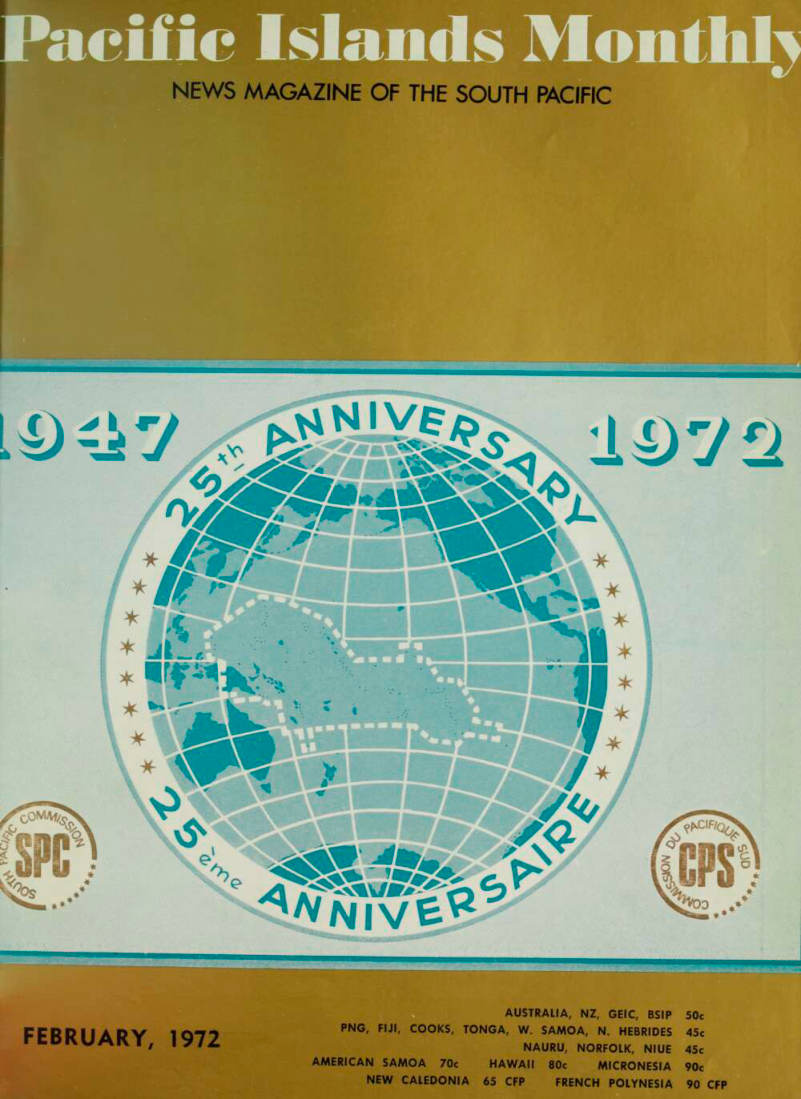 1
1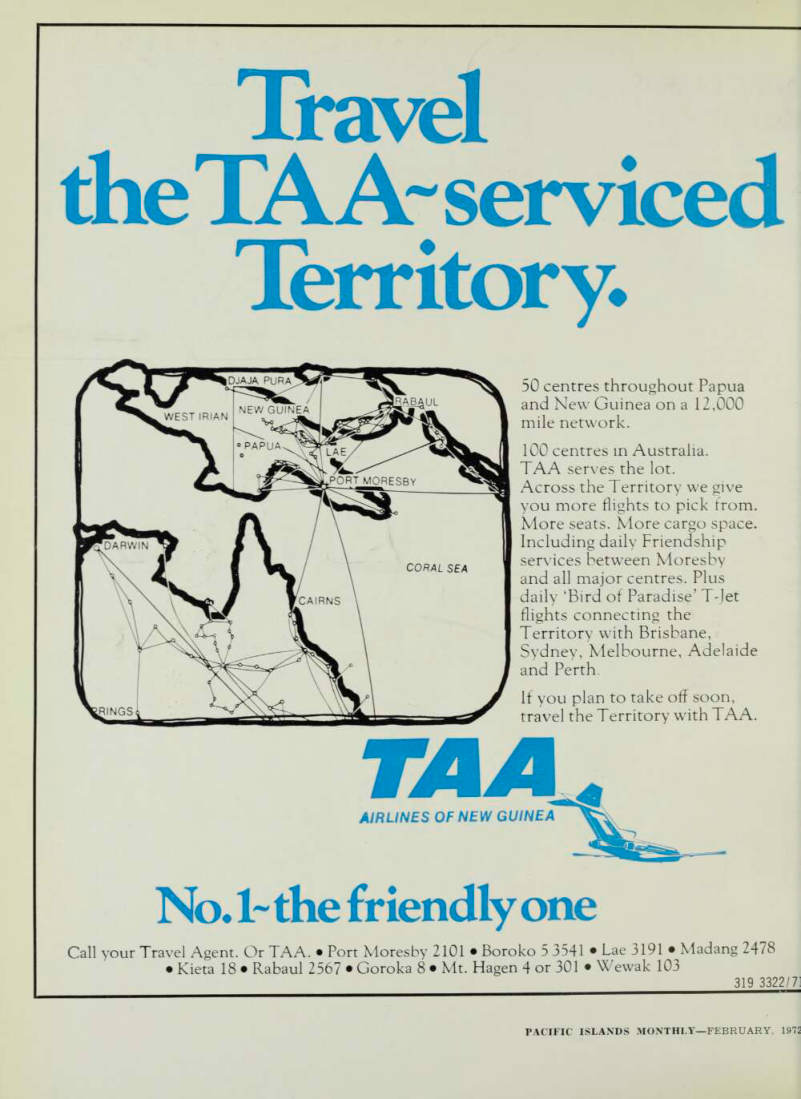 2
2 3
3 4
4 5
5 6
6 7
7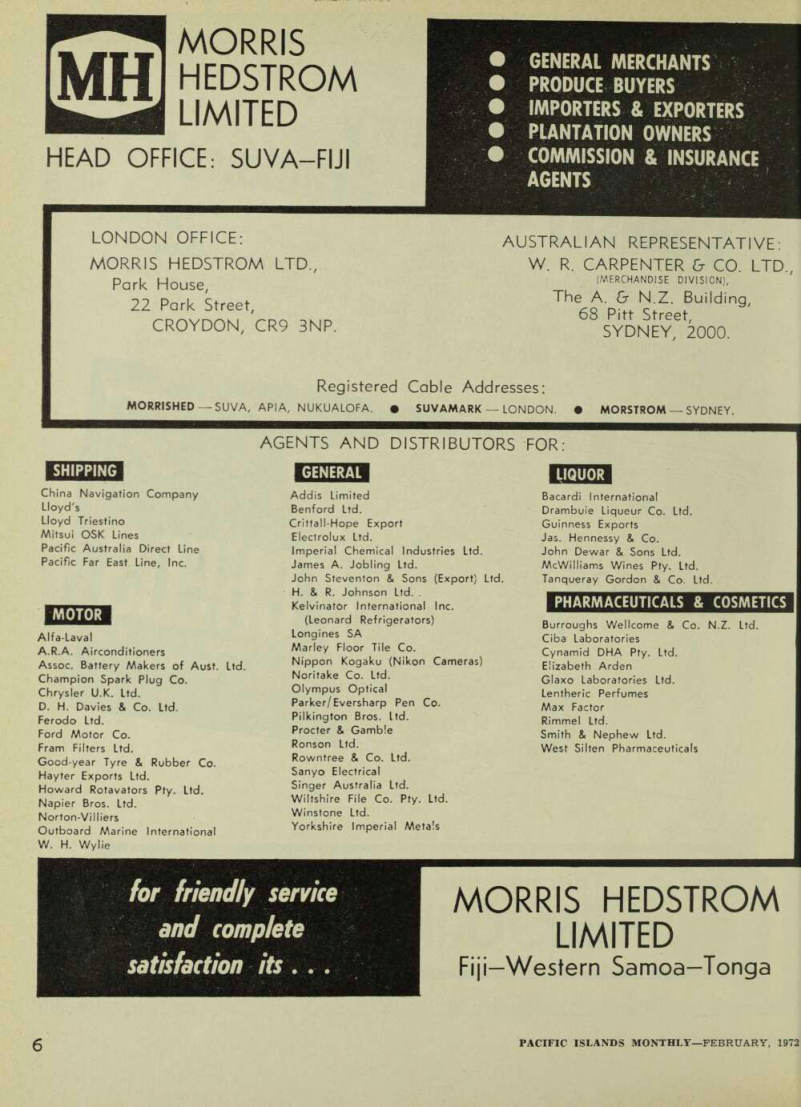 8
8 9
9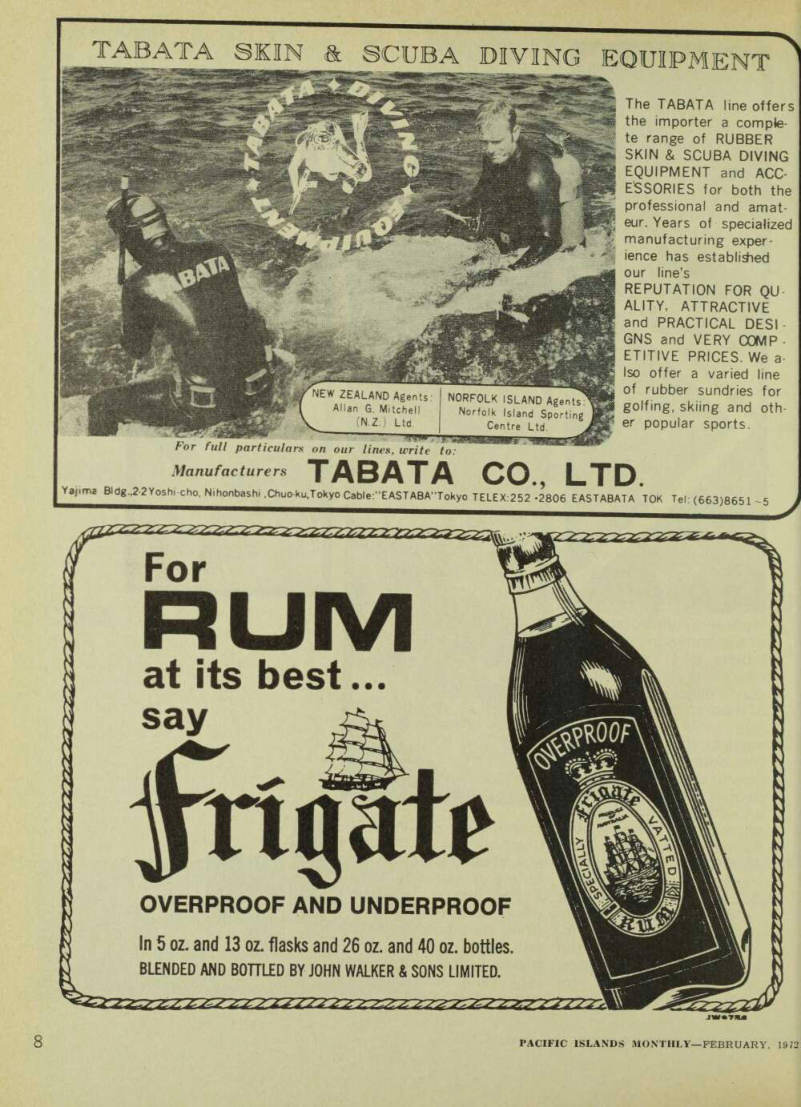 10
10 11
11 12
12 13
13 14
14 15
15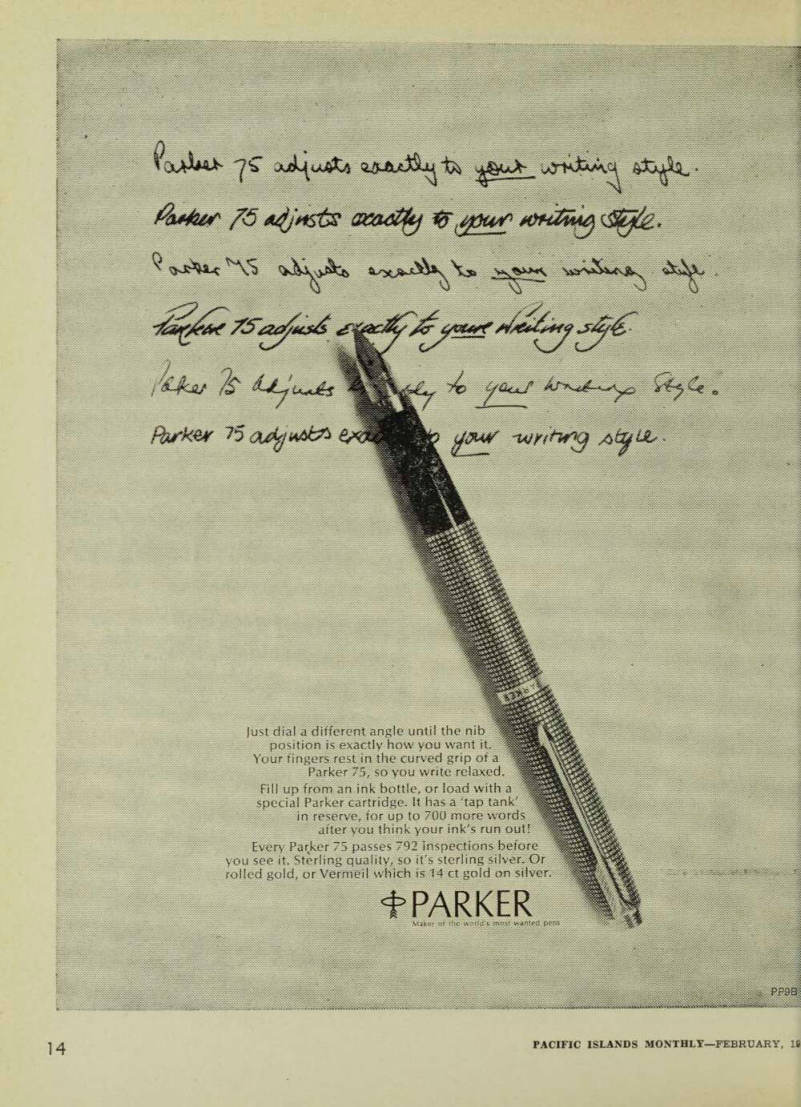 16
16 17
17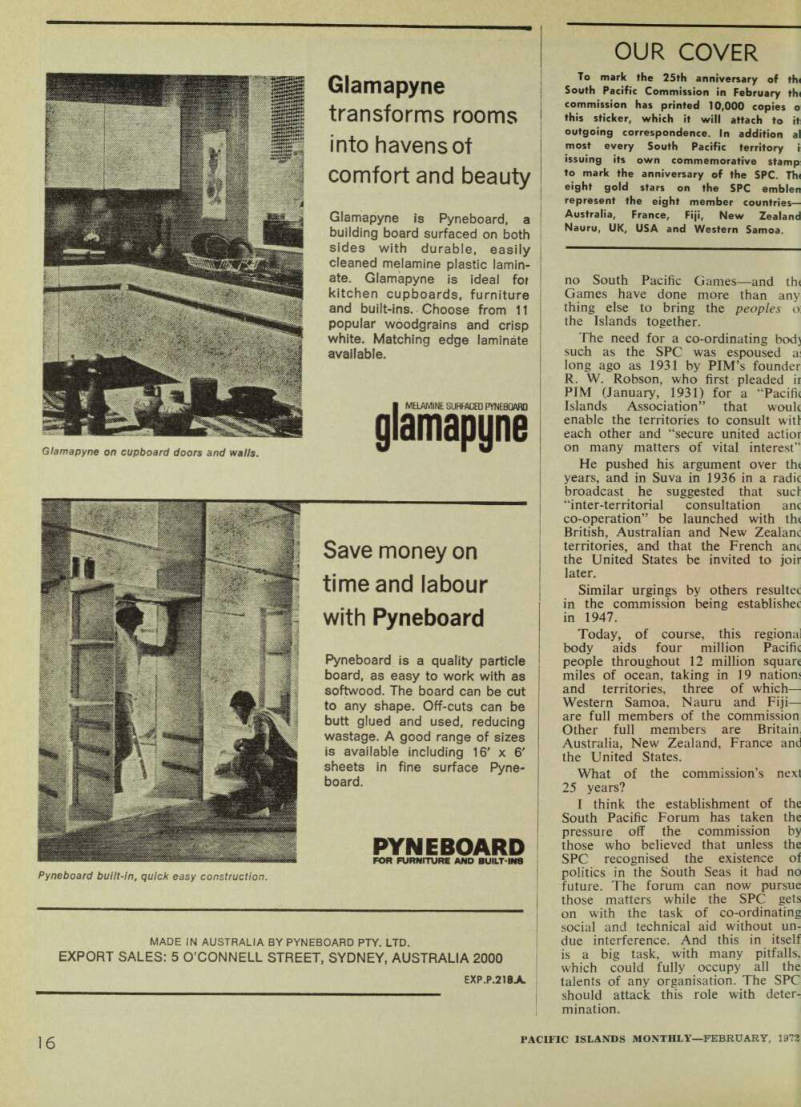 18
18 19
19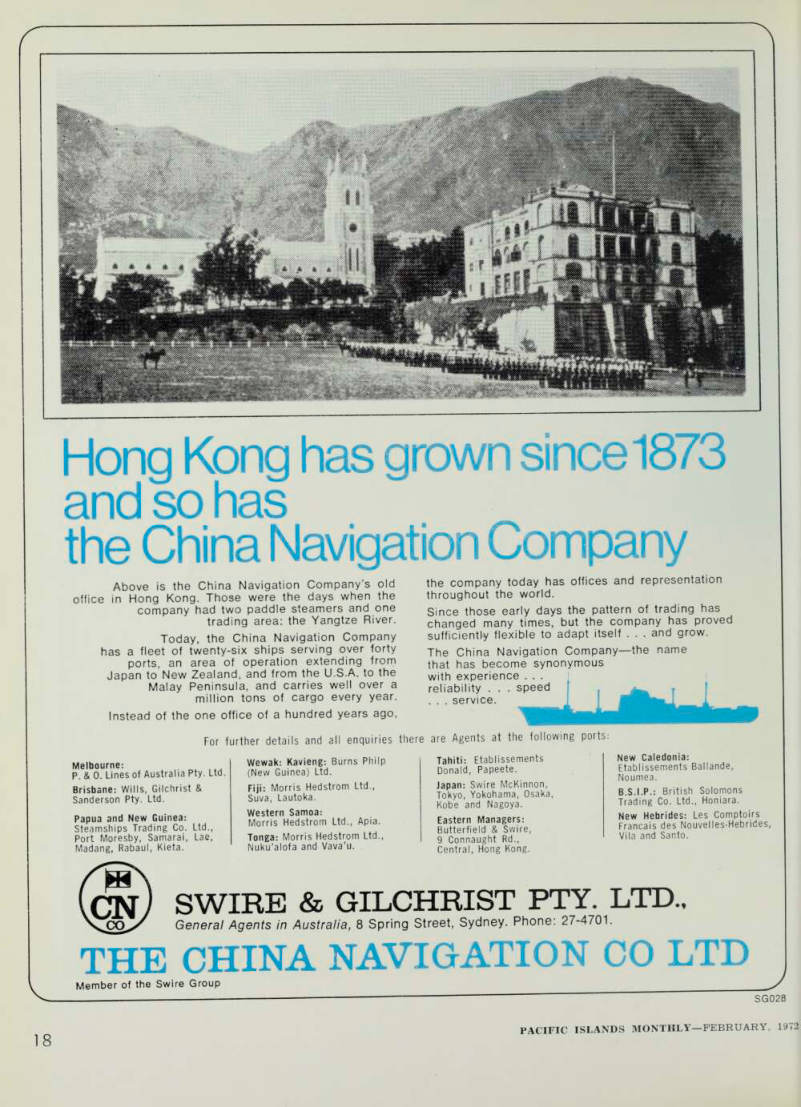 20
20 21
21 22
22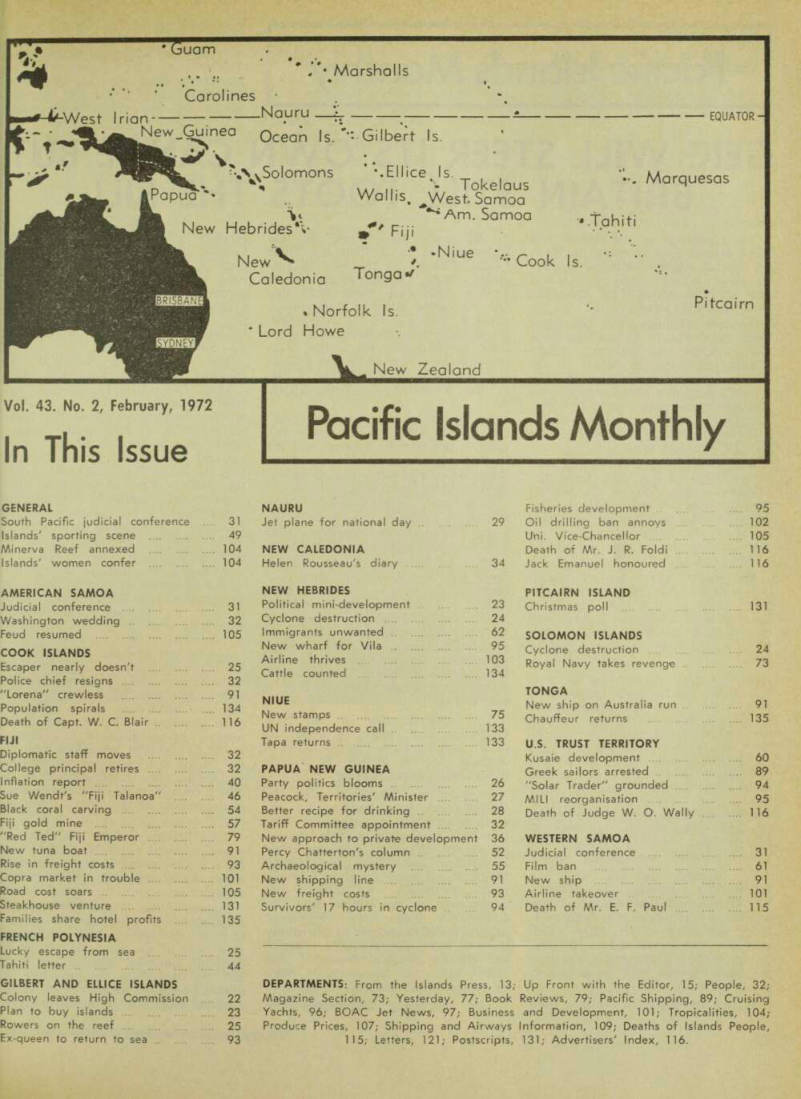 23
23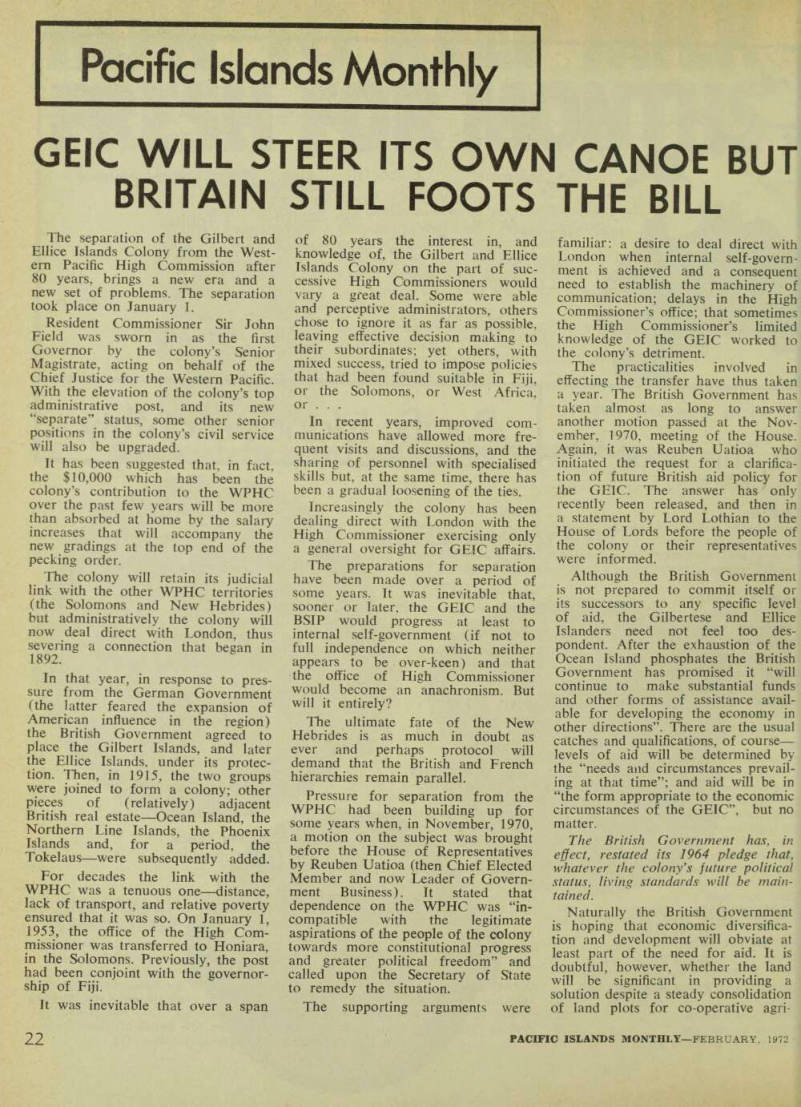 24
24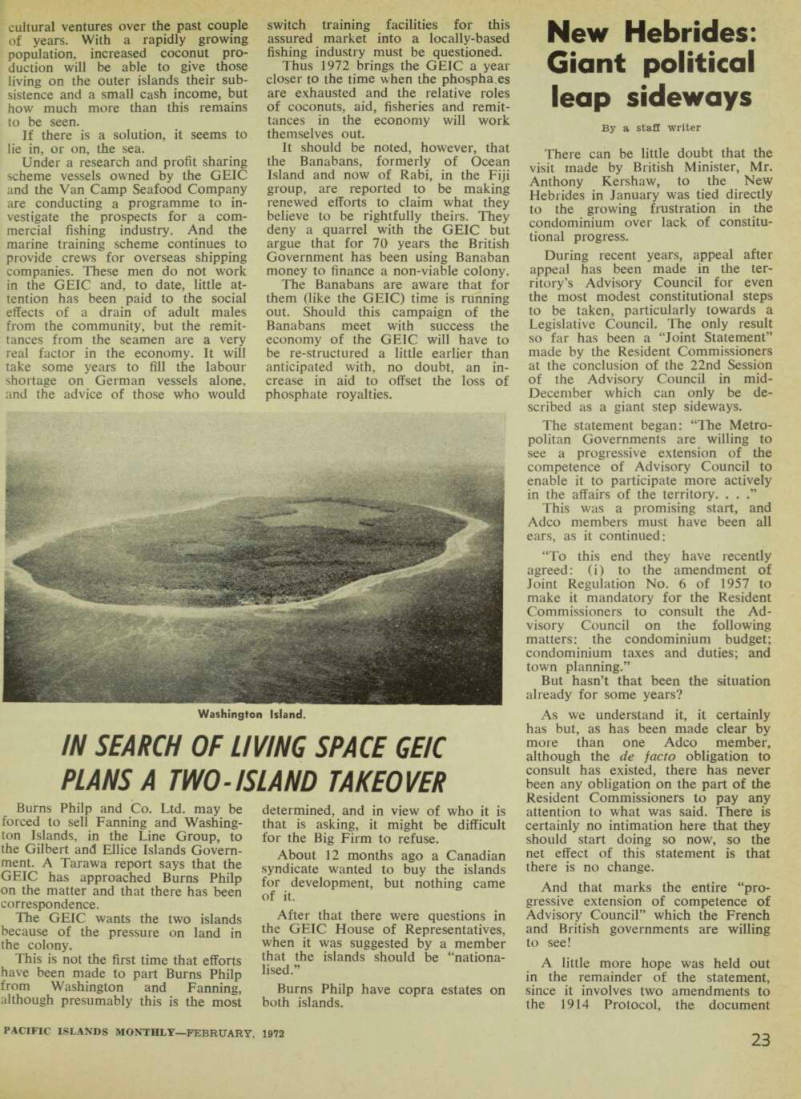 25
25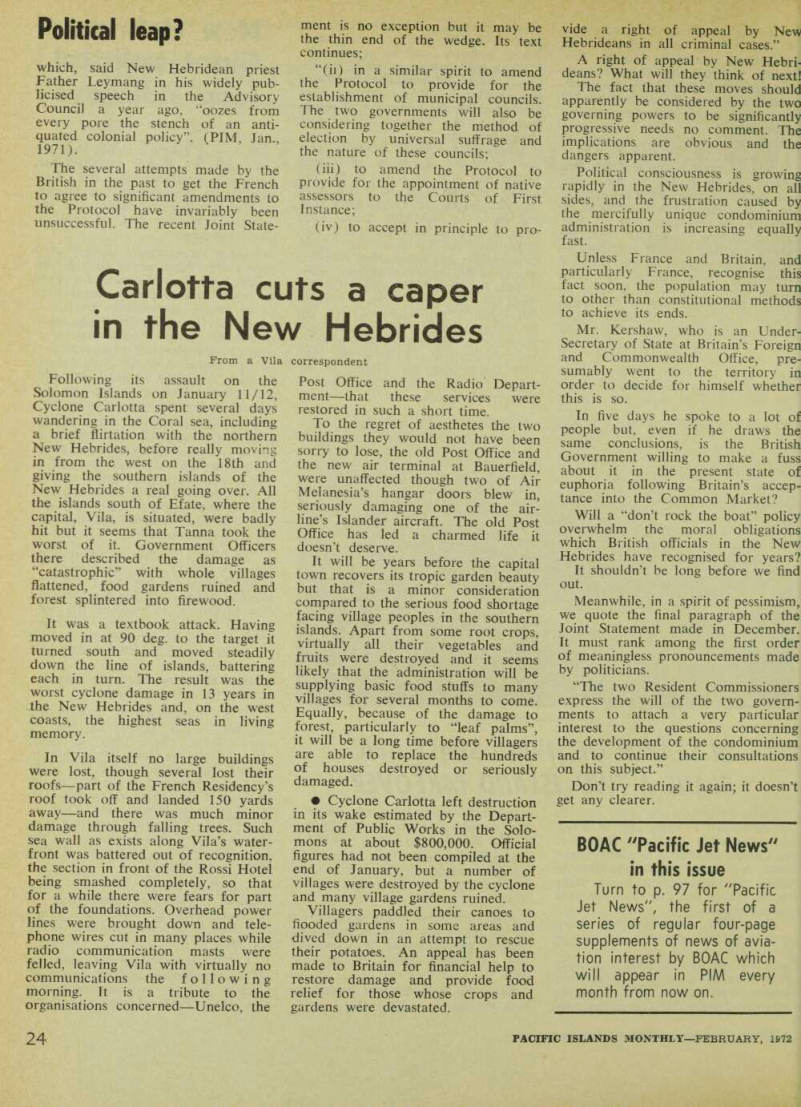 26
26 27
27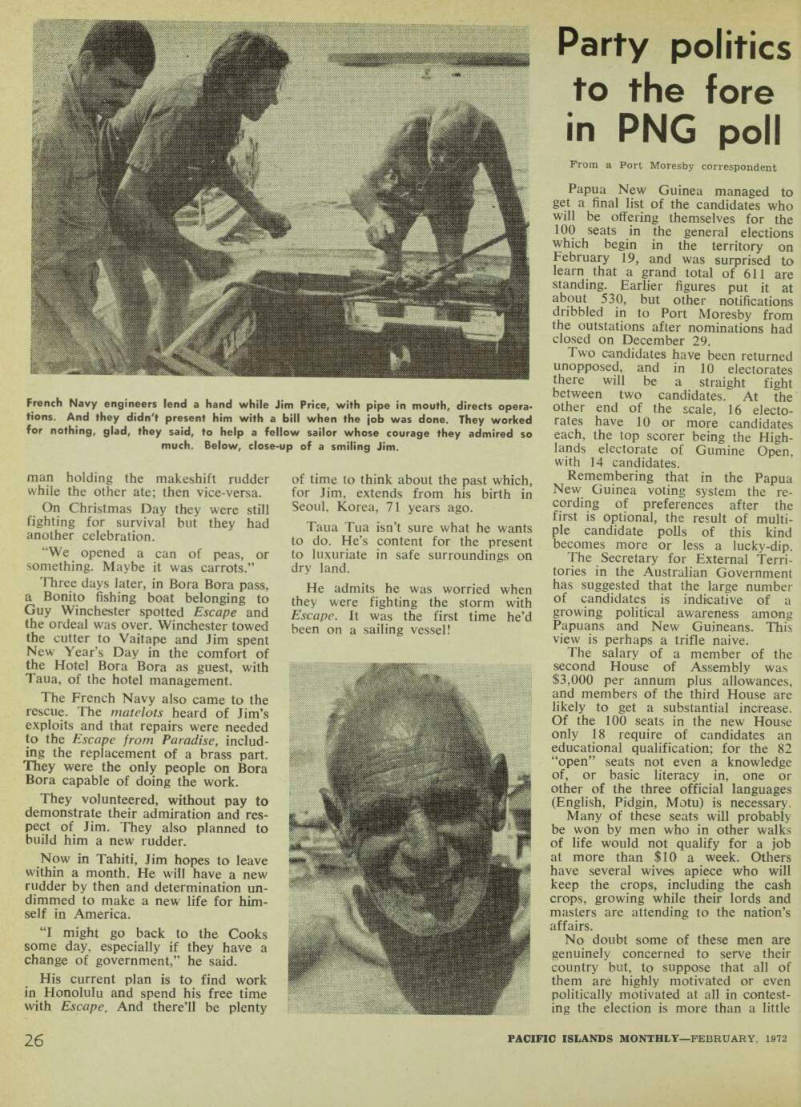 28
28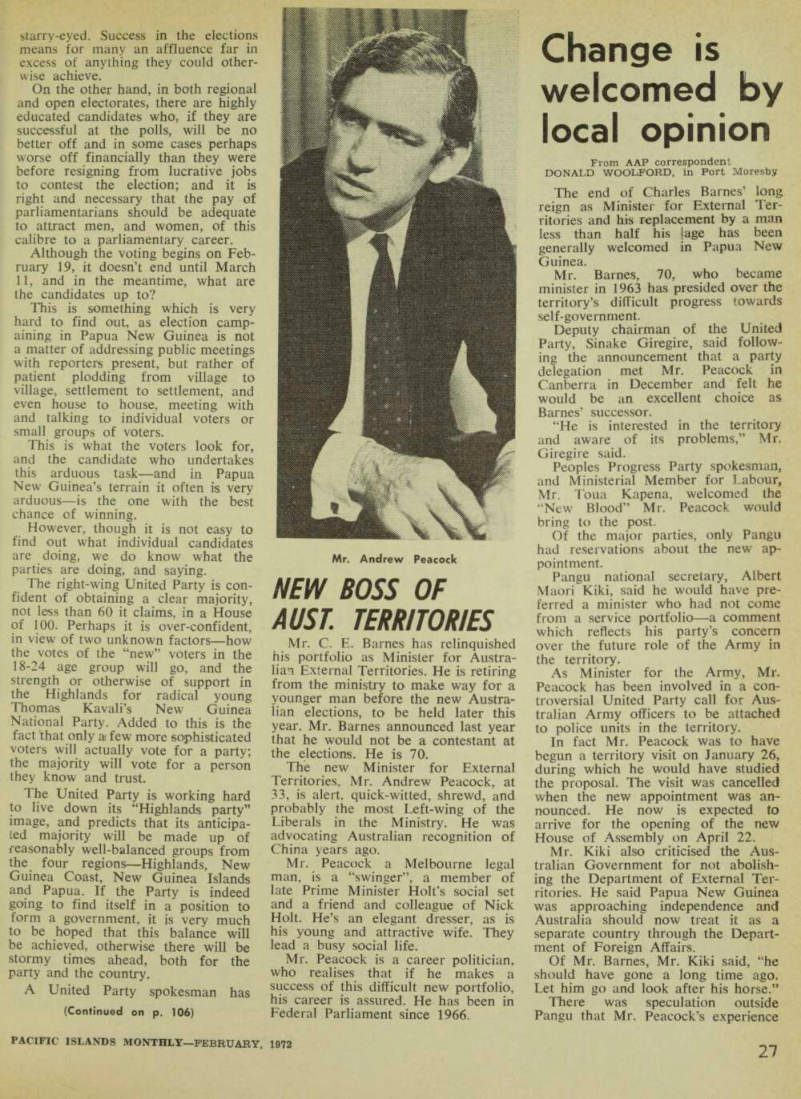 29
29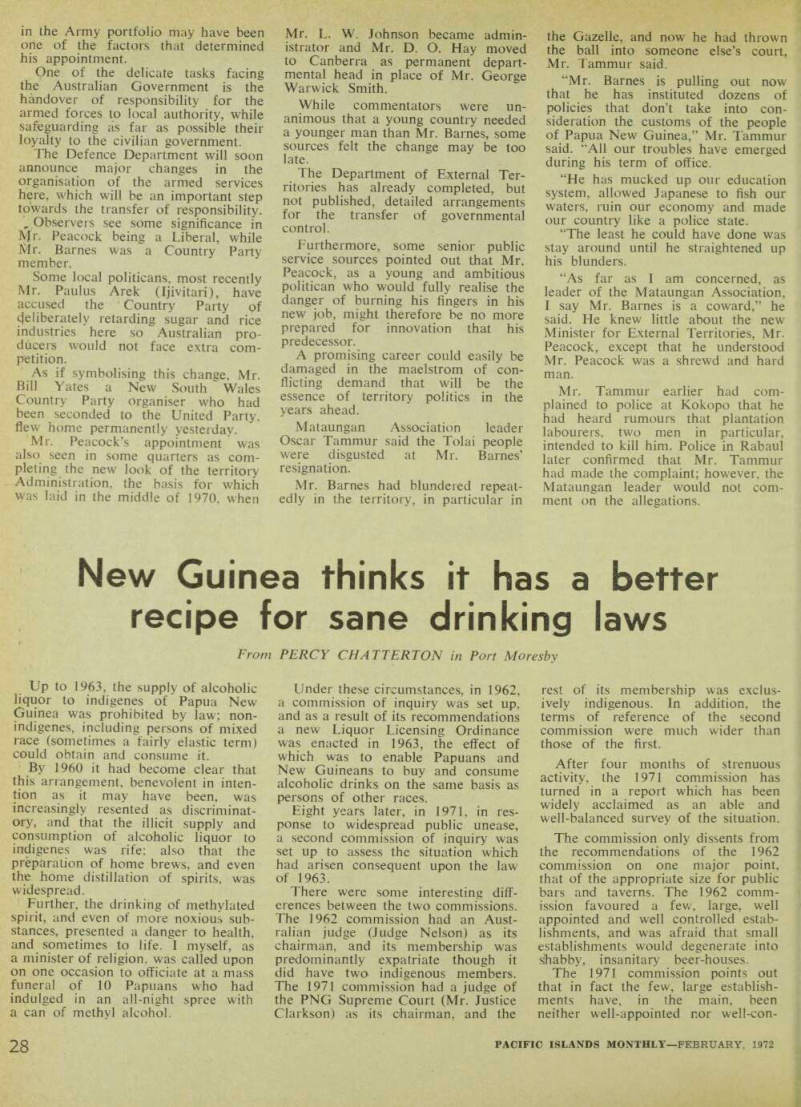 30
30 31
31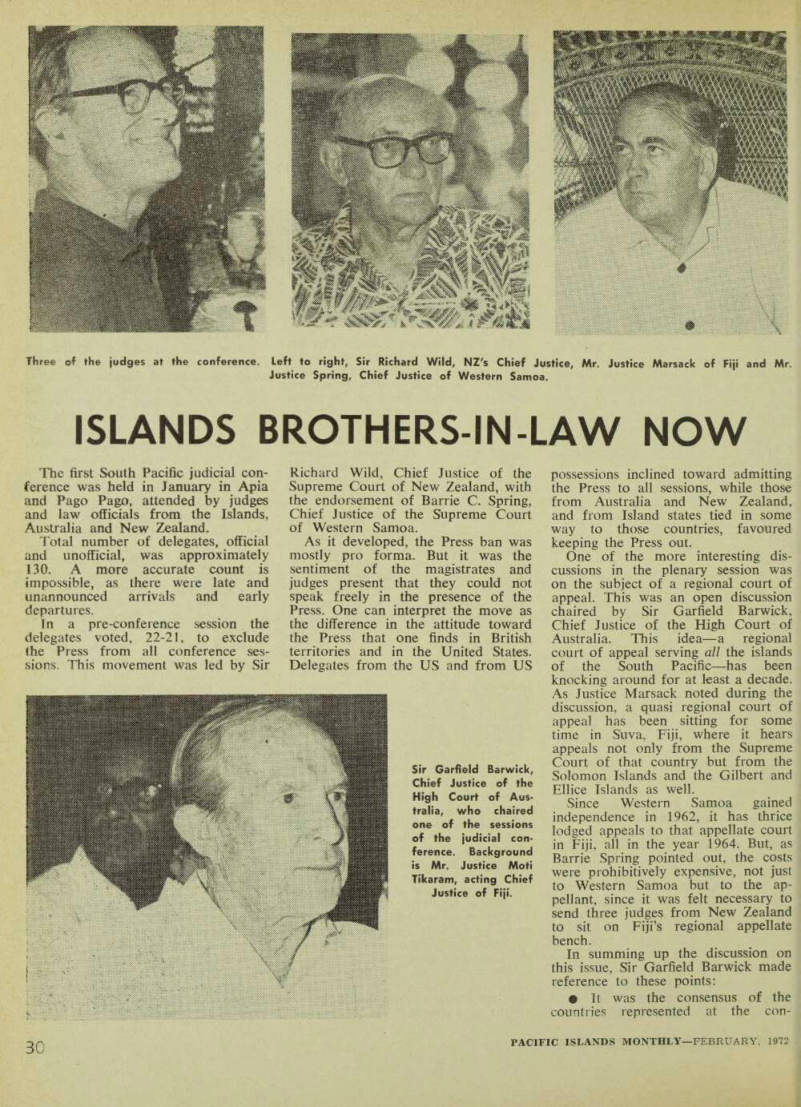 32
32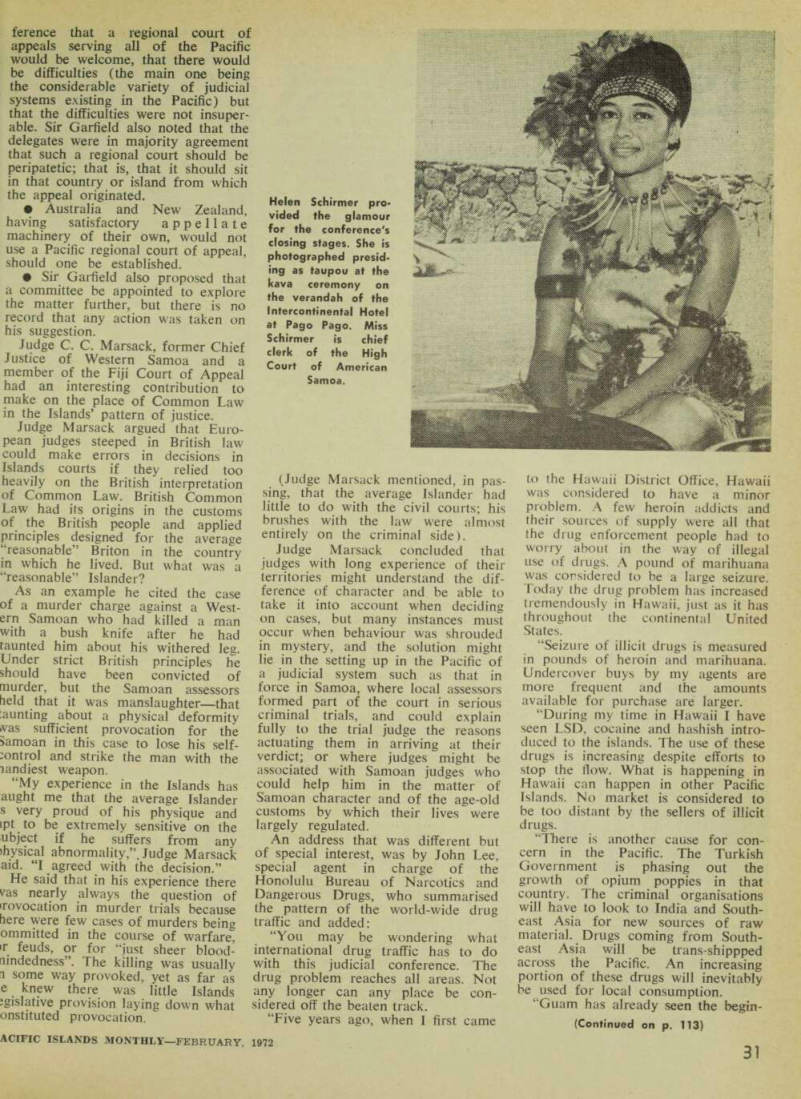 33
33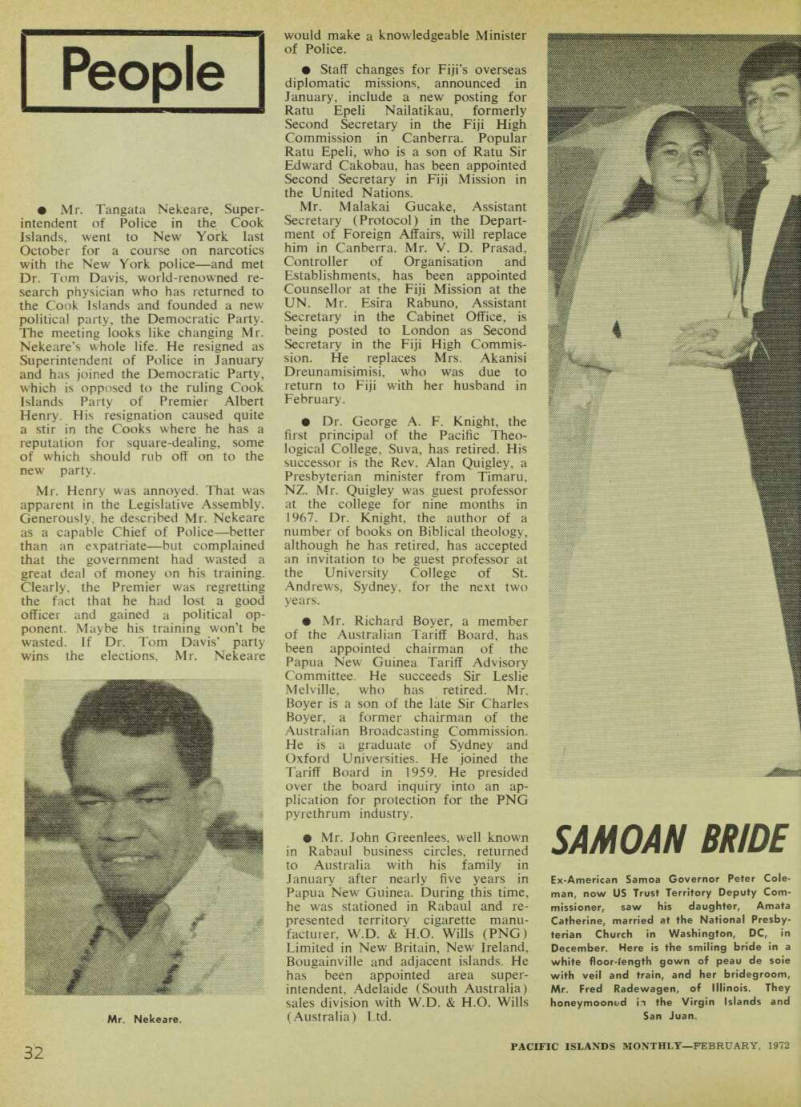 34
34 35
35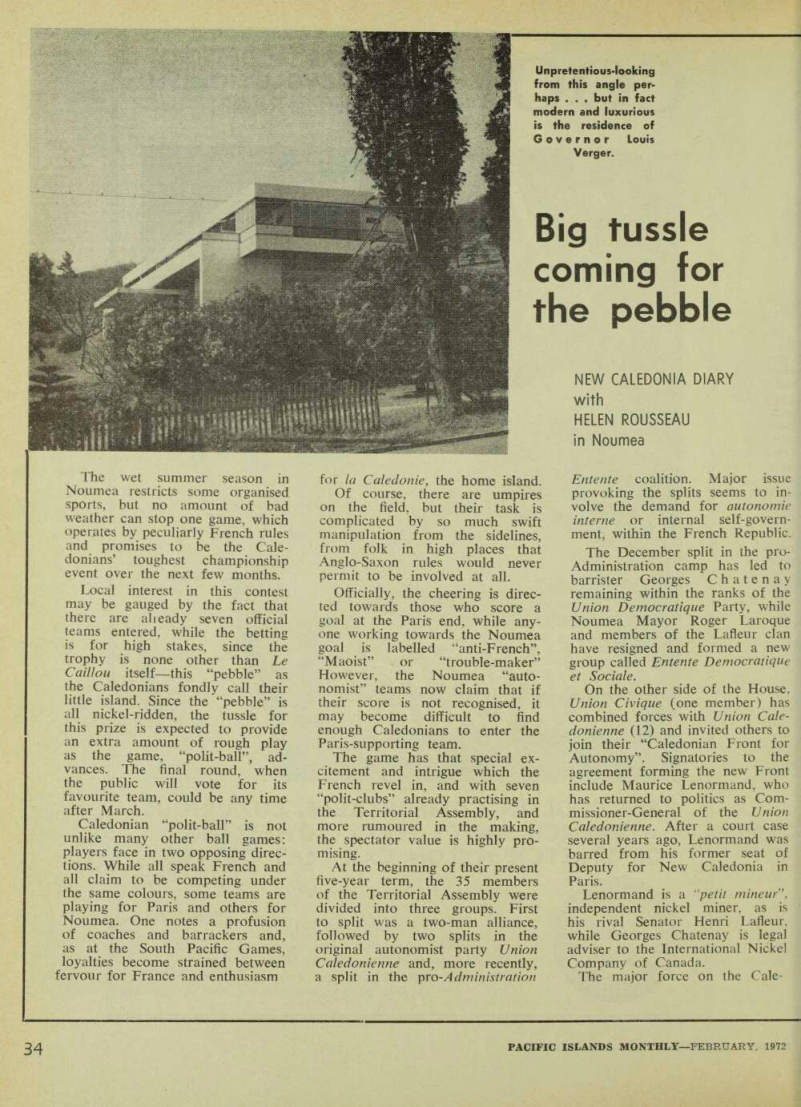 36
36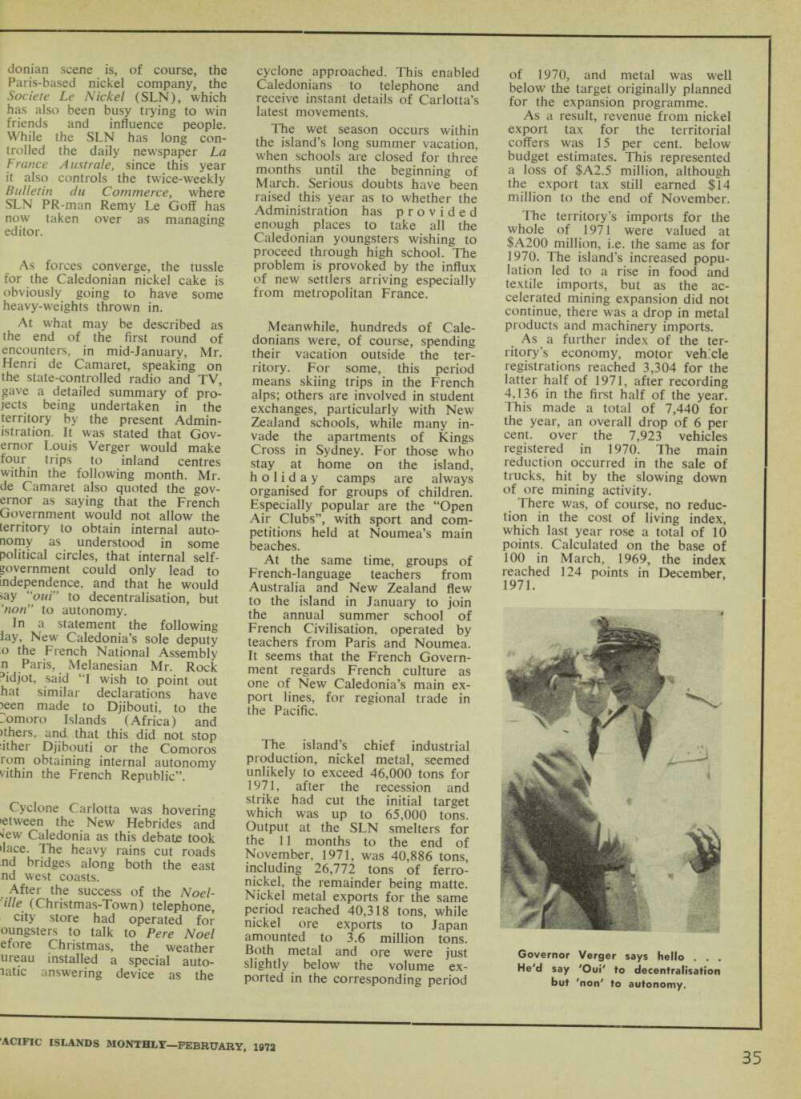 37
37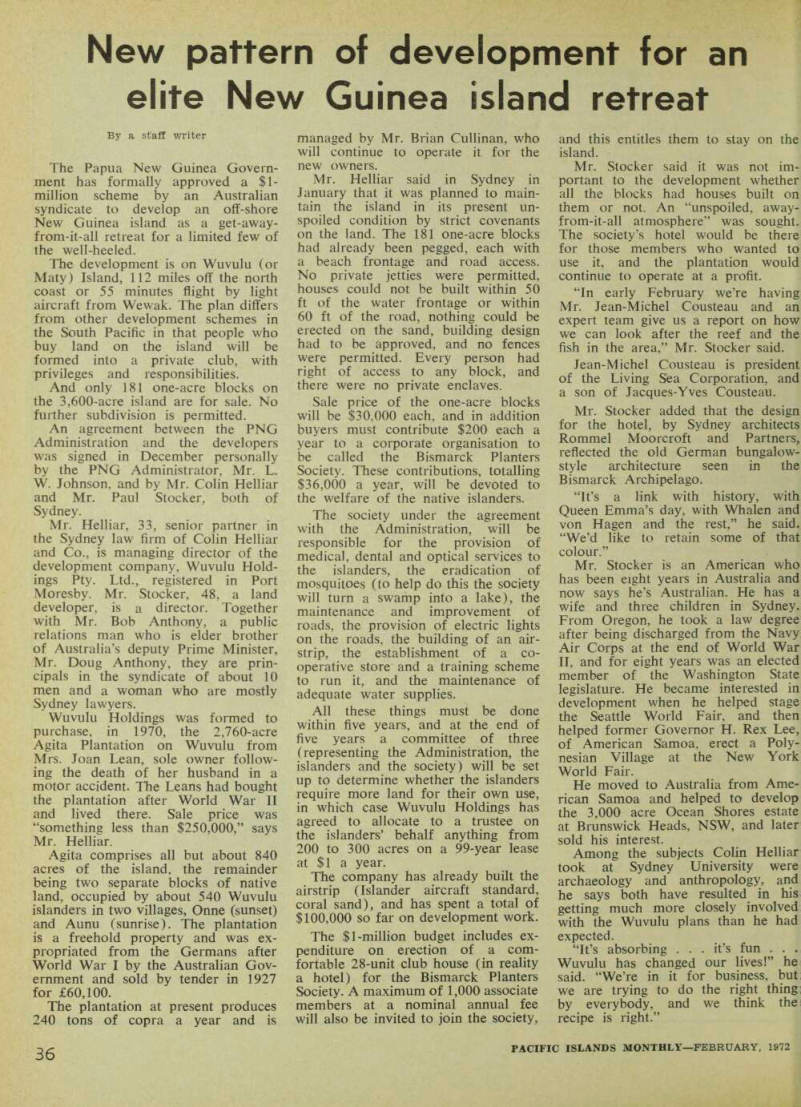 38
38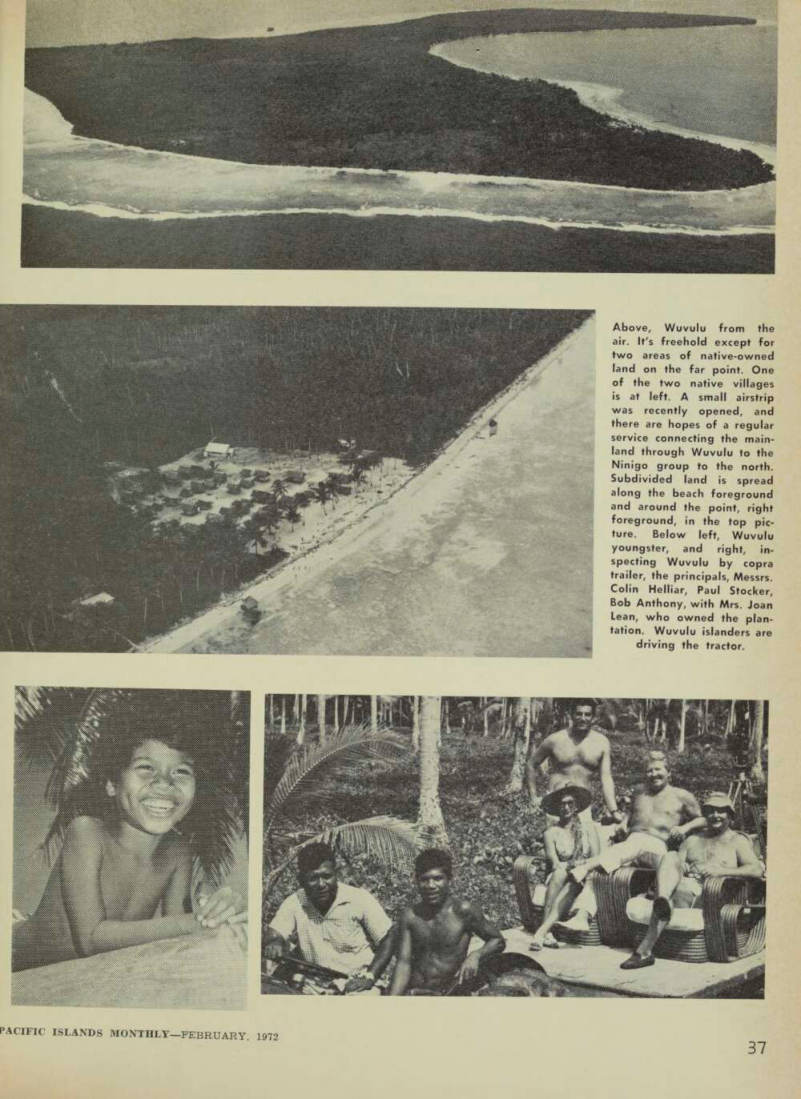 39
39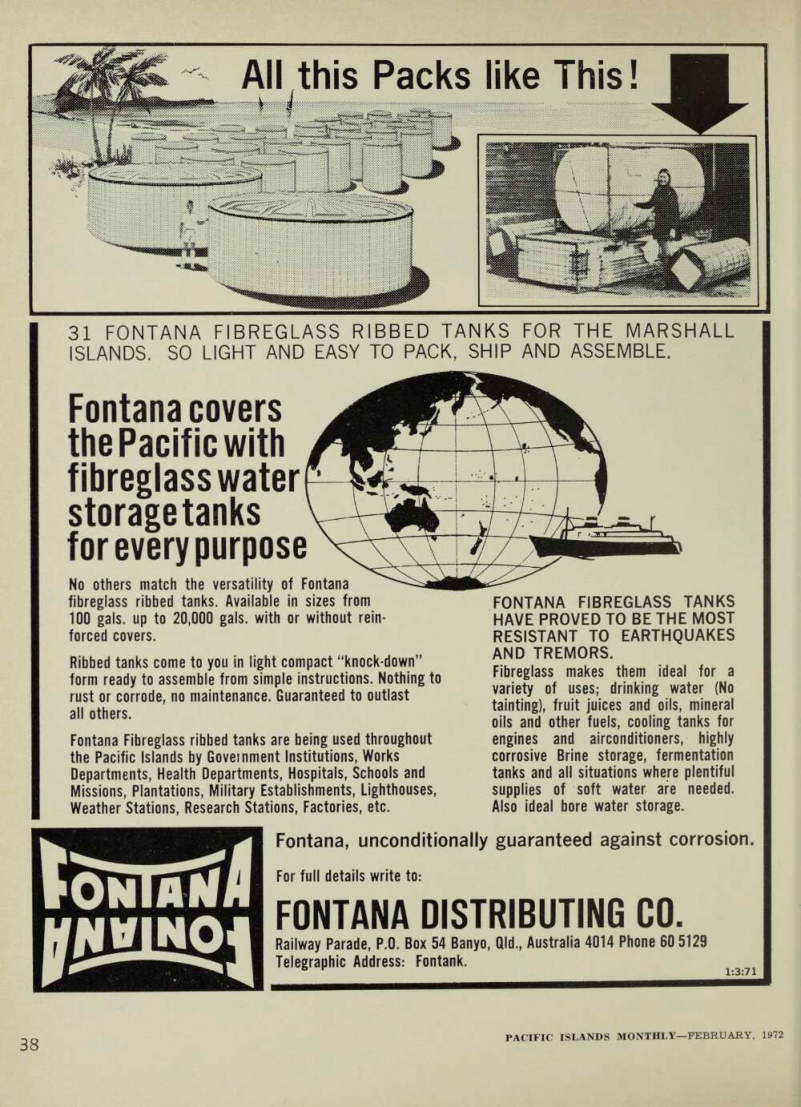 40
40 41
41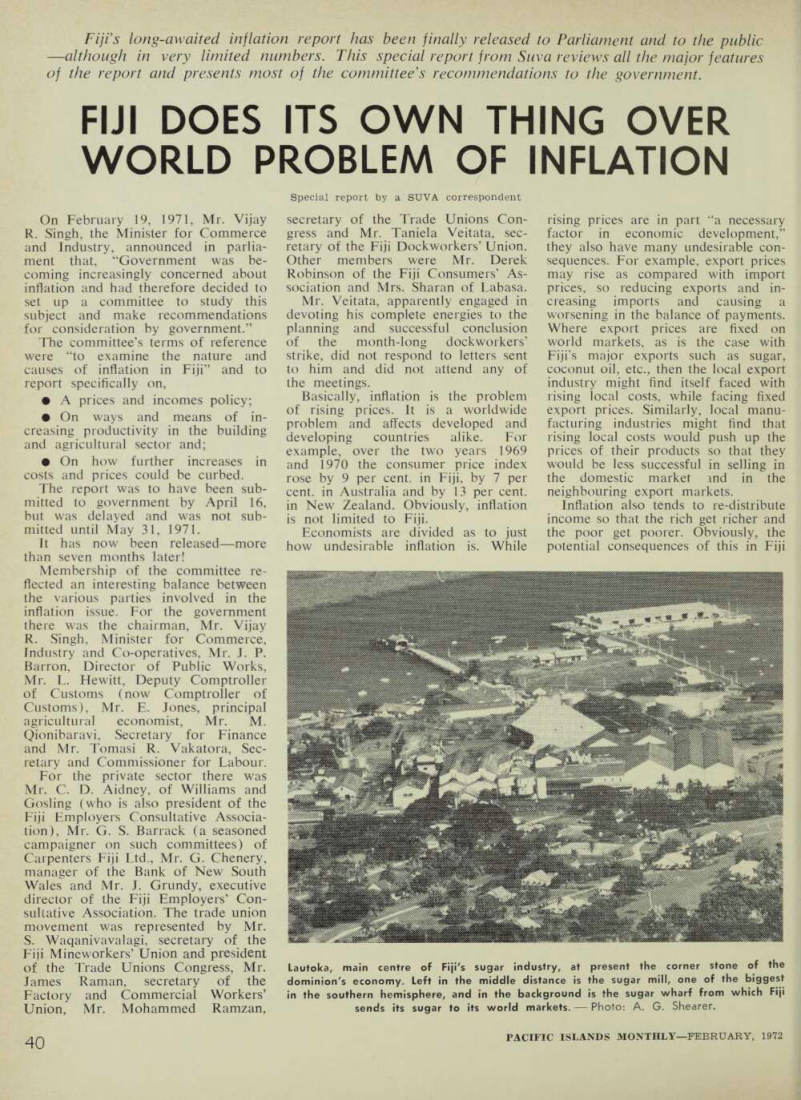 42
42 43
43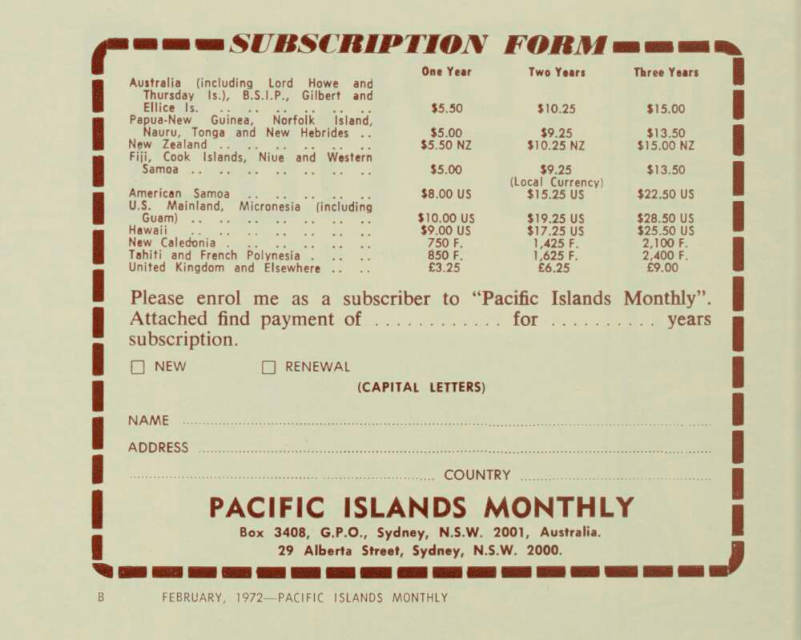 44
44 45
45 46
46 47
47 48
48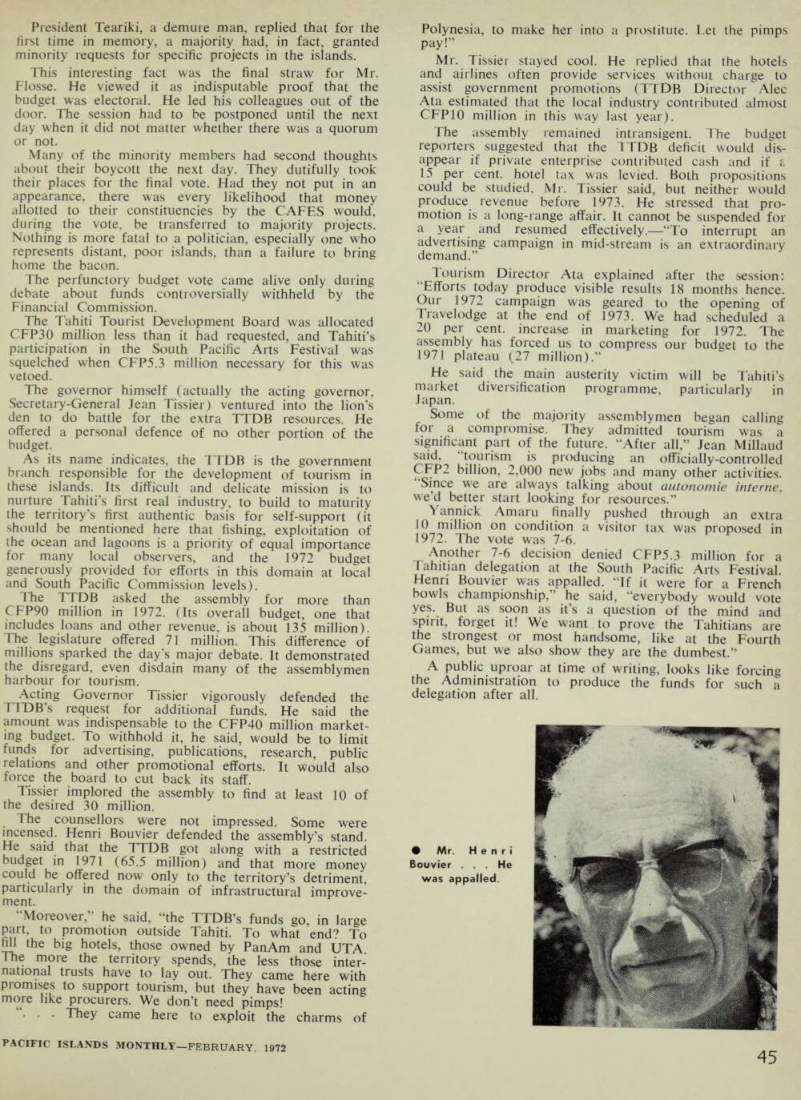 49
49 50
50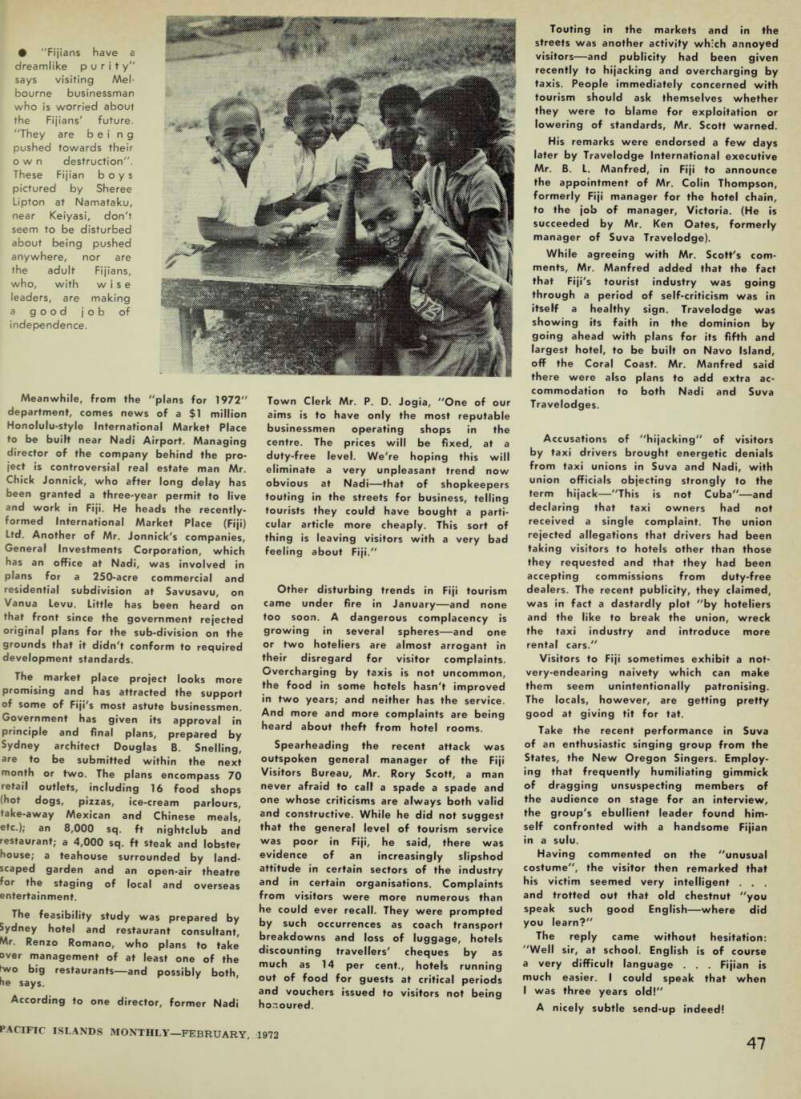 51
51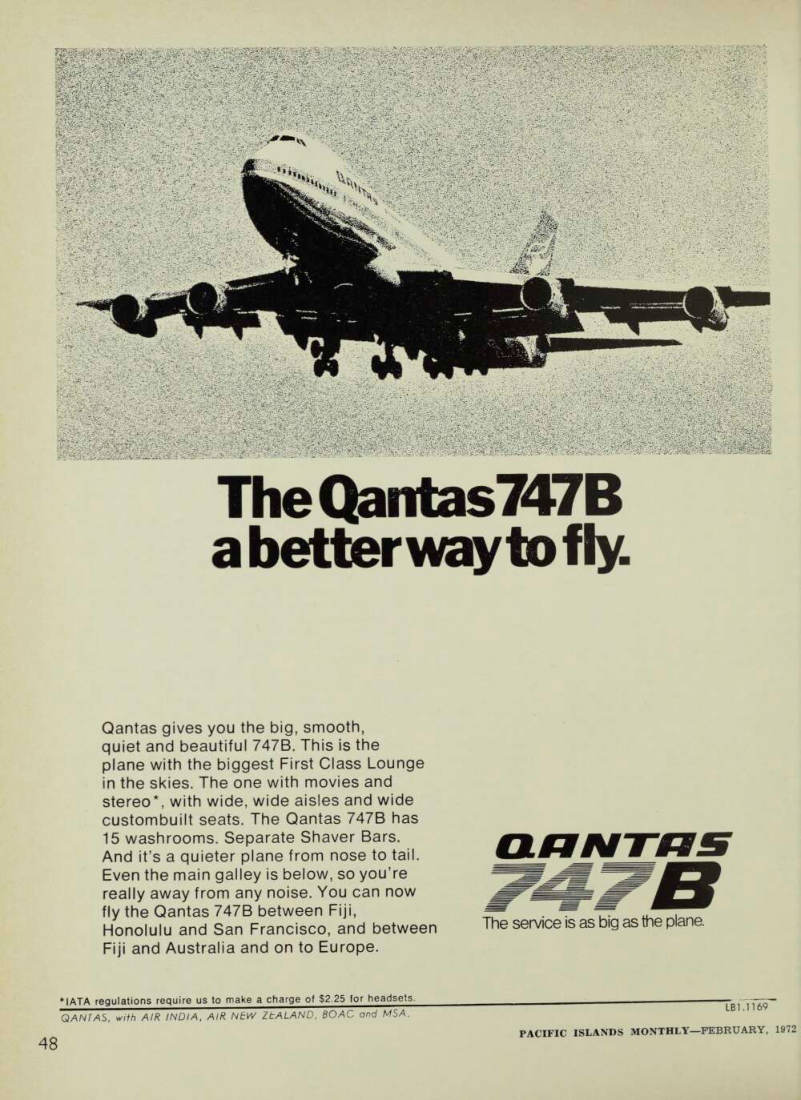 52
52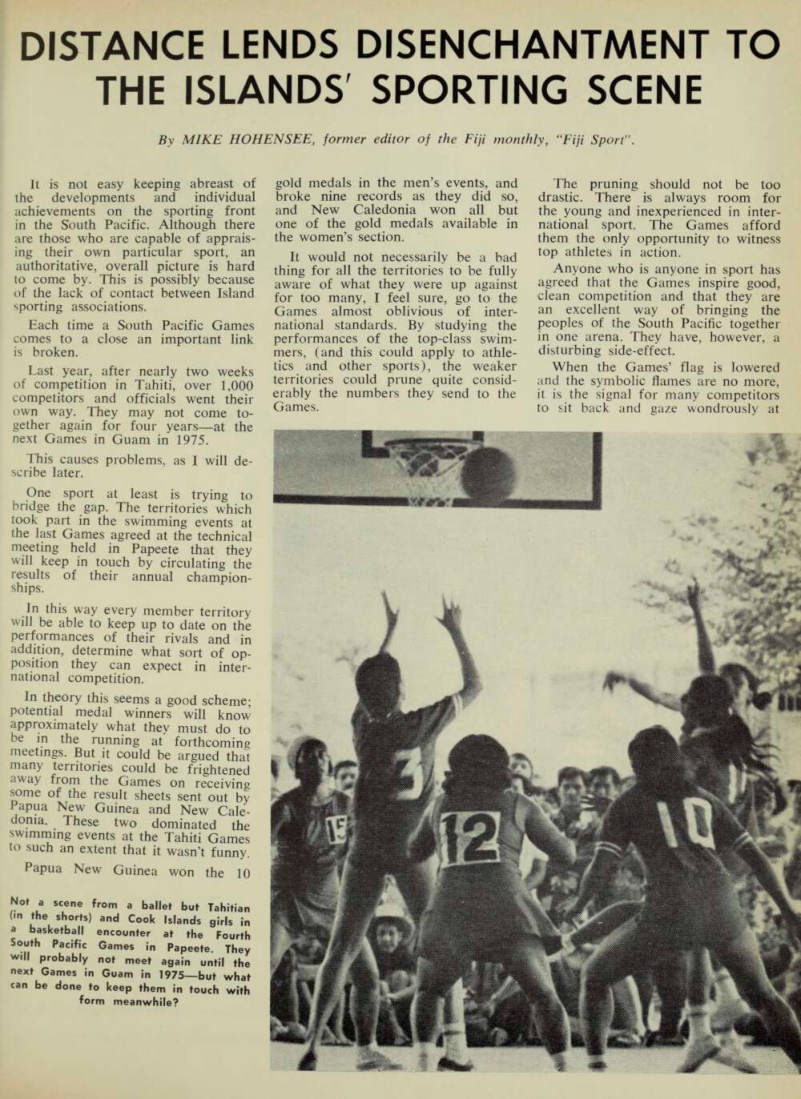 53
53 54
54 55
55 56
56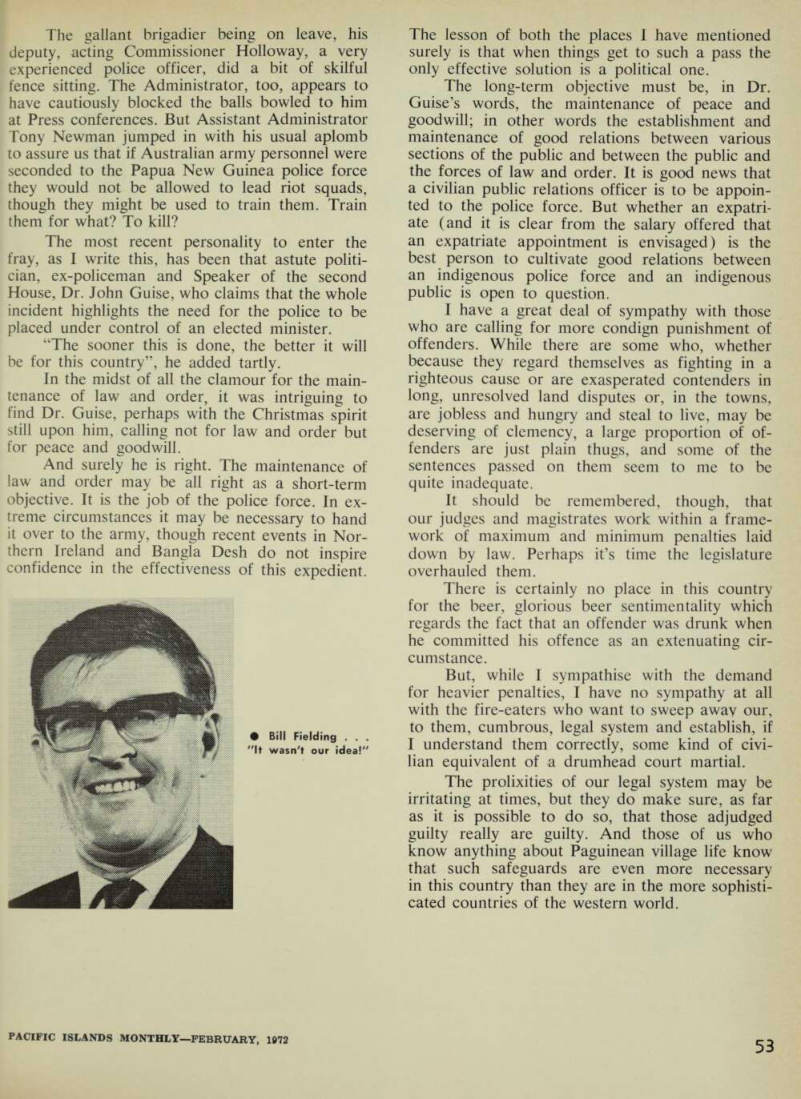 57
57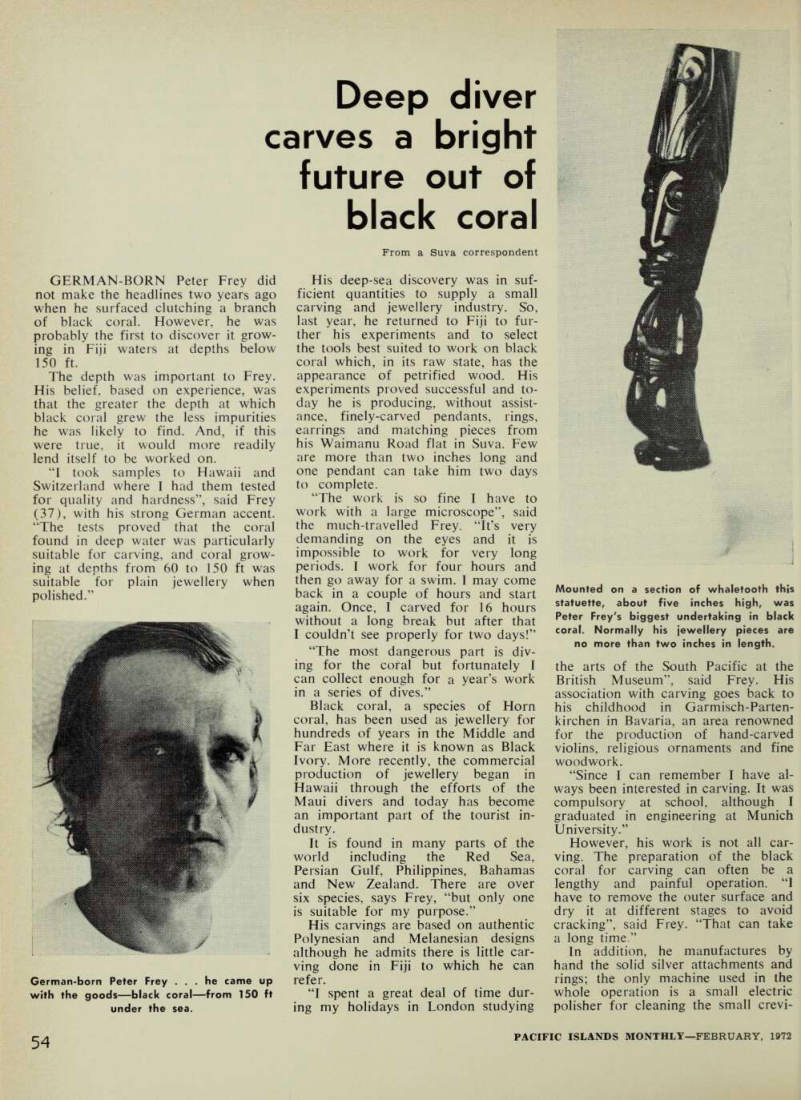 58
58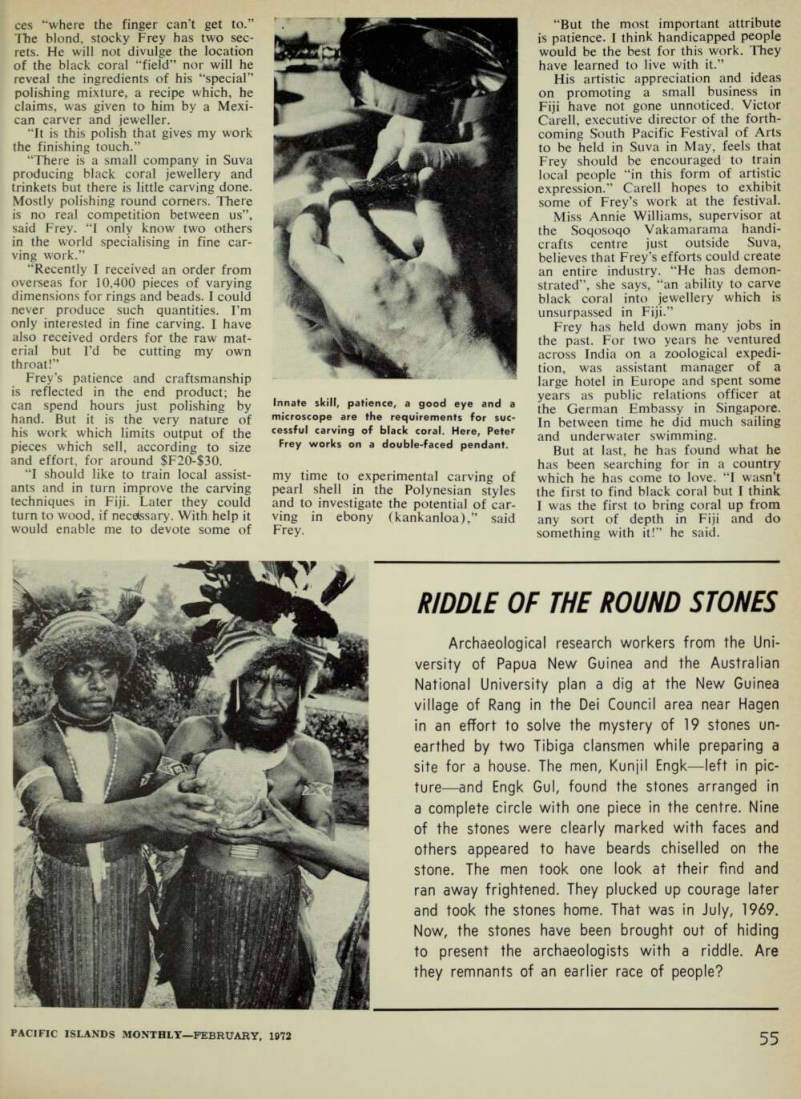 59
59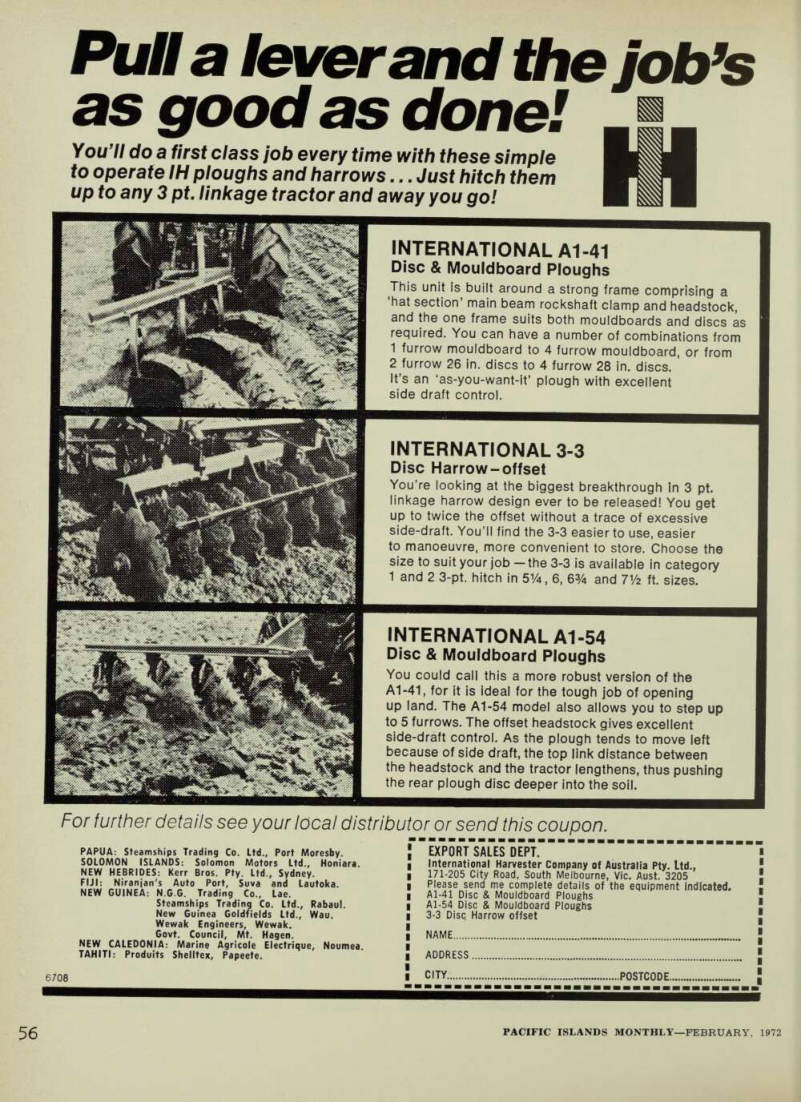 60
60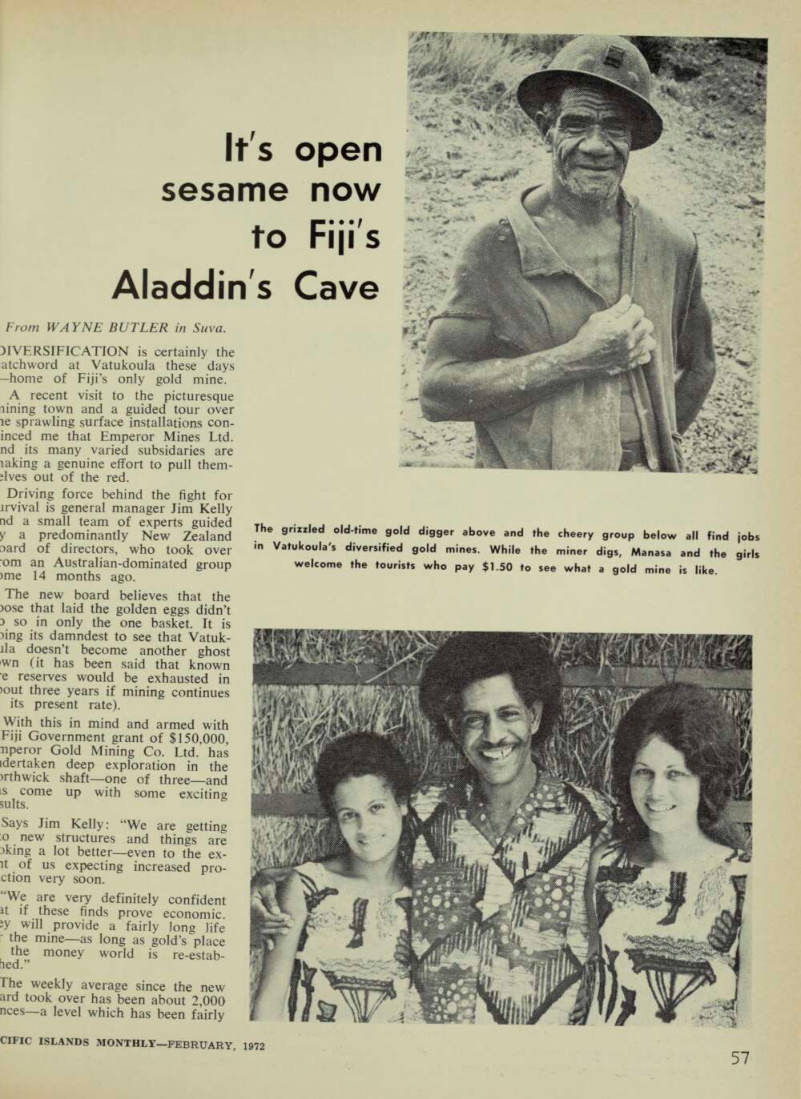 61
61 62
62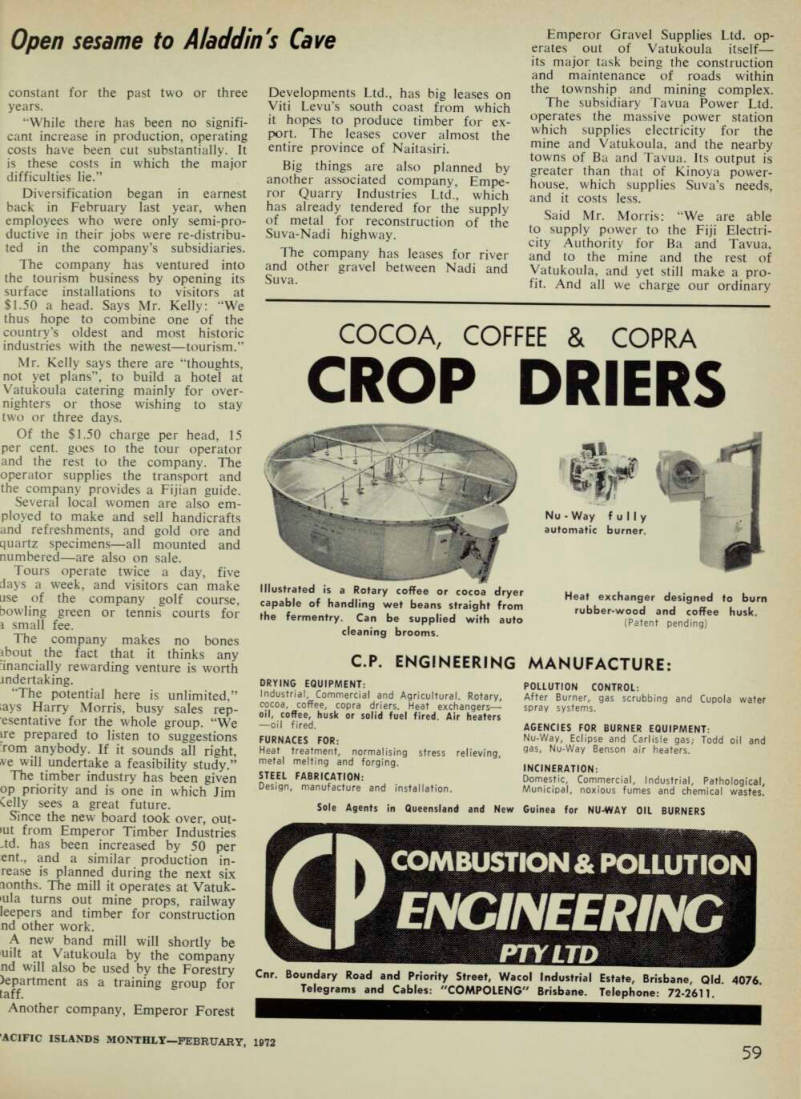 63
63 64
64 65
65 66
66 67
67 68
68 69
69 70
70 71
71 72
72 73
73 74
74 75
75 76
76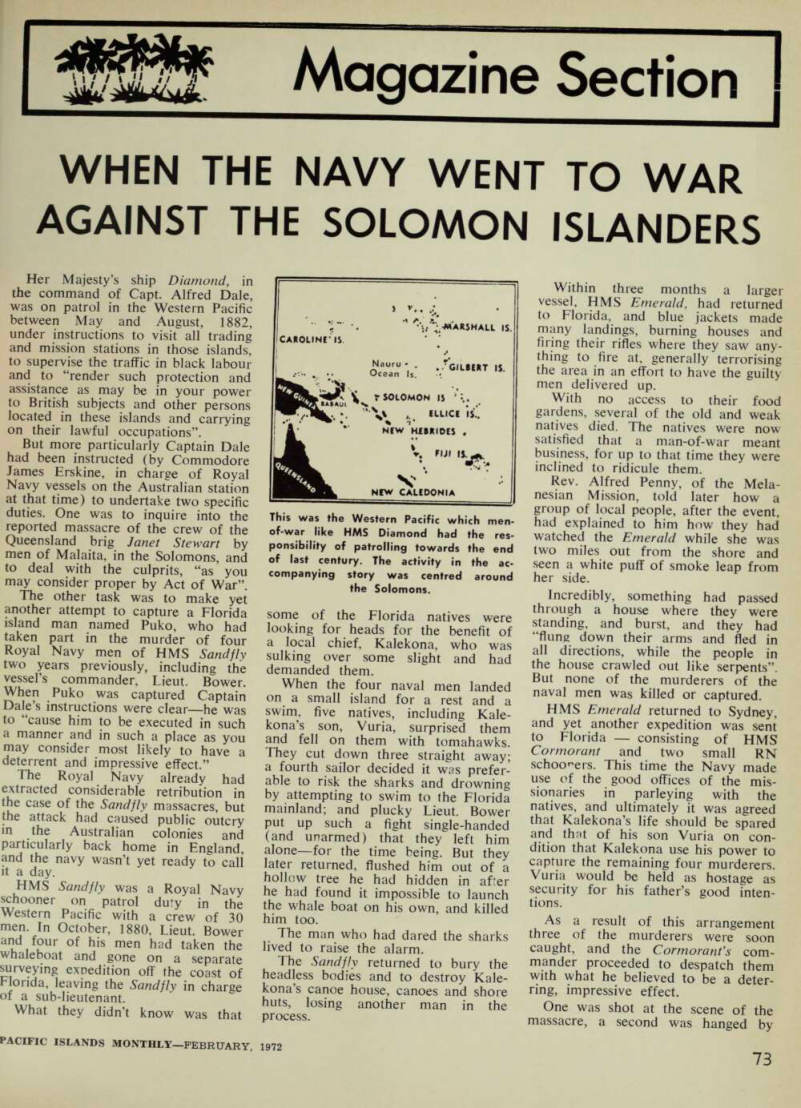 77
77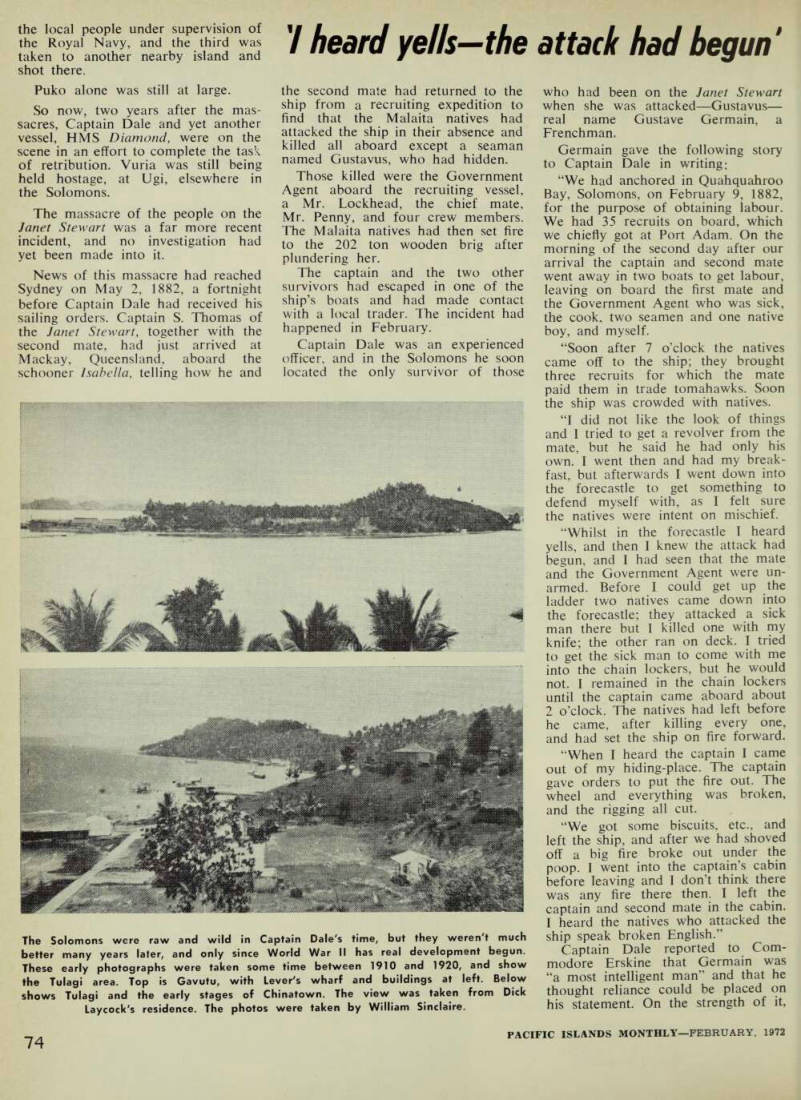 78
78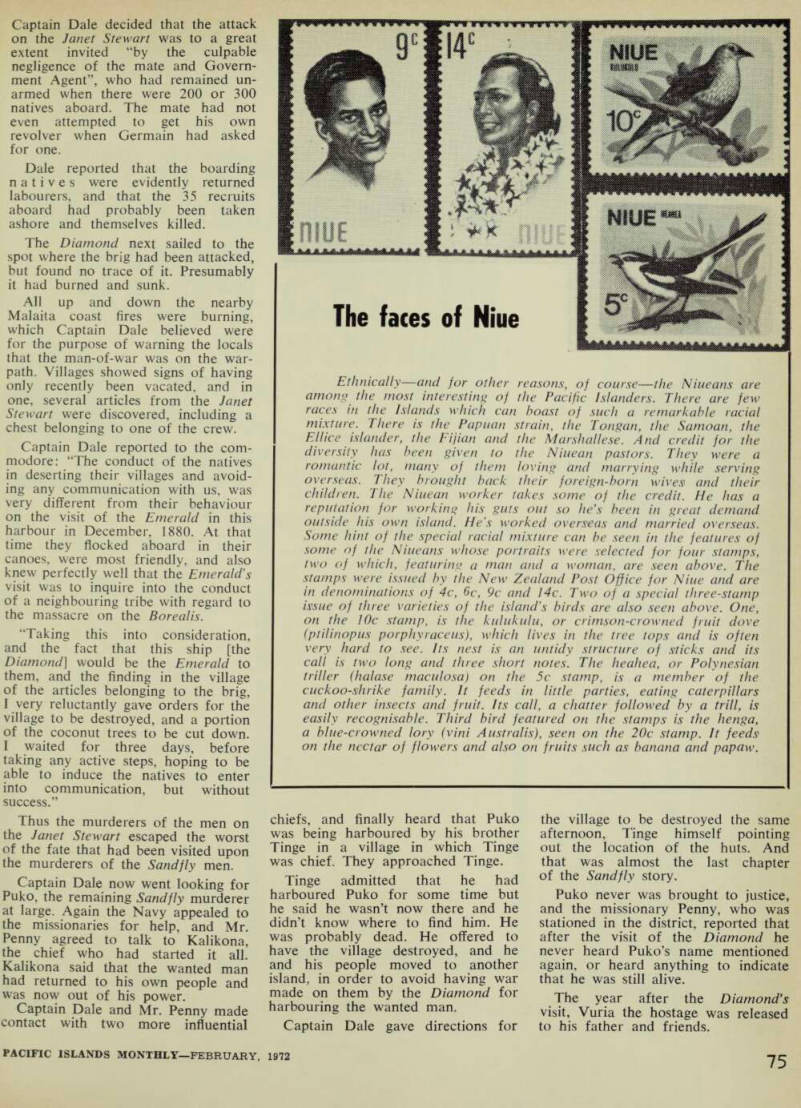 79
79 80
80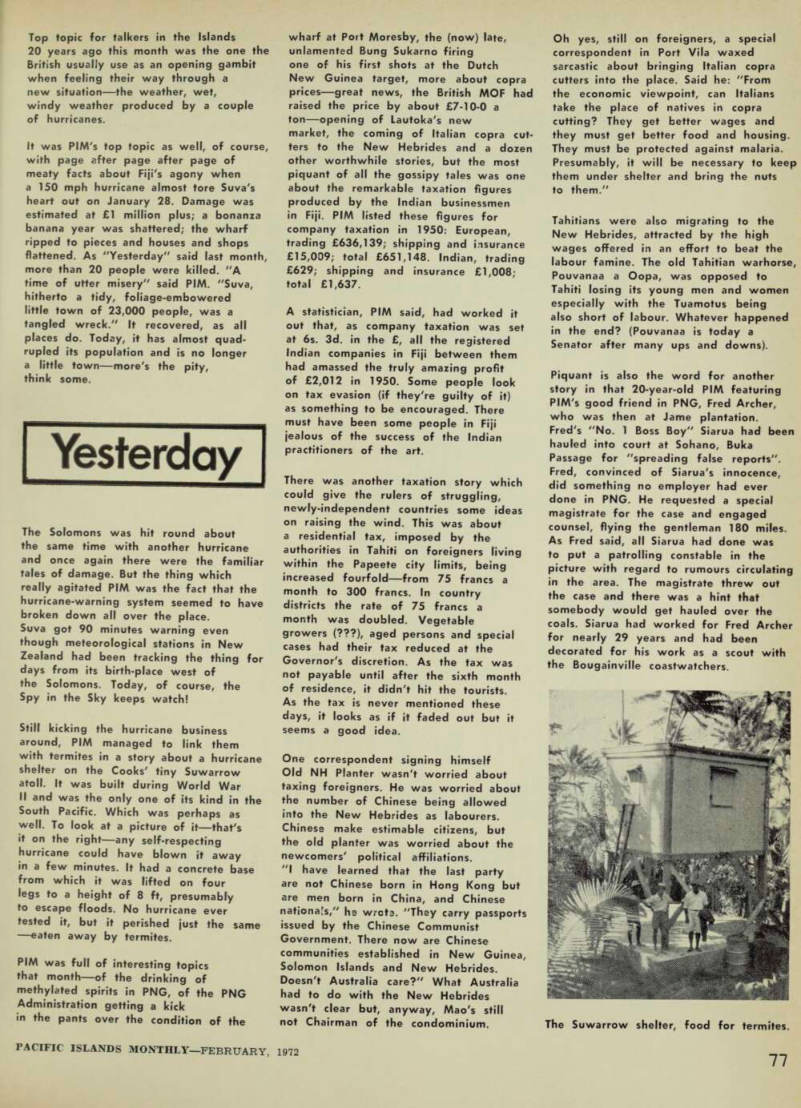 81
81 82
82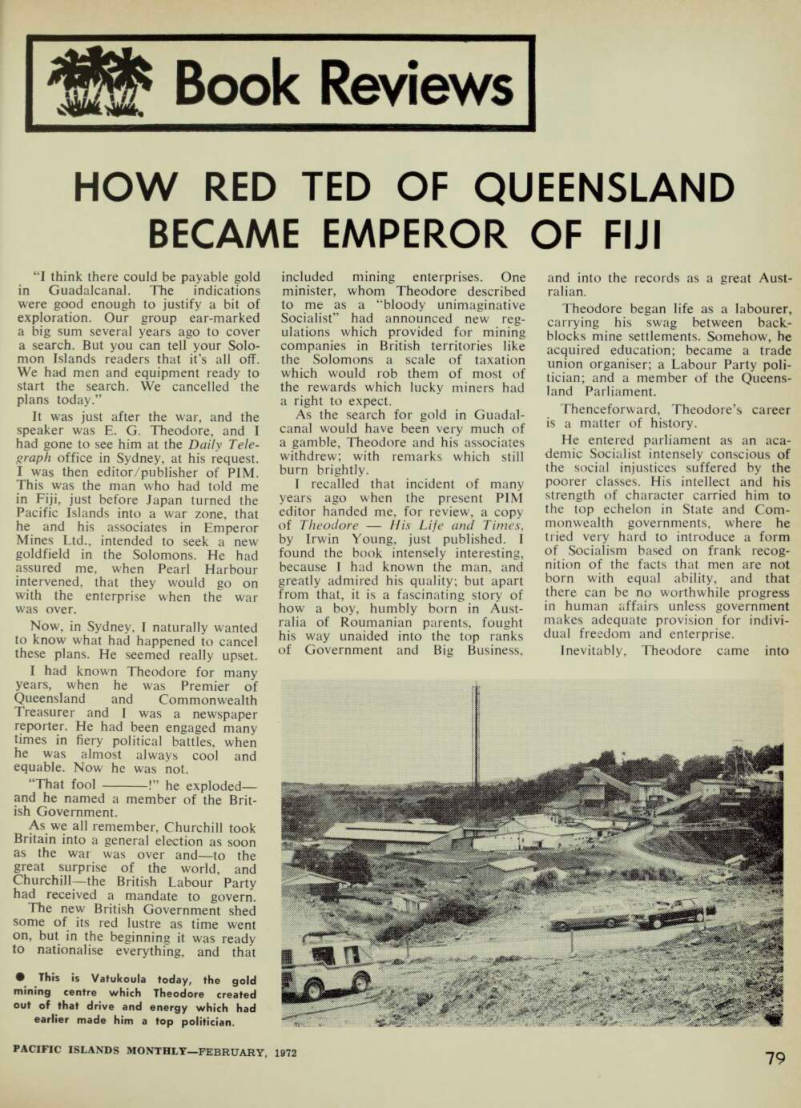 83
83 84
84 85
85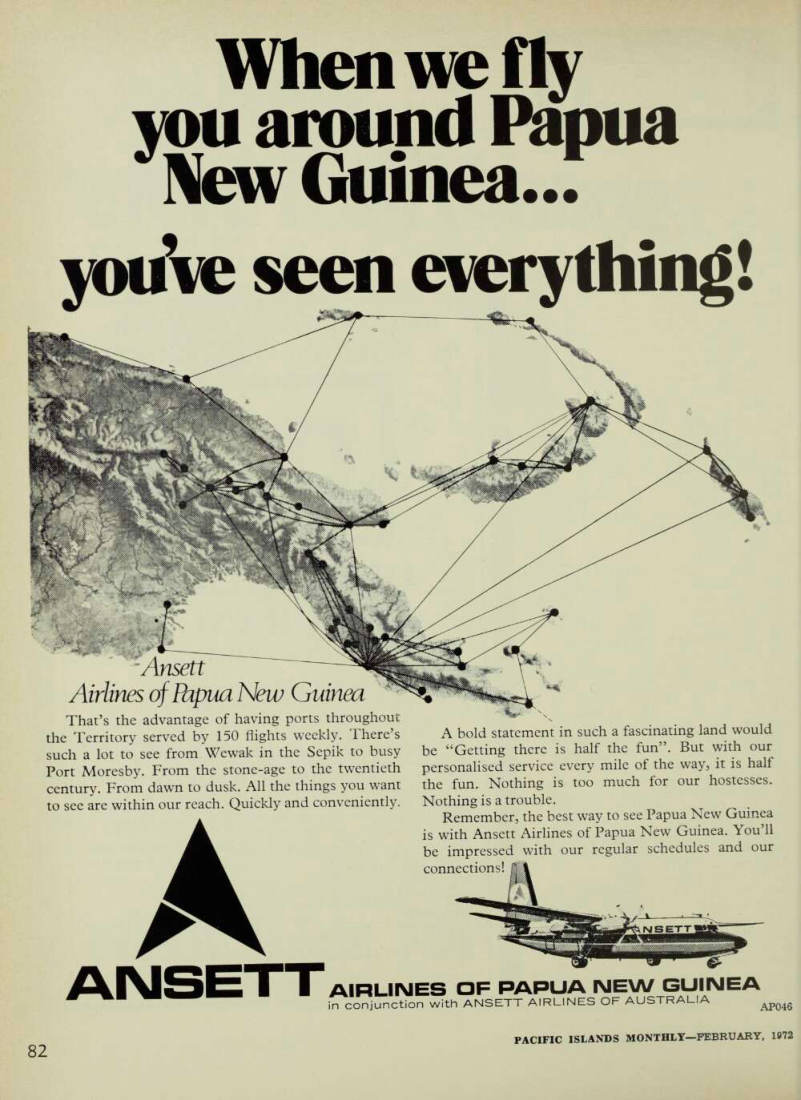 86
86 87
87 88
88 89
89 90
90 91
91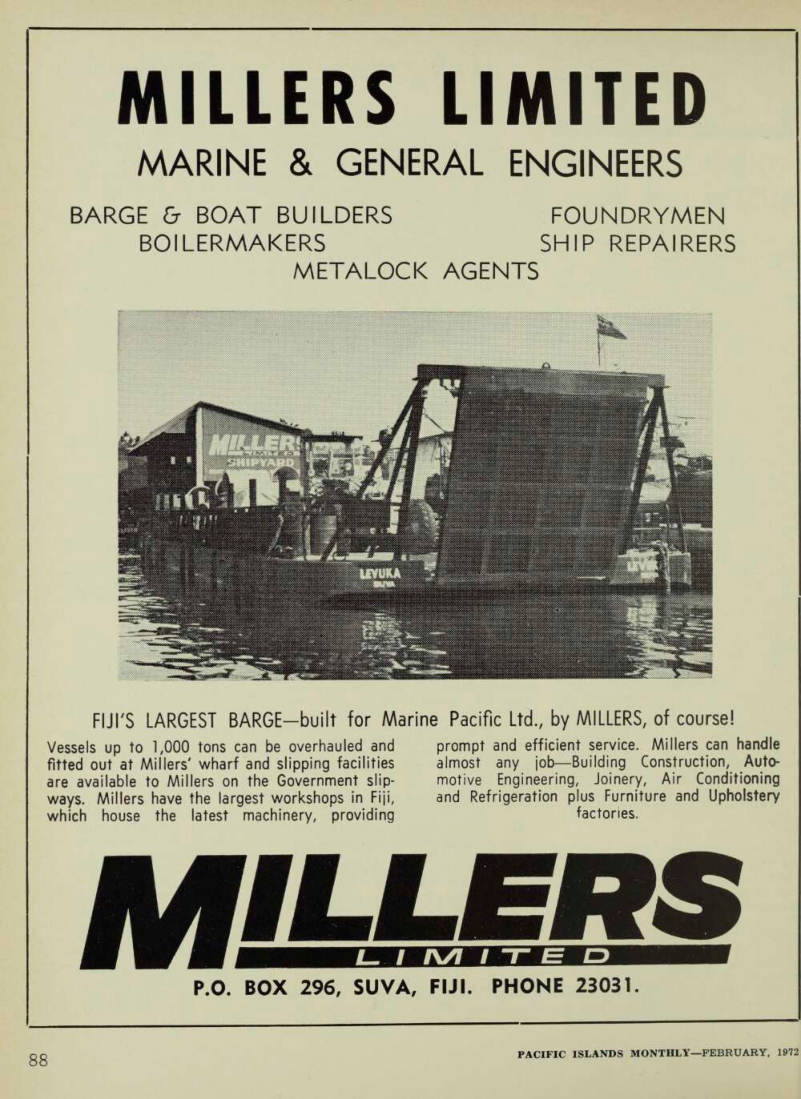 92
92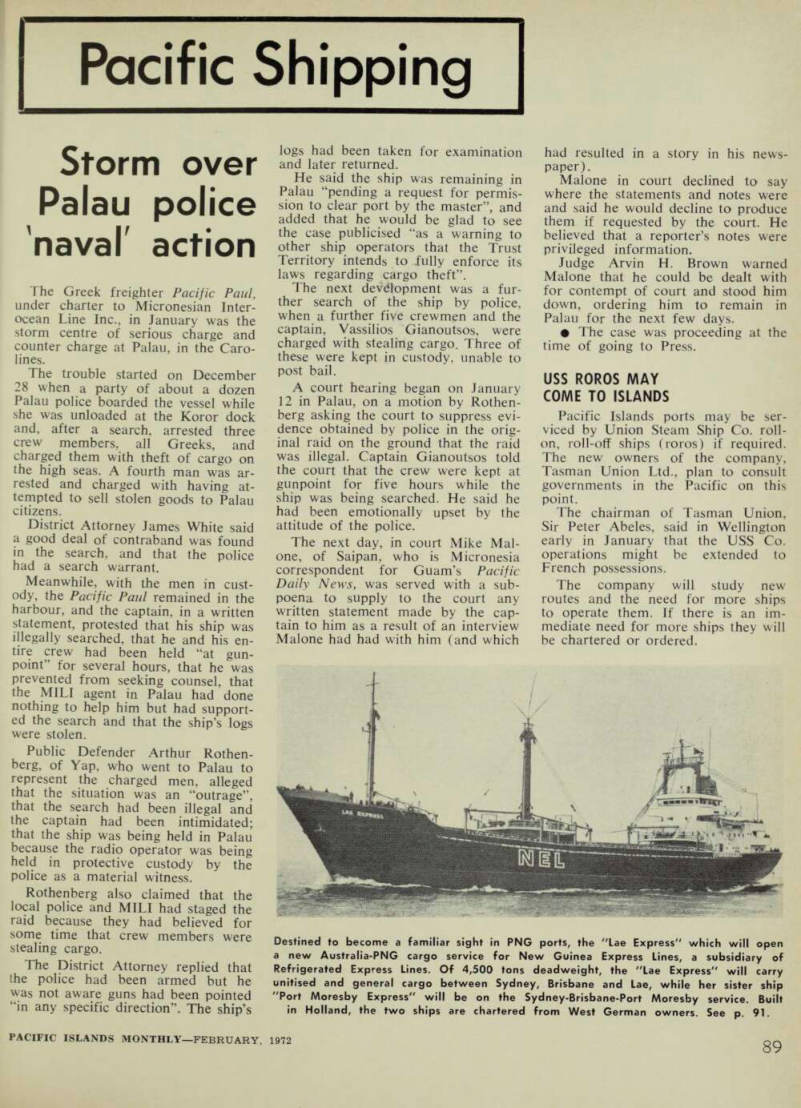 93
93 94
94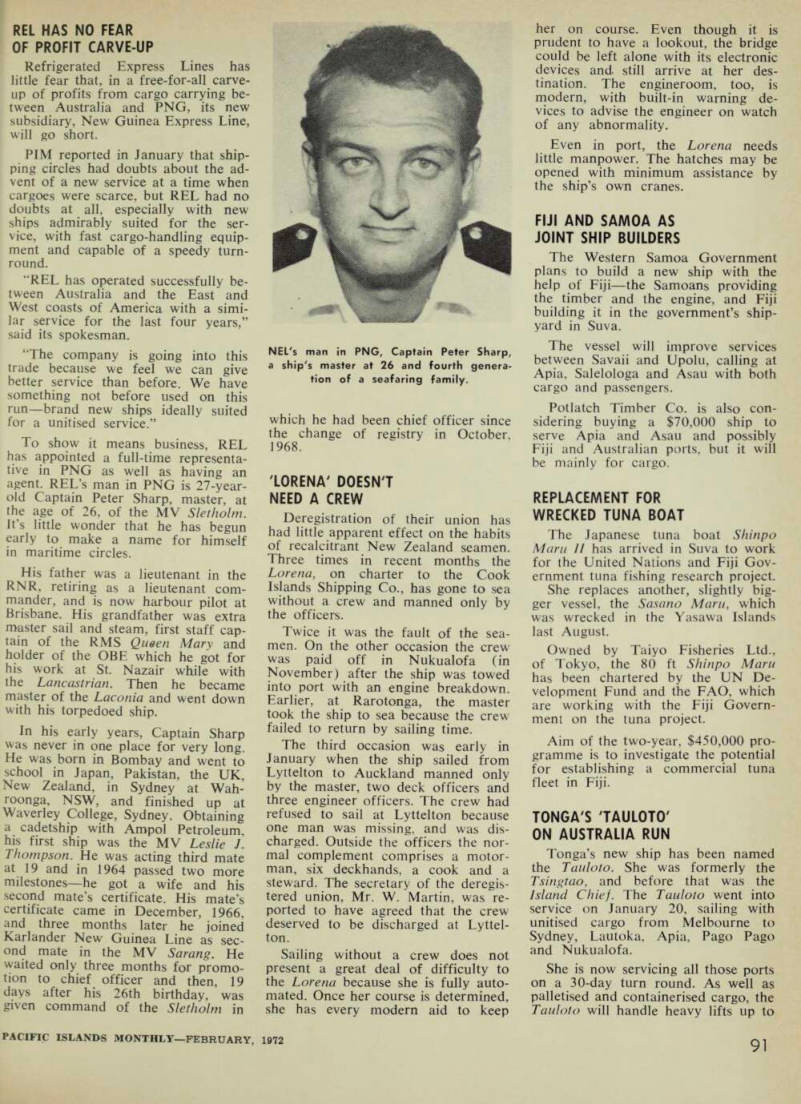 95
95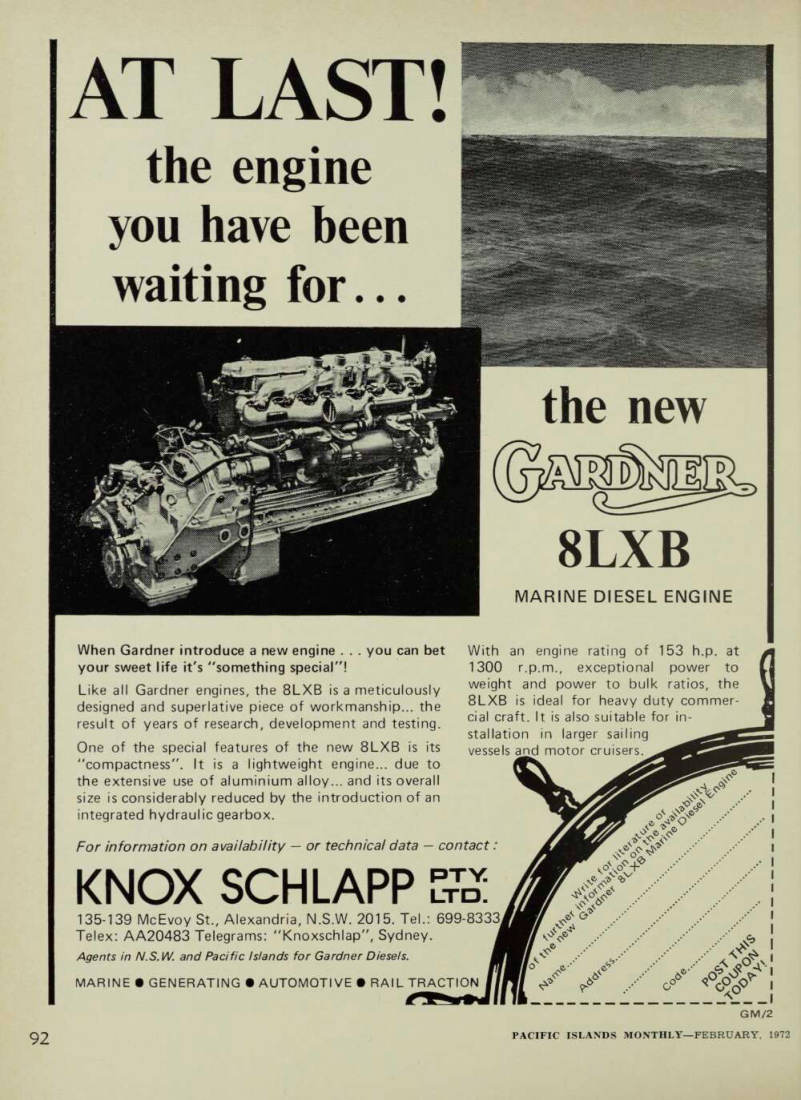 96
96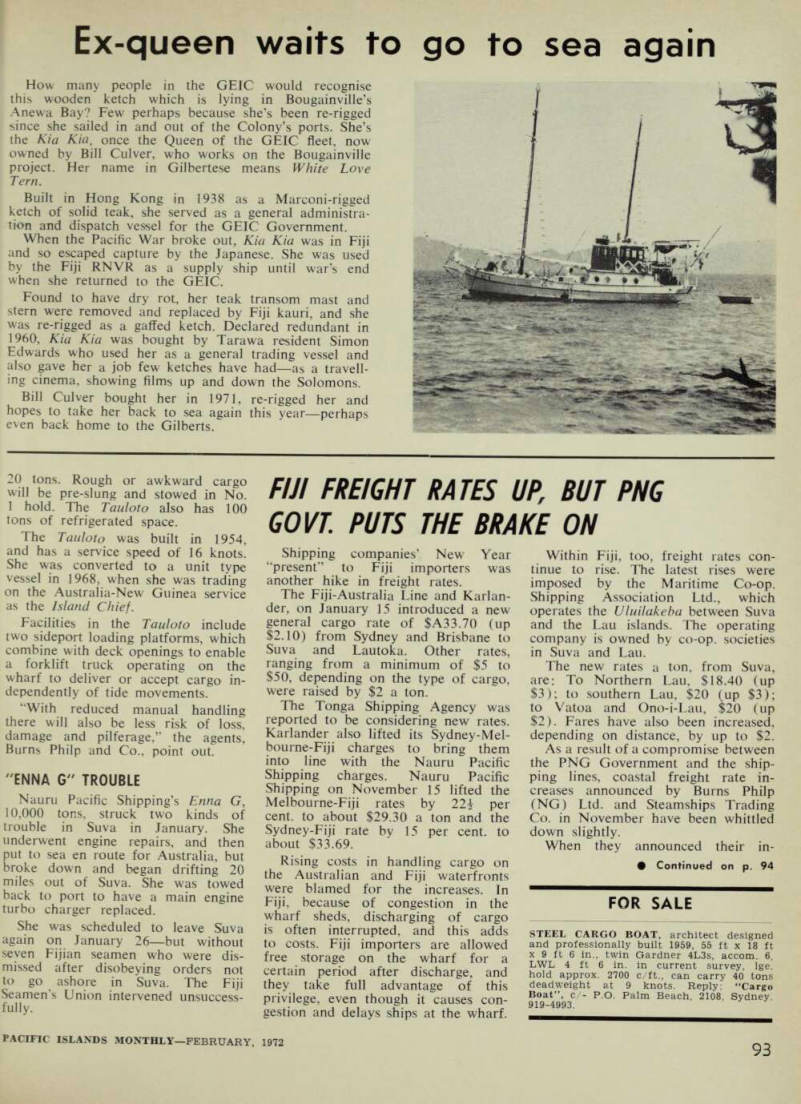 97
97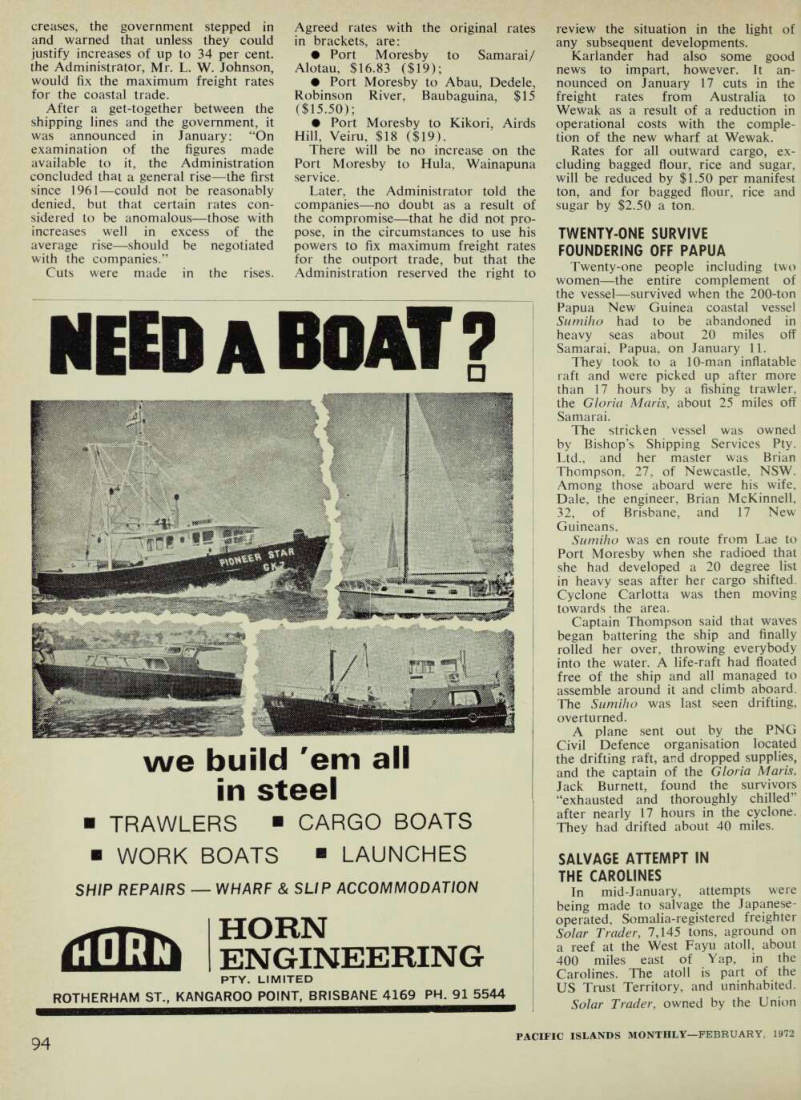 98
98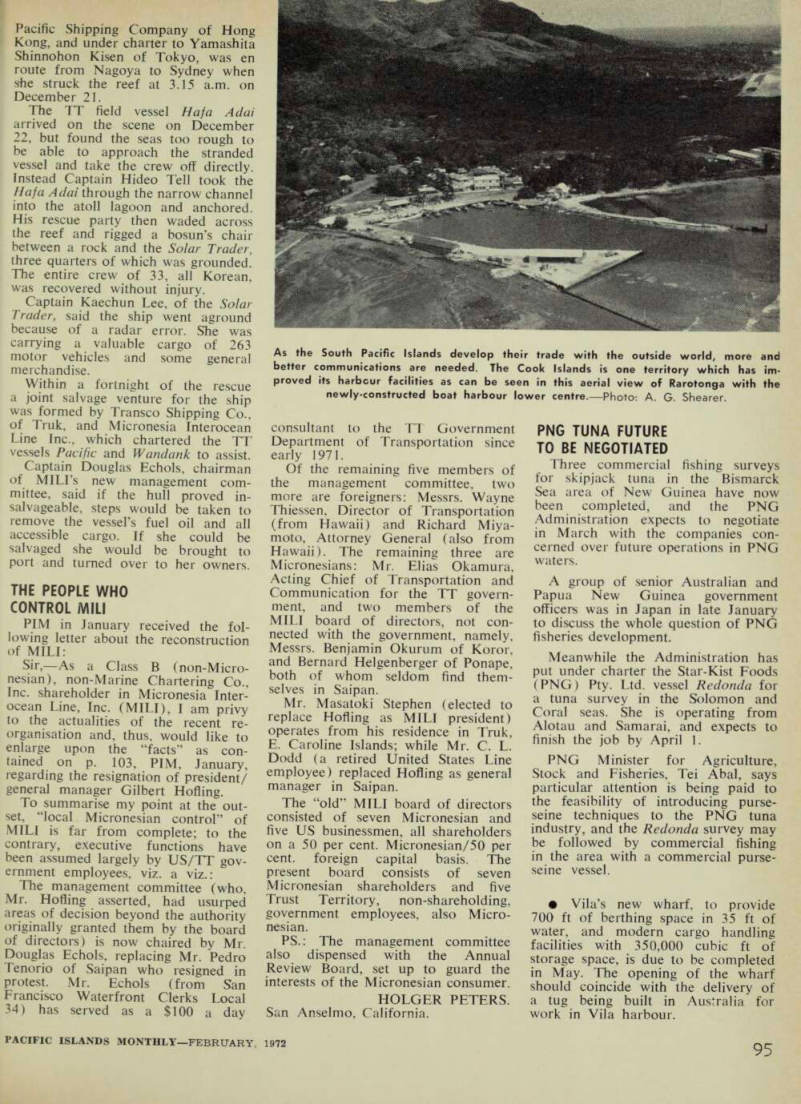 99
99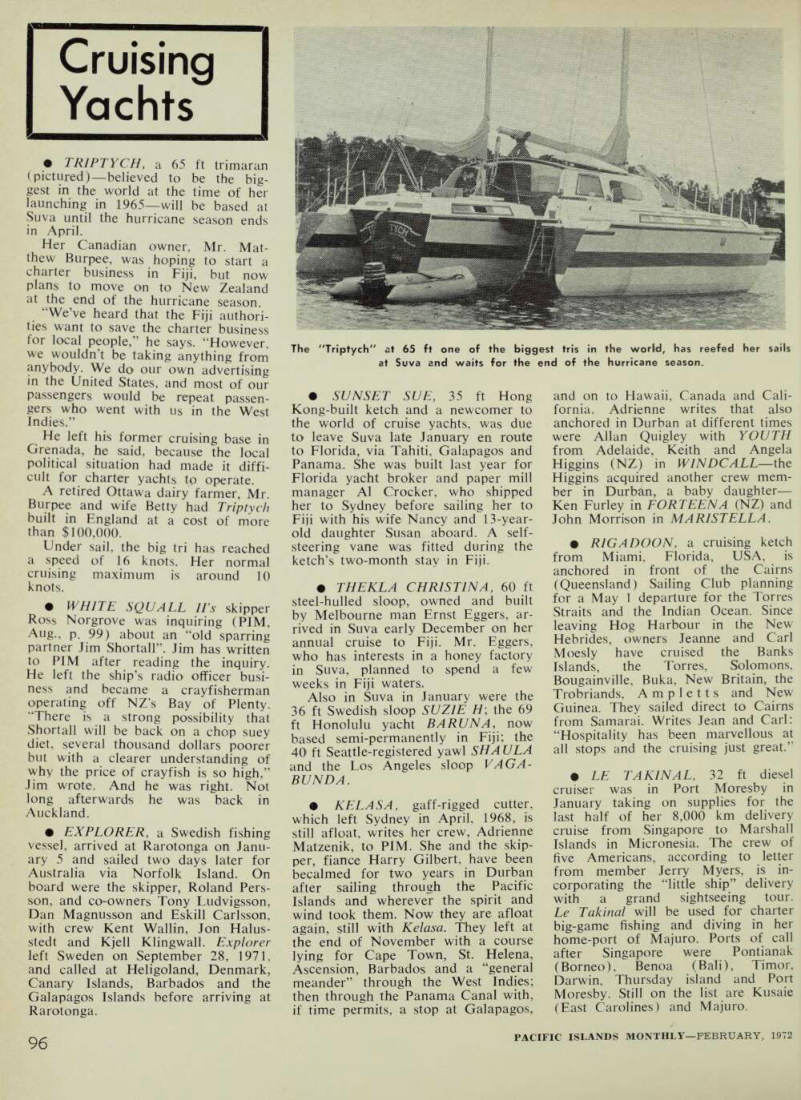 100
100 101
101 102
102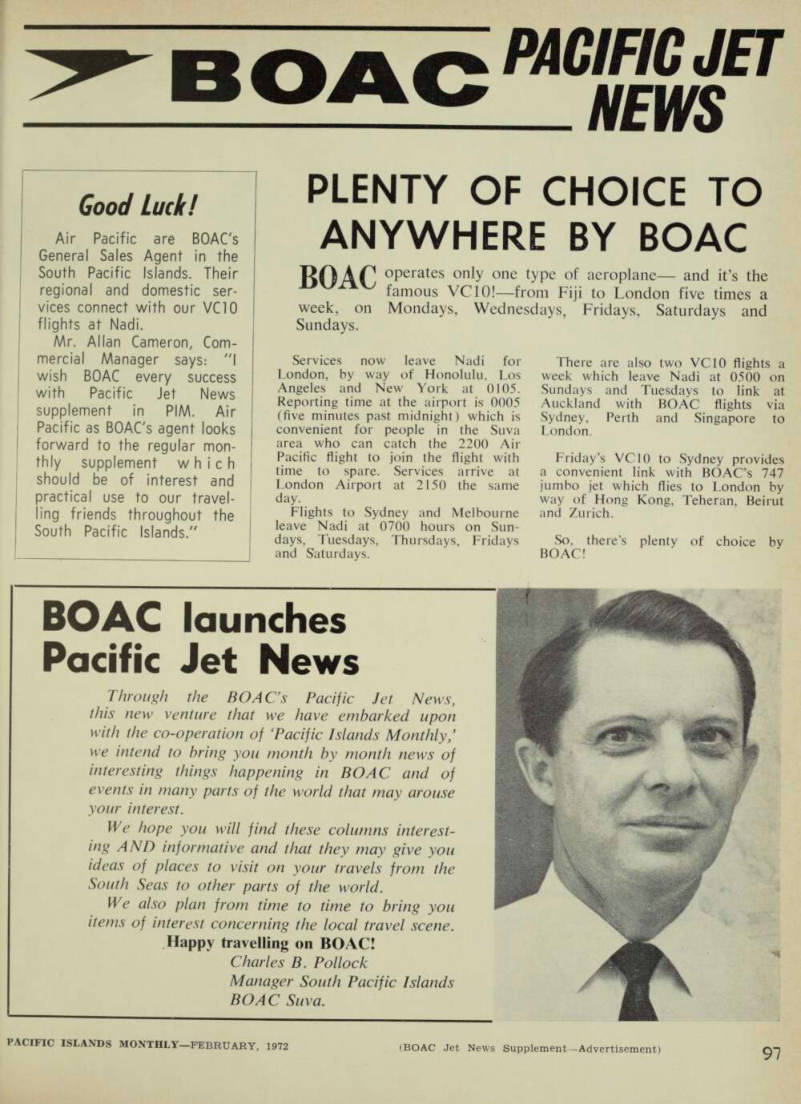 103
103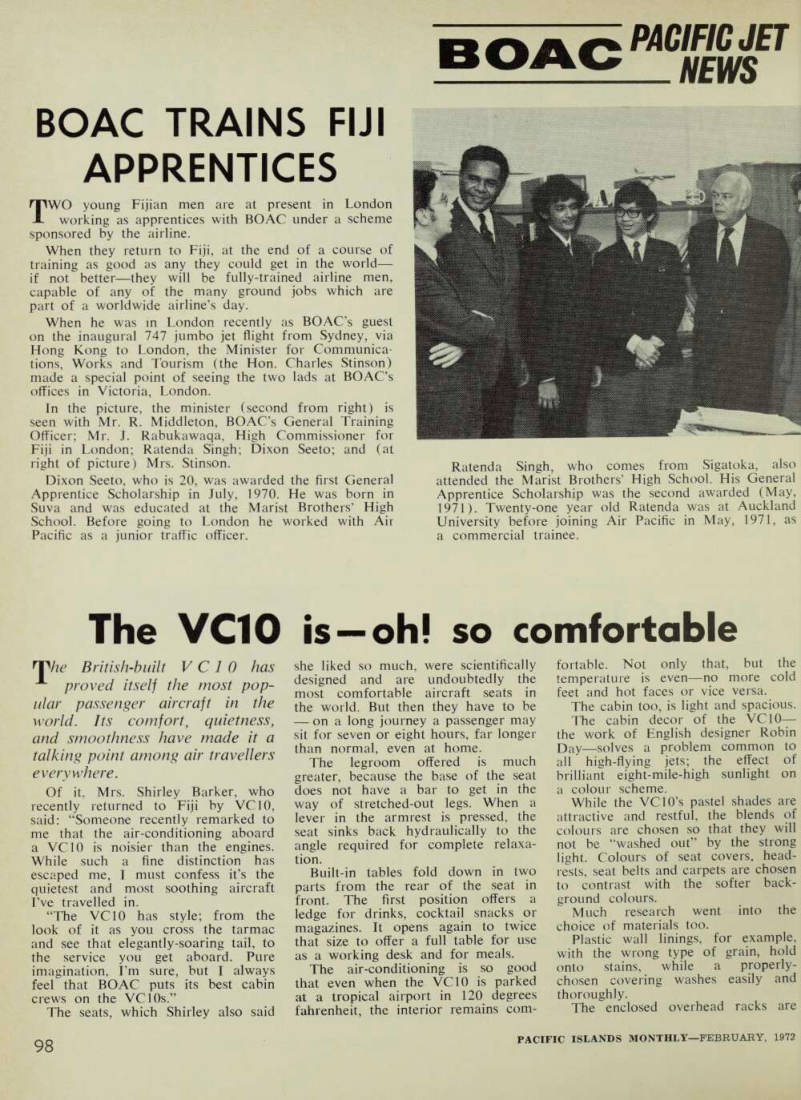 104
104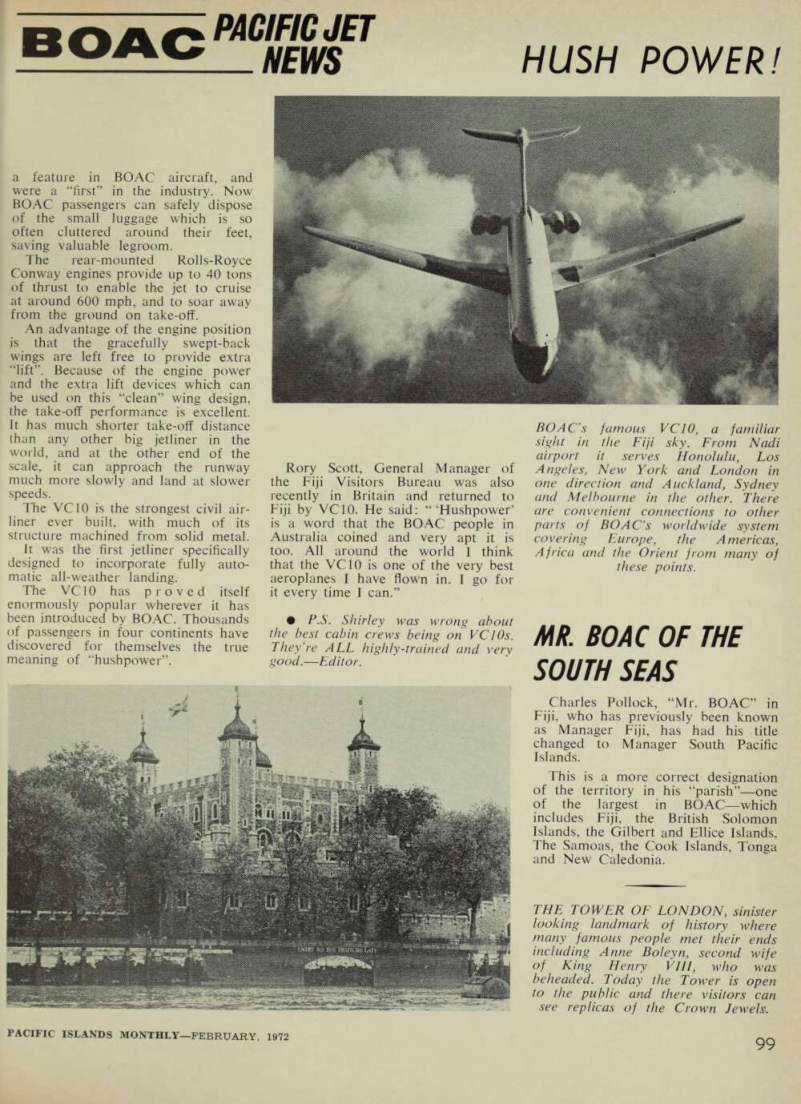 105
105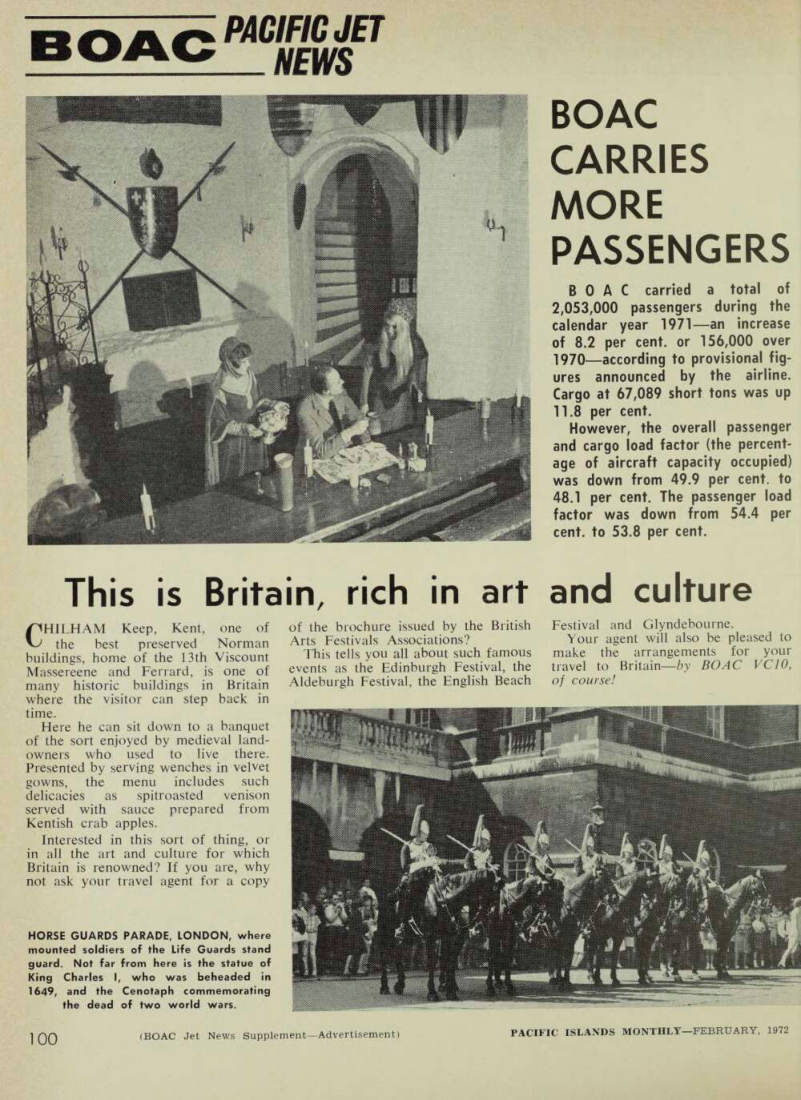 106
106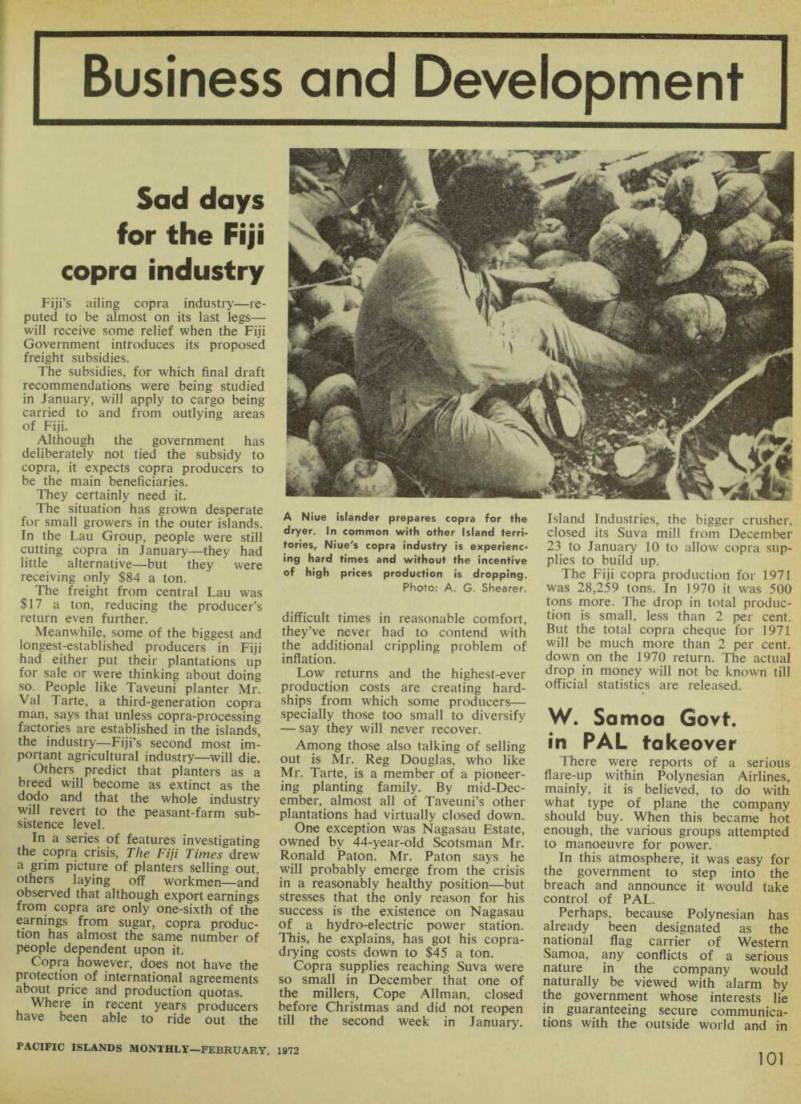 107
107 108
108 109
109 110
110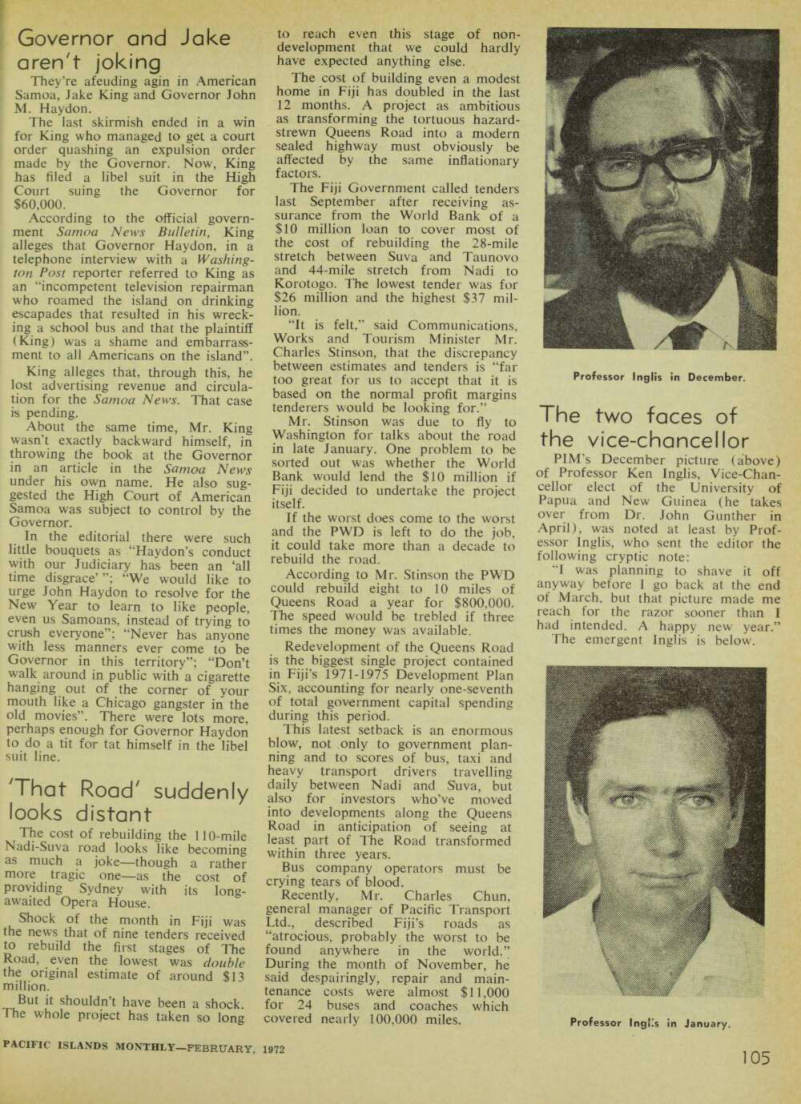 111
111 112
112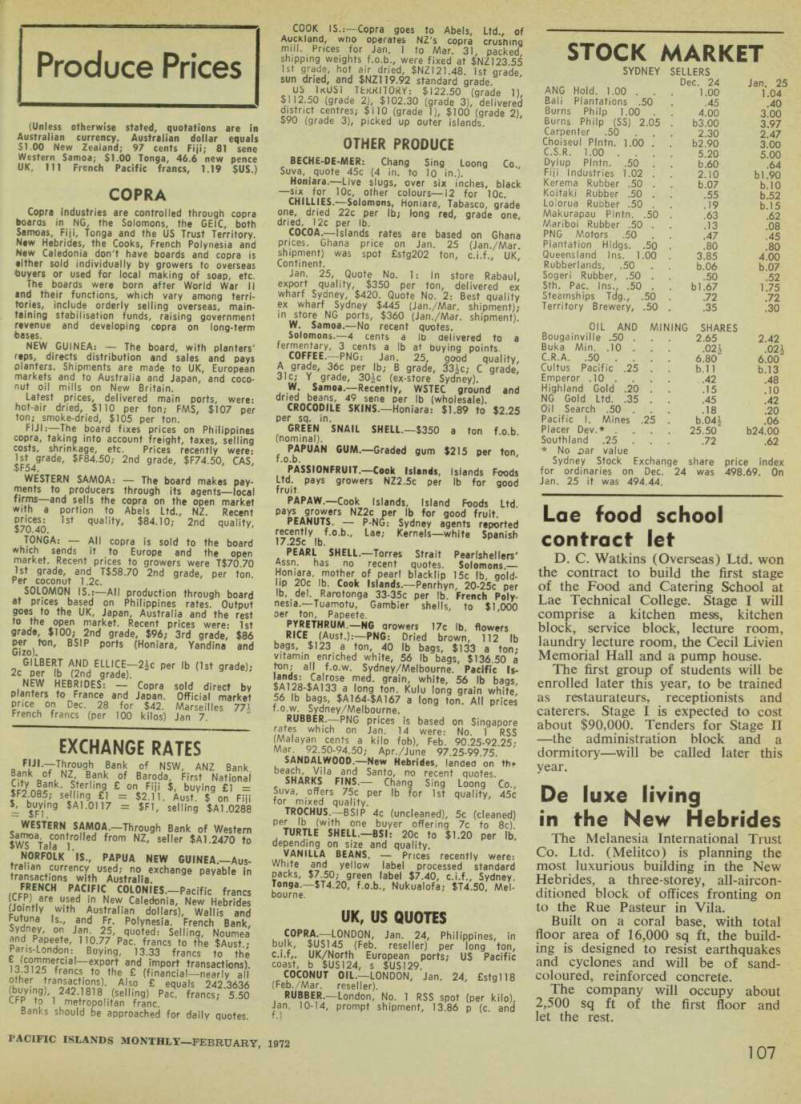 113
113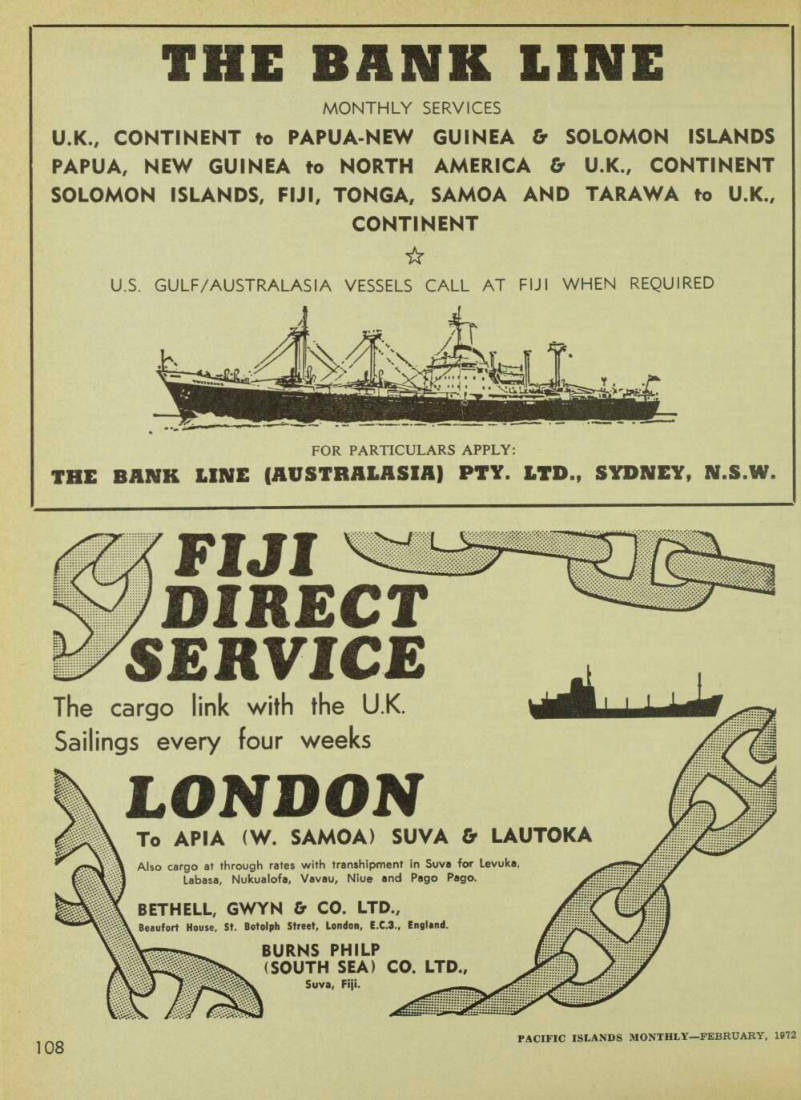 114
114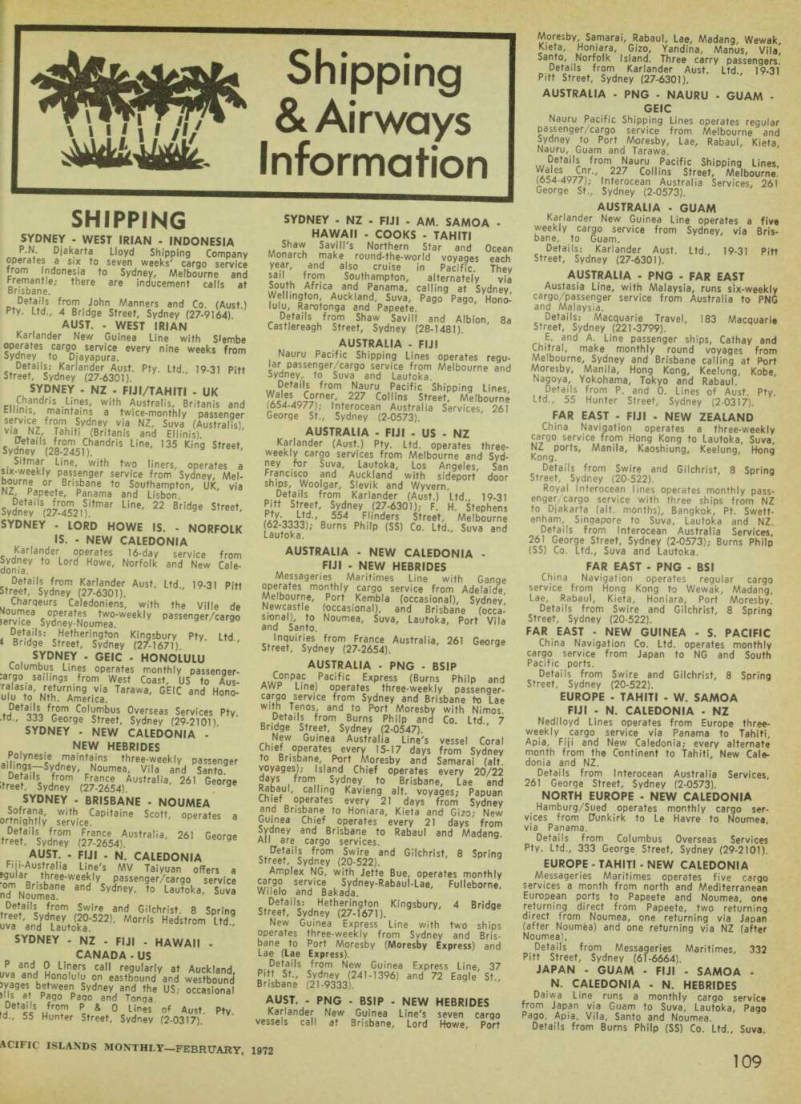 115
115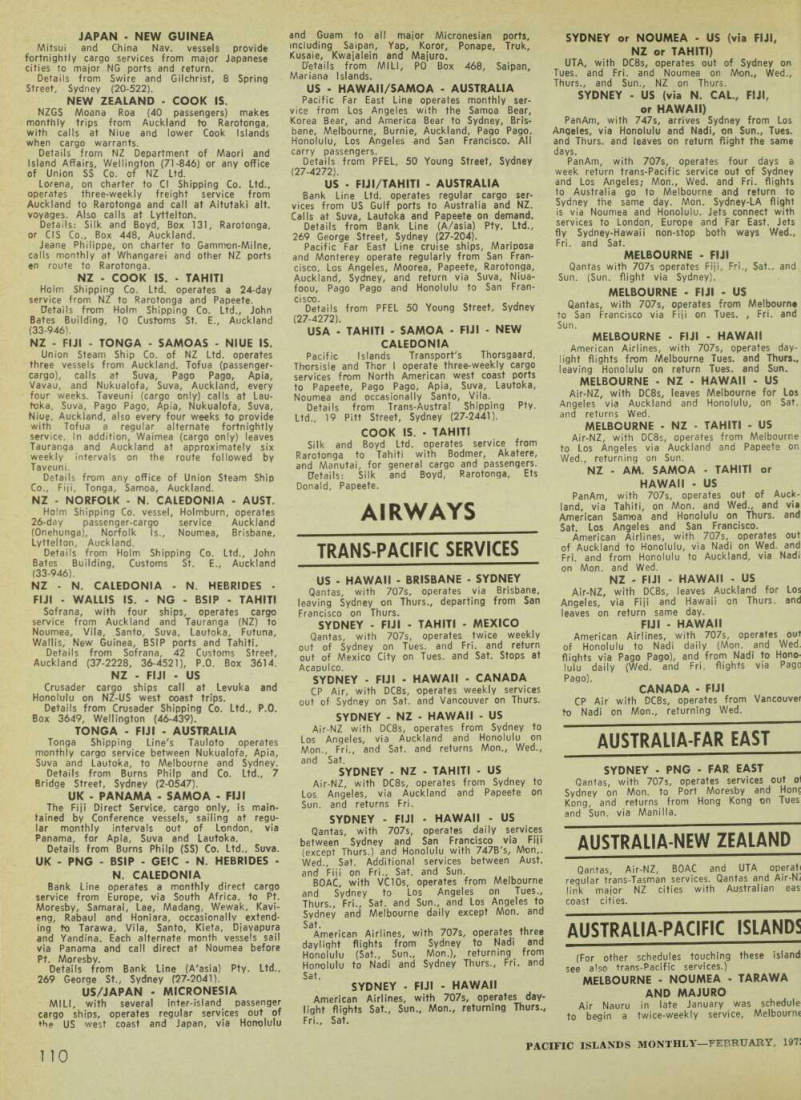 116
116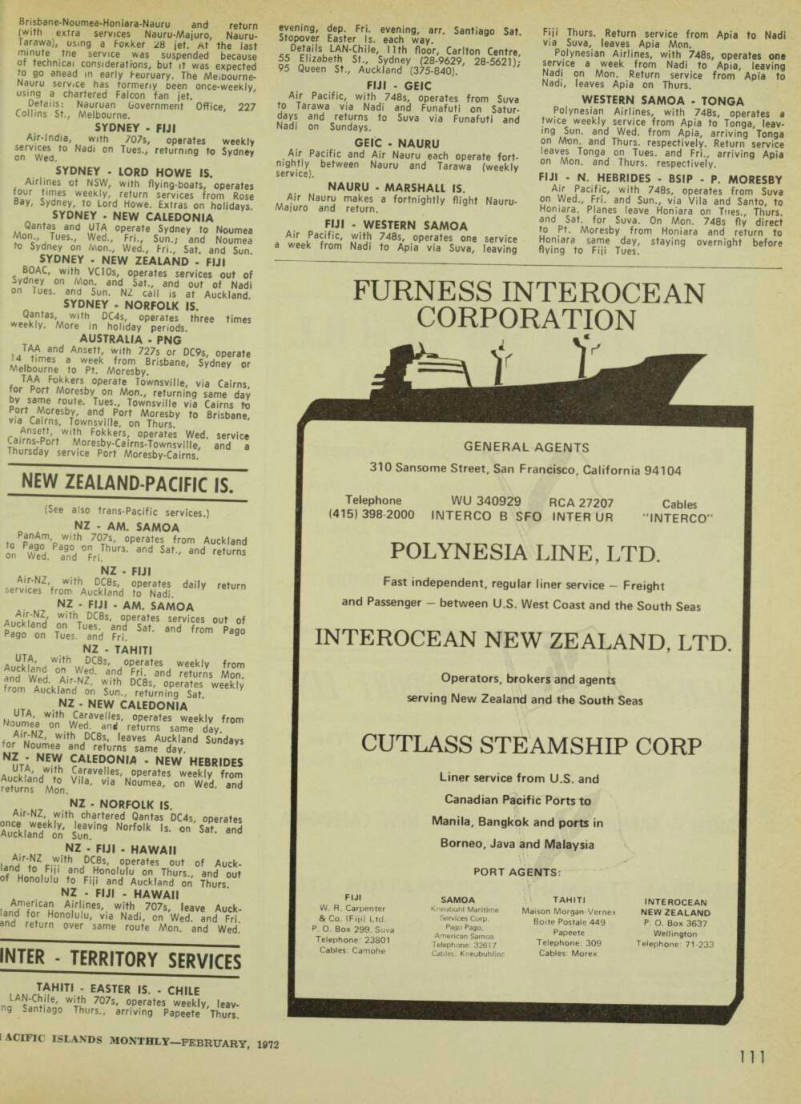 117
117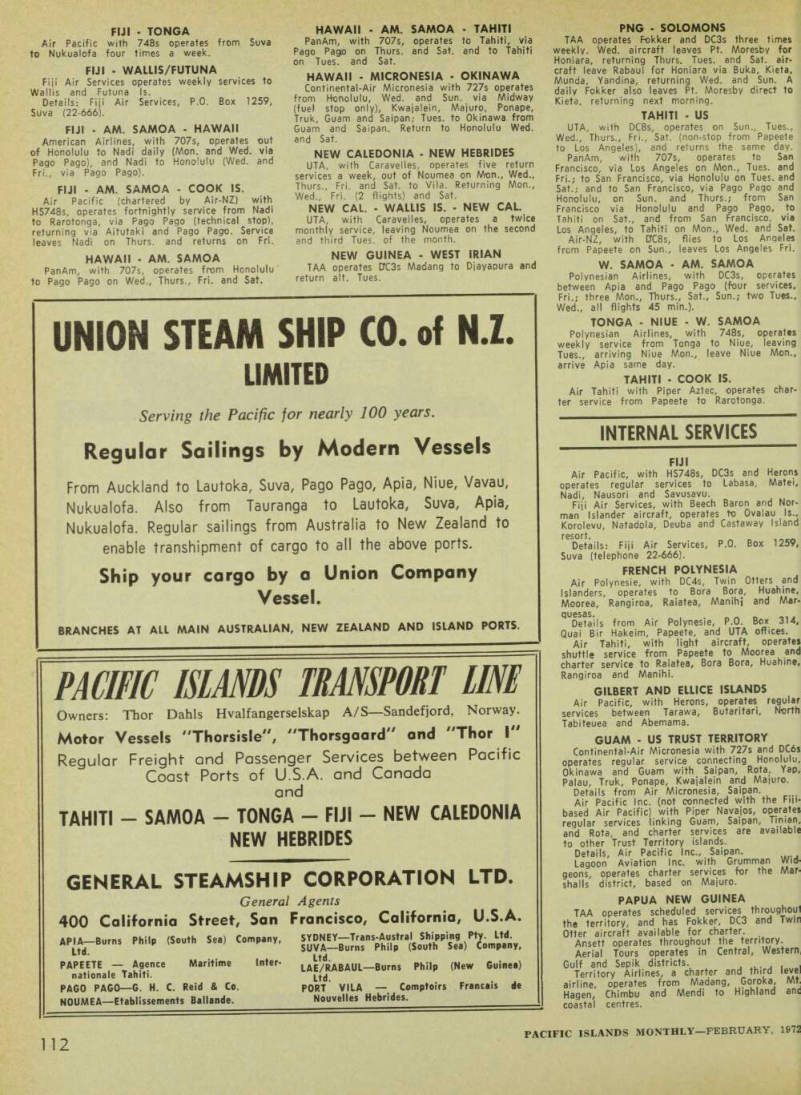 118
118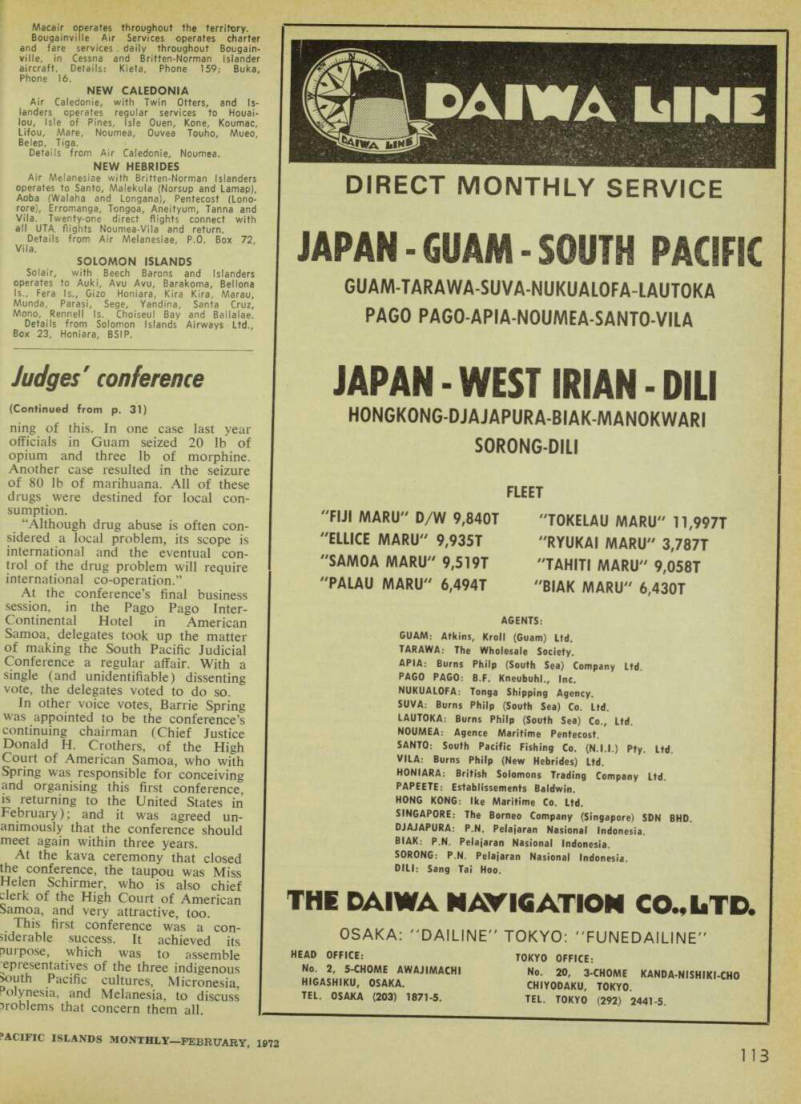 119
119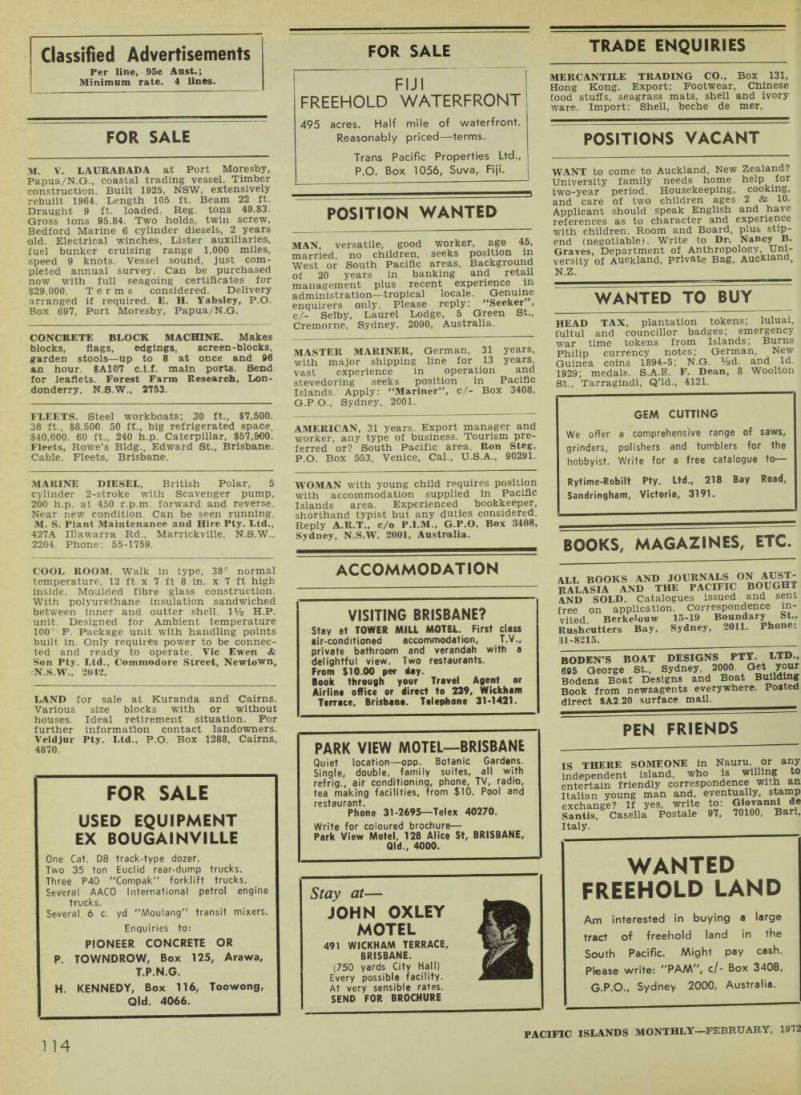 120
120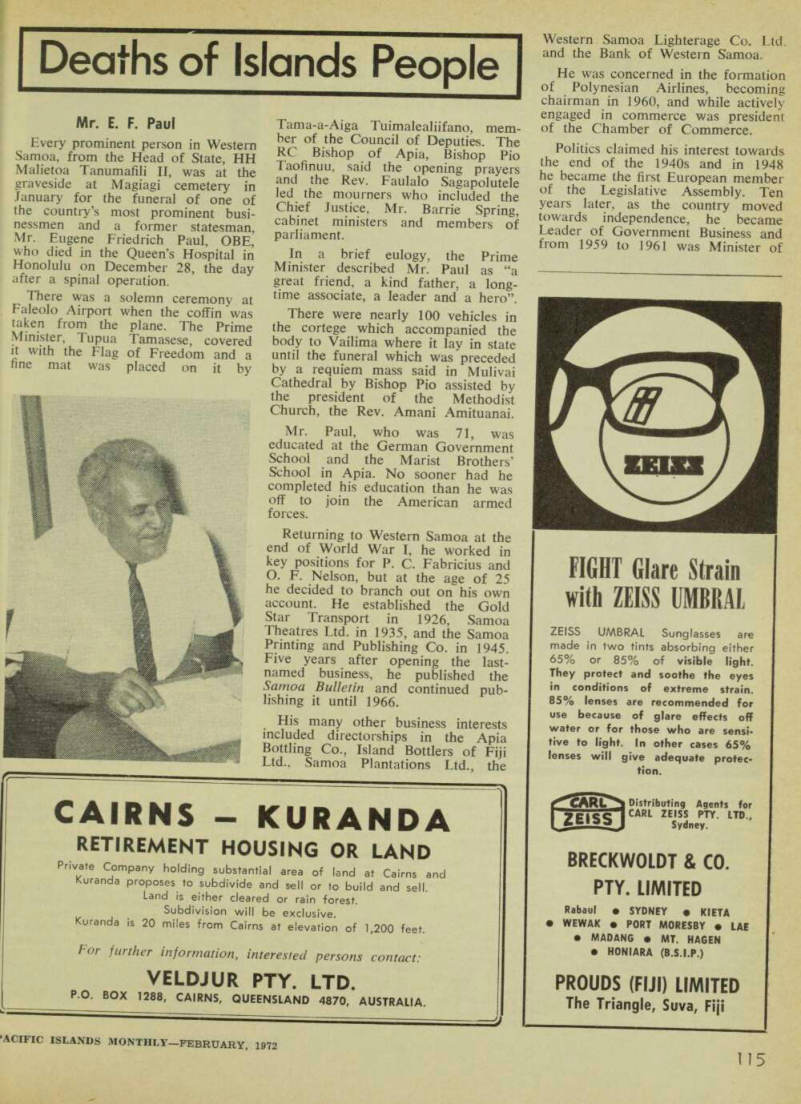 121
121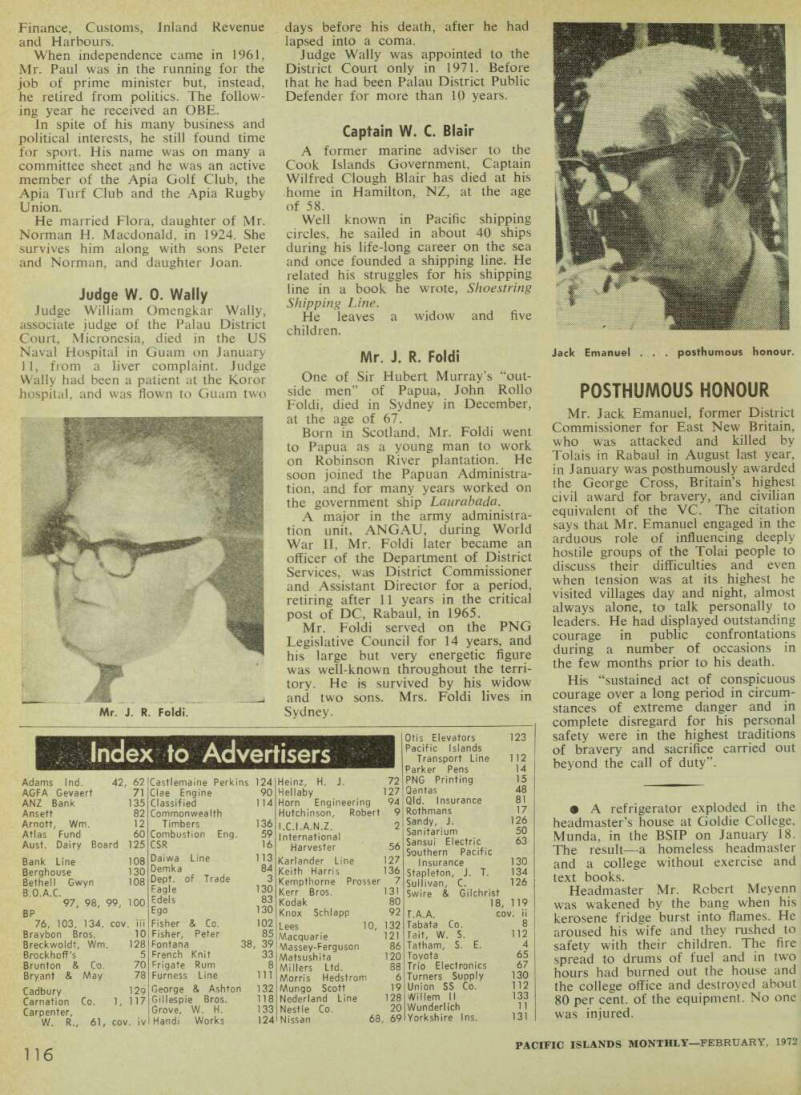 122
122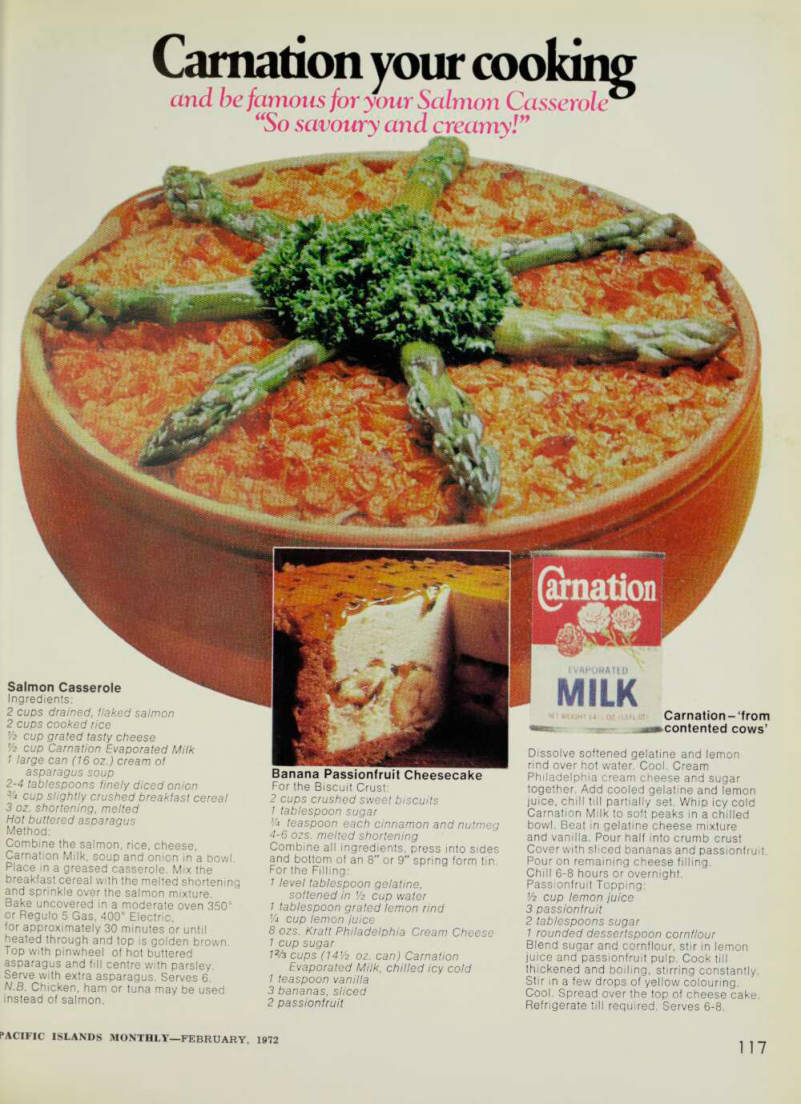 123
123 124
124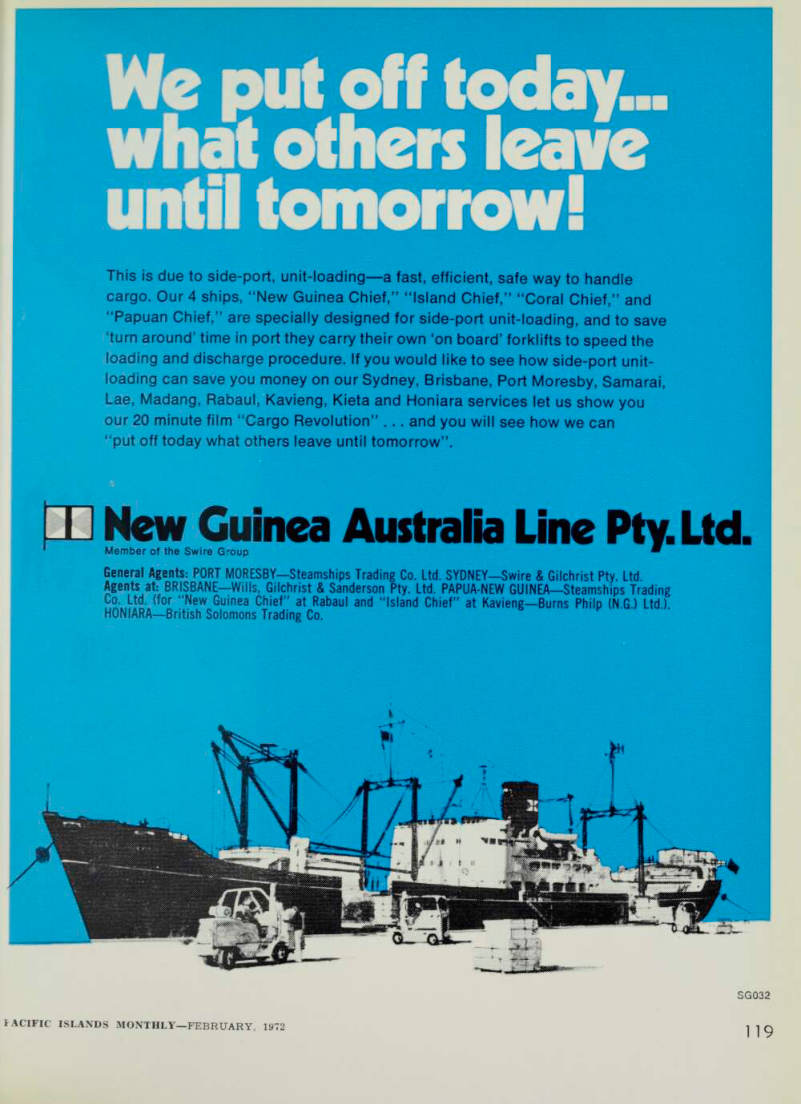 125
125 126
126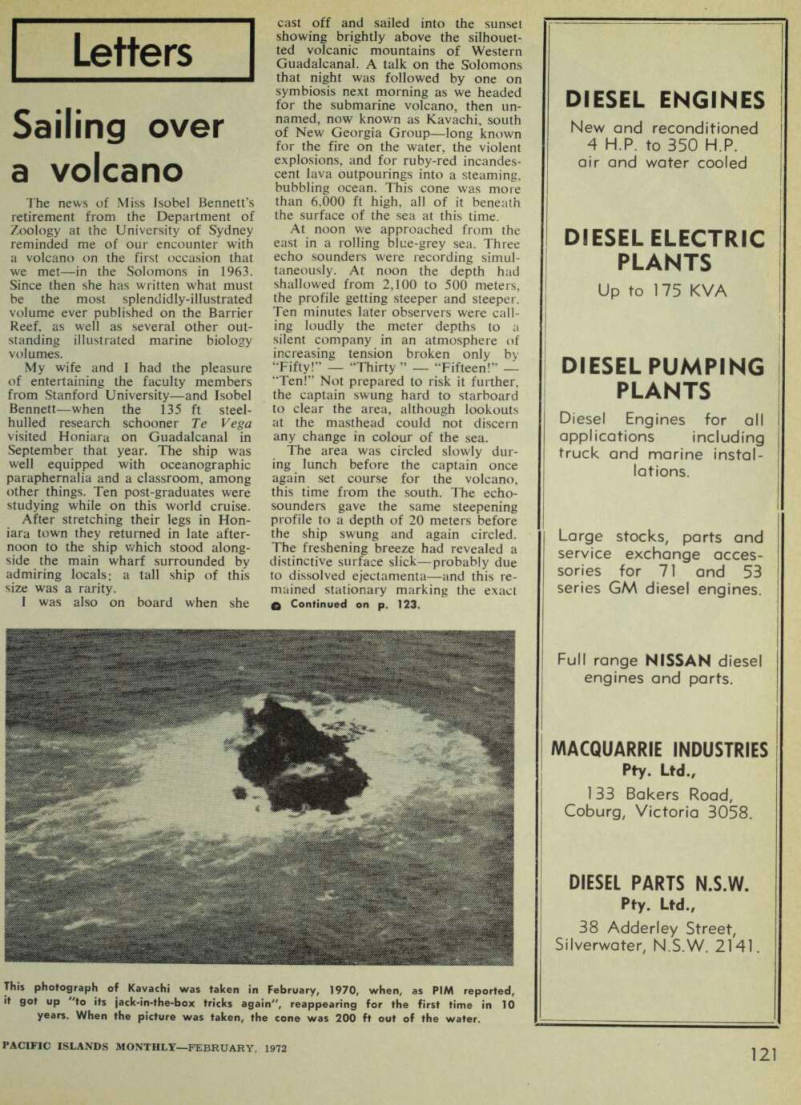 127
127 128
128 129
129 130
130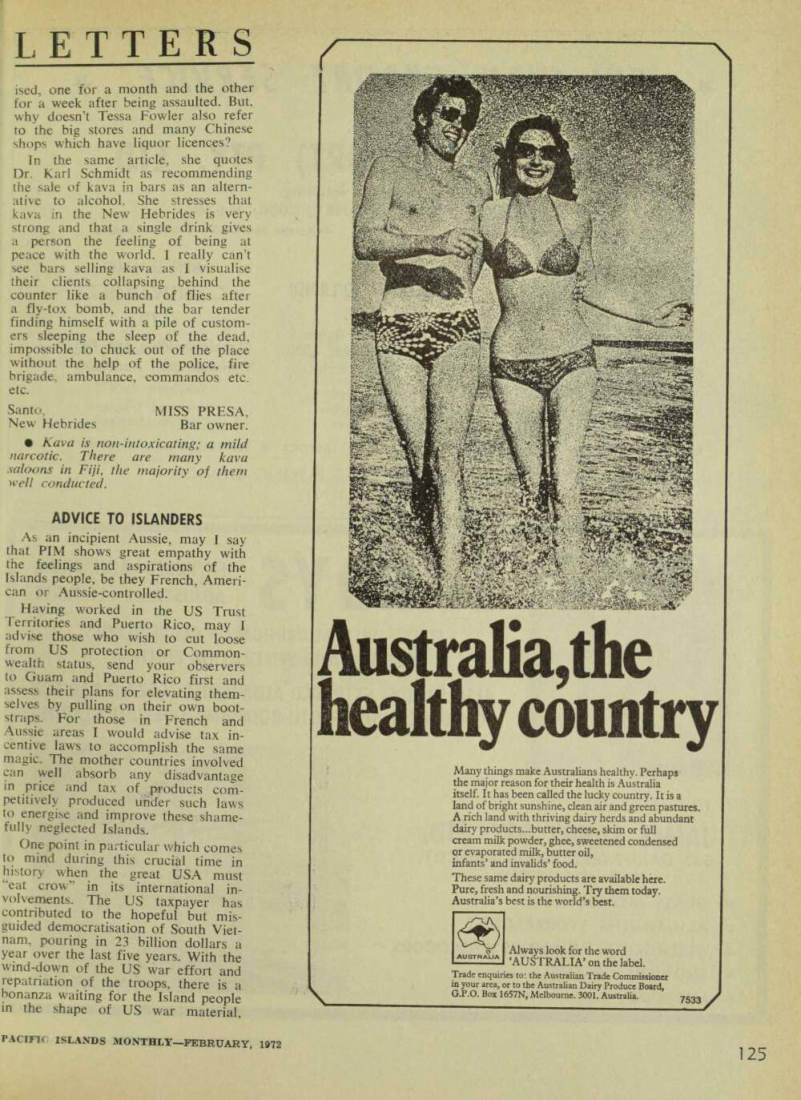 131
131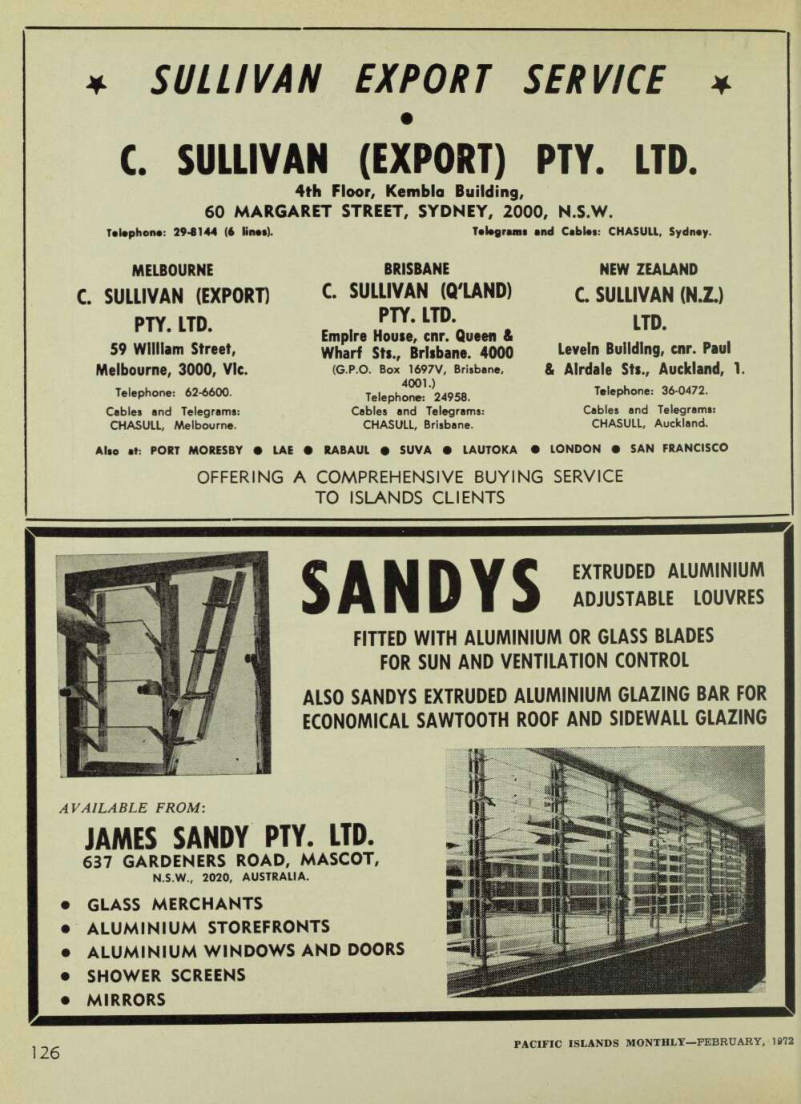 132
132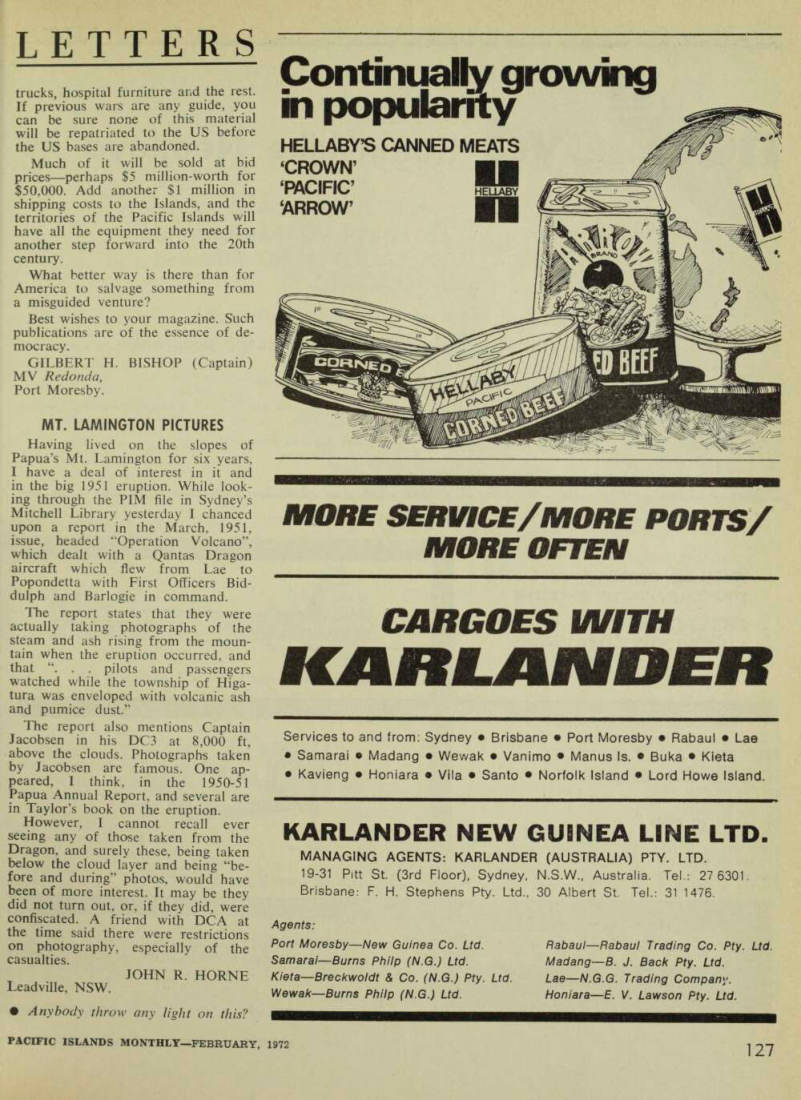 133
133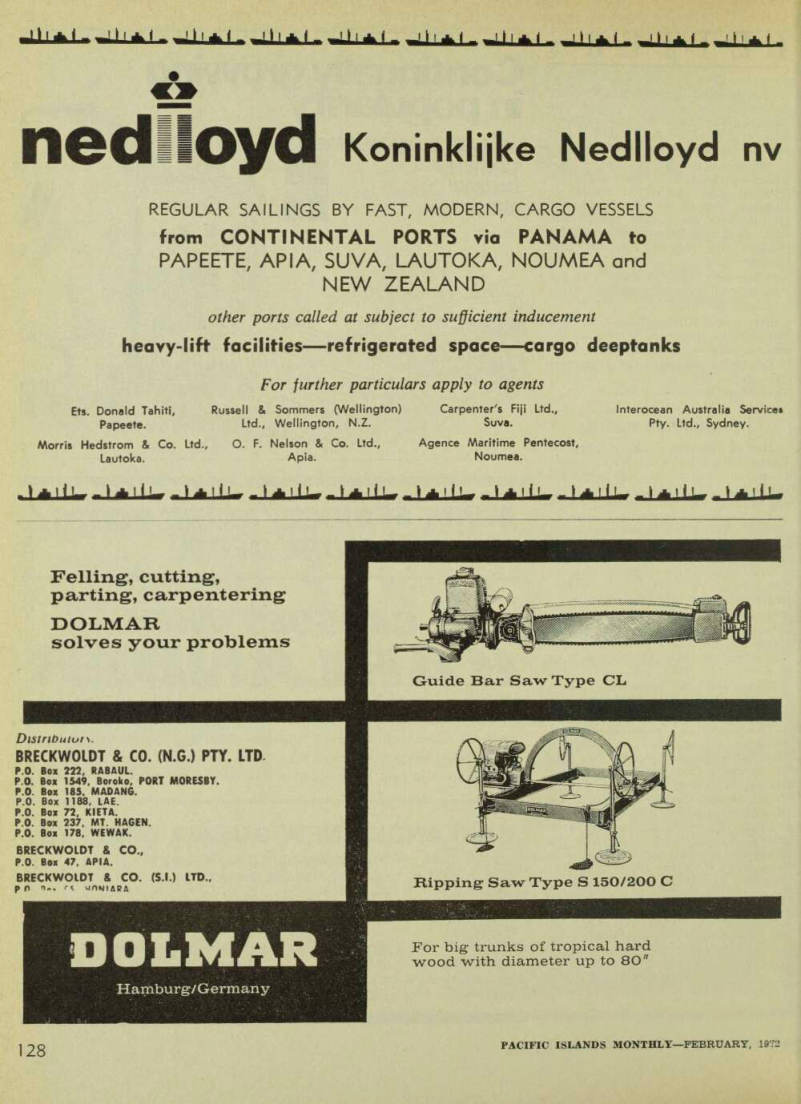 134
134 135
135 136
136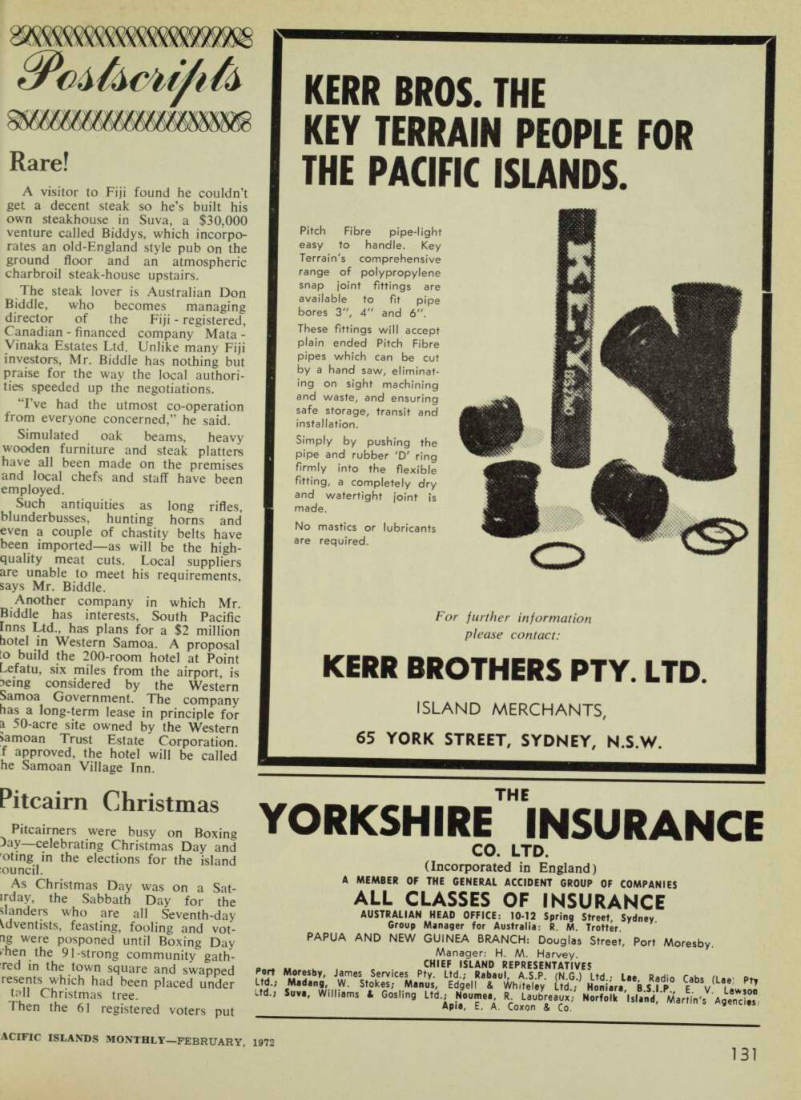 137
137 138
138 139
139 140
140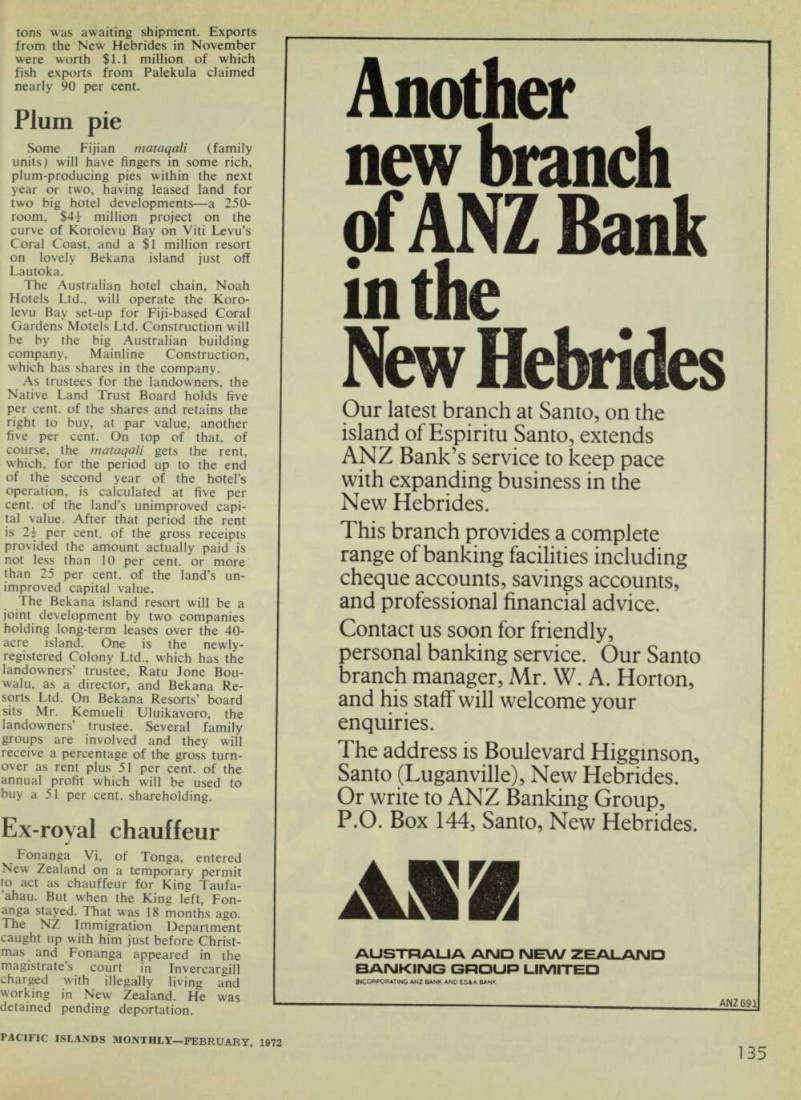 141
141 142
142 143
143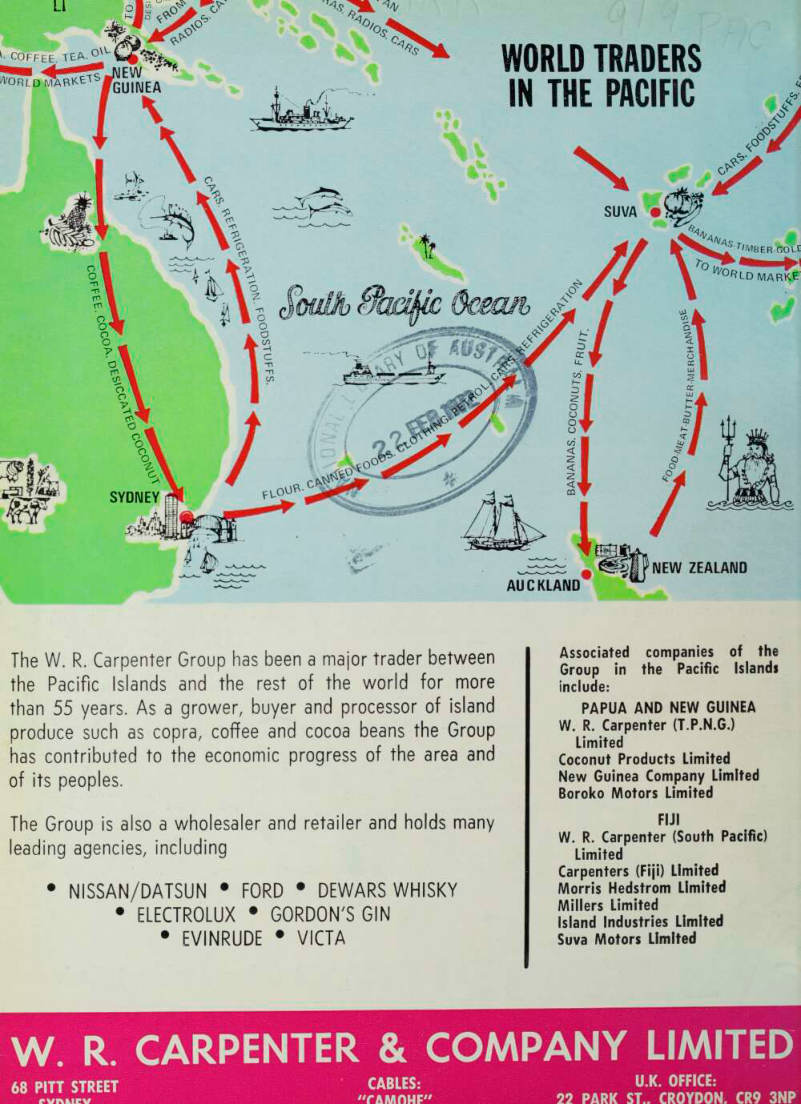 144
144