Monthly
Pacific Islands ;.Vj ‘ \ Monthly
S Magazine
Of The
JTH pacific
0
Ustralia, 40C. • New
Nd, 45C. • Fiji, 3/9. •
H Pac. Islands, 55 Frcs.
» U.S. Pac. Territories,
> P-N.G, And All Other
Territories, 35C. Local
Currency.
Urch, 1968
red at G.P.O., Sydney, for ission bv nost ac a npwcn^nor
Our cover
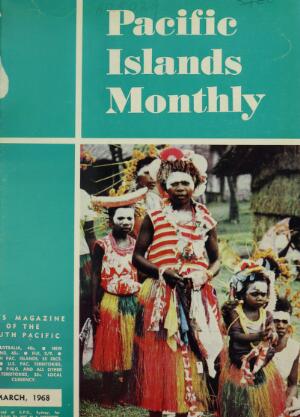
Whenever anyone asks us about somewhere “different” to go in the South Pacific, we almost invariably end up suggest ing the New Hebrides. The New Hebrides is “different”, among other things, because it is ad ministered jointly by Britain and France; it is still unspoiled in the tourist sense of the word; it has a couple of constantly active volcanoes; it has the famous and unique land divers of Pentecost Island: and its 75,000 Melanesian inhabitants (such as those pictured) have their own colourful way of doing things.
Advertisements & other items, pp. 2-11 (9 items)
One flight...
m :■> 10
1823 miles of extra care
Between Papua/New Guinea and Australia, everyone gets extra care when they fly TAA ‘Bird of Paradise’. Business or holiday travel, family travel or sentimental journey whatever your reason to fly, you’ll relax and enjoy TAA’s international standards of service with five hostesses to pamper your every need. Drinks a'e free first class. Meals are culinary masterpieces from canapes right through to cheese, coffee and mints. Everyone gets extra care on a ‘Bird of Paradise’ flight especially the youngsters, who’ll really enjoy their games and books. So take care to book TAA, and we’ll take extra care of you. Call your Travel Agent or TAA now.
Port Moresby 2101, Lae 2311, Madang 2478, Rabaul 2567, Goroka 8, Mt. Hagen 4, Wewak 103.
Fly TAA the Friendly Way
TAA 3689 67
IIIIIIIIIIIIIIIIIIIIIIIIIIIIIIIIIIIIIIIIIIIIIIIIIIIIIIIIIIIIIIIIIIIIIIIIIIIIIIIIIIIIIIM
BURNS PHILP (SOUTH SEA) CO. LTD.
GENERAL MERCHANTS AND SHIPOWNERS
SHIPPING, CUSTOMS AND FORWARDING AGENTS
F* • • iji:
SUVA
LEVUKA.
LAUTOKA.
LABASA.
SAVU SAVU.
BA.
SIGATOKA.
TAVUA.
TAVEUNI.
BRANCHES
Samoa:
APIA.
PAGO PAGO.
Tonga:
NUKUALOFA.
HAAPAI.
VAVUA.
NORFOLK ISLAND.
NIUE ISLAND.
AGENTS FOR:
QUEENSLAND INSURANCE CO. LTD.
BURNS PHILP TRUSTEE CO. LTD.
>HELL COMPANY (P.l.) LTD.
OVERSEAS AGENTS
BURNS, PHILP Cr CO. LTD., Sydney.
BURNS, PHILP & CO. LTD., London.
BURNS PHILP CO. OF SAN FRANCISCO.
SHIPPING AGENCIES
• The New Zealand Shipping Co. Ltd. • Shaw Savill & Albion Co. Ltd. • Port Line Ltd. • Bank Line Ltd. • General Steamship Corporation Ltd. • Blue Star Line • Cunard Line • Compagnie des Messageries Maritimes • British India Steam Navigation Co. Ltd. • Royal Interocean Lines • Nederland Line Royal Dutch Mail/Royal Rotterdam Lloyd.
EXCLUSIVE DISTRIBUTORSHIPS INCLUDE
AKAI TAPERECORDERS •
DUNLOP PRODUCTS •
EPIGLASS PRODUCTS •
FERGUSON TRACTORS •
HELENA RUBENSTEIN •
HITACHI ELECTRONICS •
HOLDEN VEHICLES •
JOHNSON'S WAXES •
ROLEX WATCHES
REVLON COSMETICS
PENTAX CAMERAS
SUNBEAM APPLIANCES
INTERNATIONAL AIR TRANSPORT ASSOCIATION REPRESENTATIVES for
QANTAS EMPIRE AIRWAYS LTD. AIR NEW ZEALAND UNION DE TRANSPORTS AERIENS ALITALIA PAN AMERICAN AIRWAYS
ASSOCIATED COMPANIES
BURNS PHILP (NEW HEBRIDES) LTD.
AUTOMOTIVE SUPPLIES CO. LTD.
CORRIE & CO. LTD. O WROUGHT IRON AND STEEL
CONSTRUCTION CO. LTD. • BISH LTD.
SPECIALISED SERVICES
EXPERT ADVICE ON WORLD AND LOCAL TOURS — TRAVEL — SHIPPING — FORWARDING — CUSTOMS
FORMALITIES — INSURANCE.
REGISTERED OFFICE: SUVA, FIJI
Code Address: "BURNSOUTH" ||,,,||,|||,||,|||, l |||,|||,||| |||l|||(|||fl
ERINMORE
MIXTURE
FLAKE OR
MIXTURE TOBACCO
IN VACUUM TINS
such good rich flavour
-distinctive aroma
there's more of both in ERINMORE
Erinmore makes friends in any company. Smokers welcome il good rich flavour. Others, womenfolk especially, enjoy its distinctive aroma. This comes from the century-old blending process, secret to the makers of Erinmore.
No other tobacco can give you so cool and sweet a smoke.
ERINMORE
in Northern Ireland by Murray, Sons & Company Limited, Belfast. Manufacturers of fine tobacco sin
winning tape
That's the Rabone Chesterman Handyline. The neatest measuring tape you've ever seen. In a light plastic case that's extra strong, this white steel tape has clearest ever markings, and accurate hook-end for those single handed jobs. Super quick wind-in is a feature on every size, 33, 50, 66 and 100 feet. They really measure up to everything !
Available from Ironmongers and Tool Dealers. ▲Aa
Rabone
Chesterman
3 * o A * Rabone Chesterman Ltd.
Birmingham 18 • England
In this can Is Dairy Frost mix.
It needs no storage refrigeration!
No mixing. [Fresh milk]
Pour the mix
into this
Dairy Frost
machine...
ML* * * ♦ «»♦♦♦* ♦. * ♦ *** »w.>y4v;< Famous M 100 Counter model.
then lift the lever
and dispense
extra thick Frosty Shakes
or soft serve cones
Simple. Moneymaking!
Thick shakes earn big money.
With this Dairy Frost combination, they’ve never been easier to make.
Everything’s done. The mix is super-pasteurised.
Rich and creamy.
No storage refrigeration needed! No mixing.
No preparation. Nothing to be added.
It’s packed in I gallon cans.
It stays pure and fresh until it’s needed.
The Dairy Frost dispenser is fully automatic.
It’s easy to clean, simple to operate and engineered for a long, trouble-free life. You can rely on that.
It’s made by the largest manufacturer and distributor of thick-shake and soft serve machines in the Southern Hemisphere.
It’s worthwhile getting the full facts about Dairy Frost mix and Dairy Frost dispensers.
Write to the Export Department.
They’ll tell you all you want to know.
Rental $3.00 per week in New Guinea and New Britain only. Elsewhere » machines to be purchased for $1200.00. JLlc llTy Fl*OS V 13 South Street, Rydalmere, N.S.W. 2116 Phone 638.0401.
WDCKWOff
yoU
‘ here ' S 0 11-eo^euc-
There are so nra"V «*** fr ° m ho B o r r f rom, ah made from££
- rr£T-
There s occasi on. . a bSCUU r There s a occas ion.
C^- hOOSeft ° m!
w
THUMPS
- BROCXHOM
i£S3i SagE -j’fs-
RAISIN
ON
LUNCH
CLIX
A tender golden crisp cracker that tastes as if it is already buttered. The cracker you can eat by itself, or with savouries or dips.
EDINBURGH
SHORTBREAD
Made in the true Scottish tradition ■with fresh eggs, sugar and rich dairy butter.
BROCKHOtt \
SavouryShapes
SAVOURY SHAPES
These delicious, one-bite readv-nwde savoi ies are ready to serve anywhere, in t. convenient tray pack.
Salada
SALADA
A crisp, light, golden cracker to enjoy with all meals and snacks. The slight touch of salt brings out the full flavour of all spreads, toppings, & cheese.
Australia’s finest biscu.ts baked ov°n-crisp bv Wrapped in MXXT/A, the most moistureproof Cellophane in the world.
Look for the baker on the packet.
ARNOTT, BROCKHOFF, GUEST Pty. Ltd.
53-71 Huntingdale Rd., Burwood, E. 13, Victoria, Australia.
Cables Brockbick’ Melbourne.
Telephone 28 2888
If one buys o watch of qualify it is token for granted that it is SWISS and one will not settle for less
WALTHAM
TIMING THE WORLD SINCE 1850.
America's and lapan’s
best selling SWISS Watch
Australia’s most popular watch
Waltham, Chicago, has signed a regular (100atm.) Automatic Calendar, 25 delivery contract with bases of the U.S. Jewels.
Navy which covers almost the whole Waltham has the most comprehensive U.S. territory. range of Gents' and Ladies' Waltham This is due to the performance of the Watches which are synonymous with Diving Watch controlled to 3,000 ft. Quality, Elegance and Reliability.
Hi
Ref. 2360 CALENDAR
100% Waterproof Controlled to 90 ft.
Glass provided with tension ring, crown with "O" ring.
Retail Price (in Australia): All Steel $48.00 Rolled-Gold 20 Microns $48.00 Chrome Stainless Steel Back . $44.00 Sole Distributors for N.S.W.: Freestone & Kennedy, Durban Court, Princes Highway, Sutherland, 2232.
Fiji: Trans-Oceanic Agencies 74 Gumming Street, Suva.
New Zealand: Arthur Martin Ltd., 57 Boston Road, Auckland 3.
Island Wholesalers interested in the distribution of Waltham Watches should contact Election Importing Co. Pty. Ltd., 375 George Street, Sydney 2000, Sole Agents for Waltham Watches for Australasia and the South Pacific Islands.
EW10.86
Perfect Reception shortwave or broadcast
SOLE AUSTRALIAN AGENTS
PROD
OPTY. LTD.
608 COLLINS ST.. MELBOURNE, VIC. 3000.
64 ALFRED ST., MILSON’S PT„ N.S.W. 2061.
CABLES: “CUNNIG” MELBOURNE.
The Battery operated Eddystone transistorised Receiver ECIO, made in England, is a professional standard set ideally suited to Islands weather and reception conditions.
ECIO is compact (12 1 /2" xB"x 63/4"), light (14 lbs. with its 6 U 2 cells), rugged (steel cabinet, printed circuits), powerful (12 transistors) —and it is expertly “tropic-proofed”.
All wave band receiver. All broadcast frequencies, plus continuous s/w tuning to 30 MhR Accurate, smooth tuning, plus auxiliary logging scale for future reference.
Order Now
$A.150 ex Bond f.o.b.
A.C. mains power pack available as an extra at only $A.15.90.
M 474
tfi
STEWARTS AND LLOYDS
IN THE PACIFIC ISLANDS
PIPES FOR TROPICAL CONDITIONS
• Steel Pipe—Galvanised, Ungalvanised, Screwed and Socketed or Plain End for pressure and structural applications • Steel and Malleable Screwed Pipe Fittings • Linepipe and Buttwelding Fittings for welded pipeline installations • Steel Piling Tubes • Cast Iron Pipes • Electric Conduit —Steel and P.V.C. • Light-Gauge Precision Steel Tube • Plastic Pipes—P.V.C. and Low and Fligh-Density Polythene.
For enquiries and supplies contact the following merchants:- Burns Philp (New Guinea) Company Ltd.
Burns Philp (South Sea) Company Ltd.
Morris Hedstrom Ltd.
W R. Carpenter (Suva) Ltd.
Millers Ltd.
I. H. Carruthers Ltd. 0. F. Nelson & Co. Ltd.
Steamship Trading Co.
Island Products Ltd.
The New Guinea Company Ltd.
Rabaul Metal Industries Ltd.
STEWARTS AND LLOYDS (DISTRIBUTORS) PTY. LIMITED
Herbert Street, St. Leonards, M.S.W. 2065.
S&LS6IOA
*vy.v, j.y.Vrv !»•••« Kv.vi
fresh new
colours and
patterns in
vinyl
flooring
Embossed CSR Vinylflex Floor Tiles. Photograph shows the new Lido Pattern. Others new are Fiesta and Colonial. Now you can choose from six embossed CSR patterns (Lido. Fiesta, Colonial, del Prado. Travertine, Seastone), in gay, exciting colours or quiet, neutral tones. Embossed CSR Floor Tiles have a thirddimensional texture, so beautiful, so easy to keep clean. (12" x 12"' x 1/10" thickness.) CSR Vinylflex Floor Tiles, Marbleised Pattern. A smooth-surfaced vinyl tile in carefully selected fashion colours.
New colours have been added in accord with changing decorating styles. (9" x 9".) CSR Vinylflex Floor Tiles are long lasting, easy to clean, and unaffected by tropical conditions. Ask for coloured leaflet. -
csr Vinylflex
FLOOR AND WALL TILES
«S R building\/materials Made in Australia, Marketed by
CSR BUILDING MATERIALS SALES PTY. LTD
AVAILABLE FROM
New Guinea & Papua: Steamships Trading Company Ltd.
Solomon Islands: British Solomon Trading Co. New Hebrides: Burns Philp (N.H.) Ltd.
Norfolk Island: Irvine’s Building Supplies. Fiji, Tonga, Samoa: Burns Philp (S.S.) Co. Ltd.
BROWNBUILT
ROOFING WAS
USED FOR THESE
COMMONWEALTH
DEPARTMENT OF
WORKS
PROJECTS:
New Guinea Housing for Papuan Infantry Regiment.
Taurama Army Barracks.
Commonwealth Banks.
Reserve Bank, Honiara, Port Moresby.
Lae Army Barracks.
P.M.G. Station, Rabaul.
Australian Capital Territory Orroral Valley Tracking Staton. 2CA Canberra.
Tidbinbi Ila "Hacking Station.
Bureau of Mineral Resources.
The Secretariat Building.
Royal Military College —Duntroon.
Dept, of Navy— H.M.A.S. Harman Barracks.
Northern Territory Darwin Hospital.
Reserve Bank.
Commonwealth Education Dept.
R.A.A.F. Hangars.
New South Wales Holsworthy Army Camp.
R.A.A.F. Base, Richmond.
Kapooka Army Camp.
D.C.A. Buildings, Mascot.
Atomic Energy Commission. . . . and similar projects in other States.
Fiji Derrick Technical Institute, Suva.
Suva Post Office.
Why many
Government
architects and engineers
specify Brownhuilt
roofing
Brownbuilt’s unique button-punching process.
Positive concealed fixing. No nail holes, no need to puncture sheeting. Proven button-punching process for sheet interconnection results in a completely secure, weather-proof and maintenance-free roof . . . withstands winds of cyclone force . . . unaffected by heat expansion.
Deep rib profile gives greatest span strength—permits economical roof frame structure designs.
Most versatile— adaptable to all roof designs . . . flat, ski 11 ion, steep pitch, up-and-over and radial pitch.
Wide selection of materials— galvanised steel, copper, aluminium, stainless steel, pre-coated “COLORARMOR.”
Unmatched service —qualified technical representation coupled with smooth-running shipping facilities through our Export Division.
Brownbuilt
LIMITED I
METAL SECTION DIVISION
499 Princes Highway, Kirrawee, Sydney, 2232. Cable: AAetform.
Local Distributors Morobe Constructions Pty. Ltd., Saraga Street, 6 Mile, Port Moresby.
D. C. Watkins Ltd., Angau Drive, Boroko, Port Moresby.
John Stubbs & Sons (Papua) Ltd., Lawes Road, Port Moresby.
Madang Building Supplies, Madang.
Lae Plumbing Ltd., Lae.
Reddy Constructions, Suva, Fiji,
BB:P19
* . . . that’s ICI Sporting Ammunition.
Tops for accuracy tops for reliability tops for hard hitting power and all round peak performance.
There’s an ICI cartridge for every shooter, whether it be ICI shotgun cartridges for dense, even patterns and economy.
ICI rimfires for hard hitting accuracy and reliability, ICI centrefire for heavier game, or ICI slugs and pellets for lots of fun at low cost Get with the top shooters load up with the top ammo
SPORTING
AMMUNITION
1
I F I C ISLANDS MONTHLY MARCH, 1968
2
MARCH, 1968 PACIFIC ISLANDS MONTHI
3
1 [FIC ISLANDS MONTHLY MARCH, 1968
4
MARCH, 1 9 6 8 -PACIFIC ISLANDS MONTH
5
ACIFIC ISLANDS monthly MARCH, 1968
6
MARCH, 1968 PACIFIC ISLANDS MONTHL
8
MARCH, 1968 PACIFIC ISLANDS MONTHL
\ C I F I C Islands M O N T H L Y M A R C H . 1968
Pacific Islands
Monthly
Established 1930; 38th Year of Publication.
Owned And Published By
Pacific Publications Pty. Ltd.,
29 Alberta St., Sydney, N.S.W., 2000.
Postal Address: G.P.O. BOX 3408, SYDNEY,
N.S.W., 2001.
Telegraphic Address: PACPUB, Sydney.
Telephones: 61-9197, 61-7101, 61-4369.
Chief Executives: Managing Director: R. W. Robson.
General Manager: Selwyn Hughes.
Book Publishing Division
Editor: Judy Tudor.
Pacific Islands Monthly
Editor: Stuart Inder.
Assistant Editor: Robert Langdon.
Branch Offices
Melbourne: Newspaper House, 247 Collins St., Victoria, 3000. Tel.: 63-7053.
Fiji: Pacific Publications (Fiji) Ltd., Fiji Times Building, 20 Gordon Street, SUVA. Tel.: 25601.
Fiji Times Office, Vidilo Street, LAUTOKA.
Tel.; 60-422.
Papua-New Guinea: Pacific Publications (N.G.) Ptv Ltd. Representatives: Mrs. Joan Carter, P.0. Box 16, PT. MORESBY (Tel.: 2504); The Manager, P.0. Box 227, LAE; Mr. Steve Simpson, P.0. Box 154, RABAUL (Tel.: 2547).
Representatives
New Zealand: J. D. Whitcombe, C.P.O. Box 2229, Queen Street, Auckland. Tel.: 76056.
United States: Mrs. A. L. Craib, 1631 80th Avenue, Oakland, California, 94621.
Tel.: LOckhaven 8-1201.
United Kingdom: S. R. Warman, Candlewick House, 116-126 Cannon Street, London, E.C.4.
Tel.: Mansion 3674/7.
H A. Mackenzie, 4A Bloomsbury Square, London, W.C.l. Tel.; Holborn 3779.
Agents
All main trading firms and stores in the Pacific Islands.
Pacific Publications Pty. Ltd. is the Australian agent for THE FIJI TIMES.
Subscription Rates:
"Pacific Islands Monthly" is air-freighted to all subscribers and agents in the South Pacific; copies to other areas go by surface mail.
Australia (incl. Lord Howe Is., and Thursday Is)- $4.50 Aust.; Papua-New Guinea, Norfolk Is! Nauru, B.S.I., G. & E. Group, Tonga and New Hebrides: $4.00 Aust.; New Zealand: $5.25 NZ; Cook Is., Niue and Western Samoa: $4.00 (local currency); Fiji £2/5/- (local currency); American Samoa and U.S Pacific Territories: $8.00 (local currency); French Pacific Territories —New Caledonia, Tahiti, etc.; 660 French Pacific francs; United States of America: $9.00 U.S.; United Kingdom and elsewhere: £2/15/- Stg.
Airmail postage to USA, UK and elsewhere is additional.
Up Front
with the editor
One of the more fascinating spectacles on Nauru during the independence celebrations was an exhibition of the Nauruan wrestling called eakabarere.
ACCORDING to the Nauruans it is a form of judo, but to me it also had the elements of another kind of Japanese wrestling called sumo. Judo exponents of my acquaintance have been pretty athletic-looking chaps, with a lean and hungry look.
Nauruan eakabarere exponents whom I saw at the celebrations were built more along the lines of the sumo man-mountains whose bouts I occasionally used to attend when I lived in Japan after the war.
In sumo, which is highly stylised, semi-naked wrestlers go through an elaborate preliminary ritual before finally coming to grips. The first man to be put out of the ring or to touch the ground with any part of his body other than his feet loses the match.
Trial of force
In eakabarere there is no ring, and the contestants we saw didn’t waste very much time with ritual. They danced around each other only long enough to find a likely hold, and then they moved in quickly for what appeared to be a trial of brute force.
The idea was to get the other man off his feet and on to the ground, and the first man to touch the ground lost. If both men survived two or three minutes without either biting the dust then it was a tie.
There weren’t many ties in the contests we saw, but there were a couple of good arguments, resulting in the Nauruan police good naturedly escorting the contestants off—and in one case a couple of the handlers, too. Barrackers were noisily partisan, and the defeated contestant usually trailed off the ground in great dejection.
At the games I sat next to Nauru s grand old man, Pastor Jacob Aroi, who is the expert on Nauruan tradition, and the pastor was not overly impressed with the wrestling (although I found it of great interest).
The Nauruans didn’t do much of
this sort of thing now, Pastor Arc explained, and you saw it only o special occasions. As a result the ol skill seemed to be dying out. In th old days there were some fine e: ponents.
“Men had their favourite hol( and some of them were very clev< indeed,” said the Pastor. “There migl appear to be no headway on eithi side when suddenly you would s< one man tossed completely over tl other chap’s head and on to tl ground.”
Apparently there has also bet less interest in recent years in tl Nauruan ball game called Itsibwe which we Independence Day visitc also saw, and which isn’t like ai game I can think of. There were tv teams operating on either side of carefully marked out area about tl length of a cricket pitch. A ball w hit from one team to the other, ai points were lost if the ball w dropped by the catchers. The no\ elements in the game are the meth
)f delivering the ball, and the ball tself.
The ball is about twice the size »f a baseball and is hand-made of landanus leaves tightly woven around i central core of wood. The weave 5 so tight that the ball is extremely ard.
The bowler makes a run as in ricket, throws the ball in the air nd as it comes down smacks it down ic pitch with the palm of his open and. Clearly it requires an expert 3 deliver such a ball without break ig a hand.
An adaptation of this Nauruan ame is also played by the women, nd is similar to modern softball ex -pt that the palm is used instead f a bat.
Handicrafts
Evening closed in before the auruans were able to stage one or /o other games which were on the >enda —which was a disappointment, ne of the missed items was a demon ration of coconut husking—using method, it was promised, believed be peculiar to Nauru among all e Pacific Islands. I would like to ive seen that.
But I was able to see an exhibition Nauruan handicrafts which made e of only locally produced aterials. The organisers of this ex bition apparently had difficulty in ranging a supply of genuine handi afts in sufficient quantity and riety, for these skills, too —like e national games—apparently are it what they were.
I did hear expressed on Nauru me apprehension that Nauruan mes and handicrafts would very on die out completely under the assure of the phosphate-rich onomy, which has brought wash l machines and transistors to most luruan households, and often two rs.
But will it? It seems to me that astern Samoa has made more sincere orts to retain its own culture since lependence than it did before. In pendence is, after all, nationalism, d nationalism gets a people digging o the grass roots.
As Honor Maude pointed out in ■ readable article on Nauruan string ares in our February issue, the uruans are the most expert string .ire makers in the world. Probably s. Maude’s illustrated article will p revive Nauruan skills in that , and Nauruan realisation that their er skills are of genuine interest to siders will mean a new lease of life these, too. Anyway, I hope so.
Stuart Inder
Advertisements & other items, pp. 12-18 (7 items)
10
MARCH, 1968-PACIFIC ISLANDS MONTHI
Lcific Islands Monthly March, 1968
S. E. Tatham
w Jk & Co. Pty. Ltd.
MELBOURNE, AUSTRALIA
G.P.O. Box 8, Cables “SET”
Telephone 60-1125
EXPORT AGENTS
PACIFIC ISLANDS
AGENTS
Ss i
SOME OF THE FIRMS
WE REPRESENT ARE
Sunshine Biscuits Sunrise (Confectionery) Flamenco. (Instant Coffee) Cremota (Quaker Oats, Jets) Marchants (Canned Soft Drinks) Hancock’s (Spaghetti, Cereals) Melbourne Canning (Jams, Bleach) Water Wheel (Flour, Sharps, Wheat) General Food Corporation (Twisties) Edward Zorn (Margarine, Cooking Fats) Macßobertson's (Chocolates, Confectionery) Rodd (Cutlery) Palm (Mattresses) Esteel (Cookware) Vendolux (Cafe Bars) Warner-Drayton (Fans) Mitchell's (Abrasives) Regent (Swiss Watches) Gainsborough (Furniture) Austramax (Pressure Lamps) Preservene (Soap Products) Charles Tims (School Requisites) Ascow and Philadelphian (Shirts) Lawn Chair and Tubco (Garden Furniture) Sunrise Lustretone (S.S. Sinks, Plumbers’ Supplies) Electronic Industries (Electrical Household Appliances)
DIRECT ENQUIRIES WELCOMED
Australian buying and shipping agents for the Gilbert and Ellice Islands Colony Wholesale Society % \ % i
SINCE 1924
Associate Company
S. E. TATHAM (FIJI) LTD.
Suva, G.P.O. Box 671.
Lautoka, P.O. Box 366
Everything Remploy
makes has one thing
in common-quality
mm m ■ % ■ * 1 Luxurious Divan Sets and Spring Interior Mattresses. Deep, durable comfort.
Remploy also make a wide range
of Industrial protective clothing,
and such commercial and house-
hold products as Domestic Furni-
ture, School Satchels, Brief Cases,
Shopping Bags, Ironing Tables.
Remploy are represented in the South Pacific by
DEMKA PTY. LTD
Shell House, 2-12 Carrington Street, Sydney, New South Wales, Australia The spacious Gladstone Bag. One of many fine Remploy Travel Bags.
Easy armchair — one item in our range of Metal Furniture.
Get
the best shine,
the brightest shine
with NUGGET
Nugget shoe polish gives your shoes extra brilliance plus extra protection because it is water-repellent. i You know how important ■ it is to everyone’s % appearance to have clean, |i shiny shoes. Nugget gives ij them the best shine, and m covers scuffs perfectly. 1 Protect your shoes against wear and weather and give them the brightest shine of ail with Nugget shoe polish.
NUGGET Shoe Polish
A RECKITT & COLMAN PRODUCT
For Trade Enquiries: Reckitt & Colman Pty. Limited, Wharf Road, West Ryde, N.S.W., Australia. Cables: Reckitts Sydney.
IM W
NPI6OA
For workshop...
for industry
I
Industrial Gases
COMWELD Gas Welding & Cutting Plants; Rods & Fluxes; Flame Cleaning, Flame Hardening & Flame Heating Equipment.
EMF
Electric Welding
Equipment
Arc Welding Machines; Automatic Welding Machines; Electrodes.
Arnold-DeVilbiss
Spray Painting
Equipment
including spray guns, air filters and compressors —to multi-purpose units with spray booths and a full range of automatic equipment.
CIG can meet all your requirements for welding, cutting, bending, shaping and spray painting with equipment and instructive literature that cannot be matched.
Available only from
CIG NEW GUINEA PTY. LTD., P.O. BOX 93, Lae.
CIG’S LOCAL TECHNICAL SALES REPRESENTATIVE: Mr. R. L. Steadson.
CIG New Guinea Pty. Ltd., P.O. Box 1636, Boroko, T.P.N.G.
BOROKO MOTORS LTD., P.O. Box 72, Mt. Hagen.
MADANG SLIPWAYS LTD., P.O. Box 47, Madang.
N.G.G. TRADING CO., Milford Haven Road, P.O. Box 151, Lae.
BOROKO MOTORS & TRANSPORT PTY. LTD., P.O. Box 102, Port Moresby.
J. L. CHIPPER & CO., Box 228, Rabaul.
MESSRS. COLLINS & LEAHY PTY. LTD., P.O. Box 57, Goroka.
INDUSTRIAL GASES FIJI LIMITED, Box 687, G.P.0., Suva. 2504/67
OHEODAB CHEESE
mm
K»AFT
se v
These fine Kraft
foods from Australia
bring you health
and flavour!
KRAFT;
Delicious Raspberry Conserve for hot scones, vegemite* to add flavour and nourishment to your breakfast toast.
Tasty Cream Cheese Spread for snacks and savouries. The pick of rich cheese.
Kraft makes all these and more to help build strong, healthy bodies.
Always look for nourishing Kraft foods from Australia. They’re nature’s finest. for good food and good food ideas .♦Trade Mark KR573>
Triple-wrapped packets
Qrnotts
FAMOUS
Biscuits
WiWUUtti.
' \ \ \ x» Or O o a? o <z <c v
... for extra energy
There is no Substitute for Quality K
March. Hu - Pacific Islands Monthl
13
CIFIC ISLANDS M O N T H L Y M A R C H , 1968
14
MARCH, 1968 PACIFIC ISLANDS MONTH
15
CIFIC ISLANDS MONTHLY MARCH, 1968
Pacific Islands Monthly
In This Issue
I. 39. No. 3, March, 1968
*Jeral
ing. Oil Shares Rise 22 th Pacific Foundation 24 aller Portfolio for Minister 24 ns Philp Travel Plan 41 v Book by Deryck Scarr 89 tain F. W. Bales Retires 101 •ra Market Report .. . 118
Erican Samoa
>ian Ship in Pago Pago 97 san Fishermen Deported 101 / Inter-Island Ship Arrives 105
Ok Islands
tors on Strike 59 gaia's Pineapples Poor 119 I Athletes Practice for '69 Games 20 >eror Mines' Shares' Sharp Rise .. 22 Scholar's Troubles 24 ist's Ancestor Eaten 28 le Swims from SE-Asia 29, 115 n Philp's Tourism Plans 39 Office for Visitors Bureau 39 of the "Lakemba", lO7 rn of "Jumbo" Sabben 67 Rock—A Profile 81 h Seas Ghosts 87 eminent Ship Aground 105 1 Office for Producers 118 Executive Retires . 120
Ich Polynesia
keepers' Strike 24 Papeete Hotel Opens 40
Early Painting of Huahine 57 Tahiti's First Tourist 77 A-Tests —French Navy on the Way 105 Australia Seeks Better Sea Links 106
Gilbert And Ellice Islands Colony
Internal Air Service—Plane Suggested 45 High Copra Production for 1967 65
Nauru
Chief Secretary Appointed 28 Mosquito Nuisance 28 Mrs. H. Jones Returns After 52 Years 29 New Government Looks to the Future 30 Independence Pictures 33 Plastic Lawns 49
New Caledonia
France Rejects Autonomy Plea 18 Turtle Swims from Queensland . 29 Direct Singapore Air Link 40 Tourists Criticise Facilities 43 Coconut Square Goes Modern 113
New Hebrides
Early White Settlers 52 More About Thingaru 57 Record Copra Production 65 New Book by Deryck Scarr 89 New Ship Operating Out of Santo 101 Shipping Service from NZ Started 103 Another Ship for Captain Rusden 105
Niue
Serious Hurricane Damage 22 Housegirls Dying Out 29
Papua-New Guinea
Mining, Oil Shares Rise 22 PhD Scholar's Troubles 24 House of Assembly Elections 27 Businessman Buys Travel Agency 43 Bill Seale's New Ireland 47 Influence of Mr. Chatterton 51 Plans for Lae's Theatre 52 First New Guinea Cup 57 Planters Unhappy with Copra Prices 65 Scientists to Study Karkar Islanders 67 Peter England Dies 69 New Shipping Service from Australia 97 Harbour Facilities Improve 98 MV "Bulolo" Sold to Taiwan 101 Shipping Schedule Changes 103 New 12-Mile Fishing Zone 106 Patrol Boat Visits Aitape 106 New Guineans to be Midshipmen 106 Plane Maker Sets Up Office 120
Solomon Islands
Tourism Plans 37 No Fizz in Politicial Meeting 65 Vouza to Visit US 7] Beche-de-Mer Factory in Operation 118
Tonga
To Seek New Status 18 Tin Can Island Megapode 28 Internal Air Service —Plane Suggested 45 Japanese Fishermen Warned Away 101 Suva Office for Producers 118
U S. Trust Territory, Guam
Sydney Air Service Postponed 45 US Development Plan H 8
Western Samoa
Hurricane Sets Back Economy 21 Motel Proposed for Apia 45 Suva Office for Producers 118 No Devaluation 119 New Cinema for Apia 119
wC R r^ E n TS ; UP oc on T the Edit ° r ' 10; Tro P icalities ' 28; To the Point with >re« 7} m : 25 c T - aVB ' 37, ‘ LetterS f ° the Editor ' 51 ' From the Elands - S ' 72 ' Ma 9azme Section, 77; Yesterday, 85; Book Reviews, 87; Shipping, 97nent in nft aC p S J ; d*^' 6 Pictures ' 114 '‘ Peo P le ' U7 > Business and Develop- Planter Pnces ' 121; Shl PP m 9' Airways Schedules, 123; Practical Planter, 135; Deaths of Islands People, 130; Index to Advertisers, 131.
Britain gives Tonga the green
KINGDOM PLANS TO JOIN COMMONWEALTH AND UNITED NATIONS
Britain gives Tonga the green light to go it alone
The Kingdom of Tonga is to seek independence within the British Commonwealth, and also plans to join the United Nations as a fully independent nation. She will do this by cutting her protective ties with Britain under the 68-year-old Anglo-Tongan Treaty of Friendship.
King Taufa’ahau announced these important decisions in a broadcast to Tonga from Nukualofa on February 4. He said complete independence would flow from a revision of the Treaty of Friendship. Under the re vision British controls will be reduced, but Britain will continue to be re sponsible for Tonga’s foreign affairs until Tonga arranges a date for the complete transfer of powers from Britain to Tonga.
This will be done by the addition of anew article in the treaty, which will allow the two nations to cancel the sections in the treaty referring to British controls.
This will have the effect of draw ing the teeth from the treaty and leav ing a simple Treaty of Friendship which states that “there shall be per petual peace and friendship between
Her Britannic Majesty, Her Heirs and Successors, and His Majesty the King of Tonga, His Heirs and Suc cessors and between their respective territories and subjects”.
In London this year
King Taufa’ahau said the British had been informed officially that he intended to open negotiations for this final step to independence when he visited London towards the end of this year.
The draft of the revised treaty will meanwhile be brought back from London in May by the British Com missioner and Consul in Tonga, Mr.
A. C. Reid, who is at present on leave.
In his broadcast King Taufa’ahau outlined the history of the treaty
since it was first made in May, 190 when some of the big powers of tl day were attempting to gain a foe hold in the Pacific. Britain, he sal had taken Tonga under her protectic because Tonga was not in a positic to safeguard her own interests ai may have endangered her indepe dence.
The king said that up to the tin of the revision of the treaty August, 1958, there had been i thought of any major or radic change in the British protectu clauses. But after 1958 there h: been some negotiations, which h; continued during visits he had mai to the United Kingdom. These neg tiations had led to talks late h year with Sir Arthur Galsworthy Tonga.
King Taufa’ahau said, “I sincere believe that the provisions embodi in the originial treaty and which ha been perpetuated through the Fi and Second World Wars have serv us well. For these were uncerfi and troubled years in the affairs nations.
“Prior to World War II there w no UN to which weaker nations li Tonga could belong for joint prot< tion but now such an institution exi and hence the negotiations leading to this year’s new and revised trea
International views
“I am sure that the new treaty v be of great benefit to the Kingdc of Tonga. Great Britain will contin to be responsible for all of Tong foreign affairs until the new arran] ments are completed and the trans of power is effected. But once th< powers are returned to Tonga—l second phase already referred tc we will then be in a position to se representation in the United Natic as well as in other world count considered wise for Tonga to jo There is no need for us to se membership in every world body, 1 there will be some suitable a worthy for Tonga to join.
“The new status of Tonga v bring with it new privileges as w
s responsibilities. However, I really link that if we use the privileges isely they will outweigh any diffi jlties that may arise, “I have requested the Premier to rite to the Prime Ministers of Aus alia and New Zealand, informing lem of the proposed changes. We lould also approach the two Prime [inisters first to seek their support a move by Tonga to apply for 11 membership of the British Com onwealth, in the same way as Aus alia and New Zealand, when this atter comes up at the next meeting Commonwealth Prime Ministers. ‘‘And secondly, to inform the two ime Ministers of Tonga’s desire to •ntinue in friendly relations and co icration with them because of their mmon geographical position, to the tent of seeking entry into the Pact, of which Australia, Jw Zealand and the USA are mem rs.
“Tonga is situated right in the ddle of the communication routes tween these three countries. We ve been on friendly terms with all ;se countries in the past and they iuld be assured that we wish to itinue our co-operation in matters ating to protection, etc. ‘Nothing will change in our atti le. We will do our utmost to in ase the sphere into which we can Ip one another with the aim of
iceful and friendly co-operation.”
Tribute to UK
Gng Taufa’ahau added; “This vement towards freedom of action no reflection upon Great Britain ather it is because of great bene we have derived through our long ociation with Britain that we have lined our identity and are in a lition today to fix our sights firmly independence. Our aim as always 0 foster harmony and peaceful co ration with our neighbours and rids.” onga’s new decision has involved ny weeks of work.
Sir Arthur Galsworthy left December there was a special Jting of the Tongan Parliament to uss the two main proposals—that iga should undertake all the ctions formerly assigned to Britain that Tonga should seek to join British Commonwealth. The draft ty was approved by the Privy mcil only a day or two before the 1 made the first public announce it.
Tiis move for full Tongan indepen ce has obviously come from within ga. While one can’t say that the sion was exactly expected, the
(Continued on p, 131)
path chosen is a path one would have expected Tonga to have taken. If Queen Salote were still on the throne probably it would not have been made it this stage, for the old Queen had a /ery high regard for things British md was content to remain under Britain’s umbrella. Her elder son has i forward turn of mind, although cer- ;ainly no less an appreciation of what Britain has done in giving, for so ong, the protection which has allowed Fonga to retain her identity. But it’s i freer hand that he wants.
Although the king has not made my specific announcement, it seems :ertain that Tonga will seek to join he South Pacific Commission as a ull member. This will make for a nore active organisation of the type vhich has been sought in recent years >y Fiji’s Chief Minister, Ratu K. K. f, Mara. Western Samoa was adnitted to membership a couple of 'ears ago after the SPC articles were hanged to allow membership to any □dependent South Pacific nation. 4auru, which achieved its indepenlence on January 31, has already an-
nounced it will seek full membership.
With Western Samoa, Nauru and Tonga all pushing their weight on the commission, there should be a lot more excitement in the South Pacific, Tonga’s exact political position has always been rather vague. Politically she is referred to as a constitutional monarchy, yet Tongans are not only Tongan subjects but British Protected Persons. Tonga has been a British Protected State since the treaty of 1900. There was an earlier treaty of November, 1879, not as farreaching, and there were various agreements over the years up to the time of the revision of 1958. (For the treaty details, see p. 19.) British advice is passed on through a British Commissioner and Consul in Nukualofa, and there has also been a long-standing tradition that the Secretary to the Government of Tonga, who is an important cog in the working of the administrative machinery, should be a British colonial officer on secondment.
The Tongan Government has developed along British lines and con-
sists of the sovereign, the Privy Council and Cabinet, the Legislative Assembly and the judiciary.
Seven Tongans comprise the Cabinet, with the Premier presiding —the Premier at the moment being King Taufa’ahau’s brother, Prince Tu’ipelehake. Both men were edu cated in Sydney.
There is no reason why Tonga shouldn’t manage very well, especially now that she has been put on her feet as a result of British financial help with a five-year development plan. Growing population pressure will result in the population—at pre lems. The present pattern of increase will result in the populaiton—at pre sent 77,000 —doubling in 24 years.
With improved education facilities and with the impact created by an in creased flow of tourists, Tongans will want something better than a village economy and low wages.
The significance of the Tongan de cision for Australia and New Zealand is that with the loss of the British umbrella after more than 60 years Tonga will quite clearly be within their orbit. In time of trouble, financial or otherwise, they will not be able to tell themselves that Tonga is Britain’s responsibility.
But France says "no" to New Caledonia
France’s Minister for Overseas Territories, General Pierre Billotte, stated in Paris on February 27 that the French Government had no intention of granting internal self-government to nickel-rich New Cale donia.
General Billotte was commenting on a resolution passed in January by New Caledonia’s popularly-elected Territorial Assembly (P/M, Feb., p. 23). The resolution asked for internal self-government within the French Republic. Voting was 24 to nine in favour, with four abstentions.
General Billotte said: “The Caledonian Press has expressed sharp criticism of this resolution. Certainly the initiative taken by the Territorial Assembly contains elements likely to arouse the feelings of Caledonians of all origins.
“It must therefore be replied to clearly. That is why I say that the government does not intend to grant this request. It must be remembered once and for all that New Caledonia, despite its distance from France, is a part of the national territory, and that this situation will not be brought into question again.”
General Billotte’s statement coincided with the arrival in Noumea of 300 French army parachutists, and a strike over pay increases at the nickel smelters of the Rothschild-owned Societe le Nickel, which handles New Caledonia’s entire nickel production.
The army parachutists, whose arrival was given little publicity, have been billeted at a former US Forces camp at Plum, about 15 miles from Noumea. The official reason for their arrival is that they will “reinforce safety measures in the South Pacific.” However, at least one Noumea newspaper, Voix du Cagou, has linked their arrival with unrest in the nickel industry. . .
The strike at the smelters started on February 26 when negotiations broke down for pay rises of 11 per cent. The increases are necessary, the strikers claim, because of a recent sky-rockting rise in the price of meat.
Advertisements & other items, p. 20 (1 item)
18
MARCH, 1 9 6 8 -PACIFIC ISLANDS MONTH
What present treaty says
The Treaty of Friendship at present in force in Tonga between Britain and the kingdom was signed on August 26, 1958, by the then Governor of Fiji, Sir Ronald Garvey, and Queen Salote. It contains 10 articles. These are the most important: Article 3 gives Britain authority to conduct Tonga's external rela tions, but lays down that Britain must consult with Tonga before entering into any international agreement in relation to Tonga.
Article 4 guarantees that Britain will defend Tonga and allows Britain, with the agreement of Tonga, to seek the assistance of any other nation in that defence. Tonga must permit British forces to be stationed in the kingdom and give Britain full control over them.
Article 5 makes it necessary for Tonga to get the consent of Britain before she enacts any legislation relating to defence, banking, currency and exchange, or which would place restrictions on non-Tongans that are not also placed on Tongans.
Article 6 appoints a British Commissioner and Consul in Tonga as the medium of communication between the two governments, and gives him power to make representations to the Tongan Government. It permits Tonga to appoint a Trade Commissioner in the United Kingdom.
Article 7 gives British courts precedence over Tongan courts in certain criminal proceedings against non-Tongans. It allows Britain to establish her own courts in Tonga or to remove non-Tongans for trial elsewhere.
Independence!
But Tonga
Knows About
From a PIM correspondent in Nukualofa Whether you call it “full sover
eign independence” or just plain
independence, Tongans know
what independence means. Since the beginning of this century
they have been proudly indepen
dent in outlook, and have stood on their own feet in most other ways.
They have watched their neigh bours in Samoa, the Cook Islands and Niue benefit in all sorts of ways that Tonga has not been able to share in. These territories were supplied with well-equipped schools, taught by overseas trained teachers, their salaries and allowances paid from external sources.
There were scholarships for these people in New Zealand, or work permits after school days had finished. Their medical services got the same sort of assistance. Shipping and air services were developed, thus ensuring supplies of essential com modities. Industries were developed in an effort to encourage the islands to be self-supporting; and in times
of national disaster help has poured in from all quarters.
Independent Tonga has virtually developed her own education system and other specialised services, with little finance to do the job. What she had got she has earned.
She has found her own markets for produce, and developed her own transport. In times of national disaster she has merely tightened her belt another notich.
Not until hurricanes damaged Samoan and Fijian banana crops was Tonga able to export her own bananas, because New Zealand banana boats had earlier given priority to these “dependent” terri tories. When a juice canning factory was started in Rarotonga it killed off Tonga’s orange juice market in New Zealand.
Tongan children have had to apply to enter Australia or New Zealand for higher education and then to pay for it. Work passes for New Zealand are hard to get (and impossible to get in Australia).
In short, Tonga over the years has been getting the crumbs from the rich man’s table, while her near neighbours have been feeding generously at the same table. The difference is that they have been “unprotected” territories needing help and protection. Now Samoa is in dependent and the Cooks are self governing, but they are still getting help.
Complete independence will mean no change in the Tongan character.
Tongans know all about the facts of life, the hard way!
Advertisements & other items, p. 21 (1 item)
Cific Islands Monthly-March > S6 B
valuable practice
Fiji, Tahiti get some valuable practice for next Games
From A. F. TINSLEY, in Suva Fiji in February was swamped under the biggest sports invasion since the First South Pacific Games in 1963. From French Polynesia came athletes, tennis, basketball and table-tennis players; from Auckland came a young women’s basketball team called the Eagles, who came not so much to win as to help promote the game here.
Both groups proved popular. They offered much know-how, and at the same time, accommodated with local families, they learned much about Fiji. The meetings, with their invaluable international experience, indicated that Fiji could spring surprises at the Port Moresby Games in 1969.
Fiji sports groups could do with more such visits, and look forward to those this year by the All Blacks, Tonga and New Zealand club Rugby teams, and a Chinese basketball team from Wellington, Although the visiting Tahitians soon mastered the intricacies of tennis on grass courts, of which they knew little, and proved rather too strong for the local talent, Suva v.
Tahiti and Fiji v. Tahiti contests
at the Suva Lawn Tennis Club brought out the best in local players, Suva lost 4-1 and Fiji lost 3-2 in rubbers in the first tennis inter nationals ever played in the colony (excepting during the South Pacific Games), but some close, exciting tennis provided entertainment for the spectators, who included the Governor, Sir Derek Jakeway, and Lady Jakeway, both keen tennis fans, The home side women excelled themselves; Mrs. Adrienne Duberal and Mrs. Wendy Taylor winning the only rubber in the Suva match, and for Fiji Mrs. Duberal was the heroine in defeating Tahiti’s No. 2 player, Mme. Helene Chang 4-6, 6-3, 6-3 in a gruelling contest, She then teamed with Brian See to outplay the powerful mixed combina-
tion, Raymond Caisson and Mn Marinetta Pichevin, after droppi set one at 0-6 before a blisteri attack, then winning the second 11 and the third 6-2.
In three Suva-Tahiti “test matche home basketball players confound expectations by meting out a f; trouncing to the vaunted Tahiti women. After the first test w abandoned in a deluge at half-tin with Suva ahead 16-8, the seco went to Suva in a runaway 46win, and the third saw Suva trium 38-32, after Tahiti staged a gre rally, to come within six points victory.
Large crowds supported all thi matches.
Nobody gave Fiji much char in the table tennis. Tahiti brou* some of their finest players, includi the almost twin-like brothers, Her and Francis Wo, little wizards their own right.
But for Henry. Fiji wizardry outc Tahitian wizardry in the third a last “test”, Jese Ligairi inflicting Henry his first-ever defeat in int national competition in Fiji, Tab New Guinea or New Caledonia, was a tough battle, but Jes superiority on the night was i doubted.
Fiji drew the first test, lost t
Far ahead of their two Tahitian rivals, i seen in the picture, are Sotutu, event[?] winner, and Raciri, finally second, runn[?] mid-way through the 3,000 metres ev[?] at the Fiji-Tahiti track and field meeting February in Suva. Behind them are t[?] other Fijians who ran as individuals, [?] in the event as part of the team, and [?] well to keep close behind the two lead for a large part of the race.
Photo: Stan Whip[?]
J. Salmon, of Tahiti, seen in one of his classic straddles dur ing the high - jump competition, which he won at six feet.
Photo: Stan Whippy.
second narrowly, and drubbed the visitors seven matches to four in he third, thus halving the series.
Afterwards Mr. Jim Jones, presi lent of the Fiji and Suva Table Fennis Association, said he had been »reatly encouraged by the sporting vay in which the matches were flayed.
“This is just what the game wants,” le said. “More international goodwill las been engendered by this series han can possibly be estimated, fiends played friends; good sports flayed good sports. In a way, we ivenged Fiji’s defeats by the "ahitians at the Noumea Games, and •roved that next year at Port Moresby we should be able to send table tennis team capable of giv ig a good account of itself.”
It was in the athletics that Fiji sally shone.
After taking a valuable lead of ve events to nil in the first section f the 25-event meeting three days arlier, Fiji later went to town on ahiti with a vengeance.
Overall, Fiji won eight of the 14 ack events and 10 of the 11 field Dntests —a quite astonishing achieve lent—and swamped the visitors by 53 points to 97.
Fine runner
Spearheading Fiji to victory were aimone, a fine young runner from clean Memorial School, Nausori; id Salote, a young woman javelin irower, who both won their events id set new records.
Saimone ran magnificently to win ic 400 metres in the new Fiji all )mers’ record time of 49.4 seconds, ith Levula (Catholic Amateur thletics Club) second, and the two ahitian contestants Taputuarai and [artin back in third and fourth aces.
Salote, also a power on the track, irled her spear 127 ft li in. to t new Fiji national and all-comers’ cords.
The 3,000 metres went to Fiji’s ternational, Sotutu of Navuso, with aciri of Ratu Kadavalevu School cond, and the two Tahitians far hind. In the 800 metres, Archie alentine of Suva Grammar School pped the fine young runner Peceli, the Lomavata Club, on the final rve, passing him inside after Peceli d led throughout, to win a cleverly dged race with Tahitians Betzing d Taata having long before faded.
Tahiti’s splendid high-jumper (and ick expert) Salmon electrified the owd, which again included the ivernor, with his beautiful straddl ?, worthy of an Olympic Games pert. With almost disdainful ease
he won the high-jump with a six foot clearance. His own Tahiti record is 6 ft 5 in.
The great Tahiti athlete, Bourne, was almost untouchable in winning the 100 and 200 metre sprints, and took second place in the triple jump after a battle royal with Fiji’s Bulators (Catholic Amateur Athletic Club) who won with the fine figure of 45 ft 3 in.
Greatly liked for themselves, and admired for their play, were the Auckland Eagles, but they were rarely their real selves on the concrete, outdoor courts on which they played all but one of their 10 matches against Fiji clubs.
After a fortnight in the colony they returned home with a record of five wins, four losses and a draw —the latter the most exciting game of the series, against the Suva team “Who Cares”, which ended 29-all.
The Auckland girls played at Lautoka, Vatukoula, Suva and Taveuni.
Fiji's young runner, Saimone, comes roar ing home to win the 400 metres in Fiji all comers' record time. Photo: Stan Whippy.
Advertisements & other items, p. 22 (1 item)
20
MARCH, 1968 PACIFIC ISLANDS MONTHL
Setback For
New Hurricane Is
Western Samoa
From R. F. RANKIN , in Apia Just as Western Samoa’s agri culture appeared on the verge of
a spectacular recovery following
the devastating hurricane two years ago, nature dealt another blow on February 10 when a second severe hurricane struck the islands.
It was only a short three-hour storm with winds averaging about 70 mph (reaching a peak of 90 mph), but it was enough to com pletely flatten many banana planta tions, to once more severely damage cocoa and coconut trees, and do more damage to buildings in Apia than the previous hurricane. Four people were seriously injured. Never theless, the hurricane was not as serious as the previous one.
Preliminary official estimates placed damage to bananas ranging from 20 per cent, to 100 per cent., with a country-wide average of 70 per cent, loss of mature stems; cocoa production loss of 25 per cent.; and copra production, which had just started to soar towards an expected 15,000 tons for the year, will be knocked back to last year’s figure of 8,000 tons, the worst for 30 years.
Banana exports down
Damage to Government buildings, mainly in Apia, which was the worst hit area, was estimated at $150,000.
Damage to books and buildings in district and village schools was estimated at about $30,000.
Public Works says that with road maintenance at a minimum over the last two years because of stringent economy measures following the earlier hurricane, the new hurricane, has seriously accelerated road deterioration. At least $500,000 is now required to bring the roads back to good order.
The Minister of Agriculture, Laufili Time, said that banana exports could be as low as 500 cases a ship over the next six months. There was no hope of reaching the pre hurricane target of 200,000 cases for this year. (Shipments last year totalled 95,218 cases).
But recovery should be much quicker than after the previous hurri
cane because of the 2,000 acres of new plantings since then.
Worst hit were the banana planters, who will now be unable to pay their rehabilitation loans as expected.
The Samoan Government will once more seek aid, probably in the form of food for planters, and for use in rehabilitation schemes, from the World Food Programme; and in finance from New Zealand, Australia and other friendly nations.
The good use to which the Samoans in most instances put the somewhat meagre aid they got follow ing the last hurricane should stand them in good stead in their present difficulties.
Fortunately, Mr. J. F. Knowles, first secretary to the US Embassy in Wellington, was in Samoa at the time of the blow, and the week following a team arrived from the Asian Development Bank. So also did Mr.
Kebbie, a senior officer of the New South Wales Department of Agri culture, to review the progress of the banana industry in which Aus tralia has recently played an increas ingly significant part with technical assistance. These men will give first hand reports.
The Government reportedly has hopes of this year getting a develop ment loan in excess of $1,000,000 from the Asian Bank.
The hurricane could provide a serious setback to development efforts, but with the prospects of overseas aid, increased investment by overseas firms, possibly improving prices for cocoa and copra, increased tourism and an agricultural recovery during the latter half of the year, this year could still end on a brighter note than for some years past.
Advertisements & other items, p. 23 (1 item)
21
ACIFIC ISLANDS MONTHLY-MARCH, 1968
Niue hit, too
Niue received the brunt of the same hurricane which hit Western Samoa in early Feb ruary.
Banana crops, breadfruit and “maniota” were all completely destroyed, with kumara the only cash crop likely to be normal this year. Officials estimated it would take 12 to 15 months for the production of bananas to recommence, six years for breadfruit to recover and six months for ‘‘maniota”.
Old government buildings, particularly village schools, old people’s units, several water catchments and electric power installations were all damaged
shares hit the big time
South Seas mining and oil shares hit the big time
By staff writer KEN McGREGOR
Pacific Islands mining and oil shares reached their highest levels for several years on Australian stock exchanges in January and February.
Gold shares reacted optimistically to news about new explorations in Fiji and Papua and also persistent rumours that the United States would devalue its dollar and double the price of gold the world-wide monetary yardstick.
Oil shares rose after natural gas with a very high flowing intensity was discovered early in February by an offshore drilling rig in the Gulf of Papua.
The boom in Islands mining and oil shares corresponded with a similar boom in the two types of shares in companies operating in Australia.
This was the happy picture of Islands shares on the Sydney Stock Exchange in January and Feb ruary:— • The 50 cent shares in Oil Search Ltd. rose to 90 cents—their best since 1959 but still a long way behind the 1954 high of $3.46 which followed the discovery of oil in Western Australia by Ampol. • The 35 cent shares in New Guinea Goldfields Ltd. rose to 75 cents —their highest-ever level since the firm revalued its assets in 1935 —33 years ago. • The 10 cent shares of Emperor Mines Ltd. (the Melbourne-run Fiji goldmine) rose to $1.06 their
highest for five years and edging towards their all-time high of abou $1.30. • The 25 cent shares of Pacific Islands Mines Ltd. rose to 72 cent! —their best since October, 1963 when they reached 93 cents. • The 50 cent shares in Papuai Apinaipi Petroleum rose to 50 cents This was the company’s best figure since 1964, but well below its all-time high of about $l.lO in the mid 1950’5, The discovery of natural gas ii the Gulf of Papua was made onb a few miles from permit areas whicl Oil Search and Papuan Apinaipi have interests in.
Operating for a consortium o overseas oil groups, Phillips Aus tralian Oil Company, with its oil rig Glomar Conception, recorded a ga flow of 22.4 million cubic feet pe day at a depth of 6,169 feet, The gas strike was made 10 mile offshore, some 200 miles north-wes of Port Moresby. It was made 201 feet away from another gas flow dis covered about a month earlier.
The strike, at a flow twice the rat< of the best gas flow from Bass Strait off Victoria, where Esso-BHP hay< recently found commercial oilfields started speculation that market
The oil rig "Glomar Conception" which struck natural gas in February.
could be found in Tokyo or even London for liquefied Papuan gas.
The Phillips gas strike started heavy buying from England and in Australia of Oil Search shares, and steady selling from New Guinea.
Oil Search
Nearly a million shares were jought and sold in Australia follow ng the strike.
From January to November last 'ear Oil Search issued scrip for [3,862,000 shares. This year, in its Sydney office alone, the company has aken on six extra staff to handle crip.
Esso and British Petroleum, be ween them, have committed SlO nillion in drilling funds under agree nents with Oil Search.
A spokesman for Oil Search said lis company was waiting on seismic urveys that Esso was carrying out ti February on its Papua leases. It /as up to Esso to decide where to [rill.
New Guinea Goldfields
A New Guinea Goldfields spokes lan told PIM he did not know of ny sound reason for the jump in is company’s shares. But it was ossible that speculators were gambl ig on the price of gold going up— diich had been rumoured for many ears without result.
NG Goldfields’ shares were re alued from £AI to A 5- in 1935 'hen the company revalued its ssets. A further 1/6 was paid off le 5/- shares in the form of ividends to shareholders soon after ards, making them 3/6.
Since 1935 the company’s shares ave remained around the 3/- to /- mark, dropping at times as low 5 1/4.
In January, NG Goldfields treated ,597 tons of ore for 1,294.7 oz I gold from its Golden Ridges mill.
Today the company is not wholly on goldmining. It is also trader, timber merchant and coffee •ower.
Emperor Mines
Emperor treated 95,403 long tons P ore for 35,024 oz of gold from last jptember to January 10.
Sydney financial circles believe iat the reason for the greatly iproved prices for Emperor Mines lares is that the company has arted an interesting exploration pro amme with substantial Fiji Gov nment financial assistance, at its atukoula mine.
However, increased costs and lower
(Continued on p, 129)
quantities of gold gave the company an unattractive return last year, and dividend was omitted.
Pacific Islands Mines chairman, Mr. G. W. Noe, told PIM the current popularity in his company’s shares was either speculation on a gold price rise or conjecture that a copper prospect at the company’s project at Misima Island, Papua, would be a good one.
PI Mines, which has been looking for commercial gold on Misima for the past nine years—the last three in conjunction with Cultus Explora tion Ltd., of Canada—announced an “interesting” copper prospect on Misima last December.
There were two new developments in February.
PI Mines began a four-month physical and geochemical survey to examine the copper prospect.
Cultus formed a new company, Cultus Pacific NL, to take over its existing operations in Australia and the Pacific, the main operation being the Misima gold-copper prospect.
Cultus Pacific was formed with a nominal capital of $2.5 million, of which, it is understood, $250,000 is paid-up.
This led to speculation that a public float would be announced in March to exploit Misima’s mines. (A PI Mines subsidiary, Oceanic
Minerals Development Pty. Ltd., holds mining rights over the 22 square-mile mineralised region of Misima.) If a float does eventuate it is expected that the faithful share holders of PI Mines, who have been given optimistic exploratory reports for nearly 10 years without any re turn for their money, will get priority to new shares.
Nearly two years ago Cultus issued a circular to shareholders say ing that gold and silver worth SA3O million was indicated on Misima.
Papuan Apinaipi
A spokesman for Papuan Apinaipi told PIM that the improved showing for his company’s shares was due to developments in Queensland as well as the Gulf of Papua gas strike.
Papuan Apinaipi, a member of the Associated Oil group, transferred its oil exploration lease in the Gulf of Papua, adjacent to Oil Search’s permit, to an American oil company.
Marathon Continental, several years ago.
However, the company still has a minor Papuan interest because if Marathon finds oil in commercial quantities, Papuan Apinaipi is entitled to an overriding royalty.
In Queensland, the Associated Oil group recently took part in increased exploration for gas, oil and minerals.
Advertisements & other items, p. 24 (1 item)
22
MARCH. 1 9 6 8 -PACIFIC ISLANDS MONTHL
Strife Over
Fiji Scholar In
P-Ng Research
Australian National University research scholar James Anthony,
32, said in Sydney in February
he would not go to Papua- New Guinea to work on his PhD thesis “under the present circumstances”. He said if he had known how impossible it was for him to do research in New Guinea he “wouldn’t have come to Australia”.
Mr, Anthony was born in Fiji, and was a militant union leader there before spending some years at the University of Hawaii, where he gained his BA and MA. He went to the ANU eight months ago on a scholarship to do his thesis on com parative politics, which would involve 12 months research in P-NG.
Last November he spent a month on preliminary work in the territory, after having signed an undertaking from the Department of Territories that during his visit he would con fine his activities “to those of a scholarly character” and would not address any public meetings “or “engage in any public or private activity in relation to political, in dustrial or social issues which may reasonably be regarded by the Administration as likely to have a disturbing or disruptive effect within the P-NG community or parts of that community”.
Protest
He said he signed the same agree ment in January and he had planned to leave for New Guinea on March 1, together with his Hawaiian-bom wife, who has been appointed a senior tutor with the P-NG Uni versity’s Department of English.
But on February 21 some Aus tralian newspapers published a report that a Port Moresby man, Mr. J.
G. Little, had protested in a letter to Federal Government and Opposition politicians about Mr. Anthony’s presence in the territory, saying he was an agitator.
On February 29 Mr. Anthony called a news conference at Sydney University (where he later addressed students on conditions in Fiji). He told newsmen that the circumstances of the publicity he had got now made
it impossible for him to do proper research in New Guinea . He could do research anywhere else in the Pacific, including Fiji. To a question, he said he was not responsible for starting the publicity, and had much to lose by it.
“I would like a PhD but I am not ready to sell my soul for it,” he said.
“I am not going to lick any white man’s boots for it.”
Mr. Anthony added he didn’t know what his next step was until he dis cussed the matter with his supervisors.
Mrs. Anthony said she would not go to P-NG without her husband; she had a young family to look after.
Fiji independence "soon"
At his news conference, Mr.
Anthony said he had recently returned from Fiji, where he had represented the Airport, Hotel and Catering Workers’ Union in an arbitration hear ing. Fiji was really a colony of Australia, run by Australian com merce.
He felt it wasn’t far off independ ence—it was his belief that Britain would give Fiji her independence by the 100th anniversary of Fiji’s cession to the Crown, in 1974.
James Anthony took time off to picket the Fiji Legislative Council last June en route from Honolulu to Canberra to take up his scholarship.
Advertisements & other items, p. 25 (1 item)
23
ACIFIC ISLANDS MONTHLY MARCH. 1968
Tahiti's Assembly
After a shopkeepers ' strike and a mass demonstration . . .
Backs Down On
Sales Tax Plan
After a Tahiti-wide shop keepers’ strike on February 15 and an angry mass demonstration
in Papeete 12 days later, French
Polynesia’s Territorial Assembly
backed down on a plan to im pose a one per cent, tax on all business transactions in the
territory.
The tax was proposed by the Assembly’s majority parties, led by Messrs. Francis Sanford and John Teariki, who have 17 of the Assembly’s 30 seats.
The object of the tax was to make up a deficit of 60 million Pacific francs ($600,000) in the terri tory’s budget.
Tahiti’s business community bitterly opposed the proposed tax from the first, and a strike committee warned the majority parties early in February that it would call a general strike unless they announced their intention to drop the proposal.
When the committee got no satis faction on this score, every business in Tahiti closed down for the day on February 15.
Rocks thrown
A letter in quaint English, addressed to “Dear Tourist Friend”, was pub lished by the strike committee in emergency issues of the local news papers on the day of the strike for the edification of American and other English-speaking tourists. The letter read in part:— One agrees to find in Tahiti a charm which is unequalled in the world. Up to now there was, also, more liberty than anywhere else, and it is to preserve it that all trade people had to decide upon a strike, as a protest against inquisitory measures taken by the government recently.
Tahiti is sorry indeed to show you today its worse side. However, we feel certain that you will understand and forgive us in accepting with a smile the small inconveniences caused by the strike during your stay. It is because we want Tahiti to keep on smiling as in the past that we are fighting. . . .
Although the strike proved the unanimity of the business committee on the tax issue, the majority parties still gave no indication of abandoning their proposed tax, and it was not until February 27 that the matter was brought to a head.
On that day, thousands of shop keepers and idle workers massed out side the Territorial Assembly build ing in Papeete while their legislators debated the tax proposal inside.
At one stage, the demonstration erupted into a rock-throwing skirmish.
Several hours after the Assembly
session began, an announcement was made that the tax would not be applied.
The Assembly’s 1968 sales tax plan was thus defeated in similar circum stances to that of a proposed income tax put forward in 1958 by the popularly-elected leader, Pouvanaa a Oopa, and his party.
Strikes and demonstrations also took place against the Pouvanaa pro posal. The tax was called off after an angry crowd had waited outside the Governor’s residence during urgent discussions on it.
Pacific Foundation
Decides Which
Way To Head
By a staff reporter
Everybody in Sydney in February seemed to be asking, “What is the Foundation for the Peoples of the South Pacific?” The foundation, previously unheard of locally, had suddenly got itself columns of publicity by arranging a gala preview of an MGM film, which was attended by the cream of Sydney society.
Proceeds went to the foundation.
To find out about it I sought out the founder, Mrs. Maurice Silverstein, and its executive director, Father Staney Hosie, both of whom were in Sydney from New York to launch the foundation’s New South Wales branch—the first branch outside of the parent American organisation at 101 West 55th Street, New York.
The parent body has a charter to raise public subscriptions, tax deduc tible. It was launched 16 months ago.
It turned out that Mrs. Silverstein was the former film actress Betty Bryant, born in England but who had spent her early years in Australia (where she made “Forty Thousand Horsemen”). She has lived in America since her marriage to the man who is now president of MGM International.
No plans yet
Father Hosie is an Australian Roman Catholic priest, who became interested in South Pacific problems a few years ago when he toured some of the islands to gather material for a history of Marist missionaries.
“I felt that help was needed for the people, particularly in health and education, and that some kind of international organisation could do the job,” said Father Hosie.
“Christians can’t do much on their own, and although I am a Catholic I didn’t want any particular religious bias—just the best means of obtain ing help.”
So Mrs. Silverstein, a long-standing friend of Father Hosie, put her social weight behind the launching of the foundation, and obtained Father Hosie’s secondment from the church as the foundation’s full-time executive director.
How will the foundation help the people of the South Pacific? Father Hosie admits he doesn’t know yet.
He is just beginning to develop a programme.
He has talked to those people in the US, British and Australian governments responsible for South Pacific affairs and he says they are all happy for the foundation to dc something—start clinics perhaps, sub sidise training courses.
But what? It’s wait and see,
Territories Minister
Smaller Portfolio For
Australia's Minister for Territories for the past four years, Mr, C. E.
Barnes, has a smaller portfolio follow ing a Cabinet reshuffle by the new Australian Prime Minister, Mr. J. G.
Gorton, in late February.
Mr. Barnes' new portfolio does not include the Northern Territory, which has been transferred to the Minister for the Interior, Mr. P. J. Nixon. Mr.
Barnes is thus now responsible only for the external territories of Papua- New Guinea, Norfolk Island, Cocos Island and Christmas Island. As a result, the name of his department has been changed from Territories to External Territories —as it was before May, 1951, when the Northern Terri tory (formerly administered by the Department of Interior) was placed under the control of Mr. Paul Hasluck as Territories Minister.
Advertisements & other items, p. 26 (1 item)
24
MARCH, 1968 PACIFIC ISLANDS MONTHL
O.K., but it's terribly confusing
Rose, by any other name, may smell O.K., but it's terribly confusing
“His name is Joe,” said the battle-axe behind the counter severely, indicating the young Papuan counter-hand whom I greeted in the language of his home village.
HIS name is Aisi,” I replied.
“It isn’t, it’s Joe,” said the attle-axe firmly.
“Dash it all,” I said, “I ought to now what his name is. I baptised im when he was so big.”
In my irritation I extended my ands to a position which suggested tat my former pupil had been born -ematurely; but fortunately this jsture went unnoticed. The con jrsation ended on a cold note.
Joe’s case is typical of many young apuans who come to the big smoke oking for work. Unable to bear e mispronunciation of their names r careless or contemptuous Euro ;ans, they re-christen themselves ith an English name, choosing the tine of some European they have town and liked at home —a issionary maybe, or a patrol officer, a trader.
Sometimes the re-christening is per rmed by the employer. “Oh, I’ll ver remember that”, he will say hearing his new employee’s name. 11 call you Bill”.
For business only
This practice often has the effect making me appear to have a poor ;mory or be much dumber than eally am. “One of my boys says went to your school”, a European ;nd will say to me. “His name Kevin”. (For some obscure reason vin is a very popular choice), is leaves me up in the air, as I )bably knew the lad as Heni or >rea. n most cases these young people their English name for business poses only, and continue to be >wn by their Papuan name among ir one-talks. Among Papuan ents the practice is growing of ing children two names, one man and one English, in infancv. sonally I think that this is a good a.
Vhile I have no objection at all the giving of English names to man and New Guinean children, am not too happy about the ctice of one branch of the church ch confers the names of saints on
To The Point
With
Percy
Chatterton
them. Not all these young people have exhibited saintly characteristics in later life.
I am even more doubtful of the good judgment of one of my own former colleagues (now gone to his rest, God bless him), who, in an excess of patriotic zeal during the 1914-18 war, saddled infant Papuans with names such as Beatty and Jellicoe.
I am least happy of all about the use as names of English words which are not proper names. Names such as “Friend” and “Launch” can only be an embarrassment when those who bear them get to high school.
“Goodwill,” a name borne by one of the candidates in this year’s House of Assembly elections, just passes muster because, although not in fact derived from “Pilgrim’s Progress”, it has a pleasant Bunyanesque flavour.
Less acceptable are “Copra”, “Kerosene” and “Apple-tart”, said to have been the names of three brothers who worked as house servants in pre-war Papua. I never actually met these gentlemen, and the story may be apocryphal.
Events commemorated
It is not infrequent for events in the lives of parents to be com memorated in the names of their children. I once knew three children whose names were Henao, Samani and Wini. Henao means “thief” in Motu, while Samani was derived, not as I at first imagined from “salmon”, but from “summons”. The derivation of “Wini” is obvious; and it was sheer stupidity of me, when confronted with the whole family at the baptismal font, to assume that Wini was the female member of the trio.
It later appeared that the children’s father had been accused of stealing.
He had been summonsed before a magistrate, but had been able to establish his innocence and win his case. The names of his children con stituted a living and continuing re proach to those who had accused him of dishonesty.
Personally I find this sort of thing most refreshing and I would like to see the technique introduced into the Australian way of life. The pos sibilities are endless. As a matter of fact I once had an aunt whose name was Birdie, but as far as I know her father was not a golfer. However, this is suggestive of what might be done.
Confusion confounded
When it comes to surnames, con fusion becomes even more con founded. I do not know of any Papuan or New Guinean group which has surnames in our sense of the word, though I understand that the Tolai have a system which might be considered to be a step towards surnames.
In most parts of Papua, a father’s first name becomes his son’s or daughter’s second name. This means, of course, that the second name changes with each generation; there is no continuing surname.
Even this system is not universal.
One group, the Suau, appear to be highly resistant to the use of any second name at all, while the Roro people among whom I lived for many years use either their father’s or their mother’s first name (apparently in differently) as their second name.
Further complications occur when, as often happens, a child is adopted by his uncle. He then takes his
uncle’s name as his second name, and, as often as not, his uncle gives him a new first name.
In such circumstances the tracing of a pupil’s academic record through a series of school rolls or examina tion lists may present problems. I remember one occasion on which a young examinee wrote a different variant of his name at the head of each of three successive pages of answers. Fortunately the pages were firmly clipped together.
The confusion to end all confusion comes when a form to be filled in says “Write surname first”.
I once had two students who were sitting for an examination sponsored by the Department of Education.
One was named UME MIRIA. The name of the other was MIRIA UME.
The question paper said: Write your name at the head of your answers, surname first.
One student obeyed this instruc tion. The other didn’t understand it and wrote his name in the ordinary manner. This was not noticed until the department discovered that two sets of answers sent to it for evalua tion were both headed UME MIRIA. One passed; the other failed. But which was which?
Hotch-potch
Recently, as a candidate in the House of Assembly elections, I have had occasion to make a good deal of use of the Moresby electoral roll.
European names are entered with the surname first. Names of indigenes are a complete hotch-potch, some one way round and some the other.
Many of them have the first name first, but followed by a comma, thus giving the erroneous impression that it is the second name.
Authority takes the view that the advancing march of western-style civilisation demands the use of surnames which stay put and don’t change with each generation. How valid this assumption is I don’t know.
But under its aura the more sophisticated sector of the indigenous
population has been urged to adopt surnames.
Some have done so, mainly in Hanuabada, the large, almost com pletely urbanised, village which fringes the shore of Port Moresby Harbour. Generally the name chosen as surname has been that of the father or grandfather of the genera tion currently in middle age. If everybody adopted this plan it might work fairly well; but with some using old-style and some new-style names the area of confusion is considerable.
A contributing factor to the con fusion is the fact that among some tribal groups the range of possible, or at any rate of commonly used, names is quite limited. The Motu people of the Port Moresby area have quite a large range; but a little further to the west the Roro have a much more restricted one.
Suggestion
At one stage, when I was living in that area, I had a primary school of about 70 pupils. The 20 girls in the school shared three names.
There were 10 Avia’s, six Aiva’s and four Taita’s. Of the 50 boys, one third were named Aisi.
A suggestion which I have put forward from time to time and which I still think has some merit is in effect a combination of the two systems. Papuans would be en couraged to use three names—their own given name, their father’s given name, and the agreed family surname.
The only trouble with this idea is that, when combined with the practice, to which I have already referred, of some parents who give a Papuan and an English name to their children, it will load the children of the next generation with four names each, and the admission register of the humblest Primary T School will resemble the rolls of Winchester and Eton.
One finds oneself wondering just how far the contention that you can’t have a civilised society without fixed surnames is true, and how far it is just part and parcel of our
British obsession that the way we d( things must necessarily be the bes way for Papuans and New Guinean to do them?
Example after example comes t< mind. For instance, there is th obsession that, in spite of Dina] Frank’s school “under the mangi tree”, you can’t have a proper schoc unless you have desks and staff room and admission registers and te breaks and what-have-you.
There is the obsession that yo can’t have economic developmer without first converting commune land titles into individual ones— convenient ploy for those who war to see the creation of a landless clas as a potential labour pool, bi palpable nonsense all the same.
There is the obsession that yo can’t have a legislature without Wes minster-type trappings bewigge speaker and clerks, mace, membei uncomfortable in unaccustome lounge suits, first, second and thh readings of bills which in fact ai not read at all, and standing orde: which allegedly protect the rights ( minority groups, but which in fa> lend themselves to the execution ( all sorts of intricate and sometim< disreputable tricks and manoeuvres I am a complete rebel in the; matters.
I had given hundreds of youi Papuans a reasonably good schoolii before admission registers and t< breaks were thought of. I think th Papuans and New Guineans will 1 crazy if they abandon their cor munal land rights. And as far
If Percy Chatterton had his way, the Westminster-style mace of Papua-New Guinea's House of Assembly (above) would be replaced by a "Hagen" axe (at right) and honourable members would sit in the comfort of short-sleeved shirts.
‘ House of Assembly is concerned, vould like to see the Speaker wear ; a bird-of-paradise feather chaplet i a tapa-cloth toga. I would like see a “Hagen” axe in place of mace. I would like to see mem s sitting in the comfort of short sved shirts. would like to see procedures tilar to the excellent ones worked ; by the Department of District ministration (an organisation I ely praise) for local government incils, instead of the effete and silized (another way of saying Bowed”) procedures clung to so aciously by Westminister and iberra. Maybe for use at the ional level they would have to be and formalised a bit, but too much. t is said that the comparison is valid because the House of embly has to make laws. What of The local government councils k;e by-laws, and often very sensible s too. )f course none of these things will pen because Auntie knows best, it’s pleasant to day-dream about n.
Advertisements & other items, p. 27 (1 item)
25
CIFIC ISLANDS MONTHLY MARCH, 1968
Three Choices For
Australia In P-Ng,
U.N. Leader Says
The president of the United Nations Trusteeship Council, Miss Angie Brooks, said in Port Moresby on February 11 that Australia would not be limiting its options by setting a target date for the independence of Papua-New Guinea.
Miss Brooks, of Liberia, was speaking at a Press conference at the end of a week-long visit to the territory.
Asked her attitude to Aus tralia’s apparent reluctance to limit its options on the territory by setting a target date, she said independence could come in different forms.
“There is outright indepen dence, association and integra tion,” she said.
Miss Brooks said these options would remain if a target date were set.
Miss Brooks said Australia had to do a lot more for Papua- New Guinea. One of the main things was to train people in the administrative service and quickly move them into the high levels.
P-Ng Voters Know What's What Now.
But Nobody Yet Knows Who's Who
From a Port Moresby correspondent Voters in Papua-New Guinea’s second general election, which began on February 17, have shown a better understand ing of what the poll is all about than they did in the first general elections in 1964.
But no positive clues had emerged to the end of February to indicate which of the 484 candidates would occupy the 84 seats available to them in the new House of Assembly.
About 1,100,000 people are eligible to vote.
Of the candidates, about 50 are Europeans and three are Asians, the rest being Papuans and New Guineans. Voting ends on March 16.
The Chief Electoral Officer, Mr.
Robert Bryant, said in Port Moresby at the end of February that, gener ally speaking, voters were showing much more sophistication than in 1964.
Mr. Bryant said that in 1964 many of the voters were nervous and had to be “almost pushed” into the polling booths.
“Now,” he went on, “they are anxious to vote and know exactly who they want to vote for.”
Mr. Bryant added that there was little discernible pattern in the voting.
Without doubt, self-government or independence for Papua-New Guinea are not issues in the election.
In the rural electorates, the chief issues in the election campaign were more and better bridges, schools and hospitals, and accelerated develop ment of cash-crop economies.
Higher wages and better housing were important topics in the large towns, where many of the people are public servants Party P olitics won’t enter into this election—voters are obviously voting for Persons. But the big question be mg asked here is whether something that could be construed as a general vote for radicalism, whether brown or white, will show up. .. .. . , .
Thus u att l en f lon IS bem 8 fprcused on . sucb electorates a 8 T tbe .Morobe regional, where old-hand Horne Niall, H l6 f ormer Speaker, is opposed by European radical Tony Voutas, who bas go ?. e ‘ n bo °ts and all looking for ! be native v °te. In itself, the result beri ® f| ot anything—it de pends whether there are similar trends elsewhere, In .the East Sepik, old hand Frank Martin, the sitting member, is opposed hy a foundation member of the Pangu Pati, Michael Somare, a New Guinean regarded as radical, There is a general view that the 1972 elections, not the 1968, will be the most important, but there are some observers who believe that this year’s elections will be the ones to show whether there is to be a speed up towards independence.
A United Nations mission arrived in Port Moresby on February 24 to observe the elec tions and report on the Trust Territory of New Guinea. They are (from left) the chairman of the mission, Mr. J. M. McEwen (New Zealand), Dr. Ward Allen (US), Mr. A. Fahnwulu Caine (Liberia), Mr. Paul Gashignard (France), Mr. James Lewis, principal secretary to the mission, and Messrs. H. Omayard and M. Chelchowski, members of the mission secretariat. Photo: P-NG Department of Information.
Advertisements & other items, p. 29 (1 item)
\Cific Islands Monthly March. 1968
Tropicalities
Throughout the recent wet season on Nauru, residents patiently suffered a larger-than-usual number of mosquitoes because the Health Department’s spraying programme was suspended in the interests of research undertaken by the London School of Hygiene and Tropical Medicine.
THE school has a thory that the world-wide diseases of filariasis and elephantiasis can best be con trolled not by attempting to eliminate the mosquito which transmits them, but by introducing a parasite which shortens the life of the mosquito from about a month to less than 10 days.
This is too short a period for the organism which causes these human diseases to become active. The parasite is harmful only to the mosquito, so if successfully estab lished, the spread of filariasis can be checked.
It’s been estimated that 200-million people are subject to the effects of filariasis in Africa and Asia, but London University chose Nauru for this particular piece of work because it was known to have a large popula tion of Culex Fatigons, the filariasis carrying mosquito; because the total isolation of the island was useful; and because good conditions for research and the co-operation of local authorities existed.
The Good Oil On
A Bad Egg
A recent American visitor to Fiji, Mrs. Marjorie W. Overacker, who looked into the history of one of her ancestors, Captain John Binner, found that he had been eaten by cannibals.
Captain Binner was a trader and missionary in Fiji about 100 years ago.
Mrs. Overacker discovered that Captain Binner sold some barrels of oil to the Fijians who found that two thirds of the so-called oil was water.
As a result, he finished up in the cook pot.
"I can see that the Fijians had reason for making Binner into 'long pig'," Mrs. Overacker said. "I hope, however, that he did some good, too."
They Suffer
Nobly For
Science
The university sent Mr. D. G.
Reynolds, an experienced researcher in this field, who for the past three months has been trying three different parasites, any of which may have the desired effect if successfully estab lished.
Present indications are hopeful, but the picture will only fully emerge when he returns for a further examination toward the end of 1968.
A successful outcome of this strictly laboratory experiment will lead to field trials in the countries of greater filariasis infestation, and perhaps to an eventual massive assault on the disease.
Meanwhile, mosquito spraying has now resumed on Nauru, to the relief of the locals.
Was the diet too
much for Meg?
AMEGAPODE bird from Tin Can Island almost made her debut at the Honolulu zoo on February 22. “Meg” was a gift to the zoo from Kitione Mamata, the Tin Can Island tele graph operator.
For almost a year now, Mamata, had been sending megapode eggs to the Honolulu zoo by Matson Lines’ tin can mail and the Monterey. But none of them completed incubation at the zoo.
On January 27, Mamata sent Meg aboard the Monterey, regretting that her mate had died. Those aboard didn’t know what the bird’s natural diet consisted of, so an international menu was kept in her corral and changed daily.
Meg quickly expressed her prefer ence for food in the following peck ing order; Australian rock-melon.
Q. Weston is back
Back in the South Pacific again in February after four years absence was Mr. Q. V. L. Weston, a former senior government officer in Fiji and a British Consul in Tonga. Mr.
Weston flew to Nauru via Sydney, Fiji and Tarawa to take up the top Nauru administrative post of Chief Secretary, worth annually $ A10,000 tax-free. His wife will follow him to Nauru in a few months.
Mr. Weston, 49, spent 23 years in the South Pacific, most of it Fiji, where he retired in 1963 from the post of Assistant Colonial Secretary.
During the war he was in the Solomons and he spent a year as British Consul in Tonga.
Following his retirement in Fiji Mr. Weston returned to the UK and taught at a secondary modern school, a school for sub-normal children, and, for the last two years, at a private secondary school for boys in Tunbridge Wells.
He liked teaching, but when he was approached in England for the challenging Nauruan job he found the old call of the Pacific still a bi[?] too strong. Our picture was taken at Sydney airport in February.
Queensland papaw, giant Mexicar prawns, Tasmanian deep sea scallops Maine lobster, Farrolones cracked crab, Fiji bananas, California Sun kist oranges, egg yoke and chocolat* cake a la mode.
Honolulu animal quarantine officials kept her in isolation before releasing her to the zoo, but unfor
nately she quietly died during this riod.
The megapode is of interest mainly naturalists because of her huge gs which she lays in the sand, iving the warmth of the sun to tch them. She has cousins in New linea and the Solomons and is also ated to the Australian bush turkey, iw her forebears managed to get remote Niuafo’ou in the long ago n past is anybody’s guess, and she’s ;ting rare there because her eggs ; a favourite food of the islanders.
rogress by-passes
ic housegirl
IHE age of the housegirl is coming to an end on Niue. Housegirls ; difficult to get these days. Wages : them are higher than they have ;r been, but girls don’t want to housegirls any more.
And now, a group of new houses ing built by the Administration Fualahi, in the vicinity of Niue’s ejected airstrip, and some that have ;n recently completed at Aliluki, ve no quarters for housegirls.
The new houses are easier run than ; old ones. They are smaller, they ve solar water-heaters and bottled » stoves.
The elimination of the wood stove, ich has been general in Niue Iministration-built houses, is locally jported.
The wood stove almost requires ; attention of a housegirl of its n, plus a garden boy to chop DUgh wood to keep its hungry ;-box fed.
lome to Nauru —
Eter 52 years
ETURNING to her Nauru birth > place after an absence of 52 irs was a tremendous thrill to Mrs. ward Jones of West Covina, Cali nia. The last of six children of Rev. P. A. Delaporte, who repre ted the American Board of Com ssioners for Foreign Missions on island from 1899 to 1915, Mrs. les attended the Nauru indepen ice celebrations as a guest of the uruan Protestant Church. >he had been a long-time cores ident with Pastor Jacob Aroi, lE, the only surviving member of ■ father’s band of young men who ped in the translation of the Bible o Nauruan and in the early teach : in the mission school. Mrs. Jones more recent times met Head Chief mmer Deßoburt and fellow mem s of delegations passing through New York, and it was through this
contact that she was invited back to Nauru.
She had left the island as a tiny girl, her main recollection of life there consisting of a stern parental chastisement for a childhood mis demeanour. But she brought back with her in January a fascinating record of life before and at the outset of the phosphate industry, all arranged in a family album of photographs and letters which she has painstakingly compiled.
The American Board chose a German-born missionary for the then-German island, which must have had many advantages, but the signi ficance only shows up in the record when letters from the missionary to his children away at school in the US reveal the tragic dilemma which World War I brought to them all.
Delaporte was a proud US citizen, but he loved his German homeland.
He thought the 1914 line-up against Germany of five Allied nations most unfair, and believed that Americans generally would support the righteous position of Germany.
A touch of humour flavours the diary entry which records the arrival of the Australian warship Melbourne to spike the German radio on Nauru —at that time the most powerful radio in the Pacific. Marines landed and ran up the British flag, confirmed the destruction of the radio equip ment (which had been carried out by the Germans when Melbourne hove in sight), and then withdrew.
The diary records (with some satis faction) that the Australian com mander, being unable to leave a party ashore, had the flag taken down after only four hours at the masthead, because he didn’t want it forcibly lowered after his departure.
There is a copy of an irate letter addressed by Delaporte to “The Hon.
Commissioner of His Britannic Majesty at Ocean Island”, in Sep tember, 1914. He complained that six months’ supplies for the mission aboard the ship Wanganella had been detained at Ocean Island, and assert ing his American citizenship, he demanded their release.
The album contains several photo graphs of groups performing now forgotten Nauruan dances, and a parade of the Nauru Police Force (although the police were all New Guineans).
Poignant letters to the children tell of the hardship of years of separa tion and of infrequent communica tion. The letters bear the printed address “Nauru. Marshall Islands”, the letterheads being printed on the mission press. (Strange to say, 60 years later there is no printing press on the island).
Born on Nauru when her mother was beginning to suffer the rigours of pioneering life, Mrs. Jones was a tiny premature baby who survived on coconut milk and the care of a Nauruan nurse.
She was named Ekauwe Margaret.
Ekauwe is Nauruan for flower, and was the name she used throughout her childhood, and the name by which Mrs. Jones is known and re ceived by the Nauruans still.
Long-swimming
turtles
OUR Noumea man, Fred Dunn, thought he had an out of the ordinary turtle story in February when he reported that a fisherman at Poya, on New Caledonia’s west coast, had speared a 300 lb turtle that had swum the 700-odd miles from Heron Island, on Queensland’s Great Barrier Reef.
The turtle had a metallic plate fixed to one of its flippers inscribed with the letters ANU and No. 1074.
Investigation revealed that the turtle had been tagged in December. 1966, by an Australian National University marine zoology station at Heron Island.
News of the turtle’s long swim surprised many New Caledonians, as they had always thought that turtles remained in the vicinity of where they were born.
However, this turtle’s swim was really only a short flip by comparison with the effort of a Leatherback turtle, captured recently at Naidi village on Vanua Levu, Fiji. The Leatherback had apparently swum all the way from Malaya or Borneo. (See pictures, p. 115).
Mrs. Jones.
Advertisements & other items, pp. 30-31 (2 items)
28
MARCH. 1 9 6 8 - P A C I F I C ISLANDS MONTHLY
29
ICIFIC ISLANDS MONTHLY MARCH, 1968
problems are still ahead of her
Off to a good, cautious start, but Nauru's problems are still ahead of her
By STUART INDER, who was a guest of the Nauruans for the independence ceremonies
February turned out to be a quiet month in the Republic of Nauru—almost a sleepy month.
But, then it really was a heck of a January! A period of recovery was needed after the captains and the kings departed from the independence celebrations of January 31. Time was required for the Nauruans to sit and think, and perhaps occasionally to wonder at the indisputable fact that Nauru really had won its bloodless revolution, and still had all its friends.
February was needed to savour in dependence, for clearly the Nauruans didn’t consider the celebrations them selves as the occasion for it.
Perhaps there were too many guests to be entertained, or perhaps there was no satisfaction in stressing the obvious, or there was a sombre re alisation that independence is a seri ous business, but anyway the absence of a “headiness” in the air, of flag waving and of large local crowds at the various functions puzzled many visitors.
Typical courtesy
Certainly it was an undemon strative independence week, different from the kind of emotional display the world has come to expect from new-born nations at the moment of release.
The full interpretation of this Nauruan reaction I will leave to those more skilled, but if their final diagnosis is that the Nauruans really
didn’t want independence then 1 won’t agree with them.
Nauru was quietly proud to greet its visitors, and turned on typical Nauruan courtesy and some first-rate organisation. Hotel-less Nauru, only 5,263 acres big, and much of that now filled with jagged coral pinnacles, stretched its resources and its heart to accommodate five chartered plane loads of guests in private houses, with meals arranged in special messes presided over by imported chefs.
Pretty hostesses answered queries, handed out attache cases stuffed with detailed maps and information on the extensive programme; cars and drivers were no farther than a telephone call to the efficient central control; the best seats at everything were kept for the visitors.
It all went very well—from the official reception, the Chinese New Year concert, the combined church service under the stars, the great fire works display, the inaugural meeting
of the Legislative Assembly, the flag raising ceremony, right up to the national games and sports, the com munity concert and the all-island barbecue (where 4,500 turned up oi a total population of 6,000, to joy fully polish off 3,000 lb of steak, chops and sausages and a shipload of canned soft drinks).
It was a well-balanced independ ence mixture, handled at all times with both dignity and warmth.
Backdrop of phosphate
And all around were those jagged, worked-out pinnacles as a vivid re minder of Nauru’s lucky present bul uncertain future. The giant mechanical grabs and the conveyor belts were silent on Independence Day and the big ships rode their moorings, for the British Phosphate Commissioners were also enjoying the celebrations they had helped tc organise. But next day they were busy again, digging out more of the annual two million tons quota which would exhaust the huge deposits in less than 30 years.
In the Legislative Assembly the day the new flag was raised they obviously knew that independence was a serious business. The atmosphere was formal, the members in their best business suits.
Nauru’s Council of State was selected only half-an-hour before the flag raising ceremony, and their names publicly announced during the ceremony.
The 18-man (and no women) House of Assembly had earlier elected as the first Speaker the Rev.
Alfred Amram, minister of the Nauruan Protestant Church, who can’t see why politics and religion shouldn’t mix. Mr. Amram has got most of his education overseas—he spent six years at a theological
Nauru's phosphate-loading cantilevers and complex of phosphate workers quarters. The republic takes them over from the BPC in 1970.
allege in Sydney and another year n a scholarship in America—and r as considered by some Nauruans to e Council of State material. If so, is appointment as Speaker success jlly precluded anybody from ominating him for that august ircle.
Council of State
There were seven nominations for le five man council. There were le five “old guard”, whom I expec id to be nominated because these re the five who have been most :tive in everything leading to in spendence, and perhaps even any ting that is anything on Nauru, hese are Hammer Deßoburt, Austin ernicke, Buraro Detudamo, Joseph •etsimea and James Bop.
The two extra were Samuel Tsitsi id Victor Eoaeo, both members of le old Legislative Council. Victor oaeo promptly refused the nomina on, so that left the old guard plus sitsi in the ballot. With the maxi inm possible vote of 17 per man, le final score was: Deßoburt and ernicke 17 each, Detudamo 16, etsimea 13, Bop 12, and Tsitsi 10.
Victor Eoaeo is the man who has >oken up against independence. He aesn’t oppose the principle of it, but j feels independence should be Dstponed for 12 months, and that ustralia should handle external fairs and defence. He resigned from le old Legislative Council on that sue, and was returned by his ectorate. Although Nauruan voters e as parochial as any, and will ipport the red-blooded local boy iyway, there is some general ipport on Nauru for Eoaeo’s views, ut not nearly enough to make a alitical issue of it.
Eoaeo's views
This is recognised by Eoaeo him lf. I asked him why he had refused ic nomination to the Council of ;ate, and he replied: “My views i independence are well known, and have made my point. But they are minority view. In the transitional ;riod it is not right that somebody aiding a minority view like mine lould represent Nauru on the ouncil of State. Nauru must present united front”.
But Victor Eoaeo also represents tat group of Nauruans who are muinely in doubt about the next institutional step, and this is of ore practical importance.
The constitution promulgated on muary 31 provides for a Council ! State, but makes no reference to te appointment of a president, chief linister and cabinet, which is an
important section of the draft pro posals for the final constitution.
This omission was a casualty in the race for independence by January 31 —there was not time enough for the constitutional assembly to decide all the details. But the assembly is empowered to remain in session until June 30, and these matters will be decided some time in the next few months.
There’s no doubt there will be a ministerial system, as proposed in the draft constitution, but there is some discussion going on among Nauruans as to whether one man should be handed authority to be both president and chief minister. Supporters of the draft say that the island is only a mini nation, and that it is not big enough to have separate heads of state and government.
News conference
At his first general news con ference after independence, Hammer Deßoburt, the chairman of the Council of State, and the man who is likely to be head of state under whatever terms, avoided involvement in these matters, as being decisions for the constitutional assembly to make.
But sitting in an easy chair in the open air outside his unpretentious house, the chairman discussed Nauruan attitudes to most other things.
The strongest point he made, and the only occasion on which he allowed himself to become emotional, was when he defended Nauru’s insistence that the three former partner governments should still pay
for rehabilitation of the one-third of Nauru’s worked-out phosphate lands.
Rehabilitation of that one-third was one of the major issues during the long negotiations with the partner governments and the BPC on phos phate ownership and royalties. But following Nauru’s victory in getting ownership of the phosphate deposits last July the rehabilitation matter dropped out of sight.
It was not mentioned publicly again until November, when Hammer Deßoburt referred to it at the UN Trusteeship Council while appearing there to satisfy members that Nauru was ready for independence on January 31.
The partner governments probably believe rehabilitation to be a dead issue, but it’s obviously still an old wound with Deßoburt. He told his news conference that the partners had disowned the responsibility but the governments “must recognise the problem is theirs.” He would not agree that the phosphate land had been useless in the first place. He said that at one time the phosphate had about 18 inches of soil over it and grew everything the Nauruans needed—including timber enough for their canoes and houses.
The future
Turning to Nauru’s economic future, Deßoburt said that Nauru hoped to build up inter-island trade with the 6,000 ton ship it had ordered overseas for delivery this December.
Some negotiations had already begun with the Japanese for fishing rights, although there had been no formal talks. It was too early to say
Victor Eoaeo is one Nauruan critical of Nauru's losing terri tory status at this stage. He would like to have seen full independence post poned for 12 months, and defence and ex ternal affairs links retained with Aus tralia.
No Nauruan Plans Yet For Phosphate
whether the Japanese wanted to bring a canning factory to Nauru, or merely to freeze and export fish, but Nauru would probably be more in terested in a cannery than a freezer, because it wanted jobs for workers, not profits.
Nauru would not join the United Nations, but it would apply to join the South Pacific Commission as a full, paying member. Nauru’s problems were not the same as those in other territories in the South Seas, and it would not expect to take a leading part in the SPC. He be lieved that all South Pacific territories would get closer together in the next five years, but he said he was unable to make any firm predictions as to how this would be done because he was not “well versed” in these matters.
Phosphate corporation
Engaged for years in fighting his own battles with the partner govern ments, it seems to me that Hammer Deßoburt has no firm line yet on Nauru’s external affairs—or any great knowledge of the problems in the rest of the Pacific. He will no doubt play it by ear.
Touched on only briefly at that news conference was the vital matter of establishing the Nauruan Phos phate Corporation. Under last year’s agreements the corporation will be set up to take over management of the phosphate workings from the British Phosphate Commissioners, and guarantee the loading of two million tons of phosphate per year in BPC ships.
The BPC executives themselves agree that there is nothing difficult about managing the phosphate busi ness—competent experts can be found from many places. But obviously the BPC has had more experience with the Nauru operation than anybody else, and it is in Nauru’s interest to make use of as much of the existing operation as possible.
To make the changeover painless, the BPC have already offered guarantees of redundancy pay to their staff, so that if they are to lose their jobs they will have a nest egg to enable them to look around for some thing else. This pay is generous. One stenographer I spoke to who will have been on the island for four years when the Nauruan Phosphate Corporation finally takes over, will leave, if she chooses, with 12 months’ salary. Payments depend on the length of service and position.
"Wait and see"
The BPC wants to see the NPC take over a going concern in June, 1970, and they say they are not likely to want any more than about five key personnel for duties else where when the times comes. There is no reason, the BPC think, why the others wouldn’t be content to remain on Nauru under the same terms and conditions.
The prevailing attitude of the Europeans employed by the BPC seems to be “wait and see”. There is no particular apprehension about Nauru’s sudden plunge into indepen dence, but most employees appear to
have one ear cocked to hear hov* the Nauruans manage in the nex two years.
They don’t expect the Nauruan: will become too involved in phos phate economics in the meantime because they think they will be to( busy getting on top of the politica and social changes.
The Gilbert and Ellice Islanders who make up an important part o the phosphate work force (they ar< particularly efficient with mechanica equipment) mainly appear anxiou: only that their jobs should continue and on the same conditions. When they come from, jobs are too scarc< for them to afford to lose job oppor tunities on Nauru. One hears som< apprehension expressed about hov the Gilbertese and the Nauruans wil get on after independence, but ; don’t see any trouble arising so lonj as the Gilbertese aren’t irritated b? any new and unnecessary immigratioi restrictions, which would make then feel inferior.
The Chinese take roughly the sairu view as the Gilbertese or perhap; are a little bit more cautious.
Deßoburt has meanwhile statec publicly that Nauruans are eager tc keep present BPC staff on the islanc after the corporation takes over anc he has said that those who remair “will be shown every consideration”
He recognises that there wil always be phosphate work for senio: qualified expatriates, because of th( island’s small population. There an only 1,100 adult Nauruans.
Must get it started
The fact remains that little has ye been done by the Nauruans tc establish their phosphate corporator —an organisation which will contro their life blood for the next 25 yean or more, and be the source of theii wealth.
Close observers agree that £ general manager and a good financial director should be sought withoui delay, so they can work closely with the BPC in this important change over period.
Nauruan independence without ar efficient phosphate industry would be nothing but a sham.
O A green oasis surrounded by the grey of worked-out phosphate fields is Nauru's Buada Lagoon, left. Gener ally speaking, only Nauru's coasta fringe is suitable for agriculture More pictures of Nauru are on the next four pages.
Advertisements & other items, p. 33 (1 item)
31
ACIFIC ISLANDS MONTHLY MARCH. 1968
Farewell To An Era
At Nauru's airport the day after Independence Day, Head Chief Hammer DeBoburt and his wife wave an official goodbye to the last of the island's Administra tors, Brigadier L. D. King. Else where on the island, banners like the one below proclaimed Nauru's confidence in a future on its own.
President of the UN Trusteeship Council, Miss Angie Brooks, with two other official guests, Mr. and Mrs. Zure Zurecnuoc, of New Guinea. At right, Nauru's new flag—royal blue and gold with a white 12-pointed star — flies for the first time on Independence Day after being raised by Hammer DeRoburt. The previous evening at sunset, the flags of the three former Trusteeship powers — Australia, New Zealand and Britain —came down for the last time.
At his airport farewell, Brigadier King is presented with a lei by one of the pretty hostesses who welcomed and farewelled official visitors to the independence cere monies.
There were two days of festivities on the island to mark the independence celebrations.
Visitors and Nauruans followed with special interest a series of Nauruan wrestling matches (top right), where the wrestlers had to throw their opponent to the ground In this picture a contestant is on the point of getting the old heave ho. There was an open air stage for the big Nauruan concert (left) on Independence Eve, the concert being followed by a fireworks display. The Chinese population also took part in the celebrations—and the Chinese dragon was to be seen abroad.
These four men, together with Head Chief Hammer DeRoburt, comprise the Naurua[?] Council of State, which is the Government of Nauru until alterations to the constitu tion give the republic a President and Chief Minister. Top left, Austin Bernicke inspect; Nauru's new official passport, in the Nauruan colours of royal blue and gold. Centre Buraro Detudamo; and at right Joseph Detsimea holds Nauru's mace, which was pre sented to the Nauruan Assembly by ihe Australian Government. At left is James Bop
PHOTOS: PIM. AND BILL BRINDLE OF THE AUSTRALIAN NEWS AND INFORMATION BUREAU.
Below left, the Speaker of the Nauru Assembly, the Rev. Alfred Amram, with one of the official guests, Ratu George Cakobau of Fiji; and below another distinguished guest, Masiofo Fetau Mata'afa, wife of Western Samoa's Prime Minister, Fiam[?] Mata'afa.
Advertisements & other items, pp. 35-40 (5 items)
Icific Islands Monthly March, 1968
34
MARCH, 1968 PACIFIC ISLANDS MONTHL
Vci F I C Islands Monthly M A R C H , 1968
36
MARCH, 1968 PACIFIC ISLANDS MONTHL
Icific Islands Monthly Gives You
A COMPLETE COVERAGE OF PACIFIC NEWS
The Pacific Islands Monthly does more than just record the South Pacific news. PlM’s staff writers analyse significant events from reports received from Islands correspondents, and present the news against the background of the entire Pacific.
Fully illustrated, regular features include all the news of personalities, politics, economics and developments in the South Seas, plus views and comments, and a big section for the practical planter.
The Pacific Islands Monthly also contains authoritative historical features on the Pacific’s turbulent past, a big shipping section with a complete roundup of marine news; plus cartoons and sketches on the lighter side of the Pacific.
If the best in Pacific reading and entertainment is good enough, then you must get PIM every month.
USE THE FORM OVERLEAF TO BECOME A REGULAR READER. fhe Neu/s Magazine Of The South Pacific
!■■■ SUBSCRIPTION —■
Annual Rates from January 1, 1968 (If ordered direct from us) Australia incl. Lord Howe Is. and Thursday Is.) Papua-New Guinea, Norfolk Island, Nauru, B.S.I.P., "I lice Gilbert and E New Zealand Cook Islands, Niue and Western Fiji Is., Tonga and New Hebrides Samoa American Samoa and U.S. Pac. Territories
U.S.A
French Pac. Territories —New Caledonia, Tahiti, etc.
United Kingdom and Elsewhere Please enrol me as a subscriber to
Attached find payment of
subscription.
‘Pacific Islands Monthly”,
for years
(CAPITAL LETTERS)
NAME ...
ADDRESS
COUNTRY
PACIFIC ISLANDS MONTHLY
Box 3408, G.P.O., Sydney, N.S.W. 2001, Australia. (29 Alberta Street, Sydney 2000.)
B MARCH, 1968—PACIFIC ISLANDS MONTHLY
Unspoiled"
"Let's Keep The
Solomons
From a Honiara correspondent Do the Solomon Islanders r ant to see a big tourist industry ere? If you could get some ling you could call a genuine msensus of opinion on the ibject you would probably find ley are not enthusiastic.
Those few who have travelled and how other islands make money im tourism feel that the Solomons ould share in the boom—but they n’t want to be involved with Lirist-bait in the form of leaflets owing girls in grass mini-skirts.
Plea for legislation
The desire to see the Solomons re un as they are culminated recently questions in the Legislative tuncil. A council member said: et all the islands of the Pacific ml> and let us keep the Solomons spoilt”. And a plea for some kind legislation to ensure this was put the House.
But things aren’t that easy.
Lhe Financial Secretary pointed t that the Islanders could not at same time keep their islands un ified and make a lot of money im tourists. He said, in fact, that
the islanders couldn’t have their cake and eat it. Thus it was the same old problem heard everywhere in the South Pacific, although not heard now in those areas which are finally enjoying the boom.
As a tourist incentive, the BSIP Government intends this year to in crease the staff of the Information Department to deal with inquiries about tourism from overseas, and to act as a co-ordinating influence in Honiara.
If the Solomons are to make the grade as far as tourism is con cerned, more hotels and an inter national airport will have to be built.
The additions to Honiara’s Hotel Mendana are now stretched to the limit on ordinary plane night. But on busy nights tourists don’t want to share rooms, with strangers.
Of course the islands need more than hotels and an international air-
port to attract tourists. They need good publicity. To this end the Chamber of Commerce has engaged a firm of consultants in Australia to produce pamphlets for tourists. In keeping with the conservative nature of the Solomon Islanders, the pamphlets will be discreet. They will consist of maps and views: semi-clad native girls will have no place on the pamphlets.
The Solomons have one big dis advantage when it comes to tourism: they are not on a trunk air route.
An island such as Fiji, which is on an international route, has ready made tourism.
Holiday cottage
But certainly things are beginning to move in Solomons tourism. A recent example of the kind of ap proach not thought of until recently is that of Mrs. Myfanwy Humphreys and Mr. lan Gower, who have bought from Lever Bros, a 40-acre island 65 miles from Honiara. Mrs.
Humphreys, a South African, works in Honiara for E. V. Lawson Ltd.
Her husband works for the Geologi cal Survey Department. Mr. Gower is a Guadalcanal plantation owner.
The island, called Tavanipupu, is completely unspoiled. It can be reached by Megapode Airways, by Government ship or island trader.
Already one holiday cottage has been built. Equipped with all mod cons, it houses four adults and can be rented weekly for $4O.
If the favourable reaction of the vacationers of Honiara—a number of them have already spent holidays at Mrs. Humphrey’s cottage—is any thing to go by, it is almost certain that many more holiday cottages will be popping up on Tavanipupu. For the Solomons, this is new.
The holiday cottage at Tavanipupu, a 40acre island 65 miles from Honiara.
i The unspoiled Solomons—huts of the coastal Malaita people on a man-made island of coral rock at Langa Langa Lagoon, Malaita. Photo: Rob Wright.
Advertisements & other items, pp. 41-42 (2 items)
travel
Air-India
How to be worldy-wise on one ticket Your AIR-INDIA ticket flies you by daylight through Sydney and Perth to the world. AIR-INDIA is international . . . it's the airline that knows the interesting and unusual places you want to visit: Paris, Tokyo, Delhi, Moscow, London New York (AIR-INDIA crosses the Atlantic both ways daily). AIR-INDIA knows the service you demand, too: the artful, thoughtful attention of charming sari-sheathed hostesses . . . superb gourmet cuisine . . . the sumptuous comfort of Boeing 707 jetliners. May we reserve your ticket to the world?
o worldwide. the airline that treats you like a Maharajah Over 35 years’ experience.
Suva Office: Victoria Parade, Suva (Tel. 25561, also 25646). Nadi Office; Terminal Building, Na« Airport, (Tel. 72344 also 72552) 16021 With Air New Zealand, BOAC and Qants
AF29.87.100S
Of Islands
He Has Plans
For Fiji's Bay
From Matt Wilson, in Suva Suva architect Colin Philp ;azed in the direction of a iream, across the limpid blue waters of the Bay of Islands.
Vithout taking his eyes from the tretch of water which is the entre of his dream, he said: You know, with the big need
or development in Fiji, surely
•rganisations that have proved
heir ability to do a good job
hould be given every possible
ncouragement by government
eads of departments.”
The “good job” Mr. Philp referred • was his company’s first project, the rade Winds Hotel at the Bay of lands, where our conversation took ace.
This beautiful bay could become le of Fiji’s leading tourist resorts— the green light is given by the overnment to a plan Mr. Philp has sen pushing for about two years, it he can’t get a decision.
“Procrastinations and delays should >t be countenanced and red tape ould be shortened so that people ncerned in schemes are not dis uraged from continuing,” he says.
But Mr, Philp refuses to be dis uraged. He believes the scheme )uld be a winner that would not ily benefit his company, the Bay Islands Hotel Company Ltd., but >uld also play a part in boosting ji’s developing econom>.
Reclamation
The plan involves the reclama n of a sizeable piece of the bay lich is exposed at low tide. This >uld then be converted into a irist complex with a hotel, water >ntage which would be used as marina, a shopping centre and ter facilities.
The Trade Winds Hotel—widely iled as a magnificent piece of irist plant—is the first step towards /eloping the Bay of Islands. But is only a first step—and the tential for further development, as '• Philp sees it, is tremendous. The :a is owned by the Government
and the company has applied for a Crown lease.
“A scheme like this could have a big impact,” Mr. Philp says. “One of the greatest needs in Fiji is to provide more jobs. I would think at least 300 people would be em ployed here if the scheme came to pass. There would also be jobs on the construction work.”
Money no problem
Then, of course, there would be the golden harvest to be reaped locally from the tourists who would flock to the area. With the present accommodation at the Trade Winds, plus further hotel development on the reclamation, the area could house a total tourist population in the region of 400.
The financial side of the scheme does not worry Mr. Philp. I under stand he would have no problem in raising the money.
The present Trade Winds venture has cost about £250,000 but the new project is much bigger and would call for more finance.
Mr. Philp says the Bay of Islands Hotel Company would not forget the needs of local people, if the scheme were given the go-ahead. It plans to set aside an area for a community centre, with provisions for a nursery, clinic and meeting hall.
The tourist industry here is grow ing at a startling rate and the gov
ernment realises what an important role it can play in economic develop ment.
A scheme such as Mr. Philp envisages for the Bay of Islands would be an impressive step forward for the industry. So why the delay?
Fiji has been bedevilled by bureaucratic bumbledom in the past.
If this is another instance, then those in government in a position to do something about it, should do it.
FIJI Visitors Bureau will open its second overseas office in Sep tember. It will be at Auckland, New Zealand.
The bureau opened an office in Sydney in June last year. It is headed by Mr. Russ Gribble.
Long range plans to open a Fiji Visitors Bureau office on the US West Coast, probably in San Francisco, are not likely to eventuate before 1970. The bureau’s budget, which will be about £F 104,000 for this year, is not sufficient at present to pay for an office in the US.
With a grant of £F86,000 from the Fiji Government, about £F5,700 from Fiji commercial interests and the rest of the budget from other sources, the bureau hopes to expand pro motion of Fiji in Australia and New Zealand during 1968.
A final count of visitors to Fiji during 1967 staying one night or more has revealed that 56,021 people visited Fiji—a 26 per cent, increase on 1966’s figures.
However, in 1966 Fiji recorded the smallest percentage increase in visitors in four years (11 per cent.)
Sampling the delights of the new Trade winds Hotel in Suva's Bay of Islands are, left, Kathleen Shorter, and Beverley Mad sen, both of Suva.
Photo: Nitin.
because of the Qantas air strike and stringent New Zealand currency re strictions.
The 1967 figures showed a 49 per cent, increase in Fiji visitors from Australia. This was also the first year Australian visitors have ex ceeded New Zealand visitors.
Besides its New Zealand office, the bureau has several projects in hand for this year.
They include the commissioning of a 30-minute colour film of Fiji for world-wide distribution; Fiji window displays in Sydney, Mel bourne and Adelaide; a 10-page travel supplement on Fiji in the Sydney Morning Herald on March 4; continued educational tours of Fiji for Australian travel agents; 10 one minute television “fillers” for Channel 9, Sydney; and a colour brochure telling New Zealanders how to “see Fiji” on SNZI4 a day.
USING Noumea as its departure point, UTA French Airlines will start its first direct air services from the South Pacific to the Far Easl —at a twice-weekly frequency—frorr April 1.
The services are subject to govern ment approval.
UTA DCS jets will leave Noumes at 2.45 p.m. on Mondays, by-pas: Australia, and land at Singapore a 8.20 p.m. After Singapore, the jet; will call at Kuala Lumpur, Colombo Athens and Paris.
On Thursdays, a jet will leav( Noumea at 8.20 a.m., arrive a Djakarta at 12.40 p.m. and Singapon at 3.35 p.m. Then calls will be mad< at Saigon, Colombo, Phnom Penh Athens and Paris, A UTA service from Singapon will operate to Noumea once a week arriving at Noumea at 11.05 a.m Mondays.
A weekly service from Djakarti to Noumea will include a call a Darwin, and arrive at Noumea a 9.05 a.m. Thursdays.
ANEW Tahiti hotel, the Roy a Papeete, opened at the beginnin of February.
The hotel has 35 air-conditione< rooms, each with a private bath am telephone, an American-style coffe shop, a restaurant, night club, am swimming pool.
The hotel is centrally located ii Papeete with easy access to shop ping, travel agencies, and airlin offices. The managing owner is Mi Robert Wong.
Tariffs range from $l6 single am $lB double to $22 and $25 a da; respectively.
Advertisements & other items, pp. 43-44 (3 items)
2m Wl m* I
39
I
m
*CIFIC ISLANDS MONTHLY MARCH, 1968
40
MARCH, 1 9 6 8 -PACIFIC ISLANDS MONTHL
Travel
LET US BOOK YOU
ANYWHERE
ANY WAY
ANY TIME
FOR ALU TRAVEL ARRANGEMENTS
Contact Mr. Walker or Miss Pope
NELSON & ROBERTSON TRAVEL SERVICE
197 CLARENCE STREET,
SYDNEY, N.S.W. 2000
Phone: 29-2871. Cables: "IVAN", Sydney.
New Guinea Representatives:
RABAUL TRADING CO. PTY. LIMITED
MADANG, LAE, RABAUL.
V. as Pi
What a wonderful way to see
fascinating, friendly
FIJI?
At fabulous KOROLEVU BEACH HOTEL—the resort that made Fiji famous—at the air-conditioned CLUB HOTEL, SUVA, or at NANDI, LAUTOKA, TAVUA, BA and SjGATOKA, wherever you travel around Viti Levu, the main island in the Fiji Group, you'll find a warm welcome at a NORTHERN HOTELS Hotel. Discuss your tour with your travel agent, he will be happy to make all arrangements, or if you prefer, write to us direct.
NORTHERN HOTELS LTD.,
BOX 285, SUVA, FIJI
Australian agents: Shaul International, 7th Floor, 291 George St., Sydney, N.S.W. Telephone: 29-2701.
Trading cutter
New Bp Move
In South Seas
Travel Sales
By a staff reporter
Burns Philp and Company
Ltd. started a South Pacific wholesale travel department at its Sydney headquarters in late January. The move was part of
company plans to play a bigger
role in tourism, especially in air travel “package” tours, to the Pacific Islands.
BP will retain its growing retail travel business and run its new whole sale tours—with an initial head quarters staff of four—in conjunction in its travel department.
Retail travel consists of all tour, airline or shipping tickets sold by agencies over the counter. Wholesale travel, a more sophisticated form of travel selling, can include tours sold to other travel agencies before being marketed directly to the public.
Wholesale agents usually use their own travel brochures.
New to the wholesale side of travel —except for New Zealand operations —BP will face stiff competition from 12 wholesalers in Australia and six in New Zealand, most of whom are well-established and currently operat-
ing with bigger turnovers than BP will be a ble to start with, u r»n i • However, BP have almost un r'™]|ed access to the Pacific Islands '” ,h wldes Pread trading, planting or shipping interests in all major terri tories except the Solomons and the Cooks, where “package” tourism rea |l y hasn’t started -r , , * , . , . :ad t ‘g* " ew wholesale travel d fP a £ m ? . BP ha ™ 31-year -oft English-born Mr. Ray Clark. A widely-travelled agent, Mr. Clark was working for a BP Auckland sub sidiary, Henderson and Macfarlane Ltd., when this company took on wholesaling as well as retailing some three years ago.
Mr. Clark said that during this time he sold “H and M Tours” from New Zealand to most of Polynesia
except the Cooks, and Norfolk Island, New Caledonia the New Hebrides (last year) and New Guinea.
He said this New Zealand whole saling would continue, together with selling in Australia, of BP “Hibiscus Holidays” to Fiji, the Samoas, Tonga, New Caledonia and Tahiti. Holidays ranged from an eight-day $lB2 New Caledonian holiday to a 20-day tour of Tahiti and Moorea for $620.
To promote these tours, BP have brought out its first-ever 16-page colour brochure, he said.
Mr. Clark said tourism was more advanced in Polynesia than Melanesia because of air excursion and inclusive fares, which applied mostly to Poly nesia.
When similar fares were started for New Guinea, the Solomons and the New Hebrides, he said more tourism development would follow.
Melanesian excursion air fares were only a matter of time, he said.
Mr. Clark said recent BP invest ments in tourism included three chauffeur-driven station wagons in Suva—for tourists on BP tours—and a fleet of about 12 vehicles for rental to tourists, based in Suva, Fiji travel plans included “antici pated extensions” to the BP hotels— the 12-bed Hotel Garden Island, Taveuni, and the nine-bed Hot Springs Hotel, Savusavu, he said.
Trading cutter
At Apia, Western Samoa, BP has refurbished its 59 ft trading cutter Maretana, to carry about 20 deck passengers on $lO day trips from Apia to Savaii Island, These are operated three days a week.
BP is co-operating with Nou Tours of Noumea for its New Cale donian holidays. Visitors are booked into the Noumea Hotel, owned by two Australians, Mr, Max Bradley and Mr. Colin Bakker.
In the New Hebrides, BP has a travel expert stationed in Vila to handle inquiries. BP already handles travel throughout Australia.
And what, we asked Mr. Clark, was the best spot he had seen in the Pacific Islands for a few of x those “unforgettable” days he was selling on the beach?
Taveuni, Fiji, was his answer.
Why? Well, the people were ex tremely friendly, the scenery was lush and restful, then there were the glorious Bouma Falls ... We told Mr. Clark that was enough, we had the message.
The Hotel Garden Island at Taveuni.
Mr. Clark.
Advertisements & other items, pp. 45-46 (2 items)
travel
41
PACIFIC ISLANDS M O N T H L Y M A R C H , 1968
WeVe got something to do with
the nearness of you
*ABi£K£m
I 4 ! 1 Jf^%|, ■ / "■■ ~■ •, -X / : .
'w- .: 1 PH ;r m m iill ■ «••: ; ... I 1 $ Wm9 x * .
' ■J-- M '* .^j%^iip^iiii . ; -' ■ ■ You could say we’ve shrunk the South Pacific. Sort of.
Now Samoa’s just a short hop from Fiji. French New Caledonia just an heure or two from New Zealand. Australia just a loud holler from New Zealand. And so on.
The same goes for the Orient, Tahiti, Hawaii and U.S.A. All are linked by AIR NEW
ZEALAND DC-8.
So the bigger we get, the smaller the South Pacific gets. With more flights.
More destinations. More service.
More of the good things of jet travel.
More often.
AIR NEW IE ALAND
with QANTAS and BOAC
ANZ6725
What Tourists
Think About
New Caledonia
• Need for nudist camps, some say
A report just issued by the Noumea Junior Chamber of Commerce reveals that tourists in New Caledonia are far from satisfied with tourist facilities in
the territory, although they have
some pleasant things to say about them, too.
The report is based on replies to questionnaires which hotels and air lines have been handing to tourists visiting the territory.
Here are some of the tourists’ opinions, with comments on them by PlM’s Noumea correspondent, Fred Dunn: • Ninety-five per cent, of the tourists expressed the desire to see something of the countryside, and all seemed to agree that a few days in Noumea were sufficient.
To see something of the country side, however, is easier said than done. Indifferent hotels and worse roads make it hard for travel people to organise anything that can be recommended.
An effort has been made over the last year or two to increase the number of rooms in the country hotels, and the construction of Melanesian-type bungalows has met with the approval of visitors.
But getting to the country centres is something of an adventure. There are air services using small planes, but not everyone likes this type of transport.
An expedition by road, on the other hand, is exhausting to the older tourists, and many of them are apt to return to Noumea more tired than before they left—despite a few days’ rest in the country. This is due to the bad roads and the endless delays in crossing the rivers.
Hotel service
• Service in hotels, or, rather, the lack of it, came in for much criticism.
This has always been the Achilles heel of the hotel industry in New Caledonia —the reason for it being
that neither the Europeans, who are too independent, nor the Melanesians, who are too lackadaisical, make good hotel workers.
A class to train hotel personnel was recently opened in Noumea, but so far only 20 students have enrolled.
In defence of the locals, however, it must be said that hotel work is ill paid, and that the hours are long and awkward, with no free weekends. • Many tourists would like some help with their baggage when arriving at Tontouta airport, and it was sug gested that porters should be engaged for this. On the other hand, the pass port and Customs services were praised as courteous and expeditious. • Some 20 per cent, of tourists expressed a wish to see nudist centres established. Many of the others thought no special camps were neces sary, but that it would be a good idea if some of the reef islands “far from the madding crowd” could be made available for those who wished to indulge in nudism.
That some of the 20 per cent, were serious was shown by a recent scandal near Noumea when three young female tourists went bathing in the nude at nightfall.
Gallant male
All the men of the neighbourhood were soon on the scene, and it took one very gallant male to get them out of their embarrassment—using a variation of the Raleigh technique and procuring towels for them so they could leave the water unblush ingly. • Almost all tourists were dis pleased by Noumea’s night attrac tions. The nightclubs were described as dirty, crowded and noisy, and very much below average. • Many tourists expressed a desire to see native dancing, folklore activi-
ties and a cinema showing first-rate films in English. • The creation of a gambling casino was strongly advocated—the type of gambling desired ranging from baccarat and roulette to crap and black jack. • A golf course was also loudly called for.
A move to establish a golf course was made recently when the Terri torial Assembly decided to buy 100 acres of land about 10 miles out of Noumea, just off the main road near the Dumbea River. The purchase price was $A 100,000.
When the golf course and other sporting facilities are completed on this land, the property will probably be handed over to the Tourist Bureau to be managed. • One feature which all tourists praised highly was Noumea’s mini bus service. The safety, courtesy, speed and democracy of this service —one often finds oneself squeezed between a couple of big Melanesian or Wallisian women—found favour with all tourists.
WELL-KNOWN New Guinea and Sydney businessman, Mr. Steven Rich, has bought a Sydney-based travel agency, Transit Travel.
Mr. Rich, who is chairman of the ANG Corporation group of com panies which has timber, coffee, tea and rubber interests in NG, told PIM he had bought the travel agency as a private business.
He said he intended to promote travel in the South Pacific, includ ing New Guinea.
Universally praised—Noumea's mini-buses.
Advertisements & other items, pp. 47-48 (2 items)
travel
43
PACIFIC ISLANDS MONTHLY M A R c H . 1968
to get Some People
It takes us Six weeks
to London
You can get to London in a day. Some people do. Most like to sample the interesting places that Qantas flies to on the way. Hong Kong. New Delhi. Teheran. Rome.
Athens. Vienna . . . lots of fabulous cities to choose from. No extra airfare. And there'll always be another Qantas jet along. 47 years of flying people have taught us when, where and how you like to fly. Go abroad with Qantas. And take a year if you like. Every day of the week, Qantas V-Jets fly out direct to Europe and London.
Ask your local Travel Agent or Qantas for details. V w A w ‘ T ** * A AUSTRALIA’S WAY TO THE WORLD: AMERICA, ASIA, EUROPE AND AFRICA
QANTAS, with AIR INDIA. AIR NEW ZEALAND. BOAC, MSA and S.A.A.
SOUTHERN CROSS—NORTHERN STAR
Linking the
PACIFIC ISLANDS with . . .
England, West Indies, New Zealand,
Australia and South Africa
• One Class liners, Southern Cross (20,000 tons) and Northern Star (24,000 tons) —airconditioned with the latest in amenities.
Regular sailings approximately every six weeks via Panama Canal and South Africa, calling at a selection of the following ports: Fiji, Rarotonga, Tahiti, Acapulco, Balboa, Curacao, Trinidad, Barbados, Miami (Pt. Everglades), Bermuda, Lisbon, Southampton, Las Palmas, Cape Town, Durban, Fremantle, Melbourne, Sydney, Wellington, Auckland.
For full particulars apply: — Fiji—Any branch or agency of Burns Philp (South Sea Co. Ltd.).
Cable Address: Burphil.
Tahiti. Messageries Maritimes, Papeete.
Cable Address: Messagerie Papeete.
SHAW SAVILL LINE
7Q3R rr T V
For Tonga, Geic
Uk Expert Sees
Nine-Seater Plane
As Best Fitted
For Tonga, Geic
A two-engine, nine-seater Britten-Norman Islander aircraft has been recommended by an aviation expert as the most suit able plane for proposed internal air services in two Pacific Island territories the Gilbert and Ellice Islands Colony and
Tonga.
The expert, Captain G. U. Allan, chairman of Fiji Airways Ltd. and an adviser to Qantas, had been asked by the British Government to assess which aircraft would be the most economical and simple to service if operated in the two areas.
Captain Allan completed his six week assessment in mid-February.
In an interview with PIM, he stressed that the choice of planes was completely up to the two govern ments.
He said the Islander, which costs about £Stg.3o,ooo with parts, would be ideal for landing and taking off from coral or grass airstrips.
It was British-made—at Cowes, Isle of Wight—by a firm in which the British Government had an in terest.
Captain Allan said many orders had been received for the Islander from all over the world, including the highly-competitive US.
Airstrips being built
Captain Allan said work on 2,500 :t coral airstrips on Abemama and Manumea Atolls in the GEIC was ilready underway and these strips vere expected to be ready by the end >f this year.
Islander aircraft could also use he established airstrips at Tarawa md Funafuti, he said.
By 1969, Captain Allan said, an ir service between Tarawa and Vbemama, Nanumea and Funafuti /as possible.
He said grass strips were already uilt at Haapai, Vavau and ’Eua in onga and only about a month’s /ork on the strips with bulldozing, radmg and rolling equipment would e needed before planes could be perated on a regular basis.
Tonga’s newspaper The Chronicle
reported recently that $T25,000part of the unspent balance of Colonial Development and Welfare grants—-had been set aside to modernise the three strips.
The paper said the internal air service would probably be operated by the Tongan Government.
Daily trips to ’Eua, and four to five trips a week to Haapai and Vavau from Tongatapu, using Is lander aircraft, were projected.
A N Australian firm, Travelodge Australia Ltd., has proposed a joint project with the Samoan Gov ernment Hotel Corporation to build a 100-room motel in Apia in a $1,000,000 project. Extra finance for the project would be raised outside Samoa.
The motel would be built on the site of the old Casino Hotel which would be demolished. The road on the Casino seafront would be re routed to give the new motel a pleasant beach frontage, A Travelodge representative, Mr.
D. Stewart said in Apia recently that he was amazed at the potential in Samoa and at what little was being done to exploit it.
Travelodge owns about 70 motels m Australia, New Zealand and Fiji.
PT'HE start of a new Pan American A weekly air service from Sydney to Tokyo, via Guam, scheduled for February 6 (PIM, Feb., p. 48), has been postponed.
PIM understands that PanAm an nounced the air service before it had obtained final approval from the Aus tralian Government to operate a service from Guam into Australia.
A PanAm spokesman told PIM that talks between the Australian and US Governments were proceeding about the service. He expected the service would start later this year.
Oritish United Airways’ Ap
-L* plication to the UK Air Trans port Licensing Board for permission to operate an air service from South America to New Zealand, via Easter Island and Tahiti, has been with drawn.
The airline applied for permission late last year (PIM, Oct., 1967, p.
Among the attrac tions that will be come more easily accessible to tourists when an internal air service is inaugu rated in Tonga is Vavau's Swallows Cave, here pictured by Rob Wright, The cave was featured on a Tongan postage stamp several years ago. Another Vavau cave that will prob ably have more visi tors than it has now is Mariner's Cave, which can be entered
only by divers.
Mariner's Cave was first described in literature by Will Mariner, a young English seaman who was captured by the Tongans in the early years of the 19th century, and who spent four years in Tonga.
Advertisements & other items, pp. 49-50 (3 items)
travel
■ACIFIC ISLANDS MONTHLY-MARCH, 1968
March. 1968 Pacific Islands Monthli
Haig
More and more people are asking for the historic liqueur from Scotland.
The ancient recipe for Drambuie includes old Scotch whisky, heather honey and delicate herbs
Dramlbuie
PRINCE CHARLES EDWARD'S LIQUEUR
m
ORAM BUft
I
INTEROCEAN STEAMSHIP
GENERAL AGENTS
680 Beach Street, San Francisco, California 94109.
Telephone: 415-771-6400 ITT 910-372-7388 RCA 27-337 Cables: "INTERCO"
POLYNESIA LINE LTD.
MOTOR VESSEL "GRAZ I ELLA ZETA"
Regular Freight and Passenger Service between Pacific coast Ports of U.S.A.—Canada and Tahiti—Samoa (other ports on inducement)
MARINE CHARTERING AUSTRALIA PTY. LTD.
Box 1631, G.P.0., Sydney, N.S.W. 2001, Australia Telephone; 27-8505 Cables; "EXPLORER Sydney
PORT AGENTS
PAPEETE: Maison Morgan —Vernex, Cables —"Morex".
PAGO PAGO; B. F. Kneubuhl, Cables—"Kneubuhling".
FACADE BOOKSHOP
PING'S ARCADE, RABAUI, T.N.G.
P.O. Box 542 Fiction, Penguins and Pelicans, technical and specialised texts, juvenalia, art dooks, magazine subscriptions.
Write for our comprehensive catalogue.
Planning a trip to Honiara, Solomon Islands?
CONTACT BLUMS HOMETEL
Self contained modern flats with private toilet, shower, refrigerator and all modern facilities in each room. Low daily, weekly and monthly rates.
Cable or write: Blum's, Honiara, for bookings. Tours arranged.
don’t be vague
ask
for
Haig
/ Scotch Haig Whiik^ uJf ""M I* Ql
PINT
*T Haig Scotch Whisky
ENGLAND—U.S.A.—EUROPE—CANADA—SOUTH AMERICA
SOUTH AFRICA—JAPAN
Australian International TRAVELCENTRE Pty. Ltd. will arrange steamer and air reservations on all principal services for travel anywhere.
BOOK NOW FOR 1968 AND 1969
STEAMER AIR RAIL MOTOR COACH RESERVATIONS COMPLETED Individual itineraries—a speciality—prepared FREE.
Tour Planning, Maps and Brochures Supplied- Book Now With
AUSTRALIAN INTERNATIONAL TRAVELCENTRE PTY. LTD.
Carlton Centre, 55-63 Elizabeth Street, Sydney, N.S.W. 2000.
Phone: 25-6875 (six lines) Cables: 'TRAVAUST'
OFFICIAL PASSENGER BOOKING AGENTS
When Bill Seale moved into Kavieng,
New Ireland began to move at last
By LINDSAY BOWER, chairman of the Kavieng Town Advisory Council
Mornhi St niL C c? mmi i Si< i ner ’, H - P - (Bill) Seale has J ust transferred from New Ireland to the obe Distnst, with headquarters at Lae, so now is the time to say the following.
ships^ouf* 1 nearly “all
Ihe copra produced by Australian New Guinea-not to mention cocoa
Moresby WSft SSfJS
“ V the same tion or something before they’ll even search for it on the map. is Present j V ’ denc ® is articulate. To the present day not main town rffc ,1* avi ® n B— the ncT o7 n bilme h „ e Throughout the year cars crawl ;hrough Siroccos stoically with their leadlights glowing at high noon.
Dispirited outpost
Four years ago Kavieng was like i dying, dispirited outpost of the Iritish Empire depicted in some jraham Greene novel. Strings of lilapidated shanties, hammered toaether soon after the war, offered a lavour of the back streets of Singa- >ore. The Town Advisory Council lad disbanded itself in disgust after t ny7eZd endati ° nS WCre PCrpetU - , The staff of the patrol-points a.
Conos half-way down the East -oast track and at Taskul on the
taken over by dre rats Rannort te tween the DisWct Office Td the ,
wa^LMoII“SS
fromM°to cmss
but instead revilme retorts Xpt-p offered The ndv f r
‘he. fohnlo'n cl ILlke“hl
horizon in the New Hanover direcbon—like the cloud which forms
must
rooming ’ P y mush '
pitched
segments of the district retheir obdurate attitude punity The officers sent nut t 'F 1 '
foextractthe
culminatine in the SmheH Lokono when a nartv
Administration offfrers II~A
by snears ind strugded awav v their § boats Y ° dl y ma,med m J he 'hearea felt .hem
rfTcS™\tw.L° n
That they' certainlT’feh forontipn
and
N With ° Ut Sayin ®> but **» had long condittoned to that sensat.on, i„ t ‘ WaSte breath • cr V'"g for
Hf t
*** ™ “ *7 7 J ° hnS ° n Cult P rovided the revolu . tl s n or something” necessary to remind Port Moresby New Ireland A " d he ' P WaS its way ' ~..
L| l< e Wyatt Earp
Wva« f* rode >*» Kavieng like yatt , E f P ™ OV ™S m on Dodge u be brought with him from trouble shooters.
'''San^’indepe^denT^Bob
Sh?*’ f Wh £ to ° k °. Ver the sub‘dis tn.ct of Namatanai with a pro- Pr il etary attitude; lac onic Bob Hoad, Wh f ? stabll f hed h ™self at Taskul ? n l- JUS kept on imperturbably ockl ? g em up - And on to the in transigent New Hanoverites Bill Seale ; unlea shed his most frightening !^ cre t weapon medical assistant sett,er . s The eyed over this team thm were some remarks that T er - e + - an ° dd bunch * But one
TCt“TnaS "SclfS
energy had never been observed in Administration employees before.
New Ireland never knew what hit it. Suddenly the whole district felt as if it were tied on to the handle of a pneumatic drill.
It’s all history now, of course.
And with short human memories we’ve fallen accustomed to coasting securely on the crest of the wave, and have forgotten the atmosphere of crisis and flux that prevailed three years ago just before Seale arrived.
First the riot squad was flown in to settle the score with the John son cultists. And with truncheons and shields they cavorted daily on the golf course—allowing plenty of time for the intelligence to filter back to New Hanover of how fit they were, and how aggressive.
After the psychology was allowed a few weeks to ferment, Superin tendent Holloway and his bunch of toughs set sail. The fleet anchored in Lavongai inlet, armed like cats and eager to start rowing. While magistrate John Frawley set up a vulnerable court with a camp table on the beach they watched across the water through binoculars.
It was a tense moment when the first tax-refuser, brought up to the table by two flanking constables,
was sentenced. Would he accept it?
Would the village of scowling males —ominously devoid of women and
children—accept it?
Watching every movement through the glasses, Superintendent Holloway recorded each step into a microphone.
But the offender accepted the pro nouncement and was escorted to the dinghies, and the crisis lapsed.
The humiliation of Lokono was erased, and the first of a stream of Lavongais wearing red laplaps began to flow towards town. From then on, gangs of red-clad pick-and-shovel wielders, vigorously altering the land scape in all directions, became a feature of the district.
Roads started sprouting. The West Coast road had been stagnating so long that at the furthest-out point the workers had put up permanent houses and settled down comfortably with gardens and hens. The next moment their idyll was uprooted and the gardens and hens were left in the dust of a flurry of activity. The road below Namatanai lunged southward at a spectacular rate of knots.
Wizardry
New officers kept arriving every few days so you couldn’t keep track of their names. Under Mert Brightwell’s wizardry all at once the Administration sprouted a fleet of assorted speedcraft, and into these boats the officers were bundled. You would go down to the District Office on some mission and wander through empty rooms in frustration. Every body was away on patrol!
All at once you couldn’t stand on a peak at Lavongai or Lelet and swing a palai by the tail without knocking down some kiap showing ’em the mechanics of democracy, some welfare officer urging ’em to
build a women’s club, some teacher showing ’em how to spell CAT, some fisheries bod explaining how to smoke tuna, or some ‘didiman” educating ’em on the construction of cocoa dryers.
Under this onslaught the afflicted New Islanders must have yearned for the good old days of vegetation when they could sit on their bottoms and chew betel in peace.
Whirling dervish
The master of this intensive pressure was Karol Gannon. Karol is a human willy-wagtail, a whirling dervish, an auctioneer, a typhoon.
After five minutes of merely listen ing to him (and nobody else gets a chance to talk in his presence)—you find yourself panting. But his frenetic energy alone is not Karol’s secret. His success is because he is on the side of the local people. And now after three years they all know it.
Wherever he sallies on New Hanover, sleeping in their huts, or sharing their food with them out of the same bowls—whenever he appears at a village a spontaneous cry of welcome breaks out; “Karol!
Karol!” Single-handed, by his own person, among a disgruntled people who had wanted to pay the plane fare of President Johnson to come out to New Hanover and take over their island, Karol restored the image of the Australian Administration officer as not a bad bloke.
Under his spurring, aid posts be gan popping up like toadstools all around the coast, culminating in his triumph—the smart new hospital at Taskul.
Taskul! An unremitting shuttle of building materials poured out to that site. Visitors became amazed to find
• New Hanover's Johnson cult, which was very much in the news when President Johnson visited Australia in October, 1966, inspired this cartoon by PIM cartoonist Rob Walsh at the time. The caption read: "Okay—your disguises are perfect—now let's go through the plan again."
it no longer a forlorn place of the winds, but a small town! Under Bob Hoad the airstrip took shape and landscape gardening with dams, pools, ducks, and caged Nicobar pigeons turned the area into a postcard vista.
But the greatest metamorphosis occurred south of Namatanai. If Kavieng had been stagnant, Nama tanai was in rigor mortis. Local residents tended to assert acridly that independence held no fears for them.
They had already achieved it by the opposite method of going back wards.
Now a new mood swept through.
Under Bob Green, with Bill Seale peering over his shoulder, roads crawled outwards like caterpillars, bridges were built. A multi-racial council was evoked. Airstrips took shape on Lihir and Tanga islands.
An aquatic club raised its bricks on the Namatanai waterfront.
New enthusiasm
Back in Kavieng the pace wound up furiously. The District Advisory Council was injected with en thusiasm. The Town Advisory Coun cil was disinterred and set wheeling.
Orders of demolition were slapped on ugly shanties. The renowned scenic harbour foreshore was top dressed, rock-lined, and cemented.
Heavy new power-lines were strung along the streets and a new power house with greatly increased output was built out of town where the hammer of the diesels couldn’t drive the populace batty.
By incredible pulling of strings a glossy new post office materialised at a time when the Madang-ites were screaming they needed Wellington boots to wade to the counter in their obsolete shack. New radio trans mitting and receiving installations were erected on the outskirts. Streets were widened and glamorous garden strips planted up the middle.
Suddenly the climate of boom was on! New Irelanders realised they had 10 years of restriction to catch up, and responded in excitement. New private buildings began to decorate the freshly bulldozed new streets.
And in the midst of all the fever, like a benevolent paternal galley ship whip-cracker, lumbered the Dis
trict Commissioner—the famous re volving eyes missing nothing. Trudged and drove, and cruised, and flew, and speedboated. He popped up every where.
He wore out cadets trailing behind him a third his age. The inhabitants marvelled and called him a human dynamo. And they sucked in their breath in admiration at his funds manipulating ability. He tapped and drained funds his predecessors never heard of.
Nobody could resist his bullying manner. He organised everyone. He would ring you up and congratulate you that he had decided to allow you the honour of carrying out such-and such a task for the benefit of the community.
You would ponder ruefully on this for a day then ring back, and pro test that you appreciated the honour, however, you didn’t feel you could find the time and. . . You never got a chance to complete the sentence.
“Of course, you can, m’boy. Of course, you can,” would come the brusque retort, and clang would go down the phone at the other end.
Konos patrol post began to bloom into a hamlet. By wangling that is best not even thought about, it sprouted a police station. A fine new town library building was magically unveiled —and named after Carteret, the discoverer of New Ireland. The lew golf club house was chivvied nto existence under the District Com
nissioner’s patronage.
Look out Lae!
You could babble on with strings )f his accomplishments. But most 'ratifying of all—nowadays we never tear rumours of Texas flags hidden n the villages down the road, waiting o be waved.
When we contemplate it—we could lever hope to thank him. Not with hundred fulsome farewell speeches T presentation silver trays. And we nvy Lae for getting him to our iss. But Lae is the BIG centre of tew Guinea, and with its hinterland ; will be the capital one day. We re pleased for him that he will be ble to summit his career with this sat of prestige.
He could not hit Lae with such dramatic impact as he did Kavieng, ecause the circumstances are not le same. Lae has never been eglected. But one thing I can warn ou —all you Administration em loyees in the Morobe District who ajoy sneaking a clandestine beer dur ig working hours. . . You’ll be PPlying for your transfers soon after e gets there.
Advertisements & other items, pp. 51-52 (3 items)
Acific Islands Monthly _ M A R C H . 1968
ACIFIC ISLANDS MoNTHLY M A R c H . 1968
48
MARCH. 19 6 8 -PACIFIC ISLANDS MONTHI
UNaco structural steelwork
I :! 1:
YOU CAN AFFORD TO GET AMBITIOUS
ABOUT YOUR NEW BUILDING PLANS, THANKS
TO NACO STRUCTURAL STEELWORK!
Expanding to new premises? Replacing a warehouse, factory, office? Naco Structura Steelwork offers a swift, economical answer!
Naco Structural Steelwork is manufactured from super-grade steel, then critically prefabricated to specification —offering exceptional economies in the process.
Suitable for a variety of building construction, Naco Standard Portal frameworks are available to provide buildings with clear span up to 100 .
You pay no more for the bonuses of Naco quality, swift delivery, product economy and service. (Service that extends to the supply of materials for the complete building, if required.) Write for complete details, costs, etc., to.
N. V. APPLETON PTY. LTD.,
Export Division, Box 715 K, G.P.0., Brisbane, Queensland, Australia
UNaco structural steelwork
Trade Mark.
Keep off the grass
in Nauru
From a Nauru correspondent Anyone returning to Nauru by sea after an absence is now likely to be staggered by the sight of a disciplined lawn which appears to have grown overnight on traffic islands just up from the boat harbour. The islands themselves are a recent innova tion to control the traffic which formerly wandered about this wide junction in a bewildering manner.
The lawn is the kind of stuff that indoor arenas in the US are being turfed with these days.
It’s plastic! It was imported by an experiment-minded mana ger of the Nauru Co-op., who felt that the island needed some permanent green in the depres singly grey dry season.
Advertisements & other items, p. 54 (1 item)
Prouds
Frauds. Suva , Offers Duty Free
Shopping by Mail
Single Stone Diamond Engagement Ring. o* <5 > 6 Diamond Eternity Ring r Omega Seamastei Automatic Watch At Prouds, Suva, you will see the finest collection of watches and jewellery in the Pacific. At Duty Free and low duty prices.
Famous Swiss watches including Patek Philippe, Omega, Tissot and Prouds own Envoy at almost half mainland prices. Fine jewellery including Diamond Engagement, Eternity Rings and Opals. A beautiful Mikimoto Cultured Pearl collection at reduced duty prices. Binoculars from Zeiss and Spectator. Also Opera Glasses. French Perfumes from Christian Dior, Lanvin, Caron, Balenciaga and Le Galeon at reduced duty prices.
Safe delivery guaranteed , write for further information.
Prouds
The Triangle, Suva, Fiji. Telephone 2-2619
P.O. Box 180 , Suva J
YOUR NEXT LEAV
□ Modern up to the minute homes at Palm Beach, Avalon, Newport, Church Point, Mona Vale, etc., available to Island Residents for Holidays. Write for information to:
J. T. STAPLETON PTY. LTD.
ESTATE AGENTS,
133 PITT STREET, SYDNEY, 2000. 25-5305, 25-1737 or any of the Branch Offices located at Mona Vale. Newport, Avalon, Palm Beach.
The Editors' Mailbag
Loss Of The "Lakemba"
Sir, —Since lately returning to the area served by your magazine and being in the seafaring profession my self, I have been reading with interest the various items on the Lakemba loss.
As long as “flag of convenience” vessels are allowed to operate with little or no oversight by the govern ments whose flags they wear and largely exempt from supervision by the authorities of the ports and countries they serve, things like the Lakemba affair and much worse, such as the Yarmouth Castle and Tony Canyon disasters are going to happen all too frequently and little will be done about them. We can all esti mate the amount of enthusiasm of the Hong Kong marine authorities for an expensive investigation of the Lakemba loss.
A principal part of any inquiry into marine disasters should be an exhaus tive look into the amount of influence and control exercised by the opera tions office over the administration and organisation of the ship. Too many masters are prodded into re quiring their bridge officers and per sonnel to work at other tasks than proper navigation and maintenance of lookout. The average marine super intendent considers any hands idle that are not driving a paint brush or a chipping hammer.
As to the letter of Capt. E. W Lamberty, ex-master of MV Wallisien (PIM, Dec., p. 41), I congratulate him on “putting their feet to the fire”.
Geo. R. Jacobs,
Master, . US Army Vessel FS 392.
Marion Drive, Glendale, California. • For the latest non-news on the “Lakemba”, see p. 107.
Influence Of Mr. Chatterton
Sir, —What a pleasure it is to read Rev. Percy Chatterton’s remarks so very much “to the point” each month. What refreshing columns they are! Even the whimsical caricature in the heading conveys the mischievous twinkle in the worldly wise eyes, the ready warm smile, and something of the essential humane ness of the man. Why he wears spectacles I don’t know: it can’t be for magnification, for he sees things realistically and matter-of-factly, without distortion or bias of any kind.
To read some of his comments on education you gain the impression that he was a school master; but he was more than that. From his re marks you would never realise that this unassuming perennial youngster had played an important part in the development of education during the Murray regime in New Guinea.
His comments on the unsuitability of the reading material available to native students are very sound. Books used were those written normally for English or Australian children in their own land: their language was for children whose mother tongue was English; their ideas were drawn from English and Australian culture and ways of life, totally alien from those of native children. What did Papuan children know of “Jack Frost”, or railway stations, or engines (apart, perhaps, from the small machines at the copper mine)?
It was not until 1928 that the first school book was written for Papuan children: that was the Senior Reader, by the Rev. W. J. V. Saville, of the Mailu LMS station. Williams, the Government anthropologist, referred to it as the “first Papuan encyclo paedia”. It proved a little too hard for Standard IV, which at that time was the top class, and there was still nothing suitable for the younger children.
It was here that Percy Chatterton came into the picture. A team of four, two Queensland inspectors of schools, Miss Milne (now Mrs. D. E.
Ure) and Mr. Chatterton collaborated to produce a series of Junior Readers suitable for Papuan children. These books proved a great success, and were in fact reprinted after the war by the newly formed Department of Education; and they remained in use for many years. Teachers and in spectors commented on the improve ment in oral reading, in fluency in spoken English and in comprehension of what was read.
Your columnist was also prominent in the training of native teachers for the LMS. He was in charge of the school at Hanuabada. After four years at Lawes College, teacher trainees were sent to him to give them practical experience under one who was himself an extremely com petent teacher. Also, teachers in the field were brought in, in turn, for “reburbishing”—w hat today we would call refresher courses—under his guidance. One result of these
The Editors’ Mailbag (contd.)
measures was a distinct improvement in the quality of the teaching of the native teachers, with a resulting im provement in scholastic standards of the pupils presented for the subsidy examinations.
At first, there were only two levels for which a government subsidy was paid, Standards I and 11. These were extended to Standards 111 and IV and eventually to Standard V, an extension to which Sir Hubert Murray consented with reluctance. But be yond that he would not allow gov ernment subsidy.
What was the use of educating natives further, he said; there would not be any jobs for them, so their further education would be useless and might even result in discontent.
In the whole of the pre-war period, a total of less than 400 native pupils passed the Standard V examination.
Is it any wonder that there were not more educated Papuans after the war? The general view of the native was that of a hewer of wood and a drawer of water, preferably in the service of a white settler. Some technical training was given by missions, notably at Kwato, but apart from the Government Printing Office and the telephone exchange there was little training in skills, and certainly no training aimed at allow ing the native to have some share in running the country.
This was not the fault of the missionaries; it was a reflection of the Administration’s attitude to wards the natives. These were the days when colonialism reigned supreme, and when independence, self-government and self-determina tion had not developed in Australian territories.
Yet all of this does not give the bigger picture. Mission schools, taught mainly by native teachers, played a tremendously important part in changing the Papuan from a savage, perhaps a cannibal, to a law abiding citizen; in substituting for abhorrent practices new methods of hygiene and sanitation, the concept of friendship one with another, and the practice of Christanity. Naturally, most of the teaching was in the vernacular, and naturally, too, the teaching was a means to an end, the living of a Christian way of life.
MacGregor, the Royal Commis sioners of 1906, and Murray, sought to make English the lingua franca.
When the territory’s finances allowed, by means of a special tax, Murray introduced a scheme of mission sub
sidies for education in English. Thus a grant of so much was made for each child who passed an examina tion given in English by the govern ment inspector.
The grant was on a graduated scale, up to and including Standard V. But “payment by results” never did result in education. And of the total amount spent each year on “education”, only a very small amount went to the subsidy for formal or “literary” schooling—the rest went to agri culture and to technical training.
Mr. Chatterton was actively con cerned in the work of education in the days he talks about, but he modestly glosses over his own part.
And he glosses over his introduction of the Boy Scout movement to Papuans—a form of education no less important than formal schooling. Let us give credit where it is due, and give him a word of appreciation he won’t be able to read the inscrip tion on his tombstone.
I was in close contact with many of Mr. Chatterton’s former pupils.
His personal influence is reflected in their characters. Thank you, Mr.
Chatterton, for what you have done for both formal and informal educa tion in Papua, and for your very beneficial influence in the community.
And thank you, Mrs. Chatterton, for the inspiration and encouragement you have given your husband. You both deserve well of Papua.
Richard C. Ralph.
Artarmon, NSW.
Early White Men In
The South Seas
Sir, —Robert Langdon in January PIM (p. 61) points out that a num ber of early visitors to Eastern Polynesia observed that on some islands there were groups of people who, in appearance, closely resembled Europeans.
He speculates that they were the descendants of European mariners who entered the Pacific in the 16th century. A footnote can be added.
In 1606, at Austrialia del Espiritu Santo [i.e., Santo, New Hebrides], Quiros had noticed people of three different colours, including white.
Torquemada, one of the chroniclers of his expedition, wrote: “Our people saw on the banks a number of hogs resembling those in Spain, and many inhabitants, which, to our great surprise, were of three different colours. Some
of them were altogether black, others very white, with red beards and hair, and a third sort were mulattoes which seemed to indicate that this country must be vastly extensive.
“It appears impossible to ac count for this diversity of colour, on the common principles assigned for it; for here are three different colours in one and the same climate, and two (the white and black) totally unmixed.” (From John Callander’s Terra Australis Cognita or Voyages to the Terra Australis , reprinted 1967).
Had the light-skinned group been introduced within the previous 80 years, then it seems possible that Quiros would have seen evidence, or been informed, of their recent arrival.
The description by Quiros does in crease the likelihood of there being people who somewhat resembled Europeans in the Pacific before the arrival of the ships of the 16th century.
This does not mean that some of the Eastern Polynesians were not descended from European seamen.
H. Nelson
Department of History,
University of P-NG,
Boroko, Papua
Thoughts On Little Theatre
Sir, —I wonder if Lautoka has a Little Theatre yet? Years ago we used to present our 3-act plays in the hall near the CSR mill; it was a little disconcerting to have the suspense shattered by the whistle of a cane train, but we were grateful for the hall and had a lot of fun.
PIM of January tells me that Suva is getting a new Town Hall; I can remember, in particular, rehearsals of “Cinderella” in 1952 in the old Town Hall. Will the Arts Group move too, or have they a home of their own by now?
Port Moresby lost its theatre by fire in 1967 but, it’s an ill wind, etc., and I’m told that their new building will really be something.
In Lae we struggle on! In 1963 it was decided that we simply had to have a theatre . . . gone were the days of the Stewart Hall, hissing cisterns, dust from the road and all.
The RSL committee were generous with the use of their ballroom and stage but we knew this could not be permanent.
To raise funds, the first annual Mardi Gras was held on January 9, 1964 ... an Art Union was run . . . seats were “sold” . . . enthusiasm ran high but, unfortunately, there
(Continued on p. 57)
have been too many snags over floor plans and blueprints and we still have no theatre.
But hope springs eternal, and it is possible that the plans will be ready for submission to the Building Board in March, and, if the Lands Department will extend the lease, tenders can be called.
The 1968 committee of the Lae Musical and Dramatic Society, at their first meeting, touched tentatively and hopefully on a possible play for the opening of the Niall Community Centre.
If some concrete sign of activity can be seen, the townspeople will surely rally round once more to ensure the finance needed—the Dramatic Society will once again be able to sponsor the Territory Festival of Drama and there will be a return to the hey-days of 1957-1964 (when several 3-act plays of the highest standard were presented each year.
(Mrs.) D. Nizette
Lae, New Guinea
No Bare-Breasted Garbage
Sir, —Two weeks ago I received my first issue of the Pacific Islands Monthly. It’s been a long time since I’ve enjoyed reading anything so much. Your material has given me a completely new outlook on the Pacific Islands. There’s none of that bare-breasted garbage—just the things that are universally known—but, of course, in a more enchanting area.
John Dabrieo.
Stuyvesant Oval, New York, NY, USA.
New Hebridean Outlaw
Sir, —I read with interest Robert Langdon’s article about Thingaru, based on Maurice M. Witts’ diary ( PIM , Jan., p. 81).
There is no evidence in the records of the Central Archives here that Thingaru was eventually captured.
The last reference to him is in a letter from J. E, Fysh of Big Bay to M.
King, the British Resident, dated October 25, 1911. In this letter, Fysh said that he had been “hoping to get hold of Thingaru (sic) in a few days” and would have done so if it had not been for a recent kidnapping m the district by a labour recruiter.
He does not say precisely how this interfered with his plans or why he expected to arrest Thingaru, but the inference is that the incident stirred
up local resentment and sent Thingaru to ground.
Incidentally, Witts resigned from his post of CO of the Hog Harbour detachment of the constabulary after receiving the rebuke (mentioned in the story, p. 83) for having boarded and searched the Guadeloupe.
A. I. Diamond
Archivist.
Central Archives of Fiji and the Western Pacific High Commission, Suva, Fiji.
New Guinea Cup
Sir,—Recently some friends and myself were discussing what year the first New Guinea Cup was run.
Some said it was 1922, others 1923. Could you please settle the question by telling us the month and year that the cup was run, and what year the New Guinea Turf Club was formed?
Unfortunately, all the records as far as New Guinea was concerned were lost during the Japanese occupa tion.
M. Murray (Mrs.)
Innisfail, Queensland.
O Can any reader help?
Islands Mystery Solved
Sir? I was startled to see on page 83 of your October issue, a reproduction of a painting labelled Bay in the Pacific Islands, Fiji”. I am familiar with this view. It is the frontispiece of Volume 111, Ellis’s Polynesian Researches, printed in London in 1859, According to the caption in that book, the original
was a drawing made by a Capt. R.
Elliot. It was engraved by W. Le Petit for the book. The picture shows a view of the district of Fare in Huahine in the Leeward Islands of French Polynesia at the time that the missionaries first settled there, before 1820.
Anyone who knows Fare Harbour will, I think, recognise the view. The present dock is a short distance beyond the third pile of lumber, and the stone sea wall begins just beyond that point. I believe, however, that the man who did the painting you re produced, has somewhat simplified the mountains.
I wonder how the painting came to be labelled as it now is? And, who made the copy?
C. K. Wing
Stony Point, New York, USA • Captain Wing's letter has solved a mystery that had baffled both us and the Australian National Library, Canberra. The original of the picture in question—a small oil painting—is in the library's famous Nan Kivell collection, and until now it has been “Bay in the Pacific Islands, Fiji”. Four years ago, a Canberra reader, Dr. John Cumpston, sent us a reproduction of the painting, and asked whether any reader could identify the locale. When we pub lished the picture in our issue for January, 1964 ( p. 19), nobody apparently recognised it. But when we tried again in October, Captain Wing came to our aid. We now find that an engraving from the painting appears in others editions of Ellis' “Polynesian Researches” be sides the one mentioned by Captain Wing.
Fare Harbour, Huahine—see below, "Island mystery solved".
Advertisements & other items, pp. 55-62 (4 items)
51
ACIFIC ISLANDS MONTHLY MARCH, 19G3
53
PACIFIC ISLANDS MONTHLY M A R c H , 1968
unni
'99
BY APPOINTMENT TO
HER MAJESTY THE QUEEN
SUPPLIERS OF SMOKERS REQUISITES
ALFRED DUNHILL LIMITED
a 11 mm
The House of Dunhill,
the most distinguished
tobacco house
in the world
takes pride in presenting
Dunhill King Size
Filter Cigarettes.
00* n , D The *** tra de rtis ter ed . L o nd° n Te9 lS uil , utd. L ° is the d Dunhi"
A |fred u 20
unni
LONDON PARIS NEW YORK
The most distinguished tobacco house in the world.
NP29 -
a vy They all need protection.
And the best covering you can get is . . .
Mylex Vynaprufe
RVISO
The unique construction of Mylex ‘Vynaprufe’ RVISO makes it the best protection you can get a tough nylon mesh laminated between two layers of super-strong vinyl. Best outside because it remains unaffected by all weather conditions. Goods are carefully protected even if out in the open for months at a time. Best inside, because it’s lightweight, easier to handle, and has exceptional tear resistance. And in various colours including safety colour for night-driving yellow. Mylex ‘Vynaprufe’ won’t rot or mildew. Is impervious to oil, grease and fertilisers. Is waterproof a wet tarpaulin is never a problem. You just fold it and stow away. Mylex ‘Vynaprufe’ RVISO. Best protection a man can get!
See for yourself. Fill in this coupon. We’ll send you samples. Right away.
Electrolux
Kerosene
Deep Freezer
Electrolux kerosene-operated deep freezer conserves up to 100 lb. dry weight of pre-frozen packaged foods for many weeks in tropical ambient temperatures as high as 100 deg. Fahr. (38 deg. Cent.) or even higher, provided there is a drop at night. Even fresh foods (meat, game, fish, vegetables, butter, etc.) may be kept for several weeks or many times longer in C 80 than in an ordinary refrigerator Uses no ice or electricity. The Electrolux C 80 operates anywhere by kerosene, economically and with high efficiency.
Anywhere in the Tropics — W 9 I a mm m & % M Distributed by:
W. R. CARPENTER & CO. LTD.
NEW GUINEA CO. LTD., Rabaul, Madang, Lae, Mt. Hagen, Minj, Goroka.
ISLAND PRODUCTS LTD., Port Moresby.
MORRIS HEDSTROM LTD., Fiji, Western Samoa, Tonga.
BURNS PHILP (N.H.) LTD., Vila, Santo.
E. V. LAWSON LTD., Honiara.
i|jp
New! Easy-to-open can
Now the Carnation can has a raised rim.
It’s easy to open with any can opener.
Double your coffee enjoyment.
Add Carnation Evaporated Milk. Creamy Carnation makes every cup of coffee richer, tastier.
That’s because Carnation Evaporated Milk is twice as rich as ordinary milk. Try Carnation next time you have coffee.
It’s so simple to use. Just punch and pour, stir and enjoy.
Carnation ... the milk ‘from contented cows .
MORRIS
HEDSTROM
LIMITED
HEAD OFFICE: SUVA, FIJI
LONDON OFFICE
Morris Hedstrom Limited Candlewick House, 116/126 Cannon St.,
LONDON, E.C.4.
AUSTRALIAN REPRESENTATIVE
W. R. Carpenter & Co. Ltd. (Merchandise Division) the A.&N.Z. Building 68 Pitt Street, Sydney 2000
REGISTERED CABLE ADDRESS:
DEUBA —SUVA, AAORRISHED—LEVUKA, CAAAOHE-
SYDNEY, SUVAMARK—LONDON, MORRISCO
NUKUALOFA, DEUBA—APIA, CODES: ALL
For Friendly Service and complete satisfaction it's Morris Hedstrom Ltd. in
General Merchants
Produce Buyers
Importers and Exporters
Plantation Owners Commission and Insurance Agents
AGENTS & DISTRIBUTORS FOR:
Adhesive Tapes, Ltd.
Bush Radios, Ltd, Bowater—Scott Corporation, Ltd.
China Navigation Co.
John Dewar Gr Sons, Ltd.
Electrolux Limited.
Evinrude Outboard Motors.
Ford Motor Co.
General Electric Co. Ltd.
Goodyear Tyre & Rubber Co.
Guinness Exports, Ltd.
Medley, Thomas & Co. Ltd.
Imperial Chemical Industries, Ltd.
Matson Navigation Company.
Mobil Oil Australia Pty. Ltd.
Max Factor & Co. Inc.
Napier Bros. Ltd.
Parker Pen Company Ransomes, Simms &■ Jefferies, Ltd.
Rootes, Ltd.
Smiths English Clocks, Ltd.
Tanqueray Gordon & Co. Ltd.
Taubmans, Ltd.
Yorkshire Imperial Metals Ltd.
Morris Hedstrom Limited are
LLOYD'S AGENTS
in Fiji and Samoa
FIJI - SAMOA - TONGA
Letters
57
PACIFIC ISLANDS MON T H L MAR C H . 196 8
(Continued from p. 52)
Cook Islands doctors hand
Government a bitter pill
From PlM’s Rarotonga correspondent The population of Rarotonga was shocked to learn on January 24 that all doctors on the island had delivered demands to the Government to pay increased salaries, and had decided to strike until their demands were met.
News of the doctors’ action was made public by the Premier, Mr.
Albert Henry, in a special radio broadcast. Mr. Henry said that he had decided to broadcast the un pleasant news because of the number of distorted rumours that were current.
During the previous week, the Premier said, the doctors had dis cussed their demands with the head of the Public Service who had given an assurance that he would make a reassessment of the doctors’ position.
At a meeting held on January 16, the doctors had agreed to wait for this reassessment, but by January 22 they had gone back on their word and had issued an ultimatum to the Government. The ultimatum con tained the following demands: • That the salary scale proposed by them in their letter of January 9, 1968, be considered as the final scale for all medical officers. (The scale was divided into three groups.
Group one began at SNZ4,OIO up to 5NZ6.200 p.a.; group two, 52,940 to $3,790 and group three ranged from $2,310 up to $2,840.) • The proposed salary scale was to be back-dated to January, 1964. • The demand was to be con sidered by noon of January 23 (the
day before the Premier made his radio speech) and if the Government failed to meet the conditions of the doctors, they would withdraw their services from the public.
The Premier stated that he had had a one-hour meeting with the doctors on January 23, but had failed to convince them that they should continue their negotiations with the Public Service, as they had previously agreed to do. He pointed out that his Government could not be dictated to, and that all submissions made to Government by sections of the Public Service had always been considered.
Many of the doctors involved had received scholarships and overseas courses at the Government’s expense, and now they were demanding superior salaries to other local public servants.
"Little left"
If similar salary demands are received from other sections of the community,” the Premier said, “there will be little left for Government to spend on promoting our economy in the best interests of all people of the Cook Islands.”
Mr. Henry said he had reported the matter to the High Commissioner, Mr. L. J. Davis, and had asked him to report it to the New Zealand Government and also to seek medical aid from New Zealand for the dura tion of the emergency.
“Even though the doctors’ demands may appear disproportionate and the method of approach unacceptable to the Government,” the Premier went on, “I publicly announce that if the doctors are prepared to with draw their ultimatum and negotiate in the proper way, then I will still be prepared to reassess their position as previously promised. But the de sire to do this must now come from the doctors.”
The Premier informed his listeners that he had visited the Black Rock Hospital that morning and had found no doctors there. He had also visited the Tupapa Hospital where he talked to Dr. A. Guinea, Director of Health.
Dr. Guinea, an imported officer, was
on duty, but he could not say whether or not his doctors would report for normal duty.
Mr. Henry concluded his speech by issuing this Government ultimatum to the disgruntled doctors: “I appeal to all medical officers to return to their normal duties im mediately. If doctors are not back on normal duty by 9 a.m. tomorrow, January 25, I will be left with no other choice than to suspend them all pending a full medical inquiry into their behaviour.”
He also ordered all doctors in the other islands of the Cook Group to remain at their posts. “This is an order!” he stressed.
The following day, Dr. J. Williams made a radio broadcast on behalf of the doctors. Dr. Williams is the Medical Superintendent, and second in-charge to Dr. Guinea. He is a Cook Islander, and took his quali fications in New Zealand. Another fully-qualified Cook Islands’ doctor on the staff is Dr. Dominique Peyroux, who graduated from Otago University in 1963 in medicine and surgery.
Doctors Guinea, Williams and Peyroux are said not to have de manded pay increases. The demands came from the other medical officers who were trained in the Fiji School of Medicine.
In his reply Dr. Williams said that the doctors had not forgotten their professional obligations towards the public. The drastic action they had taken was “the end result of long standing dissatisfaction, frustration.
Mr. Henry.
Mr. Davis.
Incentive sought
and restlessness over a matter which could not be settled by discussions and negotiations alone. “Contrary to the impression given by the Premier in his speech,” he added, “this was the result of discussions and negoti ations made over a period of more than four years, not just a period of two or three weeks.”
Dr. Williams made the following points: That proper relativity be main tained within the Public Service unified salary scale, and that adequate recog nition of professional responsibilities be given by way of adequate remun eration. He asked if it was fair that some dental nurses, school teachers and clerks should be better paid than some doctors.
An aim of the doctors’ proposal was to create an incentive for them to achieve greater progress. Another was to “safeguard the service against future dissatisfaction, possible de terioration, and the stagnation of in dividual doctors.”
The last was that “the proposal was designed to safeguard the Gov ernment and the public against a crisis of this nature.”
On call
Dr. Williams then stated that although the doctors had resigned from the Public Service their services as regards to surgeiy and urgent medical cases would still be available.
Essential services would be main tained.
This appeared to be the case.
Although the “pick-up” service around the island was discontinued, doctors were available on call.
Dr. Williams made it clear that the doctors’ drastic action was not a re flection of their attitude towards the Premier and his Government. It was “an ultimate expression of long standing dissatisfaction and frustra tion over the neglect and unfair treatment of doctors by authorities responsible for the setting of salary scales,” he said.
Some very highly placed people in the Public Service Association think that the doctors have a strong case, but they also realise that to meet their demands in full could cripple the Government financially and might well set off a chain re action of similar demands from other sections of the Public Service.
On February 1, when this report was dispatched, negotiations between doctors and Government were con tinuing.
Advertisements & other items, pp. 63-68 (3 items)
59
PACIFIC ISLANDS MONTHLY - M a R c H 1968
Introducing
NEW ACCO - 1840 T.S. TWIN-STEER
INTERNATIONAL TRUCKS
i S
NOW!
PCWERFUL! Choose your power. The regular eng ne is the powerful eight cylinder International V-392, 191 bhp petrol model. As an alternative there is the Perkins six cylinder diesel. Both are mated to five-speed main and three-speed auxiliary transmissions. And when the going gets rough, you get great gripping power by means of the tandemdrive rear axles’ power divider lock.
PROGRESSIVE! Assurance of ability to ‘work’ . . . higher standards of comfort... highly competitive prices ... a look ahead ... that’s INTERNATIONAL — that’s your new INTERNATIONAL
ACCO-1840 TWIN STEER!
GREATER PAYLOAD PAYOFF
THROUGH TWO FRONT AXLES
PLEASING! It looks a tough one. It is! It looks like a maximum loader. It is! Yet, for the driver, a new air ventilating system, deep padded seat (same for passenge;) and an instrument pane; with see-in-a-flash fully calibrated individual instruments. Your ride for profit is comfortable!
PURPOSEFUL! This is the truck for ‘go’ and ‘do’.
The first twin-steer truck factory-designed, engineered and manufactured wholly in Australia.
Brute strength and unequalled ride go hand-inhand with the ability to handle larger payloads.
PROFITABLE! That extra axle up front doubles front-load capacity, means bigger payload (up to 56,000 lb GCW) with maximum profit return from every load you haul. All four front wheels turn at the same time; the steering system has been engineered to ensure correct tracking, no tyre scuffing. This truck suits a variety of uses with the body of your choice. Everything about it is or your side.
Beagiantin business with thisone
GETYOUR PROFIT INFORMATION FROM:
TAHITI: Hintze & Company, Papeete.
PAPUA: Steamships Trading Co. Ltd., Port Moresby.
SOLOMON ISLANDS: Solomon Motors Ltd., Honiara.
NEW HEBRIDES: Kerr Bros. Pty. Ltd., Sydney.
FIJI; Niranjan's Auto Port, Suva and Lautoka.
H2lBl/EX/FP
Hi NEW CALEDONIA: Agence Automobile, Noumea.
NEW GUINEA: N.G.G. Trading Co., Lae Steamships Trading Co. Ltd., Rabaul.
New Guinea Goldfields Ltd., Wau.
Auto Repairs, Banz.
Wewak Engineers, Wewak.
&a/axt CadSmcfA
a
&a/aut CwMmfA
o -V?< *r It’s worth saying over and over again because there’s a glass-and-a-half °f Pure, fresh, full-cream milk in every half-pound of Cadbury’s Dairy Milk Chocolate. No other chocolate can possibly give you that creamy, creamy Cadbury taste. Look for the famous purple and gold wrapper.
CADBURY’S
DAIRY MILK CHOCOLATE
the biggest selling block chocolate in Australia ■ MD7/16/7
"AKE A LOOK AT
HE TOUGH ONES
///> st the Toyota Land Cruiser, is one’s the hard top. Powerful 6 cylinder, 5 hp engine with 4-wheel drive, xt, the Toyota Stout. An 85 hp engine, with rjrder type frame that resists vibration, stays ong over the worst years. While you take sasy in the stream-lined cab. Independent spension system takes it easy on you, too. st comes the Toyota Dyna. Our cab-over-engine ick. Ideal weight distribution, rong, reinforced deck with rugged side panels d small wheel wells stand e toughest treatment, built tough by Toyota, the largest itomotive manufacturer in Asia, ive the tough ones—more people do.
I ill 4 oo 20 00 iisasiiii
JAPAN'S LARGEST AUTO MAKER
TOYOTA MOTOR
TOYOTA STOUT
WW/W///,
7
TOYOTA
TOYOTA DYNA
TOYOTA LAND CRUISER
Hard Top
DISTRIBUTORS: NEW GUINEA & PAPUA: THE PORT MORESBY FREEZING CO LTD MARY ST Pi MORESBY, PAPUA / FIJI ISLAND: AUTOMOTIVE SUPPLIES CO.. LTD., P.O. BOX 143 LAUTOKA / AMERK SAMOA. BURNS PHILP (SOUTH SEA) CO., LTD., PAGO PAGO/WESTERN SAMOA; BURNS PHILP (SOI SEA) CO., LTD., APIA GUAM; RICKY’S AUTO CO., P.O. BOX 1458, AGANA
£s» ct/tuxmcC
OFFERS YOU
No. 2258 NO. 234 Padlock Padlock
«OE V
No. 210/211 Streamlatch No. 245 Padlock NO. 201 Nightlatch No. 203 Deadbolt No. 570 Series Cylinder Mortice Locks & Latches No. 400 Door Closer No. 402 Door Closer No. 137 Locking Lever Handle No. 590 Short Back Set Cylinder Mortice Deadlocks No. 270 Coin Machine or Cabinet Lock
a full range
of hardware
INCLUDING
locks for
every purpose!
No. 2258 Padlock Safe, inexpensive 5-disc tumbler padlock. Solid die-cast case.
Brass shackle. 900 key changes.
No. 211 Streamlatch Solid brass cylinder and bolt.
Over 78,000 different key patterns.
Many popular durable finishes.
No. 234 Padlock 5-pin tumbler mechanism. 78,000 key changes. Solid extruded brass case, steel shackle.
No. 245 Padlock For heavy duty, top security. 5 pick-proof tumblers. 78,000 key changes. Solid extruded brass case. Shackle locks both sides.
No. 570 Series Cylinder Mortice Locks and Latches All moving parts are of solid brass, precisely machined and finished to give a lifetime of service.
No. 201 Nightlatch Solid brass bolt works on a double spring action. 78,000 key changes.
No. 400 Door Closer Pneumatic action. Specially designed for use on medium internal doors up to 70 lbs. weight.
"Hold-open” checking device holds door open at any desired angle.
No. 402 Door Closer Fast, positive pneumatic action.
Powerful internal spring. Easy to regulate closing speed. Exclusive "hold-open” feature.
No. 203 Deadbolt Ideal for back doors. 78,000 key changes.
No. 590 Short Back Set Cylinder Mortice Deadlocks For hinged or sliding metal or wooden doors.
No. 137 Locking Lever Handle 5-disc tumbler mechanism. Locks or unlocks with a 90° turn of key.
Actuating mechanism also engages or disengages with a 90° turn of lever handle when the assembly • is unlocked by the key.
No. 270 Coin Machine or Cabinet Lock 5-disc tumbler mechanism. 960 key changes. Adaptable to a wide variety of applications and functions.
fac/two&cC
Manufactured in Australia by
Ogden Industries
PTY. LIMITED
Edward Street, Huntin gdale
Victoria, Australia
61
PACIFIC ISLANDS MONTHLY - M A R C H 1968
Not Much Effect
From B.S.I.P.
Political Toddy
From a Honiara correspondent Solomon Islanders have just had their first sip from a cup of political toddy. It occurred when about 600 of them at tended a meeting at the Point Cruz picture theatre called by the elected member for Honiara in the BSIP Legislative Council, Mr. W. D. Ramsay. The meet
ing was aimed at getting people
to talk about their political
problems.
All unofficial members of the council were seated on the stage at the meeting. Opening it, Mr. Ramsay said that when last May he had asked people to vote for him at the elections he had not been given many ideas as to what the people wanted.
Most voters had talked about racial discrimination. This time he wanted to hear specific complaints and con structive suggestions.
Mariano Kelesi, member for North East Malaita, then took the chair and invited applications from those who wished to talk. He got a list of 12 names, two of whom were Europeans in government service.
There were no women at the meet ing.
Discrimination
All the speakers criticised th e elected members for not being able to fulfil obligations. They discussed such subjects as copra exports, the beautification of Honiara, a sugges tion to limit the number of churches, racial discrimination, handouts to islanders from private companies overseas, and they asked why Solomon Islanders did not have stores like the Chinese. Nobody put forward any views on the future pattern of constitutional development.
On discrimination, speakers were aware that Honiara’s Hotel Mendana has now reversed its policy against Melanesians in the lounge or the accommodation block and is now open to all who behave decently and dress correctly. One speaker wanted to know why clubs did not do the same thing.
At the meeting there was an under
current of thought that the white man in the Islands has more than he needs or deserves.
Mr. Ramsay stressed again that what unofficial members wanted were ideas from the electorate. The doors of the elected members were open for anybody who wanted help, but it was up to people to seek out their member to tell him what they wanted rather than leave him wondering. If nobody put forward constructive sug gestions the elected members’ task was made more difficult.
Mr. Ramsay pointed out that his own difficulties as member for Honiara were greater than those who represented rural areas and who could get around the villages.
All-in-all the meeting was not a great success, as the object of it got lost. But it was a step in the right direction.
Nickel
The protectorate at the moment is having an up-and-down time, and not only on the political front. There is optimism on development, with the BSIP keeping its fingers crossed waiting for the results of the assess ment of 50,000 tons of nickel being test mined. This should be known by the end of the year. For years the BSIP has been awaiting realisation of the great promise of its mineral resources and the government is hoping that at last something might come from nickel.
Meanwhile 2,500 acres of rice on Guadalcanal Plains has recently been crop dusted from the air, and big yields are expected from it—perhaps enough to do away with the neces sity for importing rice.
But Britain’s devaluation of ster ling has not helped the Solomons.
There is likely to be some redis tribution of trade imports, but the apparent advantages of cheaper UK sources of supply are likely to be offset by increased freight rates from Britain and by improved supplies and maintenance services, and the con venience, of Australian markets. It is still too early for the new trade pattern to become evident.
The Melanesian Mission is prob ably one of the worst hit private organisations—it lost a lot on ex change in Britain and New Zealand.
Devaluation cost the BSIP Govern ment £Stg 1 million off the budget, and this has meant an all-round prun ing, with expansion curtailed in most departments. The Government has asked Britain for the £1 million to be reinstated and is hopeful of a favourable reply, although there has been no answer yet.
NG planters want
a bigger pay-out for copra
By a staff reporter
The P-NG Copra Marketing
Board’s continued high rate of retention of copra proceeds was
“not satisfactory to planters”,
the president of the Planters Association of New Guinea, Mr.
W. J. Grose, told me in Sydney
in February.
Planters were now receiving an initial payment against sales of not much more than 60 per cent, of recent world prices, instead of a normal figure of about 90 per cent, of these prices, he said.
“On past experience they will wait up to 20 months before they receive the difference,” Mr. Grose said. “As a consequence many planters, particu larly smaller planters, are suffering unnecessary financial stringency.”
Mr. Grose said the Planters Asso ciation had raised the matter with the board in January, after it had in creased its payout on sales by $lO per ton, against a market rise in copra prices of up $lOO per ton.
Planters had been banking on a considerably larger increase.
“We believe the board’s increased rate of retention is partly to cover losses incurred through devaluation of sterling, and that the Australian Government should make up these losses as it has promised to do for
Australian marketing boards,” Mr.
Grose said.
“Through our producer representa tives on the board we were advised that the board has advised the Aus tralian Government of its losses and made an application for reimburse ment.
“The board has claimed the right to make its own decisions, with which we do not argue, but the matter is of vital concern to copra growers.
“If it has lost $230,000 through devaluation, as seems likely, then it will take only a few weeks to recoup this amount from weekly proceeds while it is waiting for reimbursement.
“Surely it could have forecast when we could expect a better tenta tive price?
“We trust that the board, or those who direct its policy, have not de cided to operate on a generally higher rate of retention in the future.”
Mr. Grose said the high rate of retention was a burden on the primary sector of the territory’s com munity which it could not afford.
It was very apparent, he said, that primary development was “not pro ceeding at the most desirable rate”.
“What is needed is a stimulus to primary industry because it offers the biggest single avenue for developing a viable economy for the territory, and everybody in the territory would support this need,” he added.
Mr. Grose.
Record Copra Figures
In Geic And
New Hebrides
Two South Pacific territories—the New Hebrides and GEIC —produced record or near-record outputs of copra in 1967. The New Hebrides produced 40,673 tons (about 3,000 tons more than the previous highest figure) and exported a record 42,406 tons.
The GEIC production of 10,983 tons (provisional figure) was the highest since 1955, when production exceeded that figure by three tons, and was the third-highest ever.
Highest was 12,410 tons in 1925-26.
Four atolls in the Gilberts—Beru, Nikunau, Tamana and Arorae—and one in the Ellice Group—Niutao— more than doubled their target figures for copra production fixed by the local Copra Board.
Twenty atolls in the two groups exceeded their target figures. Only five failed to reach their figures.
Advertisements & other items, p. 70 (1 item)
(KG.) Pty. Ltd.
s&s
PORTABLE DOUGH BRAKE
4* • Can be used anywhere in Bakehouse. • Rollers best cast iron, machined and polished. • Rollers are instantly reversing with reversing switch. • Thickness guage fitted. • Direct Driven with Electric Motor. • Tables of steel and can be lifted when not in use. • Guards and Scrapers Supplied.
DIMENSIONS:- Length sft. Width 3ft.
Height 4ft. Sins.
Motor housed underneath and dust proof.
SMALL & SHATTELL PTY. LTD
BAKERY ENGINEERS
41-49 JOHNSTON STREET, FITZROY, MELBOURNE, 3065, VICTORIA.
(gnlinenlal Tyres
Famous throughout the World for Troublefree Service - High Mileage Outstanding Quality - Superior Comfort - Maximum Safety Proved under all climatic conditions on every kind of road in more than a hundred countries (onlinenlal Gummi Werke Akliengesellschaft Hannover - largest and Leading Tyre Manufacturers in the Federal Republic of Germany
Sole Distributors:
Wm. BreckwoMt &
(KG.) Pty. Ltd.
RABAUL MADANG
P.O. Box 222. P.O. Box 85.
Tel.: 2143
PORT MORESBY
P.O. Box 409
LAE KIETA
P.O. Box 1. P.O. Box.
WEWAK
P.O. Box 178
HONIARA APIA
P.O. Box C 5. P.O. Box 47 Tel: 84 Tel: 76-3 R
SYDNEY
G.P.O. Box 5027, 2001.
Tel: 61-7110
Islanders Adapt
P-Ng Study On How
To New Ways
Australia is to contribute $221,000 over the next four years to a study of human adapt
ability organised by the Inter
national Council of Scientific Unions through its International
Biological Programme. Part of
the study will be made in
Madang, P-NG.
The chairman of the Australian Human Adaptability Committee, Pro fessor J. R. Walsh, said recently that Australian scientists, in seeking some of the answers to human adaptability, would study natives of Papua-New Guinea, Australian Aborigines and migrants in Australia.
Professor Walsh is Professor of Human Genetics at the University of New South Wales, He said senior scientific bodies of about 40 countries, including the Aus tralian Academy of Science, were concerned in the study.
Of all places in the world, Papua- New Guinea seemed to offer unique opportunities for studying adapt ability.
From Karkar Island
“Its people are emerging rapidly from groups of isolates who have inter-married within a very short radius of their own clan or place of residence,” he said.
“Now they are moving around much more freely into government positions, into army and police work, banks, insurance offices and post offices.
“Where they have in the past lived in relative isolation, they will become very shortly as free and mobile a group of people as you could find anywhere.
“This will require adaptation— genetic adaptation, for example. At the moment you can see differences in genetics, in the blood groupings, for instance, between villages only three or four miles apart. This is because they have grown up there and have adapted themselves to that particular environment.
“They are going to be able to teach the world a great deal of the physical and biological processes of emergence.
“They are going to allow us to study them as they go. We hope, through this, to be able to offer them
something in the future that will make their process of emergence easier.”
Professor Walsh said the initial site for the study in Papua-New Guinea would be in a section of Madang Hospital. The people involved in the study would come from Karkar Island, about 50 miles north-west of Madang. Fields covered in the study would include physiology, genetics, nutrition, medical assessment and the ability of people to work.
The study at Madang would be a continuation of a number of years’ work in P-NG by teams of the Aus tralian Medical Research Advisory Committee, led by Sir Macfarlane Burnet.
“Recently the P-NG House of Assembly passed an ordinance to which the Governor-General has now given his assent to create an institute of human biology in the territory,”
Professor Walsh said.
“The institute’s work will be largely oriented on the welfare of the indigenous people of P-NG and to help get this institute off the ground we have decided to centre there our activities for the next four years in the International Biological Pro gramme’s study of human adapt ability.”
will be ta*" fnolher'Trfpland
Fiji Old Hand Is Back Home
Fr ° m “ SUVa correspondent 3 CeSS J St ° r > ot the bo y down the road. Such a story is that of “Jumbo” Sabben, whose family in their modest way have been . proud flag of their Fl Jt hirth in places like British Honduras, Mauritius Vietnam New Guinea and closer to u ™ A f r A ’ r 1 }° nome > Australia. After an absence of 14 years, “Jumbo” himself is back in Suva.
In 1964 he went on promotion from Fiji’s Customs Department to British Honduras, and has just retired from the P° st of Comptroller Customs, Mauritius. In Suva, he has been renewing many old friendships as weß as enjoying talking over the current news in Mauritius with Fips Comptroller of Customs, his former deputy for five years, Mr.
E - F Mabbs. . Jumb .9.’, s links with the colony and ltb Fiji ’? Customs Department go J 3? to the 1880 ’ s when his grand- ™ er came out to Fiji from England. godfather joined the an i t( p U f, d do V n 5 d u?*™/ M ? ude . Bentley > the daughter of another pioneering Fiji T fami V y - W S Jfh bor " in Levuka, retired in 1945 as mechanical
engineer in the Public Works Depart born in Fiji, re ceived his early education at the Boys Grammar School and in Sydney where he later qualified as , ? o n in a t C h C e OU staffof teCusfoms Depart 0 ment. His wife, formerly Ruth Phillips, is a Fiji girl whose family !? ave farmed in tbe Vunidawa area to Vu CarS ; . Tb ?! r four children were all born m Fiji, and the two sons are now married. Frank, the eldest, aged 26, 1!. a . pat J°i T offl j* r in the Sepik J9 lst r* ct New Gumea; second son . 22, served with distinction the Australian Forces in Vietnam as a 2nd lieutenant, and J* 3 ® mentioned in dispatches for leadership of his platoon in an action a gamst the Viet Cong in which the Australians lost 18 of their men, with 26 wounded. David was among those ho , w< specially honoured by the bouth Vietnamese Government. He now working with the advertising department of a big Sydney store, With the years of retirement stretching out before him, “Jumbo” is busy buying a house on the Gold f oast Q ue jnsland to provide a home for his two daughters, Maureen, 18, and Barbara, 15, so that they may complete their educa tion. Then when that’s done thprp
will be ta*" fnolher'Trfpland
to come home to Fiji again.
Peter England
A Tribute By Judy
Tudor
So now they’ve buried
Peter England
It is an awful commentary on the rat-race to which most of us contribute that old friends can be ill, die and lie in their graves for weeks—all unnoticed.
Peter England, of Angoram, Sepik River, New Guinea, died in Decem ber, in Sydney I believe although the details are vague. But only today, February 6, have I learned about it.
It seems that a small piece of the Sepik sun has gone out with this news.
I first met Peter through a piece he wrote for PIM in early 1954. It began: “Today we buried Mclnerney . . .” and it was fairly typical of Peter that the man of whom he wrote had then been dead almost a year.
As Peter himself would no doubt have said—there is no point in hurry ing these things.
His tribute to Dr. John Mclnerney, New Guinea’s “flying-doctor”, who had crashed his plane off Vanimo in early 1953, was an unusual, and in many ways beautiful, piece of writing, especially from someone who, as far as I knew, was a saw miller or a crocodile-shooter on the Sepik River.
NG fantasies
From this point on we had a very sporadic correspondence— usually exhortations on my part for him to write more, answered by wisecracks from Peter who refused to take me seriously. At very long intervals, PIM received something from him perhaps a fantasy founded on the New Guinea native myths that seemed to fascinate him, or something closer to the earth like The Very Long Arm of the Savings Bank, which we published in PIM first in 1955.
A year or so ago, when we were collecting pieces for a book of PIM stories ( PlM’s Pacific) this gem went in and in the introduction we wrote: “. . . Peter is trader, crocodile shooter, pub-keeper and, we almost said, poet. He is one of those stranger-than-fiction characters who should have died out about the time
of Sanders of the River and probably could exist these days only in a place like Angoram, Sepik District, New Guinea.
“He might have been the chronicler that New Guinea is wait ing for—had he put his mind to it.
But writing is one of the pleasures he reserves for when he is in the mood for it; then he will produce something—grave, gay or ridiculous —that is the very essence of outport New Guinea life. There are many calls for his attention. Once he described to us how he liked to go crocodile-shooting—with an easy chair arranged strategically in his boat, a box of books at one hand and a box of beer at the other, so he could dip into either as the whim took him.”
Whenever I pick up this book I always read Peter’s story of the sav ings bank again. Perhaps to most Territorians of 1968, this light hearted nonsense is not even typical of New Guinea today; but, to me, the laughs are just as fresh as when he first wrote the story.
Born in Wales
Peter England was born at Llanishan, Wales, in 1904 and arrived in Australia at 18. Before he found his way to New Guinea in 1937 he worked at timber cutting, gold mining, droving and horse-breaking; at one time ran a country store and at another a country newspaper. In New Guinea he became a planta tion manager and after the war a saw-miller, trader, crocodile-hunter; he also built a pub at Angoram.
During the war he served with ANGAU and was attached to the US air-sea rescue service. He served as a scout and guide throughout, was wounded in action and mentioned in dispatches for leading patrols behind Japanese lines.
It was during one of these patrols in the Ramu Valley that he first met Mclnerney who was technically the MO but at the time had borrowed a Bren gun and had started out on a patrol and a war of his own.
These two, far-out characters formed a friendship that lasted until that morning in March, 1953, when Mclnerney put his plane into a steep 180-degree turn, too close to the sea off Vanimo.
Although I met Peter only twice in the flesh—once on a plane travel ling to New Guinea and once here in Sydney—to me he was always part of the New Guinea mystique, a Territorian tru. For his wife Meg, their daughters Shan and Susan, for me and for his friends, New Guinea is just so much less for his passing.
Advertisements & other items, pp. 72-75 (2 items)
m
«== Stormlight Model BR49A 300 candle power lamp fitted with unique self-priming Kerosene (paraffin) lighter for simple, convenient pre-heating. Also available Stormlight X 2468 a completely dependable storm and weatherproof lantern giving l brilliant all-round a Ik illumination. A « BRITISH SOLOMON ISLANDS PROTECTORATE: W.S.T. (Sales) Pty. Ltd., 22 Jamison Street, Sydney, Australia.
NEW GUINEA/PAPUA: W.S.T. (Sales) Pty. Ltd., 22 Jamison Street, Sydney, Australia. ..
NEW CALEDONIA: W.S.T. (Sales) Pty. Ltd., 22 Jamison Street, Sydney, Australia.
NEW HEBRIDES: W.S.T. (Sales) Pty. Ltd., 22 Jamison Street, Sydney, Australia.
TAHITI: W.S.T. (Sales) Pty. Ltd., 22 Jamison Street, Sydney, Australia.
FIJI ISLANDS: K. Witherington, P.O. Box 293, McGowan Building, Suva, Fiji.
TONGA: K. Witherington, P.O. Box 293, McGowan Building, Suva, Fi|i.
Skin
■Advertisement which readily mingles with and boosts dwindling moist oils within the cells. Wrinkle-dryness can never develop on the complexion that thrives under such consummate circumstances.
Smoothed over the complexion daily and used as a powder-base, the moist oil exercises a hygroscopic ability to' attract and draw moisture from the atmosphere so that the plasma colloids, those tiny water-carriers of the skin, are encouraged to remain filled out and any tendency to cell shrinkage is halted.
Known as oil of Ulay in England and as oil of Olay in other parts this unique beauty fluid is available at chemists in the Pacific Islands as oil of Ulan. It brings a greater measure of loveliness to women every day all over the world.
New
Loveliness
for your
Skin
Today the life and loveliness of your skin is endowed with an unprecedented timelessness made possible through the discovery of a tropical moist oil with the remarkable ability to nourish and beautify the complexion.
This moist oil assists nature in supplying just the right proportions of natural oil and moisture to keep the skin constantly smooth and pretty. When body processes slow down with the passing of time, or become inadequate due to outside influences such as hot sun, cold and drying winds, the scientific moist oil with its appropriation of vital elements becomes indispensable. It has an isotonic action and an osmotic pressure that directs replenishing fluids where they are most needed, a remarkable blend of oil and moisture that is closely akin to natural skin fluids and
Beauty Skin-care
Consultants
Recommend
To take advantage of the beautifying and nourishing properties of this moist oil and to give your complexion smoothness, clearness and youthful loveliness always smooth on a film of oil of Ulan over the face and neck before applying make-up. Besides nourishing and beautifying, the Ulan oil will ensure that your make-up has a perfect matt beauty. * * ♦ Give your skin a delightfully toned, clear feeling after cleansing by patting over your face and neck with pure, gentle lemon Delph freshener. The light, tonic effect of Delph is felt immediately, because it contains the natural skin refining and cleansing action of lemons. Moisten a pad of cottonwool with this ideal beauty aid and press it lightly to the pores so that the skin is stimulated and blemish-inducing impurities are cleared away. Afterwards, to hold the natural bloom on your complexion, smooth on a film of oil of Ulan.
it's fust arrived
it’s the ultimate in cars
7 "
It’s called
the Fiat 125
w ; 777’ ■ ■ - 7i• f ■ 7 Selected from prototypes developed by Fiat as the finest high performance 1,600 cc. car.
Twin overhead camshaft engine.
r S IHj
~7 mw- ; V Another Fiat Success The FIAT 125, just selected as " CAR OF THE YEAR” in Stockholm, now joins the famous "124” in FIAT’S family of award winners to bring you top value and performance in every class’
FIAT MOTORS OF AUSTRALIA PTY. LTD.
AMERICAN SAMOA
Silver Star Transport Inc.,
P.O. Box CB-4,
PAGO PAGO.
Motibhai & Co. Ltd., P.O. Box 40, BA.
NAURU ISLAND
Nauru Co-operative Society,
NAURU ISLAND.
NEW CALEDONIA
Agence Automobile, P.O. Box 579,
NOUMEA.
NEW GUINEA
Andersens (Pacific) Trading Co. Ltd., P.O. Box 415,
LAE.
Ottley Bros. Pty. Ltd., P.O. Box 4,
MOUNT HAGEN.
Andersons (Pacific) Trading Co. Ltd., P.O. Box 223,
RABAUL.
NEW HEBRIDES
Societe Bourgeois & Cie., P.O. Box 28,
PORT VILA.
NEW ZEALAND
Torino Motors Pty. Ltd., P.O. Box 6240,
AUCKLAND.
NORFOLK ISLAND
Red Rental Car Co. Ltd., P.O. Box 147,
NORFOLK ISLAND.
PAPUA
John Buchan Motors Pty. Ltd., P.O. Box 102,
PORT MORESBY.
SOLOMON ISLANDS
Chan Wing Motors Ltd., P.O. Box 820,
HONIARA.
TAHITI
Agence Tahiti Poroi, P.O. Box 83,
PAPEETE.
WESTERN SAMOA
E. A. Coxon & Co. Ltd., P.O. Box 38,
APIA.
War veteran
Vouza Is off to the States
From Gabrielle Lawson, in Honiara Sgt-Major Jacob Vouza lives today in a small village called Raroni, about 20 miles from Honiara. A Headman and an
honorary sub-inspector in the
Solomons Constabulary, he shares a small thatched roof timber house with his wife and
family.
There are many photographs on the walls—some signed by American generals and others taken during his visit to Britain when he represented his people at Queen Elizabeth’s coronation. Soon we can expect there will be more photographs on the walls, of Vouza taken in America, for he has been invited to reunions of the First Marine Division Asso ciation at Anaheim, California, and Philadelphia, Pennsylvania, in August.
He has just received his visa from the American Consulate in Suva.
Vouza’s visit to America is being paid for by the marines themselves.
The decision to invite him was taken unanimously at a meeting of the association’s directors in Washington.
It followed a visit to Guadalcanal by veteran marines for the 25th anni versary of their landing last August 7. The marines discovered then that it had been one of Vouza’s dreams to go to America.
Tortured
Sgt-Major Vouza came to promin ence in the Pacific War. Born in 1900, he had joined the Solomon Islands Armed Constabulary in 1916 and retired with the rank of Sgt- Major in 1940. He decided he could use his police training to act as a scout in support of the pitiful de fence given these islands when Japan came into the war, so he offered his services to the BSIP Defence Force.
He did much good work behind the lines, but was finally captured, tied to a tree and tortured by the Japanese in an effort to get him to reveal the position of American troops in the area.
He refused to help and eventually was left for dead. (He still has the
scars of the bayonet thrusts on his face and body.) He escaped and crawled to the American lines, where he insisted on making a full report before he re ceived medical attention. His in formation enabled the Americans to destroy a large Japanese force. He explained later he had not given in formation to the Japanese because it was “better for one man to die than a large number.”
For his work as a scout he was awarded the George Medal and the American Silver Star, In 1957, he was awarded the MBE for loyal government service, having among other things been president of the Guadalcanal Council and the BSIP Advisory Council—both for long periods.
Vouza has always been sought out by American visitors to the Solomons.
A few years ago a visit by US tele vision personality Jack Paar resulted in Vouza receiving the unusual gift of a set of false teeth. He had often expressed the wish to own a set, as his natural teeth had long since gone, but he never had enough money to pay for new ones.
When the Marine Corps repre sentatives attended the 25th anni versary last year they presented Vouza with a marine cap, which no doubt he will wear when he attends the American reunions. He still has his own army uniform and his con stabulary dress uniform of black lap lap and white jacket with braid and silver buttons, sword and his array of medals. He will be an impressive figure at the American reunions.
Vouza.
Photo: Ted Marriott
From the Is lands Press
IN the wake of numerous traffic accidents in 1967 and from personal observation, it is obvious that more ought to be done about the speeding problem on Raro tonga.
Motorcycles, cars, and trucks of all kinds—government included— appear to be challenging the laws of centrifugal force as they rip around the race-like perimeter of Rarotonga.
Considering the way of life in the Cook Islands, does anyone need to be told how easy it would be to maim a wandering horse, sideswipe a parked car, or kill a stray child (to say nothing of the all-too-common senseless drunks)? At night, of course, the danger is magnified.
Legally, speeding is wrong.
Morally, it’s despicable. But above and beyond that, common sense wise, it’s stupid! Since the island (Rarotonga) is roughly only 20 miles around, no destination is farther than 10 miles away. For such trips, speeding is foolish.
A heavy fine will create a fear of being caught that will in turn eliminate the urge to speed. After all, a little induced poverty is far better than the loss of life and property. — Letter from Robert L.
Hixson in the “Cook Islands News”, Rarotonga.
IWISH to write a few lines about “King Porky the pig”.
In the Highlands [of New Guinea] he is allowed to roam where he likes, rooting up vehicle roads, school grounds, school vegetable gardens and other people’s coffee and crops. In general he just does what he likes.
A vehicle once overturned when its wheels went into a hole Porky had made—the rain had filled it up with silt. It was carry ing several people.
When someone objects to the damage King Porky does such ill feeling is created it lasts for years and “payback” is sought.
Could there not be a law to forbid pigs being kept unless each village owning pigs has a com munity paddock fenced for the purpose, wherever it is practic able, as they do for cattle?
Why should Porky reign as king
in these days of rapid improve ment?
He is costing our government thousands of dollars annually in the time spent by government officials and police on his offences. Has a record ever been kept of time spent on these things? Letter from “Porky’s Subject”, Eastern Highlands, in the “South Pacific Post”, Port Moresby.
THERE is a great deal of un rest and a lot of criticism heard on Norfolk Island at the moment concerning the manner of the development taking place, and the resultant health risks which follow such haphazard planning.
Some members of the council two years ago in their wisdom (?) saw fit to disregard professional advice and what is more un fortunate, the then Administration in its wisdom (?) did not, as far as we know, take any steps to pursue the practicability of such a survey.
During the last two years we have seen a great deal of finance expended on projects which will become as nothing if the health of the community suffers.
Now that there is this aware ness of the dangers associated with the lack of planning, this is the time that we must, as a com munity, insist on some form of orderly programme of planned development to ensure the con tinuing good health of the people on the island.— Editorial in “The Norfolk Islander”, Norfolk Island.
MY family and I recently com pleted a trip round Viti Levu, which we enjoyed immensely.
However, several incidents have tended to tarnish our memory of it a little.
The first occurred at Natadola where money was stolen from clothing left a few yards from where we were swimming.
The second occurred at an hotel near Nadi. When inquiring if we could swim in their pool, 1 mentioned that we would expect a charge to be made as we were staying at a motel next door.
Imagine my astonishment on
being informed “5/- for adults and 2/6 for children”. Yes, the manager had the effrontery to demand 17/6 for my family and me to have one swim!
At least he must have felt a little guilty about these exhorbit ant charges as he was quick to point out, “That’s what they charge in Australia”.
The third incident occurred on the way back to Suva via the King’s Road. We were looking for a spot to have a picnic lunch when we came to a delightful sandy beach. It displayed a notice proclaiming everything to be free.
Imagine our surprise when from a bare emerged a Fijian who promptly demanded 5/- for park ing our car there. These things happened in just a few days.
I hate to think of the treatment tourists get and the impressions they give of Fiji to the folks back home.— Letter from J. M. Levers edge, Suva, in “The Fiji Times”, Suva.
Mrs. lesieli manuele, of Kolonga [Tonga], told the court she was angry on October 13. In the heat of an argument, she swung a cane knife at her niece, Ele Sake, cutting her ear, and then proceeded to punch Miss Sake in the face, giving her a black eye.
She said she was sorry now.
Judge Malu Taumoepeau, hear ing the case on January 24, said he also was sorry. However, the seriousness of her actions, he said, had now angered him.
Mrs. Manuele was fined $2O, in default five months imprisonment, —News item in “The Chronicle”, Nukualofa.
JUST before Christmas police raided well-known brewers of “bush beer” all around Rarotonga and confiscated a very large amount of brew. The haul in cluded some 400 bottles, 50 gallon casks, and a benzine or kerosene drum which had been cut in half and filled with malt, hops and sugar.
The total amount of illegally brewed beer came to about 300 gallons, and this is now stored at the back of the police station awaiting further investigations and ultimate court action. — News item in “Cook Islands News”, Raro tonga.
Advertisements & other items, pp. 77-80 (2 items)
Pacific Islands Monthlv - M A R C H , 1968
Philips
for a happy
home
Make a happy home happier still with a Philips radio set. They are available in all sizes; from a handy all-transistor portable to a beautifully styled stereo set. All Philips sets, however, have one thing in common; excellent musical quality.
L4X26T. Four waveband, all transistor portable. Excellent sound reproduction, seven transistors, two diodes.
Dimensions: 12V 4 "x 8 3 / g 'x4".
LSX4ST. AM Portable with MW and 3 x SW.
Connections for gramophone, earphone and outdoor aerial. Dimensions: 14 11 / 4 'x8 5 /,'x4 5 /,.".
tHfFFP
L6X3BT. Tops in sophisticated sound reproduction. Seven wavebands: LW, MW and 4 x SW + FM.
Dimensions: 14 9 /,.'x107,.'x4 3 /r 22RL166. Ultra-slim portable with two loudspeakers.
Connection for babyphone/public address.
Dimensions: 8 , /„'x4 ,, /i.'xlV„'.
PHILIPS
PHILIPS
for lasting value
w * u = r£S 8S © © 2* I
datsun
There's a Brand-New
Generation DATSUN on
the Highways Today!
The Logical Development Of
Superior Engineering!
BETTER: The same engineering know-how that swept DATSUN through rallies in Africa, Monte Carlo, Canada and Australia has produced a new generation DATSUN —the revolutionary 1600 Luxury Sedan!
A newly designed independent rear suspension-very rare in other cars-keeps this DATSUN always level, always smooth and superbly quiet, with flat-cornering, curvehugging power that constantly astounds.
SAFER: The new 1600 incorporates U.S.
Federal required safety features such as impact-absorbing body sections, seat belt anchorages, leakage resistant fuel tank, interior crash padding, anti-burst open doors, and non-glare devices on the largesize wiper blades. Maximum all around vision is another added safety plus; front corner vents are completely eliminated.
FASTER: Under the sleek hood purrs a 96 HP OHC engine that reaches 100 mph (160 kph) in effortless ease. Rugged, powerful and reliable, the new 1600 gives outstanding performance in stop-and-start city traffic or high-speed highway cruising.
All this with the added bonus of maximum fuel economy and minimum maintenance.
BIGGER: A luxury sedan in the truest sense, the 1600 combines forward sweeping beauty with unexcelled performance.
Plenty of leg-stretching room, softly cushioned interior seats, five-passenger spaciousness, generous storage space, curved side windows, fresh-air dashboard ventilators, and above all, the feel of a luxury car.
That's why we've named it the DATSUN Luxury Sedan!
DATSUN
NISSAN MOTOR CO., LTD.
Available at:
BOROKO MOTORS LTD.
Port Moresby, Lae, Madang, Mt. Hagen.
RABAUL GARAGE LTD.
Rabaul.
SUVA MOTORS LTD.
Suva, Lautoka.
m 5Si I K - : i Robert Hutchinson has a name for making the very best flours, sharps and meals Robert Hutchinson has many years of know-how in producing quality flours, sharps and meals.
These products are brought to you in jute, calico and hessian sacks, flour and meal also being Write Robert Hutchinson for full details: available in drums. An important feature of Hutchinson flours and sharps is that they are entoleted, a process ensuring outstanding keeping qualities even under the most adverse conditions.
Baker’s Flour Wheaten Sharps Wheaten Meal Biscuit Flour Cake Flour ■ Hutmill Stock & Poultry Food.
Robert Hutchinson Limited
Hartington Street, Glenroy, Victoria, Australia. Telephone 306-7261. Telegraph “Hutmiir
Pacific Islands Monthly
Magazine Section
Formidable Austrian lady tourist sampled the South Seas when the going was really tough
Mrs. Ida Pfeiffer, traveller extraordinary of the 1840's
By Robert Langdon
On the morning of May 7, 1847, people in Papeete must have been startled to see a small, rather frail European woman of 50 striding purposefully through their infant town in a pair of men’s trousers and shoes (but no stockings) and with her blouse rolled up to her hips.
Even though she was off on a climbing expedition to the mountains, it was scarcely the done thing in Tahiti in those times for European women to get about in male attire.
Nor, for that matter, was it exactly usual for frail European women of 50 to go hiking into the mountains.
This particular woman, however, was neither usual, nor, when it suited her, especially concerned about clothes. She was, in fact, one of the most extraordinary and unconven tional women of her time, for in an era when lady tourists scarcely even existed, she was venturing into out landish places all over the world.
This formidable lady tourist was an Austrian, Mrs. Ida Laura Pfeiffer, who achieved the distinction, before she died, of being the world’s most widely travelled woman.
Early marriage
She deserves a place in Pacific literature for being the first tourist —as opposed to sailor, soldier, scientist, trader or missionary— to publish a book dealing with any sland in the South Seas.
The book, entitled A Lady’s [ravels Round the World (London, 1852), was the third of a series of
ughly successful, but long-forgotten
)ooks, which Mrs. Pfeiffer wrote ifter becoming a professional tourist it the age of 45.
Although it contains only a dozen >r so pages on the South Seas
(Tahiti), these pages are so vivid that one can only wish that Mrs Pfeiffer had had the opportunity of visiting some of the other islands y p f •« , omer islands. u'*? 0 Was , . born ir J X 1 179 . 7 > had wanted to travel
of‘two Tons
frustrated her desire until 1842 when her husband died and she was able to “‘/h ‘vt ‘° h H °‘ y Land '
Ze, thtS £
J™ mediate ly set off on another, even !!L n COn I e I 10n 3 journey for a woman of her time—to Scandinavia mm* After visiting Brazil, where she narrowly escaped being murdered by a runaway Negro slave, Mrs. Pfeiffer sailed to Valparaiso, Chile, where she booked a passage in a Dutch shin travelling to China, via Tahiti P /m# . • .
Very inopportune
no^d 184?" that
wi
"f syfisar
where no beef tea or any light food can be had”.
However, Mrs. Pfeiffer did not wish to miss the opportunity of going to China, nor to lose the 200 dollars she had paid for the trip. So, trust ing to the good luck that had never deserted her in any of her journeys, she went grimly aboard.
At first she tried to combat her malady by starving herself. But this did no good and she continued to suffer constantly until she “hit on the happy idea of using cold sea baths”.
Cut-down cask
She took her baths in a cut-down wooden cask, remaining in them for 15 minutes at a time. After her second bath she was much better, and after her sixth, her diarrhoea was cured. ‘‘l mention this disorder.” Mrs.
Pfeiffer said in the account of her voyage, “only to show that sea-baths and cooling drinks, such as butter milk, sour milk, sherbet and orangeade, etc., are very suitable remedies.”
Mrs. Pfeiffer said that the greatest cleanliness reigned in her ship and that the sailors were “not near so gruff as thev are generally painted by travellers”. The food was good, except for “some Dutch dishes” and
Mrs. Ida Pfeiffer, as a New York news paper portrayed her after her death in 1858.
“a superfluity of onions”. But luckily for her, a great number of “those noble roots” were spoiled in the course of the voyage.
The voyage to Tahiti took 39 days. After the ship was steered safely into Papeete Harbour by a pilot, half-a-dozen canoe-loads of Tahitians scrambled aboard and offered fruit and vegetables for sale.
Mrs. Pfeiffer noted, however, that the “golden times for the traveller are past”. The Tahitians were no longer content to sell their goods for red rags and glass beads. They demanded gold, and were “as close and acute in their dealings as the most civilised European”.
“I offered one of the Indians a little ring of brass,” Mrs. Pfeiffer -ecorded. “He took it, smelled it, ;hook his head and gave me to mderstand that it was not gold. He hen saw a ring on my finger, took ny hand, smelled it, drew his face nto a friendly smile and intimated hat I should give him this. . . .”
The date of Mrs. Pfeiffer’s arrival n Papeete was April 26, 1847. It vas thus only a matter of a few nonths since the Tahitians had inally surrendered after fighting
against the establishment of the French protectorate for nearly three years; and it was only a matter of five weeks since Queen Pomare IV had returned to Tahiti from a self imposed exile of similar duration on Raiatea.
Mrs. Pfeiffer noted that the queen was then living in a four-room house and that she dined daily with the French Governor, Captain Armand Bruat. The French Government was building her another house and was paying her an annual pension of 25,000 francs.
Only 400 people
Papeete, at that time, contained only 300 or 400 inhabitants—it now has more than 20,000—and consisted of a row of small wooden houses along the harbour, separated by small gardens. There was a scattering of huts in the woods behind.
The principal buildings were the governor’s house, the French magazines, the army bakehouse and the unfinished queen’s house. All around, small wooden one-room houses were being built to meet the demand for housing as quickly as possible.
“The demand for dwellings . . at the time of my stay was so great that even the superior officers were glad to get the most miserable Indian cabin,” Mrs. Pfeiffer recorded.
“In vain I sought to hire the smallest room, and went from hut to hut; all were full. I was at last obliged to content myself with a small part of a hut. This I got at a carpenter’s, at whose house there were already four persons.
“They gave me a place behind the door exactly six feet long and four broad; the ground was not boarded; \the walls were made of palings, and no such thing was thought of as a bedstead or a chair. . . .”
Mrs. Pfeiffer said that since the advent of the missionaries about 50 years earlier, the Tahitians’ clothing had been “tolerably decent”. Both men and women wore a kind of apron called a pareu which they bound round their loins. In addition, the men wore a coloured shirt and frequently “a wide hose”, while the women wore a long blouse in folds.
Both sexes wore flowers in holes in the lobes of their ears.
Mrs. Pfeiffer thought the Tahitians were remarkably strong and robust, and that the men were handsomer than the women. But she did not like their large mouths, thick lips and “ugly noses”. On the other hand, she did not object to the uni versal tattooing of their hips and thighs, which, she thought, was “very regular, skillfully formed and tastily done”.
Wild, licentious
“It is the more wonderful that the men should be so strong here when we remark how wild and licentious they are,” Mrs. Pfeiffer went on, adding that the girls lived as free as any profligate can.”
“I had several opportunities of seeing their dances,” she said. “They are the most indecent I have ever seen. But every poet would envy me the scene.
“Imagine a thicket of noble palms and other gigantic trees of the warm zone and beneath a few palm huts and a troop of joyful Indians as sembled to celebrate the coming lively evening in their own way. , “At first only the men were on the scene, but soon two female figures sprang from the ranks of the spectators and danced and tumbled about like the possessed, the more indecent, bold and lascivious their gestures and movements, the more stormy the applause. . . .”
Mrs. Pfeiffer said that on May 1,
Papeete, according to Mrs. Pfeiffer, had only 300 or 400 inhabitants at the time of her visit. Two of the main buildings were the Governor's residence and that of Queen Pomare, which are here seen in an old en graving from a contemporary French periodical, "L'Illustration".
[?]ueen Pomare IV of Tahiti about the time Mrs. Pfeiffer's visit. This portrait was [?]ne by a French artist, Charles Giraud, [?]d was published in "L'Illustratlon" in 1848.
1847, birthday celebrations were held for the French king, Louis Philippe.
Governor Bruat made every effort to entertain the Tahitians well.
In the morning, French soldiers enacted a small sham fight at sea; and at midday, the chiefs and other notables were entertained on the lawn before the governor’s house where provisions, such as salt meat, bacon, bread, roast pig, fruit, etc., were laid out in heaps.
Food taken home
“But instead of the guests sitting lown as we had expected,” Mrs.
Pfeiffer recorded, “the chiefs divided he provisions into portions and each :arried his share home.”
In the evening there was a fire vorks display and ball, which Mrs.
Pfeiffer attended.
It was at the ball that Mrs. Pfeiffer ;aw Queen Pomare for the first time. >he was a woman of 36, “clumsily nade, but little marked by time”, f races of “great good nature” were ibout her mouth and chin.
She wore a sky blue satin gown >n which double rows of costly black ace had been sewn, large jasmine lowers in her ears, and a wreath of lowers on her head.
Her hand “daintily separated a
fine kerchief, richly worked and broadlaced”, and although she generally went barefoot, she had “forced her feet” into shoes and stockings for the evening.
“The entire dress was a present from the king of France,” Mrs.
Pfeiffer said.
Queen Pomare’s husband, the prince consort Ariifaite, wore the uniform of a French general. This looked very well on him, “as he knew how to adapt himself to it”.
Besides the queen and her consort, there was another Polynesian “crowned head” whom Mrs. Pfeiffer understood was king of one of the neighbouring islands. He looked “most comical” in wide, short white trousers, bare feet, and a coat of sulphur yellow cotton, which “had certainly not been made by a Parisian artist”.
Quadrilles
Mrs. Pfeiffer said that the queen had four maids of honour who were dressed in blouses of white muslin.
They also had flowers in their ears and wreaths in their hair.
“Their behaviour and carriage were on the whole surprisingly good,”
Mrs. Pfeiffer thought. “Three of them even danced French quadrilles
with the French officers, with but few mistakes.”
The proceedings were watched by a number of old women in European bonnets, and by some young Tahitian women who suckled their babies “without any ceremony” to keep them quiet.
“Before going into supper,” Mrs.
Pfeiffer observed, “‘the queen slipped into an adjoining room to smoke a few cigars, and her spouse whiled away the time at billiards.”
Food taken home
At supper, Mrs. Pfeiffer sat be tween the prince consort and the “canary-coloured” king from the outer islands. Both were “so far advanced in their education” that they filled her glass and handed her dishes, etc.
However, some of the guests occasionally forgot themselves. At dessert, for example, the queen asked for a second plate which she heaped with delicacies and put aside to take home with her. Some of the other guests had to be restrained “in their free use of the champagne”. But on the whole, the entertainment passed off “agreeably and decently”.
Mrs. Pfeiffer said that as the fight ing between the Tahitians and French
had ended, it had become possible to travel unmolested through the whole island.
It was Mrs. Pfeiffer’s wish to do this in the company of the French officers who were sent to various places from time to time on govern ment missions. However, she found that the officers always had excuses for not taking her with them.
It was not until she had made quite a few inquiries that she dis covered that her company was not wanted because the Frenchmen always travelled with their Tahitian mistresses.
Captain Cook remembered
Despite this, Mrs. Pfeiffer did manage to see a good deal of Tahiti.
She went to Papara, for example, where she met the old chief Tati, then nearly 90, who remembered the second visit of Captain Cook, She visited Paea; and attended the funeral of one of Tati’s 21 sons.
Mrs. Pfeiffer then decided to make an excursion to Lake Vaihiria, a body of water some 1,500 ft above sea level in Tahiti’s rugged interior.
With a guide who charged her three dollars a day (he had originally wanted to charge her 10), Mrs.
Pfeiffer set out from Papeete on May 7, 1847, “very conveniently dressed” in men’s shoes and trousers, and with her blouse rolled up to her hips. The distance to the lake was reckoned at 38 English miles.
The first six miles were along the coast, and there were 32 streams that Mrs. Pfeiffer had to wade through.
Inland, the going was even more difficult.
Mrs. Pfeiffer and her guide followed the course of a “tolerably wide mountain stream” which ran through a steep-sided chasm. This stream, sometimes three feet in depth, had to be waded 62 times.
“At the dangerous parts,” Mrs.
Pfeiffer recorded, “the Indian grasped me by the hand and drew me, some times half-swimming, after him. The water often reached to my hips and it was needless to think about getting dry.
“The footpath, also, grew even more tiring and dangerous; we had to climb over rocks and stones, which were so covered with oputu that we could never set our feet in safety.
“I got several severe wounds in my hands and feet from trusting to the stem of the dangerous pisang, which broke from my grasp.
“It is really a break-neck affair, undertaken by few officers and perhaps never before by a woman.”
Tjr^i ter ei sj l t hours climbing, Mrs.
Freifter and her guide had reached the lake. When Mrs. Pfeiffer, with typical enthusiasm, said she would like to cross it her enide mad** a raft from such materials as were to hand.
Mrs Pfeiffer took her nlace in this “fragment of a vessel”, and with her guide swimming and towing it, she travelled across the lake. ■ , In constant tear “I certainly felt some dread, but would have been ashamed to show it,” Mrs. Pfeiffer recorded. “There was nothing to hold on by, and I was in constant fear of tumbling overboard. I should never recommend the passage to one who could not swim. .
Having crossed the lake Mr<?
Pfeiffer and the guide began their long climb down to the coaftWhen night came on they sloped at an Indian bower” where the guide
together. 3 He" ihL 'gathered "Imeti
(wild plantains) fof supper ; As soon as Mrs. Pfeiffer had finished her “meagre repast”, she stretched out on some dry leaves and went to sleep.
“It is pleasant to record,” she said, “that in these wild and distant spots, there is nothing to fear either If tIS ‘ f nd . P ea . c f abe ’ and few swiLe " "° ne 15 W,ld except a Dnrina ttiP nJoiat u . .
During the night, it began to ram,
and although there was no prospect of better weather when morning came, Mrs. Pfeiffer and the guide continued their descent to the coast. , . m Papara wet through, Mrs.
Pfeiffer teamed up with a French office , r and bis Tahitian “friend” and £ arched the 3 °-° dd miles back to a P e ete.
This. however, by no means exhausted her. In the next few days, she was off on a visit to Point Venus, where, she said, the stones on which 17fiq ® Venus in ere stl to seen ‘ She also made an excursion to precipitous Fautaua Gorge, behind Papeete, where the Tahitians had made their last stand against the French in the protectorate war.
I + •
Last l oUrne Y
Mrs. Pfeiffer’s visit to Tahiti came to an end on May 17, 1847, when she A conti f nued her voya B e to China w A f art from Penrhyn Island in the Cooks, she saw no more lslands m the South Seas.
After visiting China, she travelled extensively in India, Ceylon, Mesopotamia, Babylon and the Mediterranean, reaching her home in Vienna a B ain after an absence of two years.
Mry Pfeiffer subsequently made a second voyage round the world—this tlm H e .l la . SoU, x h Af, : ica ’ ,be East ’udies f. nd . th( ; t . wo Americas, where she was lionised in New York and where she
climbed both Chimborazo and Cotopaxi mountains in Ecuador, among many other things, * Mrs. Pfeiffer s last journey was to the island of Madagascar, where she got involved in local politics, was imprisoned, and caught fever, Returning home in 1858, she man aged to complete a book on her adventure before succumbing to the fever on October 14 of the same year. r m fix ° STafUr6 An obituary in the New York paper Harper’s Weekly a few weeks after her death said that Mrs. Pfeiffer was not, as her travels would lead one to suppose, a masculine woman, .„ oe • - . nr* ~S he * as ’ > n , fal =‘. small of stature a P~ ra m er frail, the paper said.
Her bones were small and her by ™ans so
del that ste^was^enUrely^llpaWe
of grem or prolonged exertiol She owed to her mental energy her capacity for the great labours she
performed. . . .
Although Mrs. Pfeiffer’s books en joyed a great vogue in their day, being translated from German into both English and French, copies of them are not easy to come by now Sydney’s Mitchell Library for example, which prides itself 'on its collection of Pacific literature has only one of the two English Irans lations of A Lady’s Travels Round the World.
Mrs. Pfeiffer waded through streams 94 times in making her excursion to Lake Vaihiria in Tahiti's mountains. Many of the streams present a charming aspect like this.
Advertisements & other items, pp. 81-84 (3 items)
77
AC,F,C ISLANDS MONTHIY M A R C H , 1968
Australia supplies and Australia buys
Paper to Papua, sunglasses to the Solomons, commercial vehicles to New Caledonia, fuel to Fiji. The variety of Australian products selling in the Islands is wide. So is the range of services Australia makes available : consulting engineers, ship repairs, hotel outfitting and many others. Australia is a major trading country, exporting to world markets.
Australia is also a big import market. It is a source of investment capital for Pacific territories. It seeks an exchange of trade and tourists with the Pacific Islands Australia's fifth largest market.
For information on Australian products, manufacturers and agents, contact the Australian Trade Commissioner for the Pacific Islands. His address is 12th Floor, A.N.Z. Bank Building, 68 Pitt Street, Sydney, N.S. W. 'Phone 20372.
Australian Department of Trade and Industry
318 A
■ V ' i k*j I #-•
L^ri
m m * w .
Should people who like a
new interior colour scheme
every year use Dulux ‘Super-Satin’?
Why not?
Sure it'll last for years more than that if you find you've fallen in love with it.
But if you're determined to paint every year, you couldn’t have a better surface for it than Dulux* ‘Super-Satin’. It’s hard, with a semi-gloss finish, so mould has a hard time getting a hold on it.
If mould does show up, you just wipe it and it’s gone.
When painting time comes around you won’t need any difficult surface preparation at all. ‘Super-Satin’ goes on over the old surface and dries to a satin sheen that humidity can’t harm.
By the way, if you insist on repainting every year, it’ll take you hundreds of years to work your way through the ‘Super-Satin’ colour range.
We make them all right here in New Guinea. r Dulux is a registered trade mark of BALM PAINTS LTD.
SUPER
SATIN
79
ACIFIC ISLANDS MONTHLY-MARCH. 1968
No Fiji Blood
He’S Fijian, But With
LEC ROCK is a well-known Fijian who holds the guardianship of the holiday house “Vale Vula Vula’’ on Korotogo Beach, Viti Leva, the popular retreat of the harassed hierarchy of the “Pacific Islands Monthly” and “The Fiji Times”.
One of the remarkable things about Alec is that he has no Fiji blood in him at all. His father, Mali Rock (or “Roko”) was a recruit or “blackbird” shipped from the New Hebrides about 1900 for the Fijian Government.
Moli married at Levuka, his bride being Akata of the Gilbert Islands who is said to have had a German father.
They had a family of six, of whom Alec, the third son, was born on May 18, 1910.
All the family attended the Catholic school at Levuka.
Alec’s father died in 1924, and Alec moved to Viti Leva in 1935, working for the Public Works Department as a carpenter. About this time he married a Fijian girl, but the marriage finally broke up, leaving three boys and a girl to be brought up by Alec’s sister.
From 1942 to 1946 Alec was in the 4th Battalion, which did not serve overseas. After the war he worked for a Mr.
Smith as a carpenter, and in 1964 he was employed on “Vale Vula Vula” during its rebuilding.
He was later given the post of caretaker which he still holds, giving reliable and loyal service through the years.
His post, which involves taking care of a series of honoured guests, calls for his natural gift of diplomacy.
Brett Milder.
-A Brett Hilder profile-
Advertisements & other items, pp. 85-90 (2 items)
•Acific Islands M O N T H L Y M A R C H , 1968
By Performance
Proved by safes too
For
tens, scores or hundreds of
circulars, office forms, price lists,
minutes, multi-colour drawings,
memos, specifications, etc.
Simply type, write or draw in up to seven colours on ONE Fordigraph paper master
and get a copy per second!
Automatic Consul inkless (spirit) duplicator produces up to 500 copies in up to seven colours simultaneously from one original.
Clean and simple to use. No inks or costly stencils, no involved preparation. Also low-cost electric Consul De Luxe model and lowerpriced hand-fed Consul.
R WRITE OR CALL FOR DEMONSTRATION,
DRDIGRAPH, 428 GEORGE STREET, SYDNEY
Put it in here
Less than 'Ac per copy!
PHONE 25 2821 NOW
HANDBOOK OF FIJI
A comprehensive and authoritative reference book with a wealth of information on Fiji. Price: $1.50, plus 15 cents posted (25 cents to foreign countries) or $2.00 U.S. (including postage).
PACIFIC PUBLICATIONS PTY. LTD.,
29 Alberta Street (G.P.O. Box 34081, Sydney, N.S.W., Australia.
4* mm ■ ■:■:«««
more tomatoes... more sauce... more flavour.
Heinz Spaghetti
RECIPES a* ' j
FOR
MODERN
HOUSING
■ ■ What else could you use to get this
styling at comparable cost?
Right across Australia a new era in home design and construction has arrived. This trend is growing fast, creating homes like the one shown above. Those ‘sheer' walls are Hardie’s Flat Sheets. Notice that you don’t see any sheet joins—they’re achieved with aluminium joint moulding.
What else could give you this effect plus the economy of lightweight construction in elevated homes? Especially consider the suitability of Hardie's Building Products for tropical living. They are completely unaffected by climatic extremes, cannot rot or rust, are immune to termites, need no maintenance. Dozens of homes are illustrated in Hardie's Housing Report, 1967. Send for this stimulating photo-survey. Now for the important part of our message.
TO HELP YOU BUILD HOMES LIKE THIS ...
So that you can benefit from these modern trends, we’ll give you recipes for success —a pace-setting collection of designs and plans prepared for us by a leading architect and contained in Hardie’s Recipes for Home Planning. These recipes show you where and how to use Hardie’s sheets and panels. Send the coupon for the full collection.
On the practical side, Hardie’s Flat Sheets come in standard, thick compressed (up to 1" thick) and permanently coloured ‘Colorbord’ sheets. There’s also a range of Hardie’s moulded panels and roofing. ©
Hardie's
BUILDING PRODUCTS
I BURNS PHILP
I (NEW GUINEA) LTD,
■ Post this coupon for: , I
FREE HOUSING REPORT & RECIPE BROCHURE
I To James Hardie & Coy. Pty. Ltd., J Box 3935, G.P.0., Sydney. 2001
J NAME——
ADDRESS-
i
8M751.NG86
Yesterday
With serious earthquakes and typhoons affecting pro duction in the Philippines, the world’s biggest coconut grower, world prices for copra in February, 1948, reached over £Stg.Bo a ton landed in bulk in London. This was one of the news items in PIM for March, 1948. Other items in that issue of 20 years ago were: —
OUSINESSMEN in New Cale -■“* donia, beset by labour diffi culties, were talking about intro ducing new labour from the Netherlands East Indies. Lack of labour, together with a shortage of Australian coal supplies, was holding up mining production in the territory. last of the American troops A from the huge US base at Manus Island, in the Admiralty Islands of New Guinea, were withdrawing and a small party of Australian troops were moving in.
This followed a decision by the Australian Government not to let the US maintain its base at Manus.
OANKING facilities were at last ** available to residents of the New Hebrides. A branch of the Bank of Indo-China had opened in the main street of Vila, Efate.
A FTER three years of “Marching Rule”, the Solomon Is lands version of cargo cult, the movement was reported to have been broken up. Twenty-three leaders of the movement were given prison sentences in Honiara
by the BSIP Judicial Commis loner, Mr. W. T. Charles. The sentences ranged from six years to one year. fIMRAWA, not Abemama, was reported to be the likely site for the new administration head quarters for the GEIC. Before World War II Ocean Island had been the headquarters, but during the war all installations had been destroyed.
T IFF was tough in Port *** Moresby. PlM’s correspon dent reported that eggs were 7/6 a dozen, electricity supplies were limited to one bulb per house, water had been cut off in February from 9 p.m. to 6 a.m. each day, and the local roads resembled “ploughed paddocks”. To top this, the correspondent said, phones refused to work and at the local picture show, sound effects broke down.
ITONIARA was suffering from a “ serious scarcity of staple foods because the BSIP Government vessel TSMV Kurimarau, which operated a six-weekly run from Suva, was laid up in Suva for
repairs. A two-day government organised fishing expedition from Honiara, which had resulted in a moderate catch of fish, had brightened matters, and a good bag of pigeons had been shot.
March 1, 1948, there was to be a fortnightly airmail service from Australia to French Polynesia. Mail posted in Aus tralia (7d for a letter or 5d for a postcard) was to go by air to Noumea and then on to Tahiti by the newly-started French-owned TRAPAS service.
APIA had been having some dis agreeable weather. Tempera tures had risen to 92 degrees— the highest temperature recorded since 1915—and very heavy rains had slowed up the cutting and drying of copra and had ruined thousands of cocoa pods. All this was at a time when Samoan cocoa was fetching £250 a ton f.o.b. in the US and Australia.
A FORMER New Zealand bank officer, Mr. D. R. Richards, was operating Norfolk Island’s first taxi-bus. Mr. Richards and a few others hoped to build up a solid tourist trade on Norfolk.
The well-known Islands schooner "Tiare Taporo" (then trading in the Cook Islands and now in the New Hebrides) was in the news in PIM for March, 1948, after having battled a hurricane in the Koro Sea. The schooner had left Rarotonga in December, 1947, under the command of Captain Andy Thomson, who now lives in retirement in Rarotonga, and made stops at many of the Cook Islands before heading for Suva. In the Koro Sea hurricane, she lost several sails and had one of her booms broken. Our picture of the "Tiaro Taporo" was taken in Vila about 18 months ago.
Advertisements & other items, p. 89 (1 item)
85
ACIFIC ISLANDS MONTHLY MARCH 1968
Visitors
Ghostly
By Elizabeth Yates, In Fiji
In the South Pacific, ghosts are still part of the way of life. Good and evil spirits each take their place in the local scheme of things, dis
pensing power.
I MYSELF have lived in two haunted houses, have seen one ghost and was very close to another one. The ghost I saw was when we were living in a 50-year old bungalow on a hill overlooking a Fijian village. The house was built on the site of an ancient burial ground, and the spirits of the ancients had fled to a rocky hill behind the house when they had been rudely disturbed by the builders of 50 years ago. This hill was sacred and thus we were seldom bothered by people wander ing through our garden, and certainly never at night.
Moonlight
All the more surprising when, one warm moonlit night, my husband glanced out of the screened window and drew my attention to a figure walking silently across the lawn. (He said later he had felt the figure watching him so had looked out).
The figure near the garden bure turned and stared at us. I felt oddly vulnerable.
We now took more than a casual interest in our silent visitor.
It was a woman, dressed as though on her way to Sunday church. This was Tuesday evening.
“What do you want?” my husband called.
He was answered only by the rustling leaves in the acacia trees and the pounding of the sea on the reef. The lights down in the village suddenly seemed far away and the gentle night noises began to shout at me.
Thrusting open the screen doors and striding on to the lawn, my husband called out again, walking towards the figure.
She moved closer to the bure, turned her head to take a last look as us, smiled—and disappeared!
Next day the villagers said we were honoured to have been visited by such an important spirit. She was the spokesman of those on the hill behind us; the only one that could be seen by human eyes.
She was probably on her way to the village and had simply stopped to have a look at us, they said.
They spoke of her in the present tense, as though she were still alive. When pressed, they con ceded that they really didn’t believe in her—she belonged “to the olden times”.
The second eerie occasion of my Islands life was again in my own home. We were then living on a remote station and my husband had to spend half of each month on tour.
Our modern concrete bungalow did not lend itself to things super natural, for there were no long dark passages or creaking steps.
But as usual we had hurricane lamps, and this night I carried the lamp into my bedroom to read.
Our kelpie bitch was padding restlessly round and round the room, but I took little notice.
Nanese, the woman who helped me in the house, slept in the spare bedroom nearby, and at ten we settled down to another evening of sleep, disturbed only by the quarrelsome flying-fox jibbering in the mango tree.
I awakened suddenly to find the dog howling and Nanese screaming and moaning. The noise was spine chilling, and I lay clammy with terror. Not I the brave adventurer out to see what I could do, “What’s the matter, Nanese?”
I called, sharply.
There were more moans and screams of terror and the kelpie continued to howl at the foot of my bed.
I now decided that Nanese was
having a nightmare and shouted to her to come into my room.
This time she heard, and came quickly.
It was not until next morning that I was given a vivid explana tion.
Nanese had been woken by the sound of footsteps in the passage outside the bedroom doors.
Frightened, she lay wondering which way they would turn.
Then suddenly she felt two hands pressing down on her chest.
She found it difficult to breathe and impossible to help herself.
She said she knew this was not a living person as there was “a strange feeling in the air ... a sort of cold smell”.
Icy smell
She recovered herself enough to scream out and wake me up, and when I shouted the second time she was left alone.
She never offered to sleep in the house again, and I was left to cope as best I could.
A few months later my mother came to stay, and she slept in the second bedroom. Horror! She, too, experienced the same para lysis, the same crushing sensation and the faint icy smell. As we were without electricity she didn’t have the comfort of a clear light at hand.
At this time I was about the house every night, feeding my new baby, and so I lived in a constant state of terror lest I saw or was visited by this frighten ing spirit. The kelpie always fore told a visit by rushing about the house, hackles up and howling.
Two months later I gratefully moved to another district.
There are many such tales in the South Pacific. And when they affect me. I’m willing to admit I’m a coward.
Advertisements & other items, pp. 91-92 (2 items)
87
CIFIC ISLANDS MONTHLY MARCH. 1968
butter & cheese
Australian
... help children grow faster
... give children more energy
f W mam i a %
AUSTRALIA
From the rich pastures of Australia come the finest in dairy products including the finest cheese, butter, ghee and canned or powdered milks. ■ Unsurpassed for flavour, Australian butter gives you full Vitamin A and D content. Australian cheese gives you excellent concentrated food value full of protein and rich in calcium. ■ For energy, goodness and flavour choose Australian dairy products.
Always look for the word 'Australia' on the label Trade Enquiries to: Your resident Australian Trade Commissioner or — Australian Dairy Produce Board,
G.P.O. Box 1657 N,
Melbourne. Victoria, Australia. 3001. 3
Book Reviews
British Plan For The Western Pacific
Never Ouite Got Going
Britain established the Western Pacific High Commission in 1877 to deal with the growing problem of European lawlessness in the islands of the Western Pacific. There was no intention that it should take responsibility for one more acre of territory than it could avoid. But until World War I began, and the South Seas went into the melting pot, a succession of High Com missioners proved that best intentions were inclined to go awry, and that, whatever the theory might be, in practice the WPHC was an unsatisfactory concept for everybody concerned. The WPHC never at any time lived up to its promise.
The confusion, the anomalies, the heated campaigns and hollow victories that flowed from a succession of High Commissioners battling with the Colonial Office, the British Treasury, the Australian colonies, the Islanders themselves, the European settlers, and with their own inadequacies and personal biases, are detailed in Frag ments of Empire, by Deryck Scarr.
Dr. Scarr, who is now a research fellow with the Department of Pacific History at the Australian National University, traces the problems that the High Commission was confronted with in Samoa, Tonga, Melanesia and Micronesia and pays particular attention to labour recruiting, the Anglo-French stalemate in the New Hebrides between 1877 and 1906, and the establishment of protectorates in the Solomons and the Gilbert and Ellice Islands.
How it began
Before 1877, Britain’s control of the Pacific consisted of a statute by which the Supreme Courts of New South Wales and Van Dieman’s Land were empowered to try British sub jects for offences committed in the Pacific (if the authorities could collar them) and in appointing consuls in Samoa and Fiji.
In 1874 the activities of a con siderable number of Europeans in Fiji had resulted in Fiji having to be annexed, much to the repugnance of the British Treasury. So that this expensive solution shouldn’t have to be repeated in other groups, the oppor tunity was taken to extend authority over British planters and traders in neighbouring islands by an order in council issued in August, 1877, which made the Governor of Fiji also High
Commissioner for the Western Pacific.
His duties were frustrated no less in the sophisticated islands of Tonga and Samoa than they were in such primitive areas as the New Hebrides, the Solomons and the Gilbert and Ellice Islands. But at least in Tonga and Samoa the Treasury supplied finances enough for some kind of rep resentation, while elsewhere in his jurisdiction the Fiji-based High Com missioner’s efforts were largely nullified by the lack of money to enable him to appoint resident deputies in places where they were badly needed.
The WPHC had not been in opera tion very long before suggestions were being made to London that the post should be separate from that of the Fiji Governor, but in fact this never happened (not until 1952), although on occasions up to 1914 the division seemed to be close.
The overriding problem was lack of money but personalities entered into it. In 1904, for instance, Britain had suggested that the Governor of New South Wales be made High Commissioner, but the Common wealth had proposed that the Gov ernor-General should get the job— a scheme which was turned down by the Colonial Office on the ground
that the Governor-General was merely a figurehead for the new Aus tralian Federal Government and that the Federal Government’s trenchant views on the inadequacy of the recent New Hebrides settlement could im peril Britain’s relations with France.
Late-flowering British apprehensions about Australia’s competence at handling international relations, which could rebound on Britain, prevented the new Australian Federation com ing into what Britain had earlier re garded as Australia’s inheritance in the South Pacific. During all the early years of the High Commission Britain’s policy appeared directed towards off-loading British problems in the Pacific on to Australian shoulders just as soon as Australia could carry them.
Australian interest
In the Solomons in 1898, for ex ample, when the Colonial Office was faced with a private proposal to establish a charter company to ad minister the islands in the form of a “small sort of British North Borneo”, it thought the idea might be used to awaken Australian com mercial jealousy and so arouse antipodean public opinion to a sense of Australia’s responsibility to the Solomon Islands—in short, to make use of the proposal only to bring the Australians up to scratch.
Only a few years earlier Britain had been exploring possibilities of solving the Solomons problem by hav ing it managed by New Guinea. Sir William MacGregor, in New Guinea, had suggested as early as 1892 that Guadalcanal be annexed by Britain as a recruiting field for his police force, and suggested that the New
Britain was a reluctant colonialist
Hebrides should also be transferred to the Administrator of British New Guinea.
The Guadalcanal proposal was knocked on the head by fears raised by the British Ambassador in Paris that France would protest violently if Britain took any of the Solomons, and in retaliation would reopen the New Hebrides question. Similar fears by Britain as to what France or Ger many might do about this or that, affected British policy in many ways in that period. The British Govern ment considered that the islands were expendable.
When protectorates were finally de clared they were made with reluctance.
Islands were made protectorates rather than annexed so that Britain could easily shovel off what she might find it unnecessary to hold. The ideal type of administration in the Pacific Islands, as far as Britain was con cerned, was that of self-governing native communities acting under the advice of a resident officer whose salary and expenses were paid from local revenue.
Confusion
But as the High Commissioners found, this wasn‘t easy to achieve, especially without money. Britain’s attitude, made more complex at the Pacific end by the long time it took to get any decisions from far-off London, resulted in frustration for the High Commissioners. They were still having to resort to keeping dis cipline by the old method of act of war by naval ships.
This was not considered a humane solution, and efforts over the years in widely differing areas to find a better kind of working solution ended often in confusion and some times chaos as decisions were made, reversed, modified, remade and modi fied again.
As the torturous paths are out lined we get in Dr. Scarr’s book in teresting glimpses and sometimes even a portrait of the personalities of some of the 16 High Commissioners and Acting High Commissioners who took charge over the 37-year period.
There is particular attention paid to the two most outstanding men— Sir Arthur Gordon, the first High Commissioner (who became Lord Stanmore), and Sir John Thurston, the fourth.
Gordon’s activities in the Pacific form part of this narrative even after his relinquishment of his HC post in 1883. Sir Arthur was chairman of the Pacific Islands Company, formed
in 1898, when the guano and copra exporting firm of J. T. Arundel Ltd., bought out Henderson and McFarlane’s interests around The Line.
The board included other knighted former Colonial Office men, and Lord Stanmore, as he then was, saw this company as achieving, with Burns Philp, “a joint domination over the Pacific”, with Anglo-French and Anglo-German subsidiaries—the latter being expected to settle the Samoan problem peacefully on Britain’s be half.
The company selected land in the Solomons for 99 years’ lease, but when Stanmore’s application for a
kind of charter by way of greater protection was refused he persisted in his application for a Solomons scheme until 1906. He was at that time unable to raise sufficient capital so the concessions were disposed of to Levers Pacific Plantations.
The attentions of Arundel and most of the other directors, includ ing Stanmore himself, had by then been distracted by the discovery of phosphate on Ocean Island which, as Arundel said, “promised riches beyond the dreams of avarice.”
Some of Stanmore’s extraordinary submissions on Ocean Island are out lined by Dr. Scarr (you will find more of them in PIM, Aug., 1965, in an article by Robert Langdon on “The True and Wondrous Story of How Britain Got Hold of Ocean Island”).
Dr. Scarr comments in a footnote that Lord Stanmore’s biographer, J.
K. Chapman (The Career of Arthur Hamilton Gordon ) “unfortunately has not given Stanmore’s involve ment in these commercial enterprises the elucidation which it requires”.
In the Solomons meanwhile the
operations of Levers were apparently giving the skeleton administration there another lesson in the variety of problems encountered by a WPHC. The advent of Levers on the scene was hailed with relief and gratitude by the Resident Commis sioner, C. M. Woodford, for Britain had almost decided that his Treasury vote would not be sanctioned in future and that Australia would be told that “British authority would be withdrawn from the Solomon Islands on a date to be definitely named” unless before that date Australia was “prepared to assume all the respon sibility for the administration of the protectorate.”
As a result of Lever’s operations the protectorate government’s financial difficulties were solved almost over night. But within a few years the government’s enthusiasm for opera tions of so large a company had waned considerably.
Lever's attitude
As Dr. Scarr puts it, “Lever’s policy came rapidly to exhibit the character istics typical of the large firm with heavy investment in a comparatively small territory. They assumed, naturally enough, a proprietorial at titude towards government.”
But Levers also had their com plaints about the government. Their presence placed an obligation on the government to bring at least the coasts of the main islands under con trol, but this turned out to be an impossible job with the small re sources at Woodford’s disposal.
As late as 1916, Sir Hubert Murray, Lt-Governor of Papua, was writing privately to his brother after a visit to the Solomons: “It is the queerest place imaginable ... no at tempt is made to preserve order or to punish crime. . . .”
However, Sir Hubert considered that this “seems to be a deliberate policy on the part of the government.
They say you cannot bring these people under control by violence but only by moral influence; therefore they do not punish them at all— even apparently when they kill a white man —and not only that, but they hardly take any pains to pro tect the lives of the law-abiding natives. It seems difficult to believe that anyone can allow things to get in such an awful muddle. . .”
As far as most of the British settlers in the WPHC area were con cerned, the advent of the Com mission meant the very extinction of British interests, and there is no doubt that the difficulties of estab lishing a uniform policy almost made
this a fact in some places. The WPHC adopted a policy of limita tion and even prevention towards British settlement in the Western Pacific.
Trade with islanders in the staple articles of arms and liquor was pro hibited to British subjects, there was reluctance or refusal to register titles to land which British subjects claimed to have bought from natives, and at various times licences to recruit labourers were refused.
This had particularly devastating effects in the New Hebrides, where within 20 years the results of the High Commission’s policy resulted in British planters being swamped under a sea of tricolours. By 1880 Dnly a handful of British planters remained in the New Hebrides. In he absence of international agree nents applying the same British re strictions to Frenchmen, Germans, \mericans, Swedes and others, other lationalities had a free hand in trad ng and planting operations.
French intervention
In October, 1882, the French from >< Jew Caledonia intervened energetic ally in the New Hebrides. John Jigginson, English-born financier vith Australian experience, a natur ilised French citizen with a hatred or things English, founded in that ear the Compagnie Caledonienne les Nouvelles-Hebrides. He began •y purchasing any existing land title ic could obtain, and in the next 10 ears anyone with a deed could be ure of a ready sale to the company.
U the beginning the vendors were II British, and having disposed of lis opposition, Higginson entered pon a programme of buying from le New Hebrideans the best land i the group, paying particular atten on to Malekula, Epi and Santo.
In this orgy of land buying it was vidently considered more important lat the purchases should be quickly oncluded, and that the areas in olved should consist of several musand hectares, than that the lleged vendors should understand hat it was all about.
On one occasion one of Higginson’s gents claimed to have bought about ne-twelfth of the New Hebrides’ >tal area in a space of only 14 days! lost of the transactions in that par
ticular expedition were conducted from the deck of a ship.
In April, 1894, the CCNH became the Societe Francaise des Nouvelles Hebrides, reconstituted under French Government supervision and claim ing to own 780,600 hectares of land in the group, whose total area was estimated at 1,467,320 hectares.
When the company attempted to turn many of these paper titles into actual plantations the pretentions of the SFNH were challenged seriously by their enemies, the Presbyterian missionaries, and by many of the natives alleged to have sold the land.
HP's interest
British interests had not been en tirely inactive, although they got no help from the High Commission— which now allowed land to be registered so long as it was under stood that registration didn’t confer title. The Australasian New Hebrides Company came into being in Sydney in 1899 with a directorate on which were represented Burns Philp and other established firms. Its object was to compete with French interests, and
Wild scramble for New Hebrides land
it, too, bought land and placed settlers on various parcels.
The settlers had no more success than the French settlers, although for different reasons, most of which could be laid at the door of British policy. The Australian com pany was dissolved in the 1890’s, and in 1901 Burns Philp made over to the Commonwealth all the lands it had received. These were the famous Burns Philp lands still heard of occasionally today.
After Commonwealth acquisition, the name of Burns Philp was still used as a cover by the Commonwealth in an effort to extend British in terests in the New Hebrides, but at the conference in 1905 to establish a joint Anglo-French administration of the New Hebrides, France easily came out the winner. The French viewpoint prevailed in drawing up land clauses.
Dr. Scarr gives an absorbing account of the behind-the-scenes moves of this period when both Britain and France were competing for supremacy in the New Hebrides.
The French Government found it impossible to ignore the commanding
Australia's interests being involved again
position which on paper it had ob tained for itself in the group, and it had no intention of allowing its land titles to be invalidated. For several years prior to the conference France had rejected British proposals to set up a Lands Commission in the New Hebrides which would apply the same tests that had been made in Samoa— i.e., whether the land sale had been made by the rightful owner, whether it was for sufficient consideration and whether the property could be clearly identified.
The application of these and other tests had resulted in a mere fraction of the land claimed by Europeans in Samoa being awarded to them, and Dr. Scarr believes it is likely that a similar result would have occurred in the New Hebrides if France had agreed to the British proposals.
The French carried their insistence that titles registered before a certain year should be regarded as valid.
How it was settled
In the end result it was agreed that if a deed had been registered before January 1, 1896, its validity could not be questioned if it was proved it had passed between Europeans for a valuable consideration. This meant that 300,000 hectares of land sold to Higginson by Europeans between 1882 and 1887 were beyond contesta tion and a further 300,000 bought from natives and registered before January 1, 1896, could only be chal lenged with great difficulty.
Dr. Scarr says that what seems to have weighed most with British dele gates at the conference was the assur ance of the French that in French law, title deeds of a certain age con veyed a prescriptive right even when the land had not been occupied.
After the conference the Foreign Office took the opinion of a Sorbonne jurist and discovered that there was room for argument on this point.
By then, of course, it was too late.
Dr. Scarr believes also that the French viewpoint prevailed on the land clauses “because the French delegates wore down their British counterparts with their intransigence or because the Foreign Office did not consider it worthwhile to risk en dangering the new found entente with France by insisting on the protection of the rights of islanders in a distant group where Britain was involved simply through Australian interests”.
It is surprising how this matter of Australian interest in the Western
Pacific affected so many decisions made at that time; and it’s of special interest now that the call from the Islands for greater participation by Australia is being heard more and more often.
In Fragments of Empire there’s material enough on this point and on others to engross the Pacific specialist; material new enough to set a whole team of research scholars off in different directions. But Dr.
Scarr’s blurb writer is not accurate when he states on the jacket that “the colourful nature of the subject and the vigorous way the story of the islands is unfolded will appeal greatly to the general reader”.
I can’t see this as a book for general readers, for it never attains the pace the general reader will ex pect to get. One reason is Dr. Scarr’s habit of using large slabs of quota tions in the text when brief to-the point excerpts would have made read ing much easier. His footnotes are often more readable, and the later sections of his book run more easily than the first chapters. But the
material is certainly there.-
SI
(Fragments Of Empire; A History
of the Western Pacific High Commission, 1877-1914. Australian National University Press, Canberra: distributed by Jacaranda- Cheshires. $9.90.)
Advertisements & other items, pp. 95-100 (4 items)
91
ACIFIC ISLANDS monthly MARCH, 1968
Isles Of The South Pacific
John Cockcroft A magnificently produced book that shows you what the islands of Papua and New Guinea, New Britain, New Ireland, and Bougainville are really like. The 80 pages of photographs (16 in colour) have their captions in both Pidgin and English. $5.00.
AT ALL BOOKSELLERS
Published by Angus & Robertson
TWO
NEW
PACIFIC
GUIDES!
10th edition
PACIFIC ISLANDS YEAR
BOOK and WHO'S WHO
Covers in detail every Pacific Island in the 68 million square miles of the world's largest ocean.
Each territory is dealt with exhaustively— geography, history, method of government, people, industries, trade, commerce, transport and communications, listings of public servants, business firms, etc., big tourist guide and Who's Who section.
PRICE: $7.80 Aust., plus 50c posted; Pacific Islands and overseas countries, $7.80 Aust., plus 90c posted; U.S.A., $lO.OO U.S. posted.
RAMBLER'S GUIDE TO
NORFOLK ISLAND
by Merval Hoare A history and visitor's guide to historic Norfolk Island, the result of years of research.
The 2nd edition is completely revised, with a new colour cover, and several pages of pictures.
With the aid of large-scale sectional maps this valuable and fascinating book takes today's visitors to every point of interest on this tourist-conscious island.
PRICE: $l.OO Aust., plus postage. * Available from
Pacific Publications
Pty. Ltd.
29 Alberta St., Sydney 2000. (Box 3408, G.P.0., 2001.)
ABOUT AUSTRALIA'S
SNOW COUNTRY
One of the latest of the glossy Australian picture books to appear is "The High Country" with photographs by Helmut Gritscher and text by Australian journalist Craig Mc- Gregor. It deals largely with the snowfields and skiing, but also has sections on the huge Snowy Mountains hydro-electric project, and the people, flora and fauna of the Australian Alps. The photographs (mainly in black and white) are good and the text is sharp and entertaining—especially in the section dealing with ski resorts.
The book is attractively arranged throughout its 150 pages of heavy art paper. The biggest surprise is that it was published in Australia and sells for only $6.95.
Lately most publishers seem to be producing similar books in Asia, where costs are low, yet they still retail close to the price of this one.
—JMcD.
(THE HIGH COUNTRY. Angus &
Robertson Ltd., Sydney. $6.95.)
DAIHATSU BUILDS VERSATILE TRUCKS
' \S
V- A A
\\ -O A i
- |>\&V A X v HI
LINE
DAIHATSU HI-LINE pick-up truck is available m standard body (6 feet) or long body (8 feet).
You can get it in 68HP or 85 HP. And no matter which Hi Line model you choose, you also get Daihatsu dependability and economy. This is a pick-up that works extra hard for you —the minute you put it to work. Handles a 1-ton payload.
Seats three in comfort. Has four forward gears, three of them in synchromesh for long engine life and low fuel consumption. Great styling, too.
Your Daihatsu dealer would be happy to compare the performance of the Hi-Lme with any other truck in its class and price range. Why not visit him 9 Today.
DAIHATSU KOGYQ CO., LTD.
. . Osaka, Japan .1 ♦ omo r> tlonal Representative: DEMKA PTY LTD SYDNFV —ce Rabaul: J.L. £ VaU> POrt ' Vi,a * Sa "“* P ~< Pacific S.A.
I nSI S*l ’43 33 r * J 6, e» v*i/p
Flour that s
MILLED
y - ?
*Sgp»*
fcjLs 4 *&■*. $ Jsi aZ *■
FRESH
when called for by
your shipping agent
**® srcrrs |fe%S
LSiil&i 3»ii j? §
% ' f h
y os
iV v
¥ Milled fresh—when called for—then packed in clean, strong sacks or drums. That's the reason why Mungo Scott’s have the largest output of any mill in Australia.
Mungo Scott’s skilled laboratory staff put to practice, every modern method to ensure you receive the finest quality entoleted flour.
Since 1894 . . . Mungo Scott “a good firm to do business with.”
We pride ourselves on documentation.
Bakers Flour Sharps Meals Cake Flour Biscuit Flour Sponge Flour
MUNGO SCOTT PTY. LTD.
Summer Hill, NS.W., Australia Cable & Telegraphic SUPERB Sydney
change its tune
¥ ■ f B flat will still sound like B flat, and the showroom polish will still be there.
Pianos, produce, consignments big
and small, we’ve been shipping goods around the Pacific Islands for years. So naturally, we know how to take special care of cargo.
And our Pacific fleet of 15 ships
makes sure you get it quicker
Wflt/iraxiom n j rn f lf?£2. r T de S' IS u See yOUr ,ocal CHINA NAVIGATION CO. AGENT. We have them at the following ports: • Papua and New Guinea: Steamships Trading Co.
Ltd., Port Moresby, Samarai, Lae, Madang, Rabaul. • Wewak: Burns Philp (New Guinea) Ltd.
Kavieng: Burns Philp (New Guinea) Ltd.
New Caledonia: Etablissements Ballande, Noumea. 8.5.1. P.: British Solomons Trading Co. Ltd., Honiara. m CN CO \gents for: • New Hebrides: Les Comptoirs Francais des Nouvelles-Hebrides, Vila and Santo. • Fiji: Morris Hedstrom Ltd., Suva, Lautoka, etc. • Western Samoa: Morris Hedstrom Ltd., Apia. • Tonga: Morris Hedstrom Ltd., Nukualofa and Vava’u. • Tahiti: Etablissements Donald, Papeete. • Japan: Butterfield & Swire (Japan) Ltd., Tokyo, Yokohama, Osaka, Kobe and Nagoya. • Eastern Managers: Butterfield & Swire, 9 Connaught Rd., Central, Hong Kong. ’
SWIRE & YUILL PTY. LTD.
8 Spring Street, Sydney. Phone 27-4701.
THE CHINA NAVIGATION CO. LTD.
EARN
P.A.
CURRENT RATE
. . . watch
your money
grow!
... invest in the
Earlwood-Canterbury Permanent!
Here are six good reasons why: 1. Your money is safe. It is invested in “bricks and mortar security” and in addition, is guaranteed by the Permanent Building Societies Guarantee Fund up to $lO,OOO. 2. No fixed investment term. Your money is available for withdrawal at short notice, either in whole or part. 3. Earns 6% P.A. dividend. This is the current dividend paid to investors on July 3rd, January 3rd. 4. Net return on your money. You receive a full dividend, not one less deductions or market losses. 5. How much may be invested? From $1 up to $lO,OOO. 6. Your investment is “gilt-edged.” Your money is invested in literally hundreds of homes As a member of the Association of Permanent Building Societies of N.S.W. we operate to very strict standards of conduct and liquidity to give complete protection to you, the investor.
EARLWOOD-CANTERBURY PERMANENT
BUILDING SOCIETY LIMITED
142 Beamish Street, Campsie, N.S.W. 2194, Australia Gentlemen ’ Forward me Application Form for investment in the Earlwood- Canterbury Permanent.
NAME
ADDRESS
ECP4
93
ACIFIC ISLANDS MONTHLY MARCH, 1968
95
ACIFIC ISLANDS MONTHLY - M a R c H 1968
Cruising Yachts
Pacific Shipping And Cruising Yachts
Specially-built ship for New Guinea timber run
A new shipping service from Australia to New Guinea, with a new 1,000-ton Danish-built freighter Jette Bue, will begin in the first week of March.
Jette Bue will leave Sydney on a three-week trip and make calls at Lae and Fulleborn, on the east coast of New Britain. She will take a full cargo of general supplies and return with her holds full of New Guinea logs.
The new ship was due to arrive in Port Kembla, NSW, in late February from Denmark with a cargo af explosives. She was then to sail io Sydney, The Australia-New Guinea service vill be operated by a new company, \mplex (New Guinea) Line, a fully >wned subsidiary of Amplex Pty. -td., a private Australian firm with ixtensive shipping, timber and plani ng interests in New Guinea.
A spokesman for the firm said the ette Bue service could also take in ’ort Moresby, Townsville and Bris >ane if future demand warranted it.
He said his firm had decided to un the service because they found urrent shipping services between the wo countries inadequate.
At Lae, the Jette Bue would pick p klinkii pinewood, which is carried i by truck from Bulolo where an ssociate Amplex company, Golden 'ine Sawmilling Co. Pty. Ltd., carries ut milling operations with about a 0-year life, he said.
At Fulleborn, where another asso late company, Fulleborn Plantations td., had cocoa and copra operations 5 well as a 50,000-acre timber lease, ? tte Bue would pick up hardwood )gs.
The company spokesman said he ;lt there was a big demand in Aus alia for New Guinea timber, which as very good for indoor decorations, ibmets, plywood and other uses.
He said several previous attempts ► export New Guinea timber to ustralia had failed because freighters
not designed for carrying timber were used.
The Jette Bue, he said, was built last year specially for transporting timber logs.
Amplex (NG) Ltd. operates two small island traders around New Guinea. They are the 150-ton Sumiho and the 130-ton Katara Maru, which both carry general goods and small quantities of timber.
The Jette Bue will be registered in New Guinea.
Russian Ship
In Pago Pago
The Russian research vessel Vityaz became the first Russian ship to visit American Samoa in about two years in early February when she sought permission to enter Pago Pago Har bour to wait out a storm.
The Vityaz sent a message to Governor Owen S. Aspinall on
February 7 asking permission to stay about six miles outside the harbour.
The Governor gave the permission and accompanied it with an invita tion to the ship to enter port. How ever, the invitation was not accepted until early in the morning of February 9.
The ship remained in port until the morning of February 11.
Many of the scientists aboard were entertained by government employees
The "Vityaz" sheltering in Pago Pago. Photo: Tui F. S. Chanel.
during their stay, and the ship’s master, Captain Mikhail Sobelevsky, was interviewed on TV by Mr. Tiv Wicker, supervisor of the local adult education and evening TV pro grammes.
P-Ng Harbour Facilities
Improving At Last
New Guinea’s port facilities, long criticised in territory business and shipping circles for their inadequacy, are gradually getting better.
New wharfs, both for overseas vessels and small ships, new transit sheds, office blocks and improved stevedoring facilities are gradually appearing, or are scheduled to ap pear, in most major and in several other territory ports.
Most construction is being done by private firms, who have successfully tendered to the Australian Common wealth Department of Public Works on behalf of the newly-created New Guinea Harbours Board.
However, in one instance, at Lae, a private overseas firm is to build its own freight terminal.
Projects completed over the past two years include: • A $1 million-plus wharf at Madang, capable of handling all ships entering territory waters, completed in early 1967. • A $220,000 ramp and jetty at Port Moresby, to handle tourist ships’ tenders and pleasure craft, completed early this year. • A 225 ft stone jetty at Ware Island, Milne Bay, built by voluntary labour and some Administration funds, in early 1966. • A $410,000 overseas wharf at Kieta, Bougainville, capable of hand ling vessels of up to 10,000 tons, opened in late January, • A small ships wharf at Lam bon. New Ireland, completed in early 1966.
Projects under construction, or planned to be started this year, include: • A $1.87 million third major wharf for Rabaul, due for completion by 1970. • A $40,000 amenities building for stevedores, the first of its kind in NG, near Madang’s new wharf, due for completion by 1969. • A $150,000 freight terminal at Lae, being built by an overseas firm.
This is due for completion in late May. • Extended transit sheds for Port Moresby, to cost $150,000, due for completion by January, 1969. • A $44,000 small ships wharf at Alotau, Milne Bay, under construc tion in February.
In addition, provision has been
made in Administration work plans for work to start on a wharf at Wewak late this year.
But whether the East Sepik Local Government Councils will get their desired overseas wharf is open to doubt as the Administration has yet to state any definite plans.
The chairman of the Harbours Board, Captain G. A. Hawley, said in early February that Madang’s imenities building would be part of i multi-million dollar scheme to im prove the port’s facilities.
It would have a large dining room 0 seat 170 men, modern kitchens, howers, changing rooms and a first lid section, he added, Madang’s new wharf had been »adly needed for many years because •f the town’s closeness to big copra nd coffee producing areas and for he transhipment of goods to and rom the Highlands.
The Kieta wharf, a few weeks open /hen PIM went to press, was also adly needed for the shipment of opra. Officials estimate that about alf of the 16,000 tons of copra reviously handled annually through Rabaul can be handled at Kieta. /ith a huge copper project nearby, hich is almost certain to go ahead, .ieta could be a major New Guinea ort in the 1970’5.
Work has not yet started on the roposed wharf for Rabaul although nders were called for steel piles 1 mid-1967 {PIM, Aug., 1967, p. 33).
The Commonwealth Department of Works has yet to announce the suc cessful tenderer. However, in late January the department called tenders for the wharf’s erection.
Rabaul reports say that claims lodged by local natives with the P NG Land Titles Commission last November have caused the delay in building the wharf. The commission went into recess soon after the claims were lodged and did not reopen until February 8.
Rabaul regional director of the department, Mr. G. Wilkinson, said in early February the successful tenderer for the steel piles was likely to be announced in March.
Lae’s freight terminal is being built by the Australia-West Pacific Line at the corner of Macdhui and Montoro Streets. The builder is Watkins (Overseas) Ltd. of Lae (PIM, Feb., p. 112).
Of the territory’s major ports, the increase in cargo traffic at Lae over the past couple of years has far out stripped increases in other major terri tory ports, apart from Port Moresby.
Port Moresby’s two existing major transit sheds will be extended by about 50 per cent, to provide an extra 12,800 square feet of floor space.
Final extensions will incorporate offices for the Harbours Board, Customs and ships’ agents, according to the director of the Commonwealth Department of Works, Mr. K. L Rodda, in February.
About the same time, the Harbours Board chairman, Captain Hawley said he hoped work would start on Laes second overseas wharf in the 1968-69 financial year.
Long-term plans include a third overseas wharf for Lae and a coastal vessel wharf to replace the existing anchorage at Voco Point, he said.
A new storage shed would be the first major section of Lae’s second overseas wharf.
In January two more members were appointed to the Harbours Board bringing the membership to five including the chairman. The new members are Mr. W. R. Ovia, presi dent, Port Moresby Workers’ Asso
• Kieta looking towards the new wharf (middle distance) when it was still under construction. Photo: Territories Department,
• A recent aerial view of Port Moresby's harbour facilities. Photo: Territories Department.
iation, and Mr. F. R, Wilson, a lember of the Planters’ Association f New Guinea.
The board became autonomous on anuary 1 and now controls six ports -Port Moresby, Lae, Samarai, Madang and Kavieng.
Lew Trader In
Ervice At Santo
Burns Philp (New Hebrides) Ltd.’s jcently-purchased island trader 'onanda ( PIM, Jan., p. 109) has sgun operating out of Santo.
A spokesman for BP said in ebruary that a trade shop had been istalled, but no passenger space was /ailable.
He said the Konanda was comple ienting the trade of her sister ship, tanutai, which operated out of Vila, 'fith the Konanda, BP hoped to give •owing native co-operative societies rect access to Vila and Santo for )pra and a better service for trade 3ods and general supplies.
Orean Fishing Boat's
Rew Ordered Out
The Government of American rnioa ordered the deportation to iuth Korea in late January of a orean fishing boat’s crew which ►ught with Chinese fishermen in ago Pago a week earlier ( PIM, eb., p. 34). Similar punishment as also promised for the Chinese ihermen who led an abortive march the Marine Railway.
The Korean fishing boat is the am Hae No. 201. Both the boat, id the ship’s captain, who was not volyed in the fight, were allowed to ay in Pago Pago, American Samoa’s Governor Owen
S. Aspinall said in a letter to the Korean and Nationalist Chinese consuls-general in Honolulu that if the Chinese leaders of the abortive march could not be identified, the entire crew that participated in the march would be deported.
Tongans Warn Japanese
Fishing Ship
The Tongan Police Department and the Tonga Marine Superintendent recently warned the captain of the Japanese long-line fishing vessel Sakura Mam about fishing in Tongan territorial waters. The Sakura Mam is one of the Van Camp fleet, based in Pago Pago.
The Japanese captain was told that the ship would be arrested and her catch and fishing gear impounded if caught violating territorial waters again.
Well-Known Master
Retires After 29 Years
Captain F. W. Bales, well-known as a master of Union Steam Ship Company ships trading in Fiji, the Samoas, Tonga, Niue and the Cook Islands, retired on February 2 after 29 years’ service with the company.
Born in Dundee, Scotland, in 1905, he joined the company as fourth officer on the trans-Tasman passenger ship Tarama in 1928. He was retired
s third officer on a company collier, le Karepo, two years later owing to ic depression.
Reinstated in the USS service in 94 1 aboard the collier Kartigi, he orked his way up until he became lief officer of the Matua in May, 949. It was in the Matua that he it his first taste of the Pacific lands.
Two years later he was sent to ritain to bring out the Tofua, which itered the USS Pacific Islands service 1 Polynesia in May, 1952. Later the me year he was given command of e Waipahi.
For the past 16 years Captain Bales unmanded several of the company’s rgo vessels, including the Tarawera id Tofua. He retired as master of e Matua.
Dngan Seamen Seek
)Bs In New Zealand
Two Tongan yachts, the 42 ft atukimoana and the 33 ft Aositolo 'ma, arrived in Auckland from
jkualofa recently.
Siatukimoana is skippered by alakai Tapealava and has 11 crew ambers.
Aositolonoma, under Captain David fita, of Minerva Reef fame, has a ;w of 12.
Captain Fifita said in Nukualofa hoped to secure employment for j party at a Gisborne cannery and * the money to purchase replace :nt engines and materials to build larger boat.
Lartered Freighter To
Irry Nz Timber
The Holm Line freighter Holmburn s been chartered to carry a special 3ort order of timber from New aland to New Caledonia and the w Hebrides in early February.
The Holm burn will carry 294,000 board feet of sawn Douglas timber from Waipa worth $37,000 for the New Zealand Forest Service. NZ exporters said sales of timber had increased so fast to particularly New Caledonia in late 1967 that orders shinnins “ eXCeSS ° f availab,e pp g ‘ By chartering the Holmburn, the NZ Forest Service had gained export orders that otherwise would have been lost to other countries.
The Holmburn normally maintains a two-monthly cargo return service from NZ to Noumea and Norfolk lsland -
Changes In New
rinK . c . r . urmiir .
Guinea Schedules
Karlander New Guinea Line vessels and will service Samarai, Papua, on voyages from Australia to New Guine/and return instead of the China Navigation Company vessel Papuan Chief.
The Papuan Chief made her last call at Samarai on January 27 and is now doing a faster run from Sydney to Brisbane and Port Moresby and return, The Karlander vessel Sletfjord, which already calls at several New Guinea ports from Australia, will
aptain Bales, photographed in the 1950's.
ike her first Samarai call after she ives Sydney on March 9.
With her sister ship, Saidor, she 11 maintain a 17-day service to marai.
The new schedules follow the re it withdrawal of the Burns Philp p Bulolo from her New Guinea i in which she made calls at riarai ( PIM, Feb., p, 101).
It is understood that these ledules suit both Karlander and ina Navigation better than the vious ones. n another change of China Navi ion schedules recently, the ighter Kweilin was taken off the npany’s Far East to New Guinea i. Another freighter, Ninghai, will itinue this monthly run, which es in New Guinea calls at Lae 1 Port Moresby.
W Inter-Island Ship
S American Samoa
new 59 ft inter-island vessel for Government of American Samoa ived in Pago Pago in mid iruary. he is the motor vessel Manusina waning “white tern”).
'he Manusina is equipped with the st electronic gear and has a maxi m speed of 26.3 knots compared i about 10 knots for the govern it s YF-340, which has recently n bringing surplus gear from iton Island to American Samoa.
The Manusina will be used only for government business and will not be available to the public as a passenger ship,
Y/ Degei Ii" Briefly
Aground
The Fiji Government ship Degei II went aground on a mudbank in the Labasa River, about two miles from the wharf, early in the afternoon of February 3.
The tide next morning lifted her off.
The ship then sailed to Suva, carry ing volunteers for the Fiji Military Forces.
New Ship For
Captain Rusden
New Hebrides shipowner Captain Athol Rusden, now based in New Zealand, has bought the 397-ton motor vessel Matipo from the Anchor Shipping and Foundry Company, of Nelson, New Zealand, She began a service from New Zealand to the New Hebrides in early February with general and re frigerated cargo.
Captain Rusden said in Suva in February that his new ship was able to berth at Vila’s small wharf, whereas such ships as Burns Philp’s Tulagi, which served the New
Hebrides regularly, had to anchor off-shore and have their cargo lightered.
Captain Rusden said there would be a big demand for NZ goods in the New Hebrides. NZ onions could sell for SNZ7O a ton compared with SNZ3OO a ton for Australian onions.
Australia Has 12-Mile
Fishing Zone Now
Legislation prescribing a 12-mile exclusive fishing zone around the Australian coast came into operation on January 30. Foreign boats apprehended for fishing without a licence in the zone will be liable to a fine of $lO,OOO, imprisonment of
the crew and forfeiture of boat, fish ing gear and catch.
The act also applies to the Papua- New Guinea and the Ashmore and Cartier Islands. All processing vessels will be included under the licensing provisions, which also cover foreign factory ships operating within the zone.
The issue of a licence to a foreign boat will be considered only where a phase-out agreement has been negotiated between the Australian and the foreign government con cerned on the basis of previous fish ing operations within the new zone or where a joint-venture operation has been approved.
Hmas "Aitape"
Visits Aitape
HMAS Aitape, a Royal Australian Navy patrol boat which was com missioned last year ( PIM, Dec., 1967, p. 109), paid her first visit to her namesake—Aitape, on New Guinea’s north-west coast—in late January.
Immediately after the visit, HMAS Aitape resumed her normal patrol duties, from her base at Manus Island.
During the Aitape-Wewak cam paign of World War 11, 454 Aus tralian and 5,200 Japanese soldiers lost their lives.
New Guineans To
Train As Midshipmen
Four New Guineans have been selected for a 12-month cadet midshipmen training course at HMAS Cerberus, in Westernport, Victoria, the Royal Australian Navy’s major training establishment.
The cadets, who have already undergone a 12-month course al HMAS Tarangau, Manus Island, are Jack Maniana, 19, of Kwato, Samarai; Kary Frank, 22, of Milne Bay; Francis Molean, 20, of Mbuk Island, near Manus Island; anc Garafoi Elias, 19, of New Ireland.
After completing their training ir Victoria, they will undergo a furthei 12-month training period aboarc RAN ships and then help mar P-NG’s new patrol boats.
Studies On The
Migrations Of Fish
Scientists were releasing batches o; tagged fish in February west o: remote Johnston Island, 717 mile: west of Honolulu, to learn mor< about fish movements and migration A tubular yellow plastic tag hac been inserted in each fish’s bad behind its dorsal fin. The tags bon the name and address of the Bureai of Commercial Fisheries Biologica Laboratory, Honolulu, of the Ul!
Department of the Interior.
The scientists from the laboratory hope that if any fishermen in tb Pacific Islands find the fish, they wil return the tags with information oi the date, location and size of tb fish.
Better Connections
Sought With Tahiti
Australian exporters of foodstuff and specialised electrical or mechani cal equipment are backing curren moves to set up improved shippin services between Sydney or Mel bourne and Papeete.
They need better shipping link
th Tahiti to take full advantage the territory’s recently-won status the Pacific Islands’ biggest porter of foodstuffs.
French Polynesia is importing •re and more food because it iply cannot feed the big influx of cialised personnel at present in the ritory and expected soon for ince’s nuclear testing programme, ; to restart about May or June e p. 105).
Vhile French Polynesia’s import has risen dramatically in recent rs, Australia’s proportion of it low only about two per cent, and stralian exporters blame this on poor shipping connections, hey point out that the biggest sr to French Polynesia—the USA as direct, fast shipping links from US West Coast and another big plier of foodstuffs—New Zealand as direct Tahiti links with Holm Company and New Zealand
iping Company vessels.
One of the principal goods Australia could sell more of are chickens —in 1966 1,000 tons of poultry were imported to Tahiti from the US, worth about SUSI million.
The Australian Trade Commissioner for the Pacific Islands, Mr.
W. R. Carney, left Sydney in late February for a week-long stay in Tahiti to investigate trade openings for Australian goods.
He told PIM he had had talks with three shipping companies— Matson-Oceanic Line, Parrel Line
and General Steamship Company of the US—with a view to setting up better Australian connections with Tahiti.
Mr. Carney said Australian ex porters were competitive in many lines of food for the Tahiti market.
These lines included frozen meat, butter, cheese, eggs, onions, potatoes, tomatoes, canned vegetables, apples, pears, canned meats and oysters.
He said freight charges to Tahiti from Australia were about the same as those from the US to Tahiti.
In The News This Month
Aitape, HMAS Aositolonoma Bacchus Black Rose Bulolo Cerberus, HMAS Clemenceau Dauntless Degei II Discovery Escapee Fast Lady Forbin Helly Holmburn Jaureguiberry Jette Bue Kartigi Kiaroo Kittiwake Kochhab Konanda Kweilin La Bourdonnais Lakemba
Manusina Matipo Matua Mauri Koa Myonie Nam Hae No. 201 Ninghai Nirvana Opty Pacific Crusader Papuan Chief Saidor Sakura Maru Sea Wanderer Seraphin Shu-Bi-Himmany Siatukimoana Sletfjord Tarangau, HMAS Tarawera Tofua Tulagi Vityaz Waipahi YF 340
Advertisements & other items, pp. 101-104 (3 items)
Acific Islands Monthly-March. 1968
|ormineH
Don't paint it!
coat it with . . .
VERSATILE ALL-PURPOSE POLYURETHANE
PAINT ON PLASTIC
|ormineH
tea*
GLOSS
r r K Paint's a little out of date now Forminex plastic coatings are here. They'll cover anything . . . floors, furniture, timber, cement, boats . . . anything. And what a finish! Diamond-tough, with an incredible gloss, in colours or clear. For more information see your local dealer.
Available throughout the South Pacific from: JROWN & WOOD LTD., BURNS PHILP & CO. LTD., GILLMAN & CO. (AUST.) 3 TY LTD NELSON & ROBERSTON PTY. LTD., STEAMSHIPS TRADING CO. .TD„ W. R. CARPENTER & CO. LTD., ISLAND PRODUCTS PTY. LTD., NEW 3UINEA CO. LTD., MORRIS HEDSTROM LTD., HOME DECORATORS PTY.
LTD., THEO. THOMAS & CO. PTY. LTD., W.S.T. (SALES) PTY. LTD.
IN GOOD COMPANY —
mourn mm mums mi scorn Motor Vessel
"TURRAMA"
Owner:
A. McMaster, Tuncurry
N.S.W.
f.
M V3 Well equipped TURRAMA is fitted with the world famous Gardner 6LX Marine Diesel Engine.
In company with fishing craft in waters throughout the world, "TURRAMA" enjoys the economy, reliability and high power-to-weight, power-to-space design of Gardner Marine Diesel Engines. For over 60 years fishing vessels in all waters have been proving the superiority and outstanding performance of Gardner. Engines installed over 30 years age are still performing well in many instances. Models from 28 to 260 B.H.P. offer a range for every size and type of boat. Australia-wide Sales, Service and Technical assistance.
DIESEL
POWER
Gardner 6LX marine diesel engines with alternative settings up to 144 B.H.P. can be supplied, depending on application.
Other engines in the Gardner range offer ratings from 28 to 260 B.H.P.— all with the same world-wide record of reliability and long service.
Gardner offers a range of engines virtually custom built for every type of craft—new or old. Full specifications are available from: Sole Agents for N.S.W., Papua, New Guinea and South West Pacific Islands.
FERRICR & DICKINSON
PTY. LTD.
Telegrams: "FERREOUS", Sydney
SALES SERVICE SPARE PARTS:
Herbert Street, Artarmon, N.S.W., 2064, Australia Telephone: 43-1215
POSTAL ADDRESS:
P.0. Box 21, Artarmon, N.S.W., 2064,
99
VCIFIC ISLANDS MONTHTV M .
ra u n x H L T MARCH. 1968
Mv "Bulolo" Sold To
Chinese Interests
The MV "Bulolo", the 6,500-ton former flagship of Burns Philp and Company Ltd., has been sold for scrap to buyers in Nationalist China (Taiwan). The price has not been dis closed.
A Burns Philp spokesman told PIM in mid-February that the new owners would tow the ship from Sydney in March.
The "Bulolo" was withdrawn from service between Australia and Papua- New Guinea in mid-January after 161 return trips and nearly 20 years' service (PIM, Feb., p. 101). She had become uneconomical for Burns Philp to run.
Advertisements & other items, pp. 105-108 (3 items)
101
ACIFIC ISLANDS MONTHLY MARCH, 1968
Trans Pacific Marine Ltd.
We can arrange SALE • PURCHASE • DELIVERY • CHARTERING of Most Types of Vessels We have a consultancy department and we invite shipowners and operators to approach us when considering any items appertaining to the purchase of new or second hand tonnage. We can investigate, develop and operate all forms of shipping projects on an international basis and work is already being undertaken by us in this We Specialise in the Delivery of Ships.
CHARTS • HYDROGRAPHIC PUBLICATIONS
We are principal agents for the sale of British Admiralty, New Zealand and R.A.N. charts and Hydrographic Publications. We carry large stocks and will airmail your orders.
This correspondence course by Captain G.
W. Dunsford, M.I.N. (Master Mariner- Square Rigged) has been completely revised. It teaches Ocean and Coastal navigation. Quick, accurate and simple methods, an interesting course beautifully bound and complete with chart instruments, etc. Special Australian Supplement on local coastal navigation.
TRANS PACIFIC MARINE LTD.
P.O. Box 3269, Auckland, 1. N.Z.
Cables: "PACMARINE", Auckland. field.
NAVIGATION FOR
YACHTSMEN
MILLERS LIMITED
MARINE & GENERAL ENGINEERS
BOILERMAKERS
BOAT-BUILDERS
FOUNDRYMEN
SHIP-REPAIRERS
VESSELS UP TO 500 TONS GROSS CAN BE OVERHAULED AND FITTED OUT AT OUR WHARF. SLIPPING FACILITIES FOR VESSELS UP 1,000 TONS GROSS CAN BE HANDLED AT THE GOVERNMENT SLIPWAY, WHICH IS AVAILABLE TO US.
Modern Machinery Largest Work Shops in Colony Providing Efficient Service
MILLERS LIMITED
P.o. BOX 296, SUVA, FIJI
TRADING VESSELS
WORK BOATS
FISHING VESSELS
• 35 stock designs from 20 to 65 ft. • Proven shallow draft sea-going designs, built to Lloyds or any required specifications. • Good Delivery dates available.
STEEL BOAT BUILDING CO. OF AUSTRALIA
Fisherman's Wharf No. 3 South, South Melbourne 3206.
Phone: 64-1489.
Also: BROKERAGE • INSURANCE • SURVEY • DELIVERY
• KORT PROPULSION EQUIPMENT.
MICK SIMMONS
“The Home of
Sydney's Leading Sports Store
Everything for
• Surfing and Spearfishing Equipment • Guns and Accessories • Baseball • Body Building • Boxing Apparel • Football (all codes) Headquarters: 137 King St., Sy and 720 George ie Sportsman . . . • Golfing Requirements • Hockey • Ski Wear 9 Judo • Squash • Tennis • Cricket *y. G.P.O. Box 4057, Sydney 2001. , Haymarket, N.S.W.
CAIRNS DRYDOCK AND ENGINEERING COY.
CAIRNS, NORTH QUEENSLAND, AUSTRALIA
DRYDOCKING AND REPAIR
FACILITIES
to handle all classes of
BOTH WOOD AND STEEL VESSELS
Up to 200 ft. Length Overall
All classes of wood and steel vessels built to client's specifications.
Wholly owned subsidiary of:
KEITH HOLLANDS SHIPPING CO. PTY. LIMITED
23A Spence St., Cairns, P.O. Box 892, Cairns, Queensland
PmPl£WpeM,/ IRON
OA£Mr£o SkTUlrCffC
Australia's best selling non-electric Iron! For reliability, ease of handling, and excellence of quality at a low price, you can't beat the HANOI. It's simplicity itself to operate—NO PUMPING IS REQUIRED. IT'S IMPOSSIBLE TO OVERFILL THE FUEL TANK and one filling does approximately 2 hours effortless ironing. Attractively finished in nickel plate. Spare parts always available.
THE PORTABLE OUTDOORS COOKER at a sensible price!
Twin independent burners for fast cooking. Twin tanks for double capacity. Steel case, when opened, acts as triple-wind shield. Rustproof. Noisy or silent burners as required. Small or large porcelain enamel ovens also available separately. HANOl—the lowest priced QUALITY Twin Burner Portable!
Better buy HANOI! Available at leading stores or direct from manufacturers:—
HANOI WORKS
Compo Rd.,
BRISBANE,
Salisbury North, Ph. 47 2121
QUEENSLAND, AUSTRALIA
103
kCmC ISLANDS MONTHLY - M A R C H , 1968
force to leave
French naval task force to leave soon for A-tests
A French naval task force, headed by the aircraft carrier Clemenceau, under the com mand of Rear-Admiral Levesque, is due to leave France for the Pacific about mid-March, ac cording to a Papeete report quoting well-informed sources in Paris.
The task force will police the seas in the vicinity of Mururoa Atoll during the nuclear tests scheduled to be held there be tween May and September or October.
Other units in the force will be the escort ships, Fortin, Jaureguiberry and La Bourdon nais and five or six corvettes.
The Clemenceau, one of France’s two biggest aircraft carriers, has a displacement of 22,000 tons and carries 1,500 men, 560 petty officers and 179 officers.
Advertisements & other items, pp. 109-110 (3 items)
105
CIFIC ISLANDS MONTHLY— MARCH. 1968
M. R. Hornibrook
(PTY.) LIMITED
SHIPBUILDERS
NEWSTEAD, BRISBANE 4006, QLD.
Barge “Tom Welsby” built for Islands Transport Pty. Ltd.
Enquiries invited for Small Steel Ships and Barges. Dry Dock; Machine, Electrical and Woodworking Shops available.
PHONE: 51-1831
TELEX: 40358
jj/ieeyS7J>
HELLABY’S
CANNED MEATS
ff
CROWN
M
" PACIFIC
'ARROW
*R 0 11 i >« tn A lIS
HEU-A£y
nr*
CORUtD#**
106
MARCH, 1 9 6 8 PACIFIC ISLANDS MONTHL
No Inquiry Yet
On "Lakemba"
Hong Kong marine authorities had made no moves by late February to start an inquiry into the loss of the 7,500ton passenger-freighter Lakemba, which sank after hitting a reef off Vatulele, Fiji, last October (. PIM , Oct., 1967, p. 23).
The Lakemba was the last of the W. R. Carpenter trans-Pacific ships and was on her last voyage when she came to grief.
Fiji marine authorities decided not to hold a formal inquiry on the ground that the ship was registered in Hong Kong.
However, these authorities made informal inquiries into the disaster—the details of which have not been made public— and sent the relevant documents to Hong Kong late last year.
Fiji’s Minister for Com munications, Mr. Charles Stinson, said at the time that “should the evidence indicate that a useful purpose would be served by further investigation, the Hong Kong Government can be relied upon to hold an inquiry. . . .”
A spokesman for the Lakemba’s former Sydney agents, apparently reluctant to get involved at this stage, told PIM in late February that he knew of no inquiry being made in Hong Kong.
Advertisements & other items, pp. 111-112 (3 items)
107
CIFIC ISLANDS MONTHLY MARCH 1968
Wise Bros. Pty. Ltd.
MONO
Bread Slicer and
Heat Sealer Machine
“Slice and Wrap Bread for Increased Pro fits'’ mu u sa
Favorit Bread Roll & Bun
Divider Rounder Machine
30 pieces per operation.
ALSO AVAILABLE:
MONO 6 in. Table Dough Moulder.
MONO Half-Sack or One-Sack High Speed Dough Mixer.
MONO Pasty and Turnover Machine.
**2 S-PTy
WISE BROS. PTY. LTD.
20 BRIDGE STREET, STDNET, 2000, AUSTRALIA
CABLES: "PURITY SYDNEY". PHONE: 27-3335.
Fiji enquiries: PARAMOUNT AGENCY, SUVA, FIJI.
For freshly milled bakers' flour, sharps, biscuit flour, wheatmeal.
A
ISO LBS. WHEN PACKED
PYRAMID FLOUR
AND TURTLE SHARPS
liiiaiii
AUTHORISED
MOST
EXPERIENCED
FIBERGLASS
FIRM IN THE
SOUTHERN
HEMISPHERE ■
We have everything in Fibei glass—and the know how!
Write for FREE pamphlets o Fiberglass sheathing and
"ARMOURGLASS"!
We are at present appointin local agents in the South Pacif and would welcome enquirie.
THOUSANDS OF SATISFIED
CUSTOMERS
(A/asia.) Pty. Ltd., Willoughby, N.S.W., Australia Fiberglass is here for GOOL
KARLANDER NEW
GUINEA LINE LTD.
MILFORD HAVEN ROAD, LAE, N.G. TELEPHONE 2381
Regular cargo vessels trading between
Australia , Papua , New Guinea and
Solomon Islands
SPECIALISING IN CONTAINER SERVICES
Agents:
PORT MORESBY—STEAMSHIPS TRADING CO. LTD.
SAMARAI—STEAMSHIPS TRADING CO. LTD.
RABAUL—RABAUL TRADING CO. LTD.
WEWAK—BRECKWOLDT & CO. (N.G.) PTY. LIMITED
KIETA—BRECKWOLDT & CO. (N.G.) PTY. LIMITED
MADANG—B. J. BACK PTY. LTD.
LAE —N.G.G. TRADING CO. LTD.
HONIARA—E. V. LAWSON LTD.
Managing Agents:
F. H. STEPHENS PTY. LTD.
5 Macquarie Place, Sydney, N.S.W., 2000, Australia. Telephone: 27-8311.
MELBOURNE—F. H. Stephens (Vic.) Pty. Ltd., off 544 Flinders St., Melbourne, 3000, Australia BRISBANE—F. H. Stephens Pty. Ltd., 30 Albert St., Brisbane, 4000, Australia
A magazine of fact and ideas!
NEW GUINEA
and Australia, The Pacific and South-East Asia.
Published quarterly by the Council on New Guinea Affairs.
NEW GUINEA, is the first magazine devoted to New Guinea’s economic, social and political problems in development, in a lively but responsible way.
SA2 A YEAR (50 CENTS PER COPY) at your bookstall, or from:
NEW GUINEA QUARTERLY
29 Alberta Street, Sydney (Box 1813, G.P.0.).
108
MARCH. 1 9 6 8 -PACIFIC ISLANDS MONTHL
Cruising Yachts
• DAUNTLESS, 28 ft trimaran torn Seattle, reached NZ in late December from Nukualofa with iwner-skipper Errol Christen and rewman Curt Huffman.
Dauntless made a five-week stay in SJtutaki before visiting Rarotonga nd Nukualofa ( PIM, Jan., p. 113). • BACCHUS, 40 ft ketch, with iwner-skipper A 1 Ligget and his wife leth, was in NZ in early January fter Pacific Islands calls at the Gala agos Islands, Tahiti, Moorea and Larotonga {PIM, Dec. p. 111). • SEA WANDERER, 36 ft ketch, 4th lone sailor and author Edward dicard, reached NZ from Nukualofa i late December for a stay of three lonths during which Mr. Allcard will remote the sale of his latest book 'oyage Alone.
He left Plymouth, England, 12 ears ago in the 56-year-old ketch, hich he had bought as a derelict bout 1950 {PIM, Jan., p. 115).
• Pacific Crusader, Aus
alian yacht, with Scot Denis Budge, 7, and his Australian wife, Phyllida, 5, will leave Auckland at the end f March for the Caribbean and lorida, via the South Pacific.
The yacht was built in Port lacquarie, NSW, and planked with \ inches of Australian hardwood, hie reached Auckland just before hristmas from Sydney.
The Budges hope to find another >uple to join them on their trans acific trip. • FAST LADY, 31 ft Japanese itter, with a crew of three Japanese udents from the Merchant Marine cademy in Tokyo, was stranded and imaged at Aitutaki in the fierce jrricane that lashed the Cook Is nds in mid-December {PIM, Jan., 22).
The cutter was moored in itutaki’s tiny harbour when the irricane hit on the night of ecember 17.
Mooring lines and the starboard ichor cable snapped, and the port ichor dragged. Two of the crew, eiichi Saito and Kiyoshi Nakagawa, /am ashore attempting to secure :w lines and almost drowned.
Captain Junzo Noguchi, who re amed on board was rescued at mid ght by Saito who swam out with a le tied round him.
Both men were pulled ashore by the Aitutakians.
The Japanese later travelled to Raro tonga to return to Tokyo. Their yacht was sold to a private person. • OPTY, 29 ft yawl, reached Papeete on January 3 from Nukuhiva with solo yachtsman Leonid Teliga, 51. Opty was built in Poland in 1955.
Mr. Teliga is on a world cruise and has made stops at Panama and the Galapagos Islands. • DISCOVERY, 33 ft ketch, with Bob Hogan, 35, of Redondo, Cali
fornia; his wife Carol; son Robbie, 12; and daughter Sharri, 12; arrived at Papeete on January 8 after a brief call at Pitcairn Island on December 22.
The Hogans have already made stops in the Galapagos Islands and Easter Island and plan visits to all the Society Islands, the Marquesas and Hawaii after leaving Papeete, Their seven-ton ketch is home-built. • NIRVANA, 50 ft ketch, with George Balkanyi and his wife, Eliane, will leave Sydney in May for Italy and the Mediterranean, via Port Moresby and Torres Strait.
Nirvana arrived in Sydney on
ebruary 15 after an eight-day trip 'om Noumea.
The Balkanyis left Honolulu in ebruary last year and made stops t Fanning Island, Apia and Asau, /estern Samoa, Suva, Vila and lalekula, New Hebrides, and foumea.
Mr. Balkanyi told PIM in Sydney lat Fanning Island was an ideal )ot for cruising yachts—the atoll ad a safe anchorage, plenty of water, aundant fish, and the Gilbertese bourers working the copra planta ons were very friendly.
In Sydney, Mr. Balkanyi hopes to gn on two crew members for the ip to Italy. • SERAPHIN, an American tri aran, was badly damaged at itutaki in mid-December by the irricane that swept the Cook Islands °IM, Jan., p. 22).
Skipper-owner Fred Zurbuchen, ith his wife and two small children, ere guests of the Resident Agent the time and were not aboard.
Mr. Zurbuchen estimates the image to the yacht at SUS3,OOO. e will attempt to make repairs him lf. • KIAROO, 50 ft steel-hulled tch from Sydney, arrived in oniara, BSIP, on February 9 from ieta, Bougainville.
Owner-skipper Ron Graham, who d spent the previous 18 months in ew Guinea waters, says in a note to M that he can strongly recommend £ area around the eastern tip of ipua and surrounding islands to chtsmen.
His future plans include further
cruising in Solomon Islands waters and then possibly the New Hebrides. ttt-ttv „ . • HELLY, 38 ft American sloop, with Ken Grant, Winslow Brabson and Ben Kajer, reached Auckland, NZ, in late December from Rarotonga, just missing the severe hurricane which struck the Cook Islands in mid-December {PIM, Jan., p. 22).
Helly left Panama last July and made several stops in the Galapagos Islands and French Polynesia before reaching Rarotonga on November 19. • ESCAPEE, 41 ft cutter, with
owner-skipper Mr. Raith Sykes and his wife Vivienne, both Canadians, and crew Luc de Saint Siene, reached NZ in December from Tonga, • MYONIE, 36 ft American ketch frQI ? F . lorida ., on her second circum navigation with Dr. A 1 Gehrman and hls Wlfe “ Mi ke”, reached Auckland, NZ ’ m earl y January after a 15-day tri P from Suva - Earlier calls were made at Pa S° Pa 8° and A P ia - In a note to PIM > D r. Gehrman was sever ely critical of the high har bour charges and attitude towards yachtsmen at Pago Pago (see also
"Nirvana."
PIM for Nov., p. 107, and Jan., p. 116).
“The harbour officials in Pago Pago were the most uncooperative we have ever met in our years of voyaging around the word,” Dr. Gehrman said.
“There is no question, and in fact they admitted to me, they do not want yachts in Pago Pago. Their only concern seems to be fleecing the airline tourists, which seems strange to me because yachtsmen do spend money.
“They must buy food, often for months in advance. Engines and
mechanical gear may need repairs.
Sails may need to be sewn.
“As an American I feel ashamed of Pago Pago and would suggest that in the future yachts give it a wide berth.
“In every way Apia in Western Samoa was the antithesis of Pago Pago, Fresh vegetables and meat were in abundance and not costly and there were no port charges.”
• Black Rose, 39 Ft New
Zealand ketch, with Bruce Goodhue, 24, and his wife Anne, 21, will leave
Darwin in June to continue their world trip—across the Indian Ocean, Black Rose, which is familiar to yachtsmen in Fiji and New Guinea, arrived in Darwin last September for a short stay. However, the day before she was to leave Darwin Anne Good hue became ill with acute appenicitis and had to go to hospital for an immediate operation.
By the time she was well enough to travel on, the cyclone season had started so Black Rose remained in Darwin.
Since Anne joined her husband on the ketch at Gladstone, Queensland, about a year ago, the pair have cruised through the Barrier Reef to New Guinea and through Torres Strait.
Black Rose last appeared in these columns in 1966 when she spent a night grounded on Makaluva Reef, off Suva. Bruce Goodhue was her skipper then ( PIM, July, 1966, p. 109.) O MAURI KOA, 28 ft sloop, from Paremata, New Zealand, with a young married couple, lan and Robyn Singleton, on board is to leave Noumea for the New Hebrides soon.
The sloop left Paremata in Feb ruary, 1967, cruised up the east coast of New Zealand’s North Island to Whangarei, and left there for the New Hebrides in May. However, 200 miles ESE of the Isle of Pines, the sloop was dismasted, and the Singletons made that island six days later under jury rig. They sub sequently went on to Noumea, where both have been working.
Repairs to their boat have now been completed and they plan to leave about mid-April for the New Hebrides, Banks and Torres Islands and the Solomons. 9 KITTIWAKE, Ed Boden’s yacht, was still in NZ in January after stops at Tahiti, Moorea, Aitutaki, Raro tonga and Tonga {PIM, Dec., p. 115). • KOCHHAB, 39i ft yawl, with Fred and Penny Acey, arrived at Papeete on January 7. The Aceys are on their way round the world from San Diego, California.
• Shu -Bi -Himmany, Laurie
Jenryns’ yacht, left Lord Howe Island for Sydney on February 7, after a week’s stay at the island.
A Lord Howe lad, Philip Whistler, joined the crew of the yacht—Jim White, Ted Flaues and John Fortier —for the trip to Sydney. He intends to go on to Avondale College.
Advertisements & other items, pp. 113-118 (3 items)
Acific Islands Monthly March. 1968
f/^AO^ s
* X SH
p\MV<S
D
f/^AO^ s
Soda Water Tonic Water Dry Ginger Ale Bitter Lemon in non return bottles A full range of flavors in Gi & Shelleys cans.
SHELLEY & SONS CORDIAL FACTORY PTY. LTD.,
SYDNEY AUSTRALIA.
EVERYDAY
PRODUCTS
U INT
The ONLY Kerosine-operated
BATH HEATER
with ALL these worthwhile features • Brass and Copper Construction • Lifetime Durability • Heavily Nickel Plated • Neat and Compact—easily installed • Supplied $54.00 with Cowl and Flue.
The "SILENT COP" BLOWFLY TRAP
not only traps and kills the flies —it prevents the birth of millions more. No property or killing yard should be without "SILENT COP"
Blowfly Traps. Price: $5.25.
EVERYDAY PRODUCTS PTY. LTD.
105-107 Reserve Road, Artarmon, N.S.W., Australia.
EDUCATIONAL
Increase I.Q. your with Send 5c stamp for FREE Brochures of Fascinating Brain Games to: "Games for Thinkers",
BOX 3702, G.P.0., SYDNEY,
or 141 York Street, Sydney, 2000.
A*N*Z BANK CHEQUE accounts
SAVINGS ACCOUNTS
AUSTRALIA AND NEW ZEALAND BANK LIMITED —AUSTRALIA AND NEW ZEALAND SAVINGS BANK LIMITED V ■
A COMPREHENSIVE AND PROGRESSIVE SERVICE
THROUGHOUT THE SOUTH WEST PACIFIC
IS PROVIDED AT THE FOLLOWING A.N.Z. BANK BRANCHES PORT MORESBY, A.N.G. House, Hunter and Douglas Streets. BOROKO (Sub-branch), Hubert Murray Highway, Port Moresby. LAE, Cnr. Coronation Drive and 7th Street. BANZ (Agency), Highland Farmers' and Settlers' Association Clubrooms. MADANG, Kasagten Road. MOUNT HAGEN, Main Street. RABAUL, Mango Avenue.
LAUTOKA, Naviti Street. NADI (Agency), Queen's Road, Nadi. SUVA, Victoria Parade. HONIARA, British Solomon Islands Protectorate. A.N.Z.975
ELECTRIC MOTION (E> P .rt) LIMITED
offer
2?i KVA Meadows/McFarlane Diesel ALTERNATING SETS, self-contained, radiator cooled, hand start, with control panel 400/230/3/50 AC, mechanically equal to unused. £675 sterling Packed. Insured and Delivered to SOUTH PACIFIC Port. as above with multi-voltage, 3 phase, 50 or 60 cycles, air start. £750 Sterling each Packed. Insured and Delivered to SOUTH PACIFIC Port.
Write for stock list and photographs to: —
ELECTRO MOTION (EXPORT) LIMITED
161 BARKBY ROAD, LEICESTER, ENGLAND.
Cables: ELMOTION. Leicester, England.
BRAYBON
PORTABLE
PETROL
ELECTRIC
SETS
POWERED BY
fFOUR CYCLE INDUSTRIAL ENGINES
DOMESTIC APPLIANCES
T.V. AND POWER TOOLS
MODELS AVAILABLE;
1,000 WATT 240 VOLT $250.00
2,000 WATT 240 VOLT $350.00
4,000 WATT 240 VOLT $450.00
Plus Tax (if applicable) and freight Capital Cities.
Distributed by:
STEAMSHIPS TRADING CO. PTY. LTD.
Papua and New Guinea.
MANUFACTURERS TERMS ARRANGED
BRAYBON BROS. PTY. LTD.
37-33 Washington Street, Sydney. Phone; 61-6853.
STILL .. . the Territory's
premier camera / radio store
JUST ARRIVED: The sensational new OKI range of mono/stereo taperecorders—handbuilt by Japan's largest maker of quality telecommunications equipment. Alltransistorised, all solid-state, all QUALITY. Write for details.
CUSTOM DEVELOPING - PRINTING: Dissatisfied with the "sausagemachine"? Send your films to us for hand-processing by skilled European staff.
RABAUI PHOTOGRAPHIC
Box 164, Mango Ave., Rabaul, Papua-New Guinea Tel. 2677
r a
MOORHOUSE
WATER BOILER
• Uses Light Solid Fuel • Boils in 10 to 12 Minutes • Built of Copper • Installed in a Few Minutes • Filled from a Tap or Bucket • 1 5,000 in twice daily use on Australian Dairy Farms 16 gall, size $90.50 10 gall, size $80.75 F.o.b. Sydney, Includes Packing.
MOORHOUSE THE MACHINERY MAN PTY. LTD.
P.O, Box 78, Nowra 2540, N.S.W., Australia.
AGENTS WANTED
NEW GUINEA
AND AUSTRALIA. THE PACIFIC AND SOUTH-EAST ASIA
A magazine of fact and ideas!
New Guinea is the first magazine devoted to New Guinea’s economic, social and political problems in development. It also takes notice of other Pacific islands.
Included among contributors are top Australian writers on South-East Asia and the Pacific, politicians and New Guinea leaders.
Published quarterly by the Council on New Guinea Affairs, New Guinea covers the vast and complex problems of Papua-New Guinea in a lively but responsible way, not only placing this territory in an Australian context, but in a Pacific and South-East Asian perspective.
Keep informed on New Guinea—wherever you may live.
USE THE FORM OVERLEAF TO BECOME A SUBSCRIBER.
I
SUBSCRIPTION ■%
■ ANNUAL SUBSCRIPTION (4 ISSUES): Australia, New Guinea and New Zealand — $2.00 Aust. post free. Elsewhere —$2.20 Aust. post free.
Please enrol me as a subscriber to “New Guinea Quarterly”.
Attached find payment of for years
subscription.
(CAPITAL LETTERS)
NAME ...
ADDRESS
COUNTRY
NEW GUINEA QUARTERLY
Box 1813, G.P.O., Sydney, N.S.W. 2001, Australia. (29 Alberta Street, Sydney 2000.)
D MARCH, 1968—PACIFIC ISLANDS MONTHLY
111
ACIFIC ISLANDS MONTHLY MARCH, 1968
Coconut Square
goes modern
Over the last few years, Noumea's Coconut Square has had a much-needed facelift. Few US Servicemen who knew the square in World War ll—it was made famous by H. E. L. Friday's "The War from Coconut Square"—would recognise it now. The bawdy Hotel Central has given way to a multi-storey building with luxury shops on the ground floor and professional chambers above. The name only has been retained.
Other disreputable-looking buildings have also been re placed by multi-storeyed structures. Noumea's historic Hotel de France cum Lotus has had a facelift and is now the demure tourist hotel, New Orleans. New Caledonia's legislature also has a new home fronting the square. A feature of the new building, which contains all that a parliamentarian should need . . . and much more ... is the harmonious incorporation of native Melanesian motifs in the architecture. The Melanesian carvings which support the entrance porch are seen in the photo at right. Above left is the historic bandstand which frequently figured in early literature on the square. Above right is the new Hotel Central building and other new high-rise buildings. All pictures were taken by Fred Dunn from the Catholic Girls' School which faces the square.
At a ceremony at Government House, Suva, in January, Wilisoni Inia, of Rotuma (at right in the above picture) was presented with a Certificate of Honour by the Governor, Sir Derek Jakeway. Wilisoni, who is seen showing his certificate to a fellow Rotuman, Josefa Rigamoto, is an outstanding teacher and a key figure in the Rotuma Co-operative Association. Mrs. J. T.
E. Koroi (above right), Matron of the Tamavua TB Hospital, Suva, was in Wellington in February for a study programme at the New Zealand Post- Graduate School for Nurses. Also attending the school was Miss A. S.
Chandulal (below right), senior tutor Sister at the Lautoka Nursing School.
Both were photographed in front of Parliament House, Wellington. Below, Superintendent R. T. Brookes, Commandant of the Fiji Police Training School, welcomes five police recruits from the New Hebrides who are doing a course at the school. They are (from left) Tovakisema Saurei, Krovet Ailubia, Mera Meshach, Cyprian Aru and James Dick Poilapa
The Fiji
Scene
Mr. E. B. Corbett, retiring senior mechanical engineer of the Fiji Public Works Depart ment, was farewelled with traditional Fijian ceremonies recently. Rato Jone Logavatu is shown presenting Mr. Corbett with a tabua mounted on a plaque which em bodied 10 different woods. His successor is Mr. D. A. J. Clarke (left foreground).
The monster shown at left and below is a Leatherback turtle—only normally found in the waters of Malaysia and Borneo. A Fijian from Naidi village, Vanua Levu, discovered it after it had swum 5,000 miles to lay its eggs on a beach near Naidi. The find was reported to District Officer McGeever, of Savusavu, who measured the turtle's vital statistics and arranged for photographs to be taken. The animal was 7 ft long from beak to tail, the shell was 51 ft long and the front flippers had a span of 8 ft from tip to tip. Its neck was 3 ft in circumference, and it was estimated to weigh half a ton. The shell was noticeably flexible and was divided into six longitudinal sections by horny ridges. The leatherback is the largest of the turtle family and occasionally reaches 12 ft in length. Only about five per cent, of the young survive to adulthood. In Malaysia, an association is trying to save the Leatherback from extinction. The Leatherback which journeyed to Fiji was released after its Inspection.
Photos: Rob Wright, NZ Information Service, and Nitin.
0 Miss Western Samoa 1968 is Miss Tuifeamalo (Tui) Schaafhausen, a librarian at the Nelson Memorial Public Library in Apia. Tui is of German-Samoan descent and was educated in Samoa and at Auckland University. She travelled to Australia as part of the "Samoana" fashion show which visited Sydney late last year, and she is now scheduled to appear in Melbourne during this year's Moomba festival. At right are some of the other contestants in .the Miss Western Samoa finals held in Apia in late January. Photos by Forsgrens.
People
• The Right Rev. Pio Taofinu’u, SM, has been appointed Bishop of Apia, Western Samoa. He is the first local-born Catholic priest to be made a bishop in the Pacific.
Born at Falealupo, Western Samoa, in 1923, Father Pio Taofinu’u studied for the priesthood at the Major Seminary at Lano, Wallis Island, and at Mount St. Mary’s, Greenmeadows, New Zealand.
He was ordained a priest in Apia, Western Samoa, in December, 1954, md joined the Society of Mary in 1962.
After serving as a curate in several jarishes in the diocese, he was ap aointed administrator of the cathedral it Apia in 1963 and vicar capitular >n the transfer of Archbishop Pearce 0 Suva in 1967. • Mr. M. M. Townsend arrived in /ila on February 8 to take up his ippointment as Assistant Resident rommissioner (PIM, Oct., p. 121). • Mr. Roger Wilson has resigned is chief of broadcasting in the P-NG Jepartment of Information and Ex ension Services at Port Moresby. He -ft the territory in February to join tadio Australia, the overseas service f the ABC in Melbourne.
Mr. Wilson went to P-NG in 1958 nd established the first two Adminis ration radio stations run by DIES— Ladio Rabaul and Radio Wewak. He ras one of the original staff members f the department. • Mr. Alan B. Williams, a JNESCO teaching expert, arrived in ort Moresby on January 31 to take p a two-year assignment as a science ducation and curriculum expert. Mr. /illiams will work with the Depart ment of Education. He will assist ith the development of the use of :ience materials and with the de elopment of science curricula. • Dr. John Hirshman has arrived 1 Suva, Fiji, to take up his appoint ment as WHO representative for the 3uth Pacific. He replaces Dr. Alan enington. The office of the WHO :presentative in Suva covers Fiji, onga, Samoa, the Solomons, New ebrides, Gilbert and Ellice Islands, apua-New Guinea, New Caledonia, rench Polynesia, Wallis and Futuna, auru, Cook Islands, Niue, Tokelau lands, plus Australia and New Zea nd. • Tonga’s Minister of Finance, e Hon. Mahe Tupouniua, is in
Auckland for an operation. Accom panied by his wife and two children, he will be absent from Tonga for about three months. The Hon. Dr.
Langi Kavaliku, Minister without Portfolio, is Acting Minister of Finance in his absence.
Dr. Kavaliku has also been absent from Tonga recently. He flew to Lon don on a trip financed by a London publishing firm to buy material and equipment for the teaching and learn ing of English as a second language at the primary school level for Tonga’s Education Department. Tonga had a British Colonial Development and Welfare grant of £7,000 sterling to spend before the end of Britain’s financial year, March 31. • The engagement of Mr. Gordon Eric Lawson to Miss Janet Ann O’Reilly was announced in Brisbane on January 13. Mr. Lawson is the third son of Mr, Eric Lawson and Mrs. Gabrielle Lawson, of Honiara, BSIP. He works for a firm of account ants in Brisbane and hopes to be qualified this year. Janet O’Reilly, is the only daughter of Mr. and Mrs.
Charles O’Reilly, of Toowong, Bris bane. She is attending Queensland University for her fourth year of study in Social Science. The couple plan to marry in January, 1969. • Mr, John Philp, editor of the American Samoan section of the Samoa Times, has resigned from his position to return to his home in Australia with his wife Anna. • Mr. Peter S. Maher arrived in Suva in January with his wife, Sydel Mornel, to take up his new position as Deputy Principal Officer at the American Consulate.
Mr. Maher is a career foreign service officer and has previously served as third secretary at the American Embassy, Ankara, Turkey, and as vice-consul at the American Consulate-General, Asmara, Ethiopia. • Mr. D. J. Robinson, of Welling ton, has been appointed to succeeed Mr. F. R. J. Davies as the New Zealand Education Department’s officer for Island’s education. Mr.
Davies retired recently after 40 years with the department. • Mr. Djermakoye, Assistant Sec retary-General of the United Nations, visited Tahiti privately in early Feb ruary, He met members of the majority parties of the local Terri torial Assembly. Unconfirmed reports say they asked him about means of approaching the United Nations on the question of internal self-govern ment for French Polynesia.
• Among Islands visitors to Sydney in February were the Rev. and Mrs. Rex Matthews, of the Nauruan Protestant Church. • Sir Francis Chichester, whose epic solo voyage round the world last year in his yacht Gipsy Moth IV made world headlines, visited Suva on February 26 aboard the cargo liner Port Nelson. He was on his way to New Zealand and Australia with Lady Chichester to check his business interests in those countries. •Well-known and affable Fijian Bill Raikuna rejoined the Fiji Visitors Bureau on March 1 as head of the Bureau’s Nadi Airport operations.
Bill recently completed two years as a special promotions officer for Air New Zealand in Fiji, travelling to Australia several times. • A Japanese anthropologist, Miss Sachiko Hatanaka, completed her first two months in February of a five-year period which she plans to bye wdh the primitive Sisimin people of New Guinea’s West Sepik Dis trict. Miss Hakanaka is doing re search for a PhD thesis from the University of Tokyo. Villagers have given her land for a house and food garden and a government patrol has built her a house from local materials. • Sub-inspectors Alexander Fyfe and Glen Sutton have won Royal Papua and New Guinea Constabulary Valour Medals for rescuing seven women in rough seas during a raging storm in Kerema Bay last December.
Reu-Huri, a Kerema warder, who also helped in the rescue, won the Police Commissioner’s Certificate of Com mendation for bravery. • The Republic of Nauru’s new Secretary for Health and Education is Mr. John Ayers, 39, formerly a senior master at Maribyrnong High School, Melbourne. Mr. Ayers, who expects to arrive on Nauru in March with his wife and five children, has a BSc from Melbourne University.
Sport is one of his relaxations; and he has been an official starter for the Victorian Amateur Athletics Association. In his new post, Mr Ayers will be responsible for the administrative side of health and education on Nauru, and will work closely with the directors of both Health and Education.
Mr. H, J. Goodwin, who last year went to Nauru as Director of Educa tion on secondment from the New South Wales Department of Educa tion, has resigned from his post. He returned to Sydney in early Feb ruary,
Advertisements & other items, p. 123 (1 item)
117
ACIFIC ISLANDS MONTHLY MARCH, 1968
Development
Business and
Central Pacific
Producers To Set
Up Suva Office
The Pacific Islands Producers
Association, which represents
produce growers in Tonga,
Western Samoa and Fiji, took steps in February to set up a central secretary’s office in Suva to oversee, full-time, all associa tion matters.
Delegates of the association decided this at a Nukualofa con ference. They estimated the office would cost $16,000 a year to run.
Finance for the office will come from the three territories, and will be based on each territory’s 1962-67 banana exports.
When appointed, the secretary will deal initially with banana production and exportation.
The association decided to ask Britain to provide a qualified official free, under its technical assistance programme, for a three-year period to fill the secretary post.
Delegates to the conference also decided to change their organisation’s name from Secretariat to Association and to ask the Union Steam Ship Company to replace its passenger freighter Matua with a new cargo vessel better equipped to handle bananas.
The organisation was founded a couple of years ago to give Fiji, Tonga and Samoa a single and stronger voice in the marketing of their products.
BSIP beche-de-mer
factory in operation
A beche-de-mer factory set up at Kukum. Honiara, BSIP, by Quan Hong Limited at a cost of about $22,000 is now in operation after a few teething troubles.
Some Solomon Islanders on Malaita said at first that they would not sell beche-de-mer to the new factory because it could not pay as much for the slugs as before the war. However, these islanders are now prepared to co-operate.
It is 27 years since sea-slugs were marketable from the Solomons. Mr.
Quan Hong then operated a beche de-mer export industry in the Western Solomons.
The buying price in those days was 1/- for two black slugs, and 1/- for three of other colours.
Now the price is 10c for six black slugs, and 10c a dozen for others.
They must be six inches or longer and sent in alive to the factory, where they are graded, cooked, cleaned and dried in that order.
Ships will be sent by the company to various pick-up places around the Solomons.
Buying stations will probably be set up on some of the islands includ ing Ysabel, Geila and Malaita where there seems to be the most potential, and it looks like being a successful new industry.
The company expects to export its first shipment of three to four tons at the end of March to Hong Kong.
Singapore and Taiwan are other prospective markets; and if some Sydney restaurants are interested, the small variety will be sent there.
US development plan
for Micronesia
A SUSSO million development plan for Micronesia by private US in terests is under consideration by the United States Trust Territory Admini stration.
The plan calls for the formation of a Micronesian corporation to be called Western Island Development Enterprises, Inc. (WIDE), with an initial capital of SUSSO million.
WIDE would be jointly owned by the American investing public and Micronesian interests and would be managed by a board of directors which would include Micronesian representation.
It would engage in a broad range of business enterprises and economic activities. It is the first ever pre sented involving such a broad under taking with Micronesian participa tion.
The plan was presented to High Commissioner W. R. Norwood re cently by a team of US businessmen headed by Mr. Fred K. Fox, of Houston, Texas.
Mr. Fox is a former marine who was wounded in the invasion of Peleliu (Palau District) in 1944. In 1964 he returned to Peleliu during
a pleasure tour and noted that little development had taken place in the 20 years since he was last there.
The proposed formation of WIDE is the result.
Report on the
copra market
Chairman of the P-NG Copra Marketing Board, Mr. lan McDonald, issued the following copra market re port in Port Moresby on February Philippine copra production has continued to decline mainly as a re sult of typhoon damage towards the end of 1967 and earlier drought con ditions. Consequently, total exports for 1967 reached only 711,500 tons oil basis, this being about 20 per cent, below the 1966 figure and the lowest since 1962.
Papua and New Guinea produc tion was also low at 115,000, just above that of 1966, but 6 per cent, below that of 1965, which was a peak year.
Production figures from other coco nut exporting countries are not pre sently available, but generally the in dications are that results will be somewhat lower than 1966.
Palm kernel shipments from Nigeria have also been declining as a result of the internal political situation. Con sequently, with European demand much in excess of the supply position, market prices, although down slightly over the last few weeks, have re mained quite high in comparison with other edible oils such as soyabean, groundnut, etc.
The recent slight decline in copra prices has probably been brought about as much as anything by a temporary halt in the operation of several large copra crushing mills in the Philippines, thus relieving local demand and allowing additional quantities for the European market.
Current prospects for 1968 in dicate that supplies of edible oils and fats could exceed demand. Increased production of practically all oil seeds is forecast as well as fish oils. Butter production in Europe is also expected to increase. The demand for edible oils will still remain high, but it is difficult to forecast the position re garding oil seed meals as this depends largely on weather conditions over the next six or seven months, particularly in Europe.
All of this will have a dampening ffect on oilseed, and, of course, copra rices, although it is not expected that ny particularly heavy downward ■end, such as happened in 1961, will ccur.
disappointing season
or Mangaia
The 1967-68 pineapple season, hich finishes at the end of ebruary, was a disappointing one )r Mangaia, in the Cook Islands, 'hich shipped only 52,700 cases f the 90,000 cases estimated for lat year.
The main reason for the low pro iction was thought to be the re ictance of some growers to spray icir pines with iron sulphate dution. This method, which pro ices better fruit, is a new one id has not been fully accepted by ie conservative Mangaians. The T weather experienced during the irmally wet months of January and ebruary is believed to have further tarded production. Mangaian pine )ples shipped to Rarotonga recently ere much smaller than normal.
By mid-February, 26,217 cases of e Smooth Cayenne variety and 1,190 cases of Ripley Queens had :en shipped to the fruit processing ctory on Rarotonga. In December, V Moana Roa uplifted 3,082 cases : Ripley Queens and 200 cases of nooth Cayennes from Mangaia for e New Zealand market.
The Smooth Cayenne pineapple is ore productive and more suitable r canning than the Ripley Queen, id Mangaia’s production has been
changed from Ripleys to Cayennes for this reason. Ripley Queens, how ever, are the most popular for home consumption owing to their sweeter taste.
Of the total production of 52,700 cases, almost 2,000 never left Mangaia owing to bad reef condi tions, and other cases were rejected by the fruit processing factory.
New theatre
for Apia
Apia got its second movie theatre when the Savalalo Grand Theatre
opened on the night of Saturday, February 10, only a few hours after the hurricane had damaged a number of buildings in the town and flattened nearby banana plantations. “El Cid’* played to packed houses, The new theatre, built at a cost of over $60,000, seats 800 on a slop ing floor. It was designed by Meki Lee Lo and built by Fuimaono T.
The Grand was built by the recently formed company of Samoa Holdings Ltd. chairman of Directors is ft Retzlaff, managing director R. Keil, and directors are H. Phineas, Lesa H.
Keil, P. J. Rivers, Arnulf Keil and William Keil.
Hawker de Havilland
to open NG office
Hawker de Havilland Australia Pty. Ltd. will open a branch office in Port Moresby in March to cover P-NG and the Solomon Islands.
The move will assist in promoting sales of the company’s aircraft, air craft servicing, commercial and pleasure boats, electronics, generating equipment, chemicals, aluminium windows and logging machinery.
Manager of the new office, which will be on the eighth floor of the new ANG House, is Mr. Brian C. Dodd,
formerly sales manager of de Havilland Marine.
Mr. Dodd has served as an officer in the RAN and in the Merchant Navy. He has been a charter skipper in the US and is a qualified pilot.
He has participated in three Sydney-Hobart yacht races and has sailed a 70 ft yawl round the world.
Mr. H. G. Nicholls
steps down from CSR
Mr. H. G. Nicholls, general man ager of the Fiji division of the CSR Co. Ltd., and chairman of CSR’s
Fiji subsidiaries, South Pacific Sugar Mills and Rewa Rice Ltd. retired on February 9 from his company posts. He will remain as independent chairman of the Fiji Coconut Board, which was formed in 1965. He was appointed for four years from May, 1965, and it is his present intention to serve the full term.
He was specially named for the Coconut Board post after Lord Silsoe conducted an inquiry into the Fiji copra industry.
Mr. John Potts will succeed Mr.
Nicholls in his CSR posts.
Mr. Nicholls had a long career with CSR, starting in 1923 as an industrial chemist.
He was one of many CSR chemists, including the present general manager, Sir James Vernon, who eventually reached senior managerial posts within the company.
For his first seven years he was in the company’s mills in NSW and Queensland, and then conducted sugar research in Fiji and Australia for a few years. In 1934 he became chief chemist at the Rarawai Mill, Ba, and three years later transferred to Lautoka in a similar capacity.
Staff changes
Mr. Nicholls was the company’s chief industrial officer in Fiji from 1943 to 1946, and in 1946 he took over as manager of the fruit canning division (the pineapple factory) at Lautoka.
He managed the Penang mill at Rakiraki in 1950, and in 1951 he went to Lautoka as manager.
Mr. Nicholls went back to head office in Sydney in 1952 as an assistant inspector for the Fiji division, a post which took him fre quently to the colony. He became chief inspector for Fiji in 1957.
Mr. John Potts, Mr. Nicholls’ successor, also spent many years in Fiji, culminating in holding the posts of managing director of SPSM Ltd. and Rewa Rice Ltd., and chief manager for the CSR Co. in Fiji.
Mr. Stuart Hermes, who filled the posts vacated by Mr. Potts when the latter left Fiji in 1962, has been appointed deputy chairman of SPSM Ltd.
Mr. Geoff Day, manager of SPSM at Labasa, has been posted to a new position of manager, Suva.
Mr. Ernie Blomfield, manager at Penang for several years, has been appointed to succeed Mr. Day at Labasa, and Mr. D. S. Woodman is acting manager at Penang.
Mr. B. J. Robertson is again filling the post of industrial manager at Suva, succeeding Mr. Woodman.
Western Samoa
‘won’t devalue’
Prime Minister Fiame Mata’afa, of Western Samoa, said in February that Samoa would “stand quite firm on the matter of devaluation”. She had not devalued, despite the views of New Zealand that she should devalue, and she had “no inten tion of devaluing”.
“We made the right choice,”
Mata’afa said. “And after all, it is our business.”
Mata’afa was speaking in Nauru, where he was an official visitor to the independence cele brations. Later, with his wife, he made an official trip to Aus tralia, visiting Melbourne, Can berra and Sydney.
Advertisements & other items, pp. 125-126 (2 items)
119
ACIFIC ISLANDS M O N T H L Y - M A R C H , 1968
wanting
Complete—on the spot—
printing and stationery service
• All Types Commercial Job Printing and Paper Ruling • Stationery Requirements • Rubber Stamp Suppliers • Mail Orders Invited.
P.O. Box 633, Port Moresby apua new guinea printing co. ply. ltd.
Cables & Telegrams; Printer Port Moresby
if it*s
better
Hum
you 9 re
wanting
it’s blended Overproof, underproof, in quarts, pints & 5 oz. flasks.
BLENDED AND BOTTLED BY JOHN WALKER AND SONS LTD 2233 1k..( & F 20384
When a
"Compliment"
Turns to Tragedy
that- The The honouring of a trusted devoted friend by appointing him your Executor may well turn out to be tragedy for your family, and heartache for your friend. The management and planning of an Estate places on him a burden which he—however well-meaning—may not be equipped to handle. To ensure that your family’s future is guarded with understanding and wisdom, it is essential that it be entrusted to people trained to do just that.
The first step is to ask for the Burns Philp Trustee brochure at any B.P. Branch. It explains why practical men and women appoint a professional Executor and so place full responsibility where it belongs—in the capable hands of Burns Philp Trustee.
Trust Officers at Head Office are responsible for the business affairs of Islands clients. Every few months, a senior Trust Officer visits Papua-New Guinea. If you need advice urgently, write to Burns Philp Trustee. No obligation at all.
BURNS PHILP TRUSTEE
COMPANY LIMITED
Executor • Administrator • Trustee Attorney • Agent.
Head Office: 7 Bridge Street, SYDNEY 2000 Telegrams: “BURNSTRUST”, SYDNEY.
Also Registered Offices at Melbourne, Brisbane, Port Moresby (Papua), and Vila (New Hebrides).
Canberra Agent; BURNS PHILP TRUSTEE COMPANY (CANBERRA) LIMITED, Suite 11, Landtrust Building, East Row, CANBERRA CITY, A.C.T., 2601. 9.572
Produce Prices
(Unless otherwise stated, quotations are i Australian currency. Australian dollar luals $l.OO New Zealand; 9/7 Fiji; 98 rench Pacific francs; $1,23 Western amoa; $l.OO Tonga; 9/3 sterling and
1.12 Usa.)
Copra
PAPUA-NEW GUINEA:—AII production delivered to Copra Marketing Board, mtrolled by six members, including three anters’ representatives. The board directs stribution and sales, and makes pay ents to the producers. Production goes alnly to (a) Unilever, In UK, (b) Aus alia for local consumption, (c) crushing ill in Rabaul, and (d) Japan (surplus i available). Prices generally tally with iling rate in Philippines with premiums r hot-air dried.
P-NG purchase prices for copra de rered main ports in February were hot r dried, $136 per ton; FMS $133 per n; smoke-dried, $l3l per ton.
FIJI: —The Fiji Coconut Industry Board ices the prices to be paid for Fiji pra on a formula based on that for lilippines copra, and taking into account eight, taxes, selling costs, shrinkage, c. The copra must be graded at centres Suva, Levuka, Lautoka, Savusavu and iveuni. Prices in Suva to March 24 *re: Ist grade, £F9O/17/9; 2nd grade, FB6; CAS, £F76/2/6. A scale of ductions has been established for copra livered to grading centres other than iva.
WESTERN SAMOA:—AII production is Id to the Copra Board of Western .moa at fixed prices. The Board makes .yments to producers through its agents the local firms—and sells the copra on e open market with a portion to Abels d. NZ. Prices in February were 75116.50 for grade one, SWSIII.SO for ade one sun dried, and $W5103.50 for ade two.
TONGA: All copra is sold to the Tonga ipra Board which sends it to Europe d the open market. February nrices growers were STIS3 first grade and 121 second grade.
SOLOMON IS.: All production marketed rough official BSI Copra Board, at ices based on Philippines rate. Output es to Unilever, UK; to Australian
crushers: and the balance on to the open market. Prices on Feb. 26 were: Ist grade, $120; 2nd grade, $116; 3rd grade, $lO6 per ton, BSIP ports (Honiara, Yandina and Gizo).
GILBERT AND ELLlCE:—Production marketed in Europe through official Copra Board, at prices based on Philippines rates less freight, etc. The Copra Board subsidises the price at $67.20 per ton for first grade.
NEW HEBRIDES:—Copra sold direct by planters to France and Venezuela. Official market. Price on Feb. 16 was $lOO (10,000 Pac. Francs). French price was 1.250 francs per metric ton, c.i.f., Marseilles.
COOK IS.; —Copra goes to Abels, Ltd., of Auckland, who operate the only NZ copra crushing mill. Price paid is average London price for previous three months, less handling charges. Prices for January, February and March, have been fixed, subject to freight adjustment, at $NZ168.95 first grade, hot air dried; $NZ166.87 first grade, sun dried, and $NZ165.30 standard grade, all per ton packed f.o.b.
Other Produce
BECHE-DE-MER: Chang Sing Loong Co..
Suva, quote F 2- (4 in. to 7 in.) to P3/- (9 in. to 11 in.) lb for well processed commercial varieties.
Honiara.—Live slugs, over six inches, black —six for 10c, other colours —12 for 10c.
COCOA: —Islands prices are usually based on the rates for Ghana cocoa.
On Feb. 22 they were £Stg.2Bs per ton. c.i.f., UK (Mar.-May).
On Feb. 26, Quote No. 1: In store Rabaul, export quality $465 per ton, ex wharf Sydney, $515, and declining. Quote No. 2: Best quality, ex-wharf Sydney, $5BO, in store NG ports $5OO (for UK.
Continent and USA shipments).
W. Samoa.—Latest prices quoted in Sydney, on Feb. 21, were: Grade 1, £ 5tg.292/10/-; grade 2, £ 5tg.265 per ton, f.0.b., Apia (Feb.-Mar. shipments).
COFFEE. P-NG: Feb. 26, Quote No. 1, good quality A grade 37c to 40c per lb; B grade 37c to 38y 2 c; C grade 35c to 36c; X grade 36c to 39c and native X grade 33.5 c to 34c (ex-store Sydney).
Crocodile Skins. On Feb. 26
Sydney buyers quoted for 12 in. and over, first grade quality as follows: p.-N.G.— $3.00 per in., f.o.b. P-NG ports, small scale (salt water); large scale (fresh water) $2.00 per in. 8.5.1., Honiara: $1.89 per in. Gizo: $2.10 per in.
GREEN SNAIL SHELL,—A Sydney buyer quoted: Feb. 26, No. 1, Ist grade, $5OO, f.o.b. Islands ports, 2nd grade, nom., $240 on wharf, Sydney. Honiara: 16c lb.
PAPUAN GUM: New Guinea graded gum $lB5 per ton, f.0.b., Samarai, un graded gum $174, f.0.b., NG.
PE4NUTS.—p -N.G.; Sydney aeents re ported Feb. 26, f.0.b., Lae; Kernels— white Spanish 15c lb.
PEARL SHELL. A Sydney buyer, on Feb. 26, quoted these prices: Sound $A1,550-1,650 per ton, D grade $A1,075-
1,125, E Grade Saboo-825, Ee Sas7O-600
(f.o.b. Thurs. Island).
Solomons.—Honiara, mother of pearl blackllp 15c lb. goldllp 20c lb.
Cook Islands.—Penrhyn Island, SNZ7OO fannrox.), f.0.b., Rarotonga.
RICE (Anst.): Prices, until Mar. 31. 1968, are—P.-N.G.; Dried brown rice, 112 lb bags, $l2B per ton, f.o.w. Sydney or Melbourne. Vitamin enriched white rice, 56 lb bags. $142 per ton, f.o.w. Brown 40 lb bags $l3B per ton. Other Pacific
Islands: Polished white (56 lb bags) or dried brown rice (112 lb bags), $l5O per ton, f.o.w.
RUBBER. P-NG price is based on Singapore rates, which on Feb. 23 were: Prompt nominal shipment 45 7 / 8 Malayan cents per lb; March, M 46 l / 2 cents per lb; and April, M 47 cents per lb (all about 14 Aust. cents per lb).
SHARK FINS: Chang Sing Loong Co., Suva, offers F4/6 per lb for well-dried fins of commercial quality. ICEP Pty. Ltd 22 Taylor St., North Curl Curl, Sydney! quote 65c to 85c lb., ex-store Sydney, according to quality.
TROCHUS.—A Sydney buyer indicated the following quotations to Islands pro ducers: Feb. 26 Papua $175-$lB5 per ton; N.G., 8.5.1.—5150-$l6O per ton. f.o.b. Islands ports—direct shipment to overseas markets, TURTLE SHELL.—BSI: first grade un marked 60c to $1.50 a lb at Gizo.
VANILLA BEANS.—Victor Karp Tulk & Co.. Sydney, buy mainly from Tahiti for Sydney and Melbourne essence makers Prices on Feb. 26 were; white and yellow label processed, standard packs, $5.80, green label, $5.70, c.i.f., Sydney.
Uk, Us Quotes
COPRA: LONDON, Feb. 26, Philippines, in bulk, SUS 267 per long ton, c.i.f.
UK/Nth. European ports. US Pacific Coast, Philippines, SUS 237 per short ton.
Coconut Oil: London, Feb. 26,
Ceylon, 1% in bulk, £Stg.l6B per ton. c.i.f. UK/Nth. European ports.
Rubber: London, Feb. 23. Spot
16y 4 d Stg. lb; Feb. 16d Stg. lb; May 16-13/16d Stg. lb.
Exchange Rates
FlJl. —Through Bank of NSW, ANZ nk, Bank of NZ, Bank of Baroda. istralian dollar on Fiji pound, buyer *235, seller 2.0576. Fiji-London, £F104.5 £ Stg. 100.
WESTERN SAMOA.—Through Bank of ;stern Samoa, controlled from NZ, seller 1 to SWS Tala 1.2470.
Norfolk Is. And Papua-New
JlNEA. —Australian currency used: no change payable in transactions with stralia.
French Pacific Colonies.—Pacific
incs (CFP) are used in New Cale nia, New Hebrides (jointly with Aus ilian dollars), Wallis and Futuna ands and Fr. Polynesia. French Bank, dney, on Feb. 26, quoted: Selling, umea and Papeete, 98 Pac. francs to Aust.; approx. 90 Pac. francs to US $; umea 18 Pac. francs to 1 French franc inversion rate: 1 Pac. franc equals '55 French franc). Paris-London: Buy ; 11.87 francs to £Stg.
Stock Market
Sydney stock exchange share price in dex for ordinaries on Feb. 26 was 460.89. On Jan. 24 it was 462.71.
Last Sales
Sydney
Jan. 24 Feb.26 A. Lemon .50 . . . .70 .76 ANG Hold. 1.00 .93 .90 v Bali Plantations .50 .54 .54 Burns Philp 1.00 . . 3.45 3.45 Burns Philp (SS) 2.05 3.25 3.40 Camelec .50 . . . .57 .55 Carpenter .50 . . . 1.95 2.00 Choiseul Plntn. 1.00 2.80 2.90
C.S.R. 1.00 ...
4.68 4.65 Dylup Plntn. .50 .58 .63 Fiji Industries 1.02 . 2.30 2.30 Hackshalls .50 . . 1.68 1.87 Kerema Rubber .50 .20 .20 Koitaki Rubber .50 .70 .54 Lolorua Rubber .50 .35 .35 Makurapau Plntn. .50 .49 .50 Mariboi Rubber .50 .26 .30 Plantation Hldgs. .50 .36 .36 Queensland Ins. 1.00 5.55 5.25 Rubberlands .50 . . .25 .25 Sogeri Rubber .50 . .55 .58 Sth. Pac. Ins. .50 . 1.98 1.98 Steamships Tdg. .50 .56 .53 Watkins Cons. .50 . .71 .78
Oil And Mining Shares
C.R.A. .50 ... .
11.95 10.50 Emperor .10 . . . . .82 1.00 NG Gold Ltd. .35 . .60 .72 Oil Search .50 . . .60 .87 Pacific I. Mines .25 .45 .58 Papuan Apln. ,50 . .43 .39 Placer Dev.* . . . • No par value 30.50 27.00
Advertisements & other items, pp. 127-128 (2 items)
121
ACIFIC ISLANDS MONTHLY MARCH, 1968
The Bank Line
NEDLLOYD LINES
MANAGERS • NEDERLAND LINE - ROYAL DUTCH MAIL - AMSTERDAM
ROYAL ROTTERDAM LLOYD ROTTERDAM
iilAi REGULAR SAILINGS BY FAST, MODERN, CARGO VESSELS
from CONTINENTAL PORTS via PANAMA to
PAPEETE, APIA, NUKUALOFA, SUVA and NOUMEA
from CONTINENTAL PORTS and U.K. via SUEZ to PORT MORESBY, HONIARA, RABAUL, LAE and MADANG other ports called at subject to sufficient inducement
heavy-lift facilities—refrigerated space—cargo deeptanks
excellent passenger accommodation For further particulars apply to agents Donald Tahiti, Nelson & Co. Ltd., Burns Philp (South Sea) Co. Ltd., Agence Maritime Pentecost, Papeete. Apia. Nukualofa. Noumea, Carpenter & Co., Wm. Breckwoldt & Co. (8.5.1. P.) Burns Philp (New Guinea) Ltd., New Guinea Company Ltd., Suva. Pty. Limited. Port Moresby & Lae. Rabaul & Madang.
THE BANK LINE
MONTHLY SERVICES
UNITED KINGDOM AND CONTINENT
TO AND FROM
PAPUA, NEW GUINEA AND THE SOLOMON ISLANDS
ALSO :
FIJI, TONGA, SAMOA AND TARAWA TO UNITED KINGDOM AND CONTINENT ☆
U.S. GULF/AUSTRALASIA SERVICE VESSELS CALLING AT
FIJI, ETC., WHEN SUFFICIENT INDUCEMENT OFFERS FROM U.S. GULF PORTS I T
FOR PARTICULARS APPLY:
THE BANK LINE (AUSTRALASIA) PTY. LTD., SYDNEY, N.S.W.
Shipping, Airways
Information
• PlM's shipping and airways schedules are revised each month just before publication from infor mation supplied by the shipping and airways companies. Detailed information on ships' sailing dates should be obtained from shipping •gents.
Shipping Timetables
AUSTRALIA - FIJI - USA - CANADA Pacific-Australia Direct Line, owned by he Transatlantic Steamship Co. Ltd., of Iweden, operates a fast cargo service, eparting Adelaide, Melbourne, Sydney nd Brisbane every three to four weeks or Lautoka and Suva en route to West toast, USA, and Canada.
Details from Trans-Austral Shipping ’ty. Ltd., 275 George Street, Sydney 29-2551).
Brisbane - Sydney -
West Irian - Indonesia
The P.N. Djakarta Lloyd Shipping Company operates a monthly cargo service rom Indonesia to Sukarnapura, Brisbane, Sydney and Melbourne with three 12,000on freighters.
Details from John Manners and Co.
Aust.) Pty. Ltd., general agents, 4 Bridge it., Sydney (27-9164).
Sydney - Fiji
CSR operates a passenger/cargo run ?ith the MV Rona, departing Sydney very three to four weeks for Suva and iautoka and return.
Details from Colonial Sugar Refining Co. jtd., 1 O’Connell St., Sydney (2-0515).
SYDNEY - FIJI - TONGA - SAMOA Union Steam Ship Co. maintains i six-weekly cargo service with the Vaimate from Sydney to Lautoka, Suva including transhipments for Vavau and liue), Nukualofa and Apia with return o Sydney via Auckland. The return trip iccasionally takes in Malua (Fiji) and rauranga (NZ) for timber.
Details from Union Steam Ship Co. of JZ, 247 George St., Sydney (2-0528).
Sydney - Fiji/Tahiti - Uk
Chandris liners Australis and Ellinis naintain a two-monthly passenger service rom Sydney via NZ, Suva (Australis inly), Papeete (Ellinis only) to Southamp on, returning via South Africa.
Details from Chandris Line, 135 King 5t., Sydney (28-2451).
Sydney - Geic - Honolulu
Columbus Lines of New York, operate ipproximately monthly passenger-cargo lailings from West Coast, USA (with iccasional calls at Papeete or Pago Pago) ;o Australia and New Zealand, returning da Tarawa, GEIC (with transhipments to Uajuro in the Marshall Islands) and Sonolulu to Los Angeles or Vancouver, Details from American Trading and Shipping Co. Pty. Ltd., 19 Bridge Street.
Sydney (27-4149).
Sydney - Lord Howe - Norfolk
Is. - New Caledonia
Jacques del Mar II (owned by Societe Maritime Caledonienne, Noumea), makes a regular three weekly passenger-cargo voyage from Sydney or Melbourne to Lord Howe, Norfolk and Noumea.
Details from P. H. Stephens Pty. Ltd., 5 Macquarie Place, Sydney (27-8311).
Sydney - New Caledonia ■
New Hebrides - Fr. Polynesia
Messageries Maritimes Line passenger cargo vessels, Tahitien and Caledonien from Marseilles, via West Indies and Panama, call regularly at Papeete, Taiohae (Marquesas Group), Vila, Noumea and Sydney, and return by same route.
Polynesie maintains three - weekly passenger sailings between Sydney, Noumea, Vila and Santo.
Details from Messageries Maritimes, 2 Young St., Sydney (27-2654).
SYDNEY - NZ - FIJI - HAWAII -
Canada - Usa
P. and O. Lines passenger vessels call approximately monthly at Auckland, Suva and Honolulu on eastbound and westbound voyages between Sydney and Vancouver, San Francisco, Los Angeles, with occasional calls at Pago Pago and Tonga.
Details from P. and O. Lines of Aust.
Pty. Ltd., 55 Hunter St., Sydney (2-0317).
SYDNEY - NZ - FIJI - TAHITI -
Panama ■ Uk
Southern Cross and Northern Star passenger vessels each make four round the-world voyages per year, from Southampton, UK, alternatively via South Africa and Panama, calling at Sydney, Wellington, Auckland, Rarotonga, Suva, and Papeete.
Details from Shaw Savill Line, 8a Castlereagh St., Sydney (28-1828).
Sydney - Nz - Tahiti -
Panama - Usa
Holland-America Line passenger vessel Maasdam leaves Sydney twice a year for Panama and USA, calling at Wellington and Papeete.
Details from Holland-America Line, cnr.
Bridge and Pitt Sts., Sydney (27-6432).
Sydney - Norfolk Is. - New
Hebrides - Bsi
MV Tulagi (passenger-cargo) leaves Sydney about every six weeks for Norfolk Is., Vila. Santo, Honiara and BSI ports.
Details from Burns, Philp and Co. Ltd., 7 Bridge Street. Sydney (2-0547).
Sydney - Papua - New Guinea
Australia-West Pacific Line operates a regular cargo/passenger service from Mel bourne, Sydney and Brisbane to Port Moresby, Lae, Madang and Rabaul.
Details from Wilh. Wilhelmsen Agency Pty, Ltd., 13 Bridge St., Sydney (27-6301).
Burns Philp passenger/cargo vessels maintain regular services from the Aus tralian East coast to New Guinea ports.
Braeside sails every eight weeks from Moresby, Samarai, Rabaul, Wewak, Madang, Lae, Port Moresby, Sydney, Mel bourne.
Malekula maintains a seven-weekly service from Sydney and Brisbane to Lae, Madang, Lombrum, Kavieng, Lorengau, Rabaul, Bougainville ports and return.
Moresby maintains a service from Sydney direct to Lae, thence Madang, Rabaul and return direct to Sydney.
Montoro sails every four weeks from Sydney to Brisbane, Port Moresby, Samarai and return.
Details from Burns, Philp and Co. Ltd., 7 Bridge Street, Sydney (2-0547).
China Navigation vessel Papuan Chief leaves Sydney every two weeks for Bris bane and Port Moresby.
Details from Swire and Yuill Pty. Ltd., 2 Spring St., Sydney (27-4701).
Karlander New Guinea Line cargo vessels Sletfjord, Saidor, Sarang and Sletholm leave Sydney approx, weekly for P-NG ports, calling at Brisbane, Pt.
Moresby, Samarai, Rabaul, Lae, Madang, Wewak, Kieta, Pulleborn, Gizo, Honiara, Buka and Vanimo.
Details from F. H. Stephens Pty. Ltd., 5 Macquarie Place, Sydney (27-8311).
Sydney - P-Ng - Far East
Austasia Line’s passenger/cargo vessels Australasia and Malaysia run monthly between Australian ports (turn round at Melbourne) and Singapore, via Pt.
Moresby and Djakarta.
Details from Blue Star Line (Aust.) Pty. Ltd., 32-34 Bridge St., Sydney (27-1271).
Australia-West Pacific Line vessels maintain a passenger/cargo service from Adelaide, Melbourne, Sydney, Brisbane to Lae thence Taiwan, Hong Kong and Manila, with return to Australia occasionally via Island ports.
Details from Wilh. Wilhelmsen Agency, 13 Bridge St., Sydney (27-6301).
China Navigation Co. Ltd. cargo vessels Woosung, Wenchow and Wanliu call monthly at Rabaul, Lae and Madang on their way north from Melbourne, Sydney and Brisbane to Hong Kong, Okinawa and Japan.
China Navigation Co. Ltd. vessels Changsha and Taiyuan provide a monthly passenger-cargo service calling at Pt.
Moresby when northbound between Aus tralia, Manila, Keelung and Hong Kong.
Details from Swire and Yuill Pty. Ltd., 8 Spring St., Sydney (27-4701).
Dominion Far East Line vessels Francis Drake and George Anson maintain monthly passenger-cargo services between Sydney and Japan (via Manila, Hong Kong and Formosa), return via Guam.
Details from H. C. Sleigh Ltd., 115 York Street, Sydney (2-0253).
Europe - New Guinea - West
Irian - Bsip - Geic
Nederland Line Royal Dutch Mail and Royal Rotterdam Lloyd normally operate a service every six weeks from Europe and London via South Africa to Pt. Moresby, Honiara or Tarawa (alt. voyage), Rabaul.
Lae, Madang, Alexishafen, Wewak, Sukarnapura, Biak, Manokwari and Sorong.
Details from Royal Interocean Lines, 261 George St., Sydney (2-0573).
Europe - Tahiti - New
Caledonia - Australia
Messageries Maritimes vessels Marquisien, Malais, Mauricien and Maori, run monthly between France and New Zealand or Australia via Panama Canal, calling at Papeete and Noumea.
Messageries Maritimes passenger-cargo vessels Vivarais, Vanoise, Velay, Ventoux and Vosges run monthly between France and Noumea via South Africa and Aus tralia. From Sydney, vessels go to Noumea: return to France via Brisbane and southern Australian coastal ports.
Details from Messageries Maritimes, 2 Young St., Sydney (27-2654).
EUROPE - TAHITI - W. SAMOA -
Tonga - Fiji - N. Caledonia
Nederland Line Royal Dutch Mail and Royal Rotterdam Lloyd operate a regular passenger/cargo service from the Con tinent and UK every three weeks via Panama to Tahiti, Western Samoa, Fiji and New Caledonia, and every alternate month from Panama to Tahiti, New Cale donia and New Zealand. Transhipments for Tonga, Am. Samoa, Niue and Fiji ports are off-loaded at Suva (Fiji) and Apia (Western Samoa).
Details from Royal Interocean Lines, 261 George St., Sydney (2-0573),
Far East - Fiji
China Navigation Co. Ltd. vessels Kwangsi, Norman, Nanchang and Kwangtung operate a monthly passenger cargo service from Japan and Hong Kong southwards to Fiji direct, returning to Japan via NZ and the Far East.
Details from Swire and Yuill Pty. Ltd., 8 Spring St., Sydney (27-4701).
Far East - Fiji - Nz
Roval Tnterocean Lines onerate a monthly return service with the Straat Torres, Straat Madura and Hoetmon from Hong Kong, Bangkok (opt.), Pt. Swetten ham and Singapore to Fiji and NZ, calling at Suva and Lautoka, and returning via the Philippines.
Details from Roval Interocean Lines, 261 George St.. Sydney (2-0573).
Far East ■ P-Ng
China Navigation vessel Ninghai main tains a regular monthly passenger/cargo service from Japan to Lae and Pt.
Moresby, thence Tasmania, Melbourne and Fremantle.
Details from Swire and Yuill Pty. Ltd. 8 Spring St., Sydney (27-4701), FAR EAST - P-NG - BSI - NEW
Hebrides - New Caledonia
China Navigation vessels Chefoo, Chengtu and Chekiang maintain a monthly cargo service from Japan and Hong Kong to Rabaul, Kavieng, Madang, Lae, Samarai, Pt. Moresby, with regular calls at Wewak, Honiara, Santo and Noumea returning to Japan direct.
Details from Swire and Yuill Pty. Ltd., 8 Spring St., Sydney (27-4701).
JAPAN - SAMOA - FIJI - N.
Caledonia - N. Hebrides - Bsi
Daiwa Navigation runs a monthly passenger/cargo service from Japan via Guam to Apia, Pago Pago, Suva, Labasa, Lautoka, Noumea, Vila, Santo and Honiara.
Details from Banno Oceania Ltd., Suva.
New Zealand - Cook Is.
NZGS Moana Roa (40 passengers) makes monthly trips from Auckland to Rarotonga, with calls at Niue and other Cook Islands when cargo warrants.
Details from NZ Department of Island Territories, Wellington (71-846) or any office of Union SS Co. of NZ, Ltd.
NZ - FIJI - TONGA - SAMOA Union Steam Ship Co. passenger/cargo vessels Tofua and Matua depart from Auckland alternately every two weeks for Fiji, Tonga and Samoa.
Tofua maintains a service every four weeks from Auckland to Suva, Pago Pago, Apia, Niue, Vavau, Nukualofa, Suva, and return to New Zealand (usually Auck land).
Matua maintains a service every four weeks from Auckland to Lautoka, Apia, Nukualofa, Suva, and return to New Zealand (usually Auckland).
Details from USS of NZ, Quay and Commerce Sts., Auckland (40-430).
Nz - New Caledonia -
Norfolk Island
Holm and Co. Ltd. vessel Holmburn provides a two-monthly service from NZ to Noumea and Norfolk Island and return.
Details from Holm and Co. Ltd., Cus toms Street East, Auckland (49930).
Nz - Tahiti - Cook Islands
Holm and Co. Ltd. passenger-cargo vessel Magga Dan maintains a two monthly service from Auckland, NZ, to Papeete and Rarotonga, with calls at Lautoka, Suva, Apia and Nukualofa when cargoes warrant.
Details from Holm and Co. Ltd., Customs Street East, Auckland (49930).
New Zealand - Tahiti - Uk
New Zealand Shipping Co. Ltd. vessels Ruahine, Rangitoto and Rangitane, operating between NZ and UK, via Panama, make a call every two months at Tahiti, northbound and southbound.
Details from NZ Shipping Co. Ltd., Customhouse Quay, Wellington, NZ.
Nth America - Tahiti -
Am. Samoa
Polynesia Line vessel Graziella Zeta maintains a regular seven-week cargo route (with limited passenger space) from Los Angeles, San Francisco, Coos Baj (British Columbia) to Papeete and Page Pago and return the same way.
Details from Marine Chartering (Aust.) Pty. Ltd., Box 1631, GPO, Sydney (27-8505).
Tonga ■ Fiji - Australia
The Tonga Copra Board vessel Niuvakai operates a seven-weekly passenger-cargo service from Melbourne and Sydney to Lautoka, Suva, Apia, Pago Pago and Nukualofa.
Details from Burns Philp and Co. Ltd., 7 Bridge Street, Sydney (2-0547).
Tonga - Fiji - Samoa
Tonga Shipping Agency operates a cargo-passenger run from Nukualofa and Fiji (Suva, Lautoka, Ellington, Rotuma) with MV Aoniu. Calls are also made as required at Apia and Pago Pago.
Details from Burns Philp (SS), Suva.
UK - PANAMA - SAMOA - FIJI The Fiji Direct Service is maintained by Conference vessels, sailing at regular monthly intervals out of London, via Panama, for Apia. Suva and Lautoka Bethell, Gwyn and Co. Ltd., act as Load ing Brokers in London.
Details from Burns Philp (SS), Suva UK - PAPUA • NG - BSI Bank Tine operates a monthly direct service from Europe via South Africa to Pt. Moresby, Samarai, Lae, Madang, Wewak, Kavieng, Rabaul and Honiara, occasionally extending to Tarawa, GEIC, or Vila and Santo, New Hebrides.
Details from Bank Line (A/asia.) Pty Ltd., 269 George St., Sydney (27-2041).
UK - TAHITI - NZ - AUSTRALIA Cogedar Line vessel Flavia, operates a passenger service four times a year from Southampton, via Panama, Papeete and Auckland, to Sydney.
Details from agents: H. C. Sleigh. 115 York St., Sydney. (2-0253).
Usa - Am. Samoa - Hawaii
Australia
Matson-Oceanic Line operates s monthly passenger-cargo service from Los 4neeles with the Sonoma. Sierra and Ventura. Regular calls include Sydney, Brisbane, Melbourne, Adelaide, Burnie, Pago Pago and Honolulu.
Details from Matson Lines, 50 Young St., Sydney (27-4272).
USA - PACIFIC PORTS - NZ -
Australia ■ Usa
Bank Line Ltd., operates regular services from US Gulf ports to Australia and NZ. Frequency of sailings offering fortnightly availability for calls at Suva and Lautoka on demand.
Details from Bank Line (A/asia.) Pty Ltd., 269 George St., Sydney (27-2041).
Matson Line liners Mariposa and lonterey maintain a regular passenger/ argo service every three weeks from San tancisco and Los Angeles to Bora Bora, apeete, Rarotonga, Auckland, Sydney, nd return via Noumea, Suva, Niuafoou, ago Pago and Honolulu to San Francisco.
Details from Matson Lines, 50 Young treet, Sydney (27-4272).
Usa - Tahiti - Australia
Farrell Lines passenger-cargo ships on S Atlantic Coast-Panama-Sydney service take three-weekly calls at Tahiti on mthbound voyages.
Details from Wllh. Wilhelmsen Agency. 3 Bridge St., Sydney (27-6301).
USA - TAHITI - SAMOA - FIJI -
New Caledonia
Pacific Islands Transport Line’s vessels horsgaard and Thor I maintain approxl ately monthly services from West Coast th. American ports to Papeete, Pago ago, Apia, Suva, Noumea, occasionally autoka, Vila and return.
Details from Trans-Austral Shipping Pty. td., 275 George St., Sydney (29-2551).
Airways Timetables
(International Dateline is crossed be reen Nadi and Honolulu.)
Trans Pacific Services
ITDNEY - BRISBANE - HAWAII - US QANTAS (with 707’s) iurs.: Dep. Syd. 1700, arr. Bris. 1815, dep. 1900, arr. Honolulu 0740, dep. 0900, arr. San Francisco 1545. iurs.: Dep. San Francisco 1745, arr.
Honolulu 2055, dep. 2230, arr. Bris. 0400, dep. 0450, arr. Syd. 0605.
SYDNEY - FIJI - HAWAII - USA QANTAS (with 707’s) i.: Dep. Syd. 1500, arr. Nadi 2050, dep. 2135, arr. Honolulu 0540, dep. 0900, arr. San Francisco 1545. es., Sat., Sun.: Dep. 1700, arr. Nadi 2250, dep. 2335, arr. Honolulu 0740, dep. 0900, arr. San Francisco 1545. >n., Wed., Fri., Sat.; Dep. Syd. 1900, arr. Nadi 0050, dep. 0135, arr. Hono lulu 0940, dep. 1100, arr. San Francisco 1745. m., Wed., Fri., Sun.: Dep. San Francisco 2000, arr. Honolulu 2310, dep. 2359 arr. Nadi 0415, dep. 0500, arr. Svd’ 0710. >n., Tues., Fri., Sat.: Dep. San Francisco 1745, arr. Honolulu 2055, dep. 2230, arr. Nadi 0245, dep. 0400, arr. Svd 0610.
PlM's airways schedules are arranged alphabetically from point of departure under five main headings: Trans- Pacific Services, Australia-New Zea land, Australia-Pacific Islands, Inter- Territory Services and Internal Ser vices.
BOAC (with 707’s) Tues., Thurs., Sun.: Dep. Sydney 1900, arr. Nadi 0050, dep. 0135 Wed., Fri., Mon. (cross Dateline) arr. Honolulu arr. San Francisco 1745.
Tues., Thurs., Sat.: From London, New York, dep. San Francisco 2000, arr.
Honolulu 2310, dep. 2359 (cross Date line) arr. Nadi Thurs., Sat., Mon. 0415, dep. 0500, arr. Sydney 0710.
SYDNEY - FIJI - TAHITI - MEXICO QANTAS (with 707’s) Wed.; Dep. Syd. 2000, arr. Nadi 0150 Thurs., dep. 0240, arr, Papeete 0855 Wed., dep. 2230, arr. Acapulco 1020 Thurs., dep. 1120, arr. Mexico City 1210 (to London).
Sat.: Dep. Mexico City 2200, arr. Acapulco 2250, dep. 2350, arr. Papeete 0400 Sun., dep. 0500, arr. Nadi 0740 Mon., dep. 0825, arr. Syd. 1035.
Sydney - Hawaii (Via N. Cal,
FIJI, NZ OR AM. SAMOA) - USA PANAM (with 707’s) Tues., Wed., Fri., Sun.: Dep. Sydney 1730 (arr. Nadi 2320, dep. 2359), Honolulu arr. Tues., Wed., Fri., Sun. 0805, dep. 1000 for Los Angeles, arr. 1655.
Mon.: Dep. Syd. 1600 for Noumea (arr. 1930, dep. 2030), Pago Pago (arr. 0145, dep. 0235), Honolulu (arr. Mon. 0840, dep. 1000), Los Angeles, arr. 1655.
rhurs.: Dep. Sydney 1600 for Auckland (arr. 2045, dep. 2145) for Honolulu, arr. Thurs. 0815, dep. 1000 for Los Angeles, arr. 1655.
Sat.. Dep. Syd. 1600 for Auckland (arr. 2045, dep. 2140), Pago Pago (arr. 0205, dep. 0245). Honolulu (arr. Sat. 0850, dep. 1000), Los Angeles, arr. 1655.
Sun., Mon., Wed., Fri.: Dep. Los Angeles 2030 for Honolulu, Nadi, arr. Tues., Wed., Fri., Sun. 0515, dep. 1615, and Sydney, arr. 0825.
Sat.: Dep. Los Angeles 2030 for Honolulu, Pago Pago, arr. Sun. 0510, dep. 0610, Noumea, arr. Mon. 0755, dep. 0845, Sydney, arr. Mon. 1035.
Tues.; Dep. Los Angeles 2030 for Hono lulu, Auckland, arr. Thurs. 0745, dep. 0825 for Sydney, arr. 0930.
Thurs.; Dep. Los Angeles 2030 for Hono lulu, Pago Pago, arr. Fri. 0510, dep. 0610, and Auckland, arr. Sat. 0845, dep. 0930 for Sydney, arr. 1035.
Sydney - New Caledonia -
Fiji - Tahiti - Usa
UTA-French Airlines (with DOS’s) Wed.: Dep. Syd. 0940, arr. Noumea 1320, dep. 1435, arr. Nadi 1720, dep. 1805 (cross Dateline), arr. Papeete 0020 Wed., dep. 1000, arr. Los Angeles 1955.
Fri.; Dep. Los Angeles 2345, arr. Papeete 0610, dep. Sun. 0800 (cross Dateline), arr. Nadi Mon. 1035, dep. 1120, arr.
Noumea 1215.
Fri.: Dep. Noumea 1435, arr. Nadi 1720, dep. 1805, arr. Papeete 0020 Fri., dep. 1000, arr. Los Angeles 1955.
Wed.: Dep. Los Angeles 2345, arr. Papeete 0610 Thurs., dep. 0800 Fri. (cross Dateline), arr. Nadi 1035 Sat., dep. 1120, arr. Noumea 1215, dep. 1330, arr.
Syd. 1525.
NOTE: From April 1 UTA schedules will change—see your travel agent or UTA.
SYDNEY - NEW ZEALAND - FIJI -
Hawaii - Canada
Canadian Pacific (With Dcs’S)
Alt. Sun. (Mar. 17, 31); Dep. Syd. 1800, arr. Nadi 2355, dep. 0040 Mon. (cross Dateline), arr. Honolulu 0850 Sun., dep. 1010, arr. Vancouver 1735 Sun.
Alt. Fri.: Dep. Vancouver 1800, arr. Hono lulu 2145, dep. 2245 (cross Dateline), arr. Nadi 0305 Sun., dep. 0345, arr.
Syd. 0600.
Alt. Sun. (Mar. 10, 24): the DCS’s will end and start at Auckland, leav ing at 2105 and arriving at 0640.
NOTE: CPA operate a weekly Toronto- Honolulu run (Fri., Sun.) and a Vancouver-Honolulu run nine times per * 6e SYDNEY -NZ - HAWAII OR
Tahiti - Usa
AIR-NZ (with DCS’s) Wed., Fri.: Dep. Syd. 1500, arr. Auckland 1945, dep. 2100, arr. Honolulu 0720, dep. 0830, arr. Los Angeles 1525.
Sun.: Dep. Syd. 1815, arr. Auckland 2300, dep. 2359, arr. Papeete 0655, dep. 0800, arr. Los Angeles 1750.
Wed., Sun.: Dep. Los Angeles 2000, arr.
Honolulu 2315, dep. 0030, arr. Auck land 0715 Fri., Tues., dep. 0900, arr.
Syd. 1005.
Fri.: Dep. Los Angeles 2000, arr. Papeete 0215 Sat., dep. 0330, arr. Auckland 0715 Sun., dep. 0900, arr. Syd. 1005.
• PlM's shipping and airways timetables are correct to time of publication.
Nz - Am. Samoa, Tahiti Or
Hawaii - Usa
PANAM (with 707’s) Mon.: Dep. Auck. 2355, arr. Papeete 0640 Mon., dep. 0750, arr. Los Angeles 1735, Thurs.: Dep. Auck. 2145, arr. Honolulu 0815 Thurs., dep. 1000, arr. Los Angeles 1655 (then direct NY).
Sat.: Dep. Los Angeles 2359, arr. Papeete 0615 Sun., dep. 0700, arr. Auck. 1015.
Sat.: Dep. Auck. 2140, arr. Pago Pago 0205, dep. 0245, arr. Honolulu 0850, dep. 1000, arr. Los Angeles 1655 (then direct NY).
Australia-Far East
Sydney - P-Ng - Philippines ■
Hong Kong
QANTAS (with 707’s) Thurs.; Dep. Sydney 0900, arr. Pt.
Moresby 1235, dep. 1335, arr. Manila 1625, dep. 1710, arr. Hong Kong 1855.
Fri.: Dep. Hong Kong 2100, arr. Manila 2240, dep. 2325, arr. Pt. Moresby 0625 Sat., dep. 0725, arr. Sydney 1055.
Australia-New Zealand
Brisbane - Auckland
QANTAS/AIR-NZ (with 707’s and DCB’s) Three times weekly, both ways.
Brisbane - Wellington
AIR-NZ (with Electras) One service weekly, both ways.
Melbourne - Auckland
QANTAS/AIR-NZ (with Electras) Four times weekly, both ways.
Melbourne - Christchurch
QANTAS/AIR-NZ (with Electras) Five times weekly, both ways.
Melbourne - Wellington
QANTAS/AIR-NZ (with Electras) Three times weekly, both ways.
Sydney - Auckland
QANTAS/AIR-NZ (with 707’s and DOS’s) Daily both ways.
BOAC (with 707’s) Twice weekly, both ways.
PAN AMERICAN (with 707’s) Two services weekly, both ways.
Sydney - Christchurch
QANTAS/AIR-NZ (with DCS’s and 707’s) Daily both ways.
Sydney ■ Wellington
QANTAS/AIR-NZ (with Electras) Daily both ways.
Australia-Pacific Islands
Sydney - Fiji
AIR-INDIA (with 707’s) Tues.: Dep. Sydney 1045, arr. Nadi 1640.
Wed.: Dep. Nadi 0800, arr. Sydney 1015.
Sydney ■ Lord Howe Is.
AIRLINES OF N.S.W. (with Flying-boats) About twice weekly from Rose Bay. Time of departure depends on high tide ir the lagoon at Lord Howe Is.
Sydney - New Caledonia
QANTAS/UTA (with 707’s) Mon., Fri.: Dep. Sydney 1100 for Noumei arr. 1430), dep. 1545 for Sydney, arr 1735.
Tues., Sun.: Dep. Noumea 0930, arr. Syd 1150, dep. 1310, arr. Noumea 1705.
Wed.: Dep. Syd. 0910, arr. Noumea 1320.
Fri.: Dep. Syd. 1100, arr. Noumea 1430 dep. Noumea 1345, arr. Syd. 1545.
SYDNEY - N. CALEDONIA - FIJI - N: UTA AIRLINES (with Caravelle) Tues., Sun.: Dep. Noumea 0930 fo Sydney, arr. 1150, dep. 1310 fo Noumea- arr. 1720.
Sat.: Dep. Noumea 0930 for Auckland arr. 1320. dep. 1500 for Noumea, an 1705-
Sydney - New Zealand - Fiji
BOAC (with 707’s) Mon., Sat.: Dep. Sydney 0900, arr. Auck land 1345, dep. 2130, arr. Nadi 0021 (Tues., Sun.).
Tues., Sun.; Dep. Nadi 0505, arr. Auck land 0755, dep. 0930, arr. Syd. 103 J thence London via Singapore.
Sydney - Norfolk Is.
QANTAS (with DC4’s) Mon., Wed., Sat.: Dep. Sydney 080 C arr. NI 1445. Flight extends NI-Auck land-NI Mon., Wed., Sat. only (Se “NZ —Pacific Islands”).
Tues., Thurs., Sun.: Dep. NI 1445, Sydney arr. 1845.
Australia - P-Ng
Trans Australian Airlines and Ansett ANA each operate from Sydney or Mel bourne to Pt. Moresby and return fiv times a week, with Boeing 727’5.
Northbound
Ansett-ANA; Mon.: Dep, Melb. 0700, an Syd. 0805, dep, 0835, arr. Bris. 094 S dep. 1035, arr. Pt. Moresby 1325.
Wed.: Dep. Syd. 0630, arr. Bris. 074 C dep. 0820, arr. Pt. Moresby 1110.
Fri.: Dep. Syd. 0700, arr. Bris. 081 C dep. 0850, arr. Pt. Moresby 1140.
Sat.; Dep. Melb. 0715, arr. Syd. 082 C dep. 0910, arr. Pt. Moresby 1250.
Sun.: Dep. Syd. 0700, arr. Pt. Moresb 1040.
TAA; Tues., Thurs., Sat., Sun.: Dep. Syd 0700, arr. Bris. 0810, dep. 0850, an Pt. Moresby 1140. (Sun. 10 mins later).
Fri.: Dep. Melb. 0700, arr. Syd. 0825 dep. Syd. 0910, arr. Pt. Moresby 125 C
Southbound
Ansett-ANA: Mon.: Dep. Pt. Moresby 1415 arr. Bris. 1655, dep. 1800, arr. Syd 1910, dep. 2000, arr. Melb. 2110.
Wed.: Dep. Pt. Moresby 1200, an Bris. 1440, dep. 1545, arr. Syd. 1655 dep. 1800, arr. Melb. 1910.
Fri.; Dep. Pt. Moresby 1230, arr. Bris 1510, dep. 1615, arr. Syd. 1725, dep 1800, arr. Melb. 1910.
Sat.; Dep. Pt. Moresby 1340, arr. Syd 1710, dep. 1800, arr. Melb. 1915.
Sun.: Dep. Pt. Moresby 1130, arr. Bris 1410, dep. Bris. 1515, arr. Syd. 1625 dep. Syd. 1800, arr. Melb. 1910.
PAA: Tues., Thurs., Sat,: Dep. Pt.
Moresby 1230, arr. Bris. 1510, dep. 1545, arr. Syd. 1655, dep. 1800, arr.
Melb. 1910.
Fri.: Dep. Moresby 1340, arr. Syd. 1705, dep. 1800, arr. Melb. 1910. lun.: Dep. Pt. Moresby 1240, arr, Syd. 1605, dep. 1800, arr. Melb. 1910.
TAA and ANA each operate a weekly )C4 from Sydney to P-NG with cargo nly. These are: ,NA: Thurs., Dep. Syd. 1930, arr. Bris. 2205, dep. 0200 Fri., arr. Pt. Moresby 0850. at.: Dep. Pt. Moresby 0800, arr. Bris. 1440, dep. 1735, arr. Syd. 2015.
AA: Sat., Dep. Syd. 2000, arr. Bris. 2245, dep. 2310, arr. Pt. Moresby 1610 Sun., dep. 0735, arr. Lae 0900. [on.: Dep. Lae 0630, arr. Pt. Moresby 0755, dep. 0845, arr. Bris. 1545, dep. 2015, arr. Syd, 2305, dep. 0005, arr.
Melb. 0250 Tues.
Queensland - Papua
TAA (with Friendships) bn.: Dep. Townsville 1230, arr. Cairns 1325, dep. 1430, arr. Pt. Moresby 1650. ’ed.: Dep. Pt. Moresby 1445, arr. Cairns 1705, dep. 1800, arr. Townsville 1855.
ANSETT-ANA (with Viscounts) burs.; Dep. Cairns 1615, arr. Pt. Moresby 1815. •i.: Dep. Pt. Moresby 0825, arr. Cairns 1025.
New Zealand-Pacific Is.
Nz ■ Am. Samoa
PANAM (with 707’s) i.: Dep. Pago Pago 0610, arr. Auckland Sat. 0845. t.: Dep. Auckland 2140, arr. Pago Pago Sat. 0205.
Nz - Fiji
AIR-NZ (with DCB’s and Electras) dly: DCS dep. Auckland 2130, arr. Nadi 0020, dep. Nadi 0505, arr. Auckland 0755. t.; DCS dep. Auckland 0100, arr. Nadi 0350.
NOTE: Mon., Sat. flights ex-Auckland d Tues., Sun. flights ex-Nadi are grated by BOAC.
Nz - Fiji - Am. Samoa
AIR-NZ (with DCS) t., Dep. Auckland 0800, arr. Nadi 1050, dep. Nadi 1145 (cross Dateline), arr.
Pago Pago 1445 Fri. t.: Dep. Pago Pago 1600 (cross Date line), arr. Nadi Sun. 1700, dep. Nadi 1800, arr. Auckland 2050.
Nz - New Caledonia
Air-Nz (Dcb’S)
a.: Dep. Auckland 1300 for Noumea, arr. 1445. i.: Dep. Noumea 1600 for Auckland arr. 1930.
Nz - Norfolk Is.
AIB-NZ (with Qantas DC4’s on Charter) Mon., Wed., Sat.: Dep. NI 1600, Auckland, arr. 1945.
Tues., Thurs., Sun.; Dep. Auckland 1030, arr. NI 1330.
Nz - Tahiti
UTA-French Airlines (with DCB’s) Prl.: Dep. Auckland 2345 for Papeete (cross Dateline), arr. Fri. 0635.
Thurs.: Dep. Papeete 0725 for Auckland (cross Dateline), arr. Fri. 1055.
• PlM’s shipping and airways schedules are correct to time of publication.
Inter - Territory Services
Chile - Easter Is. - Tahiti
LAN-Chile (with DC6-B’s) Monthly services operate from Santiago to Papeete, via Easter Island. Aircraft spend a four-day stopover in Tahiti before returning to Chile.
Details from LAN-Chile, Santiago.
Fiji - Gilbert & Ellice Islands
Fiji Airways Ltd. (With Hs74B)
Alt. Sun. (Mar. 10, 24): Dep. Suva 0700, arr. Nadi 0745, dep. 0830, arr. Funa futi 1130, dep. 1215, arr. Tarawa 1545.
Alt. Mon. (Mar. 11, 25): Dep. Tarawa 0800, arr. Funafuti 1130, dep. 1215, arr. Nadi 1515, dep. 1600, arr. Suva 1645.
Fiji - New Hebrides - Bsi
Fiji Airways Ltd. (With Hs74B)
Thurs.: Dep. Suva 0700, arr. Nadi 0745, dep. 0830, arr. Vila 1015, dep. 1100, arr. Santo 1200, dep. 1245, arr.
Honiara 1550.
Fri.; Dep. Honiara 0730, arr. Santo 1030, dep. 1115, arr. Vila 1215, dep. 1300. arr. Nadi 1630, dep. 1715. arr. Suva 1800.
NOTE: Times to alter from April.
Fiji Tonga
Fiji Airways Ltd. (With Hs74B)
Wed., Sat.: Dep. Suva 1030, arr Tonga 1340, dep. 1430, arr. Suva 1545.
NOTE: Times to alter from April.
Fiji - Western Samoa
Fiji Airways Ltd. (With Hs74B)
Tues.: Dep. Suva 1030 (cross Dateline), arr. Apia Mon. 1435.
Mon.: Dep. Apia 1525 (cross Dateline), arr. Suva Tues. 1730.
NOTE: Times to alter from April.
Hawaii - Am. Samoa - Tahiti
PANAM (with 707’s) Tues.: Dep. Honolulu 1300, arr. Pago Pago 1710, dep. 1755, arr. Papeete 2145, Tues.: Dep. Papeete 2255, arr. Pago Pago Wed. 0105, dep. 0145, arr. Honolulu 0750, dep. 0900 for Los Angeles, arr. 1555.
New Caledonia - New Hebrides
UTA (with DC4) Tues.: Dep. Noumea 0800, arr. Santo 104 C dep. 1110, arr. Vila 1215, dep. 153 C arr. Noumea 1725.
Pri.; Dep. Noumea 0800, arr. Vila 0955 dep. 1315, arr. Santo 1420, dep. 145 C arr. Noumea 1730.
NEW CAL. - WALLIS IS. - NEW CAI UTA (with DC4) Second Wed. each month.
Wed. (Mar. 13, 27): Dep. Noumea 080( arr. Wallis 1530.
Thurs. (Mar. 14, 28); Dep. Wallis 110( arr. Noumea 1630.
New Guinea - West Irian
TAA (with DOS’s) Fortnightly flights leave Lae, vi Wewak, to Sukarnapura and return th next day (Mar. 12, 26).
P-Ng - Solomons
TAA (with Fokker Friendships) Tues.: Dep. Pt. Moresby 0700, arr. Lai 0800, dep. 0840 for Buka, MundE Yandina, Honiara, arr, 1630.
Wed.: Dep. Honiara 0730 for Yandim Munda, Buka, Rabaul, Lae, Pt. Moresb arr. 1415.
The Fokker calls at Yandina on alternat Tuesdays (Mar. 19, Apr. 2), an Wednesdays (Mar. 20, Apr. 3.
Tahiti - Usa
UTA-French Airlines (with DOS’s) Wed.: Dep. Papeete 1000, arr. Los Angele 1955, dep. Wed. 2345, arr. Papeet Thurs. 0610.
Pri.; Dep. Papeete 1000, arr. Los Angele 1955, dep. Fri. 2345, arr. Papeete 061( Sat.: Dep. Papeete 0810, arr, Honolul 1340, dep, 1505, arr, Los Angeles 220 C PANAM (with 707’s) Thurs.: Dep. Los Angeles 1300, dep. Hono lulu 1730, arr. Papeete 2255.
Pri.: Dep. Papeete 0130, arr. Honoluli Fri. 0650, dep. 0900, arr. Los Angele 1555 Pri.
Sat.: Dep. San Francisco 2200. dep. Lo Angeles 2359, arr. Papeete 0615 Sun.
Mon.: Dep. Papeete 0750, arr. Los Angele Mon. 1735, arr. San Francisco Moe 1950.
W. Samoa - Am. Samoa
Polynesian Airlines (With Dcs)
Daily: Dep. Apia 1600, arr. Pago 164 C dep. Pago 1705, arr. Apia 1745.
Mon., Wed., Thurs., Fri.: Dep. Apia 080 C arr. Pago 0840, dep. Pago 0905, an Apia 0945.
Sun.: Dep. Apia 0445, 0545, arr. Pag 0525, 0625, dep. 0630, 0730, arr. Apli 0710, 0810.
W. Samoa - Tonga
Polynesian Airlines (With Dcs)
Sun.: Dep. Apia 0830, arr. Tonga Mon 1130.
Mon.; Dep. Tonga 1215, arr. Apia Sun 1515.
W. SAMOA - WALLIS IS. - FIJI
Polynesian Airlines (With Dc4)
Tues., Dep. Apia 1330 (cross dateline) arr. Nadi 1630 Wed., dep. 0345 Thurs. arr. Wallis Is. 0630, dep. 0700 (crosi dateline), arr. Apia 0940 Wed.
Fri.: Dep. Apia 0645 (cross dateline), air.
Wallis Is. 0725 Sat., dep. 0745, arr.
Nadi 1045, dep. 1145 (cross dateline), arr. Apia 1700 Fri.
Internal Services
Fiji
Fiji Airways, with Herons, DC3’s and a HS74B operates regular services to Labasa, Matei, Nadi, Suva and Savusavu.
Details from Fiji Airways, Victoria Parade, Suva.
French Polynesia
RAI, with DC4’s and a Bermuda flying boat, operates regular services to Bora Bora, Huahine, Papeete, Raiatea and Rangiroa.
Details from RAI, Quai Bir Hakeim, Papeete, or any UTA office.
Guam - Us Trust Territory
Pan American Airways, under contract, with SAl6’s and DC4’s, operates regular services to Guam, Koror, Kwajalein, Majuro, Pagan, Ponape, Rota, Saipan, Truk and Yap.
Details from any Pan-Am office.
Papua - New Guinea
TAA, with Fokker Friendships, DC3’s, Fwin Otters and Aztecs, operates regular services to Baimuru, Baiyer R., Balimo, Banz, Buin, Bulolo, Buka, Cape Gloucester, ?ape Hoskins, Chimbu, Daru, Finschhafen, Saraina, Goroka, Gurney (Samarai), Facquinot Bay, Kandrian, Kavieng, Serema, Kieta, Lae, Madang, Malalaua, tfanus, Minj, Misima, Mt. Hagen, Munda, Yissan Is., Popondetta, Pt. Moresby, labaul, Talasea, Wabag, Wakunai, Wau, Vapenamanda and Wewak.
Ansett-MAL, with Fokker Friendships, 3C3’s and Piaggios, operates regular iervices to Aitape, Ambunti, Angoram, Janz. Bulolo, Erave, Goroka, Hayfield, alibu, Kainantu, Kagua, Kavieng, Sundiawa, Lae, Lumi, Madang, Mendi, tfinj, Mt. Hagen, Momote, Nuku, Pt.
Moresby, Rabaul, Tari, Telefomin, Vanimo, Vabag, Wapenamanda, Wau, Wewak and fangoru.
Papuan Airlines Pty. Ltd., with DC3’s ind Piaggios, operates regular services to Lroa, Balimo, Bereina, Cape Rodney )aru. Gurney, Kairuku, Kokoda. Losula, Ai. Hagen, Paili, Popondetta, Pt. Moresby, lorona, Tapini, Vivigani, Wanigela and Voitape.
New Caledonia
Air Caledonie, with Herons and Aztecs perates regular services to Hienghene, louailou, Isle of Pines, Kone, Kouaoua, Eoumac, Lifou, Mare, Noumea, Ouvea. •oindimie, Thio, Tiga and Voh.
Details from Air Caledonie, Noumea.
New Hebrides
Air Melanesia, with Drovers, operates egular services to Aneityum, Bill.
Jrromanga, Lamap, Longana, Norsup, lanto, Tanna, Tongoa and Vila.
Details from Air Melanesia, Vila.
Solomon Islands
Megapode Airways, with Apache and )ove aircraft, operates regular services o Auki. Avu Avu, Barakoma, Honiara, Lira Kira, Marau, Munda, Sege and r andina.
Details from Megapode Airways. PO Box 03. Honiara. BSIP.
Advertisements & other items, pp. 131-135 (6 items)
Vcific Islands Monthly March, 1968
©Aiwa Line
m
DIRECT MONTHLY SERVICE
JAPAN'GUAM & SOUTH PACIFIC
M.V. "FIJI MARU" V-18
Dep. JAPAN April 30.
GUAM May 5-6.
PAGO PAGO May 17-18.
APIA May 18-19
SUVA May 22-23.
LABASA May 23-24.
LAUTOKA May 25-26.
NOUMEA May 28-30.
VILA June 9.
SANTO June 10-11.
Heavy lift, reefer space available.
Subject to alteration with or without notice.
Next Sailing — M.V. “Samoa Mam”, V-6
THE DAIWA NAVIGATION (0., LTD.
OSAKA: "DAILINE" TOKYO: "FUNEDAILINE"
AGENTS:
GUAM: Atkins, Kroll (Guam) Ltd.
APIA: Burns Philp (South Sea) Company, Ltd.
PAGO PAGO: B. F. Kneubuhl.
NUKUALOFA: Tonga Shipping Agency.
SUVA: Banno Oceania Ltd.
LAUTOKA: Banno Oceania Ltd.
NOUMEA; Agence Maritime Pentecost.
SANTO: South Pacific Fishing Co. (N.H.) Pty. Ltd.
VILA: Burns Philp (New Hebrides) Ltd.
HONIARA: British Solomons Trading Company Ltd.
PAPEETE: Etablissements Baldwin.
UNION STEAMSHIP CO. OF N.Z.
LIMITED
Serving the Pacific for nearly 100 years.
Regular Sailings by Modern Vessels
From Sydney to Lautoka, Suva (including transhipments for Vavau and Niue), Nukualofa and Apia.
Also from Auckland to Lautoka, Suva, Pago Pago, Apia, Niue, Vavau, Nokualofa and from New Zealand to Port Moresby direct.
Ship your cargo by a Union Company Vessel.
BRANCHES AT ALL MAIN AUSTRALIAN, NEW ZEALAND AND ISLAND PORTS.
FIJI DIRECT SERVICE
via PANAMA Regular Sailings every four weeks
London to Suva & Lautoka
Through Bills of Lading to LABASA - LEVUKA - APIA - PAGO PAGO
NUKUALOFA - VAVAU - NIUE
For further particulars apply to BETHELL, GWYN & CO. LTD. BURNS PHILP Beaufort House, Gravel Lane, (SOUTH SEA) CO. LTD.
London, E.l. Suva.
AUSTRALIA-WEST PACIFIC LINE
KID GLOVE SERVICE
Exporters/Importers. Your cargo to and from Papua/ New Guinea is assured “Kid Glove Service” when entrusted to Australia-West Pacific Line.
By advanced, modern techniques in cargo handling, the proven service of A.W.P.L. is still second to none in the Papua/New Guinea Trade.
Your cargo is treated V.I.P. when shipped A.W.P.
For further enquiries, please 1 i Sydney and Melbourne — With. Wilhelmsen Agency Pty. Ltd.
Brisbane and Adelaide —Gibbs Bright & Co. Pty. Ltd.
Lae, Rabaul, Madang—New Guinea Company Limited.
Port Moresby—lsland Products Limited.
AUSTRALIA WEST PACIFIC LINE
PACIFIC ISLANDS TRANSPORT UNE
Owners: Thor Dahls Hvalfangerselskap A/S—Sandefjord, Norway.
Motor Vessels "THORSGAARD" and “THOR I"
Regular Freight and Passenger Services between Pacific
Coast Ports of U.S.A. and Canada
and
TAHITI - SAMOA - TONGA - FIJI - NEW CALEDONIA
NEW HEBRIDES
GENERAL STEAMSHIP CORPORATION LTD.
General Agents 1 Bush Street, San Francisco 4, California, U.S.A, APlA—Burns Philp (South Sea) Company, Ltd.
PAPEETE Agence rationale Tahiti.
Maritime Inter- PAGO PAGO—G. H. C. Reid & Co.
NOUMEA—Etablissements Ballande.
SYDNEY—Trans-Austral Shipping Pty. Ltd.
SUVA—Burns Philp (South Sea) Company, Ltd.
LAE/RABAUL —Burns Philp (New Guinea) Ltd.
PORT VILA Comptoirs Francais de Nouvelles Hebrides.
126
MARCH, 1968 PACIFIC ISLANDS MONTHL
127
'CIFIC ISLANDS MONTHLY MARCH, 1968
128
MARCH, 1968 PACIFIC ISLANDS MONTHLI
OH, mining shares hit the big time
(Continued from p. 23)
Deaths Of Islands People
Mr. Thomas Lloyd Armitage
Mr. Thomas Lloyd Armitage, well known planter in Papua for 23 years, and for the past three years a director of Steamships Trading Co. Ltd., died in Port Moresby of a heart attack on February 13.
He was 46.
Mr. Armitage, whose family had a sheep station near Dubbo, New South Wales, arrived in Papua in early 1946 to work as a plantation assistant for the British New Guinea Development Company.
He became an expert on copra, rubber and cocoa during the next 20 years, working at Daru, Kerema, Abau, and Milne Bay.
He joined Steamships in the early 1960’s as a plantation inspector.
Mr. Armitage is survived by his wife, Muriel, and daughter, Bronwyn, 17, of Port Moresby.
Mr. J. E. Bish Mr. John Edward Bish, who died at Lami, Fiji, on January 29, aged 78, had a long maritime career.
He was born in New Zealand, and served his indentures as an engineer with W. H. Terry and Sons and Bish Engineering Works, Suva.
He became a USS Co. engineer in 1913, and worked his way up to be come chief engineer.
In World War II he was a member of the FRNVR, and supervised the repair of US Navy ships in Suva.
After the war he joined the Fiji Government as a mechanical en gineer, and retired in 1952.
Mr. Bish, in World War I, served in the USS Co.’s cargo ship Wairuna, which was captured by the German raider, Wolf.
Mr. Norman Marchant An Australian master builder, Mr.
Norman Marchant, who helped build the new government offices in Fiji during World War 11, died in Sydney on February 28, aged 73.
He left a widow and three sons.
Mr. B. M. Sellers Mr. Basil Sellers, formerly Super intendent of Prisons in Fiji, died on February 7.
He was a kindly man who intro duced several reforms in the Fiji Prison Service. The major one was the establishment of a prison farm at Naboro, a few miles out of Suva.
He was born in London in 1903 and trained as a mechanical engineer before migrating to New Zealand.
He went to Fiji during World War
11, and commanded the 2nd Dock Company, FMF, in the Solomons.
From 1946 to 1948 he was aide-de camp to the then Governors, Sir Alexander Grantham and Sir Brian Freeston.
Mr. Sellers entered the Fiji Prison service in 1948 as Assistant Super intendent of Prisons, and became Superintendent in 1956. He retired in 1964.
Mr. Sellers was a prominent bowler and wrote a weekly column on bowling for The Fiji Times.
He was a member of the Transport Control Board.
Mr. Sellers leaves a widow.
Mrs. Rose Blair Mrs. Rose Blair, a well-known Fiji resident, died at Suva in mid- February, aged 83.
She was born on the island of Taveuni, the only daughter of Mr. and Mrs. John Wall, who owned a plantation.
Mrs. Blair lived in Sydney for a number of years, and in 1911 re turned to Fiji to marry Mr. A. M. B.
Blair.
When Mr. Blair retired—he was with the Government Printer and later with the Fiji Times and Herald Ltd. —Mr. and Mrs. Blair lived on the island of Namuka.
They returned to Suva in 1946, after Mr. Blair sold his Namuka in terests. Mr. Blair died some years ago.
Mrs. Blair is survived by a son and a daughter.
Mr. A. V. Ram Narayan Mr. A .V. Ram Narayan, who died at Lautoka, Fiji, in January, aged 62, was a well-known teacher and ad ministrator in Fiji.
After his retirement from school teaching he became Assistant District Officer, Lautoka, a post he held at his death.
He leaves a widow and two sons.
Mr. P. L. Jackson The death occurred in Sydney on January 19 of Mr. Peter Lewis Jack son (formerly Lazarus) after a short illness. He was well-known in Fiji.
Mr. Jackson was the son of Mr. and Mrs. Lewis Lazarus, and was born in Suva on November 3, 1913.
He was educated in Suva and at Kings College, Auckland.
During World War II he held the post of Major OC, 4th Fiji Battalion.
He left a widow Beryl, and four children.
Saravina Radrotini Saravina Radrotini, last villager from the old village of Suva, which is now the site of Suva’s Botanical Gardens, died in February. She was in her 86th year.
Captain J. C. Radley
Captain John Clifton Radley, for 32 years a Seventh-day Adventist missionary in the South-West Pacific, died at his home in Swansea, NSW, on February 19, aged 73.
Captain Radley was born at Castle Hill, NSW. He studied for mission service from 1915-17 at the Aus tralasian Missionary College (now Avondale College, Cooranbong).
Captain Radley’s first mission ap pointment was as mate on the mission ship Melanesia. He com manded several Adventist mission vessels in the South-West Pacific operating from mission bases in the Solomon Islands, the New Hebrides and New Guinea.
He leaves a widow, Rose, and two daughters.
Mrs. May James Mrs. May James, widow of the late Mr. E. A. (“Jimmy”) James, died in Brisbane in mid-February. She lived in Papua for about 40 years.
Mrs. James, formerly Mrs. F. D.
Ross, of Obu Plantation, Papua, married Mr. James in 1955. He died in 1963.
Mr. James ran the newspaper Papuan Courier for many years until 1942.
Mrs. James is survived by a daughter, Mrs. Ivan Champion, and a son, Mr. S. Ross, who works for the Australian Department of Civil Aviation.
Wewak Surrender
Perpetual Flame For
Memorial
Wewak’s Returned Service men’s League plans to add a perpetually burning flame to the memorial at Cape Worn which was erected to mark the Japanese surrender in 1945.
Land at the memorial has been given to the RSL by Sepik villagers.
The RSL plans to put up some seats and barbecue fireplaces on the land, and these will be available to the public.
Index to Advertisers
dams Industries 69 ir India International .. 38 ir New Zealand Ltd. . .. 42 ngus & Robertson 91 ppleton, N. V., Pty. Ltd. . 48 rnott, Brockhoff & Guest Pty. Ltd 4 rnott, Wm. Pty. Ltd. .. 16 ustralia & New Zealand Bank Ltd 110 ustralian Dairy Produce Board 88 ustralian Department of Trade & Industry .. 78 ust. International Travel Centre Pty. Ltd 46 ALM Paints Ltd 80 ank Line (Australasia) Pty.
Ltd., The 122 ethel I, Gwyn & Co. Ltd. 127 lum, A. J. & G 46 raybon Bros. Pty. Ltd. .. 11l ritish Solomons Trading Co.
Ltd 147 rownbuilt Ltd 8 runton & Co 144 P 1, 144, cov. iii idbury-Fry-Pascall Pty. Ltd. 61 arnation Co. Pty. Ltd. .. 56 arpenter, W. R. & Co. Ltd. 55, cov. iv I.G. Ltd 14 assified Advertisements .. 132 ammond Radio Co 148 S.R. Building Materials Sales Pty. Ltd 7 jnningham, R. H., Pty. Ltd. 6 rstex 146
Daihatsu Kogyo Co. Ltd. .. 93 Dairy Frost Pty. Ltd 3 Daiwa Shipping Line .. .. 125 Drambuie Liqueur Co. . .. 46 CTunlite Electrical Co. Ltd. .. 140 Earlwood & Canterbury Per manent Building Society Ltd 96 Election Importing Co. . .. 5 Electro Motion Export Pty.
Ltd 11l Everyday Products Pty. Ltd. 110 Facade Bookshop 46 Ferrier & Dickinson Pty.
Ltd 100 Fiat Motors of Australia Ltd 70, 71 Fiberglass (A/asia.) Pty. Ltd. 108 Filmo Depot Ltd 142 Fordigraph Pty. Ltd 82 Forminex Pty. Ltd 98 Gillespie Bros. Pty. Ltd. .. 145 Grove, W. H. & Sons Ltd. 148 Haig, John & Co. Ltd. .. 46 Handi Works Pty. Ltd. .. 104 Hardie, James & Co. Pty.
Ltd 86 Heinz & Co. (Aust.) Ltd., H. J 84 Hellaby, R. &W„ Ltd. .. 106 Hollands, Keith Shipping Co.
Pty. Ltd 104 Hornibrook, M. R. (Pty.) Ltd. 105 Hutchinson, Robert Ltd. . . 76
1.C.1.A.N.Z. Ltd 9
International Harvester Co. of Aust. Pty. Ltd 60
J. Stanley Johnston .. .. 86 Kerlander New Guinea Line Ltd 108 Kerr Bros. Pty. Ltd 142 Kraft Foods Limited .. 15 Lingard Investments .. .. 110 Macquarrie Boundy Pty. Ltd. 136 Mendaco 142 Mick Simmons 103 Millers Ltd 102, 146 Moorhouse The Machinery Man Pty. Ltd 112 Morris Hedstrom Ltd 58 Mungo Scott Pty. Ltd. .. 94 Murray, Sons & Co. Pty.
Ltd 2 Napier Bros. Ltd 134 Nederland Line & Royal Rotterdam Lloyd .. .. 122 Nelson & Robertson Pty. Ltd. 40 N.G. Aust. Line 95 Nissan Motor Co. Ltd. . 74, 75 Nixoderm 146 Northern Hotels Ltd 40 Nylex Corporation Ltd. . 54 Ogden Industries Pty. Ltd. . 64 Pacific Islands Society, The 144 Pacific Islands Transport Line ???
Pacific Publications Pty. Ltd. 82, 91, 146 Philips N.V 73 Polynesia Line Ltd 46 Prouds (Fiji) Ltd 50 Qantas 44 Qld. Insurance Co. Ltd. .. 146 Rabaul Photographic .. ..112 Rabone Chesterman Ltd. .. 2 Reckitt & Colman Pty. Ltd. 13
Remploy Ltd 12 Rothmans of Pall Mall (Aust.) Ltd 53 Selected Products 144 Shaw Savill & Albion Co.
Ltd 44 Shelley & Sons Cordial Factory Pty. Ltd 109 Small & Shattell Pty. Ltd. . 66 Southern Pacific Insurance Co. Ltd 142 Stapleton, J. T., Pty. Ltd. . 50 Steel Boat Building Co. of Aust 103 Stewarts & Lloyds (Dist.) Pty. Ltd 6 Sullivan (Export) Ltd. . . . 145 T.A.A cov. ii Tait, W. S. & Co. P/L ..133 Tatham, S. E., & Co. P/L 11 Tilley Lamp Co. Ltd., The . . 68 Tooth & Co. Ltd 147 Toyota Motor Sales Co. Ltd. 62, 63 Trans Pacific Marine Ltd. .. 101 Tulloch Ltd 138 Turners Supply Co. Ltd. .. 142 Union Steam Ship Co. of N.Z. Ltd 127 Victa Mowers 143 Vi-stim 144 Watkins-Dow, Ivon Ltd. .. 138 Weymark Pty. Ltd 144 Whites Aviation 142 Wilhelmsen, W., Agency P/L 128 Wise Bros. Pty. Ltd 107 Yorkshire Insurance Co. Ltd. 143
Advertisements & other items, pp. 137-140 (3 items)
Tonfia Will Co It Aione
(Continued from p. 19)
Published by PACING PUBLICATIONS PTY. LTD., 29 Alberta Street. Sydney, 2000. (Telephone: 61-9197). Wholly set up and printed in Australia by The Sydney and Melbourne Publishing Co. Pty. Ltd., 29 Alberta Street, Sydney, 2000. P
Planters!
Wk V/ «/»J
GUARANTEED
QUALITY
Wholesalers and Resellers Wanted
TEMMAH PRODUCTS
S- AUST. PTY. LTD.
339 Pacific Highway, Artarmon,
N.S.W. 2064.
Phones: 43-3325, 86-3904.
Cables: "TEMMAH", Sydney.
Classified Advertisements
Per line, 60c Aust.; Minimum rate. 4 lines.
FOR SALE
FLEETS. 54 ft promenade deck carvel cruiser with flying bridge, built to highest standards 1963, twin 6 cyl. 137 h.p. Rolls- Royce diesels, master’s stateroom aft, deckhouse 20 ft long, diesel auxiliary, 2 way radio, echo sounder, refrigerated cabinet, hot showers, etc. Fleets, Rowe’s Building, Edward St., Brisbane. Cable:
“Fleets”, Brisbane.
BODEN’S BOAT DESIGNS. The well
known Naval Architect. Cecil E. Boden, has compiled two excellent Boatbuilding Books for the amateur builder. One Is a manual on Boatbuilding, the other a Design Book describing and pricing over one hundred boats to build. These books can be yours for $3.20 Including postage. 3 Rawson Place, Sydney NSW 2000, Australia. ’ ’
NEW 50 ft steel fishing-cray fishing trawler. 170 h.p. Caterpillar diesel, 10,000 lb storage, snap brine freezer, galvanised inside and out. Cash or terms. Enquiries - Box 234, Lae, T.N.G.
BE T R * WORK BOATS * designed and built. Let us quote for your requirements.
Bindley & Roberts, Menai, Sydney, 2232,
CONCRETE BLOCK MACHINE. Makes
blocks, slabs, edgings, screen-blocks, garden stools—up to 8 at once and 96 an hour! Only SA7I. Send for leaflets.
N°q e w wt-T* Researc **. Londonderry,
FERRO CONCRETE BOATS. Our ex
penence is your safeguard, we cai confidently undertake any assignment fo hulls from 26 ft to 75 ft. Several boat already operating in the Islands. Fo quotations etc., write: Ferro Cement Ltd P.O. Box 2393, Auckland, N.Z.
"SAMOAN SONGS OF LOVE ANI
DANCING”. 33-1/3 LP record containln 14 of the most melodic Samoan songs— recorded in Apia. £2/10/- Samoa: currency, post paid. Samoa Records, P C Box 139, Apia, Western Samoa.
RAZOR BLADES. Made in Irelanc Stainless and guaranteed. Posted fre< 100 Blades for $A4.50. Agents wantec Write: Temmah. 339 Pacific Highwaj Artarmon, N.S.W., 2064.
WANTED
ARTIFACTS, handicrafts, stonecarving, featherwork, and other interesting items from the South Pacific. One piece or an entire collection, please send photos, price and description. I must have every interesting item I can find. Jon Keen.
C/- Round-The-World Imports Inc., 929 Auahi Street, Honolulu. Hawaii, 96814.
PAN PACIFIC SERVICES would like to hear from any Pacific Islands persons producing handcrafted goods (carvings, sculpture, jewellery, etc.) for export.
Details, descriptions, price, etc., to: Box 556, P. 0., Canberra City. A.C.T., Australia.
POSITION VACANT
EXPERIENCED SKIPPER for new 50 ft steel fishing cray-fishing trawler. 170 h.p.
Caterpillar diesel to be launched, Christmas 1967. 10,000 lb storage plus snap brine freezer. Galvanised inside and out. Would consider skipper with investment. Potential for fishing in New Guinea waters. Enquiries: P.O. Box 234, Lae,
POSITIONS WANTED
HOTEL LICENSEE with experience in New Guinea, Australia, and the U.K. seeks Management position, relieving or permanent anywhere in the Pacific Islands. Please reply: E. R. Hickman, P.O. Box 34, Mount Hagen, W.H.D., New Guinea.
ENCOURAGE FOREIGN INVESTMENT.
Specialist in tourism development, hotel and manufacturing investment promotion.
Advisor to governments, chambers of commerce, banks, etc. Broad international background and ability to train personnel.
Fair knowledge of French. Available end of May, long or short term assignment.
Consultant fee tied to island cost of living index. Write for resume; Economic Development Specialist, c/- W. H. Stewart, Association for Economic Development of Small Tropical Islands, 5253 Pebble Beach Avenue, Sarasota, Florida, U.S.A.
STAMPS Cr COINS
WESLEY FIRST DAY COVERS from
Australia and Pacific Islands. Sent to members at special rates. Join by sending a few dollars to Wesley Cover Service, Box 46, Milson’s Point, N.S.W., 2061.
Whilst your Account is in credit, all new issues are sent. Don’t delay send today.
Wesley Cover Service, Box 46, Milson’s Point. N.S.W.
STAMPS, wanted, mint or used, British Solomon Is., Christmas Is., Cook Is., Fiji, Nauru, Norfolk Is., N.Z., Papua-N.G., Pitcairn Is.. Tonga. St. George Stamps and Coins, Box 27, P. 0., Beverley Hills, N.S.W., 2209, Aust.
CASH PAID FOR STAMPS. Collections.
Accumulations. On-paper Used Stamps.
Unused Stamps. Or First Day Covers.
Send stamps or detailed list with price required. John Laredo, Box 46, Milson’s Point. N.S.W., 2061.
STAMPS of all Pacific Islands countries.
Will pay to $lO.OO per lb. for unpicked mixture on paper. Wanted small collections, and will exchange Australian stamps for Pacific Islands. R. Gomersall, 252 West St., Rockhampton, Queensland, 4700, Australia.
TOP PRICES PAID FOR ISLAND
STAMPS. Current Issues, old accumulations 'used or unused), covers, collections.
Seven Seas Stamps Ptv. Ltd.. Sterling Street. Dubbo. N.S.W., 2830. Aust.
BOOKS, MAGAZINES, ETC.
ALL BOOKS AND JOURNALS ON AUS-
TRALASIA AND THE PACIFIC BOUGHT
AND SOLD. Catalogues Issued and sent free on application. Correspondence invited. Berkelouw. 114 King St.. Sydney. 2000. Telephone: 28-7874.
PLANTERS!
Now available: 1967-68 Edition
"POWER FARMING
TECHNICAL ANNUAL"
PRICE; $2.75 post free.
Available from; "POWER FARMING", Box 1813, G.P.0., Sydney, Australia.
ACCOMMODATION
SUN, SURF, HOLIDAY. New 8 storey luxury home units. Ocean front, one block from shops, large pool, full service optional, covered car park, elevator, realistic tariffs. Sahara Court, Surfers Paradise, Q’ld., 4217.
TRADE ENQUIRIES
MAIL ORDER. Whatever you might want from Hong Kong (Photographic and Cine Equipment, Transistor Radios, Household Appliances. Chinese Brocades, Plastic Flowers, Cultured Pearls, etc.) we can supply you. Right prices and personal care assured. Please write us for quotations. Filmo Depot Ltd., 313 Marina House, Hong Kong. Established in Hong Kong since 1936.
EXPORT ONLY. Special clearing line of English Screen Printed Pure Silk Squares, sizes 23 in. and 27 in., available for the following overseas markets Only— Africa, Asia, Mediterranean and Pacific Islands. Apply for bulk purchase quotations by airmail to Britannic Marketing Company, 2 Mottingham Road, London, 5.E.9, England.
HAND MADE fish net. Please submit nylon size, mesh eye, depth, length. Right price supply. All enquiries welcome.
Mercantile Co., Box 131, Hong Kong.
WE ARE BUYING AGENTS
W. S. TAIT & Co. Pty. Ltd.
Since 1890
31 Macquarie Place, Sydney, N.S.W., 2000
POSTAL ADDRESS: Box 5315, G.P.0., Sydney 2001.
TELEGRAPHIC ADDRESS: "Success", Sydney.
FOR PROMPT, CAREFUL AND
EXPERT ATTENTION TO
REQUIREMENTS OF
MERCHANTS IN
THE PACIFIC
ISa
(3k umiivL'ii'J
in the
Pacific of:
A.
REGARDLESS OF THE
PRODUCT, OR THE
ORIGIN, WE
CAN SUPPLY A
YOUR M
NEEDS.
A? ■4t "FULDA" Tyres r '"AAYNOR" Cordials "ROWCO" Scrubcutters "SEBEL" Steel Furniture "RIVIERA" Casual Shoes
"AAISS AAUFFET" Jams
"NOBEL" Intercom Phones "HOADLEYS" Confectionery "FAIRWAY" Fibreglass, Lifebuoys, Rafts, etc.
'PLASTEVIC" Vinyl Antifouling Paint
AND
CANNED FISH STAINLESS STEEL SINKS
BISCUITS KEROSENE IRONS
GROCERIES KEROSENE REFRIGERATORS
DRIED PRAWNS
STOVES
TORCHES
TOOLS
EDIBLE OILS
PAPER PRODUCTS
OREGON TIMBER
TOYS
TEXTILES
BLANKETS
SACKS
CIGARETTES
WE SELL ON WORLD MARKETS
Coffee • Cocoa • Shell • Copra, etc.
SPECIALISTS IN All FAR EAST GOODS
W. T. (Sale*) Pt\j. Hid.
21 Macquarie Place, Sydney, N.S.W. 2000 POSTAL ADDRESS: Box 5315, G.P.0., Sydney 2001.
TELEGRAPHIC ADDRESS: "Taitco", Sydney.
WE ARE SELLING AGENTS
wnen
quality
counts:
r .'X/, F
NAPIER ROTARY SLASHER
fih inh cnppW As W ®H as being capable of clearing light scrub, ti-tree, my 11 ofJuCU manuka,etc.,withease,theNapierßotarySlasherisunrivalled for pasture topping, stubble mulching and stubble shaving rlparino or mowino of all types of grain crops and cane. The extra ruggedness ** of the Napier Slasher allows high speed to be maintained , I , in anything from pasture to brush. The implement is at IOW COSt available as a mounted or trail model and has a full 5' 6" cut.
you can
counton
0 D A NAPIER BROS. LIMITED. H/Office; DAIRY, QLO. B/Offlce: ALBURY, N.S.W.
Acific Islands Monthly March. 1968
The Practical Planter
Mechanical harvesting may overcome high costs in New Guinea tea industry
Because hundreds of workers have to be em ployed to harvest tea by hand-plucking, the economic production of this crop has been re stricted to countries where labour costs are low.
In New Guinea, where wages and ather costs are higher than in India md Ceylon, some form of mechanical harvesting may have to be used to overcome this when the infant tea industry begins to develop.
Thus, mechanical harvesters are /ery much in the news among planters there now.
By 1972 it is expected that 14,000 teres of the New Guinea Highlands vill be under tea.
Tea employs more labour per unit irea than any other large-scale crop n the world and the workers engaged n the vital part of plucking tea
leaves comprise nearly half of the entire labour force.
There are at least three ways of plucking tea leaves by machine which could be used in the territory.
These are manually-operated hand shears; shears operated by motors at tached to the backs of the pluckers; and the Loiseau-Tarpen leaf cutter.
Double speed
The motorised hand shears pick leaves at twice the rate of the average hand picker. They usually have a knapsack generator powered
by a fractional horsepower petrol engine carried on the picker’s back.
Rotating blades of the shears are edged with rubber. They snip the tea leaves off the tea plant, and direct them to a collecting box or basket. Quality is said to be better because the leaf is not bruised by the fingers.
Adaptations of the Loiseau-Tarpen harvester are used in Russia and Argentina. But the tea plucked in Russia is used only for local con sumption, and the Argentine tea is sold on world markets at low-grade prices.
Queensland tests
If New Guinea planters should use the harvester with good results.
New Guinea will be the first tea producing country to sell high quality tea on the world market that has been plucked by machine rather than by hand.
The harvester comprises a tractor, constructed by the Societe des Etablissements Loiseau, France, and a cutter-conveyer unit (built by Tar p e n Engineering Co. Ltd., England) which is attached to the tractor.
Tests have been carried out on one such harvester at Innisfail,
O The Loiseau-Tarpen tea harvester, described in this article, comprises a tractor (right) built by the Societe des Etablissements Loiseau, of France, and a cutter conveyor unit built by Tarpen Engineering Co. Ltd., of England. A tractor, with the cutter conveyor unit attached, is pictured below.
Practical Planter
ueensland. Tea experts told PIM lat the results were “very satisfac ►ry”. They felt the harvester would ork well in New Guinea, where anters have planted their tea in stematic rows in anticipation of achines being used to pluck the aves.
The machine tested in Queensland in operate over two hedged rows : tea plants, but it could be used New Guinea when the tea has so r been planted in rows of only one ant.
By plucking 20 acres of tea in an ght-hour day the harvester would ill be economical on single rows plants.
Machines are now under trial hich straddle the bushes and move i four twin-tyred wheels, the two unt ones steering and the back ones oviding the traction. The cut shoots e transferred by conveyer to a con iner.
Five machines can do about 20 iles of plucking a day.
Ideal plucking calls for discrimina >n between mature and immature oots. This necessitates altering the ve\ at which individual shoots are eked, perhaps by an inch, or even ore.
Main growers
A machine that operates at a igle level can never emulate selec m to this extent, although some scrimination has been obtained by fitting located just below the tting mechanism, which pushes •wn the immature roots. However is can be overcome to some extent.
Hydraulic blade cutters in the test harvesters automatically rise d fall in the required cutting level up to two feet to deal with ir gularities in the ground surface.
The main European tea growers the Highlands are Mr. Ivor anton, W. R. Carpenter and Co. d., Kimel Plantations Ltd., the jstralia New Guinea Corporation d Kurumul Plantations Pty Ltd.
(now run by Pioneer Concrete which recently took over its former owners, R. W. Williams Holdings Ltd., of Sydney).
Loiseau-Tarpen harvesters cost about $lO,OOO, manually-operated shears about $lO each and motorised shears about $2OO.
Mr. Ivor Manton, a Melbourne businessman, who has one of the tea estates in the Western Highlands, about 10 miles from Mount Hagen, has bought some hand shears very similar to the Japanese variety. Made of aluminium, the shears are light and easy for pluckers to use.
However, one thing for planters to keep in mind in selecting shears is that shears get blunt quickly, and then tend to tear the shoot on the tea stem. Mechanical harvesters can cut the shoot very cleanly. This is an important point to note because damaged stems or leaves can add greatly to the percentage of coarse, poor-grade tea leaves collected.
Hand shears
Hand shears have been used for over 50 years in Japan. They are also used, but not so widely, in South India, Indonesia and East Africa.
Tests made at the Tocklai Experi mental Station in Assam, India, show that machine-cut leaf by mechanical harvesters may include as little as 50 per cent, fine leaf, the rest being coarse. Of the total harvest, 15 per cent, may be hard stalk and old leaf unsuitable for manufacture.
9 Tea bushes must be trained for har vesting by the Loiseau-Tarpen I ar vester. At left are bushes that are hand-plucked. Those at right have been trained for machine harvesting.
Hand plucking of similar bushes adjacent to those mechanically har vested on the same day, gave 75 per cent, fine leaf, 25 per cent, coarse leaf, and no unsuitable leaf.
Hand plucking on a seven-day round gave almost 80 per cent, fine leaf and the rest coarse.
C. R. Harler, in his book, Tea Growing (Oxford University Press, 1966) describes Japanese shears as having blades eight inches long. One blade is fitted with a scoop and the other with a long open-ended bag, the mouth of which is kept open by a thick wire loop fixed to the blade.
Pluckers keep the open end of the bag in their right hand with the right handle of the shears. When the bag is full it is emptied into a basket.
Indian pluckers used similar shears in Assam about the 1920’s but they were not a success.
Harler says many types of mechanical harvesters have been tried in India, Ceylon and Africa but all gave results inferior to those obtained by hand plucking.
In Japan, an average woman plucker can pluck 200-250 lb leaf a day using the shears, and a man 300 lb. The record harvest is 450 lb in one day.
This Tarpen-Flex knapsack engine unit, weighing 17½ lb, can be carried on the back to provide power for tea harvesting shears.
Advertisements & other items, pp. 141-144 (4 items)
•Acific Islands Monthly March. 1968
Macquarrie Boundy Pty. Ltd.
GET GREATER RECOVERY FROM
LOGS IN THE FOREST . . . • OBVIATE EXPENSIVE HANDLING OF LOGS • REDUCE TIMBER TO EASILY HANDLED SIZE • SIMPLIFY TRUCKING PROBLEMS • ONLY TWO MEN REQUIRED FOR ALL OPERATION
WITH A
66
FORESTMIL” PORTABLE SAW
The "Forestmil" is portable and completely selfcontained including saw teeth sharpener.
Two inserted tooth saws cut at right angles removing the flitch in one operation, maintaining extreme accuracy.
Any size timber up to 12 in. x 6 in. including boards can be cut from logs any diameter. Resawing or edging not required. m 1 3 x 1 Im m s •HS V* m m m m Illustration shows the machine cutting a flitch. The four suppc corner posts are fitted with winches for raising and lowering desired cutting depth. The operator is holding the power feed lev which is variable speed.
Standard machine cuts from logs up to 18 ft. long. Special units a available for cutting longer than 18 ft. The cutting head and boo are moved sideways for desired width of cut by means of synchr nised chain and sprockets. Graduated dial face indicates exact wid of cut.
The "Forestmil" will cut timber 12 in. x 6 in. at 40 F.P.AA. ar remove the cut section at 50 F.P.AA.
Illustration shows the feed control lever in upward position returnii the power unit along the boom, at the same time removing the c timber.
Manufactured by:
MACQUARRIE BOUNDY PTY. LTD.
111-115 BAKERS ROAD, NORTH COBURG, VICTORIA—Phone: 35-4012, 35-612
■jm. i' * i m Are weeds in sugar cane your problem?
Or weeds in rice? Whatever your problem, big or small, your IWD distributor will have the chemical to solve it easily, effectively and economically. For weeds in rice—Weedar MCPA and Stam F-34, Insects in rice (including Rice Yellows)—IWD DDT 20% Emulsion and Malathion 50%, Weeds in sugar cane—Weedone 57.
Flies and mosquitoes—Nuvan and Diazinon.
Total vegetation control in drains—Phytazol D On roadsides, around buildings and paved areas—Phytazol A (Medium term control) or Dalam A (Long term control).
See also the range of Sprayrite spraying equipment—the most comprehensive range available.
FOR DETAILED INFORMATION, SEE YOUR NEAREST IWD WEEDONE DISTRIBUTOR OR OUR TECHNICAL SALES REPRESENTATIVE IAN G. RODDER. PH. 25-383. SUVA, PO BOX 840, SUVA. FIJI.
IVON WATKINS-DOW LTD New Plymouth (N.Z.)
mm
WHAT KIND OP BUILDING
DO YOU NEED
Trading Store, Hospital Building, Staff Quartan and Barracks, General Purpose Buildings, Cottages . . . whatever your need the TULLOCH Kingstrand flexible modular system, with its adaptability to a wide variety of buildings, will, no doubt, be able to solve your problem . . • economically, too.
The simple stressed-skin construction of TULLOCH Kingstrand buildings makes them an economical proposition with minimum material requirements for such a strong construction; the ease of erection, by local labour using simple tools supplied; and, the fact that limited maintenance is necessary because of their resistance to fire, corrosion and insect attack.
AND WHERE
o ■« ■ J No matter where you need your building, getting it there is easy if it is a TULLOCH Kingstrand unit ... the light weight and simple disassembly and re-erection make it a reasonable proposition to move buildings from place to place. TULLOCH Kingstrand buildings can be flown to remote sites and up to five complete cottages can be carried by a five-ton truck ... an advantage in areas where unmade roads are encountered.
The strength of TULLOCH Kingstrand bulldings- ♦o the deeply troughed sheets used to form walls, roofs and beams, which serve os structural members and cladding all In one ... no special frame is required, and alterations and additions can I spec ado.
Write us for FREE comprehensive literature and technical Information. w.
building products division
Concord Road, Rhodes, N.S.W. 73-0477.
SPECIALISTS in metal building materials.
137
ACIFIC ISLANDS MONTHLY MARCH. 1968
138
MARCH, 1968 PACIFIC ISLANDS MONTHLI
Useful Guidelines For Growers
B.S.I.P. Cocoa Research Provide
Although cocoa research in the British Solomon Islands is still in its early stages, and no firm conclusions can be drawn from the work carried out so far, the research programme being followed there is of interest both to Solomon planters and cocoa growers elsewhere.
BSIP cocoa research was first gun, by the Department of Agri ilture, in 1958 when a small experi ental station was opened at Aimela, ar Auki, Malaita. A much larger ition was opened at Dala, Malaita, 1961, and in 1963 a cocoa :ronomist was appointed and a start ade with a formal experimental ogramme.
Early trials dealt with basic re arch into fertilisers, pruning and acing, but more recently this work is been extended to include oblems of culture and varietal [reduction.
Experiments are being carefully sted so that no recommendations 11 be made unless they are onomically feasible.
In a recently published ex ision pamphlet (No. 11/67) from lich the information in this tide is extracted, the BSIP apartment of Agriculture points out at considerable confusion has arisen am the multiplicity of techniques •w being used by cocoa farmers and at it is “unfortunate that many of ;se practices have no real basis proven research under local con ions and have merely aggravated :al difficulties”. In future research, th the agronomic and cocoa provement programmes will be are closely aligned to the farmers’ eds in an endeavour to remove y misunderstandings.
Main plantings
Dala was selected as a research ition because the major cocoa acre es in the Protectorate are planted Malaita.
TOPOGRAPHY. The area of the perimental station is 243.5 acres, is situated on an uplifted coral nestone platform 150-200 feet ove sea level. Most of the station flat or gently undulating and deal of much of the west coast of alaita.
SOILS. The Dala soils are of a e texture varying between a silty ly loam and a clay. They are rived from colluvial coral lime me material and are generally well
structured throughout the profile with no signs of impeded drainage. The topsoil is dark brown in colour and the subsoil is yellow to red. Acidity varies between pH 6.0 at the surface to 5.5 at a depth of 4 feet. The soils are generally low in potash but well supplied with phosphates and other elements. The nitrogen status is reasonable immediately after clearing but is dependent on the annual leaf cycle, CLIMATE. The annual rainfall is over 100 inches and is well distri buted throughout the year. There is no particular dry season.
Experimental programme
Fertilisers. From the work carried out at Yandina and the reports of various analyses it has been shown that many of the soils in the Pro tectorate are deficient in potash. The first experiment at Dala, therefore, was designed to investigate the effect of this and other fertilisers on the growth of young cocoa. Growth measurements and first year yields soon showed that potash was re quired for satisfactory growth though it was not clear how much as only one rate had been applied, viz., \ lb potash per tree.
The next step was to test a wider range of potash applications to find the optimum economic level for in creased yields. A second experiment was therefore started early in 1967 with potash rates of from 0-5 lbs per tree. These are being applied to six year old Trinitario trees which have been previously yield recorded.
Spacing. Planting distances throughout the Solomon Islands have varied between 10 ft x 10 ft and 16 ft x 16 ft. An experiment was there fore laid down along with the first fertiliser experiment to find the optimum spacing for Trinitario over a range of 5 ft x 10 ft to 15 ft x 15 ft.
No recordings were taken for the first three years, but in the fourth year an attempt was made to assess the effects of management practices such as time and frequency of brush ing to see if the closer spacing re-
Practical Planter
duces maintenance costs. Vigour, time taken to come into bearing and the incidence of pests and diseases are also being studied. This work is still continuing but as yet no con clusions can be drawn.
Shade. Most growers will appreci ate that fertilising and spacing of cocoa are affected by the type of shade under which it is grown. To date it has not been possible to lay down precise rules for adjusting shade under thinned natural bush and it is still impossible to draw a true comparison between “natural” and artificial or planted shade.
No formal shade trials have been carried out as yet but at the time of writing, land is being cleared for a trial to test the interactions of shade, fertiliser and spacing with the object of finding the best combination under local conditions.
Shade species
Work is also being done on the collection and observation of planted shade species to supplement Leucaena which has been tried with varied success in the Protectorate. This experiment will compare high and medium shade densities with no shade, three rates of fertilisers and two extremes of spacing, 8 ft x 8 ft and 16 ft x 16 ft.
Planting. Different planting methods have been tried both by departmental staff and by private planters and there has been consider able controversy as to which method is the best. The work however, has not been based on scientific fact and a formal trial has now been laid down to find the cost and effect on growth of the following planting methods: (i) basketed seedlings (ii) bare root seedlings (iii) beans at stake (iv) pre-germinated in trays.
The pre-germinated tray method consists of beans being planted in a seedbox and pre-germinated up to
1 uch bigger yield on pruned plots
e hardening of the first two leaves, len they are transplanted into the Id. In this way they avoid the sect damage common to seedlings rminating in the field and allow r some selection without the 66 r cent, wastage of beans as in the ike method (iii).
Pruning. The problem of how to une cocoa is also being investiga -1 to find a simple and effective stem. The basic difficulty appears be whether or not the tree should restricted to a single storey or owed to form the natural multi ireyed habit. At present two treat mts are being studied for their ects on yield and management, icse are: — i) all chupons removed i) two leading chupons left to form a second storey >th methods include normal branch jning.
The first two years of yields have Dwn that there is an increase in ;ld of 25 per cent, on the pruned )ts. As the experiment progresses wever, this trend mav be reversed.
Planting Material. When research ;t started at Dala the four types seed available were:— i) Trinitario, open pollinated, from the Keravat introductions i) Amelonado, open pollinated, from the North Borneo intro ductions i) Santa Cruz Trinitario, open pollinated, from the Santa Cruz introductions ) Amazon, open pollinated, from the Fiji introductions.
Although some individual yield :ords were available it was clear it a trial had to be established to upare their performance under own conditions. A trial was started 1964, early vigour being corn red by measuring the growth in th. The first indications at 24 >nths were that:— ) Amelonado was more vigorous than unselected Trinitario and Amazon ) Amelonado was not more vigorous than the Trinitario from Santa Cruz I there was no difference between unselected Trinitario and un selected Amazon.
However, later records showed that Amazon type was proving more orous than the other types and en the number of flowering trees re counted at 27 months this type o proved to be more precocious in the others. These results will be omplete until several years of yield
records can be correlated with girth increment and precocity.
Yields of these open pollinated Trinitario types on private farms have not been very high even when planted on reasonable soils with improved methods and optimum maintenance and clearly the most important limiting factor is the cocoa type.
The original Trinitario introduc tions came from high yielding trees growing at Keravat in New Britain.
However, because they were high yielding in New Britain it did not necessarily follow that they would behave in a like manner under Pro tectorate conditions. In fact when they were distributed to farmers yields have proved to be disappoint ingly low.
It is known that Trinitario seed gives a wide range of tree types, from low to high yielding, and that some show greater vigour than others. If, therefore, we select locally the most vigorous and high yielding trees then we have made a step forward in improving the local plant ing material.
Even so, the range of material available in the Protectorate is still somewhat limited and further imports of clonal material of both Trinitario and Upper Amazon types are desir able to ensure that all potential sources are explored.
In addition a carefully planned selection and breeding programme is essential to produce higher yielding planting material than that currently available. The way this will be achieved is described below.
Cocoa improvement
programme
Improvements can be effected in the type of cocoa being grown in the Solomons by:— (i) selection of local material (ii) importing hybrid seed and its parental material (iii) producing hybrids from local and imported material.
The first can be considered as a short term programme while the others are long term projects. (i) Selection of Local Material.
Records have been kept since 1958 of the individual tree yields on the Trinitario introductions planted at
Aimela Cocoa Observation Station. A study of these records and those at Dala Station has resulted in the selection of 43 high-yielding trees as potential parents for future breed ing work. Seed from most of these trees has been planted at Dala with the following objects in view:— (a) to assess the parents more com prehensively (b) to test suitability for seed distri bution directly from these parents.
Although this method is not strictly conventional, assuming that some of the selections show the desired characteristics, it will in fact mean that improved material will be available in a much shorter time than would otherwise have been possible.
The method also has the advantage that the selections have been made under local conditions. (ii) Importing Hybrid Seed and its Parental Material. BUDWOOD— Plots of Amelonado were planted in 1966 to receive budwood of imported types during 1967. Clonal material of known Trinitario and Upper Amazon types will be established on the Amelonado and grown for observation. This material can eventually be used as a clone itself or in breeding work by hybridising with each other and with local selec tions under part (iii) of the improve ment programme.
Unfortunately the hurricane dam age to the Amelonado plots has set the whole programme back by 9-12 months.
HYBRID SEED A second way of importing hybrid material which will shorten the length of time re quired to provide better planting material for farmers, is the use of hybrid seed. This method involves the importation of hybrid seed of known parentage and at the same time budwood of both the parents.
The hybrid seed will be planted under local conditions and the parents of those which prove to be the best will be used to establish hybrid seed gardens throughout the districts from which hybrid seed will be available for distribution to farmers.
This, however, is part of a long term project and it is not possible to say as yet when work will start, (iii) Producing Hybrids from Local and Imported Material As already mentioned this part of the programme will follow on from part (ii) —Budwood.
It must be emphasised that there is no quick answer to the problem of cocoa improvement and these methods will take anything up to seven years to develop. Ideally, of course, agronomic research should be
layed and applied to the selections d introductions found suitable for :al conditions from the cocoa provement programme but this mid ignore current problems which »ently need solution.
The two lines of research must refore proceed simultaneously in ; hope that results obtained from ds on planting, spacing, pruning, ide and fertilisers will also find application with improved cocoa >es.
Future investigations
Maintenance Problems. One of most important problems facing :oa farmers is the lack of income m the land during the early years establishment. Cocoa cultivation ;s not lend itself to interplanting h foodcrops and once the farm ; been planted with cocoa the ner is reluctant to undertake main ance work from which he sees no nediate return. fhis frequently results in years neglect at a critical period in life of the tree and retards growth severely that the farm may never duce an economic crop. r o provide the farmer with some mtive for maintenance during this icult period, research will be ried out on the use of cash crops h as banana and papaw as iporary shade. At the same time is hoped to find a leguminous er crop which will reduce the aunt of brushing and also improve soil, 4niching. A further method of rcoming maintenance problems is use of mulch as a weed control, is intended to carry out a series trials on different planting systems h as cocoa planted in a hedgerow i mulch plants growing between rows which would provide a alar supply of mulch right where > needed.
'ertilisers. Apart from investigat the type and quantity of fertiliser be applied, work will also be ied out on the time and method application. For example how n it should be applied during the r and whether it should be broad on the ground or placed in ches. In addition the possible d for trace elements will not be rlooked and simple experiments be conducted to find what is dent and how it affects the rient status of the soil and the it.
Advertisements & other items, pp. 145-156 (10 items)
139
ACIFIC ISLANDS MONTHLY MARCH 1968
140
MARCH. 1968 PACIFIC ISLANDS MONTHL
power plants
It's a fact. We don't mind cross checking. It's good commonsense on the part of any power plant user. Naturally he wants to know which plant gives best value for money.
That's why major users keep coming back to Dunlite. They've checked, compared, valued, and again specify Dunlite generating plant.
There is a reason for this, of course. It relates to the Dunlite policy of continuous research and development, prolonged field testing under the most adverse conditions, which has led to the inclusion as standard equipment in Dunlite power plants such features as oil pressure safety shut-down—Engine hour meter—single unit design
we welcome
comparisons
of electric
power plants
it proves our
modest claims
—automotive type starter— simplified control panels—no D.C. windings—static voltage control —0.8 power factor alternator. Add to this the Dunlite reputation for rugged dependability, economical running and operational safety, and it becomes obvious why Dunlite is the largest manufacturer of electric power plants in Australia.
Your local distributor can supply you with full details of the Dunlite range of over 200 models, one of which will intimately suit your property's power needs.
21-27 FROME STREET,
ADELAIDE,
SOUTH *UST. 5000.
Cab \ a ~l Telegrams:
"DUNLITECO",
ADELAIDE.
DUNLITE
ELECTRICAL CO. PTY. LTD.,
DISTRIBUTED • RURAL SERVICES PTY. LTD 1 ., 65 Ipswich Road, Woolloongabba, Brisbane. • N.G.G. TRADING COMPANY LTD., Lae.
BY: BRITAIN ELECTRICAL CO., Rabaul. • COLYER WATSON (N.G.) LTD., G-oroka.
TURNERS & GROWERS LTD.
AUCTIONEERS FRUIT & PRODUCE MERCHANTS
AUCKLAND, NEW ZEALAND
WE SPECIALISE IN THE EXPORT TO THE TROPICS
OF NEW ZEALAND PRODUCE, POTATOES, ONIONS,
APPLES AND FRUITS IN SEASON
All Inquiries to our Export Organisation:
Turners Supply Company Limited
Box, 1370 Cables Auckland, N.Z. “Tusco”, Auckland
sMsmu
Mum
If you cough, wheeze, can’t breathe or sleep well due to Asthma, Catarrh or Bronchitis attacks, get MENDACO from your chemist or store today.
MENDACO works through the blood and bronchial tubes to dissolve and remove offending phlegm congestion. Then your cough Is curbed, you can breathe freely, sleep like a baby, and regain natural energy.
Satisfaction or money back Is guaranteed. Save this notice.
AIRVIEWS OF
NEW ZEALAND
Photographs of every district . , . also pictorial ground scenes. Representative views of South Pacific Islands.
Pictures supplied for use in books or feature articles —send for price list.
WHITES AVIATION LTD.
C.P.O. Box 2040, Auckland, New Zealand.
KINKELDER Spraying Equipment
Produced by Leading European Specialists in Plant Protection There is a model for
PLANTATION,
CROP,
BUDGET and Most makes of Tractors
EVERY
With the "KINKELDER" LOW VOLUME mist blowing system you can SAVE UP TO 40% on your Spraying Costs— Write for free brochure describing this system to: Sole Distributors for Pacific Islands —
KERR BROTHERS PTY. LIMITED
4 O'Connell Street, Sydney 2000.
P.O. Box 3838, G.P.0., Sydney 2001.
Cable Address: "Carefulness'
Introducing
CORRASCOPE FILM!
in Beautiful Colour!
50 ft. (8 mm.) 100 ft. (16 mm.)
200 DIFERENT SUBJECTS
Japan Hong Kong Philippines - Vietnam Bangkok Singapore - Borneo Ceylon India Tehera Greece France Italy Spa Switzerland Netherlands Englan U.S.A. Panama Peru Boliv Honolulu Tahiti Fiji, Etc.
Catalogues Upon Request
FILMO DEPOT
313 Marina House, Hong Kong
$
Specialising in Pacific Islands
Insurances
FIRE • MOTOR VEHICLE • MARINE • HULLS AND CARGO
• EMPLOYER'S LIABILITY.
Bonds —in accordance with Administration Ordinances—COPßA insured from drier to buyer—and all other classes arranged at lowest current rates.
Established Agencies throughout the Territory of Papua and New Guinea.
RABAUL, T.N.G. —Managing Agents: New Guinea Co., Ltd. Island Representative: J. V. Marten, Rabaul Branch.
SUVA, FlJl —Colony of Fiji Branch Office: McGowan's Building, Margaret Street, Suva. Branch Manager: L. M. Rolls.
SOUTHERN PACIFIC INSURANCE CO., LTD.
Head Office: The Wales House, 66 Pitt Street, Sydney 2000.
Turn grass into lawn easier M
ACTA
with a ’6B Obtainable from: SUVA MOTORS LTD., Suva, Lautoka.
ISLAND PRODUCTS LTD., Port Moresby.
NEW GUINEA CO. LTD., Rabaul, Madang, Lae, Mt. Hagen, Minj, Goroka.
THE
YORKSHIRE INSURANCE
CO. LTD.
(Incorporated in England)
Australian Control Office: 20 Queen St., Melbourne, 3000. Manager for Australia: H. N. Crawley.
ALL CLASSES OF INSURANCE
Including FIRE • ACCIDENT • GUARANTEE • MOTOR • WORKERS • MARINE PAPUA AND NEW GUINEA BRANCH: James Arcade, Cuthbertson Street, Port Moresby.
Manager, J. L. Walters.
CHIEF ISLAND REPRESENTATIVES
Port Moresby James Services Pty. Ltd.; Rabaul, A.S.P. (N.G.) Ltd.; Lae, New Guinea Industries Pty. Ltd.; Madang, C. Sidaway; Manus, Edgell & Whiteley Ltd.; Honiara, 8.5.1. P., E. V. Lawson, Ltd.; Suva, Williams & Gosling Noumea, R. Laubreaux; Norfolk Island, Martin's Agencies; E. A. Coxon & Co.
BURNS PHILP (New Hebrides) LTD.
REGISTERED Office: VILA, NEW HEBRIDES
Branch office at SANTO
Exporters, Importers and General Merchants
Commission, Shipping and Custom Agents
Representatives for BURNS PHILP TRUSTEE CO. LTD., QUEENS- LAND INSURANCE CO. LTD. AND LLOYD'S OF LONDON, Agents £r. s d °a9SL,? es petr °les shell des iles francaises DU FACIEIQUE, and numerous overseas manufacturers of all classes of merchandise.
Sydney Agents: BURNS, PHILP & CO. LTD., 7 Bridge St.
San Francisco Agents: BURNS-PHILP CO. OF SAN FRANCISCO INC 311 California St.
London Agents: BURNS, PHILP & CO. LTD., 35 Crutched Friars ECS
HOW TO CLEAN AWAY ACNE
Send for Brochure all about ACNEBAJ latest scientific treatment for all victim of Acne, Blackheads, Pimples, eti ACNEBAN is a safe, sure home treatmer that gives unbelievable results within weeks.
Write your name and address (I
BLOCK LETTERS) to:
SELECTED PRODUCTS, DEPT. Pim 3
Box 5189 GPO, Sydney, Australia
The Pacific Islands Society
Box 2423, G.P.0., Sydney, 2001.
Phone: 59-1778.
A social and cultural centre for tho interested in the Pacific Islands.
Regular meetings and social gathering with lectures, are held at the Femini Club Rooms, 7th Floor, 77 King SI Sydney, on the last Thursday of eac month at 8 p.m.
Established Cable Address:
1870 “WEYSEAS, SYDNEY
P!ace yourselves in the hands of Specialists for your requirements in
FRESH FRUIT & VEGETABLES
POTATOES & ONIONS
★ We invite your enquiries WIYMARK & SON (Overseas) Pty. Ltd.
14-18 STEAMMILL STREET, SYDNEY, N.S.W. 2000
6iandsMadeYsukd
Vigour Renewei
WITHOUT OPERATION
If you feel old before your time or suiter from nerves, brain and physical weakness, you will find new happiness and health to an American medical discovery which restores youthful vim and vigour quicker than gland operation. It Is a simple home treatment In tablet form, discovered by an American doctor Absolutely harmless and easy to take, but the newest and most powerful Invlgorator known to science. It acts directly on your glands, nerves and vital organs, builds new Eure blood, and works so fast lat you can see and feel new body power and vigour In 24 ts 44 hours. Because of Its natural action on glands and nerves, your power and memory often improve amazingly tnd this amazing new gland and vigour restorer, called W Btim. has been tested and proved by thousands In America and is now available at all chemists here Oet VI-Stir* from your chemist to-day Put ft to the test See the big improvement In 24 hours Take the full bottle under the guarantee that it must mate you fuE of vim. *lgour and energy an* feel 16 to 20 years younger wr money back m W« m • To resvorf
Vi-Stim
PLAIN AMD
SELF RAIS I NO
FLOUR.
CiaJc fct tt/
ESTABLISHED 1868
Agents for Fiji, Tonga and Samoa: C. SULLIVAN (PACIFIC ISLANDS) LTD., Suva, Fiji.
★ SULLIVAN EXPORT SERVICE *
C. SULLIVAN (EXPORT) PTY. LTD.
4th Floor, Kemblo Building,
60 MARGARET STREET, SYDNEY, 2000, N.S.W.
Telephone: 29-8T44 (6 lines). Telegrams and Cables: CHASULL, Sydney.
C SULLIVAN (Q'LAND) PTY. LTD.
Empire House, cnr. Queen & Wharf Sts., Brisbane. 4000 (G.P.0., Box 1697 V, Brisbane, 4001.) Telephone: 24958. Cables and Telegrams: CHASULL, Brisbane.
C. SULLIVAN (N.Z.) LTD.
Windsor House, Queen Street, Auckland Telephone; 43-307. Telegrams and Cables: CHASULL, Auckland.
Offices at: LONDON, SAN FRANCISCO,
AND AT SUVA AND LAUTOKA, FIJI;
RABAUL AND LAE, NEW GUINEA.
A* s iD
the
50 TR
FOR
GILLESPIES
Gillespie’s Anchor Flour is milled from selected high quality Australian wheats and is entoleted for purity. Its consistent high quality has made it the best-known, most asked-for brand of flour in the Islands. (Entoletion is a special purifying process which reduces the risk of insect infection.)
NCHOR
FLOUR
GILLESPIE BROS. PTY. LTD., ANCHOR FLOUR MILLS, SYDNEY, 2000. Cable Address: Gillespie, Sydney.
GILLESPIE BROS. (Q'LD.) PTY. LTD., Albion, 4010, Brisbane.
Fiery Eczema
let ugly, disfiguring Pimples, Iciema, Acne. Ringworm, Psoriasis, Blackheads or Itching. Cracking, Peeling, Bumtag Sun Troubles make life miserable and spoil your fun.
Don’t be embarrassed and feel Inferior because of a bad skin.
How every chemist has a new American Hospital Discovery tailed Nizoderm that stops the itch In 7 minutes, kills germs and fungus and in 24 hours begins to heal the skin cls-r, soft and smooth. No matter how long Cu have suffered or what you ▼e tried, get Nizoderm from your chemist to-day under positive guarantee to return your money If not entirely satisfied
R-E-L-A-X
in Big City Comfort
( Wherever you are in the
IN INVITING FOAM-RUBBER UPHOLSTERED
LOUNGE CHAIRS FROM
MILLERS LIMITED
From their headquarters in Suva Millers are constantly shipping to islands in the Pacific, items of furniture ranging from expertly - sewn cushions to luxurious lounge suites. Convertible divans, cupboard units . . . whatever you require can be made to order by Millers' experienced craftsmen. And don't forget MILLERS stock a delightful range of Fijian raintree in tables, trays, bowls and novelties
MILLERS
SUVA € L AUTQK >
G.P.O. Box 296, Suva.
Fifth Edition
HANDBOOK OF P-N.G.
Completely revised and enlarged.
It is a reference book for businessmen, travellers, schools, universities and libraries. Government departments, tourists and territory residents. The latest edition contains full details of the structure of the administration including the names of officials, and, of special importance, a summary of the maior political developments in the territory.
Price: $2.00 Aust., plus postage, 20c British Commonwealth, 35c Foreign, $2.75 U.S. posted.
From your bookseller or
PACIFIC PUBLICATIONS PTY. LTD.,
29 Alberta Street, Sydney 'G.P.O. Box 3408).
RidKidiraysof
Poisons&Adds
If you suffer from Rheumatism, Sleepless Nights, Leg Pains.
Backache, Lumbago, Nervousness, Headaches and Colds.
Dizziness. Circles Under Eyes.
Swollen Ankles. Loss of Appetite or Energy, you should know that your system Is being poisoned because germs are Impairing the vital process of your kidneys.
Ordinary medicines can’t help much, because you must kill the germs which cause these troubles, and blood can’t be pure till kidneys function normally.
Stop troubles bv attacking cause with Cystex—the new scientific discovery which starts benefit in 2 hours. Cystex must prove entirely satisfactory and be exactly the medicine you need or money back Is guaranteed. Get Cystex from your chemist or store today.
QUEENSLAND INSURANCE CO. LTD.
(incorporated 1886 in Australia) Assets Exceed $40,000,000.
Head Office: QUEENSLAND INSURANCE BUILDING, 80-82 PITT STREET, SYDNEY.
Specialists in South Sea Fire, Marine & Accident Insurance Apply FlJl—Branch Office, Suva; R. Quartermaine, Manager and at
LAUTOKA, BA. LEVUKA, LABASA—Burns
Philp (South Seas) Co. Limited. Resident Officer at Lautoka: S. D. Sharma.
NOUMEA—W. Johnston.
VlLA—Burns Philp (New Hebrides) Limited.
SANTO —Burns Philp (New Hebrides) Limited.
PAPUA & NEW GUINEA, PORT
MORESBY—D. J. Granter, Manager for Papua & New Guinea. to:—
PORT MORESBY, SAMARAI, LAE,
MADANG, RABAUL, KAVIENG—Burns
Philp (New Guinea) Limited. Resident Officer at Rabaul: A. Leong. Resident Officer at Lae: J. D. Maclean.
HONIARA (8.5.1. P.): Breckwoldt & Company (8.5.1. P.) Pty. Limited.
PAGO PAGO: Burns Philp (South Sea) Co. Ltd.
OTHER SOUTH SEA ISLANDS: Burns
Philp (South Sea) Co. Ltd.
Also at any of the Company’s Offices in Australia or N.Z.
BRITISH SOLOMONS TRADING CO. LTD.
P.O. BOX 94, HONIARA, CABLES: "TRADE" GIZO,
GUADALCANAL. WESTERN SOLOMONS
WHOLESALE and RETAIL MERCHANTS SHIPOWNERS, TRAVEL AGENTS, INSURANCE AGENTS, IMPORTERS and EXPORTERS, SHIPPING AGENTS, etc.
OuerieaS :
AUSTRALIA: JAPAN; U.S.A.: UNITED KINGDOM:
D. A. Gubbay Pty. Ltd., 149 Castlereagh Street,
SYDNEY 2000.
Mitsui & Co., P.O. Box 822,
TOKYO.
Burns Philp Company,
311 California Street,
SAN FRANCISCO.
Morris Hedstrom, Candlewick House, Cannon Street, LONDON.
Cjuaclai
Se
luaaalcanal Service
For travel around the World. Tours of Guadalcanal and outer Islands of the Solomons.
INTERNATIONAL AIR TRANSPORT ASSOCIATION REPRESENTATIVES. MEMBERS: P.A.T.A.
SUPPLIERS TO THE 8.5.1. P. GOVERNMENT.
Bank Line Ltd.
China Navigation Co. Ltd.
Daiwa Line Karlander Line (Gizo) Lloyds Triestino Messageries Maritimes Pacific Islands Transport Line P. & 0. Orient Line Royal Interocean Lines Shaw Savill & Alibion Co. Ltd.
Sitmar Line A.M.P. Life Assurance Lloyd's of London Yorkshire Insurance (Sub-Agents) A.N.Z. Bank (Gizo)
AGENTS FOR THE FOLLOWING
British Motor Corporation Honda Scooters & Motor Cycles Fordson Tractors McCulloch Chain Saws Johnson Outboard Motors Shell Co. (P. 1.) Ltd.
Hawker De Havilland Little Ships Boat Finishes Selleys Products Black & Decker Pty. Ltd.
Coseley Prefab. Buildings C.S.R. Building Materials Cvclone Products Klinkii Plywood Taft Industries Beefeaters Gin Dewars Whisky Gordons Gin Heinekins Beer Martell Brandy San Miguel Beer Tooheys Brewery Long Life Milk Noritake China Willow Ware Mikimoto Pearls Fitwear Knitwear Taubman's Paints Canon Cameras
EMAIL Ltd.
Hoover Ltd.
Longines Watches Rolex Watches Seiko Watches MMM (Aust.) Pty. Ltd.
Philips Electrical Co.
Toshiba Radios, etc.
Weston Electronics 8.5.1. P. Copra Board British Phosphate Commission Burns Philp & Co. Ltd.
Alfred Grant (Real Estate)
fresh ... sparkling ... cooling
RESCH’S
SPECIAL EXPORT
PILSENER
Specially brewed for tropical climates . . . never affected by even the hottest temperatures . . . refreshing . . . cooling . . . invigorating.
W. H. GROVE & SONS LTD.
Established 1896
Islond Merchants
16-18 FANSHAWE STREET, AUCKLAND
Telegraphic and Cable Address; “Grove”, Auckland. P.O. Box 490, Auckland, New Zealand Entrust your requirements to the firm with more than 60 years' practical experience in the Island trade.
REPRESENTING MANUFACTURERS
THROUGHOUT FIJI, SAMOA, TONGA, NEW HEBRIDES, NEW CALEDONIA, SOLOMON ISLANDS, SOCIETY ISLANDS, COOK ISLANDS, NIUE, PAPUA,
NEW GUINEA, ETC.
SHIPPERS OF ALL CLASSES OF NEW ZEALAND MANUFACTURES AND PRODUCE SPECIALLY PREPARED FOR THE ISLAND TRADE WE HANDLE ALL KINDS OF ISLAND PRODUCE IN FIJI as: W. H. GROVE & SONS (FIJI) LIMITED
Increased POWER Greater RELIABILITY and PERFORMANCE
IT’S all NEW! and features
★ Fibreglass printed circuit boards for reliability. ★ Silicon Transistors.
SILICON Transistors, the latest advance in solid state circuitry providing GREATER RUGGEDNESS . r. GREATER
RELIABILITY.
. . . You'll like the New Styling, too!
2-TONE BAKED ENAMEL FINISH
• For all Marine and Land based services where reliable long distance communication is essential. • Size 13 in. x 17 in. x 8 in. Weight 30 lbs. 12 or 24 Volts DC.
• P.M.G. APPROVAL.
Transmitter input power 70 watts —50 watts Aerial Power. Tuning meter, plus tuning light for ease of transmitter tuning. 5 transmitter channels—Receiver tunable 2-10 Megacycles and Broadcast Band with crystal locking provision on 5 channels. Full 3 Watt Receiver Audio Power.
Automatic Noise Limiter. Full reverse polarity protection. Low battery drain. Gimbal Mounting Bracket. Fibreglass Whip Aerials and bases. Model CTR 66 L for services restricted to 25 Watts Aerial Power.
CRAMMOND
Mr
Mnfg. Co. Pty. Ltd.
463 VULTURE STREET, EAST BRISBANE,
QUEENSLAND. AUSTRALIA.
AU ENQUIRIES DIRECT OR SEE YOUR LOCAL CRAMMOND AGENT
food Office: Port Moresby, Papua
Cable Address: BURPHIL.
AGENTS FOR:
Burns Phllp Trustee Co. Ltd.
Queensland insurance Co. Ltd.
Lloyds of London Stewarts & Lloyds Distributors Pty. Ltd Shell Company (Pacific Islands) Ltd.
OVERSEAS AGENTS:
Burns Philp & Co. Ltd., ail Australian States Burns Philp & Co. Ltd., London Burns-Philp Co. of San Francisco Inc.
TRADE INQUIRIES INVITED
SHIPPING AGENTS FOR:
Bank Line Ltd.
Burns Philp & Co. Ltd.
Cogedar Line Campagnie Des Messageries Maritimes Crusader Shipping Co. Ltd.
Cunard Steamships Co. Ltd.
Nederland Line Royal Dutch Mail P. & O. Orient Line Royal Rotterdam Lloyd The Indo-China Steam Navigation Co. Ltd.
AIR LINE AGENTS FOR:
Ansett-A.N.A.
Trans-Australia Airlines Qantas Empire Airways International Air Transport Representatives
TRAVEL DEPARTMENT:
Consult our experienced personnel for planning world wide travel.
DISTRIBUTORSHIPS
INCLUDE:
Beresford Pumps Briggs & Stratton Engines British Paints Buckingham & Carnatic Textiles Canon Cameras "Cecoco" Machinery Conditionaire Air Curtain Doors International Majora Paints "John" Valves Joseph Lucas Electrical & C.A.V. Equipment Land Rovers & Rover Cars Massey-Ferguson Tractors and Equipment Mikimoto Pearls National Radios & Appliances Noritake Chinaware Pioneer Chain Saws Rover Power Mowers Sunbeam Appliances Tempair Air Conditioners Vauxhall Cars & Bedford Trucks
EXPORTERS OF:
Coffee & Cocoa Beans, Peanuts, Rubber & Trochus Shell.
BRANCHES and SHOPPING
CENTRES:
PAPUA: Port Moresby, Boroko, Samara!, Popondetta and Daru.
NEW GUINEA: Rabaui, Kokopo, Kavieng, Lae, Wewak, Madang, Goroka, Wau, Bulolo, Kainantu and Mt. Hagen.
Illllmliil
SHOPPING CENTRE
WR.CARPEWTER & CO.LTD
* 4*
' I SM
GENERAL MERCHANTS
For more than 50 years the W. R. Carpenter Group has brought progress and service to the salers and retailers; as buyers of island"' produce copra, coffee and cocoa beans; and facilities which have contributed to ment of the area. .35 .
The Group is a buyer of merchandise from world markets, and holds many valuable agencies. These include • ELECTROLUX • NISSAN/DATSUN • DEWARS WHISKY • FORD • GORDON'S GIN • VICTA MOWERS
• EVINRUDE OUTBOARD MOTORS • CHRYSLER
Associated companies of tli Group in the Pacific Island include:
PAPUA/NEW GUINEA
Island Products Limited New Guinea Company Limited Coconut Products Limited Boroko Motors Limited
FIJI
W. R. Carpenter & Co. (Fiji) Ltd Morris Hedstrom Limited Island Industries Limited Suva Motors Limited
W. R. CARPENTER & CO. LTD.
HEAD OFFICE: 68 PITT STREET, SYDNEY, N.S.W., AUSTRALIA
CABLE ADDRESS:
"CAMOHE"
TELEPHONE: LONDON OFFICE:
25-5421. 116-126 CANNON STREET, E.C.4.
141
VCIFIC ISLANDS MONTHLY MARCH, 1968
Practical Planter
143
C 1 F 1 C ISLANDS MONTHLY MARCH, 1968
Practical Planter
144
MARCH, 1968 PACIFIC ISLANDS MONTHL
145
ACIFIC ISLANDS MONTHLY MARCH, 1968
146
MARCH. 1968 PACIFIC ISLANDS MONTHL
147
ACIFir ISLANDS MONTHLY MARCH, 1968
Cific Islands Monthly March, 1968
Page scans (156)
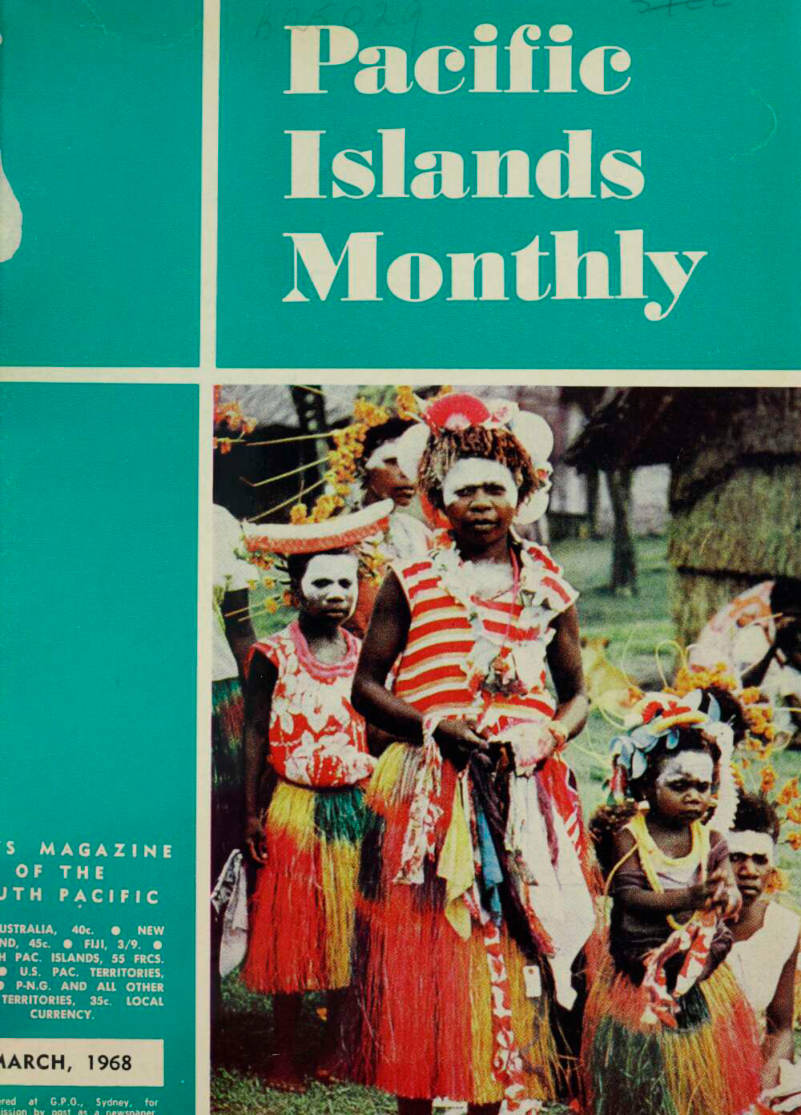 1
1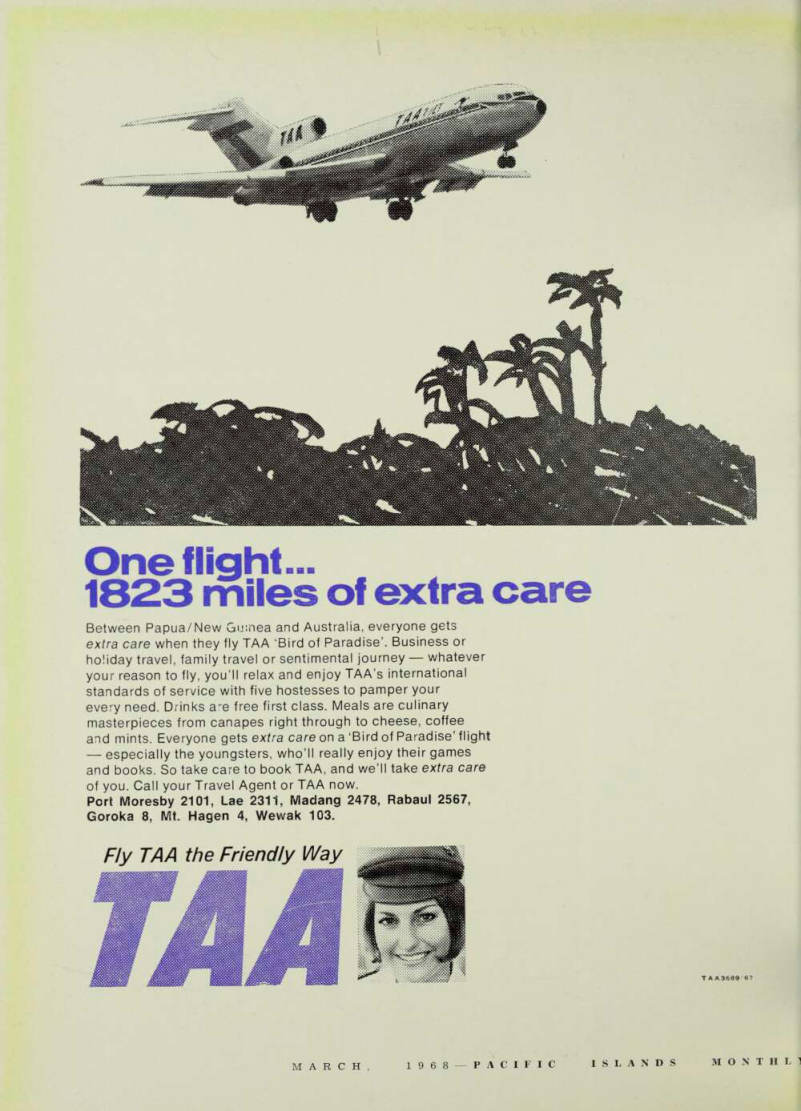 2
2 3
3 4
4 5
5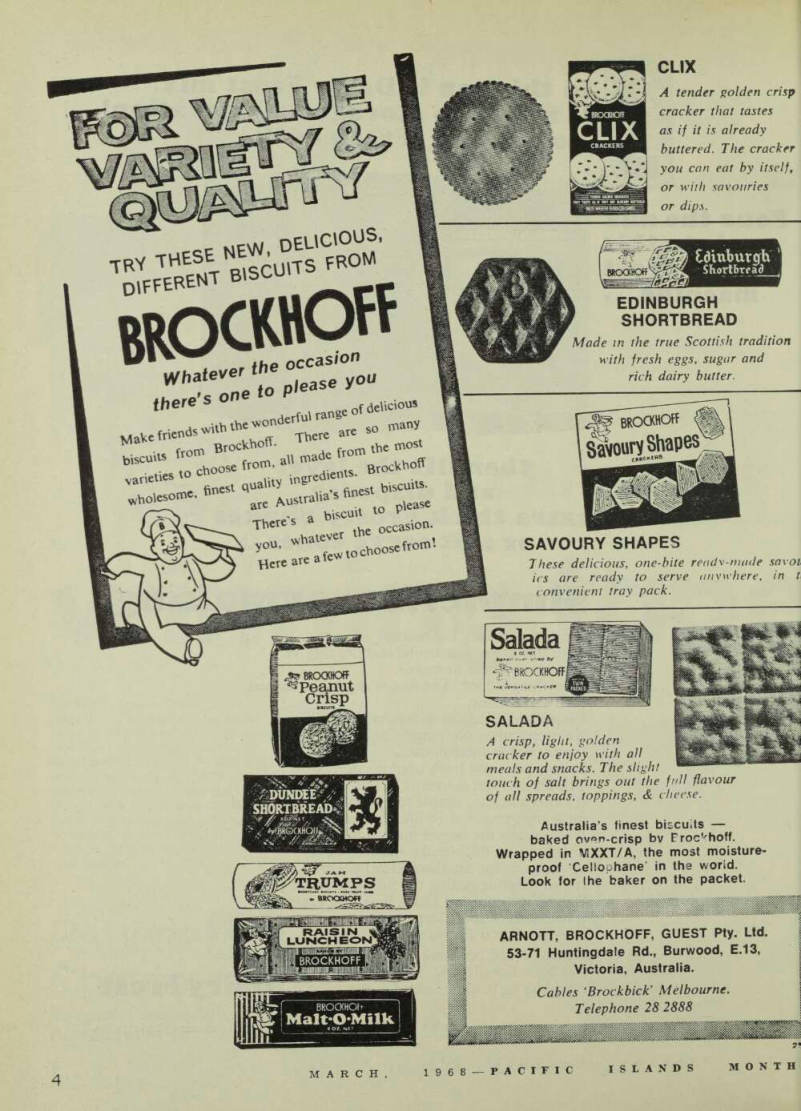 6
6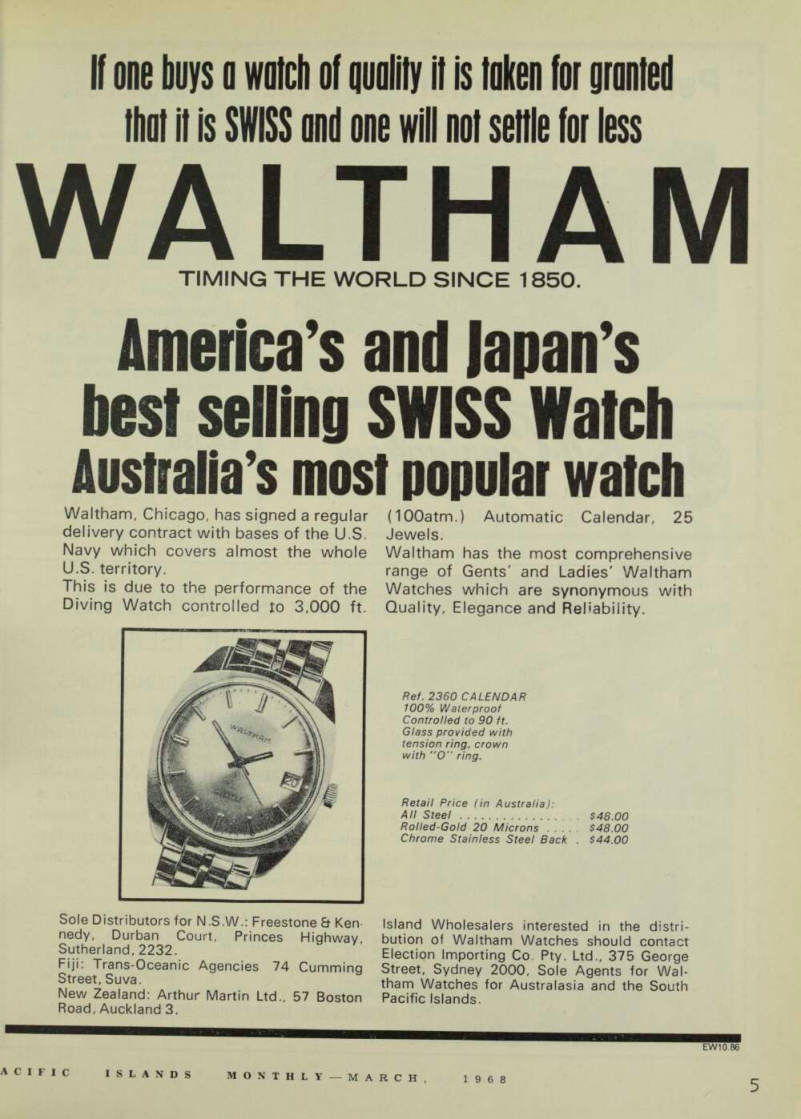 7
7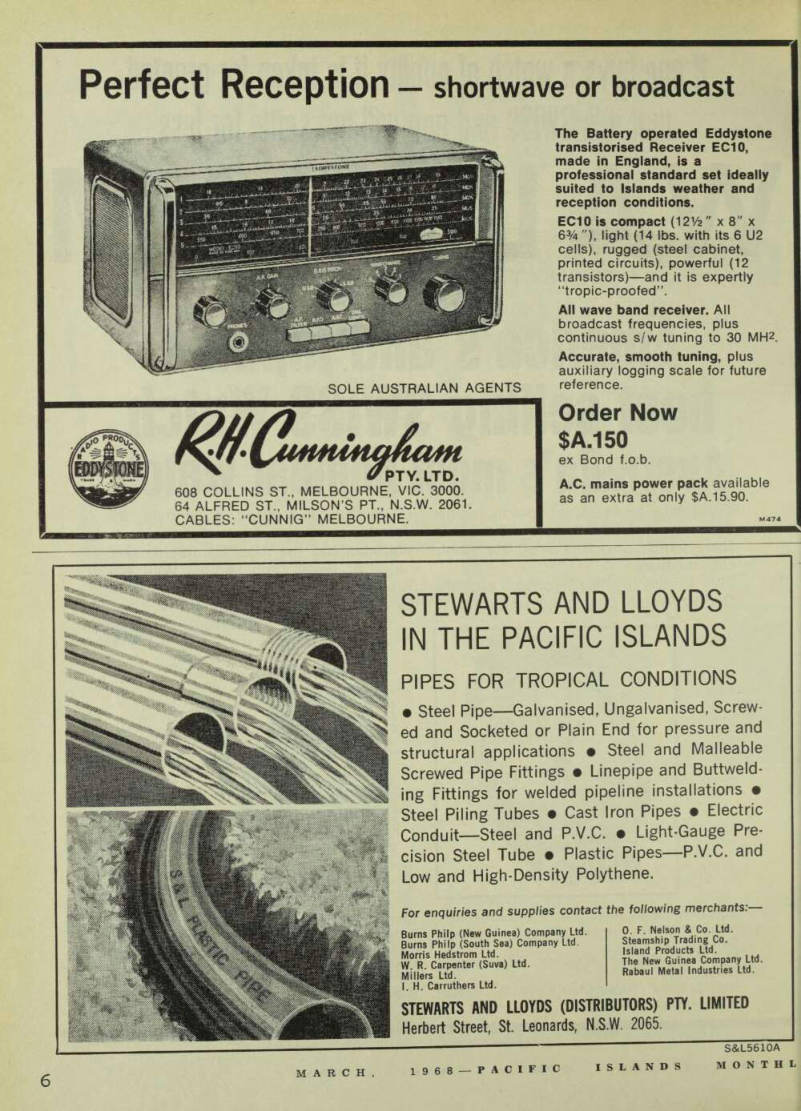 8
8 9
9 10
10 11
11 12
12 13
13 14
14 15
15 16
16 17
17 18
18 19
19 20
20 21
21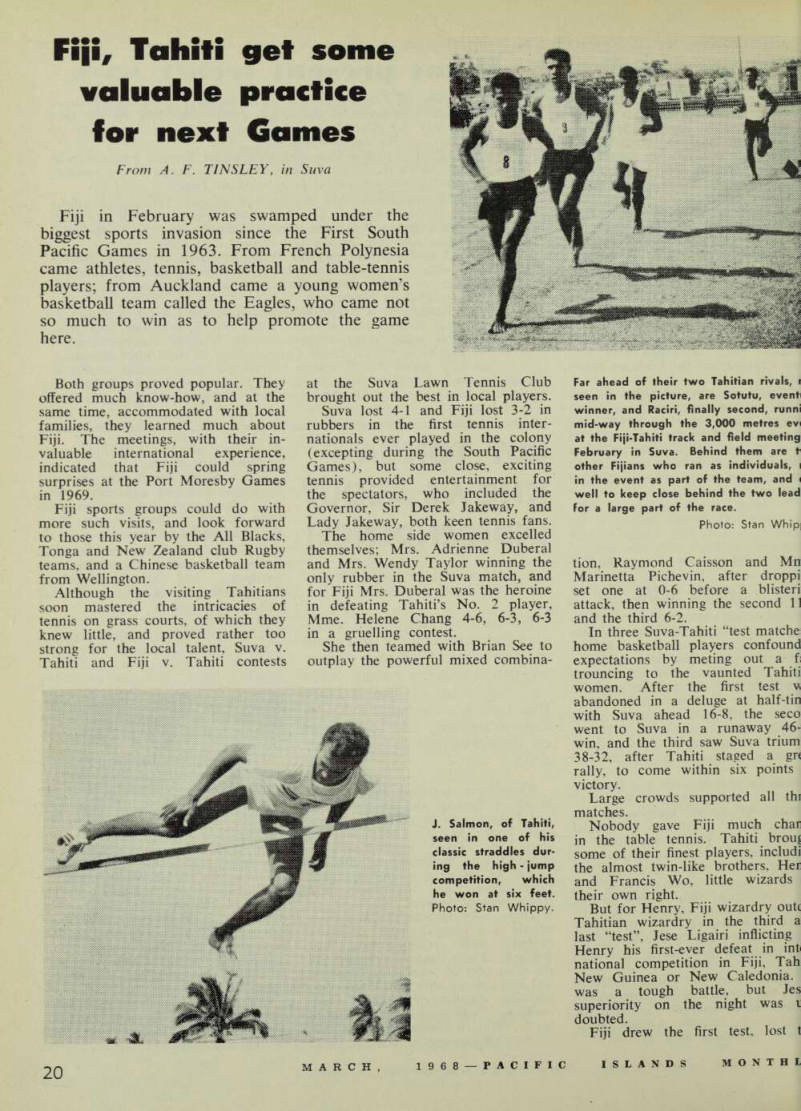 22
22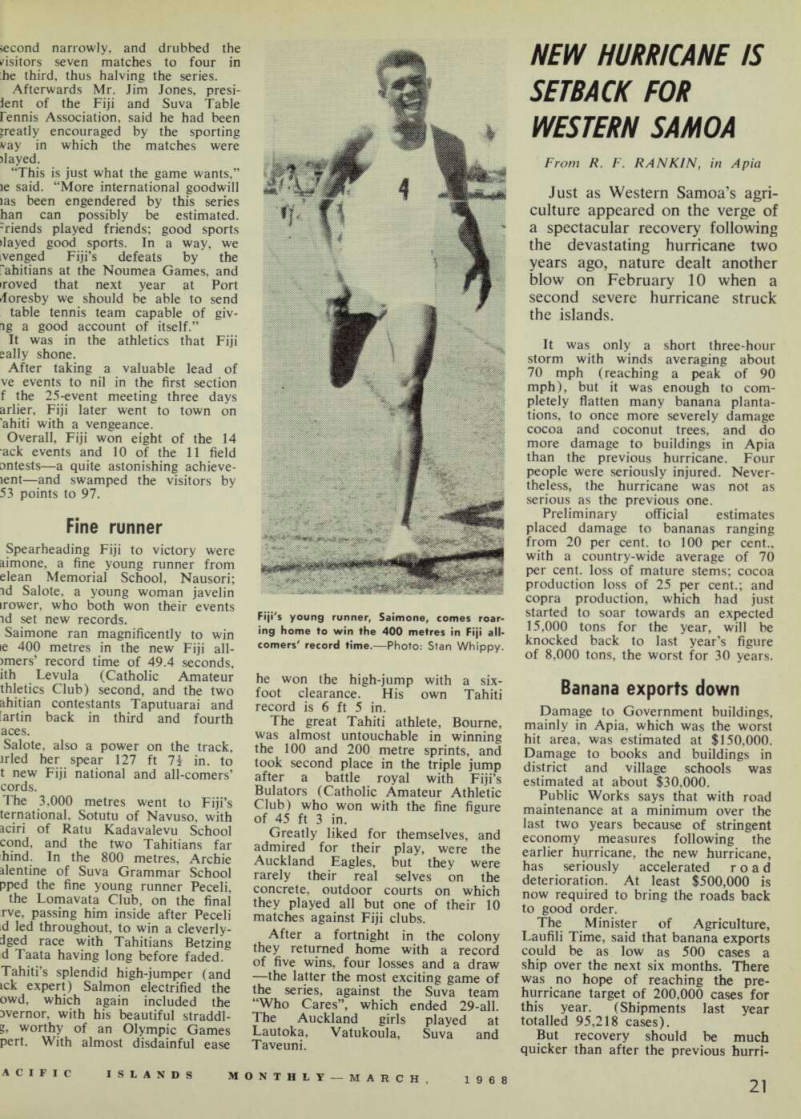 23
23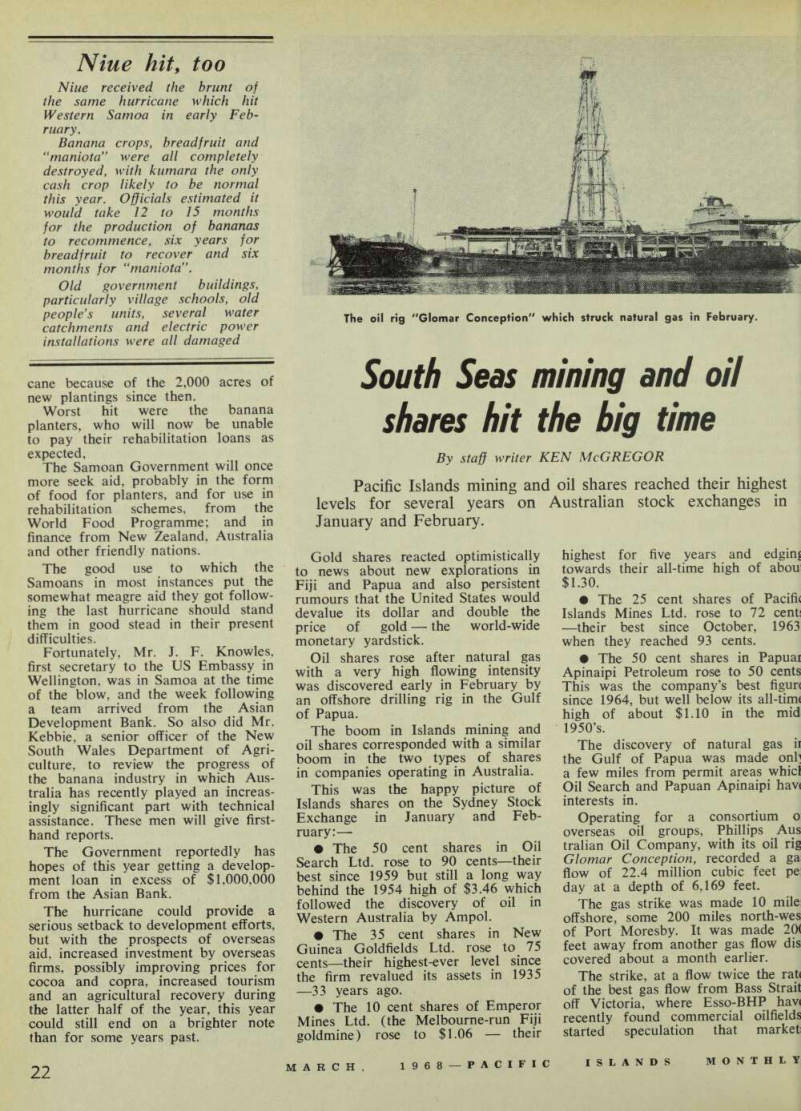 24
24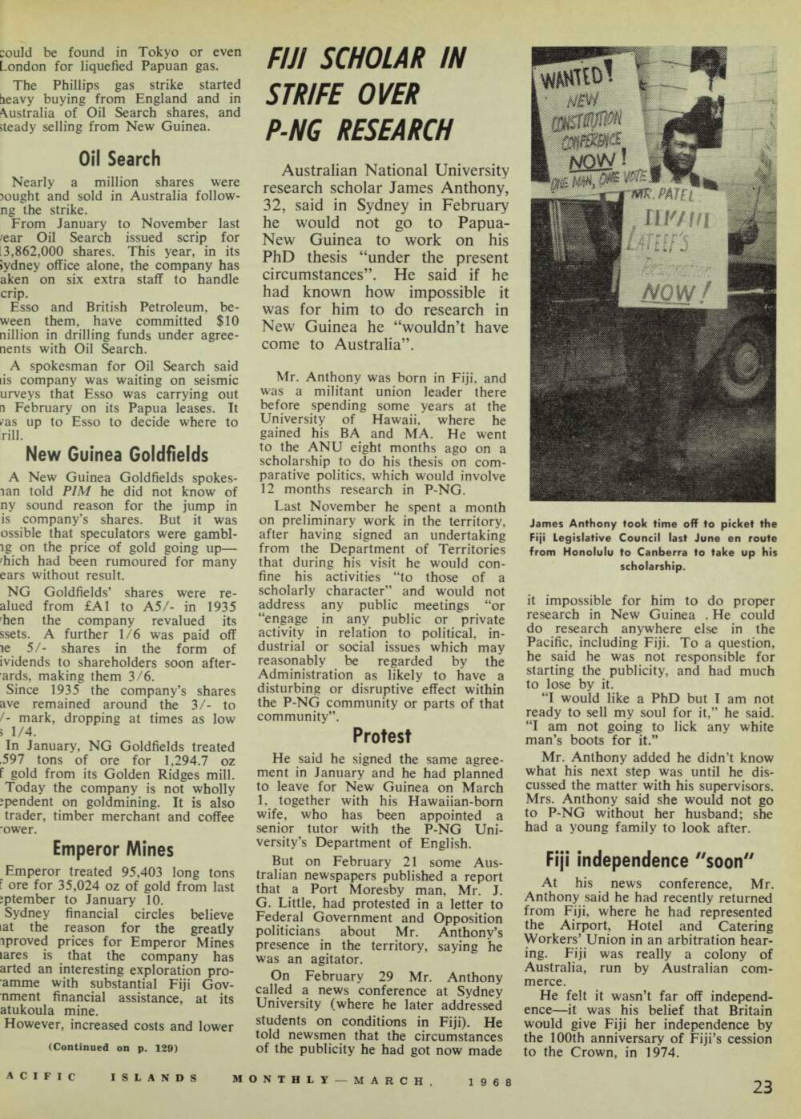 25
25 26
26 27
27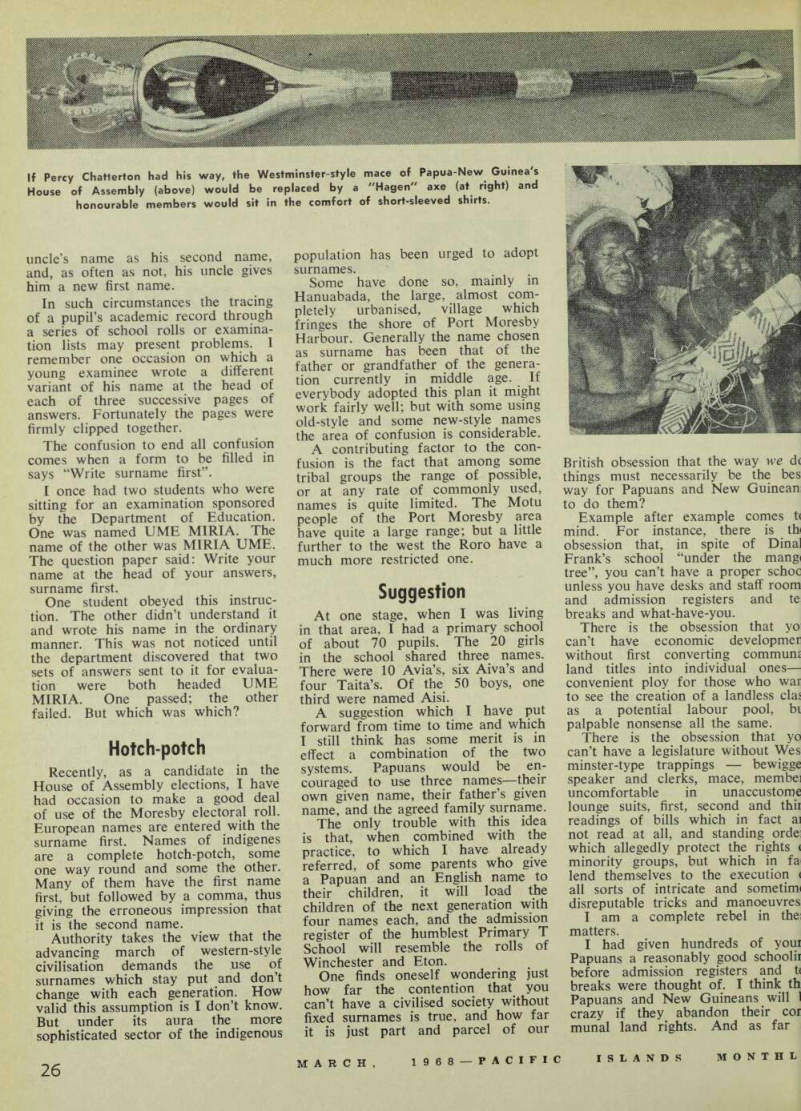 28
28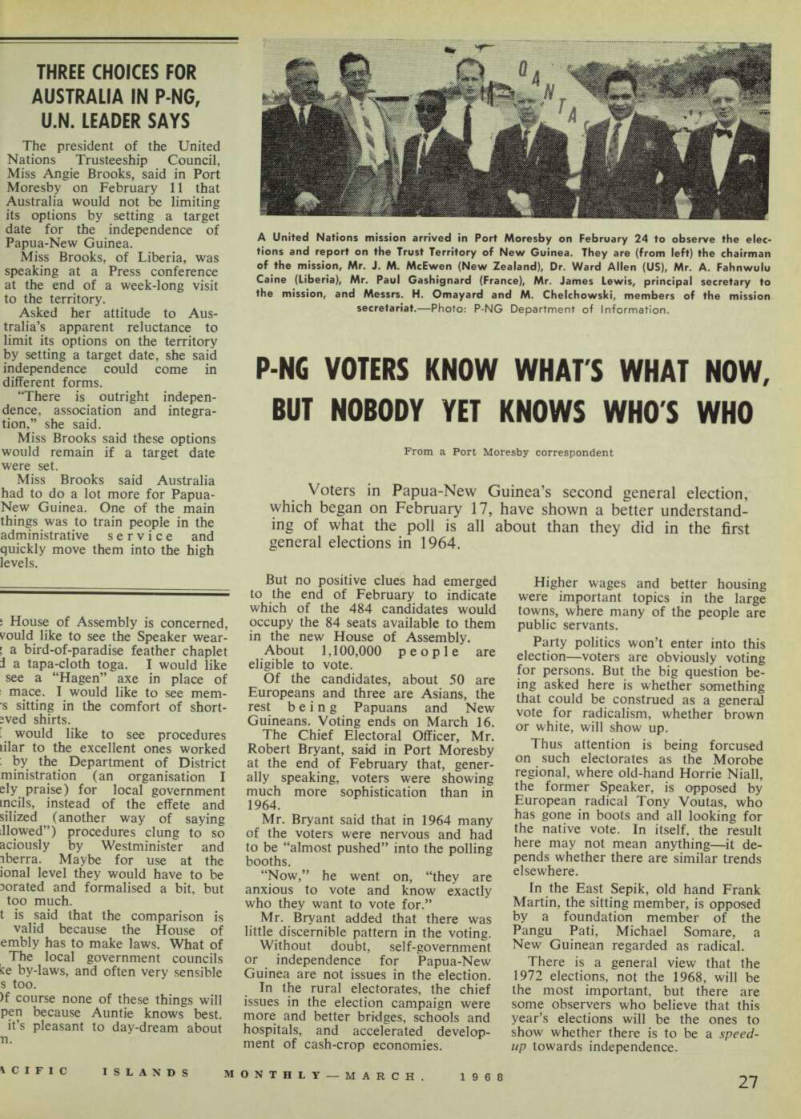 29
29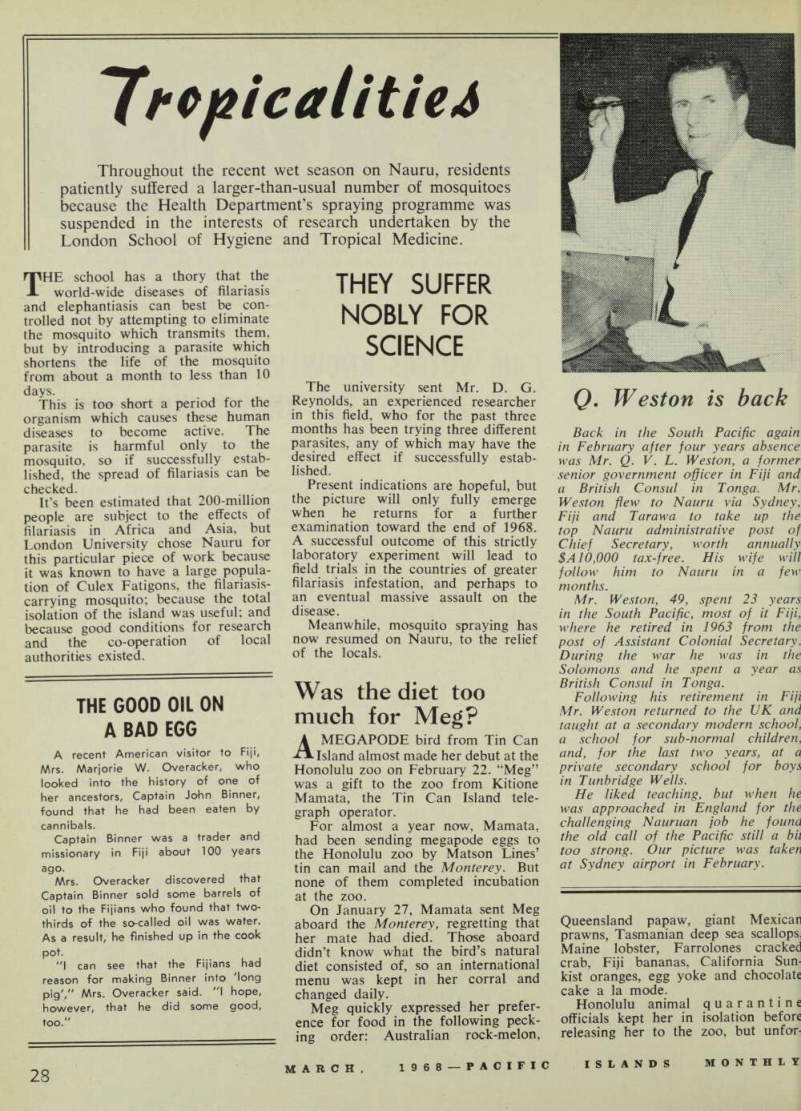 30
30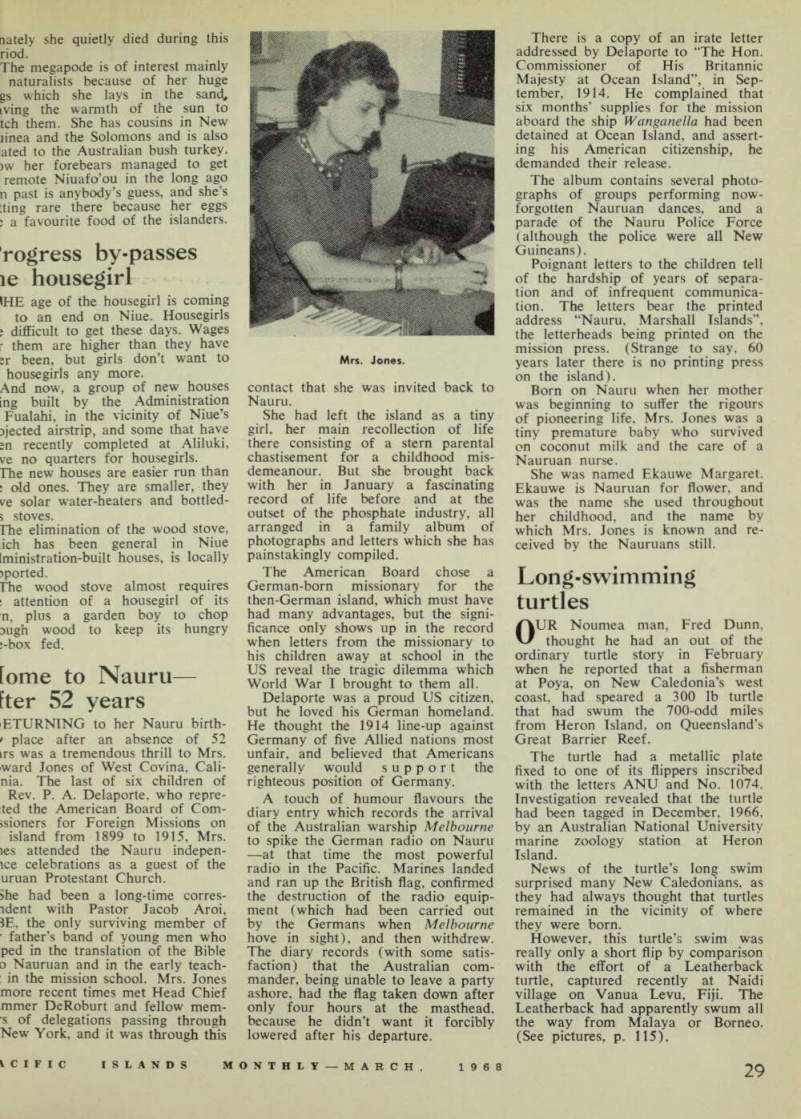 31
31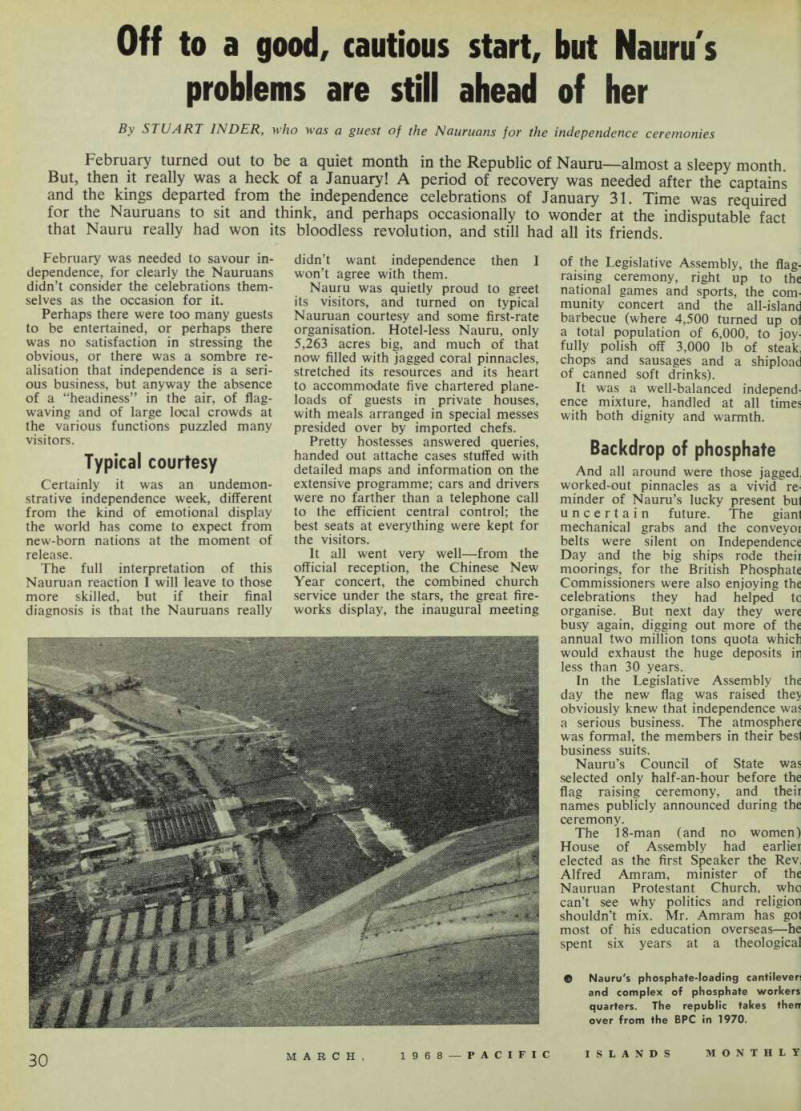 32
32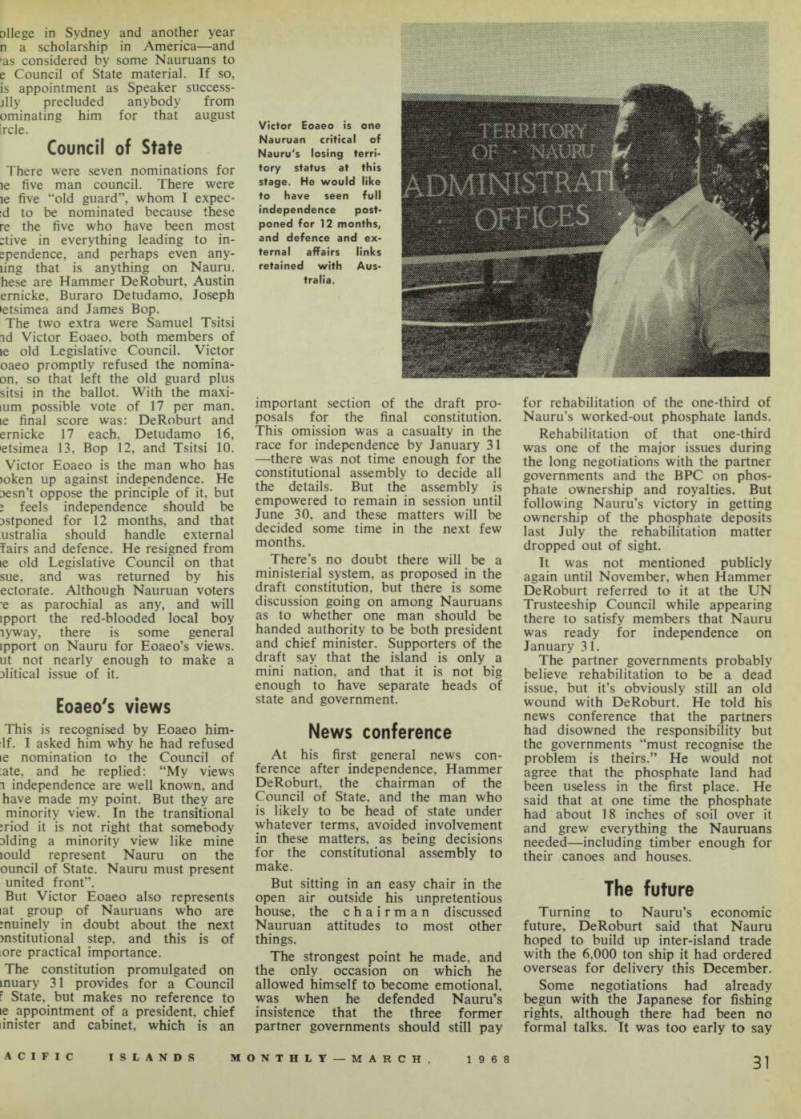 33
33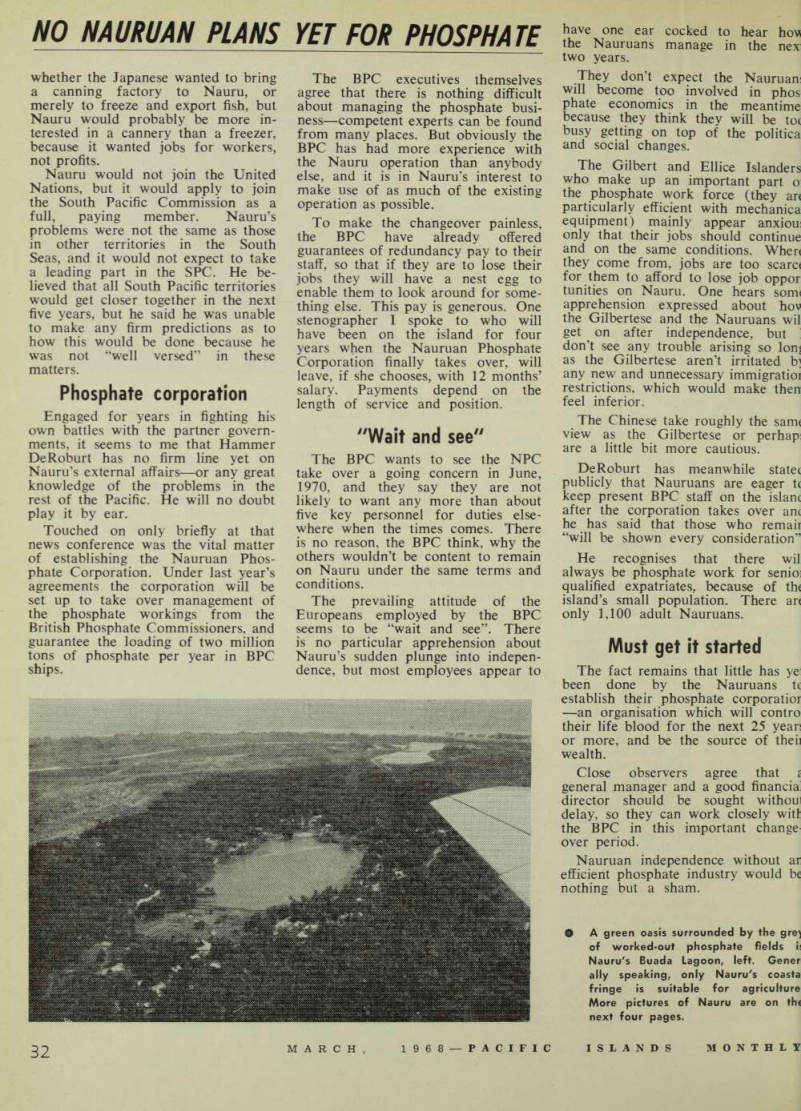 34
34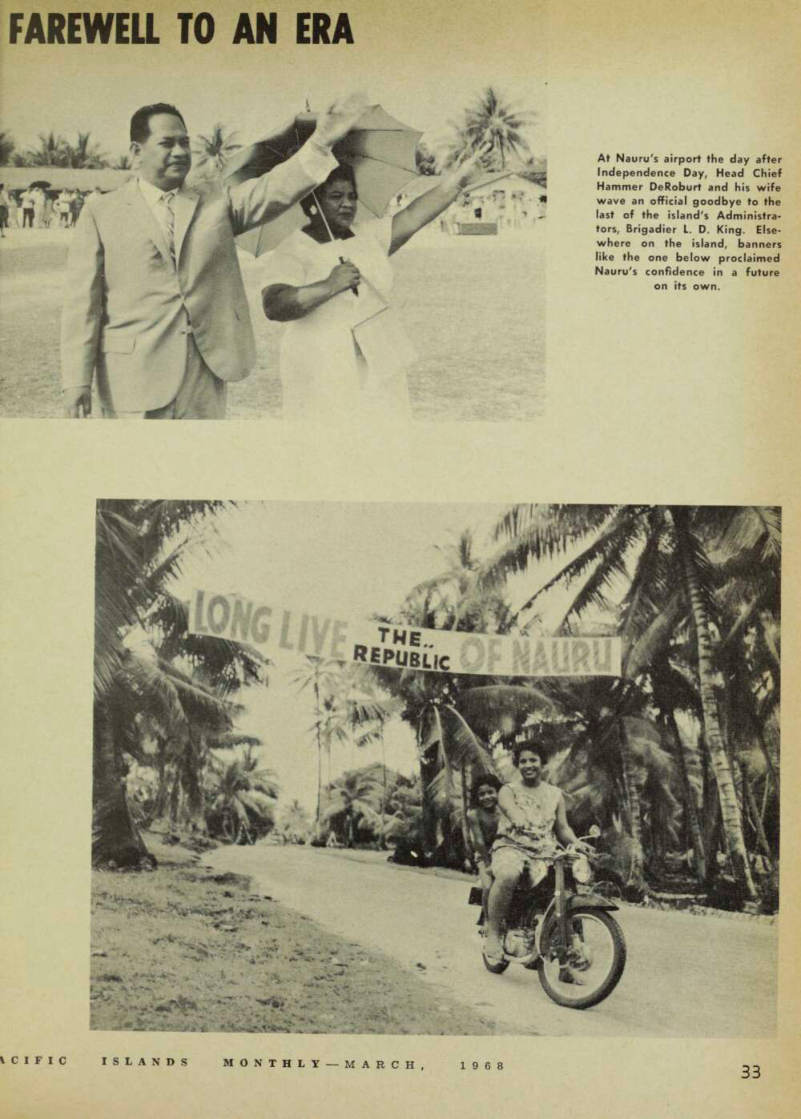 35
35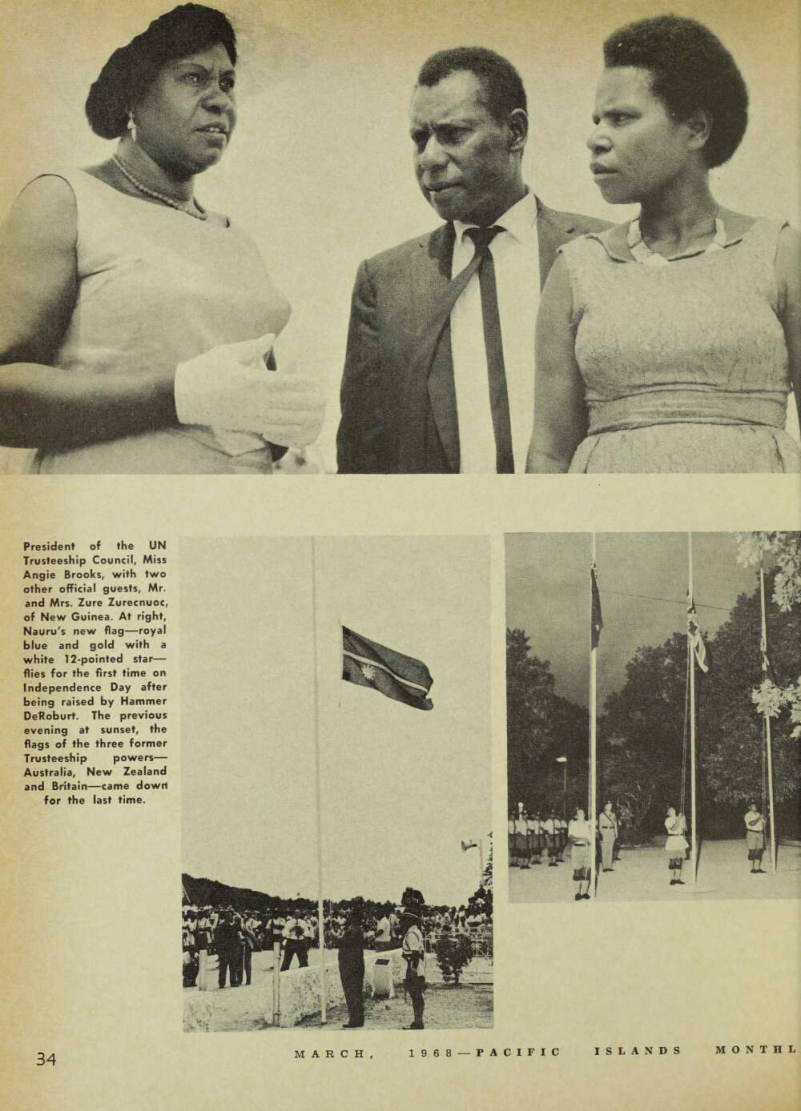 36
36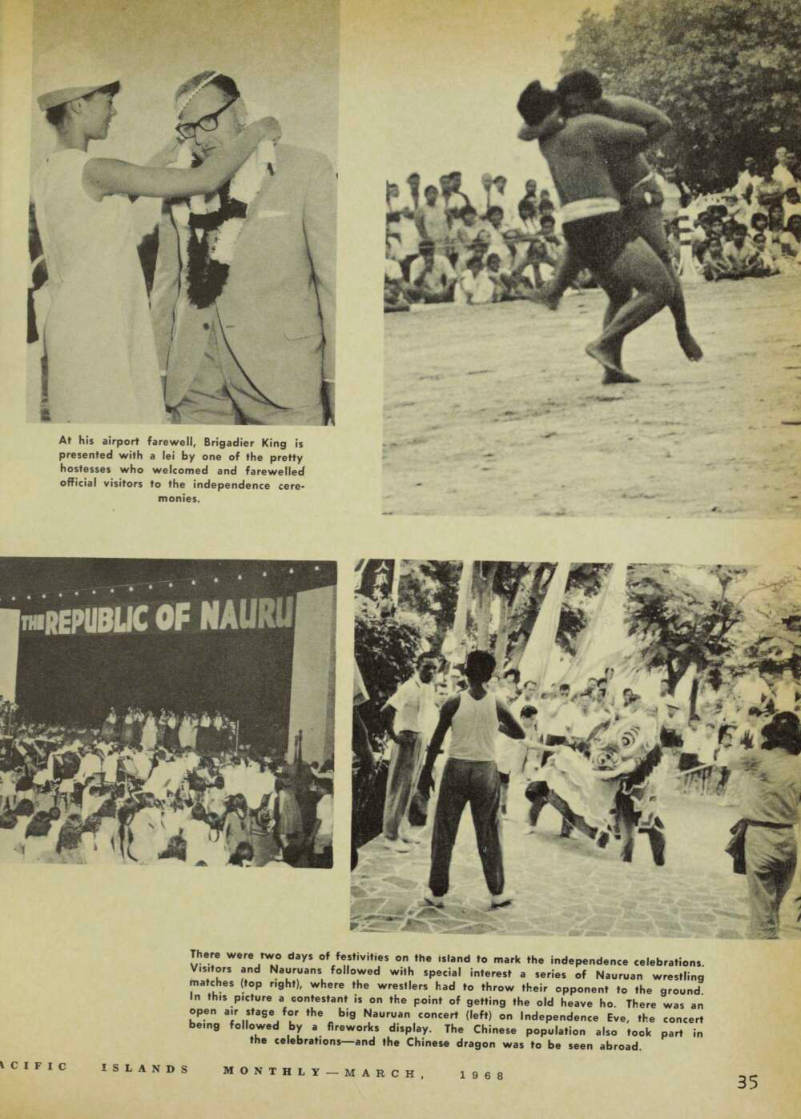 37
37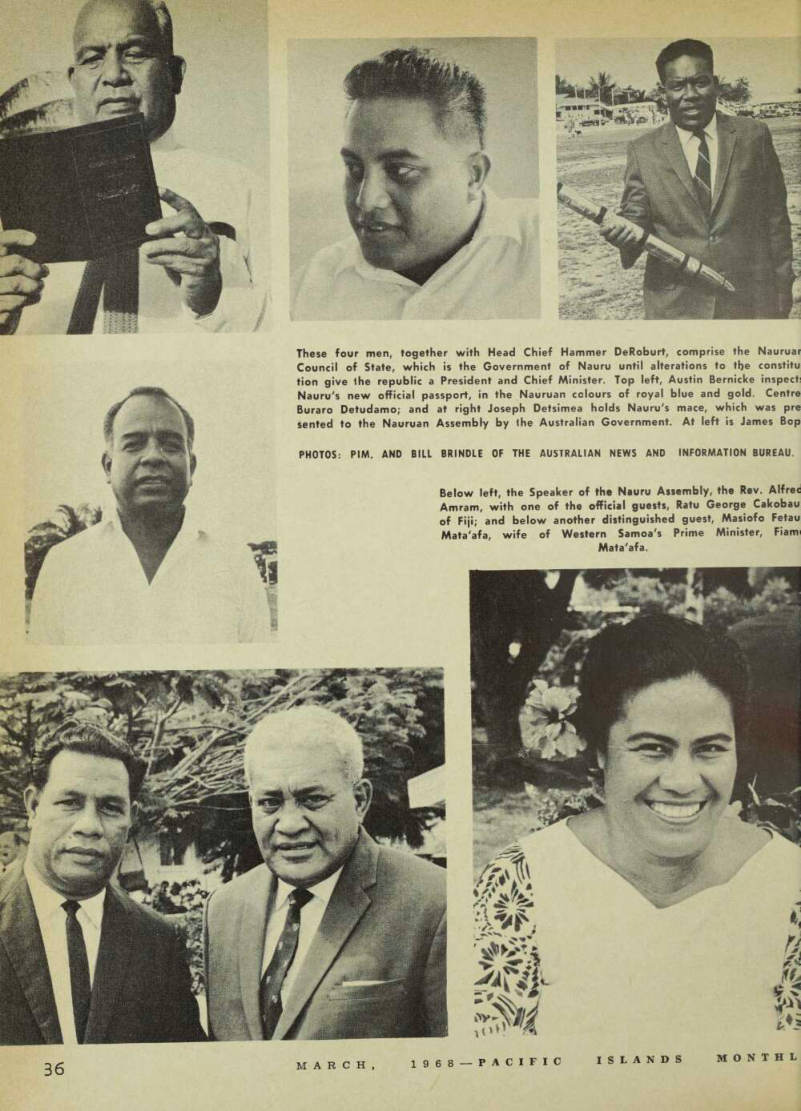 38
38 39
39 40
40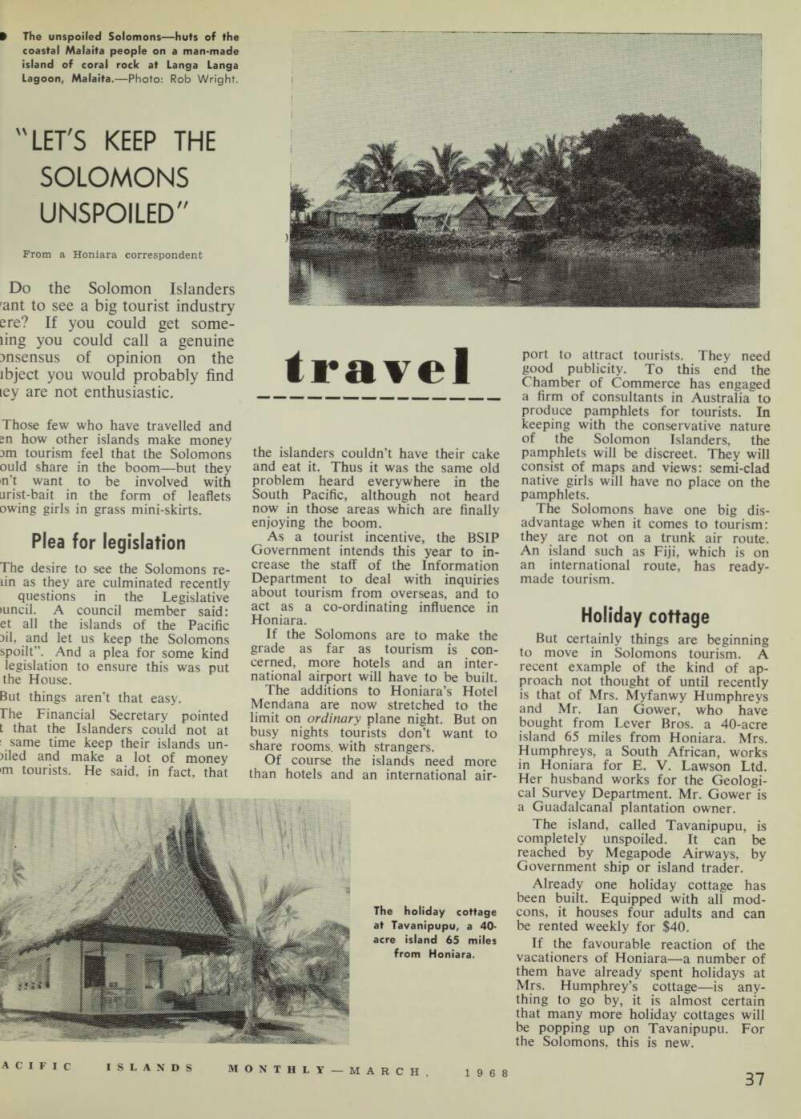 41
41 42
42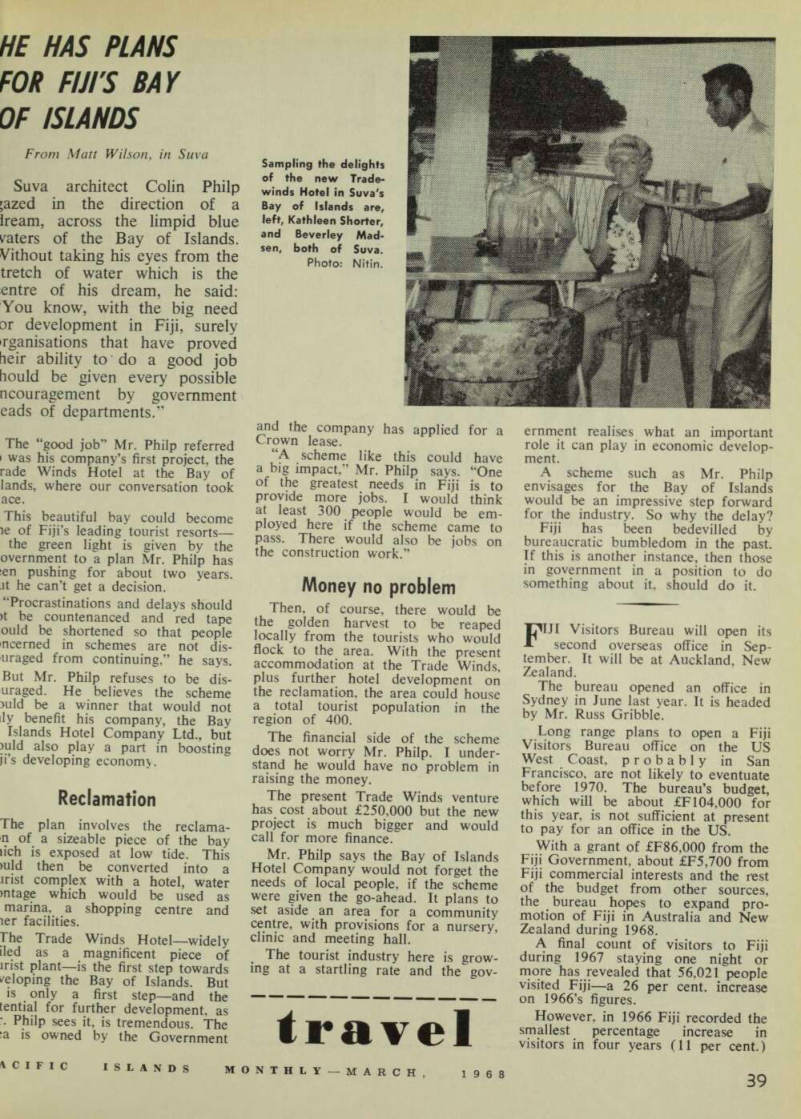 43
43 44
44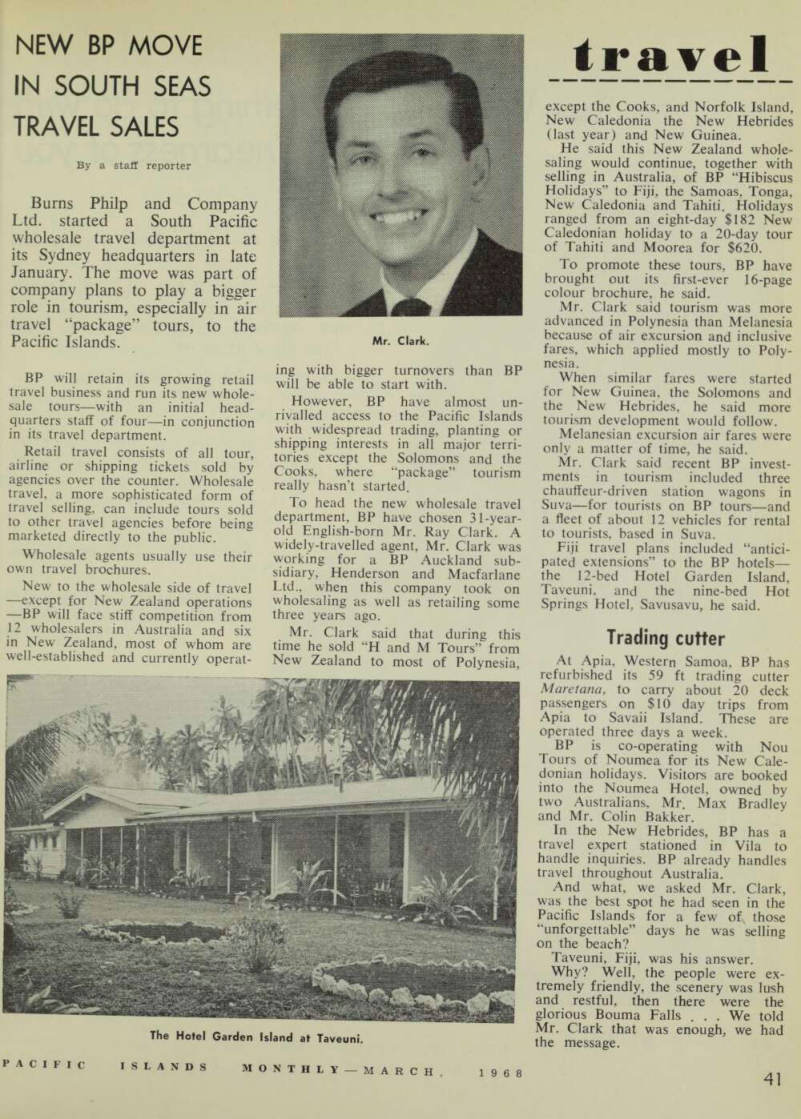 45
45 46
46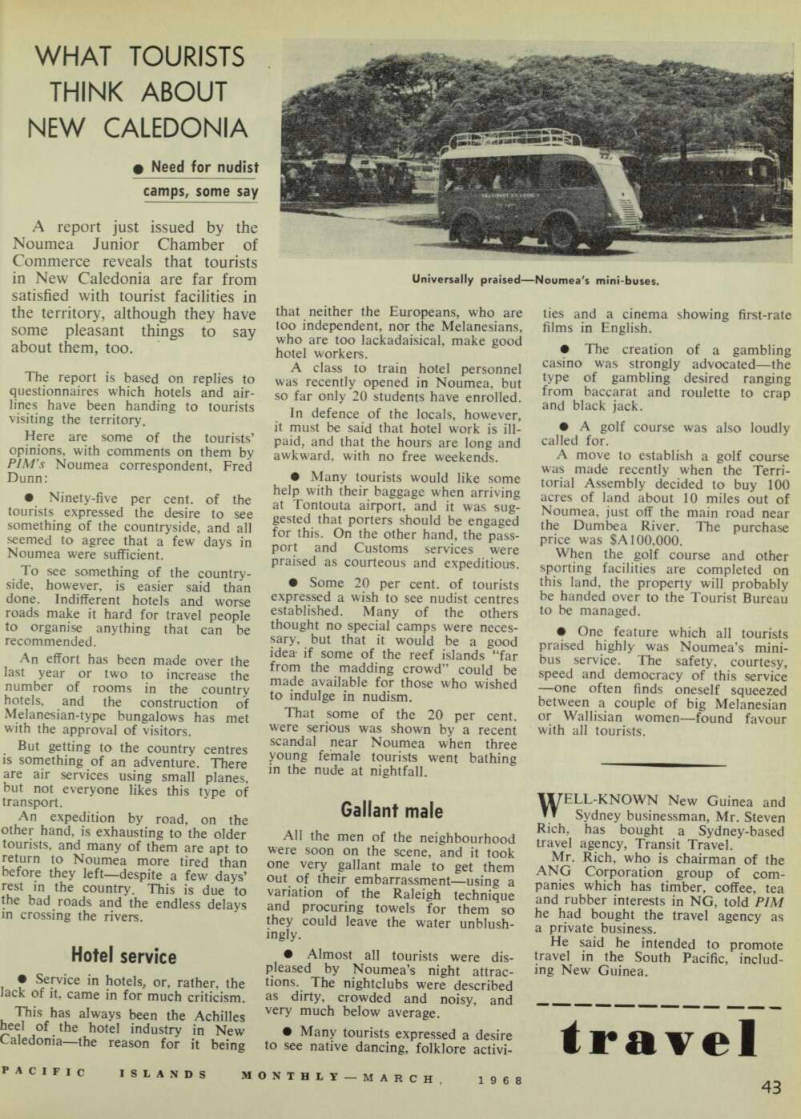 47
47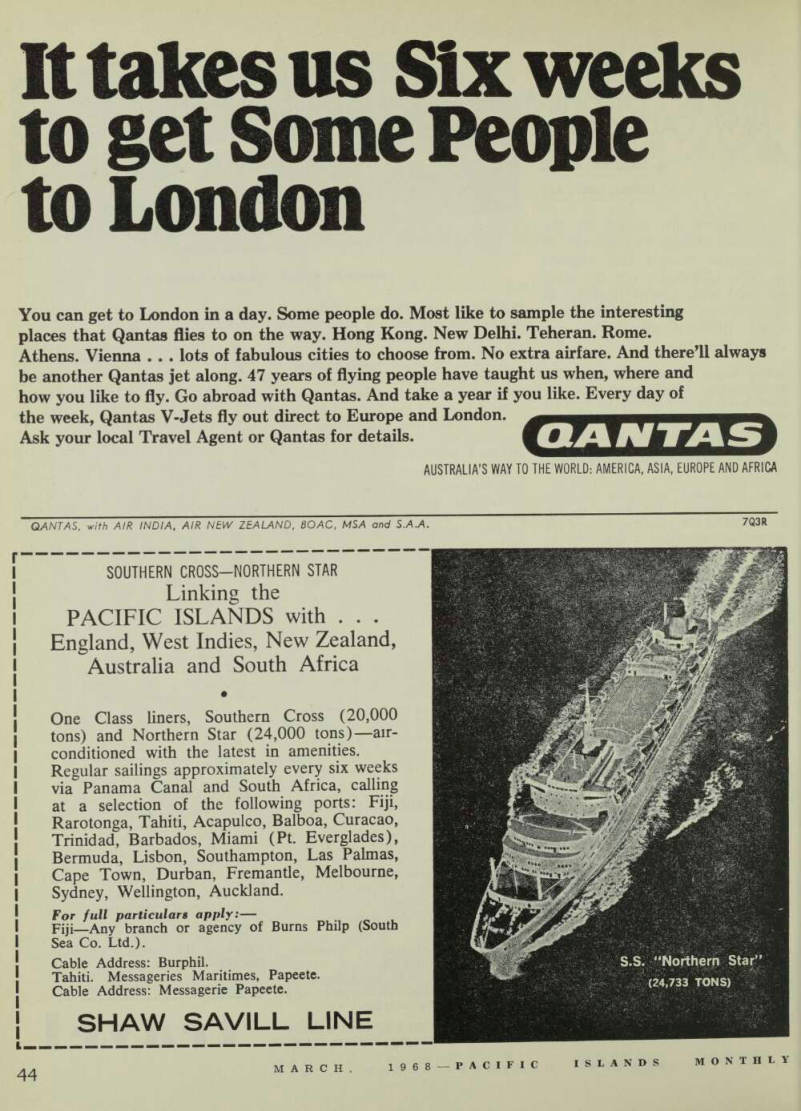 48
48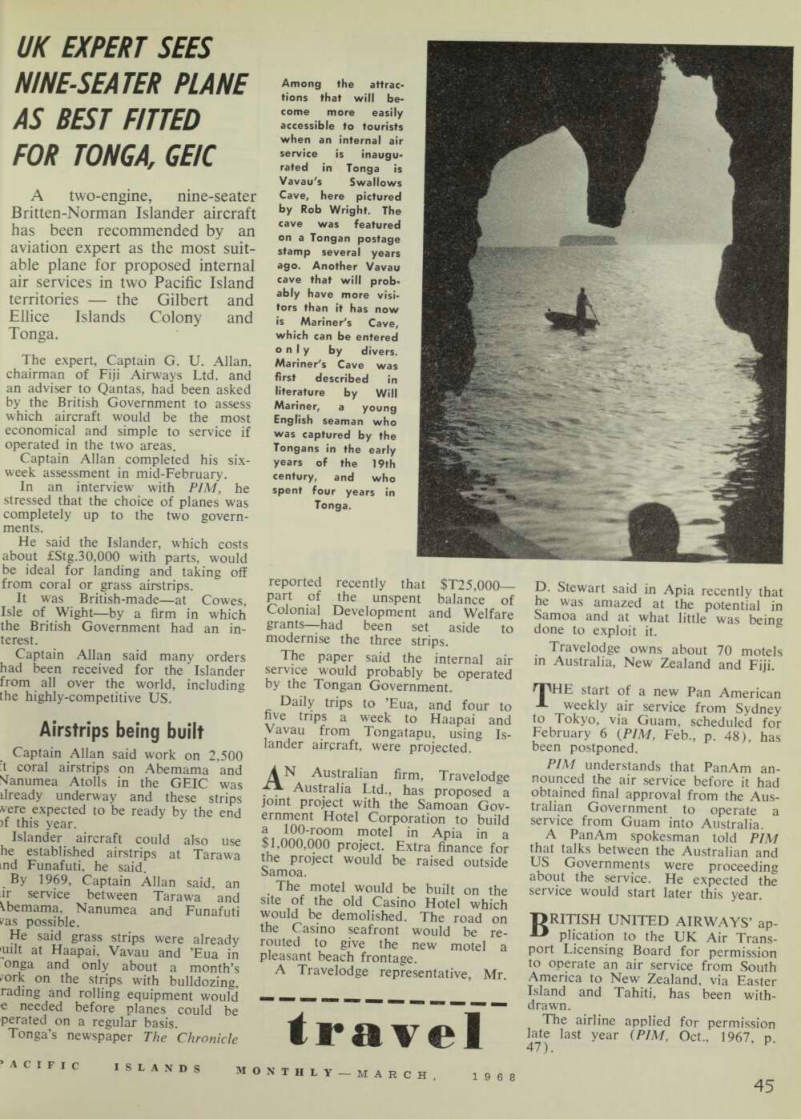 49
49 50
50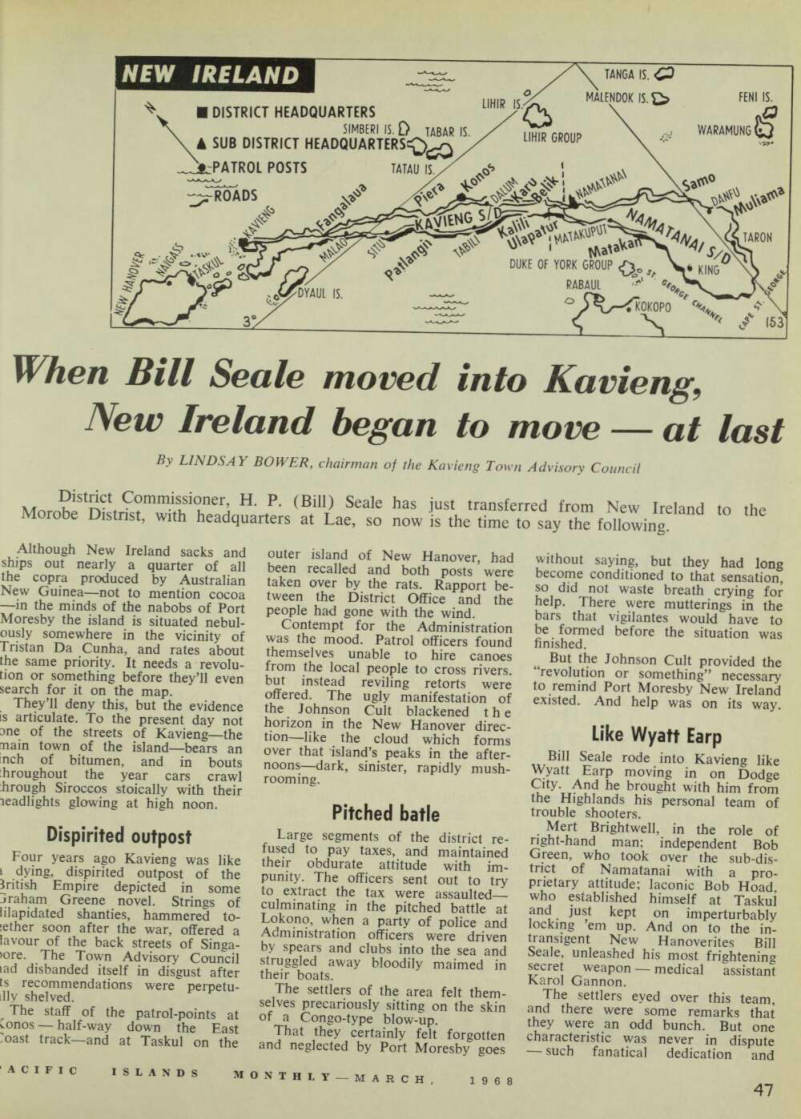 51
51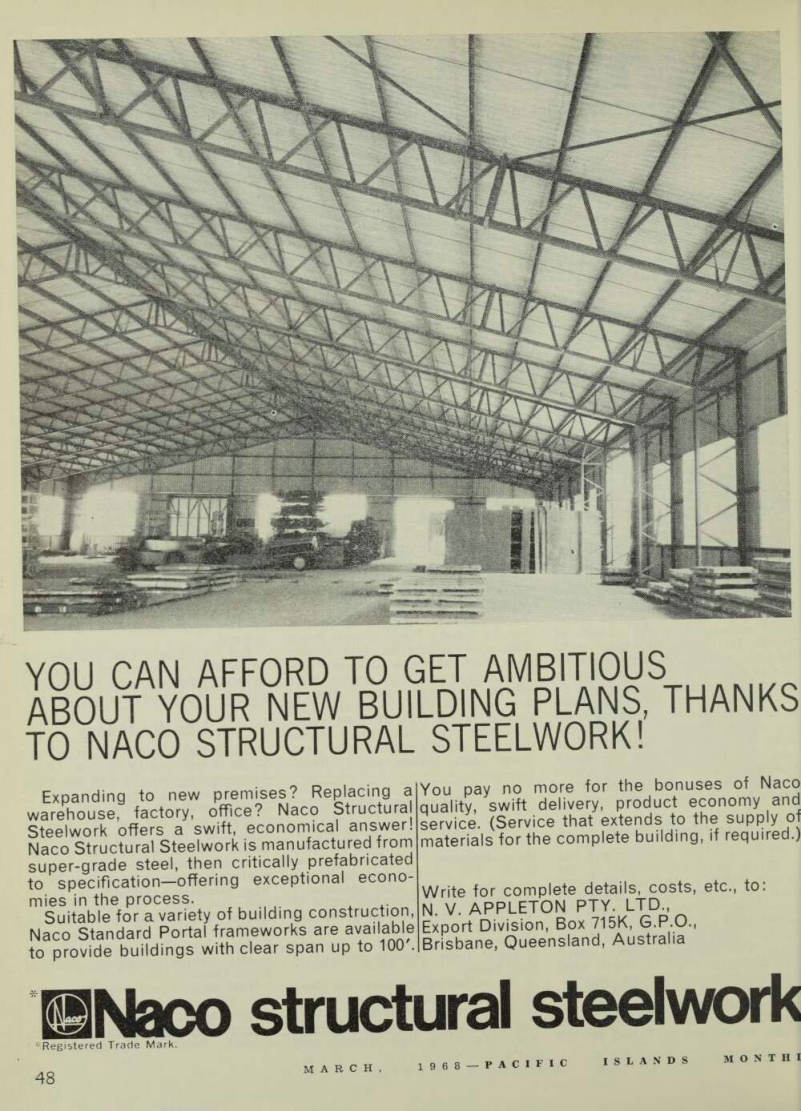 52
52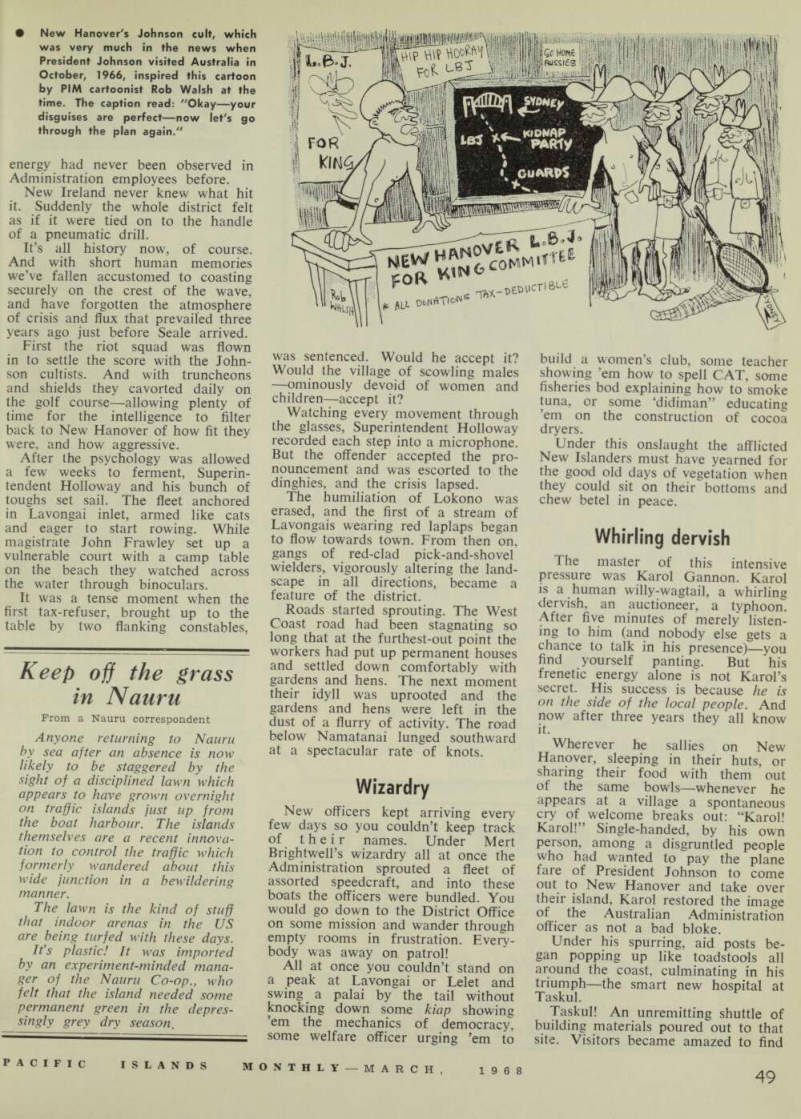 53
53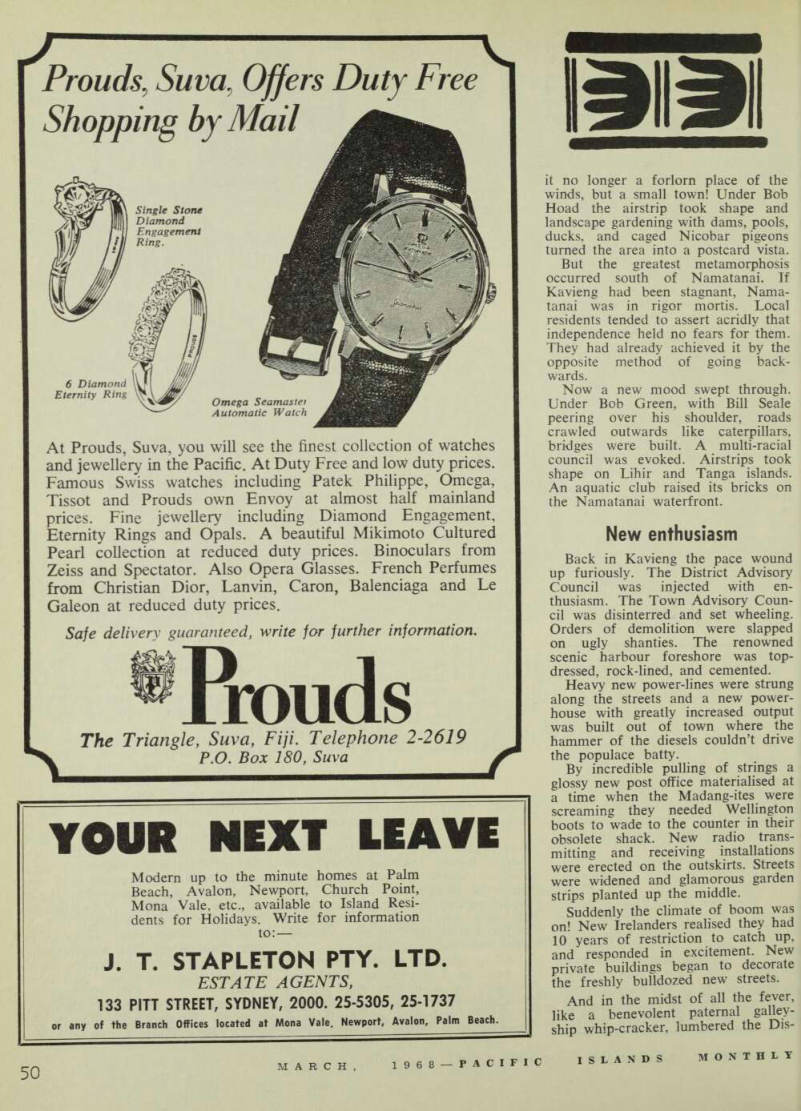 54
54 55
55 56
56 57
57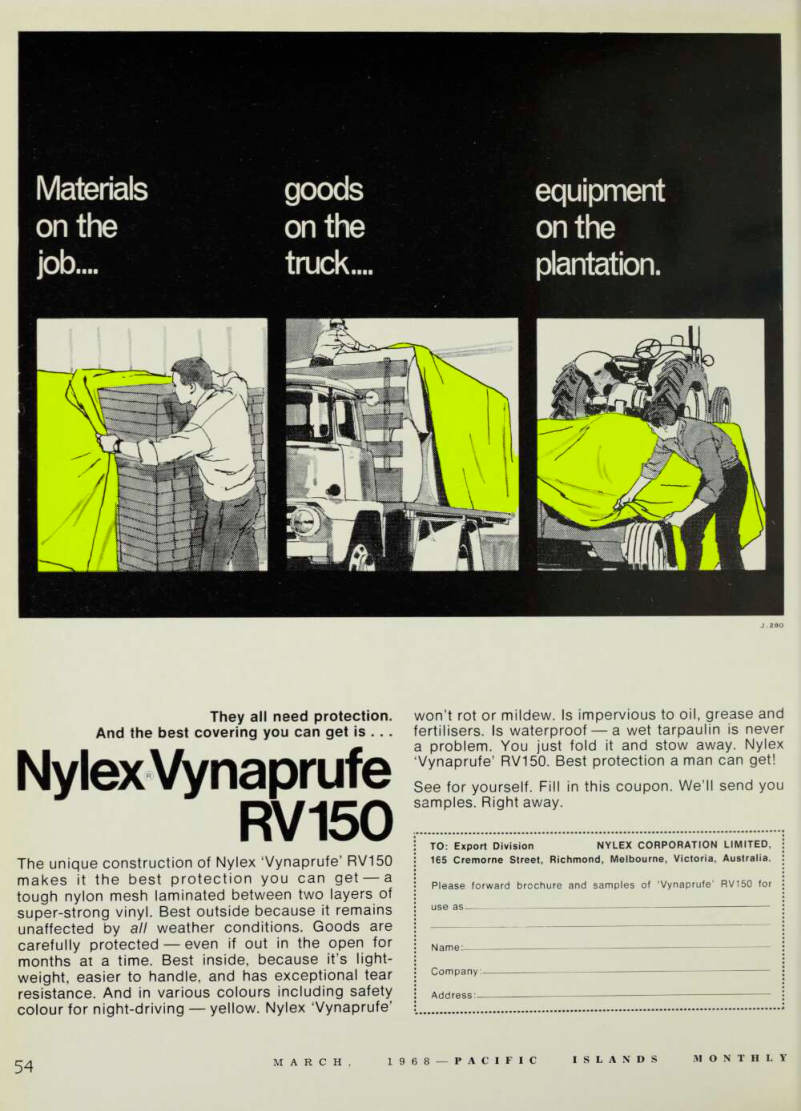 58
58 59
59 60
60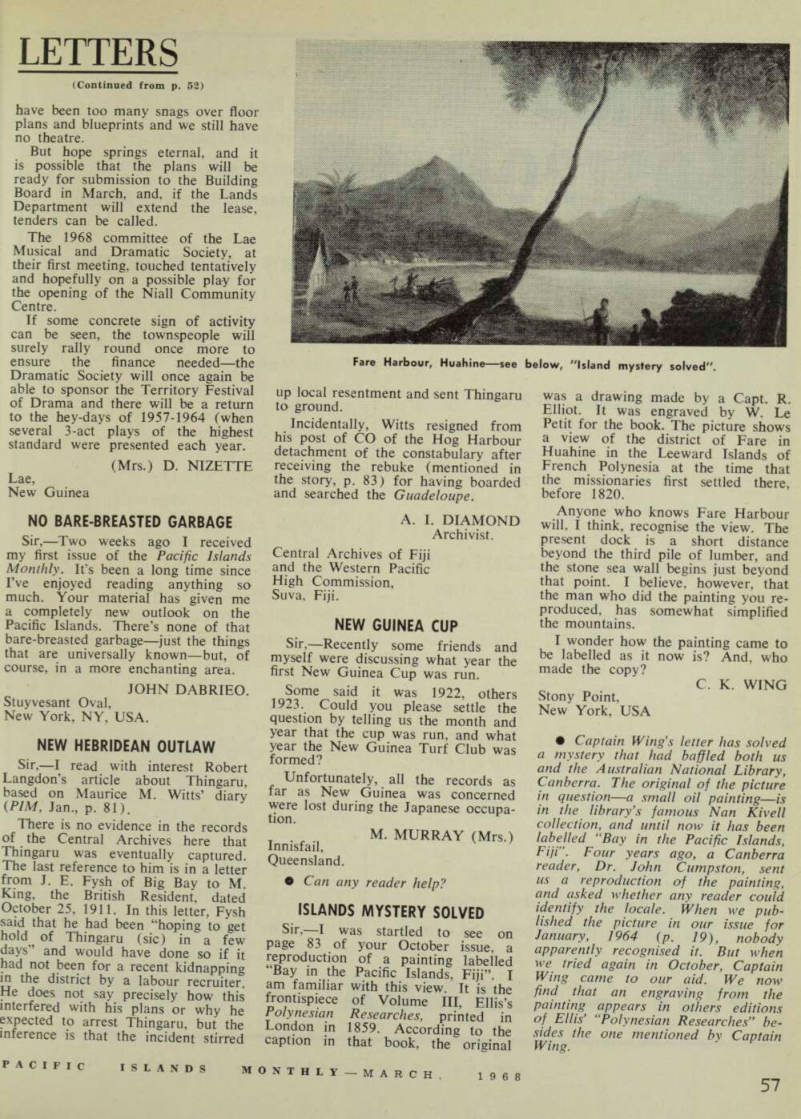 61
61 62
62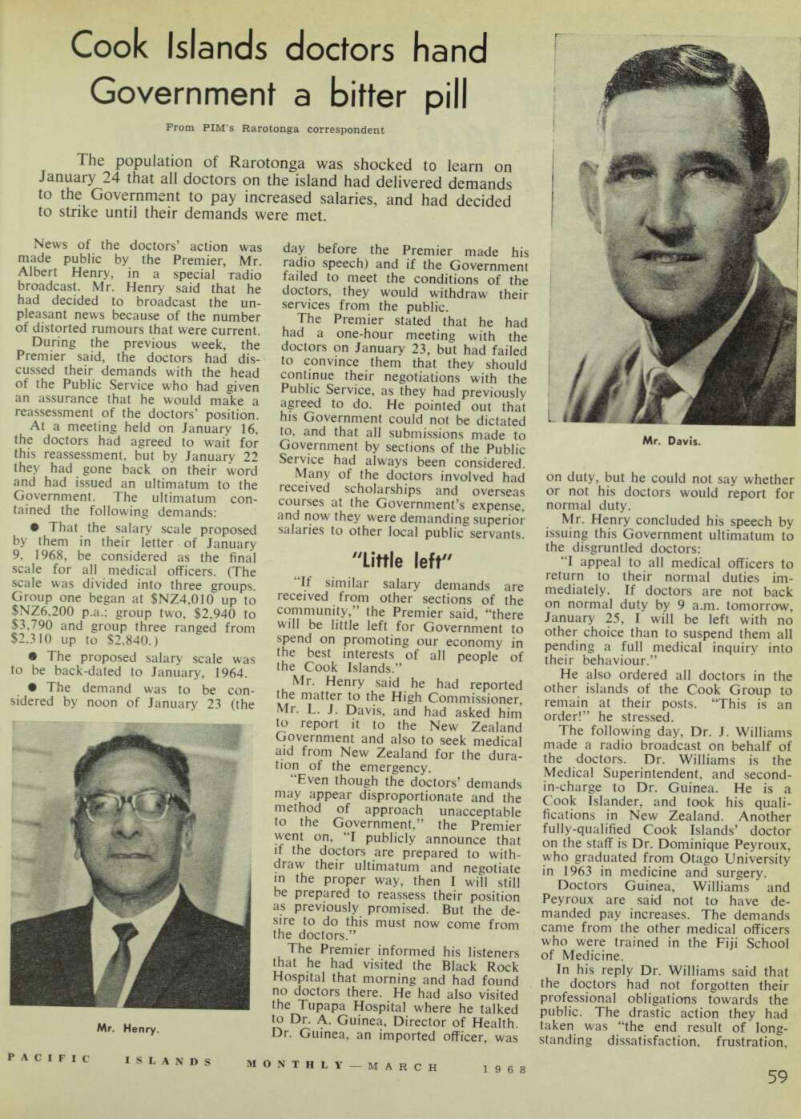 63
63 64
64 65
65 66
66 67
67 68
68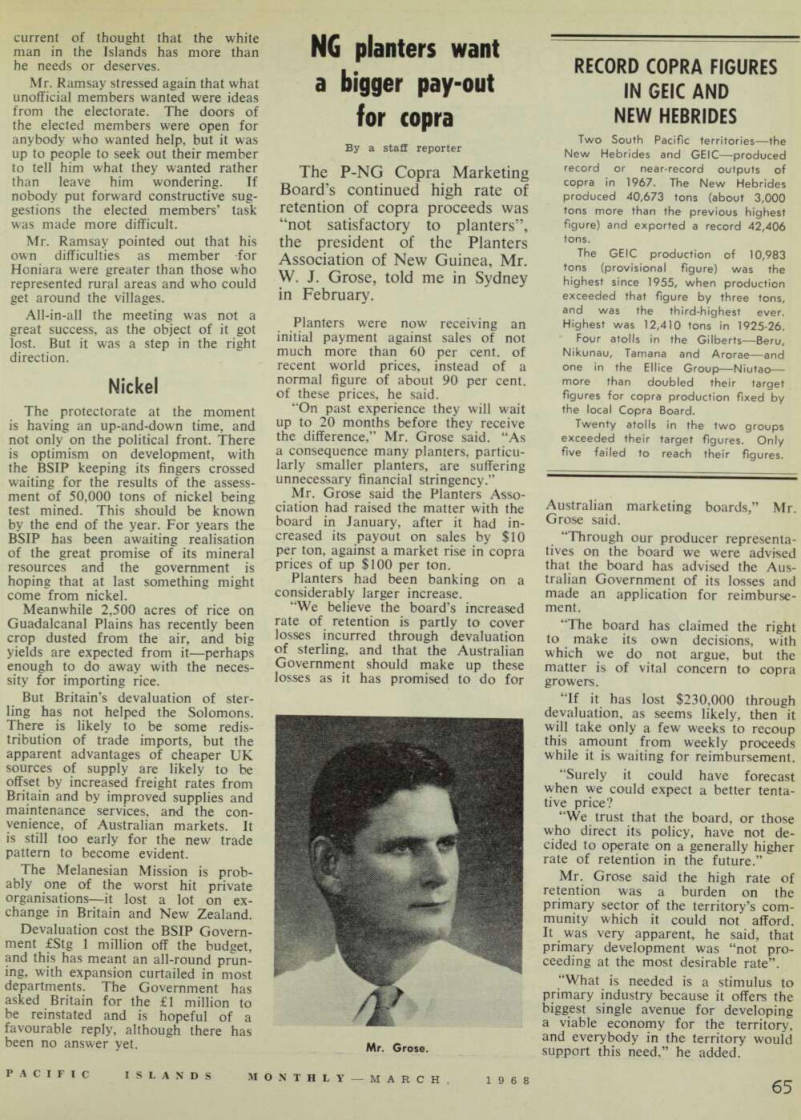 69
69 70
70 71
71 72
72 73
73 74
74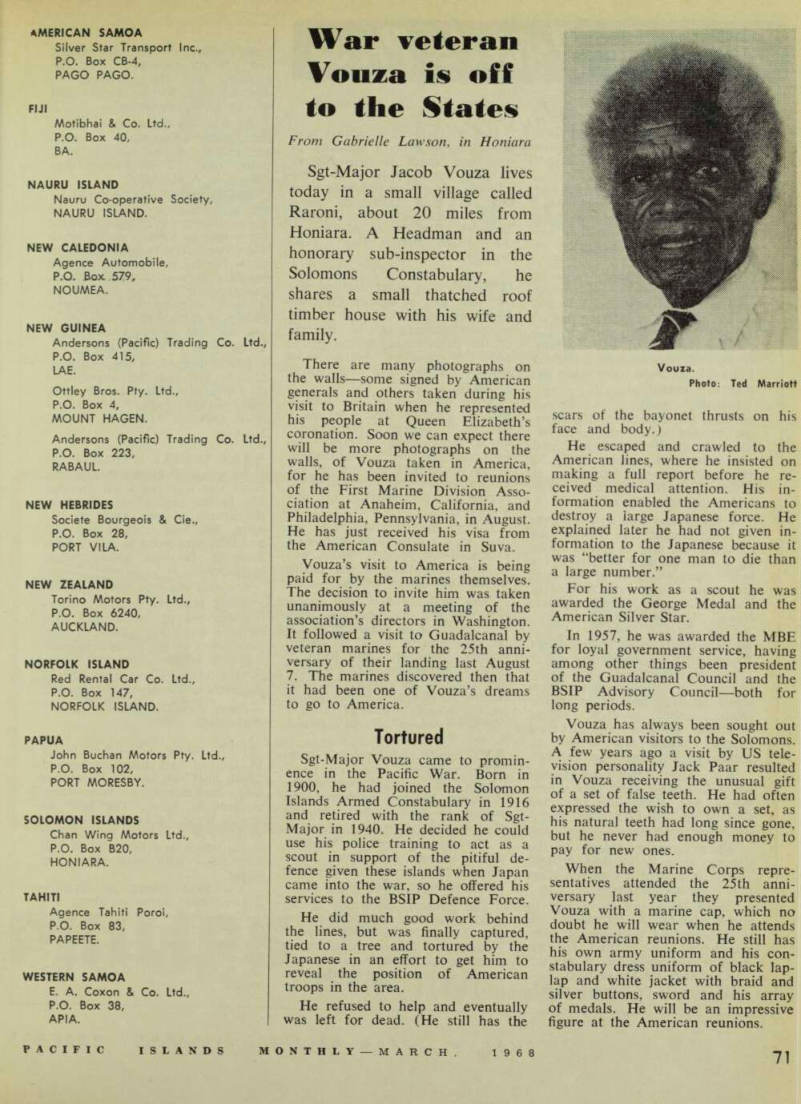 75
75 76
76 77
77 78
78 79
79 80
80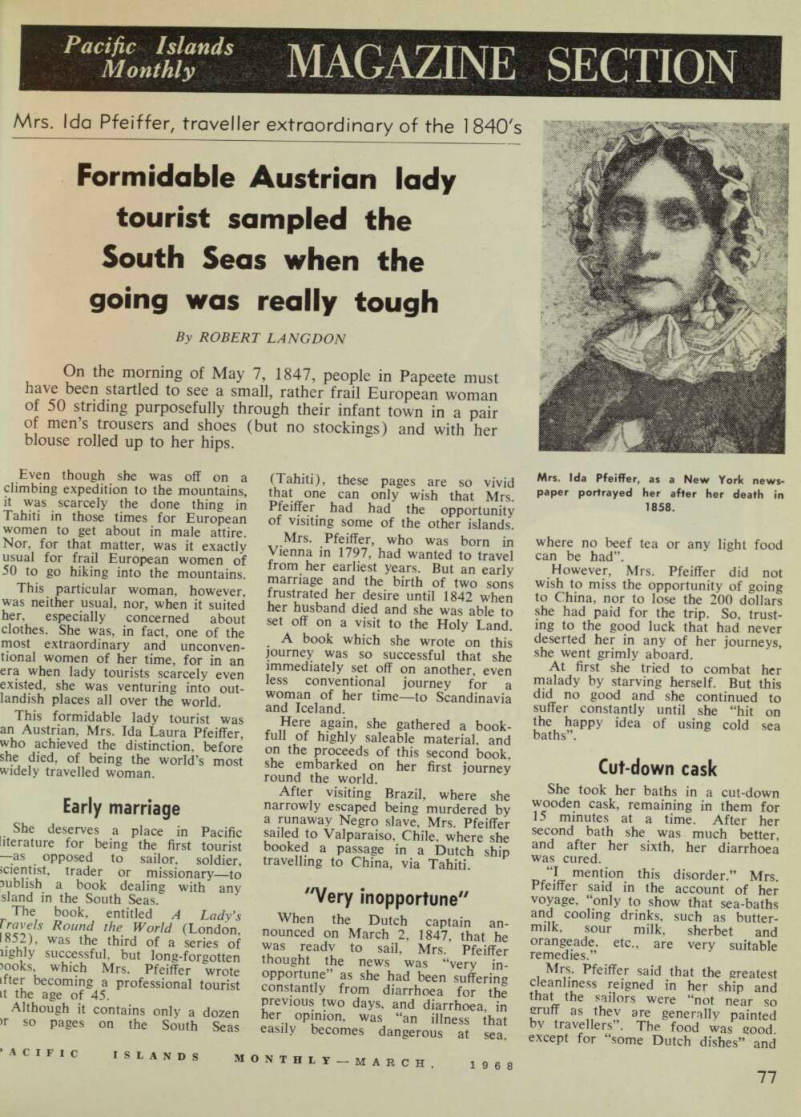 81
81 82
82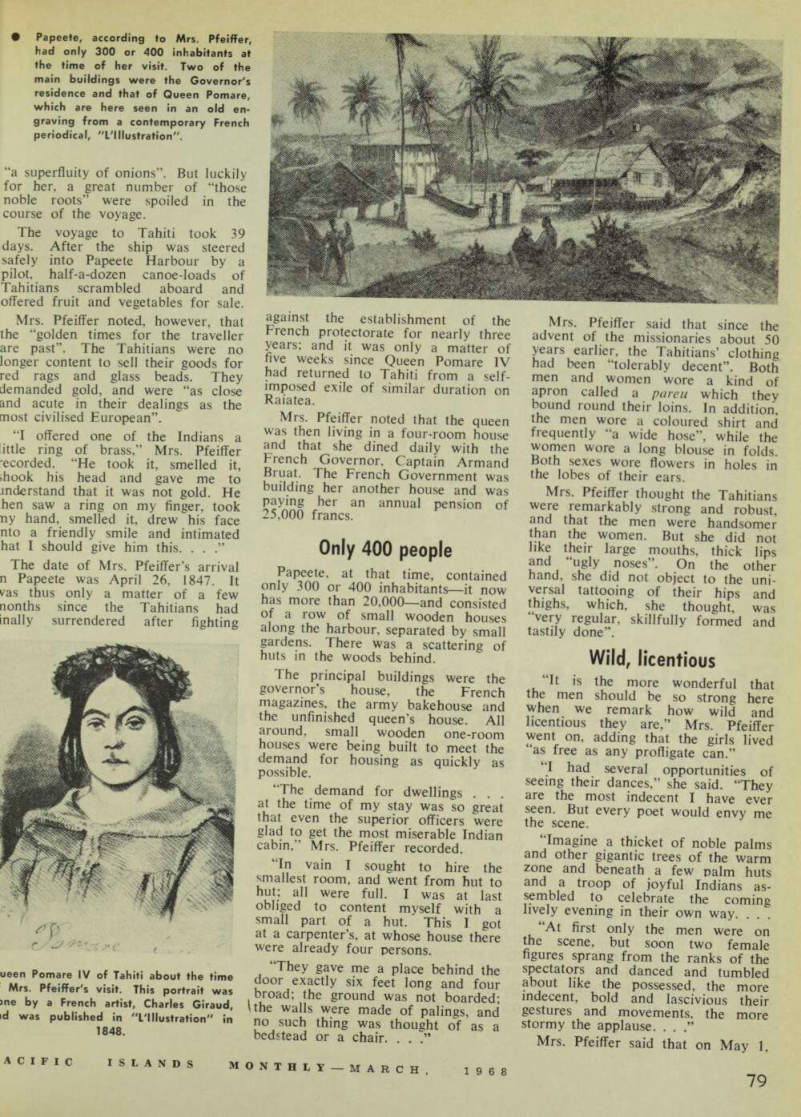 83
83 84
84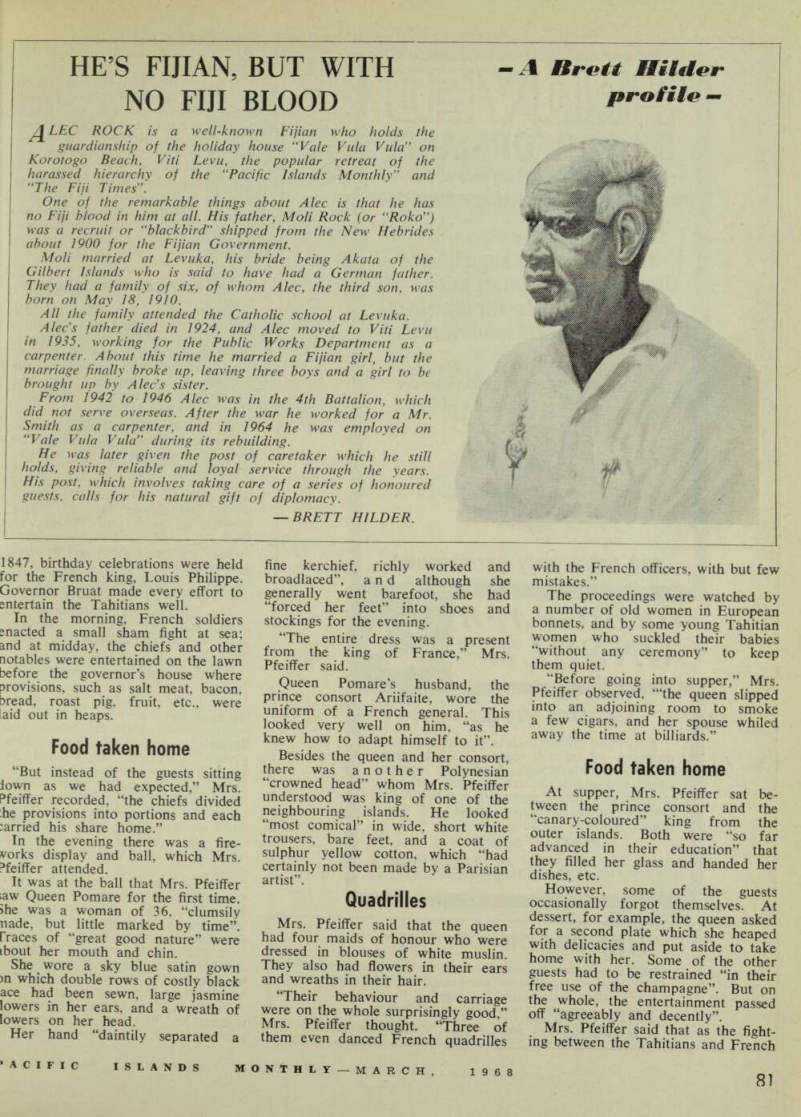 85
85 86
86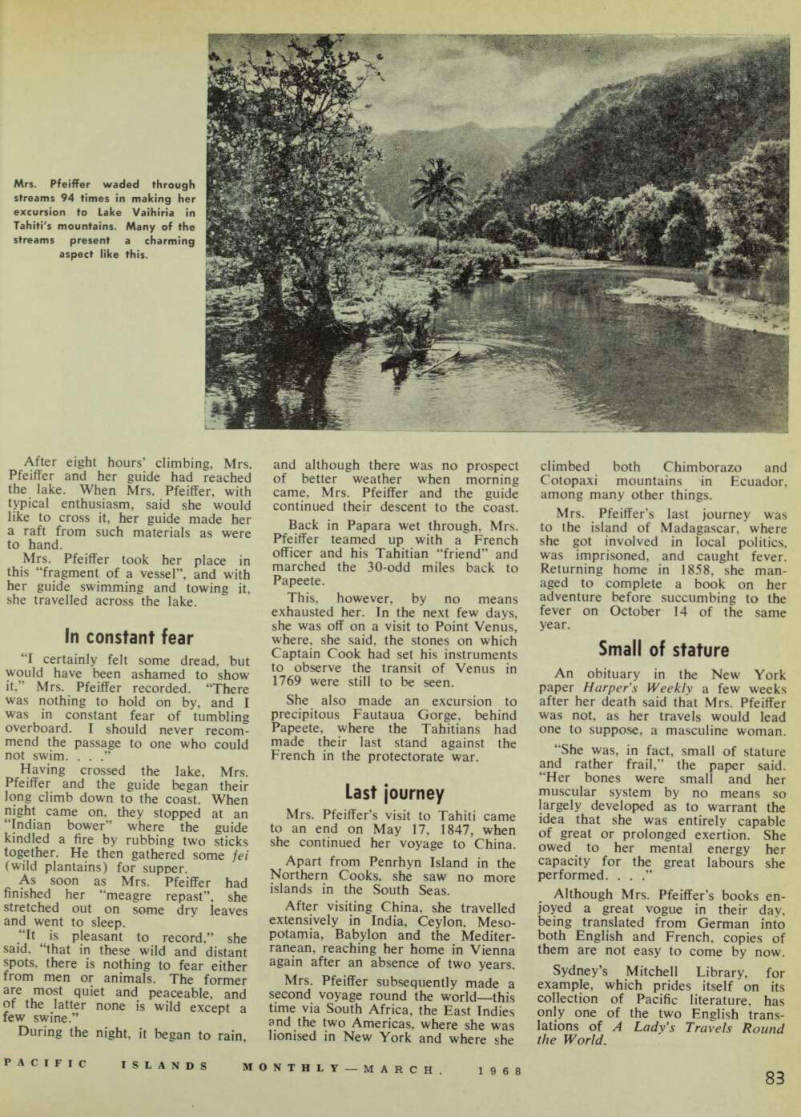 87
87 88
88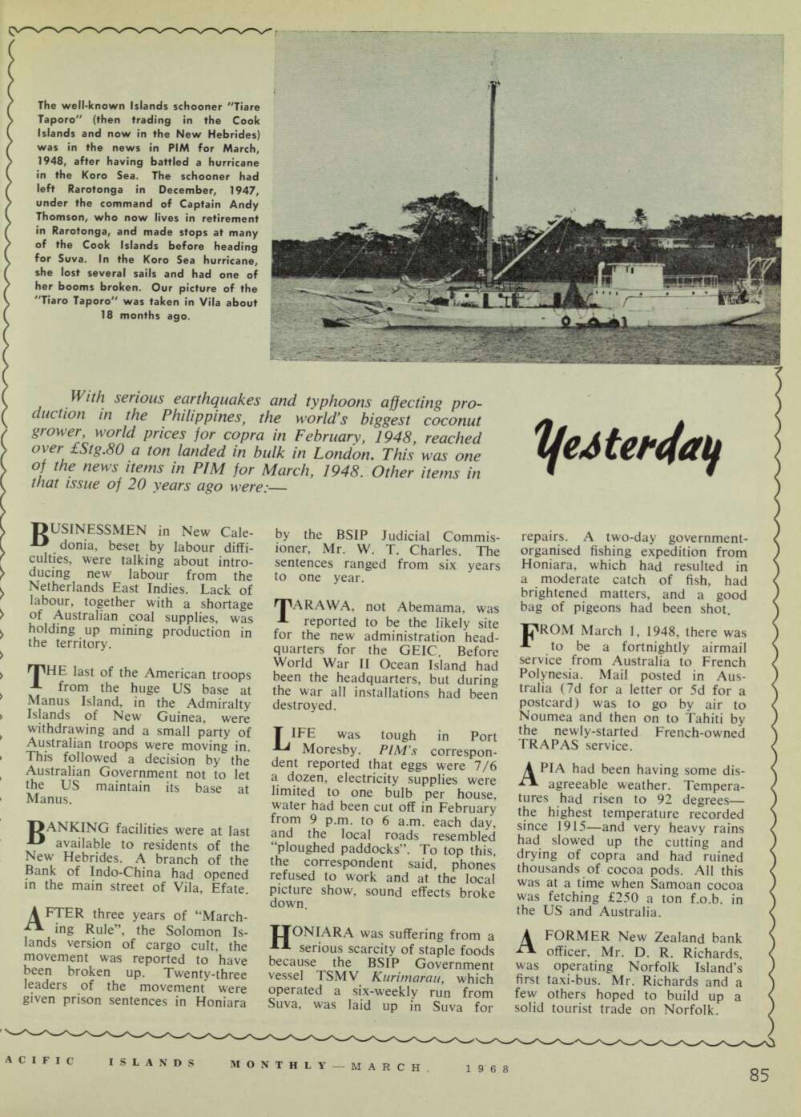 89
89 90
90 91
91 92
92 93
93 94
94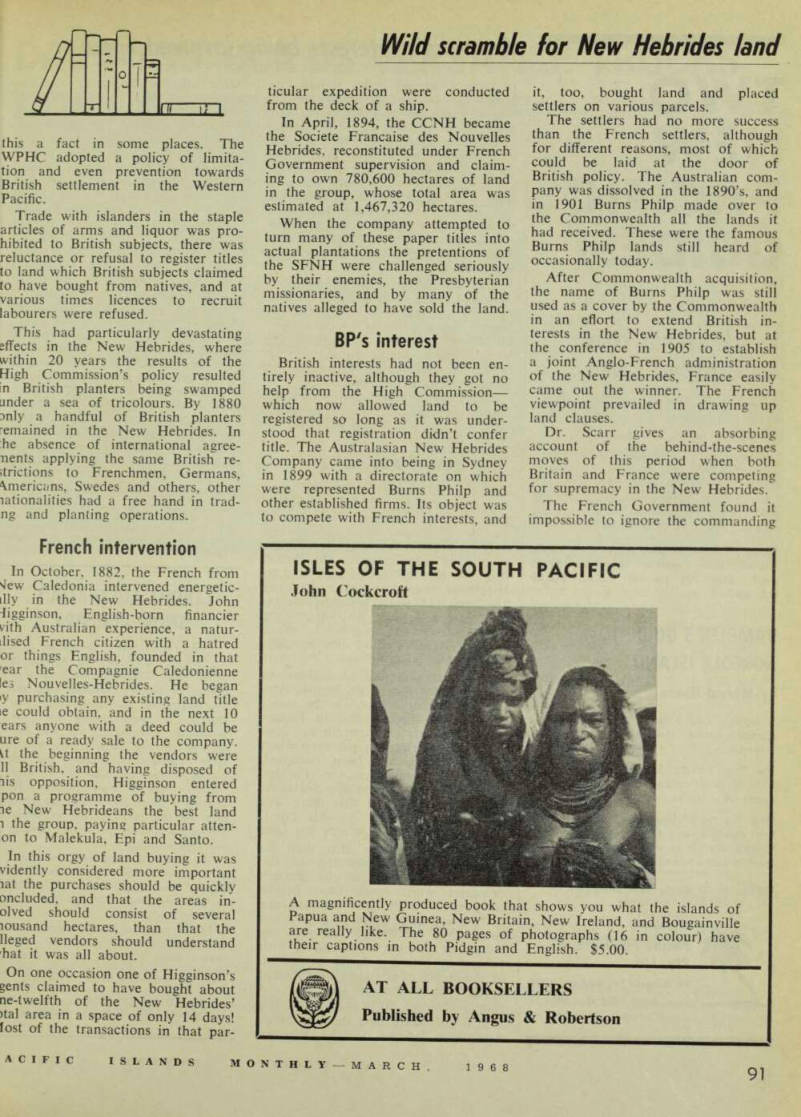 95
95 96
96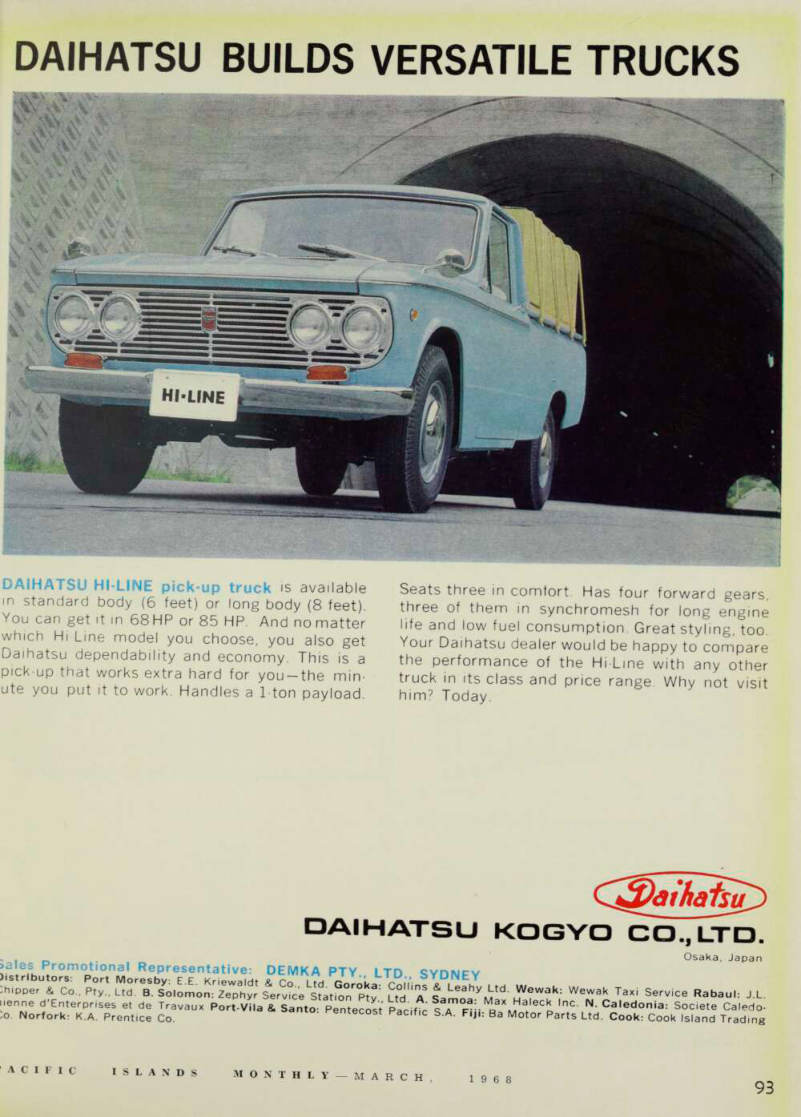 97
97 98
98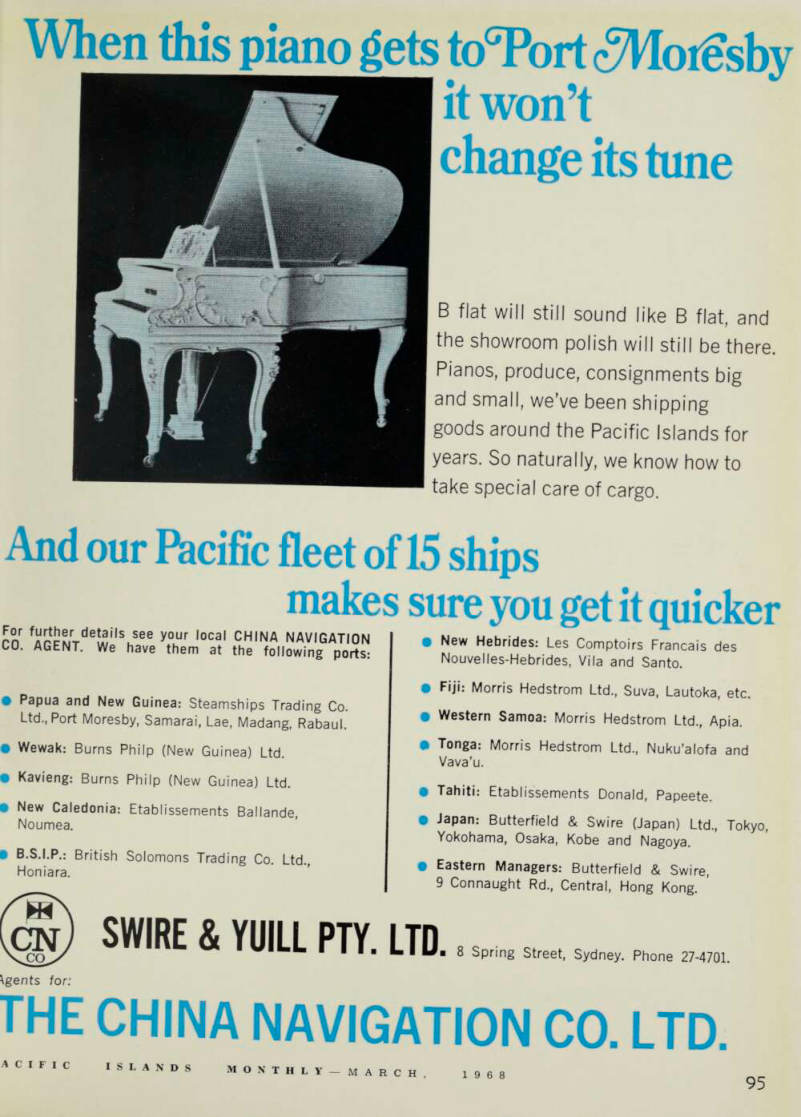 99
99 100
100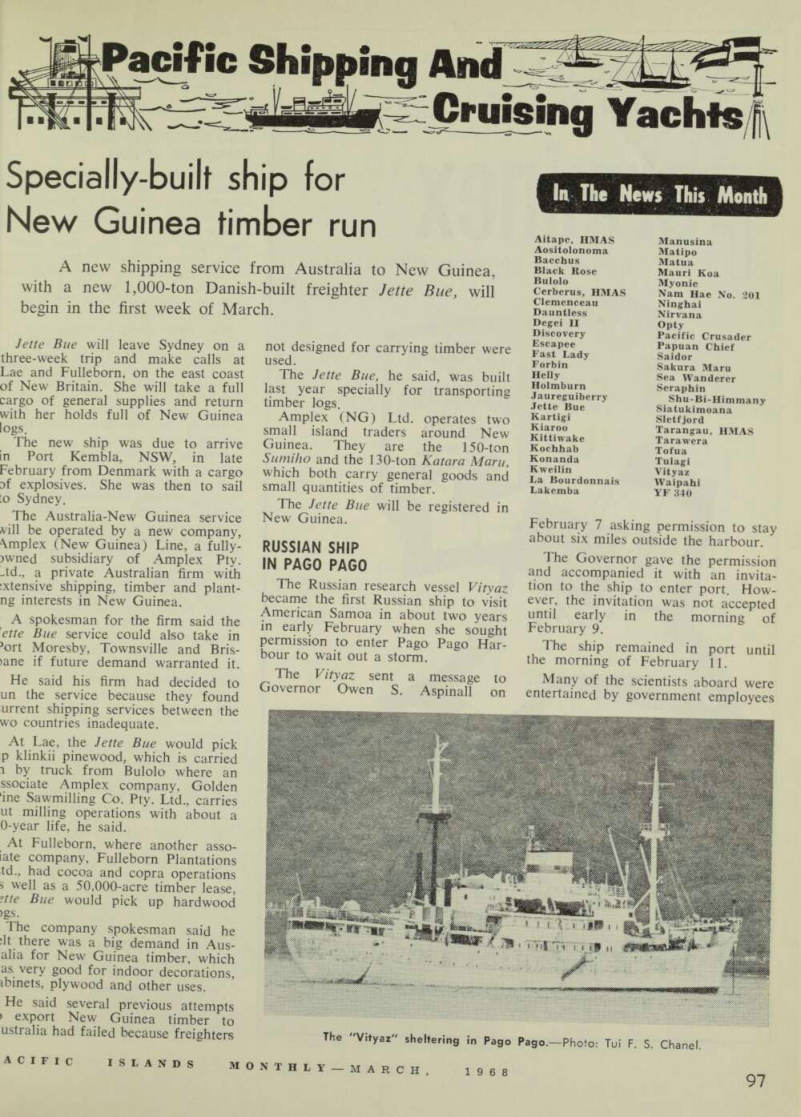 101
101 102
102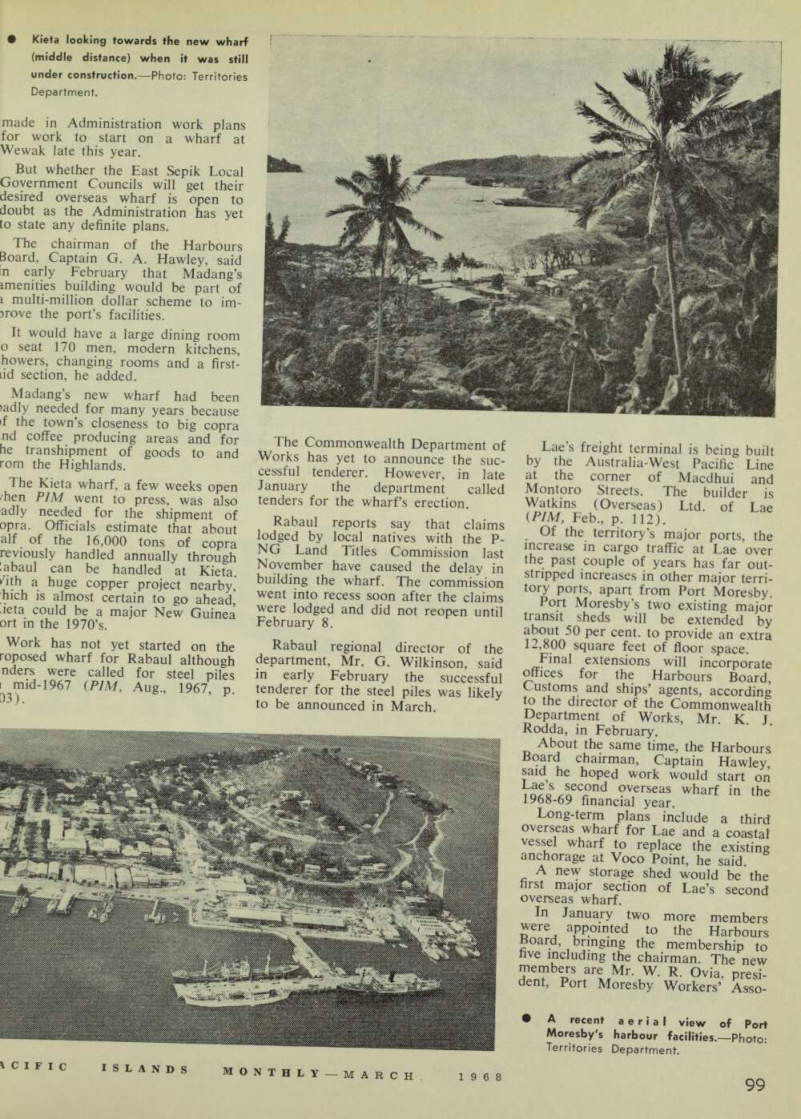 103
103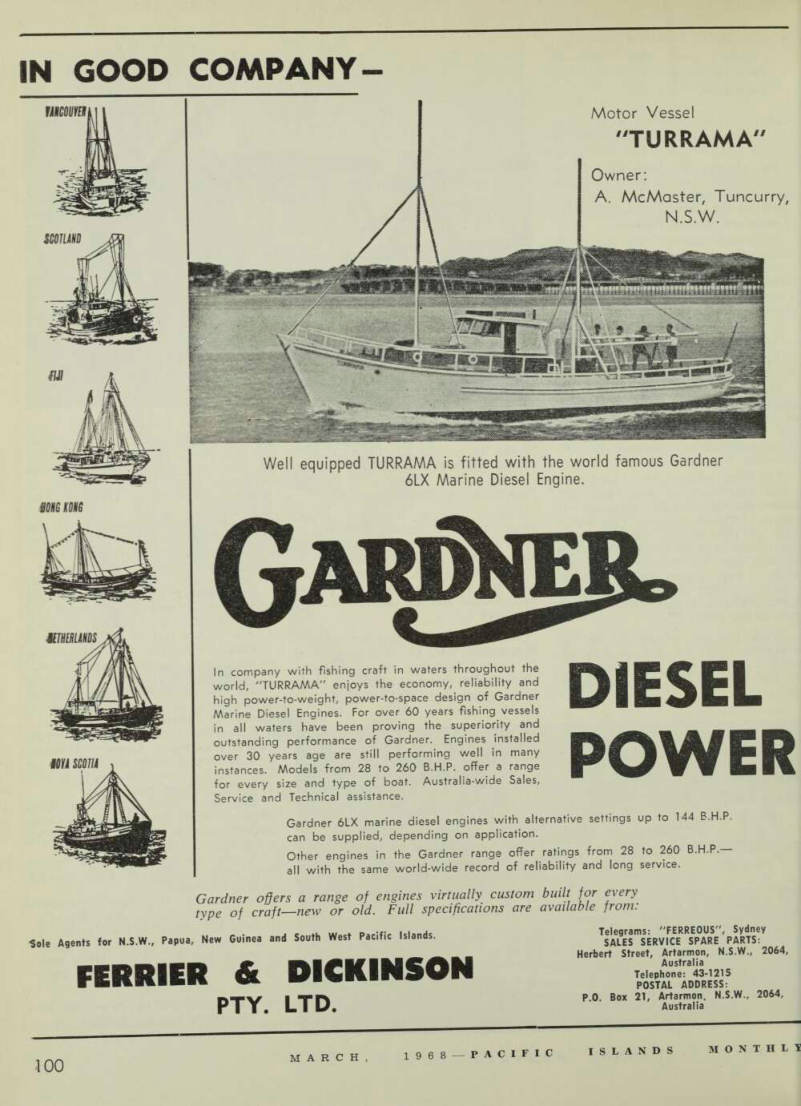 104
104 105
105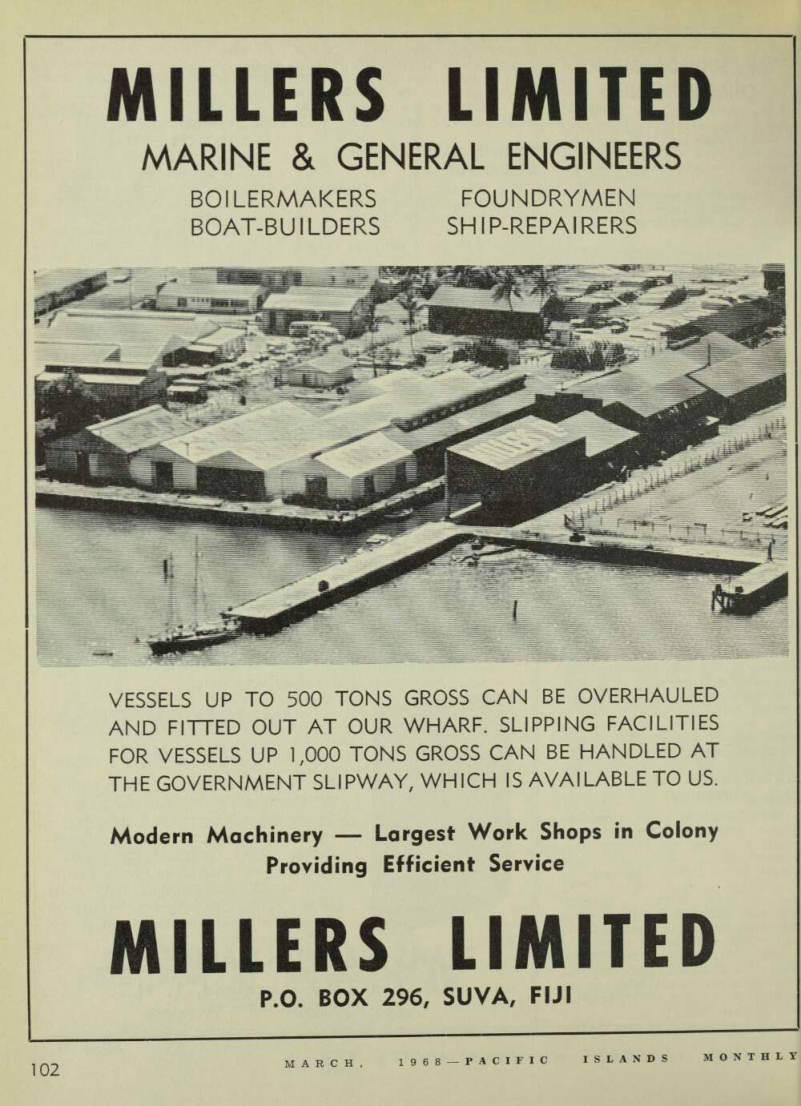 106
106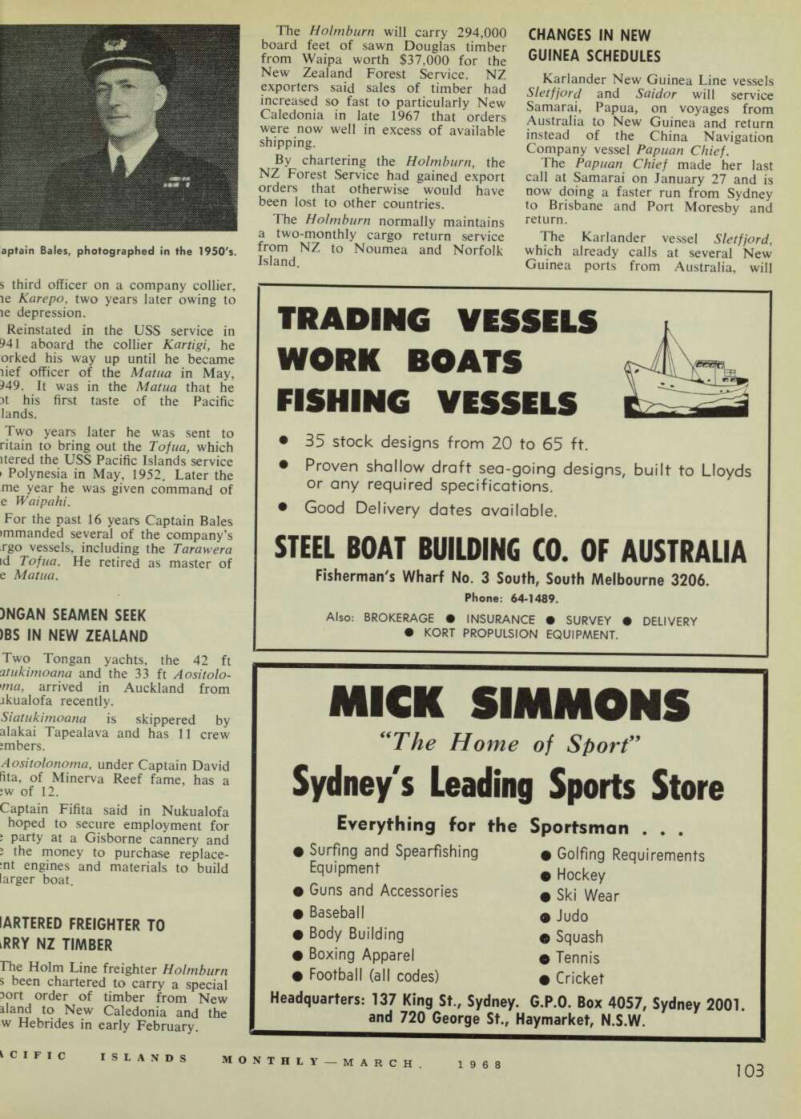 107
107 108
108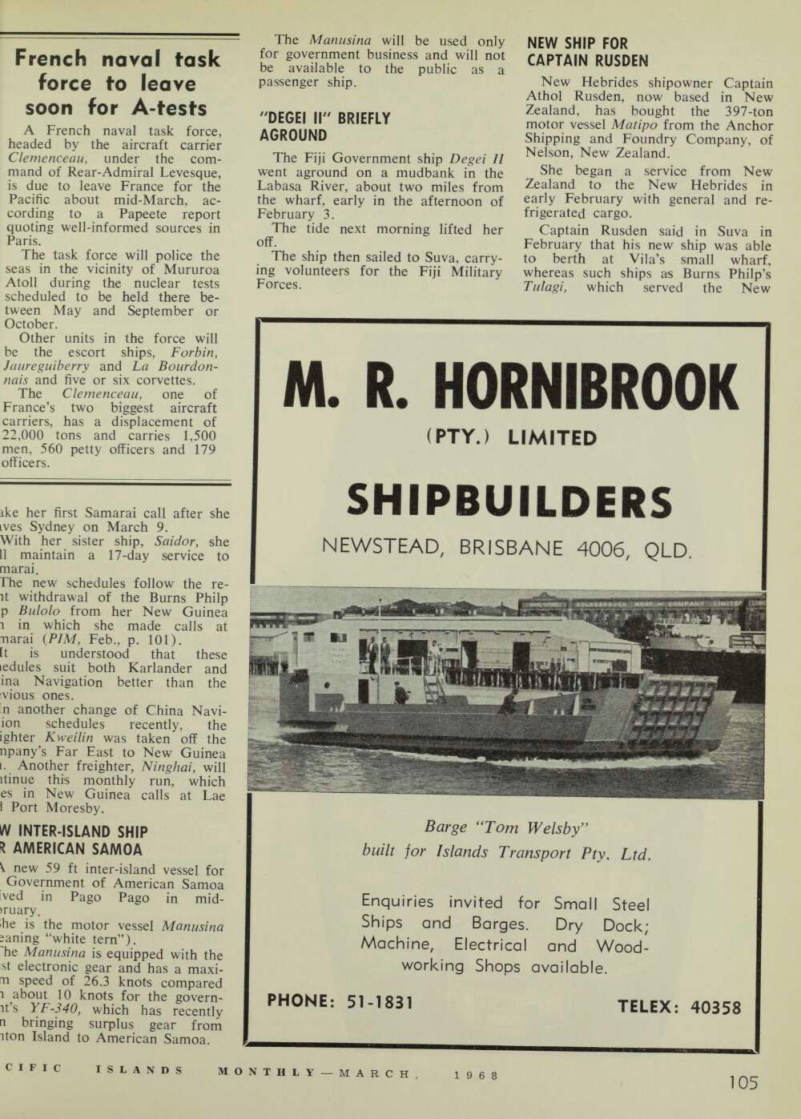 109
109 110
110 111
111 112
112 113
113 114
114 115
115 116
116 117
117 118
118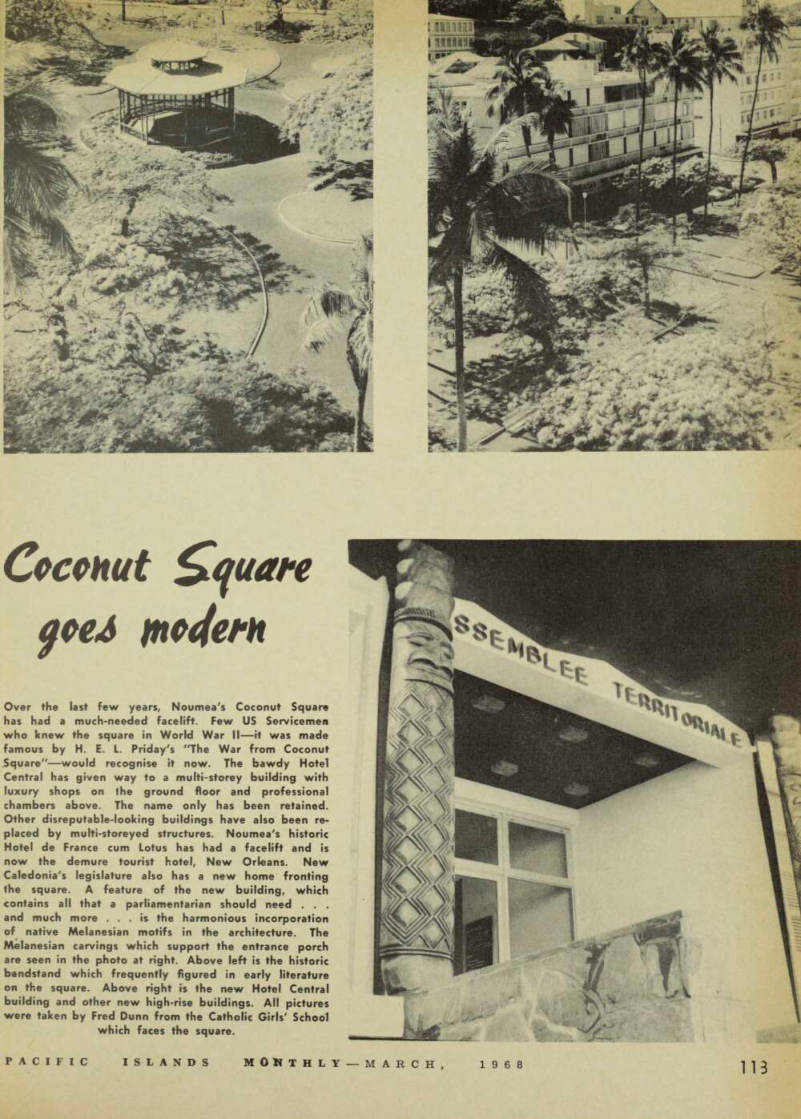 119
119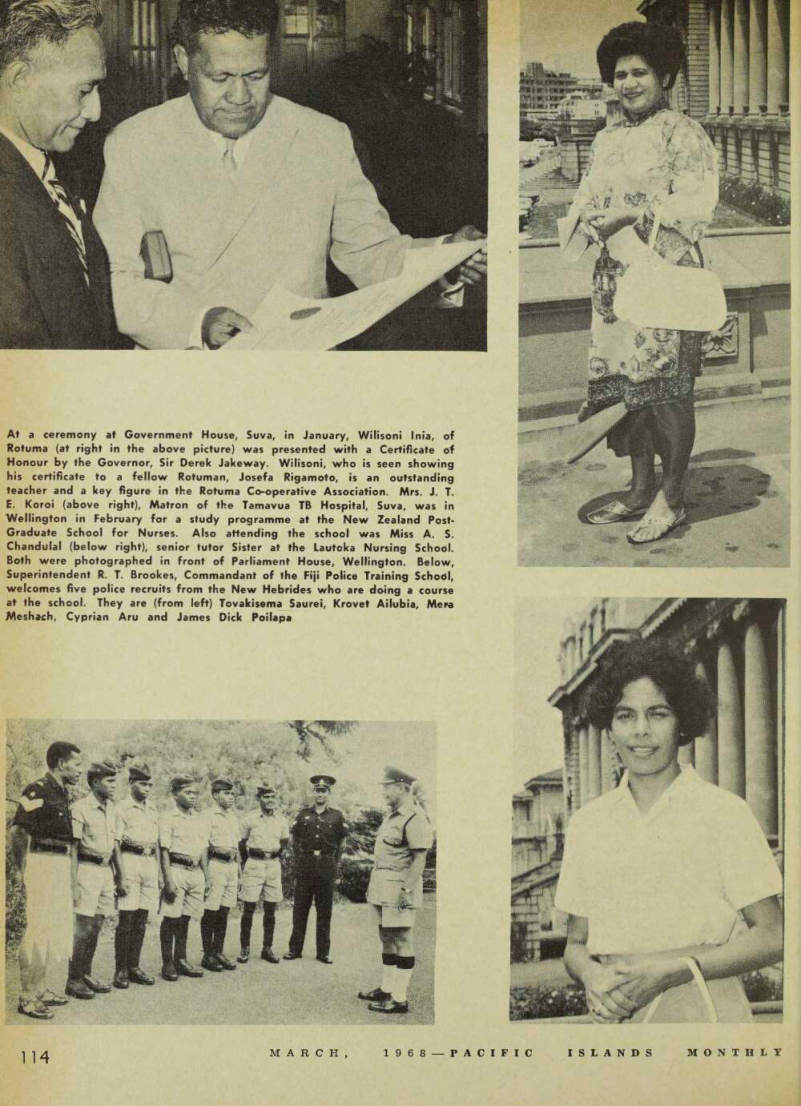 120
120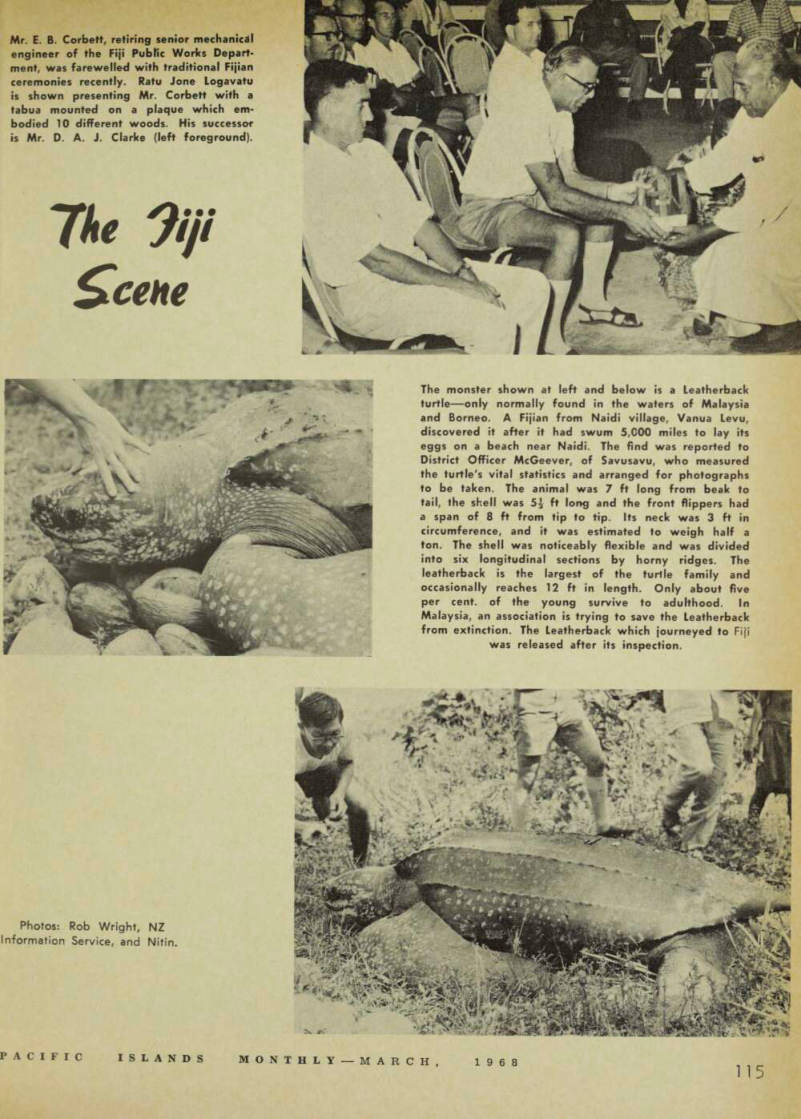 121
121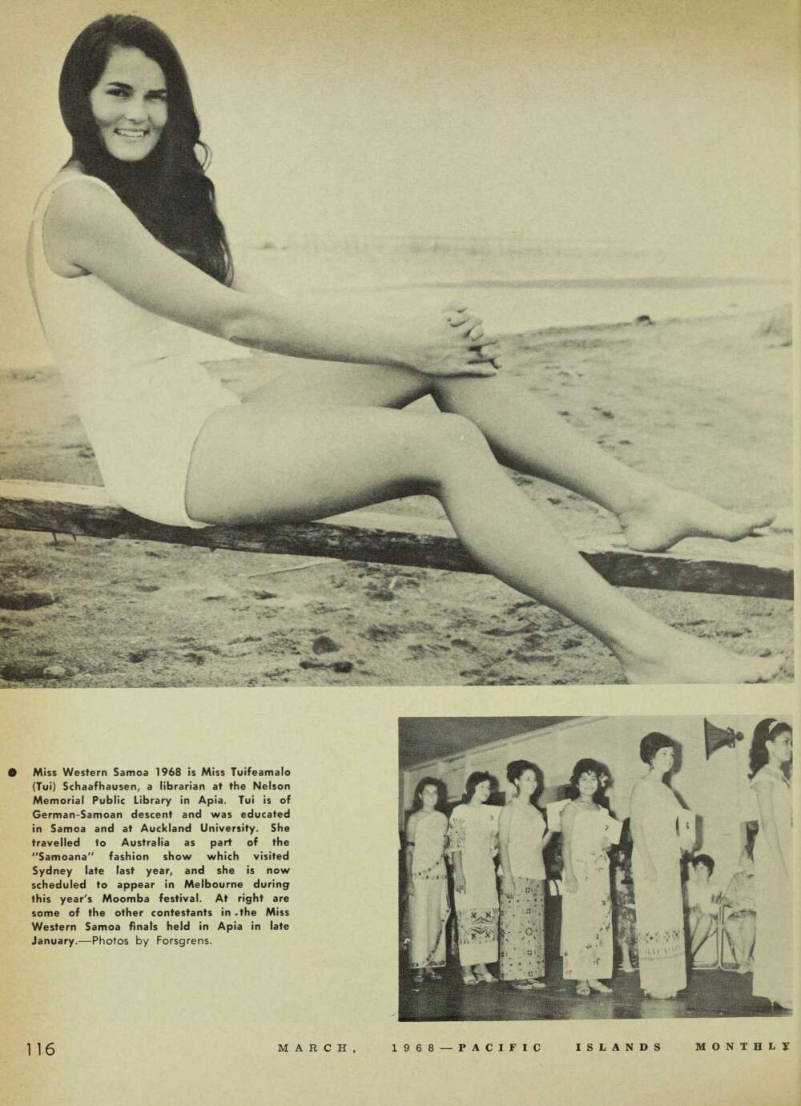 122
122 123
123 124
124 125
125 126
126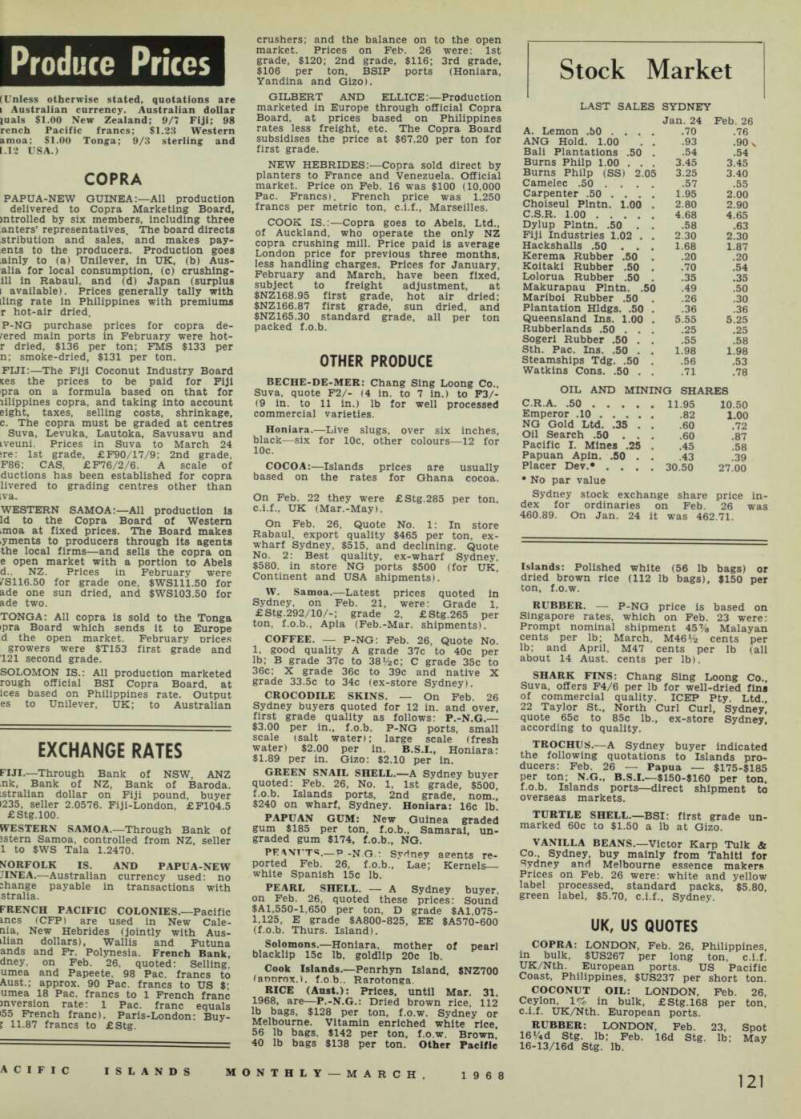 127
127 128
128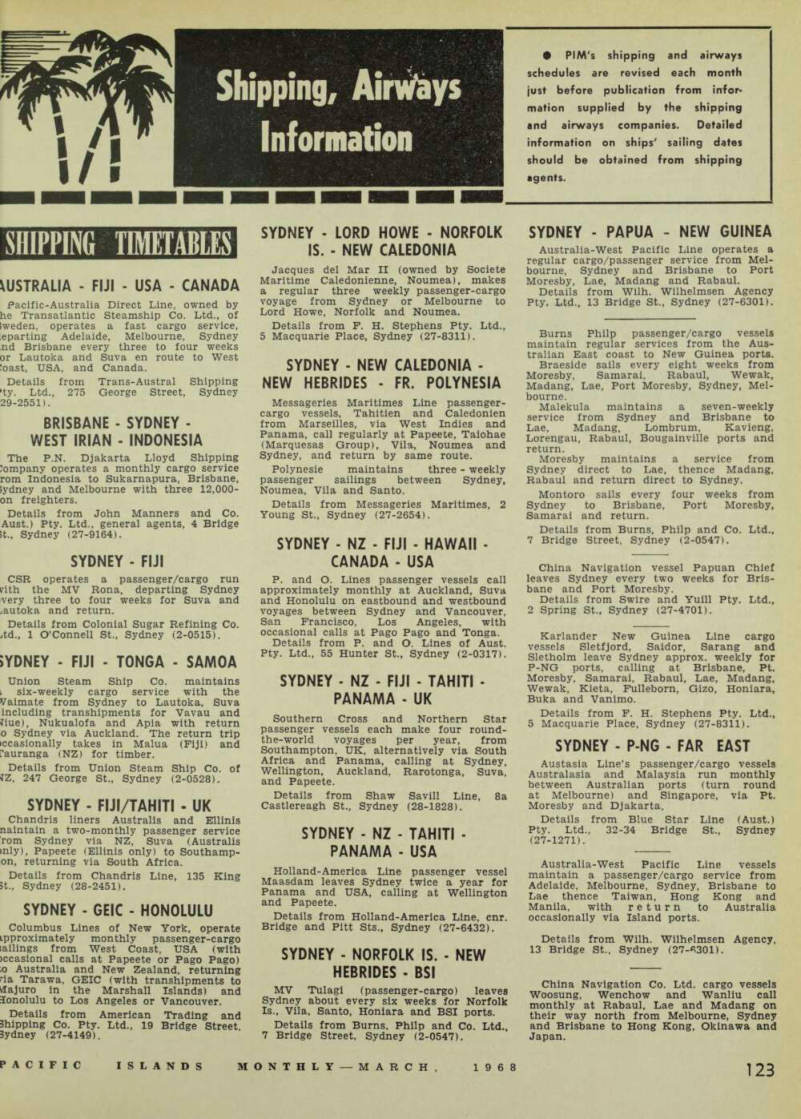 129
129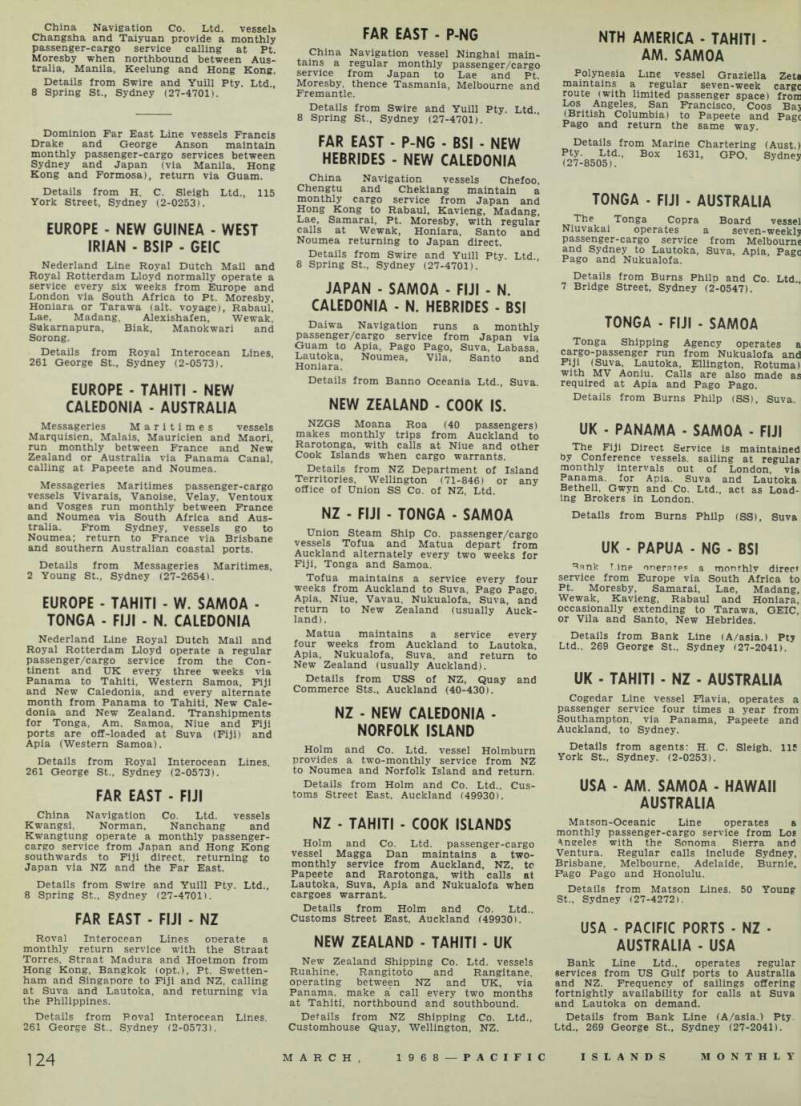 130
130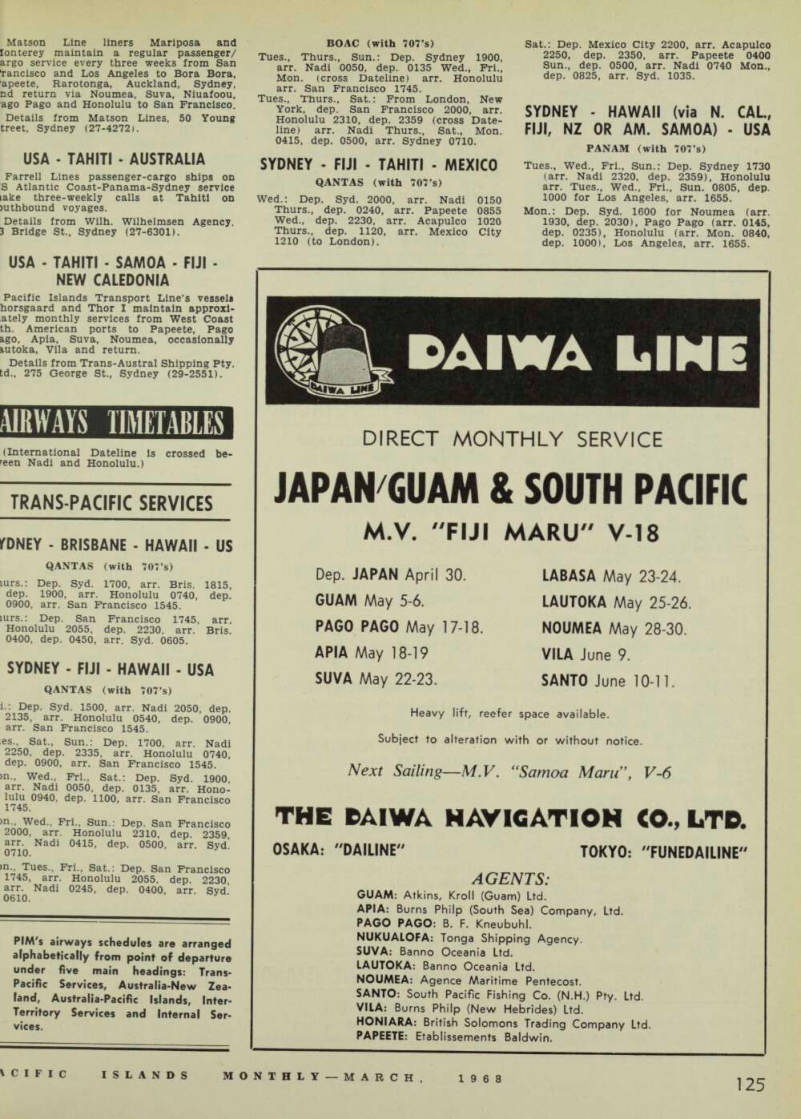 131
131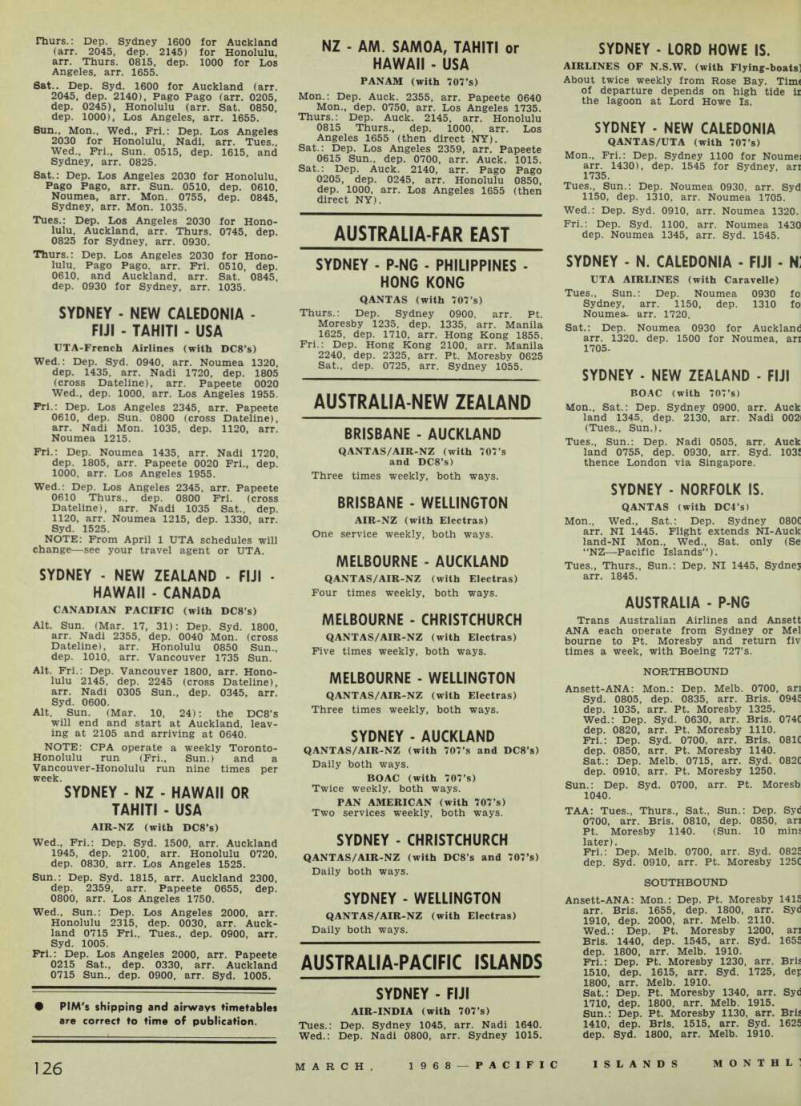 132
132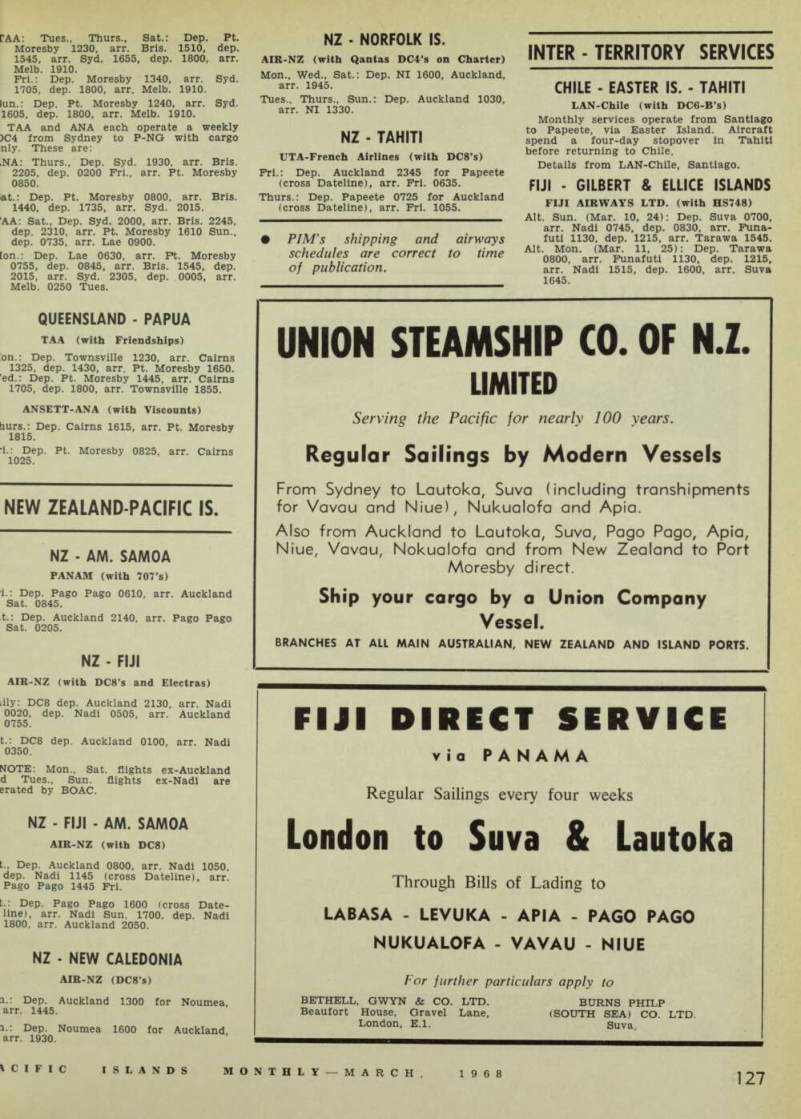 133
133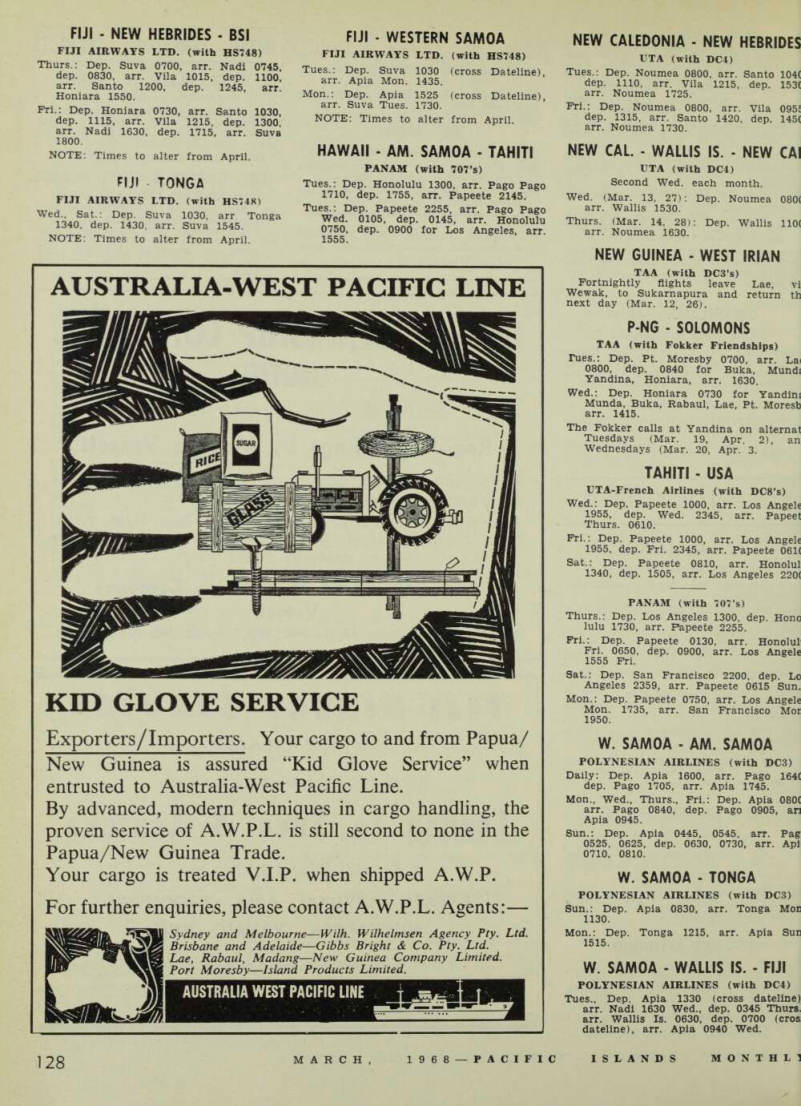 134
134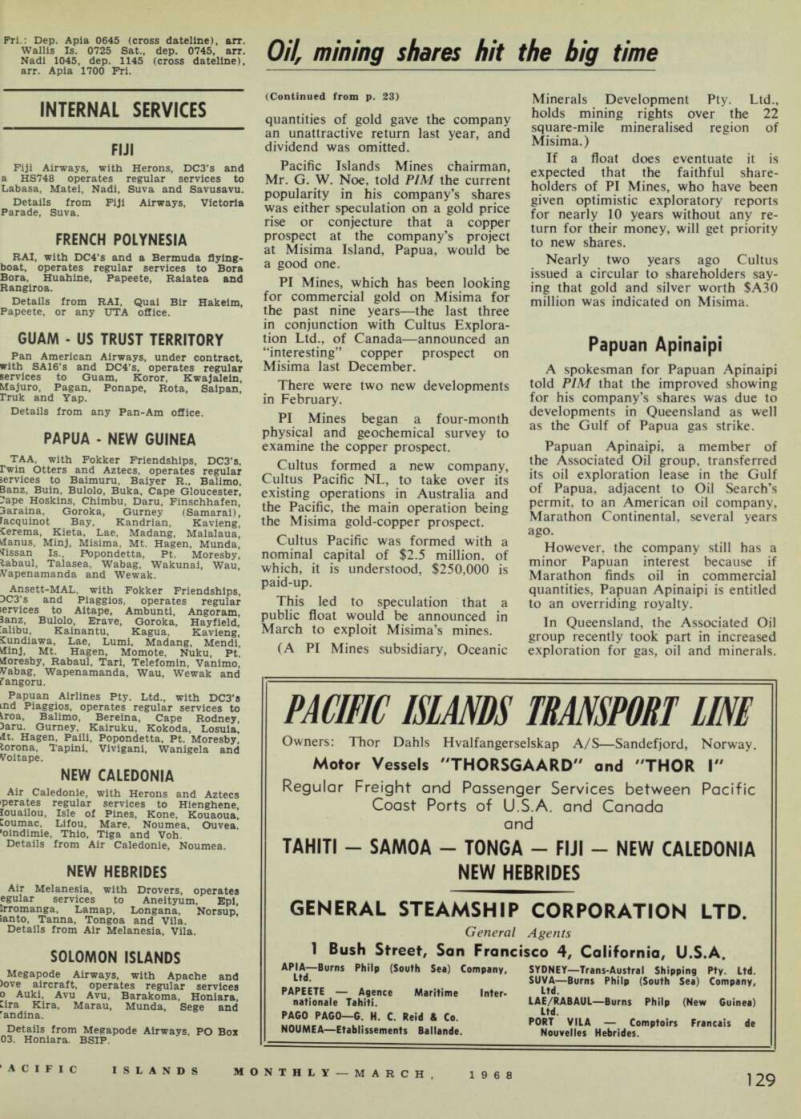 135
135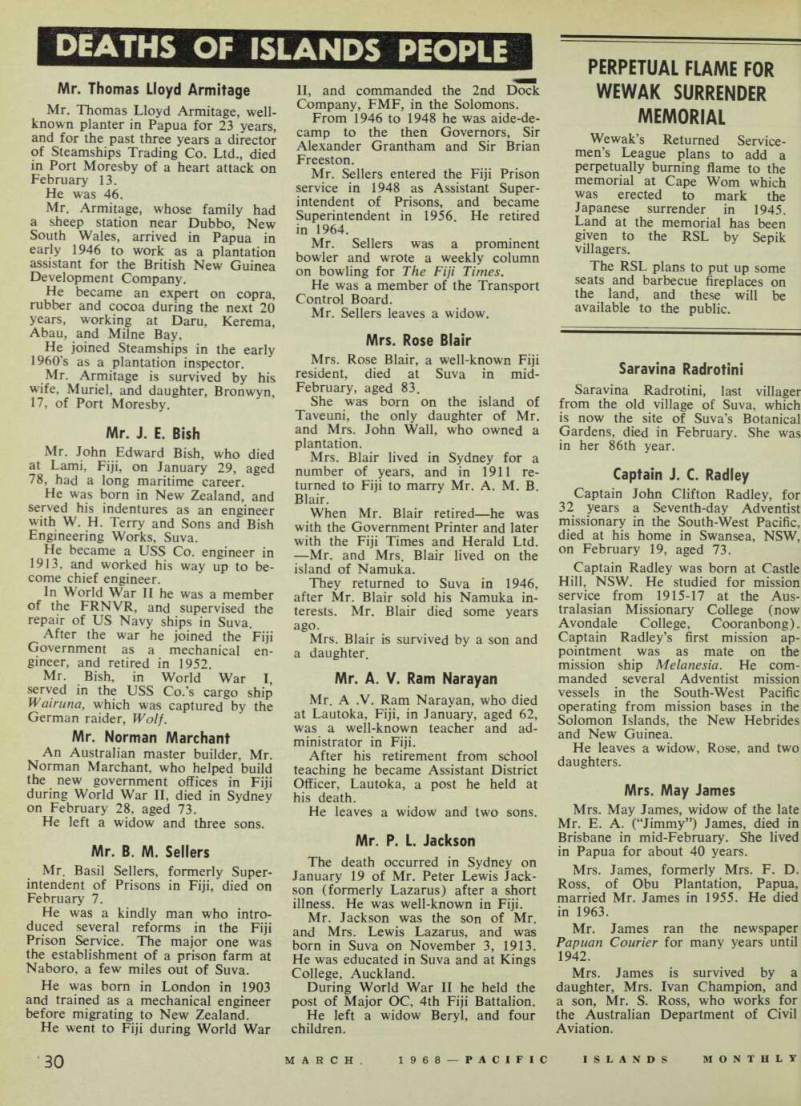 136
136 137
137 138
138 139
139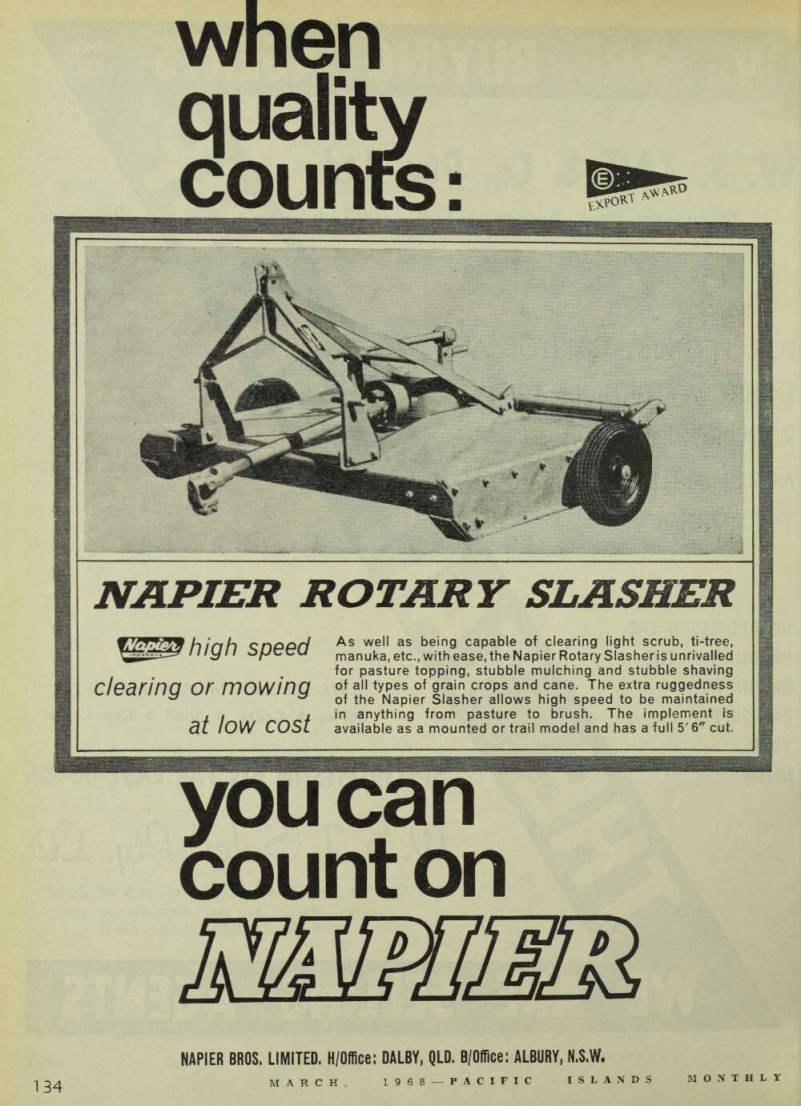 140
140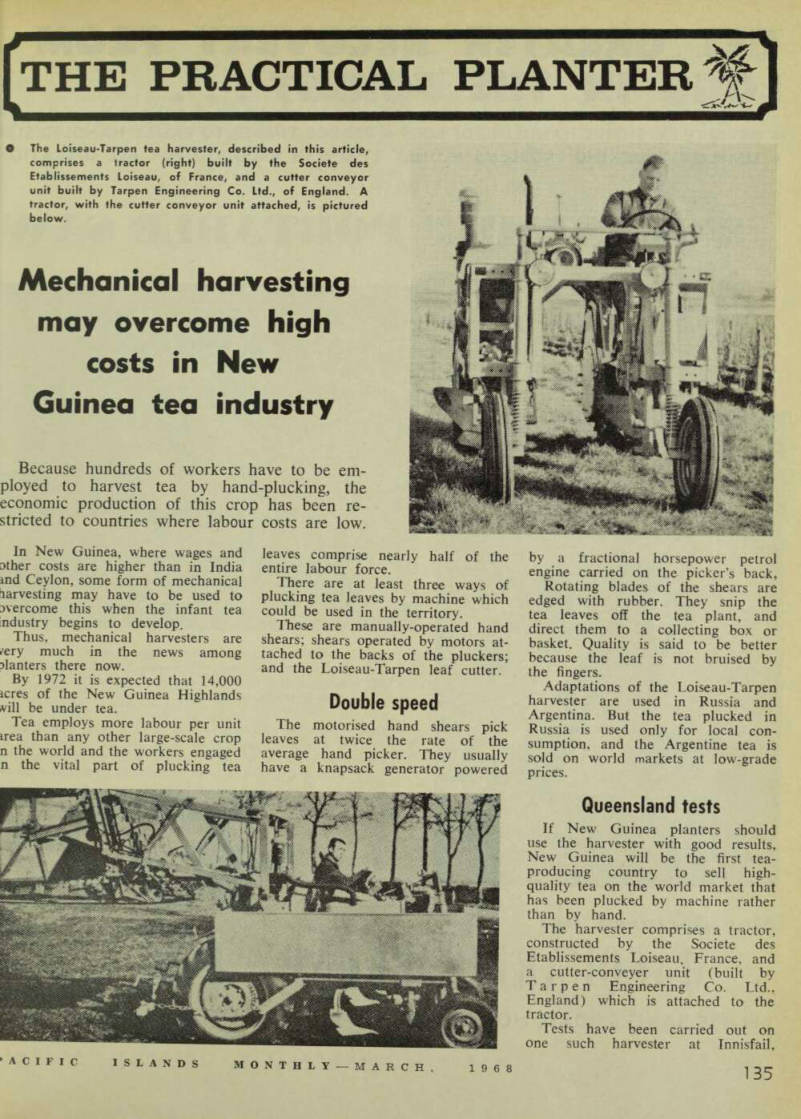 141
141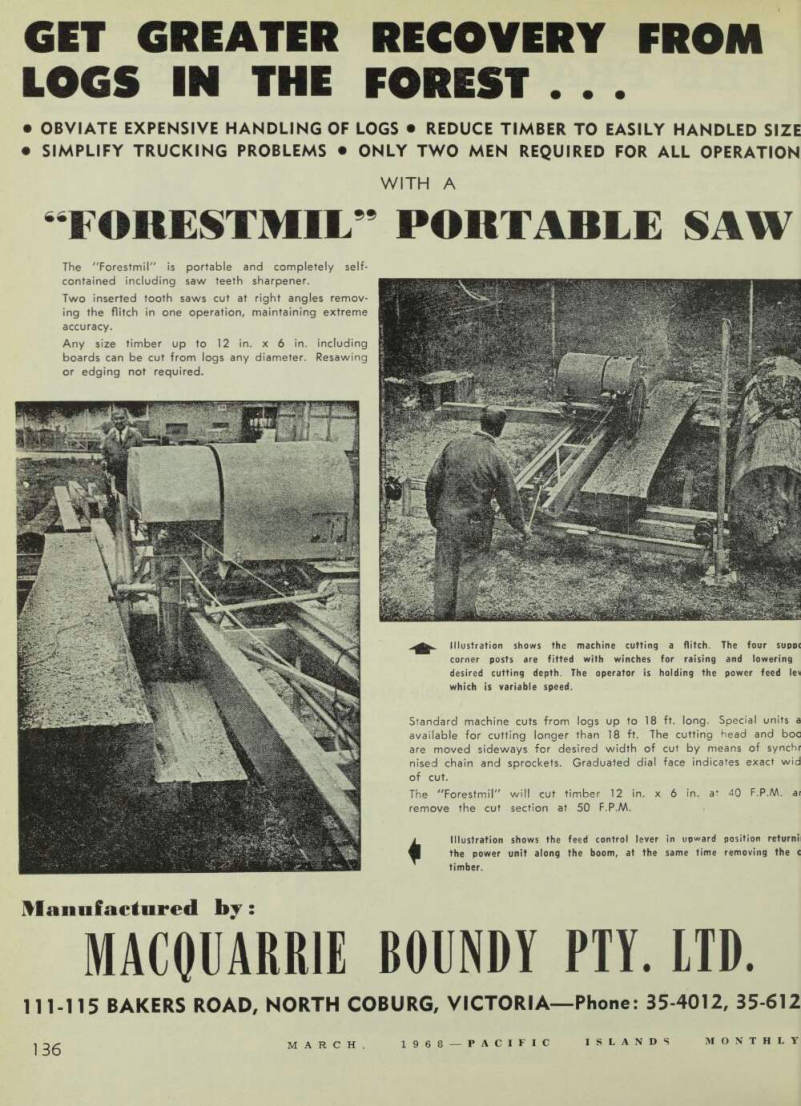 142
142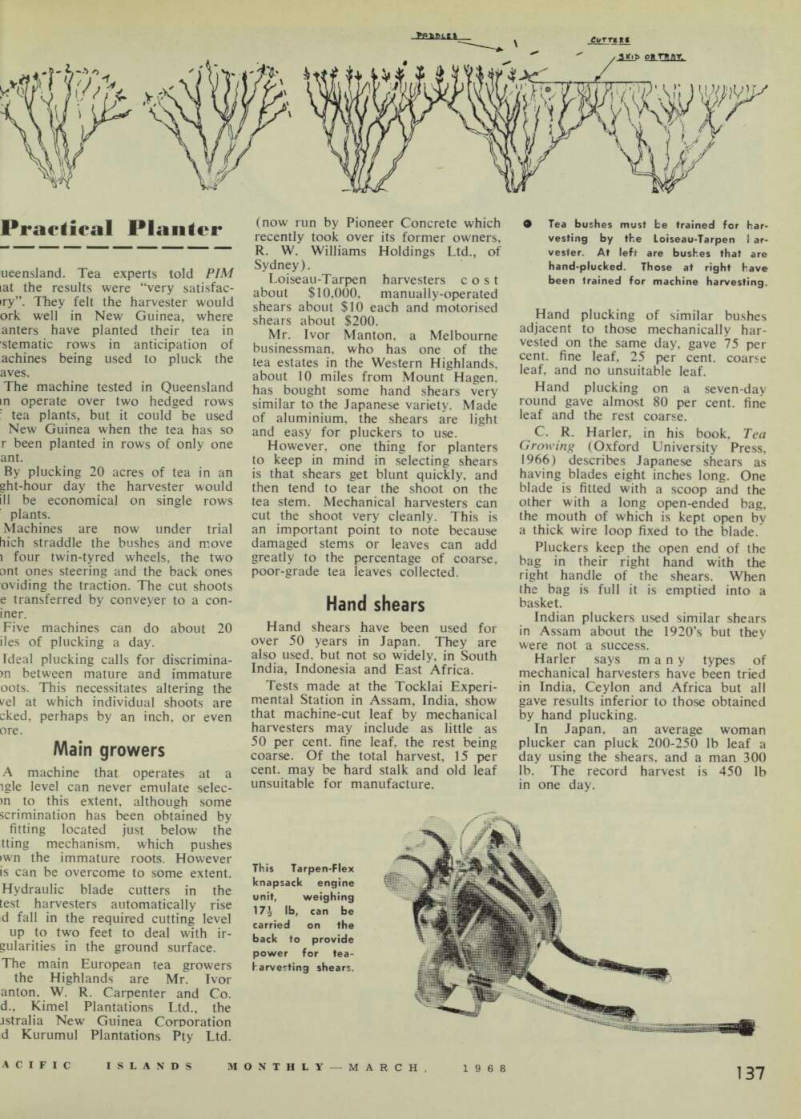 143
143 144
144 145
145 146
146 147
147 148
148 149
149 150
150 151
151 152
152 153
153 154
154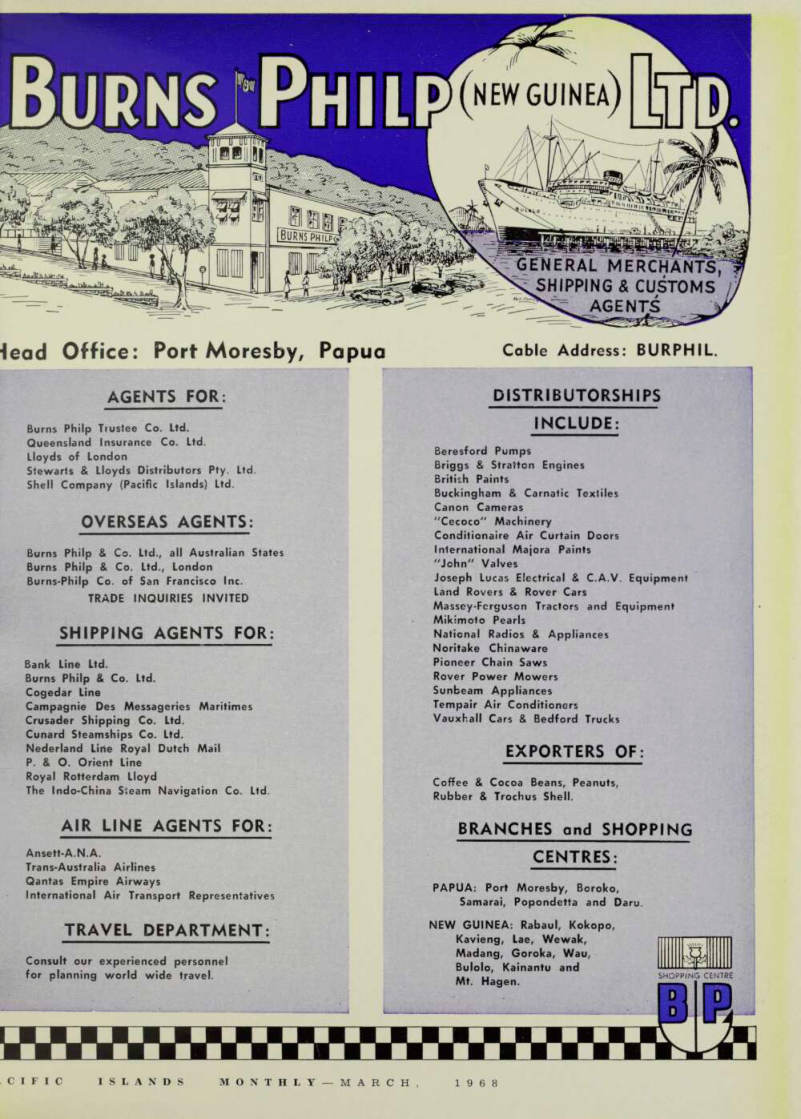 155
155 156
156