Islands
Pacific
Monthly
September, 1951
Vol. XXII. No. 2.
Established 1930.
G P Sydne y> f° r transmission by post as a ]
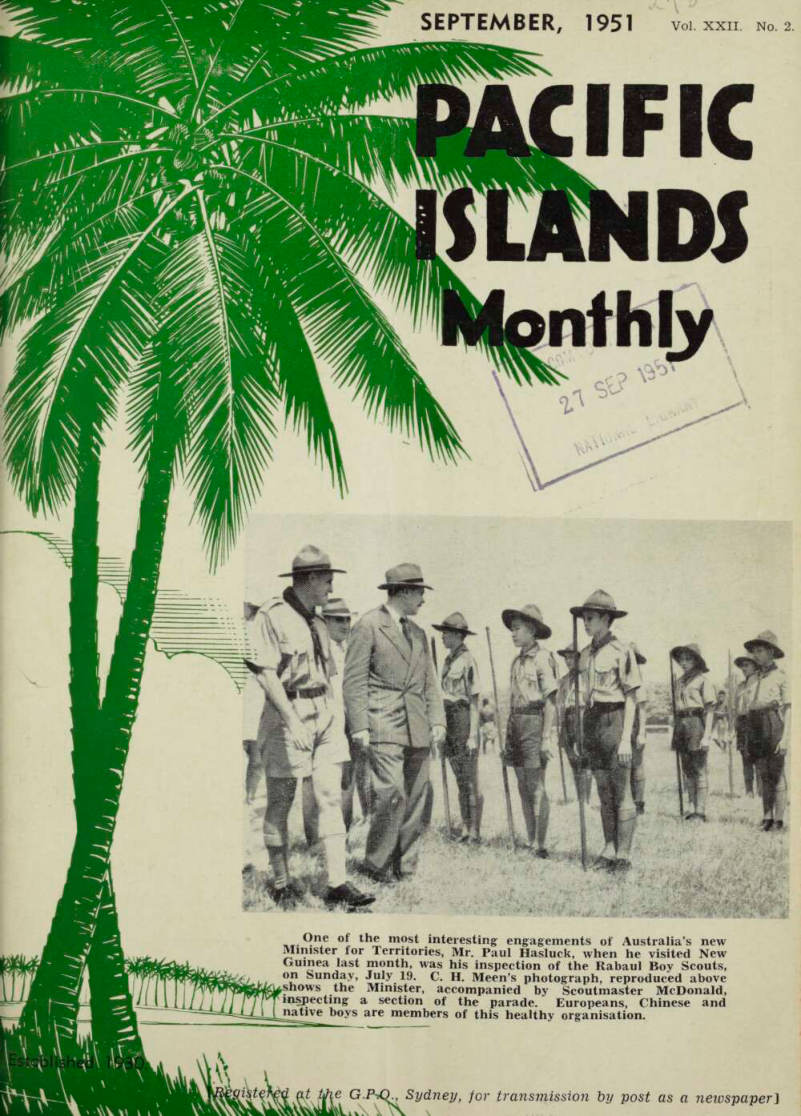
One of the most interesting engagements of Australia’s new Minister for Territories, Mr, Paul Hasluck, when he visited New Guinea last month, was his inspection of the Rabaul Boy Scouts, on Sunday, July 19. C. H. Meen’s photograph, reproduced above .shows the Minister, accompanied by Scoutmaster McDonald, inspecting a section of the parade. Europeans, Chinese and native boys are members of this healthy organisation.
Advertisements & other items, pp. 2-4 (3 items)
bahtas
0 Wa
//iELAJV/J
£A
COK-tVL i*£A
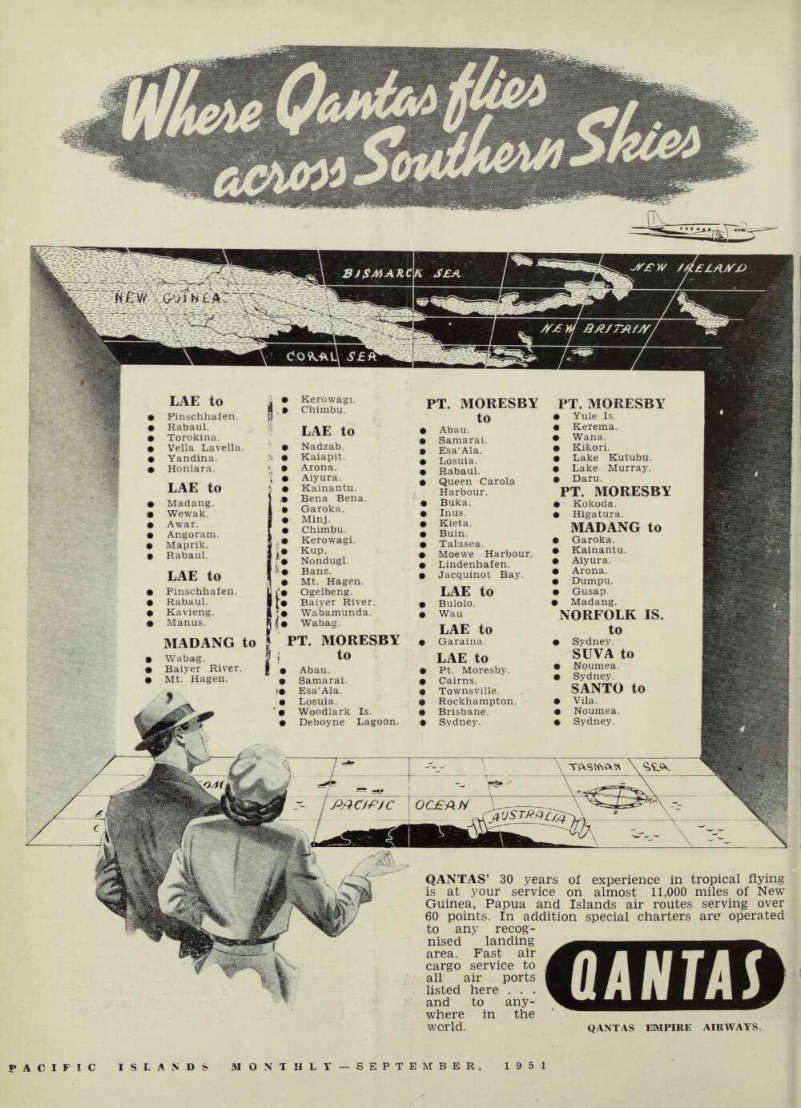
LAE to Finschhafen.
Rabaul.
Torokina.
Vella Lavella Yandina.
Honiara.
LAE to LAE to Manus
MADANG to
Wabag.
Baiyer River.
Mt. Hagen.
PT. MORESBY
to Abau.
Samarai.
Esa’Ala.
Losuia.
Woodlark Is.
Deboyne Lagoon.
OAi 2% tV
PT. MORESBY
to i Abau.
Samarai.
Esa’Ala. i Losuia. i Rabaul. i Queen Carola Harbour. » Buka, i Inus. i Kieta. i Buin. i Talasea.
Moewe Harbour.
Lindenhafen.
Jacquinot Bay.
LAE to Bulolo.
Wau LAE to Garaina.
LAE to i Pt. Moresby.
Cairns.
Townsville.
Rockhampton.
Brisbane, i Sydney.
PT. MORESBY
• Yule Is. • Kerema. » Wana. • Kikori. • Lake Kutubu. ■ Lake Murray. » Daru.
PT. MORESBY
• Kokoda. » Hlgatura.
MADANG to
» Garoka. • Kainantu. » Aiyura. » Arena. » Dumpu. » Gusap. > Madang.
NORFOLK IS.
to » Sydney.
SUVA to • Noumea. • Sydney.
SANTO to
• Vila. • Noumea. • Sydney.
OC£AN
QANTAS’ 30 years of experience in tropical flying is at your service on almost 11,000 miles of New Guinea, Papua and Islands air routes serving over 60 points. In addition special charters are operated to any recognised landing area. Fast air cargo service to all air ports listed here . . . and to anywhere in the world.
bahtas
QANTAS EMPIRE AIRWAYS.
rniEMAN TARIF IAMPt
ARE DESIGNED
TO BURN
SAFELY IN
ANY POSITION
AND AT
ANY ANGLE
”5u5« •• /if Mk.-^ ■HOk. ■ m m sm
THEY CANNOT SPILL FUEL
IF ACCIDENTALLY OVERTURNED
Children can be left with a lighted Coleman Table Lamp without any cause for anxiety. For these lamps, which give a brilliant almost daylight light, are designed to burn safely in any position at any angle ; they cannot spill fuel if
accidentally overturned.
Coleman Table Lamps are 20 times as powerful as ordinary kerosene lamps and seven times as powerful as household electric bulbs.
They have two mantles, are 300 c.p. and the fuel capacity is sufficient for 12 hours of abundant eye-saving light.
Finished in ivory enamel, with decorated plastic-coated parchment shade, heat-resisting globes, the lamp is a furnishing as well as a utility.
NO ODOUR . . . NO SMOKE
54a PITT STREET
SYDNEY
ROBERT GILLESPIE P T JLTP
NO WORRY
PEARCE & CO. LTD.
SUVA
FOR FIJI ISLANDS
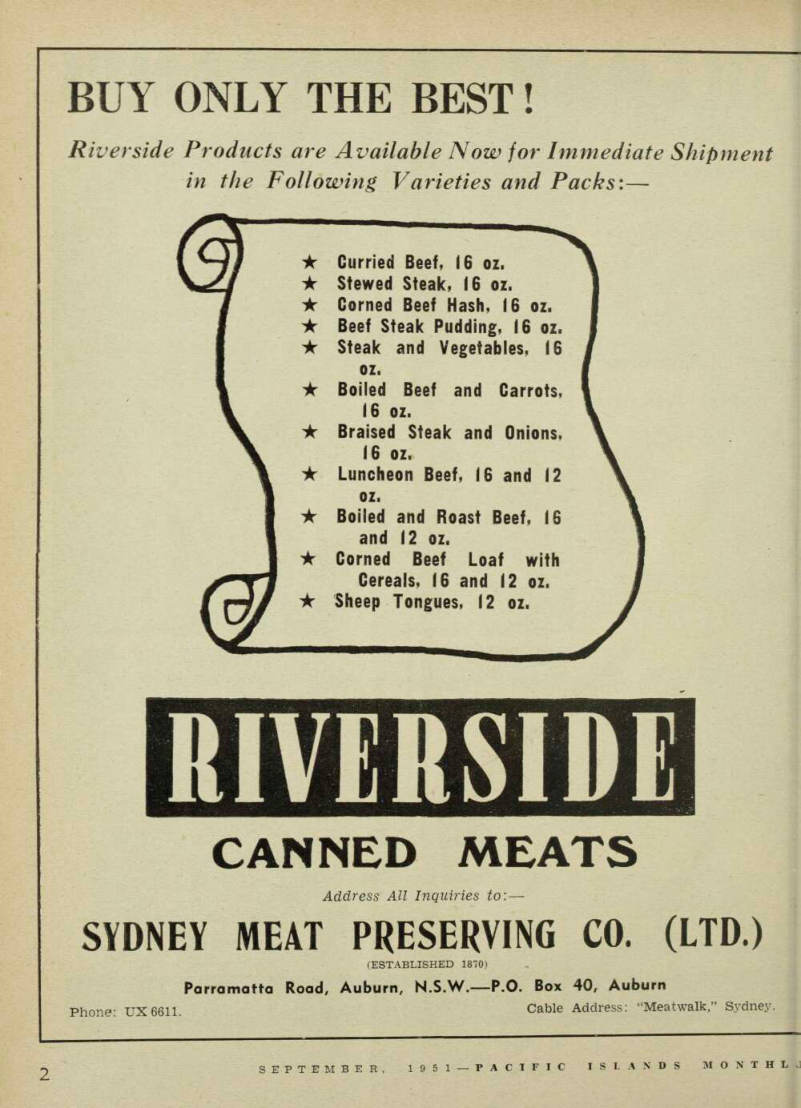
BUY ONLY THE BEST!
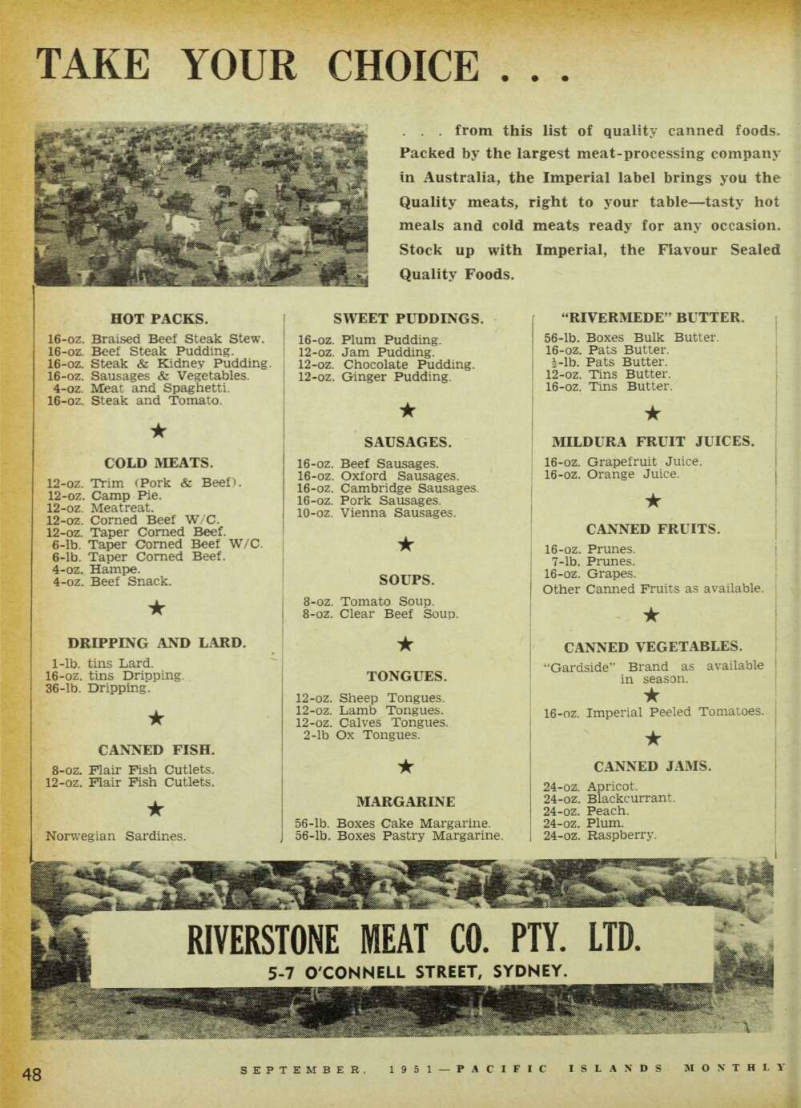
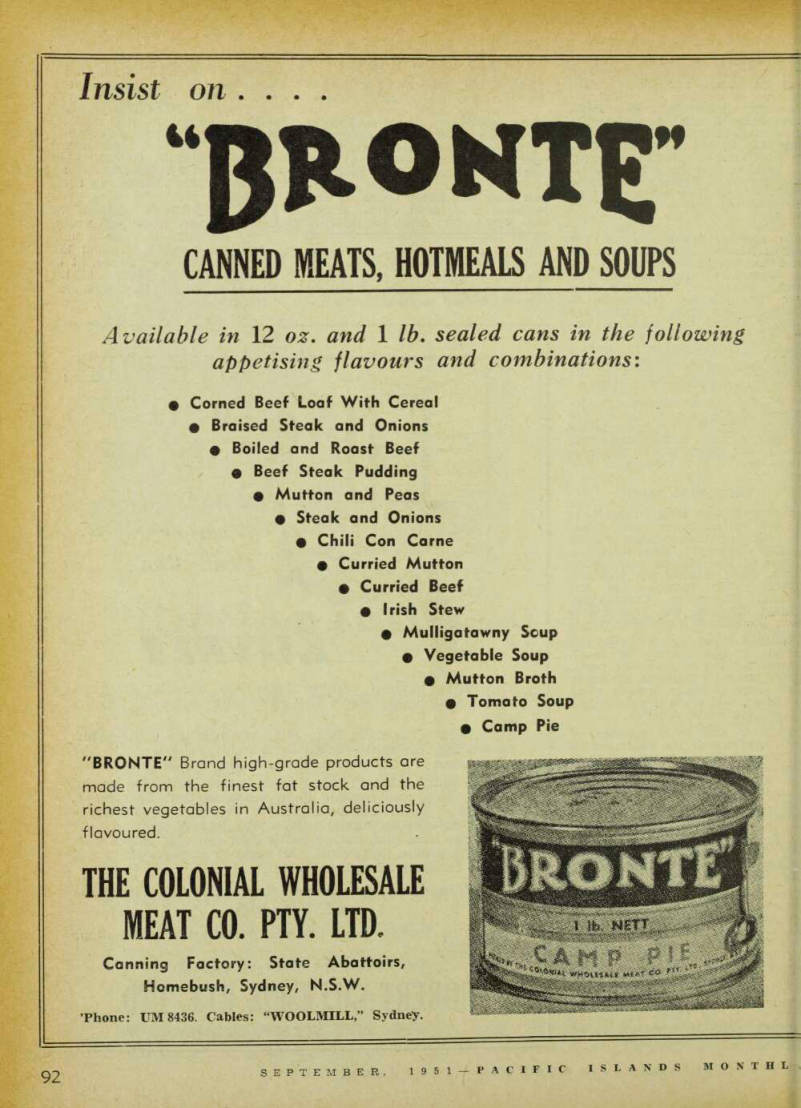
Riverside Products are Available Now for Immediate Shipment in the Following Varieties and Packs: — Curried Beef, 16 oz.
Stewed Steak, 16 oz.
Corned Beef Hash, 16 oz.
Beef Steak Pudding, 16 oz.
Steak and Vegetables, 16 oz.
Boiled Beef and Carrots, 16 oz.
Braised Steak and Onions. 16 oz.
Luncheon Beef, 16 and 12 oz.
Boiled and Roast Beef, 16 and 12 oz.
Corned Beef Loaf with Cereals, 16 and 12 oz.
Sheep Tongues, 12 oz.
RIVERSIDE
CANNED MEATS
Address All Inquiries to: —
SYDNEY MEAT PRESERVING CO. (LTD.)
(ESTABLISHED 1870)
Parramatta Road, Auburn, N.S.W.—P.O. Box 40, Auburn Phone: UX6611. Cable Address: “Meatwalk,” Sydney.
1
CIFIC ISLANDS MONTHLY SEPTEMBER, 1951
September, 1951 Pacific Islands Monthl
[McConnell . . 21
Index To Advertisers
Achun, Gabriel 109 “Akta-Vite” . 113 Aladdin Lamps 112 Alois Akun . 110 Aluminium Ltd. 40 Amplion (A/siai 35 Angus & Robert i son Ltd. ... 17 Ardath Tobacco 83
pAspaxadrene’’ 123
P'Aspro” ... 97 Bank of NSW . 70 Bell, S. P. & Co. 20
pßellhaven” . 107
Berger Paints . 58 Berry’s B. B’y’d. 109 Be thell, Gwyn 106 Blaxland Rae . 103 Blundell Spence 76 8.0.A.C. ... 107 Borthwicks Pty. 101 Bovril Ltd. . . 59 Brasso Polish . 73 Bray & Holliday 116 Brisbane Motors 99
Bristol-Myers 39
Broomfields Ltd. 98 Brunton & Co. . 77 Bunting’s . 46. 89
B.P. )Ng» ... 69
B.P. iNHi ... 45
B.P. (Ss* ... 38
B.P. Trust . , 114 Butterfly Supply 73 Paine’s Studios 53 Carpenter, W. R. [ & Co. Ltd. 96. iv.
Carpenter & Co.
[ i Fiji) Ltd. . 87
classified . . 125-7 Colonial Meat . 92 Colyer Watson [ (NG) . . 27, 43 Commonwealth ; Bank . . . 124 Crammond’s . . 36 Cunningham, R.
H. Ltd. . . 117 f'Cystex” ... 93 Daken Corp’n 115 Dangar, Gedye & Malloch . 3, 108 Dettol ... 122 Donaghy & Sons 42 Donald Ltd. 78. 94 Douglass. W. C. 37 Dunlop Rubber 19 Et. Donald . . 86 Excelsior Supply 49 Pord Sherington 38 Pr. Ch. of Com. 103 [Jarrett L D. & M.
Ltd 128 Sarrick Hotel . 50 Jilbey. W. & A. 78 jillespie Bros. . 45 [Jillespie. Robt. : Ltd. . . 1. 23, 91 Sillespie, Robt. (NG) . . 55, 102 [Jordon’s Gin . 86 Sough & Co. . 31 J.P.H. (Suva) . 4 Sregory Ltd. . . 83 Jrove, W. H. & I Sons ... 25, 71 1. & R. Pty. 24 lalvorsen Sons 106 lardman & Hall 15 Jeinz & Co. Ltd. 42 ierco Pty. . 41. 74 lolland Rusk . 113 lorlicks Ltd. . 44 lumphreys &
[McConnell . . 21
lygeia Co. . . 82 fytest Products 120 lndustries 34 s. Electric Co. 57 Cennedy, Capt. 109
Kerr Bros. Ltd. 35 Kerrv. M. Pty. 24 Kodak: lA'sia) . 16 Kolynos, Inc. . 20 Kopsen & Co. . 79 Kraft Walker . 51 Leondes. A. . . 81 Lillis & Co. . . 84 Macintyre. T. . 94 Mac Robertsons 32 McCarthy, J. R., Co 26 Mcllrath’s Ltd. . 28 •Mendaco” . . 122 Merrillees. J. C. 29 Millers Ltd. . . 127 Mobile Equip. . 88 Morris Hedstrom 14 Morris Hedstrom (Aust.i Ltd. , 33 Mungo Scott Ltd. ... a HI Munro Eng. Ltd. 22 N. & R. Ltd. . 82 “Nixoderift” . . 75 Nordman, O. G. 115 Oliver Corp. . 30 P.A. Airways- . 18 Pabco Products 121 •Pinkettes” . . 126 PI. Society . . 49 P.I. Year Book 95 Qantas Airways ii.
Qld. Insurance . 41 Quirk’s V.L. Co. 56 Ransomes, S. & J 126 Reed. W. E. . 118 Reynolds Bros. . 52 Riverstone Meat 48 Robinson. G. H. 81 Rohu, Sil . . . 123 Sampson’s Music ... 125 Savitz, B. ... 29 Scott. J . Ltd. . 90 Seward Ltd. . . 25 Shell Co. ... 47 Simpson Bros. . 93 Sims, A. G. . . 104 Smith Copeland 100 Spartan Paints 15 Spruso Co. ... 17 S.T.C. Ltd. . . 85 Stewarts. Lloyd 119 Sthn. Cross Eng. 119 Sthn. Pac. Ins. 16 Sullivan Ltd. . 90 Swift & Horn dale ... 120 S. Co. (Ltd.) 2 Tallerman Ltd. 11l Taylor. A. & Co. 55 T. ... 60 Thornycroft Co. 105 Tilley Lamps . 75 Tillock & Co. . 74 Tongan Photos . 99 Tooth & Co. . . 77 T.O.A lii. ‘•Tru-Wite” . . 102 Tyneside Eng. . 32 Undersee Novel ties 71 United Traders 50 Vacuum Oil, 53, 80 Valiant Rum . 110 Ventura Trad ing .. . 98. 128 Vincent’s APC . 54 West Pty. Ltd. 46 White. K. E. . . 28 Williams' Pills . 59 Wills Ltd. ... 72 Yorkshire Ins.
Co. . . H 7
Advertisements & other items, p. 5 (1 item)
Truth To Tell ...
We Can Supply You With All These! • Batteries Electric Lighting Plants
Fence Chargers
Fire Fighters Hargans Saws Lister Diesel Engines Marine Engines Seagull Outboard Motors Orchard Spray Plants
Refrigeration
Todd Insecticidal Fog Applicator
Multi-Tool Sets
Pumping Units
Tractors Water Pressure Systems Air Compressor Sets • Sole Distributors in N.S.W.: Dang a r Gedye & Malloch Ltd.
Malloch House, 10-14 Young Street, Circular Quay, Sydney.
In This Issue
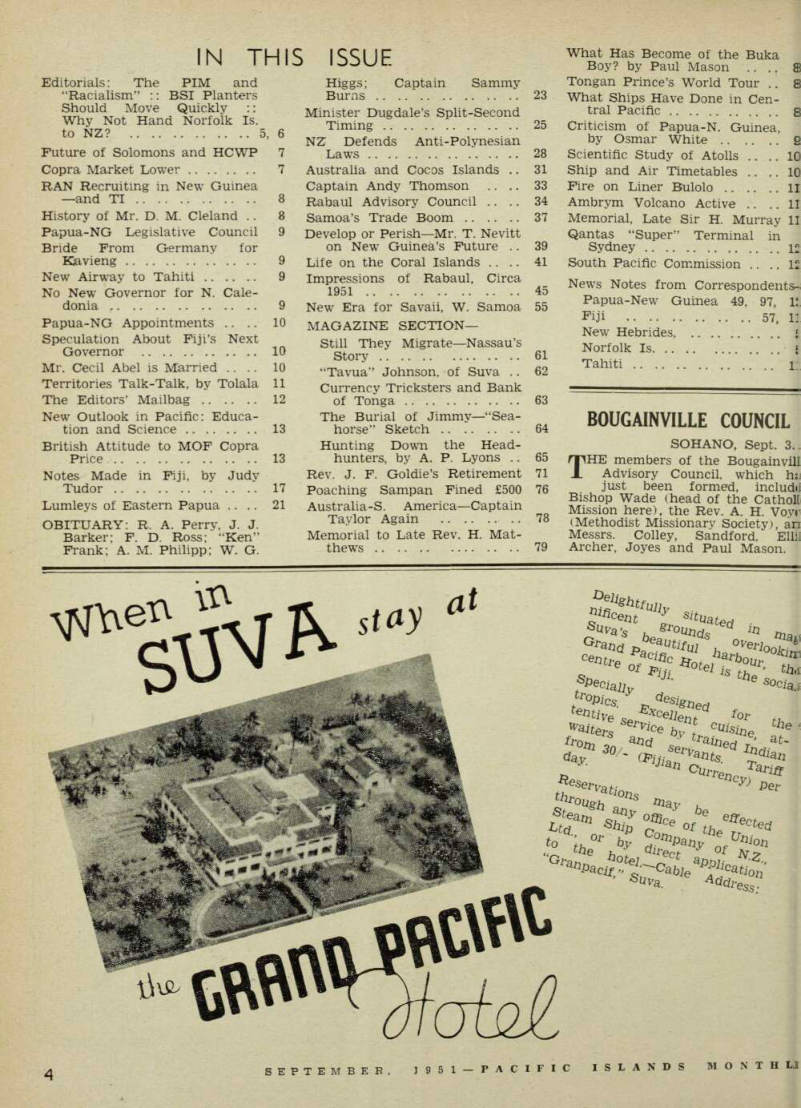
Editorials: The PIM and “Racialism” ;: BSI Planters Should Move Quickly :: Why Not Hand Norfolk Is, to NZ? 5, 6 Future of Solomons and HCWP 7 Copra Market Lower 7 RAN Recruiting in New Guinea —and TI 8 History of Mr. D. M. Cleland .. 8 Papua-NG Legislative Council 9 Bride From Germany for K&vieng 9 New Airway to Tahiti 9 No New Governor for N. Cale donia 9 Papua-NG Appointments ... 10 Speculation About Fiji’s Next Governor 10 Mr. Cecil Abel is Married ... 10 Territories Talk-Talk, by Tolala 11 The Editors’ Mailbag 12 New Outlook in Pacific: Educa tion and Science 13 British Attitude to MOF Copra Price 13 Notes Made in Fiji, by Judy Tudor 17 Lumleys of Eastern Papua ... 21
Obituary: R. A. Perry. J. J.
Barker: F. D. Ross; “Ken”
Frank; A. M. Philipp; W. G.
Higgs; Captain Sammy Burns 23 Minister Dugdale’s Split-Second Timing 25 NZ Defends Anti-Polynesian Laws 28 Australia and Cocos Islands .. 31 Captain Andy Thomson ... 33 Rabaul Advisory Council ... 34 Samoa’s Trade Boom 37 Develop or Perish —Mr. T. Nevitt on New Guinea’s Future .. 39 Life on the Coral Islands ... 41 Impressions of Rabaul, Circa 1951 45 New Era for Savaii, W. Samoa 55
Magazine Section—
Still They Migrate—Nassau’s Story 61 “Tavua” Johnson, of Suva .. 62 Currency Tricksters and Bank of Tonga 63 The Burial of Jimmy—“ Se ahorse” Sketch 64 Hunting Down the Head hunters, by A. P. Lyons .. 65 Rev. J. F. Goldie’s Retirement 71 Poaching Sampan Fined £5OO 76 Australia-S. America —Captain Taylor Again 78 Memorial to Late Rev. H. Mat thews 79
What Has Become of the Buka Boy? by Paul Mason ... ffi Tongan Prince’s World Tour .. 8 What Ships Have Done in Cen tral Pacific 8 Criticism of Papua-N. Guinea, by Osmar White 9 Scientific Study of Atolls .. .. 10 Ship and Air Timetables .. ..10 Fire on Liner Bulolo II Ambrym Volcano Active .. .. II Memorial, Late Sir H. Murray 11 Qantas “Super” Terminal in Sydney 12 South Pacific Commission .. 12 News Notes from Papua-New Guinea 49, 97, 1!.
Fiji 57, I; New Hebrides, ' Norfolk Is ' Tahiti 1;.
Bougainville Council
Sohano, Sept. 3..
THE members of the Bougainvill Advisory Council, which hsj just been formed, includti Bishop Wade (head of the Catholl Mission here), the Rev. A. H. Vovr (Methodist Missionary Society), an Messrs. Colley, Sandford. ElliJ Archer, Joyes and Paul Mason.
Advertisements & other items, p. 6 (2 items)
4
SEPTEMBER. 1951 PACIFIC ISLANDS MONTH LJ
stay
at
*** fLy € I)V^
* tU3ted
Suva ' s *£»* -£** Grand^ u c Fiji. f^c ia% * '•"• Js tft e soci a fl r ° Wcs - P* esl SOea teat ‘v e Sen* Cel,e Ot fh *a tte rs erv ‘oe bv n lcutsi oe tile /r ois ; o 7 k* aizj r at ' <C 3 °/- 4i a 5 r a « s ■' Jian <W T ariff P6r eifec or Wariy direct '^J 0 / &.Z G^p a cu o^-^ k apm s uv a .
Ca tion ’ ess;
Pacific Islands Monthly
The Newspaper-Magazine of the South Seas Distributed in AUSTRALIA, NEW ZEALAND and the following PACIFIC ISLANDS:
Australian Territories: Papua. Norfolk Is.
Cocos Is.
Aust. Trustee Territory: New Guinea. Nauru.
British Protectorates: Solomon Is. Tonga.
British Crown Colonics: Fiji. Gilbert & Ellice.
French Territories: New Caledonia. French Oceania.
Dutch Territory: Western New Guinea.
New Zealand Territories: Cook Islands. Niue.
N.Z. Trustee Territory: Western Samoa.
United States Territories: Eastern Samoa. Hawaii.
U.S. Trustee Territory: Micronesia (Caroline, Marshall and Mariana).
Anglo-French Condominium: New Hebrides.
A Product of Pacific Publications Pty. Ltd. Union House, 247 George Street, Sydney.
Contributions;
Articles, Stories, and Photographs dealing with Pacific Islands subjects are invited and will be paid for on publication.
Subscription Rates:
tn Australia and New Zealand. and Australian. NZ. and British Pacific Islands ... 18 0 ff. Caledonia, Tahiti £ 1 l o Slsewhere .. .. 3V 2 US Dollars £1 10 0
Telephones; Bw 5037. Bu 6082.
G.P.O. Box 3408.
Registered Address for Telegrams, Radio grams, and Cables: “Pacpub,” Sydney.
Editor and Publisher: R. W. ROBSON.
Assistant Editor: JUDY TUDOR.
Business Manager: SELWYN HUGHES.
Representative In London:
J. T. Wallis, Coronation House, 4 Lloyd’s Avenue. London, E.C.3, from whom may be obtained copies of Pacific Islands Monthly, Pacific Is. Year Book, advertising schedules, etc.
Agents:
See full list of Agents, arranged by Territories, on another page.
Vol. XXII. No. 2.
September, 1951
n . ( 1/9 Per Copy.
Price ] Prepaid, p.a.: 18 - Aust.
C in South Pacific.
‘Racialism’?
Can The PIM Be Accused of ‘Racialism’?
BECAUSE, on occasion, this journal, in plain language, has condemned certain aspects of he Papua-New Guinea Administra ion’s preoccupation with native welfare, this journal has been de cribed as “anti-native.”
For example, the following are xtracts from a frank and friendly Btter from an old friend, the Rev. laurice Nixon, of Fife Bay, Papua, rtio has sent us congratulations n our 21st birthday. Mr. Nixon is eferring, in particular, to a letter rhich we published recently, where i the writer described certain in idents which he thought were cal ulated to break down the social arriers between Europeans and atives. Especially, the writer ex ressed resentment at the appear nce of two Papuan natives at a üblic luncheon in Brisbane, where hey were given equal status with luropeans. Says Mr. Nixon: “This kind of racial trash will do more irm than any other single agency in •ovoking, in the Islands, the kind of scord which all men of goodwill eluding the directorate of the PI'VI irely wish to avoid .
“Not a few of the more intelligent landers have an uncanny ability in imming up their European neighbours om what they say and write, and from »w they say and write it. . .
“You are not catering for Malan’s >uth African community, but for a con ituency which—however disagreeable to
one ephemeral section of your clientele—is committed to the working out of some- SS? al ° n *U t . be * ines °I the late Dr - F - E ?,( lam 1 s Biendmg of Cultures,’ at its that it "is pouticaUy r sound™.! JJSTS terms with such a policy, the sooner its permanence as a Pacific islands journal of high merit and universal value will be established on a sounder foundation.
“i cannot think it is the editorial wish, as a , ma “ er of policy, to encourage the J distinctive feature of the journal.’ But. unfortunately, there is more than a tendency for such to become a distinctive
feature. .
‘‘ lf you have an inherent distrust of til', u," "r S"iS^' , l..’n e Vf balanced judgment, as well as wide ex perience as islands residents who, from time to time, could and would say the helpful word and the constructive word— and which could be allowed to take the SSST s “' h • vttl ...
THERE is very little, there, with
which we can disagree, unless is Mr. Nixon’s charge that P ur P° s< ; which we serve in pub- Ashing certain articles and letters 1S . “engender and encourage racial hatred.” That charge is not true.
This journal is not, and never InTir'Z has been unfriendly to the native Islanders. On the contrary, it has striven consistently over the years to get a better deal for the in digenous people of the Pacific. On
another page, in this issue, will be found an attack by the New Zea land Government upon this journal because of its persistent criticism of the way the NZ (and Australian) immigration laws regard Polynesians and part-Polynesians.
There are far more indigenous races in the Pacific than those found in Papua-New Guinea. It never has been said that the PIM is hostile to Samoans, or Fijians, or Gilbertese, or Solomon Islanders.
For all these folk —Polynesians, Micronesians and Melanesians—we feel warm friendship and complete goodwill. They have many lovable traits; some of them have come a long way, in a short time, towards the living standards introduced by Europeans: and some of them— notably, the Polynesians and Micro nesians—are nearing the point when they can take over responsibility for their own government, after the manner of Tonga to-day.
THE articles and letters published in the PIM, and described by Mr. Nixon and others as “anti native,” generally have no basis in racialism. They are the natural reaction of experienced observers against the fumbling stupidities which have distinguished the Papua-New Guinea administrative policies on native welfare ever since Mr. Eddie Ward led his Socialist phalanx into Australia’s Pacific Territories.
Ward is an extreme Leftist. His outlook and conduct are coloured and shaped by his hatred of private enterprise and “capitalism.” Know
ing nothing whatever of tropical administration, he went into the Territories determined to wipe out “the exploiters of the natives” and hamstring the big trading com panies; and the rest is history.
Probably, he did not care two hoots about natives. He sought only a stick wherewith to beat his poli tical enemies.
His Administrator, and various officials they introduced, being thus Ministerially encouraged, proceeded thenceforth on the theory that the non-official European was generally an exploiter of native labour, and •that the average native was a down trodden slave, who would imme diately become a starry-eyed citizen beyond suspicion and above re proach, if only he were protected from the whites and given a chance.
CONSEQUENTLY, in exposing the absurdities of the Ward- Murray regime, we were obliged, again and again, to empha sise the fact that the average Papua-New Guinea native is a Stone-Age primitive, and that cer tain officials were making them selves and their Administration ridiculous by trying to enforce social equality between Europeans and folk -who are at least some genera tions behind what may be called European-ism.
Possibly, we over-emphasised the shortcomings of the natives. Prob ably, we gave too much prominence to the utterances of that queer, in frequent type of white man who, for some reason, does really hate natives because they are natives.
Certainly, as a result, we have been accused of “racialism.”
“Racialism” when it means a dis
like of and contempt for races other than our own, is simply silly.
As a result of reading, observation and long experience of mankind in many countries, we believe that the average Caucasian is a better speci men of humanity than the average of any other race. But that is merely the luck of it.
We do not hate the members of other races because they are not Caucasians; and we are bound to feel liking and respect for the out standing individuals of other races, who often are far above the average of our own. That goes for the native peoples of Papua-New Guinea. The better one knows the Islands, the higher the regard one has for certain native Islanders.
They, as individuals, show that their race has great possibilities.
These facts became obscured when the Canberra Socialists were let loose on New Guinea. The Ward- Murray regime is ended, but a good deal of its shadow still is over the land. Maybe, it was not an un mitigated evil. The controversies it aroused have directed more atten tion than otherwise was possible to (a) our moral obligations in New Guinea and (b) the fact that, if we are to justify our claim for the world dominance of Western civi lisation, we must accept a clear responsibility for helping the back ward and under-privileged races to higher standards of life.
This responsibility, in New Guinea, unhappily is tied in with our paramount requirement that all New Guinea, and the islands adja cent, shall be built up as the South Pacific’s defensive barrier against Asia. But that is not racialism.
That is merely the will to survive.
Move Quickly
If BSI Planters Want Australian Rule, They Should Move Quickly
npHE transfer of Western Pacific JL Commission headquarters from Suva to Honiara, in the British Solomons, has been officially an nounced, to become effective in 1952.
Among the remaining remnant of non-official European residents in the Solomons, there is great dis content with the British Adminis tration, and no one seems to think that the proposed change in head quarters will improve conditions there.
The proposal that Australia should take over this Administra tion was quite seriously discussed, at the highest levels, in London, last year. Mr. Spender rather liked the idea. But Mr. Spender has de parted, and there has been no fur ther consideration of the suggestion.
The plan probably is dead. Can
berra did not like it much, anyhow.
Australia has all the headaches she wants in Papua-New-Guinea, with out seeking more in the ‘‘woeful Solomons.”
It is rather a pity. The Solo mons are such a big territory, and so under-populated, and capable of enormous development—it is a tragedy that the archipelago should be left to the care of the unimagina tive and indifferent officials who have had charge of affairs there for so many years.
If the non-official folk of BSI really do wish to be transferred to Australia, now is the time to get busy. There is just a chance that they can beat down the hostility of Canberra, and the indifference of London, before the migration from Suva is due to take place, early next year.
Island to New Zealand!
Why Not Hand Norfolk Island to New Zealand!
ONE wonders why Australia main tains suzerainty over the littlee sub-tropical Territory of Nor folk Island. Except that various; kinds of more or less deserving ex politicians have found in that Ad ministratorship a pleasant and£ profitable refuge, the Island is ofl little value to Australia in relation: to either defence, commerce on communications. It represents a: drain of some thousands per annum from the Australian taxpayer, and; it gives practically nothing in re turn. There was a time when Aus tralia bought fruits and vegetables —especially passionfruit pulp—from NI; but various kinds of official muddling, plus the indifference ofi the Islanders themselves, killed that small traffic, and for some years NI has been living on its own fat: The fat, of course, is found in the fact that Norfolk Island, being free of income tax, provides a peaceful] home for a considerable number ofr people who are obliged to live upon limited incomes; and the expendi ture there of those incomes from places outside Norfolk Island pro-: vides NI with sufficient exchange to import essential goods.
If only Norfolk Island could get s suitable market for its principai products,. it could be a rich place. It;: principal products, of course, are fruit, vegetables and tourist attrac-; tions. These three things do noic interest Australia at all; but N:i now has found a market for all three in New Zealand, and presemr indications are that the traffic in. all three will develop to the advanto age of both NI and NZ. New Zea-r land needs the fruit and vegetables of Norfolk Island, which become available at a time when NZ’s sup c plies from other sources are poom and, because it is a short and cheap voyage by air from Auckland, NI ir becoming" popular as a holiday re a sort for New Zealanders.
Why should the Administration: of NI not be transferred from Auss tralia to New Zealand? NZ appan ently is going to get all the benefit! of traffic with NI. Therefore, whr should NZ not have the privilege od paying the costs of administerin c.
Norfolk Island?
Dr. M. Rose, who was in Londoic in August, has accepted re-appoint! ment as Senior Medical Officer od the Gilbert and Ellice Islando Colony. He expects to proceed from Melbourne to Ocean Island bd phosphate ship in October, SincDi he left the G & E service, couple of years ago, Dr. Rose has, been acting as medical officer o:o passenger liners.
Advertisements & other items, p. 8 (1 item)
6
SEPTEMBER. 1951 PACIFIC ISLANDS MONTHL
To be Headquarters of
Future Of Soomons
Hcwp
IT was officially announced in Lon dnn and c-nva in a ncmct St, when the ot the Governor of Fiji and High Commissioner for the Western Pacific expires early in 1952, the two positions will be separated.
The headquarters of the HCWP will be established at Honiara, in the Solomon Islands; and a resi dent High Commissioner for the Western Pacific will have charge of the British Solomons, the Gilbert and Ellice Colony and the British side of the New Hebrides Condo tninium.
It is reported, unofficially, that official connection with the pro tected Kingdom of Tonga will be maintained through Fiji. Nothing has been said about Pitcairn Is land, which is a long way from Honiara.
So Transfer To Australia
(From Our Honiara Correspondent) |N an address from the Honiara 1 radio station on September 2, the visiting Minister of State for Colonial Affairs (Mr. Dugdale) de- Glared that “a greater future awaited the Solomons.” It was not
intended to transfer the Protec torate to Australia, or anyone else.
Britain had no intention of desert ing the Solomons. This did not mean that the Solomons would be made into a fortress. It meant that the Protectorate would sever all connection with Fiji and become to the Secretary of state for the Colonies.
He recognised BSI needed more help in economic development, par ticularly in encouragement of the timber industry and of crops other than copra; and that more schools and hospitals were needed. While the Colonial Office would do everything possible to help, shortage of build ing materials and trained staff, par ticularly teaching staff, was world wide, and must hamper any rapid expansion of medical and educa tional services. The Colonial Office was keenly interested in local prob lems and intended to wipe out the idea, prevalent in some quarters, that the Solomons were a forgotten land.
Accompanied by the Resident £°™“ sa i° ne £ Mr. H. G Gregory Smith, Mr. Dugdale spent about a week touring the Solomons, visiting the Russell Islands, Western Solo mons, Auki and Tulagi. He met most of the Europeans and the leading traders and natives and visited various institutions and was warmly entertained.
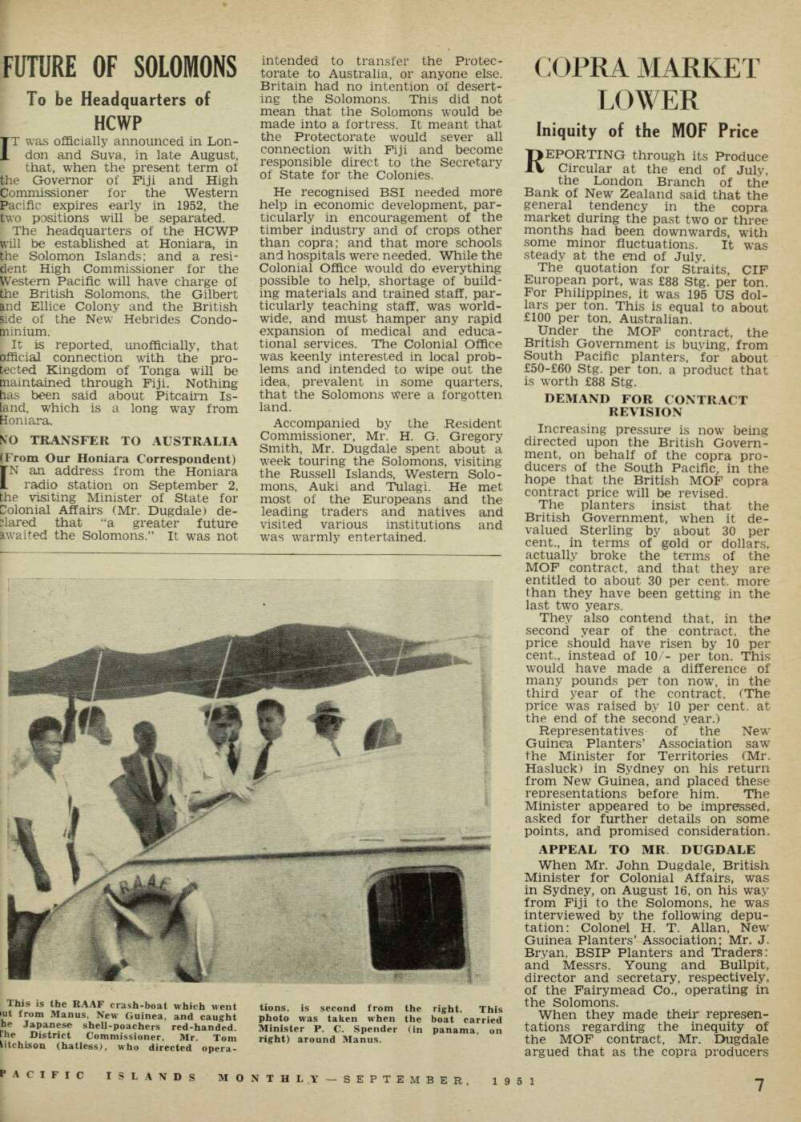
This is the RAAF crash-boat which went [?]ut from Manus, New Guinea, and caught [?]he Japanese shell-poachers red-handed.
The District Commissioner. Mr. Tom Aitchison (hatless), who directed opera-
tions, is second from the right. This photo was taken when the boat carried Minister P. C. Spender (in panama, on right) around Manus.
Lower
Copra Market
Iniquity of the MOF Price
REPORTING through its Produce Circular at the end of July, the London Branch of the Bank of New Zealand said that the general tendency in the copra market during the past two or three months had been downwards, with some minor fluctuations. It was steady at the end of July.
The quotation for Straits, GIF European port, was £BB Stg. per ton.
For Philippines, it was 195 US dol lars per ton. This is equal to about £lOO per ton, Australian.
Under the MOF contract, the British Government is buying, from South Pacific planters, for about £5O-£6O Stg. per ton. a product that is worth £BB Stg.
Demand For Contract
Revision
Increasing pressure is now being directed upon the British Govern ment, on behalf of the copra pro ducers of the South Pacific, in the hope that the British MOF copra contract price will be revised.
The planters insist that the British Government, when it de valued Sterling by about 30 per cent., in terms of gold or dollars, actually broke the terms of the MOF contract, and that they are entitled to about 30 per cent, more than they have been getting in the last two years.
They also contend that, in the second year of the contract, the price should have risen by 10 per cent., instead of 10/- per ton. This would have made a difference of many pounds per ton now, in the third year of the contract. (The price was raised by 10 per cent, at the end of the second year.) Representatives of the New Guinea Planters’ Association saw the Minister for Territories (Mr.
Hasluck) in Sydney on his return from New Guinea, and placed these representations before him. The Minister appeared to be impressed, asked for further details on some points, and promised consideration.
Appeal To Mr Dugdale
When Mr. John Dugdale, British Minister for Colonial Affairs, was in Sydney, on August 16, on his way from Fiji to the Solomons, he was interviewed by the following depu tation: Colonel H. T. Allan, New Guinea Planters’ Association; Mr. J.
Bryan, BSIP Planters and Traders: and Messrs. Young and Bullpit. director and secretary, respectively, of the Fairymead Co., operating in the Solomons.
When they made their represen tations regarding the inequity of the MOF contract, Mr. Dugdale argued that as the copra producers
now were making so much money, they were not really entitled to ask for more.
Fortunately, the deputation had facts and figures ready to show that, owing to the steep rises in all costs, the planters’ profits are not excessive; and the British Govern ment could not escape the conse quences of devaluing Sterling after making a contract to buy at a cer tain price. The cases of Australian wheat and meat especially were cited.
Briefed by the Sydney represen tatives referred to, it is expected that Mr. Charles Sullivan, well known Islands merchant, will make certain representations to the British Ministry of Food in London, where Mr. Sullivan is at present.
The Fiji Planters Union are mak ing similar representations to London, through the Fiji Copra Board. (Mr. Dugdale’s Reply To BSI Planters:
See Page 13)
Ran Recruiting
NG Natives Taken: Bounty Descendant Rejected
Recruiting for the Papua-New Guinea Division of the Royal Australian Navy has been in progress for some time. There is no lack of recruits, so a careful selec tion is being made.
Twelve native recruits from the Huon Gulf area and 12 natives from the Admiralty Islands are already in training.
As a rather remarkable sidelight on the recruiting of New Guinea natives, however, it has been dis closed that the RAN recently re jected the voluntary enlistment of an 18-years old youth named Chris tian, who lives on one of the islands in Torres Strait, because he was “not of substantial European de scent.”
His father, in a bitter protest, wrote to an MP; “Our ancestor was a good enough seaman to seize the Bounty from Bligh. Now, my son is not good enough to fire a gun in the Navy.”
Fletcher Christian was first officer on HMS Bounty, and he led the mutineers w r ho seized the ship, and turned adrift the tyrannical Bligh.
He married a Tahitian woman, had several children on Pitcairn Island, and died there. The descendants of the Pitcairners are mostly on Pitcairn and Norfolk Islands, but many are scattered all over the Pacific.
The incident—w T hich has come in for much caustic comment in the Press-highlights an article about the treatment of part-Polynesians, published elsewhere in this issue.
D. M. Cleland
Career of Man Selected for New Job in N. Guinea
THE new Assistant Administrator of Papua-New Guinea, Brig adier Don Mackinnon Cleland, is no stranger to the Territories; and his record suggests that he will be a very useful man there.
He is 50 years old. He was born and educated in West Australia, and practised there for many years as a solicitor and barrister. He en listed for active service in World War II in October, 1939, and he saw the active service in the Middle East and New Guinea.
By 1942, he had attained the rank of Brigadier. For 2i years, he was Chief of Staff to the' Military Ad ministration in Papua-New Guinea, and in this capacity he was respon sible for much of the actual ad ministration. He also was chair man of the Production Control Board. At the end of the war he was awarded CBE for his services in New Guinea —he already had the MBE for good work in Greece. He was twice mentioned in despatches.
When the death of Prime Minis ter Curtin created a vacancy in Fremantle seat in 1945, Mr. Cleland contested it as Liberal candidate against Mr. K. Beazley, but was de feated. He then, in 1946, became Director of the Federal Secretariat of the Australian Liberal Party, and he is given much of the credit
for the victories of that electoral organisation in 1949 and 1951.
The Minister (Mr. Hasluck) has said that the appointment of Mr.
Cleland “does not vary in any way the nature of the office of Adminis trator, but it provided the Adminis trator with a senior official who
could assist him, particularly in thr co-ordination and efficient function: ing of the various departments o the Administration, and in the pro: motion of development policies.'’
In October, 1950, advertisement invited applications for the post of two Deputy Administrator:!
Some 120 persons applied. M;1 Cleland was recommended by tlr Selection Board as the outstandiir candidate.
But the appointments were lorn delayed. It appears that the tern “Deputy Administrator” was no liked—especially in view of definij tions given in the Papua-Nee Guinea Act. It was decided final! that “Assistant” described the dutie. more accurately, and only one ws needed.
Mr. Cleland left Sydney by air o September 8, and assumed duty i Moresby on the 10th.
Mrs. Cleland will follow her hm band shortly. They have two som one of whom is being prepared U: “the land,” and the other is atteno. the University in Sydney.
Mr. Cleland has been foi< tunate in obtaining a suitable resg dence immediately—the resident); in Lawes Road of the late MI Edwards, the geologist who ws' killed recently in an accident, an which was put up for sale lai month.
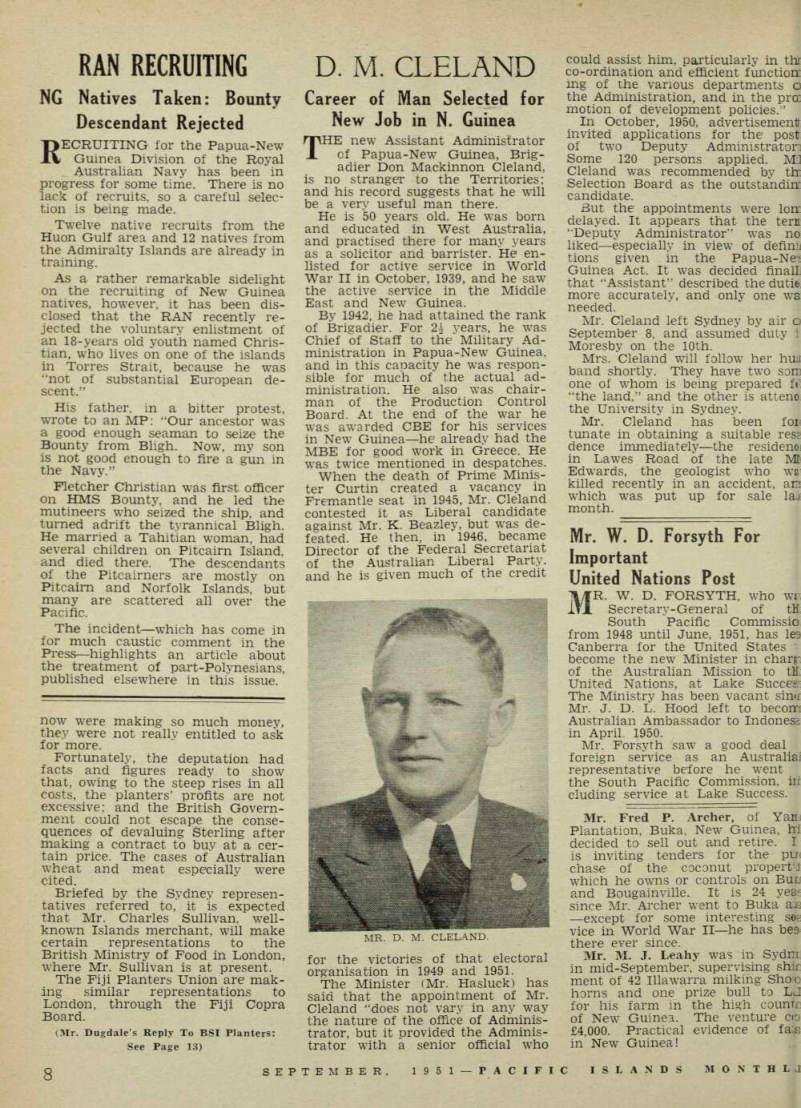
Mr. D. M. Cleland.
Important
Mr. W. D. Forsyth For Important United Nations Post
MR. W. D. FORSYTH, who wr Secretary-General of tH: South Pacific Commissio. from 1948 until June, 1951, has lee Canberra for the United States ' become the new Minister in charr of the Australian Mission to tH; United Nations, at Lake Success The Ministry has been vacant sin«r Mr. J. D. L. Hood left to becora Australian Ambassador to Indonesa in April. 1950.
Mr. Forsyth saw a good deal foreign service as an Australis! representative before he went the South Pacific Commission, iii eluding service at Lake Success.
Mr. Fred P. Archer, of Yam Plantation, Buka, New Guinea, W decided to sell out and retire. I is inviting tenders for the pu< chase of the coconut property which he owns or controls on Bun and Bougainville. It is 24 yess since Mr. Archer went to Buka —except for some interesting s©g vice in World War ll—he has bee there ever since.
Mr. M. J. Leahy was in Sydm in mid-September, supervising shir ment of 42 Illawarra milking Shoo horns and one prize bull to LJ for his farm in the high countr of New Guinea. The venture cio £4,000. Practical evidence of fa:o in New Guinea!
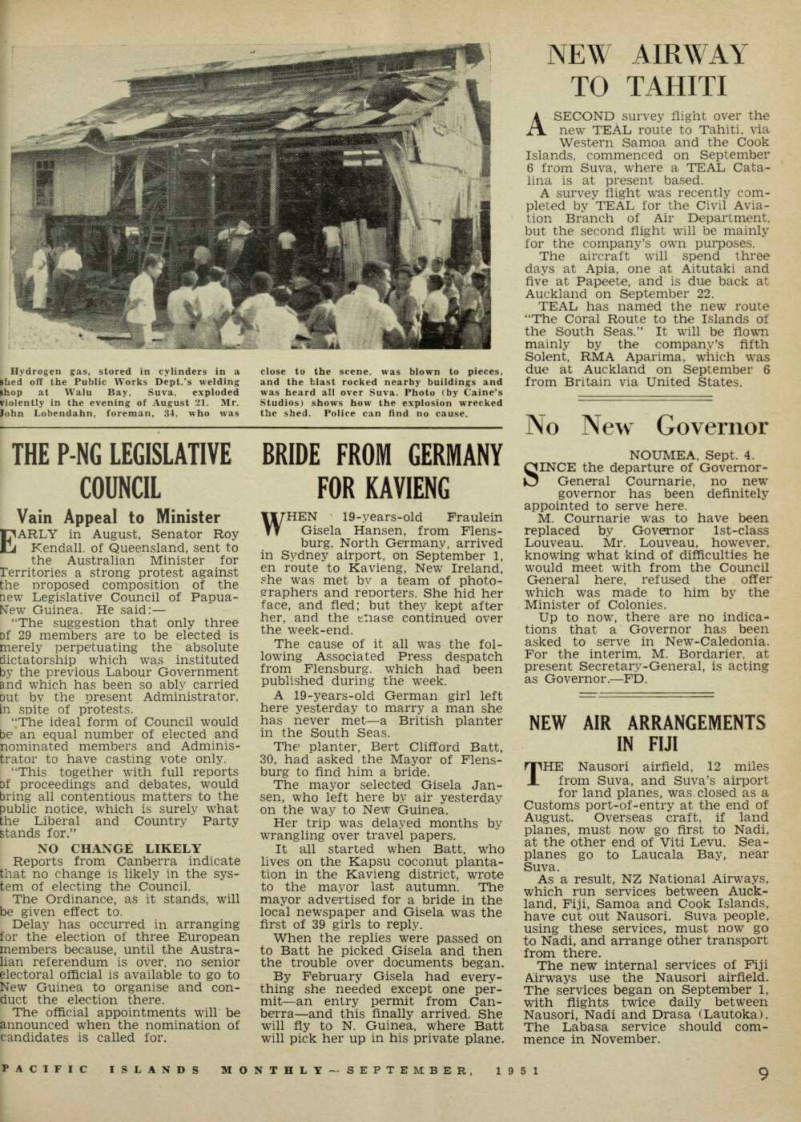
Hydrogen gas, stored in cylinders in a shed off the Public Works Dept.’s welding shop at Walu Bay, Suva, exploded violently in the evening of August 21. Mr.
John Lobendahn, foreman, 34, who was
close to the scene, was blown to pieces, and the blast rocked nearby buildings and was heard all over Suva. Photo (by Caine’s Studios) shows how the explosion wrecked the shed. Police can find no cause.
Advertisements & other items, p. 10 (1 item)
8
SEPTEMBER, 1951 PACIFIC ISLANDS MONTHL
Council
The P-Ng Legislative
Vain Appeal to Minister
EARLY in August, Senator Roy Kendall, of Queensland, sent to the Australian Minister for Territories a strong protest against the proposed composition of the new Legislative Council of Papua- New Guinea. He said: — “The suggestion that only three of 29 members are to be elected is merely perpetuating the absolute dictatorship which was instituted by the previous Labour Government and which has been so ably carried out by the present Administrator, in spite of protests.
“The ideal form of Council would be an equal number of elected and nominated members and Adminis trator to have casting vote only.
“This together with full reports of proceedings and debates, would bring all contentious matters to the public notice, which is surely what the Liberal and Country Party stands for.”
No Change Likely
Reports from Canberra indicate that no change is likely in the sys tem of electing the Council.
The Ordinance, as it stands, will be given effect to.
Delay has occurred in arranging for the election of three European members because, until the Austra lian referendum is over, no senior electoral official is available to go to New Guinea to organise and con duct the election there.
The official appointments will be announced when the nomination of candidates is called for.
Bride From Germany
For Kavieng
WHEN 19-years-old Fraulein Gisela Hansen, from Flens burg, North Germany, arrived in Sydney airport, on September 1, en route to Kavieng, New Ireland, she was met by a team of photo graphers and reporters. She hid her face, and fled; but they kept after her, and the chase continued over the week-end.
The cause of it all was the fol lowing Associated Press despatch from Flensburg. which had been published during the week.
A 19-years-old German girl left here yesterday to marry a man she has never met—a British planter in the South Seas.
The planter, Bert Clifford Batt, 30, had asked the Mayor of Flens burg to find him a bride.
The mayor selected Gisela Jan sen, who left here by air yesterday on the way to New Guinea.
Her trip was delayed months by wrangling over travel papers.
It all started when Batt, who lives on the Kapsu coconut planta tion in the Kavieng district, wrote to the mayor last autumn. The mayor advertised for a bride in the local newspaper and Gisela was the first of 39 girls to reply.
When the replies were passed on to Batt he picked Gisela and then the trouble over documents began.
By February Gisela had every thing she needed except one per mit —an entry permit from Can berra—and this finally arrived. She will fly to N. Guinea, where Batt will pick her up in his private plane.
New Airway
To Tahiti
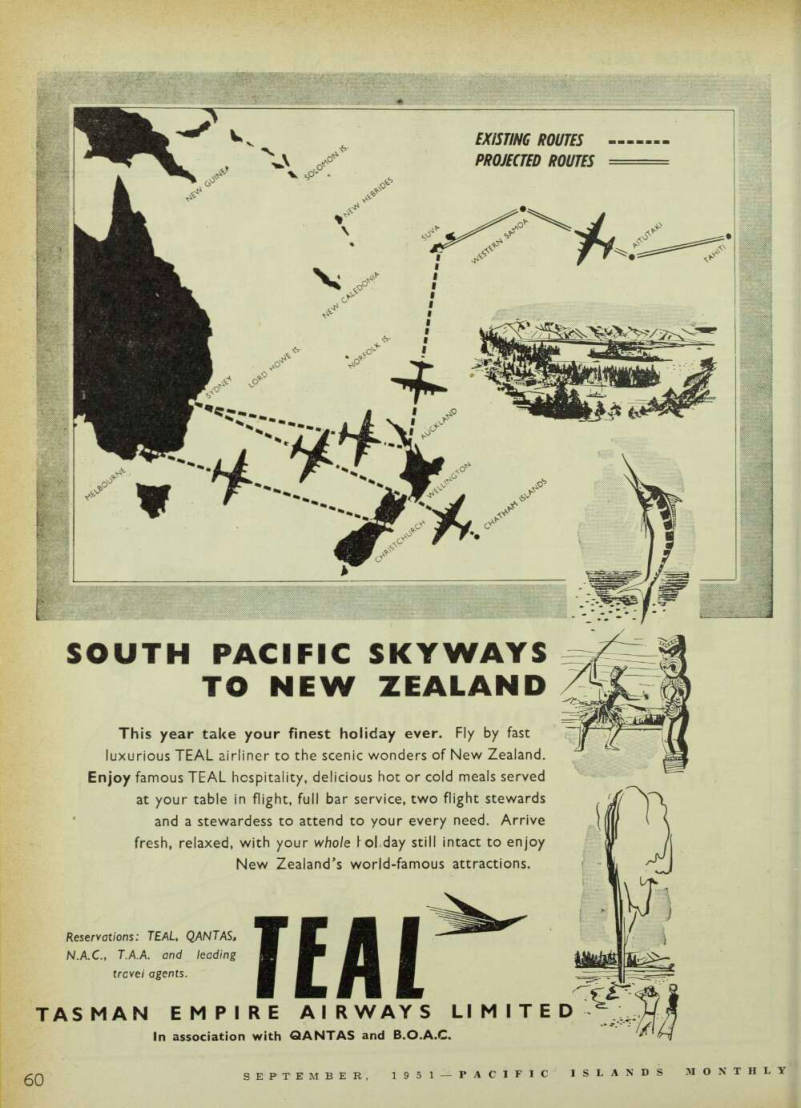
A SECOND survey flight over the new TEAL route to Tahiti, via Western Samoa and the Cook Islands, commenced on September 6 from Suva, where a TEAL Cata lina is at present based.
A survey flight was recently com pleted by TEAL for the Civil Avia tion Branch of Air Department, but the second flight will be mainly for the company’s own purposes.
The aircraft will spend three days at Apia, one at Aitutaki and five at Papeete, and is due back at Auckland on September 22.
TEAL has named the new route “The Coral Route to the Islands of the South Seas.” It will be flown mainly by the company’s fifth Solent, RMA Aparima, which was due at Auckland on September 6 from Britain via United States.
No New Governor
Noumea, Sept. 4.
SINCE the departure of Governor- General Cournarie, no new governor has been definitely appointed to serve here.
M. Cournarie was to have been replaced by Governor Ist-class Louveau. Mr. Louveau, however, knowing what kind of difficulties he would meet with from the Council General here, refused the offer which was made to him by the Minister of Colonies.
Up to now, there are no indica tions that a Governor has been asked to serve in New-Caledonia.
For the interim, M. Bordarier. at present Secretary-General, is acting as Governor. —FD.
New Air Arrangements
In Fiji
THE Nausori airfield, 12 miles from Suva, and Suva’s airport for land planes, was closed as a Customs port-of-entry at the end of August. Overseas craft, if land planes, must now go first to Nadi, at the other end of Viti Levu. Sea planes go to Laucala Bay, near Suva.
As a result, NZ National Airways, which run services between Auck land, Fiji, Samoa and Cook Islands, have cut out Nausori. Suva people, using these services, must now go to Nadi, and arrange other transport from there.
The new internal services of Fiji Airways use the Nausori airfield.
The services began on September 1, with flights twice daily between Nausori, Nadi and Drasa (Lautoka).
The Labasa service should com mence in November.
Administration
Papua-New Guinea
Senior Positions Filled After
Long Delay
THE Australian Minister for Territories, in August, an nounced the following appoint ments:— Brigadier D. M. Cleland, to be Assistant Administrator.
Mr. S. A. Lonergan, to be Government Secretary.
Mr. J. H. Jones, to be Director of District Services and Native Affairs.
Last October, the Australian Gov ernment invited applications for two Deputy Administratorships, and 120 were received.
The decision of the then Minister, Mr. Spender, to accept appointment as Ambassador in Washington, caused a delay in the proposed arrangement. The outlook was further altered by the change in the status of the Territories Minis ter, and the decision to appoint Mr.
J. R. Halligan as Adviser to the new Minister (he now is really a kind of liaison officer between the Aus tralian Government, the Trustee ship Council of the United Nations and the South Pacific Commission), and bring in Mr. Lambert as Sec retary of the Territories Depart ment. As a result, it was decided to have one Assistant Administrator.
The selection of Mr. Cleland caused no surprise. Because of the way he has discharged the duties of various positions under war and peace conditions, he has been in high favour in Canberra for years.
There is no surprise, either, in Mr. Lonergan’s appointment. He has been “Acting” for a long time, and he has filled the position so efficiently that he could not be passed over.
Mr. J. H. Jones also has been in high official favour —his was the name most frequently mentioned as the second Deputy Administrator.
He goes from “Acting” Secretary for Planning and Development (a new post) back to District Services, to be again Director of the most im portant field department.
It is significant that there is no word of the Planning and Develop ment job being filled. It is probable that that responsibility will devolve upon the new Assistant Adminis trator. who is well fitted for it.
Territories’ Reaction To
New Appointments
A private note from an old resi dent of New Britain:— The appointments of Brigadier Cleland as Assistant Administrator, Steve Lonergan as Government
Secretary, and J. H. Jones as Direc tor of District Services, have given much satisfaction to all. They know their jobs, if given any sort of free hand.
I take it that Mr. Cleland may be able to act as a brake on too much administrative idealism, and that he and Jones (fast friends during later Angau days) will work to gether.
But the thing is, is it too late to bring about the required reforms and tighten up?
The rot among natives has gone far—very far—and that goes for the Services, as they are so much affected by the slackness, sloth, general distaste for work and lack of real interest in native welfare, that a come-back will be hard to stage.
Speculation About New
Governor for Fiji
From Our Own Correspondent
Suva, Aug. 27.
IT is expected that the retiring governor, Sir Brian Freeston, with Lady Freeston, will leave Fiji on September 12.
After leave, he will take up his new appointment as Secretary- General of the South Pacific Com mission early in the New Year, whereupon, it is expected, the ap pointment of a new Fiji Governor will be announced. Just who this is to be is a matter of some specu lation in the Colony at present.
Men whose names are mentioned either hopefully or speculatively include Ratu Sir Lala Sukuna, (present Secretary of Fijian Af fairs); Sir Ronald Garvey, at pre sent Governor of British Honduras, who had a fine administrative re cord in the South Pacific; Mr. J. F.
Nicoll, who was Government Sec retary in Fiji until transferred to Hong Kong a couple of years ago; and, a new favourite, Right Hon.
John Dug dale.
It is pointed out that Mr. Dug dale cannot hope to be a Minister of the Crown for longer than the next British general elections and it is concluded that, being a smart man, he therefore came out to Fiji to see if he would care to be its next Governor.
Each of three first-mentioned “possibles” have their champions and detractors. But no one seems to want Mr. John Dugdale.
It is unusual for the Colonial Office to make such appointments outside the Colonial Service —but there have been exceptions, usually unfortunate. Baldwin, of British West Indies, was a notable case in point.
Ng Brewery
Ims Attack
ON
THE London Missionary Society
has gone on the warpatl; against the decision of the Papua-New Guinea Administration to grant a licence to a New Guinee company to brew beer in Papus This is Mr. Joe Bourke’s new ene terprise, based on the Laloki River The Rev. A. M. Paterson, on be; half of the Society in Australia, has asked the Minister for Territories Mr. Hasluck, to receive a depute tion to ask for cancellation a; licence. He said it would be irrr possible to keep liquor from tlr natives when it is brewed in the! midst, and they might run amok.: “We want to safeguard thr natives against something that has proved a degrading weakness i;i ourselves,” said Mr. Paterson.
Cecil Abel Is Married
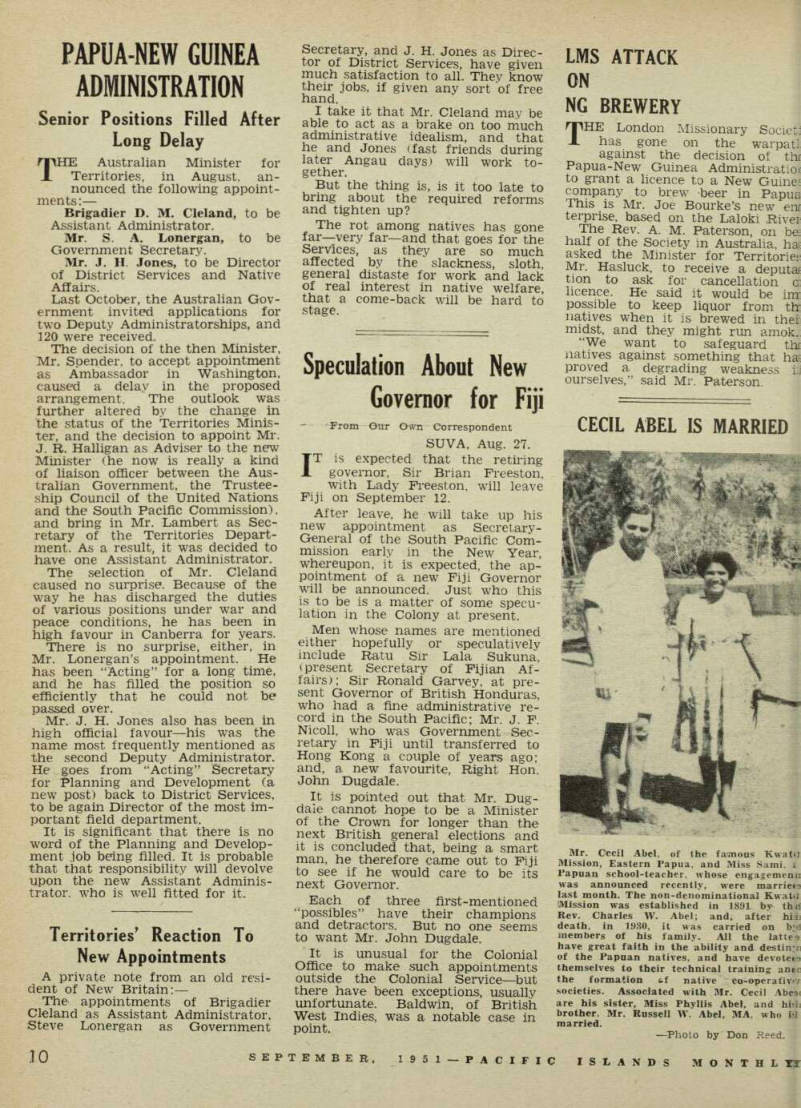
Mr. Cecil Abel, of the famous Kwata Mission, Eastern Papua, and Miss Sami, a Papuan school-teacher, whose engagement! was announced recently, were marries last month. The non-denorainational Kwata Mission was established in 1891 by th[?] Rev. Charles W. Abel; and, after hi[?] death, in 1930, it was carried on b[?] members of his family. All the lattes have great faith in the ability and destin[?] of the Papuan natives, and have devotees themselves to their technical training anen the formation of native co-operative societies. Associated with Mr. Cecil Abe[?] are his sister, Miss Phyllis Abel, and hi[?] brother. Mr. Russell W. Abel, MA. who i[?] married. —Photo by Don Reed.
Territories Talk-Talk
By Tolala
NOT so long ago government offi cials were “wrapping up” the NG Highland natives, holding them up as a solution to the native labour problem in the Territory.
Like many another scheme it looks well on paper, apparently, for only recently I met an old-time planter and remarked to him that I had heard he had some Chimbus work ing for him.
A snort of annoyance and a steely glint in his eye conveyed to me that all was not well. “You heard wrong,” he said. I work for the Chimbus.”
He supplemented his remark with details of costs, which ran into £36 a head to obtain and repatriate for a year’s alleged service.
Government policy at the present moment seems to be one of encouraging private enterprise. It will find that an adequate and reasonable labour sup ply is one of the main attractions now, even as it was some years ago.
I remember when, in the middle twenties, before the first Expropria tion Board properties were put up for tender, the representative of a big British planting concern made a tour of the Territory, examining properties with the idea of buying up the old German estates en bloc.
He was favourably impressed from an agricultural and productive angle, but the absence of adequate labour and government restrictions on native labour employment, even in those days, were factors which decided him against recommending his company to go to NG.
THE recent native art exhibition held in Rabaul reminds me of a somewhat similar display held in the old Times Building in 1934. and sponsored by the Administrator, Tom Griffiths. There were some very fine ethnological specimens from every part of the Territory, and District Officers on all stations were co-opted in collecting native craft work. Mount Hagen axes were the high-light then, together with some fine weaving from the Western Islands. The display, which lasted for several days, ter minated with a concert by the Matupi natives and the choir’s rendering of the “Hallelujah Chorus” is something I shall never forget.
These art exhibits are some thing which should be en couraged. At the time it was ar ranged that they would become an annual event in some one part of the Territory. But eruptions and wars have taken people’s minds off
such aesthetic interludes and, so far as I know, the recent one in Rabaul is the first indication of a survival.
APROPOS of native music, Eugene Goosens, who has recently re turned from a trip to NG, comes back full of enthusiasm of the NG native music and wants some records made. He seems to have the idea that he has “dis covered” something. As a matter of fact pre-war resident, Mrs. Clive Backhouse, realised the value of native music many years ago and has a very comprehensive record of some of their melodies. All these re-discoveries are somewhat amus ing, really.
LET me be in on this plea for Territorian stamps (PIM, August, p. 50). More than once on this page have I advocated an issue of pictorial postage stamps, characteristic of the Territory.
Artist Bill Dobell could, with advan tage, get busy on the job. He appears to have the necessary entree in the right quarters.
Now that ways and means will probably come into the Adminis tration picture, as a result of the Menzies-Fadden pruning policy, the powers that be could very well con sider the financial advantage of issuing P-NG stamps. Something over £20,000 was netted from sales of the Coronation issue in 1937.
That’s only chicken-feed, I know, in these days, but it all counts. 1 NOTICE an advertiser in August PIM is in search of a present day Utopia. Having lived for years in Asiatic countries and be come fed-up “with their political and economic troubles,” he seeks now a tropic land “where law and order prevail and life is secure.” I should like his address if he ever achieves his desire.
ISAW recently where someone has the idea of having “conus” shells manufactured for the High land natives so they can stick a plastic substitute through their noses, as the genuine article is hard to come by these days.
I may be off the beam, but I seem to recall an old NG Ordinance which prohibits the importation of synthetic curios, shells, and so forth. There was a time when a well-known mission society, operat ing on the mainland of NG, had several cases of faked white cowrie shells (“manufactured in Ger many”) confiscated by the Customs.
That is a real protective measure on the part of the Administration to save the native from exploitation.
Years ago, in the BSI, it was a common practice for go-getting traders to sell artificial porpoise teeth to eager Malaita-men, who accepted them as the genuine article.
SO Margaret Mead returns to these parts and hopes to re visit New Guinea. She is cer tainly receiving a good Press in Sydney, comparable with Church and Legal dignitaries from Britain, who are attending Jubilee cele brations here. Some of the old timers from NG will remember her when she was up there with Dr.
Fortune and later with Gregory Bateson. She put in some good re search work in the Manus Group and up the Sepik, and certainly should be an authority on her sub ject of sociology. She is on a lecture tour of Australia for the New Education Fellowship Jubilee Education Conference, whatever that may represent, exactly.
ONE of Sweden’s top-line ornitho logists—Count Nils Gylden stolpe—is bound for NG to collect specimens and this time we should hear something of the re sults of his tour. A party of American ornithologists spent several years cruising around in “La France” collecting bird specimens and data and left shortly before the Pacific war broke out, but little has ever been heard of their work, though the Field Natural History Museum probably houses a most comprehensive collection of NG birds. Contrary to general belief, there are hundreds of bird varieties in the Islands, some migrating from as far away as Siberia.
Naturalist Hallstrom has the Count under his wing, so we’ll prob ably hear more about him and his wife, as time goes on.
ONCE again we read through the Australian Press that NG “should” be able to grow all the tea, coffee and cocoa required in Australia, Quite so. To say noth ing of all the spices and other pro ducts now imported from Java.
Malaya and East Indian countries.
But when are we going to start?
And what about existing tariff agreements with these other coun tries.
I MUST give “South Pacific” a pat on the back. It is the monthly journal published by the Aus tralian School of Pacific Adminis tration over at Mosman. In the past the articles dealt—for the most part—with other native countries under British control; but now there are several interesting contri butions on local NG matters, and some have a slightly controversial trend. If this policy continues the journal will likely- develop into something really good.
The Editors' Mailbag
USA Monopolises a Name
THE Americans, with an unusual lack of imagination, have named their Micronesian ad ministration, “the United States Trust Territory of Pacific Islands.”
The Territory comprises the well known Micronesian groups of Palau, Carolines, Marshalls and Marianas.
The groups were held originally by the Spaniards; sold, or lost in war, by Spain, and became part of the German colonial empire; were handed over under Mandate to Japan in 1920, and were annexed and added to their Empire by the Japs in 1933; and then handed over to the Americans as a Trust Terri tory after World War 11.
The total area of the lot is only 715 square miles (they were called “Micronesia” because they com prise such a lot of very little islands), and their total population is only 50,000. Yet they now are called “the Trust Territory of the Pacific Islands,” irrespective of the fact that, apart from Philippines and Hawaii, all the Pacific Islands worth talking about lie south of the equator, and are all British and French.
In order to keep the description within focus and understanding, the four groups should be called “the United States Territory of Micro nesia.”
Picnic in Polynesia, 1914
A FRIENDLY letter from my old friend, Mr. J. D. Campbell, of Turoa, Rarotonga, referring to the fact that we first met in that delightful isle 37 years ago, reminds me of an interesting voyage. The leading characters are long dead, so no one can take offence.
I. a young reporter, was a guest on the NZ Government steamer Tuta nekai, which was taking the Gover nor of New Zealand, the Earl of Liverpool, on a pleasant cool weather trip around the Cook Islands. The skipper was a hard bitten old lad, Captain Post; and the NZ Cabinet Minister accom panying His Ex. was a well educated, temperamental Maori, Dr.
Maui Pomare, afterwards knighted. . Apart from Vice-Royalty, we were a happy party. But His Ex., a tubby, pompous little man, did not mix readily with common rough necks; and his Countess, a pleasant, freckled woman, had no conversa tion beyond her favourite topic of White Leghorns. The captain and the Minister regarded them as a cross hard to bear.
Vice-Royalty retired early, and it was our practice, as we loafed around those quiet tropical seas, and showed the flag wherever de
sirable, to gather each evening at 9.15 in the skipper’s cabin.
The ritual never varied. The Aide drew the cork, the chief engineer poured the shining liquor, the Min ister led us in a round of more or less improper reminiscences; and then the Old Man lifted his glass in the final toast: “Well, gentlemen, I give you their Excellencies, Lord and Lady Liverpill.”
It was a chat with Bob McKegg, there in Rarotonga in May, 1914 which first gave me the idea of the Pacific Islands Monthly—given effect to 16 years later.—RWß.
S. Pacific Commission
Records
A CORRESPONDENT remarks that the only record of the activities of the South Pacific Commission is that published in the Pacific Islands Monthly—and that, more often than not, is only a summary.
This is not correct. The Commis sion now publishes regularly, every three months, what it calls the “SPC Bulletin,” where there is a complete and fairly full record of what the Commission is doing. Anyone re quiring such a record should send 2 - (Sterling) to the Secretary, South Pacific Commission, Noumea, New Caledonia, and he will receive the Bulletin post-free for one year.
One of the difficulties of main taining these records is the bi lingual character of the organisa tion. The French jealously insist on the provision of the charter that all records and proceedings of the Commission shall be in English and French; and this, of course, more than doubles the cost of records.
There are plenty of facilities available in Fiji, New Zealand and Australia for printing in English; but facilities for printing in French are very limited in Noumea, and practically non-existent elsewhere in the Pacific.
Those “Handsome” Profits
EVEN high official personages seem to have the impression that New Guinea planters are making huge profits out of copra.
This is from a man who was an onlooker during an interview in Rabaul between Territories Minis ter Hasluck plus officials, and members of the Planters Associa tion: The planters, very conscious of the way in which they have been diddled out of £3O per ton by the devaluation of Sterling, urged the Australian Government to ask the British Minister of Food to review
the MOP contract. They argueo that, in view of much higher costs they were entitled to a higher re-! turn.
Mr. Lambert (new Territories Secretary): “To raise the matter o;t higher costs as a reason for an increased price might cause th* British Ministry of Pood to delve into the matter of the handsome margin (between cost of production and the PCB price) that you all earn.” And he smiled brightly at. the planters.
A member of the planters’ later; “Reverting to that handsome margin, I should like to ask you, Mn Minister, if you think that the fact: that a firm like Carpenters, with aD facilities for management, account ing, continuity of labour, and sup plies, and more shipping than the ordinary planter, have given ur their plantations in the Ninigo group, and in the Tasman groupc and several in New Ireland, and on© in Buka, shows that any handsome profit exists?”
There were no more references to the planters’ profits!
Concerning ‘Ted’ Edwards
FROM an old Territorian, now; residing in Sydney: Geologist; “Ted” Edwards, whose tragio death you reported in July, was as good lad, and handy in an emer gency. I first met him early in 1937 T at the aerodrome camp at Wewak,: when we were both employed bjy Oil Search. Afterwards, he went! into Mia Mia, where I became Bases Officer, and we were together fori a year.
On one occasion, I was buying! produce from the natives (by signr talk, as we were beyond the Pidginr boundary) when a slight disturbances arose. The Namblo natives, al ways peaceable, were bargaining! with me, when the Makafim natives,,; led by Celuie —I think his name wass —arrived. Immediately an uproan arose, as there had been bad bloodfc between them over a raid that thes Makafims had made on the Nambloc village.
I, with my personal boys, was en deavouring to keep the peace, whenr Ted Edwards arrived with his boys..; He had heard the uproar from hise house, a quarter-mile away andj thinking that a massacre was on,,i had come immediately to give mee assistance. Fortunately, everything! was under control. We told oldf; Celuie to rouse—by sign talk, ofi course—and went and had a cupq of coffee in my haus kunai.
I met Ted in Moresby about 19400 (after I had severed my connection r with OSL—or vice versa) and, J again, during the war years in r Queensland. He will be sadly y missed, as a geologist and a Terri- tories identity, by all who were 9 fortunate enough to know him.
Shape
Why The PIM Is In A New Shape
A few readers, who apparently did not see the formal announce ment in July, have asked the reason for the appearance of the Pacific Islands Monthly in a smaller size.
Actually, there are more pages in the journal, now, but the size of the page is smaller. The net result is a saving in the use of paper, and in factory operations.
The paper which, in 1939, could be bought for less than 3d. per pound, now costs close to 2/per pound. All other costs have increased enormously.
By making economies in the directions indicated, we have avoided, for the moment any increase in our subscription and advertising rates. The lunatic spiral of inflation is still gov erning our economy, however, and we fear that, before long, we shall be forced to raise our rates, like all other manufacturers.
New Outlook In Pacific
Islands Government Significant Conference In Canberra
THE new principles and ten dencies which now influence the administration by the European nations of the Islands of the Pacific were indicated by the character and proceedings of a Conference which took place in Canberra in the latter part of August. The delegates were Jubilee Year guests of the Australian Gov ernment, and the discussions centred on the subject, “Social Pro cesses in the Pacific.”
The following well-known people took part; Dr. Margaret Mead, Assistant Curator of Ethnology, American Museum of National History.
Professor Ernest Beaglehole, Professor of Psychology at the Vic toria University College, Welling ton. NZ.
Professor A. P. Elkin, Professor of Anthropology at Sydney University.
M. Jean Guiart, of Institute Francais d’Oceanic, Noumea.
Mr. Coring G. Hudson, executive secretary of the Pacific Science Council.
Mr. H. E. Maude, Research Coun cil Member for Social Development, South Pacific Commission.
Dr. A. Grenfell Price, Department of Geography, Adelaide University.
Dr. A. Capell and Dr. lan Hogbin,
of the Department of Anthropology, Sydney University.
Mr. W. D. Forsyth, lately Secre tary-General of the South Pacific Commission and now Australian Minister at the United Nations.
Miss Camilla Wedgwood, of the Australian School of Pacific Ad ministration.
The conference dealt with aspects of social research in the Pacific, the changing structure of family and higher kin units, economic develop ment, and the changing political role of Pacific Islands peoples.
British Mof Price Of Copra

Minister Dugdale’s Reply to BSI Producers’ Representations
WHEN the Rt. Hon. John Dug dale, British Minister for Colonial Affairs, was in Sydney early in September, after visiting Fiji, Tonga and the Solomons, and hearing urgent representations from planters everywhere on the subject of the MOF copra contract price, the PIM tried to interview him, to ascertain his real reaction —if any—to the planters’ pleas.
Owing to a dislocation of plane services, the Minister had only a few hours in Sydney—and in that period he was nursing an attack of malaria. He arrived in Sydney from BSI and New Guinea on Sept. 7 and departed for London next day and gave no Press interviews.
However, some indication of the Minister’s views is found in a re port (supplied by our Honiara cor respondent) of a meeting between the Solomon Islands planters and the Minister, on August 22.
There does not seem to be any likelihood of the copra price being revised in the light of the Socialist Government’s trick of devaluing Sterling after the MOF contract was made; but there is a chance that the price will be raised to meet the fact that in the second year of the contract the price was raised only 10/- per ton, instead of by 10 per cent.
THE Chairman of the BSI Copra Board pointed out that in 1946, when the postwar short age of oils and fats was greatest, the BSI Government pledged itself to send all its annual production of copra to Britain. In 1948, the Min istry of Food offered alternative contracts —a higher initial price for 1949, but with no great security for the years beyond 1951; or the 9-years’ contract, under which the initial price for 1949 was fixed at a lower level, and annual increases or decreases thereon pegged to a maximum of 10 per cent., either way. Some larger producers op posed both; but the view was taken
that, having regard to the earlier pledge, one or other must be ac cepted. The general opinion of a meeting of copra producers in 1948 favoured the long-term agreement.
From 1949, copra was shipped under the MOF contract at £stg4B, f.o.b. main ports. At the beginning of 1950, a small price rise was offered and accepted. For 1951, the maximum increase of 10 per cent, was arranged.
There was, however, no actual contract signed between the BSI Copra Board and the Ministry of Food in 1948; and only in 1951 was the actual contract presented for signature. The Board, after long and controversial discussion, con sented to the signature of this con tract.
Since 1948. however, the revalua tion of Sterling, and the unprece dented heights to which consumer goods had risen, had seriously affected production costs. The MOF price of copra had not kept pace with prices generally due to the fact that the MOF price could not rise more than 10 per cent, in a year.
Because of this, and because they were bound to Sterling (which had been devalued after the contract was first made) the planters felt they had been trapped into dis posing of their copra at a price well below world parity, while their profit margins were narrowed with increasing rapidity by production costs rising far more rapidly than the annual rise in copra prices under the contract.
The purchasing power of a ton of copra in world markets was be ing artificially restricted, while there was no such restriction on the rise in costs of production.
The Board wanted to know whether the Ministry of Food would enter into negotiations with a view to amending the contract for the remaining six years of its term, arriving at a price for 1952 more commensurate with world parity.
The chairman added that the de valuation of the £stg had played a major part in restricting the effec tive annual price rise, though in 1949 producers had been repeatedly assured that there would be no de valuation.
Private producers pointed out to thp Minister that all non-Govern ment members did not agree to the signature of the contract. The majority of those who agreed were Government members of the Board.
(Continued on Page 15)
THE Minister said that, taking the 1937 copra price as a basis, and on figures put before him, production costs were three times those of 1937, whereas the Ministry of Food price was 41 times that re ceived on the open market in 1937.
The planters pointed out that in 1937 copra had not fully recovered from the depression, and the price then payable was so low that it was not considered sufficient to allow for capital expenditure on planta tions, such as replanting and re building. They added that even the 1951 price, under the MOF con tract, did not show a sufficient per centage on capital expenditure to allow for replanting, even for larger firms who wished to rejuvenate their plantations.
The Minister then said that he would like to have both prewar and postwar figures, showing returns of production, expenses and profits.
He pointed out that if the copra price had fallen, producers would have been glad to have had the security of the contract.
A member of the Board quoted the British contract for New Zea land butter, which was not fulfilled, the butter producers being left high and dry.
The Minister again referred to the 1937 copra price and stated that, taking the uncontrolled in conjunction with the controlled prices to-day, it seemed to him that the MOF contract gave a greater margin of profit as against rising prices. Any comparative pre-war and postwar figures of profit and loss must also include figures for native producers.
The Minister said the strongest point in the producers’ case seemed to be that while in 1951 they had had the full 10 per cent, rise per missible under the contract, they had not had it in 1949-50. He was prepared to take this up in the United Kingdom. Any representa tions would have more hope of suc cess if they fell within the terms of the Agreement.
Editorial Comment
THE outstanding feature of this Minister’s comments on the copra producers’ representa tions —when he could be induced to make any—is his obvious un willingness to say anything about the trickery of the British Socialist Government in devaluing Sterling, after having made long-term con tracts with copra producers, and various other foodstuffs producers.
These foodstuffs have a world value—not a value confined to the Sterling areas. At any time dur ing the past two years, South Pacific copra could have been sold at from £3O to £5O per ton ( £3O being the amount, in relation to gold or dol
lars, by which Sterling was de valued) more in non-Sterling areas and some Sterling areas, than was received under the MOP contract.
Generally speaking, the Right Hon. John Dugdale has made a poor impression in the British Territories of the South Pacific — and that is not surprising. He is typical of the politicians who, in 1945-51, have more or less given the Empire away, and brought the good name of British officialdom into dis repute.
South Pacific copra-growers should keep their powder dry. and not lose heart. There is probability of an early election in Britain; and if more responsible people are
put into office there they will re move from these food contracts the blatant dishonesty represented by the devaluation of Sterling in 1949.
Patrol Officer Graham Taylor has taken charge of the new patrol post established by the New Guinea Administration at Annanberg, in the Ramu Valley, inland towards the Highlands from Madang. A new airstrip has been put down, and the Madang-Atemble road re-opened.
Thomas Farquhar, 19, pearler, of Thursday Island, was fined £lO for trespassing on Groote Eylandt native reserve. He said he went there to land petrol drums.
Mr. Bruce Bacon, who was two years in the Solomon Islands on the accounts staff of the BSI Trade Scheme, recently returned to Aus tralia. Last month, he joined the Sydney firm of William E. Reed.
Islands merchants, as agencies manager.
Mr. Mark Schultz, proprietor of the Mumeng Hotel, on the Lae-Wau road, New Guinea, has leased the ■establishment and left for Europe on a long holiday.
Rev. and Mrs. A. Wardman, ofi the Australian Board of Missions* staff, have gone to Papua to relieves Canon J. Benson (who is Mrs„ Wardman's uncle).
In this group are seen a number of the leading Chinese residents of Tahiti. The occasion was the wedding, on May 27, of Miss Yung Sin and Mr. King Chong Chung Soi. The bride is the daughter of Mr. and Mrs. Ching Sang, and the bridegroom is the son of Mr. and Mrs. Chung Soi.
The wedding took place at the Chineses Philanthropic Association; and, later, a[?] large number of guests assembled to par take of a feast of 40 different courses..
Feasting, music, dancing, etc,, extended! over many hours. —Photo by Studio MacKenzie.
Advertisements & other items, pp. 16-18 (2 items)
Morris Hedstrom Limited
General Merchants, Importers and Exporters,
Shipowners, Plantation Owners,
Commission and Insurance Agents
HEAD OPFICR
SUVA, FIJI
Established 1868
SERVICE IN THE SOUTH PACIFIC
TERRITORIES
our Large Establishments in Suva and our Numerous Branches, we distribute a wide and comprehensive range of General Merchandise and provide almost every kind of service. Our departments and associated businesses include:
DRAPERY
MOTOR SALES
AND SERVICE
TOBACCO
TIMBER AND
BUILDING
GROCERY
CONFECTIONERY
HARDWARE
ELECTRICAL
LIQUORS
DRUGS
Branches Throughout Fiji, Samoa and Tonga
There is a Branch or Agent of Morris Hedstrom Limited in every Town in the Three Territories. We are Sole Agents in these Territories for British Drug Houses Ltd.
Electrolux Ltd.
Ford Motor Co.
General Electric Co. Ltd.
Goodyear Tyre Gr Rubber Co.
B. A. Hjorth Gr Co. (Primus Products) Imperial Chemical Industries Ltd.
International Harvester Export Co.
Matson Navigation Company Max Factor and Co. Inc.
Pacific Islands Transport Line Ransomes, Sims Gr Jefferies Ltd.
Vacuum Oil Co. Pty. Ltd.
Yorkshire Copper Works Ltd.
Morris Hedstrom Limited are LLOYD'S AGENTS in Fiji and Samoa.
IN AUSTRALIA:
Morris Hedstrom (Aust.) Pty. Ltd.,
Asbestos House, 65 York Street, SYDNEY
IN GREAT BRITAIN:
Morris Hedstrom Limited,
Barclay's Bank Buildings, 73 Cheapside, LONDON, E.C.2
COVENTRY CLIMAX GENERATING SETS
2.75 K.V.A.
415 Volt, 3 phase £275 plus tax 240 Volt, single ph. £275 plus tax 110 Volt, 3 phase £240 plus tax
Delivery Ex Slock
Compact unit, 4 cylinder Coventry Engine.
Complete with switchboard. 1 Weight: 6001 b.
Crompton Parkinson Alternator.
Also tools, spares and instruction book.
HARDMAN & HALL
44 MISSENDEN ROAD, NEWTOWN, SYDNEY,
AUSTRALIA.
r
PAINTERS PREFER
In
PAINTS
mm
PAIHf
WITHOUT exception Spartan Paints are shown a preference by every painter, tradesman and handyman. Ask your Storekeeper.
Agents: CORKIE & CO., Box 45, Suva, Fiji.
SPARTAN PAINTS
PTY. LIMITED,
cnr. Kavanagh and Ireland Streets. South Melbourne, Victoria, Australia.
N^C Specialising in Pacific
Island Insurances.
FIRE—MOTOR VEHICLE—MARINE
—HULLS AND CARGO-
EMPLOYER’S LIABILITY.
BONDS—in accordance with Administration Ordinances—COPßA Insured from drier to buyer—and all other classes arranged at lowest current rates.
Established Agencies throughout the Territory of Papua and New Guinea.
Managing Agents; New Guinea Co., Ltd.
Island Representative: G. D. A. Kent, Rabaul Branch.
Southern Pacific Insurance co., LTD.
Head Office: 60 Hunter St., Sydney.
KODAK
DUAFLEX
CAMERA
Smart, modern and popular—in box camera simplicity. Has large brilliant viewfinder, synchro, shutter for use with Duaflex Flasholder, all-metal body, clip-on cover for lens and finder. 12 exp., 2*4 x 2*4 in. on V 620 film.
Put FLASH into your photography
with a new Kodak “Flash” Camera
BROWNIE REFLEX
CAMERA IIU M/ 1
A favourite for flash pictures . . . thanks to large easy-to-see viewfinder. Has quality Kodak fixed-focus lens and flash synchro, shutter (for use with Kodak Flasholder), collapsible hood, neck cord. 12 exp., 1% x 1% in. on V 127 film.
'•B SIX-20 BROWNIE “E”
CAMERA.
Recognised leader in box camera field.
Gives flash pictures with Kodak Flasholder; has built-in portrait lens and yellow filter; features two large brilliant viewfinders, dependable Kodak lens and shutter. 8 exp., 2*4 x 3*4 in. on V 620 film.
SIX-20 KODAK “A” CAMERA.
Compact in size, reliable in performance. Two models —with 4- and 8speed Epsilon shutters to 1/150 sec..
Anastar f/4.5 lens, eyelevel viewfinder, synchro, for Kodak Flasholder. 8 exp.. 2 J 4 x 3*4 in. on V 620 film. (Also made with f/6.3 lens.)
Ask to see the
Kodak Camera Range.
FROM ALL KODAK
DEALERS THROUGHOUT
THE ISLANDS
KODAK (A/ASIA) PTY., LTD.,
379 George Street, Sydney.
Copra Discussion—
from page 13.
In Fiji
From Notes Made
BY
Judy
Tudor
SUVA, Sept. 3.
V|RS. G. HENNINGS, of Naitau- Ltl bua, Lau Islands, tells me that when she came here in L 912 as a bride she was so dis appointed she could have wept.
She had expected a riot of tropi cal flowers right out of the hot houses in one of the more famous )f Germany’s botanical gardens. 3he expected pineapples to grow by ;he wayside, bananas to droop from convenient boughs and bright hlumed birds to flit hither and yon imong the trees and palms.
In cold fact, she found a Suva ;hat had recently weathered a hur •icane—a tiny town of small wooden ;hops and unpaved roads, a fore ;hore that was mud at low tide and jore no possible resemblance to the coral beach of her youthful dreams.
The journey from Suva to her [husband’s plantation In a small joat was an agony of seasickness — is it is still, for that matter —and vhen they reached it, it was to ind the Lau Group brown and dry it the end of a four-months’
Irought.
During Mr. Hennings’ absence in Surope, the cows had gone dry, the chickens had died, and the drought lad seen to the destruction of the gardens.
But it seems that people lived lown their disappointments in those lays. With infrequent visits over seas, and a yearly pilgrimage to Suva, Mrs. Hennings has lived in L.au ever since.
She <is in Suva at present—buy ng goods for the Hennings trade store and a bull calf to improve the flantation stock, and being much nterested in anything the local \gricultural Department can pro luce in the way of new pasture grasses.
She still has a little accent and s entirely charming.
Mr. Hennings must have been a nighty brave man to bring a bride from Germany to the undiluted solitude of Fiji’s outer islands—or i mighty discerning one. In either 3vent he was lucky, as well. * * * LAU is having one of its periodical droughts now. The dry spell is at the end of its third month, and already copra production is falling to some degree. Apparently in drought conditions the mature [coconuts do not fall to the same extent —the tree sets few new nuts and hence there is not the same tendency to shed those that are ripe.
•cw *v, 0 f oovv , Q • ov ffmp X
Sjf fInSS?
fI E Shu nJf£ e nJsSo°i»So
nut—there will be little copra made or shipped from Lau.
The drought coming now when the plantations were recovering from the effects of the disastrous hurricane of a few years back, is a blow to Lau planters—it is easy to see why they were not madly en thusiastic about the copra tax that
was proposed by the Fiji Govem ment last year.
They calculate that it costs them about £35 per ton to produce their copra, for which they receive some thing over £5O. As the Fiji £, along with most others > 15 now probably worth about 7/6 in 1939 money, it is going to be some time before they reach the millionaire class, A hurricane, which can put a plantation out of action for any thing up to five years, is a possi bility any year in Lau between December and April, and is a cer tainty at pretty frequent intervals, Treasury officials, when they get busy with their calculating
machines, appear eager to overlook these facts. ♦ * PLANTERS’ problems vary from territory to territory. New Guinea, for example, has no hurricanes to contend with and, as far as I can judge, appears to pro duce much more per plantation than is the case in Fiji—either be cause the trees are more productive or because the holdings are larger.
And in Fiji, the problems vary again from district to district— Eau's present drought, for example, or hurricanes which hit in one place and completely miss an ad jacent group. In Fiji, too, the Fijians produce the bulk of the copra; native-produced copra in NG is only a small proportion of the total. , .
Because of this divergence of in terests and conditions, the Fiji Planters’ Union does not seem to speak with the same united voice as does the New Guinea Planters’
Association. Headquarters of the Union is in Suva—but the members are scattered far out into the blue and, unlike their NG counterparts, seem to take some shifting from there to the capital. This is not surprising when such journeys have to be undertaken in small boats.
There are few NG plantations now that are not within reach of swift Catalina service to Rabaul.
However, they are at one about one thing; that when Britain de valued her £ against the dollar there should have been a readjust ment in the MOF contract price of copra. * * ■* FIJI held a couple of surprises for Mr. Dugdale. One was the apparent lack of enthusiasm for trade-unionism amongst the “workers” of Fiji. Another was the Fijian habit of having their bures decorated with pictures of the Royal Family and Mr. Churchill. Seems that not one of them had a picture of Mr. Attlee. * * * THEY tell me that the Grand Pacific Hotel here was mod elled after the Galleface Hbtel in Colombo. It was started in 1914, was held up during the first World War and its first manager was from the famous Colombo hotel. Since then, of course, it has developed a fame and a personality of its own.
Dark and dingy at the end of World War 11, it now has new furn ishings and new management, and gives much happiness to a constant stream of tourists, mostly from NZ.
Even after the facelift, however, some anachronisms remain, par ticularly in the bathrooms, where lurk the most extraordinarily large baths I have ever seen.
Each is about the size of a Navy
corvette, and must present a pretty problem of entry to the more de crepit of the tourists (Fiji women never grow old). I cannot imagine why anyone would want so large a bath and can only conclude that they upholstered the ladies much better in 1914 than is the case today.
The bedrooms all open through green shutters onto long balconies and are entered through doors which open along the gallery above the lounge. It all makes for coolness but it also, alas, makes for sound. * * * SOMEHOW, the homogenised sounds of happy tourism can be borne; but the sounds of an over-enthusiastic sleeper are mighty hard to put up with.
Habitual snorers should be seg regated, in my opinion; or fitted with silencers; and, reflecting thus at 3 a.m., I put on my dressing gown and walked along the balcony to locate this human buzz-saw, who was making the night hideous.
My impulse was for going in, dig ging him in the ribs and coming over all-Sydneysider, saying; “Hey, turn over mate.”
But would that be British, or cricket? I stifled my impulse, went back to bed and read a whodunit till dawn.
(Continued on Page 114)
When he informed a reporter, on the eve of his return to Western Samoa, that it was now the policy of the West Samoan Administration to employ Samoans rather than Europeans, the High Commissioner, Mr. G. R. Powles, added that there were now 1,500 Samoans, and 76 Europeans, in the service of the Administration.
Dr. Jacomb, who was Assistant British Commissioner in the New Hebrides several years ago, and who has attained considerable fame since then as a writer and lecturer, has been visiting some of the Pacific Islands, including Tonga, to observe post-war conditions. He ex pects to be in Sydney, for a short time in October.
“Bula, Bula”
STORIES of the popularity of the Fijian Rugby football team, now touring New Zealand con tinue to pour in. Whether the: Fijians win or lose, their bright,, Interesting football captures the interest of the New Zealanders.
It is said that the tourists w T erei greatly heartened when they playedl Buller at Westport—in conditions? that resembled a rice swamp rather than a playing field—when locall barrackers continually yelledf "Buller, Buller.”
It sounds the same as “Bula” — the Fijian expression that wasc worked overtime by the AmericansE during the war and which, in the case of the footballers, could mean “Good on you, lads.” * * *
Something Of The Arts
THE Fine Arts Group of the Fiji Arts Club will present an ex hibition of work by local artists at the Parish Hall, Suva, on Sep tember 3,4, 5 and 6.
There will be over 100 paintings and other artistic contributions and these range from the conventional palms and blue sea to splashes of mad colour provided by devotees oli contemporary art. Some of them will startle Suva —but Suva can do with a little of that.
Also starting a season on Sep-i tember 3, the Suva Group Theatre will present a revue called “Blactf Velvet.”
It is produced and directed by Paddy Mulelly and James Craw ford; dances are arranged by Kitty Carter, assisted by Heather Emer-; ton.
There is an all-local caste of 50 including 20 Fijians. * * *
Broadcasting Commission!
Amalgamated wireless
Australasia Ltd. Will De9
sign and supervise the builcL ing of the new studios of the Fi;i Broadcasting Commission, supply and instal all equipment and trail staff.
The studios are to be erected nea3 the present Government Building in Suva, and it is expected ths tenders for the building will tf called shortly.
The broadcasting licence of Fix' Broadcasting Company, in whica AWA has a substantial interest, ws' renewed at the end of 1949 for fiv. years, but the Government has thl option of terminating it withii three years—that is next year—the establishment of the FBC is fa] enough advanced to warrant it. TIT decision to create a Commission-!
which is to function on much the same lines as the ABC in Australia —arose out of a committee who made a report in 1948. The FBC will differ from the ABC and BBC in one important aspect, however—it will derive part of its revenue—a large part—from advertising. Rev enue from listeners' licences will also go to the Commission, less a 5 per cent, collecting fee.
At present there are about 2,000 listeners’ licences in the colony, rhey cost 25/- per annum. * V *
Lautoka Wharf: Nadi
Accommodation
rHESE two bones of contention for Lautoka district residents will soon be receiving a little nore official attention.
The consulting agents for the v’harf have been asked to submit ilternative proposals because the arge cost of the scheme proposed •y them —£335,000 Fijian—is appar ntly caused by the plan to build rtiarf sheds on the wharf itself, "he money was to go in building ,'harf foundations strong enough to upport the wharf, the sheds and diat cargo might.be in them.
The consultants have been asked a give the cost of a simpler wharf nd sheds which are built on drv ind.
The South Pacific Air Transport buncil will meet in Wellington.
NZ, at the end of October. Fiji’s Assistant Colonial Secretary, Mr.
E. R. Bevington and the Director of Lands Mr. W. H. Buckhurst, will probably represent the colony.
Items on the agenda for this meeting include the proposed third runway at Nadi Airport, review of passenger and crew accommodation and other matters concerning tech nical services and facilities at the airport.
Much has been said locally about
the withdrawal of certain facilities at Nadi. Fiji’s international airport has somewhat peculiar circum stances to provide for. But, in general, it is not left to the Gov ernment which maintains the air port to provide transit accommoda tion for the passengers of the commercial airlines. This was done at Nadi until the closing of the Makambo: but now the responsi bility is being passed back to the airlines.
Advertisements & other items, pp. 19-22 (2 items)
J/our flair
TWO OUTSTANDING BOOKS
FESTIVAL AT FARBRIDGE. By J. B. Priestley. England in Festival Year. A rollicking Fun Fair of a story full of gusto, good humour and odd and entertaining characters. Priestley at his impish best. 17/6 (post lOd.) BOSWELL’S LONDON JOURNAL 1762-1763. Now first published from the original manuscript. The candid chronicle of a young man about town, and a perfect picture of the London of his time. 26/6 (post 1/2)
ANGUS & ROBERTSON LTD.
Booksellers :: Publishers :: Librarians
89 CASTLEREAGH ST., SYDNEY, AUSTRALIA.
ppuce. up on
S«SO
/2J .
J/our flair
SPRUSO LIQUID, SPRUSO LIQUIDSHEEN, and SPRUSO
CRYSTALLISED SHEEN.
SPRUSO is the best selling Hairdressing in Australia TRADERS : write for samples.
SPRUSO COMPANY, Redfern, New South Wales, Australia.
11l pill ft J € 5* Pan American's exclusive Sleeperettes* recline 'way back—extend to full bed-length.
ALL THIS
When you fly "Strato" Clipper*
to LONDON
Greatest Comfort. Double-decked “Strato”
Clippers—world’s largest, finest airliners— are pressurized for “living-room” comfort however high you fly. Direct flights from Sydney to San Francisco New York to London.
Private sleeping accommodation. Your choice of Pan American’s exclusive bed-length Sleeperette*— or a big foam-soft berth. No “doubling-up”! No extra charge betweer Australia and United States.
Superb food with complimentary wines and champagne.
No dollars needed. Fare payable in Australian pounds. Pan American’s Commonwealth Plan provides direct transit expenses en route.
Book now with Pan American or your Travel Agent
WORLD'S MOST EXPERIENCED AIRLINE
SPEED YOUR PARCEL BX CLIPPER CARGO
Pan American World Airways, Inc., Ltd., Incorporated in U.S.A. *Trade Marks, Pan American World Airways, Inc.
PA2S
7
WON WITH
1951
AUSTRALIAN SINGLES
TENNIS TITLES*
DUNLOP
RACKETS
FEATURING EXCLUSIVE
“DBRAPLAS” OVERLAYS
* MEN'S SINGLES CHAMPIONSHIP
★ JUNIOR BOYS' SINGLE CHAMPIONSHIP
★ JUNIOR GIRLS' SINGLES CHAMPIONSHIP
• NO warping or cracking at the shoulders. • Extra strength for tighter stringing. • More restrings. % s s 10 s u 1
GIVE
YOURSELF A
CHAMPION’S
CHANCE
"DURAPLAS” NOW available at your local sports store. DUNLOP MAXP L Y, for 30 years Wimbledon's most popular racket.
" 1 ... 00-137)
• Buying Agents for Island Clients. • Graymarine Diesel Engine Parts. • Trochus and Green Snail Shell. • Islands Products sold on Commission.
INQUIRIES CORDIALLY INVITED
STANLEY P. BELL & COMPANY
Exporters, Importers, Ship Brokers Cr Agents
ASSOCIATES OF:
173 EAGLE STREET
BRISBANE, AUSTRALIA
Henderson Trippe (Philippines) Inc.
Henderson Trippe Shipping Co. Inc. (Manila. Hong Kong. Tokyo, Baltimore).
Cables: “Pacent, Brisbane.”
EGYPTIANS */*te
J v?
2s£S«»Er
a SK ex
?6CTH * BULLET
3t& SK --1? J #£> I
* FIRED FROM A
303 R'PLEJ
KOLYNOS KEEPS ,
YOUR TEETH
WHITE ' ’
from dental decay AmR /
KOLVNOS u
EACH TOOTH a
SPARKLES m
, WITH NEW f 7
lustre, =1
TOO. ,
-A %
/ Archaeologists in Egypt
HAVE FOUND MUMMIES FITTED
WITH ARTIFICIAL TEETH MADE
FROM SCENTED WOOD 1 TODAY I
MOST PEOPLE Rav ON
KOLYNOS TO KEEP THEIR
v MOUTH FRESH AND SWEET
4- FOR A REFRESHING CHANGE
feßf - USE KOLYNOS.
PECAY i
GERMS
I r Tests by famous north AMERICAN
AND EUROPEAN UNIVERSITIES
PROVE UP TO 92% OF DENTAL
DECAY BACTERIA IN THE
MOUTH ARE DESTROYED BY
KOLYNOS THIS EXCLUSIVE /
KOLYNOS ANTI - DECAY X
ACTION LASTS FOR X
HOURS X X
sy
KOLYNOS
• -w Jpr
I*? M**”' *** W-'/
Ssw ON£ Mi °i lynos. lasts as y^. long as two tubes of
ORDINARY TOOTHPASTE
BECAUSE IT'S SO HIGHLY (
CONCENTRATED HALF
AN INCH OF KOLYNOS
CJ AFTER MEALS
LA/I I I CTYID
US&IM&S?
r\ HVI lYx will stop
DENTAL DECAY
19
PACIFIC ISLANDS M ONTHLY SEPTEMBER, 1951
New Hebrides
From Our Own Correspondent The Resident Commissioner for: France, M. Pierre Anthoniozz, andi Mme. Anthoniozz, entertained a'j large number of New Hebrides resi dents at the French Residency oni the evening of August 24. Oppor tunity was taken to introduce mem bers of the joint Anglo-Frenchj community to Mme. Anthoniozz, who < arrived fom France early in July..
By now a familiar figure in the- New Hebrides, Mr. George Miller,, of Kerr Bros.. Sydney, arrived hu Vila during August on one of his; regular visits to the Group on be half of his company’s interests. He will spend his time between Vila, and Santo. While in the capital, Mr..
Miller was the guest of Condo- ■ minium Treasurer Mr. George Hill, and Mrs. Hill, at their home at • Black Sands, at Mele Bay, a short: distance fom Vila.
Rabaul Rifle Club
held its first shoot on Sunday, August 26.
The result of the first Com petition shoot;— Arthur George, 23 out of possible 25 ... 1.
Wally Smyth and Max Duff, 21 ... 2.
The Lumleys Of E. Papua
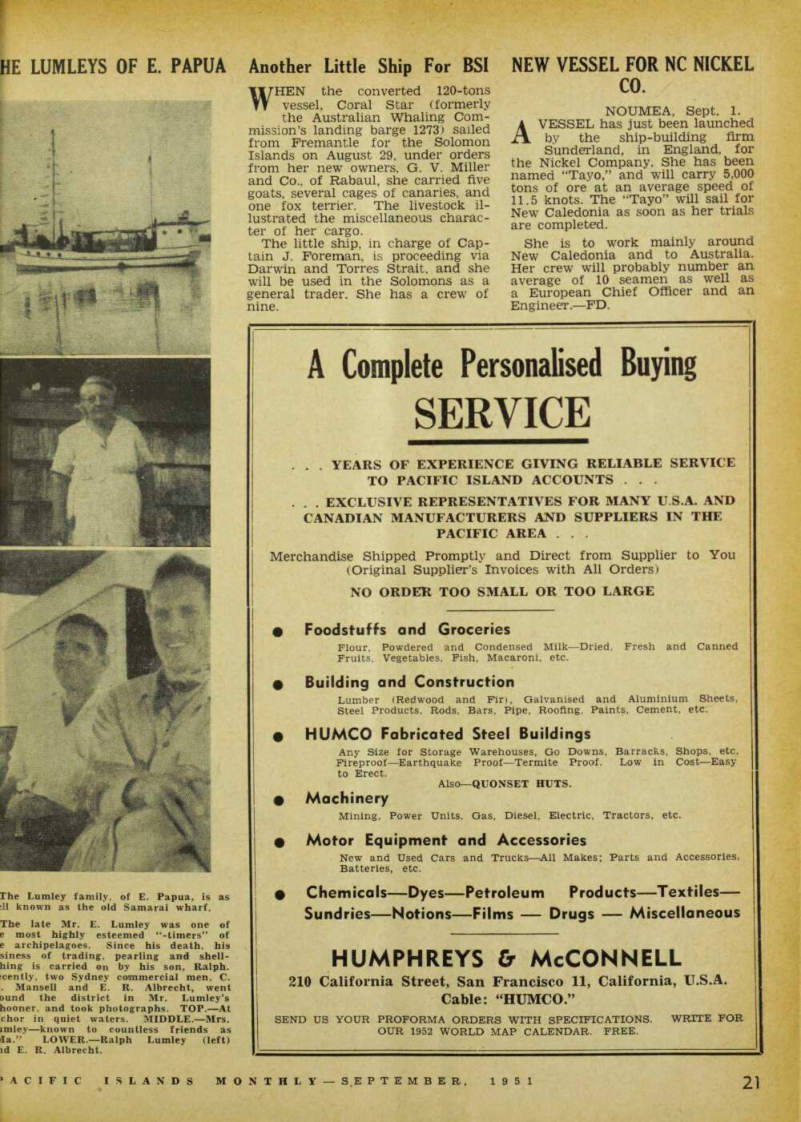
The Lumley family, of E. Papua, is as well known as the old Samarai wharf.
The late Mr. E. Lumley was one of the most highly esteemed “-timers” of the archipelagoes. Since his death, his business of trading, pearling and shellsearching is carried on by his son, Ralph, and recently, two Sydney commercial men. C.
Mansell and E. R. Albrecht, went around the district in Mr. Lumley’s schooner, and took photographs. TOP.—At anchor in quiet waters. MIDDLE.—Mrs.
Lumley—known to countless friends as "Ma.” LOWER—Ralph Lumley (left) and E. R. Albrecht.
Another Little Ship For BSI
WHEN the converted 120-tons vessel, Coral Star (formerly the Australian Whaling Com mission’s landing barge 1273) sailed from Fremantle for the Solomon from d he? n n"ne?s MUto and I Co* r o f goats, several cages of canaries, and one fox terrier. The livestock il lustrated the miscellaneous charac ter of her cargo.
The little ship, in charge of Cap tain J. Foreman, is proceeding via Darwin and Torres Strait, and she will be used in the Solomons as a general trader. She has a crew of nine.
New Vessel For Nc Nickel
CO.
Noumea, Sept. 1.
A VESSEL has just been launched by the ship-building firm Sunderland, in England, for the Nickel Company. She has been named “Tayo,” and will carry 5,000 tons of ore at an average speed of 11.5 knots. The “Tayo” will sail for New Caledonia as soon as her trials are completed.
She is to work mainly around New Caledonia and to Australia.
Her crew will probably number an average of 10 seamen as well as a European Chief Officer and an
Engineer.-
FD.
Advertisements & other items, pp. 23-24 (2 items)
21
'4CIFIC ISLANDS MONTHLY SEPTEMBER, 1951
A Complete Personalised Buying
SERVICE
. . . YEARS OF EXPERIENCE GIVING RELIABLE SERVICE TO PACIFIC ISLAND ACCOUNTS . . . . . . EXCLUSIVE REPRESENTATIVES FOR MANY U.S.A. AND
CANADIAN MANUFACTURERS AND SUPPLIERS IN THE
PACIFIC AREA . . .
Merchandise Shipped Promptly and Direct from Supplier to You (Original Supplier’s Invoices with All Orders) NO ORDER TOO SMALL OR TOO LARGE
• Foodstuffs and Groceries
Flour, Powdered and Condensed Milk —Dried, Fresh and Canned Fruits, Vegetables. Pish, Macaroni, etc.
• Building and Construction
Lumber (Redwood and Fir), Galvanised and Aluminium Sheets, Steel Products, Rods, Bars, Pipe, Roofing, Paints. Cement, etc.
• HUMCO Fabricated Steel Buildings
Any Size for Storage Warehouses, Go Downs, Barracks, Shops, etc.
Fireproof—Earthquake Proof —Termite Proof. Low in Cost —Easy to Erect.
AIso—QUONSET HUTS.
• Machinery
Mining. Power Units, Gas, Diesel, Electric, Tractors, etc.
• Motor Equipment and Accessories
New and Used Cars and Trucks —All Makes; Parts and Accessories, Batteries, etc.
• Chemicals—Dyes—Petroleum Products—Textiles —
Sundries—Notions—Films Drugs Miscellaneous
HUMPHREYS & McCONNELL
210 California Street, San Francisco 11, California, U.S.A.
Cable: “HUMCO.”
SEND US YOUR PROFORMA ORDERS WITH SPECIFICATIONS. WRITE FOR
OUR 1952 WORLD MAP CALENDAR. FREE.
IF YOU HANDLE GOODS IN BALES, BAGS OR BOXES
MUNRO
All Steel Conveyors and
Elevators Can Help You
I 3 Two Standard Types of Elevators are shown here.
Available in various lengths Special Designs for Special Work Powered by Electric Motor or Internal Combustion Engine Special Expert Packing for Islands Orders
YOUR ENQUIRY WILL BE WELCOMED AND
IT WILL HELP IF YOU WILL STATE IN YOUR
LETTER:—
(1) Material (2) Form of package (3) Weight of package (4) Height of lift (5) Type of power used (6) Any other details which you think are relevant
Write us about your handling problems
MUNRO ENGINEERS Pty. Ltd
19 YUILLE ST., BALLARAT, VICTORIA, AUSTRALIA
Deaths Of Islands People
Mr. R. A. Perry
The death occurred in Suva, on ligust 25, of Mr. R. A. (Rap) hry, a well-known identity who gnt to Fiji in 1906, to join Mr. rchie Glen, of Labasa, He later worked for Henry Marks Co,, and when this firm came ider the control of Morris Hed rom Ltd. Mr. Perry continued in ,e service of that firm until he tired, due to ill-health, in 1942.
He and his wife have lived at gatoka for the last nine years.
Mr. J. J. Barker
The death occurred near Sydney, l August 4, of Mr. John James irker, aged 82.
Mr. Barker was born in NZ and ait to Fiji in the early 80’s with s parents, where, as an engineer, i joined the Fiji Sugar Company, iter, at a time when there were i roads around Viti Levu, he oneered several steamship ser- C6S.
At one time he had many land id business interests in the colony, g was also a noted athlete. For a imber of years he has been living Australia. He is survived by two ns. His brother is Sir Alport irker, of Suva, and two sisters re on Norfolk Island.
Mr. F. H. Harvey
The death has occurred of Mr.
Francis Hilary Harvey, a well known planter, of Epi Island, New Hebrides. Mr. Harvey’s generosity, and his popularity among the younger residents of the Condo minium, were legend. News of his death was received with regret by many friends.
Mr. F. D. Ross
The death occurred in Brisbane on August 8 of the well-known and highly respected ex-manager of the BNG Co.’s Obu coconut plantation in the rich Hisiu district, not very far west of Pt. Moresby.
“Doug” Ross was one of three brothers in Papua over 30 years ago.
Eric died years ago, and the other brother, Alister, more recently, in England, where he lived after his retirement from the position of Government Storekeeper.
“Doug”, who was 66, had only been in Brisbane six weeks when he became ill —the cause of death was asthma. He was quite fit when he left the plantation to retire, was playing his games of tennis as well as ever. He is survived by a widow and two children —son Sutherland is with the Department of Civil Aviation in Brisbane, and daughter
Elsie is the wife of the well-known Papuan official, Mr. Ivan Champion.
His grand-daughter, Ivane Cham pion, now only 21, recently, 14 days after Lamington blew its top, went in there on Infant Welfare work.
He left his job in Papua to serve in World War I, and returned in 1919. All old Papuans will mourn the passing of cheery “Doug” Ross, deservedly popular with everyone.—
Shc.
Mr. “Ken” Frank
Pt. Moresby, Sept. 1.
PORT Moresby residents were saddened on August 22 to learn of the death of “Ken” Frank, popular OTC officer for Papua and New Guinea.
With his wife, Mi’s. Molly Frank, he left Port Moresby for long over due recreation leave on August 20, and stopped over at Townsville on the first stage of what was to have been a holiday tour of Australia.
Next day they drove to Charters Towers; and, when returning at night, with Ken at the wheel, the car overturned. He died almost im mediately from head injuries, and his stepdaughter, Miss Pam Bing ham was severely injured. Mrs.
Frank escaped with shock and bruises.
Mr. Frank was 46 and had been in the Territory since 1931, first with Amalgamated Wireless Limited,
and then with OTC. Throughout the war he remained in the Islands as a civilian working with the Allied Forces. His remarkable ability as a radio engineer had long been known to Territories folk, and the military forces also paid tribute to his outstanding record.
“Ken” is a real loss to the Islands, and his death is mourned by a wide circle of friends.
Mr. A M Philipp
. old anc * respected resident of Apia, Mr. A. M. Philipp, died on August 3 after a short ill ness, aged 80. He came first to Samoa in the beginning of the century. His son is Sub-Inspector A. Philipp, of the Samoan Constab ulary, who was away on leave in New Zealand when his father died.
Mr. Albert Stehlin
Mr. Albert Stehlin, one of tf few European settlers born of Em pean parents in Samoa, died August 10, at his home at Loto* Apia. He was one of the piono cocoa planters of Samoa and w renowned for his knowledge ax for having, through sheer grit aj hard work, succeeded in bringii his cocoa plantation to a high c gree of prosperity.
Mr. W. G. Higgs
The death occurred on August 1 at his home in Deewhy, Sydney, Mr. William Gordon Higgs, who Wv well known throughout the Som Pacific as an executive in the Cat penter group of companies. He m 59 and he had been in ill-heali for some time.
Mr. Higgs was born in Victor!* and he was a railway official West Australia before he served World War I. He joined W Carpenter & Co. Ltd. over 20 yeaE ago, and he served the organisatioj in Solomons. New Guinea, Fiji an the United States. His wife died 1949. They had one son—M Stanley Higgs, a Sydney business man.
Captain Sammy Burns
THE Brisbane Courier of Augu 11 records the death of Ads Anderson Bums (writes Cax tain W. L. Kennedy, of Sydney The name conveys little nowadas but he was generally known Captain Burns, or Sammy Burr He was one of the best known au most colourful figures in the Pao. fic a few decades back, and I as sure that if there are any old-time, still on deck in New Guinea, tf Hebrides or Solomons, they will n gret to hear of his passing.
I first met Sammy over 50 yes back. I was then a young seanui in the recruiting trade from tb Solomons and New Hebrides Queensland. He was then Mast; of the Ivanhoe, a smart schooner; and, afterwards, several other flyers engaged in tb trade. He was also Mate wir “Piggy” Peam in the famous bas quentine Lochiel. Sammy wi Master of the Government steamn Merrie England, and lost her o Port Moresby.
Afterwards, he joined up with tlj AUSN Company, and was MastJ; and Mate with that Company. Z was around the 90 mark when 3 made his last crossing; and up a few years back he was deliveriri small craft to the Islands for til: office.
With the death of Captain Burn goes, I think, the last of his ty*r and the Pacific will be the poom for his passing. Stories which coin be told about him, and also “Pigg;§ Pearn (long since deceased) are iii numerable, but space does not peo< mit —so, Vale, Sammy!
(Continued on Page 113)
Advertisements & other items, pp. 25-26 (3 items)
23
kCIFIC ISLANDS MONTHLY SEPTEMBER, 1951
Robert Gillespie Ptv Ltd
II classes of merchandise purchased for >land clients throughout the South-west acific. iland produce sold on Australian and overjas markets on a commission basis.
IMPORTERS "EXPORTERS
v\
ROBERT GILLESPIE PTV LTD
COMPTOIR NATIONAL
D'ESCOMPTE DE PARIS
54a PITT ST. SVDNEV N SW.
CABLE ADDRESS;
PHONE •• 8U222 I.
Executive Training FH
for Business .. .
from its years of intimate association in the training of “top” executives, and from the results of latest research from all world sources, the H.R.I. has now made available the Business Administration Course and Service.
This H.R.I. training for executives does what any one man could not do for himself in a comparable period of time. It offers the opportunity to learn first-hand the latest method of procedure of companies actively engaged in business today, and covers those business subjects which every executive must master — under the departments of PRODUCTION, DISTRIBUTION, FINANCE
AND ADMINISTRATION.
★ To executives—and near executives—we extend a cordial invitation to write or wire for more detailed information. No obligation is incurred.
Hemingway Robertson Institute
(Founded and owned by Hemingway & Robertson Pty. Ltd.) Consulting Accountants — Professional Tutors 126 BARRACK HOUSE, 16 BARRACK STREET, SYDNEY 126 BANK HOUSE - BANK PLACE - MELBOURNE /tn9A
A NEW BROOM
Sweeps
Clean
AH Progressive Merchants and Traders Need
M. KERRY PTY. LTD.,
369 GEORGE STREET, SYDNEY.
To Buy for Them at a Better Price Send or cable your order to “MARNIKAY,” Sydney.
24
SEPTEMBER, 1951 PACIFIC ISLANDS MONTHL
His Split-Second
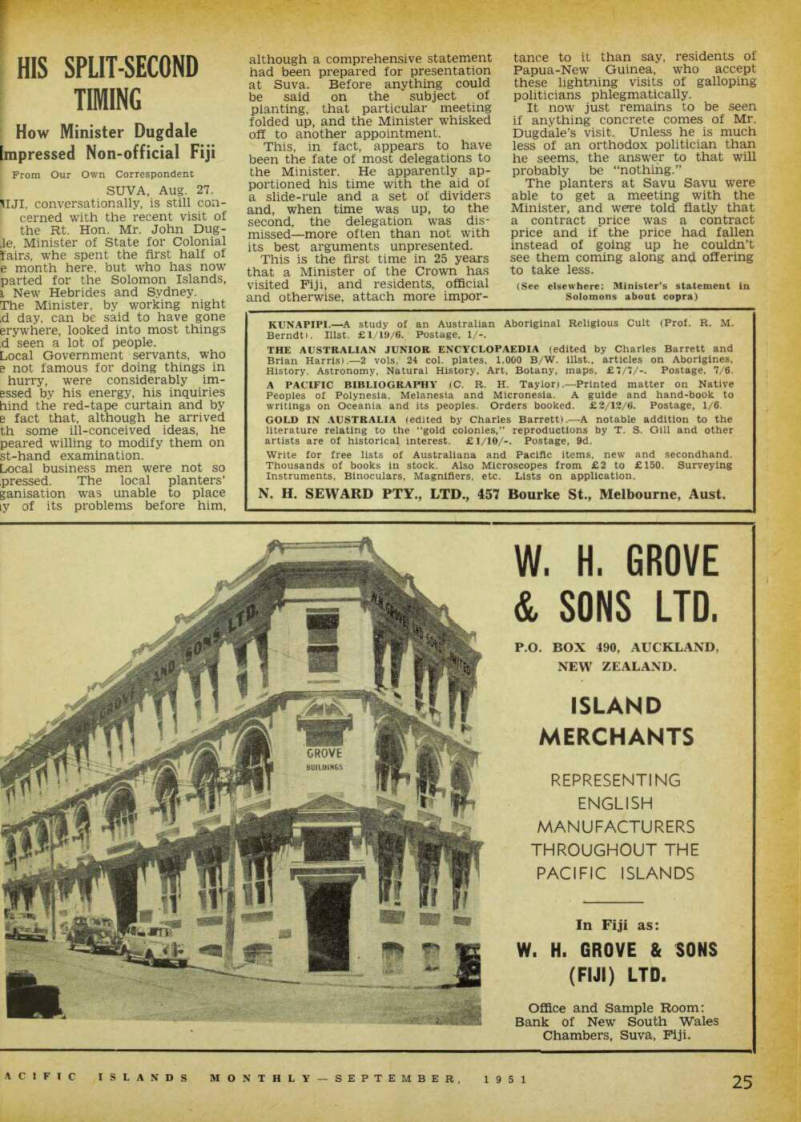
Timing
How Minister Dugdale Impressed Non-official Fiji
From Our Own Correspondent
Suva, Aug. 27.
lIJI, conversationally, is still con cerned with the recent visit of the Rt. Hon. Mr. John Bug le, Minister of State for Colonial fairs, whe spent the first half of e month here, but who has now parted for the Solomon Islands, i New Hebrides and Sydney.
The Minister, by working night id day, can be said to have gone erywhere, looked into most things d seen a lot of people.
Local Government servants, who e not famous for doing things in hurry, were considerably im essed by his energy, his inquiries hind the red-tape curtain and by e fact that, although he arrived th some ill-conceived ideas, he peared willing to modify them on st-hand examination.
Local business men were not so pressed. The local planters’ ganisation was unable to place ly of its problems before him,
although a comprehensive statement had been prepared for presentation at Suva. Before anything could be said on the subject of planting, that particular meeting folded up, and the Minister whisked off to another appointment.
This, in fact, appears to have been the fate of most delegations to the Minister. He apparently ap portioned his time with the aid of a slide-rule and a set of dividers and, when time was up, to the second, the delegation was dis missed —more often than not with its best arguments unpresented.
This is the first time in 25 years that a Minister of the Crown has visited Fiji, and residents, official and otherwise, attach more impor
tance to it than say, residents of Papua-New Guinea, who accept these lightning visits of galloping
politicians phlegmatically.
It now just remains to be seen if anything concrete comes of Mr.
Dugdale’s visit. Unless he is much less of an orthodox politician than he seems, the answer to that will probably be “nothing.”
The planters at Savu Savu were able to get a meeting with the Minister, and were told flatly that a contract price was a contract price and if the price had fallen instead of going up he couldn’t see them coming along and offering to take less. (See elsewhere: Minister’s statement in Solomons about copra)
Advertisements & other items, pp. 27-28 (2 items)
& Sons Ltd.
KUNAPIPI. —A study of an Australian Aboriginal Religious Cult (Prof. R. M.
Berndt). Illst. £l/19/6. Postage, 1/-.
THE AUSTRALIAN JUNIOR ENCYCLOPAEDIA (edited by Charles Barrett and Brian Harris).—2 vols, 24 col. plates, 1.000 B/W. illst., articles on Aborigines, History. Astronomy, Natural History. Art, Botany, maps, £7/7/-. Postage. 7/6.
A PACIFIC BIBLIOGRAPHY (C. R. H. Taylor) .—Printed matter on Native Peoples of Polynesia. Melanesia and Micronesia. A guide and hand-book to writings on Oceania and its peoples. Orders booked. £2/12/6. Postage, 1/6.
GOLD IN AUSTRALIA (edited by Charles Barrett). —A notable addition to the literature relating to the “gold colonies,” reproductions by T. S. Gill and other artists are of historical interest. £l/10/-. Postage, 9d.
Write for free lists of Australiana and Pacific items, new and secondhand.
Thousands of books in stock. Also Microscopes from £2 to £l5O. Surveying Instruments, Binoculars, Magnifiers, etc. Lists on application.
N. H. SEWARD PTY., LTD., 457 Bourke St., Melbourne, Aust.
■ rk m m
GROVE
BCHDWCS
1 11 m ®BuCl6^3L mm ; A w
W. H. GROVE
& SONS LTD.
P.O. BOX 490, AUCKLAND,
NEW ZEALAND.
ISLAND
MERCHANTS
REPRESENTING
ENGLISH
MANUFACTURERS
THROUGHOUT THE
PACIFIC ISLANDS
In Fiji as:
W. H. GROVE & SONS
(FIJI) LTD.
Office and Sample Room: Bank of New South Wales Chambers, Suva, Fiji.
VEW POWER TO T
TIMBER BUSINES
MO. / / ««« ...
Teß.eS
SH
Super* LIGHTWEIGh
Tower CHAIN SAV
68 easy-to-carry lbs.
high speed power.
CUTTING TIMBER • CUTTING WOR
CUTTING COSTS
PURPOSE.—The TELES Super Lightweight 24 in. Power CHAIN SAW is designed and built to meet the demands of Property Owners, Contractors, Foresters and Timber Millers who have medium sized timber to cut or fall quickly efficiently . . . economically.
POWER.—TELES is powered by a trouble-free Villiers twostroke engine, developing four b.h.p. at maximum revolutions, designed by “know-how” to give ample power for driving the saw whilst cutting the toughest timber. The SAW is a chain of fast-cutting teeth which can be sharpened with a mill-saw file. Note . . . low initial costs . . . low running costs . . . low maintenance costs. i PROVED.—TELES has power-a-plenty. It will cross-cut 24 in. diameters in a quick 60 seconds. TELES is easy to handle, simple to control The guide bar or chain track, can be swivelled to any cutting angle by means of a single lever. The multi-disc type CLUTCH permits the engine to run whilst the saw is idle. TELES can be carried from one job to another.
It weighs only 68 lbs.
RING, WRITE OR CALL . . .
FOR COMPLETE INFORMATION.
Australian Distributors: QUEENSLAND.—Engineering Supply Co. of Australia, Edward Street, Brisbane. NEW SOUTH WALES —F. H. Fearon & Sons Pty , Ltd 45 Watt Street, Newcastle. VICTORIA AND TASMANIA.—(MiIIer & Co. . Ltd ' ’ 27 Q ueen ’s Bridge Street, South Melbourne.
A. Noble & Son, Ltd., 79 Grenfell Street, Adelaide.
WESTERN AUSTRALIA.—Geo. Moss Pty., Ltd., 337 Murray Street, Perth.
Factory Representative: J. R. MCCARTHY & CO., 430 Little Collins Street, Melbourne. /
26
SEPTEMBER, 1951 PACIFIC ISLANDS MONTH
Papua-N. Guinea Guides at Narrabeeu

YDNEY and Brisbane n e w s pers have given lot of publicity the Girl Guides )m Papua-New linea who have ne to Sydney to te part in the ternational Girl tides Jubilee ,mp at Narra en. rhe gathering mmenced o n ugu s t 27, ten 500 Girl lides, from all r e r the world, *an to assemble, le Camp lasted week. Papua iw Guinea rep sentatives were; Europeans irgaret Gracey,
and Maureen Shorthouse, 13— i latter the youngest patrol leader the Ist Port Moresby Company.
Chinese —Helen Cheong and May 3 to, of Rabaul.
Natives —Raka Hital, Vagi Varo d Keke Reva.
The girls are in charge of the Girl Guides Commissioner for Papua-New Guinea, Mrs. A. V. Price.
All have received much kindness and hospitality in Brisbane and Sydney.
They needed it the weather was much colder than they are accustomed to.
At a special Rally at Rabaul on Saturday. August 11, the Boy Scouts and Girl Guides raised £25, thus bringing the fund for the Guides going to Narrabeen to £lOO.
May Seeto, Helen Cheong and Vagi Varo are interested in the purchase of woollen stockings in Brisbane.
Her Curtain-Rod Saved
The Plane
WHEN Pilot Captain Leslie Davis was bringing in a twin engined DH Dove (Mandated Airlines) from Wewak to Lae (New Guinea) on August 19, he dis covered that the pneumatic system would not lower the undercarriage.
A fellow-pilot, Jack Stammer, and Mrs. Stammer, were aboard, and Pilot Stammer worked on the problem, while Davis kept on flying around. They finally got the wheels down, but the nose wheel would not lock. They tried every thing.
Then Stammer hacked his way through the cockpit floor and bored through the wall of the nose wheel section. With a 6 ft piece of con duit his wife had bought in Wewak for a curtain rod he forced the wheel into position. It was the only thing on board that could have reached the wheel.
They had been flying around for two hours. All emergency plant to deal with crashes was awaiting them on the airfield. They came in to a perfect landing, amid cheers, with five minutes’ fuel left.
Mr. Oscar Nordman, of Tahiti, arrived in Sydney on September 19, on a short visit.
Advertisements & other items, pp. 29-30 (2 items)
27
ACIFIC ISLANDS MONTHLY— SEPTEMBER, 1951
The lujh t Tractor that a BIG job f
THE BRITISH
a
DIESEL TRACTOR
The most economical tractor yet designed, the NEWMAN is powered with a Coventry Victor motor. Simple to operate, simple to service.
NEWMAN for reliability and low operating costs.
Distributors throughout PAPUA‘NEW GUINEA
COIYER WATSON
RABAUL
MADANG
(NEW GUINEA)
KAVIENG
LTD
MOP
AND
GREEN SNAIL
Bought for Cosh or on Consignment.
TOP PRICES-PROMPT CASH
Kenneth E, White
Box 2, Royal Exchange, Bridge St., Sydney.
Cables: “WHAM,” Sydney.
Banker: Union Bank of Australia. Ltd., Pitt Street, Sydney.
McILRATH'S
202 PITT ST., SYDNEY.
Recommend that Island Customers should send their Christmas orders early to ensure the arrival in plenty of time of goods required for the making of CAKES and PUDDINGS. A choice selection of MUSCATELS,
CONFECTIONERY, DATES, ESSENCES, etc., avail-
able at lowest rates. All prices F. 0.8. Sydney and subject to Stocks and Market Fluctuations.
New Season’s Special Quality 3 CROWN
CURRANTS 1/11 >/ 2 lb.
New Season’s Special Quality 4 CROWN
SULTANAS 2/- lb.
Choice Mixed PUDDING FRUITS. 16 oz. ctns 2/6 ctn. 29/9 doz. ‘Big Sister” Crystallised CHERRIES. (Pitted). 4 oz. ctns. 2/4»/ 2 ctn.
Choice CUT MIXED PEEL. Boz l/4y 2 pkt.
Mcllrath’s DESSERT. 4 oz. pkts 8/6 doz.
A delicious summer dish, available in chocolate or caramel flavours. ••Rosa” BLANC MANGE POWDER. 5 oz. pkts. . 8/6 doz. (Each pkt. will mate one pint of delicious Blanc Mangei.
“Rosa” FLUMMERY, or SPANISH CREAM ... 9/6 doz. (Ideal summer desserts).
“Rosa” CUSTARD POWDER. 16 oz. ctns. . . 26/9 doz. (Made from best ingredients.—None better).
“Rosa” JELLY CRYSTALS. Pint pkts 8/6 doz.
Flavours: Lemon, Raspberry, Strawberry, Pineapple.
Orange, Vanilla, Lime. Red Currant, Black Currant.
Cherry, Port Wine. Greengage.
SOLPAK APPLES. 28 oz. tins 42/- doz.
Pickled Whole GHERKINS. 10 oz. jars .. .. 33/- doz.
Big Sister” SWEET FRUIT CHUTNEY. 15 oz.
J ars 31/6 doz. •‘Big Sister” Choice PLUM PUDDINGS. 16 oz. tins 40/- doz.
New Season’s SOFT SHELL ALMONDS . . . . 2 10V 2 lb.
New Season’s MIXED NUTS (in shell) 3/6 lb.
“Big Sister” FRUIT MINCE. 14y 2 oz. tins 28/6 doz.
Mcllrath’s Special BRANDY SULTANA CAKE. 3 lb. Utility tins 10/6 ea.
“Mynor” or “Kia-Ora” ASSORTED CORDIALS. 26 oz from 44/- doz.
Choice STRAWBERRY CONSERVE. 24 oz. tins. 43/6 doz.
BON-BONS (Christmas Crackers) available at 5/6 to 12/6 per box. (A splendid assortment of attractive varieties.) Plain Flour, Seif-Raising Flour and Sugar is available in new 25 lb. and 35 lb. lever lid tins, for Island Customers.
A full range of Penfold’s, Lindeman’s. Seppelt’s and Hardy’s Wines, now available. Also leading brands of Whisky, Rum, Gm, Liqueurs, and Simond’s English light Pale Ale available at competitive under bond prices.
MrfT PTV f 202 Pitt St,/ Sydne y' Austra iia- * T **'H-'*** lll\J illi RJ 1 Cable Address: “Rotunda,” Sydney DETAILED PRICE LISTS AVAILABLE POST FREE ON APPLICATION.
NZ Defends Its Anti-Polynesian Law
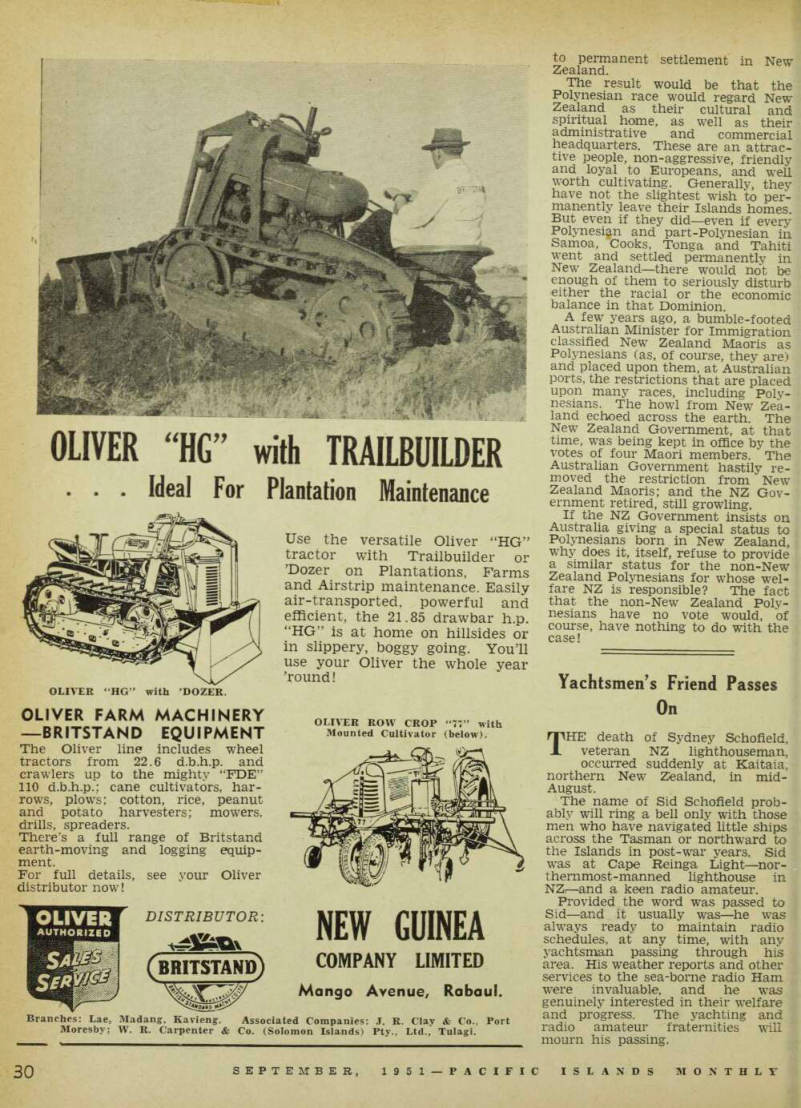
THE following statement was
issued, in August, from the office of the New Zealand Department of External Affairs:— Articles have appeared in a recent issue of an Australian monthly pub lication circulating in the Pacific Islands, which refer to “New Zea land’s ridiculous law about Poly nesians,” and suggest that “Poly nesians are barred from entry into New Zealand and that New Zealand’s immigration laws are offensively applied here.”
Such is far from being the case, and it is a pity that the author of the article did not make sure of his facts before rushing into print.
New Zealand’s particular concern in the Pacific is with the Cook Islands and Western Samoa. In both these Territories regulations are in force which control the de parture of people, both indigenous and other. Departure is regulated entirely in the interests of the people themselves, and permits are granted when the Administration is satisfied that the Cook Islanders or the Samoans, as the case may be, have
made satisfactory arrangements ft accommodation in the country destination and, where they are g* mg to employment, that they at aware of their wages and workii. conditions. Also the Administration usually desire to be assured that tl people will be met on arrival. Tl' Cook Islands being part of Ne Zealand, people arriving in tl: Dominion from that Group are nr subjected to the Tequirements of tl Immigration Act, and they are fr to land.
Western Samoa, however, being’
Trusteeship Territory and not pa* of New Zealand, the immigratio laws apply; but, provided a travelll is in possession of a permit to depan from Western Samoa, he is grant*, a visitor’s permit for a period of s? or twelve months on landing, witH out question. Provided nothing known against his conduct or chaj acter, the permit is extended frox time to time. After being in Nes Zealand for five years, the visit* may make application for permissio to remain permanently in NeE Zealand, and this is granted freet
if nothing is known adverse to the applicant’s character or conduct.
In the case of Tongans, visitors’ permits are granted if the travellers are sponsored by the Tongan Gov ernment. f In the case of Fijian visitors, they pay a deposit on landing, and this is applied if necessary to payment of the return fare by air or any medical [expenses incurred while in New
Zealand.
Students’ permits are freely granted on the sponsorship of the Government concerned, and in New Zealand schools and even Univer sities there are numerous students from all parts of the South Pacific.
It will be agreed, in view of the above explanation, that Polynesians are NOT barred from entry into New Zealand, nor is our immi gration law offensively applied against them.
New Zealand, and the Treatment of Polynesians
THE journal which is referred to by New Zealand so mincingly as “an Australian monthly publication circulating in the Pacific islands” is, of course, the Pacific Islands Monthly; and this is the Pacific Islands Monthly’s formal and editorial reply.
In the manner so typical ©f the bureaucrat and the politician, the “statement” quite cleverly dodges the real point at issue.
Our argument is that New Zea land, as a Polynesian country, and as the home of a large part of the Polynesian race, should not dis criminate in any way against non resident Polynesians or part-Poly nesians.
No doubt, there is justification for laws which will prevent large num bers of Polynesians from Cook Islands, Samoa and Tonga settling permanently in New Zealand —as they have an inclination to do. But why place embarrassing restrictions generally upon Polynesians and part-Polynesians, who have the status of Europeans, when they wish to visit New Zealand?
We have innumerable instances of people being subjected to humiliat ing interrogations by curt and tact less officials of the lower orders, simply because they truthfully des cribe themselves as of part-Poly nesian race, or because the officials think they are not entitled to call themselves Europeans.
The position, as it affects part- Folynesians, is especially embar rassing. There are thousands of such people in the South Pacific— there are some 5,000 in Samoa alone —and their numbers are steadily in creasing, as marriage between Europeans and Polynesians or part- Polynesians becomes more common.
These people mostly are educated, and live as Europeans, and yet when they come to the ports of Australia and New Zealand they find that a sharp distinction is made between them and Europeans.
Australia is not in the same cate gory as New Zealand. Australia has little to do with Polynesia. New Zealand is the home of 100,000 Poly nesians, and is the administrator and protector of many thousands more, in the Cook Islands and Samoa.
Our plea is that the New Zealand Government should display suf
ficient imagination and vision to give to all Polynesians, so far as New Zealand is concerned, the same status and privileges as are accorded Europeans—with, of course, the
obvious proviso that precautions be taken against migration of full blooded Cook Islanders and Samoans (Continued on Next Page)
to permanent settlement in New Zealand.
The result would be that the Polynesian race would regard New Zealand as their cultural and spiritual home, as well as their administrative and commercial headquarters. These are an attrac tive people, non-aggressive, friendly and loyal to Europeans, and well worth cultivating. Generally, they have not the slightest wish to per manently leave their Islands homes.
But even if they did—even if every Polynesian and part-Polynesian in Samoa, Cooks, Tonga and Tahiti went and settled permanently in New Zealand—there would not be enough of them to seriously disturb either the racial or the economic balance in that Dominion.
A few years ago, a bumble-footed Australian Minister for Immigration classified New Zealand Maoris as Polynesians (as, of course, they are) and placed upon them, at Australian ports, the restrictions that are placed upon many races, including Poly nesians. The howl from New Zea land echoed across the earth. The New Zealand Government, at that time, was being kept in office by the votes of four Maori members. The Australian Government hastily re moved the restriction from New Zealand Maoris; and the NZ Gov ernment retired, still growling.
If the NZ Government insists on Australia giving a special status to Polynesians born in New Zealand, why does it, itself, refuse to provide a similar status for the non-New Zealand Polynesians for whose wel fare NZ is responsible? The fact that the non-New Zealand Poly nesians have no vote would, of course, have nothing to do with the case!
Advertisements & other items, pp. 30-32 (2 items)
28
SEPTEMBER, 1951 PACIFIC ISLANDS MON.THLTf
Ice Cream Mix
POSTAGE STAMP DEALERS
AND COLLECTORS.
London wholesaler requires AGENTS in
all BRITISH COLONIES in the PACIFIC,
for regular supplies of used postage stamps from MISSIONARIES, BANKS
and SHIPPING OFFICES.
Current London market prices will be paid for all clean usable material.
Remittances by Air for all sendings valued £2 and over.
B. SAVITZ, 8.P.A.,
69 Greenvale Road, Eltham, London, 5.E.9, Eng.
ICE CREAM MIX
VANILLA, STRAWBERRY and CHOCOLATE
■ w rs 4 si IN Packed in 16 oz. tins for the Home, 5 lb.
Family Size tins, and 32 lb. tins for Storekeepers, Milk Bars and Cafes.
J. C. MERRILLEES
PTY. LTD.
104 Hunter St., Sydney, N.S.W.
Telegrams: “MERRILLEES,” Sydney.
V-f. * -s p p I
OLIVER “HG” with TRAILBUILDER
. . . Ideal For Plantation Maintenance mm mm
SSM
OLIVER “HG” with ’DOZER.
Use the versatile Oliver “HG” tractor with Trailbuilder or ’Dozer on Plantations, Farms and Airstrip maintenance. Easily air-transported, powerful and efficient, the 21.85 drawbar h.p.
“HG” is at home on hillsides or in slippery, boggy going. You’ll use your Oliver the whole year ’round!
OLIVER FARM MACHINERY
—BRITSTAND EQUIPMENT
The Oliver line includes wheel tractors from 22.6 d.b.h.p. and crawlers up to the mighty “FDE” 110 d.b.h.p.; cane cultivators, harrows, plows; cotton, rice, peanut and potato harvesters; mowers, drills, spreaders.
There’s a full range of Britstand earth-moving and logging equipment.
For full details, see your Oliver distributor now!
OLIVER
AUTHORIZED
DISTRIBUTOR :
(britstand)
OLIVER ROW CROP “77” with
Mounted Cultivator (below).
NEW GUINEA
COMPANY LIMITED
Mango Avenue, Rabaul.
Branches: Lae, Madang, Kavleng. Associated Companies: J. R. Clay & Co., Port Moresby; W. R. Carpenter & Co. (Solomon Islands) Pty., Ltd., Tulagi.
Yachtsmen’s Friend Passes
On
THE death of Sydney Schofield, veteran NZ lighthouseman, occurred suddenly at Kaitala, northern New Zealand, in mid- August.
The name of Sid Schofield prob ably will ring a bell only with those men who have navigated little ships across the Tasman or northward to the Islands in post-war years. Sid was at Cape Reinga Light—nor themmost-manned lighthouse in NZr— and a keen radio amateur.
Provided the word was passed to Sid—and it usually was—he was always ready to maintain radio schedules, at any time, with any yachtsman passing through his area. His weather reports and other services to the sea-borne radio Ham were invaluable, and he was genuinely interested in their welfare and progress. The yachting and radio amateur fraternities will mourn his passing.
Vital Air Link
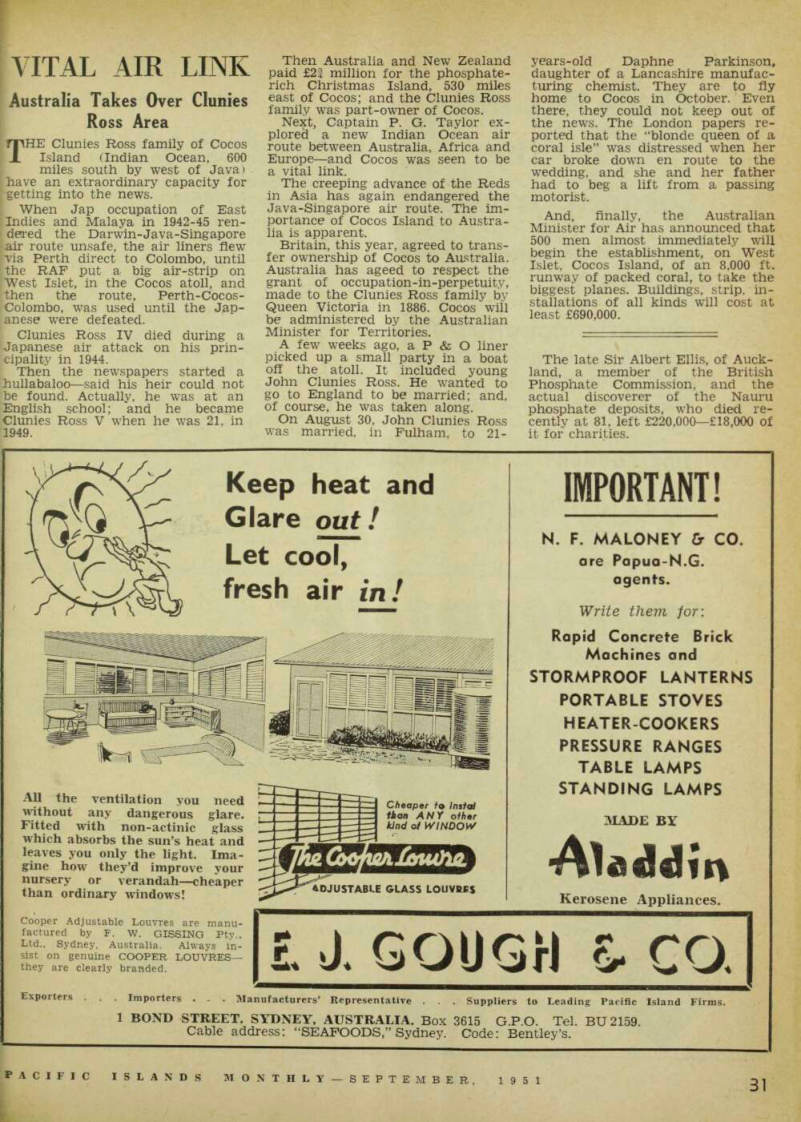
Australia Takes Over Clunies Ross Area
THE Clunies Ross family of Cocos Island (Indian Ocean, 600 miles south by west of Java) have an extraordinary capacity for getting into the news.
When Jap occupation of East Indies and Malaya in 1942-45 ren dered the Darwin-Java-Singapore mr route unsafe, the air liners flew via Perth direct to Colombo, until the RAF put a big air-strip on West Islet, in the Cocos atoll, and then the route, Perth-Cocos- Colombo, was used until the Jap anese were defeated.
Clunies Ross IV died during a Japanese air attack on his prin cipality in 1944.
Then the newspapers started a hullabaloo—said his heir could not be found. Actually, he was at an English school; and he became Clunies Ross V when he was 21, in 1949.
Then Australia and New Zealand paid £2i million for the phosphate rich Christmas Island, 530 miles east of Cocos; and the Clunies Ross family was part-owner of Cocos.
Next, Captain P. G. Taylor ex plored a new Indian Ocean air route between Australia, Africa and Europe—and Cocos was seen to be a vital link.
The creeping advance of the Reds in Asia has again endangered the Java-Singapore air route. The im portance of Cocos Island to Austra lia is apparent.
Britain, this year, agreed to trans fer ownership of Cocos to Australia.
Australia has ageed to respect the grant of occupation-in-perpetuity, made to the Clunies Ross family by Queen Victoria in 1886. Cocos will be administered by the Australian Minister for Territories.
A few weeks ago, a P & O liner picked up a small party in a boat off the atoll. It included young John Clunies Ross. He wanted to go to England to be married; and, of course, he was taken along.
On August 30, John Clunies Ross was married, in Fulham, to 21-
years-old Daphne Parkinson, daughter of a Lancashire manufac turing chemist. They are to fly home to Cocos in October. Even there, they could not keep out of the news. The London papers re ported that the “blonde queen of a coral isle” was distressed when her car broke down en route to the wedding, and she and her father had to beg a lift from a passing motorist.
And, finally, the Australian Minister for Air has announced that 500 men almost immediately will begin the establishment, on West Islet, Cocos Island, of an 8,000 ft. runway of packed coral, to take the biggest planes. Buildings, strip, in stallations of all kinds will cost at least £690,000.
The late Sir Albert Ellis, of Auck land, a member of the British Phosphate Commission, and the actual discoverer of the Nauru phosphate deposits, who died re cently at 81, left £220,000 —£18,000 of it for charities.
Advertisements & other items, pp. 33-34 (2 items)
£. J. Gough & Co.
/ xf e
Keep heat and
Glare ou
Let cool,
fresh air
in: mm Cheaper fa Instaf than ANY of her kind of WINDOW £ Vk
ADJUSTABLE GLASS LOUVRES
N,
IMPORTANT!
F. MALONEY & CO.
ore Popua-N.G. agents.
Write them -for: Rapid Concrete Brick Machines and
STORMPROOF LANTERNS
PORTABLE STOVES
HEATER-COOKERS
PRESSURE RANGES
TABLE LAMPS
STANDING LAMPS
3IADE BY
Kerosene Appliances.
All the ventilation you need without any dangerous glare.
Fitted with non-actinic glass which absorbs the sun’s heat and leaves you only the light. Imagine how they’d improve your nursery or verandah—cheaper than ordinary windows!
Cooper Adjustable Louvres are manufactured by F. W. GISSING Pty., Ltd., Sydney, Australia. Always insist on genuine COOPER LOUVRES — they are clearly branded.
Exporters . . . Importers . - . Manufacturers’ Representative . . . Suppliers to Leading Pacific Island Firms. 1 BOND STREET, SYDNEY, AUSTRALIA. Box 3615 G.P.O. Tel. 8U2159.
Cable address; “SEAFOODS,” Sydney. Code: Bentley’s.
£. J. GOUGH & CO.
Chula Machinery
for the
Coconut Grower...
★ COPRA DRYERS
Capacities 1,000 to 10,000 nuts per day
★ DESICCATED COCONUT DRYERS
Producing 1.500 lbs. of desiccated coconut per day also Parers, Disintegrators and Sifters.
Write direct to manufacturers or to nearest agent for fully-illustrated literature and further information.
TYNESIDE FOUNDRY ENGINEERING
Company Limittd.
Establishtd IS9S.
ELSWICK, NEWCASTLE UPON TYNE, ENGLAND.
“Chula" Coconut Processing Machines provide; • The Answer to the Labour Shortage Problem. • Greater Efficiency at Reduced Cost. • Bigger Output of Higher Grade Produce.
Fiji: Tahiti,
Territory
Suva, Fiji.
wr uorv of xr CoW M'a 22 Br *dffe c* Pty - Ltd.
Synches s ydn e . inches Sydney,
r ‘S a *T °-C“ ™
Guinea. /
Ttlttrams 9 Cubits; FOUSDRY. NEWCASTLEON-TYNE.
Codts; ABC. Sth 9 6tk Editions.
the richest
caramels
of all!
COLUMBINES
di Made by Agents for “Butter-rich “Glucose-rich”, “ Flavour-rich Each “Columbine ” is individually wrapped for freshness and protection.
The Great Name in Confectionery Pacific Islands:S. E. TATHAM & CO. PTY. LTD. 178 Collins Sf„ Melbourne ■ 73 York St., Sydney
32
SEPTEMBER. 1951 PACIFIC ISLANDS MONTHL
Capt. Andy Thomson
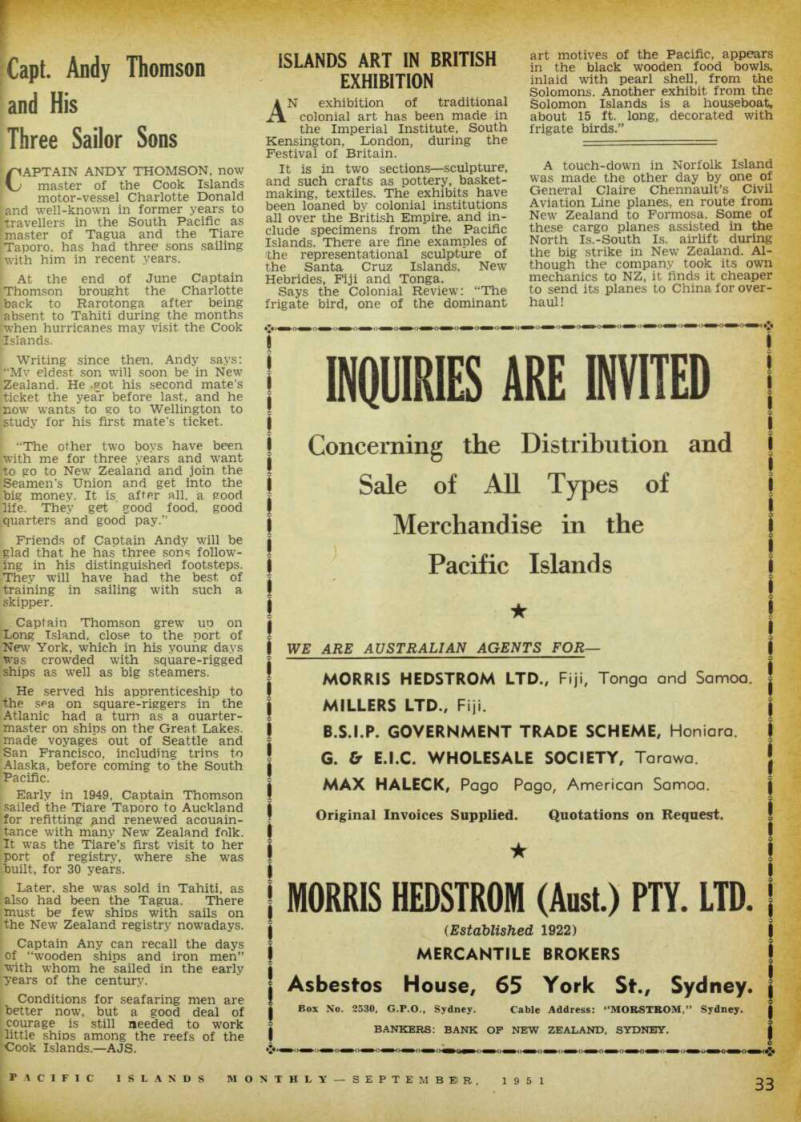
and His Three Sailor Sons
Captain Andy Thomson, Now
master of the Cook Islands motor-vessel Charlotte Donald and well-known in former years to travellers in the South Pacific as master of Tagua and the Tiare Taporo. has had three sons sailing iwith him in recent years.
At the end of June Captain Thomson brought the Charlotte back to Rarotonga after being absent to Tahiti during the months when hurricanes may visit the Cook
[lslands.
Writing since then, Andy says: “My eldest son will soon be in New Zealand. He .got his second mate’s ticket the year before last, and he now wants to go to Wellington to study for his first mate’s ticket.
“The other two boys have been with me for three years and want to go to New Zealand and join the Seamen’s Union and get into the big money. It is after all, a good life. They get good food, good quarters and good pay.”
Friends of Captain Andy will be glad that he has three sons follow ing in his distinguished footsteps.
They will have had the best of training in sailing with such a skipper.
Captain Thomson grew uo on Long Island, close to the port of New York, which in his young days was crowded with square-rigged ships as well as big steamers.
He served his apprenticeship to the sea on square-riggers in the Atlanic had a turn as a Quarter master on shins on the Great Lakes, made voyages out of Seattle and San Francisco, including trios to Alaska, before coming to the South Pacific.
Early in 1949, Captain Thomson sailed the Tiare Taporo to Auckland for refitting renewed acouain tance with many New Zealand folk.
It was the Tiare’s first visit to her port of registry, where she was built, for 30 years.
Later, she was sold in Tahiti, as also had been the Tagua. There must be few shins with sails on the New Zealand registry nowadays.
Captain Any can recall the days of “wooden shins and iron men” with whom he sailed in the early years of the century.
Conditions for seafaring men are better now, but a good deal of courage is still needed to work little shins among the reefs of the Cook Islands.—AJS.
Islands Art In British
Exhibition
AN exhibition of traditional colonial art has been made in the Imperial Institute, South Kensington, London, during the Festival of Britain.
It is in two sections —sculpture, and such crafts as pottery, basket making, textiles. The exhibits have been loaned by colonial institutions all over the British Empire, and in clude specimens from the Pacific Islands. There are fine examples of the representational sculpture of the Santa Cruz Islands, New Hebrides, Fiji and Tonga.
Says the Colonial Review: “The frigate bird, one of the dominant
art motives of the Pacific, appears in the black wooden food bowls, inlaid with pearl shell, from the Solomons. Another exhibit from the Solomon Islands is a houseboat, about 15 ft. long, decorated with frigate birds.”
A touch-down in Norfolk Island was made the other day by one of General Claire Chennault’s Civil Aviation Line planes, en route from New Zealand to Formosa. Some of these cargo planes assisted in the North Is.-South Is. airlift during the big strike in New Zealand. Al though the company took its own mechanics to NZ, it finds it cheaper to send its planes to China for over haul!
Advertisements & other items, p. 35 (1 item)
Inquiries Ire Invited
Concerning the Distribution and
Sale of All Types of
Merchandise in the
Pacific Islands
WE ARE AUSTRALIAN AGENTS FOR—
MORRIS HEDSTROM LTD., Fiji, Tonga and Samoa.
MILLERS LTD., Fiji.
8.5.1. P. GOVERNMENT TRADE SCHEME, Honiara.
G. Cr E.I.C. WHOLESALE SOCIETY, Tarawa.
MAX HALECK, Pago Pago, American Samoa.
Original Invoices Supplied. Quotations on Request. ★
MORRIS HEDSTROM (Aust.) PTY. LTD.
(.Established 1922)
MERCANTILE BROKERS
Asbestos House, 65 York St., Sydney.
Box No. 2530, G.P.0., Sydney. Cable Address: “MORSTEOM,” Sydney.
BANKERS: BANK OP NEW ZEALAND, SYDNEY.
High Costs Embarrass Ng
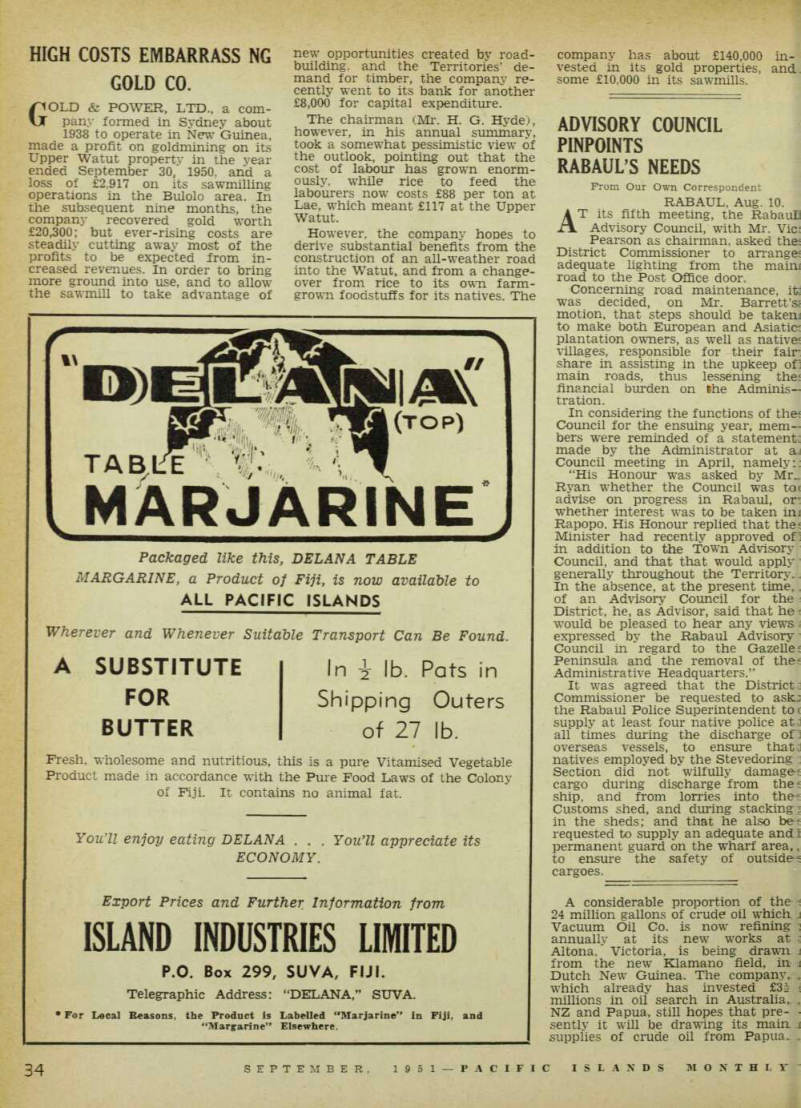
Gold Co.
Gold & Power, Ltd., A Com
pany formed in Sydney about 1938 to operate in New Guinea, made a profit on goldmining on its Upper Watut property in the year ended September 30, 1950, and a loss of £2.917 on its sawmilling operations in the Bulolo area. In the subsequent nine months, the company recovered gold worth £20,300; but ever-rising costs are steadily cutting away most of the profits to be expected from in creased revenues. In order to bring more ground into use, and to allow the sawmill to take advantage of
new opportunities created by road building. and the Territories’ de mand for timber, the company re cently went to its bank for another **,ooo for capital expenditure, The chairman (Mr. H. G. Hyde), however, in his annual summary, took a somewhat pessimistic view of the outlook, pointing out that the cost of labour has grown enorm while rice to feed the labourers now’ costs £BB per ton at Lae > which meant £ll7 at the Upper Watut.
However, the company hopes to derive substantial benefits from the construction of an all-weather road into the Watut, and from a change over from rice to its own farm grown foodstuffs for its natives. The
company has about £140,000 in vested in its gold properties, and. some £lO,OOO in its sawmills.
Advisory Council
Pinpoints
Rabaul’S Needs
From Our Own Correspondent
Rabaul, Aug. 10.
AT its fifth meeting, the Rabaul] Advisory Council, with Mr. Vic: Pearson as chairman, asked the: District Commissioner to arrange: adequate lighting from the maim road to the Post Office door.
Concerning road maintenance, ik was decided, on Mr. Barrett’s? motion, that steps should be takeru to make both European and Asiatics plantation owners, as well as native: villages, responsible for their fair: share in assisting in the upkeep of] main roads, thus lessening the: financial burden on *he Adminis tration.
In considering the functions of the: Council for the ensuing year, mem— bers were reminded of a statement; made by the Administrator at aj Council meeting in April, namely:: “His Honour was asked by Mr..
Ryan whether the Council was to< advise on progress in Rabaul, or whether interest was to be taken ini Rapopo. His Honour replied that the: Minister had recently approved of j in addition to the Town Advisory ■ Council, and that that would apply ■ generally throughout the Territory..
In the absence, at the present time,, of an Advisory Council for the j District, he, as Advisor, said that he < ■would be pleased to hear any views; expressed by the Rabaul Advisory' Council in regard to the Gazelle: Peninsula and the removal of the: Administrative Headquarters.”
It was agreed that the District d Commissioner be requested to askj the Rabaul Police Superintendent to c supply at least four native police atd all times during the discharge of] overseas vessels, to ensure thatd natives employed by the Stevedoring : Section did not wilfully damage: cargo during discharge from the: ship, and from lorries into the: Customs shed, and during stacking ? in the sheds; and that he also be: requested to supply an adequate and I permanent guard on the wharf area,, to ensure the safety of outside: cargoes.
A considerable proportion of the: 24 million gallons of crude oil which j Vacuum Oil Co. is now refining ? annually at its new works at : Altona. Victoria, is being drawn i from the new Klamano field, in i Dutch New Guinea. The company, , which already has invested £3h i millions in oil search in Australia, „ NZ and Papua, still hopes that pre- sently it will be drawing its main s supplies of crude oil from Papua. .
Advertisements & other items, p. 36 (1 item)
Marjarine
K<'i
TABLE
r^lly^
(TOP)
MARJARINE
Packaged like this, DELANA TABLE MARGARINE, a Product of Fiji, is now available to
ALL PACIFIC ISLANDS
Wherever and Whenever Suitable Transport Can Be Found .
A SUBSTITUTE
FOR
BUTTER
In i lb, Pats in
Shipping Outers
of 27 lb.
Fresh, wholesome and nutritious, this is a pure Vitamised Vegetable Product made In accordance with the Pure Food Laws of the Colony of Fiji. It contains no animal fat.
You’ll enjoy eating DELANA . . . You’ll appreciate its
ECONOMY.
Export Prices and Further Information from
ISLAND INDUSTRIES LIMITED
P.O. Box 299, SUVA, FIJI.
Telegraphic Address: “DELANA,” SUVA. • For Local Reasons, the Product is Labelled “Marjarine” in Fiji, and “Margarine” Elsewhere.
They Drifted For Three
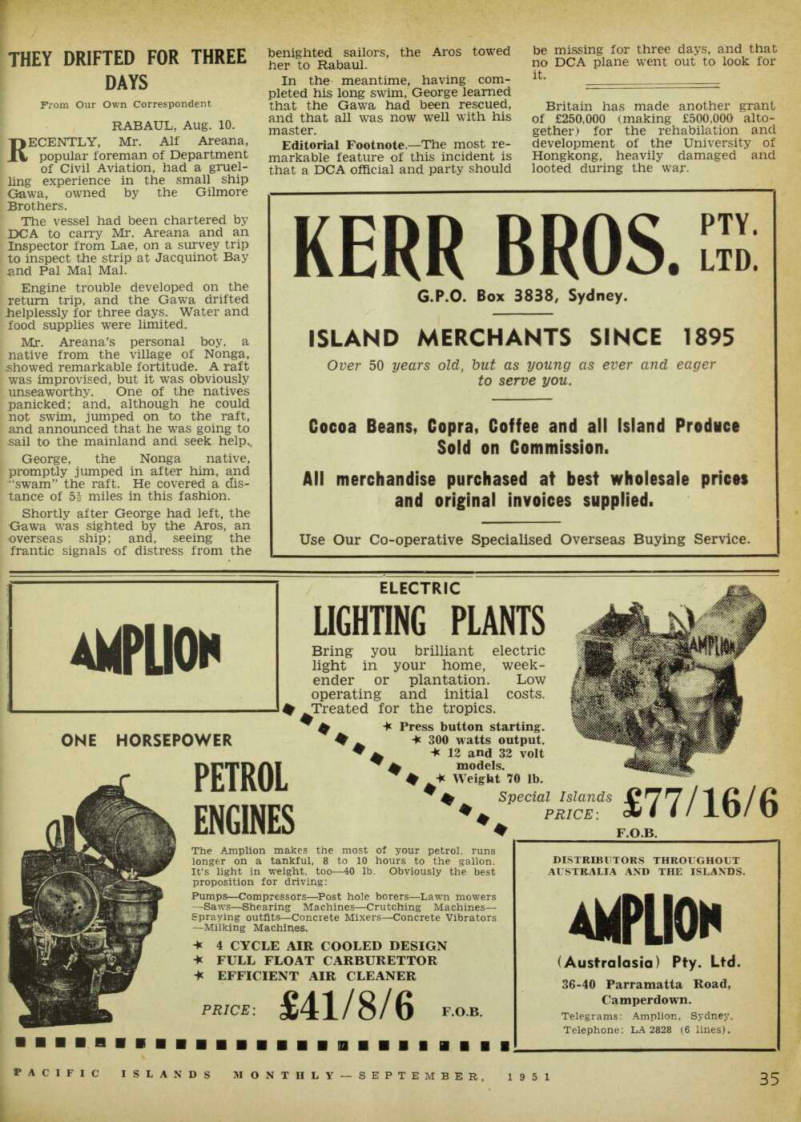
Days
From Our Own Correspondent
Rabaul, Aug. 10.
RECENTLY, Mr. Alf Areana, popular foreman of Department of Civil Aviation, had a gruel ling experience in the small ship Gawa, owned by the Gilmore Brothers.
The vessel had been chartered by DCA to carry Mr. Areana and an Inspector from Lae, on a survey trip to inspect the strip at Jacquinot Bay and Pal Mai Mai.
Engine trouble developed on the return trip, and the Gawa drifted .helplessly for three days. Water and food supplies were limited.
Mr. Areana’s personal boy, a native from the village of Nonga, showed remarkable fortitude. A raft was improvised, but it was obviously unseaworthy. One of the natives panicked; and, although he could not swim, jumped on to the raft, and announced that he was going to sail to the mainland and seek help..
George, the Nonga native, promptly jumped in after him, and "‘swam” the raft. He covered a dis tance of 51 miles in this fashion.
Shortly after George had left, the Gawa was sighted by the Arcs, an overseas ship; and, seeing the frantic signals of distress from the
benighted sailors, the Arcs towed her to Rabaul.
In the meantime, having com pleted his long swim, George learned that the Gawa had been rescued, and that all was now well with his master.
Editorial Footnote. —The most re markable feature of this incident is that a DCA official and party should
be missing for three days, and that no DCA plane went out to look for it.
Britain has made another grant of £250,000 (making £500,000 alto gether) for the rehabilation and development of the University of Hongkong, heavily damaged and looted during the war.
Advertisements & other items, pp. 37-38 (2 items)
Kerr Bros. S
G.P.O. Box 3838, Sydney.
ISLAND MERCHANTS SINCE 1895
Over 50 years old, hut as young as ever and eager to serve you.
Cocoa Beans, Copra, Coffee and all Island Produce Sold on Commission.
All merchandise purchased at best wholesale prices and original invoices supplied.
Use Our Co-operative Specialised Overseas Buying Service.
mm
ONE HORSEPOWER
PETROL
ENGINES
ELECTRIC
LIGHTING PLANTS
Bring you brilliant electric light in your home, weekender or plantation. Low operating and initial costs.
Treated for the tropics. > Press button starting. 300 watts output. * * 12 and 32 volt w + models. * Weight 70 lb. % Special Islands
PRICE :
£77/16/6 F. 0.8.
The Amplion makes the most of your petrol, runs longer on a tankful, 8 to 10 hours to the gallon.
It’s light in weight, too—4o lb. Obviously the best proposition for driving; Pumps—Compressors—Post hole borers—Lawn mowers —Saws—Shearing Machines—Crutching Machines— Spraying outfits—Concrete Mixers—Concrete Vibrators —Milking Machines.
* 4 CYCLE AIR COOLED DESIGN
* FULL FLOAT CARBURETTOR
* EFFICIENT AIR CLEANER
PRICE :
£4l/8/6 F. 0.8.
DISTRIBUTORS THROUGHOUT
AUSTRALIA AND THE ISLANDS.
airx*
(Australasia) Pty. Ltd. 36-40 Parramatta Road, Camperdown.
Telegrams: Amplion, Sydney.
Telephone: LA 2828 (6 lines).
Another CRAMMOND
“KING OF THE AIR”
The CRAMMOND FALCON
A LOW POWER RADIO-TELEPHONE
TRANSMITTER/REGEIVER
i
ALL STEEL CABINET.
* TRANSMITTER
CRYSTAL CONTROLLED.
* COMPLETELY SEALED.
-K EASY TO OPERATE.
6 VALVE 3 BAND
RECEIVER.
You can Receive while waiting to Transmit A special and unique control has been installed so that you can receive while waiting to transmit. When receiving you turn the knob to a stand-by position—you can still receive and immediately you commence to transmit, the receiver automatically cuts out. When you finish transmitting the receiver automatically comes back.
It is a 6-valve, 3-band receiver, and the transmitter can be supplied in various power outputs as required. Available for 6, 12, 24 and 32 Volt D.C. or 110 and 240 A.C. The cabinet is all steel and completely sealed. Cadmium plated and spray finished in black crackle. These sets will be manufactured to your own particular requirements if desired.
WRITE FOR FULL FEATURES TO-DAY!
CRAMMOND RADIO
TROPICAL DIVISION
N° 8 QUEEN STREET . BR/SBRNE
36
SEPTEMBER. 1951 PACJFIC ISLANDS MONTHLY
Samoa Enjoys A Trade Boom
Trade Boom
From Our Own Correspondent
Apia, Aug. 10.
OFFICIAL figures show that cocoa exports for the first half of the year of 1951 were 952 tons.
In July, the ss Sonoma lifted an other 520 tons for the USA market, while the ss Moraybank, which left Apia on August 8, took 65 tons for the English market.
Up to date, a total of 1,537 tons of cocoa has been exported this year, and there are at present some 300 to 400 tons awaiting shipment in Apia sheds, a large portion of which will go by the August Matua.
As cocoa exports in 1950 amounted to 1.880 tons, it is confidently hoped, with a very good crop now on the trees and picking starting in Sep tember, that cocoa exports in 1951 will constitute an all-time record, and exceed the previous record of 2 894 tons in 1949. 3,000 tons of cocoa-beans would bring well over £500,000 Sterling into this Territory.
Of the 1,537 tons exported so far, 701 went to Britain, 210 tons to Aus tralia. 60 tons to New Zealand, 15 tons to Italy and 551 tons to the
Usa.
It is hoped that the bulk of the cocoa for the rest of 1951 will go to the USA and provide badly needed dollar currency for impor ters of goods obtainable only from dollar countries. At present, dollar funds available here are completely exhausted and imports from dollar countries (USA and Canada) have been drastically curtailed.
Continuing good prices for the main Samoan products, copra and cocoabeans, are causing an exten sion of trading activities in all parts of the Territory. The number of trading stations in the outside dis tricts of Upolu and Savaii is in creasing rapidly, and in most villages, particularly on the coast west of Apia, there are already four or five trading stations, and new ones are continuously being opened, increasing the already intense com petition and testifying to the favorable trade situation in the country districts.
Meanwhile, the cost of living is rising fast. Wage earners are be coming restless and worried, as foodstuffs—particularly imported meat and local and other essential household necessities —are going up in price from month to month, with out a corresponding rise in wages and salaries.
A HANDSOME trophy, a sterl ing silver cup, was presented to the Marist Brothers’ High School by the parents of two former pupils of the school, John and Roy Ah
Kuoi, who in April of this year were killed in a fatal road accident. The cup is to be awarded to the Dux in Form II of St. Joseph’s High School.
Mr. T. T. Laban, Acting Collector of Customs, has now been ap pointed Collector of Customs. He is the first local official to be appointed to the position. He has been in this Government’s service for over 30 years and is one of its most popu lar officials, Mr. J. H. Luxford, of Auckland, a Senior Magistrate, has retired after 23 years of service. He was
Chief Judge of the High Court here from 1929 to 1934 and, after his re turn to NZ, he continued his in terest in Samoan affairs, and was President of the Samoan Society in Auckland.
The High Commissioner and Mrs.
R. G. Powles returned to Samoa by the Matua on August 8. Mr. Powles had gone to New Zealand on medi cal advice and to recuperate from a recent illness.
Mr. Paul Edmonds, a graduate of Auckland University College, has arrived in Apia to take up the posi tion of private secretary to the High Commissioner.
In a statement published in Wellington, NZ, the High Commis sioner, Mr. R. G. Powles, expressed the opinion that the United Nations Trusteeship Council had quite sin cerely complimented New Zealand’s Administration of Western Samoa.
He pointed out that Samoa had made great strides in education, particularly during the last three years. The policy was to employ as many of the local population as possible in the administration of the area. There are some 76 New Zea landers and 1,500 Samoan officials in the Government service.
The Apia Observatory’s weather shows that June’s rainfall was double the normal figure; while July 22 recorded the lowest tern
perature ever known in Samoa (53.9 deg. Pahr.). The nearest to this was 58.3 deg. Pahr. in August of 1936.
A writer in a widely-circulated Australian weekly praises the way in which Bomana war cemetery, 8 miles from Moresby, is kept. There are 4,000 Australian graves there.
Every village in Fiji is being linked up nowadays by radiophone.
Stations were opened in four islands of the Lau group in July, and before the end of the year another eight will be opened, thus bringing practically every inhabited island of the Lau area into the network.
Stations at Loma Loma and Lakeba were opened last year; and Beqa, Koro and Gau will be in the net work within a few weeks.
Advertisements & other items, pp. 39-40 (1 item)
Sauce
FOUNTAIN food products are famous throughout the South Pacific for their consistent quality and suitability of packing for tropical conditions.
You are assured satisfaction when you specify FOUNTAIN brand.
Trade inquiries are welcome and all orders are promptly despatched.
Ml & *2s vs
SAUCE
W.C. DOUGLASS L'— 0
FOVEAUX ST. SYDNEY AUSTRALIA
OTHER
FAMOUS
FOUNTAIN
PRODUCTS
FRUIT
CHUTN
CHt-V
FIBRE TRAVEL and ATTACHE
CASES OF ALL QUALITIES!
In sizes to serve all needs and at prices to suit all types of trade Write for full particulars to—
FORD SHERINGTON LTD.
Makers of Globite, Airway and Fordite Travel Cases.
Kippax St., Sydney, Australia.
BURNS PHILP (SOUTH SEA) CO. LID.
Registered Office: SUVA, FIJI Code Address: “BURNSOUTH”
ISLAND TRADERS AND SHIPOWNERS
General Merchants (Wholesale ond Retail)
Shipping, Customs and General Agents
Representatives for: QUEENSLAND INSURANCE CO. LTD. BURNS PHILP TRUST CO, LTD.
Distributing Agents : SHELL COMPANY (P. 1,) LTD. FERGUSON TRACTORS STANDARD MOTOR CAR COMPANY CROSSLEY MARINE ENGINES
BRANCHES:
FlJl.—Suva, Levuka, Lautoka, Labasa, Ba, Sigatoka, Tavua, Rotuma Island. SAMOA. —Apia, Pago Pago.
TONGA.—Nukualofa, Haapai, Vavau. NORFOLK ISLAND. NIUE ISLAND.
AGENTS;
SYDNEY.—BURNS, PHILP & CO., LTD., 7 Bridge Street.
LONDON.—BURNS. PHILP & CO., LTD., 35 Crutched Friars, E.C.3.
SAN FRANCISCO—BURNS-PHILP CO. OF SAN FRANCISCO INC., Matson Building, 215 Market Street.
Agencies Throughout the World.
In Micronesia
New Air Services In Micronesia
CIVILIAN air transportation facilities to and in the US Trust Territory of Micronesia were put into operation on June 1.
Transocean Airlines, which was awarded the contract, began ser vices with a fleet of four twin engine amphibious PBY Catalina airplanes.
Headquarters for the service is on Guam, with services out to Truk (Central Carolines), Ponape (East ern Carolines), Majuro (Marshall Islands), Yap (Western Carolines), Koror (Palau Islands), and Saipan (Mariana Islands).
India’s strong interest in coconut production led to the establishment in recent years of the Indian Central Coconut Committee, which issues an annual report and may otherwise assist those seeking information about the coconut.
A further source of data for those interested in coconut problems is the Ceylon Coconut Quarterly, issued by the Coconut Research Scheme, Bandiruppuwa Estate, Ceylon, The first number was issued in 1950.
Develop Or
Perish!
Pioneer Tom Nevitt on New Guinea’s Future
From Our Own Correspondent
Pt. Moresby, Sept. 1.
SOME very down-to-earth com ments on the labour problem were made during August by Mr. Tom Nevitt, a well-known figure in planting circles. He also emphasised that the most urgent problem facing the Territory was that of labour; but he carried his argument beyond the economic level into the even more important angle of the Islands’ future fate.
Mr. Nevitt was speaking on the eve of his departure from Port Moresby, after 40 years of residence In Paoua. He retired, last May, as General Manager of the British New Guinea Development Com pany, and is making his future home in Brisbane.
In Mr. Nevitt’s opinion, backed by a record of long service in the development of Papua, the native peoples may well forfeit their de scendants’ security by continuation of their present antipathy to any thing resembling real work. He em phasised that the New Guinea Territories are the only area on the South Pacific fringe of Asia with vast reserves of undeveloped lands.
Unless these are utilised and the country brought into something near full production, there is little hope that the natives will retain their homeland against the pres sure' of their more energetic and over-populated northern neighbours.
Mr. Nevitt sees it as a prime responsibility of the Government to make the native people realise this danger, and ensure their co-opera tion in a vigorous and continuous developmental programme.
Unless conditions here soon chane, future historians may well point to Mr. Nevitt’s hard-hitting and grimly realistic statement as an instance of an unheeded warning.
Rome is said to have burned while Nero fiddled; and New Guinea is likely to be lost by official fiddling with short-sighted policies.
Protecting the natives against their own folly is the first respon sibility of an Administration, and there is no greater folly than en couraging the present “brown play boy” attitude which is sapping all progress in the Territory.
Every nation or race which has shirked hard work and squandered its heritage through idleness has in time lost its freedom and posses sions to more vigorous peoples. There is no lack of purpose or capacity for hard work in the races who already have their eyes fixed on the Territory.
New Vessel For Bsi
THE Kovala, a 66 ft. diesel vessel, has been undergoing trials in Sydney Harbour and off Sydney Heads. She was specially built for the British Government by Storey and Keers, and will be used by the Solomon Islands Ad ministration.
Methodist Fijian missionary Penaia Motonicocoka Sati, aged 25, with his Fijian wife and their small daughter, has gone to work among the Australian aborigines near Dar win. He is a skilled agriculturalist, and expects to be on Elcho Island for five years. Another Fijian, Rev.
Daniel Lotu, is at the Methodist Mission in East Arnheim Land.
Advertisements & other items, pp. 41-42 (1 item)
I Pan A
- S' * <0 <* * O o f fO» %■
TAKE THIS
MOST IMPORTANT STEP
TO KEEP TEETH SPARKLING WHITE
use
I PAN A
TOOTH PASTE
Doctors and dentists all agree that gum troubles are the cause of most tooth extractions. That's one Important reason why you should always use IPANA the tooth paste that keeps both teeth and gums clean and healthy. IPANA gives lasting radiance to your smile—because it protects as well as cleans your teeth to sparkling whiteness.
Sold Everywhere
A PRODUCT OF
a od sparkle To y ou* SMILII
BRISTOL-MYERS
m W % * Registered Trade Mark
THE PAINT PIGMENT
with A DIFFERENCE
The main difference between Alpaste and other paint pigments is that it is not granular in form. Alpaste consists of commercially pure "atomised" aluminium, which, when milled and polished, produces tiny, flat and very thin leaf-shaped particles.
These particles arrange themselves in overlapping parallel layers when mixed with suitable vehicles. The result is an improved and
Mm a ii si siaim
(Incorporated in the Dominion of Canada) Principal British Commonwealth Distributor of Aluminium Ocean House. 34 Martin Place, Sydney,
N.S.W.
An ALUMINIUM LIMITED Company
consistently uniform paint, which, in effect, gives a thin sheathing of pure aluminium to anything to which the paint is applied.
The illustration shows part of the Hargreaves Park Housing Settlement, New South Wales, Australia, where aluminium paint was used by the contractors, Stayseal Products Pty. Ltd.
SALES AGENTS:
Australia: HARRISONS RAMSAY PTY.
LTD., Melbourne, Sydney, Adelaide, Brisbane, Perth.
New Zealand: RICHARDSON. McCABE & CO. LTD., Wellington, Auckland. Christchurch.
Fiji, Western Samoa and Tonga: MORRIS
HEDSTROM LIMITED, Suva. Fiji.
Cook Islands: A. B. DONALD LTD., Raratonga, Cook Islands.
French Oceania: ETABLISSEMENTS DONALD TAHITI, Papeete, Tahiti.
New Caledonia and New Hebrides: AGENCE ALMA, Noumea, New Caledonia.
Islands
Life On Coral
Aims of The South Pacific Commission
By W. P. Goodwin
A SCIENTIFIC party recently set out from the headquarters of the South Pacific Commis sion, at Noumea, New Caledonia, to carry out a project dealing with the economic development of coral atolls.
It consists of members of the In stitut Francais d’Oceanic engaged by the Commission and it is work ing at Tarawa, in the Gilbert Is lands. Its task is to investigate ways of increasing the quantity and variety of subsistence and commer cial crops, and of improving domes tic animals and fisheries on these curious, beautiful, but not over generous products of nature.
The Commission began its work programme about two years ago in full co-operation with the local Administrations, planning some 35 projects for immediate attention in the health, economic and social fields.
One of these is the problem of the coral atoll people, of whom there are probably some 100,000 Polynesians and Micronesians living on about 200 of these islands, chiefly in the Gilbert and Ellice, Tokelaus, Northern Cooks, and in French Oceania. Communities vary from as few as 30, up to 3 000, each ekeing out a precarious existence because of the extremely limited resources of their homelands.
Most of the Commission’s econo mic activities are, of necessity, directed to agriculture and its im provement on the volcanic and other larger islands, where the greater part of the indigenous population of the region is located.
But in no place are the problems so acute and their solution of greater concern to the people involved than on the coral or low islands.
Moreover, the larger islands are able to cope with their problems to a much greater degree, whereas the low islands are utterly destitute of experimental resources and tech nical personnel. They may receive the benefit of sporadic investigation, but sedom of sustained studies de voted solely to coral island popu lation problems, A CORAL atoll—product of the coral polyps—is a more or less circular reef, descending steeply into the sea on one side and shoaling into a lagoon on the other. The reef encloses the lagoon, which is usually calm and shallow,
although some have deep anchor ages. Some lagoons have deep water passages through the enclosing reef, some are entirely enclosed.
Lagoons may be anything from one to 30 miles across.
Islets, some as much as 10 miles long, but seldom exceeding 400 yards in width, form in time along the fiat tops of the circular reef and frequently inside the lagoon on top of scattered reefs. They seldom are more than about 15 ft. above sea level.
Scientific interest in atolls and their origin is great. A compre hensive study was made on Bikini before and after the atom bomb ex plosion. Boring with a diamond drill brought up cores from as deep as 1,300 ft., but the complete answer as to origin was not revealed.
The economic resources of coral islands are restricted. There is no running water; seldom any surface water. There are no pastures or cattle. A few pigs and fowls con stitute the livestock. Coconut palms, rarely in full health and vigour, cover most of the islands, with a few other tree species in sufficient quantity for local needs only. Often the full population-carrying cap acity of an atoll has been reached.
Copra is the principal money earner, pandanus mats are a second source of income, and pearl and trochus shell have a small market.
At present, there is no substitute for copra, because of the meagre, mineral-deficient soils. Food plants consist of breadfruit, pandanus, taro, bananas, some citrus, some Polynesian chestnut, arrowroot, and some scattered., individual plantings’ of pineapples and sweet potatoes.
The lagoons and reefs supply fish and crustaceans.
Fresh water, of which the supply is always more or less limited, pre sents another problem.
Far from living lives of Elysian beach-combing, so often pictured in works of romantic fiction, the low island people are the most deserv ing of assistance in the field of hor
ticulture and economic security which the Commission can promote.
The Commission’s project is not for a general survey of an atoll, therefore, but is solely an endeav our to find means to enable the Coral Islanders to raise their stand ard of living. Principal avenues of
research are: • A programme of coconut palm improvement de signed to increase yields and resist ance to pests and disease; • A food plant programme, including study of the breadfruit tree, the develop ment of wet-land taro, the intro duction of bananas, the production of other foodstuffs, especially those requiring additional fertility, such as sweet potatoes, vegetables and citrus fruits; • The supplementary nutrition of pigs; • The improve ment of poultry in weight, egg-lay ing capacity and freedom from disease; • The development of shell fisheries by planting trochus and pearl shell and assessing the possibilities of sponge cultivation; • A survey of handicrafts with a view to their development as a source of income.
The work will include experi ments with such recent techniques as the possibilities of the sun-still for the distillation of fresh water from salt, and hydroponics for the production of certain plants in water.
Unfortunately, early results can not be expected because, such is the present pressure of population on the means of subsistence, that any loss in production must be avoided during experiments and in changing to new or improved agri culture. Nevertheless, an excellent beginning has been made, and the
project will continue until tech niques have been discovered for making life less precarious for these unfavoured, distant people.
Advertisements & other items, pp. 43-44 (1 item)
Olivol
QUEENSLAND
INSURANCE
CO. LTD.
(Incorporated 1886 In Australia).
Assets Exceed £6,000,000
Head Office:
QUEENSLAND INSURANCE
BUILDING, 80-82 PITT STREET.
SYDNEY.
Specialists in South Sea Fire, Marine & Accident Insurances Apply to:— FIJI. —Branch Office: J. F. Drury, Manager.
Burns Philp (South Sea) Co., Ltd.
VlLA.—Burns Philp (N.H.), Ltd.
Comptoirs Francais Des Nouvelles Hebrides.
NOUMEA.—L. & W. Johnston.
NEW GUlNEA.—Manager for the Territory of New Guinea and Papua, W. A. Anderson.
PORT MORESBY—SAMARA!—LAE
—MADANG—RABAUL.
Burns Philp (New Guinea), Ltd.
PAGO PAGO.
Burns Philp (South Sea) Co., Ltd.
G. H. C. Reid & Co.
OTHER SOUTH SEA ISLANDS.
Burns Philp (South Sea) Co., Ltd.
Also to any of the Company’s Offices in Australia or N.Z.
A famous HERCO product.
OLIVOL
CREAM
for your hands
beauty and protection
• Keeps your hands alluringly silky soft. • Protects against redness, roughness, dryness and windburn.
Stocks available at your usual WHOLE-
SALERS or BURNS PHILP and MORRIS
HEDSTROQVI, Suva, Fiji.
KANGAROO BRAND
Ropes,
Cordage,
and Twines for every purpose Backed by 98 years of service Manufactured by:
M. DONAGHY AND SONS,
PTY. LTD..
Geelong and Sydney.
Fiji Representatives:
PEARCE AND CO.
LIMITED
P.O. BOX 337, SUVA
Red Magic
The can't-be-copied flavour of Heinz Tomato Sauce makes a magical difference to stews, gravies and countless other dishes. It's made from Heinz famous "Aristocrat" tomatoes.
Buy today!
HEINZt,
u ydL
I KE!K2 J
bmafo Sauce
H. J. HEINZ CO. PTY. LTD.
479 Bourke Street, Sydney. mi
tomato
SAUCE
a, *At»eT/es
Lepers In New Hebrides
Letter to the Editor REGARDING the “Leprosy Survey in New Hebrides,” noted in your July issue, I would like to cor rect the statement that about 4 per cent, of the native population is affected. Recent conversation with Dr. Jean Davies, who carried out the survey, makes it clear that the per centage is slightly less than one-half of 1 per cent. Four per cent, would be extremely disturbing. The mis take, however, was not yours.
By the way, Dr. Davies comes from Melbourne, not New Zealand.
I am, etc.,
B. R. C. Nottage.
St. Alban’s Manse, Christchurch, NZ.
Mr. C. W. (“Chips”) Mansell, Islands representative of Mungo Scott Pty., Ltd., Sydney flour mil lers, returned recently from an extensive business tour of Papua, NG and ESI.
Schooner ‘Ornant’ Is
Buffeted
Prom Our Own Correspondent
Auckland, Aug. 20.
THE 22-tons former American owned topsail schooner-yacht “Omant,” purchased by the Auckland firm of dagger & Harvey, Ltd., last year, for use as a trading vessel in the Cook Islands, narrowly escaped destruction in the Avarua Passage, Rarotonga, late in duly.
Following a 30-day passage from Auckland, during which rough weather was experienced, the motor disabled, and the chronometer put out of operation, the trim addition to the Cook Island mosquito fleet was lying at moorings in the Pas age, undergoing repairs, when a stern-line parted during a heavy squall which struck the so-called “harbour” about noon on duly 19.
The “Ornant” immediately swung across to the west side of the pas sage—close to the remains of the schooner “Tahitienne,” which was wrecked under somewhat similar circumstances in November, 1948.
Though bumping on the reef heavily for several hours, the Omant fortunately maintained a fairly even keel, thanks to some of the mooring lines holding. Mean while volunteers, directed by the Resident Commissioner, Mr. Tailby, passed a line from the schooner wharf to the imperilled craft, where it was secured to a point well up the mainmast. With all hands ashore then tailing willingly onto this line, the vessel was hove over and fortunately came clear. A fiirst inspection reported no damage of a very serious nature—but it was undoubtedly a very close call.
Mr. D. C. Brown’s Fairmile “Mahurangi,” and the Administra tion’s ketch “Ranui,” both lying alongside the wharf, were also con sidered in some danger at the height of the blow. Old hands re ported having rarely seen the har bour so rough, during the few hours that the blow lasted.
It will be recalled that the “Ornant,” returning to Auckland from Suva, where certain conver sion work to cargo carrying had been performed, had a particularly tough 22-days passage during March-April. Captain Donald Mac leod reported it as the worst pas sage he had experienced in 47 years’ seafaring. The graceful little ship had to undergo repairs following that passage.
Following on the Rarotonga in cident, Captain Macleod became suddenly ill a few days later and was operated upon in the local hospital—and arrived back in New Zealand as a plane passenger on August 16. The Captain had under
gone an appendix operation whilst the vessel was in Suva in March.
It is to be hoped that dagger & Harvey, Ltd., in their new shipping venture, have a change in their singularly bad luck of the past year.
Mr. Henry Zuberano has resigned from his position as Clerk of Court in American Samoa, owing to bad health.
Sir Alexander Grantham, former Governor of Fiji, and now Governor of Hongkong, has been awarded the Grand Cross of the Order of St.
Michael and St. George.
Dr. J. M. Cruickshank, OBE, of Suva, Inspector-General of the South Pacific Health Service, has been created Commander of the Order of St. Michael and St.
George.
Advertisements & other items, pp. 45-46 (1 item)
Colyer Watson P W M ) Ltd.
c- Wholesale and Retail Merchants—Sawmillers and Timber Merchants —Plantation Proprietors and Managing Agents—Ship Owners— Shipping, Insurance and Customs Agents—Plantation Suppliers— Exporters of Island Produce.
AGENTS FOR:
Australia-West Pacific Line.
Canton Insurance Office, Ltd.
Union Assurance Society, Ltd.
Aust. T. & G. Mutual Life Society, Ltd.
New Britain Shipping & Docking Co., Ltd.
ASSOCIATED WITH:
Colyer, Watson Pty., Ltd., Sydney, Melbourne, Brisbane.
Colyer, Watson & Co.. Ltd., Wellington, Auckland, Christchurch,
DISTRIBUTING AGENTS IN NEW GUINEA FOR:
Hillman, Humber, Sun- Olympic Tyres and beam-Talbot, Chrysler and Plymouth Cars.
Commer, Karrier Fargo Trucks. and Willys Overland Jeeps.
Cables.
Sherwin-Williams Paints.
Prefect Refrigerators.
Mullard Radios.
Chula Copra Dryers and Desiccated Coconut Machinery.
Aladdin Lamps.
Anchor and Tiger Beers.
G.M. Marine and Industrial Engines.
Snowflake Unsweetened Evaporated Milk.
Hygeia Dissolvenators.
Pental Soaps.
COLYER WATSON P W M ) LTD.
RAB A U L
MAD A N G
K AVI ENG •
She’d
never heard of
Doctors and L
Nutrition
'* Experts
agree u V that although we are blessed with an abundance of food, "Hidden Hunger" is far more common than most people realise. They say also that you can satisfy your hunger by having three meals every day—and still not satisfy your body's needs. When we eat the wrong kind of foods, or not enough of the right kind, then we suffer from Hidden Hunger"—and our system is hungry for certain essential food elements in our daily diet. This means that while we may not feel actually ill, we are never really well —and seldom look our best.
Horlicks guards you and your children against "HIDDEN HUNGER" because it induces sound sleep, and gives you
balanced, easily-digested nourishment.
You must have sound sleep to guard against the effects of “'Hidden Hunger.”
A cup of hot Horlicks before bed soothes your nerves, relaxes your mind and off you go ... to replace lost energy and wake refreshed
BALANCED FOOD
\ou must have nourishing food, not ““medicines” to guard against “Hidden Hunger.” However, with today’s rising costs it is not always possible to have the kind of food you want. That is why Horlicks is invaluable in your home. Made from full-cream milk and
HORLICKS
guards against
& rr. the nutritive extracts of malted barley and wheat Horlicks is a balanced nourishing food. Taken between meals and just before bed at night Horlicks supplies those essential nutritional food elements your body needs every day to guard against “Hidden Hunger”.
R
NERVOUS
INDIGESTION
As well as being a balanced food-drink, Horlicks has the added advantage of helping digestion. Taken between meals, it relieves nervous indigestion, and so makes sure that you get the full benefit from your daily food.
In ?-lb. and mm ’■ lb - T,NS
COPYRIGHT
HI-5
Delayed
“Southern Cross’
From Our Own Correspondent
Auckland, Aug. 20.
|7TOLLOWING a lengthy sojourn J; in Auckland for annual refit, the mission ship Southern Cross, scheduled to clear for Vila, New Hebrides, on Friday. Aug. 10, was delayed by the sudden illness of Chief Elngineer Hulbert, who was admitted to hospital.
Difficulty was experienced in ob taining a replacement, and the little shin finallv did not sail until the morning of August 14, with Mr.
Dalgleish (Auckland) as relieving Chief Engineer for the voyage.
The usual short wharf-side ser vice and blessing of the vessel be fore her departure was conducted v>v the Bishop of Kensington, the Rt. Rev. C. Eastaugh.
It is anticipated that Mr. Hulbert, whose condtion is not serious, will rejoin the “Southern Cross” at Auckland in about seven weeks’ time.
Passengers on the present voyage include the Rev. Phillip Baker, on assignment to teaching duties in the Solomons; Sister J. Allan, for the nursing staff at Lolowai, New Hebrides; and an engineer, Mr.
Brian Ayers, to be attached to mis sion headquarters staff in the Solomons.
NG Memorial Scholarship
RECENT donations to the Queens- ■
land Division of the New
Guinea Memorial Scholarship (
fund have brought it to over £450. previously acknowledged (PIM March, 1951) .. .. £415 18 111 Anon, Rabaul 1 0 f Norman Woods, Rabaul ... 10 u L lan S. Levy, Native Labour Dept., Samarai 2 z Ul Dorothy Stewart and Hotel Ascot Customers —Result of wagers on letting down of „ back hair 3 10 0 Dal Chambers, Induna Plan tation, Rabaul 2 2 0 C Keith Guy, Rabaul 3 ° ” : K. F. Desborough, Rabaul .. 3 0 0 r Dal Chambers, Induna Plan tation. Rabaul 10 0; RSL, Bulolo, New Guinea .. 10 0 0 0 Nick Carter, Glastonbury, via Gympie, Qld 220 C Dal Chambers, Induna Plan tation, Rabaul 10 00 Matthew Foley, Rabaul ... 10 6 r Bill Dupe and Dal Chambers.
Rabaul. Cricket wagers .. 1 10 0 0 Dorothy Stewart, Rabaul .. 5 0 0 0 “Dewhy” Stanley. Common wealth Bank, Rabaul ... 10 0 0 Total to July 31, 1951 .. .. £452 15 5 6 Mr. Noel Ford, head of the Pacific o area 16 mm section of the MGM 1 film organisation, returned to Syd- ney on September 1 after visiting £ Fiji and Samoa.
Some Impressions of Rabaul, Circa
August, 1951
From a Special Correspondent
DESPITE all the talk of moving the capital to Rapopo, the residents here appear to be building newer and better offices, stores and homes than formerly. It seems certain that only another eruption will separate the majority of them from Rabaul.
The place appears to be opening up, becoming cleaner, and the homes are getting gardens round them. Mango Avenue is getting quite shady again—a kind of Unter Den Linden —and the big trees look well. Only blots on landscape are the odd piles of guns, tanks and Army junk, the Japanese pillboxes, some nice assorted bomb holes, and the rusting hulks and barges on the water front. It is feared by many that they like the Poor will always be with us!
THE new Territory Motor Traffic laws are being enforced in Rabaul. Quiet, well-meaning jeeps have to have “Left Hand Drive” marked on their rear por tion —plain to be seen as they jog along the highway.
A smart and shiny Traffic Cop, riding a smart and shiny mo-bike,
relentlessly pursues John Citizen and pounces upon him as he gets be out of his car, to know why he hasn’t observed Section Umpteen, Para X and Sub Para Y.
Brown Brother observes his own Stone Age traffic laws and is a
great problem to all concerned.
After he has brought his truck load of vegs in from his garden, sold it, and chewed a liberal quan tity of betel-nut, he dismisses all traffic laws and proceeds homeward with a crowd of singing natives in the back! He blocks the road, he speeds, he goes slow and on the wrong side, and a hand extended from the cab may mean anything —“I am stopping”—“l am going astern” —“Keep clear of propellers,” or just “And you!” Yes, siree, Tobonita, of Blanche Bay, doesn’t
give a hoot for all the traffic laws the “Shoot Man” has made.
ONE is intrigued to go into one of the Big Firm’s stores with the idea of buying something.
How foolish to imagine that it can be done!
After waiting an interminable time, and having examined most things in the store, one becomes aware that the people talking ani matedly in the centre of the floor,
about various social events and sporting fixtures, are really the vendors (not hereinbefore men tioned), whose function it is to sell, barter, or otherwise dispose of the goods displayed in the area!
The intending buyer (known as the Purchaser, of the first part), finally plucks up courage enough to approach one of the Vendors and intimate that he would like to buy something; and he will probably
be met with the answer: “It's OK brother, I won’t be a sec.”
After another wait, the intending purchaser departs for Chinatown, where he is pounced upon and not allowed to get away until all his wants —and some things he doesn’t want—are supplied.
But, Lordy, the Big Firm’s stores are the places to find out Who in vited Who, to What, and who played well at Saturday’s game! It would be an idea to provide cracker barrels, or some dried apples, and whittling sticks!
AS one trickles from Pub to Club, and back again, one comes across a variety of people waiting for ships to go to Manus, planes to go to Lae, or a schooner to the Bainings, but so many things seem to be against them getting away!
You hear, as you stand at the bar, snatches of conversations re lating to this: “We were on the ship, all set to go, and the flaming boats crew walked off —said they weren’t getting enough toast and tea in the morning or something.
Now we’ve got a crew of bush kanakas from the Sepik on board and the Skipper has* walked off.
Hell, well never get away now.”
Or else: “Well, it’s this way. The sanguinary kite should have come in today, but the drome’s closed at Lae and, anyway, look at the sanguinary weather now—no ceiling and no sign of clearing, either.
Hey, there, Tim, two more of San Miguel—well, Red Horses will do if you haven’t got any other kind.”
Then, again: “No, nobody’s heard where she is—might be stuck on some so-and-so reef out near Massawa or Asalingi. The Skipper had a week-end with X, and any thing might happen after that, eh?
Sure it might! We’ll have one before the pub shuts —I’ll get some beer to take to my room, too. Eh, how will I get that out? I dunno, but I expect old John Stokie will be along with his workboat soon and he’ll give me a lift, I reckon. Bonzer bloke, old John—we were in the bush together when the Japs were here!” , , By this time the bartender has politely said: “Look here, you guys, time’s up, so mop it down and get to your Dongas! Eh? More? Not on your sanguinary life —there’s all tomorrow not touched yet, you know! Think a bloke’s like you— I’m not on holiday. I got to get me sleep, see.”
After the curfew has thus tolled the knell of the departing barman, the lowing herd winds slowly to its jeeps; remarks that the sanguinary batteries may be flat—steps on it and the resultant noise—like John Peel’s View Halloa—would waken the dead. The night is then left to darkness and to us!
Advertisements & other items, pp. 47-48 (1 item)
Anchor
BURNS PHILP (New Hebrides) LTD.
Registered, Office: VILA, NEW HEBRIDES.
Branch Office at SANTO.
Exporters, Importers and General Merchants,
Commission, Shipping and Customs Agents.
Representatives for BURNS PHILP TRUST CO. LTD., QUEENS- LAND INSURANCE CO. LTD., and LLOYD’S OF LONDON. Agents for SOCIETE DES PETROLES SHELL DES ILES FRANCAISES DU PACIFIQUE, and numerous overseas manufacturers of all classes of merchandise.
Sydney Agents: BURNS. PHELP & CO., LTD., 7 Bridge St.
San Francisco Agents; BURNS-PHILP CO. OP SAN FRANCISCO INC., 215 Market St.
London Agents: BURNS. PHILP & CO., LTD., 35 Crutched Friars, E.C.3.
GILLESPIES
Gillespie’s Anchor Flour is milled from selected high quality Australian wheats and is enfolded for purity. Its consistent high quality has made it the best-known, most asked-for brand of flour in the Islands. (Enloletion is a special new purifying process tvhich reduces the risk of insect infestation).
ANCHOR
FLOUR
GILLESPIE BROS. PTY. LTD.. ANCHOR FLOUR MILLS. SYDNEY G. 1.97
SAILS, COVERS. AWHtS
TENTS, TARPAULINS, and all classes of CANVAS GOODS for industrial and home use FLAGS AND PENNANTS FOR CLUBS AND ASSOCIATIONS.
Send your inquiries through your agent to:
HARRY WEST Pty. Ltd.
"SYDNEY'S SAILMAKER"
DUKE ST. (Waterfront), EAST BALMAIN, SYDNEY.
Telephones: WB 1105, WB 2284.
A. H. BUNTING LIMITED
SAMARAI PAPUA
★ We are Sole Agents in the Territory of Papua and New Guinea for POLAROID* Day Glasses and Sunshields and enquiries are invited from Merchants and Traders.
Prompt attention given to all enquiries. Many models available, in a wide range of colours. ★ Also procurable from Bunting’s, Lae.
Optical discovery allows you
to see right through reflected glare
dD Polaroid
DAY GLASSES & SUNSHIELDS
* Regd. Trade Mark Patented in U.S.A., Great Britain and other countries.
Easy Money For
Walter Barker
"■TtIRST photographs of the Japan- J; ese sampan arrested in New Guinea waters for stealing trochus shell were brought to Sydney, on August 13, by Mr.
Walter Barker, of the Administra tion staff, Manus. He is a first-class amateur photographer, and, just before he left, he got excellent snapshots of the sampan and her personnel.
Sydney newspapers were eager to buy the pictures and Mr. Barker, when he joined the liner Strathaird, for London, a couple of days later, carried a broad smile —and liberal spending-money for the voyage. He expects to return to the Territory in November.
Dr. J. S. Phillips, an entomologist well-known, before World War 11, for his work in relation to “Nutfall” in the British Solomons, paid a visit to Fiji in June-July. He since has gone to Java, where, as member of a mission set up by the World Health Organisation of the United Nations, he will do entomological work in connection with the campaign against malaria in Indonesia. Dr.
Phillips has travelled widely he has been in Africa and the West Indies in recent years. He wrote a book about his BSI experiences, called Coconut Quest —and most of the edition was destroyed by the London Blitz in 1940.
Optician, Dentist in Vila
From Our Own Correspondent
Vila, N.H., July 20.
Mr. E. J. KING of the Sydney Optical firm of A. J. Higgs and Barker was among recent visitors to the New Hebrides.
Combining business with a holi day trip, Mr. King set up a temporary practice at the Hotel Reid (for a time known as the Hotel Holland but latterly resumed by its former management).
Mr. King found a ready supply of patients and business, rather
Mrfsuy T the ° f Another visitor to the New Hebrides was Sydney dental surgeon, Dr. T. E. Gibson.
Dr Gibson visited the New Hebrides in September of last year when he held a brief practice in both Vila and Santo.
On this, his return visit* the Doctor will attend to both old and new patients, and instead of the brief fortnight he spent at the two major Condominium centres pre viously, he will spend a month.
As before, a dental mechanic, Mr.
F. Atkinson, accompanied him.
Advertisements & other items, pp. 49-50 (1 item)
shell
Get that British spirit
For 46 years more Shell has been bought by more motorists than any other brand of petrol. It’s a good British habit.
In Australia alone, Shell is refining British petrol from British crude at the rate of 72,000,000 gallons a year. The crude is brought to Australia in British tankers from British wells in British Borneo by Shell—a British company.
Get that British spirit—always fill up at the Shell pump.
shell
3
wiF I >
always fill up
at the SHELL pump
The Shell Co. of Aust., Ltd. (Inc. in Great Britain).
M 55041
TAKE YOUR CHOICE
* m m . . . from this list of quality canned foods.
Packed by the largest meat-processing company in Australia, the Imperial label brings you the Quality meats, right to your table—tasty hot meals and cold meats ready for any occasion.
Stock up with Imperial, the Flavour Sealed
Quality Foods.
HOT PACKS.
16-oz. Braised Beef Steak Stew. 16-oz. Beef Steak Pudding. 16-oz. Steak & Kidney Pudding. 16-oz. Sausages & Vegetables. 4-oz. Meat and Spaghetti. 16-oz. Steak and Tomato. ★
COLD MEATS.
12-oz. Trim (Pork & Beef). 12-oz. Camp Pie. 12-oz. Meatreat. 12-oz. Corned Beef W/C. 12-oz. Taper Corned Beef. 6-lb. Taper Corned Beef W/C. 6-lb. Taper Corned Beef. 4-oz. Hampe. 4-oz. Beef Snack. ★
DRIPPING AND LARD.
1-lb. tins Lard. 16-oz. tins Dripping. 36-lb. Dripping. ★
CANNED FISH.
8-oz. Flair Fish Cutlets. 12-oz. Flair Fish Cutlets. ★ Norwegian Sardines.
SWEET PUDDINGS.
16-oz. Plum Pudding. 12-oz. Jam Pudding. 12-oz. Chocolate Pudding. 12-oz. Ginger Pudding. ★
SAUSAGES.
16-oz. Beef Sausages. 16-oz. Oxford Sausages. 16-oz, Cambridge Sausages. 16-oz. Pork Sausages. 10-oz. Vienna Sausages. ★
SOUPS.
8-oz. Tomato Soup. 8-oz. Clear Beef Soup. ★
TONGUES.
12-oz. Sheep Tongues. 12-oz. Lamb Tongues. 12-oz. Calves Tongues. 2-lb Ox Tongues. ★
MARGARINE
56-lb. Boxes Cake Margarine. 56-lb. Boxes Pastry Margarine.
“RIVERMEDE” BUTTER.
56-lb. Boxes Bulk Butter. 16-oz. Pats Butter, i-lb. Pats Butter. 12-oz. Tins Butter. 16-oz. Tins Butter.
MILDURA FRUIT JUICES.
16-oz. Grapefruit Juice. 16-oz. Orange Juice. ★
CANNED FRUITS.
16-oz. Prunes. 7-lb. Prunes. 16-oz. Grapes.
Other Canned Fruits as available. 1 ★
CANNED VEGETABLES.
“Gardside” Brand as available I in season. ★ 16-oz. Imperial Peeled Tomatoes. ★
CANNED JAMS.
24-oz. Apricot. 24-oz. Blackcurrant. 24-oz. Peach. 24-oz. Plum. 24-oz. Raspberry.
RIVERSTONE MEAT CO. PTY. LTD.
5-7 O'CONNELL STREET, SYDNEY.
mmm
The Month in Papua-N Guinea
From Our Own Correspondent
P. Moresby, Aug. 28.
New Minister And Port
Moresby
WHEN the Minister for Terri tories (Mr. Hasluck) paid his official call on the Port Moresby Advisory Council he had a word of warning about town plan ning, but no words at all on town problems. He explained that his first brief visit had been made to gather specific information on certain subjects, and municipal problems were not included on the list.
This adroit bit of verbal fencing got the Minister out of replying to issues raised in the Chairman’s speech of welcome. So, instead of hearing what Mr. Hasluck might possibly do regarding the current shortage of building materials, the inadequacy of waterfront facilities and other immediate problems, Council members heard a neat little speech about the natural beauty of Port Moresby.
The time spent on this special meeting (called to enable Council members to meet the Minister) was not entirely lost quite apart, of course, from its social value. For one thing, the distinguished visitor gave the civil leaders a view of their town as seen through the eyes of a stranger.
Mr. Hasluck described Port Moresby as a township of infinite scenic variety, of colour and beauty, with new delightful vistas of sea and hills at every turn of the road.
Mr. Hasluck said his main im pression was of the sheer beauty of the location, and the innumerable natural advantages lending them selves to the development of a most attractive town. Then he suggested that the residents maintain a zealous watch over these assets to ensure that they were not ruined by careless or indifferent town planning.
It was an interesting half-hour, for it has not been our custom to regard Port Moresby as a beautiful town. Far too many people have accepted the wartime description, a “dump.”
Apparently Mr. Hasluck’s personal views on the present development in Port Moresby raised a few queries in his mind about town planning. He said the place seemed to be developing on a rather hit and-miss basis, and gave a friendly warning about this trend. He was unaware, of course, that our official townplanners have been playing hopscotch with blue prints for the past four years.
The Minister urged interest in the early history of the Territory, and pride among the present generation
in the record and achievements of the pioneers. He spoke of the great story of exploration in opening up the country, and suggested that a Territory Historical Society be es tablished. It might take over the erection of commemoration plaques, or cairns, at the sites of historical events in Papua and New Guinea, as well as the compiling of early Territory history. This, he said, would help promote a link between the pioneers and the present gene ration, and encourage an apprecia tion of the progress already made in the Islands.
All in all Mr. Hasluck did quite a neat job of talking at his first meet ing with the PM Advisory Council.
But, next time he comes, and Muni cipal matters get their delayed hearing, Council members would like to know his views on present day pioneering, and what the Government intends to do to ensure that the Islands have a future as well as an interesting past.
Nobody holds it against him that he did not attempt to deal with present difficulties on his first visit.
But Council members will want assurance that their queries will get a hearing on his next.
More Road Safety
Road driving standards have shown a marked improvement in Port Moresby since the new Traffic Ordinance came into effect on August 1. Native passengers who used to festoon themselves over the sides of truck bodies, on running boards, motor hoods and on the top of driving cabins, now “sit up like
Jacky” in reasonable safety inside the truck.
The spectacle of a two-ton truck loaded with about three tons of firewood and anywhere from 20 to 30 Indigenous residents, is certainly disappearing.
Some of the mobile junk heaps operated by native owners have also ceased meandering around the roads, and there is certainly a marked increase in both the appearance and mechanical standard of the trucks which survived the registration test.
A lot of drivers still have a lot to learn before thev measure up to proper road standards, but the nightmare hazards of pre-registra tion are surely but slowly disappear ing from Port Moresbv highwavs.
Our Future Tied With
Labour
Two differing points of view were expressed recently by visiting Aus tralian officials, One, from New South Wales, was so enthusiastic about the prospects of the Islands that he was think
ing more than wistfully about the? advantages of stacking his future in Papua and New Guinea. His; ideas were all along the line of : mechanised primary production, „ with a steadily decreasing percent- age of manual labour involved. His observations had not been made? from a hotel lounge, but in a short, but very thorough check of pro duction potentialities.
The second official, however, was; not optimistic about Island pros- • pects, as he considered the labour factor would continue to hinder • development. He discounted the? mechanisation theory as being over rated, and expressed the view that ; for many crops native labour would J still be essential. He considered] that in these Territories where there ? is no population pressure, and where? a native can get all his basic needs< from his own village lands, there? ■was little prospect of ever getting aru effective labour force. Another: handicap, he said, was that na< matter how long natives enjoyedl higher living standards while work ing in towns and on plantations* they readily reverted to village con ditions when they returned home..
This meant that the acquired tastesg for European foods and goods*; which might have served as an in centive to work, were not a lasting? factor in the labour situation.
He thought estimates of thea Territory’s future were often over rated through lack of considering, this difficult labour problem.
Freedom From Virus
Disease
A five-weeks survey of the Terri tory by Dr. C. Magee, Chief Biologist!; of the New* South Wales Agri cultural Department, has brought!, an official assurance that Papua and) New Guinea —especially native food) crops—are remarkably free of plant; virus diseases.
Dr. Magee who is an authority om such diseases, said that although! he checked even the banana stands] on abandoned camp sites he found) no sign of “bunchy top,” a disease; which at one time did tremendous; damage to Australian banana cropsg Old camp sites got a special checks This expert also gave a clean bill o£( health on kau kau and tapioca, anoj said that in most areas taro was; very healthy.
In the Gazelle Peninsula he noted): some incidence of “mosaic” one mottled disease, which reduced the; taro yield, but he said this was; fairly well controlled by the natives g own selective planting with suckers! from healthy crops.
He considered that the Islands! were also fortunate in that the key{ economic crops, coconuts, rubber,! cocoa and coffee, had been estab-c lished, some from imported planth stock, without introduction otc disease. He warned, however, thath this favourable position could be* maintained only by rigid plantti quarantine control.
Concerning Lamington
Late in August there was a marked increase in seismic activity at Mt. Lamington, with an accompanyirig rise in crater temperatures.
The new lava spine in the centre of the crater started to crumble after
Mvef There S2S
spiral mfnof prnntfons in the
Solfhe AmTgo River MowSg
several days’ heavy rain.
Although the Mt. Lamington Relief Fund officially closed last May, late donations kept coming in for weeks later, and only in the middle of August was it possible to announce the Anal total. This was
tJZ
nnst| estimate when the fund Th/'Pund Committee set aside £lO,OOO for European relief. £8 000 for native rehabilitation, and left the balance of around £2,500 available for anv future claims The distribution of this latter amount is to be finalised by December 31.
From the European allocation £5,850 will be used for the benefit of dependant children of Mt. Lamington victims—£3,4oo for widows, and £750 for dependant mothers. The native allocation goes to the Administrator, who has appointed a committee to decide how it can be used to the best advantage of natives affected by the eruption.
The trustees of the Lamington Fund have announced that they will
consider claims from Europeans who were in the Lamington area when the disaster occurred, to cover com pensation for personal losses.
Promotions Appeal
Committee
When this committee gets going it is likely to have a very heavy programme, since a lot of per manent appointments in the Public Service are due to be made in the next few months.
The Public Service Association has selected as its representatives, to sit with the other two committee members on Appeals:— For Second Division Appeals from officers receiving over £6OB standard salary—C. L. Anthony, and, as his deputy, G. T. Wells.
For Second Division, salaries under £6OB standard rate—G. E.
Guthrie; deputy, P. H. Clarke.
Third Division Appeals—C. W.
Thomas; deputy, W. Nicholas.
Memorial For Sir Hubert
Murray
The prewar proposal to erect a memorial to Sir Hubert Murray, Lieutenant Governor of Papua, who died in 1940, has been revived by the appointment of a Sub-Committee of the Executive Council to discuss recommendations on this matter.
An appeal to the general public was launched in Papua shortly after Sir Hubert’s death, but the Japanese invasion began before the plan reached finality.
The new committee is calling for
suggestions from the general public as to the form and location of a memorial to Papua’s outstanding statesman and colonial adminis trator. Later, an appeal for funds will be launched to supplement the £260 already on hand from the pre war appeal.
Fatal Plane Crash
A fatal Auster plane crash occurred in the Goroka Gap on August 6, when the pilot, Edwin B.
Hartwig, apparently flew into cloud and crashed on a hillside. He was a member of the Australian Mis sionary Aviation Fellowship and he was flying a Lutheran Mission plane from Goroka to Madang at the time of the fatality. He had been in the Territory only a few months but as a former RAAP pilot he had had extensive flying experience. He is survived by his widow and an infant daughter.
Indications are that the Auster was circling to gain height to get over the cloud-ridden Gap, when it was thrown onto the hillside by a sudden eddy of air.
Again: Rabaul To Rapopo!
Two senior Administration officials have been temporarily re lieved of their normal duties to devote the next few weeks to draft ing details of the proposed Adminis tration move from Rabaul to Rapopo. They are Mr. E. P. Holmes, Secretary for Lands, and the Assistant Director of District
Services, Mr. A. A. Roberts. Any time of day now they can be seen in a huddle over this new job; but when the details are going to be announced regarding the move of the Rabaul administrative head quarters is anybody’s guess.
Residents with second sight trace in this the shadow of Mr. Hasluck’s recent visit.
Another Memorial
Another World War Memorial is to be erected in Port Moresby at the site of the 1914-1918 Memorial Gates, on Ela Beach. The second memorial will take the form of an inscribed bronze plaque and sundial, and a public appeal for funds was formally launched by the Adminis trator, Colonel Murray, on August 7, As the cost of the Memorial will be only £3OO, the public is being asked to limit its donations to small amounts, so that the subscriptions will come from all sections of the community.
Rubber Flow Back
To Normal
The rubber plantations on the fringe of the Mt. Lamington blast area have now resumed tapping, and output at Sangara is just about back to normal. The Sangara general manager, Mr. T, G. Hender son, reports an excellent flow of latex after the temporary cessation of tapping July production was 10,000 pounds.
The rubber trees suffered very little damage in the eruption, and cocoa plantings have also made an excellent recovery. Native labour is steadily returning to Sangara, al though the labour line is not yet back to full strength.
Meanwhile, those tappers who have returned to the plantation are working double tasks at double pay, and are each turning in an average of around 15 pounds of dry latex daily, against the pre-eruption figure of about 7 pounds.
Advertisements & other items, pp. 51-54 (2 items)
Zinc Stencil
The Pacific Islands Society
(Founded 1937).
Visitors from the Pacific Islands to Sydney, or persons interested in Islands affairs, are invited to communicate with the Honorary Secretary of the above Society which was formed to constitute a social centre for those interested in the Pacific Islands.
Regular meetings and social gatherings, with lectures, are held at History House, 8 Young Street, Sydney, on the fourth Wednesday of each month, at 8 p.m.
Address for correspondence:—
THE PACIFIC ISLANDS SOCIETY,
Box 2434, G.P.0., Sydney.
ZINC STENCIL
ALPHABETS and FIGURES
First grade zinc. Clear cut. In sets.
Sizes: V 2 in. to 4 in. Special stencils made to order.
EXCELSIOR LIQUID
STENCIL INK
Permanent, Quick Drying,
Waterproof, Black.
Sizes: 1-pint and 1-gallon tins.
STENCIL BRUSHES
Range in size of diameter at base of hair from in. to 2 in.
EXCELSIOR
Stencil
Ink
Shipment* If 111.
Manufacturers of Rubber Stamps, Pads, Inks, Stencils, etc.
HEAD OFFICE:
278 Post Office Place, 160 BROADWAY, 50 Victoria Street,
MELBOURNE, VIC. SYDNEY, N.S.W. WELLINGTON, N.Z.
Sole Australasian Representative of DeVILBISS-AEROGRAPH Spray Painting and Finishing Equipment.
Serving the Needs of the Cook Islands
UNITED ISLAND TRADERS LTD.
(.Established 1930)
P.O. BOX 42, RAROTONGA, COOK ISLANDS.
Managing Director: W. H. Watson. Secretary: R. J. A. Ingram, A.R.A., N.Z.
IMPORTERS OF:—
Cotton & Silk Piece Goods Apparel & Drapery Building Materials Musical Instruments Trade Jewellery
STAMP DEALERS &
EXPORTERS OF:—
Tomatoes Cx Cassava Tropical Fruits Sea-shells & Necklaces Island Handicrafts "Broad-last" Footwear
SUPPLIERS OF ISLAND PHOTOS
INQUIRIES INVITED.
Cables: Bankers: “Watson,” Rarotonga. National Bank of New Zealand,. Auckland.
U.K. Agents: Geo. H. Penney & Co., Ltd., 197 Aldersgate St., London, E.C.I.
THE GARRICK HOTEL
SUVA, FIJI
H Hi; *»it
Mil'll
*■ mm
Ail
k * * This well-known Hotel is centrally situated in Suva’s main business quarter :: Modern accommodation provides comfort in all climatic conditions :: Only the best of Beers, Spirits and Wines is served.
Telephone: 80. VINCE COSTELLO, Proprietor.
whenever you want it!
It's easy with
KRAFT ICE CREAM MIX
Easy to eat . . . easy to make! Simply add water and freeze . . . and you get smooth , creamy Ice Cream like this!
The 12 oz. tin makes 18 generous serves. Delicate Vanilla flavouring blends perfectly with fruit, dessert pies, chopped nuts, cakes, or sweet sauces.
Export Division, KRAFT WALKER CHEESE CO. PTY. LTD., Riverside Ave., South Melbourne, AUSTRALIA
Reynolds Bros, bring to you-
THE MOST FAMOUS MACHINE
IN THE WORLD!
... and 20°/ o Cheaper!
From the leading sewing machine technicians in the world come these fine precision engineering units —the very latest in backward and forward stitching
ROUND SPOOL mach-
ines. They are the complete answer to all your sewing requirements, being fitted with all modern attachments necessary for the plainest to the most intricate work. They take standard needles and parts, available as standard sewing machine equipment throughout the world.
Reynolds Bros. Luxurious Cabinet Treadle Model. £45-0-0 Electric Portable also available, £45.
Prices are in Australian currency.
Prices include crating and f.o.b. Sydney.
Please send cash with order.
Reynolds Bros. Hand Machine. £37-0-0
REYNOLDS BROS. PTY. LTD.
SYDNEY’S LEADING SEWING MACHINE SPECIALISTS,
465-469 Pitt Street, SYDNEY
50
SEPTEMBER, 1951 PACIFIC ISLANDS MONTHLIT
Norfolk Island
Norfolk Is., Aug. 20.
IT is hoped that, as a result of a visit by Mr. Macdonald, of the commercial staff of New Zea land National Airways, we shall get an improved freight service to and from New Zealand. But National Airways seem to be wedded to Dakotas, with their unprofitable 5,000 lb pay load, and the consequent high freight rates give no hope of being able to put quality oranges and bananas on the New Zealand dinner table at a reasonable price.
Due this week from Wellington is the Matai, under charter to the Holm Shipping Co., with a 16 per cent, loading of freight rates, which are fantastically high already. How ever, the arrival of the first ship from New Zealand for about eight months will be welcome, particularly
by those whose homes have been uncompleted while awaiting build ing materials.
A regular two monthly cargo service from New Zealand would stimulate the fruit industry here.
But growers will not go to the trouble to assemble fruit for ships that never arrive on time.
It may have been good manage ment, or a combination of good weather and good luck; but the recent appointment of Mr.
Studley as port officer, to act as a liaison link between the Ad ministration, the shipping com panies and the lighterage company brought results last week-end, and the Morinda was here and away in record time. All are hoping that as a result the Morinda will be able to make at least two more trips before Christmas, and bring all the cargo
which has been piling up in Sydney for months.
Another of the many property transactions on Norfolk Island re cently was the sale of Mrs. E.
Game’s New Cascade Road home to Madame Grand. Mrs. Game leaves shortly for England and will be missed by a large circle of friends.
Madame Grand will be remembered as a talented pianist, and as the wife of a former manager of Burns Philp.
Lieut. Commande^C^G 011 Croft, MBE, head of a bomb disposal squad in the Solomons, says that there still is work for them to do there, six years after the war ended.
He has four Army and four Navy men with him, and they are finding and de-lousing bombs and ammunition left in the Solomons by the Americans and the Japanese.
Advertisements & other items, pp. 55-56 (1 item)
Kill
We specialize in
COPYING FROM OLD PHOTO-
GRAPHS AND COLOURING IN
NATURAL COLOURS.
Mail orders solicited.
CAINE’S STUDIOS, SUVA
P.O. Box 8. (Estab. 1908.) Phone 68.
KILL
Mosquitoes
and Flies
QUICKLY WITH
*•* es to x> v *0 IP c* & sP r » f“ Fsi i FLIT is the best you can buy
FLIT is stronger than ever!
Hospital
Prescription
for Fever & Pain!
Ssei; Sea
TAKE VINCENTS
A.P.C FOR
FEVER
ACHES & PAINS
COLDS & 'FLU
HEADACHES
RHEUMATISM
LUMBAGO
NEURITIS
SLEEPLESSNESS
IRRITABILITY
NERVES
TOOTHACHE
NEURALGIA
SORE THROAT
TONSILLITIS
LARYNGITIS
DENGUE FEVER
MALARIA
3
MEDICINES
IN ONE!
VINCENT’S famous pink Powders and Tablets contain three valuable medicinals: Aspirin to relieve pain; Phenacetin to reduce fever; Caffeine to stimulate the nervous system. Start taking VINCENT’S to-day.
One Dose Brings Relief!
Get genuine VINCENT’S A.P.C, today and from the very first dose you will get safe, sure relief from aches, pains, weariness and fever!
You will feel better and brighter in a few minutes!
Proved Over 30 Years!
VINCENT’S A.P.C. Powders and Tablets have stood the test of over 30 years in the medical world!
VINCENT’S replace fever, body pains and tired feeling with a feeling of fresh, revitalised exhilaration! SP.BD.3.
Savaii May Yet Challenge Upolu
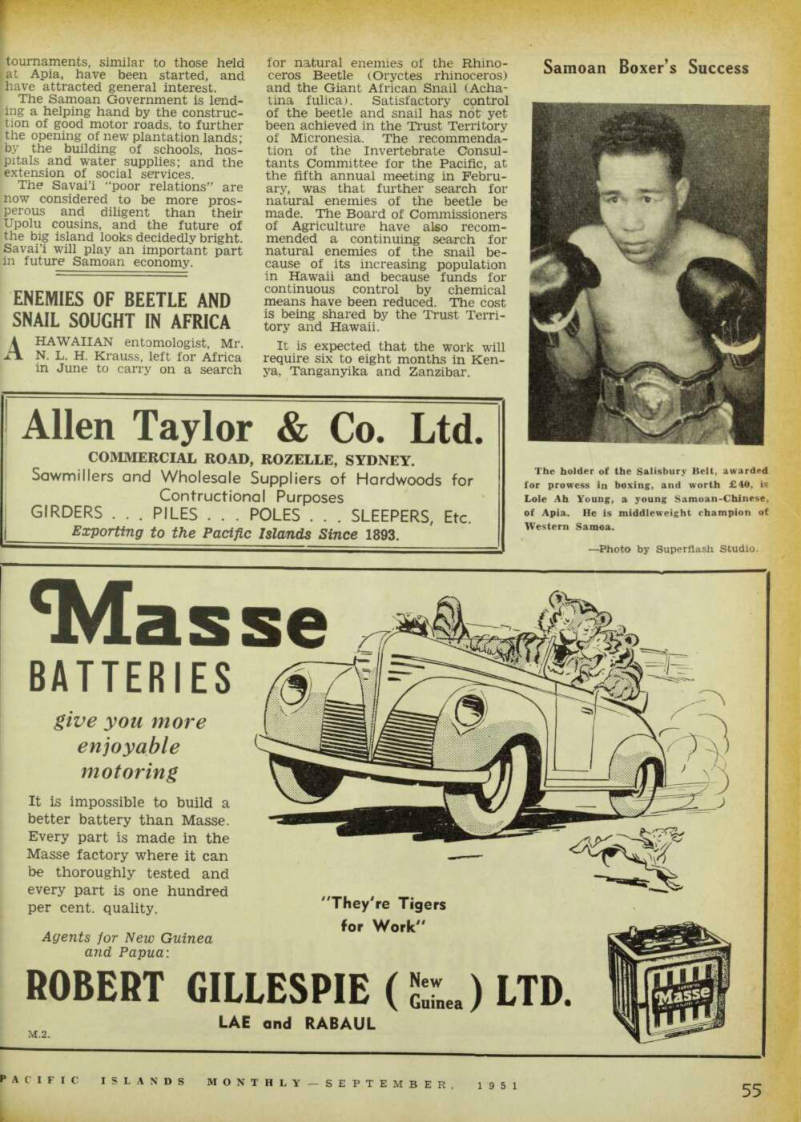
New Era For Big Samoan Island
From our own correspondent
Apia, Aug. 20,
rpHE largest and westernmost is- 1 land of the Western Samoan Group, Savai’i (which contains
700 of the group’s total land area, of 1,130 square miles) appears sel dom in the news. Public interest; centres on the island of Upolu and’ its capital, Apia.
Visitors and tourists rarely pene- ■ trate to the lesser known scenic andJ natural attractions of the larger* island. There are just as many andJ maybe more tourist attractions oiu Savai’i; and the mountain ranges* of Savai’i rise to 6,094 feet, as; against only 3,608 feet on Upolu.
Savai’i’s large lava fields are of; fairly recent origin. The last out breaks of the volcano Matavanui took place between 1905 and 1911,, when large areas of cultivated land] and coconut plantations were? covered by the lava flow, and de stroyed, and several villages had toe be abandoned, and the inhabitants* removed to Upolu.
Of the total population of West ern Samoa approximately one-thirdl or some 25,000 live on Savai’i, butd the number of Europeans and part— Europeans is very small.
In former years, Savai’i peoples were somewhat condescendingly* treated as poor relations by thes more prosperous Upolu Samoans,; proud of the humming activitiess of Apia, of the numerous cocoa andt banana plantations, with thein better roads, hospitals and schools.; But, in recent years, the pictures has completely changed.
The neglected and isolated island: of Savai’i is energetically forgings ahead, and is developing rapidly.and threatening to rival and evem surpass the economic achievements, of Upolu.
The cocoa industry, particularly,* has been greatly expanded in all] parts of Savai’i. and the youngg cocoa plantations are coming inten bearing. A gradually increasing pro portion of Samoa’s cocoa production: is coming from Savai’i. The of Savai’i cocoa-beans is considered? even better than the Upolu product.?
End of the current year will also? see the banana export industry extended to Savai’i, which will bring increased revenue and prosperity to the Savai’ians.
As a consequence of the new; prosperity of the island, a regular daily ferry service, by fast motor launches, has been functioning fon; some time, and this is well patron-i ised. Numerous trading stations:: have sprung up all over the islandb and traders are doing well.
In addition a string of picture-e shows, in the most populated dis tricts of Savai’i—the Fa’a, Saleleage ; and Matautu districts —is catering for the entertainment of the peoples More recently, regular boxing:
tournaments, similar to those held at Apia, have been started, and have attracted general interest.
The Samoan Government is lend ing a helping hand by the construc tion of good motor roads, to further the opening of new plantation lands; by the building of schools, hos pitals and water supplies; and the extension of social services.
The Savai’i “poor relations” are now considered to be more pros perous and diligent than their Upolu cousins, and the future of the big island looks decidedly bright.
Savai’i will play an important part in future Samoan economy.
Enemies Of Beetle And
Snail Sought In Africa
A HAWAIIAN entomologist, Mr.
N. L. H. Krauss, left for Africa in June to carry on a search
for natural enemies of the Rhino ceros Beetle (Oryctes rhinoceros) and the Giant African Snail (Acha tina fulica). Satisfactory control of the beetle and snail has not yet been achieved in the Trust Territory of Micronesia. The recommenda tion of the Invertebrate Consul tants Committee for the Pacific, at the fifth annual meeting in Febru ary, was that further search for natural enemies of the beetle be made. The Board of Commissioners of Agriculture have also recom mended a continuing search for natural enemies of the snail be cause of its increasing population in Hawaii and because funds for continuous control by chemical means have been reduced. The cost is being shared by the Trust Terri tory and Hawaii.
It is expected that the work will require six to eight months in Ken ya, Tanganyika and Zanzibar.
Samoan Boxer’s Success
The holder of the Salisbury Belt, awarded for prowess in boxing, and worth £4O, is Lole Ah Young, a young Samoan-Chinese, of Apia. He is middleweight champion of Western Samoa. —Photo by Superflash Studio.
Advertisements & other items, pp. 57-58 (2 items)
Masse
Allen Taylor & Co. Ltd.
COMMERCIAL ROAD, ROZELLE, SYDNEY.
Sawmillers and Wholesale Suppliers of Hardwoods for Contructional Purposes GIRDERS . . . PILES . . , POLES . . . SLEEPERS, Etc.
Exporting to the Pacific Islands Since 1893.
Masse
BATTERIES
give you more
enjoyable
motoring
It is impossible to build a better battery than Masse.
Every part is made in the Masse factory where it can be thoroughly tested and every part is one hundred per cent, quality.
Agents for New Guinea and Papua:
ROBERT GILLESPIE ( ) LTD.
(3 0 'They're Tigers for Work"
M. 2.
LAE and RABAUL
Free
IN YOUR COUNTRY HOME
with
ELECTRICITY
N) n
FREE
s
FROM THE WIND
WITH QUIRK’S WIND-DRIVEN LIGHTING PLANT
You don't have to live in the city to enjoy these modern electrical appliances by Quirk's. Now they're available to every country home to give you hours of entertainment and save hours of work. They are operated by electricity FREE from the wind with a Quirk's Wind Driven Lighting Plant.
Operating in winds as low as 5 m.p.h., this plant will provide economical electricity for all your lighting and household appliances.
Supplied as a complete unit with batteries, or as an addition to your present engine-driven plant, the saving in fuel and upkeep will amply repay the purchase price of Windlite.
Quirk's Windlite plants cost nothing to run —need no attention whatever, apart from a yearly change of oil. Available in either 12, 32, or 50 volt sizes. * Windlite Is a necessity that no country man or woman can afford to overlook.
Quirk's are also suppliers of electrical goods which can be operated by Windlite—fans, radios, cake mixers, vacuum cleaners, dishwashers, and washing machines.
Obtainable from
QUIRK’S VICTORY LIGHT 00.
229 Castlereagh Street, Sydney. Phone M 3114
Month In Fiji
New Suva-Nadi Service
From Our Own Correspondent
Suva, Aug. 28.
IT is expected that the new Fiji Airways service between Nau sori and Nadi-Lautoka will be operating from September 1. Two flights per day will be made and an eight-passenger plane will be used.
The company’s senior pilot, Cap tain F. Ladd, arrived from NZ in mid-August and the company’s engineer Mr. F. Murphy, from Aus tralia, shortly afterwards.
The Lautoka terminal will be for the present at Drasa, where there is already an emergency airstrip.
Later, the base will be established at Namoli (Lautoka,).
The airstrip at Labasa is under construction. Earthmoving equip ment has already arrived, and it is hoped to have it ready for use in November. For the present, it is proposed to run two trips per week on each route; but, so far as Labasa is concerned, this would seem in adequate, The TEAL Solent, ac comodating 32 passengers, is nearly always overbooked both ways now.
Plane is a twin-engined de Havilland Rapide; fare from Suva to Nadi is £3/12, 6 and to Lautoka, £4. All bookings are to be made through Hunt’s Travel Agency.
Taxi hire for the same trip is approximately twice this fare, about four times longer and not even the most anti-airminded can insist that road travel in Fiji is particularly comfortable.
The flying time between Nadi and Nausori is one hour—and the only catch is that it takes a further hour by bus to reach Suva (several miles from Nausori).
Dry Season
SUVA is enjoying one of the coolest and driest dry seasons for years. A few weeks ago residents were wearing sweaters and sleeping under blankets. Suva has been without rain for over a week, which constitutes something of a record —but there has been sufficient moisture up to date to keep gardens bright and grass green.
Further afield the position is more serious. Some of the islands of the Lau Group have had practically no rain for three months, and plan tations are beginning to suffer.
Suva has been obscured by a thick haze in recent weeks, particu larly towards evening when the mountains and off-shore islands are blotted out. There are several local theories to account for it—one being that it is bush-fire smoke from the bush fires in Queensland.
Mercy Ship On Aitutaki
Reef
THE Alexander, formerly an Anchor Line ship which was Salvaged from the Nelson (NZ) mud-flats some months ago, and was reconditioned for the Islands trade in time to help out in the recent NZ seamen’s strike, ran on a reef near Aitutaki, Cook Is., in mid- August. It is believed that she may become a total loss.
She is owned by three young men and became known in NZ as the Little Mercy Ship, when she was the first ship to take much needed food to the Islands in the recent strike period.
Fiji Aerial Survey
THE Hunting Aerial Survey has practically completed its Sur vey of Viti Levu, and Vanua Levu. The whole of both islands base been covered except for filling in patches that were missed owing to bad visibility. The main out lying groups remain to be done.
This work, when finished, will be of great service in the future dep velopment of the Colony.
Well Known In Sport
A RECENT arrival is a well known New Zealand identity in the person of Mr. Sam Hol lander, who has joined Northern
Hotels, Ltd., as assistant general manager.
Mr. Hollander, from Christchurch, is one of New Zealand’s leading chess players; a Rugby Union referee of some note; a keen bowler; and in his younger days he represented Canterbury at Cricket, Rugby and swimming. By way of hobbies Mr.
Hollander collects ivories, chess sets and stamps.
The Pineapple Cup
rpHE Championship of the South JL Seas,” for which the famous Pineapple Cup was presented many years ago by the Pacific Biscuit Co., was again competed for during the holiday week-end, August 4-6. Open to all Clubs in the South Pacific, this competition is always a gala day at Suva and this year
was no exception. Very keen play brought the finalists, Messrs. Geo.
McKitterick and veteran W. (Bill) Thompson to meet on the main green on Monday before a large gathering. After some really first class bowling by both contestants, McKitterick was the winner on the 25th head, 22-18. It should be mentioned that “Bill” Thompson won this Cup away back in 1935.
The Radio-Telephone
ONE of the notable advances made ; in Fiji during recent years is; the establishment of radio telephone services to outlying • centres.
Even on Vanua Levu there were; many places which had no means< of urgent communication—Dreketi,, for instance, a large centre only 50( miles from Labasa, but with no road! leading there. A messenger om horseback took a full day to get tot Labasa, while a fast launch trip took: six hours. For outside, messagesc were sent over the broadcasting? system, for all and sundry to hear..
Now all this is changed. Out lying districts are now in frequent} and speedy touch with the centres..: This applies even more in the cases of the smaller groups.
Last year stations were opened ati Lomaloma and Lakemba, while re cently others were opened att Oneata, Fulaga, Moce, and Naitaubas in the Lau Group. Before the endfc of the year it is hoped to have readyv for operation stations at Moala, Totoya, Vatoa, Naiyau, Vanua VaUu Namuka-i-lau, Ogea, and Komo.t This will mean that most of thes Lau group will be in communications with Suva.
The service is also being extended on the main islands and vicinity,' Beqa opens tomorrow and Koro and) Gau will be on the air next month.
Is He An Indian?
AN interesting case was heard be-; fore the Chief Justice thisj week. Four electors of the; Northwestern Electorate sought to unseat the recently elected Indian member of the Legislative Council! on the grounds that he was not an Indian under the Letters Patent!
The actual claim was that the; member, Mr. Tulsi Ram Sharma s was in fact a Nepalese, his fathers having been of that nationality, al-I though Mr. Tulsi Sharma was borer in Fiji.
The Chief Justice, in his reserves decision, made no reference to thin point; but he held that the petition.; was vexatious and frivolous owing: to the delay in presenting same.
Mr. Tulsi Sharma was recently ini England, with two other electees members, as the guest of the British Government at the Festival o;o Britain.
Advertisements & other items, pp. 59-60 (2 items)
General
V/M//'///'
“WiPROCESS
NOW/CIVES
’MW-Ww/s/
MORE THAN
N if s.
U# rfn»s 90 Ss> Ctf* 1
i SO ALWAYS
7 SWITCH TO
GENERAL
TORCH BATTERIES FOR
STRONGER LIGHT plus
LONGER LIFE!
Distributors for General Dry Batteries (A/asia) Pty., Ltd., in Fiji, Tonga, Samoa and Gilbert and Ellice Islands: —
ISLAND ELECTRIC CO.
SUVA and LAUTOKA, FIJI
Cables: “ISLET.” Suva or Lautoka. P.O. Box 464, Suva.
where HEAT hits the high spots The ever-changing conditions of tropical climates demand the use of only the best possible paint for adequate protection of property and equipment.
For nearly two hundred years Berger has lead in the field of paints and finishes and gives you the benefits of vast research and experience in the Berger product. m
paint
KEEPS ON KEEPING ON
58
SEPTEMBER, 1951 PACIFIC ISLANDS MONTHLTI
Items From Santo
By Vernon Wheatley
Santo, Nh, Aug. 5.
SHIPPING: M. Graziani’s vessel arrived here recently from Sydney via Noumea.
She was held up in Noumea to undergo engine repairs.
Approximately a week later, Mr.
Roy Gubbay’s ship arrived from Sydney with cargo, including Mrs.
Gubbay’s new Holden car—the first in Santo, and possibly the first in the Group.
Mr. Gubbay’s boat is an acquisi tion to the Group’s fleet of small ships. She can take 120 tons of general cargo or 80 tons of copra.
Mr. Max Reading, formerly asso ciated with Mr. Gubbay in an en gineering business, is the engineer.
VOLCANO: The volcano on Am brym seems, from here, to be very active. Fine black cinders have settled everywhere.
One resident says that this ac tivity is a very good thing. He claims that the cinders deposited will eventually fill in the potholes on Santo’s roads.
Wishful thinking.
ACCIDENT: An English model jeep-type vehicle collided with a light § ton pick-up. A passenger
in the jeep, Mr. Fred Atkinson of Sydney, was thrown onto the road and received a bad cut on the head.
He is remaining in the Hopital Prancaise and it is expected that he will leave for Sydney on the Qantas plane of August 8.
Other occupants of the vehicles suffered minor injuries.
Both cars were extensively damaged.
Temporary Departure; Mr.
L. O’Shea is leaving for Noumea shortly where he will be engaged in demolition work for some months.
He will then return to Santo.
Mr. W. O’Shea (no relation) has left his position as accountant to Burns Philp (Santo) upon comple tion of his contract. He will go to the Banks Islands to operate a trading store which he has ac quired.
WRECK: The reefs of the Group have claimed another victim. This time it is the French Government vessel, “Concord.” a small auxiliary ketch of under 50 feet.
TROUBLE: The British District Agent at Santo, Major D. Fregard, is Island-bound.
A storm drove his launch onto a reef after tearing it away from its moorings. The shaft for his other launch will not arrive for some
months, and the official jeep was just one degree past redemption, so it was sold. The vehicle to replace the old jeep is on its way out from England.
At present, therefore, Major Pre gard’s visits to Santo (his head quarters are ten miles from Santo proper) are infrequent.
Advertisements & other items, pp. 61-62 (1 item)
Bovril
Weary, Dreary
People
Put Some GO Into Your Life
Too many men, women and girls suffer aching backs, headaches, and feel dreadfully tired—tired, always tired. The cause? Very often, anaemia or bloodlessness.
You see the symptoms In dull eyes, pallid cheeks and lips, breathlessness, vague aches, exhaustion after the slightest exertion. Young children, especially girls, suffer frequently.
If you haven’t blood normal in red corpuscles, you are not receiving sufficient energy-giving oxygen which is dispersed by the blood throughout your body every second of the day and night. Your nerves, organs and tissues are not properly nourished and you remain weary and dreary.
Get the GO which rich red blood can give you. Take the famous Dr. Williams- Pink Pills for a few weeks. Dr. Williams’
Pink Pills are specially compounded to provide you with a normal rich blood supply. Always at your chemist or store.
BOVRIL
makes good cooks
better
pies and savouries. And nourishment, too! for Bovril is the concentrated goodness of beef. Bovril is also a tasty sandwich spread and a cup of hot Bovril daily makes you feel fine !
Bovril gives that extra flavour to all soups,
V
EXISTING ROUTES
PROJECTED ROUTES
V --p' V t* 0 < I - * /.
SOUTH PACIFIC SKYWAYS
TO NEW ZEALAND
This year take your finest holiday ever. Fly by fast luxurious TEAL airliner to the scenic wonders of New Zealand.
Enjoy famous TEAL hospitality, delicious hot or cold meals served at your table in flight, full bar service, two flight stewards and a stewardess to attend to your every need. Arrive fresh, relaxed, with your whole f ol day still intact to enjoy New Zealand's world-famous attractions.
Reservations: TEAL, QANTAS, N.A.C., T.A.A. and leading trcvei agents. mi
TASMAN EMPIRE AIRWAYS LIMITED
In association with QANTAS and 8.0.A.C. 6 V)
They
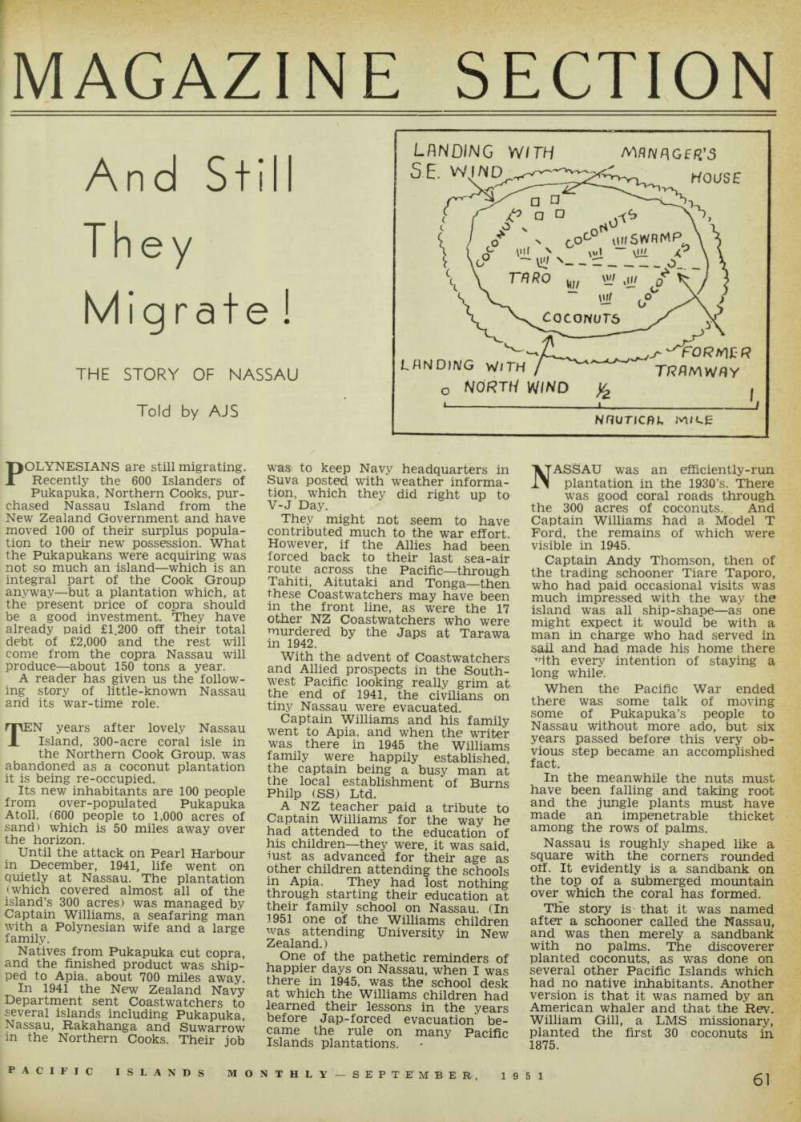
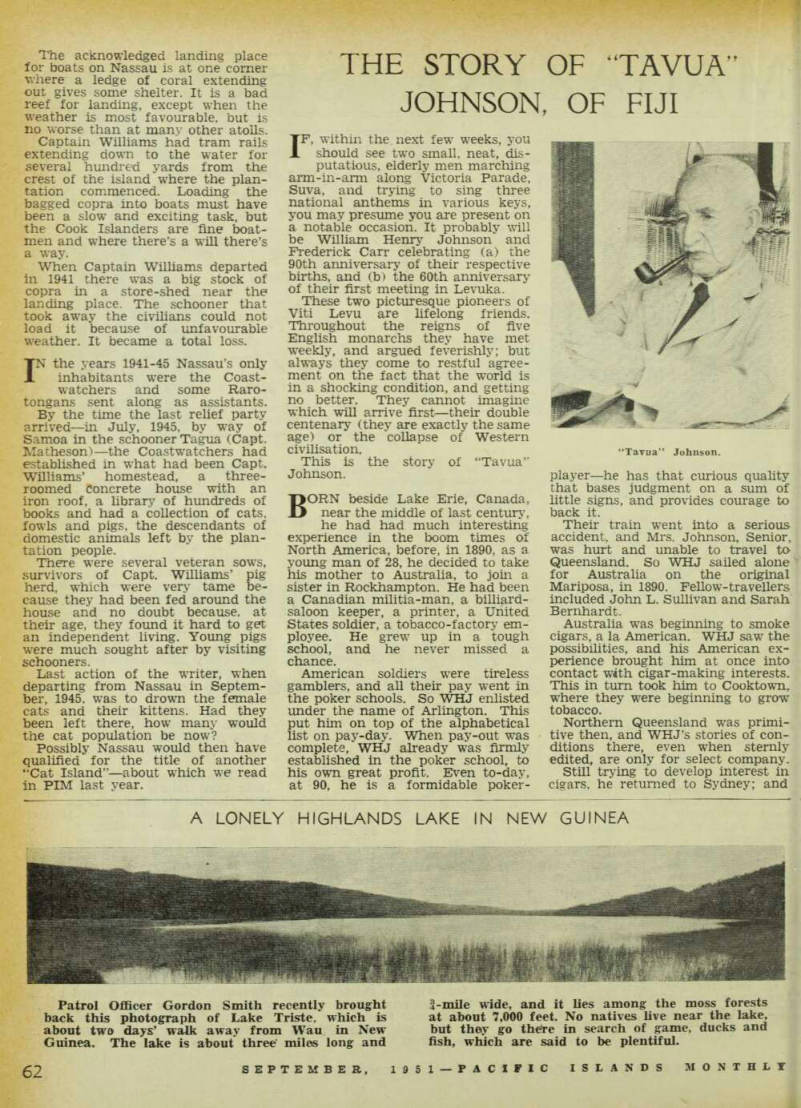
Magazine Section
And Still They Migrate!
The Story Of Nassau
Told by AJS
POLYNESIANS are still migrating, Recently the 600 Islanders of Pukapuka, Northern Cooks, purchased Nassau Island from the New Zealand Government and have moved 100 of their surplus population to their new possession. What the Pukapi£ans were acquiring was not so much an island—which is an
EfT*
fhj nrtS fi
bp nfrpnnf npiH 900 nfT Tiw t wUi debt of £2,000 and the rest will come from the copra Nassau will produce-about 150 tons a year.
A reader has given us the following story of little-known Nassau and its war-time role. rN years after lovely Nassau Island, 300-acre coral isle in the Northern Cook Group, was abandoned as a coconut plantation it is bemg re-occupied.
Its new inhabitants are 100 people from over-populated Pukapuka Atoll, (600 people to 1,000 acres of sand) which is 50 miles away over th e b 9. ri zp n - .. . „ , „ , Until the attack on Pearl Harbour m December, 1941, life went on quietly at Nassau. The plantation (which covered almost all of the
3 Wilfinm?
wifi and a g uSS family Folynesian Wlfe and a lar^e Nntivpc fmm Pnk-Qrmb-o and the finished SiVE’
ned to Ani? 7nS iSS,"
In t 1941 P t,he 70 Denartment sen?^n^?wntib*»? a + y
Sai nnd
»N R oX h r a Ks d S r Tob
was to keep Navy headquarters in Suva posted with weather information, which they did right up to V-J Day.
They might not seem to have contributed much to the war effort.
However, if the Allies had been forced back to their last sea-air route across the Pacific—through ?? hlt A Al J uta , ki . and Tonga—then the !t Coastwatchers may have been the xis h P e ’ as Wo re the 17 othe s N 5 Coastwatchers who were by the Ja Ps at Tarawa m 1942. with the advent of Coastwatchers and Allied prospects in the Southwest Pacific looking- really g-rim at the end of 1941 the civilians on tiny Nassau were evacuated
CaptainWmten*andh£familv
wenTto to anTwhen the write?
was to Witt family were happily established the captain being a busy man at the local establishment of Burns Philp (SS) Ltd a NZ teacher paid a tribute to Captain Williams for the wav he had attended to the education of his children—they were, it was said, lust as advanced for their age as other children attending the schools in Apia. They had lost nothing; through starting their education at their family sch ° ol on Nassau. (In 1951 °? + e °I children was attending University in New Zealand.) v, ° n ? A the P atheti c reminders of ? appier days on Nassau, when I was ere m 1945 ’ was the sch ° ol desk which the Williams children had l ea / ned T their lessons in the years before Jap-forced evacuation be- Islands 1 plantations' 1 many PaC “ C
VTASSAU was an efficiently-run ll plantation in the 1930’5. There was good coral roads through the 300 acres of coconuts. And Captain Williams had a Model T Ford, the remains of which were visible in 1945.
Captain Andy Thomson, then of the trading schooner Tiare Taporo, who had paid occasional visits was much impressed with the way the island was all ship-shape—as one might expect it would be with a man in charge who had served in nrid mndP bic bnmp tbprp Mth intentionof staying a long while Y , When the Pacific War ended there was some talk of movin S some of Pukapuka’s people to Nassau without more ado, but six yGarS ? aSS l d this very Y lO 18 ste P became an accomplished In the mean while the nuts must have been fallin g and taking root and the Plants must have made an impenetrable thicket amon S the ™ws of palms.
Nassau is roughly shaped like a square with the corners rounded °ff- evidently is a sandbank on the top of a submerged mountain over which the coral has formed.
The story is that it was named after a schooner called the Nassau, and was then merely a sandbank with no palms. The discoverer planted coconuts, as was done on several other Pacific Islands which had no native inhabitants. Another version is that it was named by an American whaler and that the Rev.
William Gill, a LMS missionary, the first 30 COCOnUts “
The acknowledged landing place for boats on Nassau is at one comer where a ledge of coral extending out gives some shelter. It is a bad reef for landing, except when the weather is most favourable, but is no worse than at many other atolls.
Captain Williams had tram rails extending down to the water for several hundred yards from the crest of the island where the plan tation commenced. Loading the bagged copra into boats must have been a slow and exciting task, but the Cook Islanders are fine boat men and where there’s a will there’s a way.
When Captain Williams departed in 1941 there was a big stock of copra in a store-shed near the landing place. The schooner that took away the civilians could not load it because of unfavourable weather. It became a total loss.
IN the years 1941-45 Nassau’s only inhabitants were the Coast watchers and some Raro tongans sent along as assistants.
By the time the last relief party arrived —in July, 1945, by way of Samoa in the schooner Tagua (Capt.
Matheson) —the Coastwatchers had established in what had been Capt.
Williams’ homestead, a three roomed Concrete house with an iron roof, a library of hundreds of books and had a collection of cats, fowls and pigs, the descendants of domestic animals left by the plan tation people.
There were several veteran sows, survivors of Capt. Williams’ pig herd, which were very tame be cause they had been fed around the house and no doubt because, at their age, they found it hard to get an independent living. Young pigs were much sought after by visiting schooners.
Last action of the writer, when departing from Nassau in Septem ber, 1945. was to drown the female cats and their kittens. Had they been left there, how many would the cat population be now?
Possibly Nassau would then have qualified for the title of another “Cat Island” —about which we read in PIM last year.
The Story Of “Tavua”
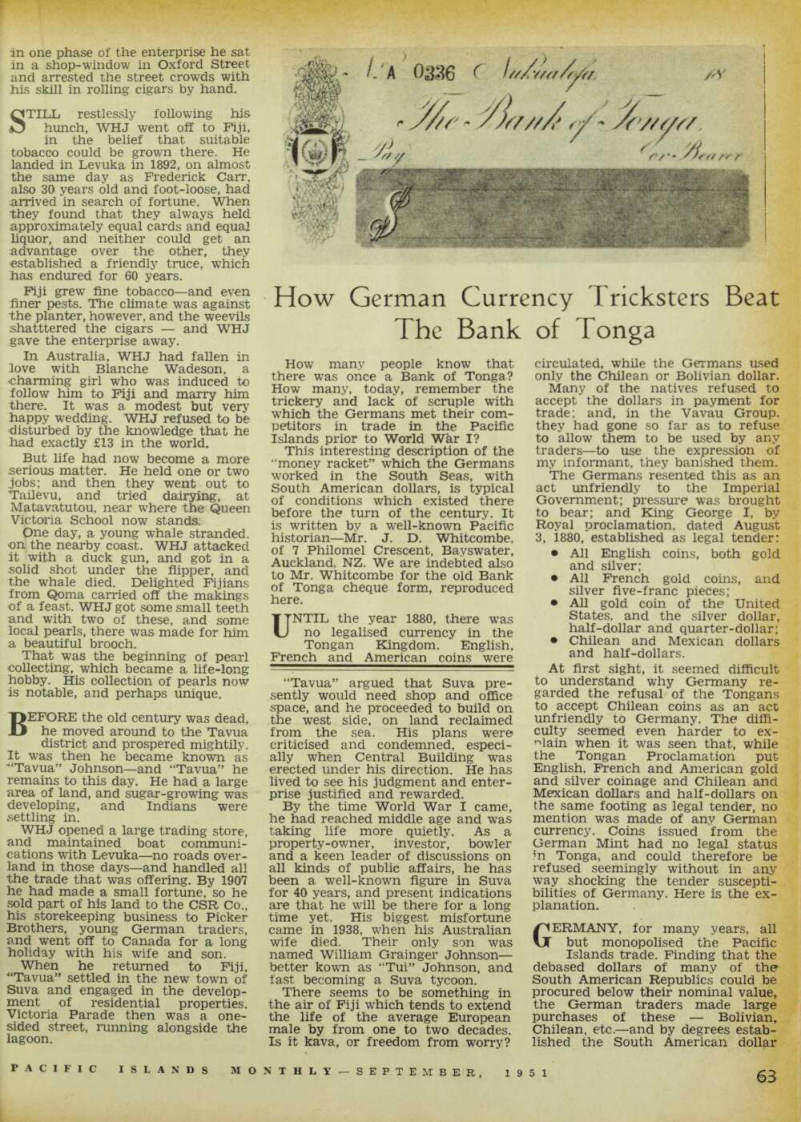
Johnson, Of Fiji
IF, within the, next few weeks, you should see two small, neat, dis putatious, elderly men marching arm-in-arm along Victoria Parade, Suva, and trying to sing three national anthems in various keys, you may presume you are present on a notable occasion. It probably will be William Henry Johnson and Frederick Carr celebrating (a) the 90th anniversary of their respective births, and (b) the 60th anniversary of their first meeting in Levuka.
These two picturesque pioneers of Viti Levu are lifelong friends.
Throughout the reigns of five English monarchs they have met weekly, and argued feverishly; but always they come to restful agree ment on the fact that the world is in a shocking condition, and getting no better. They cannot imagine which will arrive first—their double centenary (they are exactly the same age) or the collapse of Western civilisation.
This is the story of “Tavua’’
Johnson.
BORN beside Lake Erie, Canada, near the middle of last century, he had had much interesting experience in the boom times of North America, before, in 1890, as a young man of 28, he decided to take his mother to Australia, to join a sister in Rockhampton. He had been a Canadian militia-man, a billiard saloon keeper, a printer, a United States soldier, a tobacco-factory em ployee. He grew up in a tough school, and he never missed a chance.
American soldiers were tireless gamblers, and all their pay went in the poker schools. So WHJ enlisted under the name of Arlington. This put him on top of the alphabetical list on pay-day. When pay-out was complete, WHJ already was firmly established in the poker school, to his own great profit. Even to-day, at 90, he is a formidable poker-
player—he has that curious quality that bases judgment on a sum of little signs, and provides courage to back it.
Their train went into a serious accident, and Mrs. Johnson, Senior, was hurt and unable to travel to Queensland. So WHJ sailed alone for Australia on the original Mariposa, in 1890. Fellow-travellers included John L. Sullivan and Sarah Bernhardt.
Australia was beginning to smoke cigars, a la American. WHJ saw the possibilities, and his American ex perience brought him at once into contact with cigar-making interests.
This in turn took him to Cooktown, where they were beginning to grow tobacco.
Northern Queensland was primi tive then, and WHJ’s stories of con ditions there, even when sternly edited, are only for select company.
Still trying to develop interest in cigars, he returned to Sydney; and
“Tavua" Johnson.
in one phase of the enterprise he sat in a shop-window in Oxford Street and arrested the street crowds with his skill in rolling cigars by hand.
STILL restlessly following his hunch, WHJ went off to Fiji, in the belief that suitable tobacco could be grown there. He landed in Levuka in 1892, on almost the same day as Frederick Carr, also 30 years old and foot-loose, had arrived in search of fortune. When they found that they always held approximately equal cards and equal liquor, and neither could get an advantage over the other, they established a friendly truce, which has endured for 60 years.
Fiji grew fine tobacco—and even finer pests. The climate was against the planter, however, and the weevils shatttered the cigars and WHJ gave the enterprise away.
In Australia, WHJ had fallen in love with Blanche Wadeson, a ■charming girl who was induced to follow him to Fiji and marry him there. It was a modest but very happy wedding. WHJ refused to be disturbed by the knowledge that he had exactly £l3 in the world.
But life had now become a more serious matter. He held one or two jobs; and then they went out to Tailevu, and tried dairying, at Matavatutou, near where the Queen Victoria School now stands.
One day, a young whale stranded, on the nearby coast. WHJ attacked it with a duck gun, and got in a solid shot under the flipper, and the whale died. Delighted Fijians from Qoma carried off the makings of a feast. WHJ got some small teeth and with two of these, and some local pearls, there was made for him a beautiful brooch.
That was the beginning of pearl collecting, which became a life-long hobby. His collection of pearls now is notable, and perhaps unique.
BEFORE the old century was dead, he moved around to the Tavua district and prospered mightily.
It was then he became known as “Tavua” Johnson —and “Tavua” he remains to this day. He had a large area of land, and sugar-growing was developing, and Indians were settling in.
WHJ opened a large trading store, and maintained boat communi cations with Levuka—no roads over land in those days—and handled all the trade that was offering. By 1907 he had made a small fortune, so he sold part of his land to the CSR Co., his storekeeping business to Picker Brothers, young German traders, and went off to Canada for a long holiday with his wife and son.
When he returned to Fiji, “Tavua” settled in the new town of Suva and engaged in the develop ment of residential properties.
Victoria Parade then was a one sided street, running alongside the lagoon.
“Tavua” argued that Suva pre sently would need shop and office space, and he proceeded to build on the west side, on land reclaimed from the sea. His plans were criticised and condemned, especi ally when Central Building was erected under his direction. He has lived to see his judgment and enter prise justified and rewarded.
By the time World War I came, he had reached middle age and was taking life more quietly. As a property-owner, investor, bowler and a keen leader of discussions on all kinds of public affairs, he has been a well-known figure in Suva for 40 years, and present indications are that he will be there for a long time yet. His biggest misfortune came in 1938, when his Australian wife died. Their only son was named William Grainger Johnson— better kown as “Tui” Johnson, and fast becoming a Suva tycoon.
There seems to be something in the air of Fiji which tends to extend the life of the average European male by from one to two decades.
Is it kava, or freedom from worry?
A Lonely Highlands Lake In New Guinea
Patrol Officer Gordon Smith recently brought back this photograph of Lake Triste. which is about two days’ walk away from Wau in New Guinea. The lake is about three miles long and
¾-mile wide, and it lies among the moss forests at about 7,000 feet. No natives live near the lake, but they go there in search of game, ducks and fish, which are said to be plentiful.
The Bank of Tonga
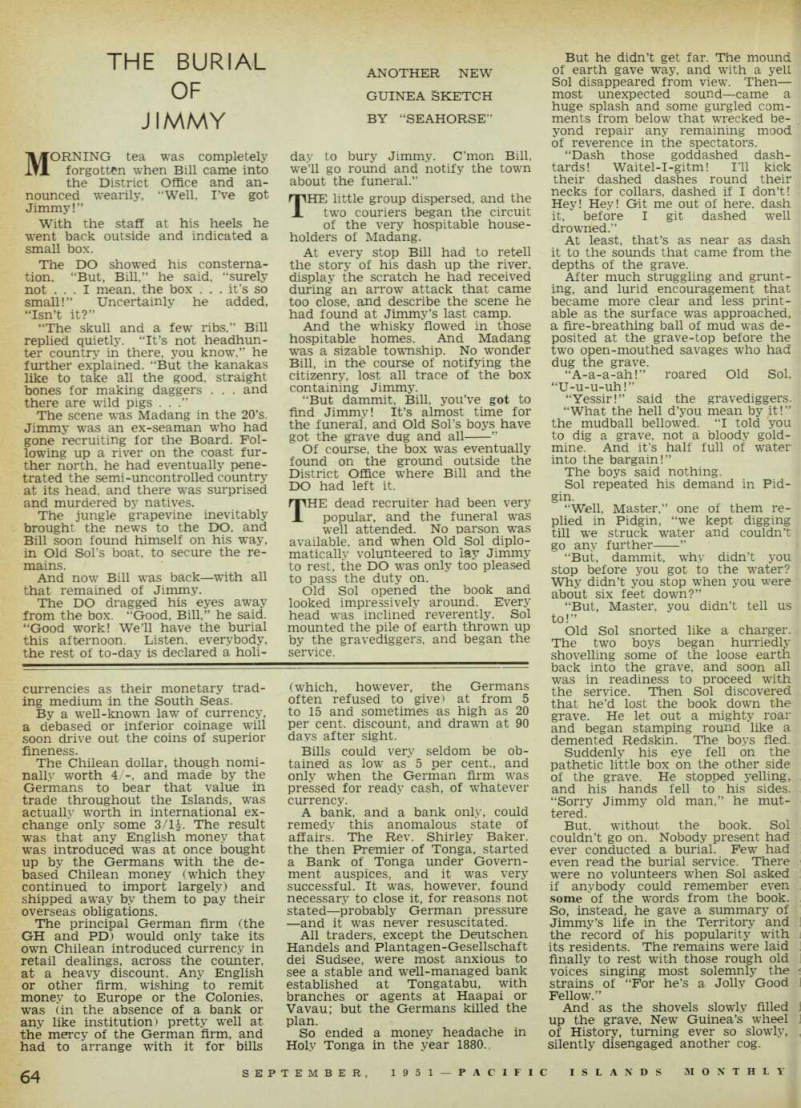
How German Currency Tricksters Beat The Bank of Tonga
How many people know that there was once a Bank of Tonga?
How many, today, remember the trickery and lack of scruple with which the Germans met their com petitors in trade in the Pacific Islands prior to World War I?
This interesting description of the “money racket” which the Germans worked in the South Seas, with South American dollars, is typical of conditions which existed there before the turn of the century. It is written by a well-known Pacific historian—Mr. J. D. Whitcombe, of 7 Philomel Crescent, Bayswater, Auckland, NZ. We are indebted also to Mr. Whitcombe for the old Bank of Tonga cheque form, reproduced here.
UNTIL the year 1880, there was no legalised currency in the Tongan Kingdom. English, French and American coins were
circulated, while the Germans used only the Chilean or Bolivian dollar.
Many of the natives refused to accept the dollars in payment for trade; and, in the Vavau Group, they had gone so far as to refuse to allow them to be used by any traders —to use the expression of my informant, they banished them.
The Germans resented this as an act unfriendly to the Imperial Government; pressure was brought to bear; and King George I, by Royal proclamation, dated August 3, 1880, established as legal tender: • All English coins, both gold and silver; • All French gold coins, and silver five-franc pieces; • All gold coin of the United States, and the silver dollar, half-dollar and quarter-dollar; • Chilean and Mexican dollars and half-dollars.
At first sight, it seemed difficult to understand why Germany re garded the refusal of the Tongans to accept Chilean coins as an act unfriendly to Germany. The diffi culty seemed even harder to ex plain when it was seen that, while the Tongan Proclamation put English, French and American gold and silver coinage and Chilean and Mexican dollars and half-dollars on the same footing as legal tender, no mention was made of any German currency. Coins issued from the German Mint had no legal status m Tonga, and could therefore be refused seemingly without in any way shocking the tender suscepti bilities of Germany, Here is the ex planation.
GERMANY, for many years, all but monopolised the Pacific Islands trade. Finding that the debased dollars of many of the South American Republics could be procured below their nominal value, the German traders made large purchases of these Bolivian, Chilean, etc. —and by degrees estab lished the South American dollar
currencies as their monetary trading medium In the South Seas.
By a well-known law of currency, a debased or inferior coinage will soon drive out the coins of superior fineness.
The Chilean dollar, though nominally worth 4/-, and made by the Germans to bear that value in trade throughout the Islands, was actually worth in international exchange only some 3/l£. The result was that any English money that was introduced was at once bought up by the Germans with the debased Chilean money (which they continued to import largely) and shipped away by them to pay their overseas obligations.
The principal German firm (the GH and PD) would only take its own Chilean introduced currency in retail dealings, across the counter, at a heavy discount. Any English or other firm, wishing to remit money to Europe or the Colonies, was (in the absence of a bank or any like institution) pretty well at the mercy of the German firm, and had to arrange with it for bills
(which, however, the Germans often refused to give) at from 5 to 15 and sometimes as high as 20 per cent, discount, and drawn at 90 days after sight, Bills could very seldom be ob tained as low as 5 per cent., and only when the German firm was pressed for ready cash, of whatever currency.
A bank, and a bank only, could remedy this anomalous state of affairs. The Rev. Shirley Baker, the then Premier of Tonga, started a Bank of Tonga under Govern ment auspices, and it was very successful. It was, however, found necessary to close it, for reasons not stated—probably German pressure —and it was never resuscitated.
All traders, except the Deutschen Handels and Plantagen-Gesellschaft dei Sudsee, were most anxious to see a stable and well-managed bank established at Tongatabu, with branches or agents at Haapai or Vavau; but the Germans killed the plan.
So ended a money headache in Holy Tonga in the year 1880.
But he didn’t get far. The mound of earth gave way, and with a yell Sol disappeared from view. Then — most unexpected sound—came a huge splash and some gurgled com ments from below that wrecked be yond repair any remaining mood of reverence in the spectators.
“Dash those goddashed dash tards! Waitel-I-gitm! I’ll kick their dashed dashes round their necks for collars, dashed if I don’t!
Hey! Hey! Git me out of here, dash it, before I git dashed well drowned.”
At least, that’s as near as dash it to the sounds that came from the depths of the grave.
After much struggling and grunt ing, and lurid encouragement that became more clear and less print able as the surface was approached, a fire-breathing ball of mud was de posited at the grave-top before the two open-mouthed savages who had dug the grave.
“A-a-a-ah!” roared Old Sol.
“U-u-u-uh!”
“Yessir!” said the gravediggers.
“What the hell d’you mean by it!” the mudball bellowed. “I told you to dig a grave, not a bloody gold mine. And it’s half full of water into the bargain!”
The boys said nothing.
Sol repeated his demand in Pid gin.
“Well, Master,” one of them re plied in Pidgin, “we kept digging till we struck water and couldn’t go any further ”
“But, dammit, why didn’t you stop before you got to the water?
Why didn’t you stop when you were about six feet down?”
“But, Master, you didn’t tell us to!”
Old Sol snorted like a charger.
The two boys began hurriedly shovelling some of the loose earth back into the grave, and soon all was in readiness to proceed with the service. Then Sol discovered that he’d lost the book down the grave. He let out a mighty roar and began stamping round like a demented Redskin. The boys fled.
Suddenly his eye fell on the pathetic little box on the other side of the grave. He stopped yelling, and his hands fell to his sides.
“Sorry Jimmy old man.” he mut tered.
But, without the book, Sol couldn’t go on. Nobody present had ever conducted a burial. Few had even read the burial service. There were no volunteers when Sol asked if anybody could remember even some of the words from the book.
So, instead, he gave a summary of Jimmy’s life in the Territory and the record of his popularity with its residents. The remains were laid finally to rest with those rough old voices singing most solemnly the strains of “For he’s a Jolly Good Fellow.”
And as the shovels slowly filled up the grave, New Guinea’s wheel of History, turning ever so slowly, silently disengaged another cog.
The Burial
OF
Jimmy
Another New
Guinea Sketch
By “Seahorse”
MORNING tea was completely forgotten when Bill came into the District Office and anwearily, “Well. I’ve got Jimmy!”
With the staff at his heels he went back outside and indicated a small box.
The DO showed his constemation. “But, Bill,” he said, “surely not ... I mean, the box . . . it’s so small!” Uncertainly he added, “Isn’t it?”
“The skull and a few ribs.” Bill replied quietly. “It’s not headhunter country in there, you know,” he further explained. “But the kanakas like to take all the good, straight bones for making daggers . . . and there are wild pigs . . .”
The scene was Madang in the 20’s.
Jimmy was an ex-seaman who had gone recruiting for the Board. Following up a river on the coast further north, he had eventually penetrated the semi-uncontrolled country at its head, and there was surprised and murdered by natives.
The jungle grapevine inevitably brought the news to the DO. and Bill soon found himself on his way, in Old Sol’s boat, to secure the remains.
And now Bill was back—with all that remained of Jimmy.
The DO dragged his eyes away from the box. “Good, Bill.” he said.
“Good work! We’ll have the burial this afternoon. Listen, everybody, the rest of to-day is declared a holi-
day to bury Jimmy. C’mon Bill, well go round and notify the town about the funeral.” rpHE little group dispersed, and the J_ two cour i e rs began the circuit of the very hospitable house holders of Madang.
At every stop Bill had to retell the story of his dash up the river, display the scratch he had received during an arrow attack that came too close, and describe the scene he had found at Jimmy’s last camp.
And the whisky flowed in those hospitable homes. And Madang was a sizable township. No wonder Bill, in the course of notifying the citizenry, lost all trace of the box containing Jimmy, “But dammit. Bill, you’ve got to find Jimmy! It’s almost time for the funeral, and Old Sol s boys have t* l6 grave dug and all Of course, the box was eventually on the ground outside the where an( * 00 dad leit it. rpHE dead recruiter had been very X popular, and the funeral was well attended. No parson was available, and when Old Sol diplo matically volunteered to lay Jimmy to rest, the DO was only too pleased to pass the duty on.
Old Sol opened the book and looked impressively around. Every head was inclined reverently. Sol mounted the pile of earth thrown up by the gravediggers, and began the service.
Hunting Down
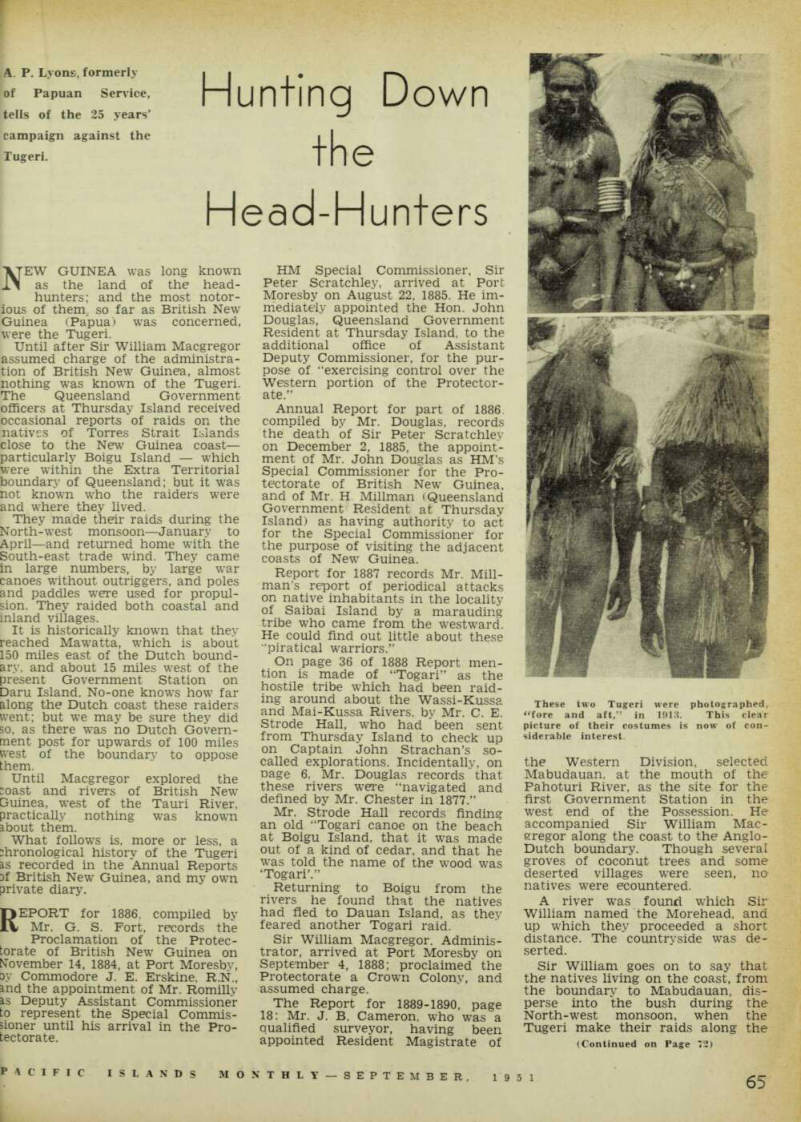
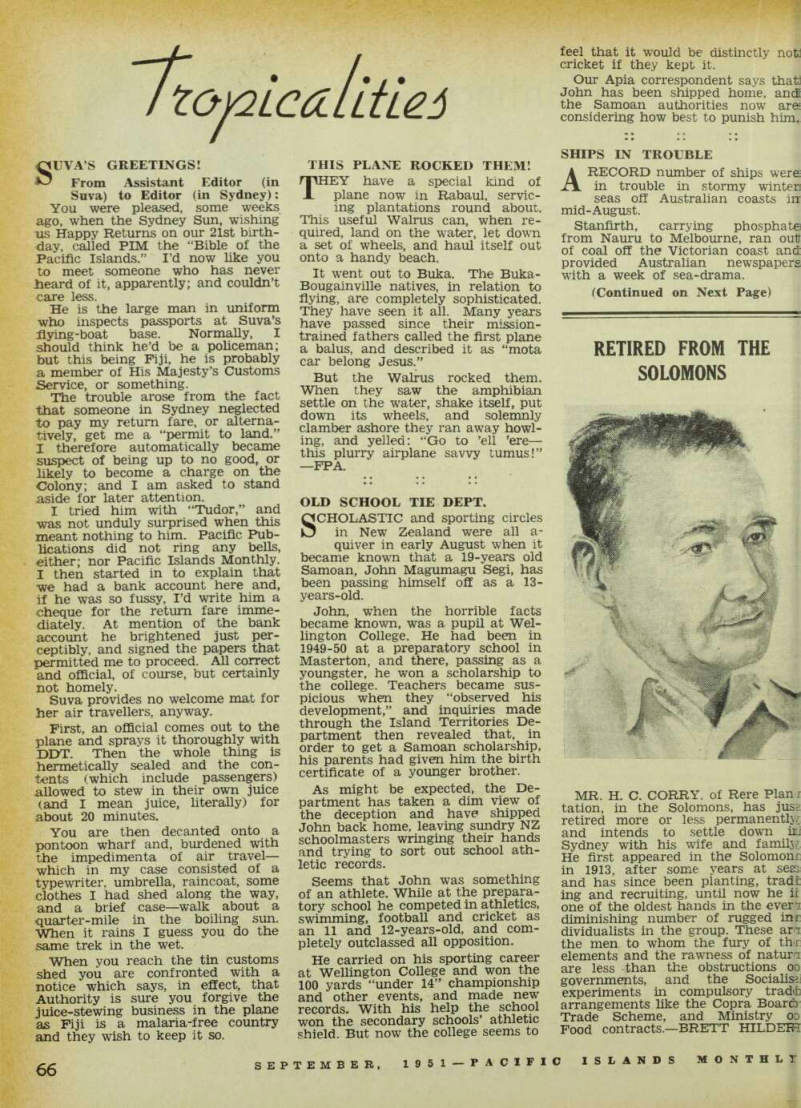
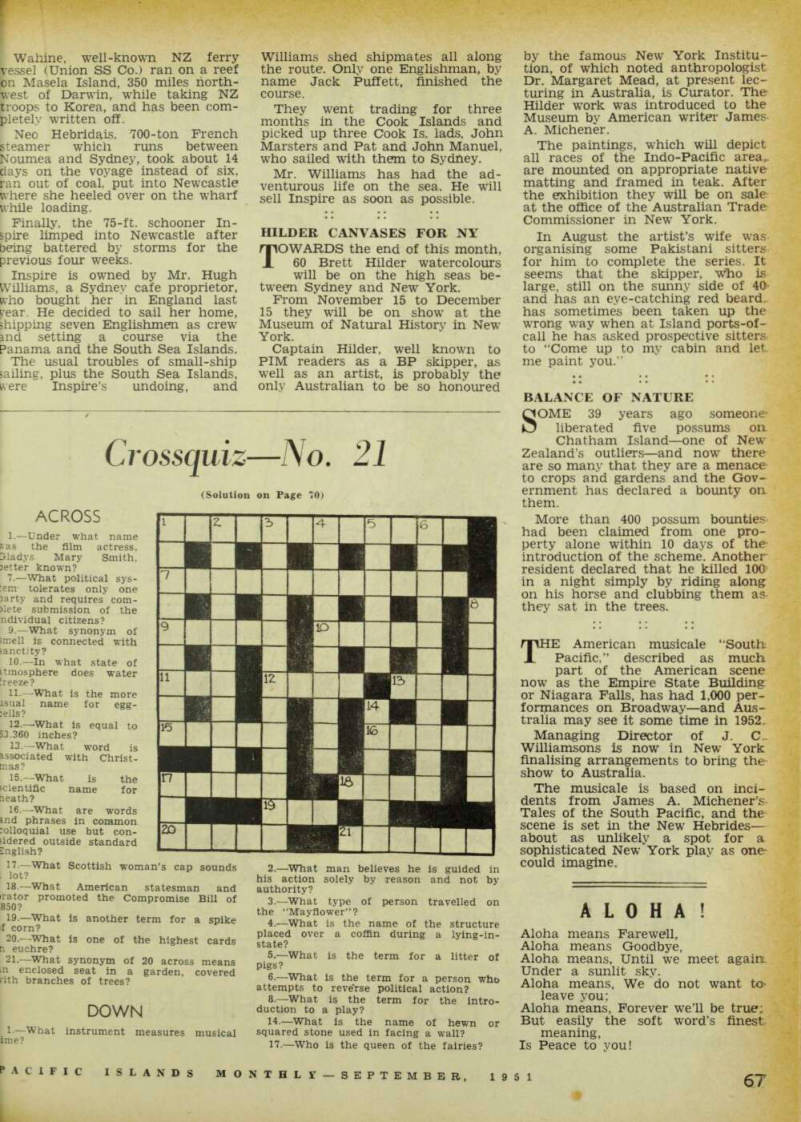
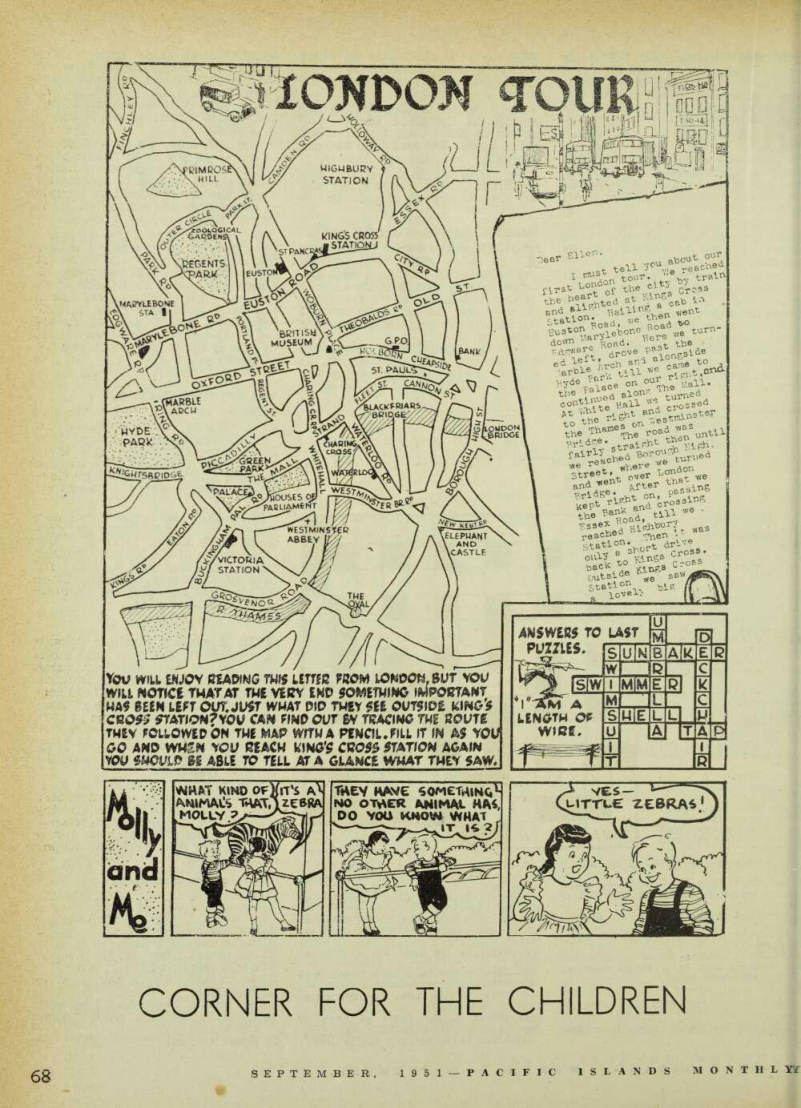
the Head-Hunters
A. P. Lyons, formerly of Papuan Service, tells of the 25 years’ campaign against the Tugeri.
NEW GUINEA was long known as the land of the head hunters; and the most notor ious of them, so far as British New Guinea (Papua) was concerned, were the Tugeri.
Until after Sir William Macgregor assumed charge of the administra tion of British New Guinea, almost nothing was known of the Tugeri.
The Queensland Government officers at Thursday Island received occasional reports of raids on the natives of Torres Strait Islands close to the New Guinea coast — particularly Boigu Island which were within the Extra Territorial boundary of Queensland; but it was not known who the raiders were and where they lived.
They made their raids during the North-west monsoon—January to April—and returned home with the South-east trade wind. They came in large numbers, by large war canoes without outriggers, and poles and paddles were used for propul sion. They raided both coastal and inland villages.
It is historically known that they reached Mawatta, which is about 150 miles east of the Dutch bound ary, and about 15 miles west of the present Government Station on Daru Island. No-one knows how far along the Dutch coast these raiders went; but we may be sure they did so, as there was no Dutch Govern ment post for upwards of 100 miles west of the boundary to oppose them.
Until Macgregor explored the coast and rivers of British New Guinea, west of the Tauri River, practically nothing was known about them.
What follows is, more or less, a chronological history of the Tugeri as recorded in the Annual Reports af British New Guinea, and my own
private diary.
REPORT for 1886, compiled by Mr. G. S. Fort, records the Proclamation of the Protec torate of British New Guinea on November 14, 1884, at Port Moresby, by Commodore J. E. Erskine, R.N., and the appointment of Mr. Romilly as Deputy Assistant Commissioner to represent the Special Commis sioner until his arrival in the Pro tectorate.
HM Special Commissioner, Sir Peter Scratchley, arrived at Port Moresby on August 22, 1885. He im mediately appointed the Hon. John Douglas, Queensland Government Resident at Thursday Island, to the additional office of Assistant Deputy Commissioner, for the pur pose of “exercising control over the Western portion of the Protector ate.”
Annual Report for part of 1886 compiled by Mr. Douglas, records the death of Sir Peter Scratchley on December 2, 1885, the appoint ment of Mr. John Douglas as HM’s Special Commissioner for the Pro tectorate of British New Guinea, and of Mr. H Millman (Queensland Government Resident at Thursday Island) as having authority to act for the Special Commissioner for the purpose of visiting the adjacent coasts of New Guinea.
Report for 1887 records Mr. Mill man’s report of periodical attacks on native inhabitants in the locality of Saibai Island by a marauding tribe who came from the westward.
He could find out little about these ■‘piratical warriors.”
On page 36 of 1888 Report men tion is made of “Togari” as the hostile tribe which had been raid ing around about the Wassi-Kussa and Mai-Kussa Rivers, by Mr. C. E.
Strode Hall, who had been sent from Thursday Island to check up on Captain John Strachan’s so called explorations. Incidentally, on nage 6, Mr. Douglas records that these rivers were “navigated and defined by Mr. Chester in 1877.”
Mr. Strode Hall records finding an old “Togari canoe on the beach at Boigu Island, that it was made out of a kind of cedar, and that he was told the name of the wood was ‘Togari’.”
Returning to Boigu from the rivers he found that the natives had fled to Dauan Island, as they feared another Togari raid.
Sir William Macgregor. Adminis trator, arrived at Port Moresby on September 4, 1888; proclaimed the Protectorate a Crown Colony, and assumed charge.
The Report for 1889-1890, page 18: Mr. J. B. Cameron, who was a qualified surveyor, having been appointed Resident Magistrate of
the Western Division, selected Mabudauan. at the mouth of the Pahoturi River, as the site for the first Government Station in the west end of the Possession. He accompanied Sir William Mac erregor along the coast to the Anglo - Dutch boundary. Though several groves of coconut trees and some deserted villages were seen, no natives were ecountered.
A river was found which Sir William named the Morehead, and up which they proceeded a short distance. The countryside was de serted.
Sir William goes on to say that the natives living on the coast, from the boundary to Mabudauan, dis perse into the bush during the North-west monsoon, when the Tugeri make their raids along the
(Continued on Page 72)
These two Tugeri were photographed, “fore and aft,” in 1913. This clear picture of their costumes is now of con siderable interest.
coast. Little or nothing is known of these raiders, he says, but this is certain: They are war-like and numerous, and they come from the west in large canoes without out riggers.
Continuing, he records that last (1890) Northwest season they went along the coast of the Possession as far as the village of Kadawa (about 3 mile from Mawatta) and there killed a man named Martin —a European.
He says that Captain John Strachan, from the account given in his book, seems to have been attacked by at least 1,000 of them In the Mai-Kussa River, and he and his men, firing on them with Win chester rifles at 150 to 200 yards, failed to intimidate them, and had ;o abandon their vessel.
In his despatch, on page 69, Sir William gives a full account of the Fugeri he saw beyond the Anglo- Dutch boundary, their mode of iress, their canoes, etc., and of his efforts to establish friendly rela ;ions with them. [N his despatch on page 42 of 1891 Report, Sir William reports sending Commandant of Police Wriford, with constabulary, to Mabudauan to reinforce that station, owing to disquieting rumours is to the danger of this station :rom Tugeri raiders. He emphasises ;he necessity of HM Government naking representations to the Gov ernment of the Netherlands on the subject of restraining the Tugeri.
Mternatively, he recommends that i strong post be established near ;he Anglo-Dutch boundary to re strain the marauders from proceed ng further into the Possession.
Mr. B. A. Hely, R.M., replaced Mr.
Cameron in charge of the Western Division. Sir William records on page 22 of 1892 Report that on June 5, 1892 it was reported at Port Moresby that the Tugeri tribe had nvaded the Western end of the Possession and penetrated as far is Mabudauan.
He made a hurried visit to that station, and found that the Tugeri lad come along to that place, but led when they saw the constabu ary turn out armed. Their traces vere followed by a strong party, put the flight of the Tugeri had seen so precipitate that their re turn camp at Thompson Bay (near the Morehead River) appeared to lave been occupied about a week >r 10 days before it was reached py us.
Sir William gives a lengthy and ietailed account of this episode on Page 50. He vigorously protests igainst the apathy of the Nether lands Government, and points out that the remedy is the establish
merit by the Dutch of a Station in the Tugeri country, and that some natural boundary should be laid down between the two Sovereign ties.
On page 22 of 1893 Report it is recorded that the Government Station for the Western Division was shifted from Mabudauan to Daru Island (where it has remained to this day). The Tugeri did not appear to have visited the coast during the year.
Sir William records meeting Dutch Resident Bensbach at Thurs day Island, on board the Dutch Government vessel “Zeemeeuw,” and discussing the delimitation of the boundary between British and Dutch New Guinea. Afterwards they visited the coast of New Guinea and there agreed to make certain recommendations to their respective Governments.
These recommendations, which provided for the boundary as it exists today, were adopted, with the Bensbach River as the commencing point on the South coast. Thus, nobody could be in doubt as to whether the Tugeri, or anyone else, had crossed the boundary, if they had passed the Bensbach River.
ON page 19 of 1896, Sir William records that tribes on the Morehead River had been attacked and dispersed by the Tugeri, their villages having been burned down, and many people killed.
He remarks that, following the settlement of the Anglo-Dutch
boundary, some effort seems to have been made by the Dutch authorities to settle these (Tugeri) tribes, but their endeavours did not appear to have been renewed after they attacked the Magistrate posted among them, and made his removal necessary.
On page 52 of this Report, Sir William gives a lengthy account of leading a large party of Govern ment officers and native constabu lary to the Wassi-Kussa River, there encountering and dispersing a large war party of Tugeri in their canoes.
He used the steam launch “Ruby,” which was well boarded in so as to be almost arrowproof, and two ■whaleboats. Fifty-eight large canoes which the Tugeri had abandoned were captured and destroyed.
The Tugeri fled westwards over land, leaving a large number of bows and arrows, paddles, etc., be hind. Some canoes escaped, but Sir William says that 500 or 600 Tugeri
would h3ve to find their way home through interminable mangrove swamps along the shore.
Sir William Macgregor left in September, 1898, and Mr. G. R.
LeHunte, as Lt.-Govenor, took charge on March 22, 1899. On page 5 of 1899 Report, Mr. LeHunte re ports having received from Mr.
Wood, sub-collector of Customs at Daru, a written statement by an Austrian named Dammkohler, of an affray he, himself, had had with a Tugeri raiding party on the Morehead River, and of his escape overland to Buji, from where he was taken to Daru. Mr. LeHunte appears to have been sceptical as to the truth of Dammkohler’s story.
However, the sequel appears in the next Report.
On page 19 of 1900, Mr. LeHunte reports having visited the Morehead River, and records: “I threw some doubt as to the credence that ought to be attached to the story (of Dammkohler).
What was our surprise on landing at the spot we had selected to camp at, to find a tree with W.D, over 1898 carved in large and well de fined figures and letters. It is due to Mr. Dammkohler to say that we subsequently found his story con firmed as far as what happened to him on the Morehead and after wards, and I owe him an apology.”
Mr. LeHunte records on page 19 of 1901 that discussions between the Foreign Offices of Great Britain and the Netherlands regarding the Tugeri had been inconclusive, as the Dutch Government declined to ad mit that any or sufficient proof had been afforded that the raiders came from their Territory.
However, the Dutch facilitated matters by sending Mr. J. A.
Kroesen, in the cruiser “Serang,” with instructions to place himself in communication with the British authorities at Port Moresby. He met Lieut.-Governor LeHunte at Thursday Island and then Mr.
Kroesen, with Mr. G. Murray, the Resident Magistrate of the Western Division, visited the Morehead River.
Murray sent six of his native con stabulary on ahead from Daru, with, instructions to await his arrival at the mouth of the Morehead River.
The police party were attacked at night by a Tugeri raiding party which had come down the River.
The Tugeri were driven off by the police, who captured some war canoes, in one of which three re cently decapitated heads were found.
This fortuitous incident was all that was needed to provide sufficient proof for Mr. Kroesen (who, with Mr. Murray, arrived at the mouth of the Morehead River the follow ing day) to satisfy him that the raiders were Dutch subjects.
The party proceeded up the river in the hope of capturing some of the raiders who, however, had fled overland to their own country, leav ing some of their canoes behind.
But what the Dutch Resident did find were the headless bodies of 15 men and women at the scene of slaughter. Two boys had been taken away into captivity by the Tugeri..
Mr. Kroesen arranged for the payment of compensation to the ■ survivors of this massacre.
Subsequently, Mr. Kroesen was appointed by the Dutch Government to be Resident in charge of Dutch Territory which . adjoins the British Possession. Thus the Dutch Settlement of Merauke ■ was founded.
Sir Frances Winter, Acting Ad ministrator, records on page 16 of 1902 that, during the year, the Western Resident Magistrate had visited the Morehead River, and learned that the Tugeri had again been on a marauding expedition up that river. A village had been attacked, and some of its inhabi tants killed. As the Tugeri were canoeing down the river, they were seen and attacked by a large hunt ing party of local natives, and put to flight with the loss of some of their warriors and all of their canoes.
No further raids by the Tugeri were recorded in subsequent Annual Reports. However, there was another raid, which is recorded in my private diary.
I was Resident Magistrate at Daru during 1913. In October, I made an extensive patrol of the country between the Wassi-Kussa and Bensbach Rivers. After re crossing the Morehead River, I fell in with some local natives at a small village named Tonda.
They informed me that a Tugeri raiding party had visited the More head River a short time previously, had killed two women, taken away two children into captivity, and had wounded the mother of these child ren.
I saw the mother. Her body had been pierced by an arrow, and the consequential wounds had not yet
healed. I treated the wounds with my emergency supplies of medicines and dressings. The Tonda people said that they had seen a vessel high and dry on the beach at Walata Point, on Gerai Bay.
In the river, not far from their village, was an old Tugeri canoe.
This the police patched, and attached an outrigger. In this canoe I took a small party down the river and, from a place on the east bank, we walked overland to Gerai Bay.
At Walata Point, I found the cutter “Mabuiag.” Some of its planks had been hacked through with an axe, and the mast had been cut down. The vessel had been thoroughly ransacked.
After Lieut.-Governor J. H. P.
Murray received my report, he de cided that a police patrol should be established on the Morehead. I again visited the Morehead River district, overland from the Wassi- Kussa River, and established the police camp at Tonda Village with a native corporal in charge.
I visited this camp every 3 or 4 months, replenishing stores. The police kept up a round of patrols, visiting most of the villages be tween the Bensbach and Wassi- Kussa Rivers. For a short time, I placed Patrol Officer Flint in charge of the camp. He carried out vigor ous patrolling. At a village close to
the Bensbach River, he met two Tugeri men, and made friends with them, and took their photograph, which is reproduced here.
This police camp was maintained at Tonda all the time I remained in the Western Division.
The Dutch established a second station, this one being situated at Assiki, many miles up the Diguel River.
Tropicalities
Suva’S Greetings!
From Assistant Editor (in Suva) to Editor (in Sydney): You were pleased, some weeks ago, when the Sydney Sun, wishing us Happy Returns on our 21st birth day, called PIM the “Bible of the Pacific Islands.” I’d now like you to meet someone who has never lieard of it, apparently; and couldn’t care less.
He is the large man in uniform who inspects passports at Suva’s flying-boat base. Normally, I should think he’d be a policeman; but this being Fiji, he is probably a member of His Majesty’s Customs Service, or something.
The trouble arose from the fact that someone in Sydney neglected to pay my return fare, or alterna tively, get me a “permit to land.”
I therefore automatically became suspect of being up to no good, or likely to become a charge on the Colony; and I am asked to stand aside for later attention.
I tried him with “Tudor,” and was not unduly surprised when this meant nothing to him. Pacific Pub lications did not ring any bells, either; nor Pacific Islands Monthly.
I then started in to explain that we had a bank account here and, if he was so fussy, I’d write him a cheque for the return fare imme diately. At mention of the bank account he brightened just per ceptibly, and signed the papers that permitted me to proceed. All correct and official, of course, but certainly not homely.
Suva provides no welcome mat for her air travellers, anyway.
First, an official comes out to the plane and sprays it thoroughly with DDT. Then the whole thing is hermetically sealed and the con tents (which include passengers) allowed to stew in their own juice (and I mean juice, literally) for about 20 minutes.
You are then decanted onto a pontoon wharf and, burdened with the impedimenta of air travel— which in my case consisted of a typewriter, umbrella, raincoat, some clothes I had shed along the way, and a brief case—walk about a quarter-mile in the boiling sun.
When it rains I guess you do the same trek in the wet.
When you reach the tin customs shed you are confronted with a notice which says, in effect, that Authority is sure you forgive the juice-stewing business in the plane as Fiji is a malaria-free country and they wish to keep it so.
This Plane Rocked Them!
THEY have a special kind of plane now in Rabaul, servic ing plantations round about.
This useful Walrus can, when re quired, land on the water, let down a set of wheels, and haul itself out onto a handy beach.
It went out to Buka. The Buka- Bougainville natives, in relation to flying, are completely sophisticated.
They have seen it all. Many years have passed since their mission trained fathers called the first plane a balus, and described it as “mota car belong Jesus.”
But the Walrus rocked them.
When they saw the amphibian settle on the water, shake itself, put down its wheels, and solemnly clamber ashore they ran away howl ing, and yelled: “Go to ’ell ’ere — this plurry airplane savvy tumus!”
—Fpa.
Old School Tie Dept.
SCHOLASTIC and sporting circles in New Zealand were all a quiver in early August when it became known that a 19-years old Samoan, John Magumagu Segi, has been passing himself off as a 13years-old.
John, when the horrible facts became known, was a pupil at Wel lington College. He had been in 1949-50 at a preparatory school in Masterton, and there, passing as a youngster, he won a scholarship to the college. Teachers became sus picious when they “observed his development,” and inquiries made through the Island Territories De partment then revealed that, in order to get a Samoan scholarship, his parents had given him the birth certificate of a younger brother.
As might be expected, the De partment has taken a dim view of the deception and have shipped John back home, leaving sundry NZ schoolmasters wringing their hands and trying to sort out school ath letic records.
Seems that John was something of an athlete. While at the prepara tory school he competed in athletics, swimming, football and cricket as an 11 and 12-years-old, and com pletely outclassed all opposition.
He carried on his sporting career at Wellington College and won the 100 yards “under 14” championship and other events, and made new records. With his help the school won the secondary schools’ athletic shield. But now the college seems to
feel that it would be distinctly not] cricket if they kept it.
Our Apia correspondent says that] John has been shipped home, andi the Samoan authorities now aree considering how best to punish him,
Ships In Trouble
A RECORD number of ships were in trouble in stormy winten seas off Australian coasts inr mid-August.
Stanfirth, carrying phosphate from Nauru to Melbourne, ran out of coal off the Victorian coast and: provided Australian newspapers with a week of sea-drama. (Continued on Next Page)
Wahine, well-known NZ ferry Vessel (Union SS Co.) ran on a reef on Masela Island, 350 miles north west of Darwin, while taking NZ troops to Korea, and has been com pletely written off.
Neo Hebridais, 700-ton French steamer which runs between Noumea and Sydney, took about 14 days on the voyage instead of six. ran out of coal, put into Newcastle where she heeled over on the wharf while loading.
Finally, the 75-ft. schooner In spire limped into Newcastle after being battered by storms for the previous four weeks.
Inspire is owned by Mr. Hugh Williams, a Sydney cafe proprietor, who bought her in England last pear. He decided to sail her home, shipping seven Englishmen as crew and setting a course via the Panama and the South Sea Islands.
The usual troubles of small-ship sailing, plus the South Sea Islands, were Inspire’s undoing, and
Williams shed shipmates all along the route. Only one Englishman, by name Jack Puffett, finished the course.
They went trading for three months in the Cook Islands and picked up three Cook Is. lads, John Marsters and Pat and John Manuel, who sailed with them to Sydney, Mr. Williams has had the ad venturous life on the sea. He will sell Inspire as soon as possible.
Hilder Canvases For Ny
TOWARDS the end of this month, 60 Brett Hilder watercolours will be on the high seas be tween Sydney and New York.
From November 15 to December 15 they will be on show at the Museum of Natural History in New York.
Captain Hilder, well known to PIM readers as a BP skipper, as well as an artist, is probably the only Australian to be so honoured
by the famous New York Institu tion, of which noted anthropologist Dr. Margaret Mead, at present lec turing in Australia, is Curator. The Hilder work was introduced to the Museum by American writer James A. Michener.
The paintings, which will depict all races of the Indo-Pacific area,, are mounted on appropriate native matting and framed in teak. After the exhibition they will be on sale at the office of the Australian Trade Commissioner in New York.
In August the artist’s wife was organising some Pakistani sitters for him to complete the series. It seems that the skipper, who is large, still on the sunny side of 40 and has an eye-catching red beard., has sometimes been taken up the wrong way when at Island ports-of call he has asked prospective sitters to “Come up to my cabin and let me paint you.”
Balance Of Nature
SOME 39 years ago someone liberated five possums oix Chatham Island —one of New Zealand’s outliers —and now there are so many that they are a menace to crops and gardens and the Gov ernment has declared a bounty on them.
More than 400 possum bounties had been claimed from one pro perty alone within 10 days of the introduction of the scheme. Another resident declared that he killed 100 in a night simply by riding along on his horse and clubbing them as they sat in the trees.
THE American musicale “South; Pacific,” described as much part of the American scene now as the Empire State Building or Niagara Falls, has had 1,000 per formances on Broadway—and Aus tralia may see it some time in 1952.
Managing Director of J. C, Williamsons is now in New York finalising arrangements to bring the show to Australia.
The musicale is based on inci dents from James A. Michener’s- Tales of the South Pacific, and the scene is set in the New Hebrides— about as unlikely a spot for a sophisticated New York play as one
could imagine.
Retired From The
Solomons
MR. H. C. CORRY, of Rere Planr tation, In the Solomons, has juss retired more or less permanently/ and intends to settle down iii Sydney with his wife and He first appeared in the Solomonc in 1913, after some years at seal; and has since been planting, tradf: ing and recruiting, until now he ii one of the oldest hands in the everi diminishing number of rugged inr dividualists in the group. These an the men to whom the fury of thr. elements and the rawness of naturn are less than the obstructions oo governments, and the Socialist experiments in compulsory trad»b arrangements like the Copra Boaro Trade Scheme, and Ministry oo
Food contracts.
Brett Hildeft
Crossquiz — No. 21
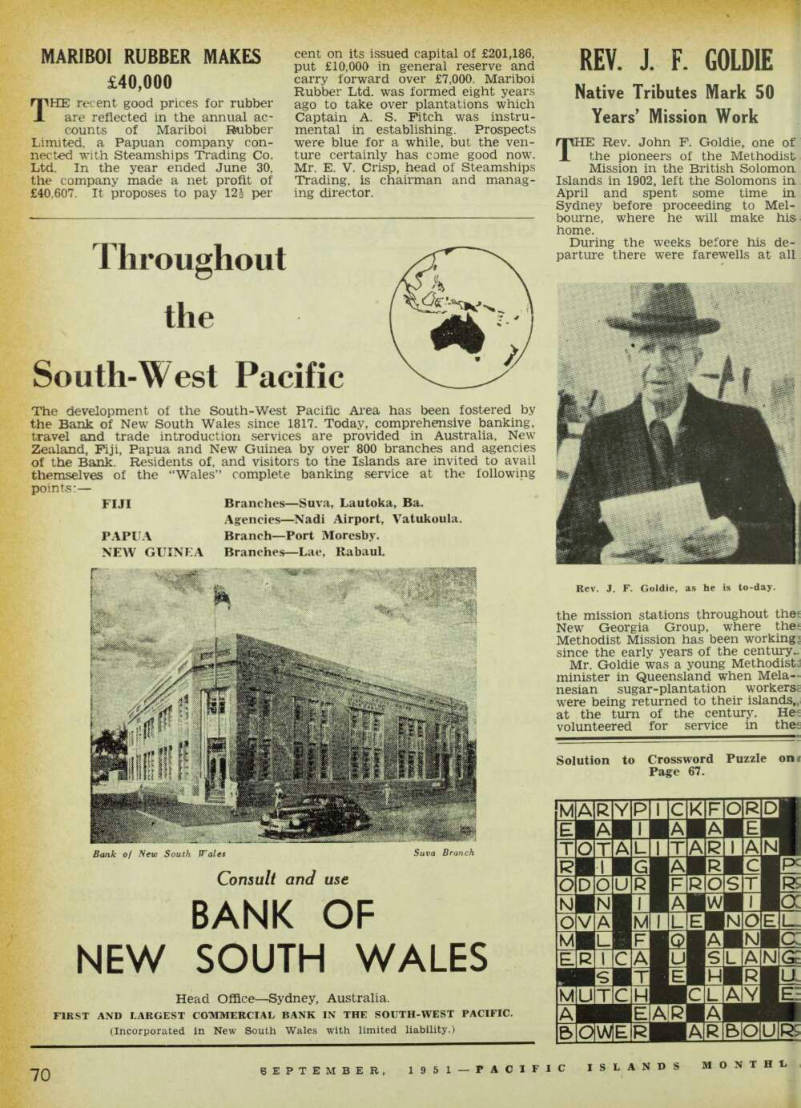
(Solution on Page *0)
Across
I. —Under what name vas the film actress, 31adys Mary Smith, jetter known? 7.—What political sys :em tolerates only one )arty and requires com pete submission of the ndividual citizens? 9. —What synonym of >mell is connected with sanctity? 10. —ln what state of itmosphere does water freeze? 11. —What is the more isual name for egg :ells? 12. What is equal to 33.360 inches? 13. —What word is issociated with Christ mas? 15. What is the scientific name for heath? 16. —What are words md phrases in common mlloquial use but con sidered outside standard English?
17. —What Scottish woman’s cap sounds ; lot? 18. —What American statesman and irator promoted the Compromise Bill of 850? 19. —What is another term for a spike f corn? 20. What is one of the highest cards n euchre? 21. What synonym of 20 across means n enclosed seat in a garden, covered rith branches of trees?
Down
1-—What instrument measures musical ime?
2.—What man believes he is guided in his action solely by reason and not by authority? 3,-What type of person travelled on the “Mayflower”? 4.—What Is the name of the structure E-ate? ° Ver * d “ r ‘ nß * Iylng ' in ' buii/er D ig;7 What iS the term for a lltter ot R ' - ®- What is the term for a person who attempts to reverse political action?
B.—What is the term for the intro duction to a play? 14.—What Is the name of hewn or squared stone used in facing a wall? 17.—Who is the queen of the fairies?
Aloha!
Aloha means Farewell, Aloha means Goodbye, Aloha means, Until we meet agabl under a sunlit sky.
Aloha means, We do not want to leave you; Aloha means, Forever we’ll be true: But easily the soft word’s finest meaning, Is Peace to you!
Advertisements & other items, pp. 70-71 (1 item)
Xokdoh Qourisw
' , . I I,in U i I 17®5a'“
. jj i P i
LJ/Jm 1
Dear
HIGHBURY
STATION
ILL
r
QCI C« L
f\ \ KINGS CROS3
|\s>PAKc^Snofcu
\oV u
REGENTS
ARK
fcU-T eo^;
MASYLEBONE
r\ vO> A6i o^i:
BCITISW
KWf
GPO
museum
BANK
f
ctSJ
Q
ST. PAUL
6*2 6*l V marble 01 blackpriars r 78P10.6E/ / >
ADCU
OWDON
BRIDGE
HYDE
PAQK
hading
GREEN
PARK
i^jGRrSRPIPGE:
TUi
PA LAC
BB.R
'f R
PACLIAME
WESTMINS
ABBEY It
ELEPHANT
l AND
\CASTLE
VICTORIA
STATION -
TME
; 4r Ellen. about our first , qt tell a 1 m Ao „. tour. '* e w train Lon of the ** an mon. Bai ltben «er.t etui rif* Mi rned a^ st fflinstsr vmit At to the the T^ 6 * Bridge on The roa^ was tii and Bridge' Ice pt and cros sing t» nVa-“ tUI ” e ’
EM S»a...
react® ° 'T’ben .
Station. ' dri^e tit a 3t QI rross. oul l to Kings tr ogs baciC - ap> EinS 3 C « Outside sß w Stati° n a love-*-- Vov WILL ENJOY READING TMfS LETTfR FROM LONDON, BUT YOU WILL NOTICE THAT AT TME VERY END SOMETHING IMPORTANT WAS BEEN LEFT OUT. JUST WWAT DIP TWEV SEE OUTSIDE WINGS CROSS STATIONfVOU CAN FIND OUT EV TRACING TME ROUT!
TMEY FOLLOWED ON THE MAP WITH A PENCIL*FILL IT IN AS YOUf 00 AND WH£N YOU REACW WING'S CROSS STATION AGAIN YOU SMOULD Si ABLE TO TELL AT A GLANCE WWAT TMEY SAW,
ANSWERS TO LAST
PUZZLES.
WHAT kino of Kit's mm AC* that.izesra
MOLLY ?
r
r*\EV HAVE SOMETrAIKQ 1
NO OTWCR ANIMAL HAS,
DO VOO KNOW NNMAT
IT. 14. 2 a M U N 91 MM
LENGTM OF
WIRE.
P
-» YES- ,
UITTLC zebras*
t
CORNER FOR THE CHILDREN
BURNS PHILP (NEW GUINEA LIMITED)
General Merchants, Shipping, Customs and
General Agents
Head Office; PORT MORESBY, PAPUA
BRANCHES:
NEW GUINEA: Rabaul (Kavieng, Kokopo), Lae (Wau, Bulolo), Madang.
PAPUA: Port Moresby, Samarai.
AUSTRALIAN AGENTS:
LONDON AGENTS:
>AN FRANCISCO AGENTS:
BURNS, PHILP Cr CO. LTD.
All States.
BURNS, PHILP G- CO. LTD.
"London House/ 7 35 Crutched Friars, E.C.3.
BURNS-PHILP CO. OF SAN FRANCISCO INC.
510 Matson Building.
REPRESENTATIVES FOR
Queensland Insurance Co. Ltd. Lloyd's of London. Burns Philp Trust Co. Ltd.
Distributing Agents in the Territory of Papua-New Guinea for:
SHELL COMPANY OF AUSTRALIA LTD.
Petroleum Products
VAUXHALL MOTORS LIMITED
Vauxhall Cars and Bedford Trucks
THE ROVER COMPANY LIMITED
Landrovers and Rover Cars
A. J. ELLERKER
Blue Streak Power Chain Saws
THE COLONIAL SUGAR REFINING CO.
Caneite, Asbestos Cement Sidings, Asphalt Floor Tiles
GENERAL MOTORS CORPORATION
Cars and Trucks
HARRY FERGUSON LIMITED
Ferguson Tractors and Equipment
CROSSLEY BROS. LIMITED
Crossley Marine & Stationary Engines
IMPERIAL CHEMICAL INDUSTRIES
Pharmaceutical £r Agricultural Chemicals, Corrugated Perspex
JOHN FOWLER & CO. (LEEDS) LTD.
Fowler 95 H.P. Diesel Crawler Tractors
Mariboi Rubber Makes
£40,000
THE recent good prices for rubber are reflected in the annual ac counts of Mariboi Rubber Limited, a Papuan company con nected with Steamships Trading Co.
Ltd. In the year ended June 30, the company made a net profit of £40.607. It proposes to pay 12i per
cent on its issued capital of £201,186. put £lO,OOO in general reserve and carry forward over £7,000. Mariboi Rubber Ltd. was formed eight years ago to take over plantations which Captain A. S. Pitch was instru mental in establishing. Prospects were blue for a while, but the ven ture certainly has come good now.
Mr. E. V. Crisp, head of Steamships Trading, is chairman and manag ing director.
Rev. J. F. Goldie
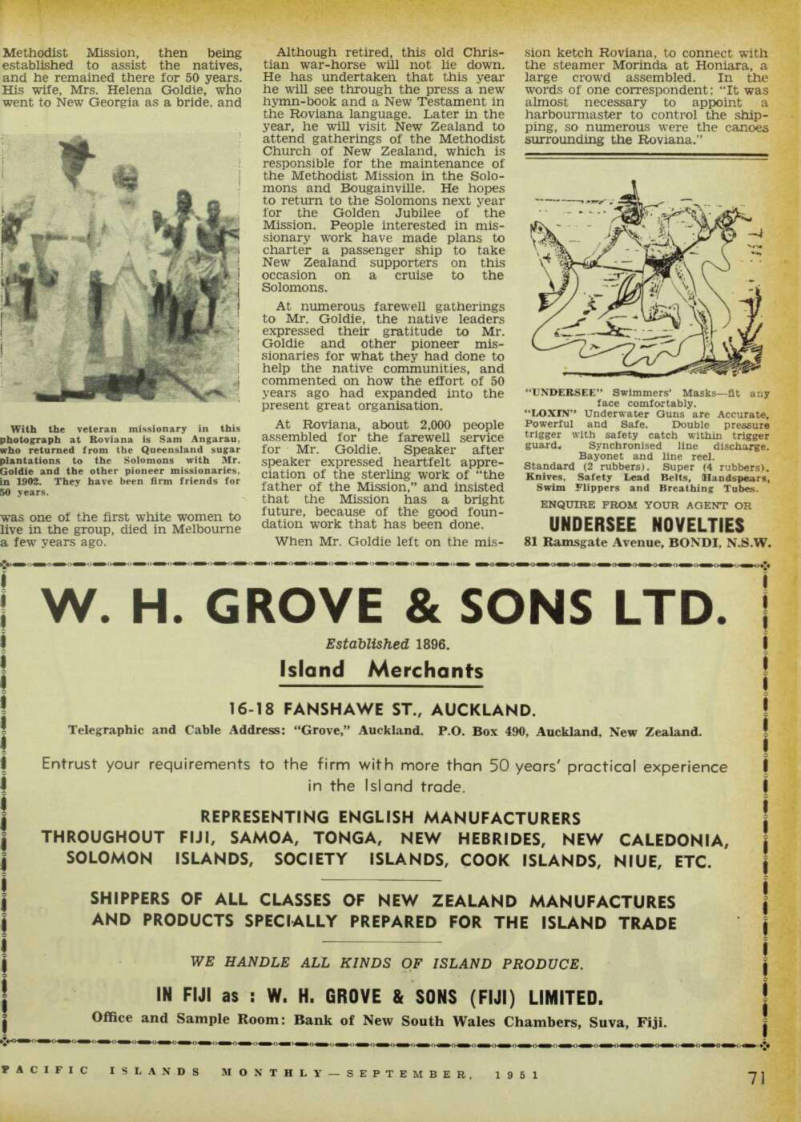
Native Tributes Mark 50 Years’ Mission Work
rE Rev. John F. Goldie, one of the pioneers of the Methodist Mission in the British Solomon Islands in 1902, left the Solomons in April and spent some time in Sydney before proceeding to Mel bourne, where he will make his home.
During the weeks before his de parture there were farewells at all
the mission stations throughout thee New Georgia Group, where thee Methodist Mission has been working? since the early years of the century..
Mr. Goldie was a young MethodisW minister in Queensland when Mela nesian sugar-plantation workerss were being returned to their islands,,, at the turn of the century. Hes volunteered for service in thes
Rev. J. F. Goldie, as he is to-day.
Methodist Mission, then being established to assist the natives, and he remained there for 50 years.
His wife, Mrs. Helena Goldie, who went to New Georgia as a bride, and
was one of the first white women to live in the group, died in Melbourne a few years ago.
Although retired, this old Chris tian war-horse will not lie down.
He has undertaken that this year he will see through the press a new hymn-book and a New Testament in the Roviana language. Later in the year, he will visit New Zealand to attend gatherings of the Methodist Church of New Zealand, which is responsible for the maintenance of the Methodist Mission in the Solo mons and Bougainville. He hopes to return to the Solomons next year for the Golden Jubilee of the Mission. People interested in mis sionary work have made plans to charter a passenger ship to take New Zealand supporters on this occasion on a cruise to the Solomons.
At numerous farewell gatherings to Mr. Goldie, the native leaders expressed their gratitude to Mr.
Goldie and other pioneer mis sionaries for what they had done to help the native communities, and commented on how the effort of 50 years ago had expanded into the present great organisation.
At Roviana, about 2,000 people assembled for the farewell service for Mr. Goldie. Speaker after speaker expressed heartfelt appre ciation of the sterling work of “the father of the Mission,” and insisted that the Mission has a bright future, because of the good foun dation work that has been done.
When Mr. Goldie left on the mis
sion ketch Roviana, to connect with the steamer Morinda at Honiara, a large crowd assembled. In the words of one correspondent: “It was almost necessary to appoint a harbourmaster to control the ship ping, so numerous were the canoes surrounding the Roviana.”
With the veteran missionary in this photograph at Roviana is Sam Angarau, who returned from the Queensland sugar plantations to the Solomons with Mr.
Goldie and the other pioneer missionaries, in 1902. They have been firm friends for 50 years.
Advertisements & other items, pp. 72-78 (4 items)
70
SEPTEMBER, 1951 PACIFIC ISLANDS MONTHL
Solution to Crossword Puzzle on Page 67.
Throughout
the
South-West Pacific
Or * I The development of the South-West Pacific Area has been fostered by the Bank of New South Wales since 1817. Today, comprehensive banking, travel and trade introduction services are provided in Australia, New Zealand, Fiji, Papua and New Guinea by over 800 branches and agencies of the Bank. Residents of, and visitors to the Islands are invited to avail themselves of the “Wales” complete banking service at the following points:— FIJI Branches—Suva, Lautoka, Ba.
Agencies—Nadi Airport, Vatukoula.
PAPUA Branch—Port Moresby.
NEW GUINEA Branches—Lae, RabauL Bank of Neto South W r ales Suva Branch
Consult and use
BANK OF
NEW SOUTH WALES
Head Office—Sydney, Australia.
FIRST AND LARGEST COMMERCIAL BANK IN THE SOUTH-WEST PACIFIC. (Incorporated in New South Wales with limited liability.)
W. H. Grove & Sons Ltd.
“UNDERSEE” Swimmers’ Masks—fit any face comfortably.
“LOXIN” Underwater Guns are Accurate, Powerful and Safe. Double pressure trigger with safety catch within trigger guard* Synchronised line discharge.
Bayonet and line reel.
Standard (2 rubbers). Super (4 rubbers).
Knives, Safety Lead Belts, Handspears, Swim Flippers and Breathing Tubes.
ENQUIRE FROM YOUR AGENT OR
UNDERSEE NOVELTIES
81 Ramsgate Avenue, BONDI, N.S.W.
W. H. GROVE & SONS LTD.
Established 1896.
Island Merchants
16-18 FANSHAWE ST., AUCKLAND.
Telegraphic and Cable Address: “Grove,” Auckland. P.O. Box 490, Auckland, New Zealand.
Entrust your requirements to the firm with more than 50 years' practical experience in the Island trade.
REPRESENTING ENGLISH MANUFACTURERS
THROUGHOUT FIJI, SAMOA, TONGA, NEW HEBRIDES, NEW CALEDONIA, SOLOMON ISLANDS, SOCIETY ISLANDS, COOK ISLANDS, NIUE, ETC.
SHIPPERS OF ALL CLASSES OF NEW ZEALAND MANUFACTURES AND PRODUCTS SPECIALLY PREPARED FOR THE ISLAND TRADE WE HANDLE ALL KINDS OF ISLAND PRODUCE.
IN FIJI as : W. H. GROVE & SONS (FIJI) LIMITED.
Office and Sample Room: Bank of New South Wales Chambers, Suva, Fiji.
An ornate example of historical keys, this XVlth Century French key features the sporting motif in its club and animal carvings. It seems to have been the key to a Duke's country lodge. £ e a n A P Th
key
e k o s m o n g P a sure
CAPSTAN
FINE CUT or
NAVY CUT
TOBACCOS
1657/48.
BUTTERFLIES
and the Larger Moths
WANTED.
From all parts of the World, especially Australia and all Islands in the Pacific.
Will pay from £25 to over £lOO per 1,000 butterflies first quality, perfect specimens, in papers only.
Collectors who can supply first quality Butterflies. Large Moths, Large Insects or Beetles, especially giants of all kinds, should write for instruction on how to pack and ship Butterflies, etc. Do not send any broken or rubbed specimens.
Will pay for sample shipment, and advance money to good collectors.
Write or print clearly, particularly your name and address.
Butterfly World Supply House,
289-291 East 98th Street,
Brooklyn, 12, New York,
U.S.A.
iS
BRASSO
The quality Metal Polish t See how it
s h/rjes
Makes double the quantity in the can —it's delicious
AUNT MARY’S
CONCENTRATED
TOMATO SOUP
SMOOTH, CREAMY, FULL OF FLAVOUR
Another famous Aunt Mary’s Pure Food Product.
MANUFACTURED BY: TILLOCK & CO. PTY. LTD.
HERCO
for the skin
Herco Skin Lotion contains Olive Oil and Lanolin, the two Ingredients known to Science as being the best to protect and soften the skin and guard against soreness and roughness.
Have skin beauty from the top of your head to the tip of your toes.
Stocks available at your usual WHOLE-
SALER or BURNS PHILP and MORRIS
HEDSTROM. Suva, Fiji.
Itch Germs
Cause Killed in 3 Days
Your skin has nearly 50 million tiny seams and pores where germs hide and cause terrible Itching, Cracking, Peeling, Burning, Acne, Ringworm, Psoriasis.
Blackheads, Pimples, Foot Itch and other blemishes. Ordinary treatments give only temporary relief because they do not kill the germ cause. The new discovery, Nixoderm, kills the germs quickly and is guaranteed to give you a soft, clear, attractive, smooth skin, or money back on return of empty package. Get guaranteed Nixoderm from your chemist or store to-day and attack the real cause of many skin troubles.
Nixoderm
For Skin Sores, Pimples and Itch.
TILLEY
BURN
ORDINARY
KEROSENE
is
WMk
% & mm mi
LAMPS
BURN
ORDINARY
KEROSENE
-THE QUEEN” TABLE LAMP
300 CANDLEPOWER
THE GUARDSMAN” STORM LANTERN
300 CANDLE POWER
THE VICTOR" HANGING LAMP
300 CANDLE POWER
REPRESENTATION:
AUSTRALIA £r NEW GUINEA; T. H. Bentley, Pty. Ltd., 123-125 William
Street, Melbourne, C.l.
TASMANIA: Mr. H. V. Sellers, 108 a Charles Street, Launceston.
FIJI: Mr. K. Witherington, 2 Burns Philp Buildings, Suva.
& \ Made in the Australian Branch Factory
of BLUNDELL SPENCE & CO., LTD.,
Hull, B. & S. SUPER PREPARED PAINT embodies the knowledge and experience gained from nearly 140 years of Paint manufacture.
Tested and proved for tropical conditions, B. & S. PREPARED PAINT is also available in a special Lead-free series for use in volcanic and other sulphurous regions. (Specify B. &S. Series 2301.) Ask for supplies of these and other BLUNDELL Paints and Enamels from your local Storekeeper, or write for particulars and colour-cards to the Agent for Pacific Islands:
KERR BROS. PTY. LTD.
255 a GEORGE STREET, SYDNEY.
73
Hunting Down The Head-Hunters (Continued from Page 65)
PACIFIC ISLANDS MONTHLY SEPTEMBER, 1951
Fined £5Oo

Sampan Captain
Welter of Conflicting Reports
THE master of the Japanese sam pan, Kyogo Maru, caught: stealing trochus shell from the* Hermit atoll, westward of Manus: (New Guinea waters), was finedj £5OO. The arrest was reported in last; issue.
Such a jumble of reports was published in the Aus tralian newspapers that, at this: stage, it is difficult to know what; actually occurred in the North west Islands (the various little groups in the north-west comer ofl the Trust Territory area), beyond! the fact that the Japs were caught! red-handed in the Hermits.
The first reports said that thee Japs landed oh an island in thee Ninigo group occupied by Mr. Dam McCosker; that they accepted hos pitality from the planter; that they, then seized and carried off a con siderable quantity of bagged trochus shell and copra; and that Mr. Mc- Cosker was unabie to report thee occurrence for some weeks. This was mostly exaggeration and im agination.
Planes and small craft went out) from Manus and caught a sampanr actually taking trochus off the reefsE in the Hermits, which are leased toe Mr. Qus Kuster. The poachings vessel was arrested and taken toe Manus.
After that the newspapers got) into an inextricable tangle as be tween Mr. Kuster and Mr. Mc- Cosker, and the Ninigo and Her mit groups. The PIM has seen noc official reports; but probably thes facts are as follow: — The Hermit “group” is a big atolll of 14 islets. It is leased to a well known man, Mr. Gus T. Kuster. Hes has lived all his life in New Guineas —he was for a time on the gold fields. He lives on Maron islet withr his wife and step-daughter, in as hardwood house built about 1900 by; the Germans, and their four child ren and his two step-sons are inc the care of the Catholic Missionn station at Vunapope. Mr. Kusten has the concession to take coprae and trochus shell from the Hermit) islands.
About July, Mr. Kuster had his. first visitation —Japanese craft cames in and took away a lot of trochus. shell, off the reefs. Two other simi lar craft visited the Hermits —the 9 last of them being the sampann arrested.
Owing to a radio breakdown, Mr.i Kuster could not report the first); theft. The report finally reachedb Manus through Mr. McCosker, whoD appears to be interested with Mn Kuster in the Hermits. (This is onlyt
surmise, from a garbled report pub lished in Brisbane.) Manus acted immediately and sent out planes and small boats to search, and caught the Jap sampan in the act on August 5. Its dories were out on the reefs, gathering shell.
The sampan was escorted to Manus by a RAAF crash boat, with the District Commissioner, Mr. Tom Aitchison, in charge. When the sampan arrived at Manus, the Jap captain disappeared. The news papers called it a suicide. Mr. Ait chison, however, alerted the natives, and they caught the Jap hiding on one of the Palawatt islands, li miles away, and he was brought back to trial (See photo on p. 7.) Mr. W. E. Sansom, as magistrate, constituted a District Court, and fined the captain, Sakihama Shumai, £5OO (maximum under the Territories Fishing Ordinance) for shell poaching, and ordered that the Kyoyo Maru be impounded for 50 days. Higher authorities are con sidering other charges against master and vessel.
Police Sub-Inspector John Graham, who boarded the Kyoyo Maru on her arrest, said that the vessel carried charts of New Guinea, the Coral Sea, Great Barrier Reef, Solomon Islands, etc.
The Kyoyo Maru had been licen sed by the American authorities in :he North Pacific to fish in areas
north of the equator, but not below the equator. She was about 60 ft. long and carried 44 Japanese. She was equipped with at least half a dozen dories, fitted with small engines, which were used to search the reefs.
So much fuss was made about the “danger” to Australian security as a 'result of these Japanese sampans wandering around Manus, that the Australian frigate Barcoo spent the last 10 days of August showing the flag among the North-west and other islands of the area.
Philip Chapman, aged 4, of Rabaul, achieved front-page fame on August. 28. A city newspaper camera-man snapped him standing in awed wonder before a display at an exhibition in Sydney, and he and the exhibit made an unusual and attractive picture.
The Norfolk Island Society of Auckland, founded five months ago as a rallying-point for ex-Norfolk Islanders, is enjoying an active and useful life. Membership is now nearly 200.
Advertisements & other items, pp. 78-79 (2 items)
76
SEPTEMBER. 1951 PACIFIC ISLANDS MONfTHLTf
Layer as
PLAIN AND
SELF RAISING
FLOUR,
CUk fo*c 4#/
ESTABLISHED 1868
Agents for Fiji, Tonga and Samoa: C. SULLIVAN (PACIFIC ISLANDS) LTD.. Suva. Fiji.
-/> ra i ft/
Layer as
C ; ' lager tooth
OTT
i. 1.,.. ar:
Australia-S. America, Via
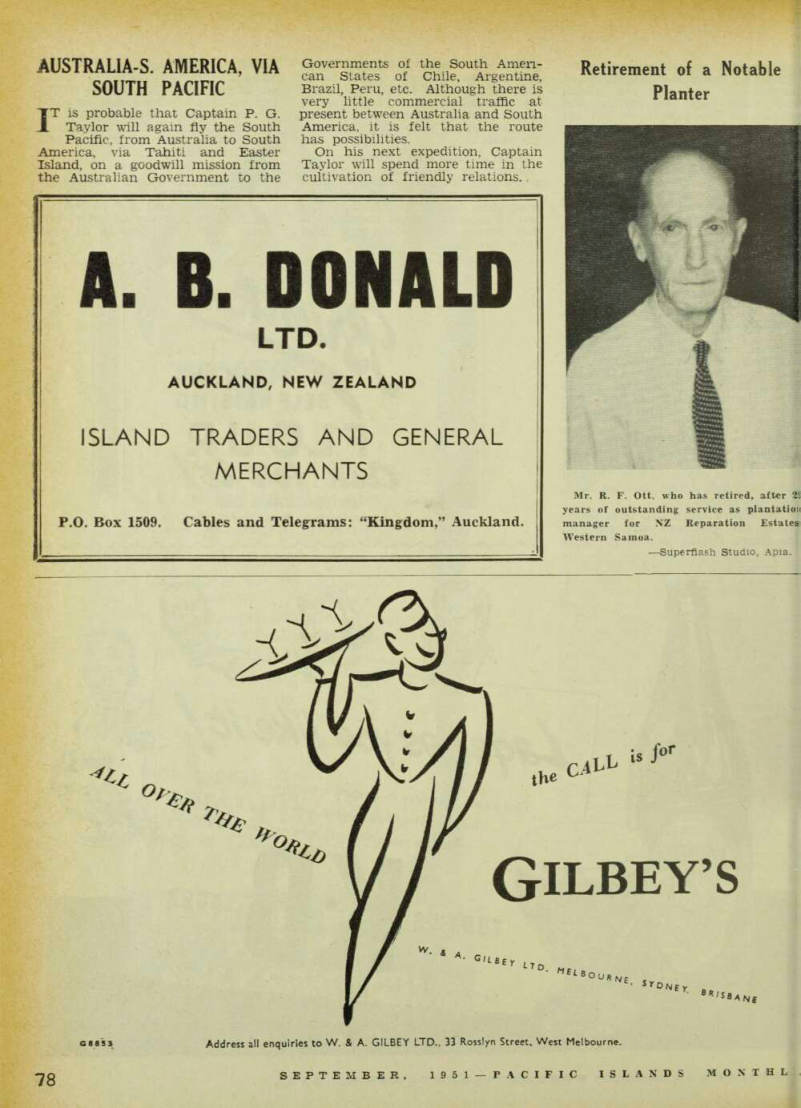
South Pacific
IT is probable that Captain P. G.
Taylor will again fly the South Pacific, from Australia to South America, via Tahiti and Easter Island, on a goodwill mission from the Australian Government to the
Governments of the South Ameri can States of Chile, Argentine, Brazil, Peru, etc. Although there is very little commercial traffic at present between Australia and South America, it is felt that the route has possibilities.
On his next expedition, Captain Taylor will spend more time in the cultivation of friendly relations.
Advertisements & other items, p. 80 (3 items)
Retirement of a Notable
Planter
Mr. R. F. Ott, who has retired, after 2£[?] years of outstanding service as plantatioic manager for NZ Reparation Estates; Western Samoa. —Superflash Studio, Apia.
78
SEPTEMBER, 1951 PACIFIC ISLANDS MONXHL
A. B. Donald
LTD.
AUCKLAND, NEW ZEALAND
ISLAND TRADERS AND GENERAL
MERCHANTS
P.O. Box 1509. Cables and Telegrams: “Kingdom,” Auckland.
-< //, °*l /J Address all enquiries to W. i
the
C4 IL
u/ or
GILBEY’S
Cu ȣr tT D.
MfL
* OU *HB SYr.
■ Sy O N £ y b *isba Ne 33 Rosslyn Street. West Melbourne.
Memorial To
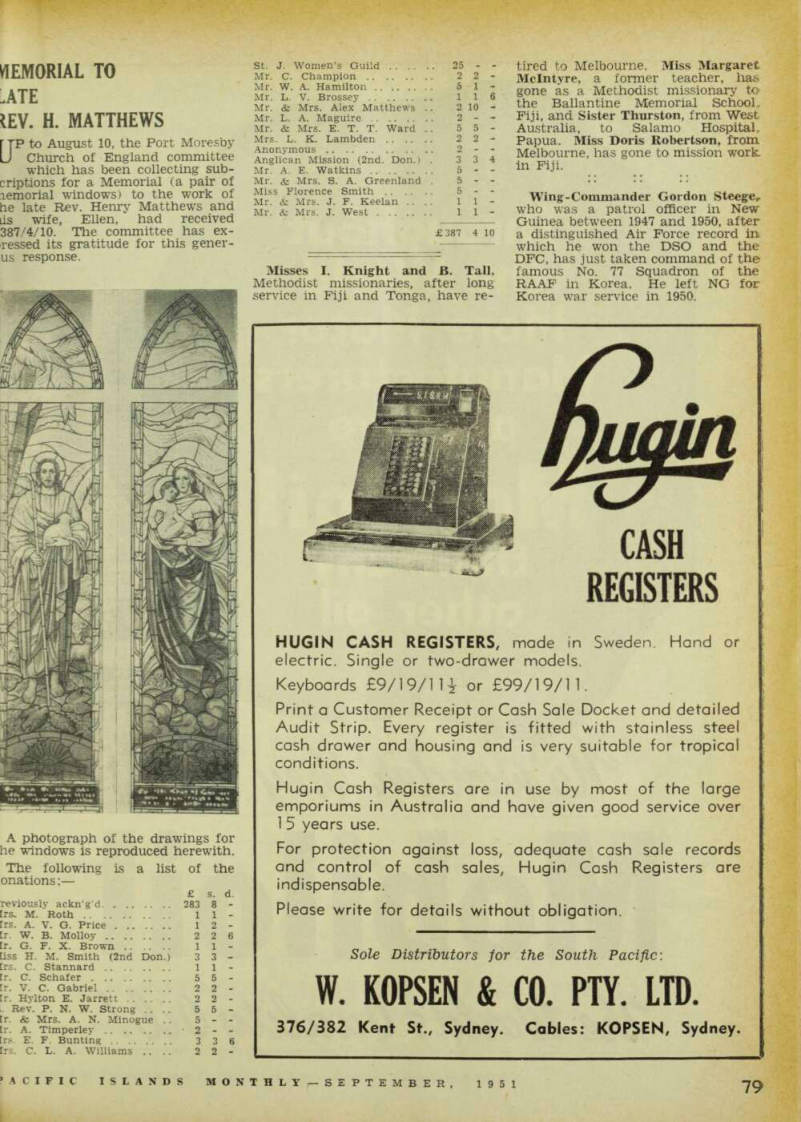
Late
Rev. H. Matthews
r TP to August 10, the Port Moresby U Church of England committee which has been collecting sub criptions for a Memorial (a pair of lemorial windows) to the work of he late Rev. Henry Matthews and ds wife, Ellen, had received 387/4/10. The committee has ex ressed its gratitude for this gener us response.
A photograph of the drawings for he windows is reproduced herewith.
The following is a list of the ©nations:—
Misses I. Knight and B. Tall, Methodist missionaries, after long service in Fiji and Tonga, have re
tired to Melbourne. Miss Margaret Mclntyre, a former teacher, has gone as a Methodist missionary to the Ballantine Memorial School, Fiji, and Sister Thurston, from West Australia, to Salamo Hospital, Papua. Miss Doris Robertson, from Melbourne, has gone to mission work: in Fiji.
Wing-Commander Gordon Steege r who was a patrol officer in New Guinea between 1947 and 1950, after a distinguished Air Force record in. which he won the DSO and the DFC, has just taken command of the famous No. 77 Squadron of the RAAF in Korea. He left NG for Korea war service in 1950.
St. J. Women’s Guild 25 - - Mr. C. Champion 2 2 - Mr. W. A. Hamilton 5 1 - Mr. L. V. Brossey 1 1 6 Mr. & Mrs. Alex Matthews . 2 10 - Mr. L. A. Maguire 2 - - Mr. & Mrs. E. T. T. Ward . 5 5 - Mrs. L. K. Lambden 2 2 - Anonymous 2 - - Anglican Mission (2nd. Don.) 3 3 4 Mr. A. E. Watkins 5 - - Mr. & Mrs. S. A. Greenland 5 - - Miss Florence Smith 5 - - Mr. & Mrs. J. F. Keelan .. . 1 1 - Mr. & Mrs. J. West 1 £387 1 4 10
reviously ackn’g’d £ 283 s. 8 d. [rs. M. Roth 1 1 [rs. A. V. G. Price 1 2 tr. W. B. Mollov 2 2 6 [r. G. F. X. Brown 1 1 tiss H. M. Smith (2nd Don.) 3 3 [rs. C. Stannard 1 1 [r. C. Schafer 5 5 [r. V. C. Gabriel 2 2 [r. Hylton E. Jarrett 2 2 - .. Rev. P. N. W. Strong .. 5 5 - Cr. & Mrs. A. N. Minogue .. 5 - -
[r. A. Timperley
2 - - Irs. E. F. Bunting 3 3 6 [rs. C. L. A. Williams .. .. 2 2 -
Advertisements & other items, pp. 81-82 (2 items)
79
» ACIFIC ISLANDS MONTHLY— SEPTEMBER, 1951
Registers
CASH
HUGIN CASH REGISTERS, made in Sweden. Hand or electric. Single or two-drawer models.
Keyboards £9/19/1 1 i or £99/19/11.
Print a Customer Receipt or Cash Sale Docket and detailed Audit Strip. Every register is fitted with stainless steel cash drawer and housing and is very suitable for tropical conditions.
Hugin Cash Registers are in use by most of the large emporiums in Australia and have given good service over 1 5 years use.
For protection against loss, adequate cash sale records and control of cash sales, Hugin Cash Registers are indispensable.
Please write for details without obligation.
Sole Distributors for the South Pacific ;
W. KOPSEN & CO. PTY. LTD.
376/382 Kent St., Sydney. Cables: KOPSEN, Sydney.
Throughout the World i StwPmH
Mobiloil
than any other oil / ' i
VACUUM
DUALITY PRODUCT
' y ko umde/i they ccM
Mobiloil
yfa. fijcri/ds QuaMy oi£/
‘Buka Boy’?

What Has Become Of The
A Plea for a Better Deal for Bougainville Natives
By Paul Mason
JJITTING on the ladder steps of a J dilapidated “house-kiap,” built on the outskirts of a village in he foothills in one of the most latrolled Sub-Districts in Bougain llle, my memory took me back 25 ears, to an occasion when I sat ooking from the same site, but rom a very different house-kiap.
The coconut palms in front of the nuse were then just making their oles. To-day, those that still re gained were tall palms nearly 30 ears old. Except for the Galup ut tree and the aged breadfruit ree. the vegetation was different, et the same.
The house-kiap was then the eoples’ pride. Theirs was to be the tentre from which the Patrols r ould work when opening up those reas to the way of “White,” and rogress.
What have we done for these eople?
Much of their civic pride has me. There is retrogression in their omes. their roads, their men’s
Paul Mason is one of the most ex perienced and highly-respected plan ters in New Guinea. He is a quiet, retiring man; and native conditions on Bougainville must be really bad, to have induced him to write in this strain.
Mason was one of the outstanding heroes of the Pacific war. He and Reed. an administration official, stayed behind on Bougainville and radioed Japanese air and naval move ments to the Americans in Guadal canal. The Americans afterwards said it was this information which gave them the final advantage in the critical Guadalcanal battles. Jap patrols, for months, hunted con stantly for the two famous Coast Watchers, but never actually caught them.
council houses—yes, even in the house-kiap itself.
Most enthusiasm is now centred around making easy money. Their own money is fast becoming obso lete.
A few are showing interest in aca
demic education; a few In intro duced projects. In the main they have outdone their mentors in seek ing security and leisure without work.
True, they have been through de vastating times from which they have not fully recovered.
The War? It did not affect directly this village in particular: but this Sub-District was affected perhaps more than any on Bougain ville. The taro blight did affect them badly, as it did everywhere on the island, and it still is a major factor in their lives; no new food has entirely replaced taro in their diet.
But it is their morale that mostly
has gone. That enthusiasm for the things that really make life worth living: pride in achievement; pride of possession; pride in things and position honestly won in the strife of life.
The post-war Administration has accomplished much, in spite of the great harm done during its raw in experienced early days. One of the
biggest weaknesses of the officers of the Department of District Services and Native Affairs is their smugness in their own achievements. Few will even believe that the conditions I refer to prevailed 15 years ago.
Some even believe their own re ports. It is not words or paper sent to Moresby that will put heart back into the people.
WHAT progress has the Bou gainville native made? A few have amassed power and pelf: But there has always been the powerful and the poor. Some have achieved part-medical and othei training, but their numbers are few T And these few are going, some to rise against us and blame us for the neglect of the many.
What of the health, wealth anc happiness of the rank and file? Few villages are better off than thev were 30 years ago. Their export: —and, therefore, their potentiaj imports—are less than they were before the war—not at infiateo money values, but in produce ano goods.
At one time they supplied most o:< the labour needs of the European plantations on the island, as well as many places outside the District and they brought the products oc their earnings back home.
To-day, almost no one leaves thu District to produce this unseen e» port, and a very small percentage work for European plantations.
There are about 800 to 900 natives from other islands working on Boui gainville to-dayl Their fares alom amount to some £25,000 per annum Their wages, rations, housing medical attention, etc., run into more than £75,000 per year. This i lost to Bougainville, and mostly to the native people themselves.
Is it any wonder that they are'
as a whole, poorer in worldly pos sessions than they were 15 years ago? They may have more of cer tain European goods, but these were mostly acquired through “spoils of war” and war damage payments. rjTHE “Buka boy”—as the Bou- JL gainville native was known throughout the Territory— was famous as a police-boy, and as a loyal, capable worker, and he held important jobs, both under the German regime and, later under jur own.
It was the Buka police-boys who vere used in the German time to luell the troublesome Manus latives. It was the Buka police- Doy who was used to establish a itation on notorious Malaita Island, n the British Solomons.
Alas, the fame of the Buka boy has passed. Racked with Cargo 2ult, get-rich-quick ideas, or sloth, le is a sorry example of his past.
The people have been told that n fifty years time they will be able ;o govern themselves. Their re ort was, We have always governed mrselves. In 50 years’ time, if past irogress is a criterion, few of those pho have adopted our ways will be eft to govern themselves, and the nountain people will still be Stone ige people, still governing them elves. rHE road back is no easy road.
It must be accomplished by the people themselves, under lear-sighted leadership. The Bou ainville people were, on the whole, ■ moral people. The Missions have one noble work; but many things re outside their scope and ability. [THE Education Department is do- L ing much to train and interest the natives in arts and crafts, nd giving natives at their schools balanced education. But these re a small percentage of the whole.
Not that literacy matters a great eal. In twenty years’ time we will e illiterate ourselves, with tele ision and new methods of commu ication. Tests show that the lajority of people forget what they ave been taught at school unless, irough life, their memory is con -antly refreshed. Still, these people re in grave need of being led and night how to adapt themselves to heir changing life; of being in pired to keep their own or our loral laws as may suit their condi ons; so that, with the loss of their wn culture, they can take on an ther that works for the good of hemselves and their land.
Health of course is the most im ortant factor. You cannot have vi ility and the necessary enthusiasm )r work and life, when riddled with lalaria, hookworm and yaws.
Many mountain villagers have
come, and are coming, down to the coast, only to become riddled with malaria. Malaria undermines their whole life, physically and mentally; kills the children, born and un born; weakens them and makes them more susceptible to respira tory diseases, as does hookworm.
OUR Health Department has al ways played a gallant part; but more can be done by patrols. They should inspire confi dence in our treatments. Patrols and examinations are essential, as the most damaging diseases are in sidious, and treatment is not sought until it is too late.
Better liaison, too, is required between PHD and DDS & NA.
A patrol officer will come along and encourage the mountain people to build their floors above the ground. This they do, with dire results.
From time immemorial these people have been used to an earth floor, with a fire in their houses at night, to ward off the cold and ven tilate their dwelling.
This is only one of the ways we mislead these people with changes for the worst. These mistakes are not made by cadet patrol officers, but by experienced officers.
It is better for the young cadets
to get out on patrol in approved areas and learn by their own mis takes, instead of being kept doing ;lerical work in the District Offices. ■ One DC said it was necessary to ceep cadets at the District Office to team to deal with the public.
One would think that a Cadet Patrol Officer was meant to go on Datrol, and learn about the natives n his village, and not the Euro >eans around a District Office. It vould be interesting to know what )art of their time is spent by patrol jfficers on patrol and what time is jpent doing office work. They isually rush out on Patrol, and rush jack to catch up with their office luties.
Patrols are the keynote of the vhole—PHD patrols, DDS & NA >atrols, and Agricultural patrols.
Chese patrols should not be rushed iff airs. Rushed patrols teach little md learn less in the rush from vil age to village—apparently to col ect data to include in the report of he patrol.
Mr. R. A. Woodgate, who went rom Queensland to Tonga five years go to be principal of Tupou College, iras ordained a minister of the Jethodist church while the Tonga Conference was sitting in July. He Iready held the degrees of BA and JEd.
Advertisements & other items, pp. 83-86 (5 items)
81
ACIFIC ISLANDS MONTHLY SEPTEMBER. 1951
G. H. Robinson Exports & Imports Pty. Ltd.
Unusual Prescriptions
Dispensed
Foreign Scrips Deciphered.
Rare or seemingly unobtainable drugs or commodities supplied.
All regular pharmaceutical lines dispensed.
A full range of Chemists’ Sundries available.
Special service for Islands Doctors.
All inquiries personally answered.
Chemist Anton Leondes, Suite 3, King’s Chambers, 112 a King St., Sydney, N.S.W.
G. H. ROBINSON EXPORTS & IMPORTS PTY. LTD.
Pacific Island Traders and Merchants.
Sole Distributors of Bradford Commercial Vehicles, Jowett Javelin Cars and Uniporn Diesel Engines—(Franchises avail- M able in certain Pacific Groups.) Sellers on Commission of all kinds of Island produce—Cocoa Beans, Green Snail, Copra, Fungus, M.O.P. Shell, Trochus Shell etc.
Agents in London and Manchester for the Disposal and Supply of Produce and Special Requirements.
EVERY ATTENTION GIVEN TO ORDERS IRRESPECTIVE OF SIZE Make use of our 30 years’ personal experience and direct your inquiries to: G. H. ROBINSON EXPORTS & IMPORTS PTY. LTD.
51 MACQUARIE STREET, SYDNEY. Telephone: 8W4575.
Cables: “SUNRISE,” SYDNEY. Postal Address: Box 3317, G.PO., Sydney.
A Guaranteed Sanitary System
Approved by the N.S.W. Board of Health.
THE HYGEIA DISSOLVENATOR
Established 1927.
No Water Supply Required
The Sewage matter is chemically transformed into a sterile solution which is absorbed by the surrounding soil.
NO FLIES—NO GERMS—NO
SMELLS—NO EMPTYING-
AUTOMATIC.
Any handy man can install.
Correspondence Invited.
HYGEIA SANITARY CO. PTY. LTD.
26-30 BRIDGE STREET, SYDNEY, N.S.W.
Phone: 8U2521 Cables: “Berbl” Sydney : v >er
NELSON and ROBERTSON Pty. Ltd
Established 1895.
SHIPOWNERS - BROKERS AND ISLANDS MERCHANTS
All classes of Merchandise purchased at Best Wholesale Prices. Original Invoices supplied tt Island Clients. Cocoa Beans, Copra, Rubber, Trochus Shell and All Islands Produce Sold oc Commission.
JSntrust your requirements to the firm with over fifty-five years’ practical experience in the Paciffl Islands.
Represented in All Parts of the World.
Overseas Indents Arranged for Clients.
Sole Agents :
SKANDIA DIESEL ENGINES
Inquiries Solicited.
Prompt attention given to all inquiries Managing Agents : u
“Tusculum
PRIVATE HOTEL
Potts Point, Sydney.
NELSON & ROBERTSON
PT LT
12 SPRING STREET, SYDNEY, AUSTRALIA
Telegraphic Address: “IVAN,” SYDNEY.
A. GREW PTY. LID.
IMPORTERS, EXPORTERS AND
MANUFACTURERS
Leather Saddlery and Paint Merchants ALL CLASSES OF LEATHER SUPPLIED FROM STOCK Apply direct to: A. GREGORY PTY. LTD., 107 York St., Sydney
°IREcr
IHSJLAN
0 Ardath Cigarettes, freshly imported from England, are made from the finest Virginia tobacco. The Puria cork tips ensure perfect flavour and hygiene.
Ardath
CORK TIPPED CIGARETTES
Manufactured in LONDON by ARDATH TOBACCO CO. LTD.
THE FINEST FRUIT CAKE
EVER BAKED
ft «5 w & 4535 •U i * h Big Sister" is so good it improves with keeping; delicious to the last crumb!
Each "Big Sister" cake is individually boxed and an inner wrap of moistureproof cellophane seals in its oven-freshness. w "Big Sister" Rich Fruit Cake is the real home-style Fruit Cake. Mellowed with fine old rum and brandy, studded with sweet red cherries, tenderized lemon and orange peels, and sunrich sultanas, currants and raisins. In 3 lb. and 6 lb. cartons.
Special packing guarantees
that every “Big Sister” product comes to your plate oven-fresh, as luscious in flavour » and as moist and rich as the day it was baked.
"Prize Recipe" is a special light fruit cake, for those who prefer it. Super-milled flour, first-grade shortening, and tender fruits give it a fine texture, and the most delightful home-made flavour. for r
JUj
PR/Z£ I REC/P£ PRODUCES
THE FINEST PLUM PUDDING
EVER MADE! It's vacuum packed for freshness, gloriously rich with goodness, and just as nice cold as hot. In I lb., 2 lb. and big 3 lb. tins.
MADE BY LILLIS & CO. LIMITED, SYDNEY, AUSTRALIA Also ask for Date Pudding, Mincemeat, Date & Nut Roll and Glace Cherries
82
SEPTEMBER, 1951 PACIFIC ISLANDS MONTHL
83
ACIFIC ISLANDS MONTHLY SEPTEMBER, 1951
84
SEPTEMBER, 1951 PACIFIC ISLANDS MONTHL
Tongan Prince’s Informative World Tour
WHEN Tugi, Crown Prince of Tonga, left Sydney for Suva, by air on August 14, he had circumnavigated the world, and gathered an extraordinary amount of practical information for the assistance of his vigorous little kingdom—all within the space of 10 weeks.
He left Tonga by air for the United States in June. He then flew south to the West Indies and spent some very profitable days at the Imperial College of Tropical Agri culture.
He glanced at some of America’s problems in tropical industries, and then he crossed the Atlantic, to be the guest of the British Govern ment at the Festival of Britain.
As a student of mankind, an ardent agriculturist, and the future ruler of a one-economy State, Prince Tugi spent some extremely interesting days in and around London. He made the most of his many opportunities of meeting top level representatives from Britain’s innumerable colonies and protec torates —and many of the latter, doubtless, were impressed by the knowledge and vision of the young Polynesian leader from faraway Tonga.
Returning, Prince Tugi travelled to Sydney by the Mediterranean- India air route; and again he made the most of his chances on this— his first world tour —to acquire new knowledge and a wider outlook.
He stopped for a few days in Ceylon, to examine that young nation’s highly expert methods of dealing with the products of the coconut palm. He came away with a book full of notes on the desi ccating of coconut, and the widen ing uses of the once useless coir fibre.
He broke his journey again in Singapore, where he had a quick look at some of the tronical indus tries which bring wealth to that Asiatic cosmopolis.
He did not stay 24 hours in Sydney, although it was here that he was for so long a student—he gradu ated from Sydney University. But he found time to greet a few old friends, and hear the latest news of the Islands. (When travelling by air, in this quick-moving age. one is always one hon ahead of the news.) Chatting shyly to reporters after his arrival at Sydney airport, the Prince remarked that he had been impressed by the wav thev worked
elephants in Ceylon—and, he added, whimsically, that if he could get a couple of elephants brought to Tonga he might be able to do with out one or two tractors. Within three hours, the startled traveller found himself front-page news.
“Prince Proposes to Bring Elephants from Ceylon to Tonga,” howled the headlines!
That evening, in his hotel, Tugi was interviewed by a morning paper reporter. He evaded questions on birth-control and grass skirts, which he quite shrewdly judged were loaded, and talked quietly and informatively about the develop ment of new tropical industries, and the remarkable evolution of the African negro in the field of
colonialism. But there was not s word about it in the morning paper Prince Tugi now knows a little more about the ways of modern journalism.
Tugi missed, by a few hours, the Right Hon. John Dugdale, Britisb Minister of State, who arrived in Sydney on August 14, after having visited Fiji, Tonga and Nev; Hebrides.
Advertisements & other items, pp. 87-88 (2 items)
85
'ACI F I C ISLANDS MONTHLY SEPTEMBER. 1951
Steamships Trading Company Ltd.
PORT MORESBY AND SAMARAI PAPUA
Wholesale & Retail Merchants, Planters, Sawmillers, Engineers, Slip
Proprietors, Shipping, Customs and Insurance Agents.
IANAGING AGENTS for:
AGENCIES:
SAWMILLERS & TRADERS LTD.
CORAL SEA INSURANCE CO. LTD.
ACME BAKERY COMPANY.
MARIBOI RUBBER LTD.
RUBBERLANDS LTD.
KEREMA RUBBER PLANTATIONS LTD.
COCOALANDS LTD.
HARVEY TRINDER (N.S.W.) PTY., LTD. (In-
surances effected at Lloyd’s.)
VACUUM OIL CO. PTY., LTD.
DIRECTORATE OP SHIPPING—Papua-New
Guinea Division.
ROYAL INTEROCEAN LINE.
KOKE BAGU PTY., LTD.
TRANS OCEANIC AIRWAYS.
DISTRIBUTORS IN PAPUA for:
ARMSTRONG-HOLLAND PTY., LTD.
Earth Moving and Logging Equipment.
VILLYS-OVERLAND EXPORT CORPORATION.
Jeep cars, etc.
ULLMAN MOTOR CARS.
INTERNATIONAL HARVESTER CO. OF AUST. LTD.
International Trucks, McCormlck-Deerlng Farming Machinery, Defender Refrigerators.
SYDNEY AGENTS: NELSON & ROBERTSON PTY. LTD., 12 SPRING STREET.
ETABLISSEMENTS DONALD TAHITI
HEAD OFFICE—QUAI DU COMMERCE—PAPEETE.
Telegraphic Address; “DONALD, PAPEETE.”
General Merchants (Wholesale & Retail) & Shipowners
Importers & Exporters
Branches Throughout the Marquesas Islands.
ASSOCIATE HOUSES: A. B. Donald, Ltd., Auckland.
Lloyd S AoentS New Zealand; A. B. Donald, Ltd v Rarotonga, Cook 7 Islands; Dominion Fruit Co., Suva, Fiji.
Agents and Distributors -for:
FRANCE: Hennessy Cognacs; Marie Brizard & Roger Liqueurs; Charles Heidsieck Champagnes; Perrier Water; Gruber Beer.
NEW ZEALAND: Vacuum Oil Co. Pty., Ltd., Petroleum Products.
SWEDEN: Hjorth & Co., Primus Stoves.
U.S.A.; General Steamship Corp.; Radio Corp. of America; Brown & Williamson, Ltd.; Cigarettes; Lucky Strike, Wings, Old Gold; Champion Spark Plug Co.; Rainier Beer.
ENGLAND: Reckitt & Colman (Overseas), Ltd.; Phillips Bicycles; The Bank Line, Ltd.
Sydney Agents: BURNS. PHILP & CO., LTD. San Francisco Agents: BURNS* PHILP CO. OF SAN FRANCISCO, INC. London Agents: BURNS, PHILP & CO..
LTD. Agents in France: HARTH & C3E, PARIS; A. BICKART, MARSEILLES.
m By Appointment Gin Distillers to H.M. King George VI Tanqueray, Gordon & Co. Ltd.
Qdtct/i/y
Gordon's
Stands Sup’mm/L
The Flag Still Flies
Papeete, July 4.
FOR the 119th year in succession ever since the day when Queen Pomare IV donated the land on which the United States Consulate was erected —the flag of the Uniteo States was raised here to-day.
When, to the regret of the comj munity, the United States close® down this Consulate in Octoben 1948, it was remarked that thu American flag would be seen m more. But the citizen who move* into the one-time Consulate, tx occupy it as a residence, declare* that as long as he was a tenant hi would have the American flag raise* there on all National days. He hai carried out that promise to thf letter.
Tasman Empire Airways, Ltdt which presently will operate a nev service from Auckland to Tahiti made an operating profit last yea of £16,591.
Advertisements & other items, p. 88 (1 item)
September, 1951 Pacific Islands Mont H Ik
Madang Newsletter
From Our Own Correspondent
Madang, Aug. 4.
rWO events that may affect Madang’s commerce occurred in July.
They were the laying of the foundation stone for the new hotel; ind the spanning of the Gum River vith the steel girders which will jridge the river on the Madang- Vmele Road.
Mrs. Gilmore, who will own the lotel, was present for the felling of he first tree on the property.
To celebrate the event she later mtertained friends and business issociates at a buffet dinner party it the Madang Recreation Club.
During the evening, Mr. lan )owns, District Commissioner spoke »f Mrs. Gilmore’s courage and esourcefulness, in tackling such an mdertaking in difficult economic imes.
Mr. R. Voegler will be manager if the hotel.
A T the Gum Bridge ceremony, Mr. Downs and government officials were present as well as mtheran missionaries.
All the school children were (resent with their mistress, Miss :. White.
This bridge links the two sections f the road, which connects Madang o the hospital at Yaguam and the dnele rice fields which are under he sponsirship of the Agricultural station.
The rice grown, although small rained, is of good quality and •roduction compares favourably nth rice produced elsewhere in the territory.
Pastor S. H. Gander Of The
S.D.A. Mission has returned from leave in Australia. Pastor Vard Nolan will attend the con erence in Port Moresby in August.
VT a general meeting of the Madang Club, it was decided to change the name to the ladang Recreation Club.
The election of officers resulted in !r. Allan Clark becoming president rhile Messrs. A. Reynolds and bllins became vice-presidents. Mr. i. Ramsay was returned as ecretary.
The committee for the next half ear will consist of Messrs. R.
Icary, B. Bach, A. Shields, T. tender and O, Banks.
LtADANG mourned the death of Tl Mr. E. V. O’Brien of Mililat Plantation, (see July PIM), rho has been part of Madang for iany years.
rpo Mr. and Mrs. R. Johnston, a JL daughter (Shay Elisabeth) was born at Madang European Hospital, in July, Mr. and Mrs. C.
Longworth are the proud posses sors of the first son, Christopher. rE Minister for Civil Aviation, Mr. Anthony, and Air Mar shall Williams visited Madang on August 3. They were accom panied by their wives.
During a visit of 4J hours, the party inspected the air-strip and suggested developmental projects in connection therewith.
They also looked at the housing
site, leased for Department of Civil Aviation personnel.
At the home of the District Com missioner, Mr. Anthony conducted interviews with the Town Advisory Council and private business people, Mrs. Downs I, entertained the party at lunch.
THE wedding of Miss Margaret Wong to Mr. Louis Chegg created much interest.
The ceremony took place at the Roman Catholic Church at Alexis hafen on August 4.
The wedding breakfast, at which 100 European and Chinese residents were present, was held in the garden of the couple’s future residence.
Advertisements & other items, pp. 89-90 (1 item)
W. R. Carpenter & Co. (Fiji) Ltd.
TIMBER
BUILDING REQUISITES
PAINTS, OILS
CEMENT
STEEL
COPRA KNIVES
CANE KNIVES
COPRA SACKS
WHOLESALE STORES
FOODSTUFFS
AGRICULTURAL TOOLS
CARPENTERS' TOOLS
★ Motor Vessels “ KOMAIWAI ” and “ TOVATA ” operating continuously in Lau, Lomaiviti, Cakaudrove and Yasawas.
W. R. CARPENTER & CO. (Fiji) LTD.
HENWICK ROAD AND THOMSON STREET—P.O. BOX 299
SUVA, FIJI.
Phone; 114 (6 lines)
A Hard Working Money Saving
MOBILCO PAI
Jd h - . \er>
r » '■ - / * m The Mobilco Post Hole Digger digs a 2' 8" deep hole in 10 seconds in average soil. This well-balanced, oneman machine will pay for itself in no time . . . and see the attachments (below) which can be fitted to a Mobilco Post Hole Digger.
Electric Generator
This 32 volt, 500 watt generator fits firmly on to the frame of the Mobilco Post Hole Digger. It provides a portable source of 32 volt light and power.
3 Centrifugal Pump
Fits on to the frame of the Mobilco Post Hole Digger.
Delivers 300 gallons per minute, at 50' head.
Electric Power Drill Driven from the 32 volt generator on the Mobilco Post Hole Digger this light, smooth running Drill bores up to 1" holes in hardwood and Vi" in metal. ij mm* p P 4 : «#* uf« & The fast working, one-man Mobilco Tree Felling and Cross-cutting Circular Saw at work at Nukualofa, Tonga. This machine leads the market for fast lowcost clearing.
Electric Hand Saw (Circular) Driven from a 32 volt, 500 watt generator which attaches to the shaft of the Mobilco this 6" circular saw is particularly useful in home or workshop.
Copra-Cutting Saw
This light bench fits on to a Mobilco Tree Felling Saw. Fitted with 28" diameter, 14 gauge blade it is most useful for cutting coconuts. .
Electric Power
Drill
Driven from the generator attached to the Mobilco Tree Feller this Power Drill makes quick work of boring holes in wood or metal.
WRITE FOR PARTICULARS TO YOUR AUSTRALIAN
BUYING AGENTS OR DIRECT TO
MOBILE INDUSTRIAL EQUIPMENT PTY. LTD.
252 SWANSTON ST., MELBOURNE, AUSTRALIA • TELEGRAMS: “MOBILCO". MELBOURNE
Pacific
Shipping Services In Central And South
Position of Trade Between Islands and North America
We publish hereunder, in full, the text of a letter received from the Assistant Vice Presi dent of the General Steamships Corporation, Ltd., of 432 Cali fornia St., San Francisco.
OUR attention has been called to the following article which ap peared in the February issue of Pacific Islands Monthly (page 89) mder the heading of “APPEAL TO
Ship Owners”:
.“Tourist interests in Tahiti are irging that the Union and Matson Lines be given cargoes to encourage -hem to send passenger steamers ;o Tahiti. .These two companies, in he past, have rendered valuable icrvice to these islands. They relped to put Tahiti and other South Seas Islands on the tourist nap.
“To-day there are European teamship companies entering the stands trade and carrying cargoes, ►ut they do not seem to care whether Tahiti prospers or not—all hey want is to get the freight noney and move on.
“The Matson people have said
that if Tahiti can help their ships with only 500 tons a trip, it would encourage the Line to send to Tahiti vessels that could carry passengers and tourists. This would not affect the Maritimes, which comes from France. We want the tourist traffic from North America, Australia and New Zealand.”
We are sorry to say that some of the statements are grossly mislead ing and it is apparent that the person writing it was either not acquainted with the facts or had no knowledge about the part which Pacific Islands Transport Line has played in developing the Islands trade.
This Line commenced operations between the Pacific Coast and the South Seas in 1938 with two vessels, MS Thor I and MS Velox, both of Norwegian registry. Subsequently the Velox was substituted by MS Philae and, prior to the war, was the only Line offering regular service from this coast to Fiji, Samoa, Tonga, New Caledonia, New Hebrides, Solomons, New Guinea, wdth occasional calls to such out of-the-way places as Fanning Is
land, Washington Island, Niuafoo, Canton, Tarawa, etc., carrying petroleum products, lumber and general merchandise south-bound and returning with full cargoes of copra north-bound, principally to Mexico.
At the outbreak of the war all commercial shipping was withdrawn from the trade to serve the Allied cause, with the result that most of the Pacific Islands, principally, Tahiti, Fiji and New Caledonia, were left with practically no con nection with the mainland. How ever, with the co-operation of our principals, Messrs. A. S. Thor Dahl, Sandefjord, Norway, it was arranged with the War Shipping Adminis tration and British Ministry of Shipping to retain the MS Thor I in the trade, as both the American and British Governments recognised the importance of keeping these islands supplied with foodstuffs and other materials.
Throughout the war the Thor ;I was not only an important factor in maintaining the economy of the islands but also rendered valuable service to the common cause. We are certain that important firms with large interests in the South Seas, such as Bums, Philp Co. (South Sea) Co., Ltd., Morris Hed strom, Ltd., W. R. Carpenter & Co., Ltd., Etablissements Donald Tahiti, Ltd., Etablissements Ballande, can subscribe to this statement.
During that time this vessel carried not only essential materials from America to the islands under direction of the War Shipping Ad ministration, but also full cargoes of copra from Tahiti and the Marquesas to San Francisco, which was urgently required for the war effort, especially since there was a complete shut-off of similar supplies
from the Philippines and the Netherlands East Indies. She also carried, as passengers, Government and other personnel in both direc tions and between the Islands ports.
We do not know what prompted the article in your publication but we hasten to assure you that the Thor I is still operating regularly from the Pacific Coast to the United
States and Canada to Papeete, Apia) Suva, Noumea, etc., carrying s capacity list of passengers (12) anc general cargo to these areas. Everj possible effort has been exerted to obtain return cargoes from Tahit and other islands but so far we have been unsuccessful, especially copra* The reason for this is twofold: — (1) The British Government re quires that all copra produceo in the Fijis and Solomons b* shipped to Great Britain Australia or New Zealand while the French Govemmem requires that copra produceo in the New Hebrides, Tahiti and Marquesas be shipped t* France. (2) Since the resumption of ship< ments from the Philippines tx USA and the reinstatement oc the Excise Tax on coconut oi derived from copra (term porarily suspended during tlu war) prices on copra from thi South Seas have been noni competitive.
We have also endeavoured to obc tain copra for British Columbia, bu importers have not been able t; consummate any business.
Without detracting from thr efforts which other Lines haw rendered in developing trade bes tween the Pacific Coast and thr South Seas, we should like to ca'j your attention to the fact tha Union Steamship Co. of New Zea*
and primarily serve New Zealand nd Australia, calling at Papeete nd Rarotonga southbound. The )ceanic Steamship Co. (Matson) ormerly called at Suva, Pago Pago, few Zealand and Australia, but ave changed their service whereby liey are now calling only at Sydney nd Melbourne. During the past lx months they have had several essels call at Papeete enroute to ustralia, but their service to that ort cannot be considered as jgular.
In closing, permit us to say acific Islands Transport Line has een an important factor in the Bvelopment of trade between the acific Coast and the South Seas, ur principals are determined to mtinue this policy and have üblicly stated on numerous oc isions that they are ready and filing to supplement the service Efered by the Thor I with Iditional tonnage, if and when the ade warrants taking such steps.
We have given you the back round of this matter as we are nte certain that you may desire > correct any wrong impression hich your article has undoubtedly ven some of your readers.
Editorial Note
T was through inadvertence that our writer, in February issue, failed to include the Pacific lands Transport Line with the imes of the Matson and Union ines, when making his plea for irgoes. We apologise to the eneral Steamship Corporation, eyond question, the Thor I has ven the Islands a useful service.
What is of greater concern to the lands is the absence of copra rgoes for North American ports, nder present conditions, all South ‘as copra is being drained away Europe, and there is a dwindling nount for North America.
That is due to a number of ctors, of which the eagerness of •itain and France to grab all their lands trade for themselves is only le. Over a very long period, the tiited States arranged its tariffs id its shipping so that Philippines pra was readily admitted, and the oduce of other Territories more or 5S discouraged; and of course that ily encouraged the non-American ands to buy their goods where ey sold their copra.
The international situation has anged, and is still changing. All •n-Asiatic countries in the Pacific •w are under American protection, id the ties between the South icific countries and the United ates are growing stronger, every ar. Always, the tendency of trade to follow the flag; and, if the minant flag is American, then Dre trade is likely to go to nerica. But, if there are to be velopments in that direction, it
will be necessary for the Americans to give serious thought to some of the tariff and port laws which govern the introduction of Pacific Islands produce to their country.
Advertisements & other items, pp. 91-92 (2 items)
89
4 CIFIC ISLANDS MONTHLY SEPTEMBER, 1951
A. H. Bunting Ltd.
SAMARAI PAPUA
Branches at: MISIMA, TUFI, ORO BAY, SOPUTA.
AMARAI AGENTS FOR:—
Vacuum Oil Co. Pty., Ltd.
South British Insurance Co.
National Mutual Life Association
SOLE AGENTS IN PAPUA/NEW GUINEA FOR;
Polarizers (U.K.), Ltd.—Polaroid Sun Glasses.* C.S.A. Industries, Eng - . —Dual Freeze Refrigerators.
Webley & Scott, Ltd.—Shot Guns, Air Pistols, etc.
E. K. Cole, Ltd., London.—“Ekco” Radio Receivers.
“Getula.”—Nylon Monofilament Fish Lines.
Davison Paints, Ltd., N.S.W.—Paint for Tropical Conditions. • Trade mark patented in U.S.A., Great Britain, and other countries.
REGULAR SUPPLIES OF EASTERN GOODS
WHOLESALE & RETAIL MERCHANTS—IMPORTERS -PLANTERS
Scott’s
M Renown
Cable Address Ropeyard.
Sydney.
Brand Rope,
Cordage and
Binder Twine
of Every
Description
MANUFACTURED AT
MASCOT, N.S.W.,
J. SCOTT
PTY. LTD.
Head Office and Store
163 CLARENCE STREET,
SYDNEY,
N.S.W.
C. Sullivan (Export) Pty. Ltd.
HEAD OFFICE
379 KENT STREET, SYDNEY, N.S.W.
Telegrams and Cables: “CHASULL,” Sydney. Telephone: MJ4657.
And at Melbourne, Victoria —Brisbane, Queensland.
Associated Companies : C. SULLIVAN (PACIFIC ISLANDS) LTD., Suva, Fiji.
C. SULLIVAN INC., 230 California Street, San Francisco, U.S.A.
Over 30 Years' Pacific Island Experience
Expert Buying Service
Original Invoices Furnished
Overseas Indents Arranged
BEST PRICES FOR COPRA, COCOA, SHELLS AND GENERAL ISLAND PRODUCE
Notes From Rabaul
RABAUL’S smallest citizens now have a delightful establishment of their own, providing the latest styles in swimsuits, and really “chic” bonnets. This is The Nursery, chatelaine of which is Mrs. Fish wick, sometimes assisted by her small son. Included with the array of frocks for the tinies are service able suits and khaki pants for the youngest men about town. Shoes, toys, and (later) shoes for mothers
of the youngsters will be available.
Friends, while they wait, may amuse themselves in the rustic kunai covered “beer garden,” provided for this purpose. “The Nursery” is a blessing to mothers, who have al ways had difficulty in obtaining children’s clothing, particularly shoes, in Rabaul. Now they are catered for in a comprehensive and attractive fashion, exclusively theirs.
TWO well-known Territorians have been honoured recently by additions to their families.
A son was born to Mr. and Mrs.
Mick Foley, late of Talasea. at the Rabaul Hospital; and a daughter (Karen) to Mr. and Mrs. W. Sievers, of Rabaul.
Advertisements & other items, pp. 93-94 (3 items)
91
ACIFIC ISLANDS monthly SEPTEMBER, 1951
miums
4>
GIVE FULL
LIGHT
AND AIR
With Year-round
Weather
Protection
miums
This ultra modern window comprises a series of glass blades swung one above the other and inclinable to any angle.
Air entering the room is diverted towards the ceiling thus preventing draughts. AGCO Supaluvres have all the advantages of other louvre windows plus exclusive features.
The specially designed rain guards cannot be fouled by the glass holders and provide flush finish so that fly screens, curtains or blinds can be attached. By an automatic locking device AGCO Supaluvres can be locked open in four positions, thus eliminating rattle and are also fitted with rack and pinion movement. All exposed surfaces are made of rust resisting zincanneal metal.
For Verandahs, Sun-rooms, Lounge-rooms, Kitchens and Laundries Illustrated leaflet, price list and installation instructions on request.
Sole Agents for South-west Pacific :
ROBERT GILLESPIE PTY. LTD.
54a PITT STREET, SYDNEY
Insist on ... .
“UItOKTE”
CANNED MEATS, HOTMEALS AND SOUPS
Available in 12 oz. and 1 lb. sealed cans in the following
appetising flavours and combinations:
• Corned Beef Loaf With Cereal • Braised Steak and Onions • Boiled and Roast Beef • Beef Steak Pudding • Mutton and Peas • Steak and Onions • Chili Con Came • Curried Mutton • Curried Beef • Irish Stew • Mulligatawny Scup • Vegetable Soup • Mutton Broth • Tomato Soup • Camp Pie "BRONTE" Brand high-grade products are made from the finest fat stock and the richest vegetables in Australia, deliciously flavoured.
THE COLONIAL WHOLESALE
MEAT CO. PTY. LTD.
Canning Factory: State Abattoirs, Homebush, Sydney, N.S.W. ’Phone: UM 8436. Cables: “WOOLMILL,” Sydney. % immtf
AHP
92
SEPTEMBER. 1951 PACIFIC ISLANDS MONTHL
Creek ? was £? Itor ffst
Notes From The Ng
Goldfields
From Our Own Correspondent WAU, August 15.
J’R. And Mrs. John Grain
-1 GER are the proud parents of Jonathan Paul, who was bom the Wau Hospital on August 4.
Mr. and Mrs. Grainger are soon depart for Moresby and will be .ssed in this community.
Mr. Grainger has proved a fine irtsman and a capable and un rstanding Police Officer. He has en the recipient of suitable tokens >m the Wau Sports Club and the au Golf Club.
On August 1 Mr. Justice Kelly companied by Mrs. Kelly arrived Wau.
Judge Kelly dealt with two .minal cases and as a result a tive was sentenced to 9 months prisonment for insulting a Euro m woman at Bulolo, and a second tive was imprisoned for 3 years • tampering with letters in the au Post Office. rhe Assistant District Officer has w moved into his new office which in a group of fine modem build js, which may well come into the est in the Territory” class. [R. PAUL HASLUCK, our new Territories’ Minister, arrived in Wau by road from Lae on gust 3, after visiting Mr. Mick ahy’s farm at Zenag, the Gov iment Stations at Mumeng and 1010, and Bulolo Gold Dredging i’s property. [That evening Mr. Hasluck met a mutation from the Wau Citizens’ sociation and the Wau Town uncil. Matters brought before > Minister included the Wau High 1001, the Wau Hospital, the rising >t of Native Labour, and the estion of gold royalties, rhe party left for Goroka on igust 4, and returned on 6th, en a Dragon aircraft took the nister, Mr. Lambert and Dis )t Commissioner Niall (of Lae) to ‘ new post at Menyama where Jistant-District Officer Hurrell s established a station in the Idle of the Kukukuku country.
Che Minister for Air Mr. H. L. thony, accompanied by Mrs. An >ny, Air Vice-Marshall Williams i Mrs. Williams, and Mr. J. }hur, of DCA, paid Wau a very ef visit on July 28, [R. J. CROMIE (Port Moresby) and Mr. D. Jones (Rabaul) are at present in Wau appear : in the Supreme Court in con ation with the electrocution of ward J. Kuhl at Wau last year. . Justice Kelly is hearing the >e.
Jr. W. Orr, accompanied by his e, is visiting Wau at present. Mr.
Orr represents southern interests which purchase Klinki pine from New Guinea Goldfields for the making of battery separators.
Fox Movietone cameraman Syd Wood spent a week in Wau this month. During his visit he had re-acted the discovery of gold in Edie Creek T to , * -rn
P?L B °n£’ a
Creek ? was £? Itor ffst
which included Mr A Malcolm and Mr. C. Eldred—both old-timers of this area.
The Returned Soldiers’ and Sailors’ Association held their An-
nual Ball on August 4 at the Wau Club. This year it took the form of a Fancy Dress Ball. Mr. and Mrs. Jim Harridge won the prize as ar Li nc , sqiiaw . „ 6 Golden Ridges Club was Offi cially opened on the evening of August by Mr. J. Hohnen, general manager of New Guinea Goldfields.
This is the first post-war Club to be formed at Ridges, an offshoot of Va . u ’ and should 156 of great benefit
t 0 the communit y-
H/|R- WEARNE of Harrison Ram- If J. say Pty. Limited has been visiting New Guinea Gold fields Wau area. Mr. Wearne is an
expert on timber production and considers the Wau pine to be emin ently suitable for specialised re quirements on the mainland.
With the arrival of the third diesel unit by the Nankin, and the fourth due shortly, New Guinea Ooldfields timber output will be
stepped up to about 200 tons per month. Present production is allo cated primarily to the New Guinea market. Only specially selected flitches are being exported to Bris bane and Sydney for the battery separator industry.
Trial shipments are now in pro
gress of fruit, milk and egg case;; (from NGG mill). These are ii much demand by Australian es porters and will be made entirely from timber that would otherwise be treated as waste.
A record load of Wau pine lefl Wau in mid-August for Lae; tin load was carried by a trailer coupled to an AEG diesel prime -mover —thi overall payload was 20,000 lb. a timber for supply to Works am Housing Department, Lae.
Advertisements & other items, pp. 95-96 (2 items)
93
\CIFIC ISLANDS MONTHLY SEPTEMBER. 1951
Cystex
h
KIDNEY TROUBLE CAUSES
BACKACHE, PUFFY ANKLES
If you re feeling out o-sorts, have Interrupted Sleep, or suffer from Dizziness, Nervousness, Backache. Leg Pains, Swollen Ankles. Rheumatism, Excess Acidity, or Loss of Energy and feel old before your time, Kidney Trouble is the true cause.
Wrong foods and drinks, worry, colds or overwork may create an excess of acids and place a heavy strain on your kidneys so that they function poorly and need help to properly refresh your blood and maintain health and energy.
Help Kidneys Scientific Way
It has been proven by scientific clinical tests that a quick and sure way to help the kidneys clean out excess acids and poisons is with a scientifically prepared prescription called
Cystex. Hundreds and hundreds of clinical records prove this.
No Benefit —No Pay
The very first dose of Cystex goes right to work helping your kidneys remove excess acids.
Quickly, this makes you feel like new again. And so certain are the makers that Cystex will satisfy you completely they ask you to try it under a money back guarantee. You be the judge. If not entirely satisfied just return the empty package and get your money back.
Cystex costs little at chemist* and stores and the money back guarantee protects you.
Cystex
for
KIDNEYS
BLADDER
RHEUMATISM
The Guaranteed Treatment
3
MANS
PAINTS
54 PINT
X I PINT
54 GAIL
54 SAIL
I GALL TIMS
A. B. DONALD LTD.
RAROTONGA COOK ISLANDS
Telegraphic Address: “DONALD, RAROTONGA.”
General Merchants (Wholesale Cr Retail) and Shipowners—lmporters Cr Exporters
—Branches Throughout Cook Islands
Fire, Marine Cr Motor Vehicles Insurance Agents for Yorkshire Insurance Co.
Lloyd's Agents
Agents and Distributors for: ENGLAND.—Austin Cars & Trucks, Pye Radios, Dunlop Rubber Co., Ltd., Vauxhall Cars & Trucks, R. A. Lister & Co., Ltd., Phillips Cycles, Marples Tools.
U.S. A.—Remington Rand Corp., Radio Corp. of America, Champion Spark Plug Co., Firestone Tyres, General Steamship Corp.
NEW ZEALAND.—Vacuum Oil Co. Pty., Ltd., Petroleum Products.
AUSTRALlA.—Wunderlich, Ltd., Cement Asbestos Products.
NORWAY. —O. Mustad & Sons, Fish Hooks.
SWEDEN.—B. A. Hjorth & Co., Primus Products.
Head Office: — A. B. DONALD LTD., Auckland.
Associate Houses: —
ETABLISSEMENTS DONALD TAHITI,
Papeete, Society Islands.
DOMINION FRUIT CO., Suva, Fiji Islands.
CODES: Bentley's Complete Phrase, Acme
San Francisco Agents:
BURNS-PHILP CO. OF SAN FRANCISCO INC.
Sydney Agents: London Agents; BURNS, PfflLP A CO., LTD. BURNS, PHILP A CO., LTD.
To Veteran
Samoa’S Tribute
Teaching Brother
From Our Own Correspondent
Apia, Aug. 10.
ONE of the most loved of the res maining group of veteran teachers of the Maris Brothers, Reverend Brother Panr philius (Joseph Maria Rohrer) wi'J celebrate the 60th anniversary o his entrance into the Novitiate cc the Marist Brothers on August 11.
Great preparations are being mad by present and former pupils of ttr Marist Brothers School to worthil mark this event. In spite of ad vanced age, Brother Pamphiliui is still carrying on his duties in tW same selfless, efficient and conscien tious spirit.
In a public function on August 1
n illuminated address and a suit ble Jubilee gift will be presented ) Brother Pamphilius by the Hon, &utua, Tupua Tamasese.
Brother Pamphilius was born in witzerland in 1874; he entered the ovitiate of the Marist Brothers in Irance at the age of 16; he taught i French schools for some years; as assigned to the Chinese Mis on; but in response to a call from amoa, he changed his destination i the last moment and proceeded > Samoa in 1903. Thousands of oung Samoan and part-Samoan jys have benefited by his educa onal skill and efficient care. Many I his former pupils now occupy sponsible positions in Samoa and rerseas. The people of Samoa, ir jspective of creed, race and ationality, are joining whole eartedly in extending their best ishes to him. After 48 years of mtinuous and devoted labour, he still carrying on his onerous aties.
Advertisements & other items, p. 96 (1 item)
94
SEPTEMBER, 1951 PACIFIC ISLANDS MON T H L
Ood Service Recognised
public services rendered, the following were awarded the OBE in the recent Birthday onours: Mr. G. J. Bridges, anager of BPC, Ocean Island; Mr.
H. Griffiths, late manager of 3R Co., Fiji; Joeli Kete Ravai, Dko Tui Tailevu, Fiji. Awarded BE: Mr. G. S. Barrack, chief icountant, Western Pacific High immission; Mr. V. J. Shearwin, distant Treasurer, British Solo on Islands; Rarikua Stephen ?ra, livestock officer, Fiji; Mr. S. , Wilson, Suva, Fiji. Police Medal: ?puty Commissioner W. J. G. alland, Fiji.
Territories
Health Measures In
om Pacific Science Association’s Bulletin
ESTABLISHMENT of a small i farm colony for lepers is planned at Lumi, in the Sepik strict of New Guinea. This was nounced by Dr. J. T. Gunther, alth Director at Port Moresby, r. L. R. Healey, European Medical sistant at Lumi, will be in charge the project. The natives already ve been induced to take anti ilanal drugs on a regular sched * and without supervision, as a ;ult of the work of Mr. Healey, itive women are attending pre tal clinics and first aid posts ve been set up in the villages.
Edical Facilities In The
Cooks
Lhe 1950 report of the NZ De rtment of Island Territories re "ds that on Rarotonga there is a
general hospital with accommodation for 50 beds and equipped with dispensary, X-ray, and laboratory facilities. The Tuberculosis Sanatorium at Arorangi (Rarotonga) is a modern building, completed in December, 1945. with accommodation for 30 beds.
The outer islands for the most part are served by single-room dispensaries or by larger dispensaries which can accommodate a small number of patients. Pukapuka, Rakahanga, Mitiaro, and Palmerston have no hospital or dispensary
facilities. The construction of s small hospital for Pukapuka, a dis pensary room for Rakahanga, and modern medical amenities on Aitu taki, Mauke, Mangaia, and Mani hiki have been approved, while plans are being drawn for a more up-to-date general hospital on Rarotonga,
Western Samoa
Mosquito and rodent control pro grammes carried on in Western Samoa have made a marked differ ence in certain areas in and about Apia.
Advertisements & other items, pp. 97-98 (3 items)
95
ACIFIC ISLANDS MONTHLY SEPTEMBER, 1951
Obtain
YOUR
COPY
NOW!
Price: 25/-
Add postage, etc. (Within the British Empire, 1/3; Foreign, 2/6) when ordering direct (In U.S. Currency, $3.50, including postage).
PACIFIC
ISLANDS
YEAR
BOOK
1950 By R.W Robsorv
PACIFIC ISLANDS YEAR BOOK, 1950,
the South Seas’ most valued reference book, is available at all leading: Booksellers in Australia and N.Z., the main Pacific Islands stores, or direct from the Publishers. oSvirifnS Edlt i on contains 500 Pages and numerous Maps. In addition to reliable information relating to Administrations, Geography, History, « s ’i S°^ m f- rce and Trade < full Statistics), Tariffs, etc., the Year Book has 1941 S nf ll SUC o aS: A History and Chronology of the War in the Pacific, Public Servants in each Territory; Description of the new Air SSJJ3J se £, vln f the Pacific Islands: Complete Directory of Pacific N?me S In the S outh < ; velo P mcnts 194 »-5» Detailed Index of Place
PACIFIC PUBLICATIONS PTY. LTD.
Union House, 247 George Street, SYDNEY.
(Box 3408 G.P.0., Sydney, N.S.W., Australia.)
There is only one
ELECTROLUX
THE MODERN KEROSENE-OPERATED REFRIGERATOR THAT ACHIEVES THE
MIRACLE OF ICE FROM HEAT
Lasting Efficiency, Silent Operation, Streamlined Beauty
Economically operated by kerosene, with a simple precision-built freezing unit that has no moving parts.
'sm I
iml
■ : iV' 1
GUARANTEED
FOR FIVE (5)
YEARS.
Only obtainable from:
NEW GUINEA COMPANY. LIMITED,
Rabaul, Madang. Lae, Kavieng.
J. R. CLAY & CO.. LTD., Port Moresby.
W. R. CARPENTER & CO. (Sol. Is.), LTD., Tulagi.
THE NORFOLK ISLAND SERVICE DEPOT, Norfolk
Island.
SOCIETE HEBRIDA, Port Vila.
SOCIETE CALEDONIENNE D’IMPORTATION ET
D’EXPORTATION, Noumea.
For Gilbert and Ellice Islands Colony, etc., apply direct to;
Model LKSSI
PRICES ON APPLICATION.
Storage capacity: 5i cub. ft. (approx.); shelf area, 10 sq. ft. Food shelves, six—five removable; 2 self-supporting when half drawn. Icemaking: Four trays—s lb. ice per freezing: 80 cubes. Fuel consumption: 1.8 pints kerosene per day (approx.). Height: 4 ft. 10 in. Depth: 2 ft. 31 in. Weight, unpacked, 406 lb. Packed, 574 lb.
W. R. CARPENTER & CO. LTD. Head office: 16 O'Connell Street, Sydney, N.S.W.
September. 1951-Pacific Islands Mont H Lj
Notes From SE New Guinea Districts
From Our Own Correspondent
SOHANO, August 10. 1/fR. H. L. ANTHONY (Minister t! for Air and PMG) visited So hano on July 31 and inspected suka air strip.
Mr. R. McKay of Aropa, Kieta, nd Mr. Fred Archer, of Yame, Buka •assage, went to Rabaul to attend mnual Meeting of the Planters’
Lssociation on July 26 and 27. Later Ir. Archer was one of the Planters’ eputations to both Ministers from Janberra.
Mr. Archer strongly stressed to oth Mr. Hasluck and Mr. Anthony he fact that Bougainville was a luch neglected district—it was, in act, the Cinderella district of the ’erritory and, whilst the mainland ot so much, Bougainville got very ttle. He said we had the worst ir service, wireless service and mail ervice because Bougainville was in be extreme south east corner. A peedier air service, more shipping nd better mail and wireless services rould do much to improve business, ncourage development and be a reat morale builder among all resi ents, colours and creeds. The
Ministers asked for details and promised to give the various matters due consideration.
A Useful Plane
The Walrus plane—based on Rabaul —has been a frequent visitor of very recent times and has been most useful in bringing out people who had missed the regular plane, police boys to assist in enforcing quarantine against polio infected areas, and in taking sick natives to hospital. On last trip it was di verted to the isolated Nissan Group to pick up the Catholic nuns from the Mission there and bring them to Sohano. The plane lands on strip or water and, in latter case, lets down a pair of wheels and runs up on any properly sloping beach.
Copra Accumulations
The “Muliama,” former well known BP ship, has been lifting copra from the Burns Philp in terests in Bougainville and New Ire land. She will lift, in all, some 28,000 bags and then return to Syd ney. Her activities will assist in lessening, but will not finish, the
very considerable accumulations of copra throughout the district. After the Directorate ships and methods it was nice to see a properly equipped ship loading in a work manlike manner—like a page from the past.
Numa Numa, which had copra stacked in every shed, “go down” and even an old dwelling-house— to the total of 6,500 bags, and an all-time record—will have a clear ance by time “Muliama” goes back to Sydney. This would represent approximately £27,000 worth of copra taken off, which seems a lot, but with the long wait for a ship there is much loss of weight and. meantime, the exceptional expense of running a big estate in these times has to be met.
Watch On Volcanoes
Great interest is being taken, by the Territory, in Bougainville vol canoes and many visits have been paid to the new baby one—north of Buin —by vulcanologists, to feel its pulse and inquire after its wel fare.
Mr. Frank Jones, District Officer at Kieta, has been out there at times, “riding herd” on it, and re porting on its vagaries. It’s not wise to mention fumaroles and crater temperatures and fissures to Mr.
Jonesr—he has “had” them. It’s a job that no one this scribe has met him.
Search For A Port
Works and Housing officials have been out from Moresby and Rabaul, including Capt. Copeland, who is Rabaul’s Harbour Master, inspect ing the various locations, reef and
harbour possibilities of Kieta, Teop and Ramun Bay.
It is planned to eventually put a Copra Concentration Depot at one or the other of these places, and to concentrate most of the dis trict copra at the point for overseas shipment.
Local residents have no doubt
whatever that Kieta is easily th most suitable spot, as it has a" gooc harbour, is healthy and has splen did building sites. Both Ramu Bay and Teop—whilst good han hours—have a great reputation fo mosquitoes and the natives a Ramun have suffered much froi fever always.
In former times big ships used t come into Kieta—day or night with no difficulty and there are fe-; reefs in the harbour and deep wate in close to shore. Kieta is a beau tiful spot, with its clear wate:; sheltered harbour, surrounding hil!J and the shaded road that run round the foreshore. It smacks ven much of the old romantic Sout) Seas port.
New Road Welcomed
A start is to be made on th coastal road south from Kieta ti Iwi Plantation, via RC mission Toberoi plantation, Aropa plants tion —18 miles down, and the horrr of Jim Joyes. This road will saw the plantations a great deal of worn and inconvenience. Pre-war, then was a good road and very littl; will have to be done to put it bact into good order. There are, how ever, several bridges to be built ov© Reboine and other rivers. Of ter both people and rations have hazardous canoe trip along th coast and not infrequently get ven wet when landing in the surf. Wo
;n on the plantations have been •ced to stay on them with their ildren, or else face considerable icomfort and some danger in gse canoe trips. The road will ow trucks and jeeps to go to eta. Without a great deal of ort a track over “Wireless Hill” w existing, could be improved to :e jeep or truck and so bring Jack iis’ Arawa Plantation into the ture, as well.
Polio
rhe polio epidemic at Buin is eading and cases have occurred the neighbouring area of Siwai i Nagavisi. Quarantine restric ts have been imposed but it is acult to stop the natives going m place to place by the lesser- Dwn jungle paths and, anyway, ;y do not look upon these restric ts as other than more of the lite Man’s foolishness. “Tumas nmon belong all the Dokitor” r they. Some forty-odd cases ve occurred, among them two ropeans who have made good re tries. So far, two or three Ives have died.
Tie radioes that flash back and th from Moresby and Buin must re burned up an awful amount air. One shudders to think of all extra returns—Forms of many ds, in very truth!—that the un tunate Medical people will have fill in now, to satisfy the United tons Council in connection with outbreak!
Advertisements & other items, pp. 99-100 (2 items)
Mm Troubles
Quickly yield to
& S&0
AS PRO
does not harm
HEARTor
STOMACH
N.C.6 Most tropic troubles have an element of irritability about them.
For that reason 'ASPRO' is the desirable form of relief. 'ASPRO,' in addition to its swift effectiveness, acts in a SOOTH- ING manner, so that you immediately feel calmed and serene. There are no unpleasant after-effects. Take 'ASPRO' with you wherever you go and be ready. You can tear off several tablets from the sanitape strip and carry them hygienically in pocket or handbag.
The Purity of 'ASPRO' The purity of ‘ASPRO’ conforms to the standards laid down by the British Pharmacopoeia—a guiding authority of the Medical Profession. i I »
HEADACHES
IRRITABILITY
HEAT ENERVATION
RHEUMATISM!
COLDS and FLU
7]ichyLi4 (fxvtlucl
BROOMFIELDS LTD.
Suppliers of
Building Hardware, General Hardware
Ship Chandlery
Paint Materials
WRITE DIRECT TO
Broomfields Ltd.
152 SUSSEX STREET, SYDNEY
Sole Agents for: P. H. MUNTZ & CO.’s 3-CROWN BRAND
METAL SHEATHING.
PEACOCK & BUCHANS’ ENGLISH READY-
MIXED PAINTS.
VENTURA TRADING CO. PTY. LTD.
26 BRIDGE STREET, SYDNEY.
ISLAND MERCHANTS
ALL CLASSES OF MERCHANDISE SUPPLIED AT WHOLESALE RATES
SOLE PACIFIC ISLANDS REPRESENTATIVES FOR:—
• Armstrong-Siddeley Diesel Engines • Armstrong-Superior Lighting Plants 9 “Multo-Presto" and “Konda" Ice Cream Machines • “Koala" Stationery Lines and Stapling Machines • “Upson" Torches
SUPPLIERS OF
• Goodyear and Dunlop Rubber Tyres and Tubes
CABLES—“VENTURA,” SYDNEY.
98
SEPTEMBER, 1951 PACIFIC ISLANDS MONTHL
BSI and Papua-NGuinea
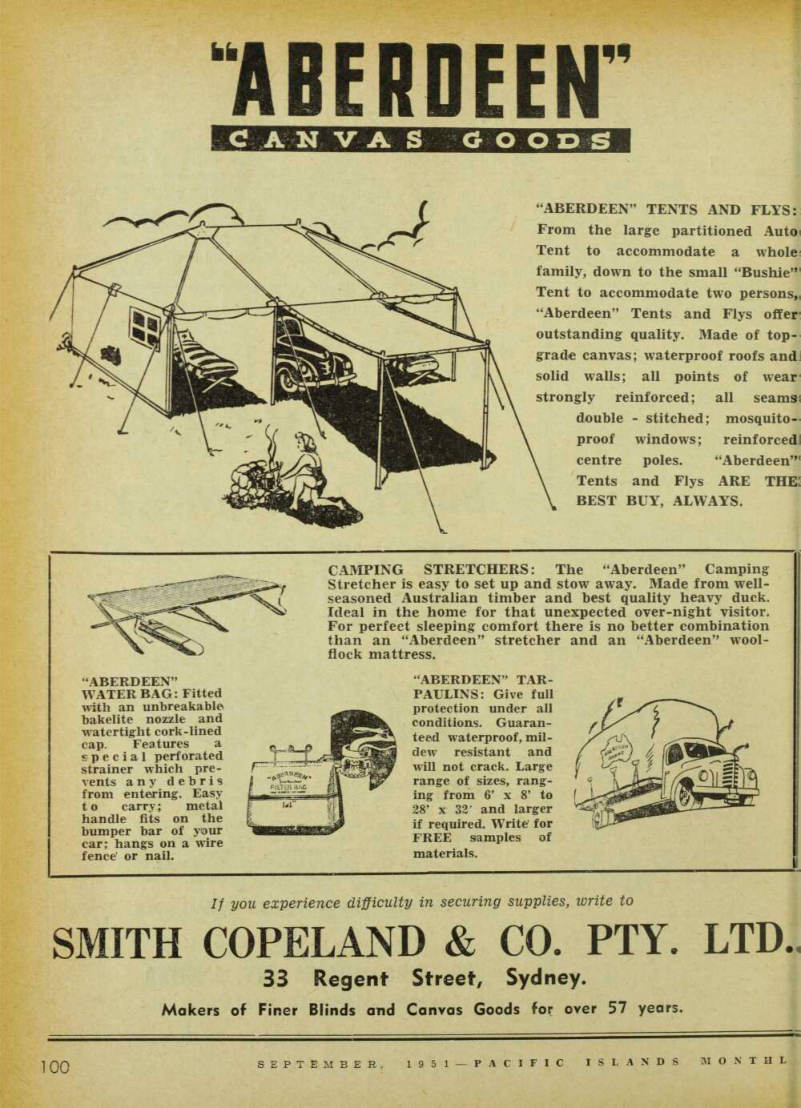
Australian Writer Critical of BSI and Papua-NGuinea
|F all the daily newspaper f journalists who have visited the Pacific Islands since the ir ended—and they are beyond unt—the only one who has suc eded in getting the Islands prob ns into focus, and has written out them in an interesting and ilpful manner, is Mr. Osmar hite, of the Melbourne Herald.
Mr. White has just concluded a ur of the New Hebrides, Solomons d Papua-New Guinea, and the [lowing (Melbourne Herald, July ) are his conclusions respecting momic conditions he investigated, le old residents of the Territories low how right he is! 3LANDS economy to-day would be as dead as Queen Anne if it were not for the fantastic copra om. Copra commands five or six ties the price it did in 1939—and yone who has had courage to go ck to plantations that survived 3 ruin and neglect of war years is rning high profits.
But, at the commercial level any way, no attention whatever is being paid to any other of the region’s resources. No serious effort is being made to revive or develop alter native industries. If copra were to crash, nothing would be left but a few settlements inhabited by civil servants.
The planters themsedves are very well aware of the danger. They are
cleaning up the profits while the going is good, and are prepared to* make a clean break when the crash comes. Few areas are being planted with new trees, and management is often on a strictly short term basis.
All this hasn’t happened by ac cident. True, the war left tragic confusion in its wake—but people were prepared to go back and build
up again if they had received any real encouragement to do so.
THEY were not encouraged. The politicians of both Britain and Australia suffered, apparently, a fine sentimental revulsion from old-fashioned colonialism. They cashed in on liberal sentiment with slogans like “Papua for the Papuans,” and set up international bodies to study how stone-age people could most effectively be educated to govern and look after themselves in the atomic age.
Morally, the intention was laud able, for the history of European colonisation of the Pacific is black with ruthless exploitation and abuse of human rights.
But, as so often happens, the re formers went far beyond the bounds of practical common sense. In seek ing to protect the native against the villainous “black-birder,” and exploiter, they created a situation infinitely more dangerous in its future implications.
Neither Britain nor Australia can afford to run their Pacific depen dencies as anthropological charities.
The resources of the area must be tapped to pay for the social services needed to improve the condition of several million people, many of whom still practise cannibalism and sorcery.
Unless efficient and profitable in dustries can be established to pay for really large-scale health and
educational services, the efforts of the benevolently minded Governments must be limited to what will be, in effect, small-scale experimental work.
Y et as I have said the effect of present colonial policy is to discourage European enterprise.
To-day it is a long, tedious and difficult business for any European western Paciflc fT is even more tedious and diffi-
1 profitably 111 The system rfln-
dentures has y been abolished, and natives can be engaged only for short terms. In effect, they can employment at will. in theory this may seem only fair. 11 is thelr land and their labour - But in practice? Is it wise in this modern world to try to lock up vast areas of forests and arable land because they happen to be the tribal huntin S grounds of S n iAtSe^Vcaso V n
thiv ran S n<? n?th?
loin maKe use 01 me iana rnemseives.
What about the human rights of the Asians next door? Hundreds of millions of them drag out a miserable existence on the edge of famine for want of living room or access to new sources of food supply.
And on the subject of native labour laws—even the most ideal istic young Government officer soon learns that Melanesians are by temperament an easy-going, in dolent, child-like people. They work only when they have to.
They are undoubtedly intelligent and teachable—but they will make prolonged effort only under dis are a poor employment risk unless
*** t 0 COntrol
rpßUE, free and compulsory school 1 education may alter this tem perament in time. But does it
»e«n to'be^We"
tirnp whpn thprp nrp miilinns nf people onfy a few hunted miles away who already have the skill and temperament to turn the swamps of the Solomons and New Guinea into padi fields, and the kunai downs into pastures?
All this is of vital »“Portance to Australia. National security de mands that we should continue to exercise a predominant influence in the island territories to the north and east of us. We can't exercise it unless we have a healthy econcmic interest as well as ad ministrative representation in the area.
Advertisements & other items, pp. 101-103 (3 items)
99
IC I F I C ISLANDS MONTHLY SEPTEMBER, 1951
Chain
ART POSTCARDS OF TONGA
Per Dozen (Including- a Tin-Catt Mail Cover), Postage Paid: 6/- (or one US Dollar).
TONGAN PHOTOS BUREAU,
Nukualofa, Tonga
DELIVERY
BRITISH SAN KEY
• The Fastest One-Man Sow Obtainable. • 12% more Power. 41 B.H.P. Engine. • Lightest One Man Saw —42 lbs weight. • Tested for Felling, Logging Cr Ripping. • Cuts at Any Angle Through 360 Degrees. • Engine Castings Magnesium Electron. • Special Alloy Cylinder Liner, Detachable Head. • Hardwood & Softwood Chains Available.
ADEQUATE SPARE PARTS AVAILABLE
BRISBANE MOTORS PTY. LIMITED
128 WICKHAM STREET, VALLEY. L 4691
CHAIN
SAW
CLUTCH FOB
CROSSCUT
CROSS-CUT
POSITION
POSITIVE
LUBRICATION
Write for farther details of Sankey improved features.
“ABERDEEN
A n It a. %
“ABERDEEN” TENTS AND FLYS:
From the large partitioned Auto< Tent to accommodate a whole; family, down to the small “Bushie’”
Tent to accommodate two persons,, “Aberdeen” Tents and Flys offer* outstanding quality. Made of topgrade canvas; waterproof roofs andi solid walls; all points of wear* strongly reinforced; all seams; double - stitched; mosquitoproof windows; reinforced! centre poles. “Aberdeen’”
Tents and Flys ARE THES
BEST BUY, ALWAYS.
CAMPING STRETCHERS: The “Aberdeen” Camping Stretcher is easy to set up and stow away. Made from wellseasoned Australian timber and best quality heavy duck.
Ideal in the home for that unexpected over-night visitor.
For perfect sleeping comfort there is no better combination than an “Aberdeen” stretcher and an “Aberdeen” woolflock mattress.
“ABERDEEN”
WATER BAG: Fitted with an unbreakable bakelite nozzle and watertight cork-lined cap. Features a special perforated strainer which prevents any debris from entering. Easy to carry; metal handle fits on the bumper bar of your car; hangs on a wire fence’ or nail.
“ABERDEEN” TAR-
PAULINS: Give full protection under all conditions. Guaranteed waterproof, mildew resistant and will not crack. Large range of sizes, ranging from 6’ x 8’ to 28’ x 32’ and larger if required. Write' for FREE samples of materials. 0 3
oil
v - 1 .
If you experience difficulty in securing supplies, write to
SMITH COPELAND & CO. PTY. LTD..
33 Regent Street, Sydney.
Makers of Finer Blinds and Canvas Goods for over 57 years.
of ths vmm mm
US m.
M Preserve it, in all its enchant* ment, with a paint fortified for tropical weather resistance, for a rich color permanency and for a mellow, even weathering.
In the Tropics
USE ONLY
BORTHWICKS
r
HIGH
GRADE
REINFORCED
HOUSE PAINT
MORRIS HEDSTROM (AUST.) PTY. LTD. AGENTS FOR
BORTHWICKS PTY. CO., Sydney
Suppliers to Defence Specifications.
100
SEPTEMBER. 1951 PACIFIC ISLANDS MONTHL
Solomon Islands Co.
THE fortieth annual report of Mamara Plantations Ltd., a Brisbane Co. which has £90,000 invested in coconut plantations in the Solomon Islands, shows that, from rentals from its leased pro
perties, it made a profit of £1,480.
This sufficed only to pay the amount due to the Cumulative Prefs. in re spect of 1946. The ordinaries (£40,000) have had nothing for years, and prospects are not good.
Directors are Messrs. W. E. Savage, Oscar Svensen, N. V. Whitehouse and S. A. Rennie.
In Crashed Plane
Search For Gold
Lost
SALVAGE expert Captain J. W.
Herd and Diver Neil Todkill returned to Brisbane on August 26, after a further effort to salvage the £35,000 in gold which was lost when the Drover plane, from Wau, unaccountably collapsed into the sea half a mile from the Lae airfield on July 16.
They found and salvaged the plane, and brought it into Lae for examination. They found Pilot J.
W. Spiers in the cockpit, and he was buried in Lae. But there was no sign of the other four of the seven persons lost, or of the gold— they had been scattered over the sea-bed when the plane partly broke up after striking the surface.
The bullion probably is lying in deep mud, anywhere within half a mile of where the wreck was found.
Captain Herd thought a further search was justified.
A company formed to breed cattle and Romney sheep in New Guinea has brought 10 pedigree Aberdeen- Angus heifers and two bulls, as well as 30 non-pedigree Aberdeen-Angus heifers from a champion breeder of Milong, NSW.
Advertisements & other items, p. 104 (2 items)
102
SEPTEMBER, 1951 PACIFIC ISLANDS MONTH LT
Tru*Wite
No Whiter White in the
South Pacific — the Best!
m High density, economical covering power imparts fresh-from-the-shop Newness. A super finish for Canvas, Kid, Suede, Nubuc and White Lacquered shoes, giving a dazzling whiteness which, when dry polished after thorough drying, WILL NOT
CRACK OR RUB OFF!
TRU*WITE
THE IDEAL WHITE LEATHER CLEARER
Sole Agent R. E. Strachan Ltd. C. P. O. Box 339, Auckland. N.Z.
Guinea c/tgenhAti,
Philips Wireless Sets 'A Remington Typewriters Burroughs Beefeater (London) Gin Pope Products Rex Aluminium Co.
"Agco" Supaluvre Windows B.A.L.M. Paints Commonwealth Insurance Co.
Study Of Atolls
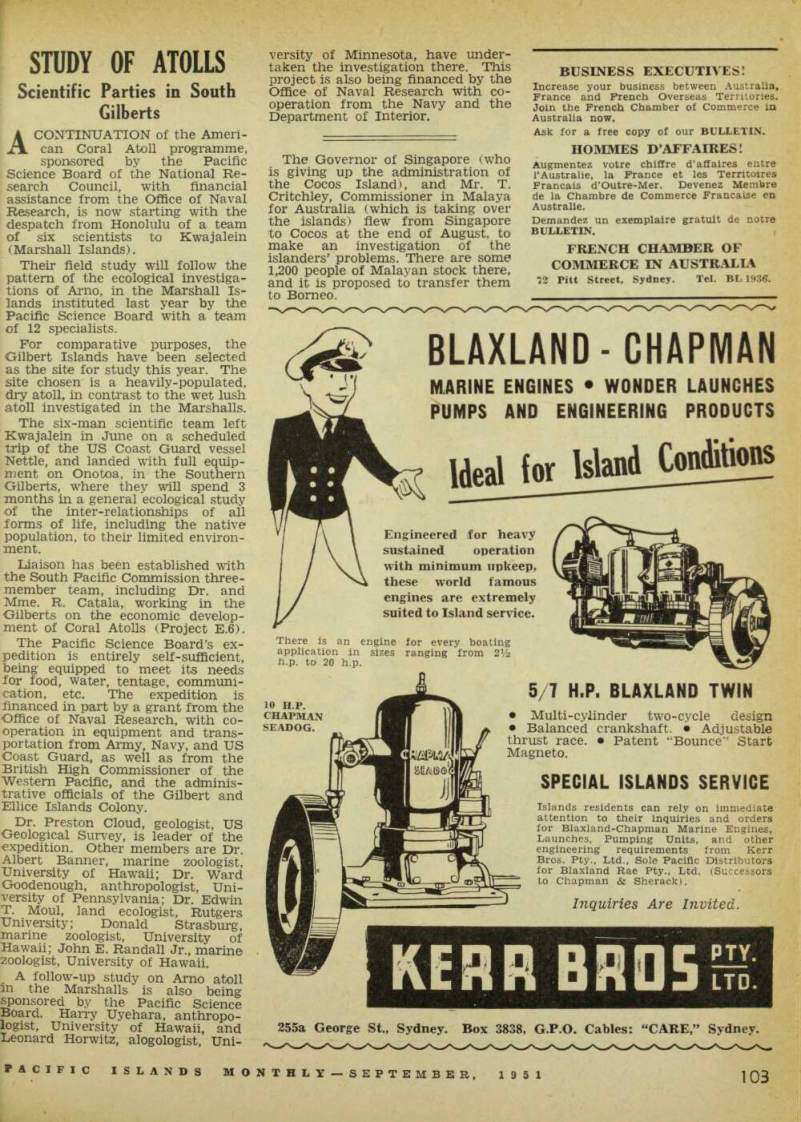
Scientific Parties in South Gilberts
A CONTINUATION of the Ameri can Coral Atoll programme, sponsored by the Pacific Science Board of the National Re search Council, with financial assistance from the Office of Naval Research, is now starting with the despatch from Honolulu of a team of six scientists to Kwajalein (Marshall Islands).
Their field study will follow the pattern of the ecological investiga tions of Arno, in the Marshall Is lands instituted last year by the Pacific Science Board with a team of 12 specialists.
For comparative purposes, the Gilbert Islands have been selected as the site for study this year. The site chosen is a heavily-populated, dry atoll, in contrast to the wet lush atoll investigated in the Marshalls.
The six-man scientific team left Kwajalein in June on a scheduled trip of the US Coast Guard vessel Nettle, and landed with full equip ment on Onotoa, in the Southern Gilberts, where they will spend 3 months in a general ecological study of the inter-relationships of all forms of life, including the native population, to their limited environ ment.
Liaison has been established with the South Pacific Commission three member team, including Dr. and Mme. R. Catala, working in the Gilberts on the economic develop ment of Coral Atolls (Project E. 6).
The Pacific Science Board’s ex pedition is entirely self-sufficient, being equipped to meet its needs for food, water, tentage, communi cation, etc. The expedition is financed in part by a grant from the Office of Naval Research, with co operation in equipment and trans portation from Army, Navy, and US Coast Guard, as well as from the British High Commissioner of the Western Pacific, and the adminis trative officials of the Gilbert and Ellice Islands Colony.
Dr. Preston Cloud, geologist, US Geological Survey, is leader of the expedition. Other members are Dr.
Albert Banner, marine zoologist, University of Hawaii; Dr. Ward Goodenough, anthropologist, Uni versity of Pennsylvania; Dr. Edwin T. Moul, land ecologist, Rutgers University; Donald Strasburg, marine zoologist, University of Hawaii; John E. Randall Jr., marine zoologist, University of Hawaii.
A follow-up study on Arno atoll in the Marshalls is also being sponsored by the Pacific Science Board. Harry Uyehara, anthropo logist, University of Hawaii, and Leonard Horwitz, alogologist, Uni
versity of Minnesota, have under taken the investigation there. This project is also being financed by the Office of Naval Research with co operation from the Navy and the Department of Interior.
The Governor of Singapore (who is giving up the administration of the Cocos Island), and Mr. T.
Critchley, Commissioner in Malaya for Australia (which is taking over the islands) flew from Singapore to Cocos at the end of August, to make an investigation of the islanders' problems. There are some 1,200 people of Malayan stock there, and it is proposed to transfer them to Borneo.
Advertisements & other items, pp. 105-106 (1 item)
Kerr Bros
BUSINESS EXECUTIVES!
Increase your business between Australia, France and French Overseas Territories.
Join the French Chamber of Commerce in Australia now.
Ask for a free copy of our BULLETIN.
HOMMES D’AFFAIRES!
Augmentez votre chiffre d’affaires entre i’Australie, la Prance et les Territolres Francais d’Outre-Mer. Devenez Membre de la Chambre de Commerce Francaise en Australia.
Demandez un exemplaire gratuit de notre
BULLETIN.
FRENCH CHAMBER OF
COMMERCE IN AUSTRALIA
72 Pitt Street, Sydney. Tel. 8L1936.
BLAXLAND-CHAPMAN
MARINE ENGINES • WONDER LAUNCHES
PUMPS AND ENGINEERING PRODUCTS
Ideal for Island Conditions
There is an engine for every boating application in sizes ranging from 2V2 h.p. to 20 h.p.
Engineered for heavy sustained operation with minimum upkeep, these world famous engines are extremely suited to Island service. 10 h.p
CHAPMAN
SEADOG.
I i
5/7 H.P. BLAXLAND TWIN
• Multi-cylinder two-cycle design • Balanced crankshaft. • Adjustable thrust race. • Patent “Bounce"’ Start Magneto.
SPECIAL ISLANDS SERVICE
Islands residents can rely on immediate attention to their inquiries and orders for Blaxland-Chapman Marine Engines, Launches, Pumping Units, and other engineering requirements from Kerr Bros. Pty., Ltd., Sole Pacific Distributors for Blaxland Rae Pty., Ltd. (Successors to Chapman & Sherack), Inquiries Are Invited.
KERR BROS
PTY.
LTD.
255 a George St., Sydney. Box 3838, G.P.O. Cables: “CARE,” Sydney.
CASH
for
SCRAP METALS
HIGHEST PRICES F.0.W., NEW GUINEA
Shells Cartridges Copper Brass Radiators Cable Aluminium Lead Muntz Metal Steel Rails Pipe ★ LA 5111 Wilford Street, Newtown, N.S.W.
LA 5111 BRANCHES THROUGHOUT N.S.W., VICTORIA & STH. AUSTRALIA Leader of the Secondary Metal Industry for 30 Years Telegraphic Address. "SCRAPMETAL," Sydney
Shipping Time-Tables
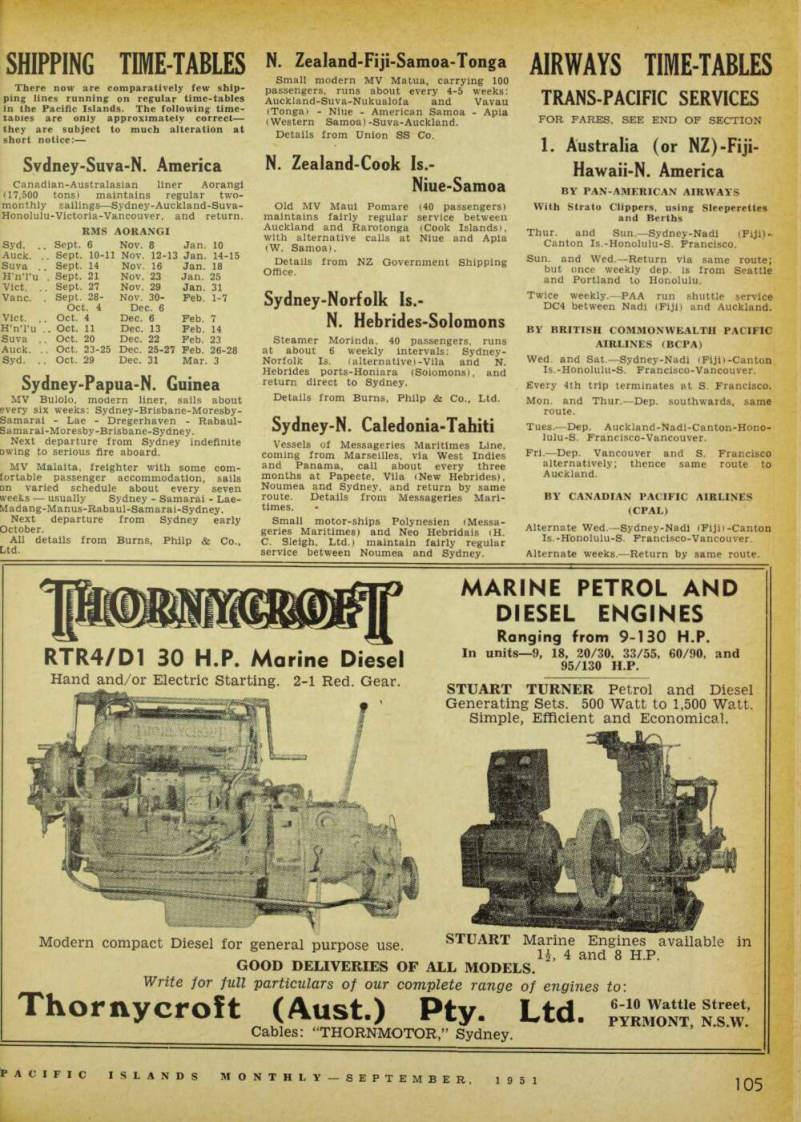
There now are comparatively few ship ping lines running on regular time-tables in the Pacific Islands. The following time tables are only approximately correct— they are subject to much alteration at short notice: —
Svdney-Suva-N. America
Canadian-Australasian liner Aorangi (17,500 tons) maintains regular two monthly sailings—Sydney-Auckland-Suva- Honolulu-Victoria-Vancouver, and return.
Sydney-Papua-N. Guinea
MV Bulolo, modern liner, sails about every six weeks: Sydney-Brisbane-Moresby- Samarai - Lae - Dregerhaven - Rabaul- Samarai-Moresby-Brisbane-Sydney.
Next departure from Sydney indefinite owing to serious fire aboard.
MV Malaita, freighter with some com fortable passenger accommodation, sails on varied schedule about every seven weeks usually Sydney - Samarai - Lae- Madang-Manus-Rabaul-Samarai-Sydney.
Next departure from Sydney early October.
All details from Burns, Philp & Co., Ltd.
N. Zealand-Fiji-Samoa-Tonga
Small modern MV Matua, carrying 100 passengers, runs about every 4-5 weeks: Auckland-Suva-Nukualofa and Vavau (Tonga) - Niue - American Samoa - Apia (Western Samoa) -Suva-Auckland.
Details from Union SS Co.
N. Zealand-Cook Is.-
Niue-Samoa
Old MV Maui Pomare (40 passengers) maintains fairly regular service between Auckland and Rarotonga (Cook Islands), with alternative calls at Niue and Apia (W. Samoa).
Details from NZ Government Shipping Office.
Sydney-Norfolk Is.-
N. Hebrides-Solomons
Steamer Morinda, 40 passengers, runs at about 6 weekly intervals: Sydney- Norfolk Is. (alternative)-Vila and N.
Hebrides ports-Honiara (Solomons), and return direct to Sydney.
Details from Burns, Philp & Co., Ltd.
Sydney-N. Caledonia-Tahiti
Vessels of Messageries Maritimes Line, coming from Marseilles, via West Indies and Panama, call about every three months at Papeete, Vila (New Hebrides), Noumea and Sydney, and return by same route. Details from Messageries Mari times.
Small motor-ships Polynesien (Messa geries Maritimes) and Neo Hebridais (H.
C. Sleigh, Ltd.) maintain fairly regular service between Noumea and Sydney.
Rms
Aorangi
Syd. ..
Sept. 6 Nov. 8 Jan. 10 Auck. . . Sept. 10-11 Nov. 12-13 Jan. 14-15 Suva ..
Sept. 14 Nov. 16 Jan. 18 H’nTu . Sept. 21 Nov. 23 Jan. 25 Vlct. . . Sept. 27 Nov. 29 Jan. 31 Vane. .
Sept. 28- Nov. 30- Feb. 1-7 Oct. 4 Dec. 6 Vlct. ., , Oct. 4 Dec. 6 Feb. 7 H’nTu . . Oct. 11 Dec. 13 Feb. 14 Suva Oct. 20 Dec. 22 Feb. 23 Auck. . . Oct. 23-25 Dec. 25-27 Feb. 26-28 Syd. ..
Oct. 29 Dec. 31 Mar. 3
Airways Time-Tables
Trans-Pacific Services
For Fares, See End Op Section
1. Australia (or NZ)-Fiji-
Hawaii-N. America
By Pan-American Airways
With Strato Clippers, using Sleeperettes and Berths Thur. and Sun.—Sydney-Nadl (Fiji)- Canton Is.-Honolulu-S. Francisco.
Sun. and Wed. —Return via same route; but once weekly dep. is from Seattle and Portland to Honolulu.
Twice weekly.—PAA run shuttle service DC4 between Nadi (Fiji) and Auckland.
By British Commonwealth Pacific
Airlines (Bcpa)
Wed. and Sat.—Sydney-Nadi (Fiji)-Canton Is.-Honolulu-S. Francisco-Vancouver.
Every 4th trip terminates at S. Francisco.
Mon. and Thur. —Dep. southwards, same route.
Tues. —Dep. Auckland-Nadi-Canton-Hono lulu-S. Francisco-Vancouver.
Fri.—Dep. Vancouver and S. Francisco alternatively; thence same route to Auckland.
By Canadian Pacific Airlines
(Cpal)
Alternate Wed. —Sydney-Nadl (Fiji)-Canton Is.-Honolulu-S. Francisco-Vancouver.
Alternate weeks. —Return by same route.
Advertisements & other items, p. 107 (1 item)
Thornycroft (Aust.) Pty. Ltd. “S’
RTR4/D1 30 H.P. Marine Diesel
Hand and/or Electric Starting. 2-1 Red. Gear. * f
MARINE PETROL AND
DIESEL ENGINES
Ranging from 9-130 H.P.
In units—9, 18, 20/30, 33/55, 60/90, and 95/130 H.P.
STUART TURNER Petrol and Diesel Generating Sets. 500 Watt to 1,500 Watt.
Simple, Efficient and Economical.
Modern compact Diesel for general nurnose use. STUART Marine Engines available in 4 and 8 H.P.
GOOD DELIVERIES OF ALL MODELS.
Write for full particulars of our complete range of engines to:
Thornycroft (Aust.) Pty. Ltd. “S’
Cables: “THORNMOTORSydney.
Sectional Services In
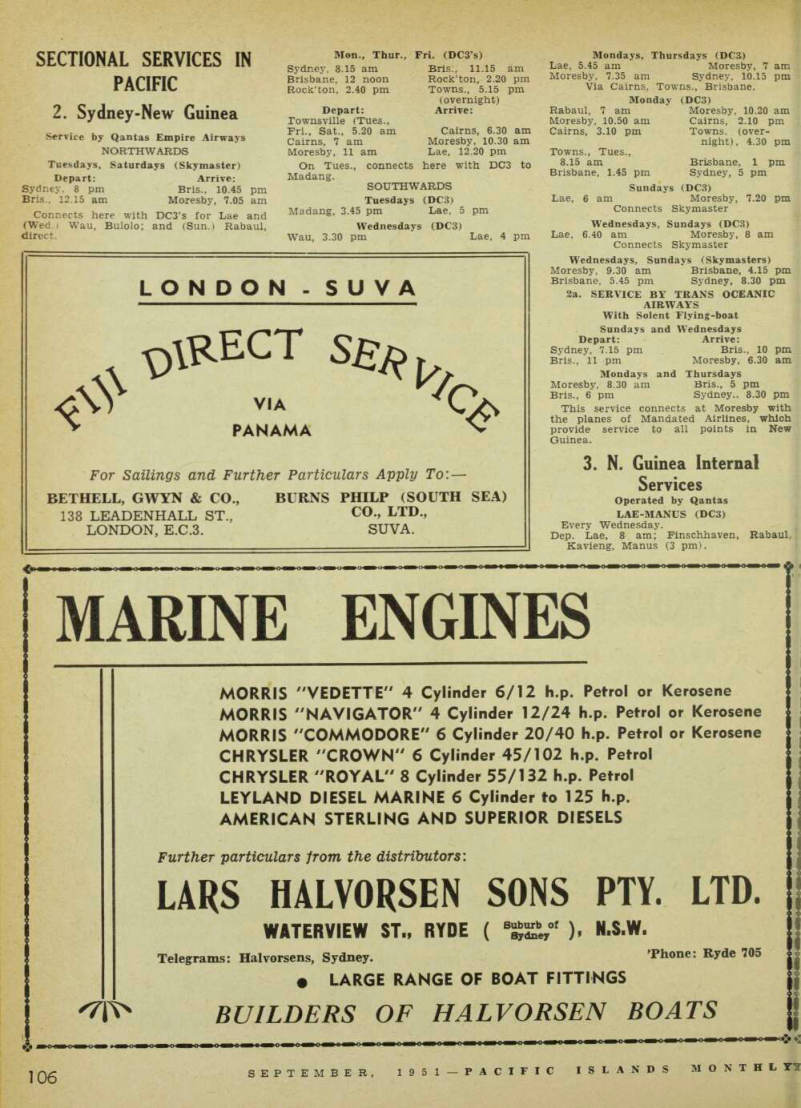
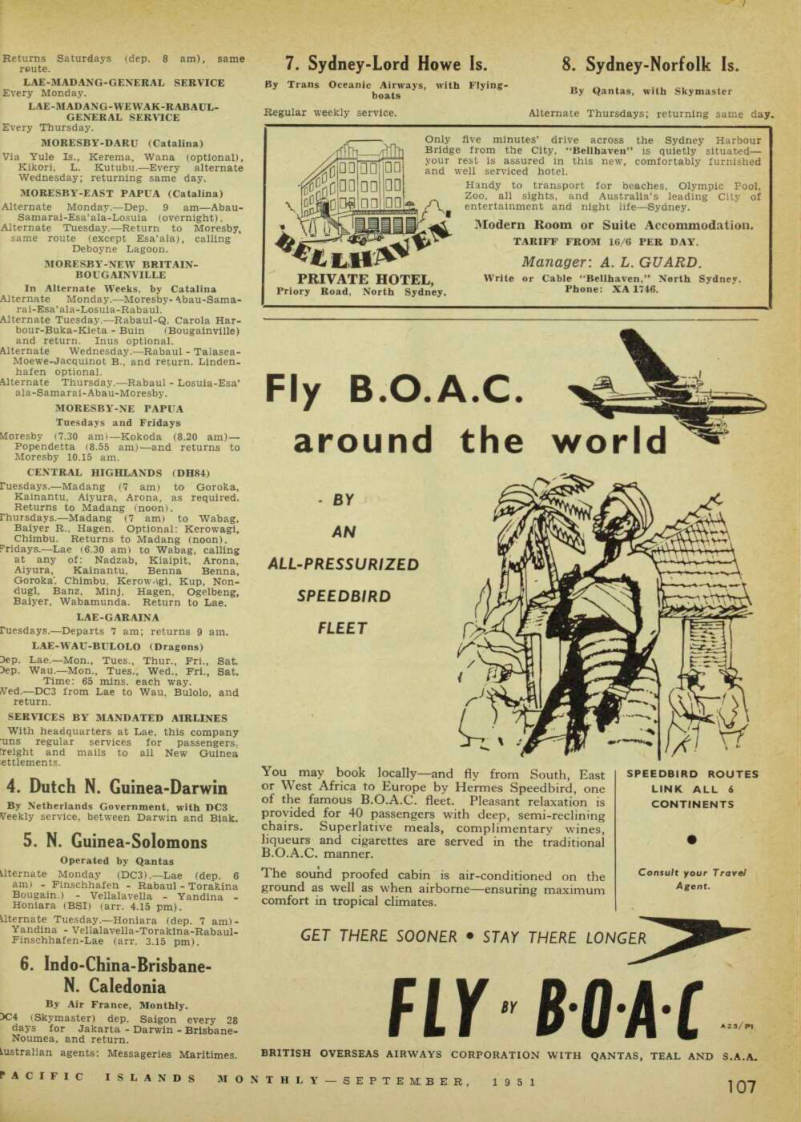
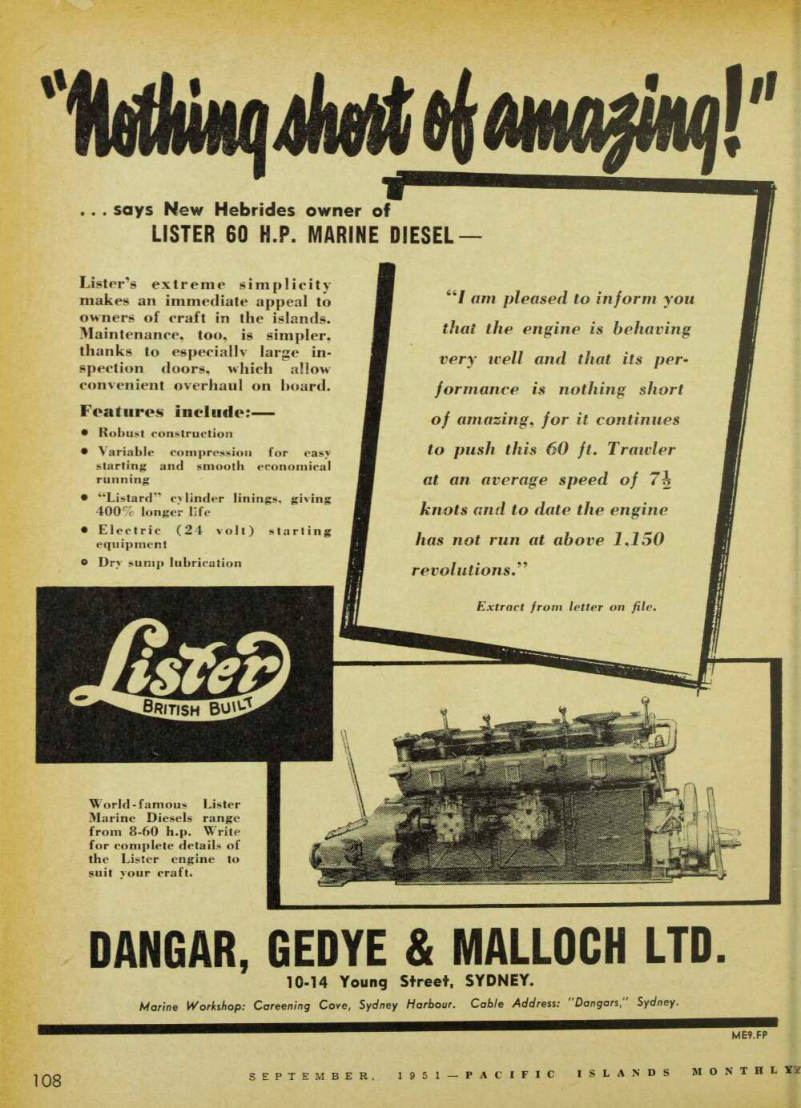
Pacific
2. Sydney-New Guinea
Service by Qantas Empire Airways
Northwards
Tuesdays, Saturdays (Skymaster) Depart: Arrive: Sydney. 8 pm Bris., 10.45 pm Bris.. 12.15 am Moresby, 7.05 am Connects here with DCS’s for Lae and (Wed i Wau, Bulolo; and (Sun.) Rabaul, direct.
Mon., Thur., Fri. (DCS’s) Sydney, 8.15 am Bris., 11.15 am Brisbane, 12 noon Rock’ton, 2.20 pm Rock’ton, 2.40 pm Towns., 5.15 pm (overnight) Depart: Arrive: Townsville (Tues., Fri., Sat., 5.20 am Cairns, 6.30 am Cairns, 7 am Moresby, 10.30 am Moresby, 11 am Lae, 12.20 pm On Tues., connects here with DCS to Madang.
Southwards
Tuesdays (DCS) Madang, 3.45 pm Lae, 5 pm Wednesdays (DCS) Wau, 3.30 pm Lae, 4 pm
Mondays, Thursdays (DCS) Lae, 5.45 am Moresby, 7 am Moresby, 7.35 am Sydney, 10.15 pm Via Cairns, Towns., Brisbane.
Monday (DCS) Rabaul, 7 am Moresby, 10.20 am Moresby, 10.50 am Cairns, 2.10 pm Cairns, 3.10 pm Towns, (over night), 4.30 pm Towns., Tues., 8.15 am Brisbane, 1 pm Brisbane, 1.45 pm Sydney, 5 pm Sundays (DCS) Lae, 6 am Moresby, 7.20 pm Connects Skymaster Wednesdays, Sundays (DCS) Lae, 6.40 am Moresby, 8 am Connects Skymaster Wednesdays, Sundays (Skymasters) Moresby, 9.30 am Brisbane, 4.15 pm Brisbane, 5.45 pm Sydney, 8.30 pm
2A. Service By Trans Oceanic
Airways
With Solent Flying-boat Sundays and Wednesdays Depart: Arrive: Sydney, 7.15 pm Bris., 10 pm Bris., 11 pm Moresby, 6.30 am Mondays and Thursdays Moresby, 8.30 am Bris., 5 pm Bris., 6 pm Sydney.. 8.30 pm This service connects at Moresby with the planes of Mandated Airlines, which provide service to all points in New Guinea.
3. N. Guinea Internal
Services
Operated by Qantas
Lae-Manus (Dcs)
Every Wednesday.
Dep. Lae, 8 am; Finschhaven, Rabaul.
Kavieng, Manus (3 pm).
Returns Saturdays (dep. 8 am), same route.
Lae-Madang-General Service
Every Monday.
Lae-Madang-Wewak-Rabaul
General Service
Every Thursday.
MORESBY-DARU (Catalina) Via Yule Is., Kerema, Wana (optional), Kikori, L. Kutubu. —Every alternate Wednesday; returning same day.
Moresby-East Papua (Catalina)
Alternate Monday.—Dep. 9 am—Abau- Samarai-Esa’ala-Losuia (overnight).
Alternate Tuesday.—Return to Moresby, same route (except Esa’ala), calling Deboyne Lagoon.
Moresby-New Britain
Bougainville
In Alternate Weeks, by Catalina Alternate Monday.—Moresby- 4bau-Sama rai-Esa’ala-Losuia-Rabaul.
Alternate Tuesday.—Rabaul-Q. Carola Har bour-Buka-Kieta - Buin (Bougainville) and return. Inus optional.
Alternate Wednesday.—Rabaul - Talasea- Moewe-Jacquinot 8., and return. Linden hafen optional.
Alternate Thursday.—Rabaul - Losuia-Esa’ ala-Samarai-Abau-Moresby.
Moresby-Ne Papua
Tuesdays and Fridays Moresby (7.30 am)—Kokoda (8.20 am) Popendetta (8.55 am) —and returns to Moresby 10.15 am.
Central Highlands (Dhb4)
Puesdays.—Madang (7 am) to Goroßa, Kainantu, Aiyura, Arena, as required.
Returns to Madang (noon).
Ihursdays.—Madang (7 am) to Wabag.
Baiyer R., Hagen. Optional; Kerowagi, Chimbu. Returns to Madang (noon).
Fridays.—Lae (6.30 am) to Wabag, calling at any of: Nadzab, Kiaipit, Arena, Aiyura, Kainantu, Benna Benna, Goroka', Chimbu. KerowAgi, Kup, Non dugl, Banz, Minj, Hagen, Ogelbeng, Baiyer, Wabamunda. Return to Lae.
Lae-Gar Aina
ruesdays.—Departs 7 am; returns 9 am.
LAE-WAU-BULOLO (Dragons) Dep. Lae.—Mon., Tues., Thur., Fri., Sat.
Dep. Wau.—Mon., Tues., Wed., Fri., Sat.
Time: 65 mins, each way.
Ved. —DC3 from Lae to Wau, Bulolo, and return.
Services By Mandated Airlines
With headquarters at Lae, this company uns regular services for passengers, freight and mails to all New Guinea ettlements.
4. Dutch N. Guinea-Darwin
By Netherlands Government, with DCS Veekly service, between Darwin and Biak.
5. N. Guinea-Solomons
Operated by Qantas Alternate Monday (DC3).—Lae (dep. 6 am) - Finschhafen - Rabaul - Torakina Bougain.) - Vellalavella - Yandina - Honiara (BSI) (arr. 4.15 pm).
Alternate Tuesday.—Honiara (dep. 7 am)- Yandina - Vellalavella-Toraklna-Rabaul- Finschhafen-Lae (arr. 3.15 pm).
6. Indo-China-Brisbane-
N. Caledonia
By Air France, Monthly, DC4 (Skymaster) dep. Saigon every 28 days for Jakarta - Darwin - Brisbane- Nouraea, and return. lustralian agents; Messageries Maritimes.
7. Sydney-Lord Howe Is.
By Trans Oceanic Airways, with Flying boats Regular weekly service.
8. Sydney-Norfolk Is.
By Qantas, with Skymaster Alternate Thursdays; returning same day.
9. Sydney-New Hebrides
’ Qantas, with Sandringham Flying-boat Frequent non-scheduled flights, thus:— d., dep. 9.30 pm Noumea, 6.30 am iu., dep., 8.30 am Vila, 10 am la, dep. 11 am Santo, 1 pm nto, dep. 6 am Vila, 8 am la, dep. 10 am Nou., 11.30 am u., dep. 12.30 pm Syd., 7.45 pm
10. Sydney-Noumea-Suva
iy Qantas, with Flying-boats, Weekly Depart: Arrive: dney, Fri., Noumea, Sat., 9.30 pm 6.30 am umea, Sat.. 8.30 am Suva, Sat., 3 pm va. Sun., 6 am Noumea, Sun., 10.30 am umea, Sun., Sydney. Sun.. 12.30 pm 7.45 pm
11. Auckland-Norfolk Is.
ly NZ National Airways, with DC3’s idays.—From Auckland, returning same day. ernate Sundays.—One additional service, same day. See also table No. 8.
12. Sydney-Auckland
Tasman E. Airways, with Solents ). Sydney. Mon., Fri., 11.59 pm; Thur., Fri., 8 am. ). AK, Tues., Wed., Thur., Sat., 9 am.
Av. crossing time, 6V2 hours, itralian bookings: Qantas or TAA.
13. Sydney-Wellington
Tasman E. Airways, with Solents ). Sydney, Tues.. Wed., Thur., Sun., 10.30 pm. ). Wellington, Mon., Wed., Thur., Fri., 11 am.
1. Melbourne-Christchurch
Tasman E. Airways, with DC4 irs. —Dep. Melb., 9.20 pm; arr. Ch’ch., 8.15 am. —Dep. Ch’ch., 11 am; arr. Melb., 5.35 pm.
15. New Zealand-Fiji
Tasman Empire Airways, with Solents Depart: Arrive: kland, Tues., Suva. Tues., 7 am 12.30 am
Suva, Tues., 9 am Labasa, Tues., 10 am Labasa, Tues.. Suva, Tues., 1 pm Noon Suva, Wed., 7 am Auckland, Wed., 1.30 pm
16. Auckland-Fiji-Samoa-
Cooks
By NZ National Airways Corporation Alternate Wednesdays, by DCS, via Norfolk Is., Nadi (Fiji), Faleolo (W.
Samoa), Aitutaki (Cook Is.) Depart: Arrive: Auck., 9 am Norfolk Is.. 12.55 pm Norfolk, 2 pm Nadi, 8.40 pm Nadi. Thur., 10.15 am Faleolo, 4 pm Faleola, 8 am Aitutaki, 1.50 pm Aitutaki, 2.50 pm Rarotonga, 4 pm Rarot’a, alt. Sat., 8 Aitutaki, 9.15 am Aitutaki, 10 am Faleolo, 3.15 pm Faleola. Sun., 10 Nadi. 1.45 pm Nadi, 5 am Norfolk. 10.55 am Norfolk, noon Auckland, 4.50 pm Alternate Wednesdays—DCS Depart: Arrive: Nadi, 6.45 am Faleolo, 12.30 pm Faleolo. 1.15 pm Nadi, 5 pm * Western Time.
17. New Zealand-Chatham Is.
By Tasman Empire Airways, with Flying-boat Once monthly, from Auckland and Wel lington, from October until April.
18. Tahiti-Cook Islands
By Tahiti Airways, of Papeete Once monthly, from Papeete to Aitutaki
(Cook Is.) with mails and passengers, returning same day.
19. Micronesia
Civilian services, based on Guam, using 2-engined amphibious Catalinas, run re gularly to Koror (Palau), Yap (West Carolines*, Truk (Central Carolines), Ponape (E. Carolines), Majuro (Marshalls) and Saipan (Marianas). Details from Trans-Ocean Airlines, Guam, via Honolulu.
Approximate Airways Fares
The following figures are not guarantea accurate, but they are approximate correct. Details should be obtained fro the Air Company named in the Tabo Unless otherwise indicated, figures are Australian currency.
From Sydney To
Moresby . amgie £39 5 0 Keiurn £70 13 0 Tabll -NO. 2, 2aj Lae .. 48 15 0 87 15 0 2. 3 Rabaul .. 61 12 0 110 18 0 2, 3 Honiara,
Bsi ..
77 0 0 138 12 0 5 Vila. N.
Hebrides 42 10 0 76 10 0 9, Noumea, NC . .. 37 10 0 67 10 0 10, 9( Norfolk Is. 25 0 0 45 0 0 8 L. Howe . 10 16 0 21 12 0 7 Nadi (Fiji) . 57 15 0 103 19 0 1 Suva (Fiji) . 55 10 0 99 18 0 10 Auckland 39 8 0 70 19 0 12 Wellington . .. 39 8 0 70 19 0 13 I Ciiristcli. (from Melb.) . 44 2 0 79 8 0 14 Honolulu . 217 15 0 391 19 0 li S. Fran’co 265 10 0 477 18 0 H Vancouver 265 8 0 477 15 0 H
From Auckland
Single TO— Return Ta t XV Norf. Is. £14 0 0 NZ Less 10 f > 11, .
Nadi (Fiji) . 31 0 0 1,.
Suva (Fiji) . 31 0 0 16 Samoa . 39 10 0 »» *» 16 Cook Is. 45 0 0 »» 99 16 Suva (direct) 31 0 0 ,, £55 16 0 15 1
Advertisements & other items, pp. 108-112 (2 items)
Direct
LONDON - SUVA
VIA
PANAMA
For Sailings and Further Particulars Apply To: BETHELL, GWYN & CO., BURNS PHILP (SOUTH SEA) 138 LEADENHALL ST., co > LTD >
LONDON, E.C.3. SUVA.
MARINE ENGINES
MORRIS "VEDETTE" 4 Cylinder 6/12 h.p. Petrol or Kerosene MORRIS "NAVIGATOR" 4 Cylinder 12/24 h.p. Petrol or Kerosene MORRIS "COMMODORE" 6 Cylinder 20/40 h.p. Petrol or Kerosene CHRYSLER "CROWN" 6 Cylinder 45/102 h.p. Petrol CHRYSLER "ROYAL" 8 Cylinder 55/132 h.p. Petrol LEYLAND DIESEL MARINE 6 Cylinder to 125 h.p.
AMERICAN STERLING AND SUPERIOR DIESELS
Further particulars -from the distributors :
LARS HALVORSEN SONS PTY. LTD.
WATERVIEW ST., RYDE ( Sydney )» NiSiWi Telegrams: Halvorsens, Sydney. ’Phone: Ryde 705
• LARGE RANGE OF BOAT FITTINGS
BUILDERS OF HALVORSEN BOATS
Cm an & 1
PRIVATE HOTEL,
Priory Road, North Sydney.
Only five minutes’ drive across the Sydney Harbour Bridge from the City, “Bellhaven” is quietly situated— your rest is assured in this new, comfortably furnished and well serviced hotel.
Handy to transport for beaches, Olympic Pool, Zoo, all sights, and Australia’s leading City of entertainment and night life—Sydney.
Modern Room or Suite Accommodation.
TARIFF FROM 16/6 PER DAY.
Manager : A. L. GUARD.
Write or Cable “Bellhaven,” North Sydnev.
Phone: XA 1746.
Fly 8.0.A.C.
around the world
?k £ f/ n You may book locally—and fly from South, East or West Africa to Europe by Hermes Speedbird, one of the famous 8.0.A.C. fleet. Pleasant relaxation is provided for 40 passengers with deep, semi-reclining chairs. Superlative meals, complimentary wines, liqueurs and cigarettes are served in the traditional 8.0.A.C. manner.
The sound proofed cabin is air-conditioned on the ground as well as when airborne—ensuring maximum comfort in tropical climates.
SPEEDBIRD ROUTES
LINK ALL 6
CONTINENTS
Consult your Travel Agent.
GET THERE SOONER • STAY THERE LONGER
Fir BOAC
<zs/i BRITISH OVERSEAS AIRWAYS CORPORATION WITH QANTAS, TEAL AND S.A.A.
. says New Hebrides owner of
LISTER 60 H.P. MARINE DIESEL
Lister’s extreme simplicity makes an immediate appeal to owners of craft in the islands.
Maintenance, too, is simpler, thanks to especially large inspection doors, which allow convenient overhaul on hoard.
Features Include;— • Robust construction • Variable compression for easy starting and smooth economical running • “Listard” cylinder linings, giving 400% longer life • Electric (24 volt) starting equipment o Dry sump lubrication
British Bo\^
World- famous Lister Marine Diesels range from 8-60 h.p. Write for complete details of the Lister engine to suit your craft.
I am pleased to inform you that the engine is behaving very well and that its per-
formance is nothing short
of amazing , for it continues
to push this 60 ft. Trawler
at an average speed of 7\
knots and to date the engine has not run at above I*lso revolutions .”
Extract from letter on file.
DANGAR, GEDYE & MALLOCH LTD.
10-14 Young Street, SYDNEY.
Marine Workshop: Careening Cove, Sydney Harbour. Cable Address: Dangers, Sydney.
ME9.FP
BERRY’S BAY
BOATYARD
(B. J. Halvorsen—Manager)
Specialists in Island vessels.
All kinds of boat-building and repairing.
New and used boats and engines for sale.
Quotations and estimates free.
BERRY’S BAY BOATYARD
John Street, North Sydney, N.S.W.
CAPTAIN W. L. KENNEDY
(Established 1931).
SHFPBROKERS, BUSINESS Cr REAL ESTATE
63 Pitt Street/ Sydney.
’Phone: BW 6461. Cables: “CAPKEN,” Sydney.
LISTING:
Auxiliary Schooners and Ketches suitable for Pacific work: THREE-MASTED SCHOONER. —Steel, 150 h.p., H.D. diesel, approx. 110 ft. x 25 ft. x 9 ft., three hatches, sails, deadweight 260 tons. Class German Lloyds. 1930. £lO,OOO Sterling.
AUXILIARY SCHOONER. —Steel. Deadweight cargo 240 tons, 104 ft. x 21 ft.. 220 h.p. H.D. diesel. 3 hatches. £ IG.OOO Sterling.
AUXILIARY KETCH.—9I ft. x 23 ft., cargo deadweight 240 tons, construction oak and beech, 140 h.p. H.D.. diesel, two hatches, sails. £11,500 Sterling.
THREE-MASTED SCHOONER.—SteeI, 114 ft. x 23 ft., cargo deadweight 320 tons, two hatches, two winches, electric light, 200 h.p. H.D. An exceptionally fine ship. £24,500 Sterling.
AUXILIARY KETCH. —Steel, 130 ft. x 21 ft., 315 tons, cargo deadweight, two hatches, wireless, radiophone, 160 h.p. H.D. diesel. £17.000 Sterling.
ALSO Cargo Boats. Tugs, Trawlers. Workboats and L.F.B.’s, Class Bridge and R.D. Cruisers, Auxiliaries and Launches, all types. \ WE ARE ALSO AGENTS FOR MOST MAKES OF MARINE DIESELS.
Inquiries Invited.
jl Through our Business and Real Estate Branch, we can offer a wide variety of Sydney and N.S.W. properties. All Island inquiries promptly and ll satisfactorily attended to.
GABRIEL ACHUN
Importer and Wholesale Merchant
Malaguna Road
RABAUL
Territory of New Guinea Specialises in:
BEERS.
BICYCLES.
AERATED WATER MANUFACTURING.
COTTON PIECEGOODS FOR NATIVE TRADE.
AGENT FOR “STANDARD” AND “TRIUMPH” CARS.
Proprietor:
RABAUL CORDIAL FACTORY.
Telegraphic Address:
“GABRIEL ACHUN.” RABAUL.
Telephone 136. Telegrams: “AKUN” RABAUL.
ALOIS AKUN & COMPANY
RABAUL, TERRITORY OF PAPUA-NEW GUINEA
Also at 180 NATHAN HOAD, KOWLOON, HONG KONG.
Planters and General Merchants
WE CARRY STOCKS OF:—
(1) Embroidered Sllkware, Carved Camphor-wood Boxes.
Eastern Fancy Goods. (2) The Best of Beers, in different Brands —“San Miguel,”
“Red Horse” and “Three Horse.” (3) Cotton Piece Goods suitable for trade and issues. (4) Trade goods of all descriptions: Wholesale and Retail.
Prompt attention to all orders Sydney Representatives: NELSON & ROBERTSON PTY. LTD., Electra House, 12 Spring Street, Sydney, N.S.W.
mwmrn
r, </, \ 'J n /;
you can taste the quality in
“VALIANT” RUI*
“Valiant” Rum has a smoothness on the tongue, and a richness which comes from the use of the finest ingredients. “Valiant” Rum has a deep, ruby colour and a mellow maturity which is the natural result of long ageing in the cask.
Words cannot fully describe a flavour, so we’ll simply say that here’s a refreshing, bracing flavour that makes a very happy first impression, and improves with acquaintance.
If you haven’t tried “Valiant” Rum as yet, then the best time for you may be your next opportunity.
Valiant
PURE RUM
Fully-matured in the wood
September, 1951 Pacific Islands Monthii
Advisory Councils
In New Guinea ae, Wau and Morobe District
From Our Own Correspondent LAE, Sept. 4.
VHE announcement that the Ad ministrator has approved of the formation of “District Ad -sory Councils,” and has appointed s nominees thereto, has rather nfused the matter of advisory ocedure.
We now have the Legislative mncil, the Town Advisory Coun s, and the District Advisory •uncils.
There are only three elected per is in the whole of the triple set —these are the three elected ople on the Legislative Council— the rest are nominated by the Iministrator. far as can be ascertained, the strict Advisory Council will deal th matters—in an advisory aacity, of course—which are out e the province of the Town Ad orv Councils, whose “advisory” ictions are confined to the town ?as. rhis is exemplified so far as the >robe area is concerned, by the ced question of the Markham idge. The interest shown by the iu Advisory Council, and the Lae visory Council, in the proposal it the river be spanned at Kirk ids, is, according to local authori s, entirely misplaced, as those lies should be interested only in ;n matters. apparently, this is where the Dis ’t Council comes in—by the jointment of representatives who i deal with matters in a wider a.
Juite laudable, it may be said; in the selection of the addi lal body, the powers that be, in r ising the Administrator as to )ointments —in an advisory acity—have nominated men who -ady are members of the Town /isory Councils. That might have n avoided: although these obare men with interests in n and district and they provide iseful liaison between town and ntry.
’he following have been
lointed by the Administrator to stitute the Morobe District Ad >ry Council:— orman White, Snr., Wau, agri ;urist, and member of the Wau dsory Council. i orman Wild, Wau, mining aager, and member of the Wau risory Council. redk. G. Rose, electrical engi r, Bulolo Gold Dredging Ltd. ames A. Birrell, manager, Morobe nsport Co., and member of the Town Advisory Council.
A. J. Bretag, Lae, manager of New Guinea Industries Ltd., and chair man of the Lae Advisory Council.
Jas. A. Peterson, Lae, manager of Burns Philp (NG) Ltd., and vice chairman of the Lae Advisory Council.
Rev. Frerichs, Lae, Superintend ent of the Lutheran Mission.
Tang Kam Hong, Lae, Chinese businessman, and representative of the Chinese community in Lae.
The inaugural meeting of the new body will be called at an early date by the District Commissioner.
It is a good Council; but we can not help asking why some of the highly respected pioneer residents of the Morobe district, who surely have a wide knowledge of district, matters, have been passed over in favour of town merchants who al ready are members of the Town Councils.
Advertisements & other items, pp. 113-114 (3 items)
111
CIFIC ISLANDS MONTHLY SEPTEMBER. 1951
fresh Crispness
-T: C* P vP M
f njoy the Oven*
and flavour of
This well-designed, air-tight and moisture-proof pack: brings you Savoury SAY-VEE Crackers in perfect condition. Try them with jam, cheese or any other favoured spread.
Bach packet contains Va lb. net ... 4 dozen appetising, wholesome crackers ideal for suppers, luncheons, and ’tween-meal snacks.
TALLERMAN & CO. PTY. LTD.
60-62 York Street, Sydney. N.S.W.
Cable Address: “FRESHET.” SYDNEY.
WHAT’S THE USE OF ADVERTISING.
ALL GOOD BAKERS USE
“BLUE SUPERB FLOUR.”
FINE & DRY
MUNGO SCOTT PTY. LTD., Flour Millers, Smith Street, Summer Hill, N.S.W., Australia.
Aladdin liqbts the way to belter living
STORMPROOF
LANTERN
This Pressure Kerosene Stormproof Lantern gives 300 candle power of brilliant light. in any kind of weather.
MODEL 1609:
Throws a flood of light on to the work area. Avoids direct light being thrown into the eyes.
Good lighting and convenient
cooking contribute much to com-
fortable living, and Aladdin lampu
and cooking appliances have been
famous for more than a cen-
tury. Burning ordinary lighting
kerosene, Aladdin product:;
provide the comfort ano
convenience of gas or elec-;
tricity. They are un-
equalled in efficient
and ease of operation.
THE WORLD’S MOST WONDERFUL LAMP
Aladdin light is the closest of all to natural daylight. and these non-pressure lamps give a steady white light of 75 candle-power. There is no smoke or fumes, no pumping. They light at the touch of a match! Burning 94% air and only 6% kerosene, these modern lamps are extremely economical in use, and safe and easy to use.
2 BURNER PORTABLE STOVE
Compact efficient pressure Kerosene stove has adjustable self-pricking burners. Available with metal carrying case for outdoor cooking.
ELEVATED RANGE
Compact, modern pressure range is attractively finished in porcelain.
Has five self-pricking burners adjustable to any heat, and insulated oven cooks perfectly.
MODEL
1609.
MODEL
16-10.
X
MODEL
1671.
BURNER RANGE
MODEL
MODEL
1630. 1680.
Modern porcelain-finished pressure Kerosene range has all the advantages of gas or electric stoves. Heat is adjustable from “simmer” to “boil” and insulated oven cooks perfectly.
Obtainable through your Australian Buying House or Local Storekeepq Manufacturers: ALADDIN INDUSTRIES PTY. LTD. 61-71 Bourke Street, Waterloo, N.S.W.
112
SEPTEMBER, 1951 PACIFIC ISLANDS MON T H L
Bulolo Afire
Out of P-NG Run For 2-3 Months
ON Wednesday, August 29, 48 hours after the Burns Philp motor- liner Bulolo (6,397 tons) arrived in Sydney from Papua-New Guinea, the copra in No. 3 hold was found to be ablaze. Spontaneous combustion is blamed.
Firefighters poured in enormous quantities of water, but the fire got Digger. The liner carried so much water that she developed a iangerous list. Everyone was ordered off, and she was hurriedly xjwed across the harbour to Kero sene Bay and beached in the mud.
After another 24 hours, the fire vas quenched. The water then was mmped out, the Bulolo was hauled >ff the mud, and returned on Friday o her berth at Walsh Bay. As she tfas coming in, she bumped the iner Marinella, and both vessels vere slightly damaged.
The ship has suffered no tructural damage, but there is a :reat deal of general superficial lamage, and destruction especially n No. 3 hold, and in the refrigera i°n section. It is estimated that epairs will take two to three lonths.
The next sailing of the Bulolo was
cancelled at once ai\d the October sailing probably will be: 160 passengers, due to sail north in September, had to make other arrangements.
The worst feature of the accident was the disturbance of arrange ments made to send urgent cargo to Papua-New Guinea, especially foodstuffs and refrigerator items.
The following arrangements were announced within a couple of days by Burns Philp and Co.: ® The freighter Burnside, then loading for Singapore, was in structed to also load refrigerated cargo for Port Moresby. • The Nellore, for the East, also would load refrigerated cargo for New Guinea ports. • Other ships would similarly lift cargo for the Territories. • The Mangola, which was then at Madang, would be brought south as soon as possible, to take over some of the Bulolo’s services.
A Burns Philp spokesman said that the damage to the Bulolo was less than had been at first antici pated.
The first High Commissioner of the American Trust Territory of Micronesia is Mr. Elbert D. Thomas former US Senator from the State of Utah, professor of political science, and a Far Eastern mis sionary for many years.
As an indication of developments, it is noted that TEAL on September 1 took over, in Suva, the office that has been maintained there by NZ National Airways for some years. It will be, for the present, TEAL’s Islands headquarters. Mr. John Wisdom is in charge.
Advertisements & other items, pp. 115-118 (4 items)
umuiwuuumuummml
Now Available For the Island «
HOLLAND RUSK
and Allied Products We manufacture Holland Rusks, Butter Johns. Speculaas. Jubilee Par-T-Pack.
Almond Rings. Breakfast Cake, Edam Cheese Crunches. Cocktail Buttons.
Celery Rondelles, etc. Individually packed and shipped in sealed tins and cases for the Tropics.
Write for Price List.
“HOLLAND RUSK"
32 PARRAMATTA RD.. STRATHFIELD,
SYDNEY, N.S.W.
On sale at Colyer Watson (N.G.) Ltd. stores, or order from your favourite Agent.
n e AKTA^ITEw„to-—;
Good nutrition and really buoyant health go hand in hand. MtS* A Modern cooking methods can destroy a high proportion of the vitamins in our food and, although our meals may satisfy our appetites, the essential vitamins may be lacking.
A diet inadequate in vitamins can so frequently cause, especially in tropical climates, troublesome “run-down” conditions characterised by lassitude, nerviness, sleeplessness, loss of appetite, etc. ‘AKTA-VITE’ Nutritive Food Tonic is valuable in correcting these conditions. particularly because it provides definite and stated quantities of four vitamins essential to good nutrition.
Each two teaspoonful dose contains: Vitamin A 2000 International Units Vitamin Bl 300 Vitamin C 300 "
Vitamin D 1000 ” plus calcium, phosphorus and carbohydrate.
AKTA-VITE’ is especially valuable for nursing mothers and growing children. 5 : : .?0 AKTA-VITE ’ is so pleasant and easy to take ; it combines the four vitamins, together with calcium and phosphorus in delicious crunchy granules. This can be taken as such straight off a spoon, mixed with c f ,l,ee ' m,lk to mik = » P |elsint ‘pread on sandwiohes or sprinkled on other foods desserts cereals, etc. To preserve the vitamins. AKTA-VITE' should not be cooked with foods but added when vervm?
Ethical Division NICHOLAS PTY. LTD
Melbourne. Sydney. Brisbane Adelaide, and Perth.
umuiwuuumuummml
A ' VH I T *.
* *2 rut
Put Your Family
FIRST
Every estate and trust, regardless of size, MUST have efficient administration. Otherwise your family’s interests cannot be fully protected. The first step towards ensuring capable management is a consultation with your solicitor regarding the appointment of Burns Philp Trust Company Limited as executor or trustee of your estate.
To assist you in planning this practical safeguard for your beneficiaries, a most interesting booklet, “Hands That Never Leave The Wheel,” is available. A complimentary copy can be obtained from any branch of Burns Philp (South Sea) Company, Burns Philp (New Guinea) Limited, Burns Philp (New Hebrides) Limited, or direct from the head office of this Company.
DIRECTORS:
James Burns. Joseph Mitchell.
P. T. W. Black. Eric Priestley Lee.
MANAGER: L. S. Parker.
SECRETARY: E. R. Overton, F.F.I.A.
Burns Philp Trust
COMPANY LIMITED
Executor • Trustee • Attorney
Head Office: 7 Bridge Street, Sydney.
Tel.: BU 5901 Box 543, G.P.O.
N.S.W. Agencies at Armidale, Orange and Tamworth.
Also Registered Offices at Melbourne, Brisbane, Port Moresby {Papua), and Vila {New Hebrides) .
TAHITI
To Shipmosfers and Visitors
When calling at Tahiti, and seeking SHIPS SUPPLIES and
FRESH PROVISIONS, see—
OSCAR G. NORDMAN
Sup p l y Agent for Messageries Maritimes, Union S.S. Co. of N.Z. Ltd Matson-Oceanic Line, United States Line, General S.S. Corp., Etc!
We supply General Service Act as Shipping Agents Address all inquiries to the Tourist Bureau.
OSCAR G. NORDMAN, Ship Chandler
PAPEETE, TAHITI.
Wire before your arrival “OCEANIC Papittit" . . , vrctaixic. PAPEETE —Our registered cable address.
Indoor Sanitation
THE NEW HYGIENIC
‘SANARY SEAL”
No Installation Costs
• BANISHES THE FLY PEST
• DESTROYS BACTERIA
• EASY TO KEEP CLEAN
• NO UNPLEASANTNESS
• IDEAL FOR CHILDREN
T<»i • SEAL” and the powerful “SAN g,ve jou indoor sanitation with no installation costs. The “SANARY SEAL” is a COmpaL : t unit which does not look out ot place in the bathroom. Requires onlv weekly emptying. 4 *
WRITE FOR
BOOKLET
J rT H E DAKEN CORPORATION PTY. LTD 27 King Street, Sydney (Box 2139, G.P.O.> ’
Booklet P ° St m 6 tho illustrated “Sanary Seal”"
NAME
(Block Letters!
ADDRESS
£ll/18/6 f.o.b.
PIMI.
in Price at Works: 6 ft. £43 10 0 10 in. additional] shelf and bracketst if required. £2 5 0 4 ft. Length: £29 8 ft. Length: £5B Cost of packing and transport to whar denends on the number and size o counters required. A quotation for pack ;„7 Will be submitted promptly upoi request.
Another view of the ‘‘Brahol’
Exuort Counter case, showing width of counter space.
BRIEF SPECIFICATIONS:
To help you get an accurate picture of the "Brahol” Special Export Glass Counter Case, here are the main specifications -O first-class fi ft ion® x 1 ft 9 in deep x 3 ft. 3 in. high. Made from flrst-ciass, well' seasoned Queensland Maple, hand French natural maple colour. Glass parts are Y* inch British plate glass.
The inside is lacquered ivory colour, and the recessed base is lacquered burgundy.
There is a pair of solid core sliding doors, and one glass shelf. 14 inches wide, on adjustable nickel-plated brackets.
Storage space below is 11 inches high.
The plate glass front is 22 inches high.
This Modern Display
Counter will Help
to Sell More Goods
Your Store!
(and it s specially built for Export) As smart as those in leading Australian cit: stores, and built by a firm that has bee. making fine store and office fittings for oveE a third of a century.
Moreover, it is specially built for export, se that it can be readily securely packed am assembled by anyone, from simple directions in an hour, with no tools other than a screw; driver Retailers all over the world haw learned the selling value of modern display equipment, and this “silent salesman wn soon pay for itself in increased sales.
BRAY & HOLLIDA\
PTY. LTD.
Makers of Fine Store and Office Fittingsz for over a third of a century.
Brahol House, 66-74 McLachlan Aves
Rushcutter Bay, Sydney.
Telephone: FA 4121 ToiotTronhic Address: Brahol
114
SEPTEMBER, 1951 PACIFIC ISLANDS MONTHL
From Notes Made in Fiji (Continued from Page 19)
115
C IF I C ISLANDS MONTHLY-SEPT EMBER. 1951
116
SEPTEMBER, 19 5 1 -PACIFIC ISLANDS MONTHL
Tahiti News
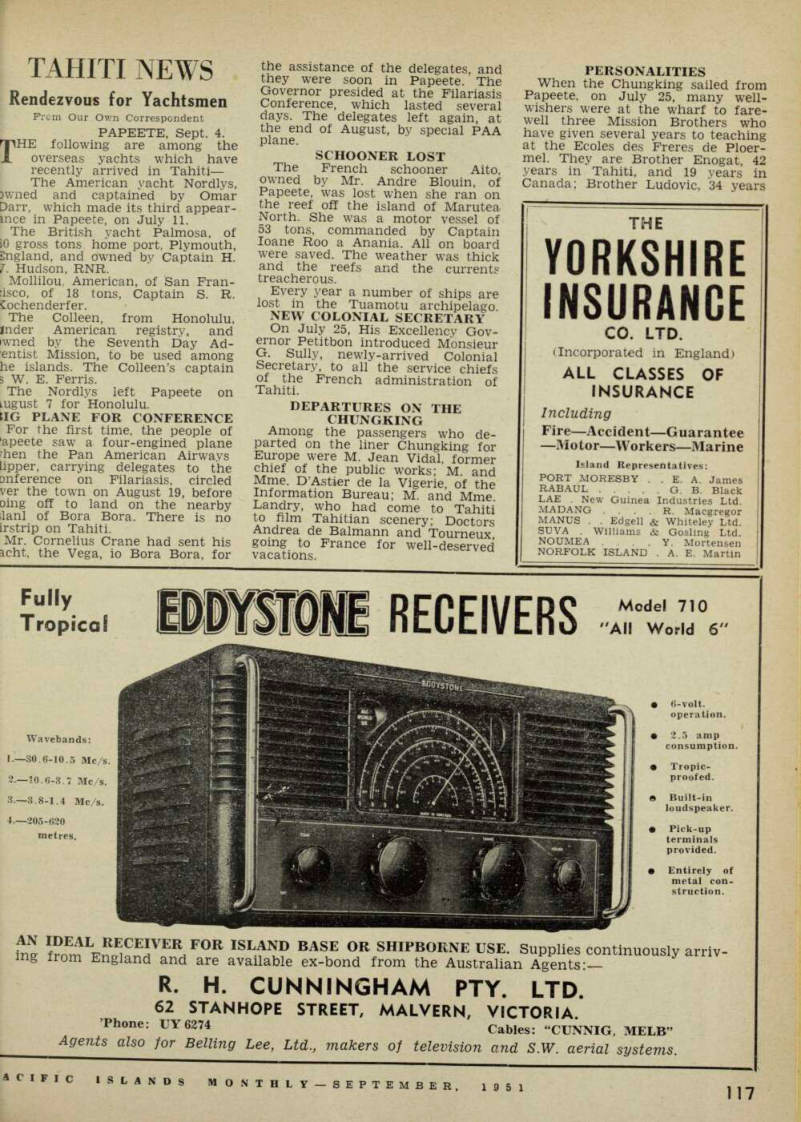
Rendezvous for Yachtsmen
Prcm Our Own Correspondent
Papeete, Sept. 4.
THE following are among the overseas yachts which have recently arrived in Tahiti— The American yacht Nordlys, Dwned and captained by Omar Darr, which made its third appear mce in Papeete, on July 11.
The British yacht Palmosa, of 10 gross tons, home port, Plymouth, England, and owned by Captain H.
I. Hudson, RNR.
Mollilou, American, of San Fran lisco, of 18 tons, Captain S. R. £ochenderfer.
The Colleen, from Honolulu, Jnder American registry, and iwned by the Seventh Day Ad entist Mission, to be used among he islands. The Colleen’s captain s W. E. Ferris.
The Nordlys left Papeete on mgust 7 for Honolulu.
Sig Plane For Conference
For the first time, the people of 'apeete saw a four-engined plane rhen the Pan American Airways lipper, carrying delegates to the onference on Filariasis, circled ver the town on August 19, before oing off to land on the nearby ilanl of Bora Bora, There is no irstrip on Tahiti.
Mr. Cornelius Crane had sent his acht, the Vega, io Bora Bora, for
the assistance of the delegates, and they were soon in Papeete. The Governor presided at the Filariasis Conference, which lasted several days. The delegates left again, at the end of August, by special PAA plane.
Schooner Lost
The French schooner Aito, owned by Mr. Andre Blouin, of Papeete, was lost when she ran on the reef off the island of Marutea North. She was a motor vessel of 53 tons, commanded by Captain loane Roo a Anania. All on board were saved. The weather was thick and the reefs and the currents treacherous.
Every year a number of ships are lost in the Tuamotu archipelago.
New Colonial Secretary
On July 25, His Excellency Gov ernor Petitbon introduced Monsieur G. Sully, newly-arrived Colonial Secretary, to all the service chiefs of the French administration of Tahiti.
Departures On The
Chungking
Among the passengers who de parted on the liner Chungking for Europe were M. Jean Vidal, former chief of the public works; M. and Mme. D’Astier de la Vigerie, of the Information Bureau; M. and Mme.
Landry, who had come to Tahiti to film Tahitian scenery; Doctors Andrea de Balmann and Tourneux going to France for well-deserved vacations.
Personalities
When the Chungking sailed from Papeete, on July 25, many well wishers were at the wharf to fare well three Mission Brothers who have given several years to teaching at the Ecoles des Freres de Ploer mel. They are Brother Enogat, 42 years in Tahiti, and 19 years in Canada; Brother Ludovic, 34 years
in Tahiti, six years in Senegal, anc nine years in Turkey; Brothei Romain, 17 years in Tahiti.
They now have retired from active service, with the exception of Brother Romain, who is still young enough to be sent to another colony.
An amplifier—the handiwork o< M. Eddie Lund—played farewell tunes as the ship sailed down th*.
Bay.
Rolf Armstrong, whose portrait; of beautiful American girls arc published in millions on calendars magazine covers and posters, hai been spending the summer ii Tahiti. It was his first visit to thi South Seas. He said he was iiru pressed, not only with the beaut; of Tahitian girls, but with theii natural rhythm of movement whici (he says) no other girls in thr world passess. Mr. Armstrong haE made paintings of Tomatu, whon he considers our most beautifu Polynesian type, and also made vivid study of Germaine, thr famous Bora Bora dancer.
Two well-known auditors anr accountants died recently—Messr: Eugene Alexandre (known to all a Hiti), and Rene Porlier. Both wen born in Papeete.
We have been informed that Ml R. de Lambert, who was Americat Consul in Papeete from 1941 t 1946, is now US Consul-General i Valparaiso, Chile. Mrs. and Mr. a Lambert have many friends i Tahiti.
Advertisements & other items, pp. 119-120 (2 items)
117
ACIFIC ISLANDS MONTHLY SEPTEMBER, 1951
Ddystone Receivers
THE
YORKSHIRE
INSURANCE
CO. LTD.
(Incorporated in England)
ALL CLASSES OF
INSURANCE
Including Fire—Accident—Guarantee —Motor—Workers—Marine Island Representatives: PORT MORESBY . . E. A. James RABAUL G. B. Black LAE . New Guinea Industries Ltd.
MADANG R. Macgregor MANUS . . Edgell & Whiteley Ltd.
SUVA Williams & Gosling Ltd.
NOUMEA . Y. Mortensen
NORFOLK ISLAND . A. E. Martin
Fully
Tropical
Wavebands: —30.6-10.5 Mc/s. —10.6-3.7 Mc/s. •—3.8-1.4 Mc/s. • —205-620 metres.
DDYSTONE RECEIVERS
Model 710
All World -
• 6-volt. operation. • 2.5 amp consumption • Tropicproofed. e Built-in loudspeaker. • Pick-up terminals provided. • Entirely of metal construction. tag fro E m L En^^ V a E^ FOR BAS „ E OR SHIPBORNE USE. Supplies continuously arriv mg irom England and are available ex-bond from the Australian Agents:
R. H. CUNNINGHAM PTY. LTD.
62 STANHOPE STREET, MALVERN, VICTORIA.
Phone: 0Y6274 Cables: “CUNNIG, MELB”
Agents also for Belling Lee, Ltd., makers of television and S.W. aerial systems.
William E . Reed
(Established 1913) Island Trade Broker & Commission Agent 145 a GEORGE STREET, CIRCULAR QUAY, SYDNEY.
CABLES: “WLLREED.” SYDNEY.
PACIFIC ISLANDS DISTRIBUTORS FOR
Famous Grand Prix ELECTION Watches
. . . available in a complete range of
models for ladies and gentlemen
BEAUTIFUL WROUGHT IRON
FURNITURE ... a delight in any
household
Retailers should contact these wholesale agents: — Duncan £r Koefod, RABAUL; Papuan Agencies, PORT MORESBY; D. L. Meeks, MADANG; N. C. Osborn, LAE; Hunt's Agency, SUVA.
BOATS FOR ISLANDS USES
SPECIAL: 79 ft. x 20i ft. x 5i ft. trawler, cargo capacity about 60 tons. Twin 90 h.p. Ruston Hornsby diesels; winch for derrick; 8 bunks fo'cstle, 2 cabins saloon; 1,500 gal. fuel capacity; 4 water-tight bulkheads. Vessel is NEAR- ING COMPLETION, is very strongly constructed and
COPPER SHEATHED.
Also: A wide range of diesel powered and auxiliary sail workboats suitable as cargo carriers from 7 to 35 tons.
Let us know the particular type of vessel you require and we shall send you promptly details and pictures of those within your specifications range. To avoid delay, please send fullest possible information.
WE WELCOME YOUR PERSONAL CALL WHEN YOU
ARE IN SYDNEY.
BU 3203 BU 1968 JW 1822
N.S.W. distributors for Coventry Victor Marine diesel engines
Ambrym Volcano Is
Active
2,000 Natives Evacuated
From Our Own Correspondent
Noumea, Sept. 1..
THE story of the volcano Ambrym, in New Hebrides, be gan some 20 years ago when j sent up huge columns of smofel while pumice rained down, blackiu out all the island. At the time, la T i flattened all plantations and hous*; with the exception of a Cathok Mission hospital.
Today, the Government here hr been advised that Ambrym threatening eruption.
A heavy pumice mud is fallui and a mass of cloud hangs ow the island. Two thousand natiw have been evacuated to the near? islands of Malekula,, Santo, EL and Efate. Three to four thousait natives have refused to leae Ambrym, and the authorities as supplying them with food.
The official message to Noumn adds that most plantations a being buried, but there are
casualties.
FD.
Advertisements & other items, p. 120 (1 item)
118
SEPTEMBER, 1951 PACIFIC ISLANDS MONTH LI
Sir Hubert Murray
Memorial To
Late
AT the request of the Adminis trator, a P'und was opened in Port Moresby in September to provide a Memorial to the late Sir Hubert Murray, who died in 1940, and who did such notable work for the old Territory of Papua, and es pecially for the natives. The appeal bas been launched in both Papua- New Guinea and Australia.
This appeal originally was made in 1941, and £263 had been sub scribed when the war with the Japanese came. Since then, invasion md post-war problems have taken precedence.
It is now proposed to complete the F\md, and provide the Memorial, rhe form probably will depend upon ;he amount subscribed. Some of his friends hope that it may be a plain jonstruction of stone, erected in Port Moresby, to permanently re nind both Europeans and natives of lis achievements.
Subscriptions should be sent to -he Secretary, Hubert Murray Memorial Fund, C o Customs De triment, Port Moresby. Any imounts sent to the Pacific Islands Monthly, PO Box 3408, Sydney, will >e acknowledged and sent on. It is xpected the Commonwealth Gov rnment will make a contribution.
The Archbishop of York, the Most Rev. and Rt. Hon. Cyril Forster Garbett, will make a five £ays visi !i to Fi J i in December. His Grace, who is in his 76th year, will make an extended visit to Australia and New Zealand between October and December. He will arrive in Suva from Auckland by TEAL Solent on December 11.
Two scientists of the Australian CSIR left Sydney for New Guinea in early August. They are Dr. C.
Barnard and Mr. L. J. Webb, who will search for plants that will yield valuable drugs, including cortisone.
Native plants used by the natives to cure ulcers and skin diseases will also be of particular interest to the scientists.
Advertisements & other items, p. 121 (2 items)
119
ACIFIC ISLANDS monthly SEPTEMBER, 1951
Lighting
ID Stewarts and Lloyds (Australia) pt y . Ltd.
Manufacturers of "S&L" PIPES and FITTINGS for GAS, WATER, STEAM and other purposes.
AND Distributors of:
MILD STEEL BARS, PLATES and SECTIONS;
GALVANISED IRON; BOLTS and NUTS; ELECTRODES
and WELDING EQUIPMENT.
Stewarts and Lloyds (Australia) pt y . Ltd.
SYDNEY WAREHOUSE - - - Herbert Street, St. Leonards BRISBANE WAREHOUSE - Montague Road, South Brisbane MELBOURNE WAREHOUSE - - City Road, South Melbourne Telegraphic Address: “Tubes" Sydney, Brisbane or Melbourne
LIGHTING
GENERATE YOUR OWN POWER FOR
HOME, FACTORY, HOSPITAL,
CINEMA, ETC.
“Southern Cross ” Offers You Complete Range of Plants :
1 K.W. to 20 K.W., D.C.,
and 8 K.V.A. to 25 K.V.A., A.C.
STURDY CONSTRUCTION.
IDEAL FOR TROPICAL CONDITIONS.
Please Inquire From
SOUTHERN CROSS ENGINE &
WINDMILL CO. PTY. LTD.
22 YOUNG ST., SYDNEY, N.S.W.
PLANTS...
% PL 9 Kw., 110 V. or 240 V. Generating Set. £787 F. 0.8. Sydney Good Delivery
Suva Merchant in Sydney
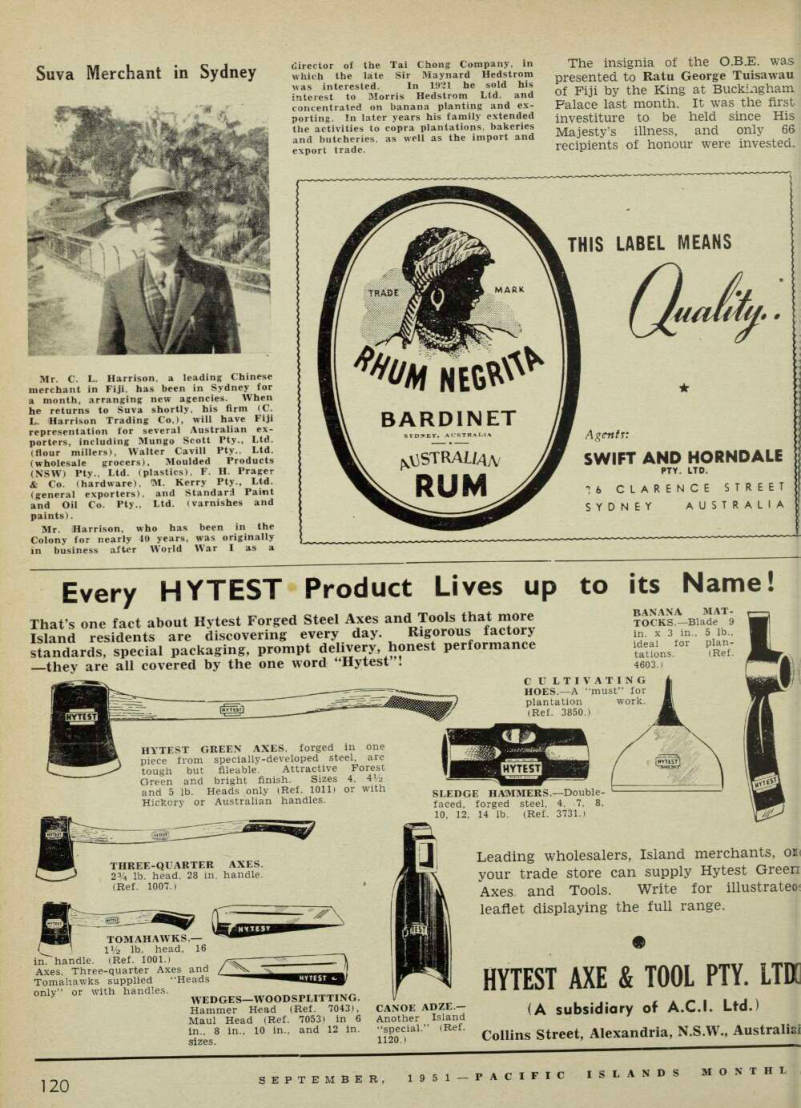
Mr. C. L. Harrison, a leading Chinese merchant in Fiji, has been in Sydney for a month, arranging new agencies. When he returns to Suva shortly, his firm (C.
L. Harrison Trading Co.), will have Fiji representation for several Australian ex porters, including Mungo Scott Pty., Ltd. (flour millers). Walter Cavill Pty., Ltd. (wholesale grocers), Moulded Products (NSW) Pty.. Ltd. (plastics). F. H. Prager & Co. (hardware). M. Kerry Pty., Ltd. (general exporters), and Standard Paint and Oil Co. Pty.. Ltd. (varnishes and paints).
Mr. Harrison, who has been in the Colony for nearly 40 years, was originally in business after World War I as a
director of the Tai Chong Company, in which the late Sir Maynard Hedstrom rn a , S ereS‘ er .o St Morris 1 HeSom* lS* and concentrated on banana planting and exporting. In later years his family extended the activities to copra plantations, bakeries export 0 trade*.' 8 ' * S ”
The insignia Of the 0.8. E. was presented to Ratu George TuisawaU of Fiji by the King at Buckingham Palace last month. It was the first investiture to be held Since His Ma j e sty’S illness, and Only 66 recipients of honour were invested.
Advertisements & other items, p. 122 (2 items)
120
SEPTEMBER, 1951-PACIFIC ISLANDS MONTHL
Hytest Axe & Tool Pty. Ltk
BARDINET
SYDNEY* AUSTRALIA
N V)STRALi4A/
RUM
THIS LABEL MEANS
Agents:
SWIFT AND HORNDALE
PTY. LTD.
? 6 CLARENCE STREET
SYDNEY AUSTRALIA
Every HYTEST Product Lives up to its Name!
That’s one fact about Hytest Forged Steel Axes and Tools Island residents are discovering every day. Rigorous factory standards, special packaging, prompt delivery, honest performance they are all covered by the one word “Hytest .
BANANA MAT-
TOCKS—BIade 9
in. x 3 in., 5 lb., ideal for plantations. (Ref. 4603.1 ttest HYTEST GREEN AXES, forged in one piece from specially-developed steel, are tough but fileable. Attractive Forest Green and bright finish. Sizes 4. 4/2 and 5 lb. Heads only (Ref. 101 K or with Hickory or Australian handles.
THREE-QUARTER AXES.
23/ 4 lb. head, 28 in. handle. (Ref. 1007.)
TOMAHAWKS
IV 2 lb. head, 16 inT handle. (Ref. 1001 Axes, Three-quarter Axes and Tomahawks supplied “Heads only’’ or with handles
C U LTIVATING
HOES. —A “must” for plantation work. (Ref. 3850.)
HYTEST
SLEDGE HAMMERS.—Double-
faced, forged steel, 4. 7. 8, 10, 12. 14 lb. (Ref. 3731.) J
Leading wholesalers, Island merchants, ok
your trade store can supply Hytest Green Axes and Tools. Write for illustrateoj leaflet displaying the full range.
WEDGES—WOODSPLITTING.
Hammer Head (Ref. 7043), CANOE ADZE.
Maul Head (Ref. 7053) in 6 Another Island in.. 8 in.. 10 in., and 12 in. “special.” (Ref.
HYTEST AXE & TOOL PTY. LTK
(A subsidiary of A.C.
Ltd.)
SI 7PR
sfrppf Alexandria. N.S.W., Australis!
‘Super Terminal’
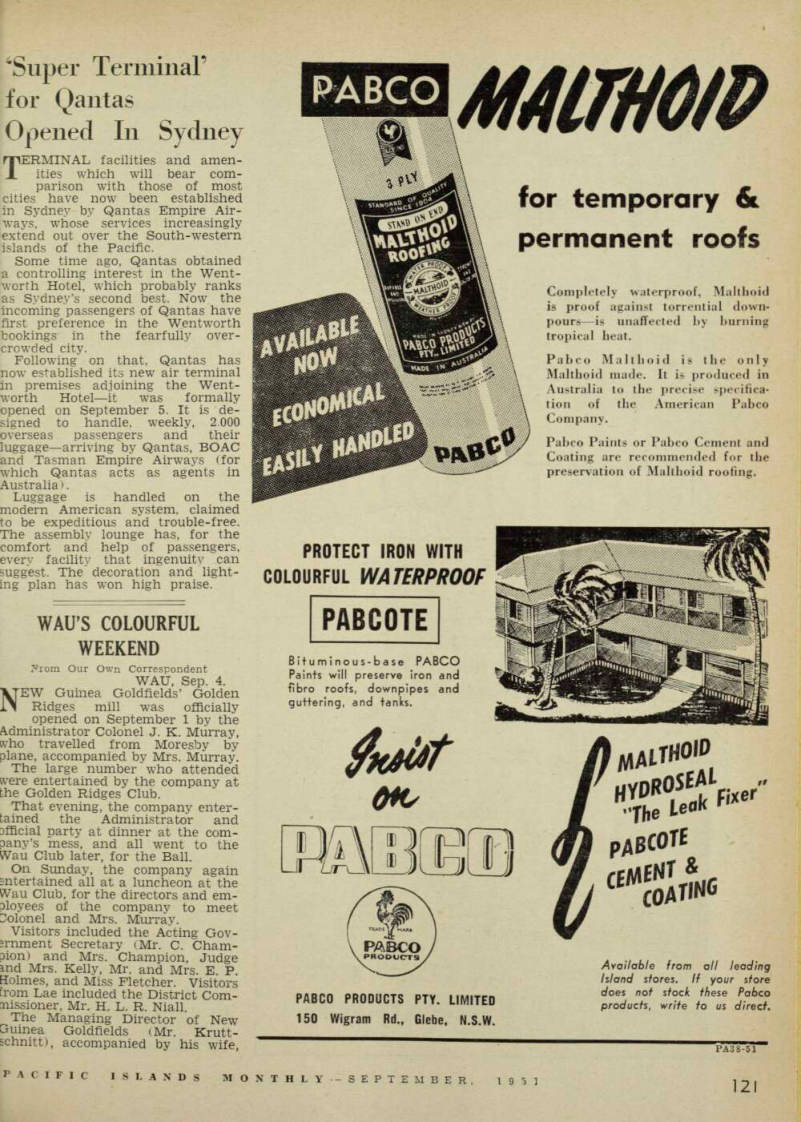
for Qantas Opened In Sydney
TERMINAL facilities and amen ities which will bear com parison with those of most cities have now been established in Sydney by Qantas Empire Air ways, whose services increasingly extend out over the South-western Islands of the Pacific.
Some time ago, Qantas obtained a controlling interest in the Wentw T orth Hotel, which probably ranks as Sydney’s second best. Now. the Incoming passengers of Qantas have first preference in the Wentworth bookings in the fearfully over crowded city.
Following on that, Qantas has now established its new air terminal in premises adjoining the Went worth Hotel —it was formally opened on September 5. It is de signed to handle, weekly, 2.000 overseas passengers and their luggage—arriving by Qantas, BOAC and Tasman Empire Airways (for which Qantas acts as agents in Australia).
Luggage is handled on the modern American system, claimed to be expeditious and trouble-free.
The assembly lounge has, for the comfort and help of passengers, every facility that ingenuity can suggest. The decoration and light ing plan has won high praise.
Wau’S Colourful

Weekend
From Our Own Correspondent WAU, Sep. 4.
NEW Guinea Goldfields’ Golden Ridges mill was officially opened on September 1 by the Administrator Colonel J. K. Murray, who travelled from Moresby by plane, accompanied by Mrs. Murray.
The large number who attended were entertained by the company at the Golden Ridges Club.
That evening, the company enter tained the Administrator and official party at dinner at the com pany’s mess, and all went to the Wau Club later, for the Ball.
On Sunday, the company again entertained all at a luncheon at the Wau Club, for the directors and em ployees of the company to meet Jolonel and Mrs. Murray.
Visitors included the Acting Gov ernment Secretary (Mr. C. Cham pion) and Mrs. Champion, Judge md Mrs. Kelly, Mr. and Mrs. E. P.
Holmes, and Miss Fletcher. Visitors from Lae included the District Com nissioner, Mr. H. L. R. Niall.
The Managing Director of New Guinea Goldfields (Mr. Krutt schnitt), accompanied by his wife,
and Mr. W. Harram, a director, are also here.
On Monday, the 3rd, the official party went to Edie Creek to see the workings there, and whilst there they were entertained at luncheon by Mrs. A. Bowring.
An interesting visitor to Rabaui recently was the two-masted auxiliary schooner Milleta. She was purchased in Adelaide by the Gov ernment of the American Trust Territory of Micronesia, for service in that area.
Advertisements & other items, pp. 123-124 (1 item)
Maitho/P
PABCO
o is
JESS*
NOW
C 0 P 0
JASIK
MAITHO/P
for temporary &
permanent roofs
Completely waterproof, Malthoid is proof against torrential downpours—is unaffected by burning tropical heat.
Pabco Malthoid is the only Malthoid made. It is produced in Australia to the precise specification of the American Pabco Company.
Pabco Paints or Pabco Cement and Coating are recommended for the preservation of Malthoid roofing.
PROTECT IRON WITH
COLOURFUL WATERPROOF t
PABCOTE
Bituminous-base PABCO Paints will preserve iron and fibro roofs, downpipes and guttering, and tanks. (t f¥l
J-fAJ
PABCO
PRODUCTS
PABCO PRODUCTS PTY. LIMITED
150 Wigram Rd., Glebe, N.S.W. it***
(h pABCOtt
(j
CEM COATIN G
Available from all leading Island stores. If your store does not stock these Pabco products, write to us direct.
“• Apply 'Dettol'
at once on
insect stings
DETTOL'
THE MODERN ANTISEPTIC
SAFE . N ON-POISONOUS
PLEASANT SMELL . CLEAN
DOESN'T PAIN . DOESN’T STAIN
Hay Fever; Incessant, Uncontrolled Sneezing Coughing Curbed Quickly
Do you have attacks of the weakening, exhausting Hay Fever; sneezing, coughing spasms so bad that you can’t work, play or enjoy yourself? Do you feel so weak and helpless that you’re unable to work, and have to be careful when you go out, and you can’t enjoy life around this time of the year.
No matter how long you have suffered, or what you have tried, there is new hope for you in a doctor's prescription called MENDACO. No Dopes. No Smokes. No Injections. No Atomisers.
All you do is take two tasteless tablets at meals, and in three minutes MEND AGO starts working through your blood aiding nature to promote free easy breathing and lemoving the irritating symptoms which cause those terrible sneezing and attendant distressing symptoms. You can go out without fear of attack. You sleep better at night and feel well, strong, and years younger.
NO HAY FEVER SYMPTOMS
IN 2 YEARS
MENDAOO not only brings almost immediate comfort, easy breathing and freedom from sneezing attacks but it builds up the system to ward off
future attacks. For instance, Mrs. S.
Bishop, of Dandenong, Victoria, had lost two stone, suffered severe sneezing attacks for months, was afraid to go out for any length of time, couldn’t sleep. MENDACO stopped Hay Fever symptoms quickly and she hasn’t nad any since in over two years.
MONEY SACK GUARANTEE
The very first dose of MENDACO goes right to work circulating through your blood and helping nature relieve you of the effects of Hay Fever and incessant Catarrhal Sneezing. Try
MENDACO under OUR IRON-CLAD
MONEY BACK GUARANTEE. You be
the judge. If you don’t feel fully satisfied after taking MENDACO just return the empty package and the full purchase price will be refunded. Get MENDACO from your Chemist today and see how well you will feel tomorrow, and how well you will sleep tonight. The guarantee protects you.
Mendaco
Stops Asthma -ft Bronchitis Hay Fever
S. Pacific Commission
Eighth Session in October
THE Eighth Session of the South Pacific Commission will open. at headquarters in Noumea,.
New Caledonia, during the last week of October, and will last for' approximately twelve days.
Consideration of the Commis sion’s work programme in the fields j of economic development, health) and social development, and of re-' commendations regarding it made* by the Research Council of the; Commission at its meeting last: June, will constitute the main itemj on the agenda.
Expert Seeks Best Native
House
ON September 5, Professor Thysse,, of the University of Indonesia,, who is an authority on tropicalJ housing, arrived in Rarotonga to< begin a building survey of Islands* territories. He is undertaking this, task for the South Pacific Com mission as part of its programme* for promoting the welfare of islandl peoples. He is accompanied by his? wife, who will assist in the work.
The survey to occupy 8 to lOC months is to determine, frorm among the wide range of natives dwellings and public buildings inr various Pacific territories, thoses types most suitable for the varying climates and conditions ofi the area. Buildings for study will, include dwellings for families oft varying sizes, schools, halls, health centres and food: storage sheds. He will take intoo account such factors as of materials and labour, and costs.c Furniture needs will also be con sidered in relation to conditions and) resources available.
Territories that Professor Thysse will visit during his survey include the Cook Islands, Samoa, Fiji, New Caledonia, Papua and New Guineas and Netherlands New Guinea.
Anti-Filaria Conference
THE first international Antix Filariasis Conference, whicM; was held in Papeete, French; Oceania, in the latter pan of August, is expected to adoi much to the sum of human know ledge respecting this- group of dis e eases—now such a scourge in th*r Pacific Islands.
The recommendations of the Con i ference will go through the Com-r mission to the six constituent gpv’v ernments, for concerted actionc thereon.
A summary of the report of th*r Conference will be published in th»r next issue of the PIM.
Papua-N.G. Notes
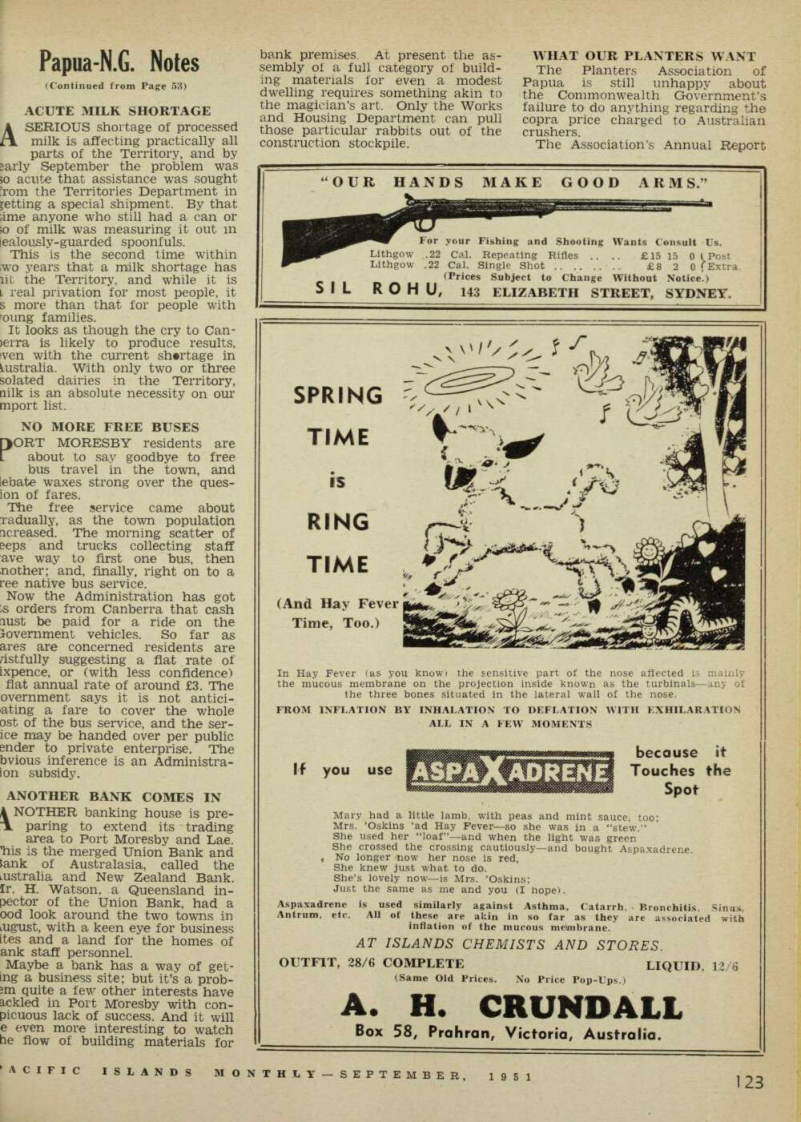
(Continued from Page 53)
Acute Milk Shortage
A SERIOUS shortage of processed milk is affecting practically all parts of the Territory, and by sarly September the problem was >o acute that assistance was sought :rom the Territories Department in jetting a special shipment. By that ;ime anyone who still had a can or io of milk was measuring it out in jealously-guarded spoonfuls.
This is the second time within wo years that a milk shortage has lit the Territory, and while it is i> real privation for most people, it s more than that for people with nung families.
It looks as though the cry to Can >erra is likely to produce results, ven with the current shortage in Australia. With only two or three solated dairies in the Territory, nilk is an absolute necessity on our mport list.
No More Free Buses
PORT MORESBY residents are about to say goodbye to free bus travel in the town, and iebate waxes strong over the ques ion of fares.
The free service came about radually, as the town population icreased. The morning scatter of eeps and trucks collecting staff ave way to first one bus, then nother; and, finally, right on to a ree native bus service.
Now the Administration has got jS orders from Canberra that cash lust be paid for a ride on the Government vehicles. So far as ares are concerned residents are nstfully suggesting a flat rate of ixpence, or (with less confidence) flat annual rate of around £3. The overnment says it is not antici ating a fare to cover the whole ost of the bus service, and the ser ice may be handed over per public ender to private enterprise. The bvious inference is an Administra ion subsidy.
Another Bank Comes In
A NOTHER banking house is pre i paring to extend its trading area to Port Moresby and Lae.
"his is the merged Union Bank and lank of Australasia, called the lustralia and New Zealand Bank.
Ir. H. Watson, a Queensland in pector of the Union Bank, had a ood look around the two towns in lUgust, with a keen eye for business ites and a land for the homes of ank staff personnel.
Maybe a bank has a way of get ing a business site; but it’s a prob ?m quite a few other interests have ackled in Port Moresby with con picuous lack of success. And it will e even more interesting to watch he flow of building materials for
bank premises. At present the as sembly of a full category of build ing materials for even a modest dwelling requires something akin to the magician’s art. Only the Works and Housing Department can pull those particular rabbits out of the construction stockpile.
What Our Planters Want
The Planters Association of Papua is still unhappy about the Commonwealth Government’s failure to do anything regarding the copra price charged to Australian crushers.
The Association’s Annual Report
says the present system, under which Australian crushers buy at the United Kingdom contract price,. is subsidising the Australian manu facturers by £2O a ton. The con tinued sale on this basis has been the subject of repeated protests to the Commonwealth Government.
Papuan planters also want to know what the Commonwealth.
Government intends to do about the s copra stabilisation fund. They emphasise that there has been a steady rise in plantation production costs, and pointedly mention that, new plantings last year were limited to a few small-scale extensions.
They hoped future conditions would be more encouraging for new de velopment, both replacements and extensions.
On native labour, the report advo cated continued campaigning for an. initial Native Labour Agreement of two years, instead of the present term of 18 months, with an optional] additional six months by mutual, consent of employer and employee..
Improved coastal shipping services ; were also mentioned as a matter for* further representation.
The Annual Report also referred] to the composition of the proposed] Legislative Council, and a resolution j was passed unanimously that the; representation as laid down by the-; Act was entirely unsatisfactory..
This, the report added, did not per mit proper representation for' interests outside the government.
General
Road maintenance work has? started in the Kanosia district, west) of Port Moresby, and all the maim plantation roads are to be recon ditioned. The Administration has? provided £12,000 for this work, and ai team from the Works and Housings Department has started on the job..
Equipment being sent to Kanosia i includes a bulldozer, a light grader*] and tip trucks.
A three - masted Americam schooner, the California, sailed intoc Port Moresby on August 13 after*] visiting most of the Pacific Islands? groups. On board are its four*] owners, young lads from California! who are making their dreams off adventure come true. They haves already spent about two years onr their round-the-world voyage, and! will be out for two more before theyv sight California again. They clubbed! together and raised $12,000 to buy the schooner, then put another! $13,000 into refitting it. Their next? port-of-call will be in Indonesia — then South Africa, around the Cape,,; and home across the South Atlantic.: New Presbyterian missionaries; who will go out to stations in theo.
New Hebrides in September are:; Rev. and Mrs. R. W. Kirkby (Am-j brym), Rev. and Mrs. J. Poon, withri two children (Tongoa), and Rev.v and Mrs. H. A. Prenter (Hog Har bour) .
Advertisements & other items, pp. 125-129 (5 items)
123
ACIFIC ISLANDS MONTHLY SEPTEMBER, 1951
aspaXaprene
OUR
HANDS
MAKE
GOOD
ARMS.
For your Fishing and Shooting Wants Consult Us.
Lithgow .22 Cal. Repeating Rifles .. .. £l5 15 0 I Post Lithgow .22 Cal. Single Shot £B2O (Extra (Prices Subject to Change Without Notice.) L ROH U, 143 ELIZABETH STREET, SYDNEY.
SPRING
TIME
is
RING
TIME
(And Hay Fever Time, Too.) ' \'/V t s n fp} '\ x Cv , 47- > * - s ** f- -155: r> ¥ f it, r n n * 4 In Hay Fever (as you know) the sensitive part of the nose affected is mainly the mucous membrane on the projection inside known as the turbinals—any of the three bones situated in the lateral wall of the nose.
FROM INFLATION BY INHALATION TO DEFLATION WITH EXHILARATION
ALL IN A FEW MOMENTS
If you
aspaXaprene
because it Touches the
Spot
Mary had a little lamb, with peas and mint sauce, too; Mrs. ’Oskins ’ad Hay Fever —so she was in a “stew.’’
She used her “loaf”—and when the light was green She crossed the crossing cautiously—and bought Aspaxadrene. , No longer now her nose is red, She knew just what to do.
She’s lovely now—is Mrs. ’Oskins; Just the same as me and you (I hope).
Aspaxadrene is used similarly against Asthma, Catarrh, Bronchitis. Sinus.
Antrum, etc. All of these are akin in so far as they are associated with inflation of the mucous membrane.
AT ISLANDS CHEMISTS AND STORES.
OUTFIT, 28/6 COMPLETE LIQUID, 12/6
(Same Old Prices. No Price Pop-Ups.)
A. H. CRUNDALL
Box 58, Prahran, Victoria, Australia.
Afewßmnch
or
•the
X\W i
I OO
opened I 23rd
July
« ir
Honiara
(British Solomon Islands).
All types of Trading Bank and Savings Bank business are conducted at the above Branch, and the following services are now available to you;— Cheque Accounts, Interest Bearing Deposits, Overdrafts, Loans for Primary Production, Finance for Industrial Undertakings, Letters of Credit, Travellers’ Cheques, Safe Custody, Savings Bank, etc.
The Bank’s services are most comprehensive and you may be sure your every banking need is provided for.
The Manager will always be pleased to assist you in every way possible. His friendly and practical advice on banking or financial matters is readily available to you.
(flbmmonwealtfrlM
of Australia.
Classified Advertisements
FOR SALE
COCONUT PLANTATION —ln the Solomon Islands, 540 acres freehold property, ideally situated —340 acres planted fully bearing palms. 200 acres virgin country suitable for planting cocoa. Large new well-furnished bungalow, water, sewerage, electric light, with garden and orchard.
Trade store, bulk store, workshop, labourers’ quarters, copra drier, and copra storing shed, with capacity for 100 tons —all newly constructed. Good trading centre. Going concert*. For sale, with cr without new 10 ton auxiliary ketch, built July, 1950. For further particulars (to principals only), write to “Solomons,” c/o Box 3408, G.P.0., Sydney.
ATTRACTIVE PROPERTY IN PAPUA.—
Amongst friendly people, in a delightful climate. Your chance to invest in Real Estate and know and feel you have security in a Tax-Free Country. Daily air services to and from Australia, only few hours away.
DOME —follow the sunshine. ESCAPE the cold winters.
INVEST safely before INFLATION strikes you. YOU can’t go wrong.
OFFERING to you: Three modern, fully furnished flats, electric power, water, refrigeration, septic system. Also on same property: Detached Cottage—constructed with best materials, double lined throughout, fully equipped and furnished.
Situated in ideal surroundings in Port Moresby’s newest European suburb, and lesigned for comfort in every detail.
Handy to all buses and shops. Price: £0.500.
Inquiries answered promptly—so air-mail )r cable: N. T. Corbett, c/o G.P.0.. Port Moresby, Papua. iORFOLK ISLAND.—If you want FREE- )OM from irksome restrictions—come to NORFOLK IS. and live with delightful, riendly people. The climate is ideal 50° to 85°), mainland and tropical lowers and fruit all grow profusely, ’here are NO TAXES of any sort. Now vailable: 17 acres, freehold, very central, ear shops and school, beautifully wooded -only £65 an acre. Great potential alue. Build four cottages on this property, let them to all-the-year-round isitors and enjoy an easy income.— *eter Goddard. Norfolk Island.
IADIO EQUIPMENT. —We can supply new ind reconditioned transmitters and reeivers for low powered marine and shore retaliations at a reasonable price.
Irystals supplied to specified frequencies, nquiries answered promptly. Write: averpool Trading Co.. 23 George Street, .iverpool, N.S.W.. Australia.
ACKS.—Several thousands used 2 cwt. ugar sacks for sale. These sacks are leaned, repaired if necessary, fumigated. x-U.K.. measuring 27 in. by 44 in. approx.), weight IV2 lb. Bales of 25 and 0. Price: 39/- Aust. per doz.. c.i.f.. ydney. Ideal for all uses in Islands, Deluding shipment of shell. Apply: Box J 95, G.P.0., Sydney, N.S.W.. Australia.
BOOKS
•OOK BARGAINS.—Send for list of real argains from 2/- upwards. State your iterests, please. I also find out-of-print Inglish Books. Mention “PIM.” Nearly 00 customers in the area where “PIM”
Irculates.— Philip Boulton, Bookseller, Vestbury. Wilts, England.
willing to accept anything in any part of the Islands. Please reply to: “Ex-R.S.M.’% Box 3408. G.P.0.. Sydney, N.S.W.
PLANTATION MANAGEMENT.—ThoroughIy
experienced, competent, economical manager, open for engagement, permanent or relieving. Lifetime experience copra, cocoa, rubber. Pull knowledge plantation, accounting, stores and supplies, issues, shipping, pests and diseases, cover crops, catch crops, native foods, draining, drier and other construction, roads, boats and N.G.N.L. Ordinance, 1946. Expert with labour and Pidgin; knowledge Fijian and Hindustani. Go anywhere. For full details write: Kent Williams, Box 18. P. 0..
Collinsville, Queensland.
CANADIAN citizen. British ex-Servicewoman. 28, desires permanent position as cook for hospital, hotel, or plantation, with accommodation for self and three healthy, happily disciplined children (two
POSITIONS WANTED
RETURNED SERVICEMAN (ex-Paratroop Battalion), 30, married, wishing to settle permanently in Pacific Islands, desires position of trust. Healthy, strong and capable—expert knowledge of cars and trucks, also familiar with storekeeping, but willing to fill any position offering chance for advancement. Definite asset to any employer. Excellent references. Reply to: Frank Pages, 5 Cross Street, Waverley, N.S.W., Australia.
RELIABLE, trustworthy and conscientious man. 40 years of age, requires position of any kind. Four years as Regimental Sergeant-Major of Native Battalion during the war. I am able to handle cars, trucks and tractors, and am handy with most tools of trade. Not afraid of work, either manual or administrative, and am
HOW TO SUCCEED
AT MUSIC ,
Play at Parties. Dances-anywhere
(\n Amazing
m Af€THOD Cl >
: ARRIVED. A limited supply of i ag. new lesson books that will quickly J you to play AT HOME.
SIMPLE LESSON BOOKS
NOW AVAILABLE FOR 1
JUST ARRIVED. A limited supply of S viy A f iSSS amazing new lesson books that will quickly B JmSS teach you to play AT HOME. p?;
NEW SIMPLE LESSON BOOKS m
now available for • Steel Guitar • Banjo Mandolin • Hill-Billy Guitar • Saxophone • Piano Accordion • Clarinet • Piano • Violin • Mouth Organ • Ukulele. Now you can start playing in 30 minutes—and play all popular tunes in a few weeks without previous knowledge of music.
HOW TO LEARN. You learn at home, privately, just you and your instrument—nooody else, and no other teacher. The lesson books show you everything. You can pay as you learn—just a few pence weekly— but there s no charge at all if you’re not satisfied. Each student receives our special— If you ever wanted to learn, this is your chance. These simple lesson books are your passport to a new and fascinating hnhbx - — to friends, fun mitincrs PYtra mnnpv—nprhans pjaying in ju minutes ana an popular tunes m a lew weeks —how to learn at home without visits to a teacher and how to banish nervousness and play at parties—evenings. But write to-day— there are only 1,000. Don’t delay. Enclose 2y 2 d. postage stamp and mention- the instrument you favour.
THE SAMPSON SCHOOL OF MUSIC
MONEY BACK GUARANTEE OF SUCCESS
writing.
Dept. 2G, 481 Kent St. Box 4184, G.P.O. Sydney.
school-age). I have intimate knowledge of Islands life and social welfare of natives—am capable of responsible position dealing with the latter, if vacancy exists in Island trade business, etc.
Papua-New Guinea area preferable, though a healthy environment for a healthy ■worker destination immaterial within tropical zone, adjacent to sea. Write: "Ex-Servicewoman,” c/o Box 3408, G.P.0., Sydney, N.S.W.. Australia.
POSITION VACANT
CLUB MANAGER. —Applications are invited lor the position of Manager of the Returned Servicemen’s Club in Rabaul, New Britain. Territory of Papua and New Guinea. Married man preferred, with a knowledge ot catering. Salary, £720 per annum, with rent-free house. Bond guaranteed for successful applicant whilst in the Club’s employ. Replies (by air-
HERE’S HOPE
For A
Persistent Worry
CONSTIPATION, fore-runner of many "troubles, affects people of all ages and walks of life and causes much annoyance and worry.
When the bowels refuse to work naturally and regularly, the body absorbs poisons from the waste that remains in the system. Constipation brings sick headaches, biliousness, coated tongue and unpleasant breath, flatulence, loss of appetite, blemishes and other troubles which quickly upset your health and wellbeing.
These troubles are easily corrected by safe, gentle Pinkettes for you and all the family. Pinkettes are simple to take; and do not have harsh after-effects which can be dangerous. Being compounded of harmless vegetable ingredients only, Pinkettes act in Nature’s way. Thousands and thousands of people have found Pinkettes the ideal laxative, because they are not habit-forming and the dose is reduced as they make you regular. Always at chemists and stores.
mail) to: Acting Hon. Secretary, Returned Servicemen’s Club, Anzac House, Rabaul, Territory of Papua and New Guinea.
TENDERS
ESTATE ERNEST RUSSELL MILLER,
DECEASED. —Sealed Tenders endorsed “Estate E. R. Miller” are invited and will be received by the undersigned until 5 p.m., November 15, 1951, for the purchase or leasing of the following, either wholly or in part:— PURCHASE.—I.—TsaIui Group Plantation. (a) Situation: 27 miles north-west of Kavieng, New Ireland, Territory of Papua and New Guinea, (b) Area; 598 hectares (approximately 1.495 acres), planted with coconut palms. 2.—Matanabago Plantation.— (a) Situation: Near Tsalui Group, approximately 10 miles from Kavieng. (b) Area: 323.60 hectares (approximately 809 acres), planted with coconut palms.
General.—Above properties are heavily overgrown with secondary growth. An assessment as under has been made by War Damage Section as a subsidy towards clearing the secondary growth and will be paid to the successful tenderer by the War Damage Section, when satisfactory evidence is produced to it that the work has been completed or well advanced: Tsalui Plantation, £831; Matanabago Plantation, £304.
Title.—The successful tenderer shall accept such title as the Administrators of the Estate now have and without further investigation.
Terms.—All properties sold subject to the consent of the Administrator of the Territory of Papua and New Guinea. Tsalui and Matanabago Plantations are sold subject to the consent of the Custodian of Expropriated Properties. On acceptance of tender, 10 per cent, of tender price to be deposited and the balance is to be paid upon the execution by the Trustees of a conveyance of the property or such other document or instrument as the successful tenderer may reasonably require to evidence the sale in the absence of a registerable transfer. The successful tenderer if he so desires may take over the existing liability to the Custodian of Expropriated Property approximating
£15,378 in respect of Tsalui, and £4,873 for Matanabago.
LEASING.—As an alternative to selling, the abovementioned properties are submitted for leasing to competent and approved persons on the basis of 25 per. cent, of gross proceeds of copra and/or other island produce payable to the Lessors, subject to the provision of a minimum production in respect of each of the aforementioned plantations.
The highest or any tender not necessarily accepted.
BURNS PHILP TRUST COMPANY
LIMITED,
7 Bridge Street. Sydney, Administrator of the Estate of E. R] Miller, deceased.
Sydney, August 30. 1951.
ESTATE CARL ALFRED OSTROM, DE-
CEASER.—SeaIed Tenders endorsed ‘Estate C. A. Ostrom” are invited and will be received by the undersigned until 5 p.m., November 15, 1951, for the purchase ot the following, either wholly or in part: — 1. —Paruai Coconut Plantation.—Situated 34 miles from Kavieng on the east coast of New Ireland, Territory of Papua and: New Guinea. Area; approximately 100 hectares, not less than two-thirds, htis been completely bombed out, leaving onethird of the whole from which produce may be expected. No clearing of any nature has been carried out on this plantation; although covered with secondary; growth there is little evidence of the convolvulus vine. Estimated production iss two tons per month. Soil mainly of s dark volcanic nature and would appear to be quite suitable for replanting witlf Cocoa. There are no buildings on this plantation. 2. —Lakurafanga Coconut Plantation.— Situated 36 miles from Kavieng, on the east coast of New Ireland. Area: apt proximately 200 hectares and is used a. a base for all operations in respect o;c the Ostrom estate.
Present buildings- consist of: Smoke Drier; Two Labour Houses; One Garagq and Labour House; Overseer’s Quarters and Store; and One Well.
Plant consists of Army type three-toi “Pord’ ; truck, which is reported to be ii very fair order and suitable for thf estate’s transportation requirements Estimated production is nine tons pea month. 3. —Fangalawa Coconut Plantation. —Situated 42 miles from Kavieng on the eass coast of New Ireland. Area; appro xf mately 150 hectares, of which 90 hectares are considered good country. One-thim of the area has been cleared and is i:r reasonable condition, the palms being i;i excellent condition. Another one-thin has had lines cleared to provide access ti produce, no further clearing beinr attempted. The palms are in extremell good condition and surrounded by denss growth of germinated nuts. The remainn ing third was cleared 18 months ago. bu; now requires further cutting. Palms ii this area are in fair condition. Estimates production of this plantation has a pose sible maximum of six tons per montK No buildings of any type have bees erected.
The three plantations referred to abow are subject to a mortgage in favour o W. R. Carpenter & Company Limited am Ex-Gratia Clearing Subsidy amounts ti approximately- £9OO.
Title.—Fee simple. The successful Terr derer shall accept such title as thf Administrator of the Estate now has. am without further investigation.
Terms.—All properties sold subject to thf consent of the Administrator of the Terr:-: tory of Papua and New Guinea. OD acceptance of tender, 10 ner cent, o tender price to be deposited and tHJ balance is to be paid upon execution b
t There is a Ransomes Mower for every phase of grass cutting. They are built for long-life service and maximum efficiency. Pull details gladly supplied by Agents, or on application to Makers.
RANSOMES SIMS &
JEFFERIES LTD.
Ipswich, England.
Agent:
MORRIS HEDSTROM LTD.,
Suva. Lautoka. and Ba.
BEST OF ALL
Ransomes Motor Mower, 16 in. and 20 in. •4 Ransomes Gazelle, 18 in. cut.
the Administrator of a conveyance of the property or such other document or instrument as the successful tenderer may reasonably require to evidence the sale in the absence of a registerable transfer.
The highest or any tender not necessarily accepted.
BURNS PHILP TRUST COMPANY
LIMITED,
7 Bridge Street, Sydney.
Administrator of the Estate of the late C. A. Ostrom.
Sydney, September 4, 1951.
ACCOMMODATION
SYDNEY. —Furnished, serviced hats, with private bathroom and kitchenette, morning trays, situated in heart of the city.
Double and family flats available—reasonable rates for Pacific Islands residents.
IVyobe Court, 52-54 Phillip Street, Sydney. 7able address: -Yarap,” Sydney. Telephone: BU 1376.
ATTRACTIVE ACCOMMODATION for
ourists. with children. “Tanglewood,”
Bayfield, Brisbane, Queensland. ’Phone II 5656.
WANTED TO BUY
MALL ISLAND, suitable for middle-aged ;ouple to retire and escape worldly .orries. Only necessities are fresh water upply and soil suitable for growing normal egetables. Bungalow not necessary. Anywhere with warm climate, not in mos- [Uito zone. Details and price to: Field, 2 Cobbler’s Bridge Road, Herne Bay, Cent, England.
SRITTSHER. healthy, active, 60, lifetime n Asiatic countries, fed up with their iolitical and economic troubles, desires ransfer tropical land, where law and rder prevails and life secure under conenial conditions amongst friendly people.
Contemplates purchasing small, successul going concern, such as copra planation. Island trading, trocas fishing or ther suitable activity. Would consider aterest in larger business, provided may ake useful part in management and administration. Competent, experienced usiness executive, skilled accountant, trictly temperate. Interested in genuine imposition offering scope for happy,
mutual co-operation. References exchanged. Confidential. H. Stephen, c/o Box 3408. G.P.0., Sydney.
STAMPS
COLLECTOR wishes to buy envelopes showing clear postmarks (1939 onwards) from the small Post Offices of the British Pacific Islands, Including those with Australian stamps postmarked Papua-New Guinea. Particularly, Gilbert and Ellice Islands Colony from 1943 to 1946, the single-line rubber postmarks of Fiji, and all Paquebot and A.P.O. markings of the Pacific. Sendings to: M. T. Bulley, 4 Tower Street. Upper Hawthorn. E. 3. Melbourne, Australia.
WANTED.—Mission mixtures of Pacific Is., large or small lots, by weight or count, high values. Also Australian. N.Z. and Gt. Britain high values; 20/- Brown wanted in quantities. In clean condition, round post-mark, will take 1,000 old envelopes with or without stamps, also anything useful in post-mark errors. Good mint N.G. stamps wanted; used also. For imprint blocks of new Islands stamps will pay IV2 per cent, over face (but cannot deal outside sterling area). For sale: new issues of British Colonies at 10 per cent, over face, sterling. Foster’s, 18 Cullum St.. E.C.3, London. England.
PEN FRIEND WANTED
YOUNG LADY, journalist, aged 24, would like to correspond with a European planter in any part of the Territory of Papua and New Guinea. Reply to: “Pen Friend,” Box 22. Post Office, Strathfield.
N.S.W.
ISLANDS SOUVENIR
‘‘WHERE THE TRADE WINDS BLOW,”
by R. W. Robson and Judy Tudor. —A collection of tales and sketches of the Pacific Islands, by PIM writers. R. W.
Robson’ and Judy Tudor; well bound and profusely illustrated. 175 pages. Price; 7/6 (8/6 posted or $l.OO U.S. currency i.
From Steele’s Book Store, Suva, Fiji, or direct from the publishers. Pacific Publications Ptv. Ltd.. 247 George St., Sydney,
N.S.W.
Agents for Pacific Islands
Monthly
(Holding supplies for Cash Sale and authorised to receive annual Subscriptions^ In Pacific Islands Generally: All Branches of; Burns Philp & Co.. Ltd.
Burns Philp (SS) Co. Ltd.
W. R. Carpenter & Co., Ltd.
Morris Hedstrom, Ltd.
W. H. Grove & Sons, Ltd.
Papua-New Guinea: Burns Philp (NG) Ltd.
Steamships Trading Co., Ltd.
Colyer Watson (NG), Ltd.
New Guinea Co., Ltd.
A. H. Bunting, Ltd., Samarai.
Mrs. Jean Fraser, Lae.
Wan Jin Wah, Lae.
R. F. Smith, Rabaul.
C. H. Meen, Rabaul.
Kriewaldt’s Stores. Port Moresby.
Fiji: Steele’s Central Store, Suva.
Fiji Times & Herald, Suva.
Adams Pharmacies, Lautoka.
Western Samoa: A. Vercoe, Apia.
Cook Islands: Cook Islands Trading Co., Rarotonga.
New Caledonia: Ed. Pentecost. Noumea.
Societe Gubbay Kerr et Cie. Noumea.
Thursday Island: P. H. Mendis. N. Mendis.
Norfolk Island: Mrs. Moltke’s Store.
Nauru: T. Daingarob.
Tahiti: O. G. Nordman, Papeete.
Rodolphe Klima, Papeete.
New Hebrides: Burns Philp (NHj Ltd., Vila, Santo.
Sydney: N.S.W. Bookstall Co., Market St.
Cordingley’s Bookstall, next G.P.0..
George St.
Tyrrell’s Book Shop, 281 George St.
Swain’s Pty., Ltd.. 123 Pitt St.
Dymock’s, Ltd., 424 George St.
Uneeda Newsagency, 18 Bond St.
Melbourne: McGill’s Newsagency, 183 Elizabeth St.
Collins Book Depot. 93 Elizabeth St, Myers Emporium, Ltd., 314 Bourke St.
Queensland: Mac’s Casket Agency, 289 Queen St., Brisbane.
J. Thomson, 311 Queen St., Brisbane.
Vernon E. White. M.Q.1.5., F.R.G.S..
Cocrparoo, Brisbane.
Gard’s Bookstall, 102 Flinders St., Townsville.
Darwin: Burnett’s Newsagency Pty.. Ltd., Darwin.
C. J. Cashman & Co., Darwin.
Auckland, NZ: A. G. Sims, Waverley Bookshop, 18 Queen St.
W. H. Grove & Sons, Ltd., 16 Fanshawe St.
Gordon & Gotch (A/sia), Ltd., 6 Gore St.
MILLERS LTD. 1111111111111111111111111111111111111111111
SUVA and LAUTOKA, FIJI.
Every Branchy of Engineering and Building
Construction ,
jawmillers and Timber Merchants; Shipwrights and Sailmakers; binery and Furniture Manufacturers; Upholsterers; Plumbers; Electricians; Hardware Merchants; Motor Dealers.
Agencies : Chevrolet, Bedford, Vauxhall, Nash Motors. Firestone Tyres. Fetters Marine and Stationary Engines. G.E.C. Radio Sets. British Australian Lead Manufacturers Pty., Ltd. Atlas Assurance Co., Ltd.
There is no need to send to Australia or New Zealand for Repairs or Replacements, We can give you a sound Quotation and guarantee First-Class Workmanship.
124
SEPTEMBER, 1951 PACIFIC ISLANDS MONTHL
125
ACIFIC ISLANDS MONTHLY SEPTEMBER, 1951
126
SEPTEMBER, 1951 PACIFIC ISLANDS MONTHL
Islands Produce
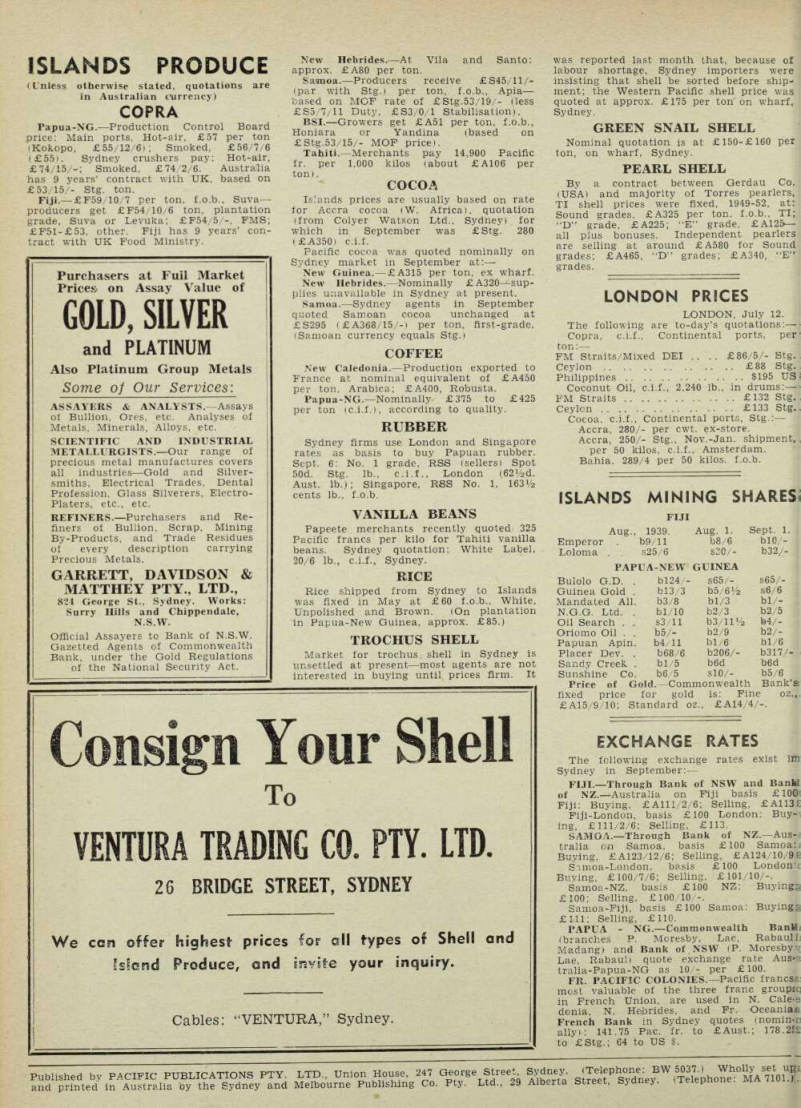
•(Unless otherwise stated, quotations are in Australian currency)
Copra
Papua-NG.—Production Control Board price: Main ports, Hot-air, £57 per ton (Kokopo, £55/12/6); Smoked, £56/7/6 (£55). Sydney crushers pay: Hot-air, £74/15/-; Smoked. £74 2/6. Australia has 9 years’ contract with UK, based on £53/15/- Stg. ton.
Fiji.— £FS9/10/7 per ton, f.0.b., Suva— producers get £FS4/10/6 ton, plantation grade, Suva or Levuka; £FS4/5/-. FMS; £FSI-£53, other. Fiji has 9 years’ con tract with UK Food Ministry.
New Hebrides.—At Vila and Santo: approx. £ABO per ton.
Samoa. —-Producers receive £S4S/11/- (par with Stg.) per ton, f.0.b., Apia— based on MOF rate of £ Stg.s3/19/- (less £SS/7/11 Duty, £S3/0/l Stabilisation).
BSl.—Growers get £ASI per ton, f.0.b., Honiara or Yandina (based on £ Stg.s3/15/- MOF price).
Tahiti.—Merchants pay 14,900 Pacific fr. per 1,000 kilos (about £AIO6 per ton).
Cocoa
Islands prices are usually based on rate for Accra cocoa (W. Africa), quotation (from Colyer Watson Ltd., Sydney) for which in September was £Stg. 280 ( £A3SO) c.i.f.
Pacific cocoa was quoted nominally on Sydney market in September at:— New Guinea. — £A3IS per ton, ex wharf.
New Hebrides.—Nominally £A32o—sup plies unavailable in Sydney at present.
Samoa. —Sydney agents in September quoted Samoan cocoa unchanged at £ 5295 ( £ A368/15/-» per ton. first-grade. (Samoan currency equals Stg.)
Coffee
New Caledonia. —Production exported to France at nominal equivalent of £A4SO per ton. Arabica; £A4OO, Robusta.
Papua-NG.—Nominally £375 to £425 per ton (c.i.f.), according to quality.
Rubber
Sydney firms use London and Singapore rates as basis to buy Papuan rubber.
Sept. 6: No. 1 grade. RSS (sellers) Spot 50d. Stg. lb.. c.i.f., London (62V 2 d.
Aust. lb.); Singapore, RSS No. 1, 163V2 cents lb., f.o.b.
Vanilla Beans
Papeete merchants recently quoted 325 Pacific francs per kilo for Tahiti vanilla beans. Sydney quotation: White Label, 20/6 lb., c.i.f., Sydney.
Rice
Rice shipped from Sydney to Islands was fixed in May at £6O f.0.b.. White, Unpolished and Brown. (On plantation in Papua-New Guinea, approx. £85.)
Trochus Shell
Market for trochus shell in Sydney is unsettled at present—most agents are not interested in buying until prices firm. It
was reported last month that, because of labour shortage, Sydney importers were insisting that shell be sorted before ship ment; the Western Pacific shell price was quoted at approx. £ 175 per ton' on wharf, Sydney.
Green Snail Shell
Nominal quotation is at £l5O-£l6O per ton, on wharf, Sydney.
Pearl Shell
By a contract between Gerdau Co. (USA) and majority of Torres pearlers, TI shell prices were fixed, 1949-52, at: Sound grades, £A325 per ton, f.0.b., TI; “D” grade, £A225; “E” grade. £Al25 all plus bonuses. Independent pearlers are selling at around £ASBO for Sound grades; £A465, “D” grades; £A34O, “E” grades.
London Prices
London, July 12.
The following are to-day’s quotations:— Copra, c.i.f.. Continental ports, per' ton:— FM Straits/Mixed DEI .. .. £B6/5/- Stg. .
Ceylon £BB Stg. .
Philippines $195 US< Coconut Oil, c.i.f., 2,240 lb., in drums:—- PM Straits £132 Stg..
Ceylon £133 Stg. • Cocoa, c.i.f., Continental ports, Stg.:— Accra, 280/- per cwt. ex-store.
Accra, 250/- Stg., Nov.-Jan. shipment, , per 50 kilos, c.i.f., Amsterdam.
Bahia. 289/4 per 50 kilos, f.o.b.
Islands Mining Shares
Fiji
Aug., 1939.
Aug. 1.
Sept. 1.
Emperor . b9/ll b8/6 blO/- Loloma . .
S25/6 S20/b32/-
Papua-New
Guinea
Bulolo G.D. . bl24/s65/s65/- Guinea Gold . bl3/3 b5/ 6 Vz s6/6 Mandated All. b3/8 bl/3 bl/- 1 N.G.G. Ltd. . bl/10 b2/3 b2/5 Oil Search . . $3/11 b3/liy 2 b4/- Orlomo Oil . . b5/b2/9 b2/- Papuan Apin. b4/ll bl/6 bl/6 Placer Dev. . b68/6 b206/b317/- ■ Sandy Creek . bl/5 b6d b6d Sunshine Co. b6/5 slO/b5/6 Price of Gold. —Commonwealth Bank’s fixed price for gold is: Fine oz.,. £ A15/9/10; Standard oz., £A14/4/-.
Exchange Rates
The following exchange rates exist id Sydney in September:— FlJl.—Through Bank of NSW and Bank! of NZ.—Australia on Fiji basis £looi Fiji: Buying, £Alll/2/6; Selling, £All3£ Fiji-London, basis £lOO London: ing, £lll/2/6; Selling. £ll3.
SAMOA.— Through Bank of NZ. —Aus-c tralia on Samoa, basis £lOO Samoa:* Buying, £AI23/12/6; Selling. £AI24/10/9( Samoa-London, basis £lOO London:: Buying, £lOO/7/6; Selling, £lOl/10/-.
Samoa-NZ, basis £lOO NZ: Buying,g £100; Selling, £lOO/10/-.
Samoa-Fiji, basis £lOO Samoa: Buyings £111; Selling, £llO.
PAPUA - NG. —Commonwealth Banfcl (branches P. Moresby, Lae, Rabaull Madang) and Bank of NSW (P. Moresby/ Lae. Rabaul) quote exchange rate Aus*a tralia-Papua-NG as 10/- per £lOO.
FR. PACIFIC COLONIES.—Pacific francss most valuable of the three franc groupie in French Union, are used in N. Cale-e donia. N. Hebrides, and Fr. Oceanian French Bank in Sydney quotes (nomin-n ally): 141.75 Pac. fr. to £Aust.; 178.25 S to £Stg.; 64 to US $.
Advertisements & other items, pp. 130-132 (3 items)
AS£,»r«ffli. 2 a. < ¥s,‘* e s» ra syfttt
Consign Your Shell
Purchasers at Fuil Market Prices on Assay Value of
GOLD, SILVER
and PLATINUM
Also Platinum Group Metals
Some of Our Services :
ASSAYERS & ANALYSTS—Assays
of Bullion. Ores, etc. Analyses of Metals, Minerals, Alloys, etc.
SCIENTIFIC AND INDUSTRIAL
METALLURGISTS.—Our range of precious metal manufactures covers all industries—Gold and Silversmiths, Electrical Trades, Dental Profession. Glass Silverers, Electro- Platers, etc., etc.
REFlNERS.—Purchasers and Refiners of Bullion, Scrap, Mining By-Products, and Trade Residues of every description carrying Precious Metals.
GARRETT, DAVIDSON &
MATTHEY PTY., LTD.,
8*24 George St., Sydney. Works: Surry Hills and Chippendale,
N.S.W.
Official Assayers to Bank of N.S.W.
Gazetted Agents of Commonwealth Bank, under the Gold Regulations of the National Security Act.
Consign Your Shell
To
VENTURA TRADING CO. PTY. LTD.
26 BRIDGE STREET, SYDNEY
We can offer highest prices for oil types of Shell and island Produce, and invite your inquiry.
Cables: “VENTURA,” Sydney.
Guinea
a I s? § S I I § I I I S I BY
SPECIAL DE LUXE
Sc 3L
SERVICE
S V The “Chieftain” is the most luxurious air travel ever offered to travellers to and from New Guinea, It flies right through, stopping at Brisbane only. No disembarking and re-embarking for overnight stops.
Passengers can hoard the “Chieftain” in a matter of minutes from the comfortable Passenger Lounge at the Flying Boat Bases.
The "Chieftain" Service includes: • Full Table Meal Service (also Card and Writing Tables). • Full Bar Service. • Two Flight Stewards and Air Hostess. • The menu standard is unsurpassed by even the best hotels.
MAKE YOUR NEXT TRIP by the "Chieftain" Service and enjoy the luxury and comfort which only the "Chieftain" Service offers.
For Fares, Timetables and Freight information consult your local Travel Agent or
TRANS OCEANIC AIRWAYS
LIMITED
SYDNEY
McArthur Shipping Co.
Pty. Ltd. 31 Macquarie Place
BU 2048 BU 2049
Principal Agents:
PORT MORESBY
Steamships Trading Co. Ltd.
BRISBANE
The McArthur Shipping & Agency Co. Pty. Ltd., 121 Eagle Street.
B 2441, B 8881. B 9684.
GUINEA
I si § I A I I I
GENERAL MERCHANTS
Capital £l,OOO/000
ESTABLISHED 1914
GENERAL MERCHANTS
and
PROVIDORES
TRADE THROUGHOUT THE PACIFIO
OVER THIRTY-FIVE YEARS OF PACIFIC ISLANDS DEVELOPMENT AND SERVICE
BUYERS AND EXPORTERS OF ALL KINDS
OF ISLAND PRODUCE, COPRA, COCOA,
M.O.P. SHELL, TROCAS SHELL, ETC.
AGENTS FOR AUSTRALIAN, EUROPEAN
AND AMERICAN MANUFACTURERS.
DISTRIBUTORS OF EVERY DESCRIPTION
OF MERCHANDISE.
Through our Sydney office, branches and agents, we distribute a wide and comprehensive range of general merchandise.
W. R. CARPENTER & CO. LTD.
Head Office: 16 O'CONNELL STREET, SYDNEY, N.S.W.
Cable Address:
“CAMOHE.”
Telephone: BW 4421.
Postal Address: G.P.0., BOX 168, Sydney.
In London : W. R. Carpenter Cr Co. (London) Ltd., 4 Lloyd's Avenue, London, E.C.3.
ASSOCIATED COMPANIES THROUGHOUT THE PACIFIC :
IN NEW GUINEA:
New Guinea Company Limited, Rabaul, Lae, Madang, Kavieng.
IN PAPUA:
J. R. Clay & Co. Ltd., Port Moresby.
IN FIJI:
W. R. Carpenter & Co, (Fiji) Ltd., Suva.