Islands
Pacific
Monthly
Augustus©
Vol. XXI. No. 1.
Established 1930.
[Registered at the G P. 0., Spd^y x jbr transmission by post as a newspaper ]
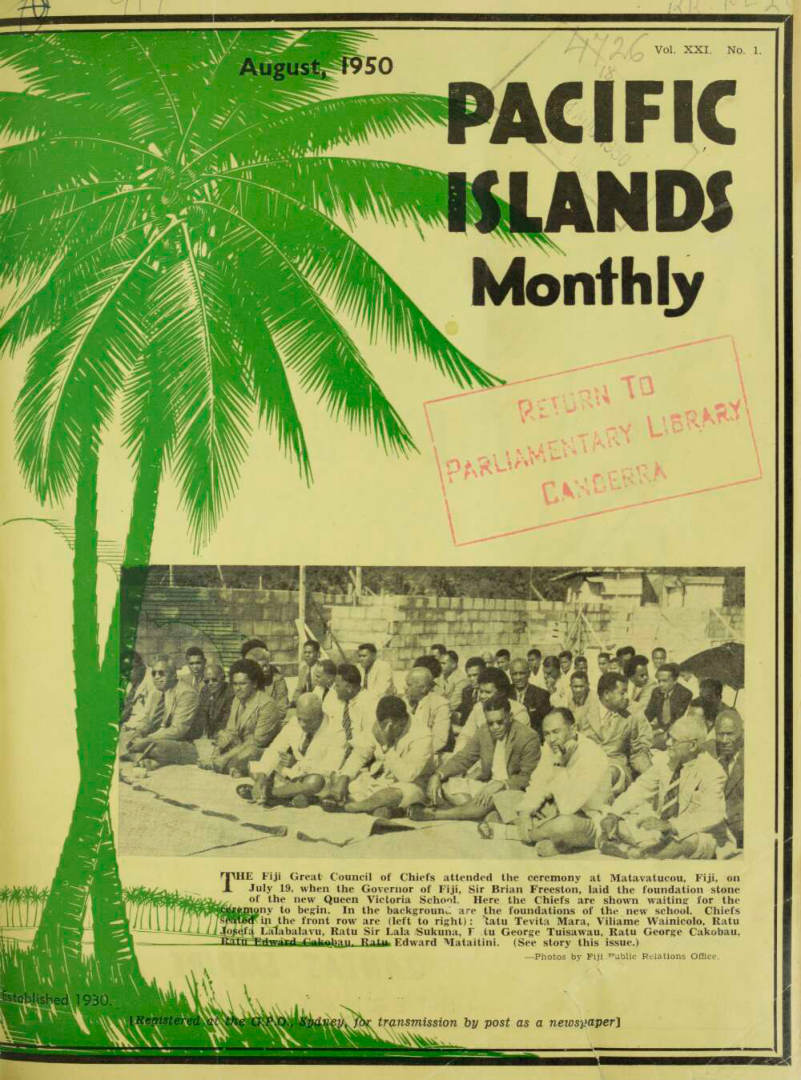
THE Fiji Great Council of Chiefs attended the ceremony at Matavatucou, Fiji, on July 19, when the Governor of Fiji, Sir Brian Freeston, laid the foundation stone of the new Queen Victoria School. Here the Chiefs are shown waiting for the ceremony to begin. In the background are the foundations of the new school. Chiefs se ated in the front row are (left to right): Ratu Tevita Mara, Viliame Wainicolo, Ratu Josefa Lalabalavu, Ratu Sir Lala Sukuna, [?]tu George Tuisawau, Ratu George Cakobau, Ratu Edward Ca ko bau, Ratu Edward Mataitini. (See story this issue.) —Photos by Fiji Public Relations Office.
Advertisements & other items, pp. 2-4 (4 items)
C 1 N ! Isla S O 9 Monthly August, 1154
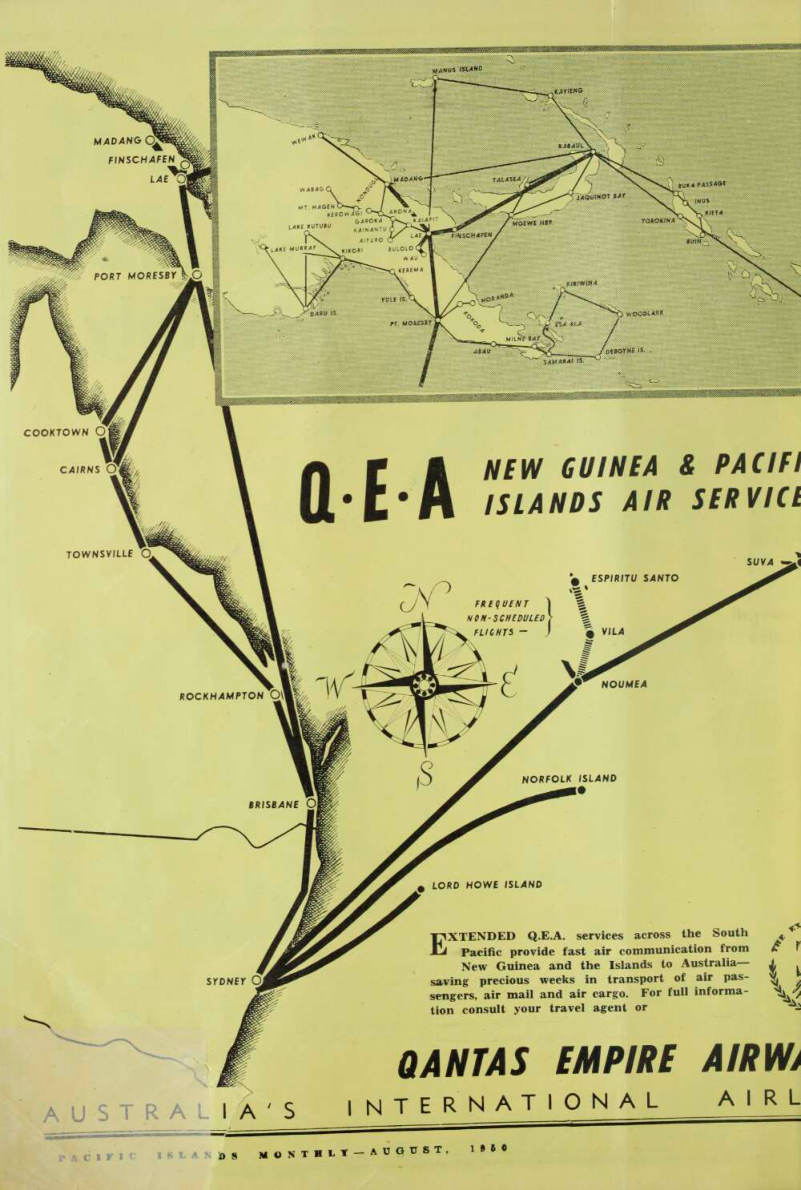
Qantas Empire Airw/
tiAHVi tStAHO
MADANO
FINSCHAPEN
LAE
WABA&(
MT. HA GEN I
KEROW4GI
14RE KUTUtU
ARON A
BUM A PASSA&I
G4ROK4
K»iNANTU (
iiru * o y i«3rnsucw«wi kikori bulged<
PORT MORESBY |-Q
A W 4U
KEREM4
me rs.* n. Moaessr l 1 «dM*° a E« K
, WOOPLARK
iSi
COOKTOWN Ol
CAIRNS 0<
QEA
/ftIV GUINEA i PAC/fl
ISLANDS AIR SIRVICI
TOWNSVILLE Q.
SUVA -J
ESPIRITU SANTO
U
FREQUENT %
non-scheduled\ %
FLIGHTS
VILA
ROCKHAMPTON o\l
V- £
NOUMEA
w S
BRISBANE Of
NORFOLK ISLAND
LORD HOWE ISLAND
SYDNEY
EXTENDED Q.E.A. services across the South Pacific provide fast air communication from New Guinea and the Islands to Australia saving precious weeks in transport of air passengers, air mail and air cargo. For full information consult your travel agent or / r i, 1
QANTAS EMPIRE AIRW/
AUSTRALIA'S INTERNATIONAL AIRL
*l*
mf he my of
m X > r -J V l'* i « r l i v \ * nches de wi 1
Every Outing
ftti
POCKET STOVE
Coleman Speedmaster Portable Stove.
It’s a complete kitchen stove telescoped into a compact case not much bigger than a quart bottle of milk. The holder makes two handy cooking utensils and a cup of petrol burns for two hours. For picnicking, camping, fishermen and motorists, inches high, Aweight 3 lbs.
Whether you require a stove for the home, the camp, the boat, or even picnicking, there's a Coleman made especially for that purpose and each is the best of its kind. 0 rrs Two-burner Portable Stove.
Console Range 5-burner with glass door.
Representatives for the Pacific Islands : ROBERT GILLESPIE PTY. LTD. PEARCE * co LTD -
-54a PITT STREET, SYDNEY
FOR FIJI ISLANDS
Suburban Salons:
166 Parramatta Road, at Johnston St. LA 3089. 706 Darling St., Rozelle. WB 2915. 421 New Canterbury Rd., Dulwich Hill. LM 6304. 215 Liverpool Road, Ashfield. UA 5940.
In the Bondi Junction Arcade. 3 doors from Grace Bros. FW 4806.
The Jfende/
City Addressed:
Pl2a Her Majesty’s Arcade, Piu 191 Pitt St., opp. Henderson’s 338 Pitt St., at Snow’s Tram 20 Imperial Arcade, Castlereag; IT & G Building, Elizabeth MA 5503. 99 Oxford Street. MA 1789.
SEERSUCKER
SUN-SUIT
Below: Gay flowery designs in mid blue, aqua. wine. (Needs no ironidg.) Bust measurements—32, 34, 36, 38, 63/11. 40, 42, 65/11. 44 66/11. / I 19 Left: >1 C \\ ir A
Write for
/ i mn f zirn til V* m / 4
FROM
FROM
BRITISH
COTTON DRESS
/ s
ORDER BY MAIL
When ordering by mail, please quote;
bust, waist and hip measurements.
And we will sens you the nearest stock size.
FREIGHT CHART:
Freight 1/2 to all Pacific Islands except those listed below: West Samoa 1/6 East Samoa, U.S.A 1/6 New Caledonia 3/2 Hawaii, U.S.A 1/6 cotton—floral designs in rose, green, red or aj tonings. Bust measurement 34, 36, 38. 40, 42, 44, 4& Price, 17/11.
STRIPED SEERSUC
DRESS
Left: Shirtmaker dress of striped) sucker —red/white, greenA blue/white. Bust measurer: 32, 34, 36, 38, 32/-. 40, i 42, 38/-. 44, 40/-. 46^ 48, 42/-.
p acific islands monthly august, 1950
2
AUGUST, 1950 PACIFIC ISLANDS MONTI
Index to Advertisers

Achun. Gabriel . . 94 Alois Akun & Co 30, 112 Aluminium Union . 44 Amplion (A/sial . . 43 Angus & Robertson 89 •Aspaxadrene" . . 106 Baker, W. Jno. . 35 Balchin. W Ltd. . 30 Bank of NSW . . 85 Berry's Bay Boat yard 87 Beth ell. Gwyn Co. 104 Blaxland Rae Pty. 71 Blundell Spence Co. 69 Bovril 41 Brasso Polish ... 16 Bray & Holliday . 40 Bristol-Myers Co. . 81 Broomfields. Ltd. . 86 Brunton & Co.. Ltd. 29 Budge, James. Ltd. 75 Bunting. A. H..
Ltd. (Papua). 38, 63 Burns Philp (NGi . 61 Burns Philp (NHi 109 Burns Philp (SS) 6B. 99 Burns Philp Trust . 96 Caine’s Studios . . 39 Carpenter, W. R. & Co.. Ltd., 82. cov. iv.
Carpenter. W. R. (Fiji). Ltd. ... 93 Carr Shipping & Trading Co. . . 76 "Charmosan" ... 15 Chrome Investment 21 Classified Advts. lO9-110 Column's Mustard 67 Colonial Meat Co. 36 Colye r Watson (NG», Ltd., 19, 98. 103 Commonwealth Bank of Aust. . . 39 Crammond Radio. 22-23 Crawford’s Hatchery ... 37 Crllley, R. J., Ltd. 24 “Cystex" ... 80 Dangar, Gedye & Malloch. Ltd., 3, 88 Davison Paints . . 17 "Bettor’ 31 Donaghy & Sons . 75 Donald. A, 8., Ltd. (Auckland) ... 28 Donald. A. 8.. Ltd. (Rarotonga) .64 Douglass. W. C., Ltd 27
Dunlop Rubber,
Ltd 29 Econo-Steel Co. . . 32 Electrolux ... 82 E.M.F. Electric Co. 79 Btablissements Donald Tahiti . . 51 Ferguson Tractors 33 Ford Sherington . 63 Garrett. Davidson & Matthey, Ltd. 112 Garrick Hotel . 28 Gilbey. W. & A. . 98
Gillespie Bros. . . 107
Gillespie. R.. Pty., Ltd.. 1, 45. 79. 95 Gillespie, R. (NG), Ltd 73, 87 Gordon’s Gin ... 83 Gough & Co.. E. J. 18 Grand Pacific Hotel 4 Gregory. A.. Ltd. . 48 Grove & Sons . . 84 Halvorsen Sons, Ltd. 92 Hardman & Hall 109 Hawaiian Club . . 89 Hawley’s Pty.. Ltd. 48 Hay, K. H. D. . . 45 Heinz & Co., Ltd. . 101
Hemingway &
Robertson, Ltd. . 72
Hoover, Francis . .41
Horlicks Pty.. Ltd. 50 Hygeia Sanitary Co. 68 I-C.S in Island Industries.
Ltd 35
Jones, Wm'. A., Ltd. 38 Kasper Refrigera tors Pty., Ltd. . 34 Kennedy, Captain . 92 Kerr Bros. . . 34, 7i Kolynos, Inc. ... 42 Kopsen. W., & Co 101 Kraft Walker Cheese Co 72 Macintyre. Thomas & Co., Ltd. ... 77 Maloney, N. F., Co 110 McGee, Andrew . . 78 Mcllrath’s Pty.,
Ltd ‘.102
“Mendaco” ... 86 Merrillees, J. C., Ltd 20, 105 Millers, Ltd. (Fiji) 94 Morris, Hedstrom, Ltd 12 Mungo Scott Pty., Ltd 20 Nathans Merchan dise (NSW) Pty. 97 Nelson & Robertson Pty., Ltd 67 “Nixoderm” . . . 101 Nordman. Oscar G. 21 Nth. Sydney Travel Bureau ... 17 NZ National Air ways Corporation 52 O’Brien, Geo. ... 93 Pacific Is. Society 31 Pacific Islands Trading Co. . . 100 Pacific Islands Year Book ... 13 Pacific School of Music 73 Pan American Air- Ways. Inc., Ltd. . 14 “Pinkettes" ... 79 Qantas, Ltd. . cov. ii.
Qld. Insurance Co. 83 Reckitt’s Blue . . 33 Reed, Wm.. E. • 100. 108 Riverstone Meat Co. 66 Robinson. G. H. . 37 Rohu, Sil 49 Round, Guy ... 105 Scott. J... Pty., Ltd. 64 S.E. Book Co. . . 24 Shell Co. of Aust. 49 Sherwin - Williams Paints 25 Sims. A. G. . . .84 Southern Pacific Insurance Co. . . 65 Spartan Paints . 107 Steamships Trading Co., Ltd. (Papua) 80 Stewarts & Lloyds 111 Sullivan. C.. Ltd. . 47 Tallerman & Co. . 76 Tasman Airways . 46 Taylor, Allen & Co. 43 Thornycroft. Ltd. 102 Tilley Lamp Co. . 74 Tillock & Co.. Ltd. 108 T o n g a n Photos Bureau 42 Tooth & Co. . cov. iii.
Trans Oceanic Air ways Pty.. Ltd. 26 Tyneside Eng. Co. 110 Undersee Novelties 47 Underwater Equip ment Co 94 United Is. Traders 90 Vacuum Oil Co. . 70 Ventura Trading Co 109 Vincent Chem. Co. 65 Watson Victor, Ltd. 15 Wendel Frocks . . 2 West, Harry ... 95 White Heather Whisky ... 16 Williams. Dr. ... 91 Willreed Agencies 108 Wills. W. D. & H.
O. (Aust.). Ltd. . 62 Wright & Co. ... 91 Wunderlich, Ltd. . 77 Yorkshire Insur ance Co., Ltd. . 71
Advertisements & other items, p. 5 (1 item)
Bulldog
• Low operation costs! • Single cylinder engine! • Only 8 main moving parts!
Minimum wear and maintcn ance! • Lasting power! • 30, 40 and 45 H.P. Models! • 6 forward speeds, 2 reverse! • Available in electric Models! • Big robust, slow moving parts!
All tests prove the
BULLDOG
99
Best in the long run!
Whether a “K.L.” or “Lanz,” the simplicity of this rugged, powerful BULLDOG and its cost for fuel and maintenance have proved it to be the ideal tractor for all Australian farming needs.
Check the features of the BULLDOG with your local Agent or write to us. We can show you how to save up to £l5O per year on running costs alone. The BULLDOG is a slow speed, heavy duty, single-cylinder engine with only 8 moving parts and is so simple and trouble-free, that wear, maintenance and depreciation are reduced to a minimum.
Available in 30, 40 and 45 H.P. Models.
Distributors in N.S.W.:
Dangar, Gedye & Malloch Limited
MALLOCH HOUSE, 10-14 YOUNG STREET, SYDNEY.
Branches: Melbourne, Wagga, Newcastle & Lismore.
In This Issue:
Editorial: There are 1,720 Millions of People in Asia E. G. Theodore was Half a Mil lionaire Editor of PIM to Visit S-W Pacific Territories Sydney Newspaper Comments Re sented by French Officials ..
Lae Opposes Removal of OTC ..
Australian Income Tax to be Chal lenged by Territorians Fighting in Indonesia —Fate of Wes tern New Guinea Arthur Brander of Tahiti Murdered Taxation Uncertainty in Papua-New Guinea Virulent Polio in East Papua— American Journalist Dies in Pe culiar Circumstances Easter Island Air Route —P. G.
Taylor to Survey Fiji Governor 111 Mr. Gatty Retires from Tuna Fishing QEA Survey Flights in Fiji The Month in Moresby Salaries Fixed—Public Service Re classification in P-NG Australian Army Did Not Forget— Surprise for Borneo Natives ..
New Native Labour Ordinance for
P-Ng
Pacific Islanders in Water Colours ..
Air Fares Cut—New Rates for Hebrides, Solomons Sydney Jurist for SP Commission New Guinea’s Timbers 75 Years Old —History of Union
Ss Co
August 26 is Fiji Election Day ..
South Tasman Air Service Goes to
Tea
South Pacific Commission—Research Council Meets Militia Battalion for New Guinea ..
Lae’s Anglican Church Will be 5 Memorial to Fallen Not Finished Yet—Circumstances of 6 Misima Close-Down Mystery of Lae Tunnel 6 Hebridean News Lawlessness in W. Samoa O 4,600 Mile Flight to Aid Penrhyn n Woman 0 NG Men Talk of Defence UN Mission Looks at W. Samoa .. 7 New Stamps for Fiji Fiji’s Cost of Living 7 Carpenters’ Extend their Fiji Ship -8 ping Services BSI Labourers Fined for Breach 8 of Contract Tofua for Pacific Next Year ..
Paludrine and Its Effect on Malaria 9 Aralen is the New Malaria Drug ..
Exploiting New Britain’s Sulphur .. 9 Marching Rule Leaders Are Out of 9 Gaol 9 The Making of a Bishop in New 9 Guinea 10 BSI Copra Board Has £29,000 on its Hands 11 Pacific Science Organisational Plan Giant Snails in New Guinea .. 11 Niue’s New Stamps High Cost of Living in Fiji 11 When the Tree Fell 11 Some Notes on Papain Production ..
Territories Talk Talk 13 20 Years in the Necktie Business .. 13 PIM Crossquiz 13 Tropicalities To the Fabled Island of Rapa .. 15 How Alphonse Met a Wicked Serpent 1( - All-Round Tourists 0 Picnic on Savo Ifi Fashion :: Children’s Section .. ..
NG Natives for RAN Service ..
Headstones for NG War Graves .. 17 It is the Rich River Flats that Pro -20 duce Good Jute
Two Universities to Specialise iii Pacific Studies LMS Secondary School at Niue .. 01 Melanesian Mission Staff Join RC Church 25 Madang Newsletter ] 25 Samoan Trader Goes to Gaol .. 27 Retirement of Major S. G. Master -28 man from ESI The Marching Rule Delusion .. 29 Scaring the Thunder 30 Gift to Chinese Traders in Solo -31 mons—Abolition of Copra Zoning 31 Fijian Swimmers Have No Place to 33 Swim Norfolk Is. gives to NSW Flood 34 Relief Opportunities for Tea Planters in 35 New Guinea 38 New Government for Eastern Samoa 39 Fijian Members of Fiji Legislative 39 Council 41 Now They Move AND Talk! i Small Australian Ships for Islands 41 Work NG Popular With Federal Parlia -42 mentarians Plane and Shipping Timetables 43 Statement on P-NG Policy .. 45 New Ireland Notes ah Rabaul Roundabout ±n Tahiti En Fete for July 14 .. .. 47 Western Samoa’s Primary Industries 49 in Flourishing Condition 50 Commercial, Markets 53 OBITUARY: Arthur Brander, 8; C; 54 Lambert, 16; Frank Price Jepson, 55 Harry Bentley, 68; Sir Apirana Nge 55 75; P. K. T. Richmond, 79; Mrs. 56 Snell, 89; Major W. Morrison, 107. 58 INDUSTRIES: Copra, 7, 34, 79, 1 59 Cocoa, 111; Papain, 50; Jute, go Gold, 8. 63 ORGANISATIONS: New Guinea Me 64 orial Scholarship Fund, 33; N Guinea Women’s Club, Sydney, 65 Pacific Islands Society, 103.
Advertisements & other items, p. 6 (2 items)
4
AUGUST, 1950 PACIFIC ISLANDS MONTHL
SOV s^ teotre t cO^-^
ta> I AS °^ er ' , 6ce ot. lo ,ied w ** °T des'l"* 4 **» s : s P f s?et 'U.. ***
e \«* e t%ce" e *' 1 .. su ..> r tT i\^ ed o b ' c ’ r ese^°° S -
Pacific Islands Monthly
The Newspaper-Magazine of the South Seas
iRegistered at the O.P.O., Sydney, for transmission by post as a newspaper 1 Published Once Each Month and Circulated in Australia and New Zealand and in the following Pacific Territories and Islands Groups:
Australian Territory of Papua.
Trustee Territory (Australia) of New Guinea Australian Territory of Norfolk Island.
New Zealand Territory of Cook Islands.
Trustee Territory (NZ) of Western Samoa British Colony of Fiji.
British Solomon Islands Protectorate.
British Protectorate of Tongan Islands.
British Crown Colony of Gilbert and Ellice Islands.
Trustee Territory of Nauru.
British and French Condominium of New Hebrides.
French Colony of New Caledonia.
French Colony of Oceania (Tahiti, etc.).
American Territory of Eastern Samoa.
American Territory of Hawaiian Islands.
Owned and Produced by Pacific Publications Pty., Ltd., Union House, 247 George Street, Sydney.
Telephone: General Office and Advertising.
BW 5037.
P.O. Box 3408
Registered Address for Telegrams, Radiograms, and Cables: “Pacpub,” Sydney.
Contributions.
Articles, Stories, and Photographs dealing with Pacific Islands subjects are invited and will be paid for on publication.
Subscription Rates.
Per Annum, Pre-pald, Including Postage.
In Australia, New Zealand, Fiji New Guinea, Papua, Western Samoa, Cook Islands, Tonga, British Solo mons, Gilbert and Ellice Colony, Nauru, New Hebrides, and United Kingdom 18 0 Elsewhere $2.50 £ll 0 Single Copies 19
Editor and Publisher:
R. W. Robson, F.R.Q.S.
Assistant Editor: JUDY TUDOR.
General Office: Union House, 247 George Street, Sydney. Telephone: BW 5037.
Business Manager: SELWYN HUGHES
Representative In London.
J T. Wallis, Coronation House, 4 Lloyd's Avenue, London, E.C.3, from whom may be obtained copies of Pacific Islands Monthly, Pacific Is. Year Book, advertising schedules, etc.
Agents.
The following are authorised to receive sub scriptions for Pacific Islands Monthly:— Burns, Philp & Co., Ltd., and Burns Phllp (South Sea) Co., Ltd. All branches.
W. R. Carpenter & Co., Ltd. All branches.
Morris, Hedstrom, Ltd. All branches.
Steamships Trading Co., Papua. All branches.
Steele’s Central Store, Suva, Fiji.
Adams Pharmacies Pty., Lautoka, Fiji.
Cook Islands Trading Co., Rarotonga, Cook Is.
United Island Traders, Ltd., Rarotonga, Cook Is.
A. Vercoe, Apia, Western Samoa.
Oscar Nordman, Papeete, Tahiti.
Islands Branches and Representatives of W. H.
Grove & Sons. Ltd., Auckland. New Zealand.
Ed. Pentecost, Noumea, New Caledonia.
Societe Gubbay Kerr et Cie, Noumea. New Caledonia.
Vol. XXI. No. 1.
August, 1950
, f 1/9 Per Copy.
Price i Prepaid, p.a.; 18/- Aust. ( In USA. p.a.; $2.50.
There Are 1,720 Millions of People
In Asia
THE white nations of the Pacific, and all those communities of Islanders who have accepted European stan dards of life, now are faced with a pros pect literally terrifying. It is as certain as the sunset that, if the Muscovite con spiracy to seize world power is not broken, so that the world again may be policed, the countless, crowded millions of Asia and Indonesia will spill over into the Pacific countries, and exterminate all non-Asiatic peoples.
The actual issue in Korea does not matter twopence. What is fundamental and vital is that we have now challenged the aggressive power of Communism. If that power is not checked, the whole world will enter another Dark Age, from which it will not emerge without cruel suffering and sacrifice.
THIS thing began as an ideological struggle, between Russia’s peculiar w brand of totalitarian Communism •which is based on the enslavement of the whole community by the State) and me loosely-knit democratic system of the Western Europeans (which is based on me belief that man’s most precious privi lege is his freedom to shape his own life) Between the end of World War II in and 1948, by means of the “cold Hf. Russia went a long way towards ber goal—which is the overthrow of Wes tem Democracy and the establishment of world-wide Communism, in its place.
Hn5 ussi ? ,s global strategy changed sud t about 1948 when China swung over m Communism; when Communist in migues disrupted South-east Asia; and wnen India and Indonesian countries,
breaking away from European control, left themselves wide open to Communist pene tration. The clever men of the Kremlin saw that, if they could manoeuvre the Western nations into a useless, exhausting fight with the Asiatic Reds —and es pecially with Communist China —they might achieve their objective of world domination without having to resort to World War 111. The Western nations al ready are economically distracted and politically confused as the result of World War 11. Obviously, if their confusion and distraction are added to by deep involve ment in Asia they could fall easy victims to the Communists’ internal intrigue and propaganda.
It may be expected that, sooner or later, Red China will strike at one of the non-Communist States on her frontiers—Formosa, Indo-China, Burma, Tibet—and then the United Nations will moye to the defence of the threatened nation. That, presumably, will mean that we all go officially to war with Com munist China; and that, again, is what Russia wants.
HOWEVER, the Westerners—even the bemused Socialists of Britain —can now see the trap that the Red planners have spread for them. They are rapidly re-arming. They surely know that the real enemy is the gang in power in the Kremlin, and that there can be no peace or security in the world until Rus sian power is contained, and democratic rule restored to her satellites. Thev will find some way, we hope, of maintaining control over the situation in Asia, while keeping both fists free for what seems to be the inevitable all-in fight with Russia.
Meanwhile, as a result of what was done by Japan prior to 1945, and by Com munist Russia since, all Asia is astir, and nationally aggressive, and eager for a fight against the Europeans. It is not Communism that matters so much. All who know Asia know that the Asiatic races—lndo-Aryans, Arabs. Indonesians and Mongols—are essentially individualis tic in character. For them, Communism is merely a phase.
What does matter is that so large a proportion of the human race, hitherto peaceful and comparatively harmless, is now becoming organised, armed and dangerous. Here is the world population, in round figures:—
Of the 1,720,000,000 people in Asia, 500 millions are in China and 370 millions in India. . . .
It does not require much imagination to see what “the awakening of Asia” means to the rest of the world—and es pecially to that section that lies in the Pacific south of the equator, where there are huge, fertile spaces, occupied by less than 10 millions of people. For us, more than for any other country in the world, what is happening to-day in Asia, and in international affairs, is vital.
Dr. R. Rabbett, of Belfast, has been appointed to the Medical Staff of the B S.I.P. Government Hospital at Matan ikau, Guadalcanal, in place of Dr. D. E.
Freeman, who resigned last year. Dr.
Rabbett had been practising in Canada before taking up his present post. He arrived in Honiara towards the end of June.
Millions Europe ,. .. 390 Asia . . . 1.720 Africa .. .. 170 N. America .. . ... 190 S. America .. .. .. .. 120 S. Pacific 9
A Millionaire
E. G. Theodore Was Half
THE estate of the late Mr. E. G.
Theodore, head of the Emperor- Loloma gold companies, in Fiji, has been probated at £528,018. Australian death duties will take away £230,000 of this. The balance is mostly divided among members of his family. He made some special bequests, including £2,000 to his secretary, Miss A. M. Raine; £2,000 to Miss Cynthia Sutherland, of Suva; £3OO to Mrs. Isabelle Corry, of Suva; and £3OO to Miss Nellie Stuart, his housekeeper.
The son of Rumanian parents, he began life in Australia as an unskilled labourer; achieved fame before he was 40 as “Red Ted,” the Socialist Premier of Queens land; was Federal Treasurer and very nearly Prime Minister; and ended his life, at 65. as a great industrialist and one of the shrewdest politico-economists of his day.
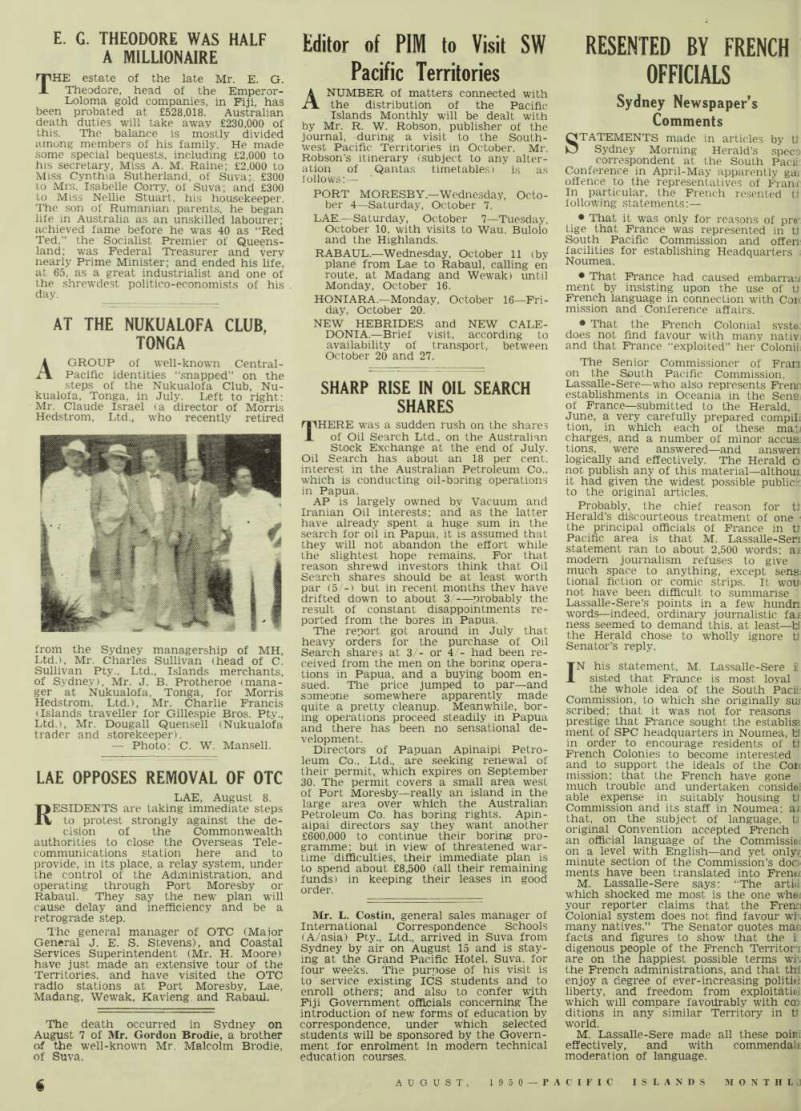
At The Nukualofa Club,
Tonga
A GROUP of well-known Central- Pacific identities “snapped” on the steps of the Nukualofa Club, Nu kualofa, Tonga, in July. Left to right: Mr. Claude Israel (a director of Morris Hedstrom, Ltd., who recently retired
from the Sydney managership of MH, Ltd.), Mr. Charles Sullivan (head of C.
Sullivan Pty., Ltd., Islands merchants, of Sydney), Mr. J. B. Protheroe (mana ger at Nukualofa, Tonga, for Morris Hedstrom. Ltd,), Mr. Charlie Francis (Islands traveller for Gillespie Bros. Pty., Ltd.), Mr. Dougall Quensell (Nukualofa trader and storekeeper).
Photo: C. W. Mansell.
Lae Opposes Removal Of Otc
LAE, August 8.
RESIDENTS are taking immediate steps to protest strongly against the de cision of the Commonwealth authorities to close the Overseas Tele communications station here and to provide, in its place, a relay system, under the control of the Administration, and operating through Port Moresby or Rabaul. They say the new plan will cause delay and inefficiency and be a retrograde step.
The general manager of OTC (Major General J. E. S. Stevens), and Coastal Services Superintendent (Mr. H. Moore) have just made an extensive tour of the Territories, and have visited the OTC radio stations at Port Moresby, Lae, Madang, Wewak, Kavieng and Rabaul.
The death occurred in Sydney on August 7 of Mr. Gordon Brodie, a brother of the well-known Mr. Malcolm Brodie, of Suva.
Editor of PIM to Visit SW
Pacific Territories
A NUMBER of matters connected with the distribution of the Pacific Islands Monthly will be dealt with by Mr. R. W. Robson, publisher of the journal, during a visit to the South west Pacific Territories in October. Mr.
Robson’s itinerary (subject to any alter ation of Qantas timetables) is as follows: PORT MORESBY.—Wednesday, Octo ber 4 —Saturday, October 7.
LAE.—Saturday, October 7—Tuesday, October 10, with visits to Wau, Bulolo and the Highlands.
RABAUL. —Wednesday, October 11 (by plane from Lae to Rabaul, calling en route, at Madang and Wewak) until Monday, October 16.
HONIARA. —Monday, October 16—Fri day, October 20.
New Hebrides And New Cale
DONIA. —Brief visit, according to availability of transport, between October 20 and 27.
Sharp Rise In Oil Search
Shares
THERE was a sudden rush on the shares of Oil Search Ltd., on the Australian Stock Exchange at the end of July.
Oil Search has about an 18 per cent, interest in the Australian Petroleum Co., which is conducting oil-boring operations in Papua.
AP is largely owned by Vacuum and Iranian Oil interests; and as the latter have already spent a huge sum in the search for oil in Papua, it is assumed that they will not abandon the effort while the slightest hope remains. For that reason shrewd investors think that Oil Search shares should be at least worth par (5/-) but in recent months they have drifted down to about 3 —probably the result of constant disappointments re ported from the bores in Papua.
The report got around in July that heavy orders for the purchase of Oil Search shares at 3/- or 4 - had been re ceived from the men on the boring opera tions in Papua, and a buying boom en sued. The price jumped to par—and someone somewhere apparently made quite a pretty cleanup. Meanwhile, bor ing operations proceed steadily in Papua and there has been no sensational de velopment.
Directors of Papuan Apinaipi Petro leum Co., Ltd., are seeking renewal of their permit, which expires on September 30. The permit covers a small area west of Port Moresby—really an island in the large area over which the Australian Petroleum Co. has boring rights. Apin aipai directors say they want another £600,000 to continue their boring pro gramme: but in view of threatened war time difficulties, their immediate plan is to spend about £8,500 (all their remaining funds) in keeping their leases in good order.
Mr. L. Costin, general sales manager of International Correspondence Schools (A/asia) Pty., Ltd., arrived in Suva from Sydney by air on August 15 and is stay ing at the Grand Pacific Hotel, Suva, for four weeks. The purpose of his visit is to service existing ICS students and to enroll others; and also to confer with Fiji Government officials concerning "the introduction of new forms of education by correspondence, under which selected students will be sponsored by the Govern ment for enrolment in modem technical education courses.
Officials
Resented By French
Sydney Newspaper’s Comments
STATEMENTS made in articles by ti Sydney Morning Herald’s speco correspondent at the South Pack Conference in April-May apparently gm offence to the representatives of Franc In particular, the French resented ti following statements:— • That it was only for reasons of prei tige that France was represented in ti South Pacific Commission and offerr facilities for establishing Headquarters ; Noumea. • That France had caused embarratf ment by insisting upon the use of ti French language in connection with Coic mission and Conference affairs. • That the French Colonial systed does not find favour with many nativi and that France “exploited” her Coloniij The Senior Commissioner of Fran on the South Pacific Commission.
Lassalle-Sere—who also represents Frenn establishments in Oceania in the Sensi of France—submitted to the Herald.
June, a very carefully prepared compili tion, in which each of these maij charges, and a number of minor accusj tions, were answered—and answer* logically and effectively. The Herald 6 not publish any of this material—althour it had given the widest possible publics to the original articles.
Probably, the chief reason for ti Herald’s discourteous treatment of one < the principal officials of France in ti Pacific area is that M. Lassalle-Sen statement ran to about 2,500 words: ai modern journalism refuses to give much space to anything, except sensj tional fiction or comic strips. It wou< not have been difficult to summarise : Lassalle-Sere’s points in a few hundn. words—indeed, ordinary journalistic fa* ness seemed to demand this, at least—tf the Herald chose to wholly ignore ti Senator’s reply.
IN his statement. M. Lassalle-Sere it sisted that France is most loyal the whole idea of the South Pacii* Commission, to which she originally sui scribed: that it was not for reasons prestige that Prance sought the establish ment of SPC headquarters in Noumea, fcf in order to encourage residents of ti French Colonies to become interested and to support the ideals of the Core mission: that the French have gone much trouble and undertaken considel able expense in suitably housing ti Commission and its staff in Noumea: ae that, on the subject of language, ti original Convention accepted French an official language of the Commissioi on a level with English—and yet only* minute section of the Commission’s doo< ments have been translated into Freno M. Lassalle-Sere says: “The artiif which shocked me most is the one whei your reporter claims that the Frenn Colonial system does not find favour wh many natives.” The Senator quotes mac facts and figures to show that the i digenous people of the French Territon are on the happiest possible terms wh the French administrations, and that thl enjoy a degree of ever-increasing politid liberty, and freedom from exploitation which will compare favourably with co> ditions in any similar Territory in ti world.
M. Lassalle-Sere made all these point effectively, and with commendate moderation of language.
Advertisements & other items, p. 8 (1 item)
6
AUGUST, 1950 PACIFIC ISLANDS MON THL
Tax To Be Challenged
Territorians Resent an Australian Impost
STEPS are being taken to challenge, on the highest level, the decision of the Australian Commissioner of Taxa tion that Territorians must pay Income Tax on War Damage Compensation in- In very many cases, some time elapsed between the allocation of compensation and actual receipt of the money by the owner. The WD Commission paid interest on the sum during that period. Because the Fund was held in Australia, and in terest was paid there, the Tax Commis sioner demands a share of it.
Territorians point out that compensa tion took the place of their properties (which normally earned them a non taxable income in Papua-New Guinea); that in most cases the compensation was reinvested in the Territories as soon as it was available; and that, pending re investment, they were entitled to regard its earnings (interest) as non-taxable income.
Some resentful Territorians appealed to Mr. Spender (Minister for Territories) and he in turn appealed to the Australian Treasurer (Mr. Fadden). Mr. Fadden has replied that, although he took the matter up with the Taxation Commissioner, the latter still insists that the payments are taxable; and he (Mr, Fadden) has now no power to. intervene. He suggests that persons concerned should appeal direct to a Taxation Appeals Board.
It is considered that the case calls for the strongest possible action—probably an appeal both to the Australian Cabinet, and the Australian Courts. Persons who are prepared to join in such a protest are invited to get in touch with any one of the following, with a view to arranging a general meeting to appoint a com mittee to raise funds and take action without delay— Mr. R. A. Laws, Robert Gillespie Pty., Ltd., 54a Pitt Street, Sydney (BW 4782).
Mr. Norman Nelson, Nelson & Robert son Ltd., 12 Spring Street, Sydney (BU 5461).
Mr. R. W. Robson, Pacific Publications Pty., Ltd., 247 George Street, Sydney (BW 5037).
Missing Vessel Found
Safe
TAHITI, August 4.
THE Tahitian Government-owned yacht, Nuuhiva, (yawl-rigged, of 15 tons, and formerly the American yacht, Mana Nahra) has been found anchored in the lagoon of Bellinghausen Island (between Tahiti and the Northern Cooks). She left Papeete on May 10, for the Marquesas Islands, where she was to carry on a service, and has since been posted missing.
She is being towed from Bellinghausen to Uturoa, in Raiatea, All on board are well.
Schooner Wrecked
Messrs, mervin brothers were advised on July 19 that their 200tons trading schooner, Benicia, had been wrecked in a gale on the reef north east of the island of Rangiroa. No lives were lost.
Joeli Ravai, of Fiji, who has gone to the United Kingdom as a guest of the British Council, has reached London. He was met on arrival by Ratu Mara, who is at Oxford University, and by Mr. G. K.
Roth, who is on leave in the United King dom.
Under-Sec. and Planters
Late News: Under-Sec. and Planters In Profitable Meeting
Rabaul, Aug. 10.
BY singular good fortune, the visit of Mr. John Howse (Under-Secretary for Territories) coincided with the second annual meeting of the Planters’
Association; and the Planters’ president (Mr. Don Barrett) arranged a number of important and helpful talks.
Mr. Howse said that committees, on which planters would be represented, were being set up to deal with the price of copra and the Stabilisation Fund.
Mr. Barrett told the Under-Secretary that the Association, in view of the num ber of “controls” did not think it was practicable to abolish the PCB and im mediately to hand copra sales and ship ment over to private enterprise. Some body with over-all authority would have to function while the British copra con tract operated.
Mr. Howse said that, although the Government wanted private enterprise to run the shipping, it recognised that the Directorate of Shipping must function until private enterprise provided some thing more efficient.
Mr. Howse promised to study a strong case presented by the Association against the proposed 18 months’ contract for native labour. The planters urged a mini mum period of two years.
The Association complained of serious pests affecting coconuts and cocoa in the Gazelle Peninsula area, and inefficiency on the part of Agriculture Department officials: and Mr. Howse undertook to examine the situation.
Mr. C. B. Bailey has been appointed a member of the Fiji Copra Board during the absence from the Colony of Mr. W.
G. Johnson.
Indonesia
Fighting In
Fate of Western New Guinea
THE Commission of three Dutchmen and three Indonesians, set up Jointly by Holland and Indonesia to report on the future administration of Dutch New Guinea—the status of which must be decided before December 31—has sub mitted a report. Actually, there are two reports—one by the Dutch, insisting that Western New Guinea shall remain Dutch, and one by the Indonesians, demanding its transfer to Indonesia.
We are back precisely where we were before the Commission was set up. Wes tern New Guinea remains under Dutch occupation: but the Indonesians continue with clamorous demands for its posses sion.
Meanwhile, the ambition of the power drunk Javanese (the original “Republic”) to dominate the whole of the Federation called “the Republic of the United States of Indonesia” is being resisted by some of the non-Javanese States. A bitter war is in progress in the Molucca archipelago between troops of the Javanese “Repub lic” and Eastern Indonesians (Macassar, etc.) who are apparently supported by the Dutch. Although these operations are in progress only a few hundred miles from New Guinea, little has been heard of them.
A coup d’etat in Western New Guinea by the Indonesians is thought to be quite likely. In that event, fighting will almost certainly start in Western New Guinea between Indonesians and Dutch—and, this time, it seems possible that Australia will go in on the side of the Dutch.
Mr. Adrian C. Mayer, Research Scholar of the Australian National University, accompanied by his wife, left Sydney in July for Fiji, where he will do a year’s work. He is especially interested in the Indian problem in Fiji.
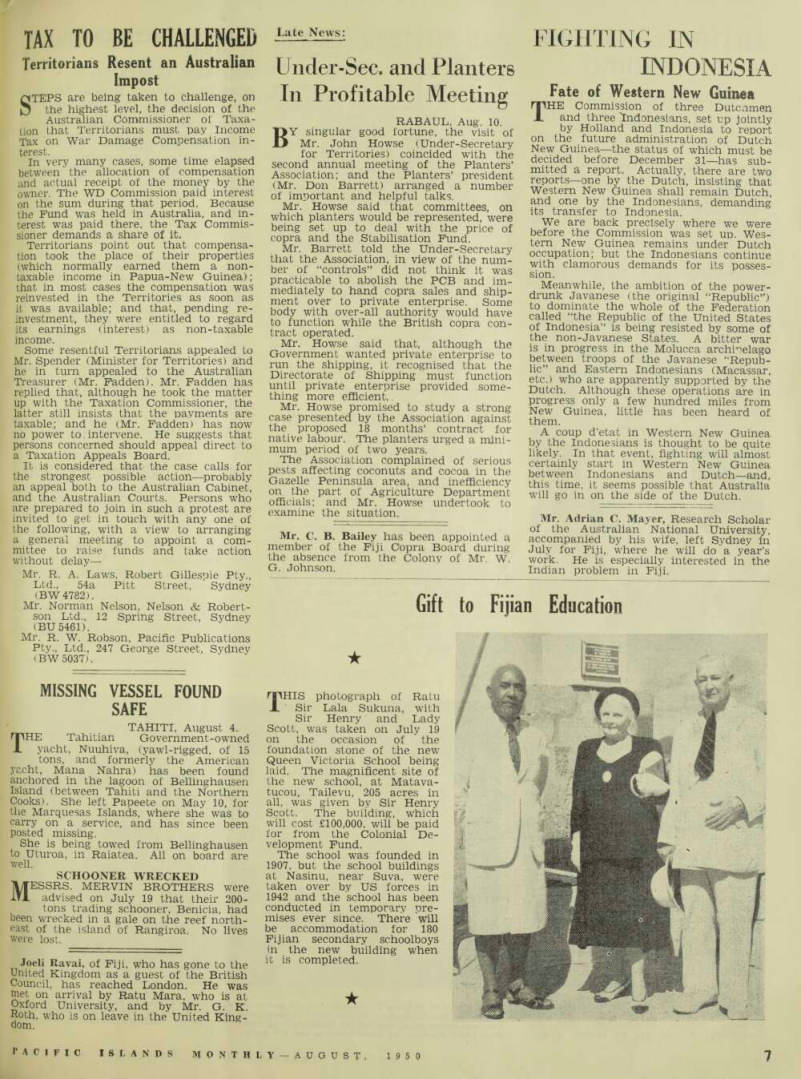
Gift to Fijian Education
THIS photograph of Ratu Sir Lala Sukuna, with Sir Henry and Lady Scott, was taken on July 19 on the occasion of the foundation stone of the new Queen Victoria School being laid. The magnificent site of the new school, at Matava tucou, Tailevu, 205 acres in all, was given by Sir Henry Scott. The building, which will cost £lOO,OOO, will be paid for from the Colonial De velopment Fund.
The school was founded in 1907, but the school buildings at Nasinu, near Suva, were taken over by US forces in 1942 and the school has been conducted in temporary pre mises ever since. There will be accommodation for 180 Fijian secondary schoolboys in the new building when it is completed.
Shocking Crime
Arthur Brander
Murdered
In Tahiti
Prom Our Own Correspondent
Papeete, July 20.
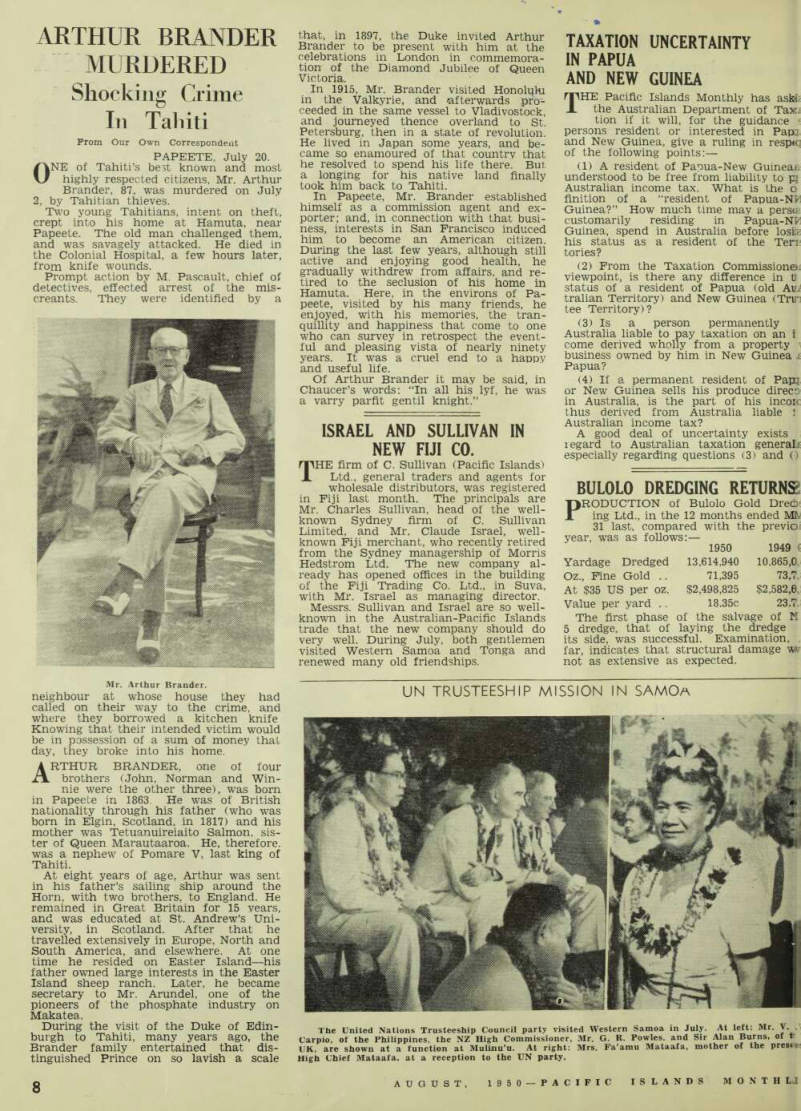
ONE of Tahiti’s best known and most highly respected citizens, Mr. Arthur Brander, 87, was murdered on July 2, by Tahitian thieves.
Two young Tahitians, intent on theft, crept into his home at Hamuta, near Papeete. The old man challenged them, and was savagely attacked. He died in the Colonial Hospital, a few hours later, from knife wounds.
Prompt action by M. Pascault, chief of detectives, effected arrest of the mis creants. They were identified by a
neighbour at whose house they had called on their way to the crime, and where they borrowed a kitchen knife Knowing that their intended victim would be in possession of a sum of money that day, they broke into his home.
Arthur brander, one of four brothers (John, Norman and Win nie were the other three), was born in Papeete in 1863. He was of British nationality through his father (who was born in Elgin, Scotland, in 1817) and his mother was Tetuanuireiaito Salmon, sis ter of Queen Marautaaroa. He, therefore, was a nephew of Pomare V, last king of Tahiti.
At eight years of age, Arthur was sent in his father’s sailing ship around the Horn, with two brothers, to England. He remained in Great Britain for 15 years, and was educated at St. Andrew’s Uni versity, in Scotland. After that he travelled extensively in Europe, North and South America, and elsewhere. At one time he resided on Easter Island —his father owned large interests in the Easter Island sheep ranch. Later, he became secretary to Mr. Arundel, one of the pioneers of the phosphate industry on Makatea, During the visit of the Duke of Edin burgh to Tahiti, many years ago, the Brander family entertained that dis tinguished Prince on so lavish a scale
that, in 1897, the Duke invited Arthur Brander to be present with him at the celebrations in London in commemora tion of the Diamond Jubilee of Queen Victoria.
In 1915, Mr. Brander visited Honolulu in the Valkyrie, and 'afterwards pro ceeded in the same vessel to Vladivostock, and journeyed thence overland to St.
Petersburg, then in a state of revolution.
He lived in Japan some years, and be came so enamoured of that country that he resolved to spend his life there. But a longing for his native land finally took him back to Tahiti.
In Papeete, Mr. Brander established himself as a commission agent and ex porter; and, in connection with that busi ness, interests in San Francisco induced him to become an American citizen.
During the last few years, although still active and enjoying good health, he gradually withdrew from affairs, and re tired to the seclusion of his home in Hamuta. Here, in the environs of Pa peete, visited by his many friends, he enjoyed, with his memories, the tran quillity and happiness that come to one who can survey in retrospect the event ful and pleasing vista of nearly ninety years. It was a cruel end to a happy and useful life.
Of Arthur Brander it may be said, in Chaucer’s words: “In all his lyf, he was a varry parfit gentil knight.”
Mr. Arthur Brander.
managing director"
Isreal And Sullivan In
New Fiji Co.
THE firm of C. Sullivan (Pacific Islands')
Ltd., general traders and agents for wholesale distributors, was registered in Fiji last month. The principals are Mr. Charles Sullivan, head of the well known Sydney firm of C. Sullivan Limited, and Mr. Claude Israel, well known Fiji merchant, who recently retired from the Sydney managership of Morris Hedstrom Ltd. The new company al ready has opened offices in the building
managing director"
Messrs. Sullivan and Israel are so well known in the Australian-Pacific Islands trade that the new company should do very well. During July, both gentlemen visited Western Samoa and Tonga and renewed many old friendships.
Taxation Uncertainty
In Papua
And New Guinea
THE Pacific Islands Monthly has asbtc the Australian Department of Taxi tion if it will, for the guidance € persons resident or interested in Papa and New Guinea, give a ruling in respiq of the following points:— (1) A resident of Papua-New Guineas: understood to be free from liability to pj Australian income tax. What is the o finition of a “resident of Papua-NM Guinea?” How much time may a persce customarily residing in Papua-NH Guinea, spend in Australia before losiie his status as a resident of the Ten* tories? (2) From the Taxation Commission©! viewpoint, is there any difference in ti status of a resident of Papua (old Ail tralian Territory) and New Guinea (Tm tee Territory)? (3) Is a person permanently Australia liable to pay taxation on an i come derived wholly from a property \ business owned by him in New Guinea s Papua? (4) If a permanent resident of Papq or New Guinea sells his produce direco' in Australia, is the part of his incoic thus derived from Australia liable 1 Australian income tax?
A good deal of uncertainty exists i regard to Australian taxation generals especially regarding questions (3) and 0
Bulolo Dredging Returns
PRODUCTION of Bulolo Gold ing Ltd., in the 12 months ended MI 31 last, compared with the previoi year, was as follows:—
Value per yard .. 18.35 c 23.7 The first phase of the salvage of M 5 dredge, that of laying the dredge its side, was successful. Examination, far, indicates that structural damage m not as extensive as expected.
1950 1949 Yardage Dredged 13,614,940 10,865,0, Oz., Fine Gold .. 71,395 73,7.
At $35 US per oz. $2,498,825 $2,582.6
Un Trusteeship Mission In Samoa
The United Nations Trusteeship Council party visited Western Samoa in July. At left: Mr. V.
Carpio, of the Philippines, the NZ High Commissioner, Mr. G. R. Powles. and Sir Alan Burns, of [?] UK, are shown at a function at Mulinu’u. At right: Mrs. Fa’amu Mataafa, mother of the pres[?] High Chief Mataafa. at a reception to the UN party.
Advertisements & other items, p. 10 (1 item)
8
AUGUST, 1950 PACIFIC ISLANDS MONTH LJ
Virulent Polio In East Papua
American Journalist Dies in Peculiar Circumstances
THE outbreak of severe Poliomyelitis (infantile paralysis), in Eastern Papua late in July, and the develop ment of circumstances not yet explained, caused the death on Sunday, August 6, of Mr. Clifford Kruse, a young American journalist who was on a visit to the Trobriand Islands.
Mr. Kruse was about 30 years old. He had held the rank of captain in the air arm of the United States Marines during the war in the Pacific, and he was per sonal pilot to a high-ranking officer. He had flown extensively over most of the battlefields, from the Solomons to Japan.
After the war, he adopted journalism and, as a casual writer, he wandered exten sively in French Oceania, especially the Marquesas. He wrote a number of articles for the PlM—some are not yet published.
Mr. Kruse arrived in Sydney early in 1950, and visited many out-of-the-way parts of Australia. Then he decided, while en route to Indonesia, to have a look at the archipelagoes eastward of Papua.
On August 3 the PIM received the following radiogram from him, dated Losuia (Trobriands) on the 2nd;— “I urgently need help. I am being detained here against my wishes because there is a polio quarantine in the Trobriand Islands.
“I departed from Samarai for Kitava (one of the Trobriand Islands) in a Government trawler before this quarantine was effected. En route, we anchored off the shore of Kiriwina (another of the Trobriand Islands). I was ordered to disembark by a . . . . medical official. I was refused permission to remain aboard and return to Samarai by reason of the quarantine.
“I am being treated like a criminal. I am in perfect health and I am isolating myself from exposure to polio. Hotel accommodation and eating facilities are not available to transients here. I am subject to possible detention here for six months unless officially released.
“I am anticipating that I shall be recalled to active duty with the Marine Corps in Korea.
“Please contact the United States Consul the Australian Minister, the New Guinea Adminis trator, the New Guinea Director of Health, and anyone else who can help, and urgently request permission for me to return to Sydney by first Catalina or ship.—CLIFFORD KRUSE,
Losuia.”
The PIM immediately placed a copy of this message in the hands of the Minis ter for Australian Territories, Mr. Spen der; and on August 4 we radio’d to Mr.
Kruse that the Minister had taken the matter up with the Administrator, and with Mr. Halligan, secretary of the De partment.
Next day, on August 5, Mr. Halligan was advised that Mr. Kruse was seriously ill.
On Sunday, August 6, he was informed that Mr. Kruse died at Losuia at 1.40 am. on that day (Sunday).
The news caused consternation among Administration officials, who had already been making arrangements to take Mr.
Kruse off the island. A medical man was sent immediately in a seaplane to try and ascertain exactly the cause of death. . It is understood that an inquiry is be mg made into the circumstances under Which Mr. Kruse was detained in Losuia.
22 Cases And 4 Native Deaths
Reported
THE flare-up of Poliomyelitis in the
Trobriand Islands and in Misima was sudden and alarming. The Adminis h?i or v, reported earl y in August that there nad been 22 cases reported among the natives (16 at Losuia), four of whom had
died. Three of the deaths were on Misima.
In a Gazette issued on July 31 both areas were proclaimed infected areas, and became subject to strict quarantine.
The Administrator said that the epi demic was being investigated by Dr.
Smythe, and the Assistant Director of Health (Dr. May) was then in the area with the medical vessel, Hekeha, which was equipped with an artificial lung; and extra medical supplies were sent to Losuia by Catalina on July 30.
It was hoped, early in August, that the original explosive epidemic had burned out, for no new cases had been reported.
All the usual precautions were being taken.
Easter Island
Air Route
P. G. Taylor on a Survey Flight
IN another enterprise, calculated to es tablish another Trans-Pacific air route, Captain P. J. Taylor will leave Sydney next month, for Fiji, Samoa, Cook Islands and Tahiti. He hopes to show that there is a practicable air route across the South Pacific between Australia and Chile, South America.
The Australian Government will pro vide Captain Taylor with an RAAF Cata lina, which he already has tested. His crew of six men has not yet been chosen.
Captain Taylor plans to make use of Easter Island, between French Oceania and Chile, as a stopping place, but the rest of the route is subject to survey.
There are no islands between Easter and the South American coast, a distance of 3,000 miles.
In 1945, in a flying-boat, Captain Tay lor surveyed the Trans-Pacific route.
Central America-Clipperton-Galapagos
French Oceania, and thence westwards via Fiji. This time, he is seeking a more southerly track between the Ameri cas and French Oceania.
Later, Captain Taylor surveyed the Trans-Indian Ocean route, via Cocos Island and Madagascar, between Aus tralia and Africa, which would be used by Australia for communication with Europe, if Southwest Asia were closed against her.
“Bill” Taylor is held in high regard in Sydney, where he was a distinguished associate of Kingsford Smith. He is a director of Trans-Oceanic Airways.
40 Migrant Doctors At Work
In New Guinea
THE administrator of Papua-New Guinea, Colonel J. K. Murray, who made a quick visit to Australia early in August, told a reporter that almost 40 of the Territory’s 50 doctors were post war refugees from Europe. Many had been famous surgeons and specialists in their own countries. The doctors had been selected from 120 who had ap plied for the positions.
They were settling down very well, and learned English rapidly.
Mr. Bruce Jones, of Honiara, BSI, was in Inverell, NSW, on leave in August.
Mr. Gatty Retires
From Tuna Fishery
Prom Our Own Correspondent M__ SUVA, July 10 R HAROLD GATTY has retired from the posts of chairman and . managing-director of South Seas Marine Products, Ltd., and president of the associated company, Island Packers, Ho announcement about the future of la^?f; SCa l e fis t ei T, organisation, which ? att Z has smlt5 mlt U P in Fiji since 1945, has been made, and when Mr. Gatty was presented with a farewell address y J? e^ ei ? P i2 ye ! s ifc cont ained the state ment that the testimonial was presented with the knowledge that the future of time 7 ” 0116 of u s is in the balance at this Gilt-printed on tapa, the address paid a tribute to Mr. Gatty’s gift for organi st 1 ?, 11 and hl l- capacity for inspiring loyalty among his employees of various races, in Fiji. He would be remembered, it said, as a man who had successfully d ° ne h. ls utmost to raise the wage-levels of Fijian and other workers in the Colony and who had established new standards of employer-employee rela tionships.
The address was presented with a gold inscribed tortoiseshell cigarette case \Vhen acknowiedging the presentation, Mr. Gatty indicated that he intended to make his home in Fiji permanently.
Fiji Governor
Ill
THE Governor of Fiji, Sir Brian Free ston, was admitted to hospital, Suva, at the end of July, suf fering from a mild form of diphtheria.
He is responding well to treatment and will probably resume the administration of Fiji and the Western Pacific High
Commission shortly.
The Colonial Secretary (Mr. A. F. R.
Stoddart) was sworn in as Officer Ad ministering the Government of Fiji Mr. P. H. Nightingale acted as Colonial Secretary in addition to acting as Fi nancial Secretary.
QEA Survey Flights
in Fiji
THE Qantas Empire Airways Catalina, which is to make survey flights in Fiji preparatory to the Company operating internal air services for a six months experimental period, arrived at Suva on July 24, and began the survey two days later.
The places included in the itinerary are Levuka, Kadavu, Nadi, Lautoka, Savu savu, Labasa, Dreketi, Buca Bay, Tave uni, Lomaloma and Lakeba. Later it visited Tonga, Cook Is. and Tahiti.
Captain W. H. Crowther directed the survey, and Captain H. Birch commanded the aircraft.
Mr. Charles McPhee, of Western Samoa, who is steadily acquiring fame as a Paci fic Islands painter, reports that Miss Johnny Frisbie, of Rarotonga, daughter of the late Robert Dean Frisbie, has now gone to reside in Honolulu. The Ameri can author, Mr. James Norman Hall, is helping Miss Frisbie in her ambition to follow her father’s footsteps and develop as an author. Mr. McPhee. by the way, has succeeded lately in selling a num ber of his Samoan paintings at satis factory prices. The New Zealand High Commissioner in Samoa (Mr. G. R.
Powles) has taken a keen interest in Mr. McPhee’s work.
The Month In Moresby
Prom Our Own Correspondent
Port Moresby, Aug. 5.
■DEVISED customs tariffs aimed at IV lowering living costs have come into force in Papua and New Guinea.
Clothing and all foodstuffs are now duty free, and duty has been lifted from other items such as bedding, carpets and floor coverings.
In Papua the effect is that clothing prices will drop by about 11 per cent.; there will be a similar drop in prices of tinned fish, tinned milk and cream, pickles, dripping, etc., and butter, tea, coffee and cocoa will cost 2d. a lb. less.
Toilet soap will be 10 per cent, cheaper.
The only clothing now dutiable is silk goods on which the duty has risen from 10 to 15 per cent.
In compensation, increased duty on beer will raise the price by 3d. a bottle and spirits will cost 2 - a bottle more.
Duty on cigarettes has jumped 100 per cent.-from 10/6 a lb. to 21/—representmg a price increase of 1/4 on a tin of 50. A 2 oz. tin of tobacco will now cost lOd. more. Duty on jewellery has risen 15 per cent, and machinery, formerly duty free, now carries a 10 per cent, duty —the least satisfactory tariff change as far as local firms are concerned.
Full effect of the new tariffs has not yet been felt as the tariffs have so far applied to only one shipment from Australia. :: ;: :: DESIGNING of a new residential area between the Four and Five Mile at Port Moresby is now under way.
The area is on the right hand side of the road when travelling towards Rouna.
As well as residential sites, the plan provides for 10 or 12 shops, a school and a recreation ground. A contour survey of the area has been made but the blocks have yet to be sub-divided.
The shortage of surveyors is delaying this work. Another project which the Administration is working on is the demolition of a number of native shacks at Koki. During his visit here Mr.
Spender described the shacks as a blot on the landscape and ordered them to be removed. Shacks to be demolished are those that were built on Crown land.
Buildings on native-owned land will not be touched. Natives whose homes are pulled down will be accommodated in houses built by the Administration on the salt pans near the golf course. The houses will be similar to those being erected at Hanuabada but, unlike the Hanuabadans, the Koki people will probably have to pay rent for their new homes. it is estimated that 100 Koki natives will be affected. Twenty-five new houses win be built for them in the first stage 0 f the project. Mr. Spender wants the project completed within a year. ‘ •• ■■ a™ J%/lORESBY S hre-hghtmg equipment I*l must be modernised at an early date if the authorities wish to avert catastrophe, said the Coroner (Mr. B. w. Faithorn), in his report on the Kila Police Depot fire. Mr. Faithorn said there was an ever-increasing danger of a large-scale fire in Port Moresby. The fire brigade was doing a splendid job
but was hampered by the lack of modK ern equipment.
The Coroner found that the fire whicDi destroyed a fuel storage shed at Kila 03 June 17 was caused by kerosene furrier coming into contact with a lighted huir icane lamp. Two native policemen were pouring kerosene into the lamp at tkl; time. Mr. Faithorn said the fire rei yealed “a lamentable disregard of til: elementary precautions to be taken fol the safeguarding of life and The fuel store containing highly inflann mable products, had been placed in tlf; midst of a crowd of administration builo. ings. Open fuel drums were in thd same shed as unopened supplies.
Portable stirrup pumps to fight fire has. proved defective, suggesting that ther had not been tested for a long time. “I‘ this neglect,” said the Coroner, “the OII< Kila Depot must accept a degree ♦ blame.”
Mr. Faithorn said that the fire brigaoj was equipped with one bush fire-fighn ing outfit, a water tank with a capaciti of only 200 gallons, and hoses fitted with water sprays which were “entirely ine:e fective” when dealing with oil and petra fires. The Coroner said that if po:o sible the fire engine should be fitted with foam-making pipes so that eitlur water or foam can be sprayed.
ROBERT CANN, of DCA, had behave abnormally on the night before M disappeared, witnesses said at tHd inquest into Gann’s death. (Gann’s bodb naked except for a pair of sandsho©< was found floating in Port Moresby Haii hour near Ibubada on June 23. He hsj been missing since the morning of Jum 19). Assistant Sub-Inspectors Harbeoe and Dutton told the Coroner (Mr. I
(Continued on Page 101.)
W. Faithorn) that when they answered a call to DCA mess about 4 am on June 19 they found Cann pacing up and down.
Asked what the trouble was, Cann said, “I suffer from loss of memory and they re ganging up on me.” Then he said, “We are being watched,” and “I’ve got Bill Blunt on my mind.” (Blunt, another DCA man, was killed in a fall at Rouna).
Dutton said he believed Cann was suf fering from the effects of heavy drink ing.
The Coroner’s verdict was death by drowning. There was no evidence of foul play.
A PAPUA-NEW GUINEA Division of the Ex-Navalmen’s Association has been formed. Moresby is the head branch and sub-branches are to be formed in other parts of the Territory.
Twenty-two attended the inaugural meeting at Moresby and membership has already reached 35. The branch hopes to get land for a clubhouse and members of the Naval Reserve are planning to continue their training here. Officers of the branch are: Mr. N. Plant (President), H. A. Triggs and W. R. Frame (Vice- Presidents), J. H. Gillman (secretary), Miss S. M. Webb (assistant secretary), C. McEachern, F. C. Hill and J. P. Wal ton (committeemen), THERE is no reason to believe that any epidemic disease has been conveyed by Moresby’s water supply but, as a safety measure, water for drinking should always be boiled. Director of Health, Dr. Gunther, said this at a re cent Advisory Council meeting. Dr. Gun ther said the water supply is safe for human consumption while bottled chlor ine is available, but, due to shipping dif ficulties, the chlorine is not always available.
ASSISTANT Director of Native Labour, Mr. John McKenna, appeared in the Moresby Court of Petty Sessions re cently, charged with assaulting a native.
He was convicted but Magistrate B. W.
Faithorn discharged him without im posing a penalty. McKenna was al leged to have hit a native labourer, Mai
Sarufa, on the main wharf on June 19.
According to police, Mai Sarufa was talking to another native when McKenna approached, and, without speaking, punched Mai on the face. McKenna pleaded guilty but said he only hit Mai with his open hand. He told Mai to get on with his work and Mai had sworn at
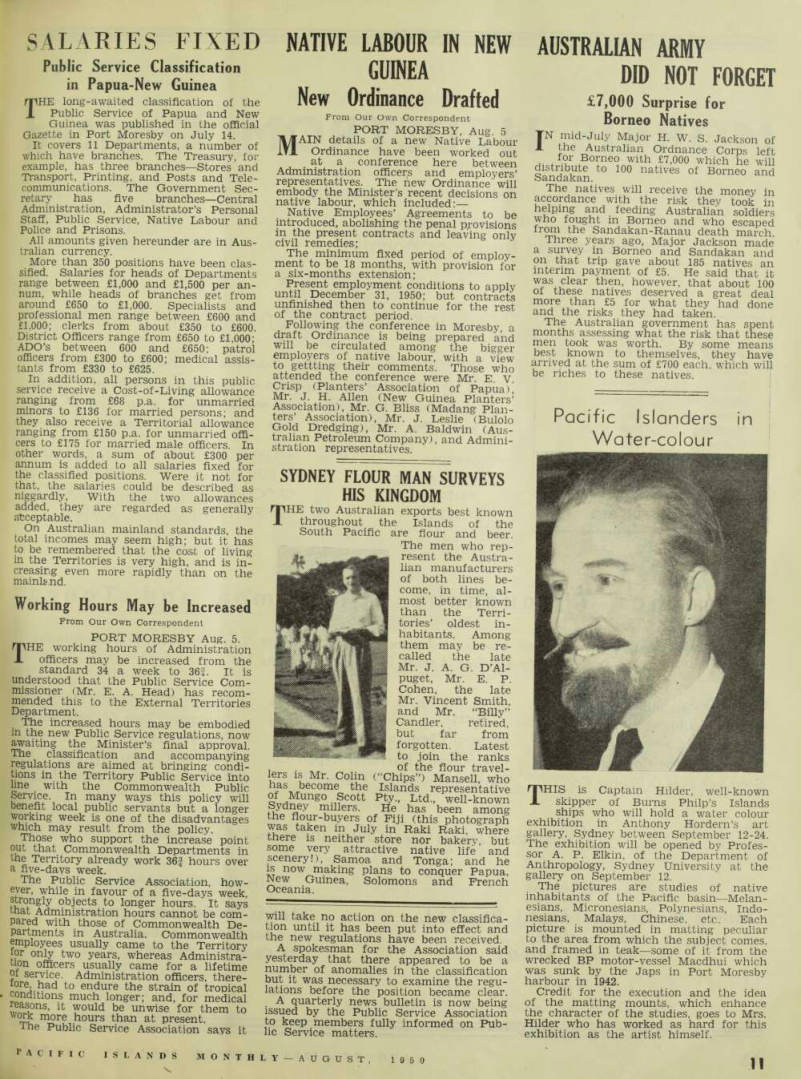
South Pacific Conference Delegates
Front row (left to right): Markus Kasiepo (Dutch New Guinea); Ratu Ed ward Cakobau (Fiji); Albert Henry (Cook Islands); Prince Tuipelehake (Tonga); Makea Nui Teremoana Ariki (Cook Islands); High Chief Malietoa (Western Samoa); Prince Tungi (Tonga); High Chief Tamasese (Western Samoa); High Chief Tufele (American Samoa); Joele Ravai (Fiji); Waiau Ahnon (New Guinea); Hon. M. S. Buksh (Fiji); M.
Lucien Vayssiere (French Oceania); M.
Paul Berniere (French Oceania).
Middle row (left to right): Penitala Teo (Ellice Islands); Jacob Dagabwi naesi (Nauru); Raymond Gadabu (Nauru); Hon Vishnu Deo (Fiji); High Chief Tuitele (American Samoa); Faipule Anapu (Western Samoa); Hon. Tualau lelei (Western Samoa); Willie Gavera (Papua); Robert Rex (Cook Islands); J.
Lameko, BEM; Miria Gavera (Papua) ; Kamona Walo (New Guinea); Bondai Pita (Papua); Mr. I, G. Turbott (Gil bert Islands).
Back row (left to right): Gira (Sole mon Islands); Belade (Solomon Islands!: Petero (New Hebrides); John Kalsakrf (New Hebrides); Aisa Gu’u (Papua); Rafael Bouanani (New Caledonia); HiO Talking Chief Tuiasopopo (America Samoa); George Kassi (New Guineas losili Salin (New Guinea); M. Maou Dj«t (New Caledonia); Rongamatane An (Cook Islands); Ainoa Kalapu (Westej Samoa).
This group photograph, taken in an interval during the first South Pacific Conference, held in Suva at the end of Apr[?] last, shows most of the delegates who attended. Names of delegates in the group are.
Salaries Fixed
Public Service Classification in Papua-New Guinea
THE long-awaited classification of the Public Service of Papua and New Guinea was published in the official Gazette in Port Moresby on July 14.
It covers 11 Departments, a number of which have branches. The Treasury, for example, has three branches —Stores and Transport, Printing, and Posts and Tele communications. The Government Sec retary has five branches—Central Administration, Administrator’s Personal Staff, Public Service, Native Labour and Police and Prisons.
All amounts given hereunder are in Aus tralian currency.
More than 350 positions have been clas sified. Salaries for heads of Departments range between £l,OOO and £1,500 per an num, while heads of branches get from around £650 to £l,OOO. Specialists and professional men range between £6OO and £1,000; clerks from about £350 to £6OO.
District Officers range from £650 to £1,000; ADO’s between 600 and £650; patrol officers from £3OO to £600; medical assis tants from £330 to £625.
In addition, all persons in this public service receive a Cost-of-Living allowance ranging from £6B p.a. for unmarried minors to £136 for married persons; and they also receive a Territorial allowance ranging from £l5O p.a. for unmarried offi cers to £175 for married male officers. In other words, a sum of about £3OO per annum is added to all salaries fixed for the classified positions. Were it not for that, the salaries could be described as niggardly, With the two allowances added, they are regarded as generally atceptable.
On Australian mainland standards, the total incomes may seem high; but it has to be remembered that the cost of living in the Territories is very high, and is in creasing even more rapidly than on the mainland.
Working Hours May be Increased
Prom Our Own Correspondent
Port Moresby Aug. 5.
THE working hours of Administration officers may be increased from the standard 34 a week to 369. It is understood that the Public Service Com missioner (Mr. E. A. Head) has recom mended this to the External Territories Department. . The increased hours may be embodied in the new Public Service regulations, now awaiting the Minister’s final approval.
The classification and accompanying regulations are aimed at bringing condi tions in the Territory Public Service into line with the Commonwealth Public Service. In many ways this policy will benefit local public servants but a longer working week is one of the disadvantages which may result from the policy.
Those who support the increase point put that Commonwealth Departments in the Territory already work 369 hours over a five-days week.
The Public Service Association, how ever, while in favour of a five-days week, strongly objects to longer hours. It says that Administration hours cannot be com pared with those of Commonwealth De partments in Australia. Commonwealth employees usually came to the Territory [or only two years, whereas Administra tion officers usually came for a lifetime pi service. Administration officers, there i°re had to endure the strain of tropical conditions much longer; and, for medical reasons, it would be unwise for them to Tru more hours than at present.
The Public Service Association says it
will take no action on the new classifica tion until it has been put into effect and the new regulations have been received.
A spokesman for the Association said yesterday that there appeared to be a number of anomalies in the classification but it was necessary to examine the regu lations before the position became clear.
A quarterly news bulletin is now being issued by the Public Service Association to keep members fully informed on Pub lic Service matters.
Native Labour In New
Guinea
New Ordinance Drafted
From Our own Correspondent
Port Moresby, Aug. 5
MAIN details of a new Native Labour Ordinance have been worked out at a conference here between Administration officers and employers’ representatives. The hew Ordinance will embody the Minister’s recent decisions on native labour, which included:— Native Employees’ Agreements to be introduced, abolishing the penal provisions in the present contracts and leaving only civil remedies; The minimum fixed period of employ ment to be 18 months, with provision for a six-months extension; Present employment conditions to apply until December 31, 1950; but contracts unfinished then to continue for the rest of the contract period.
Following the conference in Moresby, a draft Ordinance is being prepared and will be circulated among the bigger employers of native labour, with a view to gettting their comments. Those who attended the conference were Mr. E V Crisp (Planters’ Association of Papua)!
Mr. J. H. Allen (New Guinea Planters’
Association), Mr. G. Bliss (Madang Plan ters’ Association), Mr. J. Leslie (Bulolo Gold Dredging), Mr. A. Baldwin (Aus tralian Petroleum Company), and Admini stration representatives.
His Kingdom
Sydney Flour Man Surveys
THE two Australian exports best known throughout the Islands of the South Pacific are flour and beer.
The men who rep resent the Austra lian manufacturers of both lines be come, in time, al most better known than the Terri tories’ oldest in habitants. Among them may be re called the late
Mr. J. A. G. D’Al
puget, Mr. E. P.
Cohen, the late Mr. Vincent Smith, and Mr. “Billy”
Candler, retired, but far from forgotten. Latest to join the ranks of the flour travel
*1 Mr ’ Co i l iP (“Chips”) Mansell, who * s -«,k ecome Viands representative ol Mango Scott Pty., Ltd., well-known Sydney millers. He has been among the flour-buyers of Fiji (this photograph was taken in July in Raki Raki, where there is neither store nor bakery, but some very attractive native life and scenery!), Samoa and Tonga; and he is now making plans to conquer Papua.
New Guinea, Solomons and French Oceania.
Australian Army
Did Not Forget
£7,000 Surprise for Borneo Natives
IN mid-July Major H. W. S. Jackson of the Australian Ordnance Corps left for Borneo with £7,000 which he will distribute to 100 natives of Borneo and bandakan.
The natives will receive the money in accordance with the risk they took in helping and feeding Australian soldiers who fought in Borneo and who escaped from the Sandakan-Ranau death march.
Three years ago, Major Jackson made a survey in Borneo and Sandakan and on that trip gave about 185 natives an interim payment of £5. He said that it was dear then, however, that about 100 of these natives deserved a great deal more than £5 for what they had done and the risks they had taken.
The Australian government has spent months assessing what the risk that these men took was worth. By some means best known to themselves, they have arrived at the sum of £7OO each, which will be riches to these natives.
Water-colour
Pacific Islanders in Water-colour
THIS is Captain Hilder, well-known skipper of Burns Philp’s Islands ships who will hold a water colour exhibition in Anthony Hordern’s art gallery, Sydney between September 12-24.
The exhibition will be opened by Profes sor A. P. Elkin, of the Department of Anthropology, Sydney University at the gallery on September 12.
The pictures are studies of native inhabitants of the Pacific basin—Melan esians, Micronesians, Polynesians, Indo nesians, Malays, Chinese, etc. Each picture is mounted in matting peculiar to the area from which the subject comes, and framed in teak—some of it from the wrecked BP motor-vessel Macdhui which was sunk by the Japs in Port Moresby harbour in 1942.
Credit for the execution and the idea of the matting mounts, which enhance the character of the studies, goes to Mrs.
Hilder who has worked as hard for this exhibition as the artist himself.
Advertisements & other items, pp. 13-14 (3 items)
11
Pacific islands moN THLY-A u G U S T, 1950
12
AUGUST, 1960 PACIFIC ISLANDS MONTHL
Morris Hedstrom Limited
General Merchants, Importers and Exporters,
Shipowners, Plantation Owners,
Commission and Insurance Agents
HEAD OFFICE
SUVA, FIJI
Established 1868
SERVICE IN THE SOUTH PACIFIC TERRITORY
rjpHROUGH our Large Establishments in Suva and our Numerous Branches, we distribute a wide and comprehensive range of General Merchandise and provide almost every kind of service. Our departments and associated businesses include:
DRAPERY
MOTOR SALES
AND SERVICE
TOBACCO
TIMBER AND
BUILDING
GROCERY
CONFECTIONERY
HARDWARE
ELECTRICAL
LIQUORS
DRUGS
Branches Throughout Fiji, Samoa and Tonga
There is a Branch or Agent of Morris Hedstrom Limited in every Town in the Three Territories.
We are Sole Agents in these Territories for British Drug Houses Ltd.
Electrolux Ltd.
Ford Motor Co.
General Electric Co. Ltd.
Goodyear Tyre Gr Rubber Co.
B. A. Hjorth Gr Co. (Primus Products) Imperial Chemical Industries Ltd.
International Harvester Export Co.
Matson Navigation Company Max Factor and Co. Inc.
Ransomes, Sims Gr Jefferies Lte Ruston Gr Hornsby Ltd.
Vacuum Oil Co. Pty. Ltd.
Yorkshire Copper Works Ltd.
Morris Hedstrom Limited are LLOYD'S AGENTS in Fiji and Samoa.
IN AUSTRALIA: IN GREAT BRITAIN;
Morris Hedstrom (Aust.) Pty. Ltd., Morris Hedstrom Limited, Asbestos House, Borelay's Bank Building, 65 York Street, SYDNEY 73 Cheopside, LONDON, E.C.2.
Air Fares Cut
New Rates for Hebrides and Solomons
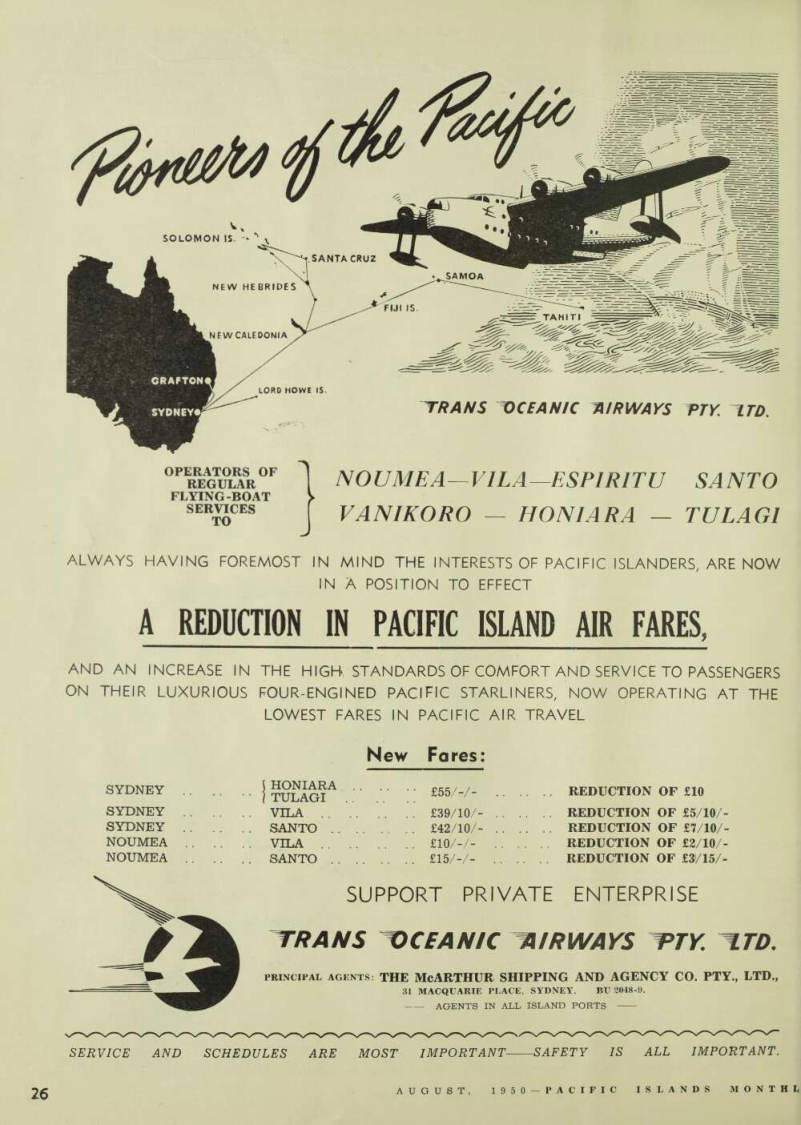
A SUBSTANTIAL cut in air-fares be tween Sydney and the New Heb rides and Solomon Islands was an nounced during the month by Trans Oceanic Airways, Ltd. The following table shows the nature of the reductions:
It is not anticipated that the Govern ment-owned Company, Qantas Empire Airways, Ltd., will ignore this competi tion. TO A rates were already below those of Qantas; and the new cut means that TOA fare to Honiara is now £l9 below that charged by Qantas, and only £lO above the shipping fare.
Naturally, the public always likes to see a little liveliness in these matters But the big transportation companies— with apparent wisdom, in these extremely difficult times of rising costs and trade union lunacies—will do everything pos sible to avoid cut-throat competition.
New Fare Return Single Sydney-Vila £71 2 0 £39 10 0 Sydney-Santo £76 10 0 £42 10 0 Sydney-Honiara-Tulagi £99 0 0 £55 0 0 Noumea-Vila £18 0 0 £10 0 0 Noumea-Santo £27 0 0 £15 0 0 Previous Fare Return Single Sydney-Vila £81 0 0 £45 0 0 Sydney-Santo £90 0 0 £50 0 0 Sydney-Honiara-Tulagi £117 0 0 £65 0 0 Noumea-Vila £22 10 0 £12 10 0 Noumea-Santo £33 15 0 £18 15 0
Pacific Comm’N
Sydney Jurist For S.
Appointment of Professor K. O.
Shatwell
ON the eve of his departure for Europe and the United States, the Austra nan Minister for External Affairs and External Territories (Mr. Spender) announced that Professor K. O. Shatwell, H? al i ls Rr ofessor of Law and Dean of the Faculty of Law at Sydney University, had been appointed a Commissioner to represent Australia on the South Pacific Commission. ™ He « ta f es the place of the Rev. Dr. J. w Burton, who resigned recently, and whom Mr. Spender thanked for valuable service given since the inception of the Commission.
The new appointment caused some sur- Pr °lessor Shatwell, is distinguished irJ? e acad emic world, but he does not appear to have any special knowledge J* administrative problems of the So?5 lcal territories of the Pacific. From 1934 until a couple of years ago, Pro fessor Shatwell—who holds the degrees B A and BCL of Oxford-was Profes sor of Law at the University of Tas paiHa; and then he became head of the Faculty of Law in Sydney. n fnations each appoint two members the iSouth Pacific Commission; and all the other Commissioners have, or have Islands° m a e fla^ Se connection Pacific Au ? ralian representation is im soontihici f becaus l e Australia—being re- South bl pf?m SO i a f ge a Proportion of the ar Pfl h M^ aclfi K Islands’ population and of tb? ™ abo Ht one third of the cost fluprlfiocorsaruscition, and necessarily in tealK ntw £ ollcy a " d activ iMes. ' Aus- Ha iifdJ 3th o r Commissioner is Mr. J. R ftWTL" the apartment
New Guinea’S
Timber
Australian Government’s Plans
THE Australian Government is seeking Forestry Officers, at about £9OO per annum, to train and control native staff in connection with the development of the timber resources of Papua and New Guinea.
The timber resources of the Territories are being examined—including some map ping from the air—and activities in connection therewith will be controlled by a special section of the Department of External Territories. There will be a
skilled Director at £1,200 per annum.
It is planned to introduce high-powered logging and sawmilling equipment. Ex perts are examining the timbers as to suitability for plywood and veneers.
There is no indication yet of whether actual development will be carried out by the Department or by private enterprise The Australian Government favours the latter method. There is a plan afoot un der which a company, jointly owned by Government and Bulolo Gold Dredging Ltd., will produce timber, plywood and veneer, in the Morobe district Forestry officials, after a recent survey said there were, in the Bulolo Valley’ about 200 million feet of hoop pine, klinki pine, cedar and secondary timbers It is proposed that local timber needs shall be met first, and that all surplus timber shall go to Australia.
Advertisements & other items, pp. 15-16 (2 items)
13
PAO I F 1 C ISLANDS MONTHLY-AUGUST, 195 0
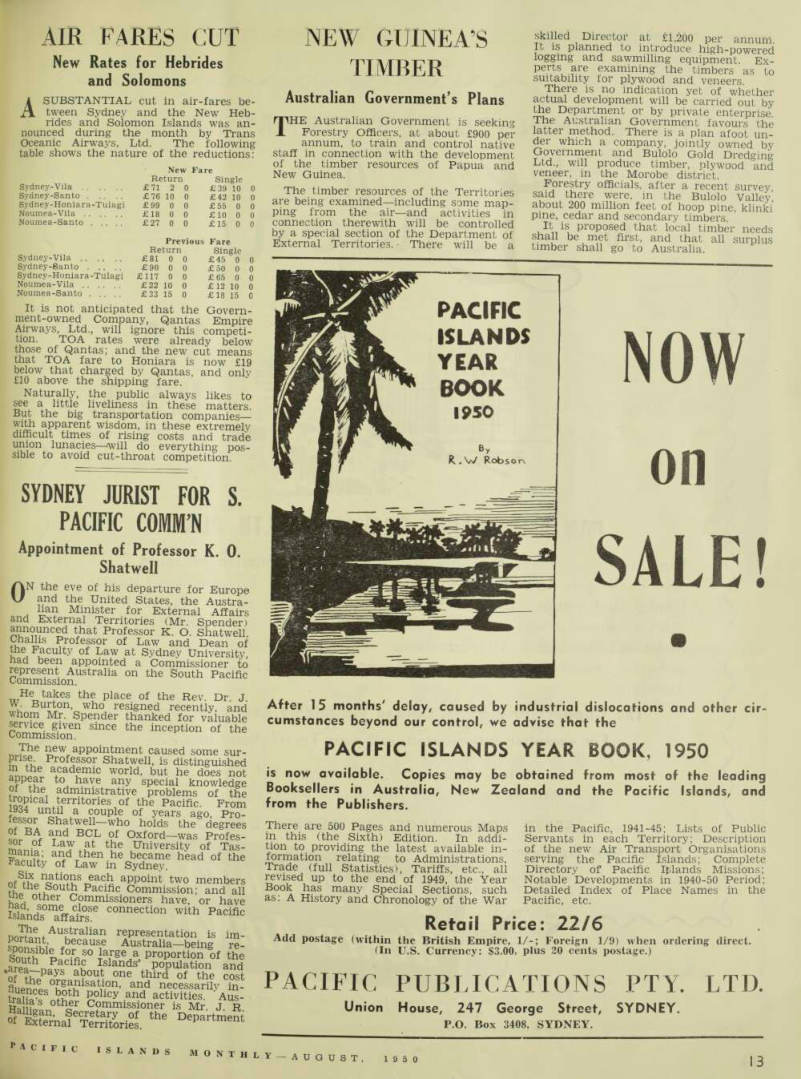
Sale!
PACIFIC
ISLANDS
YEAR
BOOK
1950 R..W Robso r
NOW
on
SALE!
After 15 months' delay, caused by industrial dislocations and other circumstances beyond our control, we advise that the
PACIFIC ISLANDS YEAR BOOK, 1950
is now available. Copies may be obtained from most of the leading Booksellers in Australia, New Zealand and the Pacific Islands, and from the Publishers.
There are 500 Pages and numerous Maps m this (the Sixth) Edition. In addition to providing the latest available information relating to Administrations, Trade (full Statistics), Tariffs, etc., all revised up to the end of 1949, the Year Book has many Special Sections, such as; A History and Chronology of the War in the Pacific, 1941-45; Lists of Public Servants in each Territory; Description of the new Air Transport Organisations serving the Pacific Islands; Complete Directory of Pacific Inlands Missions; Notable Developments in 1940-50 Period; Detailed Index of Place Names in the Pacific, etc.
Retail Price: 22/6
Add postage (within the British Empire, 1/-; Foreign 1/9) when ordering direct. (In U.S. Currency: $3.00, plus 20 cents postage.)
PACIFIC PUBLICATIONS PTY. LTD.
Union House, 247 George Street, SYDNEY.
P.O. Box 3408, SYDNEY.
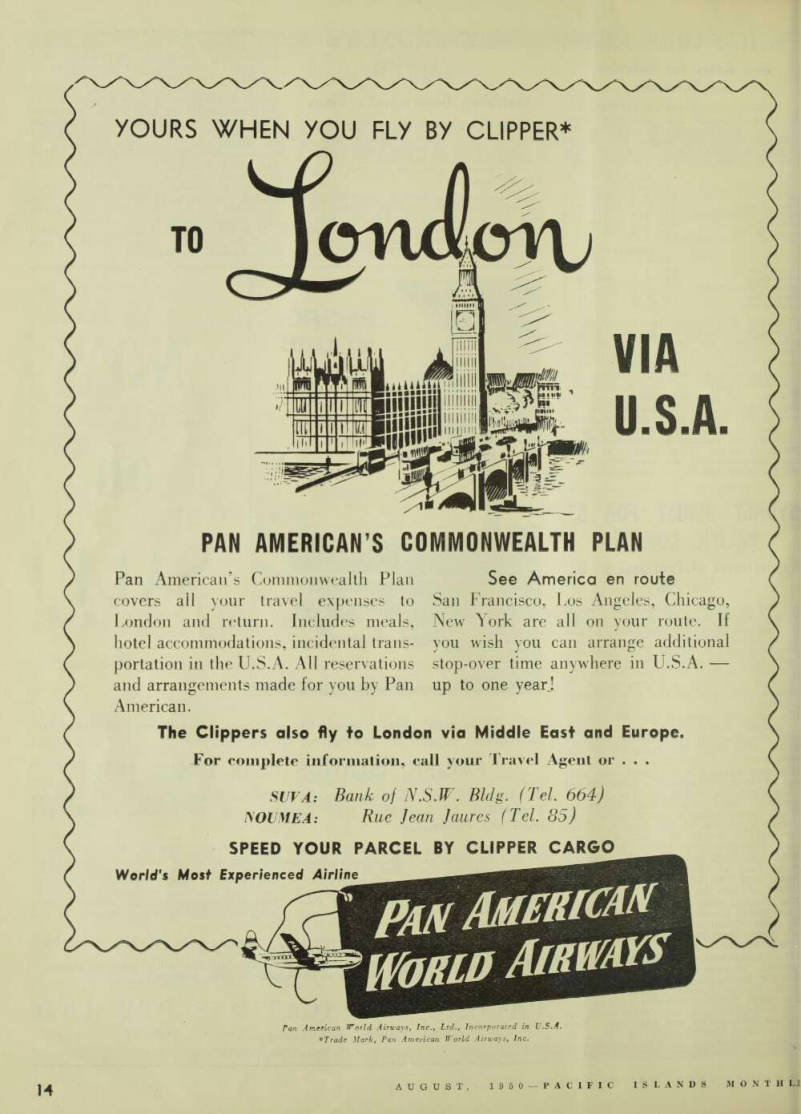
YOURS WHEN YOU FLY BY CLIPPER*
TO m W■iiUUiij ;i!
Tiiiiiini! hi
g iiiiii hi
SI fc
VIA
U.S.A.
PAN AMERICAN’S COMMONWEALTH PLAN
Pan American’s Commonwealth Plan See America en route covers all your travel expenses to San Francisco, Los Angeles, Chicago, London and return. Includes meals, New York are all on your route. If hotel accommodations, incidental trails- you wish you can arrange additional portation in the U.S.A. All reservations stop-over time anywhere in U.S.A. and arrangements made for you by Pan up to one yearj American.
The Clippers also fly to London via Middle East and Europe.
For complete information, call your Travel Agent or . . .
SUVA: Bank of N.S.W. Bldg . (Tel. 664) NOUMEA: Rue Jean Jaures (Tel. 85)
SPEED YOUR PARCEL BY CLIPPER CARGO
World's Most Experienced Airline / / Pan American World Airways, Inc., Ltd., Incorporated in U.S.A. *Trade Mark, Pan American World Airways, Inc.
75 Years Old
History of Union SS Co. of New Zealand
ON July 10, 1875—exactly 75 years ago —something happened in the in conspicuous little town of Dunedin, in southern New Zealand, which had a marked effect on South Pacific commer cial development and history. On that day, the Union Steamship Co. Ltd., was born.
As a result of extensive gold discovered in its hinterland, Dunedin was booming, and its enterprising merchants were prospering. One outstanding young man, James Mills, in 1869, had established the Harbour Steam Company, to run little ships in Otago Harbour, between Port Chalmers and Dunedin. In 1875, he linked this with other shipping interests to form the Union Company, which he directed and controlled.
The expansion of this new “Union Steamship Company of New Zealand Ltd.” was remarkable. Step by step, it ac quired more and more ships and extended its services from the South to the North Island; thence to Australia: thence to Fiji. Samoa, Tonga, the Cook Islands and Tahiti; and, in the middle ’eighties, under contract with the Australian and New Zealand Governments, it began carrying the mails across the Pacific to San Fran cisco.
A service between New Zealand and India was begun in 1887. By 1891, as a result of acquiring the Tasmanian Steam Navigation Co., the Union SS Co. was in the Tasmanian trade. Ten years later, in 1901, it bought into the Canadian Aus tralasian Line, and became even more deeply engaged with regular passenger and freighter lines across the Pacific.
The Union Co.’s presiding genius, Sir James Mills, having given notable service to his company and his country, died in the ’twenties, at an advanced age; but the fine organisation he had created had already taken its place among the great shipping companies of the world.
Interest In Aviation
IT is interesting to note, in the light of after-events, that as long ago as 1913 the directors of the Union Co., with characteristic foresight, altered their Articles to give them power to engage in air transport; and it was the Union Co. which formed the original Union Airways of NZ, and Cook Strait Airways, and had a close association with Tasman Empire Airways. The company was wiped out of those enterprises when the New Zealand Socialist Government made air trans portation a State monopoly; but it has an interest still in Australian National Airways, a trans-Pacific pioneer.
In view of the last paragraph, the PIM made rather a faux pas in its June issue when, commenting on the lack of hotel accommodation for air travellers in Fiji, it said; “The Union Co. (which owns the Grand Pacific Hotel) might be responsive if most of the hoped-for tourist traffic were to be sea-borne. But the majority of the tourists probably would travel by planes, which a company interested in running ships cannot be expected to nur ture.”
Mr. D. A. Butler, Fiji manager of the U^i° n Ca, has made this mild comment: .The Union Co. has no desire whatever to impede the inevitable development of air travel for individuals, or tourist parties; and, indeed, it has all along regarded it as complementary to sea travel; each creates traffic for the other. And the union Co. are booking agents for all the principal airlines.”
Election Day
August 26 is Fiji Election Day
From Our Own Correspondent SUVA. July 31. riIHE three Europeans and three Indian JL members of the Legislative Council of Fiji will be elected on August 26 —except in certain islands of Lau and Lomaiviti, where voting will take place between August 21 and 28, the Govern ment vessel, Viti 11, calling to pick up the recorded votes.
When nominations closed on July 28, Mr. H. Maurice Scott was declared to be elected unopposed for the European North-Western Division seat, which he won in 1947.
In the Southern Division, which in cludes Suva, the sitting member is op posed by Mr. Alport Barker, the Mayor of Suva, who held the seat for 22 years before his defeat by Mr. A. A. Ragg in 1944. In 1947 Mr. Ragg retained the seat with a reduced majority. A third can didate is Mr. Robert Spowart, a Suva company-manager.
In the Eastern Division, Mr. F. G. Ar chibald, who won the seat in 1947, is opposed by the former holder, Mr. H.
B. Gibson, chairman of the Labasa Town Board.
To date, there has been nothing to in dicate any marked European interest in the election, but for weeks the Indian electorates have been in a state of fe verish activity.
The Indian Southern Division seat is being contested by the holder, Mr.
Vishnu Deo, and Mr. Hari Charan, a Suva barrister and solicitor.
In the North-Western Division, the holder, Mr. A. D. Patel, is opposed by Messrs. C. C. Singh and Tulsi Ram Sharma, and in the Eastern Division, Mr.
J. Madhavan, who was elected in 1947, is defending the seat against Mr. Tularam.
In Perth, WA, on July 30, a memorial service was held in Wesley Church for the 11 European missionaries and 1,100 native Christians who lost their lives during the Pacific war.
Advertisements & other items, pp. 17-18 (2 items)
15
Y AUGUST, 1950
pacific islands monthl
X-Ray
CB[Mf
CHARMOSAN
PO«0«« •OU-0» T,o “
U ADORABLY LOVELY
UNDER POWDER
Charmosan
coldcream
CLEANSES AND
REFRESHES YOUR SKIN
CHARMOSAN
VANISHING AND COLD CREAMS
X-RAY
ACCESSOR! ES
Protective Gloves, Protective Aprons, Cassettes, Ilford Intensifying Screens, Wat Vic Developer and Fixer, Matrix Barium, Monogoggles, Processing Tanks, Film Drying Cabinets, Film Viewing Illuminators, Film Trimit Corner Cutter, Film Marking Sets, Film Storage Envelopes, Film Storage Racks, Film Hangers, Darkroom Safelights, Plastic Aprons, Schonander Lysholm Grids, Wat Vic Angulator.
Write or telegraph (i WatVic” for particulars.
Watsoiv Vkt o i?
n ivii a nr ]E o Branches at all Principal Cities in Australia and New Zealand.
(fla
BRASSO
The quality Metal Polish See how it shi mes s I
SCOTLAND’S PREMIER WHISKY
.V imm I j c^ r : • *
HI I I
H t'k i >i i
AVAILABLE FROM YOUR LOCAL STOREKEEPER
South Tasman Airservico[?]
Goes to TEA
rpHE projected airservice betweee A Meloourne and CAbristchurc: which most observers believed woult go to a private air-company, will 1 operated by Tasman Empire Airwap Limited.
This was announced by the New Zee land Minister for Civil Aviation in Julu While in Opposition, the present Ne' Zealand government insisted that tMd new southern route be opened and thri it be operated by private enterprise.
The Minister has stated that the “goo ernment found itself bound by the es isting agreement . . . giving TEA excll sive rights to trans-Tasman services.’ (Figures released in NZ about lasi November showed that the existing TH service, without opposition, lost £170,03. stg. in the year ending March 31, 194 Sf Although Canada Pacific Airlines, LtL have been negotiating with the NZ gOD ernment for permission to run ther trans-Pacific service through NZ (ii stead of direct from Fiji) to Sydney at present, no announcement has beo made as to when or if this will be p©( mitted.
National Airways Corp. to be Sot
IT was announced in New Zealand July that the present governmesj wanted to sell the National Airwas' Corporation which was set up durir the Labour government’s era to run ; internal NZ airlines and certain Pacii: regional services.
The NZ government now wants “sell out, lock, stock and barrel,” a.£ several Australian airline companies as said to be interested.
At the time that the announcemej was made, the leader of the NZ Oppr sition (Mr. Fraser), apparently with tf idea of deterring intending purchases; said that his Party, when they got bas into office, would immediately natiomr ise the airlines again. (In spite of thuJ monopoly NAC services have been n at considerable loss,).
Death Of Cyril Lambert O[?]
New Guinea
THE death occurred in hospital in Sy£< ney on July 24 of Mr. Cyril Willisi Lambert, formerly of New Guineio He was well-known in the Territod where he served in practically every dh trict as a Medical Assistant between F© n ruary, 1924, and his retirement last yeani with a break of about a year in the mir twenties where he became victim of tt then prevailing gold-fever and went proi pecting on the Upper Waria, Morobe DC trict. He had little luck as a gold mini and rejoined the medical service.
When the Pacific war broke out at ti end of 1941 he was in the Sepik Distn: and extricated himself from Jap-htx: territory with some difficulty. On reacsx ing Port Moresby he joined ANGAU.
After war service he went back to CirC Administration in 1946, and less than r months ago retired to a property he hrl at Spencer, on the Hawkestaury Riw;
Nsw. ,
He was 63 and a veteran of the t;j World Wars. He is survived by his witv About 8,000 tons of Ocean Island phor phate were discharged at Port Adelafh SA, from the ship Saint Gregory July. This is the first time for a ye that Ocean Island phosphate has go' to Adelaide although shipments are I ceived from Nauru.
Commission

South Pacific
Research Council Meets At Sydney University
Headquarters: Anse Vata Noumea, New Caledonia
THE second meeting of the Research Council of the South Pacific Com mission opened in the Senate
Chamber, Sydney University, on August
7. (The first meeting was held at Noumea in April of last year).
The following members and part-time members attended:— DR. L. G. M. BAAS-BECKING, Deputy Chairman of the Research Council.
DR. E. MASSALL, Member for Health.
DR. H. G. MacMILLAN, Member for Economic Development.
MR. H. E. MAUDE, Member for Social Develop ment.
DR. J. M. CRUIKSHANK, Inspector-General South Pacific Health Service, and Director of Medical Services, Fiji.
DR. J. A. C. GRAY, Captain (MC), USN Medical Corps.
DR. J. C. LOPDELL, Chief Medical Officer, Apia, Western Samoa.
DR. J. T. GUNTHER, Director of Public Health, Papua-New Guinea, Port Moresby, New Guinea.
DR. M. E. J. M. HECKENROTH, Major, Colonial Health Service, Colonial Hospital. Noumea.
DR. F. BUGNICOURT, Director, French Oceanic Institute, Noumea, New Caledonia.
MR. J. G. CRAWFORD, Secretary, Department of Commerce and Agriculture, Canberra.
MR. D. R. EDEN, General Manager, NZ Reparation Estates. Apia, Western Samoa.
MR. B. E. V. PARHAM. Senior Agricultural Officer, Suva, Fiji.
DEAN K. A. RYERSON, Dean, University of California, Davis, California.
MR. J. V. DE BRUYN, Assistant Resident Com missioner, Biak, Netherlands New Guinea M. M. GRANGIE, Director of Education, Noumea New Caledonia.
MR W. C. GROVES. Director of Education Papua-New Guinea, Port Moresby, New Guinea.
MR - F - J ’a 9 RA J rTAN > secretary of Samoan Affairs, Apia, Western Samoa.
MR. H. HAYDEN, Director of Education, Fiji and Educational Adviser Western Pacific Hieh Commission Territories.
Representatives from various institu tions and certain individual specialists were also included as observers. (In some cases, institutions and specialists advised that arrangements could not be made for attendance.)
The provisional list relating to ob servers included:— Australian Department of Health New Zealand Medical Research Council Institut Pasteur de ITndochine.
World Health Organisation.
Ind bei^) CinC Fisheries Council (Dr. Harden- Pisheries Division of the Commonwealth Scien ivrrll^ 0 !. n V n^ Strial Research Organisation.
Mr R. E. P. Dwyer. Department of Agriculture Papua-New Guinea.
Mr Baker ’ Direc tor of Agriculture, Cook Pacific Science Association (Professor Elkin of Sydney University) The School of Pacific Studies of the Australian National University (Professor w R Crocker).
A “sydney
Programmes Of Work
THE main business before the Coun cil was the definition of the Work Programme for 1951, to be recom mended to the Commission at its Oc tober Session. Statements were sub mitted by the Deputy Chairman, the Members for Health, Economic Develop
ment and Social Development and the Secretary-General of the Commission.
Referred to the Council for considera tion were many of the resolutions of the First South Pacific Conference (held at Nasinu, Fiji, in April-May) and some specific questions—for example, measures for preventing the transmission between territories of diseases of stock and plants, and the provision of simple reading mat ter for literate island peoples.
The Council had to consider also the means of obtaining technical personnel to carry out its projects.
It also had before it a draft of a limited programme of “Technical Assistance” for South Pacific territories.
Other matters included publications, the possibility of producing a bibliog raphy of scientific and technical litera ture concerning South Pacific problems and the question of relationships between the Commission and specialised agencies —e.g., the World Health and Food and Agriculture Organisations, and UNESCO.
The Conference resolutions, which the Research Council has been asked to re port upon to the Commission concern the following subjects: mosquito control, filariasis, public health propaganda, compositing, disposal of sewage and re fuse, fisheries (methods: of marketing, fish-nond culture, deep-sea fishing), farming methods, crop diseases, eco nomic development of coral atolls, and preservation of foodstuffs.
Commission’S General
Activities
AT the conclusion of the South Pacific Conference in May, the Secretary- General (Mr. W. D. Forsyth) paid official visits to Western Samoa, Eastern Samoa, Rarotonga, Tonga and Aus tralia in May and June.
The Executive Officer for Health, Dr.
Emil Massal, visited Saigon, Geneva (WHO), Paris and Washington, in June
and July. Dr. Massal returned to Noumea on July 28.
The Executive Officer for Economic De velopment, Dr. MacMillan, visited Fiji in June, for discussions in connection with the economic development of low islands (Gilbert and Ellice)—Project E 6.
The Executive Officer for Social Development, Mr. H. E. Maude, visited New Zealand on Commission business in May, on his return journey from the South Pacific Conference at Suva.
In Fiji, the Deputy Chairman of the Research Council, Dr. L. G. M. Baas Becking, made various visits and con tacts in Fiji in April-May including the following: To Dr. Leslie Verrier, who has developed unique statistics of Fiji; to the leper colony at Makogai, where he was particularly interested in the lo cal production of chaulmoogra oil and various Government gardens. With Mr.
French-Mullen he was the guest of Mr and Mrs. Harold Gatty, at the island of Katafanga, in the Lau group, which gave him a unique opportunity to examine a partlv volcanic, partly limestone island.
In a conference with the Financial Secre tary of Fiji, statistical methods were dis cussed, with a view to possible applica tion.
The Deputy Chairman completed a re port on his visit to Tahiti, in March- April, part of which (on plants intro duced into Tahiti) is available on re quest.
News was received from Rarotonga that the Albizzia moluccana has been found suitable for the preparation of fruit boxes. This, combined with the rapid reafforestation powers of this tree, might contribute to the welfare of Rarotonga.
Seeds of Hibiscus sabdariffa (the Java jute) have been distributed over the area, and the Director of Agriculture, Rarotonga, has notified that fibres pre
foroexamination. Plant Wi “ be submitted * N - from the Department of Entomology. Hawaii, is studying the distribution of the fruit flies (Dacids) in the Southern Cooks, and is also collect mg carnivorous snails in relation to pro jected measures against the Agate-snail (Achatina fulica).
At Headquarters THE building of houses which will be available to members of the staff has begun in the Mt. Coffyn area of Noumea. Several houses are expected to be ready for occupation by the end of the year.
Work on the reconstruction of the Pentagon Building and the recondition ing of the grounds has continued. The formation of gardens has commenced, and further plans for the development and beautification of the grounds are being considered by a Grounds Commit tee comprised of members of the Com mission staff.
Up to the last week of July contribu tions in respect of the Budget for 1950 were received as follows: Australia £19,875 9 0 (part payment) United Kingdom .. .. £12,000 0 0 (part payment) France £16,547 17 6 (payment in full) Mr, R, Webb took charge of the Sydney office (c/o NZ Trade Commis sioner, 14 Martin Place) in June. Mile.
Limage accepted appointment as Chief Interpreter and arrived in Sydney from Paris at the end of July. Mr. J. O’Hagen, of the staff of the Reserve Bank of NZ, accepted appointment as Research As sistant to the Executive Officer for Eco nomic Development in July. Miss R.
Oldfield rejoined the Commission staff as secretary to the Executive Officer for Economic Development.
Prom 10th to 15th July a Retreat was held at Buma, Malaita, for all the priests of the South Solomons Vicariate. The Retreat Master was the Reverend Father E. Roe, late of Fiji, Father Roe, who is Provincial of Marist Missions in Oceania, was a chaplain in the R.A.F. during the War.
A recent Fiji Times advertisement,
seeking bows and arrows, has led to the discovery that an archery club was formed at Nadi Airport early this year.
The president of the Fiji Archery Club is Mr. lan M. Ogilvie, of the airport; and the founder and first life member, Mr. A.
P. Alfinson, gained sixth place in a postal tournament conducted by the New Zea land Archery Association in connection with this year’s British Empire Games.
Advertisements & other items, pp. 19-22 (2 items)
% Veltone
NORTH SYDNEY TRAVEL BUREAU
Consultant: MRS. LILLIAN MILLAR, late of New Guinea.
Let experts arrange your travels and accommodation AGENT FOR ALL LEADING AUSTRALIAN AND WORLD AIRLINES.
FLlGHTS.—Whether you intend to fly Interstate, Intrastate or Overseas, the Bureau will ma^e y°ur flight reservations from departure to return.
ACCOMMODATION.—Mrs. Millar, formerly A.N.A. Accommodation Officer, can find the Tr»¥T»c Ct S* accommodation you require. Let her know your requirements early.
D a ? nge y ° Ur Australian tours—by air. car or tourist coach.
RE ro^ STA f TE ' Perhaps you require a home immediately, or in the near future. A wide < of P r °POfties is available. Prospective investors also will be interested in our extensive selection of real estate propositions.
A. R. COVENTY, R.E.A., 56 Miller St., North Sydney Phones: XA ITBO. After Hours: XA 2342, or XL 2185.
A / A // ✓ /
' DAVISON
VEIVENE
LWlflNls*.
? OAVCO
na
'■UisyjjW
veiustre
\ «*«H shoe p»«f tnruß>
PAINT
—M
% VELTONE
\ FIATOII FINISH
ONE COAT
METAi PAINT
152
VIKYLITE
PasteVaterPaint
WHITE
fas
VIKYLITE
Super gloss porcelain Hard Enamel.
VELVENE
Velvet Finish Water Paint for inside and outside use.
DAVCO
One Coat Metal Paint protects all exposed metal-work.
VELTONE
Flat Oil Washable Wall Paint; interior use.
VELUSTRE
Highest grade Tit. Zinc based House Paint.
Davison Paints have for many o
years proved
their resistance to severe
tropical
conditions. The Davison range
of products
includes high
quality finishes
for all purposes. You can be sure of Davison.
ALL DAVISON FINISHES AVAILABLE FROM
A. H. BUNTING LIMITED AUSTRALIAN FIBRES LIMITED G. G. SMITH & CO. LIMITED
Samarai, Papua Kokopo Port Moresby
and Lae, New Guinea New Britain Papua
Without
doubt
&S.
I C 5 wm M ymi
«® Sffl»
Mffi *«tt
WBBOVIS W *
MttM
SO SIMPLE TO INSTALL
1. Screw on frames—use old window frames and simple uprights—and use li in. x 8 round head screws. Never over-tighten screws.
The Cooper Louvre is the ideal window for tropical areas because it gives unobstructed view and the maximum of light and air ... it actually controls ventilation. It is seldom too wet to keep your Cooper Louvre window partly open—you simply adjust it to keep out the rain and let the fresh air in.
Installations are easy, too! No need for a tradesman; any handyman can install them Breakages are easily replaced and remember it costs less to replace an odd Louvre than an expensive normal size window pane.
Cleaning is easy and can be done from inside the house.
Send in the enquiry form below for full details of the Cooper Louvre Window. 2. Close the clips to glass thickness with a pair of pliers.
Remember, never force \ in. glass into 3/16 in. frames.
HauOi/L
3. Insert glass. If loose, remove it, and, with a pair of pliers, crimp the clips slightly.
Replace the Louvre. Repeat this procedure until glass is held firmly.
OPEN CLIP
GLASS
S 3
OPEN END INSIDE
5. In order to assure complete weather protection, nail or screw on a facia strip at the top and a weather stop on the sill of each rack of Cooper Louvres. Cooper
CLOSED Cl IP
4. When the Louvre is held firmly, simply close the clip at each end and the job is done. Replacements are simple, speedy, and cost only a few pence per blade.
PACIFIC ISLANDS REPRESENTATIVE:
Louvres stay as you set them— wind will not blow them shut.
WEATHER
STOP
FACIA STRIP
EC
SILL
£. J. GOUGrI S. CC
Exporters Importers Manufacturers' Representat SUPPLIERS OF GENERAL MERCHANDISE TO LEADING FIRMS
THROUGHOUT THE PACIFIC ISLANDS.
1 BOND STREET, SYDNEY, AUSTRALIA. Box 3615, G.P.O Tel.: BU 2159 Hankers: Bank of N.S.W. Bank of Adelaide. Comptoir National d’Escompte Paris. Cable Address: “SEAFOODS,” Sydney.
Codes: Bentley’s. 2nd and Comp. Phrase; A.8.C.. sth and 6th; Peterson, and 3rd, Banking. Acme.
LOUVRE
E. J. Gough & Co.
Box 3615, G.P.O.
Sydney. Australia.
ENQUIRY FORM.
HORIZONTAL SECTION
Please send me full details of the Cooper Louvre Window.
NAME:
ADDRESS:
V\ * * 1
PENTAL
the new soap powder that washes clothes
sparkling white.
Harmless to the skin and excellent for any washing purpose, including silks and the daintiest of fabrics. Economical, too!
Pacific Islands
COLYER WATSON PTY. LTD.
22 BRIDGE ST.
SYDNEY^
ICE
Mary Baker
CREAM MIX
Successor to the Ice cream making formula introduced to the Pacific Islands in wartime by the U.S. Army, Mary Baker Ice Cream Mix now is made in Australia for export to the South Seas. It’s delicious In the home for dessert—on its own, flavoured, or with fresh tropical or canned fruit.
TRY IT YOURSELF!
Write to-day for a free sample packet—you’ll be surprised how easy it is to whip up a bowlful and freeze it in your home refrigerator.
In 16 oz. tins for household servings, family-sized 5 lb. tins, and 32 lb. tins for cafes, milk bars and traders.
J. C. MERRILLEES PTY. LTD.
104 HUNTER ST... SYDNEY
Telegrams: “MERRILLEES,” Sydney Agents :
WALTER GRAND,
PAPEETE, TAHITI.
HUNTS AGENCY,
SUVA, FIJI.
18
AUGUST, 1950 PACIFIC ISLANDS MONTH II
Militia Battalion For
New Guinea
“Foreign Infiltration”
Suggested
WITH international affairs apparent!;!; working to a crisis in Asia, somic Australian newspapers have beeis getting jittery about “foreign inflltrajE tion” into New Guinea.
Some have reported the appearance iri New Guinea of Chinese who are belie vet e to have come directly from Red organii. sations in China, to join the Chinese community in the Trust Territory. Othen have stated that Indonesians are sneaks ing into Australian New Guinea from tlrr west.
So far, all the stories have the dise tinctive ear-marks of “furphies.” Nonee theless, it is plain that the existence od the Chinese community in New Guinea does provide a means by which Comn munist Fifth Columnists could get iii from Asia, practically undetected.
The Australian Minister for the Armn (Mr. Francis') announced early iii August that immediate steps were to bd taken to form a militia battalion in New Guinea, which could not only functioic in the event of trouble there, but couLI also give shape and direction to the nae tive people, in relation to defenco measures.
Lieut.-General Gordon Bennett, whr commanded the Australian Bth Division against the Japs in World War 11, veri warmly commended the idea of establish:) ing a militia formation in New Guinea?
Advertisements & other items, p. 22 (2 items)
20
AUGUST, 1950 PACIFIC ISLANDS MONTHL
Mungo Scott Pty. Ltd.
FLOUR MILLERS, SUMMER HILL, N.S.W., AUSTRALIA
Established 1894.
BLUE
an' &&'■
SUPERB
SUPERB
vrs
co^ s ' The unvaried “Quality” of “BLUE SUPERB FLOUR” makes it especially suitable to climatic conditions of the Pacific Islands. Our Entoletion process reduces the risk of insect infestation to a minimum. All Good Bakers use “BLUE SUPERB.” Our Pacific Representative will call on you soon.
Lae's Anglican Church Be A Memorial
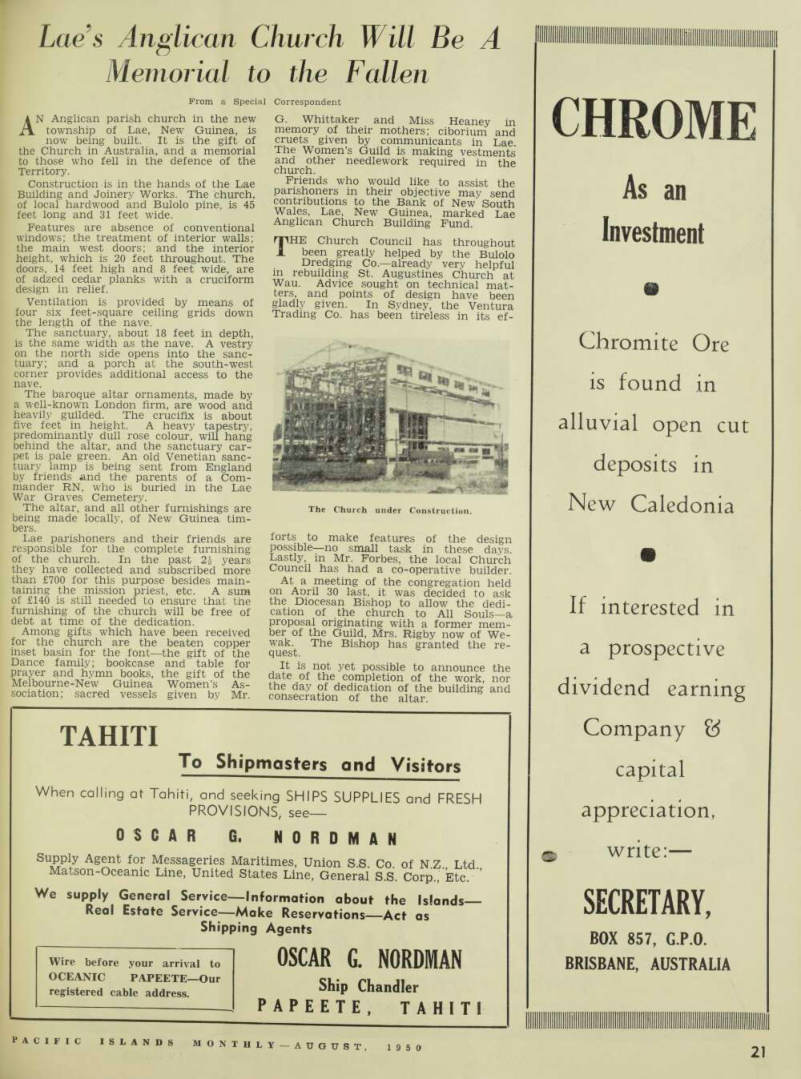

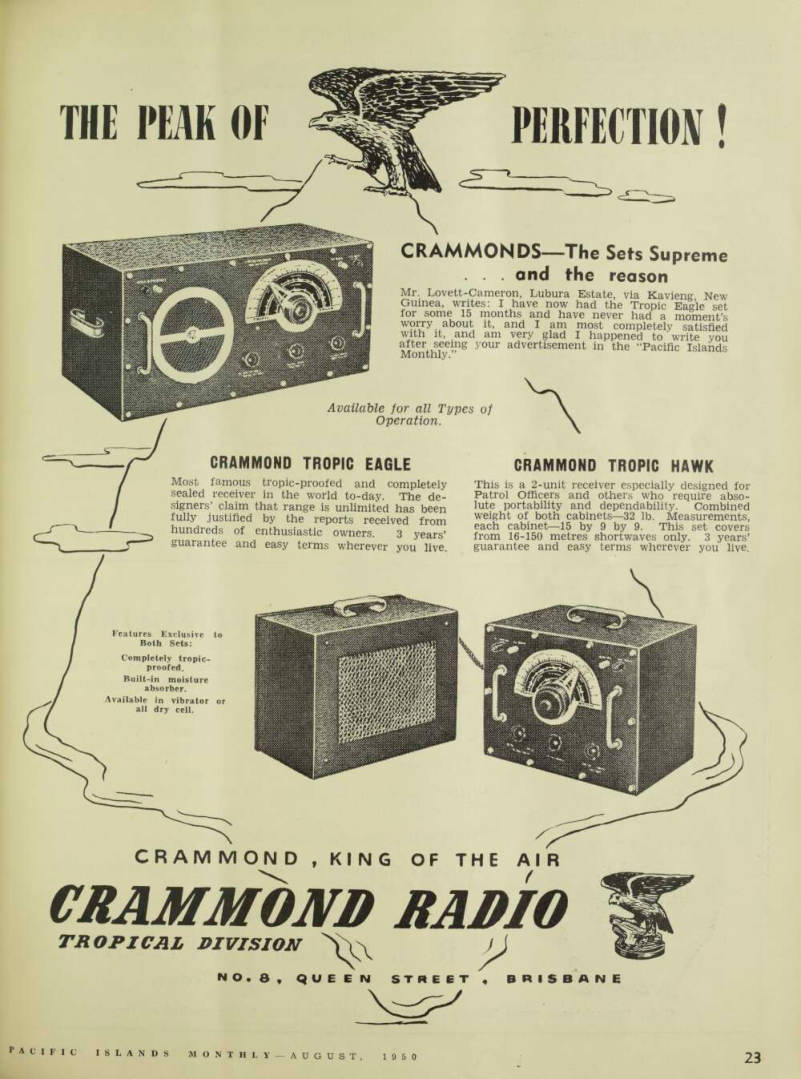
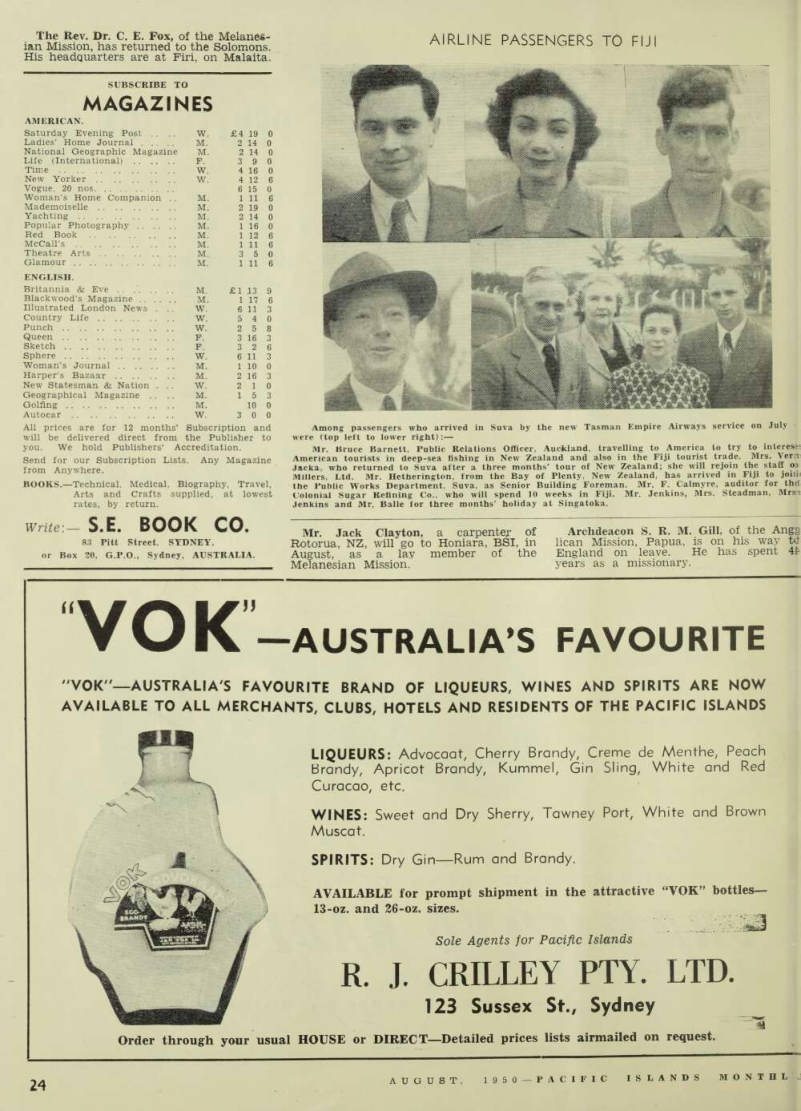
Memorial to the Fallen
From a Special Correspondent
AN Anglican parish church in the new township of Lae, New Guinea, is now being built. It is the gift of the Church in Australia, and a memorial to those who fell in the defence of the Territory.
Construction is in the hands of the Lae Building and Joinery Works. The church, of local hardwood and Bulolo pine, is 45 feet long and 31 feet wide.
Features are absence of conventional windows; the treatment of interior walls; the main west doors; and the interior height, which is 20 feet throughout. The doors, 14 feet high and 8 feet wide, are of adzed cedar planks with a cruciform design in relief.
Ventilation is provided by means of four six feet-square ceiling grids down the length of the nave.
The sanctuary, about 18 feet in depth, is the same width as the nave. A vestry on the north side opens into the sanc tuary; and a porch at the south-west corner provides additional access to the nave.
The baroque altar ornaments, made by a well-known London firm, are wood and heavily guilded. The crucifix is about five feet in height. A heavy tapestry, predominantly dull rose colour, will hang behind the altar, and the sanctuary car pet is pale green. An old Venetian sanc tuary lamp is being sent from England by friends and the parents of a Com mander RN, who is buried in the Lae War Graves Cemetery.
The altar, and all other furnishings are being made locally, of New Guinea tim bers.
Lae parishoners and their friends are responsible for the complete furnishing of the church. In the past 21 years they have collected and subscribed more than £7OO for this purpose besides main taining the mission priest, etc. A sum of £l4O is still needed to ensure that the furnishing of the church will be free of debt at time of the dedication.
Among gifts which have been received for the church are the beaten copper inset basin for the font—the gift of the Dance family; bookcase and table for prayer and hymn books, the gift of the Melbourne-New Guinea Women’s As sociation; sacred vessels given by Mr.
G. Whittaker and Miss Heaney in memory of their mothers; ciborium and cruets given by communicants in Lae.
The Women’s Guild is making vestments and other needlework required in the church.
Friends who would like to assist the panshoners in their objective may send contributions to the Bank of New South Wales, Lae, New Guinea, marked Lae Anglican Church Building Fund.
THE Church Council has throughout been greatly helped by the Bulolo Dredging Co.—already verv helpful in rebuilding St. Augustines Church at Wau. Advice sought on technical mat ters, and points of design have been gladly given. In Sydney, the Ventura Trading Co. has been tireless in its ef-
forts to make features of the design possible—no small task in these days.
Lastly, in Mr. Forbes, the local Church Council has had a co-operative builder.
At a meeting of the congregation held on Aoril 30 last, it was decided to ask the Diocesan Bishop to allow the dedi cation of the church to All Souls—a proposal originating with a former mem ber of the Guild, Mrs. Rigby now of We wak. The Bishop has granted the re quest.
It is not yet possible to announce the date of the completion of the work, nor the day of dedication of the building and consecration of the altar.
The Church under Construction.
The Rev. Dr. C. E. Fox, of the Melanes ian Mission, has returned to the Solomons.
His headquarters are at Firi, on Malaita.
Advertisements & other items, pp. 23-26 (1 item)
Chrome
As an Investment & Chromite Ore is found in alluvial open cut deposits in New Caledonia If interested in a prospective dividend earning Company & capital appreciation, write: —
SECRETARY,
BOX 857, G.P.O.
BRISBANE, AUSTRALIA
TAHITI
To Shipmosters and Visitors When calling at Tahiti, and seeking SHIPS SUPPLIES and FRESH
PROVISIONS, see—
OSCAR G. NORDMAN
Supply Agent for Messageries Maritimes, Union S.S. Co of N Z Ltd Matson-Oceanic Line, United States Line, General S.S. Corp., Etc. ' We supply General Service— Information about the Islands— Real Estate Service—Make Reservations—Act as Shipping Agents
OSCAR G. NORDMAN
Ship Chandler
PAPEETE. TAHITI
Wire before your arrival to
OCEANIC PAPEETE—Our
registered cable address.
Introducing . . .
the World’s Most Beautiful Radio Gram
i.t.! . 1 m mm i£.
DUAL
OR
TRIPLE
WAVE
; Record Compartment Two concealed Record Compartments, one each side are a delightful feature.
This Radio Gram has a triple speaker with split audio output. It is a 9-valve electric model and has magic eye tuning, and is the world's most modern radio circuit, developed exclusively by Crammond Engineers. Infra-red ray tropic proofed. The Cabinet is of solid, richly grained Queensland timbers, hand carved by Australia s leading craftsmen.
Available in 240, 110 or 32 volts. Vibrator models also available in similarly designed cabinets.
EASY TERMS WHEREVER YOU LIVE.
YOUR RECOMMENDATION
9-Valve Dual Wave A.C. De Luxe 3-Speaker Radio Gram
(CRAMMOND).
An extract as appeared in Brisbane “Telegraph” by Frederic Rogers, musician and leading music critic.
“Musicians and music-lovers have a pleasant surprise awaiting them when they hear the latest development in gramophone reproduction—designed and produced by Crammond.
“In this instrument, which I have had the pleasure of hearing, difficulties of orchestral reproduction and tone colour have been so far overcome that the resultant reproduction attains a thrilling fidelity to the original ”
Write for Full Particulars.
CRAMMOND RADIO
TROPICRL DIVISION
f/o 8 QUEEN STREET . BR/SBONE
THE PEAK OF
PERFECTION!
CRAMMONDS—The Sets Supreme
and the reason
Mr. Lovett-Cameron, Lubura Estate, via Kavieng New Guinea, writes: I have now had the Tropic Eagle set for some 15 months and have never had a moment’s worry about it, and I am most completely satisfied with it, and am very glad I happened to write you Monthly 6 y ° Ur advertisement in the “Pacific Islands
Available for all Types of
Operation.
CRAMMOND TROPIC EAGLE
GRAMMOND TROPIC HAWK
Most famous tropic-proofed and completely sealed receiver in the world to-day. The designers’ claim that range is unlimited has been fully justified by the reports received from hundreds of enthusiastic owners. 3 years’ guarantee and easy terms wherever you live.
This is a 2-unit receiver especially designed for Patrol Officers and others who require absolute portability and dependability. Combined weight of both cabinets —32 lb. Measurements, each cabinet-15 by 9 by 9. This set covers from 16-150 metres shortwaves only. 3 years’ guarantee and easy terms wherever you live, Features Exclusive to Both Sets: Completely tropicproofed.
Built-in moisture absorber.
Available in vibrator or all dry cell. 8
CRAMMOND, KING OF THE AIR
CRAMMOND RADIO
TROPICAL DIVISION
NO, B, QUEEN STREET , BRISBANE
SUBSCRIBE TO
MAGAZINES
AMERICAN.
Saturday Evening Post .. .. W. £4 19 0 Ladies’ Home Journal M. 2 14 0 National Geographic Magazine M. 2 14 0 Life (International) F. 3 9 0 Time W. 4 16 0 New Yorker W. 4 12 6 Vogue. 20 nos 6 15 0 Woman’s Home Companion .. M. 1116 Mademoiselle M. 2 19 0 Yachting M. 2 14 0 Popular Photography M. 1 16 0 Red Book M. 1 12 6 McCall’s M. 1 11 6 Theatre Arts M. 3 5 0 Glamour M. 1 11 6
ENGLISH.
Britannia & Eve M. £1 J 3 9 Blackwood’s Magazine M. 1 17 6 Illustrated London News ... W. 6113 Country Life W. 5 4 0 Punch W. 2 5 8 Queen F. 3 16 3 Sketch F. 3 2 6 Sphere W. 6 11 3 Woman’s Journal M. 1 10 0 Harper’s Bazaar M. 2 16 3 New Statesman & Nation ... W. 210 Geographical Magazine ... M. 153 Golfing M. 10 0 Autocar W. 3 0 0 All prices are for 12 months’ Subscription and will be delivered direct from the Publisher to you. We hold Publishers’ Accreditation.
Send for our Subscription Lists. Any Magazine from Anywhere.
BOOKS.—Technical. Medical, Biography, Travel, Arts and Crafts supplied, at lowest rates, by return.
Write: — S.E. BOOK CO.
83 Pitt Street. SYDNEY, or Box 20, G.P.0., Sydney. AUSTRALIA.
Airline Passengers To Fiji
Mr. Jack Clayton, a carpenter of Rotorua, NZ, will go to Honiara, BSI, in August, as a lay member of the Melanesian Mission.
Archdeacon S. R. M. Gill, of the Ang§ lican Mission, Papua, is on his way td England on leave. He has spent 4£ years as a missionary.
Among passengers who arrived in Suva by the new Tasman Empire Airways service on July were (top left to lower right):— Mr. Bruce Barnett. Public Relations Officer. Auckland, travelling to America to try to interest American tourists in deep-sea fishing in New Zealand and also in the Fiji tourist trade. Mrs. Ver[?] Jacka, who returned to Suva after a three months’ tour of New Zealand; she will rejoin the staff O[?] Millers. Ltd. Mr. Hetherington, from the Bay of Plenty, New Zealand, has arrived in Fiji to joi[?] the Public Works Department, Suva, as Senior Building Foreman. Mr. F. Calmyre, auditor for th[?] Colonial Sugar Refining Co., who will spend JO weeks in Fiji. Mr. Jenkins, Mrs, Steadman, Mrs[?] Jenkins and Mr. Balle for three months’ holiday at Singatoka.
Advertisements & other items, p. 26 (2 items)
24
AUGUST, 1950 PACIFIC ISLANDS MONTHL
Vok —Australia’S Favourite
a
"'VOK''—AUSTRALIA'S FAVOURITE BRAND OF LIQUEURS, WINES AND SPIRITS ARE NOW AVAILABLE TO ALL MERCHANTS, CLUBS, HOTELS AND RESIDENTS OF THE PACIFIC ISLANDS LIQUEURS: Advocaat, Cherry Brandy, Creme de Menthe, Peach Brandy, Apricot Brandy, Kummel, Gin Sling, White and Red Curacao, etc.
WINES: Sweet and Dry Sherry, Tawney Port, White and Brown Muscat.
SPIRITS: Dry Gin —Rum and Brandy.
AVAILABLE for prompt shipment in the attractive “VOK” bottles— -13-oz. and 26-oz. sizes.
Sole Agents for Pacific Islands
R. J. CRILLEY PTY. LTD.
123 Sussex St., Sydney
Order through your usual HOUSE or DlRECT—Detailed prices lists airmailed on request.
J . r
'Not Finished Yet'
Circumstances of Misima Close-Down Explained
THE circumstances surrounding the re turn to Sydney of European staff from Cuthberts Misima goldmine (Eastern Papua) were referred to in the June issue of PIM. Newspaper reports published in Sydney made it appear that, after the directors decided upon volun tary liquidation, the staff at Misima had been harshly treated.
We now have received the following statement from Mr. H. G. Carter, for mer chairman of Cuthbert’s Misima Goldmine, Ltd : I refer to the paragraph on Page 13 of your June issue regarding the cir cumstances surrounding the suspension of operations at Cuthbert’s Misima Gold mine.
The directors have purposely refrained from entering into a newspaper con troversy.
Before leaving Misima, every employee was paid four weeks’ wages by the Liqui dator, and their return steamer fares from Samarai to Sydney were prepaid by the Government on the Company’s account, inclusive of all employees who had been with us for a few months only.
Sales of stores, etc., are being made by the Liquidator to provide funds to pay off creditors, including balances due to the employees for holiday leave, etc.
The Liquidator has advised that food was available, and that none of the Europeans concerned lived on the charity of the natives, or were compelled to eat native foods and roots. Further more, there was no “winch handle’ in cident, as was reported in other press statements: and, if reports from Samarai are to be believed, there was no indi cation of any shortage of money while they were awaiting the Malaita to take them South.
The decision made to suspend opera tions was a painful one, but was neces sary when shareholders did not provide the additional capital to carry on opera tions. The property is still an excellent one and the failure to continue profit able operations was caused through the heavy post-war cost of rehabilitation, shortage of labour, and the limited finances to drive through to the pre war class of ore. It can be regarded as another war tragedy in the Territory of Papua.
Every effort is being made to interest a mining group in the property, as the directors are all of the opinion that the mine is not finished yet.
Mystery of Lae
Tunnel
THOUSANDS of people in Australia and New Guinea believe that the con tents of the Japanese tunnel at Lae, NG, were sold by the Disposals Commis sion for £2.
When the story was brought once more to Smith’s this week, an attempt was made to track down its authenticity.
No official confirmation could be ob tained, so that the origin of this reported CDC transaction goes to join the rest of the mystery associated with the Lae tun nel.
The Lae tunnel would have been a gamble for any purchaser, for it cannot be opened until about 15 years have passed. And while, doubtless, it contains valuable Japanese equipment, it also con tains the bodies of hundreds of Japs who refused to surrender.
There are miles of tunnels in Castle
Hill, which is believed to have contained! a full field hospital in addition to con-1 siderable stores of military equipment. t When the Japanese who had taken re fuge in the tunnel refused repeated demands by the US commander to sur render, bulldozers were sent on to the hill and they pushed huge trees, stones and dirt into the entrances of the tunnel, completely blocking them.
So what is in there will not be known until the Commonwealth Health authori ties give permission for it to be opened up.
—From Smith’s Weekly of July 14.
I Miss Theo Price, of Brisbane will be (married to Mr. John McKennariey, Lae, *New Guinea, at the church of St. Mary’s Roman Catholic Mission at Lae on Sep tember 23. Miss Price, who will leave by plane for Lae on September 19, will wear a ballerina frock of white broderie Anglaise at the ceremony.
The fight between heavyweight Fijian boxer, Harry Bray, and New Zealander Jack Boyd, which was to have taken place in Sydney in July, had to be called off when Bray left for USA sooner than scheduled. He is a member of the crew of the Lakemba.
Advertisements & other items, pp. 27-28 (1 item)
Sherwin-Williams
: I ■ *
Tropical formulae
Throughout the /ears the Paints and Finishes of the Sherwin-Williams Organisation have earned for themselves an enviable reputation for their consistently high standards, and special suitability to all climates and conditions.
IS vV *•
Sherwin-Williams
Globe-Tested Finishes I I ! I Distributors throughout New Guinea
COLYER WATSON (NEW GUINEA) PTY. LTD.
: r'IHH
SOLOMON IS
SANTA CRUZ
~£r.
SAMOA
NEW HEBRIDES
FIJI IS
TAHITI
L.
NEWCALEDONIA
GRAFTON
LORD HOWE IS.
TRANS OCEANIC AIRWAYS 7>TY 170.
OPERATORS OF
REGULAR
FLYING-BOAT
SERVICES
TO
1 NO UMEA V ILA ESPIRITUSANTO
VANIKORO HONIARA TULAGI
ALWAYS HAVING FOREMOST IN MIND THE INTERESTS OF PACIFIC ISLANDERS, ARE NOW
IN A POSITION TO EFFECT
A REDUCTION IN PACIFIC ISLAND AIR FARES, AND AN INCREASE IN THE HIGH STANDARDS OF COMFORT AND SERVICE TO PASSENGERS ON THEIR LUXURIOUS FOUR-ENGINED PACIFIC STARLINERS, NOW OPERATING AT THE
LOWEST FARES IN PACIFIC AIR TRAVEL
New Fares:
SYDNEY
SYDNEY
SYDNEY
NOUMEA
NOUMEA
j HONIARA
I TULAGI
VILA . .
SANTO .
VILA . .
SANTO .
£55/-/- £39/10/- £42/10/- £lO/-/- £l5/-/-
REDUCTION OF £lO
REDUCTION OF £5/10/-
REDUCTION OF £7/10/-
REDUCTION OF £2/10/-
REDUCTION OF £3/15/-
SUPPORT PRIVATE ENTERPRISE
I TRANS t OCEANIC AIRWAYS PTY. ITD. principal AGENTS: THE McARTHUR SHIPPING AND AGENCY CO. PTY., LTD.,
31 MACQUARIE PLACE, SYDNEY. BU 2048-9.
AGENTS IN ALL ISLAND PORTS
SERVICE AND SCHEDULES ARE MOST IMPORTANT SAFETY IS ALL IMPORTANT.
Hebridean News
By Vernon Wheatley
SANTO, July 17.
A FELLOW traveller on the Morinda was Major Fregard, who was scheduled to take up an Administra tive appointment in the Solomons. While at sea, two hours out from Vila, he re ceived news that he had been trans ferred to this Group and will ultimately take over from Mr. Maxwell, District Officer at Santo, early in 1951.
IT IS A VERY SMALL WORLD. When I went ashore at Lenakel, Tanna, the first person I met was Mr. George Fores tier, who had been a neighbour of mine on Norfolk Island. He is well-known both in this group and in New Caledonia and his fame is assured on Tanna, as he walked out of the surf when the Ness was wrecked there, with all his possessions in a very portable form.
Singlet and trousers.
BENEATH a coconut palm at Lenakel lies £28,000. That represents the value of the Ness, now just smashed timbers.
Ness should be an example to all ship owners—never run a lighting system off the batteries used to start diesel engines.
There was not enough power left in the batteries to start the motors when Ness got into difficulties.
Million Dollar Point. Some
people call it Billion Dollar Point. The hundred or so yards of road leading to the actual Point has surely the most ex pensive foundation in the world for it is formed of practically everything from teacups to bulldozers. To the right lies a large planer with its original packing case just starting to disintegrate. Like the rest of the ex-US war material, it is well past redemption, even if it were legal to salvage it.
At high water, sections of machinery protrude above the waves and at low water hundreds of articles can be seen lying on the bottom. Cruising backwards and forwards over an area covering per haps an acre, one can see cranes, rol lers and general machinery; desk tele phones and massive propeller shafting, all of which represents a monument to man’s stupidity.
Off-shore lies the President Coolidge, an American transport holed fore and aft by two mines used in the defence of the Segond Canal. Local rumour says that a million dollars lie in the hull of the ship about two hundred feet below the surface. Hence the name of the Point.
INTERESTING VISITOR to Santo was the 10,000-ton diesel engined vessel, Me kong, operated by the French Govern ment. On her maiden voyage, the ship loaded 3,000 tons of copra for France and she also carried a large quantity of Aus tralian wool.
Ornate and comfortable accommoda tion is provided for both passengers and crew. I was told that one could travel on her from Santo to Marseilles for the sum of £3O. It does not sound possible.
BASTILLE DAY was celebrated with a series of charming official and private functions conducted with customary French delicacy and friendliness.
SHIPWRECK. Messrs. BP’s vessel Koro, ripped out a portion of her hull on a reef and sank with her masts pro trudmg above the water. She had a valuable cargo on board plus a fair H,w int * c^ sh - Mr - Keith Solway, v!y er ’ ?^ nto > h ad planned to visit So lus diving gear was shipped spect K him m ° rdor that he might in "
Entomologist
Death Of Noted
THE death occurred in the United Kingdom on May 14 of Mr. Frank Price Jepson, who, as Fiji Govern ment Entomologist from 1909 to 1919, laid the foundation of the work which has given Fiji a world-wide reputation in the field of biological control of crop pests and aggressive weeds.
Mr. Jepson’s most spectacular achieve ment in Fiji was to bring from Java the Histerid predator Plaesius Javanus which become known throughout Fiji as “Jep son’s beetle,” and which did much to control the weevil-borer which was caus ing a great deal of damage among bananas in the Colony, Mr. Jepson made an effort to control
the weed Lantana camara by introduc ing from Hawaii the Lantana seed-fly Agromyza lantanae. The insect soon be came established on the Lantana camara and although it did not give the re sults expected, experience with it opened up new avenues of exploration in the biological control of aggressive weeds.
The complete control in later years of Koster’s Curse by Mr. H. W. Simmonds indicated that Mr. Jepson was thinking along progressive lines regarding weed control.
After leaving Fiji in 1919 Mr. Jepson became Entomologist to the Government of Ceylon, and was later Deputy Direc tor of Agriculture in Ceylon.
Mr, S. N. Elliott, of Suva, Fiji, has been appointed Rehabilitation Officer in suc cession to the late Mr. C, H. Came.
Advertisements & other items, p. 29 (1 item)
(Oumtaim
For
LIGHTER,
FLUFFIER
OTHER
FAMOUS
FOUNTAIN
PRODUCTS
SH I* ★
mmsjL
m ■omato sauce
SiTr
fLEv
XEsr
ED
SELF-RAISING
2
lbs
HOUR
s, S' ,r'- FOUNTAIN food products are famous throughout the* South Pacific for their consistent quality and suitability of packing for tropical conditions.
You are assured satisfaction when you specify FOUNTAIN brand.
Trade inquiries are welcome and all orders are promptly despatched.
(OUMTAIM
W.c DOUGLASS L"1!L ED
FOVEAUX ST. SYDNEY AUSTRALIA
BMAKMjf
a
PRODUCT
Wheat i
MIXED
FOUNTAIN
FOUNTAIN
PIUM PUDD0 g
WHEN (
Taxable?
Is New Guinea Service Pay
AN Australian, Cecil Hall, appealed to the Supreme Court in Sydney, in July, against an income tax assess ment. He was engaged during the war on the small ships in New Guinea waters and, while there, he earned £2OO. He claimed that, as he earned the money during five months in New Guinea, it was not taxable. The Department said that, although the Act provided that a person
resident in New Guinea should not be taxed, Hall was in New Guinea under an Australian contract, which was legally the source of his income, which therefore was Australian income, and taxable. The Supreme Court reserved judgment. The outcome will decide many similar appeals by ex-servicemen against taxation assess ments.
Anglo-Iranian Oil Company, of London, senior partner in Oil Search Ltd., recently announced a profit of £38.7 million stg.
Lawlessness In
Samoa
Vicious Assault on Plantation Manager
From Our Own Correspondent APIA, July 20.
MR. D. C. M. CAMPBELL, manager of the Vaitele Plantation was attacked] on July 3 by a Samoan he found J stealing coconuts on Vaitele Plantation,, and seriously injured by knife wounds.
Lately, plantation thefts of cocoa, coco- ■ nuts and bananas have become serious; and so frequent that European planters: are losing a large portion of their crops..
The thieves are stealing from both j Samoan and European plantations..
Samoan chiefs are complaining that it is; increasingly difficult to detect and ap prehend the offenders.
About noon on July 3, Mr. Campbell,, who is manager of the New Zealand Re paration Estates' Vaitele plantation, was; on horseback inspecting workers on the; plantation. Near the stone wall boun dary with Retzlaff’s plantation he found] four Samoan youths, husking coconuts; and packing same in large baskets, ready to be taken away. The four men tried I to escape over the stone wall. Mr..
Campbell pursued and tried to grab one..
The Samoan turned and attacked Mr..
Campbell with a large knife, viciously l slashing at his head. When Mr. Camp-' bell put up his left arm, his arm andJ hand were deeply cut. Mr. Campbell] grappled with his assailant and managed,, in spite of serious injuries, to wrench the; knife away from him. The Samoan, who< was unknown to Mr. Campbell, then es-- C£tDod Suffering from loss of blood, Mr. Camp bell dragged himself homewards for' about half a mile, when he was found] by a plantation labourer, whom he sent; for police and a doctor. He was taken; to Apia Hospital, where he was operated] on and given a blood transfusion. He is; recovering, but he may lose the use of: his left arm.
Police Sergenat Thompson, investigat ing, suspected that the four Samoans; came from the village of Tuamoa. He; summoned the village chiefs, and showed] them the knife. One of the chiefs, Pepe„ at once recognised the knife as belonging; to his 18-years-old son, Fa’asuaga. The; latter was brought in, and at once ad mitted the offence, and named the other' three men who had with him, stolen the; coconuts. All four were arrested, andl in Apia were given prison sentences for' theft A charge of assault was post poned until Mr. Campbell is recovered to give evidence.
The Campbell case directs attention toe conditions in Samoa, where lawlessness; —particularly burglaries, thefts and! crimes of violence—are on the increase.
The younger Samoans seem to have lost) respect for the law. Only a few days; later, a Samoan from the village 9! ] Puapua, Savaii. was brought to Apia mr a dying condition. He had had a fightl about a boundary, and had been viciously slashed across the stomach with a bushr knife. , , , Several organisations have taken up the case of Mr. Campbell and have passed, resolutions expressing grave concern oven the growing lawlessness of Samoans and: the insufficient protection for lives and: property of planters.
Mr Leo Morel, of Wellington, NZ who is known in some South Pacific Terri tories —especially in Cook Islands wher© he has an interest in a plantation—has been appointed to the United Nations,; International Panel of Photographers.
Advertisements & other items, p. 30 (2 items)
28
AUGUST, 1950 -I*AC I F I C ISLANDS MONTHLY
A. B. Donald Ltd.
AUCKLAND
ISLAND TRADERS & GENERAL MERCHANTS
P.O. Box 1509. Cables £r Telegrams, “Kingdom/ 7 Auckland
The Garrick Hotel
7w i m
SUVA
FIJI
This well-known Hotel is centrally situated in Suva's main business quarter :: Modern accommodation provides comfort in all climatic conditions :: Only the best of Beers, Spirits and Wines is served Telephone: 80. VINCE COSTELLO, Proprietor.
Penrhyn Woman
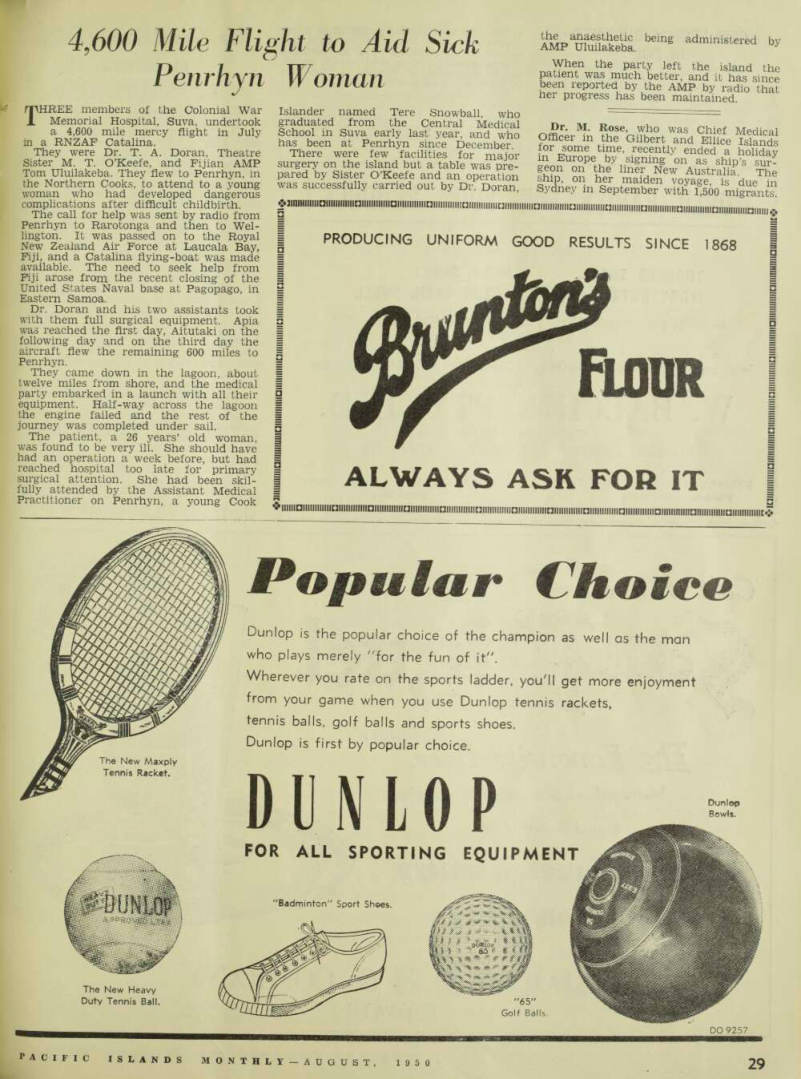
4,600 Mile Flight to Aid Sick Penrhyn Woman
THREE members of the Colonial War Memorial Hospital, Suva, undertook a 4,600 mile mercy flight in July in a RNZAF Catalina.
They were Dr. T. A. Doran, Theatre Sister M. T. O’Keefe, and Fijian AMP Tom Uluilakeba. They flew to Penrhyn, in the Northern Cooks, to attend to a young woman who had developed dangerous complications after difficult childbirth.
The call for help was sent by radio from Penrhyn to Rarotonga and then to Wel lington. It was passed on to the Royal New Zealand Air Force at Laucala Bay, Fiji, and a Catalina flying-boat was made available. The need to seek help from Fiji arose from the recent closing of the United States Naval base at Pagopago, in Eastern Samoa.
Dr. Doran and his two assistants took with them full surgical equipment. Apia was reached the first day, Aitutaki on the following day and on the third day the aircraft flew the remaining 600 miles to Penrhyn.
They came down in the lagoon, about twelve miles from shore, and the medical party embarked in a launch with all their equipment. Half-way across the lagoon the engine failed and the rest of the journey was completed under sail.
The patient, a 26 years’ old woman, was found to be very ill. She should have had an operation a week before, but had reached hospital too late for primary surgical attention. She had been skil fully attended by the Assistant Medical Practitioner on Penrhyn, a young Cook
Islander named Tere Snowball, who graduated from the Central Medical School in Suva early last year, and who has been at Penrhyn since December There were few facilities for major surgery on the island but a table was pre pared by Sister O’Keefe and an operation was successfully carried out by Dr. Doran,
being administered by
AMP Uluilakeba. y When the party left the island the patient was much better, and it has since been reported by the AMP by radio that hei progress has been maintained.
Dr. M. Rose, who was Chief Medical Officer in the Gilbert and Ellice Islands for some time, recently ended a holiday in Europe by signing on as ship’s sur geon on the liner New Australia The ship, on her maiden yoyage, is due in Sydney in September with 1,500 migrants.
Advertisements & other items, p. 31 (1 item)
Dunlop
PRODUCING UNIFORM GOOD RESULTS SINCE 1868
ALWAYS ASK FOR IT
The New Maxply Tennis Racket. i The New Heavy Duty Tennis Ball.
Popular Choice
Dunlop is the popular choice of the champion as well os the man who plays merely "for the fun of it".
Wherever you rate on the sports ladder, you'll get more enjoyment from your game when you use Dunlop tennis rackets, tennis balls, golf balls and sports shoes.
Dunlop is first by popular choice.
DUNLOP
FOR ALL SPORTING EQUIPMENT
'Badminton" Sport Shoes.
"65"
Golf Balls.
Dunlop Bowls.
DO 9257
New Fruit Industries

In Fiji
From Our Own Correspondent SUVA, July 31.
YOUNG strawberry plants flown from New Zealand are reported to be doing well at the Pix plantations on the south coast of Viti Levu. If the experiment succeeds the fruit will be pulped and made into essence in New Zealand.
The Pix plantations specialise in pine apples, but have branched out with the off-season production of fruit cordials.
The product is being sold at sd. or 6d. below the price of bottles of imported cordials of comparable quality.
Dr. and Mrs. F. R. Hollins, of Suva, Fiji, were in Melbourne, in July, en route to the United Kingdom where they will spend 12 months.
New Guinea Men Talking
of Defence
From Our Own Corresnondent LAE, July 20.
ABOUT twelve months ago, the Terri—i tory was visited by senior officers oflc the Australian Defence Dept., osten—i sibly w T ith a view to establishing a de--' fence organisation which could functionn quickly in case of necessity. Plans mayy. have been made, but we have heard noth—j ing more about them.
At the last meeting of the Lae Sub—c Branch of the Returned Servicemens League, strong views were expressed con— i cerning this apparent apathy. Attentiona was drawn to the position in the Fanj East, with the relative importance of Neww Guinea in the event of the war spreading.?
One speaker, whole-heartedly sup-c ported by others —all of whom had livedb: in the Lae area, on the Nadzab Road, inn pre-war days—was scathing in his com-: ments on what had been done in thosesc days. The Government had promised): everything, but had provided little one nothing in the early days of the wan Many were compelled to use their ownr rifles and ammunition against the in-r vaders.
The meeting urged that some early an nouncement should be made as to whethens the NGVR, or some similar local unit: would be set up, if only as a measure. It was decided to ask the Stated Branch of the League to take the mattene up as a “first priority” with the relevant!
Department.
Mr. Richard McLeod Randall, of th©i Bank of New South Wales staff, Suvae Fiji, was married in July to Miss Eunice-: Nita Ross, of Oberon, N.S.W.
Advertisements & other items, p. 32 (2 items)
W. Balchin Pty. Ltd.
WORLD PARITY FOR YOUR PRODUCE!
We are outright buyers of—
TROCHUS SHELL M.O.P. SHELL
IVORY NUTS GREEN SNAIL SHELL
As direct exporters to World’s consuming centres we can offer
TOP PRICES.
We supply TIMBER, DOORS, JOINERY, MOULDINGS, Etc.
W. BALCHIN PTY. LTD.
(Established 1848).
TIMBER, IMPORT Cr EXPORT MERCHANTS
Head office SYDNEY: 247 George St. ’Phones; BW 1538-9 Cables: Also at LONDON: 78 Gt. Bushey Drive Totte ridge
‘BALCHINCO”
Hongkong, IUJ>
Call for a The Favourite .
Matured but freshly bottled Brewed Cr Bottled by g>an jUifiucl
Obtainable from:
ALOIS A RUN & COMPANY
RABAUL
Un Mission Has
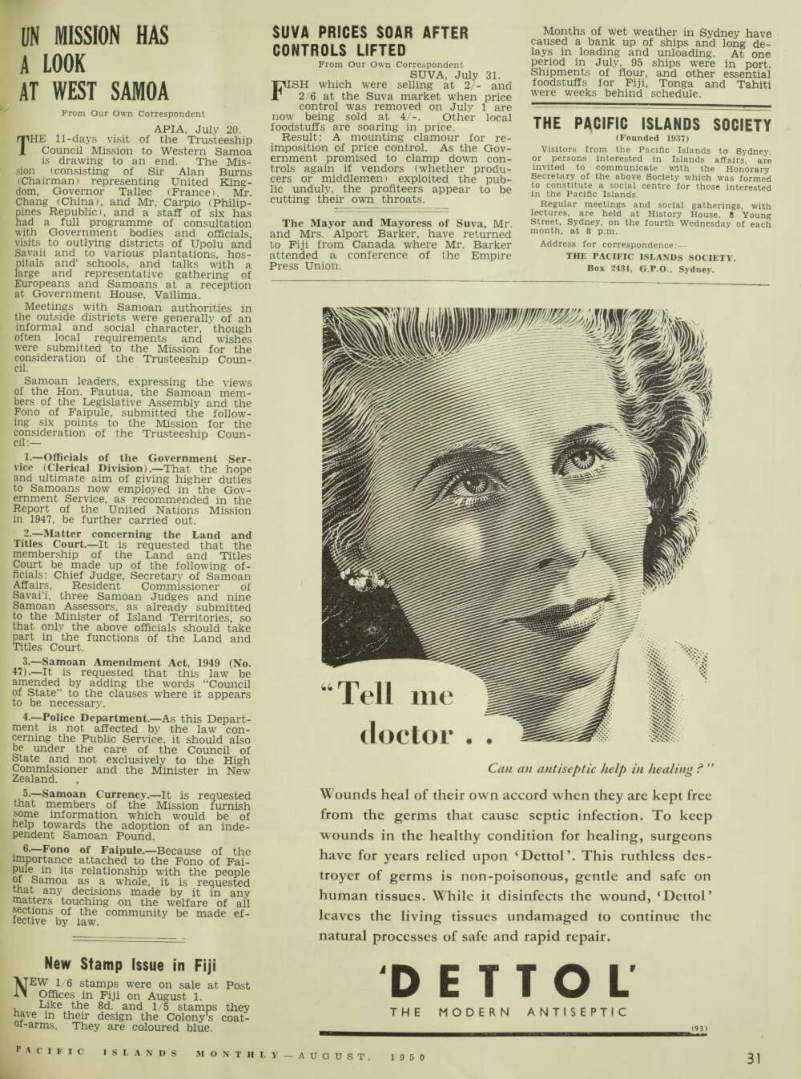
A Look
At West Samoa
From Our Own Correspondent APIA, July 20.
THE 11-days visit of the Trusteeship Council Mission to Western Samoa is drawing to an end. The Mis sion (consisting of Sir Alan Burns (Chairman) representing United King dom, Governor Tallec (France). Mr.
Chang (China), and Mr. Carpio (Philip pines Republic), and a staff of six has had a full programme of consultation with Government bodies and officials, visits to outlying districts of Upolu and Savaii and to various plantations, hos pitals and’ schools, and talks with a large and representative gathering of Europeans and Samoans at a reception at Government House, Vailima.
Meetings with Samoan authorities in the outside districts were generally of an informal and social character, though often local requirements and wishes were submitted to the Mission for the consideration of the Trusteeship Coun cil.
Samoan leaders, expressing the views of the Hon. Fautua, the Samoan mem bers of the Legislative Assembly and the Fono of Faipule, submitted the follow ing six points to the Mission for the consideration of the Trusteeship Coun cil:— I.—Officials of the Government Ser vice (Clerical Division).—That the hope and ultimate aim of giving higher duties to Samoans now employed in the Gov ernment Service, as recommended in the Report of the United Nations Mission in 1947, be further carried out. 2.—Matter concerning the Land and Titles Court.—lt is requested that the membership of the Land and Titles Court be made up of the following of ficials: Chief Judge, Secretary of Samoan Affairs, Resident Commissioner of Savai’i. three Samoan Judges and nine Samoan Assessors, as already submitted to the Minister of Island Territories, so that only the above officials should take part in the functions of the Land and Titles Court. 3. —Samoan Amendment Act, 1949 (No. 47).—1t is requested that this law be amended by adding the words “Council of State” to the clauses where it appears to be necessary. 4.—Police Department.—As this Depart ment is not affected by the law con cerning the Public Service, it should also be under the care of the Council of State and not exclusively to the High Commissioner and the Minister in New Zealand. s.—Samoan Currency.—lt is requested that members of the Mission furnish some information, which would be of help towards the adoption of an inde pendent Samoan Pound. . 6.—Fono of Faipule.—Because of the importance attached to the Fono of Fai pule in its relationship with the people of Samoa as a whole, it is requested that any decisions made by it in any matters touching on the welfare of all sections of the community be made ef fective by law.
New Stamp Issue in Fiji
NEW 1/6 stamps were on sale at Post Offices in Fiji on August 1.
Like the Bd. and 1/5 stamps they nave in their design the Colony’s coat ot-arms. They are coloured blue.
Suva Prices Soar After
Controls Lifted
From Our Own Correspondent SUVA. July 31.
FISH which were selling at 2/- and 2/6 at the Suva market when price control was removed on July 1 are now being sold at 4/-. Other local foodstuffs are soaring in price.
Result: A mounting clamour for re imposition of price control. As the Gov ernment promised to clamp down con trols again if vendors (whether produ cers or middlemen) exploited the pub lic unduly, the profiteers appear to be cutting their own throats.
The Mayor and Mayoress of Suva, Mr. and Mrs. Alport Barker, have returned to Fiji from Canada where Mr. Barker attended a conference of the Empire Press Union.
Months of wet weather in Sydney have caused a bank up of ships and long de lays in loading and unloading. At one period in July, 95 ships were in port.
Shipments of flour, and other essential foodstuffs for Fiji, Tonga and Tahiti were weeks behind schedule.
Advertisements & other items, pp. 33-34 (2 items)
Det T O L
THE PACIFIC ISLANDS SOCIETY
(Founded 1937) Visitors from the Pacific Islands to Sydney or persons interested in Islands affairs, are invited to communicate with the Honorary Secretary of the above Society which was formed to constitute a social centre for those interested in the Pacific Islands.
Regular meetings and social gatherings, with lectures, are held at History House, 8 Young Street, Sydney, on the fourth Wednesday of each month, at 8 p.m.
Address for correspondence:—
THE PACIFIC ISLANDS SOCIETY.
Box 2434, G.P.0., Sydney.
I mm 5553? m m m m m m
Tell me
doctor . .
H S®fv M
ill.
Can an antiseptic help in healing ? ”
Wounds heal of their own accord when they are kept free from the germs that cause septic infection. To keep wounds in the healthy condition for healing, surgeons have for years relied upon ‘Dettol’. This ruthless destroyer of germs is non-poisonous, gentle and safe on human tissues. While it disinfects the wound, ‘DettoT leaves the living tissues undamaged to continue the natural processes of safe and rapid repair.
DET T O l
THE MODERN ANTISEPTIC
(93)
ECONO-STEEL Can Be Sent Anywhere!
• 111 * « gl i m ... s A* DARWIN RESIDENCE FOR C. O. R. MANAGER, using Econo-Steel construction, Aluminium Econo-Tile roofing and Aluminium walling and guttering and downpiping.
Econo-Steel has been used successfully in every Australian State, in South Africa, and in the Pacific Islands.
Missions, manager’s bungalows and tropical homes may be designed to suit almost any requirements.
Hollow box-sections of protected nailable steel can be more economically consigned to remote points than any other material.
Over 2,000 Econo-Steel structures built to date for State and Commonwealth Works Departments, Public Works Department, and private interests, testify to the universal acceptance of Econo-Steel —an Australian patented product. Available now—erected faster and at less cost.
Write for further particulars to:
ECONO-STEEL COMPANY
(A DIVISION OF TULLOCH, LTD.)
Concord Rood, Rhodes, N.S.W., Australia. Telephone: UF 1231.
Cables: “TULLSTEEL,” Sydney.
32
AUGUST, 1950 PACIFIC ISLANDS MONTHL
Scholarship Fund

Queensland Memorial Scholarship Fund
THE Queensland New Guinea Women’s Association decided last year to work for a Memorial Scholarship similar to that available in Victoria. The Deeds of Trust have now been signed and trus tees —Mrs. R. Kendall and Mr. Ernest Slee, both of Brisbane —appointed.
Scholarships are to be issued in Queens land under almost similar conditions as those attached to the Victorian Memorial Scholarship—that is, they are available, in the first instance, to children of former residents of New Guinea who lost their lives due to enemy action, such children having been attending, a school in Queens land for the previous 12 months.
There is one clause, however, that is different: Provision is made for the dis posal of the balance of the trust fund when candidates for the scholarship are no longer available in Queensland —they will be paid into the New Guinea Memorial Scholarship Trust Fund in Melbourne.
Donations to the New Guinea Memorial Scholarship Fund (Qld. Division) have been as follows: —
Mrs.
W. Battis. Brisbane .. £ 5 s. 0 d. 0 Mrs.
Mills, Brisbane 1 0 0 Mrs.
Sinclair, Brisbane .. .. 1 0 0 Mrs.
E. Slee. Brisbane .. .. 1 0 0 Mrs.
Bruckshaw, Brisbane . . 1 0 0 Mrs.
S. McCosker, Brisbane 1 0 0 Mrs.
R. Kendall, Brisbane .. 5 0 New Guinea Women’s Assn. (Qld.) 5 14 3 Mrs.
Bert Murray, Brisbane 5 0 New Guinea Women’s Assn. (Old.) 7 0 Mrs.
Chesterman. Brisbane .. 10 0 Mrs.
McKenzie, Brisbane 10 6 Miss Jackson, Brisbane .. .. 8 6 Mrs. T. Targett and Miss Brisbane Burge. 8 0 New Guinea Women’s Assn. (Qld.) 1 10 6
Mrs. Bruckshaw, Brisbane 1 2 0 E. P. Holmes, Port Moresby . .
Mrs. R. Kendall, Brisbane (collec- 2 2 n tlons made) 2 0 o New Guinea Women’s Assn. (Qld.) New Guinea Women’s Assn. (Sale 2 14 6 of Jami 5 0 Mrs. S. McCosker, Brisbane 1 10 0 New Guinea Women’s Assn. (Qld.) Melbourne New Guinea Women’s 19 9 Association Collections made and donations received in Rabaul by Dorothy Stewart, and previously acknowledged in detail, under final lists acknowledged on behalf of Victorian Division of Scholarship, pending commencement of 25 0 0 Queensland Division 44 7 6 Mrs. J. McGuigan, Kavieng .. 1 1 0 Ian S. Levy, Rabaul 2 2 0 Menzies Supporters. Rabaul . . 5 0 Don. Williams, Rabaul .. . . 4 1 6 Pacific Territories Assn., Sydney . . 175 9 4 A. R. McAllister, Rabaul 1 1 0 Doug Ewing and Eric Hill, Rabaul 10 10 0 Dorothy Stewart, Rabaul 5 10 2 Total as at June 30, 1950 . . £300 0 0 — — —
Automatic Telephone
Exchange For Suva
THE Secretary of State for the Colonies has approved a revised scheme, cost ing £170,000, for an automatic tele phone exchange for Suva, Fiji, and orders will now be placed in the United Kingdom for the necessary equipment.
While he was in the United Kingdom recently on leave, the Government Archi tect, Mr. C. N. Nettleton, discussed plans for the new exchange building with ex perts in the automatic telephone field.
The Rev. F, A. Rowley, who has been in charge of the Melanesian Mission boys’ school at Vuneas, BSI, is at present in England on furlough.
Mr and Mrs. J. O. Higgins left Sydney on July 24 for the North Borneo oilfields Mr. Higgins, a leading oil companies’ executive, was stationed in Papua when drilling commenced there in the ’thirties, and he has made various official visits to the Territory since drilling was resumed after the war.
Arrangements are being made for a representative of the United Kingdom firm of Wilton & Bell to go to Fiji shortly to advise on the schemes for the Lautoka wharf and an important slipway at Suva, which are included in the Colony’s Development Plan.
Advertisements & other items, p. 35 (1 item)
The Ferguson Tractor
EXTRA WHITE
CLOTHES
RECKITT’S BLUE in the last rinse ensures that extra whiteness without damaging the fabric.
the FERGUSON TRACTOR
SI kV
with a system of
WEIGHT TRANSFERENCE
The Ferguson System is one that employs natural laws instead of using heavy in-built weight to give traction and penetration. This ensures that the tractor automatically adjusts its weight i to the job—and the implement maintains an even depth by automatic hydraulic control on all types of ground.
Included in the wide range of implements available is the all-purpose hydraulic trailer. Capable of carrying 3 tons, hydraulic operation raises and lowers the tray in a matter of seconds.
For maximum efficiency with utmost economy the Ferguson System has the complete answer.
Distributors for Papua and New Guinea :
BURNS PHILP (NEW| GUINEA) LIMITED
Send your enquiries to the nearest branch at— PORT MORESBY « SAMARAI « MADANG ® LAE • RABAUL
Increasing Copra
Production In Solomon Is.
From Our Own Correspondent
Honiara, July 11.
MORE than five thousand tons of copra have been produced in the British Solomon Islands during the first six months of the current year.
During June, 750 tons of copra were shipped to the United Kingdom, and 500 tons were shipped to Australia. Ap proximately 1,537 tons remained in the Group at June 30. Copra production for June is estimated at 1,100 tons.
Production for the first quarter of the year was estimated at 2,492 tons, and for the second quarter at 2,723 tons, giving an average monthly production of ap proximately 870 tons over the first six months of the year.
Shipping Services
Carpenter’S Extend Fiji
From Our Own Correspondent SUVA. July 100 ANEW shipping service is to be mate tained by the twin-screw motor v«v sel, Tovata, owned by Island Trane port, Ltd. (a subsidiary of W.
Carpenter and Co. (Fiji), Ltd.). TT vessel is intended to keep a ten-cb schedule linking the islands of Gau, Kod.
Taveuni, Rabi and parts of Vanua Le wi th Suva.
Completely overhauled, the Tovsv sailed on her first new-schedule on June 7. The owners have announor that she has been specially equipped ‘T* the comfortable conveyance of Fijian psq sengers.”
Old-timers, mostly commending tt change, recall the spacious days whl cargo was the first consideration. Fijirr. (and other) passengers being dumped t what space was left.
Island Transport, Ltd., is best kno’o through the ship, Komaiwai, whirl spends a strenuous life running betw© T < points as far removed as the Lau ae Yasawa Groups. To the public, howew? the name has little more significance thrl that of Island Industries, Ltd., the makerf of Fiji’s very successful marjarine (wiv; a “j”). Both enterprises are popular, known simply as “Carpenters.”
Grapevine reports hint at the possibilfi of new Carpenter enterprises in Fiji. TT firm, as usual when things are believe to be in the wind, remains inscrutahs reticent when questioned.
The Rev. R. P. Garrity, has been a pointed by the Melanesian Mission j Honiara, BSI. He will minister to boc European and native communities theji
Advertisements & other items, p. 36 (3 items)
34
AUGUST, 1950 PACIFIC ISLANDS MONTH II
Kerr Bros. S
G.P.O. Box 3838, Sydney.
ISLAND MERCHANTS SINCE 1895
50 years old, hut as young as ever and eager to serve you.
Cocoa Beans, Copra, Coffee and all Island Produce Sold on Commission.
All merchandise purchased at best wholesale prices and original invoices supplied.
Use Our Co-operative Specialised Overseas Buying Service.
If A Chr D Ice Cream Dispensing
IVAOFEf K &. HARDENING CABINET;
0 o © sPi Kasper Cabinet No. 19.
KASPER REFRIGERATORS PTY. LTD
Available Now!
Specially insulated for Tropical Conditions wiv genuine Spanish Corkboard.
Cabinet top of 18-gauge, mirror finish, stainless ste Cabinet sides of 20-gauge, satin finish, stainless sta: Frame 2 in. angle iron, welded construction, mu proofed.
Cabinet 19 contains 4 Double Holes with a capaco for 40 gallons of ice cream; Ice Block Maker and !
Cream Making Head (capacity 15 gallons per horn All cabinets are self-contained and complete wy refrigerator unit and electric motors. Every “Kasp«c: Cabinet fitted with stainless steel, hinged lit! hermetically sealed, and cork insulated.
Cabinets available with storage capacity from 20 * 100 gallons. Custom built to your specifications. (When ordering, please specify type of power avac able.)
KASPER means QUALITY BUILT, SCIENTIFICALI
ENGINEERED and DEPENDABLE in OPERATION.
ORDER NOW AND AVOID DELAY.
77 RAILWAY PARADE, ERSKINEVILLE, N.S.W
AUSTRALIA.
1 Phone: LA 1326.
BSI Labourers Fined
For Breach of Contract
Prom Our Own Correspondent
Honiara. July 24.
A DECISION of some interest to BSIP residents was given recently by the Protectorate’s Judicial Commissioner (Mr. W. T. Charles) in a civil action bet ween the Commissioner of Works and 19 labourers for alleged breaches of written contracts of employment for six months.
At the end of May, thirteen of the de fendants complained that they were not issued with soap and tobacco and refused to work. They were informed that they were entitled to. and would be issued with, soap, but that they were not en titled to tobacco. The thirteen defendants left work on the following day.
The Judicial Commissioner in his judgment said that if soap had not been issued to the men, the Government had committed a breach of contract with them, but he considered it was a minor one, soap forming only a small part of the men’s remuneration. (The soap ration is one ounce per man per week.) He found that the thirteen men had repu diated their contracts.
Judgment was given against twelve of them for the sum of £1 each, and against the thirteenth, a boss boy, for £l/10/- The other six defendants had complained earlier in the month and had been told that the position would be rectified, but they had not received a soap ration. The action against these men therefore failed.
Interest for BSIP residents lies in the fact that by the Labour Regulations an employer must give a month’s notice to an employee unless he has committed some very serious fault, whereas labour can, and does, walk out without any notice at all, confident that no action will be taken against them. This is the first time that the position has been tested in the Court.
Papua Artifacts
BY D. H. OSBORNE, OF ROSSEL IS.
WHEN I read the February issue of the PIM, I was reminded that disc stone clubs were common among the Orikiyas, on the Mambare and Kumusi Rivers, in NE Papua, 50 vears ago.
The disc clubs were from eight to 12 inches in diameter and were made of blue diorite, with a hole drilled in the centre. “Pineapple” clubs were rare.
They were made of blue diorite, about the size and shape of a Mills bomb.
When I first handled a Mills bomb, I thought of the Orikivas.
After Sir William MacGregor and Mr.
Monckton put an end to skull-cracking, clubs went out of fashion.
On the Kumusi, I have seen large trees that had been hacked down with stone implements. Fire was used a good deal in clearing gardens. Gardens were much larger, and native food more plentiful than to-day.
In the early days, on the Yodda gold field, about 1900, Jimmy Judge dug up a stone battle-axe. Bill Ivory bought it for £5 and presented it to Mr. Monck ton, who sent it to a museum in London.
Jack Murphy dug up a stone lizard, with wings, carved out of stone—it was 15 feet under the surface. Murphy sold it for £3O and it was sent to a London museum.
On the Ikora there is a large “mon ster,” cut out of stone. Monckton tried to move it to the coast, but it was too heavy.
Davy James dug up a pestle on the Lakekamu —it may be the same one as shown in the picture in February PIM.
All those relics were dug up in parts that are no-man’s-land to-day. Judging from the depth those artifacts were buried, the inhabitants concerned must have lived a long time ago. that are no-man’s-land to-day. Judging was a pineapple club made of pure gold, held by a tribe inland from Tufi (or Cape Nelson). He led a party of three miners (Ned Driscol, Owen Mit chell, and Jim Gallagher) in search of the reef the gold was taken from. After a short time, Monckton returned to the station. The miners remained in the bush until their rations were finished, but without locating reef or club. They did not express any kind regards for Mr.
Monckton on their return from the bush.
Advertisements & other items, pp. 37-38 (1 item)
Marjarine
VETERINARY
INSTRUMENTS
For Sheep and Cattle can be Supplied Immediately
EARMARKERS.
SPEYING INSTRUMENTS.
BULLRINGS.
FIRE BRANDS.
EMASCULATORS.
W. JNO. BAKER
PTY. LTD.
3 Hunter Street, Sydney, N.S.W., Australia
II w> is i m
(TOP)
T A BlfE
SV M
A
MARJARINE
Packaged like this, DELANA TABLE MARGARINE, a Product of Fiji, is now available to
ALL PACIFIC ISLANDS
Wherever and Whenever Suitable Transport Can Be Found.
A SUBSTITUTE
FOR
BUTTER
In \ lb. Pats In
Shipping Outers
of 2 7 lb.
Fresh, wholesome and nutritious, this is a pure Vitamised Vegetable Product made in accordance with the Pure Food Laws of the Colony of Fiji, It contains no animal fat.
You'll enjoy eating DELANA . . .
You'll appreciate its ECONOMY Export Prices and Further Information from
ISLAND INDUSTRIES
P.O. Box 299, SUVA, FIJI.
Telegraphic Address: “DELANA,” SUVA. * For Local Reasons, the Product is Labelled 'Marjarine” in Fiji, and “Margarine” Elsewhere.
LIMITED
Insist on. . .
T|?”
CANNED MEATS, HOTMEALS AND SOUPS
Available in 12 oz. and I lb. sealed cans in the following
appetising flavours and :
• Corned Beef Loaf With Cereal • Braised Steak and Onions • Boiled and Roast Beef • Beef Steak Pudding • Mutton and Peas • Steak and Onions • Chili Con Came • Curried Mutton • Curried Beef • Irish Stew • Mulligatawny Soup ® Vegetable Soup • Mutton Broth 9 Tomato Soup 9 Camp Pie
“ BRONTE” Brand high-grade products
are made from the finest fat stock
and the richest vegetables in Australia,
deliciously flavoured.
THE COLONIAL WHOLESALE MEAT CO.
PTY. LTD.
Canning Factory: State Abbatoirs, Homebush, Sydney,
N.S.W.
PHONE: UM 8436 CABLE ADDRESS: “WOOLMILL,” SYDNEY. vwavmii at c®-
New Guinea Club Meets to Review Year's Work
Review Year's Work
THE New Guinea Women’s Club of Sydney, which was a wartime baby, has survived the post-war transition period and is still a vigorous organisa tion. In the past year, new members, country members, and increased atten dances at the regular Thursday morn ing meetings have given great encourage ment to those stalwart women who are responsible for running it. The club, they say, is “stronger than ever” —and through it they are able to keep in touch with old friends coming from or going to New Guinea.
The annual meeting was held in the clubrooms, Sydney, on July 20. Points from the report of the president, Mrs.
M. L. Foxcroft, follow: IN September, 1949, communications were received from Miss D. Stewart (Secretary, Melbourne Scholarship Fund) at Rkbaul, suggesting we begin a scholarship Memorial Fund for NS Wales. All members were circularised and an extraordinary meeting was held on October 28 when the matter was fully discussed by members. Their decision was: “It is now too late to start such a fund and it would be very difficult to raise sufficient monies for such a pur pose.”
It was agreed to continue as we have in the past by using what finances we have in assisting widows who need help in cases of sickness, or with children who need help. By so doing, the Club feels we are doing our share as a memorial, and that our men would be well pleased.
We are indebted to Miss Stewart for
her kindly action in having made ar rangements, on behalf of the Club, to have floral tributes placed at the memorial services held in Rabaul during the year.
As we have been unable to obtain a list of persons eligible to share in the Rabaul Prisoner of War Fund monies which we hold, we sought legal advice from Mr. Cahill of Phillip Street last October. He advised us that it was in order to wind up the fund, but that, before doing so, to insert a notice in a leading paper of each State calling for applications from persons eligible to par ticipate. This was done on February 23 and applications were open until May 31, 1950.
We advertised also in Reveille, and Pacific Islands Monthly, and had notices placed on notice-boards of Rabaul Hotel and Rabaul Returned Soldiers Commit tee Rooms.
A special Committee Meeting was held in June and applications were considered.
It was decided that the fund be wound up and all monies be equally divided between the applicants eligible. The books of this fund are in Mr. Costello’s hands for auditing purposes, prior to payments being made.
In early December, 1949, we had word that the sum of £75 would be granted by the Government for furniture for widows with children under 16 years of age in 1946, who were still in need of it. We are grateful for this grant, but feel that it should have been dated back to 1942 when our men were of
ficially reported lost. When the new Government went into office, Senator Cooper requested anyone who was dis satisfied with pensions, etc., to com municate with him. A letter was sent with the following requests; 1. —That widows’ pensions be re viewed; 2. —Furniture Grant be dated back to 1942;
3. —Pensions for noh-govefninent widows to date back to 1942, 4. All monies taken from Govern ment officials’ 1 accrued leave, etc., be paid back.
A reply from Senator Cooper, in which he stated that our comments were noted and would be looked into, was received.
Later, we received word that the mat ter came under External Territories De partment and would be dealt with by them. In due course, we had word from Mr. Halligan, but the only thing he
promised us Was a review of the fur niture grant. Nothing further has been heard.
OUR Christmas festivities were, as usual, a great credit to the working committee who organised them. Our children, whose numbers are getting less each year, had a wonderful party and our thanks go to all who gave dona tions and made it possible.
About 120 adults gathered on Decem ber 23 for a party—one of the best Christmas gatherings we have had.
Finances
THE Club’s balance sheet to June 30, shows that there is a credit of £325 in the general fund, and a credit of £340 in the Prisoners of War and Civilian Internees’ Fund.
Advertisements & other items, pp. 39-40 (1 item)
Crawford’S
Introducing
TROPIC BRED
Day-Old Chicks
Specialising in Islands deliveries by plane.
Australorps, £5/15/- per 100.
White Leghorns, £4/15/- per 100.
Cross Breds, £5 per 100. (Plus Air Freight) Free Rearing Instructions with each consignment.
For Honest Dealing Order From
Tom Crawfords Poultry
Breeding Farm & Hatchery,
Stratford, via Cairns, North Queensland.
Established 1933
2<? WfiS 0F /SM/VP.
rwpwp
—.WHOLESALE SHIPMENTS
IC I ENTLY EXECUTED
A T
LOWEST PRICES
G. H. ROBINSON
EXPORTS & IMPORTS PTY. LTD.
51 Macquarie St., Sydney.
TELEGRAMS: "SUNRISE" SYDNEY
Pacific Islands Distributors for: BRADFORD COMMERCIAL VEHICLES, JOWETT JAVELIN CARS, and UNIPORN DIESEL ENGINES—aII available for immediate delivery. Inquiries invited.
WILLIAM A JONES PTY. LTD.
Livestock Exporters
Livestock Exported To All Ports Inquiries Invited Address:
108 QUEEN ST., MELBOURNE
Telegrams: “VALKYRIE,” Melbourne.
Next Year
Tofua for Pacific Next Year
PROVIDING that the hot war does not spread any further, a new 5,300 ton passenger-cargo ship should be on the Auckland-Polynesia run in just a year from now.
The new vessel is being built for the Union Steamship Company in Scotland and will be launched about March, 1951.
She will be Tofua Mark 11. Her name sake was built for the company in 1908 and sold for breaking up in 1934.
The new Tofua is designed for the islands fruit trade—she will call at Suva, Apia and Rarotonga, etc.—but will also carry 75 passengers. She will be 1,200 tons larger than her elder sister, Matua, which was built at Newcastle-on-Tyne and came into the Pacific service in 1936.
Tofua will be welcome in the Pacific trade —doubly so because the tendency in these post-war years has been for shipowners to curtail or abandon their well-established services in the face of economic and industrial difficulties. r Two young Californians, on a world tour, Mr. Tom Steele and Miss Joyce Johnson, recently arrived in Brisbane in a 31-foot ketch. They sailed via Hono lulu, Christmas Island, Pago Pago and Suva. After their marriage in Bris bane they will call at Port Moresby and New Guinea ports on their return home.
Advertisements & other items, p. 40 (1 item)
Webley Air Rm
MARK 111
.22 CALIBRE FOR LIGHT GAME.
SPORTS AND TARGET MODEL.
Simplicity in Action.
Superior Finish Throughout.
Strength in Construction.
Weight: 6 lb. 13 oz.
Length overall: 43£ in.
Barrel length: 18i in.
F. 0.8., Samoroi . . £l9/5/- Webley Special Pellets, 7/6, Box of 500
A. H. BUNTING LTD.
SAMARA I
Sole Agents in Papua-New Guinea for
WEBLEY b SCOTT, LTD., Birmingham
SHOT GUNS REVOLVERS AIR PISTOLS
AJzn rtrnnumhle iron Buntina’s, Lae.
Paludrine
And Its Effect On Malaria
From Our Own Correspondent
Honiara, July 12.
MEDICAL opinion in the British Solo mon Islands disagrees with the ar ticle regarding Paludrine, in the May issue of the PIM. It was said that the drug’s effectiveness as an anti-malarial drug was said to be decreasing.
Medical officers here consider that the immunity which the malaria parasite can develop to paludrine is relative; the para site may be able to resist small doses of Paludrine, but cannot easily survive the prophylactic dose of one tablet per day which is prescribed at present.
Sir Henry Coveil, a word-wide au thority on malaria, states that on a rou tine of one tablet per day, Malignant Tertian Malaria (which is the killer) cannot break through.
BSIP medical opinion is that, if heavy infection takes place, through the bites of large numbers of infected mosquitoes, Benign Tertian Malaria can on occa sions pierce the Paludrine defences.
Paludrine, however, is still considered the best anti-malarial drug available; being a true prophylactic against Malig nant Tertian Malaria and usually an ef ficient suppressive against Benign Ter tian.
Malaria Drug
Aralen is New Anti- Malaria Drug
AFTER reading the article “Paludrine Under a Cloud” (PIM, May, 1950), I was curious to know whether or not Aralen (pronounced Airalen) is used to any extent in the Territory. I be lieve it is an American drug as my first contact with it came in a US Army Hos pital.
While I was visiting a close friend in the heart ward, one of the doctors mak ing his rounds became interested in my blue finger-nails. I also told him I had a blue palate, too. When he couldn’t guess the reason, I told him that it was caused from using Atebrin for 6i years.
The doctor then began to tell me about Aralen and said that, so far as had been notified since its introduction in 1946, there had been no known recurrences of malaria. This was July, 1949.
I was anxious to obtain Aralen, but was told that I must first get malaria. So I stopped my daily Atebrin and four months later I entered the hos pital with a nice case of malaria. The fever recurred every other day and it was some time before a positive smear could be obtained. When it did I was asked to have just one more please, so as to check as to whether mine was a single or mixed type.
Then came the day for the Aralen. It was in an in-between day, and it so upset the wog that the fever came on a day ahead of schedule. The treat ment, all total, was but ten tablets over a period of three days, and the fever went, but promptly. It has not come back, to date.
Checking with my family doctor here in USA we found that as a prophylactic but two tablets are taken each week. I have since heard from my friend, the Rev. Hans Wagner, of the Lutheran Mission Station, Ulap, NG, who wrote that they are using Aralen with good results.
Incidentally my malaria came on when my resistance was nearly to the break ing point, due to an unknown lot of hookworms which the hospital discovered.
Nevertheless, I still long for New Guinea.
I believe the “chloro”—something, men tioned in the article, was the drug Chloroquine which I too have not heard
any reports on,
Sumit.
Very Much)
Fiji Cost Of Living
Index Figure Lower (But Not Very Much)
From Our Own Correspondent SUVA, July 14.
THE usual revision of the index of the cost of living of Indian workmen was made at the end of June. The index figure on June 30 was one point lower for both Suva and the country districts of Viti Levu than the figure at the end of the previous quarter.
The new index numbers are 211 for Suva and 240 for the rest of Viti Levu.
The index is based on the number 100 for August 1, 1939.
Rehabilitated after retirement, the famous New Zealand schooner, Huia, ar rived at Suva on July 4 with a general cargo. She had left Auckland on June 24. The vessel has been nut into the New Zealand-Islands service by a new co-operative concern (the Huia Trading Co.) similar to that which is now operat ing the former RCS Viti in the trans- Tasman trade.
Advertisements & other items, pp. 41-42 (2 items)
fcmonweaMank
Send us your orders for
DEVELOPING, PRINTING
Enlarging and
COPYING FROM OLD PHOTOS
All Photographic Supplies.
CAINE’S STUDIOS, SUVA
Box 8. (Estb. 1904) ’Phone: 68.
WE
CAN HELP WU
With Full banking facilities at our Island Branches
RABAUL ... LAE
PORT MORESBY
MADANG
The Service links with our Branches throughout Australia, also our Agents and correspondents all over the world.
fcmonweaMank
of Australia.
Every Branch of the Bank conducts Savings Bank business.
0 ■ - ' Price at Works (6 ft. Length) ( £4O/10/- Extra for 10-inch additions, shelf and brackets (if res quired): £2 Packing and Transport U Wharf : £lO/10/- (For cases shipped in quann titles, packing is at greatll reduced rates).
The display case is securell packed in two substantia crates occupying shippinr space of 32 cubic feet. Totas weight, when packed, 5 cwh 4 ft. Length: £27 8 ft. Length: £52
This Modern Display
Counter will Help tc
Sell Goods in Yom
Store!
(and it’s specially built for )(
Another view of the “Brahol”
Export Counter case, showing width of counter space.
BRIEF SPECIFICATIONS
To help you get an accurate picture of the “Brahol”
Special Export Glass Counter Case, here are the main specifications: Overall size is 6 feet long x 1 ft. 9 in. deep x 3 ft. 3 in. high. Made from first-class, wellseasoned Queensland Maple, hand french polished, wax finished, in natural maple colour. Glass parts are i inch British plate glass.
The inside is lacquered ivory colour, and the recessed base is lacquered burgundy.
There is a pair of solid core sliding doors, and one glass shelf, 14 inches wide, on adjustable nickelplated brackets.
As smart as those in leading Australian city stores, amr built by a firm that has been making fine store an<r office fittings for over a third of a century.
Moreover, it is specially built for export, so that it caic be readily securely packed, and assembled by anyonei from simple directions, in an hour, with no tools oth© than a screwdriver. Retailers all over the world haw learned the selling value of modern display equipmenlr and this "silent salesman" will soon pay for itself ii increased sales.
BRAY & HOLLIDAY
PTY. LTD.
Makers of Fine Store and Office
Fittings for over a third of a century' Storage space below is 11 inches high.
The plate glass front is 22 inches high.
Brahol House, 66-74 McLachlan Avenue, Rushcutter Bay, Sydney. Telephone: FA 4121 Cable and Telegraphic Address: “Brahol.”
40
AUGUST, 1950 PACIFIC ISLANDS MONTHL
Exploiting N. Britain’S
Sulphur
Prom A Special Correspondent IN the course of his search for sulphur, as a commercial proposition, Mr. lan MacDougall, a young Sydney scientist, has climbed every volcano on the island of New Britain. If Mr. MacDougall can discover sulphur in sufficient quantities, he will save the Australian Common wealth Government thousands of dollars.
One volcano, Welcker (3,625 ft.) on Wilhelm’s Peninsula, has been climbed only once before, he believes, by another European, in 1934. He was intrigued to find, at two to three thousand feet, coco nuts growing among the rain forests.
The oldest natives in this area say they remember a race of big men, who wore no clothes, once living there before they were all wiped out by a disease.
Father Schweiger, of the local Catholic Mission, showed the young scientist a strange cooking pot, which he had dis covered. It was exactly similar to that used by the stone-age men of Europe.
Welcker is visible 80 miles away, f v om the sea, and has sulphur glistening on it’s slopes. Inside Mr. MacDougall re ports, it is a mass of sulphur fumeroles, and bubbling mud geysers.
Having climbed every volcano on the island, he stated that although still ac tive, most show signs of a gradual cool ing off. This process, of course, may take countless years to complete. (It was suggested in April by a NG reader of PIM that Australia exploit the many sulphur deposits in New Britain instead of importing £2,650,000 worth from Italy. In May, Tolala reminded us that
assays had shown that sulphur from Tavurvur (Matupi), Rabaul, and from Lolabau Is. off New Britain coast was of excellent quality. He said that he re membered at least two pre-war companies that were floated to work it.)
Marching Rule Leaders
Out Of Gaol
Prom Our Own Correspondent
Honiara. July 11.
THE nine Marching Rule leaders from Malaita, BSI, who were sentenced early in 1948 to long terms of im prisonment have recently been released on licence and allowed to return to their homes.
The licences contain certain conditions regarding their conduct after release.
These prisoners have expressed their de sire now to co-operate with the Govern ment, and their release is part of the wider programme of counter-Marching Rule measures which the Government proposes to undertake.
So far, the ex-prisoners have shown no signs of backsliding, and it is hoped that they may pave the way towards a better understanding between the Gov ernment and the Malaita people.
Labour is offering fairly freely on Malaita at present, in marked contrast to the almost complete absence of Malaita labourers at the time of the Marching Rule heyday in 1947-1948.
The Rev. H, W. Whyte of the London Missionary Society who has retired from Western Samoa after 12 years in the Territory, is now in Brisbane where he recently addressed the Rotary Club at a weekly luncheon.
Mr. James McAllister, BA, and Mrs McAllister will leave Niue in October for NZ. Mr. McAllister is Niue Education Officer and Mrs. McAllister. Infant work supervisor. Both have become very popu lar with the native people and on their departure will be given a typical Niuean farewell with much dancing and feast ing.
Advertisements & other items, pp. 43-44 (1 item)
Francis Hoover
4 Castlereagh Street, Sydney Cables: Petwer, G.P.O. Box 4623.
EXPORTERS
All classes of merchandise supplied. Careful attention given to big and small orders.
There’s a lot of
BE E F in a little
BOVRIL
C'i Bovril is the concentrated goodness of beef, and you only need a little Bovril to give your meat dishes a lot of flavour . . . a lot of appetising tastiness. Your family will enjoy Bovril dishes and you will enjoy making them because they are sure to please. Always have Bovril in the house, and drink it daily. * Remember BOVRIL makes excellent sandwiches, and improves all dishes
Agents: BURNS, PHILP & CO., LTD.
BE. ly
ART POSTCARDS OF
TONGA
Per Dozen (Including a Tin-Can Mail Cover), Postage Paid: 6/- (or one US Dollar).
TONGAN PHOTOS BUREAU
Nukualofa, Tonga
YOU SAVE MONEY WHEN
YOU USE KOLYNOS
■ftV Ar $ X^'
YOU NEED
ONLY HALF
AN INCH ON
YOUR
BRUSH!
so
CONCENTRATED
ONE TUBE LASTS
AS LONG AS TWO
TUBES OF ORDINARY
TOOTH PASTE
at *>*■
Kolynos
DENTAL CREAM
TASTES BETTER CLEANS BETTER LASTS LONGER
Guinea
The Making of a Bishop in New Guinea
BY THE REV. JAMES BENSON IN THE CHURCH STANDARD
T>ISHOPS, of course, are the same all Lhe world over> and we in New Guinea are Perhaps too familiar with the “extraordinary” in a land in which the word “unique” is an overworked word.
Nevertheless, the consecration of the Venn Geoffrey David Hand to the office anoi work of a bishop on St. Peter’s Day, 19503* was a unique event in almost every way£ It was the first time a bishop had beem made in New Guinea.
Bishop David at 32 is the youngese bishop in the world. His own fatheri; Canon W. T. Hand, of Tatterford, Eng-£ land, preached the sermon. Surely neveis before has a father preached at his son’i'j consecration.
Bishop David was consecrated in th«r Cathedral of St. Peter and St. Pauli Dogura, a cathedral with which there hi neither road nor rail communication— could that be said of any other cathedrae than Dogura? So that the Archbishop oo Brisbane and Bishops of Grafton, Ades laide and Rockhampton who, with tlur Bishop of New Guinea, were co-conse-s crators, had to come by air and to lanoi on the tiny air strip half a mile awan down below the Dogura plateau on th« banks of the Wamira River. Indeed) Grafton and Rockhampton could noo manage that, but they got to Samarai he seaplane and travelled thence by night ori the very Vigil of St. Peter, in the missioic ship Maclaren King, by the way thir pioneers came—along the coast the 8® miles to Dogura in Bartle Bay, arriving at midnight on the very day of the conr secration itself.
QO were the bishops assembled for thr great event which opened a nev? chapter in the life of the Church in Papua-New Guinea.
His Honour, the Administrator (Colonel J. K. Murray), representing His Majesty the King, was first escorted to his seat ore the north side of the chancel by the] bishop and the sub-dean designate (thri Rev. Harold Palmer). The clergy of the diocese—white and brown —followed iri the order of their seniority; and all wen present save the Archdeacon of Samaras 1 (the Ven. A. J. Thompson) and the reco tor of Lae (the Rev. W. E, Moren). Theie came the processions of the bishops with His Grace, the Metropolitan (the Most Rev. Reginald Halse, Archbishop of Briss. bane), preceded by the Metropolitan Cross of Queensland, in the position od honour.
The copes and mitres of five bishops each exceeding magnifical, with atb tendant deacons of honour, in dalmatic)] proper; Mr. Justice Gore, chancellor o) the diocese, in his scarlet robes and hooc of his degree; with Mr. Notary Publiil Crombie of Port Moresby, also in his legs' wig and robes proper; the visiting priestts who were also in the chancel —the Rexe O. V. Abram, representing the Primate the Rev. John Hope, of Christ Church, Sg Laurence, Sydney, who attended the archl bishop; the Rev. E. A. Leaver and thl Rev. E. Hawkey, ABM secretaries respect tively of Victoria and Queensland, thl, Rev. E. R. Gribble, of Clermont, Queens: land; and the Rev. B. W. Roberts, heas; master of the Slade School, Warwiclo Queensland —these all with the copes o the cathedral chapter and other masses of colour in flowers, vestments, and hangi ings, all taper-lit against the pale gmi walls of the cathedral, made a picture o unutterable beauty.
But even more beautiful was the se)s of brown which filled the great nave tf overflowing—2,ooo and more Papuaej Christians: local folk of the Wedau, anu Wamira, Boainai, Taupota and the Mourn tain tribes; and delegates from 308
miles away, North-East in the Mamba, Gira, Eia countries and all the lands be tween; Gona, Sangara. Eroro, Sefoa.
Wanigela, Mukawa, Menapi; and from far New Britain.
The high moment, of course, was the act of consecration itself. I do not intend to attempt a description—newsreel re cords of the whole proceedings were made, and it will be your privilege to see and hear it all in Australia very shortly.
The final act of the great drama was also unique, and I am sure that we older members of the New Guinea Mission felt it to be the very highlight of all — when the new bishop stood at the chancel steps and unfalteringly blessed the vast congregation (both brown and white) first in the Wedau language, then in Übir (the language of Wanigela), then in Korafi (of Sefoa), then in Notu (the language of Gona, Eroro), then in Ora kaivan (the hill language), and finally in English.
It only remains to say that the beauty and dignity and happiness of this great occasion were largely due to our own Bishop, who had thought of every detail.
Advertisements & other items, p. 44 (1 item)
42
AUGUST. 1950-PACIFIC ISLANDS MONTH IT
Building Material for NG
THE Admiral Chase left Brisbane in mid-July for Papua-New Guinea with about 1,400 tons of building material.
It has been ordered by the Department of Works and Housing.
Mr. and Mrs. Fred Tattle, of Norfolk Island, are on their way to the United Kingdom and Europe for a year’s holiday.
Mrs. Tattle is a prominent member of the Norfolk Island Country Women’s Association.
Problem : What To Do With £29,000
From Our Own Correspondent
Honiara, July 24
BSIP Copra Board met on July 19 to discuss various matters, including the use to be made of a balance of £29,704/19 8, standing to the credit of the Board at December 31, 1949.
It is not the Board’s policy to make profits. Last year’s surplus arose partly from the uncertainty of the price to be paid for copra shipped to Australia— which led to the BSIP price not being increased till late in 1949—and partly from the shrinkage on copra shipped overseas being less than the 3 per cent which had been allowed for in fixing the BSIP prices.
Majority of Copra Board members con sidered it would be impossible to distri bute the £29,704 fairly among all 1949 producers, including native producers.
After energetic discussion it was de cided that £3,000 should be used in em ploying an entomologist to investigate
Pi^ s^ s .? diseases in coconut palms, and that the rest of the surplus be retained for the present and the matter raised again at the end of the year.
The Chairman estimated that a mini mum of 20 per cent, of production per year was lost through nutfall, Brontispa Froggatti and other plant diseases.
Last year’s production having been about 10 000 tons, at the Ministry of Food’s price of £6O 12/6 per ton the Pro tectorate as a whole lost £151,562 be cause these diseases could not be con trolled.
A Dutch botanist. Dr. C. G. van Stennis, has gone to Australia to enlist the aid of fellow botanists in compiling the first authoritative work on the flora of Malaya, Philippines, Indonesia and New Guinea. He expects that the task will take 30 years.
Advertisements & other items, pp. 45-46 (2 items)
Ahplioh
Allen Taylor & Co. Ltd.
COMMERCIAL ROAD, ROZELLE
SYDNEY
Sawmlllers and Wholesale Suppliers of Hardwoods for Constructional Purposes GIRDERS . . . PILES . . . POLES . . . SLEEPERS, Etc.
EXPORTING TO PACIFIC ISLANDS SINCE 1893
AkIPUOH
ONE HORSEPOWER
ELECTRIC
LIGHTING PLANTS
Bring you brilliant electric light in your home, week-ender or plantation.
Low operating and initial costs. Treated for the tropics. * Press button starting.
PETROL ENGINES
* 300 watts output. + * 12 and 32 volt models. ♦ Weight 70 lb. \ Pumps—Compressors—Post hole borers— « Lawn mowers—Saws —Shearing Machines— Crutching Machines—Spraying outfits —Concrete Mixers—Concrete Vibrators —Milking Machines.
★ 4 CYCLE AIR COOLED DESIGN
★ FULL FLOAT CARBURETTOR
★ EFFICIENT AIR CLEANER
The Amplion makes the most of your petrol, runs longer on a tankful, 8 to 10 hours to the gallon. It’s light in weight too — 40 lb.
Obviously the best proposition for driving: m Special Islands
PRICE :
£6O/11/6 F. 0.8.
PRICE :
£36/0/6
FOB.
DISTRIBUTORS THROUGHOUT
AUSTRALIA AND THE ISLANDS
aHPLIOh
(Australasia) Pty. Ltd. 36-40 Parramatta Road, Camperdown.
Telegrams: Amplion, Sydney Telephone: LA 2828 (6 lines)
I . • . • •• •• mi
men
can erect a
QB
In j days
cm) nu\ vhch
I « « Where the problems of time, labour and erection costs are encountered many a headache has been saved to Architects, Builders and Engineers by the use of Southern Aluminium Frame Construction. It has many advantages; it is flexible in application ; doors, window openings and partitions can be inserted to suit individual requirements.
Typical measurements are : — Wall heights: B', 9', 10', 11', and 12'.
Truss Spans: 24' and 32' (multiple span buildings are available).
Lengths: Any multiple of 4'.
Shipping cubic measurement of the 24' x 32' x 8' framework illustrated equivalent to I*7 freight tons {1 freight ton equals 2,240 lb. or 40 cu.ft.) The structure can be clad with almost any material, but most people prefer aluminium cladding because it is weather-proof, impervious to insects and highly resistant to corrosion, and reflects a high percentage of all radiant heat.
The speed and ease with which this frame construction can be erected, is demonstrated by the fact that four men can erect a 24' x 32' standard framework in three 8-hour days.
mwmu dm hid
(Incorporated in the Dominion of Canada) Principal British Commonwealth Distributor of Aluminium Ocean House, 34 Martin Place, Sydney, N.S.W.
An ALUMINIUM LIMITED Company
SALES AGENTS:
Fiji, Western Samoa and Tonga: Morris, Hedstrom, Limited, Suva, Fiji.
Cook Islands: A. B. Donald, Limited, Rarotonga, Cook Islands.
French Oceania: Etablissements Donald Tahiti, Papeete, Tahiti.
New Caledonia Agence Alma, and New Hebrides: 39 Rue de I’Alma, Noumea New Caledonia.
LONDON • MONTREAL • CALCUTTA • SYDNEY • SHANGHAI * KARACHI » TOKYO
44
AUGUST, 1950 PACIFIC ISLANDS MONTHLI?
Organisational Plan
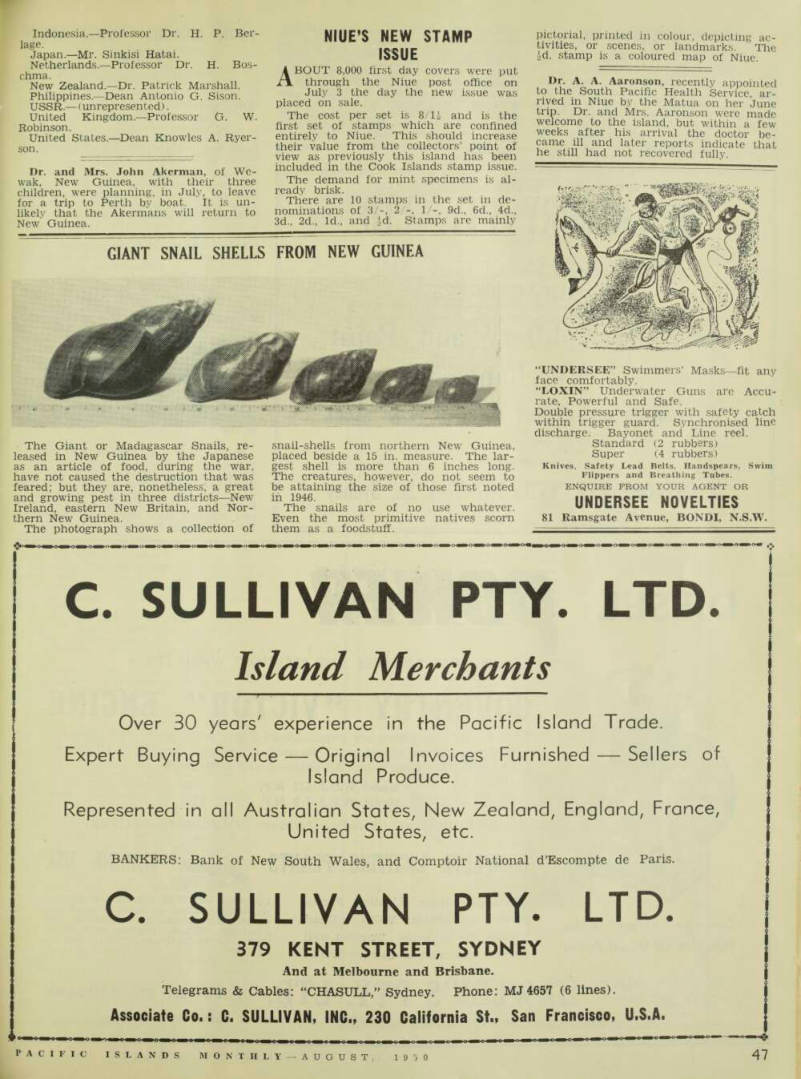
Pacific Science
THE permanent Secretariat of the Paci fic Science Association has now been established in Honolulu, with offices in Bishop Museum. The Secretariat was authorised at the Seventh Pacific Science Congress, held in New Zealand in 1949.
It functions in the following capacities:— •To assist Governments, institutions and individuals as well as Standing Com mittees of the Pacific Science Association, in the implementation of resolutions and recommendations adopted by Pacific Science Congresses. • To serve as a central office for the Pacific Science Council, especially during the intervening period between Con gresses, • To serve as an information dissemina tion centre in Pacific science matters. • To assist in maintaining a continuity in the relationship between the Pacific Science Association and such inter national agencies as the specialised agencies of United Nations, and South Pacific Commission.
International in scope, the Pacific Science Association includes Representa tive Institutions from countries in the Pacific, or interested therein, as well as those about the rim. Carrying out the international concept the Secretariat officers are Loring G. Hudson, Executive Secretary, from Honolulu, and Miss Brenda Bishop, Assistant Secretary, from New Zealand.
Continuity between Congresses is further maintained through the follow ing Standing Committees for Pacific re search.
The title, in each case, refers to the Pacific area:—
Volcanology.—Mr. J. Healv, Nz Geo
logical Survey, Rotorua, NZ.
GEOLOGICAL HlSTORY.—Professor R.
S. Allan, Department of Geology, Can terbury University College, Christ church, NZ.
SEISMOLOGY.—Dr. C. F. Richter, Seis mological Laboratory, Pasadena, Calif.,
Usa.
METEOROLOGY.—Dean A. F. Spilhaus, Institute of Technology, University of Minnesota, Minneapolis, USA.
Oceanography.—Dr. Thomas G.
Thompson, Director, Oceanographic Laboratories, University of Washing ton, Seattle, USA.
SYSTEMATIC ZOOLOGY.—Professor Dr.
H. Boschma, Director, Royal Museum of Natural History, Leiden, Holland.
Pacific Entomology.—Dean L. B.
Uichanco, College of Agriculture, Uni versity of the Philippines, Laguna, Philippines.
Terrestrial Faunas.—Mr. E. G.
Turbott, Auckland Institute and Museum, Auckland, NZ.
Pacific Plant Areas.—Dr. W. R. B
Oliver, Seatoun, Wellington, NZ.
Pacific Conservation.—Dr. R. A.
Falla, Director, Dominion Museum, Wellington, NZ.
Museums In Pacific Research.—
Dr. R. Cushman Murphy, American Museum of Natural History, New York, USA.
Soil And Land Classification.—
Mr. J. K. Taylor, Chief Division of Soils, CSIR, Waite Institute, Adelaide, South Australia.
Forest Resources.—Mr. Stephen N
Wyckoff, California Forest and Range Experiment Station, Berkeley, Calif
Usa. ’
Crop Improvement.—Dr. E. C. Audi
ter, President, Pineapple Research Institute of Hawaii, Honolulu.
Animal Improvement.—Dr. Valente
Villegas, Head, Department of Animal Husbandry, College of Agriculture, University of the Philippines, Laguna.
Anthropology And Social
SCIENCES. —Dr. E. Beaglehole, Vic toria University College, Wellington, NZ.
The executive body of the Pacific Science Association is the Pacific Science Council which, by the Association’s Con stitution, is set at a maximum of fifteen members. The Council is at present con stituted as follows: Australia.—Professor A. P. Elkin.
Canada.—Professor G. M. Shrum.
China.—(unrepresented).
France—Professor Roger Heim.
Hawaii.—Sir Peter Buck.
Indo-China.—Dr. Maurice Bayen.
(Continued on Page 47)
Indonesia. —Professor Dr. H. P. Ber lage.
Japan.—Mr. Sinkisi Hatai.
Netherlands.—Professor Dr. H. Bos chma.
New Zealand. —Dr. Patrick Marshall.
Philippines.—Dean Antonio G. Sison.
U SSR.— (unrepresented).
United Kingdom.—Professor G. W.
Robinson.
United States.—Dean Knowles A. Ryer son.
Dr. and Mrs. John Akerman, of We wak, New Guinea, with their three children, were planning, in July, to leave for a trip to Perth by boat. It is un likely that the Akermans will return to New Guinea.
Advertisements & other items, pp. 47-48 (1 item)
Robert Gillespie Pit It?
K. H. D. HAY
GENERAL COMMISSION
AND POSTAGE STAMP
AGENT,
GUADALCANAL, 8.5.1.
SETS OF BRITISH SOLOMON
ISLANDS STAMPS, MINT OR
CANCELLED COPIES.
Price: £1 /5/- per set.
FOR
VERANDAHS
SUNROOMS
LOUNGE-ROOMS
[if
KITCHENS
LAUNDRIES
This ultra modern window comprises a series of glass blades swung one above the other and inclinable to any angle.
Air entering the room is diverted towards the ceiling, thus preventing draughts. AGCO Supaluvres have all the advantages of other louvre windows plus exclusive features.
HOW THEY WORK:—
1. Handle automatically locks louvres in closed position. 2. Pawl holds louvres locked open in four positions. 3. Pinion engages driving rack to revolve louvres. 4. Patent “Rainguard” stops rain entering between glass holders and channel.
Full light and air with yearround weather protection.
ROBERT GILLESPIE PIT IT?
54a PITT ST., SYDNEY- PHONESBW47B2- BI3OS
IN NEW ZEALAND
Holiday time is precious—don’t waste it. Fly with TEAL and enjoy all your vacation in New Zealand. An overnight flight by fast, luxurious Solent flying boat and you’re in New Zealand with all your holiday still to spend. There’s time to see everything—Maori hakas, geysers, boiling lakes, alpine sports, trout streams, glow-worm caves —so fly to New Zealand with TEAL.
He s holiday wise , who always flies.
Visit the Canterbury Centennial Celebrations now in progress at Christchurch — music , sports, pageantry. Special attractions to interest all visitors .”
Reservations : All Leading Travel Agents.
AP2,
TASMAN EMPIRE AIRWAYS LTD
in association wit h Q.E.A., 8.0.A.C. and B.C . P.A
Niue’S New Stamp
Issue
ABOUT 8,000 first day covers were put through the Niue post office on July 3 the day the new issue was placed on sale.
The cost per set is 8/li and is the first set of stamps which are confined entirely to Niue. This should increase their value from the collectors’ point of view as previously this island has been included in the Cook Islands stamp issue.
The demand for mint specimens is al ready brisk.
There are 10 stamps in the set in de nominations of 3/-, 2/-. 1/-, 9d., 6d., 4d., 3d., 2d., Id., and id. Stamps are mainly
pictorial, printed in colour, depicting ac tivities, or scenes, or landmarks. The id. stamp is a coloured map of Niue.
Dr. A. A. Aaronson, recently appointed to the South Pacific Health Service, ar rived in Niue by the Matua on her June trip. Dr. and Mrs. Aaronson were made welcome to the island, but within a few weeks after his arrival the doctor be came ill and later reports indicate that he still had not recovered fully.
Giant Snail Shells From New Guinea
The Giant or Madagascar Snails, released in New Guinea by the Japanese as an article of food, during the war, have not caused the destruction that was feared; but they are, nonetheless; a great and growing pest in three districts—New Ireland, eastern New Britain, and Northem New Guinea.
The photograph shows a collection of
snail-shells from northern New Guinea, placed beside a 15 in. measure. The lar gest shell is more than 6 inches long, The creatures, however, do not seem to be attaining the size of those first noted in 1946.
The snails are of no use whatever, Even the most primitive natives scorn them as a foodstuff.
Advertisements & other items, p. 49 (1 item)
C Sullivan Pty. Ltd.
* v - SB* 4 “UNDERSEE” Swimmers’ Masks—fit any face comfortably.
“LOXIN” Underwater Guns are Accurate, Powerful and Safe.
Double pressure trigger with safety catch within trigger guard. Synchronised line discharge. Bayonet and Line reel.
Standard (2 rubbers) Super (4 rubbers) Knives, Safety Lead Belts, Handspears, Swim Flippers and Breathing Tubes.
ENQUIRE FROM YOUR AGENT OR
UNDERSEE NOVELTIES
81 Ramsgate Avenue, BONDI, N.S.W.
C SULLIVAN PTY. LTD.
Island Merchants
Over 30 years' experience in the Pacific Island Trade.
Expert Buying Service Original Invoices Furnished Sellers of Island Produce.
Represented in all Australian States, New Zealand, England, France, United States, etc.
BANKERS; Bank of New South Wales, and Comptoir National d’Escompte de Paris.
C. SULLIVAN PTY. LTD.
379 KENT STREET, SYDNEY
And at Melbourne and Brisbane.
Telegrams & Cables: “CHABULL,” Sydney. Phone: MJ4657 (6 lines).
Associate Co.: G. SULLIVAN, INC., 230 California St., San Francisco, U.S.A.
Permit Needed To

Visit Matua
From a Special Correspondent
Niue Is., July 18.
THE Niue Island Administration re cently instituted a permit system to apply to white residents (only four families outside the Government staff) and non-authorised staff members who wished to visit the USS Co.’s Matua.
All the residents duly applied for their
permits to visit the long awaited ship However, they neglected to place an English-speaking policeman at the wharf to examine the permits. Mr. Kilkenny, Matua’s purser, came ashore to adjust claims, ahd when he tried to get a lighter back to the ship was refused pas sage on the grounds of not having a permit. Mr. Kilkenny, when last seen was looking for the Resident Commis sioner. One hopes that he found the RC and either got a permit or an in terpreter.
Cook Islands’ “Blue Spot”
Babies
From Our Own Correspondent
Mangaia, Cl.
THE native people of these islands have always been of ethnological interest to visiting scientists, by reason of the well-known fact that in the Cooks is to be seen probably the purest Polynesian strain in the Pacific.
Native customs prevail to-day as they did when Cook called, only the undesir able or violent ones having been done away with. Midwifery is still exclusively Polynesian in practice; but this does not account for a peculiarity, seen in new born native infants, that has often puzzled doctors and ethnologists. Every baby shows from birth up to about its second year, a curious blue area at the base of the spine, like a bruise or ink stain, that seems to be characteristic of the Cook Islands. No explanation has been found for the condition, which is universal; it is not caused by injury or disease, and vanishes by the time the child is able to move about. A similar “blue spot,” it would seem, is visible among the infants of certain Indonesian tribes in the Arafura Sea, where natives have a decided resemblance to Polyne sian and Maori types.
It has been suggested that there is an ethnological connection between the two peoples.
Robert Rex who represented Niue at the South Pacific Conference in Suva, in May, arrived home in June, and has been busy going from village to village explaining to the people the meaning of the issues discussed at the Conference and enlisting their support to implement the resolutions passed.
Advertisements & other items, pp. 50-52 (4 items)
A. Gregory Pty, Ltd.
IMPORTERS, EXPORTERS AND
MANUFACTURERS
Leather Saddlery and Paint Merchants ALL CLASSES OF LEATHER SUPPLIED FROM STOCK Apply direct to: A. GREGORY PTY., LTD., 107 York St., Sydney
Pom/Er
DIESEL
mrnml
*% m Coventry "Victor" is the finest of all Diesel Power
pOM/ER
IS MOST RELIABLE AND EFFICIENT WHEN IT'S A
COVENTRY “VICTOR” ENGINE
Ideal for all uses where low weight Diesel Power is required. The Coventry VICTOR is a sound investment. Remarkably smooth running at all speeds.
Instant starting from cold. All enclosed and dust-proof.
Model W.D.I 5/7 H.P £125.
Model W.D.2 7/9 H.P £145.
F. 0.8. Brisbane (including Packing). IMMEDIATE DELIVERY.
COMPLETE LIGHTING PLANTS MARINE USE
Dependable Home Lighting Plants, powered by Coventry VICTOR Diesel Engines, are available. Supplied with common base plate and switch boards.
Coventry VICTOR Diesels for marine application either as main or auxiliary propulsion, or marine auxiliaries are available. These engines are ideal Power Units for craft from 16 feet to 22 feet. write to distributors'. HAWLEY S PTY. LTD. » »ow EN ST., BRISBANE or to local Sales and Service Representative: C. C. EVANS, c/o Bank of N.S.W., Port Moresby.
Sffl'
WHEN THE TREE FELL
BY D. H. OSBORNE
WHEN I read Judy Tudor’s tale of her life under the uncertain trees in New Guinea, I was reminded of an incident of long ago, in the shadow of the Owen Stanley Range, in North-east Papua.
Seeking for gold, I had reached a miners’ field, and I began to build a camp. An Italian, Peter Bosi, came along, and looked around.
“Look,” he said. “That big tree over there —if it fell, the branches would reach here.”
I moved to another spot, 150 yards further up the creek, where all trees had been felled.
Some time later, Jack Horan arrived, and began to clear away the rubbish from the spot I first had chosen. I pointed out the danger.
But he sneered at me. “That tree has stood there for scores of years. Why should it fall on me?” He built his camp.
He was not a good neighbour. He loved his liquor; and, when he got drunk, he wanted to fight everyone. There is no more objectionable type of man in a camp.
One day, Charlie Priddle came in, a newcomer to the field. He had just re turned from the Boer War, so you can guess how long ago that was. He de cided that, for that night, he would camp with me, and he sent his carriers to make camp a little distance away. Over on the opposite bank of Clunas Creek was Lee Joubert’s camp.
In that area, in under the Owen Stanleys, it was a common thing to hear trees falling, just before dawn. Priddle and I were asleep when, without warn ing, there was a crash of a tree followed by shrieks and yells.
“Red Creek natives are attacking my carriers,” cried Priddle.
“No,” I said. “I think that tree has fallen on Horan’s camp.”
We were frightened and confused. I found matches, but they were so damp that they would not strike. I could not find my boots. Priddle and I fell over each other.
Finally, we got a hurricane lantern going. I sent a messenger for Joubert, and we grabbed axes and scrub knives and stumbled through the darkness to Horan’s camp.
Two natives were out in the clear. One, fatally injured, was lying moaning on the ground. The other, beside him, was un scathed.
Piled high over Horan’s camp were the branches of the huge tree. The hut was completely flattened. From beneath the pile came Horan’s voice, calling wildlv. “O I’m done. I’m done for!”
Priddle shouted, “Be quiet man—re serve your strength” and we began to hack at the great branches.
We were still cutting at the branches at daybreak. Horan was saved by the staunchness of the hut. It was made of thatched palm leaves, fastened to strong beams with split vines as tough a> wire. We had to be most careful not to cut the vines, and thus let the full weight down upon Horan, who was protected by some of the beams. He had heard the tree crack and begin to fall, and had thrown himself down beside his bunk.
He had a big branch on each side of him, and his clothes were torn off, but when at last we got him out we found he was not seriously injured. Les Joubert gave him whisky and hot tea.
Horan suffered more from shock than broken bones. He wanted to get away Sputh. The miners chipped in and paid his passage to Cooktown, and Joubert nursed him until the boat came in. We were not sorry to see him go. He was not a good neighbour.
The Bishop of Melanesia, the Rt. Rev S G. Caulton, arrived in the New H?b-’ ndes at the end of April on the Southern Cross. In May and June he visited villages in the Hebrides and Banks Groups in the Mission launch Patteson He expected to continue this tour (ineluding the Torres Is.) in July and August, rejoining the Southern Cross for
Sffl'
The nerind nf wnnHmonf ™
M Jrshail to Pljf as Conservat^.JU*
will end shortly and he will return to Malaya after a period of leave his leave he will visit Western Samoa and American Trust TeimitnriSf in a -2 d to aS on Tnti a nlw CoS servator is appointed Mrw 1 BviS- Senior Surveyor and Valiierin the Land's
S— nt, W will act^s^onservator
Qjup
OUR HANDS MAKE GOOD ARMS
S I L
For your Fishing and Shooting Wants Consult Us.
Lithgow .22 Cal. Repeating Rifles £l3 3 0 ) Post Lithgow .22 Cal. Single Shot .. .. £6 12 6 ( Extra.
RO H U 143 ELIZABETH STREET, SYDNEY.
rnm; i m ' r r
QjUP
HE A The Shell Company of Australia Ltd. (Inc. in Gt. Britain)
GSOIH
Famous RADIO STAR AND AUCTIONEER
sack t>At/ey
says
“Horlicks takes
the Jack Pot
for flavour and
nourishment
iK .r What am >
offered?”
When Jack Davey steps onto his auctioneering rostrum at eleven in the morning he doesn’t come down again until four in the afternoon!
And that happens every Thursday and Friday at “Hi Ho House”, Sydney. In that time he will sell anything from a fork to a fox fur — nonstop! “Yes” says Jack , “I’ve got to keep going flat out for five sxdid hours — that’s why I always have a glass of Httrlicks before I start.”
Radio Star, auctioneer, newspaper columnist, song writer . .. where does he get all that bubbling energy? Listen to Jack Davey himself: “I’ve been a Horlicks regular for many years.
Horlicks has always kept me going at the top of my form.”
Just like Jack Davey, you’ll enjoy the delicious, distinctive flavour of Horlicks. And, like Jack, you’ll find that Horlicks will give you extra energy.
Rich in These Food Values °* ts
HORLICKS
C A*
VfTAMfN 8/
“s' I £2 when mixed as directed The full, satisfying flavour of Horlicks comes from a careful blend of fresh, full-cream milk and the nutritive extracts of malted barley and wheat. It is Nature’s flavour . . . that’s why you never tire of it.
Many people drink Horlicks
simply because they enjoy that distinctive flavour. Others drink Horlicks because they need it to build them up ... to nourish the body and nerves . . . and to
induce deep, refreshing sleep.
But whatever the reason everyone enjoys Horlicks. It is equally delicious hot or cold.
Ask your storekeeper for
HORLICKS
2'2 'tr 3'e
8-oz
TIN
Prices slightly higher in country areas.
Production
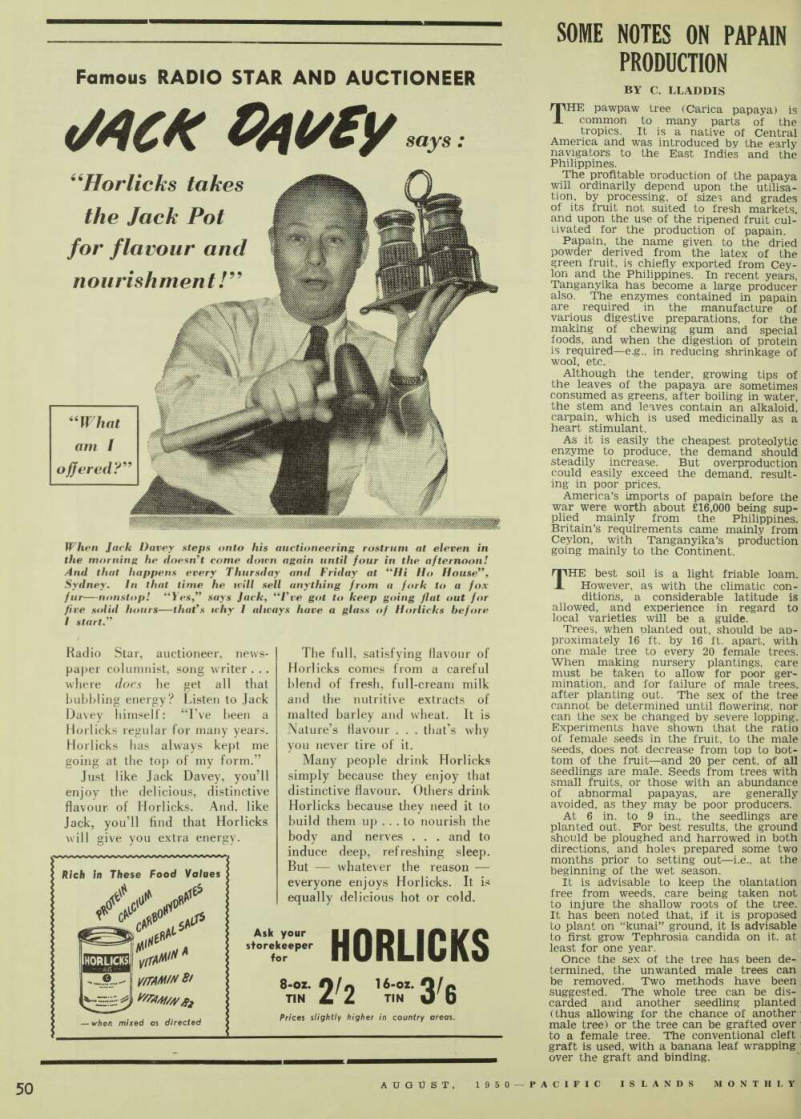
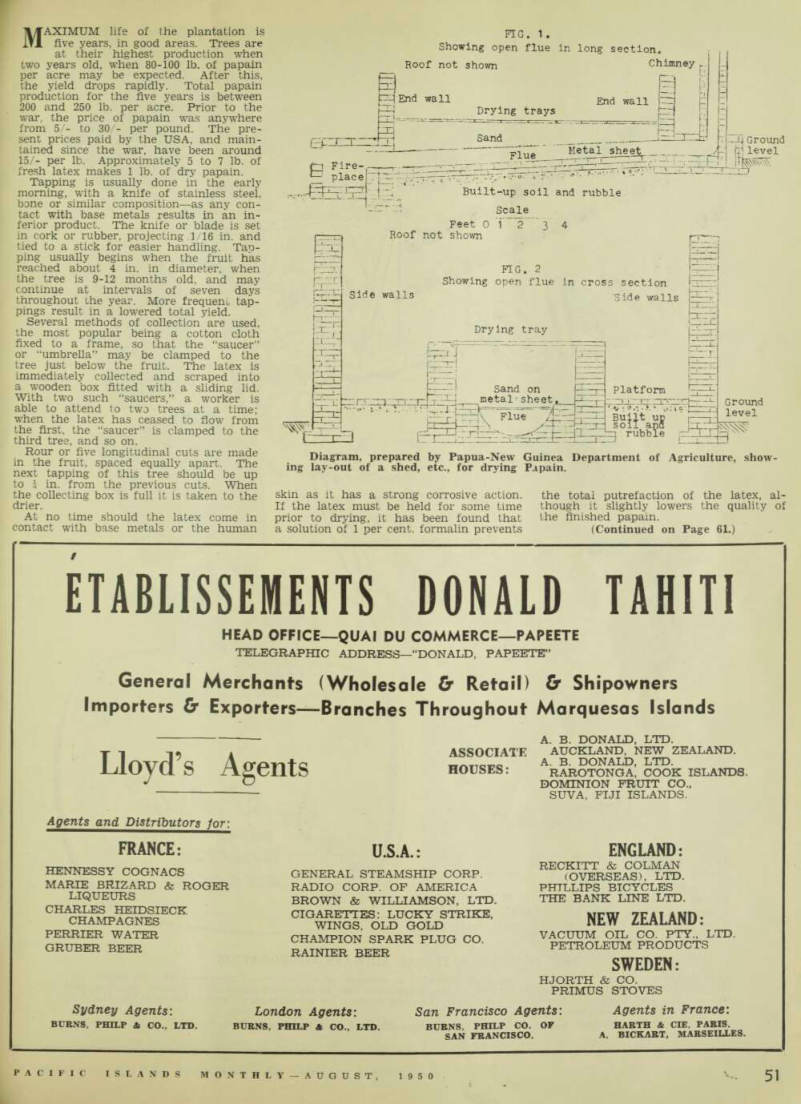
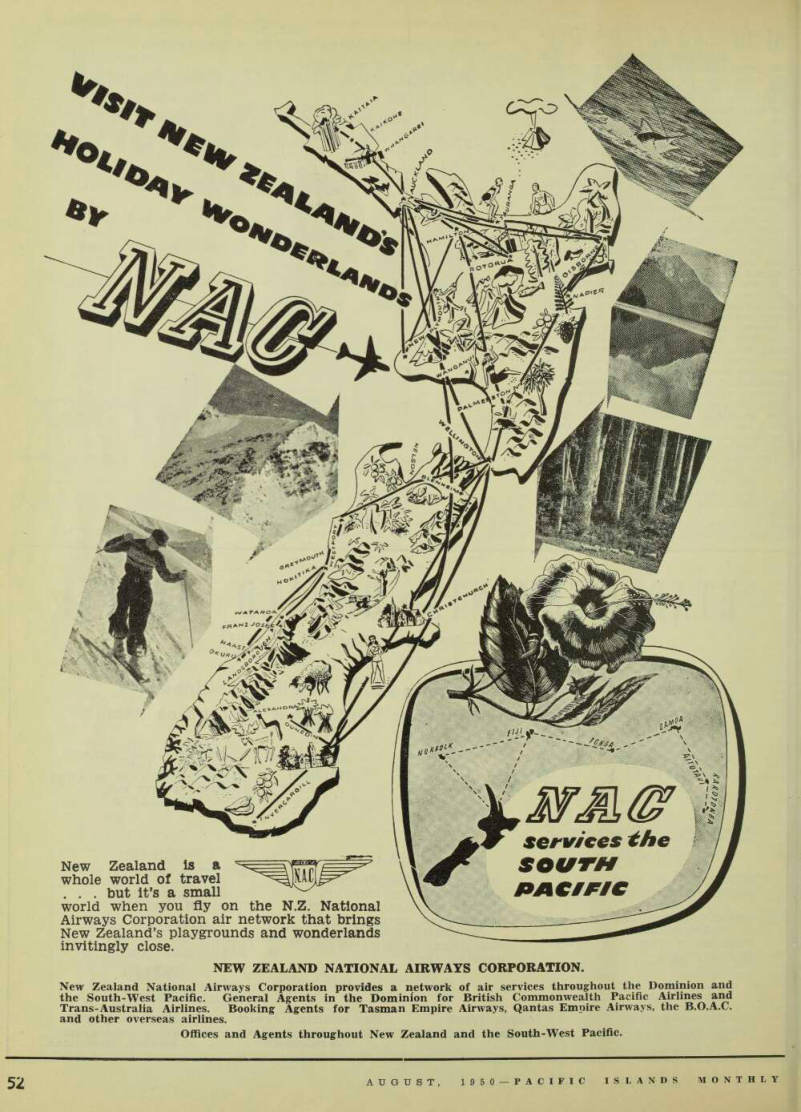
Some Notes On Papain
By C. Lladdis
THE pawpaw tree (Carica papaya) is common to many parts of the tropics. It is a native of Central America and was introduced by the early navigators to the East Indies and the Philippines.
The profitable nroduction of the papaya will ordinarily depend upon the utilisa tion, by processing, of sizes and grades of its fruit not suited to fresh markets, and upon the use of the ripened fruit cul tivated for the production of papain.
Papain, the name given to the dried powder derived from the latex of the green fruit, is chiefly exported from Cey lon and the Philippines. In recent years, Tanganyika has become a large producer also. The enzymes contained in papain are required in the manufacture of various digestive preparations, for the making of chewing gum and special foods, and when the digestion of protein is required—e.g., in reducing shrinkage of wool, etc.
Although the tender, growing tips of the leaves of the papaya are sometimes consumed as greens, after boiling in water, the stem and leaves contain an alkaloid, carpain, which is used medicinally as a heart stimulant.
As it is easily the cheapest proteolytic enzyme to produce, the demand should steadily increase. But overproduction could easily exceed the demand, result ing in poor prices.
America’s imports of papain before the war were worth about £16,000 being sup plied mainly from the Philippines.
Britain’s requirements came mainly from Ceylon, with Tanganyika’s production going mainly to the Continent.
THE best soil is a light friable loam.
However, as with the climatic con ditions, a considerable latitude is allowed, and experience in regard to local varieties will be a guide.
Trees, when planted out, should be ap proximately 16 ft. by 16 ft. apart, with one male tree to every 20 female trees.
When making nursery plantings, care must be taken to allow for poor ger mination, and for failure of male trees, after planting out. The sex of the tree cannot be determined until flowering, nor can the sex be changed by severe lopping.
Experiments have shown that the ratio of female seeds in the fruit, to the male seeds, does not decrease from top to bot tom of the fruit—and 20 per cent, of all seedlings are male. Seeds from trees with small fruits, or those with an abundance of abnormal papayas, are generally avoided, as they may be poor producers.
At 6 in. to 9 in., the seedlings are planted out. For best results, the ground should be ploughed and harrowed in both directions, and holes prepared some two months prior to setting out —i.e., at the beginning of the wet season.
It is advisable to keep the Plantation free from weeds, care being taken not to injure the shallow roots of the tree.
It has been noted that, if it is proposed to plant on “kunai” ground, it is advisable to first grow Tephrosia Candida on it, at least for one year.
Once the sex of the tree has been de termined, the unwanted male trees can be removed. Two methods have been suggested. The whole tree can be dis carded and another seedling planted (thus allowing for the chance of another male tree) or the tree can be grafted over to a female tree. The conventional cleft graft is used, with a banana leaf wrapping over the graft and binding.
MAXIMUM life of the plantation is five years, in good areas. Trees are at their highest production when two years old, when 80-100 lb. of papain per acre may be expected. After this, the yield drops rapidly. Total papain production for the five years is between 200 and 250 lb. per acre. Prior to the war, the price of papain was anywhere from 5/- to 30/- per pound. The pre sent prices paid by the USA. and main tained since the war, have been around 15/- per lb. Approximately 5 to 7 lb. of fresh latex makes 1 lb. of dry papain.
Tapping is usually done in the early morning, with a knife of stainless steel, bone or similar composition—as any con tact with base metals results in an in ferior product. The knife or blade is set in cork or rubber, projecting .1/16 in. and tied to a stick for easier handling. Tao ping usually begins when the fruit has reached about 4 in. in diameter, when the tree is 9-12 months old, and may continue at intervals of seven days throughout the year. More frequem tap pings result in a lowered total yield.
Several methods of collection are used, the most popular being a cotton cloth fixed to a frame, so that the “saucer” or “umbrella” may be clamped to the tree just below the fruit. The latex is immediately collected and scraped into a wooden box fitted with a sliding lid.
With two such “saucers,” a worker is able to attend to two trees at a time; when the latex has ceased to flow from the first, the “saucer” is clamped to the third tree, and so on.
Hour or five longitudinal cuts are made in the fruit, spaced equally apart. The next tapping of this tree should be up to \ in. from the previous cuts. When the collecting box is full it is taken to the drier.
At no time should the latex come in contact with base metals or the human
skin as it has a strong corrosive action.
If the latex must be held for some time prior to drying, it has been found that a solution of 1 per cent, formalin prevents
the total putrefaction of the latex, al though it slightly lowers the quality of the finished papain.
(Continued on Page 61.)
Diagram, prepared by Papua-New Guinea Department of Agriculture, show ing lay-out of a shed, etc., for drying Papain.
At the kiln, the latex is strained through muslin to remove any extraneous matter.
Sun-dried, being darker, is of lower value than the kiln-dried product. The best and highest grade papain is creamy white and crumbly.
The kiln may be a closed or open type.
The former gives the highest quality; but the cost of construction is higher, as adequate ventilation must be provided to keep down humidity. Kilns are operated at9odeg-100 deg. Fahr., and drying takes five-seven hours. With a tray 30 ft. x 6 ft., about 60 lb. of prepared papain is a day’s production. At first, the latex must be stirred with a wooden paddle.
Over-heating will result in darkening, and is a risk with the closed kiln.
Immediately, the dried latex —now papain—is sealed in new 4-gallon kero sene tins, the insides of which have been coated with paraflin wax, evacuated and sealed. Papain is graded by its colour, and the prepared paoain must not on any account be pulverised prior to packing. As papain deteriorates rapidly, it is essential that it be packed quickly.
THE Bureau of Agriculture and Industrial Chemistry, Agricultural Research Administration. US De partment of Agriculture, in 1944, made several experiments with the papaya. The products include canned and bottled papaya nectars and soft drinks, conserves, chutney, pickles, and butter. Other items were marmalade, sweet pickle, spiced sweet pickle, crystallised fruit and de hydrated papaya slices and pulp.
The dehydrated papaya slices were of interest as it is a good source of vitamins A and C and could readily be eaten as is. Further, having a low acid and high
sugar content, combined with the candy like taste and texture, it is suitable for incorporation in concentrated food rations, as well as confections.
The candied papaya, resembling candied citron peel in appearance and flavour, was tested in fruit-cake mix and in mince meat. Storage tests were carried out for over a year without apparent deteriora tion of the candied samples. Those stored over three years gradually developed a stale odour and flavour. The preserva tive used was sodium bisulfite, equiva lent of 50 parts per million of sulphur dioxide.
Further information can be obtained by those interested from the following sources: Department of Agriculture, Stock and Fisheries, Port Moresby, Papua; the Queensland Department of Agriculture: Florida Agriculture Experiment Station, USA; US Fruit and Vegetable Products Laboratory, Welasco, Texas; the Bureau of Agriculture and Industrial Chemistry, Agricultural Research Administration, US Department of Agriculture.
Advertisements & other items, pp. 53-54 (1 item)
Etablissements Donald Tahiti
HEAD OFFICE—QUAI DU COMMERCE—PAPEETE
TELEGRAPHIC ADDRESS—“DONALD, PAPEETE’’
General Merchants (Wholesale & Retail) Cr Shipowners
Importers & Exporters—Branches Throughout Marquesas Islands
Lloyd’s Agents
A. B. DONALD, LTD.
ASSOCIATE AUCKLAND, NEW ZEALAND.
„ / , TTr , I , D A. B. DONALD, LTD.
HOUSES: RAROTONGA, COOK ISLANDS.
DOMINION FRUIT CO.,
SUVA, FIJI ISLANDS.
Agents and Distributors for :
FRANCE:
HENNESSY COGNACS
MARIE BRIZARD & ROGER
LIQUEURS
CHARLES HEIDSIECK
CHAMPAGNES
PERRIER WATER
GRUBER BEER
U.S.A.:
GENERAL STEAMSHIP CORP.
RADIO CORP. OF AMERICA
BROWN & WILLIAMSON, LTD.
CIGARETTES: LUCKY STRIKE.
WINGS, OLD GOLD
CHAMPION SPARK PLUG CO.
RAINIER BEER
ENGLAND:
RECKITT & COLMAN
(OVERSEAS), LTD.
PHILLIPS BICYCLES
THE BANK LINE LTD.
NEW ZEALAND:
VACUUM OIL CO. PTY., LTD.
PETROLEUM PRODUCTS
SWEDEN:
HJORTH & CO.
PRIMUS STOVES
Sydney Agents : London Agents :
BURNS, PHILP & CO., LTD. BURNS, PHILP A CO., LTD.
San Francisco Agents : Agents in France : BURNS, PHILP CO. OF HARTH & CIE. PARIS.
SAN FRANCISCO. A. BICKART, MARSEILLES.
*o nl o Ml / $ N I S: IW m »*■» A pie« ♦ ST I L & V cy» / »\
WATAPOA
fR AN2 JOSe£>
s' / vu \ 33
HAMD
tf0 A fp.[ fOL* ■** a •'<*
the
services
SOUTH
uc
PACIFIC
New Zealand is a whole world of travel . . . but it’s a small world when you fly on the N.Z. National Airways Corporation air network that brings New Zealand’s playgrounds and wonderlands invitingly close.
NEW ZEALAND NATIONAL AIRWAYS CORPORATION.
New Zealand National Airways Corporation provides a network of air services throughout the Dominion and the South-West Pacific. General Agents in the Dominion for British Commonwealth Pacific Airlines and Trans-Australia Airlines. Booking Agents for Tasman Empire Airways, Qantas Empire Airways, the 8.0.A.C. and other overseas airlines.
Offices and Agents throughout New Zealand and the South-West Pacific.
Magazine Section
Territories Talk-Talk
By "Tolala"
NOW that some encouragement is be ing given to private enterprise in NG, I see that two South Australians —one no other than the Editor of “Hoofs and Horns”—have plans for a tea plantation in the highlands. It’s about time we realised that NG can grow all our tropical requirements, and put that knowledge into practice. Sydney’s retail prices for pepper and coffee, for instance are respectively 3/3 an ounce, and 7/8 a pound. New Guinea growers should be able to do something with those lines and show a reasonable profit, at half the price.
Queen Emma, 40 years ago, carried out successful experiments in -growing this kind of product on Matanatar planta tion in the Kokopo district. But no one preservered then because the old coco nut was so easy to grow and required no trained labour to turn it into copra.
By-the-way, the modest kaukau (sweet potato) is selling in Sydney at 1/3 a pound!
INVARIABLY there are arguments about income taxation assessments.
One recently came before the Supreme Court in Sydney involving a man who was with the Yank Small Ships in NG for a while, and appealed against his earnings while there being taxed.
Apparently there are other similar cases pending and the judgment was reserved.
I hear many complaints from pre-war NG residents who received war damage compensation and have been taxed on the interest, which accumulated during the period between the loss and pay ment of the claim. Had there been a branch of the War Damage Commission established in NG after the war (whence most of the claims came) then surely the position could never have arisen, but there wasn’t and all claims had to go through Sydney. Somehow it doesn’t seem to add up rightly to me.
HAVE you ever tried to locate a pal who has come down to Sydney from NG, but you have no idea where he is staying? It might be imagined that it would be something akin to the pro verbial needle in the hay-stack. But not so. In the old days—before folk hop ped. down by ’plane—you could invariably track them down through the shipping department at BP’s; but in these days of modern transport it is not quite so easy. I was seeking a Bill Jones the other day. Enquiries at the PIM office drew a blank, even Bert Rawnsley in BP s didn’t know where he was, neither did Merle at the Plaza; but a call at Madge’s bar at Usher’s brought to light a veritable directory of Territorial! visi tors with their Sydney addresses. A flick of the leaves of the indexed address book by Madge gave me all the informa tion I required, and further queries told me that most Territorians register in Madge’s book as soon as they arrive.
THERE always have been favourite Sydney spotting spots for NG folk on leave—and probably always will be. In the early N ’2o’s it used to be Belfields, where Papuan, NG and Solo mon Islands residents foregathered’ then, in the ’3o’s, it changed to Usher’s where the famous Ethel could give you more information about NG personnel than the Government Secretary himself
then they gravitated to the Australia for a while, and afterwards returned to Usher’s where they congregate now, with a fair proportion patronising the Plaza.
It is not hard to track down the Ter ritorial if you really want to find them providing they do not shun the spotting spots.
BIRDS of paradise are either becoming more hardy, or their homes in cap tivity more to their liking. It used to be a common saying in the Islands that you could not keep a BOP in cap tivity—even in NG. Many attempts were made, but in vain. Now I read of a fe male blue bird in the Chicago Zoo being joined by a mate, which was flown over from Frisco, after a sea voyage from Sydney. The next thing we’ll hear will be some enterprising Yank starting a BOP farm for trimming milady’s Fifth Avenue hats.
FROM what one hears about the re classification of the P-NG Public Service it has certainly caused a lot of disappointment—and that’s putting it very mildly. Senior officers appear to have come off quite well, while the lower grades are left moaning. This is un fortunate and if there are not many vacancies in the ranks of the Public Service in a short while I shall be much surprised. Unless, of course, some of the classifications are amended. Papua and New Guinea are not as attractive as they used to be in pre-war days. Per haps a little less attention to UNO and more to government employees might be advantageous, all round.
THE reassurance of the Special Cor respondent (PIM, July, p 9) of “Let there be No Panic” in Rabaul over imminent volcanic eruptions is very timely, and he is quoting much of what Dr. Norman Fisher stated over ten years ago. The Australian government has al wavs had the wind-up over Rabaul since 1937, and Civil Servants in residents there in pre-war days encouraged this fear to a great extent, for they had no personal stake in the town (they were
not allowed to have one) and one loca tion was as good as another to them in which to perform their public service duties. The gov ernment was natu rally concerned over the safety of the residents, but an other contributing factor for concern was the possibility of claims for com pensation in the event of a major seismic upheaval.
In these years “Compo’ has become a big factor in na
tional life and that, in my opinion, Is one of the main reasons why the government is still toying with the idea of “moving Rabaul. ’ Dr. Fisher’s views may succeed in allaying government fears, and I hope they do. But the in stallation of an A 1 vulcanological ob servatory is essential, without delay.
WHY is it the present Vs always so niggardly in passing credit on to the past?
Minister Spender is reported in the middle of last month as saying that “with nromulgation of the Native Vil lage Councils Regulations the native peoples would for the first time have an opportunity for a measure of self-gov ernment.”
And yet in the TNG Administration Report to the League of Nations for 1936-37 one reads of the establishment of 14 groups of villages where Native Councils had been established and trans lations of some of the records were for warded to the Permanent Mandates Commission for examination . , . Fair go!
BITS AND PIECES: Rabaul will miss the Perrimans, who left recently for Europe, via the USA. Bert has seen a few changes in old Rabaul. It is 30 years since he used to tootle round in an old T Ford. Then the WRC staff in Rabaul consisted of a man named Tat ham as manager, and Bert as clerk and everything else. Their office was in a bungalow opposite Proclamation Square and later occupied by Johnny Walstab.
The WRC firm has gone a long way since then. . . . Present Territorial an nual copra production is said to be about 55,000 tons. In pre-war times native trade copra was estimated at 10,000 tons.
It would be interesting to know what it totals now, as an indication of native in dustry. ... A Sydney firm is offering boys a bonus of £lOO to sign apprenticeship articles for a period of five years. . . .
Indentured labour system?
Captain F. S. Melton, master of the Melanesian Mission ship Southern Cross, has been in Sydney on furlough.
The Meke
All Pacific Islanders have their own forms of dancing. In Fiji they are called Mekes. This one performed by the girls here and in which wreaths of cream frangipanni blossoms and scarlet hibiscus play their part, is said to have a Polynesia origin.
—Photo by Lex Halliday.
20 Years in the Neck-Tie Business
By Eric Ramsden
JUST how Bill Wilson, of Fiji, got into what he called “the neck-tie busi ness” is a story in itself. In using that expression one does not wish to give an impression of facetiousness. For 20 long years Bill took his job (which, you will agree, was one of life and death), very seriously. That he gave satisfaction to all parties is obvious; the Fijian Gov ernment has employed him for so long as the Colony’s official hangman.
In 1928 there was a particularly brutal murder at Tuvimula, on Vanua Levu. The motive was the not unusual one— jealousy and man-woman trouble. In consequence, three men were sentenced to be hanged, likewise the lady in the case. But as the latter was found to be pregnant, her sentence was committed to life imprisonment.
The circumstances of the case were so horrifying that Bill was heard to observe: “I would not mind stringing up those So and-Sos’ myself!”
That chance remark reached the ears of the Governor of Suva’s gaol. At that time the Colony required the services of a hangman. So this proposition was put to Bill—a retaining fee of £25 annually, £lO for the initial execution, and £5 for any others that took place at the same time. “Oh. yes,” he remarked quite casually, “it is possible to swing three at the same time. I have had as many as seven or eight, though I usually did them in twos and threes.”
The incident at Tuvimula, apart from the retainer, meant a cash transaction of £2O. Bill is rather proud of the fact that he was the first of his trade to receive a retainer. The profit motive, however, did not influence him unduly. For, if at the last moment a Governor exercised his prerogative of mercy, Bill was paid just the same.
After explaining such business details, he confided: “People, you know, are apt to look down on a hangman. But he performs a most necessary and useful service for the community. If there were no hangman, there would be many more murders.” He believes in capital punish ment as a deterrent, especially in a colony such as Fiji where Asiatics are in the majority. Bill, whose Fijian mother came from Levuka, says that sex and robbery are almost invariably the mo tives for the crimes of Fiji-Indians.
During the period in which he was hangman, until his retirement in 1948, there were no Europeans executed, and only two Chinese. The guilty Indians, he explained, wasted much time and money in useless appeals—only, of course, to face Mr. Wilson and his “neck-tie” on the final day of reckoning. “Far better to get it over quickly,” commented my in formant. “Why waste so much money on lawyers? But that is the Indian way.
One can never cure them of litigation!”
Bill was full of facts and figures as to his experiences. Even if one could not always accept the facts without question, some of his memories were certainly vivid. There was, for example, the case at Rakiraki, in Ra province. Bill was a little hazy as to the date, but he re called the circumstances: — AN Indian and his wife and their seven children were at home one evening.
It was oouring with rain. Suddenly, there was a knock at the door. A ragged man asked for shelter. The wife cooked some more roti, and gave him what re mained of the curry. The husband even provided the visitor with fresh clothing.
“Next day the husband said to the wife: T think I could employ this man.
Of course, we can give him no wages, but when the crop is harvested, there will be a share for him.’
“The arrangement worked quite satis factorily for three months. Then, the stranger began to cast eyes in the direc tion of his hostess. If he ever again made such a proposition, replied the latter, she would tell her husband. The visitor was penitent for a time, and tnen renewed his attentions. The wife told him that she would certainly inform her lord and master.
“That night, fearing the disclosure, the man murdered the husband and wife, and killed all the children with the exception of one girl who escaped through a win dow and the baby. Indians go mad when they see blood; they just chop and chop.
Then he set fire to the house, and it was proved later that the baby died in the fire.”
Bill had no compunction in “stringing up” the man who had bitten the hand that fed him.
While the majority of condemned people are docile in confinement, he recalled how one Punjabi had rushed him in the cell on the morning of execution. '“But, of course, I had two warders with me, and he never had a chance.
“After he had the harness on him, when en route to the scaffold, he ad dressed the Indian prisoners, saying; ‘Never commit crime! See what has happened to me! Now I am going to pay for it!’ ”
Then there was the case of a father and son, who had murdered an old couple to obtain £5OO. One blamed the other, though neither would confess. Even as they stood on the scaffold they would not speak to each other.
During the recent war a party of eight Indians who had been celebrating in Suva called on an old couple in the country.
After they had been received kindly, and a chicken killed in their honour, the young men revealed their real intention.
The old folk were known to be wealthy.
Like many Indians, it was believed they had their money buried somewhere around the home.
One of the party who subsequently turned King’s evidence, told how first one of the old man’s eyes had been gouged out, and then the other. Then the old woman was subjected to such treatment that it could not be described in print.
Finally, she told where £9O was hidden.
But that was not enough. The hood lams wanted the lot.
The old man was killed. His wife was left in such a condition that she died soon after from her injuries.
Bill was rather annoyed when, in that particular instance, the Governor exer cised his prerogative, believing perhaps that it might relieve the tense political situation that then existed. “But if it was designed to assist recruiting,” he re marked, “then it had no such effect,”
These was at least one instance where the prisoner, after being sentenced to death, was found to be suffering from leprosy. Whereupon he was transferred to Makogai. That certainly presented a problem for the person most concerned.
If he recovered, to quote the ex-hangman; “He would be the principal guest at a ‘neck-tie’ party.”
What was preferable, he asked—to be hanged or to die from leprosy?
PIM Crossquiz- No. 8
(Solution on page 89.)
Across
3.—What crustacean is coloured by boiling? 6.—What is Canada’s national sport? 8. —Who said “I fear the Greeks even when bearing gifts”? 9. —What animal has teeth of the same number and form as a man? 11, —Which was a celebrated family of violin makers? 12. —ln arithmetic, what is the least whole number? 15 __what could be a seat or an aviation menace? 17. —What is the act of in creasing through normal growth? 19. —Hair-net? 20. Another name for beche-de mer? 23.—The symbol for copper? 24 —Which adjective pertains to lofty peaks? 25.—Who was captain of H.M.S.
Pinafore?
Down
1. —What creature was once be lieved to live and delight in fire? 2. —What was Benjamin Franklin before he became President of the
Usa?
3. —How many watches are there aboard ship?
4. —Who was the villain in “Othello”? 5. —What Bible has the text printed side by side in different languages? 7—What is the Caspian? 10. —Which soup has no solids? 13. —ln ancient times it was Byzantium. What is it now? 14. —Tease?
16.—What part of an aircraft gives lift in a moving current of air? 18.—What strong grass is used in basket making, cordage, etc.? 21. —Large jug with a wide spout? 22. During which war did Baden-Powell gain prominence? 23. —What container is repeated for a dance v title?
Tropicalities
TWO stories about Missionaries from the Newcastle Herald: Embarrassment in glorious techni colour was recorded at the expense of the Secretary of the London Missionary Society in Australasia (Rev. N. Cocks), who gave an address at the Brown Street Congregrational Church. Mr. Cocks showed a film which took in one of his visits to Papua. As he left, he was car ried to the waiting launch by two native boys, sedan-chair fashion The scene was all dignity and tropical splendour till one of the boys stumbled, knocked against his mate, and the trio floundered in the sea. Mr. Cocks was shown being hauled, dripping, into the launch. ♦ ♦ * THE Rev. D. E. Ure, 20 years a mis sionary in Papua, was another speaker. He was telling a question er in the audience about natives in the highlands where the Australian sheep breeding experiments are going on. “The natives have little clothing, but in the cold weather they smear themselves with pig fat for warmth,” he said. “You can imagine what a Sunday congrega tion smells like.” Mr. Ure also told of natiye deacons who protested about the admission of a certain native woman to the church. They could find no fault— she attended church regularly, knew her catechism, lived a good life, and her husband belonged to the church. “Then what is your objection?” Mr. Ure asked.
“Her husband hasn’t finished paying for her yet,” they said. * * * THESE pearls which were found by a Torres Strait Islander last season are now in the safe keeping of the Queensland Native Affairs Director, and details of them have been sent to Prime Minister Menzies (now in the United States) who has been asked to help sell them in America or Europe for the bene fit of the native owner.
. We described these freak “flask” pearls in April PIM. They were found together m the one shell. The lower pearl has a jet black band round the top forming a cup into which the six carat “stopper” fits. Both are valuable but would be more valuable still if sold in combina tion.
TEA in Australia is now 3/4 per pound —it went up 7d. recently when ra tioning was removed. It still is about the cheapest tea in the world, however, and residents of the New Guinea territories pay between seven and eight shillings per pound for the same brands.
In order to beat the rise, two men in the Government service in Melbourne have patented a method of tea-brewing that uses, they say, only a quarter the normal amount of tea. This may be of interest to readers who are paying a much higher price than are the in ventors.
The process is simple. The tea is placed in a small metal container in side an ordinary domestic pressure cooker, and infused under pressure. The water in a pressure-cooker reaches 250 deg., releasing oils which remain in the leaf when it is in contact with ordinary boiling water. A further gain is made in volatile compounds usually lost in steam.
Excellent results have been obtained with an ounce of tea to a gallon of water.
Tea tasters of the Department of Trade and Customs report that the brew made under pressure is darker in colour, higher in its percentage of solids, stronger in flavour, and generally at least equal in quality to tea conventionally prepared.
The inventors hope to work out a tea concentrate which will keep for weeks.
Devotees of the pressure-cooker will be sorry that a few more precise details are not given for brewing just one ordi nary pot of tea. But a few experiments should show how long to cook, and how much tea to use. * * * IjlX-FIJI residents living in Australia J might be interested to know that they can now buy a recording of that perennial favourite, Isa Lei, in Aus tralia. This is sung by Fijians—the well-known choir of the Methodist Jubi lee Church in Suva —and is not the “hot”
Australian version of this famous island melody.
On the reverse side of the disc the choir sings Mo ni totaka na kalon.
Records are 10/- each in Australia; postage extra. Inquiries should be made from State secretaries of the Metho dist Overseas Mission or at head of fice 139 Castlereagh Street, Sydney. ♦ * ♦ A WOMAN civil servant employed by the British Solomon Islands Gov ernment recently returned from an evening party to find that her sitting room had been taken possession of by a turtle, which had knocked glasses and a wireless set off a small table and bro-. ken them, and had then apparently charged about the room, knocking down and breaking some light furniture.
Boys were sent for and after a chase lasting some time they polished it off with an axe. The turtle had apparently come up from the sea, 30 yards away, looking for a sand beach to lay eggs in, and finding a stretch of coral debris but no sand, had walked into the house on its way to a further search. It was found to be full of eggs when it was killed.
Turtle soup and turtle steaks next day went some way towards consoling the householder for the damage done. —
Ksp.
WHEN Ratu Sir Lala Sukuna was gazetted in May as honorary colonel of the Fiji Infantry Regi ment, the appointment was followed by delvmgs into his military career, which started in 1914. While a student at Ox ford, young Ratu Sukuna found himself— incredible as it seems in these days— unacceptable to the British Army. He went to France, joined the Foreign Legion, and was in the firing line in the Champagne only four months after the outbreak of the First World War.
After the attack by No. 1 Company of the Legion’s First Battalion at Port Navarm on September 26, 1915, Ratu Sukuna, badly wounded, was one of the 35 men who survived out of 2 500 men in the battalion.
He was awarded the Medaille Mili taire—the highest honour which France can give to any soldier. Because of of ficial muddles somewhere, the insignia was not presented to him until Novem ber 2, 1932, when, as Ratu J. L. V. Su kuna, he was District Commissioner.
Lau.
J.S.
Mother Margaret has been known as head of the school for girls at Torgil, the “Valley of the Virgins,” Aoba, New Hebrides. This school has reverted to lay control in the Melanesian Mission, while Mother Mar garet has returned to the Solomons with her five white Sisters and five native ones.
For some years this little Order has been moving along the road to Rome, and they now expect to sever their association with the Church of England and the Melan esian Mission, and to come under the authority of the Roman Catholic Church during this present month of July. They are to retain the identity of their Order and its habit, and will conduct a school on Guadalcanal.—BRETT HILDER. * * * THAT seductive amber fluid, called by the village youth of the Cook Islands kava, and by white topers “bush beer” (made illegally out of fermented orange-juice) is exactly 100 years old as an Island institution. According to a missionary-historian, some “rascals from Hawaii” arriving here per trading barque, brought with them the know-how of transforming innocent juice into a 100octane intoxicant—after which our na tives got busy with a few improvements.
Christianity was then still in its struggling first phase, and the mission aries had no little worry to deal, in 1850, with the damage done to Saved Souls by Demon Drink. Triumphantly, their mis sion-records say that the evil was in short time put-down, and legislation drafted to make its indulgence a non-paying busi ness.
It is to be feared that this boast was overly optimistic; the white missionaries of early days are gone the way of all flesh, but bush beer is still a feature of
the Cl scene.
•ETI, Mangaia, Cl.
Advertisements & other items, p. 57 (1 item)
55
: Y AUGUST, 19 5 0
PACIFIC ISLANDS MONTH L
To the tabled Island of Rapa
With Clifford Kruse*
IHAD spent several hours hanging on the ratlines and clinging to the yardarm on the mainmast hoping that I’d be the first aboard the Terehau to sight the island. Then I could scream with the best of Jack London’s and Joseph Conrad’s characters, “Land ho!’’
An hour before our 89-foot schooner was due at Rapa (1,000 miles south-east of Tahiti, little known and seldomvisited), a squall line began to form, cutting visibility almost to zero. We had had to slacken speed in case we ran right onto the hidden island. And then, all of a sudden, the clouds lifted, as some curvaceous performer at a burlesque show slowly, teasingly lifts her skirts above her knees. The island of Rapa lay just a mile beyond, its jade green dress sparkling with sunshine. No Hollywood producer could have manufactured a more dramatic opening scene, Nor could any Hollywood producer improve on the story or the scenery as it unfolded for me during my stay on this mystic bit of an island, so completely detached from the world. Here there were none of the hindrances of modern civilisation—no movie houses, no radios, no automobiles (nor even a horse to ride!), no roads no white men and, with the exception’ of an occasional schooner, no communication with the outside world,
The Terehau was the first commercial schooner to go to Rapa in over two years.
In America, where the complexities of civilisation and the strict codes of so ciety weigh heavily on a man, one of the most popular escape stories is “the Rapa story." This tale, basically true, varies from teller to teller in the amount of fiction it contains, but one thing about it is always constant: the point about the unbalanced ratio of men to women.
While in Rapa I was determined to find out what truth it might contain. I went to the Tahitian male nurse who attends to the islanders’ aches and pains, and who has the only complete census of the island. He checked his records and told me that there were, at that time, 305 inhabitants on the island and only 64 of them were men. About four women for every man.
Asked how this came about, the nurse said that most of the young Rapa men left the island to become sailors on schooners and only returned, if they ever did, when they were old men. He in troduced me to three men, all natives in their late forties, I would judge, who had been for many years in America. They had stowed away, when they were in their early twenties, on a vessel bound for Tahiti. In Papeete they stowed away
again on a steamer that took them to America. In San Francisco they jumped ship and, despite their lack of passports or credentials of any sort, were able to find work in the vineyards around Stock ton, California, where they lived com fortably and without detection for 11 years. Finally American immigration authorities caught up with them and they were deported to their native Rapa.
Because of this disproportion of men to women in the population, the men find themselves having to do very little of the work. Apart from building the whaleboats and fishing in the open sea, everything is done by the women. The men seem quite content to idle away their whole existence just sitting and meditating. Just what they find to medi tate upon that can occupy an entire life time, I didn’t find out.
THERE are a number of horses on Rapa, but none of these have been domesticated. The horses, which were imported from Rimatara in the Australs during the past century, roam wild on the headlands that form such
*This story was in type before we learned that Clifford Kruse had died on Kiriwina Is.. Eastern Papua, on August 6. See elsewhere in this issue.
Rapa Co-operative Store.
Betelseda Church, Rurutu.
Approaching Island of Rapa.
Landing at Ahurei, Rapa.
a large percentage of the island’s area.
Since all of the population lives in the swampy flatland around the Bay of Ahurei, there really isn’t any place for the natives to want to go. This probably accounts for their not catching and breaking the horses to ride. I tried to hire a horse to ride up to some of the ancient fortifications that ring the valley of Ahurei, but was told that there was not one horse on the island that had ever been ridden.
Herds of goats roam as much as the horses do. Despite the fact that the natives are fond of goat meat, not a single goat was kept in captivity. When the urge for meat gets too strong to sup press any longer, a band of teenagers takes to the hills and captures dozens of them in a goat drive. Armed with sticks and stones they drive a grazing herd of the sure-footed animals toward a bluff which fronts onto the sea. This manoeuvre leaves the goats with the alternative of capture or having to jump into the sea. The goats, not inclined to be swimmers, usually submit to being captured by the horns and led back to the open spits where they are killed and roasted.
RAPA, most of it rising steep from the sea with perimeter roughly 20 miles, is unimportant to the out side world. Its only agricultural crop for export is coffee, which was our chief reason for calling there. All the coffee raised (it runs to 25 tons a year) is picked, a bean at a time, by the women.
It goes into the island co-operative, which bears the name, “Taiete Rapa.”
A grade of Moccha, the price paid to Rapa growers is usually about half what it brings in the market at Papeete. The supercargo on our vessel offered 19 francs a kilo (about 15 cents US a pound) but the natives insisted on 22 francs per kilo. The Rapans, whose economy is not based on money, would not meet the supercargo’s price and consequently we left without the coffee. Their need for the money that the coffee crop would bring was so unimportant that they would rather wait (maybe for months, may be years) until another trading schooner stopped by the isolated rock. The in dependence of their nature and their refusal to submit to the trader’s price impressed me.
Rapa sits outside what is generally regarded as the tropics and consequently the fruits usually associated with tropi cal islands are not found in abundance there. There are almost no coconuts, and breadfruit and mangoes are scarce.
However, potatoes and grapes do, in a way, take the place of the other missing fruits and vegetables. The natives pre pare the pasty, rubbery taro and tarua by pounding it on a flat rock until the grey mass looks much more unpalatable than it first did. This mess is called popoi. It is eaten in this style in pre ference to boiling and slicing as is done in many of the other islands of French Oceania. The Rapans do not care much for potatoes, although some are still raised. At one time the French government initiated a scheme whereby Rapans were to grow all the potatoes they could on their few acres of tillable soil. These the government was to buy and transport. However, the scheme fell through on the government’s part and met with about the same success as the East African peanut plan.
Fish are plentiful and the native women are expert catchers of the octopus.
Frames for the drying of the octopus can be seen around the village. The natives also like the meat of the Kea, a sea bird that nests in the rocky shores along the bay. There are quite a few domestic fowls roaming at large and an occasional pig.
RAPA, like the Marquesas, apparently supported a much larger population years ago than it does now. The three English-speaking Rapans told me that at one time there were 5,000 inhabitants, according to information that had come to them by word-of-mouth from their forefathers.' Now there are just over 300. Diseases from the white man, liquor, and slave traders were the reasons for the decline. Now the populaturn is growing slowly again although many of the younger men still leave the island. , .
When I was there, there were three lepers hying in an isolated hut in the valley, They had been segregated from a P d Wlll Probably go to Tahiti s Orofara leper colony eventuto ls be li?t t le 6 disease o? i the t^sland aPP There was no noticeable elephantiasis and the vpnprpnl disease rate is not hiah acenrdirfp 1 to the native nurse Rheumanuip frv fi nr i nuf' about thpsp things able to find out about these things.
In 1938 the French colonial administration at Tahiti passed a law barring white visitors from going to Rapa. The same law also applied to other islands in the Austral group. A French Canadian and a new Zealander who had lived for a number of years on Rapa have left. Now,
no white man makes his home there and few ever visit the island. This is part of the colonial administration’s at tempt to save at least part of Oceania for the native. It is good in theory, and should prove whether or not native popu lations who have lived for 100 or more years with the gimcracks, foods and gad gets of the white man can make their own civilisation again support them, Only time, generations of it, will re veal the outcome of the ban—whether it be wisdom or folly, 117’HILE Rapa is the most interesting }/\ of the Austral Islands, as well as the mos t isolated, there is much t 0 seen j n other islands of the group—Tubuai, Rurutu, Rimatara and Raivavae.
Tubuai, with its white-sand beaches, its bordering reef, blue lagooni waters, abrupt green peaks and omnipresent coconut trees, is the most beautiful island lirios docs not hold 8- c&ndlo to it. It . g & clean island and - ts natives are the same amiable, ever-laughing folk as their Polynesian neighbours in Tahiti, 400 miles northwards. There is a horse road around most of Tubuai’s 18 mile coastline. Over this grass-covered road runs the only automobile in the entire
(Continued on Page 58.)
Austral group. It is a Ford station wagon owned by Guy Raoul, Tahitian born Frenchman, who operates two copra-and-provision stores several miles apart. There are perhaps half-a-dozen Frenchmen living on the island now and one American, Harry Kline, the Yankee from California, has been on the island for 14 years. The other white men, including Pierre Pennomen, the administrator, have gone there since the war. Tubuai is probably the best suited of all the islands of the Pacific foi beachcombing. However, the French dis courage those with such inclinations.
There are plenty of fish in the lagoon and plenty of seafood on the reef. All of the tropical fruits—oranges, bananas, pineapples, mangoes, avocadoes, Tapu tapu, guavas, and coconuts—abound. The taro patches are favourite nesting places for a species of wild duck. Pigs, cows, chickens and turkeys grow well on the natural herbage. There is more than enough to support the present popula tion of 1,204. The chief settlement is at Mataura, which means “red face.”
ABOUT 100 miles to the west lies the home of the most industrious na tive people in the entire Pacific area. The Rurutuans have to work much harder than their Tubuai neigh bours because Mother Nature has not handed them quite as much on her sil ver platter. The fringing reef at Rurutu is in most places, so close to the shore line that no lagoon exists at all, and the outer edge of the reef drops off so abruptly into the sea that there are almost no fish available on the island.
The fertility of the land, too, is less than that on Tubuai and the natives must exert greater efforts at cultivation to ensure good crops.
But these handicaps have made Ru rutu people one of the most able and advanced native groups in the Pacific.
They work their crops and their copra plantations from early in the morning until just before sundown and have ac customed themselves to eating only two meals a day—one before they go to work in the morning and one after returning in the evening. Their homes are, for the most part, made of stone and ce mented with lime that they obtain by burning coral heads. This bright white coating on all of the houses and the fact that both the villages, Avera on the west and Moerai, on the northwest, are laid out in very orderly fashion, gives the settlements a distinctive European flavour. The Betelseda church at Moerai, also fashioned out of stone and lime, is one of the largest in Oceania.
Almost 100 per cent, of the natives are Protestants.
Pepe hats and mats woven out of the narrow, slit leaves of the paore plant form quite an industry on Rurutu. The hats and mats, done in native designs, take one woman about a dav to make.
Finished, they sell at the factory for as little as 10 francs (16 cents) each. In Papeete the same products go for four times the price. All the work is done by women in their homes.
The 100-ft. Tumuhau, one of the most famous schooners in the Eastern Pacific, is the property of the natives of Rurutu.
It was built by them on the beach at Avera and dragged into the sea. It is used primarily in the Tuamotu island trade. For many years these prosper ous, energetic folk have done their own trading among the Australs and occa sionally venture all the way to Rapa.
There are two other islands in the Austral group which have natives re siding on them, and two that are un inhabited. The inhabited islands Rai vavae and Rimatara, have less than 500 people who exist on the profits of cof
fee and copra. Both islands are very small and are visited only occasionally.
With the exception of the Gambier group, which sits way out at the eastern end of the Tuamotu chain, the Australs are the most isolated of the island groups in French Oceania. Schooners here aver age one call in two months. In the Mar quesas there are two schooners operating on six-week schedules, while the Tua motus are crisscrossed by schooner tracks and there is always a schooner coming or going. The lies Sous Le Vent, frequently get two schooners a week.
Serpent
How Alphonse Met A Wicked Serpent
By Roberta M. Rhodes
THIS is the true story of Alphonse, a tropical Cat.
When interviewing him to-day on the near-loss of one of his nine lives, in the jaws of a python, Alphonse himself remarked that, although constantly reading of the difficulties of life south of Latitude 12 deg. South, he was sure no Sydneyside cat had to contend with such disadvantages as he met, in living in the tropics.
For instance, he said, on the night in question, he had taken up his usual and favourite sleeping position, in the Haus-coOk. He was lying dreamily in a pleasant relaxed state, halfway between reality and a catty Eldorado, teeming with mice, milk, and voluptuously amenable maiden cats. Suddenly one of those fierce tropical storms arose, to which he is accustomed, and he hardly stirred from his dreaming.
But, under cover of the storm’s barrage, an Enemy was secretly advancing.
And then one of those things occurred, he said, which are so annoying to the dweller in the Tropics. He was seized, without warning, and from behind, by a great, clumsy python.
At this point in his story the poor fellow broke down at the horrible recollection, and was unable to continue.
However, his master appeared, and finished the tale. He told me that on the night of the storm he heard a faint
Haus ' Cook
always^dim, il he Ii complained, Missus forgets to buy new batteries) he saw only two green eyes, which appeared to be standing forth from their sockets and indulging in a secret life of their own. After a stunned period of cogitation, he recognised the orbs of his favourite cat, Alphonse. u Further investigation revealed that the hind portion of Alphonse was in trouble.
He was now encircled, as lovingly as ever old Omar embraced a brewer’s daughter by a python. Round his neck he wore, like a coral jewel, a cruel band of gleaming needle-teeth. The snake was in the very act of preparing to swallow the cat. v, rpHE good kind Mastah, unheeding any 1 danger to his own person, then tore the snake from the body of the cat.
With infinite caution, he placed it in a filing cabinet, which hitherto had found no suitable purpose in life, and later despatched it to a friend, who, in a foolish moment of abandon, had once professed an affinity with snakes. This one, he later told us, measured a bare 14 feet.
However, let us return to our muttons, The Master looked again upon his cat.
Alphonse was undoubtedly in a mess.
Lying on the floor, released f r pni the py thon’s embrace, a large pool of blood was spreading round his head. This, allied to the fact that his limbs were rapidly growing colder, led us to entertain little hope for his ultimate recovery. .
But then, having filed away the snake, and whilst reviving himself with rum, the Master was astonished i to see Al phonse being feebly animated hy sign of returning hfe. Soon he was sit ting up, looking distrait, it is true, but alive, . he Al l?ad e recoTOred Pl sufflciently )S to Veinter you knowhe remarked u^anely what I consider really did the trick, and shot me right back to the £°od Milk tus Quo? It was that Rum the Missus save me. f d woman >» Yes, curse the fcml-favo mu tter I heard Alphonse s a w ith mv darkly, as I wandered awa; 7 mth my notes, and now you re so g head won’t drink your milk straight.
"All-round Tourists"
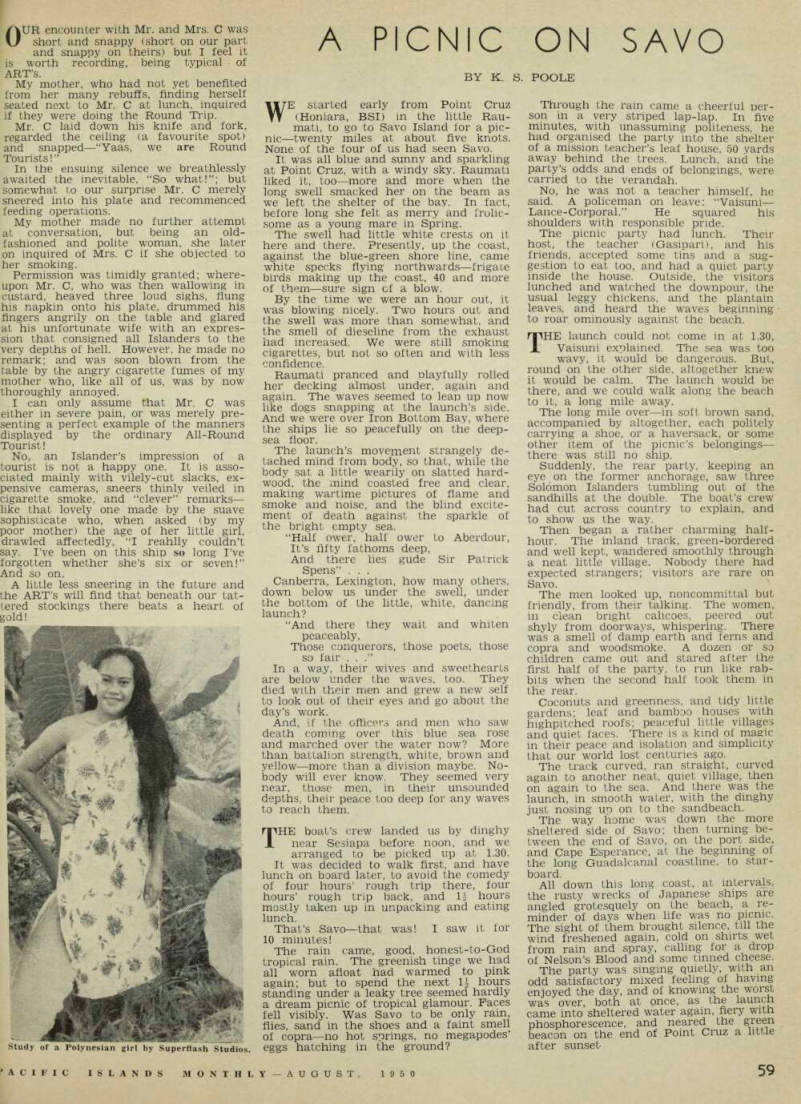
By A. M. Eaton
SHORTLY before the visiting steamer comes shuffling into our Island port, a regrettable change in the be haviour of the locals is noticed.
Definite signs of strain are manifested by a slight twitching of the eyelids, a tendency to speak in throaty Pidgin is observed, while our efforts to cultivate an “uncivilised” expression, and a strong desire to drape ourselves “sarong wise” in the most gaudy material we can find, is a sure indication that we are not our selves.
Do not be alarmed—we are merely pre paring for our roles as “island curios” and “white savages,” which have been forced upon us by the All-Round Tourists, for whose benefit we now enact them.
Many a heartfelt groan has been uttered by the Islanders at having to face another batch of these creatures who mostly are on a gay little jaunt to view the strange whites inhabiting the Out posts of Empire. But now we have de cided to make all the world our stage and play our parts so successfully that the ART’s really do have something to talk about back in “civilisation.”
OUR verbal bouts with Tourists usually take place in the dining saloon and commence quite amiably (on our part), working up to a crescendo of mutual dislike, until the Tourist retires hastily beyond range of contamination, muttering darkly about “those peculiar Island types.”
Here are accounts of three meetings with typical ART’s, in the happy days when we were unsuspecting and natural.
When we first viewed Miss A (the Lady from the Library) she was draped languidly over the steamer rail, patting her permanent and gazing with rapidly disintegrating interest at the natives un loading copra on the wharf. As our bat tered jeep trundled up to the gangway, she recoiled visibly and retired behind a ventilator to watch unobserved our pro gress to the cabin of the Captain, who is a friend of ours.
We next saw her when we sallied into the saloon for lunch, where she was al ready seated, sandwiched stiffly in bet ween the Captain and me. For the next half-hour, Miss A effortlessly conveyed the impression that she had already had the islands and everybody in them, and was very upset at being in such close proximity with, and having to speak to, such peculiar people as we seemed to be.
To my mother’s pleasant query as to whether she was enjoying her trip, Miss A balanced a potato belligerently on her fork, glared at the ceiling and murmured in a voice of pained surprise, “Of course.”
Having delivered herself of this agree able reply, she lowered her eyes to the left until they encountered those of the Captain, with an expression that indicated her astonishment and disgust at having to answer such questions.
I then threw myself into the breach, j “I understand you work in a library, Misse A,” I said, chattily. “I think that mustl be very interesting.”
Heaving a weary sigh, Miss A. focussed! her eyes on my plate and informed iti that I was quite mistaken but —here shee regarded me with acute distaste —no doubt 3 I should just adore working in a library..
So absorbed was I in working out thee logic of this crack, that I only vaguely \ heard the next few gems, which fell I wearily from Miss A’s twisted lips. These 6 included a few highly personal broad- sides directed at the behaviour of a dear • old lady opposite who was inoffensively sipping a glass of beer; and, in reply to< my mother’s remark—to the Captain— that we had recently received a gramo phone, a loudly expressed opinion that no doubt we played our records to com plete rags for lack of something better to do.
She finally arose, after kindly explain ing to the whole table that she would leave us to talk to the Captain, as she i could always talk to him to-morrow!
So much for Miss A! May she flourish long and happily in the environment in which such wit is appreciated—if there is such a one.
WE fell into the large laps of Mr. and Mrs. B when we visited the following steamer—to find them ensconced in the Captain’s cabin, quaffing beer and waiting to meet Islands types.
It appeared they had emerged from the dim depths of a chemist shop to swell the dubious ranks of the ART’s, and as their conversation was conducted in tones of continual rapture, well peppered with en dearments, they seemed to be a most charming couple.
“Darlings!” they howled in unison as we sidled bashfully round the door, “come and tell us all about The Life Up Here.”
This we did, to their apparent delight— although we were a little taken aback at Mrs. B’s habit of staring raptuously at each of in turn and then demanding of Mr. B, “Aren’t they too marvellous?” (We are relieved to be able to record that he seemed to agree.) Our suggestion that we take them to our house for a quick supper was re ceived with hysterical joy (“How divine to see a genuine Island Home, darling!”); and it was during this hilarious meal that Mrs. B offered to send us some Shampoos and a Nailbrush from The Shop—these being rather urgent neces sities at the time.
To my mother’s remark that we would give them a cheque for the things there was an immediate howl of protest.
“Angel,” yooped Mrs. B, through a mouth ful of soup, “not another word! We wouldn’t dream of taking money after all your kindness. You can have thous ands of Shampoos and Nailbrushes, you poor pets!”
In spite of our protests, this was the amiable note on which we parted at the wharf.
“Expect the parcel by next steamer, dears!” yelled Mrs. B. gesticulating from the gangway; and, as the ship drew away into the darkness, a faint screech was wafted back on the breeze: “Good bye, darlings, it was Palmolive, wasn’t it?”
That was six months ago, and the Sham poos and Nailbrush have not yet materialised out of the scented mists of the chemist shop, and we rather doubt, now, that they will.
A charming couple, but a little forget ful!
OUR encounter with Mr. and Mrs. C was short and snappy (short on our part and snappy on theirs) but I feel it is worth recording, being typical of
Art’S.
My mother, who had not yet benefited from her many rebuffs, finding herself seated next to Mr. C at lunch, inquired if they were doing the Round Trip.
Mr. C laid down his knife and fork, regarded the ceiling (a favourite spot) and snapped—“Yaas, we are Round Tourists! ”
In the ensuing silence we breathlessly awaited the inevitable, “So what!”; but somewhat to our surprise Mr. C merely sneered into his plate and recommenced feeding operations.
My mother made no further attempt at conversation, but being an old fashioned and polite woman, she later on inquired of Mrs. C if she objected to her smoking.
Permission was timidly granted; where upon Mr. C, who was then wallowing in custard, heaved three loud sighs, flung his napkin onto his plate, drummed his fingers angrily on the table and glared at his unfortunate wife with an expres sion that consigned all Islanders to the very depths of hell. However, he made no remark; and was soon blown from the table by the angry cigarette fumes of my mother who, like all of us, was by now thoroughly annoyed.
I can only assume that Mr. C was either in severe pain, or was merely pre senting a perfect example of the manners displayed by the ordinary All-Round Tourist!
No, an Islander’s impression of a tourist is not a happy one. It is asso ciated mainly with vilely-cut slacks, ex pensive cameras, sneers thinly veiled in cigarette smoke, and “clever” remarks — like that lovely one made by the suave sophisticate who, when asked (by my poor mother) the age of her little girl, drawled affectedly, “I reahlly couldn’t say. I’ve been on this ship so long I’ve forgotten whether she’s six or seven!”
And so on.
A little less sneering in the future and the ART’S will find that beneath our tat tered stockings there beats a heart of gold!
Study of a Polynesian girl by Superflash Studios.
Advertisements & other items, p. 60 (1 item)
58
AUGUST, 1950 PACIFIC ISLANDS MONTHLY
TO THE ISLAND OF RAPA
(Continued from Page 57.)
A Picnic On Savo
By K. S. Poole
WE started early from Point Cruz (Honiara, BSD in the little Rau mati, to go to Savo Island for a pic nic—twenty miles at about five knots.
None of the four of us had seen Savo.
It was all blue and sunny and sparkling at Point Cruz, with a windy sky. Raumati liked it, too—more and more when the long swell smacked her on the beam as we left the shelter of the bay. In fact, before long she felt as merry and frolic some as a young mare in Spring.
The swell had little white crests on it here and there. Presently, up the coast, against the blue-green shore line, came white specks flying northwards—frigate birds making up the coast, 40 and more of them—sure sign of a blow.
By the time we were an hour out, it was blowing nicely. Two hours out and the swell was more than somewhat, and the smell of dieseline from the exhaust had increased. We were still smoking cigarettes, but not so often and with less confidence.
Raumati pranced and olayfully rolled her decking almost under, again and again. The waves seemed to leap up now like dogs snapping at the launch’s side.
And we were over Iron Bottom Bay, where the ships lie so peacefully on the deep sea floor.
The launch’s movement strangely de tached mind from body, so that, while the body sat a little wearily on slatted hard wood, the mind coasted free and clear, making wartime pictures of flame and smoke and noise, and the blind excite ment of death against the sparkle of the bright empty sea.
“Half ower, half ower to Aberdour, It’s fifty fathoms deep, And there lies gude Sir Patrick Spens” . . .
Canberra, Lexington, how many others, down below us under the swell, under the bottom of the little, white, dancing launch?
“And there they wait and whiten peaceably, Those conquerors, those poets, those so fair . .
In a way, their wives and sweethearts are below under the waves, too. They died with their men and grew a new self to look out of their eyes and go about the day’s work.
And, if the officers and men who saw death coming over this blue sea rose and marched over the water now? More than battalion strength, white, brown and yellow—more than a division maybe. No body will ever know. They seemed very near, those men, in their unsounded depths, their peace too deep for any waves to reach them.
THE boat’s crew landed us by dinghy near Sesiapa before noon, and we arranged to be picked up at 1.30.
It was decided to walk first, and have lunch on board later, to avoid the comedy of four hours’ rough trip there, four hours’ rough trip back, and U hours mostly taken up in unpacking and eating lunch.
That’s Savo —that was! I saw it for 10 minutes!
The rain came, good, honest-to-God tropical rain. The greenish tinge we had all worn afloat had warmed to pink again; but to spend the next Ij hours standing under a leaky tree seemed hardly a dream picnic of tropical glamour. Faces fell visibly. Was Savo to be only rain, flies, sand in the shoes and a faint smell of copra—no hot springs, no megapodes’ eggs hatching in the ground?
Through the rain came a cheerful per son in a very striped lap-lap. In five minutes, with unassuming politeness, he had organised the party into the shelter of a mission teacher’s leaf house, 50 yards away behind the trees. Lunch, and the party’s odds and ends of belongings, were carried to the verandah.
No, he was not a teacher himself, he said. A policeman on leave: “Vaisuni — Lance-Corporal.” He squared his shoulders with responsible pride.
The picnic party had lunch. Their host, the teacher (Gasipari), and his friends, accepted some tins and a sug gestion to eat too, and had a quiet party inside the house. Outside, the visitors lunched and watched the downpour, the usual leggy chickens, and the plantain leaves, and heard the waves beginning to roar ominously against the beach.
THE launch could not come in at 1.30, Vaisuni explained. The sea was too wavy, it would be dangerous. But, round on the other side, altogether knew it would be calm. The launch would be there, and we could walk along the beach to it, a long mile away.
The long mile over—in soft brown sand, accompanied by altogether, each politely carrying a shoe, or a haversack, or some other item of the picnic’s belongings— there was still no ship.
Suddenly, the rear party, keeping an eye on the former anchorage, saw three Solomon Islanders tumbling out of the sandhills at the double. The boat’s crew had cut across country to explain, and to show us the way.
Then began a rather charming half hour. The inland track, green-bordered and well kept, wandered smoothly through a neat little village. Nobody there had expected strangers; visitors are rare on Savo.
The men looked up, noncommittal but friendly, from their talking. The women, in clean bright calicoes, peered out shyly from doorways, whispering. There was a smell of damp earth and ferns and copra and woodsmoke. A dozen or so children came out and stared after the first half of the party, to run like rab bits when the second half took them in the rear.
Coconuts and greenness, and tidy little gardens; leaf and bamboo houses with highpitched roofs; peaceful little villages and quiet faces. There is a kind of magic in their peace and isolation and simplicity that our world lost centuries ago.
The track curved, ran straight, curved again to another neat, quiet village, then on again to the sea. And there was the launch, in smooth water, with the dinghy just nosing uo on to the sandbeach.
The way home was down the more sheltered side of Savo; then turning be tween the end of Savo, on the port side, and Cape Esperance, at the beginning of the long Guadalcanal coastline, to star board.
All down this long coast, at intervals, the rusty wrecks of Japanese ships are angled grotesquely on the beach, a re minder of days when life was no picnic.
The sight of them brought silence, till the wind freshened again, cold on shirts wet from rain and spray, calling for a drop of Nelson’s Blood and some tinned cheese.
The party was singing quietly, with an odd satisfactory mixed feeling of having enjoyed the day, and of knowing the worst was over, both at once, as the launch came into sheltered water again, fiery with phosphorescence, and neared the green beacon on the end of Point Cruz a little after sunset
Advertisements & other items, pp. 62-64 (3 items)
fashion ...
this blouse, with its plunging neckline and chunky gold buttons, teamed with a black silk skirt for in- C ! • • 3=l s : i ♦ II
Corner For The Children
Burns Philp (New Guinea) Limited
General Merchants (Wholesale and Retail)
Shipping, Customs and General Agents
Head Office: PORT MORESBY, PAPUA
BRANCHES:
NEW GUINEA: Rabaul, Kokopo, Lae Gr Madang.
PAPUA: Samarai.
REPRESENTATIVES FOR
AUSTRALIAN AGENTS
LONDON AGENTS:
SAN FRANCISCO AGENTS
QUEENSLAND INSURANCE CO. LTD.
LLOYD'S OF LONDON
BURNS PHILP TRUST CO. LTD
BURNS, PHILP & CO. LTD.
All States.
BURNS, PHILP & CO. LTD.
"London House", 35 Crutched Friars, E.C.3.
BURNS, PHILP CO. OF SAN FRANCISCO INC 510 Matson Building.
Distributing Agents, Territory of Papua-New Guinea for;
SHELL COMPANY OF AUSTRALIA LIMITED
Petroleum Products
GENERAL MOTORS CORPORATION
Chevrolet, Buick, Pontiac and Oldsmobile Cars Chevrolet and GMC Trucks Frigidaire Refrigerators
VAUXHALL MOTORS LIMITED
Vauxhall Cars and Bedford Trucks
R. A. LISTER & CO., BRISTOL
Producers of Petrol, Paraffin and Diesel Engines Pumps and Lighting plants
RUSTON HORNSBY LIMITED
Engines
CROSSLEY MARINE ENGINES
The features of this unusual XVlth Century hey illustrate its owner’s connection with the trader on the African coast, no doubts the hey obviously being that of his sea-chest.
H S.
Stitt
The key
to smoking pleasure
CAPSTAN
P 20-11-4«
FINE CUT ..
NAVY CUT
TOBACCOS
No Natives For Ran
Service
mRAINING of the first group of about J[ iqO Papua-New Guinea natives for the RAN is expected to begin at Manus Naval base about October Lieutenant Nicholls, RAN is at pre sent making a survey of likely recruits between 18 and 22, with seagoing ex perience.
The natives will be trained as seamen and will enlist for three years. As well as the usual Navy instruction for sea men they will be taught English, Thpv will wp r n vv hll ,_ wb - tp horder e d i aV a-lava for evervdav wear and n Sp wiip hnrriprpri lava-S fnr pprp mnnjni ’ ocrasinns Thev will not wear ™°" lal occaslons - Ttle y wlll not wear ' Eventually they will form part of the crews of RAN ships stationed in New Guinea.
Advertisements & other items, p. 65 (2 items)
63
PACIFIC ISLANDS MONTHLY AUGUST, 195 0
NOTES ON PAPAIN
PRODUCTION
(Continued from Page 49.)
A. H. Bdnting Limited
Better for School Books \y\>\
They stand the rough and tumble. They're lighter and easier to carry.
Ask first for
SCHOOL CASES
' ma of ffy
FORD SHERINCTON LTD.
A. H. BDNTING LIMITED
SAMARAI PAPUA
Branches at: MISIMA, TUFI, ORO BAY, SOPUTA.
SAMARAI AGENTS FOR:
Vacuum Oil Co. Pty. Ltd.
South British Insurance Co.
National Mutual Life Association
SOLE AGENTS IN PAPUA/NEW GUINEA FOR:
Polarizers (U.K.), Ltd.—Polaroid Sun Glasses.* C.S.A. Industries Eng.— Dual Freeze Refrigerators.
Webley & Scott, Ltd. —Shot Guns, Air Pistols, etc.
E. K. Cole, Ltd., London.—“Ekco” Radio Receivers.
“Getula.”—Nylon Monofilament Fish Lines.
Davison Paints, Ltd., N.S.W.—Paint for Tropical Conditions. • Trade marl' patented In U.S.A., Great Britain, and other countries
REGULAR SUPPLIES OF EASTERN GOODS
WHOLESALE & RETAIL MERCHANTS IMPORTERS PLANTERS
Headstones For Ng
War Graves
AT a cost of £200,000, a Brisbane firm (P. J. Lowther and Son Pty., Ltd.), will supply 15,000 headstones for war graves in Australia and New Guinea.
The contract period in which to sup
ply the headstones is three years. Each stone will be of marble and will cost £lO to produce.
Recently more than 800 headstones were loaded at Pinkenba (Brisbane) for the war cemetery near Port Moresby.
Mrs. Norman White, of Wau, New Guinea and Church Point, Sydney, left for New Guinea on the July Bulolo.
Not A Dull Moment!
AS I arrived in the darkness at Lili na-Kaia Plantation, New Britain,! there seemed to be something un usual going on.
In the doorway of a copra store therea was a slim young woman, clothed in as eau-de-nil silk evening dress and high heeled shoes. She actively wielded a No.c 6 copra shovel, and kept a stream off copra flowing out into the night.
Then there arrived a highly excitedb gang of Highland labourers. She droppedb her shovel, and directed the boys inn clearing bags of copra, cocoa, tools, etc.c out of the store. Then under her direc tion, they began quickly dismantling thee building itself. She left hurriedly asa falling embers set fire to her shoes.
Presently, the situation sorted itself! out. It appeared that the copra drier i had taken fire; and, while all the men off the establishment were fighting the out break, their resourceful lady assistant— -19-year-old Judith Solomons, of Mittagongg and Kings Cross, NSW— took it on her self to help them by clearing the adjacent! copra store.
Miss Solomons says she has fallen inn love with the Islands since the plane seta her down in Rabaul. While carrying onr her job, she is also developing her art,,; and expects to have a collection of Islands a paintings in a year or two. She also isg studying and gaining experience for hen master’s ticket, so that she can run ae coastal vessel. She says there isn’t a dulllJ moment in plantation life!—AHC.
At a recent meeting in Western Samoa £ of the Apia Chamber of Commerce, Mr./ A. G. Smyth was elected president fori the ensuing year, Mr. G. S. Chisholm n vice-president and Mr. P. W. Glover,, secretary.
Advertisements & other items, p. 66 (3 items)
64
AUGUST, 1950 PACIF IC ISLANDS MONTHLY
Cordage and
Scott’s “Renown” Brand Rope,
Binder
Twine
of Every
Description
Sable Address Ropeyard, Sydney. 5
MANUFACTURED AT
MASCOT. NSW
i. SCOTT
PTY. LTD.
Head Office and Store
103 CLARENCE STREET,
SYDNEY,
N.S.W.
A. B. Donald Limited
RAROTONGA COOK ISLANDS
TELEGRAPHIC ADDRESS: “DONALD, RAROTONGA.”
General Merchants (Wholesale & Retail) and Shipowners Importers & Exporters Branches Throughout Cook Islands Fire, Marine & Motor Vehicles Insurance Agents tor Yorkshire
Insurance Co.
Lloyd's Agents.
Agents and Distributors for: ENGLAND.—Austin Cars & Trucks, Pye Radios, Dunlop Rubber Co., Ltd., Vauxhall Cars & Trucks, R. A. Lister & Co..
Ltd., Phillips' Cycles, Marples Tools.
U.S.A.—Remington Rand Corp., Radio Corp. of America, Champion Spark Plug Co.. Firestone Tyres, General °teamshlp Corp.
NEW ZEALAND.—Vacuum Oil Co. Pty., Ltd-* Petroleum Products.
AUSTRALlA,—Wunderlich, Ltd., Cement Asbestos Products.
NORWAY. —O. Mustad & Sons, Pish Hooks.
SWEDEN.—B. A. Hjorth & Co., Primus Products.
Head Office A. B. DONALD, LTD., Auckland.
Associate Houses:—
ETABLISSEMENTS DONALD TAHITI,
Papeete, Society Islands.
DOMINION FRUIT CO., Suva, Fiji Islands.
CODES: Bentley's Complete Phrase, Acme Sydney Agents :
BURNS, PHILP A CO., LTD.
Lor don Agents :
BURNS, ITIILP A CO., LTD.
San Francisco Agents :
BURNS, PHILP CO. OF SAN FRANCISCO.
It Is Rich River Mud That Produces
First Class Jute
IN view of the fact that jute growing has been suggested for Papua-New Guinea, the following article should be of interest. It is from a recent issue of the New Zealand Journal of Agriculture.
The nearest New Guinea approach to the conditions for jute growing described here, appears to be on the Sepik River with its 5-months period of “high water.”
Or perhaps in the muddy delta country between the mouths of the Fly and Kikori, in Papua.
EASTERN Pakistan produces about two-thirds of the total jute crop and India about a third, and the partition of India has raised problems, as the jute mills are in West Bengal (India), India must purchase raw fibre for her mills and Pakistan must sell fibre to buy food for the jute culti vators. The devaluation of sterling and the Indian rupee has brought further problems. Indian mills are refusing to buy raw jute, as they claim that the price on the new basis of exchange is uneconomic.
The rich soil of the Ganges delta and the humid weather* heavy monsoon rains, and annual low-rising inundation lasting five months experienced there form an ideal environment for growing first-class jute. Jute can be, and Is, grown on dry land where there is a humid climate and very heavy rain fall, but the quality of the fibre is in ferior.
Thousands of acres of jute are put down in February. The land is reduced to a fine tilth by being ploughed and cross-ploughed five times with age-old wooden ploughs drawn by cattle. Bam boo tine harrows are used to break down the lumps that are soft, but the big, hard ones are pulverised by a man with a type of wooden mallet, who follows the plough and smashes the lumps one by one.
Though primitive, this method of culti vation is effective and is feasible where labour is so plentiful and so cheap.
The crop, which is hardy and a vigor ous grower, makes rapid headway. It is weeded and thinned by hand, the op erators using a type of trowel. By June the long, thin stalks (one to each plant) are 3 ft. to 4 ft. high. Thinnings are often used as a vegetable. In June the water rises and when this occurs no more weeding or cultivation is done. The plant grows ahead of the water rise and thrives in water.
In early August a very light cutting is made and, as the cutting must be at ground level, the cutter often has to reach down under the water as he works.
By the end of the month the main cut ting is in full swing. The cut jute is tied in bundles and built into rafts, which are floated to quiet and safe water and sunk there under green weeds or sods. It remains retting in the water for three weeks, after which it is taken up on to the nearest high land, usually a road, and the long fibre stripped from the central pith, which is kept for fire wood and for use as house walls.
Men, women, and children help with the stripping, with which is associated a stench from the decayed vegetable mat ter and muddy water that pervades the countryside.
After stripping, the fibre, which is as long as the plant (6 ft. to 12 ft.), is washed by being swirled rapidly from side to side in water. Its white nature then begins to show and after it has been dried in the sun a good fibre shows white and clean and looks like a flax
fibre, though it is much softer and more easily worked.
By mid-September the higher fields from which jute has been cut have been “ploughed” again, which means that the knee-deep mud is stirred, and young rice plants are sown by hand. Rice, which is harvested from these fields in December and January, is a subsidiary crop to the main crop sown earlier.
SO much jute is grown in East Ben gal that rice must be imported or there would be wide-scale starva tion. The main wealth of eastern Paki stan comes from the sale of jute fibre.
Because of the situation which has arisen jute producers are already hard hit.
It has been suggested that the Pakis tan Government should purchase the whole of the jute crop. Pakistan has been trying to purchase jute mills and, ! though India is unco-operative, the [ Pakistan administration hopes to secure machinery from Dundee, which is an important jute-manufacturing centre.
Pakistan will undoubtedly forge ahead with the building up of her own jute industry, which will assist in solving her unemployment problem and in rais ing the economic level of the country.
India is increasing her jute acreage, but there is not an unlimited market for jute, as cheaper substitutes are appear ing. It would appear that the jute in dustry is likely to be centred in East Bengal.
Advertisements & other items, pp. 67-68 (2 items)
Vince
tf\C
SPECIALISING IN
PACIFIC ISLAND INSURANCES
FIRE—MOTOR VEHICLE
MARINE—HULLS AND CARGO
EMPLOYER’S LIABILITY
BONDS—in accordance with
ADMINISTRATION ORDINANCES.
COPRA INSURED PROM DRIER
TO BUYER.
AND ALL OTHER CLASSES ARRANGED
AT LOWEST CURRENT RATES.
Established Agencies throughout the Territory of Papua and New Guinea.
Managing Agents: New Guinea Company, Limited.
Island Representative: G. D. A. Kent, Rabaul Branch.
Southern Pacific Insurance
CO., LTD.
HEAD OFFICE: 60 HUNTER STREET,
SYDNEY.
mmm
OVER 25
YEARS OF
PAIN
RELIEF!
M ■ - v '^vs
SWIFT 3-WAY RELIEF
f/'om HEADACHE and 7 \oll Nerve and Muscular Pain!
P Vincent’s A.P.C Powders and Tablets are a combination of three valuable medicinal ingredients and bring swift 3-way relief! Vincent’s A.P.C is prepared to the original hospital prescription containing Aspirin to relieve pain, Phenacetin to reduce temperature, Caffeine to stimulate the nervous system. Vincent’s A.P.C quickly relieves Headache, and all nerve and muscular pain!
VINCE
torHass
POWDERS & TABLETS
TAKE YOUR CHOICE.
. . . From this list of quality canned foods. Packed by the largest meat-processing company in Australia, the Imperial label brings you the Quality meats, right to your table—tasty hot meals and cold meats ready for any occasion. Stock up with Imperial, the Flavour Sealed Quality Foods.
HOT PACKS.
16-oz. Beaf Steak Pudding. 16-oz. Beef Sausages. 16-oz. Steak & Kidney Pud- 16-oz. Oxford Sausages. ding 16-oz. Cambridge Sausages. 16-oz. Irish Stew. 16-oz. Pork Sausages. 16-oz Braised Beef Steak 16-oz. Vienna Sausages.
Stew \ 16-oz. Vienna Sausages. 16-oz. Bacon Rashers. \ 4-oz. Vienna Sausages. 16-oz. Steak & Tomato. 12-oz. Meat & Beans. 16-oz. Sausages & Vegetables. 12-oz. Savourie. 4-oz. Meat and Spaghetti.
COLD MEATS.
e is: 1 36 » * £ % ■1 % I m ' -A >■ * -i
SAUSAGES.
SOUPS.
8-oz. Tomato Soup. 8-oz. Vegetable Soup. 8-oz. Clear Beef Soup. 12-oz. Luncheon Pork 12-oz. Trim (Pork & Beei). 12-oz. Camp Pie. 12-oz. Hampe. 12-oz. Meatreat. 12-oz. Corned Beef W/C. 12-oz. Taper Corned Beef. 6-lb. Slicing Beef. 6-lb. Taper Corned Beef W/C. , 6-lb. Taper Corned Beef. 4-oz. Camp Pie. 4-oz. Hampe. 4-oz. Beef Snack. 31-oz. Pate de Foie. 10-oz. Tomato Sauce.
TONGUES.
12-oz. Sheep Tongues. 12-oz. Lamb Tongues. 12-oz. Calves Tongues. 6-lb. Ox Tongues. 2-lb. Ox Tongues.
MARGARINE.
56-lb. Boxes Cake Margarine. 56-lb. Boxes Pastry Margarine.
‘RIVERMEDE” BUTTER.
DRIPPING & LARD.
56-lb. Boxes Bulk Butter 16-oz, Pats Butter. l-\b. Pats Butter. 12-oz, Tins Butter.
L6-oz. Tins Butter. lb. tins Lard. -oz. tins Dripping, -lb. pats Dripping -lb. Dripping.
CANNED FISH.
Orange Orange Lemon
26 oz. “CAWSEY’S”
CORDIALS.
Double strength Squash.
Single strength Squash.
Double strength 4-oz Flair Fish Cutlets. \ Squash.
Boz Flair Fish Cutlets. \ Single strength 19 rw Flair Fish Cutlets. \ Squash. \l °-ozFlair Squab in Aspic. \ Double strength 100 per cent.
Fnz Flair Fish Paste. \ (Lemon & Orange).
H‘° z piair Scallop Lun-\ single strength 100 per cent, chpon \ (Lemon & Orange). . cneo ' Single strength Lime Juice.
PACKET BREAKFAST
FOODS.
8-oz. Purina Crispies. 24-oz. Purina Crispies. 12-oz. Purina Weatall Biscuits. 16-oz. Grapefruit Juice 16-oz. Orange Juice.
SWEET PUDDINGS.
16-oz. Plum Puddings. 12-oz. Jam Pudding. 12-oz. Chocolate Pudding. 12-oz. Ginger Pudding. m 1m * i ■ * K. > n ; Lemon
MILDURA FRUIT
JUICES.
CANNED FRUITS.
16-oz. Prunes (Dry Pack) 30-oz. Cherries. 20-oz. Raspberries. 20-oz. Gooseberries. 20-oz. Loganberries. 20-oz. Plums.
RIVERSTONE MEAT CO. I»TY. LTD..
W 5-7 O’CONNELL STREET, SYDNEY.
66
AUGUST, 1950 PACIFIC ISLANDS MONTHI
At Niue
Ims Secondary School
From a Special Correspondent NIUE, July 18.
LONDON Missionary Society now has a small boarding school on this island which is offering post-pri mary education to a limited number of boys and girls over the age of 15 years.
The school opened last March under the principalship of the Rev. M. G.
Check, MA, LTh, who undertakes most of the teaching in academic subjects.
Pope Talagi is the full-time assistant.
Pope was trained at the LMS Training School for Pastors and teachers at Malua, Western Samoa. Mrs. Check is acting as handcraft teacher and other teachers are brought in to teach special subjects.
The roll is 34 and it is hoped that this institution will make a difference to the educational standard of the island.
Specialise
Two Universities to Specialise in Pacific Studies
THE University of Hawaii is going to make a bid for the lead in Pacific studies and is in a favourable po sition to do so.
The Department of Anthropology and Sociology is strong. The staff headed by Dr. Leonard Mason, includes Dr. Emory of the Bishop Museum, and Dr. Kather ine Inomala, noted for her work in Poly nesian Folklore.
This Department will commence this year, a Pacific Islands Area Programme which will include a close study of the sociological problems of the South Pacific.
Dr. Ralph Piddington, Ma, Is To
leave Edinburgh in September for Auckland where he is to be Pro fessor of Anthropology. The new Pro fessor took his MA at Sydney University and has held the Readership in Social Anthropology at Edinburgh University.
Auckland intends to offer a course in Anthropology to the MA level and will be placing special emphasis on the Pacific, particularly Polynesia.
The youngest and the oldest passengers on the Air France Skymaster which lanided at Eagle Farm (Brisbane) on July 6, were six-year-old Rhoda McLean and her 76-year-old grandmother. Rhoda is the daughter of Mr. H. McLean, who, until recently, was with Burns Philp (NH), Ltd. He has resigned his po sition because of ill health. Grand mother is Mrs. A. Nicholls, who returned to Queensland after 46 years in the New Hebrides.
Mr. E. V. O’Brien, of Mililat Planta* tion, Madang, returned home recently after a visit to Sydney.
Advertisements & other items, p. 69 (1 item)
Nelson & Robertson R!:
A little mustard
MO (44) &
NELSON and ROBERTSON Pty. Ltd.
Established 1895
Shipowners - Brokers and
Islands Merchants
All classes of Merchandise purchased at Best Wholesale Prices. Original Invoices supplied to Island Clients. Cocoa Beans, Copra, Rubber, Trochus Shell and All Islands Produce Sold on Commission.
Entrust your requirements to the firm with fifty-five years" practical experience in the Pacific Islands.
Inquiries Solicited.
Prompt attention given to ail inquiries
NELSON & ROBERTSON R!:
12 SPRING STREET, SYDNEY, AUSTRALIA
Telegraphic Address: IVAN, SYDNEY.
Death Of Mr. Harry Bentley
Me. Harry Bentley, Head
machinist and sawyer of Fiji Pub lic Works Department, Walu Bay boatshed, died in Suva on July 7. He was 56.
Mr. Bentley was born in Levuka, where he learned his trade. He later became interested in marine engines and for some years sailed as Master and en gineer on coastal and river launches of the Fiji Shipping Company.
in 1921 he went to Makogai as station engineer at the Central Leper Hospital and five years later he joined Morris Hedstrom, Ltd., at Rotuma.
He returned to Suva in 1936 and has since worked at the Walu Bay boat shed.
Mr. Bentley is survived by his wife, five children and six grand-children.
Miss E. M. Kennedy, of the Medical Department, Fiji, has accepted a trans fer to Malaya as Health Sister.
Melanesian Mission Staff
Join RC Church
From Our Own Correspondent
Honiara, July 24.
THE whole of the Melanesian Mission’s' staff at Bunana, a small island Mis sion Station near Tulagi in thee British Solomon Islands, has asked fon instruction to be admitted into thee Roman Catholic Church. Eleven of themn left Bunana towards the end of July fori the Roman Catholic Mission Station att Visale, on the Guadalcanal Coast, wheree they will receive a course of instruction..!
Two Europeans will remain at Bunanae until the Anglican Bishop, the Rt. Rev..’
S. G. Caulton, returns to the Protectorates so that they can carry out whatever direc tions he may give regarding the dispo sition of the school for native girls whichc has been maintained at Bunana. Aften Bishop Caulton’s return, these two re maining teachers will join the rest ofl the staff at Visale.
Bunana Mission staff includes Mothen Margaret and Sister Gwen of the Cross, ; e both of whom have worked in the Solo mons for many years and are well knownn there. Their loss will be a considerable 9 blow to the Melanesian Mission in thes Solomons.
Editorial Note: It was reported froim the New Hebrides last month that tnea staff of the Melanesian Mission Torgili girls’ school, on Aoba, of which Mothen Margaret was said to be head, had leftt there for BSI with the intention of en tering the Roman Catholic Church.
Mr. and Mrs. Roy Francis, with theirr. two daughters, are now living in Towns ville. Previously they were in Port' Moresby.
Advertisements & other items, p. 70 (2 items)
The Hygeia Dissolvenator
A Guaranteed Sanitary System
Approved by the N.S.W. Board of Health.
Established 1927.
No Water Supply Required
The Sewage matter is chemically transformed into a sterile solution which is absorbed by the surrounding soil.
NO FLIES
NO GERMS
NO SMELLS
NO EMPTYING
AUTOMATIC
Any handy man can install.
Correspondence Invited.
HYGEIA SANITARY COMPANY PTY. LTD.
26-30 BRIDGE STREET, SYDNEY, N.S.W.
Phone: BU 2521 Cables; “Berbl,” Sydney
Burns Philp (South Sea) Go. Ltd.
Registered Office: SUVA, FIJI
Code Address: “BURNSOUTH”
ISLAND TRADERS AND SHIPOWNERS
General Merchants (Wholesale and Retail)
Shipping, Customs and General Agents
Representatives for:
QUEENSLAND INSURANCE CO,, LTD. BURNS PHILP TRUST CO., LTD.
Distributing Agents for :
SHELL COMPANY (P. 1.), LTD. FERGUSON TRACTORS STANDARD MOTOR CAR COMPANY CROSSLEY MARINE ENGINES
BRANCHES:
FIJI—
SUVA.
LEVUKA.
LAUTOKA.
LAB ASA.
BA.
SIGATOKA.
ROTUMA ISLAND.
SAMOA—
APIA.
PAGO PAGO.
TONGA—
NUKUALOFA.
HAAPAI.
VAVAU.
Sydney Agents:
BURNS, PHILP & CO., LTD..
7 Bridge Street.
London Agents:
BURNS, PHILP & CO., LTD..
35 Crutched Friars, E.C.3.
San Francisco Agents:
BURNS, PHILP CO, OP SAN FRANCISCO
Matson Building, 215 Market Street.
NORFOLK IS.— NIUE IS.—
Agencies Throughout the World.
Madang Newsletter

From Our Own Correspondent
Madang, July 30.
NATIVES of Gragad Island (Kranket) are rehabilitating themselves on the island. This island has had an in teresting history since German occupa tion of the district, about 1885.
In the early days, the Germans adopted the island language as a business language for the district while gradually introducing pidgin English. In 1901, the German Lutheran Mission established a house there but ill luck dogged the oc cupants as the first one returned to Ger many ill, and two others died there.
In 1904 the islanders revolted against the Germans but at its conclusion, several islanders were baptised. The main revo lution in this area took place in 1911 when, among others, Gragad Islanders were deported to various parts of the district.
Under a more humane British and Aus tralian treatment the natives were re turned to their island but much of their property was lost. During the residence of the American Lutheran Mission two houses were erected and a temporary store later replaced by the partially stand ing cement store in Madang. These mis sionaries, during Japanese occupation were imprisoned on the island, while the natives moved, or were removed, to the Mainland near the present site of Beliau Village.
Now once more returned to their island homes thev have “townplanned” their village and established a small bakery and a woodcutting business. As well, they are building a copra dryer with the aim of producing copra for industry.
Several shipwrecks, a huge bomb crater and old Radar equipment are significant reminders of war on the island.
ABOUT SO Europeans and 6,000 natives of this district attended the open ing and dedication of the American Lutheran Mission Hospital in the Amele Mission Area, on July 23.
Construction on the hospital started nearly three years ago when the first attempts were made to ferry materials across the Gum River by rafts and on to the station up a tortuous road by lorries.
Funds were raised by the American Women’s Mission Federation and the Australian Lutheran Mission. Work on the buildings was done by volunteer con tingents of young men from the church in America and Australia. Planned in America, the hospital comprises a series of units connected by breezeways. In cluded are X-Ray equipment; eye, ear, nose and throat ward; a medical library; dispensary; operating theatres with ob servation sections for doctor boys; den tal rooms, residences for the staff, de livery rooms: and wards.
Set on a hill about 1,000 feet above sea level the hospital commands a glori ous panorama of jungle foreground with a backcloth of mountain ranges along the Rai Coast and Astrolobe Bay.
MR. AND MRS. G. BAILEY, with four year-old daughter, Sandra, went South from Madang in the last Malaita. Mr. Bailey has just completed three years as Chief Clerk, Goroka, Cen tral Highlands. He and Mr. Bailey spoke glowingly of Goroka and the beautiful Bulolo type house they occupied.
SOME vegetables and rhubarb from the Highlands have been coming down to Madang recently. All residents appreciate these things very much.
RECENT visitors to the town included artist William Dobell. He has been for some time in the Territory pre
paring an exhibition of paintings for an Australian Exhibition.
ME. PETER LAWRENCE spoke at the Madang Forum on July 11. He has spent several months in the valleys of the Ramu and its tributaries, among primitive natives. He will return to London with some valuable informa tion for his MA thesis.
AT a representative meeting arranged for the Director of Health, Dr.
Gunther, emphatic speeches were made by Mr. Ben Hall and Mr. E. Wau chope against combining native and Europeans in one hospital. However, Dr. Gunther cleared away any misap prehensions by explaining that, while the one X-Ray plant and pathological sec tion would serve the two races, the wards would be housed in separate buildings and at a suitable distance from each other.
An attempt is being made by the path ologist in conjunction with the RSSAILA to form a blood bank in the town. This is a very urgent need now as the Euro pean population is approximately 300.
Recently a baby’s life was lost because there was no such unit from which to draw.
MR. GEOFF BLISS, manager New Guinea Estates, represented Mad ang at the recent Native Labour Conference in Moresby.
Mr. And Mrs. Hal Evans Had
their son christened in the Ameri can Lutheran Mission during the month. Godmother, Mrs. Colin Carpen ter, and godfather, ADO Allen Gow.
Miss Barbara Mclaughlin Of
the Women’s Section of the De partment of Education has been
in town for a fortnight. She has visited Sek Mission, various branches of the Lutheran Mission, the European School and the native school at Tusbab. Miss McLaughlin represented the Department at an educational conference in India last year. She was formerly lecturer in Method at the Teachers’ Training College in Sydney.
ON July 22 an enjoyable evening was spent at the Club conducted by the RSSAILA. A fancy dress party, it attracted a sizeable crowd. Prizes were won by Mr. K. Hicks, Mr. and Mrs. S.
Baker and Mrs. D. Rees.
MR. R. LIDDELL, of the local branch of the Commonwealth Bank of Australia, has returned to Austra lia.
THE new salary range was not received with very much enthusiasm by Madang Administration officials. In some cases the salaries will not cover even the necessities of life.
TWO mothers in the town are perform ing a worthwhile service in provid ing religious instruction for child ren.
On Thursdays, Mrs. Jack Sherry drives a small group of children to the Catho lic Mission at Alexishaven; while Mrs.
Hal Evans has a small group of Protes tant children at her home for scripture reading and hymns, on Saturday morn ings.
CONCERN was felt here for Mr. Les Ingles and Mr. Matt. Fawkner, when no news of them was heard for a few days. Later it was learned that their ship, MV Kulau, was held up in the Ramu River with engine trouble.
MRS. PITT has been having a busy time at the Guest House and has several times had to put up make shift beds for people who have omitted to book ahead.
Mr. David Bardwell, of NSW, has been appointed Methodist Mission engineer, at Salamo, Papua.
Advertisements & other items, pp. 71-73 (2 items)
Best Since 1811
4.
Y 'M x $ Made in the Australian Branch Factory of
BLUNDELL SPENCE & CO., LTD., Hull,
B. & S. SUPER PREPARED PAINT embodies the knowledge and experience gained from nearly 140 years of Paint manufacture.
Tested and proved for tropical conditions, B. & S. PREPARED PAINT is also available in a special Lead-free series for use in volcanic and other sulphurous regions. (Specify B. Gr S.-Series 2301).
Ask for supplies of these and other BLUN- DELL Paints and Enamels from your local Storekeeper, or write for particulars and colour-cards to the Agent for Pacific Islands :
KERR BROTHERS PTY. LTD.
4 YORK STREET, SYDNEY
4
PAINTS
BEST SINCE 1811
full engine
to*
with
The World’s
y VACUUM OIL
VACUUM
M 504 COMPANY p tv. it n.<(
THE
YORKSHIRE
INSURANCE
CO. LTD.
(Incorporated in England)
ALL CLASSES OF
INSURANCE
Including Fire Motor Guarantee Accident Workers Marine Island Representatives:
PORT MORESBY: E. A. James
RABAUL: G. B. Black LAE: New Guinea Industries Ltd.
MADANG: R. MacGregor SUVA: Williams & Gosling Ltd.
NOUMEA: Y. Mortensen
NORFOLK ISLAND:
A. E. Martin
I
BLAXLAND TWIN
PUMPING UNIT
FAMOUS THE WORLD OVER
for
Reliability • Durability • Economy
Under all Conditions
For absolute safety, dependability and economical operation, Blaxland- Chapman marine engines are outstanding. These precision built engines carry a FIVE-YEAR GUAR- ANTEE and employ world-patented features. Enthusiastic boat owners acclaim them as ‘‘the most perfect engines ever built,” and there is a unit for most boating applications, from 2V Z H.P. to 20 HP. (engines from 4‘A H.P. upwards are reversible, for running ahead or astern, by a mere flick of the patented magneto). Famous, too, are the Chapman Wonder Launches, available in 16 ft. open and half-cabin and 18 ft. half-cabin models.
Enquiries are invited : K A /
Sl/C
s 0 >0
°Hap
Hah
Sf/f
*4 C H
ISLANDS
SERVICE
Island residents can rely on immediate attention to their inquiries or orders for Blaxland-Chapman engines, launches, pumps and engineering products from Kerr Bros., sole Pacific distributors for Blaxland Rae Pty. (Successors to Chapman & Sherack).
KERR BROS
(Sole Pacific Distributors for BLAXLAND RAE PTY., LTD.)
4 YORK ST., SYDNEY, AUSTRALIA
Box 3838, G.P.O. Cables: “CARE,” Sydney.
Ltd.
70
AUGUST. 1950 PACIFIC ISLANDS MONTH L Y?
50 Years Of First Aid
Exams In Fiji
From Our Own Correspondent SUVA, July 10.
IT had been said that St. John work started in Fiji in 1929 but the Rev.
A. R. Tippett later pointed out that First Aid certificates were awarded in Fiji nearly 50 years ago and added that three Fijians were the first “non-white” people of any race to be awarded certificates.
The highest marks in that historic examination were secured by Wilisoni Lagi, who in 1905 entered training as a Native Medical Practitioner, was later Fiji’s first medical missionary in Papua, and is now spending his old age in re tirement in Fiji.
Mr. Tippett said that the movement may have been interrupted in subsequent years, but adds that it was in operation in 1904-5 and owed its inception to a “Hygienic Mission” started by the then Governor in 1898.
MORE than 100 first aid and homes nursing certificates have beenn awarded in Fiji in the last 20 years, and to-day the Association’s work isa making steady progress, said Dr. J. M.. 1 Cruikshank, Director of Medical Servicesa and Assistant Commissioner of the St..: John Ambulance Association, at the re cent annual presentation ceremony aU which the awards were presented by Ladyy Preeston, Lady District Suoerintendentl in Fiji.
Another Us Yacht
In Papua
STILL another American yacht has a taken to roaming the islands of thee southwest Pacific. It is one off more than half-a-dozen now known to c be beating down the wind among the e islands.
The vessel, a well-rigged ketch, bears ? the name Sari Marais I. It sailed from r Brisbane the end of June for the Torres ?
Strait Islands. From the Straits the £ ketch will head for Cocos Island in the £ Indian Ocean and then will point her i nose for Capetown. From there across ? the South Atlantic to the West Indies,. and via the Panama Canal, up the west d coast of the United States where their i world cruise will end.
Skipper and owner of the yacht is ?
Ed. Sanderson, a 48-year-old American r engineer. Aboard also is Otto Radtke of 1 Chicago, as mate. Sanderson’s wife, an x Australian girl from Brisbane, and well- known Australian yachtsman, Keith r Dorg, complete the crew. The skipper is? an ex-merchant mariner.
The Sari Marais I is a 45-footer, equip- ped with a 30-horsepower diesel engines and can carry water and supplies for 75 c days.
Clifford Kruse.
Advertisements & other items, p. 74 (2 items)
Your Future Career . . .
Merchants, Accountants, Secretaries, Bankers and Business Managers ... all hold responsible positions with commensurate salaries. You too can enhance your prospects in this ever-expanding commercial field, which yields abundant returns to those with adequate qualifications. H.R.I. prepare ambitious men and women for all business positions from junior to senior executive. Tuition is practical authoritative up-to-date time saving . . , and certain in its successful results. The H.R.I. is available always to advise you write or wire for information free and without obligation.
H.R.I. tutorial service is proved by the winning of more honours than all coaches in Australasia combined.
H.R.I. Career Training • ACCOUNTANCY • SECRETARYSHIP • COST ACCOUNTANCY
• PRACTICAL BOOKKEEPING • MARKETING SELLING—
ADVERTISING • BANKING • LOCAL GOVERNMENT EXAMS. ■I v 111 imgw aj it oßier t s o n Institute Founded and Owned by Hemingway & Robertson Pty. Ltd.
CoTisvlting Accountants :: ;; Professional Tutors 126 BANK HOUSE, BANK PLACE, ME I. BOURNE 126 BARRACK HOUSE. 16 BARRACK STREET, SYDNEY 126/815
and find QUALITY
Look for KRAFT
The unchanging quality of Kraft foods is a byword wherever fine foods find appreciation. In their constant vigilance over quality, Kraft experts have achieved even more than just that, for hand in hand with Kraft quality goes flavour perfection and food value of a very high order.
Wherever you see the name “Kraft”, buy confidently, and remember, “Red Feather” foods are made by Kraft too. No finer foods can be found.
Export Division .
Kraft Walker Cheese Co. Pty. Ltd.,
Riverside Ave., South Melbourne,
AUSTRALIA.
3BGEMIIIO
8
KRAFT
V // X
Three famous Kraft Foods
now available
in full supply everywhere,
VEGEMITE the delicious, healthful yeast extract. One of the richest known sources of the important Vitamin B complex. Strongly recommended in all areas where fresh vegetables are scarce. A little does a potver of good.
KRAFT CHEDDAR CHEESE a
creamy-smooth, choice processed cheddar.
Rich in Vitamins A, B and D, calcium, phosphorus, and other nutrients of milk.
Always fresh whether in the attractive blue can or in its hygienic foil wrapping. Not too sharp not too mild—just too good for words.
BONOX pre-digested beef in its tastiest and most assimilable form. A valuable food for its high content of niacin (the anti-pellagric factor), and a powerful digestive stimulant. Dissolve in hot water for an appetising drink, or use as a spread or a flavouring for cooked dishes. Eat it and drink it for a lift!
A Matter Of Credit

Samoan Trader Goes to Gaol
From a Special Correspondent A CASE, heard by the High Court of Western Samoa on June 23, gave an interesting glimpse of life in this pleasant archipelago. One of our Big Firms took proceedings against one of its traders, a native Samoan.
The Firm was represented by our only lawyer and the Samoan trader was able to secure the services of a local Bush Lawyer of no mean ability. The latter a fe\v years ago, single-handed fought a case in the High Court against the Police Prosecutor and two lawyers—a case that lasted seven days and was won by the Bush Lawyer—a notable feat as the Bush Lawyer had no witnesses of his own, but made use of the five witnesses of the opposition.
This time, the Bush Lawyer was handi capped. He was not permitted to speak in the Court, but had to advise the tra der in whispers or writing—which was not easy, as the Bush Lawyer could not speak sufficient Samoan, and the tra der could not speak enough English.
The trader was sued by the Firm for shortage in stock and cash, to the tune of £278, for a period of 15 months. The trader claimed that the station is at the outermost northerly end of Savaii, in a village with only 300 people, and with three stores of opposition firms; that no business was possible from ad joining villages, as they are too far away and have stores of their own: that in order to get trade he had to give out credit; that he was left in charge of this village with over £l,lOO worth of goods and stock, and over £lOO in cash, to do his best. His return was £5 per month m wages and commission. He claimed that although he had signed an agree ment in Apia not to give out credit, the stock-taker gave him verbal permission to give out credit when installing him at the station.
Anyhow, the first stocktaking disclosed £lO5 short and the second stock-taking £lO9, and the final stock-taking showed £278 short. Then the trader was dis missed.
THE first stock-taker said he had not given the trader permission to give out credit; that the shortage was the trader’s own fault, through extrava gant living. After that, the trader and the stock-takers accused each other freely across the Court.
It came out that after every stock taking the trader and the stock-takers divested themselves of the more cumber some garments, such as coats and trou sers, and put on lavalavas, and sat down with local villagers to a game of poker that lasted all night. If either trader or stocktakers went broke during the game, they refinanced themselves from the station’s safe. They accused each other as to who made the most trips to the safe.
The stock-takers also claimed that the trader’s regular, permanent wife came over from Apia on one occasion and re outfitted herself from the station stock —including an expensive lamp—and then left for Upolu: that the trader changed wives so often that every time they went to take stock he had a new wife; that when he went to Apia, he left the store m charge of the wife in residence at the time.
The stock-takers stressed this point Because they said that no Samoan wife especially a transient one —will look after things properly. She is bound to frf out debts, especially to relatives, and to even give things away to rela a The stock-takers claimed that tne trader was away for a week or more at a time.
As the stock sheets and trading accounts were gone through in the Court, it was seen that the trader had only made £l3 and £l4 per month, as it was a poor location for a station. £l4 per month is hardly a living wage, even for a quiet living man.
As the trader had claimed he had given out the £278 on credit, His Honour asked for a list of debtors.
The trader had told the Bush Lawyer that he had a complete list of debtors but to the Bush Lawyer’s surprise and disgust the trader handed over to the Judge a small sheet of vaper on which only four lines had been written: Taulealea, so and so much; Tamaitai, so and so much: Ali’i and Faipule, so and so much: Total £278 —written freshly on a new sheet of paper.
On seeing this small piece of paper, His Honour’s face showed stem, and he said; “I would have given your case consideration if you had produced a pro
per list of debtors, but this—and he waved the scrap of paper—you made out only yesterday to try and deceive the
Court. 1 can not let you get away with that.”
“But”—and as His Honour looked on the many-wived, poker-playing, default ing trader, his face softened again, “Oh well, the penalty for unaccountable shortages is nine months, but I’ll let you off with four months.”
After this, everybody was satisfied, ex cept the Bush Lawper. He saw his client marched off to gaol—and he had not collected his fee in advance.
Advertisements & other items, pp. 75-76 (1 item)
Robert Gillespie
fMiii®* 1
■ *rn Mu *
School
LEARN TO PLAY the Hawaiian Steel Guitar or Ukulele in the modern manner. Complete postal course available. Full details free ... no obligation. Send 4d. in stamps for full particulars to
SECRETARY,
PACIFIC SCHOOL OF MUSIC
P.O. Box 487, Palmerston North, New Zealand.
MANUFACTURERS AGENTS
XV BD m
BET
I*s 5 • mb SU «*OV* \V ov -t o. ,c Cf
ROBERT GILLESPIE
NEW GUINEA LTD.
HEAD OFFICE LAE
BRANCH OFFICE RABAUL
dPqen+s ROBERT GILLESPIE PTY.LTD.
54a Pitt.
Street
its easV
u* e to a
Vts
B ORN s
ORD
\MAR^
RER
OSENE'-
I6i"
The perfect trouble-free
LUXURY LIGHT. 300 CANDLE
POWER. MADE IN TWO SIZES,
“THE QUEEN,” 2li* TALL AND
TALL. CREAM AND POLISHED
“THE PRINCESS,”
BRASS FINISH WITH SHADE TO MATCH, GIVING 12 HOURS LIGHT ON ONE FILLING; (li PINTS OF KEROSENE).
“THE LOVELY LAMP” FITTED WITH THE “HAPPY MANTLE.”
THE TILLEY LAMP COMPANY, LTD. HeNDON, ENGLAND
REPRESENTATION :
MELBOURNE: T. H. Bentley, Pty. Ltd., 123-125 William Street, Melbourne, C TASMANIA: Mr. H. V. Sellers, 108 a Charles Street, Launceston.
FIJI: Mr. K. Witherington, 2 Burns Philp Buildings, Suva.
Death Of “Greatest
Polynesian"
THE man who has been called, by Sir Peter Buck, “the greatest Polyne sian of all time” died in New Zea land in July. He was Sir Apirana Ngata, leader of the Maori people and New Zea land statesman.
He was 76 and had been in ill health for some time.
He was educated at Te Aute College and Canterbury University College where he took his BA degree in 1893.
He then studied law and was admitted as a barrister and solicitor. He entered politics in 1905 and retained his seat in the New Zealand Parliament until his retirement in 1943.
He was noted for his contributions to the culture of the Maoris for he preserved their art and their traditions. He was a gifted writer on ethnological and his torical subjects.
Russian-born, Mischa Abehouse, of Sydney, went to Noumea, New Caledonia, to tune the piano of French soprano, Madame Ninon Vallin. He stayed eight months and tuned 120 pianos. He was back in Sydney in July—but only to obtain parts for the large pipe organ for the Catholic Cathedral in Noumea.
Jamaica Compared
With
South Pacific
THE following interesting compari son between conditions in the West Indies (Jamaica) and the South Pacific, occurs in a recent letter from Mr. J. S. Phillips:— For the last few weeks I have been travelling around Jamaica to see what are the prospects for agriculture.
In theory, they should be more favour able than in the Pacific, as the West Indies are much closer to world markets, shipping is more plentiful, and services are more frequent. Moreover, there is a much greater diversity of crops—sugar, bananas, citrus, coconuts, coffee, pigments’ etc.
The farmers are almost spoon-fed in certain particulars and are fairly well supplied with technical help. Many ser vices are co-operative and produce is col lected at a number of convenient foci while the prices of the main crops are bought at guaranteed prices.
On the other hand, erosion is very bad, due to rotten farming. Many areas suffer from drought, owing to the rainfall be ing absorbed as soon as it falls on this limestone terrain. In most of the island water is stored in catchment tanks.
Labour seems more inefficient than in the Pacific, and far more troublesome The cost of living is very high here, and political conditions somewhat chaotic.
As regards natural beauty, Jamaica cannot compare with the Pacific Islands nor is the climate as pleasant.
It seems a fairly healthy island, though
there are malarious areas around the coast. Diseases such as leprosy and filari asis seem less widespread than in Poly nesia.
Kingston itself is a hot and rather ram shackle town, with a big slum area. There is serious unemployment there, which is bound to lead to trouble in the not-too distant future. No energetic action seems likely.
Advertisements & other items, p. 77 (2 items)
75
f * C,F,C ISLANDS MONTHLY- A U O D S T, 1850
Budge
KANGAROO BRAND
Ropes,
Cordage,
and Twines for every purpose Backed by 98 years of service Manufactured by:
M. DONAGHY AND SONS,
Pty. Ltd., Geelong and Sydney.
Fiji Representatives:
PEARCE AND CO.
LIMITED
P.O. BOX 237, SUVA
TELEPHONES: LA 5034-5-6
BUDGE
REFRIGERATION
EQUIPMENT
Commercial and Industrial Units
(not domestic) Ammonia and Methyl Chloride machines of large or small capacity.
The illustration is of a complete 30 cwt. Ice-making Plant, comprising twin, enclosed ammonia compressor, evaporative condenser, insulated ice tank, etc. It may be driven by a 10 h.p. electric motor or diesel engine.
Inquirers should mention dimensions of cold room (or cabinet) and amount of ice (if any) required per day.
JAMES BUDGE PTY. LTD.
Established 1890.
REFRIGERATION ENGINEERS
McEvoy Street, Alexandria,
Sydney
Ward-Godinet Wedding
THE wedding was celebrated on June 6, at Apia Catholic Cathedral, of Mi'.
W. T. T. Ward and Miss Margaret T Godinet, second daughter of Mr. and Mrs.
Frank Godinet, of Apia. The Rev.
Father Bourke officiated.
Mr. Ward, a graduate of the Univer sity of South Carolina where he took his Master’s degree and LLB, was a war cor
respondent during the Pacific war and a High School teacher for one year in American Samoa. He is now stationed at Honolulu in the Government depart ment in charge of the Caroliines, Mar shall and Mariana Islands. He intends to return and settle in Samoa at a later date.
About 400 guests spent a very enjoyable evening at a reception at the Catholic Club.
Retirement Of Major
S. G. Masterman
Honiara, July 11. .
Major s. g. masterman has leis for the United Kingdom on pro' retirement leave, after nearly thirth years’ service with the BSIP Govern ment.
Major Masterman served in the during the First World War. After tbl 1918 peace, he went to Australia to bur and breed horses. The piece of serin country which he was able to obtain ii Northern New South Wales, and condif tions generally, were not what he has expected, and he decided to go to Nee Guinea. By a chance, and he believer for the only time, Burns Philp’s old Min. dini went to New Guinea by way of thl Solomons. Major Masterman ws^ promptly offered a job with the Proteof torate Government. After spending few months in a trading vessel operatim in the Western Solomons, he decided tr stay in the Protectorate and accept©, the Government job, and has made he life in the BSIP ever since, except foi the years of the last war, when he too part in almost every one of the majot operations on the other side of the worLI including Dunkirk and Normandy.
In 1927 he did much to restore ordd at Sinerango, Malaita, immediately aft«J the murder of Bell and Lillies, and sinci then has held various Government posttc his last appointment being as District Commissioner, Malaita.
Mr. Basil Hicks, with 25 years’ servio. has now taken over as the Governmeie servant with the longest record. Mr.
J. Shearwin and Mr. M. J. Bernhardt a* fairly close behind him.
Advertisements & other items, p. 78 (3 items)
76
AUGUST, 1950 PACIFIC ISLANDS MONTH LJ
Tallerman & Company Pty. Limited
60 YORK STREET, SYDNEY, N.S.W.
Also Brisbane, Melbourne, Adelaide, Perth.
Buying Agents of all Australian Products ..
Sole Exporters for numerous Australian
Manufacturers
Careful and Prompt Attention to all Inquiries Send us your inquiries which will have our careful and prompt attention.
WRITE FOR DETAILED PRICE LIST
Cable Address: “FRESHET”
Timber Houses
AVAILABLE NOW
Tropical Pre-fabricated
Prom Finland comes welcome news —pre-fabricated timt houses specially designed for tropical conditions. The houses are available in sizes to suit every requiremei? (from 1 to 4 bedrooms) and range from less than £3OO 0 f.0.b., Finnish port.
Because they are pre-cut and carefully fitted before leaviru the factory, they are easily assembled by unskilled labou Delivery includes all timber above foundation, insulatin. material, nails and insect screens. Detailed assembd drawings are provided with each house.
\ KITCH^
o\
b edko°^
nOOW
uv
ZVROOM
m
Type T 1 190 c
m Pre-fabricated Timber Sehoev Churches, Social Halls and are also available.
Write or cable for illustrated llteie ture and full particulars e Chosen from one of the several available arrangements, this type is a typical pre-fabricated timber house. It has a total area of approximately 8 squares and comprises living room, 2 bedrooms, kitchen, bathroom and laundry.
The best quality Finnish timber is used throughout and the design provides for maximum comfort under tropical conditions.
Ship Owners, Importers, Exporters. General Merchants.
Cutwulla Chambers, 67 Castlereaqh Street. Sydney. Australia.
Cables: ■■CARRSHIP" Sydney. Codes: A.B.C. sth Edition and private
The Marching Rule

Delusion
IN a recent broadcast in New
* Zealand, the Bishop of Melanesia,
the Rt. Rev. S. G. Caulton, had this to say about the Marching Rule move ment in the Solomon Islands : A GOOD deal of publicity has been given in recent years to the political movement that goes by the name of “Marching Rule.” This movement is a local agitation against the British Ad ministration in the Solomons. It shows in somewhat different forms in different areas —sometimes it is a desire for in dependence and a return to the days be fore the white man came; sometimes it embodies a firm belief in the return of the Americans, whom the natives con sider would make far better rulers than the British. But in every case there is a desire to be rid of the present admini stration.
It is not easy to get at the root causes for the movement is, to a large extent, a sort of secret society, and outsiders know little of what is going on, but there can be no doubt that the seeds of dis sension were sown by individuals among the overseas troops during the war. It is possible that the agitation in the Solo mons is linked up with similar and more serious disorders in other parts of the Pacific and the Far East. That is not easy to prove, but Marching Rule is cer tainly symptomatic of the world-wide unrest of the present day.
The lavish spending and comparatively luxurious living of the United States troops in the Pacific no doubt of itself made a great impression on the natives, apart from any deliberate propaganda, and it is not difficult to see how they have come to look upon the Americans as more desirable rulers than the British —a really good time would be had by all.
The Melanesian is a very impression able person, and it only needed some one to start the idea and the movement spread like wildfire. In an astonishingly short time the people created an organi sation. They appointed their own leaders and councils; they built fences round their villages and erected watch-towers, presumably to signify their resistance against the official administration; and they ostracised any of their own folk who would not join them.
In the early days of the movement these defences were taken seriously, but of late, many village fences have fallen into disrepair and sentries have become weary of keeping their watch, so that walls and towers are now more sym bolic than actual means of resistance.
Their belief in the return of the Ameri cans is, of course, fanciful, though no doubt someone gave them the idea in the first place. It is pathetic to see how they persist in clinging to this illusion; pathetic, because it is the tenacity of ig norance; and their leaders resort to the most childish methods in order to keep alive this hope—and it always works.
The other day I visited an island which was passing through a sort of revivalist period when enthusiasm for the move ment was being fanned by the leaders.
Among other things, these leaders had gone by night and drawn crude imita tions of horses’ hoofmarks (horses, if you please!) in the sand, and lit fires m the bush, and then next day had shown them to the people and said “See! The Americans have come! Here are the marks of their horses and the remains of their fires!”
The pitiful thing is that such crude methods convince the people, for they are only too ready to be persuaded of what they want to believe. And it is extraordinarily difficult to argue them out of such foolishness. I have many times tried to show the Melanesians how mistaken they are in thinking they can be left to govern themselves, and how they would only come under the sway of some other Power if the present Government were to leave, but though they express
agreement with me, I am sure they re main unconvinced, rpHE movement presents a problem of J. no little difficulty and delicacy to the Government. A wrong step in the situation would almost certainly pre cipitate a clash, but fortunately the people have adopted only passive measures. There has been no violence and one is hopeful that with sympa thetic handling they will come to see
that they have been the victims of fool ish suggestions, and that loyalty to the present administration is the best security for their future development.
The Government has always shown it self ready to grant the people as much control of their affairs as they can pro fitably use. Native councils to admini ster local government have been in opera tion since before the war. but their re cord only shows that/ the Melanesian generally has much to learn in the right use of authority. It is, however, a lesson they must learn if they are to develop at all, and they can only learn by tneir mistakes. But they will need the guid ance of external government for many years to come.
Advertisements & other items, pp. 79-80 (2 items)
Uriels tlicAy
The Perfect Sink Unit
Available to a new streamlined design in Stainless Steel with a lustrous "Wunderbrite" finish.
Sizes 4', 4 , 6", 5' and 6' long by r 6" wide.
Ask your local Hardware Merchant, 'phone MX 241 I or write to Wunderlich Limited, Box 474, G.P.0., Sydney, for prices and leaflet.
Uriels tlicAy
COMBINATION SINK & DRAINER
1 CASTLEREAGH STREET, SYDNEY
Njr
ANDREW M C GEE
934 828 829 929 946 % Illustrated at right is a cutaway model of the Nimrod Drysmoker. Pitted with the famous hygienic filter, it ensures a milder, cleaner, cooler pipe. Bowl stays dry, tobacco burns evenly. 941 884 965 PRICE ONLY 27/6 EACH- Write for general Price List
NIMROD DRYSMOKER
■*» BRIAR PIPES
70 PITT STREET, SYDNEY
MARTIN PLACE, SYDNEY
HUNTER STREET,
SYDNEY
78
AUGUST, 1950 PACIFIC ISLANDS MONTHL
P. T. K. Richmond Killed
by Native Arrow Extraordinary Case in Kenya
Mr. Phillip T. K. Richmond, Well
known in Fiji where he was a Customs official, met an extraord inary death in Kenya on July 26. He was fatally wounded by an arrow shot by a native bowman, as he left his ho tel at Nakuru in the Kenya Highlands for an afternoon stroll.
Mr. Richmond, an official of the Colo nial Service, was transferred from Fiji to Berbera, British Somaliland. Recently, with his wife and children, he went to the Kenya Highlands for three months leave.
The bushman fired the arrow at Rich mond without warning. There was no apparent motive beyond a growing anti- European campaign in Africa.
Mr. Richmond joined the Colonial Service in Fiji in 1929. He is survived by his wife —formerly Miss Norah Wad dingham of Suva—his two children, Dawn and Morris, and his father, Mr. G. K.
Richmond, now of Sydney, but formerly a cable station official in Fiji.
Penalty for Excessive
Improving Fiji’S
Copra
Penalty for Excessive Moisture
THE Fiji Copra Board has given notice that from October 15, 1950, a re duced price will be paid for copra containing more than 10 per cent, of moisture. A total of 25/- a ton (15/- for moisture and 10/- penalty) will be de ducted from the amount paid for copra with a moisture content of over 10 per cent, and up to 125 per cent. A total of 57/6 a ton (47/6 for moisture and 10/penalty) will be deducted from the amount paid for copra with a moisture content of over 125 per cent, and up to 15 per cent.
The Board will not buy copra contain ing over 15 per cent, of moisture.
This statement of policy by the Board recalls that it was decided at a meeting in September, 1949, that in the interests of the copra industry some control be exercised over the excessive water con tent of copra offered to the Board for purchase. It was agreed, however, that before bringing these proposals into force, the moisture meters which are installed at Suva and Levuka should be thoroughly tested in order to decide if their record ings were reliable.
During the past nine months these meters have been under the close ob servation of officers of the Board and the Senior Chemist of the Department of Agriculture and have proved satisfactory.
From October 15 they will be used to de termine the moisture in all copra parcels.
The Board believes that a figure of 10 per cent, moisture content can be at tained by any producer who takes care in the preparation of copra.
The prices for FMS grade copra bought by the Board at Suva or Levuka from October 15 will be: — £4B/10/- a ton for copra with a mois ture content of up to 10 per cent. £47/5/0 a ton for copra with a mois ture content of over 10 per cent, and up to 125 per cent. £45/12/6 a ton for copra with a mois ture content of over 125 per cent, and up to 15 per cent.
Mr. L. C. Bentley, of the Suva firm of Pearce & Company, has gone to the United Kingdom on a business visit. Mrs.
Bentley accompanied him. They will re turn via Canada and Australia.
The Rev. H. K. Bartlett, who was for 14 years a missionary in Papua, has been appointed to succeed the Rev. A. H.
Scriven early next year as Secretary of the Foreign Mission Department of the Methodist Church of NZ. The NZ Methodists are responsible for the main tenance of Methodist Mission stations in the BSI, Bougainville and Buka. For the past six years Mr. Bartlett has been organising secretary for Methodist over seas missions in South Australia.
Advertisements & other items, pp. 81-82 (1 item)
Here’s Hope
For A
Persistent Worry
CONSTIPATION, forerunner of many troubles, affects people of all ages and walks of life and causes much annoyance and worry.
When the bowels refuse to work naturally and regularly, the body absorbs poisons from the waste that remains in the system. Constipation brings sick headaches, biliousness, coated tongue and unpleasant breath, flatulence, loss of appetite, blemishes and other troubles which quickly upset your health and well-being.
These troubles are easily corrected by safe, gentle Pinkettes for you and all the family.
Pinkettes are simple to take; and do not have harsh after-effects which can be dangerous.
Being compounded of harmless vegetable ingredients only, Pinkettes act in Nature’s way.
Thousands and thousands of people have found Pinkettes the ideal laxative, because they are not habit-forming and the dose is reduced as they make you regular. Always at chemists and stores.
ARC WELDING
* ELECTRODES
A MACHINES
A ACCESSORIES
E.M.F. manufacture a complete range of arc welding electrodes including mild steel structural grade types, electrodes for welding special steels, stainless steel and heat resisting steel electrodes, special electrodes for welding cast iron, non-ferrous metals and for hardsurfacing.
The range of E.M.F. arc welders covers the A.C. "Pilot" Arc welder for maintenance and jobbing work and Choke Controlled machines for heavy duty applications, also petrol and electric motor driven D.Q, welders,.
M
Kidney Trouble Causes Backache, Puffy Ankles
Cystex. Hundreds and hundreds of clinical records prove this.
No Benefit — No Pay
The very first dose of Cystex goes right to work helping your kidneys remove excess acids.
Quickly, this makes you feel like new again. And so certain are the makers that Cystex will satisfy you completely they ask you to try it under a money back guarantee. You be the judge. If not entirely satisfied just return the empty package and get your money back.
Cystex costs little at chemists and stores and the money back guarantee protects you.
Cystex
The Guaranteed Treatment
for
KIDNEYS
BLADDER
RHEUMATISM
If you're feeling out o-sorts, have Interrupted Sleep, or suffer from Dizziness. Nervousness, Backache, Leg Pains, Swollen Ankles, Rheumatism, Excess Acidity, or Loss of Energy and feel old before your time, Kidney Trouble is the true cause.
Wrong foods and drinks, worry, colds or overwork may create an excess of acids and place a heavy strain on your kidneys so that they function poorly and need help to properly refresh your blood and maintain health and energy.
Help Kidneys Scientific Way
It has been proven by scientific clinical tests that a quick and sure way to help the kidneys clean out excess acids and poisons is with a scientifically prepared prescription called
STEAMSHIPS TRADING COMPANY LTD.
PORT MORESBY AND SAMARAI PAPUA
Wholesale & Retail Merchants , Planters , Sawmillers, Engineers , Slip Proprietors , Shipping , Customs and Insurance Agents .
MANAGING AGENTS for:
SAWMILLERS & TRADERS LTD.
CORAL SEAS INSURANCE CO. LTD
ACME BAKERY COMPANY.
MARIBOI RUBBER LTD.
RUBBERLANDS LTD.
KEREMA RUBBER PLANTATIONS LTD.
COCOALANDS LTD.
AGENCIES:
BANKERS & TRADERS INSURANCE CO. LTD.
VACUUM OIL CO. PTY., LTD.
DIRECTORATE OP SHIPPING—Papua-New
Guinea Division.
ROYAL PACKET NAVIGATION CO.
KOKE BAGU PTY., LTD.
TRANS OCEANIC AIRWAYS.
GUINEA AIR TRADERS.
DISTRIBUTORS IN PAPUA for:
ARMSTRONG-HOLLAND PTY., LTD. INTERNATIONAL HARVESTER CO. OF AUST. LTD.
Earth Moving and Logging Equipment. International Trucks, WILLYS-OVERLAND EXPORT CORPORATION. McCormick-Deering Farming Machinery, Jeep cars, etc. Defender Refrigerators.
SYDNEY AGENTS: NELSON & ROBERTSON PTY. LTD., 12 SPRING STREET
Scaring The Thunder
By “South Seas"
Iwas still new to the Island hospital.
My patients were all copper-coloured and my nurses were native girls.
On a night of howling wind and thun der that shook the hospital walls, Pule vaka was brought in with a septic foot.
He was a young albino, neither white nor brown, but an uneven mixture of
both. He spoke little English, but hir made up for It with smiles. i iS ? ad u b J* e ? made comfortable. to ed ..^ o huddle under th«r sheet, listening to the tumult around usj Suddenly, there came a flash of lights nmg that lit up the whole Island, foi l lowed closely by a terrific crash of thun i der, and an agonised yelling from th»r direction of the wards.
The hospital must have been struck!
Falling out of bed, I fought my wayj through the smothering folds of mos-£ S ul t? £ et > gabbed a gown, and made s dash through pelting rain to the main, building.
No shattered walls, no maimed patients c only Pulevaka sitting up in bed, all smilesa and looking in the dim light more like: an animated corpse than a living crea-j ture.
He gibbered at me anxiously, but I knew even fewer native words than hej knew English. We stared at one another; helplessly, and listened to the deluge out-: side.
Three native nurses came tumbling inr wet as drowned cats, and laughing so; much that they could hardly speak.
“Did you hear that screaming, Matron?” gasped Fane, when she could get her; breath.
“Yes!” I answered her, “and some-; one must be hurt. Hurry and find outn who it is.”
At this, they all went off into hysteri cal laughter, and I felt like knocking m few woolly heads together.
“That was Pulevaka,” said Fane atj last, “Pulevaka shouting to the thunderr to go away that no one might be harmed.!
He tried to explain to you, but he says you don’t know much yet.”
Since then I have heard many patients, imploring the thunder to depart, with! blood-curdling yells, but nothing will stirt me from my bed.
Advertisements & other items, p. 82 (1 item)
80
AUGUST, 1950 PACIFIC ISLANDS MON T r H L Y
Gift To Chinese Traders In
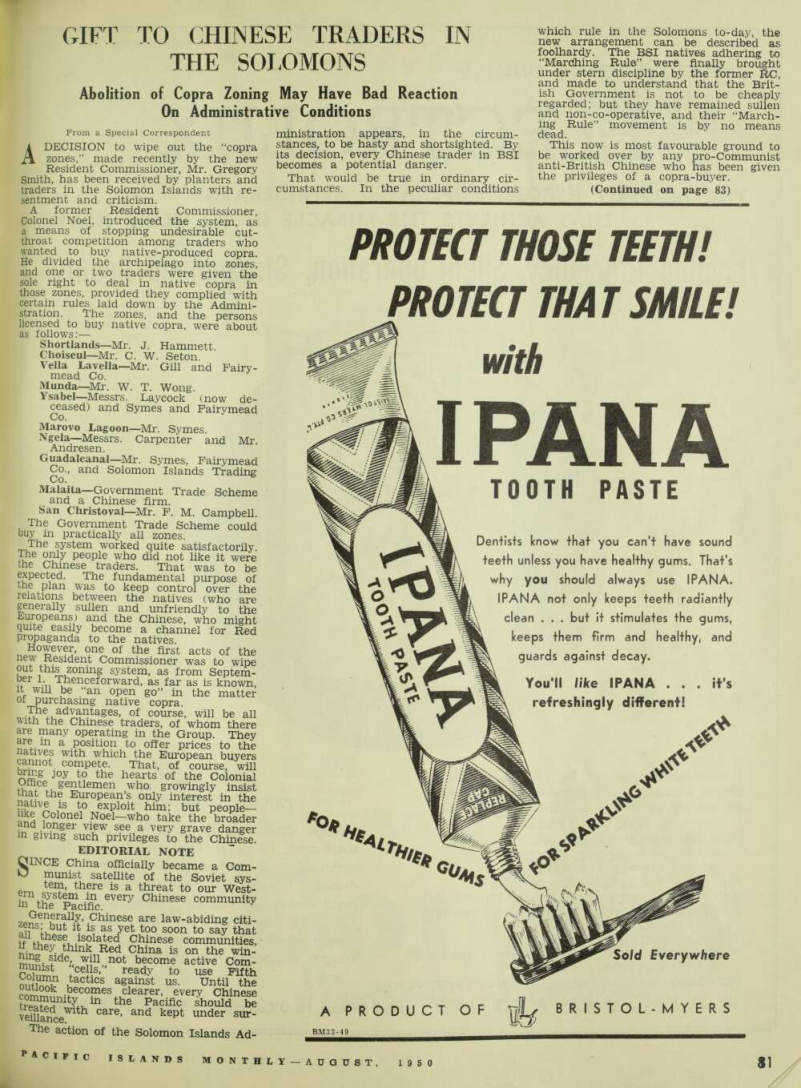

The Solomons
Abolition of Copra Zoning May Have Bad Reaction On Administrative Conditions
From a Special Correspondent A DECISION to wipe out the “copra zones,” made recently by the new Resident Commissioner, Mr. Gregory Smith, has been received by planters and traders in the Solomon Islands with re sentment and criticism.
A former Resident Commissioner, Colonel Noel, introduced the system, as a means of stopping undesirable cut throat competition among traders who wanted to buy native-produced copra.
He divided the archipelago into zones, and one or two traders were given the sole right to deal in native copra in those zones, provided they complied with certain rules laid down by the Admini stration. The zones, and the persons licensed to buy native copra, were about as follows: Shortlands—Mr. J. Hammett.
Choiseul—Mr. C. W. Seton.
Vella Lavella—Mr. Gill and Fairy mead Co.
Munda—Mr. W. T. Wong.
Ysabel—Messrs. Laycock (now de ceased) and Symes and Fairymead Co.
Marovo Lagoon—Mr. Symes.
Ngela—Messrs. Carpenter and Mr.
Andresen.
Guadalcanal—Mr. Symes, Fairymead Co., and Solomon Islands Trading Co.
Malaita—Government Trade Scheme and a Chinese firm.
San Christoval—Mr. F. M. Campbell.
The Government Trade Scheme could buy m practically all zones.
The system worked quite satisfactorily.
The only people who did not like it were the Chinese traders. That was to be expected. The fundamental purpose of the plan was to keep control over the relations between the natives (who are generally sullen and unfriendly to the Europeans) and the Chinese, who might quite easily become a channel for Red propaganda to the natives.
However, one of the first acts of the no w Resident Commissioner was to wipe out this zoning system, as from Septem °er Thenceforward, as far as is known, it will be “an open go” in the matter of purchasing native copra.
The advantages, of course, will be all with the Chinese traders, of whom there are many operating in the Group. They are m a position to offer prices to the natives with which the European buyers h?iw 0t - Col J l P e , t ®- That, of course, will bring joy to the hearts of the Colonial tw ce^ ge p emen who; glowingly insist that the European’s only interest in the 5g“ v e is to exploit him; but people— ™ Colonel Noel—who take the broader and longer view see a very grave danger m giving such privileges to the Chinese.
Editorial Note
CJINCE China officially became a Communist satellite of the Soviet sys cVf 1 ?’ th ? re is a thf eat to our West in the Pacific 6very chinese community . cllin ese are law-abiding citi a]f S fv!i Ut as y et t°° soon to say that if .isolated Chinese communities, ninp Chin* is on the win mi mi C f d » wifi not become active Com- CoSmn fcells, ready to use Fifth oSSS? K tact *s against us. Until the coSi's co “ es^ clearer ’ ever y Chinese t?S^fu m the Pacific should be vei?iam;e Wlth care ’ and kept under sur ‘ The action of the Solomon Islands Ad
ministration appears, in the circum stances, to be hasty and shortsighted. By its decision, every Chinese trader in BSI becomes a potential danger.
That would be true in ordinary cir cumstances. In the peculiar conditions
which rule in the Solomons to-day, the new arrangement can be described as foolhardy. The BSI natives adhering to “Marching Rule” were finally brought under stern discipline by the former RC, and made to understand that the Brit ish Government is not to be cheaply regarded; but they have remained sullen and non-co-operative, and their “March ing Rule” movement is by no means dead.
This now is most favourable ground to be worked over by any pro-Communist anti-British Chinese who has been given the privileges of a copra-buyer.
(Continued on page 83)
THE persistence of the anti-European feeling among the natives of the Solomons has given rise to some extraordinary suspicions. Some people believe that American negroes, who de serted from some of the various black American battalions which went through the Solomons during the war, have settled down among the islanders and are carrying on propaganda there. Such men would be hard to detect by new comers to the Solomons —even the “old hands" would have to be alert, to sort them out from the darker types of na tives.
Suspicion was aroused by the receipt, by officials, of letters on native affairs, written in good English. No Solomons native has yet mastered English to the extent indicated by these letters. But they could have been produced by American negroes, educated in America.
There is need, throughout all these Melanesian islands, for stern and strict administration, as distinct from the Dr.
Evatt type of namby-pambyism, which has been characteristic of the Socialist countries’ Islands administrations in re cent years.
It was United Nations namby-pamby ism which created the present indescrib able muddle in Indonesia; it was Wardist namby-pambyism which caused so much confusion in Papua-New Guinea ad ministration: and now it looks as if British Colonial Office namby-pambyism is going to contribute something unde sirable to the history of the Solomon Islands.
Abdul Lateef, described by a Hobart (Tas.) newspaper as a “smiling 27-year old Fijian” is studying law at Hobart University. He said that neither he, nor the “three other Fijian students” in Hobart would be able to study in Australia if it were not for the help of the YMCA.
Advertisements & other items, pp. 83-84 (2 items)
81
pacific islands MONTHLY- A U G U S T. 1950
I Pan A
PROTECT THOSE TEETH!
PROTECT THAT SMILE!
with
A o o yt * 7 O' r *©* o
I PAN A
TOOTH PASTE
Dentists know that you can't have sound teeth unless you have healthy gums. That's why you should always use IPANA.
IPANA not only keeps teeth radiantly clean . . . but it stimulates the gums, keeps them firm and healthy, and guards against decay.
You'll like IPANA . . . it's refreshingly different! •A*
A PRODUCT
8M33-49 4* Sold Everywhere
BRISTOL-MYERS
There is only one
ELECTROLUX
THE MODERN KEROSENE-OPERATED REFRIGERATOR
THAT ACHIEVES THE MIRACLE OF ICE FROM HEAT
Lasting Efficiency, Silent Operation, Streamlined Beauty
« H I Economically operated by kerosene, with a simple precision-built freezing unit that has no moving parts and is GUARANTEED FOR
FIVE (5) YEARS.
Only obtainable from:
NEW GUINEA COMPANY, LIMITED,
Rabaul, Madang, Lae, Kavieng.
J. R. CLAY & CO., LTD., Port Moresby.
W. R. CARPENTER & CO. (Sol. Is.), LTD., Tulagi.
THE NORFOLK ISLAND SERVICE DEPOT,
Norfolk Island.
SOCIETE HEBRIDA, Port Vila.
SOCIETE CALEDONIENNE D’IMPORTATION ET
D’EXPORTATION, Noumea.
For Gilbert and Ellice Islands Colony, etc., apply Model LKSSI
PRICES ON APPLICATION.
Storage capacity: 5i cub. ft. (approx.); shelf area, 10 sq. ft. food shelves, six—five removable; 2 self-supporting when half drawn. Ice-making: Four trays—s lb. ice per freezing: 80 cubes. Fuel consumption: 1.8 pints kerosene per day (approx.).
Height: 4 ft. 10 in. Depth: 2 ft. 3i in.
Weight, unpacked, 406 lb. Packed, 574 lb. direct to: W. R. CARPENTER & CO. LTD. Head Office: 16 O'Connell St., Sydney, N. S. Wales
Fijian Swimmers Have
No Place to Swim
From Our Own Correspondent SUVA, July 31.
THE first Fijian title-winner at the British Empire Games, Mataika Tuicakau (putting the shot) and Luke Tunabuna, who did well in the javelin event, are among the 25 inter national athletes Invited by the New Zealand Amateur Athletic Association to compete at the Canterbury Centennial Games at Christchurch in December.
This has produced a new crop of queries from New Zealand about the ab sence of Fijian swimmers as competitors in international events.
The reason for this is that there is no Fijian amateur swimming organisation of any kind. A self-appointed Suva com mittee of three (two Fijians, one Euro pean) investigated the situation in March and April, found that the possi bilities were unlimited and that support of all kinds was available, and then was stalled by the fact that in the Suva area there is not a single swimming pool of any description available to Fijians.
The Suva sea baths are nominally one of the few all-European amenities in the capital. But, it is a question how long the situation can be justified, especially in view of the fact that a limited num ber of Chinese apparently use the Euro pean baths with impunity.
In the meantime organised Fijian swimming is hanging fire.
Suva, overcrowded to the point of bursting at the seams, and with hope lessly inadequate playing-fields and simi lar amenities, has not been equipped by Nature with the bathing-beaches and deep freshwater swimming-pools that
abound at other Island capitals like Apia and Papeete.
Advertisements & other items, p. 85 (2 items)
83
pacific islands monthly august, 1950
CbKtiNUED FROM PAGE 8i
negro agitators suspected
Gordon's
QUEENSLAND
INSURANCE
COMPANY
LIMITED
(Incorporated 1886 In Australia),
ASSETS EXCEED £5,000,000
Head Office :
QUEENSLAND
INSURANCE BUILDING,
80-82 PITT STREET, SYDNEY,
Speciolists in South Seas Fire,
Marine Cr Accident Insurances
Apply to:
FIJI. —Branch Office: I. B. Chalmers, Manager.
Burns Phllp (South Sea) Co., Ltd.
VILA. —Burns Phllp (South Sea) Co., Ltd.
Comptoirs Prancais Des Nouvelles Hebrides (Marine).
NOUMEA.—L. & W. Johnston.
NEW GUlNEA.—Manager for the Territory of New Guinea and Papua, W. A.
Anderson.
PORT MORESBY—SAMARAI—LAE
—MADANG—RABAUL.
Burns Phllp (New Guinea), Ltd.
PAGO PAGO.
Burns Phllp (South Sea) Co., Ltd.
G. H. C. Reid & Co.
OTHER SOUTH SEA ISLANDS.
Burns Phllp (South Sea) Co., Ltd.
Also to any of the Company's Offices in Australia or Hew Zealand.
«r G° ore m fcsfi
is is
ss a By Appointment Gin Distillers to H.M. King George VI Tanqneray, Gordon & Co.
Gordon's
Stands Sup’uLWA
Suva Has A “Drought”
Prom Our Own Correspondent SUVA, July 31.
AFTER an all-time record rainfall in 1949 and the early part of 1950, some thing approaching a drought de scended on the wet zone of Viti Levu and lasted until mid-July, when the Suva water supply was so low that drastic ra tioning was threatened unless consump tion was reduced.
Heavy rain towards the end of the month has lessened the emergency but has not removed it.
Mr. R. G. Garrett, OBE, who has been in the Gilbert & Ellice Islands Colony for 13 years, mostly at Fanning Island, with Fanning Island Plantations Ltd., passed through Sydney in late July on his way to New Guinea. He will take up a position with Bums Philp (New Guinea) Ltd., at Rabaul.
Generously
Norfolk Is. Gives Generously to NSW Flood Aid
RESIDENTS of Norfolk Island aii working to raise £lOO for the Nen South Wales Flood Victims’ Relid Fund.
Various functions and appeals an planned and a first instalment of £25 has already been sent to Sydney’s Lon< Mayor.
South Pacific
Conference
In Retrospect
COMMENT by an American who wa an observer of the South Pacifi Conference in Suva in May:— “I cannot see a great deal of benefit except as advertising for the Commisi sion; and it seems to me that the Corrr mission itself is growing weighty witfj ideas that are too vague and nebulous fo! a working programme.
“Most of all, I think it is folly to hole the Polynesians down to the level of thl Melanesian races, who have had so littld in educational and cultural advantagesa “I am wondering why you have no com ment to make regarding that Indian whl was appointed on the Fijian delegation after considerable wrangling. Delegatee were to be drawn from among ‘indigenoui residents’ of Islands groups, and it insisted that the Indians were indigenou< to Fiji. The wording evidently will haw to be changed to ‘indigenous races.’ ”
Advertisements & other items, p. 86 (2 items)
Metal Merchants ★ Metal Refiners
SCRAP IRON SCRAP STEEL SCRAP METALS
PIG IRON PIG LEAD INGOT METALS
Head Office: WILFORD STREET, NEWTOWN, N.S.W.
Phone: LA 5111 (6 lines).
Cable and Telegraphic Address: “SCRAPMETAL,” Sydney.
Works: 2 CANAL ROAD, MASCOT, N.S.W.
Buyers of Non-Ferrous Scrap, Cable, Shells, Cartridges, Copper, Lead, Muntz Metal, Aluminium LARGEST BUYERS OF SCRAP IRON & METALS IN AUSTRALIA
W. H. Grove & Sons Ltd.
Established 1896.
Telegraphic and Cable ISLAND MERCHANTS PO. Box 490, Address: “Grove,” Auckland. 16-18 Fanshawe St Auckland, New Zealand.
AUCKLAND
Entrust your requirements to the firm with more than fifty years' practical experience in the Island trade.
REPRESENTING ENGLISH MANUFACTURERS
THROUGHOUT THE FIJI, SAMOAN AND TONGAN ISLANDS, NEW HEBRIDES, NEW CALEDONIA, THE SOLOMON ISLANDS, THE SOCIETY ISLANDS, THE COOK ISLANDS,
NIUE, ETC.
SHIPPERS OF ALL CLASSES OF NEW ZEALAND MANUFACTURES AND PRODUCTS SPECIALLY PREPARED FOR THE ISLAND TRADE WE HANDLE ALL KINDS OF ISLAND PRODUCE.
IN FIJI as: W. H. GROVE & SONS (FIJI) LIMITED.
Office and Sample Boom: Bank of New South Wales Chambers, Suva, Fiji.
Opportunities for
Tea Planters In New Guinea
Letter to the Editor THINGS seem to go on in New Guinea, particularly in the Highland area, of which we know nothing until they are fait accompli.
It has always been a mystery to me why the ordinary citizen of the Territory has been forbidden to enter the Highlands while Mr. Hallstrom, worthy though he is no doubt, who had no former connec tion with New Guinea whatsoever, can establish a sheep station at Nondugl, and go there as often as he likes, with as many guests as he likes. Mr. Hall strom, of course, is doing it for the bene fit of the natives. But if it is right for Mr. Hallstrom to make a hobby of a Highland sheep farm, and Highland natives, surely it is equally right for the residents of Madang and Lae, etc., to be given facilities for making holi day homes there where they can make a hobby of gardening, or maybe rais ing chickens.
But the reason for this letter is an effusion which appeared recently in Ade laide newspapers concerning two South Australians who expect to be produc ing tea from the New Guinea high lands “and selling it in Australia with in a year. ’ One is Mr. R. M. Williams, editor of a magazine caled Horns and Hoofs and the other is a Mr. C. V.
Thompson. They have recently spent a week or so in New Guinea and accord ing to the newspaper report have planted up an area which they have obtained near a place called Altona. I am not a mainland Territorian and I have never heard of Altona —but what I would like to know is whether the Highlands have now been thrown open for anyone to have a go at planting tea —or any other commercial crop? Or is this a privi lege reserved for Australian business men with no previous experience in the Territory?
I have read quite a lot in the PIM in recent months about the difficulty of getting tea seeds and how the late G.
H. Murray managed to start a planta tion in the Aiyura district somewhere, and how those trees are now in bearing.
Presumably Mr. Williams and his part ner did not get their seeds or cuttings in South Australia; therefore it seems to me that the time is opportune for the Papua-New Guinea Department of Agriculture to issue a pamphlet on just how one sets about becoming a tea plan ter in New Guinea and the facilities available to intending planters from the Department.
I am, etc.,
Old Territorian.
Adelaide, July 21. (Editorial Note: No one on PIM staff has heard of Altona, either. Newspaper reports cannot be relied on to any great extent and it is likely that Altona is not in the Central Highlands proper, at all but in some other mountain area where, as Old Territorian puts it, anyone can have a go at planting tea, or any thing else.) Mr, R. a. Derrick, Superintendent of Technical Services in Fiji, has returned to the Colony after a month in Papua- New Guinea. He has been making a survey into facilities for technical and professional training on behalf of the South Pacific Commission. He has also visited Tonga, Western and Eastern Samoa, Gilbert and Ellice Islands and New Caledonia in this connection.
New Government
For
Eastern Samoa
From a Special Correspondent THE Korean war has made no change in the plans for a new gov ernment in American Samoa —although Governor Darden thinks it will be the last of August before he gets away, marking the final change-over from naval to civil control.
There is no more PBY at the beck and call of anyone and everyone in Samoa . . . no more courtesy flights to Apia, no more emergency flights to Manu’a, no more flights to Canton to pick up the mail from commercial planes Honolulu-to- Suva, and no scheduled flights of Navy planes from Honolulu.
It is reported that arrangements are be ing made for a monthly service to Pago Pago by ship, whether Matson or not one does not know. The Matson offices say they have no knowledge of any service ex cept the unscheduled and infrequent sailings of their cargo ships.
Advertisements & other items, p. 87 (1 item)
Trade
To promote
The Bank of New South Wales offers these services:— • Introductions to importers and exporters in oversea countries. • Credit information about residents of those countries, with whom you may wish to trade. • Facilities for making payments abroad and for receiving payments from overseas. • Arrangements for business visits overseas.
Consult any branch of the
BANK OF
NEW SOUTH WALES
FIRST AND LARGEST COMMERCIAL BANK IN THE SOUTH-WEST PACIH
HEAD OFFICE: SYDNEY, AUSTRALIA
ISLANDS BRANCES
FIJI: Suva, Lautoka (Agencies at Ba, Nadi Airport, Vatukoula) PAPUA: Port Moresby. NEW GUINEA: Lae, Rabavl. (Incorporated in New South Wales with limited liability)
Legislative Council
Fijian Members of Legislative Council
THE Fiji Council of Chiefs in July chose, by secret ballot, 11 Fijians whose names will be submitted to the Governor as a panel from which he will select five native members of Legis lative Council. These five members auto
matically become members of the Fijian Affairs Board.
Ten names are usually submitted, but as there was a tie for tenth place, the number has been increased by one this year.
Those elected were Ratu George Tuisa wau, Ravuama Vunivalu, Ratu George Toganivalu, Ratu Edward Cakobau, Joeli Ravai, Ratu Tiale Vuiyasawa, Ratu George Cakobau, Ratu Panaia Ganilau, P. Vula Daunibau, Ratu Mara and Ratu Etuate Mataitini.
Now They Move AND Talk!
Talk!
Talkies for Rotuma
JN December, last year, due to m enterprise of Mr. Harold Gibsoc a talkie theatre was opened c
Rotuma, dependency of Fiji. TIA
theatre shows the new 16 millimetre films which have more or less re volutionised entertainment on iso\ lated Pacific Islands since the war.
The establishment of this theatre was a great event in the lives of m Rotumans. In his own words, Josef, ;
Tora, of the Meteorological Section o
Rotuma, describes how they fes
about it.
IT was a long- time before the people o Rotuma saw a picture that move and talked. They only heard storiei about the progress that was being mao in moving pictures in Fiji. A few people visited the island with pictures but thai was away back—maybe 1910 or 1920. I re' member a friend told me about visitors t our island who had a picture show TH first was brought by a Methodist misi sionary, Mr. Lelean. That was a pioi ture that did not move.
The second was brought by Mr. Gram a well-known Indian in Fiji. His shoe differed from the one brought previous!!
And this time it moved.
Rotumans thought that picture show surely are improving little by little-* maybe, some day there will be one thsi moves and talks coming to the island During 1949 an Indian named MI Sharma brought his picture show to tH island. And this time it moved am talked. People from every district hir©' trucks and some of them rode bicyclel to go to see the show. Night after nigh the hall was packed with men, worn© and children, just to see the pictuu move and talk. They were very sorn* that Mr. Sharma did not stay long. Afte: only two months he went back to Fiji But soon after his departure MI Harold Gibson, an estate owner on Ro, tuma, went to Fiji and brought bao. with him a precious movie machine simir lar to those used in other parts of’thf Pacific. He quickly built a hall witt. thatched roof similar to the one own© by Mr. Parr of Savusavu (there was picture of it in PIM).
The hall is situated between two wea populated districts, Malhaha and Itutiii The main entrance faces the governmerr road and the other end overlooks thl sea where you can hear the waves beat* ing on the reef. It is very beautiful s night, especially on a moonlight nighti The hall is 72 feet long and 27 feee wide. The seats are well cushioned ann comfortable and prices range from om shilling to three shillings. The hall holo 200.
Ventilation on all sides gives a cooc breeze from the sea. There is also room for selling tickets and another whem soft-drinks, peanuts, etc., can be boughd The 16 mm films come from Metror Goldwyn-Mayer, Republic and Britisa.
Films by ship every three months. The 9 are screened every night except Sunday and on Saturday afternoon.
We are very proud of this theatm We are grateful to Mr. Gibson for brings ing such good entertainment to thf people of Rotuma.
The Resident Commissioner of thf BSIP, Mr. H. G. Gregory Smith; thf Treasurer of the Protectorate. Mr. R. K Rankin, and the acting Director of Eduj cation, Mr. H. W. Gaudin, left Honiara fcf: Suva via Sydney on July 25 by air. Th©j will confer with other WPHC officials qo Protectorate Administration.
Advertisements & other items, p. 88 (2 items)
86
AUGUST, 1950 PACIFIC ISLANDS MONTHL
Broompields Ltd.
Hay Fever;
Incessant, Uncontrolled Sneezing,
Coughing Curbed Quickly
Do you have attacks of the weakening, exhausting Hay Fever; sneezing coughing spasms so bad that you can’t work, play or enjoy yourself?
Do you feel so weak and helpless that you’re unable to work, and have to be careful when you go out. and you can’t enjoy life round this time of the year. No matter how long you have suffered, or what you have tried, there is new hope for you in a doctor’s prescription called MENDACO. No Dopes. No Smokes No Injections. No Atomisers. All you do is take two tasteless tablets at meals, and in three minutes MENDACO starts working through your blood aiding nature to promote free easy breathing and removing the irritating symptoms which cause those terrible sneezing and attendant distressing symptoms. You car go out without fear of attack. Yor sleep better at night and feel well strong and years younger.
NO HAY FEVER SYMPTOM
IN 2 YEARS
MENDACO not only brings almos immediate comfort, easy breathing and freedom from sneezing but it builds up the system to ward off future attacks. For instance, Mrs. S. Bishop, of Dandenong, Victoria, had lost two stone, suffered severe sneezing attacks for months, was afraid to go out for any length of time, couldn’t sleep. MENDACO stopped Hay Fever symptoms quickly and she hasn’t had any since in over two years.
MONEY BACK GUARANTEE
The very first dose of MENDACO goes right to work circulating through your blood and helping nature relieve you of the effects of Hay Fever and Incessant Catarrhal Sneezing. Try MENDACO under
OUR IRON-CLAD MONEY BACK
GUARANTEE. You be the judge If you don’t feel fully satisfied after taking MENDACO just return the empty package and the full purchase price will be refunded. Get MEN- DACO from your Chemist today and see how well you will feel tomorrow and how well yoa will sleep tonight The guarantee protects you.
Nendaco
BROOMPIELDS Ltd.
Suppliers of
Building Hardware
Ship Chandlery, Paint Materials
i
WRITE DIRECT TO:
Broomfields Ltd., 152 Sussex Street, Sydney
Small Australian Ships for Islands Work
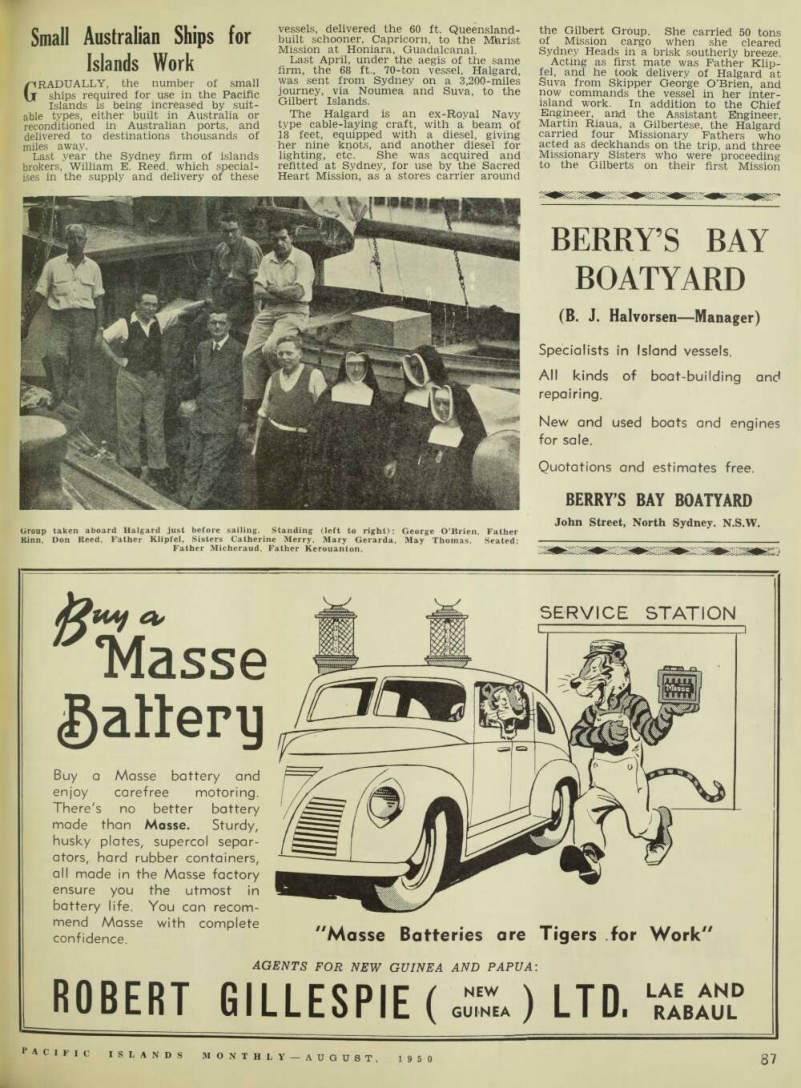
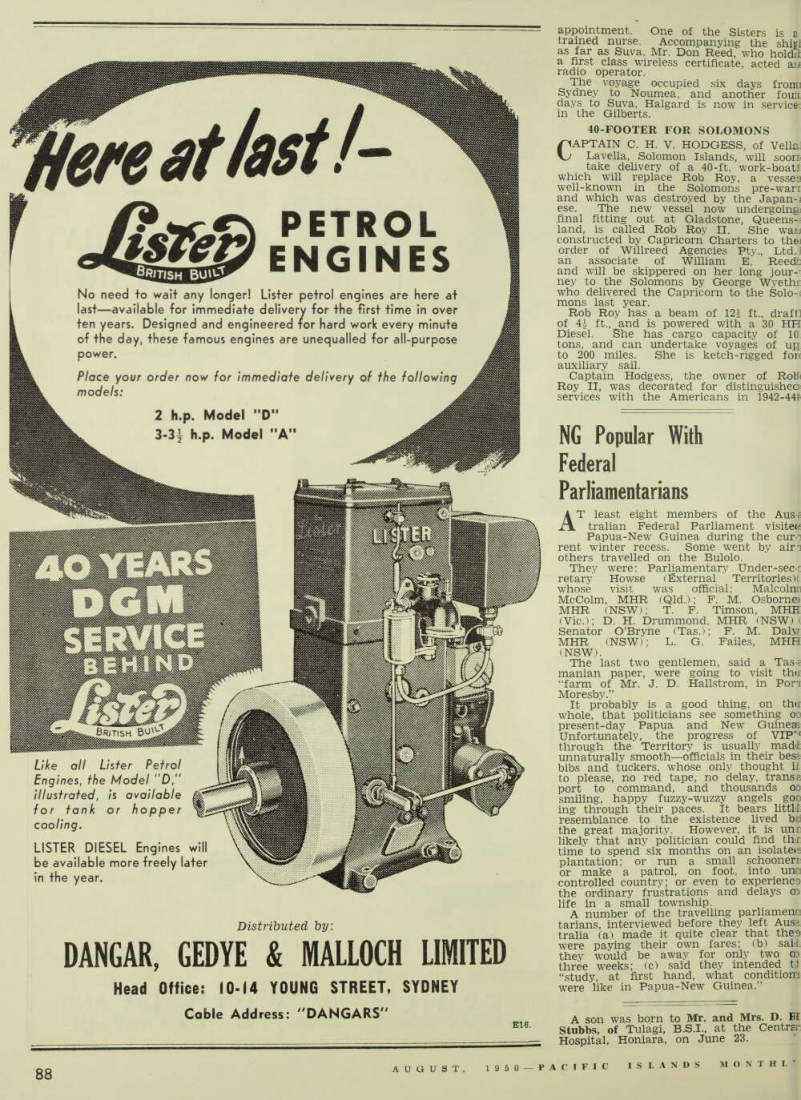
Islands Work
GRADUALLY, the number of small ships required for use in the Pacific Islands is being increased by suit able types, either built in Australia or reconditioned in Australian ports, and delivered to destinations thousands of miles away.
Last year the Sydney firm of islands brokers, William E. Reed, which special ises in the supply and delivery of these
vessels, delivered the 60 ft. Queensland built schooner, Capricorn, to the Mlarist Mission at Honiara, Guadalcanal.
Last April, under the aegis of the same firm, the 68 ft., 70-ton vessel, Halgard, was sent from Sydney on a 3,200-miles journey, via Noumea and Suva, to the Gilbert Islands.
The Halgard is an ex-Royal Navy type cable-laying craft, with a beam of 18 feet, equipped with a diesel, giving her nine knots, and another diesel for lighting, etc. She was acquired and refitted at Sydney, for use by the Sacred Heart Mission, as a stores carrier around
the Gilbert Group, She carried 50 tons of Mission cargo when she cleared Sydney Heads in a brisk southerly breeze.
Acting as first mate was Father Klip fel, and he took delivery of Halgard at Suva from Skipper George O’Brien, and now commands the vessel in her inter island work. In addition to the Chief Engineer, an>d the Assistant Engineer, Martin Riaua, a Gilbertese, the Halgard carried four Missionary Fathers who acted as deckhands on the trip, and three Missionary Sisters who were proceeding to the Gilberts on their first Mission
Group taken aboard Halgard just before sailing. Standing (left to right): George O’Brien, Father Rinn, Don Reed, Father Klipfel, Sisters Catherine Merry. Mary Gerarda, May Thomas. Seated: Father Micheraud, Father Kerouanton.
appointment. One of the Sisters is s trained nurse. Accompanying the shiri as far as Suva, Mr. Don Reed, who hold:! a first class wireless certificate, acted au radio operator.
The voyage occupied six days from Sydney to Noumea, and another fomi days to Suva, Halgard is now in service; in the Gilberts.
40-Footer For Solomons
CAPTAIN C. H. V. HODGESS, of Veils.
Lavella, Solomon Islands, will soon take delivery of a 40-ft. work-boatt which will replace Rob Roy, a vesses well-known in the Solomons pre-warr and which was destroyed by the Japans ese. The new vessel now undergoing, final fitting out at Gladstone, Queens-; land, is called Rob Roy 11. She wasj constructed by Capricorn Charters to thej order of Willreed Agencies Pty., LtdJ an associate of William E. Reedt: and will be skippered on her long jour-ney to the Solomons by George Wyethr who delivered the Capricorn to the Solo-i mons last year, Rob Roy has a beam of 12k ft., draftl of 4k ft., and is powered with a 30 HH Diesel. She has cargo capacity of 10 tons, and can undertake voyages of up to 200 miles. She is ketch-rigged for< auxiliary sail.
Captain Hodgess, the owner of Rolf Roy 11, was decorated for distinguished services with the Americans in 1942-44 t
Advertisements & other items, pp. 89-90 (2 items)
87
PACIFIC ISLANDS MONTHLY— A u G U S T, 1950
<gaftery
BERRY’S BAY
BOATYARD
(B. J. Halvorsen—Manager)
Specialists in Island vessels.
All kinds of boat-building and repairing.
New and used boats and engines for sale.
Quotations and estimates free.
BERRY'S BAY BOATYARD
John Street, North Sydney. N.S.W.
masse
<gaftery
Buy a Masse battery and enjoy carefree motoring.
There's no better battery made than Masse. Sturdy, husky plates, supercol separators, hard rubber containers, all made in the Masse factory ensure you the utmost in battery life. You can recommend Masse with complete confidence.
SERVICE STATION
k Masse Batteries are Tigers for Work'
AGENTS FOR NEW GUINEA AND PAPUA:
ROBERT GILLESPIE ( £L) LTD. L R A A E BA A uT
engine's
No need to wait any longer! Lister petrol engines are here at last—available for immediate delivery for the first time in over ten years. Designed and engineered for hard work every minute of the day, these famous engines are unequalled for all-purpose power.
Place your order now for immediate delivery of the following models: 2 h.p. Model "D" 3-31 h.p. Model "A"
British Like all Lister Petrol Engines, the Model "D," illustrated, is available for tank or hopper cooling.
LISTER DIESEL Engines will be available more freely later in the year.
Distributed by:
DANGAR, GEDYE & MALLOCH LIMITED
Head Office: 10-14 YOUNG STREET, SYDNEY
Cable Address: "DANGARS"
El 6.
NG Popular With Federal Parliamentarians
Federal Parliamentarians
AT least eight members of the Aus? tralian Federal Parliament visite« Papua-New Guinea during the cur--: rent winter recess. Some went by ain others travelled on the Bulolo.
They were: Parliamentary Under-sec-i retary Howse (External TerritoriesK whose visit was official: Malcolm McColm, MHR (Qld.): F. M. Osborn©
Mhr (Nsw); T. F. Timson, Mhh
(Vic.); D. H. Drummond. MHR (NSW) ( Senator O’Bryne (Tas.); F. M. Dalw
Mhr (Nsw); L. G. Fades, Mhh
(Nsw).
The last two gentlemen, said a Tas-c manian paper, were going to visit thu “farm of Mr. J. D. Hallstrom, in Pon Moresby.”
It probably is a good thing, on th«x whole, that politicians see something oo present-day Papua and New Guineas Unfortunately, the progress of VIP r< through the Territory is usually madi: unnaturally smooth —officials in their bess bibs and tuckers, whose only thought ii to please, no red tape, no delay, transs port to command, and thousands oo smiling, happy fuzzy-wuzzy angels goo ing through their paces. It bears littll resemblance to the existence lived bo the great majority. However, it is unr likely that any politician could find thr time to spend six months on an isolates plantation; or run a small schoonen or make a patrol, on foot, into unn controlled country; or even to experienco the ordinary frustrations and delays oo life in a small township.
A number of the travelling parliamenn tarians, interviewed before they left Ausa tralia (a) made it quite clear that the;s were paying their own fares; (b) sari they would be away for only two oo three weeks; (c) said they intended ti “study, at first hand, what condition! were like in Papua-New Guinea.”
A son was born to Mr. and Mrs. D. H Stubbs, of Tulagi, 8.5.1., at the Centra* Hospital, Honiara, on June 23.
Advertisements & other items, p. 90 (1 item)
88
AUGUST, 1950 PACIFIC ISLANDS MONTHL
Watson-Anderson Wedding
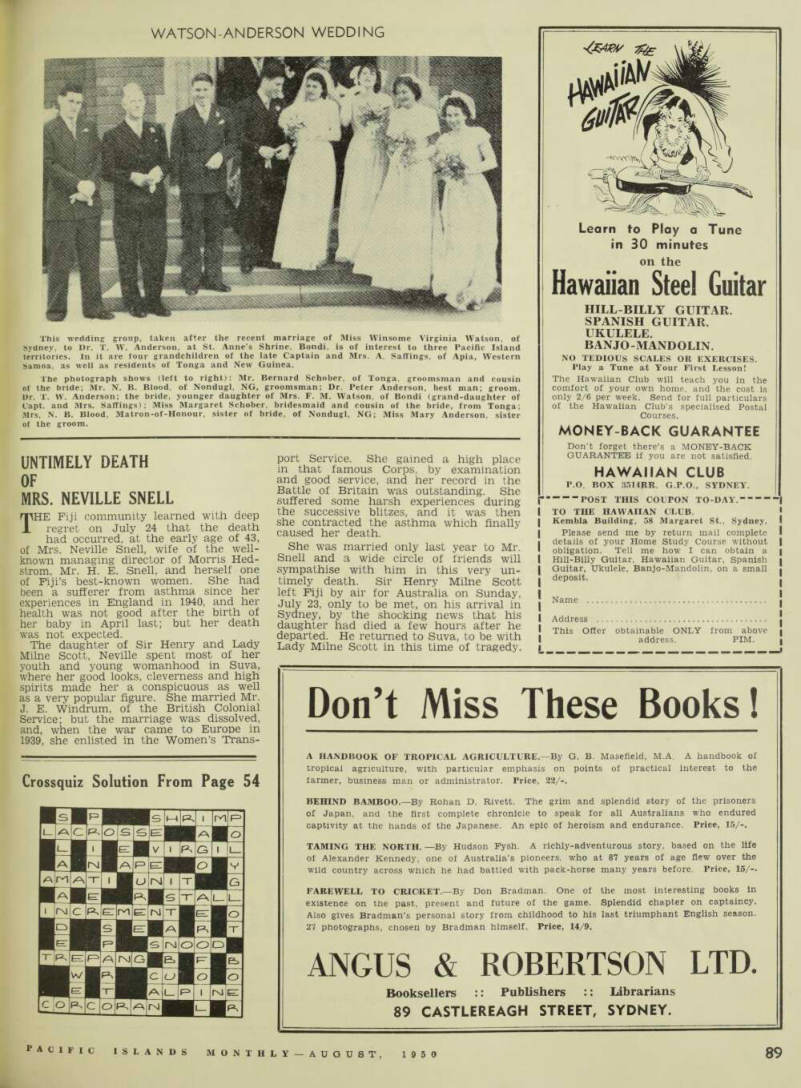
This wedding group, taken after the recent marriage of Miss Winsome Virginia Watson, of Sydney, to Dr. T. W. Anderson, at St. Anne’s Shrine, Bondi, is of interest to three Pacific Island territories. In it are four grandchildren of the late Captain and Mrs. A. Sailings, of Apia, Western Samoa, as well as residents of Tonga and New Guinea.
The photograph shows (left to right): Mr. Bernard Schober, of Tonga, groomsman and cousin of the bride; Mr. N. B. Blood, of Nondugl, NG, groomsman; Dr. Peter Anderson, best man; groom, Dr. T. W. Anderson; the bride, younger daughter of Mrs. F. M. Watson, of Bondi (grand-daughter of Capt. and Mrs. Sailings): Miss Margaret Schober, bridesmaid and cousin of the bride, from Tonga; Mrs. N. B. Blood, Matron-of-Honour, sister of bride, of Nondugl, NG; Miss Mary Anderson, sister of the groom.
Untimely Death
OF
Mrs. Neville Snell
THE Fiji community learned with deep regret on July 24 that the death had occurred, at the early age of 43, of Mrs. Neville Snell, wife of the well known managing director of Morris Hed strom, Mr. H. E. Snell, and herself one of Fiji’s best-known women. She had been a sufferer from asthma since her experiences in England in 1940, and her health was not good after the birth of her baby in April last; but her death was not expected.
The daughter of Sir Henry and Lady Milne Scott, Neville spent most of her youth and young womanhood in Suva, where her good looks, cleverness and high spirits made her a conspicuous as well as a very popular figure. She married Mr.
J. E. Windrum, of the British Colonial Service; but the marriage was dissolved, and, when the war came to Europe in 1939, she enlisted in the Women’s Trans
port Service. She gained a high place in that famous Corps, by examination and good service, and her record in the Battle of Britain was outstanding. She suffered some harsh experiences during the successive blitzes, and it was then she contracted the asthma which finally caused her death.
She was married only last year to Mr.
Snell and a wide circle of friends will sympathise with him in this very un timely death. Sir Henry Milne Scott left Fiji by air for Australia on Sunday, July 23, only to be met, on his arrival in Sydney, by the shocking news that his daughter had died a few hours after he departed. He returned to Suva, to be with Lady Milne Scott in this time of tragedy.
Advertisements & other items, pp. 91-92 (2 items)
Crossquiz Solution From Page 54
Don’t Miss These Books!
USE
m w >
Learn to Play a Tune
in 30 minutes
on the
Hawaiian Steel Guitar
HILL-BILLY GUITAR.
SPANISH GUITAR.
UKULELE.
BANJO-MANDOLIN.
NO TEDIOUS SCALES OR EXERCISES.
Play a Tune at Your First Lesson!
The Hawaiian Club will teach you in the comfort of your own home, and the cost is only 2/6 per week. Send for full particulars of the Hawaiian Club’s specialised Postal Courses.
MONEY-BACK GUARANTEE
Don’t forget there’s a MONEY-BACK GUARANTEE if you are not satisfied.
HAWAIIAN CLUB
P.O. BOX 3514 RR, G.P.0., SYDNEY.
f" POST THIS COUPON TO-DAY. -|
1 TO THE HAWAIIAN CLUB,
Kembla Building, 58 Margaret St., Sydney. ! Please send me by return mail complete I ■ details of your Home Study Course without • obligation. Tell me how I can obtain a I Hill-Billy Guitar, Hawaiian Guitar, Spanish J Guitar, Ukulele, Banjo-Mandolin, on a small ■ ■ deposit.
Name j
Address j
This Offer obtainable ONLY from above address. PIM. *
Don’t Miss These Books!
A HANDBOOK OF TROPICAL AGRICULTURE.—By G. B. Masefield, M.A. A handbook of tropical agriculture, with particular emphasis on points of practical interest to the farmer, business man or administrator. Price, 22/-.
BEHIND BAMBOO.—By Rohan D. Rivett. The grim and splendid story of the prisoners of Japan, and the first complete chronicle to speak for all Australians who endured captivity at the hands of the Japanese. An epic of heroism and endurance. Price, 15/-.
TAMING THE NORTH. —By Hudson Pysh. A richly-adventurous story, based on the life of Alexander Kennedy, one of Australia’s pioneers, who at 87 years of age flew over the wild country across which he had battled with pack-horse many years before. Price, 16/ FAREWELL TO CRICKET.—By Don Bradman. One of the most interesting books in existence on the past, present and future of the game. Splendid chapter on captaincy.
Also gives Bradman’s personal story from childhood to his last triumphant English season. 27 photographs, chosen by Bradman himself. Price, 14/9.
ANGUS & ROBERTSON LTD.
Booksellers : Publishers :: Librarians
89 CASTLEREAGH STREET, SYDNEY.
IN THE COOK ISLANDS
United Island Traders Ltd.
(Established 1930).
P.O. BOX 42, RAROTONGA, COOK ISLANDS
Cable Address: “Unitrade, Rarotonga.”
Managing Director: W. H. WATSON. Secretary : R. J. A. INGRAM, A.R.A., N. Z.
Agents in London: Geo. H. Penney Cr Co. Ltd., 197 Aldersgote St., E.C.I.
IMPORTERS OF:-
Cotton and Silk Piece Goods Glassware and Crockery Plantation Tools Building Materials Fishing Nets and Lines Musical Instruments Trade Jewellery
EXPORTERS OF:-
Tropical Fruits Island Handicrafts Pearl-shell Brooches "Palm" Brand Clothing Broad-last Footwear Sea-shells Cassava
LICENSED STAMP DEALERS
Representatives of Independent Traders throughout the Cook Islands.
Deliveries: BY AIR to Samoa, Tonga and Fiji.
BY SEA to New Zealand, Australia, Tahiti and Niue Island.
BY PARCEL POST to any island in the South Seas.
AGENTS AND DISTRIBUTORS FOR:
British Traders' Insurance Co. British Petroleum Company.
Whites Aviation Ltd. Ford Cars and Trucks.
B.S.A. Cycles and Motor-cycles. "Pacific Islands Monthly."
Associated with : W. H. WATSON Cr CO.— Manufacturers of Broad-last Footwear.
SCOTT Cr WATSON CO. LTD.— Manufacturers of "Palm" brand clothing.
United Island Traders Ltd.
“The House of
Bankers: Bank of New Zealand, Queen Street, Auckland, C. 1., N.Z.
Sydney-Papuo-
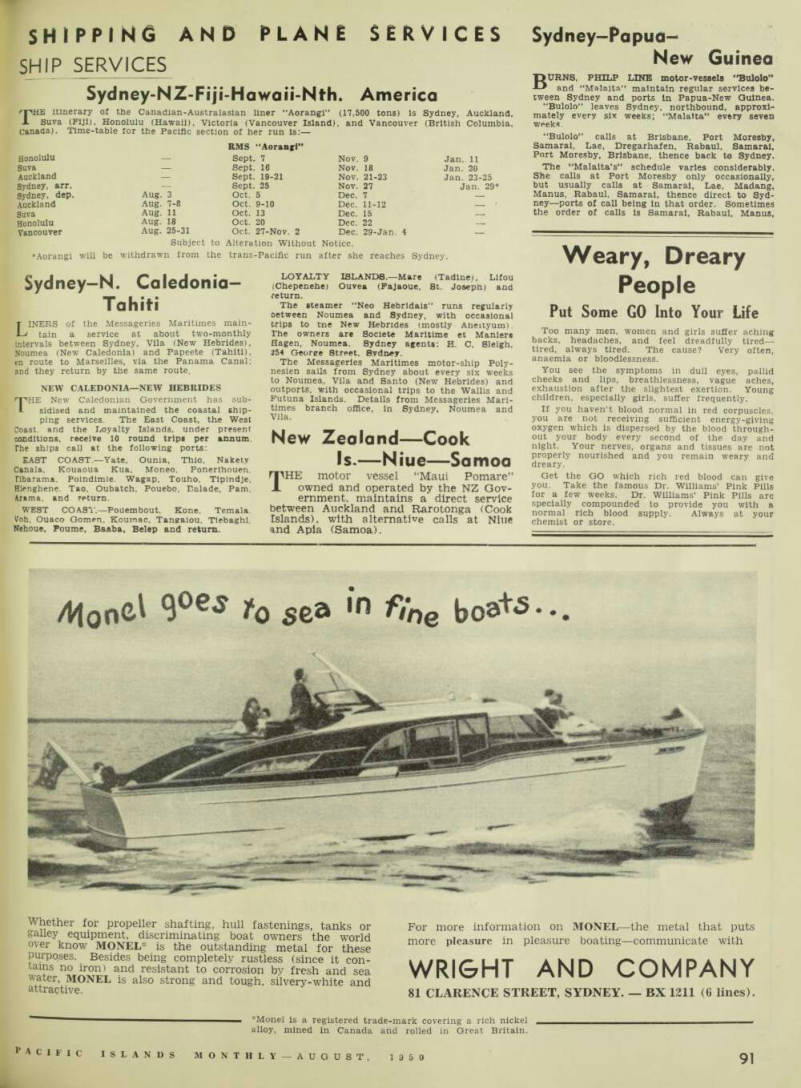
Shipping And Plane Services
Ship Services
Sydney-NZ-Fiji-Hawaii-Nth. America
THE Itinerary of the Canadian-Australaslan liner "Aorangl” (17,500 tons) Is Sydney, Auckland.
Suva (FIJI), Honolulu (Hawaii), Victoria (Vancouver Island), and Vancouver (British Columbia, Canada). Time-table for the Pacific section of her run is:— RMS “Aorangl”
Honolulu Sept. 7 Nov. 9 Jan. 11 Suva Sept. 16 Nov. 18 Jan. 20 Auckland Sept. 19-21 Nov. 21-23 Jan. 23-25 Sydney, arr. Sept. 25 Nov. 27 Jan. 29* Sydney, dep. Aug. 3 Oct. 5 Dec. 7 Auckland Aug. 7-8 Oct. 9-10 Dec. 11-12 Suva Aug. 11 Oct. 13 Dec. 15 Honolulu Aug. 18 Oct. 20 Dec. 22 Vancouver Aug. 25-31 Oct. 27-Nov. 2 Dec. 29-Jan. 4 Subject to Alteration Without Notice. •Aorangi will be withdrawn from the trans-Pacific run after she reaches Sydney.
Sydney— N. Caledonia-
Tahiti
LINERS of the Messagerles Maritimes main tain a service at about two-monthly intervals between Sydney, Vila (New Hebrides), Noumea (New Caledonia) and Papeete (Tahiti), en route to Marseilles, via the Panama Canal; and they return by the same route.
New Caledonia-New Hebrides
THE New Caledonian Government has sub sidised and maintained the coastal ship ping services. The East Coast, the West Coast, and the Loyalty Islands, under present conditions, receive 10 round trips per annum.
The ships call at the following ports: EAST COAST. —Yate, Ounia, Thio, Nakety Canala. Kouaoua Kua, Moneo, Ponerlhouen, Tibarama. Poindlmie. Wagap, Touho, Tipindje.
Hienghene. Tao. Oubatch, Pouebo, Ealade, Pam, Arama. and return.
WEST COAST.—Pouembout. Kone. Temala Voh, Ouaco Oomen, Koumac. Tangaiou. Tiebaghl.
Nehoue, Poume, Baaba, Belep and return.
LOYALTY ISLANDS.—Mare (Tadlne), Llfou (Chepenehe) Ouvea (Pajaoue, St. Joseph) and return.
The steamer “Neo Hebrldals” runs regularly oetween Noumea and Sydney, with occasional trips to tne New Hebrides (mostly Aneityum) The owners are Soclete Maritime et Manlere Hagen, Noumea. Sydney agents: H. C. Sleigh. 254 Georee Street. Sydney.
The Messagerles Marltlmes motor-ship Poly nesien sails from Sydney about every six weeks to Noumea, Vila and Santo (New Hebrides) and outports. with occasional trips to the Wallis and Futuna Islands. Details from Messagerles Mari times branch office, in Sydney, Noumea and Vila.
New Zeoland—Cook
Is.—Niue—Samoa
THE motor vessel “Maui Pomare” owned and operated by the NZ Gov ernment, maintains a direct service between Auckland and Rarotonga (Cook Islands), with alternative calls at Niue and Apia (Samoa).
Sydney-Papuo-
New Guinea
BURNS, PHILP LINE motor-vessels "Bulolo” and “Malaita.” maintain regular services be tween Sydney and ports in Papua-New Guinea.
“Bulolo” leaves Sydney, northbound, approxi mately every six weeks; “Malaita” every seven weeks.
“Bulolo” calls at Brisbane, Port Moresby, Samarai, Lae, Dregarhafen, Rabaul, Samarai, Port Moresby, Brisbane, thence back to Sydney.
The “Malaita’s” schedule varies considerably.
She calls at Port Moresby only occasionally, but usually calls at Samarai, Lae, Madang, Manus, Rabaul, Samarai, thence direct to Syd ney—ports of call being in that order. Sometimes the order of calls is Samarai, Rabaul, Manus,
Madang, Lae, Samaral. Intending passengers should check with Burns, Philp & Co., Ltd., Sydney, or Island branches.
Sydney-NZ-South Pacific
Islands
THE Union SS Co. advises that the Matua will be withdrawn for annual overhaul in September, and services thereafter will be as follows: Matua departs August 8 from Auckland for Suva, Nukualofa, Vavau, Apia, Suva, Auck land.
Aorangi departs August 8 from Auckland for Suva.
Waikawa departs August 15 from Papeete for Rarotonga, Auckland.
Kauri departs end of August from Auckland for Suva, Tonga, Suva, Auckland.
Aorangi departs September 16 from Suva for Auckland.
Waihemo departs September 15 from Auckland for Suva, Rarotonga, Papeete. (Also avail able for cargo from Wellington, Lyttelton.
Dunedin.) Kauri departs late in September from Auckland for Apia, Suva, Auckland.
Matua returns to run on October 5. from Auck
land to Suva, Nukualofa, Vavau, Pago Pagoa; Apia. Suva, Auckland.
Waitemata departs early October from Papeete for Rarotonga, Auckland.
Aorangi departs October 10 from Auckland foo Suva.
Matua departs November 2 from Aucklanl foo Suva, Nukualofa, Vavau, Apia, Suva, Auckj! land.
Sydney-Norfolk Island-
New Hebrides
The SS “Morinda,” Burns, Philp & Co.c Ltd., runs at approximately three-£ monthly intervals from Sydney toe Lord Howe Island, Norfolk Island, anoj main ports of the New Hebrides, and re-£ turn.
Advertisements & other items, pp. 93-94 (1 item)
$ oes s& ,n fine • •.
Weary, Dreary
People
Put Some GO Into Your Life
Too many men. women and girls suffer aching backs, headaches, and feel dreadfully tired — tired, always tired. The cause? Very often, anaemia or bloodlessness.
You see the symptoms in dull eyes, pallid cheeks and lips, breathlessness, vague aches, exhaustion after the slightest exertion. Young children, especially girls, suffer frequently.
If you haven’t blood normal in red corpuscles, you are not receiving sufficient energy-giving oxygen which is dispersed by the blood throughout your body every second of the day and night. Your nerves, organs and tissues are not properly nourished and you remain weary and dreary.
Get the GO which rich red blood can give you. Take the famous Dr. Williams’ Pink Pills for a few weeks. Dr. Williams’ Pink Pills are specially compounded to provide you with a normal rich blood supply. Always at your chemist or store.
$ oes s& ,n fine • •.
Whether for propeller shafting, hull fastenings, tanks or galley equipment, discriminating boat owners the world over know MONEL- is the outstanding metal for these purposes. Besides being completely rustless (since it contains no iron) and resistant to corrosion by fresh and sea water, MONEL is also strong and tough, silvery-white and attractive.
For more information on MONEL —the metal that puts more pleasure in pleasure boating—communicate with
WRIGHT AND COMPANY
81 CLARENCE STREET, SYDNEY. BX 1211 (6 lines). *Monel is a registered trade-mark covering a rich nickel alloy, mined in Canada and rolled in Great Britain.
CAPTAIN W. L. KENNEDY
Established 1931.
Shipbrokers, Business & Real Estate
63 Pitt St., Sydney
'Phone: 8W6461. Cables: "CAPKEN," Sydney.
LISTING FOR SALE:
MODERN STEEL CARGO VESSEL.—SIO HP HD Diesel, 171 x 28, electric winches and windlass. First class. £48,000 Stg.
TWIN DIESEL STEEL VESSEL.—Carry 380 tons general cargo or 100,000 super ft. timber.
In Commonwealth survey. £21,000.
SEVERAL SMALL DIESEL CARGO VESSELS.—lncensed Steel Sea-going Lighter, 250 tons, light draught, £6,000. Tusa Tug, in survey. 260 HP HD Diesel, £10,500. 40 x 12. Army Workboat Type, 165 HP, £2,400. 30 ft. LFB, 21 HP Cross Diesel, £1,150. 28 x 9 LFB, Gardner Diesel, £1,400.
MV MALITA.—WeII-known Qld. coaster and passenger vessel, built by Norman Wright, Brisbane; 77 x 16.6, draft 5.6; coppered; Schooner rig; harbour work, 186 passengers— coastal, 50: carry approx. 40 tons cargo; 144 HP 616 Gardner Diesel, 370 revs.; in full survey; delivery: Jan., 1951. £9.300, ALSO PAIRMILE CRUISERS, SEINE TRAWLERS. ARMY WORKBOATS, YACHTS AND CLASS B.D. AND R.D. CRUISERS AND AUXILIARIES—ALL SIZES, ALL PRICES.
Through our Business and Real Estate Branch, we can offer a wide variety of Sydney and N.S.W. properties. All Islands Clients’ inquiries promptly and satisfactorily attended to.
MARINE ENGINES
V s7\
HALVORSEN’S HAVE FOR IMMEDIATE DELIVERY:
MORRIS “VEDETTE” 4 Cylinder 6/12 H.P. Petrol or Kerosene MORRIS “NAVIGATOR” 4 Cylinder 12/24 H.P. Petrel or Kerosene MORRIS “COMMODORE” 6 Cylinder 20/40 H.P. Petrol or Koresono CHRYSLER “CROWN” 6 Cylinder 45/102 H.P. Petrol CHRYSLER “ROYAL” 8 Cylinder 55/(32 H.P. Petrol “LEYLAND” DIESEL MARINE 6 Cylinder 85 H.P.
Further particulars from the distributors'.
LARS HALVORSEN SONS PTV. LTD.
WATERVIEW ST., RYDE ( Sydney )* NoSoWo Telegrams: Halvorscns, Sydney. ’Phone: Hyde 705
• LARGE RANGE OF BOAT FITTINGS
• FREE EXPERT PROPELLER ADVICE
BUILDERS OF HALVORSEN BOATS
Air Services
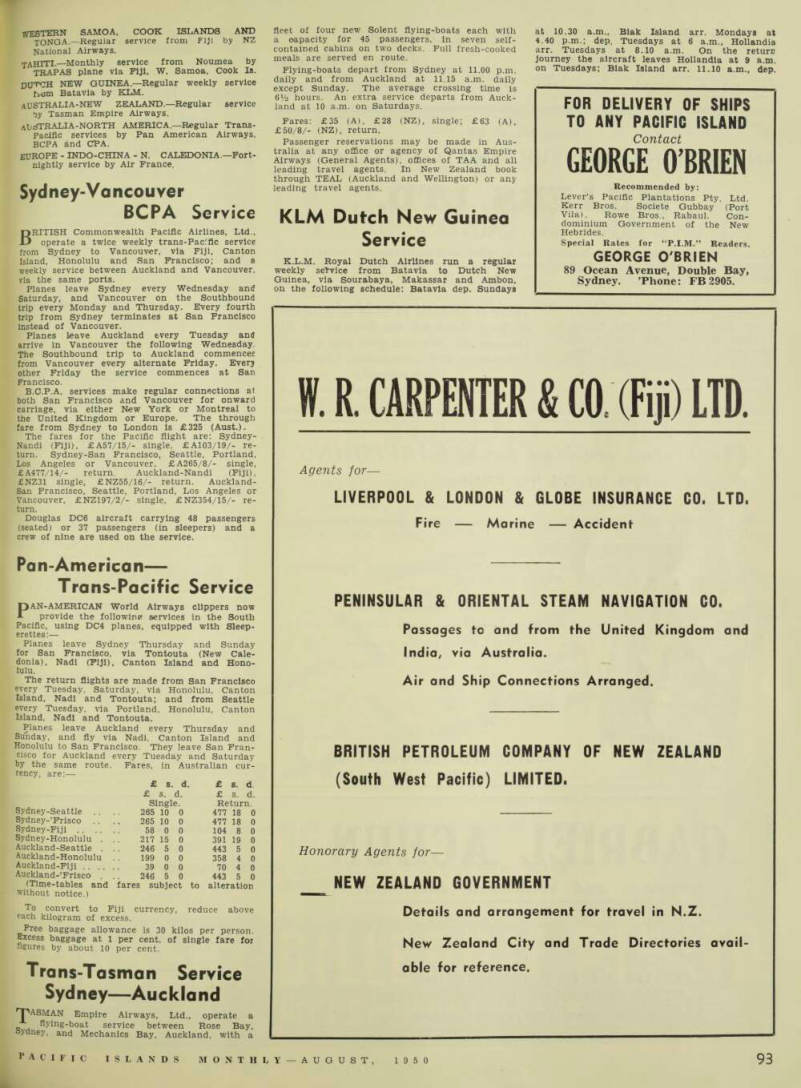
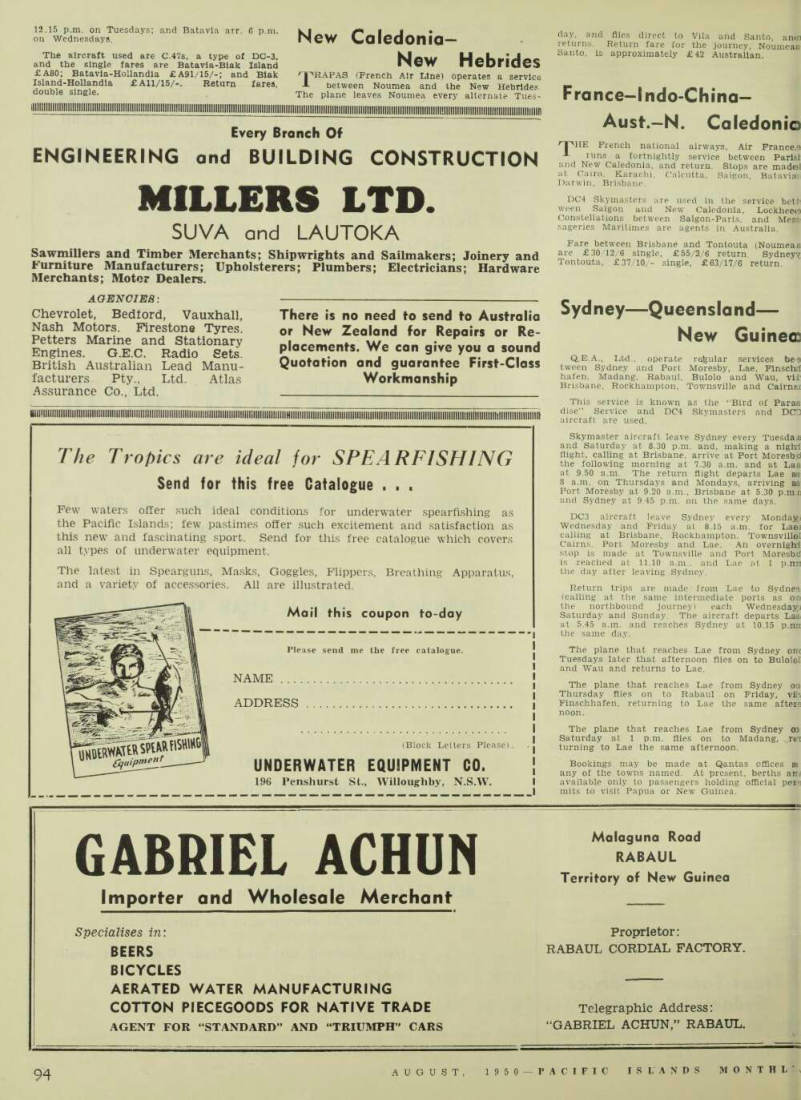
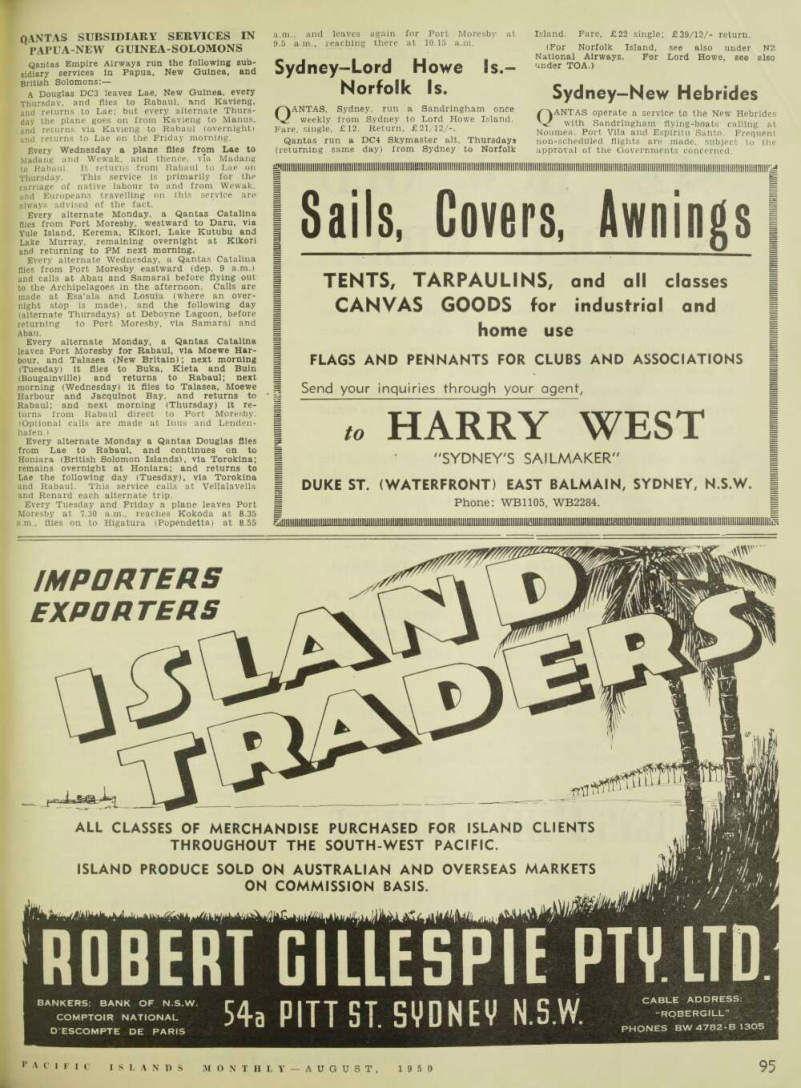
Summary of Pacific Air
Services
PAPUA AND NEW GUINEA. —Regular Qantaui service from Sydney.
SOLOMON ISLANDS.—Frequent regular flying-; boat service from Sydney by Trans Oceania Airways. Qantas service also from Lae, NGE to Honiara, BSI.
NEW HEBRIDES. —Frequent regular flying-boati service from Sydney by Trans Oceanic Air-i ways. Service from Noumea by French planei runs twice weekly. Qantas plane from Sydneys to NH on alternate Tuesdays.
NORFOLK ISLAND.—Regular service from NZI by NZ National Airways; from Sydney by< Qantas; from FIJI by NZ National Airways..
LORD HOWE ISLAND. —Regular weekly service from Sydney by Qantas and Trans Oceaniol Airways.
FIJI. —Regular services from Australia by Pan.
American, BCPA and CPA (to Nadi); Aucko land by NZ National Airways (to Nadi); froira Australia by Qantas (to Laucala Bay, Suva) ( from Auckland by NZ National Airways (tod Laucala Bay, Suva). Irregular calls frorra Australia to Laucala Bay, Suva, by Tranu Oceanic Airways. Regular service from Suva: to Labasa by NZ National Airways.
Western Samoa, Cook Islands And
TONGA.— Regular service from Fiji by NZ National Airways.
TAHITI. —Monthly service from Noumea by TRAPAS plane via Fiji, W. Samoa, Cook la.
DUTCH NEW GUINEA. —Regular weekly service h-om Batavia by KLM.
AUSTRALIA-NEW ZEALAND.—ReguIar service by Tasman Empire Airways.
AUSTRALIA-NORTH AMERICA—Regular Trans pacific services by Pan American Airways,
Bcpa And Cpa.
Europe - Indo-China -N. Caledonla.—Fort
nightly service by Air France.
Sydney-Vancouver
BCPA Service
BRITISH Commonwealth Pacific Airlines, Ltd., operate a twice weekly trans-Pac:flc service from Sydney to Vancouver, via Fiji, Canton Island, Honolulu and San Francisco; and a weekly service between Auckland and Vancouver, via the same ports.
Planes leave Sydney every Wednesday and Saturday, and Vancouver on the Southbound trip every Monday and Thursday. Every fourth trip from Sydney terminates at San Francisco Instead of Vancouver.
Planes Leave Auckland every Tuesday and arrive in Vancouver the following Wednesday.
The Southbound trip to Auckland commences from Vancouver every alternate Friday. Every other Friday the service commences at San Francisco. 8.0.P.A. services make regular connections at both San Francisco and Vancouver for onward carriage, via either New York or Montreal to the United Kingdom or Europe. The through fare from Sydney to London is £325 (Aust.).
The fares for the Pacific flight are; Sydney- Nandi (Fiji), £AS7/15/- single, £AIO3/19/- re turn. Sydney-San Francisco, Seattle, Portland, Los Angeles or Vancouver, £A265/8/- single, £A477/14/- return. Auckland-Nandi (Fiji), £NZ3I single, £NZSS/16/- return. Auckland- San Francisco, Seattle, Portland, Los Angeles or Vancouver, £NZI97/2/- single, £NZ3S4/15/- re turn.
Douglas DC6 aircraft carrying 48 passengers (seated) or 37 passengers (in sleepers) and a crew of nine are used on the service.
Pan-American—
Trans-Pacific Service
PAN-AMERICAN World Airways clippers now provide the following services in the South Pacific, using DC4 planes, equipped with Sleep erettes:— Planes leave Sydney Thursday and Sunday for San Francisco, via Tontouta (New Cale donia), Nadi (Fiji), Canton Island and Hono lulu.
The return flights are made from San Francisco every Tuesday, Saturday, via Honolulu, Canton Island, Nadi and Tontouta; and from Seattle every Tuesday, via Portland, Honolulu, Canton Island, Nadi and Tontouta.
Planes leave Auckland every Thursday and Sunday, and fly via Nadi, Canton Island and Honolulu to San Francisco. They leave San Fran cisco for Auckland every Tuesday and Saturday by the same route. Fares, in Australian cur rency, are:—
(Time-tables and fares subject to alteration without notice.) To convert to Fiji currency, reduce above each kilogram of excess.
Free baggage allowance is 30 kilos per person.
Excess baggage at 1 per cent, of single fare for figures by about 10 per cent.
Trans-Tasman Service
Sydney—Auckland
'T'ASMAN Empire Airways, Ltd., operate a flying-boat service between Rose Bay, Sydney, and Mechanics Bay, Auckland, with a
fleet of four new Solent flying-boats each with a capacity for 45 passengers, in seven self contained cabins on two decks. Full fresh-cooked meals are served en route.
Flying-boats depart from Sydney at 11.00 p.m. daily and from Auckland at 11.15 a.m. daily except Sunday. The average crossing time is 6V 2 hours. An extra service departs from Auck land at 10 a.m. on Saturdays.
Fares: £35 (A), £2B (NZ), single; £63 (A), £5O/8/- (NZ), return.
Passenger reservations may be made in Aus tralia at any office or agency of Qantas Empire Airways (General Agents), offices of TAA and all leading travel agents. In New Zealand book through TEAL (Auckland and Wellington) or any leading travel agents.
KLM Dutch New Guinea
Service
K.L.M. Royal Dutch Airlines run a regular weekly sefvice from Batavia to Dutch New Guinea, via Sourabaya, Makassar and Ambon, on the following schedule: Batavia dep. Sundays
at 10.30 a.m., Biak Island arr. Mondays at 4.40 p.m.; dep. Tuesdays at 6 a.m., Hollandia arr. Tuesdays at 8.10 a.m. On the return Journey the aircraft leaves Hollandia at 9 a.m. on Tuesdays: Biak Island arr. 11.10 a.m., dep.
Sydney-Seattle .. £ s. d. £ s. d.
Single. 265 10 0 £ s. d £ s. d.
Return. 477 18 0
Sydney-’Prisco
265 10 0 477 18 0 Sydney-Fiji 58 0 0 104 8 0 Sydney-Honolulu . .. 217 15 0 391 19 0 Auckland-Seattle . .. 246 5 0 443 5 0 Auckland-Honolulu 199 0 0 358 4 0
Auckland-Flji
39 0 0 70 4 0 Auckland-’Frisco . .. 246 5 0 443 5 0
12.15 p.m. on Tuesdays; and Batavia arr. 6 p.m. on Wednesdays.
The aircraft used are C. 475, a type of DC-3, and the single fares are Batavia-Biak Island £A80; Batavia-Hollandia £A9I/15/-; and Blak Island-Hollandla £AII/15/-. Return fares, double single.
New Caledonia-
New Hebrides
TRAPAS (French Air Line) operates a service between Noumea and the New Hebrides The plane leaves Noumea every alternate Tues*
day, and flies direct to Vila and Santo, amn returns. Return fare for the journey, Noumeas Santo, is approximately £42 Australian.
France-1 ndo-Ch ina-
Aust.—N. Caledonia
'T'HE French national airways, Air Prance, 9 1 runs a fortnightly service between Parisi and New Caledonia, and return. Stops are madel at Cairo. Karachi. Calcutta. Saigon, Bataviar Darwin, Brisbane.
DC4 Skymasters are used in the service betf ween Saigon and New Caledonia, Lockheeo Constellations between Saigon-Paris. and Mesa sageries Maritimes are agents in Australia.
Fare between Brisbane and Tontouta (Noumeaa are £3O/12/6 single, £55/2/6 return.
Tontouta, £37/10/- single, £63/17/6 return.
Sydney—Queensland—
New Guinea:
Q.E.A., Ltd., operate regular services bea tween Sydney and Port Moresby, Lae, Flnschri hafen. Madang, Rabaul. Bulolo and Wau, vif Brisbane, Rockhampton, Townsville and Cairnsi This service is known as the ‘ Bird of Parae dise” Service and DC4 Skymasters and DC3 aircraft are used.
Skymaster aircraft leave Sydney every Tuesday and Saturday at 8.30 p.m. and, making a nighi flight, calling at Brisbane, arrive at Port Moresbd the following morning at 7.30 a.m. and at Las at 9.50 a.m. The return flight departs Lae aa 8 a.m. on Thursdays and Mondays, arriving aa Port Moresby at 9.20 a.m., Brisbane at 5.30 p.mr and Sydney at 9.45 p.m. on the same days.
DC3 aircraft leave Sydney every Mondajn Wednesday and Friday at 8.15 a.m. for Laej calling at Brisbane, Rockhampton, Townsvillel Cairns. Port Moresby and Lae. An overnlghi stop is made at Townsville and Port Moresbd is reached at 11.10 a.m.. and Lae at 1 p.irn the day after leaving Sydney.
Return trips are made from Lae to Sydnee (calling at the same intermediate ports as oo the northbound journey) each Wednesday Saturday and Sunday. The aircraft departs Lae at 5.45 a.m. and reaches Sydney at 10.15 p.rm the same day.
The plane that reaches Lae from Sydney oik Tuesdays later that afternoon flies on to Bulolol and Wau and returns to Lae.
The plane that reaches Lae from Sydney oo Thursday flies on to Rabaul on Friday, vlh Pinschhafen, returning to Lae the same after* noon.
The plane that reaches Lae from Sydney oo Saturday at 1 p.m. flies on to Madang, rer turning to Lae the same afternoon.
Bookings may be made at Qantas offices as any of the towns named. At present, berths an/ available only to passengers holding official pets mits to visit Papua or New Guinea.
QANTAS subsidiary services in
Papua-New Guinea-Solomons
Qantas Empire Airways run the following sub sidiary services in Papua, New Guinea, and British Solomons:— A Douglas DCS leaves Lae. New Guinea, every Thursday, and flies to Rabaul, and Kavieng, and returns to Lae; but every alternate Thurs day the plane goes on from Kavieng to Manus, and returns via Kavieng to Rabaul (overnight i and returns to Lae on the Friday morning.
Every Wednesday a plane flies from Lae to Madang and Wewak, and thence, vTa Madang to Rabaul. It returns from Rabaul to Lae on Thursday. This service Is primarily for the carriage of native labour to and from Wewak. and Europeans travelling on this service are always advised of the fact.
Every alternate Monday, a Qantas Catalina flies from Port Moresby, westward to Daru, via Yule Island, Kerema, Kikorl, Lake Kutubu and Lake Murray, remaining overnight at Kikori and returning to PM next morning.
Every alternate Wednesday, a Qantas Catalina flies from Port Moresby eastward (dep. 9 a.m.) and calls at Abau and Samarai before flying out to the Archipelagoes in the afternoon. Calls are made at Esa’ala and Losuia (where an over night stop is made), and the following day (alternate Thursdays) at Deboyne Lagoon, before returning to Port Moresby, via Samarai and Abau.
Every alternate Monday, a Qantas Catalina leaves Port Moresby for Rabaul, via Moewe Har bour, and Talasea (New Britain); next morning (Tuesday) it flies to Buka, Kieta and Buin (Bougainville) and returns to Rabaul; next morning (Wednesday) it flies to Talasea, Moewe Harbour and Jacqulnot Bay, and returns to Rabaul; and next morning (Thursday) it re turns from Rabaul direct to Port Moresby. (Optional calls are made at Inus and Lenden hafen.) Every alternate Monday a Qantas Douglas flies from Lae to Rabaul. and continues on to Honiara (British Solomon Islands), via Torokina; remains overnight at Honiara; and returns to Lae the following day (Tuesday), via Torokina and Rabaul. This service calls at Vellalavella and Renard each alternate trip.
Every Tuesday and Friday a plane leaves Port Moresby at 7.30 a.m., reaches Kokoda at 8.35 a.m., flies on to Higatura (Popendetta) at 8.55
a.m., and leaves again for Port Moresby at 9.5 a.m., reaching there at 10.15 a.m.
Sydney-Lord Howe Is.-
Norfofk Is.
QANTAS, Sydney, run a Sandringham once weekly from Sydney to Lord Howe Island.
Fare, single, £l2. Return, £2l/12/-.
Qantas run a DC4 Skymaster alt. Thursdays (returning same day) from Sydney to Norfolk
Island. Pare, £22 single; £39/12/- return. (For Norfolk Island, see also under NZ National Airways. For Lord Howe, see also under TOA.)
Sydney-New Hebrides
QANTAS operate a service to the New Hebrides with Sandringham flying-boats calling at Noumea, Port Vila and Espiritu Santo. Frequent non-scheduled flights are made, subject to the approval of the Governments concerned.
NZ National Airways
South Pacific Services
'T'HE Pacific services run by the New Zealand)!
A National Airways Corporation are at* follows:
Auckland-Norfolk Island-Fiji-Tonga-I
Western Samoa-Cook Islands: A “Douglas”'
airliner leaves Whenuapai, Auckland, on alter nate Tuesdays at 9 am. (August 8, 22 ,S etc.) for Norfolk Island (arr. 12.55 p.m.; dep!!c 2 p.m.), Nadi (arr. 8.40 p.m., dep. 5.40 a.m.r Thursday), Nausori (arr. 6.25 a.m., dep. 7.3031 a m ), Tonga (arr. 10.50 a.m., dep. 11.50 a.m.), ( •Faleolo, Western Samoa (arr. 4.5 p.m. Wednes-; day, dep. 8 a.m. Thursday), Aitutaki, Cookd Islands (arr. 1.50 p.m. Thursday, dep. 2 503' p.m.), Rarotonga, Cook Is. (arr. 4.5 p.m.).
The aircraft departs from Rarotonga on the*, return journey on alternate Saturdays*' (August 12, 26, etc.), at 8 a.m. for Aitutaki (arr - 9.15 a.m., dep. 10 a.m.), Faleolo, W. Samoas 'arr. 3.15 p.m., dep. 8 a.m. Sunday), *Tongaa (arr. 10.55 a.m. Monday, dep. 11.50 am.),( Nausori (arr. 2.40 p.m., dep. 3.40 p.m.), Nadll (arr. 4.25 p.m., dep. 5 a.m. Tuesday), Is. (arr. 10.55 a.m., dep. 12 noon), Whenuapai,.
Auckland (arr. 4.50 p.m.), •Crosses International Date Line.
Auckland-Norfolk Island: A “Douglas”"
airliner leaves Whenuapai, Auckland, every Sun day at 8.15 a.m. for Norfolk Island (arr. 12.100 p.m.), and departs on the return flight at 1.100 p.m., arriving at Whenuapai at 6 p.m.
FARES, single (in NZ currency): Auckland too Norfolk. £l4; to Fiji, £3l; to Tonga, £31;: to Samoa, £34; to Aitutaki. £39; to Raro tonga, £39/10/-. Norfolk to Fiji, £l9. Fiji too Tonga. £B/15/-; to Samoa. £l3; to Aitutaki,, £29/15/-; to Rarotonga. £3l. Samoa to Raro tonga. £l7/15/-; to Aitutaki, £l6/10/-...
Return fares, less 10 per cent.
BOOKING OFFICES; WeUington, Govt. Llfee Bldg.. Customhouse Quay; Auckland. Airways a Rouse, Customs St.; Dunedin, 8-10 Manses St.; Christchurch, 104 Gloucester St.; Gis borne. 74 Peel st.; Palmerston North,, 107 Broadway Ave.; Hamilton, 8 Alma St,; Newv Plymouth, Grand Central Building, EgmontJ St.; Blenheim, 13 Queen St.; Hokitika, South side Airport: Norfolk Is., Burns Philp, Ltd.;; Fiji, NAC at Nadi and Suva; Burns Philp. .
Lautoka; Tonga, Mrs. F. F. Melhose,.
Fou-amotu Airfield; W. Samoa, Burns Philp (SS)..
Ltd., Apia; Cook Is., Mrs. P. McVeagh, Aitutaki, , and Mr. J. D. Campbell. Rarotonga.
TOA Services
TRANS Oceanic Airways run the following « Pacific services:— SYDNEY-LORD HOWE IS.: A regular fort nightly service with large four-engine flying- boats from Rose Bay. Fare: £l2 single; £2l/10/- return. Free baggage allowance 50 lb.
Excess baggage and freight rate Bd. per lb.
Sydney-New Hebrides: A Regular
service with large four-engine flying-boats from a Sydney, via Noumea, to Vila and Esplritu l Santo (overnight stop). Fares (single and re turn): Sydney-Vila. £39/10/- and £7l/2/-;; Sydney-Santo, £42/10/- and £76/10/-; Noumea-- Vila, £lO and £18; Noumea-Santo, £l5 and £ £27. Freight: Sydney-Vila, 2/- per lb.; Sydney— Santo, 2/3.
Sydney-Solomon Islands: A Regular I
monthly service from Sydney, via New Gale- donia and New Hebrides to Tulagi and Honiara, Solomon Islands. This service is frequently ex- tended to Lingatou, in the Russell Islands, and t calls are sometimes made at Vanikoro, in the 9 Santa Cruz Group. Fares: Sydney-Tulagi- - Honiara. £55 S; £99 R. Free baggage allow ance. 60 lb.; excess baggage and freight, 3/6 8 per lb.
N. Caledonio-Tohiti
TRAPAS (Soclete Francais de Transports sc Aeriens du Pacific Sud-Noumea) runs a a monthly service from New Caledonia to Tahiti i Western Samoa (Faleolo), Cook Islands (Altu- taki) to Papeete, where it arrives at about 11.40 u a.m. two days later. One evening is spent in a Nadi and one night in Aitutaki. The plane re- •• turns by the same route in the following week..: Fare from Noumea to Papeete is 16,000 Pacific o francs single, and 28,800 return. (160 Pacific o. francs equal £1 Australian.) While the plane 9j is at Papeete it runs one round trip between n Papeete and Bora Bora.
Sydney-Noumea-Suva
THE following is the time-table of the Qantas Sandringham flying-boat:— Sydney dep. 9 p.m. alt. Tues.
Noumea arr. 6.50 a.m. alt. Wed.
Noumea dep. 7.55 a.m. alt. Wed.
Suva arr. 3 p.m. alt. Wed.
Suva dep. 6 a.m. alt. Fri.
Noumea arr. 11.05 a.m. alt. Fri.
Noumea dep. 12.10 a.m. alt. Fri.
Sydney arr. 8 p.m. alt. Fri.
Intending passengers may book through Qantas offices in Australia. Burns Philp (South Seas) Company, in Suva; and J. Brock, in Noumea.
The fares for this service in Aust. currency
CPA Sydney-Vcmcouver
Service
CANADIAN Pacific Airlines, Ltd., run a trans pacific service between Sydney and Van couver. For the present there will be one northbound and one southbound trip per fort night. Stops are made at Nadi (Fiji), Canton Island, Honolulu and San Francisco. The north bound flight commences from Sydney every alter nate Tuesday.
Four-engined, pressurised "Canadair” aircraft are used; 36 passengers can be carried and a crew of 7. Flying is done in daylight. Over night accommodation is provided at hotels In Nadi and Honolulu, which is, of course, com plimentary.
Fares are (in Australian currency: Sydney- Vancouver, San Francisco-Los Angeles and Port land-Seattle, £265/8/- single. £477/14/- return; Fiji-Vancouver. £207/8/- single, £373/7/- re turn; Sydney-Piji, £57/15/- single. £lO3/19/- re turn; Sydney-Honolulu, £217/13/- single, £391/16/- return.
Bookings may be made at the Union Steam Ship Company of New Zealand, Limited, Sydney, or Melbourne; Union Steam Ship Co. of NZ, Ltd., Fiji; Canadian Pacific Airlines, Vancouver.
TEAL Flying Boat
Service
Auckland Fiji
WITH new 45 seater Solent flying-boats, Tasman Empire Airways, Limited, operate a weekly Auckland-Suva-Lambasa and return service.
Aircraft depart Mechanics’ Bay, Auckland, a half hour midnight, each Tuesday, and operate to the following time-table:— dep. Auckland .. .. 0.30 a.m. Tuesday arr. Suva 7.00 a.m. Tuesday dep. Suva 9.00 a.m. Tuesday arr. Lambasa 10.00 a.m. Tuesday dep. Lambasa .. .. noon Tuesday arr. Suva 1.00 p.m. Tuesday dep. Suva 7.00 a.m. Wednesday arr. Auckland .. .. 1.30 p.m. Wednesday Fares (Single); Auckland-Suva, £3l (NZ), £34/9/- (Fijian), £3B/15/- (Aust.); (Return): £55/16/- (NZ), £6l/19/- (Fijian), £69/15/- (Aust.).
Suva-Lambasa (Single): £4/10/- (NZ). £5 (Fijian). £5/12/6 (Aust.); (Return): £B/2/- (NZ), £9 (Fijian), £lO/2/6 (Aust.).
Reservations may be made through TEAL (New Zealand), Qantas or TAA (Australia).
NZNAC (Suva) or any leading travel agents.
Papua-NG Local
Services
JV/TANDATED Airlines, Ltd., of Lae, New Guinea, and other private operators, run air ser vices between Lae and the New Guinea mainland centres of Wau, Bulolo, Madang, Wewak, Altape, Mt Hagen. Pinschhafen. Moresby, tact anywhere in Papua or New Guinea where ‘nere is an air-strip. These planes carry pas wngers. malls and cargo on regular schedules or charter flights.
are: Single. Return.
Sydney-Noumea ... £37 10 0 £67 10 0 Sydney-Suva 55 10 0 99 18 0 Noumea-Suva 20 5 0 36 9 0
Advertisements & other items, pp. 94-98 (3 items)
92
AUGUST, 1950 PACIFIC ISLANDS MONTtfL Y I
«.R. Carpenter & Co. (Fin) 18.
FOR DELIVERY OF SHIPS
TO ANY PACIFIC ISLAND
Contact
GEORGE O’BRIEN
Recommended by: Lever’s Pacific Plantations Pty. Ltd.
Kerr Bros. Societe Gubbay (Port Vila). Rowe Bros., Rabaul. Condominium Government of the New Hebrides.
Special Rates for “P.1.M.” Readers.
GEORGE O'BRIEN
89 Ocean Avenue, Double Bay, Sydney. ’Phone: F 82905.
«.R. CARPENTER & CO. (Fin) 18.
Agents for — LIVERPOOL & LONDON & GLOBE INSURANCE CO. LTD.
Fire Marine Accident
PENINSULAR & ORIENTAL STEAM NAVIGATION CO.
Passages to and from the United Kingdom and India, via Australia.
Air and Ship Connections Arranged.
BRITISH PETROLEUM COMPANY OF NEW ZEALAND
(South West Pacific) LIMITED.
Honorary Agents for —
NEW ZEALAND GOVERNMENT
Details and arrangement tor travel in N.Z.
New Zealand City and Trade Directories avail able for reference.
Every Branch Of
ENGINEERING and BUILDING CONSTRUCTION
MILLERS LTD.
SUVA and LAUTOKA
Sawmillers and Timber Merchants; Shipwrights and Saihnakers; Joinery and Furniture Manufacturers; Upholsterers; Plumbers; Electricians; Hardware Merchants; Motor Dealers.
AGENCIES ;
Chevrolet, Bedford, Vauxhall, Nash Motors. Firestone Tyres.
Fetters Marine and Stationary Engines. G.E.C. Radio Sets.
British Australian Lead Manufacturers Pty., Ltd. Atlas Assurance Co., Ltd.
There is no need to send to Australia or New Zealand for Repairs or Replacements. We can give you a sound Quotation and guarantee First-Class
Workmanship
The Tropics are ideal for SPEARFISHING
Send for this free Catalogue . . .
Few waters offer such ideal conditions for underwater spearfishing as the Pacific Islands; few pastimes offer such excitement and satisfaction as this new and fascinating sport. Send for this free catalogue which covers all types of underwater equipment.
The latest in Spearguns, Masks, Goggles, Flippers, Breathing Apparatus, and a variety of accessories. All are illustrated. mtent
NAME
ADDRESS
UNDERWATER EQUIPMENT CO.
196 Penshurst St., Willoughby, N.S.W.
Mail this coupon to-day Please send me the free catalogue. (Block Letters Please).
GABRIEL ACHUN
Importer and Wholesale Merchant
Specialises in:
BEERS
BICYCLES
AERATED WATER MANUFACTURING
COTTON PIECEGOODS FOR NATIVE TRADE
AGENT FOR “STANDARD” AND “TRIUMPH” CARS
Malaguna Road
RABAUL
Territory of New Guinea Proprietor:
RABAUL CORDIAL FACTORY.
Telegraphic Address:
“GABRIEL ACHUN,” RABAUL.
tbubtui
IMPORTERS
EXPOR TERS
/> i 1 && 5i ALL CLASSES OF MERCHANDISE PURCHASED FOR ISLAND CLIENTS
THROUGHOUT THE SOUTH-WEST PACIFIC.
ISLAND PRODUCE SOLD ON AUSTRALIAN AND OVERSEAS MARKETS
ON COMMISSION BASIS.
ROBERT GILLESPIE PTV.LTD
BANKERS: BANK OF N.S.W.
COMPTOIR NATIONAL
DESCOMPTE DE PARIS
54a PITT ST. SYDNEY N.S.W,
CABLE ADDRESS:
“ ROBE RG ILL"
PHONES BW 4782-B 1305
that*
HOW OLD
'Ht ’
IS YOUR WILL?
Placing your signature on your will should not end your concern for this extremely important document. Unless it is kept up to date, neglect can thwart your intentions.
A beneficiary may die, specific property may be sold, increases in your assets may be overlooked. Marriage, too, revokes a will in almost every case. However, you can avoid these hazards quite easily.
Let your solicitor revise your will, then appoint Burns Philp Trust Company Limited as executor or trustee. This commonsense precaution removes another danger that of
faulty administration.
The solid advantages of securing the Company's services are explained in "Hands That Never Leave The Wheel."
A complimentary copy of this 20-page booklet can be obtained from any branch of Burns Philp (South Sea) Company, Burns Philp (New Guinea) Limited, Burns Philp (New Hebrides) Ltd., or direct from the head office of this Company.
DIRECTORS:
James Burns Eric Priestley Lee P. T. W. Black Joseph Mitchell MANAGER: L. S. Parker.
SECRETARY: E. R. Overton, F.F.I.A.
Bums Philp Trust
COMPANY LIMITED
Executor • Trustee • Attorney
Constituted by Special Act of the N.S.W. Parliament.
7 BRIDGE STREET, SYDNEY
Telephone: BU 5901 Box 543, G.P.0., Sydney.
94
AUGUST, 1950-PACIFIC ISLANDS MONTH L
Samoa Seeks Another
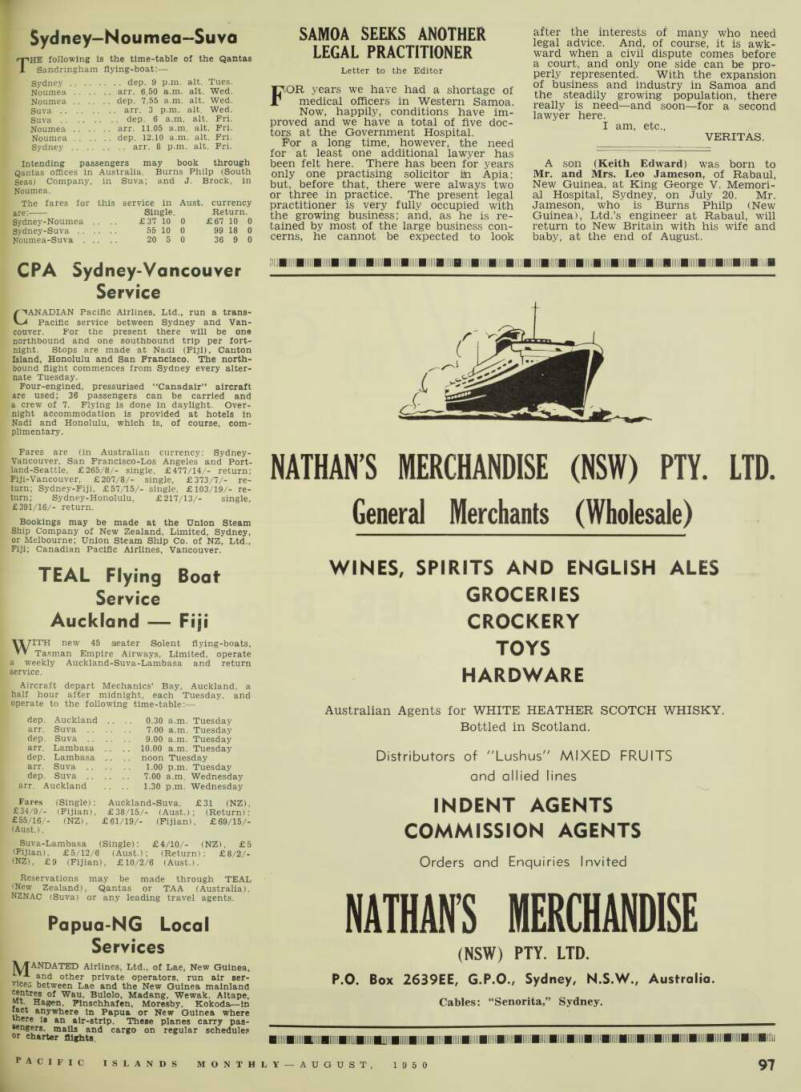
Legal Practitioner
Letter to the Editor FOR years we have had a shortage of medical officers in Western Samoa.
Now, happily, conditions have im proved and we have a total of five doc tors at the Government Hospital.
For a long time, however, the need for at least one additional lawyer has been felt here. There has been for years only one practising solicitor i)n Apia; but, before that, there were always two or three in practice. The present legal practitioner is very fully occupied with the growing business; and, as he is re tained by most of the large business con cerns, he cannot be expected to look
after the interests of many who heed legal advice. And, of course, it is awk ward when a civil dispute comes before a court, and only one side can be pro perly represented. With the expansion of business and industry in Samoa and the steadily growing population, there really is need—and soon—for a second lawyer here.
I am, etc.,
Veritas.
A son (Keith Edward) was born to Mr. and Mrs. Leo Jameson, of Rabaul, New Guinea, at King George V. Memori al Hospital, Sydney, on July 20. Mr.
Jameson, who is Burns Philp (New Guinea), Ltd.’s engineer at Rabaul, will return to New Britain with his wife and baby, at the end of August.
Advertisements & other items, pp. 99-100 (1 item)
Nathaifs Merchandise
NATHAN’S MERCHANDISE (NSW) PTY. LTD
General Merchants (Wholesale)
WINES, SPIRITS AND ENGLISH ALES
GROCERIES
CROCKERY
TOYS
HARDWARE
Australian Agents for WHITE HEATHER SCOTCH WHISKY.
Bottled in Scotland.
Distributors of // Lushus // MIXED FRUITS and allied lines
INDENT AGENTS
COMMISSION AGENTS
Orders and Enquiries Invited
NATHAIfS MERCHANDISE
(NSW) PTY. LTD.
P.O. Box 2639EE, G.P.0., Sydney, N.S.W., Australia.
Cables: “Senorita,” Sydney.
Or, /; 4 n °4C o 4 A - G
tlvc
CA hl
, is i'° r
GILBEY’S
! Ey ltd. m el Oilß ne. syd Ne y
■ BRIS
'ANe Address all enquiries to W. & A. GILBEY LTD., 33 Rosslyn Street, West Melbourne.
The New COMMER 8 CWt.
Light Delivery Van
4 ><■ 3* with independent front Mo^ suspension and finger tip gear control.
Full particulars available from the distributors for Papua/ JSew Guinea
Progress Report by Minister

Development Of Australian
Territories
FOLLOWING his announcement in June of policy covering the Terri tories of Papua and New Guinea, the Australian Minister for External Territories. Mr. Spender, late in July, re viewed administrative activities in the Territories, up to date.
The Minister said that Australia must hold those Territories, and she can only justify her hold by developing their re sources as rapidly as possible. He made the following comments:—
Treatment Of Natives
With the recent promulgation of Native Village Councils Regulations, the native peoples will for the first time have an opportunity for a measure of self
government.
The Regulations provide machinery for the functioning of Native Village Coun cils which will be charged with the main tenance of peace, order and good govern ment among the natives of the areas in which they are set up. Each Council is empowered to collect fees and taxes to be paid into a village treasury fund which is available for expenditure for the well being of the local people.
The native labour indenture system is to be abolished by the end of the present year and will be replaced by a system of written agreements to be known as “Native Employees’ Agreements” under which the native may be employed up to a maximum of two years. The Agreement will be entirely a civil contract and the native will not, as he was under the in denture system, be liable to penal sanc tions for failure to carry out his contract.
In order to work out the details of the scheme for the use of the “Native Em ployees’ Agreements” a conference met in July in Port Moresby, representative of the Administration and the employers.
The revised scheme in relation to the payment of War Damage (under which the native is not to be paid in cash directly, but the assessed compensation is to be paid into a bank account upon which the native may operate with the authority of the District Officer) is in operation. It will ensure that the. compensation is not frittered away.
£7,000,000 For Health
An expanded health service with base and other hospitals and ancilliary estab lishments is needed and proposals were made to the Government which involved an estimated expenditure of £7,000,000, to provide the buildings for those establish ments.
In order that the Government might have the best technical advice, a com mittee comprising Dr. J. T. Gunther (Director of Public Health in the Terri tory), Dr. W. Kirkland (of the School of Tropical Medicine) and Dr. E. T. Bren nan (a former Director of Public Health in New Guinea) was appointed to review requirements, and is expected to com plete its investigation in August. The Public Health services have been aug mented by the appointment of 38 medical officers from the New Australians.
Economic Development
Consultations are in progress with the Commonwealth Bank, seeking extension of bank and credit facilities to private enterprise. “It is pleasing to note that since this Government announced its in tention to foster private enterprise for the development of the Territory, in quiries already have been received
regarding the possibility of extensive production of cocoa, manila hemp, jute and mangrove bark in the Territory.”
Uniform customs tariffs for Papua and New Guinea were brought into operation on July 1, 1950, with the object of re lieving basic costs of living and general industrial costs and to encourage further development. Previously, the separate tariffs differed materially. The new tariffs provide for duty-free treatment for necessary food and clothing items.
This reframing of the tariffs is designed to reduce cost of living and stimulate economic activity.
Control Op Copra Industry
Responsibility for marketing copra will be transferred from the Australian New Guinea Production Control Board to private enterprise. Until that transfer is completed producers will be given repre sentation on the Board by the appoint ment of Mr. T. Nevitt (Port Moresby) and Mr. D. Barrett (Rabaul).
Companies and individuals who were formerly interested in the marketing of copra, or who might now be interested, have been approached in the matter of the transfer. The sale of copra from the Territory is covered by a nine years’ con tract with the United Kingdom Ministry of Food and for that reason certain con ditions must be complied with by any person engaged in the export of copra from the Territory. The acceptance of these necessary conditions is still being considered by them.
“Other aspects of the copra industry in
the Territory require to be adjusted. Thoj are the question of the price paid by Ausi tralia for copra from Papua and Ne’e Guinea, and the details of the Stabilise; tion scheme for the industry in thl Territory. Since 1946, a levy'has bees imposed upon the copra exported from thri Territory, and the amount of accumulates funds is at present £830,000.
“The industry is being asked tf nominate representatives for committee; which are to advise the Government iii regard to these two important
Reluctant Shipowners
Since the war, the Government has. established and operated the coastal anc inter-island services; but it is the desirx of the Government that these service should be controlled by private enteir prise.
“Extensive inquiries have been madb both in Australia and overseas to ascen tain the extent to which private shipping organisations would be interested iii taking over these services. This action, except in one case, has not produced i practicable proposition. The matter isi however, being further pursued.
“Coastal shipping has already benefited as the result of the lifting by the Govv ernment of restrictions previously operatf ing on private enterprise.”
Land Settlement
Land in the Territory belongs to thri native inhabitants and development b;d non-native interests will be dependenn upon the extent to which land can bd made available without detriment to thr natives’ welfare. “It has been determineoe that the present procedure for obtainr ing land will be overhauled and for thiij purpose a committee has been appointee in the Territory and is examining thr matter.”
One cause of considerable delays anw difficulties is the absence of surveyors td carry out the very extensive survey worL required. Efforts to secure surveyors iii Australia have not been successful. It ii now hoped that it may be possible to obc tain suitable qualified surveyors from tlur ranks of the New Australians, to be ape pointed to carry out survey work in tlur Territory.
Fisheries
Although the Territories’ fisheries reo sources are believed to be of great im-r. portance, it is only recently that any ac-o tion has been taken towards developments The MV Fairwind, a vessel special!:! equipped for the purpose, the tragic los;a of which occurred only recently, haoi completed an extensive fisheries survey of Territory waters under the direction of CS&IRO, whose report on prospecU: is now under consideration.
An investigation by a specialist on fisltc farming emphasised the possibilities oo the industry as an important means oo improving the diet of the native people..;
New Public Works
Port Moresby, as capital of the twtv Territories, is planned to be much larger than the former Port Moresby. Owingr to the nature of the area, this developq ment has presented a number of engine eering and other difficulties. These am being overcome and the plan for the towirv is now before the residents, for any sug§ gestions they may wish to make.
Plans for other major township areaus are in course of development.
All wharves require re-buildingi Wharves at Lae, Samarai, and are either in course of construction oo the subject of accepted tenders.
Timber
Increased technical staff is beinjn sought by the Department of Forests. A policy of enabling timber to be won fo:o Territory purposes is being given effecD; to. The valuable pine stand in th{ri Bulolo Valley is to be dealt with soon.
him Mr. McKenna has now been trans ferred to the Government Secretary’s De
partment.)
ANEW company, J. Wyatt, Ltd., has been formed in Moresby. It aims to expand the Hunter Street business for merly carried on with Mrs. J. Wyatt as sole proprietor. The company has a nominal capital of £20,000. Directors are Mr. W. E. Wyatt, Mrs. J. Wyatt, Mr. W. r Frame and Mr, J. Adler. Mr. Adler is manager of the Hunter Street store.
A NATIVE, Ipai-Ako, of Kikori, was sentenced to eight years hard labour in the Supreme Court at Moresby for indecently assaulting a European woman. The offence occurred in Moresby on June 27. Mr. Justice Gore heard the case.
MORESBY’S long-awaited power Im provement arrived on July 17 when, after 11 months idleness, the main engine again took its share of the load. There will still be small power cuts while other engines are being over hauled.
THIRTY-FOUR children have now been enrolled for Wau High School in 1951. Construction of the school has not yet begun. Designs of school uniforms and samples of school colours have been sent to parents.
Miss Bettina Wright And Mr.
Oliver de Coulon were married at St. Johns Church of England, Port Moresby, recently. Miss Olive Featherstone was bridesmaid, and the bride’s brother, Mr. Bill Wright, was best man.
Miss Betty Henderson, of APC, Moresby, has returned to Sydney.
A daughter was born to Mr. and Mrs.
Ross Treadgold at Moresby recently.
Miss Pat Anderson and Mr. Bill Floren-
tine, both of the Treasury Department, were married in Moresby recently.
On July 27, Sister Jean Pringle, of the European Hospital, married Assistant Sub-Inspector Jim Dutton in the Ela Protestant Church, Moresby. Sister Pat Lumley and Sister Brenda Allen were bridesmaids. The honeymoon is being spent on a round trip to Rabaul on the Bulolo.
Mr. and Mrs. Arthur Jefford, of Mores by, returned from leave on the last Bulolo.
Mr. Jack Pettifer, of Post and Tele graphs, returned from leave recently, He married while on leave, and his wife will come up later.
A son, Stephen Andrew, has been born to Mr. and Mrs. Nigel Moon, of Moresby.
Advertisements & other items, pp. 101-104 (3 items)
The Ferguson Tractor
Is the most popular tractor of its kind in the world to-day because its revolutionary AUTOMATIC Hydraulic control makes it possible to do any type of farm cultivation and to work better, faster and more economically.
The Ferguson System was only introduced to' Fiji six months ago and already it is breaking all previous tractor sales records as it is doing all over the world.
This patented system has given to the farmer complete mechanisation with simplicity hitherto unheard of. It has made other methods of farming obsolete.
Its hydraulic control is not just a means of raising and lowering implements from and to work but, MOST IMPORTANT OF ALL,
AUTOMATICALLY CONTROLS THE IMPLEMENTS WHEN THEY
ARE WORKING AND AT THE SAME TIME TRANSFERS IMPLEMENT WORKING PRESSURES TO TRACTION. This is a combination that was only a dream to farmers until Harry Ferguson conceived and introduced it only a few years ago. IT IS A FERGUSON PATENT AND INCORPORATED ONLY IN THE FERGUSON TRACTOR.
Farming can now be interesting and a joy to everybody. A combination of implements can be purchased to do any type of farming everywhere, whether it be cane, rice, peanuts, potatoes, maize or anything else.
Apart from cultivation implements, other attachments such as the 9 and 12 inch Post Hole Digger, 3-Ton Hydraulic Tipping Trailer, 30-Cwt. Utility Trailer, Earth Scoop, Grader and Terracer, Transport Box, Wood Saw, Hammer Mill, Manure Spreader and Loader, Mower, etc., can be obtained.
Our Lautoka Branch, in Fiji, has comprehensive stocks on hand, and will assist in making equipment and information available to places not yet carrying stocks.
BURNS PHILP (S.S.) CO., LTD.
Sole Agents for Pacific Islands.
BOATS FOR SALE . . .
Suitable for Island uses.
We have continuously available for sale a large and wide variety of power and auxiliary power craft ideally suited for various Island purposes.
Those immediately available at attractive prices include:— 66 ft. SCHOONER of 40 tons displacement; 28 ft. and 36 ft. raised deck and AUXILIARY FISHING BOATS. TRAWLERS up to 68 ft. . . . and other craft.
Delivery of most types to Island destinations arranged.
Send for details and photographs.
WILLIAM E. REED
145 a George Street, Circular Quay, Sydney.
Cable Address: “WILREED,” Sydney.
Let us do your buying in
America . .
PACIFIC ISLANDS TRADING 01.
244 CALIFORNIA STREET, SAN FRANCISCO 11,
CALIFORNIA, U.S.A.
Direct from Factory to you. Direct
from Mills to you:
Cannon Towels Sheets Pillow Cases Cotton Blankets Sewing Threads Dress Goods Ready-made Dresses Men's Shirts Undershirts Shorts Trousers Groceries Canned Fruits Canned Vegetables Canned Milk Coffee, etc.
Refrigerators Clocks and Watches Aladdin (kerosene) Lamps—Mantles—Burners—Chimneys Hardware Glassware Paints Flashlights Batteries Plumbing Supplies Electrical Goods Gasoline Kerosene Oil WE EXPORT TO MERCHANTS IN ALL THE PACIFIC ISLANDS.
Give us a trial!
PACIFIC ISLANDS TRADING CO.
Pimples and Bad Skin
Attacked In 24 Hours
Since the discovery of Nixoderm, the scientific medicine. It Is no longer necessary for anyone to suffer from ugly, disgusting and disfiguring skin blemishes such as Pimples, Rash, Ringworm, Psoriasis, Acne, Blackheads, Scabies and Red Blotches. Don't let a bad skin make you feel Inferior and cause you to lose your friends. Clear your skin this new scientific way.
A New Discovery
Nixoderm is an ointment, but different from any ointment you have ever seen or felt. It is a new discovery, and Is not greasy but feels almost like a powder when you apply ft. It penetrates rapidly into the pores and fights the cause of surface skin blemishes.
Nixoderm contains 9 Ingredients which fight skin troubles in these 3 ways: 1.
It fights and kills the microbes or parasites often responsible for skin disorders. 2. It stops itching, burning and smarting in 7 to 10 minutes, and cools and soothes the skin. 3. It helps nature heal the skin clear, soft and velvety smooth.
Works Fast
Because Nixoderm is scientifically compounded to fight skin troubles, it works fast. It stops the Itching, burning and smarting in a few minutes, then starts to work immediately, clearing and healing your skin, making it softer, whiter and velvety smooth. In just a day or two your mirror will tell you that here at last Is the scientific treatment you have been needing to clear your skin—the treatment to make you look more attractive, to help you win friends. Nixoderm has brought clearer, healthier skins to thousands such as Mr. Bob Weedon, Edmund Street, Fremantle, who writes : “I was troubled with pimples ever since I was 13, and have spent pounds and pounds on so-called cures without results. I then tried Nixoderm with astounding effect. The pimples seemed to fade away, and after a week there was not the slightest trace of them.”
Satisfaction Guaranteed
Get Nixoderm from your chemist or store to-day. Look in the mirror in the morning and you will be amazed at the improvement. Then just keep on using Nixoderm for one week and at the end of that time it must have made your skin soft, clear, smooth and magnetically attractive —must give you the kind of skin that will make you admired wherever you go, or you simply return the empty package and your money will be refunded In full. Get Nixoderm from your chemist or store to-day. The guarantee protects you.
Nixoderm
For Skin Sores, Pimples and Itch.
HEINZ emu was
picked-when perfect
to give you that
just-pickedflavour
H. J. HEINZ CO. PTY. LTD.
SYDNEY
479 Bourke St., Tel.; FABIBI.
NEWCASTLE:
191 Gibson St., Newcastle West. 82934.
.. always
9: S*
VMS
Of,/ 'O "o m c o.Prr. s/ m* ST m
McILRATH’S
of 202 Pitt St., Sydney
Recommend that Island friends should send their Christmas orders now to ensure the early arrival of goods required for making Cakes, Puddings, etc. Varied stocks of all essential foods for the festive season are «Y?^ ble “ including CAKES, PUDDINGS, NUTS, BON
BONS, MUSCATELS, CONFECTIONERY, DATES,
New Season’s Choice
Crown CURRAN
per lb., 1/6.
McILRATH’S Choice
Brandy Sultana Cake
3 lb. tins, 8/6 each.
Choice
Preserved Apricots
30 oz. tins, 22/6 doz.
Choice Mixed
PUDDING FRUITS
16 oz. ctns., 23/6 doz.
Jelly Crystals, “Rosa”
Pint pkt., asstd. flavours, 6/3 doz.
Choice Cut Mixed Pee!
8 oz. pkt., 1/4.
New Season’s
Soft Shell ALMONDS
2/3 lb.
Choice Dessert FIGS
1 lb. tins, 27/- doz.
CUSTARD POWDER, “Rosa”
16 oz. ctns., 15/9 doz.; 24 oz. tins, 35/- doz.
S J£ TER ” ‘BIG SISTER”
SWEET FRUIT CHUTNEY SWEET PITTED CHERRIES
15 oz. jars, 23/- doz. 4 oz. ctns., 23/6 doz.
Selected Whole GHERKINS “Big Sister” FRUIT MINCE “Mynor” or “Kia-Ora” Cordials 10 oz. jars, 28/6 doz. 145 oz. tins, 21/- doz. 26 oz. from 37/6 doz.
Plain Flour, Self-Raising Flour and Sugar is available in specially packed new 25 lb. and 35 lb. lever lid tins for Island customers.
A full range of Penfold’s, Lindeman’s, Seppelt’s and Hardy’s Wines now available from 3/6 per 26 oz. bottle. Also leading brands of Whisky, Rum, Gin, Liqueurs (ex-bond) at competitive prices.
McILRATH’S PTY. LTD.
202 PITT ST, SYDNEY, AUSTRALIA
Cable Address: “ROTUNDA,” SYDNEY Detailed price lists available post free on application.
RTR6 33/55 H.P. Marine Diesel
Elec, Starting. 2-1 Red. Gear.
MARINE PETROL AND
DIESEL ENGINES
Ranging from 9-130 H.P.
In units—9, 18, 20/30, 33/55, 60/90, and 95/130 H.P.
STUART TURNER Generating Sets. 300 Watt to 3,000 Watt. Simple, Efficient and Economical. % STUART Marine Engines available in 1 4 and 8 H.P.
Modern compact Diesel for general purpose use.
GOOD DELIVERIES OF ALL MODELS.
Write for full particulars of our complete range of engines to:
Thornycroft (Aust.) Pty., Ltd.
6/10 Wattle Street,
PYRMONT, N.S.W.
Cables: “THORNMOTOR,” Sydney.
101
PACIFIC ISLANDS MONTHLY AUGUST, 1950
THE MONTH IN MORESBY
(Continued from Page 10.)
102
AUGUST, 1950 PACIFIC ISLANDS MONTHL
Pacific Islands
Society
Membership Now 179
IT was reported, at the annual meeting of the Pacific Islands Society, held in Sydney in July, that the membership had now reached 179, and there was a satisfactory bank balance.
For this good condition, members gave credit to the work as president of Major C. A. Swinboume, whose interest in the organisation had never flagged. Members learned with regret that Major Swiji bourne would not be able to continue in office, owing to ill-health. He had under gone a painful operation and, although making a satisfactory recovery, he was still under medical care.
A resolution was carried, expressing the Society’s warm thanks to Major Swin bourne for his help and interest.
The following office-bearers were elected:— President: Mr. R. W. Robson. % Council: Mrs. M. K. Beasley, Mrs. E. Marie Irvine, Messrs. N. B. Casey, T. R. Dale, H. E.
Maude, Hubert Sabben, A. E. Sturt. Hon. secretary: C. Price Conigrave. Assistant hon. secretary: Mr. Lionel Haynes.
The Society, on August 18, will enter tain the members of the South Pacific Research Council, and other persons offi cially connected with the Council’s sessions in Sydney, at a cocktail party in History House.
The Society’s September meeting will be held in History House on the evening of September 27, when Mr. Hubert Sabben will give an illustrated talk on “Reminis cences of Fiji.” Mr. Sabben spent a large part of his life in the public service of Fiji, and his memories of developments and events in that country should be very interesting.
Visitors Welcome
ANY Pacific Islands resident, or any traveller from abroad who is in terested in Islands affairs, is cordially welcomed at the monthly meeting of the Society. Visitors should get in touch with the secretary, Mr. Price Conigrave, at History House (BU1160) or with the president, Mr. Robson (BW 5037).
Advertisements & other items, pp. 105-106 (1 item)
Colyer Watson ( C Sss«| Ltd
Si yh ? ■ mr* 3u Wholesale and Retail Merchants —Sawmillers and Timber Merchants — Plantation Proprietors and Managing Agents—Ship Owners —
Shipping, Insurance and Customs Agents—Plantation Suppliers—
Exporters of Island Produce.
AGENTS FOR:
Australia-West Pacific Line.
Canton Ltd.
Union Ltd.
Insurance Office, Assurance Society, Aust. T. & G. Mutual Life Society, Ltd.
ASSOCIATED WITH:
Colyer, Watson Pty., Ltd..
Sydney, Melbourne, Brisbane.
Colyer, Watson & Co.. Ltd., Wellington, Auckland, Christchurch.
DISTRIBUTING AGENTS IN NEW GUINEA FOR:
Hillman, Humber, Sunbeam-Talbot, Chrysler and Plymouth Cars.
Commer, Karrier and Fargo Trucks.
Willys Overland Jeeps.
G.M. Marine and Industrial Engines.
Olympic Tyres and Cables.
Hygeia Dissolvenators.
Sherwin-Williams Paints.
Prefect Refrigerators.
Mullard Radios.
Aladdin Lamps.
Anchor and Tiger Beers.
Snowflake Unsweetened Evaporated Milk.
Pental Soaps.
COLYER WATSON ( C SSS«| LTD
RAB A U L
MAD A N G
KAVI E N G
LON DON-SUVA
ECT S £V? p-
\v via
c
PANAMA
For Sailings and Further Particulars Apply To\ BETHELL, GWYN & CO., BURNS PHILP (SOUTH SEA)
138 LEADENHALL ST., CO. LTD.,
LONDON, E.C.3. SUVA.
SIMPLEX MARINE ENGINES
The mosf popular engines in the South Pacific SIMPLEX 3 H.P. engine is the most popular engine for 14 and 16 ft. open boats. Has waterproof enclosed impulse starter magneto, all bronze marine carburettor, plate clutch running in oil, SKF thrust race and is supplied complete with all equipment, including stern gear and tank. At £49/10/-, this engine is the best value anywhere in the world. Simplex engines are guaranteed for 12 months.
The Simplex 3 H.P.
Illustrated is the 5 H.P. model for direct drive.
Also available with plate clutch or with builtin reverse gear, the Simplex 5 is a wonderful power unit for 18 and 20 ft. heavy cabin boats. Heavy duty construction, precision engineered, 4 cycle efficiency. Over 2,000 of this model have been supplied during recent years and never a dissatisfied owner.
The Simplex 5 H.P.
The Simplex 10/12 H.P. twin cylinder is an exceptionally heavy duty engine suitable for commercial or fishing boats, or for heavier motor cruisers. This wonderful power unit will work day-in day-out without effort. It is the standard power unit in small craft of the Australian Navy.
Not illustrated, but available for immediate delivery, is the Simplex 4-cylinder marine engine. This is a modern efficient engine, 20 H.P., complete with built-in reverse gear and electric starter and generator. This unit is priced at only £2lO, and is the ideal engine for better-class motor launches.
Illustrated specifications available for all models. Please write for details Available from dealers in all centres or from
W. KOPSEN & Co. Pty. Ltd.
376-382 KENT ST. SYDNEY.
Cables: “Kopsen,” Sydney.
The Simplex 10/12 H.P.
New Ireland Notes
From Our Own Correspondent
Kavieng, July 31...
IGGEST barracouta ever hooked the Territory was landed at tld c Kavieng wharf on July 27 by W.
S. G. Martinson, visiting telephone lines man from Rabaul. He caught it with j nylon handline and the monster rs with the line for 100 yards before tK: fisherman could turn it. It took abok 20 minutes to drag it exhausted to tE; wharfside, where it was speares Measurement was 4 ft. in., and weigM 22 lb. Breaking strain of line was lb.
Popular District Officer, W. J. Reas will be returning to Kavieng early in OK tober after a long holiday at Dandf nong, Vic. He has recently been prn moted to the rank of Lieut.-Command* (Sp.), RANVR, and indications are ths should emergency arise, he would hoc a big naval job in New Guinea.
Unless the New Ireland natives plan crops instead of buying food from trao. stores and native foods from plantea they will find themselves in a dilemm if supplies should be restricted or cu off. Not so the Chinese community These industrious Orientals need onr a few seeds and some fertile ground an they could live comfortably should ok casion arise. During the Japanese in vasion of New Ireland a handful ♦ Chinese kept the entire Japanese occv; pation Army in native foods.
The Chinese could also quite easii; grow their own rice. They say that, needs be, the whole island could be sell supporting—if people only worked.
A Chinese chauffeur to the leadinj Japanese military officer at the time . the Rabaul invasion said the Jap. les secret papers on the car seat and com not find them—the Chinese had res; them and then burnt them. They rn vealed that Rabaul was taken by 2,5(c Japs., 1,000 of whom were killed; the rn maining 1,500 held Rabaul alone for considerable time.
Kavieng Flying Club has opened uu A few ex-RAF and RAAF members ini tend flying a Moth for pleasure purpose; Among them is an expert mechanic an also a pilot with 600 wartime flying hounj Jludging by the following paragrap, in the Lagasai (New Ireland’s Pidg? newspaper), Europeans and Chinese a* not the only “exploiters” of our poc natives “Samfela neitivs igat plandi kokon;r oli mekem arafela man i wok long long helpim. Samfela man i wok o no save kesim inaf pei long wok o mekim long arafela man. I moa betf oli mas kesim gud pei long wok biloiK ol.”
We shall miss A/Sub.-Inspector Fred Towner, who is being transferrn to Kokopo, but he is jubilant—he likjJ the Rabaul area.
An agricultural instructor from Fiji hr joined the staff of the Methodist Missioi at Buin, South Bougainville. He is Ovir Baleidaveta, a graduate of Navuso Agrq cultural College in Fiji. Since his a]r pointment he has received furthrl specialist training in Fiji to fit him fi his task of encouraging greater fotc production in the mission area. Ovini i to take charge of the mission’s agricur; tural training scheme in South Bougaiir ville and will work under the guidann of the Rev. A. H. Voyce, veteran Methodic missionary of the area.
Advertisements & other items, p. 106 (1 item)
104
AUGUST, 1950 PACIFIC ISLANDS MONTHL
Rabaul Roundabout
From Our Own Correspondent
RABAUL, August 7.
THE secretary of the Rabaul sub-branch of the RSL reports that after a month of hard and exacting work by the RAAF Searcher Unit, in conjunc tion with the Imperial War Graves Com mission, a funeral was held on July 18 when 15 airmen executed by the Japanese between the latter part of 1942 and the end of the war, were buried with Air Force Honours, The ceremony began at 7 a.m. with an undenominational service at the Recre ation Grounds, conducted by the RAAF chaplain.
At the same time solemn High Requiem Mass was celebrated at the Catholic Church by the Rev. Father Copas. The Panegyric was preached by Bishop Wade, of Torokina.
Two hearses, preceded by a truck loaded with wreaths, then left Rabaul for the long journey to Kokopo and the Imperial War Graves Cemetery at Bita paka.
THE airmen buried were portion of a group comprising Americans and Australians, whose graves were located near Matupit Volcano as a result of information collected from Japanese sources. The area of approximately ten acres was covered with kunai. All trace of graves had been obliterated by bull dozing but by the time the search party had finished, most of the area had been uncovered and sifted by hand to a depth of seven to eight feet.
The airmen were crews of four aircraft shot down at intervals between May, 1942, and December, 1943, at locations separated as far as the Coral Sea and New Ireland.
The discovery of the bodies was due to the tenacity of Squadron-Leader Rundle and Sergeant Henderson of the RAAF Searcher Unit and Colonel Houghton of the Imperial War Graves Commission.
AMERICAN War Graves Officials, led by Major Abel (US Army) recently arrived in Rabaul per service air craft in connection with the 15 American airmen’s bodies discovered by the Austra lian Searcher Unit.
These bodies were flown to America via Australia.
ON July 31, the following Parliamen tarians and officials visited Rabaul for the purpose of gaining first hand information of the territories and their problems: Mr. J. B. Howse, MHR. Under Secretary for Ex ternal Territories; Mr. Osborne. MHR: Mr. McColm, MHR; Mr. Timson, MHR: Mr. Willoughby, Assistant Secretary for Planning and Research, Department of External Territories: and Mr. J. H. Jones, Secretary, Planning and Development, P-NG Administration.
Later, Senator J. O’Byrne and Mr. F.
Daly, MHR, arrived.
The Party intended staying in the Rabaul area for 12 days, during which they will visit Kavieng, Manus and other outstations.
During the first week of their visit, Mr.
Howse granted interviews to any in terested organisations or persons.
DURING late July, Drs. Brennan, Kirk land and Gunther visited Rabaul at the request of Mr. Spender, in con nection with the improvement of hospi tals and medical facilities in the Territory, the party had a full programme and nymg visits were made to various centres.
Dr. Gunther is, of course, Director of P-NG Health Department: Dr. Brennan is well-known to all old Rabaulites as prewar CMO of the district. He lost no time in renewing old acquaintances.
Dr. Kirkland is well-known in the Northern Territory, and is now with the Department of Tropical Medicine at Syd ney University.
THE annual general meeting of the New Guinea Club was held on July 28.
Although much foundation work had been carried out in re-building and ap pointments, the meeting expressed con
f cern at the small turnover, and instructed the incoming committee to do all possible to improve the financial status of the club.
The following office bearers were ; elected for the year: L. Corbett, president; W. Bailey, vice-president; K. Cummings, secretary; L. Michel, treasurer; and com mittee members, A. J, Corlass, G. Kent, A. Thomas, D. Williams and H. Lyons.
AS the result of a motor accident on August 2 the death occurred of Major W. Morrison of the P and T Depart [ ment.
Major Morrison was driving an Ad ministration utility which collided with a low-loader at the corner of Malaguna Road and Tunnel Hill. The tragedy shocked Rabaul, as Major Morrison, an ex-Bth Division member, had survived three years at Changi Camp as a POW of the Japs in Malaya, and was respected and liked by all.
Along-awaited amenity, a golf course, is under way. A meeting of golfers was called and a committee has been formed—Mr. G. Renton, presi dent; Messrs. L. Corbett and E. Britten, vice-presidents; C. Burcher, secretary, and G. Black, treasurer. A nine-hole course is being laid out on the prewar site. A motor-mower arrived per the Bulolo and the committee is confident that the area will be in a playable con dition by the end of the year.
THE New Britain Ladies’ Club conducted a successful ball at the New Britain Club during July. Decorations, music and supper were a credit to the committee, headed by the president, Mrs.
Mildred Costello. Work on the building for the Ladies’ Club is at an advanced stage.
DURING July the vessels, Citos and Merkur, arrived from the East and the increase in Japanese imports is most marked. Jap toys, from those of a really ingenious design, to trash cunningly marked “Made in Empire” are on sale.
Scarcity of Australian building materials leaves no option but to import from the East. A recently constructed building in Rabaul contained Jap roofing iron, Jap shutters and Jap nails.
THE recently revised customs tariffs are already being felt. New shipments of beer show an increase of three pence per bottle, and, in some cases, this is already being passed on to the con sumer. Spirits have also risen, and the price of cigarettes in the near future will be considerable. In regard to foodstuffs— no decrease in price has been apparent to date. Meat is still an expensive item and butter remains at 5/- per pound.
Advertisements & other items, pp. 107-110 (3 items)
105
Y AUGUST, 19 50
pacific islands monthl
Scott’S Detergents
STAMPS
Aust.. S.G.. 19, 6d. engr., mint. 13/6, F.U. 12/- Australia, 8.C.0.F., complete to 5/-, mint 60/- Australia, 8.C.0.F., short set to I/-, mint 9/- Egypt, King Farouk, £l, F.U 6/- Bahamas. Eleuthera, 16 vals. to £l, mint 67/6 Brunei, Current, lc.-ls, 11 vals., F.U. .. 7/6 S.W. Africa, S.G., 114-121, complete, mint 13/6 Sudan, Leg. Assembly, 2 vals., F.U 2/3 Tonga, Silver Jubilee, 5 vals., mint .. .. 4/6 G. 8., Olympics, 20 vals., complete, mint . . 20/- Mint Island sets accepted in payment for above.
Postage extra under £l.
Send stamp for list of offers.
First class selections of Empire stamps will be sent on approval to responsible collectors.
Good Island stamps bought and exchanged.
GUY ROUND
414 Toorak Road, Toorak, Victoria,
Now Available to Islands
Residents
SCOTT’S DETERGENTS
First used in the Pacific Territories by the Americans, during the war years, Scott’s Detergent Products are now being manufactured in Australia and are available for immediate export to all the South Sea Islands.
Scott’s Detergent No. 1
Is especially recommended as a general all-purpose household or small cafe dish-washing compound, as a glass-rinse in milk bars, cafes and hotels, and for all purposes where an industrial wetting agent is required.
Scott’s Detergent No. 2 Is based largely on No. 1, with an alkaline builder added, and is recommended for floor-washing in plantations, cafes, hotels, garages, and machine-shops—in fact, wherever grease (animal, vegetable or mineral) is encountered.
Simple and economic in use, Scott’s Detergent No. 2 does an outstanding job—just sprinkle powder on the wet floor and then hose or mop off; or dissolve half-a-cupful to a bucket containing three gallons of water (hot or cold), then mop and rinse. • IN ALL TYPES OF WATER. —Unlike ordinary soap-type detergents, Scott’s Products are equally effective in hot, cold, soft, hard, or even salt water. • SAVE ON YOUR SOAP BILLS.—AIso, unlike soap, Scott’s Detergents Products do not carry the heavy Federal export tallow levy (£3l/10/- per ton, at present).
Send for Price Lists and Samples to:
J. C. MERRILLEES PTY. LTD.
104 Hunter St., Sydney, N.S.W., Australia.
Telegrams: “Merrillees,” Sydney. Telephone: BW 6064.
Islands Agents: WALTER GRAND, Papeete, Tahiti. HUNTS AGENCY. Suva, Fiji.
“The Treatment That MAKES You Smile”
ASTHMA, CATARRH
BRONCHITIS, HAY FEVER
AND
Coughs, Colds, Flu, Sinus, Antrim etc.
ASPAXADRENE
PRICE 12'6
Calling all Plantation Managers, Missionaries, and
Employers of Native Labour . . .
Your medical kit is NOT complete without ASPAXADRENE for the treatment of those common ailments that smite your staff and "boys"—colds, coughs, 'flu, catarrh, tonsilitis, as well as bronchitis, asthmas, antrum, sinus and hay fever. Be sure your medical chest carries at least two ASPAXADRENE outfits (one for the white staff, one for the brown) and ample refills. The cost is negligible, the results so certain— COMPLETE OUTFITS, 28/6 (Postage 1/6); ASPAXADRENE REFILLS, 12/6 (post free). the mbdern atomized inhalant is absolutely harmless to both adults and children alike. In actual use all over the Pacific Islands—Papua and New Guinea, Nauru and Ocean Island, Fiji, the Solomons, and the Philippines.
WRITE TO-DAY—Not To-morroio or the Next.
"All About It" from
A. H. CRUNDALL
(Discoverer and Dispenser Thereof)
BOX 58, PRAHRAN, VICTORIA, AUSTRALIA
GILLESPIE
The Flour
-SYDNEY-
TRADE MARK
’S of the Islands
SUPERFINE PREP
PAIN
PREPARED PAINTS prevent the havoc caused to home and property by burning, blistering heat, soaking torrential rains and steamy, tryingconditions!
PROTECT with SPARTAN—the prepared Paints that defy the elements!
Ask for Spartan in its wide range of colours. Paint store for only SPARTAN Paints, Enamels, Lacquers with Spartan— and paint successfully! Ask your and Varnishes.
Manufactured under ideal conditions from selected pigments and oils.
If your store cannot supply contact direct :
SPARTAN PAINTS PTY., LIMITED, Melbourne
102-104 King St., Melbourne, Vic., Aust.
It’s the “Appetiser With a Difference”
AUNT MARY’S
TOMATO SAUCE
FOR ALL MEAT DISHES HOT OR COLD Another Famous Aunt Marys Pure Food Product Manufactured by
TILLOCK & CO. PTY, LTD.
William E. Reed
(Established 1913) Island Trade Broker & Commission Agent 145 a GEORGE ST., CIRCULAR QUAY, SYDNEY For more than 36 years the PERSONAL buying services of WILLIAM E. REED, backed by an experienced staff has ensured prompt and reliable service at lowest cost to Missions, Planters and Traders throughout the Pacific. We operate on a WHOLESALE basis only. You receive original invoices at invoiced cost.
Purchase and delivery of Island craft a speciality.
Enquiries invited for all plantation and trading requirements. Island products sold on a commission basis.
Cables: "WILREED," Sydney
WILLREED AGENCIES PTY. LTD.
145 a George Street, Circular Quay, Sydney.
Cable Address: “REEDAGE,” Sydney.
Sole Distributors for
INVINCIBLE SINGLETS.
First grade, economically priced.
40 ft. TRADE BOATS.
(for sea delivery). 10 ton cargo capacity, diesel powered.
20 ft. HEAVY DUTY TRADE BOATS.
(for assembly)
COVENTRY VICTOR DIESEL MARINE.
5/7 h.p. and 7/9 h.p.
PEERLESS LOCKWOVEN SQUARE MESH FENCING.
For pig fences, sheep fences, cattle fences, general farm fences.
SPANISH SHOTGUNS. COMPLETE RANGE AVAILABLE.
Inquiries Invited.
MINIATURE SEWING MACHINES.
Suitable for native trade.
106
AUGUST, 1950 PACIFIC ISLANDS MONTHL
Tahiti En Fete

Celebrations on June 18 and July 14
Prom Qur Own Correspondent
Papeete. July 12.
11HE annual carnival period in French Oceania, commencing with the cel©, bration of Bastille Day on July M has been introduced this year by a serie. of important functions and entertaim ments.
June 18, the tenth anniversary of thrl proclamation of Free France by Genera' de Gaulle, was celebrated with apprcn priate ceremony in Papeete, and was made the occasion of the dedication o the new Quai Bir Hacheim on the waten; front. Religious ceremonies in commerra oration of the event were also held.
From 7.30 a.m. a large crowd, includinc delegations from the principal citl schools, began to assemble in Marinn Square, in which had been erected grandstand decorated with the nationsj colours. Here Governor Anziani, attendee by Monsieur Poroi (Mayor of Papeete and Captain Herve (president of thrl Tahiti branch of the Association of Prea Prance) was surrounded by the military': religious and civil authorities of thrl Colony.
In his address (given first in French and repeated in Tahitian) Monsieur Poro' recalled the famous rallying call o General de Gaulle who declared “Prano has lost a battle, but she has not lost thi war.” He then recounted the progressiw steps of the struggle for liberty which hae crowned the success of French arms ii Africa, dwelling upon the famous victon of Bir Hacheim and the subsequent march for the delivery of Europe.
The Governor, in his address, describee the moral effect in France of the universe? response of the nation to General (b Gaulle’s appeal, and attributed to it much of the momentum which had brougbl about the successful termination of thl war.
Tahiti Governor Honours
America
IN the evening of July 4, the Govern©, and Mrs. Anziani held a special re ception and Vin d’Honneur at theie residence in celebration of American Inde; pendence Day, A representative gatherinn of local functionaries, army and navy offff cers, and foreign consuls with their wive l were present, and assisted in welcomim members of the United States colony ii Tahiti.
Entertainments
ON July 1, at the Papeete Yacht Club, was held the first annual banquei for members of the navy and mein chant marine. There was a large ana enthusiastic gathering of former ana present seamen. This is likely to be ac annual event.
Under patronage of the Governoo the Oceanic Section of the Association o Free France gave a grand ball at Patuj toa, for benefit of Social Services.
Popular Wedding
ON June 10, at the Cathedral at Papeete the marriage of Miss Muriel Maev/ 1 Goupil to Monsieur Tony Oliver wa\ solemnised before a large gathering o relatives and friends. After the ceremon;n a reception was held at the bride’s resia dence.
For the first time in Tahiti, a Fern- Wheel, resplendent with lights and colouu was put into operation on June 24 at tbl Grand Festival of the Catholic Brothers School in Papeete. The innovation wsv acclaimed a great success and, together with the Merry-go-round (both recentW.
imported from Sydney by Oscar Nord-i man) became a prime attraction at thei National Carnival and Fete in commem-i oration of Bastille Day. Singing, balleU theatricals, music and refreshments added* to the enjoyment of the evening.
Senator Lassalle-Serre’S
Report
IN presenting his annual report, on Junoi 14, before the Permanent Commis-; sion of the Representative M. Lassalle-Serre, Senator of the Frenchl Establishments of Oceania, emphasised) that the French Constitution has endowed) the populations of its various colonies: overseas with rights, privileges and re sponsibilities unknown to them before.e Territorial Assemblies have been estab lished throughout all French possessions, e members of which, elected by generaL suffrage, are in direct contact with thes people whose needs and desires they knowv well. All such assemblies have the re sponsibility of drawing up the budgets oft their various regions. It was there*fore necessary that only such memberss as those representative bodies be elected!: as are qualified to discuss all economic matters submitted to thein consideration.
Centenary Of Pierre Loti
GOVERNOR ANZIANI has requested!: the Societe d’Etudes Oceaniennes toe institute a programme of events toe celebrate this year the one-hundredth an niversary of the great writer on Frenchr Oceania, Pierre Loti.
It is hoped to hold an exhibition off documents, pictures and mementoes per taining to the life of the author of thes “Manage de Loti,” and his times. Thes Society has requested all persons through out French Oceania to assist this pro ject. Objects contributed for thise purpose will be received on loan and de posited in the Papeete museum.
Advertisements & other items, pp. 110-112 (2 items)
108
AUGUST, 1950 PACIFIC ISLANDS MONTH L
Lighting Plants
Classified Announcements
FOR SALE
FOR SALE. —Kodak Movie Camera, 16 mm., fl. 9, 3 speeds, magazine load, with case. Like new.
Write; Lutheran Mission, Madang, Territory of New Guinea.
ISLANDS SOUVENIR
SONGS OF THE SOUTH SEAS. —Inspirational Verse. Cover: Feathery Palms, Tropical Flowers, Island Girl. Ideal gift or Souvenir. One dollar (8/- Aust.). Post Free. —Dr. W. Swaan, 715 West 16th Avenue, Vancouver, 8.C., Canada.
POSITIONS VACANT
MANAGER for Coconut Plantation. —Young man, single preferred. Must be physically fit. Knowledge of mechanics, boats, bookkeeping and tropics an advantage. Good remuneration for suitable man who does not mind isolation.
Application to: “New Britain,” Box 3408, G.P.0., Sydney, N.S.W., Australia.
WANTED. —Housekeeper-Cook for three adults, four children. Two Papuan assistants. Light work. Interesting plantation life. Salary: £2 per week and found. Fare returned after 12 months. For particulars write to: Mrs. S.
Holland, Madiri Plantation, Fly River, Papua.
POSITION WANTED
WANTED by married man position in Islands office. Experienced in Shipping. Customs and General Accounts work, with good general knowledge of commercial and business procedure, plus a thorough insight into the copra industry.
Present contract comes up for renewal towards end of the year, but change is preferred. Testimonials as to character can be supplied; also an assurance of financial stability. Full details of experience will be supplied to prospective employer. Reply, by airmail, to “Integrity,” c/o Box 3408, G.P.0., Sydney. N.S.W.
STAMPS EXCHANGED
STAMPS.—I need large quantities of Pacific Islands and N.Z. stamps, mostly good, used, and some mint, of current issue, all values and commems., and obsolete issues. Can offer all kinds of Australian used stamps in return, having large quantities of commems., old and new, current issues, and bulk stamps on paper, first-grade mixture: also U.S.A. current, used and commems. and first-grade foreign stamps, all kinds. I offer a genuine exchange and will accept all reasonable offers. Correspondence by airmail appreciated.—Kevin G. Wherby, “San Antonio,” 276th St., Clyde, c/o Box 2, P.O.
Granville, N.S.W., Australia.
PUBLIC NOTICES
TENDERS are invited for the purchase of loma Rubber Plantation as a going concern. The Estates are situated at loma, on the Mambare River, Papua, and comprise approximately 5,000 acres, of which 450 are under rubber. The plantation is fully equipped, including 26 h.p.
Diesel Boat. All particulars available from Liquidator, Morton B. Cohen, 14 Martin Place, Sydney. Tenders close at office of Liquidator at 10.30 a.m. on Thursday, August 31, 1950.
In the Supreme Court of New South Wales.
Probate Jurisdiction.—ln the Will of ERNEST CLAUDE VIDER, late of Bellevue Hill, near Sydney, in the State of New South Wales, engineer, deceased. Application will be made after 14 days from the publication hereof that Probate of the last Will and Testament, dated November 14, 1949. may be granted to The Curator of Intestate Estates, Port Moresby, the Executor named in the said Will. And all notices may be served at the undermentioned address. All creditors in the Estate of the deceased are hereby required to send in particulars of their claims to the undersigned.— McDONELL & MOFPITT, Proctors for Executor, ® Wynyard Street, Sydney. Dated August 18,
300 WATT ELECTRIC GENERATING SET
10 HRS. POWF.R ON ONE GALLON PETROL
i '/< h.p.
4-stroke air-cooled
J.A.P. English
Engine coupled
to D/C generator 12-32 volt 9-12 amps
Complete with
Ball bearing generator delivers 300 waits switchboard, at voltage which can be varied by a u/ s ; n Li onlkc knob on the switch box from 12 to 32 ® volts. It is a sturdy battery-charging Unce: set and is ideal for lighting say 7 x 40 With Battery watt globes or 10 x 25 watt globes using Start, £53/10/oither 12. 24 or 32 volt battery.
Plus Sales Tax.
Trade enquiries also invited.
HARDMAN & HALL
44 MISSENDEN ROAD, NEWTOWN, SYDNEY.
N.S.W., AUSTRALIA.
BURNS PHILP (New Hebrides) LTD.
Registered Office: VILA, NEW HEBRIDES
Branch Office at SANTO
Exporters, Importers and General Merchants
(Retail and Wholesale) Commission, Shipping
and Customs Agents
Representatives tor BURNS PHILP TRUST COMPANY LIMITED, QUEENS- LAND INSURANCE CO., LTD., and LLOYD’S OF LONDON. Agents for SOCIETE DES PETROLES SHELL DES ILES PRANCAISES DU PACIFIQUE, and numerous overseas manufacturers of all classes of merchandise.
San Francisco Agents: Sydney Agents; Burns. Philp Co. of San London Agents: Burns, Philp A Co., Ltd., Francisco, Burns, Philp A Co., Ltd., 7 Bridge Street. Matson Building, 35 Crutched Friars, E.C.3 215 Market Street.
LIGHTING PLANTS
DIESEL PETROL KEROSENE
• 32 Volt/750 Watt (Norman Engine) Petrol, £l3B, F. 0.8. Sydney. • 32 Volt/1,000 Watt (Norman Engine) Petrol, £155. Kerosene, £163, F. 0.8. Sydney. • 110 Volt/3,000 Watt D.C. (Armstrong Siddeley Engine) Diesel, £475, F. 0.8. Sydney. • 240-415 Volt A.C. 4 K.V.A.-15 K.V.A. (Armstrong Siddeley Diesel Engine). Price on application.
Ventura Trading Company Pty. Ltd.
26 BRIDGE ST., SYDNEY.
Classified Announcements
PLANTATION WANTED
WANTED TO LEASE, option of purchase, a plantation In the Territory of New Guinea—to 500 hectares, copra or cocoa. Must be a going concern, capable of development. Reply, by airmail; “Experienced,” c/o Box 3408, G.P O Sydney, N.S.W.
BOOKS
BOOK BARGAINS.—Every few months I issue a catalogue of clean secondhand books at really bargain prices from a shilling or two to a pound or two, each. If you’d like these catalogues sent, just send a line stating your interests. (Note: If you order, part payment can always be made in used stamps, not removed from the paper, of which I am always needing any amount.)—Philip R. Boulton, 8, Fore Street Westbury, Wilts., England.
N. F. Maloney & Co.
phone 268. PORT MORESBY Phone 268.
Cables, Radios, etc., “Malco,” Port Moresby.
CUSTOMS, SHIPPING, AND FORWARDING AGENTS.
LICENSED AUCTIONEERS AND GENERAL COMMISSION
AGENTS.
House, Land, and Estate Agents.
Chief Agents:
NEW ZEALAND INSURANCE CO, LTD.
(Incorporated in New Zealand) FIRE . . ACCIDENT . . MOTOR VEHICLE . . MARINE, ETC.
Importers and Exporters :: Manufacturers Representatives.
Australian Representatives : E. J. GOUGH & CO., 1 BOND STREET, SYDNEY.
THE " IZOD*
COCONUT PARER
THE "CHULA"
COCONUT
DISINTEGRATOR
THE ' CHOLA"
DESICCATED COCONUT
DRYER
9) 7 ji
Desiccated Coconut*?
• This Is the product which uses every particle of the coconut, without waste—the kernel becomes desiccated coconut, the parings are dried to recover their oil content, and even the husks and shell provide fuel for the drying fires.
The machines here illustrated have been specially designed to carry out the various processes in the making of desiccated coconut in such a way as to produce a product of the highest possible quality at the lowest possible cost per ton.
Further, as the “Chula” Dryer produces 1,500 lbs. of desiccated coconut per 10 hour day, it is not too big for the smaller plantation, while the owner of the large plantation will still find it an economical proposition to instal a battery of “Chula” dryers, with the necessary number of parers, disintegrators and sifters.
THE "CHULA”
DESICCATED COCONUT
SIFTER
By using Tyneside Foundry machines, you can vary your outlay on machinery to match your crop production.
We also manufacture Rubber Machinery, Copra Dryers, and other plant for the tropical agriculturist.
TYNESIDE FOUNDRY & ENGINEERING CO. LTD.
ELSW I C K
NEWCASTLE
UPON TYNE
ENGLAND
Established 1898.
Telegrams & Cables ;
"FOUNDRY
NEWCASTLE-ON-TYNE "
Codes : ABC. sth A. 6th Edr.s
West Samoa’s Primary
Industries In Flourishing Condition News and Notes From the Territory
From Our Own Correspondent APIA, July 31.
AFTER the abnormally heavy rains that Western Samoa experienced during the wet season, the dry season has at last arrived and pleasant cool evenings and nights are a welcome change from S the oppressively hot weather of the past few months. Owing to the excessive rains, the cocoa crop during the first half of the current year has been disap pointing although fair quantities of Samoan sundried cocoabeans are still coming in from Savai’i where cocoa pro ' duction is increasing rapidly. Planters expect, however, a prolific cocoa crop towards the end of the year.
Prices obtained lately vary from £230 to £270 per ton f.o.b. with the USA market relatively inactive and the United King dom and Mediterranean countries showing more interest in Samoan cocoabeans.
During June-July, the SS Roybank lifted 1,353 tons of copra at Apia, the MS Thor took 237 tons of cocoa consigned to USA and the Matua 10,066 cases of bananas, 1,061 cases of desiccated coco nut and 71 tons of cocoabeans.
BUILDING activities by the Govern ment as well as by private enterprise are continuing on a large scale in and outside Apia. The attractive new business premises of Messrs. Morris, Hed strom, Ltd., and the new Methodist Church are nearing completion.
The Fuluaseu Hydro-Electric Scheme, which is to supply Apia and neighbour hood with sufficient power for all public, industrial and private needs is about half completed and should be in operation about October. For the first time since 1939, Apia will have a complete street lighting service which will greatly improve the appearance of Samoa’s capital city.
MANY complaints are heard about the lack of sufficient passenger facilities to New Zealand on the MV Matua, which is at present fully booked out until May-June, 1951. Passenger accommoda tion on the Matua is wholly insufficient for the steadily increasing passenger traffic from Samoa, Fiji and Tonga and return. It has been suggested that the Union SS Company may send a special passenger vessel to Samoa to take away the 300 passengers now awaiting passages and bring here the large number of pas sengers booked in Auckland. There is, but to a lesser degree, also a congestion of freight at both ends.
AN agricultural census is being taken at present in the Territory in order to obtain valuable data on agricul tural production and to explore avenues to increase productivity.
POLITICALLY there has not been much activity lately following the South Pacific Conference; the visit of Mr. Doidge, NZ Minister of External Affairs; the Budget Session of the Legis lative Assembly; and the visit of the United Nations mission. The various departmental committees of the Legis lative Assembly are, however, holding their regular monthly meetings.
Advertisements & other items, p. 113 (1 item)
Wrife for FREE I.C.S. guide
fir V
iSi
Stewarts and Lloyds (Australia) pt y . Ltd.
Manufacturers of "S&L" PIPES and FITTINGS for GAS, WATER, STEAM and other purposes.
AND Distributors of:
MILD STEEL BARS. PLATES and SECTIONS;
GALVANISED IRON; BOLTS and NUTS; ELECTRODES
and WELDING EQUIPMENT.
Stewarts and Lloyds (Australia) pt y . Ltd.
SYDNEY WAREHOUSE - - - Herbert Street, St. Leonards BRISBANE WAREHOUSE - Montague Road, South Brisbane MELBOURNE WAREHOUSE - - City Road, South Melbourne Telegraphic Address: "Tubes" — Sydney, Brisbane or Melbourne
I You can train now for success in your chosen vocation.
For nearly 60 years the I.C.S. have
specialised in easy-to-learn home
study courses successfully prepar-
ing candidates in engineering, education and other examinations.
The key to unlock your capabili-
ties is training.
No other educational organisation has the world-wide standing and vast resources of I.C.S. Courses can commence at an elementary or advanced grade accord
ing to your present standard.
Take your first step to success. Mail the coupon NOW.
Wrife for FREE I.C.S. guide
INTERNATIONAL CORRESPONDENCE SCHOOLS
g 140 ELIZABETH STREET, SYDNEY
y Dear Sirs — Please send me a free prospectus giving details of g the course before which I have marked X.
COACHING:
Institutes of . Accountancy . Secretarial Cost Accounting e Mechanical Engrs.
Electrical Engrs. ... Civil Engineering Auto. Mech. Engrs. .. Radio Engrs. (Ausl.) ... Engineers (Aust.) Diesel Engineers _. Local Govt. Elec. Engrs. Arch. Reg. Hoard Advtg. Assoc, of Ausl- _. Marine 8.0. T. ... Shire Engrs. Certificate Electricians Steam or I.C. Dvrs.
Boiler Inspectors Shire Overseers Mine Deputy's A/B Gde. Mol. Mech Special Courses. —London Univ. General Cert, of Educ, Cambridge Junior Cert. N.Z. Univ. Ent. and School Cert, exams. , , . . , . . . 50/6. you / subject is not shown above, write it here
NAME
ADDRESS
fc IB Hi b. i* tel Efc M fe. & i
OCCUPATION
AGE
Islands Produce
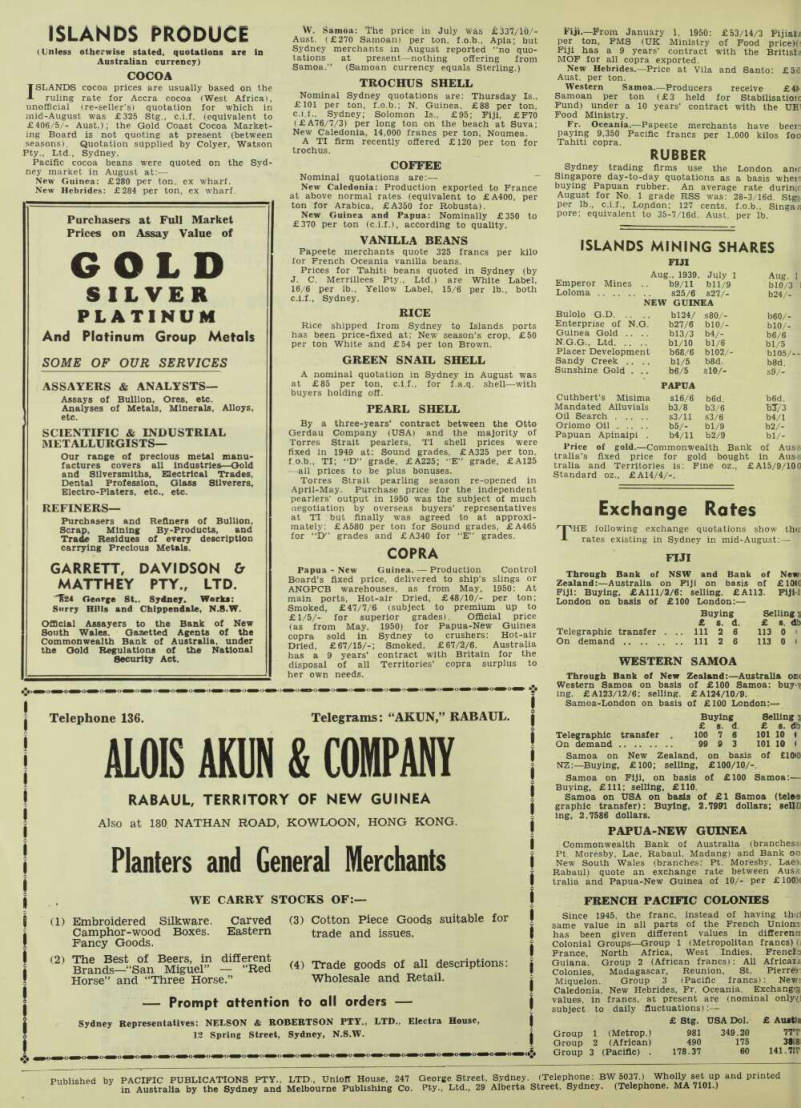
(Unless otherwise stated, quotations are in Australian currency)
Cocoa
ISLANDS cocoa prices are usually based on the ruling rate for Accra cocoa (West Africa), unofficial (re-seller’s) quotation for which in mid-August was £325 Stg., c.i.f. (equivalent to £406/5/- Aust.); the Gold Coast Cocoa Market ing Board is not quoting at present (between seasons). Quotation supplied by Colyer, Watson Pty., Ltd., Sydney.
Pacific cocoa beans were quoted on the Syd ney market in August at: — New Guinea: £2BO per ton, ex wharf.
New Hebrides: £284 per ton, ex wharf.
W. Samoa: The price in July ivas £337/10/- Aust. (£270 Samoan) per ton, f.0.b., Apia; but Sydney merchants in August reported “no quo tations at present—nothing offering from Samoa.’’ (Samoan currency equals Sterling.)
Trochus Shell
Nominal Sydney quotations are: Thursday Is., £lOl per ton, f.0.b.; N. Guinea, £BB per ton, c.i.f.. Sydney; Solomon Is., £95; Fiji, £F7O (£A76/7/3) per long ton on the beach at Suva; New Caledonia, 14,000 francs per ton, Noumea.
A TI firm recently offered £l2O per ton for trochus.
Coffee
Nominal quotations are:— New Caledonia: Production exported to France at above normal rates (equivalent to £A4OO, per ton for Arabica, £A3SO for Robusta).
New Guinea and Papua: Nominally £350 to £370 per ton (c.i.f.), according to quality.
Vanilla Beans
Papeete merchants quote 325 francs per kilo for French Oceania vanilla beans.
Prices for Tahiti beans quoted in Sydney (by J. C. Merrillees Pty., Ltd.) are White Label, 16/6 per lb., Yellow Label, 15/6 per lb., both c.i.f., Sydney.
Rice
Rice shipped from Sydney to Islands ports has been price-fixed at: New season’s crop, £5O per ton White and £54 per ton Brown.
Green Snail Shell
A nominal quotation in Sydney in August was at £B5 per ton, c.i.f., for f.a.q. shell —with buyers holding off.
Pearl Shell
By a three-years’ contract between the Otto Gerdau Company (USA) and the majority of Torres Strait pearlers, TI shell prices were fixed in 1949 at: Sound grades. £A325 per ton, f.0.b., TI; “D” grade, £A225; “E” grade, £AI2S —all prices to be plus bonuses.
Torres Strait pearling season re-opened in April-May. Purchase price for the independent pearlers’ output in 1950 was the subject of much negotiation by overseas buyers’ representatives at TI but finally was agreed to at approxi mately; £ASBO per ton for Sound grades, £A465 for “D’’ grades and £A34O for “E’’ grades.
Copra
Papua - New Guinea. Production Control Board’s fixed price, delivered to ship’s slings or ANGPCB warehouses, as from May, 1950: At main ports, Hot-air Dried, £4B/10/- per ton; Smoked, £47/7/6 (subject to premium up to £l/5/- for superior grades). Official price (as from May, 1950) for Papua-New Guinea copra sold in Sydney to crushers: Hot-air Dried, £67/15/-; Smoked, £67/2/6. Australia has a 9 years’ contract with Britain for the disposal of all Territories’ copra surplus to her own needs.
Piji.—Prom January 1, 1950: £53/14/3 PijiaHi per ton, PMS (UK Ministry of Food price)(; Fiji has a 9 years’ contract with the British MOF for all copra exported.
New Hebrides.—Price at Vila and Santo: £5:6 Aust. per ton.
Western Samoa.—Producers receive £4t Samoan per ton (£3 held for Stabilisation Fund) under a 10 years’ contract with the UH Food Ministry.
Fr. Oceania.—Papeete merchants have been paying 9,350 Pacific francs per 1,000 kilos foo Tahiti copra.
Rubber
Sydney trading firms use the London amc Singapore day-to-day quotations as a basis when buying Papuan rubber. An average rate during August for No. 1 grade RSS was: 28-3/16d. Stgi per lb., c.i.f., London; 127 cents, f.0.b., Singa* pore; equivalent to 35-7/16d. Aust. per lb.
Islands Mining Shares
Price of gold.—Commonwealth Bank of Ausa tralia’s fixed price for gold bought in Ausa tralia and Territories is: Fine oz., £AIS/9/10C Standard oz., £AI4/4/-.
Fiji
Aug., 1939.
July 1 Aug. 1 Emperor Mines .. b9/ll bll/9 blO/3 i Loloma 525/6 s27/b24/-
New Guinea
Bulolo G.D bl24/ s80/b60/- Enterprise of N.G. b27/6 blO/blO/- Guinea Gold .. .. bl3/3 b4/b6/6 N.G.G., Ltd bl/10 bl/6 bl/5 Placer Development b68/6 bl02/bl05/— Sandy Creek .. bl/5 b8d. b8d.
Sunshine Gold . .. b6/5 slO/s9/-
Papua
Cuthbert’s Misima S16/6 b6d. b6d.
Mandated Alluvials b3/8 b3/6 B37 3 Oil Search S3/11 s3/6 b4/l Oriomo Oil b5/bl/9 b2/- Papuan Apinaipi . b4/ll b2/9 bl/-
Exchange Rates
THE following exchange quotations show thu rates existing in Sydney in mid-August:—
Fiji
Through Bank of NSW and Bank of New Zealand:—Australia on Fiji on basis of £10(C Fiji: Buying, £Alll/2/6: selling. £AII3. Fiji-1 London on basis of £lOO London: —
Western Samoa
Through Bank of New Zealand: —Australia on< Western Samoa on basis of £lOO Samoa: ing. £AI23/12/6: selling. £AI24/10/9.
Samoa-London on basis of £lOO London:—
Samoa on New Zealand, on basis of £10(0 NZ:—Buying, £100; selling, £lOO/10/-.
Samoa on Fiji, on basis of £lOO Samoa; — Buying, £111; selling, £llO.
Samoa on USA on basis of £1 Samoa (teles graphic transfer): Buying, 2.7991 dollars; seIHJ ing, 2.7586 dollars.
Papua-New Guinea
Commonwealth Bank of Australia (branchesa Ft. Moresby, Lae, Rabaul, Madang) and Bank oo New South Wales (branches: Ft. Moresby, Lae?
Rabaul) quote an exchange rate between Ausa tralia and Papua-New Guinea of 10/- per £100)<
French Pacific Colonies
Since 1945, the franc, instead of having thirl same value in all parts of the French Unions has been given different values in different!
Colonial Groups—Group 1 (Metropolitan francs) ( Prance, North Africa, West Indies, PrencEo Guiana. Group 2 (African francs); All Africarr Colonies, Madagascar, Reunion, St. Pierre?- Miquelon. Group 3 (Pacific francs): New; Caledonia, New Hebrides, Fr. Oceania. Exchange values, in francs, at present are (nominal subject to daily fluctuations): —
Buying Selling j £ s. d. £ s d: Telegraphic transfer ... Ill 2 6 113 0 i On demand Ill 2 6 113 0 (
Buying Selling i £ s. d £ s. db Telegraphic transfer 100 7 6 101 10 I On demand 99 9 3 101 10 <
£ Stg.
USA Dol. £ Auat Group 1 (Metrop.) 981 349.20 77'T Group 2 (African) 490 175 38' 8 Group 3 (Pacific) . 178.37 60 141.71V
Advertisements & other items, pp. 114-116 (3 items)
Published by PACIFIC PUBLICATIONS PTY., LTD., Uniofl House, 247 George Street, Sydney. (Telephone; BW 5037.) Wholly set up and printed
in Australia by the Sydney and Melbourne Publishing Co. Pty., Ltd., 29 Alberta Street, Sydney. (Telephone. MA 7101.)
Alois Akun & Company
Purchasers at Full Market Prices on Assay Value of
GOLD
SILVER
PLATINUM
And Platinum Group Metals
SOME OF OUR SERVICES
ASSAYERS & ANALYSTS—
Assays of Bullion, Ores, etc.
Analyses of Metals, Minerals, Alloys, etc.
SCIENTIFIC & INDUSTRIAL
METALLURGISTS—
Our range of precious metal manufactures covers all Industries—Gold and Silversmiths, Electrical Trades, Dental Profession, Glass Sllverers, Electro-Platers, etc., etc.
REFINERS—
Purchasers and Refiners of Bullion, Scrap, Mining By-Products, and Trade Residues of every description carrying Precious Metals.
GARRETT, DAVIDSON Cr
MATTHEY PTY., LTD.
"824 George St.. Sydney. Works: Surry Hills and Chippendale, N.B.W.
Official Assayers to the Bank of New South Wales. Gazetted Agents of the Commonwealth Bank of Australia, under the Gold Regulations of the National Security Act.
Telephone 136. Telegrams: “AKUN,” RABAUL.
ALOIS AKUN & COMPANY
RABAUL, TERRITORY OF NEW GUINEA
Also at 180 NATHAN ROAD, KOWLOON, HONG KONG.
Planters and General Merchants
WE CARRY STOCKS OF:—
(1) Embroidered Silkware. Carved Camphor-wood Boxes. Eastern Fancy Goods. (2) The Best of Beers, in different Brands—“ San Miguel” “Red Horse” and “Three Horse.” (3) Cotton Piece Goods suitable for trade and issues. (4) Trade goods of all descriptions: Wholesale and Retail.
Prompt attention to all orders Sydney Representatives: NELSON & ROBERTSON PTY., LTD,, Electra House, 12 Spring Street, Sydney, N.S.W.
Tooth’S
z y ood company deserves the best, and it is a thoughtful and discerning host who serves his guests sparkling K.B. Lager. For “K. 8.” adds enjoyment to any gathering, and it’s one drink that’s appreciated by everybody, men and women alike.
G
K.B
LAGER
*• m rm
Capital ... £500,000
ESTABLISHED 1914
GENERAL MERCHANTS
AND
PROVIDORES
TRAL3 THROUGHOUT THE PACIFIC.
THIRTY-FIVE YEARS OF PACIFIC ISLANDS DEVELOPMENT AND SERVICE.
BUYERS AND EXPORTERS OF ALL KINDS
OF ISLAND PRODUCE, COPRA, COCOA,
M.O.P. SHELL, TROCAS SHELL, ETC.
AGENTS FOR AUSTRALIAN, EUROPEAN
AND AMERICAN MANUFACTURERS.
DISTRIBUTORS OF EVERY DESCRIPTION
OF MERCHANDISE.
Through our Sydney office, branches and agents, we distribute a wide and comprehensive range of general merchandise.
». R. CARPENTER & CO. 111).
Head Office: 16 O#CONNELL0 CONNELL STREET, SYDNEY, N.S.W.
Cable Address:
“CAMOHE.”
Telephone: BW 4421.
Postal Address: G.P.0., BOX 168, Sydney.
In London: W. R. Carpenter & Co. (London), Ltd., Coronation House, 4 Lloyd's Ave., London, EC
ASSOCIATED COMPANIES THROUGHOUT THE PACIFIC :
IN NEW GUINEA:
New Guinea Company, Limited, Rabaul, Lae, Madang, Kavieng.
IN PAPUA:
J. R. Clay & Co., Ltd., Port Moresby.
IN FIJI:
W. R. Carpenter & Co. (Fiji), Ltd., Suva.