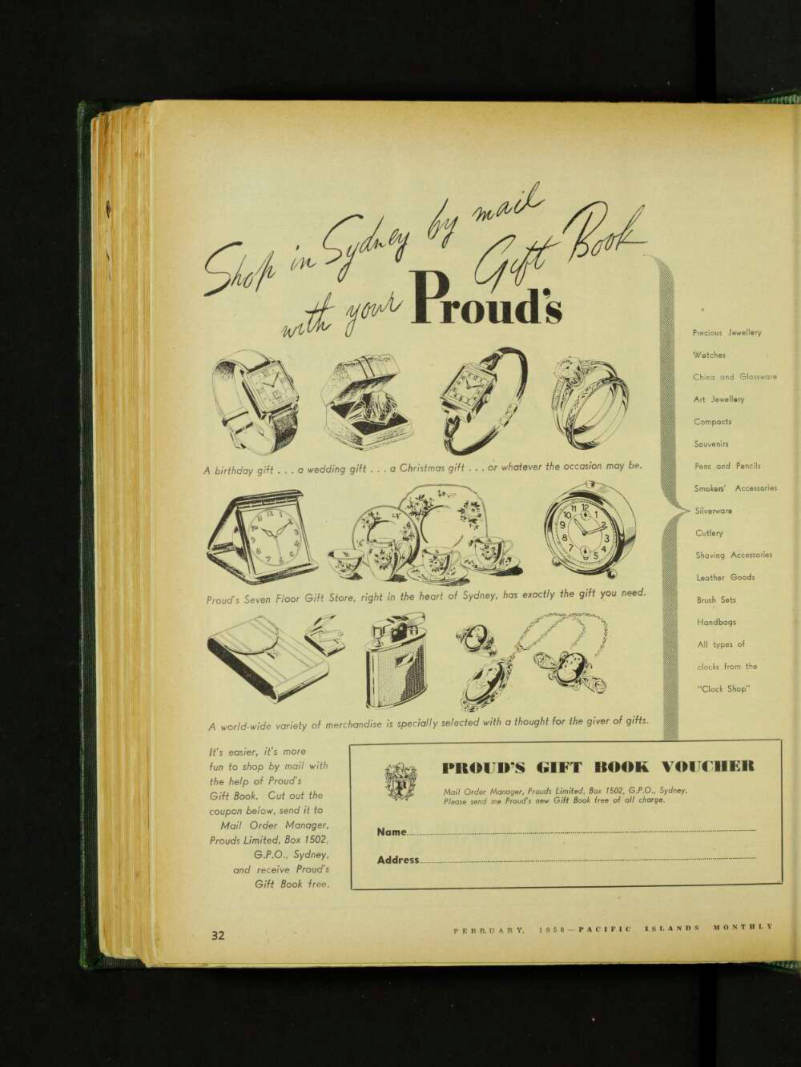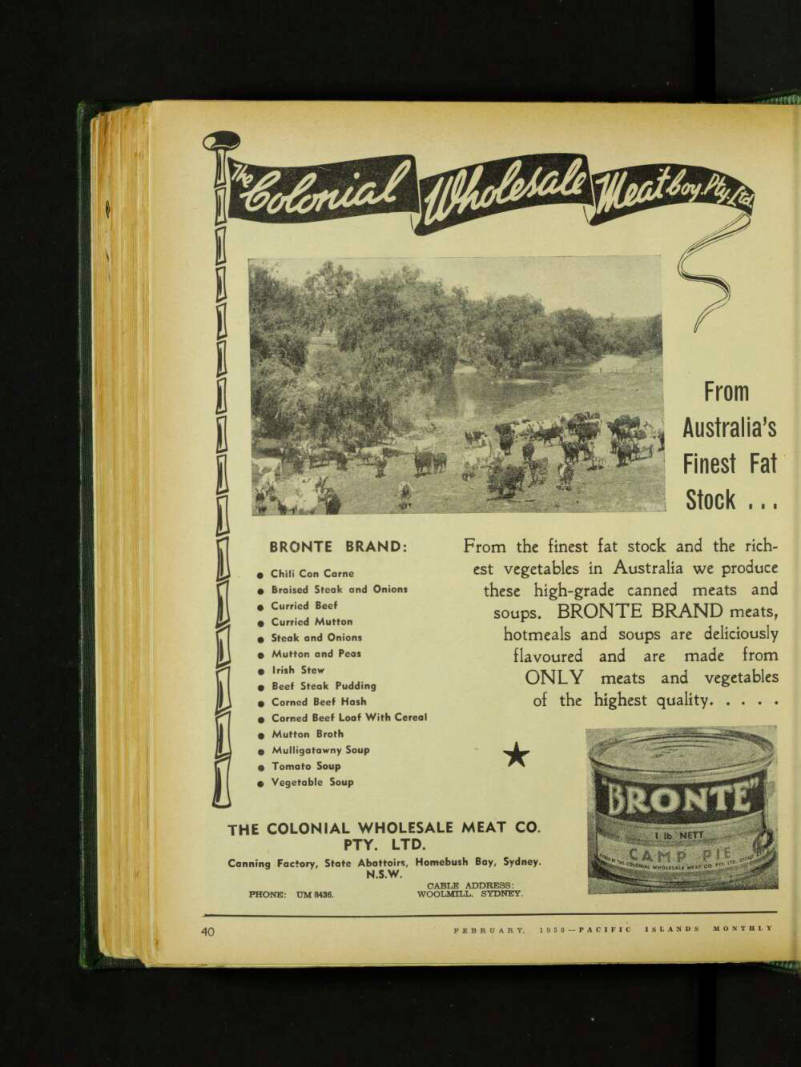
Islands
Pacific
Monthly
February 1950
Vol. XX. No. 7.
Established 1930.
[Registered at the G.P.0., Sydney, for transmission by post as a newspaper ]
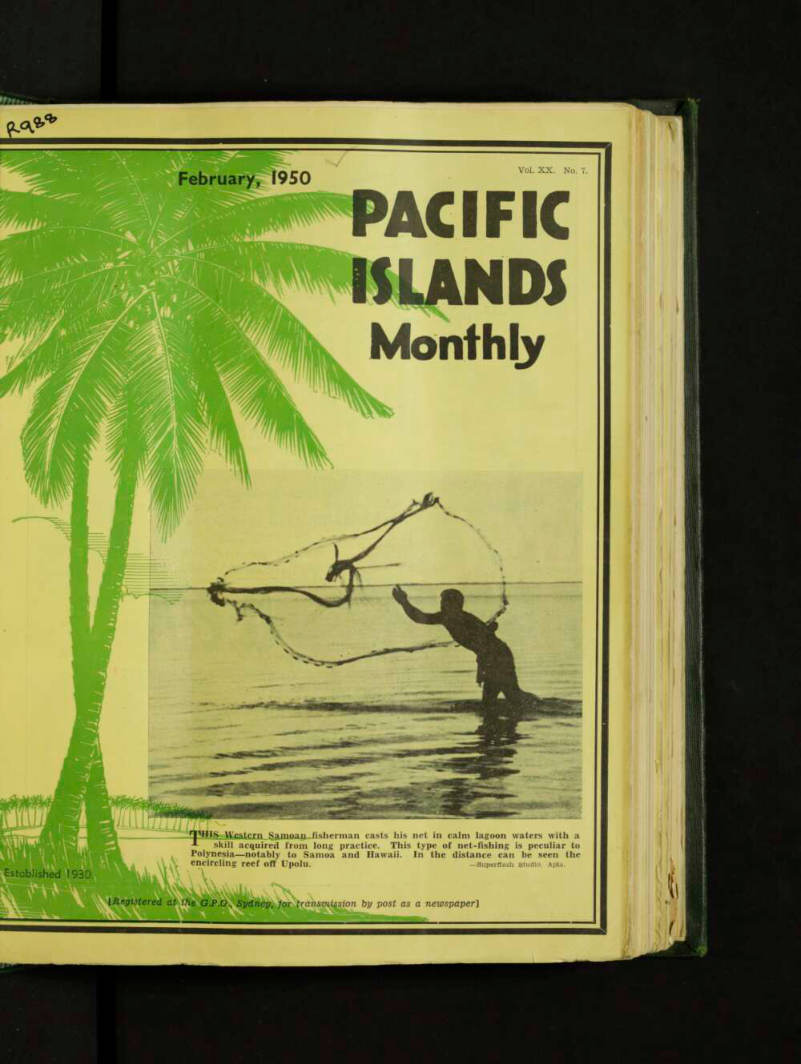
This Western Samoan fisherman casts his net in calm lagoon waters with a A skill acquired from long practice. This type of net-fishing is peculiar to Polynesia—notably to Samoa and Hawaii. In the distance can be seen the encircling reef off Upolu. —Superflash Studio, Apia.
Advertisements & other items, pp. 2-4 (1 item)
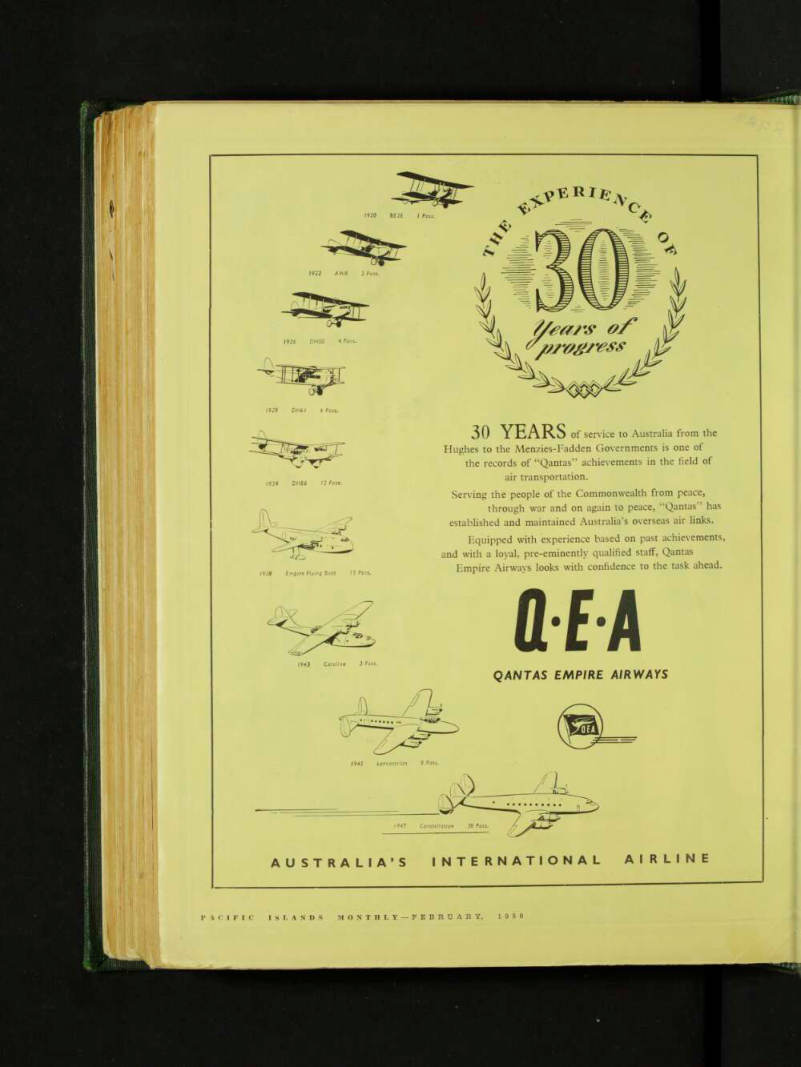
/?r#gress 0
y> . _- * - & = 1926 DHSO 4 Pass. f\ ' JJ 1929 DH6I 6 Pass. r^T” 1934 DHB6 12 Pass. 1938 Empire Flying Boat 15 Pass. 2? 1943 Catalina 3 Pass. . - w
of y
30 YEARS of service to Australia from the Hughes to the Menzies-Fadden Governments is one of the records of “Qantas” achievements in the field of air transportation.
Serving the people of the Commonwealth from peace, through war and on again to peace, “Qantas” has established and maintained Australia’s overseas air links.
Equipped with experience based on past achievements, and with a loyal, pre-eminently qualified staff, Qantas Empire Airways looks with confidence to the task ahead.
QANTAS EMPIRE AIRWAYS
L
AUSTRALIA’S INTERNATIONAL AIRLINE
\ \ Instant-lite Petrol Lantern 300 or 500 C.P. m ■--j Speed-master Petrol Stove
LANTERNS IRONS STOVES
THE BEST OF
THEIR KIND
Coleman appliances have for many years been bringing better ways of living to
people everywhere. They bring greater
comfort and happiness with better light . . . easier, faster ironing . . . more convenient, more healthful heating . . .
better cooking.
Over forty years’ experience in producing
these appliances have made Coleman Products “The best of their kind.”
Coleman’s appliances include:— Petrol and Kerosene operated Lamps, Lanterns,
Irons, Stoves, Portable Stoves, Brazing
Torches and Blow Lamps. m/y Hi Kerosene or Petrol T Ui Table or Hanging Lamp
&SSL-
* E. Coleman “530”
Pocket Stove Coleman Kerosene Iron V; Kerosene 3 Burner Cooking Stove Instant-lighting portable Petrol Cooking Stove Representatives for the Pacific Islands : ROBERT GILLESPIE PTY. LTD. pearce su s va co Lm 54a PITT STREET, SYDNEY FOR FIJI ISLANDS
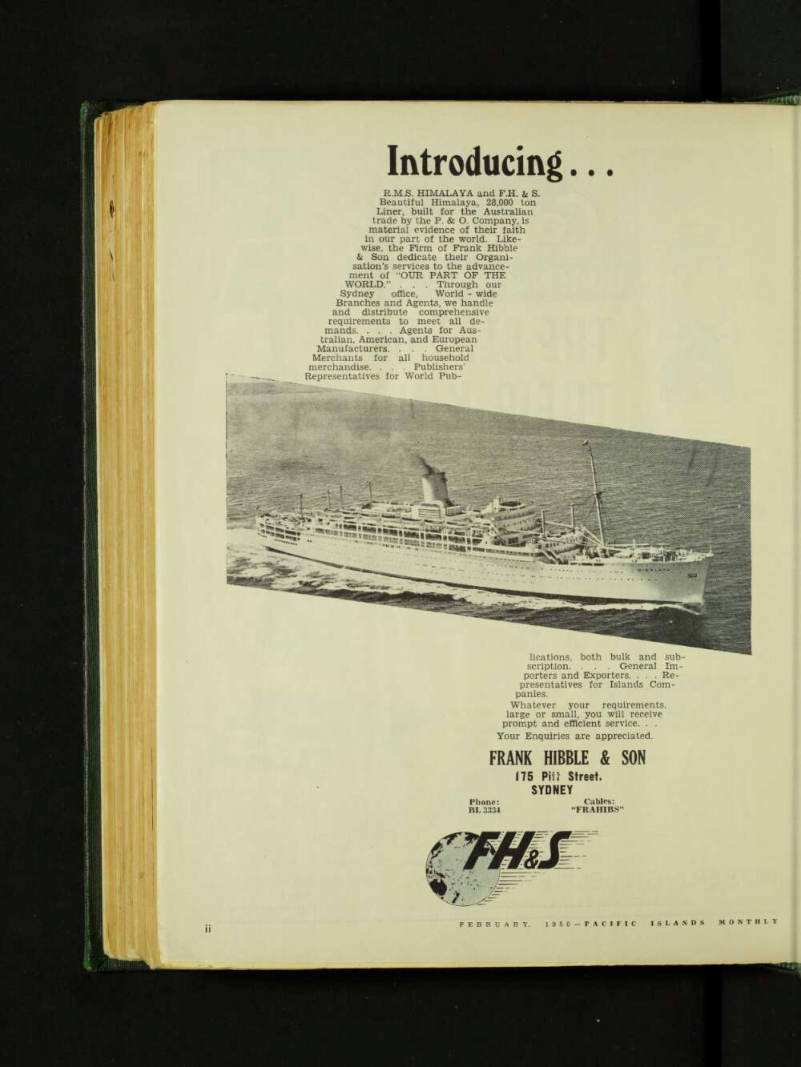
Introducing...
R.M.S. HIMALAYA and F.H. & S.
Beautiful Himalaya, 28,000 ton Liner, built for the Australian trade by the P. & O. Company, is material evidence of their faith in our part of the world. Likewise, the Firm of Frank Hibble & Son dedicate their Organisation’s services to the advancement of “OUR PART OF THE WORLD.” . . . Through our Sydney office, World - wide Branches and Agents, we handle and distribute comprehensive requirements to meet all demands. . . . Agents for Australian, American, and European Manufacturers. . . . General Merchants for all household merchandise. . . . Publishers’
Representatives for World Pubm i m lications, both bulk and subscription. . . . General Importers and Exporters. . . . Representatives for Islands Companies.
Whatever your requirements, large or small, you will receive prompt and efficient service. . .
Your Enquiries are appreciated.
FRANK HIBBLE & SON
175 PiU Street,
SYDNEY
Phone: BL 3334 Cables:
TRAHIBS”
S
Index to Advertisers
Achun, Gabriel . . 77 Alois Akiin & Co. . 45 Aluminium Union . 76 Amplion (A/asia) . 38 Angus & Robertson, Ltd. 21 Armstrong Siddeley Motors, Ltd. . . 22 “Aspaxadrene” . . 100 Baker, W. Jno. . . 43 Bank of NSW . . 73 Berry’s Bay Boat yard ... 89 Bethell, Gwyn & Co 75 Blaxland Rae Pty. 18 Blundell, Spence . 46 Bovril 37 Breden, Wynne S. 67 Bristol-Myers Co. . 61 Broomfields. Ltd. . 69 Brunton & Co., Ltd. 59 Budge, James, Ltd. 42 Bunting, A. H.
Ltd 64, 105 Burns Philp (NG) . 57 Burns Philp (NH) . 47 Burns Philp (SS) . 72 Burns Philp Trust 102 Caine’s Studios . . 73 Carpenter, W. R. & Co., Ltd., 44. cov. iv.
Carpenter, W. R. (Fiji), Ltd. . . 84 Carrlock Co., Ltd. 67 “Charmosan” . , 15 Classified Advertise ments ... 105 Colonial Meat Co. 40 Colyer Watson (NG), Ltd. . 26, 68 Commonwealth Bank of Aus tralia 35 Coventry, A. R. . 87 Crammond Radio . 80 “Cystex” ... 94 Dangar, Gedye & Malloch, Ltd. . . 1 Davison Paints . . 33 Donaghy, M., & Sons Pty., Ltd. . 79 Donald, A. 8., Ltd. (Auckland) ... 76 Donald, A. B. Ltd. (Rarotonga) . . 81 Eichorn’s Remedies 92 Electrolux ... 44 E.M.F. Electric Co. 25 Etablissements Donald Tahiti . . 60 Export Soap Co. . 101 “Flit” 23 Ford Sherington, , Ltd 41 Garrett, Davidson & Matthey, Ltd. 106 Garrick Hotel . . 27 Gilbey, W. & A.
Ltd 85 Gillespie Bros., Ltd. 38 Gillespie, Robert, Pty., Ltd. . . i., 43 Gillespie, Robert (NG), Ltd. . 63, 89 Gordon’s Gin ... 78 Gough & Co., E. J. 79 Grand Pacific Hotel 2 Grand, Walter . . 29 Gregory, A., Ltd. . 42 Grove & Sons, W.
H.. Ltd 69 Halvorsen Lars, Sons Pty., Ltd. . 86 Hardman & Hall 71 Hawaiian Club . . 87 Heinz & Co., Ltd. . 34 Hemingway & Robertson, Ltd. . 30 Herco Pty., Ltd. . 41 Hibble, F., & Son ... ii., 99 Hoover, Francis . . 21 Howell, Geo. ... 96 International Trad ing Co. Pty., Ltd. 64 Kasper Refrigera tors Pty., Ltd. . 70 Kennedy, Captain . $8 Kerr Bros. Pty., Ltd 18, 22 Kolynos, Inc. ... 24 Kopsen, W. & Co. 31 Kosak, Robert . . 93 Kraft Walker Cheese Co. ... 29
Kui, George ... 82 Kwong Chong Bros. 91 Larke, Neave & Carter, Ltd. . . 97 Lawson, J. R., Ltd. 77 Maclntyre, Thomas & Co., Ltd. ... 39 Maloney, N. F., & Co 26 Mcllrath’s Pty., Ltd. 98 McKay Shipyards . 98 “Mendaco” ... 90 Merrill§es, J. c., Pty., Ltd. . 29,’ 90 Millers, Ltd. ... 93 Morris, Hedstrom Ltd 12 Motor Tractors, Ltd. 36 Nelson & Robertson 71 “Nixoderm” ... 78 Nordman, Oscar G. 27 NZ National Air ways Corporation 48 Pacific Islands Society ... 69 Pacific Islands Trading Co. . . 59 Pacific Islands Year Book ... 13 Pacific School of Music 35 Pan American Air ways, Inc., Ltd. . 14 Perkins fAust.) Pty .66 “Pinkettes” ... 81 Proud’s, Ltd. ... 32 Qantas Empire Air ways, Ltd. . cov. li, Qld. Insurance Co., Ltd 45 Reed, William E. 101 Riverstone Meat Co. Pty., Ltd. . . 19 Robinson, G. H., E. & 1., Pty., Ltd. . 82 Rohu, Sil . . . . 31 “San Elanda” Guest House (Qld.) . . 17 Scott, J., Pty., Ltd. 60 S.E. Book Co. . . 23 Shell Co. of Aust. . 83 Sherwin-Williams Paints 16 Smith, G. G., & Co., Ltd. ... 20. 86 Southern Pacific Insurance Co. . . 65 Steamships Trading Co., Ltd. ... 30 Stewarts & Lloyds 63 Stratton & Co., Ltd 47 Sullivan, C., Pty., Ltd 33, 75 Swallow & Ariell . 95 Tallerman & Co. . 34 Taylor, Allen & Co. 77 Thornycroft, Ltd. . 88 Tilley Lamp Co., Ltd. (England) . 74 Tillock & Co., Ltd. 68 Tongan Photos Bureau ... 61 Tooth & Co. . cov. lii.
Trans Oceanic Air ways Pty., Ltd. . 17 Tyneside Engineer ing Co., Ltd. . . 96 Union Mfg. & Ex port Co., Ltd, . 62 USL Batteries . . 72 Vacuum Oil Co., 23, 28 Ventura Trading Co 15, 83 Vidal, M. Emile . . 99 Vincent Chem. Co. 65 “Waitangi” For Sale 95 Watson, Victor, Ltd. 25 West. Harry ... 84 “Where the Trade Winds Blow” . . 105 Williams, Dr. . . 97 Willreed Agencies Pty., Ltd. ... 91 Wills, Geo., & Co. 18 Wills, W. D. & H.
O. (Aust.), Ltd. 58 Wright & Co. . . 94 Wunderlich, Ltd. . 39 Yorkshire Insur ance Co., Ltd. . . 37 Young, A. fl. & E. 85
Advertisements & other items, p. 5 (1 item)
hargam’s
Tree Felling ,
And Scrub Clearing
7 & sm \ *> bf*,.:T-saa \ ■A *4CCc^ • • • the easy WITH A
hargam’s
ONE-MAN MOBILE POWER SAW
This lightweight machine can be easily handled by one man for timber felling and scrub clearing on farms or plantations.
Timber cutters will find the Hargan’s economical to operate for the cutting of mine props, caps and sleepers. Its high driving power is provided by a British-built engine, and it is capable of cutting 14 inch hardwood logs in 6 seconds or better!
The Hargan’s Saw will take up to a 42 in. saw, and is mounted on rubber-tyred wheels for easy mobility.
THE SECRET OF “HARGAN’S” VERSATILITY
IS THE PATENT “GIMBAL RING AND
SADDLE” WHICH RETAINS THE MACHINE
ON THE SAME PLANE THROUGHOUT THE
CUT WHILST THE SAW BLADE CAN BE
ADJUSTED TO ANY CUTTING ANGLE.
SOLE AGENTS :
Dangar, Gedye & Malloch Limited
10-14 YOUNG STREET, CIRCULAR QUAY, SYDNEY
G.P.0., Box 509. Telephone: BU 5095.
In This Issue:
Editorial: Political Fun and Games in the New State of Indonesia .. 3 Pacific Franc is a Thorny Problem .. 4 Copra Price—New Guinea Planters Await Information 5 Inferior Copra Shipped from NG .. 5 Fiji Tuna Won’t Co-operate 5 Newspaper for Port Moresby ... 5 Sabotage Alleged in Catalina Ex plosion Case 6 Report that Jap War Criminals Freed 6 Dispute holds up Bulolo 7 Fourth Judge for P-NG 7 Important Discussions in New Guinea Soon 7 Tea From Nondugl—Hallstrom Plan 8 Is there an Undiscovered People in Guadalcanal? 8 Fires in Bougainville Copra Driers .. 8 Fiji Sugar Agreement 9 Native Labour from NG Highlands 9 UN Will Investigate NG and Nauru 9 Who Controls Shipping in Terri tories? 10 Fiji Empire Games Team in Auckland 10 New Hotels in New Guinea 10 Fiji Missed by Hurricane 10 The Month in Moresby 11 Fall of Rabaul—Anniversary Services 13 New RC Arrives in Honiara 13 French Airways in Pacific 15 New Zealand Government’s Air Plans 15 New Secretary for Melanesian Mission 15 Senator Kendall Visits Rabaul .. .. 16 Mr. Tom Lowney Retires 16 South Pacific Commission—Suva Conference 17 New Buildings in Apia, W. Samoa .. 21 Northern Hotels Ltd. Buy New Hotel 21 More Fijian Cane Farmers 22 Mangaians Expect Fruit War Soon .. 22 Dr. Vernon Remembered at the Mission in the Mud 23
No Mariposa Yet 25 Mother and Daughter Have them Worried 26 Where Do Manihiki Panamas Go? .. 27 Western Samoa Newsletter 29 New Fiji Government Posts Created 30 Apia Motor Cutter Stolen 31 Civil Administration for Eastern Samoa? 33 ‘Operation Bang’ at Aitape, NG ... 34 New Guinea Natives for RAN ... 35 Bounty Bible Goes Back to Pitcairn Is 35 NZ Medical Reseach Team in Raro tonga 39 Smashed on a Coral Reef—Wreck in Tonga 41 Cook Is. Natives Have New Plans for Co-operative Association 48 Mr. Borron and the New Zealanders 47 Territories’ Talk Talk 49 Cat, Crab or Cabbage—What’s in a Name? 50 Bird’s Eye View of New Guinea’s Atolls 51 They are Digging Up Strange Arti facts in New Guinea Now .. .. 52 Tropicalities 54 PIM Crossquiz 55 Children’s Corner :: Fashion .. .. 56 “Jonfrum” is New Hebridean “Cargo Cult” —Part II 59 Shipwrecks in French Oceania—Grim Record of 75 years 65 Pacific Folklore and Mythology ... 68 Ceremony and Beauty; A Wedding in Samoan Style 71 Norfolk Island Notes 73 Notes from Talasea 77 How our Films Can Influence Native Communities 79 The Japanese Wife Wartime Memory of Dr. Vernon 82 Tropical Medicine Specialist in Fiji .. 84
Plane and Shipping Tables 87 Notes from French Oceania 98 Buka-Bougainville Has Radio and Other Troubles 101 Kieta News 102 Rabaul Roundabout 103 Kavieng News 104 OBITUARY: J. Dunne, 6; Henry Kuper. 6: S. D. Mastapha, 7; Mrs. A.
Goedicke, 9; Edmund Stehlin, 76; Rev.
Pr. Cavalier, 75; C. Jacobson, 82; W.
Bambridge, 104; Mrs. D. Messenger, 105; E. G. Theodore, 105.
INDUSTRIES: Copra, 5, 34; Oil, 7, 94; Sugar, 9: Rubber, 15; Gold, 95, 104.
ASSOCIATIONS: NG Scholarship Fund, 8; Polynesian Club, 76; Rabaul Cricket Club, 95; Pacific Islands Society, 104.
The new manager of the Suva Branch of the Bank of New Zealand, Mr. C. D.
Barford, arrived from the United King dom in early February. He has been on the staff of the London Branch of the Bank. In Suva, he will replace Mr. B. C.
Carpenter, who will leave shortly for New Zealand on transfer.
Bishop Foley left Suva in the Aorangi on February 4 for Canada, on his way to Rome by way of the United Kingdom and Ireland. He is making the Holy Year Pilgrimage to Rome and on his way will visit his parents in Kent. He expects to return to Fiji from the United Kingdom by plane towards the end of April.
Major and Mrs. T. Upson, of Manus Island, NG, have been in Brisbane for many months where Major Upson has spent a lot of time in hospital as a re sult of a motor accident on Manus. Both expect to return to New Guinea shortly.
Their son, T. W. J. Upson, usually known as Tommy, has joined the Australian Army for a term of 9 years. He will spend the first three at the Army Ap prentice School at Balcombe, Vic.
Advertisements & other items, p. 6 (1 item)
: *
KBS*
ta v
Pacific Islands Monthly
The Newspaper-Magazine of the South Seas iRegistered at the G.P.O., Sydney, for transmission by post as a newspaper I
Published Once Each Month and Circulated in Australia and New Zealand and in the following Pacific Territories and Islands Groups:
Australian Territory of Papua.
Trustee Territory (Australia) of New Guinea.
Australian Territory of Norfolk Island.
New Zealand Territory of Cook Islands.
Trustee Territory (NZ) of Western Samoa.
British Colony of Fiji.
British Solomon Islands Protectorate.
British Protectorate of Tongan Islands.
British Crown Colony of Gilbert and Ellice Islands.
Trustee Territory of Nauru.
British and French Condominium of New Hebrides.
French Colony of New Caledonia.
French Colony of Oceania (Tahiti, etc.).
American Territory of Eastern Samoa.
American Territory of Hawaiian Islands.
Owned and Produced by Pacific Publications Pty., Ltd., Union House, 247 George Street, Sydney.
Telephone: General Office and Advertising, BW 5037.
P.O. Box 3408
Registered Address for Telegrams, Radiograms, and Cables: “Pacpub,” Sydney.
Contributions.
Articles, Stories, and Photographs dealing with Pacific Islands subjects are invited and will be paid for on publication.
Subscription Rates.
Per Annum, Pre-paid, Including Postage.
In Australia, New Zealand, Fiji New Guinea, Papua, Western Samoa, Cook Islands, Tonga, British Solo mons, Gilbert and Ellice Colony, Nauru, New Hebrides, and United Kingdom 18 0 Elsewhere $2.50 £1 1 o Single Copies 1 9
Editor and Publisher:
R. W. Robson, F.R.G.S.
Assistant Editor: JUDY TUDOR.
General Office; Union House, 247 George Street, Sydney. Telephone: BW 5037.
Business Manager: Selwyn Hughes.
Representative In London.
J. T. Wallis, Coronation House, 4 Lloyd’s Avenue, London, E.C.3, from whom may be obtained copies of Pacific Islands Monthly, Pacific Is. Year Book, advertising schedules, etc,
Representative In U.S.A.
Pacific Islands Trading Cos., 244 California St., San Francisco, U.S.A.
Agents.
The following are authorised to receive sub scriptions for Pacific Islands Monthly:— Burns, Philp & Cos., Ltd., and Burns Philp (South Sea) Cos., Ltd. All branches.
W. R. Carpenter & Cos., Ltd. All branches.
Morris, Hedstrom, Ltd. All branches.
Steamships Trading Cos., Papua. All branches.
Steele’s Central Store, Suva, Fiji.
Adams Pharmacies Pty., Lautoka, Fiji.
Cook Islands Trading Cos., Rarotonga, Cook Is.
A. Vercoe, Apia, Western Samoa.
Oscar Nordman, Papeete, Tahiti.
Islands Branches and Representatives of W. H.
Grove & Sons, Ltd., Auckland, New Zealand.
Ed. Pentecost, Noumea, New Caledonia.
Societe Gubbay Kerr et Cie, Noumea, New Caledonia.
Vol. Xxi, No. 7.
February, 1950
r 1/9 Per Copy.
Price \ Prepaid, p.a.; 18/- Aust. ( In USA, p.a.: $2.50.
Political Fun and Games The New State
New State of Indonesia
AS was anticipated, the appearance of “the Republic of the United States of Indonesia,” in the Western Pacific, on January 1, 1950, has had a disturbing effect upon other Pacific communities—not so much because of the establishment of a new State, as because of the arrogance and stupidity of the Indonesians.
When Holland and Indonesia finally reached agreement at The Hague last November, it was provided that Dutch New Guinea (the western half of the big Island) should for the present re main a Territory of the Netherlands.
It was further provided that the per manent future status of Dutch New Guinea should be decided before December 31, 1950.
It is plain to anyone that Dutch New Guinea is not in Indonesian territory. Racially, geographically, historically, culturally, there is no connection whatever between Indo nesia and Dutch New Guinea. It was only for convenience in administra tion that Dutch New Guinea was tacked on to the Netherlands Indies,, and governed from Batavia.
Within two or three days of the hoisting of the Republican flag in Batavia (the name of which was changed immediately to Jakarta—a good example of Indonesian men tality) the leading lights of the new Government announced that, before the year was out, Dutch New Guinea would be added to the Indonesian Republic. That made a very bad im
pression in the outside world—it was so typical of the way in which this type of Asiatic regards an agreement.
THE next development was the appearance in Western Java of a private army controlled by Captain “Turk” Westerling—a former Dutch- British Commando leader, and the adventurous son of Dutch-Turkish parents. He suddenly descended upon the important Java town of Bandoeng, sent the Indonesian soldiery scut tling across the countryside and occupied the area. Having completed his demonstration, and made the Indonesians look ridiculous, he re tired.
The origin and purpose of the Westerling activities are not clear; but they seem to be definitely pro- Dutch and anti-Indonesian. About a quarter of a million Dutch and part- Dutch people have been left high and dry in Java by this Republican arrangement; and there are indica tions that many Dutchmen are rally ing to the Westerling flag to fight as guerillas, and that supplies and muni tions are reaching the rebels from Australia and other countries. Wes terling is likely to provide, for Indonesia, in every respect, what the Americans call “a pain in the neck.”
Then the newspapers were stirred to a new excitement by a gentleman named Mohammed Yamin, described as “an official in Jakarta.” He de clared, on January 29, that Australian
New Guinea, as well as Dutch New Guinea, should become part of the United States of Indonesia, and that Australian New Guinea would be first on the list of Indonesia’s list of terri torial claims after Indonesia had acquired Dutch New Guinea. He also voiced Indonesia’s wish to control all Borneo, and to take over Portuguese Timor.
Although it was soon made clear that Mr. Yamin was merely a super bureaucrat, and did not speak for the Government of Indonesia, it was generally suspected that he was ex pressing the sentiments of the Government.
The Australian Minister for Ex ternal Affairs, Mr. Spender, expressed Australia’s view in two crisp sen tences: “Indonesia has not the slightest shadow of a claim to Aus tralian New Guinea on any ground, ethnic or otherwise. Any such claim would not admit of a moment’s con sideration and would be immediately rejected.”
Osmar White, Melbourne Herald’s correspondent in Batavia, reported on January 31, that Yamin’s state ment: “ . . . has evoked howls of ironic laughter from Europeans throughout Java. They are struck with the humour of a situation in which a Government, unable to maintain order 25 miles from its own capital, nurtures dreams of an empire. . . .
Mohammed Yamin, left wing philo sopher and adviser to the Indonesian Government at The Hague Confer ence, genuinely expresses the opinion of an influential section of Indo nesian politicians. The Government has disavowed him, but the situation here is ‘Who will be the Government
to-morrow?* Even scoffers and ostriches, who wanted to believe that all was well with Dr. Soekarno and his boys, to-day ruefully admit that the Westerling affair is not finished.”
A few days later, the Indonesian newspapers in Java were demanding the deportation of Osmar White.
IT seems certain that much will be heard of Dutch New Guinea in the future, and equally certain that Australia will have a good deal to say about it, Australia’s interest is three fold:— • Dutch New Guinea represents half of the great Island of New Guinea—the other half of which is Australian Territory (subject, of course, to Trusteeship). Australia would be very disturbed to think that her frontier was shared with Indo nesia, a State that, it seems certain, will be penetrated by Communism sooner or later. • The maintenance of the arc of islands which run from Timor through New Guinea, New Britain and the Solomon Islands to the New Hebrides, as a defensive barrier for Australia against possible aggression from Asia, is a first principle of Australian Government. Australia contemplates, with equanimity, a government of Western New Guinea by the Dutch; but she will certainly resist the ap pearance there of the Republic of Indonesia. • And, finally, there is oil. The new oilfield, found in 1939 at Sorong, at the western tip of Dutch New Guinea, and developed since the war, is now in production, and the crude oil is being treated at the new re finery, built recently at Altona, Mel bourne, at a cost of £1,000,000 —a most important thing for Australia.
Neither the Dutch nor the Austra lians see any reason why they should surrender this valuable oilfield to Indonesia.
Meanwhile, the United States—as part of its policy of erecting econo mic barriers against the spread of Communism from Asia—has made a large dollar loan to Indonesia.
Bugler Dunne Dies In Sydney
MR. JACK DUNNE, better known as Bugler Dunne, died in Sydney in February, He won fame as a bugler at the Battle of Colenso, when as a teen age youngster he sounded the advance instead of retreat, with the re sult that the battle was a victory for the British troops. After the Battle of Colenso he was presented with a silver bugle by Queen Victoria.
Bugler Dunne lived for a number of years in Fiji. In Levuka he was for a time licensee of the Polynesian Hotel, and in Suva he named his home in Gorrie Street “Colenso” after the Boer War battle.
He served on a number of inter-island ships, then became a steward on a vessel trading between Fiji and Australia. Later he served in the same capacity on Burns Philp ships on the Sydney-New Guinea run.
Pacific Franc
Conference Pending On Thorny Subject
From Our Own Correspondent
Noumea, Jan. 20.
SUBJECT to the approval of the French Administration, a French Pacific conference, to be attended by a number of General Councillors from New Caledonia and Tahiti, and the French Syndicat Agricole in the New Hebrides, will be held shortly in Noumea to con sider and make recommendations on the exchange value of the Pacific franc.
This is regarded as one of the most im portant financial questions of the day.
Mounting Tax Burden On
Fijian Community
From Our Own Correspondent
Suva, Jan. 8.
IN 1948, the Fijian people paid £26,569 in direct taxation for the education of approximately 26,000 Fijian child ren. In addition to this tax-burden, the Fijian people paid considerable sums pri vately in fees to mission schools or through special levies approved by tikina councils.
Besides cash payments, the programmes of work in most of the Fijian provinces require taxpayers to give their services in tikina school compounds for a specified number of days a year—never more than two weeks.
In 1948, 25,516 Fijians were registered as taxpayers, a number almost equal to that of the children attending the schools.
The cost of each pupil from taxation was therefore about £l.
The direct taxation levy on the Fijians for education has risen steadily since 1938 when it was £7,731 (for 19,314 children).
In 1947, says a report, the annual in come of 16,000 Fijian taxpayers was £1,100,000 a year, while the remaining
10,000 received only £llO,OOO, and adds: “It is the hard core which suffers severely from the tremendous rise in the cost of education ... So far, a prac tical solution appears to be far away,”
Taxes levied by the Fijian Administration were “reluc tantly increased” in 1948. The Administration’s income from all sources amounted to £79,541, compared with £36,877 in 1938.
Total expenditure £79,489, com pared with £39,675. Revenue from rates was £47,872, com pared with £27,271 in 1936.
In Sunny Fiji—and A Few Other Places
Few Other Places
Prospective Crew, to Ship owner: You pay me Sea men’s Union wages?
S. O.: Sure.
P. C.: You feed me according to Marine Board ration list?
S. O.: Too right!
P. C.: You supply me with drugs, as Marine Board say?
S. O.: Yes, yes.
P. C : How lavatory accom modation —he OK?
S. O.: Er yes O yes.
P. C.: Is the space in the crew’s quarters up to stand dard according to the regu lations?
S. O.: Look, you can come aboard and run the ruddy ship, and I’ll go and catch crabs on a beach somewhere!
Indentured Nt Labour
And Dollars
THE Administrator of Australia’s Northern Territory (Mr. A. R.
Driver) who was a Chifley Govern ment appointee, has asked the new Aus tralian Government to lift the ban on indentured labour from Koepang and Malaya. He says that if the ban is not lifted the Darwin pearling industry is finished.
He said, “Darwin master pearlers rely to a great extent on Asiatic labour. I have taken up the case of the pearlers with Canberra, and urged that an early decision is vital.
“A decision must be reached before the end of the month, when Koepangers are due to be repatriated.
“Every pearl shell fished in Territory waters helps in our fight for dollars. All the shell is sold to America and thousands of dollars are involved.
“I believe in encouraging enterprise in the north and I would be most disap pointed if the Darwin pearling industry is allowed to die.”
Since the Pacific war, when Japanese went out of the industry, the Socialist Federal and Queensland Governments have placed all the emphasis on making Northern Territory and Torres Strait pearling a native industry.
Asiatic Pearlers to Carry On
in Darwin
THE new Australian Minister for Immi gration (Mr. Holt)) has reversed the attitude of Mr. Calwell who ruled that coloured labour could not live within 30 miles of Darwin.
This means that Darwin master pearlers can now engage new crews of indentured Malay and Koepang labour before pre sent crews are compulsorily repatriated at the end of February.
Mr. Holt reached his decision after con ferring with the Administrator of the Northern Territory and others.
Copra Price
New Guinea Planters Await Information
OWING to general elections and the disturbed state of politics in Aus tralia and Britain, there still is some uncertainty about the price which South Pacific planters are going to get for copra, under the agreement with Britain, dur ing the year 1950.
Towards the end of 1949 (the first com plete year of the 9-years guarantee given by the British Department of Food) Britain announced that the 1950 price would be somewhat less than 1949. Gov ernment officials and planters in the South Pacific apparently were prepared to accept this.
But Ceylon—which produces the best copra and the largest amount of copra in the British Empire—would not agree. A delegation from the British Ministry of Food flew to Ceylon in November. Bar gaining went on for a week. The British delegation would not offer more than £5 under the 1949 price, and this for 1950 only. Ceylon would not accent this.
The Colombo correspondent of the Crown Colonist reported on December 3 that the talks had broken down and that, commencing in January, the Ceylon copra market would be free. The corres pondent added that fresh coconuts were bringing phenomenal prices—200,000 nuts had been exported to Britain at 514 rupees per 1,000 nuts.
Following this breakdown, the British MOF price to Fiji for 1950 was revised to £48, / 10/- stg, (£53/14/3) and this has been accepted by all interests in Fiji and the High Commission territories.
Since December, Ceylon copra has been selling in a free market for about £6O stg. (£75 Australian) per ton.
The point made by Ceylon—and various other critics—is that the British guaran teed price of around £4B or £5O stg. is so far under world parity that the British may possibly be able to re-sell South Pacific copra to America and make a profit in dollars. The free market price— that is, the American price, which is based on gold—is reported variously to be be tween £7O and £B5 Australian per ton, which is at least 25 per cent, more than Britain has been paying.
MEANWHILE, Australian planters in New Guinea are receiving the British MOF price of £4B stg. at Territories port, which was the price that ruled in 1949.
Although there is a new Australian Government in office, the usual veil of bureaucratic coyness obscures the copra market position, and no one knows whether there has been any negotiation between Australia (which, through the Production Control Board, takes over all New Guinea copra) and Britain (which buys all the surplus copra from Aus tralia, under the MOF plan) regarding the price for 1950.
The British-Australian contract cover ing copra was made in March, 1949, and was retrospective to January 1; so it is presumed that nothing is to be done about the 1950 price until March.
But events in other parts of the world seem to give New Guinea planters a pretty clear indication that their copra price for 1950 will be at least £4B stg. per ton, less Australian deductions. Tt could quite properly be more.
There still is no indication from Can berra of whether the Australian deduc tions will continue to include the £5 or £6 per ton for “stabilisation,” as in Mr.
Ward’s day; or of what is to be done with the “stabilisation fund” of £400,000 or £500,000.
It is expected that a statement cover ing the whole position will be made in Australia within the coming month.
Inferior Copra Shipped From
N.Guinea Administration Warns Planters UK Price May Fall
From Our Own Correspondent
Port Moresby, Feb. 2
THE Administration has warned Papua- New Guinea copra producers that, unless the quality of their copra im proves, the British Food Ministry may ask for a reduced price when the United Kingdom agreement is reviewed shortly The agreement, which covers a period of nine years, provides for an annual review of the price.
According to a statement by the P-NG Government Secretary’s Department, the British Food Ministry has found that, in general, Territory copra is below pre-war standard. The statement adds: “Ship ments received show extreme variation in the size of individual pieces, with a con siderable percentage of decomposed and overheated copra. It is somewhat similar in grade to mixed Dutch East Indies copra. While the United Kingdom agree ment assures the Territory industry of a firm market during the currency of the agreement, the development and main tenance of good standards of quality is of obvious importance. It is of immediate importance in regard to prices owing to the provisions in the agreement for pre miums or rebates according to quality.”
The Administration says that it intends to start copra inspections as soon as pos sible, but meanwhile producers could do much to improve their copra. “Unless this is done,” says the Administration, “the Commonwealth Government may find itself at a disadvantage when the agreement comes up for review shortly.”
Carelessness by some producers and the shipping shortage are blamed by the Pro duction Control Board for the drop in quality. The Board says some producers apparently are being careless about super vising the curing of their copra. Also, in areas short of shipping, the piled-up copra is deteriorating before it ‘reaches collection centres. Producers should re condition this copra shortlv before it is shipped, says the Board. The Board re conditions some copra itself for a small fee but cannot cope with all the inferior copra it is getting.
Although copra production is rising steadily, it is still many thousands of tons below pre-war figures. In the year which ended June, 1949, PCB received 48,000 tons in Papua and New Guinea. (Exports from NG in 1938-39, 73,345 tons; from Papua, 1936-37, 13,600 tons).
P-NG Official
Two Years in Sydney For Some P-NG Official
APPLICATIONS from members of the Papua-New Guinea public service for secondment to the South Pacific Commission as assistant for the Member for Social Development closed at the end of January.
The Member for Social Development is stationed in Sydney; the period of secondment is for two years (without loss of seniority) and the salary between £6OO and £BOO sterling. There should, there fore, be no lack of applicants who have had “practical experience of native ad ministration or education and an interest in native social development.”
Co-operate
The Tuna Won't Co-operate
Headache for SS Marine Products
A Tmtt/N Suva, Jan. 22.
LTHOUGH hitherto unpublicised, there is no secrecy about unofficial reports that the tuna-fishing indus try of South Seas Marine Products, Ltd., has encountered formidable technical difficulties.
At no time have any of the reports suggested the slightest want of enterprise foresight or any other necessary quality ■ fla , r °ld Gatty’s solidly-organised endeavour to turn big fish into big busi fnf F 1 * The trouble is the awkward fact that in that area of the South Pacific of which Fiji is the centre, fish refuse to be caught in quantity by methods used in other Pacific waters.
The Senirosi, one of the company’s vessels, is now trying out a mammoth purse-seme net somewhere in the Yasawa Group. This is the latest of the com panys tu-eless efforts to solve its prob lem. The net, 1,800 ft. long and 180 ft. deep, is equipped with a purse-line oper ated b 7, a winch. The idea is to draw the net like a bag round large schools of fish.
Survey In W Samoa
Waters
From Our Own Correspondent T t APIA, Dec. 19 HE South Seas Marine Products tuna canning factory at Pago Pago was to bp opened at the beginning of the T-> e^. r iL nc * preparations were completed.
But the company hit a snag and it ap pears that the most essential thing was lacking—large shoals of tuna could not be found. Up to the present the canning factory has still not started work.
But Mr. Gatty and his friends have not given up hope and are now looking for new waters in which to search for the elusive tuna. According to an official announcement by the Samoan Govern ment, permission has been granted Mr Gatty and his company which is regis tered in Fiji, to conduct an exploratory survey in Samoan waters with a view to ascertaining the seasonal movement of fish, particularly the tuna. The ex pedition will be completely self-contained and two vessels (one carrying a small aircraft) will arrive in Samoan waters on or after December 17 for a stay of about a week. A further short visit will be paid during January, at the conclusion of which it is expected that all necessary data will have been obtained.
It has been made clear to the company that the visit is to be purely exploratory and that the Government of Western Samoa will not necessarily grant fishing rights in Samoan waters. The expedition will keep the Government informed of its day to day movements in Samoan waters, and no personnel will be landed other than at the port of Apia or at the air port at Faleole.
Moresby?
Newspaper For Port
REFERRING on February 13 to a gathering of ex-servicemen, Sydney Daily Mirror said: “Leslie Brodie, ex-Canadian long-distance newsman, sat at the head of the table, told the boys he’s starting the first paper at Port Moresby since before the war in a matter of weeks.”
Ratu Mara has been appointed Admin istrative Officer in Fiji. He began a course in Medicine at Otago University, New Zealand, later went to Oxford Uni versity, where he gained an Arts degree last year,.
Sabotage Alleged Catalina
Explosion Case
AFTER two days in the Sydney City Coroner’s Court, the inquiry into the explosion on a Qantas Catalina at Rose Bay, Sydney, in the early hours of August 27, was adjourned until February 16.
Bryan Wills Monkton, managing direc tor of Trans Oceanic Airways, was in Court charged with maliciously causing damage (estimated at £24,000) to the flying-boat.
Monkton was charged in the Sydney Central Court on October 12 and re manded until December 7. Application for a further remand, until February 7, was then asked for by the Police Prose cutor on the grounds that a Crown wit ness, unnamed, would not be available until then.
In the Coroner’s Court on February 8, the police witness was revealed as Douglas Bennington Lindsay, business manager of the Peninsula Hotel, Hong kong, and previously, between March, 1947, and about mid-1949, business manager of Trans Oceanic Airways, in Sydney.
Lindsay said that about 20 months ago while he and Monkton were at Rose Bay, Monkton said that they (TOA) must do something to get rid of the Qantas op position on Lord Howe run. Lindsay said that Monkton said to him: “If you will stand guard at Rose Bay one night I will go out in a dinghy and\ enter the Catalina. I will break the glass tube of the flow meter and the petrol will flow on the floor. Then I will set one of the machine flame floats, and you know how they work. When the water comes up and sets the flame flow off, igniting the petrol and fumes, I will go out in a dinghy and puncture a fair-size hole in the boat beneath the water-line.”
LINDSAY said that he had told Monkton that it was “an idea” but that neither of them would gain by it. Some time later Monkton again ap proached him with the idea of getting rid of a Qantas Catalina. He was not sure whether he was serious or not.
Cross-examined by Mr. J. W. Shand, KC (for Monkton), he said that resigned from the TOA board in Novem ber, 1948, and thereafter was not friendly with Monkton. He was in Hongkong when he first heard that a reward had been offered for evidence leading to the discovery of the person or persons who damaged the Catalina. The reward had not induced him to come to Sydney.
Giving evidence on February 9, the proprietor of a Rose Bay electrical goods shop, Peter Joseph Allen, said that an assistant had sold a man a six-volt bat tery a short time before the Rose Bay explosion. The man had said that he wanted to throw a spark on some oil through a Ford coil. After the explosion, Allen had given a description of the man who had bought the coil to police and said that he later identified Monkton as the man when he saw him with two detectives at the CIB on November 11.
Norman William King, a QEA super intendent in charge of Rose Bay Flying Base, said that a coxswain had found an alarm clock, a six-volt battery and a Ford coil wired together and mounted on a small board in the wreckage of the Cata lina after the explosion. The device cmiM have ignited petrol and caused the explosion.
Jack Vernon Yeaman, who had been employed as a shop assistant in a hard ware store in Rose Bay before the Cata lina explosion, said that he had sold ail
alarm clock similar to the one found on the Thursday before the explosion. A man had come into the shop and said he wanted a clock that was very accurate as he wanted to wire it to a battery to set off some apparatus. Yeaman had recom mended a German clock which the man had bought. When Yeaman had seen a photograph in a newspaper of the clock that was found in the wrecked aircraft he had communicated with the police.
Yeaman said that he could not identify Monkton as the man who bought the clock—Monkton “did not mean a thing to him.” The man he sold the clock to had an “ordinary” accent —not an Eng lish accent like Monkton.
King, of QEA, said that he inspected the wreckage of the Catalina with police and found that the cock on the flow meter and the fuel cock were both on when they should have been turned off.
One flow meter had the glass broken.
ON February 16 the Coroner com mitted Bryan Wills Monkton for trial at Sydney Quarter Sessions, March 1. on a charge of having maliciously damaged a Catalina at Rose Bay on August 27, 1949.
Monkton nleaded not guilty and re served his defence.
Ban On Polynesians Will Be
Removed
ON the way back from the Colombo Conference in January, the New Zealand Minister for External Affairs and Islands Territories, Mr. F. W. Doidge, spent a day in Sydney.
The Minister told the editor of the PIM that he would inquire concerning the operation of the ban placed on Pacific Islanders bv the former Australian Socialist Minister for Immigration, Mr.
Calwell. It is likely that an announce ment about this matter will be made by the Minister, before long.
Originally, Australia imposed a ban against all Polynesians. They were al lowed to enter the country, but they could not reside there permanently. Immediately there was an angry protest from New Zealand, on behalf of the Maoris. The Australian Minister very hurriedly then made an amendment in his ruling— Maoris did not come under the ban.
The PIM then sought to ascertain from both the Australian and New Zealand Socialist Governments, why Maoris should be admitted to Australia, and an embargo placed upon Tongans, Samoans, Tahitians, etc., who were all of exactly the same race. We got the usual evasive replies from the politicians—but the stupid ban remained.
It may be taken as certain that the non-Socialist Governments of Australia and New Zealand will now see that the ban is lifted, Mr. S. H. Yeoman of Papua-New Guinea Civil Administration (he was ADO Kokoda) returned to Papua in the February Malaita after several months’ leave irt Australia. Mrs. Yeoman will return on Bulolo—when she sails.
Mr. W. E. Rvall, a director of Nelson & Robertson Pty.. Ltd., recently com pleted 44 years with the company. In early March he will leave Sydney for an extended tour of Hong Kong and the East, calling at Rabaul, NG, on his re turn voyage to Australia.
Report That Jap War
Criminals Freed
IN a despatch to the Sydney Sun on February 7, special correspondent Richard Hughes stated that at least 90 Japanese suspected war criminals who had been charged with murder, torture, beheading and other atrocities in Papua, New Guinea and New Britain between 1942-45, were to be freed in Japan on February 20.
Their crimes were against planters, missionaries of British, American and Dutch nationality, natives, and civilians.
Hughes says that the Australian Govern ment has ordered their release because their crimes were not against military personnel but “only” against civilians.
New Guinea residents who are not blessed with short memories remember how two young European women of the Anglican mission in Papua were brutally treated and finally murdered in Buna in 1942; how missionaries and nuns from the Madang district were treated before, during and after their removal to Hol landia bv the Japs, and a score of other atrocities against similar civilians. They naturally wonder how much truth there is in this story.
No other Sydney newspaper has printed it. And the Army Minister in Canberra has “refused to comment.”
Death Of Mr. Henry Kuper
From Our Own Correspondent
Honiara, Feb. 10.
MR. HENRY KUPER, planter, of Santa Anna, San Cristoval, died sud denly at Santa Anna, on February 8.
Mr. Kuper was born in Hamburg more than 70 years ago. He spent his youth serving in sailing ships and came to the Solomons about 50 years ago, and settled at Santa Anna. Deeply interested in and aware of native customs and the pagan religion of Santa Anna, for which he had a great understanding and respect, he had the distinction of holding a posi tion of authority over followers of the old religion and at the same time was much liked and respected by the Missions. Well-educated, tolerant and widely read, Mr. Kuper had a keen sense of humour and a great gift for telling entertaining stories of early days in the Solomons. His death leaves another gap in the dwindling ranks of Solomons pioneers, and a sense of irreplaceable loss among his friends.
Almost blind from cataract for several years, Mr. Kuper nevertheless carried on as usual with his plantation work. A successful operation six months ago re stored his sight and he had intended to write some of the stories of his early years for permanent record. It is believed that he did not have time to do this be fore his death, Mr. Kuper leaves a wife and daughter and three sons, Messrs. Geoffrey, Albert and Charlie Kuper, all living in the Solomons.
New Appointment for Mr. J. D.
Simpson of BCD
MR. J. D. SIMPSON has been appointed a Director of Placer Development, Limited and Bulolo Gold Dredging, Limited, to fill the vacancies occasioned by the death of Mr. Frank R. Short. Mr.
Simpson left for Vancouver in January.
He had been Field Manager of Bulolo Gold Dredging, Limited, New Guinea, for the oast five years and is being suc ceeded in that position by Mr. L. W.
Bergstrand previously Assistant Field Manager.
Dispute Holds Up Bulolo
BURNS Philp’s 6,000 ton motor-vessel Bulolo, which should have sailed for Papua and New Guinea from Sydney on January 27, was held up by a dispute over the dismissal of two seamen. She did not sail until February 15.
The dispute began on January 9 when the vessel returned from Papua-New Guinea and the chief officer dismissed two seamen for “good and sufficient reasons.” Two Unions thereupon became involved —the Seamen’s Union and the Merchant Service Guild (ships’ officers).
The Company also refused to reinstate the men.
The ship had 150 passengers booked for the voyage who experienced all the usual inconveniences of finding accommodation in overcrowded Sydney. A full cargo was on board on January 27.
Food Shortage Reported
IT is reported that, as a result of the Bulolo hold-up, a serious food short age is developing in Papua and New Guinea.
The Minister for External Territories (Mr. Spender), has called for an investi gation and has stated that, if necessary, the Government will fly food in to the Territory.
Bulolo will carry three thousand tons of frozen meat, vegetables, potatoes and groceries. Malaita which left Sydney on February 11 does not usually call at Port Moresby, nor will she on this trip.
Port Moresby, for once, seems to be in a worse plight than outports,
Bulolo For Sale?
IT is rumoured in Sydney that Burns Philp are trying to sell Bulolo for £BOO,OOO, but that so far there have been no offers.
Bulolo is a 6,400 all-white motor vessel.
She was beautifully appointed and de scribed as a miniature Queen Mary when she was first put into commission on the Sydney-New Guinea run in 1938. She was taken over by the British Admiralty at the outbreak of war in 1939; was re converted, at the cost of £1,000,000, and came back to the New Guinea run in August, 1948.
Burns Philp & Co. lost £73,000 on their island shipping last financial year. This is due to (a) wages and running costs that have doubled or trebled since 1939; (b) the fact that ships now spend two weeks in port for one at sea—instead of one in port and two at sea as in pre-war days; (c) subsidies paid to Bums Philp for services to Papua-New Guinea, BSI, Norfolk Island and New Hebrides which ceased at the outbreak of the Pacific war, were never restored.
Some months ago BP threatened to omit calls to Norfolk Island and Lord Howe if subsidies were not paid by the Aus tralian Government.
We understand that the Government has not yet done anything about restor ing these subsidies, although the Morinda has continued to call at these islands every second trip. Presumably, the com pany has decided to give the new Aus tralian Government a chance to do something.
The Chifley Government ignored the just claims of shipowners, although in adequate shipping has done more to retard the rehabilitation of Pacific Territories than any other factor. Burns Philp, or any other shipowners, are under no moral obligation to run ships at a loss simnly for the convenience of residents of the Islands or of their Administrations.
It would be a shattering blow to the economy and convenience of any of the Pacific Territories if any of the overseas shipping services now operating were withdrawn or curtailed. And Papua-New
Guinea residents, at least, will have no faith in the alternative —Governmentowned ships. Government monopoly of inter-island shipping has brought com merce in the Territory almost to a stand still.
Important Decisions Soon
New Minister For
Territories
AUSTRALIA’S new Minister for Exter nal Territories, who is also Minister for External Affairs, had planned a quick trip to Papua and New Guinea be tween his return from the Colombo Conference at the end of January, and the assembling of the Commonwealth Parliament, on February 22. He was so deeply immersed in External Affairs, on his return home, however, that the visit had to be postponed.
Mr, Spender now hopes to make a quick visit to the chief centres of Papua and New Guinea early in April—during the Easter recess of the Commonwealth Par liament.
Meanwhile, the Minister is dealing almost daily with Territories affairs. He is not acting hastily—already, he has called for and received some detailed re ports concerning conditions in New Guinea.
An unofficial conference between the Minister, the Administrator (Colonel Jack Murray) and high External Terri tories officials will begin in Canberra soon after Parliament meets on February 22. Important decisions will be taken then.
It appears likely, however, that one or two matters of importance to the Terri tories will be dealt with by the Minister before then, and announcements made through the press.
The Minister has intimated that he is deeply concerned about conditions in New Guinea, and wishes to make reforms, where necessary, as soon as possible.
An announcement regarding the ap pointment of Parliamentary Under secretaries (actually, junior Ministers) is expected at any moment. Mr. Paul Hasluck probably will be External Affairs Under-Secretary; but this does not neces sarily mean that he will be also Under secretary for External Territories. Mr.
Spender will, however, be assisted in External Territories by an Under secretary.
Popua-N. Guinea
Fourth Judge for Popua-N. Guinea Mr. Andrew Kelly, Pre-War Rabaul Resident
A FOURTH Judge has been appointed to the Supreme Court of Papua-New Guinea. He is Mr. Andrew Kelly who, from 1930 to 1939, practised as a solicitor and barrister in Rabaul, NG, where he and his charming wife were held in high regard.
After leaving. Rabaul he joined a firm of Brisbane solicitors. He was with an administrative branch of the RAAF dur ing the war.
It is not known yet when he will take up his new appointment.
The three other Judges of the Papua- New Guinea Supreme Court are B.
Phillips, R. T. Gore and E. B. Bignold.
Judge Bignold was appointed recently.
Oil From Dutch
N. Guinea
First 4,000,000 Gallons Arrive In Australia
IN January, 1950, the first shipment of 4 million gallons of crude oil left the new oilfield at Sorong, at the western end of Dutch New Guinea, for the Vacuum Oil Co.’s refinery at Altona near Melbourne.
This oilfield was discovered in 1939; was left alone during the war period; but is now in active production. It pro duces an oil called “Klamono Crude” which, under refinement, gives 7i per cent, petrol, 20 per cent, high-grade diesel oil, 30 per cent, bitumen and 42i per cent, light and heavy lubricants.
In an official statement on Feb ruary 12, the Vacuum Oil Co. said that this oil from New Guinea would meet at least 14 per cent, of Australia’s crude-oil needs and, as it would not re quire dollars, it was a new economic factor of first-rate importance.
Australian motorists will be receiving New Guinea petrol within a few weeks.
The Vacuum Co. said that a second re finery, costing £1,000,000 or more, would be built in Australia as soon as the Sorong production justified it.
Death Of Mr. S. D. Mastapha
A WELL-KNOWN, retired Civil Servant of Fiji, Mr. Samuel Aaran Mastapha, died in Levuka Hospital on Decem ber 27, aged 75. The wide respect and esteem in which he was held were shown when all Levuka’s flags were flown half mast, and all sections of the community attended his burial, according to Christian
rites.
Mr. Mastapha was born in Ran goon, where his father was a fruit merchant, and his grandfather a catechist in the Baptist Mission.
When his father died, over 60 years ago, this Indian Christian came with his family to Fiji, as an indentured labourer. The missionari es
helped the English-speaking lad to a better position, where he learned Hindu stani (he already spoke Burman and German) and helped the Methodists in mission work among the Indian coolies.
He was a valued helper of Miss Hannah Dudley, and his name is on the founda tion stone of the Dudley Memorial Church in Suva.
Later, he became a CSR overseer, and a solicitor’s clerk, and in 1900 he was appointed clerk and interpreter in the Police Court, Suva. In that capacity he served also in Levuka, Nadi, Taveuni and Ra, but eventually he settled in Levuka.
When he retired in 1932, he went to live on his own property near Levuka. He was twice married, and is survived by a large family. There are eleven children of his second marriage alive —Ruth, Christian, Richard, Andrew, James, Daniel, Beatrice, Lawrence, Justin, John and Frances.
Mr. G. A. Loudon, a well-known rubber planter of Papua, has settled down, for 12 months, at an attractive spot near Narrabeen, near Sydney, on the NSW coast. His two married daughters are residents of United States—one in Ohio and one in Michigan.
Tea From Nondugl
Sydney Newspapers Think It
Won't Be Long, Now BEFORE he left for a 10-day visit to the Central Highlands, New Guinea, on January 31, Mr. E. J. Hallstrom, Sydney refrigerator manufacturer and owner of the 700 acre experimental sheep station at Nondugl, NG, said that he had bought land adjacent to Nondugl and would soon start an experimental tea plantation.
He was of the opinion that New Guinea could supply all Australia’s tea require ments; that experts had said that the Highlands area was suitable and that he would obtain suitable plants in India or Ceylon after a visit to Europe in a few months.
He expected that natives under Euro pean supervision would soon begin plant ing the first 20-acre plot.
These statements Mr. Hallstrom made to Sydney newspaper reporters on the eve of his visit to New Guinea. They were duly reported under large headlines which indicated that it was only a matter of months before New Guinea native tea growers would be flooding the Australian market with a first grade product.
As Mr. Hallstrom is no doubt fully aware, the problems of establishing a tea industry in New Guinea are formidable and for the next generation are not likely to amount to any more than an interest ing hobby to prove that it can be done.
The Papua-New Guinea Administration had an expert make a thorough survey a year or 18 months ago. It was agreed that there were several localities suited to tea culture but that problems of labour and transportation were so great as to almost make the scheme economically impracticable. There is, in addition, the problem of getting seed. None of the great tea-producing countries—lndia, Ceylon or NEl—are anxious to set an other country up as a potential rival.
Tea Seed Smuggled Out Of India
—Then Lost IN the Melbourne Argus on February 1, the Commonwealth Tea Controller, Mr. H. A. Bennett, told a remark able story of how he smuggled young tea plants and seed out of India in 1946, in order to start tea planting in New Guinea.
His enterprise has, however, availed us nothing as the plants have apparently been lost.
It is known that test plantings have been made in the NG Central Highlands —so maybe some of Mr. Bennett’s seeds were saved.
He says that attempts to establish a tea-growing industry in New Guinea would be seriously hampered by the total prohibition on removal of tea plant seed from Indian and Ceylon.
“In about 1946, when I was leaving India after a visit, I got hold of some young tea plants and some seed and brought them out of the country hidden in my luggage.
“I gave them to the Government agri culture people in Canberra, and they sent them up to New Guinea and appointed a former tea planter from India to look after them.
“I got several letters from him and then I heard no more. As far as I know, they lost the tea plants and the planter went back to India.”
THE stealing of protected plants and seeds from one country by a citizen of another is usually looked upon as a crime of honour; If you get away with it, good luck to you. It is doubtful, however, if the New India will have such a highly developed sense of humour in this regard.
The story is often told of how the late George Murray, Director of Agriculture in New Guinea between 1932 and 1941,
caused to have smuggled out of the Nether lands Indies through a friend in Batavia, the cinchona seeds that started the plantations in the New Guinea highlands area. Cinchona is, of course, the source of quinine and at that time NEI had a virtual monopoly and guarded the seeds ferociously. The bad results of this monopoly were not seen fully until the Japs overwhelmed NEI in 1941-42 and the world was suddenly cut off from sup plies of this essential drug.
Tens of thousands of young cinchona trees are now growing near Aiyura in the Central Highlands of New Guinea.
New Guinea Scholarship
Fund Is Not Closed
SINCE the New Guinea Women’s Club of Sydney decided some months ago not to work to extend the Memorial Scholarship to New South Wales, and Mrs. Clare May wrote to the PIM on the same subject, there seems to be some misunderstanding in some quarters re garding the Fund.
We have been asked to state that the Fund definitely has not closed. The Hon. Secretarv of the Fund, on the con trary, will be pleased to accept your do nations larere or small. The secretary is, of course, Miss Dorothy Stewart, Cosmo politan Hotel, Rabaul, New Guinea.
Donations to the Fund are even more welcome now than ever as it is expected that four children will, this year, be benefitting from the Fund in Victoria.
To date, the scholarships have been tenable only in Victoria, as each Aus tralian State has a separate education scheme of its own and it was in Victoria that the idea of a Fund originated. The children who benefit in the first instance are those who lost a parent (or parents) during the war.
About last October Miss Stewart wrote to New Guinea women’s organisations in other States of Australia suggesting that they might work for a scholarship in their State (presumably drawing to some ex tent on funds already collected). The idea was turned down by the New Guinea Women’s Club of Sydney for reasons al ready published in PIM. But the Bris bane New Guinea Association has decided to participate and to endeavour to raise some money with this in view.
It is calculated that by approximately 1956 there will no longer be any children domiciled in Australia who are eligible and then the scholarship will be avail able in Papua-New Guinea for the children of ex-servicemen When this time comes the administration of the Scholarship will be much easier.
Annoy Planters
Fires In Copro Driers Annoy Planters
From Our Own Correspondent
Sohana, Feb. 8.
WITHIN a short time of one another three fires have occurred in copra driers at Kessa, Karoola and Jame Plantations. These fires have caused serious concern among Buka planters, who do not know whether to attribute it to extreme carelessness on the part of native attendants or deliberate action by some fire bug.
Destruction of driers gives a plantation a severe financial set-back as well as re ducing the district’s copra production.
Material for rebuilding the driers is also extremely difficult to obtain.
The District Officer has been asked by the Bougainville Planters’ Association to make a full investigation immediately.
Flying-Boat’s
Polynesian Cruise Postponed
THE “aerial cruise” to Noumea, Suva, Apia, and Tahiti, planned to com mence on February 23, by a large Sunderland flying-boat operated by Trans Oceanic Airways, of Sydney, has been postponed. The Co. could not get per mission to land in either Western Samoa (New Zealand) or Eastern Samoa (Amer ican); and it was not considered prac ticable to fly from Fiji to Srench Oceania in one hop.
There are numerous islands between Fiji and Tahiti with open lagoons, normally safe for a flying-boat; but places like Apia, Nukualofa, Aitutaki—all well-known air-stations situated on lagoons—might not be suitable in the north-west or hurricane season, which extends from December to March.
Vavau, in Tonga, and Pago Pago, in American Samoa, have landlocked harbours, where flying-boats should be perfectly safe at any time; but Vavau lacks shore accommodation, and Pago Pago is American, and a naval station, which means that Australian tourists would have to have dollars, and they would not be wanted on a naval station, anyway.
There is no doubt that “luxury air cruises” to Polynesia will become a regular thing, eventually; but they de mand a lot of preliminary organisation.
Santo Seas Yield Buried
Treasure
By John Holley
BEFORE the Americans left the island of Santo, New Hebrides, where they had been encamped 85,000 strong, they dumped into the sea at the eastern end of the Segond Canal, many thousands of dollars worth of machinery, vehicles, and equipment. It seemed a wanton waste. Why should not the English and French settlers have had access to it?
However, now, through the initiative and direction of Monsieur A. Naturel, a quantity of useful material has been re claimed from the sea bed where it has been lying for more than four years.
A young diver named Keith Solway, who gained his experience with the Ad miralty Salvage section of the British Navy, has been key-man throughout the operations. At depths varying from 10 to 100 feet, diver Solway has explored the vast subterranean dump.
After a week on the job the following material has been hauled to the surface and piled on a barge: Two bulldozers, six huge Caterpillar lighting plants, several trailers, a giant excavating scoop and various other earth-moving imple ments.
Tyres on some of the vehicles were found still inflated and in an apparently perfect state of preservation. The pre caution was taken of sluicing everything with fresh water to stop excessive rusting.
Diving is always a hazardous undertak ing, but in the waters around Santo, there are added dangers of sharks and gropers.
Two gropers, each about five feet long, were encountered lurking about the dump, but fortunately neither the diver’s equipment nor his operations were inter fered with.
Work is to be resumed when the value of the reclaimed material has been as sessed.
Dr. W. E. H. Stanner, an anthropologist who did research work in the South West Pacific in 1946-47, has been appointed to the Department of Anthropology, National University, Canberra.
Fiji Sugar
New Eight-Year Agreement Should Give Stability to Industry
'J'ERMS of the sugar agreement made between the United Kingdom and Fiji were released in Suva on February 1. Details are as follows : — THE Fiji delegation to the Common wealth Sugar Conference in London has accepted the British Ministry of Food’s offer of an eight year agreement to buy the greater part of the sugar ex ported from the Colony.
The United Kingdom Government guarantees to pay a “reasonably remu nerative price” for all sugar exported from Fi.n in the years 1950-1952, and for up to 120,000 tons of sugar from Fiji in each of the years 1953 to 1957. The price offered for 1950 is £30/10/- sterling a ton, which is £3/5/- above the 1949 price of £27/5/— sterling In addition to the 120,000 tons which the United Kingdom Government guaran tees to buy each year from 1953 to 1957 at a previously agreed price, Fiji will be free to sell 50,000 tons in the United Kingdom and Canada at the open market price plus Imperial preference.
When making an offer to buy a total of 1,100,000 tons of sugar from all the sugar producing Colonies at a guaranteed price, the United Kingdom Government asked that total exports from 1953 to 1957 should be limited to 1,550,000 tons a year. Fiji was asked to limit her annual production for export to 170,000 tons and the Fiji delegation’s accentance of the Ministry’s offer is based oh the assump tion that if at any future date the total colonial quota is raised Fiji’s share will also be raised.
Editorial Note
ALTHOUGH some Empire sugar pro ducing countries (notably West Indies) were unhappy about the out come of the Sugar Conference in London, Fiji sugar interests should be reasonably satisfied with results.
Although Fiji has been asked to limit her exports to 170,000 tons per annum, the Colony has, in fact, never reached those figures in previous years and this restriction should therefore impose no immediate hardship.
These figures give some indication of exports in pre-war years: 1929, 72,275 tons; 1932, 131,302 tons; 1936, 140,864 tons; 1938, 134,415 tons.
In 1942, 131,294 tons of sugar were ex ported; and in 1948, 149,494 tons.
Since early in the war years, the United Kingdom Ministry of Food has been purchasing the whole of the Fiji sugar output and allocating it—mostly to other Empire countries. It is, however, interesting to compare the destination of Fiji exported sugar in 1938 with that of 1948—particularly with regard to New Zealand.
In 1938, Fiji sent 75,296 tons of sugar to the UK; 57,983 tons to Canada, 1,111 tons to New Zealand, 20 tons to Tahiti.
In 1948, 17,738 tons went to the UK; 65,476 tons to Canada, 63,746 tons to New Zealand and 1,699 tons to Tahiti.
Before the war New Zealand bought over 2/3 of its sugar requirements from the Netherlands East Indies: over 1/6 from Central and North; America and only about 1/46 from Fiii.
Since the end of 1941, firstly because the Japs invaded the NEI, and lately when the Indonesians have been more in terested in politics than production, the NEI has been out of the sugar industry.
However, unless the economy of NEI breaks down completely, it is likely that more interest in sugar production will be taken from now on, NEI sugar exports
to New Zealand alone, in 1938, were worth £500,000 to them. If this sugar producing country again becomes active it is likely that the Fiji industry will be glad of the agreement that has lately been concluded in London.
Wants Another Inquiry Into
Fiji Sugar Industry
MR. N. S. CHALMERS who has been one of the members of the Fiji Bowl ing team at the Empire Games in Auckland, is on his way to London. There he will ask for a commission to “inquire fully into the sugar industry in Fiji.”
Mr. Chalmers, a European, is the pre sident of one of the Fiji sugar unions.
He claims to represent 11,000 Indian cane growers. (Fiji had a sugar inquiry a few years ago, when Dr. C. Y. Shephard of the Im perial College of Tropical Agriculture at Trinidad spent a considerable time in the Colony. Dr. Shephard’s arrival in 1944 followed the cane fields trouble that commenced in 1943. His report was issued in July or August, 1945, and made a number of recommendations. Briefly it condemned the cane growers’ strike, showed the CSR Co. in a very favourable light and suggested a series of practical plans to improve relations between the Government, the company and the growers).
Use of Men From Highlands
Native Labour In N. Guinea
THE decision of the Administration to make the natives of the Highlands District of New Guinea available as labourers in other parts of the Territory came as a surprise to employers generally —but a welcome partial solution of their labour difficulties.
A leading New Guinea planter states that there are at least 250,000 natives in the Highland areas affected by this de cision, and a sufficient number of men should be available therefrom to ease the labour situation, without interfering with the natives’ own social structure.
He states that the Highlands natives are men of good physique, and above the New Guinea hatives’ average intelligence.
New Guinea people feared that the intro duction of Highland natives to coastal areas would subject them to a risk of malaria and TB, but the medical depart ment has given much thought to this angle and has been able to combat the risk with (a) the use of the new drug paiudrine and (b) special measures against TB.
Highland natives are already at work in the mining areas and in some of the plantations, and employers speak well of them.
New Guinea employers’ main headache at the moment is the restricted indenture (one year). They point out that when they use primitive natives on the job, a large part of the year contracted for is used up in bringing them in and re patriating them; and giving them a suf ficient knowledge of European ways to make them useful.
It is not anticipated that the old 3years indenture system will be restored.
However, certain Papuan employers, after much thought and consultation, have pro duced a “Native Employee’s Agreement” which, it is believed, will provide against some of the difficulties and handicaps imposed by the present system. It is claimed that the Agreement provides all the protection given to the native under the present system, while making it easier and simpler for the employer to make more effective use of native labour.. The proposed agreement has been submitted to the authorities.
UN Will Investigate NG
and Nauru
THE United Nations Trusteeship council at the end of January appointed a four-man mission to report on Aus tralian-administered New Guinea and Nauru.
It is expected that they will commence their “tour” in April.
This follows Russia’s nuisance-making accusations in the United Nations that the New Guinea natives were not being educated or propelled along the way to self-government fast enough.
The Chifley Socialist Government and Dr. Evatt, whose pet child the United Nations was, were absurdly sensitive on the petty criticisms made by Russia, It is exceedingly unlikely that the present Australian government will be likewise disposed.
It might be remembered that during the debate last year on the Bill to amalgamate the territories of Papua-New Guinea, members of the present Menzies’ government, then in Opposition, clearly showed their annoyance at Russia’s in terference in what they believed to be Australia’s own affair, and were cen sorious of the then government for being influenced thereby. Liberal-Country Party members at that time were dis posed to tell Russia, and the United Nations generally, to “mind its own busi ness.”
The Troubles Of A Young
Governor
MR. RONALD GARVEY, formerly well and favourably known in the British Territories of the Pacific, gained no sinecure when, a couple of years ago, he was appointed Governor of British Honduras.
Ever since he took office, belligerent gentlemen from adjoining States have been more or less camped on his doorstep, trying to start a war with Great Britain on some question of disputed territory.
Now, there are other troubles. This is from the December issue of Crown Colonist:— In British Honduras the Governor, in an address to the Legislative Council took a very grave view of the economic position of the colony, partly as a result of the severe drought and partly because of the depressed state of the mahogany and chicle industries.
Death Of Mrs Ana Goedicke
THE death occurred on December 5 of Ana Muunga Helu, the Tongan wife of Mr. F. T. Goedicke, of Haapai, Tonga.
Mr. Goedicke is a very old resident of Tonga. A few years ago, as the result of the death of a kinsman in Holland, he became the Count van Asten, and adopted as his name, Count van Asten- Goedicke. Mr. Goedicke married Ana in Tonga 56 years ago, and their marriage, right to the end, was a remarkably happy one. Ana had the affection and goodwill of all who knew her, and her death is a sad blow to her husband, who is now far advanced in years. Ana was 80 years old.
As a child and youth in old Imperial Germany, Mr. Goedicke was closely as sociated with the Royal family. One of his correspondents, at the present time, is Frederick William, the former Crown Prince of Germany—known affectionately to the English-speaking world, before 1914, as “Little Willie.” His father, the former Kaiser, died in Holland between the Wars.
Who Controls
Shipping
In Territories?
A CORRESPONDENT points out that, in its forthright denunciation of the shipping services in Papua-New Guinea (January issue) the PIM is not quite accurate in allotting the blame.
The Australian Directorate of Shipping is officially responsible for the conditions in the Territories. The Director of Ship ping in Port Moresby exercises control over the shipping there; he is responsible to the Minister for External Territories; and the latter, in turn, passes responsi bilitv to the Australian body.
The first Director of Shipping in Papua-New Guinea was Mr. Jack Thurs ton; but he resigned the job in order to attend to his own affairs. He was suc ceeded by Captain Hayen; and, when he retired, he was succeeded by his Deputy, Mr. Leighton. It is stated that these men gave of their best, and Territories residents are indebted to them for the way in which they kept the services going, under severe post-war difficulties.
EDITORIAL NOTE: The PIM learns with surprise of the extraordinary dele gation of authority. Most people imagine that the Territories Director of Shipping is responsible only to the Territories Minister—few can see the hand of the Australian Directorate in the unfortunate set-up. And Mr. Leighton was a former political associate of Territories Minister Ward; and he did irritate a lot of people by assisting Labour Party propaganda in Port Moresby while he occupied a high public service position.
The control of the Australian Director ate of Shipping over the Burns Philp and other overseas ships running to New Guinea ceased early in 1948, and it was generally supposed that that was the end of the Australian shipping control. What does the Australian Directorate of Ship ping do, anyway?
Fiji Empire Games Team
One First, Two Seconds and a Third
CONSIDERING the fact that Fiji had one cf the smallest teams at the Empire Games in Auckland, NZ, in February, it can be said that they put up a good performance.
Mataika Tuicakau won the Shot-put with 48 ft. Oi in.
Luke Tunabuna gained second place in the Javelin throw.
Mataika Tuicakau gained his second placing when he came second in the Discus throw.
Mr. L. F. Garnett was placed third in the Bowls singles.
The Fijian yacht O-Vuka proved some thing of a disappointment and was not placed in any of the sailing events.
New Hotels
IN
New Guinea
AFTER years of discomfort, there are indications that travellers in New Guinea soon will have improved hotel accommodation.
The foundations of Mrs. Flo Stewart’s new hotel in Lae have been laid and the work of erection is making some pro gress. Mrs. Stewart made plans three years ago for the building of a new hotel, but was consistently frustrated by official dom and by post-war conditions in New
Guinea generally.
The erection of a new hotel in Rabaul for Mr. A. W. Brown has made good pro gress, and it is hoped that the hotel will be opened for business in April next. This is the concern in which Mr. Gilbert Renton is interested.
Port Moresby, which was not destroyed in the war, has two good hotels in opera tion —and both have been run at capacity since the return of civil administration.
Rabaul Baseballers
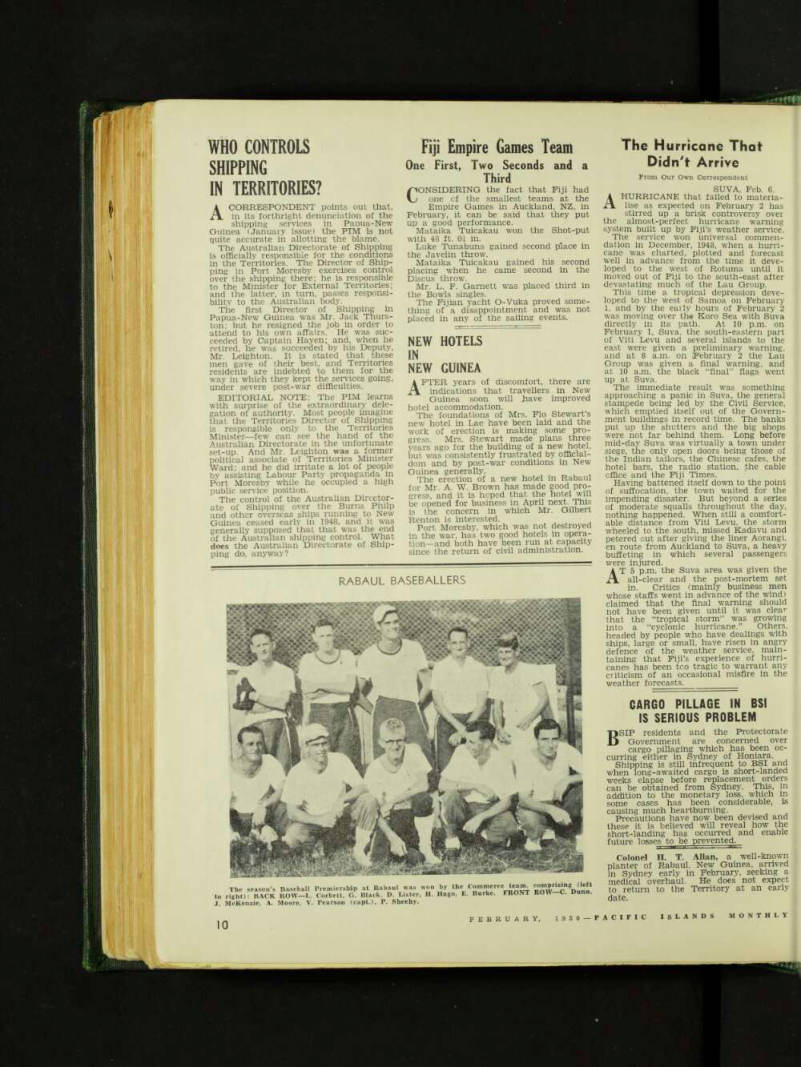
The season’s Baseball Premiership at Rabaul was won by the Commerce team, compriseng (left to right): BACK ROW—L. Corbett, G. Black. D. Lister, H. Hugo, E. Burke. FRONT ROW—C. Dunn, J. McKenzie, A. Moore, V. Pearson (capt.), P. Sheehy.
The Hurricane Thai
Didn't Arrive
From Our Own Correspondent
Suva, Feb. 6.
A HURRICANE that failed to materia lise as expected on February 2 has stirred up a brisk controversy over the almost-perfect hurricane warning system built up by Fiji’s weather service.
The service won universal commen dation in December, 1948, when a hurri cane was charted, plotted and forecast well in advance from the time it deve loped to the west of Rotuma until it moved out of Fiji to the south-east after devastating much of the Lau Group.
This time a tropical depression deve loped to the west of Samoa on February 1, and by the eaily hours of February 2 was moving over the Koro Sea with Suva directly in its path. At 10 p.m. on February 1, Suva, the south-eastern part of Viti Levu and several islands to the east were given a preliminary warning, and at 8 a.m, on February 2 the Lau Group was given a final warning, and at 10 a.m. the black “final” flags went up at Suva.
The immediate result was something approaching a panic in Suva, the general stampede being led by the Civil Service, which emptied itself out of the Govern ment buildings in record time. The banks put up the shutters and the big shops were not far behind them. Long before mid-day Suva was virtually a town under siege, the only open doors being those of the Indian tailors, the Chinese cafes, the hotel bars, the radio station, the cable office and the Fiji Times.
Having battened itself down to the point of suffocation, the town waited for the impending disaster. But beyond a series of moderate squalls throughout the day, nothing happened. When still a comfort able distance from Viti Levu, the storm wheeled to the south, missed Kadavu and petered out after giving the liner Aorangi, en route from Auckland to Suva, a heavy buffeting in which several passengers were injured.
AT 5 p.m. the Suva area was given the all-clear and the post-mortem set in. Critics (mainly business men whose staffs went in advance of the wind) claimed that the final warning should not have been given until it was clear that the “tropical storm” was growing into a “cyclonic hurricane.” Others, headed by people who have dealings with ships, large or small, have risen in angry defence of the weather service, main taining that Fiji’s experience of hurri canes has been too tragic to warrant any criticism of an occasional misfire in the weather forecasts.
Cargo Pillage In Bsi
Is Serious Problem
BSIP residents and the Protectorate Government are concerned over cargo pillaging which has been oc curring either in Sydney of Honiara.
Shipping is still infrequent to BSI and when long-awaited cargo is short-landed weeks elapse before replacement orders can be obtained from Sydney. This, in addition to the monetary loss, which m some cases has been considerable, is causing much heartburning.
Precautions have now been devised and these it is believed will reveal how the short-landing has occurred and enable future losses to be prevented.
Colonel H. T. Allan, a well-known planter of Rabaul, New Guinea, arrived in Sydney early in February, seeking a medical overhaul. He does not expect to return to the Territory at an early date.
The Month In Moresby
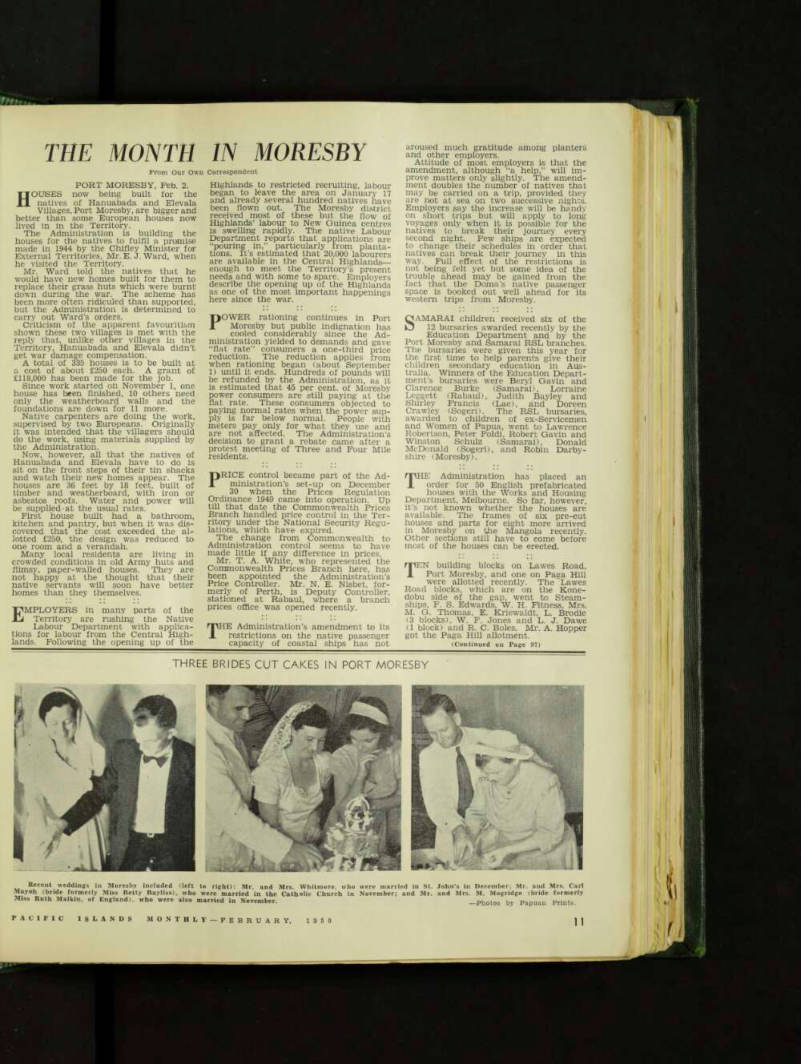
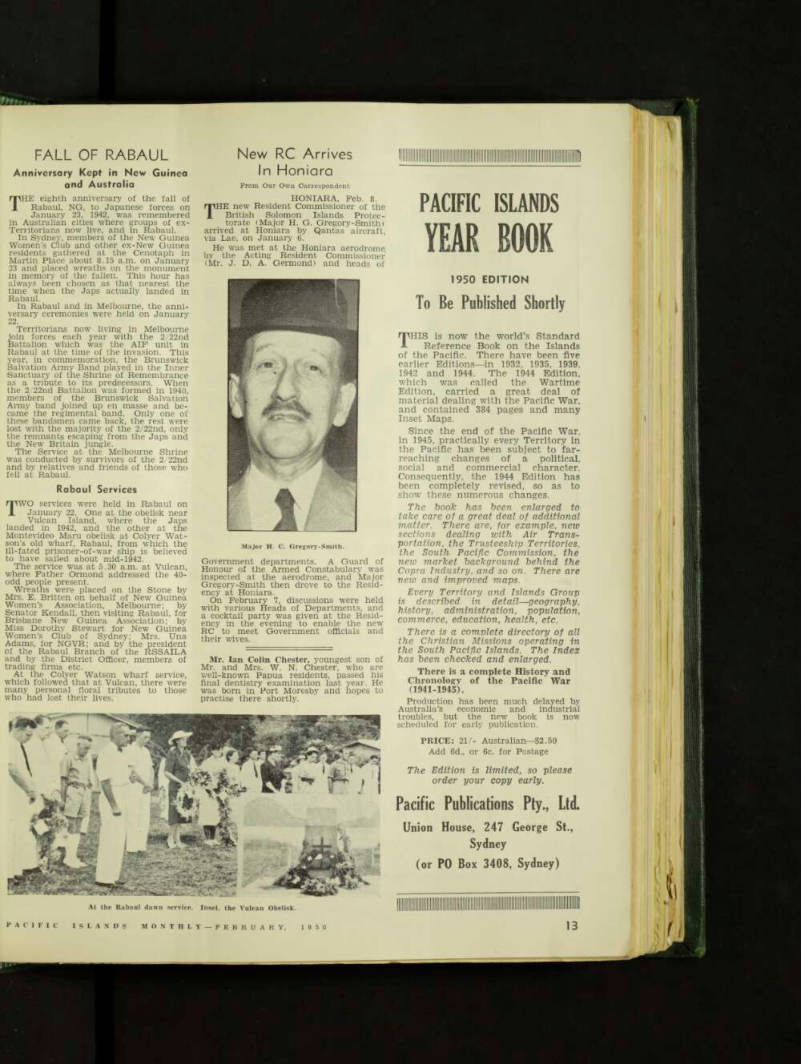
From Our Own Correspondent
Port Moresby, Feb. 2.
HOUSES now being built for the natives of Hanuabada and Elevala Villages, Port Moresby, are bigger and better than some European houses now lived in in the Territory.
The Administration is building the houses for the natives to fulfil a promise made in 1944 by the Chifley Minister for External Territories, Mr. E. J. Ward, when he visited the Territory.
Mr. Ward told the natives that he would have new homes built for them to replace their grass huts which were burnt down during the war. The scheme has been more often ridiculed than supported, but the Administration is determined to carry out Ward’s orders.
Criticism of the apparent favouritism shown these two villages is met with the reply that, unlike other villages in the Territory, Hanuabada and Elevala didn’t get war damage compensation.
A total of 335 houses is to be built at a cost of about £250 each. A grant of £llB,OOO has been made for the job.
Since work started on November 1, one house has been finished, 10 others need only the weatherboard walls and the foundations are down for 11 more.
Native carpenters are doing the work, supervised by two Europeans. Originally it was intended that the villagers should do the work, using materials supplied by the Administration.
Now, however, all that the natives of Hanuabada and Elevala have to do is sit on the front steps of their tin shacks and watch their new homes appear. The houses are 36 feet by 18 feet, built of timber and weatherboard, with iron or asbestos roofs. Water and power will be supplied-at the usual rates.
First house built had a bathroom, kitchen and pantry, but when it was dis covered that the cost exceeded the al lotted £250, the design was reduced to one room and a verandah.
Many local residents are living in crowded conditions in old Army huts and flimsy, paper-walled houses. They are not happy at the thought that their native servants will soon have better homes than they themselves.
EMPLOYERS in many parts of the Territory are rushing the Native Labour Department with applica tions for labour from the Central High lands. Following the opening up of the
Highlands to restricted recruiting, labour began to leave the area on January 17 and already several hundred natives have been flown out. The Moresby district received most of these but the flow of Highlands’ labour to New Guinea centres is swelling rapidly. The native Labour Department reports that applications are “pouring in,” particularly from planta tions. It’s estimated that 20,000 labourers are available in the Central Highlands— enough to meet the Territory’s present needs and with some to spare. Employers describe the opening up of the Highlands as one of the most important happenings here since the war.
POWER rationing continues in Port Moresby but public indignation has cooled considerably since the Ad ministration yielded to demands and gave “flat rate” consumers a one-third price reduction. The reduction applies from when rationing began (about September 1) until it ends. Hundreds of pounds will be refunded by the Administration, as it is estimated that 45 per cent, of Moresby power consumers are still paying at the flat rate. These consumers objected to paying normal rates when the power sup ply is far below normal. People with meters pay only for what they use and are not affected. The Administration’s decision to grant a rebate came after a protest meeting of Three and Four Mile residents.
PRICE control became part of the Ad ministration’s set-up on December 30 when the Prices Regulation Ordinance 1949 came into operation. Up till that date the Commonwealth Prices Branch handled price control in the Ter ritory under the National Security Regu lations, which have expired.
The change from Commonwealth to Administration control seems to have made little if any difference in prices.
Mr. T. A. White, who represented the Commonwealth Prices Branch here, has been appointed the Administration’s Price Controller. Mr. N. E. Nisbet, for merly of Perth, is Deputy Controller, stationed at Rabaul, where a branch prices office was opened recently.
THE Administration’s amendment to its restrictions on the native passenger capacity of coastal ships has not
aroused much gratitude among planters and other employers.
Attitude of most employers is that the amendment, although “a help,” will im prove matters only slightly. The amend ment doubles the number of natives that may be carried on a trip, provided they are not at sea on two successive nights.
Employers say the increase will be handy on short trips but will apply to long voyages only when it is possible for the natives to break their journey every second night. Few ships are expected to change their schedules in order that natives can break their journey in this way. Full effect of the restrictions is not being felt yet but some idea of the trouble ahead may be gained from the fact that the Doma’s native passenger space is booked out well ahead for its western trips from Moresby.
SAMARAI children received six of the 12 bursaries awarded recently by the Education Department and by the Port Moresby and Samarai RSL branches.
The bursaries were given this year for the first time to help parents give their children secondary education in Aus tralia. Winners of the Education Depart ment’s bursaries were Beryl Gavin and Clarence Burke (Samarai), Lorraine Leggett (Rabaul), Judith Bayley and Shirley Francis (Lae), and Doreen Crawley (Sogeri). The RSL bursaries, awarded to children of ex-Servicemen and Women of Papua, went to Lawrence Robertson, Peter Foldi, Robert Gavin and Winston Schulz (Samarai), Donald McDonald (Sogeri), and Robin Darby shire (Moresby).
THE Administration has placed an order for 50 English prefabricated houses with the Works and Housing Department, Melbourne. So far, however, it’s not known whether the houses are available. The frames of six pre-cut houses and parts for eight more arrived in Moresby on the Mangola recently.
Other sections still have to come before most of the houses can be erected.
TEN building blocks on Lawes Road, Port Moresby, and one on Paga Hill were allotted recently. The Lawes Road blocks, which are on the Kone dobu side of the gap, went to Steam ships, F. S. Edwards, W. H. Fitness, Mrs.
M. G. Thomas, E. Kriewaldt, L. Brodie (3 blocks), W. F. Jones and L. J. Dawe (1 block) and R. C. Boles. Mr. A. Hopper got the Paga Hill allotment.
(Continued on Page 97)
FORTY-EIGHT members of the Papua- New Guinea native police band may go to Sydney and Brisbane this year.
New South Wales RSL has invited the band to the Anzac Day ceremony in Sydney in April and Major-General Nimmo, GOC Northern Command, has suggested that the band attend the Bris bane Exhibition in August. The proposal is being considered by the External Ter ritories Department.
The natives are eager to make the trip.
A few of them were in the band when it visited Sydney and Melbourne in sup port of the Liberty Loan in 1944, but most of them became members after that visit. If they do go to Australia this year, the bandsmen will be issued with their first overcoats and probably their first footwear.
THE Port Moresby Musical Society was formed at a recent meeting and re hearsals have started. More singers are needed, however. The society will at first concentrate on choral work but, later, if enough musicians volunteer, it will also do orchestral work. Musical Director is Dr. D. Lincoln-Crow and the Committee consists of Mr. W, C. Groves (chairman), Mrs. P. Frank (secretary), Mr. A. Pollard (treasurer), Mrs. Smith and Mr. Dale. Mrs. J. Mac Michael is the accompaniste.
Miss Dorothy Armstrong, Of The
Health Department, and Mr. Keith Boyle of APC, were married at St.
John’s Church of England, Port Moresby, on January 7. Matron of honour was Iris Magee and Mr. Max Taylor was best man. Mr. J. Gannon, of the Common wealth Bank, gave the bride away. After a reception at the Hotel Papua, the couple went to Rouna Falls for their honeymoon.
Miss Nan Eglinton, of the Agriculture Department, Moresby, and Mr. Colin McEachern, of the PMG Department, were married quietly at the LMS Mission on January 14. Mr. Len Smith was best man and Mrs. Lambden attended! the bride.
THE 1950 Rugby League season in Port Moresby will start on April 2 with trial games. Efforts are being made to form new teams, in addition to last season’s rivals, Paga Hill and the Maganis, The Port Moresby Rugby League Association hopes to send a re presentative team to New Guinea this year.
GJOLICITOR J. Irwin Cromie is back in Moresby after a holiday in New Zealand. Mrs. Cromie, who is now in Melbourne, will return later.
Veteran BP skipper, Captain Vogelman, paid a rare visit to the Territory last month as relieving skipper on the Man gola.
After running the RSL Club at Moresby for two years, Mr. and Mrs. Bill Penny left on the January Bulolo for Sydney. The new manager, Mr. Victor Snudden, and his wife, arrived from Western Australia a few days later.
Mr, Bill Kerr, who has been acting District Labour Officer at Moresby, is now acting DLO at Wau.
The Director of Agriculture, Stock and Fisheries, Mr. W. Cottrell-Dormer, left this week for Australia on his way to Malaya where he will spend most of his leave. Mr. Cottrell-Dormer will combine his holiday with a study of agricultural methods in Malaya. APC’s assistant ac countant in the Territory, Mr. L. Ben nett, also left for Malaya recently. He will join the staff of the Anglo-Oriental Tin Mining Co.
A son was born to Mr. and Mrs. J.
Dowling, of Jacquinot Bay, New Britain, in Sydney on February 14.
Mr. R. W. Parkinson has returned to Suva from leave in Australia. While on leave he completed the degree of Bachelor of Commerce at Melbourne University, specialising in statistical method. He was formerly Controller of Imports, Prices and Foreign Exchange in Fiji, has now as sumed duty as Government Statistician.
Three Brides Cut Cakes In Port Moresby
Recent weddings in Moresby included (left to right): Mr. and Mrs, Whitmore, who were married in St. John’s in December; Mr. and Mrs. Carl Mayoh (bride formerly Miss Betty Bayliss), who were married in the Catholic Church in November; and Mr. and Mrs. M. Mogridge (bride formerly Miss Ruth Malkin, of England), who were also married in November.-Photos by Papuan Prints.
Advertisements & other items, p. 16 (1 item)
Morris Hedstrom Limited
General Merchants, Importers and Exporters,
Shipowners, Plantation Owners,
Commission and Insurance Agents
HEAD OFFICE
SUVA, FIJI
Established 1868
SERVICE IN THE SOUTH PACIFIC TERRITORIES
'JHROUGH our Large Establishments in Suva and our Numerous Branches, we distribute a wide and comprehensive range of General Merchandise and provide almost every kind of service. Our departments and associated businesses include:
DRAPERY
MOTOR SALES
AND SERVICE
TOBACCO
TIMBER AND
BUILDING
GROCERY
CONFECTIONERY
HARDWARE
ELECTRICAL
LIQUORS
DRUGS
Branches Throughout Fiji, Samoa and Tonga
There is a Branch or Agent of Morris Hedstrom Limited in every Town in the Three Territories.
We are Sole Agents in these Territories for
B. A. Hjorth £r Co. (Primus Products) Imperial Chemical Industries Ltd.
International Harvester Export Co.
Matson Navigation Company
Max Factor and Co. Inc.
Ransomes, Sims £r Jefferies Ltd, Ruston Gr Hornsby Ltd.
Vacuum Oil Co. Pty. Ltd.
Yorkshire Copper Works Ltd.
British Drug Houses Ltd.
Electrolux Ltd.
Ford Motor Co.
General Electric Co. Ltd.
Goodyear Tyre Gr Rubber Co.
Morris Hedstrom Limited
IN AUSTRALIA:
Morris Hedstrom (Aust.) Pty. Ltd Asbestos House, 65 York Street, SYDNEY LLOYD’S AGENTS Fiji and Samoa.
IN GREAT BRITAIN:
Morris Hedstrom Limited, Barclay's Bank Building, 7B Cheapside, LONDON, E.C.2.
Fall Of Rabaul
Anniversary Kept in New Guinea
and Australia
THE eighth anniversary of the fall of Rabaul, NG, to Japanese forces on January 23, 1942, was remembered in Australian cities where groups of ex- Territorians now live, and in Rabaul.
In Sydney, members of the New Guinea Women’s Club and other ex-New Guinea residents gathered at the Cenotaph in Martin Place about 8.15 a.m. on January 23 and placed wreaths on the monument in memory of the fallen. This hour has always been chosen as that nearest the time when the Japs actually landed in Rabaul.
In Rabaul and in Melbourne, the anni versary ceremonies were held on January 22.
Territorians now living in Melbourne join forces each year with the 2/22nd Battalion which was the AIF unit in Rabaul at the time of the invasion. This year, in commemoration, the Brunswick Salvation Army Band played in the Inner Sanctuary of the Shrine of Remembrance as a tribute to its predecessors. When the 2/22nd Battalion was formed in 1940, members of the Brunswick Salvation Army band joined up en masse and be came the regimental band. Only one of these bandsmen came back, the rest were lost with the majority of the 2/22nd, only the remnants escaping from the Japs and the New Britain jungle.
The Service at the Melbourne Shrine was conducted by survivors of the 2/22nd and by relatives and friends of those who fell at Rabaul.
Rabaul Services
TWO services were held in Rabaul on January 22. One at the obelisk near Vulcan Island, where the Japs landed in 1942, and the other at the Montevideo Maru obelisk at Colyer Wat son’s old wharf, Rabaul, from which the ill-fated prisoner-of-war ship is believed to have sailed about mid-1942.
The service was at 5.30 a.m. at Vulcan, where Father Ormond addressed the 40odd people present.
Wreaths were placed on the Stone by Mrs. E. Britten on behalf of New Guinea Women’s Association, Melbourne; by Senator Kendall, then visiting Rabaul, for Brisbane New Guinea Association; by Miss Dorothy Stewart for New Guinea Women’s Club of Sydney; Mrs. Una Adams, for NGVR; and by the president of the Rabaul Branch of the RSSAILA and by the District Officer, members of trading firms etc.
At the Colyer Watson wharf service, which followed that at Vulcan, there were many personal floral tributes to those who had lost their lives.
At the Rabaul dawn service. Inset, the Vulcan Obelisk.
New RC Arrives
In Honiara
Prom Our Own Correspondent
Honiara, Feb. 8.
THE new Resident Commissioner of the British Solomon Islands Protec torate (Major H. G. Gregory-Smith) arrived at Honiara by Qantas aircraft, via Lae, on January 6.
He was met at the Honiara aerodrome by the Acting Resident Commissioner (Mr. J. D. A. Germond) and heads of
Government departments. A Guard of Honour of the Armed Constabulary was Inspected at the aerodrome, and Major Gregory-Smith then drove to the Resid ency at Honiara.
On February 7, discussions were held with various Heads of Departments, and a cocktail party was given at the Resid ency in the evening to enable the new RC to meet Government officials and their wives.
Mr. lan Colin Chester, youngest son of Mr. and Mrs. W. N. Chester, who are well-known Papua residents, passed his final dentistry examination last year. He was born in Port Moresby and hopes to practise there shortly.
Major H. C. Gregory-Smith.
Advertisements & other items, pp. 17-18 (1 item)
Year Book
PACIFIC ISLANDS
1950 EDITION
To Be Published Shortly
THIS is now the world’s Standard Reference Book on the Islands of the Pacific. There have been five earlier Editions—in 1932, 1935, 1939, 1942 and 1944. The 1944 Edition, which was called the Wartime Edition, carried a great deal of material dealing with the Pacific War, and contained 384 pages and many Inset Maps.
Since the end of the Pacific War. in 1945, practically every Territory in the Pacific has been subject to farreaching changes of a political, social and commercial character.
Consequently, the 1944 Edition has been completely revised, so as to show these numerous changes.
The hook has been enlarged to take care of a great deal of additional matter. There are, for example, new sections dealing with Air Transportation, the Trusteeship Territories, the South Pacific Commission, the new market background behind the Copra Industry, and so on. There are new and improved maps.
Every Territory and Islands Group is described in detail — geography, history, administration, population, commerce, education, health, etc.
There is a complete directory of all the Christian Missions operating in the South Pacific Islands. The Index has been checked and enlarged.
There is a complete History and Chronology of the Pacific War (1941-1945).
Production has been much delayed by Australia’s economic and industrial troubles, but the new book is now scheduled for early publication.
PRICE: 21/- Australian —$2.50 Add 6d., or 6c. for Postage The Edition is limited, so please order your copy early.
Pacific Publications Ply., Ltd.
Union House, 247 George St.,
Sydney
(or P 0 Box 3408, Sydney)
Now... fly by Clipper
to ENGLAND at this
LOW
AU-EXPINSE
FAR
m V 5 £325.0.0 £585.0.0 One Way Round Trip Pan American’s Commonwealth Plan covers ajj your travel expenses ... including hotel and meal costs in U.S.A.
From Sydney. Add internal fare from other States.
I*s 0% fit VOt° lIP
• Fares to England via the U.S.A. are THE LOWEST EVER by Clipper*. What’s more, you have a low all-expense fare. You pay your low Clipper fare in pounds —and don’t need to open your purse again! Pan American’s Commonwealth Plan pays everything else! Transportation to and from the airport . . . full day’s stopover in Hawaii or the U.S. with hotel accommodations and meal costs included. All-
expense fare also includes travel on Pan America’s big new double-decked Clippers between Hawaii and California . . . New York and London. Your choice of scenic routes across the U.S.A.
Take advantage of Pan American’s Commonwealth Plan to visit England on business or pleasure. The Flying Clippers leave Sydney twice a week. For reservations call your Travel Agent or . . .
Sydney Office: Mezzanine Floor , Hotel Australia. Telephone BW 4701 Melbourne Sales Office: 247 Collins Street. Telephone Cent. 4628-29 Registered Office: 368 Collins Street. Telephone MllB5 SPEED V OUR PARCEL BY CLIPPER CARGO r o Trade Mark, Pan American Airways, Inc, Pan American Airways Inc. Ltd., Incorporated in U.S.A.
French Airways In
Pacific
From Our Own Correspondent
Noumea, Jan. 20.
THE French Government, having now authorised the construction of the Magenta airport, right at Noumea’s doorstep, the Colony’s General Council has decided to name it the Richard Bernier airport, in honour of the man whose activities carried the project through.
Work on the 1.400-metres-long landing ground will soon be started.
The annual subsidy voted to Air France-Trapas for one round trip per month, Paris-Bora Bora, by the Tahitian Representative Assembly, is 1,200,000 francs. If the flights are increased to two per month, this sum will be increased to 1,500,000 frs.
Papuan Rubber
Koitoki Shows Loss Buf Prices Rise in UK
A LOSS of £367 for the year ended June 30, 1949, was disclosed by Koitaki Para Rubber Estates Ltd., of Papua.
In the previous year a profit of £4,164 was made.
At the end of the year under review, all Papuan rubber producers were en gaged in a price-war with Australian manufacturers who had refused to take No. 1 grade rubber at No. 1 grade prices.
No rubber was shipped from Papua for about five months, during which time about 800 tons accumulated in store. In August the Australian Government ar ranged to buy Papuan rubber at Singa pore prices (13.1 pence first grade) and sent an expert to investigate the position.
The results of the investigation have never been disclosed. At the time, Papua rubber planters said that cost of produc tion in Papua was far above Ist Grade Singapore prices. Koitaki in their balance sheet disclose that cost of pro duction was about 15d. per lb. in the year under review. In the previous year it had been only 11.67 d.
Since June rubber prices have tended to rise. Rubber has recently been selling in London for 15.5 d. stg. per lb. —the highest price for 21 years.
New NZ Government's
Air Plans
AS New Zealand now has a new Gov ernment, considerable interest is attached to its plans for civil avia tion. The New Zealand National Airways Corporation is to be reorganised into a public corporation by offering a portion of the capital, not to exceed 49 per cent., for public subscription so as to widen interest and obtain wider representation on the board of directors.
Private operators are to be licensed, in appropriate cases, to run subsidiary ser vices and aero clubs and others are to be encouraged to undertake charter, taxi and feeder services. An aerodrome of in ternational standard is to be constructed in each island and at Rongotai, Welling ton, an aerodrome is to be constructed which will meet all internal traffic re quirements.
Encouragement is to be given to the establishment between Australia and the South Island of an alternative trans- Tasman service operated with landplanes. —Whites Aviation.
Two Australian Companies Apply
for Australia-Christchurch Route
TWO Australian air companies (Aus tralian National Airways and Ansett Airways) have applied to operate air services between Aus tralia and the South Island of New Zealand. Presumably their applications will be considered by the governments concerned in due course.
In Opposition, the present New Zealand Government pressed for Harewood, near Christchurch, to be brought up to the standard required for an international airport. The then Minister for Civil Aviation said that this would cost about £400,000. He was accused of “hedging.”
New Secretary For
Melanesian Mission
Mr. H. W. BULLEN will succeed Major H. S. N. Robinson, who recently re tired from the position of Secretary of the Melanesian Mission after 25 years’ service.
Mr. Bullen was secretary to Bishop Baddeley for some years before the war.
Mr. F. S. Wigley has arrived in Fiji. He has been transferred from Leeward Islands as a Superintendent of Police.
Advertisements & other items, p. 19 (1 item)
Cane Knives
■yx'Xvf^'iiiin *
CRIME
CHARMOSAN
* «lw OIIW' 11 ” p, utc it , - ct P c o , r»>o^'°-
ADORABLY LOVELY
UNDER POWDER
minimi
% Charmosan
coldcream a cfuy~^.
CLEANSES AND
REFRESHES YOUR SKIN
CHARMOSAN
VANISHING and cold creams
CANE KNIVES
Manufactured expressly for the Fiji market from true temper super steel, at lowest prices VU V
ENQUIRIES ALSO INVITED
for
COPRA KNIVES, BUSH KNIVES, MACHETTES
AND AXES.
Ventura Trading Company Pty. Ltd.
26 BRIDGE STREET, SYDNEY
P. & R. Hutchinson, Suva. or Ventura Trade Agency, Lae, T.N.G.
Fiji's Margarine Is Spelt
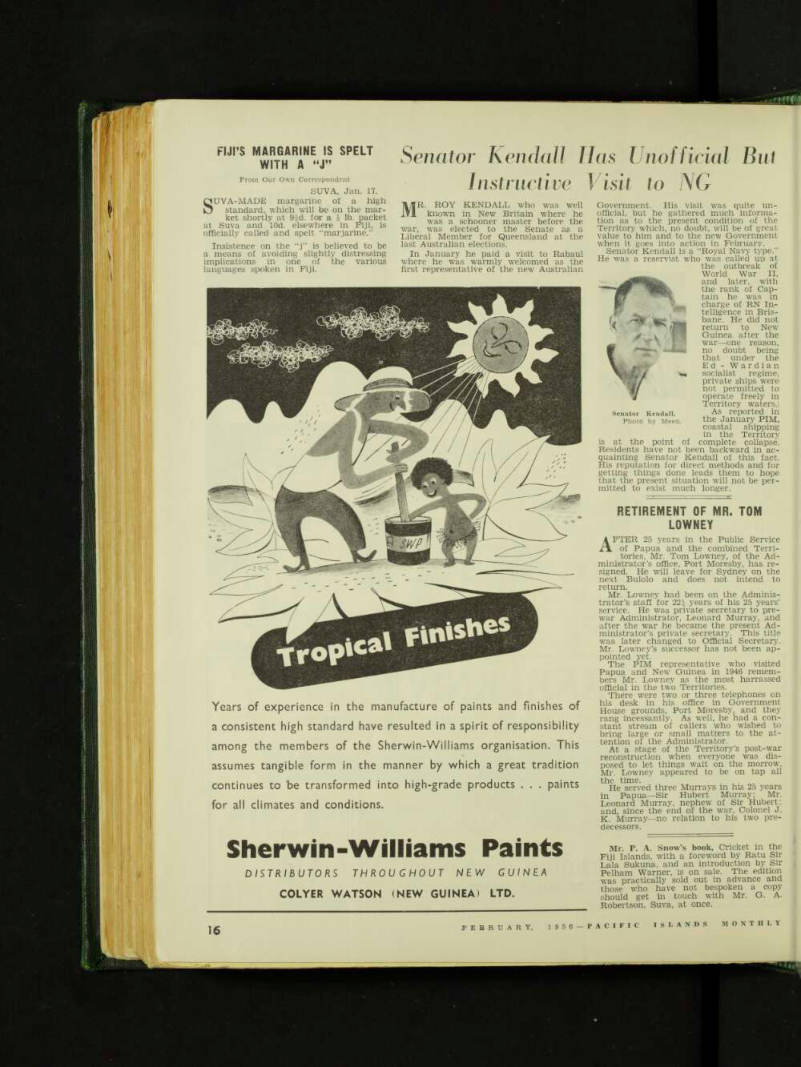
With A “J”
From Our Own Correspondent
Suva, Jan. 17.
SUVA-MADE margarine of a high standard, which will be on the mar ket shortly at 9sd. for a I lb. packet at Suva and lOd. elsewhere in Fiji, is officially called and spelt “marjarine.”
Insistence on the “j” is believed to be a means of avoiding slightly distressing implications in one of the various languages spoken in Fiji.
Senator Kendall Has Unofficial But
Instructive to NG
MR. ROY KENDALL who was well known in New Britain where he was a schooner master before the war, was elected to the Senate as a Liberal Member for Queensland at the last Australian elections.
In January he paid a visit to Rabaul where he was warmly welcomed as the first representative of the new Australian
Government. His visit was quite un official, but he gathered much informa tion as to the present condition of the Territory which, no doubt, will be of great value to him and to the new Government when it goes into action in February.
Senator Kendall is a “Royal Navy type.”
He was a reservist who was called up at
the outbreak of World War 11, and later, with the rank of Cap tain he was in charge of RN In telligence in Bris bane. He did not return to New Guinea after the war—one reason, no doubt being that under the Ed - Wardian socialist regime, private ships were not permitted to operate freely in Territory waters.!
As reported in the January PIM, coastal shipping in the Territory
is at the point of complete collapse.
Residents have not been backward in ac quainting Senator Kendall of this fact.
His reputation for direct methods and for getting things done leads them to hope that the present situation will not be per mitted to exist much longer.
Senator Kendall.
Photo by Meen.
Retirement Of Mr. Tom
Lowney
AFTER 25 years in the Public Service of Papua and the combined Terri tories, Mr. Tom Lowney, of the Ad ministrator’s office, Port Moresby, has re signed. He will leave for Sydney on the next Bulolo and does not intend to return.
Mr. Lowney had been on the Adminis trator’s staff for 22 J years of his 25 years’ service. He was private secretary to pre war Administrator, Leonard Murray, and after the war he became the present Ad ministrator’s private secretary. This title was later changed to Official Secretary.
Mr. Lowney’s successor has not been ap pointed yet.
The PIM representative who visited Papua and New Guinea in 1946 remem bers Mr. Lowney as the most harrassed official in the two Territories.
There were two or three telephones on his desk in his office in Government House grounds, Port Moresby, and they rang incessantly. As well, he had a con stant stream of callers who wished to bring large or small matters to the at tention of the Administrator.
At a stage of the Territory’s post-war reconstruction when everyone was dis posed to let things wait on the morrow, Mr. Lowney appeared to be on tap all the time.
He served three Murrays in his 25 years in Papua—Sir Hubert Murray; Mr.
Leonard Murray, nephew of Sir Hubert; and, since the end of the war, Colonel J.
K. Murray—no relation to his two pre decessors.
Mr. P. A. Snow’s book, Cricket in the Fiji Islands, with a foreword by Ratu Sir Lala Sukuna, and an introduction by Sir Pelham Warner, is on sale. The edition was practically sold out in advance and those who have not bespoken a copy should get in touch with Mr. G. A.
Robertson, Suva, at once.
Advertisements & other items, p. 20 (1 item)
Sherwin-Williams Paints
m 'M Ms ©1 Years of experience in the manufacture of paints and finishes of a consistent high standard have resulted in a spirit of responsibility among the members of the Sherwin-Williams organisation. This assumes tangible form in the manner by which a great tradition continues to be transformed into high-grade products . . . paints for all climates and conditions.
DISTRIBUTORS THROUGHOUT NEW GUINEA
COLYER WATSON (NEW GUINEA) LTD.
South Pacific

Commission
Conference In Fiji In April
Headquarters: Anse Vata Noumea, New Caledonia
Preparations for the South Pacific Conference, to open in Suva on April 24, have been advanced; but full de tails of representation of territories are not yet available. Representatives of all native races in the South Pacific will be present.
Papers to introduce various subjects for discussion are being prepared by the ad ministrations of the various territories.
For example, an Australian paper on Mosquito Control, a French paper on Fisheries Methods, and a United States paper on the Healthy Village.
The Research Council will noid its second meeting in Sydney in August.
Associate Members selected by the Com mission at the Fourth Session have noti fied their acceptance of membership.
Long-Term Plan of Research
IN addition to carrying out the present projects of the Commission, the Deputy Chairman and full-time members of the Research Council are working out plans for submission to the Commission and Research Council, for further development of the work pro gramme.
The plans will take into account, where possible, the needs of the next five years.
The Commission, at its last session, suggested such long-range planning, in order to provide for continuity and to in
dicate to the participating governments the approximate financial requirements of the Commission’s work for some years ahead.
Technical Assistance In connection with this long-term plan, the research members, in co-operation with the Secretary-General, are formu lating a draft programme of technical assistance for the area.
The Commission and the Research Council, at their respective meetings—in May, at Suva, and in August, at Sydney— will consider whether benefit for the area, in the form of expert assistance in technical problems (e.g., in agriculture, fisheries, technical education) can be secured in connection with the pro gramme of technical assistance which is being arranged by the Economic and Social Council of the United Nations.
Future of Plantation Products
THE Member for Economic Develop ment, Dr. Howard G. MacMillan, returned to headquarters at the close of the year, after visiting the United States and England.
A principal purpose of the visit was to examine present and future marketing possibilities for copra, cacao and some other products of the South Pacific Ter ritories, and to formulate an opinion on production possibilities.
Dr. MacMillan had discussions in Washington, DC, with various authorities in the US Department of Commerce, Department of Agriculture and other
agencies, also with large commercial firms in San Francisco and London, and authorities of the Colonial Office and the Imperial Institute.
Copra and Coconut Oil In respect to copra and coconut oil, Dr. MacMillan found that experts were generally impressed by the following fac tors affecting prices: • There has been a great scarcity of all fats and oils, but stimulated produc tion of several vegetable oil plants, aided
by the return of considerable acreages neglected or out of control during the war, would point to a coming surplus of fats and oils. •Tallow prices are down, but coconut oil is three or four times pre-war prices. • There is a large production in other oil seed plants. • At the moment, however, there is a shortage, variously estimated up to a million tons, which may be modified by the effective demand.
Cacao Prospects
In Washington, also, Dr. MacMillan discussed the situation in regard to cacao with the agencies carrying on disease in vestigations, crop improvement and other experimental investigations.
It was felt that because of the serious losses in Africa from virus disease there is the prospect of an accelerated decline in production in the face of increasing world markets for chocolate in all its
forms. The South Pacific chocolate has a good reputation among the manufac turers in America.
In all matters relating to tropical agri culture there is a very great fund of in formation and experience available in London in the Colonial Office and the Imperial Institute. The facilities of these agencies were generously offered.
The US Department of Agriculture has many projects under way in the Carrib bean region, Central and South America, in addition to a large fund of information on world problems in general.
Unscur
While in New York, Dr. MacMillan at tended the United Nations Scientific Conference on the Conservation and Utilisation of Resources, from August 17 to September 6, 1949, at Lake Success.
This conference brought together many of the principal authorities of the world for the presentation of papers and dis cussion on land, water, forests, wild life and fish, minerals, fuels and energy, and innumerable problems under these general headings.
Mr. B. E, V. Parham, OBE, Senior Ag ricultural Officer, Suva, Fiji, attended the Conference as observer on behalf of the South Pacific Commission. During Dr. MacMillan’s visit to London, Mr.
Parham was also present and contributed valuable experience and advice to the discussions with the British experts.
A number of useful personal contacts Were made' with scientists from many countries. The papers presented were available on all subjects and contributed much material, new approaches to old problems, fresh points of view, which should be of great advantage in attacking the problems of agriculture, forestry, and fisheries in the area of the South Pacific Commission.
Introduction of Economic Plants
IN connection with project E.l, the Commission has made grants-in-aid to the Fiji and New Caledonia ad ministrations for introduction gardens at Naderolulu (Fiji), and Port Laguerre (New Caledonia). The latter represents a combined effort of the Departments of Agriculture and Forestry and the Veter inary Service of New Caledonia, who will develop a tract of land of about 1,300 acres, together with a farm school—the southern part as an introduction garden (about 400 acres). The Commission will give technical advice, in addition to financial assistance.
Ways in which the Commission might assist similar work in Australia and Netherlands New Guinea are being con sidered.
Lists of plants and seeds needed have been sent to various persons and institu tions. These lists included trees for re afforestation, pasture grasses and legu minous ground-covers.
The tribe of the “Col de la Pirogue” gathered almost a thousand kilograms of seeds of Leucauna glauca (the “acacia” of the settlers) to serve in the first at tempts at re-afforestation in New Cale donia.
The Forestry Experiment Station at Buitenzorg, Java, is making available several kilograms of seeds of Pinus mer kusii, the valuable fire-resistant Sumatra pine, as well as seeds of other economic ally valuable plants.
Land Utilisation A report on land utilisation and con servation measures in other tropical countries has been prepared.
The Governor of New Caledonia has consented to the carrying out of a pilot land-use survey in New Caledonia north of Bourail.
The team to carry out this work will consist of a forester, a soil scientist and a surveyor. Appointments are under con sideration.
Control of Pests and Weeds A list of noxious weeds of the South Pacific region is in preparation.
Particular attention is being given to the guava, which was introduced as a fruit tree in Fiji in 1857, and later in the more Western region, and which has become a major pest. A Member of the Research Council made a study of the extent of this calamity in the region of Poya, New Caledonia, where, with the collaboration of a grazier, it is hoped to make experiments with weed-killers of various types.
The Director of the Institut Prancais d’Oceanie, Dr. F. Bugnicourt, is making a study of fungous parasites of rice grown in the South Pacific, and the Commis sion’s Research Staff will assist in this study. The Institut is assisting the Com mission in other ways, for example it has provided laboratory space for investiga tions incidental to Commission projects.
Health—Food—Nutrition
THE Member for Health, Dr. Massal, has defined his plan for work in the important field of diet and nutrition.
The work proposed includes detailed surveys of the diet of infants and young children, and of the effects of new foods on their health and growth.
The work will include comparisons of growth and health of two similar groups, one being fed according to customary methods, with customary foods, and the other fed with foods prepared according to new formulas.
An Australian nutrition worker, Miss S. Malcolm, is being sent to New Guinea, the New Hebrides, and the Solomon Islands to carry out work of this kind.
During the course of these investiga tions on infant diet it will be possible to collect data on the diet and nutrition of older children and adults.
Tuberculosis The tuberculosis research team began to assemble at Port Moresby in the first half of February, The team will consist of:— Dr. Guillermin, of the French Colonial Health Service, seconded to the Commission for one year.
Mr. W. H. P. Love, from New Zealand, X-Ray Technician; Miss B. Balfour, bacteriologist, from the laboratory of Professor S. Rubbo, Professor of Bacteriology, University of Melbourne.
Professor Rubbo will accompany the
team for about two Weeks initially, in order to give technical advice.
The programme of the team is as follows: Papua-New Guinea, 4 months (two months on the coast and two months in the Central Highlands); New Caledonia, 2 months; A short visit to Fiji and American Samoa; Western Samoa, 2 months; French Oceania, 2 months.
In Tahiti, the Representative Assembly has set aside a substantial sum for the purchase of mobile X-Ray equipment, and has sought technical advice from the
(Continued on Page 85)
Commission on the equipment to be ordered.
Information has been received from Fiji on BCG vaccination. Final results are not yet available, but the potency of the vaccine, and its innocuousness, seem certain.
The chemical concerns, Burroughs, Wellcome (Australia) Ltd., and Specia, Paris, have sent free supplies of Banocide and Notezine, which have been sent to the Institute for Filariasis research in Tahiti, for use in treatment tests.
Other Studies Various studies are now in progress.
For example researches are proceeding into aspects of the diagnosis or treat ment of filariasis, tuberculosis, yaws, leprosy, rheumatic fever and other diseases prevalent in the Pacific Islands.
Together with Mr. Legand, of the In stitut Francais d’Oceanie, a study of toxic and venomous fishes in the Pacific has been undertaken.
Social Development
Vocational Training (Project S.l) THE Government of Fiji and the Com mission, have agreed that Mr.
Derrick, MBE, AMISE, will begin his survey of needs for technical training in the islands on April 1, instead of January 1. This arrangement has the advantage that it will enable Mr. Derrick to be in Fiji during the South Pacific Conference to meet the representatives from the Territories and make a pre liminary assessment of needs.
Visual Aids to Education Mr. A. L. Moore, MA, BEd., spent five weeks in Papua in November and Decem ber with the object of determining the best methods of visual education for Islands peoples. His tour in Papua and New
Guinea was arranged by Mr. W. C.
Groves, Director of Education and Asso ciate Member of the Research Council.
He was accompanied throughout by Mr.
J. Cox, Visual Education Officer in the Department of Education of Papua and New Guinea.
In January, Mr. Moore spent a week in New Caledonia on the same project, and a few days in Fiji. He will later visit Samoa, the Cook Islands and Tonga to demonstrate methods of visual education and examine related problems. It is hoped that he will also be able to con sult Mr. F. R. J. Davies, Officer for Islands Education in New Zealand, who is compiling films suitable for presenta tion to native audiences.
Pacific Islands Languages Dr. A. Capell, PhD, Lecturer in Oceanic Languages at the University of Sydney, visited Australian and Netherlands New Guinea in January, under the auspices of the Commission, in order to fill In some gaps in the linguistic picture of the region.
A knowledge of the distribution and relationship of the languages of the region is a necessary foundation for a comprehensive attack on illiteracy.
Dr. Capelhs journey brought him into contact with the languages of the whole northern Littoral of New Guinea, from Madang to Biak (including the islands).
By thus supplementing the literature available, and through discussions with linguists such as Dr. H. K. J. Cowan and the Rev. I. S. Kijne, at Hollandia, and Mr.
E. de Bruyn, at Biak, he should be able to prepare a rough delineation of the lin guistic pattern of northern and north western New Guinea, Co-operative Movement At the Fourth Session (Noumea, October, 1949) the Commission placed high priority on the project and decided to allocate £l,lOO to an expert survey of the
Co-operative Movement. Inquiries for a suitable specialist are being made.
Community Development (Project 5.9) A further meeting of the Advisory Group which, under the leadership of Mt. Hayden, is supervising the com munity development experiment on Motu riki Island, is to be held shortly and it is proposed to commence preliminary work early in 1950. (See Pacific Islands Monthly for December, pp. 61-62.)
(Continued Next Page)
Facilities For The Commission
IN order to simplify travel through the South Pacific by approved officers of the Commission, the Governments of Australia, New Zealand and the United Kingdom have formally recognised the proposed Laissez-Passer, in the form and on the conditions approved by the Com mission at its Fourth Session.
A draft agreement concerning Privi leges and Immunities for the Commission in New Caledonia has been received from the French authorities.
Personnel Dr. Jacques Kerrest, laboratory special ist, Research Assistant to the Member for Health, arrived at headquarters on January 17. Dr. Kerrest’s services have been made available by the Director of the French Colonial Medical Service.
Mr. W. D. N. Johnson, of the Australian Department of Commerce and Agricul ture, has accepted appointment as Stat istical Officer, and will take up duty probably in March.
M. Rene Ferrand has been appointed Establishments Officer. M. Ferrand is on loan for one year from the New Cale donia Administration.
Miss Leonore Morris, a graduate of Adelaide University, has accepted, ap pointment as Secretary-typist to assist the Member for Health, Dr. Massal.
The national distribution of the tech nical and administrative staff of the Commission (permanent and temporary), excluding the clerical and stenographic grade, is at present as follows: Australia 5, France 4, Netherlands 3, and United Kingdom, United States and New Zea land one each.
Mr. T. O. U. Stockwell of Lomaloma, has, as a result of declining health, asked to be allowed to relinquish his Commis sion as a Justice of the Peace for the Eastern District of Fiji.
Advertisements & other items, pp. 21-24 (1 item)
Trade
Enjoy a Real Holiday
at
“SAN ELANDA” GUEST HOUSE.
Tewantin, Queensland t ■■ i Island Folk will Receive a Warm Welcome. Excellent Fishing, Boating, Surfing, River Trips, Tennis. Golf, Etc., plus First-Class Accommodation and Cuisine at a Reasonable Tariff.
Tewantin, on the Coast, is 100 miles North of Brisbane.
R. P. MILLS, Proprietor
(Late of Witu, T.N.G.) ’Phone: Tewantin 21
TRADE
and
TRA VEL
BETWEEN AUSTRALIA AND THE ISLANDS OF THE PACIFIC IS MADE SO MUCH EASIER AND THE TIME FACTOR IS REDUCED TO A MINIMUM WITH
★ LOWER RATES
★ GREATER COMFORT
★ SUPERIOR SERVICE
I TRANS OCEANIC AIRWAYS PTY. ITD.
FOR FURTHER INFORMATION
CONTACT OUR PRINCIPAL AGENTS
THE MACARTHUR SHIPPING AND AGENCY CO. PTY. LTD.
31 MACQUARIE PLACE,
SYDNEY.
Day: BW 2048-9 • Night: B 0229 In the Islands our Local Agent or any accredited Travel Agent will supply particulars.
George Wills & Company Limited
(Inc. in South Australia) Perth, Adelaide, Melbourne, Sydney, Brisbane, Launceston Established 1849
Merchants, Exporters, Importers,
Manufacturers’ Representatives
Representing Manufacturers of all types of
A ustralian products Inquiries to: Melbourne Branch, G.P.O. Box No. 1320 L, 314 Collins Street, Melbourne, Victoria.
Bankers: The Union Bank of Australia, Limited.
Cables: WILLSANDCO
BLAXLAND-CHAPMAN
Marine Engines • Wonder Launches
Pumps and Engineering Products
Island Residents can rely on prompt attention to inquiries and orders for Blaxland- Chapman Marine Engines, Launches. Pumps and other Engineering requirements from Kerr Bros. Pty., Ltd., Sole Pacific Distributors for Blaxland Rae Pty., Ltd. (successors to Chapman & Sherack).
lir
31 2 H.P. BLAXLAND PUP
SUr
*0 T 0
°Hap
VAH
Renowned for Simplicity, Reliability, and Durability, there is a Blaxland-Chapman or Chapman Marine Engine for most boating applications in sizes ranging from 2 1 /a H.P. to 20 H.P. Engines are Guaranteed for Five years and are supplied complete with all fittings and accessories. The 3Vz H.P. Blaxland “Pup” and the 4'A H.P. Blaxland- Chapman “Super Pup” (illustrated here) are notable examples of these efficient power units, embodying features that give safe, simple, and economic operation under all conditions. Models from 41/4 H.P. upwards are reversible; direction of rotation Being changed by a mere flick of the patented magneto.
Enquiries are invited :
4t4 H.P. BLAXLAND-CHAPMAN “SUPER PUP.’
KERR BROS
(Sole Pacific Distributors for BLAXLAND RAE PTY., LTD.)
4 YORK ST., SYDNEY, AUSTRALIA
Box 3838, G.P.O. Cables: “CARE,” Sydney.
MENU
OF TOP QUALITY
DELICIOUS FOODS
• 12-oz. Hampe. • 12-oz. Luncheon Pork. • 12-oz. Trim. • 12-oz. Camp Pie. • Pate de Foie. • 12-oz. Meatreat. • 16-oz. Beef Steak Pudding. • 16-oz. Braised Beef Steak Stew. • 16-oz. Steak & Kidney Pudding. • 16-oz. Steak and Tomato. • 16-oz. Sausages and Vegetables. • 16-oz. Bacon Rashers. • 16-oz. Irish Stew. • 12-oz. Meat and Beans. • 16-oz. Beef Sausages. • 16-oz. Pork Sausages. • 16-oz. Cambridge Sausages,
16-oz. Oxford Sausages. • 16-oz. Vienna Sausages. • 16-oz. Tomato Soup. • 16-oz. Dripping. • "OX and PALM" 16-oz. Corned Beef with Cereal. • 6-lb. Corned Beef with Cereal. •
"FLAIR"
4,8, 12 oz. Fish Cutlets. • 8-oz. Scallop Luncheon. • I l|-oz. Squab in Aspic. • 7-lb. or 16-oz. Tinned Prunes. • Also Salted Boneless Brisket Beef • in 50-lb. and 100-lb. Kegs . . .
Frozen Meats, Hams and Bacon.
IMPERIAL CANNED - SEALED"
i sdOOJaooo
/tgUdclui
I
Imperial goods are prepared from prime selected stock by the largest meat-processing organisation in Australia. You can be sure of top-quality when you order "Imperial.”
RIVERSTONE
MEAT CO.
PTY. LTD.
5-7 O’Connell Street, Sydney.
Fiji Representatives: Pearce 8C Co. Ltd., Suva.
IT DOESN’T PAY TO SACRIFICE
STRENGTH
gEFORE you think of investing in a new car you must give your fullest consideration to the basic strength of its body.
Territory roads impose severe tests on all cars. The inherent strength of the VANGUARD is based on its solidly constructed frame, which is formed by opposed channel steel pressings, welded together producing tubular side members of rectangular form and boxed cross members, the whole being braced by a cruciform member.
Any car which has a welded
body construction without a
frame must sacrifice strength
for lightness.
It doesn't pay in the long run on Territory roads. m X.
V A M
z 2 'md Enquiries invited by the Distributors for Papua and New Guinea :
G. G. SMITH & COMPANY LIMITED
PORT MORESBY
Building Activity In Apia
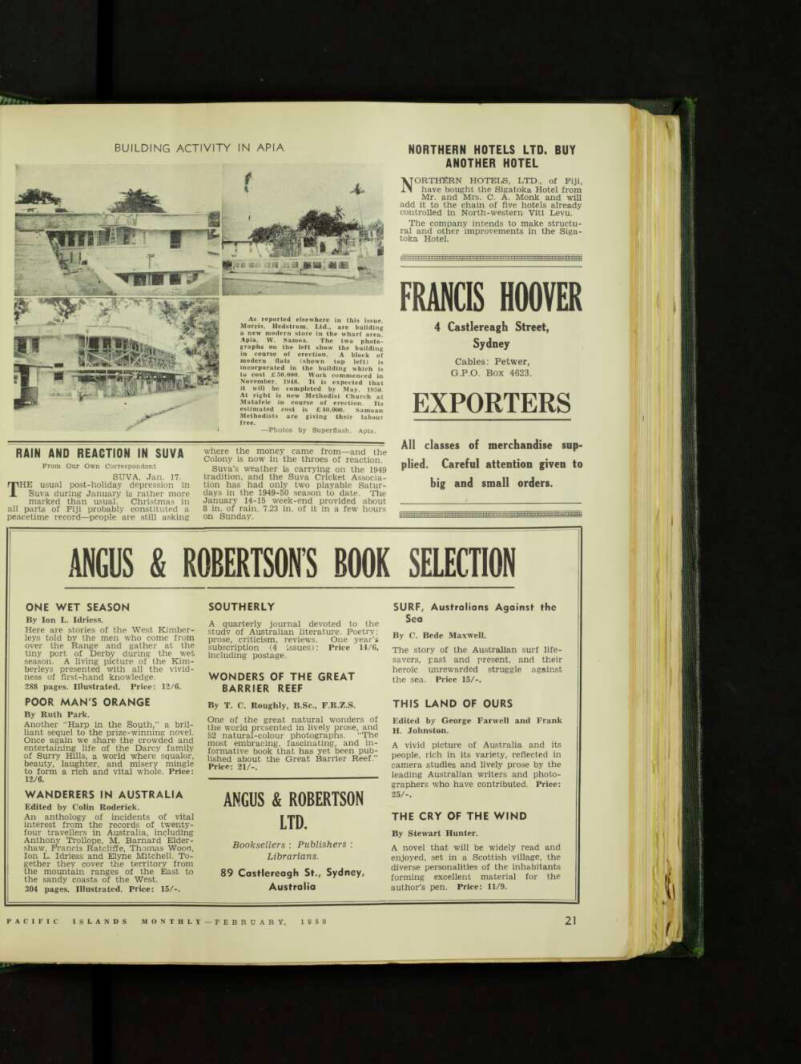
As reported elsewhere in this issue, Morris, Hedstrom, Ltd., are building a new modern store in the wharf area, Apia, W. Samoa. The two photo graphs on the left show the building in course of erection. A block of modern flats (shown top left) is incorporated in the building which is to cost £50,000. Work commenced in November, 1948. It is expected that it will be completed by May, 1950.
At right is new Methodist Church at Matafele in course of erection. Its estimated cost is £40,000. Samoan Methodists are giving their labour free. -Photos by Superflash, Apia.
Rain And Reaction In Suva
From Our Own Correspondent
Suva, Jan. 17.
THE usual post-holiday depression in Suva during January is rather more marked than usual. Christmas in all parts of Fiji probably constituted a peacetime record —people are still asking
where the money came from—and the Colony is now in the throes of reaction.
Suva’s weather is carrying on the 1949 tradition, and the Suva Cricket Associa tion has had only two playable Satur days in the 1949-50 season to date. The January 14-15 week-end provided about 8 in. of rain, 7.23 in. of it in a few hours on Sunday.
Northern Hotels Ltd. Buy
Another Hotel
Northern hotels, ltd., of Fiji, have bought the Sigatoka Hotel from Mr. and Mrs. C. A. Monk and will add it to the chain of five hotels already controlled in North-western Viti Levu.
The company intends to make structu ral and other improvements in the Siga toka Hotel.
Advertisements & other items, p. 25 (1 item)
Francis Hoover
4 Castlereagh Street, Sydney Cables: Petwer, G.P.O. Box 4623.
EXPORTERS
All classes of merchandise supplied. Careful attention given to big and small orders.
ANGUS & ROBERTSON’S BOOK SELECTION
ONE WET SEASON
By lon L. Idriess.
Here are stories of the West Kimberleys told by the men who come from over the Range and gather at the tiny port of Derby during the wet season. A living picture of the Kimberleys presented with all the vividness of first-hand knowledge. 288 pages. Illustrated. Price: 12/6.
POOR MAN'S ORANGE
By Ruth Park.
Another “Harp in the South,” a brilliant sequel to the prize-winning novel.
Once again we share the crowded and entertaining life of the Darcy family of Surry Hills, a world where squalor, beauty, laughter, and misery mingle to form a rich and vital whole. Price: 12/6.
WANDERERS IN AUSTRALIA
Edited by Colin Roderick.
An anthology of incidents of vital interest from the records of twentyfour travellers in Australia, including Anthony Trollope, M. Barnard Elder shaw, Francis Ratcliffe, Thomas Wood, lon L. Idriess and Elyne Mitchell. Together they cover the territory from the mountain ranges of the East to the sandy coasts of the West. 304 pages. Illustrated. Price: 15/-.
SOUTHERLY
A quarterly journal devoted to the study of Australian literature. Poetry; prose, criticism, reviews. One year’s subscription (4 issues): Price 14/6, including postage.
WONDERS OF THE GREAT
BARRIER REEF
By T. C. Roughly, B.Sc., F.R.Z.S.
One of the great natural wonders of the world presented in lively prose, and 52 natural-colour photographs. “The most embracing, fascinating, and informative book that has yet been published about the Great Barrier Reef.”
Price: 21/-.
ANGUS & ROBERTSON
LTD.
Booksellers : Publishers : Librarians.
89 Castlereagh St., Sydney,
Australia
SURF, Australians Against the
Sea
By C. Bede Maxwell.
The story of the Australian surf lifesavers, ipast and present, and their heroic unrewarded struggle against the sea. Price 15/-.
THIS LAND OF OURS
Edited by George Farwell and Frank H. Johnston.
A vivid picture of Australia and its people, rich in its variety, reflected in camera studies and lively prose by the leading Australian writers and photographers who have contributed. Price: 25/-.
THE CRY OF THE WIND
By Stewart Hunter.
A novel that will be widely read and enjoyed, set in a Scottish village, the diverse personalities of the inhabitants forming excellent material for the author’s pen. Price: 11/9.
More Fijian Cane
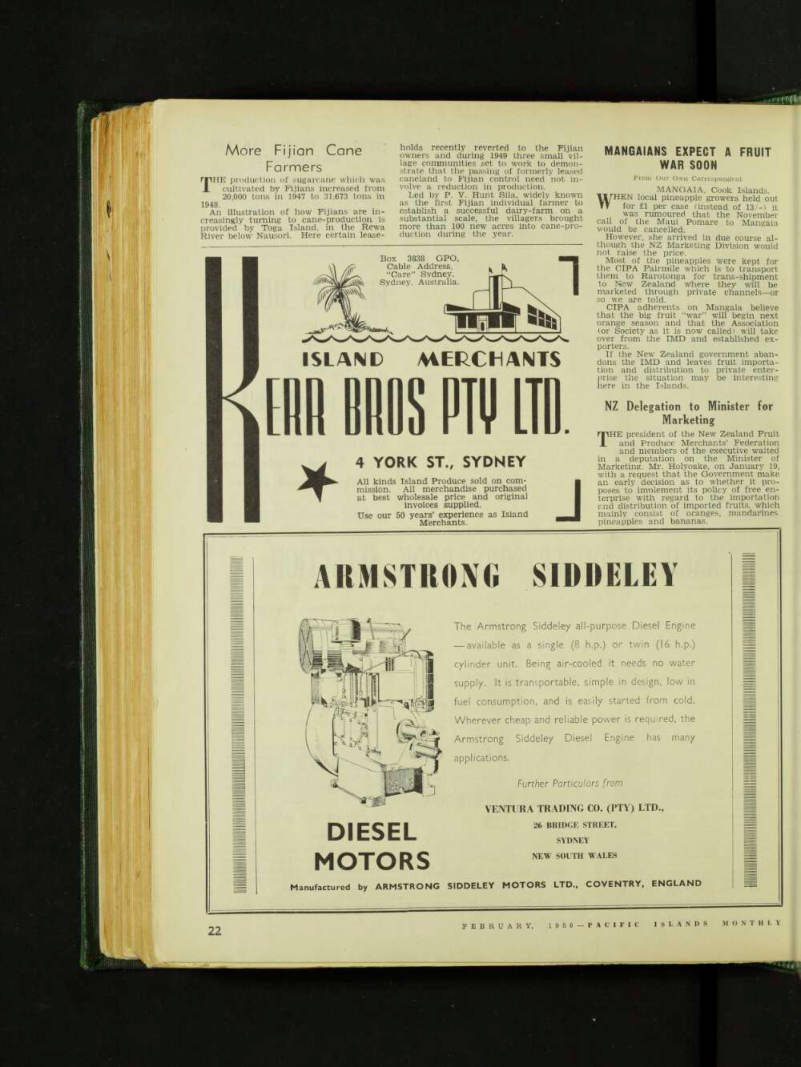
Farmers
fTIHE production of sugarcane which was X cultivated by Fijians increased from 20,000 tons in 1947 to 31,673 tons in 1948.
An illustration of how Fijians are in creasingly turning to cane-production is provided by Toga Island, in the Rewa River below Nausori. Here certain lease
holds recently reverted to the Fijian owners and during 1949 three small vil lage communities set to work to demon strate that the passing of formerly leased caneland to Fijian control need not in volve a reduction in production.
Led by P. V. Hunt Sila, widely known as the first Fijian individual farmer to establish a successful dairy-farm on a substantial scale, the villagers brought more than 100 new acres into cane-pro duction during the year.
Marketing
Mangaians Expect A Fruit
War Soon
From Our Own Correspondent MANGAIA, Cook, Islands. 11THEN local pineapple growers held out tt for £1 per case (instead of 13/-) it was rumoured that the November call of the Maui Pomare to Mangaia would be cancelled.
However, she arrived in due course al though the NZ Marketing Division would not raise the price.
Most of the pineapples were kept for the CIPA Fairmile which is to transport them to Rarotonga for trans-shipment to New Zealand where they will be marketed through private channels—or so we are told.
CIPA adherents on Mangaia believe that the big fruit “war” will begin next orange season and that the Association (or Society as it is now called) will take over from the IMD and established ex porters.
If the New Zealand government aban dons the IMD and leaves fruit importa tion and distribution to private enter prise the situation may be interesting here in the Islands.
NZ Delegation to Minister for
Marketing
THE president of the New Zealand Fruit and Produce Merchants’ Federation and members of the executive waited in a deputation on the Minister of Marketing. Mr. Holyoake, on January 19, with a request that the Government make an early decision as to whether it pro poses to imnlement its policy of free en terprise with regard to the importation and distribution of imported fruits, which mainly consist of oranges, mandarines pineapples and bananas.
Advertisements & other items, p. 26 (1 item)
Armstrong Siddeley
Box 3838 GPO, Cable Address.
“Care” Sydney.
Sydney. Australia.
ISLAND MERCHANTS
4 YORK ST., SYDNEY
All kinds Island Produce sold on commission. All merchandise purchased at best wholesale price and original invoices supplied.
Use our 50 years’ experience as Island Merchants.
J
ARMSTRONG SIDDELEY
The Armstrong Siddele/ all-purpose Diesel Engine available as a single (8 h.p.) or twin (16 h.p.) cylinder unit. Being air-cooled it needs no water supply. It is transportable, simple in design, low in fuel consumption, and is easily started from cold.
Wherever cheap and reliable power is required, the Armstrong Siddeley Diesel Engine has many
applications.
Further Particulars from
VENTURA TRADING CO. (PTY) LTD.,
26 BRIDGE STREET,
SYDNEY
NEW SOUTH WALES
DIESEL
MOTORS
Manufactured by ARMSTRONG SIDDELEY MOTORS LTD., COVENTRY, ENGLAND
Dr. Vernon Remembered At The Mission
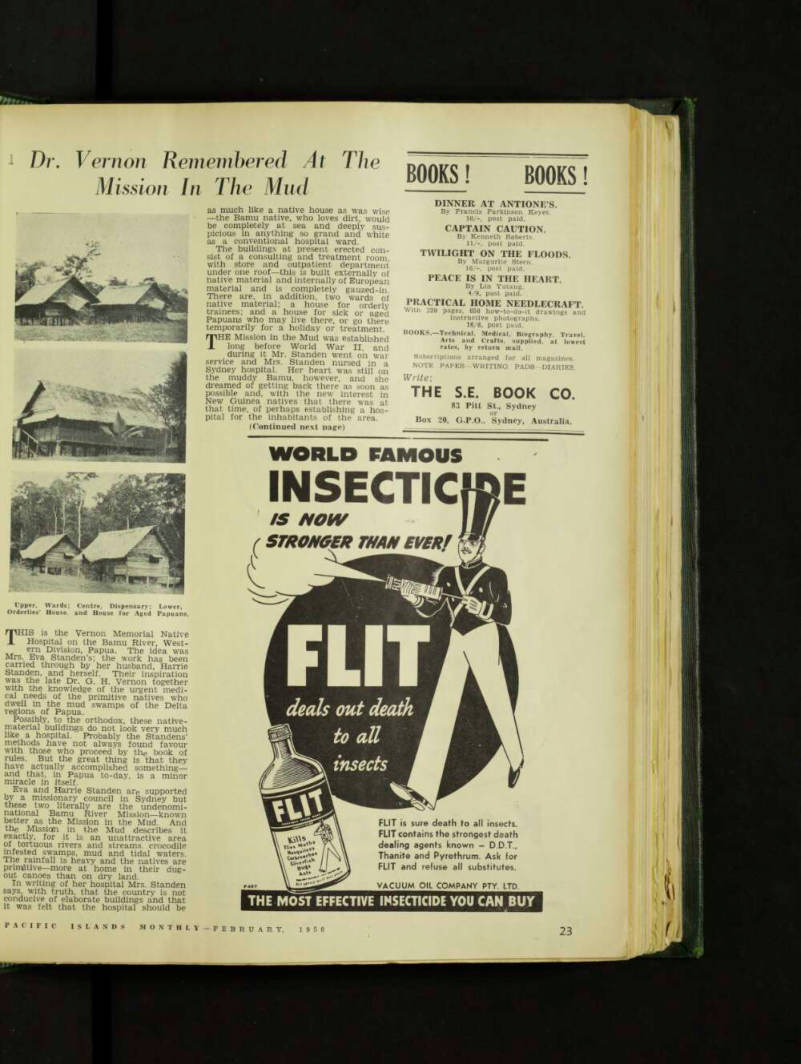
Mission In The Mud
THIS is the Vernon Memorial Native Hospital on the Bamu River, West ern Division, Papua. The idea was Mrs. Eva Standen’s; the work has been carried through by her husband, Harrie Standen, and herself. Their inspiration was the late Dr. G. H. Vernon together with the knowledge of the urgent medi cal needs of the primitive natives who dwell in the mud swamps of the Delta regions of Papua.
Possibly, to the orthodox, these native material buildings do not look very much like a hospital. Probably the Standens’ methods have not always found favour with those who proceed by th e book of rules. But the great thing is that they have actually accomplished something— and that, in Papua to-day, is a minor miracle in itself.
Eva and Harrie Standen are supported by a missionary council in Sydney but these two literally are the undenomi national Bamu River Mission —known better as the Mission in the Mud. And the Mission in the Mud describes it exactly, for it is an unattractive area of tortuous rivers and streams, crocodile infested swamps, mud and tidal waters.
The rainfall is heavy and the natives are primitive—more at home in their dug out canoes than on dry land.
In writing of her hospital Mrs. Standen says, with truth, that the country is not conducive of elaborate buildings and that it was felt that the hospital should be
as much like a native house as was wise —the Bamu native, who loves dirt, would be completely at sea and deeply sus picious in anything so grand and white as a conventional hospital ward.
The buildings at present erected con sist of a consulting and treatment room with store and outpatient department under one roof—this is built externally of native material and internally of European material and is completely gauzed-in There are, in addition, two wards of native material; a house for orderly trainees; and a house for sick or aged Papuans who may live there, or go there temporarily for a holiday or treatment.
THE Mission in the Mud was established long before World War 11, and during it Mr. Standen went on war service and Mrs. Standen nursed in a Sydney hospital. Her heart was still on the muddy Bamu, however, and she dreamed of getting back there as soon as possible and, with the new interest in New Guinea natives that there was at that time, of perhaps establishing a hos pital for the inhabitants of the area.
(Continued next page)
Upper, Wards; Centre, Dispensary; Lower, Orderlies’ House, and House for Aged Papuans.
In 1946, the war over and in Port Moresby awaiting transport to the Delta, she talked over her hopes with Dr.
Vernon who was waiting for transport in the opposite direction. The doctor had spent a number of in the Delta and his advice and encouragement had meant much to the Standens.
Before Mrs. Standen had got to Daru, however, news of the doctor’s sudden death reached her and it seemed then that it was only fitting that the hospital that she had in mind should be dedicated to the memory of the man
who had endeared himself to thousands —Papuan or European, all suffering mankind had a claim upon him. During the war his special job was the native serviceman—but countless Australians and Americans have a place in their hearts for the Old Doc., who walked the Kokoda Trail with them and who was never too tired or too busy to help them on their way.
A fund was opened by the Standens and donations from Papua and Australia, with Administration grants, finally reached £BOO. Included in this amount
is a sum given by the AIF 11th Light Horse Brigade of World War I, of which Dr. Vernon had been medical officer— they felt that this was the kind of memorial of which the doctor himself would have approved.
As the fund grew slowly, sites for the hospital buildings were inspected and visits up the central and upper Bamu re vealed that some land was a little higher than the then headquarters of the Mission on Maipani Island where monthly spring-tides covered most of the land. In early 1949, therefore, the head quarters were moved up near the junc tion of the Bamu and Wawoi Rivers and a start made on the Vernon Memorial Hospital under what were seemingly im possible conditions. Lack of transport and workers and material, local wars among the people, climatic disturbances, the breaking away of the river banks on the best sites all meant delay and hard work. But the will to do is everything and to-day the hospital is a going con cern. Already many infants and others in the area owe their lives to the treat ment they have received there.
At the end of last year the Admini stration sent along Dr. Joan Refshauge to see what was being done; her encourage ment has meant a great deal to the Standens, their medical trainees and helpers.
IN the three months between September and December, 1949, 2,254 treatments were given to outpatients; 78 infants were examined and treated or put on special food; and 900 injections for yaws were given. .. . , Capital expenditure from the fund amounted to £342. A sum of £205 has been set aside for future building and £250 for current running costs. In com parison with the huge sums necessary to establish a more orthodox hospital this all seems absurdly modest and out of all proportion to the good work done.
The Vernon Memorial Hospital can still do with your help, however; your spare shillings will always be welcome. (See story of Dr. Vernon, page 82, tins issue.)
Advertisements & other items, pp. 27-28 (1 item)
Insecticfpe
BOOKS! BOOKS!
DINNER AT ANTIONE’S.
By Francis Parkinson Keyes; 16/-, post paid,
CAPTAIN CAUTION.
By Kenneth Roberts. 11/-, post paid.
TWILIGHT ON THE FLOODS.
By Margurite Steen. 16/-, post paid.
PEACE IS IN THE HEART.
By Lin Yutang. 4/9, post paid.
PRACTICAL HOME NEEDLECRAFT.
With 320 pages, 650 how-to-do-it drawings and instructive photographs. 16/6, post paid.
BOOKS.—Technical, Medical, Biography. Travel, Arts and Crafts, supplied, at lowest rates, by return mail.
Subscriptions arranged for all magazines.
NOTE PAPER—WRITING PADS—DIARIES.
Write :
THE S.E. BOOK CO.
83 Pitt St., Sydney or Box 20, G.P.0., Sydney, Australia.
WORLD FAMOUS
INSECTICfPE
fSNOW
( STRONGER THAN
h
TM'Jt
CocVro*^ L«A* —*^***rC |ll "i n.t FLIT is sure death to all insects.
FLIT contains the strongest death dealing agents known - D.D.T., Thanite and Pyrethrum. Ask for FLIT and refuse all substitutes.
VACUUM OIL COMPANY PTY. LTD.
THE MOST EFFECTIVE INSECTICIDE YOU CAN BUY
YOU SAVE MONEY WHEN
YOU USE KOLYNOS
% & $ /(f
YOU NEED
ONLY HALF
AN INCH ON
YOUR
BRUSH!
so
CONCENTRATED
ONE TUBE LASTS
AS LONG AS TWO
TUBES OF ORDINARY
TOOTH PASTE
isS
V > A» V
Kolynos
DENTAL CREAM
TASTES BETTER CLEANS BETTER LASTS LONGER
Govt. Employees
High Wage Bill For Native
NG Administration Fixes Scale
IN the Papua-New Guinea Gazette of January 25, the approved wage scale for “Administration Servants (that is, native employees of the Administra tion) is published. Monthly wages range from £1 per month for Ist year proba tioners (presumably native employees learning some trade or occupation) to £2O per month for 3rd year Co-operative or not native employees should receive high wages is a matter of personal opinion. However, this enormously in creased wages bill for native Administra tive employees must play some part in turning what were, before the war, vir tually self-supporting Territories into a liability to the Australian taxpayer to the tune of £3 or £4 million.
In the lower income brackets among these natives are Interpreters Grade I at £1 per month; Laundrymen with a maxi mum of £5 per month; messengers and cleaners at £3/10/-. At the top of the tree are foremen mechanics at £lB per month; forestry assistants, maximum at £l7/10/-; laboratory assistants (Agnc.) £l7/10/- max.; Ship’s master, £2O; Super visory teacher, £2O max.
Comparatively few employees are on maximum wages, of course. Average wages are more likely to be £7 or £8 per month.
No Mariposa Yet
IT seems unlikely that the Mariposa will come back soon to the Pacific service —as was indicated some months ago.
On October 17, the United States Mari time Commission informed the Matson Navigation Company, that it was willing under certain conditions, to pay the “out standing re-delivery obligation” on Mari posa and Monterey in a lump sum, this to be used for the completion of Mariposa only.
The president of the Matson Company said in November that this was at vari ance with the company’s original pro posal to the Maritime Commission and contained no provision for the disposition of Monterey. He said that the company would enter into further negotiations with the Commission in an effort to find a solution to the problem but that this would take considerable time and no re sults could be expected in the immediate future. (The “outstanding re-delivery obliga tion” referred to above apparently means the sum granted by the US Maritime Commission to the owners of Monterey and Mariposa for reconversion of the two ships after war-time duties. Reconver sion work was proceeding on the ships on the American Pacific coast but was suddenly halted in July, 1947, when work on the Mariposa was about 60 per cent, complete. The reason given by the Com pany was that costs were so much higher than anticipated that putting the ships back on the San Francisco-Sydney run had become uneconomic. It has always been understood that the grant allowed by the US Government (through the Maritime Commission), was considered inadequate to meet these costs. The ships have therefore remained in dock for the past 21 years. The slow turn around of ships in Australian ports, dollar restrictions and consequent lack of trade between America and Australasia, and
the development of trans-Pacific aviation have combined to make the running of a shipping service between USA and Aus tralia even less attractive than it might have been.) Another step forward has been taken in the establishment of the new Suva Medical Centre which is included in Fiji’s Development Plan. Tenders have been invited for the building of a Medical School to replace the existing Central
Medical School at which Assistant Medical Practitioners are trained. Tenders were recently invited for the home for local nurses in training.
A hundredweight of yams and a hundredweight of dalo (taro) were shipped by the Matua to Auckland at the end of January by the Fiji Amateur Sports Association. The vegetables are for the four members of the athletics team which represented Fiji at the British Empire Games.
Advertisements & other items, p. 29 (1 item)
Microscopes
The Watson Service Microscope.
WATSON Microscopes are British made, worldfamous, and second to none. They are rigid, beautifully balanced and finished, and built to give a lifetime of service.
"Service" Microscope
A robust and rigid instrument, ideal for all routine laboratory work. Stocks available for immediate delivery.
Wats oar Victor
IL I TMOL ITEB
Head Office: 9-13 Bligh Street, Sydney, Australia
ARC WELDING
A MACHINES
A ACCESSORIES
E.M.F. manufacture a complete range of arc welding electrodes including mild steel structural grade types, electrodes for welding special steels* stainless steel and heat resisting steel electrodes, special electrodes for welding cast iron, non-ferrous metals and for hardsurfacing.
The range of E.M.F. arc welders covers the A.C. ''Pilot" Arc welder for maintenance and jobbing work and Choke Controlled machines for heavy duty applications, also petrol and electric motor driven D.C. welders.
Jbah/ocLi&xAi 5 <4?vtadt .
Killed
Chinese Resident Of Rabaul
ONE of Rabaul’s best known Chinese residents, Mr. Chen Hein was killed in January when the jeep in which he was riding came into collision with a large truck driven by a native.
Before the war he owned plantations on New Ireland and his schooner, Kwong
Chow, was one of the best pre-war vessels in the area.
Chen Hein was universally liked and respected and his funeral was attended by all sections of the Rabaul community.
Mr. W. Tailby, Resident Commissioner of the Cook Islands, with Mrs. Tailby and Miss Margaret Tailby, was on leave in New Zealand in January.
Them Worried
Mother And Daughter Have
RABAUL, New Guinea, has no more mother-in-law trouble than any other town. But it is seriously in convenienced. by the Mother and her two Daughters, named, respectively, North and South.
The Mother and Daughters are, of course (with Matupi and Vulcan) the volcanoes that ring Rabaul around and it is due to their interior rumblings that the town experiences frequent earth tremors. Some are severe and some axe very slight but they are a permanent feature of life there, carrying with them always the possibility of a full-scale eruption (as in 1937).
There are various standing-orders in Rabaul as to “What to Do if an Eruption Occurs,” and more recently, a manifesto was issued giving hints to householders in order that they might guard against the run-of-the-mill, or common, conse quences of the tremors.
They are advised to: (1) Brace all foundation piles and posts diagonally. (2) Brace all tank stands. (3) Hook all tall items of furniture back against solid sections of the wall. Fasten battens across shelves in which crockery and bottles are stored. (4) Avoid hanging heavy pictures and ornaments on walls in the vicinity of beds. (5) Extinguish all kerosene refrigera tors at the first sign of a dis turbance and evacuate the house carefully taking the fire ex tinguisher (which has been regu larly checked) with them.
It all makes for a little interest in the boredom of the daily round.
Advertisements & other items, p. 30 (1 item)
N. F. Maloney & Co.
Phone 268. PORT MORESBY Phone 268.
Cables, Radios, etc., “Malco,” Port Moresby.
CUSTOMS, SHIPPING, AND FORWARDING AGENTS.
LICENSED AUCTIONEERS AND GENERAL COMMISSION
AGENTS.
House, Land, and Estate Agents. i Chief Agents:
NEW ZEALAND INSURANCE CO. LTD.
(Incorporated in New Zealand) FIRE . . ACCIDENT . . MOTOR VEHICLE . . MARINE, ETC.
Importers and Exporters :: Manufacturers Representatives.
Australian Representatives : E. J. GOUGH & CO., 1 BOND STREET, SYDNEY.
Distributors throughout the Territory of New Guinea for
BOOTES GROUP PRODUCTS
HUMBER, HILLMAN
and SUNBEAM-TALBOT CARS
s\ i u m S: S\ Si
COMMER and KARRIER TRUCKS
Write for full details of prices and deliveries to: —
COLTER WATSON (guutca) LTD
RABAUL
KAVIENG
Where Do The Manihiki
"Panamas" Go?
From Our Own Correspondent MANGAIA, Cook Islands.
THE Australian or NZ city-dweller who, in the hot days of summer, wishes to obtain a panama hat, finds the article hal’d to get, and often of very poor quality. Pre-war exports from Japan to this end of the world have ceased; and a genuine South American panama was rare even before Hitler put on warpaint and went off the reserva tion. One wonders why the finely woven hats of Manihiki Island (Nor thern Cooks) are not exploited, to fill this market vacuum. The prices would surely be good in Auckland and Sydney.
Every well-dressed Cl-er wears one of these Manihiki hats, which are made from palm-frond material whitened to the appearance of small quills, recalling the famous peacock-quill headgear of King Kamehameha of Hawaii. They are long-lasting, with reasonable care, and have been bought, at the island where they are made, at prices as low as eight or ten shillings.
Surely this Cl industry deserves en couragement, and a wider market than mere inter-island custom? It is a con stant source of wonder to observers that so little use is made of marketable Cl products other than fruit, copra, and
Mop.
Editorial Note:
SO-CALLED “Panama” hats have reached epidemic proportions this year amongst Australian men. We are told that demand is at least as great as supply; that the unblocked straw “hoods” come from Central China (that is what the salesman will tell you, any way) ; that they are blocked and trimmed in Australia and sell at from 35/- to 45/- each. The only way to find out if Manihiki hats could compete against this type of hat would be to send a shipment to interested manufacturers. The cur rent crop of “Panamas” are feather-light, but in qualitv bear little resemblance to the original Central American product.
P-NG Still Selling War Disposals
Cyanide, Sunken Tractors
And Aircraft Engines!
P-NG Still Selling War Disposals Goods
rpENDERS were called, at the end of X January, for a miscellany of war disposals goods at various centres in Papua and New Guinea. The strange thing is that 41 years after the war ended, and after being raked back and forth by all manner of dealers, there is anything left to dispose of.
The collection now offered by tender induct s 15 tons of scrap copper wire, packed in 44-gallon drums at the wharf, Samarai; wrecked aircraft and aircraft engines (number unspecified and they must be removed within six months) lo cated in the Rabaul and Kokopo areas of New Britain; three tractors of un known make and size, which are located somewhere in the sea, in the vicinity of Milford Haven wharf, Lae; and 376 two hundredweight drums of cyanide at Salamaua.
Presumably the tractors were driven off the wharf in a fit of military exuber ance before civil administration took over control of the Territory. After being at the mercy of the salt-sea waves for four years it is unlikely that thev will be of much use for the purpose for which they were originally intended.
It is said of the cyanide that 20 per cent, of the drums are losing their con tents through rusting. Salamaua is, of course, a completely deserted village as far as European residents are concerned, but unless a strict guard is kept upon it. the disintegrating drums of cyanide seem to be as great a hazard to the health of local natives as is the square mile of bombs at Tadji in Northern New Guinea.
It would be interesting to know for what purpose the 38 tons of cyanide were required in Salamaua in the first place.
We have never heard that the Japs re leased rabbits to eat up the country side, as they released Giant Snails.
Tanker Fire At Pago Pago
ALTHOUGH it happened in October, details of a tanker fire at Pago Pago, American Samoa, have just come in.
Cause of the fire is unknown. The tanker was tied up at the wharf dis charging petrol to shore installations when, at 1.30 a.m. two explosions rocked the harbour. The explosions were of such severity that windows were shat • tered in Government House on the opposite side of the harbour.
Fire engines could do little but keep the flames from spreading from the wharf area. After burning for 22 hours the tanker sank alongside the wharf.
Casualties included six men killed.
Advertisements & other items, pp. 31-32 (1 item)
Tnc Garrick Hotel
TAHITI
To Shipmasters and Visitors When calling at Tahiti, and seeking SHIPS SUPPLIES and FRESH
PROVISIONS, see—
OSCAR G. NORDMAN
Supply Agent for Messageries Maritimes, Union S.S. Co. of N.Z., Ltd., Matson- Oceanic Line, United States Line, General S.S. Corp., Etc.
We supply General Service—lnformation about the Islands— Real Estate Service—Make Reservations—Act as Shipping Agents Wire before your arrival to
OCEANIC PAPEETE—Our
registered cable address.
OSCAR G. NORDMAN
Ship Chandler
PAPEETE, TAHITI
Tnc Garrick Hotel
TZM
Vl k » & %*
SUVA
FIJI
This well-known Hotel is centrally situated in Suva's main business quarter :: Modern accommodation provides comfort in all climatic conditions :: Only the best of Beers, Spirits and Wines is served Telephone: 80. VINCE COSTELLO, Proprietor.
LAUREL
is easy
the eyes,
& burns with a Soft, White Light—flickerless, odourless, smokeless and without soot—so easy on the eyes of both young and old, yet so efficient and economical.
Always keep your lamps filled with Laurel Kerosene but, when ordering, don't ask for just "Kerosene," say LAUREL.
VACUUM OIL COMPANY PTY. LTD.
VACUUM
on
too!
mu cr<
All -PURPOSE
KEROSENE
For lighting , Heating . Cooking . Cleaning freezing
Western Samoan Newsletter
From Our Own Correspondent
Apia, Jan. 21.
A WEEK before Christmas, the wet season set in with torrential rains pouring down day and night. Bad weather conditions, however, did not seem to interfere with the Christmas buying and business generally was re ported to be very bright with Europeans and Samoans spending freely. Good prices are being obtained for copra and cocoa, and the Apia stores offered a good variety of seasonal goods.
However, as a result of the devaluation of the £stg. and the increase in import duties on dollar goods through the change in the conversion rates, imports of goods from USA and Canada are de creasing rapidly, with the exception of essential goods not obtainable elsewhere (lumber, oil, tyres and motor vehicles).
The Collecter of Customs has circularised importers warning them that dollar al locations for 1950 have to be drastically cut down.
Two steamers with large cargoes ar rived in Apia just before Christmas—the Waikawa from Sydney and the Waiheme from Vancouver. It is unfortunate that shipping services from Sydney are so ir regular, as local importers are eager and willing to increase their orders from Aus tralia for goods which cannot now be imported from the USA.
DONATIONS collected by Apia firms and Government departments for the Makogai Christmas Fund, for the leper patients at Makogai, Fiji, amounted to £lB4/14/7, of which the firm of O. F. Nelson & Co., Ltd., collected £145.
TEN Samoan schoolchildren have been awarded New Zealand Government scholarships to attend New Zealand schools in 1950. Of the ten children,
seven are Samoans and three local-born Europeans of mixed descent.
A PLEASANT little function took place on December 9 at Aleisa land settle ment for local-born European settlers, when the new Government School for the 140 children of the settle ment was officially opened in the presence of the Hon. Pautua and repre sentatives of the Government. Whilst the Government had contributed the materials and supervised the work, the actual labour had been done voluntarily by the Aleisa settlers and the roomy and attractive school building reflects the greatest credit on all concerned.
A musical programme was given by the school-children under the direction of the headmaster, Mr. R. Collins and his three assistant teachers. The school orchestra played light music. School certificates were presented to pupils by the Director of Educations Mr. D. R.
Lambie.
DURING the absence of the High Com missioner in New Zealand and the secretary to the Government, Mr. J.
B. Wright, on leave, the Chief Judge, Mr.
C. C. Marsack, has been appointed Act ing High Commissioner and Mr. L. M.
Cook Acting Secretary. Mr. R. S. Agnew has been appointed Collector of Customs.
Four of the ten Western Samoan Scholarship winners who are now in New Zealand.
Photo by Superflash, Apia.
MR. D; G. McCracken, headmaster of Avele Boys’ School, left Samoa for New Zealand by the last Matua after terminating his term of engagement in the Territory. His departure is regretted by Europeans and Samoans alike. His successor is Mr. R. G. Hoare who has been teaching at Avele School for several years. :: :; ;; THERE is considerable building activity in and around Apia at the present time. Morris, Hedstrom Ltd’s, new
premises are nearing completion now and when finished will greatly enhance the Custom House area.
The large building of the Methodist Mission, near the Apia Post Office, is also in course of construction. At Motootua the buildings of the Intermediate School and the Malifa Infant School, as well as a special building for school broadcasting purposes, are going up, while a number of dwellings for teachers and officials in the same suburb are also under construction.
Apia is at present a hustling and very busy place and the general appearance of the town and its surroundings is bound to be greatly improved as a result of the work now being done.
Advertisements & other items, pp. 33-34 (1 item)
Walter Grand
Place Your Islands Orders With . . .
P.O. BOX 522, PAPEETE, TAHITI, FRENCH OCEANIA General Merchant, Commission Agent, Importer and Exporter Cable Address: “WALGRAND,” Papeete Australian Representative : J. C. MERRILLEES PTY., LTD., 104 Hunter Street, Sydney, N.S.W.
Telegrams: “MERRILLEES,” Sydney.
Look for KRAFT
and find QUALITY
The unchanging quality of Kraft foods is a byword wherever fine foods find appreciation. In their constant vigilance over quality, Kraft experts have achieved even more than just that, for hand in hand with Kraft quality goes flavour perfection and food value of a very high order.
Wherever you see the name “Kraft”, buy confidently, and remember, “Red Feather” foods are made by Kraft too. No finer foods can be found.
Export Division .
Kraft Walker Cheese Co. Pty. Ltd.,
Riverside Ave., South Melbourne,
AUSTRALIA.
m
KRAFT
V //
?iT li
Three famous Kraft Foods
now available
in full supply everywhere .
VEGEMITE — the delicious, healthful yeast extract. One of the richest known sources of the important Vitamin B complex. Strongly recommended in all areas where fresh vegetables are scarce. A little does "a power of good.
KRAFT CHEDDAR CHEESE — a
creamy-smooth, choice processed cheddar.
Rich in Vitamins A, B and D, calcium, phosphorus, and other nutrients of milk.
Always fresh whether in the attractive blue can or in its hygienic foil wrapping. Not too sharp — not too mild — just too good for words.
BONOX — pre-digested beef in its tastiest and most assimilable form. A valuable food for its high content of niacin (the anti-pellagric factor), and a powerful digestive stimulant. Dissolve in hot water for an appetising drink, or use as a spread or a flavouring for cooked dishes. Eat it and drink it for a lift!
YOUR FUTURE CAREER . . .
Merchants, Accountants, Secretaries, Bankers and Business Managers ... all hold responsible positions with commensurate salaries. You too can enhance your prospects in this ever-expanding commercial field, which yields abundant returns to those with adequate qualifications. H.R.I. prepare ambitious men and women for all business positions from junior to senior executive. Tuition is practical authoritative up-to-date time saving . . . and certain in its successful results. The H.R.I, is available always to advise you write or wire for information free and without obligation.
H.R.I. tutorial service is proved by the uinning of more honours than all coaches in Australasia combined.
H.R.I. Career Training • ACCOUNTANCY • SECRETARYSHIP ® COST ACCOUNTANCY
• PRACTICAL BOOKKEEPING • MARKETING SELLING
ADVERTISING • BANKING • LOCAL GOVERNMENT EXAMS.
II olie r tso n Institute
Hemingway
Founded and Owned by Hemingway & Robertson Pty. Ltd.
Consulting Accountants :: :: Professional Tutors
126 BANK HOUSE. BANK PLACE. MELBOURNE
126 BARRACK HOUSE. 16 BARRACK STREET. SYDNEY
STEAMSHIPS TRADING COMPANY LTD
PORT MORESBY AND SAMARAI PAPUA
Wholesale & Retail Merchants, Planters, Sawmillers, Engineers, Slip
Proprietors, Shipping, Customs and Insurance Agents.
MANAGING AGENTS for:
SAWMILLERS & TRADERS LTD.
CORAL SEAS INSURANCE CO. LTD.
ACME BAKERY COMPANY.
MARIBOI RUBBER LTD.
RUBBERLANDS LTD.
KEREMA RUBBER PLANTATIONS LTD.
COCOALANDS LTD.
AGENCIES:
BANKERS & TRADERS INSURANCE CO. LTD.
VACUUM OIL CO. PTY., LTD.
DIRECTORATE OP SHIPPING-Papua-New
Guinea Division.
ROYAL PACKET NAVIGATION CO.
KOKE BAGU PTY., LTD.
TRANS OCEANIC AIRWAYS.
GUINEA AIR TRADERS.
DISTRIBUTORS IN PAPUA for:
ARMSTRONG-HOLLAND PTY., LTD. INTERNATIONAL HARVESTER CO. OP AUST. LTD.
Earth Moving and Logging Equipment. International Trucks, WILLYS-OVERLAND EXPORT CORPORATION. McCormick-Deermg Farming ac mery.
Jeep cars, etc. Defender Refrigerators.
SYDNEY AGENTS: NELSON G ROBERTSON PTY. LTD., 12 SPRING STREET
New Fiji Government Posts
Created
PROVISION is made in the Fiji Esti mates for 1950 for a separate Inland Revenue Department, and a sep arate Stores Department. The work of these departments has hitherto been con trolled by the Accountant-General. Mr.
R. B. Ackland has been appointed Com missioner of Inland Revenue and Com missioner of Stamp Duties.
Provision is also made for two Assis tant Colonial Secretaries instead of one as at present. One Assistant will be concerned with general administrative matters and the other with the progress of the Colony’s Development Plan and the Public Works programme.
Mr. P. H. Nightingale has been ap pointed Assistant Colonial Secretary (De velopment) and Mr. E. R. Bevington will continue to act as Assistant Colonial
Secretary (Administration).
The posts of Registrar Supreme Court and Registrar General have also been separated. Mr. H. Y. Anderson will con tinue to be Registrar General. Mr. M.
N. Cochrane, District Magistrate, is act ing as Registrar Supreme Court.
Mr. Charles Luckman who has been president of Lever Brothers Co. has re signed because he could not agree with other directors on the future policy of the American company.
Apia Motor-Cutter Disappears
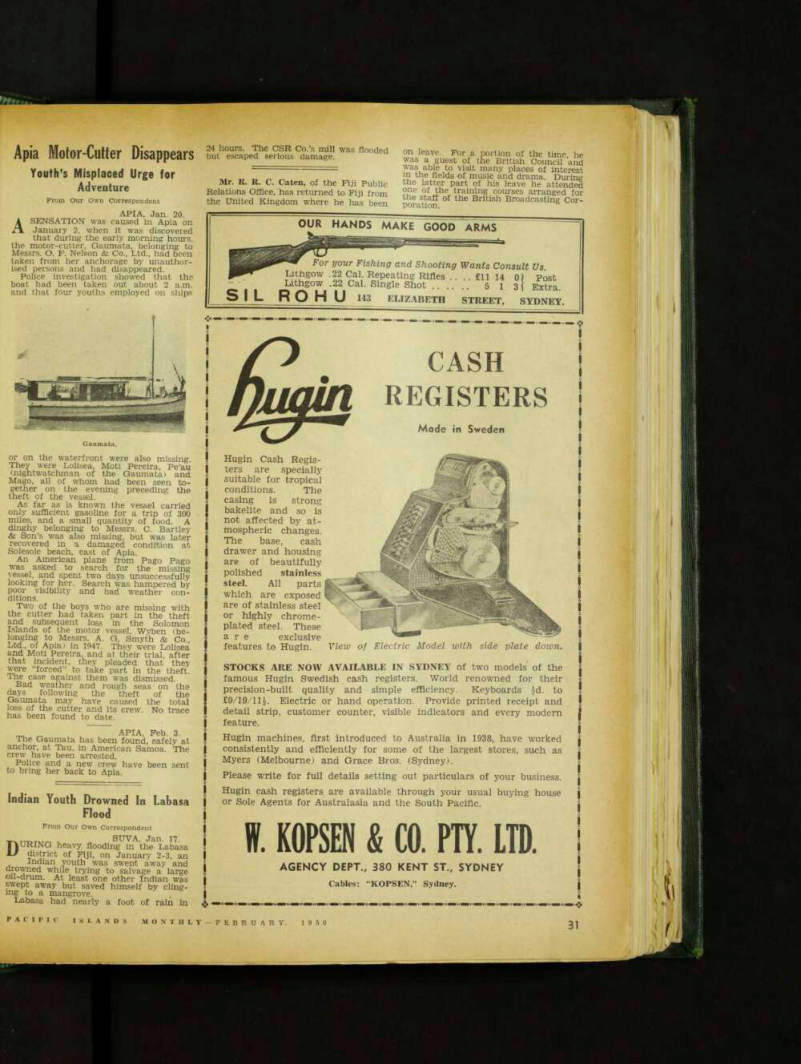
Youth’s Misplaced Urge for Adventure
From Our Own Correspondent
Apia, Jan. 20.
A SENSATION was caused in Apia on January 2, when it was discovered that during the early morning hours, the motor-cutter, Gaumata, belonging to Messrs, O. F. Nelson & Co., Ltd., had been taken from her anchorage by unauthor ised persons and had disappeared.
Police investigation showed that the boat had been taken out about 2 a.m. and that four youths employed on ships
or on the waterfront were also missing.
They were Lolisea, Moti Pereira, Pe’au (nightwatchman of the Gaumata) and Mago, all of whom had been seen to gether on the evening preceding the theft of the vessel.
As far as is known the vessel carried only sufficient gasoline for a trip of 300 miles, and a small quantity of food. A dinghy belonging to Messrs. C. Bartley & Son’s was also missing, but was later recovered in a damaged condition at Solesole beach, east of Apia.
An American plane from Pago Pago was asked to search for the missing vessel, and spent two days unsuccessfully looking for her. Search was hampered by poor visibility and bad weather con ditions.
Two of the boys who are missing with the cutter had taken part in the theft and subsequent loss in the Solomon Islands of the motor vessel, Wyben (be longing to Messrs. A. G, Smyth & Co., Ltd., of Apia) in 1047. They were Lolisea and Moti Pereira, and at their trial, after that incident, they pleaded that they were “forced” to take part in the theft.
The case against them was dismissed.
Bad weather and rough seas on the days following the theft of the Gaumata may have caused the total loss of the cutter and its crew. No trace has been found to date.
Apia Feb 3
The Gaumata has been found, safely at anchor, at Tau, in American Samoa. The crew have been arrested.
Police and a new crew have been sent to bring her back to Apia.
Gaumata.
Indian Youth Drowned In Labasa
Flood
From Our Own Correspondent DURING heavy flooding^ A, the al Labasa district of Fiji, on January 2-3, an Indian youth was swept away and drowned while trying to salvage a large oil-drum. At least one other Indian was swept away but saved himself by cling ing to a mangrove.
Labasa had nearly a foot of rain in
24 hours. The CSR Co.’s mill was flooded but escaped serious damage.
Mr. R. R. C. Caten, of the Fiji Public Relations Office, has returned to Fiji from the United Kingdom where he has been
on leave. For a portion of the time he was a guest of the British Council and was able to visit many places of interest m the fields of music and drama. During the latter part of his leave he attended one of the training courses arranged for the staff of the British Broadcasting Cor poration. &
Advertisements & other items, pp. 35-36 (1 item)
». Kopsen 8 Co. Piy. Ltd.
OUR HANDS MAKE GOOD ARMS
For your Fishing and Shooting Wants Consult Us.
Llthgow .22 Cal Repeating Rifles ... £ll 14 0 Post Llthgow .22 Cal. Single Shot 5 1 3f Extra. sI L RO H U 143 ELIZABETH STREET, SYDNEY.
CASH
REGISTERS
Made in Sweden Hugin Cash Registers are specially suitable for tropical conditions. The casing is strong bakelite and so is not affected by atmospheric changes.
The base, cash drawer and housing are of beautifully polished stainless steel. All parts which are exposed are of stainless steel or highly chromeplated steel. These are exclusive features to Hugin. .
View of Electric Model with side plate down.
STOCKS ARE NOW AVAILABLE IN SYDNEY of two models of the famous Hugin Swedish cash registers. World renowned for their precision -built quality and simple efficiency. Keyboards id. to £9/19/1 li. Electric or hand operation. Provide printed receipt and detail strip, customer counter, visible indicators and every modern feature.
Hugin machines, first introduced to Australia in 1938, have worked consistently and efficiently for some of the largest stores, such as Myers (Melbourne) and Grace Bros. (Sydney).
Please write for full details setting out particulars of your business.
Hugin cash registers are available through your usual buying house or Sole Agents for Australasia and the South Pacific.
». KOPSEN 8 CO. PIY. LTD.
AGENCY DEPT., 380 KENT ST., SYDNEY
Cables: “KOPSEN,” Sydney.
Precious Jewellery Watches China and Glassware Art Jewellery Compacts Souvenirs Pens and Pencils Smokers' Accessories Silverware Cutlery Shaving Accessories Leather Goods Brush Sets Handbags All types of clocks from the "Clock Shop"
It's easier, it's more tun to shop by mail with the help ot Proud's Gift Book. Cut out the coupon below, send it to Moil Order Manager, Prouds Limited, Box 1502, G.P.0., Sydney, and receive Proud's Gift Book tree.
PROUD’S GIFT BOOK VOUCHER
Mail Order Manager, Frauds Limited, Box 1502, G.P.0., Sydney.
Please send me Proud's new Gift Book free of all charge.
Name Address
Samoan Sun-Dried Cocoa
Preferred In Uk
Hot-Air Was “Smoky”
From Our Own Correspondent APIA, December 19.
REPORTS on various brands of Samoan cocoabeans supplied to the London market, together with samples of chocolates manufactured from Samoan and other cocoabeans, were recently re ceived by the Acting Director of Agri culture. Mr. H. S. Newton.
A large proportion of the cocoa sent to London for report was from Samoan growers. This (sun-dried), was pro nounced first class and seems to be pre ferred by London buyers to the various brands of hot-air dried cocoabeans shipped by European planters and the New Zealand Reparation Estates. A large proportion of the latter samples was marked “smoky,” and chocolates manu factured therefrom retained a smoky taste which is apparently difficult to eliminate. To a great extent, this smoky taste is due to carelessness in processing the beans or to faulty driers and every care should be taken by producers to at tain a universallv high standard of quality in the interests of the whole in dustry.
The report also commented on a large proportion of Criollo (high class cocoa beans) amongst the Samoan cocoa samples. Presumably these Criollo samples originated in Savaii where there is a good nroportion of pure and hybrid criollo cocoa still grown The New Caledonian Governor-General has withdrawn the licences of five traders found guilty of selling alcohol to the natives.
Samoa?
Civil Administration for Eastern Samoa?
IT is believed that the United States Department of the Interior will take over control of American Samoa sometime this year and that, ultimately, only a small Naval garrison will be re tained in Page Pago. (By agreement between Germany, Britain and the United States, in 1899, Eastern Samoa be came American territory. Control was delegated to the Navy Department and the Governor has always been a Navy officer appointed by the US President.
The harbour of Pago Pago was ceded to USA as a naval and coaling station as long ago as 1878).
In recent years the Samoans have gained an increasing amount of self government but there has been amongst
some sections, an agitation for civil ad ministration.
It seems now that they are likely to get what they want but whether they will find it as much to their liking as they think, remains to be seen. Eastern Samoa lias no economic importance what ever—the only export is copra (about 1,700 tons per year, pre-war) and such prosperity as it has enjoyed has derived from the naval establishment which re ceived a substantial grant. Whether the Department of the Interior will be cor respondingly generous is doubtful.
It is believed that a Civil Governor will take up his job about mid-1950.
Thereafter the USA will tend to centre its defence establishments in the former Japanese Mandated territories.
Advertisements & other items, p. 37 (1 item)
C. Sullivan, Inc.
Cfinidhei by
DAY ISON
For Tropica! conditions
Velvene Water Paint and Davison's Zinc Base Paints are used extensively throughout the islands and Mandated Territories on Government and Private buildings, giving full satisfaction under severe tropical conditions.
DAVISON
PAINTS
LTD.
BOX 24, AUBURN, N.S.W.
C. Sullivan Pty. Ltd.
379 KENT STREET, SYDNEY, and at Melbourne and Brisbane, have pleasure in announcing that their Associate Company
C. SULLIVAN, Inc.
230 CALIFORNIA STREET, SAN FRANCISCO,
CALIFORNIA, U.S.A.,
are prepared to handle consignments of COPRA, COCOA
and GENERAL ISLANDS PRODUCE.
Information on market conditions, prices, etc., gladly supplied.
Expert buying service for American merchandise
CORRESPONDENCE INVITED.
CABLE ADDRESS: "CHASULL," SAN FRANCISCO
More Than £1,000,000 For
Fiji’S 1949 Copra
From Our Own Correspondent
Suva, Jan. 22.
APPROXIMATE figures for copra-pro duction in Fiji in 1949 (the final figures for Savusavu and Rotuma were not available) have been sup plied to the Suva Chamber of Com merce by the Copra Board. They give the Colony’s approximate total produc tion as 33,417 tons, and the price paid to planters as £F1,669,255.
Shipments of copra totalled 13,932 tons, valued at £729,942 f.o.b. The two Suva oil mills took 8,579 tons, and stocks on hand on December 31 made up the balance.
In 1948, copra-production totalled 34,637 tons. The hurricane in December, 1948, which devastated the Lau Group and dealt severely with Taveuni, Rotuma, and other islands, is blamed for the de crease in 1949.
Three American technicians arrived recently in Papeete, Tahiti, to install a dry dock.
"Operation Bang"
ARAAF demolition team is now at work at Tadji, near Aitape, New Guinea, disposing of 3,000 tons of bombs which were a legacy from the New Guinea campaign. It is expected that the job will be completed by about the end of February.
It was planned, originally, to explode the whole 3,000 tons at once. This created interest all over the world among scientists, geologists and others who wished to make seismic recordings. How ever, in the interests of safety this big bang was called off and it was decided to explode the bombs in smaller lots.
But even under the new plan it is ex pected that the explosions will be con siderable and precautions have been taken to see that local natives will be out of the danger area.
The original bomb dump was one square mile in area. After the war ended it quickly became overgrown and clearing out this undergrowth has been perhaps, the most difficult part of the job.
Search For Next Of Kin
Of A. R. Reed
THE Curator of Interstate Estates, Papua-New Guinea, is searching for the next-of-kin of Arthur Ridley Reed, who was a dairyman in Rabaul, NG, before the Japanese invasion. He was lost in the sinking of the Montevideo Maru.
Prior to living in New Guinea, h$ held property on the main Warwick-Ipswich Road, near Boonah, Queensland and it is believed that he had lived in South Africa prior to his arrival in Australia.
Sale of Oceanic series of stamps in metropolitan France brought to the Tahitian Post Office the sum of nearly six million Pacific francs during 1948.
Advertisements & other items, p. 38 (1 item)
Tallerman & Company Pty. Limited
60 YORK STREET, SYDNEY, N.S.W.
Also Brisbane, Melbourne, Adelaide, Perth.
Buying Agents of all Australian Products . .
Sole Exporters for numerous Australian
Manufacturers
Careful and Prompt Attention to all Inquiries Send us your inquiries which will have our careful and prompt attention.
WRITE FOR DETAILED PRICE LIST
Cable Address: “FRESHET”
Heinz Baked Beans are tops for taste with every man —and with the children, too. They’re oven-baked and soaked through and through in rich tomato sauce.
Buy either of the two varieties —Heinz Vegetarian Baked Beans, or Heinz Baked Beans with tender pork.
Serve Heinz Baked Beans often. They save time and work.
HEINZ S BEANS
NG Natives tor
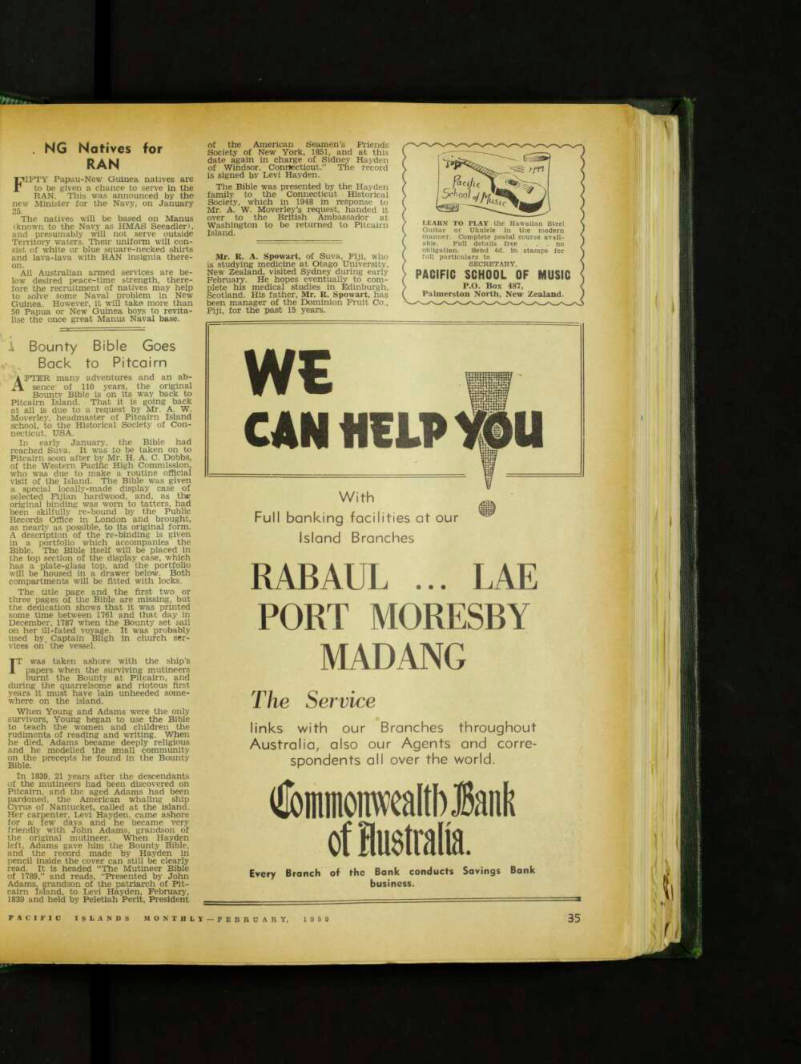
Ran
FIFTY Papau-New Guinea natives are to be given a chance to serve in the RAN. This was announced by the new Minister for the Navy, on January 25.
The natives will be based on Manus (known to the Navy as HMAS Seeadler), and presumably will not serve outside Territory waters. Their uniform will con sist of white or blue square-necked shirts and lava-lava with RAN insignia there on.
All Australian armed services are be low desired peace-time strength, there fore the recruitment of natives may help to solve some Naval problem in New Guinea. However, it will take more than 50 Papua or New Guinea boys to revita lise the once great Manus Naval base.
Bounty Bible Goes
Back to Pitcairn
AFTER many adventures and an ab sence of 110 years, the original Bounty Bible is on its way back to Pitcairn Island. That it is going back at all is due to a request by Mr. A. W.
Moverley, headmaster of Pitcairn Island school, to the Historical Society of Con necticut, USA.
In early January, the Bible had reached Suva. It was to be taken on to Pitcairn soon after by Mr. H. A. C. Dobbs, of the Western Pacific High Commission, who was due to make a routine official visit of the Island. The Bible was given a special locally-made display case of selected Fijian hardwood, and, as the original binding was worn to tatters, had been skilfully re-bound by the Public Records Office in London and brought, as nearlv as possible, to its original form.
A description of the re-binding is given in a portfolio which accompanies the Bible. The Bible itself will be placed in the top section of the display case, which has a plate-glass top, and the portfolio will be housed in a drawer below. Both compartments will be fitted with locks.
The title page and the first two or three pages of the Bible are missing, but the dedication shows that it was printed some time between 1761 and that day in December, 1787 when the Bounty set sail on her ill-fated voyage. It was probably used by. Captain Bligh in church ser vices on the vessel.
IT was taken ashore with the ship’s papers when the surviving mutineers burnt the Bounty at Pitcairn, and during the quarrelsome and riotous first years it must have lain unheeded some where on the island.
When Young and Adams were the only survivors, Young began to use the Bible to teach the women and children the rudiments of reading and writing. When he died, Adams became deeply religious and he modelled the small community on the precepts he found in the Bounty Bible.
In 1839, 21 years after the descendants of the mutineers had been discovered on Pitcairn, and the aged Adams had been pardoned, the American whaling ship Cyrus of Nantucket, called at the island.
Her carpenter, Levi Hayden, came ashore for a I few days and he became very friendly with John Adams, grandson of the original mutineer. When Hayden left, Adams gave him the Bounty Bible, and the record made by Hayden in pencil inside the cover can still be clearly read. It is headed “The Mutineer Bible of 1789,” and reads, “Presented by John Adams, grandson of the patriarch of Pit cairn Island, to Levi Hayden, February, 1839 and held by Peletiah Perit, President
of the American Seamen's Friends Society of New York, 1851, and at this date again in charge of Sidney Hayden of Windsor, Connecticut.” The record is signed by Levi Hayden.
The Bible was presented by the Hayden family to the Connecticut Historical Society, which in 1948 in response to Mr. A. W. Moverley’s request, handed it over to the British Ambassador at Washington to be returned to Pitcairn Island.
Mr. R. A. Spowart, of Suva, Fiji, who Is studying medicine at Otago University, New Zealand, visited Sydney during early February. He hopes eventually to com plete his medical studies in Edinburgh, Scotland. His father, Mr. R. Spowart, has been manager of the Dominion Fruit Co., Fiji, for the past 15 years.
Advertisements & other items, pp. 39-40 (1 item)
Cbmmonwealtb Bank
r c< / %
School
m uiTc
LEARN TO PLAY the Hawaiian Steel Guitar or Ukulele in the modern manner. Complete postal course available. Full details free ... no obligation. Send 4d. in stamps for full particulars to
SECRETARY,
PACIFIC SCHOOL OF MUSIC
P.O. Box 487, Palmerston North, New Zealand.
WE m
can uni v|u
With m Full banking facilities at our Island Branches
RABAUL ... LAE
PORT MORESBY
MADANG
The Service links with our Branches throughout Australia, also our Agents and correspondents all over the world.
Cbmmonwealtb Bank
of Australia.
Every Branch of the Bank conducts Savings Bank business.
IDEAL FOR IE ISLANDS..
The Famous ■ fITCO Products!
ATCO—BOATIMPELER
■fr.
Arc • Simple to handle • Light—easily carried Surprisingly economical • It's easy starting, has smooth power and gives trouble-free performance.
ATCOSCYTHE
7 m - iro JJltin //v Cut time and labour costs with this dependable machine. It's eight to twelve times as rapid as hand-scything. Ideal for cutting long grass, weeds, tall Undergrowth, etc.
Just fill in the coupon below for illustrated booklets which will be sent post free.
■ m IS N F H 4 Hi 1/ H :*
WWmM&
ATCO MOTOR MOWER
There's a full range from the 12 and 14 inch models up to the 17, 20, 28 and 34 inch for big-area requirements. The ATCO is a self-contained unit and will go anywhere.
motor tractors pty. ltd. 369-385 Wattle Street, Ultimo, Sydney.
Please send me Atco Booklets. w.
w NAME.
ADDRESS.
MOTOR TRACTORS
PTY. LIMITED
369-385 Wattle Street, Ultimo, Sydney Telegrams: “Sellmotors,” Sydney.
Hospital Staff, Tamavua, Fiji, 1949
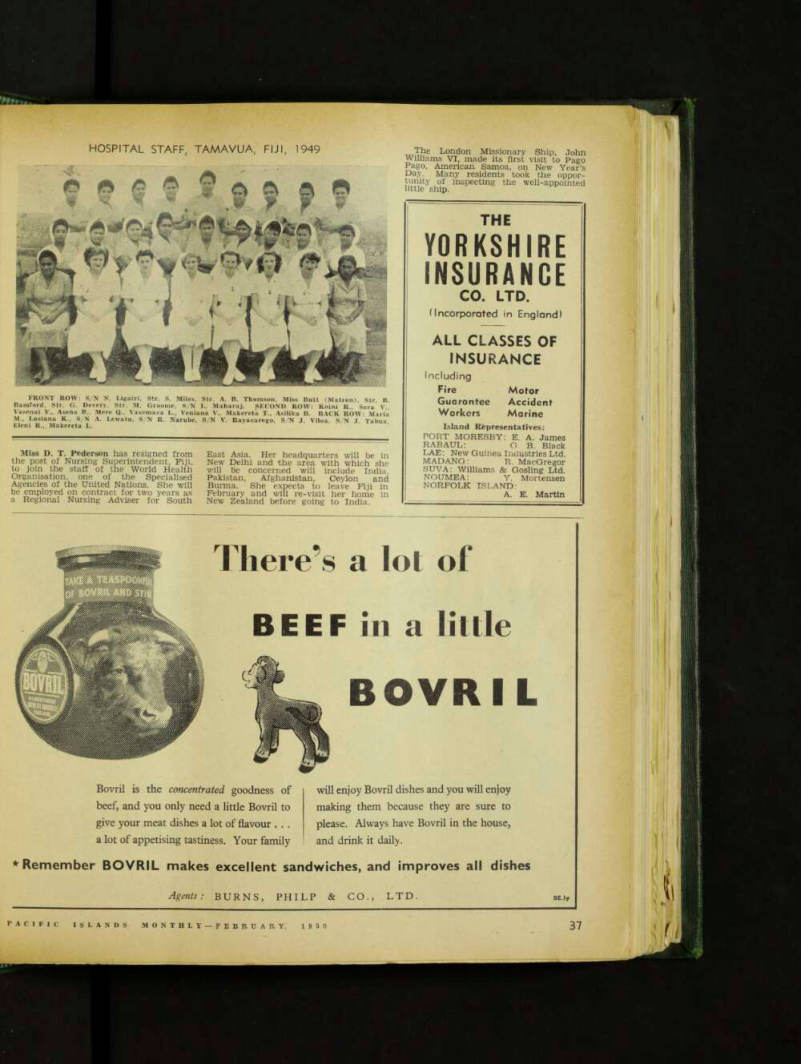
Miss D. T. Pederson has resigned from the post of Nursing Superintendent, Fiji, to join the staff of the World Health Organisation, one of the Specialised Agencies of the United Nations. She will be employed on contract for two years as a Regional Nursing Adviser for South
East Asia. Her headquarters will be in New Delhi and the area with which she v/ill be concerned will include India.
Pakistan, Afghanistan, Ceylon and Burma. She expects to leave Fiji in February and will re-visit her home in New Zealand before going to India.
The London Missionary Ship, John Williams VI, made its first visit to Pago Pago, American Samoa, on New Year’s Day. Many residents took the oppor tunity of inspecting the well-appointed little ship.
FRONT ROW: S/N N. Ligairi, Str. S. Miles, Str. A. B. Thomson, Miss Butt (Matron), Str B.
Bamford, Str. G. Devery, Str. M. Groome, S/N L. Maharaj. ROW: Koini R., Sera V., Vasenai V., Asena R., Mere Q., Vasemaca L., Veniana V., Makereta T., Asilika B. BACK ROW: Maria M., Lusiana K., S/N A. Lewatu, S/N R. Narube, S/N V. Rayacarogo, S/N J. Viloa, S/N J. Tabua Eleni R., Makereta L.
Advertisements & other items, p. 41 (1 item)
Bovril
THE
YORKSHIRE
INSURANCE
CO. LTD.
(Incorporated in England)
ALL CLASSES OF
INSURANCE
Including Fire Motor Guarantee Accident Workers Marine Island Representatives:
PORT MORESBY: E. A. James
RABAUL: G. B. Black LAE: New Guinea Industries Ltd.
MADANG: R. MacGregor SUVA: Williams & Gosling Ltd.
NOUMEA: Y. Mortensen
NORFOLK ISLAND;
A. E. Martin
There’s a lot of
B E E F in a li ttle
BOVRIL
& m Bovril is the concentrated goodness of beef, and you only need a little Bovril to give your meat dishes a lot of flavour , . . a lot of appetising tastiness. Your family will enjoy Bovril dishes and you will enjoy making them because they are sure to please. Always have Bovril in the house, and drink it daily. * Remember BOVRIL makes excellent sandwiches, and improves all dishes
Agents: BURNS, PHILP & CO., LTD.
✓ BE. ly
The Story Of Maui. Demi-God
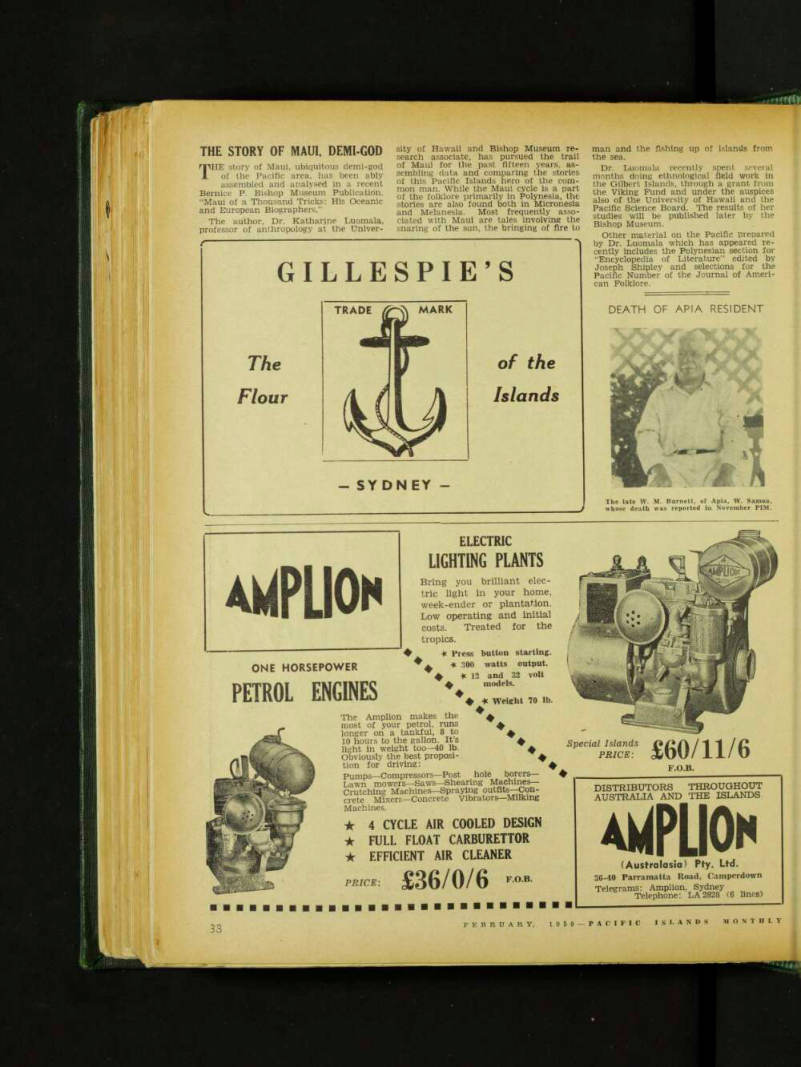
THE story of Maui, übiquitous demi-god of the Pacific area, has been ably assembled and analysed in a recent Bernice P. Bishop Museum Publication, “Maui of a Thousand Tricks: His Oceanic and European Biographers.”
The author, Dr. Katharine Luomala, professor of anthropology at the Univer
sity of Hawaii and Bishop Museum re search associate, has pursued the trail of Maui for the past fifteen years, as sembling data and comparing the stories of this Pacific Islands hero of the com mon man. While the Maui cycle is a part of the folklore primarily in Polynesia, the stories are also found both in Micronesia and Melanesia. Most frequently asso ciated with Maui are tales involving the snaring of the sun, the bringing of fire to
man and the fishing up of islands from the sea.
Dr. Luomala recently spent several months doing ethnological field work in the Gilbert Islands, through a grant from the Viking Fund and under the auspices also of the University of Hawaii and the Pacific Science Board. The results of her studies will be published later by the Bishop Museum.
Other material on the Pacific prepared by Dr. Luomala which has appeared re cently includes the Polynesian section for “Encyclopedia of Literature” edited by Joseph Shipley and selections for the Pacific Number of the Journal of Ameri can Folklore.
Advertisements & other items, p. 42 (2 items)
Death Of Apia Resident
The late W. M. Burnett, of Apia, W. Samoa, whose death was reported in November PIM.
Amplioh
GILLESPIE’S
The Flour
MARK
TRADE
of the Islands
- SY DN EY -
ONE HORSEPOWER
PETROL ENGINES
The Amplion makes the most of your petrol, runs longer on a tankful, 8 to 10 hours to the gallon. It’s light in weight too—4o lb.
Obviously the best proposition for driving:
ELECTRIC
LIGHTING PLANTS
Bring you brilliant electric light in your home, week-ender or plantation.
Low operating and initial costs. Treated for the tropics. * Press button starting. t * 300 watts output. + -K 12 and 32 volt models. + -K Weight 70 lb. \ hole borers— Special Islands
PRICE :
£6O/11/6 Pumps—Compressors —Post r - Lawn mowers—Saws— Shearing Machines— Crutching Machines —Spraying outfits—Concrete Mixers —Concrete Vibrators —Milking Machines.
★ 4 CYCLE AIR COOLED DESIGN
★ FULL FLOAT CARBURETTOR
★ EFFICIENT AIR CLEANER
F. 0.8.
PRICE:
£36/0/6 F. 0.8.
DISTRIBUTORS THROUGHOUT
AUSTRALIA AND THE ISLANDS
aMPLIOh
(Australasia) Pty. Ltd. 36-40 Parramatta Road, Camperdown Telegrams: Amplion, Sydney Telephone: LA2828 (6 lines)
in Rarotonga
NZ Medical Research in Rarotonga
From Our Own Correspondent
Rarotonga. Jan. 20.
UNDER the auspices of the Department of Island Territories and the Medi cal Research Council of New Zea land, four members of the staff of the University of Otago are at present en gaged in research work in the Cook Islands. Every possible facility has been placed at their disposal by the Adminis trative staff of the islands, and the islanders themselves have been extremely friendly, interested and co-operative.
Work is being concentrated on the island of Rarotonga in the two villages of Nga tangia and Arorangi.
The most common disease in the Cook Islands, as indeed in a large part of tropical Polynesia, is Filariasis, a term covering a variety of complaints resulting from an infection of a small nematode worm. The worm is transmitted from an infected to a healthy person by the bite of a mosquito, so that the cure for the complaint in its most efficient form, lies in the elimination of the mosquito. Up to the present, all efforts have been con centrated on the destruction of breeding sites, such as coconut shells, meat tins and similar small containers, but it has been found by a recent survey that the number of infected persons on Rarotonga is so great, that although the diminution in numbers of the mosquito has made for more comfortable living, the number of in fections has not been appreciably re duced.
Dr. G. H. Satchell, who arrived a fort night before the main party, is investi gating the possibility of residual spraying with DDT to control the disease, it is possible that this spraying, when concen trated in dwelling houses, will reduce the number of new infections by killing the mosquito before it reaches the infective stage. The problem hinges on the pro portion of infections which occur in the house, as compared with the proportion derived in the open air. It is hoped that the study now proceeding will determine this factor.
Sir Charles Hercus, Dr. Faine, and Mr.
J. A. Samuels, assisted by Dr. T. R. A.
Davis and his staff locally, are engaged in a survey of the health conditions of a number of family groups in the village of Arorangi, this with a view to determining the most important problems confronting the people generally and medically.
Clinical studies are being correlated with laboratory findings and surveys of family environment and general living conditions.
While it is yet premature to discuss re sults, the contention of the Medical Ser vice that there is an undue amount of preventable illness is already fully con firmed. Filariasis, parasitic diseases of the intestine and diseases of the teeth and gums appear to be almost universal.
However, despite the abundant evidence of financial stringency among Cook Islanders it is reassuring to find that there is no evidence so far of serious malnu trition, and the long-held belief that the natives of this island have a protein-de ficient diet is not born out by blood examination.
It is believed that the value of the present study will not be confined to Rarotonga but will be generally applicable to the various Islands of the Cook Group.
Mr. Charles Godhard, who has been tutor to the Bull children of Dreketi, Vanua Levu, Fiji, has now joined the staff of Bums Philp (SS) Ltd. at Lautoka.
Because of engine trouble, a BCPA DC6 airliner had to leave its 18 passengers on Canton Island on February 1 and fly on to Fiji on three engines. Some of the passengers were picked up the following day by a PAA Skymaster; the remainder waited on Canton for the next BCPA plane. The disabled plane reached Sydney about 7 p.m. on February 2, still flying on three engines. Because of bad visibility Mascot aerodrome was closed
and the plane had to be diverted to Bris bane.
Fiji’s Towns Ordinance has been amended 12 times in 14 years, and much ot it still relates mainly to Suva. On the recommendation of its new chairman iMr. E. F. Corbett), the Lautoka Town Board decided on January 12 to ask the Government for an entirely new Ordin ance for the control of Lautoka.
Advertisements & other items, pp. 43-44 (2 items)
39
Pacific islands mo’nxhly-pebruary, 19 5 0
Quality
piP p
The New WUNDERLICH SINK UNIT
is available in Stainless Steel, 4‘. 4 , 6", 5’ and 6’ long, with a lustrous, rustless, smooth "Wunderbnte" finish that is easy to keep spick and span.
Ask your local Hardware Merchant, 'phone MX 241 I or write to Wunderlich Limited, Box 474, 5.P.0., Sydney, for prices and leaflet.
COMBINATION SINK & DRAINER
BRAND
QUALITY
HP! Ml
H SAIL
H SAIL
I i
z % 7a % & km. r : . I «£*
BRONTE BRAND:
• Chili Con Came • Braised Steak and Onions • Curried Beef • Curried Mutton • Steak and Onions • Mutton and Peas • Irish Stew • Beef Steak Pudding • Corned Beef Hash • Corned Beef Loaf With Cereal • Mutton Broth e Mulligatawny Soup $ Tomato Soup • Vegetable Soup
From
Australia’s
Finest Fat
Stock ...
From the finest fat stock and the rich-
est vegetables in Australia we produce
these high-grade canned meats and
soups, BRONTE BRAND meats,
hotmeals and soups are deliciously
flavoured and are made from
ONLY meats and vegetables
of the highest quality. . . , ★
THE COLONIAL WHOLESALE MEAT CO.
PTY. LTD.
Canning Factory, State Abattoirs, Homebush Bay, Sydney.
N.S.W.
PHONE: UM 8436.
CABLE ADDRESS:
WOOLMILL. SYDNEY.
Smashed On A Coral Reef
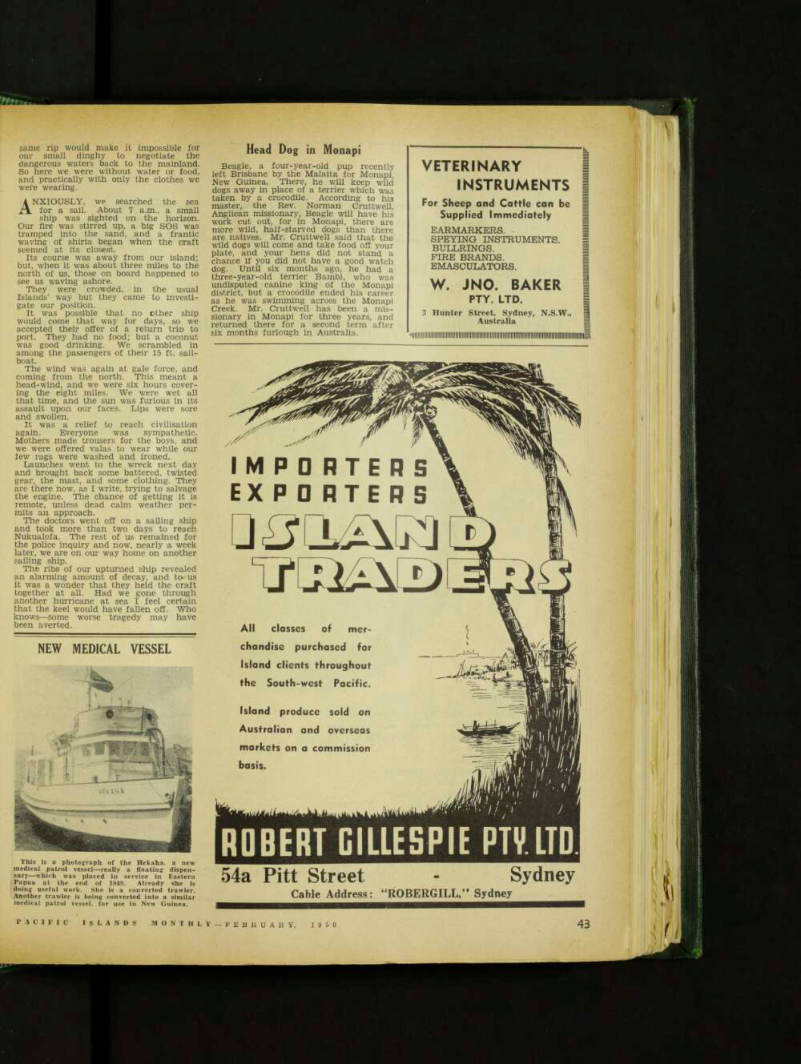
Description of a Wreck in the Tongan Islands
BY PASTOR W. G. FERRIS, OF SDA MISSION, MASTER OP THE ENDEAVOUR
THE Government despatch boat was away in Suva, and so we in the Endeavour assented gladly to the request of the authorities that we sail from Nukualofa, 160 miles, to the northern islands, to bring back the Chief Medical Officer and the Government dentist, who were wanted for urgent duties in Nukua lofa.
We left on December 17, in lovely weather. After visiting Vavau, we went to Pangai, and thence set out direct for home.
We set course through the only channel to the outer seas. The sails were hoisted, and with the engine running we were making sure and steady progress. We had negotiated this channel successfully many times, and had experienced no diffi culty. For eight miles the channel took us past reefs on both sides. Darkness quickly fell and the wind changed rapidly from north to north-west, and came with force. Anxiously we watched the log tick out the miles, till we should enter deep waters.
I warned the boys to watch for any sign of reef. On dark nights surf shows fairly clear. No surf showed; but an oily spot seemed strange—and then all called for a turn to starboard; reefs were ahead. Surf appeared close to port.
Then there was the horrible sensation of crunching coral under the ship, and a sudden stop. Things happened quickly.
The wind velocity increased, and enormous breakers lifted the Endeavour,
with all sails set, high up on top of the reef and brought her down with a sicken ing thud. The engine stopped.
The sails were lowered and a second wave lifted her again, taking her further in onto the reef. We dropped anchor, hoping to bring her head into the wind.
This quickly broke away.
Successive waves pounded the ship further and further across the reef, every fibre of her timber shuddering at each bump.
We then realised that she would rapidly break up and immediately lowered the dinghy. It sank, and the oars were lost in the darkness.
The main anchor was dropped, but it dragged with the ship, which was now half full of water, so that it was difficult to walk in the cabin.
IN the darkness it was hard to find any thing. What could we take? A boy rescued the dinghy and, with great difficulty, bailed it out. I passed out a tin of drinking water for the dinghy; it was washed out of my hands and floated away. I staggered up with a tin of bis cuits, and it also went to sea, as did the
luggage.
Mr. Edwards bravely struggled to save the ship. The doctor passed out life belts and blew up his air mattress.
My boy, Elwin, kept asking me if I thought the ship was sinking. I tried to assure him that we were safe and that he would see his mother again. Little Percy Kamea, from Vavau, clung tightly to his lifebelt and a few of his clothes.
Mr. Franzen, the dentist, could not
swim. We secured a life belt tightly around him and he clung to the top rigging.
I entered the cabin again and the once friendly cupboard came shooting up at me as the ships side hit the reef at the rear of a passing wave. The water was up to my waist.
The snip righted herself again and we tried once more to get her off the reef in the hope of reaching an island we could see in the distance. She would not
move. Larger waves came and drove her further onto the last ledge of the reef. She had come about a quarter of a mile over the reef in less than twenty minutes, The actua l height of water, at that tide, was eighteen inches; but the sea came across with terrific force, as if all the demons had stirred it up for the last blow A FINAL whopper turned the Endeavour over, with her mast under water, and
all on board were thrown into the boil ing sea.
The two small boys swam to the dinghy.
Mr. Pranzen struggled in, while dangerous rigging wires tried to trap those in the dinghy into a partnership dive.
I took an awning batten as an oar and gave to Mr. Franzen the oar we had been able to rescue. Mr. Edwards floated on the cockpit matting; the doctor was on his air mattress; and the two boys shared the wooden stairs from the cabin.
They all decided to stay that way, push ing at the stern of the dinghy, while we rowed. There was an island to the east, and towards this we struggled.
On touching the reef again, Mr. Ed wards trod on some poisonous creature, which left splinters in his foot and caused severe pain.
We must have been nearly an hour reaching the island. We carried the dinghy up to the top of the steep, sandy beach, and dropped it in tall grass. We lighted a fire, and with the dinghy turned up to give protection from the wind, we sat down to dry our clothes. The island was just a dot with a beach all around and without one coconut tree. There was no water. This was most disappointing.
The party curled up around the fire and tried to sleep. Mr. Edwards tossed in agony; taut some ointment soothed his injured foot and he finally slept.
As daylight came, with low tide, we scanned the ocean for a sign of our ship.
Sure enough, there she was on the £nd of the long reef, turned upside down, leaving engine and keel on the bottom and the rudder raised like a black flag of death.
We reasoned that the strong north-west winds, in combination with the rise of the ride, had produced a tide-rip of over four knots, on which we had not calculated in setting our course. This caused the fatal striking of the reef in the darkness. That
same rip would make it impossible for our small dinghy to negotiate the dangerous waters back to the mainland.
So here we were without water or food, and practically with only the clothes we were wearing.
ANXIOUSLY, we searched the sea for a sail. About 7 a.m., a small ship was sighted on the horizon.
Our fire was stirred up, a big SOS was tramped into the sand, and a frantic waving of shirts began when the craft seemed at its closest.
Its course was away from our island; but, when it was about three miles to the north of us, those on board happened to see us waving ashore.
They were crowded, in the usual Islands’ way but they came to investi gate our position.
It was possible that no other ship would come that way for days, so we accepted their offer of a return trio to port. They had no food; but a coconut was good drinking. We scrambled in among the passengers of their 15 ft. sail boat.
The wind was again at gale force, and coming from the north. This meant a head-wind, and we were six hours cover ing the eight miles. We were wet all that time, and the sun was furious in its assault upon our faces. Lips were sore and swollen.
It was a relief to reach civilisation again. Everyone was sympathetic.
Mothers made trousers for the boys, and we were offered valas to wear while our few rags were washed and ironed.
Launches went to the wreck next day and brought back some battered, twisted gear, the mast, and some clothing. They are there now, as I write, trying to salvage the engine. The chance of getting it is remote, unless dead calm weather per mits an approach.
The doctors went off on a sailing ship and took more than two days to reach Nukualofa. The rest of us remained for the police inquiry and now, nearly a week later, we are on our way home on another
sailing ship.
The ribs of our upturned ship revealed an alarming amount of decay, and to us it was a wonder that they held the craft together at all. Had we gone through another hurricane at sea I feel certain that the keel would have fallen off. Who knows—some worse tragedy may have been averted.
Advertisements & other items, pp. 45-46 (1 item)
J. C. Merrillees Pty. Ltd., Sydney
Better for School Books \\\i\
They stand the rough and tumble. They’re lighter and easier to carry.
Ask first for
SCHOOL CASES
MAfff ffr
FORfl SHERINGTON LTD.
fOR-V-
-SMOOTH «ANDS
SOS
k/ iL »Vlc & y •v <L bu£d£**
MAKE
-Ur
BASE
y ■v A 4i S& <* O N
SMOOTH
SKIM
These goods are stocked by all the leading stores of the Pacific Islands. Order through your usual channels. Further enquiries to:
J. C. Merrillees Pty. Ltd., Sydney
A. GREGORY PH, 11®.
IMPORTERS, EXPORTERS AND
MANUFACTURERS
Leather Saddlery and Paint Merchants ALL CLASSES OF LEATHER SUPPLIED FROM STOCK Apply direct to: A. GREGORY PTV, LTD, 107 York St, Sydney
-BUDGE-
REFRIGERATION
EQUIPMENT
Commercial and Industrial Units (not domestic) Ammonia and Methyl Chloride machines of large or small capacity.
The illustration is of a complete 30 cwt.
Plant, comprising twin, enclosed ammonia compressor, evaporative condenser, insulated ice tank, etc. It may be driven by a 10 h.p. electric motor or diesel engine.
Inquirers should mention dimensions of cold room (or cabinet) and amount of ice (if any) required per day.
JAMES BUDGE PTY. LTD.
Established 1890.
REFRIGERATION ENGINEERS
McEvoy Street, Alexandria,
Sydney
TELEPHONES: LA 5034-5-6
Head Dog in Monapi
Beagle, a four-year-old pup recently left Brisbane by the Malaita for Monapi, New Guinea. There, he will keep wild dogs away in place of a terrier which was taken by a crocodile. According to his master, the Rev. Norman Cruttwell, Anglican missionary, Beagle will have his work cut out, for in Monapi, there are more wild, half-starved dogs than there are natives. Mr. Cruttwell said that the wild dogs will come and take food off your plate, and your hens did not stand a chance if you did not have a good watch dog. Until six months ago, he had a three-year-old terrier Bambi, who was undisputed canine king of the Monapi district, but a crocodile ended his career as he was swimming across the Monapi Creek. Mr. Cruttwell has been a mis sionary in Monapi for three years, and returned there for a second term after six months furlough in Australia.
New Medical Vessel
This is a photograph of the Hekaha, a new medical patrol vessel—really a floating dispen sary—which was placed in service in Eastern Papua at the end of 1949. Already she is doing useful work. She is a converted trawler.
Another trawler is being converted into a similar medical patrol vessel, for use in New Guinea.
Advertisements & other items, pp. 47-48 (2 items)
Exporters
VETERINARY
INSTRUMENTS
For Sheep and Cattle can be
Supplied Immediately
EARMARKERS.
SPEYING INSTRUMENTS.
BULLRINGS.
FIRE BRANDS.
EMASCULATORS.
W. JNO. BAKER
PTY. LTD.
3 Hunter Street, Sydney, N.S.W., Australia
.s*
IMPORTERS
EXPORTERS
All classes of merchandise purchased for Island clients throughout the South-west Pacific.
Island produce sold on Australian and overseas markets on a commission basis.
54a Pitt Street
i
Sydney
Cable Address; “ROBERGILL,” Sydney
Electrolux
There is only one
THE MODERN KEROSENE-OPERATED REFRIGERATOR
THAT ACHIEVES THE MIRACLE OF ICE FROM HEAT
Lasting Efficiency, Silent Operation, Streamlined Beauty
mi M ■ ‘ : I * ■ M
Economically operated by kerosene, with a simple precision-built freezing unit that has no moving parts and is GUARANTEED FOR
FIVE (5) YEARS.
Only obtainable from :
NEW GUINEA COMPANY, LIMITED,
Rabaul, Madang, Lae, Kavieng.
J. R. CLAY & CO., LTD., Port Moresby.
W. R. CARPENTER & CO. (Sol. Is.), LTD., Tulagi.
THE NORFOLK ISLAND SERVICE DEPOT,
Norfolk Island.
For New Hebrides, Gilbert and Ellice Islands Colony and New Caledonia, apply direct to:
Model LKSSI
PRICES ON APPLICATION.
Storage capacity: 5i cub. ft. (approx.); shelf area, 10 sq. ft. food shelves, six—five removable; 2 self-supporting when half drawn. Ice-making: Four trays—s lb. ice per freezing: 80 cubes. Fuel consumption: 1.8 pints kerosene per day (approx.).
Height: 4 ft. 10 in. Depth: 2 ft. 3i in.
Weight, unpacked, 406 lb. Packed, 574 lb.
W. R. CARPENTER Cr CO., LTD. Head Office: 16 O'Connell St., Sydney, N. S. Wales
Now Back In The Hebrides
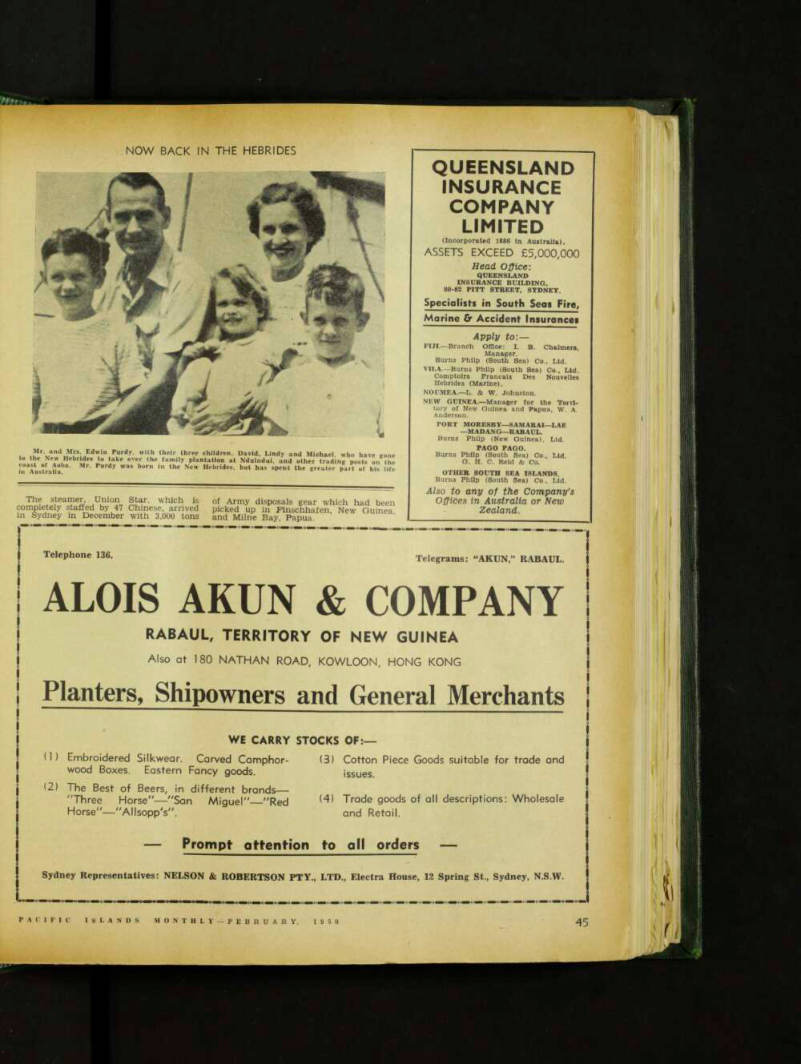
The steamer, Union Star, which is completely staffed by 47 Chinese, arrived in Sydney in December with 3,000 tons
of Army disposals gear which had been picked up in Finschhafen, New Guinea and Milne Bay, Papua.
Mr and Mrs Edwin Purdy, with their three children, David. Lindy and Michael, who have gone to the New Hebridesto take over the famil y plantation at Nduindui. and other trading posts on the coast of Aoba. Mr. Purdy was born in the New Hebrides, but has spent the greater part of his life in Australia.
Advertisements & other items, pp. 49-50 (1 item)
Alois Akun & Company
QUEENSLAND
INSURANCE
COMPANY
LIMITED
(Incorporated 1886 In Australia).
ASSETS EXCEED £5,000,000
Head Office :
QUEENSLAND
INSURANCE BUILDING,
80-82 PITT STREET, SYDNEY.
Specialists in South Seas Fire,
Marine Cr Accident insurance!
Apply to:—
FIJI. —Branch Office: I. B. Chalmers, Manager.
Burns Phllp (South Sea) Co., Ltd.
VlLA.—Burns Phllp (South Sea) Co., Ltd.
Comptoirs Prancals Des Nouvelles Hebrides (Marine).
NOUMEA.—L. &W. Johnston.
NEW GUlNEA.—Manager for the Territory of New Guinea and Papua, W, A.
Anderson.
PORT MORESBY—SAMARAI—LAE
—MADANG— RABAUL.
Burns Philp (New Guinea), Ltd.
PAGO PAGO.
Burns Phllp (South Sea) Co., Ltd.
G. H. C. Reid & Co.
OTHER SOUTH SEA ISLANDS
Burns Phllp (South Sea) Co., Ltd.
Also to any of the Company's Offices in Australia or Hew Zealand.
Telephone 136. Telegrams: “AKUN,” RABAUL.
ALOIS AKUN & COMPANY
RABAUL, TERRITORY OF NEW GUINEA
Also at 180 NATHAN ROAD, KOWLOON, HONG KONG
Planters, Shipowners and General Merchants
WE CARRY STOCKS OF:—
(1) Embroidered Silkwear. Carved Camphor- (3) Cotton Piece Goods suitable for trade and wood Boxes. Eastern Fancy goods. issues (2) The Best of Beers, in different brands— " Three Horse"—"San Miguel" "Red (4) Trade goods of all descriptions: Wholesale Horse"—"Allsopp's". and Retail.
P rom P* attention to all orders Sydney Representatives: NELSON & ROBERTSON PTY., LTD., Electra House, 12 Sprint: St., Sydney, N.S.W.
<§> Made in the Australian Branch Factory of
BLUNDELL SPENCE & CO., LTD., Hull,
B. Cr S. SUPER PREPARED PAINT embodies the knowledge and experience gained from nearly 140 years of Paint manufacture.
Tested and proved for tropical conditions, B. & S. PREPARED PAINT is also available in a special Lead-free series for use in volcanic and other sulphurous regions. (Specify B. & S.-Series 2301).
Ask for supplies of these and other BLUN- DELL Paints and Enamels from your local Storekeeper, or write for particulars and colour-cards to the Agent lor Pacific Islands:
KERR BROTHERS PTY. LTD.
4 YORK STREET, SYDNEY
Cook Islands Natives
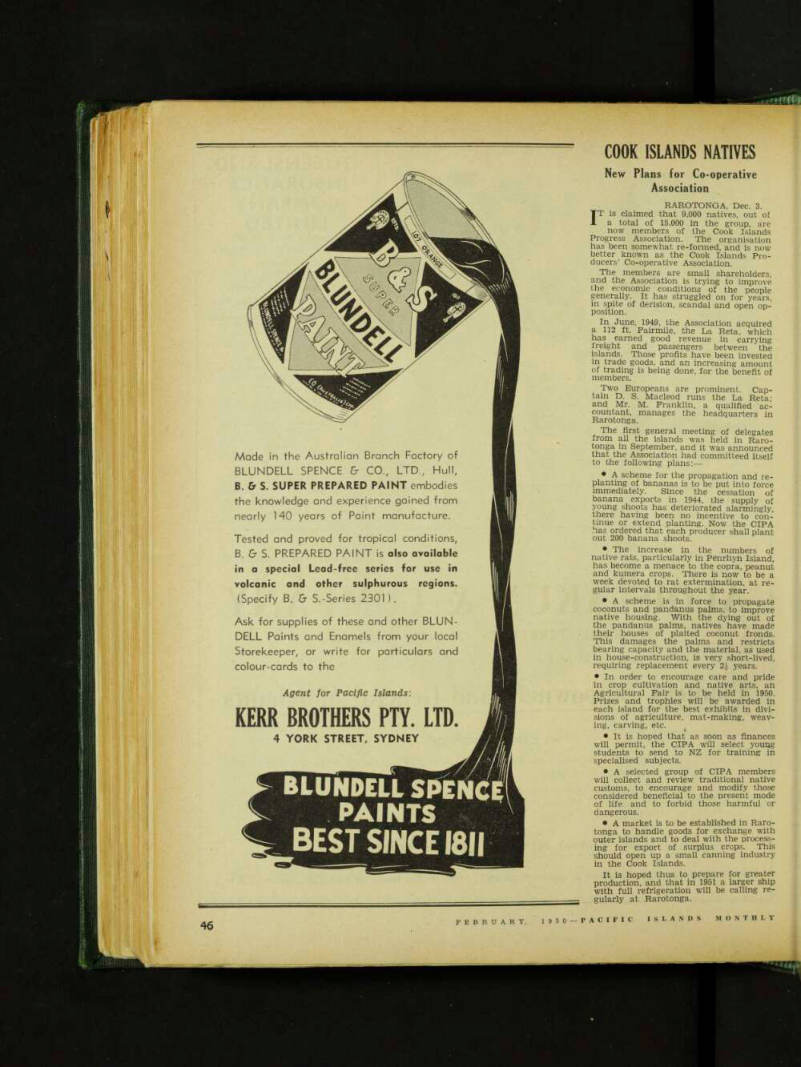
New Plans for Co-operative Association
Rarotonga, Dec. 3.
IT is claimed that 9,000 natives, out of a total of 15,000 in the group, are now members of the Cook Islands Progress Association. The organisation has been somewhat re-formed, and is now better known as the Cook Islands Pro ducers’ Co-operative Association.
The members are small shareholders, and the Association is trying to improve the economic conditions of the people generally. It has struggled on for years, in spite of derision, scandal and open op position.
In June, 1949, the Association acquired a 112 ft. Fairmile, the La Reta, which has earned good revenue in carrying freight and passengers between the islands. Those profits have been invested in trade goods, and an increasing amount of trading is being done, for the benefit of members.
Two Europeans are prominent. Cap tain D. S. Macleod runs the La Reta; and Mr. M. Franklin, a qualified ac countant, manages the headquarters in Rarotonga.
The first general meeting of delegates from all the islands was held in Raro tonga in September, and it was announced that the Association had committeed itself to the following plans:— • A scheme for the propagation and re planting of bananas is to be put into force immediately. Since the cessation of banana exports in 1944, the supply of young shoots has deteriorated alarmingly, there having been no incentive to con tinue or extend planting. Now the CIPA has ordered that each producer shall plant out 200 banana shoots. • The increase in the numbers of native rats, particularly in Penrhyn Island, has become a menace to the copra, peanut and kumera crops. There is now to be a week devoted to rat extermination, at re gular intervals throughout the year. • A scheme is in force to propagate coconuts and pandanus palms, to improve native housing. With the dying out of the pandanus palms, natives have made their houses of plaited coconut fronds.
This damages the palms and restricts bearing capacity and the material, as used in house-construction, is very short-lived, requiring replacement every years. • In order to encourage care and pride in crop cultivation and native arts, an Agricultural Fair is to be held in 1950.
Prizes and trophies will be awarded in each island for the best exhibits in divi sions of agriculture, mat-making, weav ing, carving, etc. • It is hoped that as soon as finances will permit, the CIPA will select young students to send to NZ for training in specialised subjects. • A selected group of CIPA members will collect and review traditional native customs, to encourage and modify those considered beneficial to the present mode of life, and to forbid those harmful or dangerous. • A market is to be established in Raro tonga to handle goods for exchange with outer islands and to deal with the process ing for export of surplus crops. This should open up a small canning industry in the Cook Islands.
It is hoped thus to prepare for greater production, and that in 1951 a larger ship with full refrigeration will be calling re gularly at Rarotonga.
Mr. Borrow And
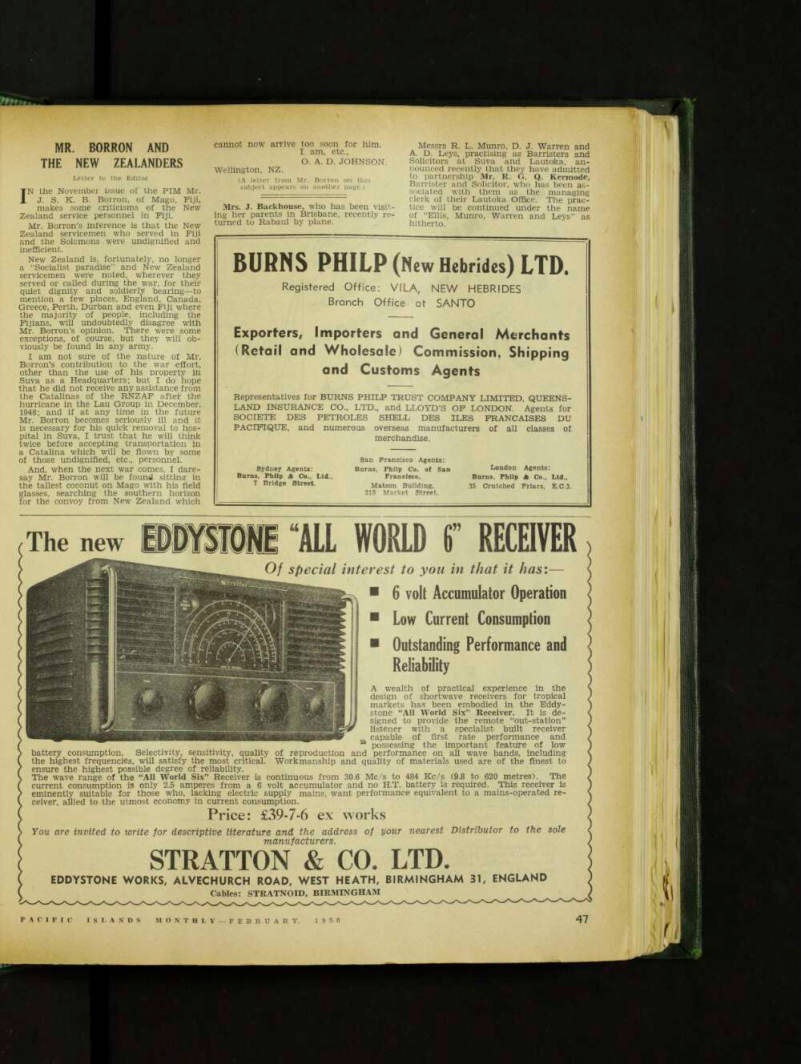
The New Zealanders
Letter to the Editor IN the November issue of the PIM Mr.
J. S. K. B. Borron, of Mago, Fiji, makes some criticisms of the New Zealand service personnel in Fiji, Mr. Borron’s inference is that the New Zealand servicemen who served in Fiji and the Solomons were undignified and inefficient.
New Zealand is, fortunately, no longer a “Socialist paradise” and New Zealand servicemen were noted, wherever they served or called during the war, for their quiet dignity and soldierly bearing—to mention a few places, England, Canada, Greece, Perth, Durban and even Fiji where the majority of people, including the Fijians, will undoubtedly disagree with Mr. Borron’s opinion. There were some exceptions, of course, but they will ob viously be found in any army.
I am not sure of the nature of Mr.
Borron’s contribution to the war effort, other than the use of his property in Suva as a Headquarters; but I do hope that he did not receive any assistance from the Catalinas of the RNZAF after the hurricane in the Lau Group in December, 1948; and if at any time in the future Mr. Borron becomes seriously ill and it is necessary for his quick removal to hos pital in Suva, I trust that he will think twice before accepting transportation in a Catalina which will be flown by some of those undignified, etc., personnel.
And, when the next war comes, I dare say Mr. Borron will be found sitting in the tallest coconut on Mago with his field glasses, searching the southern horizon for the convoy from New Zealand which
cannot now arrive too soon for him.
I am, etc.,
O. A. D. Johnson.
Wellington, NZ. (A letter from Mr. Borron on this subject appears on another page.) Mrs. J. Backhouse, who has been visit ing her parents in Brisbane, recently re turned to Rabaul by plane.
Messrs R. L. Munro, D. J. Warren and A. D. Leys, practising as Barristers and Solicitors at Suva and Lautoka, an nounced recently that they have admitted to partnership Mr. R. G. Q. Kermode, Barrister and Solicitor, who has been as sociated with them as the managing clerk of their Lautoka Office. The prac tice will be continued under the name of “Ellis, Munro, Warren and Leys” as hitherto.
Advertisements & other items, pp. 51-52 (1 item)
mt m world r receiver
BURNS PHILP (New Hebrides) LTD.
Registered Office; VILA, NEW HEBRIDES
Branch Office at SANTO
Exporters, Importers and General Merchants
(Retail and Wholesale) Commission, Shipping
and Customs Agents
Representatives for BURNS PHILP TRUST COMPANY LIMITED, QUEENS- LAND INSURANCE CO., LTD., and LLOYD’S OP LONDON. Agents for SOCIETE DES PETROLES SHELL DES ILES FRAN C AISES DU PACIFIQUE, and numerous overseas manufacturers of all classes of merchandise.
Sydney Agents: Burns, Phllp A Co., Ltd., 7 Bridge Street.
San Francisco Agents: Burns, Philp Co. of San London Agents: Francisco, Borns, Philp A Co., Ltd., Matson Building, 35 Crutched Friars, E.C.3. 215 Market Street.
The new
mt m world r receiver
m Of special interest to you that it :
■ 6 volt Accumulator Operation
■ Low Current Consumption
■ Outstanding Performance and
Reliability
A wealth of practical experience in the design of shortwave receivers for tropical markets has been embodied in the Eddystone “All World Six” Receiver, It is designed to provide the remote “out-station” listener with a specialist built receiver capable of first rate performance and “ possessing the important feature of low battery consumption. Selectivity, sensitivity, quality of reproduction and performance on all wave bands, including the highest frequencies, will satisfy the most critical. Workmanship and quality of materials used are of the finest to ensure the highest possible degree of reliability.
The wave range of the “All World Six” Receiver is continuous from 30.6 Mc/s to 484 Kc/s (9.8 to 620 metres). The current consumption is only 2.5 amperes from a 6 volt accumulator and no H.T. battery is required. This receiver is eminently suitable for those who, lacking electric supply mains, want performance equivalent to a mains-operated receiver, allied to the utmost economy in current consumption.
Price: £39-7-6 ex works
You are invited to write for descriptive literature and the address of your nearest Distributor to the sole manufacturers.
STRATTON & CO. LTD.
EDDYSTONE WORKS, ALVECHURCH ROAD, WEST HEATH, BIRMINGHAM 31, ENGLAND
Cables: STRATNOID. BIRMINGHAM
*v
>^sßx
o V-> / VN \ **< s <« 7 o«Vi Wo’ o pie« ♦ N* ar K & fA« A /Sm SJ £!!& * 37js F V' FP* / 4 % m« a Sc? fm ml* /TV flß* "V a
the
services
SOUTH
Of
PACIFIC
New Zealand is a whole world of travel . . . but it’s a small world when you fly on the N.Z. National Airways Corporation air network that brings New Zealand’s playgrounds and wonderlands invitingly close.
NEW ZEALAND NATIONAL AIRWAYS CORPORATION.
New Zealand National Airways Corporation provides a network of air services throughout the Dominion and the South-West Pacific. General Agents in the Dominion for British Commonwealth Pacific Airlines and Trans-Australian Airlines. Booking Agents for Tasman Empire Airways, Qantas Empire Airways, the 8.0.A.C. and other overseas airlines.
Offices and Agents throughout New Zealand and th e South-West Pacific.
Magazine Section
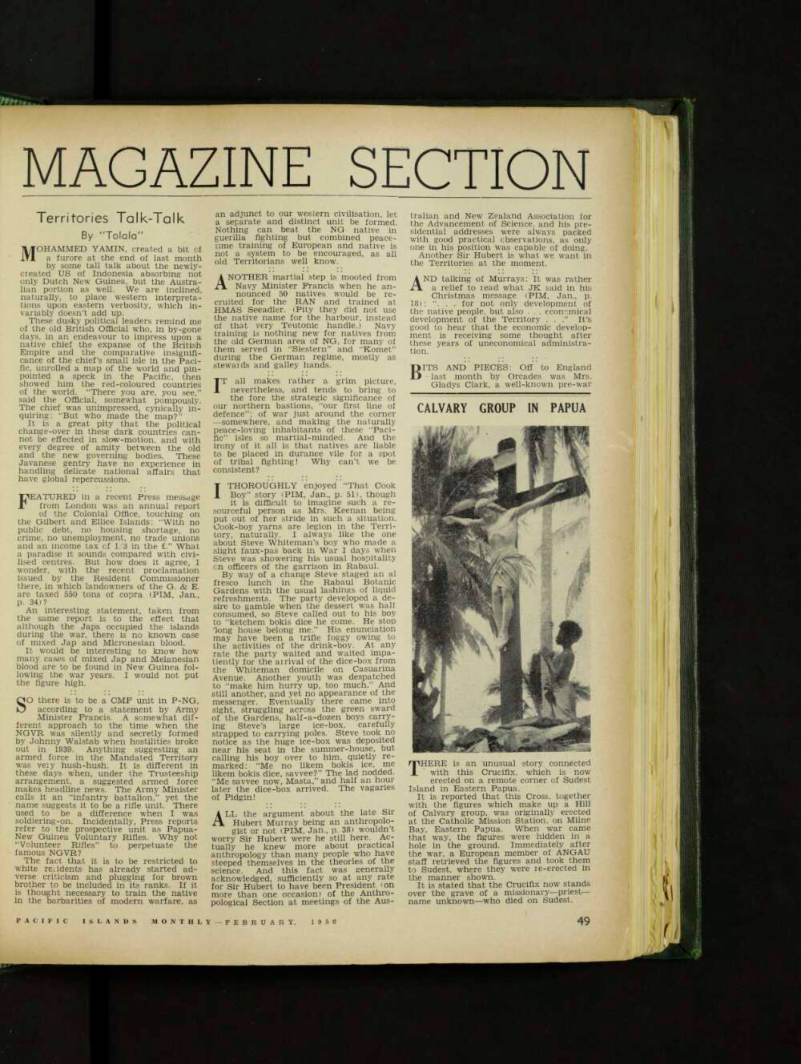
Territories Talk-Talk
By "Tolala"
MOHAMMED YAMIN, created a bit of a furore at the end of last month by some tall talk about the newly created US of Indonesia absorbing not only Dutch New Guinea, but the Austra lian portion as well. We are inclined, naturally, to place western interpreta tions upon eastern verbosity, which in variably doesn’t add up.
These dusky political leaders remind me of the old British Official who, in by-gone days, in an endeavour to impress upon a native chief the expanse of the British Empire and the comparative insignifi cance of the chief’s small isle in the Paci fic, unrolled a map of the world and pin pointed a speck in the Pacific, then showed him the red-coloured countries of the world. “There you are, you see,” said the Official, somewhat pompously.
The chief was unimpressed, cynically in quiring; “But who made the map?”
It is a great pity that the political change-over in these dark countries can not be effected in slow-motion. and with every degree of amity between the old and the new governing bodies. These Javanese gentry have no experience in handling delicate national affairs that have global repercussions.
FEATURED in a recent Press message from London was an annual report of the Colonial Office, touching on the Gilbert and Ellice Islands: “With no public debt, no housing shortage, no crime, no unemployment, no trade unions and an income tax of 1/3 in the £.” What a paradise it sounds compared with civi lised centres. But how does it agree, I wonder, with the recent proclamation issued by the Resident Commissioner there, in which landowners of the G. & E. are taxed 550 tons of copra (PIM, Jan., p. 34)?
An interesting statement, taken from the same report is to the effect that although the Japs occupied the islands during the war, there is no known case of mixed Jap and Micronesian blood.
It would be interesting to know how many cases of mixed Jap and Melanesian blood are to be found in New Guinea fol lowing the war years. I would not put the figure high.
SO there is to be a CMF unit in P-NG, according to a statement by Army Minister Francis. A somewhat dif ferent approach to the time when the NGVR was silently and secretly formed by Johnny Walstab when hostilities broke out in 1939. Anything suggesting an armed force in the Mandated Territory was veiy hush-hush. It is different in these days when, under the Trusteeship arrangement, a suggested armed force makes headline news. The Army Minister calls it an “infantry battalion,” yet the name suggests it to be a rifle unit. There used to be a difference when I was soldiering-on. Incidentally, Press reports refer to the prospective unit as Papua- New Guinea Voluntary Rifles. Why not “Volunteer Rifles” to perpetuate the famous NGVR?
The fact that it is to be restricted to white residents has already started ad verse criticism and plugging for brown brother to be included in its ranks. If it is thought necessary to train the native in the barbarities of modern warfare, as
an adjunct to our western civilisation, let a separate and distinct unit be formed.
Nothing can beat the NG native in guerilla fighting but combined peace time training of European and native is not a system to be encouraged, as all old Territorians well know.
ANOTHER martial step is mooted from Navy Minister Francis when he an nounced 50 natives would be re cruited for the RAN and trained at HMAS Seeadler. (Pity they did not use the native name for the harbour, instead of that very Teutonic handle.) Navy training is nothing new for natives from the old German area of NG, for many of them served in “Siestern” and “Komet” during the German regime, mostly as stewards and galley hands.
IT all makes rather a grim picture, nevertheless, and tends to bring to the fore the strategic significance of our northern bastions, “our first line of defence”: of war just around the corner —somewhere, and making the naturally peace-loving inhabitants of these “Paci fic” isles so martial-minded. And the irony of it all is that natives are liable to be placed in durance vile for a spot of tribal fighting! Why can’t we be consistent? 1 THOROUGHLY enjoyed” “That Cook Boy” story (PIM, Jan., p, 51), though it is difficult to imagine such a re sourceful person as Mrs. Keenan being put out of her stride in such a situation.
Cook-boy yarns are legion in the Terri tory, naturally. I always like the one about Steve Whiteman’s boy who made a slight faux-pas back in War I days when Steve was showering his usual hospitality cn officers of the garrison in Rabaul.
By way of a change Steve staged an al fresco lunch in the Rabaul Botanic Gardens with the usual lashings of liquid refreshments. The party developed a de sire to gamble when the dessert was half consumed, so Steve called out to his boy to “ketchem bokis dice he come. He stop ’long house belong me.” His enunciation may have been a trifle foggy owing to the activities of the drink-boy. At any rate the party waited and waited impa tiently for the arrival of the dice-box from the Whiteman domicile on Casuarina Avenue. Another youth was despatched to “make him hurry up, too much.” And still another, and yet no appearance of the messenger. Eventually there came into sight, struggling across the green sward of the Gardens, half-a-dozen boys carry ing Steve’s large ice-box, carefully strapped to carrying poles. Steve took no notice as the huge ice-box was deposited near his seat in the summer-house, but calling his boy over to him, quietly re marked: “Me no likem bokis ice, me likem bokis dice, savvee?” The lad nodded.
“Me savvee now, Masta,” and half an horn later the dice-box arrived. The vagaries of Pidgin!
ALL the argument about the late Sir Hubert Murray being an anthropolo gist or not (PIM, Jan., p. 38) wouldn t worry Sir Hubert were he still here. Ac tually he knew more about practical anthropology than many people who have steeped themselves in the theories of the science. And this fact was generally acknowledged, sufficiently so at any rate for Sir Hubert to have been President (on more than one occasion) of the Anthro pological Section at meetings of the Aus
tralian and New Zealand Association for the Advancement of Science, and his pre sidential addresses were always packed with good practical observations, as only one in his position was capable of doing.
Another Sir Hubert is what we want in the Territories at the moment.
AND talking of Murrays: It was rather a relief to read what JK said in his Christmas message (PIM, Jan., p. 18): “. . . for not only development of the native people, but also . . . economical development of the Territory . . .” It’s good to hear that the economic develop ment is receiving some thought after these years of uneconomical administra tion, BITS AND PIECES: Off to England last month by Orcades was Mrs.
Gladys Clark, a well-known pre-war
hostess in Rabaul. Son John Leeuwin clark, after a period in post-war Rabaul, has settled down in Sydney with his English bride. . . . Roy Kendall, of Induna Star fame (especially during the eruption in 1937) but now a full-fledged politician in Queensland, paid a visit to Rabaul re cently. . . . Bill Upton, of the pre-war Medical Services in TNG, who has now a small farm near Ingleburn (NSW) has been receiving hospital attention during the past few months. . . . Arthur Reneke, steward on Bulolo, won the first prize in the NSW lottery around about New Year time. He now plans to open a restaurant at Cronulla. . . . Betty White, of Honiara.
BSI, was wedded to Ronald Baker, of Auckland, on January 27. The Bishop of Melanesia made a special flight to Honiara in order to tie the knot. . . . Biddy Gleeson, of North Bondi, was married to Sam Pernan, of Brisbane, on January 24.
They will make their home at Lae.
Calvary Group In Papua
THERE is an unusual story connected with this Crucifix, which is now erected on a remote corner of Sudest Island in Eastern Papua.
It is reported that this Cross, together with the figures which make up a Hill of Calvary group, was originally erected at the Catholic Mission Station, on Milne Bay, Eastern Papua. When war came that way, the figures were hidden in a hole in the ground. Immediately after the war, a European member of ANGAU staff retrieved the figures and took them to Sudest, where they were re-erected in the manner shown.
It is stated that the Crucifix now stands over the grave of a missionary—priest— name unknown —who died on Sudest.
Cat , Crab or Cabbage —
in a Name?
T HE question is—how far can one believe the printed word; Residents within the Pacific area sometimes go so far as not to believe it at all. And, in this connection there is the case of Lucille Beckhart, who writes for the American magazine Coronet, and that of Mr. Leopold G. Blackman, who has written to the PIM. If we are to believe Lucille, are we also to believe Mr Blackman? And vice versa?
We leave it to you. Here is what Lucille says {in Coronet) :
DOWN in the South Pacific near Tahiti is an island paradise you may have for the asking. Soft waves lap against its coral shores and tall palm trees bow a graceful welcome in the tropical breeze. There is fresh water in deep springs and lush fruit hangs from leafy tropical trees.
But before you hasten to apply for ownership of Cat Island, heed this warn ing: a military invasion would be required to drive out its inhabitants. For Cat Island belongs to cats—hundreds of mean, lean, ferocious felines that have so far proved mere than a match for any human foe.
This strange Pacific kingdom dates back a hundred years to a day when rats, es caping a ship wrecked on the reefs, swam to the island. At first, natives ignored the uninvited guests, so the rats multi plied rapidly.
Soon they literally challenged the human population to battle; and although the natives tried various extermination methods, the rats won. Forlornly the vanquished residents packed up and left.
French colonial officials in Tahiti sent several expeditions to clean out the rat nests honeycombing the island, but neither poison nor traps nor smoke were effective. In desperation, the authorities finally offered the island—as a gift—to anyone who could defeat the rodent enemy.
An enterprising Frenchman visiting in Tahiti made a study of the problem and came up with a practical solution —cats.
Promptly he rounded up 500 alley felines, loaded them on a ship and set off for the little island. He turned the animals loose on the beach, then calmly sailed back to Tahiti and sat down to await de velopments.
SOME weeks later, when the Frenchman returned to inspect his promised island, the cats were sleek and fat and happy; the rats, those that still re mained. were in hiding. The pleased officials in Tahiti kept their promise and deeded the island to its deliverer.
Now sole owner of a South Sea paradise, the Frenchman started a copra plantation and poultry farm. For a while all went well: the cats worked hard, and business prospered. But while the rats disap peared, the cat population kept growing.
Soon, the hungry felines began to attack poultry.
The distraught Frenchman tried all the tricks that had been formerly used to rout the rats, but nothing worked against the new usurpers. In desperation, the disillusioned owner packed his bags and said good-bye to Cat Island.
The kingdom of cats now started to thrive in earnest. Soon the feline popu lation became fierce and wild, living in burrows and eating crabs and fish. Even giant sea turtles coming ashore fell prey to the vicious creatures.
To-day, the South Pacific natives fear Cat Island, for any human trespasser would be ripped to bits by claws and teeth. Occasionally, sight-seers row their boats close to Cat Island. But they turn and bend their oars quickly when they see the mass of snarling, spitting cats crouching at the water’s edge, ready and able to defend their savage domain.
J\/JR- BLACKMAN now brings up his heavy artillery and gets down to business, thus : THE accompanying article which ap peared in the American magazine Coronet, in July, occasioned no little stir in Papeete. Immediately, Captain Charles E. Williams, of the 147 ton schooner yacht, Seaward, then rendez vouing in Tahiti waters on a pleasure trip, inviting Messrs. Alexander Taran, Oscar G. Nordman, and William Penning ton to accompany him, set sail to inves tigate the story regarding Cat Island.
Arriving there in the early morning the voyagers proceeded by long boat to recon noitre. When they entered the lagoon through the pass, their ears were assailed by an unaccountable, loud clicking sound as of the clashing of machinery. As they rowed forward cautiously, the whole sur face of the island appeared to be in move ment, as though covered by gray masses of rapidly moving soldiers brandishing menacing weapons above their heads.
Closer inspection revealed the island to be in possession of an army of land crabs, of an unbelievable size and ferocitv. who were preparing to attack the invaders of their island.
The waving weapons they bore aloft were now seen to be enormous claws, the snapping of whose vice-like jaws had oc
casioned the uproar already mentioned and which still continued to deafen the ears of the visitors.
After struggling ashore through hordes of infuriated crustaceans, from whom all of the visitors received severe flesh wounds, a deplorable scene of desolation was witnessed. Through the ravages of the crabs all other animals on the island had been devoured, leaving the shore literally carpeted with cat bones.
Only too glad to leave such an inhos pitable shore, the members of the expe dition returned to Papeete.
THERE the matter was taken up by a meeting of the legislature, convened for the purpose. An impassioned appeal for help to exterminate the crabs of Cat Island was delivered by Mr.
Nordman, who declared that the un fortunate island was experiencing the same misfortune that had befallen Paris during the memorable siege of 1870, when its inhabitants had been put to the ex tremity of eating rats in consequence of the latter having been able to breed un molestedly by reason of the fact that the citizens of Paris had eaten all the cats the previous year.
After a long session, the legislature de cided not to dispatch a military expe dition to exterminate the land crabs as yet, but to try the expedient of sending there several shiploads of hogs from Eipoa. This latter island, having in former years been populated solely by donkeys and hogs, and the latter animals having turned carnivorous, the donkeys had disappeared. It was therefore pre dicted that the hogs would mop up the land-crabs of Cat Island.
The question was then debated as to what should be done with the island when hogs were in possession. After a heated debate it was decided that the island should then be renamed Hog Island. It was also decided that when the hogs had successfully established themselves there, Chinese pickling cabbage, known to be poisonous to hogs, should be planted on the island and the latter placed on Ad miralty charts under the more romantic designation, Cabbage Island.
Sa Karobo mai
The sun incarnadine in the west Throws stark against his fiery orb The palm fronds weaving to and fro In serried grandeur, row on row Along the purpling shores.
Now cooling zephyrs breathe upon the land As rose-tipped night-wrack steal across the sky Trailing their shadows o’er the slumb’rous seas Where, like tired travellers in the even ing breeze, White sails pause, and go by.
The hills in purple silence stand Aloof and hear the breezes sigh— Kissing the pools that lie along the shore Clear in the white moon’s slow unfold ing flower Like starry fragments fallen from the sky.
In sullen splendour wanes the long warm day; And Viti dons the sable shawl of night, As, soothed by songs of silent stealing streams Her troubled thoughts all now displaced by dreams, She sleeps—secure from all affright.
Cpg
-“Sa Karobo Mai” is Fijian for ‘‘lt is getting dark.”
Advertisements & other items, p. 54 (1 item)
50
FEBRUARY, 1950 - PACIFIC ISLANDS MONTHLY
Talk-Talk (Continued from nrevious Page)
Bird's-eye View of New Guinea's Atolls
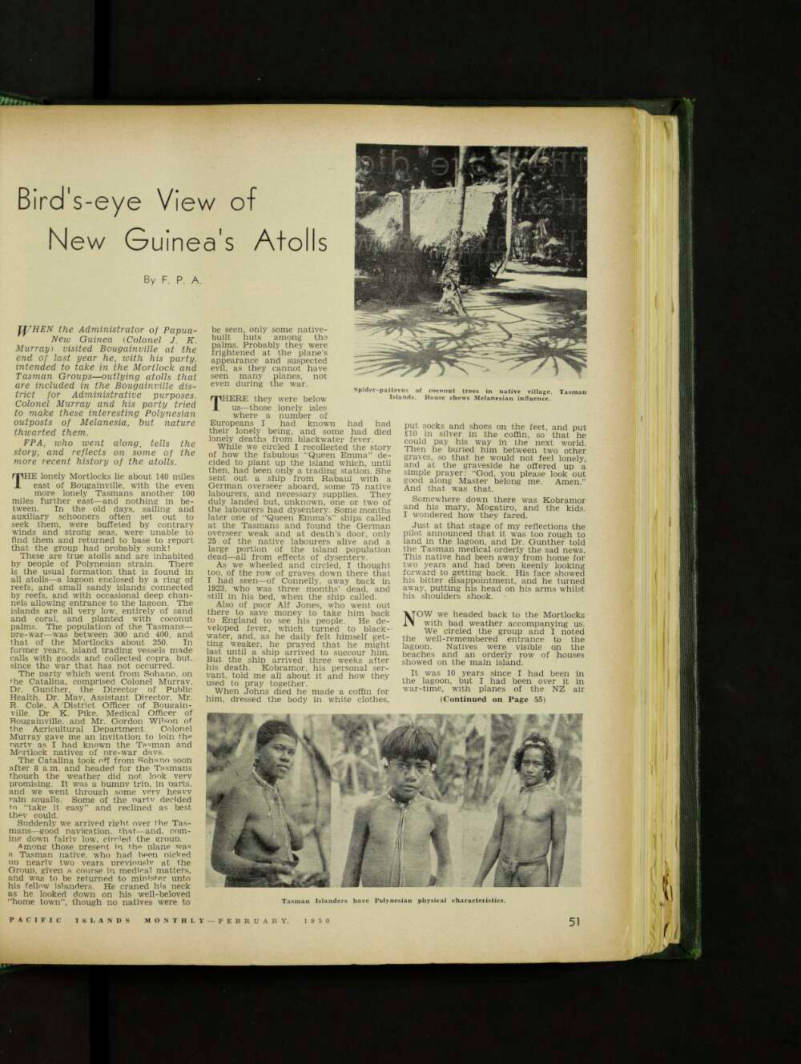
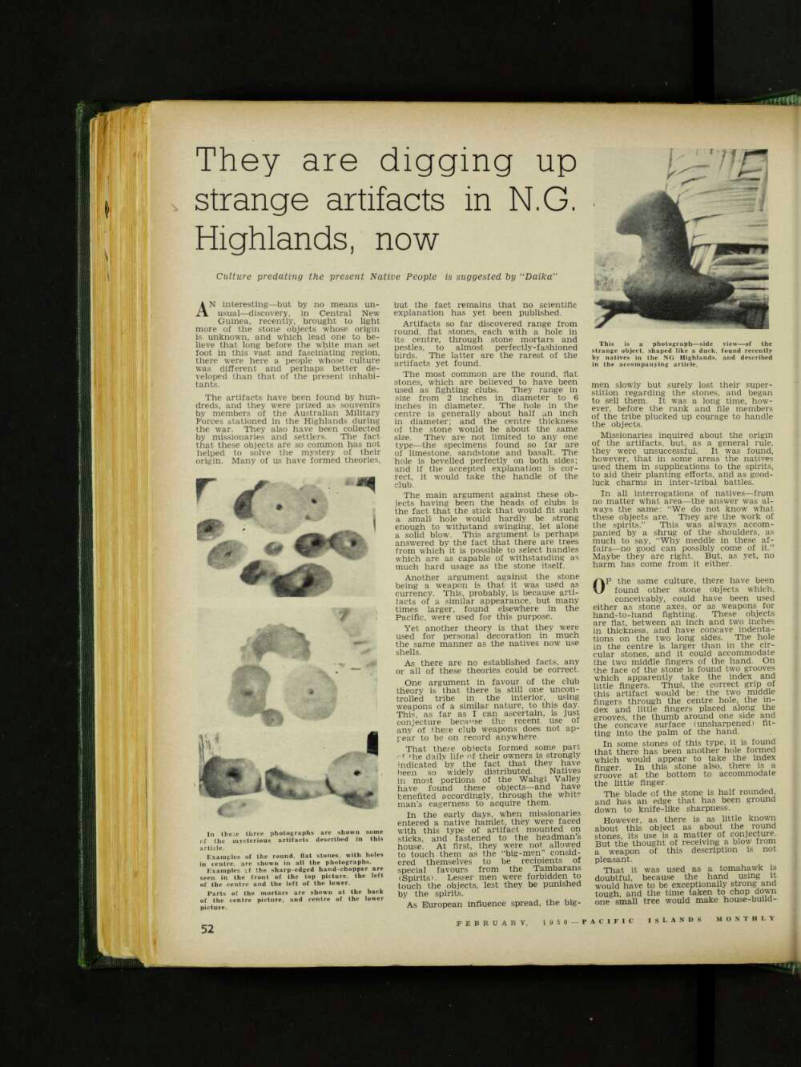
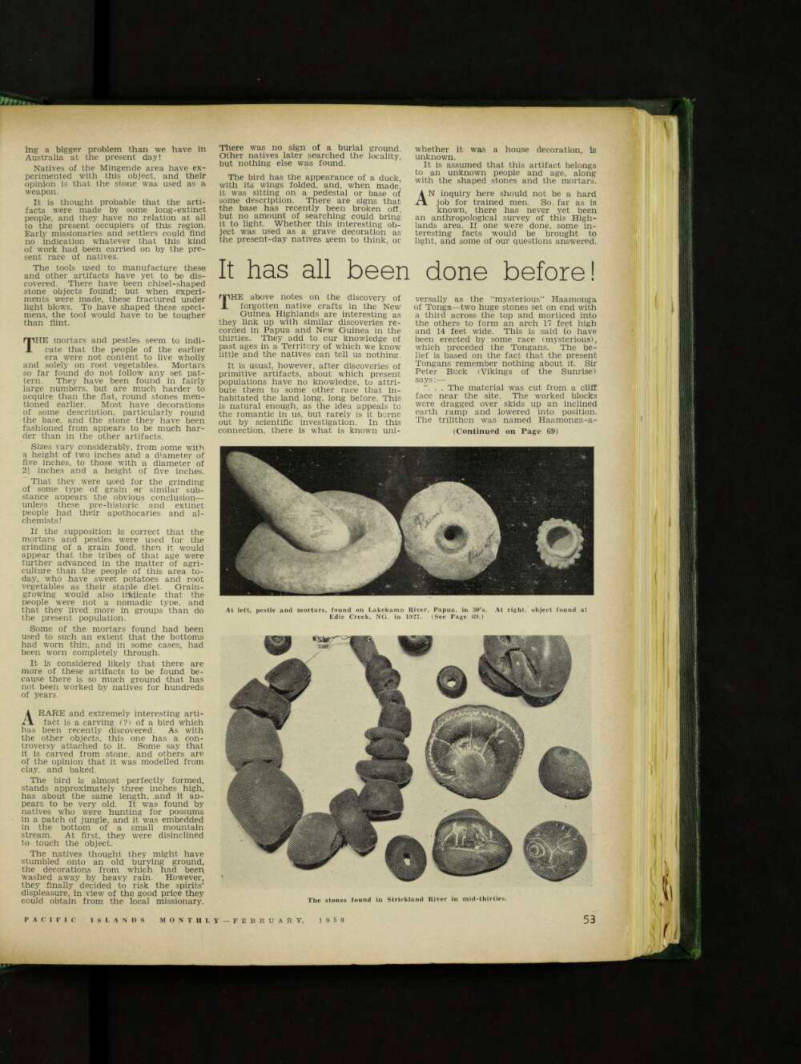
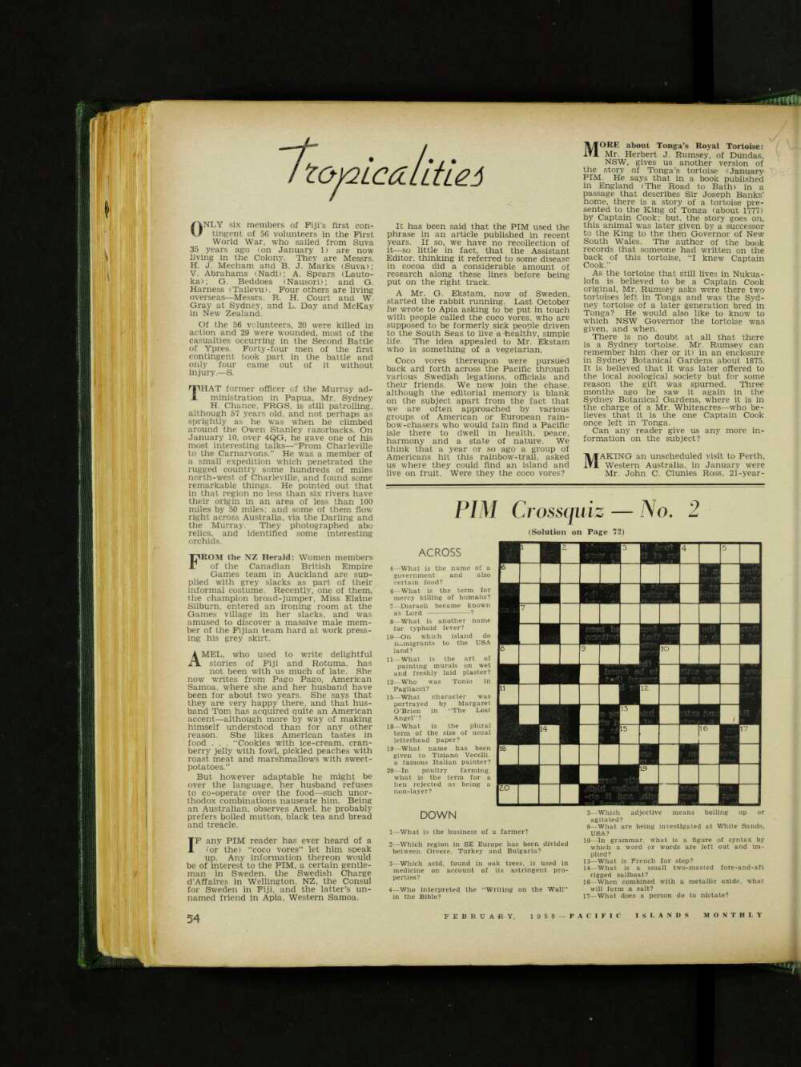
New Guinea's Atolls
By F. P. A
Jf/HEN the Administrator of Papua-
New Guinea (Colonel J. K.
Murray) visited Bougainville at the end of last year he, with his party, intended to take in the Mortlock and Tasman Groups—outlying atolls that are included in the Bougainville dis trict for Administrative purposes.
Colonel Murray and his party tried to make these interesting Polynesian
outposts of Melanesia, hut nature
thwarted them.
FPA, who went along, tells the story, and reflects on some of the more recent history of the atolls.
THE lonely Mortlocks lie about 140 miles east of Bougainville, with the even more lonely Tasmans another 100 miles further east—and nothing in be tween. In the old days, sailing and auxiliary schooners often set out to seek them, were buffeted by contrary winds and strong seas, were unable to find them and returned to base to report that the group had probably sunk!
These are true atolls and are inhabited by people of Polynesian strain. There is the usual formation that is found in all atolls—a lagoon enclosed by a ring of reefs, and small sandy islands connected by reefs, and with occasional deep chan nels allowing entrance to the lagoon. The islands are all very low, entirely of sand and coral, and planted with coconut palms. The population of the Tasmans — pre-war—was between 300 and 400, and that of the Mortlocks about 250. In former years, island trading vessels made calls with goods and collected copra, but. since the war that has not occurred.
The party -which went from Sohano, on the Catalina, comprised Colonel Murray, Dr. Gunther, the Director of Public Health. Dr. May, Assistant Director, Mr.
R. Cole. A/District Officer of Bougain ville. Dr. K. Pike. Medical Officer of Bougainville, and Mr. Gordon Witson of the Agricultural Department. Colonel Murray gave me an invitation to join the nartv as I had known the Tasman and Mortlock natives of pre-war days.
The Catalina took off from Sohano soon after 8 a m. and headed for the Tasmans though the weather did not look very promising. It was a bumpy trio, in parts, and we went through some very heavy rain soualls. Some of the nartv decided to “take it easy’’ and reclined as best they could.
Suddenly we arrived right over the Tas mans—good navigation, that —and. com ing down fairlv low. circled the group.
Among those present in the nlane was a Tasman native, who had been niched no nearly two vears previously at the Group, given a course in medical matters, and was to be returned to minister unto his fellow islanders. He craned his neck as he looked down on his well-beloved “home town”, though no natives were to
be seen, only some native built huts among the palms. Probably they were frightened at the plane’s appearance and suspected evil, as they cannot have seen many planes, not even during the war.
THERE they were below us—those lonely isles where a number of
I K. had lc i lown I l ad , 1 bad fnnoL b f mg ’ and s 0 ? 16 , had dled lonely deaths from blackwater fever.
While we circled I recollected the story E i?^ n i a d si cided to plant up the island which, until 5’ had been only a trading station She sent out a ship from Rabaul with a German overseer aboard, some 75 native labourers, and necessary supplies. They duly landed but, unknown, one or two of the labourers had dysentery. Some months later one of “Queen Emma’s’’ ships called at the Tasmans and found the German overseer weak and at death’s door, only 25 of the native labourers alive and a large portion of the island population dead—all from effects of dysentery.
As we wheeled and circled, I thought too, of the row of graves down there that I had seen—of Connelly, away back in 1923, who was three months’ dead, and still in his bed, when the ship called.
Also of poor Alf Jones, who went out there to save money to take him back to S6 u- bis people. He de- Xa 1 tS od or l H eVer ’ , wh J, c b • to b la ckwater, and, as he daily felt himself getting weaker, he prayed that he might last until a ship arrived to succour him.
But the ship arrived three weeks after his death. Kobramor, his personal servant, told me all about it and how they used to pray together.
When Johns died he made a coffin for him, dressed the body in white clothes,
put socks and shoes on the leet, and put £lO in silver In the coffin, so that he could pav his wav in the next worm Then he Juried hhn between two other graves, so that he would not feel lonely, and at the graveside he offered up a simple prayer: “God. you please look out good along Master belong me. Amen ”
And that was that 0 , . * , Somewhere down there was Kobramor y nd Mogatiro, j* n d the kids, 1 wondered how they fared, Just at that stage of my reflections the pilot announced that it was too rough to land in the lagoon, and Dr. Gunther told the Tasman medical orderly the sad news, This native had been away from home for two years and had been keenly looking forward to getting back. His face showed his bitter disappointment, and he turned away, putting his head on his arms whilst his shoulders shook. \TOW we headed back to the Mortlocks with bad weather accompanying us.
We circled the group and I noted the well-remembered entrance to the lagoon. Natives were visible on the beaches and an orderly row of houses showed on the main island, ._, . , was years £ in j 0 A ad been in the la g° on - put I had been over it m war-time, with planes of the NZ air
(Continued on Page 55)
Spider-patterns of coconut trees in native village, Tasman Islands. House shows Melanesian influence.
Tasman Islanders have Polynesian physical characteristics.
force, when dropping propaganda lea lets in Pidgin-English. Again it was too rough to land on the lagoon.
As we went round the islands, flying low, I thought of the row of graves on the foreshore. I recollected how Jock Goodson had put in seven years in the Mortlocks and how he talked, endlessly when a ship called there, and how he used to say: “God, but it’s nice to speak English again.” He had a neat house, built of coral boulders and coral lime and paths all bordered with coloured crotons. Jock had been a sailor in his day.
And, again, I remembered, with respect and admiration, Mrs. Calder—who though later several times married, had gone there as a bride “in the earlies” and who later returned to end her life there. She had been dynamiting fish on the edge of the reef when the charge exploded prematurely and inflicted very bad injuries to hand and face. Though gravely hurt, she managed with some help to get to her house. Just then —wonder of wonders —the three-monthly trading ship entered the lagoon and anchored.
A Government Medical Assistant from Kleta was on board and he quickly got to the bedside to render whatever assistance he could. While doing so Mrs. Calder spoke to a native servant, who went away to return soon with a bottle of whisky. Then the dying woman turned to the medical man and his companion saying: “Please have a drink, gentlemen.
I am sorry to be giving you so much trouble.”
They got her aboard the ship and the Skipper headed direct for Kieta, where there was a hospital, but Mrs. Calder died on the way. So passed a pioneer and a brave spirit.
Seeing that we could not come down at Mortlocks we sped away for the Cartaret Group—another atoll, some 4U miles north-east of Buka. On arrival there we found it was still too rough to come down, but as wc flew around we saw plenty of natives on the beaches waving to the nlane. The population is about 400, of darx-skinned and very friend’" people.
During the war a Flying Fortress was shot down, north-west of Nauru, and the crew of 10 Americans drifted, in two rubber boats, for 16 days, until they got to Cartarets. This was an estimated dis tance of 650 miles.
On arriving at the group the natives treated them well, found food for them out of their own scanty supply and gave some of them medical treatment. Then, as has previously been recorded in PIM, the native medical orderly, Goni, fixed up a canoe and steered five of the Yanks down past heavily-garrisoned Buka, and landed them at Choiseul Island, in the British Solomons. There they contacted an Australian Coast Watcher, who sent
a signal to the Yanks at Guadalcanal and a Catalina picked them up.
Soon after, another Catalina flew back to Cartarets to pick up the remaining five of the Fortress crew. With the plane went Goni, who had gifts of ample sup plies of tobacco, rice, tin meat, etc. So, it is likely that the Cartaret natives now associate Catalinas with food!
I recollected that, in early 1944, I went with an American PT boat to the Cartarets and, meeting Goni, first heard the story of the stranded Fortress crew, and of the epic trip to the British Solo mons. Not many months ago there was a letter from the man who bossed the Fortress, “My Lovin’ Dove,” now a Colonel in the US Air Force, to say that he still remembered the Cartarets, and how Goni saved them all.
NOW we headed down the east coast of Buka and made a good landing at Sohano, after a somewhat disap pointing trip. I would like to have seen the Tasmans and Mortlocks again.
As I stepped up onto the wharf my thoughts were still on atolls and of the time I had spent on them —mostly up in the Western Islands, towards Humbolt Bay and the Dutch Border. When you are the only white man on an island, or in a group, you talk in Pidgin-English and think in Pidgin-English until your brain begins to whirl. There is the ever present thought of a tidal wave on those low islands, the knowledge that, if severe fever or sickness comes, you have only yourself to rely upon. Such atolls are lonely places indeed! As I think of them I give an involuntary shudder!
*Kik-e-pau” (literally “My love to you’’) is a New Hebridean greeting.
Highlands, now
They are digging up strange artifacts in N.G.
Culture predating the present Native People is suggested by “Daika
AN interesting—but by no means un usual —discovery, in Central New Guinea, recently, brought to light more of the stone objects whose origin is unknown, and which lead one to be lieve that long before the white man set foot in this vast and fascinating region, there were here a people whose culture was different and perhaps better de veloped than that of the present inhabi tants.
The artifacts have been found by hun dreds, and they were prized as souvenirs by members of the Australian Military Forces stationed in the Highlands during the war. They also have been collected by missionaries and settlers. The fact that these objects are so common has not helped to solve the mystery of their origin. Many of us have formed theories,
but the fact remains that no scientific explanation has yet been published.
Artifacts so far discovered range from round, flat stones, each with a hole in its centre, through stone mortars and pestles, to almost perfectly-fashioned birds. The latter are the rarest of the artifacts yet found.
The most common are the round, flat stones, which are believed to have been used as fighting clubs. They range in size from 2 inches in diameter to 6 inches in diameter. The hole in the centre is generally about half an inch in diameter; and the centre thickness of the stone would be about the same size. Thev are not limited to any one type—the specimens found so far are of limestone, sandstone and basalt. The hole is bevelled perfectly on both sides; and if the accepted explanation is cor rect, it would take the handle of the club.
The main argument against these ob jects having been the heads of clubs is the fact that the stick that would fit such a small hole would hardly be strong enough to withstand swinging, let alone a solid blow. This argument is perhaps answered by the fact that there are trees from which it is possible to select handles which are as capable of withstanding as much hard usage as the stone itself.
Another argument against the stone being a weapon is that it was used as currency. This, probably, is because arti facts of a similar appearance, but many times larger, found elsewhere in the Pacific, were used for this purpose.
Yet another theory is that they were used for personal decoration in much the same manner as the natives now use shells.
As there are no established facts, any or all of these theories could be correct.
One argument in favour of the club theory is that there is still one uncon trolled tribe in the interior, using weapons of a similar nature, to this day.
This, as far as I can ascertain, is just conjecture because the recent use of any of these club weapons does not ap pear to be on record anywhere.
That these obiects formed some part of the dailv life of their owners is strongly indicated by the fact that they have been so widely distributed. Natives in most portions of the Wahgi Valley have found these objects—and have benefited accordingly, through the white man’s eagerness to acquire them.
In the early days, when missionaries entered a native hamlet, they were faced with this type of artifact mounted on sticks, and fastened to the headman’s house. At first, they were not allowed to touch them as the “big-men” consid ered themselves to be recipients of special favours from the Tambarans (Spirits). Lesser men were forbidden to touch the objects, lest they be punished by the spirits.
As European influence spread, the big-
men slowly but surely lost their super stition regarding the stones, and began to sell them. It was a long time, how ever, before the rank and file members of the tribe plucked up courage to handle the objects.
Missionaries inquired about the origin of the artifacts, but, as a general rule, they were unsuccessful. It was found, however, that in some areas the natives used them in supplications to the spirits, to aid their planting efforts, and as good luck charms in inter-tribal battles.
In all interrogations of natives —from no matter what area—the answer was al ways the same: “We do not know what these objects are. They are the work of the spirits.” This was always accom panied by a shrug of the shoulders, as much to say, “Why meddle in these af fairs —no good can possibly come of it.”
Maybe they are right. But, as yet, no harm has come from it either.
OF the same culture, there have been found other stone objects which, conceivably, could have been used either as stone axes, or as weapons for hand-to-hand fighting. These objects are fiat, between an inch and two inches in thickness, and have concave indenta tions on the two long sides. The hole in the centre is larger than in the cir cular stones, and it could accommodate the two middle fingers of the hand. On the face of the stone is found two grooves which apparently take the index and little fingers. Thus, the correct grip of this artifact would be: the two middle fingers through the centre hole, the in dex and little fingers placed along the grooves, the thumb around one side and the concave surface (unsharpened) fit ting into the palm of the hand.
In some stones of this type, it is found that there has been another hole formed which would appear to take the index finger. In this stone also, there is a groove at the bottom to accommodate the little finger.
The blade of the stone is half rounded, and has an edge that has been ground down to knife-like sharpness.
However, as there is as little known about this object as about the > round stones, its use is a matter of conjecture.
But the thought of receiving a blow from a weapon of this description is not pleasant.
That it was used as a tomahawk is doubtful, because the hand using it would have to be exceptionally strong and tough, and the time taken to chop down one small tree would make house-build
In these three photographs are shown some of (he mysterious artifacts described in this article.
Examples of the round, flat stones, with holes in centre, are shown in all the photographs.
Examples if the sharp-edged hand-chopper are seen in the front of the top picture, the left of the centre and the left of the lower.
Parts of the mortars are shown at the back of the centre picture, and centre of the lower picture.
This is a photograph—side view—of the strange object, shaped like a duck, found recently by natives in the NG Highlands, and described in the accompanying article.
ing a bigger problem than we have in Australia at the present day!
Natives of the Mingende area have ex perimented with this object, and their opinion is that the stone was used as a weapon.
It is thought probable that the arti facts were made by some long-extinct people, and they have no relation at all to the present occupiers of this region.
Early missionaries and settlers could find no indication whatever that this kind of work had been carried on by the pre sent race of natives.
The tools used to manufacture these and other artifacts have yet to be dis covered. There have been chisel-shaped stone objects found; but when experi ments were made, these fractured under light blows. To have shaped these speci mens, the tool would have to be tougher than flint.
THE mortars and pestles seem to indi cate that the people of the earlier era were not content to live wholly and solely on root vegetables. Mortars so far found do not follow any set pat tern. They have been found in fairly large numbers, but are much harder to acquire than the flat, round stones men tioned earlier. Most have decorations of some description, particularly round the base, and the stone they have been fashioned from appears to be much har der than in the other artifacts.
Sizes vary considerably, from some with a height of two inches and a diameter of five inches, to those with a diameter of 2 h inches and a height of five inches.
That they were used for the grinding of some type of grain or similar sub stance anpears the obvious conclusion— unless these pre-historic and extinct people had their apothecaries and al chemists !
If the supposition is correct that the mortars and pestles were used for the grinding of a grain food, then it would appear that the tribes of that age were further advanced in the matter of agri culture than the people of this area to day, who have sweet potatoes and root vegetables as their staple diet. Grain growing would also indicate that the people were not a nomadic type, and that they lived more in groups than do the present population.
Some of the mortars found had been used to such an extent that the bottoms had worn thin, and in some cases, had been worn completely through.
It is considered likely that there are more of these artifacts to be found be cause there is so much ground that has not been worked by natives for hundreds of years.
A RARE and extremely interesting arti fact is a carving f?) of a bird which has been recently discovered. As with the other objects, this one has a con troversy attached to it. Some say that it is carved from stone, and others are of the opinion that it was modelled from clay, and baked.
The bird is almost perfectly formed, stands approximately three inches high, has about the same length, ,and it ap pears to be very old. It was found by natives who were hunting for possums in a patch of jungle, and it was embedded in the bottom of a small mountain stream. At first, they were disinclined to touch the object.
The natives thought they might have stumbled onto an old burying ground, the decorations from which had been washed away by heavy rain. However,’ they finally decided to risk the spirits’ displeasure, in view of the good price they could obtain from the local missionary.
There was no sign of a burial ground.
Other natives later searched the locality, but nothing else was found.
The bird has the appearance of a duck, with its wings folded, and, when made] it was sitting on a pedestal or base of some description. There are signs that the base has recently been broken off, but n ,9 P se pi c .hing could bring it to light. Whether this interesting object was used as a grave decoration as the present-day natives seem to think, or
whether it was a house decoration, is unknown. it is assumed that this artifact belongs
wV“Sd stS and V/ mona?f
snapea stones ana tne mortars.
AN inquiry here should not be a hard job for trained men. So. far as is known, there has never yet been an anthropological survey of this High lands area. If one were done, some in teresting facts would be brought to light, and some of our questions answered.
It has all been done before!
rpHE above notes on the discovery of X forgotten native crafts in the New Guinea Highlands are interesting as they link up with similar discoveries recorded in Papua and New Guinea in the thirties. They add to cur knowledge of past ages in a Territory of which we know little and the natives can tell us nothing.
It is usual, however, after discoveries of primitive artifacts, about which present populations have no knowledge, to attribute them to some other race that inhabitated the land long, long before. This is natural enough, as the idea appeals to the romantic in us, but rarely is it borne out by scientific investigation. In this connection, there is what is known uni-
versally as the “mysterious” Haamonga of Tonga—two huge stones set on end with a third across the top and morticed into the others to form an arch 17 feet high and 14 feet wide. This is said to have been erected by some race (mysterious), which preceded the Tongans. The be lief is based on the fact that the present Tongans remember nothing about it. Sir Peter Buck (Vikings of the Sunrise)
says:— . , ,
. • • • The material was cut from a cliff f ace near the site. The worked blocks wer( L dragged over skids up an inclined earth ramp and lowered into position, The trilithon was named Haamonga-a
(Continued on Page 69)
At left, pestle and mortars, found on Lakekamu River, Papua, in 30’s. At right, object found at Edie Creek, N]G, in 1927. (See Page 69.)
The stones found in Strickland River in mid-thirties.
Maui (Burden of Maui), the two uprights being likened to burdens supported on the ends of a carrying pole. It was built by Tuitatui, eleventh Tui Tonga, as a monument to his two sons. The form and size of the memorial are so unique that imaginative writers have advanced the theory that it was made by some archaic civilisation that preceded the Tongans.”
Sir Peter, therefore, does not see any thing mysterious about it and I, for one, prefer to stake my faith in his profound knowledge of Polynesia rather than in the credulity of tourists.
In May, 1937, an article was published in PIM with two photographs of stone artifacts. It was stated that , . They seem to have little, if any, connection with the present races of primi tive aborigines (in Papua and New Guinea), and suggest a connection with an extinct and higher culture.” It is odd how it is always assumed that such people must necessarily have been of higher culture. If we are to believe at all in the theory of Pacific migrations, it is obvious that the first wave of people to reach Papua and New Guinea, later to be absorbed and/or pushed inland by following waves, were by no means superior.
The two photographs which were pub lished with the May, 1937, article are re printed here. One photograph shows quite clearly that the artifacts that came from the Lakekamu River (Papua) and Edie Creek (New Guinea) are similar to those now found in the Highlands. The other stones, from the Strickland River area and found Jack Hides and David Lyall (both now dead) are somewhat dif ferent. The small round stones with the holes in them, it was stated, could be used for whistles. These Strickland stones were given to the National Museum in Canberra.
It was stated also, that in a shipyard in Pert Moresby at this time there was a curiously shaped piece of rock which could represent the head of an eagle. No one knew where it came from or what it was, although it was believed to have some connection with Papua’s primitive past, The natives used it to anchor small boats.
As Melanesia was populated by a suc cession of waves of people, the most primi tive coming first, it is likely that there have been also successive cultures. The people have, however, all been of the same basic stock and there seems nothing in a few stone artifacts to suggest that a superior race of beings once roamed those parts.
In our own European history we Jiave had different phases of culture —much of which would have been forgotten long since if we had not been capable of keep ing written records. The natives could not write and relied on memory which is, at best, fickle. Even in the last 30 or 50 years, Europeans who have lived among them have seen old crafts and customs thrown into the discard. The natives “don’t savvy” any more; they have for gotten. Most Melanesians act dumb when questioned about past history or any as pect of their culture.
Take the carved, wooden Tambarans— grotesque caricatures of man or woman, a foot or two long, daubed with natives’ paints and, in the minds of the old fashioned missionary, obscene. In 1939 it was impossible to purchase one of these in the coastal villages between Wewak and Aitape where the mission church had taken the place of the House-Tambaran.
But inland, between Maprik and the mountains, where mission influence had not penetrated, I bought many of them over a period of a year or so. I do not know the significance of these things; they were brought in with many giggles and coyly wrapped in banana leaves but
that they had no particular spiritual meaning is obvious from the fact that the men were willing to exchange them for salt or trade beads. Perhaps the era of the Tambaran was ebbing even out there, for these were no artifacts whipped up for my edification but old, begrimed with the smoke of many house fires, and genuine enough. Since then there has been a war in those parts—Jap soldiers and Allied and now anew deal for natives. I do not know how the elaborate, towering House-Tambarans, with their brightly painted facades have fared; or if one may still buy the crude little figures, but if their days have not passed at least they are numbered. And, no doubt, 200 years from now, some Pitt Street scientist will unearth one from the ruins of a deserted native village and
say: “Ha! This proves without doubt that way back before the dawn of history an other and more highly cultured race
lived hereabouts.”-
Judy Tudor.
trapicalities
ONLY six members of Fiji’s first con tingent of 56 volunteers in the First World War, who sailed from Suva 35 years ago (on January 1) are now living in the Colony. They are Messrs.
H. J. Mecham and B. J. Marks (Suva): V. Abrahams (Nadi); A. Spears (Lauto ka); G. Beddoes (Nausori); and G.
Harness (Tailevu). Four others are living overseas—Messrs. R. H. Court and W.
Gray at Sydney, and L. Day and McKay in New Zealand.
Of the 56 volunteers, 20 were killed in action and 29 were wounded, most of the casualties occurring in the Second Battle of Ypres. Forty-four men of the first contingent took part in the battle and only four came out of it without injury—S.
THAT former officer of the Murray ad ministration in Papua, Mr. Sydney H. Chance, FRGS, is still patrolling, although 57 years old, and not perhaps as sprightly as he was when he climbed around the Owen Stanley razorbacks. On January 10, over 4QG, he gave one of his most interesting talks —“From Charleville to the Carnarvons.” He was a member of a small expedition which penetrated the rugged country some hundreds of miles north-west of Charleville, and found some remarkable things. He pointed out that in that region no less than six rivers have their origin in an area of less than 100 miles by 50 miles; and some of them flow right across Australia, via the Darling and the Murray. They photographed abo relics, and identified some interesting orchids.
FROM the NZ Herald: Women members of the Canadian British Empire Games team in Auckland are sup plied with grey slacks as part of their informal costume. Recently, one of them, the champion broad-jumper, Miss Elaine Silburn, entered an ironing room at the Games village in her slacks, and was amused to discover a massive male mem ber of the Fijian team hard at work press ing his grey skirt.
A MEL, who used to write delightful stories of Fiji and Rotuma, has not been with us much of late. She now writes from Pago Pago, American Samoa, where she and her husband have been for about two years. She says that they are very happy there, and that hus band Tom has acquired quite an American accent —although more by way of making himself understood than for any other reason. She likes American tastes in food . . . “Cookies with ice-cream, cran berry jelly with fowl, pickled peaches with roast meat and marshmallows with sweet potatoes.”
But however adaptable he might be over the language, her husband refuses to co-operate over the food—such unor thodox combinations nauseate him. Being an Australian, observes Amel, he probably prefers boiled mutton, black tea and bread and treacle.
IP any PIM reader has ever heard of a (or the) “coco vores” let him speak up. Any information thereon would be of interest to the PIM, a certain gentle man in Sweden, the Swedish Charge d’Affaires in Wellington, NZ, the Consul for Sweden in Fiji, and the latter’s un named friend in Apia, Western Samoa.
It has been said that the PIM used the phrase in an article published in recent years. If so, we have no recollection of it—so little in fact, that the Assistant Editor, thinking it referred to some disease in cocoa did a considerable amount of research along these lines before being put on the right track.
A Mr. G, Ekstam, now of Sweden, started the rabbit running. Last October he wrote to Apia asking to be put in touch with people called the coco vores. who are supposed to be formerly sick people driven to the South Seas to live a iiealthy, simple life. The idea appealed to Mr. Ekstam who is something of a vegetarian.
Coco vores thereupon were pursued back ard forth across the Pacific through various Swedish legations, officials and their friends. We now join the chase, although the editorial memory is blank on the subject apart from the fact that we are often approached by various groups of American or European rain bow-chasers who would fain find a Pacific isle there to dwell in health, peace, harmony and a state of nature. We think that a year or so ago a group of Americans hit this rainbow-trail, asked us where they could find an island and live on fruit. Were they the coco vores?
MORE about Tonga’s Royal Tortoise; Mr. Herbert J. Rumsey, of Dundas.
NSW, gives us another version of the story of Tonga’s tortoise (January PIM. He says that in a book published in England (The Road to Bath) in a passage that describes Sir Joseph Banks’ home, there is a story of a tortoise pre sented to the King of Tonga (about 1777) by Captain Cook; but, the story goes on, this animal was later given by a successor to the King to the then Governor of New South Wales. The author of the book records that someone had written on the back of this tortoise, “I knew Captain Cook.”
As the tortoise that still lives in Nukua lofa is believed to be a Captain Cook original, Mr. Rumsey asks were there two tortoises left in Tonga and was the Syd ney tortoise of a later generation bred in Tonga? He would also like to know to which NSW Governor the tortoise was given, and when.
There is no doubt at all that there is a Sydney tortoise. Mr. Rumsey can remember him (her or it) in an enclosure in Sydney Botanical Gardens about 1875.
It is believed that it was later offered to the local zoological society but for some reason the gift was spurned. Three months ago he saw it again in the Sydney Botanical Gardens, where it is in the charge of a Mr. Whiteacres —who be lieves that it is the one Captain Cook once left in Tonga.
Can any reader give us any more in formation on the subject?
MAKING an unscheduled visit to Perth, Western Australia, in January were Mr. John C. Clunies Ross, 21-year-
PIM Crossquiz - No. 2
(Solution on Page 72)
Across
4—What is the name of a government and also certain food? 6 What is the term for mercy killing of humans? 7 Disraeli became known as Lord ? 8— What is another name for typhoid fever? 10 — On which island do immigrants to the USA land? 11 — What is the art of painting murals on wet and freshly laid plaster? 12— Who was Tonio in Pagliacci? 15 —What character was portrayed by Margaret O’Brien in “The Lost Angel”? 18— What is the plural term of the size of usual letterhead paper? 19— What name has been given to Tiziano Vecelli. a famous Italian painter? 20 — In poultry farming, what is the term for a hen rejected as being a non-layer?
Down
1— What is the business of a farmer? 2 Which region in SE Europe has been divided between Greece, Turkey and Bulgaria? 3 Which acid, found in oak trees, is used in medicine on account of its astringent pro perties? 4 Who interpreted the “Writing on the Wall” in the Bible?
s—Which5 —Which adjective means boiling up or agitated? 9—What are being investigated at White Sands.
Usa?
10—In grammar, what is a figure of syntax by which a word or words are left out and im plied? 13— What is French for step? 14 — What is a small two-masted fore-and-aft rigged sailboat? 16 — When combined with a metallic oxide, what will form a salt? 17— What does a person do to nictate?
old “King” of Cocos Island, and 17 companions.
They had been picked up by P & O Co’s Strathaird which had gone to the island to drop mail. The two boats in which Clunies Ross and party had gone out to the liner suffered a series of mis haps and there was nothing for it but to pick the men up and take them to Fre mantle.
Six of the party were Europeans—be sides Clunies Ross, an Administration officer, Mr. A. Robson; Mr. C. Millar of Cable and Wireless Ltd.; Mr. p. Barker of the Admiralty; and Messrs. D. Jones and E. L, Lertinere.
The 12 others were Malays.
All have now returned to Cocos.
Kik-e-pau
By Kathleen
Woodburn
OLD SOPHIE sat rocking to and fro under her mango tree. Her shrill, in termittent wailing was the only break in the silence that brooded over the house. The trade-wind whispered through the coconut palms and softly stirred the air at the corner of the verandah where the empty chair stood But the sun shone as usual on the uplands and the wide sweep of country beyond the watercourse and on the long slope of grassland to where it rose in an ever rougher jumble to meet the skyline in Uvetumungku'm, Wowis and The Hill Without a Name.
Down below, in the river gorge, the Valley Village was also hushed. The long wash of the waves where they met the river-bar and lapped along the shore alone broke the silence—a restricted silence, hanging more heavily than that of the open lands above, where the sun’s rays were not bounded by the cliffs— but through the stillness ran a sense of subdued movement, for the Valley Village was preparing for a feast, a feast unpre cedented in its history.
MARSTHER was dead. Marsther, who for nearly half a century had lived as an uncrowned king amongst them, calling them his boys and girls and ruling them with wisdom and discretion.
Their disputes had been referred to him and he talked them out of their anger or cannily played a waiting game, advising them to wait till “Gov’mint” came along —by which time all would be forgotten, or, if really serious, would pass into official hands.
They had loved him, and now he was dead. The news had come by the Talkie Machine up at the house, at which in his absence, Abell officiated as High Priest.
Marsther was dead, but repetition failed to bring realisation of the stupendous fact. He used to talk about it jokingly to the boys and to his great amusement
they, waxing eloquent, had promised him their best—the biggest funeral feast the island had ever known. They were child ren, detribalised children who, deprived of their age-old religion of ancestor worship, had little to live for but their periodic feasts. They seized any excuse to slip a little extra interest and ex citement into a purposeless life. Not that they wanted Marsther to die. but if die he must, well, they would honour him and enjoy doing so.
BUT now that the news had come, un expected and sudden, grief was para mount, although the excitement of the coming great feast ran through their sorrow. An added thrill was given by the announcement, through Abell and the Talkie Machine, that Marsther was to re turn from the sky and stay on his island in spirit to watch over them, and to minds steeped in ancestor-worship, this added touch of the supernatural was quite in accord with their traditions.
What the Talkie Machine had actually told Abell was that on this day a plane would scatter Marsther’s ashes over the home he had loved so well, but Abell’s translation added local colour to the plain announcement.
So they went about their preparations in silence with one eye on the sky and one on the business in hand. For such a feast special arrangements must be made.
The older men had slaughtered one of the wild cattle that browsed on the slopes of Uyetumungkum. Others were preparing wild pigs. Fresh banana leaves lay on the ground as wrappings for native pud dings containing crabs, coconut grated with the midrib of the palm leaves, taro, fish, yams, native cabbage, mangoes, paw paws, bananas . . . everything there was to hand on an island blessed with a good supply. Coconut milk, of course, and salt water to give the flavour. The Valley Village gave full rein to epicurean anti cipation, but with attention fixed on the sky, nevertheless.
Ovens were scraped out, the stones re placed and fires lighted above them, and the white smoke drifted softly up through the palms as preparations advanced and the morning drew on.
Noon came, and the heat beat down on the gorge, bringing the direct rays of the sun to light up the scene, but the white tropical sky remained empty and there was no sign of Marsther’s spirit coming to bless his feast. Canoes appeared, bringing natives from the south, who had heard the news and were coming for the ceremony. Never was there such a pre paration. Marsther’s spirit should have a welcome that left no doubts as to its sin cerity. 11HE afternoon shadows lengthened and the sun slowly sank towards the horizon. The hard white sky be came a tender green, and rose and apricot clouds, dappled with silver formed a halo for the central splendour that increased as it neared the rim of the earth and touch ing it, sent a golden path pulsating across the sea towards the beach. Then, out of the glory, came a great silver bird, a bird with a voice that shook the sky, and swooping over the island, it circled, dipped its wings in salute and sped away, leaving behind a soft trail of white which slowly settled over the green of the island, be coming one with it.
Marsther had come home to his people.
“Kik-e-pau,” they called and settled happily to the feast.*
Advertisements & other items, pp. 59-60 (2 items)
55
BIRD'S-EYE VIEW OF NG
ATOLLS
(Continued from Page 51)
PACIFIC ISLANDS MONTHLY FEBRUARY, 1950
Corner For The Kids
clever needlewoman.
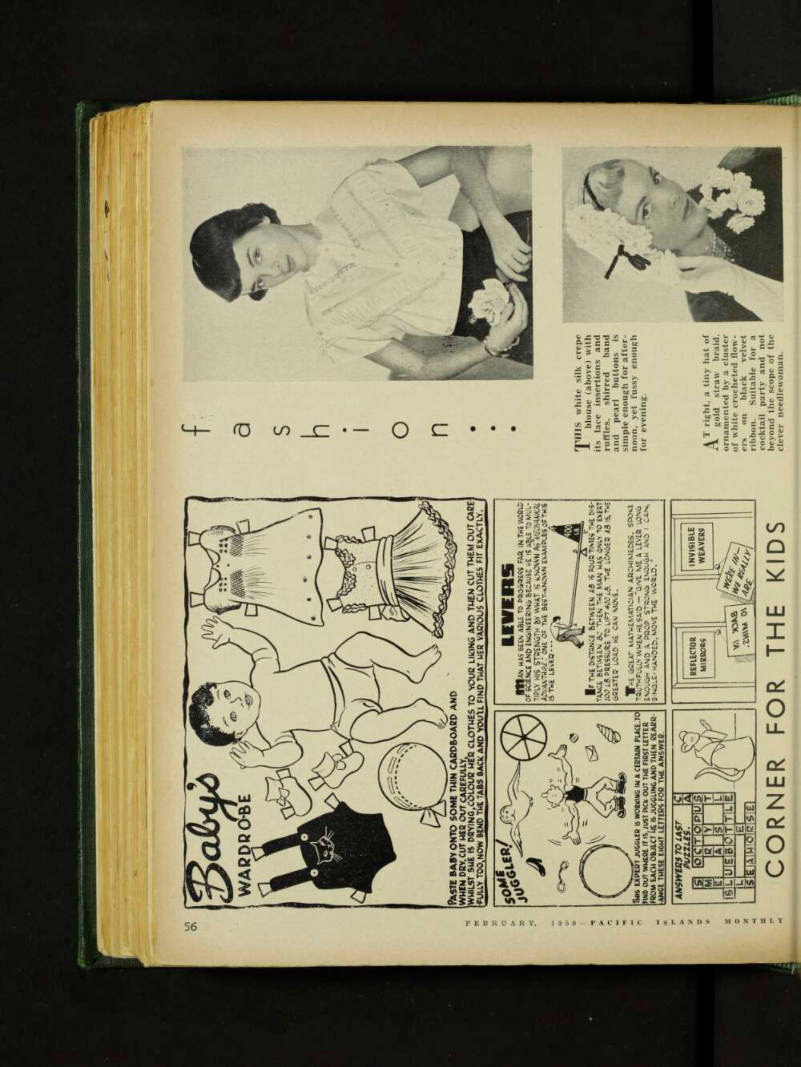
fashion...
THIS white silk crepe blouse (above) with its lace insertions and ruffles, shirred band and pearl buttons is simple enough for after noon, yet fussy enough
for evening.
AT right, a tiny hat of gold straw braid, ornamented by a cluster of white crocheted flow ers on black velvet ribbon. Suitable for a cocktail party and not beyond the scope of the
clever needlewoman.
Advertisements & other items, pp. 61-62 (1 item)
Burns Pnilp (New Guinea) Limited
General Merchants (Wholesale and Retail)
Shipping, Customs and General Agents
Head Office: PORT MORESBY, PAPUA
BRANCHES;
NEW GUINEA: Rabaul, Kokopo, Lae & Madang.
PAPUA: Samarai.
REPRESENTATIVES FOR:
AUSTRALIAN AGENTS:
LONDON AGENTS:
SAN FRANCISCO AGENTS:
QUEENSLAND INSURANCE CO. LTD.
LLOYD'S OF LONDON
BURNS PHILP TRUST CO. LTD-
BURNS, PHILP & CO. LTD.
All States.
BURNS, PHILP & CO. LTD.
"London House", 35 Crutched Friars, E.C.3.
BURNS, PHILP CO. OF SAN FRANCISCO INC. 510 Matson Building.
Distributing Agents, Territory of Papua-New Guinea tor:
SHELL COMPANY OF AUSTRALIA LIMITED
Petroleum Products
GENERAL MOTORS CORPORATION
Chevrolet, Buick, Pontiac and Oldsmobile Cars Chevrolet and GMC Trucks Frigidoire Refrigerators
VAUXHALL MOTORS LIMITED
Vauxhall Cars and Bedford Trucks
R. A. LISTER Cr CO., BRISTOL
Producers of Petrol, Paraffin and Diesel Engines Pumps and Lighting plants
RUSTON HORNSBY LIMITED
Engines
CROSSLEY MARINE ENGINES
yin ornate example of historical
keys, this XVlth Century
French key features the sporting motif in its club and animal carvings. It seems to have been the key to a Duke’s country
lodge.
1 r J.
'M ill sm A R
The key
to smoking pleasure
CAPSTAN
FINE CUT
NAVY CUT
TOBACCOS
or 1657./.48
"Cargo Cult"
“ Jonfrum ” is New Hebridean "Cargo Cult"
Part II of an article translated by H. E. L. Friday, Part I of which appeared in January issue
THIS did not end the movement, how ever. In December, 1941, Resident Nicol reported an anti-British feel ing in Tanna. The natives had had wind of Pearl Harbour and were saying, “Britain he lose, Germany he win.” He recommended expulsion of the hostile element, and asked for a permanent police force. During the next year 20 natives were sent to Port Vila as disturbers of the peace. A message from Vila was in tercepted and translated by Dr. Arm strong. It was from a Tanna police boy in Vila, Joe Nalpin, addressed to a chief of the West coast and two others. Nalpin was serving a nine months’ sentence for some breach of trust, but pretended he was trying to unmask Jonfrum. Mr. Nicol regarded him as more dangerous than Manehivi.
In January, 1942, three so-called “sons” of Jonfrum, named Isaac, Jacob and Lastuan were active at Ipikel, Sulphur Bay, a model village with its own foot ball ground. The rumour ran that they had been landed by plane at Siwi, a beach near the volcano. (The natives had noted the passing of the Australian Catalinas based on Vila, out on patrol).
There were junketings by night and day and the claim was put forward that they were to govern certain parts of Tanna.
They were going to America, it was said, to meet their father, the “king” of America (the Americans were just making their first appearance in the Group).
The natives were told to use up their English money and there was again a run on the stores, one store taking £3OO in January from natives who previously bought very little. Meat, sugar, rice, knives were bought.
Again Mr. Nicol intervened, questioning young girls who had been waiting on the “sons” of Jonfrum. They agreed that a young Sulphur Bay native named Siaka was the “son” who called himself Isaac, and he and three others were sent to Vila for a year’s detention.
“Vila,” went the new rumour, “is full of Americans. They are coming in large numbers to Tanna. These Americans are black, and their dollar is our new money. They are going to rule us, free our prisoners and pay their wages.” This rumour accounts for the good response in August, 1942, when the Americans asked the Tanna men to go and work for them in Vila. Mr, Nicol reported that nearly
all the Tanna men were ready to go.
They were certain that Jonfrum was on the way from America and Mr. Nicol felt that only time and a stay in Vila could rid them of the idea Certain of his 1941 prisoners were set at liberty and he agreed to their return to Tanna, with the exception of Mahehevi (alias Jonfrum), Karaua
and Joe Nalpin, whom he regarded as undesirables but who where engaged at Vila as free workers with the US Mv Force. The natives were still absenting themselves from the Tanna missions, holding dances and kava parties, especially on the East coast. Before handing over his duties, for three months,
to Mr. A. Rentoul, former Papuan official, Mr. Nicol sent a few away to Vila “to think things over.”
FORMER Jonfrumists in custody asked Mr. Rentoul to let them out one Sunday to attend a Presbyterian service, and receiving permission they went along in their Sunday best. On October 6, a hundred West coast native notables asked permission to visit the Residency to “make it up with the Government.”
On October 11, Mr. Nicol returned on the Morinda from Sydney, and a few days later he was cabling Vila; “Important.
New Jonfrum demonstration in the North of Tanna. The police, sent to make ar rests, received by eight natives armed with guns and others with clubs. Send reinforcements.”
On the 18th, Vila received another message: “Jonfrum, alias Loiag, in prison. His supporters feverishly occu pied building an airfield for the Ameri cans. Please send 20 police boys and a US staff officer to convince them that their work is quite unnecessary. Loiag completely mad.”
Later the same day another message: “Loiag supporters number about 250.
Natives forced to run away to avoid being pressed into work on the airfield. Five who resisted have been wounded. Natives of the region are hostile and can’t be counted on. Have been forced to take action at Whitesands against natives try ing to free Loiag.”
On the 19th, another message: “Position becoming untenable. Nearly the whole island making common cause with Loiag supporters. Send 100 men as soon as pos sible.”
Two days later the Echo reached Tanna from Port Vila with police reinforcements and two US officers.
The next day, Nicol led an expedition
to Ikolau, in the North, where the natives were levelling their landing field for the arrival of the alleged Jonfrum planes. About 200 men were working there. They and a number of natives hidden in the vicinity were surrounded.
Eleven guns were taken from them. Eight of Loiag’s supporters were arrested, and 42 told to account for their actions to the authorities the following day. Major Patton, one of the US officers, spoke to the assembled natives in Pidgin English, which was also translated into Tanna dialect. He said: “The Americans don’t recognise Jonfrum and do not need an airfield on Tanna. Americans, British and French are fighting together against Japan. Fighting is going on to the North of the New Hebrides.”
The police then gave a demonstration of Tommy-gun fire which blew to bits a Loiag-Jonfrum announcement nailed to a tree. Alarmed by the fire the natives ran into the bush. Finally the police set fire to the hut specially built for Jonfrum.
Next day a so-called court of inquiry was held.
On the 18th Mr. Nicol, after arresting Loiag, had been menaced by natives try ing to set him free, Loiag, the new Jonfrum, was a man in his thirties from the village of Lomaper, Nossim (Tanna). He pretended that he was the “king of America” and that he had been charged by the Americans to construct a landing-field which would enable his father to fly in with all sorts of trade-goods. The airfield, he said, was urgently needed so that everybody was needed to work for him. He had a police force of his own numbering 45 whom he authorised to round-up native labour, and he threatened that his planes would come along and bomb them if they did not set to work at once.
As proof of his mission, Jonfrum II pretended that, although an unlettered heathen—he had never attended mission school—he could read the New Testament and was able to write. This pretence had damaged his reputation among literate natives, for it was noticed that when he paid a visit to a school of his own that he had started, his pretended know ledge consisted only of mumbling the ABC and counting up to 9.
At all events the Tanna natives of Greenhills had had enough of school, Jonfrum or Presbyterian. What attracted them to the movement was the prospect of uninhibited love, kava drinking and the dance.
On October 25, the Echo left for Vila with 46 prisoners. Loiag was sentenced to two years’ imprisonment; ten of his disciples to one year; and the rest to three months. Loiag also was found to be mentally unbalanced. Later, he was to escape from custody, spend three years in the Efate bush living on taro and wild pig. and then, on April 29. 1948, give ?, lm self up. He was sent to the asylum on lie Nou, Noumea (New Caledonia), as a pad case of acute mania; and is reported to be there still.
MR. NICOL ended his October 1942 re port on the Tanna voodoo outbreak with the words: “There is no ques tion the Jonfrum movement being only that of one man or of a single small tl 2r e 7T l t is the subject of general belief affecting the whole island.”
In 1943, Mrs. Armstrong tried to restart the mission classes at Lenakel. but these were not attended as well as formerly.
Scarcely 50 children could be collected in a district numbering 2,500 persons. But beyond-the-pale dances, orgies of kava drinking and communal junketings went on unchecked. The villages lost their clean appearance, becoming untidy and dirty. After Mr. Nicol died in 1944, the French, for the first time, appointed a representative on the island, whose Eng lish representatives were now Messrs.
Gordon White, Johnson and Peter Colley.
Monsieur Jocteur, in February, 1945, sen tenced two natives named Malouine and Nemarka as Jonfrumist agitators; and his colleague, Mr. Johnson, in September, 1946, notified his chief in Port Vila of a revival of witch doctoring. The Port Vila prisoners were still in touch with their supporters in Tanna, and others exiled to Malekula were causing trouble for the district officers on that island.
On April 11, 1947, the Anglo-French officers on Tanna learnt that natives of Locafi and Latabu villages, in the Waisisi district on the East coast, had raided Mr.
Bannister’s store at Whitesands, climbing
over the counters and tearing off the price tickets on goods. Mr. Bannister had caught one native named Nakomaha with
a fist full of these tickets and had asked him what he was doing with them.
It was an order from Jonfrum, was the reply. “All tickets all the same blood (red), all same sick (blue), all same death (yellow) me take away. Jonfrum say so. Jonfrum like black now white, that’s all.”
The local officers, English and French, left Lenakel during the night with what police boys they could muster, and were at Latabu next (Saturday) morning at 9 o’clock. Here they arrested 14 natives in volved in the raid on the Bannister store.
One of the 14 was Jonfrum 111, a new pretender, whose name was lokaeye. He and two companions named Nakomba and Keyasi got five years prison. Their ac complices got two years to be followed by five years’ banishment. All 14 had been involved in the disturbances of Oc tober, 1943.
This prompt action nipped the move ment in the bud, and the British officer, Mr. Colley, thereupon practised a policy of calm and appeasement. He called the chiefs together and pointed out to them the impossible nature of their Jonfrumist aspirations. Before they left he bound them over to be of good behaviour.
But towards the end of 1947 the banished Jonfrumists tried to revive the movement. On September 7 of that year, Mr. Colley found that the Ipekel villagers of Sulphur Bay were renewing their il legal activities. The Tanna exiles at Port Sandwich, Malikolo, through natives at Port Vila, had sent their Tanna sup porters four coconuts with instructions that they were to be planted on the sites of four houses at Nampas, Mailes, Ne marka and Namaig demolished on orders of the Europeans. Questioned, the Tanna men involved tried to make Colley be lieve that the coconuts were a new species sent to improve the local plantations.
They were, in fact, a sort of message to the effect that, “Even if our bodies are at Mallicolo our spirits are with you at Tanna. Go on with the good work.”
Colley therefore had the coconuts dug up.
THE Catholic priest, Father Patrick O’Reilly, visited Lamap in October, 1948, and learnt a great deal about the exiles, who were in charge of the
French District Agent, M. Jean Guedes, He had given them gardens on mission ground. It was clear that they had been carrying on Jonfrum propaganda on Mal licolo since their arrival. Lists of sup porters had been compiled, there had been secret nocturnal meetings with .voo doo and dance. They had also built a meeting hut of their own three miles away.
To check their activities they were for
bidden to wander more than a mile from the mission. It seems too, that the people of a Presbyterian village named Curo on Ambrym, who used to visit Port Sandwich, were being used as proselytes of Jonfrum ism. They had put up notices outside the village: “Stop!” “Mouia!” and created their own village police; had built a hut where, they said, they would store the goods which the Messageries Maritimes ship Polynesien was to bring them. Their belief that a ship was to bring them un
told wealth which the white man wanted to rob them of, was the same as the Cargo Cult beliefs of tribes in Bou gainville and other of the Solomon islands —the frustrated Melanesians’ conception of a coming era of liberty or licence free from white man’s leading-strings; a vision of a future Melanesian terrestrial para dise.
Father O’Reilly, who has collected all the evidence possible, written or verbal, on the Jonfrum events in Tanna, remarks
that to get to the heart of the matter is difficult for a white investigator. With one exception, that of Dr, Armstrong, all those from whom he was able to ob tain information, no matter what may have been their clear-sightedness, their knowledge of the natives and of their psychology, were able to communicate with the natives only in Pidgin-English.
None knew the native language or had lived among them; none had gained their confidence outside of their official capacity.
What struck this keen inquirer, is that Jonfrum is not a movement influenced by one man, but a communal state of mind, brought about, it seems, by a longing to return to the ways of paganism. The missions have too strictly applied their “Thou shalt nots.” The natives have had enough of being deprived of their dances, their kava, their feasts —the new Messiah must restore the isle and its people to a state of ancestral liberty.
Father O’Reilly notes that it has not been the real heathens, nor the most fervent Presbyterians, who have been the most involved, but those who have come in contact with mission ways without having altogether abandoned heathenism.
And as it has been the Europeans who have introduced the “school” and its re strictions, the movement became one of “Tanna for the Tannanese.”
They denounced the Convention of 1912, by which the Tanna chiefs accepted the Condominium. The chiefs in 1912 had received a certain sum in gold, in recog nition of their loyalty. This money was restored to circulation at the start of the Jonfrum movement, as though the natives wanted to resume freedom of ac tion in the spirit of: “Here is your money back—now release us from our pledge.”
“I am convinced,” writes Father O’Reilly, “that outside influence is negli gible in this affair. It is a spontaneous native movement. There are, to all in
fents and purposes, no Tonkinese, Javanese, or Chinese on Tanna. On board the ships where they sign on as crew, the Tanna men may sometimes meet up with an Australian trade-unionist or communist, but that does not explain the Jonfrum demonstrations.
“Jonfrum must be linked, however, with the prophetic and xenophobe movements reported from the Solomons and New Guinea before and since the war: and which has again manifested its force on Malaita in the last few years. It is hard to see how these different manifestations of unrest are connected. They seem to possess the character of a common origin and, without doubt, some connection exists. There is a common basis of native life in the different parts of Melanesia, a common interpretation of the happen ings that come within his orbit, things which strike him because they appear extraordinary. In this connection the planes, the war, the Americans. He some times mixes his observations with a touch of craziness. From all this comes these fundamentally native demonstrations, containing something mysterious which emerges from time to time in primitive communities. The best reply to them is sane education, united to political and economic development.”
Advertisements & other items, pp. 63-68 (1 item)
Floor
PRODUCING UNIFORM GOOD RESULTS SINCE 1868
ALWAYS ASK FOR IT
For the RIGHT TIME Rely on WESTCLOX The finest, smartest clocks in Westclox history—that’s what Westclox has in store for you! A wide range of stunning clocks for every room— spring-wound and electric alarm models —wall clocks for your kitchen and time clocks for the living room— yes, wrist and pocket watches, too— all with traditional Westclox dependability and smartness that have made Big Ben and other members of this time-keeping family famous all over the world.
“It’s a Westclox” is the finest thing you can say about a clock or watch.
Some Westclox have luminous dials that you can see in the dark.
You can buy any Westclox with confidence. Look for that trade mark on the dial of the next clock or watch you buy.
QUALITY •
• RELIABILITY •
10 WBsrtto* Baby Ben—This alarm may be adjusted to loud or soft. Quiet tick. Made in two finishes— ivory and gold colour; also black with nickel trim.
BIG
BEN
Big Ben is made two ways—There’s Big Ben Loud Alarm with booming intermittent call. If you want a more gentle awakening. there’s Big Ben Chime Alarm which first calls you with soft chimes. If you ignore these chimes, there’s a loud call in reserve.
PACIFIC ISLANDS TRADING CO
244 CALIFORNIA ST., SAN FRANCISCO, CALIF., U.S.A.
Scott’s “Renown” Brand Rope,
Cordage and
Binder
Twine
of Every
Description
Dable Address.
Ropeyard Sydney.
MANUFACTURED AT
MASCOT, N.S.W.
i. SCOTT
PTY. LTD.
Head Office and Store
163 CLARENCE STREET.
SYDNEY,
N.S.W.
ETABLISSEMENTS DONALD TAHITI
HEAD OFFICE—QUAI DU COMMERCE—PAPEETE
TELEGRAPHIC ADDRESS—“DONALD, PAPEETE”
General Merchants (Wholesale & Retail) & Shipowners
Importers & Exporters—Branches Throughout Marquesas Islands
Lloyd’s Agents
ASSOCIATE
HOUSES:
Agents and Distributors for:
FRANCE:
HENNESSY COGNACS
MARIE BRIZARD & ROGER
LIQUEURS
CHARLES HEIDSIECK
CHAMPAGNES
PERRIER WA'I'ER
GRUBER BEER
U.S.A.
GENERAL STEAMSHIP CORP.
RADIO CORP. OP AMERICA
BROWN & WILLIAMSON, LTD.
CIGARETTES: LUCKY STRIKE,
WINGS, OLD GOLD
CHAMPION SPARK PLUG CO.
RAINIER BEER
A. B. DONALD, LTD.
AUCKLAND, NEW ZEALAND.
A. B. DONALD, LTD.
RAROTONGA. COOK ISLANDS
DOMINION FRUIT CO.,
SUVA, FIJI ISLANDS.
ENGLAND:
RECKITTS & COLMAN
(OVERSEAS), LTD.
PHILLIPS BICYCLER
THE BANK LINE LTD.
NEW ZEALAND:
VACUUM OIL CO. PTY., LTD.
PETROLEUM PRODUCTS
SWEDEN:
HJORTH & CIE
PRIMUS STOVES
Sydney Agents:
BURNS, PHILP A CO., LTD,
London Agents:
BURNS, PHILP A CO.. LTD.
San Francisco Agents:
BURNS, PHILP CO. OP
SAN FRANCISCO.
Agents in France:
HARTH A CIE, PARIS.
A. BICKART,
ART POSTCARDS OF
TONGA
Per Dozen (Including a Tin-Can Mail Cover), Postage Paid: 6/- (or one US Dollar).
TONGAN PHOTOS BUREAU
Nukualofa, Tonga
PROTECT THOSE TEETH!
PROTECT THA T SMILE!
with
I PAN A
TOOTH PASTE
A o o -A % -0 JT A T F Ojf He.
I .o* Dentists know that you can't have sound teeth unless you have healthy gums. That's why you should always use IPANA.
IPANA not only keeps teeth radiantly clean . . . but it stimulates the gums, keeps them firm and healthy, and guards against decay.
You'll like IPANA . . . it's refreshingly different!
Sold Everywhere
A PRODUCT OF \jjL' BRISTOL-MYERS
d ii •r®- . V «4r
UNION MANUFACTURING
& EXPORT CO. LTD.
G.P.O. Box 1060, Wellington, NEW ZEALAND
Cables: "UMEC", Wellington
We can arrange prompt shipment to residents
of the following Island Territories:
NEW CALEDONIA, NEW HEBRIDES, GILBERT ISLANDS,
ELLICE ISLANDS, BRITISH SOLOMON ISLANDS and
NEW GUINEA
We are also interested in buying Islands Produce of
every description, especially COCOA-BEANS,
COFFEE BEANS and VANILLA BEANS, and can
provide shipping.
MIL*
AVAILABLE FOR IMMEDIATE SHIPMENT
SAWN TIMBER.
PLYWOODS.
WAIjLBOARDS.
PAINTS.
VARNISHES.
BUILDING PAPER.
ASBESTOS
SIDINGS.
FURNITURE.
ASSEMBLED &
UNASSEMBLED.
MATTRESSES.
CANDLES.
WASHING SOAP.
TOILET SOAP.
COSMETICS.
TENNIS SHOES.
LEATHER SOLES
AND HEELS.
LEATHER BELTING.
LEATHER BENDS,'
ETC.
LEATHER BOOTS
AND SHOES.
SEEDS (INCLUDING
BLUE & MAPLE
PEAS).
LIVESTOCK.
FROZEN MEATS.
TINNED MEATS.
TINNED FISH.
FROZEN FISH.
BUTTER.
CHEESE.
CUSTARD POWDER.
BAKING POWDER.
COFFEE ESSENCE.
POTATOES.
DRIED MILK, ETC.
TINNED
VEGETABLES.
TINNED SOUPS.
ONIONS.
CORDIALS.
BEER.
RADIOS.
BUYING OR SELLING—WE CAN HELP YOU
ef r
Stewarts and Lloyds (Australia) pt y . Ltd.
Manufacturers of "S&L" PIPES and FITTINGS for GAS, WATER, STEAM and other purposes.
AND Distributors of:
MILD STEEL BARS. PLATES and SECTIONS;
GALVANISED IRON; BOLTS and NUTS; ELECTRODES
and WELDING EQUIPMENT.
Stewarts and Lloyds (Australia) pt y . Ltd.
SYDNEY WAREHOUSE - - - Herbert Street, St. Leonards BRISBANE WAREHOUSE - Montague Road, South Brisbane MELBOURNE WAREHOUSE - - City Road. South Melbourne Telegraphic Address: "Tubes" Sydney, Brisbane or Melbourne
ENJOY YOUR
MOTORING
GET A
TMasse
BATTERY
“ They’re Tigers for Work” : sM f (5 There's no better battery made than Masse. Sturdy plates and husky case make for long life. Superco!
Separators ensure a super-activity of acid on every part of the plates, giving a constant output of current far beyond the allotted span. That's why Masse stands up to hard work and the heaviest drains made upon it in starting and lighting.
ROBERT GILLESPIE JSSL
LAE and RABAUL
u
Livraison IMMEDIATE LINOLEUM ECOSSAIS IMPORTE
delivery immediate
(re
MPORTED
LINOLEUM
Ideal for Island Conditions. Long Wearing.
Hessian Back. Cork based. Full range of colours, patterned or plain. Full rolls (30 yards by 6 ft.) only supplied. Order to-day through your Trading House for delivery by first boat.
Ideal pour les pays tropicaux. D’une durabilite sans pareille, a base de liege convert en toile de chanvre. Dessins ou unis. Rouleaux de 30 yarda par 6 pieds de large. Commandez aujourd’hui chez votre Agent pour livraison par premier bateau.
TAY SIDE Linoleum distributed by:
INTERNATIONAL TRADING
PTY. LTD.
Halifax House, 26 O’Connell Street, Sydney.
Phone: BL 1643, Cables: “Mondial,” Sydney.
W; &
A. H. BUNTING LIMITED
SAMARAI
PAPUA
SOLE AGENTS IN PAPUA/NEW GUINEA FOR:
SAMARAI AGENTS FOR:
Vacuum Oil Co. Pty., Ltd.
South British Insurance Co.
National Mutual Life Association Polarizers (U.K.), Ltd.— Polaroid Sun Glasses.* C.S.A. Industries Eng.— Dual Freeze Refrigerators.
Webley & Scott, Ltd.— Shot Guns, Air Pistols, etc.
Le Bryan Group Products (Great Britain) Ltd.— Powermaster Electric Refrigerators.
“Getula.”— Nylon Monofilament Fish Lines. • Trade mark patented in U.S.A., Great Britain, and other countries.
REGULAR SUPPLIES OF EASTERN GOODS
WHOLESALE & RETAIL MERCHANTS IMPORTERS PLANTERS
Shipwrecks In French
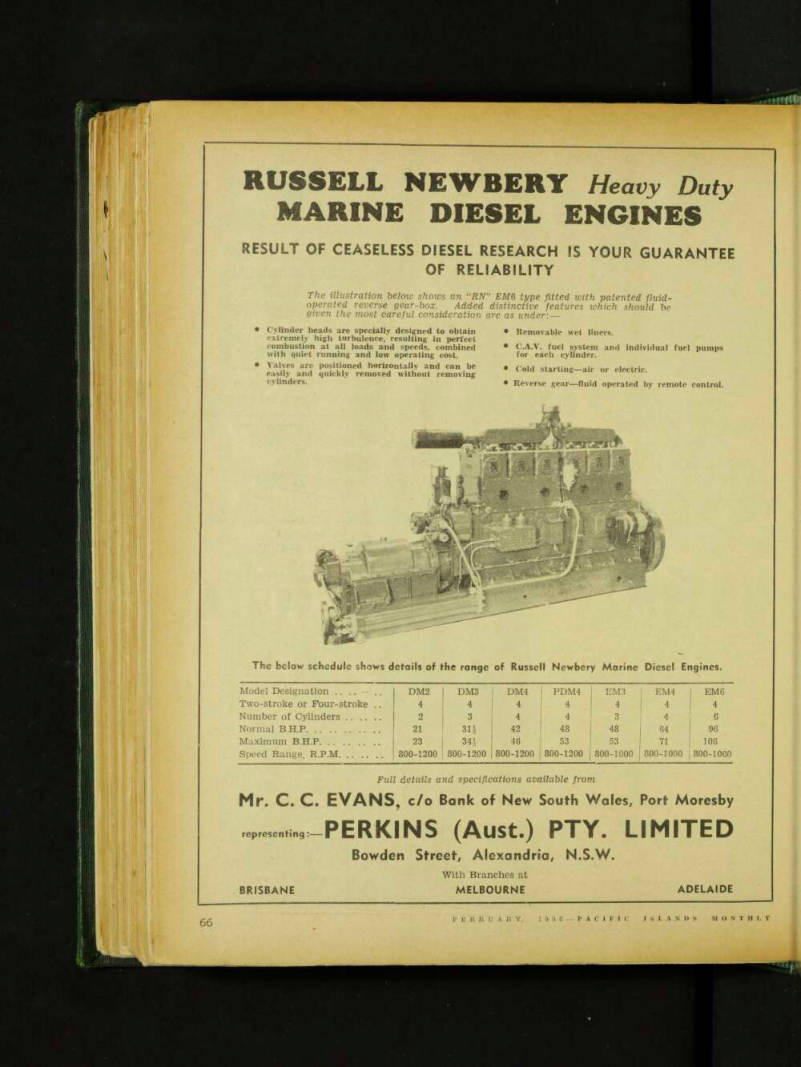
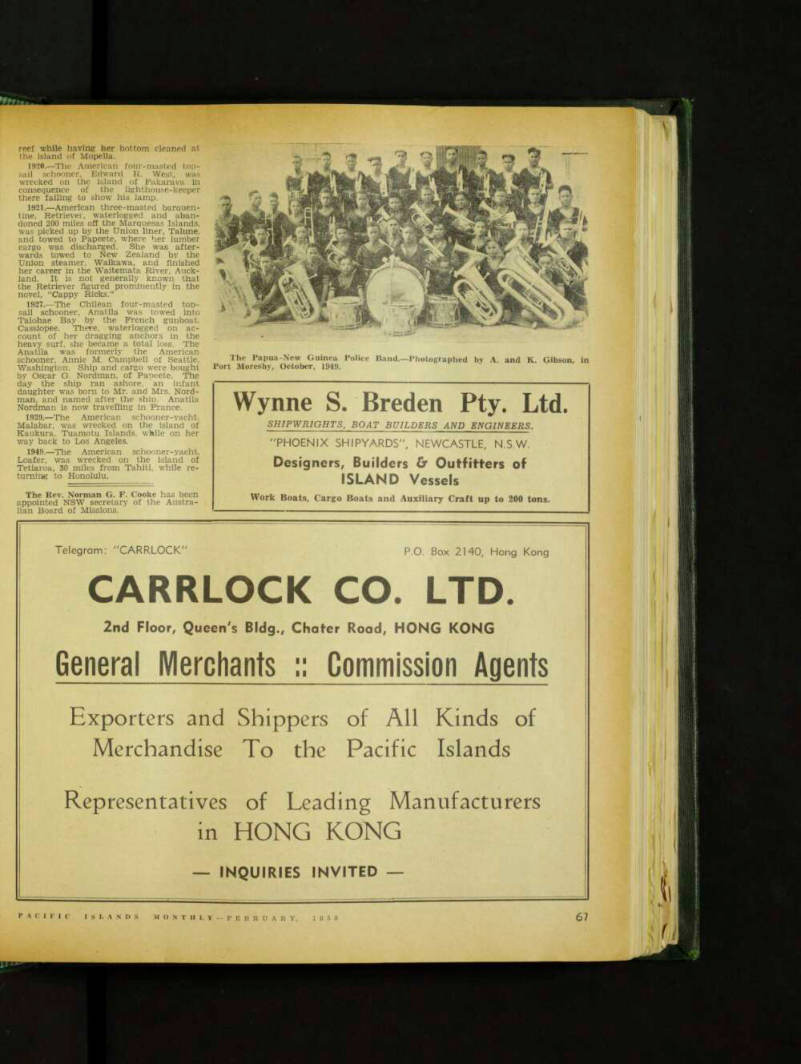
Oceania Grim Record of 75 Years
Prom Our Own Correspondent
Papeete, Dec. 31.
THE following list of wrecks in the South Eastern Pacific has been sup plied by Mr. Julien Levy, a retired master-mariner, of Tahiti, to whom grate ful acknowledgement is made. It was compiled at the request of the local Bureau of Information. It does not in clude French ships.
As will be noted, most of these disas ters occurred around the Dangerous Archipelago (Paumoto Islands) whose bad reputation among mariners earned for them their unenviable name. 1875.—British three-masted barque Ada Iredale, after catching five of the Mar quesas, was some weeks later picked up some six miles off Paea, and was towed to Papeete and refitted. After sailing to San Francisco she was some years later pur chased by Captain William Matson, and became the four-masted auxiliary schooner, Annie Johnson. Being put on the Mahukona-San Francisco sugar run, she was sold to Captain Ozanne and re named the Bretagne, under French registry. Later, becoming waterlogged, she was abandoned at sea, 1926. 1902.—British four-masted barque, Pyrenees, caught fire at sea and was beached in the harbour of Rikitea, Man gareva Island. Refloated, she was brought to Papeete, refitted, and sailed for San Francisco, where she was renamed the Mangareva, under American registry. She was lost in World War I when on a voyage from America to England. 1902.—Danish three-masted barque, Vernande, struck the reef as she entered Papeete Lagoon. Assisted by the French Navy vessels, Durance and Zelee, she was towed free at high tide and anchored off the British Consulate. That night at 11 o’clock she sank and for many days there after presented a desolate sight, her hull only being submerged and her masts rising high above the water. 1903.—British three-masted barque John Gamble, laden with sugar, ran on the reef at Arue, Tahiti, while the cap tain was ashore, and became a total loss.
1904.—Union SS Co.’s steamer, Mawera, ran on the reef at the island of Apataki, and became a total loss. 1906. —British four-masted ship, County of Roxburg, was thrown on top of the reef during a cyclone and still is a pro minent landmark on the island of Takaroa. 1909. About this year, a three-masted barque, flying the Chilian flag, was picked up some hundred miles from Papeete and towed to port. She proved to be the former vessel, Eaton Hall, British built, which had been dismantled in a gale.
After being anchored in Papeete harbour for some time, during World War I, she was towed outside the reef and used for target practice. Having drifted back, she piled on the reef on the north side of the entrance to Papeete Harbour. 1910. —The Norwegian steamer, Ocean Queen, on its maiden voyage under the house flag of the British Phosphate Com mission, ran on the reef at the Phos phate Island of Makatea and became a total loss. 1913.—The American three-masted, bald-headed schooner, G. W. Watson, piled on the reef at the entrance to Uturoa Harbour, on the island of Raiatea. 1916.—About this year, during World War I, the German raider, Sea Adler, commanded by von Luckner, ran on the
reef while having her bottom cleaned at the island of Mopelia, 1920. —The American four-masted top sail schooner, Edward R. West, was wrecked on the island of Fakarava in consequence of the lighthouse-keeper there failing to show his lamp. 1921. —American three-masted barquen tine, Retriever, waterlogged and aban doned 200 miles off the Marquesas Islands, was picked up by the Union liner, Talune, and towed to Papeete, where her lumber cargo was discharged. She was after wards towed to New Zealand by the Union steamer, Waikawa, and finished her career in the Waitemata River, Auck land. It is not generally known that the Retriever figured prominently in the novel, “Gappy Ricks.” 1927.—The Chilean four-masted top sail schooner, Anatila was towed into Taiohae Bay by the French gunboat, Cassiopee. There, waterlogged on ac count of her dragging anchors in the heavy surf, she became a total loss. The Anatila was formerly the American schooner, Annie M. Campbell of Seattle, Washington. Ship and cargo were bought by Oscar G. Nordman, of Papeete. The day the ship ran ashore, an infant daughter was born to Mr. and Mrs. Nord man, and named after the shin. Anatila Nordman is now travelling in Prance. 1939. —The American schooner-yacht, Malabar, was wrecked on the island of Kaukura, Tuamotu Islands, while on her way back to Los Angeles. 1949.—The American schooner-yacht, Loafer, was wrecked on the island of Tetiaroa, 30 miles from Tahiti, while re turning to Honolulu.
The Rev. Norman G. F. Cooke has been appointed NSW secretary of the Austra lian Board of Missions.
The Papua-New Guinea Police Band.—Photographed by A. and K. Gibson, in Port Moresby, October, 1949.
French refugees from Formosa, Mr.
Ernest Muller and family, accompanied by a young Hong Kong born Britisher arrived recently in Brisbane by the 7,280-ton British ship Harpathian. The party was on its way to New Caledonia “in search of peace.” Mr. Muller is a marine engineer.
Miss Therese O’Brein, of Madang, New Guinea, will visit Queensland in February before making a trip to England for a long holiday.
Mr. Charles McPhee, well-known artist of Western Samoa was a visitor to Pago Pago at the end of 1949. He held a successful exhibition of his paintings.
Mr. J. Price, planter, of Savusavu, Fiji, visited New Zealand in October. It was his first trip away from Fiji for 21 years and he planned to stay six weeks. The noise, the traffic and the general hurly burly so irritated him, however, that after two weeks he got on the Matua and went back to Fiji.
Advertisements & other items, pp. 69-72 (2 items)
Vince
m &
SPECIALISING IN
PACIFIC ISLAND INSURANCES
FIRE—MOTOR VEHICLE
MARINE—HULLS AND CARGO
EMPLOYER’S LIABILITY
BONDS —In accordance with
ADMINISTRATION ORDINANCES.
COPRA INSURED PROM DRIER
TO BUYER.
AND ALL OTHER CLASSES ARRANGED
AT LOWEST CURRENT RATES.
Established Agencies throughout the Territory of Papua and New Guinea Managing Agents: New Guinea Company, Limited.
Island Representative: G. D. A. Kent, Rabaol Branch.
SOUTHERN PACIFIC INSURANCE
CO., LTD,
HEAD OFFICE: 60 HUNTER STREET.
SYDNEY.
mb meetvrJr
w/r//
co/M£
FOR
SUMMER
HEADACHES
HEAT
EXHAUSTION
FATIGUE
LISTLESSNESS
Ki h„.
Enjoy Summer Fun!
thrill to the call of the surf and the /\\ \\V S and ! Vincent’s A.P.C give marvellous "■ - relief from Summer Headaches, Fatigue, and Nervous Depression.
Vincent’s A.P.C will lift you to bright, y smiling alertness!
AN IMPORTANT
POINT TO
REMEMBER!
Prepared to the original hospital formula, genuine Vincent’s a.p.c is a proved and accepted medical prescription!
VINCE
FOR
M N_CJ
POWDERS
RUSSELL NEWBERY Heavy Duty
MARINE DIESEL ENGINES
RESULT OF CEASELESS DIESEL RESEARCH IS YOUR GUARANTEE
OF RELIABILITY
The illustration below shoivs an “RN” EM6 type fitted with patented fluidoperated reverse gear-box. Added distinctive features which should be given the most careful consideration are as under: • Cylinder heads are specially designed to obtain • extremely high turbulence, resulting in perfect combustion at all loads and speeds, combined • with quiet running and low operating cost. • Valves are positioned horizontally and can be • easily and quickly removed without removing cylinders. • Removable wet liners.
C.A.V. fuel system and individual fuel pumps for each cylinder.
Cold starting—air or electric.
Reverse gear—fluid operated by remote control. The below schedule shows details of the range of Russell Newbery Marine Diesel Engines.
Full details and specifications available from Mr. C. C. EVANS, c/o Bank of New South Wales, Port Moresby
representing:— PERKINS (Aust.) PTY. LIMITED
Bowden Street, Alexandria, N.S.W.
With Branches at
BRISBANE MELBOURNE ADELAIDE
Wynne S. Breden Pty. Ltd.
SHIPWRIGHT^S,BOAT BUILDERS AND ENGINEERS.
"PHOENIX SHIPYARDS", NEWCASTLE, N.S.W.
Designers, Builders & Outfitters of ISLAND Vessels Work Boats, Cargo Boats and Auxiliary Craft up to 200 tons.
Telegram: "CARRLOCK" P.O. Box 2140, Hong Kong
CARRLOCK CO. LTD.
2nd Floor, Queen's Bldg., Chafer Road, HONG KONG
General Merchants :: Commission Agents
Exporters and Shippers of All Kinds of Merchandise To the Pacific Islands Representatives of Leading Manufacturers
in HONG KONG
INQUIRIES INVITED
AUNT
MARYS
BAKING POWDER
For the best in delicious baking results A product of TILLOCK AND GO. PTY. LTD. manufacturers of all the famous Aunt Mary s Pure Foods
Wholesale and Retail Merchants. Shipowners. Sawmillers.
General Engineers. Customs and Shipping Agents.
Catering for all Plantation Supplies. Buyers of Island Produce.
Plantation Owners and Managing Agents.
Agents for:— Australia-West Pacific Line.
China Navigation Co.
Canton Insurance Office, Ltd.
Union Assurance Society, Ltd.
Aust. T. & G. Mutual Life Society, Ltd.
Guinea Air Traders , Ltd. ■ ye*, xiatso* RrisbaB t.
MeTboo*^
cot-rat.
getting* 0 * 1 ’
Distributing Agents in New Guinea for:— Hillman, Humber, Sunbeam-Talbot, Chrysler and Plymouth Cars.
Commer, Karrier and Fargo Trucks.
Willys Overland Jeeps.
G.M. Marine and Industrial Engines.
Olympic Tyres and Cables.
Hygeia Dissolvenators.
Sherwin-Williams Paints.
Prefect Refrigerators.
Mullard Radios.
Aladdin Lamps.
Ewo Beer.
Snowflake Unsweetened Evaporated Milk.
66
FEBRUARY, ISSO BACIFIC ISLANDS MONTHLY
Pacific Folklore And
Mythology
FOLKLORE and mythology of the Paci fic area are well presented in “The Standard Dictionary of Folklore, Mythology and Legend,” published by Funk and Wagnalls Company in 1949.
Twelve years of research have gone into the selection of material for this opus, edited by Maria Leach. Thirty folklore authorities have contributed to the pub lication which is world-inclusive in its scope. Volume I carries the study up to and through the Letter I of the alpha bet. Volume 11, now in preparation, will complete the Dictionary.
Material on the Pacific has been pre pared by Dr. Katharine Luomala of Bernice P. Bishop Museum and the Uni versity of Hawaii. In Volume I Dr. Luo mala has dealt with Australian Aboriginal and Indonesian Mythology. She will out line Micronesian, Polynesian and Melane sian Mythology in Volume 11. In addition to major discussions of mythology and folklore of peoples, there are paragraphs covering numerous specific references.
Selections cover some 4,000 references to heroes, fairies, gods, devils, ogres, spirits, incidents, folklorists, religious concepts, traditions extending from the remote legendary past to the Twentieth Century.
This cross-section study presents material of two kinds: — (1) Brief informational paragraphs bearing particulars heretofore scattered in rare and out-of-print books, in learned and obscure journals and memoirs, on re cords transcribed in the field by anthro pologists and collectors, in unpublished manuscripts, or passed by word of mouth. (2) Original articles on specific cultures and aspects of folklore prepared especially for the Dictionary by 30 of the world’s foremost folklorists.
Volume I sells for $7.50.
Advertisements & other items, pp. 73-74 (2 items)
69
PACIFIC ISLANDS MONTHLY FEBRUARY, 1950
NG ARTIFACTS DISCOVERED
(Continued from Page 53)
W. H. Grove & S
THE PACIFIC ISLANDS SOCIETY
(Founded 1937) Visitors from the Pacific Islands to Sydney, or persons interested In Islands affairs, are invited to communicate with the Honorary Secretary of the above Society which was formed to constitute a social centre for those interested in the Pacific Islands.
Regular meetings and social gatherings, with lectures, are held at History House, 8 Young Street, Sydney, on the fourth Wednesday of each month, at 8 p.m.
Address for correspondence:—
THr PACIFIC ISLANDS SOCIETY
Box 2434, G.P.0., Sydney.
W. H. GROVE & S
Limited
Established 1896.
AUCKLAND
Island Traders. P.O. box 190.
Telegraphic and Cable Address: “Grove", Auckland.
Entrust Your Orders to the Firm with Fifty Years Practical Experience in the Island Trade.
Shippers of all classes of New Zealand products.
Representing English Manufacturers throughout the Cook and Society Islands, Fiji, Tonga, Samoa, Niue, New Hebrides, the Solomon Islands and New Caledonia.
In FIJI as—W. H. Grove & Sons (Fiji) Ltd.
BROOMPIELDS Ltd.
Suppliers of Building Hardware Ship Chandlery, Paint Materials % i
WRITE DIRECT TO:
Broomfields Ltd., 152 Sussex Street, Sydney
KASPER Superior SODA FOUNTAINS
‘IKASJPER' SOPER SODA FOUNTAIN IN°_6
SPECIALLY MADE FOR TROPICAL CONDITIONS
SODA FOUNTAIN 1 ) feet long, inches high serving side A 29 inches wide, FRAME 2 inch Angle Iron Frame, WELDED construction, rust-proofed FOUNTAIN TOP 'lB gauge, mirror finish, English, stainless steel.
SIDE 20 gauge, satin finish, stainless steel.
Ice Cream ,reeling Head extra to fountain.
Complete with 1/3 hp motor and fittings plus switch.
SURHOUND
Special rust-proofed alumlni INSULATION Special insulation 4 ins Spanish cork board on bottom sides & top, heavily pitched and sealed. 2 Arm Soda Stationr *► Drip Tray & 2 Running V>ater 4 Syrup Jars Spoon Receptac Ice Cream Head Refrigerator unit located here Drain Board, swivel tap a Double sinks welded into drain board
6 special l 8 gauge,
stainless steel, mirror finish, interlocking raised hinge. Soda Fountain Lids.
Hermetically sealed Waterproof.
Surround • Raised non-splash lip Rubbish Shutc finish, wide range of colours.
Class Rinser Milk Shske Fixer Swivel tap—- ✓7 tfo Bottle storage or food storage Compartment (1J cubic feet) flr Ice Block msker
SECTION
DIAGRAM
KE t
fusel rail-p Sink tsps
torsge rsckj
2 inch toe recces Chrome wheel valves lor thermo-sypnoning brine.
Enables operator to easily regulate temperature Iruit juice and soda sections, Section Section Section Section Section Double Hole for Soda a Aeter Coils, plus Fruit Salad Container on top of coll space.
Double Hole for Fruit Juices.
Double Hole for Milk and/or Fruit Juices Double Hole for serving Ice Cream Double Hole Ice Cream nerdening section Double Hole opening consisting of one x naif hole storage space for ice blocks and/or ice cream.
Each •Kasper* Super Fountain fitted with Swiss •Ssuter* tnermeststic valves.
KASPER NO. 6 TROPICAL INSULATED STAINLESS STEEL SODA FOUNTAIN
Complete with ICE CREAM MAKING MACHINE
SPECIALLY DESIGNED FOR TROPICAL CONDITIONS.
COMPLETE FOUNTAINS, INCLUDING METAL RUST-PROOF
SURROUND, CARBONATORS AND REFRIGERATOR UNITS
SHIPPED FROM AUSTRALIA THROUGH YOUR AGENT
For beauty, for low lifetime cost, for convenience, for dependability, for profit-making power, “Kasper” Fountains stand supreme in Australia to-day. The “Kasper” Fountain is years ahead of conventional models. Every detail has been thoroughly worked out and tested in the factory and in use.
“Kasper” superior fountains are of all steel, lifetime construction with stainless steel, WELDED surfaces and chromeplated fittings. Adequate cork board insulation helps assure
lowest operating costs.
ORDER NOW AND AVOID DELAY
m
Kasper Superior Soda Fountain of all
stainless steel welded construction
surfaces.
Kasper Refrigerators Pty. Ltd.
77 RAILWAY PARADE, ERSKINEVILLE, N.S.W., AUSTRALIA
Telephone: LA 1326
Ceremony and Beauty: A Wedding in
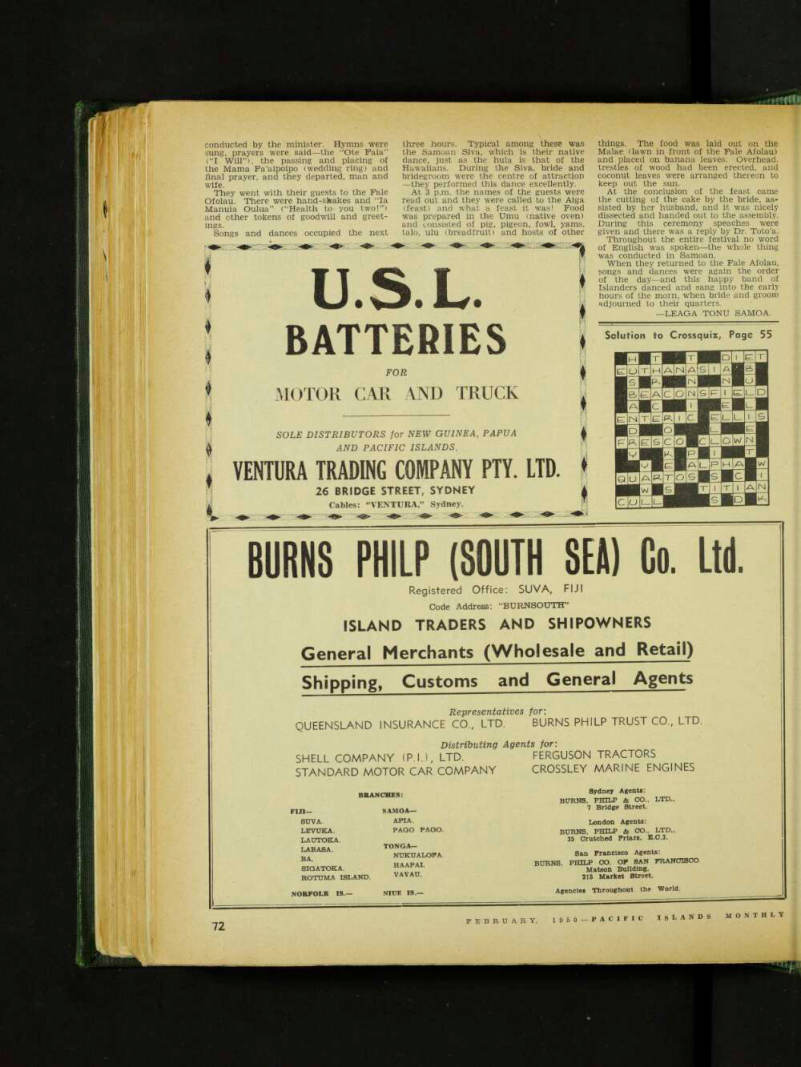
Samoan Style
LAST Saturday, at 10 a.m., my Samoan wife, Sieni, and I attended a Fa’ai poipoga Samoa; or a wedding in Samoan style. Well-known and popular Doctor Maka Sapolu, of Vaiala (Paulava) Village, married a nurse, Laga’an Uele, of Talefa. Both are attached to the Apia Hospital.
The wedding took place in a picturesque and historical spot, some two miles from the Hospital, on the Vailima Read, on the way to the late Tusitala’s home. The church was the lovely little coral lime stone building of the LMS.
A premarriage ceremony was held in a Fale Ofolau (meeting house), built of native wood, with earthen and stone floor, over which was a thatched roof of Lau Tolo (leaves of sugar cane). These houses are thoroughly rainproof and have blinds of Pola to be let down round the sides, in wet weather.
The Fa’aipaipoga ceremony begins with the Tamafa’aipoipo (bridegroom) taking his place, with two Tamauosili (grooms men) in the rear of the Fale and to the left. The wedding cake of lovely design, consisting of seven tiers, was placed in the centre of the house. Behind the bridegroom and groomsmen, a sheet of Siapo (Tapa) was stretched across the width of the house. This Siapo is the bark of the Ua tree, and is beaten out till it becomes quite thin, and looks, at a glance, like heavy cloth. This, in turn, is dyed in contrasting designs, and the finished article is indeed a lovely piece of work. Frangipani and Hibiscus flowers (Pua and Aute to our Samoans) were in abundance and, together with leaves of
the Fa’i and Niu (banana and coconut) artistically placed, the Fale was made very beautiful and suitable for the happy occasion.
At the rear of the Siapo, the Teinefa’ai poipo (bride) was attended by her Tein euosili (bridesmaids); in this case, nurses of the Apia Hospital. The bridegroom’s groomsmen were fellow doctors (Drs. Oti sene and Mi:) also of Apia Hospital.
After the guests were assembled, Samoan fashion, on the many mats of lovely designs—these mats are pre wedding gifts and take many weeks to complete—the bride and her two pretty bridesmaids took their place, to the left of the groom and his groomsmen.
The bride wore a lovely white satin gown and white veil and the bridesmaids were in pink—these lovely dresses dis placed the siapo of bygone days.
The Faifean (native ordained minister) then appeared and seated himself directly in front of the bride and groom, and facing them, proceeded to fill in the particulars of the marriage certificate.
Then, contrary to European custom, the couple signed the register, and their sig natures were duly witnessed by the two groomsmen. During this occasion, should anyone desire to wish the couple health and prosperity, he may do so. Through out all this, gifts of all kinds were arriv ing continually, and were accepted by a friend of the bride.
THE bride and groom, together with their attendants, then proceeded to the little church through a guard of honour, formed by the nursing staff of
Apia Hospital (Samoans). The couple went to the front of the church, where they were seated on fine mats (letoga).
These mats take up to one year to com plete, and are finely woven from the leaves of the Lauie tree. The mats I saw were woven as fine as the average table cloth, and no fault could be seen when examined closely.
After all guests were seated, the short and lovely little service in Samoan was
conducted by the minister. Hymns were sung, prayers were said —the “Ote Faia” (“I Will”), the passing and placing of the Mama Fa’aipoipo (wedding ring) and final prayer, and they departed, man and wife.
They went with their guests to the Pale Ofolau. There were hand-shakes and “la Manuia Oulua” (“Health to you two!”) and other tokens of goodwill and greet ings.
Songs and dances occupied the next
three hours. Typical among these was the Samoan Siva, which is their native dance, just as the hula is that of the Hawaiians, During the Siva, bride and bridegroom were the centre of attraction —they performed this dance excellently.
At 3 p.m. the names of the guests were read out and they were called to the Aiga (feast) and what a feast it was! Food was prepared in the Umu (native oven) and consisted of pig, pigeon, fowl, yams, talo, ulu (breadfruit) and hosts of other
things. The food was laid out on the Malae (lawn in front of the Pale Afolau) and placed on banana leaves. Overhead, trestles of wood had been erected, and coconut leaves were arranged thereon to keep out the sun.
At the conclusion of the feast came the cutting of the cake by the bride, as sisted by her husband, and it was nicely dissected and handed out to the assembly.
During this ceremony speaches were given and there was a reply by Dr. Toto’a.
Throughout the entire festival no word of English was spoken—the whole thing was conducted in Samoan.
When they returned to the Pale Afolau, songs and dances were again the order of the day—and this happy band of Islanders danced and sang into the early hours of the morn, when bride and groom adjourned to their quarters.
Leaga Tonu Samoa.
Advertisements & other items, pp. 75-76 (2 items)
Nelson & Robertson Ki
WIGO MAGNETOS
(made in England)
For original or replacement
equipment on engines
£}°c k wise or anti-clockwise rotation all with built-in Impulse Coupling. i Cyl £lO 5 o Twin Cyl. £7 17 0 Single Cyl £6 18 0 (Prices plus tax)
PRICES ON APPLICATION
For Flange Mountings Vertical type Flywheel type Spare parts.
Trade Enquiries Invited
HARDMAN & HALL
44-48 Missenden Road, Newtown. ’Phone: LA 3597.
NELSON and ROBERTSON Pty. Ltd.
Established 1895 '
Shipowners - Brokers and
Islands Merchants
All classes merchandise purchased at Best Wholesale Prices. Original Invoices supplied to Island Clients. Cocoa Beans, Copra, Rubber, Trochus Shell and All Islands Produce Sold on Commission.
Entrust your requirements to the firm with fifty years' practical experience in the Pacific Islands.
Prompt attention given to all inquiries
NELSON & ROBERTSON Ki
12 SPRING STREET, SYDNEY, AUSTRALIA
Telegraphic Address: IVAN, SYDNEY.
U.S.L.
BATTERIES
FOR
MOTOR CAR AND TRUCK
SOLE DISTRIBUTORS for NEW GUINEA, PAPUA
AND PACIFIC ISLANDS.
VENTURA TRADING COMPANY PTY. LTD.
26 BRIDGE STREET, SYDNEY
Cables: “VENTURA,” Sydney.
BURNS PHILP (SOUTH SEA) Go. Ltd.
Registered Office: SUVA, FIJI
Code Address: “BURNSOUTH"
ISLAND TRADERS AND SHIPOWNERS
General Merchants (Wholesale and Retail)
Shipping, Customs and General Agents
Representatives -for :
QUEENSLAND INSURANCE CO., LTD. BURNS PHILP TRUST CO., LTD.
Distributing Agents for:
SHELL COMPANY (P. 1.), LTD. FERGUSON TRACTORS STANDARD MOTOR CAR COMPANY CROSSLEY MARINE ENGINES fiji—
BRANCHES:
SAMOA—
Sydney Agents:
BURNS, PHILP & CO.. LTD..
7 Bridge Street.
SUVA.
LEVUKA.
LAUTOKA,
LAB ASA.
BA.
SIGATOKA.
ROTUMA ISLAND.
APIA.
PAGO PAGO.
TONGA—
NUKUALOFA.
HAAPAI.
VAVAU.
London Agents;
BURNS. PHILP & CO.. LTD..
35 Crutched Friars, E.C.3.
San Francisco Agents;
BURNS PHILP CO. OF SAN FRANCISCO
Matson Building. 215 Market Street.
NORFOLK IS.— NTUE IS
Agencies Throughout the World,
Solution to Crossquiz, Page 55
Norfolk Island Notes
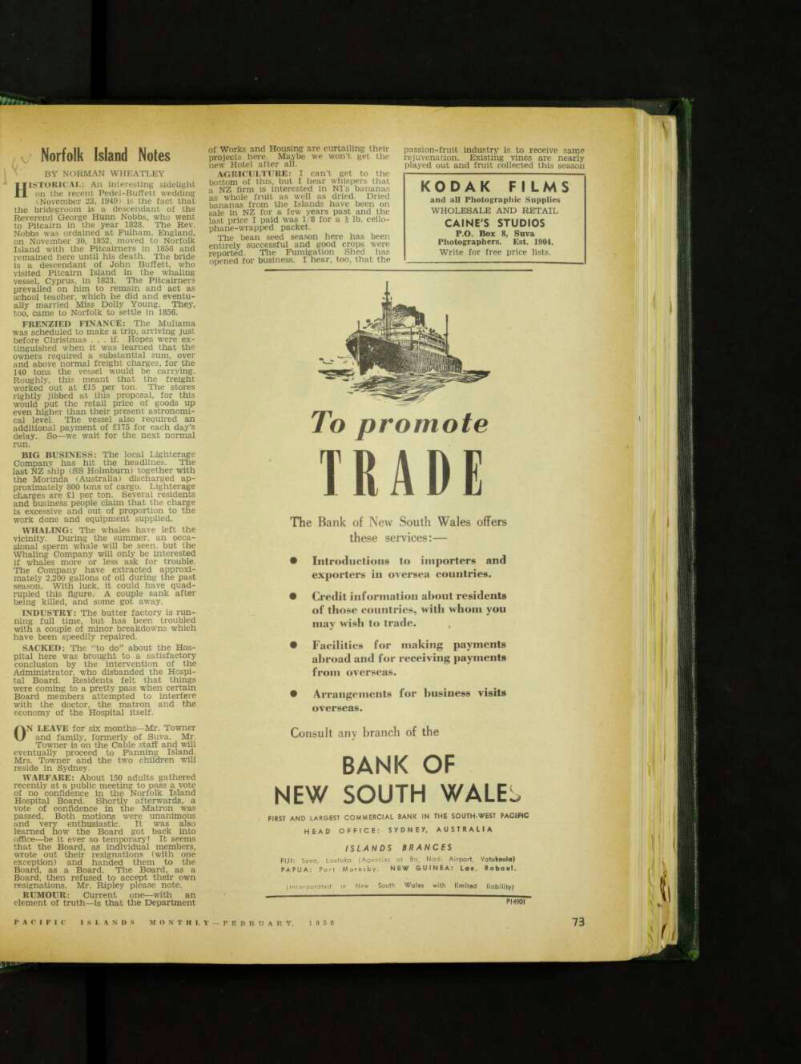
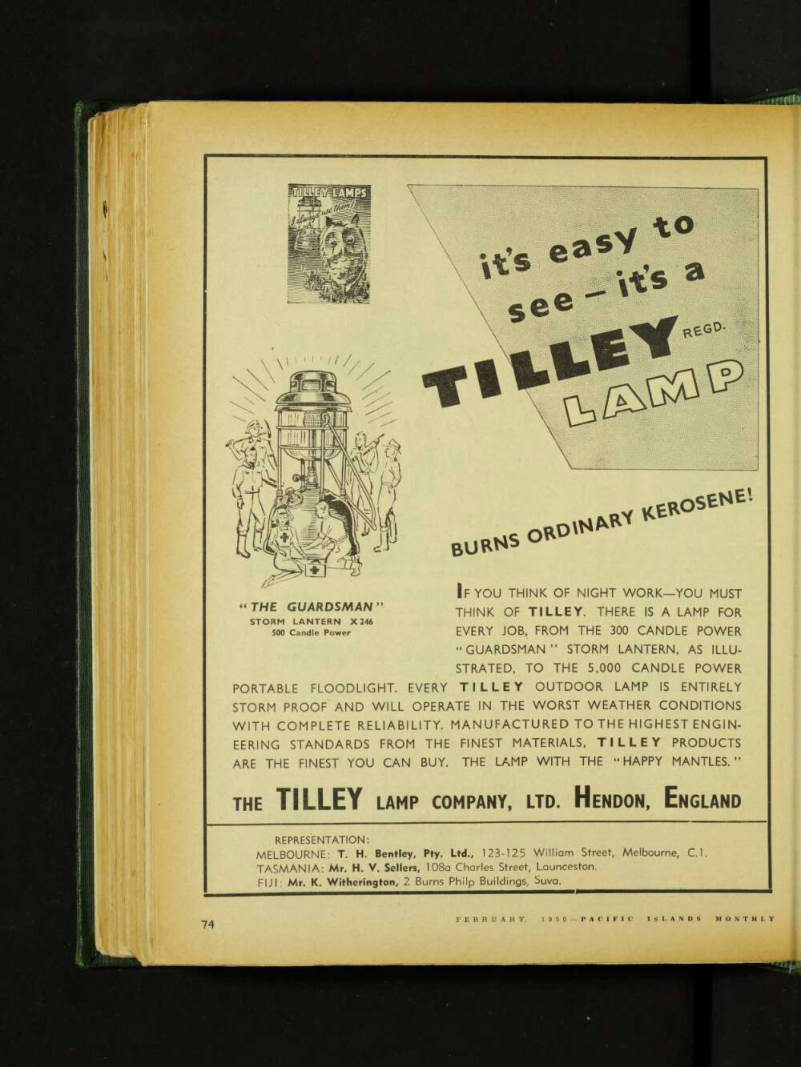
By Norman Wheatley
HISTORICAL: An interesting sidelight on the recent Pedel-Buffett wedding (November 23, 1949) is the fact that the bridegroom is a descendant of the Reverend George Hunn Nobbs, who went to Pitcairn in the year 1828. The Rev.
Nobbs was ordained at Fulham, England, on November 30, 1852, moved to Norfolk Island with the Pitcairners in 1856 and remained here until his death. The bride is a descendant of John Buffett, who visited Pitcairn Island in the whaling vessel, Cyprus, in 1823. The Pitcairners prevailed on him to remain and act as school teacher, which he did and eventu ally married Miss Dolly Young. They, too, came to Norfolk to settle in 1856.
FRENZIED FINANCE: The Muliama was scheduled to make a trip, arriving just before Christmas ... if. Hopes were ex tinguished when it was learned that the owners required a substantial sum, over and above normal freight charges, for the 140 tons the vessel would be carrying.
Roughly, this meant that the freight worked out at £l5 per ton. The stores rightly jibbed at this proposal, for this would put the retail price of goods up even higher than their present astronomi cal level. The vessel also required an additional payment of £175 for each day’s delay. So —we wait for the next normal run.
BIG BUSINESS: The local Lighterage Company has hit the headlines. The last NZ ship (SS Holmburn) together with the Morinda (Australia) discharged ap proximately 800 tons of cargo. Lighterage charges are £1 per ton. Several residents and business people claim that the charge is excessive and out of proportion to the work done and equipment supplied.
WHALING: The whales have left the vicinity. During the summer, an occa sional sperm whale will be seen, but the Whaling Company will only be interested if whales more or less ask for trouble.
The Company have extracted approxi mately 2,200 gallons of oil during the past season. With luck, it could have quad rupled this figure. A couple sank after being killed, and some got away.
INDUSTRY: The butter factory is run ning full time, but has been troubled with a couple of minor breakdowns which have been speedily repaired.
SACKED: The “to do” about the Hos pital here was brought to a satisfactory conclusion by the intervention of the Administrator, who disbanded the Hospi tal Board. Residents felt that things were coming to a pretty pass when certain Board members attempted to interfere with the doctor, the matron and the economy of the Hospital itself.
ON LEAVE for six months —Mr. Towner and family, formerly of Suva. Mr.
Towner is on the Cable staff and will eventually proceed to Fanning Island.
Mrs. Towner and the two children will reside in Sydney.
WARFARE: About 150 adults gathered recently at a public meeting to pass a vote of no confidence in the Norfolk Island Hospital Board. Shortly afterwards, a vote of confidence in the Matron was passed. Both motions were unanimous and very enthusiastic. It was also learned how the Board got back into office—be it ever so temporary! It seems that the Board, as individual members, wrote out their resignations (with one exception) and handed them to the Board, as a Board. The Board, as a Board, then refused to accept their own resignations. Mr. Ripley please note.
RUMOUR: Current one—with an element of truth—is that the Department
of Works and Housing are curtailing their projects here. Maybe we won’t get the new Hotel after all.
AGRICULTURE: I can’t get to the bottom of this, but I hear whispers that a NZ firm is interested in NX’s bananas as whole fruit as well as dried. Dried bananas from the Islands have been on sale in NZ for a few years past and the last price I paid was 1/8 for a \ lb. cello
phane-wrapped packet.
The bean seed season here has been entirely successful and good crops were reported. The Fumigation Shed has opened for business. I hear, too, that the
passion -fruit industry is to receive same rejuvenation. Existing vines are nearly played out and fruit collected this season
will go mostly towards replanting. A great many of the wild fruits are marred by pests.
Sir Charles Rosenthal, An Ex-
Administrator of NI, has disposed of his interests and has been reported to be leaving the Island. Sir Charles and Lady Rosenthal will be greatly missed. Sir Charles will always be remembered for his forthright manner and efficiency in his administrative duties.
Advertisements & other items, pp. 77-78 (1 item)
Trade
KODAK FILMS
and all Photographic Supplies
WHOLESALE AND RETAIL
CAINE'S STUDIOS
P.O. Box 8, Suva Photographers. Est. 1904.
Write for free price lists.
To promote
TRADE
The Bank of New South Wales offers these services:— • Introductions to importers and exporters in oversea countries. • Credit information about residents of those countries, with whom you may wish to trade. , • Facilities for making payments abroad and for receiving payments from overseas. • Arrangements for business visits overseas.
Consult any branch of the
BANK OF
NEW SOUTH WALES
FIRST AND LARGEST COMMERCIAL BANK IN THE SOUTH-WEST PACIFIC
HEAD OFFICE: SYDNEY. AUSTRALIA
ISLANDS BRANCES
FIJI: Suva, Lautoka (Agencies at Ba, Nadi Airport, Vatukoula) PAPUA: Port Moresby. NEW GUINEA: Lae. Rabaul. (Incorporated in New South Wales with limited liability) PI 4901
\o
asV
e
Vts
a it*
R eGO.
o I ,®fr% <C/ A \VV
/rn^v
ostN E!
» Jf V
BU*** S
§ll]
“THE GUARDSMAN
STORM LANTERN X 246
500 Candle Power If YOU THINK OF NIGHT WORK—YOU MUST THINK OF TILLEY. THERE IS A LAMP FOR EVERY JOB, FROM THE 300 CANDLE POWER “ GUARDSMAN ” STORM LANTERN, AS ILLU-
STRATED, TO THE 5,000 CANDLE POWER
PORTABLE FLOODLIGHT. EVERY TILLEY OUTDOOR LAMP IS ENTIRELY STORM PROOF AND WILL OPERATE IN THE WORST WEATHER CONDITIONS WITH COMPLETE RELIABILITY. MANUFACTURED TO THE HIGHEST ENGIN- EERING STANDARDS FROM THE FINEST MATERIALS. TILLEY PRODUCTS ARE THE FINEST YOU CAN BUY. THE LAMP WITH THE “HAPPY MANTLES.”
THE TILLEY LAMP COMPANY, LTD. HeNDON, ENGLAND
REPRESENTATION:
MELBOURNE: T. H. Bentley, Pty. Ltd., 123-125 William Street, Melbourne, C.
TASMANIA: Mr. H. V. Sellers, 108 a Charles Street, Launceston.
FIJI: Mr. K. Witherington, 2 Burns Philp Buildings, Suva.
Strange Sight in NG Skies
ABOUT 7.30 p.m. on November 28 the natives rushed to our dining-room at Angoram, Sepik River, New Guinea, asking us to have a look at an unusual phenomenon in the skies.
In the western sky, about 30 degrees high, lay a huge red “snake” making two turns down towards the horizon. It was quite a spectacle in the otherwise cloudless skv.
Next day I started off on a two weeks patrol from the Sepik to the NW coast and inland. From village to village I was asked whether I had seen the big snake in the sky. Some natives who knew I was about to visit them had even drawn sketches on a piece of paper to show me what they had seen. They told me the same story everywhere: A red flame shot up from the horizon; soon transforming itself into an enormous snake. Eventually it faded away.
It would be interesting to know over how large an area this phenomenon was observed. About 100 miles up the Sepik River and some 30 miles radius from its estuary it was quite a sight.—Astrono mos.
Mr. N. G. Cassidy, newly appointed Senior Chemist in the Department of Ag riculture, has arrived in Suva.
Death Of Father Elie
In Tahiti
From Our Own Correspondent MANGAIA, Cook Is.
WE have recently learned of the sud den death in Tahiti, of the Rev.
Father Elie Mkrie Cavalier of the Sacred Heart Fathers.
Father Elie, with Father P. van Megan (novA at Honolulu) pioneered Catholic mission-endeavour upon this island.
A Frenchman, the late Father Elie was noted for his genialit- and had many friends at Mangaia outside of the sphere of his labours. The building of the first Catholic Church was one of the monu ments to Fr. Elie’s three years’ stay, this native-built edifice being now replaced by a permanent concrete church, upon the same site. He was transferred to
France about 1934, and remained in his homeland for a period before taking up a station in the Societies.
He was skilled in many branches of carpentry and mechanics, which enabled him to use native materials to the best advantage in his church. He was also an amateur electrician, and would advise on the wiring of the locaL picture-show of that period, while sewing-machines! in need of repair would likewise be given his attention The versatile little French priest was a fluent English linguist; his address of welcome to the guests at his “church warming” is still recalled by those who had the pleasure of being present at a dinner memorable for excellence and lavish hospitality, and remarkable in that the majority of the guests were Pro testants.
Advertisements & other items, p. 79 (1 item)
Ta* Ect S £A>.
LON DON-SUVA
?VY via <( c
PANAMA
❖ For Sailings and Further Particulars Apply To: — BETHELL, GWYN & CO., BURNS PHILP (SOUTH SEA)
138 LEADENHALL ST., CO., LTD.,
LONDON, E.C.3. SUVA.
C. SULLIVAN PTY. LTD.
Expert Buying Service Original Invoices Furnished Sellers of Island Produce.
Represented in all Australian States, New Zealand, England, France, United States, etc.
BANKERS: Bank of New South Wales, and Comptoir National d’Escompte de Paris.
Island Merchants
Over 30 years' experience in the Pacific Island Trade.
C. SULLIVAN PTY. LTD.
379 KENT STREET, SYDNEY
And at Melbourne and Brisbane.
Telegrams & Cables: “CHASULL,” Sydney. Phone: MJ4657 (6 lines).
Associate Co.: C. SULLIVAN, INC., 230 California St., San Francisco, U.S.A.
Death Of Edmund Stehlin
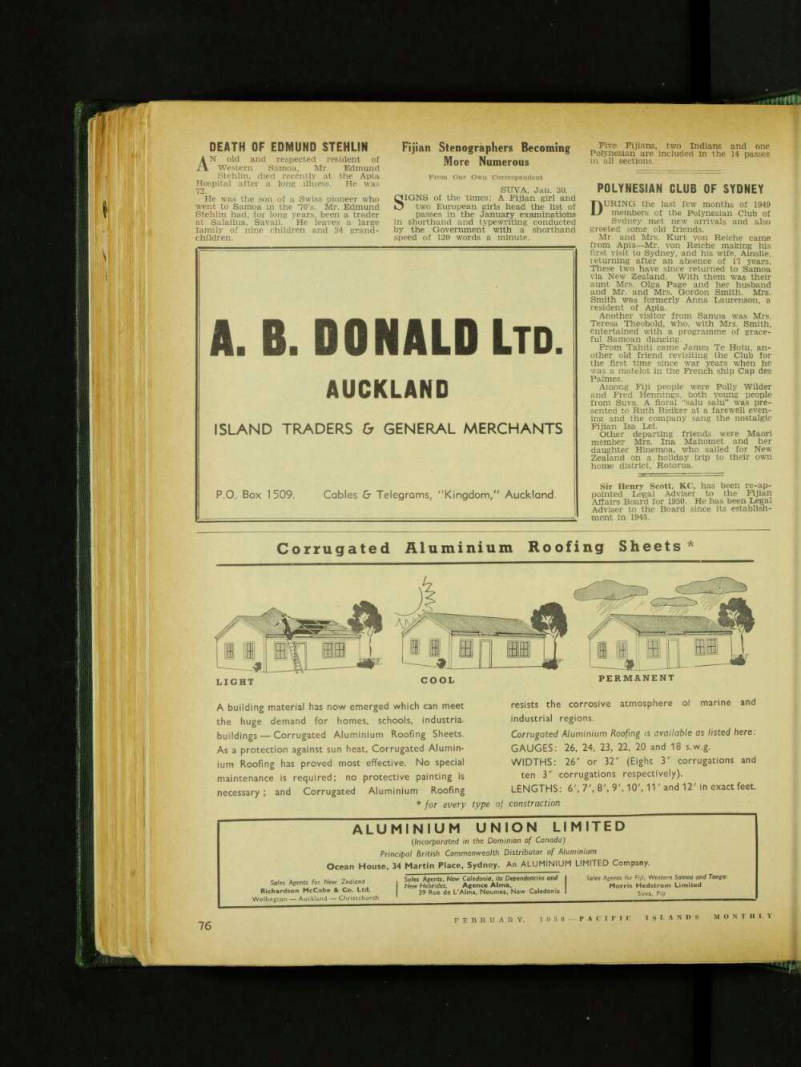
AN old and respected resident of . Western Samoa, Mr. Edmund Stehlin, died recently at the Apia Hospital after a long illness. He was 72.
He was the son of a Swiss pioneer who went to Samoa in the ’7o’s. Mr. Edmund Stehlin had, for long years, been a trader at Salailua, Savaii. He leaves a large family of nine children and 34 grand children.
Fijian Stenographers Becoming
More Numerous
From Our Own Correspondent
Suva, Jan. 30.
SIGNS of the times: A Fijian girl and two European girls head the list of passes in the January examinations in shorthand and typewriting conducted by the Government with a shorthand speed of 120 words a minute.
Five Fijians, two Indians and one Polynesian are included in the 14 passes in all sections.
Polynesian Club Of Sydney
DURING the last few months of 1949 members of the Polynesian Club of Svdney met new arrivals and also greeted some old friends.
Mr. and Mrs. Kurt von Reiche came from Apia—Mr. von Reiche making his first visit to Sydney, and his wife, Ainslie, leturning after an absence of 17 years.
These two have since returned to Samoa via New Zealand. With them was their aunt Mrs. Olga Page and her husband and Mr. and Mrs. Gordon Smith. Mrs.
Smith was formerly Anna Laurenson, a resident of Apia.
Another visitor from Samoa was Mrs.
Teresa Theobold, who, with Mrs. Smith, entertained with a programme of grace ful Samoan dancing.
From Tahiti came James Te Hotu, an other old friend revisiting the Club for the first time since war years when he was a matelot in the French ship Cap des Palmes.
Among Fiji people were Polly Wilder and Fred Hennings, both young people from Suva. A floral “salu salu” was pre sented to Ruth Bisiker at a farewell even ing and the company sang the nostalgic Fijian Isa Lei.
Other departing friends were Maori member Mrs. Ina Mahomet and her daughter Hinemoa, who sailed for New Zealand on a holiday trip to their own home district, Rotorua.
Sir Henry Scott, KC, has been re-ap pointed Legal Adviser to the Fijian Affairs Board for 1950. He has been Legal Adviser to the Board since its establish ment in 1945.
Advertisements & other items, p. 80 (2 items)
76
FEBRUARY, 19 50 PACIFIC ISLANDS MONTHLI
A. B. Donald Ltd.
AUCKLAND
ISLAND TRADERS Gr GENERAL MERCHANTS
P.O. Box 1509. Cables Gr Telegrams, "Kingdom," Auckland
Corrugated Aluminium Roofing Sheets*
ES m
iffl
» i
COOL
LIGHT
PERMANENT
A building material has now emerged which can meet the huge demand for homes, schools, industrial
buildings Corrugated Aluminium Roofing Sheets.
As a protection against sun heat, Corrugated Aluminium Roofing has proved most effective. No special maintenance is required; no protective painting is necessary ; and Corrugated Aluminium Roofing * for every type of resists the corrosive atmosphere of marine and industrial regions.
Corrugated Aluminium Roofing is available as listed here: GAUGES: 26, 24, 23, 22, 20 and 18 s.w.g.
WIDTHS: 26" or 32" (Eight 3" corrugations and ten 3" corrugations respectively).
LENGTHS: 6'. 7', B', 9', 10', 11' and 12' in exact feet. construction
ALUMINIUM UNION LIMITED
(Incorporated in the Dominion of Canada) Principal British Commonwealth Distributor of Aluminium Ocean House, 34 Martin Place, Sydney. An ALUMINIUM LIMITED Company.
Sales Agents for New Zealand Richardson McCabe & Co. Ltd.
Wellington Auckland Christchurch Sales Agents, New Caledonia, its Dependencies and New Hebrides. Agence Alma, 39 Rue de L’Alma, Noumea. New Caledonia Sales Agents for Fiji, Western Samoa and Tonga: Morris Hedstrom Limited Suva, Fiji
Notes From Tolosea
Prom Our Own Correspondent TALASEA, New Britain, Jan. 4.
Mrs. Marie Skinner, Wife Of Ado
lan Skinner of Talasea, is something unique in hostesses in that she ex pected no visitors at the Station for Christmas and yet was able to provide Christmas dinner for 10 adults and four children without batting an eyelid or losing her usual piquant charm. Al though the boat which was expected to arrive with Christmas stores did not ar rive, she managed to have gifts for all the visitors and a merry time was had by all.
Mrs. Phil Page, patrol-officer’s wife gave a party for the entire station at which all guests received a present from the Christmas tree.
One or two outlying plantations did what they could to help Talasea’s gaiety along—vegetables, fruit and eggs from San Remo; oysters, pig, and fish from Numundo.
To the desolation of all, and of his wife in particular, ADO Skinner was re quested to make a patrol of Witu over the Christmas period—the area had not been patrolled since 1944. One wonders what ghastly fate would have overtaken Witu had the patrol been delayed into early 1950.
C CHRISTMAS sing-sings were held at j plantations, villages and mission stations. A huge sing-sing was to have been held at the Government Station, Talasea at New Year and all villages for miles up and down the coast were to participate. Canoes were pulling into the station from every direction and great was the excitement and clamour. However, the rains came to these parts sooner than expected and the sing-sing was not the success planned.
MR. ROD MARSLAND of Nagenda and Mr. Bill Wills of Volupai took off in their boat on a recruiting trip before the New Year celebrations but be fore they left they gave a party at Nagenda to which the whole district was invited.
Reports from Nagenda and Walindi plantations indicate that cocoa is doing well there, the main problems being lack of labour and a small red parrot which causes minor devastation among the young pods.
GARUA ISLAND, managed by Mr.
Cameron is doing exceptionally well with coconuts. The Cameron family have gone south for leave. Meanwhile the plantation is being looked after by Mr. and Mrs. L. Searle of Walindi. Mrs.
Searle has only one regret concerning Garua—that is, living on top of a hill she can never know what is going on
down below unless she first walks down and that, of course, means that she has always to walk up again.
THERE are rumours of Cargo-Cult in the Nakanai District although the Catholic Mission says that there is
“nothing to worry about.”
A native by the name of Batari, who was pro-Jap and a considerable annoy ance during the war is believed to be involved. He is the local Luluai sanc tioned by the Administration, notwith standing, THE Phillips-Veirkes on Numundo are over-run with rats both great and small. They (the rats) have eaten
sheets, clothes, towels, table cloths, as well as the more usual fodder, and have even gnawed through the mosquito nets to get at the sleeping Phillips-Veirkes.
Numundo is a Coconut Products plant ation and CP are forwarding bullocks, pigs, goats and horses in the near future.
European Medical Assistant Johnson of Talasea will then rush down to Numundo complete with hypodermic and anti tetanus serum, purely in the interest of
science and to safeguard the lives of the Phillips-Veirkes.
Advertisements & other items, pp. 81-82 (1 item)
Gabriel Achun
Allen Taylor & Co. Ltd.
COMMERCIAL ROAD, ROZELLE
SYDNEY
Sawmillers and Wholesale Suppliers of Hardwoods for Constructional Purposes GIRDERS . . . PILES . . . POLES . . . SLEEPERS, Etc.
EXPORTING TO PACIFIC ISLANDS SINCE 1893
For Sale By .
TWIN-SCREW MOTOR CRUISER “SEA MIST”
DIMENSIONS.—Length, 60 ft.; Beam. 15 ft.; Draught, 4 ft. 6 in.
BUILT. —1939, by Lars Halvorsen Sons Pty., Ltd.
POWER.—Two (paired) 120 H.P. 6-cylinder “Hercules” Diesel Engines, with Two-to-One “Kermath” Water-Cooled Reduction Gear, just overhauled, New Valves and Gaskets fitted.
AUXILIARIES. —24-Volt 19-Plate Starting Batteries, New 32-Volt Delco Lighting Plant, with Throw Switch to Charge Starter and Lighting Set. The latter is a 32-Volt 235 Amp Battery set with Auxiliary Generator, also Electric Bilge Pump Hand Semi- Rotary Pump. Hand Winch, 2 Anchors and Ropes.
TANKAGE.—FueI: 350 Gallons approximately. Water: 400 Gallons approximately.
CONTROLS. —Steering and Engine Controls Duplicated on Saloon Bridge and Flying Bridge, Twin Rudders, Marine Compass in Binnacle.
ACCOMMODATION. —Large Self-Draining Cockpit Aft. Dining Saloon to Seat 12. Commodious Bridge Saloon. One Double and 2 Single Berth Cabins. Crew Berth Forward.
Galley with Kerosene Refrigerator. 4-Burner Rock Gas Stove. Stainless Steel Sink and Electric Water Taps. Tiled Bathroom, with Rock Gas Shower and Hand Basin. 2 Toilets.
GENERAL. —The Interior is Panelled in Polished Maple. Windows are half-inch Armour Plate Glass, with cream Venetian Blinds fitted.
SALE ARRANGEMENTS.—TO BE OFFERED BY AUCTION AT 12.30 ON FRIDAY, MARCH 3rd, 1950, AT SYDNEY, N.S.W. Inspection may be made by application to the Auctioneers. It is intended to slip the boat for underwater inspection for several days prior to the sale date.
JAMES R. LAWSON PTY. LTD.
LICENSED AUCTIONEERS,
236 Castlereagh Street, SYDNEY,
N.S.W. ’Phone: M 6408
GABRIEL ACHUN
Importer ond Wholesale Merchant
Specialises in:
BEERS
BICYCLES
AERATED WATER MANUFACTURING
COTTON PIECEGOODS FOR NATIVE TRADE
AGENT FOR “STANDARD” AND “TRIUMPH” CARS
Malaguna Road
RABAUL
Territory of New Guinea Proprietor:
RABAUL CORDIAL FACTORY.
Telegraphic Address:
“GABRIEL ACHUN,” RABAUL.
Pimples and Bad Skin Fought in 24 Hours
Since the discovery of Nixoderm by an American physician it is no longer necessary for anyone to suffer from ugly, disgusting and disfiguring skin blemishes such as Eczema, Pimples, Rash, Ringworm, Psoriasis, Acne, Blackheads, Scabies and Red Blotches. Don’t let a bad skin make you feel inferior and cause you to lose your friends. Clear your skin this new scientific way.
A New Discovery
Nixoderm is an ointment, but different from any ointment you have ever seen or felt. It is a new discovery, and is not greasy but feels almost like a powder when you apply it. It penetrates rapidly into the pores and fights the cause of surface skin blemishes. Nixoderm contains 9 ingredients which fight skin troubles in these 3 ways. I.—lt fights and kills the microbes or parasites often responsible for skin disorders. 2 —lt stops itching, burning and smarting in 7 to 10 minutes, and cools and soothes the skin. 3.—lt helps nature heal the skin clear, soft and velvety smooth.
Works Fast
Because Nixoderm is scientifically compounded to fight skin troubles, it works fast.
It stops the itching, burning and smarting in a few minutes, then starts to work immediately, clearing and healing your skin, making it softer, whiter and velvety smooth.
In just a day or two your mirror will tell you that here at last is the scientific treatment you have been needing to clear your skin—the treatment to make you look more attractive, to help you win friends. Nixoderm has brought clearer, healthier skins to thousands, such as Mr. Bob Weedon, Edmund Street, Fremantle, who writes: “I was troubled with pimples ever since I was 13, and have spent pounds and pounds on so-called cures without results. I then tried Nixoderm with astounding effect.
The pimples seemed to fade away, and after a week there was not the slightest trace of them.”
Satisfaction Guaranteed
Get Nixoderm from your chemist or store to-day. Look in the mirror in the morning and you will be amazed at the improvement.
Then just keep on using Nixoderm for one week and at the end of that time it must have made your skin soft, clear, smooth and magnetically attractive —must give you the kind of skin that will make you admired wherever you go, or you simply return the empty package and your money will be refunded in full. Get Nixoderm from your chemist or store to-day. The guarantee protects you.
Nixoderm 2/-&4Z-
For Skin Sores, Pimples and Itch.
&%<■- St By Appointment Gin Distillers to H.M. King George Vf Tanqueray, Gordon & Co. Ltd.
Go ¥ m m
Gordon's
Stands S
Misusing Funds
Two Fijians Convicted Of
Prom a Special Correspondent
A Suva, Jan. 17.
N appeal against the decision of the Chief Magistrate (Mr. G. J. Hors fall), who sentenced Ratu Apakuki Nanovo, Roko Tui Kadavu, to 18 months’ hard labour on a charge of converting to his own use £BO/19/-, the property of the Fijian people of Kadavu, has been lodged by counsel for the defence (Mr. H.
Maurice Scott).
The money was part of a fund raised by the people to build a school at Rich mond, Kadavu, and the magistrate held that “the matter was treated with a laxity which is not uncommon with Fijians in handling their money affairs.”
The Roko had previously refunded the money.
Later, Buli Epeli of Naceva, Kadavu, was sentenced to a year’s hard labour for the fraudulent conversion of £47/8/6, the property of the people of Kadavu. This money had also been refunded, but the magistrate said he was satisfied that if there had not been an inquiry, originating with the people themselves, nothing would have been done about it. Defence counsel (Mr. A. I. N. Deoki) gave notice of appeal against the sentence.
Suva Hotel Rates
VISITORS to Suva, Fiji, will, probably be interested, in the daily rates charged in local hotels since price control was lifted last year. Here they are (in Fijian currency): Grand Pacific Hotel. 30/-; Metropole Hotel, 22/6; MacDonald’s Hotel, 22/6; Melbourne Hotel, 20/-; Garrick Hotel, 22/6; Club Hotel, 17/6.
Native Communities
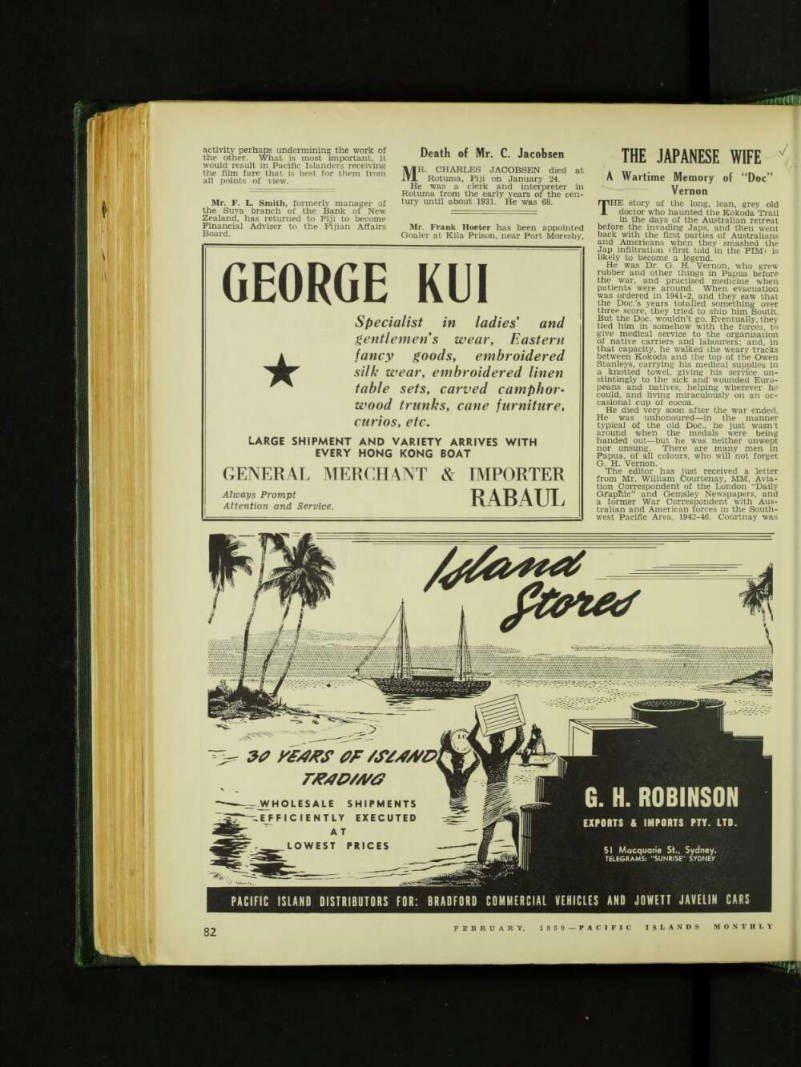
How Our Films Can Influence Native Communities
By Lex Halliday
WITH the South Pacific Commission at present investigating the value of visual aids to native education and social development, and in view of its proposed intention (subject to the report of Mr. A. L. Moore) to use motion picture sound-film to further-its aims, the effect that Hollywood entertainment films already have had on native audiences is worth special consideration.
About January, 1948, one of the leading film companies began to supply 16 milli metre entertainment programmes to the RNZAF at Lauthala Bay, Fiji. This was the beginning of the rapid expansion of 16 mm. film distribution throughout the Pacific Islands and ultimately it brought films to the eyes of more natives, in more widely scattered comers of the Pacific, than had the war-time Almerican “in vasion.”
Within a matter of 12 months, small theatres sprang up in the Fiji Group, Tonga, Samoa and Cook Is., adding to those already well established in New Guinea. In some island groups (Thnga and Cook Islands) exhibitors established touring circuits of 14 or more villages each, and these were in addition to the bigger theatres already screening in Island capitals and other large towns.
This rapid development was due mainly to the characteristics of 16 mm film which in contrast to its big’ brother of 35 mm. width, is non-inflammable, much lighter (about one-fifth the weight) and consequently easily transported about the islands. Equipment for screening 16 mm film too, is small and portable.
MAJORITY of the films supplied in the initial stages were too sophisticated and over the heads of the average native who was, of course, handicapped by the language difficulty. Various at tempts with microphone translations in local dialect involved much work for the exhibitors and, mostly met with little success. But it soon became apparent that there was something greater than the language difficulty influencing a film’s popularity in the eyes of natives—namely, the lack of simplicity in production. If the movements and actions of actors and the plot were simple and self-explanatory, the film would be a success. Tnus, cow boy and Tarzan films because of their simplicity and preponderance of action sequences, were in constant demand, and in order to ensure sufficient profits to exhibitors and themselves, the film distributors endeavoured to meet this demand by supplying as much of this type of film as possible. The peak of “per fection” was reached with the supply of action serials which each week now keep native audiences agog with 'excitement and, despite a good or bad feature film (that is, good or bad according to native ideas) on the same programme, keen to return next week to “see what happens.”
In some cases the natives sit through the serial episode and leave the theatre when a non-action feature appears on the screen—a feature which, if properly handled and explained to them, would possibly be of considerable educational value. However, as we shall see later, this may prove to be a blessing in dis guise.
It is a paradox that the greatest edu cational medium invented by man for reaching the largest number of peoples throughout the world has attained this position of importance and high degree of mechanical efficiency, not through the efforts and research of governments and educationists, but through the initiative and enterprise of private industry. Over the past 25 years astronomical amounts have been spent on equipment research and the actual • production of films for
entertainment, without taking into con sideration the amount of capital invested in theatres throughout the world and money spent enticing the public to attend those theatres. The whole of this huge (now America’s third-greatest) industry is financed by the admission price you ana I pay at the box-office. Little wonder then that these magical words, box-office, have driven some of the best brains in the world to frantic effort to appease pub lic taste, to give us what we want, and as much as we want of it, and not neces sarily that which is good for us. The film industry has, therefore, become of necessity a keenly competitive business, primarily interested in commercial gain and trading on the public’s desire and willingness to be entertained.
IN the eyes of some, particularly edu cationists, it seems unfortunate that the type of entertainment offered by the film industry, may, in view of the film’s power to reach audiences both literate and illiterate, the world over, have a profound effect on certain sec tions of them. The medium of film has a dual role—that of providing entertain ment and that of affording education.
Where these two functions overlap is the point that brings us back to our original discussion —the effect entertainment films may have had on native peoples who have received the minimum or no formal edu cation.
Because box-office success is the prin cipal aim and purpose of most entertain ment film production, distribution and exhibition this has led to a maximum exploitation of the comparatively harm less Western and action type of feature with little or no effort given to developing a native appreciation of our better class films. In the writer’s opinion* this is just as well. The film industry, through purely unrelated motives, has uninten tionally spared Pacific Islanders much
confusion and possibly, harm: What the native sees on the screen, he believes; once he understands a sequence in a film, he accepts it as fact. The danger of in adequate or inaccurate translation of the language, as well as of the motive of a film can be readily seen. It is here that the function of education should take over from entertainment and such trans lation, if desired, be handled by experts with native welfare in view.
It seems, then, that the rapid develop ment of entertainment film distribution throughout the islands has had but small superficial influence on the lives and habits of natives and will no doubt con tinue that way provided the island censors remain vigilant and ban all scenes of brutality, sex and those which discredit Europeans in the eyes of natives. But from this development we can learn a number of very important points. Firstly, natives from Polynesia to Melanesia are so fond of action films that they will pay money to see them; perhaps educational films produced for natives could best de velop their themes around action plots.
Secondly, leading film companies have already established vast distribution systems throughout the islands, their advice and co-operation, even practical help, could be solicited. The co-operation of exhibitors is already assured for most of them, at present, screen British Gov ernment Documentary Films free of charge, as they became available.
Thirdly, large audiences can now be reached in the old and newly established theatres which are in effect, “ready-made” for educational purposes; perhaps island governments or the SPC could consider encouraging distributors and exhibitors to open up in even more remote situations by providing occasional transportation, etc. Theatre halls are an asset to any island community and can be used for a variety of purposes apart from entertain ment.
In time, deeper research may reveal that some entertainment films are having undesirable influence on the habits and thoughts of native peoples; if so, any such trends should be immediately checked. Full co-operation at this stage between governments and film distri butors in the islands would not only put a brake on these trends at an early stage but help establish film distribution, both educational and entertainment, on an economical basis, without one field of
activity perhaps undermining the work of the other. What is most important, it would result in Pacific Islanders receiving the film fare that is best for them from all points of view.
Mr. F. L. Smith, formerly manager of the Suva branch of the Bank of New Zealand, has returned to Fiji to become Financial Adviser to the Fijian Affairs Board.
Advertisements & other items, pp. 83-85 (1 item)
£. J. Gough S. Co.
KANGAROO BRAND
Ropes,
Cordage,
and Twines for every purpose Backed by 86 years of service Manufactured by:
M. DONAGHY AND SONS,
Pty. Ltd., Geelong and Sydney.
Fiji Representatives:
PEARCE AND CO.
LIMITED
P.O. BOX 237, SUVA
c Q n r Cooper Adjustable Glass Louvres are manufactured by F. W. GISSING PTY.. LTD., 197 Wilson Street, Newtown, Sydney, Australia. Always insist on GENUINE
COOPER LOUVRES—
they are clearly branded.
Keep Hot Sun OUT . . .
Let Cool Breezes IN!
Cooper Adjustable Glass Louvres are the ideal way of securing maximum ventilation with minimum interference from glare. Fitted with non-actinic glass, which absorbs the sun’s heat, they are ideal for nurseries and verandahs . . arid amazing though it may seem, are actually cheaper to install than ordinary windows Cheaper to instal than ANY other kjjid of WINDOW Li
ADJUSTABLE GLASS LOUVBES
: Imagine it—units of movable glass louvres (plain or figured) in metal frames, giving unobstructed light and air, yet protection from draughts and' rain and all with as simple a motion as flicking on a light switch. The price is so amazingly reasonable and Father can do all the erecting, it’s so easy.
Illustrated; Typical Suburban Home. Verandah (Sydney) glassed in with Cooper Louvres.
WRITE FOR PARTICULARS TO PACIFIC ISLANDS REPRESENTATIVE
£. J. GOUGH S. CO.
SUPPLIERS OF GENERAL MERCHANDISE TO LEADING FIRMS THROUGHOUT THE PACIFIC ISLANDS.
Exporters . . . Importers . . , Manufacturers * Representatives 1 BOND STREET, SYDNEY, AUSTRALIA. Box 3615 G.P.O. Tel. BU 2159 Bankers: Bank of N.S.W. Bank of Adelaide. Comptoir National d’Escompte de Paris.
Cable Address: “SEAFOODS,” SYDNEY.
Codes: Bentley’s, 2nd and Comp. Phrase; A.B.C., 5th and 6th; Peterson, 2nd and 3rd, Banking; Acme.
The Sensational
CRAMMOND TROPIC EAGLE
Scores another outstanding victory in a locality where humidity limits the satisfactory life ol
ordinary sets to a few weeks.
THE RECORD BREAKING CRAMMOND TROPIC EAGLE
EXCLUSIVE FEATURES'.
Completely sealed Infra Red Ray Tropic proofed built in moisture absorber. Available for A.C. and vibrator operation, all dry cell or vibrator.
Coverage 16-150 metres short-wave, and broadcast bands. Mechanical bandspread.
Y our choice eventually.
Why not now?
m
HERE'S THE PROOF:-
Mr. S. H. Christian, of the Malaria Survey Party, Goroka, via Lae, has used his set for some twelve months and carried it with him on all patrols. We have received a number of interesting letters from Mr. Christian, in all of which he stressed the excellent trouble-free performance.
Mr. Christian returned on furlough a fortnight ago and called to see us. He mentioned that he had brought his “Tropic Eagle” to entertain him. During conversation, Mr. Christian suggested that we might care to take the set down to ascertain how it was reacting to extreme humidity. We leapt at the opportunity, and Mr. Christian was an interested spectator. Careful examination revealed that the interior of the instrument was as clean and bright as when it left our works. Individual tests of components provedi them to be equal to new. Mr. Christian exclaimed: “It would certainly seem that this set will be good for another ten years or more.” What a tribute this is to our Infra Red Ray Tropic proofing, our completely sealed cabinet, and moisture absorber.
Write for particulars to-day. Easy terms available wherever you live. Sample copies of the Country Listeners Club Magazine free for the asking—Contains correct listening times for every month short-wave stations.
STOP PRESS: Mr. R. W. Eginton, Port Moresby, in letter just received says, "Our Tropic Eagle 7 is marvellous and the envy of all our friends/ 7
CRAMMOND RADIO
TROP/CPLO!VISION
RO 8 QUEEN STREET . BRISBRItE
The Twinkle in
Your Eye
COMES FROM ACTIVE
DIGESTION
Good normal digestive and liver activity means good, normal health and fitness. If you are becoming gloomy and feel tired out, the cause may be a congested state of your intestinal tract. So many people are troubled with constipation, which, through the retention of waste in the digestive system, causes sick headache, biliousness, pimply skin, unpleasant breath, irritability, slackness and dull eyes.
Regain your bright and attractive appearance by banishing constipation with Pinkettes. Tiny, perfectly harmless, gentle yet effective, these famous laxative and liver pills painlessly exercise and strengthen the bowels, keep the food tract clean and active, stir the liver, and thus banish sick headache, bilious attacks, pimples, unpleasant breath and gloom. All chemists and stores sell Pinkettes, the perfect laxative and liver pills.
A. B. DONALD LIMITED
RAROTONGA COOK ISLANDS
TELEGRAPHIC ADDRESS: “DONALD, RAROTONGA.”
General Merchant's (Wholesale & Retail) and Shipowners Importers & Exporters Branches Throughout Cook Islands Fire, Marine & Motor Vehicles Insurance Agents for Yorkshire
Insurance Co.
Lloyd’s Agents.
Agents and Distributors for: ENGLAND.—Austin Cars & Trucks, Pye Radios, Dunlop Rubber Co., Ltd., Vauxhall Cars & Trucks, R. A. Lister & Co., Ltd., Phillips' Cycles, Marples Tools.
U.S.A.—Remington Rand Corp., Radio Corp. of America, Champion Spark Plug Co., Firestone Tyres, General Steamship Corp, NEW ZEALAND.—Vacuum Oil Co. Pty,, Ltd, Petroleum Products.
AUSTRALlA.—Wunderlich. Ltd., Cement Asbestos Products.
NORWAY.—O. Mustad & Sons, Pish Hooks.
SWEDEN.—B. A. Hjorth & Co., Primus Products.
Sydney Agents : London Agents : San Francisco Agents : BURNS, PHILP & CO., LTD. BURNS, PHILP & CO., LTD. BURNS, PHILP CO. OF SAN FRANCISCO.
Head Office:— A. B. DONALD, LTD., Auckland.
Associate Houses: —
ETABLISSEMENTS DONALD TAHITI,
Papeete, Society Islands.
DOMINION FRUIT CO., Suva, Fiji Islands.
CODES: Bentley's Complete Phrase, Acme
Death of Mr. C. Jacobsen
Mr. Charles Jacobsen Died At
Rotuma, Fiji on January 24.
He was a clerk and interpreter in Rotuma from the early years of the cen tury until about 1931. He was 68.
Mr, Frank Hoeter has been appointed Goaler at Kila Prison, near Port Moresby,
The Japanese Wife
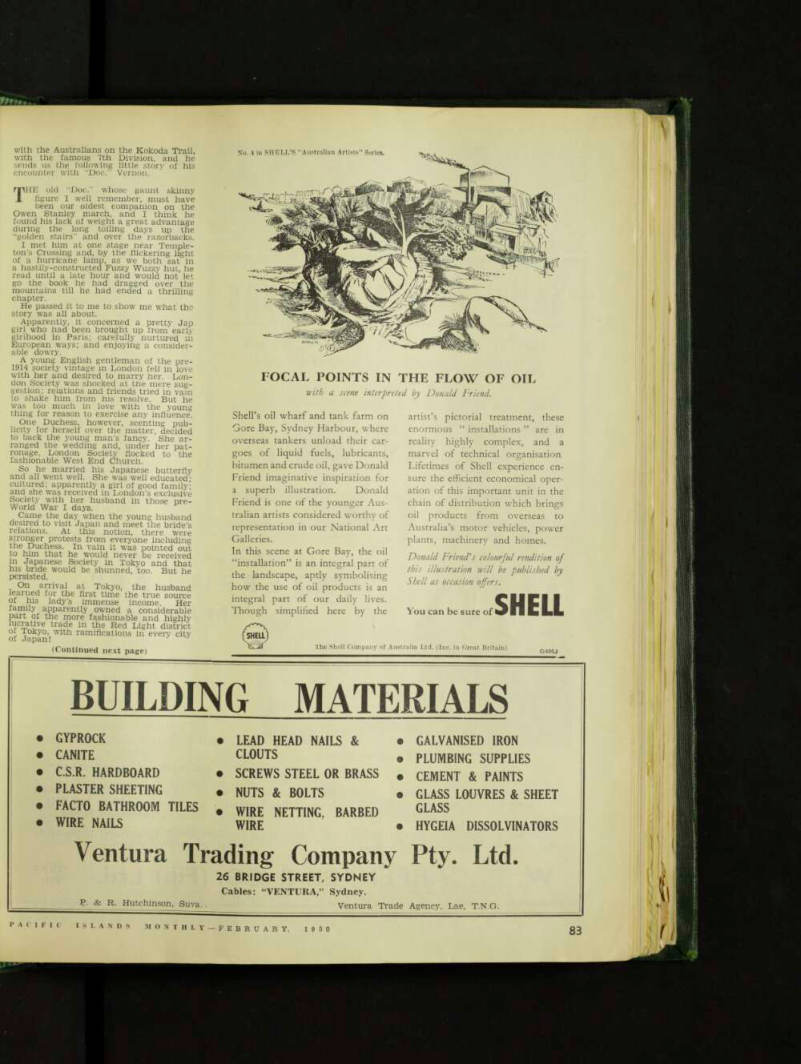
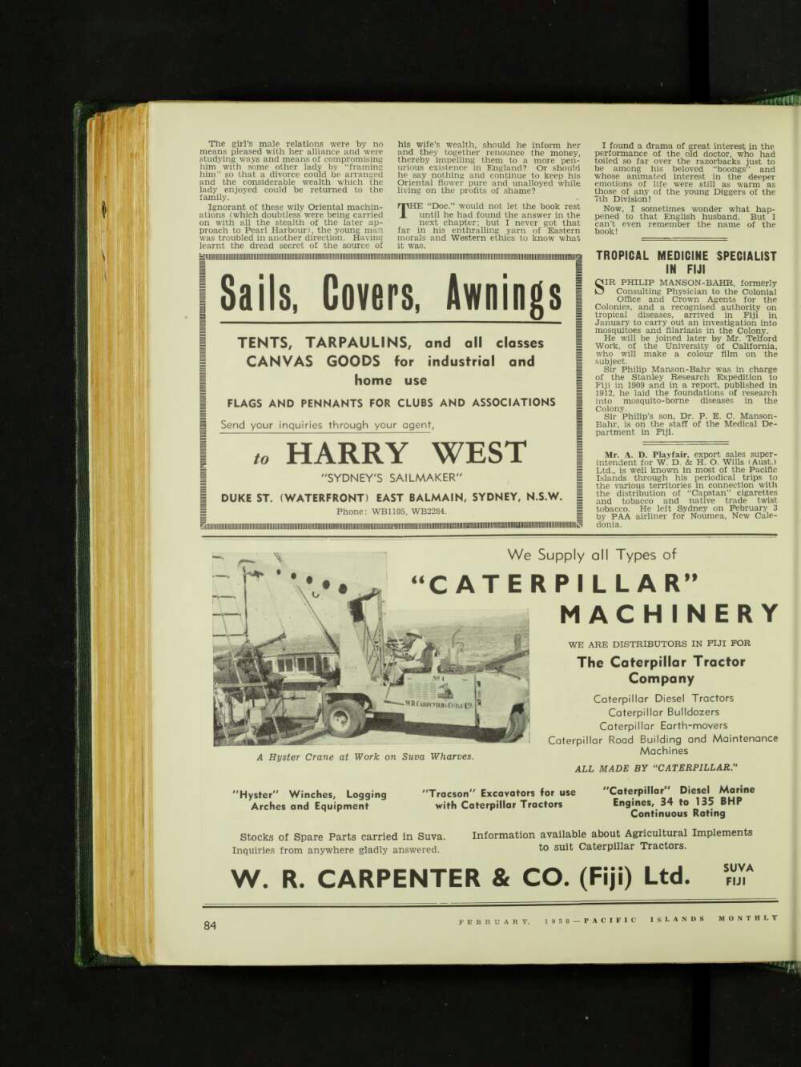
A Wartime Memory of “Doc”
Vernon
THE story of the long, lean, grey old doctor who haunted the Kokoda Trail in the days of the Australian retreat before the invading Japs, and then went back with the first parties of Australians and Americans when they smashed the Jap infiltration (first told in the PIM) is likely to become a legend.
He was Dr. G. H. Vernon, who grew rubber and other things in Papua before the war, and practised medicine when patients were around. When evacuation was ordered in 1941-2, and they saw that the Doc.’s years totalled something over three score, they tried to ship him South.
But the Doc. wouldn’t go. Eventually, they tied him in somehow with the forces, to give medical service to the organisation of native carriers and labourers; and, in that capacity, he walked the weary tracks between Kokoda and the top of the Owen Stanleys, carrying his medical supplies in a knotted towel, giving his service un stintingly to the sick and wounded Euro peans and natives, helping wherever he could, and living miraculously on an oc casional cup of cocoa.
He died very soon after the war ended.
He was unhonoured —in the manner typical of the old Doc., he just wasn’t around when the medals were being handed out —but he was neither unwept nor unsung. There are many men in Papua, of all colours, who will not forget G. H. Vernon.
The editor has just received a letter from Mr. William Courtenay, MM, Avia tion Correspondent of the London “Daily Graphic” and Gemsley Newspapers, and a former War Correspondent with Aus tralian and American forces in the South west Pacific Area, 1942-46. Courtnay was
with the Australians on the Kokoda Trail, with the famous 7th Division, and he sends us the following little story of his encounter with “Doc.” Vernon.
THE old “Doc.” whose gaunt skinny figure I well remember, must have been our oldest companion on the Owen Stanley march, and I think he found his lack of weight a great advantage during the long toiling days up the “golden stairs” and over the razorbacks.
I met him at one stage near Temple ton’s Crossing and, by the flickering light of a hurricane lamp, as we both sat in a hastily-constructed Fuzzy Wuzzy hut, he read until a late hour and would not let, go the book he had dragged over the mountains till he had ended a thrilling chapter.
He passed it to me to show me what the story was all about.
Apparently, it concerned a pretty Jap girl who had been brought up from eariv girlhood in Paris; carefully nurtured in European ways; and enjoying a consider able dowry.
A young English gentleman of the pre -1914 society vintage in London fell in love with her and desired to marry her. Lon don Society was shocked at the mere sug gestion; relations and friends tried in vain to shake him from his resolve. But he was too much in love with the young thing for reason to exercise any influence.
One Duchess, however, scenting pub licity for herself over the matter, decided to back the young man’s fancy. She ar ranged the wedding and, under her pat ronage, London Society flocked to the fashionable West End Church, So he married his Japanese butterfly and all went well. She was well educated cultured; apparently a girl of good family; and she was received in London’s exclusive Society with her husband in those pre- World War I days. P Came the day when the young husband desired to visit Japan and meet the bride’s relations. At this notion, there were stronger protests from everyone including the Duchess. In vain it was pointed out to him that he would never be received in Japanese Society in Tokyo and that his bride would be shunned, too. But he persisted.
On arrival at Tokyo, the husband learned for the first time the true source of his lady’s immense income. Her family apparently owned a considerable part of the more fashionable and highly lucrative trade in the Red Light district of Tokyo, with ramifications in every city of Japan!
(Continued next page)
The girl’s male relations were by no means pleased with her alliance and were studying ways and means of compromising him with some other lady by “framing him” so that a divorce could be arranged and the considerable wealth which the lady enjoyed could be returned to the family.
Ignorant of these wily Oriental machin ations (which doubtless were being carried on with all the stealth of the later ap proach to Pearl Harbour), the young man was troubled in another direction. Having learnt the dread secret of the source of
his wife’s wealth, should he inform her and they together renounce the money, thereby impelling them to a more pen urious existence in England? Or should he say nothing and continue to keep his Oriental flower pure and unalloyed while living on the profits of shame?
THE “Doc.” would not let the book rest until he had found the answer in the next chapter; but I never got that far in his enthralling yarn of Eastern morals and Western ethics to know what it was.
I found a drama of great interest in the performance of the old doctor, who had toiled so far over the razorbacks just to be among his beloved “boongs” and whose animated interest in the deeper emotions of life were still as warm as those of any of the young Diggers of the 7th Division!
Now, I sometimes wonder what hap pened to that English husband. But I can’t even remember the name of the book!
Advertisements & other items, pp. 86-88 (1 item)
forte*
GEORGE Kill
★ Specialist in ladies’ and gentlemen’s wear, Eastern fancy goods, embroidered silk wear, embroidered linen table sets, carved camphorwood trunks, cane furniture, curios, etc.
LARGE SHIPMENT AND VARIETY ARRIVES WITH
EVERY HONG KONG BOAT
GENERAL MERCHANT & IMPORTER
Always Prompt Attention and Service.
RABAUL
forte*
20 Kof /MJ/VDI
rwp/A/a
--WHOLESALE SHIPMENTS
EXECUTED
AT
LOWEST PRICES
G. H. ROBINSON
EXPORTS & IMPORTS PTY. LTD.
51 Macquarie St., Sydney.
TELEGRAMS: "SUNRISE" SYDNEY
PACIFIC ISLAND DISTRIBUTORS FOR; BRADFORD COMMERCIAL VEHICLES AND JOWETT JAVELIN GARS
No. 4 in SHELL’S “Australian Artists” Series. m .4.
K W I FOCAL POINTS IN THE FLOW OF OIL with a scene interpreted Donald Friend.
Shell’s oil wharf and tank farm on Gore Bay, Sydney Harbour, where overseas tankers unload their cargoes of liquid fuels, lubricants, bitumen and crude oil, gave Donald
Friend imaginative inspiration for
a superb illustration. Donald Friend is one of the younger Australian artists considered worthy of representation in our National Art Galleries.
In this scene at Gore Bay, the oil “installation” is an integral part of
the landscape, aptly symbolising
how the use of oil products is an integral part of our daily lives.
Though simplified here by the
artist’s pictorial treatment, these enormous “ installations ” are in reality highly complex, and a marvel of technical organisation, Lifetimes of Shell experience ensure the efficient economical operation of this important unit in the chain of distribution which brings oil products from overseas to Australia’s motor vehicles, power
plants, machinery and homes.
Donald Friend's colourful rendition of this illustration will be published by Shell as occasion offers .
You can be sure of
SHELL
SHELL
The Shell Company of Australia Ltd. (Inc. in Great Britain) G495J
BUILDING MATERIALS
• GYPROCK
• CANITE
• C.S.R. HARDBOARD
• PLASTER SHEETING
• FACTO BATHROOM TILES
• WIRE NAILS
• LEAD HEAD NAILS &
CLOUTS
• SCREWS STEEL OR BRASS
• NUTS & BOLTS
• WIRE NETTING, BARBED
WIRE
• GALVANISED IRON
9 PLUMBING SUPPLIES
CEMENT & PAINTS
9 GLASS LOUVRES & SHEET
GLASS
9 HYGEIA DISSOLVINATORS
Ventura Trading Company Pty. Ltd.
26 BRIDGE STREET, SYDNEY
Cables: “VENTURA,” Sydney. p. & R. Hutchinson, Suva. Ventura Trade Agency, Lae, T.N.G.
jĥ
K•• • , o
We Supply all Types of
“CATERPILLAR”
4 Hyster Crane at Work on Suva Wharves.
MACHINERY
WE ARE DISTRIBUTORS IN FIJI FOR
The Caterpillar Tractor
Company
Caterpillar Diesel Tractors Caterpillar Bulldozers Caterpillar Earth-movers Caterpillar Road Building and Maintenance Machines
ATT. MADE BY “CATERPILLAR.”
Hyster" Winches, Logging "Tracson" Excavators for use "Caterpillar" Diesel Marine Arches and Equipment with Caterpillar Tractors Engines, 34 to 135 BMP Continuous Rating Stocks of Spare Parts carried in Suva. Information available about Agricultural Implements Inquiries from anywhere gladly answered. to suit Caterpillar Tractors.
W, R. CARPENTER & CO. (Fiji) Ltd. ¥£!*
Tropical Medicine Specialist
In Fiji
Sir Philip Manson-Bahr, Formerly
Consulting Physician to the Colonial Office and Crown Agents for the Colonies, and a recognised authority on tropical diseases, arrived in Fiji in January to carry out an investigation into mosquitoes and filariasis in the Colony.
He will be joined later by Mr. Telford Work, of the University of California, who will make a colour film on the subject.
Sir Philip Manson-Bahr was in charge of the Stanley Research Expedition to Fiji in 1909 and in a report, published in 1912, he laid the foundations of research into mosquito-borne diseases in the Colony.
Sir Philip’s son, Dr. P. E. C. Manson- Bahr, is on the staff of the Medical De partment in Fiji.
Mr. A. D. Playfair, export sales super intendent for W. D. & H. O. Wills (Aust.) Ltd., is well known in most of the Pacific Islands through his periodical trips to the various territories in connection with the distribution of “Capstan” cigarettes and tobacco and native trade twist tobacco. He left Sydney on February 3 by PAA airliner for Noumea, New Cale donia.
Advertisements & other items, pp. 89-90 (2 items)
85
PACIFIC ISLANDS MONTHLY FEBRUARY, 1950
SOUTH PACIFIC COMMISSION
(Continued from Page 19)
A. H. & E. Young
Established over 30 years .
ISLAND BUYING
AGENTS
Planters' and Traders' Requirements purchased at wholesale prices.
Original Invoices Supplied.
Correspondence Invited.
Sydney Office:
60 HUNTER ST., SYDNEY
Phone: BW 7365 Cables: “Malayta,” Sydney.
DON'T SAY IB I DON'T SAY GI N DON'T SAY Q f
gin DON'T SAY
DON'T SAY fj I M DON
G I M DON'T SAY
DON'T SAY GIMd
G I M DON'T SAY
DON'T SAY G I M
G I DON'T SAY
DON'T SAY fill
I M DON'T SAY
DON'T SAY
DON'T SAY GIN
DON'T SAY
M T
SAY
■ r «* S AY 3/A/ Hk.
I r* -00, o
SAY
Syr/* A.
Vktr.
IN Sr/ot.
'T SAY
IN
DON'T SAY GIN DON'T
G I N DON'T SAY GIN DON'tT DON'T SAY GIN DON'T SAY G IN DON'T Address all inquiries to:
W. & A. GILBEY LTD.
Telegrams and Cables “GILBEYS,” Melbourne Telegrams and Cables “GILBEYS,” Sydney. 33 ROSSLYN STREET, WEST MELBOURNE. 109 REGENT STREET, SYDNEY.
$ A yi vc TV) ef*.
P* cop D e^ (At*"' o'*’ ms* u* l SB d p.
O \SH
VP.V.
SV^t t*fc ovfr'- I*t ' : i ■ •iffi' <-,;i By far the best overseas beer to be imported
into the Territory
INQUIRIES INVITED BY
G. G. SMITH & CO. LTD.
DISTRIBUTORS FOR PAPUA AND NEW GUINEA
MARINE ENGINES
*7
HALVORSEN’S HAVE FOR IMMEDIATE DELIVERY:
MORRIS “VEDETTE” 4 Cylinder 6/12 H.P. Petrol or Kerosene MORRIS “NAVIGATOR” 4 Cylinder 12/24 H.P. Petrol or Kerosene MORRIS “COMMODORE” 6 Cylinder 20/40 H.P. Petrol or Kerosene CHRYSLER “CROWN” 6 Cylinder 45/102 H.P. Petrol CHRYSLER “ROYAL” 8 Cylinder 55/132 H.P. Petrol “LEYLAND” DIESEL MARINE 6 Cylinder 85 H.P.
Further particulars from the distributors :
LARS HALVORSEN SONS PTY. LTD.
WATER VIEW ST., RYDE ( ■gS/' )- N.S.W.
Telegrams: Halvorsens, Sydney. ’Phone: Hyde 705
• LARGE RANGE OF BOAT FITTINGS
• FREE EXPERT PROPELLER ADVICE
BUILDERS OF HALVORSEN BOATS
Sydney-Papua-
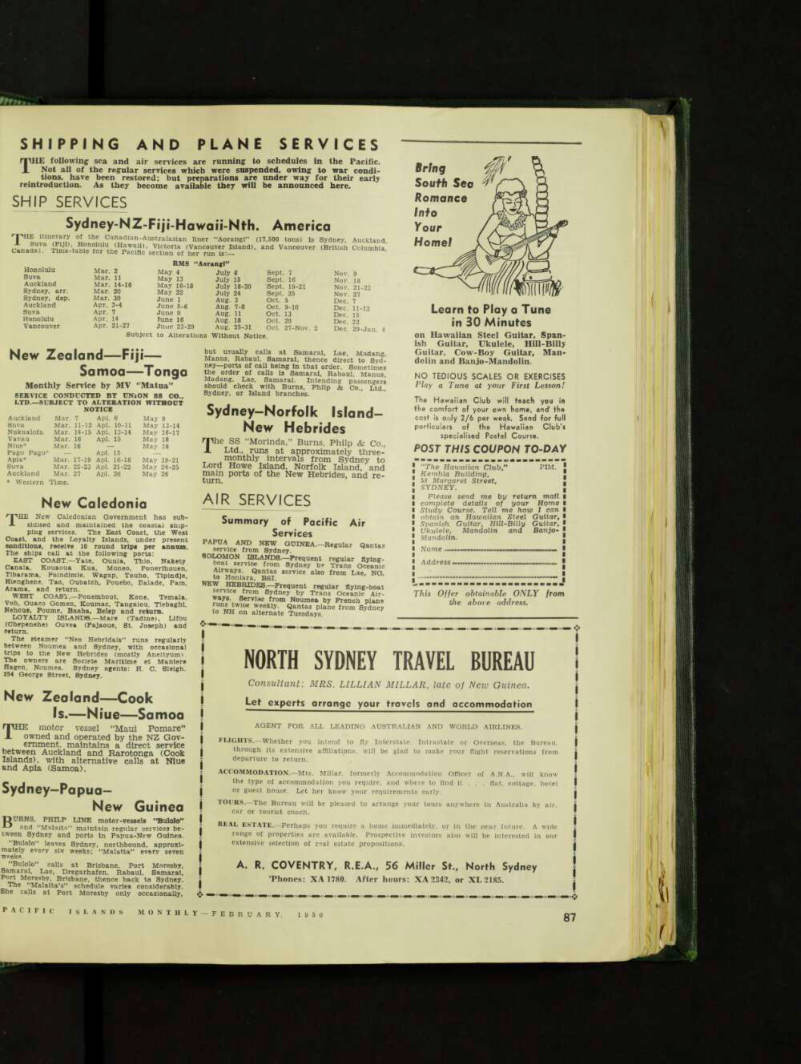
Shipping And Plane Services
Ship Services
THE following sea and air services are running to schedules in the Pacific.
Not all of the regular services which were suspended, owing to war condi tions. have been restored; but preparations are under way for their early reintroduction. As they become available they will be announced here.
Sydney-NZ-Fiji-Hawaii-Nth. America
'T'HE Itinerary of the Canadian-Australaslan liner "Aorangi” (17,500 tons) is Sydney, Auckland S ' Wbfe ’ Vi * ctoria (Vancouver Island), and Vancouver (British Columbia canaaaj. nme-tabie for the Pacific section of her run is:—
New Zealand—Fiji—
Samoa—Tonga
Monthly Service by MY “Matua”
Service Conducted By Union Ss Co.,
Ltd.—Subject To Alteration Without
Notice
New Caledonia
THE New Caledonian Government has sub sidised and maintained the coastal ship ping services. The East Coast, the West Coast, and the Loyalty Islands, under present conditions, receive 10 round trips per annum.
The ships call at the following ports: EAST COAST.—Yate, Ounla, Thlo, Nakety, Canala, Kouaoua Kua, Moneo, Ponerihouen, Tlbarama, Polndlmle. Wagap, Touho, Tlpindje, Hienghene, Tao, Oubatch, Pouebo, Balade, Pam, Arama, and return.
WEST COAST, —Pouembout, Kone, Temala, Voh, Ouaco Gomen, Kouraac, Tangaiou, Tiebaghl, Nehoue, Poume, Baaba, Belep and return.
LOYALTY ISLANDS.—Mare (Tadlne), Llfou (Chepenehe) Ouvea (Fajaoue, St. Joseph) and return.
The steamer “Neo Hebrldais” runs regularly between Noumea and Sydney, with occasional trips to the New Hebrides (mostly Aneltyumi.
The owners are Societe Maritime et Mantere Hagen, Noumea. Sydney agents: H. C. Sleigh. 254 George Street, Sydney.
New Zealand—Cook
Is.—Niue—Samoa
The motor vessel “Maui Pomare” owned and operated by the NZ Gov ernment, maintains a direct service between Auckland and Rarotonga (Cook Islands), with alternative calls at Niue and Apia (Samoa).
Sydney-Papua-
New Guinea
T)URNS, PHILP LINE motor-vessels “Bulolo” and “Malaita,” maintain regular services be tween Sydney and ports in Papua-New Guinea.
“Bulolo” leaves Sydney, northbound, approxi mately every six weeks; “Malaita” every seven weeks.
“Bulolo” calls at Brisbane, Port Moresby, Samaral, Lae, Dregarhafen, Rabaul, Samaral.
Port Moresby, Brisbane, thence back to Sydney.
T* l6 “Malaita’s” schedule varies considerably.
She calls at Port Moresby only occasionally,
but usually calls at Samaral, Lae, Madang.
Manus, Rabaul, Samaral, thence direct to Syd ney—ports of call being In that order. Sometimes the order of calls Is Samaral, Rabaul, Manus, Madang. Lae, Samaral. Intending passengers should check with Burns, Philp & Co., Ltd Sydney, or Island branches.
Sydney-Norfolk Island-
New Hebrides
The SS “Morinda,” Burns, Philp & Co., Ltd., runs at approximately three monthly intervals from Sydney to Lord Howe Island, Norfolk Island, and mam ports of the New Hebrides, and re turn.
Honolulu Mar. 2 RMS “Aoranrl”
May 4 July 6 Sept. 7 Nov. 9 Suva Mar. 11 May 13 July 15 Sept. 16 Nov. 18 Auckland Mar. 14-16 May 16-18 July 18-20 Sept. 19-21 Nov. 21-23 Sydney, arr.
Mar. 20 May 22 July 24 Sept. 25 Nov. 27 Sydney, dep.
Mar. 30 June 1 Aug. 3 Oct. 5 Dec. 7 Auckland Apr. 3-4 June 5-6 Aug. 7-8 Oct. 9-10 Dec. 11-12 Suva Apr. 7 June 9 Aug. 11 Oct. 13 Dec. 15 Honolulu Apr. 14 Tune 16 Aug. 18 Oct. 20 Dec. 22 Vancouver Apr. 21-27 June 23-29 Aug. 25-31 Oct. 27-Nov. 2 Dec. 29-Jan. 4 Subject to Alterations Without Notice.
Auckland Mar. 7 Apl. 6 May 9 Suva Mar. 11-12 Apl. 10-11 May 13-14 Nukualofa Mar. 14-15 Apl. 13-14 May 16-17 Vavau Mar. 16 Apl. 15 May 18 Niue* Mar. 16 — May 18 Pago Pago* — Apl. 15 — Apia* Mar. 17-19 Apl. 16-18 May 19-21 Suva Mar. 22-23 Apl. 21-22 May 24-25 Auckland Mar. 27 Apl. 26 May 26 * Western Time.
Air Services
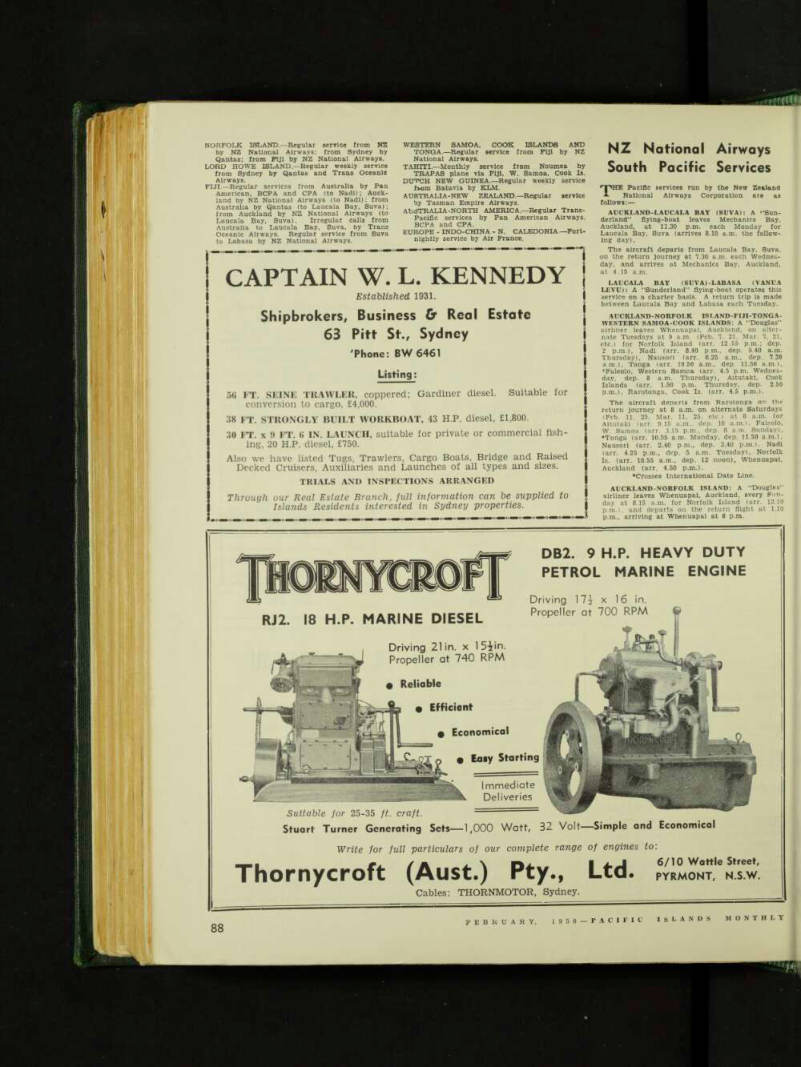
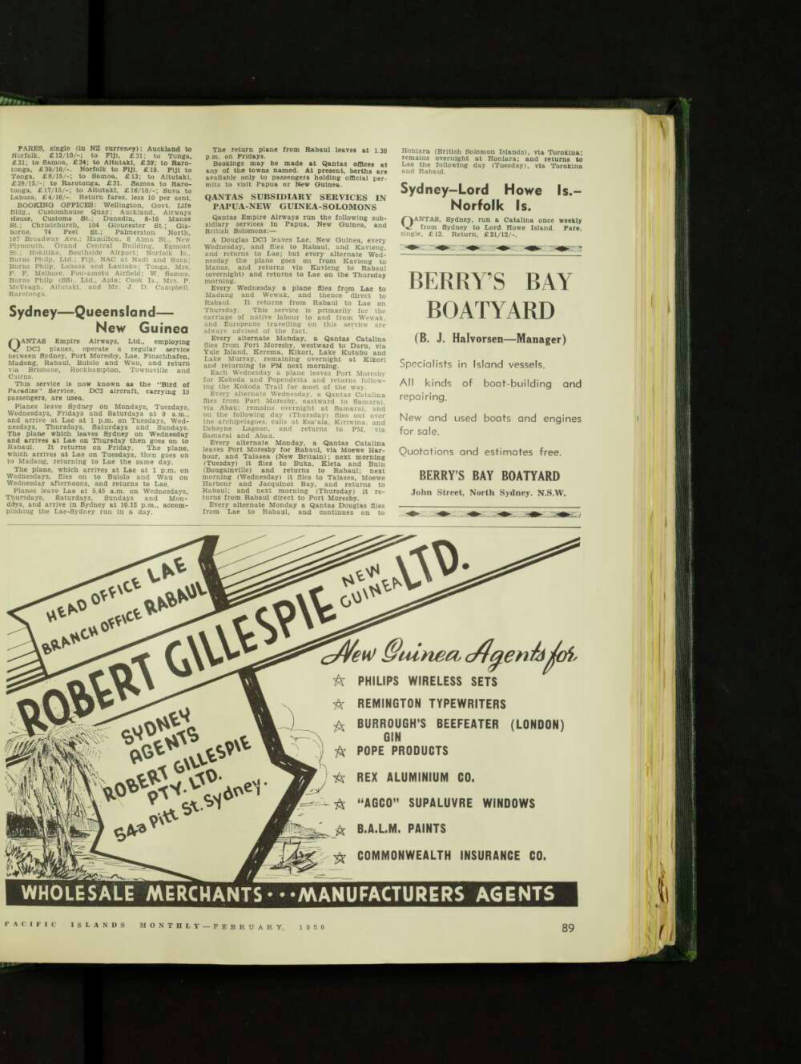
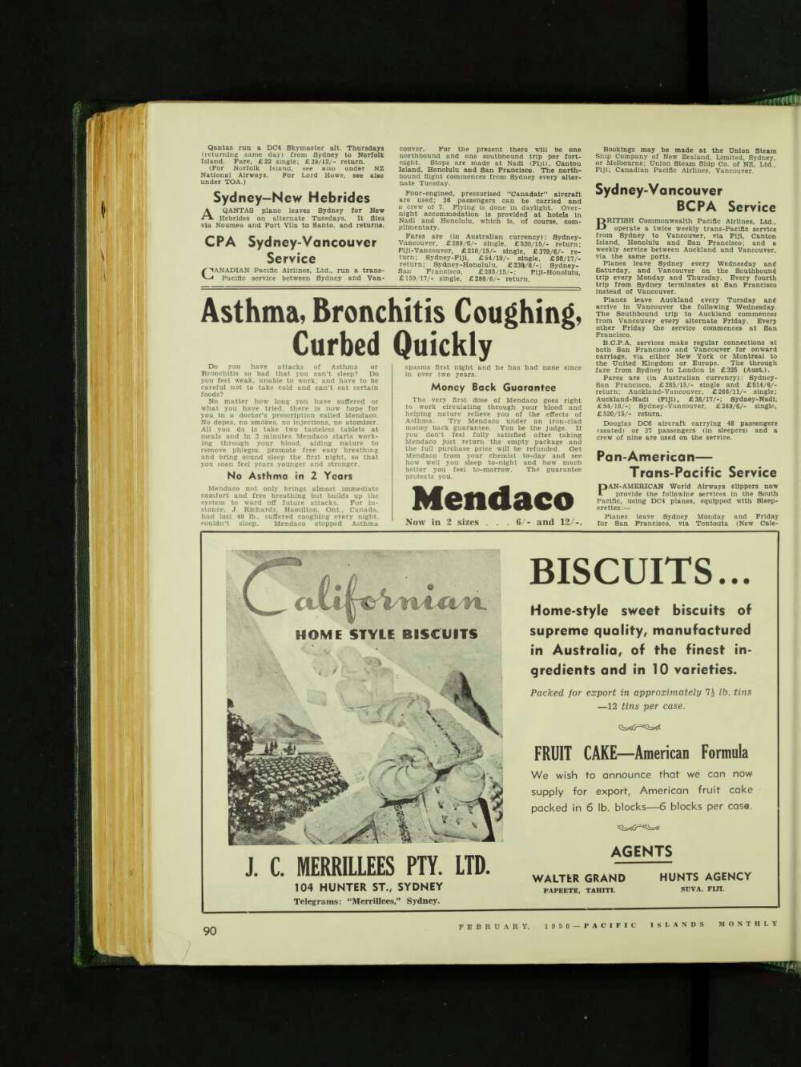
Summary of Pacific Air
Services
PAPUA AND NEW GUlNEA.—Regular Qantas service from Sydney.
SOLOMON ISLANDS.—Frequent regular flying boat service from Sydney bv Trans Oceanic Airways. Qantas service also from Lae, NG, to Honiara, BSI.
HEBRIDES. Frequent regular flying-boat service from Sydney by Trans Oceanic Air ways. Service from Noumea by French plane runs twice weekly. Qantas plane from Sydney to NH on alternate Tuesdays.
NORFOLK ISLAND.—Regular service from NZ by NZ National Airways; from Sydney by Qantas; from Fiji by NZ National Airways.
LORD HOWE ISLAND—Regular weekly service from Sydney by Qantas and Trans Oceanic Airways.
FlJl.—Regular services from Australia by Pan American, BCPA and CPA (to Nadi); Auckland by NZ National Airways (to Nadi); from Australia by Qantas (to Laucala Bay, Suva); from Auckland by NZ National Airways (to Laucala Bay, Suva), Irregular calls from Australia to Laucala Bay, Suva, by Trans Oceanic Airways. Regular service from Suva to Labasa by NZ National Airways.
Western Samoa, Cook Islands And
TONGA.—Regular service from Fiji by NZ National Airways.
TAHlTl—Monthly service from Noumea by TRAPAS plane via Fiji, W. Samoa, Cook Is.
DUTCH NEW GUlNEA.—Regular weekly service fw)m Batavia by KLM.
AUSTRALIA-NEW ZEALAND.—ReguIar service b Tasman Empire Airways. t t a wno-ra n „ DT ri rrvone AUoTRALIA-NORTH AMERICA.—Regular Trans by Pan American Airwa y s - BCPA a PA - T .
Europe - Indo-China -N, Caledonla.—Fort
nightly service by Air Prance.
NZ National Airways
South Pacific Services
* 'hE Pacific services run by the New Zealand National Airways Corporation are aa follows:
Auckland-Laucala Bat (Suva); A “Sun
derland” flying-boat leaves Mechanics Bay, Auckland, at 11.30 p.m. each Monday for Laucala Bay, Suva (arrives 8.10 a.m. the follow ing day).
The aircraft departs from Laucala Bay. Suva, on the return journey at 7.30 a.m. each Wednes day, and arrives at Mechanics Bay, Auckland, at 4.15 a.m.
Laucala Bay (Suva) -Labasa (Vanua
LEVU): A “Sunderland” flying-boat operates this service on a charter basis. A return trip is made between Laucala Bay and Labasa each Tuesday.
Auckland-Norfolk Isi.And-Fiji-Tonga
Western Samoa-Cook Islands: A “Douglas”
airliner leaves Whenuapai, Auckland, on alter nate Tuesdays at 9 a.m. (Feb. 7, 21, Mar. 7, 21, etc.) for Norfolk Island (arr. 12.55 p.m.; dep. 2 p.m.), Nadi (arr. 8.40 p.m., dep. 5.40 a.m.
Thursday), Nausori (arr. 6.25 a.m., dep. 7.30 a.m.), Tonga (arr. 10.50 a.m., dep. 11.50 a.m.), •Faleolo, Western Samoa (arr. 4.5 p.m. Wednes day, dep. 8 a.m. Thursday), Aitutaki, Cook Islands (arr. 1.50 p.m. Thursday, dep. 2.50 p.m,), Rarotonga, Cook Is. (arr. 4.5 p.m.).
The aircraft departs from Rarotonga on the return journey at 8 a.m. on alternate Saturdays (Feb. 11, 25. Mar. 11, 25. etc.) at 8 a.m. for Aitutaki (arr. 9.15 a.m., dep. 10 a.m.), Faleolo, W. Samoa (arr. 3.15 p.m., dep. 8 a.m. Sunday), •Tonga (arr. 10.55 a.m. Monday, dep. 11.50 a.m.).
Nausori (arr. 2.40 p.m., dep. 3.40 p.m.). Nadi (arr, 4.25 p.m., dep. 5 a.m. Tuesday), Norfolk Is. (arr. 10.55 a.m., dep. 12 noon), Whenuapai, Auckland (arr. 4.50 p.m.). •Crosses International Date Line.
Auckland-Norfolk Island: A “Dougins”
airliner leaves Whenuapai, Auckland, every Sun day at 8.15 a.m. for Norfolk Island (arr. 12.10 p.m.), and departs on the return flight at 1.10 p.m., arriving at Whenuapai at 6 p.m.
PARES, single (in NZ currency); Auckland to Norfolk, £l2/10/-; to Fiji, £3l; to Tonga, £3l; to Samoa, £34; to Altutakl, £3O; to Raro tonga, £39/10/-. Norfolk to FIJI, £l9. Fiji to Tonga, £B/15/-; to Samoa, £l3; to Altutakl, £29/15/-; to Rarotonga, £3l. Samoa to Raro tonga, £l7/15/-; to Altutakl, £l6/10/-; Suva to Labasa, £4/10/-. Return fares, less 10 per cent.
BOOKING OFFICES: Wellington, Govt. Life Bldg., Customhouse Quay; Auckland, Airways House, Customs St.; Dunedin, 8-10 Manse St.; Christchurch, 104 Gloucester St.; Gis borne, 74 Peel St.; Palmerston North, 107 Broadway Ave.; Hamilton, 8 Alma St., New Plymouth, Grand Central Building, Egmont St.; Hokitika, Southside Airport; Norfolk Is., Burns Philp, Ltd.; Fiji, NAC at Nadi and Suva; Burns Philp, Labasa and Lautoka; Tonga. Mrs.
F. F. Melhose, Fou-amotu Airfield; W. Samoa, Burns Philp (SS), Ltd., Apia; Cook Is., Mrs. P.
McVeagh, Aitutaki, and Mr. J. D. Campbell.
Rarotonga.
Sydney—Queensland—
New Guinea
QANTAS Empire Airways, Ltd., employing DCS planes, operate a regular service between Sydney, Port Moresby, Lae, Plnschhafen, Madang, Rabaul, Bulolo and Wau, and return via Brisbane, Rockhampton, Townsville and Cairns.
This service is now known as the “Bird of Paradise" Service. DC3 aircraft, carrying 19 passengers, are used.
Planes leave Sydney on Mondays, Tuesdays, Wednesdays, Fridays and Saturdays at 9 a.m., and arrive at Lae at 1 p.m. on Tuesdays, Wed nesdays, Thursdays, Saturdays and Sundays.
The plane which leaves Sydney on Wednesday and arrives at Lae on Thursday then goes on to Rabaul. It returns on Friday. The plane, which arrives at Lae on Tuesdays, then goes on to Madang, returning to Lae the same day.
The plane, which arrives at Lae at 1 p.m. on Wednesdays, flies on to Bulolo and Wau on Wednesday afternoons, and returns to Lae.
Planes leave Lae at 5.45 a.m. on Wednesdays, Thursdays, Saturdays, Sundays and Mon days, and arrive in Sydney at 10.15 p.m., accom plishing the Lae-Sydney run in a day.
The return plane from Rabaul leaves at 1.30 p.m. on Fridays.
Bookings may be made at Qantas offices at any of the towns named. At present, berths are available only to passengers holding official per mits to visit Papua or New Guinea.
Qantas Subsidiary Services In
Papua-New Guinea-Solomons
Qantas Empire Airways run the following sub sidiary services in Papua, New Guinea, and British Solomons: — A Douglas DCS leaves Lae, New Guinea, every Wednesday, and flies to Rabaul, and Kavieng, and returns to Lae; but every alternate Wed nesday the plane goes on from Kavieng to Manus, and returns via Kavieng to Rabaul (overnight) and returns to Lae on the Thursday morning.
Every Wednesday a plane flies from Lae to Madang and Wewak, and thence " direct to Rabaul. It returns from Rabaul to Lae on Thursday. This service is primarily for the carriage of native labour to and from Wewak, and Europeans travelling on this service are always advised of the fact.
Every alternate Monday, a Qantas Catalina flies from Port Moresby, westward to Daru, via Yule Island, Kerema, Kikorl, Lake Kutubu and Lake Murray, remaining overnight at Kikori and returning to PM next morning.
Each Wednesday a plane leaves Port Moresby for Kokoda and Popendetta and returns follow ing the Kokoda Trail for most of the way.
Every alternate Wednesday, a Qantas Catalina flies from Port Moresby, eastward to Samarai. via Abau; remains overnight at Samarai, and on the following day (Thursday) flies out over the archipelagoes, calls at Esa’ala, Kiriwina. and Deboyne Lagoon, and returns to PM, via Samarai and Abau.
Every alternate Monday, a Qantas Catalina leaves Port Moresby for Rabaul, via Moewe Har bour, and Talasea (New Britain); next morning (Tuesday) it flies to Buka, Kieta and Buin (Bougainville) and returns to Rabaul; next morning (Wednesday) it flies to Talasea, Moewe Harbour and Jacqulnot Bay, and returns to Rabaul; and next morning (Thursday) it re turns from Rabaul direct to Port Moresby.
Every alternate Monday a Qantas Douglas flies from Lae to Rabaul, and continues on to
Honiara (British Solomon Islands), via Torokina; remains overnight at Honiara; and returns to Lae the following day (Tuesday), via Torokina and Rabaul.
Sydney—Lord Howe ls.-
Norfolk Is.
QANTAS, Sydney, run a Catalina once weekly from Sydney to Lord Howe Island. Pare, single, £l2. Return, £2l/12/-.
Qantas run a DC4 Skymaster alt. Thursdays (returning same day) from Sydney to Norfolk Island. Pare, £22 single; £39/12/- return. (For Norfolk Island, see also under NZ National Airways. For Lord Howe, see also under TOA.)
Sydney-New Hebrides
A QANTAS plane leaves Sydney for New Hebrides on alternate Tuesdays. It flies via Noumea and Port Vila to Santo, and returns.
CPA Sydney-Vancouver
Service
C CANADIAN Pacific Airlines, Ltd., run a trans- Pacific service between Sydney and Van
couver. For the present there will be one northbound and one southbound trip per fort night. Stops are made at Nadi (Fiji), Canton Island, Honolulu and San Francisco. The north bound flight commences from Sydney every alter nate Tuesday.
Four-engined, pressurised “Canadalr” aircraft are used; 36 passengers can be carried and a crew of 7. Flying is done in daylight. Over night accommodation is provided at hotels in Nadi and Honolulu, which is, of course, com plimentary.
Pares are (in Australian currency): Sydney- Vancouver, £289/6/- single, £520/15/- return; Fiji-Vancouver, £2lO/15/- single, £379/6/- re turn; Sydney-Flji, £54/19/- single, £9B/17/return; Sydney-Honolulu, £23»/8/-; Sydney- San Francisco, £285/15/-; Flji-Honolulu, £159/17/- single, £2BB/8/- return.
Bookings may be made at the Union Steam Ship Company of New Zealand, Limited, Sydney, or Melbourne: Union Steam Ship Co. of NZ, Ltd., Fiji; Canadian Pacific Airlines, Vancouver.
Sydney-Vancouver
BCPA Service
BRITISH Commonwealth Pacific Airlines, Ltd., operate a twice weekly trans-Paciflc service from Sydney to Vancouver, via Fiji, Canton Island, Honolulu and San Francisco; and a weekly service between Auckland and Vancouver, via the same ports.
Planes leave Sydney every Wednesday and Saturday, and Vancouver on the Southbound trip every Monday and Thursday. Every fourth trip from Sydney terminates at San Francisco instead of Vancouver.
Planes leave Auckland every Tuesday and arrive in Vancouver the following Wednesday.
The Southbound trip to Auckland commences from Vancouver every alternate Friday. Every other Friday the service commences at San Francisco.
B.C.P.A. services make regular connections at both San Francisco and Vancouver for onward carriage, via either New York or Montreal to the United Kingdom or Europe. The through fare from Sydney to London is £325 (Aust.).
Fares are (in Australian currency): Sydney- San Francisco, £285/15/- single and £514/6/return; Auckland-Vancouver, £266/11/- single; Auckland-Nadi (Fiji), £3B/17/-; Sydney-Nadi, £54/19/-; Sydney-Vancouver, £289/6/- single, £520/15/- return.
Douglas DC6 aircraft carrying 48 passengers (seated) or 37 passengers (in sleepers) and a crew of nine are used on the service.
Pan-American—
Trans-Pacific Service
PAN-AMERICAN World Airways clippers now provide the following services in the South Pacific, using DC4 planes, equipped with Sleep erettes:— Planes leave Sydney Monday and Friday for San Francisco, via Tontouta (New Cale
donia), Nadi (FIJI), Canton Island and Hono lulu.
The return flights are made from San Francisco every Monday, Thursday, via Honolulu, Canton Island, Nadi and Tontouta; and from Seattle every Monday, via Portland, Honolulu, Canton Island, Nadi and Tontouta.
Planes leave Auckland every Wednesday, and fly via Nadi, Canton Island and Honolulu to San Francisco. They leave San Francisco for Auckland every Saturday by the same route.
Pares, in Australian currency, are:—
(Time-tables and fares subject to alteration without notice.) To convert to FIJI currency, reduce above each kilogram of excess.
Free baggage allowance Is 30 kilos per person.
Excess baggage at 1 per cent, of single fare for figures by about 10 per cent.
Trans-Tasman Service
Sydney—Auckland
TASMAN Empire Airways, Ltd., operate a flying-boat service between Rose Bay, Sydney, and Mechanics Bay, Auckland. Large flying-boats, capable of carrying 30 passengers, are employed. The trip is comfortable, and takes approximately 6 hours.
Flying-boats now depart Sydney and Auckland daily. They make the crossings at night, leav ing Rose Bay, Sydney, and Mechanics Bay, Auckland, about midnight. This arrangement allows passengers who wish to travel to other parts of Australia or New Zealand tq proceed on the day of arrival.
This service is supplemented by Charter Services operated by DC4 and DC6 aircraft.
Fares: £3S(A) (£2B NZ currency) single; £63 (A) (£5O/8/- NZ currency) return.
Bookings may be made at Tasman Empire Airways in Auckland and at Qantas Empire Air ways, Carrington Street, Sydney.
N. Caledonia-Tahiti
TRAPAS (Soclete Francals de Transports Aeriens du Pacific Sud-Noumea) runs a monthly service from New Caledonia to Tahiti.
Departing at 8 a.m. from Noumea, every third Thursday, the plane flies via FIJI (Nadi), Western Samoa (Faleolo), Cook Islands (Altu taki) to Papeete, where it arrives at about 11.40 a.m. two days later. One evening Is spent in Nadi and one night in Altutakl. The plane re turns by the same route In the following week.
Fare from Noumea to Papeete Is 16,000 Pacific francs single, and 28,800 return. (160 Pacific francs equal £1 Australian.) While the plane is at Papeete it runs one round trip between Papeete and Bora Bora.
New Caledonia-
New Hebrides
TRAPAS (French Air Line) operates a service between Noumea and the New Hebrides.
The plane leaves Noumea every Tuesday, and flies direct to Vila and Santo, and returns. Re turn fare for the Journey, Noumed-Santo, Is approximately £42 Australian.
KLM Dutch New Guinea
Service
K.L.M. Royal Dutch Airlines run a regular weekly service from Batavia to Dutch New Guinea, via Sourabaya, Makassar and Ambon,
on the following schedule: Batavia dep. Suodays at 10.30 a.m., Blak Island arr. Mondays at 4.40 p.m.; dep. Tuesdays at 6 a.m., Hollandia arr. Tuesdays at 8.10 a.m. On the return journey the aircraft leaves Hollandia at 9 a.m. bn Tuesdays; Blak Island arr. 11.10 a.m., dep.
(Continued on Page 93)
£ s. d. £ s. d.
Single. Return.
Sydney-Seattle .. ,, £285 15 0 £514 6 0 Sydney-’Prlsco ... 285 15 0 514 6 0 Sydney-Fijl 54 19 0 98 17 0 Sydney-Honolulu . .. 238 8 0 429 0 0 Auckland-Seattle . .. 262 19 0 473 14 0 Auckland-Honolulu .. 215 13 • 387 19 0 Auckland-PIJi 38 17 0 69 igr 0 Auckland-San. Fran. . 22 19 0 473 14 0
12.15 p.m. on Tuesdays; and Batavia arr. 6 p.m. on Wednesdays.
The aircraft used are C. 475, a type of DC-3, and the single fares are Batavia-Biak Island £A80; Batavia-Hollandia £A9I/15/-; and Biak Island-Hollandia £AII/15/-. Return fares, double single.
Sydney-Noumea-Suva
THE following is the time-table of the Qantas flying-boat:—
Intending passengers may book through Qantas offices in Australia. Burns, Phllp (South Seas) Company, in Suva; and T. Johnston In Noumea.
Fares: To Noumea, £35 single; £63 return.
To Suva, £52/10/- single; £94/10/- return.
Noumea-Suva, £l7/10/- single; £3l/10/- re turn.
TOA Services
TRANS Oceanic Airways run the following Pacific services:— SYDNEY-LORD HOWE IS.: A regular fort nightly service with large four-engine flying boats from Rose Bay. Pare: £ll single; £2l return. Free baggage allowance 50 lb. Excess baggage and freight rate Bd. p£r lb.
SYDNEY-NEW HEBRIDES: A regular monthly service with large four-engine flying-boats from Sydney, via Noumea (overnight stop), to Vila and Espiritu Santo. Fare: Sydney-Vlla, £45; Sydney-Santo, £5O; Noumea-Vila, £l2/10/-; Noumea-Santo, £lB/15/-. Freight: Sydney-Vila, 2/- per lb.; Sydney-Santo, 2/3.
Sydney-Solomon Islands: A Regular
monthly service from Sydney, via New Cale donia and New Hebrides to Tulagi, Solomon Islands. This service is frequently extended to Lingatou, in the Russell Islands, and calls are sometimes made at Vanikoro, in the Santa Cruz Group. Fares: Sydney-Tulagi, £65. Free bag gage allowance, 60 lb.; excess baggage and freight, 3/6 per lb.
France-Indo-China-
N. Caledonia
THE French national airways, Air France, runs a fortnightly service between Paris and New Caledonia, and return. Stops are made at Tunis, Cairo, Basra (forward journey) or Darhein (return journey), Karachi, Calcutta, Saigon, Batavia, Darwin, Brisbane.
DC4 Skymasters are used in the service.
Fare between Brisbane and Tontouta (New Caledonia) has been fixed at £A29/8/- (one
way), and £AS2/18/- (return ticket). Sydney- Tontouta £A3S single; £A63 return.
Papua-NG Local
Services
ATANDATED Airlines, Ltd., of Lae, New Guinea, and other private operators, run air ser vices between Lae and the New Guinea mainland centres of Wau, Bulolo, Madang, Wewak, Altape, Mt. Hagen, Flnschhafen, Moresby, Kokoda—in fact anywhere In Papua or New Guinea where there is an air-strip. These planes carry pas sengers, malls and cargo on regular schedules or charter flights.
Sydney dep. 9 p.m. alt. Tuea.
Noumea arr, 7 a.m. alt. Wed.
Noumea dep. 8 a.m. alt. Wed.
Suva arr. 3 p.m. alt. Wed.
Suva dep. 6 a.m. alt. Prid.
Noumea arr. 11 a.m. alt. Prid.
Noumaa dep. 12 noon alt. Prid.
Sydney arr. 8 p.m. alt. Prid.
Advertisements & other items, pp. 91-97 (2 items)
North Sydney Travel Bureau
#: m
Bring
South Sea
Romance
Info
Your
Homel
Learn to Play a Tune
in BO Minutes
on Hawaiian Steel Guitar, Spanish Guitar, Ukulele, Hill-Billy Guitar, Cow-Boy Guitar, Mandolin and Banjo-Mandolin.
NO TEDIOUS SCALES OR EXERCISES
Play a Tune at your First Lesson!
The Hawaiian Club will teach you in the comfort of your own home, and 1 the cost is only 2/6 per week. Send for full particulars of the Hawaiian Club's specialised Postal Course.
POST THIS COUPON TO-DAY
"The Hawaiian Club," PIM.
Kembla Building, 5 8 Margaret Street,
SYDNEY.
Please send me by return mail complete details of your Home Study Course. Tell me how I can obtain an Hawaiian Steel Guitar, Spanish Guitar, Hill-Billy Guitar, Ukulele, Mandolin and Banjo- Mandolin.
Name ...
Address ■»< This Offer obtainable ONLY from the above address.
NORTH SYDNEY TRAVEL BUREAU
Consultant : MRS. LILLIAN MILLAR, late of New Guinea.
Lef experts orronge your trovels ond accommodation AGENT FOR ALL LEADING AUSTRALIAN AND WORLD AIRLINES.
FLlGHTS.—Whether you intend to fly Interstate. Intrastate or Overseas, the Bureau, through its extensive affiliations, will be glad to make your flight reservations from departure to return.
ACCOMMODATION.—Mrs. Millar, formerly Accommodation Officer of A.N.A., will know the type of accommodation you require, and where to find it . . . flat, cottage, hotel or guest house. Let her know your requirements early.
TOURS.—The Bureau will be pleased to arrange your tours anywhere in Australia by air, car or tourist coach, REAL ESTATE.—Perhaps you require a home immediately, or in the near future. A wide range of properties are available. Prospective investors also will be interested in our extensive selection of real estate propositions.
A. R. COVENTRY, R.E.A., 56 Miller St., North Sydney ’Phones: XA 1780. After hours: XA 2342, or XL 2185.
CAPTAIN W. L. KENNEDY
Established 1931.
Shipbrokers, Business & Real Estate
63 Pitt St., Sydney
'Phone: BW 6461
Listing:
56 FT. SEINE TRAWLER, coppered; Gardiner diesel. Suitable for conversion to cargo, £4,000. 38 FT. STRONGLY BUILT WORKBOAT, 43 HP. diesel, £l,BOO. 30 FT. x 9 FT. 6 IN. LAUNCH, suitable for private or commercial fishing, 20 H.P. diesel, £750.
Also we have listed Tugs, Trawlers, Cargo Boats, Bridge and Raised Decked Cruisers, Auxiliaries and Launches of all types and sizes.
TRIALS AND INSPECTIONS ARRANGED
Through our Real Estate Branch, full information can be supplied to Islands Residents interested in Sydney properties.
iso
OFF
Y
18 H.P. MARINE DIESEL
DB2. 9 H.P. HEAVY DUTY
PETROL MARINE ENGINE
Driving x 16 in.
Propeller at 700 RPM RJ2.
Driving 21 in. x 1 siin.
Propeller at 740 RPM Reliable m • Efficient Economical C. • Eaty Starting Immediate Deliveries Suitable for 25-35 ft. craft.
Stuart Turner Generating Sets— l,ooo Watt, 32 Volt— Simple and Economical Write for full particulars of our complete range of engines to: Thornycroft (Aust.) Pty., Ltd. PYiMONT, le N tr s e w Cables: THORNMOTOR, Sydney.
BERRY’S BAY
BOATYARD
(B. J. Halvorsen—Manager)
Specialists in Island vessels.
AM kinds of boat-building and repairing.
New and used boats and engines for sale.
Quotations and estimates free.
BERRY’S BAY BOATYARD
John Street, North Sydney. N.S.W.
(9uinea
PHILIPS WIRELESS SETS
& REMINGTON TYPEWRITERS
\>* \C*
tip
o** * O' ys&. sv^ cx^ \W> G J 6» to V *o*> 6o e r 9 *1 \\ 9'
BURROUGHS BEEFEATER (LONDON)
GIN
POPE PRODUCTS
■& REX ALUMINIUM GO.
A “AGCO” SUPALUVRE WINDOWS
B.A.L.M. PAINTS
COMMONWEALTH INSURANCE GO.
WHOLESALE MERCHANTS • • -MANUFACTURERS AGENTS
Asthma, Bronchitis Coughing, Curbed Quickly
Do you have attacks of Asthma or Bronchitis so bad that you can’t sleep? Do you feel weak, unable to work, and have to be careful not to take cold and can’t eat certain foods?
No matter how long you have suffered or what you have tried, there is now hope for you in a doctor’s prescription called Mendaco.
No dopes, no smokes, no injections, no atomizer.
All you do is take two tasteless tablets at meals and in 3 minutes Mendaco starts working through your blood, aiding nature to remove phlegm, promote free easy breathing and bring sound sleep the first night, so that you soon feel years younger and stronger.
No Asthma in 2 Years
Mendaco not only brings almost immediate comfort and free breathing but builds up the system to ward off future attacks. For instance, J. Richards, Hamilton, Ont., Canada, had lost 40 lb., suffered coughing every night, couldn’t sleep. Mendaco stopped Asthma
spasms first night and he has had none since in over two years.
Money Back Guarantee
The very first dose of Mendaco goes right to work circulating through your blood and helping nature relieve you of the effects of Asthma. Try Mendaco under an iron-clad money back guarantee. You be the judge. If you don’t feel fully satisfied after taking Mendaco just return the empty package and the full purchase price will be refunded. Get Mendaco from your chemist to-day and see how well you sleep to-night and how much better you feel to-morrow. The guarantee protects you.
Mendaco
Now in 2 sizes . . . 6/- and 12/-.
m/m
HOME STYLE BISCUITS
m rn a
J. C. MERRILLEES PTY. LTD.
104 HUNTER ST. ( SYDNEY
Telegrams: “Merrillees,” Sydney.
BISCUITS...
Home-style sweet biscuits of
supreme quality, manufactured
in Australia, of the finest ingredients and in 10 varieties.
Packed for export in approximately lb. tins —l2 tins per case.
Q=*
FRUIT CAKE —American Formula
We wish to announce that we can now supply for export, American fruit cake packed in 6 lb. blocks —6 blocks per case.
AGENTS
WALTER GRAND HUNTS AGENCY
PAPEETE, TAHITI. SUVA, FIJI.
WILLREED AGENCIES PTY. LTD.
145 a George St., Circular Quay, Sydney. Cables: “REEDAGE.”
An organisation formed to act as Australian and
overseas manufacturers' representatives.
DISTRIBUTORS OF l -
40-ft. TRADE BOATS
Especially designed and built for Island
delivered to your destination.
conditions.
Fully equipped and
B.T.H. SOUND-FILM PROJECTORS. ROAMER AUTO-BIKE.
AGENTS FOR PLYPAG BOAT ASSEMBLY KITS
8 ft., 12 ft. and 16 ft. boat assembly kits.
GENERAL MERCHANDISE
We have associates in the United Kingdom, France, Germany Belgium and Japan. Enquiries and indent orders invited for the
products:—
Holland,
following
• Nails. • Chains • Wire Netting • Barbed Wire. • Corrugated Iron • Wood Working Machinery • Diesel Engines (Stationary and Marine) • Steel Wire Rope. • Crawler Tractors 9 Copra Driers • Desiccated Coconut Machinery • Machinery for processing and Baling Coconut Fibre • Pelton Hydraulic Turbines • Manila Rope. • Perfumes • Copper Rods. • Building Boards • Milk Pasteurising Plant • Electrical Equipment • Fish Hooks • Cotton Prints • Blankets • Copra Sacks • Watches • Shot Guns.
NATIVE TRADE GOODS OF ALL DESCRIPTION.
Our representative is at present in Europe and will give personal
attention to all enquiries.
KWONG CHONG BROTHERS
General Merchants and Planters
Have now re-established their business on their original pre-war site, and are carrying stocks of Trading and Plantation requirements. All enquiries welcomed and service assured.
Sydney Representatives:
NELSON & ROBERTSON PTY., LTD.,
Electra House, 12 Spring Street, Sydney, N.S.W.
KWONG CHONG BROTHERS
KEMARERE STREET, RABAUL
SUMMER
fS THE
DANGER SEASON
FOR A HOST OF INJURIES AND AILMENTS m 4 V
BITES OF
POISONOUS
SPIDERS AND
REPTILES
/*. XV // "w 1/
ABRASIONS
CUTS
SCRATCHES
BRUISES
t O _^te i
SANDFLIES
ANTS
BLUEBOTTLES
*v** * V (^0 SW
BEE STINGS
TICKS
h 0 £ 5 ft c£
BUGS
*ck fi 6 0» U f N CL tS
f V!is TM
PIMPLES
J BLEMISHES
f eRS ACNE ULCERS
FINGERNAILS ft “ f SP/--f ) TU a Summer time, outdoor time, holiday time, is DANGER TIME for many simple injuries that, if not dealt with promptly, can lead to painful, serious and expensive consequences . . . Take no risks with everyday injuries and ailments
GET GUARANTEED EICHORNS AND BE SAFE.
Valuable guidance on health and first-aid to the injured is contained in “The August Eichorn Health and First-Aid Book” . . . Forty-eight pages of vital information, fully illustrated and indexed for quick reference.
FREE TO USERS OF EICHORN S—APPLY TODAY.
Eichorn's offers satisfaction or your money back Refuse Substitutes
CLIP AND POST THIS COUPON NOW
Ao
fICK
Cu 5i lo ftSS Sn, *o. A ’ D
FIRST AID 800
NEW 1950 EDITION JUST OUT
EICHORN’S REMEDIES PTY., LTD., PIM2.
11c Castlereagh St, SYDNEY.
Please send me, FREE AND POST FREE, a copy of “THE
AUGUST EICHORN HEALTH AND FIRST-AID BOOK.”
NAME (Print please)
ADDRESS
OBTAINABLE AT
ALL CHEMISTS AND STORES
IN JARS
BOTTLES
16
BIGHORNS
or 26 sft
HEALING
46 every
DROP
Trade enquiries and correspondence to’. —
EICHORNS REMEDIES PTY. LTD.,
11c Castlereagh St., SYDNEY.
Every Branch Of
ENGINEERING and BUILDING CONSTRUCTION
MILLERS LTD.
SUVA and LAUTOKA
Sawmillers and Timber Merchants; Shipwrights and Sailmakers; Joinery and Furniture Manufacturers; Upholsterers; Plumbers; Electricians; Hardware Merchants; Motor Dealers.
AGENCIES :
Chevrolet, Bedford, Vauxhall, Nash Motors. Firestone Tyres.
Fetters Marine and Stationary Engines. G.E.C. Radio Sets.
British Australian Lead Manufacturers Pty., Ltd., Atlas Assurance Co., Ltd.
There is no need to send to Australia or New Zealand for Repairs or Replacements. We can give you a sound Quotation and guarantee First-Class Workmanship
IN THIS PART OF THE WORLD TOO/ *M f i * * ,***• ft* s>r . V~.~
UHI r £ D mSSZSI* SS
*Sfe
Wfcfe P A r f F /. c Jhr e#r X-i--.- £ A .V / "4 /4M St?
Gtl,Brt* 3S* MMCit “raw
If2hM »L?fi£*
mJI fr;
■■TZL-*
w 7 jrtmfMCfi ryjsz^J &S£ *sfe ■ *** Utt* & ■ r **» * S2V •\ y*«6>tr JO Throughout the Pacific, as with other parts of the world, ROBERT KOSAK, representing leading English, Continental and U.S.A. manufacturers, offers all the advantages of an old-established importexport service.
ISLAND PRODUCTS
SOLD ON ALL
WORLD MARKETS
ON A COMMISSION
BASIS
Inquiries invited
ROBERT KOSAK
Exporters and Manufacturers' Representatives,
77 KING STREET, SYDNEY, AUSTRALIA
Cable Address: “ROKOSTRA,” Sydney.
Bankers: National Bank of Australasia, Ltd., Sydney.
Bank of New South Wales, Sydney.
92
FEBRUARY, 1950 PACIFJC ISLANDS MONTHLY
Pacific Folklore
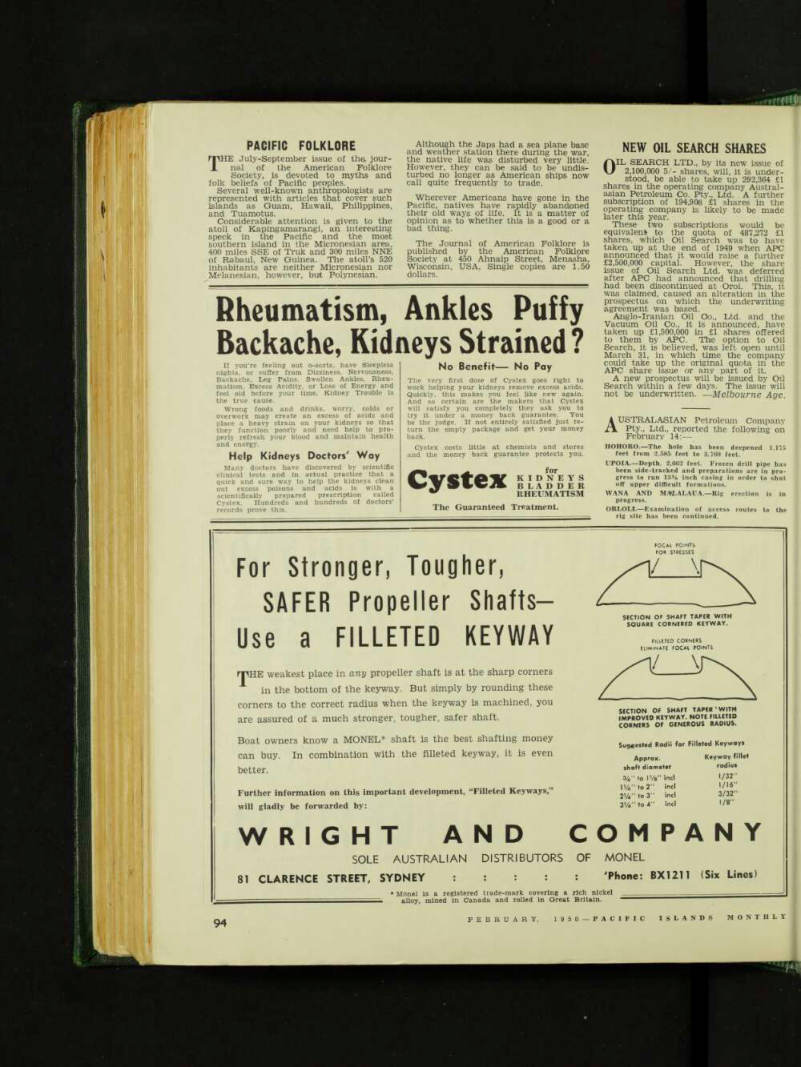
THE July-September issue of ths. jour nal of the American Folklore Society, is devoted to myths and folk beliefs of Pacific peoples.
Several well-known anthropologists are represented with articles that cover such islands as Guam, Hawaii, Philippines, and Tuamotus.
Considerable attention is given to the atoll of Kapingamarangi, an interesting speck in the Pacific and the most southern island in the Micronesian area, 400 miles SSE of Truk and 300 miles NNE of Rabaul, New Guinea. The atoll’s 520 inhabitants are neither Micronesian nor Melanesian, however, but Polynesian.
Although the Japs had a sea plane base and weather station there during the war, the native life was disturbed very little.
However, they can be said to be undis turbed no longer as American ships now call quite frequently to trade.
Wherever Americans have gone in the Pacific, natives have rapidly abandoned their old ways of life. It is a matter of opinion as to whether this is a good or a bad thing.
The Journal of American Folklore is published by the American Folklore Society at 450 Ahnaip Street, Menasha, Wisconsin, USA, Single copies are 1.50 dollars.
New Oil Search Shares
OIL SEARCH LTD., by its new issue of 2,100,000 5/- shares, will, it is under stood, be able to take up 292,364 £1 shares in the operating company Austral asian Petroleum Co. Pty., Ltd. A further subscription of 194,908 £1 shares in the operating company is likely to be made later this year.
These two subscriptions would be equivalent to the quota of 487,272 £1 shares, which Oil Search was to have taken, up at the end of 1949 when APC announced that it would raise a further £2,500,000 capital. However, the share issue of Oil Search Ltd. was deferred after APC had announced that drilling had been discontinued at Oroi. This, it was claimed, caused an alteration in the prospectus on which the underwriting agreement was based.
Anglo-Iranian Oil 00., Ltd. and the Vacuum Oil Co., it is announced, have taken up £1,500,000 in £1 shares offered to them by APC. The option to Oil Search, it is believed, was left open until March 31, in which time the company could take up the original quota in the APC share issue or any part of it.
A new prospectus will be issued by Oil Search within a few days. The issue will not be underwritten. — Melbourne Age.
AUSTRALASIAN Petroleum Company Pty., Ltd., reported the following on February 14:— HOHOEO.—The hole has been deepened 1,175 feet from 2,585 feet to 3,760 feet.
UPOIA. —Depth, 2,662 feet. Frozen drill pipe has been side-tracked and preparations are in pro gress to run 13% inch casing in order to shut off upper difficult formations.
WANA AND MAJjALAUA.—Rig erection is in progress.
ORLOLI. —Examination of access routes to the rig site has been continued.
Advertisements & other items, p. 98 (1 item)
Rheumatism, Ankles Puffy
Backache, Kidneys Strained ?
If you’re feeling out o-sorts, have Sleepless nights, or suffer from Dizziness, Nervousness, Backache, Leg Pains. Swollen Ankles, Rheumatism, Excess Acidity, or Loss of Energy and feel old before your time, Kidney Trouble is the true cause.
Wrong foods and drinks, worry, colds or overwork may create an excess of acids and place a heavy strain on your kidneys so that they function poorly and need help to properly refresh your blood and maintain health and energy.
Help Kidneys Doctors' Way
Many doctors have discovered by scientific clinical tests and in actual practice that a quick and sure way to help the kidneys clean out excess poisons and acids is with a scientifically prepared prescription called Cystex. Hundreds and hundreds of doctors’ records prove this.
No Benefit— No Pay
The very first dose of Cystex goes right to work helping your kidneys remove excess acids.
Quickly, this makes you feel like new again.
And so certain are the makers that Cystex will satisfy you completely they ask you to try it under a money back guarantee. You be the judge. If not entirely satisfied just return the empty package and get your money back.
Cystex costs little at chemists and stores and the money back guarantee protects you.
PITCfPV KIDOYS
Vj BLADDER
RHEUMATISM
The Guaranteed Treatment.
For Stronger, Tougher,
SAFER Propeller Shafts-
Use a FILLETED KEYWAY
rpHE weakest place in any propeller shaft is at the sharp corners A in the bottom of the keyway. But simply by rounding these corners to the correct radius when the keyway is machined, you are assured of a much stronger, tougher, safer shaft.
Boat owners know a MONEL* shaft is the best shafting money can buy. In combination with the filleted keyway, it is even better.
Further information on this important development, “Filleted Keyways,” will gladly be forwarded by;
FOCAL POINTS
FOR STRESSES
SECTION OF SHAFT TAPER WITH
SQUARE CORNERED KEYWAY.
FILLETED CORNERS
FLIMINATE FOCAL POINTS
SECTION OF SHAFT TAPER'WITH
IMPROVED KEYWAY. NOTE FILLETED
CORNERS OF GENEROUS RADIUS.
Suggested Radii for Filleted Keyway* Approx. Keyway fillet shaft diameter radius W to I Vs" incl 1/32"
P/a" to 2" incl 1/16" 2Va" to 3" incl 3/32" 31/4" to 4" incl '/8"
WRIGHT AND COMPANY
SOLE AUSTRALIAN DISTRIBUTORS OF MONEL
81 CLARENCE STREET, SYDNEY : ; : : : 'Phone: BXI2II (Six Lines) * Monel is a registered trade-mark covering a rich nickel alloy, mined in Canada and rolled in Great Britain. ———
Rabaul Cricket Assn. Meets
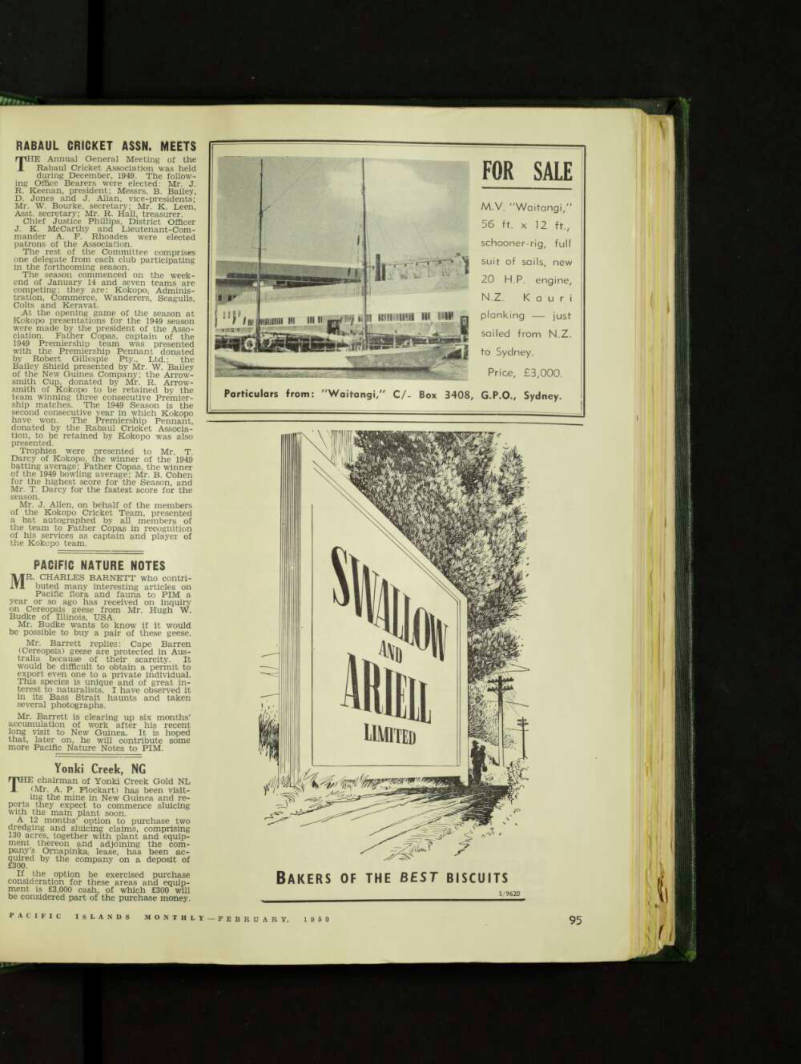
THE Annual General Meeting of the Rabaul Cricket Association was held during December, 1949. The follow ing Office Bearers were elected: Mr. J.
R. Keenan, president; Messrs. B. Bailey, D. Jones and J. Allan, vice-presidents; Mr. W. Bourke, secretary; Mr. K. Leen, Asst, secretary; Mr. R. Hall, treasurer.
Chief Justice Phillips, District Officer J. K. McCarthy and Lieutenant-Com mander A. F. Rhoades were elected patrons of the Association.
The rest of the Committee comprises one delegate from each club participating in the forthcoming season.
The season commenced on the week end of January 14 and seven teams are competing; they are: Kokopo, Adminis tration, Commerce, Wanderers, Seagulls, Colts and Keravat, At the opening game of the season at Kokopo presentations for the 1949 season were made by the president of the Asso ciation. Father Copas, captain of the 1949 Premiership team was presented with the Premiership Pennant donated by Robert Gillespie Pty., Ltd.; the Bailey Shield presented by Mr. W. Bailey of the New Guinea Company; the Arrow smith Cup, donated by Mr. R. Arrow smith of Kokopo to be retained by the team winning three consecutive Premier ship matches. The 1949 Season is the second consecutive year in which Kokopo have won. The Premiership Pennant, donated by the Rabaul Cricket Associa tion, to be retained by Kokopo was also presented.
Trophies were presented to Mr. T.
Darcy of Kokopo, the winner of the 1949 batting average; Father Copas, the winner of the 1949 bowling average; Mr. B. Cohen for the highest score for the Season, and Mr. T. Darcy for the fastest score for the season.
Mr. J. Allen, on behalf of the members of the Kokopo Cricket Team, presented a bat autographed by all members of the team to Father Copas in recognition of his services as captain and player of the Kokopo team.
Pacific Nature Notes
MR. CHARLES BARNETT who contri buted many interesting articles on Pacific flora and fauna to PIM a year or so ago has received on inquiry on Cereopsis geese from Mr. Hugh W.
Budke of Illinois, USA.
Mr. Budke wants to know if it would be possible to buy a pair of these geese.
Mr. Barrett replies; Cape Barren (Cereopsis) geese are protected in Aus tralia because of their scarcity. It would be difficult to obtain a permit to export even one to a private individual.
This species is unique and of great in terest to naturalists. I have observed it in its Bass Strait haunts and taken
several photographs.
Mr. Barrett is clearing up six months’ accumulation of work after his recent long visit to New Guinea. It is hoped that, later on, he will contribute some more Pacific Nature Notes to PIM.
Yonki Creek, NG
THE chairman of Yonki Creek Gold NL (Mr. A. P. Flockart) has been visit ing the mine in New Guinea and re ports they expect to commence sluicing with the main plant soon.
A 12 months’ option to purchase two dredging and sluicing claims, comprising 130 acres, together with plant and equip ment thereon and adjoining the com pany’s Omapinka, lease, has been ac quired by the company on a deposit of tuDO.
If the option be exercised purchase consideration for these areas and equip ment is £3,000 cash, of which £3OO will be considered part of the purchase money.
Advertisements & other items, p. 99 (1 item)
Limited
II Jif w m mwmm m / & In i mm -
FOR SALE
M. "Waitangi," 56 ft. x 12 ft.,
schooner-rig, full
suit of sails, new 20 H.P. engine, N. Kauri planking just sailed from N.Z. to Sydney.
Price, £3,000.
Particulars from: "Waitangi," C/- Box 3408, G.P.0., Sydney.
LIMITED
Bakers of the best biscuits
Javanese Repatriated From N
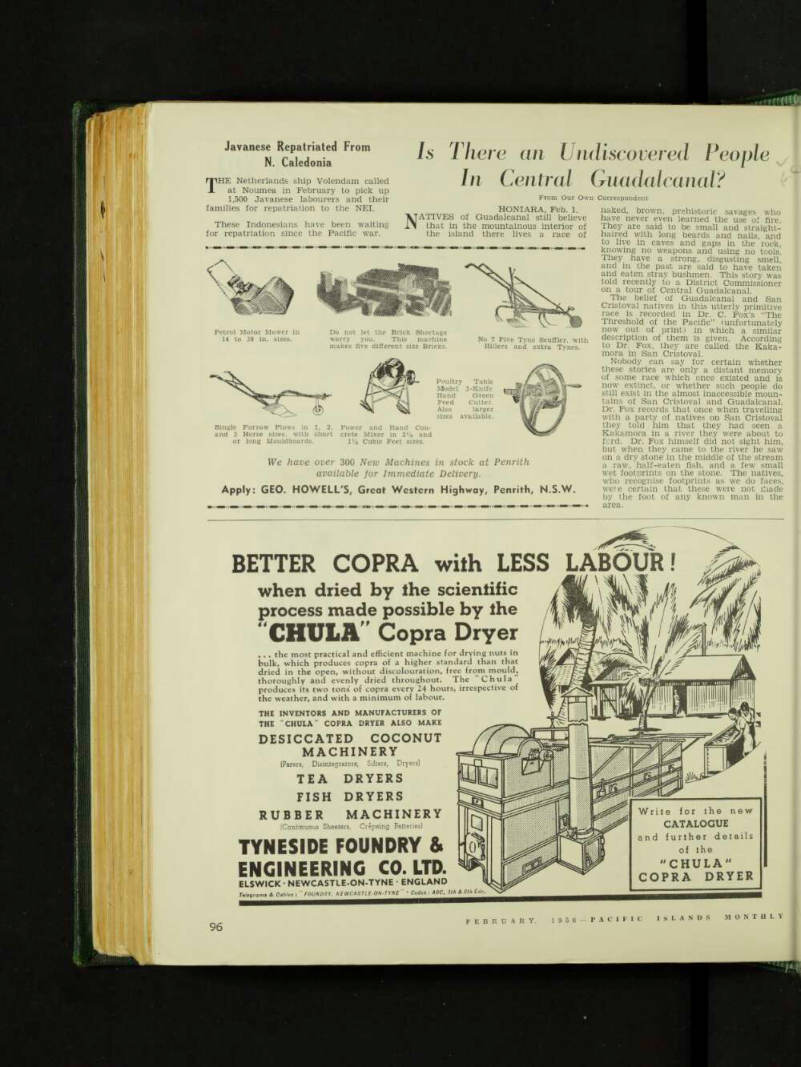
N. Caledonia
THE Netherlands ship Volendam called at Noumea in February to pick up 1,500 Javanese labourers and their families for repatriation to the NEI.
These Indonesians have been waiting for repatriation since the Pacific war.
In Central Guadalcanal?
Is There an Undiscovered People In Central Guadalcanal?
From Our Own Correspondent
Honiara, Feb. 1.
NATIVES of Guadalcanal still believe that in the mountainous interior of the island there lives a race of
naked, brown, prehistoric savages who have never even learned the use of fire.
They are said to be small and straight haired with long beards and nails, and to live in caves and gaps in the rock, knowing no weapons and using no tools.
They have a strong, disgusting smell, and in the past are said to have taken and eaten stray bushmen. This story was told recently to a District Commissioner on a tour of Central Guadalcanal.
The belief of Guadalcanal and San Cristoval natives in this utterly primitive race is recorded in Dr. C. Fox’s “The Threshold of the Pacific” (unfortunately now out of print) in which a similar description of them is given. According to Dr. Fox, they are called the Kaka mora in San Cristoval.
Nobody can say for certain whether these stories are only a distant memory of some race which once existed and is now' extinct, or whether such people do still exist in the almost inaccessible moun tains of San Cristoval and Guadalcanal.
Dr. Fox records that once when travelling with a party of natives on San Cristoval they told him that they had seen a Kakamora in a river they were about to fcrd. Dr. Fox himself did not sight him, but when they came to the river he saw on a dry stone in the middle of the stream a raw, half-eaten fish, and a few small wet footprints on the stone. The natives, who recognise footprints as we do faces, were certain that these were not made by the foot of any known man in the area.
Advertisements & other items, pp. 100-101 (3 items)
“CHULA” Copra Dryer
Petrol Motor Mower in 14 to 30 in. sizes.
Do not let the Brick Shortage worry you. This machine makes five different size Bricks.
No 7 Five Tyne Scuffler, with Hillers and extra Tynes.
Poultry Table Model 3-Knife Hand Green Feed Cutter.
Also larger sizes available.
Single Furrow Plows in 1,2, Power and Hand Conand 3 Horse sizes, with short crete Mixer in 2Vi and or long Mouldboards. I V 2 Cubic Feet sizes.
We have over 300 New Machines in stock at Penrith
available for Immediate Delivery.
Apply: GEO. HOWELL'S, Great Western Highway, Penrith, N.S.W.
BETTER COPRA wilh LESS LABOUR!
when dried by Ihe scientific
process made possible by the
“CHULA” Copra Dryer
. , . the most practical and efficient machine for drying nuts in bulk, which produces copra of a higher standard than that dried in the open, without discolouration, free from mould, thoroughly and evenly dried throughout. The "Chula produces its two tons of copra every 24 hours, irrespective of the weather, and with a minimum of labour.
THE INVENTORS AND MANUFACTURERS OF
THE ‘CHULA” COPRA DRYER ALSO MAKE
DESICCATED COCONUT
MACHINERY
(Parers, Disintegrators, Sifters, Dryers)
TEA DRYERS
FISH DRYERS
RUBBER MACHINERY
(Continuous Sheeters, Crepeing Batteries)
TYNESIDE FOUNDRY &
ENGINEERING CO. LTD.
ELSWICK • NEWCASTLE-ON-TYNE • ENGLAND
Telegrams & Cables : " FOUNDRY. NEWCASTLE-ON-TYNE " • Codes : ABC, 5th & 6th Eds m & !■■ i Write for the new
CATALOGUE
and further details of the
"CHULA 11
COPRA DRYER
fN
Month In Moresby
97
PACIFIC ISLANDS MONTHLY FEBRUARY, 1950
(Continued from Page 11)
MONTH IN MORESBY
fiMm
If You
Cannot Sleep
FEEL FIT FOR NOTHING.
You may be anaemic or bloodless, for this ailment plays havoc with your health and nervous energy. You feel terribly nervy; suffer headaches and dizzy spells, have poor appetite, cannot sleep at night —losing those precious hours of rest and recovery, essential for your health and fitness.
Many people have recovered from these miseries by taking Dr. Williams’ Pink Pills, which have reinvigorated, strengthened their systems and banished the vague pains and weariness. Dr. Williams’ Pink Pills always help to enrich and increase the blood supply, giving beneficial help to the nerves, tissues and organs of the body. With enriched blood you cannot help feeling happier, sleeping better, becoming reinvigorated.
Stop anaemia making you a suffering invalid without delay. Take Dr. Williams' Pink Pills and soon notice the difference in your eyes, skin, nerves and general health. At all chemists and stores.
BRITISH
fiMm
DIESEL
MARINE ENGINES:
2 Distinct Power Models—P6M. 34/65 H.P. at 2,000 r.p.m., and S6M 50/100 H.P. at 2,000 r.p.m. Both are fitted with the new MRIOA hydraulicallyoperated gear-box and reduction gear and 24-volt electric system and starter.
Screen-protected alternator, complete with switchboard, fuel tank and radiator ready for installation.
VEHICLE ENGINES:
P 6 complete with 12-inch clutch and 5-speed overdrive gear-box for road transport vehicles.
GENERATING SETS:
25KVA—415/240 volt 3-phase diesel-operated unit.
Self-excited, eliminating belt drives and pulleys.
FULL RANGE OF DIESEL
SPARE PARTS:
Experts in diesel service and engine reconditioning.
LARKE, NEAVE AND CARTER LIMITED
CARSELL PARK, PARRAMATTA ROAD, CAMPERDOWN
Cable Address: Larkneve, Sydney.
Chinese Consul Leaves Fiji
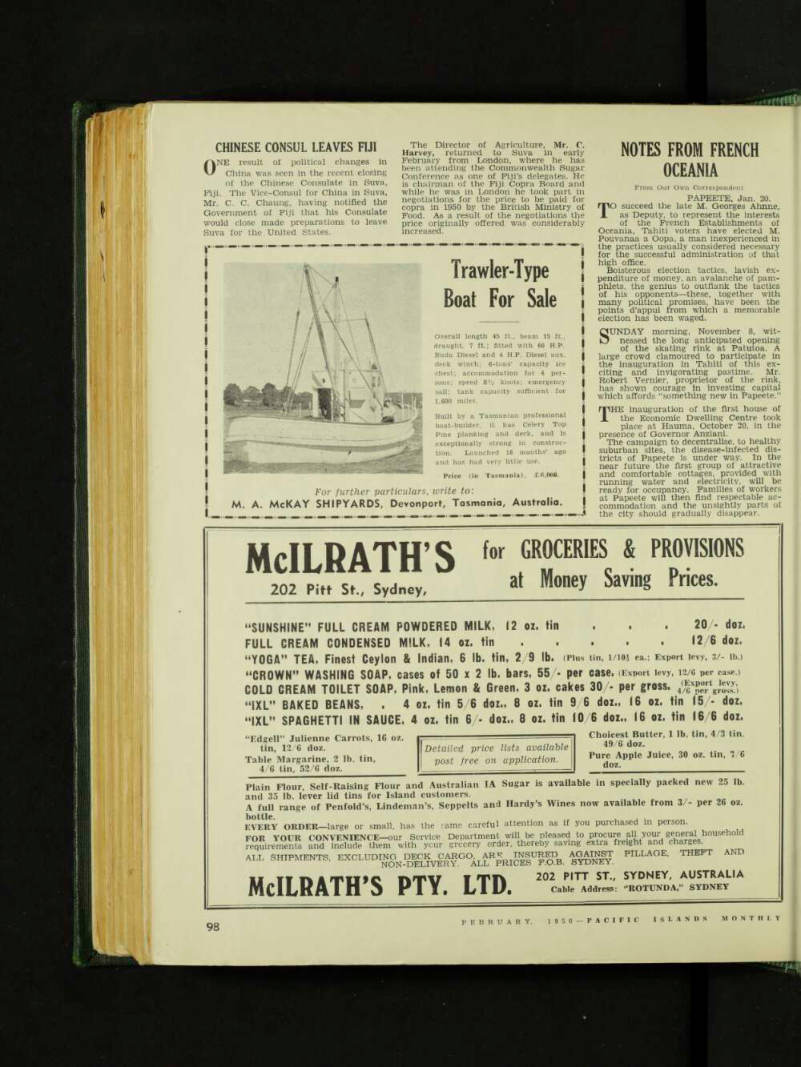
ONE result of political changes in China was seen in the recent closing of the Chinese Consulate in Suva, Fiji. The Vice-Consul for China in Suva, Mr. C. C. Chaung, having notified the Government of Fiji that his Consulate would close made preparations to leave Suva for the United States.
The Director of Agriculture, Mr. C.
Harvey, returned to Suva in early February from London, where he has been attending the Commonwealth Sugar Conference as one of Fiji’s delegates. He is chairman of the Fiji Copra Board and while he was in London he took part in negotiations for the price to be paid for copra in 1950 by the British Ministry of Food. As a result of the negotiations the price originally offered was considerably increased.
Notes From French
Oceania
From Our Own Correspondent
Papeete, Jan. 20.
TO succeed the late M. Georges Ahnne, as Deputy, to represent the interests of the French Establishments of Oceania, Tahiti voters have elected M.
Pouvanaa a Oopa, a man inexperienced in the practices usually considered necessary for the successful administration of that high office.
Boisterous election tactics, lavish ex penditure of money, an avalanche of pam phlets, the genius to outflank the tactics of his opponents—these, together with many political promises, have been the points d’appui from which a memorable election has been waged.
SUNDAY morning, November 8, wit nessed the long anticipated opening of the skating rink at Patutoa. A large crowd clamoured to participate in the inauguration in Tahiti of this ex citing and invigorating pastime. Mr.
Robert Vernier, proprietor of the rink, has shown courage in investing capital which affords “something new in Papeete.”
THE inauguration of the first house of the Economic Dwelling Centre took place at Hauma, October 20, in the presence of Governor Anziani.
The campaign to decentralise, to healthy suburban sites, the disease-infected dis tricts of Papeete is under way. In the near future the first group of attractive and comfortable cottages, provided with running water and electricity, will be ready for occupancy. Families of workers at Papeete will then find respectable ac commodation and the unsightly parts of the city should gradually disappear.
THE United States State Department still has no plans to re-establish a consulate or consular agency in Tahiti. The Department recently an nounced that consular affairs in Tahiti have been transferred to the American consulate in Noumea, New Caledonia. It declared “from that post, it is expected that consular officers will be able to make periodic visits to the Society Islands.”
But Noumea is as far away from Tahiti as is Honolulu—main seat of the US Gov ernment in the Pacific.
M. Anziani, Governor of French Oceania, on his return from his recent survey of the Austral Islands, on Decem ber 2, reported that he found the health conditions there satisfactory, but the need for additional schools was pressing.
His trip was made aboard the French cruiser, Francis Gamier, Tubuai, Rurutu, Rimatara, Raivavae and Rapa were all visited.
Monsieur Raymond Lehartel, who es tablished a splendid record as a volunteer during the late war, has just been elected Third Assistant to the Mayor of Papeete, in place of the late Mi*. Charles Levy.
M. Lehartel, descendant of a pioneer French family, is employed in the Cus toms Service, Papeete.
Monsieur Paul Breniere, Member of the Assemblee Representative at Papeete, has been appointed to represent Tahiti at the South Pacific Conference in Suva in April.
ON the afternoon of December 22, over 20 children from Papeete’s poorer areas were invited by Madame An ziani, the wife of the Governor, to a Christmas tree at Government House.
Each guest received a gift from Pere Noel, and refreshments of cake, lemonade and sweets.
On Christmas Eve, patients of the Colonial Hospital and their friends at
tended a beautifully decorated tree in the grounds of the hospital. Decoiation of the growing tree was the work of nurses at the hospital. Music was sup plied by the orchestra of the Church of Latter Day Saints and all patients who were well enough to attend received gifts from the tree. The Governor and Madame Anziani were among the guests.
FOR the first time for 20 years, a Governor of French Oceania has made a tour of the Tuamotu and Marquesas Islands. Governor Anziani.
Madame Anziani and their party left Papeete in the Naval vessel Francis Gamier early in January and were given a tumultuous welcome wherever they went.
Calls were made at Rangiroa, Kaukura, Apataki, Takaroa and a number of other islands in the Groups. Each call was the occasion for speeches, dancing, singing, and feasting as well as for more formal inspections of schools, buildings and Public Works projects.
Native gifts were showered upon the visitors ahd at Takaroa the party was given an exhibition of pearl diving in the lagoon. Before leaving this island a visit was made to the wrecked British four-masted ship, County of Roxburg. which has been high and dry on the reef since it was swept there by a cyclone on February 7, 1906.
Mr. Anthony Bambridge, Snr.,
has returned to Papeete after a suc cessful business visit to Australia.
He is loud in his praise of the hospitality he received in Sydney, and would like to convey his thanks to those who made his visit there such a pleasant one.
Mr. Bambridge made the round trip in the Messageries Maritimes liner. Ville D’Amiens, and in spite of what has been
said in some quarters regarding conditions on this ship, found cuisine and service excellent.
It is generally regretted in Tahiti that the Messageries Maritimes ships will in future omit calls to Sydney. This service will be missed by the travelling public. (Ed. Note: It was never suggested that the first class accommodation on the Messageries Maritimes ships was any thing but excellent. Certain ships of the line, however, did receive bad publicity in Sydney newspapers a year or so ago when they brought European displaced persons to Australia steerage-class. The company refused to take responsibility for the way in which these migrants had travelled. It was, they said, all arranged by some European travel agency).
Papeete’s popular Postmaster, Monsieur A. M, Pons, accompanied by his family, left for France on the Ville D’Amiens on January 9. It is expected that he will have a long holiday before taking up other duties. Assistant-Postmaster De Quincenet will take over his job in Papeete.
Advertisements & other items, pp. 102-104 (2 items)
Mcilrath’S
Trawler-Type
Boat For Sale
Overall length 45 ft., beam 15 ft., draught, 7 ft.; fitted with 60 H.P.
Buda Diesel and 4 H.P. Diesel aux. deck winch; 6-tons’ capacity ice chest; accommodation for 4 persons; speed BV 2 knots; emergency sail; tank capacity sufficient for 1,600 miles.
Built by a Tasmanian professional boat-builder, it has Celery Top Pine planking and deck, and is exceptionally strong in construction. Launched 18 months’ ago and has had very little use.
Price (in Tasmania), £6,000.
For further particulars, write to:
M. A. McKAY SHIPYARDS, Devonport, Tasmania, Australia.
for GROCERIES & PROVISIONS
at Money Saving Prices.
McILRATH’S
202 Pitt St., Sydney,
“SUNSHINE” FULL CREAM POWDERED MILK, 12 oz. tin 20/- doz.
FULL CREAM CONDENSED MILK, 14 oz. tin 12/6 doz.
“YOGA” TEA, Finest Ceylon & Indian, 6 lb. tin, 2/9 lb. ipius un, 1/105 ea.; Export levy, v- n>.) “CROWN” WASHING SOAP, cases of 50 x 2 lb. bars, 55/- per case. {Export levy, 12/G per case.) COLD CREAM TOILET SOAP, Pink, Lemon & Green, 3 oz. cakes 30/- per gross. 4/6 per gross.) “IXL” BAKED BEANS, . 4 oz. tin 5/6 doz., 8 oz. tin 9/6 doz., 16 oz. tin 15/- doz.
“IXL” SPAGHETTI IN SAUCE, 4 oz. tin 6/- doz., 8 oz. tin 10/6 doz., 16 oz. tin 16/6 doz.
“Edgel!” Julienne Carrots, 16 oz. tin, 12/6 doz.
Table Margarine, 2 lb. tin, 4/6 tin, 52/6 doz.
Detailed price lists available post free on application.
Choicest Butter, 1 lb. tin, 4/3 tin. 49/6 doz.
Pure Apple Juice, 30 oz. tin, 7/6 doz.
Plain Flour, Self-Raising Flour and Australian IA Sugar is available in specially packed new 25 lb. and 35 lb. lever lid tins for Island customers.
A full range of Penfold’s, Lindeman’s, Seppelts and Hardy’s Wines now available from 3/- per 26 oz.
EVERY ORDER —large or small, has the same careful attention as if you purchased in person. requirements ™ordeh*'thereby e ALL SHIPMENTS, E XCLUDING N D D E E OK v CA f AGMNST PILLAGE, THEFT AND
McILRATH’S PTY. LTD.
Make a Pleasant Evening!
SKIN TROUBLES
And Malaria After-Effects
Our Remedy clears up unsightly skin colour—such as the after-effects of malaria and tropical skin diseases.
Avoid the distress of PRICKLY HEAT
ECZEMA. HIVES. DERMATITIS, etc.,
by a Home Treatment Course of
VIDAL’S REMEDIES. £2/10/- (includ-
ing postage). Write or call for our Great Blood Purifier and quick Healing Salve—to VIDAL’S REMEDIES, Trust Building. 155 King Street, Sydney. (G.P.O. Box 1326.) Telephone: MA 7294.
M. Emile Vidal (late of the Pacific Islands).
A Comfortable Chair
And a Good Magazine
Make a Pleasant Evening!
V 3,000 OF THE WORLD S HOME, TECHNICAL AND TRADE JOURNALS.
Enquiries CD A I\J UIDDI C £• CO\T Enquiries Welcomed. rKAim It 11) iJ L t Ol Welcomed
175 PITT STREET, SYDNEY
Phone: BL 3334. Cables: “FRAHIBS.”
AS?A X ADTU H t TB t fVT m. NT —:x -£l ( aspaxadreme treatment; jp*\ ) HAY f'EVC'R ) TRff -TT\ XHASfxu CATRRRh), . ( AnT ßuns > A S^i4 ■Tf TTJsTT UUu\ %; ToTvu^ Vl^ Tm\ tuTm ~MTTwefi \\ j\\
% vTch ifr TJonT* %
TTo < s <*\ ' V^Ach^^AOTi 3T*^: oft **ft tj^l\ art WW M6Mi rtl I ar* v SFTR V<?fiw V*M <5'V% I ( <3IWoF J 1 TT| ■?STMTX7*: * an 3, jym” — •#■ gi^^Rß trs. ">ra antii c guarantee > \
ASTHMAS, BRONCHITIS, HAY FEVER.
CATARRH
Sinus, Common Cold. Tonsilitis, Influenza, Croup, Whooping Cough, Antrum, etc., are all akin, in so far as they are all occasioned by inflamed capillaries of the mucous membrane, that is why Aspaxadrene is used against them all.
ENE
k (Known the world over os "the Answer to the Asthmatic's Prayer") • Relieves in 5 seconds (not 5 years) because it “Touches the Spot.” • Absolutely harmless—same spray—same liquid—babies and adults. •No dieting—eat anything—especially what you are not supposed to. • Sleep on anything—live anywhere—sea, plain, valley or mountain. • Causeduration —family history, etc.—immaterial. • Takes the strain off the heart—by easing the breathing • May be used in conjunction with your doctor’s allergy injections or any other medicine you like.
Contains 0.5 per cent. Adrenalin and guaranteed free from Atropine, Ephedrine, Cocaine, Morphine, Pituitary, Papavarine or any other Opium drug—so is absolutely harmless.
Complete outfit, 28/6 (Australian)—postage 1/6 Refill Aspaxadrene, 12/6 (Australian) —postage free.
Sole Discoverer, Proprietor and Dispenser,
A. H. CRUNDALL, Qualified Chemist
BOX 58, PRAHRAN, VICTORIA, AUSTRALIA.
Buka-Bougainville Has Radio and Labour
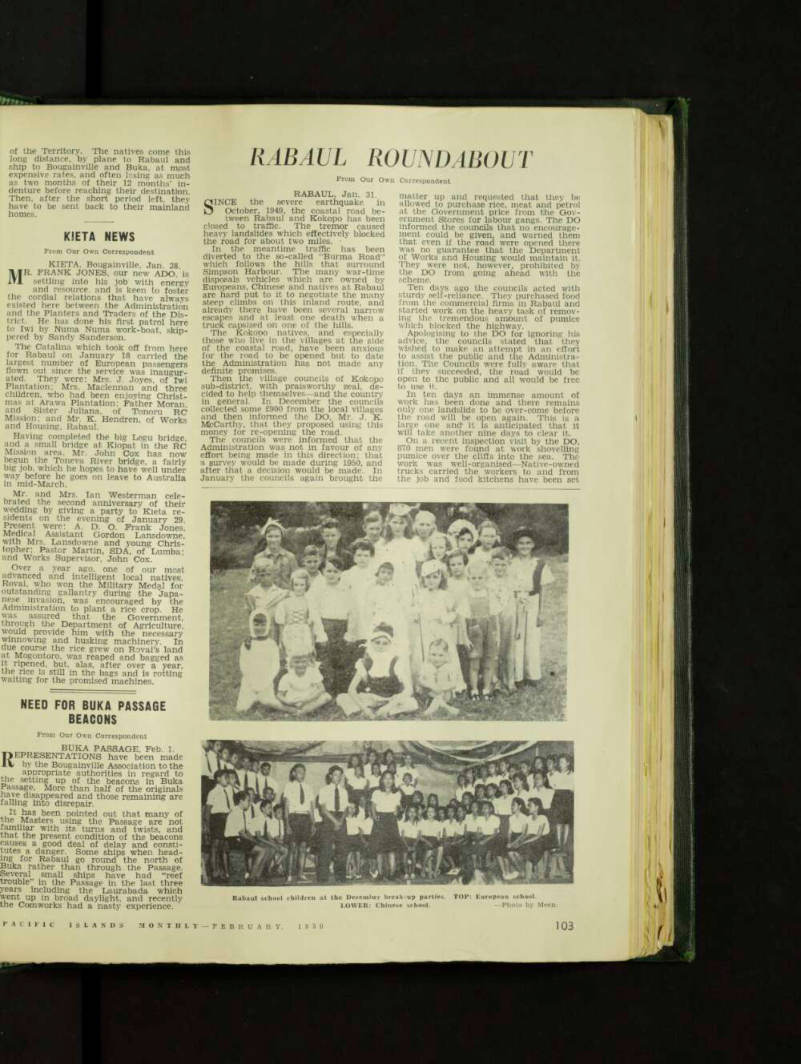
Labour
From Our Own Correspondent
Buka Passage, Jan. 24.
OUR tele-radio set at Sohano has been on the blink again and, while out ward traffic was held up, attempts were made to receive the incoming messages on a private set. Over the past three years this has frequently occurred.
Surely an all-wise Department—if it can be pinned down —will see that the Dis trict Headquarters of an important dis trict are provided with the means of keeping in touch with the outside world.
Considerable annoyance and some dis tress has been caused to isolated people in the district to find that, when a Directorate vessel comes along a radio cannot be sent from the ship. Often a ship brings mail needing an urgent reply, or some important cargo has not been shipped. To send a radio from the land station means sending a native on a long journey by foot or by canoe. When the master of the ship, knowing the circum stances, tries to send a message the curt reply comes back: “Only ships’ business on the radio.” Inquiry in Rabaul revealed that the RTC were quite willing to re ceive messages, but had strict orders from one of the firms, acting as Agents for the Directorate ships, against it. This seems quite unnecessary. The matter has been taken up with a view to an alteration be ing made.
Recently the point arose at Sohano as to whether or not an NLT radio could be sent to a registered radio address or not.
The sender was advised that it could not and that ordinary rates were required in such a case. Inquiries at Rabaul show
that these radios, at 6/3 for 25 words can be sent to a registered address. Someone at the Rabaul end had not read the latest regulations! a n unusual incident hannenpri on th*
A „ th f
A Siv nf wn a |°' A very large scho ° of bomto became
stranded at low water on the reef which connects Jame and Petats Islands. There were many thousands of these fish high and dry and in the rock pools. Natives from nearby villages came with all the canoes they could muster and worked against time to collect the fish and smoke them for bartering purposes. When high water came again the fish were also getting a bit high and thousands drifted off and made a fine feast for the waiting sharks.
These fish are the meat of the islands dwellers and there were full bellies and contented smiles for days following the episode. Cases of the sort occur at long intervals on this coast.
The busiest man around Buka Passage
is the storekeeper, Wong You, who has a well-stocked store, has bought a couple of small plantations, also has others leased and is engaged in trading copra and trocas. His work-boat is constantly up and down the coast delivering goods and collecting trade. Two things that increase his popularity are the fine yearly calendars that he hands out, and also the fact that he holds a liquor licence.
That energetic man, Bishop Wade, has been reaching out since the war finished.
He bought largely from Americans and War Disposals at Torokina, thus enabling himself to re-establish his mission stations. He acquired water craft for his needs, and has imported a number of his own countrymen to fill the gaps caused by retirement of the older priests, and natives are beginning to learn all about the Star Spangled Banner, which cer tainly turned the tide in these parts.
The Bishop has also acquired Mabiri Plantation and Tearouki Plantation on the Bougainville coast.
The former has been leased to Wong You and the latter turned into a fine mission station. Complete with Quonset huts and other buildings. Tearouki also turns out copra. Now we hear that Bishop Wade has a ten-year lease of Nissan Plantation from Burns Philp and that should give him control of the Group. He has also interested himself in trying to get the natives of central Buka to" organise themselves into a co-operative band, to sell their copra collectively and run a trade store. But, if he can instil “co-operation” into these insular and conservative Buka people, then he is a better man than we are. However, we wish him luck!
INARMING OUT” of plantation areas . to village natives is a method of producing copra that is meeting with some success in Kieta area. Mr. J.
Ellis, of Arawa Plantation, probably has the best example of a happy arrangement, and both parties are pleased about it.
The method has been tried in Buka but not, up to date, with much success.
The natives joyfully enter into such an arrangement and begin operations, but when they discover that it means work of a continuous nature and that they are expected to honour their agreement, they fade away and are seen no more! They have got so used to War Damages, and such things, and think that “Farming out” is some sort of new “War Damage”!
The shock of realising that “hand outs” do not grow on bushes any more is too much for them. One strong and well populated village completed all arrange ments with a local planter to begin operations in the New Year. The date of commencing, the number of natives to toil in the vinevard, etc., was all arranged by the village heads, and news conveyed to the expectant planter. But nothing more eventuated and no explanation was vouchsafed to the planter. Under the present indulgent control this sort of thing continually happens and the natives have no sense of responsibility. The dis appointed planter, as the natives would remark, “been have ’im bad luck!”
To those of a speculative turn of mind, and a desire to work things out to a logical conclusion, the problem of the native labour supply in Buka and Bou gainville is an intriguing one. Here we have a district, closed to outside recruit ing, and with ample natives to handle all the work in their villages and on plantations, yet we have several good producing plantations not yet rehabili tated, and many others only part producing.
In order to get copra out the plantation owners have to engage labourers from Aitape and Wewak, which . are at the extreme north-west of New Guinea, while this district is at the extreme south-east
of the Territory. The natives come this long distance, by plane to Rabaul and ship to Bougainville and Buka, at most expensive rates, and often losing as much as two months of their 12 months’ in denture before reaching their destination.
Then, after the short period left, they have to be sent back to their mainland homes.
Advertisements & other items, pp. 105-106 (1 item)
Waco
Personal Service ensures that you
BUY OK THE BEST MARKET!
For more than 36 years the PERSONAL buying services of WILLIAM E.
REED, backed by an experienced staff, has ensured prompt and reliable service at lowest cost to Missions, Planters, and Traders throughout the Pacific. We operate on a WHOLESALE basis only. You receive original invoices at invoiced cost.
Enquiries invited for all plantation and trading requirements. Island products sold on a commission basis.
WILLIAM E. REED
(Established 36 years).
BROKER AND AGENT,
145 a GEORGE ST., CIRCULAR QUAY, SYDNEY Cables: "WILREED,” Sydney.
c - 3r *- •S
PHONES: LA 2436
LA 4033 LA 4603
CABLE ADDRESS:
“EXSOAP”, SYDNEY
CIEANIRI
mm *fl sol
MFG. PTY. LTD.
Cj.pl
nf h
14 ST. MARY STREET, CAMPERDOWN
SYDNEY N.S.W.
Specialising For Export . . .
VARIOUS SOAPS UNDER THE REGISTERED BRAND
44 mwr A.
WACO
Laundering, Toilet (Eucalyptus and Carbolic Health), Sea Water, Medical (Soft and Liquid), Washing Powder, Antiseptic Grease Remover, Wool Washing, Phenyle, Disinfectant and Liquid Soap (to specification).
For all inquiries :
EXPORT SOAP MFG. PTY. LIMITED.
14 ST. MARY STREET, CAMPERDOWN, SYDNEY, N.S.W.
THAT
fa the
Executor - Trustee
Attorney
FIND OUT YOUR
OBLIGATIONS FIRST
Before you agree to act as an executor or trustee, you should be quite clear regarding the extent of your obligations. The same precaution will prevent you from appointing an unsuitable executor. All essential facts regarding the administration of estates are given in the new edition of "Hands That Never Leave The Wheel”. This informative booklet explains why the fulltime services of the capable directors and experienced officers of Burns Philp Trust Company Limited should be at your disposal.
A complimentary copy of this 20-page booklet can be obtained from any branch of Burns Philp (South Sea) Company, Burns Philp (New Guinea) Limited, or direct from the head office of this Company.
DIRECTORS:
James Burns Joseph Mitchell R. T. W. Black Eric Priestley Lee MANAGER: L. S. Parker
SECRETARY: E. R. Overton, F.F.I.A.
Burns Philp Trust
COMPANY LIMITED
Constituted by Special Act of the N.S.W. Parliament
Head Office: 7 BRIDGE STREET, SYDNEY
TELEPHONE: BU 5901 BOX 543, G.P.0., SYDNEY
BP2O-49
Kieta News
From Our Own Correspondent
KIETA, Bougainville, Jan. 28.
MR. FRANK JONES, our new ADO, is settling into his job with energy and resource, and is keen to foster the cordial relations that have always existed here between the Administration and the Planters and Traders of the Dis trict. He has done his first patrol here to Iwi by Numa Numa work-boat, skip pered by Sandy Sanderson.
The Catalina which took off from here for Rabaul on January 18 carried the largest number of European passengers flown out since the service was inaugur ated. They were: Mrs. J. Joyes, of Iwi Plantation; Mrs. Maclennan and three children, who had been enjoying Christ mas at Arawa Plantation: Father Moran, and Sister Juliana, of Tonoru RC Mission: and Mr. K. Hendren, of Works and Housing, Rabaul.
Having completed the big Legu bridge, and a small bridge at Kiopat in the RC Mission area, Mr. John Cox has now begun the Toneva River bridge, a fairly big job, which he hopes to have well under way before he goes on leave to Australia in mid-March.
Mr. and Mrs. lan Westerman cele brated the second anniversary of their wedding by giving a party to Kieta re sidents on the evening of January 29 Present were: A. D. O. Frank Jones, Medical Assistant Gordon Lansdowne, with Mrs. Lansdowne and young Chris topher: Pastor Martin, SDA, of Lumba; and Works Supervisor, John Cox.
Over a year ago. one of our most advanced and intelligent local natives, Rovai. who won the Military Medal for outstanding gallantry during the Japa nese invasi9n, was encouraged by the Administration to plant a rice crop. He was assured that the Government, through the Department of Agriculture, would provide him with the necessary winnowing and husking machinery. In due course the rice grew on Rovai’s land at Mogontoro, was reaped and bagged as it ripened, but, alas, after over a year, the nee is still in the bags and is rotting waiting for the promised machines.
Beacons
Need For Buka Passage
From Our Own Correspondent
R Buka Passage, Feb. 1.
EPRESENTATIONS have been made by the Bougainville Association to the appropriate authorities in regard to the setting up of the beacons in Buka Passage. More than half of the originals have disappeared and those remaining are falling into disrepair.
It S? 8 been pointed out that many of the Masters using the Passage are not familiar with its turns and twists, and that the present condition of the beacons causes a good deal of delay and consti tutes a danger. Some ships when head ing for Rabaul go round the north of Buka rather than through the Passage.
Several small ships have had “reef trouble” in the Passage in the last three years including the Laurabada which went up in broad daylight, and recently the Com works had a nasty experience.
Rabaul Roundabout
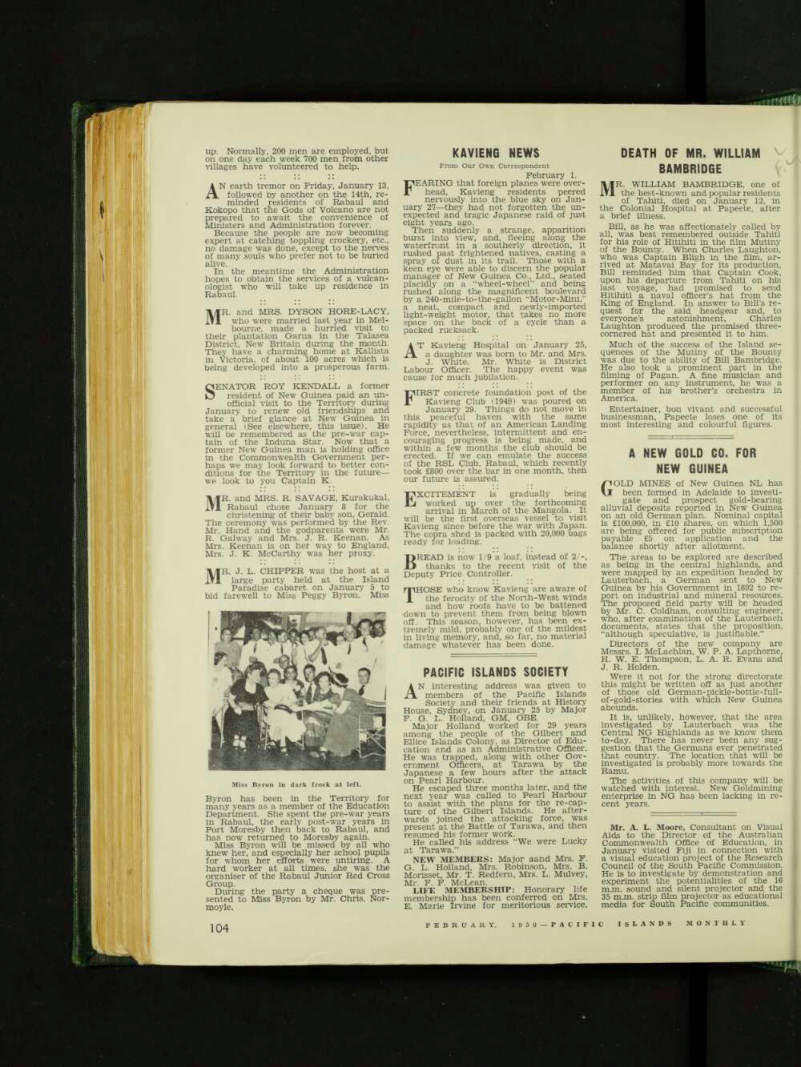
From Our Own Correspondent
Rabaul, Jan. 31.
SINCE the severe earthquake In October, 1949, the coastal road be tween Rabaul and Kokopo has been closed to traffic. The tremor caused heavy landslides which effectively blocked the road for about two miles.
In the meantime traffic has been diverted to the so-called “Burma Road” which follows the hills that surround Simpson Harbour. The many war-time disposals vehicles which are owned by Europeans, Chinese and natives at Rabaul are hard put to it to negotiate the many steep climbs on this inland route, and already there have been several narrow escapes and at least one death when a truck capsized on one of the hills.
The Kokopo natives, and especially those who live in the villages at the side of the coastal road, have been anxious for the road to be opened but to date the Administration has not made any definite promises.
Then the village councils of Kokopo sub-district, with praisworthy zeal, de cided to help themselves—and the country in general. In December the councils collected some £9OO from the local villages and then informed the DO, Mr. J. K.
McCarthy, that they proposed using this money for re-opening the road.
The councils were informed that the Administration was not in favour of any effort being made in this direction; that a survey would be made during 1950, and after that a decision would be made. In January the councils again brought the
matter up and requested that they be allowed to purchase rice, meat and petrol at the Government price from the Gov ernment Stores for labour gangs. The DO informed the councils that no encourage ment could be given, and warned them that even if the road were opened there was no guarantee that the Department of Works and Housing would maintain it.
They were not, however, prohibited by the DO from going ahead with the scheme.
Ten days ago the councils acted with sturdy self-reliance. They purchased food from the commercial firms in Rabaul and started work on the heavy task of remov ing the tremendous amount of pumice which blocked the highway.
Apologising to the DO for ignoring his advice, the councils stated that they wished to make an attempt in an effort to assist the public and the Administra tion. The Councils were fully aware that if they succeeded, the road would be open to the public and all would be free to use it.
In ten days an immense amount of work has been done and there remains only one landslide to be over-come before the road will be open again. This is a large one and' it is anticipated that it will take another nine days to clear it.
On a recent inspection visit by the DO, 870 men were found at work shovelling pumice over the cliffs into the sea. The work was well-organised—Native-owned trucks carried the workers to and from the job and food kitchens have been set
Rabaul school children at the December break-up parties. TOP: European school.
LOWER: Chinese school.
Photo by Meen.
up. Normally, 200 men are employed, but on one day each week 700 men from other villages have volunteered to help.
AN earth tremor on Friday, January 13, followed by another on the 14th, re minded residents of Rabaul and Kokopo that the Gods of Volcano are not prepared to await the convenience of Ministers and Administration forever.
Because the people are now becoming expert at catching toppling crockery, etc., no damage was done, except to the nerves of many souls who prefer not to be buried alive.
In the meantime the Administration hopes to obtain the services of a vulcan ologist who will take up residence in Rabaul.
Mr. And Mrs. Dyson Hore-Lacy,
who were married last year in Mel bourne, made a hurried visit to their plantation Garua in the Talasea District, New Britain during the month, They have a charming home at Kallista in Victoria, of about 100 acres which is being developed into a prosperous farm,
Senator Roy Kendall A Former
resident of New Guinea paid an un official visit to the Territory during January to renew old friendships and take a brief glance at New Guinea in general (See elsewhere, this issue). He will be remembered as the pre-war cap tain of the Induna Star. Now that a former New Guinea man is holding office in the Commonwealth Government per haps we may look forward to better con ditions for the Territory in the future— we look to you Captain K.
MR. and MRS. R. SAVAGE, Kurakukal, Rabaul chose January 8 for the christening of their baby son, Gerald.
The ceremony was performed by the Rev.
Mr. Hand and the godparents were Mr.
R. Galway and Mrs. J. R. Keenan. As Mrs. Keenan is on her way to England, Mrs. J. K. McCarthy was her proxy.
MR. J. L. CHIPPER was the host at a large party held at the Island Paradise cabaret on January 5 to bid farewell to Miss Peggy Byron. Miss
Byron has been in the Territory for many years as a member of the Education Department. She spent the pre-war years in Rabaul, the early post-war years in Port Moresby then back to Rabaul, and has now returned to Moresby again.
Miss Byron will be missed by all who knew her, and especially her school pupils for whom her efforts were untiring. A hard worker at all times, she was the organiser of the Rabaul Junior Red Cross Group.
During the party a cheque was pre sented to Miss Byron by Mr. Chris. Nor moyle.
Miss Byron in dark frock at left.
Kavieng News
From Our Own Correspondent February 1.
FEARING that foreign planes were over head, Kavieng residents peered nervously into the blue sky on Jan uary 27 —they had not forgotten the un expected and tragic Japanese raid of just eight years ago.
Then suddenly a strange, apparition burst into view, and, fleeing along the waterfront in a southerly direction, it rushed past frightened natives, casting a spray of dust in its trail. Those with a keen eye were able to discern the popular manager of New Guinea Co., Ltd., seated placidly on a “wheel-wheel” and being rushed along the magnificent boulevard by a 240-mile-to-the-gallon “Motor-Mini,” a neat, compact and newly-imported light-weight motor, that takes no more space on the back of a cycle than a packed rucksack.
AT Kavieng Hospital on January 25, a daughter was born to Mr. and Mrs.
J. White. Mr. White is District Labour Officer. The happy event was cause for much jubilation.
FIRST concrete foundation post of the Kavieng Club (1949) was poured on January 29. Things do not move in this peaceful haven with the same rapidity as that of an American Landing Force, nevertheless, intermittent and en couraging progress is being made, and within a few months the club should be erected. If we can emulate the success of the RSL Club, Rabaul, which recently took £BOO over the bar in one month, then our future is assured.
EXCITEMENT is gradually being worked up over the forthcoming arrival in March of the Mangola. It will be the first overseas vessel to visit Kavieng since before the war with Japan.
The copra shed is packed with 20,000 bags ready for loading.
BREAD is now 1/9 a loaf, instead of 2/-, thanks to the recent visit of the Deputy Price Controller.
THOSE who know Kavieng are aware of the ferocitv of the North-West winds and how roofs have to be battened down to prevent them from being blown off. This season, however, has been ex tremely mild, probably one of the mildest in living memory, and, so far, no material damage whatever has been done.
Pacific Islands Society
AN interesting address was given to members of the Pacific Islands Society and their friends at History House, Sydney, on January 25 by Major F. G. L. Holland, GM, QBE.
Major Holland worked for 29 years among the people of the Gilbert and Ellice Islands Colony, as Director of Edu cation and as an Administrative Officer.
He was trapped, along with other Gov ernment Officers, at Tarawa by the Japanese a few hours after the attack on Pearl Harbour.
He escaped three months later, and the next year was called to Pearl Harbour to assist with the plans for the re-cap ture of the Gilbert Islands. He after wards joined the attacking force, was present at the Battle of Tarawa, and then resumed his former work.
He called his address “We were Lucky at Tarawa.”
NEW MEMBERS: Major aand Mrs. P.
G. L. Holland, Mrs. Robinson, Mrs. B.
Morisset, Mr. T. Redfem, Mrs. L. Mulvey, Mr. F. F. McLean.
LIFE MEMBERSHIP: Honorary life membership has been conferred on Mrs.
E. Marie Irvine for meritorious service.
Bambridge
Death Of Mr. William
Mr. William Bambridge, One Of
the best-known and popular residents of Tahiti, died on January 12, in the Colonial Hospital at Papeete, after a brief illness.
Bill, as he was affectionately called by all, was best remembered outside Tahiti for his role of Hitihiti in the film Mutiny of the Bounty. When Charles Laughton, who was Captain Bligh in the film, ar rived at Matavai Bay for its production, Bill reminded him that Captain Cook, upon his departure from Tahiti on his last voyage, had promised to send Hitihiti a naval officer’s hat from the King of England. In answer to Bill’s re quest for the said headgear and, to everyone’s astonishment, Charles Laughton produced the promised three cornered hat and presented it to him.
Much of the success of the Island se quences of the Mutiny of the Bounty was due to the ability of Bill Bambridge.
He also took a prominent part in the filming of Pagan. A fine musician and performer on any instrument, he was a member of his brother’s orchestra in America.
Entertainer, bon vivant and successful businessman, Papeete loses one of its most interesting and colourful figures.
A New Gold Co. For
New Guinea
GOLD MINES of New Guinea NL has been formed in Adelaide to investi gate and prospect gold-bearing alluvial deposits reported in New Guinea on an old German plan. Nominal capital is £lOO,OOO, in £lO shares, on which 1,500 are being offered for public subscription payable £5 on application and the balance shortly after allotment.
The areas to be explored are described as being in the central highlands, and were mapped by an expedition headed by Lauterbach, a German sent to New Guinea by his Government in 1892 to re port on industrial and mineral resources.
The proposed field party will be headed by Mr. C. Coldham, consulting engineer, who, after examination of the Lauterbach documents, states that the proposition, “although speculative, is justifiable.”
Directors of the new company are Messrs. I. McLachlan, W. P. A. Lapthorne, H. W. E. Thompson, L. A. R. Evans and J. R. Holden.
Were it not for the strong directorate this might be written off as just another of those old German-pickle-bottle-full of-gold-stories with which New Guinea abounds.
It is, unlikely, however, that the area investigated by Lauterbach was the Central NG Highlands as we know them to-day. There has never been any sug gestion that the Germans ever penetrated that country. The location that will be investigated is probably more towards the Ramu.
The activities of this company will be watched with interest. New Goldmining enterprise in NG has been lacking in re cent years.
Mr. A. L. Moore, Consultant on Visual Aids to the Director of the Australian Commonwealth Office of Education, in January visited Fiji in connection with a visual education project of the Research Council of the South Pacific Commission.
He is to investigate by demonstration and experiment the potentialities of the 16 m.m. sound and silent projector and the 35 m.m. strip film projector as educational media for South Pacific communities.
Messenger
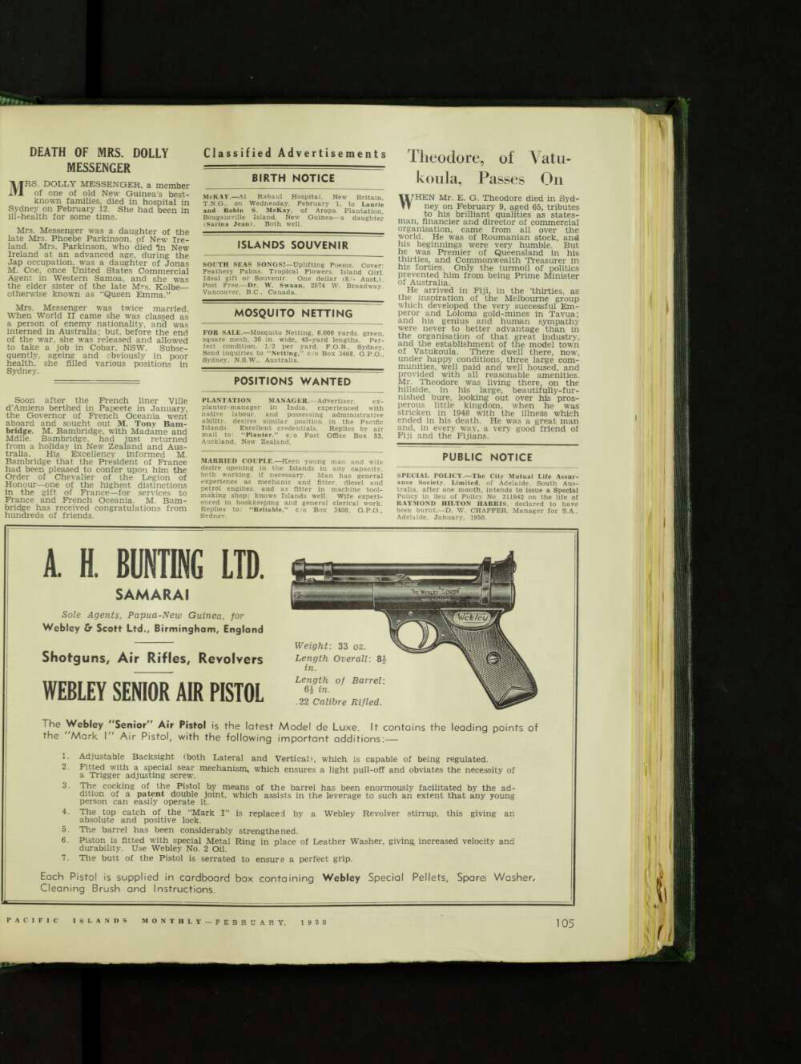
Death Of Mrs. Dolly
Mrs. Dolly Messenger, A Member
of one of old New Guinea’s best known families, died in hospital in Sydney on February 12. She had been in ill-health for some time.
Mrs. Messenger was a daughter of the late Mrs. Phoebe Parkinson, of New Ire land. Mrs. Parkinson, who died *sn New Ireland at an advanced age, during the Jap occupation, was a daughter of Jonas M. Coe, once United States Commercial Agent in Western Samoa, and she was the elder sister of the late Mrs. Kolbe— otherwise known as “Queen Emma.”
Mrs. Messenger was twice married.
When World II came she was classed as a person of enemy nationality, and was interned in Australia; but, before the end of the war, she was released and allowed to take a job in Cobar. NSW. Subse quently, ageing and obviously in poor health, she filled various positions in Sydney.
Soon after the French liner Ville d’Amiens berthed in Papeete in January, the Governor of French Oceania went aboard and sought out M. Tony Bam bridge. M. Bambridge, with Madame and Mdlle. Bambridge, had just returned from a holiday in New Zealand and Aus tralia. His Excellency informed M.
Bambridge that the President of Prance had been pleased to confer upon him the Order of Chevalier of the Legion of Honour —one of the highest distinctions in the gift of France —for services to France and French Oceania. M. Bam bridge has received congratulations from hundreds of friends.
Advertisements & other items, p. 109 (1 item)
A. H. Bunting Im
Classified Advertisements
BIRTH NOTICE
McKAY.—At Rabaul Hospital, New Britain, T.N.G., on Wednesday, February 1, to Laurie and Robin S. McKay, of Aropa Plantation.
Bougainville Island. New Guinea—a daughter (Sarina Jean). Both well.
ISLANDS SOUVENIR
SOUTH SEAS SONGS!—Uplifting Poems. Cover: Feathery Palms. Tropical Flowers. Island Girl.
Ideal gift or Souvenir. One dollar (8/- Aust.), Post Free.—Dr. W. Swaan, 2574 W. Broadway.
Vancouver, 8.C., Canada.
MOSQUITO NETTING
FOR SALE.—Mosquito Netting, 6,000 yards, green, square mesh, 36 in. wide, 45-yard lengths. Perfect condition, 1/2 per yard. F. 0.8., Sydney.
Send inquiries to “Netting,” c/o Box 3408. G.P.0., Sydney, N.S.W., Australia.
POSITIONS WANTED
PLANTATION MANAGER.—Advertiser. explanter-manager in India. experienced with native labour, and possessing administrative ability, desires similar position in the Pacific Islands. Excellent credentials. Replies by air mail to; “Planter.” c/o Post Office Box 53, Auckland, New Zealand.
MARRIED COUPLE.—Keen young man and wife desire opening in the Islands in any capacity, both working, if necessary. Man has general experience as mechanic and fitter, diesel and petrol engines, and as fitter in machine toolmaking shop; knows Islands well. Wife experienced in bookkeeping and general clerical work.
Replies to: “Reliable,” c/o Box 3408. G.P.0., Svdnev.
Theodore, of Vatu-
koula. Passes On
WHEN Mr. E. G. Theodore died in Sydney on February 9, aged 65, tributes to his brilliant qualities as statesman, financier and director of commercial organisation, came from all over the world. He was of Roumanian stock, and his beginnings were very humble. But he was Premier of Queensland in his thirties, and Commonwealth Treasurer in his forties. Only the turmoil of politics prevented him from being Prime Minister of Australia.
He arrived in Fiji, in the ’thirties, as the inspiration of the Melbourne group which developed the very successful Emperor and Loloma gold-mines in Tavua; and his genius and human sympathy were never to better advantage than in the organisation of that great industry, and the establishment of the model town of Vatukoula. There dwell there, now, under happy conditions, three large communities, well paid and well housed, and provided with all reasonable amenities.
Mr. Theodore was living there, on the hillside, in his large, beautifully-furnished bure, looking out over his prosperous little kingdom, when he was stricken in 1948 with the illness which ended in his death. He was a great man and, in every way, a very good friend of Fiji and the Fijians.
PUBLIC NOTICE
SPECIAL POLICY.—The City Mutual Life Assurance Society, Limited, of Adelaide, South Australia, after one month, intends to issue a Special Policy in lieu of Policy No. 211942 on the life of RAYMOND HILTON HARRIS, declared to have been burnt.—D. W. CHAFFER, Manager for S.A., Adelaide, January, 1950.
A. H. BUNTING im
SAMARAI
Sole Agents, Papua-New Guinea, for
Webley & Scott Ltd., Birmingham, England
Shotguns, Air Rifles, Revolvers
WEBLEY SENIOR AIR PISTOL
The Wesley SENIOR Weight : 33 oz.
Length Overall : Length of Barrel: in. .22 Calibre Rifled.
The Webley Senior Air Pistol is the latest Model de Luxe. It contains the leading points of the Mark I Air Pistol, with the following important additions: — 1. Adjustable Backsight (both Lateral and Vertical), which is capable of being regulated. 2. Fitted with a special sear mechanism, which ensures a light pull-off and obviates the necessity of a Trigger adjusting screw. 3 - cocking of the Pistol by means of the barrel has been enormously facilitated by the addition of a patent double joint, which assists in the leverage to such an extent that any young person can easily operate it. 4. The top catch of the “Mark I” is replaced by a Webley Revolver stirrup, this giving an absolute and positive lock. 5. The barrel has been considerably strengthened. 6. Piston is fitted with special Metal Ring in place of Leather Washer, giving increased velocity and durability. Use Webley No. 2 Oil. 7. The butt of the Pistol is serrated to ensure a perfect grip.
Each Pistol is supplied in cardboard box containing Webley Special Pellets, Spare) Washer, Cleaning Brush and Instructions.
Islands Produce
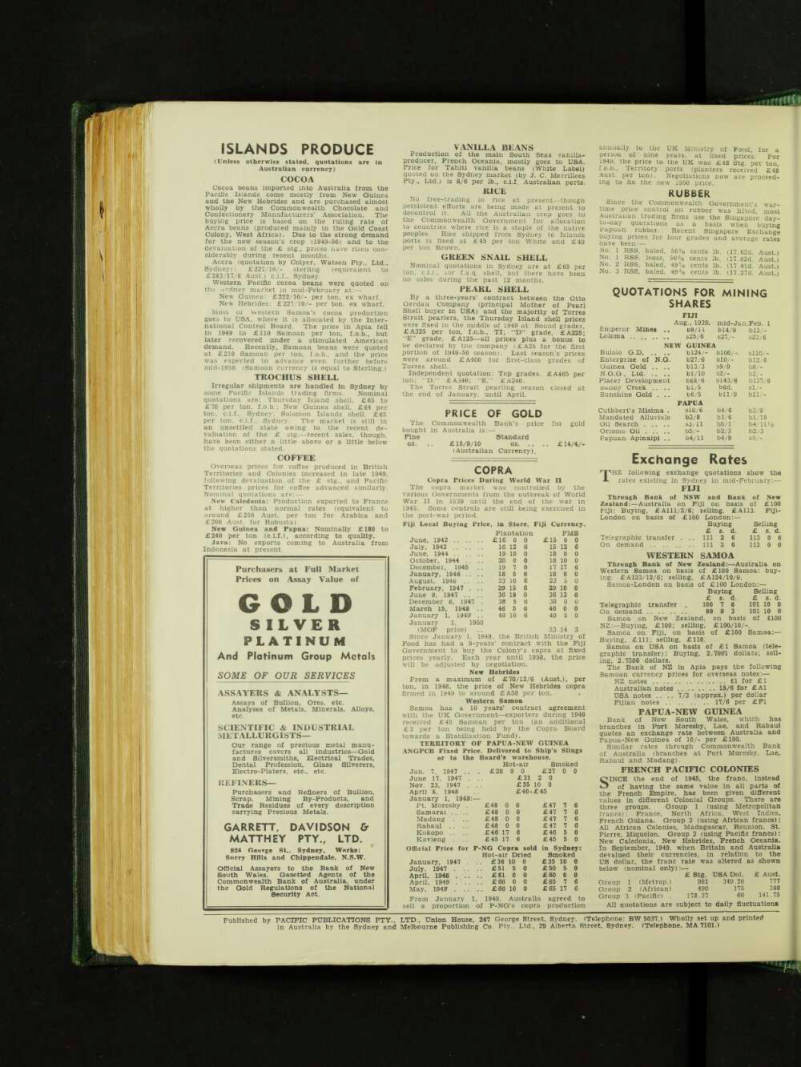
(Unless otherwise stated, quotations are in Australian currency)
Cocoa
Cocoa beans imported into Australia from the Pacific Islands come mostly from New Guinea and the New Hebrides and are purchased almost wholly by the Commonwealth Chocolate and Confectionery Manufacturers’ Association. The buying price is based on the ruling rate of Accra beans (produced mainly in the Gold Coast Colony, West Africa). Due to the strong demand for the new season’s crop (1949-50) and to the devaluation of the £ stg., prices have risen con siderably during recent months.
Accra (quotation by Colyer, Watson Pty., Ltd., Sydney) : £227/10/- sterling (equivalent to £233/17/6 Aust.) c.i.f., Sydney.
Western Pacific cocoa beans were quoted on the oydney market in mid-February at:—- New Guinea: £222/10/- per ton, ex wharf.
New Hebrides: £227/10/- per ton, ex wharf.
Most ox Western Samoa’s cocoa production goes to USA, where it is allocated by the Inter national Control Board. The price in Apia fell in 1949 to £llO Samoan per ton, f.0.b., but later recovered under a stimulated American demand. Recently, Samoan beans were quoted at £2lO Samoan per ton, f.0.b., and the price was expected to advance even further before mid-1950. (Samoan currency is equal to Sterling.)
Trochus Shell
Irregular shipments are handled in Sydney by some Pacific Islands trading firms. Nominal quotations are; Thursday Island shell, £65 to £7O per ton, f.0.b.; New Guinea shell, £64 per ton, c.i.f., Sydney; Solomon Islands shell. £65 per ton, c.i.f., Sydney. The market is still In an unsettled state owing to the recent de valuation of the £ stg.—recent sales, though, have been either a little above or a little below the quotations stated.
Coffee
Overseas prices for coffee produced in British Territories and Colonies increased in late 1949, following devaluation of the £ stg., and Pacific Territories prices for coffee advanced similarly.
Nominal quotations are:— New Caledonia: Production exported to France at higher than normal rates (equivalent to around £250 Aust. per ton for Arabica and £2OO Aust. for Robusta).
New Guinea and Papua: Nominally £lBO to £240 per ton (c.i.f.), according to quality.
Java: No exports coming to Australia from Indonesia at present.
Vanilla Beans
Production of the main South Seas vanilla producer, French Oceania, mostly goes to USA.
Price for Tahiti vanilla beans (White Label) quoted on the Sydney market (by J. C. Merrillees Pty., Ltd.) is 8/6 per lb., c.i.f. Australian ports.
Rice
No free-trading in rice at present—though persistent efforts are being made at present to decontrol it. All the Australian crop goes to the Commonwealth Government for allocation to countries where rice is a staple of the native peoples. Rice shipped from Sydney to Islands ports is fixed at £45 per ton White and £49 per ton Brown.
Green Snail Shell
Nominal quotations in Sydney are at £65 per ton, c.i.f., lor f.a.q. shell, but there have been no sales during the past 12 months.
Pearl Shell
By a three-years’ contract between the Otto Gerdau Company (principal Mother of Pearl Shell buyer in USA) and the majority of Torres Strait pearlers, the Thursday Island shell prices were fixed in the middle of 1949 at: Sound grades, £A325 per ton, f.0.b., TI; “D” grade, £A225; “E” grade, £Al2s—all prices plus a bonus to be declared by tne company (£A2S for the first portion of 1949-50 season). Last season’s prices were around £A4OO for first-class grades of Torres shell.
Independent quotation: Top grades. £A465 per ton; “D,” £ A 340; ’‘E,” £A24O.
The Torres Strait pearling season closed at the end of January, until April.
Shares
Price Of Gold
The Commonwealth Bank’s price for gold bought in Australia is:—
Copra
Copra Prices During World War II The copra market was controlled by the various Governments from the outbreak of World War II in 1939 until the end of the war in 1945. Some controls are still being exercised in the post-war period.
Fiji Local Buying Price, in Store. Fiji Currency.
(MOF price) .. 53 14 3 Since January 1, 1949, the British Ministry of Food has had a 9-years’ contract .with the Fiji Government to buy the Colony’s copra at fixed prices yearly. Each year until 1958, the price will be adjusted by negotiation.
New Hebrides From a maximum of £7O/12/6 (Aust.), per ton, in 1948, the price of New Hebrides copra firmed in 1949 to around £ASB per ton.
Western Samoa Samoa has a 10 years’ contract agreement with the UK Government —exporters during 1949 received £45 Samoan per ton (an additional £3 per ton being held by the Copra Board towards a Stabilisation Fund).
Territory Of Papua-New Guinea
ANGPCB Fixed Price. Delivered to Ship’s Slings or to the Board’s warehouse.
Official Price for P-NG Copra sold in Sydney:
From January 1, 1949, Australia agreed to sell a proportion of P-NG’s copra production
annually to the UK Ministry of Food, for a penoa of nine years, at fixed prices. For 1949, the price to the UK was £48 Stg. per ton, f.o.b., Territory ports (planters received £48 Aust. per ton). Negotiations now are proceed ing to fix the new 1950 price.
Rubber
Since the Commonwealth Government’s war time price control on rubber was lifted, most Australian trading firms use the Singapore day to-day quotations as a basis when buying Papuan rubber. Recent Singapore Exchange buying prices for four grades and average rates have been;— No. 1 RSS, baled, 50% cents lb. (17.62d. Aust.) No. 1 RSS, loose, 50% cents lb. (17.62d. Aust.) No. 2 RSS, baled, 49% cents lb. (17.41d. Aust.) No. 3 RSS, baled, 49% cents lb. (17.27d. Aust.)
Quotations For Mining
Shares
Fine Standard oz. £15/9/10 oz. .. . . £ 14/4/- (Australian Currency).
Plantation
Fms
June, 1942 £16 0 0 £15 0 0 July, 1942 16 12 6 15 12 6 June, 1944 19 10 0 18 0 0 October, 1944 .. .. 20 0 0 18 10 0 December, 1945 19 7 6 17 17 6 January, 1946 .. .. 18 5 6 18 0 0 August, 1946 .. 23 10 6 23 5 0 February, 1947 . .. 29 15 6 29 10 0 June 9, 1947 .. .. 36 19 0 36 13 6 December 8, 1947 . 38 5 6 38 0 0 March 15, 1948 .. 46 5 6 46 0 0 January 1, 1949* ..
January 1, 1950 49 10 6 49 5 0
Hot-air Smoked Jan. 7, 1947 . £28 0 0 £27 0 0 June 17. 1947 . .. £31 2 0 Nov. 23, 1947 ... £35 10 0 April 8. 1948 £40-£45 January 1, 1949:— Pt. Moresby . £48 0 0 £47 7 6 Samarai ... £48 0 0 £47 7 6 Madang . .. £48 0 0 £47 7 6 Rabaul .. .. £48 0 0 £47 7 6 Kokopo .. .. £46 17 6 £46 5 0 Kavieng . .. £45 17 6 £45 5 0
Hot-air Dried Smoked January, 1947 . . . £36 10 0 £35 10 0 July, 1947 . .. . . £51 5 0 £50 5 0 April, 1948 . .. £61 0 0 £60 0 0 April, 1949 . .. £66 0 0 £65 7 6 May, 1949 . .. £66 10 0 £65 17 6
Fiji
Aug., 1939. mid-Jan.Feb. 1 Emperor Mines .. 09/11 bl4/9 013/- Loloma S25/6 s27/~ S23/6
New Guinea
Bulolo G.D bl24/- 0100/sllO/- Enterprise of N.G. b27/6 blO/bl2/6 Guinea Gold .. .. bl3/3 09/9 08/- N.G.G., Ltd bl/10 b2/- 02/- Placer Development 068/6 D143/6 bl37/6 Sanay Creek .. bl/5 b6d. sl/- Sunshine Gold . .. 06/5 bll/9 011/- Cuthbert’s Misima .
Papua
S16/6 b4/6 03/9 Mandated Alluvials b3/8 bl/6 01/10 Oil Search S3/11 b5/l 04/ll 1 / 2 Oriomo Oil 05/b2/3 02/3 Papuan Apinaipi .. 04/11 04/9 s5/-
Exchange Rates
THE following exchange quotations show the rates existing in Sydney in mid-February:—
Fiji
Through Bank of NSW and Bank of New Zealand:—Australia on Fiji on basis of £lOO Fiji: Buying. £Alll/2/6; selling. £AII3. Flji- London on basis of £lOO London: —
Western Samoa
Through Bank of New Zealand:—Australia on Western Samoa on basis of £lOO Samoa: buy ing. £AI23/12/6; selling. £AI24/10/9.
Samoa-London on basis of £lOO London:—
Samoa on Fiji, on basis of £100 Samoa:— Buying, £111; selling, £110.
Samoa on USA on basis of £1 Samoa (tele graphic transfer): Buying, 2.7931 dollars; sell ing, 2.7586 dollars.
The Bank of NZ in Apia pays the following Samoan currency prices for overseas notes: — NZ notes £1 for £1 Australian notes 15/6 for £A1 USA notes .. .. 7/3 (approx.) per dollar Fijian notes 17/6 per £F1
Papua-New Guinea
Bank of New South Wales, which has branches in Port Moresby, Lae, and Rabaul quotes an exchange rate between Australia and Papua-New Guinea of 10/- per £100.
Similar rates through Commonwealth Bank of Australia (branches at Port Moresby, Lae, Rabaul and Madang).
French Pacific Colonies
SINCE the end of 1945, the franc, Instead of having the same value in all parts of the French Empire, has been given different values in different Colonial Groups. There are three groups. Group 1 (using Metropolitan francs): France, North Africa, West Indies, French Guiana. Group 2 (using African francs): All African Colonies, Madagascar, Reunion, St.
Pierre, Miquelon. Group 3 (using Pacific francs); New Caledonia, New Hebrides, French Oceania.
In September, 1949, when Britain and Australia devalued their currencies, in relation to the US dollar, the franc rate was altered as shown below (nominal only):—
All quotations are subject to daily fluctuations
Buying Selling £ s. d. £ s. d.
Telegraphic transfer . .. Ill 2 6 113 0 0 On demand . . Ill 2 6 113 0 0
Buying Selling £ s. d. £ s. d.
Telegraphic transfer . 100 7 6 101 10 0 On demand 99 9 3 101 10 0 Samoa on New Zealand, on basis of £100 NZ: —Buying, £100; selling, £100/10/-
£ Stg.
USA Dol. £ Aust.
Group 1 fMetrop.) 981 349.20 777 Group 2 (African) 490 175 388 Group 3 (Pacific) . 178.37 60 141.75
Advertisements & other items, pp. 110-112 (3 items)
Published by PACIFIC PUBLICATIONS PTY., LTD., Union House, 247 George Street, Sydney. (Telephone: BW 5037.) Wholly setup and printed
in Australia by the Sydney and Melbourne Publishing Co, Pty.. Ltd., 29 Alberta Street. Sydney. (Telephone. MA 7101.)
Gold
Purchasers at Full Market Prices on Assay Value of
SILVER
PLATINUM
And Platinum Group Metals
SOME OF OUR SERVICES
ASSAYERS & ANALYSTS—
Assays of Bullion, Ores, etc.
Analyses of Metals, Minerals, Alloys, etc.
SCIENTIFIC & INDUSTRIAL
METALLURGISTS—
Our range of precious metal manufactures covers all industries—Gold and Silversmiths, Electrical Trades, Dental Profession, Glass Silverers, Electro-Platers, etc., etc.
REFINERS—
Purchasers and Refiners of Bullion, Scrap, Mining By-Products, and Trade Residues of every description carrying Precious Metals.
GARRETT, DAVIDSON &
MATTHEY PTY., LTD.
824 Oenrge St., Sydney. Wnrks; Surry HUIs and Chippendale, N.S.W.
Official Assayers to the Bank of New South Wales. Gazetted Agents of the Commonwealth Bank of Australia, under the Gold Regulations of the National Security Act.
Tooth’S
¥ i ms : St**. v £ *V. 1 ood company deserves the best, and it is a thoughtful and discerning host who serves his guests sparkling K.B. Lager. For “K. 8.” adds enjoyment to any gathering, and it’s one drink that’s appreciated by everybody, men and women alike.
LAGER
* Oot hlVoTim» t £o kb 35 . FF
iIPSIP
MERCHANTS, & SHIP OWNERS
- It 1 ffcs Capital £500,000
ESTABLISHED 1914
GENERAL MERCHANTS
AND
PROVIDORES
TRADE THROUGHOUT THE PACIFIC.
THIRTY-FIVE YEARS OF PACIFIC ISLANDS DEVELOPMENT AND SERVICE.
BUYERS AND EXPORTERS OF ALL KINDS
OF ISLAND PRODUCE, COPRA, COCOA,
M.O.P. SHELL, TROCAS SHELL, ETC.
AGENTS FOR AUSTRALIAN, EUROPEAN
AND AMERICAN MANUFACTURERS.
DISTRIBUTORS OF EVERY DESCRIPTION
OF MERCHANDISE.
Through our Sydney office , branches and agents , we distribute a wide and comprehensive range of general merchandise .
». R. CARPENTER & CO. LID.
Head Office: 16 O'CONNELL STREET, SYDNEY, N.S.W.
Cable Address:
“CAMOHE.”
Telephone: BW 4421.
Postal Address: G.P.0., BOX 168, Sydney.
In London: W. R. Carpenter Cr Co. (London), Ltd., Coronation House, 4 Lloyd's Ave., London, EC
ASSOCIATED COMPANIES THROUGHOUT THE PACIFIC :
IN NEW GUINEA:
New Guinea Company, Limited, Rabaul, Lae, Madang, Kavieng.
IN PAPUA:
J. R. Clay & Co., Ltd., Port Moresby.
IN FIJI:
W. R. Carpenter & Co. (Fiji), Ltd., Suva.