Pacific
Islands
Monthly
September, 1948
Vol. XIX. No. 2.
stablished 1930.
{Registered at the ft# transmission by post as; a newspaper ]
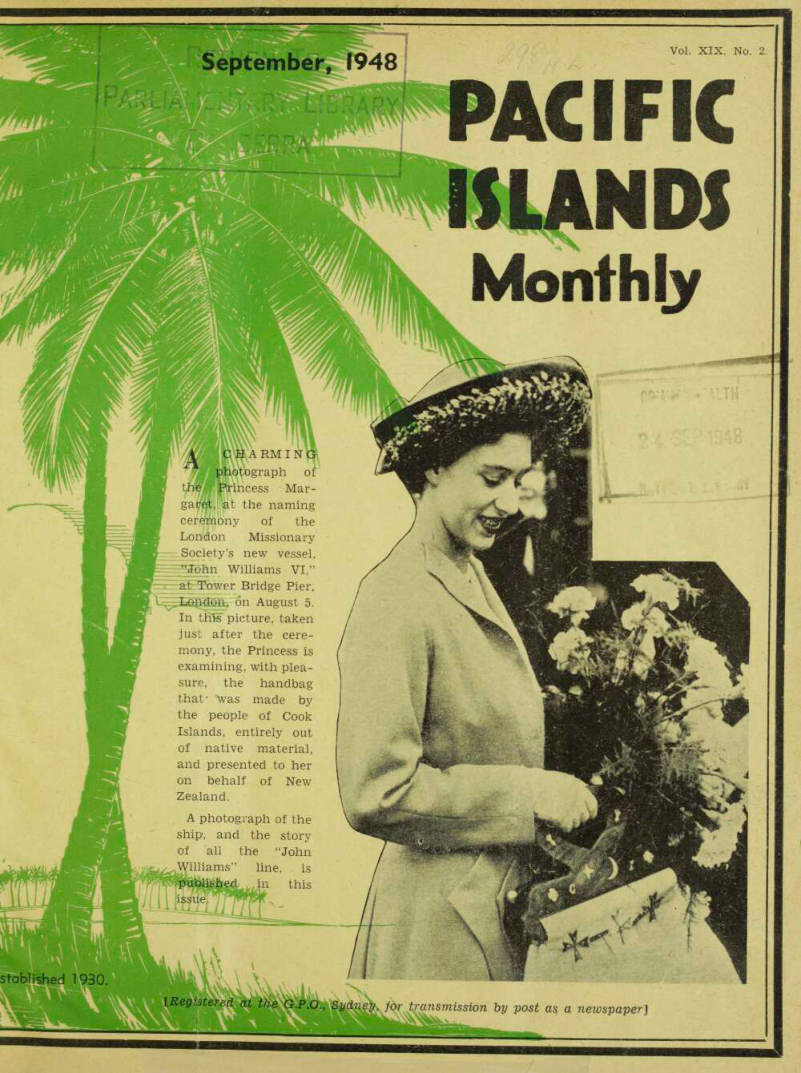
A C H A RM I N G Photograph of
the princess Mar
garet, at the naming
ceremony of the London Missionary Society’s new vessel, "Johh Williams VI,” at Tower Bridge Pier, London, on August 5.
In this picture, taken just after the cere mony, the Princess is examining, with plea sure, the handbag that' was made by the people of Cook Islands, entirely out of native material, and presented to her on behalf of New Zealand.
A photograph of the ship, and the story of all the “John Williams” line, is
Advertisements & other items, pp. 2-4 (1 item)
Qaritab
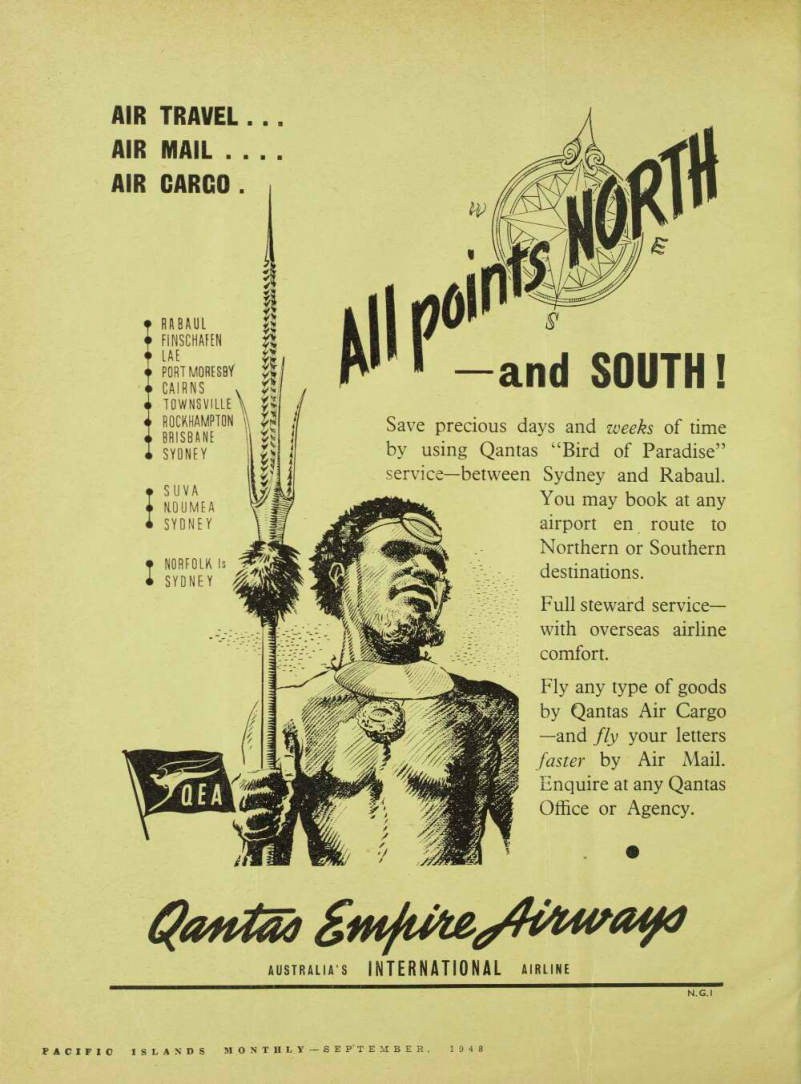
AIR TRAVEL . .
AIR MAIL . . .
AIR CARGO .
8 w n n m /a 6i
RfIBAUL
FINSCHAFEN
LAE
PORT MORESBY
CAIRNS
TOWNSVILLE
ROCKHAMPTON
BRISBANE
SYDNEY
SUVA
N.OUMEA
SYDNEY
NORFOLK. Is
SYDNEY
and SOUTH!
Save precious days and weeks of time
by using Qantas “Bird of Paradise”
service—between Sydney and Rabaul.
You may book at any airport en route to Northern or Southern destinations.
Full steward service— with overseas airline comfort.
Fly any type of goods
by Qantas Air Cargo
—and fly your letters
faster by Air Mail.
Enquire at any Qantas
Office or Agency.
Qaritab
Australia’s INTERNATIONAL airline
N.G.I
vou
I d
CAN DEPEND ON
Any kerosene or petrol stove which bears the name of Coleman is as dependable and efficient as over 40 years’ intensive specialisation can make a product . . . in fact it is the “Best of its kind.”
This two-burner petrol portable stove illustrated at right requires no preheating and has instant heat control—safety shut-off valve makes it unnecessary to repump each time stove is lighted— has removable fuel tank for safe and easy filling.
In ivory and brown baked enamel finish. Weight 16 lbs.
S 3 & N Although only 8| ins. high and 4J ins. wide this pocket stove illustrated below boils a pint Inside 5 minutes.
Made of corrosion-resistant
metal... lights instantly...
needs no priming . . . burns any kind of petrol and cannot spill fuel even when
tipped over.
1 his quick-heating “Speedmaster”
portable stove lights instantly and
can be regulated to any degree of heat. Has odorless windproofburner, rust resisting brass fount of 2 pints, and is unspillable. Boils a pint in 2J minutes. Height 7 ins., width 10J ins., Weight 5 lbs.
A 3 burner kerosene stove finished in glistening white baked enamel with ample cooking top of heavy steel grates. Two-quart fuel tank . . . needle valve asbestos wick. Hot blast cap induces extra oxygen and hastens combustion. Supplied with or without oven.
Representatives for the Pacific Islands:
ROBERT GILLESPIE PTY. LTD.
540 PITT STREET, SYDNEY
PEARCE & CO
SUVA
FOR FIJI ISLANDS
LTD
% 7a 7 /a % 8 I I
Colonial Wholesale Meat G H 71
* « jlj t 1 i 3
BRONTE BRAND:
Chili Con Came Braised Steak and Onions Curried Beef Curried Mutton Steak and Onions Mutton and Peas Irish Stew Beef Steak Pudding Corned Beef Hash Corned Beef Loaf With Cereal Mutton Broth Mulligatawny Soup Tomato Soup Vegetable Soup
From
Australia’s
Finest Fat
Stock ...
From the finest fat stock and the rich-
est vegetables in Australia we produce
these high-grade canned meats and
soups. BRONTE BRAND meats,
hotmeals and soups are deliciously
flavoured and are made from
ONLY meats and vegetables
of the highest quality. . . . ★
THE COLONIAL WHOLESALE MEAT CO.
PTY. LTD.
Canning Factory, State Abattoirs, Homebush Bay, Sydney.
N.S.W.
PHONES:
PHONE: UM 8436.
CABLE ADDRESS:
WOOLMILL. SYDNEY.
i M P 9- *
Advertisers
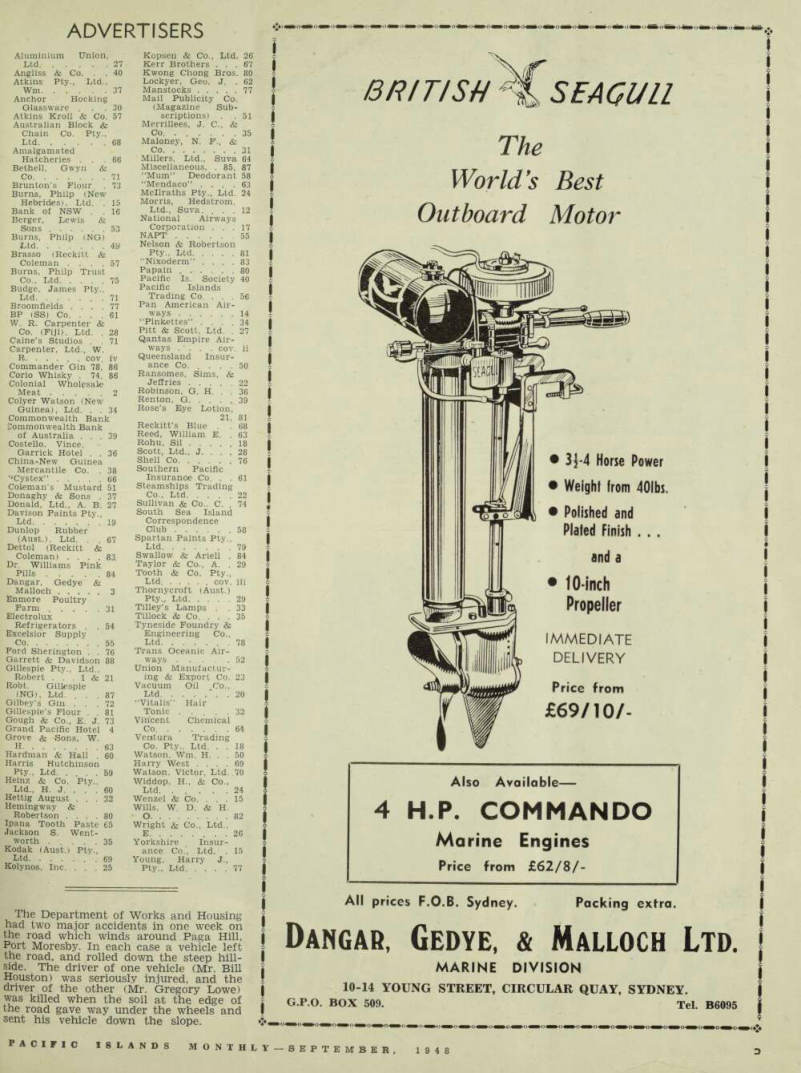
Aluminium Union, Ltd 27 Angliss & Co. . . 40 Atkins Pty., Ltd., Wm 37 Anchor Hocking Glassware ... 30 Atkins Kroll & Co. 57 Australian Block & Chain Co. Pty., Ltd 68 Amalgamated Hatcheries ... 66 Bethell, Gwyn & Co 71 Brunton’s Flour . 73 Burns, Philp (New Hebrides), Ltd. . 15 Bank of NSW . .16 Berger, Lewis & Sons 53 Burns, Philp (NG) Ltd 49 Brasso (Reckitt & Coleman ... 57 Burns, Philp Trust Co.. Ltd 75 Budge, James Pty., Ltd . 71 Broomfields ... 77 BP (SS) Co. . . . 61 W. R. Carpenter & Co. (Fiji), Ltd. . 28 Caine’s Studios . . 71 Carpenter, Ltd., W.
R. . . . . . cov. iv Commander Gin 78, 86 Corio Whisky . 74, 86 Colonial Wholesale Meat 2 Colyer Watson (New Guinea), Ltd. . . 34 Commonwealth Bank Commonwealth Bank of Australia ... 39 Costello, Vince, Garrick Hotel . . 36 China-New Guinea Mercantile Co. . 38 ‘‘Cystex” 66 Coleman’s Mustard 51 Donaghy & Sons . 37 Donald, Ltd., A. B. 27 Davison Paints Pty., Ltd 19 Dunlop Rubber (Aust.). Ltd. . . 67 Dettol (Reckitt & Coleman) . . . . 83.
Dr, Williams Pink Pills 84 Dangar, Gedye & Malloch 3 Enmore Poultry Farm 31 Electrolux Refrigerators . . 54 Excelsior Supply Co 55 Ford Sherington . . 76 Garrett & Davidson 88 Gillespie Pty., Ltd., Robert . . . 1 & 21 Robt. Gillespie (NG), Ltd. ... 87 Gilbey’s Gin ... 72 Gillespie’s Flour . .81 Gough & Co., E. J. 73 Grand Pacific Hotel 4 Grove & Sons, W.
H 63 Hardman & Hall . 60 Harris Hutchinson Pty., Ltd. ... 59 Heinz & Co. Pty., Ltd., H. J. . . . 60 Hettig August ... 32 Hemingway & Robertson ... 80 Ipana Tooth Paste 65 Jackson S. Went worth ... 35 Kodak (Aust.) Pty., Ltd 69 Kolynos, Inc. ... 25
Kopsen & Co., Ltd. 26 Kerr Brothers ... 67 Kwong Chong Bros. 80 Lockyer, Geo. J. . 62 Manstocks 77 Mail Publicity Co. (Magazine Sub scriptions) . . 51 Merrillees, J. C., & Co. 35 Maloney, N. F., & Co 31 Millers, Ltd., Suva 64 Miscellaneous, . 85, 87 “Mum” Deodorant 58 “Mendaco” ... 63 Mcllraths Pty., Ltd. 24 Morris, Hedstrom, Ltd., Suva. ... 12 National Airways Corporation ... 17
Napt 55
Nelson & Robertson Pty., Ltd 81 “Nixoderm” ... 83 Papain 80 Pacific Is. Society 40 Pacific Islands Trading Co. . . . 56 Pan American Air ways 14 “Pinkettes” ... 34 Pitt & Scott, Ltd. . 27 Qantas Empire Air ways ... cov. ii Queensland Insur ance Co. ... 50 Ransomes, Sims, & Jeffries 22 Robinson, G. H. . . 36 Renton, G 39 Rose’s Eye Lotion, 21, 81 Reckitt’s Blue . . 68 Reed, William E. . 63 Rohu, Sil 18 Scott, Ltd., J. ... 28 Shell Co 76 Southern Pacific Insurance Co. . . 61 Steamships Trading Co., Ltd 22 Sullivan & Co., C. . 74 South Sea Island Correspondence Club 58 Spartan Paints Pty., Ltd 79 Swallow & Ariell . 84 Taylor & Co., A. . 29 Tooth & Co. Pty., Ltd. ... cov. iii Thornycroft (Aust.) Pty., Ltd 29 Tilley’s Lamps . . 33 Tillock & Co. . . .35 Tyneside Foundry & Engineering Co., Ltd . 78 Trans Oceanic Air ways 52 Union Manufactur ing & Export Co. 23 Vacuum Oil Co., Ltd ' . .20 “Vitalis” Hair Tonic ... 32 Vincent Chemical Co. 64 Ventura Trading Co. Pty., Ltd. . . 18 Watson, Wm. H. . . 50 Harry West ... 69 Watson, Victor, Ltd. 70 Widdop, H., & CO., Ltd 24 Wenzel & Co. ... 15 Wills, W. D. & H. 0 82 Wright & Co., Ltd., E 26 Yorkshire Insur ance Co., Ltd. . 15 Young, Harry J., Pty., Ltd 77
The Department of Works and Housing had two major accidents in one week on the road which winds around Paga Hill, Port Moresby. In each case a vehicle left the road, and rolled down the steep hill side. The driver of one vehicle (Mr. Bill Houston) was seriously injured, and the driver of the other (Mr. Gregory Lowe) was killed when the soil at the edge of the road gave way under the wheels and sent his vehicle down the slope.
Advertisements & other items, p. 5 (2 items)
3
PACIFIC ISLANDS MONTHLY—S E P T E M B E R , 1948
Dangar, Gedye, & Malloch Ltd.
BRITISH % SEAGULI
The
World’s Best
Outboard Motor
% • 3f 4 Horse Power • Weight from 40lb$. • Polished and Plated Finish . . . and a • 10-inch
Propeller
IMMEDIATE
DELIVERY
Price from £69/10/- Also Available—
-4 H.P. COMMANDO
Marine Engines
Price from £62/8/- All prices F. 0.8. Sydney. Packing extra.
Dangar, Gedye, & Malloch Ltd.
MARINE DIVISION
10-14 YOUNG STREET, CIRCULAR QUAY, SYDNEY.
G.P.O. BOX 509. Tel. 86095
In This Issue:
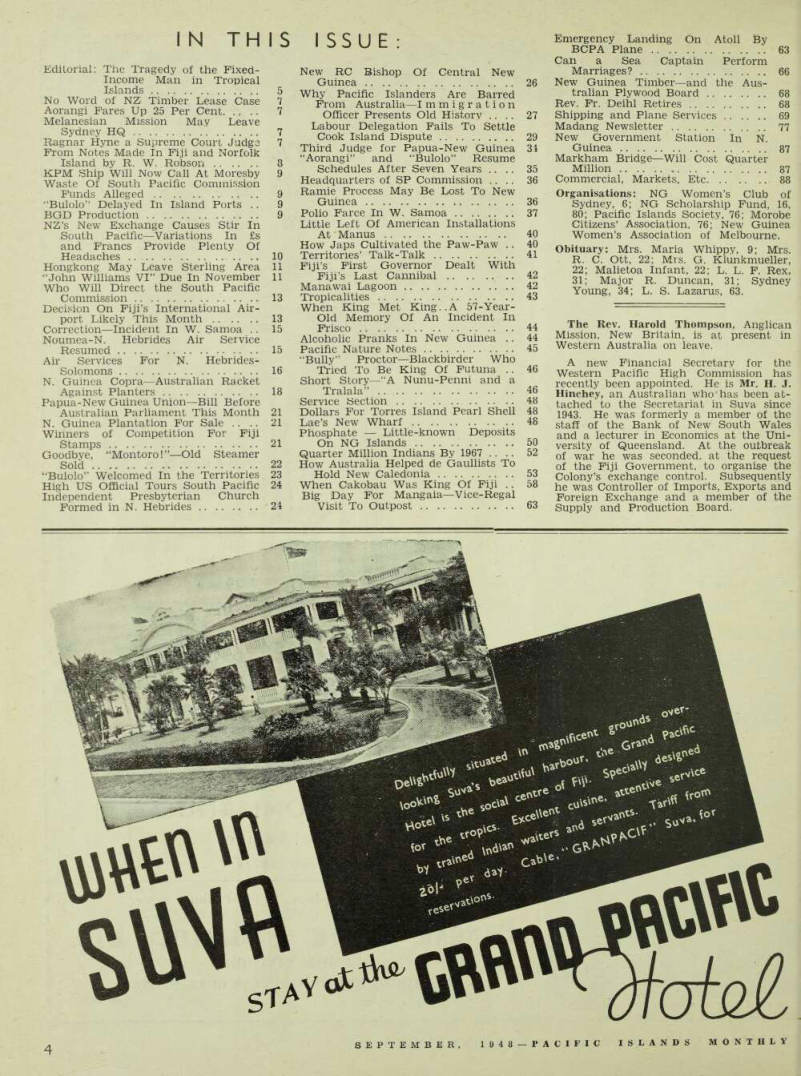
Editorial: The Tragedy of the Fixed- Income Man in Tropical Islands 5 No Word of NZ Timber Lease Case 7 Aorangi Fares Up 25 Per Cent 7 Melanesian Mission May Leave Sydney HQ 7 Ragnar Hyne a Supreme Court Judge 7 From Notes Made In Fiji and Norfolk Island by R. W. Robson 8 KPM Ship Will Now Call At Moresby 9 Waste Of South Pacific Commission Funds Alleged 9 “Bulolo” Delayed In Island Ports .. 9 BGD Production 9 NZ’s New Exchange Causes Stir In South Pacific —Variations In £s and Francs Provide Plenty Of Headaches 10 Hongkong May Leave Sterling Area 11 “John Williams VI” Due In November 11 Who Will Direct the South Pacific Commission 13 Decision On Fiji’s International Air port Likely This Month 13 Correction —Incident In W. Samoa .. 15 Noumea-N. Hebrides Air Service Resumed 15 Air Services For N. Hebrides- Solomons 16 N. Guinea Copra—Australian Racket Against Planters 18 Papua-New Guinea Union —Bill Before Australian Parliament This Month 21 N. Guinea Plantation For Sale .. .. 21 Winners of Competition For Fiji Stamps 21 Goodbye, “Montoro!” —Old Steamer Sold 22 “Bulolo” Welcomed In the Territories 23 High US Official Tours South Pacific 24 Independent Presbyterian Church Formed in N. Hebrides 24
New RC Bishop Of Central New Guinea 26 Why Pacific Islanders Are Barred From Australia —I mmig ration Officer Presents Old History ... 27 Labour Delegation Fails To Settle Cook Island Dispute 29 Third Judge for Papua-New Guinea 34 “Aorangi” and “Bulolo” Resume Schedules After Seven Years ... 35 Headquarters of SP Commission ... 36 Ramie Process May Be Lost To New Guinea 36 Polio Farce In W. Samoa 37 Little Left Of American Installations At Manus 40 How Japs Cultivated the Paw-Paw .. 40 Territories’ Talk-Talk 41 Fiji’s First Governor Dealt With Fiji’s Last Cannibal 42 Manawai Lagoon 42
Tropicalities 43
When King Met King..A 57-Year- Old Memory Of An Incident In Frisco 44 Alcoholic Pranks In New Guinea .. 44 Pacific Nature Notes 45 “Bully” Proctor —Blackbirder Who Tried To Be King Of Futuna .. 46 Short Story—“A Nunu-Penni and a Tralala” 46 Service Section 48 Dollars For Torres Island Pearl Shell 48 Lae’s New Wharf 48 Phosphate Little-known Deposits On NG Islands 50 Quarter Million Indians By 1967 ... 52 How Australia Helped de Gaullists To Hold New Caledonia 53 When Cakobau Was King Of Fiji .. 58 Big Day For Mangaia—Vice-Regal Visit To Outpost 63
Emergency Landing On Atoll By BCPA Plane 63 Can a Sea Captain Perform Marriages? 66 New Guinea Timber —and the Aus tralian Plywood Board 68 Rev. Fr. Deihl Retires 68 Shipping and Plane Services 69 Madang Newsletter 77 New Government Station In N.
Guinea 87 Markham Bridge—Will Cost Quarter Million 87 Commercial, Markets, Etc 88 Organisations: NG Women’s Club of Sydney, 6; NG Scholarship Fund, 16, 80; Pacific Islands Society, 76; Morobe Citizens’ Association, 76; New Guinea Women’s Association of Melbourne.
Obituary: Mrs. Maria Whippy, 9; Mrs.
R. C. Ott, 22; Mrs. G. Klunkmueller, 22; Malietoa Infant, 22; L. L. F. Rex, 31; Major R. Duncan, 31; Sydney Young, 34; L. S. Lazarus, 63.
The Rev. Harold Thompson, Anglican Mission, New Britain, is at present in Western Australia on leave.
A new Financial Secretary for the Western Pacific High Commission has recently been appointed. He is Mr. H. J.
Hinchey, an Australian who* has been at tached to the Secretariat in Suva since 1943. He was formerly a member of the staff of the Bank of New South Wales and a lecturer in Economics at the Uni versity of Queensland. At the outbreak of war he was seconded, at the request of the Fiji Government, to organise the Colony’s exchange control. Subsequently he was Controller of Imports, Exports and Foreign Exchange and a member of the Supply and Production Board.
Advertisements & other items, p. 6 (1 item)
sT aV
■M
M •»““ A ?^' C se .r - v^° ur ’ , s .., S P d^ce ce ntre ° ( f ' V he tr ° P ' CV •« frort'
-Var^
i s er' ,at ' tS „ ~»•-'■■ *"
'“ d ” „.. »<•>' c^ 6, r 6*l- -
Pacific Islands Monthly
The Newspaper-Magazine of the South Seas I Registered at the G.P.0., Sydney, for transmission hy post as a newsp.aper\
Published Once Each Month and Circulated in Australia and New Zealand and in the following Pacific Territories and Islands Groups:
Australian Territory of Papua.
Trustee Territory (Australia) of New Guinea.
Australian Territory of Norfolk Island.
New Zealand Territory of Cook Islands.
Trustee Territory (NZ) of Western Samoa.
British Colony of Fiji.
British Solomon Islands Protectorate.
British Protectorate of Tongan Islands.
British Crown Colony of Gilbert and Ellice Islands.
Trustee Territory of Nauru.
British and French Condominium of New Hebrides.
French Colony of New Caledonia.
French Colony of Oceania (Tahiti, etc.).
American Territory of Eastern Samoa.
American Territory of Hawaiian Islands.
Owned and Produced by Pacific Publications PtyLtd., Union House, 247 George Street, Sydney.
Telephone: General Office and Advertising, BW 5037.
P.O. Box 3408
Registered Address for Telegrams, Radiograms, and Cables: “Pacpub,” Sydney.
Contributions.
Articles, Stories, and Photographs dealing with Pacific Islahds subjects are invited and will be paid for on publication.
Subscription Rates.
Per Annum, Pre-paid, Including Postage.
In Australia, New Zealand, Fiji, New Guinea, Papua, Western Samoa, Cook Islands, Tonga, British Solomons, Gil bert and Ellice Colony, Nauru, and United Kingdom 15 o Elsewhere $3 18 0 Single Copies 1 g
Editor and Publisher:
R. W. Robson, F.R.G.S.
Assistant Editor: JUDY TUDOR.
General Office: Union House, 247 George Street, Sydney. Telephone: BW 5037.
Advertising Manager: W. E. Rogers.
Representative In London.
J. T. Wallis, Coronation House, 4 Lloyds Avenue, London, E.C.3, from whom may be obtained copies of Pacific Islands Monthly.
Pacific Is. Year Book, advertising schedules, etc.
Representative In U.S.A.
Pacific Islands Trading Co.,
244 California St., San Francisco. U.S.A
Agents.
The following are authorised to receive sub scriptions for Pacific Islands Monthly:— Burns, Phllp & Co., Ltd,, and Burns Phllp (South Sea) Co., Ltd. All branches.
W. R. Carpenter & Co., Ltd. All branches.
Morris, Hedstrom, Ltd. All branches.
Steamships Trading Co., Papua. All branches.
W. M. Caldwell, Suva, FIJI.
Cook Islands Trading Co., Rarotonga, Cook Is.
Oscar Nordman, Papeete, Tahiti.
Islands Branches and Representatives of W. H.
Grove & Sons, Ltd., Auckland, New Zealand.
Ed. Pentecost, Noumea, New Caledonia.
Societe Gubbay Kerr et Cle, Noumea, New Caledonia.
Vol. Xix. No. 2.
September, 1948
( 1/6 Per Copy Price Prepaid, p.a.: 15/- Aus. ( In USA, p.a.: $3.
The Tragedy of the Fixed-Income
Man in the Tropical Islands
FIJI’S merchants have been de manding—with much reason— that their £ shall be taken to parity with British and New Zealand cur rencies. Australia’s bemused Socialist economists, while keeping the - Aus tralian £ devalued, for the sake of the pampered Australian trade union ist, allows the tide of rising over seas costs to find its own level in Australia’s Pacific Territories. There are currency adjustments going on in nearly every country in the Pacific.
How many of these Red rulers and rich merchants who are pushing the £ around, for their own purposes, have given a thought to the men who are uncomplainingly taking a bitter economic hiding—the men who are expected to maintain a decent status on a fixed income—the responsible officials in the various administra tions, and the high executives or pro fessional men in the big trading con cerns?
These are the men who keep, run ning smoothly in every Pacific Terri tory, the wheels of government, of trade and commerce, of banking and transportation. In proportion to population and trade turn-over, there are more of these men, and their welfare is of relatively greater im portance, than similar men in coun tries like Australia or Britain.
TN 1939-40, before the Pacific War, the salaries of officials and execu
fives in the Territories were calculated to give them freedom from financial worry, and means to (a) maintain a proper standard of living in their tropical homes, (b) provide funds for their periods of furlough, (c) send their children away to temperate countries for education and (d) make adequate provision for sickness, accident and old age. No man can give efficient service if he is worried by conditions, beyond his control, which affect the welfare of himself and his family. If these men have private worries, conditions in the Territories generally must suffer.
Since 1939-40, the costs of living in the Territories have moved upwards so rapidly that they have completely out-paced all the attempts of govern ments, companies and private firms to keep pace with them. To-day, in all the Territories, without exception, important executives on salaries re garded ten years ago as adequate and suitable, are harassed and desperately anxious—and their condition is get ting worse.
Our private information indicates that this is a more serious problem than is realised even by Governors, and Administrators, and Managing Directors, in seemingly close touch with the situation. Few men—and not men of the status of trusted executives—like to go “crying poor mouth” to their chiefs. Yet, to-day,
such men are reducing their personal servants, throwing unsuitable duties upon their wives, cancelling or short ening their leave, reducing their per sonal expenditure on clothes and equipment, seeking desperate alterna tives to cold-country schools for their children—all because their salaries will no longer take care of the ever mounting costs of food, house equip ment, domestic service, transporta tion and education.
Goyernors and Administrators are handicapped, too, because they must pass on their recommendations for higher salaries to Ministers in Lon don, Canberra and Wellington and Paris, who are usually ignorant or intolerant of Islands conditions.
Similarly, commercial and profes sional salaries in the Islands are more often than not controlled by a Board of Directors in non-tropical countries who do not appreciate the vital importance of seeing that their executives in the tropics maintain their proper standards of living and their correct social status.
If those standards break, we might as well give away our important in terests in the South Pacific Islands.
DIRECTORATES and Governments responsible for maintaining executives in the tropical Islands have generally failed seriously in the past two or three years in recognising their obligation to take care of the men who are doing the job for them.
This is no idle statement. There is a great deal of distress among im portant men on fixed salaries to-day in all Islands Territories, without ex ception; and it is getting worse.
There has been no deliberate re fusal by Governments or Companies to see their responsibilities. It is just that the men who howl the loudest, in this time of great economic crisis and change and turmoil, are the men who receive attention first; and the men who carry the burden of execu tive control, the educated and trained men with a sense of obligation and loyalty, are the last men to howl.
The tragedy exists in every Pacific Territory to-day. It is getting worse.
It demands the urgent attention of the top men in London and Paris, Canberra and Wellington. Let us re peat that, if there is one class of men, above all others, who should be freed from private worry, it is the execu tive, no matter how modest his rank, who is loyally doing his job in the Islands. He is the bulwark of the system which the Red wreckers are so eager to destroy.
Proposed
Fixed Copra Price
British Offer To Fiji
SUVA, Sept. 6.
THERE has been a great deal of dis cussion here in recent weeks con cerning the future guaranteed price of copra. A new offer has now been made by the British Ministry of Food.
The Ministry offers a choice between two contracts, each covering the entire exportable surplus of coconut products from Fiji and the Western Pacific High Commission territories.
The first is for three years, 1949-51.
The price for 1949 would be £5l sterling per ton (£S6A). Prices for 1950 and 1951 would be not less than £43 sterling; but the price for 1950 would be negotiated before the end of 1949. and that for 1951 before the end of 1950.
The second is for nine years, 1949-57, starting at £4B sterling (£52/10/-A). The price in each succeeding year would be negotiated in the preceding year, but it would not vary by more than 10 per cent, up or down from the price in the pre ceding year.
The producers’ replies to this offer are now awaited.
Labour Relations Officers
IT was disclosed in a statement in the House of Commons lately that so called “Labour Relations Officers” have been selected in Britain from the ranks of deserving trade unionists, and sent out to various British Colonial Gov ernments, to deal with labour matters.
The names of 17 such officials were given, and they have been distributed throughout the African colonies, South east Asia and West Indies. The nature of their duties was not made clear.
Twenty years ago, they would have been described, probably, simply as “agitators.”
Now, they are Government officials, and are paid by the British taxpayers to “deal with labour problems.”
The published record shows that Mr. M.
E. Hollister-Short, who was a member of the Transport and General Workers Union, was appointed to Fiji, as Labour Relations Officer.
Pre-School Play Centre
Assisted by the rssaila (which made funds, rooms and ground available), a Port Moresby Committee has established, as from September 7, a “Pre-School Play Centre For Young
Children”—not a “Baby Minding Centre,” as previously, and erroneously described.
Under the sympathetic chairmanship of Mrs. J. K. Murray, a meeting appointed the following committee to run the Centre: Chairman, Mrs. F. Vidgen; committee, Mrs. J. Lyons, Mrs. B. Kirke, Mrs. M.
Creed, Mrs. J. Woods; hon. treasurer, Mrs. K. Gray; hon. secretary, Mrs. A. Y. G.
Price. It is hoped that this will be the beginning of a kindergarten, with a full time trained kindergartener in charge.
NG Women’s Club of Sydney
A “SHOWER TEA” was given by the New Guinea Women’s Club of Syd ney on August 19, to Miss Pat Malone. Miss Malone has now gone on to Rabaul, where she will marry Mr. John Clark, son of Mrs. Clark, of Beverley Hills, and the late Mr. L. Clark, well-known Territorian.
A card party will be held in the club rooms, 77 King Street, on Friday, October 15, at 8 p.m.
The president of the Club. Mrs. N. H.
Foxcroft, is at present on holiday in Mel bourne.
Notes From Daru
I SPENT a few days in Port Moresby recently and I was impressed by the remarkable number of Civil Ad ministration vehicles of all types on the roads.
I passed through Hanuabada “village” on one occasion, and I have never before seen such a remarkable collection of shacks. Most of the houses are built of corrugated roofing-iron, with low roofs, and they are scattered higgledy-piggledy, on both sides of the main road. Hygiene in this “village,” which is less than one mile from Government House, is deplor able.
Mrs. W. Giles, wife of Daru’s ADO, proceeded South towards the end of last month, accompanied by her small son.
Mr. G. Radford is now in charge of the Native Hospital. He was in the Medical service pre-war and will be an asset to the District.
Apia Radio Now Part Of
Samoan Life
From Our Own Correspondent APIA, August 11.
Broadcasting has become very popular in Samoa and the Samoans not only are eager listeners to the broadcasts of the Apia Broadcasting Station (2 AP) on four evenings a week, but the many bands, schools, choirs and soloists are ardent contributors to the programme of the station.
Under the management of Mr. E. E.
Lloyd, and his assistant, Mr. E. Stehlin, the station has rapidly become popular.
Each Saturday evening there is a broad cast by the High Commissioner; on Mon day the two Fautua give broadcasts in Samoan; there are also occasional broad casts by the Chief Medical Officer, by Nursing Sisters, by Samoan Native Medical Practitioners and by Samoan Faipule and Legislative Councillors. Morn ing sessions cover educational broadcasts in Samoan by Samoan teachers. On Sunday evenings church services are broadcast.
The broadcasting scheme has quickly become a popular public institution in Western Samoa and is performing a useful and increasingly valuable service by bringing the people in the outside districts of Upolu and Savaii into touch with Apia, and bringing the Samoan and European population into touch with the outside world.
W. Samoa’S Premier Footballers
This team, the Marist Seniors, has held the Morris Hedstrom Shield in Western Samoa for three years against all-comers. They are:— BACK ROW (left to right): E. Crawley (F), A. Penn (F), S. Strickland (F), V. Pereira (Full Back). J. Williams (F).
MIDDLE ROW: Segio Stowers (Wing Three-quarter), Ovalau Bureta (First Five-eight), Sefo Lepou (F), Kapisi (F), Kapasu Laulu (F), J. Stowers (F), SITTING: Fuli (F), Brother Dennis (Coach), Mulinuu (Capt., Second five-eight), J. Ah Ruon (Coach and Captain of the club), Kautane (F).
FRONT BOW: W. Hall (Half back), V. Slade (Wing Three-quarter).
ABSENTEES: H. Ah Kuoi (F), T. Ah Kuoi (Centre Three-quarter).
No Word Recently of Timber Case Hearing
Timber Case Hearing
THERE has been no further announce ment regarding the New Guinea “timber lease case,” which was to have come on for trial in Sydney in late July, and the hearing of which was post poned owing to the serious illness of Farrell, one of the accused.
As the matter is connected with the administration of Papua-New Guinea by Mr. E. J. Ward (Australian Minister for External Territories) there is keen public interest in the case, both in Australia and the Pacific Islands, There has been no indication of when Mr. Ward will make his frequently-post poned visit to the Territories. He has been there only once. The secretary of his Department (Mr. J. R. Halligan) is there at the present time.
Aorangi Fares Are Raised
25 Per Cent
IT was announced on September 9, that fares on the Canadian Pacific liner Aorangi will be raised 25 per cent, in Australian currency.
Fares will now be: Sydney-Auckland, £A2B/2/6; Sydney-Suva, £AS3/2 6; Syd ney-Vancouver, £173/8/9. This is for first class accommodation. Cabin and third class passengers are also carried.
The Auckland-Suva fare is £NZ2O.
The increase in fares is due. according to the Sydney office of Union Company, to the fact that they are calculated on the Canadian dollar, which is rated at $3.20 to the Australian £. It is stated that it is only indirectly due to the fact that New Zealand currency has been re valued.
Fares from New Zealand on the “Aorangi” have remained unchanged although NZ currency is, in terms of dollars, now 25 per cent, more valuable than it was. Some critics have pointed out that the same Canadian dollar ad justments could have been made if fares in New Zealand currency were re duced by 25 per cent.; and fares in Aus tralian currency allowed to remain as they were.
In Australian currency, it now costs less to travel by air than by the “Aorangi” between Sydney and Suva.
Suva Welcomes Aorangi
From Our Own Correspondent SUVA. August 30. were flying, the band of the 1 FMF was playing, the crowd was waiting, and the factory sirens were hooting when the liner Aorangi, from Sydney and Auckland, arrived at Suva at 7 a.m. on August 28.
Main attraction for the passengers was a hibiscus show staged by women men bers of the Holy Trinity Pro-Cathedral congregation. The arrangement of the display, which included waterlilies, frangi °ingerettas, gerberas, crotons, etc., as well as hibiscus of every variety and shade, equalled the famous Suva shows of pre-war days.
An enormous crowd fare,,the ship at 5 p.m. when she sailed for M. • For some curiously emotional reason/ this return of the British Red Ensign to the Pacific service brought forth Suva’s most demonstrative outburst of patriot ism since the war.
Melanesian Mission Office
May Leave Sydney
THE office of the Melanesian Mission, which has been established in Syd ney for very many years, is being transferred to Auckland, NZ, and the Gen eral Secretary, Major H. S. Robinson, and his assistants, have been busy packing up, preparatory to removal in October.
The Melanesian Mission which operates only in the British Solomon Islands, is maintained generally by the Anglican community and is controlled directly by the Anglican Church in New Zealand.
Under the proposed new arrangements, Auckland becomes the headquarters port of the Mission’s vessel, “Southern Cross,” and presumably the BSI Mission stations will look primarily to NZ for supplies. In these circumstances the continued main tenance of any office in Sydney would not be justified. However, owing to the unexpected alteration in NZ exchange making goods bought in Australia 25% cheaper than in NZ, it is possible that the proposed rearrangement may be cancelled, or postponed for a while.
Merchants and shipping agents in the vicinity of Bridge Street, Sydney, would miss Major Robinson, whose cheery figure has been well known and popular among them for many years.
Earthquake
Report Of A Violent
REPORTS from several points on September 9 indicated the occur rence of a violent earthquake at a point in the South Pacific somewhere be tween Fiji, Samoa, Tonga and Cook Islands.
On September 10, there was a report of tidal waves in that region.
Ragnar Hyne Now a Supreme
Court Judge
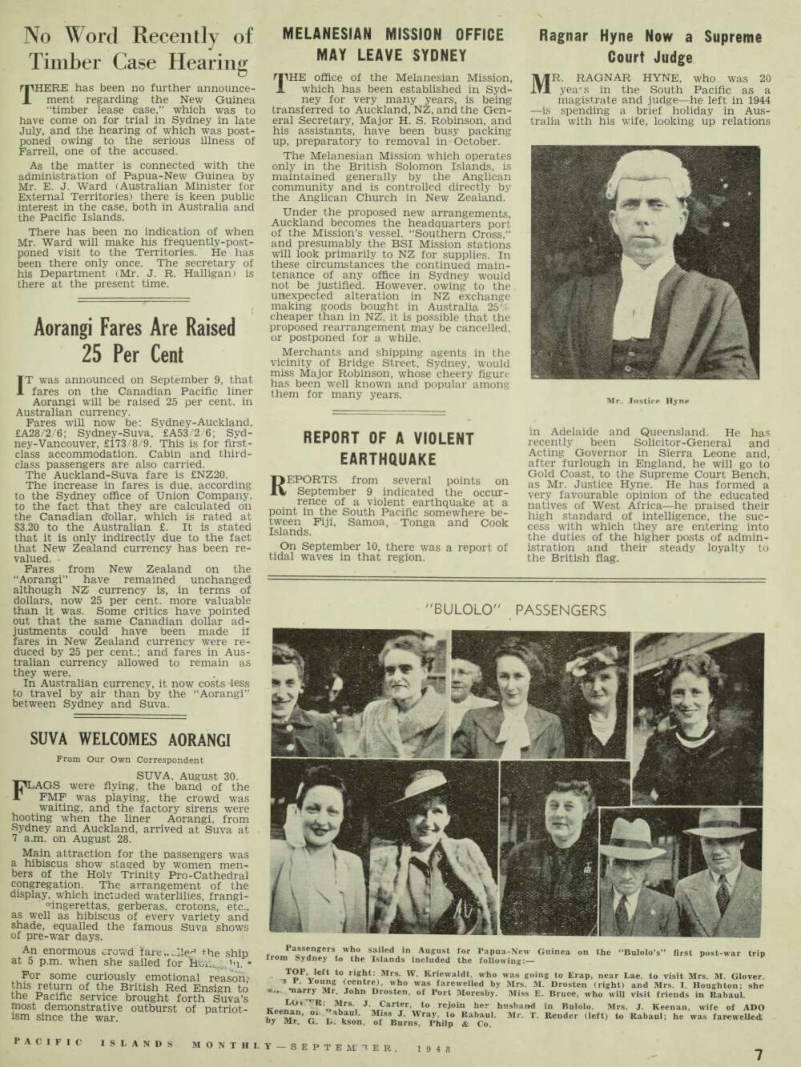
MR. RAGNAR HYNE, who was 20 in the South Pacific as a magistrate and judge—he left in 1944 —is spending a brief holiday in Aus tralia with his wife, looking up relations
in Adelaide and Queensland. He has recently been Solicitor-General and Acting Governor in Sierra Leone and, after furlough in England, he will go to Gold Coast, to the Supreme Court Bench, as Mr. Justice Hyne. He has formed a very favourable opinion of the educated natives of West Africa—he praised their high standard of intelligence, the suc cess with which they are entering into the duties of the higher posts of admin istration and their steady loyalty to the British flag.
Mr. Justice Hyne
"Bulolo" Passengers
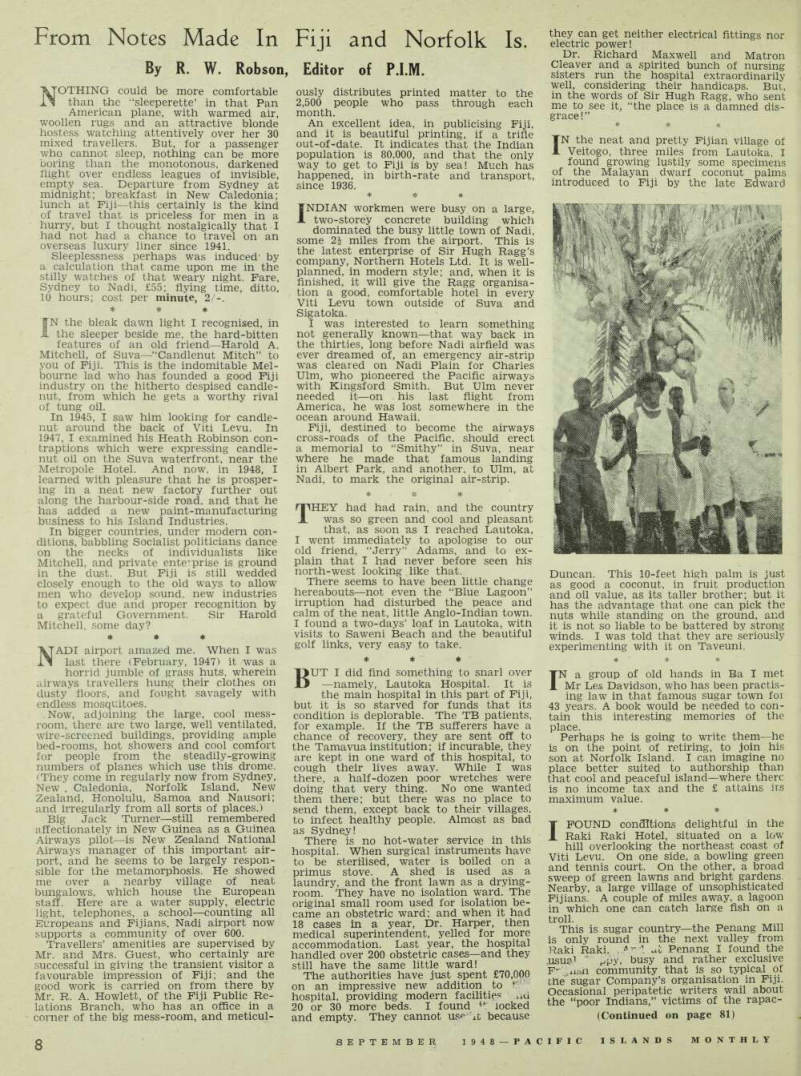
Passengers who sailed in August for Papua-New Guinea on the “Bulolo’s” first post-war trip from Sydney to the Islands included the following:— T D P, left to riffht: Mrs . w . Kriewaldt, who was going to Erap, near Lae, to visit Mrs. M. Glover. [?] P. Young ( centre ) , who was f arewelled by Mrs. M. Drosten (right) and Mrs. I. Houghton; she marry Mr. John Drosten, of Port Moresby. Miss E. Bruce, who will visit friends in Rabaul. [?] Mrs. J. C arter, to rejoin her husband in Bulolo. Mrs, J. Keenan, wife of ADO Keenan, [?] Miss J. Wray, to Rabaul. Mr. T. Render (left) to Rabaul; he was farewelled by Mr. G. [?], of Burns, Philp & Co
From Notes Made In Fiji and Norfolk Is.
By R. W. Robson, Editor of P.I.M.
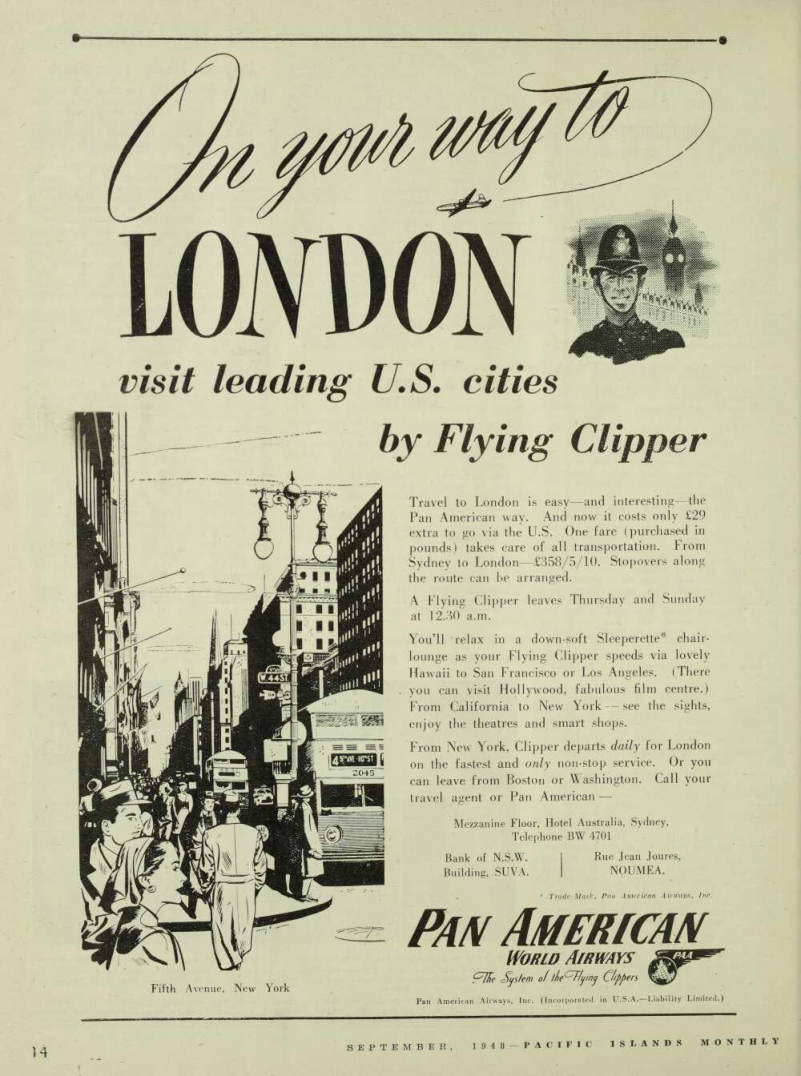
NOTHING could be more comfortable than the “sleeperette’ in that Pan American plane, with warmed air, woollen rugs and an attractive blonde hostess watching attentively over her 30 mixed travellers. But, for a passenger who cannot sleep, nothing can be more boring than the monotonous, darkened flight over endless leagues of Invisible, empty sea. Departure from Sydney at midnight; breakfast in New Caledonia; lunch at Fiji—this certainly is the kind of travel that is priceless for men in a hurry, but I thought nostalgically that I had not had a chance to travel on an overseas luxury liner since 1941.
Sleeplessness perhaps was induced - by a calculation that came upon me in the stilly watches of that weary night. Fare, Sydney to Nadi, £55; flying time, ditto. 10 hours; cost per minute, 2/-. ♦ * * IN the bleak dawn light I recognised, in the sleeper beside me, the hard-bitten features of an old friend—Harold A.
Mitchell, of Suva—“Candlenut Mitch” to you of Fiji. This is the indomitable Mel bourne lad who has founded a good Fiji industry on the hitherto despised candle nut, from which he gets a worthy rival of tung oil.
In 1945, I saw him looking for candle nut around the back of Viti Levu. In 1947, I examined his Heath Robinson con traptions which were expressing candle nut oil on the Suva waterfront, near the Metropole Hotel. And now. in 1948, I learned with pleasure that he is prosper ing in a neat new factory further out along the harbour-side road, and that he has added a new paint-manufacturing business to his Island Industries, In bigger countries, under modern con ditions, babbling Socialist politicians dance on the necks of individualists like Mitchell, and private enterprise is ground in the dust. But Fiji is still wedded closely enough to the old ways to allow men who develop sound, new industries to expect due and proper recognition by a grateful Government. Sir Harold Mitchell, some day? ♦ * * NADI airport amazed me. When I was last there (February, it was a horrid jumble of grass huts, wherein airways travellers hung their clothes on dusty floors, and fought savagely with endless mosquitoes.
Now, adjoining the large, cool mess room, there are two large, well ventilated, wire-screened buildings, providing ample bed-rooms, hot showers and cool comfort for people from the steadily-growing numbers of planes which use this drome. <They come in regularly now from Sydney, New . Caledonia, Norfolk Island, New Zealand, Honolulu, Samoa and Nausori; and irregularly from all sorts of places.) Big Jack Turner—still remembered affectionately in New Guinea as a Guinea Airways pilot—is New Zealand National Airways manager of this important air port, and he seems to be largely respon sible for the metamorphosis. He showed me over a nearby village of neat bungalows, which house the European staff. Here are a water supply, electric light, telephones, a school —counting all Europeans and Fijians, Nadi airport now supports a community of over 600.
Travellers’ amenities are supervised by Mr. and Mrs. Guest, who certainly are successful in giving the transient visitor a favourable impression of Fiji; and the good work is carried on from there by Mr. R. A, Hewlett, of the Fiji Public Re lations Branch, who has an office in a corner of the big mess-room, and meticul
ously distributes printed matter to the 2,500 people who pass through each month.
An excellent idea, in publicising Fiji, and it is beautiful printing, if a trifle out-of-date. It indicates that the Indian population is 80,000, and that the only way to get to Fiji is by sea! Much has happened, in birth-rate and transport, since 1936.
H* H* H*
INDIAN workmen were busy on a large, two-storey concrete building which dominated the busy little town of Nadi, some 21 miles from the airport. This is the latest enterprise of Sir Hugh Ragg’s company, Northern Hotels Ltd. It is well planned, in modern style; and, when it is finished, it will give the Ragg organisa tion a good, comfortable hotel in every Viti Levu town outside of Suva and Sigatoka.
I was interested to learn something not generally known —that way back in the thirties, long before Nadi airfield was ever dreamed of, an emergency air-strip was cleared on Nadi Plain for Charles Ulm, who pioneered the Pacific airways with Kingsford Smith. But Ulm never needed it —on his last flight from America, he was lost somewhere in the ocean around Hawaii.
Fiji, destined to become the airways cross-roads of the Pacific, should erect a memorial to “Smithy” in Suva, near where he made that famous landing in Albert Park, and another, to Ulm, at Nadi, to mark the original air-strip. ♦ * * THEY had had rain, and the country was so green and cool and pleasant that, as soon as I reached Lautoka, I went immediately to apologise to our old friend, “Jerry” Adams, and to ex plain that I had never before seen his north-west looking like that.
There seems to have been little change hereabouts —not even the “Blue Lagoon” irruption had disturbed the peace and calm of the neat, little Anglo-Indian town, I found a two-days’ loaf in Lautoka, with visits to Saweni Beach and the beautiful golf links, very easy to take. ♦ ♦ ♦ BUT I did find something to snarl over —namely, Lautoka Hospital. It is the main hospital in this part of Fiji, but it is so starved for funds that its condition is deplorable. The TB patients, for example. If the TB sufferers have a chance of recovery, they are sent off to the Tamavua institution; if incurable, they are kept in one ward of this hospital, to cough their lives away. While I was there, a half-dozen poor wretches were doing that very thing. No one wanted them there; but there was no place to send them, except back to their villages, to infect healthy people. Almost as bad as Sydney!
There is no hot-water service in this hospital. When surgical instruments have to be sterilised, water is boiled on a primus stove. A shed is used as a laundry, and the front lawn as a drying room. They have no isolation ward. The original small room used for isolation be came an obstetric ward: and when it had 18 cases in a year, Dr. Harper, then medical superintendent, yelled for more accommodation. Last year, the hospital handled over 200 obstetric cases —and they still have the same little ward!
The authorities have just spent £70,000 on an impressive new addition to f hospital, nroviding modern facilities nd 20 or 30 more beds. I found locked and empty. They cannot it because
they can get neither electrical fittings nor electric power!
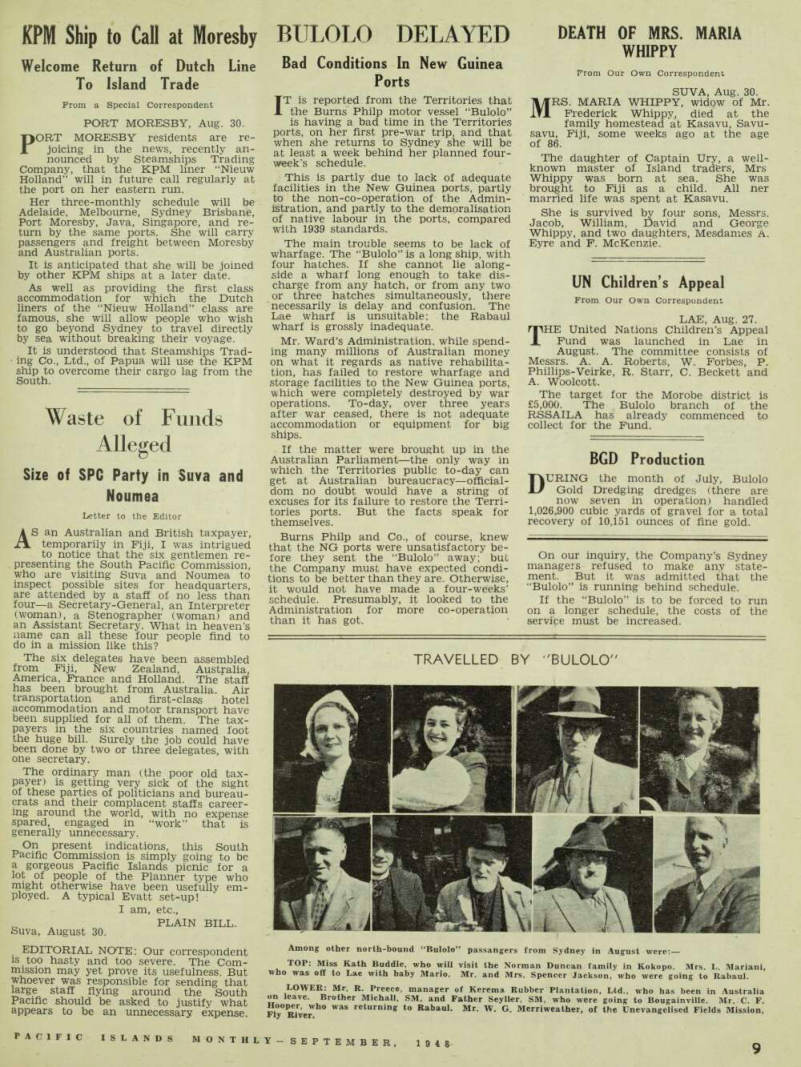
Dr. Richard Maxwell and Matron Cleaver and a spirited bunch of nursing sisters run the hospital extraordinarily well, considering their handicaps. But, in the words of Sir Hugh Ragg, who sent me to see it, “the place is a damned dis grace!” * * * IN the neat and pretty Fijian village of Veitogo, three miles from Lautoka, I found growing lustily some specimens of the Malayan dwarf coconut palms introduced to Fiji by the late Edward
IN a group of old hands in Ba I met Mr Les Davidson, who has been practis ing law in that famous sugar town for 43 years. A book would be needed to con tain this interesting memories of the place.
Perhaps he is going to write them —he is on the point of retiring, to join his son at Norfolk Island. I can imagine no place better suited to authorship than that cool and peaceful island—where there is no income tax and the £ attains its maximum value. * * * I FOUND conditions delightful in the Raki Raki Hotel, situated on a low hill overlooking the northeast coast of Viti Levu. On one side, a bowling green and tennis court. On the other, a broad sweep of green lawns and bright gardens.
Nearby, a large village of unsophisticated Fijians. A couple of miles away, a lagoon in which one can catch large fish on a troll.
This is sugar country—the Penang Mill is only round in the next valley from Raki Raki. Penang I found the usu? 1 ' pyy, busy and rather exclusive .iibn community that is so typical of che'" sugar Company’s organisation in Fiji.
Occasional peripatetic writers wail about the “poor Indians,” victims of the rapac
(Continued on page 81)
Duncan. This 10-feet high palm is just as good a coconut, in fruit production and oil value, as its taller brother; but it has the advantage that one can pick the nuts while standing on the ground, and it is not so liable to be battered by strong winds. I was told that they are seriously experimenting with it on Taveuni.
ious CSR. They should make an inspec tion sometime of the amenities which the CSR provide for its European staffs —I doubt if there is anything better in the Southern Hemisphere, As for the poor Indian —I never saw such swarms of merry, well-fed youngsters as the Indian school-children around these sugar-towns of Northern Fiji.
I was reminded of a remark, once, of the late Sir Philip Goldfinch —that the CSR return on its total Fiji investments seldom averaged more than 2\ per cent, per annum —a calculation fully borne out by the later investigations of Professor Sheppard. * * * FROM this north-east coast I looked out across the lagoon to the pretty little palm-grit island of Nanarhu, a recent acquisition of Mr. Pat Costello, well known Suva business man. I was in terested in his establishment of a new industry.
It appears that Pat was eagerly mak ing plans for the effective utilisation of his new possession; and, one day in Suva, he noticed that the Indians readily pay 2/- per pound for goat meat, delivered off carts which come around regularly. The next development was the appearance in Fiji of 25 billy-goats, complete with pedigrees, beards and an Australian accent. These new arrivals were duly in troduced, in Nanamu, to 170 female goats, brought directly from Vanua Levu. Mr.
Costello made his contracts with the Indian meat vendors, and sat back com fortably. “They work while I sleep,” said he.
In Suva, already, they are referring to him as “the man who put the nannies in Nanamu.”
Conspicuous on a bluff, overlooking the junction of the Tailevu Road with the main trans-island road, was the framework of a large building under construction.
“Gatward’s new pub,” I was informed — an unexpected, but healthy sign of pro gress in a district that, for too long, has been a sort of Sleepy Hollow of the Rewa.
By making a mile’s diversion along a secondary road, we found Mr. W. T.
(Continued on Page 83)
(Continued from Page 81)
Gatward, and his present “pub”—a rambling, old wooden building, also crowning a knoll. We were hospitably entertained by the long, lean proprietor, whose memories of men and affairs cover a most interesting period.
That new Tailevu Hotel should become not only a landmark, but also an at tractive stopping-off place for travellers, in an interesting area of tropical dairy ing country, within sight of historic Ovalau Island. * * * HAVING seen the Ragg family’s string of comfortable hostelries. and Gatward’s enterprise, I naturally be came interested in Fiji hotels generally, and how they could treat overseas travellers.
There is quite a comfortable licensed hotel, owned by Willoughby Tottenham and run by a manager, at Valethi, an ex ceedingly pleasant place tucked in behind the southern horn of Savu Savu Bay, over on Vanua Levu. This is something that should appeal to any imaginative traveller.
Savu Savu is part of “unspoiled” Fiji.
As well as being in a beautiful place, Valethi is in a thermal region—there are hot springs close around. There are a score of places to visit by launch in calm water in and around vast Savu Savu Bay. The clean and comfortable little vessel “Yanawai” goes out from Suva every fortnight or so, spends a couple of days nosing into isolated copra norts, drops you at Valethi, goes on around Vanua Levu, and picks you up again at Valethi a week or so later. What about it, Mr. Traveller? * * * SUVA has no spare accommodation for tourists, especially at week-ends.
Owing to the way the planes come through, there isn’t a vacant bed in a
Suva hotel or boardinghouse on Satur day nights.
Shortage of houses and boardinghouses has driven scores of Suva residents into the hotels; casual travellers fill all re maining vacancies; and the outlook for the tourist traveller is blue indeed.
When it was reported that the Indian official community was trying to buy the well-known Oceanic boardinghouse as a residence for the new Indian Com missioner—whom no one, except extremist Indian politicians, wants, anyway—there was a near panic in Suva. Only the
previous week-end, Public Relations officials and Tourist Board managers had spent hours on the telephone, trying to induce private residents to take stranded travellers into their homes for the night.
What was to happen if the 40 people in the Oceanic were thrown out? m + * IT seemed to me an astonishing thing that Suva should simply sit around and wring its collective hands over the hntPi rvmhipm noiei prooiem.
It is clear that, in this matter, supply is very much short of demand. Everyone, from the Governor down to the
corner shopkeeper, wants to see the tourist traffic encouraged. Tourists are eager to go to Fiji. There are a number of companies and people with huge funds lying idle in Suva’s banks, moaning for investment. Then why, in the name of commonsense, don’t all interests concerned get together and solve the problem, for the good of all concerned?
It is a nasty, difficult problem—but it certainly could be solved, by a united effort. The cry about shortages of build ing materials, technicians, dollars, ser vants, and so forth, achieves nothing but frustration and exasperation. And it is putting a grave handicap upon the Colony.
A SHIP lay at Suva wharves, and a popular type of small English car was being landed in dozens—and sold, for the general benefit of Mr. Tom French, at a price ridiculously below that charged for the same machine in over taxed Australia.
To be able to buy a car, without argu ment, at a price within reason, and fill it up at any petrol pump without tickets, was like the breath of old-time freedom to me.
But Suva people still grumble. It is the price of petrol that annoys them— -3/1 per gallon, compared with 1/1 before the war. “The damned Government takes 1/2 per gallon in straight-out taxation,” cried one man, “and they’ve got more revenue now than they know what to do with.” * * * THEY were waiting eagerly at Suva to welcome the liner “Aorangi,” re turning to the trans-Pacific run after seven years. In Suva, suffering so long from a shipping shortage, they put some venom into the popular wheeze: “Why is the Aorangi called the Iron Lung?”
“Because she kept 200 carpenters alive in the Sydney dockyards for two years!” ♦ * * IHAD flown from a country of crippling taxes (Australia) to a place of very moderate taxes (Fiji) and now I flew on to a lovely little Territory (Norfolk Island) where there are no taxes at all.
Here, also, was something that pleased my ancient Scottish heart; Air fare, Syd ney to Nadi, £SSA; fare, Nadi to Suva, say, £SF. Fare, Suva to Norfolk Island, £I9F; NI to Sydney, £22A. Work that out, and you will see that it is £I7A cheaper to travel via Norfolk Island —with the added pleasure of a couple of days in NI.
Norfolk Island's 1,000 or so people com prise Islanders (descendants of the Pit cairners who were settled there in 1856), Mainlanders (mostly non-Pitcairn people, with private means, who have gone there for a quiet, pleasant, untaxed life), and tourists (mostly intense and seemingly joy-less holiday-makers from New Zea land). The three communities do not mix much; and all are ruled over by a handful of Australian officials.
The administrative set-up interested me
very much; but the discussion of it calls for an early special article, which I am afraid will be distinguished by our usual lack of respect for Australian politicians.
There have been countless inquiries about living conditions on NI. So, in this or next issue, we shall publish a fairly complete general article on the subject— something to assist most people to decide whether they really want to go to the island, as permanent residents. * * * BECAUSE Norfolk’s 400-500 residences are scattered pretty evenly over the island’s 8,500 acres, the people’s chief
interest lies in communication. But, with one or two brief exceptions, the roads are deplorable.
There are 200 cars on the island. The Administration socks each owner £3 per annum, and there is a hidden tax in the 4/1 per gallon they pay for petrol. The Administration got £65,000 out of the special stamp issue.
From these sources, argue the residents, they surely should get adequate money for their roads. But they don’t. The funds just disappear.
Then there is the telephone system.
After the war, the Air Force left its tele
phone service to the islanders—a godsend,
seeing there is no business centre, and all residences, stores, etc., are indiscrimin ately scattered over about ten square miles.
But the system is not maintained.
While I was there, all cars wore chains to get them across the slippery surfaces (it had been raining for several hours); many vehicles were hopelessly bogged: and most of the telephones were in their usual condition —out of order. The Cable Office was, as usual, closed down for the week-end —and it is miles away in the northwest corner. Its telephone is mostly broken down, anyway, they say. * * * NI is like a great, green-turfed park, spread out under the übiquitous pines—and the lovely picture spoiled by methods of farming I never expected to see outside Australia.
In a two-days’ wander I did not notice one good tidy fence.
Mostly the fences were broken and dilapidated—roughly mended with tem porary stakes and bits of wire, after the manner so typical of the shiftless Aus tralian cockie —and the luxuriant hedges were wild and untrimmed.
A soil that will grow anything; an amazing freedom from pests; herds of sleek, well-fed European cattle; trees that break under their loads of clean, luscious fruit —these things surely deserve a tidi ness in farming worthy of their quality, which might delight the eye. of the in terested visitor. * * * A LARGE portion of Nl’s herds were eaten by servicemen during recent SW Pacific activities, and the stage has been reached now where the island is conserving its cattle and actually import iryg large quantities of meat—surely a very ridiculous proceeding.
There would be a call upon the herds during the war, of course, but the war ended in 1945. What sort of Adminis trative blundering allowed a position to develop wherein Nl—a vast, natural pasture—starts importing meat on a con siderable scale in 1948? ♦ * * ISEE I have written three snarls in a row —and given a wrong impression. NI, despite a certain shiftlessness in ad ministration and occupation, is still a de lightful place to live in—temporarily, at any rate; and if Government, transport interests and local businessmen have got any spirit of enterprise and co-operation they will get together and make of it one of the most attractive holiday resorts in the South Seas.
For long decades, its holiday attractive ness was strangled by its lack of a sea port. The new airport solves all that.
You can fly now from Sydney or Auck land, in complete comfort, in less time than it takes you to do a double round of golf. * ♦ * A LOCAL lad was put into the ancient gaol, for getting drunk on zup. (Zup is home-brew, after fermentation. Taken before fermentation, it is dip.) The sports ground is alongside the gaol wall.
Two spectators sat under an old tower, and drank, and cheered their favourites.
A voice came through an aperture (left in the tower, 150 years ago, for a gun barrel): “Eh, lad, give us a drink.”
They obligingly passed up their bottle of zup.
They saw no more of their bottle: but, soon afterwards, the prisoner appeared atop of the wall. He tried to emulate a barnyard rooster, and crashed.
The game stopped, because the referee had urgent business elsewhere. He was also the local policeman. He had to go and get his keys, collect his bemused prisoner, and dump him back in the time-
Worn old prison. Then the game was re sumed.
Great stuff, that zup. With a pound of hops, on Norfolk Island, you can buy any thing, from an ancient jalopy to the baron’s bright-eyed daughter. ♦ ♦ ♦ THE queerest thing at Noifolk is not on Norfolk —it is Phillip Island, a couple of miles off Norfolk’s south coast.
When Europeans first saw it, it was bonny, and green, and covered with Norfolk pines. To-day, it is a high mass of reddish, bare clay, hideously eroded, and slowly weathering down into the sea.
The cause? Rabbits!
No one seems to know when the rabbits were turned loose there. Presumably, someone a long time ago imagined that he thereby could ensure a meat supply for Norfolk. But the rodents increased in numbers until they ate out the ground vegetation completely. That allowed the seasonal heavy rains to start erosion, and the erosion killed the trees —there are now only a few tattered skeletons of trees remaining. Phillip Island is just a heap of clay, steadily shrinking, and apparently without any means of sustain ing life; yet, I was told, the rabbits still are there.
I asked why they did not poison the rabbits, and try to re-establish the vege tation, But they fear that poison would harm the sea-birds which, in countless thousands, still make Phillip Island a sort of rendezvous.
I should like to see pictures of that concentrated specimen of rabbit-pest and erosion exhibited in every inland town in Australia.
KPM Ship to Call at Moresby
Welcome Return of Dutch Line To Island Trade
Prom a Special Correspondent
Port Moresby, Aug. 30.
PORT MORESBY residents are re joicing in the news, recently an nounced by Steamships Trading Company, that the KPM liner “Nieuw Holland” will in future call regularly at the port on her eastern run.
Her three-monthly schedule will be Adelaide, Melbourne, Sydney Brisbane, Port Moresby, Java, Singapore, and re turn by the same ports. She will carry passengers and freight between Moresby and Australian ports.
It is anticipated that she will be joined by other KPM ships at a later date.
As well as providing the first class accommodation for which the Dutch liners of the “Nieuw Holland” class are famous, she will allow people who wish to go beyond Sydney to travel directly by sea without breaking their voyage.
It is understood that Steamships Trad ing Co., Ltd., of Papua will use the KPM ship to overcome their cargo lag from the South.
Alleged
Waste of Funds
Size of SPG Party in Suva and Noumea
Letter to the Editor AS an Australian and British taxpayer, temporarily in Fiji, I was intrigued to notice that the six gentlemen re presenting the South Pacific Commission, who are visiting Suva and Noumea to inspect possible sites for headquarters, are attended by a staff of no less than four—a Secretary-General, an Interpreter (woman), a Stenographer (woman) and an Assistant Secretary. What in heaven’s name can all these four people find to do in a mission like this?
The six delegates have been assembled from Fiji, New Zealand, Australia, America, France and Holland. The'staff has been brought from Australia. Air transportation and first-class hotel accommodation and motor transport have been supplied for all of them. The tax payers in the six countries named foot the huge bill. Surely the job could have been done by two or three delegates, with one secretary.
The ordinary man (the poor old tax payer) is getting very sick of the sight of these parties of politicians and bureau crats and their complacent staffs career ing around the world, with no expense spared, engaged in “work” that is generally unnecessary.
On present indications, this South Pacific Commission is simply going to be a gorgeous Pacific Islands picnic for a lot of people of the Planner type who might otherwise have been usefully em ployed. A typical Evatt set-up!
I am, etc.,
Plain Bill.
Suva, August 30.
EDITORIAL NOTE: Our correspondent is too hasty and too severe. The Com mission may yet prove its usefulness. But whoever was responsible for sending that large staff flying around the South Pacific should be asked to justify what appears to be an unnecessary expense.
Bulolo Delayed
Bad Conditions In New Guinea Ports
IT is reported from the Territories that the Burns Philp motor vessel “Bulolo” is having a bad time in the Territories ports, on her first pre-war trip, and that when she returns to Sydney she will be at least a week behind her planned four week's schedule.
This is partly due to lack of adequate facilities in the New Guinea ports, partly to the non-co-operation of the Admin istration, and partly to the demoralisation of native labour in the ports, compared with 1939 standards.
The main trouble seems to be lack of wharfage. The “Bulolo” is a long ship, with four hatches. If she cannot lie along side a wharf long enough to take dis charge from any hatch, or from any two or three hatches simultaneously, there necessarily is delay and confusion. The Lae wharf is unsuitable: the Rabaul wharf is grossly inadequate.
Mr. Ward’s Administration, while spend ing many millions of Australian money on what it regards as native rehabilita tion, has failed to restore wharfage and storage facilities to the New Guinea ports, which were completely destroyed by war operations. To-day, over three years after war ceased, there is not adequate accommodation or equipment for big ships.
If the matter were brought up in the Australian Parliament —the only way in which the Territories public to-day can get at Australian bureaucracy—official dom no doubt would have a string of excuses for its failure to restore the Terri tories ports. But the facts speak for themselves.
Burns Philp and Co., of course, knew that the NG ports were unsatisfactory be fore they sent the “Bulolo” away; but the Company must have expected condi tions to be better than they are. Otherwise, it would not have made a four-weeks’ schedule. Presumably, it looked to the Administration for more co-operation than it has got.
Death Of Mrs. Maria
Whippy
From Our Own Correspondent
Suva, Aug. 30.
MRS. MARIA WHIPPY, widow of Mr.
Frederick Whippy, died at the family homestead at Kasavu, Savu savu, Fiji, some weeks ago at the age of 86.
The daughter of Captain Ury, a well known master of Island traders, Mrs Whippy was bom at sea. She was brought to Fiji as a child. All ner married life was spent at Kasavu.
She is survived by four sons, Messrs.
Jacob, William, David and George Whippy, and two daughters, Mesdames A.
Eyre and F. McKenzie.
UN Children’s Appeal
From Our Own Correspondent LAE, Aug. 27.
THE United Nations Children’s Appeal Fund was launched in Lae in August. The committee consists of Messrs. A. A. Roberts, W. Forbes, P.
Phillips-Veirke, R. Starr, C. Beckett and A. Woolcott.
The target for the Morobe district is £5,000. The Bulolo branch of the RSSAILA has already commenced to collect for the Fund.
BGD Production
DURING the month of July, Bulolo Gold Dredging dredges (there are now seven in operation) handled 1,026,900 cubic yards of gravel for a total recovery of 10,151 ounces of fine gold.
On our inquiry, the Company’s Sydney managers refused to make any state ment. But it was admitted that the “Bulolo” is running behind schedule.
If the “Bulolo” is to be forced to run on a longer schedule, the costs of the service must be increased.
Travelled By "Bulolo"
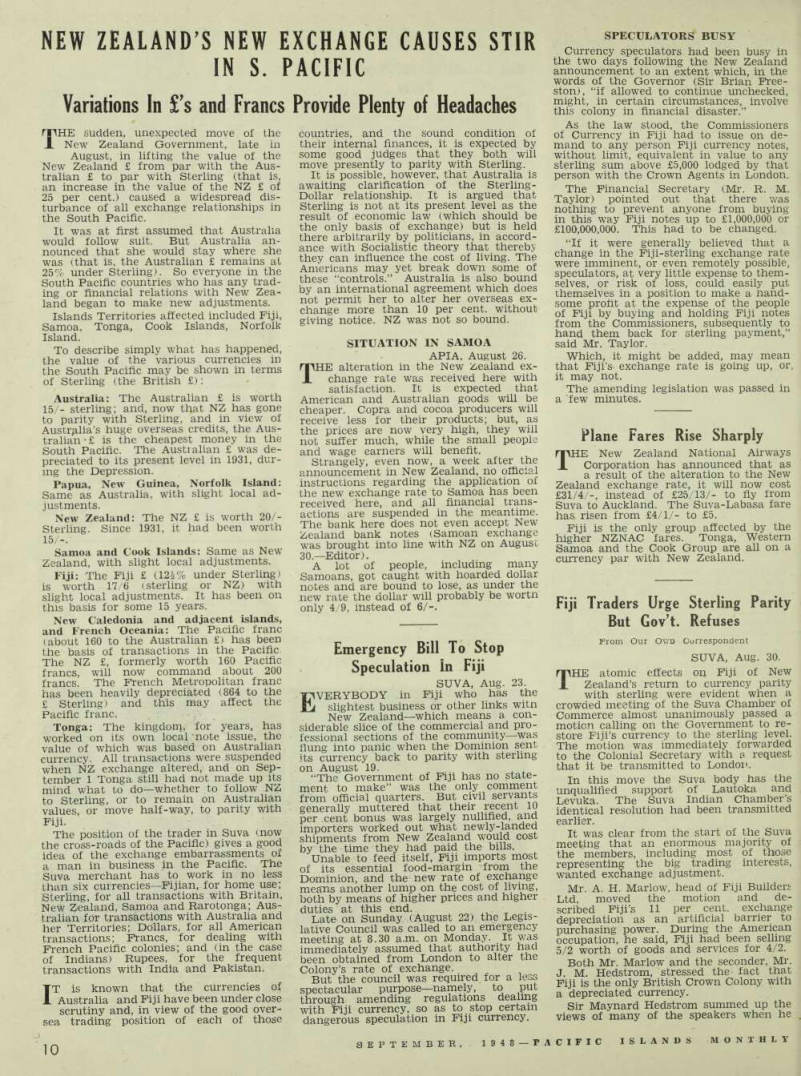
Among other north-bound “Bulolo” passangers from Sydney in August were:— TOP: Miss Kath Buddie, who will visit the Norman Duncan family in Kokopo. Mrs. L. Mariani, who was off to Lae with baby Mario. Mr. and Mrs. Spencer Jackson, who were going to Rabaul.
LOWER: Mr. R. Preece, manager of Kerema Rubber Plantation, Ltd., who has been in Australia on leave. Brother Michall, SM, and Father Seyller, SM, who were going to Bougainville. Mr C. F.
Hooper, who was returning to Rabaul. Mr. W. G. Merriweather, of the Unevangelised Fields Mission, Fly River.
New Zealand’S New Exchange Causes Stir
In S. Pacific
Variations In £’s and Francs Provide Plenty of Headaches
riIHE sudden, unexpected move of the X New Zealand Government, late in August, in lifting the value of the New Zealand £ from par with the Aus tralian £ to par with Sterling (that is, an increase in the value of the NZ £ of 25 per cent.) caused a widespread dis turbance of all exchange relationships in the South Pacific.
It was at first assumed that Australia would follow suit. But Australia an nounced that she would stay where she was (that is, the Australian £ remains at 25% under Sterling). So everyone in the South Pacific countries who has any trad ing or financial relations with New Zea land began to make new adjustments.
Islands Territories affected included Fiji, Samoa, Tonga, Cook Islands, Norfolk Island.
To describe simply what has happened, the value of the various currencies in the South Pacific may be shown in terms of Sterling (the British £): Australia; The Australian £ is worth 15/- sterling; and, now that NZ has gone to parity with Sterling, and in view of Australia’s huge overseas credits, the Ausis the cheapest money in the South Pacific. The Australian £ was de preciated to its present level in 1931, dur ing the Depression.
Papua, New Guinea, Norfolk Island: Same as Australia, with slight local ad justments.
New Zealand: The NZ £ is worth 20/- Sterling. Since 1931, it had been worth 15/-.
Samoa and Cook Islands: Same as New Zealand, with slight local adjustments.
Fiji: The Fiji £ (125% under Sterling) is worth 17/6 (sterling or NZ) with slight local adjustments. It has been on this basis for some 15 years.
New Caledonia and adjacent islands, and French Oceania: The Pacific franc (about 160 to the Australian £) has been the basis of transactions in the Pacific The NZ £, formerly worth 160 Pacific francs, will now command about 200 francs. The French Metropolitan franc has been heavily depreciated (864 to the £ Sterling) and this may affect the Pacific franc.
Tonga: The kingdom, for years, has worked on its own local note issue, the value of which was based on Australian currency. All transactions were suspended when NZ exchange altered, and on Sep tember 1 Tonga still had not made up its mind what to do—whether to follow NZ to Sterling, or to remain on Australian values, or move half-way, to parity with Fiji.
The position of the trader in Suva (now the cross-roads of the Pacific) gives a good idea of the exchange embarrassments of a man in business in the Pacific. The Suva merchant has to work in no less than six currencies—Fijian, for home use; Sterling, for all transactions with Britain, New Zealand, Samoa and Rarotonga; Aus tralian for transactions with Australia and her Territories; Dollars, for all American transactions; Francs, for dealing with French Pacific colonies; and (in the case of Indians) Rupees, for the frequent transactions with India and Pakistan.
IT is known that the currencies of Australia and Fiji have been under close scrutiny and, in view of the good over sea trading position of each of those
countries, and the sound condition of their internal finances, it is expected by some good judges that they both will move presently to parity with Sterling.
It is possible, however, that Australia is awaiting clarification of the Sterling- Dollar relationship. It is argued that Sterling is not at its present level as the result of economic law (which should be the only basis of exchange) but is held there arbitrarily by politicians, in accord ance with Socialistic theory that thereby they can influence the cost of living. The Americans may yet break down some of these “controls.” Australia is also bound by an international agreement which does not permit her to alter her overseas ex change more than 10 per cent, without giving notice. NZ was not so bound.
Situation In Samoa
APIA. August 26.
THE alteration in the New Zealand ex change rate was received here with satisfaction. It is expected that American and Australian goods will be cheaper. Copra and cocoa producers will receive less for their products; but, as the prices are now very high, they will not suffer much, while the small people and wage earners will benefit.
Strangely, even now, a week after the announcement in New Zealand, no official instructions regarding the application of the new exchange rate to Samoa has been received here, and all financial trans actions are suspended in the meantime.
The bank here does not even accept New Zealand bank notes (Samoan exchange was brought into line with NZ on August 30. —Editor).
A lot of people, including many Samoans, got caught with hoarded dollar notes and are bound to lose, as under the new rate the dollar will probably be wortn only 4/9, instead of 6/-.
Emergency Bill To Stop
Speculation In Fiji
Suva, Aug. 23.
EVERYBODY in Fiji who has the slightest business or other links witn New Zealand—which means a con siderable slice of the commercial and pro fessional sections of the community—was flung into panic when the Dominion sent its currency back to parity with sterling on August 19.
“The Government of Fiji has no state ment to make” was the only comment from official quarters. But civil servants generally muttered that their recent 10 per cent bonus was largely nullified, and importers worked out what newly-landed shipments from New Zealand would cost by the time they had paid the bills.
Unable to feed itself, Fiji imports most of its essential food-margin from the Dominion, and the new rate of exchange means another lump on the cost of living, both by means of higher prices and higher duties at this end.
Late on Sunday (August 22) the Legis lative Council was called to an emergency meeting at 8.30 a.m. on Monday. It was immediately assumed that authority had been obtained from London to alter the Colony’s rate of exchange.
But the council was required for a less spectacular purpose—namely, to put through amending regulations dealmg with Fiji currency, so as to stop certain dangerous speculation in Fiji currency.
Speculators Busy
Currency speculators had been busy in the two days following the New Zealand announcement to an extent which, in the words of the Governor (Sir Brian Free ston), “if allowed to continue unchecked, might, in certain circumstances, involve this colony in financial disaster.”
As the law stood, the Commissioners of Currency in Fiji had to issue on de mand to any person Fiji currency notes, without limit, equivalent in value to any sterling sum above £5,000 lodged by that person with the Crown Agents in London, The Financial Secretary (Mr. R. M.
Taylor) pointed out that there was nothing to prevent anyone from buying in this way Fiji notes up to £1,000,000 or £100,000,000. This had to be changed.
“If it were generally believed that a change in the Fiji-sterling exchange rate were imminent, or even remotely possible, speculators, at very little expense to them selves, or risk of loss, could easily put themselves in a position to make a hand some profit at the expense of the people of Fiji by buying and holding Fiji notes from the Commissioners, subsequently to hand them back for sterling payment,” said Mr. Taylor.
Which, it might be added, may mean that Fiji’s exchange rate is going up, or it may not.
The amending legislation was passed in a few minutes.
Plane Fares Rise Sharply
THE New Zealand National Airways Corporation has announced that as a result of the alteration to the New Zealand exchange rate, it will now cost £3l/4/-, instead of £25/13/- to fly from Suva to Auckland. The Suva-Labasa fare has risen from £4/1/- to £5.
Fiji is the only group affected by the higher NZNAC fares. Tonga, Western Samoa and the Cook Group are all on a currency par with New Zealand.
Fiji Traders Urge Sterling Parity
But Gov’t. Refuses
From Our Owd Correspondent
Suva, Aug. 30.
THE atomic effects on Fiji of New Zealand’s return to currency parity with sterling were evident when a crowded meeting of the Suva Chamber of Commerce almost unanimously passed a motion calling on the Government to re store Fiji’s currency to the sterling level.
The motion was immediately forwarded to the Colonial Secretary with a request that it be transmitted to London.
In this move the Suva body has the unqualified support of Lautoka and Levuka. The Suva Indian Chamber’s identical resolution had been transmitted earlier.
It was clear from the start of the Suva meeting that an enormous majority of the members, including most of those representing the big trading interests, wanted exchange adjustment.
Mr. A. H. Marlow, head of Fiji Builders Ltd, moved the motion and de scribed Fiji’s 11 per cent, exchange depreciation as an artificial barrier to purchasing power. During the American occupation, he said, Fiji had been selling 5/2 worth of goods and services for 4/2.
Both Mr. Marlow and the seconder, Mr.
J. M. Hedstrom, stressed the' fact that Fiji is the only British Crown Colony with a depreciated currency.
Sir Maynard Hedstrom summed up the views of many of the speakers when he
said: “The currency was depreciated (in 1933) to help the sugar and copra indus tries. I think it has served its purpose, and the general public are now suffering because of increased prices.”
A SOLID majority obliterated an amendment by Mr. W. G. Johnson (W. R. Carpenter & Co., Fiji) sug gesting that representatives of the Chamber of Commerce should meet representatives of the sugar and goldmining industries and the Financial Secretary to discuss the situation.
The president (Mr. Alport Barker) pointed out that the Chamber did not profess to speak for any interests other than the commercial community of Suva.
Mr. John Trotter (Burns Philp (SS), Ltd.) charged both Mr. Johnson and Mr.
P. Costello (who had said that, when dealing with exchange, the meeting was a collection of “amateurs talking about something we know nothing about”) with obscuring the issue.
“The thing is simple,” said Mr. Trotter, “for 15 years Fiji currency has been de preciated for the benefit of the producers, and to-day the producers are receiving the highest prices they have ever had, while the man in the street is paying through the nose.”
SUVA. Sept. 7.
The Fiji Government announced that there will be no alteration in the currencv exchange rate.
Sterling Area
Hongkong May Leave
THE authoritative “Far Eastern Review,” which often speaks for large bank ing interests, has broached the pos sibility that Hongkong might quit the sterling area.
Reporting this, United Press corre spondent says the discussion “is the re sult of drastic restrictions in July and August by London on the Colony’s trade with hard and semi-hard currency areas.”
The restrictions, the “Review” said, bring to the fore “A necessary and long delayed discussion on the mutual advan tages or disadvantages of Hongkong re maining in the sterling area.
“By leaving the sterling area, Hongkong may stand to benefit both immediately and in the long run. It appears to many economic observers that Hongkong, being in fact only a great entrepot (commercial centre) and harbour, should never have been included in the sterling area, and that at the present moment, when a trade recession has set in, it is vital for the continued prosperity of the com munity that no restrictive measures be imposed here.”
The publication said the stability of Hongkong’s currency is guaranteed, as the note issue is fully backed by a ster ling reserve.
Miss H. M. Maddocks of Port Moresby returned from sick leave in Australia in August.
Mr. A. C. Jones, a Legal Officer with the Crown Law Office, was recently ad mitted to practise as a barrister and solicitor of the Papua-New Guinea Sup reme Court. Mr. Jones is a Victorian.
He was a prisoner of war at Changi for U years during the recent war.
Mr. G. O’Donnell, formerly Assistant District Officer at Manus, New Guinea, has been transferred to Lae as ADO.
Prices Commission investigators were m Lae, New Guinea, at the end of August inquiring into the high cost of living in the area.
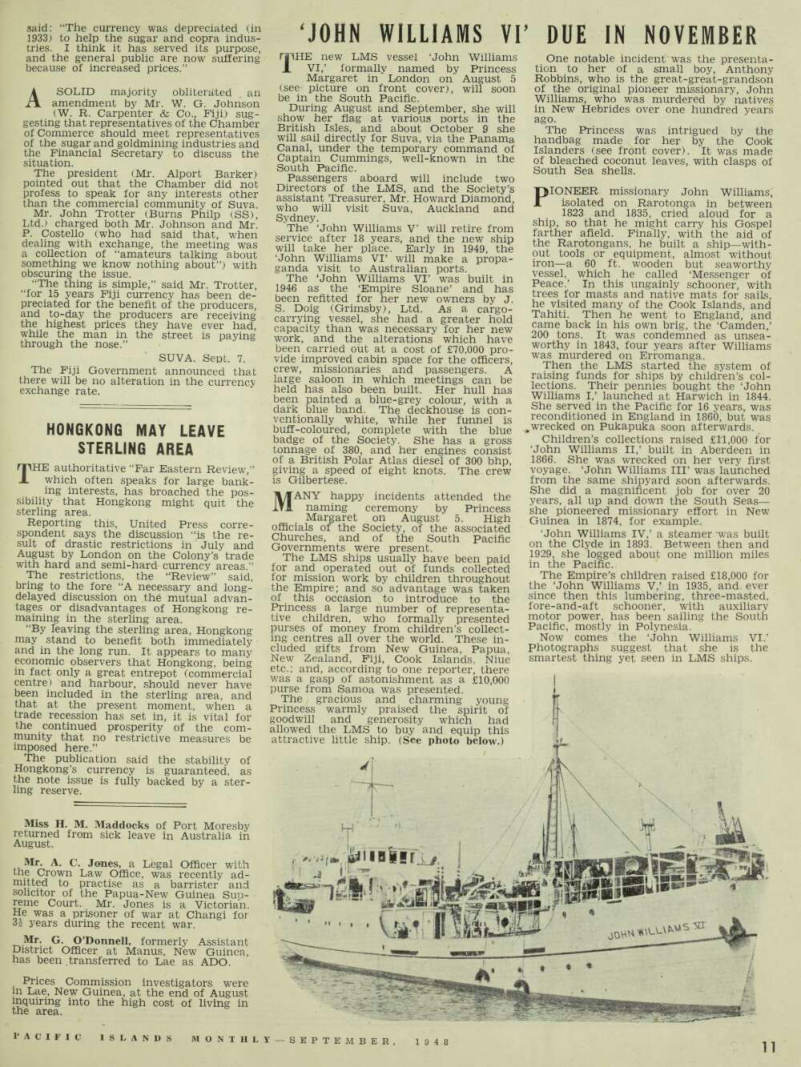
‘John Williams Vi’ Due In November
THE new LMS vessel ‘John Williams Vl,’ formally named by Princess Margaret in London on August 5 (see picture on front cover), will soon be in the South Pacific.
During August and September, she will show her flag at various ports in the British Isles, and about October 9 she will sail directly for Suva, via the Panama Canal, under the temporary command of Captain Cummings, well-known in the South Pacific.
Passengers aboard will include two Directors of the LMS, and the Society’s assistant Treasurer, Mr. Howard Diamond, who will visit Suva, Auckland and Sydney.
The ‘John Williams V’ will retire from service after 18 years, and the new ship will take her place. Early in 1949, the ‘John Williams Vl’ will make a propa ganda visit to Australian ports.
The ‘John Williams Vl’ was built in 1946 as the ‘Empire Sloane’ and has been refitted for her new owners by J.
S. Doig (Grimsby), Ltd. As a cargo carrying vessel, she had a greater hold capacity than was necessary for her new work, and the alterations which have been carried out at a cost of £70,000 pro vide improved cabin space for the officers, crew, missionaries and passengers. A large saloon in which meetings can be held has also been built. Her hull has been painted a blue-grey colour, with a dark blue band. The deckhouse is con ventionally white, while her funnel is buff-coloured, complete with the blue badge of the Society. She has a gross tonnage of 380, and her engines consist of a British Polar Atlas diesel of 300 bhp, giving a speed of eight knots. The crew is Gilbertese.
MANY happy incidents attended the naming ceremony by Princess Margaret on August 5. High officials of the Society, of the associated Churches, and of the South Pacific Governments were present.
The LMS ships usually have been paid for and operated out of funds collected for mission work by children throughout the Empire; and so advantage was taken of this occasion to introduce to the Princess a large number of representa tive children, who formally presented purses of money from children’s collect ing centres all over the world. These in cluded gifts from New Guinea, Papua, New Zealand, Fiji, Cook Islands, Niue etc.; and, according to one reporter, there v/as a gasp of astonishment as a £lO,OOO purse from Samoa was presented.
The gracious and charming young Princess warmly praised the spirit of goodwill and generosity which had allowed the LMS to buy and equip this attractive little ship. (See photo below.)
One notable incident was the presenta tion to her of a small boy, Anthony Robbins, who is the great-great-grandson of the original pioneer missionary, John Williams, who was murdered by natives in New Hebrides over one hundred years ago.
The Princess was intrigued by the handbag made for her by the Cook Islanders (see front cover). It was made of bleached coconut leaves, with clasps of South Sea shells.
PIONEER missionary John Williams, isolated on Rarotonga in between 1823 and 1835, cried aloud for a ship, so that he might carry his Gospel farther afield. Finally, with the aid of the Rarotongans, he built a ship—with put tools or equipment, almost without iron—a 60 ft. wooden but seaworthy vessel, which he called ‘Messenger of Peace.’ In this ungainly schooner, with trees for masts and native mats for sails, he visited many of the Cook Islands, and Tahiti. Then he went to England, and came back in his own brig, the ‘Camden,’ 200 tons. It was condemned as unsea worthy in 1843, four years after Williams was murdered on Erromanga.
Then the LMS started the system of raising funds for ships by children’s col lections. Their pennies bought the ‘John Williams I,’ launched at Harwich in 1844.
She served in the Pacific for 16 years, was reconditioned in England in 1860, but was wrecked on Pukapuka soon afterwards.
Children’s collections raised £ll,OOO for ‘John Williams ll,’ built in Aberdeen in 1866. She was wrecked on her very first voyage. ‘John Williams lII’ was launched from the same shipyard soon afterwards.
She did a magnificent job for over 20 years, all up and down the South Seas— she pioneered missionary effort in New Guinea in 1874, for example. ‘John Williams IV,’ a steamer was built on the Clyde in 1893. Between then and 1929, she logged about one million miles in the Pacific.
The Empire’s children raised £lB,OOO for the ‘John Williams V,’ in 1935, and ever since then this lumbering, three-masted, fore-and-aft schooner, with auxiliary motor power, has been sailing the South Pacific, mostly in Polynesia.
Now comes the ‘John Williams Vl.’ photographs suggest that she is the smartest thing yet seen in LMS ships.
Advertisements & other items, p. 14 (1 item)
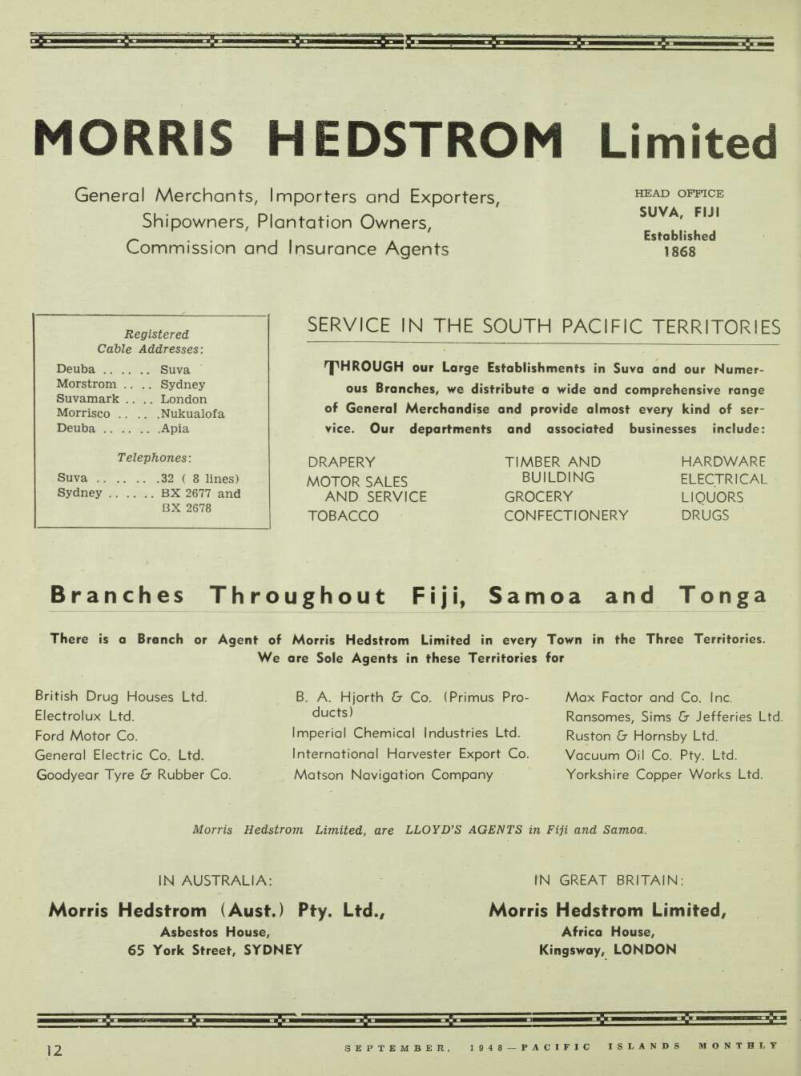
Morris Hedstrom Limited
General Merchants, Importers and Exporters,
Shipowners, Plantation Owners,
Commission and Insurance Agents
HEAD OFFICE
SUVA, FIJI
Established 1868
SERVICE IN THE SOUTH PACIFIC TERRITORIES
THROUGH our Large Establishments in Suva and our Numerous Branches, we distribute a wide and comprehensive range of General Merchandise and provide almost every kind of service. Our departments and associated businesses include:
DRAPERY
MOTOR SALES
AND SERVICE
TOBACCO
TIMBER AND
BUILDING
GROCERY
CONFECTIONERY
HARDWARE
ELECTRICAL
LIQUORS
DRUGS
Branches Throughout Fiji, Samoa and Tonga
There is a Branch or Agent of Morris Hedstrom Limited in every Town in the Three Territories.
We ore Sole Agents in these Territories for British Drug Houses Ltd.
Electrolux Ltd.
Ford Motor Co.
General Electric Co. Ltd.
Goodyear Tyre Gr Rubber Co.
B. A. Hjorth Gr Co. (Primus Products) Imperial Chemical Industries Ltd.
International Harvester Export Co.
Matson Navigation Company Max Factor and Co. Inc.
Ransomes, Sims Gr Jefferies Ltd Ruston Gr Hornsby Ltd.
Vacuum Oil Co. Pty. Ltd.
Yorkshire Copper Works Ltd.
Morris Hedstrom Limited, are LLOYD’S AGENTS in Fiji and Samoa.
IN AUSTRALIA: IN GREAT BRITAIN:
Morris Hedstrom (Aust.) Pty, Ltd., Morris Hedstrom Limited, Asbestos House, Africa House, 65 York Street, SYDNEY Kingsway, LONDON
Speculation About Pending
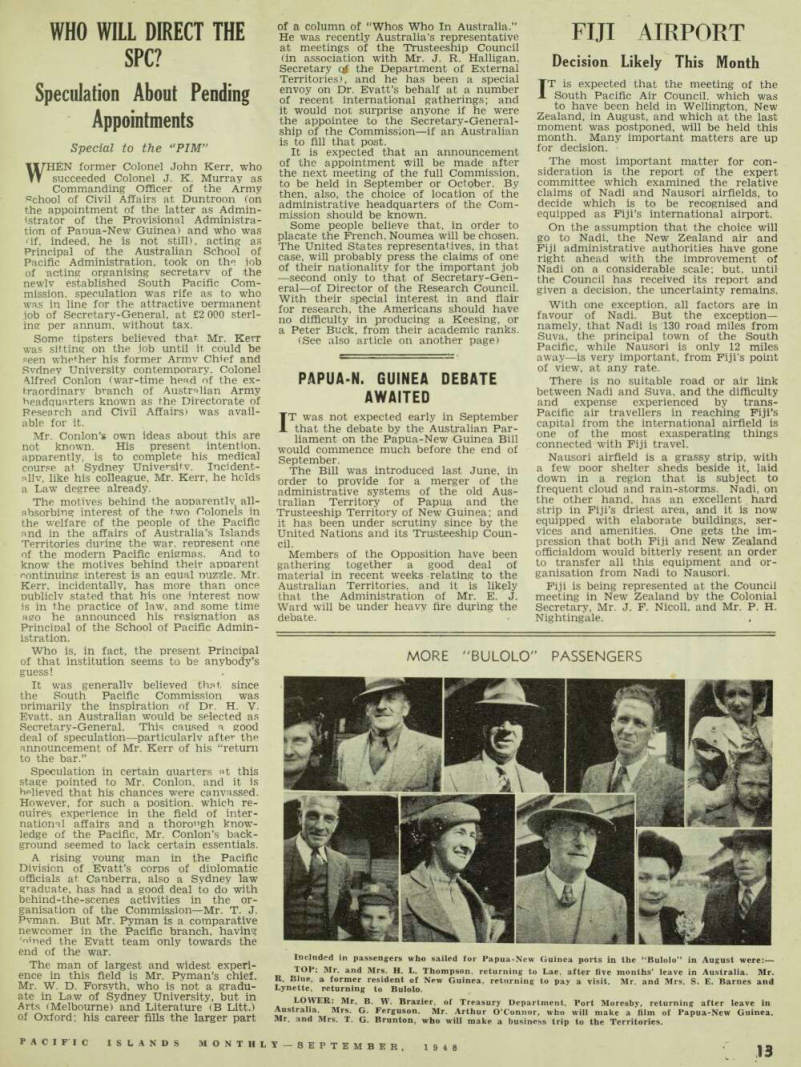
Who Will Direct The
Spc?
Speculation About Pending Appointments
Special to the i( PIM”
WHEN former Colonel John Kerr, who succeeded Colonel J. K. Murray as Commanding Officer of the Army School of Civil Affairs at Duntroon (on the appointment of the latter as Admin istrator of the Provisional Administra tion of Paoua-New Guinea) and who was 'if. indeed, he is not still), acting as Principal of the Australian School of Pacific Administration, took on the job of acting organising secretary of the newlv established South Pacific Com mission. speculation was rife as to who was in line for the attractive nermanent job of Secretary-General, at £2 000 sterl ing per annum, without tax.
Some tipsters believed that Mr. Kerr was sitting on the job until it could be seen whether his former Armv Chief and Svdney University contemporary. Colonel Alfred Conlon (war-time head of the ex traordinary branch of Australian Army headquarters known as the Directorate of Research and Civil Affairs) was avail able for it.
Mr. Conlon’s own ideas about this are not known. His present intention, apparently, is to complete his medical course at Sydney University. Incident ell v, like his colleague, Mr. Kerr, he holds a Law degree already.
The motives behind the apparently all absorbing interest of the two Colonels in the welfare of the people of the Pacific end in the affairs of Australia’s Islands Territories during the war. represent one of the modern Pacific enigmas. And to know the motives behind their apparent continuing interest is an equal nuzzle. Mr.
Kerr, incidentally, has more than once nubliclv stated that his one interest now is in the practice of law. and some time ago he announced his resignation as Principal of the School of Pacific Admin istration.
Who is, in fact, the present Principal of that institution seems to be anybody’s guess!
It was generally believed that since the South Pacific Commission was primarily the inspiration of Dr. H. V.
Evatt. an Australian would be selected as Secretary-General, This caused a good deal of speculation—particularly the announcement of Mr. Kerr of his “return to the bar.”
Speculation in certain quarters «t this stage pointed to Mr. Conlon, and it is believed that his chances were canvassed.
However, for such a position, which re quires experience in the field of inter national affairs and a thorough know ledge of the Pacific, Mr. Conlon’s back ground seemed to lack certain essentials.
A rising young man in the Pacific Division of Evatt’s corps of diplomatic officials at Canberra, also a Sydney law graduate, has had a good deal to do with behind-the-scenes activities in the or ganisation of the Commission —Mr. T. J.
Pvman. But Mr. Pyman is a comparative newcomer in the Pacific branch, having ■™ned the Evatt team only towards the end of the war.
The man of largest and widest experi ence in this field is Mr. Pyman’s chief.
Mr. W. D. Forsyth, who is not a gradu ate in Law of Sydney University, but in Arts (Melbourne) and Literature (B Litt.) of Oxford; his career fills the larger part
of a column of “Whos Who In Australia.”
He was recently Australia’s representative at meetings of the Trusteeship Council (in association with Mr. J. R. Halligan, Secretary qf the Department of External Territories), and he has been a special envoy on Dr. Evatt’s behalf at a number of recent international gatherings; and it would not surprise anyone if he were the appointee to the Secretary-General ship of the Commission —if an Australian is to fill that post.
It is expected that an announcement of the appointment will be made after the next meeting of the full Commission, to be held in September or October. By then, also, the choice of location of the administrative headquarters of the Com mission should be known.
Some people believe that, in order to placate the French, Noumea will be chosen.
The United States representatives, in that case, will probably press the claims of one of their nationality for the important job —second only to that of Secretary-Gen eral —of Director of the Research Council.
With their special interest in and flair for research, the Americans should have no difficulty in producing a Keesing, or a Peter Buck, from their academic ranks. (See also article on another page)
Papua-N. Guinea Debate
Awaited
TT was not expected early in September I that the debate by the Australian Parliament on the Papua-New Guinea Bill would commence much before the end of September.
The Bill was introduced last June, in order to provide for a merger of the administrative systems of the old Australian Territory of Papua and the Trusteeship Territory of New Guinea; and it has been under scrutiny since by the United Nations and its Trusteeship Counert Members of the Opposition have been gathering together a good deal of material in recent weeks relating to the Australian Territories, and it is likely that the Administration of Mr. E. J.
Ward will be under heavy fire during the debate. •
Fiji Airport
Decision Likely This Month
IT is expected that the meeting of the South Pacific Air Council, which was to have been held in Wellington, New Zealand, in August, and which at the last moment was postponed, will be held this month. Many important matters are up for decision.
The most important matter for con sideration is the report of the expert committee which examined the relative claims of Nadi and Nausori airfields, to decide which is to be recognised and equipped as Fiji’s international airport.
On the assumption that the choice will go to Nadi, the New Zealand air and Fiji administrative authorities have gone right ahead with the improvement of Nadi on a considerable scale: but, until the Council has received its report and given a decision, the uncertainty remains.
With one exception, all factors are in favour of Nadi. But the exception— namely, that Nadi is 130 road miles from Suva, the principal town of the South Pacific, while Nausori is only 12 miles away—is very important, from Fiji’s point of view, at any rate.
There is no suitable road or air link between Nadi and Suva, and the difficulty and expense experienced by trans pacific air travellers in reaching Fiji’s capital from the international airfield is one of the most exasperating things connected with Fiji travel.
Nausori airfield is a grassy strip, with a few poor shelter sheds beside it, laid down in a region that is subject to frequent cloud and rain-storms. Nadi, on the other hand, has an excellent hard strip in Fiji’s driest area, and it is now equipped with elaborate buildings, ser vices and amenities. One gets the im pression that both Fiji and New Zealand officialdom would bitterly resent an order to transfer all this equipment and or ganisation from Nadi to Nausori, Fiji is being represented at the Council meeting in New Zealand by the Colonial Secretary, Mr. J. F. Nicoll. and Mr. P. H.
Nightingale.
More "Bulolo" Passengers
Included in passengers who sailed for Papua-New Guinea ports in the “Bulolo” in August were:— TOP: Mr. and Mrs. H. L. Thompson, returning to Lae, after five months’ leave in Australia. Mr.
R. Blue, a former resident of New Guinea, returning to pay a visit. Mr. and Mrs, S. E. Barnes and Lynette, returning to Bulolo.
LOWER: Mr, B. W. Brazier, of Treasury Department, Port Moresby, returning after leave in Australia. Mrs. G. Ferguson. Mr. Arthur O’Connor, who will make a film of Papua-New Guinea, Mr. and Mrs. T. G. Brunton, who will make a business trip to the Territories.
Advertisements & other items, p. 16 (1 item)
Lojvdojn
visit leading U.S. cities
" by Flying Clipper
mr am. 11 »
4 5 T "*Yt HOST
045 mm I Travel to London is easy —and interesting—the Pan American way. And now it costs only £29 extra to go via the U.S. One fare (purchased in pounds) takes care of all transportation. From Sydney to London —£358/5/10. Stopovers along the route can be arranged.
A Flying Clipper leaves Thursday and Sunday at 12.30 a.m.
You’ll relax in a down-soft Sleeperette* chairlounge as your Flying Clipper speeds via lovely Hawaii to San Francisco or Los Angeles. (There you can visit Hollywood, fabulous film centre.) From California to New York —see the sights, enjoy the theatres and smart shops.
From New York, Clipper departs daily for London on the fastest and only non-stop service. Or you can leave from Boston or Washington. Call your travel agent or Pan American Mezzanine Floor, Hotel Australia, Sydney.
Telephone BW 4701 Bank of N.S.W.
Building, SUVA.
Rue Jean Jcures,
NOUMEA.
Trade-Mark, Pan American Airways, Inc.
Fifth Avenue, New York
Pan American
World Alrways
‘PTLe System J Clippers
Pan American Airways, Inc. (Incorporated in U.S.A. Liability Limited.)
Correction
An Incident In Samoa
IT was stated in this journal in July that Mr. W. O. Fry, Manager in Western Samoa of the Union Steam ship Co., was charged with having broken certain quarantine (infantile paralysis) regulations when he went aboard the motor-ship “Matua” with his wife in Apia one evening for dinner. Our report said that Mr, Fry was arrested, placed in quarantine for two days, and faced a prosecution with a possibility of severe punishment. We also stated that Mr. and Mrs. Fry were very resentful of the action that had been taken against them —especially as many people regarded the Poliomyelitis quarantine restrictions as farcical.
We now have been formally advised that three statements in the article are untrue. It is stated that Mrs. Fry did not accompany her husband aboard the “Matua” on that occasion; Mr. Fry did not go on board ship for dinner; and Mr. Fry was not arrested. It is a fact that Mr. Fry was prosecuted for going aboard the “Matua” in breach of the quarantine regulations; but the charges brought against him were dismissed by the High Court in Samoa. It was proved to the satisfaction of the Court that Mr, Fry was in the ship on business with the Master, and was acting under the general authority of the Samoan medical auth orities.
The report was published by us in good faith; and, to the degree that it was in accurate, we express unqualified regret.
Mr. Fry’s reputation as an official of the Union Steamship Co., Ltd., however, stands so high that it could not be damaged by an incident of this kind, even if he had committed a breach of quaran tine restrictions in Samoa. Samoa’s quarantine restrictions, as a matter of fact, are already the subject of jokes throughout the South Pacific.
Pty. Ltd.
Australasian Petroleum Company Pty. Ltd.
IN order to expedite further the search for oil in Papua-New Guinea, Austral asian Petroleum Company Pty., Ltd., has decided to purchase two additional drilling outfits, making a total of five rigs for operations in the Company’s permit areas.
Drilling sites on which these two additional rigs will operate have already been selected.
Service Resumed
Noumea-N. Hebrides
THE New Caledonian air transport com pany TRAP AS (Societe Francaise de Transports Aeriens du Pacifique Sud) recommenced its twice-a-week service be tween Noumea and the New Hebrides in August.
Owing to the fact that the Magenta airfield is under repair, the Co. is obliged to use its amphibians for departure from Noumea harbour; and consequently it has to vary its time of departure in accor rance with the high tide. That makes a fixed schedule impossible at present.
Sometimes the first departure of the week is at the beginning of the week, and some times the second departure is at the end of the week.
On this selected day, the planes leave Noumea at 6.30 a.m., reach Vila at 9 ajn., Santo at 11.15 a.m., leave Santo at 11.45 a.m., reach Vila again 1.15 p.m., depart for Noumea at 2 p.m., and arrive Noumea at 4.30 p.m.
TRAPAS hopes to resume the Noumea- Tahiti service within the next couple of months.
The TRAPAS services, newly estab lished, were dislocated early this year, when a hurricane caught and smashed its planes in Noumea.
The new Catalina purchased in the US by TRAPAS for its French Pacific service reached Noumea on July 13, piloted by M.
Joseph Pommier. Flying time from Honolulu was 24J hours.
Advertisements & other items, p. 17 (1 item)
Wenzel & Co.
THE
YORKSHIRE
INSURANCE
CO. LTD.
(Incorporated In England)
ALL CLASSES OF
INSURANCE
Including Fire Motor Guarantee Accident Workers Marine Island Representatives:
PORT MORESBY: E. A. James
RABAUL: G. B. Black LAE: Morobe Transport Co. Ltd.
MADANG: R. Mac6regor SUVA: Williams & Gosling Ltd.
NOUMEA: Y. Mortensen
NORFOLK ISLAND:
A. E. Martin
BURNS PHILP (New Hebrides) LTD.
Registered Office: VILA, NEW HEBRIDES
Branch Office at SANTO
Exporters, Importers and General Merchants
(Retail and Wholesale) Commission, Shipping
and Customs Agents
Representatives for BURNS PHILP TRUST COMPANY LIMITED. QUEENS- LAND INSURANCE CO., LTD., and LLOYDS OF LONDON. Agents for SOCIETE DES PETROLES SHELL DES ILES FRANCAISES DU PACIFIQUE, and numerous overseas manufacturers of all classes of merchandise.
Sydney Agents: Burns, Philp & Co., Ltd.. 7 Bridge Street.
San Francisco Agents; Burns, Philp Co. of San Francisco, Matson Building, 215 Market Street, London Agents: Burns, Philp & Co., Ltd., 35 Crutched Friars, E.C.3
WENZEL & CO.
EXPORT DISTRIBUTORS
255 California Street, San Francisco 11, Cable Address “Wenco.” All
U.S.A.
Codes.
Holiday on September 13
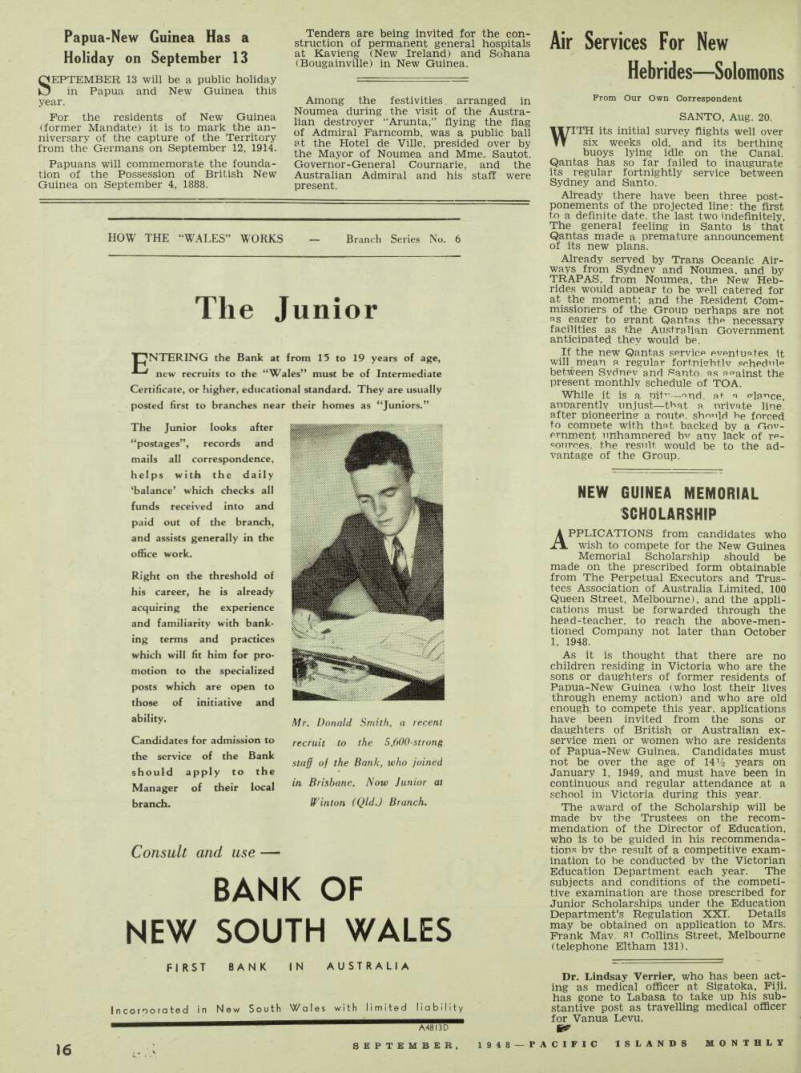
Papua-New Guinea Has a Holiday on September 13
SEPTEMBER 13 will be a public holiday in Papua and New Guinea this year.
For the residents of New Guinea (former Mandate) it is to mark the an niversary of the capture of the Territory from the Germans on September 12, 1914.
Papuans will commemorate the founda tion of the Possession of British New Guinea on September 4, 1888.
Tenders are being invited for the con struction of permanent general hospitals at Kavieng (New Ireland) and Sohana (Bougainville) in New Guinea.
Among the festivities arranged in Noumea during the visit of the Austra lian destroyer “Arunta,” flying the flag of Admiral Farncomb, was a public ball at the Hotel de Ville, presided over by the Mayor of Noumea and Mme. Sautot.
Governor-General Cournarie, and the Australian Admiral and his staff "were present.
Hebrides—Solomons
Air Services For New Hebrides—Solomons
Prom Our Own Correspondent
Santo, Aug. 20.
11TITH its initial survey nights well over ▼ f six weeks old, and its berthing buoys lying idle on the Canal.
Qantas has so far failed to inaugurate its regular fortnightly service between Sydney and Santo.
Already there have been three post ponements of the projected line: the first to a definite date, the last two indefinitely, The general feeling in Santo is that Qantas made a premature announcement of its new plans.
Already served by Trans Oceanic Air ways from Sydney and Noumea, and by TRAPAS, from Noumea, the New Heb rides would appear to be well catered for at the moment: and the Resident Com missioners of the Group nerhaps are not es eager to grant Qantas necessary facilities as the Australian Government anticipated they would be.
If the new Qantas service eventuates. it will mean a regular fortnightly schedule between Svdnev and Panto as po-ainst the present monthly schedule of TOA.
While it is a nit TT a+ a annarentlv unjust— a nrivate line, after pioneering a route, should he forced to comnete with that backed by a Gov ernment unhamnered bv any lack of re sources. the result would be to the ad vantage of the Group.
New Guinea Memorial
Scholarship
Applications from candidates who wish to compete for the New Guinea Memorial Scholarship should be made on the prescribed form obtainable from The Perpetual Executors and Trus tees Association of Australia Limited, 100 Queen Street, Melbourne), and the appli cations must be forwarded through the head-teacher, to reach the above-men tioned Company not later than October 1, 1948.
As it is thought that there are no children residing in Victoria who are the sons or daughters of former residents of Papua-New Guinea (who lost their lives through enemy action) and who are old enough to compete this year, applications have been invited from the sons or daughters of British or Australian ex service men or women who are residents of Papua-New Guinea. Candidates must not be over the age of 1414 years on January 1, 1949, and must have been in continuous and regular attendance at a school in Victoria during this year.
The award of the Scholarship will be made bv the Trustees on the recom mendation of the Director of Education, who is to be guided in his recommenda tions bv the result of a competitive exam ination to be conducted by the Victorian Education Department each year. The subjects and conditions of the competi tive examination are those prescribed for Junior Scholarships under the Education Department’s Regulation XXI. Details may be obtained on application to Mrs.
Frank Mav. Collins Street, Melbourne (telephone Eltham 131).
Dr. Lindsay Verrier, who has been act ing as medical officer at Sigatoka, Fiji, has gone to Labasa to take up his sub stantive post as travelling medical officer for Vanua Levu.
Advertisements & other items, pp. 18-19 (2 items)
The Junior
HOW THE “WALES” WORKS
Branch Series No. 6
ENTERING the Bank at from 15 to 19 years of age, / new recruits to the “Wales” must be of Intermediate Certificate, or higher, educational standard. They are usually posted first to branches near their homes as “Juniors.”
The Junior looks after “postages”, records and mails all correspondence, helps with the daily ‘balance’ which checks all funds received into and paid out of the branch, and assists generally in the office work.
Right on the threshold of his career, he is already acquiring the experience and familiarity with banking terms and practices which will fit him for promotion to the specialized posts which are open to those of initiative and ability.
Candidates for admission to the service of the Bank should apply to the Manager of their local branch.
Consult and use
BANK OF
NEW SOUTH WALES
FIRST BANK IN AUSTRALIA
Incorporated in New South Wales with limited liability Mr. Donald Smith, a recent recruit to the 5,600-strong staff of the Bank, who joined in Brisbane. Now Junior at Winton (Qld.) Branch.
A4813D
mom ice
ONE OF THE WORLD’S
WONDER-SIGHTS
Miles
mom ice
See New Zealand*s
FRANZ JOSEF-GLACIER
From the Air !
NOWHERE else in the world can you see an eight-mile long river of ice framed in an evergreen setting of sub-tropical forest. Franz Josef is one of the scenic wonders of the world. Why not take the holiday you’ve promised yourself relax in comfort, in scenic surroundings? Travel in comfort too, by N.A.C. aircraft that land you fresh and unweary two hundred yards from tb« hotel door. ‘•'V.
NJLC
HOTEL ACCOMMODATION
Comfortable accommodation and attentive service is provided by the Government Tourist Department’s Hotel at the foot of the Glacier.
-AT YOUR SERVICE
the South-west* Pacific. °r se JT ices throughout the Dominion and Trans-Australia Airlines Booking Agents for a • Bntlsh Commonwea:lth Pacific Airlines and and other overseas airline* g Tasman Empire Airways, Qantas Empire Airways, the 8.0.A.C.
Offices and Agents throughout New Zealand and the South-west Pacific - 37
Ng Copra
Australian Racket Against Planters
ALTHOUGH many weeks have passed since the Australian Minister for External Territories, Mr. E. J. Ward, announced the abolition of the Produc tion Control Board of Papua-New Guinea, the Board was still functioning last week, and officials of the Department, interro gated by PIM, said they had no know ledge of when it would cease to function or what, if anything, would take its place.
Well-informed commercial opinion in Sydney was that the Board would cease to function on September 30, and that private trading in copra would be re sumed.
Mr. J. R. Halligan, Secretary of the De partment, left by air on September 6 for Port Moresby, on matters connected with Administration. It is assumed that the abolition of the Board will be one of the matters he will deal with.
In the meantime, the planters of New Guinea continue to get a raw deal.
The last official price announced for
copra taken over by the PCB was £4S per ton for hot-air-dried. But. within two days after that, it was disclosed that an increase in freights would be taken off the price allowed to the planters (in stead of being added to the selling price of copra) with the result that they are now getting £4O/14/6 per ton, Rabaul. At the same time the higher freight was added to all stores that the planter gets from Australia, so he is catching it both ways.
The latest announcement from New Guinea is that inter-island freights are being increased by 5/- per ton —which works out at about 50/- per ton for 200 miles.
Meanwhile, the Government is selling its PCB copra in Sydney at £6l per ton.
One report says that W. R. Carpenter & Co., Ltd., offered to buy all the copra available at £Bl per ton—for shipment overseas, presumably—which means that the Sydney price is at least £2O below world parity—equal to £BOO,OOO in one year on New Guinea’s last recorded annual production of 40,000 tons.
On top of all that, the Australian Gov ernment (through its Minister for Ex ternal Territories) is withholding from the planters £8 per ton for a so-called “stabilisation fund” —although the amount and ultimate purpose of this fund, and
the method of control thereof, ate matters of impenetrable mystery.
Another example of how the Australian Socialist Government treats the New Guinea planter is seen in the price charged by Australia for rice. Rice is the staple foodstuff of the New Guinea plantation labourers. In May last, Aus tralian-grown rice leaving Australia for New Guinea was raised from £35/12/6 to £49 per ton, plus freight and charges. In other words, although Canberra grabs New Guinea’s copra at something like £2O per ton under world parity, it In sists on treating the New Guinea rice consumers as foreigners, so that rice now costs the planter at Rabaul the colossal sum of £6B per ton.
The New Guinea planter pays no less than £42/10/- per ton (fob Sydney) for flour, 4/9 per pound for tea —and so on.
It would be less like bare-faced robbery if the planter could get anything like world parity for his copra.
Samoans Urged To Produce
More
From Our Own Correspondent APIA. August 11.
A DRIVE for increased production of cocoa, copra and bananas has been started by Samoan leaders, par ticularly the two Fautua and the Legis lative Councillors.
The Samoan people are exhorted to open up new areas of land and to keep their old plantations clean and weeded.
It is pointed out that by increasing pro duction they will not only earn more money for themselves, but will also pro vide more revenue for the new Samoan Government and so help the latter in its important task of developing the re sources of the Territory.
Advertisements & other items, pp. 20-22 (2 items)
Venturi) Trading Co. Pty. Ltd.
A Limited Quantity Only
COLT PATTERN 45 cal. AUTOMATICS
SPECIAL TROPICAL FINISH.
At the all-time low price of £lO each. Postage extra. Powerful, accurate, a weapon you will be proud to own. Ammo, plentiful, 25/- SI L RO H U Firearms and Fishing 143 ELIZABETH ST. (near Market St.), SYDNEY. Phone: MA 3540.
VENTURI) TRADING CO. PTY. LTD.
26 BRIDGE ST., SYDNEY
Cables: Ventura Sydney
Island Merchants,General Suppliers and
T ranshipment Agents
Offer for immediate delivery
IMPERIAL COLONIAL
TINNED MEATS TINNED MEATS
CORNED BEEF WITH CEREAL
CALVES TONGUES
BEEF STEAK PUDDING
STEAK & KIDNEY
IRISH STEW, ETC., ETC.
Also Potatoes, Garlic <
CORNED MUTTON WITH CEREAL
ROAST BEEF
CURRIED BEEF
CORNED BEEF HASH
MUTTON & PEAS, ETC., ETC.
d Fresh Fruits in season.
P. R. Hutchinson, Suva.
Inquiries to our Sydney Office or to: Henry G. Eekhoff, Lae.
Gilbert Renton, Rabaul.
Davison Paints Limited
so i A / / / 11- : V m 4 g ER
CHINESE SCHOOL. RABAUL
RESI^ NC£
Po *er T A Tiq n
*ABAUi
=:! '■ A-: V: DAVISON PAINTS were used on these buildings, some of which were later destroyed during warfare. club rabaul new guinea DAVISON PAINTS are now used extensively throughout the islands and Mandated Territories, on Government and private buildings and homes, giving full satisfaction under severe tropical conditions.
Included in the famous DAVISON range of Paint Products ore VELUSTRE zinc based paints, and VELVENE the velvet finish water paint for inside and outside use. ■ - J
INTERIOR BURNS PHILP STORE RABAUL
AGENTS NOTE. Agents or Storekeepers in those islands where Davison Paints are not already represented, and who wish to sell the full range of Davison Paint Products, including the famous Velvene, can obtain full information regarding lines available, etc., from EXPORT
MANAGER.
DAVISON PAINTS LIMITED
BOX 24, AUBURN, N.S.W.
T6e finest Odeveb made
r m V \
owes
• A CLEANER ENGINE
• PERFECT LUBRICATION
• LONGER ENGINE LIFE
• IMPROVED PERFORMANCE
• QUICKER STARTING
• COMPLETE PROTECTION AT
ALL SPEEDS & TEMPERATURES
M 4713 VACUUM OIL COMPANY P T Y . LTD
Mobiloil -THE WORLD'S DUALITY OIL
VACUUM
QUALITY PRODUCT
Papua N. Guinea
Union
Bill Before Australian Parliament This Month
THE Bill to provide for an administra tive 'union of Papua and New Guinea, and approve the Trustee ship Agreement for the former Mandated Territory of New Guinea, will be debated by the Australian Parliament soon—per haps before the end of September.
The Bill, which was introduced and read a first time on June 17, has had a good deal of study in recent weeks, and the debate upon it is likely to be inter esting.
The proposals were reviewed at the meeting of the Trusteeship Council of the United Nations in July, and the Council’s report is not altogether friendly, This is likely to be before the Australian Parliament at the same time as the Bill.
The Bill was explained in detail in the July issue of the “PIM.”
Trusteeship Council THE Trusteeship Council of the United Nations, on August 4, completed its report on New Guinea, for presen tation to the General Assembly, and for mally adopted it by 8 to 1.
The report called upon Australia to give New Guinea natives more schools, more chance of self-government, better medi cal facilities, a larger share of economic benefits. The council recommended caution on the Commonwealth Govern ment’s proposal for an administrative union of New Guinea and Papua, lest New Guinea should lose its separate identity.
An Australian representative at UNO, Mr. W. D. Forsyth, said the report con tained several errors, distortions and omissions.
“The report in several places gives a wrong impression,’’ Mr. Forsyth said. “As an example, the report states—incorrectly —the amount the Commonwealth Gov ernment has paid to New Guinea natives as compensation for war damage. It then goes on to make it appear that the Com monwealth Government is denying natives’ claims.
“The Commonwealth Government’s report on New Guinea, however, clearly shows that the Government has paid claims up to the date of the report, and is reckoning on paying an infinitely greater sum as claims are assessed.
“The report also gives a very incom plete indication of the contents of the Commonwealth Government’s bill for an administrative union of New Guinea and Papua.”
New Guinea Plantation
For Sale
THE Curator of Intestate Estates in Port Moresby is calling tenders for the purchase of Kokola and Kokola Extended plantations in Namatanai. New Ireland (about 45 miles from Rabaul).
They formerly belonged to the late Mrs.
E. B. Hertz.
There are about 1,500 acres on the two plantations which are held on a 104-year lease, of which 80 or 90 years are yet to run.
There are 31,500 coconuts over 10 years of age and 100 cocoa trees but there are now, apparently, no dwellings or build ings and little, if anything, has been done
to the place since the evacuation, in 1942.
The War Damage Commission, however, has assessed an amount of £715 towards cost of clearing the place of secondarv growth—About one-third of it is so affected.
It is estimated that production would be about 270 tons of copra per year and that, at present, sufficient nuts to make 20 tons of copra are on the ground.
Labour, it is stated, should be avaialble from near-by villages.
There is a river running through the property and numerous creeks. It has a sea frontage but a bad anchorage during the north-west season.
Tenders close on September 29, 1948, at Port Moresby.
Two Fijian masters of inter-island vessels were recently fined in Suva for carrying more passengers than legally permitted. Suva Water Police have started a campaign against overloading of small ships.
New Fiji Stamps
Winners of Competition For New Fiji Stamps
ITIORTY-NINE entrants submitted more £ than 100 designs for the new 10/and £1 postage stamps to be pre pared soon in London for Fiji.
The winners of the competition were Miss M. Elliott, of Rarawai, Ba; and Mr.
R. Stinson, of Suva. Each receives £lO.
Miss Elliot’s design for the 10/- stamp features a pawpaw tree. Mr. Stinson’s £1 stamp depicts a Fijian Police bugler.
Advertisements & other items, p. 23 (2 items)
21
pacific islands monthlv_ september , 1948
Robert Gillespie Pty It®
EYE LOTION
for Inflamed Eye* and Eyelids ... Sold Everywhere H. Rose! Co„Pty, Ltd.. King Street. Sydney.
\ k \ I m 1 1 m tSS *vt c> o«» All classes of merchandise purchased for Island clients throughout the South-west Pacific.
Island produce sold on Australian and overseas markets on a commission basis.
ROBERT GILLESPIE PTY IT®
54a PITT ST.,SYDNEY- PHONES 8W4782- SI3OS
Deaths In Western Samoa
Prom Our Own Correspondent APIA. August 11.
MRS. R. C. Ott, wife of the manager of the Reparation Estates Tuanai mate plantation, died suddenly on August 8 from heart failure. The family is well known and highly respected. Mr.
Ott is one of the pioneers of the successful cocoa industry in Samoa.
On August 9, Mrs. G. Klunkmueller, a widow, died at her residence at Vaimoso, aged 67. She had resided in Samoa for over 40 years, but had been in poor health for some time. Her daughter is Mrs. E.
Adkins.
The infant daughter of the Hon.
Malietoa Tanumafili died in hospital from whooping-cough. She was born on June 2. (Flag-raising Day) and had been named Fua (flag) in honour of the occasion.
Goodbye, Montoro!
Old Steamer Sold To Asiatic Interests
WHEN the well-known old BP steamer “Montoro” sailed out of Sydney Harbour for the North in August, almost simultaneously with the re-intro duction of the modern motor vessel “Bulolo” to the New Guinea services, it was not generally realised she was saving good-bye to Australia and the Islands.
When “Montoro” this month completes her last BP voyage, from Sydney to Singapore, she is to be handed over to Eastern Asia buyers, and her subsequent fate is unknown.
It will be remembered that this has happened twice to the “Montoro.” After many decades of useful service under the BP flag—she was running in the BP service in Northern Australian waters be fore World War I —it was decided in 1939 that the “Montoro” was worn out and she was sold to Asiatic interests. She was actually on her way north, for delivery to her new owners, when war broke out and ships nassed into Government control.
As the then newly arrived “Bulolo” was needed for Navy work, it was decided to bring back the “Montoro” into South Western Pacific service; and the old steamer accordingly, for another 9 years, maintained communications between Aus tralia, Papua and New Guinea. For a long time she was the only ship avail able for this severely restricted and enemy-interrupted service.
Thousands of Territorians and former Territorians will view her departure with sadness. She was quite an institution, and none of us will forget that her regular arrivals and departures marked the pass ing of the weeks in that halcyon period between World Wars.
Advertisements & other items, p. 24 (1 item)
Ransomes
PLOUGHS for EVERY PLANTER
There is a Ransomes Plough for every planter. For nearly 150 years Ransomes have been leaders in plough design, and to-day they offer a range for animal and tractor draught covering all possible requirements. Whether a light steel plough or a tractor disc plough weighing more than 3 tons is required, there is a Ransomes model which will give complete satisfaction.
THE
1/
CUB
PLOUGH
Ransomes
Write for illustrated catalogues and all information. Ask also for particulars of our lawn mowers, aerodrome equipment, etc
MORRIS, HEDSTROM LTD.
Suva, Lautoka and Ba.
Made by: RANSOMES, SIMS & JEFFERIES LTD., IPSWICH, ENG.
STEAMSHIPS TRADING COMPANY LTD.
PORT MORESBY AND SAMARAI PAPUA
Wholesale & Retail Merchants , Planters , Sawmillers, Engineers, Slip Proprietors, Shipping, Customs and Insurance Agents .
MANAGING AGENTS for:
SAWMILLERS & TRADERS LTD.
CORAL SEAS INSURANCE CO. LTD.
ACME BAKERY COMPANY.
MARIBOI RUBBER LTD.
RUBBERLANDS LTD.
KEREMA RUBBER PLANTATIONS LTD.
COCOALANDS LTD.
AGENCIES:
BANKERS & TRADERS INSURANCE CO. LTD.
VACUUM OIL CO. PTY., LTD.
DIRECTORATE OP SHIPPING—Papua—New
Guinea Division.
ROYAL PACKET NAVIGATION CO.
KOKE BAGU PTY., LTD.
TRANS OCEANIC AIRWAYS.
GUINEA AIR TRADERS.
DISTRIBUTORS IN PAPUA for:
ARMSTRONG-HOLLAND PTY., LTD. INTERNATIONAL HARVESTER CO. OF AUST. LTD.
Earth Moving and Logging Equipment. International Trucks, WILLYS-OVERLAND EXPORT CORPORATION. McCormack Deering Farming Machinery, Jeep cars, etc. Defender Refrigerators.
SYDNEY AGENTS: NELSON & ROBERTSON PTY. LTD., 12 SPRING STREET
Moresby
Bulolo Welcomed In
The Territories
Dismal Greeting In Port Moresby
Port Moresby, Sept. 1.
AS night gave way to a heavy grey dawn on Wednesday, August 25, the MV “Bulolo,” pride of the Burns Philp’s passenger fleet, crept into Port Moresby harbour under a blanket of ugly, low-lying clouds and blinding rain.
As we hurried to work some hours later, we could barely distinguish the vessel, a long white phantom standing off-shore in the bleak grey light, with a fierce downpour of rain pelting into the wind-tossed waters around her. Then the -rain lifted slightly and the ship turned in towards the wharf, but as she finally tied up, after two false starts, the elements again turned nasty. The fierce cold wind blew more vigorously through the gap, the rain reached new intensity, and visibility further deteriorated.
This was a poor “welcome home” for the sleek white Islands liner on her return from the wars, decked out in brand new summer attire; and a poor introduction to island cruising and tropi cal sunshine for the 60 round-trip tourists she brought with her —the first batch of round-trippers for nearly ten years.
The Police Band, detailed to provide a welcome, packed up and retreated from the dismal scene without playing a note.
The canoe-race and native-dance, planned as the day’s attractions, had to be post poned. And the tourists spent their first Islands day wandering through the main streets in their winter clothing.
It may have been some comfort to them to be assured that such weather had never before been known in August, within the memory of even the oldest inhabitant.
The trip from Sydney had been very pleasant, however, with dances, deck games, picture shows and swimming keeping everyone busy. The weather made amends next day, also, and the canoe-race and dance were held in bright sunshine. The following day motor tours were arranged for the tourists, many of whom are visiting war graves in the Ter ritory. On the whole, they seemed to enjoy their stay.
Port Moresby’s townsfolk also enjoyed having the “Bulolo” back in port again; she provided a welcome contrast to the succession of rather uncomfortable ships on which the locals have recently had to travel, including the poor old “Montoro” —at present en route to Singapore, via Moresby, for delivery to new Asiatic owners. The “Montoro” has been a long and faithful friend, but even her staunchest supporters must admit that she has for some time been shabby and looks worn-out.
A large crowd assembled at the wharf to see the “Bulolo” leave for Lae and Rabaul. She will call at Port Moresby on her way south again, and BP’s plan to run her to a strict monthly schedule.
Tourists At Lae
Mr. James Petersen, Local Bp
manager, has been hard at it ar ranging an itinerary for the first tourists to visit Papua and New Guinea (on MV “Bulolo”) since the war. Among other things, there will be sightseeing tours by air of the Morobe District area.
Guinea Air Traders aircraft will convey
tourists to Wau, where they will be able to stay for at least two hours, while an Auster plane will be available for trips around Lae.
The District Office has arranged a native sing-sing.
Among the tourists on board the “Bulolo’ are Mr. and Mrs. T. G. Brunton (Mr. Brunton is managing director of Brunton’s Flour); Mr. Les Tolley, of Tol ley and Scott: Mr. and Mrs. E. C. Mur ray (Mr. Murray is a director of Edgells, Ltd.); Mr. and Mrs. D. A. Thompson, of Albury; Mr. and Mrs. R. Rogers, of Goulburn; Mr. R. F. Blue (well known bookmaker).
THE “Bulolo” also is helping wedding bells to chime. Mr. and Mrs. Haz zard and Mr. and Mrs. Weeks were
married in Lae on the day the “Bulolo” docked. Mrs. Hazzard was formerly Miss Eileen Worthey, of Marrickville, Sydney; and Mrs. Weeks was formerly Miss Beryl Ivery, of Bankstown. Both husbands are employed by Bulolo Gold Dredging, Ltd.
Mr. and Mrs. Carter acted as best man and matron-of-honour respectively, in both cases—Mrs. Carter is joining her husband, also with BGD.
The spirit of matrimony seems to have infiltrated pretty thoroughly among Bulolo residents, for Mr. Teddie Latch ford, well known for his long sojourn in NG and also for his cricketing prowess, was married recently to Miss Genevieve Commons, of Broadway, Sydney. And there are still more marriages to come from BGD.
Advertisements & other items, p. 25 (1 item)
Shipping
TO RESIDENTS OF NORFOLK ISLAND, COOK ISLANDS, NEW
CALEDONIA, NEW HEBRIDES, BRITISH SOLOMON ISLANDS,
NEW GUINEA
Service From New Zealand
... Our next vessels are loading shortly, and we recommend that, if you have not already placed orders with us, you do so immediately, to enable us to arrange space.
All classes of general marchandise available at competitive prices. Amongst the commodities which may be particularly mentioned for immediate delivery are:
FOOD PRODUCTS:
GENERAL:
Meats.
Butter.
Cheese.
Potatoes.
Onions and Tinned Vegetables.
Beer.
Sandshoes.
Roman Sandals.
Leather Soles.
Leather and Belting.
Tobacco and Cigarettes.
Matches.
Soap.
Toilet Gift Sets.
Candles.
Silver-plate Ware.
Builders’ Hardware.
Chairs and Furniture.
Laminated Wood and Plywood.
Many items, especially hinges, builders’ hardware and silver-plate ware are produced in our own factories. These are listed in a catalogue and price list, a copy of which we will be happy to post without charge on receipt of your request. If you desire a specific offer on a C.I.F. basis, please cable or air-mail details of your needs and we will quote you promptly. If you contemplate ordering in large quantities we shall be pleased to arrange for our representative to visit you with samples and discuss the transaction.
We are also buyers of Islands Produce of every description, and we can provide shipping. Buying or selling, we can help you—our selling organisation is world- wide. A
UNION MANUFACTURING
& EXPORT CO. LTD.
G.P.O. Box 1060, Wellington, NEW ZEALAND
Cables : "UMEC ” Wellington.
Branches at Auckland, Christchurch, Sydney, Melbourne.
Western Pacific Office : P.O. Box 78, Noumea. Cables : SICO, Noumea.
Pineapple Gup
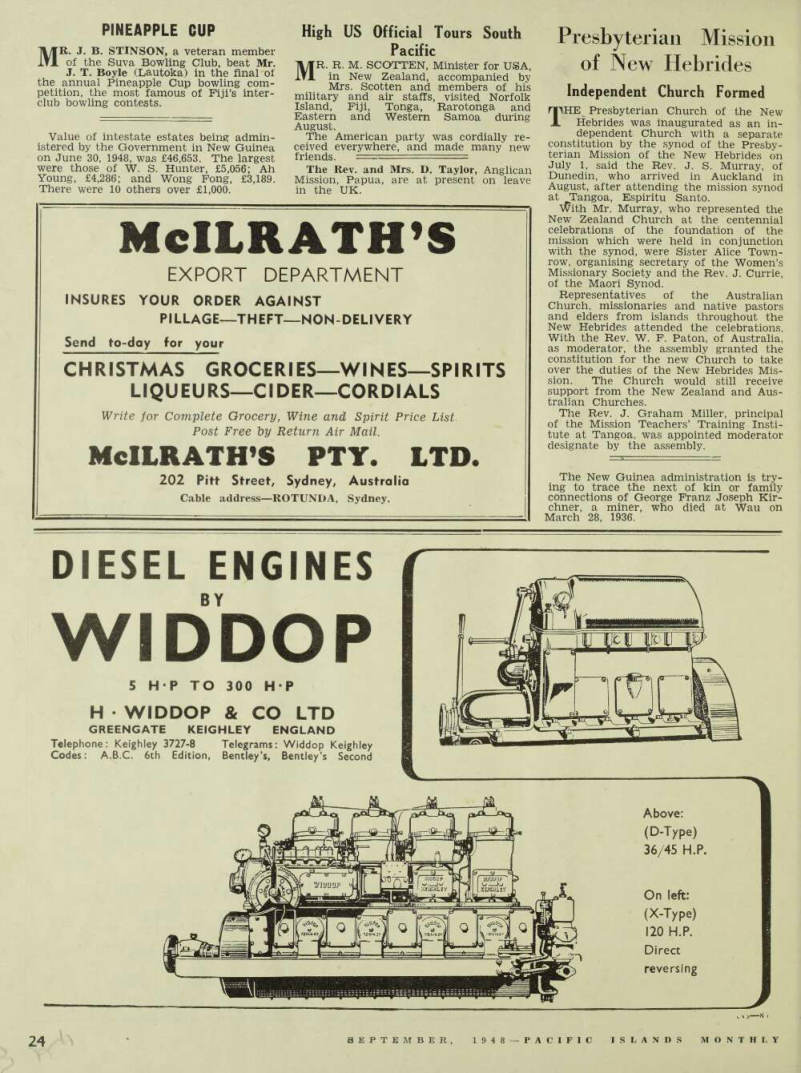
MR. J. B. STINSON, a veteran member of the Suva Bowling Club, beat Mr.
J. T. Boyle (Lautoka) in the final of the annual Pineapple Cup bowling com petition, the most famous of Fiji’s inter club bowling contests.
Value of intestate estates being admin istered by the Government in New Guinea on June 30, 1948, was £46,653. The largest were those of W. S. Hunter, £5,056; Ah Young, £4,286; and Wong Fong, £3,189.
There were 10 others over £l,OOO.
High US Official Tours South
Pacific
MR. R. M. SCOTTEN, Minister for USA, in New Zealand, accompanied by Mrs. Scotten and members of his military and air staffs, visited Norfolk Island, Fiji, Tonga, Rarotonga and Eastern and Western Samoa during August.
The American party was cordially re ceived everywhere, and made many new friends, " = The Rev. and Mrs. D. Taylor, Anglican Mission, Papua, are at present on leave in the UK.
Presbyterian Mission
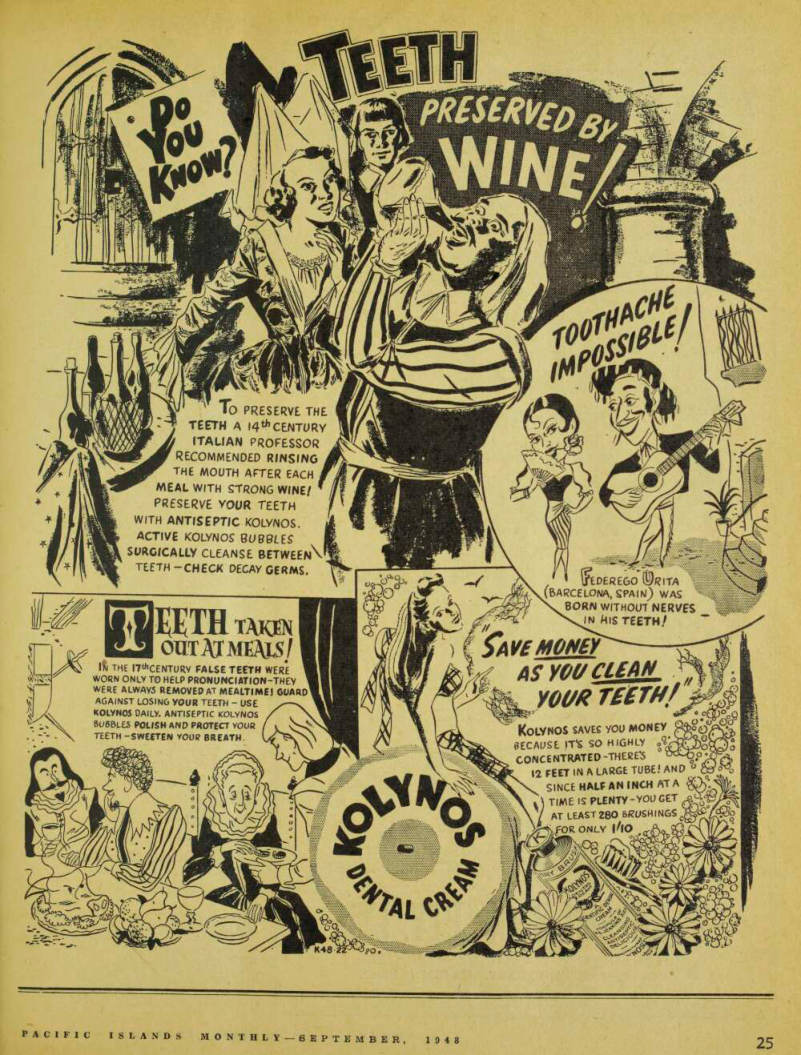
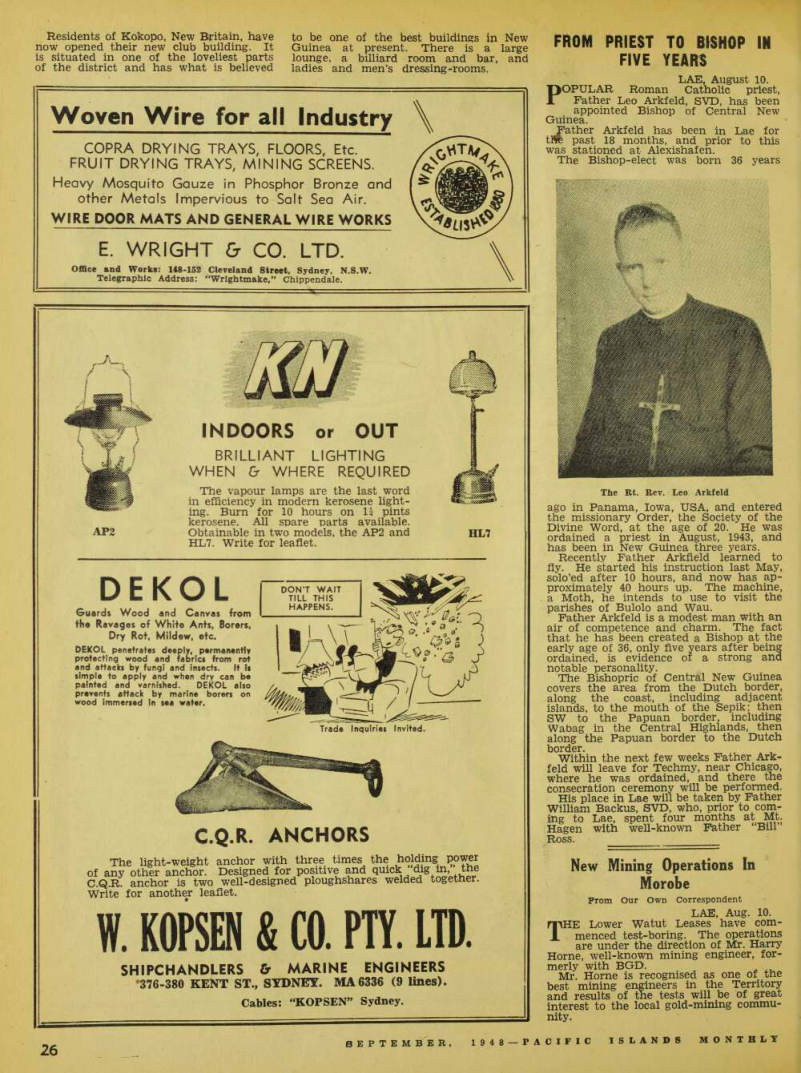
of New Hebrides Independent Church Formed
THE Presbyterian Church of the New Hebrides was inaugurated as an in dependent Church with a separate constitution by the synod of the Presby terian Mission of the New Hebrides on July 1, said the Rev. J. S. Murray, of Dunedin, who arrived in Auckland in August, after attending the mission synod at Tangoa, Espiritu Santo.
With Mr. Murray, who represented the New Zealand Church at the centennial celebrations of the foundation of the mission which were held in conjunction with the synod, were Sister Alice Town row, organising secretary of the Women’s Missionary Society and the Rev. J. Currie, of the Maori Synod.
Representatives of the Australian Church, missionaries and native pastors and elders from islands throughout the New Hebrides attended the celebrations.
With the Rev, W. F. Paton, of Australia, as moderator, the assembly granted the constitution for the new Church to take over the duties of the New Hebrides Mis sion. The Church would still receive support from the New Zealand and Aus tralian Churches.
The Rev. J. Graham Miller, principal of the Mission Teachers’ Training Insti tute at Tangoa. was appointed moderator designate by the assembly.
The New Guinea administration is try ing to trace the next of kin or family connections of George Franz Joseph Kir chner, a miner, who died at Wau on March 28, 1936.
Residents of Kokopo, New Britain, have now opened their new club building. It is situated in one of the loveliest parts of the district and has what is believed
to be one of the best buildings in New Guinea at present. There is a large lounge, a billiard room and bar, and ladies and men’s dressing-rooms.
Advertisements & other items, pp. 26-28 (2 items)
widdop
McILRATH’S
EXPORT DEPARTMENT
INSURES YOUR ORDER AGAINST
PILLAGE—THEFT—NON-DELIVERY
Send to-day for your
CHRISTMAS GROCERIES—WINES—SPIRITS
LIQUEURS—CIDER—CORDIALS
Write for Complete Grocery, Wine and Spirit Price List.
Post Free by Return Air Mail.
McILRATH’S PTY. LTD.
202 Pitt Street, Sydney, Australia Cable address—ROTUNDA, Sydney.
DIESEL ENGINES
widdop
5 H P TO 300 H P
H • WIDDOP & CO LTD
GREENGATE KEIGHLEY ENGLAND
Telephone; Keighley 3727-8 Telegrams: Widdop Keighley Codes: A.B.C. 6th Edition, Bentley’s, Bentley’s Second R Q r- Above: (D-Type) 36/45 H.P.
On left: (X-Type) 120 H.P.
Direct reversing
tfcSTH
0 / J o'* r *? >=•l K* 0 r // #s- < <3 o &f% s* yj \V 'LI
CHi
rifHt
iff
<*<y 10
SSI *
s «
m to PRESERVE THE
J TEETH A 14 th CENTURY
WIJ fTA LIAN PROFESSOR
WAf RECOMMENDED RINSING i
the mouth after each i
MEAL WITH STRONG WINE/ '
PRESERVE YOUR TEETH
WITH ANTISEPTIC KOLYNOS. i
ACTIVE KOLYNOS BUBBLES I
SURGICALLY CLEANSE BETWEEN V
TEETH-CHECK DECAY GERMS.
& 71
/ * IFeDEREGO ©RITA \
(BARCELONA, SPAIN) WAS X "
\ BORN WITHOUT NERVES
His TEETH/
a .CL a a?
EETH taken
out Ar meals/
if) the false teeth were
WORN ONLY TO HELP PRONUNCIATION-THEY
WERE ALWAYS REMOVED AT MEALTIME) GUARD
AGAINST LOSING VOUR TEETH - USE
KOLYNOS DAILY. ANTISEPTIC KOLYNOS
bubbles polish and protect your
TEETH-SWEETEN YOUR BREATH
& > s
JSL
<a oQ, K4B o 1 \r S * <9 & "AL&
Zavemonby
A SWO CUML
YOOR T£
Kolynos saves you money F^or°°
BECAUSE IT'S SO HIGHLY
CONCENTRATED -THERE‘S
12 FEET IN A LARGE TUBE.' AND ° SINCE HALF AN INCH AT A ggC
.A TIME IS PLENTY -you GET
V AT LEAST 280 BRUSH INGS
FOR ONLY |/fO
wo m i ■SiPrf
Woven Wire for all industry
COPRA DRYING TRAYS, FLOORS, Etc.
FRUIT DRYING TRAYS, MINING SCREENS.
Heavy Mosquito Gauze in Phosphor Bronze and other Metals Impervious to Salt Sea Air.
WIRE DOOR MATS AND GENERAL WIRE WORKS
E. WRIGHT & CO. LTD.
Office and Works: 148-152 Cleveland Street, Sydney, N.S.W.
Telegraphic Address: •'Wrlghtmake," Chippendale.
AP2
INDOORS or OUT
BRILLIANT LIGHTING
WHEN & WHERE REQUIRED
The vapour lamps are the last word in efficiency in modem kerosene lighting. Burn for 10 hours on II pints kerosene. All spare parts available.
Obtainable in two models, the AP2 and HL7. Write for leaflet. m HL7
DEKOL
Guards Wood and Canvas from the Ravages of White Ants, Borers, Dry Rot, Mildew, etc.
DEKOL penetrates deeply, permanently protecting wood and fabrics from rot and attacks by fungi and insects. It fs simple to apply and when dry can be painted and varnished. DEKOL also prevents attack by marine borers on wood immersed in sea water.
DON'T WAIT
TILL THIS
HAPPENS.
i wr a Trade Inquiries Invited.
C.Q.R. ANCHORS
The light-weight anchor with three times the holding power of any other anchor. Designed for positive and quick C.Q.R. anchor is two well-designed ploughshares welded together.
Write for another leaflet.
W. KOPSEN & CO. m LTD.
SHIPCHANDLERS b MARINE ENGINEERS
*376-380 KENT ST., SYDNEY. MA6336 (9 lines).
Cables; “KOPSEN” Sydney.
From Priest To Bishop In
Five Years
LAE, August 10.
POPULAR Roman Catholic priest, Father Leo Arkfeld, SVD, has been appointed Bishop of Central New Guinea.
Father Arkfeld has been in Lae for tHfc past 18 months, and prior to this was stationed at Alexishafen.
The Bishop-elect was born 36 years
ago in Panama, lowa, USA, and entered the missionary Order, the Society of the Divine Word, at the age of 20. He was ordained a priest in August, 1943, and has been in New Guinea three years.
Recently Father Arkfield learned to fly. He started his instruction last May, solo’ed after 10 hours, and now has ap proximately 40 hours up. The machine, a Moth, he intends to use to visit the parishes of Bulolo and Wau.
Father Arkfeld is a modest man with an air of competence and charm. The fact that he has been created a Bishop at the early age of 36, only five years after being ordained, is evidence of a strong and notable personality.
The Bishopric of Central New Guinea covers the area from the Dutch border, along the coast, including adjacent islands, to the mouth of the Sepik; then SW to the Papuan border, including Wabag in the Central Highlands, then along the Papuan border to the Dutch border. , , Within the next few weeks Father Ark feld will leave for Techmy, near Chicago, where he was ordained, and there the consecration ceremony will be performed.
His place in Lae will be taken by Father William Backus, SVD, who, prior to com ing to Lae, spent four months at Mt.
Hagen with well-known Father “Bill”
Ross.
The Rt. Rev. Leo Arkfeld
New Mining Operations In Morobe
Morobe
Prom Our Own Correspondent LAE, Aug. 10.
THE Lower Watut Leases have com menced test-boring. The operations are under the direction of Mr. Harry Horne, well-known mining engineer, for merly with BGD.
Mr. Horne is recognised as one of the best mining engineers in the Territory and results of the tests will be of great interest to the local gold-mining commu nity.
Immigration Minister Presents Some Forgotten History
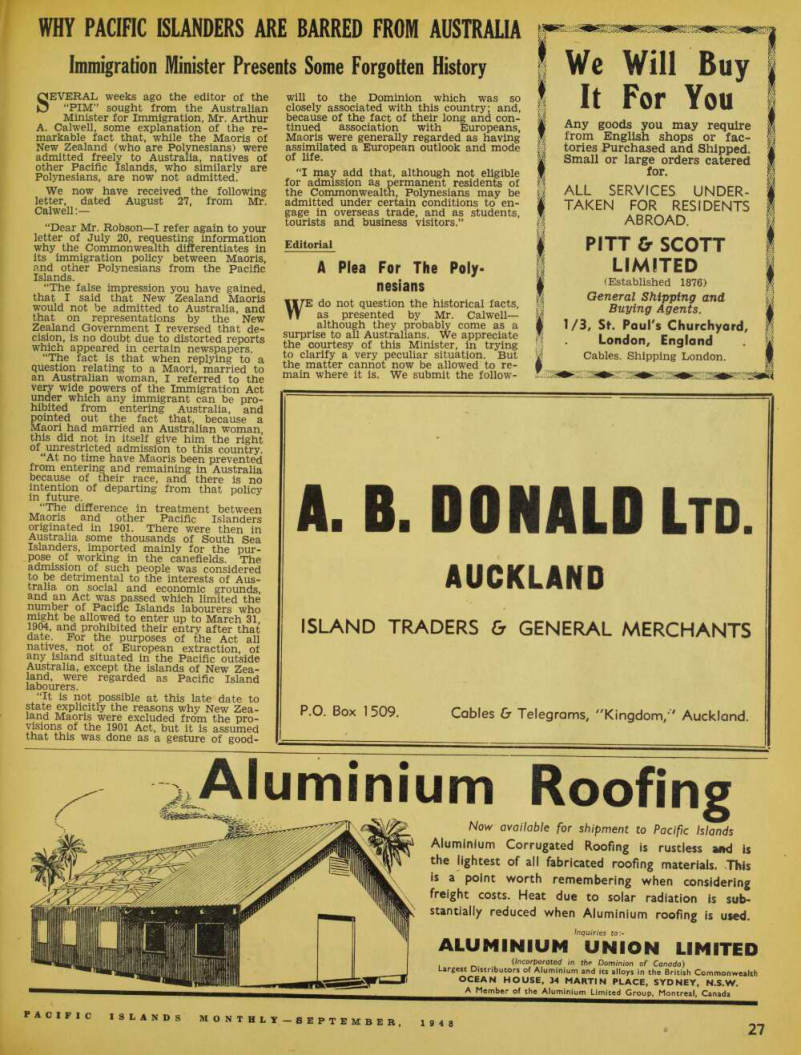
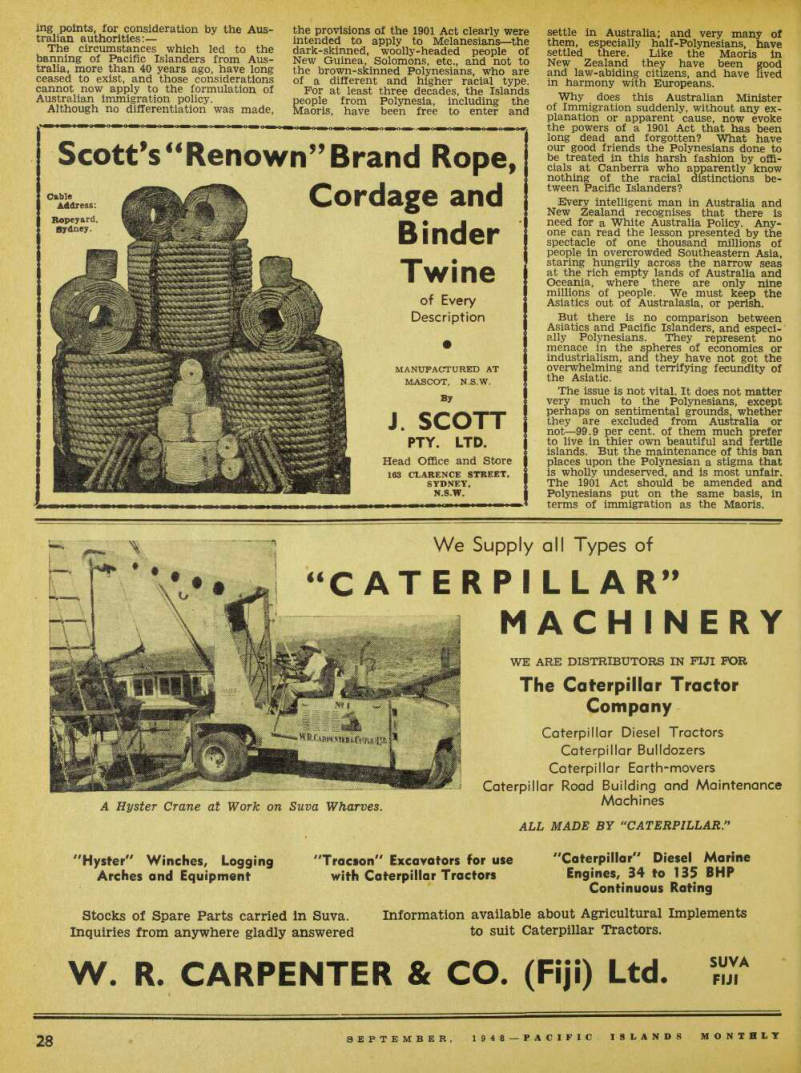
WHY PACIFIC ISLANDERS ARE BARRED FROM AUSTRALIA Immigration Minister Presents Some Forgotten History
SEVERAL weeks ago the editor of the “PIM” sought from the Australian Minister for Immigration, Mr. Arthur A. Calwell, some explanation of the re markable fact that, while the Maoris of New Zealand (who are Polynesians) were admitted freely to Australia, natives of other Pacific Islands, who similarly are Polynesians, are now not admitted.
We now have received the following letter, dated August 27, from Mr.
Calwell: — “Dear Mr. Robson —I refer again to your letter of July 20, requesting information why the Commonwealth differentiates in its immigration policy between Maoris, and other Polynesians from the Pacific Islands.
“The false impression you have gained, that I said that New Zealand Maoris would not be admitted to Australia, and that on representations by the New Zealand Government I reversed that de cision, is no doubt due to distorted reports which appeared in certain newspapers.
“The fact is that when replying to a question relating to a Maori, married to an Australian woman, I referred to the very wide powers of the Immigration Act under which any immigrant can be pro hibited from entering Australia, and pointed out the fact that, because a Maori had married an Australian woman, this did not in itself give him the right of unrestricted admission to this country.
“At no time have Maoris been prevented from entering and remaining in Australia because of their race, and there is no intention of departing from that policy in future.
“The difference in treatment between Maoris and other Pacific Islanders originated in 1901. There were then in Australia some thousands of South Sea Islanders, imported mainly for the pur pose of working in the canefields. The admission of such people was considered to be detrimental to the interests of Aus tralia on social and economic grounds, and an Act was passed which limited the number of Pacific Islands labourers who might be allowed to enter up to March 31 1904, and prohibited their entry after that date. For the purposes of the Act all natives, not of European extraction, of any island situated in the Pacific outside Australia, except the islands of New Zea land, were regarded as Pacific Island labourers.
“It is not possible at this late date to state explicitly the reasons why New Zea land Maoris were excluded from the pro visions of the 1901 Act, but it is assumed that this was done as a gesture of good
will to the Dominion which was so closely associated with this country; and, because of the fact of their long and con tinued association with Europeans, Maoris were generally regarded as having assimilated a European outlook and mode of life.
“I may add that, although not eligible for admission as permanent residents of the Commonwealth, Polynesians may be admitted under certain conditions to en gage in overseas trade, and as students, tourists and business visitors.”
Editorial
A Plea For The Poly
nesians
11TE do not question the historical facts, ff as presented by Mr. Calwell— although they probably come as a surprise to all Australians. We appreciate the courtesy of this Minister, in trying to clarify a very peculiar situation. But the matter cannot now be allowed to re main where it is. We submit the follow
ing points, for consideration by the Aus tralian authorities:— The circumstances which led to the banning of Pacific Islanders from Aus tralia, more than 40 years ago, have long ceased to exist, and those considerations cannot now apply to the formulation of Australian immigration policy.
Although no differentiation was made,
the provisions of the 1901 Act clearly were intended to apply to Melanesians—the dark-skinned, woolly-headed people of New Guinea, Solomons, etc., and not to the brown-skinned Polynesians, who are of a different and higher racial type.
For at least three decades, the Islands people from Polynesia, including the Maoris, have been free to enter and
settle in Australia; and very many of them, especially half-Polynesians, have settled there. Like the Maoris in New Zealand they have been good and law-abiding citizens, and have lived in harmony with Europeans.
Why does this Australian Minister of Immigration suddenly, without any ex planation or apparent cause, now evoke the powers of a 1901 Act that has been long dead and forgotten? What have our good friends the Polynesians done to be treated in this harsh fashion by offi cials at Canberra who apparently know nothing of the racial distinctions be tween Pacific Islanders?
Every intelligent man in Australia and New Zealand recognises that there is need for a White Australia Policy. Any one can read the lesson presented by the spectacle of one thousand millions of people in overcrowded Southeastern Asia, staring hungrily across the narrow seas at the rich empty lands of Australia and Oceania, where there are only nine millions of people. We must keep the Asiatics out of Australasia, or perish.
But there is no comparison between Asiatics and Pacific Islanders, and especi ally Polynesians. They represent no menace in the spheres of economics or industrialism, and they have not got the overwhelming and terrifying fecundity of the Asiatic.
The issue is not vital. It does not matter very much to the Polynesians, except perhaps on sentimental grounds, whether they are excluded from Australia or n0t—99.9 per cent, of them much prefer to live in thier own beautiful and fertile islands. But the maintenance of this ban places upon the Polynesian a stigma that is wholly undeserved, and is most unfair.
The 1901 Act should be amended and Polynesians put on the same basis, in terms of immigration as the Maoris.
Advertisements & other items, pp. 29-30 (2 items)
27
PACIFIC ISLANDS MONTHLY-S E P T E M B E R , 1948
A. B. Donald Ltd.
We Will Buy
It For You
Any goods you may require from English shops or factories Purchased and Shipped.
Small or large orders catered for.
ALL SERVICES UNDER-
TAKEN FOR RESIDENTS
ABROAD.
PITT Cr SCOTT
LIMITED
(Established 1876) General Shipping and Buying Agents. 1/3, St. Paul's Churchyard, London, England Cables. Shipping London.
A. B. DONALD Ltd.
AUCKLAND
ISLAND TRADERS & GENERAL MERCHANTS
P.O. Box 1509. Cables & Telegrams, "Kingdom/' Auckland.
Aluminium Roofin?
.* ’ >/- K/au/ /vi//ii‘fy«l%f a /*-, M «L •«. .. A . ..
Now available for shipment to Pacific Islands Aluminium Corrugated Roofing is rustless and is the lightest of all fabricated roofing materials. This is a point worth remembering when considering freight costs. Heat due to solar radiation is substantially reduced when Aluminium roofing is used.
Inquiries to:-
ALUMINIUM UNION LIMITED
{lncorporated in the Dominion of Canada) Largest Distributors of Aluminium and its alloys in the British Commonwealth OCEAN HOUSE, 34 MARTIN PLACE, SYDNEY, N.S.W.
A Member of the Aluminium Limited Group, Montreal. Canada
Scott's “Renown’’Brand Rope,
Cordage and
Binder
Twine
of Every
Description
Cable Address: Ropeyard.
Sydney. 4 mmmm
MANUFACTURED AT
MASCOT, N.S.W.
J. SCOTT
PTY. LTD.
Head Office and Store
163 CLARENCE STREET,
SYDNEY,
N.S.W.
o A Hyster Crane at Work on Suva Wharves.
We Supply all Types of
“CATERPILLAR”
MACHINERY
WE ARE DISTRIBUTORS IN FIJI FOR
The Caterpillar Tractor
Company
Caterpillar Diesel Tractors Caterpillar Bulldozers Caterpillar Earth-movers Caterpillar Road Building and Maintenance Machines Hyster" Winches, Logging Arches and Equipment Tracson" Excavators for use with Caterpillar Tractors
ALL MADE BY “CATERPILLAR.”
"Caterpillar" Diesel Marine Engines, 34 to 135 BHP Continuous Rating Stocks of Spare Parts carried in Suva.
Inquiries from anywhere gladly answered Information available about Agricultural Implements to suit Caterpillar Tractors.
W. R. CARPENTER & CO. (Fiji) Ltd.
SUVA
FIJI
Impasse!
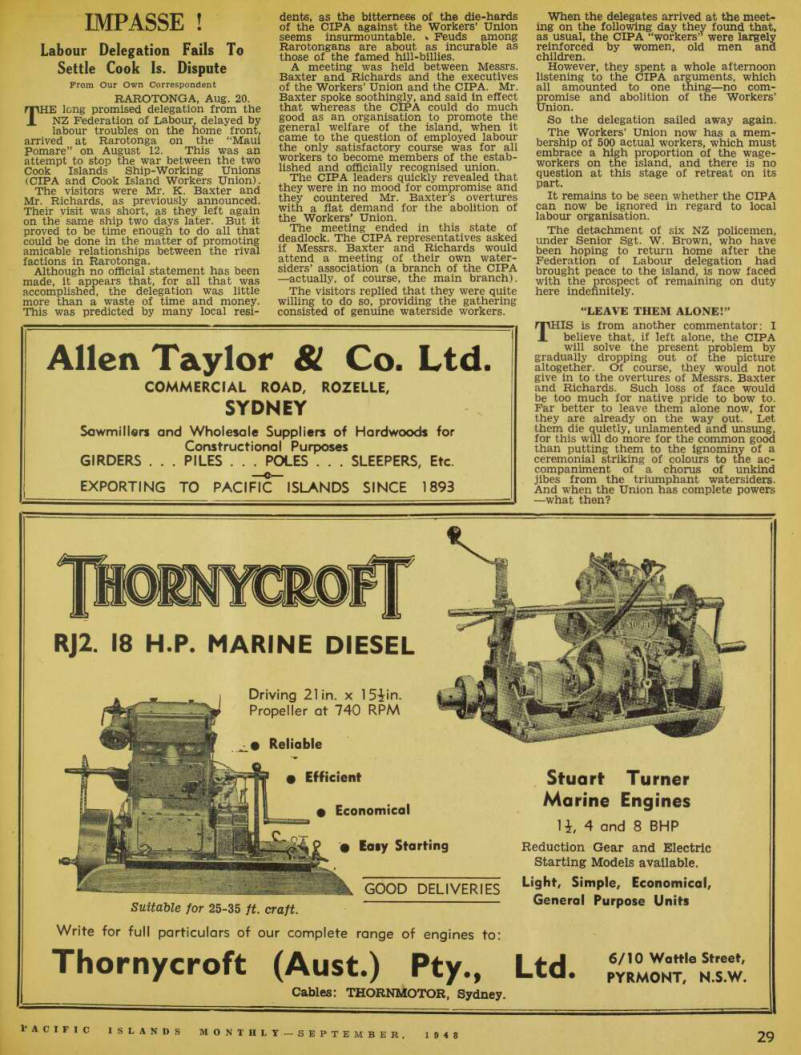
Labour Delegation Fails To Settle Cook Is. Dispute
From Our Own Correspondent
Rarotonga, Aug. 20.
THE long promised delegation from the NZ Federation of Labour, delayed by labour troubles on the home front, arrived at Rarotonga on the “Maui Pomare” on August 12. This was an attempt to stoo the war between the two Cook Islands Ship-Working Unions (CIPA and Cook Island Workers Union).
The visitors were Mr. K. Baxter and Mr. Richards, as previously announced.
Their visit was short, as they left again on the same ship two days later. But it proved to be time enough to do all that could be done in the matter of promoting amicable relationships between the rival factions in Rarotonga.
Although no official statement has been made, it appears that, for all that was accomplished, the delegation was little more than a waste of time and money.
This was predicted by many local resi
dents, as the bitterness of the die-hards of the CIPA against the Workers’ Union seems insurmountable. » Feuds among Rarotongans are about as incurable as those of the famed hill-billies.
A meeting was held between Messrs.
Baxter and Richards and the executives of the Workers’ Union and the CIPA. Mr.
Baxter spoke soothingly, and said in effect that whereas the CIPA could do much good as an organisation to promote the general welfare of the island, when it came to the question of employed labour the only satisfactory course was for all workers to become members of the estab lished and officially recognised union.
The CIPA leaders quickly revealed that they were in no mood for compromise and they countered Mr. Baxter’s overtures with a flat demand for the abolition of the Workers’ Union.
The meeting ended in this state of deadlock. The CIPA representatives asked if Messrs. Baxter and Richards would attend a meeting of their own water siders’ association (a branch of the CIPA —actually, of course, the main branch).
The visitors replied that they were quite willing to do so, providing the gathering consisted of genuine waterside workers.
When the delegates arrived at the meet ing on the following day they found that, as usual, the CIPA “workers’* were largely reinforced by women, old men and children.
However, they spent a whole afternoon listening to the CIPA arguments, which all amounted to one thing—no com promise and abolition of the Workers’
Union.
So the delegation sailed away again.
The Workers’ Union now has a mem bership of 500 actual workers, which must embrace a high proportion of the wage workers on the island, and there is no question at this stage of retreat on its part.
It remains to be seen whether the CIPA can now be ignored in regard to local labour organisation.
The detachment of six NZ policemen, under Senior Sgt. W. Brown, who have been hoping to return home after the Federation of Labour delegation had brought peace to the island, is now faced with the prospect of remaining on duty here indefinitely.
“Leave Them Alone!”
THIS is from another commentator; I believe that, if left alone, the CIPA will solve the present problem by gradually dropping out of the picture altogether. Of course, they would not give in to the overtures of Messrs. Baxter and Richards. Such loss of face would be too much for native pride to bow to.
Far better to leave them alone now, for they are already on the way out. Let them die quietly, unlamented and unsung, for this will do more for the common good than putting them to the ignominy of a ceremonial striking of colours to the ac companiment of a chorus of unkind jibes from the triumphant watersiders.
And when the Union has complete powers —what then?
Advertisements & other items, pp. 31-32 (2 items)
29
IACIFIC ISLANDS MONTHLY SEPTEMBER, 1948
Thornycroft (Aust.) Pty., Ltd.
Allen Taylor 81 Co. Ltd.
COMMERCIAL ROAD, ROZELLE,
SYDNEY
Sowmillers and Wholesale Suppliers of Hardwoods for Constructional Purposes GIRDERS . , . PILES . . . POLES . . . SLEEPERS, Etc.
EXPORTING TO ISLANDS SINCE 1893
0 a
RJ2. 18 H.P. MARINE DIESEL
Driving 21 in. x 1 siin.
Propeller at 740 RPM • Reliable
Stuart Turner
Marine Engines
li, 4 and 8 BHP Reduction Gear and Electric Starting Models available.
GOOD DELIVERIES Simple, Economical, General Purpose Units • Efficient • Economical • Easy Starting Suitable for 25-35 ft. craft.
Write for full particulars of our complete range of engines to:
Thornycroft (Aust.) Pty., Ltd.
Cables: THORNMOTOR, Sydney.
ANCHOR HOCKING GLASSWARE
"The Most Famous Name In Glass"
Be assured of fast turn-
over for year-round
selling
All Big Sellers—Special Values and Low Prices
FI RE-KING OVEN GLASS
(Guaranteed) TUMBLERS (Plain and decorated)
LAMPS
OIL LAMPS (Bases only)
JUMBO ICED TEAS
KITCHEN GLASSWARE
FIRE-KING TABLEWARE
VASES
BANKS
CRYSTAL OCCASIONAL
PIECES
"HEAT-PROOF" JADE-ITE
Heat-resisting glass dinnerware in a pleasing opaque jade colour. The only line of its kind made in America. Jade-ite is made of the same heat-resisting material throughout. Will NOT "check" or "craze".
SPARKLING CRYSTAL
DECORATED WARE
FIRE-KING
Useful Items Good Quality
PACIFIC ISLANDS TRADING COMPANY
244 CALIFORNIA STREET, SAN FRANCISCO 11, CALIFORNIA, U.S.A.
EXPORTERS
OBTAINABLE AT YOUR STORE.
Death Of Mr. L. L. F. Rex
Tl/TR. L. L. F. REX, a member of a irl well-known Tasmanian pioneering family, who was also very widely known in the Pacific Islands, died at Auckland on July 29.
As a young man he practised law in Australia and then in Tonga. Later he opened a store at Niue Island and made trading trips to many parts of the Pacific, In 1928 he settled in Fiji. For a time he was in charge of the Suva markets and for several years before he left the Colony he was caretaker at the quarantine island of Makaluva.
Criticised
New Guinea Conditions
MR. DAN POWER, from New Guinea, arrived in Sydney in August, and there joined the “Arawa” for South Africa and Kenya, where he expects to make his future home. Mr. Power spent many years in New Guinea, and served there during the war; but he claims that the system of administration there now, and the principles of government as ap plied. are ridiculous, and are bringing the White Community into disrepute. “I will return to New Guinea when a sane and well-balanced administration is re stored,” he said.
Mr, D. A. Butler, manager in Fiji, for the Union Steam Ship Co,, of New Zea land, has been appointed a member of the Fiji Marine Board in place of Sir Maynard Hedstrom, who has resigned for health reasons, after 25 years’ service on the Board.
Major Robert Duncan

Passes
From Our Mangala Correspondent THE many Mangaian friends of Major Robert Duncan (“Meitia”) have heard with regret that he died earlier this year at his home in Wales, where he had been living in retirement for some years. With him passes a chapter of Cook Islands history.
Major Duncan was formerly manager of the Mangaia branch of the Cook Islands Native Association, a well-known co-operative trading firm which was at its zenith between 1928 and 1933. In the latter year it was forced to close because of shipping and wholesale difficulties created by the depression but it had formerly supplied the Mangaians with trade goods at reasonable prices. While the CINA was flourishing, the genial Major, a veteran of the First World War, was its mainspring. He organised the shareholders, ran the store, supplied sub traders, and dealt with other minor affairs with ease and success.
The CINA which tried to bring the price of commodities within the reach of Islanders was popular with Mangaians who have a very low annual income. As it was conceived as a kind of branch of the New Zealand Farmers’ Union Trading Co., it was familiarly known as the “Farm.”
Major Duncan was decorated during his World War I service and his health was impaired by wounds sustained when he was blown up and buried in a trench. He is survived by his wife and a daughter.
Mr. W. V. Banting, Accountant-General, Fiji, and Mrs. Banting recently left the Colony for the United Kingdom. Mr.
Banting has been granted five months’ leave to attend to urgent private affairs.
Mr. and Mrs. B. K. Schram, of Spring field, Missouri, USA, are in Fiji for two or three inonths to gather material for articles for American magazines. They are people of charming social qualities and have made many friends.
The Governor of Queensland, Sir John Lavarack, recently paid an official visit to the Torres Straits and Cape York Penmsula. He met many islanders, some of whom sailed their luggers 150 miles to see him.
Advertisements & other items, pp. 33-34 (1 item)
N. F. Maloney & Co.
COLE’S
Tropic-Seasoned
CHICKENS
Pure WHITE LEGHORNS and
First-crosses: R.l. Red x W.L. or Australorp x W.L.
Bred in the sub-tropics and seasoned to your climate.
All Breeders guaranteed Government blood-tested. 25’s 50’s 100’s £ s. d. £ s. d. £ s. d.
W.L. .. 110 0 212 6 415 0 Crosses 111 6 215 0 500 Plus Air Freight
ED. COLE,
Enmore Poultry Form, Cairns, N.Q.
N. F. Maloney & Co.
'PHONE 268 PORT MORESBY 'PHONE 268
Cables, Radios, etc.: “Malco,” Port Moresby.
Customs, Shipping and Forwarding Agents
B 2 a L or i : When ordering South, asks the Consignor to ship addressed your Brand or Name and Mark the Packages “PER MALONEY.” This will help us to give Fast and Speedy Delivery.
Licensed Auctioneers and General Commission Agents
We will sell anything you have to offer by Auction or Private Sale.
HOUSE, LAND, AND ESTATE AGENTS CHIEF AGENTS:—
NEW ZEALAND INSURANCE CO. LTD.
FIRE ACCIDENT MOTOR VEHICLE MARINE, ETC.
Importers and Exporters • Manufacturers Representatives • Managing Agents: Papuan Airlines Limited.
Australian Representatives: E. J. GOUGH & CO., I BOND STREET, SYDNEY
ART POSTCARDS OF
TONGA
Per Dozen, Postage Paid: 6/- (one US Dollar).
TONGAN PHOTOS BUREAU
Nukualofa, Tonga
rotect your Hair
The Tonic Hair Dressing
4517 SK s! c ) m r fi| 4? iFI 4' K
JUN. W/ND, ond WATER,
all play havoc with your hair, depriving it of its natural scalp oils.
Let Vitalis* pure vegetable oils protect your hair and scalp , no matter where you are or what you do.
Vitalis routs loose dandruff; helps retard falling hair; stimulates the scalp and dresses the hair in a handsome, natural way.
Sandy Creek In Production
DURING July, 177 oz. 17 dwt. of gold were recovered from 11,342 cubic yards of material treated by Sandy Creek Gold Sluicing, Ltd., in New Guinea.
The American training ship “Yankee II” visited South Santo, New Hebrides, in June. Captain Irving Johnson, who is accompanied by his wife and young son is owner-skipper of the ship. She is manned by 20 cadets. “Yankee II” anchored off Venuei, the residence of Mr.
J. Maxwell, British Agent at Santo, for several days while the ship’s company explored local beauty spots. She then left for the Solomons.
A New Constitution For
Fiji
Questions In The Commons
THE following is from an official report of proceedings in the House of Commons: Mr. Geoffrey Cooper asked the Secre tary of State for the Colonies if, in view of the new Governor’s announcement on arrival in Fiji that constitutional issues would receive immediate consideration, he was in a position to make any statement as to the setting up of a Commission to investigate the present position and advise both the Governor and Minister accordingly.
Mr. Rees-Williams: The present Gover nor of Fiji, before his departure for the Colony, was asked to report on these matters after he had had an opportunity of studying the problem at first-hand. I am not in a position to make any state ment at present.
Mr, Cooper: Will the Under-Secretary give an assurance that such organisations as the European Electors’ Association of Fiji will have full and fair opportunity to express their views and make represen tations both to the Governor and to the Colonial Secretary, and will he make a point of seeing that any original reports that this organisation may wish him to see will actually receive his personal at tention?
Mr. Rees-Williams: Certainly.
Mr. Cooper asked if, in the economic, educational and cultural plans to be drawn up under the new Governorship of Fiji, he will ensure that the fullest con siderations be given to any representa tions made on behalf of the native Fijians, and see that such representa tions are at least considered equally with those coming from the Indian and other sections of the community.
Mr. Rees-Williams: Yes, Sir.
Small Koro Settles In
N. Hebrides
Prom Our Own Correspondent SANTO. August 20.
LAST of the four ships built by Whippy’s, of Suva, for Messrs, Burns Philp & Co., Ltd., the auxiliary ketch “Koro,” arrived in Santo late in July to take up her duties.
Based on Vila, the 82-ton “Koro” is de signed, in part, to take the place of the mv “Muliama,” which was recently diverted from the New Hebrides run to the Solomons.
Apart from regular inter-island voyages to pick up copra and deliver stores to planters, an important job of the “Koro” will be to meet the ss “Morinda” in Santo and tranship her cargo for delivery throughout the Group, and allow the larger “Morinda” to return to Sydney in the shortest possible time.
Under Captain D. Anderson, the “Koro” is well appointed, and fitted with a 120 HP Crossley engine, and does 11 knots.
Accommodation at present consists of three cabins aft; one for the captain, one for the engineer, and the third, fitted with three bunks, for passengers. It is planned later to strip this third cabin and use it as a trade room, with, it is presumed, accommodation for a super cargo.
Prior to joining BP this year, Captain D. Anderson and Engineer R. Warren, were members of small ferrying crews between Australia and New Guinea.
Advertisements & other items, p. 35 (1 item)
Tilley Lamps
BURN ORDINARY KEROSENE
The Modern Form of PORTABLE LIGHTING 1 HH . v
PRODUCTION FOR EXPORT
WE ARE PLEASED TO INFORM OUR
FRIENDS OVERSEAS OF NEW AND
- IMPORTANT PREMISES ACQUIRED TO
FACILITATE PRODUCTION FOR EXPORT.
ALSO OUR POST-WAR MODELS ARE
NOW IN FULL PRODUCTION AND WILL
BE ON OFFER IN ALL PARTS OF THE
WORLD. TILLEY STANDARDS ARE MAIN-
TAINED AND INCORPORATED IN COM-
PLETELY MODERN DESIGNS OF LAMPS.
BRENT WORKS, NEW BRENT WORKS,
HENDON, N.W.4 CRICKLEWOOD, N.W.2.
THE TILLEY LAMP CO. LTD., of ENGLAND London Offices and Showroom : 33 SACKVILLE STREET, PICCADILLY, W.l.
REPRESENTATION :
MELBOURNE : T. H. Bentley, Pty. Ltd., 123-125 William Street, Melbourne, C.l.
TASMANIA : Mr. C. Sellars, 108 a Charles Street, Launceston.
FIJI : Mr. K. Witherington, 2 Burns Philp Buildings, Suva.
Awahou Offered For Sale
THE RCS “Awahou,” a vessel of 409 tons, owned by the Gilbert and Ellice Islands Government, is on the market. The ship recently sailed to Papeete and Pitcairn with Pitcairn’s new school master and his family and their prefabricated school building.
Death Of Mr. Sydney Young
LAE, Aug. 13.
THE death occurred here to-day of Mr.
Sydney Robert Young aged 58, and resident of the Territory since 1921.
Mr. Young was born in Scotland and educated in England.
He arrived in Australia as a youth and on the outbreak of hostilities in 1914, immediately enlisted in the 9th Battalion.
On arrival in Egypt he transferred to the 4th Light Horse, with which he served throughout the war attaining the rank of Captain. He was a member of The Imperial Service Club, Sydney.
In 1921 he came to New Guinea as accountant for the Expropriation Board.
Later he took over the Hotel Wunawatung, near Rabaul, and then became licensee of the Hotel Kokopo. In 1934 he left Kokopo and went to Wau where he car ried on private practice as an accoun tant.
At the outbreak of World War II he was evacuated to Australia where he joined the Audit Staff of the Allied Works Council. When ANGAU was formed he enlisted as a Warrant Officer and returned to New Guinea where his duties took him to Port Moresby, Salamaua, Lae and Finschhafen.
After his discharge from the army in 1946 he married Miss Rosalie Ryan of Rose Bay, Sydney. In February 1947, he came back to New Guinea as Secretary of New Guinea Industries, Ltd., which posi tion he held to the time of his death.
Mrs. Young arrived in Lae just before her husband died.
The funeral service was conducted by the Bishop-Elect of Central New Guinea, Father Leo Arkfield, and was attended by all sections of the community.
Third Judge For Papua-New
Guinea
FOLLOWING a recommendation by the Administrator of Papua-New Guinea (Colonel J. K. Murray), it has been decided to appoint a third judge for the combined territory. The two present judges (Judge F. B. Phillips and Judge R. T. Gore) cannot handle all the work.
There were two judges in New Guinea and one in Papua before the war. A con dition of the appointment of the new judge is retirement at 65.
Resignation of Mr. F. V. Miller
From Our Own Correspondent
Suva, Aug. 16.
AFTER 17 years (six of them as Town Clerk), in the service of the Suva Town Board and the former Suva Municipality, Mr. F. V. Miller, of Suva, has resigned to take up other work.
Paying tribute to him recently the Chairman of the Board, Mr. Alport Barker, said: “Mr. Miller has been an efficient servant of the Board who thor oughly understands his duties, and at all times he has safeguarded the Board’s in terests.”
The Board is to call for applications, in Australia and locally, for the positions of Town Clerk and senior clerk.
Soon after civil servants had received their recent cost of living bonus, the em ployees of the Suva Town Board asked for a similar increase in pay. At its August meeting the Board decided to ask the Government for details of the in creased cost of living in Suva before mak ing a decision.
Advertisements & other items, p. 36 (1 item)
Your Eye
The Twinkle in
COMES FROM ACTIVE
DIGESTION
Good normal digestive and liver activity means good, normal health and fitness. If yov are becoming gloomy and feel tired out, the cause may be a congested state of your intestinal tract. So many people are troubled with constipation, which, through the retention of waste in the digestive system, causes sick headache, biliousness, pimply skin, unpleasant breath, irritability, slackness and dull eyes.
Regain your bright and attractive appearance by banishing constipation with Pinkettes. Tiny, perfectly harmless, gentle yet effective, these famous laxative and liver pills painlessly exercise and strengthen the bowels, keep the food tract clean and active, stir the liver, and thus banish sick headache, bilious attacks, pimples, unpleasant breath and gloom. All chemists and stores sell Pinkettes, the perfect laxative and liver pills.
it ed ft* Wholesale & Retail Merchants. Shipowners. Sawmillers. General Engineers. Customs & Shipping
Agents.
Catering for all Plantation Supplies. Buyers of Island Produce. Plantation Owners & Managing Agents.
Assort** tto
roUER. urbane.
civ.
CO. LTO.
. WA.TSON * , b .
Agents for:— Australia-IFest Pacific Line China Navigation Co.
Canton Insurance Office Ltd.
Union Assurance Society Ltd.
National Mutual Life Assurance of A/sia Ltd.
Guinea Air Traders Ltd.
Steamships Trading Co.
Ltd.
COL^R’
Welling lo1 *’ , j Ccbuxcb.
Auckland,
Distributing Agents in New Guinea for:— Chrysler & Plymouth Cars Fargo Trucks Hillman & Hummer' Cars. Commet Trucks.
Willys Overland Jeeps G.M. Marine & Industrial Engines Prefect Refrigerators Mallard Radios Hygeia Dissolvenators Snowflake Unsweetened Evaporated Milk Olympic Tyres & Cables * 1
Bulolo
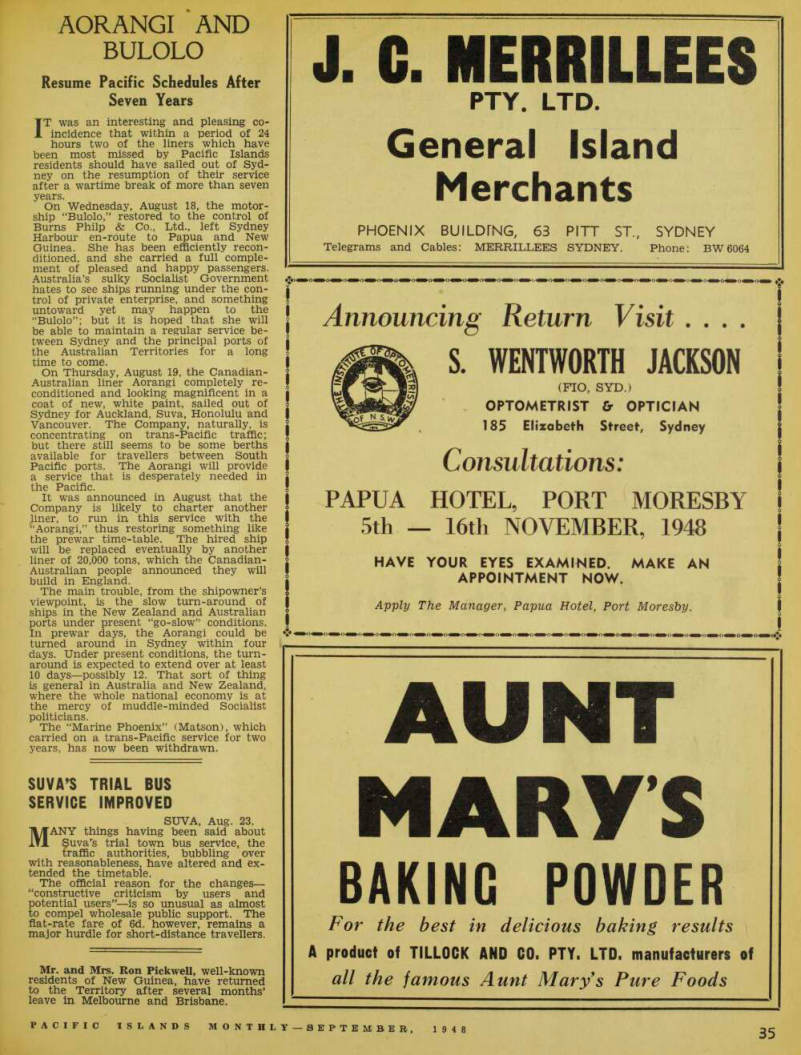
Aorangi And
Resume Pacific Schedules After Seven Years
IT was an interesting and pleasing co incidence that within a period of 24 hours two of the liners which have been most missed by Pacific Islands residents should have sailed out of Syd ney on the resumption of their service after a wartime break of more than seven years.
On Wednesday, August 18, the motor ship “Bulolo,” restored to the control of Burns Philp & Co., Ltd., left Sydney Harbour en-route to Papua and New Guinea. She has been efficiently recon ditioned, and she carried a full comple ment of pleased and happy passengers.
Australia’s sulky Socialist Government hates to see ships running under the con trol of private enterprise, and something untoward yet may happen to the “Bulolo”; but it is hoped that she will be able to maintain a regular service be tween Sydney and the principal ports of the Australian Territories for a long time to come.
On Thursday, August 19, the Canadian- Australian liner Aorangi completely re conditioned and looking magnificent in a coat of new, white paint, sailed out of Sydney for Auckland, Suva, Honolulu and Vancouver. The Company, naturally, is concentrating on trans-Pacific traffic; but there still seems to be some berths available for travellers between South Pacific ports. The Aorangi will provide a service that is desperately needed in the Pacific.
It was announced in August that the Company is likely to charter another liner, to run in this service with the “Aorangi,” thus restoring something like the prewar time-table. The hired ship will be replaced eventually by another liner of 20,000 tons, which the Canadian- Australian people announced they will build in England.
The main trouble, from the shipowner’s viewpoint, is the slow turn-around of ships in the New Zealand and Australian ports under present “go-slow” conditions.
In prewar days, the Aorangi could be turned around in Sydney within four days. Under present conditions, the turn around is expected to extend over at least 10 days—possibly 12. That sort of thing is general in Australia and New Zealand, where the whole national economy is at the mercy of muddle-minded Socialist politicians.
The “Marine Phoenix” (Matson), which carried on a trans-Pacific service for two years, has now been withdrawn.
Suva’S Trial Bus
Service Improved
Suva. Aug. 23.
MANY things having been said about Suva's trial town bus service, the traffic authorities, bubbling over with reasonableness, have altered and ex tended the timetable.
The official reason for the changes— “constructive criticism by users and potential users”—is so unusual as almost to compel wholesale public support. The flat-rate fare of 6d. however, remains a major hurdle for short-distance travellers.
Mr. and Mrs. Ron Pickwell, well-known residents of New Guinea, have returned to the Territory after several months’ leave in Melbourne and Brisbane.
Advertisements & other items, pp. 37-38 (1 item)
Marys
J. G. MERRILLEES
PTY. LTD.
General Island Merchants
PHOENIX BUILDTNG, 63 PITT ST,, SYDNEY
Telegrams and Cables: MERRILLEES SYDNEY. Phone; BW 6064
Announcing Return Visit . . . .
S. WENTWORTH JACKSON
(FIO, SYD.)
OPTOMETRIST Cr OPTICIAN
185 Elizabeth Street, Sydney
Consultations:
PAPUA HOTEL, PORT MORESBY
sth 16th NOVEMBER, 1948
HAVE YOUR EYES EXAMINED. MAKE AN
APPOINTMENT NOW.
Apply The Manager , Papua Hotel, Port Moresby.
AUHT
MARYS
BAKING POWDER
For the best in delicious baking results A product of TILLOGK AND CO. PTY. LTD. manufacturers of all the famous Aunt Marys Pure Foods
G. H. Robinson
ISLAND SUPPLIES
of all kinds—Selected and Shipped to order at lowest possible prices—Piecegoods in Wool, Cotton and Silk, Under and Outerwear, Manchester, Drapery, Grocery, Hardware, Engineers and Leathergoods trade supplies a specialty.
Indents and Transhipments arranged. Large or small orders treated with equal care.
Use our 25 years’ extensive experience.
Enquiries solicited to —
G. H. ROBINSON
51 Macquarie Street, Sydney, N.S.W.
Telegrams: Sunrise. Sydney.
Letters; Box 3317, G.P.0., Sydney.
Tnc Garrick Hotel
II .TygW-
. 1 |S!|! : |1";|
SUVA
FIJI
This well-known Hofei is centrally situated in Suva's main business quarter :: Modern accommodation provides comfort in all climatic conditions Only the best of Beers, Spirits and Wines is served Telephone I 80. VINCE COSTELLO, Proprietor.
HQrs For S. Pacific
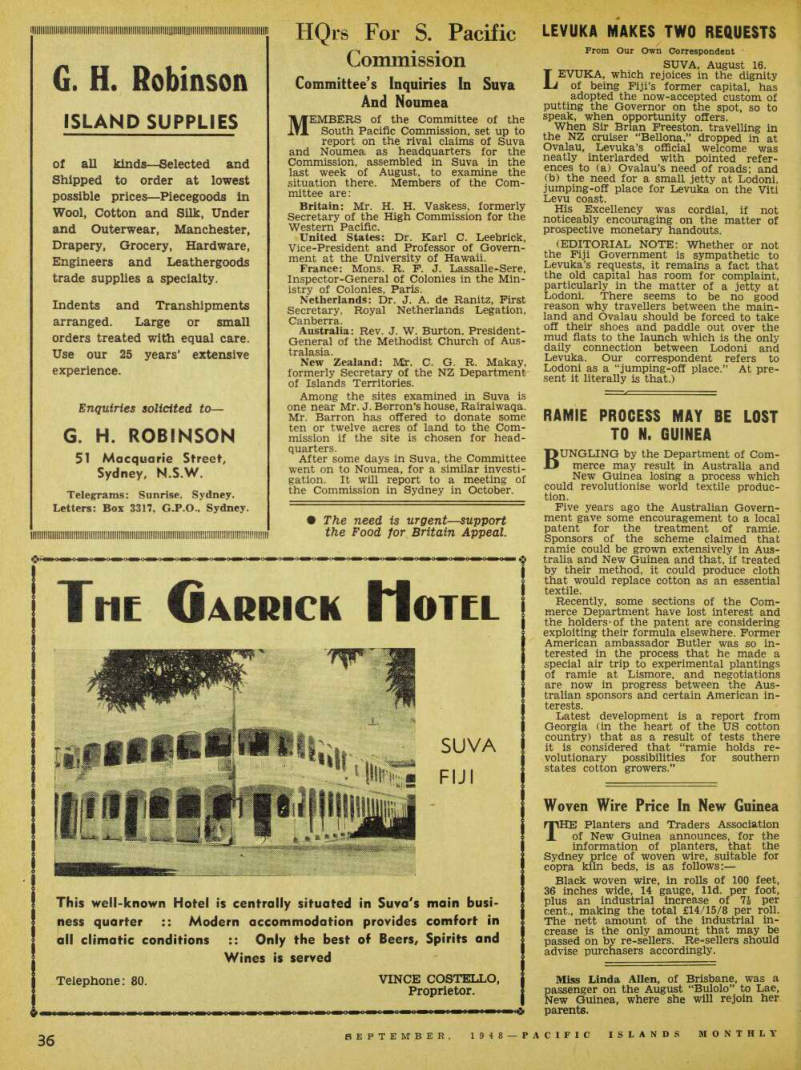
Commission Committee’s Inquiries In Suva And Noumea
MEMBERS of the Committee of the South Pacific Commission, set up to report on the rival claims of Suva and Noumea as headquarters for the Commission, assembled in Suva in the last week of August, to examine the situation there. Members of the Com mittee are: Britain: Mr. H. H. Vaskess, formerly Secretary of the High Commission for the Western Pacific.
United States: Dr. Karl C. Leebrick, Vice-President and Professor of Govern ment at the University of Hawaii.
France: Mons. R. F. J. Lassalle-Sere, Inspector-General of Colonies in the Min istry of Colonies, Paris.
Netherlands: Dr. J. A. de Ranitz, First Secretary, Royal Netherlands Legation, Canberra.
Australia: Rev. J. W. Burton. President- General of the Methodist Church of Aus tralasia New Zealand: Mir. C. G. R. Makay, formerly Secretary of the NZ Department of Islands Territories.
Among the sites examined in Suva is one near Mr. J. Borron’s house, Rairaiwaqa.
Mr. Barron has offered to donate some ten or twelve acres of land to the Com mission if the site is chosen for head quarters.
After some days in Suva, the Committee went on to Noumea, for a similar investi gation. It will report to a meeting of the Commission in Sydney in October.
• The need is urgent—support the Food for Britain Appeal.
Levuka Makes Two Requests
From Our Own Correspondent SUVA, August 16.
LEVUKA, which rejoices in the dignity of being Fiji’s former capital, has adopted the now-accepted custom of putting the Governor on the spot, so to speak, when opportunity offers.
When Sir Brian Freeston. travelling in the NZ cruiser “Bellona.” dropped in at Ovalau, Levuka’s official welcome was neatly interlarded with pointed refer ences to (a) Ovalau’s need of roads; and (b) the need for a small jetty at Lodoni, jumping-off place for Levuka on the Viti Levu coast.
His Excellency was cordial, if not noticeably encouraging on the matter of prospective monetary handouts. (EDITORIAL NOTE: Whether or not the Fiji Government is sympathetic to Levuka’s requests, it remains a fact that the old capital has room for complaint, particularly in the matter of a jetty at Lodoni. There seems to be no good reason why travellers between the main land and Ovalau should be forced to take off their shoes and paddle out over the mud flats to the launch which is the only daily connection between Lodoni and Levuka. Our correspondent refers to Lodoni as a “jumping-off place.” At pre sent it literally is that.)
Ramie Process May Be Lost
To N. Guinea
BUNGLING by the Department of Com merce may result in Australia and New Guinea losing a process which could revolutionise world textile produc tion.
Five years ago the Australian Govern ment gave some encouragement to a local patent for the treatment of ramie.
Sponsors of the scheme claimed that ramie could be grown extensively in Aus tralia and New Guinea and that, if treated by their method, it could produce cloth that would replace cotton as an essential textile.
Recently, some sections of the Com merce Department have lost interest and the holders* of the patent are considering exploiting their formula elsewhere. Former American ambassador Butler was so in terested in the process that he made a special air trip to experimental plantings of ramie at Lismore, and negotiations are now in progress between the Aus tralian sponsors and certain American in terests.
Latest development is a report from Georgia (in the heart of the US cotton country) that as a result of tests there it is considered that “ramie holds re volutionary possibilities for southern states cotton growers.”
Woven Wire Price In New Guinea
THE Planters and Traders Association of New Guinea announces, for the information of planters, that the Sydney price of woven wire, suitable for copra kiln beds, is as follows: Black woven wire, in rolls of 100 feet, 36 inches wide, 14 gauge, lid. per foot, plus an industrial increase of 71 per cent., making the total £l4/15/8 per roll.
The nett amount of the industrial in crease is the only amount that may be passed on by re-sellers. Re-sellers should advise purchasers accordingly.
Miss Linda Allen, of Brisbane, was a passenger on the August “Bulolo” to Lae, New Guinea, where she will rejoin her parents.
Polio Farce In Samoa
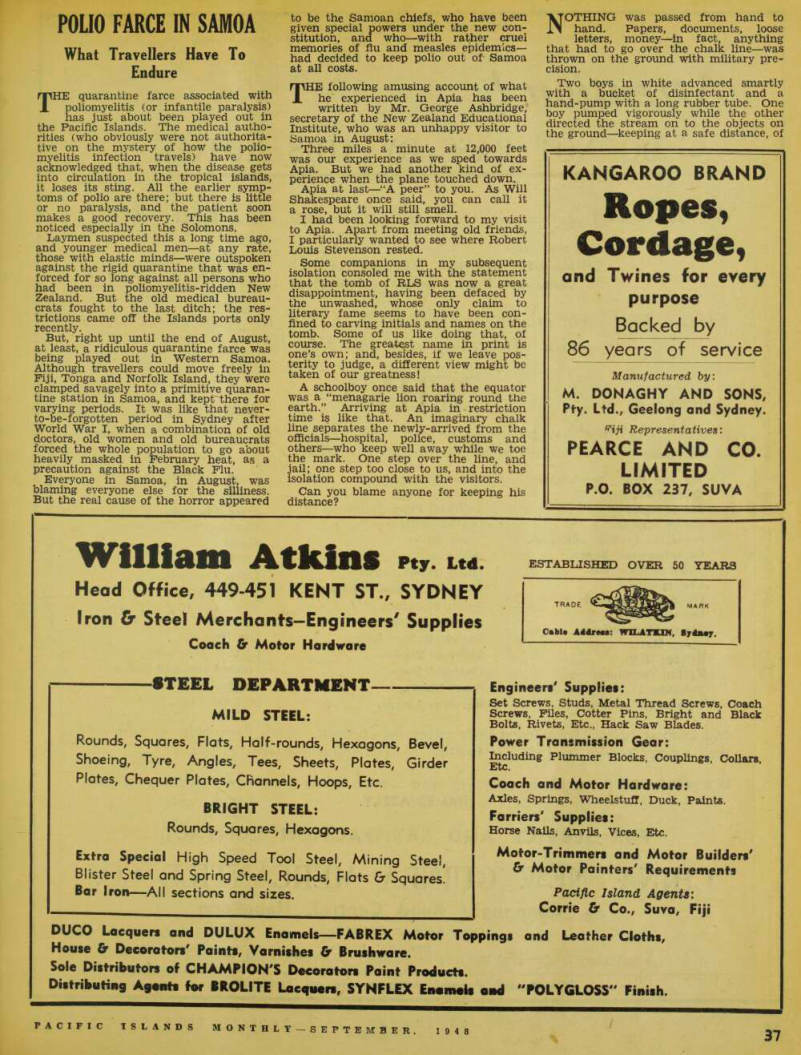
What Travellers Have To Endure
THE quarantine farce associated with poliomyelitis (or infantile paralysis) has just about been played out in the Pacific Islands. The medical autho rities (who obviously were not authorita tive on the mystery of how the polio myelitis infection travels) have now acknowledged that, when the disease gets into circulation in the tropical islands, it loses its sting. All the earlier symp toms of polio are there; but there is little or no paralysis, and the patient soon makes a good recovery. This has been noticed especially in the Solomons.
Laymen suspected this a long time ago, and younger medical men—at any rate, those with elastic minds —were outspoken against the rigid quarantine that was en forced for so long against all persons who had been in poliomyelitis-ridden New Zealand. But the old medical bureau crats fought to the last ditch; the res trictions came off the Islands ports only recently.
But, right up until the end of August, at least, a ridiculous quarantine farce was being played out in Western Samoa.
Although travellers could move freely in Fiji, Tonga and Norfolk Island, they were clamped savagely into a primitive quaran tine station in Samoa, and kept there for varying periods. It was like that never to-be-forgotten period in Sydney after World War I, when a combination of old doctors, old women and old bureaucrats forced the whole population to go about heavily masked in February heat, as a precaution against the Black Flu.
Everyone in Samoa, in August, was blaming everyone else for the silliness.
But the real cause of the horror appeared
to be the Samoan chiefs, who have been given special powers under the new con stitution, and who—with rather cruel memories of flu and measles epidemics— had decided to keep polio out of Samoa at all costs.
THE following amusing account of what he experienced in Apia has been written by Mr. George Ashbridge, secretary of the New Zealand Educational Institute, who was an unhappy visitor to Samoa in August: Three miles a minute at 12,000 feet was our experience as we sped towards Apia. But we had another kind of ex perience when the plane touched down.
Apia at last—“A peer” to you. As Will Shakespeare once said, you can call it a rose, but it will still smell.
I had been looking forward to my visit to Apia. Apart from meeting old friends, I particularly wanted to see where Robert Louis Stevenson rested.
Some companions in my subsequent isolation consoled me with the statement that the tomb of RLS was now a great disappointment, having been defaced by the unwashed, whose only claim to literary fame seems to have been con fined to carving initials and names on the tomb. Some of us like doing that, of course. The greatest name in print is one’s own; and, besides, if we leave pos terity to judge, a different view might be taken of our greatness!
A schoolboy once said that the equator was a “menagarie lion roaring round the earth.” Arriving at Apia in restriction time is like that. An imaginary chalk line separates the newly-arrived from the officials—hospital, police, customs and others—who keep well away while we toe the mark. One step over the line, and jail; one step too close to us, and into the isolation compound with the visitors.
Can you blame anyone for keeping his distance?
NOTHING was passed from hand to hand. Papers, documents, loose letters, money—in fact, anything that had to go over the chalk line—was thrown on the ground with military pre cision.
Two boys in white advanced smartly with a bucket of disinfectant and a hand-pump with a long rubber tube. One boy pumped vigorously while the other directed the stream on to the objects on the ground—keeping at a safe distance, of
course. When everything was thoroughly sprinkled—saturated would be a better word—the articles were gingerly turned over, and the process repeated.
We were asked if we wanted any American cigarettes, at 15/- per carton, so I promptly ordered a carton. The old bucket routine again: I advanced with pound note, tossed it to the ground and retreated. The bucket brigade advanced, hosed note, turned over the note care fully between thumb and forefinger, hosed it again, and retreated. The enemy being now dead —or at least dealt with—the new owner of the note advanced, picked it up and, as far as I know, is still alive.
Meanwhile, all watched the proceedings, fascinated, as if witnessing for the first time a new fire-walking technique. Or did we all expect to see some big, naughty germs jump out and run for cover?
BUT there was no cover—only a covered waggon that rushed us about 20 miles to the barbed-wire compound where we spent the night.
The journey was a nightmare. The bus was old and dilapidated, with the ex haust fumes coming up through the floor boards, and the driver was going so reck lessly that one got the impression that he thought the faster he went the further he would get away from us.
For myself, when I had reached the state of thinking the limit of endurance had been reached, one of the crew from the plane cheerfully remarked, “Only five miles to go!"
Several friends were awaiting me at the compound—on the outside, at a safe dis tance. For an hour, we exchanged greet ings and official talk—across a 15 feet “no-man’s land,” protected on both sides by barbed-wire fences. Very trying, especially as there were others in the party who had the same idea. So we strung ourselves along the fence and shouted when there was a lull, or what appeared to be a lull, in the babble.
“We’ve brought you some cold beer,” said my friends. I heard that! And had it, too.
“Belsen Horror” was the name given to the isolation camp by the three ladies in the party; and, once the gate was closed on us, we were there until released. For those of us who were passing through, that was until early the next morning.
For those wishing to remain in Samoa it was a period of about ten days.
“Belsen Horror” comprises two build ings—women’s quarters and men’s quar ters. The men had a shower, and also a tap over a wooden sink; I don’t know how the ladies fared. Food was provided, too, but some of us don’t eat a great deal in the tropics.
We all took our fate philosophically, although some complained more or less.
But that rejoinder that “You didn’t have to come,” or “We don’t want you” is not a fair reply. Some of us are obliged to travel: and attention to the little points that add to one’s comfort costs very little in time and effort.
Speaking for myself I think that the authorities were quite right to take great precautions against contact with outside sources of possible infection. But we all have our own views as to whether that pantomime on arrival was a precaution or a performance.
Apia!—“Never more,” as the raven quoth.
A Niue Islander, Poimatagi, recently appealed in the New Zealand Courts be fore Mr. Justice Findlay, against a sentence imposed on him last March by the Cook Islands High Court. Poimatagi had been charged with attempted rape.
His counsel questioned the Court pro cedure at the original trial at Niue, when he alleged that the six assessors had acted as a jury. Mr. Justice Findlay reserved his decision.
Advertisements & other items, pp. 39-40 (1 item)
Ropes,
KANGAROO BRAND
Cordage,
and Twines for every purpose Backed by 86 years of service Manufactured hy :
M. DONAGHY AND SONS,
Pfy. Ltd., Geelong and Sydney.
Fiji Representatives :
PEARCE AND CO.
LIMITED
P.O. BOX 237, SUVA
William Atkin* Pty. Ltd.
Head Office, 449-451 KENT ST., SYDNEY
Iron & Steel Merchants—Engineers' Supplies
Coach & Motor Hardware
ESTABLISHED OVER 50 YEARS
rw' Cable Addre**: WILATKIN. Sydney.
STEEL DEPARTMENT
MILD STEEL;
Rounds, Squares, Flats, Half-rounds, Hexagons, Bevel, Shoeing, Tyre, Angles, Tees, Sheets, Plates, Girder Plates, Chequer Plates, Channels, Hoops, Etc.
BRIGHT STEEL:
Rounds, Squares, Hexagons.
Engineers' Supplies: Set Screws, Studs, Metal Thread Screws, Coach Screws, Piles, Cotter Pins, Bright and Black Bolts, Rivets, Etc., Hack Saw Blades.
Power Transmission Gear: Including Plummer Blocks, Couplings Collars Etc.
Coach and Motor Hardware: Axles, Springs, Wheelstuff, Duck, Paints.
Forriers' Supplies: Horse Nails, Anvils, Vices, Etc.
Extra Special High Speed Tool Steel, Mining Steel, Blister Steel and Spring Steel, Rounds, Flats & Squares.
Bar Iron—All sections and sizes.
Motor-Trimmers and Motor Builders' Cr Motor Painters' Requirements Pacific Island Agents : Corrie & Co., Suva, Fiji DUCO Lacquers and DULUX Enamels—FAßßEX Motor Toppings and Leather Cloths, House Or Decorators' Points, Varnishes fir Brushware.
Sole Distributors of CHAMPION'S Decorators Paint Products.
Distributing Agents for BROLITE Lacquers, SYNFLEX Enemeis end "POLYGLOSS" Finish.
You can Always Depend on a uo ja a E o U o OS
Attention !
DO NOT PASS BY THIS NOTICE
ARE YOU handling Trade Items from Hongkong and the Far East?. • • • Toil- AvQ ?
HAVE YOU communicated with CHINA-NEW GUINEA MERCANTILE CO., AF V 9 36 Connaught Road Central, HONGKONG? . . . . i\ THEN YOU are missing a GOLDEN LINK in your connections
with Hongkong and the Far East.
WHY?
Because I know that they are a very old and reliable concern with over 20 years' experience in the supply of all kinds of merchandise, including the following:— Tin and Brass Torchcases.
Torch Batteries.
Straw Mats.
Safety Matches.
Imitation Leather Suitcases.
Camphorwood Boxes.
Shirting Materials.
Underpants.
Linen Dinner Sets.
Fountain Pens.
Plastic Harmonicas.
Straw Hats.
Rubber Balls.
Rattan Furniture.
T-Shirts.
Hurricane Lanterns.
Cotton Piecegoods.
Laundry Soap.
Artificial Fibre Suitcases.
Leather Suitcases.
Trade Boxes.
Pyjamas.
Linen Handkerchiefs.
Ivory Wares and Ornaments.
Nylon Stockings.
Swimming Trunks.
Canvas Rubber Shoes.
Thermos Flasks.
Charcoal Irons.
Sport Shirts.
Kerosene Lamps.
Grass and Cord Mats.
Cement.
Fibre Suitcases.
Camphorwood Trunks.
Shirts.
Khaki Shorts.
Linen Tea Sets.
Lacquer Goods.
Men’s and Ladies’ Cotton Anklets.
Sun Helmets.
Leather Footballs.
Pillow Cases and Sheets.
Singlets.
Etc., Etc., Etc., Etc. and in most cases I have found their prices the cheapest, I am thoroughly satisfied with their prompt service, and do not hesitate to recommend this house to you.
IF I WERE YOU I would lose no time to write to them letting them know of your requirements
IMMEDIATELY.
FOR SERVICE AND SATISFACTION CONTACT
CHINA-NEW GUINEA MERCANTILE CO.
36, Connaught Road Central, Hongkong
Cable Address: Chigatlle.
Bankers: Hongkong & Shanghai Banking Corporation, Des Voeux Road, Hongkong. 0 1 Z (D t o c 5* o o £ ft S o 3 n o 3 ■o p We Assure Prompt Attention to oil Enquiries
Daughter of Samoan Leader
Marries
ONE of the largest weddings celebrated in Apia took place recently when Miss Sarah Taua’iupelu, daughter of the Faipule Ale Malu and his wife (the former Miss M. Easthope) married Mr.
Kenneth Joseph Eagle, of Wellington, New Zealand.
The marriage ceremony took place at the Catholic Cathedral, Mulivai, Apia, At the reception more than 700 guests, European and Samoan, partook of a gen erous supper in true Samoan style.
The young couple are shortly to depart for New Zealand, where they will make their home.
Dr. K. J. Cumberland, head of the De partment of Geography at Auckland university College, was in Fiji in August, in the course of a three months’ tour which will embrace Tonga and the Cook Group, and possibly Western Samoa.
Mr. Dwight Long, the young American who won fame in the thirties by circum navigating the world in a small ketch, the “Idle Hour” has been in Tahiti for some months, and renewed many old friendships. Mr. Long spent a lot of time in Tahiti with the “Idle Hour,” some 12 years ago.
Advertisements & other items, pp. 41-42 (1 item)
fcmonwcaltbJM
Gilbert Renton
AUCTIONEER, VALUER,
ESTATE AGENT.
Storage and Repository Travellers Sample Rooms For General Information and Service.
P.O. Box Rabaul, TNG
WE
CAN HELP
With Full banking facilities at our ™ Island Branches
RABAUL ... LAE
PORT MORESBY
MADANG
The Service links with our Branches throughout Australia, also our Agents and correspondents all over the world.
fcmonwcaltbJM
of Australia.
Every Branch of the Bank conducts Savings Bank business.
PACIFIC ISLANDS SOCIETY
Visitors from the Islands to Sydney (or tho*e interested in Islands affairs), are advised to communicate with the honorary secretary of the above Soeiety, which has been formed to study the history, traditions, economics, and political developments of the Pacific Islands.
Begular monthly meetings are held at History House, 8 Young Street, Sydney.
Address for Correspondence:
THE PACIFIC ISLANDS SOCIETY,
Box 2434 MM.. G.P.0., Sydney.
& Energy lost during the day is speedily restored when Imperial Hampe is served for the evening meal.
Hampe, sliced or diced, makes cool, energising salads, sandwiches and savouries, and the satisfying flavour lasts to the very end.
Quick and simple to prepare, Hampe is a treat for all the family.
Ouo&^nt
/ £ Try Imperial Mealreal, Corned Beef, Hoi Meals
Imperial
Flavour Sealed Canned Foods Riverstone Meat Co., 5-7 O’Connell Street, Sydney Fiji Representative: Pearce & Co. Ltd., Suva
Millions ‘Meted’
American Installations At Manus
Pt. Moresby, Aug. 18
THE District Station at Manus, which has been situated at Inrim since the resumption of civil administra tion, has now been moved to Lorengau, the pre-war District Station and more recently the headquarters of the US Navy in Manus. The change-over took place at 10 a.m. on Saturday, August 14, During the war, Lorengau was a large and well-equipped United States base, and since the war, Administration officials at Inrim, who have been living under crude conditions, have looked longingly at the impressive installations which the Americans built.
It is understood, however, that most of the buildings and equipment have been removed. The Chinese Government bought a large portion of American sur plus equipment in the Southern Pacific and has had a detachment at Manus moving its purchases.
The Commonwealth Government re cently paid over £ 1 million for all remaining American equipment and buildings in the Territory of New Guinea, and the Government Secretary has issued a warning to residents that all such material must not be interfered with.
It is freely rumoured, however, that there is very little equipment of any sort left, and visitors returning from Manus have stated that the material available there is negligible.
How Japs Cultivated The
Paw-Paw
Letter to the Editor WITH reference to your article about paw-paws and papain, in your June issue, I should like to say that any variety of paw-paw tree will grow beyond the convenient height, if left too long.
The Japs made extensive gardens in the Gazelle Peninsula, out of Rabaul and the following is a proved procedure, which they employed to keep the trees low. The paw-paws are grown in rows, and the strongest plants are selected.
Care should be taken to select seed from the best fruits only, and from such trees as have a tendency to grow branches.
The trees then are allowed to grow until the fruits are too high to be reached'.
During this period any sturdy branch, with fruits on, is prepared for replanting, in the following way: The base of the branch is scraped all around with a knife —a band about 4 ins. wide until it bleeds.
Then soil, which in dry weather has to be kept moist, is packed all around, and secured with sacking. After two weeks, roots have formed, and the branch is cut off near the tree. It is remarkable that the fruits do not fall off. The branch is then carefully planted, where a tree has been cut out, and in this way there is no delay in the crop.
This is also an excellent way to have conveniently high paw-paws in the home garden. The suckers can be prepared anywhere, and there is no waiting for the fruit.
I am, etc.,
R. Hermann.
Kavieng, TNG.
The ship “Orna,” sailing from Suva on August 18 for Calcutta, took 382 Indian passengers. In accordance with the terms of the old Immigration Ordinances, the Government of Fiji paid the fares of 122 persons.
Magazine Section
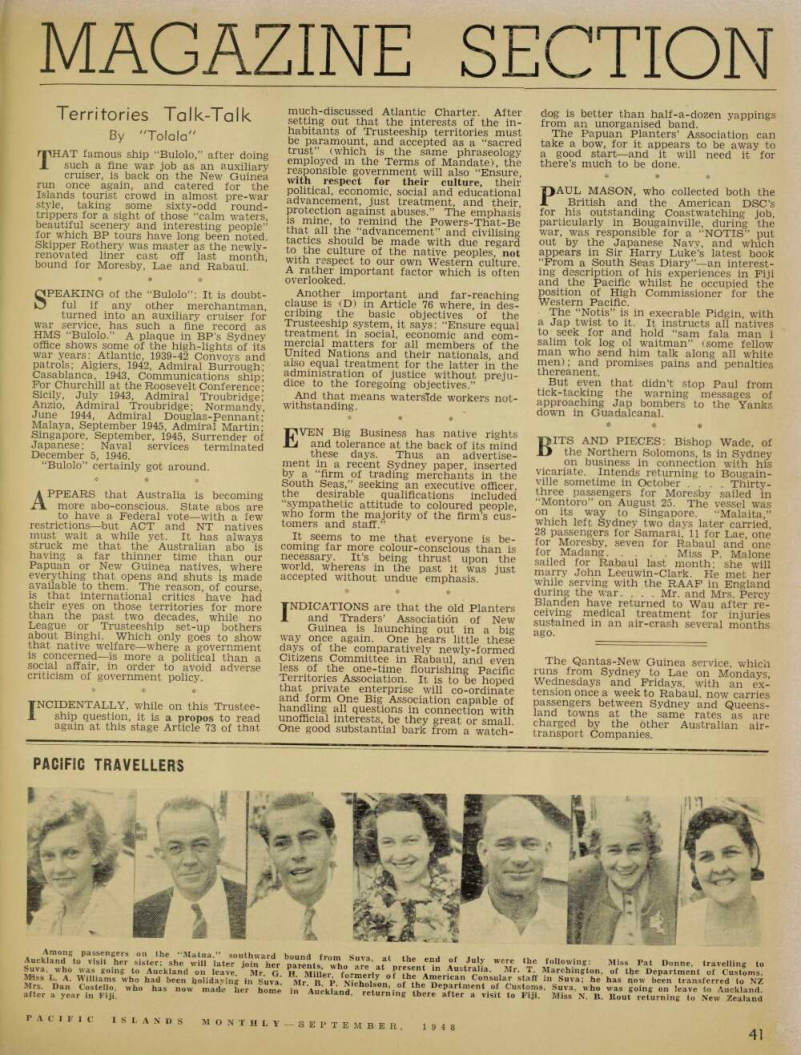
Territories Talk-Talk
By "Tolala"
THAT famous ship “Bulolo,” after doing such a fine war job as an auxiliary cruiser, is back on the New Guinea run once again, and catered for the Islands tourist crowd in almost pre-war style, taking some sixty-odd round trippers for a sight of those “calm waters, beautiful scenery and interesting people” for which BP tours have long been noted.
Skipper Rothery was master as the newly renovated liner cast off last month, bound for Moresby, Lae and Rabaul. * * * SPEAKING of the “Bulolo”: It is doubt ful if any other merchantman, turned into an auxiliary cruiser for war service, has such a fine record as HMS “Bulolo.” A plaque in BP’s Sydney office shows some of the high-lights of its war years: Atlantic, 1939-42 Convoys and patrols; Algiers, 1942, Admiral Burrough; Casablanca, 1943, Communications ship; For Churchill at the Roosevelt Conference; Sicily, July 1943, Admiral Troubridge; Anzio, Admiral Troubridge; Normandy, June 1944, Admiral Douglas-pennant; Malaya, September 1945, Admiral Martin; Singapore, September, 1945, Surrender of Japanese; Naval services terminated December 5, 1946.
“Bulolo” certainly got around. * * * APPEARS that Australia is becoming more abo-conscious. State abos are to have a Federal vote—with a few restrictions—but ACT and NT natives must wait a while yet. It has always struck me that the Australian abo is having a far thinner time than our Papuan or New Guinea natives, where everything that opens and shuts is made available to them. The reason, of course, is that international critics have had their eyes on those territories for more than the past two decades, while no League or Trusteeshio set-up bothers about Binghi. Which only goes to show that native welfare—where a government is concerned—is more a political than a social affair, in order to avoid adverse criticism of government policy. * * * INCIDENTALLY, while on this Trustee ship question, it is a propos to read again at this stage Article 73 of that
much-discussed Atlantic Charter. After setting out that the interests of the in habitants of Trusteeship territories must be paramount, and accepted as a “sacred trust” (which is the same phraseology employed m the Terms of Mandate), the responsible government will also “Ensure, with respect for their culture, their political, economic, social and educational advancement, just treatment, and their, protection against abuses.” The emphasis is mine, to remind the Powers-That-Be that all the “advancement” and civilising tactics should be made with due regard to the culture of the native peoples, not with respect to our own Western culture A rather important factor which is often overlooked.
Another important and far-reaching clause is (D) in Article 76 where, in des cribing the basic objectives of the Trusteeship system, it says: “Ensure equal treatment in social, economic and com mercial matters for all members of the United Nations and their nationals, and also equal treatment for the latter in the administration of justice without preju dice to the foregoing objectives.”
And that means waterside workers not withstanding. * * * EVEN Big Business has native rights and tolerance at the back of its mind these days. Thus an advertise ment in a recent Sydney paper, inserted by a “firm of trading merchants in the South Seas,” seeking an executive officer, the desirable qualifications included “sympathetic attitude to coloured people, who form the majority of the firm’s cus tomers and staff.”
It seems to me that everyone is be coming far more colour-conscious than is necessary. It’s being thrust upon the world, whereas in the past it was just accepted without undue emphasis. * * * INDICATIONS are that the old Planters and Traders’ Association of New Guinea is launching out in a big way once again. One hears little these days of the comparatively newly-formed Citizens Committee in Rabaul, and even less of the one-time flourishing Pacific Territories Association. It is to be hoped that private enterprise will co-ordinate and form One Big Association capable of handling all questions in connection with unofficial interests, be they great or small One good substantial bark from a watch
dog is better than half-a-dozen yappings from an unorganised band.
The Papuan Planters’ Association can take a bow, for it appears to be away to a good start —and it will need it for there’s much to be done. * * * PAUL MASON, who collected both the British and the American DSC’s for his outstanding Coastwatching job, particularly in Bougainville, during the war, was responsible for a “NOTIS” put out by the Japanese Navy, and which appears in Sir Harry Luke’s latest book “From a South Seas Diary”—an interest ing description of his experiences in Fiji and the Pacific whilst he occupied the position of High Commissioner for the Western Pacific.
The “Notis” is in execrable Pidgin, with a Jap twist to it. It instructs all natives to seek for and hold “sam fala man i salim tok log ol waitman” (some fellow man who send him talk along all white men); and promises pains and penalties thereanent.
But even that didn’t stop Paul from tick-tacking the warning messages of approaching Jap bombers to the Yanks down in Guadalcanal. ♦ ♦ ♦ BITS AND PIECES: Bishop Wade, of the Northern Solomons, Is in Sydney on business in connection with his vicariate. Intends returning to Bougain ville sometime in October ... Thirty three passengers for Moresby sailed in “Montoro” on August 25. The vessel was on its way to Singapore. “Malaita,” which left Sydney two days later carried, 28 passengers for Samarai, 11 for Lae, one for Moresby, seven for Rabaul and one for Madang Miss P. Malone sailed for Rabaul last month; she will marry John Leeuwln-Clark. He met her while serving with the RAAF in England during the war. . . . Mr. and Mrs. Percy Blanden have returned to Wau after re ceiving medical treatment for injuries sustained in an air-crash several months ago.
The Qantas-New Guinea service, which runs from Sydney to Lae on Mondays, Wednesdays and Fridays, with an ex tension once a week to Rabaul, now carries passengers between Sydney and Queens land towns at the same rates as are charged by the Other Australian air transport Companies.
Pacifig Travellers
Auckland to visit her sister; she will later join her parents who Suve, at end of July were the follow ing: Miss Pat Donne, travelling to Suva, who was going to Auckland on leave. Mr. G H Miller formerly o f Australia . Mr. T. Marchington, of the Department of Customs, Miss L. A. Williams who had been holidaying in Suva. Mr.B.P . Nicholson, of the American Consular Staff in Suva; he has now been transferred to NZ Mrs. Dan Costello, who has now mad. her home in Auckland, returning there after a visit to Fiji. Miss N. B. Rout returning to New Zealand after a year in Fiji.
Fiji's first Governor dealt with Fiji's
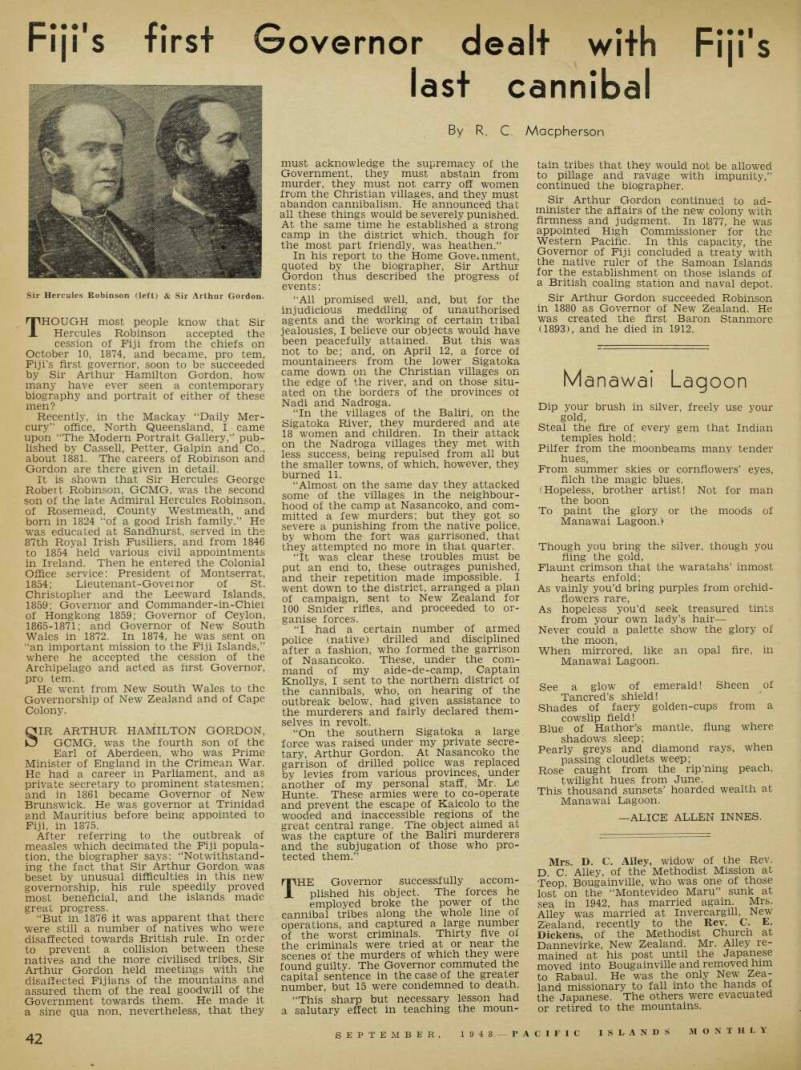
last cannibal
By R. C. Macpherson
T HOUGH most people know that Sir Hercules Robinson accepted the cession of Fiji from the chiefs on October 10, 1874, and became, pro tern, Fiji's first governor, soon to be succeeded by Sir Arthur Hamilton Gordon, how many have ever seen a contemporary biography and portrait of either of these men?
Recently, in the Mackay “Daily Mer cury” office, North Queensland, I came upon “The Modern Portrait Gallery,” pub lished by Cassell, Fetter, Galpin and Co., about 1881. The careers of Robinson and Gordon are there given in detail.
It is shown that Sir Hercules George Robert Robinson, GCMG, was the second son of the late Admiral Hercules Robinson, of Rosemead, County Westmeath, and born in 1824 “of a good Irish family.” He was educated at Sandhurst, served in the 87th Royal Irish Fusiliers, and from 1846 to 1854 held various civil appointments in Ireland. Then he entered the Colonial Office service: President of Montserrat, 1854; Lieutenant-Governor of St.
Christopher and the Leeward Islands, 1859; Governor and Commander-in-Chiet of Hongkong 1859; Governor of Ceylon, 1865-1871; and Governor of New South Wales in 1872. In 1874, he was sent on “an important mission to the Fiji Islands,” where he accepted the cession of the Archipelago and acted as first Governor, pro tern.
He went from New South Wales to the Governorship of New Zealand and of Cape Colony.
Sir Arthur Hamilton Gordon,
GCMG, was the fourth son of the Earl of Aberdeen, who was Prime Minister of England in the Crimean War.
He had a career in Parliament, and as private secretary to prominent statesmen; and in 1861 became Governor of New Brunswick. He was governor at Trinidad and Mauritius before being appointed to Fiji, in 1875.
After referring to the outbreak of measles which decimated the Fiji popula tion, the biographer says: “Notwithstand ing the fact that Sir Arthur Gordon was beset by unusual difficulties in this new governorship, his rule speedily proved most beneficial, and the islands made great progress.
“But in 1876 it was apparent that there were still a number of natives who were disaffected towards British rule. In order to prevent a collision between these natives and the more civilised tribes, Sir Arthur Gordon held meetings with the disaffected Fijians of the mountains and assured them of the real goodwill of the Government towards them. He made it a sine qua non, nevertheless, that they
must acknowledge the supremacy of the Government, they must abstain from murder, they must not carry off women from the Christian villages, and they must abandon cannibalism. He announced that all these things would be severely punished.
At the same time he established a strong camp in the district which, though for the most part friendly, was heathen.”
In his report to the Home Government, quoted by the biographer, Sir Arthur Gordon thus described the progress of events; “All promised well, and, but for the injudicious meddling of unauthorised agents and the working of certain tribal jealousies, I believe our objects would have been peacefully attained. But this was not to be; and, on April 12, a force of mountaineers from the lower Sigatoka came down on the Christian villages on the edge of the river, and on those situ ated on the borders of the provinces of Nadi and Nadroga. ‘Tn the villages of the Baliri, on the Sigatoka River, they murdered and ate 18 women and children. In their attack on the Nadroga villages they met with less success, being repulsed from all but the smaller towns, of which, however, they burned 11.
“Almost on the same day they attacked some of the villages in the neighbour hood of the camp at Nasancoko, and com mitted a few murders: but they got so severe a punishing from the native police, by whom the fort was garrisoned, that they attempted no more in that quarter.
“It was clear these troubles must be put an end to, these outrages punished, and their repetition made impossible. I went down to the district, arranged a plan of campaign, sent to New Zealand for 100 Snider rifles, and proceeded to or ganise forces.
“I had a certain number of armed police (native) drilled and disciplined after a fashion, who formed the garrison of Nasancoko. These, under the com mand of my aide-de-camp, Captain Knollys, I sent to the northern district of the cannibals, who, on hearing of the outbreak below, had given assistance to the murderers and fairly declared them selves in revolt.
“On the southern Sigatoka a large force was raised under my private secre tary, Arthur Gordon. At Nasancoko the garrison of drilled police was replaced by levies from various provinces, under another of my personal staff, Mr. Le Hunte. These armies were to co-operate and prevent the escape of Kaicolo to the wooded and inaccessible regions of the great central range. The object aimed at was the capture of the Baliri murderers and the subjugation of those who pro tected them.”
THE Governor successfully accom plished his object. The forces he employed broke the power of the cannibal tribes along the whole line of operations, and captured a large number of the worst criminals. Thirty five of the criminals were tried at or near the scenes of the murders of which they were found guilty. The Governor commuted the capital sentence in the case of the greater number, but 15 were condemned to death.
“This sharp but necessary lesson had a salutary effect in teaching the moun
tain tribes that they would not be allowed to pillage and ravage with impunity,” continued the biographer.
Sir Arthur Gordon continued to ad minister the affairs of the new colony with firmness and judgment. In 1877, he was appointed High Commissioner for the Western Pacific. In this capacity, the Governor of Fiji concluded a treaty with the native ruler of the Samoan Islands for the establishment on those islands of a British coaling station and naval depot.
Sir Arthur Gordon succeeded Robinson in 1880 as Governor of New Zealand. He was created the first Baron Stanmore (1893), and he died in 1912.
Sir Hercules Robinson (left) & Sir Arthur Gordon.
Manawai Lagoon
Dip your brush in silver, freely use your gold, Steal the fire of every gem that Indian temples hold; Pilfer from the moonbeams many tender hues, From summer skies or cornflowers’ eyes, filch the magic blues. (Hopeless, brother artist! Not for man the boon To paint the glory or the moods of Manawai Lagoon.) Though you bring the silver, though you fling the gold, Flaunt crimson that the waratahs’ inmost hearts enfold; As vainly you’d bring purples from orchid flowers rare, As hopeless you’d seek treasured tints from your own lady’s hair — Never could a palette show the glory of the moon, When mirrored, like an opal fire, in Manawai Lagoon.
See a glow of emerald! Sheen of Tancred’s shield!
Shades of faery golden-cups from a cowslip field!
Blue of Hathor’s mantle, flung where shadows sleep; Pearly greys and diamond rays, when passing cloudlets weep; Rose caught from the rip’ning peach, twilight hues from June, This thousand sunsets’ hoarded wealth at Manawai Lagoon.
Alice Allen Innes.
Mrs. D. C. Alley, widow of the Rev.
D. C. Alley, of the Methodist Mission at Teop. Bougainville, who was one of those lost on the “Montevideo Maru” sunk at sea in 1942, has married again. Mrs.
Alley was married at Invercargill, New Zealand, recently to the Rev. C. E.
Dickens, of the Methodist Church at Dannevirke, New Zealand. Mr. Alley re mained at his post until the Japanese moved into Bougainville and removed him to Rabaul. He was the only New Zea land missionary to fall into the hands of the Japanese. The others were evacuated or retired to the mountains.
Tropicalities
“ A TTACKED by a crocodile” or “Dis- A appeared with a crocodile into the depths of the muddy Sepik” would make no headlines up here. But this recent accident startled even veterans on the Sepik:— Two marys had left by canoe for their daily trip up the river, just a few miles, to get the “kina” (shrimps) for the next meal. When they arrived at their usual fishing ground they dived down to the “floor” of the Sepik. One of them then came up with a scream—she had stood on a crocodile! The other one smiled at her for letting herself be scared by an old submerged log. Then she dived down again to prove her contention.
Soon there ensued a turmoil in the Sepik. The unbelieving one was fighting off a crocodile. The crocodile won and went off with its prey.
As soon as the other mary had re covered her breath and the control of her muscles, she raced back to the village.
Immediately canoes hurried to the scene of the attack in search of the crocodile.
They found it but succeeded only in wounding the beast. Next day they re turned and this time the crocodile was mortally wounded. Next morning some one saw an object floating down the Sepik, almost as big as a small pinnace.
It was the dead crocodile.
They brought it to the village, cut it open and found the mary in the beast’s stomach. She was still intact, except for an arm torn off and her head mutilated.
The crocodile obviously had swallowed her head first.
Had the villagers been quicker they might have saved her and now be able
to boast of having a black Jonah.
Pat.
EARLY this year, there arrived in Fiji two slices of Princess Elizabeth’s wedding cake.
One slice was received by the Girl Guide Commissioner, and was promi nently displayed in one of the leading shops in Suva and then was raffled, thus raising £lB for the Mayor of London’s Appeal for Children.
The winner, a Suva woman, divided her slice among her friends, including her old Indian cook (whose proud boasts spread throughout the neighbourhood) and she sent the remainder, about the size of her thumb, to her daughter, at a school in New Zealand. The girls at the schopl were thrilled to receive the cake, which was divided among sixteen of them; and it was further subdivided, to be put under pillows and slept on.
One fragment eventually found its way to a girl in Australia.
The other slice was received by the wife of the High Commissioner for the Western Pacific. She divided the slice into five. Each portion was wrapped in cellophane, and tied with silver ribbon, and the five were distributed among the Commissioner’s five territories—namely, the Gilbert and Ellice Islands: the Solomon Islands; Tonga; the Anglo- French Condominium of the New Heb rides: and Pitcairn Island.
At Tonga, one of the few remaining monarchies of the world, the little bit of cake was presented to Queen Salote, who was delighted to receive it.
At Guadalcanal, in the Solomons, the cake was insoected with lively interest by the members of the United States forces stationed there. Suggestions put
forward by American officers, and mem bers of the British community, resulted in the cake being raffled to provide com forts for the leper settlement —this de cision being known locally as the “Anglo- American Agreement”! * * * MRS. LILLIAN MILLAR, who was well known in New Guinea —from Wewak to Rabaul, and particularly in Morobe —has developed new talents since she has been living permanently in Australia.
Some time ago she broadcast over the ABC network and told listeners of some of her pioneering experiences in New Guinea when Morobe goldfield first found
THIS drawing, by Brett Hilder, is of Father Edouard Loubiere, one of the best-known missionaries in the New Hebrides.
He has been in Vila for over 50 years —which must be close on a record for Pacific missionary service in the group.
a place on the map. In the August 7 issue of the “ABC Weekly,” part of Mrs Millar’s script was reprinted. She tells of a lavish dinner party she once gave at Salamaua for departing miners. And how once she found herself sleeping in a bed (at “old McDonald’s place”) under which reposed two kerosene tins full of gold that some miner had left there previously.
One wonders, in this unglamorous age, what has become of the miner who was careless enough to cast odd tins of gold around like that. In the meantime, Mrs.
Millar has become senior receptionist for Australian National Airways at their Sydney office.—MAßTlN MAC. * * * SUVA’S brightest spot on August 6 was the window of a certain large shop.
This establishment has, of late, shown a tendency to encourage Fijian purchasers—luring them in by means of pasted-up handbills.
This time, however, because they had inadvertantly used the Fijian word “rarawa” instead of “rawarawa” they had the Fijian populace in spasms of laughter.
What the handbills said, when translated into English was: “Just opened, attrac tive frocks—and the prices are regret
table.
J.S.
WHEN a Central Board of Health in spector encountered an Indian milk vendor and his truck in Waimanu Road, Suva, he asked for a sample of the milk. The vendor complete with milk-can, promptly bolted.
After chasing him around two corners, the inspector arrived in time to see the milk going down the drain. Back at the van, he discovered an Indian assistant disposing of another can, also down the drain, plus a can of a fluid resembling water, which was said to be used for rinsing empty cans.
The inspector finally got his sample from yet another can which was still in the truck. It was tested and was found to be quite satisfactory. But the vendor’s uneasy conscience (nine previous con victions) cost him a fine of £lO for attempting to obstruct an inspector in the course of his duties. * ♦ ♦ THE famous Gambusia minnows, intro duced by our Captain Andy Thomp son 14 years back, for the destruc tion of mosquito larvae in the inland creeks, seem here on Mangaia to have proved a two-edged sword. I recall the time, around 1930-33, when you couldn’t take a bathe in the stream at Keia with out being crowded out bv little fresh water prawns—ferocious-looking little crustaceans, but quite harmless in spite of 6-inch nippers that they raised men acingly when you began your ablutions.
These prawns were gluttons for bits of soap, and if you were one of the fussy folk who used it at the river, they bothered you all the more.
To-day, prawns are few and far be tween. I observe them now only in the far inland waters, where Gambusia do not seem to have been colonised in num bers.
By the same token, the Gambusia min nows are of a man-eating turn of mind.
If you chance to have any small tronical skin-eruption or sore, you are likely to wish you hadn’t got into the waters of Keia with Captain Andy’s little pets. The midgets surround the unlucky bather in thousands.
The gain by the destruction of mos quito-larvae is balanced by an equal destruction of lobster-eggs—Nature’s revenge on interfering man, I suppose.
E.G.
A “FIJI TIMES” report has it that when the former RCS “Viti” (now the property of the Tasman Steam ship Co. of New Zealand) was in dock in Auckland recently, it was discovered that she had been majestically sailing the sea for years with odd propellers.
Certain eccentricities connected with her steering were always a topic of sea farers’ talk from the time she was de livered from her Hongkong builders in 1940. but it seems hard to credit that for eight years, most of them attached to the Navy, the fault was not discovered in any of the dry docks in which “Viti” underwent comprehensive overhauls.
However, it is agreed by the men who sailed in her, that odd propellers might account for the fact that she always wanted to sail to port when the helmsman wanted her to go to starboard.
When King Met King
A 5 7-Years’-old Memory of an i . , r .
Incident in Frisco
BY F. T. GOEDICKE-VAN ASTEN OF TONGA
HERE is a story which began as a comedy, but ended in a tragedy.
I had just arrived in San Francisco in 1891, as supercargo of a copra vessel be longing to the firm of A. Crawford & Co., San Francisco, from Jaluit, Marshall Islands, when another copra vessel from the same firm arrived from Butaritari, in the Gilbert Islands. On board of this vessel was “King Dick,” a petty chief of Butaritari, a friend of the captain, who had persuaded the king to take a trip to Frisco. He said he would only stay there for a few days, and return to Butaritari for another load. When the Captain introduced the king to Mr. Craw ford, Crawford knew that he should do something for the king, so as to gain his goodwill.
Mr. Crawford sent for me and said: “Look here, you know all about natives.
Take charge of this king and show him San Francisco. I will pay expenses.”
My landlady had a spare room, so I took the king home with me. When I intro duced him to my landlady, she said: “Another king! One arrived only yester day from Honolulu, and he is staying at the Palast Hotel. There is to be a military review at the Mechanics Pavilion to-night in honour of the king from Honolulu.”
I went with “King Dick” to the pavilion.
There was a big crowd and, on a plat form, decorated with American and Hawaiian flags, stood His Majesty Kala kaua, King of the Sandwich Islands, in full uniform, decorated with many Hawaiian and foreign orders, surrounded by officers and other notabilities.
When the show was over my king in sisted that I should take him and intro duce him to the other king.
I told him I could not do this, but that I would take him in the morning to the Palast Hotel, and see what could be done.
“What for?" inquired King Dick. “Me king alasame him."
Next morning I went with “King Dick” to the Palast Hotel and asked for the hotel clerk who was in charge of King Kalakaua. I was told that a Colonel McFarlane was acting ADC to the king.
The clerk fetched the Colonel, a very kind old gentleman.
I introduced mv king to the Colonel and told him that King Dick of Butaritari would like to pay his respects to King Kalakaua of Honolulu.
The Colonel hesitated for a minute and then said: “I am afraid His Majesty took a cold last night. He is up, sitting in a chair, covered with blankets —but I will go and see.”
THE Colonel left and returned to say that His Majesty would be pleased to make the acquaintance of the King of Butaritari. We went upstairs, and were shown to the room where we found the Hawaiian King seated in a chair, covered with blankets. Colonel McFarlane introduced us to Kalakaua who shook hands with us. This conver sation ensued: — Kalakaua (to “King Dick”): When did you arrive?
King Dick: Me, one-two-three days be fore me come.
Kalakaua: And when do you expect to leave again?
King Dick: Spose Coala belong me, him finish, me go back home belong me.
Kalakaua: Can I offer you any refresh ment?
King Dick: Spose you like shout belong me, me like lum plenty much.
Rum was ordered, and a large tumbler full was handed to King Dick.
“King Dick” went over to Kalakaua, put the tumbler close to Kalakaua’s nose, and said; “Now you look me like drink your belly good luck.”
“Drink hearty!” said Kalakaua.
“King Dick” drank, coughed and spat most of the rum out on the blankets with which Kalakaua was covered.
I noticed Colonel McFarlane blinking his eyes and I understood the signal, I
stood up and said: “Your Majesty, I feel very sorry that you are indisposed, but I hope you will be soon your own self again and, with your permission, we will wish you goodbye.”
We left the hotel—and, three days later, His Majesty Kalakaua of the Sandwich Islands was dead.
He received a military funeral, from the hotel to the wharf, where his body was placed on board the United States cruiser “Charleston,” for Honolulu.
“King Dick" and I paid our respects to the memory of the departed king by going to his funeral. He was king from 1874 to 1891.
Six weeks later, while in Honolulu, I told this story to Queen Lilinokalani, with whom I formed a warm friendship. She was deposed by revolution in 1893.
Alcoholic Pranks In New Guinea
Some Anecdotes by D. R. Weir
PECULIAR to the Territories are many types of people; but one class stands apart—and, to it, should go much praise for making life at least tolerable.
Its members help dispel the clouds of worry and care; they give us harmless entertainment and a fund of stories.
Ladies and gentlemen, let us toast those who by their lovely sense of the ludicrous —and, perhaps, their interest in alcohol — bring variety and humour into our affairs Naturally, the names given are not the correct ones; but the incidents have occurred. Have you heard of them?
Scene I; The District Office at Maski.
The time, high noon. The connecting door leading from the ADO’s office to that of the Numba Wan Kiap is ajar.
The Kiap, stiffly starched and im maculate, is seated at his desk; and the Numba Two Kiap is engrossed in a pile of War Damage Claims (Native) A tall, rangy figure swiftly enters Numba Two’s office and takes up a posi tion in the connecting doorway. Putting right hand behind back, and left hand on breast, the figure bows sweepingly to Numba Wan Kiap; then, coming rigidly to attention, it makes a perfect about turn and bows sweepingly to the out raged ADO.
There is a pause and perfect silence for the officials are breathless. This is broken by the intruder whistling a gay Scottish air, which he follows up with a Highland Fling. (He wore heavy army boots.) On completion, he again bows solemnly to the speechless Kiaps, and leisurely strolls out of the room.
Scene II: We are indebted to Jock, who is rather fond of his liquor.
Jock and Bob were having a few spots in the latter’s house. They leaned back in the old wicker chairs and happily sipped their gins. Time wore on, and they grew mellow. Jock, who had been mellow on arrival, grew mellower still.
Suddenly, a fly landed on the ceiling, and a vivid green lizard darted across, scooping him up on the way.
Jock stiffened in his chair. “Did you see that?” he tremulously asked.
“Yes,” rsaid Bob.
“Thank God,” fervently replied Jock, pouring himself a double gin.
Scene III: Mac, being rather flursh, de cided to take a rest cure from work. He had a splendid couple of days and nights on the binge and, waking up the morning after, he felt far from well. As he later said. “Butter flies were gnawing the pit of my stomach.”
The only remedy was a “snort;” which was followed by more “snorts” for break fast and morning tea.
By noon, Mac was a cot case, and felt the desire for sleep. He lay on the bed for a while, and then, nature calling, he arose.
Blearily making his way across the room, his orientation was not the best, for he opened a door and walked into the wardrobe. Always, in sober moments, being a methodical sort of chap, he closed the door behind him. After a few seconds, he noticed that he did not seem to be making any progress and —my God! —it had gone dark.
It is common knowledge that some of the local fire-water is not of the highest purity, and the first thought that entered Mac’s head was that he had gone blind, The second was that he was caged up in a box or something—perhaps even a coffin of the roomier type. The combination of both thoughts induced a series of terror stricken yells, and a vehement pounding on the back of the wardrobe.
Nearby residents and kanakas, aroused by the sounds of an apparent murder in progress, rushed to the scene. Even be fore they could enter the house they heard the proverbial “dull thud.”
Everything seemed in order in the room they entered except that the wardrobe was lying face down on the floor. The mystery deepened—until someone heard a moan coming from the wardrobe; and then Mac was found quite unconscious from his harrowing ordeal. He drinks water now.
Scene IV: One well-meaning old-timer was having lunch in a certain establish ment when the place caught fire. The spirit was willing but the flesh was weak. After a few stunned minutes he scrambled from his chair, roared, “Save the furniture,” and, suiting actions to words, he grabbed the tablecloth and pulled. Crockery and saveloys flew everywhere, and he threw the cloth out over the banis. He was on his fifth table, and had already dealt with a dinner service, before a fire fighter “accidentally” plastered him with a bucket of water, and lugged him out side —where he was later heard mutter ing that no one appreciated him.
Scene V: That distinguished body, the Ancient Society of Sodden Archers, was born with the aid of a bottle of OP rum, and a bow and some arrows from our Highlands district Robin Hood traditions were embodied in the constituion; the president was known as the Chief Quiver
(Continued Column 1, next page)
Carrier. A theme song was composed to the tune of “Pass the Biscuits. Mirandy,” the first line being, “Pass the arrows, Mullumby,”—the latter being a zealous member and Chief Arrow Bearer.
Alas, it suffered an untimely death.
One day, when the greenwood was damp, it met at the home of a member. After refreshments had been served, all mem bers proceeded to target practice—the target being the owner’s absent wife s hat, hanging on the wall. Hat and wall suf fered, as did the owner, when his Irish wife returned. Following this, two of the society took the parts of Bill Tell and son, one shooting the other’s topee from his head with an arrow.
In the interests of health, the society then decided to disband, which was done ceremonially, the bow being broken and burned in a fire primed with Jamaican rum.
Scene VI: Bill and his lanky friend and partner, Jack, having spent a busy two or three days at the local pub, decided to get back to their lease. Mode of trans port was an ex-disposals truck, minus doors. Both were, as the phrase has it, “as full as boots,” when they set off. Bill drove and Jack stood in the back.
Some miles out, Bill fell asleep at the wheel and, on hitting a bump, rolled peacefully out of the cabin onto the kunai margin. A mixed company, in a follow ing jeep, laughed until their sides split at the sight of a suddenly sobered Jack shouting and waving frantically on the driverless vehicle.
As it was level country, there was little danger and all ended well —except that both parties were too shaken to continue the journey, and returned to the pub.
Scene VII: The usual crowd were breast ing the bar one night when in tottered a stranger from the big bush. All was serene until a few rounds later, when the stranger got sillier and sillier, and be came a general annoyance.
“Darky” picked up a praying mantis and handed it to him, saying. “Here — play with this for a while.”
The new arrival eyed it speculatively, and then said, “Thanks.” He toyed with it for a few minutes and went into deep thought. Then, in a loud voice, he re marked, “Good grub,” put the mantis into his mouth, and airily tearing off the rear legs, munched the rest.
He had the bar to himself in a matter of seconds, while sounds of lusty heaving from outside showed how the spectators had reacted.
On recovery, one of the local lads said to him, “My God, man, you are silly.
Why did you do that’ ?
The other replied, waving an admonitory finger: “Y’u’r the one who’-sh shilly— good grrub—they fry ’em in oil in Japan.
I jush like my food raw. thash all.”
Mr. Lance Wilkinson, with his wife and family, will return to the service of Cuthberts Gold Mine, Misima, Papua, in October. Mr. Wilkinson left Misima for war service nearly eight years ago; and, since demobilisation from the RAAF, has been in business on his own account in New South Wales.
Pacific Nature Notes
Written for "PIM" by Charles Barrett, FRZS
Communications from Nature students in the Pacific Islands are welcomed by our contributor—Mr.
Charles Barrett, “Maralena,” Mays bury Avenue, Elsternwick S 4, Victoria.
The White Tern
FAIRY tern would be a fitting name for Gygis alba, were it not “preoccupied” by another of the sea-swallows, almost as dainty as the white tern but not such a lovely bird. All who are familiar with the Gygia in its haunts will agree with me that, among living creatures of the Pacific, it is unrivalled for grace and delicate beauty—such a bird as the poet may have seen when gazing through his magic casement over a faery sea.
An easy subject for the nature photo grapher, when brooding its egg, resting precariously on a horizontal branch or a rock, the snow-white bird, with black eyes and beak and blue or blue-black feet, has been “snapped” hundreds of times, but seldom successfully. The best of the many photographs I have seen was taken by John Ramsay on Norfolk Island.
I notice that Dr. Ernst Mayr calls Gygis alba “fairy tern,” in his book on Birds of the South-west Pacific; but that name was given to Sterna neiris many years ago and remains in general use for the little white-faced bird which ranges from Broome, Western Australia, round Leeu wm and along the southern coast of Aus tralia to Tasmania and New Zealand. It also occurs off the coasts of New Cale donia.
The white tern enjovs a wide range: from isles to the east of Brazil to Ascen sion, m the Indian Ocean, Malaya, and throughout the South-west Pacific. My first glimnse of Gygis was gained near Cocos-Keeling, where the “Emden” met Tl *opic birds soaring high in the blue looked as ethereal as snowy plumaged terns fishing near the shore.
Charles Darwin, during the voyage of the “Beagle,” more than a century ago was cheered by the sight of white terns, and he wrote a description of them in his famous Journal. Many another natural ist has tried his hand at description of these sea swallows, whose beauty cannot be captured in a net of words.
Actually there are two kinds of Gygis, one being known as G. Candida, or G. alba Candida, if one must use trinomials (which are a fetish of present day zoolo gists, though most field naturalists favour the good old-fashioned nomenclature) Some day the splitters may get busv among the terns, and discover that there are numerous sub-species of Gygis. They have already done this with the common landrail, making geographical varieties on a generous, scale.
Fireflies
A FEW dozen fireflies, collected some where on the Lower Fly River, Papua, were submitted to an ento mologist who specialises in beetles. Using a powerful pocket lens, he examined the insects as calmly as if they were common everyday beetles, and not elfin lights of the tropics.
“Probably related to Luciola flavicollis of North Queensland,” my learned friend announced. “Sorry to disappoint you; but your Malacoderms are unlikely to be new to science.”
Well, I had the memory of a tropic night, with hosts of fireflies flashing their fairy lights among coconut palms black against the sky. A familiar spectacle that custom cannot stale. Once in a lifetime, if lucky, one may witness such a spectacle as that observed in Borneo by Robert Shelford, and vividly described by him: a vast number of fireflies flashing simultaneously—a sudden rain of sparks darkness for a minute, then the flashing
in synchronism again for several seconds.
This phenomenon has been observed in the Philippines and several other coun tries, including North America and Eastern Siberia. The beetles assemble in tens of thousands; sometimes there may be a million or more, and, shining their emn lights in unison, they provide one of the strangest and most beautiful sights in Wild Nature’s realm.
On a moonless night, losing the track through a big patch of jungle, I captured about a score of fireflies in my net—l had been butterfly hunting—and their flashes provided sufficient light to enable me to find the track again. Of course, the net was held close to the ground. The beetles deserved a reward; so, instead of being dumped into a killing-bottle, they were given freedom and flew away into the darkness, flashing their tiny lamps.
All the Malocoderms—beetles with rather soft integuments—are not lamp bearers; only the true fireflies and glow worms emit phosphorescent light, and they are replaced, by the systematist, in a sub-family, called Lamprides. During the daytime, when they rest among foliage and don’t shine their lights, fire flies remain unseen, unless you look closely for small brown beetles which the collector of pretty insects would re gard with cqntempt. Pinned in a cabinet drawer, their lights extinct forever, they look dowdy and uninteresting—these little creatures which, living, break up the jungle darkness with fairy lights.
The Goura Pigeon
WRITING from Port Moresby, a reader who takes a keen interest in wild life, from birdwing butterflies to birds of paradise, tells me that he is leaving for the Kerema district, home of the goura pigeon. On his return he may send me some notes on these birds, which have the misfortune to possess beautiful crests, coveted by the plume trade.
Thousands, before the era of protection, were shot for the sake of their coronets.
There are several species of crowned, or goura pigeons, and they are among the handsomest of New Guinea birds, ranking next to the birds of paradise.
The few I have seen alive were delight ful to watch, as they opened and closed their crests of bluish-grey plumes as daintily and demurely as a debutante opens and shuts her fan of ivory “feathers.”
Goura pigeons are good tucker for natives, but most Europeans who have eaten the white flesh have found it very dry. Being a bird lover, I have never killed a goura for food, so can offer no opinion of my own as to the quality of the crowned pigeon’s flesh. Often enough, members of scientific expeditions have been obliged to take heavy toll of pigeons, particularly the gouras, because they afford the only fresh meat obtainable in the jungle. This was the case with the British Ornithologists’ Union Epedi tion into Dutch New Guinea in 1910. It is worth noting that a large percentage of the gouras shot were infected with small red parasites, similar to, if not identical with, the kind that causes “scrub Itch.” These birds belonged to the species known as Sclater’s goura; doubtless the Victoria goura of Papua is not free from the horrible parasites.
Feeding chiefly upon fruits, crowned pigeons vary their menu with small crabs and shellfish which they find on river banks. Being as large as a good sized domestic fowl, they need plenty of food, and do a deal of pecking around, getting fallen fruit on the jungle floor and extras by the waterside.
Advertisements & other items, p. 47 (1 item)
45
Alcoholic Pranks (Continued from page 44)
PACIFIC ISLANDS MONTHLY SEPTEMBER, 1948
“Bully” Proctor
Blackbirder Who Tried to Be King of Futuna
AS a complement to the January “PIM” account of Captain "Bully” Proctor’s adventurous life in the Pacific at the end of last century, the Very Rev. Father L. L. Dubois, SM, of Rome, Italy, has kindly sent us further details of the career of this notorious American blackbirder.
Father Dubois is the Assistant General of the Society of Mary and, as Official Visitor to the Marist Missions, he passed through the Pacific last year on an in spection tour. He has access to many of the valuable old records in Italy dealing with the early missionaries’ work in the South Seas.
The information about “Bully” Proctor was contained in letters written home to the Mission headquarters, under date of May 15, 1876, by Father Padel, a Catholic missionary on Wallis Island. Lying north-east of Fiji, Wallis (or Uvea, as it sometimes is known) and Futuna Island (120 miles north) now comprise a French dependency of New Caledonia.
Extracts from Rev. padel’s letters, translated from the original French, are as follows: — Monsignor bataillon, of the Catholic Mission, had been in resi dence at Futuna for two and a half months when a white man named Proctor arrived, determined to carry out an odious plan to make himself head of the island.
This man, a native of Louisiana (USA), had served under General Beauregard, and, wounded during the war of secession, had suffered the amputation of a leg.
Almost completely ruined, he had come to the South Seas to try his hand in trade.
After acquiring some property in Fiji, he had for several months been running a trading post at Wallis (Uvea) and another at Futuha.
On Futuna, Proctor had been graciously received bv the missionaries upon presen tation of a letter formerly given to him by Monsignor Odin, then archbishop of New Orleans. Father Quiblier was very sympathetic and even gave him shelter.
Unfortunately, Proctor’s business did not succeed, especially at Uvea, where he had to fight against more able com petitors. He attributed his failure to the ill-will of the missionaries and developed an implacable hatred for them and for Monsignor Bataillon.
Proctor arrived in this state of mind at Uvea. One dav he rushed like, a madman to the presbytery at Matautu. where he insulted Father Bouzique. Later he em barked for Futuna, making murderous threats against the bishop and the mis sionaries.
Arriving at Futuna, he began making the wildest statements. He called Mon signor Bataillon and the missionaries the “scavengers of France,” claimed that he himself was the most illustrious and estimable man in the world. He exhorted the people to choose him as their king, promising them wonders if they followed him, but threatening them with death if they dared offer him the slightest resis tance. He told them that a battleship carrying 300 men and furnished with all kinds of arms would soon reach Futuna to put itself at his command.
Monsignor Bataillon appealed to the native population not to head him.
THINGS had reached this pass when, on Saturday. April 21, at about half past five in the evening, Proctor went to the presbytery of St. Joseph.
He was dressed in his finest clothes,
pistols, each loaded with six bullets, and carried a sword-cane concealed in his garments. He looked first into Monsig nor Bataillon’s room, then into Father Quiblier’s; but on finding them both empty he waited in the yard until devo tions had ended.
Father Quiblier was the first to appear.
Proctor at once abused him and, throwing himself upon him, struck him with his fist, but he was immediately seized by a strong Futunian. Before the latter was able completely to overpower the assassin, he had fired twice at Father Quiblier, and twice the revolver went off harmlessly, the caps exploding without igniting the powder.
At this point the men who had just left the church hurled themselves upon him and tore the weapon from his grasp. Four shots were found to have been fired when the revolver was unloaded. I am sure that if we had not been there, our Futunians would have brained the poor wretch. Thev carried off his wooden leg to make sure he could not get away.
As the outrage was so glaring, the Futuna chiefs condemned Proctor to be shot, but Monsignor Bataillon used all his influence to prevent the sentence be ing carried out. Thev contented them selves with locking up the guilty man until the arrival of a warship. * ♦ * EXTRACT from a letter by Father Herve, Julv 1. 1876; The steam sloop “Veri” arrived here yesterday and left immediately. It has rid us of Proctor. We were not very easy while so dangerous a man was being guarded by Futunians.
A Nunu-Penni And A Tralala
Short Story
By Alice Allen Innes
KOROLEVU is called a ghost-town these days. Its once lovely homes are now shabby sheds and drab houses. It was a 39-pub town, once; with its harbour full of sailing ships—ships that carried tragedy and romance.
But, because I spent my girlhood there, and perhaps for other reasons, I can still see beauty in the place and I can still dig up romance.
Take, for example, the story of my laundress, Marsiela.
MARSIELA had been upset about her scallywag lover, Joni. He promised so much! He was going to make lots of money so that they soon would be able to marry. But Joni, although likeable, was ever making fun of the business of living. Had he not said: “We will marry when the 801010 rises—then we will not have to buy a pig for a feast!”
That Johnny! Everyone in the koro rocked with laughter. “Joni makes his meke when the sea-worms rise and we all gather the rich food! He will never have enough money to make a wedding feast.”
Marsiela had, at first, laughed also. But when Joni had worked on three copra ships and had come back with little more than a sore head it did not seem funny any more.
Some of the men who had worked had gone back to their villages with tins of meat and biscuits, or even bread. Others had taken a few shirts or a “soldier’s suit” —the hot khaki boiler-suits sold as disposals goods by the Indian stores and the currently fashionable item of Fijian male attire.
A few of the boys had even taken back
a new, long “dress-marama” for their wives and sweethearts.
Jonis homecomings, however, were all of a pattern: sore head, no money, no presents. He always had a few jokes, nonetheless.
“Sa oti na beer,” he would say wag gishly, hitting his head and swearing off beer for life. And to his angry little sweetheart he would make more vows.
“We shall be married soon,’’ he would say. “I will love you much always and we will spend our money on nice sauce pans and pretty frocks and plenty of food.”
“Ah, you laugh and you lie, Joni,”
Marsiela would spit at him. “You get drunk and spend your earnings and I am ashamed. I have finished now. Tomasi, the policeman, he is wise and kind and saves his pay for food!”
“Pood!” Joni would throw back his huge head and open his mouth like a vast cavern. His roars of laughter echoed over the valley. “You poor, little, thin one, your belly would not hold a full meal.
Anyway, the sea ih full of good fish and the tapioca grows upon the hillside for the taking.”
“Small, perhaps,’ said Marsiela, “but not too small to carry your son who will soon be in need of food.’
Thereupon Joni would boast of the food he would fetch for her and her child.
“Big Mouth Joni,” she would call him then. “The sea is indeed full of fish but do you go fishing? No! The tide is perhaps too high. Or perhaps too low.
Or the canoe leaks. Always you lie and laze.” She stood and looked at him a moment, her eyes flashing. “We cannot even buy a pig for our wedding feast,” she wailed.
IN exasperation, Joni bent down and splashed his face and head in the cool waters of the creek, hitched up his store pants and went to bring her a green coconut as a peace offering. He climbed the tall palm tree with surprising agility for one of his massive size and returned with the trophy. One hit with his knife lifted the tip off and Marseila came over to drink of the nut thirstily.
Joni watched her while the cool liquid slid down her brown throat. “There is a tralala to-night at the Indian kava room. You and I will dance better than anyone there.” His voice was slyly coax ing.
Marsiela looked up sharply with eager inquiry then tossed the nut from her and slumped wearily to the creek bank.
“It costs money to go to a tralala,” she said, “and when one does go one must not be ashamed of one’s dress and one must have a lei of flowers that costs two shillings and one must also have a shill ing for a salasala (a lottery for a native pudding).” She ticked off the items on her long slender fingers emphatically.
“I shall borrow again from the Indian,”
Joni whispered, “he always wants to lend me money.” He played with that happy idea as though he were telling her that he had come by lots of money un expectedly.
But Marsiela was not mollified. She stamped her foot. “No,” she said, “we shall not go to the tralala until we go to make a celebration for our wedding. We will marry next week, when the sea-food rises, and we will tell our friends and family truthfully that we have wasted all our money—that I have spent my sewing money and washing money going to the
and, for the first time since his arrival in the Islands, proudly wore on his breast a salvage medal given him by the British Government. He was armed with two picture-show, and you have spent all you have earned on beer.
“We shall eat our shame and have no pig at our wedding, but we will fill all the bellies with the balolo. cooked as only my mother knows how to cook them. They shall be tied in taro leaves and served in coconut cream. Next week. Joni, we shall tell them all to come, but if you have not caught a canoe-load of balolo, then do not bother. I shall marry that day, but the child that lies under my heart will know only Tomasi as a father.”
Marsiela thumped her breast dramatic ally and stalked off towards the village.
A wedding without a pig! How could she ever live down the shame of it?
Joni’s good-natured face wrinkled into puzzled lines. “Such a little woman, but such a cross one.” He shook his head.
THE little dance-hall was lit by two electric light bulbs covered with pink paper frills. Tepona, fat and jolly, was standing at the door calling to passers-by to buy her paper-flower leis.
Anei, a slender little vamp of light hue was offering the dancers leis of real flowers —of scented vine, white arbutus, of frangipanni and the scarlet flowers of the islands.
“Look at my flowers,” she cried, “I make them fresh and sweet for you—not like the lazy Tepona, who sells you flowers of fly-blown paper—perhaps she swept them up after the last tralala!”
The crowd laughed and pushed forward to buy the entrance tickets.
The tralala had swept Fiji as the Hokey-pokey and the Lambeth Walk had, in their day, swept the outside world.
Starting first as a game at Mission children’s parties, this “walking to music” had a wide appeal to all Islands people.
Just simple steps which a smart one could improvise, side-by-side the local belles and beaux stepped and shuffled to music.
The orchestra of three guitar players sang as they played tunes well-known to radio listeners but with words peculiarly their own. “The cow is happy when she eats the grass,” was a most popular ditty of that time, and every dancer sang in harmony with the band.
But Joni and Marsiela, missing all the fun, were furtively sitting on a seat on the water front, over the road from the dancing. They could go to the tralala, Joni having borrowed two shillings. But still Marsiela stubbornly would not go.
There they sat the whole evening, eager for festivity, each blaming the other.
And while they sat, so occupied, along came Simeli, a visiting policeman and cousin to Joni. Simeli’s father had been a school teacher and a brilliant student: he had passed on his brains, if not his industry, to his son.
Simeli joined the two disgruntled lovers and soon heard the story. “Money you want? That’s easy to get! I shall give a nunu-penni for you,” he said, promptly.
Excitedly, Joni jumped up and caught Marsiela’s arm. “That’s it,” he said. “You see? You make too much trouble over little things. I knew everything would turn out happy.” Once more he was the old, bright Joni.
But the little woman looked sulky and unconvinced. “What is a nunu-penni?” she demanded.
“Why,” said Simeli, “when you want money and don’t want to ask your friends for it, then you take it from them!”
Simeli and Joni burst into roars of laughter, caught Masiela each to an arm, and hurried her off back to the village.
IF you know Korolevu, then you will know that nowhere in the Pacific can a moonlight night have more enchant ment. Away out on the Koro Sea lie the beautiful islands of Batiki, Motoriki, the leper island of Makogai, and the Island of Warriors, Wakaya. A silver path lies over the sea, and it is a time of cool delight after the heat and stress of the day—a time of enchantment as heady as wine.
On such a night Simeli called his friends to gather at his bure to make a nunu-penni for Johi. One by one they came out along the beach road from the township and each brought a bilo —their coconut-shell drinking cup—and each brought a pocket-full of Fijian pennies.
Simeli and Joni had arranged a large enamel bowl of kava and a number of bilos as a centre-piece in the long mat covered room. These were democratic days, only dimly related to the kava dr inking that had once been a ceremonial affair of heirloom wooden bowls of carved wood. This new fashion of kava-dnnk ing had an entirely different meaning.
With the bucks seated around the toddy, Simeli, as became a Master of Ceremonies and a Fijian, launched into a fine speech in which he stressed the pleasure it gave him—and no doubt gave the other of Joni’s friends present—to place a penni in their empty bowl and pass it up to drink (or nunu) the penny s worth of good wishes to such a fine bride groom.
Simeli, to start the ball 'rolling in worthy fashion, would place a shilling in the bilo, and into the empty coconut shell rattled the first good coin.
The company seemed a little crestfallen at this unwonted display of wealth but, with taunts and jibes, other shillings fol lowed the first. The bilos were filled with soapy-looking kava and passed around to be drunk with zest. Simeli led the sing ing, and Joni told the newest waterfront yarns. It was a good nunu-penni—and the bilo of money was inconspicuously emptied at intervals into Simeli’s pocket.
The large washbowl of kava was re peatedly refilled. The singing went on until the merrymakers finally dozed off to sleep, as dawn crept in over the sea.
Simeli and Joni, their heads clear .but their legs uncertain, were anchored, like their friends, but they had a satisfac tory business discussion, notwithstanding.
Thirty-odd guests had netted them £l6.
Simeli took fifty per cent., to oblige his happy friend.
THERE should, perhaps, be a moral in this story. But it is so like a true story that I am afraid the villain of the piece came out on top of the world.
But there was also romance, in good measure.
Joni had nobly resisted the temptation to squander his easily-won fortune on the day after his party and had presented the delighted and astonished Marsiela with a battered old military hat, the crown of which bulged with coins. Eight pounds!
Marsiela was a thrifty wench and she made good bargains. A fine pig for her wedding feast cost £3; there was £2 for her cousins to build her a new bure; there were odd shillings for some pots and pans for (which her housewifely mind had hankered. Lastly, there in its paper wrapping, was a real marama dress of flowered silk —the most beautiful dress that Marsiela had even owned. It was to be worn with one of Anei’s largest leis, for her wedding.
I did my own laundry that week —the engagement book of my laundress was well filled. But I am a sentimental per son and compensation came in an in vitation to attend the wedding feast of Marsiela and Joni.
Damaged
IN
Transit
1 ALWAYS read with a chuckle the humorous wartime incidents re counted now and again in the “PIM,” writes Rev. V. H. Gough-Sherwin, for merly of the Melanesian Mission at Wau, TNG, later a padre with the New Guinea Volunteer Rifles, and now of St. Jude’s Rectory, Port Elliot, South Australia.
However, I wonder if you ever heard of the affair of Major Bill Edwards’ “medi cal supplies”?
It was somewhere along the lines of communication on the Lakekamu-Bull dog-Wau secret route in 1942 that a very important parcel labelled “Major W.
Edwards, Medical Supplies” went astray.
Actually, the contents of the packet were port and sherry, sent by Ted Jenyns, our 2IC.
When Bill Edwards learned that the long-awaited supplies had failed to reach his camp, he literally went into action.
Runners and messages blitzed the 1. of c. to know where the blanketty-blank pack age was.
Actually, by some quirk of fate—and Army “organisation”—the package had passed Harry O’Kane’s post and a few others and had come to roost in the stag ing camp of three young and useful warriors—Keith, Tom and Jim.
A casual shake revealed the swish of liquid of a sort. The next obvious step was investigation—and soon bottles of port and sherry were reclining naked and unashamed amidst their brown paper draperies.
Suddenly, in the twinkling of an eye, Bill Edwards became the most popular man in all New Guinea. His health was toasted; his name became the theme of a new, spontaneous drinking-song; his ancestors must be praised with arm up raised and a clenched, full pannikin.
Then Bill’s health became a matter of importance once more—he was toasted and honoured again, and again, as liba tion followed libation and nectar was tossed down a trio of dry throats suffer ing from that wartime tropical disease known as “neck rust.”
But even Bill Edwards’ popularity had to wane and succumb when wine ceased to flow from empty “medicine bottles.”
NEXT morning, after the period known as “non compos’ had been weath ered, two awkward problems kept bobbing up—(a) What to do about Bill’s “medical supplies”; and (b) the forward ing of same to an ever-growing-agitated Bill.
Inspiration came. The “marines” were carefully repacked, tied, and placed gently on the ground; then they were scientifically smitten with a large rock dropped from a mathematically-calculated height.
This mutilated mass, gingerly collected, was then inscribed with the epitaph “damaged in transit” and sent away in all haste to Major Edwards by a special police-boy runner. - Bill’s reaction had to be seen to be believed, so thev say. It was cataclysmic, a kind of terrifying and fascinating up heaval in human bulk. His top-priority inquiries all along the line met only a solid phalanx of sheer ignorance about the whole thing.
Poor William, I don’t think he ever completely recovered. In fact. I’ve been informed on sound authority that the mere sight of a broken bottle nowadays has the effect of making the shuddering Bill resemble a case of acute anaemia.
Service Section
Do You Want A Flat In
Sydney?
IN June issue of “PIM” we had some thing to say about Sydney letters of flats. Now a word in season to those Islands people who would rent fiats.
From our experiences over the last few months, it appears that Islands people have no adequate idea of the fiat position.
They know, in a general way, that it is bad. They have little idea of the degree of badness.
If you have not been in Sydney for a year, or two or three, and think that the position now could not be as bad as then, then you are deluding yourself. If Sydney was as tough as old boots during the war years, it now can be likened to chromium-plated steel.
In addition, there is much more com petition for the sort of accommodation you require. First there are migrants.
These people are guaranteed accommoda tion by someone, but that very fact puts an additional strain on the whole hous ing position. Then there are people from Ceylon and India, Malaya and Hongkong and Burma —people who are coming to Australia for holidays as they once went to the United Kingdom; or, who, having found their particular piece of the British Empire folding up around them, come here as semi- or prospective resi dents. Lastly, there are the Australians who have made a great deal of money out of wool and wheat in the last few years, and who come to the city to spend it.
That is the set-up you are up against when you look for a fiat. And that is the set-up we are up against when we look for one for you. It is, at times, necessary for us to go to extraordinary lengths to achieve your ends; but we have found that in at least 75 per cent, of cases, Islands folk who have asked us to help them fall down on their part of the bargain—either because they have decided to go somewhere else, or have made other arrangements, or because they fade off somewhere into the Pacific and cannot be communicated with. It is their privilege, of course, to change their minds; and, if they do so early in the piece and advise us very promptly, no great inconvenience may be experienced by anyone. But when, after asking us to look for a flat for them, they leave it until the last moment to cancel, after the deal is completed, it puts us “in a spot” and makes it more difficult for those others who genuinely need this kind of accommodation. Although it is very easy to let flats and houses, landlords re sent people who back and fill.
Unless otherwise instructed, we give you a chance, to say “yes” or “no” before we finalise any arrangements. Once we have your OK it seems to us that it is strictly up to you to honour any financial obligations we have entered into in the matter, should you be forced to change your mind.
Finally, you should remember that there is a special difficulty if you happen to have young children. Landlords are not naturally cross-grained and preju diced on this subject—most of them have learned by hard experience, and are re luctant to let to people with small children. Young children can be delight ful; but, if uncontrolled, they are a menace to society. Half a dozen children, if given a free hand, can take a block of flats to pieces in a couple of months. Yet it is precisely the people with children who need this kind of holiday accommo dation. It is no criminal offence to have children; and it is actually a breach of the law if landlords refuse to let premises to tenants with children. Nonetheless, if
you have them the difficult problem of getting a fiat at all is made more difficult.
Of all the numerous tasks which our Service Section carries out for “PIM" readers, none takes more time, or is filled with more exasperation, than the weary business of looking for accommodation.
For that reason, we ask for the co-opera tion and tolerance of Islanders.
Around Sydney Shops
THIS should be good news for women residents of the Pacific outposts— you now no longer need to suffer from straight locks once your leave-time permanent-wave has grown out. Selling on the Sydney market now, and priced from 12/6 to 15/-, according to brand, are home permanent-waving sets. They are sealed up in small packets, therefore this writer cannot tell you of what they con sist; nor, not knowing any one who has tried them, what the results may be.
However, judging by the fluttering in professional circles the process appears to be simple and the results good. According to one apprehensive young hairdresser, all my lady has to do is to set her own hair in the normal way, saturate it in the lotion provided, tie her head up in
a scarf for an hour, wash her hair and presto—a beautiful head of curls.
If true it sounds very good, particularly for those out of the reach of hairdressing facilities.
Value
Dollars For Torres Island
Pearl Shell
Trochus Still Far Below Pre-War Value
NORTH Australian pearling is at present earning dollars for Australia. Latest market quotations indicate that pearl shell is selling (mostly to America) at £525 per ton. Trochus shell, however, is bringing only about £75 per ton, in com parison with the pre-war price of £l7O.
The Torres Strait industry is support ing about 1,000 men—Boo of them native Islanders, who have taken the place of the Japs, in whose hands the industry was formerly. Present indications are that the Japs will never again be per mitted to work in the pearling fleets.
Wages of Torres Islanders working on the pearling luggers have been increased from £l/5/- per week to £3/15/- per week, with keep.
Approved
Plans For Lae’s New Wharf Approved
LAE, August 23.
THE plans for the long awaited new wharf at Lae have at last been com pleted and approved. The cost will be £120,000.
The new structure will be slightly south-east of the old one. 300 ft. long and 50 ft. wide. The transit shed will run parallel with it and allow cargo to be wheeled directly into the shed. Be hind the shed will be a loading platform for trucks and an area for cargo that can be temporarily stored in the open.
Steel piles will be used in the construc tion of the wharf and test-drilling has already commenced to find the necessary depth to which to drive the piles.
Dr. K. R. Steenson will be acting Director of Medical Services, Fiji, in the absence from the Colony of Drs. R. J.
Snodgrass and J. C. R. Buchanan.
Aorangi Takes Fiji
Bananas To Canada
From Our Own Correspondent SUVA. August 8.
WHEN the Canadian-Australasian liner Aorangi makes her first post-war call at Suva in August she will pick up 1,000 bunches of Fijian bananas for Canada, plus 200 coses of bananas packed in hands.
Packing in hands is an experiment for Fiji as all bananas which go to New Zealand (the principal market) are taken from the bunches and packed individually in cases.
A minimum price of 3/- a bunch of eight hands or over has been fixed for the purchase of bananas from Fijians for shipment to Canada.
New Headquarters
Suva Yacht Club’S
SUVA, Sept. 6.
THE Suva Yacht Club has installed it self in a superbly appointed and spacious new clubhouse built at the edge of the harbour at Korovou. Korovou means the Suva Gaol —but the gaol is not visible from either the sweeping windows of the club or from the surrounding rock gardens designed by Mrs. D. McCraig to take full advantage of the picturesque site.
The club building consists of an enormous lounge which can be used for dances, a cafeteria, a bar, and all the customary trimmings, plus a verandah lounge and terrace overlooking one of the finest harbour views still unspoiled by the straggling muddle of Suva’s outskirts.
The official opening was performed by the Governor on September 4.
The Rev. Canon Jennings, of the Ang lican Mission, New Guinea, recently re turned to his post after sick leave in Australia.
Advertisements & other items, pp. 50-52 (2 items)
Pacific Islands Service
BUREAU
r jpIIE Pacific Islands Service Bureau has been established to assist Island residents who cannot shop for themselves.
Briefly, we will perform those services for you, in Australia, which you cannot perform yourself, or are outside the scope of ordinary mail-ordering.
We will purchase and forward goods to you; have repairs made on your behalf; send flowers, sweets, fruits, gifts to trends in Australia for you, or to your children at school in Australia; match materials and sewing accessories; and arrange holiday accommodation and travel.
For these services we charge a small fee —in the case of shopping services, usually 10 per cent, of the purchase price.
If you missed the circular which explains this service fully and which was included in all copies of “PIM” which went to the Islands in March, please let us know and we will send you a copy of the pamphlet, free of charge.
All inquiries should be addressed to: The Director, Pacific Travel and Service Agency, Box 3408, Sydney,
Burns Philp (New Guinea) Limited
General Merchants (Wholesale and Retail)
Shipping, Customs and General Agents
Head Office: PORT MORESBY, PAPUA
BRANCHES:
NEW GUINEA: Rabaul, Kokopo, Lae £r Madang.
PAPUA: Samarai.
REPRESENTATIVES FOR: QUEENSLAND INSURANCE CO. LTD.
Distributing Agents, Territory of Papua-New Guinea for:
SHELL COMPANY OF AUSTRALIA LIMITED
Petroleum Products
GENERAL MOTORS CORPORATION
Chevrolet, Buick, Pontiac and Oldsmobile Cars Chevrolet and GMC Trucks Frigidaire Refrigerators
VAUXHALL MOTORS LIMITED
Vauxhall Cars and Bedford Trucks
R. A. LISTER fir CO., BRISTOL
Producers of Petrol, Parrafin and Diesel Engines Pumps and Lighting plants
RUSTON HORNSBY LIMITED
Engines
CROSSLEY MARINE ENGINES
SAN FRANCISCO AGENTS:
AUSTRALIAN AGENTS:
LONDON AGENTS:
LLOYDS OF LONDON
BURNS PHILP TRUST CO. LTD.
BURNS, PHILP Cr CO. LTD.
All States.
BURNS, PHILP Cr CO. LTD.
"London House", 35 Crutched Friars, E.C.3.
BURNS, PHILP CO. OF SAN FRANCISCO INC. 510 Matson Building.
QUEENSLAND
INSURANCE
COMPANY
LIMITED
(Incorporated 1886 in Australia)
ASSETS EXCEED £4,000,000
Head Office:
QUEENSLAND
INSURANCE BUILDING,
80-82 PITT STREET, SYDNEY.
Specialists in South Seas Fire,
Marine & Accident Insurances
Apply to:—
nji.
Branch Office: 1. B. Chalmers, Manager.
Burns Philp (South Sea) Co., Ltd.
VILA.
Burns Philp (South Sea) Co., Ltd.
Comptolrs Prancals Des Nourelles Hebrides (Marine).
NOUMEA.
L. «fe W. Johnston.
PORT MORESBY;
Burns, Philp <fe Co., Ltd.
W. A. Anderson, Resident Officer.
PAGO PAGO.
Burns Philp (South Sea) Co., Ltd.
Q. H. O. Reid £ Co.
OTHER SOUTH SEA ISLANDS.
Burns Philp (South Sea) Co., Ltd.
Also to any of the Company’s Offices in Australia or Hew Zealand.
ESTABLISHED 1930
WILLIAM H. WATSON
RAROTONGA, COOK ISLANDS
Wholesale and Retail Trader
LICENSED STAMP DEALER
Agent For:
BRITISH TRADERS 7 INSURANCE CO.
CORONA & L C. SMITH TYPEWRITERS
KAISER & FRAZER MOTOR CARS
B.S.A. CYCLES AND MOTOR CYCLES
AMERICAN LEAD PENCIL CO.
WHITES AVIATION LTD. .
Manufacturers of: FOOTWEAR, ALL CLASSES SUITABLE FOR NATIVE TRADING . . . M.O.P. PRODUCTS, INCLUDING ROUND EAR-RING BLANKS AND BUITON BLANKS Exporter of: “Rarotonga” Hula-Skirts.
Sea-Shell Necklaces, M.O.P. Jewellery.
Island Produce.
Wholesale and Retail Inquiries Invited.
Prepared to Consider Agencies for all Class of Goods.
Importer of: Textiles.
General Hardware.
Fancy Goods.
General Merchandise.
Cable Address; “Watson” Rarotonga Bankers: Bank of New Zealand, Auckland.
Little-Known Deposits
Phosphate
Little-Known Deposits on N.G. Islands
ONE of the major international problems to-day is that of producing sufficient food to feed the world’s population —there is an acute shortage of food in practically every country, except the
Usa.
The two main factors governing the production of foodstuffs are labour and fertilisers. The first, since the end of World War 11, is slowly becoming avail able again, but the second, the supply of fertilisers, is still lagging far behind normal requirements.
The bulk of Australia’s phosphate fer tilisers comes from the Pacific —Nauru and Ocean Island; but the search for new and closer phosphate fields still continues.
In this connection it is worthwhile re calling that New Guinea has several un worked deposits of phosphate.
In 1941, Mr. R. C. Hutchinson, of the New Guinea Department of Agriculture, made a close survey of New Guineas potential fertiliser fields and his report, published in the “NG Agricultural Gazette” at the end of 1941, contains much interesting information.
Discovered By Germans In 1905 THE most important fertiliser con stituents are nitrogen, phosphoric acid and potash, said Mr. Hutchinson in his report. The constituents most lack ing in New Guinea soils are potash and phosphoric acid. This has been proved dinectly by chemical analysis and in directly by the remarkable results which follow the use of potassic and phosphoric fertilisers on some plantations.
Nearly all phosphoric and potassic
fertilisers used In New Guinea are im ported from Australia at a cost which makes their use uneconomical, except on the most remunerative crops. This is greatly retarding agriculture in the Ter ritory, where fertilisers are badly needed and would certainly be supplied more freely if their cost were not so high.
One way of overcoming the difficulty would be to find local sources of these constituents from which cheap supplies could be obtained. No local source of potash of commercial importance is known, but there are several sources of aosphoric acid —the two principal being the rock on certain islands and bat guano.
In 1905, the Germans first discovered rock phosphate in New Guinea. About five years later, Mole Island (a unit of the Purdy Group) was worked for phos phate under the New Guinea Protector ate, but when Nauru became the import ant source of this commodity the Purdy Islands’ deposit was practically ignored.
The Hanseatic Pacific Expedition, led by Dr. George Friederiei, investigated in 1909 a number of islands for phosphate deposits sufficiently large to be worked.
A number of hitherto geologically un known islands, and also some islands previously examined, were visited.
In 1929, the British Phosphate Commis sioners sent Mr. K. M. Fennell to New Guinea to investigate the phosphate de posits.
Two Separate Phosphate Groups IN New Guinea, there are two groups of islands on which phosphate rock exists.
One group, situated in the north western corner of the Territory, consists of Wuvulu (Maty), Aua (Durour) and Manu (Allison) Islands and the other throughout the island and the mean depth of phosphate calculated from 32 deter minations was five inches.
The phosphate was light in weight,
group, known as the Purdy Islands, is situated to the south-west of the Island of Manus.
Wuvulu Island is about five miles long and two and a half miles in breadth at its widest part. The island is surrounded by a coral reef and there is no sheltered anchorage. The phosphate deposit, which is nearly all rock, is situated in the south-west corner of the island and scattered over an area of about an acre.
It is difficult to estimate the quantity, as it is covered with dense jungle which is difficult to penetrate.
About 20 miles from Wuvulu is Aua Island, which is three miles in length and a mile in breadth at its widest part. It is surrounded by a coral reef which is about 50 yards wide in the south and from 300 to 400 yards wide in the north There is no protected anchorage. A phosphate deposit is situated about a quarter of a mile inland on the south east section of the island. It is about 1,000 yards in length, varies from 30 to 150 yards in breadth and is from 6 to 8 feet deep. It is nearly all rock, with a little alluvial which appears more like soil than phosphate. The deposit is inter mixed with broken coral-rock, sand and mud and is covered with a thick growth of ferns and creepers. The exposed pnosphate is covered with a coating of moss.
Fennell (1929) estimated the quantity at not more than 80,000 tons. In 1911, the Germans prospected the island for phos phate and their sample pits are still to be seen.
Manu Island is some 37 miles north-east of Aua and has an area of 62 acres. It is only 4 feet above sea-level and the deposit of phosphate is small. There is no protected anchorage.
The Purdy Islands THE Purdy Islands consists of five Islands—Mole, Mouse, Rat, North Bat and South Bat. Rat Island is the smallest of the group, being only about one-tenth of an acre in area. These areas were determined from a compass survey conducted by the author. This group of islands is more centrally situated with regard to the rest of the Territory than the preceding and there is a well-pro tected anchorage between North Bat and South Bat Island.
In general, the Purdy Islands are built up. Surrounding each island is a flat coral reef, part of which is just above water at low tide. The width of this reef varies from two chains at the narrowest parts on Mole and Mouse Islands to over a quarter of a mile at the widest parts on the Bat Islands.
Each island is surrounded by a coarse, white beach of coral origin, behind which there is a sand embankment rising about six feet above high-water mark. The islands are saucer-shaped, being about two feet above high-water level in the centre. In wet weather, the centres are inclined to be swampy. On all the islands there are coconuts, vines and ferns grow ing and on some islands miscellaneous shrubs and trees.
On Mole and Mouse Islands the phos phate is to be found in the low-lying centres of the islands, a few inches below the surface, as lumps of rock weighing two to 10 lb. On Mole Island, a stack of at least 400 tons of phosphate is to be found on the western end of the island; this was collected when the island was being worked by the Germans.
Low Grade Deposits ON each of the Bat Islands, the phos phate deposits extend into the sea on one side. This suggests that, in recent years, these islands have moved closer together, thus laying bare phos phatic rock which was originally in the centres of the islands.
The thickness of the phosphate layer varies greatly. In some places it is pos sible to sink a four-inch hole without striking any phosphate, while in other places it runs to a depth of three feet This irregularity of depth is found very porous and light to medium brown in colour. It was heterogeneous in com position and small white particles of shell and coral were distinctly visible to the naked eye. In general appearance the phosphate from the Purdy Islands greatly resembles samples inspected by the author from the other phosphate islands — Wuvulu, Manu and Aua.
It will be realised that the Purdy Islands’ phosphate, and probably the phos phate from the other New Guinea islands, is not of high quality. It is porous, readily absorbs water and contains a large proportion of organic matter. It is pro bably of a much later date than the de posits on Nauru and the other islands.
The rock contains a considerable quantity of lime, indicating that the phosphate is in the form of calcium phosphate.
Calculating the phosphate as tricalcium phosphate for comparison it will be seen that the New Guinea rock is considerably lower in this constituent than rock from other Pacific Islands.
Mr. S. E. Middleton, a well-known officer of the Papuan service, who has re cently been Assistant-Director in the De partment of District Services and Native Affairs under the Provisional Adminis tration, has been appointed Commissioner for Native Affairs in Western Australia.
He will be responsible for the aboriginal population-of that State. Mr. Middleton, with his wife and family, left Port Moresby in August for Perth.
Mr. and Mrs. E. Skinner, of the Central Highlands, New Guinea, with their two children, were holidaying in Sydney in August and September.
Advertisements & other items, pp. 53-54 (1 item)
Colman's Mustard
American Magazines
Direct to You from the Publishers.
AMERICAN HOME 21/6
CHARM 32/6
COLLIERS’ WEEKLY 52/6
CORONET 18/9
FORTUNE 96/-
GLAMOVR 27/-
HOUSE & GARDEN 42/6
LADIES’ HOME JOURNAL 37/6
LIFE 49/-
LOOK 32/-
McGRAW-HILL DIGEST 31/3
MAGAZINE DIGEST 18/9
NATIONAL GEOGRAPHIC MAGAZINE .. 38/6
POPULAR MECHANICS 22/9
POPULAR PHOTOGRAPHY 26/6
READERS’ DIGEST 12/-
SATURDAY EVENING POST 68/9
SCIENTIFIC AMERICAN 40/-
SCIENCE ILLUSTRATED 62/6
TIME 96/-
VOGUE (20 numbers) 105/-
YACHTING 40/-
ESQUIRE 75/-
Rates are for one year and include all charges. Many other overseas
Art, Trade, Technical, Fashion and
Literary periodicals available.
ALL ORDERS AIR-MAILED TO
PUBLISHERS.
MAIL PUBLICITY CO., 175 PITT
STREET, SYDNEY, N.S.W.
To sharpen appetite there is nothing like
Colman's Mustard
cS?* t& ROMAN south seas
h LUXURY
FLYING BOAT!
3 • •
KSW* 4*
GUIN&*
\ aaax c
SOLOMON
ISLANDS
If Cl
ISr
CA 1 « ■ At 371 K£W cJciEDomJt.
J*L. %
@7 f NORFOLK
l^
LO"RDHOW£ is
£ v .-; JT.
„ MARTIN PLACt. SYONIY
The Pacific If^Jervve
passenger a Freight services t. \
• NOUMEA • VILA
• TOLAGI • LINGATU
CHARTER AIRCRAFT available to Air Cruises to
• FIJI • TONGA
, AITOTAKI • TAHITI
a parts of the world.
Population Trends in Fiji
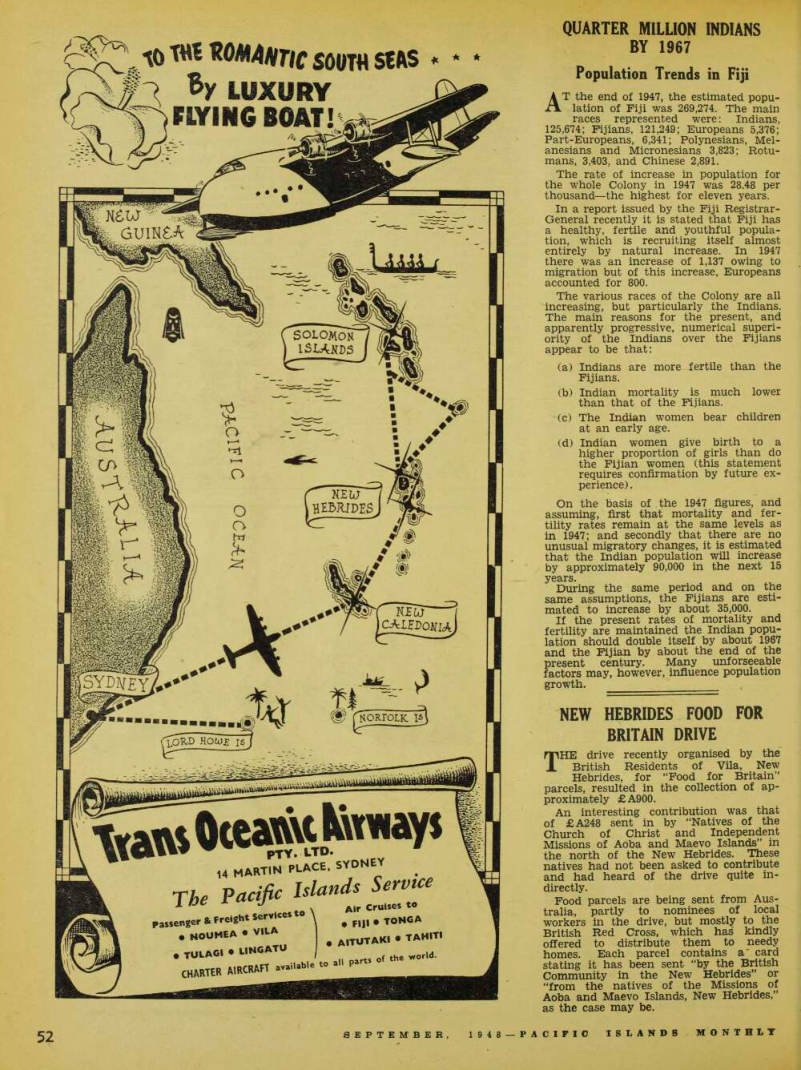
Quarter Million Indians
BY 1967 Population Trends in Fiji
AT the end of 1947, the estimated popu lation of Fiji was 269,274. The main races represented were: Indians, 125,674; Fijians, 121,249; Europeans 5,376; Part-Europeans, 6,341; Polynesians, Mel anesians and Micronesians 3,823; Rotu mans, 3,403, and Chinese 2,891.
The rate of increase in population for the whole Colony in 1947 was 28.48 per thousand—the highest for eleven years.
In a report issued by the Fiji Registrar- General recently it is stated that Fiji has a healthy, fertile and youthful popula tion, which is recruiting itself almost entirely by natural increase. In 1947 there was an increase of 1,137 owing to migration but of this increase, Europeans accounted for 800.
The various races of the Colony are all increasing, but particularly the Indians.
The main reasons for the present, and apparently progressive, numerical superi ority of the Indians over the Fijians appear to be that: (a) Indians are more fertile than the Fijians. (b) Indian mortality is much lower than that of the Fijians. (c) The Indian women bear children at an early age. (d) Indian women give birth to a higher proportion of girls than do the Fijian women (this statement requires confirmation by future ex perience) .
On the basis of the 1947 figures, and assuming, first that mortality and fer tility rates remain at the same levels as in 1947; and secondly that there are no unusual migratory changes, it is estimated that the Indian population will increase by approximately 90,000 in the next 15 years.
During the same period and on the same assumptions, the Fijians are esti mated to increase by about 35,000.
If the present rates of mortality and fertility are maintained the Indian popu lation should double itself by about 1967 and the Fijian by about the end of the present century. Many unforseeable factors may, however, influence population growth.
New Hebrides Food For
Britain Drive
THE drive recently organised by the British Residents of Vila, New Hebrides, for “Food for Britain” parcels, resulted in the collection of ap proximately £A9OO.
An interesting contribution was that of £ A 248 sent in by “Natives of the Church of Christ and Independent Missions of Aoba and Maevo Islands” in the north of the New Hebrides. These natives had not been asked to contribute and had heard of the drive quite in directly.
Food parcels are being sent from Aus tralia, partly to nominees of local workers in the drive, but mostly to the British Red Cross, which has kindly offered to distribute them to needy homes. Each parcel contains a' card stating it has been sent “by the British Community in the New Hebrides” or “from the natives of the Missions of Aoba and Maevo Islands, New Hebrides,” as the case may be.
Some Now Uncensored History

How Australia Helped De Gaullists To Hold New caledonia
By H. E. L. Friday
IN happier circumstances than those of eight years ago (when her then com mander, Captain Toussaint de Quivre court, tried to oppose the rallying of New Caledonia to Free France) the French sloop, “Dumont d'Urville’’ arrived in Noumea at the end of June of this year.
It was at the request of Governor Pelicier, soon afterwards recalled by Vichy, that this warship was sent to Noumea in 1940 in an unavailing attempt to break the de Gaulle movement. Her visit then was highly unpopular. To-day, as a unit of France’s reconstructed Navy, she has been the subject of an official reception, and her crew, once jeered at, is now being feted.
This sloop was sent to Goro, New Caledonia South coast port, in 1940, to oppose the passage of the Norwegian tanker, “Norden,” in which was Henri Sautot, arriving from Port Vila to rally the Colony. But the “Norden,” warned of her intentions by Australian Intellig ence in Melbourne, and escorted by the Australian cruiser, “Adelaide,” reached Noumea by another route. So the “Dumont d’Urville” returned to port and turned her hoses on the Noumea townsfolk, who assembled on the quay to sing the “Mar seillaise” and count out her commander.
She also turned her guns on the “Ade laide” as she approached. Fortunately, the more heavily armoured “Adelaide” could quickly have blown her out of the water had she started trouble, though instructions from the Admiralty were to withhold such action unless attacked first.
But there was considerable tension for some days as the two faced each other, the “Adelaide” in the outer harbour with olenty of room to manoeuvre, and dom inating the scene, and the Dumont d’Urville in the inner harbour, her machine-guns as well as her hoses trained on the shore, and her big guns still on the “Adelaide.”
On September 19, 1940, Henri Sautot passed within 25 yards of the Vichy sloop as his landing was cheered by 10.000 Caledonians shouting, “Vive de Gaulle Vive France, Vive l.’Angleterre.”
All this time the French gunboat was in touch by radio with Admiral Darlan in Vichy, and Admiral de Coux, in Saigon; but all messages were reported to the de Gaullists by the gunboat “Zelee,” at Tahiti, which had rallied de Gaulle, and were reaching Sautot via Australian in telligence.
THE story of the “Dumont d’Urville,” never yet fully told, forms one of the most interesting chapters in M Sautot’s new book, “Grandeur and De cadence du Gaulliam dans le Pacifique ” shprtly to be published in its French editmn, which I am now translating into English at the author’s request.
M. Sautot reveals how splendidly Aus tralia co-operated with the Free French m suppressing the defeatist Vichy'element m New Caledonia and the New Hebrides His story is worth telling.
Captain de Quievrecourt refused to an swer communications from the new Gov ernor Sautot (whom Vichy subsequently condemned to death as a' “traitor”). M.
Sautot told him that he would be obliged to communicate through Captain Showers, of the Adelaide,” who had been asked to use force if necessary to see that his
orders were carried out. The “Adelaide” had eight heavy guns and the French ship three of lesser calibre, so Sautot had the whip hand and did not delay in using it. On September 21, he ordered the Vichy
Sautot was now master, two days later, harbour-master, M. Robineau, asked per mission to provision the ship with fresh water, meat and vegetables.
“Certainly,” replied Sautot, “if you will comply with my conditions,”
These were that the “Dumont d’Urville’ should leave Caledonian waters by Sep tember 25 without committing any hostile act against the person or property of any citizen; that she should not call at Tahiti (already rallied to the Free French) but go direct to Saigon, and she was
bluntly told that if she went east of this course British naval and air forces based on Fiji would oppose her passage.
Another condition was added. The “Zelee” had informed Noumea, through Melbourne, that another French warship, the “Admiral Charner,” had left Saigon for Noumea with two companies of the French 11th Colonial Regiment on board, to oppose New Caledonia rallying to Free France. The presence of these troops and this ship in Caledonian waters would seri ously complicate the internal situation, so the “Dumont d’Urville” was told to get into touch with the “Admiral Charner,” and inform her that British ships and planes were on the look-out for her, and that she had better return to Saigon.
“One evening of the first week in October, 1940,” M. Sautot says, “I re ceived the welcome news, passed on by a British reconnaissance plane in the New Guinea area, that the ‘Admiral Charner’ had turned back on the same course as the ‘Dumont d’Urville.’ From that day on, the security of the Free French regime in Caledonian waters was undisputed, and I joyfully passed the news on to General de Gaulle.”
DE QUIEVRECOURT, on August / 25, 1940, had issued an order of the day to his crew which caused a lot of angry comment in the town. In it he alleged—and not only alleged but said that he had proof—that the real aim of the Free French movement was the out and-out annexation of New Caledonia by Australia. He added that foreign money was being employed to purchase their loyalty and entice the crew to leave the ship, and that criminally disposed people, backed by Australian money, were re sponsible for the generous offers of drink which the sailors were being tempted with in the bars of the port. He appealed to their good sense to resist such tempta tions.
The commander and the arrested Vichy Governor, Col. Denis, were also behind a plot to kidnap Sautot, take him on board the “Dumont d’Urville,” and have him shot. Fortunately, these plans miscarried.
IN his book, M. Sautot tell? of the other purges he simultaneously had to carry out —in the civil service, the armed forces, and among local Vichyites—before the Free French regime was secure.
He tells of how subsequently Pacific Frenchmen lost faith in General de Gaulle on account of the behaviour of his two authoritarian envoys. Governor General Brunot and Lieut (and de Gaulle created Admiral) Thierry d’Argenlieu.
Neither had had any Pacific experience on arrival, and each completely misin terpreted and so exacerbated local feeling that the two Colonies were on the verge of when Brunot arrested Governor de Curton and some of Papeete’s leading citizens, and New Caledonia, when d’Argenlieu arrested Governor Sautot and five of his leading Free French supporters.
These events, and d’Argenlieu’s opposi tion to the Americans, were to give the Allies a great deal of anxiety after M.
Sautot’s departure, and the book makes it clear why this was so. Incidentally, the man who officially welcomed the sloop to Noumea this time was the Mayor, M.
Sautot—the same man whom Capt. de Quievrecourt, in 1940, had plotted to capture and shoot as a “traitor.”
Captain Showers, whom M. Sautot praises for his skill as a seaman, and tact as a diplomat, is now a member of the Navy Board in Melbourne.
Dr. R .J. Snodgrass, Acting Director of Medical Services, Fiji, left the Colony recently for London on sick leave.
Advertisements & other items, pp. 55-56 (1 item)
Finishes
■ * ' fSS&i&m Hi '//' // v , / ■ V - ■> ...:■'■ v -t:. s43a*ii, v , 1 , ' £ , ' ' iif^'
. jdSf H
£ j ■ £ ■ £ ■ '4-. ! r X' ' ' N > \\ W N v ' \ .\'V>
T rop
ieal Form ««’
Every Merger finish must withstand lest after test to prove worthy of the Berger label . . . every product must satisfy the Berger technicians and chemists that it will meet the challenge of all climates from tropic heat to arctic cold.
'3mm
FINISHES
KEEP ON KEEPING ON!
There is only one
ELECTROLUX
THE MODERN KEROSENE-OPERATED REFRIGERATOR
THAT ACHIEVES THE MIRACLE OF ICE FROM HEAT
Lasting Efficiency, Silent Operation, Streamlined Beauty
■ . .. - S Economically operated by kerosene, with a simple precision-built freezing unit that has no moving parts and is GUARANTEED FOR
FIVE (5) YEARS.
Obtainable from :
NEW GUINEA COMPANY, LIMITED.
Rabaul, Madang, Lae, Kavieng.
J. R. CLAY & CO., LTD., Port Moresby.
W. R. CARPENTER & CO. (Sol. Is.), LTD., Tulagi.
For New Hebrides, Butaritari, Noumea, New Caledonia. Apply— Model LKSSI Price £79/15/- FOB, Melbourne Storage capacity: 5i cub. ft. (approx); shelf area, 9 sq. ft.; food shelves, six—five removable; 2 self-supporting when half drawn. Ice-making: Four trays—s lb. ice per freezing: 80 cubes. Fuel consumption: 1.8 pints kerosene per day (approx.).
Height: 4 ft. 10 in. Depth: 2 ft. 3i in. weight, unpacked, 406 lb. Packed, 574 lb.
W. R. CARPENTER & CO. LTD. Head Office: 16 O'Connell St., Sydney, N. S. Woles
Kava Ceremony In
Polynesia
A FEATURE, of the June issue of the Journal of the Polynesian Society (headquarters in Wellington, NZ) is a long, well-documented and illustrated article by Margaret Titcomb, entitled “Kava in Hawaii.” It is an excellent account of the history, peculiarities and traditions of the practice of growing kava and manufacturing the beverage in Hawaii; and much of what is said applies also to the kava-drinking prac tices and ceremonies of Samoa, Fiji, Tonga and other countries of Polynesia.
The drinking of kava is not a vicious or harmful habit. It is followed mostly by high-caste natives, and by many old European residents, who believe it has a healthful effect. Kava-drinking, as a ceremony, is one of the few outstanding practices common to all Polynesia—even in countries like Samoa and Hawaii which had been separated apparently for a very long time, the ceremony as first seen by Europeans, is similar in char acter and meaning.
Dr. Blanche Biggs who recently joined the Anglican Mission staff in New Guinea, was a passenger to Port Moresby on the August “Malaita.”
Advertisements & other items, pp. 57-58 (1 item)
Horizon
HEALTH
—an illustrated quarterly magazine of interest to overseas readers.
October issue includes
DIABETES.
THE CARE OF THE
SCHOOLGIRL.
MEASLES.
GAS AND AIR FOR MOTHERS.
Five shillings for four issues.
Tavistock House North, Tavistock Square, London, W.C.I,
The Most Extensive Manufacturers in the British Empire of
RUBBER STAMPS,
INKS, STENCILS,
Marking Devices,
ACME STAMP PADS
OFFICE & STATIONERY SUPPLIES
We also Manufacture & Supply a Complete Line of
LIMEWASHING AND
SPRAYING MACHINES
for all purposes.
Let us know your requirements and we will quote by return.
WRITE FOR OUR GENERAL CATALOGUE
Limewashing Machine
EXCELSIOR SUPPLY CO. PTY. LTD.
278 Post Office Place,
MELBOURNE, VIC.
HEAD OFFICE :
160 BROADWAY,
Formerly known as George St.. West,
SYDNEY. N.S.W.
50 Victoria Street,
WELLINGTON, N.Z.
CABLES. Pitco, BANKERS: Bank of America, San Francisco. San Francisco.
PACIFIC ISLANDS TRADING CO.
244 California Street/
SAN FRANCISCO 11, CALIFORNIA, U.S.A.
MANUFACTURERS’ REPRESENTATIVES
RESIDENT BUYING AGENTS :: MERCHANT EXPORTERS
Representing: American Lead Pencil Company - L. C. Smith £r Corona Typewriters Inc. - General Time Instruments Corporation - Western Clock Company Limited - Burgess Battery Company Burgess Tools Limited - Marion Tools Corporation - I. Sekine Company Electric Chain Company of Canada Anchor-Hocking Glass Corporation Chicopee Manufacturing Corporation - P. £r K. Incorporated - Soho Tool Company Inc.
Adslide Projector Company - American Mercantile Corporation Keystone Waterloo Manufacturing Company Ltd. - National Electric Manufacturing Co.
Products: Pencils, Fountain Pens, Erasers.
Typewriters, Adding Machines.
Watches, Clocks, Chronometers.
Watches, Clocks, etc.
Dry Batteries, Flashlights.
Axes, Cane Knives, Machetes, Hoes.
Axes, Hatchets, Hammers, Pliers.
Brushware, Toothbrushes.
Gold and Silver Chain, Jewellery.
Glassware, Ovenware, Dinnerware.
Plastic Insect Screening.
Fishing Tackle.
Bench Saws.
Film Projectors.
Collins Hacksaws.
Enamelware, Kitchenware, etc.
Garden Tractors, Disc Harrows.
Irons, Stoves, Refrigerators, etc.
CANNED FISH
COTTON TEXTILES
BUILDING MATERIALS
PETROLEUM PRODUCTS
FOODSTUFFS
GENERAL MERCHANDISE
We Supply The Trade Only—No Retail Orders Whatever your needs, write or cable for our prices
Americans In The Hebrides
From Our Own Correspondent SANTO. August 20. rLLOWING reports that there are large dumps of unexploded bombs and ammunition at various points in the New Hebrides, the US Army last month sent a bomber on tour to investi gate and report.
The outcome was the arrival in August in Santo of a US ship equipped with facilities for the handling and disposal of this menace.
Rumours, however, said that that was not the sole reason for the visit. During the war, the Americans built huge air strips on the island of Santo, and it could be believed that they might still be in terested in knowing what condition they are in, after three years’ inactivity and scanty maintenance.
The vessel is also reported to be carry ing back to the States the bodies of Americans killed in the Group during the war.
Scientists For New Guinea
WHEN the “Montoro” sailed from Syd ney for Singapore, via Port Moresby, on August 25, two young women agricultural scientists sailed with her to work in New Guinea. They are Miss Mary Eggleston and Miss Nancy Millis, both of Melbourne.
They will be attached to the Depart ment of Agriculture in Port Moresby and will make that town their headquarters for extension work. However, their duties could take them to any part of New Guinea.
Other Port Moresby passengers on the “Montoro” were Dr. and Mrs. Neville Anderson. Dr. Anderson will open a hos pital for natives and will be attached to the London Missionary Society.
Saving Fijian Babies
Suva, Aug. 23.
MORE and more emphasis is being laid —and none too soon—on the vital importance of Fijian child welfare.
The Secretary for Fijian Affairs (Ratu Sir Lala Sukuna) has given instructions that the Fijian women’s committees in the villages are to be encouraged in every possible way, and a report on child wel fare activities is to be included in every agenda at Fijian provincial council meet ings.
A new booklet for Fijian mothers is being widely distributed. It has been compiled by Lolohea Waqairawai, a teacher for 24 years who has done out standing work in child welfare (she was awarded the British Empire Medal in the last Birthday Honours) from pamphlets written by Dr. R. F. K. Roberts, Miss R.
M. Brewer and Sister M. Wilson, all of whom have been associated with Fijian child welfare work.
Sidelight on Fiji’s
Liquor Problem
Suva, Aug. 23.
117HILE Fiji’s Liquor Bill (proposing to T? remove all liquor restrictions from Indians but not from Fijians) is still suspended by way of a select com mittee of the Legislative Council, the Suva Magistrate’s Court has been pro viding more ammunition for the Bill’s opponents. „ August 20, a Fijian woman was fined £3 for illegally drinking liquor. On August 21 she was fined £5 for the same offence and a 17-year-old Fijian girl was fined £1 on a similar charge. In each case the liquor was supplied by Indians.
The patrol ships “Tiare” and “Lotus,” two of the 30 vessels ceded to France by the US Navy in 1944, are now on the way out from North Africa, where they have been refitted for (service In the Pacific. The “Lotus” will be attached to the Noumea station, and the “Tiare” to Papeete. Each has a crew of three officers and 28 men. and the “Lotus” is com
manded by Lieut, de Vernejoul. These ships are about 130 feet long with a dis placement of 325 tons, speed up to 12 knots and a range of 2,500 miles. They will be used for liaison survey and safety work, and administrative jobs. These and sister ships have done a great deal of valuable work since the liberation of Prance. Two were lost on minefields.
Advertisements & other items, pp. 59-60 (1 item)
Brasso
(.Established 1906).
ATKINS, KROLL & CO.
IMPORTERS. EXPORTERS.
320 CALIFORNIA STREET
SAN FRANCISCO 4, CALIFORNIA.
Cable Address: Atisco, San Francisco.
General Exporters: South Sea Distributors:
FOODSTUFFS.
HARDWARE.
LUMBER.
TEXTILES.
MACHINERY.
Importers:
COPRA.
VANILLA BEANS.
COCOA BEANS.
SHELLS.
WILSON & CO.
Canned Meats.
B. F. GOODRICH CO.
Canvas Footwear.
A. SCHILLING <fe CO.
Coffee, Spices, Tea, Extracts.
THE GLIDDEN CO.
Paints & Varnishes.
Monthly Merchandise Bulletins upon Request.
For a quick shine
BRASSO
METAL
POLISH
"ISLAND LIFE"
Official organ of the S.S.l.C.C.—Calling Collectors, Correspondents and Penfriends throughout the South Sea Islands. Over 1,000 members. Write for your free copy and particulars to —
SOUTH SEA ISLANDS CORRESPOND-
ENCE CLUB,
NATUVU, FUL
Some -things you
just carn't
mask, Rgeon!
Cute costume, slave girl.
But what good is your masquerade if underarm odour gives you away? Don’t take chances. Rely on Mum.
Tonight’s bath was fine . . . for washing away past perspiration. But to guard against future underarm odour, play safe use Mum !
Snow-white Mum is gentle, harmless to skin and fabrics.
Mum gives sure protection against underarm odour all day or evening.
TAKES
Mum
When Cakobau Was King Of Fiji

Told By THOMAS HORNE, Who, as a Child Knew Many of The Famous Native Characters He Describes
RATU CAKOBAU was the last King of Fiji. His correct name was Ratu Seru.
Cakobau was the fourth Vuni Valu that we know of. The first was Ratu Banuve; next, Ratu Radomodomo; third, Ratu Tanoa; and fourth Ratu Seru, who was
afterwards called Cakobau. Cakobau was a direct descendant of Ratu Banuve.
Ratu Tanoa had many wives, ladies of high rank from different parts of the Group. The ones that we know of were as follows: Adi Saru Saru, of Bau; Adi Qereitoga, of Rewa; Adi Vulase, of Vuna, Cakaudrove; Adi Verivalu, of Sewaieke; Adi Taqici, of Lekeba; Adi Manakilagi, of Koro; Adi Reki, of Nakorotuba.
The mother of Cakobau was Adi Saru Saru. When Ratu Cakobau was born, his mother was very sick, and she died when Ratu Cakobau was three months old. He was fed on sugarcane juice.
When Cakobau was two years old he was taken to Rewa by his mother’s sister, and lived with Roko Tui Dreketi.
Trouble arose between Bau and Rewa, and Cakobau returned to Bau. When he grew up he was sent to Moala to collect tribute. He was at least three years at Moala. When he returned to Bau a large, double canoe was presented to him, called the “Dranivia.” When he was in Lau, Ratu Radomodomo, his grandfather, died, and his father, Ratu Tanoa, was Vuni Valu of Bau.
When Cakobau returned from Moala, Bau declared war on Naigani, and Cako bau went on his first war expedition. In another war on Vanua Levu he was wounded by a spear, and he was very ill for a long time, and got very weak.
He was a great sailor. Once they sailed —he and his brother Ratu Tubanokoro — right round Vanua Levu.
He married Adi Samanunu, daughter of Roko Tui Bau, and they had seven chil dren; Adi Kuila; Ratu Epeli; Adi Kakua; Adi Vuikaba; Adi Kawanavere; Ratu Timoci; Ratu Josef a. Ratu Timoci was the father of Adi Cakobau and Adi Vui kaba.
While Ratu Tanoa was alive, he re mained Vuni Valu; but he left everything to be done by his son Cakobau, as he was an old man.
As the Government of Bau was in Cakobau’s hands, he became very power ful and engaged in many wars, in which Bau was generally victorious.
AT that time, Verata was a powerful state. One day, two Bau chiefs went there, and were murdered. When the report reached Bau, Cakobau as sembled the Bau chiefs to discuss mak ing war on Verata. But the chiefs said nothing, as they were afraid to fight Verata. y Cakobau said they had to stay until they made their minds up, as they were going to fight Verata. The discussion continued for a week. It was decided to fight Verata; and Verata was beaten.
When the Verata people surrendered, the Rewa chiefs started a war at Suva.
As Suva belonged to Bau, this started a war between Rewa and Bau.
One day, Ratu Cakobau was at Nakui, and they saw some Rewa canoes return ing from feadavu; and Cakobau gave orders to fight them at sea.
The three large double canoes that went outside the reef were .named Tui Nayau, Kabalavu and the Lemaki. The rest of Cakobau’s canoes remained in Laucala Bay.
Cakobau had 200 war canoes, counting the double canoes, those with outriggers, and sailing canoes. Before they sailed
Bay was absolutel y “I™. can °es. 1 two sewa5 ewa ca **? es «rfv? ply saile< * ri Sht over them. They were empty, because the crews, seeing what was inevitable, took to the sea and swam to windward.
The Tui Nayau rammed a Rewa double canoe, and the Bau people killed nearly all the crew. Some of the crew of the Tui Nayau were also killed.
The Kabalavu chased a Rewa canoe
and ran into it, and rammed it near the shore at Bega.
The rest of the Rewa canoes fled, went about, and returned to Kadavu.
THEY had a second naval battle. An English ship ran ashore at the reef near Nukulau, and Ratu Cakobau went out to the ship to see if he could help. While he was there, two double canoes, drusas, came from Kadavu to pillage the vessel. These Kadavu canoes were named Bulunakau and Buka Niva nua; and, when they came in through Nukalau passage, Ratu Cakobau up sail and after them.
Cakobau had three canoes. The Tai wabula and the Lekau ran into the Bulunakau, and the latter’s crew were all killed. It was the “Brook” all over again; repel boarders, man to man, club to club.
The Lewayada, on which was Ratu Cakobau himself, chased the other Rewa canoe, the Bukanivanua.
The Bukanivanua was a very fast canoe, and it ran ashore to save its crew, who fled into the bush. The canoe was cap tured, and all the gear was seized, and sent on to Suva, and then to Bau.
When Cakobau had vanquished Rewa, and burnt the town. Tui Dreketi was killed and Ratu Quaraniqio fled to Soloira, and stayed there.
The mother of Ratu Quaraniqio and the mother of Cakobau were said to be sisters, but I should say they were cousins.
Ratu Quaraniqio was a very tall man, and the Europeans called him Long fellow. The Rewa people pronounced his name as Ligavala.
Many times, the Fijians tried to murder Cakobau; but, as you know, they never succeeded.
WHY did Ratu Cakobau not keep his original name of Ratu Seru?
Civil war was on at Bau, and Ratu Tanoa had to leave. While they were fighting, Cakobau (or Ratu Seru as he was known then), with his army, set fire to Bau, and all the houses of the Bau chiefs were burnt. And from that time Ratu Seru was given the name of Ratu Cakobau (Bau is destroyed—Bau is bad—Ca Ko Bau).
Cakobau had many wars while Ratu Tanoa was alive.
At one time, Ratu Cakobau fought with Ratu Ritova at Macuata. They attacked Vunirara and burned it and captured two of their large double canoes, the Ratu Samu and the Tui Benau. He also took his army to Cakadrove to attack Natewa.
He did this to assist his friend Ratu Lalabalavu, Tui Cakau.
A younger brother of Cakobau, Ratu Doviverata, a vasu to Rewa, tried five times to shoot Ratu Cakobau in his house, but his gun always missed fire. When Tanoa heard of this he gave orders that Ratu Doviverata (his own son) be clubbed.
Ratu Cakobau remained a heathen while his father, Ratu Tanoa, was alive.
When Tanoa died, Cakobau became a Christian.
The Bau chiefs did not want to become Christians. So Cakobau ordered all the heathen priests to be flogged—and they also became Christians.
In 1853, Ratu Cakobau was installed as Vunivalu in a great ceremony. Many chiefs from all over Fiji were there; there will never be one like it again.
AT this time Ratu Cakobau had four wives—Adi Samanunu, Adi Qalirea (the eldest sister of Samanunu—she had three children. Ratu Sukuna, Adi Lui sana and Ratu Williame), Adi Lalaciwa (a lady from Lakeba, who had two children, Ratu Yavola and Adi Mataika), and Adi
Uvu (a lady of Cakodrove, who had no children). When he joined the church he divorced, so to say, three of his wives, and he married according to our religion, in the Wesleyan denomination, Adi Sam anunu, and she was also baptised in 1857.
The Christian name of Ratu Cakobau was Ratu Epenisa, and Adi Samanunu was baptised as Adi Litia.
While Ratu Cakobau was at war with Rewa, his greatest foe was Ratu Mara.
King George (known as Tupou, King of Tonga) arrived with 50 large double canoes. They attacked Kaba, and Kaba was beaten, and Ratu Mara fled to Lau.
At about that time there came to Fiji large numbers of Europeans, who bought land from the various chiefs, for guns.
The Americans were always making claims on Cakobau. The American Con sul was a Mr. Williams, who lived on the island of Nukulau. Laucala Bay was the rendezvous of the American whalers, because they could always get out through Sandbank Passage, Suva Passage, Nukulau Passage and Makaluva Passage.
Mr. William’s house at Nukulau was burned. He blamed Cakobau, and made claim on Cakobau. The Fijians said they were not guilty.
Other Americans made claims on Cako bau, through their Consul, and an American warship was sent to Levuka to investigate the claims. Cakobau was sent for to go on board, and he very wisely got Mr. Pritchard, the British Consul, to go on board with him to dis cuss the claims.
The Americans wanted Lomai Viti in settlement of the claims. But, after dis cussion, it was agreed that Cakobau was to pay £9,000 in full settlement.
But he could not pay, and he opened up negotiations with Great Britain, sug gesting that Britain take over Fiji and
pay the debt, he to remain the head chief
of Fiji.
Negotiations went on for some time, but Britain refused to take over Fiji. So, in 1871, Cakobau, with the aid of a number of European settlers (including my old friend G. A. Woods) Mr. Swanson, I. B. Thurston (afterwards Sir I. B. Thurston), set up a government, with Cakobau as its head, to control and govern the Fiji Group.
Cakobau was then sworn to carry out his duties as King. Here is the record of his oath:
The Oath Of Cakobau
1 swear positively in the presence of our God that I will wholly hold to and wiU not be false towards the constitution of the Kingdom of Fiji, and I will govern the land and the people according as written therein.
Written on the 30th September, 1871.
Cakobau R.
We witnessed when Cakobau swore and wrote this document. Signed: J. Breheret, Catholic Priest; Joseph Nettleton, Wesleyan Minister; W.
Floyd, Church of England Minister; Marika Toroca. Ratu Ilaijia; Samisoni.
Quite a number of chiefs from various parts of the Group had appointments in the Government, and they were also sworn to be true to the King of Cakobau.
Their oath was as follows: — We hereby swear that we will rightly serve the King of Fiji, and we will be faithful warriors of his Government until the time when it Is decided for us to rest, we will protect the King and prevent his enemies from harming him. We will endeavour to keep the land at peace and to prevent evil according to our respective ability.
While we have appointments we will strive with our whole soul, and, as we are able, to carry out these our great duties. Sworn and signed the 30th September, 1871.
Tevita Ului, Navolloni, Tui Bua, Ratu Kini, Quaranivalu, Tui Deuba, Tui Noeo, Matani
tobua, Tul Levuka, Tui Nakelo, Katonlverfc.
Witness: G. A. Woods, JP.
The failure of this Government, and the cession of Fiji to Britain, is another story. But it must always be emphasised that Fiji was not conquered and was not annexed, but was ceded voluntarily to Great Britain on the understanding that the Fijians and their lands would be pro tected and safeguarded always by the British.
Advertisements & other items, pp. 61-64 (1 item)
No Service Troubles! Low operating costs!
THE NEW
ns MR *5? k New Shelf The gives Freezer you Ah extra refrigerated shelf.
More efficient cube freezing.
Better balanced cold circulation.
Designed shelf layout.
More convenient, roomy storage.
Attractively - styled “double - door” cube racks.
FEATURED BY PREFECT!
SPECIFICATIONS
EXTERNAL DIMENSIONS—Height, 4 ft.
7in.; Width, 2ft. 3in.; Depth. 2ft. 34 in.; Door Swing. Ift. ll£in.; Bottom Door Slide. Sin.
APPROX. STORAGE CAPACITY—S cubic
feet.
APPROX. STORAGE AREA—B 6 SO. ft.
STORAGE COMPT. FITTINGS —4 large
removable wire trays, glass defrost dish, cube trays and grids.
NETT WEIGHT—363 lbs.
PACKED WEIGHT—SIO lbs.
SHIPPING MEASUREMENT—43 cubic
feet.
GUARANTEE
The "Prefect" refrigeration unit is covered by a 5 year guarantee.
KEROSENE
REFRIGERATORS
No Service Troubles! Low operating costs!
Cold air is scientifically distributed with no "dead spots" in circulating cold—precious foods are kept at a lower and more wholesome temperature. Now available in all Prefect models, the Freezer Shelf is just another reason why Prefect is Australia's finest refrigeration investment. Icecube trays more conveniently located on the Freezer Shelf. Remember, Prefect stays silent-
lasts longer.
Distributors for Papua and New Guinea'.
COLYER WATSON PTY., LTD., 22 BRIDGE STREET, SYDNEY.
Obtainable from COLYER WATSON Obtainable from MILLERS, LTD., (NEW GUINEA), LTD., Rabaul, Kaviang. Fiji, Tonga, Western Samoa.
Coventry Climax
Electric Sets
2.75 KVA 110/130 Volf A.C.
3 PHASE, £135
Discount for quantity.
These sets ore new and driven by 4-Cylinder 8 H.P. Petrol Engine, complete with instruments and mounted in steel frame.
Ideal for lighting, used extensively by Army and Air Force during war.
HARDMAN & HALL
44 Missenden Road, Newtown, N.S.W., Australia.
% p*
*M«if IDEA of Rea) feed/
Take any man, any age, set a dish of Heinz Spaghetti before him the gleam in his eye tells you “it’s his idea of something really good”. Lusty nourishment . . . because it’s made of finest wheat. So tasty too —he can taste those ‘aristocrat’ tomatoes in the sauce, the choice cheese and spices. On its own, on toast, or with left overs, Heinz Spaghetti is a real meal.
HEINZ SPAGHETTI
95 S 7
SPECIALISING IN
PACIFIC ISLAND INSURANCES
FIRE —MOTOR VEHICLE
MARINE—HULLS AND CARGO
EMPLOYER’S LIABILITY
BONDS—In accordance with
ADMINISTRATION ORDINANCES.
COPRA INSURED PROM DRIER
TO BUYER.
AND ALL OTHER CLASSES ARRANGED
AT LOWEST CURRENT RATES.
Established Agencies throughout the Territory of Papua and New Guinea.
Managing Agents: New Guinea Company, Limited.
Island Representative: G. D. A. Kent, Rabaul Branch.
SOUTHERN PACIFIC INSURANCE
CO., LTD.
HEAD OFFICE: 60 HUNTER STREET,
SYDNEY,
BURNS PHILP (SOUTH SEA) Go. Ltd.
ISLAND TRADERS AND SHIPOWNERS
General Merchants (Wholesale and Retail)
Shipping, Customs and General Agents
Representatives for QUEENSLAND INSURANCE CO. LTD.
Distributing Agents for SHELL COMPANY (PACIFIC ISLANDS) LTD.
Registered Office: SUVA, FIJI
Code Address: “BURNSOUTH”
FIJI—
SUVA.
LETVUKA.
LAUTOKA.
LAB ASA.
BA.
SIQATOKA.
ROTUMA ISLAND.
BRANCHES:
SAMOA—
APIA.
PAGO PAGO.
Sydney Agents;
BURNS, PHILP & CO., LTD.,
7 Bridge Street.
London Agents;
BURNS, PHILP & CO., LTD.,
U Knb, rnila dS vv., Lj±u., 35 Crutched Friars, E.C.3.
TONGA-
NUKUALOPA.
San Francisco Agents:
BURNS, PHILP CO. OF SAN FRANCISCO,
Matson Building, 215 Market Street,
HAAPAI.
VAVAU.
NORFOLK IS.—
NIUE IS.—
Agencies Throughout the World.
GEORGE J. LOGKYER & COMPANY
CONSULTING ENGINEERS DOCKYARD MACHINERY
In association with GEORGE J. LOCKYER (Far East) Cr CO. and GEORGE J. LOCKYER (Overseas) Cr CO.
ENGINEERING SUPPLIES, GENERAL HARDWARE EXPORTERS AND MERCHANTS Agents for the Finest Australian Liquors Aerated Water and Cordial Manufacturing Machinery, Bottling and Capping Machinery, etc.
TRACTOR TRACKS AND SPROCKETS.
CRAWLER TRACTORS.
HEAVY DUTY TRAILERS.
LIGHT TRAILERS.
ROADMAKING EQUIPMENT.
FORK LIFT TRUCKS.
MOBILE CRANES.
CRANES AND EXCAVATORS.
DIRECT COUPLED PUMP UNITS.
AIR COMPRESSORS.
COLD ROOMS.
REFRIGERATION AND ICE-MAKING
MACHINERY:
Cold Rooms, Ice Showers, Commercial Refrigerators in all sizes.
Complete Ice-Making Machinery.
POWER HOUSE;
Murphy 6-Cylinder Diesel Engine, Model M.E. 650, Engine No. 10318B, 160 h.p., at 1,200 revs., direct coupled to E.M. Synchronous A.C. Generator, 60 cycle, 1,200 r.p.m., 106 K.W., 132.5 K.V.A., 127-220 volt, 348 amps, 3 phase, or 50 cycle, 1,000 r.p.m., 95 K.W., 118.7 K.V.A., 230-400 volts, 172 amps, 3 phase. Generator fitted with E.M.
Synchrostat voltage regulator, lub. oil heat indicator broken, no Vee belts on blower drive, no engine ampmeter; radiator and fan are available for this unit; engine fitted with electric starting.
• LAUNDRY EQUIPMENT:
Boilers, Washers, Tumblers, All material available Water Pumps ' for immediate export. • NAUTICAL EQUIPMENT: Buoys, Anchor Cable Chain, Sea Mules, Chrysler Marine Engines, Grey Marine Engines, Dock Cubes, Jewellery, Propeller Shafting, etc.
Ruston 4-Cylinder Diesel Engine, 120 h.p., Size 4, Class C.V.R., Engine No. K82631, direct coupled to Lawrence & Scott & Electromotor, Ltd., A.C, Generator, 80 K.W., volts 415 r.p.m. 300, 50 cycles, 3 phase, stator amps 140, exciter amps 25.4, rating cont., exciter volts.
Ruston 4-Cylinder Diesel Engine, 120 h.p., Size 4, Class C.V.R., Engine No. 182630, direct coupled to Lawrence Scott & Electromotor, Ltd., A.C. Generator, 80 K.W., 415 volts, 3 phase.
Lister 4-Cylinder Diesel Engine, 38 h.p., at 1,000 r.p.m., Engine No. 60/359, Spec. 38/4/31, direct coupled to A.S.E.A. A.C.
Generator, K.V.A. 25, volts 415, amps 35, cycles 50, 3 phase, rating continuous; Type G.A. 23, No. 399334, exciter volts 110, exciter amps 5, engine has hand starting; unit is complete.
Switch Board, fitted with: Rotary Synchroniser, Frequency Meter, 2 Voltmeters 500 volts, Ampmeter 20 amps., 3 Ampmeters 50 amps, 2 Ampmeters 150 amps (one has no pointer), 2 Ampmeters 200 amps., Ampmeter 250 amps, Ampmeter 300 amps, Ampmeter 400 amps, 2 Kilowatt Meters 12 O.K.W., Power Factor Meter, Frequency Meter, 44 to 56 cycles per second, and necessary Line Switches.
Overhead Running Gantry, fitted with 5-ton chain block.
Inside Fuel Service Tanks.
• BAKERY EQUIPMENT:
Bakers’ Oil Burning Stoves, Dough Mixers.
• METAL TUBING:
Galvanised, Black, Brass, Copper and Steel.
• ELECTRICAL EQUIPMENT:
Generating Sets, Electric Motors, Refrigerating Units, Cool Rooms, Electric Light Turpentine Poles, Power Cable.
• HEAVY EQUIPMENT:
Stone Crushing Plants, Concrete Mixers, Air Compressors, Light and Heavy Trailers, Graders, Front End Loaders, Direct Coupled Pumps, Shovels, Booms, etc., Power Units Steam Boilers, Dump Waggons, Barber Green Ditchers, Rooters, Athey Waggons, Dozer Parts, etc.
Outside Supply Tanks, approx. 400 galls, each, engine cooling system is comprised of 3,000 gall. galv. iron tank with sprays, spraying into pond; both Rustons and Lister are equipped with mufflers, but the Murphy has open exhausts.
EXACT REPLICA OF CANE KNIFE,
MADE IN AUSTRALIA.
The Largest Suppliers of Cane Knives in the World.
Photographs, Drawings, Schedules, will be Supplied by Return Mall to Genuine Clients.
HEAD OFFICE. 24 BOND ST. SYDNEY, N.S.W. 'Phones: UX6801, UA7196, BW6018 All communications to be addressed Bankers: Telegraphic and Cable Address: to The General Manager, Commonwealth Bank of Australia. Sydney. "LOOKMACH,” Sydney.
Q.P.O., Box 4553, Sydney. Also Bank of N.S.W., Sydney.
Big Day For Mangaia
Vice-Regal Visit To Outpost
From Our Own Correspondent MANGAIA, in the Outer Cooks, has few visitors and seldom such dis tinguished visitors as Sir Bernard Freyberg, Governor-General of New Zea land, and Lady Freyberg.
Therefore, when the vice-regal party came to the island on July 8, it was a Big Day all round.
When His Majesty’s cruiser “Bellona” broke the usual quiet of the morning with the sound of naval guns, the RA of Mangaia, Major W. H. Ryan, left in the big, seldom-used Administration boat for an official call on board and about 9.30 the vice-regal party was ferried ashore.
Here Sir Bernard and Lady Freyberg were given a rousing welcome in true Maori fashion.
The smart and tuneful marches played by the ship’s band, which had taken up its position on the parade-ground, greatly pleased the Islanders who seldom hear this type of music, and created something of a circus atmosphere for the exhibition of Maori arts and exercises.
The display included an exhibition of “ae” or cat’s-cradle of remarkably diverse designs performed with equally remark able rapidity (at Mangaia there are over 20 designs, all traditional .and created out of nothing but the fingers and a piece of thin string). Lady Freyberg was greatly interested in this section of the entertainment prepared in the party’s honour.
The afternoon was given over to vari ous inspections and a reception at the Residency. As usual, there were many amusing and quite unintended “in cidents,” though on this vice-regal occasion no flustered interpreter addressed the visitor as “Lord Jellicoe,” as happened to the late Lord Galway in 1939. But there were not a few lapsa linguae.
Although previously instructed that “How do you do” is correct form as a greeting, some forgot their instructions; and in reply to the Governor-General’s greet ing, one bright youth replied, “I’m all right.”
Sir Bernard and Lady Freyberg and paifty left the island about £.30 but “Bellona” stayed off the coast until dark ness fell. Then rocket after rocket soared up from her decks into the sky to burst in a fall of coloured stars. When the ship’s lights were all switched on, together with the sweep of a giant searchlight which played around the beach and the lower cliff, all who watched were agreed that it had. indeed, been Mangaia’s “Big Day.”
Death Of Mr. L. S.
Lazarus, Of Suva
From Our Own Correspondent MSUVA, August 13.
R. Lewis Simeon Lazarus, Son
of Mr. and Mrs. S. Lazarus, who were early settlers in Fiji, died in hospital on August 12 at the age of 67.
Like his father, Mr. Lazarus was asso ciated with the formerly well-known firm of A. M. Brodziak. He and his wife (formerly Miss Eva Sabben. of Suva) lived in Australia and New Zealand for a considerable time before returning to Fiji.
Mr. Lazarus took a keen interest in boxing and donated the Lazarus Belt for the Fijian heavyweight championship.
He is survived by his wife, a son, Mr.
S. L. Lazarus, of Brisbane, and a daughter, Mrs. Alice Keegan, of Auckland, NZ.
Fiji Indians Celebrate National
Day
From Our Own Correspondent SUVA. August 16.
THE first anniversary of the establish ment of the Dominions of India and Pakistan was celebrated by the Indian population of Fiji on August 15, with a hurricane of Indian flag-hoisting and waving.
Generally, the Muslim organisations were meticulous in hoisting the Union Jack beside the Pakistan flag, as have a few Hindu bodies. But proportionately the Union Jacks (like the Muslims) were in a small minority.
The Indian Commissioner Designate for Fiji (Mr. S. A. Waiz) sent a Dominion Day message to the Fiji Indians stress ing the bonds between them and their motherland.
Master R. Suresh Chand, Indian School, Navua, Fiji, is an Indian schoolboy seek ing a pen friend in Australia. He may be written to at that address.
Emergency Landing On
Atoll
Suva, Aug. 23.
THE need for alternative emergency landing-places on the Pacific air route was stressed by the regional manager of NZNAC at Suva (Mr. T. M.
O’Connell) on August 21, when he stated that the previous day a BCPA aircraft flying from Canton Island to Honolulu had developed engine trouble and had made a short landing at Palmyra Atoll.
The plane was carrying passengers and freight.
During the war Palmyra was an Ameri can Army Air Force base. There are now very few people at the atoll, but the air field is still maintained.
Advertisements & other items, pp. 65-66 (1 item)
W. H. Grove & Sons
TEL.: BW 5129. ESTABLISHED 1913.
William E. Reed
Broker and Agent
MENDES’ CHAMBERS,
8a CASTLEREAGH STREET, SYDNEY.
For all Plantation and Trading Requirements. Inquiries Invited.
Asthma, Bronchitis Coughing, Curbed in 3 Minutes
Do you have attacks of Asthma or Bronchitis so bad that you can’t sleep? Do you feel weak, unable to work, and have to be careful not to take cold and can’t eat certain foods?
No matter how long you have suffered or what you have tried, there Is new hope for you in a doctor’s prescription called Mendaco.
No dopes, no smokes, no injections, no atomizer.
All you do is take two tasteless tablets at meals and in 3 minutes Mendaco starts working through your blood, aiding nature to remove phlegm, promote free easy breathing and bring sound sleep the first night, so that you soon feel years younger and stronger.
No Asthma in 2 Years
Mendaco not only brings almost immediate comfort and free breathing but builds up the system to ward off future attacks. Por instance, J. Richards, Hamilton, Ont., Canada, had lost 40 lbs., suffered coughing every night, couldn't sleep. Mendaco stopped Asthma
spasms first night and he haa had none since In over two years.
Money Bock Guarantee
The very first dose of Mendaco goes right to work circulating through your blood and helping nature relieve you of the effects of Asthma. Try Mendaco under an iron-clad money back gaurantee. You be the Judge. If you don’t feel fully satisfied after taking Mendaco Just return the empty package and the full purchase price will be refunded. Get Mendaco from your chemist to-day and see how well you sleep to-night and how much better you feel to-morrow. The guarantee protect^
RELIEVES ASTHMA
Mendaco
Now in 2 sizes . . . 6/- and 12/-
W. H. GROVE & SONS
Limited
Established 1896.
AUCKLAND
Island Traders. P.O. box 490.
Telegraphic and Cable Address: “Grove”, Auckland.
Entrust Your Orders to the Firm with Fifty Years Practical Experience in the Island Trade .
Shippers of all classes of New Zealand products.
Representing English Manufacturers through-
out the Cook and Society Islands, Fiji, Tonga, Samoa, Niue, New Caledonia, New Guinea, etc.
In FIJI as—W. H. Grove Gr Sons (Fiji) Ltd.
Every Branch Of
ENGINEERING and BUILDING CONSTRUCTION
MILLERS LTD.
SUVA and LAUTOKA
Sawmillers and Timber Merchants; Shipwrights and Sailmakers; Joinery and Furniture Manufacturers; Upholsterers; Plumbers; Electricians; Hardware Merchants; Motor Dealers.
AGENCIES:
Chevrolet, Bedford, Vauxhall, Nash Motors. Firestone Tyres.
Fetters Marine and Stationary Engines. G.E.C. Radio Sets.
British Australian Lead Manufacturers Pty., Ltd., Atlas Assurance Co., Ltd.
There is no need to send to Australio or New Zealand for Repairs or Replacements. We can give you a sound Quotation and guarantee First-Class
Workmanship
ox om«
D m rv
TAKE
Lv.
AN
IMPORTANT
POINT TO
REMEMBER
is that genuine Vincent’s a.p.c contains the valuable ingredients, Aspirin, Phenacetin and Caffeine, in the same scientific proportions as the original hospital prescription.
Therefore, Vincent’s is a proved and fully accepted medical prescription!
'40%
FLU
& COLDS
Headaches
AND ALL NERVE
& MUSCULAR
PAIN
VINCENTISAPC
NOTH CONFIDENCE
The special treatment provided by the better- y balanced formula of genuine |VINCENT'S aj».c quickly relieves' Colds, Influenza, Sore Throat, Laryngitis, Headache and nerve and muscular pain!
VINCE
S AJ
■nHSH.
POWDERS ft TABLETS
Shortage of Mission Staff
Hampers Methodist Effort in BSI
THE serious shortage of mission staff is causing grave concern to the Methodist Church of NZ, which for many years has been responsible for Methodist missionary activity in the Central Solomon Islands, Bougainville and Buka.
In a recent appeal to New Zealand Methodists to volunteer for missionary work in the BSI, the Rev. E. T. Olds, President of the Methodist Conference of NZ wrote as follows: “With the departure of Dr. A. G. Rutter from the Solomon Islands, the Methodist mission is left without a doctor. This means drastic curtailment of the healing .ministry. His place must be filled.
“The pending return of the Rev. A. W.
Silvester from Vella Lavella. the need, in the not distant future, of finding a suc cessor to the Rev. J. F. Goldie (for many years chairman of the Solomon Islands Methodist Mission district), and now the illness of the Rev. J. R. Metcalfe, of Choiseul, all confront us with a situation of utmost urgency.
“This is the decisive hour for our mission in the Solomons, and we must take swift action. Ministers, nurses and teachers are needed immediately.”
The Rev. J. R. Metcalfe had to leave Choiseul to undergo an operation in Mel bourne. He was reported to have made an excellent recovery and hoped to return with Mrs. Metcalfe to work on Choiseul about the end of August.
The difficulty which the NZ Methodist Mission is finding in securing volunteer doctors for the BSI is an indication of the post-war shortage of medical men in NZ.
In the Dominion, where a Labour Gov ernment introduced free hospital treat ment and free visits to doctors in 1939, there are insufficient doctors to cope with the rush of patients. It is claimed that busy doctors in private practice are earn ing very large incomes.
Young medicos may prefer affluence in NZ to poverty in the BSI.
Death of Miss Ruby Sturt
THE death occurred in Suva, Fiji, on August 20, of Miss Ruby Sturt; a member of one of Fiji’s oldest Euro pean families.
Miss Sturt was a daughter of the late Mr. and Mrs. W. T. Sturt who went to Fiji in 1869. They lived first at Levuka then at Suva, where Miss Sturt was born.
She was a prominent member of the committee of the Cottage Hospital, Suva, and took a personal interest in the wel fare of the inmates. She is survived by two brothers, Messrs. F. E. and A. E.
Sturt, of Suva and Sydney respectively.
Memorial Service For Papuan
Missionaries
A MARTYRS’ memorial service for five former Queenslanders who were killed during the Japanese invasion of Papua-New Guinea, was held in St.
John’s Cathedral, Brisbane, on Septem ber 2.
Those who were killed were all mem bers of the Anglican Mission. They were; Mr. John Duffill; Miss Margaret Blench ley, a nurse; The Rev. Vivian Redlich; Miss Margaret Parkinson, a teacher; and the Rev. Henry Matthews.
Advertisements & other items, pp. 67-68 (1 item)
wetj
Day-Old
Chicks
BY AIR
Amalgamated Hatcheries
(Reg.) of Bankstown, near Sydney, N.S.W., can dispatch limited numbers of chicks by
PLANE TO
RABAUL, PORT MORESBY,
LAE, NOUMEA, SUVA.
and all other islands of the Pacific served by present AND PROJECTED air services.
Amalgamated Hatcheries are the largest distributors of dayold chicks in Australia, last year over 1,000,000 chicks being sold by us in N.S.W. alone.
Our scientific method of packing and dispatch has resulted in a loss of less than 1 per cent, of chicks sent by plane.
If any chicks in your consignment arrive dead, we will replace them free, provided the extra freight is paid by the purchaser.
Chicks available are R.1.R., Austrolorps, and W.L.
Price, £lO per 100, landed at your airport, for unsexed chicks, and £l4 per 100 for all pullets. (Guaranteed 96 per cent, accurate sexing.) These chicks are the cream of Australia’s stock, produced under ultra - violet rays to guard against disease; the adult stock is blood-tested monthly by veterinary officers and each individual order carries a N.S.W.
Government certificate that the chicks are healthy and from tested stock.
Payment for chicks should be made by draft with the order, or credit arranged through our Bankers, the Commercial Bank of Australia, Ltd., Bankstown,
N.S.W.
Drafts and remittances can be sent direct to Amalgamated Hatcheries, Bankstown, N.S.W., or to the following agents: Messrs. Burns, Philp (South Sea) Co., Suva-Ba-Fiji, or any Island Branch. Also to; Marcel Legras, 38 Rue de Verdun, Noumea.
WRITE BY AIR-MAIL OR
CABLE.
AMALGAMATED
HATCHERIES
BANKSTOWN, N.S.W.
Rid Kidneys Of
Poisons And Adds
If you suffer sharp, stabbing pains, if Joints are swollen, it shows your blood is poisoned through faulty kidney action. Other symptoms of Kidney Disorders are Backache, Aching Joints and Limbs. Sciatica, Neuritis, Lumbago, Sleepless Nights, Dizziness, Nervousness. Circles under Eyes, Loss of Energy and Appetite and Frequent Headaches and Colds, etc. Ordinary medicines can’t help much because you must get to the root cause of the trouble.
The Cystex treatment is specially compounded to soothe, tone and clean kidneys and bladder and remove acids and poisons from vour system safely, quickly and surely, yet contains no harmful or dangerous drugs. Cystex works in 3 ways to end your troubles. 1 Starts killing the germs which are attacking your Kidneys, Bladder and Urinary System in two hours, yet is absolutely harmless to human tissue. 2. Gets rid of health-destroying, deadly poisonous acids with which your system has become saturated. 3. Strengthens and reinvigorates the kidneys, protects from the ravages of disease-attack on the delicate filter organism, and stimulates the entire system.
Praised by One-time Sufferers
Cystex is approved by one-time sufferers in 73 countries from the troubles shown above.
Mr. Reg Thomas, Townsville, Queensland, recently wrote: “My joints were all stiff, I had leg pains, my back used to ache day and night.
My bladder was weak. I had headaches and no appetite. The first dose of Cystex helped me and before I finished three boxes my health and strength came back.”
Guaranteed to Satisfy or Money Back
Get Cystex from your chemist or store to-day.
Give it a thorough test. Cystex is guaranteed to make you feel younger, stronger, better U every way, or your money back If you return the empty package.
Now in 2 sizes—4/-, 8/-.
GUARANTEED
Treatment
for Your Kidneys, Bladder, Rheumatism.
Early Lord Howe Marriages
Can A Sea Captain Perform
Marriages
Early Lord Howe Marriages Suggest That He Can
Apt Ain Brett Hilder, Of The
“Muliamasent us the following interesting notes. Anyone who knows
anything of marriages by sea cap
tains can contact him through the “PIM” or at his Sydney address, 195
Edinburgh Road, Castlecrag.
LORD HOWE ISLAND had been visited by passing ships and whalers since 1788, but the first settlement was made by a party from New Zealand in 1833 or ’34. The island became a porr of refreshment for weary whalers, where they could obtain fresh vegetables, and yet the population had, by 1850, reached the total of only 16.
These were members of the three families of Andrews, Wright and Mosely.
The latter had a romantic story of their arrival, and it is still current on the island. Allen Isaac Mosely was a navi gating officer of a whaling schooner, and he fell in love with a young Irish nurse
when his ship called at Sydney. He hid her in a packing case when the ship sailed, but when the captain discovered the woman aboard, he swore to set her ashore at the first island they sighted.
This turned out to be Lord Hows and Johanna Moran was, indeed, put ashore there, about the year - 1843. After the voyage was over, Mosely took passage in the vessel “Jane” and landed at Lord Howe to claim his sweetheart. They were married by the resident proprietor of the island, Captain Owen Poole, a retired military officer of the Bombay Establish ment.
No government officials were appointed to the island until 1881, and the registrar in the year 1892 persuaded the Moselys that they were not legally married, and proceeded to marry them officially at his office on June 3, 1892, when Mosely was 84, and the bride 55.
In 1855 or 1865, Captain Stevens arrived to settle on the island, from his ship the “Will o’ the Wisp,” and one of his men was a half-caste negro, the son of a slave from Philadelphia. The man’s name was Perry Johnson, and he took a trip to Sydney, where he picked up a Cape negress named Sarah Rachel Michel, who had arrived as a servant to a French family.
Johnson brought her back to the island to bear him company, and they were married by Captain Field, who was master of the island ketch “Sylph,” in which he was lost in 1873.
In 1913, the island had an SDA pastor, S. Butz, who warned the Johnsons that they were living in sin, and that they could not enter heaven unless they were married in the sight of God. He married them at their own home, the groom being 86 and his bride 95!
Neither of those couples left any de scendants, and they died on the island where their tombstones may be seen. The marriage Registers do not mention their early marriages, but describe them as bachelors and spinsters, so there is no proof that the legendary marriages by the captains ever took place, nor any details of the dates they occurred.
WHILE the above two cases do not con form with the romantic rule of be ing married aboard a ship by the Captain, they are extensions of the same idea, and I expect that many similar in stances occurred among other islands of the Pacific. If any reader knows of any I should be much obliged to hear what ever details are known or discoverable, particularly in regard to any certificate of marriage or of registration.
Marriages by Captains, as such, have never been legal, as far as we can discover, and yet there appears to be such a strong and widespread belief in this function that there may yet be some historical justification for it.
None of my Captain friends have known of actual cases of people being so married, but only this year I had a request from an intending passenger from Norfolk Island to perform the ceremony; he was one of the numerous Quintals, and as the prospective bride was not in sight I could not be tempted to gain notoriety. There were at least three clergymen on the island, in any case, and therefore no im mediate need for action on my part.
Eight new Anglican missionaries have gone, or are going, to stations in New Guinea this year. They are; The Rev.
A. H. and Mrs., Hatters, Dr. Blanche Biggs, Miss Elsie Manley, Sister Mervyn Griffith, Sister Nancy Elliot, Miss Nancy White, and Mr. Lyle Young.
Film-Makers Need
Patience in Fiji
MAKING a vivid splash of scarlet, white and blue on the smoothly-grassed sweep of the parade ground at the picturesque Nasova Police Depot, Suva, a detachment of the Fiji Police and the Band of the Fiji Military Forces paraded for Mr. Ron Horner, Cinesound camera man, who is filming and recording Fiji for the benefit of Australia.
But as soon as everything was ready the sun disappeared, taking with it all
the hght-and-shadow that gives treesheltered Nasova half its rtiarm. And when the sun came out again every bird m Nasova burse into songs of praise—that sounded like nothing on earth on the sound-track.
A Fijian sergeant-major, with rifle and
blank cartridges, set to work to scare the birds away. But he also scared all the babies in the Married Quarters who roared in unison.
This sort of thing seemed likelv to go on indefinitely. But bv the end of the morning the job was “in the can.”
Advertisements & other items, pp. 69-70 (3 items)
Death Of W, Samoan
RESIDENT
The late Mr. Charles Reed, of Apia, whose death was reported in August issue of “PIM.”
67
PACIFIC ISLANDS MONTHLY-S E P T E M B E B , 1948
Dunlop
Box 3838 GPO, Cable Address “Care” Sydney.
Sydney. Australia.
ISLAND MERCHANTS
4 YORK ST., SYDNEY
All kinds Island Produce sold on commission. All merchandise purchased at best wholesale price and original invoices supplied.
Use our 50 years’ experience as Island Merchants.
J
/ /< M ».t.a
A ounlop /
Dunlop sporting equipment enjoys worldwide popularity amongst all players of sport. You can be sure, always, of getting the best products of their kind available when you specify Dunlop Tennis Rackets. Tennis Balls, Sports Shoes, Golf Balls and Bowls.
They're still difficult to obtain but keep asking for the Dunlop Brand.
D 443
DUNLOP
i
WORMGEARED
CHAIN HOISTS
The hand-operated Wormgeared Hoist is a general purpose lifting device, compact and easy to handle. The Wormgear is designed to give comparatively high efficiency and long life. A simple and effective brake insures safe holding of the suspended load.
Available in rated capacities from 10 cwts. to 3 tons.
Also makers of: A.B.C. Electric Chain Hoists, 1, 2 tons capacity.
“Victor” Spurgeared Chain Holsts from 10 cwts. to 20 tons.
Triple Geared Chain Hoists from 10 cwts. to 20 tons.
Worm Geared Chain Holsts from 10 cwts. to 3 tons.
Weston Chain Blocks from 5 cwts. to 2 tons.
Shackles, Hooks, Sheave and Snatch Blocks.
AUSTRALIAN BLOCK Cr CHAIN CO.
PTY., LTD.
Robbs Road, WEST FOOTSCRAY, W. 12,
VICTORIA
Phones: MW 1373-74-75.
Telegraphic Address: “CHAINBLOCK,” MELBOURNE.
Correspondence to Box 34, FOOTSCRAY, W.ll, VICTORIA.
For
dazzling
whiteness L 1 Always use Bay Blao in the last rinse the safe way to keep your linen a really good colour
New Guinea Timber
The Headache In Another Form
THERE is interest for New Guinea in the recent announcement that the Australian Socialist Government may assume permanent control over the ply wood industry. Reports made recently by the Plywood Industry Advisory Panel re commend establishment of a body in which the Government and private enter prise would hold shares, but in which the Government would have a controlling in terest, as in Amalgamated Wireless Ltd.
Reports to the Government recently deal with difficulties the Government will face when it begins exploiting the New Guinea timber leases. Alternatives fac ing the Government are establishment of mills in New Guinea to treat timber on the spot, or the transport of logs to the mainland for treatment.
Experts have advised that establish ment of mills in New Guinea would be far more economical, but might raise a labour problem. Apart from the United Nations attitude to employment of natives mainland Unions would object if plywood were produced cheaply in New Guinea by native labour whose pay or conditions were inferior to those operating on the mainland.
Esteemed Missionary Leaves
Rev. Fr. Deihl Retires
Esteemed Missionary Leaves Samoa
From Our Own Correspondent APIA. August 11.
TWO popular and respected residents of Western Samoa left the Territory in early August for the USA, via Pago Pago.
The Rev. Father J. Deihl departed from Samoa after 28 years’ unselfish and de voted educational work for the Roman Catholic Mission and strenuous and un tiring efforts for the European and Samoan communities as a whole, irre spective of creed and race. He endeared himself to all and gained the esteem of Europeans and Samoans alike. During the last few years he has been com pelled by ill-health to limit his activities and he has now to abandon his successful labours and return to his home country.
His many friends and admirers in Samoa wish him a speedy recovery and good luck.
MRS MARY CROUDACE has returned to the USA after a lengthy visit to her Samoa home. Mrs. Croudace has many friends in Apia and it is re gretted that she could not extend her stay. Her family now reside in America.
Air Service For Central
N. Guinea
From Our Own Correspondent LAE, Aug. 18.
Guinea Air Traders, Of Lae, New
Guinea, have started a new Central Highlands air service. The service extends westwards of Mount Hagen to Wabag (between Hagen and the Dutch border). Wabag was in the news lately when it was reported that rich gold had been found there —a report not borne out by subsequent developments.
On the return trip from Wabag the air craft, an Avro Anson, will call at Mount Hagen, Garoka, Kerawagi, and Kaiapit.
The service has been put into operation to ensure a prompt mail delivery to High land residents. It will also ensure weekly freezer deliveries, and should prove a boon to Central New Guinea-ites.
New Zealand—Fiji—
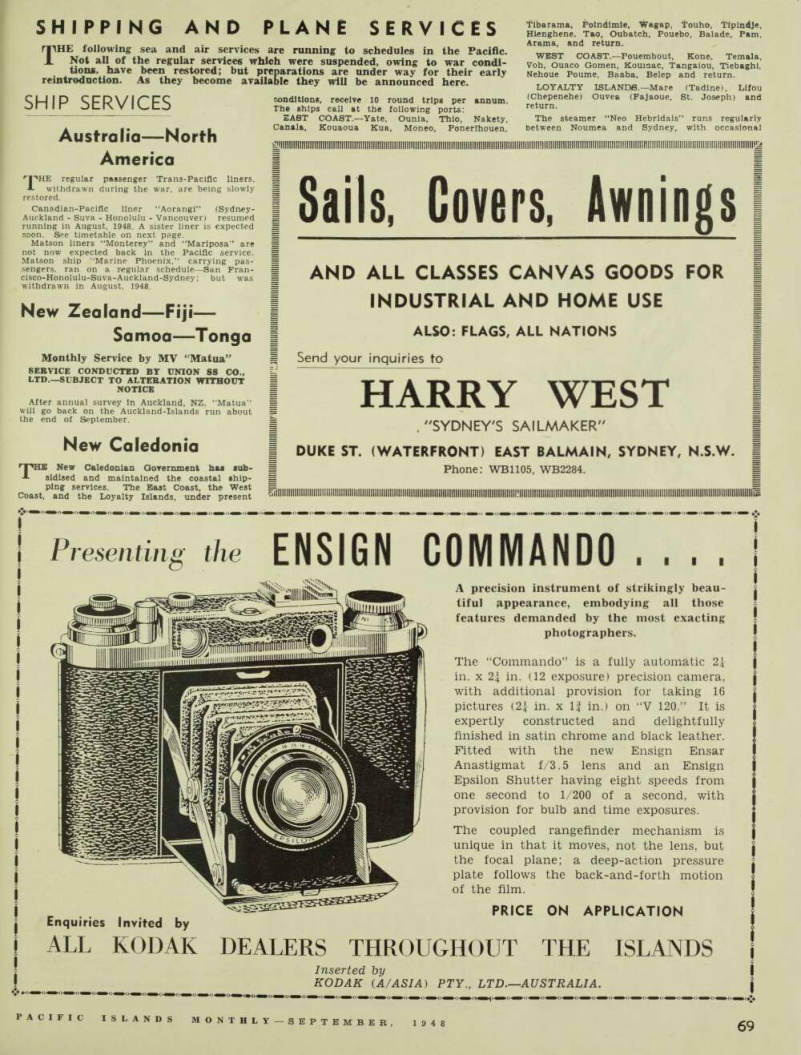
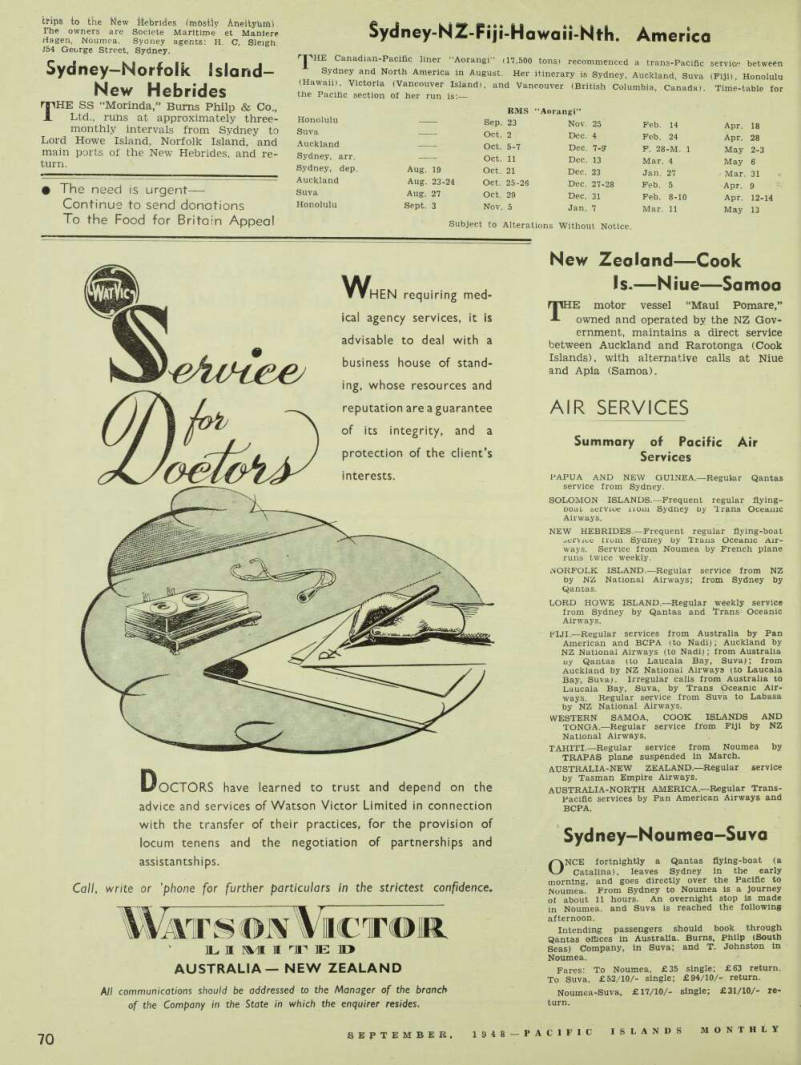
Shipping And Plane Services
THE following sea and air services are running to schedules in the Pacific.
Not all of the regular services which were suspended, owing to war condi tions. have been restored; but preparations are under way for their early reintroduction. As they become available they will be announced here.
Ship Services
Australia—North
America
f X'HE regular passenger Trans-Paciflc liners, A withdrawn during the war, are being slowly restored.
Canadian-Pacific liner “Aorangi” (Sydney- Auckland - Suva - Honolulu - Vancouver) resumed running in August, 1948. A sister liner is expected soon. See timetable on next page.
Matson liners "Monterey” and "Mariposa” are not now expected back in the Pacific service.
Matson ship "Marine Phoenix,” carrying pas sengers, ran on a regular schedule—San Fran cisco-Honolulu-Suva-Auckland-Sydney; but was withdrawn in August, 1948.
New Zealand—Fiji—
Samoa —Tonga
Monthly Service by MV “Matua”
Service Conducted By Union Ss Co.,
Ltd.—Subject To Alteration Without
Notice
After annual survey In Auckland, NZ, "Matua” will go back on the Auckland-Islands run about the end of September.
New Caledonia
r T'HE New Caledonian Government has sub sidlsed and maintained the coastal ship ping services. The East Coast, the West Coast, and the Loyalty Islands, under present
conditions, receive 10 round trips per annum.
The ships call at the following ports: EAST COAST.—Yate, Ounla, Thlo. Nakety, Canala, Kouaoua Kua, Moneo, Ponerlhouen,
Tlbarama, Polndlmle, Wagap, Touho, Tlplndje, Hlenghene, Tao, Oubatch, Pouebo, Balade, Pam, Arama, and return.
WEST COAST.—Pouembout, Kone, Temala, Voh, Ouaco Gomen, Kouinac, Tangaiou, Tiebaghi, Nehoue Poume, Baaba, Belep and return.
LOYALTY ISLANDS.—Mare (Tadine), Llfou (Chepenehe) Ouvea (Fajaoue, St. Joseph) and return.
The steamer "Neo Hebrldals” runs regularly between Noumea and Sydney, with occasional
bfips to the Mew tiebrldes (mostly Aheityhml.
The owners are Societe Maritime et Manlere Hagen, Noumea. Sydney agents: H. C, Sleigh. i 54 George Street, Sydney.
Sydney-Norfolk Island-
New Hebrides
THE SS “Morinda,” Burns Philp & Co., Ltd., runs at approximately three monthly intervals from Sydney to Lord Howe Island, Norfolk Island, and main ports of the New Hebrides, and re turn.
Advertisements & other items, pp. 71-72 (1 item)
Sails, Covers. Awnings
AND ALL CLASSES CANVAS GOODS FOR
INDUSTRIAL AND HOME USE
ALSO: FLAGS, ALL NATIONS
Send your inquiries to
HARRY WEST
, "SYDNEY'S SAILMAKER"
DUKE ST. (WATERFRONT) EAST BALMAIN, SYDNEY, N.S.W.
Phone: WBIIOS, W 82284.
Presenting the ENSIGN COMMANDO . . . . 5s K >■*** tv*r r A precision instrument of strikingly beautiful appearance, embodying all those features demanded by the most exacting photographers.
The “Commando” is a fully automatic 24 in. x 24 in. (12 exposure) precision camera, with additional provision for taking 16 pictures (24 in. x 14 in.) on “V 120.” It is expertly constructed and delightfully finished in satin chrome and black leather.
Fitted with the new Ensign Ensar Anastigmat f/3.5 lens and an Ensign Epsilon Shutter having eight speeds from one second to 1/200 of a second, with provision for bulb and time exposures.
The coupled rangefinder mechanism is unique in that it moves, not the lens, but the focal plane; a deep-action pressure plate follows the back-and-forth motion of the film.
PRICE ON APPLICATION
Enquiries Invited by
ALL KODAK DEALERS THROUGHOUT THE ISLANDS
Inserted by
KODAK {A/ASIA) PTY., LTD.-
-AUSTRALIA.
• The need is urgent— Continue to send donations To the Food for Britain Appeal
w
eAinee-
HEN requiring medical agency services, it is advisable to deal with a business house of standing, whose resources and reputation are a guarantee of its integrity, and a protection of the client’s interests. 4 DoCTORS have learned to trust and depend on the advice and services of Watson Victor Limited in connection with the transfer of their practices, for the provision of locum tenens and the negotiation of partnerships and
assistantships.
Call , write or 'phone for further particulars in the strictest confidence,
Wats»mVict®ir
iL* ii ?vn ii nr ik 11 >
AUSTRALIA NEW ZEALAND
All communications should be addressed to the Manager of the branch of the Company in the State in which the enquirer resides .
Sydney-NZ-Piji-Hawaii-Nth. America
Canadian-Pacific liner “Aorangi” (17,500 tons) recommenced a trans-Pacific service between Sydney and North America in August. Her itinerary is Sydney, Auckland, Suva (Fiji), Honolulu (Hawaii), Victoria (Vancouver Island), and Vancouver (British Columbia, Canada). Time-table for the Pacific section of her run is:—
New Zeoland—Cook
Is.—Niue—Samoa
fIIHE motor vessel “Maui Pomare,”
A owned and operated by the NZ Gov ernment, maintains a direct service between Auckland and Rarotonga (Cook Islands), with alternative calls at Niue and Apia (Samoa).
Honolulu —
Rms
Sep. 23 “Aorangi”
Nov. 25 Feb. 14 Apr. 18 Suva — Oct. 2 Dec. 4 Feb. 24 Apr. 28 Auckland — Oct. 5-7 Dec. 7-ff F. 28-M. 1 May 2-3 Sydney, arr. — Oct. 11 Dec. 13 Mar. 4 May 6 Sydney, dep.
Aug. 19 Oct. 21 Dec. 23 Jan. 27 Mar. 31 Auckland Aug. 23-24 Oct. 25-26 Dec. 27-28 Feb. 5 Apr. 9 Suva Aug. 27 Oct. 29 Dec. 31 Feb. 8-10 Apr. 12-14 Honolulu Sept. 3 Nov. 5 Jan. 7 Mar, 11 May 13 Subject to Alterations Without Notice.
Sydney— Noumea-Suva
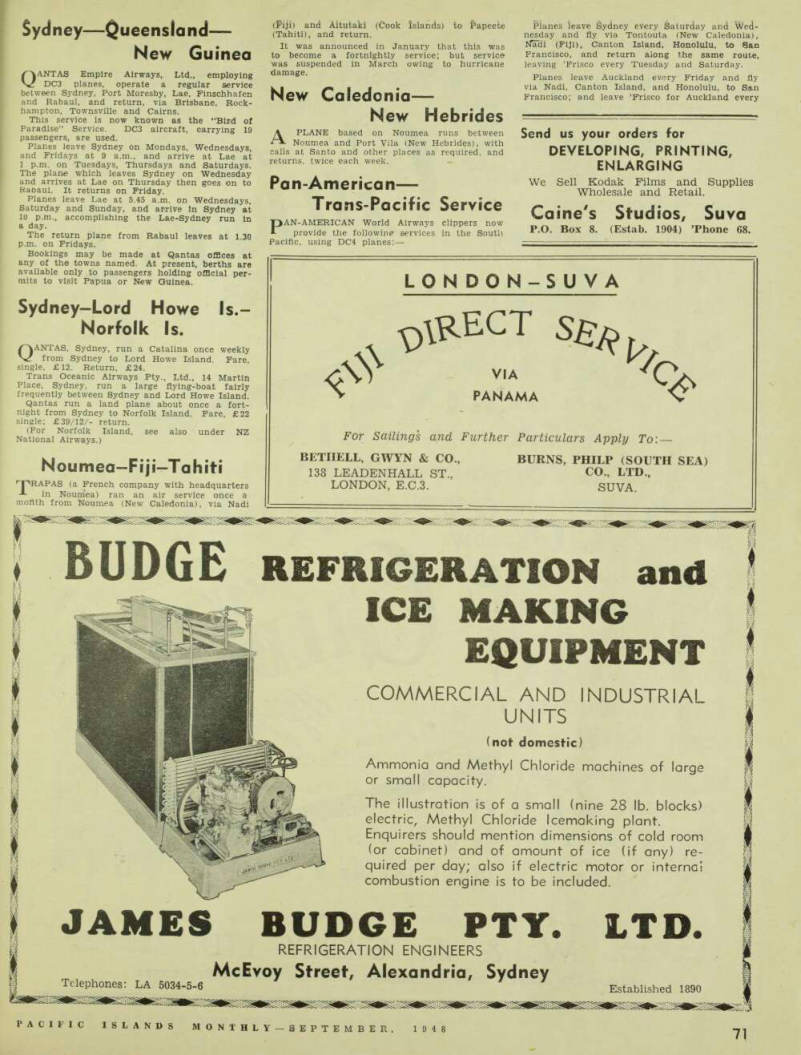

Air Services
Summary of Pacific Air
Services
PAPUA AMD NEW GUINEA. —Regular Qantas service from Sydney.
SOLOMON ISLANDS. —Frequent regular flying ooat service 110 m Sydney by Trans Oceanic Airways.
NEW HEBRIDES. —Frequent regular flying-boat oervice Hum Sydney by Trans Oceanic Air ways. Service from Noumea by French plane runs twice weekly.
NORFOLK ISLAND.—Regular service from NZ by NZ National Airways; from Sydney by Qantas.
LORD HOWE ISLAND. —Regular weekly service from Sydney by Qantas and Trans Oceanic Airways.
FIJI. —Regular services from Australia by Pan American and BCPA (to Nadi); Auckland by NZ National Airways (to Nadi); from Australia oy Qantas (to Laucala Bay, Suva); from Auckland by NZ National Airways (to Laucala Bay, Suva). Irregular calls from Australia to Laucala Bay, Suva, by Trans Oceanic Air ways. Regular service from Suva to Labasa by NZ National Airways.
Western Samoa, Cook Islands And
TONGA. —Regular service from Fiji by NZ National Airways.
TAHITI. —Regular service from Noumea by TRAPAS plane suspended in March.
AUSTRALIA-NEW ZEALAND—ReguIar service by Tasman Empire Airways.
AUSTRALIA-NORTH AMERICA.—Regular Trans pacific services by Pan American Airways and
Bcpa.
Sydney— Noumea-Suva
ONCE fortnightly a Qantas flying-boat (a Catalina), leaves Sydney in the early morning, and goes directly over the Pacific to Noumea. From Sydney to Noumea is a Journey of about 11 hours. An overnight stop is made in Noumea, and Suva is reached the following afternoon.
Intending passengers should book through Qantas oflices in Australia. Burns, Phllp (South Seas) Company, in Suva; and T. Johnston in Noumea.
Fares; To Noumea, £35 single: £63 return.
To Suva, £52/10/- single; £94/10/- return.
Noumea-Suva, £l7/10/- single; £3l/10/- re turn.
Sydney—Queensland—
New Guinea
QANTAS Empire Airways, Ltd., employing DC3 planes, operate a regular service between Sydney, Port Moresby, Lae, Finschhafen and Rabaul, and return, via Brisbane, Rock hampton, Townsville and Cairns.
This service is now known as the “Bird of Paradise” Service. DC3 aircraft, carrying 19 passengers, are used.
Planes leave Sydney on Mondays, Wednesdays, and Fridays at 9 a.m., and arrive at Lae at 1 p.m. on Tuesdays, Thursdays and Saturdays.
The plane which leaves Sydney on Wednesday and arrives at Lae on Thursday then goes on to Raoaul. It returns on Friday.
Planes leave Lae at 5.45 a.m. on Wednesdays, Saturday and Sunday, and arrive In Sydney at 10 p.m., accomplishing the Lae-Sydney run In a day.
The return plane from Rabaul leaves at 1.30 p.m. on Fridays.
Bookings may be made at Qantas offices at any of the towns named. At present, berths are available only to passengers holding official per mits to visit Papua or New Guinea.
Sydney-Lord Howe ls.-
Norfolk Is.
QANTAS, Sydney, run a Catalina once weekly from Sydney to Lord Howe Island. Fare, single. £l2. Return, £24.
Trans Oceanic Airways Pty., Ltd., 14 Martin Place, Sydney, run a large flying-boat fairly frequently between Sydney and Lord Howe Island.
Qantas run a land plane about once a fort night from Sydney to Norfolk Island. Fare, £22 single: £39/12/- return. (For Norfolk Island, see also under NZ National Airways.)
Noumea-Fiji-Tahiti
'T'RAPAS (a French company with headquarters -L in Noumea) ran an air service once a mortth from Noumea (New Caledonia), via Nadi
(Fiji) and Aitutaki (Cook islands) to Papeete (Tahiti), and return.
It was announced in January that this was to become a fortnightly service; but service was suspended in March owing to hurricane damage.
New Caledonia—
New Hebrides
A PLANE based on Noumea runs between Noumea and Port Vila (New Hebrides), with calls at Santo and other places as required, and returns, twice each week.
Pan-American—
Trans-Pacific Service
PAN-AMERICAN World Airways clippers now provide the following services in the South Pacific, using DC4 planes:—
Planes leave Sydney every Saturday and Wed nesday and fly via Tontouta (New Caledonia), Nadi (Fiji), Canton Island, Honolulu, to San Francisco, and return along the same route, leaving ’Frisco every Tuesday and Saturday.
Planes leave Auckland every Friday and fly via Nadi, Canton Island, and Honolulu, to San Francisco; and leave ’Frisco for Auckland every
Monday. Pares are given below, in Australian currency:—
(Time-tables and fares subject to alteration without notice.) To convert to Fiji currency, reduce above figures by about 10 per cent.
Free baggage allowance is 66 lb. per person.
Excess baggage at 1 per cent, of single fare for each kilogram of excess (1 ki10—2.2 lb.).
NZ National Airways
South Pacific Services
THE Pacific services run by the New Zealand National Airways Corporation are as follows:
Auckland-Laucala Bay (Suva): A “Sun
derland” flying-boat leaves Mechanics Bay, Auckland, at 7 a.m. each Saturday for Laucala Bay, Suva (arrives 3.30 p.m.).
The aircraft departs from Laucala Bay, Suva, on the return journey at 7.30 a.m. each Monday, and arrives at Mechanics Bay, Auckland, at 4 p.m.
Laucala Bay (Suva)-Labasa (Vanua
LEVU): A “Sunderland” flying-boat operates this service on a charter basis. A return trip is made between Laucala Bay and Labasa each Sunday.
Auckland-Norfolk Island-Fiji-Tonga
Western Samoa-Cook Islands: A “Douglas”
airliner leaves Whenuapai, Auckland, on alter nate Sundays at 8.30 a.m. (August 22, September 5 and 19) for Norfolk Island (arr. 12.30 p.m., dep. 12.1 a.m. Monday). Nadi (arr. 6.55 a.m., dep. 5.40 a.m. Tuesday), Nausori (arr. 6 30 a.m, dep. 7.15 a.m.), Tonga (arr. 10.45 am., dep. 11.45 a.m.), ‘Apia, Western Samoa (arr. 410 pm. Monday, dep. 7.45 a.m. Tuesday). Aitutaki, Cook Islands (arr. 1.50 p.m., dep. 2.45 p.m.), and Rarotonga, Cook Islands (arr. 4.5 p.m )
The aircraft departs from Rarotonga on the return journey at 7.30 a.m. on alternate Thurs days (August 26, September 9 and 23) for Aitu taki (arr. 8.50 a.m., dep. 9.45 a.m.), Apia, Western Samoa (arr. 3.35 p.m., dep. 8 a.m.
Friday), *Tonga (arr. 11.15 a.m. Saturday, dep. 12.15 p.m.), Nausori (arr. 3.10 p.m., dep. 4.15 p.m.), Nadi (arr. 5.5 p.m., dep. 2 a.m. Sunday), Norfolk Island (arr. 8.10 a.m., dep. 1 p.m.), and Whenuapai, Auckland (arr. 5.45 p.m.).
An additional return service between Raro tonga and Aitutaki is operated on alternate Wednesdays when traffic warrants. ♦Crosses International Date Line.
Auckland-Norfolk Island: A “Douglas”
airliner leaves Whenuapai, Auckland, every Sun day at 8.15 a.m. for Norfolk Island (arr. 12.15 p.m.), and departs on the return flight at 1.15 p.m., arriving at Whenuapai at 6 p.m.
PARES, single (in NZ currency): Auckland to Norfolk, £l2/10/-; to Fiji, £2B/10/-; to Tonga, £3l; to Samoa, £34; to Aitutaki, £39; to Raro tonga. £39/10/-. Norfolk to Fiji, £l9. Fiji to Tonga, £B/15/-; to Samoa, £l3; to Aitutaki, £29/15/-; to Rarotonga, £3l. Samoa to Raro tonga, £l7/15/-; to Aitutaki, £l6/10/-; Suva to Labasa, £4/10/-. Return fares, less 10 per cent.
BOOKING OFFICES; Wellington. Govt. Life Bldg., Customhouse Quay; Auckland Airways House, Customs St.; Dunedin, 8-10 Manse St.; Christchurch, Union SS Co., 168 Hereford 3t.; Gisborne, 74 Peel St.; Palmerston Nth.. 107 Broadway Ave.; Norfolk Is., Burns Philp Ltd.; Fiji, NAC; at Nadi and Suva; Burns Philp, Labasa: Tonga, Mrs. P. F. Melhose, Pou-amotu Airfield: W Samoa, Burns Philp (SS), Ltd., Apia; Cook Is., Mrs. P. McVeagh, Aitutaki and Mr. J. D. Campbell, Rarotonga.
Single Return £ s. d. £ s. d Sydney-’Prlsco 200 0 0 360 0 0 Sydney-Plji 55 0 0 99 1 3 Auckland-’Frisco ,. .. 184 1 3 331 5 0 Auckland-PIJi 39 1 3 70 6 3 PlJi-’Prlsco 145 0 0 260 18 9
Sydney-Vancouver
BCPA Service
BRITISH Commonwealth Pacific Airlines Limited operate a three trips per fortnight trans-Pacific service from Sydney
via Fiji, Canton Island, Honolulu and San Francisco; and a fortnightly service between Auckland and Vancouver, via the same air port.
Planes leave Sydney every Sunday evening and alternate Wednesdays, and Vancouver, on the southbound trip, every Sunday and alternate Thursdays. Planes leave Auckland every alter
nate Wednesday and arrive In Vancouver the following Saturday. This southbound trip com mences from Vancouver on alternate Fridays.
Pares are (in Australian currency), Sydney- San Francisco, £2OO single and £360 return, Auckland-Vancouver, £AI9B single; Auckland- Nadi (Fiji), £A39.
Skymaster aircraft carrying 38 passengers and a crew of 9 are used on the service.
Trans-Tasman Service
Sydney— Auckland
npASMAN Empire Airways, Ltd., operate a ■I flying-boat service between Rose Bay, Sydney, and Mechanics Bay, Auckland. Large flying-boats, capable of carrying 30 passengers, are employed. The trip is comfortable, and takes approximately 8 hours.
The flying-boats leave both Sydney (6.30 a.m.) and Auckland (8 a.m.) every morning except Sundays. Six flights each way per week. Fares: £35 (A) (£2B NZ currency) single; £63 (A) (£ 50/8/- NZ currency) return.
In addition, this flying-boat service is, at pre sent, supplemented by a Skymaster service, details of which are available on application to TEA offices in Australia and New Zealand.
Bookings may be made at Tasman Empire Airways in Auckland and at Qantas Empire Air ways, Carrington Street, Sydney.
TOA Services
TRANS Oceanic Airways run the following Pacific services;— SYDNEY-LORD HOWE IS.: A regular fort nightly service with large four-engine flying boats from Rose Bay. Fare: £ll single; £2l return. Free baggage allowance 50 lb. Excess baggage aftd freight rate 6d. per lb.
SYDNEY-NEW HEBRIDES: A regular monthly service with large four-engine flying-boats from Sydney, via Noumea (overnight stop), to Vila and Espiritu Santo. Fare: Sydney-Vila, £45; Sydney-Santo, £5O; Noumea-Vila, £l2/10/-; Noumea-Santo, £lB. Freight: Sydney-Vila or Santo, 2/- per lb.
Sydney-Solomon Islands: A Regular
monthly service from Sydney, via New Cale donia and New Hebrides to Tulagi, Solomon Islands. This service is frequently extended to Lingatou, in the Russell Islands, and calls are sometimes made at Vanikoro, in the Santa Cruz Group. Fares: Sydney-Tulagi, £75. Free bag gage allowance, 60 lb.; excess baggage and freight, 3/- per lb.
New Caledonia—New
Hebrides
ATRAPAS amphibian runs twice each week between New Caledonia and New Hebrides.
The days vary, but on the selected day the planes adhere to the following time-table:— Noumea —dep. 0630. Vila—arr. 0900 Vila—dep. 0945 Santo—arr. 1115 Santo—dep. 1145 Vila—arr. 1315 Vila—dep. 1400 Noumea—arr. 1630
Advertisements & other items, pp. 73-77 (1 item)
tffrECT
Send us your orders for
DEVELOPING, PRINTING,
ENLARGING
We Sell Kodak Films and Supplies Wholesale and Retail.
Caine's Studios, Suva
P.O. Box 8. (Estab. 1904) ’Phone 68.
LONDON-SUVA
tffrECT
V|A / C >
> PANAMA V
For Sailings and Further Particulars Apply To:— BETIIELL, GWYN & CO., BURNS, PHILP (SOUTH SEA)
138 LEADENHALL ST., CO., LTD.,
LONDON, E.C.3. SUVA.
BUDGE REFRIGERATION and
ICE MAKING
EQUIPMENT
NDUSTRIAL
COMMERCIAL AND
UNITS
(not domestic) Ammonia and Methyl Chloride machines of large or small capacity.
The illustration is of a small (nine 28 lb. blocks) electric. Methyl Chloride Icemaking plant.
Enquirers should mention dimensions of cold room (or cabinet) and of amount of ice (if any) required per day; also if electric motor or internal combustion engine is to be included.
JAMES BUDGE PTY. LTD.
REFRIGERATION ENGINEERS
McEvoy Street, Alexandria, Sydney
Telephones: LA 5034-5-6 Established 1890
DON'T SAY
S I M DON'T SAY
p|H
G I M DON'T SAY
DON'T SAY fi I |\
<S I M DON'T SAY
DON'T SAY G I ft
G I M DON'T SAY
DON'T SAY G 1 N
[M DON'T SAY
-T SAY G
DON'T SAY ft I N
G SAY
DON
G DO
DON'T SAY G I N
svvvv. «y
I 1% DON'T SAY
DON'T SAY G I M
DON'T SAY
DON'T SAY
DON'T SAY iff 1 I
DON'T SAY G I M
G I M DON'T SAY
DON'T SAY G I M
G 1 M DON'T SAY
DON'T SAY Gll\
G I I¥ DON’T SAY
DON'T SAY G I ]\
G I M DON'T SAY
DON'T SAY G I N
G I M DON'T SAY
DON'T SAY G 1 N
G I M DON'T SAY
DON'T SAY G I M
,V 11 0 U Su fiS ®/6 <l*o °Ur /)e C °C * r isb
DON'T
If IM DON'T I
DON'T SAY ft I M
DON'T SAY G I M
" I SAY
DO G D AY M
SAY
IN
T SAY
DON'T OTPPft I M
DON'T SAY ft I M
GUM DON'T SAY
DON'T SAY GIM
vS^v 0 ' «wm> A w
DON'T SAY
M Y s AY ♦ N
U OU
*lb 0 urn °Oc
KT Ar
SAY
ts y<*n im ey S *t£S nsb
T SAY
IN
DON'T
GIN DON'T
DON'T SAY GIN DON'T
Telegrams and Cables: "GILBETS,” Melbourne.
Address all inquiries to:
W. & A. GILBEY LTD.
33 ROSSLYN STREET, WEST MELBOURNE.
Telegrams and Cables: “GILBETS," Sydney.
109 REGENT STREET, SYDNEY.
PRODUCING UNIFORM GOOD RESULTS SINCE 1868
Floor
ALWAYS ASK FOR IT
m i a r a % * - i A Concord, Sydney, Home Built with “Rapid” Blocks
RAPID” CONCRETE BLOCK & BRICK
MOULDING MACHINES
AN IMMEDIATE SOLUTION FOR HOME BUILDERS
• Capacity, 3 blocks per minute. • Semi-automatic—no tamping required. • Water tanks—well linings.
Priced to suit home-builders.
Hundreds in use.
For all building purposes.
WRITE FOR PARTICULARS TO PACIFIC ISLANDS REPRESENTATIVE
SUPPLIERS
Expo r t e
£. J. GOUGH S. CO.
OF GENERAL MERCHANDISE TO LEADING FIRMS THROUGHOUT THE PACIFIC ISLANDS.
Importers . . Manufacturer s’ Representatives 1 BOND STREET, SYDNEY, AUSTRALIA. Box 3615 G.P.O. Tel. 84167 Bankers: Bank of N.S.W. Bank of Adelaide. Comptolr Nat. d’Escompte de Paris „ - « - Cable Addre ss: “SEAFOODS.” SYDNEY COdgS: BentleyS ’ 2nd * nd Comp, phrase: A.8.C.. sth and 6th; Peterson. 2nd and 3rd; Banking; Acme.
(t m Jpecial
EXTRA FINE
OLD WHISKY
* • - ■/*/ A/// t v/ f* ssms/s-t i M* ///tsimj/sve *y Ms //sstem/tMasefAM /.myitt* *rm/ j -St'S ft'>{/,<**/ Ay /Ate ’ /s£///s >J /et At/ /w /*’Ssi //tr/ssist//St //HtW//t W /sad /As/rf . '//■/>* //*stt4
THE DISTILLERS CORPORATION PTY LTD.
THE CORIO DISTILLERY. CORIO
MANAGING AGENTS.
.7&
M ELBOURNE. AUSTRALIA '
NOTICE
IS HEREBY GIVEN that the Label shown in the margin is the sole and exclusive property and proper TRADE
MARK Of THE DISTILLERS COR-
PORATION PROPRIETARY LIMITED,
of Byrne Street, South Melbourne, Victoria, Australia, Distillers; used by them in respect of
WHISKY
and the Trade and Public are hereby cautioned against any infringment or improper use of the same.
Legal proceedings will be instituted against any person or persons selling or offering for sale goods, not the manufacture of the aforesaid The Distillers Corporation Proprietary Limited, bearing any representation of the said Trade Mark or any colourable imitation thereof.
EDWD WATERS &
SONS
Patent and Trade Mark Attorneys, 422-428 Collins Street, Melbourne, Victoria, Australia.
C. SULLIVAN PTY. LTD,
Island Merchants
Over 30 years' experience in the Pacific Island Trade.
Expert Buying Service Original Invoices Furnished Sellers of Island Produce.
Represented in all Australian States, New Zealand, England, France, United States, etc.
BANKERS: Bank of New South Wales, Comptoir National d’Escompte de Paris, Bank of New Zealand.
C. SULLIVAN PTY. LTD.
379 KENT STREET, SYDNEY
Telegrams & Cables: CHASULL, Sydney. Phone: MJ4657 (6 lines).
'THAT
/W
T HE
This decision
rests with You
It is most unwise to postpone the appointment of your executor or trustee, and equally foolish to make a hasty choice from your closest friends. No one can say when an executor will be called on to serve. Nor is there any guarantee that he can carry out his duties at some future date. In fact, his appointment merely expresses a wish on your part. However, uncertainty as to the future be set aside by appointing Burns Philp Trust Company Limited as executor and trustee. This capable and experienced organisation offers a permanent service to your beneficiaries, whose interests will be adequately safeguarded by able directors and efficient officers. The wise administration of your estate is assured by such an appointment.
Full details of the Company's services are explained in "Hands That Never Leave the Wheel." A complimentary copy of this interesting and informative booklet will be forwarded upon request.
DIRECTORS:
James Burns Joseph Mitchell P. T. W. Black Frederick Ewen Loxton Eric Priestley Lee MANAGER: L. S. Parker SECRETARY: E. R. Overton. A.F.I.A.
Burns Philp Trust
COMPANY LIMITED
EXECUTOR • TRUSTEE • AGENT
7 BRIDGE STREET, SYDNEY
Tel.: BU 5901 Box 543, 5.P.0., Sydney BP6-48.
Stephens-Axam Wedding
In Santo
IN the Tangoa Presbyterian Church, South Santo, New Hebrides, on June 26, Miss Emily Stephens, daughter of Mr. and Mrs. T. C. Stephens, of Urelapa. was married to Mr. George Axam, son of Mr. S. C. Axam, of South Santo, and the late Mrs. Axam. The two oldest British families on the island were thus united.
The service was conducted by the Rev.
G, Miller, assisted by members of the Presbyterian Synod from Australasia, who
were visiting the New Hebrides at that time. Native students from the local college sang during the service.
The bride was attended by Miss Angela Eaton, daughter of Mrs. J. Maxwell, wife of the British District Agent Santo. Mr.
L. Fox was best man. After the wedding ceremony, the whole party returned by launch to the Stephens home or Urelapa Island. Here, in a tropical setting, Mrs.
Stephens, her daughters and grand daughters had prepared a breakfast with a skill and lavishness for which they are famous in the Group.
Mr. Richard Humphries, Director of Native Labour for Papua-New Guinea, returned to Port Moresby from Australia at the end of August, He had had three weeks sick leave.
Four representatives of the Govern ment of New Caledonia (MM. Boilot, Ragusin, Pannetier and Pascalon) will visit Fiji in September to study the work ing of the Central Leper Hospital at Makogai. New Caledonia is planning the establishment of a leprosarium.
The Bride and Groom
The Pacific Islands Society
celebrated the 11th year of its existence with a well-attended sherry party at History House, Sydney, on June 23.
The Annual General Meeting was held on July 28.
The annual report and financial state ment were read, and showed a success ful year with increased membership and good attendances at meetings and social gatherings.
After the election of office bearers, the business of the meeting was adjourned until August, and the guest-speaker, the Rev. W. K. Deasey, delivered an address on Norfolk Island. Among the guests was Mrs. J. D. McComish whose late husband, Captain McComish, was an authority on this island.
Sir L. Brian Freeston, KCMG, OBE, Governor of Fiji and High! Commis sioner for the Western Pacific, has con sented to be Patron of the Society. The following were elected office-bearers for the' year ending June 30, 1949: President: Major C. A. Swinbourne; vice-presidents: Mrs. E. Marie Irvine, Dr. George Mac kaness, Messrs. G. D. Blaxland, Claude S. Israel, F. D. McCarthy and Alfred E.
Stephen; joint hon. secretaries: Mes aames M. K. Beasley and A. E. Sturt; Assistant hon. secretary: Mr. C. Price Conigrave; councillors: Mesdames N. S.
Williamson and H. C. Monckton, Miss Doris Peters, Major Clifford M. Southey, Messrs. Hubert Sabben, H. C. Monckton and A. E. Sturt; hostess: Mrs. E. Marie Irvine; Assistant hostesses: Mesdames G.
Mackaness and R. W. G, Gosset; hon, auditor; Mr. R. Clarke.
It was decided at this meeting to in crease the annual subscription from 5/to 10/- per annum.
Guest-speaker at the August meeting was Mrs. Jean Crofts, who took as her subject the life of the late Jack Hides, famous Papuan explorer and brother of Mrs. Crofts.
At the September meeting, Mr. A. T.
Gover will give an address entitled “Some Polynesian Voyages, and the Discovery of New Zealand.’’ On October 17 a garden party will be held at the home of Mrs.
E. Marie Irvine.
NEW MEMBERS; Mesdames Cradick, Donnan, Farleigh, Chidgey and Mc- Comish; the Misses Marie Mongan, Olga Northam and Ellen Chidgey; Messrs. G.
F. Cradick, Frank Pyne and Stuart Brown.
Morobe Citizens’ Associations
Meet
AT a meeting held in Lae, New Guinea, on August 27, at which Mr. Norman White Sr., president of the Wau Citizens’ Association, was present, it was decided to try to unite citizens’ associa tions in the Territory under one banner.
Those present at the meeting felt that this would allow all Territorians to speak with one voice on affairs that affected the whole Territory.
It was resolved at the meeting to rally all forces to try to have the period of in denture for native labour extended from the 12 months which is the maximum permitted at present. These short-term contracts are the bug-bear of all em ployers of native labour.
The Lae branch of the Citizens’ Asso ciation, will hold a fancy dress ball in the Hotel Cecil on December 13. Pro ceeds will go to offset expenses for the children’s Christmas Party which ss held annually and at which every child in the Morobe district receives a present.
Advertisements & other items, p. 78 (1 item)
Shell
Airway Cases, In woven-striped, waterproofed tanva* with leather-bound edges, are made for flying. The supply Is limited . . . but increasing!
Mode by FORD SHERINGTON LTD.
Wholesale only
mi
HILLMAN
SILVER SHELL MOTOR OIL S.A.E. 20.
HUMBER
SINGLE SHELL MOTOR OIL S.A.E. 30.
SUNBEAM-TALBOT
SINGLE SHELL MOTOR OIL S.A.E. 30.
CONNER
/ SINGLE SHELL MOTOR OIL S.A.E. 30,
KARRIER
M SINGLE SHELL MOTOR OIL $ JV.E. 30.
THE ROOTES GROUP
Recommend Exclusively
SHELL
MOTOR OIL
FOR ALL THEIR VEHICLES
SHELL} You, too, can be sure of SHELL MOTOR OIL THE SHELL CO. OF AUST. LTD. (Inc. In Gt. Brit.) L0489J
Madang Newsletter
From a Special Correspondent
Madang, Aug. 30.
AT a representative meeting of Madang citizens recently, it was decided to form a Parents’ and Citizens’ Asso ciation. Messrs. Evans, Collins, Steege and Mrs. Weidenhofer were elected to the general committee and instructed to draw up a constitution suitable to the district; and, should either Mr. J. R. Halligan, Secretary to the Department of External Territories, or the Minister of that De partment visit Madang in the near future, to approach them with regard to a bur sary scheme for children proceeding to Australia for secondary education.
One hundred pounds per annum for each child was considered a suitable amount for such bursaries.
In the event of neither the Secretary nor ihe Minister of the Department visit ing the Territory, provision was made for other means of bringing the whole prob lem of secondary education before the authorities. The cost of living in the Territories now is such that few people can afford to send their children to Aus tralia for post-primary education. It is considered that it would be cheaper for the Administration to make some contri bution to their education than to estab lish secondary schools in New Guinea, The president of the newly constituted Parents’ and Citizens’ Association is the local District Officer, Mr. J. K. McCarthy.
Mr. L. Fisher is secretary-treasurer.
After considerable effort on the part of various members of the community, the dance floor of the Madang Club was opened with a ball on August 21. A large number attended.
Mr. P. Brosgarth, a cadet in the Agri cultural Department, has performed a worthwhile service to the community by organising a “learn to swim” campaign among local children. He has now been transferred to the Highlands for three months and his voluntary labours have been taken over by Mr. F. Hurrell.
The Commonwealth Bank of Australia opened for business in the town on August 16. Mr. M. Andrew is manager.
The Director of Education for Papua- New Guinea, Mr. W. C. Groves, paid a short visit to the town recently. It is hoped that a new school building will be one result of his visit. The present build ing is too small for the number of child ren who are expected to attend next year.
The last of the vehicles from Madang “car park” war-disposals trucks, etc.) were removed by MV “Baluchistan” during a busy shipping week recently. No less than six ships were in port on one occa sion—one of them being the “Teviot Bank” which was loading copra.
The newly appointed Bishop of Central New Guinea (the Rt. Rev. Leo Arkfeld), gave Madang residents an exciting hour recently when he arrived at night after an adventurous trip in his plane. While he circled the town, apparently uncon cerned, residents turned out in force in their jeeps and cars to light the air-strip for his landing.
Due to a very dry season, many Madang residents are short of water and supplies have to be carted to them from the Meiro River.
Social jottings: Mr. D. Ewing is reliev ing Mr. T. Warburton as manager of the local branch of Burns Philp (NG), Ltd.; Mrs. Ewing has accompanied her husband to Madang. . . . Mrs. H. James has started rehearsals for a play to be per formed by the children of the district. . .
Sister Blakely has joined the staff of the European Hospital where Sister P. Wau chope has been assisting for some time. . . . Mrs. Daymond, who some years ago lived in the Sepik area, is visiting her daughter, Mrs. Len Fisher. . . . Mr. C. S Paisley has resigned from New Guinea Estates to take over Taab Plantation on Kar Kar Island.
A Territories-wide organisation, with Mr. J. H. Ahearn as organising secretary, has been set up in Port Moresby to raise funds for the United Nations Appeal to assist the world’s starving children. The
Administrator, Colonel J. K. Murray, launched the appeal in a broadcast over 9PA on August 25. Other supporting speakers were Father Earle. Rev. H. E.
Palmer, Rev. D, E. Ure, and Pastor Gray.
These two photographs by Mr. Ronald Gatty give some indication of the impressive feast held in Nukualofa, Tonga, in June, during the Con vention of the Free Tongan Church.
In the top picture one sees some portion of the food which was spread out so lavishly for the entertainment of members and guests.
The lower picture shows three of the leading workers—from left to right: Mrs. Ulakalala, Sio La’a, and Saimone Taumoipau—all leaders of the Free Tongan Church.
Advertisements & other items, pp. 79-82 (1 item)
Broohfields Ltd.
NOW! . . .
THESE EXCLUSIVE TRADE
GOODS ARE AVAILABLE IN
THE FOLLOWING COLOURS:
RED, BLUE, ORANGE, YELLOW
Order from the Sole Distributor for the Pacific Islands.
HARRY J. YOUNG PTY., LTD. 397 Kent St. Sydney P.O. Box 3661, G.P.0., Sydney
. BONDS
Coloured Athletic
SINGLETS
Hard to Get? 7r v us
FOR
1. TRADE TOBACCO 10.
2. LAP LAP MATERIAL 11.
3. CANNED GOODS ]2 -
4. PERFUMERY 13 -
5. PRIMUS STOVES
6. KEROLAMPS
7. SHOES, SANDALS 15
8. UMBRELLAS 16
9. CHILDREN'S CLOTH- n
ING 18.
SADDLERY & HARNESS
HOME LIGHTING PLANTS
WINES AND SPIRITS
NON-ELECTRIC WASHING
MACHINES
PUMPS, IRRIGATION
PLANTS
CROCKERY
HAIRDRESSING SUPPLIES
HARDWARE
AIR CIRCULATORS
/I M £» 8a Castlereagh Street W WIVIS Sydney, Australia
ISLAND TRADERS
Cable and Telegraphic address; “MANSTOCKS,” SYDNEY Telephones: 8W7405, 8W1237, 85076, FM2766
BROOHFIELDS Ltd.
Suppliers of
Building Hardware
General Hardware
Ship Chandlery
Paint Materials
WRITE DIRECT TO
Broomfields Ltd.
152 SUSSEX STREET, SYDNEY
Sole Agents for: P. H. MUNTZ & CO.’s 3-CROWN BRAND METAL
SHEATHING.
PEACOCK & BUCHANS’ ENGLISH READY-
MIXED PAINTS.
m
I^L r# m
rewm
THE UNITED, DISTILLERS FIT LTD-
MEL SOL’ R ME, AUSTRALIA
EDWD WATERS & SONS
Patent and Trade Mark Attorneys,
422-428 Collins Street, Melbourne, Victoria,
Australia.
NOTICE
IS HEREBY GIVEN that the Label shown in the margin is the sole and exclusive property and proper TRADE MARK of
THE UNITED DISTILLERS PRO-
PRIETARY LIMITED, of Byrne
Street, South Melbourne, Victoria, Australia, Distillers, used by them in respect of
GIN
and the Trade and Public are hereby cautioned against any infringement or improper use of the same.
Legal proceedings will be instituted against any person or persons selling or offering for sale goods, not the manufacture of the aforesaid The United Distillers Proprietary Limited, bearing any representation of the said Trade Mark or any colourable imitation thereof.
jr \ m £ d r d M'jW m
A NEW CATALOGUE
of the
"CHULA"
COPRA DRYER
has just been printed.
Send for Your Copy!
BIGGER PRICES for BETTER COPRA !
when dried by Ihe scientific
process made possible by the
“CHULA” Copra Dryer
. . . the most practical and efficient machine for drying nuts in bulk, which produces copra of a higher standard than that dried in the open, without discolouration, free from mould, thoroughly and evenly dried throughout. The “Chula” produces its two tons of copra every 24 hours, irrespective of the weather, and with a minimum of'labour.
THE INVENTORS AND MANUFACTURERS OF
THE CHULA ’ COPRA DRYER ALSO MAKE
DESICCATED COCONUT
MACHINERY
(Parers, Disintegrators, Sifters, Dryers)
TEA DRYERS
FISH DRYERS
RUBBER MACHINERY
(Continuous Sheeters, Crepeing Batteries)
TYNESIDE FOUNDRY &
ENGINEERING CO. LTD.
ELSWICK • NEWCASTLE-ON-TYNE • ENGLAND
Telegrams & Cables ; “ FOUNDRY. A EWC AST LE-ON-TYNE " * Codes ; ABC, sth & 6th Eds.
IMPROVE YOUR OUTLOOK!
Two recommended products from the famous Spartan range of dependable paints and enamels—Spartan Quick Drying Enamel and Spartan Silver will brighten your surroundings.
ECONOMICAL DURABLE . WASHABLE NON-FADING
For long-life surface protection to metal and wood. Dries to a smooth, outstanding, lustrous finish.
fatten*
Quick-drying
enamel'
Transforms small or large rooms into delightful, charming places in which it will be a pleasure to work and live.
Recommended for a PERFECT
FINISH
Durable Spartan Quick-Drying Enamel is a high-grade, quick-drying finish designed for application by professional and amateur alike —to go on easily and with an exceptionally smooth flow that ensures a perfect surface. . . . Drying speed of Spartan Quick-Drying Enamel is carefully controlled to allow ample time for “joining up” on large wall areas—it is fast enough to permit the surface drying dust-free within 2 hours, and setting with a wear-resisting hardness overnight. * f JJ An outstanding heat-resisting paint that gives a greater area coverage than ordinary paints. Protects metal work from moisture and corrosion. Easily applied to clean metal and wood surfaces of
STOVES, COPPERS, BATHS, HEATERS, GATES,
MACHINE EQUIPMENT, Etc.
Dries to a smooth, outstanding, brilliant, silvery finish.
SEALS TAR, BITUMEN, GREASY SURFACES AND BLEEDING
COLOURS.
For large exterior surfaces—tanks, roofs or galvanised iron structures, Spartan ALKYDISED ALUMINIUM PAINT is recommended because of its extreme durability.
Agents:
COLONIAL TRADE DEVELOPMENT AGENCY OF FIJI
P.O. Box 273, Suva.
Other Territories: Please Order Through Usual Channels.
SPARTAN PAINTS PTY., LIMITED
102-104 King Street, Melbourne, Victoria.
Heat-Resisting SILVER
Fiji: \ 1 L s
VER
HEAT-RESISTING . QUICK DRYHI&
PAPAIN WANTED
To Planters and Traders in the
South Pacific Islands
We have Urgent Inquiries, by United States Interests, for Supplies of Papain (the Latex of the Paw-paw Tree).
The price offered is high, and the market firm. Here is a new means of increasing your income, at little cost and trouble. Pawpaw Trees can be “milked” a year after planting. Send your Inquiries to us—air-mail, where possible.
PACIFIC ISLANDS TRADING COMPANY
244 California Street, San Francisco 11, U.S.A.
CABLES and RADIOS: “PITCO,” San Francisco.
l /ie A <»i/ tit Earn in f . - Sometimes men think that a general education or an elementary knowledge of business is enough to gel ahead. But experience soon teaches that thorough, specialised training is just as necessary for success in business as it is in the professions of Law, Medicine or Dentistry. If you are interested in the many opportunities in the Business World ... if you seek responsibility, success and economic security, commence training now —in some specialised business subject. H.R.I. is available always to help and advise ambitious men and women. Write or wire for particulars and career information.
H.R.I. tutorial service is proved by the winning of more honours than all coaches in Australasia combined.
B H.R.I. Career Training
W • ACCOUNTANCY • SECRETARYSHIP • COST ACCOUNTANCY • PRACTICAL BOOKKEEPING • MARKETING SELLING ADVERTISING • BANKING • LOCAL GOVERNMENT EXAMS.
II e 111 ing way Robertson Institute Founded and Owned by Hemingrway & Robertson Pty. Ltd.
Consulting Accountants Professional Tutors
126 BANK HOUSE, BANK PLACE, MELBOURNE
126 BARRACK HOUSE. 16 BARRACK STREET, SYDNEY 126^814
KWONG CHONG BROTHERS
General Merchants and Planters
Hove now re-established their business on their original pre-war site, and are carrying stocks of Trading and Plantation requirements. All enquiries welcomed and service assured.
Sydney Representatives:
NELSON & ROBERTSON PTY., LTD.,
Electra House, 12 Spring Street, Sydney, N.S.W.
KWONG CHONG BROTHERS
KEMARERE STREET, RABAUL
New Guinea Women’S Assn.
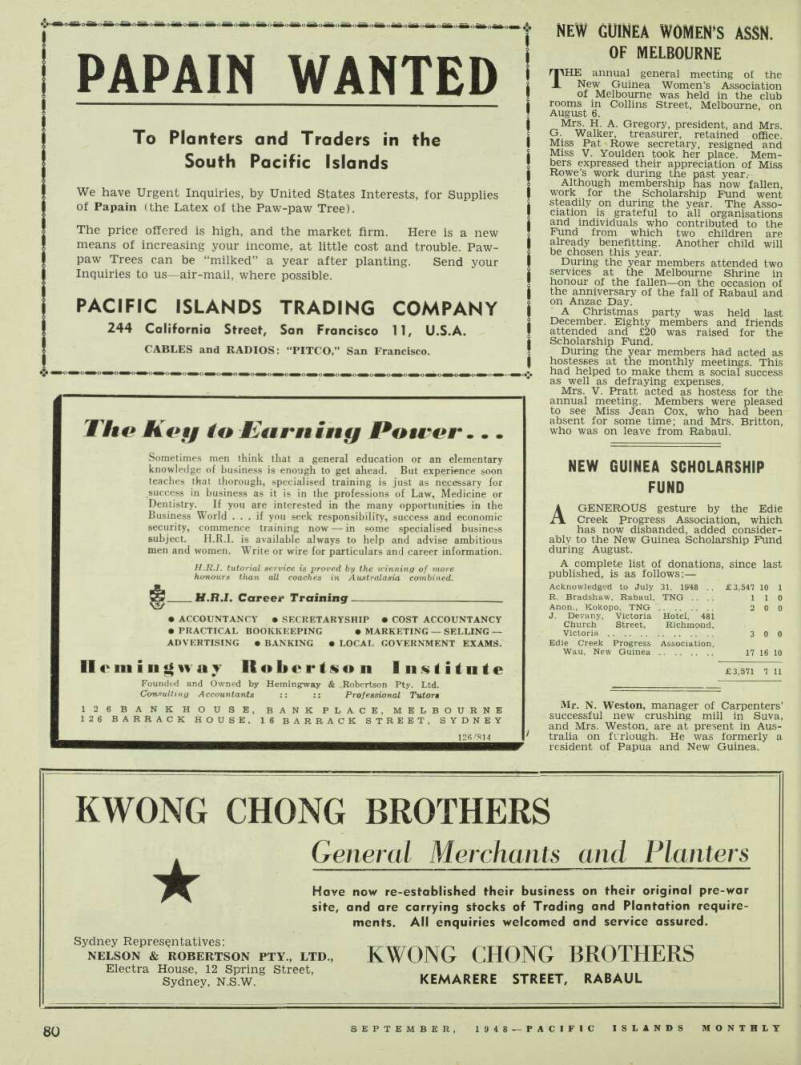
Of Melbourne
THE annual general meeting of the New Guinea Women’s Association of Melbourne was held in the club rooms in Collins Street, Melbourne, on August 6.
Mrs. H. A. Gregory, president, and Mrs.
G. Walker, treasurer, retained office.
Miss Pat Rowe secretary, resigned and Miss V. Youlden took her place. Mem bers expressed their appreciation of Miss Rowe’s work during the past year.
Although membership has now fallen, work for the Scholarship Fund went steadily on during the year. The Asso ciation is grateful to all organisations and individuals who contributed to the Fund from which two children are already benefitting. Another child will be chosen this year.
During the year members attended two services at the Melbourne Shrine in honour of the fallen—on the occasion of the anniversary of the fall of Rabaul and on Anzac Day.
A Christmas party was held last December. Eighty members and friends attended and £2O was raised for the Scholarship Fund.
During the year members had acted as hostesses at the monthly meetings. This had helped to make them a social success as well as defraying expenses.
Mrs. V. Pratt acted as hostess for the annual meeting. Members were pleased to see Miss Jean Cox, who had been absent for some time; and Mrs. Britton, who was on leave from Rabaul.
New Guinea Scholarship
Fund
A GENEROUS gesture by the Edie Creek progress Association, which has now disbanded, added consider ably to the New Guinea Scholarship Fund during August.
A complete list of donations, since last published, is as follows: Acknowledged to July 31, 19'48 .. £3,547 10 1 R. Bradshaw, Rabaul, TNG ... 110 Anon., Kokopo, TNG 2 0 0 J. Devany, Victoria Hotel, 481 Church Street, Richmond.
Victoria 300 Edie Creek Progress Association, Wau, New Guinea 17 16 10 £3,571 7 11 Mr. N. Weston, manager of Carpenters’ successful new crushing mill in Suva, and Mrs. Weston, are at present in Aus tralia on furlough. He was formerly a resident of Papua and New Guinea.
Advertisements & other items, pp. 83-88 (3 items)
81
PACIFIC ISLANDS MONTHLY SEPTEMBER, 1948
Notes From Fiji and Norfolk (Continued from page 8)
Nelson & Robertson "I.
EYE LOTION
For Inflamed Eyes and Eyelids ... Sold Everywhere H. Rose & Co.. Pty, Lid., King Street Sydney.
GILLESPIE’S
The Flour
TRADE
MARK
of the Islands
- SY DN EY -
NELSON and ROBERTSON Pty. Ltd.
Established 1895
Shipowners - Brokers and
Islands Merchants
All classes merchandise purchased at Best Wholesale Prices. Original Invoices supplied to Island Clients. Cocoa Beans, Copra, Rubber, Trochus Shell and All Islands 7 Produce Sold on Commission.
Entrust your requirements to the firm with fifty years' practical experience in the Pacific Islands. ■ uiibimvii yiTcii iv wii enquiries,
NELSON & ROBERTSON "I.
12 SPRING STREET, SYDNEY, AUSTRALIA
Telegraphic Address: IVAN, SYDNEY.
A.n ornate example of historical
keys, this XVlth Century
French key features the sporting motif in its club and animal carvings. It seems to have been the key to a Duke’s country
lodge.
0 a v' ~£r tt. olTfrilFA A
The key
to smoking pleasure
CAPSTAN
FINE CUT
NAVY CUT
TOBACCOS
or 1657.7.48
Itching Skin Germs Killed in 3 Days
Praised by Doctors
Dr. T. A. Ellis, well-known physician of Toronto, Canada, recently stated: “Skin disorders caused by parasites, as many are, ylel* to Nlxoderm. These parasites are invisible to the naked eye. They eat away the skin, forming ugly eruptions. Ordinary ointments or remedies fall completely, or give only temporary results because they do not reach the cause of the condition. It Is this value about Nlxoderm In attacking parasites which impresses me most favorably, and explains in large measure the success It enjoys over many stubborn cues."
Guaranteed Results
Get Nlxoderm to-day. Put It to the test. In a few mlnuces you will find that the Itching has stopped, and In 24 hours you can see for yourself that your skin Is clearer. And It Is guaranteed that, within one week, Nlxoderm must make your skin soft, clear, smooth and attractive or money back on return of empty package. Get Nlxoderm from your chemist or store to-day. The guarantee protects you. So don’t delay. Get Nlxoderm to-day.
Nixodcrm z/.&v-
For Skin Sores, Pimples and Itch.
Thanks to the discovery of an American physician, It Is now possible to kill and remove the true cause of most skin troubles. Tour skin has nearly 50 million tiny seams and pores where invisible germs and parasites can hide, and which are the true cause of terrible Itching, Cracking, Peeling, Burning, Ringworm, Acne, Psoriasis, Blackheads, Pimples, Foot Itch and other disfiguring blemishes.
Blemishes such as these make you look and feel embarrassed, unattractive and handicapped in life, both socially and in business. You can’t get rid of these disfigurements with ordinary treatments, which give only temporary relief, because they do not kill the germs or parasites responsible for your trouble. .
New Discovery Kills Cause
Former skin sufferers throughout the world are now praising Nlxoderm, the discovery of a leading American skin specialist. This remarkable new preparation quickly penetrates into the pores of the skin and kills the germs and parasites responsible for your trouble In 7 minutes, stopping the itch almost instantly. At the same time, this wonderful preparation acts as a tonic and skin food, so that as the cause of your trouble is removed, your skin becomes soft, smooth and clear. This clear, healthy complexion will give you new charm and make It easy to win fnends.
Man versus Germs
When man first woke to the nature of germs and sought for means to destroy them he got a big surprise. he found that germs were easy to destroy. Carbolic acid, strong alcohol, etc., would swiftly and surely wipe out whole armies of germs. But he also found that germs were made of almost the same substance as his own living tissues. so began the patient research, the long story of trial and error. One after another antiseptic substances were discarded. Some, applied in sufficient concentration, harmed the patient as well as the germs. Others interfered with the natural healing processes. Others again were changed by the body into inert chemicals. today, with countless case histories to prove it, we have the highly efficient non-poisonous antiseptic ‘Dettol. ’
Gentle on human tissues, this non-staining antiseptic is used in all the leading hospitals of Great Britain and throughout the Empire. In your own home c Dettol ’ is the way to safety from infection. 1
m
fIUMMWI
3 r* >T ** . & *s& m *. **s St
SWALLOW s ARIELL
LIMITED
53916 1 Master Craftsmen in the Biscuit Industry since 1854
If You
Cannot Sleep
FEEL FIT FOR NOTHING.
You may be anaemic or bloodless, for this ailment plays havoc with your health and nervous energy. You feel terribly nervy; suffer headaches and dizzy spells, have poor appetite, cannot sleep at night —losing those precious hours of rest and recovery, essential for your health and fitness.
Many people have recovered from these miseries by taking Dr. Williams’ Pink Pills, which have reinvigorated, strengthened their systems and banished the vague pains and weariness. Dr. Williams’ Pink Pills always help to enrich and increase the blood supply, giving beneficial help to the nerves, tissues and organs of the body. With enriched blood you cannot help feeling happier, sleeping better, becoming reinvigorated.
Stop anaemia making you a suffering invalid without delay. Take Dr. Williams’
Pink Pills and soon notice the difference in your eyes, skin, nerves and general health. At all chemists and stores.
Notice to Creditors
IN THE ESTATE of GLADYS HENRIETTA
LOVEDAY BAKER, late of Langu Plantation, Witu, in the Territory of New Guinea, Trader and Planter, deceased.
CREDITORS having claims against the Estate of the abovenamed deceased, who died on the thirtieth day of December, One thousand nine hundred and forty-six, are called upon to submit their claims, verified by affidavit, to Burns, Philp Trust Company, Limited, of 7 Bridge Street, Sydney, the Executor of the abovenamed Estate, within three months from the date of publication hereof, after which time the Executor will proceed to distribute the Estate, having regard only to claims of which it then shall have had notice in writing.
DATED this thirty-first day of August, 1948.
J. IRWIN CROMIE.
Solicitor for the Company, Port Moresby.
Notice to Creditors
IN THE ESTATE of WILLIAM FOSTER
STAWELL GARNETT, late of Karmiraba Extended, in the Territory of New Guinea, Planter and Trader, deceased.
CREDITORS having claims against the Estate of the abovenamed deceased, who died on the eighteenth day of February. One thousand nine hundred and forty-four, are called upon to submit their claims, verified by affidavit, to Burns.
Philp Trust Company. Limited, of 7 Bridge Street. Sydney, the Administrator of the abovenamed Estate, within three months from the date of publication hereof, after which time the Administrator will proceed to distribute the Estate, having regard only to claims -of which it then shall have had notice in writing.
DATED this thirty-first day .of August, 1948.
J. IRWIN CROMIE,
Solicitor for the Company.
Port Moresby.
Notice to Creditors
IN THE ESTATE of GEORGE ALEXANDER
NAESS, late of Tol Plantation, New Britain, in the Territory of New Guinea, Planter and Trader, deceased.
CREDITORS having claims against the Estate of the abovenamed deceased, who died on the first day of November, One thousand nine hundred and forty-two, are called upon to submit their claims, verified by affidavit, to Burns, Philp Trust Company, Limited, of 7 Bridge Street. Sydney, the Executor of the abovenamed Estate, within three months from the date of publication hereof. after which time the Executor will proceed to distribute the Estate, having regard only to claims of which it then shall have had notice in writing.
DATED this thirty-first day of August, 1948.
J. IRWIN CROMIE.
Solicitor for the Company.
Port Moresby.
Notice to Creditors
IN THE ESTATE of CLOTHILDE PHOEBE
PARKINSON, late of Kokopo, New Britain, in the Territory of New Guinea, deceased.
CREDITORS having claims against the Estate of the abovenamed deceased, who died on the twenty-seventh day of May, One thousand nine hundred and forty-four, are called upon to submit their claims, verified by affidavit, to Burns.
Philp Trust Company, Limited, of 7 Bridge Street.
Sydney, the Administrator of the abovenamed Estate, within three months from the date of publication hereof, after which time the Administrator will proceed to distribute the Estate, having regard only to claims of which it then shall have had notice in writing.
DATED this thirty-first day of August. 1948.
J. IRWIN CROMIE,
Solicitor for the Company, Port Moresby.
RE THE ESTATE of JOSEPH NANSEN, late of Five Dock, in the State of New South Wales, formerly of Tahiti, Chief Engineer.
NOTICE is hereby given that the Public
Trustee has this day elected to administer the Estate of the abovenamed deceased.
PURSUANT to the Wills, Probate and Administration Act, 1898-1940; the Public Trustee Act, 1913-ISM2; Testator’s Family Maintenance and Guardianship of Infants Act, 1916-1938; and Trustee Act, 1925-1942, the PUBLIC TRUSTEE, the Administrator of the Estate of the said JOSEPH NANSEN, who died on the 3rd day of April, 1947, intestate, hereby gives notice that creditors and others having any claim against or to the Estate of the abovementioned deceased person are required to send particulars of their claims to the Public Trustee at 19 O’Connell Street, Sydney, on or before the Nineteenth day of November, 1948, at the expiration of which time the said Public Trustee will distribute the assets of the said deceased to the persons entitled, having regard only to the claims of which he then has notice.
DATED this 4th day of August, 1948.
P J. P. PULLEN, Public Trustee.
Probate Notice
RE GEOFFREY HAMPDEN VERNON, formerly of “Komo,” Yodda Valley, in the Territory of Papua, but lately of Port Glasgow in the said Territory, Medical Practitioner, deceased.
After fourteen (14) clear days from to-day
QUEENSLAND TRUSTEES LIMITED. of 395
Queen Street, Brisbane in the State of Queensland, the Sole Executor appointed by the deceased land, the Sole Executor appointed by the deceased’s Will bearing date the Second day of September One thousand nine hundred and fortythree. will apply to the Supreme Court. Brisbane, for probate of the said Will.
Any person interested who desires to object to the application or to be heard upon it may file a Caveat in the Registry at any time before the Grant is made.
MIGHELL LEE-BRYCE & VANDELEUR,
Solicitors for Queensland Trustees Limited, Rankin Street, Innisfail.
Town Agents; T. J. PENDER & PENDER, Solicitors. Adelaide Street. Brisbane.
POSITION WANTED
OVERSEER: Requires position planta-
tion. Experienced in sugar and copra prewar. Age 31, married, no family. Prefer salary and commission. Character references if required. At present resident Mandated Territory of New Guinea.
Reply 8.E.M., c/o G.P.O. Box 3408,
Sydney.
FOR SALE
INQUIRIES INVITED in respect to Machinery.
Boats, Barges. Lighting Plants, ex-Disposals goods, Remote Control Phones (ex-Army).
Marine requirements and Fruit. Inquiries also invited for stocks held of 5 and 15-ton Stone Crushers. Concrete Mixers and large quantity of 4 in. coir rope.
A NUMBER OF DEEP SEA CRAFT.
We have a special offer of a 215-ton ship— length overall of 104 feet, beam moulded 21 feet, depth moulded 8 feet 6 inches, powered with two new Caterpillar Diesel engines of 115 H.P. each, with electric 32-volt starting gear and generating equipment, built in 1939. Alterations to the value of £12,000 being carried out. Full particulars from Endeavour Tractor Machinery Refrigeration Trading Co.. 24 Bond Street, Sydney. Cable address; ETMER, Sydney.
PALATIAL YACHTS AT BARGAIN PRICES.
FRESH FRUIT
Freshly packed in our own warehouse.
Case lots in any quantity shipped to Island Ports.
ENDEAVOUR TRACTOR MACHINERY
REFRIGERATION TRADING CO.,
24 Bond Street, Sydney, Australia.
Cables; ETMER, Sydney.
ESTATE NOTICES
Notice To Creditors
IN THE ESTATE of ARTHUR GUY ALLEN. late of Mioko Plantation, Duke of York Island, in the Territory of New Guinea, Planter and Trader, deceased.
CREDITORS having claims against the estate of the abovenamed deceased, who died on the first day of July. 1942. are called upon to submit their claims, verified by affidavit, to Burns, Philp Trust Company, Limited, of 7 Bridge Street.
Sydney, the Administrator of the abovenamed Estate, within three months from the date of publication hereof, after which time the Administrator will proceed to distribute the Estate, having regard only to claims of which it then shall have had notice in writing.
DATED this tenth day of August, 1948.
J. IRWIN CROMIE.
Solicitor for the Company, Port Moresby.
Notice To Creditors
IN THE ESTATE of FRANK VEALL SAUNDERS, late of Kavieng, in the Territory of New Guinea.
Planter and Trader, deceased.
CREDITORS having claims against the Estate of the abovenamed deceased, who died on the first day of July, 1942. are called upon to submit their claims, verified by affidavit, to Burns.
Philp Trust Company. Limited, of 7 Bridge Street. Sydney, the Administrator of the abovenamed Estate, within three months from the date of publication hereof, after which time the Administrator will proceed to distribute the Estate, having regard only to claims of which it then shall have had notice in writing.
DATED this tenth day of August, IS'4B.
J. IRWIN CROMIE.
Solicitor for the Company, Port Moresby.
Notice To Creditors
IN THE ESTATE of LATHAM HAMILTON, late of Sumuna Plantation, in the Territory of New Guinea, Planter, deceased.
CREDITORS having claims against the Estate of the abovenamed deceased, who died on the first day of July. 1942, are called upon to submit their claims, verified by affidavit, to Burns. Philp Trust Company. Limited, of 7 Bridge Street.
Sydney, the Administrator of the abovenamed Estate, within three months from the date of publication hereof. after which time the Administrator will proceed to distribute the Estate, having regard only to claims of which it then shall have had notice in writing.
DATED this tenth day of August, 1948.
J. IRWIN CROMIE.
Solicitor for the Company.
Port Moresby.
Notice To Creditors
IN THE ESTATE of FLORENTIN PAULISBO,
late of Panapompon Island, in the Territory of Papua, Trader and Planter, deceased.
CREDITORS having claims against the Estate of the abovenamed deceased, who died in the month of October. 1944, are called upon to submit their claims, verified by affidavit, to Burns.
Philp Trust Company, Limited, of 7 Bridge Street. Sydney, the Executor of the abovenamed Estate, within three months from the date of publication hereof, after which time the Executor will proceed to distribute the Estate, having regard only to claims of which it then shall have had notice in writing.
DATED this tenth day of August. 1948.
J. IRWIN CROMIE.
Solicitor for the Company, Port Moresby.
J
Basal Wk
rv 'y» W»Ili R!> «i M'»a *'NI nf.
THE UNITED DISTILLERS PI V. LTD
ME t. B! ) i H R, AVSTR A L 5 A
EDWD WATERS & SONS
Avoues aux Brevets et Marques de fabrique,
422-428 Collins Street, Melbourne, Victoria,
Australia. mm.
AVIS
L’etiquette ci-contre est la propriete et la veritable marque de fabrique de la
UNITED DISTILLERS
PROPRIETARY LIMITED
de Byrne Street, South Melbourne, Victoria, Australie, Societe de distillation, et utilisee per elle pour le
GIN
et les commercants et le public sont mis en garde par le presente centre toute contrefacon ou tout usage impropre de ladite etiquette.
Des poursuites legales seront entamees contre toute personne vendant ou ofirant pour la rente des produits non-manufactures par la United Distillers Proprietary Limited et portant une contrefacon de ladite marque de fabrique ou toute imitation.
r \*j> .
worm
L m
EXTRA FINE
OLD WHISKY
fjSf/M/ /'ft. town/ArASM/eft- /M.vu/atmA-t ■■ M* -a/ Ms- /’-ttyUf's/jr// , -ysi/i/fft/f-fft/ Me I&aMi//fK> A- Am*.**:- Aee*. ■ AM/ff-te*/ /ft fVfft.W-ftftt /etk) Mffft . Aw&ft fa>SttJr
THE DISTILLERS CORPORATION PTY LTD-
THE CORIO DISTILLERY. CORIO.
MANAGING AGENTS.
■$)S -e //£?-. j c
AVIS
L’etiquette ci-contre est la propriete et la veritable marque de fabrique <ie la
DISTILLERS CORPORATION PRO-
PRIETARY LIMITED, de Byrne Street, South Melbourne, Victoria, Australie, Societe de distillation, et utilisee par elle pour le
WHISKY
et les commercants et le public sont mis en garde par le presente centre toute contrefacon ou tout usage impropre de ladite etiquette.
Des poursuites legales seront entamees centre toute personne vendant ou offrant pour le vente des produits nonmanufactures par la Distillers Corporation Proprietary Limited et portant une contrefacon de ladite marque de fabrique ou toute imitation.
EDWD WATERS &
SONS
Avoues aux Brevets et Marques
de fabrique,
422-428 Collins Street, Melbourne,
Victoria, Australia.
84
SEPTEMBER, 1948 PACIFIC ISLANDS MONTHL
New Government Station In
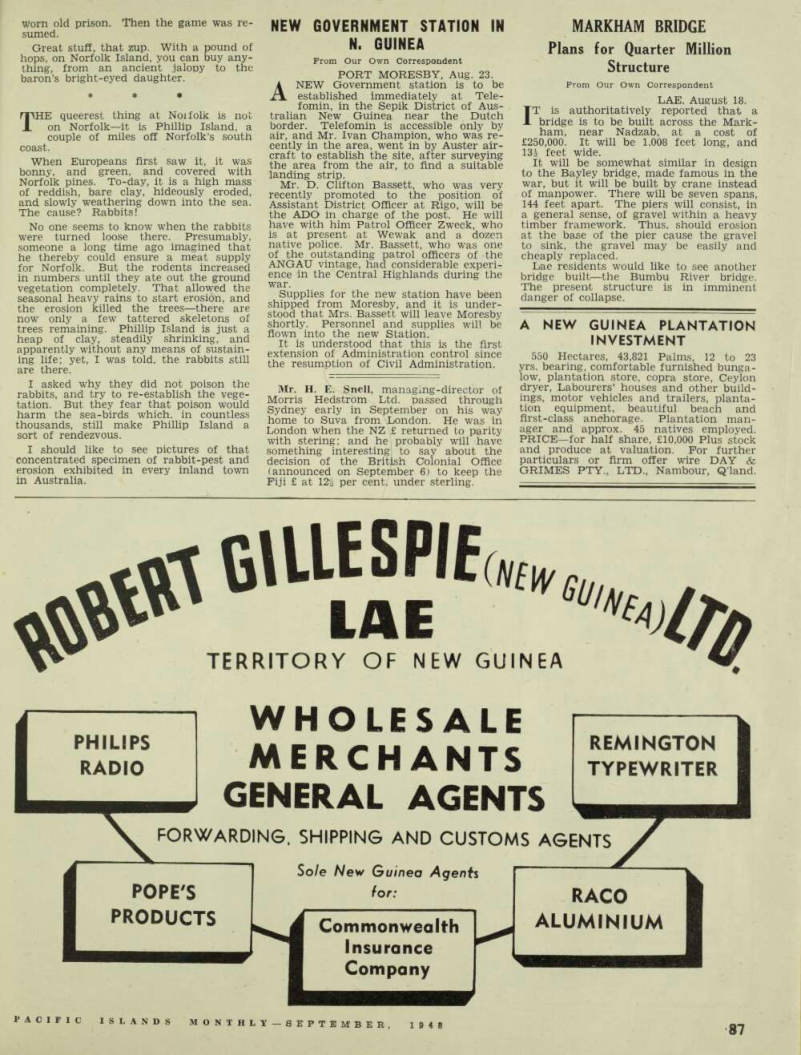
N. Guinea
From Our Own Correspondent
Port Moresby, Aug. 23.
ANEW Government station is to be established immediately at Tele fomin, in the Sepik District of Aus tralian New Guinea near the Dutch border. Telefomin is accessible only by air, and Mr, Ivan Champion, who was re cently in the area, went in by Auster air craft to establish the site, after surveying the area from the air, to find a suitable landing strip.
Mr. D. Clifton Bassett, who was very recently promoted to the position of Assistant District Officer at Rigo, will be the ADO in charge of the post. He will have with him Patrol Officer Zweck, who is at present at Wewak and a dozen native police. Mr. Bassett, who was one of the outstanding patrol officers of the ANGAU vintage, had considerable experi ence in the Central Highlands during the war.
Supplies for the new station have been shipped from Moresby, and it is under stood that Mrs. Bassett will leave Moresby shortly. Personnel and supplies will be flown into the new Station, It is understood that this is the first extension of Administration control since the resumption of Civil Administration.
Mr, H. E. Snell, managing-director of Morris Hedstrom Ltd. passed through Sydney early in September on his way home to Suva from London. He was in London when the NZ £ returned to parity with storing; and he probably will have something interesting to say about the decision of the British Colonial Office (announced on September 6) to keep the Fiji £ at 12V. per cent, under sterling.
Markham Bridge
Plans for Quarter Million Structure
From Our Own Correspondent LAE. August 18.
IT is authoritatively reported that a bridge is to be built across the Mark ham, near Nadzab, at a cost of £250,000. It will be 1,008 feet long, and 13J feet wide.
It will be somewhat similar in design to the Bayley bridge, made famous in the war, but it will be built by crane instead of manpower. There will be seven spans, 144 feet apart. The piers will consist, in a general sense, of gravel within a heavy timber framework. Thus, should erosion at the base of the pier cause the gravel to sink, the gravel may be easily and cheaply replaced.
Lae residents would like to see another bridge built—the Bumbu River bridge.
The present structure is in imminent danger of collapse.
Advertisements & other items, p. 89 (1 item)
$$ Qillespif
A NEW GUINEA PLANTATION
INVESTMENT
550 Hectares, 43,821 Palms, 12 to 23 yrs. bearing, comfortable furnished bungalow, plantation store, copra store, Ceylon dryer, Labourers’ houses and other buildings, motor vehicles and trailers, plantation equipment, beautiful beach and first-class anchorage. Plantation manager and approx. 45 natives employed.
PRICE—for half share. £lO,OOO Plus stock and produce at valuation. For further particulars or firm offer wire DAY & GRIMES PTY., LTD., Nambour, Q’land.
$$ QILLESPIf
(NEW
PHILIPS
RADIO
TERRITORY OF NEW GUINEA
WHOLESALE
MERCHANTS
GENERAL AGENTS
FORWARDING, SHIPPING AND CUSTOMS AGENTS
Sole New Guinea Agents for:
POPE'S
PRODUCTS
Commonwealth Insurance Company
REMINGTON
TYPEWRITER
RACO
ALUMINIUM
Islands Produce
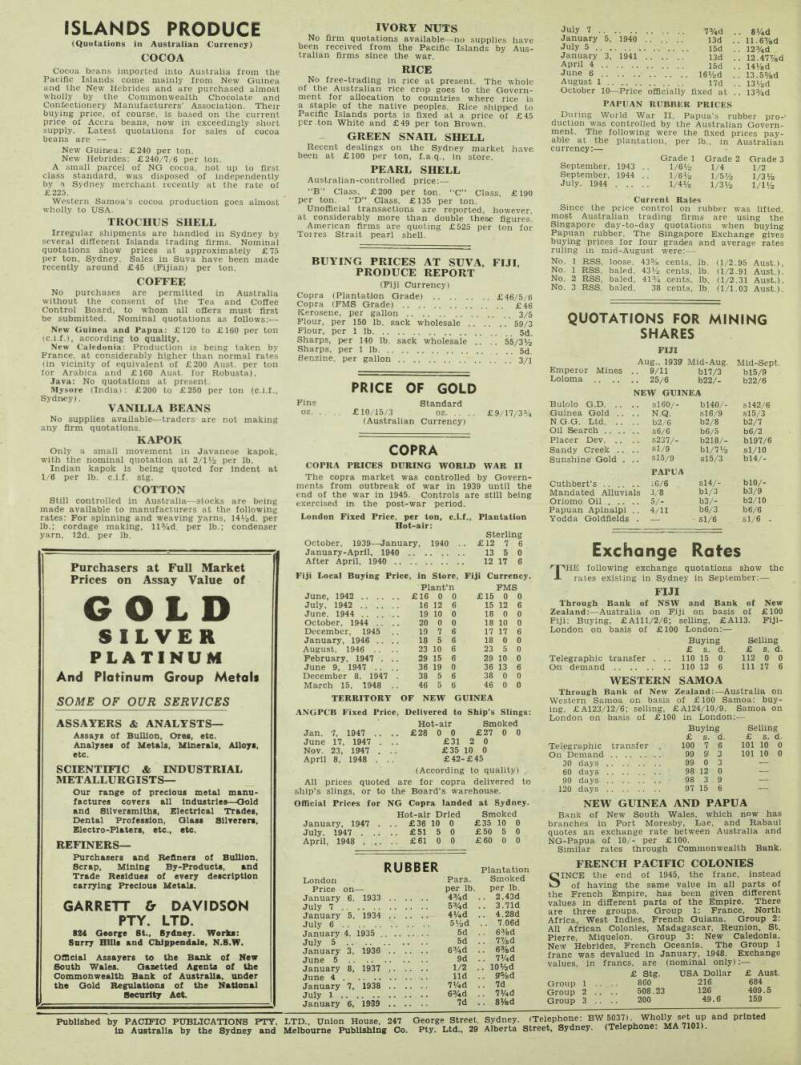
(Quotations in Australian Currency)
Cocoa
Cocoa beans imported into Australia from the Pacific Islands come mainly from New Guinea and the New Hebrides and are purchased almost wholly by the Commonwealth Chocolate and Confectionery Manufacturers’ Association. Their buying price, of course, is based on the current price of Accra beans, now in exceedingly short supply. Latest quotations for sales of cocoa beans are New Guinea: £240 per ton.
New Hebrides: £240/7/6 per ton.
A small parcel of NG cocoa, not up to first class standard, was disposed of independently by a Sydney merchant recently at the rate of £225.
Western Samoa’s cocoa production goes almost wholly to USA.
Trochus Shell
Irregular shipments are handled in Sydney by several different Islands trading firms. Nominal quotations show prices at approximately £75 per ton, Sydney. Sales in Suva have been made recently around £45 (Fijian) per ton.
Coffee
No purchases are permitted in Australia without the consent of the Tea and Coffee Control Board, to whom all offers must first be submitted. Nominal quotations as follows: New Guinea and Papua: £l2O to £l6O per ton (c.i.f.), according to quality.
New Caledonia; Production is being taken by France, at considerably higher than normal rates (in vicinity of equivalent of £2OO Aust. per ton for Arabica and £l6O Aust. for Robusta).
Java: No quotations at present.
Mysore (India): £2OO to £250 per ton (c.i.f., Sydney).
Vanilla Beans
No supplies available—traders are not making any firm quotations.
Kapok
Only a small movement in Javanese kapok, with the nominal quotation at 2/IV 2 per lb.
Indian kapok is being quoted for Indent at 1/6 per lb. c.i.f. stg.
Cotton
Still controlled in Australia —stocks are being made available to manufacturers at the following rates: For spinning and weaving yarns, 14y 2 d. per lb.; cordage making, ll%d. per lb.; condenser yarn. 12d. per lb.
Ivory Nuts
No firm quotations available—no supplies have been received from the Pacific Islands by Aus tralian firms since the war.
Rice
No free-trading in rice at present. The whole of the Australian rice crop goes to the Govern ment for allocation to countries where rice is a staple of the native peoples. Rice shipped to Pacific Islands ports is fixed at a price of £45 per ton White and £49 per ton Brown.
Green Snail Shell
Recent dealings on the Sydney market have been at £lOO per ton, f.a.q., in store.
Pearl Shell
Australian-controlled price:— “B ’ Class, £2OO per ton. “C” Class, £l9O per ton. “D” Class. £135 per ton.
Unofficial transactions are reported, however, at considerably more than double these figures.
American firms are quoting £525 per ton for Torres Strait pearl shell.
Buying Prices At Suva, Fiji,
Produce Report
(Fiji Currency) Copra (Plantation Grade) £46/5/fi Copra (FMS Grade) £46 Kerosene, per gallon 3/5 Flour, per 150 lb. sack wholesale . 59/3 Flour, per 1 lb sd.
Sharps, per 140 lb. sack wholesale .. .. 55/3V 2 Sharps, per 1 lb sd.
Benzine, per gallon 3/1
Advertisements & other items, p. 90 (1 item)
Price Of Gold
Fine Standard oz. . £lO/15/3 oz £9/17/3% (Australian Currency)
Copra
Prices During World War Ii
The copra market was controlled by Govern ments from outbreak of war in 1939 until the end of the war in 1945. Controls are still being exercised in the post-war period.
London Fixed Price, per ton, c.i.f., Plantation Hot-air:
Territory Of New Guinea
ANGPCB Fixed Price, Delivered to Ship’s Slings:
All prices quoted are for copra delivered to ship’s slings, or to the Board’s warehouse.
Official Prices for NG Copra landed at Sydney.
Sterling October, 1939—January, 1940 . £12 7 6 January-Aprll, 1940 13 5 0 After April, 1940 .. 12 17 6 Fiji Local Buying Price in Store, Fiji Currency.
Plant’n
Pms
June, 1942 £16 0 0 £15 0 0 July, 1942 16 12 6 15 12 6 June. 1944 19 10 0 18 0 0 October, 1944 .. 20 0 0 18 10 0 December, 1945 19 7 6 17 17 6 January, 1946 .. 18 5 6 18 0 0 August, 1946 23 10 6 23 5 0 February, 1947 . .. 29 15 6 29 10 0 June 9, 1947 .. 36 19 0 36 13 6 December 8. 1947 . 38 5 6 38 0 0 March 15, 1948 .. 46 5 6 46 0 0
Jan. 7, 1947 ..
Hot-air Smoked £28 0 0 £27 0 0 June 17, 1947 . £31 2 0 Nov. 23, 1?47 . £35 10 0 April 8. 1948 . . £42-£45 (According to quality)
Hot-air Dried Smoked January, 1947 . .. £36 10 0 £35 10 0 July. 1947 . .. . . £51 5 0 £50 5 0 April, 1948 . .. £61 0 0 £60 0 0
Rubber
Papuan Rubber Prices
During World War 11. Papua’s rubber pro duction was controlled by the Australian Govern ment. The following were the fixed prices pay able at the plantation, per lb., in Australian currency:—
Current Rates Since the price control on rubber was lifted, most Australian trading firms are using the Singapore day-to-day quotations when buying Papuan rubber. The Singapore Exchange gives buying prices for four grades and average rates ruling in mid-August were:— No. 1 RSS, loose. 43 5 /« cents, lb. (1/2.95 Aust.), No. 1 RSS, baled, 43V 2 cents, lb. (i/2.91 Aust.).
No. 2 RSS, baled, 41% cents, lb. (1/2.31 Aust.).
No. 3 RSS, baled, 38 cents, lb, (1/1.03 Aust.).
Plantation
London Para.
Smoked Price on per lb. per lb.
January 6. 1933 .. .. 4%d . . 2,43d July 7 5 3 / 4 d . . 3.71d January 5, 1934 .. .. 4V 4 d . . 4.28d July 6 5V 2 d , .. 7.06d January 4. 1935 5d . 6%d July 5 5d . . 77 8 d January 3, 1936 . . .. 6%d . . 6%d June 5 9d . . 7V 4 d January 8,' 1937 .. .. 1/2 . . 10V 2 d June 4 lid . . 9 , %d January ‘7. 1938 . . .. 7V 4 d . . 7d July 1 . 6%d . . 7V 4 d January 6. 1939 .. .. 7d . . 8Vad
July 7 7%d . . 8*/ 4 d January 5, 1940 . 13d . . 11.6 7 /ad July 5 15d . . 12 3 Ad January 3, 1941 13d . . 12.47 7 /ed April 4 15d . . 14Vad June 6 IGVad . . 13.5 s /ad August 1 17d . . 13V 2 d October 10—Price officially fixed at . . 13%d
Grade 1 Grade 2 Grade 3 September, 1943 1/6 y 2 1/4 1/2 September, 1944 1/6 y 2 i/s y 2 1/3 y 2 July. 1944 i/4y 2 1/3 y 2 i/i y 2
Quotations For Mining
Shares
Fiji
Aug.. 1939 Mid-Aug.
Mid-Sept Emperor Mines .. 9/11 bl7/3 bl5/9 Loloma .. .. 25/6 b22/b22/6
New Guinea
Bulolo G.D. .. .. sl60/bl40/s142/6 Guinea Gold .. . . N.Q.
S16/9 S15/3 N.G.G. Ltd. .. .. b2/6 b2/8 b2/7 Oil Search .. .. b6/5 b6/2 Placer Dev. .. .. S237/b218/bl97/6 Sandy Creek .. .. sl/9 bl/7V 2 sl/10 Sunshine Gold . .. S15/9 S15/3 bl4/-
Papua
Cuthbert’s .. .. .. sl4/blO/- Mandated Alluvials 3/8 bl/3 b3/9 Oriomo Oil , .. .. 5/b3/b2/10 Papuan Apinaipi .. 4/11 b6/3 b6/6 Yodda Goldfields . — sl/6 sl/6 .
Exchange Rates
THE following exchange quotations show the rates existing in Sydney in September:—
Fiji
Through Bank of NSW and Bank of New Zealand: —Australia on Fiji on basis of £lOO Fiji: Buying. £Alll/2/6; selling, £AII3. Fiji- London on basis of £lOO London: —
Western Samoa
Through Bank of New Zealand:—Australia on Western Samoa on basis of £lOO Samoa: buy ing, £AI23/12/6; selling, £AI24/10/9. Samoa on London on basis of £lOO in London: —
New Guinea And Papua
Bank of New South Wales, which now has branches in Port Moresby, Lae, and Rabaul quotes an exchange rate between Australia and NG-Papua of 10/- per £lOO.
Similar rates through Commonwealth Bank.
French Pacific Colonies
SINCE the end of 1945, the franc, instead of having the same value in all parts of the French Empire, has been given different values in different parts of the Empire. There are three groups. Group 1: France, North Africa, West Indies, French Guiana. Group 2: All African Colonies, Madagascar, Reunion, St.
Pierre, Miquelon. Group 3: New Caledonia, New Hebrides, French Oceania. The Group 1 franc was devalued in January, 1948. Exchange values, in francs, are (nominal only):
Buying Selling £ s. d. £ s. d.
Telegraphic transfer ... 110 15 0 112 0 0 On demand 110 12 6 111 17 6
Buying Selling £ s. d. £ s. d- Telegraphic transfer . 100 7 6 101 10 0 On Demand 99 S’ 3 101 10 0 30 days 99 0 3 — 60 days 98 12 0 — 90 days 98 3 9 — 120 days 97 15 6 —
£ Stg.
USA Dollar £ Aust.
Group 1 .. 860 216 684 Group 2 .. 508.23 126 409.5 Group 3 .. 200 49.6 159
Advertisements & other items, pp. 90-92 (3 items)
Published by PACIFIC PUBLICATIONS PTY. LTD., Union House, 247 George Street, Sydney. (Telephone: BW Wh°lly set up and printed
in Australia by the Sydney and Melbourne Publishing Co. Pty. Ltd., 29 Alberta Street, Sydney. (Telephone. MA7101).
Gold
Purchasers at Full Market Prices on Assay Value of
SILVER
PLATINUM
And Platinum Group Metals
SOME OF OUR SERVICES
ASSAYERS & ANALYSTS—
Assays of Bullion, Ores, etc.
Analyses of Metals, Minerals, Alloys, etc.
SCIENTIFIC & INDUSTRIAL
METALLURGISTS—
Our range of precious metal manufactures covers all Industries—Gold and Silversmiths, Electrical Trades, Dental Profession, Glass Sllverers, Electro-Platers, etc., etc.
REFINERS—
Purchasers and Refiners of Bullion, Scrap, Mining By-Products, and Trade Residues of every description carrying Precious Metals.
GARRETT & DAVIDSON
PTY. LTD.
824 George St., Sydney. Works: Surry Hills and Chippendale, N.S.W.
Official Assayers to the Bank of New South Wales. Gazetted Agents of the Commonwealth Bank of Australia, under the Gold Regulations of the National Security Act.
fantcJ* </"”**
To quench a
tropical thirst...
coo. ■ > V M. ‘row*v *OSTRali* to When you’re hot and tired, there is nothing quite so satisfying and thirst quenching as a long, cold glass of “K. 8.” Your friends and guests, too, will appreciate this really fine Lager, for “Everybody drinks K.B.’’
TOOTH’S
LAGER
ym
ERCHANTS
M SH
OWN
ERS
1 k
Capital £1,000,000
ESTABLISHED 1914
COPRA MERCHANTS &IMILLERS
ASSOCIATED COMPANIES THROUGHOUT THE PACIFIC ISLANDS
IN LONDON
Buyers and exporters of all kinds of Islands produce. Copra Merchants and Millers.
Agents for Australian.
European and American Manufacturers. Distributors of every description of merchandise.
Thirty years of Pacific Islands development and service.
REGULAR
Head
PACIFIC
W.
Office:
ISLAND PORTS WAS ESTABLISHED BY
R. CARPENTER & CO. LTD.
16 O'CONNELL STREET, SYDNEY.
Cable Address:
CAMOHE.
Telephone: BW 4421.
Postal Address: P.O. Box No. 168, Sydney. pac I F
SLANDS MONTHLY SEPTEMBER
19 4 S