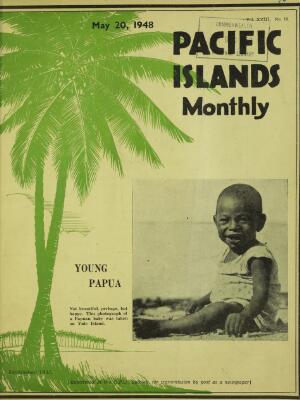
Pacific
Islands
Monthly
May 20, 1948
Vol. Xviii. No. 10.
Established 1930.
[Registered at the G.P.0., Sydnjeh. fw- by post as a newspaper ]
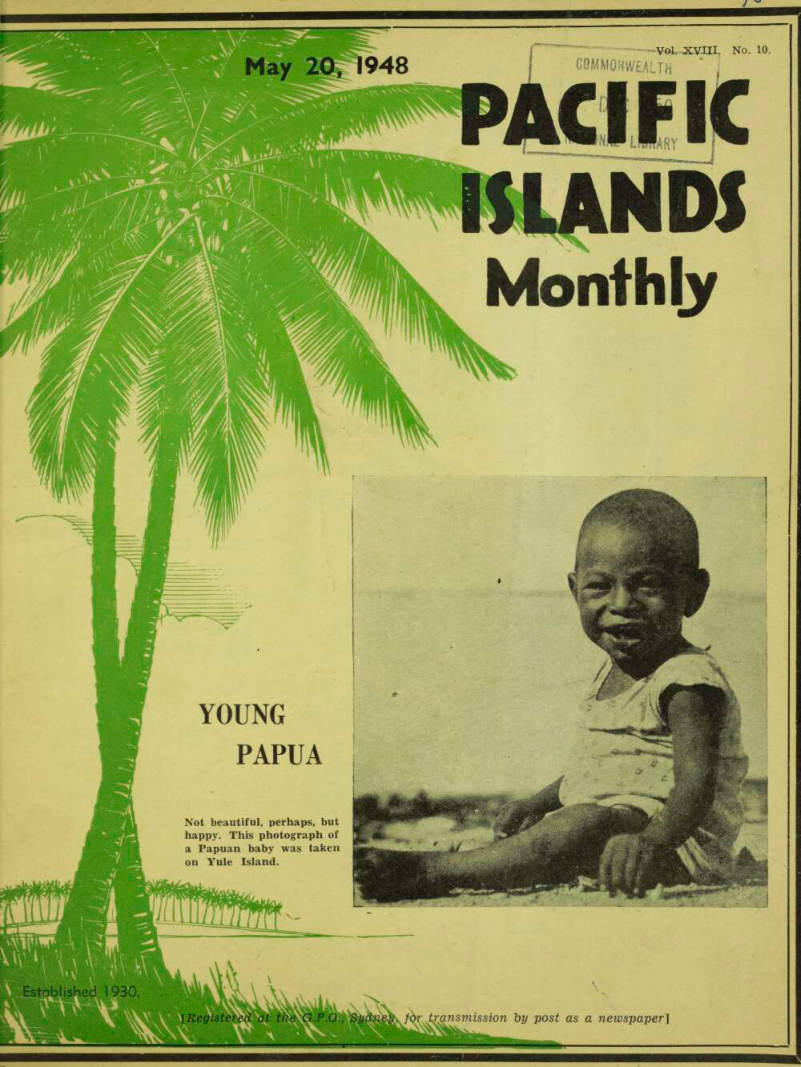
Young
Papua
Not beautiful, perhaps, but happy. This photograph of a Papuan baby was taken on Yule Island.
Advertisements & other items, pp. 2-4 (1 item)
and SOUTH I
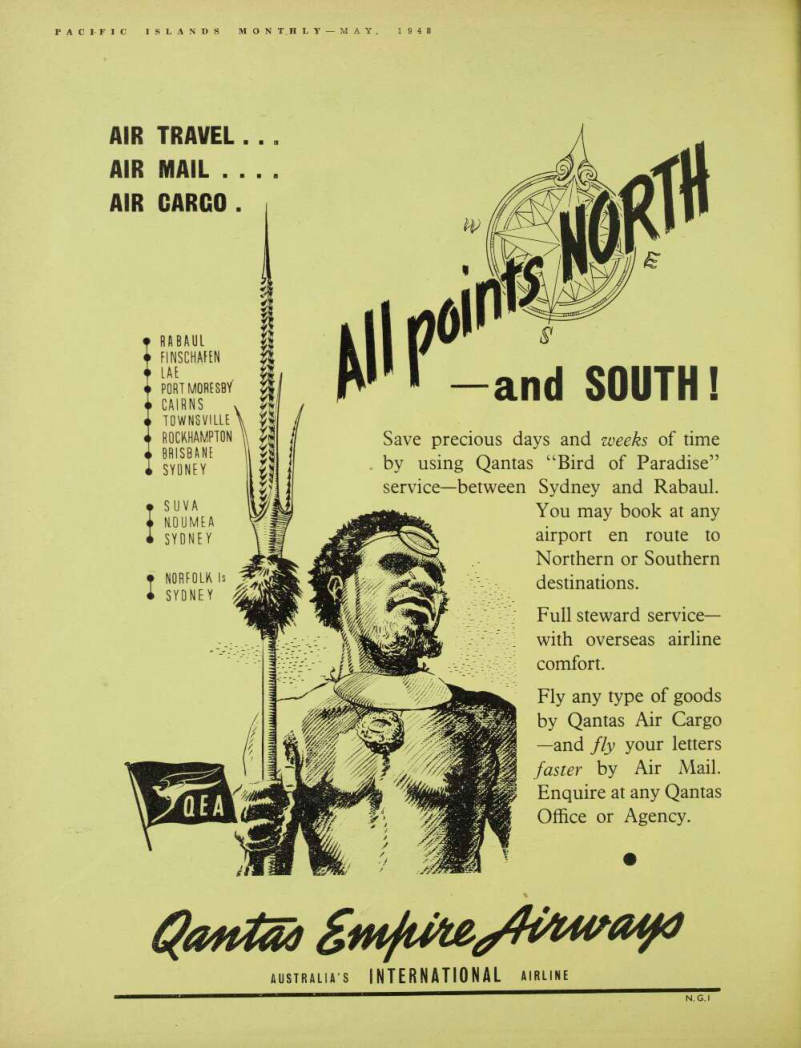
AIR TRAVEL . .
AIR MAIL . . .
AIR CARGO .
RABAUL
FINSCHAFEN
lAE
PORT MORESBY
CAIRNS
TOWNSVILLE
ROCKHAMPTON
BRISBANE
SYDNEY
SUVA
NOUMEA
SYDNEY
NORFOLK Is -f
SYDNEY
a % /I s
and SOUTH I
Save precious days and weeks of time by using Qantas “Bird of Paradise” service—between Sydney and Rabaul.
You may book at any airport en route to Northern or Southern destinations.
Full steward service— with overseas airline comfort.
Fly any type of goods by Qantas Air Cargo —and fly your letters faster by Air Mail.
Enquire at any Qantas
Office or Agency.
AUSTRALIA’S INTERNATIONAL AIRLINE
N.G.I
iM mV m >/ W. m. 0 M 1 ss? .*=■ 3 m>k 2 ■
Brazing Torches e Blow Lamps
Coleman Brazing Torches have solid-drawn heavy duty brass bodies with extra heavy brass bottoms FIG. I—Obtainable, in cwo types, Petrol and Kerosene.
All joints are mechanically sealed and securely soldered for double protection. Other features are : Sturdy bottom filler plug . . . positive shut-off fuel valve . . removable gas tip .. . replaceable self cleaning needle . . . heavy longlife burners and heavy duty pump.
Each torch is inspected and given a pressure and
burning test before leaving the factory.
FIG. 2—Petrol burning only.
Fuel tank capacities of both are 1 pint and 1 quart.
FIG. 3—Coleman's new Paraffin Blow Lamp which has valves interchangeable with European types of Lamps. The long-life burner and container are of heavy gauge brass. The container will withstand a pressure of 200 lbs. The flame is regulated through Air-release, there being no shut-off valve.
Tank capacities 1 and 2 pints.
Representatives for the Pacific Islands :
ROBERT GILLESPIE PTY. LTD.
54a PITT STREET, SYDNEY
PEARCE & CO. LTD.
SUVA
FOR FIJI ISLANDS
I V r A Va ■ : m & c lift. w f t f#' A
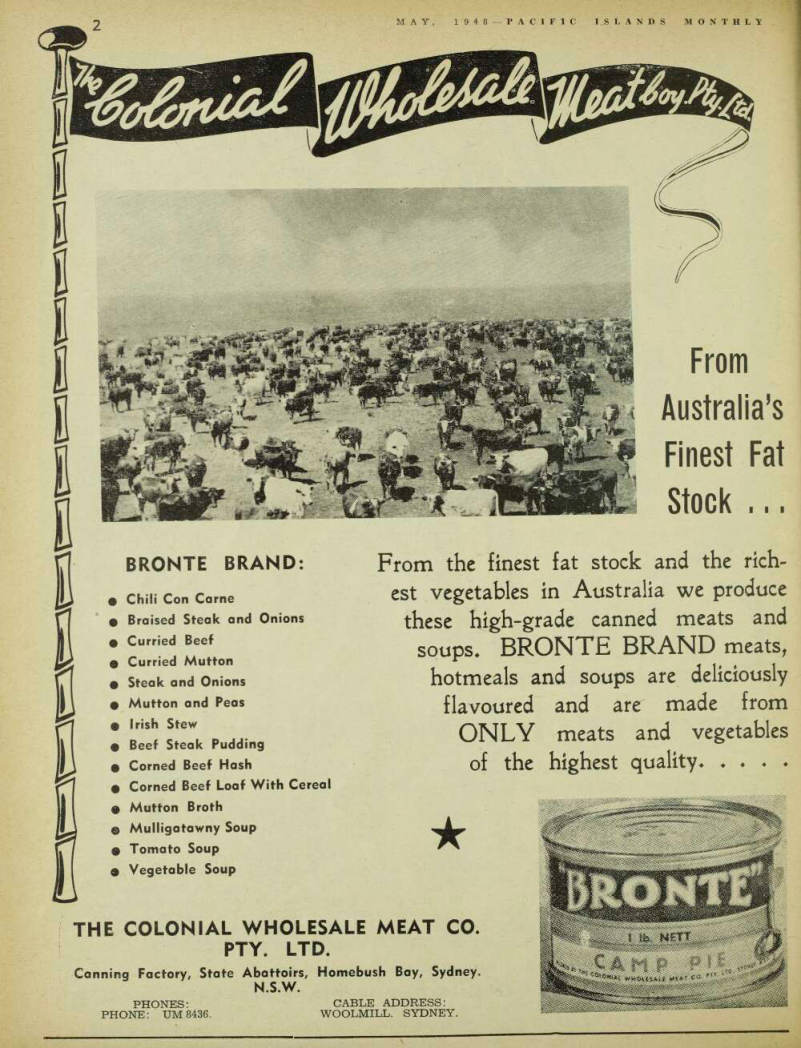
BRONTE BRAND;
Chili Con Came Braised Steak and Onions Curried Beef Curried Mutton Steak and Onions Mutton and Peas Irish Stew Beef Steak Pudding Corned Beef Hash Corned Beef Loaf With Cereal Mutton Broth Mulligatawny Soup Tomato Soup Vegetable Soup
From
Australia’s
Finest Fat
Stock ...
From the finest fat stock and the richest vegetables in Australia we produce these high-grade canned meats and
soups. BRONTE BRAND meats,
hotmeals and soups are deliciously
flavoured and are made from
ONLY meats and vegetables
of the highest quality. . . . . ★
THE COLONIAL WHOLESALE MEAT CO.
PTY. LTD.
Canning Factory, State Abattoirs, Homebush Bay, Sydney.
N.S.W.
PHONES:
PHONE: UM 8436.
CABLE ADDRESS:
WOOLMILL. SYDNEY.
am § camp
Advertisers
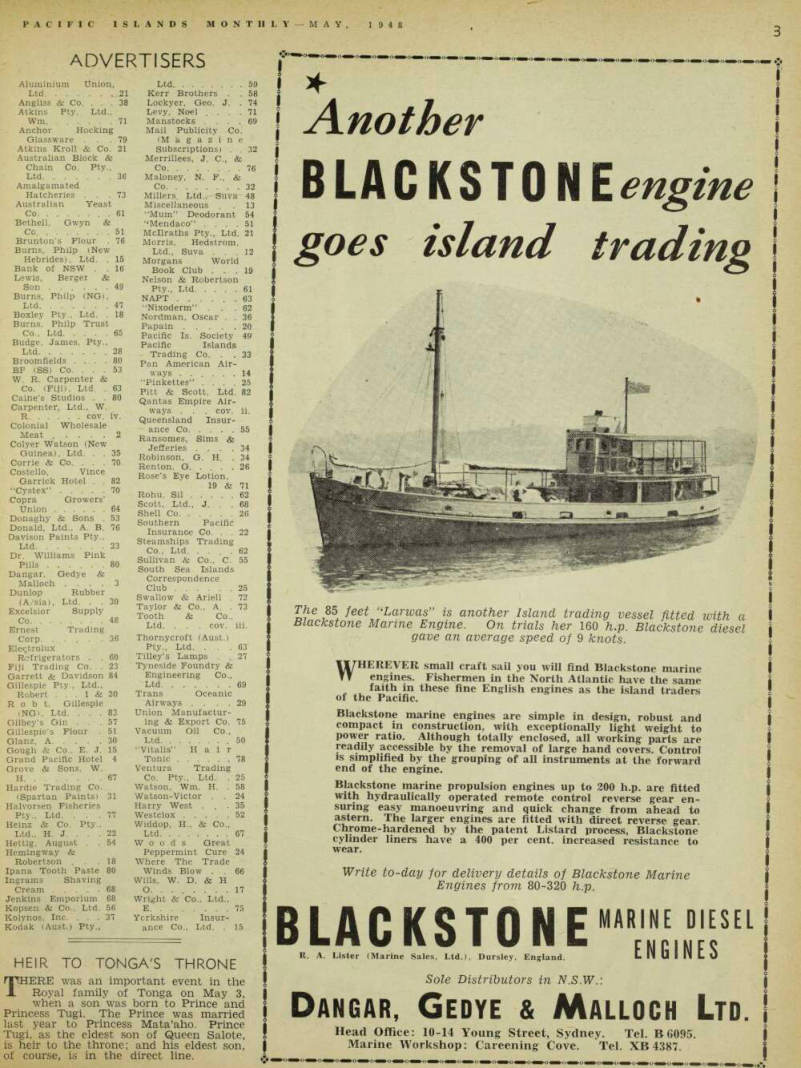
Aluminium Union, Ltd 21 Angliss & Co. ... 38 Atkins Pty. Ltd., Wm. ... 71 Anchor Hocking Glassware ... 79 Atkins Kroll & Co. 21 Australian Block & Chain Co. Pty., Ltd 36 Amalgamated Hatcheries ... 73 Australian Yeast Co . 61 Bethell, Gwyn & Co 51 Brunton’s Flour . 76 Burns, Philp (New Hebrides), Ltd. . 15 Bank of NSW . . 16 Lewis, Berger & Son ... 49 Burns, Philp (NG), Ltd 47 Boxley Pty., Ltd. . 18 Burns, Philp Trust Co., Ltd 65 Budge, James, Pty., Ltd .28 Broomfields ... 80 BP (SS) Co. . . . 53 W. R. Carpenter & Co. (Fiji). Ltd. . 63 Caine’s Studios . . 80 Carpenter, Ltd., W.
R cov. iv.
Colonial Wholesale Meat ... 2 Colyer Watson (New Guinea), Ltd. . . 35 Corrie & Co. ... 70 Costello, Vince Garrick Hotel . . 82 “Cystex” 70 Copra Growers’
Union 64 Donaghy & Sons . 53 Donald, Ltd.. A. B. 76 Davison Paints Pty., Ltd 23 Dr. Williams Pink Pills ... 80 Dangar, Gedye & Malloch ... 3 Dunlop Rubber (A/sia), Ltd. . . 30 Excelsior Supply Co 48 Ernest Trading Corp. ... 36 Eleqtrolux Refrigerators . . 60 Fiji Trading Co. . 23 Garrett & Davidson 84 Gillespie Pty., Ltd., Robert . . . 1 & 20 R o b t. Gillespie (NG). Ltd. ... 83 Gilbey’s Gin ... 57 Gillespie’s Flour . 51 Glanz, A 30 Gough & Co.. E. J. 15 Grand Pacific Hotel 4 Grove & Sons, W.
H 67 Hardie Trading Co. (Spartan Paints) 31 Halvorsen Fisheries Pty.. Ltd. ... 77 Heinz & Co. Pty..
Ltd.. H. J. . . .22 Hettig. August . . 54 Hemingway & Robertson . .18 Ipana Tooth Paste 80 Ingrams Shaving Cream 68 Jenkins Emporium 68 Kopsen & Co.. Ltd. 56 Kolynos. Inc. ... 37 Kodak (Aust.) Pty.,
Ltd 59 Kerr Brothers . . 58 Lockyer, Geo. J. . 74 Levy, Noel ... 71 Manstocks ... 69 Mail Publicity Co. (Magazine Subscriptions) . . 32 Merrillees, J. C., & Co 76 Maloney, N. F., & Co 32 Millers. Ltd.. Suva 48 Miscellaneous 13 “Mum” Deodorant 54 ‘‘Mendaco” ... 51 Mcllraths Pty., Ltd. 21 Morris, Hedstrom, Ltd., Suva ... 12 Morgans World Book Club ... 19 Nelson & Robertson Pty., Ltd 61
Napt .63
“Nixoderm” ... 62 Nordman, Oscar . . 36 Papain 20 Pacific Is. Society 49' Pacific Islands Trading Co. . . 33 Pan American Air ways ... 14 “Pinkettes” ... 25 Pitt & Scott, Ltd. 82 Qantas Empire Air ways . . . cov. ii.
Queensland Insur ance Co 55 Ransomes, Sims & Jefferies ... 34 Robinson, G. H. . 34 Renton, G. ... 26 Rose’s Eye Lotion, 19 & 71 Rohu, Sil 62 Scott, Ltd., J. . .68 Shell Co 26 Southern Pacific Insurance Co. . . 22 Steamships Trading Co., Ltd. ... 62 Sullivan & Co.. C. 55 South Sea Islands Correspondence Club 25 Swallow & Ariell . 72 Taylor & Co., A. . 73 Tooth & Co., Ltd. . . . cov. iii.
Thornycroft (Aust.) Pty., Ltd. ... 63 Tilley’s Lamps . . 27 Tyneside Foundry & Engineering Co., Ltd 69 Trans Oceanic Airways ... 29 Union Manufactur ing & Export Co. 75 Vacuum Oil Co., Ltd .50 “Vitalis” Hair Tonic 78 Ventura Trading Co. Pty., Ltd. . 25 Watson, Wm. H. . 58 Watson-Victor . . 24 Harry West ... 35 Westclox 52 Widdop, H„ & Co., Ltd 67 Woods Great Peppermint Cure 24 Where The Trade Winds Blow . . 66 Wills, W. D. & H O. . 17 Wright & Co., Ltd., E 75 Yorkshire Insur ance Co., Ltd. . 15
Heir To Tonga's Throne
rERE was an important event in the Royal family of Tonga on May 3, when a son was born to Prince and Princess Tugi. The Prince was married last year to Princess Mata’aho. Prince Tugi, as the eldest son of Queen Salote, is heir to the throne; and his eldest son, of course, is in the direct line.
Advertisements & other items, p. 5 (1 item)
BLACKSTONE engine
Another
goes island trading
The 85 feet JLarwas is another Island trading vessel fitted with a Blackstone Marine Engine. On trials her 160 h.p. Blackstone diesel gave an average speed of 9 knots.
WHEREVER small craft sail you will find Blackstone marine engines. Fishermen in the North Atlantic have the same faith in these fine English engines as the island traders of the Pacific.
Blackstone marine engines are simple in design, robust and compact in construction, with exceptionally light weight to power ratio. Although totally enclosed, all working parts are readily accessible by the removal of large hand covers. Control is simplified by the grouping of all instruments at the forward end of the engine.
Blackstone marine propulsion engines up to 200 h.p. are fitted with hydraulically operated remote control reverse gear ensuring easy manoeuvring and quick change from ahead to astern. The larger engines are fitted with direct reverse gear.
Chrome-hardened by the patent Listard process, Blackstone cylinder liners have a 400 per cent, increased resistance to wear.
Write to-day for delivery details of Blackstone Marine Engines from 80-320 h.p.
BLACKSTONE MAR ' N G E IH D /| SEL R. A. Lister (Marine Sales, Ltd.), Dursley, England. L ll U I ll L U Sole Distributors in N.S.W.:
Dangar, Gedye & Malloch Ltd.
Head Office: 10-14 Young Street, Sydney. Tel, B 6095.
Marine Workshop: Careening Cove. Tel. XB 4387.
In This Issue:
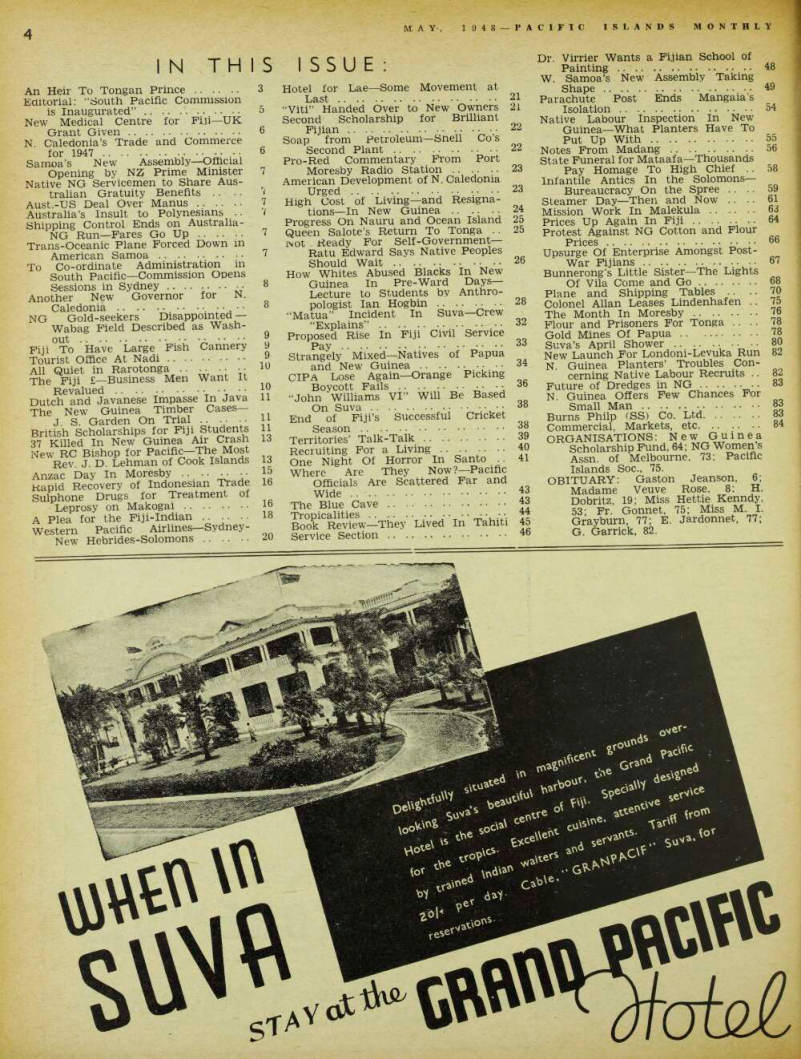
An Heir To Tongan Prince 3 Editorial; “South Pacific Commission is Inaugurated” 5 New Medical Centre for Fi.ii—UK Grant Given 6 N. Caledonia’s Trade and Commerce for 1947 • • • • 6 Samoa’s New Assembly—Ofiicial Opening by NZ Prime Minister 7 Native NG Servicemen to Share Aus tralian Gratuity Benefits ... 7 Aust.-US Deal Over Manus ... 7 Australia’s Insult to Polynesians .. 7 Shipping Control Ends on Australia- NG Run—Fares Go Up .. .. 7 Trans-Oceanic Plane Forced Down in American Samoa 7 To Co-ordinate Administration in South Pacific—Commission Opens Sessions in Sydney 8 Another New Governor for N.
Caledonia 3 NG Gold-seekers Disappointed Wabag Field Described as Wash- Fiji °To Have Large Fish Cannery 9 Tourist Office At Nadi f All Quiet in Rarotonga . • • • • • iU The Fiji £—Business Men Want It Revalued • • V " i?
Dutch and Javanese Impasse In Java u The New Guinea Timber Cases — J. S. Garden On Trial .. • • •• British Scholarships for Fiji Students 11 37 Killed In New Guinea Air Crash 13 New RC Bishop for Pacific—The Most Rev J. D. Lehman of Cook Islands 13 Anzac Day In Moresby Rapid Recovery of Indonesian Trade 16 Sulphone Drugs for Treatment of Leprosy on Makogai lb A Plea for the Fiji-Indian ... •• 18 Western Pacific Airlines —Sydney- New Hebrides-Solomons 2U
Hotel for Lae —Some Movement at Last 21 ‘•Viti” Handed Over to New Owners 2i Second Scholarship for Brilliant Fijian 22 Soap from Petroleum—Snell Co’s Second Plant 22 Pro-Red Commentary From Port Moresby Radio Station 23 American Development of N. Caledonia Urged 23 High Cost of Living—and Resigna tions—ln New Guinea 2 4 Progress On Nauru and Ocean Island 25 Queen Salote’s Return To Tonga .. 25 i\ot Ready For Self-Government— Ratu Edward Says Native Peoples Should Wait .. .. • • 26 How Whites Abused Blacks In New Guinea In Pre-Ward Days— Lecture to Students by Anthro pologist lan Hogbin 23 “Matua” Incident In Suva—Crew “Explains” 32 Proposed Rise In Fiji Civil Service Pay • • • • • 33 Strangely Mixed—Natives of Papua and New Guinea •.•• •• 34 CIPA Lose Again—Orange Picking Boycott Fails • •• 3b “John Williams VI” Will Be Based On Suva •• •••; 33 End of Fiji’s Successful Cricket Season 33 Territories’ Talk-Talk 3 * Recruiting For a Living .. ... • • 40 One Night Of Horror In Santo .. 41 Where Are They Now?—Pacific Officials Are Scattered Far and Wide 43 The Blue Cave 43 Tropicalities • •• • Book Review—They Lived In Tahiti 45 Service Section 4b
Dr. Virrier Wants a Fijian School of Painting 48 W. Samoa’s New Assembly Taking Shape 49 Parachute Post Ends Mangaia s Isolation 54 Native Labour Inspection In New Guinea—What Planters Have To Put Up With 55 Notes From Madang 56 State Funeral for Mataafa —Thousands Pay Homage To High Chief .. 58 Infantile Antics In the Solomons — Bureaucracy On the Spree ... 59 Steamer Day—Then and Now .. .. 61 Mission Work In Malekula 63 Prices Up Again In Fiji • • • 64 Protest Against NG Cotton and Flour Prices ob Upsurge Of Enterprise Amongst Post- War Fijians • • • • 67 Bunnerong's Little Sister —The Lights Of Vila Come and Go 68 Plane and Shipping Tables .. .. 70 Colonel Allan Leases Lindenhafen .. 75 The Month In Moresby 76 Flour and Prisoners For Tonga ... 78 Gold Mines Of Papua 78 Suva’s April Shower ... .. • ■ • • 8U New Launch For Londoni-Levuka Run 82 N. Guinea Planters’ Troubles Con cerning Native Labour Recruits .. 82 Future of Dredges in NG • • 83 N. Guinea Offers Few Chances For Small Man 33 Burns Philp fSS) Co. Ltd 83 Commercial, Markets, etc 84
Organisations: New Gume A
Scholarship Fund, 64; NG Women s Assn, of Melbourne. 73; Pacific Islands Soc., 75.
OBITUARY: Gaston Jeanson, 6; Madame Veuve Rose. 8: H.
Dobritz, 19; Miss Hettie Kenndy. 53; Fr. Gonnet, 75; Miss M I.
Grayburn, 77; E. Jardonnet, 77; G. Garrick, 82.
Advertisements & other items, p. 6 (1 item)
t
Pacific Islands monthly
The Newspaper-Magazine of the South Seas I Registered at the G.P.0., Sydney, for transmission hy post as a newspaper ]
Published Once Each Month and Circulated in Australia and New Zealand and in the following Pacific Territories and Islands Groups:
Australian Territory of Papua.
Trustee Territory (Australia) of New Guinea.
Australian Territory of Norfolk Island.
New Zealand Territory of Cook Islands.
Trustee Territory (NZ) of Western Samoa.
British Colony of Fiji.
British Solomon Islands Protectorate.
British Protectorate of Tongan Islands.
British Crown Colony of Gilbert and Ellice Islands.
Trustee Territory of Nauru.
British and French Condominium of New Hebrides.
French Colony of New Caledonia.
French Colony of Oceania (Tahiti, etc.).
American Territory of Eastern Samoa.
American Territory of Hawaiian Islands.
Owned and Produced by Pacific Publications Pty., Ltd., Union House, 247 George Street, Sydney.
Telephone: General Office and Advertising, BW 5037.
P.O. Box 3408
Registered Address for Telegrams, Radiograms, and Cables: “Pacpub,” Sydney.
Contributions.
Articles, Stories, and Photographs dealing with Pacific Islands subjects are invited and will be paid for on publication.
Subscription Rates.
Per Annum, Pre-paid, Including Postage.
In Australia, New Zealand, Fiji, New Guinea, Papua, Western Samoa, Cook Islands, Tonga, British Solomons, Gil bert and Ellice Colony, Nauru, and United Kingdom 15 0 Elsewhere 18 q Single Copies " ‘ i 6
Editor and Publisher:
R. W. Robson, P.R.G.S.
Assistant Editor: JUDY TUDOR General Office; Union House, 247 George Street, Sydney. Telephone: BW 5037.
Advertising Manager: W. E. Rogers.
Representative In London.
J. T. Wallis, Coronation House, 4 Lloyds Avenue, London, E.C.3, from whom may be obtained copies of Pacific Islands Monthly.
Pacific Is. Year Book, advertising schedules, etc.
Representative In U.S.A.
Pacific Islands Trading Co.,
244 California St., San Francisco, U.S.A,
Agents.
The following are authorised to receive sub scriptions for Pacific Islands Monthly;— Burns, Philp & Co., Ltd., and Burns Philp (South Sea) Co., Ltd. All branches.
W. R. Carpenter & Co.. Ltd. All branches.
Morris. Hedstrom, Ltd. All branches.
Steamships Trading Co., Papua. All branches.
W. M. Caldwell, Suva, Fiji, Cook Islands Trading Co., Rarotonga, Cook Is.
Oscar Nordman, Papeete, Tahiti.
Islands Branches and Representatives of W H Grove & Sons, Ltd., Auckland, New Zealand.
Ed. Pentecost, Noumea, New Caledonia.
Societe Gubbay Kerr et Cie, Noumea, New Caledonia.
Vol. Xviii. No. 10.
May 20, 1948
( 1/6 Per Copy Price Prepaid, p.a.: 15/- Aus. ( In USA, p.a.: $3.
Inaugurated
The South Pacific Commission Is
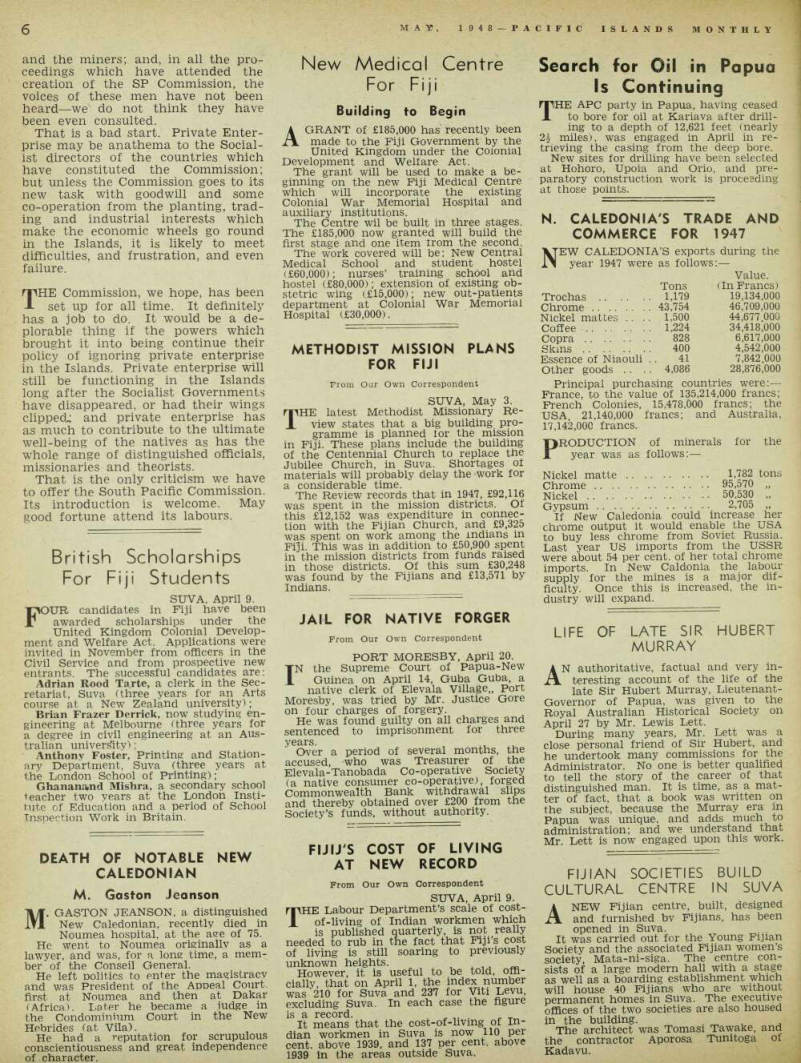
WITHIN the tropical region of the "" South Pacific there are the fol lowing separate Territories;— Administered by Territory Approx.
Pop’iu
Britain Fiji 250,000
Solomons . . . 100,000 Gilbert, Ellice 30,000 FRANCE N. Caledonia 30,000 Fr. Oceania , 30,000 Wallis-Putuna 5,000 AUSTRALIA Papua . . . . 275,000 Norfolk Is. . . 1.000 N. ZEALAND Cook Is. . . . 14,000 HOLLAND Indonesia . . . eo.ooo'ooo Dutch New Guinea . . . 300,000 UNITED STATES ... E. Samoa . . 10,000 BRITAIN (Prot.) . .. Tonga . . . . 27,000 AUSTRALIA (Trus.) . . New Guinea . 1.000,000 Nauru .. .. 1,000 N. ZEALAND (Trus.) . . W. Samoa . . 50,000 BRIT.-PRANCE (Cond.) N. Hebrides . 40,000 Except in the case of the British Territories and, perhaps, the French, no attempt was made prior to World War II to co-ordinate administrative policy in these 17 Territories—there was not even an exchange of experi ences and ideas. Each administrator, with his own watertight set-up, went his own way; until 1940, he seldom was checked or interrogated by Lon don or Paris, Canberra or Wellington.
Yet, to the extent of perhaps 80 per cent., the obligations and prob lems of administration in all the Ter ritories are the same, or very simi lar. In every case, except Tonga, we
had a European bureaucracy ruling, with supreme powers, over friendly and tractable islanders. Problems relating to native health, native edu cation, European and native agricul ture, contact between missions and natives, transport, indigenous and introduced labour, Asiatic immigra tion, are similar all across the South Pacific, from Dutch Indonesia to French Oceania, with only minor dif ferences caused by racial differences.
WITH the outbreak of World War ” II there came, without any ap parent reason, a remarkable develop ment of sensitiveness on the part of white nations responsible for the government of coloured races. De velopments in Asia Minor, North Africa, India and Indonesia are still “front page news.”
In the South Pacific, this sentiment has taken shape in the plan for a South Pacific Commission, which was constituted in Sydney on May 11 by two delegates from each of the six countries named above, and the pur pose of which is the exchange of ex periences and ideas, and the co ordination of administrative policy.
It is a move that is overdue; and the credit for its initiation goes to Dr.
Evatt (Australia’s Deputy Prime
Minister) and Mr. Fraser (NZ Prime Minister).
The Commission will have its head quarters in a South Pacific centre— Suva, Auckland, Sydney and Port Moresby have been suggested—and it will have an expert staff whose mem bers will move freely among all the Territories of the South Pacific. They can do a great deal of good. Con versely, if the wrong men are sel ected, they can do incalculable harm by treading on the toes of administra tions who see nothing wrong with their own performances and records.
AN examination of the history and background of the delegates who assembled for the Commission’s first session suggested that, among them, there were too many bureau crats and professional men, who have lived sheltered liVes and who have had little personal experience of the rough and tough side of Islands con ditions. No man can get a well-bal anced view of Islands life—especially the essential relations between Euro peans and natives—if his knowledge of Islands conditions has been gained as a Government official, a mission ary or an anthropologist. Some of the men who assembled on May 11 were gentlemen of great distinction in their particular fields; and such men are an essential part of the Islands set-up. But so, also, are the planters and traders, the schooner captains
and the miners; and, in all the pro ceedings which have attended the creation of the SP Commission, the voices of these men have not been heard—we do not think they have been even consulted.
That is a bad start. Private Enter prise may be anathema to the Social ist directors of the countries which have constituted the Commission; but unless the Commission goes to its new task with goodwill and some co-operation from the planting, trad ing and industrial interests which make the economic wheels go round in the Islands, it is likely to meet difficulties, and frustration, and even failure.
THE Commission, we hope, has been set up for all time. It definitely has a job to do. It would be a de plorable thing if the powers which brought it into being continue their policy of ignoring private enterprise in the Islands. Private enterprise will still be functioning in the Islands long after the Socialist Governments have disappeared, or had their wings and private enterprise has as much to contribute to the ultimate well-being of the natives as has the whole range of distinguished officials, missionaries and theorists.
That is the only criticism we have to offer the South Pacific Commission.
Its introduction is welcome. May good fortune attend its labours.
British Scholarships
For Fiji Students
SUVA, April 9. rUR candidates in Fiji have been awarded scholarships under the United Kingdom Colonial Develop ment and Welfare Act. Applications were invited in November from officers in the Civil Service and from prospective new entrants. The successful candidates are: Adrian Rood Tarte, a clerk in the Sec retariat, Suva (three years for an Arts course at a New Zealand university); Brian Frazer Derrick, now studying en gineering at Melbourne (three years for a degree in civil engineering at an Aus tralian university): Anthony Foster, Printing and Station ary Department, Suva (three years at the London School of Printing); Ghananr*nd Mishra, a secondary school teacher two vears at the London Insti tute of Education and a period of School Inspection Work in Britain.
Death Of Notable New
Caledonian
M. Gaston Jeanson
M. GASTON JEANSON, a distinguished New Caledonian, recently died in Noumea hospital, at the age of 75.
He went to Noumea originally as a lawyer, and was, for a long time, a mem ber of the Conseil General.
He left politics to enter the magistracy and was President of the Appeal Court, first at Noumea and then at Dakar ( Africa). Later he became a iudge in the Condominium Court in the New Hebrides (at Vila).
He had a reputation for scrupulous conscientiousness and great independence of character,
For Fiji
New Medical Centre For Fiji Building to Begin
A GRANT of £185,000 has recently been made to the Fiji Government by the United Kingdom under the Colonial Development and Welfare Act.
The grant will be used to make a be ginning on the new Fiji Medical Centre which will incorporate the existing Colonial War Memorial Hospital and auxiliary institutions.
The Centre wil be built in three stages.
The £185,000 now granted will build the first stage and one item from the second.
The work covered will be: New Central Medical School and student hostel (£60,000); nurses’ training school and hostel (£80,000); extension of existing ob stetric wing (£15,000); new out-patients department at Colonial War Memorial Hospital (£30,000).
Methodist Mission Plans
For Fiji
From Our Own Correspondent
Suva, May 3.
THE latest Methodist Missionary Re view states that a big building pro gramme is planned lor the mission in Fiji. These plans include the building of the Centennial Church to replace the Jubilee Church, in Suva. Shortages of materials will probably delay the work for a considerable time.
The Review records that in 1947, £92,116 was spent in the mission districts. Of this £12,152 was expenditure in connec tion with the Fijian Church, and £9,325 was spent on work among the Indians in Fiji. This was in addition to £50,900 spent in the mission districts from funds raised in those districts. Of this sum £30,248 was found by the Fijians and £13,571 by Indians.
Jail For Native Forger
From Our Own Correspondent
Port Moresby, April 20.
IN the Supreme Court of Papua-New Guinea on April 14, Guba Guba, a native clerk of Elevala Village,, Port Moresby, was tried by Mr. Justice Gore on four charges of forgery.
He was found guilty on all charges and sentenced to imprisonment for three years.
Over a period of several months, the accused, who was Treasurer of the Elevala-Tanobada Co-operative Society (a native consumer co-operative), forged Commonwealth Bank withdrawal slips and thereby obtained over £2OO from the Society’s funds, without authority.
Fijijs Cost Of Living
At New Record
Prom Our Own Correspondent SUVA, April 9.
THE Labour Department’s scale of cost of-living of Indian workmen which is published quarterly, is not really needed to rub in the fact that Fiji’s cost of living is still soaring to previously unknown heights.
However, it is useful to be told, offi cially, that on April 1, the index number was 210 for Suva and 237 for Viti Levu, excluding Suva. In each case the figure is a record.
It means that the cost-of-living of In dian workmen in Suva is now 110 per cent, above 1939, and 137 per cent, above 1939 in the areas outside Suva.
Is Continuing
Search for Oil in Papua Is Continuing
THE APC party in Papua, having ceased to bore for oil at Kariava after drill ing to a depth of 12,621 feet (nearly 24 miles), was engaged in April in re trieving the casing from the deep bore.
New sites for drilling have been selected at Hohoro, Upoia and Orio, and pre paratory construction work is proceeding at those points.
N. Caledonia's Trade And
Commerce For 1947
NEW CALEDONIA’S exports during the year 1947 were as follows: —
Principal purchasing countries were;— Prance, to the value of 135,214,000 francs; French Colonies, 15,478,000 francs; the USA 21,140,000 francs; and Australia, 17,142,000 francs.
PRODUCTION of minerals for the year was as follows; — Nickel matte 1.782 tons Chrome 95,570 „ Nickel 50.530 „ Gypsum 2,705 „ If New Caledonia could increase her chrome output it would enable the USA to buy less chrome from Soviet Russia.
Last year US imports from the USSR were about 54 per cent, of her total chrome imports. In New Caldonia the labour supply for the mines is a major dif ficulty. Once this is increased, the in dustry will expand.
Value.
Tons (In Francs) Trochas 1,179 19,134,000 Chrome 43,754 46,709,000 Nickel mattes .. .. 1,500 44,677,000 Coffee 1,224 34,418,000 Copra 828 6,617,000 Skins 400 4.542,000 Essence of Niaouli .. 41 7,842.000 Other goods .. .. 4,086 28,876,000
Murray
Life Of Late Sir Hubert
AN authoritative, factual and very in teresting account of the life of the late Sir Hubert Murray, Lieutenant- Governor of Papua, was given to the Royal Australian Historical Society on April 27 by Mr. Lewis Lett.
During many years, Mr. Lett was a close personal friend of Sir Hubert, and he undertook many commissions for the Administrator. No one is better qualified to tell the story of the career of that distinguished man. It is time, as a mat ter of fact, that a book was written on the subject, because the Murray era in Papua was unique, and adds much to administration; and we understand that Mr. Lett is now engaged upon this work.
Fijian Societies Build
Cultural Centre In Suva
ANEW Fijian centre, built, designed and furnished by Fijians, has been opened in Suva.
It was carried out for the Young Fijian Society and the associated Fijian women’s society, Mata-ni-siga. The centre con sists of a large modern hall with a stage as well as a boarding establishment which will house 40 Fijians who are without permanent homes in Suva. The executive offices of the two societies are also housed in the building.
The architect was Tomasi Tawake, and the contractor Aporosa Tunitoga of Kadavu.
Official Opening By NZ
Samoa’S New
Assembly
Official Opening By NZ Prime Minister
THE New Zealand Prime Minister, Mr.
Frazer, who was supported by a party of members of Parliament and Government officials, formally opened the first session of the Legislative Assembly of Western Samoa.
The Assembly takes the place of the old Legislative Council, and its consti tution is described by New Zealand as a new step forward in the gradual pro cess of conferring self-government upon the Samoans.
The Assembly is composed of the Ad ministrator, who acts as president; the three Fautua (leading chiefs of Samoa); 11 members nominated by the Fono of Faipule (an advisory body representing the common people of Samoa); five re presentatives of the European commu nity, elected under adult suffrage; and six official members (mostly heads of departments).
The five Europeans, who were elected at the end of Aoril, are; E. F. Paul, J.
Helg, G. D. F, Betham, A. Stowers, W.
Stowers. They really represent the Euronesian community of about 5,000, who have the status of Europeans. There are only about 200 full Europeans now remaining in Western Samoa. Voting was:
Elected
Eugene F. Paul (UCP) 568 Jacob Helg (UCP) 510 Fred Betham (UCP) 468 Amando Stowers (Lab.) 436 Willie Stowers (UCP) 383
Not Elected
A. M. Gurau (Lab.) 342 Sammy Meredith (UCP) 330 Emil Fabricius (Lab.) .. 226 G. J. Pritchard (Lab.) 129 P. L. M. Morgan (Ind.) 118 D. Crichton (Lab.) 75
Gratuity Benefits
Native NG Servicemen Share Aust.
THE Australian Parliamentary Sub committee on War Gratuities, which has been deliberating for some time, has decided that New Guinea native Servicemen, as well as Australian, should share in the more liberal terms which they propose for the payment of gra tuities.
The Committee’s report was tabled in the House of Representatives in Canberra in May. A rate of 5/- for each month of service is proposed for each native Serviceman, the gratuity to be payable in March 1951, or earlier, in special cases.
The gratuity for natives who have died will be paid in accordance with native custom.
Samoan Copra Goes
Up Again
From Our Own Correspondent APIA, April 8.
THE price paid for Samoan copra, by the British Ministry of Food, f.o.b.
Apia, has now reached the record price of £55/19 4 (NZ currency).
The purchase price to native producers throughout the Territory has been ad justed accordingly.
To Polynesians
Australian Insult
NZ Takes Up Defence Of the Maoris
IN the Canberra Parliament, at the end of April, Mr. Gullett, Liberal, asked the Australian Government for some information on the way in which the White Australia Policy was being en forced.
He said that recently a Tongan woman mail led to an Englisnman was orde ed to leave Australia. An Australian woman married to a Maori soldier wanted to bring him to Australia from New Zea land, and he asked whether the Maori was a prohibited immigrant.
The Australian Minister for Immigra tion, Mr. Calwell, said the Maori would not be allowed to settle in Australia. The rule generally was the same for Tongans as for all other Polynesians, This was immediately cabled to New Zealand, and it brought a very angry and indignant comment from the NZ Prime Minister, Mr. Fraser, who said that Maoris were equal in all respects with New Zealanders of European des cent. He added, “Any discrimination against our Maori fellow citizens will be indignantly and bitterly resented as an unforgivable insult to our country and to every one of us.”
The matter was again raised in the Australian Parliament on May 5. The same Minister (Calwell) said that the NZ High Commissioner in Aus tralia had taken up the matter with him; and a long explana tory letter had now been written by his Department for the Prime Minister of New Zealand. He did not indicate that the Australian attitude had been relaxed in any way.
It was later disclosed, however, that the Australian ban on Maoris has been completely removed.
The “Sydney Morning Herald,” on May 6, condemned Mr. Calwell’s attempt to apply his regulations to Maoris.
Editorial Note
What the newspaper properly says about Maoris necessarily applies to all Polynesians and near Polynesians— Maoris, Samoans, Tongans, Tahitians, Hawanans, Fijians, Gilbertese, Nauruans.
It is indeed unthinkable that these people, with whom we have lived in terms of friendship and mutual trust for 100 years, and with whom we are racially akin (there is a lot of Aryan in the Polynesian) should be debarred from the shores where, hitherto, they always have been welcome.
The fault does not lie with the White Australia Policy, which was designed and implemented to keep out of empty Aus tralia the countless millions of over crowded Asia. It lies entirely with the interpretation of that policy by the Minister (Mr. Calwell).
There are thousands of part-Polyne sians married to Europeans, and living ir ?,. Australia, as honoured and respected citizens. Australia’s doors always have been open to Islands natives, generally, and that hospitality has never been abused; and they will be open in the future, long after the Australian Socialist Government, with its quaint eruption of Wards and Calwells and what-not, has been wiped out and buried by the indig nant electorate.
It is to be hoped that the NZ Prime Minister will become the champion of the Polynesians in this matter. The Samoans and the Cook Islanders, who are the direct responsibility of NZ, are just as much entitled to consideration as are their cousins, the Maoris.
Shipping Control
New Guinea Services Restored To The Owners
Prom Our Own Correspondent
Ipt. Moresby, May 6.
T was announced last week that the Commonwealth Directorate of Ship ping has relinquished control of ships on the Australian-New Guinea run.
The first reaction of those of us here who know how the service has deteriorated was one of mild rejoicing, for the Directorate has received most of the blame for the crudities of Island travel since the war. The Directorate, however, has replied that the agents, and not the Directorate, has been responsible for the details of the accommodation on the ships.
Now, however, Territorians are won dering whether it might not have been better for the Directorate to have retained control. Simultaneously with the change over, the fare from Sydney to Port Moresby was raised from £2l/10/- to £25 —and the prompt 14 per cent, increase has not been at all favourably received.
In American Samoa
Trans Oceanic Plane Forced Down In American Samoa
A SUNDERLAND flying-boat, belong ing to Trans Oceanic Airways, of , Sydney, when on a charter flight from Tahiti to Western Samoa, was forced down by engine trouble on the iagoon at the western end of the island of Tau, in the Manua Group, American Samoa, on May 4. It came to no harm, repairs were effected by the crew, and the plane got away again, to Apia, two days later. . T he plane left Sydney on April 18 for Noumea Suva, Apia and Tahiti, on a charter flight connected with a film en terprise. It carried a crew of six. and among 17 passengers were half a dozen, or more round-trip tourists. The Ad ministrator of Western Samoa, Lieut - Colonel F. W Voelcker. joined the plane m Apia, for Tahiti, and was returning in it to Apia when the mishap occurred.
Captain Brian Monckton, managing director of Trans Oceanic Airways was in charge of the plane.
Ame P cans a t Pago Pago sent a naval vessel at once to the aid of the plane, and that vessel took the passengers from Tau to Apia, where the plane, after resuming its flight, picked them up.
Us-Australian Deal
In N. Guinea
Surplus War Equipment Purchased for Million Dollars
THE Australian Government recently completed a deal with the United ™o^ tate A for - the Purchase of the re maining American equipment and war “ Manus and other US bases in Papua-New Guinea.
It is understood that Australia will pay America £387.000 and that the equip ment includes a pipeline, various build ings, small-craft and stores.
Much of the material bought is at Manus, where the Americans spent an enormous sum on an air and sea base and which Australia nlans to narrv on
In Sydney
To Co-Ordinate Administration In
South Pacific
Six-Nations Commission Opens Sessions In Sydney
THE South Pacific Commission, constituted by six nations (Great Britain, France, United States, Holland, Australia and New Zealand) held its first meetings at St. Georges Heights, Mosman, Sydney, commencing on May 11.
The plan for the Commission developed as a result of the Anzac Agreement, made between Australia and New Zealand, in 1944. It was the conception of Dr. H. V. Evatt, Australian Minister for External Affairs, supported by Mr. Peter Fraser, Prime Minister of New Zealand.
THE next step was taken when a Con ference was held in Canberra in January, 1947, and delegates of the six nations named decided unanimously to set up the Commission. A good deal of delay occurred then—probably the re sult of disturbed international relations— but finally the Commission was consti tuted as follows: Great Britain.—Sir Brian Freeston, KCMG, Governor of Fiji and High Com missioner for the Western Pacific; and Mr. S. S. Vaskess, CMG, QBE, former Secretary of the Western Pacific High Commission.
United States.—Professor Felix Keesing, of Stanford University; Dr. Karl Lee brick. vice-president of the Hawaii Uni versity; Mr. Milton Shalleck, of New York; and Dr. Ruth E. Bacon, special assistant to the directors of the Office of Far Eastern Affairs, Washington.
France.— M. Jaques Lassalle-Sere, In spector-General of Colonies for Noumea; and M. Georges Dubois, of Noumea.
Australia.— Mr. J. R. Halligan, secretary of the Department of External Terri tories; Dr. J. W. Burton, formerly general secretary of the Methodist Missionary Society. Alternate Commissioners: Colonel J. K. Murray, Administrator of Papua-New Guinea; Mr. E. W. P. Chin nefv, anthropologist, formerly a senior public servant in New Guinea.
Holland.—Pending the arrival of the delegation, Dr. J. A. de Ranitz, of the Dutch Legation at Canberra, was present.
The delegation comprised: Mr. E. G.
Severs Luis; Mr. J. P. K. Echout; Mr.
M. A. Pellarpessy; and* Dr. W. C. Klein; with Mr. Kayardo and Dr. A. Loosjes as advisers.
New Zealand: Mr. C. G. R. McKay (formerly secretary of the NZ Depart ment of Islands Territories) and Briga dier F. L. Hunt (who has had adminis trative experience in the Islands).
Sydney was decided upon in January, 1947, as the temporary headquarters, of the Commission, after the rival claims of Port Moresby and Suva had been de bated, and it was intended that a final decision regarding this and other matters should be made within six months.
Colonel John Kerr was appointed tem porary organising-secretary, and accom modation for the Commission was pro vided at the School of Tropical Adminis tration, St. Georges Heights, near Mos man in Sydney. But sixteen instead of six months have elapsed since then. The nations have been so preoccupied with international crises that they have had little time for consideration of the more or-less academic affairs of the South Pacific.
Formal Opersinq
THE formal, official opening of the commission’s sessions took place on May 11. at St. Georges Heights.
When the delegates assembled, the meeting was called to order by the Or ganising Secretary of the interim Organ fppHon colonel' John He was assisted, in the interim organising work, by Mr. Raymond Watt.
The chair was taken by the senior Aus
tralian Commissioner, Mr. J. R. Halligan.
An address of welcome was given by the Rt. Hon, H. V. Evatt, PC, MP, Aus tralian Minister for External Affairs. He was greeted warmly, as the originator of the plan for a Commission. He briefly outlined the history of the movement, which had commenced while World War II was actually in progress. Their object was to pool their administrative experi ence and ideas, for the benefit of the large numbers of native people who lived in the Islands under their care. He said the Australian Government would assign one full-time Commissioner to the work of the new organisation. “Here” he con cluded, “in this new Commission, is one
The SPC, on May 14, decided that Noumea or Suva should be head quarters. A Committee will in vestigate rival claims of tha two cities.
practical expression of internatiqnal co operation and goodwill, to function in a world that is literally crying out for co operation and goodwill.”
A goodwill message from Mr. Fraser, Prime Minister for New Zealand, referred to the high purpose of the Commission.
As evidence of its possibilities, he spoke of the way in which New Zealand had co-operated with the Government of Fiji in creating a far-reaching health organ isation in that part of the Pacific.
Through the Commissioner, similar co operation could be extended to educa tion, agriculture, transport, and so forth.
He said that it had been clear, for a long time, that such problems of ad ministration could best be solved by joint action; and he paid a tribute to other nations —esoecially the United States —for their readiness to co-operate in this plan. ...
Sir Brian Freeston said that, in his view, the basic object of the Commission was to reconcile economic and cultural unity with the political structure in the South Pacific, and yet not intrude upon the political authority and control exer cised bv the six constituent governments in their resoective areas.
Professor Keesing, for the United States group, exnressed full support of the high purposes of the Commission, and paid warm tribute to the Govern ments of Australia and New Zealand for bringing the Commission into existence.
The United States was already partici nating, with France, the Netherlands and the United Kingdom, in the Caribbean Commission, thus demonstrating its sense of the importance of this type of inter national co-operation on a regional basis.
“Our immediate agenda must of neces sity concern itself primarily with orgam sational problems." said Professor Kees ing “It is essential that the com mission, both for its own effective work and to inspire public confidence, should bring into existence as rapidly as possible its administrative, research, and consul tative instrumentalities ...
“Amid the onerous problems of or
ganisatlon, however, sight must never be lost of the ends to which these tasks are the means. This Commission is charged with serious and difficult tasks relating to international co-operation and human welfare. We are concerned, not just with a set of workpapers, but with the island populations who are to be hv 'ped to work out their economic and social destinies in a world which can no longer pass them by. The best of technical know-how and scientific re search must be focussed upon the prob lems falling within our scope. Further more the peoples themselves must be drawn into creative tasks, such as by way of the South Pacific Conference.”
Brief, cordial speeches, assuring the Commission of goodwill and co-operation, were made by the Commissioners repre senting France, New Zealand and Holland.
The proceedings, which lasted 40 minutes, then terminated. The remain der of the sessions were held in private.
Th delegates applied themselves imme diately to such matters as the selection of a site for headquarters; the appoint ment of officers; general organisation; and “measures to contribute to the economic, social and educational ad vancement of the South Pacific peoples.”
Sessions were still in progress when this journal went to press.
Governor-general cournarie,
Another New Governor For N. Caledonia!
the new Governor of New Caledonia (where he succeeds M. Parisot), is on his way out from France and is expected to .reach Noumea shortly. He left Marsailles in March.
M. Cournarie was one of the African officials who rallied to Free France. He will meet an old friend of his African days in M. Henri Sautot, former Gov ernor of New Caledonia and of Übangui- Chari in Central Africa, who is now Mayor of Noumea.
Governor-General Parisot. who replaced Governor Tallec, has been in New Cale donia less than 18 months. He was appointed in December 1946, but did not reach the Colony until some time later.
In recent years a new Governor for New Caledonia has been almost a yearly event.
Investiture At Port
Moresby
AT Government House, Port Moresby, on April 13, the Administrator (Colonel J. K. Murray) invested Squadron-Leader D. J. Sullivan with the Distinguished Service Order.
The citation, which was read by Wing- Commander Townsend, of the RAAF Station, Port Moresby, referred to Squad ron-Leader Sullivan’s work in heavy bomber raids on German targets.
“Des,” as he is known to most of the peonle in Moresby, joined the Adminis tration. after the war, as a clerk, and is now Chief Clerk in the Department of District Services and Native Affairs.
Besides the DSO he holds the DEC and other honours.
Disabled Ship In
Fiji Waters
THE British phosphate vessel “Langlee Gale” which lost a screw about 1,000 miles north of Fiji, was in early Mav, towed to Suva by the Norwegian tanker “Lifjord.”
The “Lifjord.” answered a call for help sent out bv the “Langlee Gale,” which is a 6.000* ton vessel owned by the Medomsley Steam Shipping Company of London and under charter to the BPC.
Gold-Seekers
Disappointed
New NG Field Now Colled A "Washout"
LATEST advices from New Guinea in dicate that the so-called gold dis covery in Central New Guinea, near Wabag, is a complete “wash-out.”
Various persons interested, including the Leahy Brothers, are believed to have gone into the area from Mount Hagen in late March or in April, and have re turned with the report that the gold bearing area is small, and not rich.
One man has remained in there, work ing the known deposits, but he is faced with a serious problem of supply. He apparently will have to depend on sup plies parachuted from planes. It is said of him that “he will be lucky to make enough to pay costs.”
It was originally proposed that permits to enter the uncontrolled areas west ward of Mount Hagen should be issued on April 1. Then, for administrative reasons, this date was postponed to May 1 Meanwhile, it was reported, the pros- Thev rS were Imposed brnthei-JTTpnhv PP Mr d Tnhn Blink iwhn
resigned his position Ser
vice in order Pit i? follow up the gold discoveries P he and Tavlor made in g the TaX-Black^ewdittra S 1938), members of a Bulolo Gold Dredg ing party, and others.
It was also stated that the Director of Health, Dr. Gunther, and other officials directly interested in the wellbeing of the natives, were in the Ik Mint Hagen district, and were making careful in quines to ascertain what measures would be needed to protect the natives in the event of a gold rush.
Next development was the report, late in April, that some men had gone in without a permit and were deeply dis appointed at the poor prospects they found. The Administrator, Colonel J.
K. Murray, then stated publicly that the latest information did not bear out the report of a rich gold find.
THE Government Secre' self „ overn , nrf l^I vSl M p a /hPP &alationS ’ while no date had yet bee .fpy, -nnrtiHnn for the issue of permits t Economic de controlled area west of economic de New Guinea, in which iS have been found. At or!”
May 1 had been fixed i but had later been cance.T[URCD It is believed that th: 1 1c taken when it was found Department that there wr dysentery epidemic sprean . . area concerned, and when flOl tration realised that the A discovery was not supported l en, in what When he arrived in Sydney nea Timber the Administrator told the in Sydney that all the information hod to last not support the report of a before the field having been found west iot gulity Hagen.
The “wash-out” story is acc Port Moresby—but with reservati able by fact that Mr. Black, regarded as stories man of good judgment, resigned tP- Service in order to go back gold- breach to the region that he formerly ei. ble by requires some explanation. H itories disbelievers also say that person? are “on” to rich gold, and want t Nov courage a rush, will unhesitating!;- art reports of failure into circulation, nd will direct gold-seekers to the r, „n al area.
It is stated that the BGD party k rp pursuing Mr. Black’s elusive find, bu out on a general search for gold-bea country, not necessarily high-grade, as which the BGD dredges can be trache ferred when the Bulolo flats are worl-ee out. ?r
Tourist Office Establish[?]
At Nadi
THE Fiji Publicity Board is to estabhey an information centre at Nadi m port.
Mr. R. A. Hewlett, of the Fiji P\ nt Relations Office, has been seconder iia, the Board by the Government of ,ith and will be stationed at Nadi, where ad, will be in charge of the new office, ur addition to providing general infor an tion about the Colony, Mr. Hewlett ur. help to make travel and accommode Re arrangements for tourists arriving b he
Bulolo Valley, New Guinea; that Garden assisted Parer’s application; that Garden, Garden Jr., Parer and Farrell formed a syndicate to sell these leases to an Aus tralian timber nrm, Hancock and Gore, lor £100,000; that the firm, believing that the leases had been granted, paid out £50,000 to the syndicate; that the basis of the firm’s belief was a letter signed “E. J. Ward, per J. S. Garden,” dated November 20, 1945; that Ward denies that he ever approved of such a lease being granted, and that he at no time authorised Garden to write such a letter; and that Garden interfered with corres pondence between the firm and Ward when the firm became anxious about its rights and approached the Minister direct.
All these events extended over the years 1944-47.
The Crown Prosecutor, in opening this present case, said he understood that Garden would say in his defence that he had Mr. Ward’s authority to write the letter of November 20, 1945, and that Mr.
Ward had acted on receiving a bribe of £5,000.
The Minister for Territories. Mr. Ward, was in the witness box on May 7, 10 and 11, and for part of the time he was under gruelling cross-examination, re lating mostly to his relationship with Garden.
THE hearing became more sensational after the Crown case was concluded, on May 12.
The judge stated that he would direct the jury to acquit Garden of the first two charges, arising out of the letter of November 20, 1945. His Honor evidently took the view that, whatever else the letter was, it was not forgery or falsi fication. The trial of Garden on the third charge continued.
Garden, on May 13, gave evidence that Ward was a member of the syndicate and that Harcourt Garden .“dummied” for him; that Ward was a party to nego tiations between the syndicate and Hancock and Gore; that Ward was to get 20 per cent, of the amount paid by Hancock and Gore, which was expected to be between £75.000 and £100,000; that all that had been done had been done with Ward’s knowledge and approval.
The hearing was proceeding when this journal went to press.
A second artist to arrive in Noumea from France in recent weeks is M. Charles Demangeot. He has already exhibited some of his works.
Passengers On April "Mol[?]
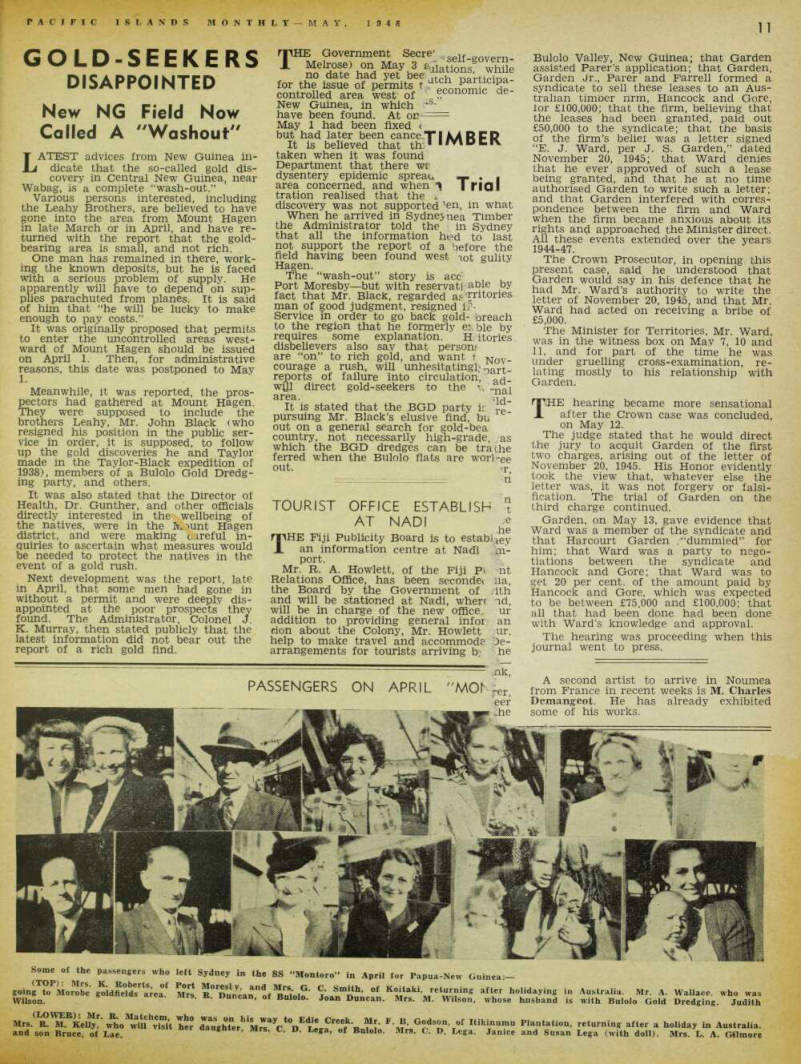
Some of the passengers who left Sydney in the SS “Montoro” in April for Papua-New Guinea;— (TOP): Mrs K. Roberts, of Post Moresly, and Mrs G. C. Smith, of Koitaki, returning after holidaying in Australia. Mr. A. Wallace, who was going to Morobe goldfields area. Mrs R. Duncan, of Bulolo. Joan Dunca. Mrs. M. Wilson, whose husband is with Bulolo Gold Dredging. Judith Wilson. (LOWER): Mr. R. Matchem, who was on his way to Edie Creek. Mr. F. B. Godson, of Itikinumu plantation, returning after a holiday in Australia.
Mrs. R. M. Kelly , whp will visit her daughter daughter, Mrs c. D. Lega, of bulolo. Mr. C. D. Janice and Susan Lega (with doll). Mrs. L. A. Gilmore and son Bruce, of lae.
[?] The Fiji £
[?] ess Men Want It [?] Own Correspondent
THE South Pacific Commission, constituted by six 4m’ S e C^ a t o^ n e a with I s?er- France, United States, Holland, Australia and first meetings at St. Georges Heights, Mosman, fhen Australia and New Zea- May 11. jiated their currencies to a The plan for the Commission developed a : ?, 5 ppr ,. cent - under sterling, Agreement, made between Australia and New ?et banks, conception of Dr. H. V. Evatt, Australian Min lted it to go down to the Aus supported by Mr. Peter Fraser, Prime Ministhd New Zealand level, and the
THE next step was taken when a Con ference was held in Canberra in January, 1947, and delegates of the six nations named decided unanimously to set up the Commission. A good deal of delay occurred then—probably the re sult of disturbed international relations— but finally the Commission was consti tuted as follows: Great Britain.—Sir Brian Freeston, KCMG, Governor of Fiji and High Com missioner for the Western Pacific; and Mr. S. S. Vaskess, CMG, QBE, former Secretary of the Western Pacific High Commission.
United States.—Professor Felix Keesing, of Stanford University; Dr. Karl Lee brick. vice-president of the Hawaii Uni versity; Mr. Milton Shalleck, of New York: and Dr. Ruth E. Bacon, special assistant to the directors of the Office of Far Eastern Affairs, Washington.
France.—M. Jaques Lassalle-Sere, In spector-General of Colonies for Noumea; and M. Georges Dubois, of Noumea.
Australia.—Mr. J. R. Halligan, secretary of the Department of External Terri tories; Dr. J. W. Burton, formerly general secretary of the Methodist Missionary Society. Alternate Commissioners: Colonel J. K. Murray, Administrator of Panua-New Guinea; Mr. E. W. P. Chin nefv, anthropologist, formerly a senior public servant in New Guinea.
Holland.—Pending the arrival of the delegation, Dr. J. A. de Ranitz, of the Dutch Legation at Canberra, was present.
The delegation comprised: Mr. E. G.
Bevers Luis; Mr. J. P. K. Echout; Mr.
M. A. Pellaupessy; and* Dr. W. C. Klein; with Mr. Kayardo and Dr. A. Loosjes as advisers.
New Zealand: Mr. C. G. R. McKay (formerly secretary of the NZ Depart ment of Islands Territories) and Briga dier F. L. Hunt (who "BBSS trative Sap*""
-Government, which wanted to trahan ' on sterling.
An acg on loca j advice the Government the Rt. took the middle course of a de trahan ion 0 f iq per c ent.—mainly to help wa s exporters of copra and of the °utlin«day the boot is on the other foot. which. ts are booming while the cost of im- II wa and the consequent cost of living was t begun to frighten even the strongest ence or t ers^ ar f'he Suva Chamber of Commerce has cussed the question (rather ponder ously) but has not yet decided on a line
°£‘ action.
of cr ♦ The six dredges of Bulolo Gold Dredging \ d in New Guinea, in April, obtained ,760 ounces of fine gold from 595,000 l;ubic yards of gravel.
To Papua-N. Guinea
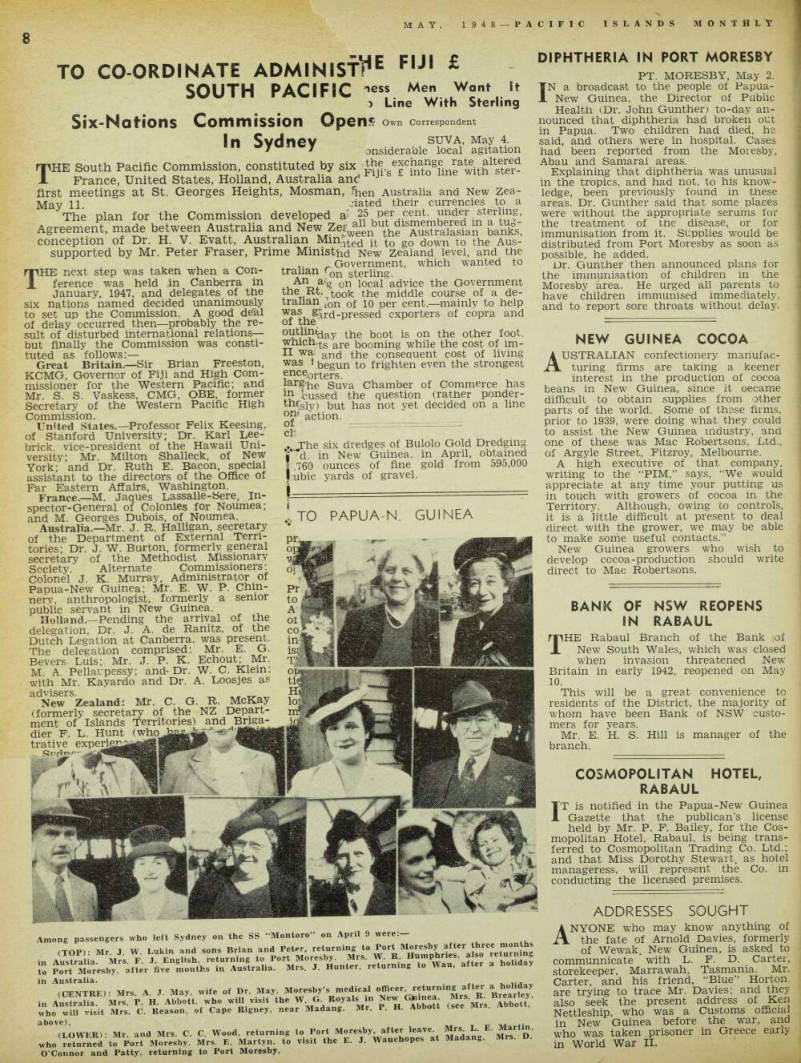
A mong passengers who left Sydney on the SS "Montoro" on Apil 9 were:- (TOP): Mr. J. W. Lukin and sons Brian and Peter, returning to Port Moresby after three months in Australia. Mrs. F. J. English, returing to Port Moresby. Mrs. W. R. Humphries, also returning to Port Moresby, agter five months in Australia. Mrs. J. Hunter, returning to Wau, after a holiday (CENTRE): Mrs. A. J. May, wife of Dr. May, Moresby's medical officer, retutning after a holiday in Australia. Mrs. P. H. Abbott, who will visit the W. G. Royals in New Gninea. Mrs. R. Brearly, above). (LOWER): Mr. and Mrs C. C. Wood, returning to Port Moresby, after leave. Mrs. L. E. Martin who returned to Port Moresby. Mrs. E. Martyn, to visit the E. J. Waychopes at Madang. Mrs D.
O'Connor and Patty, returing to Port Moresby.
Diphtheria In Port Moresby
Pt. Moresby, May 2.
IN a broadcast to the people of Papua- New Guinea, the Director of Public Health (Dr. John Gunther) to-day an nounced that diphtheria had broken out in Papua. Two children had died, he said, and others were in hospital. Cases had been reported from the Moresby, Abau and Samarai areas.
Explaining that diphtheria was unusual in the tropics, and had not, to his know ledge, been previously found in these areas. Dr. Gunther said that some places were without the appropriate serums for the treatment of the disease, or for immunisation from it. Supplies would be distributed from Port Moresby as soon as possible, he added.
Dr. Gunther then announced plans for the immunisation of children in the Moresby area. He urged all parents to have children immunised immediately, and to report sore throats without delay.
New Guinea Cocoa
AUSTRALIAN confectionery manufac turing firms are taking a keener interest in the production of cocoa beans in New Guinea, since it oecame difficult to obtain supplies from other parts of the world. Some of these firms, prior to 1939, were doing what they could to assist the New Guinea industry, and one of these was Mac Robertsons, Ltd., of Argyle Street, Fitzroy, Melbourne.
A high executive of that company, writing to the “PIM,” says, “We would appreciate at any time your putting us in touch with growers of cocoa in the Territory. Although, owing to controls, it is a little difficult at present to deal direct with the grower, we may be able to make some useful contacts.”
New Guinea growers who wish to develop cocoa-production should write direct to Mac Robertsons.
Bank Of Nsw Reopens
In Rabaul
THE Rabaul Branch of the Bank of New South Wales, which was closed when invasion threatened New Britain in early 1942, reopened on May 10.
This will be a great convenience to residents of the District, the majority of whom have been Bank of NSW custo mers for years.
Mr. E. H. S. Hill is manager of the branch.
Cosmopolitan Hotel,
Rabaul
IT is notified in the Papua-New Guinea Gazette that the publican’s license held by Mr. P. F. Bailey, for the Cos mopolitan Hotel, Rabaul, is being trans ferred to Cosmopolitan Trading Co. Ltd.; and that Miss Dorothy Stewart, as hotel manageress, will represent the Co. in conducting the licensed premises.
Addresses Sought
ANYONE who may know anything of the fate of Arnold Davies, formerly of Wewak. New Guinea, is asked to communnicate with L. F. D. Carter, storekeeper, Marrawah, Tasmania. Mr.
Carter, and his friend, “Blue” Horton, are trying to trace Mr. Davies: and they also seek the present address of Ken Nettleship, who was a Customs official in New Guinea before the war, and who was taken prisoner in Greece early in World War 11.
No Progress
Dutch and 'Republicans' At Impasse in Java
LITTLE progress has been made in political discussions in the Nether lands Indies —or Indonesia, as it is most frequently, but erroneously, called.
The Dutch would have cleared up the situation there long ago, had it not been for the persistent interference of a sec tion of the United Nations.
The prime mover against the Dutch has been Australia. Australia’s policy— in relation to Indonesia at any rate—has been dictated by the Waterside Workers’
Federation, a strongly Communist organ isation which went to the length of tying up Dutch ships in Australian ports. Fin ally, an Australian judge headed a small Commission which went from the United Nations to Java, and induced the Dutch to cease their military measures against the so-called “Republicans” (a Javanese rebel set-up organised by the Japs be fore they were defeated) and engage in conversations.
ON May 4, the following statement was issued by the Netherlands Informa tion Bureau, in Melbourne: So far, no progress whatever has been made on important issues during the Dutch-Republican negotiations now being held at Djocjakarta, under the auspices of the UN Good Offices Committee.
Although it is not considered that a deadlock has been reached, it is difficult to see what purpose can be served by further negotiations, unless one side or other makes concessions on points of principle.
The main stumbling block is the ques tion whether or not a plebiscite will have to be held in the territories under Repub lican authority. The Renville agreement stipulates that after a period of not less than six months, or not more than a year after the signing of the agreement for the settlement of the political dispute in the islands of Java, Sumatra and Madoera, “free elections will be held for self-determination by the people of their political relationship to the United States of Indonesia.”
The Republic now contends that the elections should not be held in Repub lican territory, but only in those parts of Java, Sumatra and Madoera which are occupied by the Dutch.
The Netherlands delegation considers free expression by the population, made under conditions of complete peace and security, an essential condition for the healthy construction of the future United States of Indonesia. Self-determination is one of the most important points of the Linggardjati Agreement.
THERE is political trouble only in Java.
In all other parts of the Netherlands Indies the Dutch or Indo-Dutch Administration is in full control, and the whole vast Territory is moving steadily towards the consummation of the plan for forming the United States of Indo nesia.
Meanwhile, the Territory as a whole is making increasingly rapid progress in re habilitation and economic development, and the overall position is improving every month.
There is great interest in Indonesia (and in other places) in an article by Australia’s “Foreign Minister,” Dr. Evatt, published in the “New York Times” of April 4, wherein he says: “The best solu tion, for the time being at least, would be some arrangement, which would give
a complete or considerable self-govern ment to the native populations, while permitting a continued Dutch participa tion in the political and economic de velopment of these regions.”
Cases
N. Guinea Timber
J. S. Garden on Trial
THE trial of Mr. J. S. Garden, in what are called the “New Guinea Timber Lease Cases,” commenced in Sydney on May 4, and was expected to last mearly two weeks. Garden, before the Quarter Sessions, has pleaded not gulity to— ■ Having forged a letter issuable by the Department of External Territories at Sydney, on November 20, 1945, h Having fraudulently and in breach of his duty falsified a letter issuable by the Department of External Territories at Sydney, on November 20, 1945. ■ Having forged a letter, dated Nov ember 10, 1947, deliverable to the Depart ment of External Territories, and ad dressed to the Minister for External Territories, Commonwealth Bank Build ing, Martin Place, and signed H. G. Fore shaw.
In the first few days, the evidence was simply a repetition of that given in the lower court, and fully reported some three months ago. It was expected, however, that there would be “fireworks” when Garden entered upon his defence.
Another trial will follow this one. In the next one, j, s. Garden, Harcourt Garden, Ray Parer and Farrell will face a series of charges (arising out of the same circumstances) alleging that they conspired to defraud a Queensland tim ber firm of £50,000.
Garden, one of the most prominent Leftist Labour politicians in Australia, had been very clnselv associated with Mr. E. J. Ward—first, in politics; and, later, when Mr. Ward became a Labour Minister, departmentally. He was an official in Ward’s Department of Labour.
He had no official standing in the De partment of External Territories, but he was in close contact with the Minister— his office, in the Commonwealth Bank, was alongside Ward’s.
It is alleged that in 1944-45, Ray Parer, well-known as a New Guinea pioneer aviator, applied for timber leases in the
Bulolo Valley, New Guinea; that Garden assisted Parer’s application; that Garden, Garden Jr., Parer and Farrell formed a syndicate to sell these leases to an Aus tralian timber nrm, Hancock and Gore, for £100,000; that the firm, believing that the leases had been granted, paid out £50,000 to the syndicate; that the basis of the firm’s belief was a letter signed “E. J. Ward, per J. S. Garden,” dated November 20, 1945; that Ward denies that he ever approved of such a lease being granted, and that he at no time authorised Garden to write such a letter; and that Garden interfered with corres pondence between the firm and Ward when the firm became anxious about its rights and approached the Minister direct.
All these events extended over the years 1944-47.
The Crown Prosecutor, in opening this present case, said he understood that Garden would say in his defence that he had Mr. Ward’s authority to write the letter of November 20, 1945, and that Mr.
Ward had acted on receiving a bribe of £5,000.
The Minister for Territories. Mr. Ward, was in the witness box on May 7, 10 and 11, and for part of the time he was under gruelling cross-examination, re lating mostly to his relationship with Garden.
THE hearing became more sensational after the Crown case was concluded, on May 12.
The judge stated that he would direct the jury to acquit Garden of the first two charges, arising out of the letter of November 20, 1945. His Honor evidently took the view that, whatever else the letter was, it was not forgery or falsi fication. The trial of Garden on the third charge continued.
Garden, on May 13, gave evidence that Ward was a member of the syndicate and that Harcourt Garden /‘dummied” for him; that Ward was a party to nego tiations between the syndicate and Hancock and Gore; that Ward was to get 20 per cent, of the amount paid by Hancock and Gore, which was expected to be between £75.000 and £100,000; that all that had been done had been done with Ward’s knowledge and approval.
The hearing was proceeding when this journal went to press.
A second artist to arrive in Noumea from France in recent weeks is M. Charles Demangeot. He has already exhibited some of his works.
Other "Montoro" Travellers
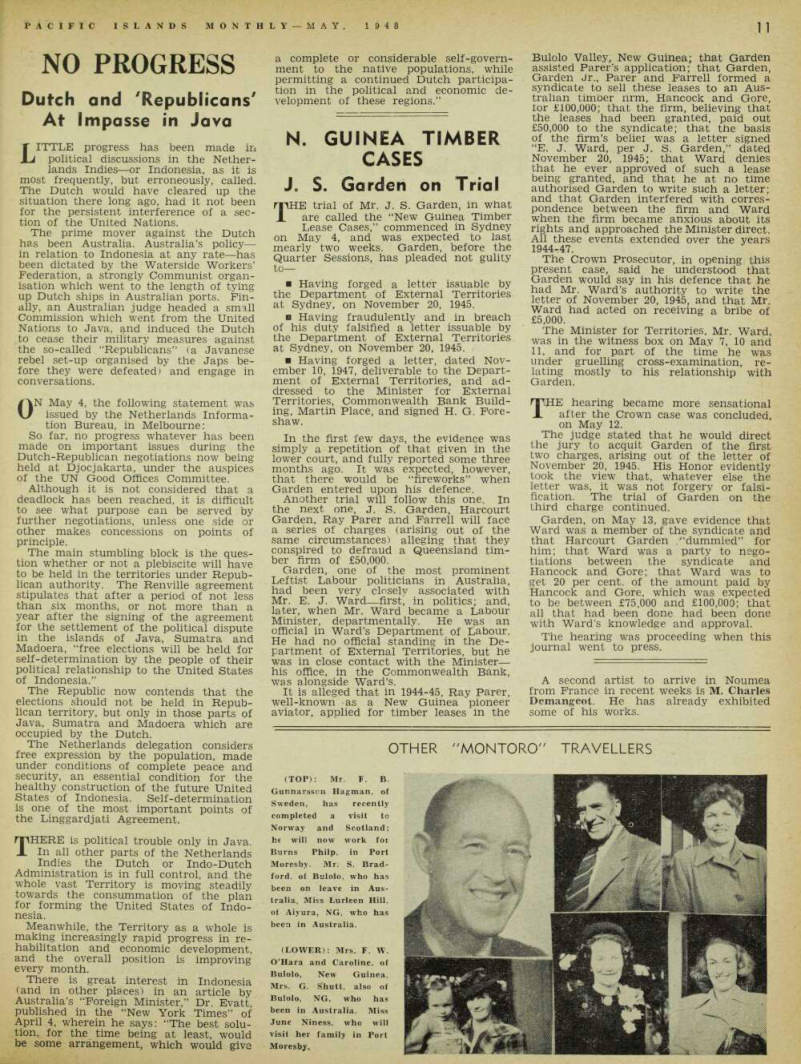
(Top): Mr. F. B.
Gunnarsscn Hagman, of Sweden, has recently completed a visit to Norway and Scotland; he will now work for Burns Philp, in Port Noresby. Mr. S. Brad ford, of Bulolo, who has been on leave in Aus tralia. Miss Lurleen Hill, of Aiyura, NG, who has been in Australia.
(Lower); Mrs. F. W.
O’Hara and Caroline, of Bulolo, New Guinea.
Mrs. G. Shutt, also of Bulolo, NG, who has been in Australia. Miss June Niness, who will visit her family in Port Moresby.
Advertisements & other items, p. 14 (1 item)
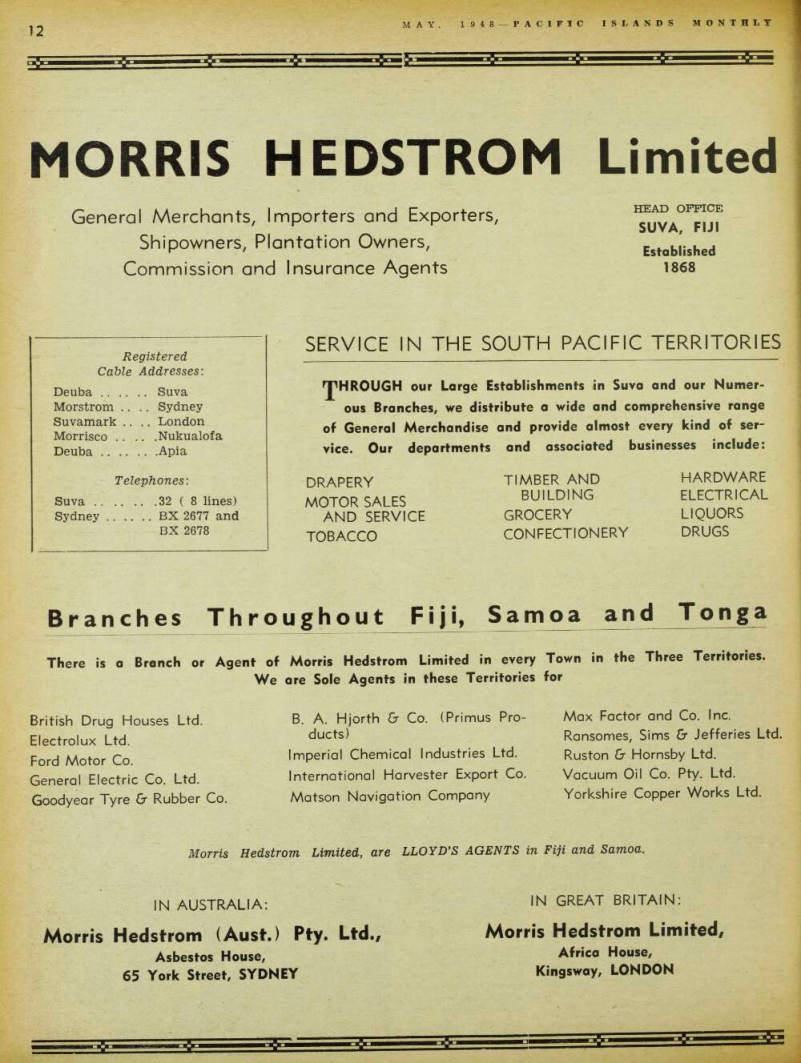
Morris Hedstrom Limited
General Merchants, Importers and Exporters,
Shipowners, Plantation Owners,
Commission and Insurance Agents
HEAD OFFICE
SUVA, FIJI
Established 1868
SERVICE IN THE SOUTH PACIFIC TERRITORIES
our Large Establishments in Suva and our Numerous Branches, we distribute a wide and comprehensive range of General Merchandise and provide almost every kind of service. Our departments and associated businesses include:
DRAPERY
MOTOR SALES
AND SERVICE
TOBACCO
TIMBER AND
BUILDING
GROCERY
CONFECTIONERY
HARDWARE
ELECTRICAL
LIQUORS
DRUGS
Branches Throughout Fiji, Samoa and Ton g a There is a Branch or Agent of Morris Hedstrom Limited in every Town in the Three Territories.
We are Sole Agents in these Territories for British Drug Houses Ltd.
Electrolux Ltd.
Ford Motor Co.
General Electric Co. Ltd.
Goodyear Tyre & Rubber Co.
B. A. Hjorth £r Co. (Primus Products) Imperial Chemical Industries Ltd.
International Harvester Export Co.
Matson Navigation Company Max Factor and Co. Inc.
Ransomes, Sims Gr Jefferies Ltd.
Ruston & Hornsby Ltd.
Vacuum Oil Co. Pty. Ltd.
Yorkshire Copper Works Ltd.
Morris Hedstrom Limited, are LLOYD’S AGENTS in Fiji and Samoa.
IN AUSTRALIA;
Morris Hedstrom (Aust.) Pty. Ltd.,
Asbestos House, 65 York Street, SYDNEY
IN GREAT BRITAIN;
Morris Hedstrom Limited,
Africa House, Kingsway, LONDON
Air Tragedy
37 Killed in NG Air Tragedy Canberra Howls About "Natives As Air Freight"
WHEN a Lockheed Hudson plane, under charter to New Guinea Air Traders, crashed shortly after leaving Lae, New Guinea, on April 18, 37 people were killed. This is the biggest air fatality New Guinea has ever had.
Four of the men killed were crew members; the remainder were native labourers being transported to the gold fields.
Subsequently, it has been found that the plane was not licensed for passengers and that the natives were being carried as freight. This has roused certain Aus tralian Ministers and officials to a frenzy of statements and protestations. Mr.
Ward has stated that no aircraft has Government approval to carry natives as freight, and that there would be an im mediate investigation to see whether this had been permitted by Civil Aviation officials.
The fact that the natives were not pro vided with safety-belts has also caused a storm of disapproval. As the plane burst into flames immediately on hitting the ground, it would be interesting to know how safety-belts would have helped matters.
It is obvious that Mr. Ward and other departmental heads feel that it is neces sary to find some scape-goat; but while
there may have been negligence on the part 6T someone connected with the tragedy, it is futile to blame it on the fact that the natives were not provided with seating accommodation, like regular airline patrons.
Air-accidents in New Guinea, it will be noted, have not been fewer in the post war period, when many more commercial flying regulations have been introduced.
Before the war, New Guinea’s record for air-safety, in spite of the climate and geographical hazards, was unique.
It has always been the custom in New Guinea to carry native labourers as air freight. It is obvious that if they had had to be paid for at full rates, few, if any, would have been transported in this way and the majority would have been required to walk.
As far as this goes, most Europeans who travelled by air were also virtually regarded as freight, in that they sat in a transport-plane on their gear and took what was coming to them. They were glad to do this, lack of seats and safety belts notwithstanding.
The only real difference between the service given them and that given natives was that while they paid several pounds for the privilege of travelling thus, natives were weighed and charged for at the rate of 3d. per pound.
A spokesman for Air Traders has denied that the plane was overloaded.
He said that newly indentured New Guinea natives averaged about 100 nounds in weight each, and that total weight of crew and natives was well within the limit allowed the Lockheed Hudson.
To Papua-N. Guinea By Sea
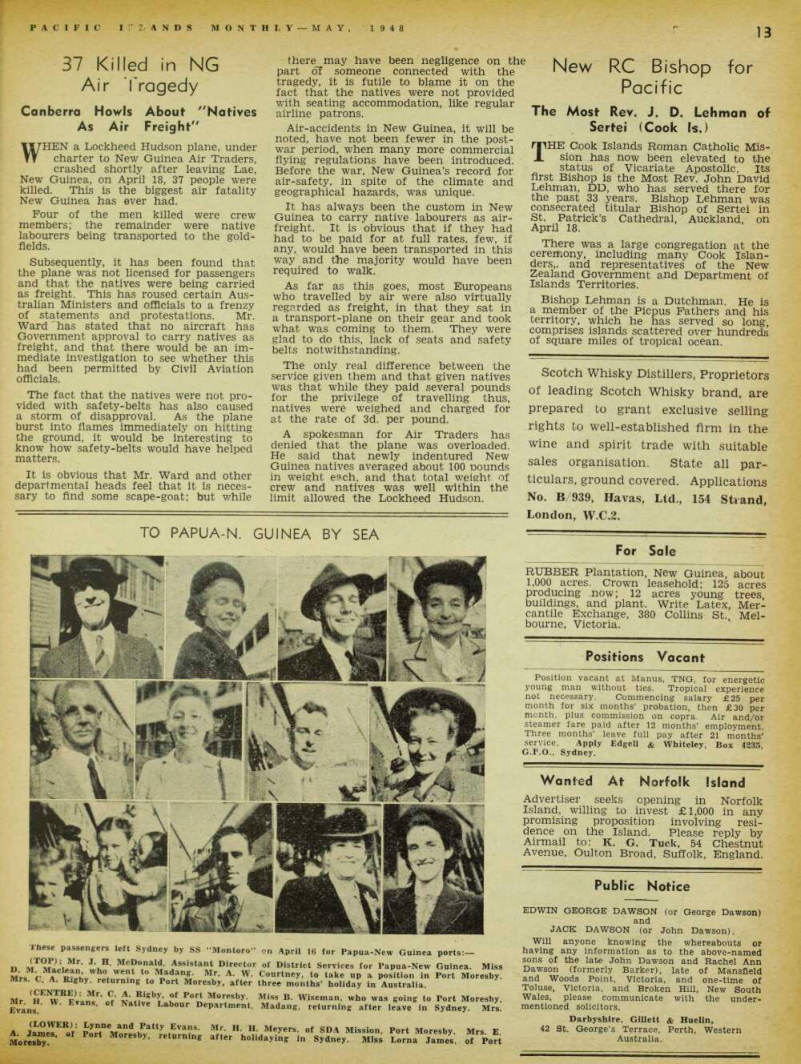
These passengers left Sudney by SS "Montoro" on April 16 for Papua-New Guinea Ports:- (Top): Mr, J. H. McDonld, Assistant Director of District Services for Papua-New Guinea. Miss D. M. Maclean, who went to Madang. Mr. A. W. Coutney, to take up a position in Port Moresby.
Mrs. C. A. Rigby, returing to Port Moresby, after three months' holiday in Australia. (CENTRE): Mr. C. A. Rigby, of Port Moresby. Miss B. Wiseman, who was ging to Port Moresby.
Mr. H. W. Evans, of Native Labour Depatment, Madan, returning after leave in Syney. Mrs. (LOWER): Lynne and Patty Evans. Mr. H. H. Meyes, of SDA Mission, Port Moresby, Mrs. W.
A. James, of Port Moresby, returing after holidaying in Sydney. Miss Lorna Jams of Port Moresby.
Pacific
New RC Bishop for Pacific The Most Rev. J. D Lehman of Sertei (Cook Is.)
THE Cook Islands Roman Catholic Mis sion has now been elevated to the status of Vicariate Apostolic. Its first Bishop is the Most Rev. John David Lehman, DD, who has served there for the past 33 years. Bishop Lehman was consecrated titular Bishop of Sertei in St. Patrick’s Cathedral, Auckland, on April 18.
There was a large congregation at the ceremony, including many Cook Islan ders,, and representatives of the New Zealand Government and Department of Islands Territories.
Bishop Lehman is a Dutchman. He is a member of the Picpus Fathers and his territory, which he has served so long, comprises islands scattered over hundreds of square miles of tropical ocean.
Advertisements & other items, pp. 15-16 (2 items)
13
PACIFIC I T LANDS MONTHLY MAY, 1948
London, W.C.2.
Scotch Whisky Distillers, Proprietors
of leading Scotch Whisky brand, are
prepared to grant exclusive selling rights to well-established firm in the wine and spirit trade with suitable sales organisation. State all par-
ticulars, ground covered. Applications
No. B/939, Havas, Ltd., 154 Strand,
London, W.C.2.
For Sale
RUBBER Plantation, New Guinea, about 1,000 acres. Crown leasehold: 125 acres producing .now; 12 acres young trees, buildings, and plant. Write Latex, Mercantile Exchange, 380 Collins St. Melbourne, Victoria.
Positions Vacant
Position vacant at Manus, TNG, for energetic young man without ties. Tropical experience not necessary. Commencing salary £25 per month for six months’ probation, then £3O per month, plus commission on copra. Air and/or steamer fare paid after 12 months’ employment Three months’ leave full pay after 21 months’ service. Apply Edgell & Whiteley, Box 4235, G.P.0., Sydney.
Wanted At Norfolk Island
Advertiser seeks opening in Norfolk Island, willing to invest £l,OOO in any promising proposition involving residence on the Island. Please reply by Airmail to: K. G. Tuck, 54 Chestnut Avenue, Oulton Broad, Suffolk, England.
Public Notice
EDWIN GEORGE DAWSON (or George Dawson) and JACK DAWSON (or John Dawson).
Will anyone knowing the whereabouts or having any information as to the above-named sons of the late John Dawson and Rachel Ann Dawson (formerly Barker), late of Mansfield and Woods Point, Victoria, and one-time of Toluse, Victoria, and Broken Hill, New South Wales, please communicate with the undermentioned solicitors.
Darbyshire, Gillett & Huelin, 42 St. George’s Terrace, Perth, Western Australia.
M
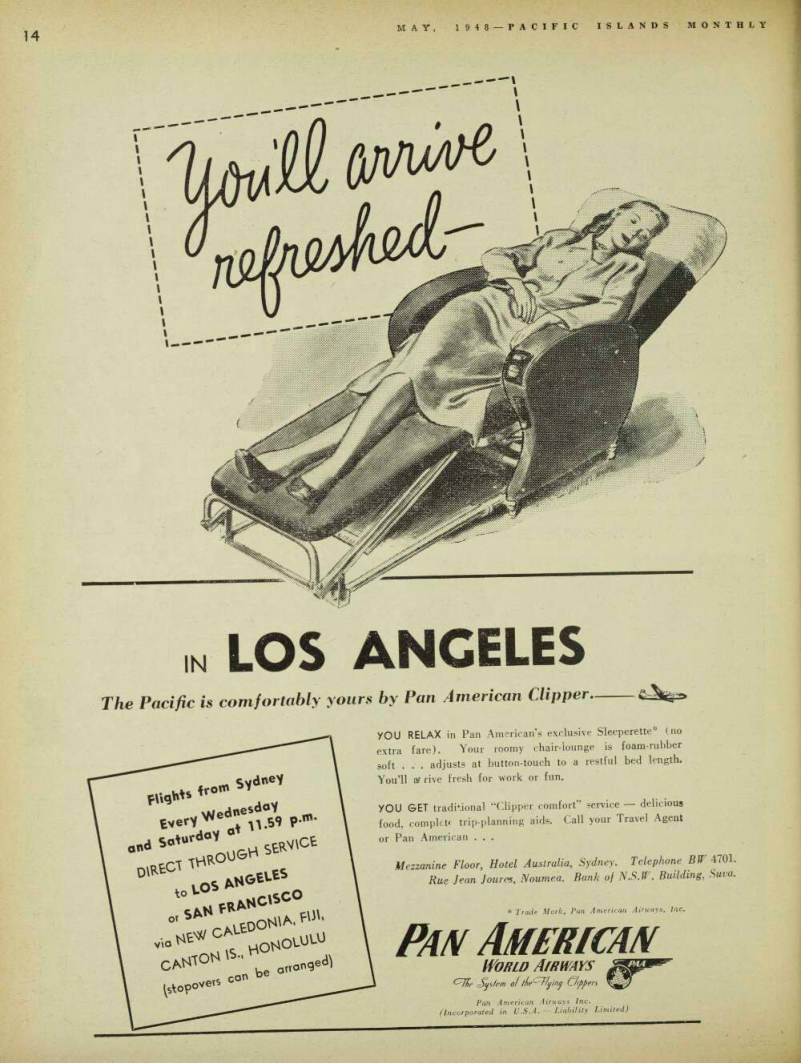
in LOS ANGELES
The Pacific is comfortably yours by Pan American Clipper. ts 3 p m -
ir<laY cfRV\CE
tH s
u os^ g£LE *
fr^hc\sc°
** " MOM ou3U!
covers can be YOU RELAX in Pan American’s exclusive Sleeperette* (no extra fare). Your roomy chair-lounge is foam-rubber soft . . . adjusts at button-touch to a restful bed length.
You’ll as rive fresh for work or fun.
YOU GET traditional “Clipper comfort” service delicious food, complete trip-planning aids. Call your Travel Agent or Pan American . . .
Mezzanine Floor, Hotel Australia, Sydney. Telephone BW 4701.
Rue Jean Jourrn, Noumea. Bank oj Building, Suva. * Trade Mark, Pan American Airways, Inc.
Pam Mm/cam
World Airways '- the System of Clippers Pan American Airways Inc. ( Incorporated in U.S.A. Liability Limited)
Papua's War Graves
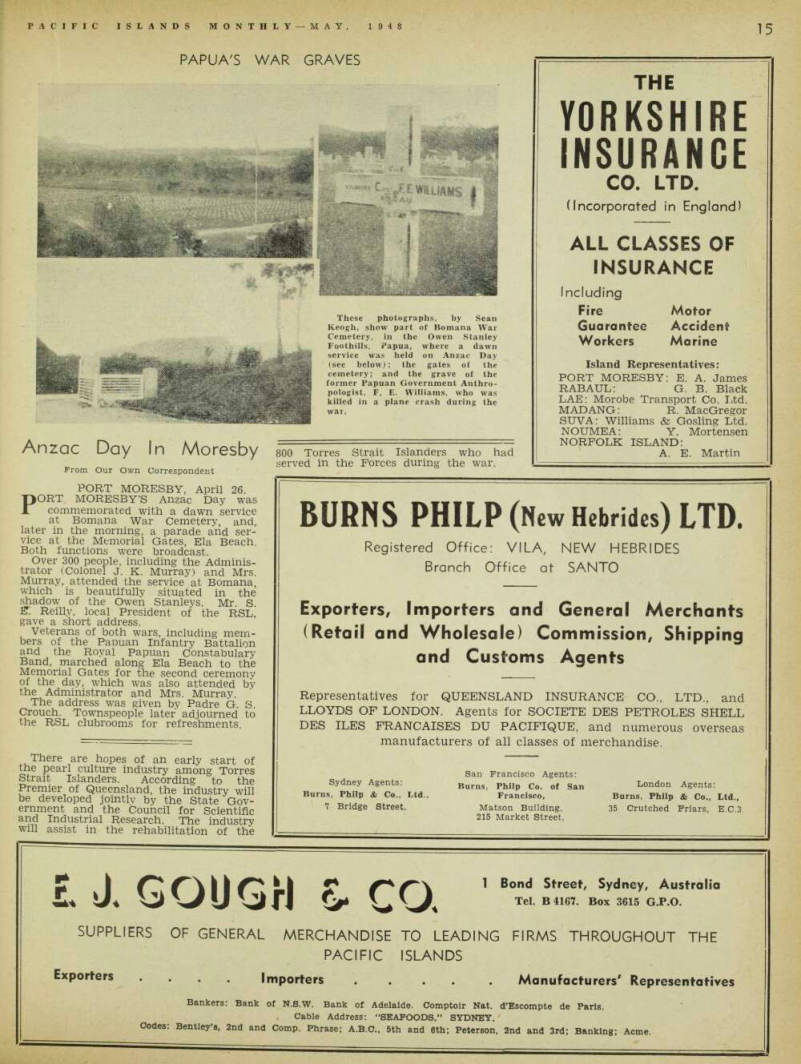
These photographs, by Sean Keogh, show part of Bomana War Cemetery, in the Owen Stanley Foothills, Papua, where a dawn service was held on Anzac Day (see below); the gates of the cemetery; and the grave of the former Papuan Government Anthro pologist, F. E. Williams, who was killed in a plane crash during the war.
Anzac Day In Moresby
From Our Own Correspondent
Port Moresby, April 26.
PORT MORESBY’S Anzac Day was commemorated with a dawn service at Bomana War Cemetery, and, later in the morning, a parade and ser vice at the Memorial Gates, Ela Beach.
Both functions were broadcast.
Over 300 people, including the Adminis trator (Colonel J. K. Murray) and Mrs.
Murray, attended the service at Bomana, which is beautifully situated in the shadow of the Owen Stanleys. Mr. S.
Reilly, local President of the RSL, gave a short address.
Veterans of both wars, including mem bers of the Papuan Infantry Battalion and the Royal Papuan Constabulary Band, marched along Ela Beach to the Memorial Gates for the second ceremony of the day, which was also attended by the Administrator and Mrs. Murray.
The address was given by Padre G. S.
Crouch. Townspeople later adjourned to the RSL clubrooms for refreshments.
There are hopes of an early start of the pearl culture industry among Torres Strait Islanders. According to the Premier of Queensland, the industry will be developed jointly by the State Gov ernment and the Council for Scientific and Industrial Research. The industry will assist in the rehabilitation of the
800 Torres Strait Islanders who had served in the Forces during the war.
Advertisements & other items, p. 17 (1 item)
Insurance
THE
YORKSHIRE
CO. LTD.
(Incorporated in England)
ALL CLASSES OF
INSURANCE
Including Fire Motor Guarantee Accident Workers Marine Island Representatives:
PORT MORESBY: E. A. James
RABAUL: G. B. Black LAE: Morobe Transport Co. Ltd.
MADANG: R. MacGregor SUVA: Williams & Gosling Ltd.
NOUMEA: Y. Mortensen
NORFOLK ISLAND:
A. E. Martin
BURNS PHILP (New Hebrides) LTD.
Registered Office: VILA, NEW HEBRIDES
Branch Office at SANTO
Exporters, Importers and General Merchants
(Retail and Wholesale) Commission, Shipping
and Customs Agents
Representatives for QUEENSLAND INSURANCE CO., LTD., and LLOYDS OF LONDON. Agents for SOCIETE DES PETROLES SHELL DES ILES FRANCAISES DU PACIFIQUE, and numerous overseas manufacturers of all classes of merchandise.
Sydney Agents: Burns, Philp & Co., Ltd.. 7 Bridge Street.
San Francisco Agents: Burns, Philp Co. of San Francisco, Matson Building, 215 Market Street, London Agents: Burns, Philp & Co., Ltd., 35 Crutched Friars, E.C.3
Jf k 1 Bond Street, Sydney, Australia I/* VD Vy U II VTel. B 4167. Box 3615 G.P.O.
SUPPLIERS OF GENERAL MERCHANDISE TO LEADING FIRMS THROUGHOUT THE
PACIFIC ISLANDS
Exporters ... Importers ... . Manufacturers' Representatives Bankers: Bank of N.S.W. Bank of Adelaide. Comptoir Nat. d’Escompte de Paris.
Cable Address: “SEAFOODS,” SYDNEY.
Codes; Bentley’s, 2nd and Comp. Phrase; A.8.C., sth and 6th; Peterson, 2nd and 3rd; Banking; Acme.
N. Caledonia May
Still Get Jap Labour
IN their search for indentured labourers, the New Caledonian representatives in the French Parliament report that they have had talks with the Dutch Ambassador in Paris about the resump tion of recruitment of Japanese; also that they are again approaching General MacArthur with a view to the eventual recruitment of Koreans or Japanese.
They refer also to the efforts they have
made, and the promises of the Minister of Finance, to maintain the Pacific franc, which was recently threatened with de valuation, which would have had a dis astrous effect on the Colony.
Saibai Island, about 100 miles north of Cape York, and Boigu Island, approxi mately 50 miles due west of Saibai have been menaced by tidal erosion caused by storms during the summer.
Reports have indicated that the islands were nearly completely submerged. They have a native population of 350 and 160 respectively.
Rapid Recovery
Of Indonesian Trade
HONGKONG, April 20.
EXPORTS from Indonesia, in 1948, will be almost triple last year’s exports, the Far Eastern Economic Review reports. (The following figures are United States dollars).
Shipments in the current year are ex pected to approximate U 55350,000,000, as against $125,000,000 in 1947, according to the Review.
The publication said rubber exports in 1948 will be 250,000 tons, valued at $120,000,000 and in 1949 will reach 350,000 tons. Tin production will be 35,040,000 tons, valued at $80,000,000, .which the Review said is “Near pre-war produc tion.”
In the current year, petroleum, copra and black pepper would reach 50 per cent, of prewar production, the Review said. Copra production this year was given as 250,000 tons, and palm oil as 60,000 tons, rising to 200,000 in 1949.
Only about five per cent, of pre-war white pepper is available at the present time, but black pepper shipments this year would be 8-9,000 tons.
Tin mining already has reached hall it prewar output, and by 1950 should again be at the 1939 level of 50,000 tons, the Review said.
The production of bauxite also ,has considerably imoroved during the past year. An initial shipment of 8,000 tons has been made to Japan which contracted for a total of 100,000 tons some time ago.
“Since the end of last year the eco nomic position of Indonesia has ameli orated to a large degree,” the publication declared. “It can be paying its way in three years and within five years should be in a position to reduce its debt com mitments.”
Sulfa Drugs for Leprosy
New Treatment to be Given At Makogai
From Our Own Correspondent
Suva, May 3.
SUPPLIES of sulphone drugs, which have been proved to be extremely effective in the treatment of ad vanced cases of leprosy at the Carville Leprosarium, Louisiana, are on the way to Fiji and will be used at the Central Leper Hospital, Makogai.
This information was given by the Medical Superintendent at Makogai (Dr.
C. J. Austin) on his recent return from the fifth International Leprosy Congress lit ls a Austin said that the sulphones will supplement the chaulmoogra oil treat ment now in use. He was impressed with the results of sulphone experiments; m Jamaica, where, incidentally. Sisters Zita and Germaine, formerly of Makogai, are now stationed.
Battle With Pitcairn's
Surf
WHEN the “Ruahine,” en route from Panama to New Zealand, called at Pitcairn Island recently, to pick up two passengers, it took two horns battle with the surf before they were pmbarked The passengers were Mrs.
Hilda Young and her Alaric, whom she was taking to NZ to attend a school for deaf and dumb chilthat Mrs. Young intended to take with her had to be left behind as it was considered that the e x traweight in the long-boat would endanger their lives.
Advertisements & other items, pp. 18-19 (2 items)
Bank Of
HOW THE “WALES” WORKS
Branch Series No. 2
The Branch Accountant
Mr. L. F. Morgan.
Accountant at Eastern Branch, Melbourne.
Formerly Security Clerk at A.B.C. Branch, Melbourne. Joined the Bank in 1924.
THE Accountant is responsible for the smooth running of the Branch, office routine and staff. He is the Manager’s right-hand man and acts as his deputy when necessary.
It is his duty to see that there are no "loose ends’ in the transactions put through by the Branch.
"Efficiency" is his watchword.
The careful internal auditing system, of which the Accountant’s work is an example, is your guarantee of satisfactory service when you ' bank at the 'Wales”’.
Consult and use
BANK OF
NEW SOUTH WALES
FIRST BANK IN AUSTRALIA
Incorporated in New South Wales with limited liability
Capstan is
grand cigarette
for all occasions- I Capstan’s own blend of fine Virgin leaf cannot
be equalled
That’s why it’s alway .
TIME FOR A CAPSTAN
ia -■' 1 380 P- 7.4 7
THE EMPIRE'S FAVOURITE CIGARETTE
A Plea For The Fiji-Indian
Is Government Doing All That Is Possible to Solve Urgent Problem?
YOUR December number is only just to hand, and I should be grateful if you would allow me to make a few comments on the report in this on the Indianization” debate in the Fiji Legislative Council and your leading article dealing with this.
As to the historical part of your article, I will only remark that I very much doubt if the Government of India would have ever agreed to an indenture system with no provision for eventual settlement of those who chose to remain; or if such a system could have succeeded in the long run.
The system followed has had unforeseen consequences, and, among others, two grave defects, which have had last-
ing results—pronounced sex disparity in recruitment, and enlistment from many different Indian races, You agree that but for Indian aid economic progress in the Colony would have been very slow. (Prosperity is, in fact, still very largely dependent on it.) And surely it must be admitted that Indian farmers, both in the sugar area and elsewhere, have contributed some thing by their industry and enterprise, They have made the Sugar Company’s ten-acres farm system a success and they have developed the production of rice and other crops with little outside help.
And, moreover, the rents they pay have played an important part in Fijian pro gress.
WITH war-time developments I am too imperfectly acquainted to maxe any comment, ic is, i am afraid, clear that, in the eyes of others at any rate, the community has a good deal to live down; and the more surprising that its leaders should have chosen this mile to launch an aggressive campaign of selfish demands.
For good or ill the destinies of the Colony are now in the hands of two, not three, very different races, with Fijian interests necessarily paramount as hosts of the other two. And it behoves all three to make the best of it.
From this point of view Sir Lala Sukuna’s speecn is of great importance.
While protesting strongly against un reasonable demands, he very wisely ap peals for more co-operation and greater recognition of Fijian difficulties. And he points out how Indian culture can help towards common ends. I gather that he recognises the difficulties of educating children of different races together. But he would like to see much more co-oper ation, cultural and otherwise, at later stages, possibly by joint societies of dif ferent sorts and eventually, the estab lishment of a local college open to all races.
But, if the Indian community is to make its proper contribution, it seems clearly necessary to improve conditions of progress and give its leadership a saner outlook on public affairs. To my mind, the key to this lies in concerted effort to foster agricultural progress out side the sugar area. (This can probably be trusted to solve its own problems.) I doubt if it is recognised how much there is to be done to improve produc tion among the independent farmers, give these more outlets for intelligence and enterprise, and the great bulk of community much more of a leadership drawn from its own main business.
It has been remarked by high author ity that feelings of frustration and dis content must arise among peasant farm ers treated as a purely “static” body. A colony which neglects this principle does so at its peril.
As things stand at present, though there are exceptions, leadership is largely in the hands cf those with little or no practical or personal interest in farming. This must result in a tendencv to impatient idealism, and narrow-minded concentration on sectional and political questions.
AS it happens, I have recently sug gested some measures to improve matters in connection with the Fiji Development Plan, including the creation of a well-equipped Indian Branch of the Agricultural Department, both to foster crop production, and to make close con tact with the requirements of Indian farmers and their mentality and practice.
For they differ very materially from Fijians in these respects.
Also, I suggest funds for improving settlements, and access to them; meas ures to establish a co-operative organisa tion to foster corporate action and check the evils of improvident borrowing; a resettlement fund for the benefit of those who may lose their farms; and, to pro mote agricultural leadership, steps to give Indians practical proof that farming in its higher branches can offer a satisfy ing and remunerative career.
From figures I saw recentlv I gather that Indian primarv education still lags seriously behind Fijian. This may be the reason for the demand for more schools of this class.
But one outstanding need is, I think, a really good Indian secondary school under Government control, with a strong
practical tinge and possibly with over seas scholarships for further agricultural and technical training, to mitigate the present obsession with academic pur suits, for which there are such limited openings in the Colony.
FIJI is not yet making the best use of its Indian element. It remains for it to give this larger scope and guide it on the right lines.
But to do so the administration must be adequately equipped on the Indian side. And I regret to learn, from a re liable source, that at the present moment there are practically no European offi cials with a competent knowledge of Indian languages to keep touch with locally published and imported litera ture, or take an intelligent interest in what the people are thinking and talking about among themselves.
This cuts both ways. It means in adequate control of Indian affairs. And, from the Indian point of view, it must generate a feeling that their concerns and interests are not thought to be worth worrying about. This is very far from Sir Lala’s principle of enlisting the aid of Indian culture for common ends.
Unless I am misinformed about this matter, there would seem urgent need for improvement. No Colony can hope to be reasonably well governed, if its European officials lack an adequate knowledge of the language of half its population.
I am, etc.,
J. R. Pearson
Secretary for Indian Affairs, Fiji, 1927-32 (C.1.E., 1.C.5., ret’d.).
Auvesque, La Rocque, Jersey, Channel Islands, March 26, 1948.
Advertisements & other items, p. 20 (1 item)
Boxley Pty. Ltd.
YOUR FUTURE CAREER . . .
Merchants, Accountants, Secretaries, Bankers and Business Managers ... all hold responsible positions with commensurate salaries. You too can enhance your prospects in this ever-expanding commercial field, which yields abundant returns to those with adequate qualifications. H.R.I. prepare ambitious men and women for all business positions from junior to senior executive. Tuition is practical authoritative up-to-date time saving . . . and certain in its successful results. The H.R.I. is available always to advise you write or wire for information free and without obligation.
H.R.I. tutorial service is proved by the winning of more honours than all coaches in Australasia combined.
H.R.I. Career Training • ACCOUNTANCY 9 SECRETARYSHIP • COST ACCOUNTANCY
• PRACTICAL BOOKKEEPING • MARKETING SELLING
ADVERTISING • BANKING • LOCAL GOVERNMENT EXAMS.
Hemingway It o her tso n ■ns tit ute Founded and Owned by Hemingway & Robertson Pty. Ltd.
Consulting Accountants :: :: Professional Tutors
126 BANK HOUSE. BANK PLACE. MELBOURNE
126 BARRACK HOUSE. 16 BARRACK STREET. SYDNEY 126/815
Cables: “Islandex,” Sydney. ’Phone: MA4856
Boxley Pty. Ltd.
32-34 STEAMMILL STREET, SYDNEY
Please address all mail to G.P.O Box 3385, Sydney.
SUPPLIERS OF BUILDERS’ HARDWARE, TEXTILES, BISCUITS,
GENERAL MERCHANDISE.
It will pay you to look each month for our special offer.
See below for this month’s special.
MAY
. SPECIAL .
BOXLEY’S
*• PACIFIC ” SUPERFINE
HOUSEHOLD PAINT. PRICE
ONLY 32/6 PER GALLON
for all colours except Peacock Green, mid-Green and Bright Red, which are 37/6 per gallon. A small trial order will convince you of the lasting quality and excellence of this paint, which has been specially prepared for the Tropics.
Death Of M. Hippolyte
Dobritz
A CALEDONIAN citizen, member of one of the old colonial families, with a distinguished career in the French Colonial Service, died recently at Toulon, aged 78.
He is M. Hippolyte Dobritz. He joined the service in Noumea at 18 and was, for many years, in charge of the Finance Bureau. In 1909 he was appointed to a higher grade and sent to Lake Chad, in the Congo. Later he served for a time as Acting Governor of the islands of Reunion and Martinique, and was awarded the Legion d’Honneur.
In 1940 he lost his son Pierre who was killed fighting the Japanese at Langson, Tonkin, Indo-China.
Eggless Suva Finds Eggs
For "Matua"
From Our Own Correspondent
Suva, May 3.
"171 VERY year, from about the end of M-J January until well into May, people in Suva, and a large part of Fiji generally, are compelled to forget that ordinary hens’ eggs are edible.
The black market, of course, can usually find eggs at any time. It can also charge for them at golden-goose rates. Notwithstanding these shortages, however on April 27, a supply of eggs was fpund at Suva for the “Matua,” just ar rived from Auckland.
It seems that there was a blackout on eggs in Auckland, and that after the crew had held the ship back for an hour by an unsatisfied demand for eggs someone promised them eggs at Suva. ’
The Aero Club of New Caledonia, which ceased its activities on the outbreak of war, in 1939, has been reformed and now has 1550 members. A first course for a pilot’s certificate is to be given by M.
Vernon, A New Hebridean colonist has donated a plane for the use of members.
Members of the New Caledonian General Council, including the President, M. Bonneaud, recently spent six days in the North of New Caledonia inspecting damage done in the recent cyclone and floods. The Colony’s Permanent Com mission recommended a grant of 555,000 francs as flood relief.
Miss Ivy Lapthorne of the Methodist Mission, Fiji, arrived in Sydney on leave in April.
Advertisements & other items, p. 21 (1 item)
BOOKS like these ONLY 6/3
EYE LOTION
For InflomedEyes and Eyelids ... Sold Everywhere H. Rose 4 Co.,Pty„ Ltd.. King Street Sydney.
as m si ©
World Books,
de-luxe editio n s, the envy of book lovers, are all current best sellers. And
they're yours
for 6/3 each\
PLACE YOUR ORDER NOW
for
WORLD BOOKS !
“WORLD BOOKS” Is a book club which releases a new and important book each month to subscribers.
“WORLD BOOKS” editions are specially produced for “World Books” members. The books are bound in buckram with the titles gold-blocked on an indented leather panel.
“WORLD BOOKS” are available to subscribers at the low price of 6/3 per volume, irrespective of the regular selling price of the books —usually two, sometimes three, times dearer.
“WORLD BOOKS” are available by subscription only. There are NO EXTRAS. Subscription covers everything, including the postage, and the books become YOUR OWN property.
BOOKS TO BE RELEASED
May: “That Lady,” by Kate O’Brien.
June: “Bright Day,” by J. B. Priestly.
July. “Bernard Shaw,” by Hesketh Pearson.
August: ‘Private Angelo,” by Eric Linklater.
September: “Lark Rise to Candleford,” by Flora Thompson.
October; “Royal Flush,” by Margaret Irwin.
BACK RELEASES ALSO AVAILABLE
‘The Robe,” by Lloyd C. Douglas.
“Fanny by Sadleir.
Gaslight,” by Michael “Four Portraits,” by Peter Quennell.
“Left Hand, Right Hand,” Sir Osbert Sitwell.
SUBSCRIPTION
RATES;
13 months, £3/19/6; 6 months, £l/19/9.
Kindly add exchange to Country and Inter-State cheques. r - - MAIL Tins COUPON IMMEDIATELY! -
\ MORGAN’S BOOK SHOP,
. 9 Castlereagh Street, Sydney, N.S.W., Aust.
I Please enrol me as a member of “World Books.” I enclose £ / f
NAME
ADDRESS.
“PIM,” May, ’4B.
The Princess's Thanks
From Our Own Correspondent SUVA, April 9.
THE secretary of Fiji’s Princess Eliza beth Wedding Gift Fund committee (Mrs. G. K. Roth), has received a letter from the Princess expressing warm appreciation of Fiji’s gift —a trinket box and a double-clip hibiscus brooch, both
made in London from gold mined in Fiji.
The Princess also expressed pleasure at the arrangement by which portion of the fund is to be used to provide a film pro jector and sound equipment for the Tamavua tuberculosis sanatorium.
The Rev. T. C. Came of the Methodist Mission, Fiji, returned to Suva by plane from Australia in April.
Western Pacific
Airlines
Sydney-N. Hebrides-Solomons
VILA, April 15.
THE Trans Oceanic Airways flying-boat arrived here yesterday with about 30 passengers from Sydney and Noumea, and left on its return flight to-day.
It is stated that Qantas Empire Air ways intend to run a service to the New Hebrides and that a trial flight will be made very soon.
No Trapas planes have been here since the hurricane seriously damaged the French Company’s two planes in Noumea in March, It is hoped that the service will be resumed —it gave us a useful and regular connection with Noumea.
Qantas Service Promised
IT was announced in Australia at the end of April that planes of the Gov ernment-owned Qantas Company will shortly inaugurate a regular service be tween Sydney , the New Hebrides and the Solomons, An application by Trans Oceanic Co., to establish a regular sched ule on this route has been refused. Trans Oceanic is permitted to run only Charter trips.
At a cost of over six million francs, the Little Quay in Noumea Harbour is to be enlarged to a total length of 120 metres to permit of the berthing of coastal vessels; and a warehouse is also eventually to be constructed for storing merchandise. Two projects for the work have been submitted, one by the Jules Mary Enterprise, and the other by the Nickel Co.
Advertisements & other items, p. 22 (1 item)
Robert Gillespie Ptv.Ltd
PAPAIN WANTED
To Planters and Traders in the
South Pacific Islands
We have Urgent Inquiries, by United States Interests, for Supplies of Papain (the Latex of the Paw-paw Tree).
The price offered is high, and the market firm. Here is a new means of increasing your income, at little cost and trouble. Pawpaw Trees can be “milked” a year after planting. Send your Inquiries to us—air-mail, where possible.
PACIFIC ISLANDS TRADING COMPANY
244 California Street, San Francisco 11, U.S.A.
CABLES and RADIOS: “PITCO,” San Francisco.
IMPORTERS
EXPORTERS
t \ *> » ALL CLASSES OF MERCHANDISE PURCHASED FOR ISLAND CLIENTS
THROUGHOUT THE SOUTH-WEST PACIFIC.
ISLAND PRODUCE SOLD ON AUSTRALIAN AND OVERSEAS MARKETS
ON COMMISSION BASIS.
ROBERT GILLESPIE PTV.LTD
BANKERS BANK OF NSW F £ HITT CT QUH N F M NSW ROBERG.LL COMPTOIR NATIONAL ill I Ul. JT UM L I ll.U.ff. PHON ES 8W4782-BI3QE
D'ESCOMPTE DE PARIS
CABLE ADDRESS:
“ROBERGILL"
PHONES BW 4782- B 1305
Hotel For Lae
Some Movement At Lost
P. MORESBY, April 26.
AT last, apparently, the town-planners have completed arrangements to allow Lae a new hotel in place of the present institution, which has been run under great difficulties by the well known Territorian Mrs. “Flo” Stewart. It is understood that Mrs. Stewart has for some time been seeking permission to build a new structure.
Tenders have been called for the lease of two blocks of land in the Lae town ship area. The conditions prescribed are that the lessee shall use the land solely for the purpose of conducting a hotel, and that a structure costing not less than £17,500 shall be erected within 12 months from the granting of the lease.
The Acting Secretary for Lands, Mr.
E. Washington, has also announced that sites for other purposes will be made available soon.
"Viti" Handed Over to New Owners
New Owners
From Our Own Correspondent SUVA, April 26.
THE Tasman Steamship Company, a co-operative organisation of New Zealand ex-Servicemen, which has bought the Fiji Government ship “Viti,” will take delivery shortly. Captain L. B.
Lindsay, who will be master, and Mr.
A. E. Goodrich, who will be chief en gineer, are now in Suva.
The company, which has 16 members, already owns the former minesweeper “Wakakura”; and the “Viti,” like the “Wakakura,” will be employed in the Tasman trade. She will be converted into a refrigerated cargo vessel.
“Viti” was launched in Kongkong in November, 1939, but has only occasionally fulfilled her original purpose of an offi cial passenger ship. In April, 1941, she was commissioned as a Naval vessel and as HMS “Viti” she performed notable war service that took her all over the South Pacific. In each of her last two years of war service she sailed more than 40,000 miles.
Lieutenant-Colonel T. A. Doran, for merly a private practitioner at Craill, Pifeshire, and, after 1925, in the Indian Medical Service, has been appointed to the British Colonial Service as a medical officer in Fiji.
. Mr. John C. Woodmansey, of Cairns, has resigned from the Queensland Police Force, and has been appointed an Assis
tant Sub-inspector in the Police Force of Papua-New Guinea. Mr. Woodmansey will take up his new position this month.
Ratu Penaia Gaiiilau, who was an offi cer in the Fiji Military Forces during the war went to England in 1946 to attend a Colonial Administrative Course at Ox ford. He returned to Fiji recently and on April 9, gave an interesting talk over station ZJV Suva of his experiences m the UK. During University vacations Ratu Penaia volunteerd for harvesting and farm work. He developed a profound admiration for the courage of the British people, and their readiness to face all difficulties.
Advertisements & other items, pp. 23-24 (1 item)
Mcilrath’S Offer
Pure Orange Fruit Juice
in 28 oz. csns-per doz. 11/6
5 case lots, 11/- doz. 10 case lots, 10/6 doz.
Cases contain 24 cans Each can contains the juice of approximately 24 oranges. This fruit juice will maintain perfect condition for days if transferred to bottles or jars and kept in a cool place. Every tin is guaranteed.
McILRATH’S specialise in PACKING and SHIPPING individual orders to
PACIFIC ISLANDS RESIDENTS.
Write for our special export grocery price list All shipments are insured against pillage — theft — non-delivery.
McILRATH’S PTY. LTD.
Export Department, 202 Fift Street, Sydney, Australia
(Established 1906).
ATKINS, KROLL & CO.
IMPORTERS. EXPORTERS.
320 CALIFORNIA STREET
SAN FRANCISCO 4, CALIFORNIA.
Cable Address: Atisco, San Francisco.
General Exporters:
South Sea Distributors:
FOODSTUFFS.
HARDWARE.
LUMBER.
TEXTILES
MACHINERY.
WILSON & CO.
Canned Meats.
B. F. GOODRICH CO.
Canvas Footwear.
Importers:
A. SCHILLING & CO.
COPRA.
VANILLA BEANS.
COCOA BEANS.
SHELLS.
Coffee, Spices, Tea, Extracts.
THE GLIDDEN CO.
Paints & Varnishes.
Monthly Merchandise Bulletins upon Request.
.ll ii 1111 ii iii ill paint. s . v^.
This trolley bus, its roof painted with Alpaste Aluminium Paint, has been in service for The Metropolitan Tramways Trust since 1937.
for passenger comfort
The use of Alpaste Aluminium Paint for the exterior coating of buses, cars and railway coaches is a very marked factor in passenger comfort; its high reflectivity to infra-red rays and low radiation factor, help to maintain a temperate interior under almost any climatic condition.
ALUMINIUM UNION LIMITED
(Incorpotu -d in the Dominion of Canada) Urgest distributors of Aluminium and its Alloys in the British Commonwealth OCEAN HOUSE, 34 MARTIN PLACE, SYDNEY. N.S.W.
A Member of the Aluminium Limited Grout), Montreal. Canada. * Regd. Trade Mark
tf\C
SPECIALISING IN
PACIFIC ISLAND INSURANCES
FIRE—MOTOR VEHICLE
MARINE—HULLS AND CARGO
EMPLOYER’S LIABILITY
BONDS —in accordance with
ADMINISTRATION ORDINANCES.
COPRA INSURED FROM DRIER
TO BUYER.
AND ALL OTHER CLASSES ARRANGED
AT LOWEST CURRENT RATES.
Established Agencies throughout the Territory of Papua and New Guinea.
Managing Agents: New Guinea Company, Limited.
Island Representative: G. D. A. Kent, Rabaul Branch.
SOUTHERN PACIFIC INSURANCI
CO., LTD.
HEAD OFFICE: 60 HUNTER STREET,
SYDNEY.
pufs flavouring Beans 3 wa f $ ' 3 Heinz Baked Beans have that delicious flavour and aroma. They taste good and they are good ... a real energy giving food. This month, in all leading newspapers, and national weeklies, housewives will see Heinz advertisements. It’s good business to have ample stocks of Heinz Baked Beans.
HEINZ^-BEMS
No More Beef!
Suva Faces A Steak Famine Soon
SUVA, April 26.
ON April 24, one of the largest Suva butcheries (Leylands) .announced that after May 1, it will supply no more beef. By that date the firm will have used up all its available cattle.
On the same day it was officially an nounced that a committee had been set up to investigate and report on the beef situation in Fiji. The committee con sists of the Acting Chief Veterinary Offi cer (Mr. A. Hall), the Controller of Prices (Mr. R. W. Parkinson), and Messrs. C.
F. Corbett, R. P. Little, Harm Nam, and Sarda Nand Maharaj.
The “Fiji Times” has reported that a prospective cattle-buyer last week saw a small herd of Indian-owned cattle on the roadside outside Suva. He calculated that they would be worth between £6O and £7O in the days when cattle prices were con trolled, and offered the owner £BO. He was laughed at and told that the Indians expected at least £125 for them.
Brilliant Fijian
Second Scholarship For Brilliant Fijian
From Our Own Correspondent SUVA, April 26.
RAVUAMA VUNIVALU, who won the first Morris, Hedstrom Scholarship in 1944, and last year completed the Bachelor of Arts course of the University of New Zealand, has been awarded a scholarship under the British Colonial development and welfare scheme.
He will enter St. John’s College, Cam bridge, for a year’s post-graduate course in economics. This will be followed by six months’ study of the organisation of co-operatives in the United Kingdom.
Soap from Petroleum
Shell Co.'s Second UK Detergent Plant
OF great interest to all producers of vegetable oils, is the recent an nouncement by the Shell Oil Com pany that it will soon be operating a chemical plant in England, which will, amongst other things, be producing syn thetic soaps and wetting agents. (See article on page 66, April “PIM”), A Shell plant near Manchester has been in operation since 1942, producing deter gents which have been much in demand in soap-rationed Britain—so much so that it is exnected that manufacture will be doubled to 50,000 tons, in this plant alone, by the middle of this year.
The Teepol range of products—as these are known —is manufactured from petro leum by a process developed by Shell research chemists as far back as 1931.
These detergents are now used in in creasing quantities in the cosmetic, tex tile, laundry, leather and furniture in dustries, or wherever large volumes of water are used for industrial processes.
But it is expected that in the future their use will spread to the domestic field.
They will be put out as special washing powders and will be used for dish-wash ing, laundry work and cleaning paint, silver and glass.
In the present state of UK domestic economy, this synthetic “soap” is par ticularly useful, as it releases large quan tities of vegetable oil for human con sumption. It is unlikely, therefore, that the demand for copra will fall off for some time to come. If the new deter gents become firmly established in public favour, however, coconut planters in the years to come may find a diminished market for their product.
Moresby Radio Station
Pro-Red Commentary From Port Moresby Radio Station
From a Special Correspondent
Port Moresby, April 26.
AT 7.11 p.m. on Monday, April 26, listeners to station 9PA, Port Moresby, were told that they were about to hear “an extract from a com mentary on overseas affairs.” The an nouncer then read a script which con tained the following main points:— b At the moment there is a good deal of frenzied talk of war, similar to that which followed Munich, The two most common assumptions are, firstly, that war is inevitable, and secondly, that England must side with America. ■ Recent events in Czechoslovakia do not represent the usurpation of power by a handful of Communists with Russian aid, but rather a decision by the work ing-class to abandon the techniques of western democracy in favour of those of the Communists, a Physical warfare between Russia and the United States is not as imminent as many people imagine; a declaration of war by America would mean the im mediate occupation of all of Europe by Russia. ■ In the present political warfare be tween America and Russia, in which the Italian elections provided a major battle ground (resulting in victory for the “Clericalists” over the Socialists and Communists), England is not obliged to take sides with either country. ■ The development, during the three years or so before war is likely, of a strong economic and social union of Western Europe, determined to demon strate that the welfare of the working class can be furthered by democratic methods, could provide a third party strong enough to stand between the “rival fanaticisms of Washington and Moscow.”
This script was followed by the an nouncement that listeners had been listening to “an extract from a commen tary on overseas affairs.” The announcer then read the weather information.
As this appears to be the first time that views of this sort have been read over the ABC station without reference to their origin, local listeners are intrigued to know whose views they are, and how they came to be read without acknow ledgement.
ABC Does Dirty Work For
"Fellow-T rovellers"
THIS is a good example of the way in which the Australian Broadcasting Commission is carrying on propa ganda for the “Fellow Traveller” section of the Australian Socialist Government.
It is well known that the ABC is honey combed with Chifley-ites, ranging from Pinks to ardent Reds; but it is seldom that we get so clear-cut an examnle of it.
The P. Moresby broadcast set out to combat “two common assumptions”— that war is inevitable, and that England must side with America. It defended the seizure of Czechoslovakia by the Reds; argued that war between United States and Russia is not imminent; insisted that, in any event, Britain need not sup port America; and declared that Western Europe could develop a middle party which could stand safely between the rival systems.
This of course, is the most damnable rubbish that could be put into circulation It has, all over it, the marks of the most cunning type of Moscow propagandist.
But it is so subtle that it easily can be accepted as sound argument by the care less and uninstructed.
Unless the Communist attack upon the
Democracies ceases, war is inevitable; and there is no sign at present that Russia will change her character and her activities. No compromise whatever is possible—we must either accept Commu nism, or fight for the Democratic system, which guarantees our individual liberty and the Anglo-Saxon way of life. If we do not take sides'with the United States —one of the two great forces in the world to-day resisting the Communists (the other, of course, is the Roman Catholic Church) —we shall inevitably be over whelmed by the Muscovite horror. And we then shall deserve, for our spineless ness, all we get.
The overwhelming majority of English speaking people are not only anti-Red, but they will be happy to fight and smash the Russian Communists, and re store decency and peace and security to the world—once they are satisfied that Russia is our mortal enemy. It is the purpose of the Reds to delay our general recognition of that fact as long as pos sible.
The Socialist Governments are com pletely out of touch now with public opinion—they were elected long before this Russian menace developed. They all will be thrust into oblivion within the next two years.
Meanwhile, Socialist dithering in Can berra gives the “fellow travellers” (like the Pinks and Reds within the Australian Broadcasting Commission) a chance to do their ditry work for Moscow. The only way to meet them, pending a general election, is to turn the full blast of pub licity upon their methods and activities.
American Development Of
N. Caledonia Urged
ACCORDING to the Washington cor respondent of the New York “Times,” the special committee of the US House of Representatives has re commended that France should cede ex ploitation rights in New Caledonian nickel and chrome deposits in exchange for strategic material.
If the time should be inopportune for such a concession, it is suggested that US private capital might be allowed to in terest itself in the country’s economy and that contracts for a period of 25 years for delivery of New Caledonian ores might well be studied.
The view -of many is that nothing better could happen to the Colony—save perhaps an agreement with Australia to
develop her iron resources.-
H.E.L.P
At the invitation of the Suva Men’s Hockey Association, an Auckland pro vincial representative hockey team will visit Fiji in June, shipping permitting.
Advertisements & other items, pp. 25-26 (1 item)
Ofinldked
For Tropical conditions
Velvene Water Paint and Davison's Zinc Base Paints are used extensively throughout the islands and Mandated Territories on Government and Private buildings, giving full satisfaction under severe tropical conditions.
DAVISON PAINTS PTY. LTD
BOX 24, AUBURN, N.S.W.
THE FIJI TRADING COMPANY
Victoria Parade, SUVA. Cables: "Fijitrade"
AUSTIN CAR & TRUCKS PHILLIPS RADIOS
SALES AND SERVICE FOR:
B.T.H.
(British Thompson-Houston)
16 mm. SOUND PROJECTORS
Twice the Sound—Twice the Light—Half the Weight This projector is a precision instrument with features not in any other similar equipment, such as quick adjustment for exciter lamp and exciter optic system. Detachable unit construction. It is the perfect theatre exhibitor’s projector for performance, long life and ease of maintenance.
Price competitive with similar equipment. Ex bond shipments arranged to any part of Pacific.
And With o’er land and sea, Where’er delights and dangers be, We tread the trail to wealth and fame In life’s alert, alluring game.
Around the world we roving hie, To live and love and fight and die; for our coughs and colds assure treasured Woods’ Great Peppermint Cure.
Woods’ Groat BVppormi nl lure For Influenza Colds
The Wat Vic Organisation can offer
Service in the of
Cguiptnent for
Scientific purposes.
*5.
Watson Victor Ltd., as distributors for the World’s finest scientific equipment, are in a position to offer you information as to the equipment available to suit your special requirements. huger fluorimeter
THE WATSON SERVICE
MICROSCOPE.
m
HUGER
POLARI METER
HUGER AESORFTIO METER
SENSITIVE MODEL
Telegrams: ‘WATVIC il. a rva a tt e h> HllllllßHiliiT AUSTRALIA A NEW ZEALAND.
High Cost of Living
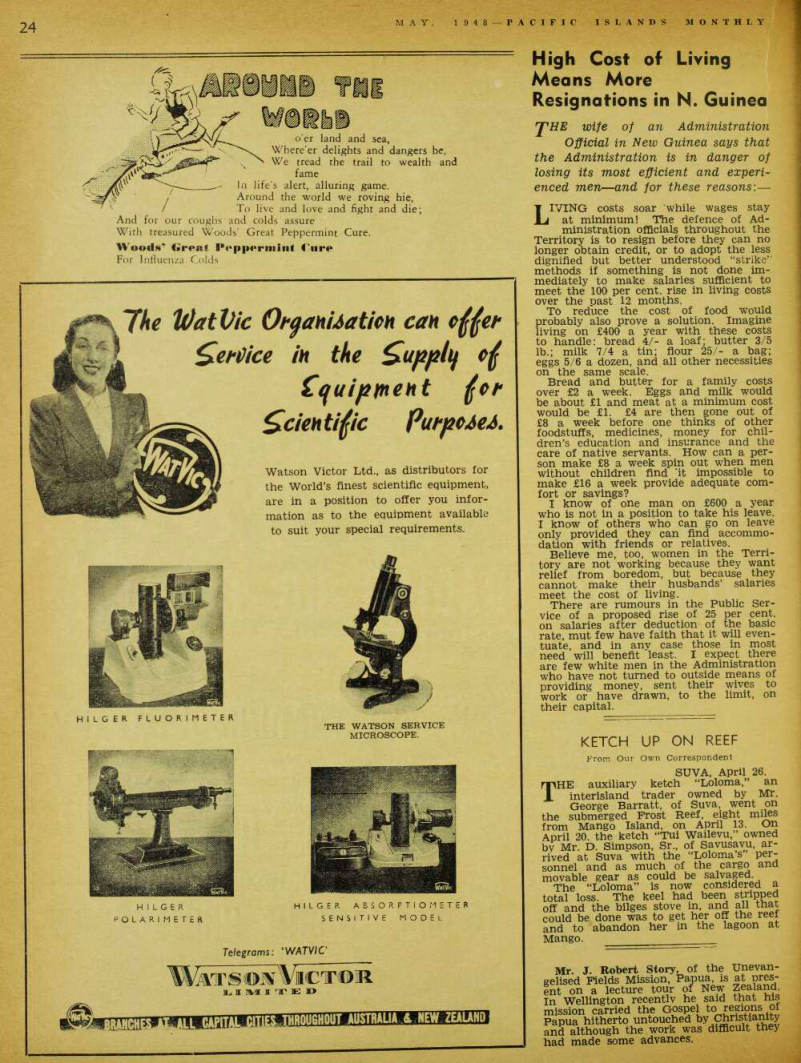
Means More Resignations in N. Guinea
*JpHE wife of an Administration
Official in New Guinea says that the Administration is in danger of
losing its most efficient and experi
enced men—and for these reasons : LIVING costs soar while wages stay at minimum! The defence of Ad ministration officials throughout the Territory is to resign before they can no longer obtain credit, or to adopt the less dignified but better understood “strike” methods if something is not done im mediately to make salaries sufficient to meet the 100 per cent, rise in living costs over the past 12 months.
To reduce the cost of food would probably also prove a solution. Imagine living on £4OO a year with these costs to handle; bread 4/- a loaf; butter 3/5 lb.; milk 7/4 a tin; flour 25/- a bag; eggs 5/6 a dozen, and all other necessities on the same scale.
Bread and butter for a family costs over £2 a week. Eggs and milk would be about £1 and meat at a minimum cost would be £l, £4 are then gone out of £8 a week before one thinks of other foodstuffs, medicines, money for chil dren’s education and insurance and the care of native servants. How can a per son make £8 a week spin out when men without children find 'it impossible to make £l6 a week provide adequate com fort or savings?
I know of one man on £6OO a year who is not in a position to take his leave.
I know of others who can go on leave only provided they can find accommo dation with friends or relatives.
Believe me, too, women in the Terri tory are not working because they want relief from boredom, but because they cannot make their husbands’ salaries meet the cost of living.
There are rumours in the Public Ser vice of a proposed rise of 25 per cent, on salaries after deduction of the basic rate, mut few have faith that it will even tuate, and in anv case those in most need will benefit least. I expect there are few white men in the Administration who have not turned to outside means of providing money, sent their wives to work or have drawn, to the limit, on their capital.
Ketch Up On Reef
From Our Own Correspondent SUVA, April 26.
THE auxiliary ketch “Loloma,” an interisland trader owned by Mr, George Barratt, of Suva, went on the submerged Frost Reef, eight miles from Mango Island, on April 13. On April 20. the ketch “Tui Wailevu,” owned by Mr. D. Simpson, Sr., of Savusavu, ar rived at Suva with the “Loloma’s P er “ sonnel and as much of the cargo and movable gear as could be salvaged.
The “Loloma” is now considered a total loss. The keel had been stripped off and the bilges stove in, and all that could be done was to get her off the reef and to abandon her in the lagoon at Mango.
Mr. J. Robert Story, of the Unevan gelised Fields Mission, Papua, is at pres ent on a lecture tour of New Zealand.
In Wellington recently he said that his mission carried the Gospel to regions of Papua hitherto untouched by and although the work was difficult they had made some advances.
Progress on Nauru and
Ocean Island Cantilever Near Completion
ACCORDING to Sir Albert Ellis, New Zealand’s full requirements of phos phate should be met this year from Nauru and Ocean Island.
In the “New Zealand Herald” in mid April he said that the giant cantilever at Nauru, which was destroyed by the German raider in 1940, and suffered again at the hands of the Japanese, would soon be completed and that it would then be able to load a 10,000-tons ship in one day.
Since the island was reoccupied and the phosphate workings reopened, about two years ago, all loading of ships has had to be done by lighters—a slow process, with Nauru’s lack of harbour facilities.
The usual delays of the post-war period have held up the work of reconstructing the cantilever but the first arm will be in operation soon. This will be used to fill phosphatic rock into one hold of a load ing ship. The ship will then be moved at her moorings to bring another hold directly beneath the cantilever. When the two arms of the cantilever are com plete however, both holds will be loaded simultaneously.
Sir Albert will visit both Nauru and Ocean Island in July. He reports that operations on Ocean Island are also pro gressing satisfactorily.
“Levuka” Becomes “Triadic”
The 7,000 ton, former Carpenter ship “Levuka,” will be handed over to the BPC shortly and will serve in the Australa sian-phosphate island trade as the “Tri adic.” The original “Triadic” was one of the three BPC ships sunk off Nauru in 1940. The “Trienza” was the only one
of the four ships of the line to escape on that occasion. A new “TTiona” was built in Glasgow in 1943, but so far there is mo new “Triaster.”
Queen Salute's Return To
Tonga
From Our Own Correspondent
Nukualofa, April 6.
WHEN the inter-island motor vessel “Matua” steamed up the harbour early this morning, the Royal Stan dard of Tonga was flying from her mast.
Queen Salote was on board as a passenger from New Zealand, where she had been on a health trip since last November.
A large crowd assembled at the water front to welcome their Queen. Crown Prince Tupouto’a-Tungi and Prince Tu’i Pelehake, with the Premier and Minister of the Crown, went to the wharf, where a guard of honour was provided by the Royal Guards and the Government Col lege band. A royal salute of 21 guns greeted the Queen when she stepped off the ship’s gangway to the wharf and the band struck up the Tongan national an them.
After the official welcome, the Queen drove from the wharf to the Palace through enthusiastic crowds and students from the various colleges and schools who flanked both sides of the royal route from the pier to the Palace gates.
Girl students showered the royal car with flower posies.
Judging from the Queen's appearance, the long rest had been of great benefit to her.
American fountain pens (nothing special) averaged £6 each at a Suva sale of Customs seized goods on April 10, and an unspectacular pen-and-pencil set went at £l2. Women’s wristlet watches were £lO and up.
Advertisements & other items, pp. 27-28 (1 item)
Venturi Trading Co. Pty. Ltd.
"ISLAND LIFE"
Official organ of the S.S.l.C.C.—Calling Collectors, Correspondents and Penfriends throughout the South Sea Islands. Over 1,000 members. Write for your free copy and particulars to —
SOUTH SEA ISLANDS CORRESPOND-
ENCE CLUB.
NATUVU, FIJI.
The Twinkle in
Your Eye •
COMES FROM ACTIVE
DIGESTION
Good normal digestive and liver activity means good, normal health and fitness. If you are becoming gloomy and feel tired out, the cause may be a congested state of your intestinal tract. So many people are troubled with constipation, which, through the retention of waste In the digestive system, causes sick headache, biliousness, pimply skin, unpleasant breath, irritability, slackness and dull eyes.
Regain your bright and attractive appearance by banishing constipation with Plnkettes. Tiny, perfectly harmless, gentle yet effective, these famous laxative and liver pills painlessly exercise and strengthen the bowels, keep the food tract clean and active, stir the liver, and thus banish sick headache, bilious attacks, pimples, unpleasant breath and gloom. All chemists and stores sell Pinkettes, the perfect laxative and liver pills.
VENTURI TRADING CO. PTY. LTD.
26 BRIDGE ST., SYDNEY
Cables: Ventura Sydney
Island Merchants, General Suppliers
and Transhipment Agents
Offer for immediate delivery
TROPICPROOF PAINTS, ENAMES, LACQUERS AND VARNISHES
for Interior—Exterior—Roofing—Automobiles and Marine uses.
GENERAL ISLAND SUPPLIES
Inquiries to our Sydney Office or to:
HENRY G. EEKHOFF, La©
Our Agents for Papua and the Mainland of New Guinea.
P. & R. HUTCHINSON
THOMSON ST., SUVA
Our Agents for Fiji, Tonga, and Samoa.
GILBERT RENTON. Esq.
RABAUL
Our Rabaul Agent.
Gilbert Renton
AUCTIONEER, VALUER,
ESTATE AGENT.
Storage and Repository Travellers Sample Rooms For General In-formation and Service.
P.O. Box Rabaul, TNG
Join the Share-the-Road League and put the League Badge on your car window. It establishes you as a courteous and careful driver—it is the hall-mark of the unselfish motorist. Membership of the League is now open.
If half a million Australians join, the roads will be safer —lives will be saved. The three flags are the nautical signal for “I am giving way/’ To the motorist they say, “I share the road.” It’s the simple creed of courtesy and unselfishness—a creed which you probably observe even now. Tell the whole world awheel that you can be relied
on AT THE WHEEL.
JOOC3 'O’Cfltl
SHARE-THE-ROAD
mmaani
which stands for SANE. SAFE DRIVING
HOW TO JOIN.
Membership is free. You can join at garages and service stations, or at your nearest Shell Office, Depot or Agency. You will receive your membership card, and the “flag” badge, as shown above, but in full colours, for sticking on your car window.
For Safety’s sake
SHELL MOTOR OIL
Self-Government
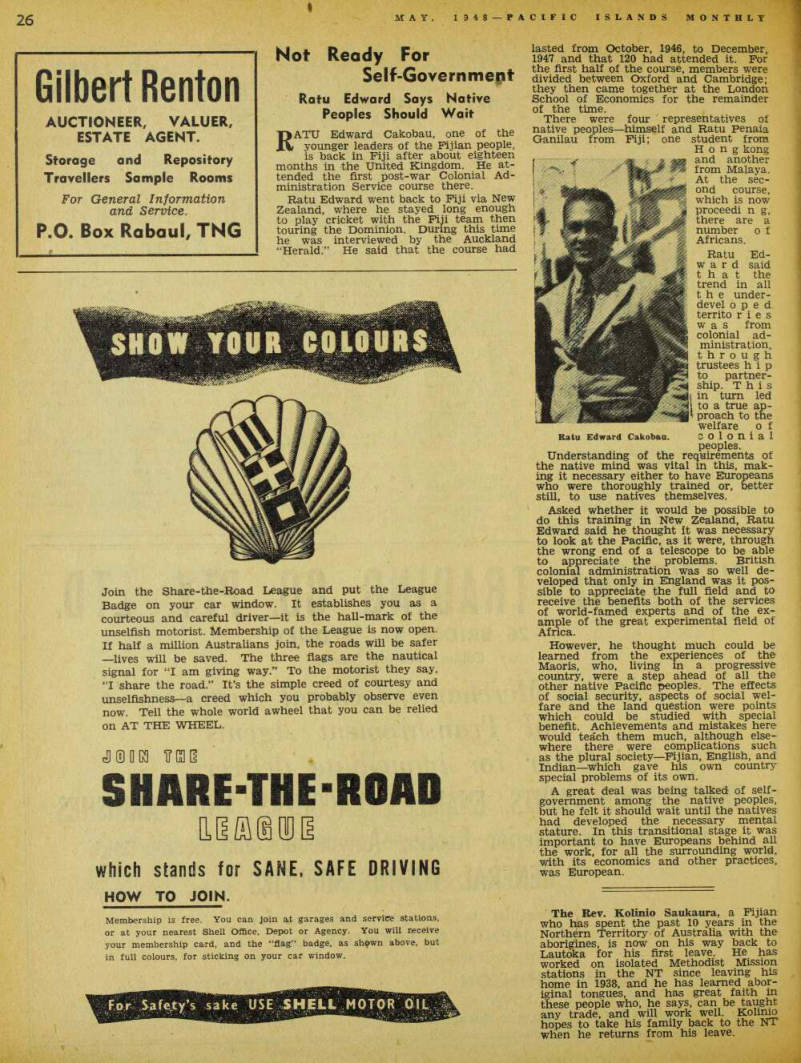
Not Ready For Self-Government Ratu Edward Says Native Peoples Should Wait
RATU Edward Cakobau, one of the younger leaders of the Fijian people, is back in Fiji after about eighteen months in the United Kingdom. He at tended the first post-war Colonial Ad ministration Service course there.
Ratu Edward went back to Fiji via New Zealand, where he stayed long enough to play cricket with the Fiji team then touring the Dominion. During this time he was interviewed by the Auckland “Herald.” He said that the course had
lasted from October, 1946, to December, 1947 and that 120 had attended it. For the first half of the course, members were divided between Oxford and Cambridge; they then came together at the London School of Economics for the remainder of the time.
There were four representatives of native peoples—himself and Ratu penaia Ganilau from Fiji; one student from
Hong kong and another from Malaya.
At the sec ond course, which is now proceedi n g, there are a number o f Africans.
Ratu Ed w a r d said that the trend in all the under devel oped territories was from colonial ad ministration, through trustees hip to partner ship. This in turn led to a true ap proach to the welfare o f colonial peoples.
Understanding of the requirements of the native mind was vital in this, mak ing it necessary either to have Europeans who were thoroughly trained or, better still, to use natives themselves.
Asked whether it would be possible to do this training in New Zealand, Ratu Edward said he thought it was necessary to look at the Pacific, as it were, through the wrong end of a telescope to be able to appreciate the problems. British colonial administration was so well de veloped that only in England was it pos sible to appreciate the full field and to receive the benefits both of the services of world-famed experts and of the ex ample of the great experimental field of Africa.
However, he thought much could be learned from the experiences of the Maoris, who, living in a progressive country, were a step ahead of all the other native Pacific peoples. The effects of social security, aspects of social wel fare and the land question were points which could be studied with special benefit. Achievements and mistakes here would teach them much, although else where there were complications such as the plural society—Fijian, English, and Indian —which gave his own country special problems of its own, A great deal was being talked of self government among the native peoples, but he felt it should wait until the natives had developed the necessary mental stature. In this transitional stage it was important to have Europeans behind all the work, for all the surrounding world, with its economics and other practices, was European.
The Rev. Kolinio Saukaura, a Fijian who has spent the past 10 years in the Northern Territory of Australia with the aborigines, is now on his way back to Lautoka for his first leave. He has worked on isolated Methodist Mission stations in the NT since leaving his home in 1938, and he has learned abor iginal tongues, and has great faith in these people who, he says, can be taught any trade, and will work well. Kolinio hopes to take his family back to the NT when he returns from his leave.
Ratu Edward Cakobau.
Advertisements & other items, p. 29 (1 item)
Tilley Lamps
BURN ORDINARY KEROSENE
The Modern Form of PORTABLE LIGHTING
use
/ : m rat THE OWL IS PROVERBIALLY A WISE BIRD, SO BE SURE YOU FOLLOW HIS EXAMPLE! TILLEY LAMPS ARE SO SUCCESSFUL THAT COPIES OF THEM ARE BEING MARKETED. TILLEY LAMPS ARE MADE ONLY IN ENGLAND
THPI TILLEY LAMPnCO.'LTD.,*of£ENGLAND
REPRESENTATION :
MELBOURNE : T. H. Bentley, Pty. Ltd., 123-125 William Street, Melbourne. Cl.
TASMANIA : Mr. C. Sellars, IoBa Charles Street, Launceston.
FIJI ; Mr. K. Witherington, 2 Burns Philp Buildings, Suva.
Pre-Ed-Wardian Days
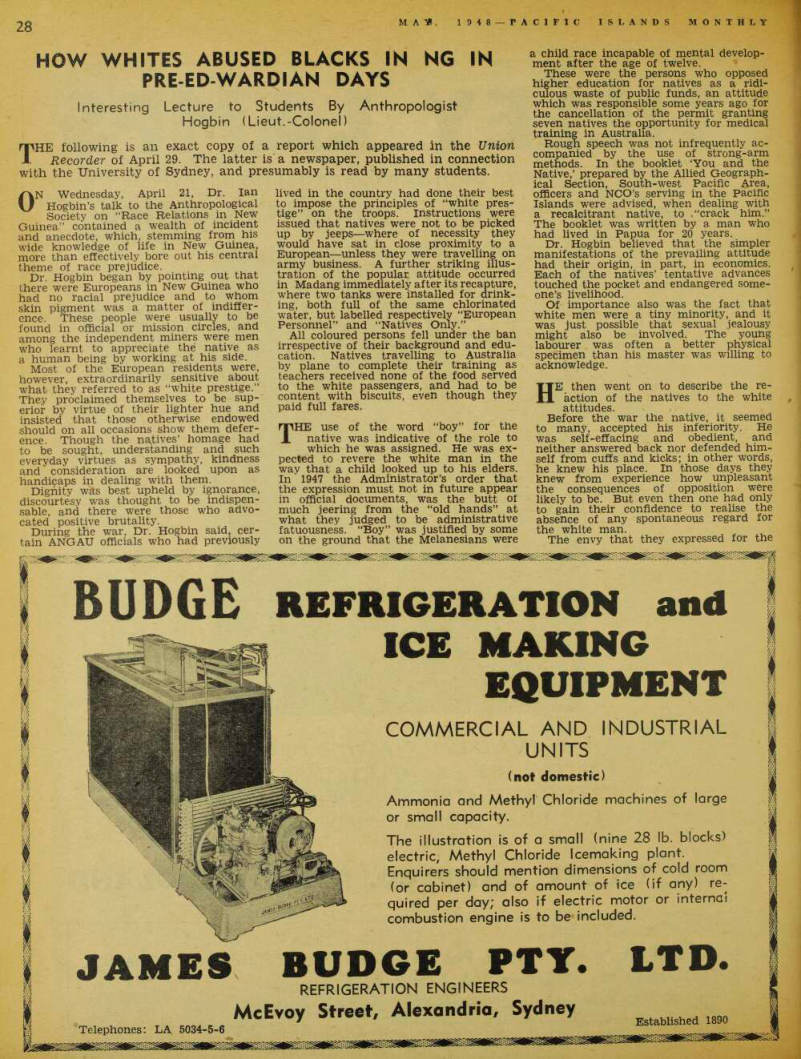
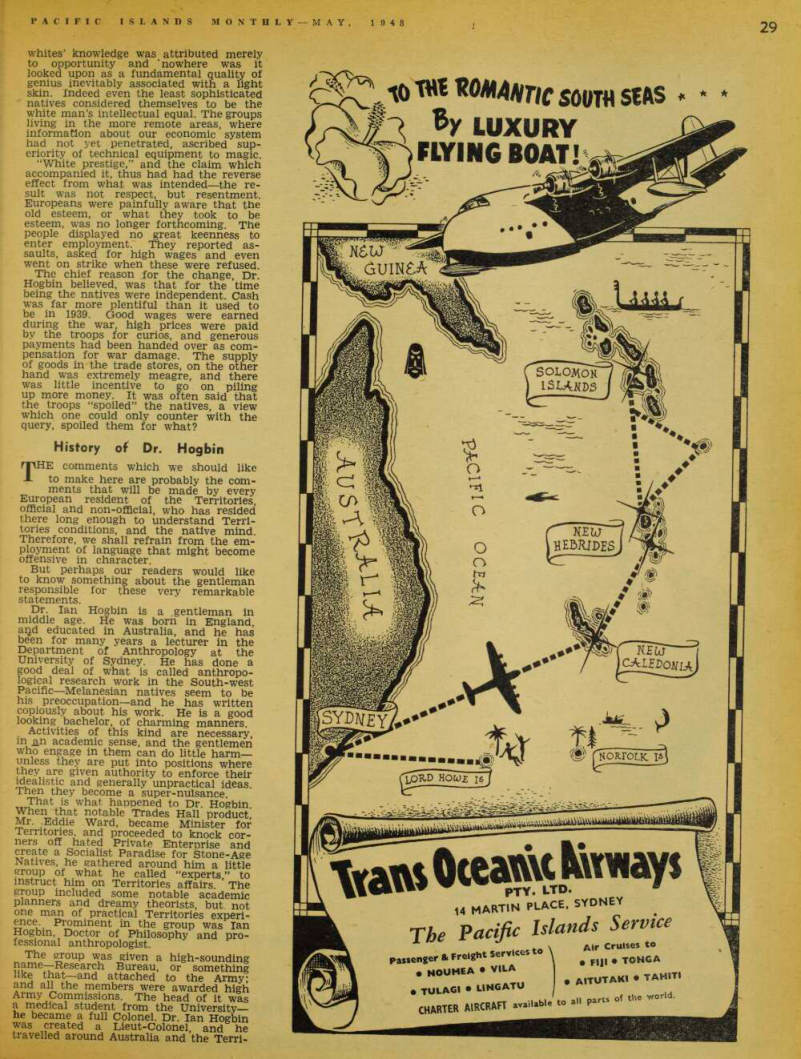
HOW WHITES ABUSED BLACKS IN NG IN
Interesting Lecture to Students By Anthropologist Hogbin (Lieut.-Colonel)
THE following is an exact copy of a report which appeared in the Union Recorder of April 29. The latter is a newspaper, published in connection with the University of Sydney, and presumably is read by many students.
ON Wednesday, April 21, Dr. lan Hogbin’s talk to the Anthropplogical Society on “Race Relations in New Guinea” contained a wealth of incident and anecdote, which, stemming from his wide knowledge of life in New Guinea, more than effectively bore out his central theme of race prejudice.
Dr. Hogbin began by pointing out that there were Europeans in New Guinea who had no racial prejudice and to whom skin pigment was a matter of indiffer ence. These people were usually to be found in official or mission circles, and among the independent miners were men who learnt to appreciate the native as a human being by working at his side.
Most of the European residents were, however, extraordinarily sensitive about what they referred to as “white prestige,”
They proclaimed themselves to be sup erior by virtue of their lighter hue and insisted that those otherwise endowed should on all occasions show them defer ence. Though the natives’ homage had to be sought, understanding and such everyday virtues as sympathy, kindness and consideration are looked upon as handicaps in dealing with them.
Dignity was best upheld by ignorance, discourtesy was thought to be indispen sable, and there were those who advo cated positive brutality.
During the war, Dr. Hogbin said, cer tain ANGAU officials who had previously
lived in the country had done their best to impose the principles of “white pres tige” on the troops. Instructions were issued that natives were not to be picked up by jeeps—where of necessity they would have sat in close proximity to a European—unless they were travelling on army business. A further striking illus tration of the popular attitude occurred in Madang immediately after its recapture, where two tanks were installed for drink ing, both full of the same chlorinated water, but labelled respectively “European Personnel” and “Natives Only.”
All coloured persons fell under the ban irrespective of their background and edu cation. Natives travelling to Australia by plane to complete their training as teachers received none of the food served to the white passengers, and had to be content with biscuits, even though they paid full fares.
THE use of the word “boy” for the native was indicative of the role to which he was assigned. He was ex pected to revere the white man in the way that a child looked up to his elders.
In 1947 the Administrator’s order that the expression must not in future appear in official documents, was the butt of much jeering from the “old hands” at what they judged to be administrative fatuousness. “Boy” was justified by some on the ground that the Melanesians were
a child race incapable of mental develop ment after the age of twelve.
These were the persons who opposed higher education for natives as a ridi culous waste of public funds, an attitude which was responsible some years ago for the cancellation of the permit granting seven natives the opportunity for medical training in Australia.
Rough speech was not infrequently ac companied by the use of strong-arm methods. In the booklet ‘You and the Native,’ prepared by the Allied Geograph ical Section, South-west Pacific Area, officers and NCO’s serving in the Pacific Islands were advised, when dealing with a recalcitrant native, to .“crack him.”
The booklet was written by a man who had lived in Papua for 20 years.
Dr. Hogbin believed that the simpler manifestations of the prevailing attitude had their origin, in part, in economics.
Each of the natives’ tentative advances touched the pocket and endangered some one’s livelihood.
Of importance also was the fact that white men were a tiny minority, and it was just possible that sexual jealousy might also be involved. The young labourer was often a better physical specimen than his master was willing to acknowledge.
HE then went on to describe the re action of the natives to the white attitudes.
Before the war the native, it seemed to many, accepted his inferiority. He was self-effacing and obedient, and neither answered back nor defended him self from cuffs and kicks; in other words, he knew his place. In those days they knew from experience how unpleasant the consequences of opposition were likely to be. But even then one had only to gain their confidence to realise the absence of any spontaneous regard for the white man.
The envy that they expressed for the
whites’ knowledge was attributed merely to opportunity and 'nowhere was it looked upon as a fundamental quality of genius inevitably associated with a light skin. Indeed even the least sophisticated natives considered themselves to be the white man’s intellectual equal. The groups living in the more remote areas, where information about our economic system had not yet penetrated, ascribed sup eriority of technical equipment to magic.
“White prestige,” and the claim which accompanied it, thus had had the reverse effect from what was intended—the re sult was not respect, but resentment.
Europeans were painfully aware that the old esteem, or what they took to be esteem, was no longer forthcoming. The people displayed no great keenness to enter employment. They reported as saults, asked for high wages and even went on strike when these were refused.
The chief reason for the change, Dr.
Hogbin believed, was that for the time being the natives were independent. Cash was far more plentiful than it used to be in 1939. Good wages were earned during the war, high prices were paid by the troops for curios, and generous payments had been handed over as com pensation for war damage. The supply of goods in the trade stores, on the other hand was extremely meagre, and there was little incentive to go on piling up more money. It was often said that the troops “spoiled” the natives, a view which one could only counter with the query, spoiled them for what?
History of Dr. Hogbin
THE comments which we should like to make here are probably the com ments that will be made by every European resident of the Territories, official and non-official, who has resided there long enough to understand Terri tories conditions, and the native mind.
Therefore, we shall refrain from the em ployment of language that might become offensive in character.
But perhaps our readers would like to know something about the gentleman responsible for tnese very remarkable statements.
Dr. lan Hogbin is a .gentleman in middle age. He was born in England, ai}d educated in Australia, and he has been for many years a lecturer in the Department of Anthropology at the University of Sydney. He has done a good deal of what is called anthropo logical research work in the South-west Pacific—Melanesian natives seem to be his preoccupation—and he has written copipusly about his work. He is a good looking bachelor, of charming manners.
Activities of this kind are necessary, m an academic sense, and the gentlemen who engage in them can do little harm— unless they are put into positions where they are given authority to enforce their idealistic and generally unpractical ideas Then they become a super-nuisance. „r? hat , is what happened to Dr. Hogbin When that notable Trades Hall product, Mr. Eddie Ward, became Minister for Territories and proceeded to knock cor ners off hated Private Enterprise and create a Socialist Paradise for Stone-Age Natives he gathered around him a little croup of what he called “experts,” to instruct him on Territories affairs. The group included some notable academic planners and dreamy theorists, but not one man of practical Territories experi ence Prominent in the group was lan Hogbin, Doctor of Philosophy and pro fessional anthropologist.
The group was given a high-sounding v? me :T R L esearch Bureau, or something hke that—and attached to the Army; and all the members were awarded high Army Commissions. The head of it was a medical student from the University— he became a full Colonel. Dr. lan Hogbin was created a Lieut-Colonel, and he travelled around Australia and the Terri
tories, fully apparelled as a Lieutenant- Colonel and doubtless enjoying the usual pay and privileges of a battalion-commander He was never a combatant officer, in any shape or form, and it is ridiculous that a mere anthropological investigator should have had that' rank and uniform- yet he now doubtless wears a returned soldier’s badge, and he certainly is described in “Who’s Who” as having served in the AIF. He is legally entitled to all these things, having been selected for favour bv the Canberra Socialists; but that does not prevent old Territorians from being exceedingly bitter on the subject of “Lieut.-Colonel” Hogbin.
Thev will not feel any better after reading the above report!
After the war, Dr. Hogbin apparently remained in the highest councils of the Territories Administration. Not long ago, he travelled around Eastern Papua on the “Laurabada” with the Administrator, but few COUld describe his status, or say why he was there.
THIS journal always has expressed the belief that there was nothing wrong with Australia’s treatment of the New Guinea natives prior to 1940—that the native policy, measured in terms of native progress by decades, was sound and justified. Appoint probably had been reached in 1940 when it was desirable that the native nolicv be reviewed, to see if (a) n^e Ve Territory’s rich 1 revenues could not be more advantageously used for native welfare and (b) whether the svstem of indentured labour could not be more closely tied in with plans for technical training of natives.
That was an evolutionary move, and it wuKftTSTffl was no tetiSton whatever for the madheaded invasion of the New Guinea administration by Messrs. Evatt and Ward,
on the grounds that the natives had been enslaved, and the European companies guilty of ruthless exploitation. That move had its origin in Socialist politics.
It was undertaken by Australian Socialist interests eager to develop a political advantage, irrespective of truth; it was forwarded by Mr. Eddie Ward, as a matter of lifelong habit and as an out come of his psychopathic hates; and it has been eagerly supported by Lieut- Colonel lan Hogbin, Doctor of Philosophy and professional anthropologist, and various Pink Planners who have contri buted so much lately to world chaos.
Judging by the pernicious stuff in “Union Recorder,” Dr. lan Hogbin is still carrying on his work for Mr. Eddie Ward.
Advertisements & other items, pp. 30-32 (1 item)
Budge
REFRIGERATION and
ICE MAKING
EQUIPMENT
COMMERCIAL AND INDUSTRIAL
UNITS
(not domestic) Ammonia and Methyl Chloride machines of large or small capacity.
The illustration is of a small (nine 28 lb. blocks) electric, Methyl Chloride Icemaking plant.
Enquirers should mention dimensions of cold room (or cabinet) and of amount of ice (if any) required per day; also if electric motor or internal combustion engine is to be included.
JAMES BUDGE PTT. LTD.
REFRIGERATION ENGINEERS
McEvoy Street, Alexandria, Sydney
S 5 Telephones: LA 5034-5-6 Established 1890
WMANTIC SOUTH SEAS . •
LUXURY
FLYING BOAT!
£i; 3 pw -, t .
f N£U ;
GUINEA
\ AAXI f
SOLO^OK
iSUjfDS
NEU
Hebrides ==} i>3 / m
KEU
CJcLEDOMIA
fi Jus.
LORD HOW£ J 6
£ (I
iS? [ NORFOLK I*
si
,4 MARTIN PLACE. SYDNEY
The Pacific Islands Senna
& Freight Services to Passenger
• NOUMEA • VILA
• TULACI • LINGATU
CHARTER AIRCRAFT available to all parts Air Cruises to • Fiji • TONGA
o AITUTAKI • TAHITI
of the world.
m v
BUTTERFLIES
and the Larger Moths
WANTED
From all sections of the Pacific Islands.
Will pay not less than: $5.00 per hundred for common attractive Butterflies. $7.50 to $50.00 and more per 100 for extra showy, large Butterflies and large Moths.
Collectors or Missionaries who can supply us, please get in touch with us. Will pay for sample selection, and advance money to good collectors.
MUST BE PERFECT FIRST
QUALIT.Y ONLY.
Butterfly World Supply House,
289 East 98th Street,
Brooklyn, 12,
New York, U.S.A.
Gn m m m Snug Waterproofs, Thigh, Knee and Ankle Boots for wet weather wear in styles and sizes for men, women and children.
ALL THE YEAR ROUND
Dunlop Footwear is designed to relieve the jolts and fatigue of hard work and long wear and will be available soon in an extensive range of sizes and styles to suit every member of the family. „ , Genuine Dunlop Kromhyd Soles guaranteed to out- Sport and Sandshoes for every W^ ar tW ° leat^er recreational occasion, so es.
Rubber heels for comfort and economy.
DUNLOP
D-44*
Fijians Want More Say
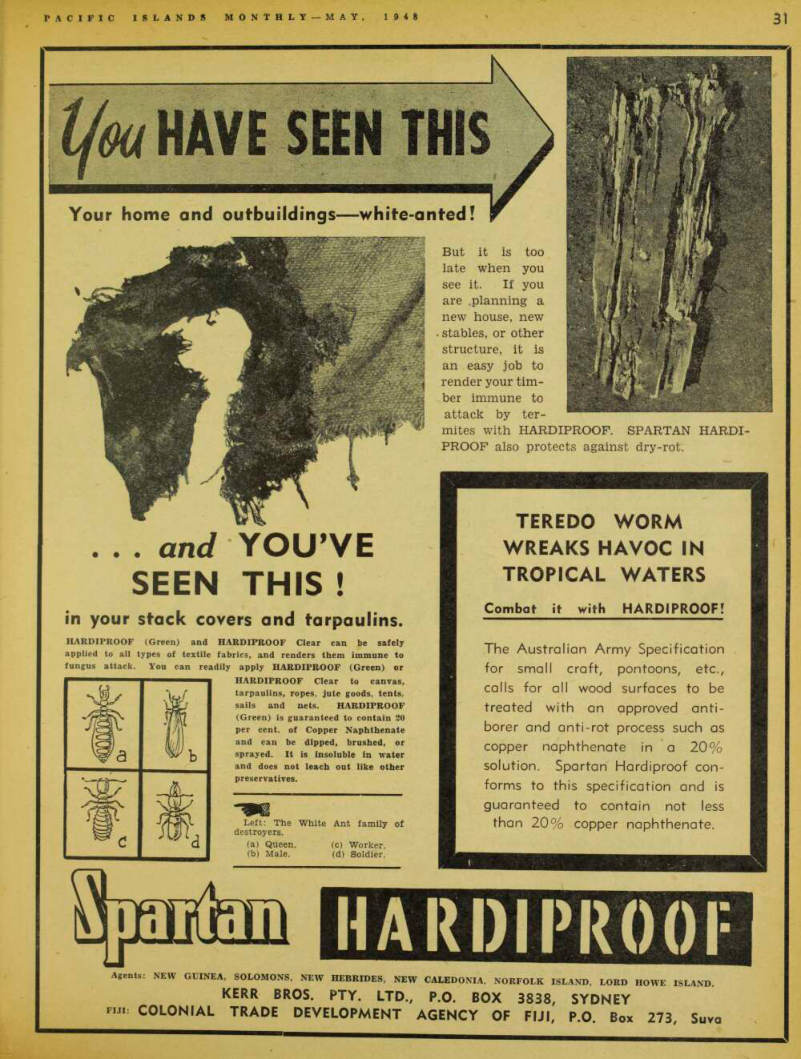
In Rugby Control
From Our Own Correspondent SUVA, April 9.
SIGNS of the times appeared at a meet ing of the Suva Rugby Union this week when, according to the con stitution, four European and two Fijian members were elected to the management committee.
In view of the fact that Rugby in Fiji is overwhelmingly Fijian as far as num bers are concerned, it was not surprising that Ravuama Vunivalu (first Morris, Hedstrom Scholarship winner, recently returned from New Zealand) raised the question of representation and suggested that four Fijians and two Europeans on the committee would be more in order.
The president (Mr. Alport Barker) said that the union realised the necessity for a revision of the constitution, and that he would bring Ravuama’s proposal be fore the new management committee.
Sister Edith Bromhall, who has been with the Anglican Mission in New Guinea for three years, was staying with her parents at Redcliffe, Queensland in April,
Advertisements & other items, pp. 33-34 (1 item)
...and YOU’VE
Your home and outbuildings—white-anted!
09^ mm
SEEN THIS !
in your stack covers and tarpaulins.
HARDIPROOF (Green) and HARDIPROOF Clear can be safely applied to all types of textile fabrics, and renders them immune to fungus attack. You can readily apply HARDIPROOF (Green) or
HARDIPROOF
Clear to canvas, tarpaulins, ropes, jute goods, tents, sails and nets. HARDIPROOF (Green) is guaranteed to contain 20 per cent, of Copper Naphthenate and can be dipped, brushed, or sprayed. It is insoluble in water and does not leach out like other preservatives.
Left: The White Ant family of destroyers. (a) Queen. (c) Worker. (b) Male. (d) Soldier.
But it is too late when you see it. If you are .planning a new house, new H • stables, or other structure, it is an easy job to render your timber immune to attack by ter-
mites with HARDIPROOF. SPARTAN HARDI-
PROOF also protects against dry-rot.
TEREDO WORM
WREAKS HAVOC IN
TROPICAL WATERS
Combat it with HARDIPROOF!
The Australian Army Specification
for small craft, pontoons, etc.,
calls for all wood surfaces to be treated with an approved antiborer and anti-rot process such as copper naphthenate in a 20%
solution. Spartan Hardiproof con-
forms to this specification and is guaranteed to contain not less
than 20% copper naphthenate.
Agents: NEW GUINEA, SOLOMONS, NEW HEBRIDES, NEW CALEDONIA, NORFOLK ISLAND, LORD HOWE ISLAND.
KERR BROS. PTY. LTD., P.O. BOX 3838, SYDNEY fui: COLONIAL TRADE DEVELOPMENT AGENCY OF FIJI, P.O. Box 273, Suva
American Magazines
Direct to You from the Publishers.
AMERICAN HOME 21/6
CHARM 32/6
COLLIERS’ WEEKLY 43/-
CORONET 18/9
FORTUNE 96/-
GLAMOUR 27/-
HOUSE & GARDEN 42/6
LADIES’ HOME JOURNAL 37/6
LIFE 49/-
LOOK 32/-
McGRAW-HILL DIGEST 31/3
MAGAZINE DIGEST 18/9
NATIONAL GEOGRAPHIC MAGAZINE .. 38/6
POPULAR MECHANICS 22/9
POPULAR PHOTOGRAPHY 26/6
READERS’ DIGEST 12/-
SATURDAY EVENING POST 68/9
SCIENTIFIC AMERICAN 40/-
SCIENCE ILLUSTRATED 62/6
TIME 96/-
VOGUE (20 numbers) 105/-
YACHTING 40/-
ESQUIRE 75/-
Rates are for one year and include all charges. Many other overseas
Art, Trade, Technical, Fashion and
Literary periodicals available.
ALL ORDERS AIR-MAILED TO
PUBLISHERS.
MAIL PUBLICITY CO., 175 PITT
STREET, SYDNEY, N.S.W.
N. F. Maloney & Co.
phone 268 PORT MORESBY 'PHONE 268
Cables, Radios, etc.: “Malco,” Port Moresby.
Customs, Shipping and Forwarding Agents
(Boat or Air) : When ordering South, asks and Mark the Packages “PER MALONEY.” the Consignor to ship addressed your Brand or Name This will help us to give Fast and Speedy Delivery.
Licensed Auctioneers and General Commission Agents
We will sell anything you have to offer by Auction or Private Sale.
HOUSE, LAND, AND ESTATE AGENTS CHIEF AGENTS: —
NEW ZEALAND INSURANCE CO. LTD.
FIRE ACCIDENT MOTOR VEHICLE MARINE, ETC.
Importers and Exporters • Manufacturers Representatives • Managing Agents: Papuan Airlines, Limited.
Australian Representatives: E. J. GOUGH Gr CO., 1 BOND STREET, SYDNEY
Suva
"Motna" Incident in Suva Crew "Explains"
THE crew of the Union Company’s motor vessel “Matua” has denied that they threatened in March to black-list Suva and walk off the ship if the Governor (Sir Brian Freeston) were allowed on board. (See April
“Pim”).
The incident occurred on the March voyage of the “Matua” when owing to the infantile paralysis epidemic in New Zealand, no through passengers or crew were permitted ashore from the “Matua” while she was in Suva. Queen Salote of Tonga was on. board and Fiji’s Gov ernor, armed with the necessary permits from the local Health Department, pro posed to pay her a visit. (Sir Brian said later that he intended to report to the health authorities every day after his visit to the ship for as long as they required.) The crew of the “Matua” were alleged, however, to have informed the caotain of the ship that if Sir Brian came bn board then they would leave the shio may go ashore, and that Fiji shipping would be completely dis organised.
The crew now says:— “The crew of the “Matua” emphati cally denies any suggestion that the port of Suva should be declared ‘black.’
“The crew’s action was based entirely on the fact that whether the Governor had the requisite medical certificate or not, he was boarding a vessel that in every sense of the word should be quarantined.
“Far from being the cause of con tinued hold-ups the crew is only too willing to co-operate in the prevention of sickness provided those in authority do the same.”
Immediately after the incident, the members of the crew who had signed the statement forwarded to Queen Salote a telegram apologising for the cancella tion of the Governor’s visit through their action, and assuring Her Majesty that this was no reflection on her but merely a protest against the continual break ing of quarantine restrictions by the Fiji Government.
Queen Salote accepted the apology.
EDITORIAL NOTE: The crew’s statement simply bears out the correctness of the original report of the “incident.”
Briefly, it means that the crew of the “Matua,” in its wisdom, saw fit to over ride local Health authorities who pre sumably were agreeable to the Governor visiting the ship. The Governor, hav ing visited the ship, was prepared to place himself in the same position as passengers disembarking at Suva, who must report regularly to the Health Authority. Since when did crews of trad ing ships become competent to decide the merits of cases like this?
Proposed Rise In Fiji
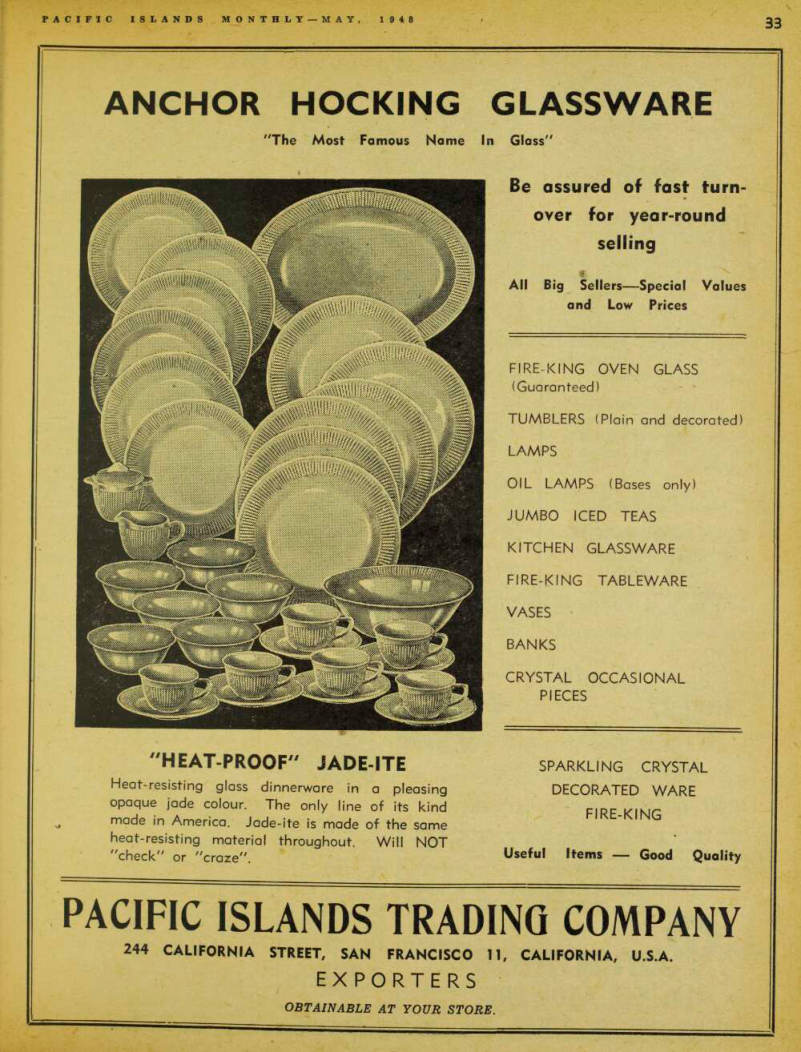
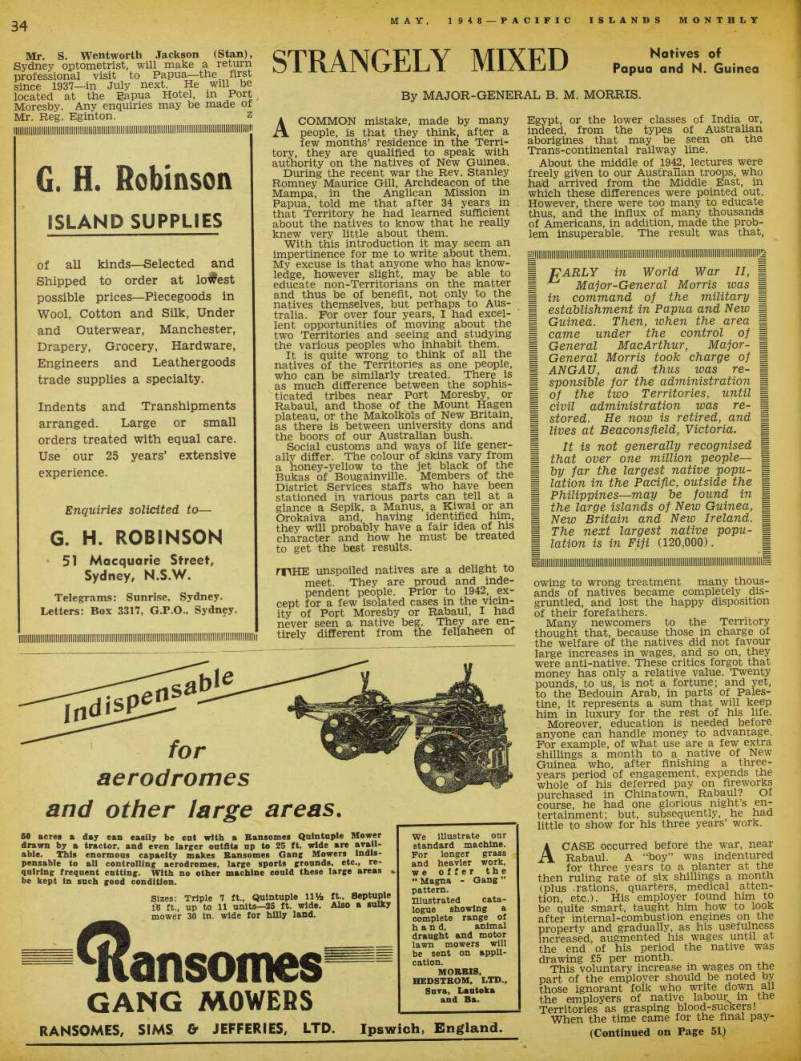
Civil Service Pay
From Our Own Correspondent SUVA, April 20.
IT is rumoured that the Fiji Govern ment is dallying with the idea of a 10 per cent, boost in Civil service salaries Meanwhile the cost of living is still climbing majestically; price control is working effectively only up to a point (but even controlled prices rise almost continuously in the face of overseas pressure); the prices of uncontrolled es sentials are out of sight when compared with the pre-war level; and one of the economic effects of the shelving of Fiji’s Ten-Year Plan is that there have been scores of Public Works dismissals.
Mr. S. Wentworth Jackson (Stan), Sydney optometrist, will make a return professional visit to Papua—the first since 1937—in July next. He will be located at the Papua Hotel, in Port Moresby. Any enquiries may be made of Mr. Reg. Eginton. z
Advertisements & other items, pp. 35-36 (1 item)
Pacific Islands Trading Company
ANCHOR HOCKING GLASSWARE
"The Most Famous Name In Glass"
Be assured of fast turn-
over for year-round
selling
All Big Sellers—Special Values and Low Prices
FIRE-KING OVEN GLASS
(Guaranteed) TUMBLERS (Plain and decorated)
LAMPS
OIL LAMPS (Bases only)
JUMBO ICED TEAS
KITCHEN GLASSWARE
FIRE-KING TABLEWARE
VASES
BANKS
CRYSTAL OCCASIONAL
PIECES
m
"HEAT-PROOF" JADE-ITE
Heat-resisting glass dinnerwore in a pleasing opaque jade colour. The only line of its kind made in America. Jade-ite is made of the same heat-resisting material throughout. Will NOT "check" or "craze".
SPARKLING CRYSTAL
DECORATED WARE
FIRE-KING
Useful Items Good Quality
PACIFIC ISLANDS TRADING COMPANY
244 CALIFORNIA STREET, SAN FRANCISCO 11, CALIFORNIA, U.S.A.
EXPORTERS
OBTAINABLE AT YOUR STORE.
G. H. Robinson
ISLAND SUPPLIES
of all kinds—Selected and Shipped to order at lowest possible prices—Piecegoods in Wool, Cotton and Silk, Under and Outerwear, Manchester, Drapery, Grocery, Hardware, Engineers and Leathergoods trade supplies a specialty.
Indents and Transhipments arranged. Large or small orders treated with equal care.
Use our 25 years’ extensive experience.
Enquiries solicited to —
G. H. ROBINSON
51 Macquarie Street, Sydney, N.S.W.
Telegrams: Sunrise, Sydney.
Letters: Box 3317, G.P.0.. Sydney.
aerodromes
and other large .
SO acres a day can easily be cut with a Eansomes Quintuple Mower drawn by a tractor, and even larger outfits up to 25 ft. wide are available. Tills enormous capacity makes Bansomes Gang Mowers Indispensable to all controlling aerodromes, large sports grounds, etc., requiring frequent cutting. With no other machine could these large areas be kept in such good condition.
Sizes: Triple 7 ft., Quintuple 11% ft.. Septuple iB ft., up to 11 units—2s ft. wide. Also a sulky mower 30 in. wide for hilly land.
Qansomes
GANG MOVERS
RANSOMES, SIMS 6* JEFFERIES, LTD. Ipswich, England.
We Illustrate our standard machine.
For longer grass and heavier work, we offer the “Magna - Gang” pattern.
Illustrated catalogue showing a complete range of hand, animal draught and motor lawn mowers will be sent on application.
MORRIS,
HEDSTBOM, LTD.,
Suva, Lautoka and Ba.
Strangely Mixed
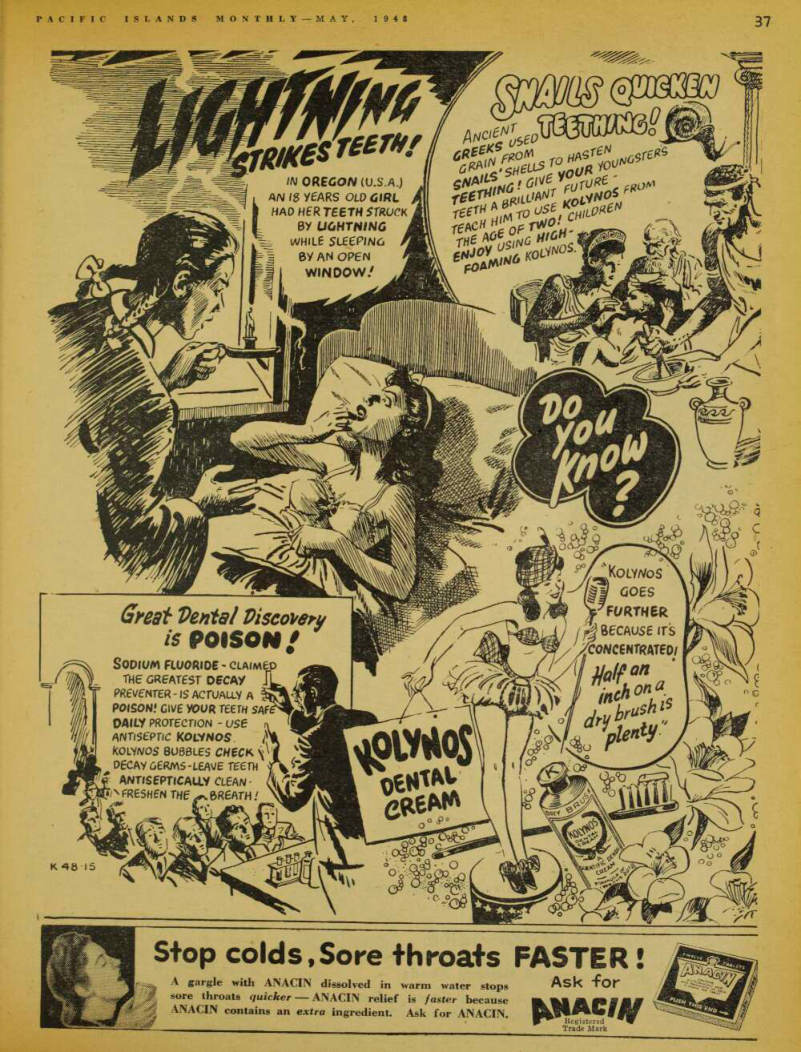
By Major-General B. M. Morris.
Natives of Papua and N. Guinea
A COMMON mistake, made by many people, is that they think, after a few months’ residence in the Terri tory, they are qualified to speak with authority on the natives of New Guinea.
During the recent war the Rev. Stanley Romney Maurice Gill, Archdeacon of the Mampa, in the Anglican Mission in Papua, told me that after 34 years in that Territory he had learned sufficient about the natives to know that he really knew very little about them.
With this introduction it may seem an impertinence for me to write about them.
My excuse is that anyone who has know ledge, however slight, may be able to educate non-Territorians on the matter and thus be of benefit, not only to the natives themselves, but perhaps to Aus tralia. For over four years, I had excel lent opportunities of moving about the two Territories and seeing and studying the various peoples who inhabit them.
It is quite wrong to think of all the natives of the Territories as one people, who can be similarly treated. There is as much difference between the sophis ticated tribes near Port Moresby, or Rabaul, and those of the Mount Hagen plateau, or the Makolkols of New Britain, as there is between university dons and the boors of our Australian bush.
Social customs and ways of life gener ally differ. The colour of skins vary from a honey-yellow to the jet black of the Bukas of Bougainville. Members of the District Services staffs who have been stationed in various parts can tell at a glance a Sepik, a Manus, a Kiwai or an Orokaiva and, having identified him, they will probably have a fair idea of his character and how he must be treated to get the best results. ruHE unspoiled natives are a delight to meet. They are proud and inde pendent people. Prior to 1942, ex cept for a few isolated cases in the vicin ity of Port Moresby or Rabaul, I had never seen a native beg. They are en tirely different from the fellaheen of
Egypt, or the lower classes of India or, indeed, from the types of Australian aborigines that may be seen on the Trans-continental railway line.
About the middle of 1942, lectures were freely giVen to our Australian troops, who had arrived from the Middle East, in which these differences were pointed out.
However, there were too many to educate thus, and the influx of many thousands of Americans, in addition, made the prob lem insuperable. The result was that,
owing to wrong treatment many thous ands of natives became completely dis gruntled, and lost the happy disposition of their forefathers.
Many newcomers to the Territory thought that, because those in charge of the welfare of the natives did not favour large increases in wages, and so on, they were anti-native. These critics forgot that money has only a relative value. Twenty pounds, to us, is not a fortune; and yet, to the Bedouin Arab, in parts of Pales tine, it represents a sum that will keep him in luxury for the rest of his life.
Moreover, education is needed before anyone can handle money to advantage.
For example, of what use are a few extra shillings a month to a native of New Guinea who, after finishing a three years period of engagement, expends the whole of his deferred pay on fireworks purchased in Chinatown, Rabaul? Of course, he had one glorious night’s en tertainment; but, subsequently, he had little to show for his three years’ work.
A CASE occurred before the war, near Rabaul. A “boy” was indentured for three years to a planter at the then ruling rate of six shillings a month (plus .rations, quarters, medical atten tion, etc.). His employer found him to be quite smart, taught him how to look after internal-combustion engines on the property and gradually, as his usefulness increased, augmented his wages until at the end of his period the native was drawing £5 per month.
This voluntary increase in wages on the part of the employer should be noted by those ignorant folk who write down all the employers of native labour in the Territories as grasping blood-suckers!
When the time came for the final pay
(Continued on Page 51)
off the boy was asked if he were returning to his village.
“Nogat, Masta, mi laik wok long Kong.” (No, sir, I’m going to work for a China man.) Now the planter thought that if the boy were going to work for anyone he had a moral, if not a legal, obligation to work for him, as he had taught him all that he knew. So he asked him if he would sign on with him again, if he were to increase his pay to £6 per month.
“Nogat, Masta, mi laik wok long Kong.”
“Well, what about £7/10/-?”
“Nogat mi laik wok along Kong.”
“Well, supposing I offered you £l5 a month?” (although he admitted later that he would not have done so.) “Nogat mi laik wok long Kong.”
So there was nothing further to be said. The boy went off and indentured himself to the Chinaman for three years at the lowest rate of six shillings a month.
The whole incident was told by the planter to a magistrate who decided that he had better look into the matter, as it sounded distinctly fishy. He did so, but the only explanation was that there was another boy from the first native’s own village recently indentured to the China man and “mi laik wok long wantok bo long mi.” (I wanted to work with my mate.) Until natives are taught the worth of money and what they can do with it, what do a few shillings more or less (or pounds, for that matter) mean to them?
Cases like these and others should be known by those people who are arrang ing for the future of the natives. Yet in the debate at Canberra on the “Papua- New Guinea Act” in 1945 the most appal ling ignorance was shown by members on both sides of the House. How can this ignorance be dispelled?
In the first place it is the duty of the responsible Minister to obtain the best advice available before measures affecting the Territories are introduced.
Secondly, in order that all members of the House may be better informed before they cast their votes, a representative in the House itself is an urgent necessity.
There seems no reason why the Terri tories of Papua and New Guinea should not have at least the representation that is accorded to the Northern Territory of Australia.
BUT to return to our native friends.
Anyone who wishes to know all the natives thoroughly is faced with an insuperable language difficulty.
True, in Papua one can get along fairly well with a knowledge of Police-Motu, while in New Guinea Pidgin-English is reasonably widespread. But throughout both Territories there are dozens of lang uages and dialects. This means that the members of one tribe are complete foreigners to those of another who may, geographically, be quite close to them.
As an example, the Poroporena villages around Port Moresby speak true Motu, which is entirely different from the language of Hula, 60 miles to the south east or, again, from that of the Mekeo, about the same distance in the opposite direction.
In Papua, where the use of Pidgin- English has always been discouraged, a lingua franca has been evolved based on Motu. This is known as Police-Motu and has been spread by the members of the Royal Papuan Constabulary and others throughout the Territory. But it is still understood 9nly by those natives who, like the police, have been employed in numbers by Europeans. Except on Gov ernment Stations, few women or chil dren use it.
Much the same difficulty exists in the Territory of New Guinea, except that
here Pidgin-English is employed as the medium of expression between whites and natives.
There is a very important exception to
the use of the accepted lingua franca by Europeans in both Territories. The mem bers of the various missions, being for the most part concentrated in one area,
use the language of the particular tribe amongst whom they work.
In 1945, during a tour of only a couple of weeks, a talk which I gave at various centres in connection with the war situa tion was successively translated to Hula, Mailu, Suau, Police-Motu, Wedau, Binin deli, Pidgin-English, Kiriwinian and Dobu. The translations were variously made by Government officials, mission aries or native interpreters.
While on the subject of language in the Territories it may interest those who have dabbled in Pidgin-English to know that the word for a small boy is not “monkey” but “manki” (or “little man”), while a native woman is not “mary” but “meri.”
And a word introduced into the Terri tories by the troops which is anathema to true Territorians is “boong.” The natives have never been called “boongs,” although one knows that the word is used when re ferring to the Australian aborigines at Darwin.
PROBABLY the greatest curse in the life of the natives is the practice of sorcery. It is very akin to the bone pointing of the Australian blacks. It is widespread throughout the Territories. It is a faith and the natives cannot be argued or laughed out of their belief in it.
If a native is convinced that someone with power has “made poison” against him, to kill him, he will die and nothing can be done about it. If the sorcerer can be killed, of course, his magic will die with him and this fact is the cause of many of the “murders” which come before the District Courts. I must con fess that in many of the cases with which I had to deal my sympathies (privately) were with the “murderer.”
In one case a sorcerer told a native that he had by magic killed his father, mother, brother and wife (they had all undoubtedly died) and that he intended
to kill him and the rest of his relations.
Whait was the native to do? He was convinced that the sorcerer had to be killed in order to save their lives; and he killed him.
Sorcery is a loathsome business. Of course, there is a law against the prac tice. But how does this help in the fol lowing case?
A native was accused of practising sor cery. He was convicted and sentenced to six months’ imprisonment. Later, he re turned to his village and said to those who had given evidence against him; “I told you that I was a sorcerer. The Government said I was a sorcerer and put me in prison for it. Therefore I am a sorcerer.” That is good logic, isn’t it?
At my headquarters, near Rabaul, early in 1946, six natives, including two con stables, slept out in the scrub one wet night rather than sleep in the same hut as a third constable, who was a reputed sorcerer.
My police driver (who had been with white folk for twelve years) told me: “He is a bad man, master, and will poison us.” (Here the pidgin word “poison” means “make magic against”).
As I did not want all my native staff to die of pneumonia (which, of course, they and their friends would have attri buted to the magic!) the only course was to change the last arrival.
The only effective answer to sorcery that I know is deportation from the tribal area: a sorcerer has not much power except among his own people.
Miss Barbara Stephens, daughter of Mr. and Mrs, E. J. Stephens, formerly of Stephens Aviation, Wau, New Guinea, has announced her engagement to Mr.
Reg. Williams, of Greenwood Park, Auburn, South Australia. The Stephens family resides at Spring Grove, Auburn, South Australia.
Advertisements & other items, p. 36 (1 item)
PARLY in World War 11,
■ Major-General Morris was in command of the military establishment in Papua and New Guinea. Then, when the area came under the control of General MacArthur, Major- General Morris took charge of ANGAU, and thus was responsible for the administration of the two Territories, until civil administration was restored. He now is retired, and lives at Beaconsfield, Victoria.
It is not generally recognised that over one million people — by far the largest native population in the Pacific, outside the Philippines—may be found in the large islands of New Guinea, New Britain and New Ireland.
The next largest native population is in Fiji (120,000).
Rev. G. H. Eastman, Obe
, and Mrs.
Eastman, of the London Missionary Society, recently passed through Sydney on their way to England. Mr. and Mrs. Eastman have spent 35 years in the service of the LMS in the Pacific, first in the Cook Islands, and for the past 30 years in the Gilbert Islands, where Mr. Eastman has been Principal of the well-known Rongorongo Training Institution of the LMS.
During the war years Mr. Eastman made some adventurous journeys among the islands during the Japanese invasion, and he and Mrs. Eastman were among the first British residents to return to the Gilberts early in 1944.
During the past nine months Rev. G.
H. Eastman and his wife have been re siding in Suva, where Mr. Eastman has completed the revision of the Bible in the Gilbertese language. This work has been carried out under the aegis of the American Bible Society of New York, who will print the revised version in Gilbertese.
Mr. Eastman has been called home to England to take part in the campaign to raise funds for the new mission vessel, “John Williams VI,” which is to be named on August 5 by HRH Princess Margaret; and which will then visit British ports before coming out to take up work in the Islands for the London Missionary Society.
The Bishop in Polynesia, the Rt. Rev.
L. S. Kempthorne, left Suva in mid-April for New Zealand, en route to the United Kingdom, where he will attend the Lam beth Conference,
Dr. Francois Mangeney, Director of Meteorological Services in New Caledonia, was French delegate to the International Meteorological Conference held in Wel lington, NZ, in April. He is an Alsatian and, as a lad lived under German rule.
The family, however, were French in sen timent and when war came the eight sons, including Dr. Mangeney, joined French services. At the time of the out break Dr. Mangeney was with the Meteorological Service at Lake Chad, in
Equatorial Africa. He joined the Fight ing French air-force and was one of those assigned the task of keeping open the air route along the African coast, via Khar toum and Cairo. Later he was attached to General Leclerc’s forces, and, later still, was posted to Tunis. He received his present New Caledonian appointment in 1946.
Captain J. R. Grey, of Suva, Fiji, a well-known resident of the Lau Group, arrived in Sydney in April.
Mr. Ted Smith, of Redondo Beach, California, bought the “Vaihinano,” a 103-foot APC boat, and was scheduled to leave in February, with a Tahitian crew, for Papeete. The boat is to be sold to a Chinese syndicate in French Oceania, to replace the “Potii,” of Raiatea, which went on a reef at Rurutu.
Advertisements & other items, pp. 37-38 (1 item)
fyul
Colycr Watson (New Guinea) Ltd.
Head Office: RABAUL Branches: Kavieng, New Ireland, and at 22 Bridge Street, Sydney
GENERAL MERCHANTS AND BUYERS
OF ISLAND PRODUCE
Plantation Owners and Engineers
Sole Distributors: Chrysler and Plymouth Cars Fargo Trucks Willys-Overland Jeeps G.M. Marine and Industrial Engines Prefect Refrigerators Managing Agents; Union Assurance Society Ltd.
National Mutual Life Association of A/asia Ltd.
Agents: China Navigation Company
TO SHIPMASTERS
When calling at Tahiti, see Oscar G.
Nordman for ships’ supplies and fresh provisions. Wire before your arrival to OCEANIC, PAPEETE (my registered cable address)
OSCAR G. NORDMAN,
Ship Chandler, Papeete, Tahiti
Immediate Delivery!
e EASTERN GOODS: Textiles, Cotton Goods, Torch Coses, Hurricane Lanterns, Washing Soap, Silk, Embroidery, Fancy and Trade Goods, etc.
ORDERS LARGE AND SMALL CATERED FOR:
ERNEST TRADING CORPORATION
IMPORTERS, EXPORTERS, MANUFACTURERS,
AND COMMISSION AGENTS.
HONG KONG
P.O. Box 1278. Cable Address: “ERNCO.”
WORMGEARED
CHAIN HOISTS
The hand-operated Wormgeared Hoist is a general purpose lifting device, compact and easy to handle. The Wormgear is designed to give comparatively high efficiency and long life. A simple and effective brake insures safe holding of the suspended load.
Available in rated capacities from 10 cwts. to 3 tons.
Also makers of: A.B.C. Electric Chain Hoists, Vz, 1, 2 tons capacity.
“Victor” Spurgeared Chain Hoists from 10 cwts. to 20 tons.
Triple Geared Chain Hoists from 10 cwts. to 20 tons.
Worm Geared Chain Hoists from 10 cwts. to 3 tons.
Weston Chain Blocks from 5 cwts. to 2 tons.
Shackles, Hooks, Sheave and Snatch Blocks.
AUSTRALIAN BLOCK Cr CHAIN CO.
PTY., LTD.
Robbs Road, WEST FOOTSCRAY, W. 12,
VICTORIA
Phones: MW 1373-74-75.
Telegraphic Address: “CHAINBLOCK,” MELBOURNE.
Correspondence to Box 34, FOOTSCRAY, W.ll, VICTORIA.
Cl PA Lose Again!
Orange Picking Boycott Fails
From Our Own Correspondent
Rarotonga, April 8.
WHEN the tumult connected with the Cook Islands Progressive Associa tion’s abortive attempt to hold up shipping had died away in March, main talk of the island preceding the arrival of the “Maui Pomare” was the CIPA plan to boycott the vessel by refusing to pick oranges.
As was expected, this did harm to no one but CIPA followers, for the available space was easily filled by non-CiPA growers. A few growers who belong to the CIPA quietly went ahead and picked, in spite of orders not to do so.
It is said that CIPA leaders told their people that Mr. Albert Henry had gone to Auckland to get the “Maui Pomare” declared “black” and that those shipping fruit would be caught in a wasted ship ment. (Henry left by plane for Auckland a day before the “Maui Pomare” arrived.) With the arrival of the “Maui Pomare” on March 26, the CIPA again tried some thing new in surprise tactics.
The arrival date was Good Friday so the ship was not to be worked until Saturday morning. On Friday evening the Union Steam Ship Co., posted on their notice board a list of workers. As on previous occasions, about two thirds of the names were those of CIPA men.
The remainder were members of the Workers’ Union.
Whereas on previous occasions the CIPA men had refused to answer their names, now when it came time to start work on the Saturday morning, they quietly came forward and signed on.
Then, together with the Union men, they stepped into the lighters and went out to the ship as though intending to start work.
Once aboard the ship however, the CIPA men promptly went on strike and refused to work with the Union men.
Their plan was clear: they hoped to thus gain the sympathy of the ship’s crew, a factor upon which they have counted with some success on previous occasions.
Being already aboard in considerable strength they hoped that pressure might be brought to bear to have the Union minority removed and replaced by a full CIPA working party.
The plan did not succeed.
It seems that this season’s crew for the “Maui Pomare” has been picked with some care. There appeared to be more annoyance than sympathy with the CIPA’s time-wasting trick, and the strikers were forthwith returned to shore.
Their places were filled by more Union waterside-workers and the work of un loading the vessel proceeded without fur ther interference.
Members of, the Workers’ Union are growing impatient at the policy of offer ing the CIPA the greater share of the work, only to have them spurn the opportunity in continued demands for full waterfront control.
This “appeasement,” however, appears to be governmental policy pending fur ther investigations into the Cook Islands problems.
THE “Maui Pomare” completed unload ing and left Rarotonga on Monday March 29, for Atiu, Mauke, and Mangaia to pick up pranges In spite of all previous talk about the boycott of the vessel in the outer islands, fruit picking and loading in the outer islands proceeded without any trouble.
The Resident Commissioner made the round trip. . * On amusing story was told of one of the outer* islands. The local secretary and another leading light of the CIPA had told the people that oranges were not being picked in Rarotonga, and urged them to refrain from picking. But when it came to picking time the people quietly went out and carried on with the job.
When the two CIPA gentlemen dis covered this, they hurried to the office to obtain cargo space for their own produce They were dismayed to find that all available space was already taken.
The work of loading the ship at Raro tonga on its return from the group was carried out by Union labour, without incident.
Some of the NZ policemen returned home on the ‘Maui Pomare,” leaving only six on duty in Rarotonga, including Senior Sergeant W. Brown.
Miss D. Rowlands, after furlough in Victoria, has returned to her work at the Queen Salote College, Tonga.
Advertisements & other items, p. 39 (1 item)
upivtioS
rg/K£S TBBTHf
IN OREGON (U.S.A.)
AN 13 YEARS OLD GIRL
HAD HER TEETH STRUCK
BY LIGHTNING
= tVHILE SLEEPING
BV AN OPEN
1 1 WINDOW/
V
jsSsisSssfe-^
6 >y &
Great Venial Discovery
is POISON/
Sodium fluoride - claimed
THE GREATEST DECAY II
PREVENTER -IS ACTUALLY A g
poison* Give vdur teeth safi daily protection - use antiseptic koltnos kolv/vos bubbles check \ „ decay G6RMS-leave reem
ANriSEPTICAUV CLEAN
*/ N FRESHEN THE BREATH /
upivtioS
1 & V-/ Q \l eP ' JotY/VoS z Goes
because iris
tONCENTRATeO/
M"
plenty
05* / K -4S 15 °§ ( N L
Stop colds,Sore throats FASTER!
A gargle with ANACIN dissolved in warm water stops Ask "for sore throats quicker ANACIN relief is faster because ma a Mff ANACIN contains an extra ingredient. Ask for ANACIN.
Registered m W O o YT
"John Williams Vi" Will
Be Based On Suva
Prom Our Own Correspondent SUVA, April 9.
THE London Missionary Society’s new ship “John Williams VI,” now under preparation in England, will be christened by Princess Margaret in August and in September is expected to sail for Suva, where she will be based.
All the ships named after the Rev.
John Williams, who was murdered at Erromanga in 1839, have been purchased
and supported by funds collected by chil dren of the Congregational Church in Great Britain, Australia and New Zea land.
The first “John Williams” was launched in 1844.
After visiting Australian and New Zea land ports, in order that the children can see their ship, the “John Williams VI” will take up the mission-station run, which ranges from Samoa to the Gilbert and Ellice Islands, and to Papua.
Mrs. Joe Backhouse, Rabaul, New Guinea,, was visiting her parents in Bris bane in April.
End of Fiji's Successful
Cricket Season Returned Team Beats the Rest at Suva
SUVA, April 19.
FIJI’S most memorable cricket season for many years was wound up on April 18, with a one-day match be tween the representative team now back from New Zealand and the Rest of Fiji sit Albert Fiji won comfortably despite the fact that the star of the New Zealand tour, Ilekena Bula, as well as other prominent members, had gone home to outlying parts of the Group.
An official luncheon at the Grand Pacific Hotel was presided over by Mr.
B. H. Marks in the absence of the presi dent of the Fiji Cricket Association (Ratu Sir Lala Sukuna), who is away from Suva.
Mr. Marks said that the great popu larity of the team in the Dominion was due to the fact that it had played the game as a game and not as a life-and death struggle for a win. He added that the captain of the team (P. A. Snow) had not received sufficient recognition for the way in which he had welded the players into a team and had consistently obtained the best from them.
It is expected now that the financial return from the tour will be considerably better than early reports indicated.
The team’s finances were handled by the New Zealand Tourist and Publicity Department, and the guarantee system was not applied in the case of the five matches against the major provinces played at Auckland (two),. Wellington, Chirstchurch and Dunedin. For these matches the touring team will receive two-fifths of the gross receipts. .This means that, for instance, the Canterbury match at Christchurch netted about £5BO for Fiji.
The Hat Goes Round
And Round
IN a broadcast reveiw of the Fiji cricket team’s tour of New Zealand, the captain (Mr. P. A. Snow) thanked the members of the team and all its supporters in Fiji.
Refering to financial backers Mr.
Snow mentioned in particular the Fijian people, whose contributions were “mag nanimous.” .
This, of course, is literally true. But the ungracious cynics may be forgiven for noting that the cricket tour fund, like last years’ Tonga'n Rugby visit fund and this year’s Maori Rugby visit fund (if the visit eventuates) and heaven knows how many other funds, are all heavily augmented bv massive Fijian donations for which the uttermost isles are often ransacked.
The word goes forth and the cash comes in—more often than not from people who can ill afford to pay up and who in any case, have little idea of what happens to the proceeds of this ceaseless passmg the-hat-round. Very few of them have the opportunity of coming to Suva for cricket, Rugby or any other jamboree.
But they still nay up, directly or through bazaars, taralalas or whatnot. Why?
Two ex-Servicemen left Brisbane re cently on a 1,500 mile journey to Port Moresby in a 114 ft. Fairmile vessel pur chased last year from disposals. The vessel, the “Gremlin,” carried 1,500 gallons of fuel. Mr. Musicka, one of the crew, served for twelve years with the RAAF and was five and a nan years overseas, of which, three years were spent as a Japanese POW. His partner Mr. Whittaker, spent six years in the Navy.
Advertisements & other items, p. 40 (1 item)
Imperial
& Energy lost during the day is speedily restored when Imperial Hampe is served for the evening meal Hampe, sliced or diced, makes cool, energising salads, sandwiches and savouries, and the satisfying flavour lasts to the very end.
Quick and simple to prepare, Hampe is a treat for all the family.
Ouo&mt
Try Imperial Meatreai, Corned Beef, Hot Meals
Imperial
Flavour Sealed Canned Foods Riverstone Meat Co., 5-7 O’Connell Street, Sydney Fiji Representative: Pearce & Co. Ltd., Suva
Magazine Section
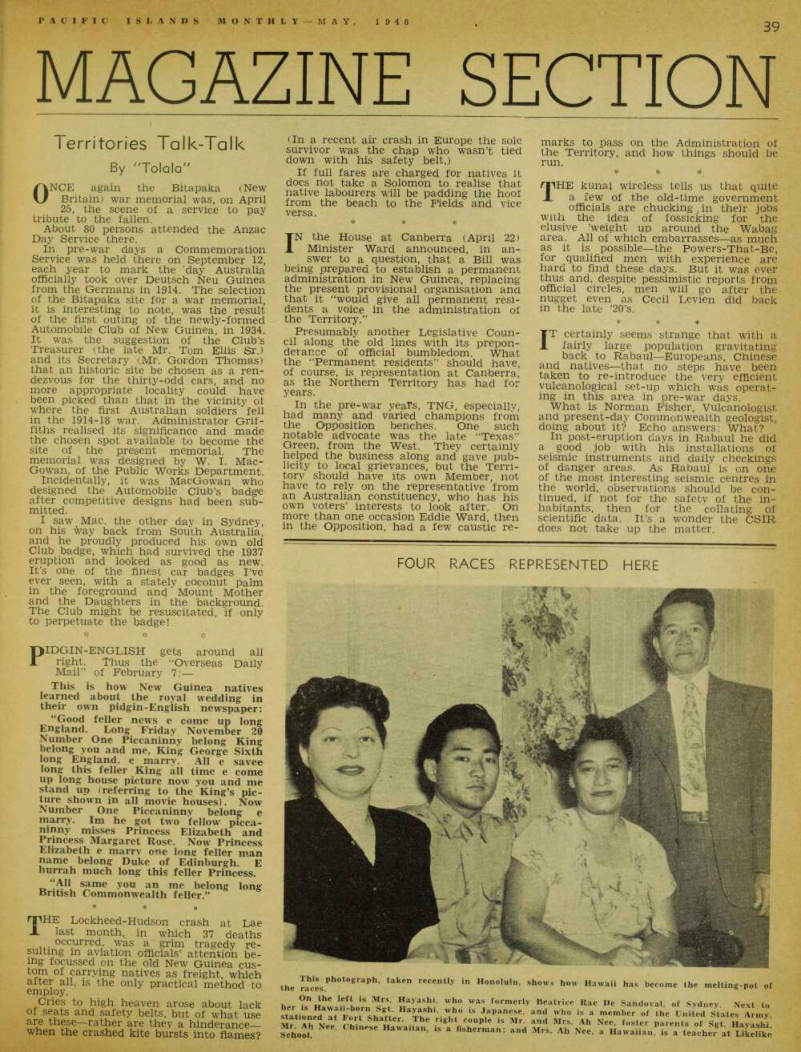
Territories Talk-Talk
By "Tolala"
ONCE again the Bitapaka (New Britain) war memorial was, on April 25, the scene of a service to pay tribute to the fallen.
About 80 persons attended the Anzac Day Service there.
In pre-war days a Commemoration Service was held there on September 12, each year to mark the 'day Australia officially took over Deutsch Neu Guinea from the Germans in 1914. The selection of the Bitapaka site for a war memorial, it is interesting to note, was the result of the first outing of the newly-formed Automobile Club of New Guinea, in 1934.
It was the suggestion of the Club’s Treasurer (the late Mr. Tom Ellis Sr.) and its Secretary (Mr. Gordon Thomas) that an historic site be chosen as a ren dezvous for the thirty-odd cars, and no more appropriate locality could have been picked than that in the vicinity of where the first Australian soldiers fell in the 1914-18 war. Administrator Grif fiths realised its significance and made the chosen spot available to become the site of the present memorial. The memorial was designed by W. I. Mac- Gowan, of the Public Works Department.
Incidentally, it was MacGowan who designed the Automobile Club’s badge after competitive designs had been sub mitted.
I saw Mac. the other day in Sydney, on his way back from South Australia, and he proudly produced his own old Club badge, which had survived the 1937 eruption and looked as good as new.
It’s one of the finest car badges I’ve ever seen, with a statelv coconut palm in the foreground and Mount Mother and the Daughters in the background.
The Club might be resuscitated, if only to perpetuate the badge!
PIDGIN-ENGLISH gets around all right. Thus the “Overseas Daily Mail” of February 7; — This is how New Guinea natives learned about the royal wedding in their own pidgin-English newspaper: “Good feller news e come up long England. Long Friday November 20 Number One Piccaninny belong King belong you and me, King George Sixth long England, e marry. All e savee long this feller King all time e come up long house picture now you and me stand up (referring to the King’s pic ture shown in all movie houses). Now Number One Piccaninny belong e marry. Im he got two fellow picca ninny misses Princess Elizabeth and Princess Margaret Rose. Now Princess Elizabeth e marry one Iona: feller man name belong Duke of Edinburgh. E hurrah much long this feller Princess.
“All same you an me belong long British Commonwealth feller.” * * * THE Lockheed-Hudson crash at Lae last month, in which 37 deaths occurred, was a grim tragedy re sulting m aviation officials’ attention be ing focussed on the old New Guinea cus tom of carrying natives as freight, which after all, is the only practical method to employ.
Cries to high heaven arose about lack of seats and safety belts, but of what use are these—rather are they a hinderance— when the crashed kite bursts into flames?
(In a recent air crash in Europe the sole survivor was the chap who wasn’t tied down with his safety belt.) If full fares are charged for natives it does not take a Solomon to realise that native labourers will be padding the hoof from the beach to the Fields and vice versa. * * * IN the House at Canberra (April 22) Minister Ward announced, in an swer to a question, that a Bill was being prepared to establish a permanent administration in New Guinea, replacing the present provisional organisation and that it “would give all permanent resi dents a voice in the administration of the Territory.”
Presumably another Legislative Coun cil along the old lines with its prepon derance of official bumbledom. What the “Permanent residents” should have, of course, is renresentation at Canberra, as the Northern Territory has had for years.
In the pre-war yeaTs, TNG, especially, had many and varied champions from the Opposition benches. One such notable advocate was the late “Texas”
Green, from the West. They certainly helped the business along and gave pub licity to local grievances, but the Terri tory should have its own Member, not have to rely on the representative from an Australian constituency, who has his own voters’ interests to look after. On more than one occasion Eddie Ward, then in the Opposition, had a few caustic re
marks to pass on the Administration of the Territory, and how things should be run. * * * THE kunai wireless tells us that quite a few of the old-time government officials are chucking, in their jobs with the idea of fossicking for the elusive ’weight up around the Wabag area. All of which embarrasses—as much as it is possible—the Powers-That-Be, for qualified men with experience are hard to find these days. But it was ever thus and. despite pessimistic reports from official circles, men will go after the nugget even as Cecil Levien did back in the late ’2o’s. * * ♦ IT certainly seems strange that with a fairly large population gravitating back to Rabaul—Europeans, Chinese and natives—that no steps have been taken to re-introduce the* very efficient yulcanological set-up which was operat ing in this area in pre-war days.
What is Norman Fisher, Vulcanologist and present-day Commonwealth geologist, doing about it? Echo answers: What?
In post-eruption days in Rabaul he did a good job with his installations of seismic instruments and daily checkings of danger areas. As Rabaul is on one of the most interesting seismic centres in the world, observations should be con tinued, if not for the safetv of the in habitants, then for the collating of scientific data. It’s a wonder the CSIR does not take up the matter.
Four Races Represented Here
This photograph, taken recently in Honolulu, shows how Hawali has become the melting-post of the races.
On the left is Mrs. Hayashi, who was formerly Beatrice Rac De Sandoval, of Sydney . Next to her is Hawaii-born Sgt. Hayashi, who is Japanesw, and who is a member of the States Army, stationed at Fort Shafter. The right couple is Mr. Ah Nee, a Hawiian, is a teacher at LIkelike.
a living
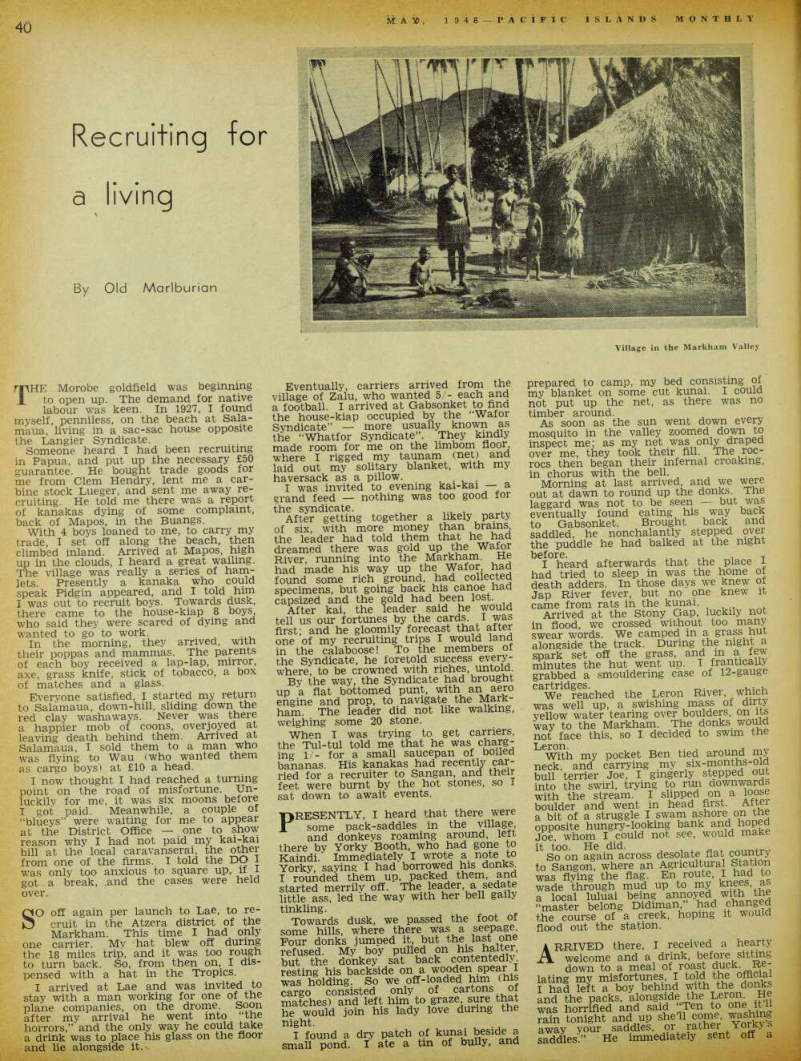
Recruiting for a living
By Old Marlburian
rpHE Morobe goldfield was beginning X to open up. The demand for native labour was keen. In 1927, I found myself, penniless, on the beach at Sala maua, living in a sac-sac house opposite the Langier Syndicate.
Someone heard I had been recruiting in Papua, and put up the necessary £5O guarantee. He bought trade goods for me from Clem Hendry, lent me a car bine stock Lueger, and sent me away re cruiting. He told me there was a report of kanakas dying of some complaint, back of Mapos, in the Buangs.
With 4 boys loaned to me, to carry my trade, I set off along the beach, then climbed inland. Arrived at Mapos, high up in the clouds, I heard a great wailing.
The village was really a series of ham lets. Presently a kanaka who could speak Pidgin aopeared, and I told him I was out to recruit boys. Towards dusk, there came to the house-kiap 8 boys, who said they were scared of dying and wanted to go to work.
In the morning, they arrived, with their poppas and mammas. The parents of each boy received a lap-lap, mirror, axe, grass knife, stick of tobacco, a box of matches and a glass.
Everyone satisfied, I started my return to Salamaua, down-hill, sliding down the red clay washaways. Never was there a happier mob of coons, overjoyed at leaving death behind them. Arrived at Salamaua, I sold them to a man who was flying to Wau (who wanted them as cargo boys) at £lO a head.
I now thought I had reached a turning point on the road of misfortune. Un luckilv for me, it was six moons before I got paid. Meanwhile, a couple of “blueys” were waiting for me to appear at the District Office one to show reason why I had not paid my kai-kai bill at the local caravanserai, the other from one of the firms. I told the DO I was only too anxious to square up, if J got a break, .and the cases were held over.
SO off again per launch to Lae, to re cruit in the Atzera district of the Markham. This time I had only one carrier. Mv hat blew off during the 18 miles trip, and it was too rough to turn back. So, from then on, I dis pensed with a hat in the Tropics.
I arrived at Lae and was invited to stay with a man working for one of the plane companies, on the drome. Soon after my arrival he went into ‘the horrors,”' and the only way he could take a drink was to place his glass on the floor and lie alongside it.
Eventually carriers arrived from the village of Zaiu who wanted 5/- each and a football I arrived at Gabsonket to find S h v e nmc 0 a U te” k - P more^usuallyas the “Whatfor Syndicate”. They kindly made room for me on the limbom floor, where I rigged my taunam (net) and Sid out mf solitary blanket, with my ha i Ve wa a s Ck invited To*“evening kai-kai a
sil£r“ gwal 100goodfor
Ifte y r getting together a likely party capsized and the gold had been lost
JSJ&y&s rss
first; and he glomnily forecast that after the Syndicate, he foretold success every- W BTihe o X?X n syndicate n had S, brought ham The leader did not like walki g, weighing some 20 stone.
When I was trying to get carriers, the Tul-tul told me that he was charging 1/- for a small saucepan of boiled bananas. His kanakas had recently carried for a recruiter to Sangan, and their feet were burnt by the hot stones, so I sat down to await events.
PRESENTLY, I heard that there were some pack-saddles in the village, and donkeys roaming around, left there by Yorky Booth, who had gone to Kaindi. Immediately I wrote a note to Yorky, saying I had borrowed his donks.
I rounded them up, packed them, and started merrily off. The leader, a sedate tinkling 8 ’ **" 8 7 Towards dusk, we passed the foot of some hills, where there was a seepage.
Four donks jumped it Jut the last one but US the donkey s " sat back contentedly!
Soffit hTm y to grazefsureftha?
rfo^d Touts’ iady love during the
prepared to camp, my bed consisting of my blanket on some cut kunai. I c °nld not put up the net, as there was no "soon°as the sun went down every mosquito in the valley v dc d Ssned inspect me: as my net was i roc over me, they took their fill. The roc rocs then began their infernal croaking, “Morning "at last arrived and we were
asra
eventually found eaUng his way back ratlin the kunai. 116 knBW ws swear words We camped in a grass hut hut went u’n I frantically grabbed a smouldering case of 12-gauge W aY e we r fi aC u h p ed nSTof n water tearing over boulders, on its to the Markham. The donks would not face this, s 0 i decided to swim the
Leron .
with my socket Ben tied around my neck> and carrying my six-months-old bull terrier Joe, I gingerly stepped out into the sw i r ] ) trying to run downwards with the stream. I slipped on a loose boulder and went in head first. After a bit of a struggle I swam ashore on the opposite hungry-looking bank and nop® jO6( w hom I could not see, would make it too . He did. . . . „ nllTlfrv So on aga i n across desolate flat country to sangon, where an Agricultural Station was flying the flag. En route I had to wade through mud up to my knees as
UTe'r Wong
the coume of a creek, hoping it would flood out the station. rptvfd there I received a hearty A welcome and a dr f 3 t ef^® k sit ße?
lating°my
He was and f id one^rtU
Village in the Markham Valley
dozen boys, who returned in the morn ing with the donks, none the worse for their swim.
Invited to camp for a while, I rested for a few days, and felt that all was not lost.
Leaving the donks, I got a line of kanakas to lift my gear and trade-goods for the mountains back of Onga, where I had been told very few recruiters had been before. On the way we were joined by a deserter, who had tired of the idea of walking to Lae with his recruiter, and had beaten it back during the night.
This deserter told my boys that in his hamlet there were plenty of boys waiting to be signed on. Although feel ing this was too good to be true, I set off in high fettle. After two days of solid climbing, slipping in the clay, fall ing off moss-covered tree trunks, tripping up in tree roots, we finally reached a few houses.
A few pig-greased kanakas appeared and listened to our deserter. A small hut was allotted to me. No women were to be seen. A few small hands of bananas appeared in return for tabac—. a change from the green “brus” they smoked in their bamboo pipes, and which smelt like an offensive bon-fire. The clouds swirled around us as the sun set, and an ominous silence reigned.
One of my boys appeared and said: “This place no good. All he savvy kai kai man. More better we go.”
I thought so too; but travelling at night was not easy. So feeling every thing was on the nose, I fed Joe a can of bullamacow, saw my Luger had one in the spout and a full magazine changed the position of my blanket, and tried to get some sleep.
Dawn appeared, and only 3 carriers remained. No kanakas appeared, though I sensed I was being watched by hun dreds of eyes.
Repacking the loads, and taking one myself, we set off deeper into the moun tains, hoping the pigtrack would lead us to a happier village.
After climbing for a few hours, the boys had a malalo, and decided amongst themselves they did not wish to be kai kaied by bush kanakas. They came to me: “Me fright. Me go bacK!”
So there was nothing to it but retreat, When we reached the fork in the track, leading to the hamlet we had slept in, across a small coulee there appeared a swarm of coons, waving spears, and shak ing bows and arrows at us and all the time yelling “Wafor” which in the Markham means “Come!” Refusing their invitation, so warmly extended, we continued our descent, feeling that “Wafor” meant, in this nart of the world, “beat it!”
SLIDING along the boulders beside the Wafor River, with high cliffs on either side, we reached the Mark ham Valley, and found the Markham was up. A nearby village made a raft for us, known as a “bed.” When in the water, only the platform on which we sat, and tied our cargo down, remained above water.
Pushing off, with a boy in front with a pole and one behind, we shoved through the shallows. I had heard of several attempts to raft down the Mark ham in flood. One ended in disaster, and everyone lost his clothes, which were out to dry.
All went well, and I felt I would be one to make it. We bowled along at about 5 knots. Suddenly, the waters formed a bottle-neck, and our speed in creased to about 10. This was exciting, especially when a giant tree was seen around a curve. There was no chance of avoiding it. The boys leapt overboard, I, thinking of mv precious trade, hung on, till the impact shot me in, and Joe too.
As we swam downstream, parts of the “bed” soon joined us. We were able to salvage most of the gear, and we paddled
it over to a small island, where I undid the sodden cartridge cases and put things out into the sun, which was making the stones as hot as the infamous hobs of hell.
Deciding to give the Markham best, we reached .Jiffersen Village, and got carriers to take us through kunai and elephant grass. 20 feet high, to Gabson ket. Joe nearly died. Being low to the ground, he felt the heat even more than we did. So grabbing a bilum (net basket) I slipped him in and carried him the rest of the way.
Next day we went through Big Munum and down the Markham road which was being hewed out bv Talesea boys, under the supervision of “Dynamite Dan,” otherwise Major Harrison. And so I reached Lae, with another unsuccessful recruiting trip to chalk up.
One Night of Horror in Santo
By Rosa Moore
TWENTY-SIX light-hearted passengers left Tulagi by flying-boat, Sydney bound, one Monday morning late in March. Twenty-four hours later, grey faced and crumpled, they gazed stiffly at the morning shoreline of Santo Espi ritu. . . .
Our trouble was that we had emerged from the poliomyelitis area of the British Solomon Islands into the polio-free New Hebrides. And, somehow, the earlier assumption that, as polio contacts, we were all to spend the night, while our flying-boat refuelled, in a hut suitably segregated for quarantine purposes, went entirely astray.
We came down into Santo’s harbour in the late afternoon.
Up came officialdom in a launch, wag ging a yellow flag; officialdom palavered with the flying-boat personnel; official dom poked a head briefly into the air craft, shook a black beret disapprovingly and withdrew; officialdom made a state ment and chugged away.
Through our preoccupation with over night bags, a humorous idea obtruded: “What if we have to stay on board all night. Ha, ha!” Followed by another: “Don’t look now, but you’ll be sleeping tonight in that upright chair of yours.”
The aircraft personnel did their best for us and our fate seemed to hang in the balance for some time. But it was so. We could not be quarantined on shore. Men, women and children must curl up cosily on board the plane.
A barge, putting out from the shore, led to the rumour that the inhabitants were on their way over to show that they wouldn’t even touch us with a barge pole.
But is proved to be the start of our refuelling operations, conducted by a trio of native experts.
Naturally, passengers seized the op portunity for a brisk stroll up and down the little barge as it rocked against the aircraft’s side, and naturally they breathed all over the bargees; and a few odd visitors later seemed rather to wear other holes in the quarantine precau tions.
In a spirit of dignified resignation, we did our best to settle stoically for the night. The baby of the party was philo sophical about sleeping in his stroller; two older children were balanced pre cariously and unphilosophically on suit cases and duffel bags, in the luggage compartment. Several adventurous males went aloft to sleep on the wings.
The rest of us groaned and threshed
about in our chairs. Lights went off at 10 p.m.
IT was. one of those long, long nights— brilliant with moonlight, breathless with tropical glamour, broken with snuffles and snorts, and full of the move ment of 34 (including personnel) restless souls.
THIS short article is written for your entertainment.
But you are invited to consider the absurdities of the poliomyelitis quaran tine, still imposed in some of the South Pacific ports by official Bumbledom.
Clearly, quarantine has been a farce in most places. Where imposed, it has been more honoured in the breach than the observance. If there were any danger of the disease in the Islands, there would have been grave epidemics, long since, in Fiji, Samoa, New Caledonia. Solomons, Tahiti. But there has been no outbreak at all.
Yet the silly procedure described in this article is still being insisted on in some places.
Dark shapes moved heavily as sleepless bipeds stumbled about in search of a better spot. With rhythmic precision they fell over Father W., done up in a cocoon of plaid rug, who slumbered deeply on the floor; or they collided with prone Mrs. Y’s toes protruding into the alley-way.
Rain fell, and the adventurous males descended from the wings, fell over Father W., draoed themselves on lug gage, twined themselves around the gear in the plane’s nose, and pillowed their heads pathetically on the bilge.
It was a sad, sad scene to the sleepless —who witnessed in the shafts of moon light the lurching, the clutching, the sideways slip in the unsympathetic chairs of those in the toils of Morpheus. The air was heavy with uneasy dreams and tortured muscles, yet alive with uncon scious sighs.
With dawn’s grey light, surrealist shapes writhed erect and turned back into the familiar passengers of yesterday The horrid night was over. We were in tact, if wild of hair, haunted of eye, bent into curious shapes, and filled with self congratulation.
On Santo’s shore, neonle were thinking of taking baths, shaving, sitting down to breakfast, riding in jeeps; but we had battled with the unknown and the un comfortable. and needed only the aid of a chiropractor and a masseur to be able to take up normal human attitudes again.
There seems no moral to add to this because, before we removed our offensive presence from that memorable spot, four of Santo’s citizens (two of them children) came aboard to travel in our unhygenic midst to Noumea.
And Noumea showed no interest what ever in our contaminated state. Instead, unlike their anxious compatriots in Santo, the French officials sent us to stav overnight in a hotel, and we were allowed to behave like anv other tourists in puzzling over the strange ways of the franc.
Except that by now, after our night of horror, we limned about sneezing, and complaining of pains in the back of the neck and the lower limbs just like any genuine poliomyelitis victim!
Where Are They Now?
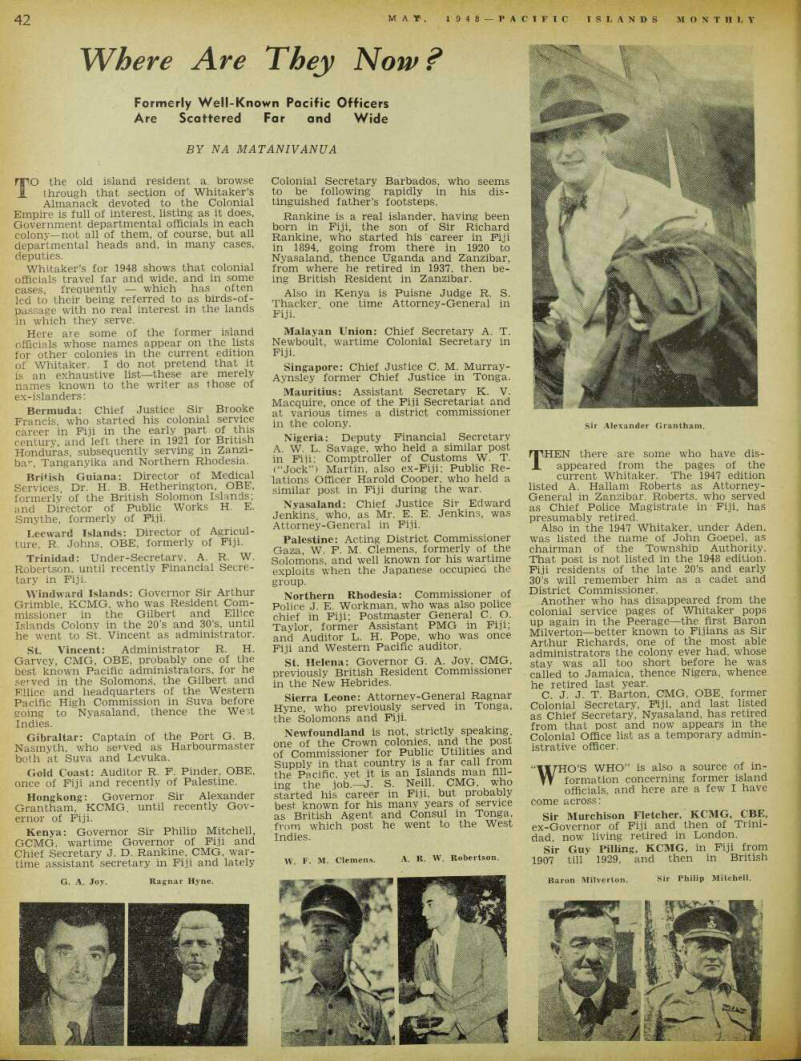
Formerly Well-Known Pacific Officers Are Scattered Far and Wide
By Na Matanivanua
TO the old island resident a browse through that section of Whitaker’s Almanack devoted to the Colonial Empire is full of interest, listing as it does, Government departmental officials in each colony—not all of them, of course, but all departmental heads and, in many cases, deputies.
Whitaker’s for 1948 shows that colonial officials travel far and wide, and in some cases, frequently which has often led to their being referred to as birds-of passage with no real interest in the lands in which they serve.
Here are some of the former island officials whose names appear on the lists for other colonies in the current edition of Whitaker. I do not pretend that it is an exhaustive list—these are merely names known to the writer as those of ex-islanders: Bermuda: Chief Justice Sir Brooke Francis, who started his colonial service career in Fiji in the early part of this century, and left there in 1921 for British Honduras, subsequently serving in Zanzi bar Tanganyika and Northern Rhodesia.
British Guiana: Director of Medical Services Dr. H. B. Hetherington, QBE, formerly of the British Solomon Islands; and Director of Public Works H. E.
Smythe, formerly of Fiji.
Leeward Islands: Director of Agricul ture, R. Johns, OBE, formerly of Fiji.
Trinidad: Under-Secretary. A. R. W.
Robertson, until recently Financial Secre tary in Fiji.
Windward Islands: Governor Sir Arthur Grimble, KCMG, who was Resident Com missioner in the Gilbert and Ellice Islands Colony in the 20’s and 30’s, until he went to St. Vincent as administrator.
St. Vincent: Administrator R. H.
Garvey, CMG, OBE, probably one of the best known Pacific administrators, for he served in the Solomons, the Gilbert and Ellice and headquarters of the Western Pacific High Commission in Suva before going to Nyasaland, thence the West Indies.
Gibraltar: Captain of the Port G. B.
Nasmyth, who served as Harbourmaster both at Suva and Levuka.
Gold Coast: Auditor R. F. Binder, OBE, once of Fiji and recently of Palestine.
Hongkong: Governor Sir Alexander Grantham, KCMG. until recently Gov ernor of Fiji.
Kenya: Governor Sir Philip Mitchell, GCMG, wartime Governor of Fiji and Chief Secretary J. D. Rankine, CMG, war time assistant secretary in Fiji and lately
Colonial Secretary Barbados, who seems to be following rapidly in his dis tinguished father’s footsteps.
Rankine is a real islander, having been born in Fiji, the son of Sir Richard Rankine, who started his career in Fiji in 1894, going from there in 1920 to Nyasaland, thence Uganda and Zanzibar, from where he retired in 1937, then be ing British Resident in Zanzibar.
Also in Kenya is Puisne Judge R. S.
Thacker, one time Attorney-General in Fiji.
Malayan Union: Chief Secretary A. T.
Newboult, wartime Colonial Secretary in Fiji.
Singapore; Chief Justice C. M. Murray- Aynsley former Chief Justice in Tonga.
Mauritius: Assistant Secretary K. V.
Macquire, once of the Fiji Secretariat and at various times a district commissioner in the colony.
Nigeria: Deputy Financial Secretary A. W. L. Savage, who held a similar post in Fiji; Comptroller of Customs W. T. (“Jock”) Martin, also ex-Fiji; Public Re lations Officer Harold Cooper, who held a similar post in Fiji during the war.
Nyasaland: Chief Justice Sir Edward Jenkins, who, as Mr. E. E. Jenkins, was Attorney-General in Fiji.
Palestine: Acting District Commissioner Gaza, W. F. M. Clemens, formerly of the Solomons, and well known for his wartime exploits when the Japanese occupied the group.
Northern Rhodesia: Commissioner of Police J. E. Workman, who was also police chief in Fiji; Postmaster General C. O.
Taylor, former Assistant PMG in Fiji; and Auditor L. H. Pope, who was once Fiji and Western Pacific auditor.
St. Helena: Governor G. A. Joy, CMG, previously British Resident Commissioner in the New Hebrides.
Sierra Leone: Attorney-General Ragnar Hyne, who previously served in Tonga, the Solomons and Fiji.
Newfoundland is not. strictly speaking, one of the Crown colonies, and the post of Commissioner for Public Utilities and Supply in that country is a far call from the Pacific, yet it is an Islands man fill ing the job.—J. S. Neill, CMG, who started his career in Fiji, but probably best known for his many years of service as British Agent and Consul in Tonga, from which post he went to the West Indies.
TiHEN there are some who have dis appeared from the pages of the current Whitaker. The 1947 edition listed A. Hallam Roberts as Attorney- General in Zanzibar. Roberts, who served as Chief Police Magistrate in Fiji, has presumably retired.
Also in the 1947 Whitaker, under Aden, was listed the name of John Goepel, as chairman of the Township Authority.
That post is not listed in the 1948 edition.
Fiji residents of the late 20’s and early 30’s will remember him as a cadet and District Commissioner.
Another who has disappeared from the colonial service pages of Whitaker pops up again in the Peerage—the first Baron Milverton —better known to Fijians as Sir Arthur Richards, one of the most able administrators the colony ever had, whose stay was all too short before he was called to Jamaica, thence Nigera, whence he retired last year.
C. J. J. T. Barton, CMG, QBE. former Colonial Secretary, Fiji, and last listed as Chief Secretary, Nyasaland, has retired from that post and now appears in the Colonial Office list as a temporary admin istrative officer.
“11/TIO’S WHO” is also a source of in- W formation concerning former island officials, and here are a few I have come across: Sir Murchison Fletcher, KCMG, CBE, ex-Governor of Fiji and then of Trini dad, now living retired in London.
Sir Guy Pilling, KCMG, in Fiji from 1907 till 1929, and then in British
G. A. Joy.
Ragnar Hyne.
W. F. M. Clemens.
Sir Alexander Grantham.
Sir Philip Mitchell.
Baron Milverton.
A. R. W. Robertson.
Honduras. Kenya, St. Helena, and Zanzi bar latterly as British Resident, also now retired.
A. A. Wright. CMG, who commenced his service in Fiji in 1912. and eventu ally became Secretary for Native Affairs before his transfer to St. Vincent and thence St. Lucia as administrator in each case. On his retirement in 1943 he entered the commercial world as managing director of the Jamaica Starch Milling Co., l td., from which he retired in 1946 and is now living in Jamaica.
Sir Percy McElwaine. Attorney-General in Fiji from 1927 to 1930. then in Singa pore. where he eventually became Chief Justice. He was interned by the Japanese from 1942 till 1945 and retired in 1946.
Sir Maxwell Maxwell-Anderson, once Chief Justice of Fiji, living retired in Malta.
A. W. Seymour. CMG, Colonial Secretary in Fiii in Sir Murchison Fletcher’s time, and later Colonial Secretary Trinidad, now living retired in England.
Last but not least, “Who’s Who” re veals that a very famous wartime figure had a link with the Islands. Marshal of the Royal Air Force, Lord Tedder, em barked on a Colonial Service career in ‘p’iii in 1914, but joined up for World War T soon afterwards and never returned to the Colonial service.
The Blue Cave
By W. E. Newton
WE were talking about the “Blue Lagoon” film, part of which has been taken at the Yasawas. And out of Mrs. Violet Langdale’s unique memory of her early days in Fiji, came this true story.
When Mrs. Langdale was about 16 — that would be nearly 60 years ago—she visited the Yasawas and explored the Blue Cave there. It is, she says, a sea cave under a towering cliff and was not easy of access. To get into it she had to be lowered about 20 feet, then a swim and a dive underneath a great over-hanging rock took her into the cave itself.
It was not a large cave, but the most completely beautiful that she had ever seen. Sitting on a rock ledge, she looked down into water as purely blue as a Grecian sky under the light that came in from the high open roof, and the classic groups of stalactites and stalag mites were tinted with pastels of all colours.
It was an Elysium of perfect beauty: and, in crude conflict with its remote en chantment, was a cross in the outer en trance leading on to a small strip of beach. It was a rough wooden cross, with stones piled in a high pyramid about it.
Here, obviously, was the mark of some tragedy. Back in the village, Mrs. Langdale made enquiries about it from everyone she met. But no one could tell her why or how the cross was placed there until, at last she came across an old Fijian who told her this story: ONE day, many years before, he had gone to the Blue Cave from the village. He smiled secretly when he, was asked how he got there from the village which was remote from the cave that could be reached only from the sea.
But when she pressed him he admitted that there was an underground passage
and that he was the only one on the Yasawas who knew of its existence.
When he reached the cave, he continued, he saw a vessel dropping anchor out side. It was a well-known American trad ing-vessel that used to bring timber and provisions to the settlers in the island group. He saw a life-boat leave the ship and come towards the cave. Hidden, he watched it approach.
In the life-boat were three men (one of them the captain of the trading vessel) and a young woman, the captain’s wife.
The boat pulled in to the cave strip and the young woman and one of the men, a handsome young fellow, were put off with one large Saratoga trunk, one small one and a few provisions. The young man was strained and silent; the young woman had her face buried in her hands, crying bitterly: while the Captain up braided them both. What he was saying was not understood by the old man watching the scene from his hiding place, but it was easy to tell that the Cap tain was in a great rage and that jealousy had provoked it.
Soon he got back into the life-boat and was rowed back to his ship, leaving his wife and the young man to their inevitable death from starvation anl thirst.
The old Fijian was too afraid to let Ifis presence there be known. He went back to the village through the underground passage and kept what he had seen to himself.
Once or twice, after that, unobserved by the lovers, he saw them at the cave, but he dared not seek any communica tion with them. The captain of the trad ing vessel was a man to be feared.
But some years after, when the cap tain no longer brought his ship to the island group, two other white traders came to the village and the old Fijian offered to show them something if they would go with him. Taking them by sea in a canoe to the cave entrance he showed them the skeletons of the hapless lovers, who had. unfortunately, not dis covered the secret passage for themselves.
The traders piled stones over the skeletons until thev were covered, and, making the cross, they placed it on the grave.
The Saratoga trunks were intact: and,, when the traders opened them they found the woman’s beautiful clothes in the large Saratoga and the man’s fine suits in the smaller one. They were mildewed but untouched by water or insects.
Keeping the jewels, the traders took the trunks into the village and there dis tributed the clothes among the people.
The girls disported themselves proudly and happily in the gay glory of the colourful gowns and pretty shoes, and the men—the old Fiiian sighed at the memory of the splendid suit he had worn for years!
Naturally, Mrs. Langdale begged to be shown the secret passage leading from the sea to the village, but the old man could not be cajoled into revealing it. He died still holding its secret safe. And as far as Mrs. Langdale knows, no others had ever discovered the passage for them selves.
The Half-Castes
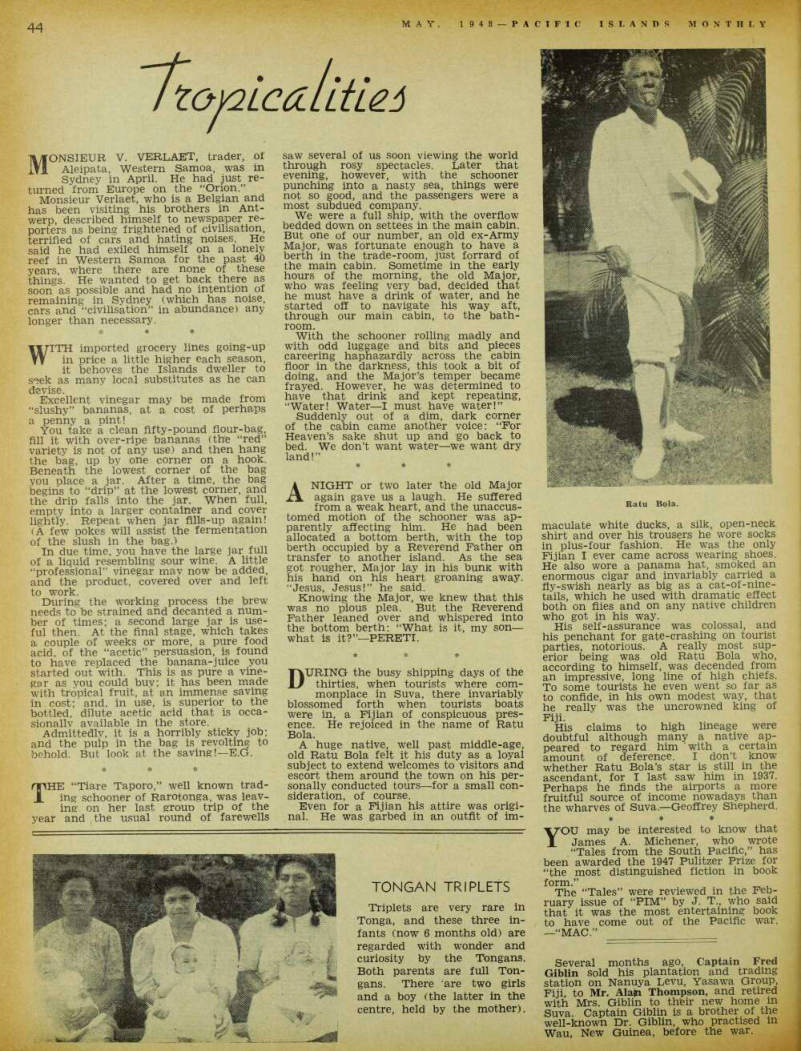
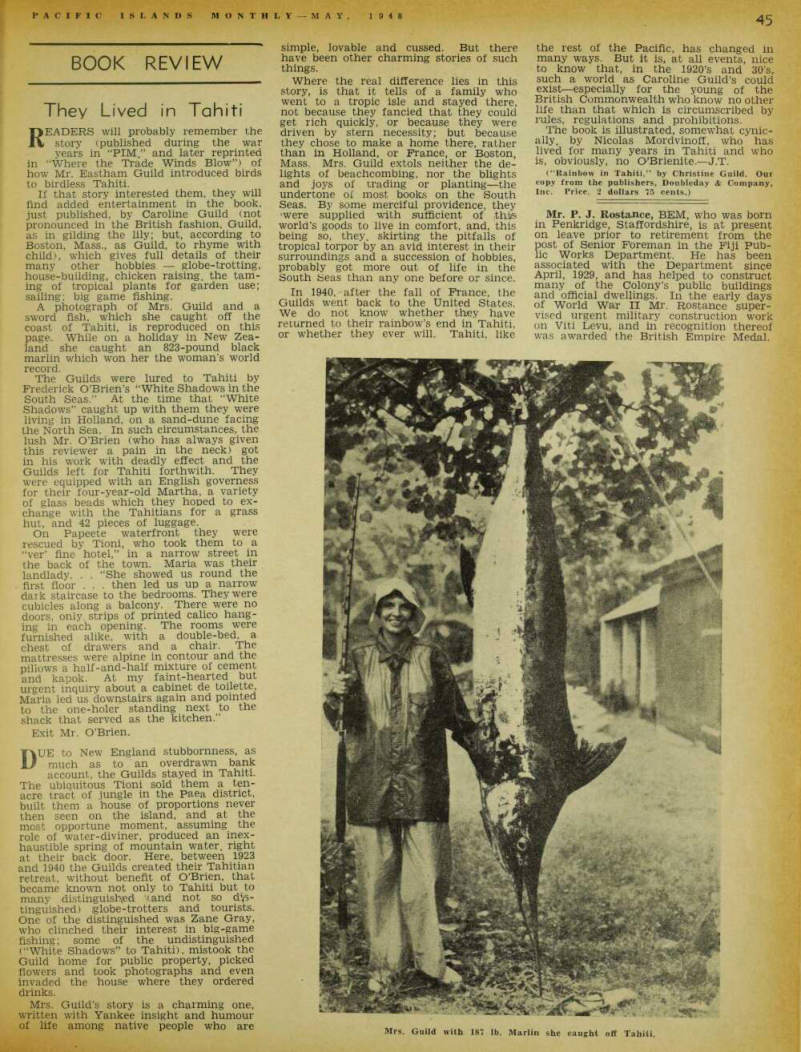
Short Story:
ONCE on day long ago, a certain Fijian village was seething with excitement.
This was the day on which Seniana was due to return from her first visit to New Zealand, whither she had accom panied a European lady from Suva, as maid-servant. She had been away from her “koro” for three years, and her friends and relatives were wondering how she had fared, and how she looked.
J'HIS story—perhaps a rather fanciful interpretation of how a European could he intro duced into Fijian life —is by “Kia Loma” Kia Loma, in Fijian, means half-caste. It is published mainly because it contrasts so strongly with the sentiments of both Mr. Calwell, Australian Minister for Immigration, who is at present indulging in a heresy-hunt among Polynesian people domiciled in Australia (see elsewhere this issue ) ; and also with the sentiments of a full-Fijian reader as expressed in ja letter to “PIM” on page 23 of March issue.
Seniana was a beautiful Fijian girl and had been only 18 years of age when she left home three years before.
“I wonder if she will still be able to speak our language?” remarked one. An other said, “I expect she will come back dressed in European clothes.”
At last, the signal of Seniana’s arrival was given and the rhythmical beat of the lali could be heard for miles around.
Father and mother are, of course, given right of place in these welcomes and there were many tears of joy shed as Seniana. more beautiful than ever, and dressed in her own native costume was seen embracing her parents and others.
There was great feasting and rejoicing Everybody was happy and delighted to see their beloved Seniana amongst them once more.
On the following day Seniana informed her parents that she had something im portant to tell them and asked them not to interrupt her in her story. “When I left you three years ago,” she said, “to accompany the white marama to New Zealand, I said to myself, T will soon return, and will never leave my home again.’ Alas, however, this cannot be.
When I was in New Zealand I met many people who were kind to me and did ail they could to make my stay enjoyable and happy.
“One day, I met a young man who was eood to me and helped me to understand Europeans and their ways. He also taught me to speak their language. I grew to love him. He has asked me to marry him as soon as I can return to New Zealand, and I have promised him that I will. He is a farmer and prosper ous. Please do not be angry with me, dear parents. One cannot help falling in love. I am quite sure that I* shall be happy with Edward and he savs that he will never have any peace until he sees me again.”
The news soon spread in the town that Seniana was about to leave them again, and there were many broken hearts among the young men when they heard
(Continued on Page 46)
(Continued from Page 43)
that their favourite was going to marry a “kai Vavalagi.”
Ik TEARS passed, and some of Seniana’s friends and relatives died. Her parents too, had died from grief a few months after losing their beloved daughter.
One day it was reported that Semana was returning with her husband and family. Again there were many prepara tions for her welcome home, and specu lation was again rife as to what she would look like and whether she had discarded native dress.
“We don’t want any half-caste chil dren in our town,” one or two were heard to remark. Others said “Why does Seniana not stav in New Zealand where her husband belongs, and where she has been residing all this time?”
Blood is thicker than water, however, and the majoritv were eager to see Seniana again and welcome her home The beat of the lali announced Seniana’s return. “Here she is,” they shouted, and almost smothered her in their anxiety to greet her.
Yes, it was Seniana, looking a little older perhaps but as beautiful as ever, with a strong, tall, handsome man by her side, and two fair children.
After the welcome ceremonies were concluded, Seniana and her husband and children were conducted to a new house presented to them by the townsfolk, and it was there that Seniana’s husband was appointed “Tui” of the town. There was no need for him to return to New Zea land as he had sufficient money to sup port his family in Fiji.
This is the way m which half-castes were first introduced in one Fijian village.
Seniana’s descendants are still to be found there.
Tropicalities
MONSIEUR V. VERLAET, trader, of Aleipata, Western Samoa, was in Sydney in April. He had just re turned from Europe on the “Orion.”
Monsieur Verlaet, who is a Belgian and has been visiting his brothers in Ant werp, described himself to newspaper re porters as being frightened of civilisation, terrified of cars and hating noises. He said he had exiled himself on a lonely reef in Western Samoa for the past 40 years, where there are none of these things. He wanted to get back there as soon as possible and had no intention of remaining in Sydney (which has noise, cars and “civilisation” in abundance) any longer than necessary. * * * l]mTH imported grocery lines going-up ff in nrice a little higher each season, it behoves the Islands dweller to seek as many local substitutes as he can devise.
Excellent vinegar may be made from “slushy” bananas, at a cost of perhaps a penny a Dint!
You take a clean fifty-pound flour-bag, fill it with over-ripe bananas (the “red” variety is not of anv use) and then hang the bag, up by one corner on a hook.
Beneath the lowest corner of the bag you place a jar. After a time, the bag begins to “drip” at the lowest corner, and the drip falls into the jar. When full, empty into a larger container and cover lightly. Repeat when jar fllls-up again! (A few cokes will assist the fermentation of the slush in the bag.) In due time, you have the large jar full of a liquid resembling sour wine. A little “professional” vinegar mav now be added, and the product, covered over and left to work.
During the working process the brew needs to be strained and decanted a num ber of times; a second large jar is use ful then. At the final stage, which takes a couple of weeks or more, a pure food acid, of the “acetic” persuasion, is found to have replaced the banana-juice you started out with. This is as pure a vine gar as you could buy; it has been made with tropical fruit, at an immense saving in cost;'and, in use, is superior to the bottled, dilute acetic acid that is occa sionally available in the store.
Admittedly, it is a horribly sticky job; and the pulp in the bag is revolting to behold. But look at the saving !—E.G. * * * THE “Tiare Taporo,” well known trad ing schooner of Rarotonga, was leav ing on her last group trip of the year and the usual round of farewells
saw several of us soon viewing the world through rosy spectacles. Later that evening, however, with the schooner punching into a nasty sea, things were not so good, and the passengers were a most subdued company.
We were a full ship, with the overflow bedded down on settees in the main cabin.
But one of our number, an old ex-Army Major, was fortunate enough to have a berth in the trade-room, just forrard of the main cabin. Sometime in the early hours of the morning, the old Major, who was feeling very bad, decided that he must have a drink of water, and he started off to navigate his way aft, through our main cabin, to the bath room.
With the schooner rolling madly and with odd luggage and bits and pieces careering haphazardly across the cabin floor in the darkness, this took a bit of doing, and the Major’s temper became frayed. However, he was determined to have that drink and kept repeating, “Water! Water —I must have water!”
Suddenly out of a dim, dark corner of the cabin came another voice: “For Heaven’s sake shut up and go back to bed. We don’t want water —we want dry land!” * * * ANIGHT or two later the old Major again gave us a laugh. He suffered from a weak heart, and the unaccus tomed motion of the schooner was ap parently affecting him. He had been allocated a bottom berth, with the top berth occupied by a Reverend Father on transfer to another island. As the sea got rougher, Major lay in his bunk with his hand on his heart groaning away.
“Jesus, Jesus!” he said.
Knowing the Major, we knew that this was no pious plea. But the Reverend Father leaned over and whispered into the bottom berth; “What is it, my son— what is it?”—PERETI. * * * DURING the busy Shipping days of the thirties, when tourists where com monplace in Suva, there invariably blossomed forth when tourists boats were in, a Fijian of conspicuous pres ence. He rejoiced in the name of Ratu Bola.
A huge native, well past middle-age, old Ratu Bola felt it his duty as a loyal subject to extend welcomes to visitors and escort them around the town on his per sonally conducted tours—for a small con sideration, of course.
Even for a Fijian his attire was origi nal. He was garbed in an outfit of im-
maculate white ducks, a silk, open-neck shirt and over his trousers he wore socks in plus-four fashion. He was the only Fijian I ever came across wearing shoes.
He also wore a panama hat, smoked an enormous cigar and invariably carried a fly-swish nearly as big as a cat-of-nine tails, which he used with dramatic effect both on flies and on any native children who got in his way.
His self-assurance was colossal, and his penchant for gate-crashing on tourist parties, notorious. A really most sup erior being was old Ratu Bola who, according to himself, was decended from an impressive, long line of high chiefs.
To some tourists he even went so far as to confide, in his own modest way, that he really was the uncrowned king of Fiji.
His claims to high lineage were doubtful although many a native ap peared to regard him ‘with a certain amount of deference. I don’t know whether Ratu Bola’s star is still in the ascendant, for I last saw him in 1937.
Perhaps he finds the airports a more fruitful source of income nowadays than the wharves of Suva.—Geoffrey Shepherd. * * * YOU may be interested to know that James A. Michener, who wrote “Tales from the South Pacific,” has been awarded the 1947 Pulitzer Prize for “the most distinguished fiction in book form.”
The “Tales” were reviewed in the Feb ruary issue of “PIM” by J. T., who said that it was the most entertaining book to have come out of the Pacific war.
—“Mac.”
Several months ago, Captain Fred Giblin sold his plantation and trading station on Nanuya Levu, Yasawa Group, Fiji, to Mr. Alafci Thompson, and retired with Mrs. Giblin to thfeir new home m Suva. Captain Giblin is a brother of the well-known Dr. Giblin, who practised in Wau, New Guinea, before the war.
Ratu Bola.
Tongan Triplets
Triplets are very rare in Tonga, and these three in fants (now 6 months old) are regarded with wonder and curiosity by the Tongans.
Both parents are full Ton gans. There are two girls and a boy (the latter in the centre, held by the mother).
Book Review
They Lived in Tahiti
READERS will probably remember the story (published during the war years in “PIM,” and later reprinted in “Where the Trade Winds Blow”) of how Mr. Eastham Guild introduced birds to birdless Tahiti.
If that story interested them, they will find added entertainment in the book, just published, by Caroline Guild (not pronounced in the British fashion, Guild, as in gilding the lily; but, according to Boston, Mass., as Guild, to rhyme with child), which gives full details of their many other hobbies globe-trotting, house-building, chicken raising, the tam ing of tropical plants for garden use; sailing; big game fishing.
A photograph of Mrs. Guild and a sword fish, which she caught off the coast of Tahiti, is reproduced on this page. While on a holiday in New Zea land she caught an 823-pound black marlin which won her the woman’s world record.
The Guilds were lured to Tahiti by Frederick O’Brien’s “White Shadows in the South Seas.” At the time that “White Shadows” caught up with them they were living in Holland, on a sand-dune facing the North Sea. In such circumstances, the lush Mr. O’Brien (who has always given this reviewer a pain in the neck) got in his work with deadly effect and the Guilds left for Tahiti forthwith. They were equipped with an English governess for their four-year-old Martha, a variety of glass beads which they hoped to ex change with the Tahitians for a grass hut, and 42 pieces of luggage.
On Papeete waterfront they were rescued by Tioni, who took them to a “ver’ fine hotel,” in a narrow street in the back of the town. Maria was their landlady. . . “She showed us round the first floor . . . then led us up a narrow dark staircase to the bedrooms. They were cubicles along a balcony. There were no doors, only strips of printed calico hang ing in each opening. The rooms were furnished alike, with a double-bed, a chest of drawers and a chair. The mattresses were alpine in contour and the pillows a half-and-half mixture of cement and kapok. At my faint-hearted but urgent inquiry about a cabinet de toilette, Maria led us downstairs again and pointed to the one-holer standing next to the shack that served as the kitchen.”
Exit Mr. O’Brien.
DUE to New England stubbornness, as much as to an overdrawn bank account, the Guilds stayed in Tahiti.
The übiquitous Tioni sold them a ten acre tract of jungle in the Paea district, built them a house of proportions never then seen on the island, and at the most opportune moment, assuming the role of water-diviner, produced an inex haustible spring of mountain water, right at their back door. Here, between 1923 and 1940 the Guilds created their Tahitian retreat, without benefit of O’Brien, that became known not only to Tahiti but to many distinguished '(and not so dis tinguished) globe-trotters and tourists.
One of the distinguished was Zane Gray, who clinched their interest in big-game fishing; some of the undistinguished (“White Shadows” to Tahiti), mistook the Guild home for public property, picked flowers and took photographs and even invaded the house where they ordered drinks.
Mrs. Guild’s story is a charming one, written with Yankee insight and humour of life among native people who are
simple, lovable and cussed. But there have been other charming stories of such things.
Where the real difference lies in this story, is that it tells of a family who went to a tropic isle and stayed there, not because they fancied that they could get rich quickly, or because they were driven by stern necessity; but because they chose to make a home there, rather than in Holland, or France, or Boston, Mass. Mrs. Guild extols neither the de lights of beachcombing, nor the blights and joys of trading or planting—the undertone of most books on the South Seas. By some merciful providence, they ‘were supplied with sufficient of ithio world’s goods to live in comfort, and, this being so, they, skirting the pitfalls of tropical torpor by an avid interest in their surroundings and a succession of hobbies, probably got more out of life in the South Seas than any one before or since.
In 1940, after the fall of France, the Guilds went back to the United States.
We do not know whether they have returned to their rainbow’s end in Tahiti, or whether they ever will. Tahiti, like
the rest of the Pacific, has changed in many ways. But it is, at all events, nice to know that, in the 1920’s and 30's, such a world as Caroline Guild’s could exist—especially for the young of the British Commonwealth who know no other life than that which is circumscribed by rules, regulations and prohibitions.
The book is illustrated, somewhat cynic ally, by Nicolas Mordvinofi. who has lived for many years in Tahiti and who is, obviously, no O’Brienite. —J.T. (“Rainbow in Tahiti,” by Christine Guild. Our copy from the publishers, Doubleday & Company, Inc. Price, 2 dollars 75 cents.) Mr. P. J. Rostance, BEM, who was born in Penkridge, Staffordshire, is at present on leave prior to retirement from the post of Senior Foreman in the Fiji Pub lic Works Department. He has been associated with the Department since April, 1929, and has helped to construct many of the Colony’s public buildings and official dwellings. In the early days of World War II Mr. Rostance super vised urgent military construction work on Viti Levu, and in recognition thereof was awarded the British Empire Medal.
Mrs. Guild with 187 1b. Marlin she caught off Tahiti.
Service Section
Around Sydney Shops
HOME KNITTERS.—There are plen tiful supplies of knitting cotton which is suitable lor women’s and children’s tro pical sweaters. Prices range upwards irom Bd. per oz. for 1 airly coarse yarn.
There is a fine mercerised cotton in a fair range of colours for 1/11 per 2 oz. hank. «hort-sleeved sweaters, for women, take irom eight to 10 oz.
For knitters in those parts of the Pacific where a slight amount of winter is experienced, one Sydney shop has fine English crepe boucle wool at 2/1 per oz.
The price is over twice that of ordinary Australian knitting wool, but it comes m a range of very beautiful colours and knits well. Australian wool of the post war era has a fatal habit of brushing up into a luzz after a few weeks wear.
Eight ounces make a short-sleeved sweater.
FOR MEN.—Since the end of the war there has sprung up, in Sydney, a veri table rash of shops called Disposals Stores. They are generally run by gentle men with strange foreign accents and hooked noses; and they contain a solid conglomeration of clothing, boots and ex- Army equipment from field telephones to tired-looking dixies. Occasionally, how ever, there are items which would be useful to the islands prospector, patrol officer or planter. At present there is a “general release” of oiled-cotfcon, rain proof garments—three-quarter length coats, pants, and a sort of combination cape-sou’wester.
There are also, long slickers in the same material but camouflaged in a fine blend ing of brown and green. At first glance, it might be supposed that they were con structed for an army of hunch-backs, as they have a large hump built into them at the back. After much cogitation, this would-be shopper, came to the conclusion that the hump was there to take care oi the pack on an infantryman’s back. So if you do not mind looking like a camou flaged version of one of the seven dwarfs; or if you are big-hearted enough to want to protect your carrier-line from the rains and vapours of the jungle, you can purchase these garments for the trifling price of 5/- each.
FOR CHILDREN.—AII raincoats for children are extremely scarce; raincoats for wear in the tropics doubly so. There are, however, a few available of rubber ised cotton, light-weight and well-made, in various colours for 27/5 f9r a 22 in. length (and up according to size): Heavy rubberised capes, with hoods, are 13/9 for 24 in. size. Children’s sou’westers, in colours, 5/9.
If you would like vour little girl to look like a film-star’s child, now is your op portunity, and for half the price it would have cost you in the Australian summer. One Sydney emporium is sell ing Kim’s children’s clothes at bargain rates. Kim’s is an American firm which began operations out here after the war.
The designs and materials are American; the workrnanshin is Australian and first class. The dresses are made in some cunning fashion so that they open out flat for ironing and the whole effect can best be described in the American word “cute.” The only catch was the price— about 37/6 for a cotton frock for a three year-old. The same frock now, at this particular store, is 18/- or 20/- according to design. A five-or-six-year-old child can have one for about 28/-.
RAINCOATS—There are a great variety of raincoats for women, and a
great variety of prices. Those suitable lor the tropics are: light-weighted oiled cotton in pink, blue, green, or cream with red design, £2/11/5; Dunlop rubberised rayon linen in various colours, £2/12/-; shower-proof satin, smartly cut and in what are now called “the jewel colours” for £5/9/6. If you want to be very ele gant, there is a black satin number, with a New Look full skirt. This will cost you over £B. If you want to Buy British you can go to almost any lengths for
shower-proof silk—l 2 or 14 guineas.
COTTON FROCKS.—There are many of these about at reasonable prices, In seersuckers and prints they range in price from 25/- to £3 and are very suit able for island day-time wear. Some in stripes (pink and black; yellow and grey, etc.) are a good purchase at 38/-.
Evening Shoes And Bags.—Good
silver and gold kid shoes and bags are back but they are not cheap. Imported English shoes, in good styles are from 66 - to 68/9 for silver kid; and 82/- to 87/9 lor gold. Joyce has an ankle-strap, wedge evening shoe for the young woman, but not, alas, at a young-woman price.
They are 91 3 for gold kid and 71 9 for silver. The same model in black corded silk is only 36 6. Other Australian-made evening shoes range in price from 30upwards and are made in all shapes and sizes to suit all tastes.
Evening bags can cost a few shillings or many pounds. A good little utility evening bag, in a flat, round shape with a zipper opening, can be had in gold or silver for under £l.
GIFT.—If vou want an inexpensive wedding or engagement present that is away from the electroplated butter-dish tradition, there is a wooden savoury holder in Mexican design that might fill the bill. Our Mexican sits with bowed head; his large hat is full of small holes to hold savouries impaled on toothpicks.
The price is 18/-.
Travel, Accommodation
Islands travellers arriving in Sydney and wishing to go on immediately to other States should take heed that it is almost impossible to obtain sleeper ac commodation on interstate expresses under eight or ten days; seats under three of four days. Plane travel, at pres ent, is easier to arrange.
Hotel accommodation is sometimes quite impossible to obtain at short notice.
You should, therefore, make your ar rangements as far ahead as possible.
Mr. Hartley Palmer, who has been for some years manager of the Levuka branch of Morris, Hedstrom Limited, has been loaned for two years for service in the Gilbert and Ellice Islands Colony, where he will manage the Government Trade Scheme. Mr. Palmer left Suva for Tarawa in April.
Sir Hugh Ragg left Fiji tav plane on April 14, for Svdnev where lie will join Lady Ragg, who for health reasons, has been away from the Colony since Janu ary. Thev exnect to return in June.
During’ the two months’ absence' from Fiji of Sir Hugh Ragg, Captain G. B.
Hoddinott will be acting chairman of the committee of management of the Fiji Servicemen’s After-Care Fund and of the Rehabilitation Board.
Pacific Islands Service
Bureau
AS Pacific Islands readers of the “PIM” were informed in March, the Pacific Islands Service Bureau has been estab lished to assist Islands residents who cannot shop for themselves. Briefly, we will perform those services for you, in Australia, which you cannot perform yourself, or are outside the scope of ordinary mail-ordering.
We will purchase and forward goods to you; have repairs made on your behalf; send flowers, sweets, fruits, gifts to frends in Australia for you, or to your children at school in Australia; match materials and sewing accessories; and arrange holiday accommodation and travel.
For these services we charge a small fee—in the case of shopping services, usually 10 per cent, of the purchase price.
If ydu missed the circular which ex plains this service fully and which was included in all copies of “PIM” which went to the Islands in March, please let us know and we will send you a copy of the pamphlet, free of charge.
All inquiries should be addressed to: The Director, Pacific Service Bureau, Box 3408, Sydney.
Wanted: Recipe For
Common Soap
A GOOD recipe for making common soap from coconut oil is urgently sought by Mr. W. E. Baines, of the SDA Mission, Honiara, British Solomon Islands. Mr. Baines is fortunate in hav ing a good supply of caustic soda, but unfortunate in that all his experiments in soap-making so far have failed. Any one with a good recipe is requested kindly to send it direct to Mr. Baines at the above address.
Advertisements & other items, pp. 49-50 (1 item)
Burns Philp (New Guinea) Limited
General Merchants (Wholesale and Retail)
Shipping, Customs and General Agents
Head Office: PORT MORESBY, PAPUA
BRANCHES:
NEW GUINEA: Rabaul, Kokopo, Lae Cr Madang.
PAPUA: Samarai.
REPRESENTATIVES FOR:
AUSTRALIAN AGENTS:
LONDON AGENTS:
SAN FRANCISCO AGENTS:
QUEENSLAND INSURANCE CO. LTD.
LLOYDS OF LONDON
BURNS PHILP TRUST CO. LTD.
BURNS, PHILP & CO. LTD.
All States.
BURNS, PHILP & CO. LTD.
"London House", 35 Crutched Friars, E.C.3.
BURNS, PHILP CO. OF SAN FRANCISCO INC. 510 Matson Building.
Distributing Agents, Territory of Papua-New Guinea for:
SHELL COMPANY OF AUSTRALIA LIMITED
Petroleum Products
GENERAL MOTORS CORPORATION
Chevrolet, Buick, Pontiac and Oldsmobile Cars Chevrolet and GMC Trucks Frigidaire Refrigerators
VAUXHALL MOTORS LIMITED
Vauxhall Cars and Bedford Trucks
R. A. LISTER & CO., BRISTOL
Producers of Petrol, Parrafin and Diesel Engines Pumps and Lighting plants
RUSTON HORNSBY LIMITED
Engines
CROSSLEY MARINE ENGINES
Every Branch Of
ENGINEERING and BUILDING CONSTRUCTION
MILLERS LTD.
SUVA and LAUTOKA
Sawmillers and Timber Merchants; Shipwrights and Sailmakers; Joinery and Furniture Manufacturers; Upholsterers; Plumbers; Electricians; Hardware Merchants; Motor Dealers.
AGENCIES:
Chevrolet, Bedford, Vauxhall, Nash Motors. Firestone Tyres.
Fetters Marine and Stationary Engines. G.E.C. Radio Sets.
British Australian Lead Manufacturers Pty., Ltd., Atlas Assurance Co., Ltd.
There is no need to send to Australia or New Zealand for Repairs or Replacements. We can give you a sound Quotation and guarantee First-Class Workmanship
The Most Extensive Manufacturers in the British Empire of
RUBBER STAMPS,
INKS, STENCILS,
Marking Devices,
ACME STAMP PADS
OFFICE S STATIONERY SUPPLIES
We also Manufacture & Supply a Complete Line of
LIMEWASHING AND
SPRAYING MACHINES
for all purposes.
Let us know your requirements and we will quote by return.
WRITE FOR OUR GENERAL CATALOGUE
Limewashing Machine
EXCELSIOR SUPPLY CO. PTY. LTD.
278 host Office Place,
MELBOURNE, VIC.
HEAD OFFICE :
160 BROADWAY,
Formerly hnown as George St., West,
SYDNEY. N.S.W.
50 Victoria Street,
WELLINGTON, N.Z.
Fijian
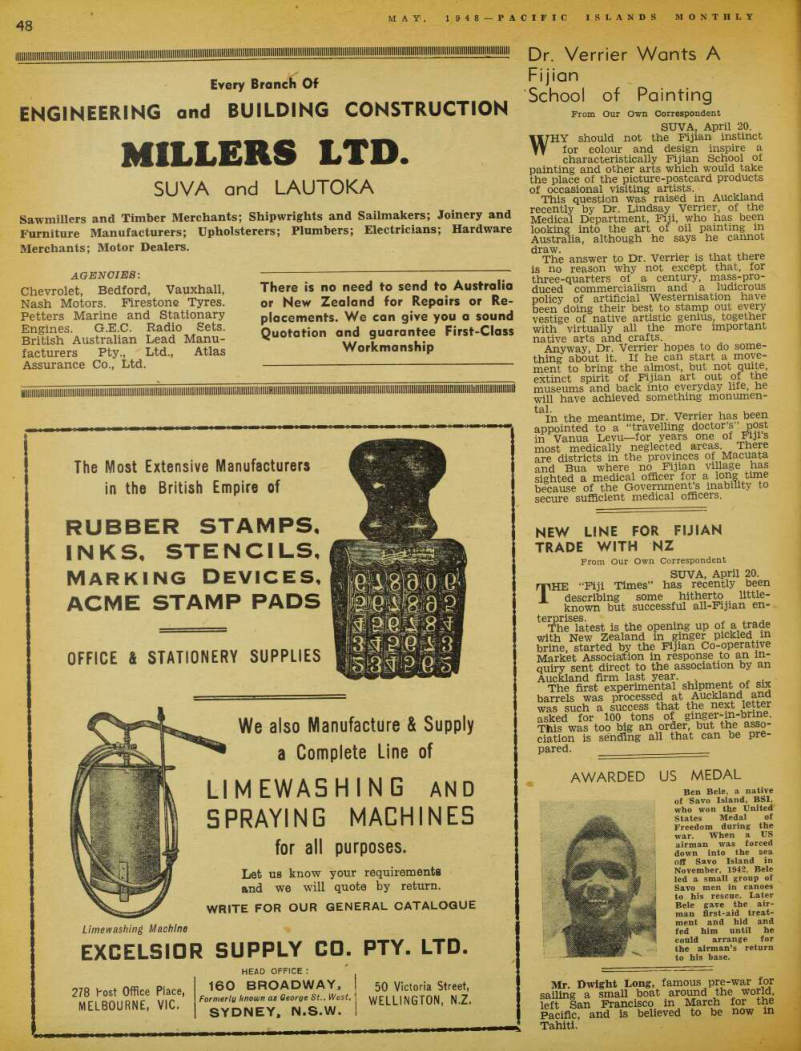
Dr. Verrier Wants A Fijian School of Painting
From Our Own Correspondent SUVA, April 20.
WHY should not the Fijian instinct for colour and design inspire a characteristically Fijian School of painting and other arts which would take the place of the picture-postcard products of occasional visiting artists.
This question was raised in Auckland recently by Dr. Lindsay Verrier, of the Medical Department, Fiji, who has been looking into the art of oil painting in Australia, although he says he cannot The answer to Dr. Verrier is that there is no reason why not except that, for three-quarters of a century, mass-pro duced commercialism and a ludicrous policy of artificial Westernisation have been doing their best to stamp out every vestige of native artistic genius, together with virtually all the more important native arts and crafts.
Anyway, Dr. Verrier hopes to do some thing about it. If he can start a move ment to bring the almost, but not quite, extinct spirit of Fijian art out of the museums and back into everyday life, he will have achieved something monumen tstl in the meantime, Dr. verrier has been appointed to a “travelling doctor’s’ post in Vanua Levu—for years one of Fijis most medically neglected areas. There are districts in the provinces of Macuata and Bua where no Fijian village has sighted a medical officer for a long time because of the Government’s inability to secure sufficient medical officers.
New Line For Fijian
Trade With Nz
From Our Own Correspondent SUVA. April 20.
THE “Fiji Times” has recently been describing some hitherto little known but successful all-Fijian en terprises. , . - The latest is the opening up of a trade with New Zealand in ginger pickled m brine, started by the Fijian Co-operative Market Association in response to an in quiry sent direct to the association by an Auckland firm last year.
The first experimental shipment of six barrels was processed at Auckland and was such a success that the next letter asked for 100 tons of ginger-m-brine.
This was too big an order, taut the asso ciation is sending all that can be pre pared.
Awarded Us Medal
Mr. Dwight Long, famous pre-war for sailing a small boat around the world, left San Francisco in March for the Pacific, and is believed to be now m Tahiti.
Ben Bele, a native of Savo Island, BSI, who won the United States Medal of Freedom during the war. When a US airman was forced down into the sea off Savo Island in November, 1942, Bele led a small group of Savo men in canoes to his rescue. Later Bele gave the air man first-aid treat ment and hid and fed him until he could arrange for the airman’s return to his base.
Assembly
W. Samoa's New Assembly Now Taking Shape Samoan Members Chosen
From Our Own Correspondent APIA, April 19.
THE names of 11 Samoan representa tives for the new Legislative Assembly of Western Samoa were, by request of the Faipule, picked out of a list of 31 candidates by the Hon. Fautua, Tamasese, Malietoa and Mataafa and given to the Faipule who, in turn sub mitted the names ais their own choice to the High Commissioner.
The names of the new representatives are: Tualatulu, Molio’o, Tulele, Fata, Fonoti, Tualau, Tofa Tomasi, Vui, Leia taua Soloa, Asiata, Lavea Lala.
The official Samoan name of the mem bers of the Legislative Assembly will be “Taimua” as distinctive from the Fautua, the members of the Council of State, and the Faipule, the district representatives.
An interesting legal point has been raised in connection with the inclusion in the 11 Samoan Taimua, of Tofa Tomasi, who is of German descent and a half Samoan. No former enemy of the King is eligible as representative of the people, as no formal peace treaty has been concluded with Germany. Tofa Tomasi (who was formerly Thomas Nauer) was submitted as a candidate by unanimous choice of the Aana district of Upolu which has a population of 5,000 Salmoans.
The position now is that, until further notice, Tofa Tomasi will be unable to take his seat on the Council.
THE European election campaign has started in earnest with meetings, leaflets and radio broadcasts.
Two parties have nominated five candi dates each.
The United Citizens Party has chosen Messrs. E. E. Paul, G. F. Betham, J. Helg, W. F. Stowers and F. W. Meredith. The Labour Party has nominated Messrs. A.
A. Stowers, A. M. Gurau, G. Pritchard, D. Crichton and E. Fabricius. It is pos sible that one or two independent candi dates will also contest the election which takes place on April 28.
Of the nine members of the United Citizens Party who had declared their Willingness to stand for election, all three full European candidates were eliminated in a pre-election ballot, so that all can didates of the UCP are local-born. The Labour’ Party hais nominated one full European (A. M. Gurau) and four local born candidates.
Opening of New Assembly
AFONO of Faipule has agreed on the new flag of Samoa. This will have a red field with a blue square in the left hand upper corner, with five white stars in the blue square, formihg the Southern Cross. The new flag, which is to fly together with the New Zealand flag, on all Government buildings, will be raised for the first time at the official opening of the new Legislative Assembly which has been set tentatively for May 18.
Samoan leaders have issued invitations to attend the opening to the Prime Minister of New Zealand, and to repre sentatives of the Maoris, Fijians, Ton gans, Rarotongans, and Tahitians. An elaborate programme of water and land sports has been planned, and the his torical event will be celebrated by two holidays.
After spending three months’ leave in Queensland, Miss T. M. O’Brien has now returned to Madang, New Guinea.
M. Ratzel, who did valuable work for the Allies as Governor Henri Sautot’s Chef de Cabinet, has left New Caledonia.
His place as a member of the Governor’s Private Council has been taken by Dr.
Trubert. M. Ratzel had a long career as chief surveyor, and he played a lead ing part at the head of 300 men of the Huailu tribe in 'suppressing the revolt by Chief Noel of Kone in 1917. He came out of retirement to rally General de Gaulle in .1940. He re-christened his Noumea house Villa de Gaulle, but was later incensed by the actions of de Gaulle’s unpopular envoy, Admiral d’Argenlieu.
Mr. Kevin Adams returned to Port
Moresby, Papua, recently. He will shortly be joined there by his wife.
Advertisements & other items, pp. 51-54 (2 items)
Smii v
PACIFIC ISLANDS SOCIETY
Visitors from the Islands to Sydney (or those interested in Islands affairs), are advised to communicate with the honorary secretary of the above Society, which has been formed to study the history, traditions, economics, and political developments of the Pacific Islands.
Regular monthly meetings are held at History House, 8 Young Street, Sydney.
Address for Correspondence:
THE PACIFIC ISLANDS SOCIETY,
Box 2434 MM., G.P.0., Sydney.
/ / V
Smii v
wM • W ■ \\ N x\' \\ W x \ ' \ A'\x
Trop
ieal Fornt
Every Berger finish must withstand lest after test to prove worthy of the Berger label . , . every product must satisfy the Berger technicians and chemists that it will meet the challenge of all climates from tropic heat to arctic cold.
FINISHES
KEEP ON KEEPING ON!
ms ME PAT/OPEP...
~yu}v fen* a
Protect the eyes of youth with Laurel's "soft, white light."
Laurel Kerosene burns steadily and brightly to the last drop, because it contains no impurities to clog the wick.
There is no smoke nor any disagreeable odour. For efficiency and economy Insist upon LAUREL KEROSENE. m L 468
VACUUM
ptR
A U.- PURPOSE
KEROSENE
For Lighting , Heating , Coole, Cleaning, Freezing
GILLESPIE’S
The Flour
MARK
of the Islands
- SYDNEY -
LON DON-SUVA
tfsuscr s e *
W V.A K /(
PANAMA
C <* For Sailings and Further Particulars Apply To:— BETHELL, GWYN & CO.. BURNS, PHILP (SOUTH SEA)
138 LEADENHALL ST., CO., LTD.,
LONDON, E.C.3. SUVA.
Asthma, Bronchitis Coughing, Curbed in 3 Minutes
Do you have attacks of Asthma or Bronchitis so bad that you can’t sleep? Do you feel weak, unable to work, and have to be careful not to take cold and can’t eat certain foods?
No matter how long you have suffered or what you have tried, there is new hope for you In a doctor’s prescription called Mendaco.
No dopes, no smokes, no injections, no atomizer.
All you do Is take two tasteless tablets at meals and In 3 minutes Mendaco starts working through your blood, aiding nature to remove phlegm, promote free easy breathing and bring sound sleep the first night, so that you soon feel years younger and stronger.
No Asthma in 2 Years
Mendaco not only brings almost Immediate comfort and free breathing but builds up the system to ward off future attacks. For Instance, J. Richards, Hamilton, Ont., Canada, had lost 40 lbs., suffered coughing every night, couldn't sleep. Mendaco stopped Asthma
spasms first night and he has had none since In over two years.
Money Bock Guarantee
The very first dose of Mendaco goes right to work circulating through your blood and helping nature relieve you of the effects of Asthma. Try Mendaco under an iron-clad money back gaurantee. You be the Judge. If you don’t feel fully satisfied after taking Mendaco just return the empty package and the full purchase price will be refunded. Get Mendaco from your chemist to-day and see how well you sleep to-night and how much better you feel to-morrow. The guarantee protect^
RELIEVES ASTHMA
Mendaco
Now in 2 sizes ... 6/- and 12/-
WESTCLOX
'ypEVER has performance been more trustworthy than in the beautiful Westclox of today . . . famous Big Ben and other spring wound clocks, electric clocks, wrist watches and pocket watches. When you buy your next clock or watch, look for the trade mark “Westclox” on the dial . . . your assurance of quality.
POCKET BEN A thin model vatch with many features. Highly polished, plated finish; silvered iial; attractive numerals and lands. Unbreakable crystal.
SPUR Luminous A thin case, me-day alarm. Black finish with lickel trim. 41 inches square.
Steady alarm. Unique base. lAiminous dial.
BIG
BEN
BIG BEN Chime Alarm The highest standard of alarm clock quality. Quiet tick and gentle two-voiced alarm. First there’s a gentle call, then if he’s not shut off. there’s a lusty shout. Dustproof attachments. 51 inches high. Ivory finish with gold colour trim. Luminous dial.
ii« i
io/"©\ i
8 *\ ' NESTCLO * /T
3 % '* ss =, 3 =g>' / Ik 5 W 10 BABY BEN A smart looking alarm clock, 3’i inches high.
Quiet tick; steady alarm that rings loud or soft. Legible dial.
Two finishes . . . black with nickel trim, and ivory with gold colour trim. Made in plain and luminous dial.
LA SALLE A handsomely designed wrist watch. Chrome finish case, stainless steel back, curved to fit the wrist. Sturdy movement, regulated to run in any position. Equipped with conventional second hand; rustproof hairspring.
ORDER THROUGH YOUR LOCAL STORE
PACIFIC ISLANDS TRADING
COMPANY
244 CALIFORNIA STREET, SAN FRANCISCO, CAL., U.S.A.
Bankers: Bank of America (Main Office) San Francisco.
Cables:
PITCO
SAN FRANCISCO
51
STRANGELY MIXED
(Continued from page 34)
PACIFIC ISLANDS MONTHLY MAY, 1948
Death Of Miss Hettie
Kennedy
THE death has occurred of Miss Hettie Kennedy, the last survivor of one of the earliest European families in the Ba district, Fiji, at the age of 86, The family came to Fiji from New Zea land in the sixties.
Mr. C. W. Aidney, who has been Sec retary of the Fiji Copra Board since the bulk purchase of copra by the Min istry of Food began in 1942, has resigned because of ill-health.
Advertisements & other items, pp. 55-56 (1 item)
Burns Philp (South Sea) Co. Ltd.
• The need is urgent—support the Food for Britain Appeal.
KANGAROO BRAND
Ropes,
Cordage,
and Twines for every purpose Backed by 86 years of service Manufactured by:
M. DONAGHY AND SONS,
Pfy. Ltd., Geelong and Sydney.
Fiji Representatives:
PEARCE AND CO.
LIMITED
P.O. BOX 237, SUVA
BURNS PHILP (SOUTH SEA) Co. Ltd.
ISLAND TRADERS AND SHIPOWNERS
General Merchants (Wholesale and Retail)
Shipping, Customs and General Agents
Representatives for QUEENSLAND INSURANCE CO. LTD.
Distributing Agents for SHELL COMPANY (PACIFIC ISLANDS) LTD.
Registered Office: SUVA, FIJI
Code Address: “BURNSOUTH”
BRANCHES:
Sydney Agents:
BURNS, PHILP & CO., LTD.,
7 Bridge Street.
FIJI—
SUVA.
LEVUKA.
LAUTOKA.
LABASA.
BA.
SIGATOKA.
ROTUMA ISLAND.
SAMOA—
APIA.
PAGO PAGO.
TONGA—
NUKUALOFA.
HAAPAI.
VAVAU.
San Francisco Agents:
BURNS, PHILP CO. OP SAN FRANCISCO,
Matson Building, 215 Market Street, London Agents;
BURNS, PHILP & CO., LTD.,
35 Crutched Friars, E.C.3.
NORFOLK IS.—
NIUE IS
Agencies Throughout the World.
ART POSTCARDS OF
TONGA
Per Dozen, Postage Paid: 6/- (one US Dollar).
TONGAN PHOTOS BUREAU
Nukualofa, Tonga
He didn't forget
to kiss you
Honey!
Poor foolish wife —to trust just a bath, instead of capping it off with dependable Mum .
Your bath washes away past perspiration but it can’t safeguard you against the risk of future underarm odour.
Take just 30 seconds to smooth on Mum ; then you’ll be worry-free all day or even-
ing. Mum guards charm.
You can use Mum even after dressing. It will not injure fabrics or irritate your skin.
Get Mum today.
Mum
TAKES THE ODOUR OUT OF PERSPIRATION
UM 4541
Floating Mines In
Fiji Group
From Our Own Correspondent SUVA, April 26.
ALL but two of the crop of live American bombs found some weeks ago at the island of Moturiki, near the hulk of the ship “South Australia” have been exploded. The two survivors are in deep water.
At the other side of Viti Levu, off the Nadi coast, two floating mines were re ported last week.
"Porachute Post" Ends
Mangaia's Isolation
From Our Own Correspondent MANGAIA, March 1.
FEBRUARY 11—Ash-Wednesday in the white man’s calendar—will go down to history in the local one as “Para chute Wednesday.” For the first time since the Days of Hayes, this island’s hurricane-season isolation has been broken by a visit from “outside” in Feb ruary—but by an aeroplane, not a ship.
As the off-season was formerly a com plete cut-off between December and April, the coming of the “silver bird” has been a nine-days’ wonder on Mangaia.
We have no airport yet, so the visitor could not land; but the machine circled gracefully over the beach and cliff, and seven parachutes, carrying containers of necessary drugs for the dispensary, and a small mail, were dropped upon the parade-ground. It Is hoped that this arrangement may be repeated every month. Incidentally, the arrival of the first air-mail has caused our villagers to ask why it is that the allegedly-frail air craft has been able to make this trip, ■while inter-island schooners hug the safe harbours in the North during the hurri cane-season.
An interesting feature of the aerial visit was the behaviour of the fowls and horses of the villages. The former hid; the latter were thrown into a panic as the plane passed overhead.
The mail carried by 'the plane was necessarily limited to air-letters from Rarotonga and New Zealand; so that the expected ship-mail (or “surface”-carried items), is still in the Rarotonga GPO, The recipients of “first drop covers” were greatly envied by those to whom the plane brought nothing, and their names have gone down to local history, although in many cases all that was received was just a bill.
Mangaia now looks forward to the day when packets, newspapers and even par cels may be parachuted to us. The pro jected airstrip, at Tavaenga Village will take a long time to get into operation, the matter being at present not even fully planned, nor a site marked out, though some preliminary surveying has been carried out.
THE parachuting of passengers, in case of necessity, seems quite feasible.
In an epidemic, for instance, doctors could now land at Mangaia in this way, even if no schooner were available —and, of course, the relief by air would be im mensely more speedy than transportation of medical staff by sea.
The real solution lies, to this writer s mind, in the helicopter, which would make landing-grounds unnecessary.
W. Samoa
Two Fatal Accidents In
Prom Our Own Correspondent APIA, April 8.
A ROAD accident, which caused the death of a woman and her child, occurred six miles out of Apia on March 31. A truck loaded with trade goods, driven by a cocoa planter, R. Ah Sau, collided with a car coming from the opposite direction. The truck left the road and turned over, imprisoning a six years-old child. The truck then burst into flames. The child was incinerated and his mother was fatally burned m trying to rescue him. Mr. Ah Sau and a passenger Mr. R. Adam, were also severely burned and taken to Apia hospi tal. Police are investigating the cause of the accident. , Another fatal road accident occurred on Savaii when a Euroneslan road-overseer ToMau Albert Schwencke, fell from a truck and was killed instantly.
Inspection
Native Labour
What Plantation Managers Have To Put Up With Under Wardist Regime in N. Guinea
From Our Own Correspondent RABAUL, April 14.
THE following is a copy of a letter written recently by the Acting In spector of Native Labour, at Talasea, to the manager of a coconut plantation in New Britain; — Following the recent inspection of your plantation, the following breaches of the Native Labour Ordinance Regulations are recorded against the plantation manage ment:— (1) No “Employees Register” is kept vide NLO 96 (1). (2) Your employees have not been is sued with box capable of being locked. (3) Peas, beans, or lentils (i lb. daily to each employee) are not,issued. (4) Whole barley, wholemeal sharps, or wheatmeal (h lb. per employee/day) are not issued. (5) Tinned meat is not being issued in the correct proportion (4 4/7 oz, is the correct scale). (6) Coconut meat must be issued to ensure that the employees receive a minimum of 2 oz. (7) No sugar is issued. (8),No tea is issued. (9) No salt is issued. (10) Fresh fruit or its alternative must also be issued to ensure a minimum of the required amount being consumed. (11) Fortified edible dripping is not is sued. (12) (a) Some employees’ sleeping quar ters are overcrowded, (b) None of these dwellings allow ventilatiqn as prescribed.
(c) Floors do not conform to the regula tions. (13) Beds are not as prescribed, but may be left in use until a date to be advised. (14) The person who renders first aid to your employees has no approval from the Director of Public Health to do so. (15) There is no sick ward provided for employees. (16) No latrines are provided. (17) No particulars, of employees are kept.
A further inspection of your planta tion will be made within the next three months, and I trust there will be no repe tition of the above breaches.
THE above was referred to an official of the Planters Union, and the fol lowing interesting explanatory notes ddfted April 10, are appended;— (1) The NLO 96 (1) is unprocurable at most District Offices. (2) Boxes are unprocurable in this Territory and the Administration itself caflnot supply them. (3) Owing to the lack of inter-island shipping and shortages of goods gener ally, these cannot be procured. (4) Same answer as three. Outport planters cannot even obtain sufficient rice. Neither can the Administration offices, as is witnessed by the fact that the District Officer at Wewak is without rice and has been—like many store keepers in this district—without it for weeks. No shipping available to trans port it. At the moment the inter-island shipping position is in an awful mess. (5) Tinned meats generally are unpro curable. The quota for New Britain was granted to the larger firms, who appear to have represented that they are sup plying the planters’ requirements. The firms make sure their own requirements regarding plantations are met first. Ap plications by planters to the local Cus
toms officer either go unanswered or are refused. (6) Coconut meat is always available to the employees. Does the Inspector expect the planter to attend and see that the employee eats it? (7, 8 and 9) In many cases these sup plies are not available to planters, owing to shortage of shipping. Even limited quantities for personal use are hard to get. (10) Local fruits are always available to the employees and when supplied as part of their ration issue are thrown away (11) Is in very short supply and gener ally wasted when given. We find it hard to make the natives eat it. We have it, but they don’t like it. If they ate the present supply, our stocks would be hard to replace. (12, 13 and 14) These observations
could only be made by a person wholly unacquainted with local conditions. (16 and 17) Appear to be within reason.
Advertisements & other items, pp. 57-58 (1 item)
C. Sullivan Pty. Ltd.
QUEENSLAND
INSURANCE
COMPANY
LIMITED
(Incorporated 1886 In Australia)
ASSETS EXCEED £4,000,000
Head Office:
QUEENSLAND
INSURANCE BUILDING,
80-82 PITT STREET, SYDNEY.
Specialists in South Seas Fire,
Marine & Accident Insurances
Apply to:—
Tin.
Branch Office: I. B. Chalmers, Manager.
Burns Phllp (South Sea) Co., Ltd.
VILA.
Burns Phllp (South Sea) Co., Ltd.
Comptolrs Francals Des Nouvelles Hebrides (Marine).
NOUMEA.
L. <fe W. Johnston.
POET MORESBY:
Burns, Phllp & Co., Ltd.
W. A. Anderson, Resident Officer.
PAGO PAGO.
Burns Phllp (South Sea) Co., Ltd.
G. H. C. Reid Co.
OTHER SOUTH SEA ISLANDS.
Burns Phllp (South Sea) Co., Ltd.
Also to any of the Company’s Offices in Australia or New Zealand.
C. SULLIVAN PTY. LTD.
Island Merchants
Over 30 years' experience in the Pacific Island Trade.
Expert Buying Service Original Invoices Furnished Sellers of Island Produce.
Represented in all Australian States, New Zealand, England, France, United States, etc.
BANKERS-: Bank of New South Wales, Comptoir National d’Escompte de Paris, Bank of New Zealand.
C. SULLIVAN PTY. LTD.
379 KENT STREET, SYDNEY
Telegrams & Cables: CHASULL, Sydney. Phone: MJ4657 (6 lines)".
m
INDOORS or OUT. ..
BRILLIANT LIGHTING
WHEN AND WHERE
REQUIRED
KAYEN
The All Australian Kerosene Pressure Lamp
DORMAN
MARINE DIESELS
British made quality power units 15 h.p. to 100 h.p. 6 models, all electric. Suitable for commercial, fishing or pleasure boats. Specification on request. n Prevention is Better than Cure * % • o
PREVENT DECAY WITH
DEKOL
Guards Wood and Canvas from the Ravages of While Ants, Borers, Dry Rot, Mildew, Etc.
DEKOL penetrates deeply and permanently protects wood and fabrics from rot and attacks by fungi and insects. It is simple to apply and when dry can be painted and varnished. DEKOL prevents attack by marine borers on wood Immersed in sea water.
W. Kopsen & Co. Pty. Ltd.
SHIPCHANDLERS AND MARINE ENGINEERS
376-382 KENT STREET, SYDNEY. PHONE: MA6336 (9 lines).
Cables: “KOPSEN” Sydney.
Notes From Madang
From a Special Correspondent MADANG, April 27.
ACCOMPANIED by Mrs. Hugh Birch, Mr. and Mrs. J. Sedgers, of Madang, with daughters Jac and Jill and young son Tony, flew by Lockheed to Mt.
Hagan for Easter. • • • Three crash boats from Morotai passed through the port in late March. » * * Madang now enjoys a regular bi-weekly
mail service, instead of once-weekly, as formerly. ♦ * ♦ School Inspector Ralph recently spent a week in the District. His happy ap proach to the children banished the old “inspector bogie.” Mr. Ralph met the parents at the District Officer’s home on the night of April 5. In addressing the parents, he spoke of the school syllabus, the new bursary scheme and the forma tion of a Parents and Citizens Associa tion.
The regulation, that if necessary, the Association should arrange accommoda tion for teachers at a reasonable rate — probably the living allowance provided by the Administration—provoked lively discussion. Dissatisfaction was expressed that teachers, who are Administration officers, should be singled out in this respect. Difficulties, in the way of finance and inadequate accommodation, were put forward against this provision. * * * The Lutheran Mission have provided the material for the erection of the Chinese school. Mrs. Radke is to be in charge. • * * * Accommodation is still difficult in Madang. With no single men’s mess, no hotel and no guest-house in the town, Madang people, mainly Administration folk, after two years of providing accom modation for the hundreds of transitory travellers protested some time ago against private people in the District having to billet travellers. Only one or two people in the town have guest rooms. To con tinue their former hospitality would mean financial loss and constant incon venience. * * * Mr. Harry Shaw, former Medical Assis tant, of Manus, and later of Madang, has been having a busman’s holiday in Wollongong, NSW, undergoing medical treatment. * ♦ ♦ The Agricultural Department intends planting 6,000 trees around the water front, commencing at the lighthouse.
Many people hope that attention will be paid to the wharf area as it not only gives a bad impression of the town to new arrivals, but also is extremely glaring, being made of crushed coral and en tirely without shade. * * * For Club members, a dance and card evening was held on Wednesday, April 14.
The occasion was Mr. Alan Clark’s birth day, and it was referred to in speeches by Mr. Fred James and Mr. N. Peters, who thanked him for his work as secre tary. * * * First annual ball conducted by the RSSAILA was held at the home of Mr. and Mrs. J. K. McCarthy at Kalibobo on April 23. It was a particularly enjoyable function, and reflected credit on the organiser, Mr. N. Peters. Supper was ar ranged bv the Peters family. Raffle prizes were won by Mr. A. Fames and Mrs. H. Birch. * * Mr. Toss Schilling, of Matupi Planta tion, while on leave in Sydney, received the bad news that his copra drier had been totally destroyed. It is believed the cause was spontaneous combustion. * * Anzac Day was commemorated in Madang by a Dawn Service. Veterans of two wars gathered on the oval to honour their fallen comrades. At 11 o’clock, members of the RSL and per sonnel from HMAS “Culgoa” marched to the Oval, where a Public Service was held. Hymns and prayers were followed by addresses, the Last Post and the National Anthem. A~ address in Pidgin was delivered by Mj McCarthy to the numerous natives. Wreaths were laid at the Saluting Base.
Advertisements & other items, p. 59 (1 item)
IjNy
DON'T SAY G I NDON'T SAY DON'T SAY © J N GIN DON'T SAY g SAY © f N DON'T SAY DON'T SAY G I N DON/ SAY G I N Is I N DON'T SAY U / DON'T SAY DON'T SAY G I N wj M fr*.
GI N DON'T SAY J ■
DON'T SAY G I N
Y 9 AY wa N 4, A /J € c
SAY
* IN
T SAY
IjNy
At
1 PI DON'T SAY
DON'T SAY G I W
G I N DON'T SAY
DON'T SAY G I N DON'T
G I N DON'T SAY G I N DON'T S DON'T SAY GI N DON'T SAY G I DO NT
DON'T
SAY G I M DON'T SAY GIN DON'T SAY GIN
>ON'T SAY GIN DON'T SAY
DON'T SAY G I M
DON'T SAY
GIN DON'T SAY G
DON'T SAY GIN DO
GIN DON'T SAY «
DON'T SAY G I N D
I N DON'T SAY
DON'T SAY GIN
GIN DON'T SAY
DON'T SAY GUV!
GIN DON'T SAY
DON'T SAY GIN DON'T
G I N DON'T SAY GIN don't!
DON'T SAY G I M DON'T SAY GIN DONT N Y 9 AY W/J > «0( N / •r Syri*
SAY
J •ra :
T SAY
IN Telegrams and Cables: “GILBETS,” Melbourne, Address all inquiries to:
W. & A. GILBEY LTD.
33 ROSSLYN STREET, WEST MELBOURNE. 109 REGENT STREET, SYDNEY Telegrams and Cables: ‘GELBETS,” Sydney.
Indian Building Swamps
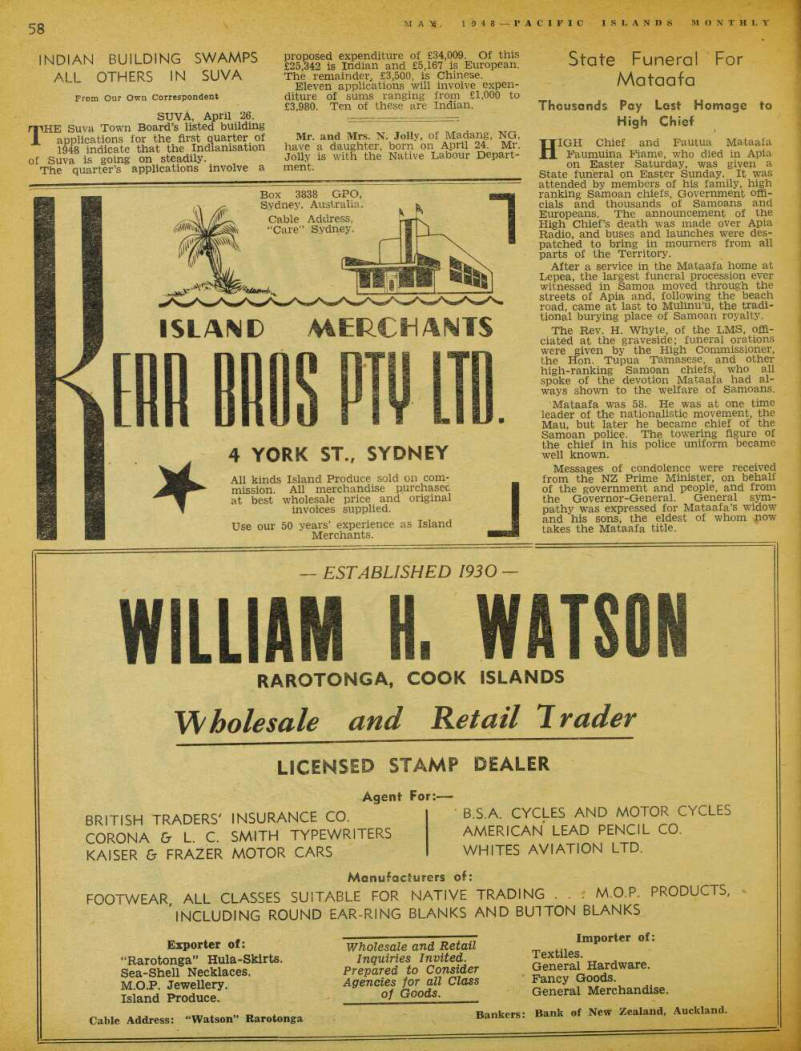
All Others In Suva
From Our Own Correspondent SUVA, April 26.
THE Suva Town Board’s listed building applications for the first quarter of 1948 indicate that the Indianisation of Suva is going on steadily.
The quarter’s applications involve a
proposed expenditure of £34,009. Of this £25,342 is Indian and £5,167 is European.
The remainder, £3,500, is Chinese.
Eleven applications will involve expen diture of sums ranging from £l,OOO to £3,980. Ten of these are Indian.
Mr. and Mrs. N. Jolly, of Madang, NG, have a daughter, born on April 24. Mr.
Jolly is with the Native Labour Depart ment.
Mataafa
State Funeral For Mataafa Thousands Pay Last Homage to High Chief
HIGH Chief and Fautua Mataafa Paumuina Fiame, who died in Apia on Easter Saturday, was given a State funeral on Easter Sunday. It was attended by members of his family, high ranking Samoan chiefs, Government offi cials and thousands of Samoans and Europeans. The announcement of the High Chief’s death was made over Apia Radio, and buses and launches were des patched to bring in mourners from all parts of the Territory.
After a service in the Mataafa home at Lepea, the largest funeral procession ever witnessed in Samoa moved through the streets of Apia and, following the beach road, came at last to Mulinu’u, the tradi tional burying place of Samoan royalty.
The Rev. H. Whyte, of the LMS, offi ciated at the graveside; funeral orations were given by the High Commissioner, the Hon. Tupua Tamasese, and other high-ranking Samoan chiefs, who all spoke of the devotion Mataafa had al ways shown to the welfare of Samoans.
Mataafa was 58. He was at one time leader of the nationalistic movement, the Mau, but later he became chief of the Samoan police. The towering figure of the chief in his police uniform became well known.
Messages of condolence were received from the NZ Prime Minister, on behalf of the government and people, and from the Governor-General. General sym pathy was expressed for Mataafa’s widow and his sons, the eldest of whom now takes the Mataafa title.
Advertisements & other items, p. 60 (2 items)
58
M A Vi , 1 9 48 PACIFIC ISLANDS MONTHLY
William H. Watson
Box 3838 GPO, Sydney. Australia.
Cable Address, “Care” Sydney.
ISLAND MERCHANTS
4 YORK ST., SYDNEY
All kinds Island Produce sold on commission. All merchandise purchasec at best wholesale price and original invoices supplied.
Use our 50 years’ experience as Island Merchants.
J
ESTABLISHED 1930
WILLIAM H. WATSON
RAROTONGA, COOK ISLANDS
Wholesale and Retail Trader
LICENSED STAMP DEALER
Agent For:
BRITISH TRADERS' INSURANCE CO.
CORONA Cr L. C. SM4TH TYPEWRITERS
KAISER & FRAZER MOTOR CARS
Manufacturers of: FOOTWEAR ALL CLASSES SUITABLE FOR NATIVE TRADING . . M.O.P. PRODUCTS, ’INCLUDING ROUND EAR-RING BLANKS AND BUITON BLANKS
B.S.A. CYCLES AND MOTOR CYCLES
AMERICAN LEAD PENCIL CO.
WHITES AVIATION LTD.
Exporter of: “Rarotonga” Hula-Skirts.
Sea-Shell Necklaces.
M.O.P. Jewellery.
Island Produce.
Cable Address: “Watson” Rarotonga Wholesale and Retail Inquiries Invited.
Prepared to Consider Agencies for all Class of Goods.
Bankers: Importer of: Textiles.
General Hardware.
Fancy Goods.
General Merchandise.
Bank of New Zealand, Auckland.
Jhite neontef SI bna?d
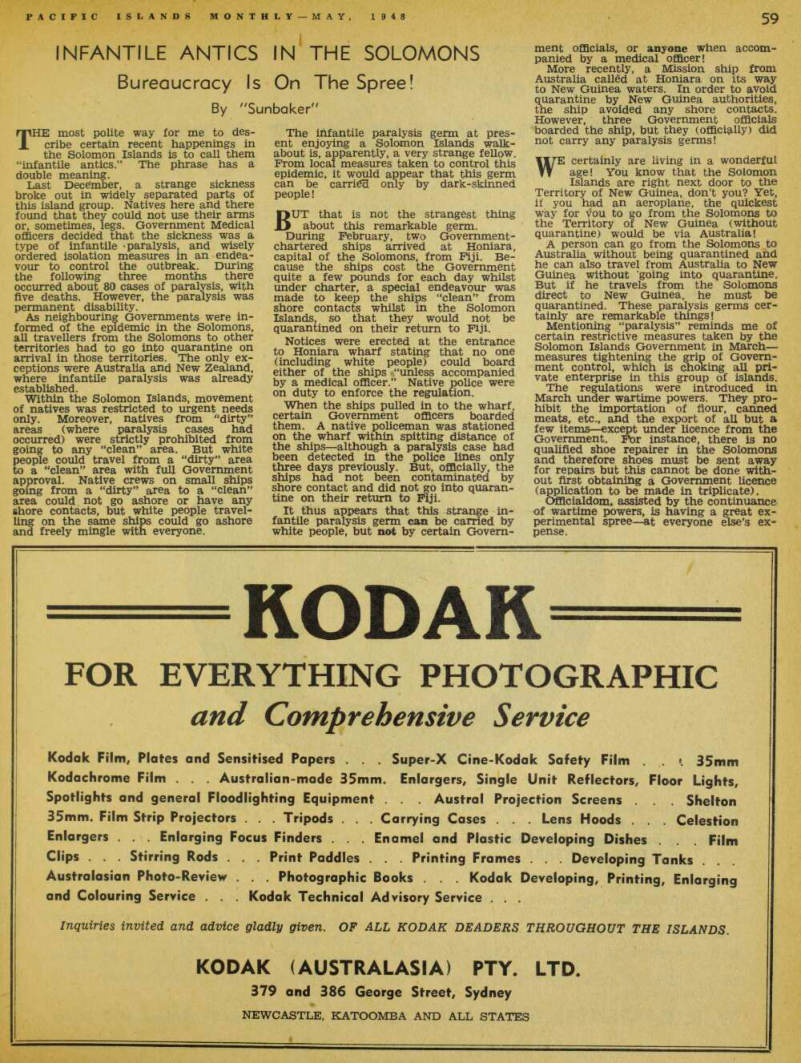
Infantile Antics In The Solomons
Bureaucracy Is On The Spree!
By "Sunbaker"
THE most polite way for me to describe certain recent happenings in the Solomon Islands is to call them “infantile antics.” The phrase has a double meaning.
Last December, a strange sickness broke out in widely separated parts of this island group. Natives here and there found that they could not use their arms or, sometimes, legs. Government Medical officers decided that the sickness was a type of infantile ‘paralysis, and wisely ordered isolation measures in an endeavour to control the outbreak. During the following three months there occurred about 80 cases of paralysis, with five deaths. However, the paralysis was permanent disability.
As neighbouring Governments were informed of the epidemic in the Solomons, all travellers from the Solomons to other territories had to go into quarantine on arrival in those territories. The only exceptions were Australia and New Zealand, where infantile paralysis was already established.
Within the Solomon Islands, movement of natives was restricted to urgent needs only. Moreover, natives from “dirty” areas (where paralysis cases had occurred) were strictly prohibited from going to any “clean” area. But white people could travel from a “dirty” area to a “clean” area with full Government approval. Native crews on small ships going from a “dirty” area to a “clean” area could not go ashore or have any shore contacts, but white people travelling on the same ships could go ashore and freely mingle with everyone.
The infantile paralysis germ at present enjoying a Solomon Islands walkabout is, apparently, a very strange fellow.
From local measures taken to control this epidemic, it would appear that this germ can be carried only by dark-skinned people!
OUT that is not the strangest thing
X 3 about this remarkable germ.
During February, two Governmentchartered ships arrived at Honiara, capital of the Solomons, from Fiji. Because the ships cost the Government quite a few pounds for each day whilst under charter, a special endeavour was made to keep the ships “clean” from shore contacts whilst in the Solomon Islands, so that they would not be quarantined on their return to Fiji. wpt-p prppf-Pri at thp Pntr«npp to Honllra wharf statffig thlt no one
Jhite neontef SI bna?d
ehher of thp shtos arcomnanted
bvamedicaf officer ” NaUverSlicewere
duTv to enfOTcl 'the rSaffin
n ei T rce „ * When the ships pulled m to the wharf, certain Government officers boarded them. A native policeman was stationed pu the wharf within spitting distance of the ships—alUiough a paralysis case had been detected in the police lines only three days previously. But, officially, the smps had not been contaminated by shore contact and did not go into quarantine on their return to Fiji.
It thus appears that this strange infantile paralysis germ can be carried by white people, but not by certain Govern-
meat officials, or anyone when accom panied by a medical officer!
More recently, a Mission ship from Australia called at Honiara on its way to New Guinea waters. In order to avoid quarantine by New Guinea authorities, the ship avoided any shore contacts.
However, three Government officials boarded the ship, but they (officially) did not carry any paralysis germs! 11TE certainly are living in a wonderful ▼f age! You know that the Solomon Islands are right next door to the Territory of New Guinea, don’t you? Yet, if you had an aeroplane, the quickest way for you to go from the Solomons to the Territory of New Guinea (without quarantine) would be via Australia!
A person can go from the Solomons to Australia without being quarantined and he can also travel from Australia to New Guinea without ‘going into quarantine.
But if he travels from the Solomons direct to New Guinea, he must be quarantined. These paralysis germs cer tainly are remarkable things!
Mentioning “paralysis” reminds me of certain restrictive measures taken by the Solomon Islands Government in March— measures tightening the grip of Govern ment control, which is choking all pri vate enterprise in this group of islands.
The regulations were introduced in March under wartime powers. They pro hibit the importation of flour, canned meats, etc., and the export of all but a few items—except under licence from the Government. For instance, there is no qualified shoe repairer in the Solomons and therefore shoes must be sent away for repairs but this cannot be done with out first obtaining a Government licence (application to be made in triplicate).
Officialdom, assisted by the continuance of wartime powers, is having a great ex perimental spree—at everyone else’s ex pense.
Advertisements & other items, pp. 61-62 (1 item)
Kodak
FOR EVERYTHING PHOTOGRAPHIC
and Comprehensive Service
Kodak Film, Plates and Sensitised Papers . . . Super-X Cine-Kodak Safety Film . . » 35mm Kodachrome Film . , . Australian-made 35mm. Enlargers, Single Unit Reflectors, Floor Lights, Spotlights and general Floodlighting Equipment . . . Austral Projection Screens . . . Shelton 35mm. Film Strip Projectors . . . Tripods . . . Carrying Cases . . . Lens Hoods . . . Celestion Enlargers . . . Enlarging Focus Finders . . . Enamel and Plastic Developing Dishes . . . Film Clips . . . Stirring Rods . . . Print Paddles . . . Printing Frames . . . Developing Tanks Australasian Photo-Review . . . Photographic Books . . . Kodak Developing, Printing, Enlarging and Colouring Service . . . Kodak Technical Advisory Service . . .
Inquiries invited and advice gladly given. OF ALL KODAK DEADERS THROUGHOUT THE ISLANDS.
KODAK (AUSTRALASIA) PTY. LTD.
379 and 386 George Street, Sydney
NEWCASTLE, KATOOMBA AND ALL STATES
Ihere is only one
ELECTROLUX
THE MODERN' KEROSENE-OPERATED REFRIGERATOR
THAT ACHIEVES THE MIRACLE OF ICE FROM HEAT
Lasting Efficiency, Silent Operation, Streamlined Beauty
* ** I i is i ■ Economically operated by kerosene, with a simple precision-built freezing unit that has no moving parts and is GUARANTEED FOR
FIVE (5) YEARS.
Obtainable from: W. R. CARPENTER (New Guinea), LTD.
Rabaul, Madang, Lae, Kavieng, Wau.
J. R. CLAY & CO., LTD., Port Moresby.
W. R. CARPENTER & CO. (Sol. Is.), LTD., Tulagi.
For New Hebrides, Butaritari, Noumea, New Caledonia. Apply—
W. R. CARPENTER & CO. LTD.
Model LKSSI Storage capacity: 5i cub. ft. (approx), shelf area, 9 sq. ft.; food shelves, six—five removable; 2 self-supporting when half drawn. Ice-making: Four trays—s lb. ice per freezing: 80 cubes. Fuel consumption: 1.8 pints kerosene per day (approx.).
Height: 4 ft. 10 in. Depth: 2 ft. 3i in.
Weight, unpacked, 434 lb. Packed, 700 lb.
Head Office: 16 O'Connell St., Sydney, N. S. Wales
Steamer Day—Then
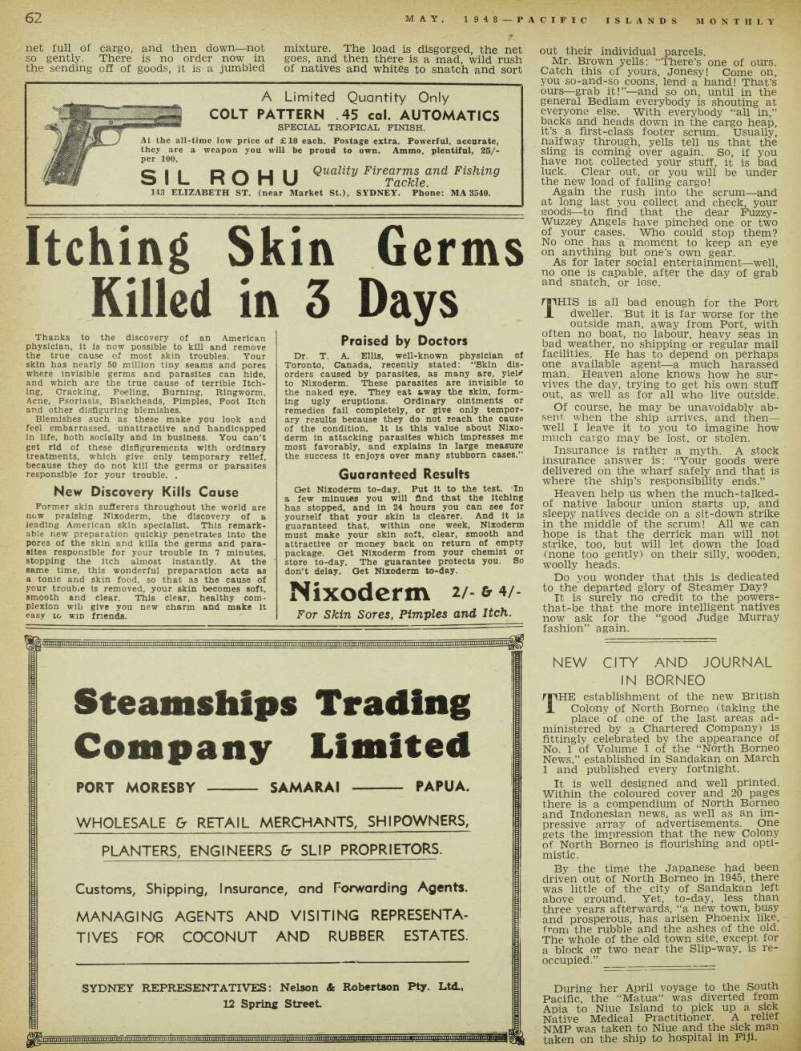
And Now
(Contributed) 117 HAT happy memories Territorial Tf in the outposts have of the pre war highlight of the month — steamer day!
Householders, running low in stores, had visions of filled larders and the means to make un a delectable meal once again; the luxury of a fresh cheese or a few English potatoes or onions. Prob ably, beer supplies had run out, and there was nothing wherewith to build the mysteriously interesting cocktail.
The whole community met the small cargo vessel. Women in bright cotton frocks made a pretty picture as they gaily chatted, or walked on the grassy slopes or on the wharf over the sparkling, green sea. Men, cool and clean in “whites,” organised the squads of natives.
Houseboys waited as eagerly as their Sinabadas, to carry home the “specials,”
Then there was always the thrill of who may be aboard—the Governor, or the Judge, or even that rare event, a new resident. Now the teleradio in the farthest places tells us all that before hand. Very handy, but the old thrill is lost.
Unloading was very orderly. The ob liging supercargo had already loaded our cargo in senarate lots at Moresby, so that Jones’ stuff came off all together, the Browns’ next, and so on—all being set down carfully (please note that word) on the wharf.
Jones’ boys, with their Taubada, ouickly checked and cleared their stuff.
Brown followed, and then the others, in like order.
Next—usually last by reason of bulk and quantity—Government stores came ashore. . Cool-tempered Government
officers rapidly checked and in no time, the wharf was empty and all clear, everybody happy. Then, all aboard the steamer for a yarn and a cool drink.
Conversation inevitably centred on copra and rubber prices, on who is where, and on all the gossip from South.
The ladies, after a chat, returned home to supervise lunch, dinner or a cocktail party, worthy of the popular Skipper and Supercargo, They must often have been troubled as to whose invitation to accept, for there was always friendly rivalry. Residents were all anxious to entertain the cheery Captain Anderson, with his twinkling eyes and good stories.
It was said of him that he knew the coast so well that he took his bearings while wearing smoked glasses.
In our town, everybody took an even ing stroll and met again for drinks and more talk. One big happy family they had their “get-together” on Steamer Day. How we looked forward to it, too.
BOAT day in this same port to-day would just about break the heart of the “old hands.” The cheerful, orderly routine is no more. Gone are the laughing, willing, eager natives; gone the chit-chat across the plank and wharf; gone the even-tempered white population. And no wonder!
Natives sullenly lounge round, on any convenient post or case. Jones’ fellows mix with Brown’s, and finish their cigar ette before deigning to start work (if they ever do work!). Our friend Mr.
Ward would enjoy our Boat day, if he could watch the boys (pardon, the natives!) slowly and sullenly carry on his union-to-be. no-hurry system.
We miss their old cheery shouts and fun as they work. Everyone is on edge, nuzzling how to avoid a broken neck, and how to keep one eye on the goods and the other on the expert native thieves; and how in the world to collect your
own stuff from the great disorderly heap of cargo, thrown like so much rubbish on the wharf.
A further problem, often, is to sort out who owns what in the cases that are burst open in derrick transit.
The Europeans no longer wear smart “whites,” for now they work on the cargo as white navvies, and khaki, if not so smart, does not show quite so much dirt.
Over comes the derrick with its huge
net full of cargo, and then down —not so gently. There is no order now in the sending off of goods, it is a jumbled
mixture. The load is disgorged, the net goes, and then there is a mad, wild rush of natives and whites to snatch and sort
out their individual parcels.
Mr. Brown yells: “There’s one of ours.
Catch this of yours, jonesy! Come on, you so-and-so coons, lend a hand! That’s ours—grab it!”—and so on, until in the general Bedlam everybody is shouting at everyone else. With everybody “all in,” backs and heads down in the cargo heap, it’s a first-class footer scrum. Usually, halfway through, yells tell us that the sling is coming over again. So, if you have not collected your stuff, it is bad luck. Clear out, or you will be under the new load of falling cargo!
Again the rush into the scrum—and at long last you collect and check, your goods—to find that the dear Fuzzy- Wuzzey Angels have pinched one or two of your cases. Who could stop them?
No one has a moment to keep an eye on anything but one’s own gear.
As for later social entertainment—well, no one is capable, after the day of grab and snatch, or lose.
THIS is all bad enough for the Port dweller. But it is far worse for the outside man, away from Port, with often no boat, no labour, heavy seas in bad weather, no shipping or regular mail facilities. He has to* depend on perhaps one available agent—a much harassed man. Heaven alone knows how he sur vives the day, trying to get his own stuff out, as well as for all who live outside.
Of course, he may be unavoidably ab sent when the ship arrives, and then— well I leave it to you to imagine how much cargo may be lost, or stolen.
Insurance is rather a myth. A stock insurance answer is: “Your goods were delivered on the wharf safely and that is where the ship’s responsibility ends.”
Heaven help us when the much-talked of native labour union starts up, and sleepy natives decide on a sit-down strike in the middle of the scrum! All we can hope is that the derrick man will not strike, too, but will let down the load (none too gently) on their silly, wooden, woolly heads.
Do you wonder that this is dedicated to the departed glory of Steamer Day?
It is surely no credit to the powers that-be that the more intelligent natives now ask for the “good Judge Murray fashion” again.
Advertisements & other items, pp. 63-64 (1 item)
Nelson & Robertson 'M.
"Your Yeast
has No Rival"
From MADIRI, Fly River, via Daru, Papua, comes the following Testimonial to MALTO-PEPTONE DRIED YEAST: "For the Tropics, your Yeast has no rival. We have found it entirely satisfactory and are very pleased we learned of it." (Sgd.) T.H.
MALTO-PEPTONE
DRIED YEAST
is 100% Pure Yeast. It has been on the Market for 12 years and is GUARANTEED to retain its vitality for months in ANY Climate. Ready for use in a matter of minutes, and users claim that, through its aid, they can Bake Bread In 3V a hours! Trial Size Carton (2 oz.) 1/7—V 4 lb. 2/8 — V 2 lb. 4/gr—all Post Free. Send Stamps, Postal Note, Money Order or Cheque for a supply—NOW! !
AUSTRALIAN YEAST CO.
Oakleigh, Victoria—Australia.
NELSON and ROBERTSON Pty. Ltd.
Established 1895
Shipowners - Brokers and
Islands Merchants
All classes merchandise purchased at Best Wholesale Prices. Original Invoices supplied to Island Clients. Cocoa Beans, Copra, Rubber, Trochus Shell and All Islands' Produce Sold on Commission.
Entrust your requirements to the firm with fifty years' practical experience in the Pacific Islands. ■ Ml IVIMIVII yiTGII tV VII Cllt|Uin63.
NELSON & ROBERTSON 'M.
12 SPRING STREET, SYDNEY, AUSTRALIA
Telegraphic Address: IVAN, SYDNEY.
A Limited Quantity Only
COLT PATTERN .45 cal. AUTOMATICS
SPECIAL TROPICAL FINISH.
At the all-time low price of £lO each. Postage extra. Powerful, accurate, they are a weapon you will be proud to own. Ammo, plentiful, 25/per 100.
SI I nau Quality Firearms and Fishing
I U nU n U Tackle.
143 ELIZABETH ST. (near Market St.), SYDNEY. Phone: MA 3540.
Itching Skin Germs Killed in 3 Days
Thanks to the discovery of an American physician, it is now possible to kill and remove the true cause of most skin troubles. Your skin has nearly 50 million tiny seams and pores where invisible germs and parasites can hide, and which are the true cause of terrible Itching, Cracking, Peeling, Burning, Ringworm, Acne, Psoriasis, Blackheads, Pimples, Foot Itch and other disfiguring blemishes.
Blemishes such as these make you look and feel embarrassed, unattractive and handicapped in life, both socially and in business. You can’t get rid of these disfigurements with ordinary treatments, which give only temporary relief, because they do not kill the germs or parasites responsible for your trouble. ,
New Discovery Kills Cause
Former skin sufferers throughout the world are now praising Nixoderm, the discovery of a leading American skin specialist. This remarkable new preparation quickly penetrates into the pores of the skin and kills the germs and parasites responsible for your trouble in 7 minutes, stopping the itch almost Instantly. At the same time, this wonderful preparation acts as a tonic and skin food, so that as the cause of your trouble is removed, your skin becomes soft, smooth and clear. This clear, healthy complexion wlb give you new charm and make it easy to win fnends.
Praised by Doctors
Dr. T. A. Ellis, well-known physician of Toronto, Canada, recently stated: “Skin disorders caused by parasites, as many are, yiel»* to Nixoderm. These parasites are invisible to the naked eye. They eat away the skin, forming ugly eruptions. Ordinary ointments or remedies fail completely, or give only temporary results because they do not reach the cause of the condition. It is this value about Nixoderm in attacking parasites which Impresses me most favorably, and explains in large measure the success it enjoys over many stubborn cases.”
Guaranteed Results
Get Nixoderm to-day. Put it to the test. In a few minutes you will find that the itching has stopped, and in 24 hours you can see for yourself that your skin is clearer. And it is guaranteed that, within one week, Nixoderm must make your skin soft, clear, smooth and attractive or money back on return of empty package. Get Nixoderm from your chemist or store to-day. The guarantee protects you. So don’t delay. Get Nixoderm to-day.
Nixoderm */-**/-
For Skin Sores, Pimples and Itch.
Steamships Trading
Company Limited
PORT MORESBY
SAMARAI
PAPUA.
WHOLESALE & RETAIL MERCHANTS, SHIPOWNERS,
PLANTERS, ENGINEERS & SLIP PROPRIETORS.
Customs, Shipping, Insurance, and forwarding Agents.
MANAGING AGENTS AND VISITING REPRESENTA-
TIVES FOR COCONUT AND RUBBER ESTATES.
SYDNEY REPRESENTATIVES: Nelson & Robertson Pty. Ltd., 12 Spring Street
New City And Journal
In Borneo
THE establishment of the new British Colony of North Borneo (taking the place of one of the last areas ad ministered by a Chartered Company) is fittingly celebrated by the appearance of No. 1 of Volume 1 of the “North Borneo News,” established in Sandakan on March 1 and published every fortnight.
It is well designed and well printed.
Within the coloured cover and 20 pages there is a compendium of North Borneo and Indonesian news, as well as an im pressive array of advertisements. One gets the impression that the new Colony of North Borneo is flourishing and opti mistic.
By the time the Japanese had been driven out of North Borneo in 1945, there was little of the city of Sandakan left above ground. Yet, to-day, less than three years afterwards, “a new town, busy and prosperous, has arisen Phoenix like, from the rubble and the ashes of the old.
The whole of the old town site, except for a block or two near the Slip-way, is re occupied.”
During her April voyage to the South Pacific, the “Matua“ was diverted from Apia to Niue Island to pick up a sick Native Medical Practitioner. A relief NMP was taken to Niue and the sick man taken on the ship to hospital in Fiji.
Mission Work In
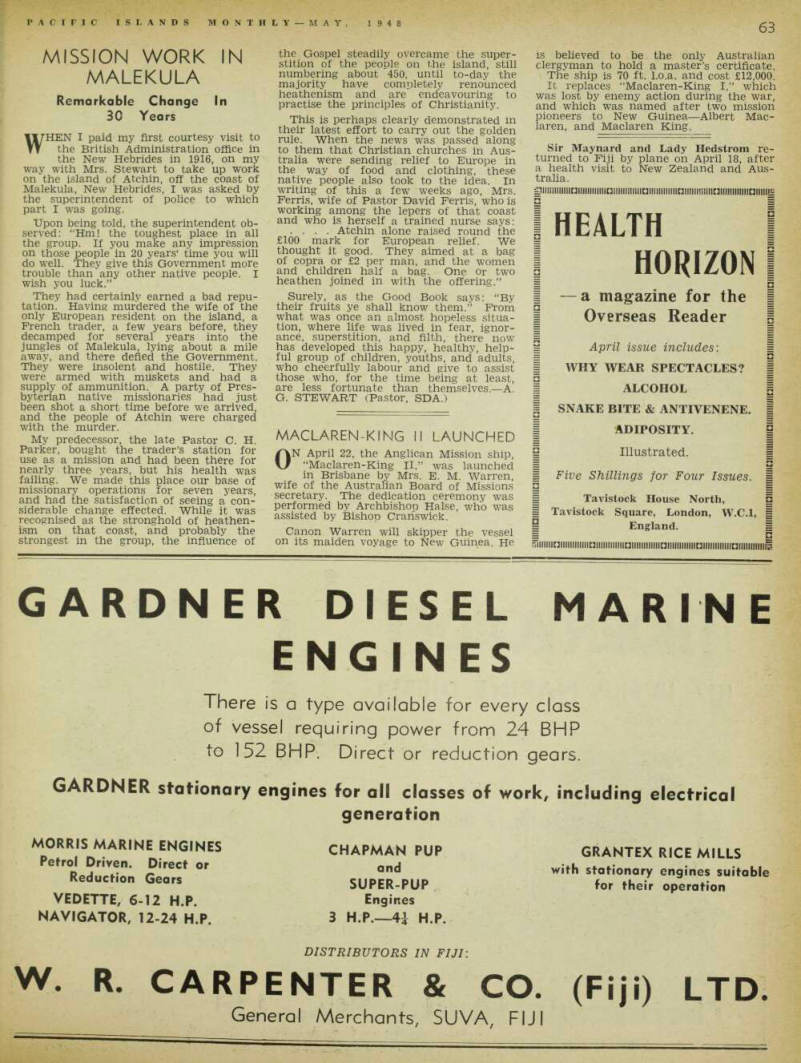
Malekula
Remarkable Change In 30 Years
WHEN I paid my first courtesy visit to the British Administration office in the New Hebrides in 1916, on my way with Mrs. Stewart to take up work on the island of Atchin, off the coast of Malekula, New ’Hebrides, I was asked by the superintendent of police to which part I was going.
Upon being told, the superintendent ob served: “Hm! the toughest place in all the group. If you make any impression on those people in 20 years' time you will do well. They give this Government more trouble than any other native people. I wish you luck.”
They had certainly earned a bad repu tation. Having murdered the wife of the only European resident on the island, a French trader, a few years before, they decamped for several years into the jungles of Malekula, lying about a mile away, and there defied the Government.
They were insolent and hostile. They were armed with muskets and had a supply of ammunition. A party of Pres byterian native missionaries had just been shot a short time before we arrived, and the people of Atchin were charged with the murder.
My predecessor, the late Pastor C. H.
Parker, bought the trader’s station for use as a mission and had been there for nearly three years, but his health was failing. We made this place our base of missionary operations for seven years, and had the satisfaction of seeing a con siderable change effected. While it was recognised as the stronghold of heathen ism on that coast, and probably the strongest in the group, the influence of
the Gospel steadily overcame the super stition of the people on the island, still numbering about 450, until to-day the majority have completely renounced heathenism and are endeavouring to practise the principles of Christianity.
This is perhaps clearly demonstrated in their latest effort to carry out the golden rule. When the news was passed along to them that Christian churches in Aus tralia were sending relief to Europe in the way of food and clothing, these native people also took to the idea. In writing of this a few weeks ago, Mrs.
Ferris, wife of Pastor David Ferris, who is working among the lepers of that coast and who is herself a trained nurse says: ... Atchin alone raised round the £lOO mark for European relief. We thought it good. They aimed at a bag of copra or £2 ner man, and the women and children half a bag. One or two heathen joined in with the offering.”
Surely, as the Good Book says: “By their fruits ye shall know them.” From what was once an almost hopeless situa tion, where life was lived in fear, ignor ance, superstition, and filth, there now has developed this happy, healthy, help ful group of children, youths, and adults, who cheerfully labour and give to assist those who, for the time being at least, are less fortunate than themselves.—A.
G. Stewart (Pastor, Sda.)
Maclaren-King Ii Launched
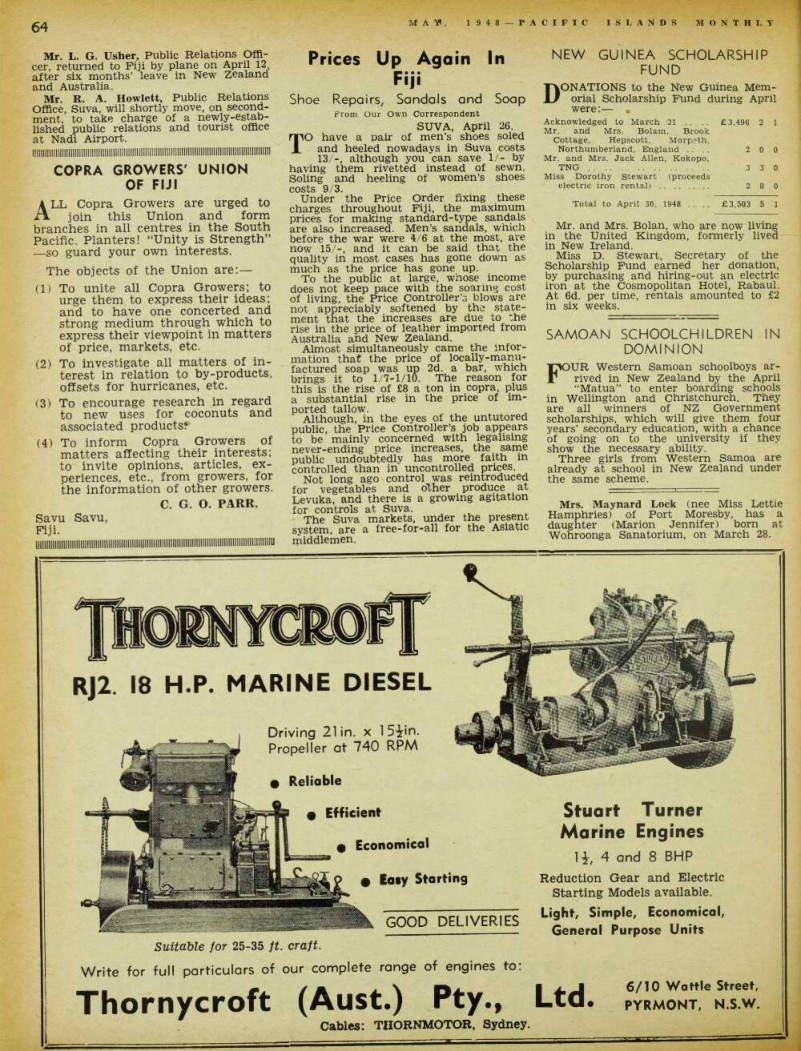
ON April 22, the Anglican Mission ship, “Maclaren-King II,” was launched in Brisbane by Mrs. E. M. Warren, wife of the Australian Board of Missions secretary. The dedication ceremony was performed by Archbishoo Halse, who was assisted by Bishop Crahswick.
Canon Warren will skipper the vessel on its maiden voyage to New Guinea. He
is believed to be the only Australian clergyman to hold a master’s certificate.
The ship is 70 ft. 1.0. a. and cost £12,000.
It replaces “Maclaren-King I.” which was lost by enemy action during the war, and which was named after two mission pioneers to New Guinea—Albert Mac laren, and Maclaren King.
Sir Maynard and Lady Hedstrom re turned to Fiji by plane on April 18, after a health visit to New Zealand and Aus tralia,
Mr. L. G. Usher, Public Relations Officer, returned to Fiji by plane on April 12. after six months’ leave in New Zealand and Australia.
Mr. R. A. Hewlett, Public Relations Office, Suva, will shortly move, on secondm fake nhnrcrp rvf n newlv-estabment, to take Charge OI a newly s lished public relations and tourist office at Nadi Airport.
Advertisements & other items, pp. 65-66 (1 item)
Engines
HEALTH
HORIZON
a magazine for the
Overseas Reader
April issue includes :
WHY WEAR SPECTACLES?
ALCOHOL
SNAKE BITE & ANTIVENENE.
ADIPOSITY.
Illustrated.
Five Shillings for Four Issues.
Tavistock House North, Tavistock Square, London, W.C.I, England.
GARDNER DIESEL MARINE
ENGINES
There is a type available for every class of vessel requiring power from 24 BHP to 152 BHP. Direct or reduction gears.
GARDNER stationary engines for all classes of work, including electrical generation
CHAPMAN PUP GRANTEX RICE MILLS
an d with stationary engines suitable SUPER-PUP for their operation Engines
3 H.P.— H.P.
DISTRIBUTORS IN FIJI :
W. R, CARPENTER & CO. (Fiji) LTD.
General Merchants, SUVA, FIJI
MORRIS MARINE ENGINES
Petrol Driven. Direct or Reduction Gears
VEDETTE, 6-12 H.P.
NAVIGATOR, 12-24 H.P.
COPRA GROWERS' UNION
OF FIJI
ALL Copra Growers are urged to join this Union and form branches in all centres in the South Pacific. Planters! “Unity is Strength” —so guard your own interests.
The objects of the Union are:— (1) To unite all Copra Growers; to urge them to express their ideas; and to have one concerted and strong medium through which to express their viewpoint in matters of price, markets, etc. (2) To investigate all matters of interest in relation to by-products, offsets for hurricanes, etc. (3) To encourage research in regard to new uses for coconuts and associated products*' (4) To inform Copra Growers of matters affecting their interests; to invite opinions, articles, experiences, etc., from growers, for the information of other growers.
C. G. O. PARR.
Savu Savu, Fiji.
0 a
RJ2. 18 H.P. MARINE DIESEL
Driving 21 in. x 1 siin.
Propeller at 740 RPM • Reliable
itt
wz Efficient • Economical • Easy Starting Stuart Turner
Marine Engines
li, 4 and 8 BHP Reduction Gear and Electric Starting Models available.
GOOD DELIVERS Li * ht - Si , m D ple ' General Purpose Units Suitable for 25-35 ft. craft.
Write for full particulars of our complete range of engines to: Thornycroft (Aust.) Pty., Ltd. PYRMONT, e N.s.w' Cables: TIIORNMOTOR. Sydney.
Fiji
Prices Up Again In
Shoe Repairs, Sandals and Soap
From ° ur ° wn Correspondent . SUVA, April 26 rpo have a pair of mens shoes soled 1 ™ U g n hTou ay cln^a S ve Va i/ C -X S having them rivetted instead of sewn.
Soling and heeling Of women’s shoes
Costs 9/3
ch Y" d e e s r throughout prices for making standard-type sandals are also increased. Men’s sandals, which before the war were 4/6 at the most, ave now 15/-, and it can be said that the quality in most cases has gone down as much as the price has gone up.
To the pub ii c at i ar ge, whose income does not keep pace with the soaring cost of living, the Price Controller’s blows are not appreciably softened by the state ment that the increases are due to Australia VSd C New zeSSd mported from Almost simultaneously came the infor mation that the price of locally-manu factured soap was up 2 d. a bar, which brings it to 1/7-1/10. The reason for this is the rise of £8 a ton in copra, plus a substantial rise in the price of im- Ported tallow. A „ Although, in the eyes of the untutored public, the Price Controller’s job appears to be mainly concerned with legalising never-ending price increases, the same pub ii C undoubtedly has more faith in controlled than in uncontrolled prices.
Not i ong ago control was reintroduced f o r vegetables and other produce at fcf r V pnntro?s d a? Suva & gr ° Wmg aglta 011 tvip markets under the present Jhe are a tree-for-ali tw the Asiatic middlemen.
New Guinea Scholarship
Fund
DONATIONS to the New Guinea Mem orial Scholarship Fund during April were;— .
Acknowledged to March 31 .. .. £3,496 2 1 Mr. and Mrs. Bolam, Brook Cottage, Hepscott, Morpeth, Northumberland, England ... 200 Mr. and Mrs. Jack Allen, Kokopo,
Tng .. 330
Miss Dorothy Stewart (proceeds electric iron rental) 2 0 0 Total to April 30, 1948 .. .. £3,503 5 1 Mr. and Mrs. Bolan, who are now living in the United Kingdom, formerly lived in New Ireland.
Miss D. Stewart, Secretary of the Scholarship Fund earned her donation, by purchasing and hiring-out an electric iron at the Cosmopolitan Hotel, Rabaul.
At 6d. per time, rentals amounted to £2 in six weeks.
Samoan Schoolchildren In
Dominion
FUR Western Samoan schoolboys ar rived in New Zealand by the April “Matua” to enter boarding schools in Wellington and Christchurch. They are all winners of NZ Government scholarships, which will give them four years’ secondary education, with a chance of going on to the university if they show the necessary ability.
Three girls from Western Samoa are already at school in New Zealand under the same scheme.
Mrs. Maynard Lock (nee Miss Lettie Hamphries) of Port Moresby, has a daughter (Marion Jennifer) born at Wohroonga Sanatorium, on March 28.
Farmers In Outer
Fiji
Experiments With Goats
THREE European settlers are making what appears to be a successful attempt to promote goat-farming on some freehold land which they have ac quired in Bua Bay, at the Western end of the island of Vanua Levu, in the Fiji Group. One of them writes as follows: — “Each of us has a nice freehold block, free from harassing war-taxes, native regulations, etc. The goats we have intro duced are increasing, and will be a good stand-by if the price of copra should flop. Even if there is another depression, our debt-free land, plus goats, will supply us with vegetables, fruit, milk, butter, etc.
“There are three of us here at present, and we hope to get others to join our settlement and acquire freeholds. One of my relations is coming soon from New Zealand—a practical farmer who knows a bit about building, and is being driven out of the country by restrictions and regulations, “If you know of any European families who would like to come here and settle under conditions which are pleasant and secure, but which offer no fortune, of course, please ask them to get in touch with me. I would be pleased to supply details of any freehold land available. I am not an agent, out after profits—but we should like some congenial neigh bours.”
Anyone interested should write to Mr.
N. C. MacKenzie-Hunt, Nabouwalu, Bua, Fiji.
Allan Timperley Is In
Form
PAPUA-New Guinea apparently still has some versatile officers in the Service. The following was pub lished recently in a well-known Queens land newspaper—a sporting newsheet at that:— “During the big game of the day in the city on Saturday thousands of spec tators cheered their heads off as a very old favourite threw the ball around with reckless abandon and so completely de moralised the opposing team that a cricket score mounted on the board.
“This half-back, getting more than his share of the ball, gave a grand display and one which, in my opinion, was a lesson to players seeking League repre sentative selection. It is some time since 1 hard the old cry of “Tiger” used with so much enthusiasm and appreciation.
“You played a grand game, Tim, and it is regrettable that you have decided to pack up your boots and go to the Southern States on a well-earned leave.
We hope to see you again before you re turn north. I smiled when you said T am too old for the game now’ ”
Territorians couldn’t hazard a guess as to the player’s name. I wouldn’t have, either, if I had not seen the game. It was none other than Allan Timperley, an ADO on leave from the Territories.
First Fijian Oxford
"Blue"
SUVA. April 12.
RATU MARA ULUILAKEBA has gained his Oxford “blue” in athletics and has become the first Fijian to win the distinction.
At the Oxford v. Cambridge athletics meeting at the White City, London, he was pushed out of first place in his speciality, the hieh jump, by a Danish lad who broke a 70-years-old record with a jump of 6 ft. 2i in. Ratu Mara was second with 5 ft. 8 in., although in Ger many with the Oxford team last year he had jumped 5 ft. 9 in.
Advertisements & other items, pp. 67-68 (1 item)
Burns Philp Trust
'Tvur .-0 the
Changing Times
Demand a
Changed Outlook
Forty years ago, an executor’s principal qualifications were honesty, tact, and good health.
A trustee’s task was considered an honour rather than a burden. To-day, however, the administration of an estate demands highly specialised knowledge of finance, taxation, and investments.
The trustee is no longer a part-time worker; he must devote all his time to dealing with problems as they arise.
Under modern conditions, it is wiser to entrust the protection of your estate to Burns Philp Trust Company Limited, a permanent institution whose capital and assets stand squarely behind your beneficiaries. Men of long experience, specialised
knowledge and unchallenged probity will
administer the estate exactly as the testator has directed.
In fairness to your beneficiaries, it is advisable to read "Hands That Never Leave The Wheel". A copy of this special booklet may be obtained from the Head Office of the Company.
BOARD OF DIRECTORS
James Burns Joseph Mitchell P. T. W. Black Frederick Ewen Loxton Eric Priestley Lee MANAGER: L. 5. Parker SECRETARY: E. R. Overton, A.F.I.A.
Burns Philp Trust
COMPANY LIMITED
EXECUTOR • TRUSTEE • AGENT
HEAD OFFICE: 7 BRIDGE STREET, SYDNEY.
Tel. BU 5901. Box 543, G.P.0., Sydney
BIMA-48
A NEW Book . . . .
FOR
YOUR
ENTERTAIN-
MENT
72 STORIES, ARTICLES
AND SKETCHES
ABOUT LIFE IN THE
SOUTH PACIFIC
ISLANDS
WITH NUMEROUS
ILLUSTRATIONS
★ Collected by
R. W. Robson
and
Judy Tudor
. ; v - ■ ■ - if:. v - ;f , >r %
“Where The Trade
Winds Blow”
These stories and sketches, brought together in this book for your entertainment, are about real people. They describe, without colour or embellishment, conditions of life in the Pacific Islands, as they are to-day.
We still have the Islands setting and the indefinable Islands atmosphere; but life in the Islands—even in savage and primitive Melanesia—has been altered, profoundly.
This book indicates how and where conditions have changed.
At all Leading Booksellers in Australia; at the Stores of Whitcomb & Tombs, Ltd., in New Zealand; at CaldwelVs Book Store, in Suva; from the Islands stores of Burns Philp & Co., Ltd.; and from Booksellers generally.
OR DIRECT FROM THE PUBLISHERS:
Pacific Publications Pty. Ltd. 7%
UNION HOUSE, 247 GEORGE ST., SYDNEY Posted
In N. Guinea
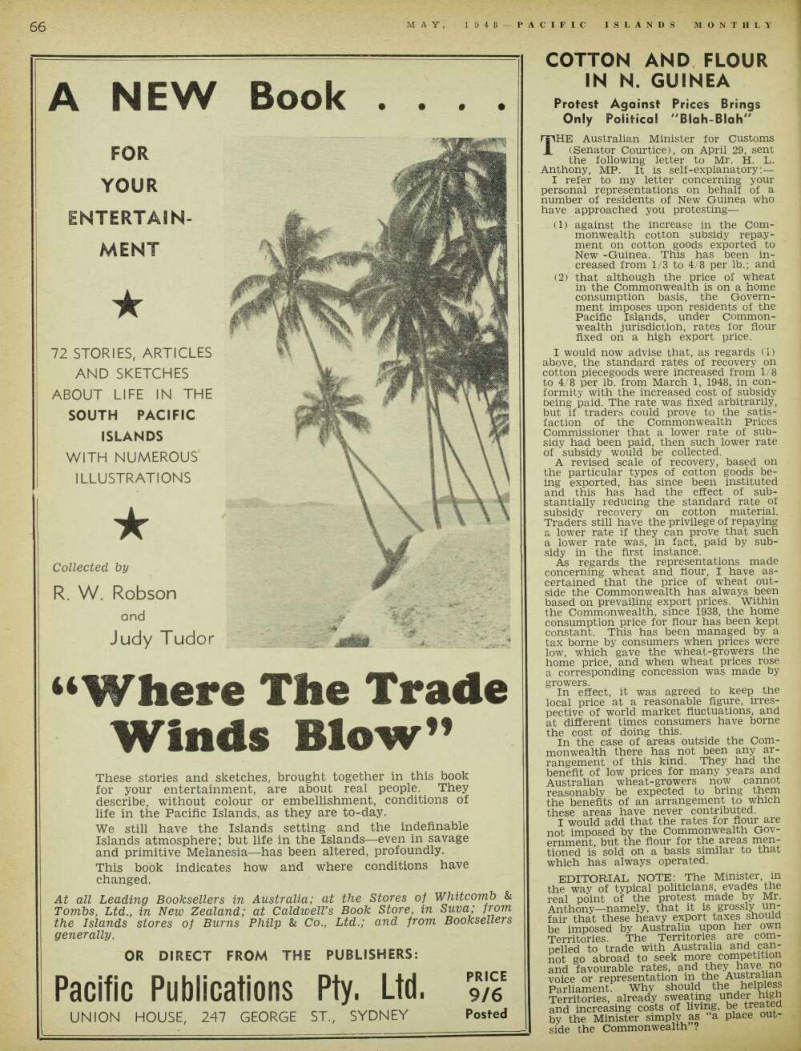
Cotton And Flour
Protest Against Prices Brings Only Political "Blah-Blah"
THE Australian Minister for Customs (Senator Courtice), on April 29, sent the following letter to Mr. H. L.
Anthony, MP. It is self-explanatory:— I refer to my letter concerning your personal representations on behalf of a number of residents of New Guinea who have approached you protesting— (l) against the increase in the Com monwealth cotton subsidy repay ment on cotton goods exported to New -Guinea. This has been in creased from 1/3 to 4/8 per lb.; and (2) that although the price of wheat in the Commonwealth is on a home consumption basis, the Govern ment imposes upon residents of the Pacific Islands, under Common wealth jurisdiction, rates for flour fixed on a high export price.
I would now advise that, as regards (1) above, the standard rates of recovery on cotton piecegoods were increased from 1/8 to 4/8 per lb. from March 1, 1948, in con formity with the increased cost of subsidy being paid. The rate was fixed arbitrarily, but if traders could prove to the satis faction of the Commonwealth Prices Commissioner that a lower rate of sub sidy had been paid, then such lower rate of subsidy would be collected.
A revised scale of recovery, based on the particular types of cotton goods be ing exported, has since been instituted and this has had the effect of sub stantially reducing the standard rate of subsidy recovery on cotton material.
Traders still have the privilege of repaying a lower rate if they can prove that such a lower rate was, in fact, paid by sub sidy in the first instance.
As regards the representations made concerning wheat and flour, I have as certained that the price of wheat out side the Commonwealth has always been based on prevailing export prices. Within the Commonwealth, since 1938, the home consumption price for flour has been kept constant. This has been managed by a tax borne by consumers when prices were low, which gave the wheat-growers the home price, and when wheat prices rose a corresponding concession was made by growers.
In effect, it was agreed to keep the local price at a reasonable figure, irres pective of world market fluctuations, and at different times consumers have borne the cost of doing this.
In the case of areas outside the Com monwealth there has not been any ar rangement of this kind. They had the benefit of low prices for many years and Australian wheat-growers now cannot reasonably be expected to bring them the benefits of an arrangement to which these areas have never contributed.
I would add that the rates for flour are not imposed by the Commonwealth Gov ernment, but the flour for the areas men tioned is sold on a basis similar to that which has always operated.
EDITORIAL NOTE: The Minister, in the way of typical politicians, evades the real point of the protest made by Mr.
Anthony—namely, that it is grossly un fair that these heavy export taxes should be imposed by Australia upon her own Territories. The Territories are com pelled to trade with Australia and can not go abroad to seek more competition and favourable rates, and they have no voice or representation in the Australian Parliament. Why should the helpless Territories, already sweating under high and increasing costs of living, be treated by the Minister simply as a place out side the Commonwealth”?
Upsurge of Enterprise
Among Post-War Fijians
From Our Own Correspondent
Suva, May 3.
IN the post-war period, and particularly in the past year, there has been a quiet but astonishing upsurge of Fijian enterprise in unexpected direc tions.
In a general sense, it may be said that it is due primarily to the war; but a more immediate cause is the belated dis covery, by influential people, that .the time for treating the Fijian as an irres ponsible child has gone.
There are other factors, including, as the “Fiji Times” said editorially the other day, “the insistent demands made in the Legislative Council by the Indian leaders, who, perhaps unwittingly, are doing the Fijians good service by compelling them to realise that, as a race, they cannot stand still.”
As a result of the unsatisfied demand for Fijian products, such as copra, (the Fijians already produce two-thirds of the Colony’s copra) and the need for in creased production, a suggestion was made recently that a strong, independent, all- Fijian planters’ organisation should be formed.
Such an organisation, the Fijian Plan ters’ Association, was started as long ago as 1932, and had seemingly died in in fancy.
The Fijian planters’ Association, how ever, had done nothing of the sort and on April 28, 1947, it held a general meeting of 212 delegates representing 1,600 members in the Suva Town Hall.
The managing director, Levani Vaniqi, was in the chair; Wiliame Vulowai, was secretary, and the headmaster of the Rewa Central School (Inoke Cakautini) was
translator of the address given, by invita tion, by Mr. H. Maurice Scott, MLC, who was later elected the Association’s legal adviser.
“The Government is reserving the best land for you, and this means that you must increase production,” Mr. Scott told the meeting. “It is no good sitting and waiting for rents to be paid. With pos session of much of the best land, you must produce crops.”
It was significant that the Fijian speakers who followed him during the
conference at no stage declaimed about Fijian rights or grievances, but stressed the urgency of the need for Fijian solid arity in a full-scale production drive.
The Australian Government is extend ing its Reconstruction Training Scheme for New Guinea soldiers to mission ac tivities. Subsidies will be paid for courses in technical work, teacher training and domestic training at all mission schools.
Advertisements & other items, pp. 69-70 (1 item)
W. H. Grove & Sons
Limited
Established 1896.
AUCKLAND
Island Traders. PO. box 490.
Telegraphic and Cable Address: “Grove”, Auckland.
Entrust Your Orders to the Firm with Fifty Years Practical Experience in the Island Trade.
Shippers of all classes of New Zealand product's.
Representing English Manufacturers through-
out the Cook and Society Islands, Fiji, Tonga, Samoa, Niue, New Caledonia, New Guinea, etc.
In FIJI as—W. H. Grove & Sons (Fiji) Ltd.
DIESEL ENGINES
WIDDOP
S H-P TO 300 H P
H • WIDDOP & CO LTD
GREENGATE KEIGHLEY ENGLAND
Telephone: Keighley 3727-8 Telegrams: Widdop Keighley Codes: A.B.C. 6th Edition, Bentley’s, Bentley’s Second £ d fcJ <d j Above: (D-Type) 36/45 H.P.
On left: (X-Type) 120 H.P.
Direct reversing J
Island Stamps
Island Stamps
Island Stamps
Island Stamps
1/3 PER PACKET
including postage Write to —
JENKINS EMPORIUM
Box 100, Suva, FIJI
Scott’s “Renown” Brand Rope,
Cordage and
Binder
Twine
of Every
Description
Cable Address Ropeyard Sydney mm S 5»
MANUFACTURED AT
MASCOT. N.S.W.
J. SCOTT
PTY. LTD.
Head Office and Store
163 CLARENCE STREET.
SYDNEY.
N.S.W.
HALF
fygratrt*
SAVING CRtAj*
..TM goes a long
ISC 84
( A ‘r " i
vfg
For Beard-Bothered males, science has created Ingram's, the cool, concentrated shaving cream. Ingram's gives that 100% summer-cooled lather, that softens the wiriest whisker, and makes shaving a happy, carefree few moments. Ingram's at all chemists. 120 refreshing shaves for I /1 0. \ MILLION SHREWD SHAVERS USE INGRAMS SHAVING CREAM
Sister!
Bunnerong's Little
The Lights of Vila Come and Go
From Our Own Correspondent VILA, April 15.
AFTER having been out for 6 days, the “lights of Vila shine again.” In spite of the 100 per cent, increase in price for current (current now costs about 2/per unit), granted by the Condominium, the company appears to take no steps to ensure a regular supply. Stoppages, varying from one hour to several days, are a common occurrence.
People with electric refrigerators, the
hospitals and garages with electrical equipment are the greatest sufferers, and the greater part oi the population has gone pack to pressure oil lamps and irons as being more reliable.
The plant does not appear to be able to supply all requirements, as when the current is “on” for private consumption it is “off” with regard to street lignting —and this in spite of the fact that resi dents of Vila have to pay a “street light ing tax” which varies in amount accord ing to whether the taxpayer is married single or divorced, and the size of his family. All residents within 3 kilometres of the post office have to pay this tax; and, owing to the configuration of Vila Bay, some unfortunates, who are within the prescribed distance but 3 or 4 miles distant by road, have to pay also, although there are no street lights in their vicinity.
Of course, they can always sit on their front verandah and admire the bright lights of the gay city (that is, when there are any lights).
Even during the war, when a strict blackout was enforced, this street light ing tax was payable. At that period the company, owing to the lighting restric tions, had a lot of spare current on its hands, and this was profitably sold to the American occupation troops. In fact, their demand for current became so great that the plant was forced to deliver more than its rated capacity in order to satisfy the Americans’ requirements.
This may be one of the reasons for its present state and the principal cause of the frequent breakdowns. One of the motors appears to be definitely out of commission, and the company is now using an American “Caterpillar” set to generate current.
Nobody seems to know how long this state of affairs is going to continue and the Condominium, although it pays a subsidy to the company, appears to be unable to do anything to rectify matters.
The town is divided into three sections, and the company has lately adopted the practice of cutting off the current for 24 hours in each section in turn. If this practice is to continue, the company will presumably apply for another increase in the price of electricity, because of the drop in revenue.
EDITORIAL NOTE: Residents of Vila would feel completely at home in Sydney, where, owing to the post-war inadequacy of the Bunnerong generating plant, black-outs are frequent, and increasing.
The Origin Of The
"Tin Can Mail"
Letter to the Editor THE article “Tin Can Mailman,’’ pub lished in your January issue wants an exolanation. Mr. C. S. Ramsay, manager for Morris, Hedstrom Ltd., at Haapai, never claimed to be the maugu rator of the famous “Tin Can Mail at Niuafoou. Nor did Mr. Arthur Tmdale adopt this mail system.
Twenty years before Mr. Tmdale came to Tonga as a salesman for W. Barnard, at Nukualofa, a Mr. W. Travers was trad ing at Niufoa for the firm of Ostermann Dervy & Co., Sydney. He arranged with the Tongan Government that Mr. w.
Hettig, Senior . should solder the mail m a kerosene or a biscuit tin, and tnat cap tain Croshaw, of TS “Opulu” would drop the tin overboard when close to tne landing-place at Niuafoou and that natives would swim out for the tin.
Mr C. S. Ramsay was the only Euro pean, while living in Niuafoou who swam out to the steamer, and who delivered and accepted the mail. Mr. who used to trade for B ur n s Pliilp (SS) Co., Ltd., at Niuafoou, established the “Tin Can Island Postal System, which became world-famous.
I am, etc.,
F. T. Goedicke-Van Asten.
Haapai, Tonga, 11/3/48.
Dismissal of Suva
PWD Men First Effect of Scrapping of Development Plan
From Our Own Correspondent SUVA, April 12.
PUBLIC Works Department employees —officially numbering “approxi mately 150,” unofficially about 170— at the Department’s big Suva establish ment at Walu Bay, Suva, have been stood down (otherwise dismissed) in the first drastic move in the retrenchment campaign which has followed the realign ment of Fiji’s Ten-Year Development Plan announced by the Governor (Sir Brian Freeston) on March 19.
The men affected were mostly engaged in building trades and were those with the shortest terms of service.
No indication has yet been given as to how far retrenchment may go.
The Late Islay Mcowan
A WELL-KNOWN former public ser vant in Fiji, Mr. J. R. Pearson, writes from his residence in La Rocque, Jersey, Channel Islands:— “My wife and I have learned with distress of the death of our old friend Islay McOwan. He was a very good friend of ours when we were in Fiji and I, in common with all classes, had great admiration and respect for his sterling qualities. It was very lucky that he was at the helm of Native Affairs during a period of great developments; and with his long experience of the Colony he was ever ready with wise advice on all ques tions, and was unsparing of himself in his efforts to deal with any extra burdens thrown upon him. Fiji probably owes more to him than to any other officer who has served there in recent years.”
Uk Goods For
Fiji
UNLOADING at Suva, in May was the Direct Line ship “Leicester” from the United Kingd'om. She was brought a record cargo of 6,100 tons for Fiji.
Included are 38,000 bags of cement, large quantities of salt and sulphate of ammonia (for the canefields) and gen ral cargo.
Cane Growers
Big Payments To Fiji's
From Our Own Correspondent SUVA, April 9.
THE Colonial Sugar Refining Co. will pay out more than £400,000 to cane growers in Fiji in the next few weeks. This represents 8/6 a ton (second interim payment) on the 1947 crop.
Advertisements & other items, pp. 71-72 (1 item)
Hard to Get? hi_ US
FOR
1. TRADE TOBACCO 10.
2. LAP LAP MATERIAL 11.
3. CANNED GOODS 12.
4. PERFUMERY 13.
5. PRIMUS STOVES
6. KEROLAMPS l4>
7. SHOES, SANDALS 15
8. UMBRELLAS 16
9. CHILDREN'S CLOTH- 17'
ING 18.
SADDLERY & HARNESS
HOME LIGHTING PLANTS
WINES AND SPIRITS
NON-ELECTRIC WASHING
MACHINES
PUMPS, IRRIGATION
PLANTS
CROCKERY
HAIRDRESSING SUPPLIES
HARDWARE
AIR CIRCULATORS
/I M ft 8a CasHereagh Street,
IflallS IU%IiS Sydney, Australia
ISLAND TRADERS
Cable and Telegraphic address: “MANSTOCKS,” SYDNEY Telephones: 8W7405, 8W1237, 85076, FM2766
For the production of best quality WHITE COPRA
CHULA
COPRA DRYERS
BULK POWER DRYERS
FOR LARGE ESTATES
TYPE 8.D.0 6,000 NUTS PER 24 HRS.
TYPE 8.D.1—10,000 NUTS PER 24 HRS.
ALSO NATURAL DRAFT DRYERS
FOR SMALLER ESTATES
k I
TYNESIDE FOUNDRY AND ENGINEERING CO. LTD.
LOW ELSWICK NEWCASTLE UPON TYNE ENGLAND CABLES • FOUNDRY NEWCASTLE-ON-TYNE
Rid Kidneys Of
Poisons And Acids
If you suffer sharp, stabbing pains, If Joints are swollen, It shows your blood Is poisoned through faulty kidney action. Other symptoms of Kidney Disorders are Backache. Aching Joints and Limbs, Sciatica, Neuritis, Lumbago. Sleepless Nights, Dizziness, Nervousness, Circles under Eyes. Loss of Energy and Appetite and Frequent Headaches and Colds, etc. Ordinary medicines can t help much because you must get to the root cause of the trouble.
The Cystex treatment is specially compounded to soothe, tone and clean kidneys and bladder and remove acids and poisons from your system safely, quickly and surely, yet contains no harmful or dangerous drugs. Cystex works In 3 ways to end your troubles. 1. Starts killing the germs which are attacking your Kidneys, Bladder and Urinary System In two hours, yet Is absolutely harmless to human ussue. 2. Gets rid of health-destroying, deadly poisonous acids with which your system has become saturated. 3. Strengthens and reinvigorates the kidneys, protects from the ravages of disease-attack on the delicate filter organism, and stimulates the entire system.
Praised by One-time Sufferers Cystex Is approved by one-time sufferers in 73 countries from the troubles shown above Mr Reg Thomas, Townsville, Queensland, recently wrote: “My joints were all stiff, I had leg pains, my back used to ache day and night.
My bladder was weak. I had headaches and no appetite. The first dose of Cystex helped me and before I finished three boxes my health and strength came back.”
Guaranteed to Satisfy or Money Back Get Cystex from your chemist or store to-day Give It a thorough test. Cystex Is guaranteed to make you feel younger, stronger, better h every way, or your money back If you return the empty package.
Now in 2 sizes—4/-, 8/-.
GUARANTEED CVStCX
Treatment
for Your Kidneys, Bladder, Rheumatism,
Corrie & Company
Garrick Buildings, Suva, Fiji
MANUFACTURERS' REPRESENTATIVES
Manufacturers who are desirous of obtaining a market in Fiji for their products are recommended to write to Corrie & Co., who are a live and progressive firm dealing with every store of repute in Fiji.
“Our years of experience are your guarantee.”
Box No. 45, G.P.0., Suva.
Codes:
BENTLEY’S 2nd PHRASE AND PRIVATE,
Agents and Attorneys in Fiji for:
CENTRAL INSURANCE CO., LTD.
Sole Agents in Fiji for*
TRANS OCEANIC AIRWAYS PTY., LTD.
General Manager; A. E. T. CORRIE.
Manager, Fiji Branch:
C. H. HUNT.
- ' ' , mmm W Pi t
Samoa —Tonga
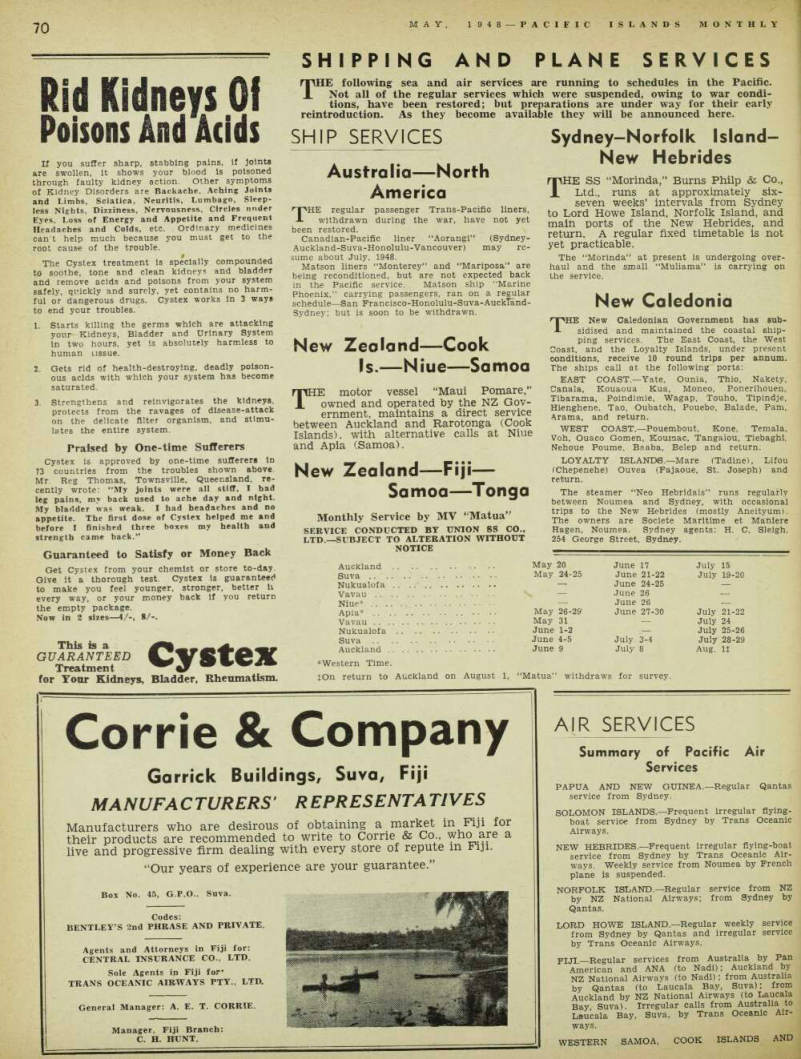
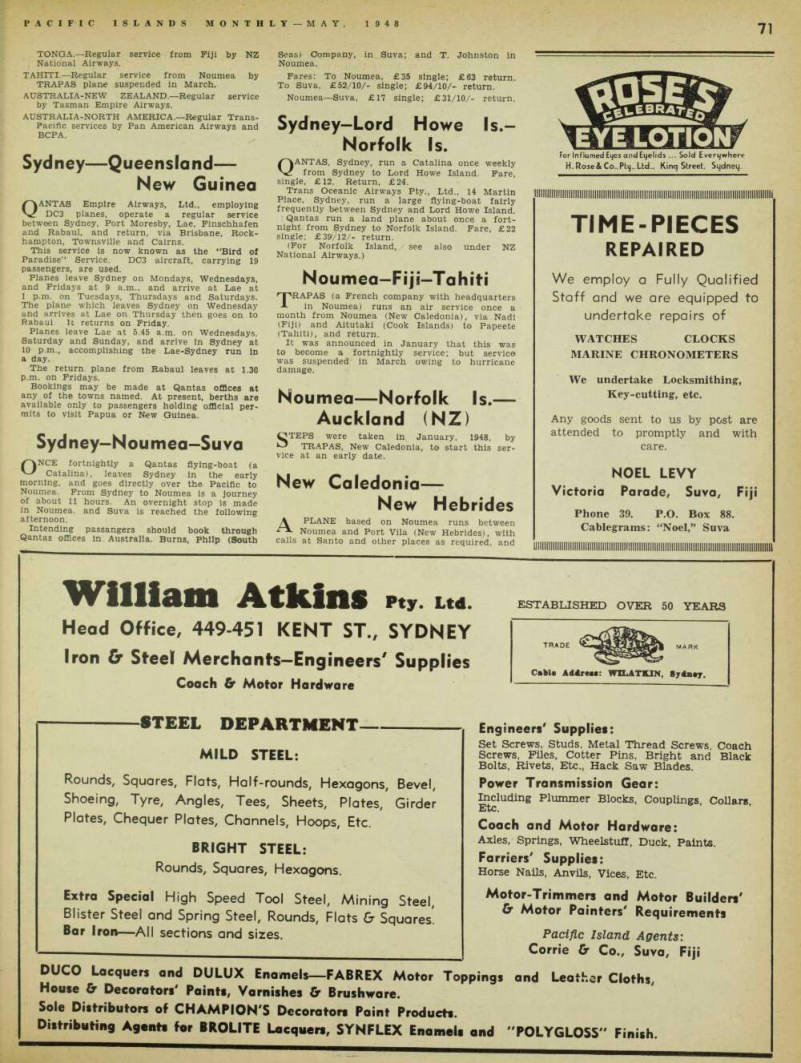
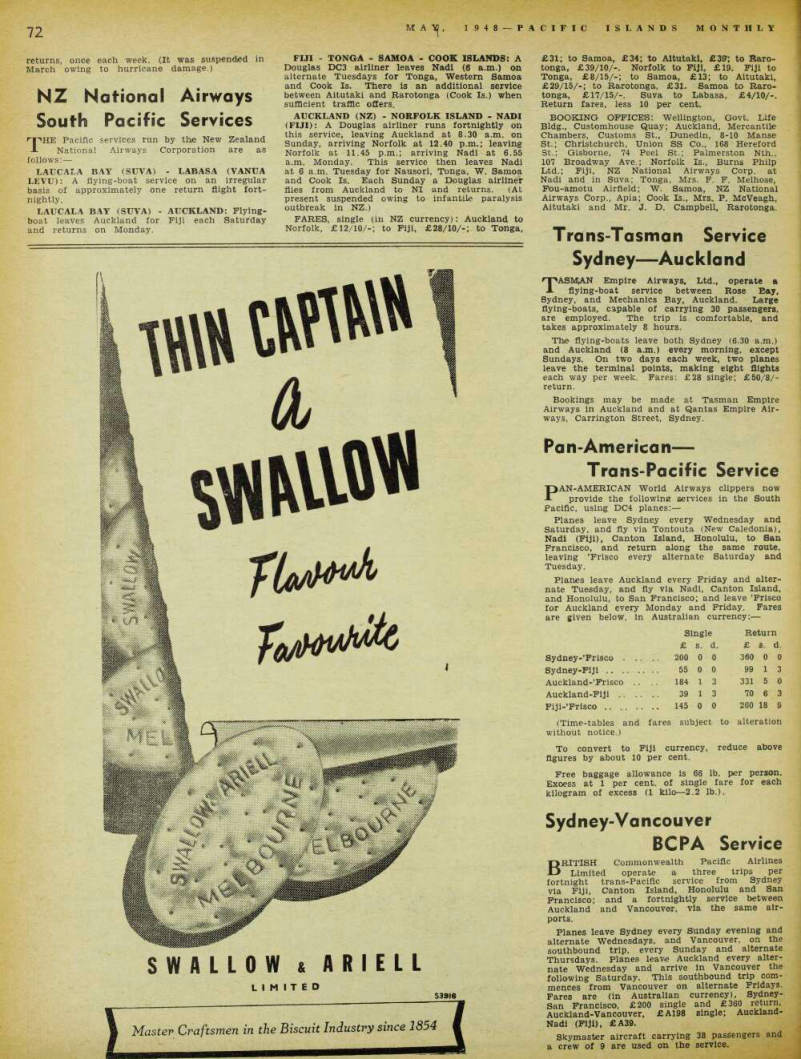
Shipping And Plane Services
THE following sea and air services are running to schedules in the Pacific.
Not all of the regular services which were suspended, owing to war condi tions, have been restored; but preparations are under way for their early reintroduction. As they become available they will be announced here.
Ship Services
Australia—North
America
THE regular passenger Trans-Pacific liners, withdrawn during the war, have not yet been restored.
Canadian-Pacific liner “Aorangi” (Sydney- Auckland-Suva-Honolulu-Vancouver) may re sume about July, 1948.
Matson liners “Monterey” and “Mariposa” are being reconditioned, but are not expected back Ln the Pacific service. Matson ship “Marine Phoenix,” carrying passengers, ran on a regular schedule —San Francisco-Honolulu-Suva-Auckland - Sydney; but is soon to be withdrawn.
New Zeeland—Cook
Is.—Niue —Samoa
rE motor vessel “Maui Pomare.” owned and operated by the NZ Gov ernment, maintains a direct service between Auckland and Rarotonga (Cook Islands), with alternative calls at Niue and Apia (Samoa).
New Zealand—Fiji—
Samoa —Tonga
Monthly Service by MV “Matua”
Service Conducted By Union Ss Co.,
Ltd.—Subject To Alteration Without
Notice
Sydney-Norfolk Island-
New Hebrides
THE SS “Morinda,” Burns Philp & Co., Ltd., runs at approximately six seven weeks’ intervals from Sydney to Lord Howe Island. Norfolk Island, and main ports of the New Hebrides, and return. A regular fixed timetable is not
yet practicable.
The “Morinda” at present is undergoing over haul and the small “Muliama” is carrying on the service.
New Caledonia
THE New Caledonian Government has sub sidised and maintained the coastal ship ping services. The East Coast, the West Coast, and the Loyalty Islands, under present conditions, receive 10 round trips per annum.
The ships call at the following ports; EAST COAST. —Yate, Ounia, Thio, Nakety, Canala, Kouaoua Kua, Moneo, Ponerihouen, Tibarama, Poindimie, Wagap, Touho, Tipindje, Hienghene, Tao, Oubatch, Pouebo, Balade, Pam, Arama, and return.
WEST COAST. —Pouembout, Kone, Temala, Voh, Ouaco Gomen, Koumac, Tangaiou, Tiebaghl, Nehoue Poume, Baaba, Belep and return.
LOYALTY ISLANDS.—Mare (Tadine), Lifou (Chepenehe) Ouvea (Fajaoue, St. Joseph) and return.
The steamer “Neo Hebridais” runs regularly between Noumea and Sydney, with occasional trips to the New Hebrides (mostly Aneityum).
The owners are Societe Maritime et Manlere Hagen, Noumea. Sydney agents: H. C. Sleigh, 254 George Street. Sydney.
Air Services
Summary of Pacific Air
Services
PAPUA AND NEW GUlNEA.—Regular Qantas service from Sydney.
SOLOMON ISLANDS.—Frequent irregular flying boat service from Sydney by Trans Oceanic Airways.
NEW HEBRlDES.—Frequent irregular flying-boat service from Sydney by Trans Oceanic Air ways. Weekly service from Noumea by French plane is suspended.
NORFOLK ISLAND.—Regular service from NZ by NZ National Airways; from Sydney by Qantas.
LORD HOWE ISLAND.—Regular weekly service from Sydney by Qantas and irregular service by Trans Oceanic Airways.
PUI —Regular services from Australia by Pan American and ANA (to Nadi); Auckland by NZ National Airways (to Nadi); from Australia by Qantas (to Laucala Bay, Suva); from Auckland by NZ National Airways (to Laucala Bay Suva). Irregular calls from Australia to Laucala Bay, Suva, by Trans Oceanic Air ways.
Western Samoa, Cook Islands And
Auckland May 20 June 17 July 15 Suva May 24-25 June 21-22 July 19-20 Nukualofa — June 24-25 — Vavau • • • x, — June 26 — Niue* — June 26 — Apia® • • • • May 26-25' June 27-30 July 21-22 Vavau May 31 — July 24 Nukualofa June 1-2 — July 25-26 Suva June 4-5 July 3-4 July 28-29 Auckland June 9 July 8 Aug.
It *Western Time. jOn return to Auckland on August 1, “Matua” withdraws for survey.
TONGA. —Regular service from Fiji by NZ National Airways.
TAHITI. —Regular service from Noumea by TRAPAS plane suspended in March.
AUSTRALIA-NEW ZEALAND.—ReguIar service by Tasman Empire Airways.
AUSTRALIA-NORTH AMERICA.—Regular Trans pacific services by Pan American Airways and
Bcpa.
Sydney—Queensland—
New Guinea
QANTAS Empire Airways, Ltd., employing DCS planes, operate a regular service between Sydney, Port Moresby, Lae, Finschhafen and Rabaul, and return, via Brisbane, Rock hampton, Townsville and Cairns.
This service is now known as the “Bird of Paradise” Service. DCS aircraft, carrying 19 passengers, are used.
Planes leave Sydney on Mondays, Wednesdays, and Fridays at 9 a.m., and arrive at Lae at 1 p.m. on Tuesdays, Thursdays and Saturdays.
The plane which leaves Sydney on Wednesday and arrives at Lae on Thursday then goes on to Rabaul. It returns on Friday.
Planes leave Lae at 5.45 a.m. on Wednesdays.
Saturday and Sunday, and arrive in Sydney at 10 p.m., accomplishing the Lae-Sydney run In a day.
The return plane from Rabaul leaves at 1.30 p.m. on Fridays.
Bookings may be made at Qantas offices at any of the towns named. At present, berths are available only to passengers holding official per mits to visit Papua or New Guinea.
Sydney-Noumea-Suva
fortnightly a Qantas flying-boat (a ' Catalina), leaves Sydney in the early morning, and goes directly over the Pacific to Noumea. From Sydney to Noumea is a journey of about 11 hours. An overnight stop is made in Noumea, and Suva is reached the following afternoon.
Intending passengers should book through Qantas offices in Australia. Burns, Phllp (South
Seas> Company, in Suva; and T. Johnston in Noumea.
Fares: To Noumea, £35 single; £63 return.
To Suva, £52/10/- single; £94/10/- return.
Noumea—Suva, £l7 single; £3l/10/- return.
Sydney-Lord Howe ls.-
Norfolk Is.
QANTAS, Sydney, run a Catalina once weekly from Sydney to Lord Howe Island. Fare, single, £l2. Return, £24.
Trans Oceanic Airways Pty., Ltd., 14 Martin Place, Sydney, run a large flying-boat fairly frequently between Sydney and Lord Howe Island.
Qantas run a land plane about once a fort night from Sydney to Norfolk Island. Fare, £22 single; £39/12/- return. (For Norfolk Island, see also under NZ National Airways.)
Noumeo-Fiji-Tahiti
npRAPAS (a French company with headquarters A in Noumea) runs an air service once a month from Noumea (New Caledonia), via Nadi (Fiji) and Aitutaki (Cook Islands) to Papeete (Tahiti), and return.
It was announced in January that this was to become a fortnightly service; but service was suspended in March owing to hurricane damage.
Noumea—Norfolk Is.—
Auckland (NZ)
STEPS were taken in January, 1948, by TRAPAS, New Caledonia, to start this ser vice at an early date.
New Caledonia—
New Hebrides
A PLANE based on Noumea runs between Noumea and Port Vila (New Hebrides), with calls at Santo and other places as required, and
returns, once each week. (It was suspended in March owing to hurricane damage.)
NZ National Airways
South Pacific Services
THE Pacific services run by the New Zealand National Airways Corporation are as follows: —
Laucala Bay (Suva) - Labasa (Vanua
LEVU): A flying-boat service on an irregular basis of approximately one return flight fort nightly.
Laucala Bay (Suva) - Auckland: Flying
boat leaves Auckland for Fiji each Saturday and returns on Monday.
FIJI - TONGA - SAMOA - COOK ISLANDS: A Douglas DC3 airliner leaves Nadi (8 a.m.) on alternate Tuesdays for Tonga, Western Samoa and Cook Is. There is an additional service between Aitutaki and Rarotonga (Cook Is.) when sufficient traffic offers.
AUCKLAND (NZ) - NORFOLK ISLAND - NADI (FIJI): A Douglas airliner runs fortnightly on this service, leaving Auckland at 8.30 a.m. on Sunday, arriving Norfolk at 12.40 p.m.; leaving Norfolk at 11.45 p.m.; arriving Nadi at 6.55 a.m. Monday. This service then leaves Nadi at 6 a.m. Tuesday for Nausori, Tonga, W. Samoa and Cook Is. Each Sunday a Douglas airliner flies from Auckland to NI and returns. (At present suspended owing to infantile paralysis outbreak in NZ.) FARES, single (in NZ currency): Auckland to Norfolk, £l2/10./-; to Fiji, £2B/10/-; to Tonga,
£3l; to Samoa, £34; to Aitutakl, £39; to Raro tonga, £39/10/-. Norfolk to Fiji, £l9. Fiji to Tonga, £B/15/-; to Samoa, £l3; to Aitutaki, £29/15/-; to Rarotonga, £3l. Samoa to Raro tonga, £l7/15/-. Suva to Labasa, £4/10/-.
Return fares, less 10 per cent.
BOOKING OFFICES: Wellington, Govt. Life Bldg., Customhouse Quay; Auckland, Mercantile Chambers, Customs St., Dunedin, 8-10 Manse St.; Christchurch, Union SS Co., 168 Hereford St.; Gisborne, 74 Peel St.; Palmerston Nth., 107 Broadway Ave.; Norfolk Is., Burns Philp Ltd.; Fiji, NZ National Airways Corp. at Nadi and in Suva; Tonga, Mrs. F. F. Melhose, Pou-amotu Airfield; W. Samoa, NZ National Airways Corp., Apia; Cook Is., Mrs. P. McVeagh, Aitutaki and Mr. J. D. Campbell, Rarotonga.
Trans-Tasman Service
Sydney—Auckland
TASMJAN Empire Airways, Ltd., operate a flying-boat service between Rose Bay, Sydney, and Mechanics Bay, Auckland. Large flying-boats, capable of carrying 30 passengers, are employed. The trip is comfortable, and takes approximately 8 hours.
The flying-boats leave both Sydney (6.30 a.m.) and Auckland (8 a.m.) every morning, except Sundays. On two days each week, two planes leave the terminal points, making eight flights each way per week. Fares: £2B single; £5O/8/return.
Bookings may be made at Tasman Empire Airways in Auckland and at Qantas Empire Air ways, Carrington Street, Sydney.
Pan-American—
Trans-Pacific Service
PAN-AMERICAN World Airways clippers now provide the following services in the South Pacific, using DC4 planes:— Planes leave Sydney every Wednesday and Saturday, and fly via Tontouta (New Caledonia), Nadi (Fiji), Canton Island, Honolulu, to San Francisco, and return along the same route, leaving ’Frisco every alternate Saturday and Tuesday.
Planes leave Auckland every Friday and alter nate Tuesday, and fly via Nadi, Canton Island, and Honolulu, to San Francisco; and leave ’Frisco for Auckland every Monday and Friday. Fares are given below, in Australian currency:—
(Time-tables and fares subject to alteration without notice.) To convert to Fiji currency, reduce above figures by about 10 per cent.
Free baggage allowance is 66 lb. per person.
Excess at 1 per cent, of single fare for each kilogram of excess (1 ki10—2.2 lb.).
Sydney-Vancouver
BCPA Service
BRITISH Commonwealth Pacific Airlines Limited operate a three trips per fortnight trans-Pacific service from Sydney via Fiji, Canton Island, Honolulu and San Francisco; and a fortnightly service between Auckland and Vancouver, via the same air ports.
Planes leave Sydney every Sunday evening and alternate Wednesdays, and Vancouver, on the southbound trip, every Sunday and alternate Thursdays. Planes leave Auckland every alter nate Wednesday and arrive in Vancouver the following Saturday. This southbound trip com mences from Vancouver on alternate Fridays.
Fares are (in Australian currency), Sydney- San Francisco, £2OO single and £360 return, Auckland-Vancouver, £AI9B single; Auckland- Nadi (Fiji), £A39.
Skymasber aircraft carrying 38 passengers and a crew of 9 are used on the service.
Single Return £ s. d. £ s. d.
Sydney-’Prisco 200 0 0 360 0 0 Sydney-Pljl 55 0 0 99 1 3 Auckland-’Frisco ... 184 1 3 331 5 0 Auckland-Fljl 39 1 3 70 6 3 Fiji-’Frlsco 145 0 0 260 18 9
Advertisements & other items, pp. 73-74 (1 item)
William Atkins Pty. Ltd.
m For Inflamed Eyes and Eyelids ... Sold Everywhere H. Rose&Co.,Pty.. Ltd.. King Street. Sydney.
TIME-PIECES
REPAIRED
We employ a Fully Qualified
Staff and we are equipped to undertake repairs of
WATCHES CLOCKS
MARINE CHRONOMETERS
We undertake Locksmithing, Key-cutting, etc.
Any goods sent to us by post are attended to promptly and with care.
NOEL LEVY
Victoria Parade, Suva, Fiji
Phone 39. P.O. Box 88.
Cablegrams: “Noel,” Suva
William Atkins Pty. Ltd.
Head Office, 449-451 KENT ST., SYDNEY
Iron & Steel Merchants—Engineers* Supplies
Coach fir Motor Hardware
ESTABLISHED OVER 50 YEARS
Cable Address: WILATKIN, Sydney.
STEEL DEPARTMENT
MILD STEEL:
Rounds, Squores, Flats, Half-rounds, Hexagons, Bevel, Shoeing, Tyre, Angles, Tees, Sheets, Plates, Girder Plates, Chequer Plates, Channels, Hoops, Etc.
BRIGHT STEEL:
Rounds, Squares, Hexagons.
Extra Special High Speed Tool Steel, Mining Steel, Blister Steel and Spring Steel, Rounds, Flats & Squares.
Bar Iron—All sections and sizes.
Engineers' Supplies: Set Screws, Studs. Metal Thread Screws, Coach Screws, Piles, Cotter Pins, Bright and Black Bolts, Rivets, Etc., Hack Saw Blades.
Power Transmission Gear: Including Plummer Blocks, Couplings, Collars.
Etc.
Coach and Motor Hardware: Axles, Springs, Wheelstuff, Duck, Paints.
Farriers' Supplies: Horse Nails, Anvils, Vices, Etc.
Motor-Trimmers and Motor Builders' & Motor Painters' Requirements Pacific Island Agents : Corrie fir Co., Suva, Fiji DUCO Lacquers and DULUX Enamels—FAßßEX Motor Toppings and Leather Cloths, House & Decorators' Paints, Varnishes & Brushware.
Sole Distributors of CHAMPION'S Decorators Point Products.
Distributing Agents for BROLITE Lacquers, SYNFLEX Enamels and "POLYGLOSS'' Finish.
m & 1 MEk si « & ■* ss* st ii <a
SWALLOW & ARIELL
LIMITED
1 Master Craftsmen in the Biscuit Industry since 1854
N. Ireland Planter's Daughter Marries
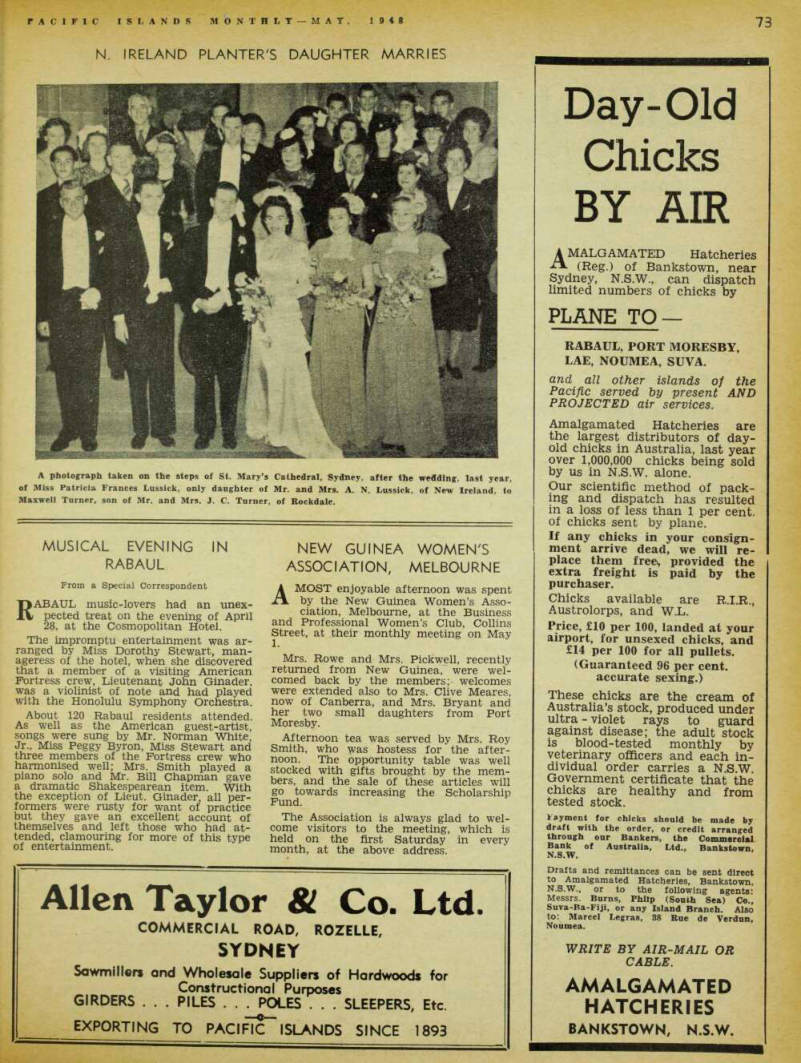
A photograph taken on the steps of St. Mary’s Cathedral, Sydney, after the wedding, last year, of Miss Patricia Frances Lussick, only daughter of Mr. and Mrs. A. N. Lu ssick, of New Ireland, to Maxwell Turner, son of Mr, and Mrs. J. C. Turner, of Rockdale.
Musical Evening In
Rabaul
Prom a Special Correspondent RABAUL music-lovers had an unex pected treat on the evening of April 28, at the Cosmopolitan Hotel.
The impromptu entertainment was ar ranged by Miss Dorothy Stewart, man ageress of the hotel, when she discovered that a member of a visiting American Fortress crew, Lieutenant John Ginader. was a violinist of note and had played with the Honolulu Symphony Orchestra.
About 120 Rabaul residents attended.
As well as the American guest-artist, songs were sung by Mr. Norman White.
Jr., Miss Peggy Byron, Miss Stewart and three members of the Fortress crew who harmonised well; Mrs. Smith played a piano solo and Mr. Bill Chapman gave a dramatic Shakespearean item. With the exception of Lieut, Ginader, all per formers were rusty for want of practice but they gave an excellent account of themselves and left those who had at tended, clamouring for more of this type of entertainment.
Association, Melbourne
New Guinea Women's
A MOST enjoyable afternoon was spent by the New Guinea Women’s Asso ciation, Melbourne, at the Business and Professional Women’s Club, Collins Street, at their monthly meeting on May Mrs. Rowe and Mrs. Pickwell, recently returned from New Guinea, were wel comed back by the members; welcomes were extended also to Mrs. Clive Meares, now of Canberra, and Mrs. Bryant and her two small daughters from Port Moresby.
Afternoon tea was served by Mrs. Roy Smith, who was hostess for the after noon. The opportunity table was well stocked with gifts brought by the mem bers, and the sale of these articles will go towards increasing the Scholarship Fund.
The Association is always glad to wel come visitors to the meeting, which is held on the first Saturday in every month, at the above address.
Advertisements & other items, pp. 75-76 (1 item)
Day-Old
Chicks
BY AIR
Amalgamated Hatcheries
(Reg.) of Bankstown, near Sydney, N.S.W., can dispatch limited numbers of chicks by
PLANE TO
RABAUL, PORT MORESBY,
LAE, NOUMEA, SUVA.
and all other islands of the Pacific served by present AND PROJECTED air services.
Amalgamated Hatcheries are the largest distributors of dayold chicks in Australia, last year over 1,000,000 chicks being sold by us in N.S.W. alone.
Our scientific method of packing and dispatch has resulted in a loss of less than 1 per cent, of chicks sent by plane.
If any chicks in your consignment arrive dead, we will replace them frees provided the extra freight is paid by the purchaser.
Chicks available are R.1.R., Austrolorps, and W.L.
Price, £lO per 100, landed at your airport, for unsexed chicks, and £l4 per 100 for all pullets. (Guaranteed 96 per cent, accurate sexing.) These chicks are the cream of Australia’s stock, produced under ultra - violet rays to guard against disease; the adult stock is blood-tested monthly by veterinary officers and each individual order carries a N.S.W.
Government certificate that the chicks are healthy and from tested stock.
Payment for chicks should be made by draft with the order, or credit arranged through our Bankers, the Commercial Bank of Australia, Ltd., Bankstown,
N.S.W.
Drafts and remittances can be sent direct to Amalgamated Hatcheries, Bankstown, N.S.W., or to the following agents: Messrs. Burns, Philp (South Sea) Co., Suva-Ba-Fiji, or any Island Branch. Also to: Marcel Legras, 38 Rue de Verdun, Noumea.
WRITE BY AIR-MAIL OR
CABLE.
AMALGAMATED
HATCHERIES
BANKSTOWN, N.S.W.
Allen Taylor & Co. Ltd.
COMMERCIAL ROAD, ROZELLE,
SYDNEY
Sawmillers ond Wholesale Suppliers of Hardwoods for Constructional Purposes GIRDERS . . . PILES . . . POLES . . . SLEEPERS, Etc.
EXPORTING TO PACIRC~ISLANDS SINCE 1893
GEORGE J. LOCKYER & COMPANY
CONSULTING ENGINEERS DOCKYARD MACHINERY
In association with GEORGE J. LOCKYER (Far East) & CO. and GEORGE J. LOCKYER (Overseas) & CO.
ENGINEERING SUPPLIES, GENERAL HARDWARE EXPORTERS AND MERCHANTS Agents tor the Finest Australian Liquors Aerated Water and Cordial Manufacturing Machinery, Bottling and Capping Machinery, etc.
TRACTOR TRACKS AND SPROCKETS.
CRAWLER TRACTORS.
HEAVY DUTY TRAILERS.
LIGHT TRAILERS.
ROADMAKING EQUIPMENT.
FORK LIFT TRUCKS.
MOBILE CRANES.
CRANES AND EXCAVATORS.
DIRECT COUPLED PUMP UNITS.
AIR COMPRESSORS.
COLD ROOMS.
REFRIGERATION AND ICE-MAKING
MACHINERY:
Cold Rooms, Ice Showers, Commercial Refrigerators in all sizes.
Complete Ice-Making Machinery.
POWER HOUSE:
Murphy 6-Cylinder Diesel Engine, Model M.E. 650, Engine No. 103188, 160 h.p., at 1,200 revs., direct coupled to E.M, Synchronous A.C. Generator, 60 cycle, 1,200 r.p.m., 106 K.W., 132.5 K.V.A., 127-220 volt, 348 amps, 3 phase, or 50 cycle, 1,000 r.p.m., 95 K.W., 118.7 K.V.A., 230-400 volts, 172 amps, 3 phase. Generator fitted with E.M.
Synchrostat voltage regulator, lub. oil heat indicator broken, no Vee belts on blower drive, no engine ampmeter; radiator and fan are available for this unit; engine fitted with electric starting.
All material available for immediate export.
© LAUNDRY EQUIPMENT:
Boilers, Washers, Tumblers, Water Pumps.
• NAUTICAL EQUIPMENT:
Buoys, Anchor Cable Chain, Sea Mules, Chrysler Marine Engines, Grey Marine Engines, Dock Cubes, Jewellery, Propeller Shafting, etc.
Ruston 4-Cylinder Diesel Engine, 120 h.p., Size 4, Class C.V.R., Engine No. K 82631, direct coupled to Lawrence & Scott & Electromotor, Ltd., A.C. Generator, 80 K.W., volts 415 r.p.m. 300, 50 cycles, 3 phase, stator amps 140, exciter amps 25.4, rating cont., exciter volts.
Ruston 4-Cylinder Diesel Engine, 120 h.p., Size 4, Class C.V.R., Engine No. 182630, direct coupled to Lawrence Scott & Electromotor, Ltd., A.C. Generator, 80 K.W., 415 volts, 3 phase.
• BAKERY EQUIPMENT:
Bakers’ Oil Burning Stoves, Dough Mixers.
• METAL TUBING:
Galvanised, Black, Brass, Copper and Steel.
@ ELECTRICAL EQUIPMENT:
Generating Sets, Electric Motors, Refrigerating Units, Cool Rooms, Electric Light Turpentine Poles, Lister 4-Cylinder Diesel Engine, 38 h.p., at 1,000 r.p.m., Engine No. 60/359, Spec. 38/4/31, direct coupled to A.S.E.A. A.C.
Generator, K.V.A. 25, volts 415, amps 35, cycles 50, 3 phase, rating continuous; Type G.A. 23, No. 399334, exciter volts 110, exciter amps 5, engine has hand starting; unit is complete.
Switch Board, fitted with: Rotary Synchroniser, Frequency Meter, 2 Voltmeters 500 volts, Ampmeter 20 amps., 3 Ampmeters 50 amps, 2 Ampmeters 150 amps (one has no pointer), 2 Ampmeters 200 amps., Ampmeter 250 amps, Ampmeter 300 amps, Ampmeter 400 amps, 2 Kilowatt Meters 12 0.K.W., Power Factor Meter, Frequency Meter, 44 to 56 cycles per second, and necessary Line Switches.
Overhead Running Gantry, fitted with 5-ton chain block.
Inside Fuel Service Tanks.
Power Cable.
9 HEAVY EQUIPMENT:
Stone Crushing Plants, Concrete Mixers, Air Compressors, Light and Heavy Trailers, Graders, Front End Loaders, Direct Coupled Pumps, Shovels, Booms, etc., Power Units Steam Boilers, Dump Waggons, Barber Green Ditchers, Rooters, Athey Waggons, Dozer Parts, etc.
Outside Supply Tanks, approx. 400 galls, each, engine cooling system is comprised of 3,000 gall. galv. iron tank with sprays, spraying into pond; both Rustons and Lister are equipped with mufflers, but the Murphy has open exhausts.
EXACT REPLICA OF CANE KNIFE,
MADE IN AUSTRALIA.
The Largest Suppliers of Cane Knives in the World.
Photographs, Drawings, Schedules, will be Supplied by Return Mail to Genuine Clients.
HEAD OFFICE, 24 BOND ST.
All communications to be addressed to The General Manager, G.P.0., Box 4553, Sydney.
SYDNEY, N.S.W. 'Phones: Bankers: Commonwealth Bank of Australia, Sydney.
Also Bank of N.S.W., Sydney.
UX 6801, UA 7196, BW6OIB
Telegraphic and Cable Address: “LOCKMACH,” Sydney.
Kill
Lindenhafen
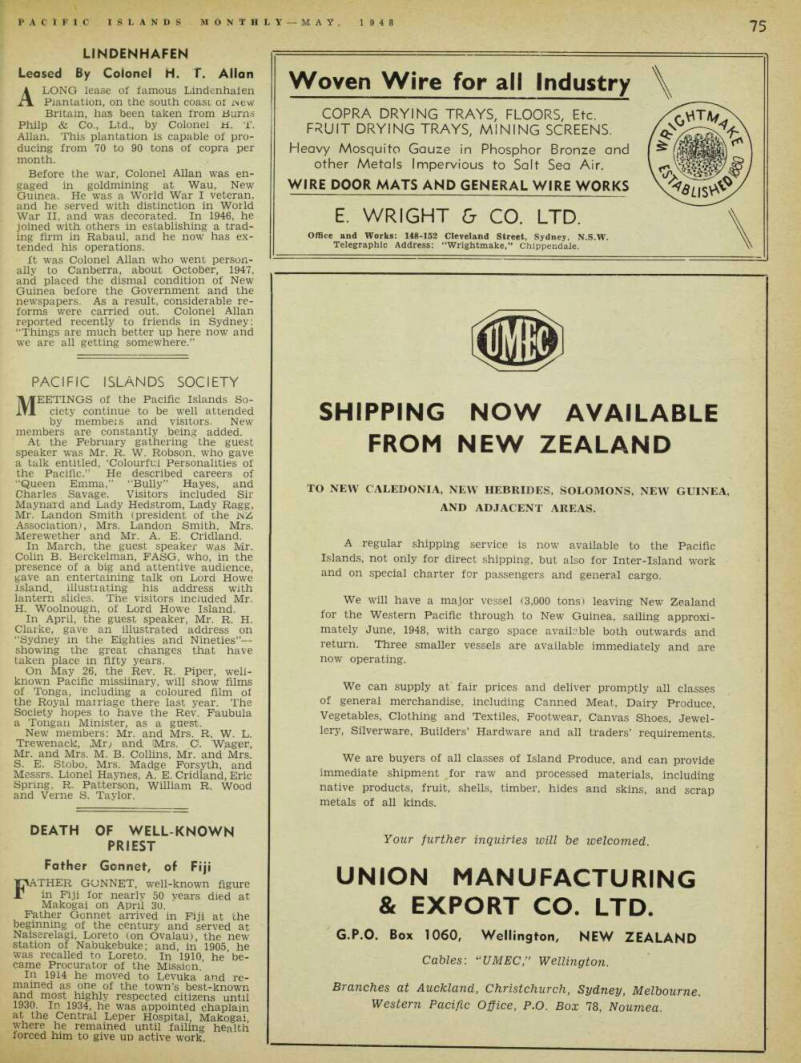
Leased By Colonel H. f. Allan
ALONG lease of famous Lindenhafen Plantation, on the south coast of i\ew Britain, has been taken from Burns Philp & Co., Ltd.,, by Colonel H. T.
Allan. This plantation is capable of pro ducing from 70 to 90 tons of copra per month.
Before the war, Colonel Allan was en gaged in goldmining at Wau, New Guinea. He was a World War I veteran, and he served with distinction in World War 11, and was decorated. In 1946, he joined with others in establishing a trad ing firm in Rabaul, and he now has ex tended his operations.
It was Colonel Allan who went person ally to Canberra, about October, 1947, and placed the dismal condition of New Guinea before the Government and the newspapers. As a result, considerable re forms were carried out. Colonel Allan reported recently to friends in Sydney: “Things are much better up here now and we are all getting somewhere.”
Pacific Islands Society
MEETINGS of the Pacific Islands So ciety continue to be well attended by membeis and visitors. New members are constantly being added.
At the February gathering the guest speaker was Mr. R. W. Robson, who gave a talk entitled, ‘Colourful Personalities of the Pacific.” He described careers of ‘‘Queen Emma,” “Bully” Hayes, and Charles Savage. Visitors included Sir Maynard and Lady Hedstrom, Lady Ragg, Mr. Landon Smith (president of the inZ Association), Mrs. Landon Smith, Mrs.
Merewether and Mr. A. E. Cridland.
In March, the guest speaker was Mr.
Colin B. Berckelman, FASG, who, in the presence of a big and attentive audience, gave an entertaining talk on Lord Howe island, illustrating his address with lantern slides. The visitors included Mr.
H. Woolnough, of Lord Howe Island.
In April, the guest speaker, Mr. R. H.
Clarke, gave an illustrated address on “Sydney in the Eighties and Nineties”— showing the great changes that have taken place in fifty years.
On May 26, the Rev. R. Piper, well known Pacific missiinary, will show films of Tonga, including a coloured film of the Royal marriage there last year. The Society hopes to have the Rev. Faubula a Tongan Minister, as a guest.
New members: Mr. and Mrs. R. W. L.
Trewenack, Mr; and (Mrs. O. Wager, Mr. and Mrs. M. B. Collins. Mr. and Mrs.
S. E. Stobo. Mrs. Madge Forsyth, and Messrs. Lionel Haynes, A. E. Cridland, Eric Spring, R. Patterson, William R. Wood and Verne S. Taylor.
Father Gonnet, of Fiji
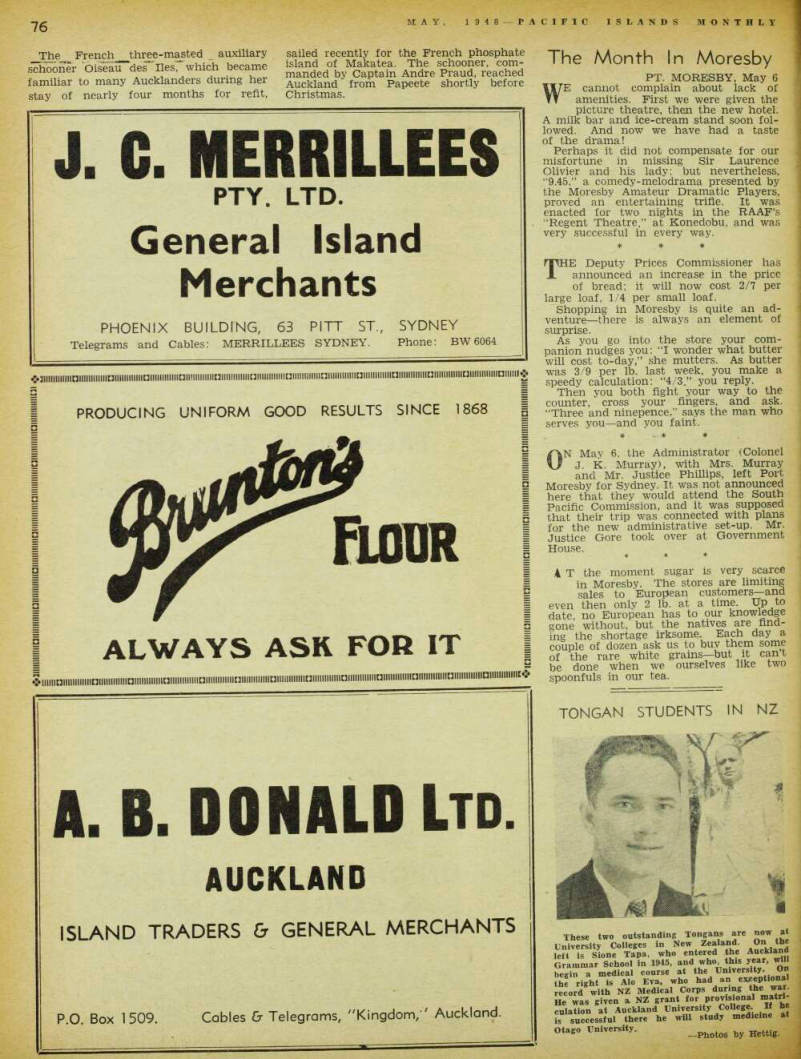
Death Of Well-Known
Priest
FATHER GONNET, well-known figure in Fiji for nearly 50 years died at Makogai on April 30.
Father Gonnet arrived in Fiji at the beginning of the centurv and served at Naiserelagi, Loreto (on Ovalau), the new station of Nabukebuke; and, in 1905, he was recalled to Loreto, in 1910, he be came Procurator of the Mission.
In 1914 he moved to Levuka and re mained as one of the town’s best-known and most highly respected citizens until 1930. In 1934, he was appointed chaplain at the Central Leper Hospital, Makogai where he remained until failing health forced him to give up active work.
The French three-masted auxiliary whirh became schooner Oiseau des lies which became familiar to many Aucklanders during her stay of nearly four months for refit,
sailed recently for the French phosphate island of Makatea. The schooner, com manded by Captain Andre Praud , rea ched Auckland from Papeete shortly before Christmas.
Advertisements & other items, pp. 77-78 (1 item)
cgul
SHIPPING NOW AVAILABLE
FROM NEW ZEALAND
TO NEW CALEDONIA, NEW HEBRIDES, SOLOMONS, NEW GUINEA,
AND ADJACENT AREAS.
A regular shipping service is now available to the Pacific Islands, not only for direct shipping, but also for Inter-Island work and on special charter for passengers and general cargo.
We will have a major vessel (3,000 tons) leaving New Zealand for the Western Pacific through to New Guinea, sailing approximately June, 1948, with cargo space available both outwards and return. Three smaller vessels are available immediately and are now operating.
We can supply at fair prices and deliver promptly all classes of general merchandise, including Canned Meat, Dairy Produce, Vegetables, Clothing and Textiles, Footwear, Canvas Shoes, Jewellery, Silverware, Builders’ Hardware and all traders’ requirements.
We are buyers of all classes of Island Produce, and can provide immediate shipment for raw and processed materials, including native products, fruit, shells, timber, hides and skins, and scrap metals of all kinds.
Your further inquiries will be welcomed.
UNION MANUFACTURING
& EXPORT CO. LTD.
G.P.O. Box 1060, Wellington, NEW ZEALAND Cables : “UMEC,” Wellington.
Branches at Auckland, Christchurch, Sydney, Melbourne.
Western Pacific Office, P.O. Box 78, Noumea.
J. C. MERRILLEES
PTY. LTD.
General Island Merchants
PHOENIX BUILDFNG, 63 PITT ST., SYDNEY
Telegrams and Cables: MERRILLEES SYDNEY. Phone: 8W6064
PRODUCING UNIFORM GOOD RESULTS SINCE 1868
ALWAYS ASK FOR IT
A. B. DONALD Ltd.
AUCKLAND
ISLAND TRADERS & GENERAL MERCHANTS
P.O. Box 1509. Cables & Telegrams, "Kingdom/ Auckland.
The Month In Moresby
Pt. Moresby. May 6
WE cannot complain about lack of amenities. First we were given the picture theatre, then the new hotel.
A milk bar and ice-cream stand soon fol lowed. And now we have had a taste of the drama!
Perhaps it did not compensate for our misfortune in missing Sir Laurence Olivier and his lady; but nevertheless, “9.45,” a comedy-melodrama presented by the Moresby Amateur Dramatic Players, proved an entertaining trifle. It was enacted for two nights in the RAAF’s ‘Regent Theatre.” at Konedobu, and was very successful in every way. ♦ * * THE Deputy Prices Commissioner has announced an increase in the price of bread; it will now cost 2/7 per large loaf, 1/4 per small loaf.
Shopping in Moresby is quite an ad venture —there is always an element of surprise.
As you go into the store your com panion nudges you; “I wonder what butter will cost to-day,” she mutters. As butter was 3/9 per lb. last week, you make a speedy calculation: “4/3.” you reply.
Then you both fight your way to the counter, cross your fingers, and ask.
“Three and ninepence,” says the man who serves you—and you faint, * * * ON May 6. the Administrator (Colonel J. K. Murray), with Mrs. Murray and Mr. Justice Phillips, left Port Moresby for Sydney. It was not announced here that they would attend the South Pacific Commission, and it was supposed that their trip was connected with plans for the new administrative set-up. Mr.
Justice Gore took over at Government House. ♦ * * 4 T the moment sugar is very scarce in Moresby. The stores are limiting sales to European customers—and even then only 2 lb. at a time. Up to date, no European has to (pur knowledge gone without, but the natives are find ing the shortage irksome. Each day a couple of dozen ask us to buy them some of the rare white grains—but it cant be done when we ourselves like two spoonfuls in our tea.
Tongan Students In Nz
These two outstanding Tongans are now at University Colleges in New Zealand. On the left is Sione Tapa, who entered the Auckland Grammar School in 1945, and who this year, will begin a medical course at the University. On the right is Alo Eva. who had an exceptional record with NZ Medical Corps during the war.
He was given a NZ grant for provisional matri culation at Auckland University College. If he is successful there he will study medicine at Otago University. -photos by Hrttig.
Death Of Miss M. I.
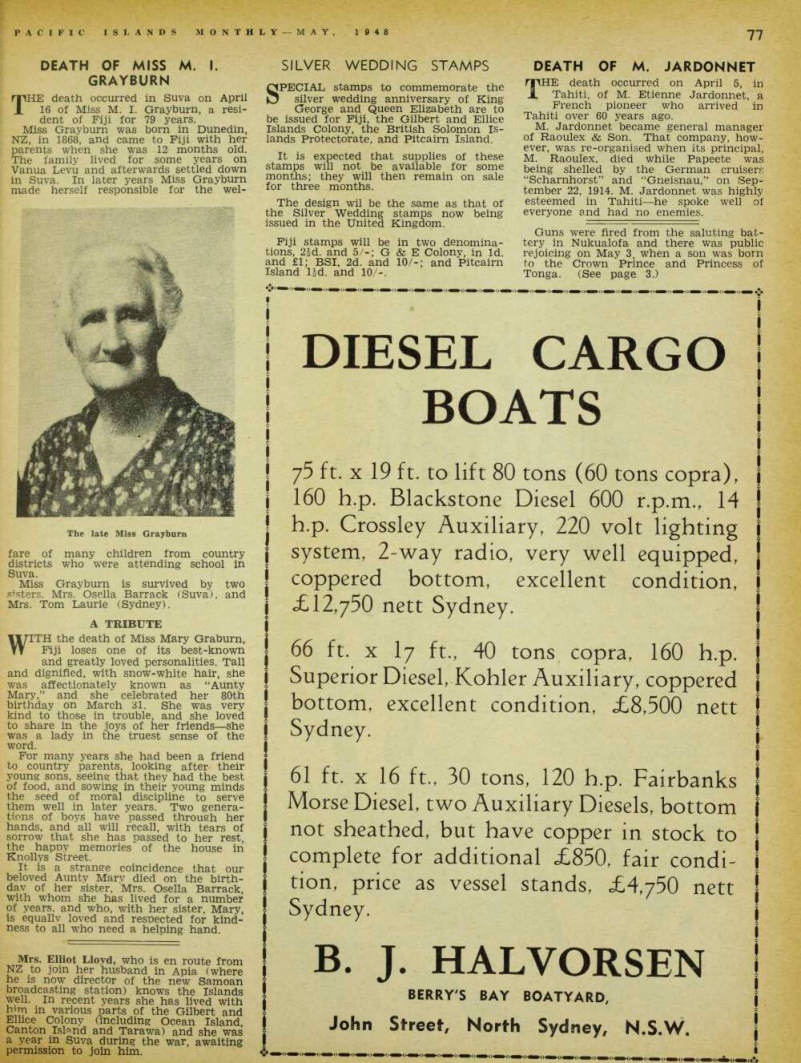
Grayburn
THE death occurred in Suva on April 16 of Miss M. I. Grayburn, a resi dent of Fiji for 79 years.
Miss Grayburn was born in Dunedin, NZ, in 1868, and came to Fiji with her parents when she was 12 months old.
The family lived for some years on Vanua Levu and afterwards settled down in Suva. In later years Miss Grayburn made herself responsible for the wel-
A Tribute
11TITH the death of Miss Mary Graburn, T? Fiji loses one of its best-known and greatly loved personalities. Tall and dignified, with snow-white hair, she was affectionately known as “Aunty Mary,” and she celebrated her 80th birthday on March 31. She was very kind to those in trouble, and she loved to share in the joys of her friends—she was a lady in the truest sense of the word.
For many years she had been a friend to country narents, looking after their young sons, s'eeine that they had the best of food, and sowing in their young minds the seed of moral discipline to serve them well in later years. Two genera tions of boys have nassed through her hands, and all will recall, with tears of sorrow that she has oassed to her rest, the hapnv memories of the house in Knollys Street.
It is a stranere coincidence that our beloved Aunty Marv died on the birth day of her sister, Mrs. Osella Barrack, with whom she has lived for a number of years, and who, with her sister, Mary, is equally loved and respected for kind ness to all who need a helping hand.
Mrs. Elliot Lloyd, who is en route from NZ to join her husband in Apia (where he is now director of the new Samoan broadcasting station) knows the Islands well, in recent years she has lived with him in various parts of the Gilbert and Ellice Colony (including Ocean Island Canton Island and Tarawa) and she was a year in Suva during the war, awaiting permission to join him.
The late Miss Grayburn fare of many children from country districts who were attending school in Suva.
Miss Grayburn is survived by two sisters. Mrs. Osella Barrack (Suva), and Mrs. Tom Laurie (Sydney).
Silver Wedding Stamps
SPECIAL stamps to commemorate the silver wedding anniversary of King George and Queen Elizabeth are to be issued for Fiji, the Gilbert and Ellice Islands Colony, the British Solomon Islands Protectorate, and Pitcairn Island.
It is expected that supplies of these stamps will not be available for some months; they will then remain on sale lor tnree montns.
The design wil be the same as that of the Silver Wedding stamps now being issued in the United Kingdom.
Fiji stamps will be in two denominations, 2ld. and 5/-; G & E Colony, in Id. and £1; BSI, 2d. and 10/-; and Pitcairn Island lid. and 10/-.
Death Of M. Jardonnet
HP 1 *?, on T Ap s^ of rii ??, Of S tieni i e Jard 9 ni \ et > , a French pioneer who arrived in Ta^J I^l T °Yp r 60 , y ,s ars a S°- M. Jardonnet became general manager of Raoulex & Son. That company, how ever, was re-organised when its principal, m. Raoulex, died while Papeete was being shelled by the German cruisers “Scharnhorst” and “Gneisnau,” on Sep tember 22, 1914. M. Jardonnet was highly esteemed in Tahiti—he spoke well of everyone and had no enemies, - - ■ -- Guns were fired from the saluting bat tery in Nukualofa and there was public rejoicing on May 3. when a son was born to the Crown Prince and Princess of Tonga. (See page 3.)
Advertisements & other items, p. 79 (1 item)
Diesel Cargo
BOATS
y 5 ft. x 19 ft. to lift 80 tons (60 tons copra), 160 h.p. Blackstone Diesel 600 r.p.m., 14 h.p. Crossley Auxiliary, 220 volt lighting system, 2-way radio, very well equipped, coppered bottom, excellent condition, .£12,750 nett Sydney. 66 ft. x I 7 ft., 40 tons copra, 160 h.p.
Superior Diesel, Kohler Auxiliary, coppered bottom, excellent condition, £8,500 nett Sydney. 61 ft. x 16 ft., 30 tons, 120 h.p. Fairbanks Morse Diesel, two Auxiliary Diesels, bottom not sheathed, but have copper in stock to complete for additional £B5O, fair condition, price as vessel stands, £4,y50 nett Sydney.
B. J. HALVORSEN
BERRY'S BAY BOATYARD,
John Street, North Sydney, N.S.W.
Flour And Prisoners
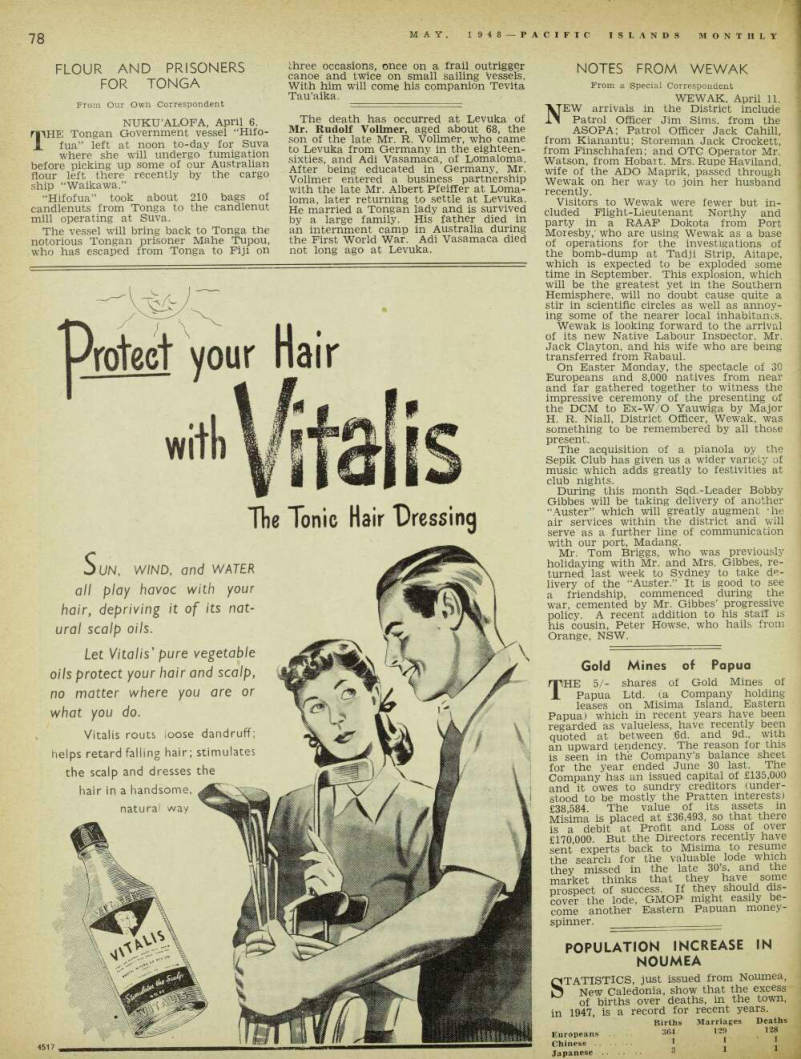
For Tonga
Prom Our Own Correspondent
Nuku’Alofa, April 6.
THE Tongan Government vessel “Hifo fua” left at noon to-day for Suva where she will undergo fumigation before nicking un some of our Australian flour left there recently by the cargo ship “Waikawa.”
“Hifofua” took about 210 bags of candlenuts from Tonga to the candlenut mill operating at Suva.
The vessel will bring back to Tonga the notorious Tongan prisoner Mahe Tupou, who has escaped from Tonga to Fiji on
three occasions, once on a frail outrigger canoe and twice on small sailing Vessels.
With him will come his companion Tevita Tau’aika.
The death has occurred at Levuka of Mr. Rudolf Vollmer, aged about 68, the son of the late Mr. R. Vollmer, who came to Levuka from Germany in the eighteen sixties, and Adi Vasamaca, of Lomaloma.
After being educated in Germany, Mr.
Vollmer entered a business partnership with the late Mr. Albert Pfeiffer at Loma loma, later returning to settle at Levuka.
He married a Tongan lady and is survived by a large family. His father died in an internment camp in Australia during the First World War. Adi Vasamaca died not long ago at Levuka.
Notes From Wewak
From a Special Correspondent WEWAK, April 11.
NEW arrivals in the District include Patrol Officer Jim Sims, from the ASOPA; Patrol Officer Jack Cahill, from Kianantu; Storeman Jack Crockett, from Finschhafen; and OTC Operator Mr.
Watson, from Hobart. Mrs. Rupe Haviland, wife of the ADO Maprik, passed through Wewak on her way to join her husband recently.
Visitors to Wewak were fewer but in cluded Flight-Lieutenant Northy and party in a RAAF Dokota from Port Moresby," who are using Wewak as a base of operations for the investigations of the bomb-dump at Tadji Strip, Aitape, which is expected to be exploded some time in September. This explosion, which will be the greatest yet in the Southern Hemisphere, will no doubt cause quite a stir in scientific circles as well as annoy ing some of the nearer local inhabitants.
Wewak is looking forward to the arrival of its new Native Labour Inspector. Mr.
Jack Clayton, and his wife who are being transferred from Rabaul.
On Easter Monday, the spectacle of 30 Europeans and 8,000 natives from near and far gathered together to witness the impressive ceremony of the presenting of the DCM to Ex-W/O Yauwiga by Major H. R. Niall, District Officer, Wewak, was something to be remembered by all those present.
The acquisition of a pianola by the Senik Club has given us a wider variety of music which adds greatly to festivities at club nights.
During this month Sqd.-Leader Bobby Gibbes will be taking delivery of another “Auster” which will greatly augment Tie air services within the district and will serve as a further line of communication with our port, Madang.
Mr. Tom Briggs, who was previously holidaying with Mr. and Mrs. Gibbes, re turned last week to Sydney to take de livery of the “Auster.” It is good to see a friendship, commenced during the war, cemented by Mr. Gibbes’ progressive policy. A recent addition to his staff is his cousin, Peter Howse, who hails from Orange, NSW.
Gold Mines of Papua
THE 5/- shares of Gold Mines of Papua Ltd. (a Company holding leases on Misima Island, Eastern Papua) which in recent years have been regarded as valueless, have recently been quoted at between 6d. and 9d., with an upward tendency. The reason for this is seen in the Company’s balance sheet for the year ended June 30 last. The Company has an issued capital of £135,000 and it owes to sundry creditors (under stood to be mostly the Pratten interests) £38,584. The value of its assets in Misima is placed at £36,493, so that there is a debit at Profit and Loss of over £l7O 000. But the Directors recently have sent experts back to Misima to resume the search for the valuable lode which they missed in the late 30’s, and the market thinks that they have some prospect of success. If they should dis cover the lode, GMOP might easily be come another Eastern Papuan money spinner.
Chinese J
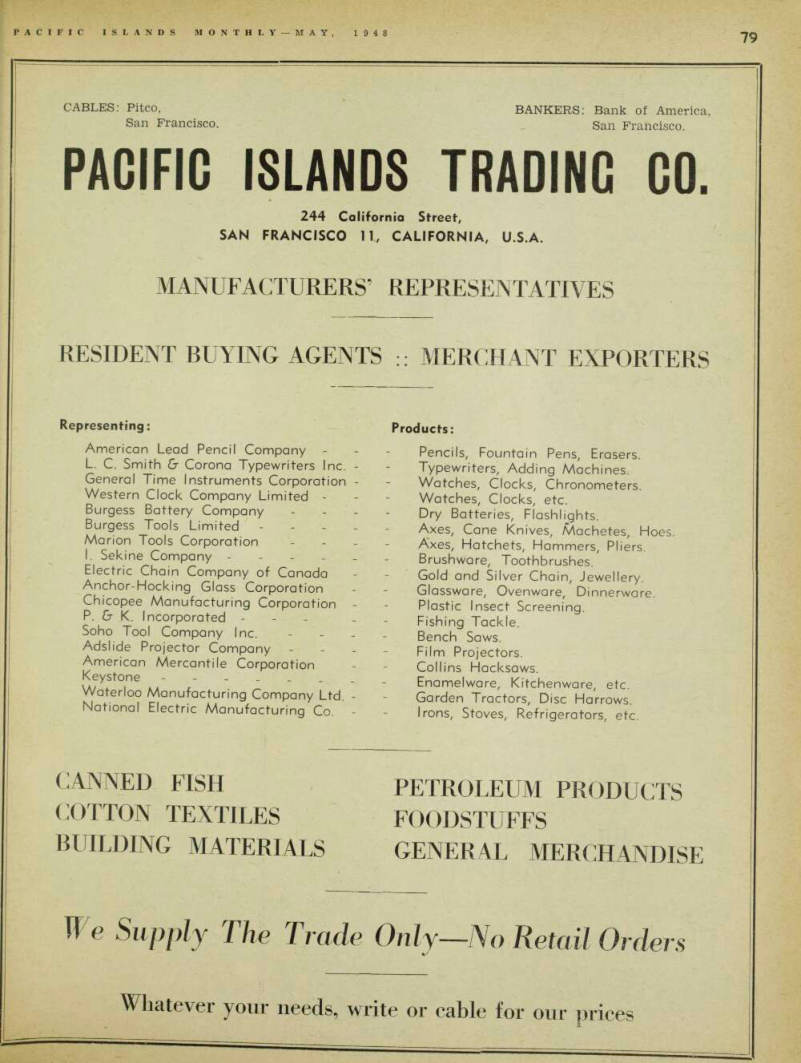
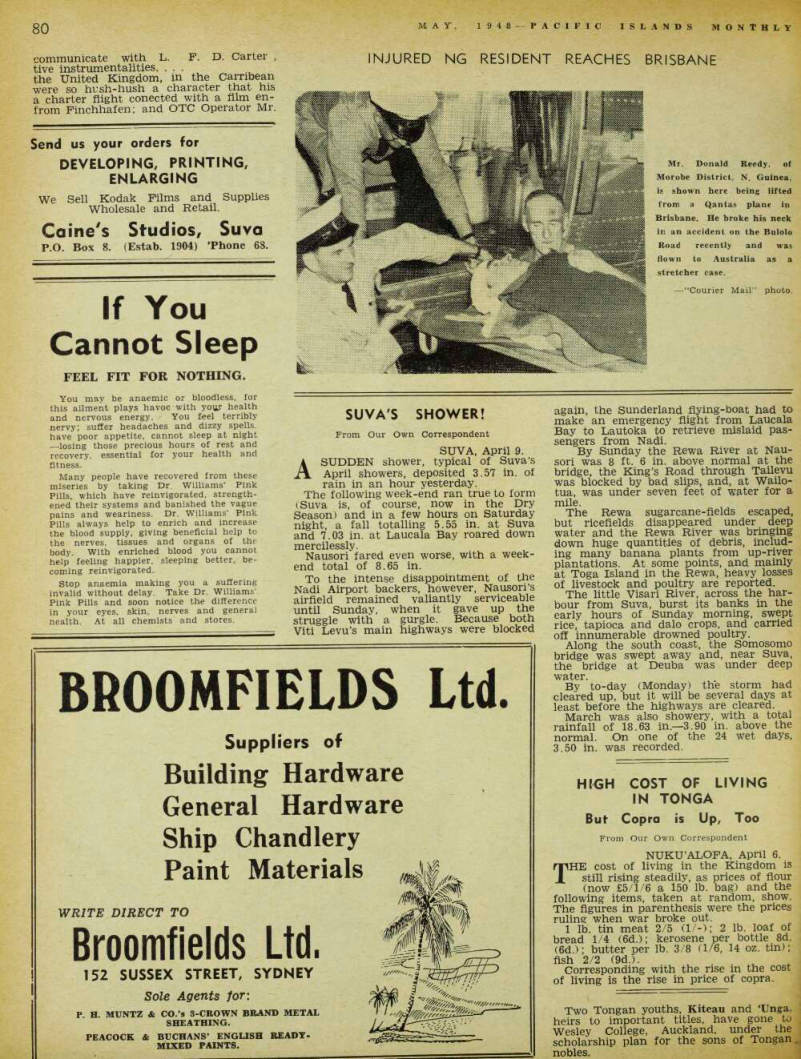
Population Increase In
Noumea
STATISTICS, just issued from Noumea, New Caledonia, show that the excess of births over deaths, in the town, in 1947, is a record for recent years.
Births Marriages Deaths Europeans 364 129 128
Chinese J
Japanese 6 1
communicate with L. F. D. Carter , tive instrumentalities. ... the United Kingdom, in the Cambean were so hush-hush a character that his a charter flight conected with a film en from Finchhafen; and OTC Operator Mr.
Advertisements & other items, pp. 80-82 (2 items)
The Tonic Hair Dressing
m m I I
S IK i C V \ r fw- V I V 4T \ /
1 UN, VWND, and WATER
all play havoc with your hair, depriving it of its natural scalp oils.
Let Vita I is' pure vegetable oils protect your hair and scalp, no matter where you are or what you do.
Vitalis routs loose dandruff: helps retard falling hair; stimulates the scalp and dresses the hair in a handsome, natural way
Pacific Islands Trading Co.
CABLES: Pltco, BANKERS: Bank of America, San Francisco. San Francisco.
244 California Street,
SAN FRANCISCO 11, CALIFORNIA, U.S.A.
MANUFACTURERS’ REPRESENTATIVES
RESIDENT BUYING AGENTS MERCHANT EXPORTERS
Representing: American Lead Pencil Company L. C. Smith Gr Corona Typewriters Inc. - General Time Instruments Corporation - Western Clock Company Limited - Burgess Battery Company - - Burgess Tools Limited - Marion Tools Corporation I. Sekine Company - Electric Chain Company of Canada Anchor-Hocking Glass Corporation Chicopee Manufacturing Corporation P. & K. Incorporated - Soho Tool Company Inc.
Adslide Projector Company - American Mercantile Corporation Keystone Waterloo Manufacturing Company Ltd. - National Electric Manufacturing Co. - Products: Pencils, Fountain Pens, Erasers.
Typewriters, Adding Machines.
Watches, Clocks, Chronometers.
Watches, Clocks, etc.
Dry Batteries, Flashlights.
Axes, Cane Knives, Machetes, Hoes.
Axes, Hatchets, Hammers, Pliers.
Brushware, Toothbrushes.
Gold and Silver Chain, Jewellery.
Glassware, Ovenware, Dinnerware.
Plastic Insect Screening.
Fishing Tackle.
Bench Saws.
Film Projectors.
Collins Hacksaws.
Enamelware, Kitchenware, etc.
Garden Tractors, Disc Harrows.
Irons, Stoves, Refrigerators, etc.
CANNED FISH
COTTON TEXTILES
BUILDING MATERIALS
PETROLEUM PRODUCTS
FOODSTUFFS
GENERAL MERCHANDISE
We Supply The Track Only—No Retail Orders Whatever your needs, write or cable for our prices
Send us your orders for
DEVELOPING, PRINTING,
ENLARGING
We Sell Kodak Films and Supplies Wholesale and Retail.
Caine's Studios, Suva
P.O. Box 8. (Estab. 1904) ’Phone 68.
If You
Cannot Sleep
FEEL FIT FOR NOTHING.
You may be anaemic or bloodless, for this ailment plays havoc with your health and nervous energy. You feel terribly nervy; suffer headaches and dizzy spells, have poor appetite, cannot sleep at night —losing those precious hours of rest and recovery, essential for your health and fitness.
Many people have recovered from these miseries by taking Dr, Williams’ Pink Pills, which have reinvigorated, strengthened their systems and banished the vague pains and weariness. Dr. Williams’ Pink Pills always help to enrich and increase the blood supply, giving beneficial help to the nerves, tissues and organs of the body. With enriched blood you cannot help feeling happier, sleeping better, becoming reinvigorated.
Stop anaemia making you a suffering invalid without delay. Take Dr. Williams’
Pink Pills and soon notice the difference in your eyes, skin, nerves and general health. At all chemists and stores.
BROOHFIELDS Ltd.
Suppliers of
Building Hardware
General Hardware
Ship Chandlery
Paint Materials
WRITE DIRECT TO
Broomfields Ltd.
152 SUSSEX STREET, SYDNEY
Sole Agents tor: P. H. MUNTZ & CO.’s 3-CROWN BRAND METAL
SHEATHING.
PEACOCK & BUCHANS’ ENGLISH READT-
MIXED PAINTS.
Injured Ng Resident Reaches Brisbane
Mr. Donald Reedy, of Morobe District, N. Guinea, is shown here being lifted from a Qantas plane in Brisbane. He broke his neck in an accident on the Bulolo Road recently and was flown to Australia as a stretcher case.
"Courier Mail" photo.
Suva's Shower!
From Our Own Correspondent SUVA, April 9.
A SUDDEN shower, typical of Suva’s April showers, deposited 3.57 in. of rain in an hour yesterday.
The following week-end ran true to form (Suva is, of course, now in the Dry Season) and in a few hours on Saturday night, a fall totalling 5.55 in. at Suva and 7.03 in. at Laucala Bay roared down mercilessly.
Nausori fared even worse, with a week end total of 8.65 in.
To the intense disappointment of the Nadi Airport backers, however, Nausori’s airfield remained valiantly serviceable until Sunday, when it gave up the struggle with a gurgle. Because both Viti Levu’s main highways were blocked
again, the Sunderland flying-boat had to make an emergency flight from Laucala Bay to Lautoka to retrieve mislaid pas sengers from Nadi.
By Sunday the Rewa River at Nau sori was 8 ft. 6 in. above normal at the bridge, the King’s Road through Tailevu was blocked by bad slips, and, at Wailo tua, was under seven feet of water for a mile.
The Rewa sugarcane-fields escaped, but ricefields disappeared under deep water and the Rewa River was bringing down huge quantities of debris, includ ing many banana plants from up-river plantations. At some points, and mainly at Toga Island in the Rewa, heavy losses of livestock and poultry are reported.
The little Visari River, across the har bour from Suva, burst its banks in the early hours of Sunday morning, swept rice, tapioca and dalo crops, and carried off innumerable drowned poultry.
Along the south coast, the Somosomo bridge was swept away and, near Suva, the bridge at Deuba was under deep water By to-day (Monday) the storm had cleared up, but it will be several days at least before the highways are cleared.
March was also showery, with a total rainfall of 18.63 in.—3.90 in. above the normal. On one of the 24 wet days, 3.50 in. was recorded.
High Cost Of Living
In Tonga
But Copra is Up, Too
From Our Own Correspondent
Nukualofa, April 6.
THE cost of living in the Kingdom is still rising steadily, as prices of flour (now £5/1/6 a 150 lb. bag) and the following items, taken at random, show.
The figures in parenthesis were the prices ruling when war broke out. 1 lb. tin meat 2/5 (1/-); 2 lb. loaf of bread 1/4 (6d.); kerosene per bottle Bd. (6d.); butter ner lb. 3/8 (1/6, 14 oz. tin); fish 2/2 (9d.).
Corresponding with the rise m the cost of living is the rise in price of copra.
Two Tongan youths, Kiteau and ‘Unga. heirs to important titles, have gone to Wesley College, Auckland, under the scholarship plan for the sons of Tongan nobles.
Advertisements & other items, p. 83 (1 item)
Ipana
r
Sal
I hat
eguard
Smile !
A tinge of'pink’ on your tooth brush is a warning to jw your dentist . It may mean nothing serious, but let him be the judge He may explain that yours is simply a case of tender gums robbed of resistance by to-day’s soft foods. His advice will probably be “more work for lazy gums” and often “the helpful stimulation ot Ipana Tooth Paste and gum massage”
Adopt this simple dental health rou tine Jirush your teeth with Ipana every morning and evening, followed by vigorous gum massage with Ipana on the finger-tip . . . Teeth become brighter, more lustrous ; gums firmer, healthier; smiles more pleasing
IPANA
TOOTH PASTE
4538 b G,
Death Of Godfrey Garrick
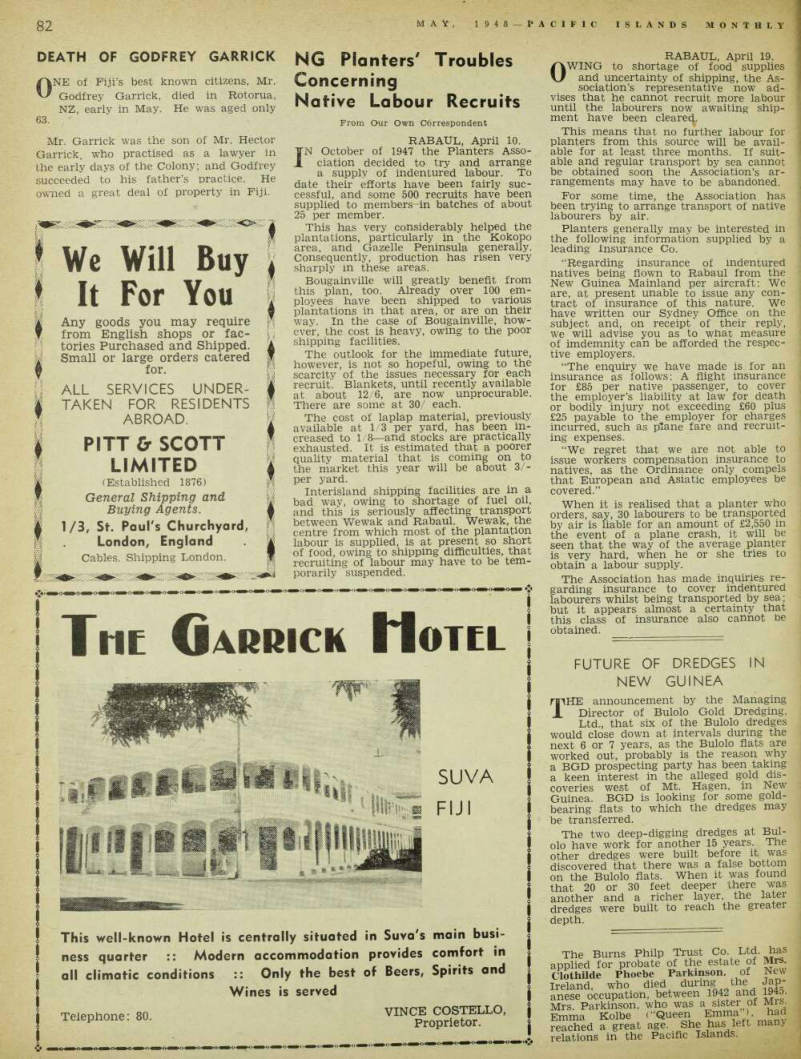
ONE of Fiji’s best known citizens, Mr.
Godfrey Garrick, died in Rotorua, NZ, early in May. He was aged only 63.
Mr. Garrick was the son of Mr. Hector Garrick, who practised as a lawyer in the early days of the Colony; and Godfrey succeeded to his father’s practice. He owned a great deal of property in Fiji.
Concerning
NG Planters' Troubles Concerning Native Labour Recruits
From Qur Own Correspondent RABAUL, April 10.
IN October of 1947 the Planters Asso ciation decided to try and arrange a supply of indentured labour. To date their efforts have been fairly suc cessful, and some 500 recruits have been supplied to members- in batches of about 25 per member.
This has very considerably helped the plantations, particularly in the Kokopo area, and Gazelle Peninsula generally.
Consequently, production has risen very sharply in these areas.
Bougainville will greatly benefit from this plan, too. Already over 100 em ployees have been shipped to various plantations in that area, or are on their way. In the case of Bougainville, how ever, the cost is heavy, owing to the poor shipping facilities.
The outlook for the immediate future, however, is not so hopeful, owing to the scarcity of the issues necessary for each recruit. Blankets, until recently available at about 12/6, are now unprocurable.
There are some at 30/ each.
The cost of laplap material, previously available at 1/3 per yard, has been in creased to 1 B—and stocks are practically exhausted. It is estimated that a poorer quality material that is coming on to the market this year will be about 3/per yard.
Interisland shipping facilities are in a bad way, owing to shortage of fuel oil, and this is seriously affecting transport between Wewak and Rabaul. Wewak, the centre from which most of the plantation labour is supplied, is at present so short of food, owing to shipping difficulties, that recruiting of labour may have to be tem porarily suspended.
RABAUL, April 19.
OWING to shortage of food supplies and uncertainty of shipping, the As sociation’s representative now ad vises that he cannot recruit more labour until the labourers now awaiting ship ment have been cleared This means that no further labour for planters from this source will be avail able for at least three months. If suit able and regular transport by sea cannot be obtained soon the Association’s ar rangements may have to be abandoned.
For some time, the Association has been trying to arrange transport of native labourers by air.
Planters generally may be interested in the following information supplied by a leading Insurance Co.
“Regarding insurance of indentured natives being flown to Rabaul from the New Guinea Mainland per aircraft: We are, at present unable to issue any con tract of insurance of this nature. We have written our Sydney Office on the subject and, on receipt of their reply, we will advise you as to what measure of imdemnity can be afforded the respec tive employers.
“The enquiry we have made is for an insurance as follows: A flight insurance for £B5 per native passenger, to cover the employer’s liability at law for death or bodily injury not exceeding £6O plus £25 payable to the employer for charges incurred, such as plane fare and recruit ing expenses.
“We regret that we are not able to issue workers compensation insurance to natives, as the Ordinance only compels that European and Asiatic employees be covered.”
When it is realised that a planter who orders, say, 30 labourers to be transported by air is liable for an amount of £2,550 in the event of a plane crash, it will be seen that the way of the average planter is very hard, when he or she tries to obtain a labour supply.
The Association has made inquiries re garding insurance to cover indentured labourers whilst being transported by sea; but it appears almost a certainty that this class of insurance also cannot be obtained.
Future Of Dredges In
New Guinea
THE announcement by the Managing Director of Bulolo Gold Dredging, Ltd., that six of the Bulolo dredges would close down at intervals during the next 6 or 7 years, as the Bulolo flats are worked out, probably is the reason why a BGD prospecting party has been taking a keen interest in the alleged gold dis coveries west of Mt. Hagen, in New Guinea. BGD is looking for some gold bearing flats to which the dredges may be transferred.
The two deep-digging dredges at Bul olo have work for another 15 years. The other dredges were built before it was discovered that there was a false bottom on the Bulolo flats. When it was found that 20 or 30 feet deeper there was another and a richer layer, the later dredges were built to reach the greater depth.
The Burns Philp Trust Co Ltd. has applied for probate of the estate of Mrs.
Clothilde Phoebe Parkinson, of New Ireland, who died during: the Jap anese occupation, between 1942 and 1945.
Mrs. Parkinson, who was a sister of Mrs.
Emma Kolbe (“Queen Emma), had reached a great age. She has left many relations in the Pacific Islands.
Advertisements & other items, p. 84 (1 item)
The Garrick Hotel
Wc Will Buy
It For You
Any goods you may require from English shops or factories Purchased and Shipped.
Small or large orders catered for.
ALL SERVICES UNDER-
TAKEN FOR RESIDENTS
ABROAD.
PITT & SCOTT
LIMITED
(Established 1876) General Shipping and Buying Agents. 1/3, St. Paul's Churchyard, London, England Cables. Shipping London.
The Garrick Hotel
m
lllliß
liLg
K m * *
SUVA
FIJI
This well-known Hotel is centrally situated in Suva's main business quarter Modern accommodation provides comfort in all climatic conditions :: Only the best of Beers, Spirits and Wines is served Telephone: 80.
VINCE COSTELLO,
Proprietor.
New Guinea Offers
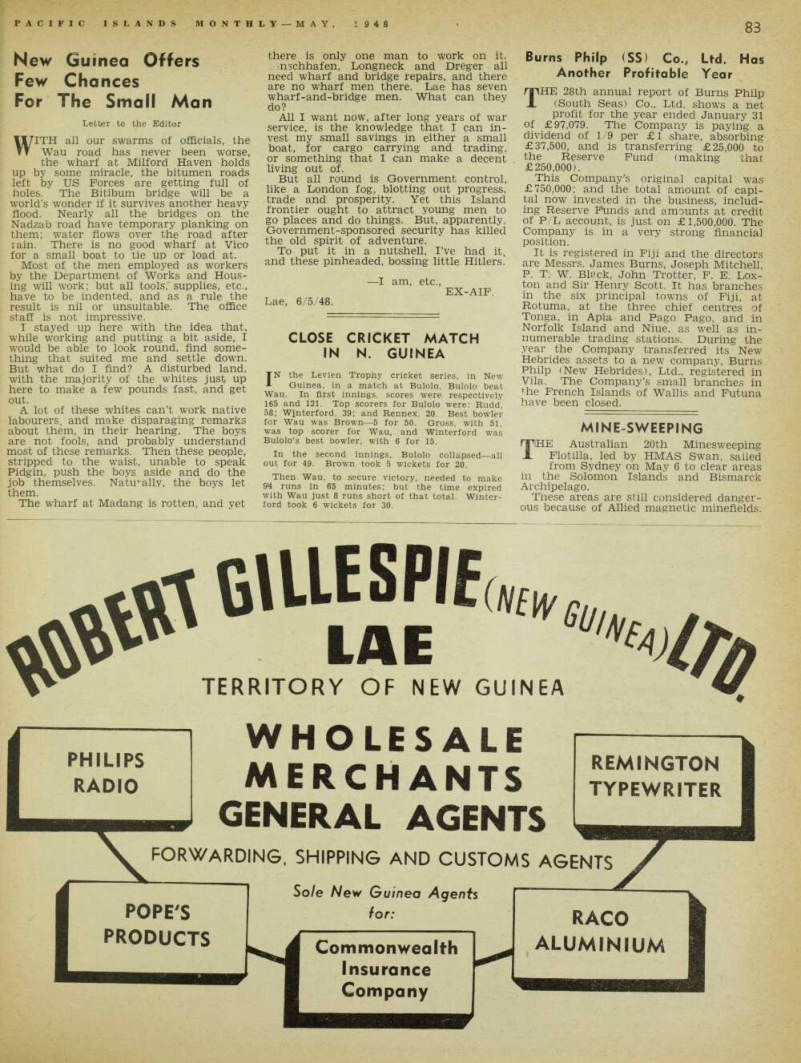
Few Chances For The Small Man
Letter to the Editor WITH all our swarms of officials, the Wau road has never been worse, the wharf at Milford Haven holds up by some miracle, the bitumen roads left by US Forces are getting full of holes. The Bitibum bridge will be a worlds wonder if it survives another heavy flood. Nearly all the bridges on the Nadzab road have temporary planking on them; water flows over the road after rain. There is no good wharf at Vico for a small boat to tie up or load at.
Most of the men employed as workers by the Department of Works and Hous ing will work; but all tools, supplies, etc., have to be indented, and as a rule the result is nil or unsuitable. The office staff is not impressive.
I stayed up here with the idea that, while working and putting a bit aside, I would be able to look round, find some thing that suited me and settle down.
But what do I find? A disturbed land, with the majority of the whites just up here to make a few pounds fast, and get out.
A lot of these whites can’t work native labourers, and make disparaging remarks about them, in their hearing. The boys are not fools, and probably understand most of these remarks. Then these people, stripped to the waist, unable to speak Pidgin, push the boys aside and do the job themselves. Naturally, the boys let them.
The wharf at Madang is rotten, and yet
there is only one man to work on it. ■nschhafen, Longneck and Dreger all need wharf and bridge repairs, and there are no wharf men there. Lae has seven wharf-and-bridge men. What can they do?
All I want now, after long years of war service, is the knowledge that I can in vest my small savings in either a small boat, for cargo carrying and trading, or something that I can make a decent living out of.
But all round is Government control, like a London fog, blotting out progress, trade and prosperity. Yet this Island frontier ought to attract young men to go places and do things. But, apparently, Government-sponsored security has killed the old spirit of adventure.
To put it in a nutshell. I’ve had it, and these pinheaded, bossing little Hitlers! —I am, etc.,
Ex-Aif.
Lae, 6/5/48.
Close Cricket Match
In N. Guinea
IN the Levien Trophy cricket series, in New Guinea, in a match at Bulolo, Bulolo beat Wau. In first innings, scores were respectively 165 and 121. Top scorers for Bulolo were: Rudd, 58; Winterford, 39; and Rennex, 20. Best bowler for Wau was Brown—s for 50. Gross, with 51, was top scorer for Wau, and Winterford was Bulolo’s best bowler, with 6 for 15.
In the second innings, Bulolo collapsed—all out for 49. Brown took 5 wickets for 20.
Then Wau, to secure victory, needed to make 9'4 runs in 65 minutes; but the time expired with Wau just 8 runs short of that total. Winter ford took 6 wickets for 30.
Burns Philp (SS) Co., Ltd. Has
Another Profitable Year
THE 28th annual report of Burns Philp (South Seas) Co., Ltd. shows a net profit for the year ended January 31 of £97,079. The Company is paying a dividend of 1/9 per £1 share, absorbing £37,500, and is transferring £25,000 to the Reserve Fund (making that £250,000).
This Company’s original capital was £750,000; and the total amount of capi tal now invested in the business, includ ing Reserve Funds and amounts at credit of P/L account, is just on £1,500,000. The Company is in a very strong financial position.
It is registered in Fiji and the directors are Messrs. James Burns, Joseph Mitchell, P. T. W. Black, John Trotter, F. E. Lox ton and Sir Henry Scott. It has branches in the six principal towns of Fiji, at Rotuma, at the three chief centres of Tonga, in Apia and Pago Pago, and in Norfolk Island and Niue, as well as in numerable trading stations. During the year the Company transferred its New Hebrides assets to a new company, Burns Philp (New Hebrides), Ltd., registered in Vila. The Company’s small branches in the French Islands of Wallis and Futuna have been closed.
Mine-Sweeping
THE Australian 20th Minesweeping Flotilla, led by HMAS Swan, sailed from Sydney on May 6 to clear areas in the Solomon Islands and Bismarck Archipelago.
Tiiese areas are still considered danger ous because of Allied magnetic minefields.
Advertisements & other items, p. 85 (1 item)
A) ify
GIIIESP/f
PHILIPS
RADIO
(new
LAE
TERRITORY OF NEW GUINEA
WHOLESALE
MERCHANTS
GENERAL AGENTS
forwarding, shipping and customs agents
A) ify
REMINGTON
TYPEWRITER
Sole New Guinea Agents for;
POPE'S
PRODUCTS
RACO
ALUMINIUM
Commonwealth Insurance Company
Islands Produce
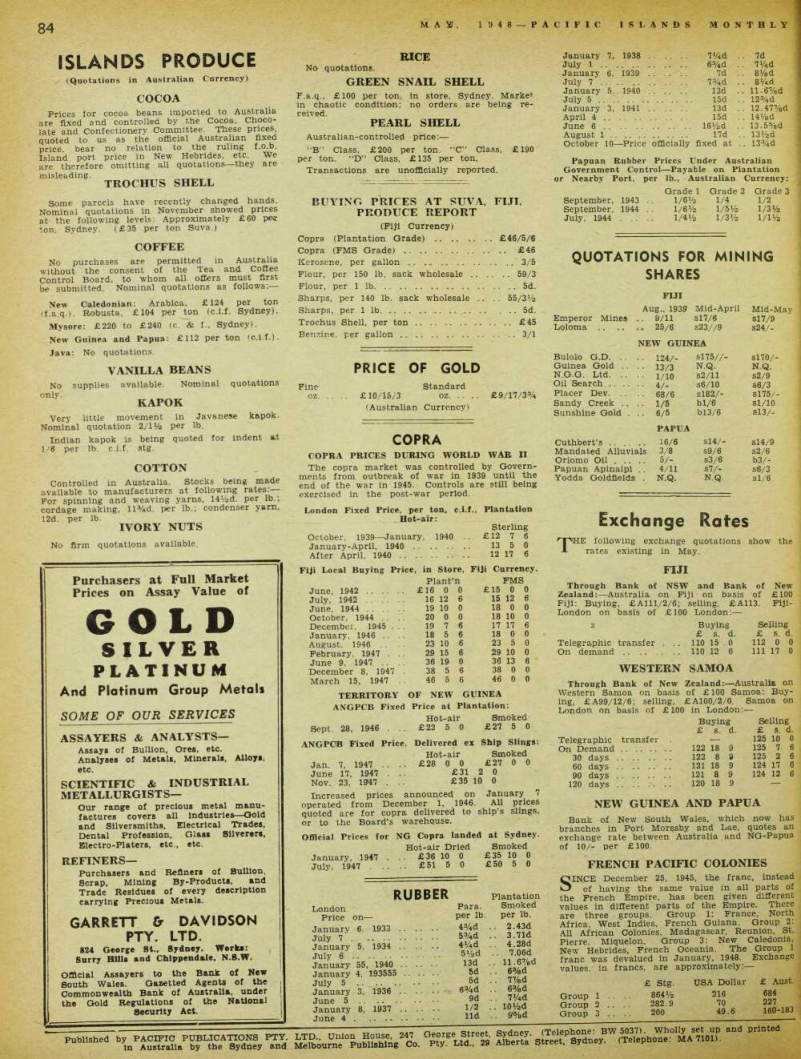
(Quotations in Australian Currency)
Cocoa
Prices for cocoa beans imported to Australia are fixed and controlled by the Cocoa, Choco late and Confectionery Committee. These prices, quoted to us as the official Australian fixed price, bear no relation to the ruling f.o.b.
Island port price in New Hebrides, etc. We are therefore omitting all quotations—they are misleading.
Trochus Shell
Some parcels have recently changed hands.
Nominal quotations in November showed prices at the following levels: Approximately £6O per ton, Sydney. (£35 per ton Suva.)
Coffee
No purchases are permitted in Australia without the consent of the Tea and Coffee Control Board, to whom all offers must first be submitted. Nominal quotations as follows; — New Caledonian; Arabica. £124 per ton (f.a.q.). Robusta, £lO4 per ton (c.i.f. Sydney).
Mysore: £220 to £240 (c. & f., Sydney).
New Guinea and Papua: £ll2 per ton (c.i.f.).
Java: No quotations.
Vanilla Beans
No supplies available. Nominal quotations only.
Kapok
Very little movement in Javanese kapok.
Nominal quotation 2/1 Vi per lb.
Indian kapok is being quoted for indent at 1/6 per lb. c.i.f. stg.
Cotton
Controlled in Australia. Stocks being made available to manufacturers at following rates: — For spinning and weaving yarns, 14Vid. per lb.; cordage making, ll%d. per lb.; condenser yam, 12d. per lb.
Ivory Nuts
No firm quotations available.
Rice
No quotations.
Green Snail Shell
F.a.q.. £lOO per ton, in store, Sydney. Market in chaotic condition; no orders are being re ceived.
Pearl Shell
Australian-controlled price:— “B” Class, £2OO per ton. “C” Class, £l9O per ton. “D” Class, £135 per ton.
Transactions are unofficially reported.
Buying Prices At Suva, Fiji.
Produce Report
(Fiji Currency) Copro (Plantation Grade) £46/5/6 Copra (FMS Grade) £46 Kerosene, per gallon 3/5 Flour, per 150 lb. sack wholesale 59/3 Flour, per 1 lb sd.
Sharps, per 140 lb. sack wholesale .. .. 55/3^2 Sharps, per 1 lb sd.
Trochus Shell, per ton £45 Benzine, per gallon 3/1
Advertisements & other items, p. 86 (1 item)
Price Of Gold
Fine Standard oz. .. . £ 10/15/3 oz £9/17/3% (Australian Currency)
Copra
Prices During World War Ii
The copra market was controlled by Govern ments from outbreak of war in 1939 until the end of the war in 1945. Controls are still being exercised in the post-war period.
London Fixed Price, per ton, c.1.f., Plantation Hot-air:
Fiji Local Buying Price, in Store, Fiji Currency.
Territory Of New Guinea
ANGPCB Fixed Price at Plantation;
ANGPCB Fixed Price, Delivered ex Ship Slings:
Increased prices announced on January 7 operated from December 1, 1946. All prices quoted are for copra delivered to ship’s slings, or to the Board’s warehouse.
Official Prices for NG Copra landed at Sydney.
Sterling October, 1939—January, 1940 £12 7 6 January-April, 1940 13 5 0 After April, 1940 12 17 6
Plant’n FMS June, 1942 £16 0 0 £15 0 0 July, 1942 16 12 6 15 12 6 June, 1944 19 10 0 18 0 0 October. 1944 . .. 20 0 0 18 10 0 December, 1945 19 7 6 17 17 6 January, 1946 ... 18 5 6 18 0 0 August. 1946 23 10 6 23 5 0 February, 1947 . . 29 15 6 29 10 0 June 9, 1947 . . 36 19 0 36 13 6 December 8. 1947 . 38 5 6 38 0 0 March 15, 1947 46 5 6 46 0 0
Hot-air Smoked Sept. 28, 1946 . . £22 5 0 £27 5 0
Hot-air Smoked Jan. 7, 1947 ... £28 0 0 £27 0 0 June 17, 1947 ... £31 2 0 Nov. 23, 1947 ... £35 10 0
Hot-air Dried Smoked January, 1947 . .. £36 10 0 £35 10 0 July, 1947 . .. .. £51 5 0 £50 5 0
Rubber
Papuan Rubber Prices Under Australian Government Control—Payable on Plantation or Nearby Port, per lb., Australian Currency:
Plantation
London Para.
Smoked Price onper lb. per lb.
January July 7 . 6, 1933 . . . . 4 3 Ad . 5 3 Ad . . 2.43d . 3.71d January July 6 5, 1934 . . .. 4V 4 d . 5Vad . 4.28d . . 7.06d January 55, , 1940 .. .. 13d . . 11.6 7 / 8 d January July 5 4, 193555 . . .. 5d 5d . 6%d . 7 7 / 8 d January June 5 3, 1936 . . .. 6 3 Ad . 9d . 6 3 / 8 d . 7%d January June 4 8, 1937 . . •- 1/2 . lid . . 10V 2 d . 9%d
January 7, 1938 7‘Ad . . 7d July 1 . 6 3 Ad . . 7V 4 d January 6, 1939 . 7d . . 8Vad July 7 . 7 3 Ad . . 8V4d January 5, 1940 13d . . 11.6%d July 5 . , 15d . . 12 3 Ad January 3, 1941 13d . . 12.47 7 /ad April 4 15d . . 14Vad June 6 . 13.5 5 /ad August 1 17d . . ISVad October 10- —Price officially fixed at . . 13 3 Ad
Grade 1 Grade 2 Grade 3 September, 1943 . 1/6 y 2 1/4 1/2 September, 1944 . i/6 y 2 I/51/2 1/31/2 July, 1944 1/41/2 I/31/2 I/I1/2
Quotations For Mining
Shares
Fiji
Aug.. 1933 Mid-April Mid-May Emperor Mines .. 9/11 si 7/6 si 7/9 Loloma .. 25/6 S23//9 S24/- Bulolo G.D. ..
New Guinea
.. 124/- si 75//sl70/- Guinea Gold .. • ■ 13/3 N.Q.
N.Q.
N.G.G. Ltd. . . • 1/10 S2/11 s2/9 Oil Search .. .. •• 4/- S6/10 s6/3 Placer Dev. .. • 68/6 sl82/- 6175/- Sandy Creek .. .. 1/5 bl/6 sl/10 Sunshine Gold . .. 6/5 bl3/6 sl3/- Cuthbert’s .. ..
Papua
.. 16/6 sl4/- S14/9 Mandated Alluvials 3/8 s9/6 s2/6 Oriomo Oil . .. .. 5/- S3/6 b3/- Papuan Apinaipi 4/11 s7/s6/3 Yodda Goldfields N.Q.
N.Q. sl/6
Exchange Rates
THE following exchange quotations show the rates existing in May.
Fiji
Through Bank of NSW and Bank of New Zealand:—Australia on Fiji on basis of £lOO Fiji; Buying, £Alll/2/6; selling, £AII3. FIJI- London on basis of £lOO London;—
Western Samoa
Through Bank of New Zealand: —Australia on Western Samoa on basis of £lOO Samoa: Buy ing, £ A99/12/6; selling, £AIOO/2/6. Samoa on London on basis of £lOO in London: —
New Guinea And Papua
Bank of New South Wales, which now has branches in Port Moresby and Lae, quotes an exchange rate between Australia and NG-Papua of 10/- per £lOO.
French Pacific Colonies
SINCE December 25, 1945, the franc, instead of having the same value in all parts of the French Empire, has been given different values in different parts of the Empire. There are three groups. Group 1: France, North Africa, West Indies, French Guiana. Group 2: All African Colonies, Madagascar, Reunion, St.
Pierre, Miquelon. Group 3: New Caledonia.
New Hebrides, French Oceania. The Group 1 franc was devalued in January, 1948. Exchange values, in francs, are approximately:—
z Buying Selling £ s. d. £ s. d.
Telegraphic transfer . .. 110 15 0 112 0 0 On demand .. 110 12 6 111 17 0
Buying Selling £ s. d. £ s. d.
Telegraphic transfer — 125 10 0 On Demand 122 18 9 125 7 6 30 days 122 8 9 125 2 6 60 days 121 18 9 124 17 6 90 days 121 8 9 124 12 6 120 days 120 18 9 —
£ Stg. USA Dollar £ Aust.
Group 1 .. •• 864 Va 216 684 Group 2 . . . . 282.9 70 227 Group 3 . . .. 200 49.6 160-183
Advertisements & other items, pp. 86-88 (3 items)
Published *S Sbb?nf PuSS/co. 3£S*
84
ii Al 1 948 PACIFIC ISLANDS MONTHLY
Gold
Purchasers at Full Market Prices on Assay Value of
SILVER
PLATINUM
And Platinum Group Metals
SOME OF OUR SERVICES
ASSAYERS & ANALYSTS—
Assays of Bullion, Ores, etc.
Analyses of Metals, Minerals, Alloys. etc.
SCIENTIFIC & INDUSTRIAL
METALLURGISTS—
Our range of precious metal manufactures covers all Industries —-Gold and Silversmiths, Electrical Trades, Dental Profession, Glass Sllverers, Electro-Platers, etc., etc.
REFINERS—
Purchasers and Refiners of Bullion, Scrap. Mining By-Products, and Trade Residues of every description carrying Precious Metals.
GARRETT Cr DAVIDSON
PTY. LTD.
824 George St., Sydney. Works: Surry HUls and Chippendale, N.B.W.
Official Assayers to the Bank of New South Wales. Gazetted Agents of the Commonwealth Bank of Australia, under the Gold Regulations of the National Security Act.
tropical thirst...
To quench a
. '' / m* A f n * W «° 4 SOTfJ »VoMtr > m K8.1.4* V IS When you’re hot and tired, there is nothing quite so satisfying and thirst quenching as a long, cold glass of Your friends and guests, too, will appreciate this really fine
Lager, for “Everybody
drinks K. 8.”
TOOTH’S
LAGER
S-SsJIMj
MERCHANTS. & SHIP OWNERS
Capital £1,000,000
ESTABLISHED 1914
COPRA MERCHANTS & MILLERS
BRANCHES THROUGHOUT THE PACIFIC ISLANDS
Buyers and exporters of all kinds of Islands produce. Copra Merchants and Millers.
Agents for Australian, European and American Manufacturers. Distributors of every description of merchandise.
Thirty years of Pacific Islands development and service.
IN LONDON:
W. R. Carpenter & Co. (London), Ltd., Coronation House, 4 Lloyd’s Avenue, London, E.C. ★
THE W.R.C. LINE
DISTRIBUTING
AGENTS FOR:
Ford Motor Company of Canada.
Electrolux Refrigerators.
T. G. & C. Bolinders (Engines).
Chrysler Corporation.
Westinghouse Electrical Co.
Caterpillar Tractors. .
Etc., Etc.
REGULAR CARGO
PACIFIC
THE FIRST DIRECT AND
AND PASSENGER SERVICE BETWEEN
ISLAND PORTS WAS
AND
Head
W,
Office:
EUROPE
ESTABLISHED BY
R. CARPENTER & CO. LTD.
16 O'CONNELL STREET, SYDNEY.
Cable Address:
CAMOHE.
Telephone: BW 4421.
Postal Address: P.O. Box No. 168, Sydney.