Pacific
Islands
Monthly
January 19, 1948
Vol. Xviii. No. 6.
Established 1930.
IRegistered at the G.P.0., Sydney. for by post as a newspaper\
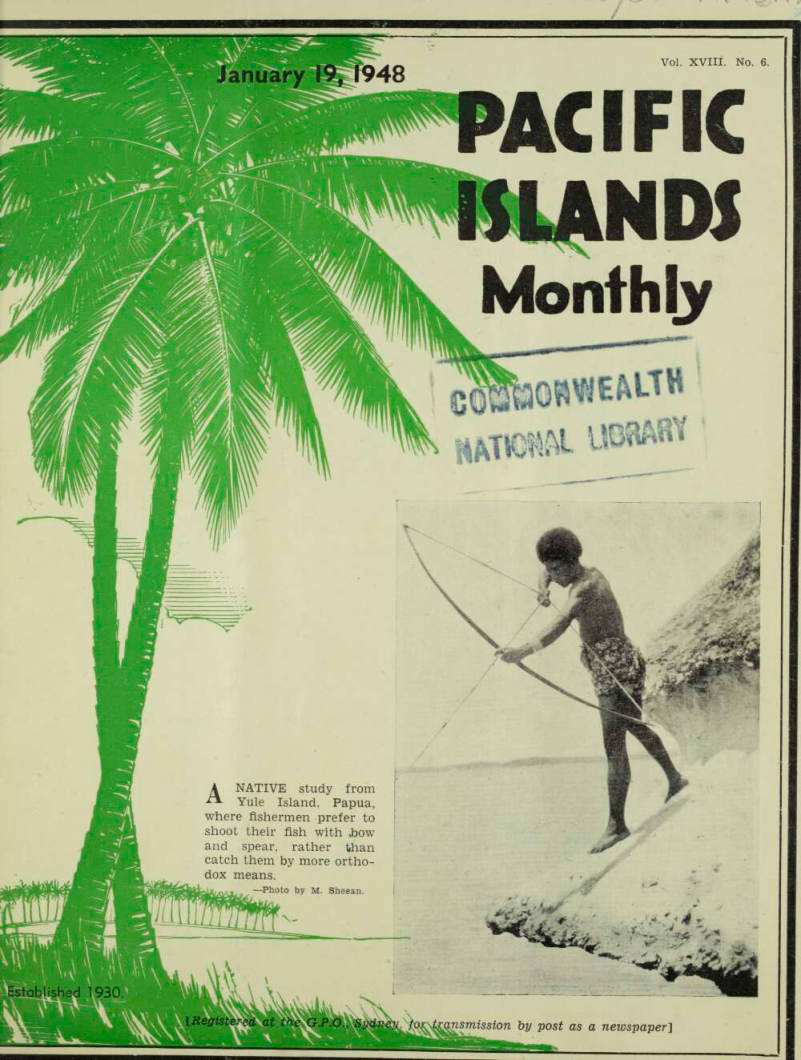
A NATIVE study from Yule Island, Papua, where fishermen prefer to shoot their fish with bow and spear, rather than catch them by more ortho dox means.
Photo by M. Sheean.
Advertisements & other items, pp. 2-4 (1 item)
Qafttah
% s' y y yy /'
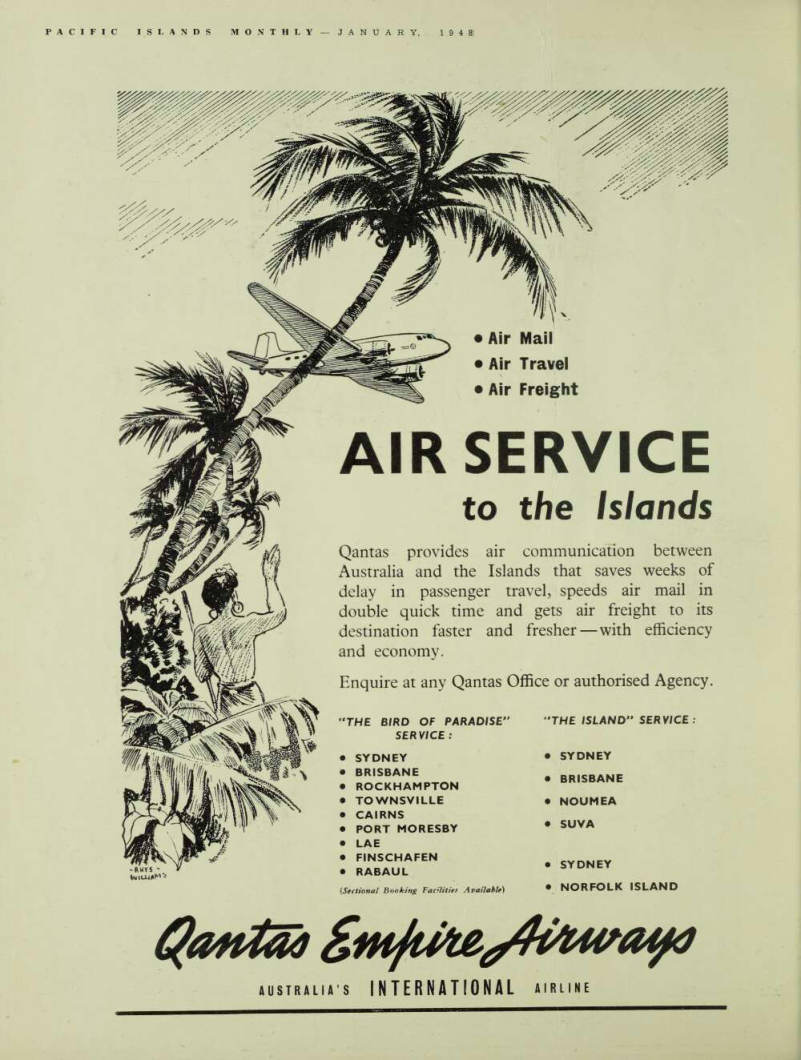
• Air Mail
• Air Travel
• Air Freight
[flu
to the Islands
Qantas provides air communication between
Australia and the Islands that saves weeks of delay in passenger travel, speeds air mail in double quick time and gets air freight to its
destination faster and fresher —with efficiency
and economy.
Enquire at any Qantas Office or authorised Agency.
“THE ISLAND” SERVICE:
"THE BIRD OF PARADISE '
SERVICE :
• SYDNEY
• BRISBANE
• ROCKHAMPTON
• TOWNSVILLE
• CAIRNS
• PORT MORESBY
• LAE
• FINSCHAFEN
• RABAUL
C Sectional Booking Facilities Available )
• SYDNEY
• BRISBANE
• NOUMEA
• SUVA
• SYDNEY
• NORFOLK ISLAND
Qafttah
Australia’s INTERNATIONAL airline
v r *.
THE BEST OF
Instant-lite Petrol Lantern 300 or 500 C.P.
Speed-master Petrol Stove
TUE R KIND
Coleman appliances have for many years been bringing better ways of living to
people everywhere. They bring greater
comfort and happiness with better light . . . easier, faster ironing . . . more convenient, more healthful heating . . .
better cooking.
Over forty years’ experience in producing
these appliances have made Coleman Products “The best of their kind.’’
Coleman’s appliances include:— Petrol and Kerosene operated Lamps, Lanterns, Irons, Stoves, Portable Stoves, Brazing Torches and Blow Lamps.
Kerosene or Petrol Table or Hanging Lamp K Coleman “530”
Pocket Stove Coleman Kerosene Iron Kerosene 3 Burner Cooking Stove m - V .
aßi
Instant-lighting portable Petrol Cooking Stove Representatives for the Pacific Islands :
ROBERT GILLESPIE PTY, LTD.
54a PITT STREET, SYDNEY
PEARCE & CO. LTD
SUVA
FOR FIJI ISLANDS
V y. % / r / V & k I r m i 8
BRONTE BRAND:
Chili Con Came Braised Steak and Onions Curried Beef Curried Mutton Steak and Onions Mutton and Peas Irish Stew Beef Steak Pudding Corned Beef Hash Corned Beef Loaf With Cereal Mutton Broth Mulligatawny Soup Tomato Soup Vegetable Soup
From
Australia’s
Finest Fat
Stock...
From the finest fat stock and the rich-
est vegetables in Australia we produce
these high-grade canned meats and
soups. BRONTE BRAND meats,
hotmeals and soups are deliciously
flavoured and are made from
ONLY meats and vegetables
of the highest quality. . . ♦ • ★
THE COLONIAL WHOLESALE MEAT CO.
PTY. LTD.
Canning Factory, State Abattoirs, Homebush Bay, Sydney.
N.S.W.
PHONES:
PHONE: UM 8436.
CABLE ADDRESS:
WOOLMILL. SYDNEY.
i P I *** «■* *3
Advertisers
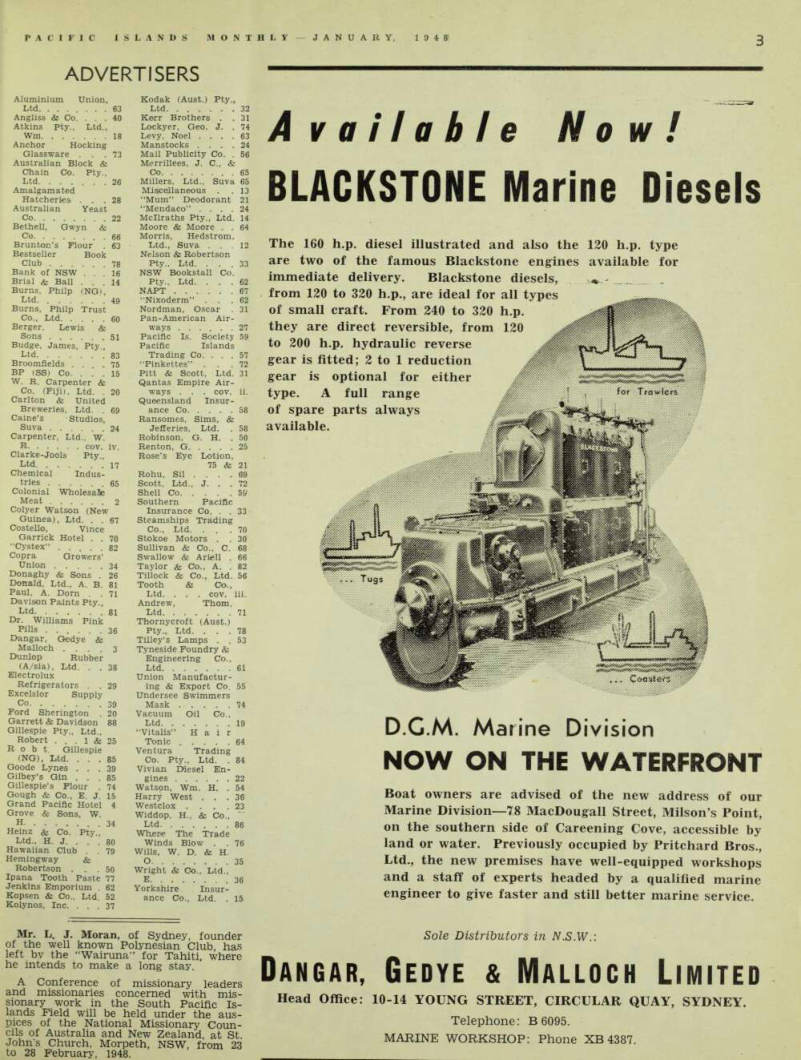
Aluminium Union, Ltd 63 Angliss & Co. ... 40 Atkins Pty., Ltd., Wm 18 Anchor Hocking Glassware ... 73 Australian Block & Chain Co. Pty., Ltd 26 Amalgamated Hatcheries ... 28 Australian Yeast Co 22 Bethell, Gwyn & Co 66 Brunton’s Flour . 63 Bestseller Book Club 78 Bank of NSW ... 16 Brial & Ball ... 14 Burns. Philp (NG), Ltd. 49 Burns, Philp Trust Co., Ltd 60 Berger, Lewis & Sons 51 Budge, James, Pty., Ltd 83 Broomfields . . .75 BP (SS) Co. . . . 15 W. R. Carpenter & Co. (Fiji), Ltd. . 20 Carlton & United Breweries, Ltd. . 69 Caine’s Studios, Suva 24 Carpenter, Ltd., W.
R cov. iv.
Clarke-Jools Pty., Ltd 17 Chemical Indus tries 65 Colonial Wholesale Meat 2 Colyer Watson (New Guinea), Ltd. . . 67 Costello, Vince Garrick Hotel . . 70 “Cystex” ... 82 Copra Growers’
Union 34 Donaghy & Sons . 26 Donald, Ltd., A. B. 81 Paul, A. Dom . . 71 Davison Paints Pty., Ltd 81 Dr. Williams Pink Pills 36 Dangar, Qedye & Malloch ... 3 Dunlop Rubber (A/sia), Ltd. . . 38 Electrolux Refrigerators . . 29 Excelsior Supply Co 39 Ford Sherington . 20 Garrett & Davidson 88 Gillespie Pty., Ltd., Robert ... 1 & 25 R o b t. Gillespie (NG), Ltd. ... 85 Goode Lynes ... 39 Gilbey’s Gin ... 85 Gillespie’s Flour . 74 Gough & Co., E. J. 15 Grand Pacific Hotel 4 Grove & Sons, W.
H 34 Heinz & Co. Pty., Ltd., H. J. . . .80 Hawaiian Club . . 79 Hemingway & Robertson ... 50 Ipana Tooth Paste 77 Jenkins Emporium . 62 Kopsen & Co., Ltd. 52 Kolynos, Inc. ... 37
Kodak (Aust.) Pty., Ltd 32 Kerr Brothers . .31 Lockyer, Geo. J. . 74 Levy, Noel ... 63 Manstocks ... 24 Mail Publicity Co. . 56 Merrillees, J. C., & Co 65 Millers. Ltd., Suva 65 Miscellaneous . . 13 “Mum” Deodorant 21 “Mendaco” ... 24 Mcllraths Pty., Ltd. 14 Moore & Moore . . 64 Morris, Hedstrom, Ltd., Suva ... 12 Nelson & Robertson Pty., Ltd. ... 33 NSW Bookstall Co.
Pty., Ltd. ... 62
Napt 67
“Nixoderm” ... 62 Nordman, Oscar . 31 Pan-American Air ways 27 Pacific Is. Society 59 Pacific Islands Trading Co. ... 57 “Pinkettes” ... 72 Pitt & Scott, Ltd. 31 Qantas Empire Air ways . . . cov. ii.
Queensland Insur ance Co 58 Ransomes, Sims, & Jefferies, Ltd. . 58 Robinson, G. H. . 50 Renton, G 25 Rose’s Eye Lotion, 75 & 21 Rohu, Sil . . . . 69 Scott, Ltd., J. . . 72 Shell Co 59 Southern Pacific Insurance Co. . . 33 Steamships Trading Co., Ltd. ... 70 Stokoe Motors . . 30 Sullivan & Co., C. 68 Swallow & Ariell . 66 Taylor & Co., A. . 82 Tillock & Co., Ltd. 56 Tooth & Co., Ltd. . . . cov. iii.
Andrew, Thom, Ltd 71 Thornycroft (Aust.) Pty., Ltd. ... 78 Tilley’s Lamps . , 53 Tyneside Foundry & Engineering Co., Ltd 61 Union Manufactur ing & Export Co, 55 Undersee Swimmers Mask 74 Vacuum Oil Co., Ltd 19 “Vitalis” Hair Tonic 64 Ventura Trading Co. Pty., Ltd. . 84 Vivian Diesel En gines 22 Watson, Wm. H. . 54 Harry West ... 36 Westclox ... 23 Widdop, H., & Co., ■' Ltd 86 Where The Trade Winds Blow . . 76 Wills, W. D. & H. 0 35 Wright & Co., Ltd., E 36 Yorkshire Insur ance Co., Ltd. , 15
Mr. L. J. Moran, of Sydney, founder of the well known Polynesian Club, has left by the “Wainma” for Tahiti, where he intends to make a long stay.
A Conference of missionary leaders and missionaries concerned with mis sionary work in the South Pacific Is lands Field will be held under the aus pices of the National Missionary Coun cils of Australia and New Zealand, at St.
Johns Church, Morpeth, NSW, from 23 to 28 February, 1948.
Advertisements & other items, p. 5 (1 item)
BLACKSTONE Marine Diesels
Available Now!
The 160 h.p. diesel illustrated and also the are two of the famous Blackstone engines immediate delivery. Blackstone diesels, from 120 to 320 h.p., are ideal for all types of small craft. From 240 to 320 h.p. they are direct reversible, from 120 to 200 h.p. hydraulic reverse gear is fitted; 2 to 1 reduction gear is optional for either type. A full range of spare parts always available. 120 h.p. type available for for Trowlcrs ... Tugs ... Coasted
D.G.M. Marine Division
NOW ON THE WATERFRONT
Boat owners are advised of the new address of our Marine Division—7B MacDougall Street, Milson’s Point, on the southern side of Careening Cove, accessible by land or water. Previously occupied by Pritchard Bros., Ltd., the new premises have well-equipped workshops and a staff of experts headed by a qualified marine engineer to give faster and still better marine service.
Sole Distributors in N.S.W.:
Dangar, Gedye & Malloch Limited
Head Office: 10-14 YOUNG STREET, CIRCULAR QUAY, SYDNEY.
Telephone: B 6095.
MARINE WORKSHOP: Phone XB 4387.
In This Issue:
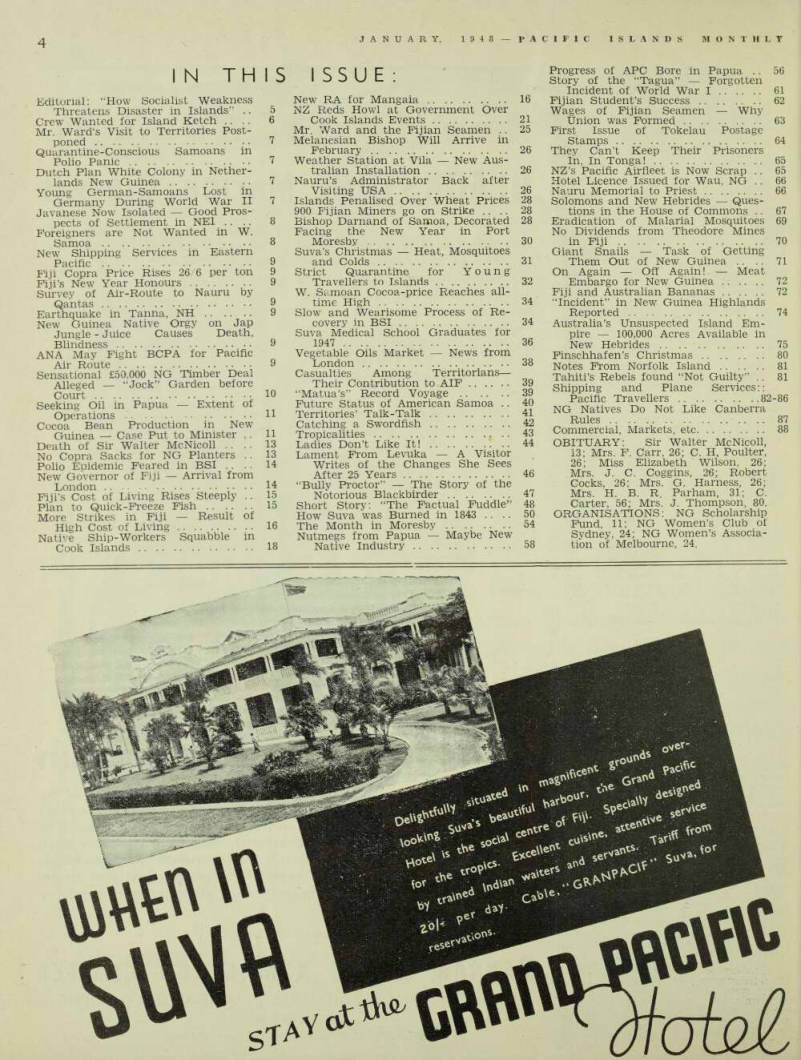
Editorial: “How Socialist Weakness Threatens Disaster in Islands” .. 5 Crew Wanted for Island Ketch ... 6 Mr. Ward's Visit to Territories Post poned 7 Quarantine-Conscious Samoans in Polio Panic 7 Dutch Plan White Colony in Nether lands New Guinea 7 Young German-Samoans Lost in Germany During World War II 7 Javanese Now Isolated Good Pros pects of Settlement in NEI ... 8 Foreigners are Not Wanted in W.
Samoa 8 New Shipping Services in Eastern Pacific 9 Fiji Copra Price Rises 26/6 per ton 9 Fiji’s New Year Honours 9 Survey of Air-Route to Nauru by Qantas 9 Earthquake in Tanna, NH 9 New Guinea Native Orgy on Jap Jungle - Juice Causes Death, Blindness 9 ANA May Fight BCPA for Pacific Air Route 9 Sensational £50,000 NG Timber Deal Alleged “Jock” Garden before Court 10 Seeking Oil in Papua Extent of Operations H Cocoa Bean Production in New Guinea Case Put to Minister .. H Death of Sir Walter McNicoll .. .. 13 No Copra Sacks for NG Planters .. 13 Polio Epidemic Feared in BSI ... 14 New Governor of Fiji Arrival from London 14 Fiji’s Cost of Living Rises Steeply .. 15 Plan to Quick-Freeze Fish 15 More Strikes in Fiji Result of High Cost of Living 16 Native Ship-Workers Squabble in Cook Islands 18
New RA for Mangaia 16 NZ Reds Howl at Government Over Cook Islands Events 21 Mr. Ward and the Fijian Seamen .. 25 Melanesian Bishop Will Arrive in February 26 Weather Station at Vila New Aus tralian Installation 26 Nauru’s Administrator Back after Visiting USA 26 Islands Penalised Over Wheat Prices 28 900 Fijian Miners go on Strike ... 28 Bishop Darnand of Samoa, Decorated 28 Facing the New Year in Port Moresby . .. .. 30 Suva’s Christmas Heat, Mosquitoes and Colds 31 Strict Quarantine for Young Travellers to Islands 32 W. Samoan Cocoa-price Reaches all time High 34 Slow and Wearisome Process of Re covery in BSI 34 Suva Medical School Graduates for 1947 36 Vegetable Oils Market News from London 38 Casualties Among Territorians— Their Contribution to AIF 39 “Matua’s” Record Voyage 39 Future Status of American Samoa .. 40 Territories’ Talk-Talk 41 Catching a Swordfish 42 Tropicalities 43 Ladies Don’t Like It! 44 Lament From Levuka A Visitor Writes of the Changes She Sees After 25 Years 46 “Bully Proctor” The Story of the Notorious Blackbirder 47 Short Story: “The Factual Fuddle” 48 How Suva was Burned in 1843 ... 50 The Month in Moresby 54 Nutmegs from Papua Maybe New Native Industry 58
Progress of APC Bore in Papua .. 56 Story of the “Tagua” Forgotten Incident of World War I 61 Fijian Student’s Success 62 Wages of Fijian Seamen Why Union was Formed 63 First Issue of Tokelau Postage Stamps 64 They Can’t Keep Their Prisoners In, In Tonga! 65 NZ’s Pacific Airfleet is Now Scrap .. 65 Hotel Licence Issued for Wau, NG .. 66 Nauru Memorial to Priest 66 Solomons and New Hebrides Ques tions in the House of Commons .. 67 Eradication of Malarial Mosquitoes 69 No Dividends from Theodore Mines in Fiji 70 Giant Snails Task of Getting Them Out of New Guinea .. .. 71 On Again Off Again! Meat Embargo for New Guinea 72 Fiji and Australian Bananas 72 “Incident” in New Guinea Highlands Reported 74 Australia’s Unsuspected Island Em pire 100,000 Acres Available in New Hebrides 75 Finschhafen’s Christmas 80 Notes From Norfolk Island 81 Tahiti’s Rebels found “Not Guilty” .. 81 Shipping and Plane Services:: Pacific Travellers 82-86 NG Natives Do Not Like Canberra Rules 87 Commercial, Markets, etc 88 OBITUARY: Sir Walter McNicoll, 13; Mrs. F. Carr, 26; C. H. Poulter, 26; Miss Elizabeth Wilson, 26; Mrs. J. C. Coggins, 26; Robert Cocks, 26; Mrs. G. Harness, 26; Mrs. H. B. R. Parham, 31; C.
Carter, 56; Mrs. J. Thompson, 80.
ORGANISATIONS: NG Scholarship Fund, 11; NG Women’s Club of Sydney, 24; NG Women’s Associa tion of Melbourne, 24.
Advertisements & other items, p. 6 (1 item)
Bios®
jm % 'S
tav S
Pacific Islands Monthly
The Newspaper-Magazine of the South Seas [Registered at the G.P.0., Sydney, for transmission by post as a newspaper .]
Published Once Each Month and Circulated in Australia and New Zealand and in the following Pacific Territories and Islands Groups:
Australian Territory of Papua.
Mandated Territory (Australia) of New Guinea.
Australian Territory of Norfolk Island.
New Zealand Territory of Cook Islands.
Mandated Territory (NZ) of Western Samoa.
British Colony of FIJI.
British Solomon Islands Protectorate.
British Protectorate of Tongan Islands.
British Crown Colony of Gilbert and Ellice Islands.
Mandated Territory of Nauru.
British and Free French Condominium o New Hebrides.
French Colony of New Caledonia.
French Colony of Oceania (Tahiti, etc.).
American Territory of Eastern Samoa.
American Territory of Hawaiian Islands.
Owned and Produced by Pacific Publications Pty. Ltd., Union House, 247 George Street, Sydney.
Telephones: General Office and Advertising, BW 5037.
P.O. Box 3408
Registered Address for Telegrams, Radiograms, and Cables: ’‘Pacpub”, Sydney.
Contributions.
Articles, Stories, and Photographs dealing with Pacific Islands subjects are invited and will be paid for on publication.
Subscription Rates.
Per Annum, Pre-paid, Including Postage.
In Australia, New Zealand, Fiji, New Guinea, Papua, Western Samoa, Cook Islands, Tonga, British Solomons, Gil bert and Ellice Colony, Nauru, and United Kingdom 15 0 Elsewhere 18 0 Single copies 1 6
Editor and Publisher:
R. W Robson, P.R.G.S.
Assistant Editor: JUDY TUDOR.
General Office: Union House, 247 George Street, Sydney. Telephone: BW 5037.
Advertising Manager: W. E. Rogers.
Representative In London.
J. T. Wallis, Coronation House, 4 Lloyds Avenue, London, E.C.3, from whom may be obtained copies of Pacific Islands Monthly, Pacific Is. Year Book, advertising schedules, etc.
Representative In U.S.A.
Pacific Islands Trading Co.,
244 CALIFORNIA ST., SAN FRANCISCO, U S.A.
Agents.
The following are authorised to receive sub scriptions for Pacific Islands Monthly:— Burns, Phllp & Co., Ltd., and Burns Phllp (South Sea) Co., Ltd. All branches.
W. R. Carpenter & Co., Ltd. All branches.
Morris, Hedstrom, Ltd. All branches.
Steamships Trading Co.. Papua. All branches.
W. M. Caldwell, Suva, FIJI.
Cook Islands Trading Co., Rarotonga, Cook Is.
A, C. Rowland, Papeete, Tahiti.
Islands Branches and Representatives of W. H.
Grove <fc Sons, Ltd., Auckland, New Zealand.
Ed. Pentecost, Noumea, New Caledonia.
Soclete Gubbay Kerr et Cle, Noumea, N. Caledonia.
T. A. Wyborn, 12a Alpln Street, Cairns.
Vol. Xviii. No. 6.
January 19, 1948
f 1/6 Per Copy Price I Prepaid, p.a.: 15/- Aus ( In USA, p.a.: $3.
The Islands
How Socialist Weakness Threatens Disaster In The Islands
THERE are indications that Commu nists are at work in different Terri tories of the South Pacific, poisoning natives against their European adminis trations, creating friction between em ployees and employers, and carrying on their insidious, deadly attack upon the British Empire, and everything that stands for orderliness, decency and security.
In this issue, there is an account of recent events in the Cook Islands, a de pendency of New Zealand. The fact that both jSTew Zealand and the Cook Islands are small and unimportant detracts nothing from the significance of these incidents. A concern called the Cook Islands Progressive Association, is arro gantly trying to assume dictatorial control over the group, and has already dis rupted Cook Islands commerce. Clearly, it receives its inspiration (and, probably, its instructions) from the Communist dominated Waterside Workers Union of New Zealand: and the NZ Government, pinkly Socialist, instead of kicking the whole organisation out of the Islands, without explanation or apology, is sweetly chiding the CIPA, and asking it to be good, and not interfere with the Cook Islands Workers Union (which ap parently is Government-sponsored and non-Communist).
In this and recent issues, we have evi dence, also, of how Mr. Ward, the Aus tralian Leftist Minister, is interesting himself in the welfare of a trade union in Fiji; of how the natives of the Solo mon Islands have subscribed, in large numbers, to something they call “Mar xian Law”; of how gentlemen in the Australian Territories, who decorate themselves on May Day with miniatures of Joseph Stalin, are fostering political
movements: of how the New Guinea Ad ministration is tenderly remonstrating with certain spirited natives who have been trying to introduce Communist organisation among the jungle peoples.
Some people may find the picture startling, when it is lined ud in this way.
But it is not a surprising development.
All over the world, the emissaries of Moscow, headquarters of Communism, are trying to weaken and undermine what they are pleased to call “the Im perialist powers.” It is part of their plan to spread discontent and sedition throughout all our colonies.
THREE nations in the world have enor mous colonial territories. In their order of importance they are Britain, France and Holland. It is the Commu nist plan to deprive them of their colonies.
During the 1940-44 period, when France and Holland were occupied by the enemy, their colonies were more or less cut off from firm central control; and in those years the emissaries of revolt got in some deadly work seen in Indo nesia, Indochina and North Africa. The Dutch, disclosing splendid strength and patience, have got the Netherlands In dies nearly back under control, and the traitorous Javanese who set up the so called “Indonesian Republic” are at the end of their tether. But France, honey-combed by Reds at home, is by no means happy in her colonial empire, and her skilled colonial administrators, lacking support from Paris, are faced with most difficult tasks.
Britain, not having been over-run by the enemy, should have had no troubles in her colonial empire. But Britain, hav ing defeated her enemies without, is
herself being defeated by her enemies within. And the most treacherous and dangerous of her enemies within are the creations of her own political system. She has had endless and continuing colonial trouble.
EVERY intelligent man, witnessing re cent events in Egypt and Palestine, India and Burma, Ceylon and Iraq, knows that there is something desper ately wrong with the Empire; but few are able to give it a name. Clearly, the fault lies with the Socialist Governments, elected to power in the immediate post war period by the war-weary British nations. We have these futile, blunder ing, well-meaning Pinks with us in Lon don, Canberra and Wellington.
We have economic troubles, industrial anarchy, maddening “controls,” far reaching rationing of essentials, and a steadily deteriorating political condition in the United Kindom, Australia, and New Zealand, which are ruled by the Pinks. We have few. if any, of these troubles in Canada, the United States and South Africa, which are English speaking nations ruled by non-Socialists.
We have native restlessness, national istic movements, betrayal of colonial administrators and outright loss of vast areas in the colonial territories controlled by Britain, Australia and New Zealand: but nothing of the sort in the Territories of United States, Canada and South Africa.
It is impossible to escape the moral to be drawn from these facts.
The peoples of Britain, Australia and New Zealand elected these Pink and blundering Governments to power; so their troubles are clearly of their own creation. They will learn their lesson, and react accordingly.
BUT it is an unfortunate thing that the weakness and ineptitude of Governments located in London,
Canberra and Wellington should create, in the South Pacific Islands, the condi tion to which we have referred. For, while those conditions are due immedi ately to the activities of Communists and their fellow-travellers, they really are caused by the feebleness of the major Governments, and their inability to deal with the Communist emissaries in the only possible way.
The trained and experienced officials in the Territories have the right idea. The clerk in Manihiki who arrested a dozen obstreperous militants who were ob structing the loading of a ship, and put them in handcuffs on his verandah; the police officer in Rarotonga who promptly placed two screeching nuisance-makers in gaol; the officials in the Solomons who arrested the “Marxian Law” ring leaders ; the experienced DO in New Guinea, who brought discipline to a line of arrogant labourers per medium of a hefty boot applied to their backsides— these men know that the only way of maintaining order, and decency and human progress in the Islands is by
strength, justice and uncompromising
firmness.
Endless industrial strife in the British Socialist countries is the direct outcome of the Socialist Governments’ failure to impose industrial discipline upon masses of trade unionists who are supposed to be educated men, living in a world governed bv reason. How much more trouble can we expect, therefore, when these same Socialist Governments, in dealing with the uneducated, simple minded people of the Pacific Islands, shrink in the same way from exercising firmness and discipline?
FOR years, we have been pointing, in these columns, to the increasing menace of Communism in the Pacific Islands: in the same way that, for years, we directed attention to the menace of the southwards-creeping power of Japan.
The stupidity and indifference of non- Socialist British Governments left all British Pacific countries for a time, at the mercv of Japan-. We fear that we may be similarly exposed to the dangers of Communism.
We were saved from Japan by the power of the quick-moving Americans.
But we then had the advantage that we were united nations our borders were closed, and the Japs were north of the equator.
It may be a different story when we enter the inevitable struggle between the Western Democratic nations and the Communists led by Russia. Long before the Americans can come to our aid, we may be fighting for liberty and life, in our own backyards, against the swarms of fanatical Reds who are being per mitted by our blundering Socialist Gov ernments to establish themselves strongly amongst us. A new and horrible kind of Fifth Column, in plain fact.
And part of the Commo-Fifth Column technique is to sneak around among the Islands communities, and destroy the natives’ natural allegiance and loyalty to us.
The "Tin Can" Mailman
WHEN MR. C. S. RAMSAY arrived re cently in Auckland from Tonga, the newspapers described him as the man who inaugurated the famous “Tin Can Mail” from the storm-swept island of Niuafoou, in the ’twenties.
Mr J. D Whitcombe, writing to “NZ Herald,” says Mr. Ramsay did not in augurate the unique mail system. He said that the method was adopted by Mr. Arthur Tindall, who used to seal the mail in a kerosene tin and, with the tin tied to a light pole, he and his Tongan lads would swim out from the rough water to deliver the mail to either the “Atua,” “Tofua” or ‘Navua” the
three vessels which carried on the Is lands service until the Depression. Mr.
Ramsav arrived in the island some three vears latfer, as the representative of Morris, Headstrom Ltd., and carried on the service.
New Guinea Goldfields
Ltd.
THE accounts of New Guinea Goldfields Ltd., for the year ended September 30 last show a further loss of £3,045, which has reduced the undistributed amount in the Profit & Loss account to £219,009.
Owing to great shortages of labour, plant and transport, NGG has not hur ried the difficult process of rehabilitation.
When the Jap invasion forced evacuation In 1942, NGG Ltd., had well over £200,000 in accumulated funds, and it was de cided to keep this money liquid, for emergencies. On present indications, another year may pass before this Co. resumes large-scale operations.
The issued capital (written down in the thirties bv 75 per cent.) is now £950,000. The mine properties, buildings, plant, etc., are valued at around £BOO,OOO, The Co has £120.000 in cash and inves ments; and its claims for war damage compensation (not complete) total £177,636.
The Co. has much valuable gold-bear ing country in the Morobe area and, with good management and the resources at its command, it should soon be back in the class of substantial profit earners.
The directors are; J. Kruttschnitt (chairman). C. W. Alexander, N. L. Cow per, E. D McDermott. W. P. Mitchell. H.
H. McNall, and Earl Castle Stewart. The Company is controlled by New York mining interests, and its shares (nominal value 4/3, Australian) are quoted at around 3/-.
Administration Officials'
School Resignation of Colonel Kerr
IT was announced early in January i that Colonel John Kerr has resigned his position as Principal of the Australian School of Pacific Adminis tration, in order to return to his pro fession as a barrister, in Sydney.
Colonel Kerr was also organising sec retary of the South Pacific Commission.
The “Sydney Morning Herald” sug gested that Colonel Kerr was not happy in his position that he had expected that the Australian Department of Ex ternal Territories would supply some 40 or 50 students for his School, but he had received lately only 15.
Crew Wanted For Ketch
For Bsi
IN an attempt to solve the problem of communication, Captain C. W. Seton, planter, of Choiseul, British Solo mons, recently purchased in Sydney, the “Roana,” a well-found, 50-ft. ketch, with an auxiliary engine. He had intended to come to Sydney himself this month, with a native crew, to take the little ship to his home; but he has found it impossible to get away.
Mrs. C. W. Seton who is now in Sydney, awaiting a chance to return home by air has announced that she now is seeking a master and volunteer crew for the “Roana,” to take the vessel Lto the Solomons. Anyone who wants P further particulars should contact Mrs.
Seton, care of Islands Agencies, Burns Philp & Co., Ltd., Sydney.
Advertisements & other items, p. 8 (1 item)
Concerning Stabilisation In Fiji
A LARGE section of Fiji copra producers is strongly attacking the proposal of the Fiji Government (set out in the Copra Bill now before the Legislative Council) to deduct a regular amount per ton from copra payments, in order to create a Stabilisation Fund, for the assistance of the industry in bad times. The deduction suggested varies from £2/10/- to £lO per ton.
While New Guinea producers are receiving £Aust.3s, fob, (£6 per ton goes into the Stabilisation Fund) Fiii nroducers are getting £Aust.42 in store, Suva or Levuka, or £Aust.46 fob.
Those who oopose the plan argue that the stabilisation funds in Government hands nrobably will disannear into thin air. just as did the old Indian Immigration Fund— a collection made from planters by the Government for the repatriation of Indian labourers.
The argument is proceeding merrily in Fiji.
COPftA price FIJI AGRICULTURAL MAGICIAN; Prithee, planter, give me now of your riches, and in dark days to come they shall reappear from my magic bag, to succour and comfort you.
COPRA PLANTER: Nothing doing, pop! To me, that bag looks very much like the bag that the Indian Immigration Fund desappeared into.
Mr. Ward's Visit
To Territories
Postponed For Present
THE visit to Papua and New Guinea of the Australian Minister for Ex ternal Territories, Mr. E. J. Ward, which had been arranged for “early in the New Year” has been postponed probably on account of the “Jock” Gar den timber leases development (see ar ticle on page 10.) It had been expected that Mr. Ward would leave Sydney about January 15; but we now are advised officially that “the Minister is not yet in a position to indicate when he is likely to visit the Territory, and his itinerary has not yet been settled.”
The charges which have been made against Mr. Garden will again come be fore a Sydney Court on January 21; and it is assumed from their character that Mr. Ward will be an important witness for the prosecution. Therefore, until that case has been disposed of, it is ap parent that Mr. Ward cannot make any plans involving his absence from Aus tralia.
Hopefully
Territorians Await Mr. Ward— Hopefully
From Our Own Correspondent
Port Moresby, Jan. 4.
WE now await Mr. Ward, whose “in vestigations” may perhaps bring with them a happier New Year.
Some of the Minister’s critics have painted exaggerated pictures of the local situation, but there is much that may still call forth his sympathy, and those with cases to present are busily docu menting them.
We can only hope he will listen to the arguments of the locals with at least an open ear. Rumour has it that public servants are to be given a rise before he arrives, which, if true, is a hopeful sign for others.
The best thing the Minister could do to assess the true state of affairs in post war New Guinea is to look deep into the people’s eyes; there he will see sure signs of undue nervous tension, which may perhaps be the common heritage of most people in the post-war world, but which has been aggravated by additional frus trations in Papua-New Guinea.
Here’s hoping!
Canon Benson
THE Reverend James Benson (who Is now Canon Benson) of the Church of England Mission in North- Eastern Papua, has gone to England, where he will attend the Bishop of New Guinea (the Right Reverend P. N. W.
Strong) as chaplain at the forthcoming Lambeth Conference. He passed through Auckland on January 10.
Canon Benson was captured by the Japs when they invaded Gona district in 1942, and was for long regarded as dead. However, it was later discovered that he had been taken by the Japs to Rabaul. and handed over to the care of the Roman Catholic missionaries im prisoned there, who nursed him care fully and restored him to health.
Canon Benson’s life has been filled with tragedy—when he was rector of a NSW South-Coast church, his car over ran a vehicular punt one night and his wife and children were drowned. He then spent some years in a Goulburn monastery, and later became a mission ary in Papua.
Quarantine-Conscious
Samoans In Paralysis Panic
THE outbreak of infantile paralysis in New Zealand caused something near to panic in Western Samoa.
Samoans, who remember the disastrous influenza epidemic of 1918, when between 8,000 and 9,000 Samoans lost their lives, have some justification for demanding precautions; but their preparations to meet the present threat bordered on the hysterical, and caused round-tripping “Matua” passengers some amusement when that vessel called at Apia.
There have been severe epidemics of infantile paralysis in New Zealand be fore, but there has never been an out break in Western Samoa. Generally, this disease, at least in epidemic form, is confined to temperate climates.
After a hurried meeting of the Samoan Fono on December 10, Samoan leaders demanded that all ship and plane travel from New Zealand and other infected areas, to Western Samoa, should be banned. After some controversy, in which the Administrator pointed out that Western Samoa would under those cir cumstances probably be shut off from the rest of the world for months, a less drastic isolation was agreed to, on- the understanding that the Administrator personally accepted full responsibility for keeping the disease out of the Terri tory.
On this note the “Matua” duly arrived from Suva and Auckland on December 23 and sailed on December 27. No pas sengers or crew were allowed ashore and the ship was worked bv labour which had been brought from Fiji.
Samoan police kept close watch on the ship to see that there was no contact made with the shore. As there is no wharf in Apia and vessels anchor out, this was comparatively easy.
A police launch with a searchlight kept up a patrol around the ship; and two members of the “Matua’s” crew who braved the sharks to take a swim near her were arrested for “polluting” the harbour.
An hour after the “Matua” anchored, much to the amusement of through pas sengers, Samoans dressed in surgical gowns and masks and equipped with dis infectant, stirrup pump and bucket ar rived alongside in a boat to take the mail off. As each mail bag was lowered into their boat the Samoans sprayed it with the disinfectant but those watch ing from on board noted that the bags were sprayed on one side only!
The regular air-service from New Zea land has been suspended altogether. A plane from Australia, via Fiji, landed, however, on December 14. it brought two new medical officers to the Territory —Drs. Bliss and Frost, late of the Indian Medical Service who will have an opportunity of studying the Samoan medical situation at first hand, from the inside looking out. Immediately upon arrival they were put into quarantine for a fortnight!
Progress at BGD, New Guinea
rR the month of November four Dredges handled 699,000 cubic yards of gravel for a total recovery of ap proximately 6,709 ounces of fine gold.
During December, the four BGD dredges out through 718,000 cubic yards of gravel for a recovery of 6,382 oz. of fine gold.
Dutch Plan White Colony
In N. Guinea
IT was reported from Melbourne in December that |Holland is making plans for white colonisation on a large scale in Dutch New Guinea.
A new department of the Dutch Gov ernment is planning what is “virtually a new colony” in Dutch New Guinea, and is offering inducements to residents of Holland, and Dutch people from Indo nesia, to settle there.
A former resident of Australian New Guinea comments: “What a contrast.
Here are the Dutch setting up a new organisation to colonise Dutch New Guinea with white people, while Aus tralia, with a large white colony already established in New Guinea, is setting up Government Departments whose chief purpose seems to be to push Europeans out of Australian New Guinea. Moscow at present evidently has little or no say at The Hague!”
Our Subscribers
Dear Paper-Appeal To Our Subscribers
ALL British publishers again are suf fering severely under an acute short age of paper and all our publica tions—especially periodicals—are handi capped accordingly. This journal is no exception.
Paper is not only scarce—it is also very expensive. The paper in this magazine, which could be purchased in 1939 for 3d. per pound, is now quoted in the market at from 12d. to 17d. per pound, and ris ing. Consequently, with great reluctance, publishers generally are raising the sub scription rates of their periodicals. Even then, the higher rates do not cover in creased costs —but most publishers hope that paper prices may begin to recede in 1949 or 1950.
Meanwhile, we are forced to exercise the greatest economy in the use of paper.
Subscribers are asked to renew their sub scriptions promptly upon expiry. We can not continue our old practice of sending the journal for a couple of months after the subscription has expired, in the belief that the subscriber has overlooked the little matter of renewal. We are com pelled to cease sending the journal as soon as the subscription has expired.
Young German-Samoans
Lost In Germany In 1939-1945
WHILE the Reverend C. W. Whonsbon- Aston, Vicar of Apia, Western Samoa (who has now returned to his charge after a 9 months’ holiday abroad) was in Germany a few months ago, he made efforts to trace German- Samoan children who were at school, or undergoing training in Germany, when war came in 1939, and who have been lost sight of.
He reports some success; but he savs that a number of these young people had been conscripted into the German Forces, and had been killed in action, and others had completely disappeared. Those whom he traced and made contact with were most dispirited, and were anxious to re turn to Samoa. But there was little chance of their being able to do so until a policy relating to these matters had been decided upon by the British Foreign Office.
Javanese Now
Isolated
Good Prospects of Settlement
In Dutch Indies
THE new year brings more hopeful prospects of settlement in Indonesia.
Though the negotiations through the Commission of Good Offices of the United Nations have not yet brought any material results into the open, there is to be seen a distinct change for the better in the overall situation.
As the most important fact there is the appeal of the Comitee Negara In donesia Serikat (The Committee for the United States of Indonesia) started by 12 Indonesian leaders on the initiative of R. Abdul Kadir (Director of General Affairs and Deputy Lieutenant Governor General). It asks all political unions, in Indonesia to combine for the formation of the Federated States of Indonesia, as set out in the Agreement of Linggard jati..
This appeal was answered with en thusiasm by millions of people all over Indonesia, where they are free to speak their mind and where they have shown they are sick of all the mrest, looting, plundering and murder which has been going on for more than two years in some parts of their country.
Even more important is the fact that the leader of the movement is Professor Hoesein Djajadiningrat who is Indonesia’s leading statesman. He comes from a well known aristrocratic family in West Java, and has held many positions of culture and trust.
With him in this movement are the leaders, of the Madoerese, from East Java: the Pasoendan, in West Java; the new state of Sumatra’s East Coast; the Riouw Council, the Dayak Council and of the Council of Kalimantan Tenggara and other Borneo states: and all other parts of Indonesia where the work of re habilitation and reconstruction is al ready in full swing where the popula tion have returned to their work and where they can reap the fruits of their labour once again.
In December, the West Java confer ence was attended by 147 representa tives of the people of West Java, who gave 142 votes for the establishment of the State of West Java, as per article 4 of the Linggardjati Agreement.
One may mention also, the visit of the Netherlands Prime Minister (Dr.
Beel) and three other Dutch Cabinet Ministers, who are anxiously watching all these developments. A few days ago Dr. Beel broadcast an appeal a last appeal, as he called it to the so-called Republican Government, to fall in with these efforts to establish the United States of Indonesia.
In the midst of this scene there is the “Javanese Republican Government of Djokjo,” still playing its old game of hindering the solution of the Indonesian problem, still hoping against hope to dominate a centralised Indonesia against all these tendencies for a federal union of the archipelago.
The political developments of recent weeks and the economic advances in all the other territories have left the “Re public” more or less isolated.
It has still the chance of playing an important role in further development under the auspices of the Good Offices of the United Nations. If all prospects are not deceiving, they will take that chance; and, though there are still nlenty of difficulties ahead, the prospects for an early solution of the Indonesian problem have never been better than at the be ginning of 1948.
No need to emphasise that this solution would have good repercussions all over the Far East and the Pacific countries.
Of course, the Australian Pinks would
not like it especially the Waterside Workers Union, which more or less directs the foreign policy of Australia.
Federal Council Is Formed
mHE Lieutenant-Governor-General of 1 the NEI, Dr. van Mook, on January 13, declared the preliminary Fede ral Council for Indonesia constituted.
The council consists of eight Indone sians from non-Republican parts of the archipelago. The council will prepare a Constitution for the preliminary Federal Government of Indonesia in consultation with Dr. van Mook.
Dr. van Mook, speaking at a simple ceremony in Batavia, said there was no trick or manoeuvre behind the formation of the council. He said he had deliber ately left the road entirely free for a complete reunion of the whole of Indo nesia.
"Foreigners" Are Not
Wanted Samoans' Petition Against Establishment of Building Co.
Prom Our Own Correspondent
Apia, Dec. 26.
THE recent registration in Western Samoa of a branch of the Fletcher Construction Company of New Zea land to undertake building activities in the Territory and to establish new indus trial undertakings such as brick fac tories, joineries, etc., has aroused strong opposition amongst a portion of the Samoans. A recent fono (or general meeting) of Samoan representatives peti tioned the Administration to prevent the establishment of the new company, as the Samoans do not want any new “foreign” companies in the Territory.
As there are no firms or individuals here who are equipped to cope with the comprehensive new building projects of the Government and private enterprise, and as the Fletcher Company intends to employ Samoan labour at compara tively high wages, the action of the Samoans is considered short-sighted and detrimental to the real welfare of the country.
The work of the new company would give opportunity for training and instruc tion to a large number of local trades men and stimulate new industries which utilise the resources of bush timber.
It is to be hoped that the unreason able prejudice of the petitioners will not result in the withdrawal of the Fletcher Company from Samoa.
Retirement Of W. Samoa
Educationalist
From Our Own Correspondent
Apia Dec 26
MR. A. McKENZIE, Superintendent of Schools in Western Samoa for 11 years, left the Territory for New Zealand with Mrs. McKenzie by the “Matua” on December 27.
Mr. McKenzie has been an education alist in the islands for 24 years which probably constitutes a record.
He was in charge of education first at Niue Island, later in the Cook Islands and then in Western Samoa.
He was also a member of the Western Samoan Legislative Council for the last 11 years.
During his service in Samoa, Mr. Mc- Kenzie has seen important educational changes take place in the Territory. He opened the first Government High School at Ifi Iff, Apia, and also the Teachers’
Training College.
Due to his efforts the present scholar ship scheme came into operation, under which between 40 to 50 students were given an opportunity for training and education in New Zealand. He also in augurated the scheme for visits by Samoan teachers and inspectors to New Zealand in order to expand their educa tional horizon and knowledge.
Residents of Apia regret the departure of Mr, and Mrs. McKenzie who were very popular in all circles in the community.
Amateur Navigator
Papeete, Dec. 2
THERE departed recently, for France, M. and Mdme. Coulon, who are well-known property-owners on Raiatea. M. Coulon has just been elected by the Assemblee Representative Presi dent of the Union Francaise.
One is reminded of a characteristic story of M. Coulon. Many years ago, when he was manager of the Christmas IslancJ plantations owned by the late Father Rougier, he was on a schooner bound from Papeete to Christmas Island.
The schooner’s Captain died suddenly and no one aboard knew anything about navigation. M. Coulon took the helm and did without sleep while he kept the vessel on a certain course. Some days later land was sighted—and it proved to be certain islands in American Samoa.
Having got his bearings, M. Coulon took the schooner to Apia. From Apia he navigated the schooner back to Papeete, to sign on a new skipper.
A New Zealand architect has drawn up plans for a new church, to be built by Fijian Methodists, in Suva, at a cost of £25,000.
Uss Manager Leaves
Fiji
Mr. and Mrs. D. Butler, of Suva, Fiji—a photograph taken just be fore they left Fiji on the “Matua” early in January. Mr. Butler has been the popular manager of the Suva branch of the Union Steam ship Co. for the past 10 years.
Indifferent health is sending him back to New Zealand, where he will have extended leave before taking up a new position with the company. He will be greatly missed in Fiji.
Services
New Shipping
In Eastern Pacific
From Our Own Correspondent
Papeete. Dec. 10.
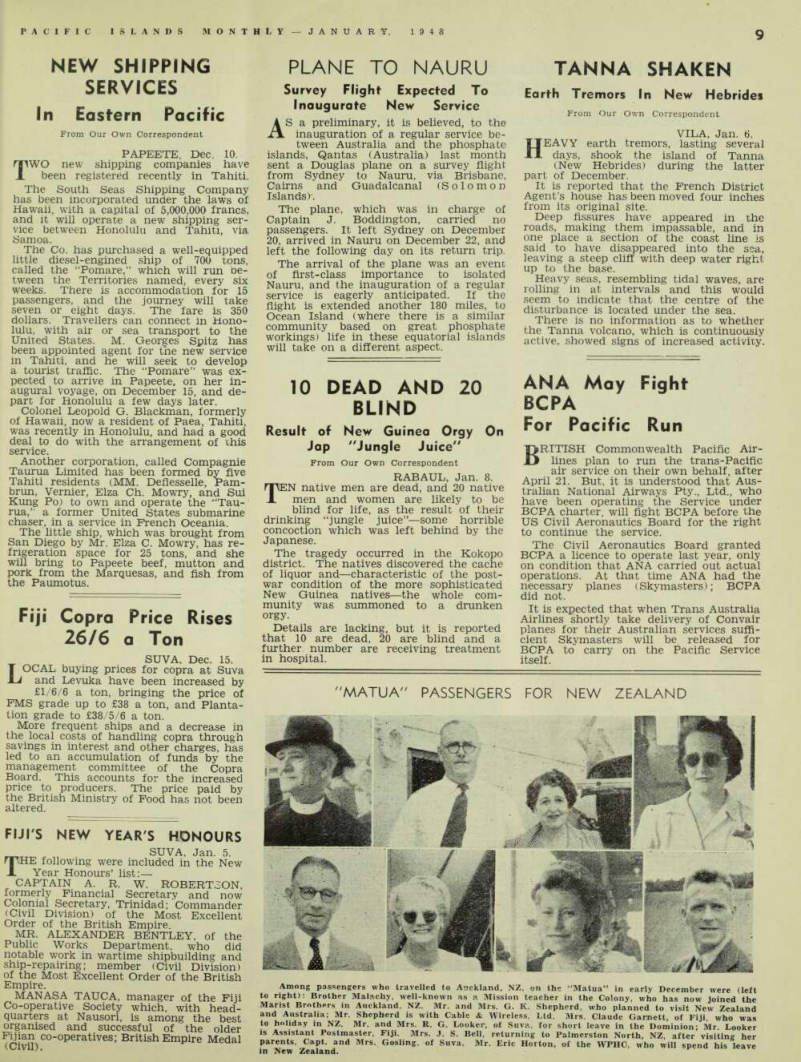
TWO new shipping companies have been registered recently in Tahiti.
The South Seas Shipping Company has been incorporated under the laws of Hawaii, with a capital of 5,000,000 francs, and it will operate a new shipping ser vice between Honolulu and Tahiti, via Samoa.
The Co. has purchased a well-equipped little diesel-engined ship of 700 tons, called the “Pomare,” which will run oe tween the Territories named, every six weeks. There is accommodation for 15 passengers, and the journey will take seven or eight days. The fare is 350 dollars. Travellers can connect in Hono lulu, with air or sea transport to the United States. M. Georges Spitz has been appointed agent for the new service in Tahiti, and he will seek to develop a tourist traffic. The “Pomare” was ex pected to arrive in Papeete, on her In augural voyage, on December 15, and de part for Honolulu a few days later.
Colonel Leopold G, Blackman, formerly of Hawaii, now a resident of Paea, Tahiti, was recently in Honolulu, and had a good deal to do with the arrangement of this service.
Another corporation, called Compagnie Taurua Limited has been formed by five Tahiti residents (MM. Deflesselle, Pam brun, Vernier, Elza Ch. Mowry, and Sui Kung Po) to own and operate the “Tau rua,’ a former United States submarine chaser, in a service in French Oceania.
The little ship, which was brought from San Diego by Mr. Elza C. Mowry, has re frigeration space for 25 tons, and she will bring to Papeete beef, mutton and pork from the Marquesas, and fish from the Paumotus.
Fiji Copra Price Rises
26/6 a Ton
Suva. Dec. 15.
LOCAL buying prices for copra at Suva and Levuka have been increased by £l/6/6 a ton, bringing the price of FMS grade up to £3B a ton, and Planta tion grade to £3B/5/6 a ton.
More frequent ships and a decrease in the local costs of handling copra through savings in interest and other charges, has led to an accumulation of funds by the management committee of the Copra Board. This accounts for the increased price to producers. The price paid by the British Ministry of Food has not been altered.
Fiji's New Year's Honours
Tsuva. Jan. 5.
HE following were included in the New Year Honours’ list:—
Captain A. R. W. Robertson,
formerly Financial Secretary and now Colonial Secretary, Trinidad; Commander (Civil Division) of the Most Excellent Order of the British Empire.
Mr. Alexander Bentley, Of The
Public Works Department, who did notable work in wartime shipbuilding and ship-repairing; member (Civil Division) of the Most Excellent Order of the British Empire.
MANASA TAUCA, manager of the Fiji Co-operative Society which, with head quarters at Nausori, is among the best organised and successful of the older Fijian co-operatives; British Empire Medal (Civil).
Plane To Nauru
Survey Flight Expected To Inaugurate New Service
AS a preliminary, it is believed, to the inauguration of a regular service be tween Australia and the phosphate islands, Qantas (Australia) last month sent a Douglas plane on a survey flight from Sydney to Nauru, via Brisbane, Cairns and Guadalcanal (Solomon Islands)-.
The plane, which was in charge of Captain J. Boddington, carried no passengers. It left Sydney on December 20, arrived in Nauru on December 22, and left the following day on its return trip, The arrival of the plane was an event of first-class importance to isolated Nauru, and the inauguration of a regular service is eagerly anticipated. If the flight is extended another 180 miles, to Ocean Island (where there is a similar community based on great phosphate workings) life in these equatorial islands will take on a different aspect.
Blind
10 Dead And 20
Result of New Guinea Orgy On Jap " Jungle Juice"
From Our Own Correspondent
Rabaul. Jan. 8.
TEN native men are dead, and 20 native men and women are likely to be blind for life, as the result of their drinking “jungle juice”—some horrible concoction which was left behind by the Japanese.
The tragedy occurred in the Kokopo district. The natives discovered the cache of liquor and —characteristic of the post war condition of the more sophisticated New Guinea natives —the whole com munity was summoned to a drunken orgy.
Details are lacking, but it is reported that 10 are dead, 20 are blind and a further number are receiving treatment in hospital.
Tanna Shaken
Earth Tremors In New Hebrides
From Our Own Correspondent
Vila, Jan. 6.
TTEAVY earth tremors, lasting several XX days, shook the island of Tanna (New Hebrides) during the latter part of December.
It is reported that the French District Agent’s house has been moved four inches from its original site.
Deep fissures have appeared in the roads, making them impassable, and in on . e P^ ace a section of the coast line is said to have disappeared into the ssa, ba?e P rlght Heavv seas resemblins tidal waves are rolling in intervals and this would seem to i nc n ca te that the centre of the disturbance is located under the sea.
There is no information as to whether the Tanna volcano, which is continuously active, showed signs of increased activity, & J
ANA May Fight
Bcpa
For Pacific Run
BRITISH Commonwealth Pacific Air lines plan to run the trans-Paciflc air service on their own behalf, after April 21. But, it is understood that Aus tralian National Airways Pty., Ltd., who have been operating the Service under BCPA charter, will fight BCPA before the US Civil Aeronautics Board for the right to continue the service.
The Civil Aeronautics Board granted BCPA a licence to operate last year, only on condition that ANA carried out actual operations. At that time ANA had the necessary planes (Skymasters); BCPA did not.
It is expected that when Trans Australia Airlines shortly take delivery of Convair planes for their Australian services suffi cient Skymasters will be released for BCPA to carry on the Pacific Service itself.
"Matua" Passengers For New Zealand
Among passengers who travelled to Auckland, NZ, on the “Matua” in early December were (left to right): Brother Malachy, well-known as a Mission teacher in the Colony, who has now Joined the Marist Brothers in Auckland, NZ. Mr. and Mrs. G. K. Shepherd, who planned to visit New Zealand and Australia; Mr. Shepherd is with Cable & Wireless. Ltd. Mrs. Claude Garnett, of Fiji, who was to holiday in NZ. Mr. and Mrs. R. G. Looker, of Suva, for short leave in the Dominion; Mr. Looker is Assistant Postmaster, Fiji. Mrs. J. S. Bell, returning to Palmerston North, NZ, after visiting her parents. Capt. and Mrs. Gosling, of Suva. Mr. Eric Horton, of the WPHC, who will spend his leave in New Zealand.
Forgery
Sensational £50,000 N.G. Timber Deal
Alleged
'Jock' Garden Before Federal Court On Charge of Forgery
rpHREE summonses were served upon A John Smith (“Jock”) Garden, of Double Bay, Sydney, on January 2, and on January 7 he appeared in the Special Federal Court, Sydney, on charges of having: • On or about November 20. 1945, at Sydney, forged a letter issuable by the Department of External Tenitories. • On or about November 20. 1945, forged a letter issuable by the Administrator of the Territory of New Guinea. • On or about November 20. 1945, at Sydney, being a Commonwealth officer, fraudulently and in breach of his duty falsified a letter together with a plan attached thereto.
The summonses were issued following inquiries by the Commonwealth Investi gation Service into alleged irregularities concerning the granting of a New Guinea timber lease. The incident has caused a sensation in Australian political circles and is of particular interest to New Guinea residents.
It is understood that investigations were commenced about mid-December, after the alleged irregularities came under the notice of the Minister for External Territories (Mr. E. J. Ward). Inquiries concerned a transaction which was alleged to have taken place about two years previously, in respect of the grant ing of timber leases and over which £50,000 was alleged to have changed hands.
A Queensland timber company is said to have received a letter, purporting to come from Mr. Ward, informing them that they had been granted timber leases in the Bulolo Valley, New Guinea. No at tempt was made to work these leases but it is understood that recent inquiries from the company precipitated the CIS inquiry, and led to the issue of summonses against Garden.
GARDEN was born in Scotland in 1882.
He became a minister of the Baptist Church, and of the Evangelist Church of Christ in Australia.
After he left the church, he was, for 20 years, secretary of the NSW Labour Coun cil, and a very prominent figure, as a Left wing Labourite, in Australian politics.
It was during this period that he at tended a Communist conference, in Russia, as a representative of Australia. In 1934, he secured the Labour nomination for the Cook seat, and entered the Federal House of Representatives as a Lang- Labour member. There were then four Lang Labourites in the House—Garden, Ward, Beasley (now High Commissioner in London) and Rosevear (now Speaker) —and they formed a compact and aggressive group within the Labour Party.
Garden failed to secure the Labour nom ination in 1937, and disappeared from Parliament.
In 1942, Garden was appointed Liaison Officer in the Department of Labour and National Service, when Mr, Ward held that portfolio.
In the Cabinet reshuffle in 1943, Mr.
Ward became Minister for Transport and for External Territories, and Mr. Hollo way was Minister for Labour and National Service. Garden remained an officer in the latter department, however, until a few weeks ago.
It had been alleged that Garden was at one time secretary of the Communist Party in Australia. This was denied by the Prime Minister in the House of Rep resentatives in 1946.
TIHE Special Federal Court was packed when Garden appeared for the hear ing of the summonses on January 7.
Many prominent Union officials, legal men and one Commonwealth Senator were present.
Mr. Simon Isaacs appeared for Garden and immediately asked for an adjourn ment until January 21. This was sub sequently granted, after bail on the three charges had been fixed at £3lO.
Mr. Shand, KC (for the Commonwealth) said that evidence would show that the letter, granting the timber leases to a certain Queensland company and pur porting to have been sent under the authority of the Minister, was sent by Garden; that the letter was in respect of a purported sale of a licence for the recovery of timber in the Bulolo Valley, New Guinea; that an amount of £50,000 had been paid by a Queensland company to certain persons, of whom Garden was one.
The three charges against Garden, Mr.
Shand said, all arose out of the one letter.
Mr. Isaacs said that the only document of which Garden had any knowledge, under the date of November 20, 1945, was a letter signed by him “E. J. Ward, per pro J. S. Garden.”
Mr. Shand said that that was the letter referred to.
Mr. Isaacs said that whatever the nature of the charge, Garden had a per fectly good defence.
Mr. Edmond Vienot, a member of a pioneer family of French Oceania, and a man prominent in the French commun ity died recently in Papeete at the age of 67. He is survived by his widow and several daughters.
Administration Changes
In New Hebrides
From Our Own Correspondent
Vila, Dec. 16.
HIS Honour A. H. Egan, British Judge of the Joint Court and Judicial Commissioner, has resigned his ap pointment and gone with his family to live, it is said, in Western Australia.
There is no news of his successor. It has been reported that a British Govern ment official may be appointed judge “ad hoc” to dispose of cases still remaining in the cause list.
Mr. Reg. Johnson, former District Agent on Efate and Commandant of Constabulary (British Division) has been transferred to the British Solomon Is lands, and his place has been taken by Mr. Peter Colley, formerly British Dis trict Agent on Tanna.
Mr. B. F. Blackwell. Acting Assistant Resident Commissioner, has gone on long leave in Australia. He was accompanied by his wffe and family. His place at the British Residency has been taken by Mr.
Turner.
Mr. J. Downing, also of the British Residency, has gone on leave in Aus tralia, accompanied by his wife.
Mr. Jack Holder, formerly in the Condominium Treasury Department, has been transferred to the post of account ant at the British Residency.
Mr. John Maxwell, an Administrative Officer at the British Residency, has been sent to relieve Mr. Ronald Crozier, British District Agent at Santo, who is due for leave.
Mr. Richard Eedy, who for many years was a wireless operator at Vila Radio, has obtained a transfer to the Customs Department. His absence from Vila Radio will be regretted by many.
It was notified in a recent Gazette that Mr. Shih-Chen Lai, vice-consul for China, in Suva, has full consular juris diction over Chinese interests in Gilbert and Ellice Islands. Solomon Islands, Tonga and New Hebrides.
Farewell To Suva's Polo Association President
A happy group, photographed recently at the home of Mr. and Mrs. H. Maurice Scott, Suva, Fiji, when members of the Suva Polo Association farewelled Mr. A. R. W. Robertson, Acting Colonial Secretary, Fiji, who has now been transferred to Trinidad. He is a keen polo player and was president of the Suva Association. Mr. Robertson (at extreme back of photo) was presented with a polo ball, autographed by members of the Association, and mounted on a stand of Fijian wood.
Operations
Seeking Oil
Extent of Papua Operations
From Our Own Correspondent
Cairns, Jan. 3.
MR. ELLIS TURNER, an employee of Australian Petroleum Company, is back on the mainland after 16 months’ duty in Papua, and he reports that geological indications are being intensively explored and considerable sums of money are being spent in the effort to tap oil deposits.
“The recent announcement that oil had been found in Papua was false,” said Mr. Turner, “but the APC is boring hope fully into the crust of promising Papuan areas in an all-out bid for the liquid life giver, now so necessary to keep the wheels of the Australian industries turning at full capacity.”
Mr. Turner said that the search was proceeding along well-planned lines. At Kariava, 76 miles up the Vailala River, test bores have been drilled to a depth of 10,000 feet. Drilling operations are due soon to commence at Hohora and at Oroi (situated 60 miles west of Port Moresby, on the coast, six miles east of Yule Island).
The APC is an offshoot of the Anglo- Iranian Oil Company and it is controlled from Melbourne, with Englishmen as deputy general manager and field super intendent on the spot in Papua. There are Englishmen also among the drilling crew, but most of the 100 white men em ployed in the search are Australians, in cluding geologists.
In the tradition of the land the 800 natives on the payroll do the hard, physical labour, and the whites the skilled tasks and the work of supervision. Fourteen geologists main tain active geological and geophysical surveys over large tracts of country, and are at present testing out the possibilities of areas as far up as the Fly River.
Good Conditions For Men
“More men,” Mr. Turner added, “both white and black, were needed to push the quest ahead. Whites were well paid, but the inability of married men to bring their wives and families from the main land was a source of discontent. Efforts to provide the necessary accommodation for families were frustrated by material shortages.”
In other respects, APC was doing a good job, in providing for the physical welfare of its employees. It had installed its own refrigerators and fresh meat was avail able for the greater part of the month.
The company has 12 boats, and also operates a twin-engined plane. A com pany doctor gives free medical treatment and paludrine was issued, to be taken in twice-weekly doses as a guard against malaria. One houseboy was allotted to each single white man, two to married men. Single men were provided with everything except tobacco, beer and clothes, and recreational facilities were also provided.
New Guinea Scholarship
Fund
FURTHER donations to the New Guinea Memorial Scholarship Fund have been received by the Secretary, Miss Dorothy Stewart, Cosmopolitan Hotel, Rabaul.
£ s d Acknowledged to 30/11/47 .. 3412 2 6 Bulolo Sub-branch RSSAILA 3 3 0 Mr. & Mrs. J. K. McGuigan, Kavieng 100 3,416 5 6
Cacao Bean Production In Australia
And New Guinea
Manufacturers and Union Put Case to Minister
IN Canberra, on November 26, the Minister for External Terri tories (Mr. E. J. Ward, MHR) told a deputation representing t*he Aus tralian confectionery industry that he would investigate the possibilities of large scale cacao bean production in Northern Australia and New Guinea. Indications are that steps already have been taken in the mat ter, Mr. W. Cotterell-Dormer, head of the New Guinea Department of Ag riculture, having sent an officer to Trinidad for two years to study all aspects of cacao bean production. rE deputation consisted of Messrs. R.
S. Jackson (Federal president) and Mr P. J. Lucas (Federal secretary), of the Federated Confectioners’ Associa tion of Australia; Mr. S, R. Johnson, secretary Commonwealth Chocolate and Confectionery Manufacturers’ Associa tion; Mr. H. Small, of H. Small & Co.
Pty., Ltd., Sydney; Mr. J. D. Francis, well known Sydney manufacturer: Mr. J. Pear son, Mac Robertson Pty., Ltd., Melbourne; Mr. W. Rudder, Nestle ASCM (A’sia) Ltd., Sydney; and Mr. T. Coggans, James Stedman Henderson’s Sweets Ltd., Sydney. Senator T. M. Nicholls, hon. secretary of the South Australian Branch of the Federated Confectioners’ Associa tion, arranged the deputation.
Mr. Jackson outlined the resolution passed at the recent bi-annual meeting of the Union’s Federal Council that the Government be approached on the cacao bean position and stressed the serious effect a shortage of beans would have upon the manufacturing confectionery industry. The Union requested the Minister to look into the possibilities of establishing cacao bean production in Northern Australia and New Guinea.
OTHER speakers on the deputation supported Mr. Jackson. They ex plained that the industry required a long-range plan covering supplies of cacao beans to Australia. Maximum New Guinea production totalled about 300 tons of beans whereas it was esti mated that Australia required at present between 14,000 and 15,000 tons, and in seven or eight years that figure was ex pected to grow to 19,000 tons. If the industry could be successfully established in New Guinea, production in 10 years' time might reach 20,000 tons. It was agreed that the Australian confectionery industry might not require all of this cacao, but the surplus could be exported in the form of beans or as manufactured confectionery. The value of a cacao bean industry close to Australia in time of war did not require any emphasis.
THE deputation suggested an Advisory Committee be set up to advise upon the quality, grading and types of cacao bean required by Australia. It was pointed out that beans coming from New Guinea at present left much to be desired as far as grading, fermentation and standardisation of packing was con cerned. A manufacturer who bought a ton of beans from New Guinea was likely to get a mixture of half ripe and fully ripe beans in a variety of bags, large and small.
It was appreciated that the industry was in its infancy in New Guinea, and similar difficulties were encountered with Accra cacao beans when the Gold Coast first started large-scale production. Over a period of years methods of fermenta tion, grading and packing showed a great improvement. If that could be done in
West Africa then it could be done in Australia and New Guinea.
To-day Australian manufacturers could not use New Guinea beans alone. They were used as “filler” beans and were blended with better quality beans from Trinidad, Ceylon, etc.
If an advisory body were set up it was suggested that manufacturers, the Union, the Council of Scientific and Industrial Research, and the New Guinea Depart ment of Agriculture be represented with a chairman appointed by the Government.
THE anomalous position in which Aus tralia was placed when buying cacao beans, compared with sterling and dollar countries, was also explained to the Minister.
America to-day was enjoying great prosperity and this, together with natural increases in consumption and other factors, had so greatly increased that country’s demands that it was prepared to pay phenomenal prices to obtain its requirements. The purchasing power of the dollar, increased by exchange ad vantages, enabled America and Canada to buy at a 50 per cent, advantage over Australia.
Mr. Ward gave sympathetic considera tion to the representations and promised to have his officers investigate the matter thoroughly. He said that before such a large-scale programme could be under taken there were a number of problems in New Guinea to be settled.
Under Way
"Blue Lagoon" Soon Under Way
From Our Own Correspondent
Suva, Dec. 22.
MISS JEAN SIMMONS, the young English actress who will star in the film version of “The Blue Lagoon,” part of which is to be made in Fiji, ar rived at Nadi by plane from Sydney yesterday.
As she came direct from Sydney, a non-infected area, Miss Simmons, who is only 18, escaped being clapped into quarantine the fate of all persons under 19 who come from New Zealand or Brisbane during current infantile paralysis outbreaks in those places.
Most of the members of the Individual Films unit have now assembled in Suva, but the director, Mr. Frank Launder, is still in Sydney looking for a young player to cope with the role of Dick Les trange as a boy.
Mr. Donald Huston, who will play the same character grown up, is expected in Fiji this week.
Every detail of the remote beach in the Yasawas Group which was selected for the exteriors, will be reproduced in the London studios for subsequent work on the film. Plaster casts will be taken of the palms on the selected Yasawas beach for reproduction.
Stars In Car Accident
Suva, Dec. 30.
DISASTER nearly befell the “Blue Lagoon” location unit of Individual Pictures (part of the J. Arthur Rank film organisation) to-day when the star, Miss Jean Simmons, and the leading man, Mr. Donald Huston, were on an afternoon drive in a hired car.
About seven miles from Suva, in the Nasinu district, the car, driven by Mr.
Huston, got out of control and capsized.
Neither Miss Simmons nor Mr. Huston was injured although the car was badly damaged.
Advertisements & other items, p. 14 (1 item)
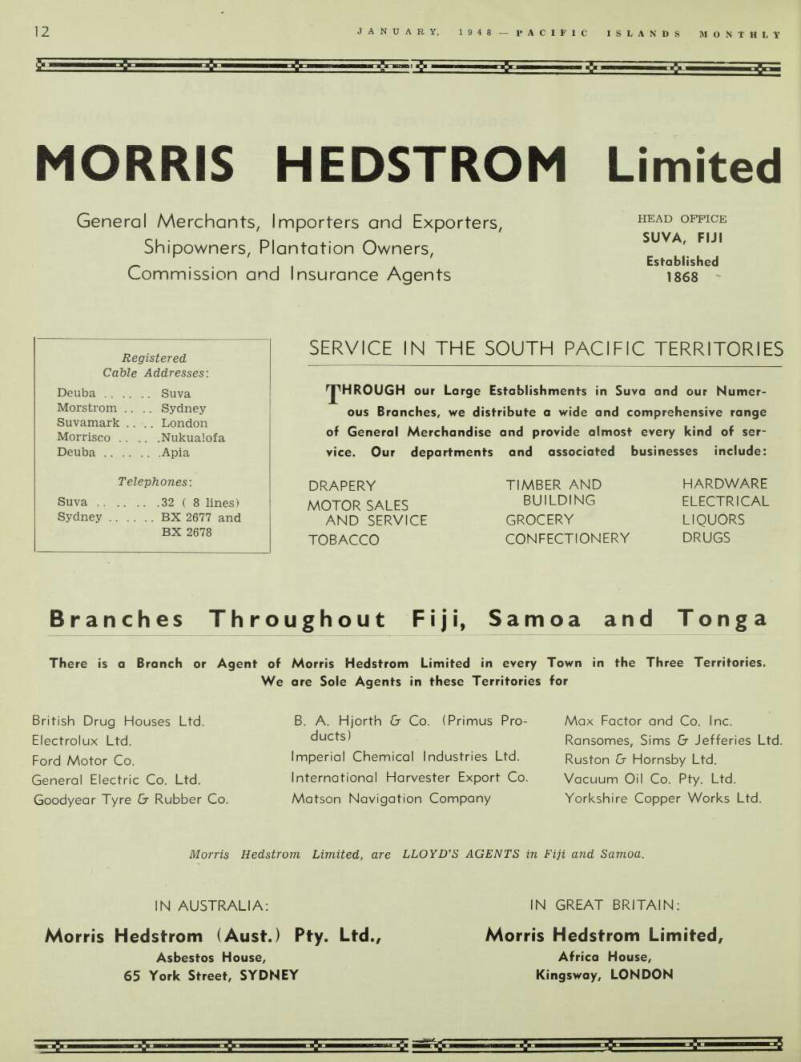
Morris Hedstrom Limited
General Merchants, Importers and Exporters,
Shipowners, Plantation Owners,
Commission and Insurance Agents
HEAD OFFICE
SUVA, FIJI
Established 1868 Registered Cable Addresses : Deuba Suva Morstrom .. . . Sydney Suvamark ... London Morrisco Nukualofa Deuba Apia
SERVICE IN THE SOUTH PACIFIC TERRITORIES
'jpHROUGH our Large Establishments in Suva and our Numerous Branches, we distribute a wide and comprehensive range of General Merchandise and provide almost every kind of service. Our departments and associated businesses include: Telephones’.
Suva 32 ( 8 lines) Sydney BX 2677 and BX 2678
DRAPERY
MOTOR SALES
AND SERVICE
TOBACCO
TIMBER AND
BUILDING
GROCERY
CONFECTIONERY
HARDWARE
ELECTRICAL
LIQUORS
DRUGS
Branches Throughout
Fiji, Samoa and Tonga
There is a Branch or Agent of Morris Hedstrom Limited in every Town in the Three Territories.
We are Sole Agents in these Territories for British Drug Houses Ltd.
Electrolux Ltd.
Ford Motor Co.
General Electric Co. Ltd.
Goodyear Tyre £r Rubber Co.
B. A. Hjorth & Co. (Primus Products) Imperial Chemical Industries Ltd.
International Harvester Export Co.
Matson Navigation Company Max Factor and Co. Inc.
Ransomes, Sims Gr Jefferies Ltd.
Ruston & Hornsby Ltd.
Vacuum Oil Co, Pty. Ltd.
Yorkshire Copper Works Ltd.
Morris Hedstrom Limited, are LLOYD'S AGENTS in Fiji and Samoa.
IN AUSTRALIA: IN GREAT BRITAIN:
Morris Hedstrom (Aust.) Pty. Ltd., Morris Hedstrom Limited, Asbestos House, Africa House, 65 York Street, SYDNEY Kingswoy, LONDON
Sir W. Mcnicoll
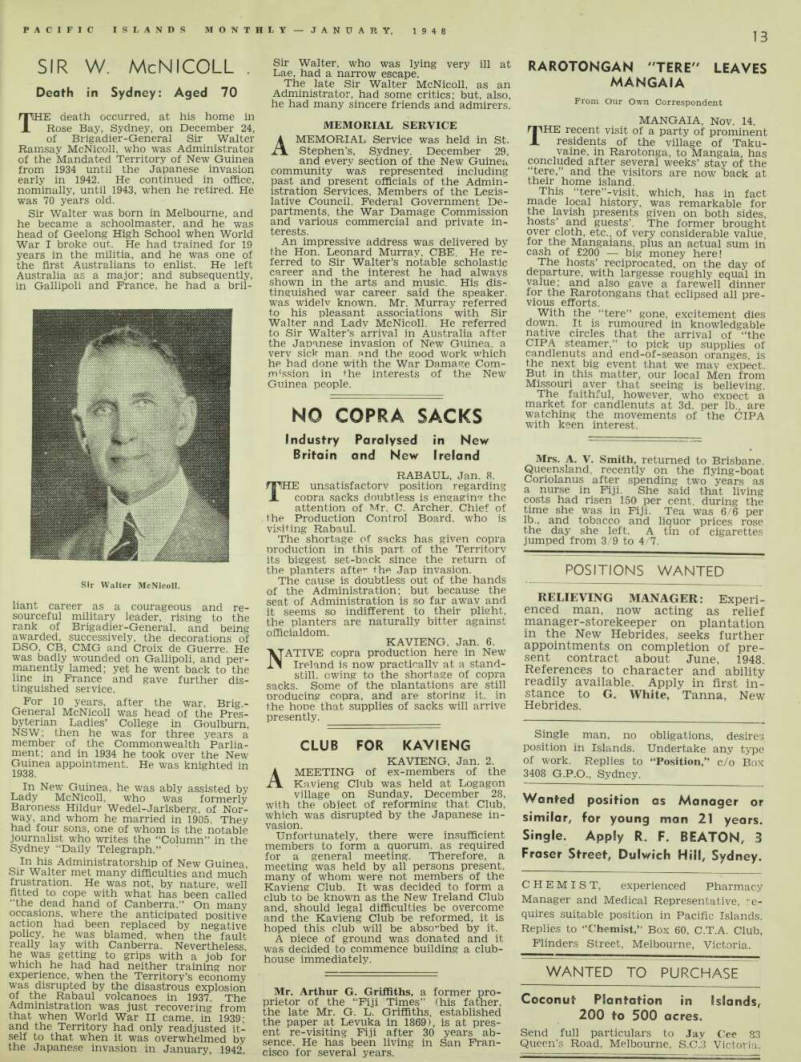
Death in Sydney: Aged 70
rE death occurred, at his home in Rose Bay, Sydney, on December 24, of Brigadier-General Sir Walter Ramsay McNicoll, who was Administrator of the Mandated Territory of New Guinea from 1934 until the Japanese invasion early in 1942. He continued in office, nominally, until 1943, when he retired. He was 70 years old.
Sir Walter was born in Melbourne, and he became a schoolmaster, and he was head of Geelong High School when World War I broke out. He had trained for 19 years in the militia, and he was one of the first Australians to enlist. He left Australia as a major; and subsequently, in Gallipoli and France, he had a bril-
liant career as a courageous and re sourceful military leader, rising to the rank of Brigadier-General, and being awarded, successively, the decorations of DSO, CB, CMG and Croix de Guerre. He was badly wounded on Gallipoli, and per manently lamed; yet he went back to the line in France and gave further dis tinguished service.
For 10 years, after the war, Brig.- General McNicoll was head of the Pres byterian Ladies’ College in Goulburn, NSW; then he was for three years a member of the Commonwealth Parlia ment; and in 1934 he took over the New Guinea appointment. He was knighted in 1938.
In New Guinea, he was ably assisted by Lady McNicoll, who was formerly Baroness Hildur Wedel-Jarlsberg, of Nor way, and whom he married in 1905. They had four sons, one of whom is the notable journalist who writes the “Column” in the Sydney “Daily Telegraph.”
In his Administratorship of New Guinea, Sir Walter met many difficulties and much frustration. He was not, by nature, well fitted to cope with what has been called “the dead hand of Canberra.” On many occasions, where the anticipated positive action had been replaced by negative policy, he was blamed, when the fault really lay with Canberra. Nevertheless, he was getting to grips with a job for which he had had neither training nor experience, when the Territory’s economy was disrupted by the disastrous explosion of the Rabaul volcanoes in 1937. The Administration was just recovering from that when World War II came, in 1939and the Territory had only readjusted it self to that when it was overwhelmed by the Japanese invasion in January, 1942.
Sir Walter, who was lying very ill at Lae, had a narrow escape.
The late Sir Walter McNicoll, as an Administrator, had some critics; but, also, he had many sincere friends and admirers.
Memorial Service
A MEMORIAL Service was held in St.
Stephen’s, Sydney. December 29, and every section of the New Guinea community was represented including past and present officials of the Admin istration Services, Members of the Legis lative Council, Federal Government De partments, the War Damage Commission and various commercial and private in terests.
An impressive address was delivered by the Hon. Leonard Murray. CBE. He re ferred to Sir Walter’s notable scholastic career and the interest he had always shown in the arts and music. His dis tinguished war career said the speaker, was widelv known. Mr. Murray referred to his pleasant associations with Sir Walter and Ladv McNicoll. He referred to Sir Walter’s arrival in Australia after the Japanese invasion of New Guinea, a very sick man. and the good work which he had done with the War Damage Com mission in the interests of the New Guinea people.
Sir Walter McNicoll.
No Copra Sacks
Industry Paralysed in New Britain and New Ireland
Rabaul, Jan. 8.
THE unsatisfactory position regarding conra sacks doubtless is engaging the attention of Mr. C. Archer. Chief of the Production Control Board, who is visiting Rabaul.
The shortage of sacks has given copra nroduction in this part of the Territory its biggest set-back since the return of the planters the Jap invasion.
The cause is doubtless out of the hands of the Administration: but because the seat of Administration is so far awav and it seems so indifferent to their plight, the planters are naturally bitter against officialdom.
Kavieng, Jan. 6.
NATIVE copra production here in New Ireland is now practically at a stand still, owing to the shortage of copra sacks. Some of the plantations are still producing copra, and are storing it. in the hone that supplies of sacks will arrive presently.
Club For Kavieng
Kavieng, Jan. 2.
A MEETING of ex-members of the Kavieng Club was held at Logagon village on Sunday, December 28, with the object of reforming that Club, which was disrupted by the Japanese in vasion.
Unfortunately, there were insufficient members to form a quorum, as required for a general meeting. Therefore, a meeting was held by all persons present, many of whom were not members of the Kavieng Club. It was decided to form a club to be known as the New Ireland Club and, should legal difficulties be overcome and the Kavieng Club be reformed, it is hoped this club will be abso r bed by it.
A piece of ground was donated and it was decided to commence building a club house immediately, Mr. Arthur G. Griffiths, a former pro prietor of the “Fiji Times” (his father, the late Mr. G. L. Griffiths, established the paper at Levuka in 1869), is at pres ent re-visiting Fiji after 30 years ab sence. He has been living in San Fran cisco for several years.
Rarotongan "Tere" Leaves
Mangaia
From Our Own Correspondent
Mangaia, Nov. 14.
THE recent visit of a party of prominent residents of the village of Taku vaine, in Rarotonga, to Mangaia, has concluded after several weeks’ stay of the “tere,” and the visitors are now oack at their home island.
This “tere”-visit. which, has in fact made local history, was remarkable for the lavish presents given on both sides, hosts’ and guests’. The former brought over cloth, etc., of very considerable value, for the Mangaians, plus an actual sum in cash of £2OO big money here!
The hosts’ reciprocated, on the day of departure, with largesse roughly equal in value; and also gave a farewell dinner for the Rarotongans that eclipsed all pre vious efforts.
With the “tere” gone, excitement dies down. It is rumoured in knowledgable native circles that the arrival of “the CIPA steamer,” to pick up supplies of candlenuts and end-of-season oranges, is the next big event that we may expect.
But in this matter, our local Men from Missouri aver that seeing is believing.
The faithful, however, who exoect a market for candlenuts at 3d. per lb., are watching the movements of the CIPA with keen interest.
Mrs. A. V. Smith, returned to Brisbane.
Queensland, recently on the flying-boat Coriolanus after spending two years as a nurse in Fiji. She said that living costs had risen 150 per cent, during the time she was in Fiji. Tea was 6/6 per lb., and tobacco and liouor prices rose the day she left. A tin of cigarettes jumped from 3 9 to 4 7.
Advertisements & other items, p. 15 (1 item)
Positions Wanted
RELIEVING MANAGER: Experi-
enced man, now acting as relief manager-storekeeper on plantation in the New Hebrides, seeks further appointments on completion of present contract about June, 1948.
References to character and ability readily available. Apply in first instance to G. White, Tanna, New Hebrides.
Single man, no obligations, desires position in Islands. Undertake any type of work. Replies to “Position,” c/o Box 3408 G.P.0., Sydney.
Wonted position os Manager or similar, for young man 21 years.
Single. Apply R. F. BEATON, 3
Fraser Street, Dulwich Hill, Sydney.
CHEMIST, experienced Pharmacy Manager and Medical Representative, requires suitable position in Pacific Islands.
Replies to “Chemist,” Box 60, C.T.A. Club, Flinders Street, Melbourne, Victoria.
WANTED TO PURCHASE
Coconut Plantation in Islands, 200 to 500 acres.
Send full particulars to Jay Cee 83 Queen’s Road, Melbourne, 5.C.3 Victoria.
Polio Epidemic Feared
In Solomons Severe Restrictions on Travel
NOTHING official has been said yet; but fears are entertained in well informed circles that the infantile paralysis (poliomyelitis) epidemic has at tained serious proportions in the British Solomon Islands.
It is not clear how the disease, which is now epidemic in New Zealand, slipped through the medical guard into the
Solomons; but it was reported there early in December. It caused alarm —it could do great harm in that primitive native community.
Severe restrictions have been imposed upon all travellers in that area. The British Resident Commissioner in the New Hebrides, early in January, advised Trans Oceanic Airlines (who have been running a flying-boat fairly regularly be tween Sydney, New Hebrides and the Solomons) that passengers would not be allowed to land in the Solomons and that there would be restrictions also on their stopping off in the New Hebrides. (See also article on page 32.)
New Governor Of
Fiji
Arrival From London
Wellington, Dec. 29.
THE new Governor of Fiji and High Commissioner for the Western Pacific, Sir Brain Freeston, KCMG, OBE, accompanied by Lady Freeston and one daughter, arrived here to-day by the Rimutaka from London. They will go on to Suva in January.
Sir Brian who was born in 1892, served with the armed forces in the First World War. Prom 1919 to 1936 he was on the staff of the Colonial Office and in 1936 he became secretary of the East African Governors’ Conference, In 1938 he re turned to the Colonial Office as assistant secretary and in 1939 he was appointed Chief Secretary in the Government of Tanganyika, being the first Colonial Office official to hold such an appoint ment in Africa. In 1944 Sir Brian be came Governor of the Leeward Islands in the West Indies.
Lady Freeston before her marriage in 1923 was Miss Mabel Cassels. There are three daughters.
Sir Alexander Grantham, who had been Governor of Fiji for only a short time, was appointed Governor of Hong Kong early in 1947; and, since his departure, the Colonial Secretary, Mr. J. F. Nicoll, has been Acting Governor.
Sailing On “Matua”
Suva. Jan. 5.
rE new Governor and his family are still in New Zealand, where they arrived on December 29. They will travel to Suva in the “Matua” leaving Auckland about January 15.
Advertisements & other items, p. 16 (1 item)
Brial & Ball
McILRATH’S
SYDNEY S LEADING GROCERS
Specialise in PACKING and SHIPPING
INDIVIDUAL ORDERS to PACIFIC ISLANDS
RESIDENTS, Satisfaction Guaranteed Write for our special export grocery price list All shipments are insured against pillage—theft—non-delivery.
McILRATH’S PTY. LTD.
Export Department, 202 Pitt Street, Sydney, Australia Cable address; ROTUNDA, Sydney.
BRIAL & BALL
Con Supply you with
SANDSHOES
“RUNACAN”BRAND.
IN UNLIMITED QUANTITIES AND IN A WIDE RANGE OF
STYLES AND PRICES
Inquire through your usuol channels for full particulars
SOLE DISTRIBUTING AGENTS FOR PACIFIC ISLANDS:
BRIAL & BALL
1 BOND ST., SYDNEY. 31 QUEEN ST., MELBOURNE.
Startling Increase
Fiji's Cost Of Living
Suva, Jan. 5.
AT the opening of 1948, the cost of living is an overwhelming preoccu pation in Fiji.
On January 1, the Suva cost-of-living index figure was 204, indicating a rise of 104 per cent, since August, 1939. For the island of Viti Levu, excluding Suva, the figure was 229, representing a rise of 129 per cent.
This is the first occasion in Suva, since the outbreak of the Second World War (or any other period) that the percen tage increase has gone over 100: but in the rest of Viti Levu it was over 100 on January 1, 1944 (115). and it has fluc tuated from 106, on January 1, 1947, to 121 on October 1. The present figure, however, represents a new high record.
The Commissioner of Labour (Mr, C.
S.. Reay) points out that the rises in the index figures which, like all pre vious figures issued by the Labour De partment in connection with the cost of living and wages adjustments, are based on the estimated living expenses of In dian workmen are due to increases in the prices of food, clothing and other essentials. For the Indians, the soaring price of sharps is responsible for more than half the rise in the index numbers. (For non-Indians, the price of flour has risen by an equivalent amount). The sharp rise in tobacco has also had a marked effect.
The process is still going on. To-day, the controlled price of locally-made bis cuits went up another sd. a pound, mak ing the retail prices of the three most commonly used lines 10Jd.. lid. and l/oi.
On January 2 petrol went up Id. to 3/1 a gallon, and lubricating oils bv 3d. to 9/- a gallon; and on December 24 bread went up Id. to lOd. for a 11-lb. loaf in v *ti Levu and Ovalau, and Iosd. else where.
Europeans Hit On December 31. officially-released figures showed that the cost of living for a European family on an income of be tween £4OO and £6OO per annum in 1939, had risen 5.5 per cent, in the last quarter nf 1947, making an increase of nearlv 70 per cent. sirifce the outbreak of war Monthly expenditure for food in August. 1939, was estimated at £l4/15/-: in December, 1947, it was £22/8/-. Clothing rose from £6/15/- to £l7/14 9. and kitchen and eating utensils from 16 8 to £2/5/9.
Simultaneously with the rises in con trolled prices, the cost of uncontrolled foodstuffs and other commodities has aone to an outrageous level. As a corol lary, the Medical Department is bewailing the alarming increase in malnutrition among children, and the undermining of Fijian health and phvsique, particularly in the larger centres of population.
Plan To Quick-Freeze
Fish
From Our Own Correspondent
Cairns, Jan. 3.
MR. C. B. ALEXANDER, who has had 25 years’ experience in pearl areas in the North West of Australia re cently purchased two vessels, at Towns ville and Cairns, and is making plans to operate a £lOO,OOO fishing industry in North Queensland and Papuan waters.
He plans to use quick-freezing trawlers and he said that fresh fish would be filleted, quickly frozen and distributed by air to the Eastern States. To start the industry he would have to bring freezing experts from USA and Britain, where quick freezing of fish was being done.
Mr. Alexander at one time operated 10 pearling vessels in the North West.
Us Botanist In Fiji
Suva, Jan. 5.
DR. A. C. SMITH, Curator of the Arnold Arboretum of Harvard Uni versity, USA, and his family are now in Suva awaiting the ship “Marine Phoenix” to take them back to America.
Dr. Smith says that on this visit, which is his second to Fiji, he has attempted to make collections of plants in certain areas which earlier botanists have neg lected. He has worked mainly in the dry-side uplands of Viti Levu.
Advertisements & other items, p. 17 (1 item)
Burns Philp
THE
YORKSHIRE
INSURANCE
CO. LTD.
(Incorporated in England)
ALL CLASSES OF
INSURANCE
Including Fire Motor Guarantee Accident Workers Marine Island Representatives:
PORT MORESBY: E. A. James
RABAUL: G. B. Black LAE: Morobe Transport Co. Ltd.
MADANG: R. MacGregor SUVA: Williams & Gosling Ltd.
NOUMEA: Y. Mortensen
NORFOLK ISLAND:
A. E. Martin
BURNS PHILP
(SOUTH SEA) CO. LTD.
Inc. In FIJI Island Traders and Shipowners Registered Office :
SUVA
FIJI
\\ Also Branches at: Fiji: Levuka, Lautoka, Labasa, Ba, Sigatoka, Rotuma.
Tonga: Nukualofa, Haapai, Vavau.
Samoa; Apia, Pago Pago (American Samoa).
Solomons: Makambo, Gizo, Faisi.
New Hebrides: Vila.
Code Address: Gilberts: Tarawa.
"Burnsouth*. Norfolk Is. Niue. Wallis Is. Futuna Is.
A\ 1 Bond Street, Sydney, Australia £l* Vi) U f j v Tel. B 4167. Box 3615 G.P.O.
SUPPLIERS OF GENERAL MERCHANDISE TO LEADING FIRMS THROUGHOUT THE
PACIFIC ISLANDS
Exporters ... Importers .. .. . Manufacturers' Representatives Bankers: Bank of N.S.W. Bank of Adelaide. Comptoir Nat. d’Escompte de Paris.
Cable Address: “SEAFOODS,” SYDNEY, Codes: Bentley’s, 2nd and Comp. Phrase; A.8.C., sth and 6th; Peterson, 2nd and 3rd; Banking; Acme.
Inefficient Radio
Rabaul, Jan. 8.
rE Tele-radio at Sohana —an import ant Bougainville business centre —is again out of action. It has been so for a fortnight.
No one seems to be able to do anything about it. It is time the Administration ceased interfering with inter-island radio communication, if they cannot obtain competent men to conduct the business.
It should be realised that the safety of ships at sea and the lives of the people
throughout these Islands, in cases of emergency are dependent on an efficient radio system.
Despite assurances to the contrary, telephonic communication between Rabaul and Kokopo seems to be as far off as ever. Someone gets an occasional spasm, and work is resumed on the line for a week or two. Then a halt is called and, between this halt and the next resump tion of work, the poles fall down and the lines get into such a tangle that by the time this is unravelled another halt is due.
More Strikes In Fiji
Result of Rising Costs
From Our Own Correspondent
Suva, Jan. G.
FIJI’S strike season started with the major hold-ups at Nadi Airport, and at the Vatukoula mines reported last month.
The New Year came in with a short walk-out that brought a considerable part of the Suva population close to the brink of domestic disaster.
On January 2, the Indian laundry workers went on strike, and people whose after-Christmas and pre-New Year laundry had been collected but not de livered were left high and dry.
The reason for the strike was the fact that, because of the price situation, the employers had cut out board and lodging formerly provided for the workers in addi tion to their cash wages, and had offered an additional £4 per month. The em ployees wanted from £5 to £5/10/-.
On the following day the Labour De partment negotiated a settlement at £4/5/-, the men to provide their own quarters. If they use rooms owned by the employers, they will pay rent.
To all Intents and purposes the strike failed after the employers broadcast an invitation to prospective new laundry workers to apply for jobs.
Girl-Workers Out
On January 3, the girl employees at the recently-opened banana-dehydrating factory at Samabula, near Suva, stopped work over a pay-dispute. The factory started up again two days later with, It is reported, a proportion of new employees to replace a number who declined to return.
In many sections of industrial activity in the Colony there are signs of unrest.
Some of the trouble is clearly the result of agitation presumably political. But in a sizable proportion of cases it is sim ply the obvious inability of the lower paid workers to cope with the continued spiralling of prices. Government officials freely concede this point (unofficially), but no one has suggested a way out.
New Resident Agent
For Mangaia
From Our Own Correspondent
Mangaia. Nov. 15.
THE appointment of Major W. H. Ryan, late of the NZ Public Works Dept, and the NZEF. to the nosition of Resident Agent of this island, marks a new step in administrative selection.
Mr. Ryan, who has had a distinguished military career, will be the first Army officer to hold the post, generally con ceded bv Cl officials to be a difficult one, calling for marked Qualities of leadership and control.
Mangaia has an Island Council of im mense conservatism and obstinate ad herence to old-time Maori customs.
In the past there has not always been co-©Deration with the Administration. It will be recalled that Mangaia alone, of the Cook Group, has never ceded its land for survey; and the various innovations introduced bv the IMD for alleged better ment of fruit-export have also not been adopted here by reason of the chiefly conservatism referred to. which vetos pHomots to establish gassing-sheds, etc.
To date, no Resident Agent has been able to make a dent in this obstinate adherence to “old-time” ways, the Is land Council being as autocratic as its powers are unlimited.
The pre-eminence here of the CIPA may also have some effect in the shaping of our new RA’s policy, which at the out set is likely to require much tact and dip lomacy.
Advertisements & other items, pp. 18-19 (2 items)
Bank Of
Two years after
the Battle of Waterloo
It was in 1817, only two years after Waterloo, that Sergeant Jeremiah Murphy, of the 46th Regiment, opened an account with the Bank of New South Wales and became the first depositor in the first bank in Australia.
Throughout the following years, this Bank has done more than any other institution to develop Australia’s resources Its substantial and continuous assistance to
primary and secondary industry and its
practical encouragement of oversea trade are vital contributions to the prosperity of this country.
Consult and use
BANK OF
NEW SOUTH WALES
FIRST BANK IN AUSTRALIA
(Incorporated in New South Wales with limited liability) A4711D
Clarke-Jools
• • to
• for all your Clothing Requirements
m • The impressive facade of Stirling Henry’s Underwear Factory.
Clarke - Jools are sole export agents for Stirling Henry, Ltd., Australia’s foremost spinners, knitters and weavers. Large range of all men’s and women’s knitted underwear, polo shirts, etc.
CLARKE-JOOLS
& Co. Pty., Ltd.
IMPORTERS, EXPORTERS
and Commission Agents We are prepared to submit original invoices.
Clarke-Jools also can supply any commodity you require in— Textiles Food Spirits Leather Hardware Electrical Goods
ASBESTOS HOUSE
65 YORK STREET, SYDNEY
Cables: “Irvingjools.” v *0 & m i & -J* • Shown above are views of Stirling Henry's Modern Factories
Native Ship-Workers Squabble In Cook

Islands
While Labour Politicians Slangwhang Each Other In New Zealand
r rHERE have been extraordinary events in the Cook Islands, where A native watersiders succeeded in dislocating shipping services, and where there has been scuffling and minor fighting between industrial factions. Events partook somewhat of the character of comic opera.
Although the parties concerned deny it, it is clear that Commu nist influences are at the back of the disturbances.
Cook Islands squabbling had sharp repercussions in New Zealand, where extremist waterside union officials directed a savage publicity campaign against the Socialist Government.
Prom Our Own Correspondent
Rarotonga, Dec. 15.
THE increasing conflict between the Cook Islands Progressive Associa tion and the Cook Islands Workers’
Union (affiliated with the New Zealand Federation of Labour) reached a climax with the December visit of the “Maui Pomare.”
Shipping troubles in the group actually began a few days prior to the arrival of the ship.
The CIPA has gained control of car go-handling throughout the Lower and Northern grouns, as well as at Rarotonga.
When the schooner owned by A. B.
Donald & Co. reached the Northern atolls. Manihiki and Rakahanga, near the end of November, to pick up copra, the captain ran into trouble. Among other things, the lighter-men refused to work unless the company was prepared to agree to an increase in pay an in
crease in excess of the award rates pre vailing in Rarotonga.
The schooner was delayed a number of days at Manihiki while an exchange of radios took place between the company and the Administration.
Meanwhile, friction continued ashore, and led to scuffles.
Finally, the Euronesian clerk-in-charge, representing law and order in the ab sence of the Resident Agent, took a firm stand, arrested 14 of the ringleaders and ordered work to proceed. The work pro ceeded forthwith, and there were no further delays. The arrested men, after an hour, were released.
IN November, while Mr. Patrick (Sec retary of the NZ Islands Territories Department) was in Rarotonga at tending the inaugural session of the new Legislative Council, a meeting of
interested parties was held, at which it was agreed that, in future, waterside work in Rarotonga would be shared by members of the CIPA and the Workers’
Union. The manager of the Union SS Co. was to select the labour, and the list would be given to representatives of both parties for approval.
This arrangement was carried out the day before the arrival of the December “Maui Pomare.” The CIPA demanded the removal of two Union men from the list, and this was complied with, to avoid trouble. At this stage both parties agreed on the list, which was divided about equally between the two; and work was to have commenced with the arrival of the ship on the following morning (Tuesday, December 2).
The ship arrived, but work did not commence. The CIPA demanded the re moval of another Union man before they would consent to a start. This time, the Workers’ Union would not agree to the demand, and tempers began to rise.
The secretary of the NZ Federation of Labour was radioed for advice. His reply was very confusing; it directed that labour was to be engaged according to custom “previously prevailing.”
The CIPA claimed that this meant it was their affair, while the Workers’
Union believed it to refer to the custom prevailing in pre-CIPA days.
Another radio was sent asking for clarification of the first message.
The reply made it clear that selection of labour was to be in the hands of the manager of the Union SS Co., irrespec tive of party, but that selection should be confined to men who had done this work previously.
It was finally arranged that the worker in question be given other employment for the period by the Union SS Co., but not on the waterfront, and work on the ship commenced at 6 p.m., Wednesday evening. Here, the weather took a hand,
and operations had to be suspended at about 1 a.m.. the same night, on account of increasing wind and rough sea.
WORK was to have been resumed the following morning: but the CIPA again demanded the dismissal of a further five Union men. The Workers' Union strongly disputed this request, as they considered there was no real reason for it.
Later in the morning, representatives of both parties, together with the manager of the Union SS Co., discussed the situation in the Resident Commis sioners office, and it was agreed that the manager draw up a fresh list.
The new list was published later in the day, and consisted of numbers of both parties in about equal numbers. All had previously been waterside workers.
Work was to have re-commenced the following morning (Friday). In the morning, all the Union men were present, but not a single CIPA man answered the roll-call, although a large number of CIPA members were gathered around the
waterfront. It was obvious that they did not intend to co-operate.
As there were not enough men to work the ship the manager of the USS Co., asked the Workers’ Union representatives if they could find more men. There was no difficulty in finding sufficient volun teers to make up the required number.
These did not include any CIPA men.
' No attempt was made to check on whether all these men were Union mem bers, or regular waterside workers, as the main concern now was to get on with the unloading of the already long delayed ship.
WORK proceeded satisfactorily with Union men only until about mid day, when it was interrupted by two CIPA men going out in a canoe to deliver a written message to the ship’s crew. Among other things, the message complained that some non-union labour was being employed, and also a prisoner.
This was a peculiar appeal, on the face of it. because the CIPA themselves are not members of the Workers’ Union.
Representatives then were called aboard the vessel, and the dispute con tinued. Mr. A. Henry, and the Superin tendent of Police were called for ques tioning, regarding the alleged use of a prisoner. The claim could not be sub stantiated.
The ship’s crew now professed con cern as to their own position with their union, and the captain radioed to NZ for instructions.
Work continued until about 8.30 p.m.
A LIVELY scene developed during the evening, as a result of the arrest of the two men who had delivered the message to the ship.
The Superintendent of Police, his patience sorely tried by the events of the past few days, had arrested the two men on a charge of taking the canoe with out the owner’s knowledge and consent, according to information obtained from said owner. Later, the owner repudiated his former statement, and said that he had given his permission to use the canoe.
About 7.30 p.m., a large crowd of CIPA members marched to the Administration building, in a belligerent mood, to de mand the release of the two men. Many of the marchers had “cleared for action” by removing their shirts.
For some time the Superintendent of Police faced the crowd from the steps of the Administration building, to shouts of “Release the prisoners or we will break down the jail!” and similar re marks. Actually an order for the re lease of the men had already been given.
But the demonstrators thought they had forced the police officer’s hand; and as the released men came in sight along the road, there was an outburst of cheer ing and hand-clapping. The two men were immediately surrounded and shaken by the hand, after which they were marched off in triumph.
11TORK was not resumed the following TT morning (Saturday), as the ship’s crew now refused to co-operate, pending instructions from NZ, and the vessel left the anchorage, so that there could be no further disturbing contact between ship and shore.
On Sunday, representatives of the Workers’ Union were called to the office of the Union SS Co., where they were instructed by the manager to inform all registered Union Workers to be present at the wharf at 6 a.m., with their union cards.
It was reported that the ship’s crew had been instructed from NZ that they were not to interfere with the working of the vessel.
Work re-commenced on Monday, being performed by all-union labour, and there was no further interruption. There was a police guard on the wharf, and no un authorised person was permitted entrv.
Unfortunately, continued rough weather slowed operations somewhat, and the ship did not get away until Wednesday.
The manager said that the work had proceeded very satisfactorily and there had been a great reduction in the damage and pillage which have caused so much annoyance for a long time past.
Altogether, the “Maui Pomare” was kept at Rarotonga for nine days, as against the usual two to three days.
IT appears that the real root of the trouble was the CIPA’s objection to a number of former CIPA members who have taken tickets in the Workers’
Union. CIPA men would not work with these “traitors to the cause.” It is re ported that some of these men were threatened with violence if they took part in the work.
After leaving Rarotonga, the “Maui Pomare” was due at Aitutaki to pick up copra and mangoes and deliver hurri cane season staples. It was known in advance that there was more trouble brewing in Aitutaki, where there is a strong CIPA contingent. There is also a branch of the Workers’ Union in Aitutaki, with sufficient men to work the ship.
The secretary of the Workers’ Union travelled with the vessel, carrying a politely-worded note, requesting con sideration of a fifty-fifty working ar rangement. But it had been decided that if the CIPA could not agree, the union men would be instructed to quietly retire, for this occasion, to avoid trouble and possible further delay to the ship.
At the time of writing, it is not known exactly what did occur at Aitutaki, but it is certain that there was trouble, and , reported that an ultimatum worded by the NZ Prime Minister him self gave the people one hour to start work, or the ship would leave.
A-w e i. res Sf was that the vessel left Aitutaki without picking up or discharg ing anything there, except passengers and mail.
DEVELOPMENTS cannot be foreseen, but is seems certain that there will be repercussions. The CIPA are feeling very bitter over their first defeat, while the Workers’ I. , n are naturally elated with their victdiy.
We have also yet to see what reactions will occur in NZ. The Auckland water theClPA^ 8 s * lown strong sympathy with situation arises, now that the CIPA has been superseded on the waterfront through their own un willingness to co-operate by a workers’ of 11 Labour iated With th 6 NZ Federation
Advertisements & other items, pp. 20-22 (1 item)
William Atkins pty. Ltd.
Head Office, 449-451 KENT ST., SYDNEY
Iron & Steel Merchants-Engineers' Supplies
Coach tr Motor Hardware
———STEEL DEPARTMENT
MILD STEEL:
Rounds, Squares, Flats, Half-rounds, Hexagons, Bevel, Shoeing, Tyre, Angles, Tees, Sheets, Plates, Girder Plates, Chequer Plates, Channels, Hoops, Etc.
BRIGHT STEEL:
Rounds, Squares, Hexagons.
Extra Special High Speed Tool Steel, Mining Steel, Blister Steel and Spring Steel, Rounds, Flats & Squares.
Bar Iron-All sections and sizes.
ESTABLISHED OVER 50 YEARS
Cable Address: WILATKIN, Sydney.
Engineers' Supplies: Set Screws. Studs, Metal Thread Screws, Coach Screws, Files, Cotter Pins, Bright and Black Bolts, Rivets, Etc., Hack Saw Blades.
Power Transmission Gear: Including Plummer Blocks, Couplings, Collars, Etc.
Coach and Motor Hardware: Axles, Springs, Wheelstuff, Duck, Paints.
Farriers' Supplies: Horse Nails, Anvils, Vices, Etc.
Motor-Trimmers and Motor Builders' & Motor Painters' Requirements Pacific Island Agents : Corrie Cr Co., Suva, Fiji DUCO Lacquers and DULUX Enamels—FAßßEX Motor Toppings and Leather Cloths, House & Decorators' Paints, Varnishes & Brush-ware.
Sole Distributors of CHAMPION'S Decorators Paint Products.
Distributing Agents for BROLITE Lacquers, SYNFLEX Enamels and "POLYGLOSS" Finish.
You'll always
get the best
from the
; > vWl . v *...w£n , I
PLUME
I
pump
& Today, Plume is the best motor spirit you can buy. And as soon as world conditions permit, the Plume Pump will lead in serving the highest quality motor spirits, made by revolutionary methods developed by the world’s largest research staff. So form the habit now of going to the Plume Pump, where you’ll always get the best motor spirit.
VACUUM
PRODUCT
VACUUM OIL COMPANY PTY. LTD. [lncorporated in Australia)
mml/Mw//
o 9 mm Airway Cases, In woven-strlped, waterproofed canvas with leather-bound edges, are made for flying. The supply is limited . . . but increasing!
Made by FORD SHERINGTON LTD.
Wholesale only
GARDNER DIESEL MARINE
ENGINES
There is a type available for every class of vessel requiring power from 24 BHP to 152 BHP. Direct or reduction gears.
GARDNER stationary engines tor all classes of work, including electrical
generation
MORRIS MARINE ENGINES
Petrol Driven. Direct or Reduction Gears
VEDETTE, 6-12 H.P.
NAVIGATOR, 12-24 H.P,
CHAPMAN PUP
and
SUPER-PUP
Engines
3 H.P.-4 4 H.P.
GRANTEX RICE MILLS
with stationary engines suitable for their operation
DISTRIBUTORS IN FIJI:
W. R. CARPENTER & CO. (Fiji) LTD.
General Merchants, SUVA, FIJI
NZ Reds Howl At NZ Government Over
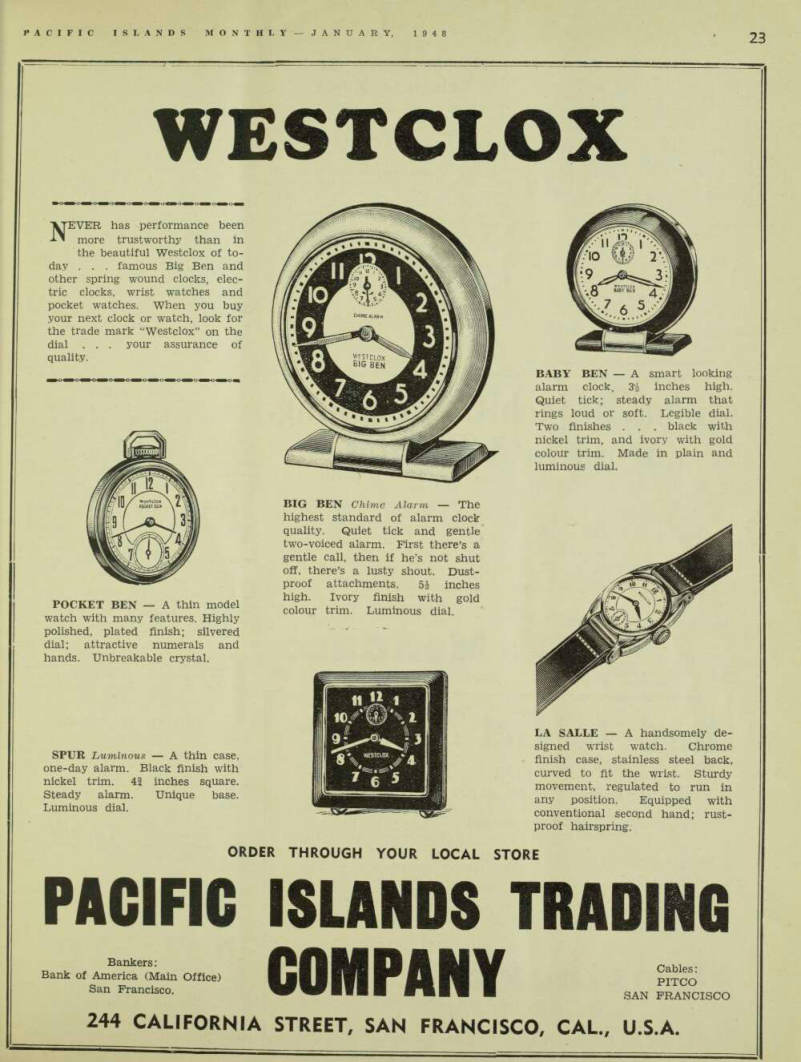
Cook Is. Events
THE files of the New Zealand news papers, between early December and the end of the month, show that reports of the events In the Cook Islands, as described above by the “PIM” cor respondent, reached NZ in a more or less garbled form.
The NZ newspapers devoted innumer able columns of space to the subject, covered by such sensational headings as “Friction in Islands over Loading of ‘Maui Pomare’,” “Federation Opposes Waterside Union in Cook Islands,” “Is lands Strikers Held in Chains,” “Ban on Ship Would Injure Islanders, says Prime
Minister,” “Islanders Were Not Chained, Mr. Fraser Tells Mr. Barnes,” etc.
It would appear that there were two
politico-industrial organisations interest
ing themselves in the Cook Islands affair —the Waterside Workers Union, which seems to be Communist dominated at any rate, its tactics are entirely Com munist and the New Zealand Federa tion of Labour, which generally supports the NZ Socialist Government. The Watersiders made common cause with the Cook Islands Progressive Association, while the Federation of Labour took the side of the Cook Islands Workers Union, The Watersiders, through two officials,
Barnes and Hill, put up a really remark able performance. They accused the Government and everyone else who opposes the CIPA in Rarotonga of all sorts of evil practices, from arresting helpless natives to assaulting and chain ing strikers in Manihiki. They screamed abuse, demanded public inquiries, and generally foamed at the mouth; and the newspapers encouraged them by pub lishing every foolish word they uttered.
Their accusations, inquiries by radio phone in Rarotonga, Government replies, followed by further irresponsible accu sations, and further inquiries, occupied several days during which the Gov ernment-owned “Maui Pomare” was ly ing off Cook Islands ports, incurring heavy losses (which the NZ taxpayers have to bear).
THE Socialist Prime Minister, for once, took a firm line, and flatly refused to order any “inquiry.” He issued the following statement concerning the trouble that occurred on Manihiki, when the Donald Company’s schooner arrived, and sought waterside labourers for un loading; “When some non-members of the as sociation were selected by the shipowners’ representative the members of the Cook Islands Progressive Association left the job. When the others carried on with the work the members of the Cook Is lands Progressive Association laid hands on them forcing them back into the boats and preventing them from landing the goods, and there was general fighting.
“To restore order the clerk in charge at Manihiki ordered the arrest of the assailants, and, with two police, one nolice helper and three returned soldiers, restored order. One of the arrested per sons was handcuffed to a post, one mem ber was tied to a post with twine, and 12 were squatted on the Court-house verandah in the care of the police helper.
All were released after one hour. No one was chained. It should be stated that there Is no jail ia Manihiki and the usual method of effecting arrest is to use handcuffs.
“It will be seen,” said the Prime Minis ter, “that the information upon which Mr. Barnes has based his statement is incorrect. It is clear that the trouble at Manihiki arose from the newly as serted claim of the Cook Islands Progres sive Association, a non-industrial body, to control the engagement of labour for ship-working. The fact is that the Cook Islands Progressive Association has no such right or authority, and obviously it would be quite improper for it to be per mitted to usurp this power.”
THEN the wild men of the Auckland waterfront tried another line. They announced that, as the Prime Min ister would not order an inquiry into their alleged Cook Islands grievances, it was very unlikely that the Auckland watersiders would work the “Maui Pom are” when she arrived in December.
This started another furore in the newspapers the Rods shrieking at the moderates, and various bureaucrats an swering back.
However, by the time the “Maui Pom are” arrived in port, about December 29. the fury and the fighting had died down; and it was announced that, as the re sult of further information received, the watersiders would work the ship. But there were reports that the watersiders were still seething, and an uneasy situ ation continued.
On January 2. it was stated officially that the “Maui Pomare” would not re turn to the Islands in January, but would, instead, go into dock for her annual over haul two or three months earlier than usual. Communication with the Cooks in Januarv will be maintained by a Union
SS Co., steamer running from NZ to the United States.
Since then, there has been further howling by the watersiders. They ap parently are of the opinion that this is a dirty Prime Ministerial trick to pre vent the watersiders wreaking their vengeance upon the “Maui Pomare.”
The whole incident, or series of inci dents, is an outstanding example of what happens when a weak-kneed Socialist Government tries to deal with Red dominated trade unions upon a basis of mutual trust and brotherly love.
Advertisements & other items, pp. 23-26 (1 item)
big problem, Honey!
EYE LOTION
For Inf lam«d Etje* and Eyelids ... Sold Everywhere H Rose 4 Co.Pty. Ltd., Kinq Street, Sydney.
m m
"Hips aren't your
big problem, Honey!
YOU CAN TAKE your mind off your hips, dearie! No one Ends fault with your figure!
You’d be smart to exercise a little more care about personal charm. Being streamlined, you know, won’t protect you against underarm odour. Or lessen the offence when others find you guilty of it.
So keep on trusting your bath— for past perpiration but pul your trust in Mum to prevent risk of future underarm odour.
Creamy, snowy-white Mum smooths on in 30 seconds. Keeps you fresh and frje from underarm odour all day or evening.
Mum is gentle—harmless to skin and fabrics. So why take chances when you can be sure with Mum?
Ask for it today.
MUM
TAKES THE ODOUR OUT OF PERSPIRATION
"Your Yeast
has No Rival"
From MADIRI, Fly River, via Daru, Papua, comes the following Testimonial to MALTO-PEPTONE DRIED YEAST: “For the Tropics, your Yeast has no rival. We have found it entirely satisfactory and are very pleased we learned of it.” (Sgd.) T.H.
MALTO-PEPTONE
DRIED YEAST
is 100% Pure Yeast. It has been on the Market for 12 years and is GUARANTEED to retain its vitality for months in ANY Climate. Ready for use in a matter of minutes, and users claim that, through its aid, they can Bake Bread in 3Vb hours! Trial Size Carton (2 oz.) 1/7— Va lb. 2/8— V 2 lb. 4/ff—all Post Free. Send Stamps. Postal Note, Money Order or Cheque for a supply—NOW! !
AUSTRALIAN YEAST CO.
Oakleigh, Victoria —Australia.
mam
i i Jl V jv- ■■: l Sore, 6| in.; Stroke, 10 in.; 80 H.P.
DIESEL ENGINES
BY
VIVIAN
40 H.P. TO 160 H.P.
MARINE AND STATIONARY
Immediate Delivery
We can also offer a comprehensive range of:— New and Used Diesel and Petrol Engines.
Lighting and Pumping Plants.
General Machinery.
Batteries.
Commercial and Domestic Refrigerators.
Automotive Accessories.
VENTURA TRADING CO. PTY. LTD.
26 BRIDGE ST., SYDNEY
Cables: “Ventura Sydney.’
In Association with P. & R. HUTCHINSON, THOMSON ST., SUVA & GILBERT RENTON, RABAUL
WESTCLOX
■VTEVER has performance been more trustworthy than in the beautiful Westclox of today . . . famous Big Ben and other spring wound clocks, electric clocks, wrist watches and pocket watches. When you buy your next clock or watch, look for the trade mark “Westclox” on the dial . . . your assurance of quality.
POCKET BEN A thin model watch with many features. Highly polished, plated finish; silvered dial; attractive numerals and hands. Unbreakable crystal.
SPUR Luminous A thin case, one-day alarm. Black finish with nickel trim. 4i inches square.
Steady alarm. Unique base.
Luminous dial.
BIG
BEN
BIG BEN Chime Alarm The highest standard of alarm clock quality. Quiet tick and gentle two-voiced alarm. First there’s a gentle call, then if he’s not shut off. there’s a lusty shout. Dustproof attachments. 5 1 inches high. Ivory finish with gold colour trim. Luminous dial. 11 i
g WESTCLOX y* £
>iT's
10 BABY BEN A smart looking alarm clock. inches high.
Quiet tick; steady alarm that rings loud or soft. Legible dial.
Two finishes . . . black with nickel trim, and ivory with gold colour trim. Made in plain and luminous dial.
LA SALLE A handsomely designed w'rist watch. Chrome finish case, stainless steel back, curved to fit the wrist. Sturdy movement, regulated to run in any position. Equipped with conventional second hand; rustproof hairspring.
ORDER THROUGH YOUR LOCAL STORE
PACIFIC ISLANDS TRADING
COMPANY
244 CALIFORNIA STREET, SAN FRANCISCO, CAL, U.S.A.
Bankers: Bank of America (Main Office) San Francisco.
Cables:
PITCO
SAN FRANCISCO
Send us your orders for
DEVELOPING, PRINTING,
ENLARGING
We Sell Kodak Films and Supplies Wholesale and Retail.
Caine's Studios, Suva
P.O. Box 8. (Estab. 1904) ’Phone 68.
Asthma, Bronchitis Coughing, Curbed in 3 Minutes
Do you have attacks of Asthma or Bronchitis so bad that you can’t sleep? Do you feel weak, unable to work, and have to be careful not to take cold and can’t eat certain foods?
No matter how long you have suffered or what you have tried, there is new hope for you In a doctor’s prescription called Mendaco.
No dopes, no smokes, no injections, no atomizer.
All you do Is take two tasteless tablets at meals and In 3 minutes Mendaco starts working through your blood, aiding nature to remove phlegm, promote free easy breathing and bring sound sleep the first night, so that you soon feel years younger and stronger.
No Asthma in 2 Years
Mendaco not only brings almost Immediate comfort and free breathing but builds up the system to ward off future attacks. For Instance, J. Richards, Hamilton, Ont., Canada, had lost 40 lbs., suffered coughing every night, couldn't sleep. Mendaco stopped Asthma
spasms first night and he has had none since in over two years.
Money Bock Guarantee
The very first dose of Mendaco goes right to work circulating through your blood and helping nature relieve you of the effects of Asthma. Try Mendaco under an iron-clad money back gaurantee. You be the judge. If you don’t feel fully satisfied after taking Mendaco just return the empty package and the full purchase price will be refunded. Get Mendaco from your chemist to-day and see how well you sleep to-night and how much better you feel to-morrow. The guarantee protect/
RELIEVES ASTHMA
Mendaco
Now in 2 sizes , . . 6/- and 12/-
Hard to Get? us
TRADE TOBACCO
LAP LAP MATERIAL
CANNED GOODS
PERFUMERY
PRIMUS STOVES
KEROLAMPS
SHOES, SANDALS
UMBRELLAS
CHILDREN'S CLOTH-
ING
Manstocks
FOR
10. SADDLERY & HARNESS
11. HOME LIGHTING PLANTS
12. WINES AND SPIRITS
13. NON-ELECTRIC WASHING
MACHINES
14. PUMPS, IRRIGATION
PLANTS
15. CROCKERY
16. HAIRDRESSING SUPPLIES
17. HARDWARE
18. AIR CIRCULATORS
8a Castlereogh Street, Sydney, Australia
ISLAND TRADERS
Cable and Telegraphic address: “MANSTOCKS,” SYDNEY Telephones: 8W7405, 8W1237, 85076, FM2766
Celebrate Xmas
NG Women's Club Celebrate Xmas
TERRITORIANS again responded gen erously when the New Guinea Women’s Club of Sydney asked for donations towards the cost of their annual Christmas party for children of ex- Territorians now living in Sydney.
A total of over £BB was subscribed and this enabled the Club to give their young guests—over 100 of them —a very happy afternoon in the club rooms in King Street, on December 19. The president, committee and members of the club have expressed their grateful thanks to all those who subscribed in this way.
Adult Party
THE adult cocktail party, which was held on December 20, was a great success. Many old residents attended and there were, as well, a number of active Territorians, down from the Islands on leave, who took this oppor tunity of meeting friends. The Sydney club is filling a long-felt want in this direction.
Bright Party In Melbourne
THE New Guinea Women’s Association, Melbourne, held a very bright Christmas party at the Business & Professional Women’s Club, McEwan House, Little Collins Street, Melbourne, on December 13.
Afternoon tea was served to about 80 members and their friends, followed by five o’clock cocktails. Many friendships were renewed and the old New Guinea party spirit was much in evidence.
The Association will hold its first meeting in the New Year on the first Saturday in February, and the commit tee will be pleased to welcome any new member or visitors from other States.
£ s. d. previously acknowledged 19 19 0 Mrs. Doris Booth 10 10 0 R. A. Laws 5 5 0 Anderson Pty., Ltd 5 5 0 Messrs. Edgell & Co 2 2 0 F. R. McKenzie 2 2 0 Mrs. E. Good 2 2 0 L. Roberts 220 A. Gaskin 22 0 Cosmopolitan Hotel. Rabaul 3 3 0 Mrs. 1. Pryke 12 0
E. Shields 1 0 Mrs. J Long 0 & C. D. Mears 1 6 Mrs. Elvy 5 0 Mrs. Hutchinson 10 0 Mrs. Pierriman . .. i 0 0 Sir Walter McNicoll . .. i 1 0 Mrs. C. Haviland 1 0 Mr. Niall 1 0 Mrs. Price . .. i 1 0 Mrs. Rerrier 10 0 Mrs. Hopkins 2 0 David Jones, Ltd 0 0 Mrs. Wauchope 5 0 H. Downing 10 0 R. E. P. Dwyer . .. i 1 0 Judge Phillips . . . 2 2 0 Mrs. J. C. Draffin 10 0 Major Ayris 10 0 Mrs. E. Clark 0 0
Mrs. Crawley
11 0 Mrs. Pennefather 10 0 Mrs. U. Adams . .. 2 2 0 Mark Foys, Ltd 1 0 Australian Steamship Co., Ltd. .. . . . . 2 2 0 Mrs. R. E. Evans 1 0 Paynes, Ltd 5 0 Miss Thwaibe 10 0 Mrs. A. Knox ... 2 2 0 E. H. Tully 10 0 Dr. I. Dickson . .. 2 0 0 Mrs. V. Maxwell ... 1 0 0 Mrs. J. Sedgers ... 2 2 0 ; , £88 3 2
Crime In Tonga
Nukualofa, Nov. 19.
THE quarterly sessions of the Supreme Court were opened to-day by Puisne Judge J. B. Thomson, of Fiji, who came by plane from Suva yesterday. The Court heard five charges before pro ceeding to the northern districts of Vava’u and Ha’apai on the “Matua” on November 21. They included two cases of housebreaking and one of forgery; and in the housebreaking charges the punishment included 12 strokes with a cane.
Mr. W. E. McGowan, the Suva Bowl ing Club’s veteran player, won the A Grade championship for 1947 in a well contested match with Mr. J. A. F. Watson, on January 3. Mr. McGowan had pre viously won in 1932, 1940, and 1944.
At a cost of 2,400.000 francs (300.000 francs a house), the New Caledonian ad ministration is building six eight-roomed houses on Mount Venus, Anse Vata, for the use of colonial officials. Four other cement houses were recently completed in the Vallee du Tir quarter and are al ready occupied by newly arrived officials from France.
Fijian Seamen
Mr. Ward And The
11HE following letters are published for general information; From Hon. E. J. Ward, Australian Minister for External Territories, to the Editor of the "Pacific Islands Monthly.” under date December 30: “Dear Mr. Hobson, —My assistance has been sought by the Fiji Seamen s Union, Suva, in conection with the following matter. *T understand that in your issue of May, 1947, you made some reference to the Fiji Seamen s Union, to which that organisation took strong exception.
T am informed that the organisation wrote to you on June 30, 1947, asking for the publication of their reply to the charges which had been made. How ever, it is claimed that this reply was neither acknowledged nor published in any subsequent issue of your paper.
"Whilst i have not read your May is sue, and therefore do not know the nature of the article to which objection was taken, I think, in fairness to your readers, and the organisation concerned, the an swering arguments should have been pub lished.
"Although some time has elapsed since the publication of the offending article, I still think the matter may be in some way corrected by the publication of the statement forwarded to you by the Sec retary of the Fiji Seamen’s Union.
"I should be pleased if you would give this matter your attention and let me have advice in due course, as to what you propose to do.
Yours Sincerely,
(Sgd.) E. J. Ward.
From the Editor of “PIM,” to the Australian Minister for External Terri tories, under date January 7: "Dear Mr. Ward, —I acknowledge re ceipt of your letter of December 30 on the subject of a statement sent to me for publication by the Fiji Seamen’s Union.
“Publication of the statement you refer to was not refused it was merely de layed. In my opinion, the statement had been written for the Seamen’s Union by someone who was not an official of that Union, and I have a pretty good idea of the identity of the writer. Consequently, before deciding upon publication, I had enquiries made in Fiji. Those enquiries took some time; and I did not pass the statement for publication until about October. The statement has been in type for some time but, owing to extraordinary pressure on space, it was not published in November or December. I expect that it will be published in January. I at tach hereto a pull of the statement.
“The circumstances of your communi cation are to me a little surprising. I cannot understand why the Fiji Seamen’s Union should write to you concerning this matter. And I cannot understand, why you, who have so pointedly ignored the publication in the ‘Pacific Islands Monthly’ of scores of grievances relating to New Guinea for which you are held responsible should now take it upon yourself to intercede with me in rela tion to a matter that concerns only Fiji.
“So far as the Fiji letter is concerned, I will take this opportunity of informing you and anyone else interested that the ‘Pacific Islands Monthly’ is opposed to the formation of trade unions among South Sea Islands natives not be cause trade unions, in themselves, do not serve a useful purpose, but because they, sooner or later, permit themselves to be used as the units of political party or ganisation, and thus become the play things of professional policticians. The
deterioration of European national life, which I have seen during my lifetime, is largely the work of professional poli ticians; and, in my small way, I shall do all that I can to keep that evil out of the Pacific Islands.
Yours faithfully,
R. W. Robson.
(Letter from Fiji Seamen’s Union is published on page 63 of this issue).
Chief Judge C. C. Marsack, formerly Stipendiary Magistrate at Palmerston North, New Zealand, has taken up his duties of Chief Judge of the Apia High Court, Western Samoa, where he has relieved Chief Judge J. R. Herd.. Judge Herd, who with Mrs. Herd left Apia by the November “Matua” has been ap pointed Stipendiary Magistrate at Palmerston North in succession to Chief Judge Marsack.
The marriage of Mr. Dan Antill, of Witu, New Guinea, to Miss June Brown, of Sydney, took place in the Rabaul dis trict in November. Miss Marjorie Allan was bridesmaid and Mr. Harry Briggs best-man. The reception was held at the Kokopo Club.
Advertisements & other items, p. 27 (1 item)
Gilbert Renton
AUCTIONEER, VALUER,
ESTATE AGENT.
Storage and Repository Travellers Sample Rooms For General Information and Service.
P.O. Box Rcbaui, TNG
All classes of merchandise purchased for Island clients throughout the South-west Pacific.
Island produce sold on Australian and overseas markets on a commission basis.
New Bishop Will Arrive
In Bsi In February
IT is expected that the Very Rev. Sidney Caulton will be consecrated as Bishop of Melanesia in St. Mary’s Cathedral, Auckland, on February 2.
The new bishop will arrive in the dio cese in the “Southern Cross,” the Melanesian Mission vessel probably to wards the end of February. The “Southern Cross” will leave BSI on her way to New Zealand at the end of Janu ary. She will be overhauled before bring ing the Bishop back. . . , . . , Mr. W. R. B. Thomas, officer in charge of the radio station in Rabaul, has been ordered to proceed to Sydney, in Janu ary for Medical treatment.
Weather Station
At Vila
New Australian Installtion
From Our Own Correspondent
Vila. Dec. 15.
IN order to assist the various Trans pacific air services in which it is interested, the Australian Govern ment -has established a first-class meteorological station here at Vila, in the New Hebrides.
It is of assistance not only to the big air-liners crossing from Australia to Fiji and North America, but also to the regional services in the Southwest Pacific, which are steadily increasing in numbers.
This station, which is being run by that genial and well-known Australian, Bill Roberts, collects meteorological in formation from various parts of the Group, the resultant data being then telegraphed to weather offices in the Pacific A visit to the meteorological station, situated high up on one of the slopes surrounding the charming little town of Vila, shows that the Australian Govern ment has spared no expense in provid ing modern equipment. Mr. Roberts is training natives to operate similar stations in other parts of the New Hebrides, and the weather information it is thus hoped to collect will be of in estimable value to aircraft services operating in various parts of the South Pacific.
Mr. and Mrs. F. Fleming arrived in Rotuma for a temporary stay in mid- October. Mr. Fleming is relieving Dis trict Officer, post-master, wireless operator, etc., while the regular holder of these many positions, Mr. J. R. Rigamoto, is on sick leave in Suva. Mr. Fleming was for five years Administrative Officer on Can ton Island. Mrs. Fleming was with him there for part of the time.
Nauru's Administrator
Returns
THE Administrator of Nauru, Mr. _M Ridgway, returned to the island at the end of November. He had been absent since September during which time he visited Australia and the United States. In USA he acted as special ad viser to Dr. H. V. Evatt while the Trustee ship Council of the United Nations was deliberating on Nauru.
Mr. Ridgway addressed delegates to the Council and illustrated his remarks with a film depicting typical scenes and events on Nauru including shots of the reoccupation of the island in 1945.
Fiji Pioneers Pass On
THE Colony of .Fiji has lost some of its old pioneers in recent weeks.
Amongst them are: Mrs. F. Carr.
Mrs. F. Carr, who had come to the Colony as a girl with her parents in the 80’s, died at her home in Suva on No vember 24. She had been ill for a con siderable time.
She is survived by her husband, four daughters and a son; Mrs. F. C. T. Lord, of Sydney: Mrs. Pope, in Africa; Mrs.
A. R. Tarte, of Taveuni; Mrs. J. A. W.
Lever, of Suva; and Mr. A. Carr, of Syd ney.
Mr. G. H. Poulter.
Mr. G. H. (“Bert”) Poulter died in November, at the residence of his brother, Mr. J. Poulter, at Tailevu.
Both brothers came from New Zealand to the Colony about 30 years ago. They have been engaged in dairy-farming at Tailevu for some time.
Miss Elizabeth Wilson.
Miss Elizabeth Wilson died in Suva, on November 25. She was born in Levuka 75 years ago and was the daughter of the late Mr. and Mrs. Matthew Wilson, very old settlers of Fiji prior to cession.
She is survived by two sisters and one brother: Mrs. Rea Wishart. of Suva, and Miss Jeannie Wilson, of Sydney; and Mr. John M. Wilson, of Suva.
Mrs. S. G. Coggins.
Mrs. Dinah Coggins, wife of Mr. S. G.
Coggins, of Vatukoula, Fiji, died in the Blue Mountains, NSW, on November 24.
She had been in ill-health for a num ber of years. While an inmate of a Blue Mountain sanatorium on a previ ous occasion she received word that her son, Peter Coggins, had died while a eow of the Japanese. She never fully recovered from this blow.
Mr. Robert Cocks THE death occurred suddenly in Mel bourne on December 5 of Mr.
Robert (Robin) Cocks, who was a member of a family well known in Fiji.
He was a son of Mr. James Cocks, and he was born in Levuka in 1879. James Cocks, a planter, was one of the oldest residents to the Colony, and was reputed to have been the first white person born in Fiji Robert Cocks joined the Suva agency of the Union SS Co. in 1894, and was there until he was transferred to Melbourne in 1902. He served with distinction in World War I, and was decorated. He was connected mostly with Australian shipping for the rest of his life.
Mrs. George Harness Mrs. George Harness, a member of an other well-known Fiji family, and mother of well known Captain Harness, Suva harbourmaster, died at her home in Tailevu, in November.
Advertisements & other items, pp. 28-30 (2 items)
Ropes,
KANGAROO BRAND
Cordage,
and Twines for every purpose Backed by 86 years of service Manufactured by:
M. DONAGHY AND SONS,
Pty. Ltd., Geelong and Sydney.
Fiji Representatives:
PEARCE AND CO.
LIMITED
P.O. BOX 237, SUVA
WORMSEARED
CHAIN HOISTS
The hand-operated Wormgeared Hoist is a general purpose lifting device, compact and easy to handle. The Wormgear is designed to give comparatively high efficiency and long life. A simple and effective brake insures safe holding of the suspended load.
Available in rated capacities from 10 cwts. to 3 tons.
Also makers o/: A.B.C. Electric Chain Holsts, Vz, 1, 2 tons capacity.
“Victor” Spurgeared Chain Hoists from 10 cwts. to 20 tons.
Triple Geared Chain Hoists from 10 cwts. to 20 tons.
Worm Geared Chain Hoists from 10 cwts. to 3 tons.
Weston Chain Blocks from 5 cwts. to 2 tons.
Shackles, Hooks, Sheave and Snatch Blocks.
AUSTRALIAN BLOCK & CHAIN CO.
PTY., LTD.
Robbs Road, WEST FOOTSCRAY, W. 12,
VICTORIA
Phones: MW 1373-74-75.
Telegraphic Correspondence
Address: "CHAINBLOCK.” MELBOURNE,
to BOX 34, FOOTSCRAY, W.ll, VICTORIA.
~ffie<Sysfem of f/ie ( ~^F/^inp
Reach
CALIFORNIA
refreshed
and relaxed...
I I i
\NfiX
%'S* Speed and comfort go together when you fly by Clipper. You’ll relax in the softly-cushioned Sleeperette chair-lounge that only Clippers provide, (Costs you nothing extra.) The Clippers fly you at four miles a minute. Every Wednesday and Saturday, a Flying Clipper departs Sydney for * USA Patent appiied foe.
San Francisco or Los Angeles via New Caledonia, Fiji and Honolulu. Stopovers can be arranged en route, or you can fly straight through the quickest way to the U.S.A. For Clipper fares and help in trip-planning, call your Travel Agent or Pan American, world’s most experienced airline.
Mezzanine Floor, Hotel Australia, Sydney. Telephone BW 4701 Rue Jean Joures, NOUMEA Bank of N.S.W. Building, SUVA.
Pan American World Airways
~ffie<Sysfem of f/ie ( ~^F/^inp
Pan American Airwave. Ine. (Incorporated in V.B.A.—Liability Limited)
Day-Old
Chicks
BY AIR
Amalgamated Hatcheries
(Reg.) of Bankstown, near Sydney, N.S.W., can dispatch limited numbers of chicks by
PLANE TO—,
RABAUL, PORT MORESBY,
LAE, NOUMEA, SUVA.
and all other islands of the Pacific served hy present AND PROJECTED air services.
Amalgamated Hatcheries are the largest distributors of dayold chicks in Australia, last year over 1,000,000 chicks being sold by us in N.S.W. alone.
Our scientific method of packing and dispatch has resulted in a loss of less than 1 per cent, of chicks sent by plane.
If any chicks in your consignment arrive dead, we will replace them free, provided the extra freight is paid by the purchaser.
Chicks available are R.1.R., Austrolorps, and W.L.
Price, £lO per 100, landed at your airport, for unsexed chicks, and £l4 per 100 for all pullets. (Guaranteed 96 per cent, accurate sexing.) These chicks are the cream of Australia’s stock, produced under ultra - violet rays to guard against disease; the adult stock is blood-tested monthly by veterinary officers and each individual order carries a N.S.W.
Government certificate that the chicks are healthy and from tested stock.
Payment for chicks should be made by draft with the order, or credit arranged through our Bankers, the Commercial Bank of Australia, Ltd., Bankstown,
N.S.W,
Drafts and remittances can be sent direct to Amalgamated Hatcheries, Bankstown, N.S.W., or to the following agents: Messrs. Burns, Philp (South Sea) Co., Suva-Ba-Fiji, or any Island Branch. Also to: Marcel Legras, 38 Rue de Verdun, Noumea.
WRITE BY AIR-MAIL OR
CABLE.
AMALGAMATED
HATCHERIES
BANKSTOWN, N.S.W.
Islands Penalised Over Wheat Prices
Wheat Prices
THE following letter by Mr. C. Sulli van, well-known Islands merchant, was published in “Sydney Morning Herald” on December 26: “While the Australian Government is prepared to sell wheat to Great Britain at 17/- a bushel, which we believe is 2/5 h below world parity and against which few Australians will complain, it will be noted it is making our good cus tomers in New Caledonia, New Guinea, and the Pacific Islands generally pay for their flour on a basis of a wheat price of 19/51 a bushel.
“In days gone by, when the world suf fered from a surplus of wheat, and other countries now favoured by our Labour Government purchased their wheat and flour elsewhere, the Pacific Islands ob tained all their supplies from Australia Is it because England and New Zealand both have Labour Governments, while the Islands have no political representa tion, that this discrimination is made?
It certainly looks like it, and if the Gov ernment is not prepared to do the right thing, then it is up to some of the Opposi tion members to have the matter venti lated when the Federal Parliament next meets.”
On Strike
900 Fijian Miners Go On Strike Hold-up Ends When Demands Are Met
Suva. Dec. 15.
FIJI’S second serious strike in recent weeks started on December 9. when 900 Fijian workers at the Emperor and Loloma goldmines at Vatukoula stopped work following the of a Fiiian underground worker who had been reported to be an allegedly undesirable character in the community.
A fairlv large police detachment was sent from Suva to Vatukoula and the situation was somewhat tense Jor several davs. Unofficial reports state that although the strike has ended, there is ill a certain amount of unrest apparent.
On December 11, the mines manage ment stated that as a result of close in vestigation into the causes of the dis missal of the Fijian employee it. was of the Opinion that the charges against the man could not be substantiated and he had accordingly been The strikers then demanded thedis missal of two turanga-m-koro (minor rbiefs) who had been concerned in the original dismissal, but the management 1 e on o the°same day there were re ports of cases of intimidation of Ipronesian d iPntnman employees, and it was an nounced that the Secretary for Fijian Affairs (Ratu Sir Lala SukunaihadKone to the mines to intervene m the dispute.
The Commissioner of Labour 'Mr. y. fc>.
Reay) had gone to Vatukoula to make an investigation.
On December 12 it was a^ n ?J in<^ d thp management, on the advice of Ratu iir had dispensed with the services of the two men (who were described as “community officers”). , Their demand having been met most of the men were back at work on Monday (December 15).
Rev. H. M. Bell, Presbyterian minister at Whakatane, New Zealand, for some years, has resigned in order to return to missionary work In the New. Hebrides, under the Presbyterian Church of Vic toria.
Bishop Darnand
Awarded Legion of Honour
ONE of the best-loved prelates of the South Seas, Monseigneur Joseph Darnand, Bishop of Apia, has been
raised to the dignity of Chevalier of the Order of the Legion of Honour.
Bishop Darnand is in charge of the Marist Missions of Western Samoa, and the conferring of this distinction upon him by the Government of France marks the completion of 42 years of mission work in the Samoan Archipelago.
Bishop Darnand.
New Military Cemetery
For Honiara
From Our Own Correspondent
Honiara, Bsi, Dec. 19
WITH full military honours, the bodies of nine Allied soldiers and mer chant seamen, including members of the First and Third Fijian Infantry Battalions, were transferred on December 1 from the American cemetery at Lunga (Guadalcanal) to a special site in the Honiara cemetery.
The Americans are now shipping their own dead back to Hawaii and the United States.
The names of the Fijian dead were L/Cpl. T. Rabo and Ptes. A. Kadrate H.
Levi, R. Nacanielli and L. Delana. They died in BSI on war service.
Members of the local Fijian community (mainly artisans here to work on the new capital) brought mats to wrap round each coffin and flowers for the graves. Ratu Bose. Inspector of Pphce, Fiji and Instructor Constable Lesi, pf Suva, who have been visiting Honiara in connection with a special training pro gramme for the Solomon Islands Armed Constabulary, were included m the Con stabulary party.
The Resident Commissioner (Col. O.
C. Noel) and many Government officials were present.
Advertisements & other items, p. 31 (1 item)
Electrolux
There is only one
THE MODERN KEROSENE-OPERATED REFRIGERATOR
THAT ACHIEVES THE MIRACLE OF ICE FROM HEAT
Lasting Efficiency, Silent Operation, Streamlined Beauty
Economically operated by kerosene, with a simple precision-built freezing unit that has no moving parts and is GUARANTEED FOR
FIVE (5) YEARS.
I Obtainable from : W. R. CARPENTER (New Guinea), LTD.
Rabaul, Madang, Lae, Kavieng, Wau.
J. R. CLAY & CO., LTD., Port Moresby.
W. R. CARPENTER & CO. (Sol. Is.), LTD., Tulagi.
For New Hebrides, Butaritari, Noumea, New Caledonia. Apply— Model LKSSI Storage capacity: 5i cub. ft. (approx); shelf area, 9 sq. ft.; food shelves, six—five removable; 2 self-supporting when half drawn. Ice-making: Four trays—s lb. ice per freezing: 80 cubes. Fuel consumption: 1.8 pints kerosene per day (approx.).
Height: 4 ft. 10 in. Depth: 2 ft, 3i in.
Weight, unpacked, 434 lb. Packed, 700 lb.
W. R. CARPENTER & CO. LTD. Head Office: 16 O'Connell Sh, Sydney, N. S. Woles
C.S.R. Co's Payments To
Fiji Sugar Growers
Prom Our Own Correspondent
Suva, Dec. 28.
THE Colonial Sugar Refining Co. Ltd., has made the final payment of lOd. a ton for the 1946 season’s cane, bringing the total average payment to all growers to 29/9 a ton for that year.
Growers are also receiving end-ofseason payments for the 1947 crop as each mill finishes crushing. In a little more than a month, more than £450,000 will have been paid on this account and delivery payments already made will bring the total payment to date, for 1947 cane, to something over £1,200,000. A further payment is expected to be made early in May.
American War Dead Taken
Home
. A PARTY of American Army officers recently flew from Guadalcanal to Brisbane to attend the military funeral given an unknown American soldier. The party was headed by Lieut.- Colonel R. McDonald, in charge of the Graves Registration Unit on Guadal canal, « a i, irHo o n avw,t, T Saturday, }s e Al ™;J Transport, Goucher Victory, sailed Brisbane to Guadalcanal with L 864 American war dead, disinterred from cemeteries at Ipswich (Qld.) and Sydney. About 50 per cent, of the bodies will be re-buried in Honolulu, and the re mainder in the United States.
Facing The New
Year In Moresby
From a Special Cprrespundent
Port Moresby, Jan. 2.
ALTHOUGH the “River Mitta,” with its large cargo of long-awaited foodstuffs and Christmas cheer, arrived a week too late, Moresby’s resi dents managed to invest the Yuletide season with the customary festive air.
The stores were left with empty shelves on Christmas Eve, after a hectic rush on the limited supplies of gifts they had managed to dig up. Potatoes were hard to come by, and fewer still had beer with their Christmas dinner; but there was a large supply of spirits and European wines, and the freezer had capons for those who could afford them. No one was really short of “rations.” * * * ONCE again the RSL entertained the children of the town at a large scale party on the Saturday before Christmas.
With the tiny-tots plus children on vacation from schools in Australia, the town mustered over 200 youngsters—most of them in fancy-dress.
Each child received something from the Christmas tree, and Father Christ mas dropped in through a large chim ney specially constructed for his benefit.
The children were shown a programme of films, and the Royal Papuan Con stabulary Band played during the after noon.
Prizes for fancy-dress costumes were presented by His Honor, Mr. Justice Gore. * * * PORT MORESBY’S Court of Petty Sessions must have broken a few records, however, when it resumed after tjie Christmas break. Seventy seven natives were charged with drinking intoxicating liquor in this case pure alcohol diluted with water. They were all fined £lO, in default 3 months im prisonment. Four paid the fine; the others swelled the labour line at Bomana gaol. * * * AFTER another long spell without ships, New Year’s Day brought a fresh demonstration of the hack neyed maxim, “it never rains but it pours.”
In port at the one time were the “River Mitta,” “Christa,” “Empire Mountain,” and “Montoro.”
The “Montoro” did not receive a very warm welcome; she had left Lae with out loading a large stock of timber which has been on the wharf there waiting shipment to Moresby for some time, There is not a stick of timber in the town at the moment. * * * IN December the Administrator, Colonel J. K. Murray, paid a visit to Bulolo, NG. He was accompanied by Mr. J.
McAdam, chief of the Forestry Depart ment, and Dr. J. Gunther, Director of Public Health. * * * MR. JUSTICE PHILLIPS also spent much of December in New Guinea on Supreme Court circuit.
It was later announced that His Honor had travelled 12,000 miles on circuit during 1947, hearing cases at Manus, Rabaul. Lae, Wewak, Aitape, Madang and Mount Hagen. j . , , • The two Supreme Court judges keep mainly to their pre-waft ‘beats ’; Mr, Justice Gore’s “mileage” was not an nounced, but he also travels long dis tances in Papua, mainly by small craft.
Mr. And Mrs. Ted Washington,
well-known in Moresby are both back from leave in Australia. So
also is Mr. W. H. (“Bill”) Leydin, un tiring secretary of the Moresby Golf Club, Mr. Richard Gore, only son of Judge and Mrs. Gore, arrived recently as skipper of Mr. McDonald Richardson’s ship “Rouna Falls.” Miss Peggy Byron, who has been teaching the youngsters in the Moresby school, left for Australia for a short vacation in December; on her return she will go to the European School in Rabaul, where she was well known pre-war. Mr. E. B. Bignold,
Crown Law Officer and pre-war Mores by-ite, is on leave in Australia. An other to go on leave recently was Mr. G.
Wells, Deputy Registrar-General. Mr. J.
Smith and Mr. Young, of the British Phosphate Commission, recently passed through to inspect Disposals material at Milne Bay; Mr. Smith was on Nauru before the war, and is now attached to headquarters in Melbourne. Pastor Frame has replaced Pastor Mitchell as Superintendent of the Seventh Day Ad ventist Mission in Papua. Mr. and Mrs.
E. J. (“Pat”) Holmes and Miss Poppy Wall, old Rabaulites, have recently gone on leave. So also have Mr. and Mrs.
Brook Webb, who owe a similar allegiance to “the other side.” Indeed, a survey of Moresby’s administrative personnel re veals a lange number of former residents of New Guinea, few of whom would not prefer to be back in their old haunts.
Advertisements & other items, p. 32 (1 item)
Type
Built for Power
and Dependable Service
Complete with
Tool Kit
£6B/10/-
The 3 h.p.
Heavy Duty
“SERVICE”
Type
at a reason-
able price.
A FEW LEFT
FOR
IMMEDIATE
DELIVERY
It has every desired feature—
from tiller to speed control
SPECIFICATIONS:
SINGLE CYLINDER: 3 h.p. Two-stroke engine, twin transfer ports.
BORE & STROKE: 68 mm. x 68 mm.
REVS. PER MINUTE: 880 to 2,400.
COOLING: Water cooled. . . . Very large water space (pftmp circulation).
MAGNETO: Lucas, waterproof, and fitted with canvas cover.
CRANKSHAFT: High tensile nickel steel drop forged counter-balanced. Precision ground.
BEARINGS: Large ball thrust races and Gits seals.
PROPELLER: Bronze made specially for “Commando” engines. 3-blade, 10 in. diameter.
GEARS: Phosphor bronze bevel gears. (Gear generated. Reduction ratio 12 to 7.) PROPELLER SHAFT; £ in. diam. Stainless steel. Precision ground. Thrust ball bearings fitted to Bevel pinion.
Gears adjustable for mesh.
WEIGHT: 102 lb.
DIMENSIONS: Overall height, 40y 2 in.: width, 13y 2 in.; depth, 23 y 2 in.; tiller arm, 10 y 2 in.
Built to Army and Navy specifications, this unit is outstanding in design in every feature from tiller to speed control —engine and drive mechanism to final propulsion.
The unit for men who want power to breast the current . . . speed when required—and dependability. Easy to instal . . . can be removed in a couple of minutes. Ideal for Barges Fishing Craft —or Pleasure boats.
Write for details to Dept. 10F,
STOKOE MOTORS
PTY. LTD
265-273 Exhibition Street,
Melbourne, C.. 1.
(Phones: PJ4181; Cent. 4677)
OMS/10F
Suva's Christmas
Heat, Mosquitoes and Colds
From Our Own Correspondent
Suva. Dec. 28.
ALTHOUGH Suva stewed steamily through most of the Christmas period, the worst feature of the last part of December has not been the humidity but the blanket of mosquitoes that has descended on the town, in de fiance of the Mosquito Control.
From Walu Bay to Nasova Police De pot and from the harbour front to Flag staff Hill, a concerted wail of protest is going up, without effect.
It is unlikely that the plague origin ated in the town area, where the Control inspectors constantly hover like hawks.
Strong suspicion attaches to the rice fields on Suva Peninsula and to man grove clearances recently made for read ing purposes near Lami.
Whether it is related to the mosquito visitation or not is not known but an epidemic of feverish colds, sore throats and similar afflictions is very wide spread at present.
Mr. K. W. McFarlane won the Fiji Golf Club’s senior championship for 1947 and Mr. J. S. Thomson the junior champion ship. Mrs. A. Leys won the Associates’ championship.
Naturalist
Death of Fiji Naturalist Mrs. H. B. R. Parham
Prom Our Own Correspondent
Suva, Dec. 28.
1%/fRS. H. B. R. PARHAM, who died in 1?1 Suva on December 17, at the age of 85 was a writer, naturalist, tra veller and late-Victorian gentlewoman with a pioneering spirit.
Helena Beatrice Richenda Parham, widow of Charles John Parham, was born in London of Devonshire parents. In her early thirties, at a time when women
were only begin ning to break down the barriers or prejudice against their entry into the commercial and professional worlds, she had not only published several novels, but had established an office in Fleet Street for running a magazine called “Ideas.” She wrote under the pseudonym o f Haine Whyte.
She met her husband, a Can adian mining and electrical en
gineer, while on her way to South Africa on a journalistic commission. They were married at Bloemfontein, in 1897.
Ten years later the family moved to New Zealand and. in the next 14 years, Mrs. Parham found time to continue her literary and botanical work as well as to act as secretary to various mining in terests. (In South Africa Mr. and Mrs.
Parham had been associated with the early development of the Witwatersrand goldfields.) By 1921 the family had moved to Fiji, where they established a plantation at Rukuruku Bay, in Bau Province, Vanua Levu. Mr. Parham died in 1926, and his widow moved to Suva, where she has lived ever since.
Mrs. Parham’s studies of plant-life, particularly in Fiji, were of exceptional value. Her botanical collections went mainly to Kew and Harvard, and in 1939 her work was recognised by the naming of a Fijian orchid jn her honour.
In 1943, when over 80 years of age, she contributed a paper on Fijian plants to the Journal of the Polynesian Society.
She was a foundation member of the Fiji Society of Science and Industry. She was an occasional, valued contributor to the “Pacific Islands Monthly.”
Of five children, three Mr. B. E. V.
Parham and the Misses Beatrice and Helena Parham survive. All are resi dents of Suva.
Mrs. Parham.
Gilbertese Charged With
Attempted Murder
From Our Own Correspondent
Suva, Dec. 26.
RECENTLY a Gilbert Islander gave himself up to the police after he had made a knife attack on his wife, and an aged Solomon Islander who had gone to the woman’s assistance. The Gilbertese woman and the Solomon Is lander are both in the employ of Mr. and Mrs. Alport Barker, Stewart Street, Suva.
The victims were subsequently given blood transfusions at hospital and both are reported to be progressing.
The assailant was later charged at the Suva Court with attempted murder and was committed to the Supreme Court for trial.
Advertisements & other items, p. 33 (1 item)
Kerr Bros. Ptv. Ltd.
TO SHIPMASTERS
When calling at Tahiti, see Oscar G.
Nordman for ships’ supplies and fresh provisions. Wire before your arrival to OCEANIC, PAPEETE (my registered cable address)
OSCAR G. NORDMAN,
Ship Chandler, Papeete, Tahiti
We Will Buy
It For You
Any goods you may require from English shops or factories Purchased and Shipped.
Small or large orders catered for.
ALL SERVICES UNDER-
TAKEN FOR RESIDENTS
ABROAD.
PITT & SCOTT
LIMITED
(Established 1876) General Shipping and Buying Agents. 1/3, St. Paul's Churchyard, London, England Cables. Shipping London.
KERR BROS. PTV. LTD.
Address mail: Box 3838, G.P.0., Sydney, Australia.
Cable Address:
“CARE" SYDNEY.
4 YORK STREET, SYDNEY
ASSEMBLY HALL,
Codes: ABC 6th & 7th.
BENTLEYS COMPLETE
PHRASE.
BENTLEYS SECOND
PHRASE.
Island Merchants and Agents
50 YEARS 7 PRACTICAL EXPERIENCE IN ISLAND REQUIREMENTS All kinds of Island Produce sold on commission at best prices. Liberal advances on consignments. All merchandise for Island Requirements purchased at best wholesale price and original invoices supplied.
BANKERS:
Commonwealth Bank of Australia, Head Office, Sydney.
Comptoir National d’escompte de Paris, Sydney.
AGENTS FOR AIR SERVICE:
Trans Oceanic Airways Pty., Ltd.
Sunderland Flying Boats to pacific Islands— charters arranged any place.
KERR BROS. PTY. LTD. for integrity, stability and dependability.
Young Fiji Travellers
Strict Quarantine For Young Fiji Travellers
Precaution Against the Intro
duction of Infantile Paralysis
From Our Own Correspondent
Suva, Dec. 22.
SINCE the epidemic of poliomyelitis (infantile paralysis) became serious in New Zealand, rigid quarantine precautions have been enforced in Fiji, and the outbreak at Brisbane, Queens land, has meant the extension of the system to arrivals by the Sydney-Bris bane-Noumea-Suva air service.
All arrivals under 19 years of age go into strict quarantine at a temporary station which has been established at the Nasinu Teachers’ Training College, and all other passengers are kept under care ful surveillance until any possible danger of their introducing the disease into Fiji is past.
Dozens of children have gone to Nasinu, most of them from New Zealand schools. 40 of them were among the “Matua’s” 80 December passengers.
Dozens of children who had gone home to Fiji for the summer vacation after attending school in New Zealand have been clapped into Nasinu and will re main there for at least two weeks.
Parents are permitted to send parcels and Christmas gifts but they cannot visit their children.
A small measure of consolation was afforded parents on December 18, when it was announced that the maintenance charge had been dropped from £1 per day to 10/- per day.
Quarantine in W. Samoa
From Our Own Correspondent
Apia. Dec. 11.
THE outbreak of infantile paralysis in New Zealand has led to stringent restrictions on air and sea traffic from New Zealand to Western Samoa.
The fortnightly air service connecting New Zealand, via Suva, with Samoa has been completely suspended while the “Matua,” due at Christmas, will be sub ject to severe quarantine.
Stevedoring work on board will be per formed by Fijian labour and no passengers or crew will be allowed on shore. Mails will be fumigated and only outward passengers will be permitted to go on board and remain there.
The quarantine regulations are much stricter than those imposed in other island groups. The Samoan people still remember the terrible ravages of the 1918-19 influenza epidemic.
Precautions in Norfolk Island
PRECAUTIONS to isolate the current epidemic of infantile paralysis to New Zealand, have been extended to Norfolk Island and until further notice no travellers from the Dominion will be ad mitted to the island.
These precautions, although necessary, will seriously interfere with the tourist traffic. Three aircraft, flown by the New Zealand National Airways Corporation, call at Norfolk Island every fortnight and flights were fully booked during December and January.
Services will be run to take passengers already on the island back to the Dominion as they require.
Fiji Children Out of Quarantine
Suva, Jan. 5.
THE quarantine period completed, the 40-odd children who arrived from New Zealand in the “Matua” have been released and the temporary quaran tine station at Nasinu has been closed.
The few under-19 passengers likely to arrive from poliomyelitis-infected areas will now be quarantined at the Tamavua Hospital.
And Quarantine
"Matua" Strikes Storm—
THE December trip of the Union Com pany’s “Matua” out of Auckland to the Islands, was not the happiest on record.
Due to the outbreak of infantile paralysis in New Zealand, half of her passengers—youngsters under 19 years of age, most of them returning to Fiji for the Christmas vacation—were quarantined upon reaching Suva. About 20 passengers who were to sail for Western Samoa were prevented from leaving New Zealand.
To add to her troubles, however. Matua struck a tropical storm between Auckland and Suva and had to heave-to for some time. This particular stretch of ocean is notorious for its bad weather and weather reports received from “Matua’' and another vessel in the locality, at the time, indicate that the “Matua” had been near the centre of a cyclone. It was re ported that until she had cleared the storm, passengers “had a most uncom fortable time.” As the “Matua” is not noted as a steady sea boat, this can be taken as a fine example of official under statement.
Part of the wing bridge of the vessel was damaged and panes of glass on the bridge were blown out by the violence of the gale.
Advertisements & other items, p. 34 (1 item)
Kodak—
FOR EVERYTHING PHOTOGRAPHIC
and Comprehensive Service
Kodak Film, Plates and Sensitised Papers . . . Super-X Cine-Kodak Safety Film . . . 35mm Kodachrome Film . . . Australian-made 35mm. Enlargers, Single Unit Reflectors, Floor Lights, Spotlights and general Floodlighting Equipment . . . Austral Projection Screens . . . Shelton 35mm. Film Strip Projectors . . . Tripods . . . Carrying Cases . . . Lens Hoods . . . Celestion Enlargers . . . Enlarging Focus Finders . . . Enamel and Plastic Developing Dishes . . . Film Clips . . . Stirring Rods . . . Print Paddles . . . Printing Frames . . . Developing Tanks . . .
Australasian Photo-Review . . . Photographic Books . . . Kodak Developing, Printing, Enlarging and Colouring Service . . . Kodak Technical Advisory Service . . .
Inquiries invited and advice gladly given. OF ALL KODAK DEADERS THROUGHOUT THE ISLANDS.
KODAK (AUSTRALASIA) PTY. LTD.
379 and 386 George Street, Sydney
NEWCASTLE, KATOOMBA AND ALL STATES
Problem Of The Indian
In Fiji
The following letter by Major W.
Willoughby-Tottenham, of Suva, Fiji, was published in the October issue of “United Empire,” the journal of the Royal Empire Society:— THE reference to Racial Discrimination by Mr. Bank-Anthony in the May- June number of your publication de serves considerable attention, as in the failure to appreciate its importance lies the certainty of unsuccessful colonisa tion.
I know little or nothing about the Colonial Dependencies generally, but I do know something of one in particular. My remarks refer to Fiji.
Some 150 years ago the group was con stantly visited by whalers. From time to time members of their crews deserted their ships and settled amongst one or another of the Fiji tribes. In the ordinary course of events the descendants of these men would have become the leaders, and in no small part due to their white blood.
The value of white blood was recog nised by the Fiji Government on the out break of the late war, when all of mixed European descent were called up to serve.
This did not happen to the Indians, as owing to what they considered racial dis crimination they refused to serve, but they did organise and bring off a disastrous strike in the cane fields.
On Fiji being taken over by the Colonial Office, officials from the United Kingdom appeared, and although those sent out may not have been clever and brilliant, as understood to-day, they possessed a wide understanding of human nature, which enabled them to bridge the gulf between Official on the one hand and European and Native on the other,
which is more than can be said of to-day when Fiji seems to be administered mainly to uphold the privileges and prestige of the Civil Servant.
The next step was the arrival of the wife of the white official; and with her arrival came discrimination. She would have nothing to do with persons of mixed European descent. Their future value to the Empire was ignored.
These people called up in World War II to defend the land of their birth, found on demobilisation the Indian (who had made no war effort) firmly entrenched in Government Offices whilst they had been actively serving their King and Country.
It is idle for those in London who con sider the affairs and fate of Fiji their private concern —a concern in which the people of the Dependency have no part— to think that a solution can be found in legislation or education. Obviously it cannot. The only hope lies in the parties gradually merging their interests, and this will take time. One thing is sure; outside interference will only delay a solution if it does not render it impossible.
There is little doubt that the Euro pean, half-caste and Fijian would have solved any racial discrimination had they been left to themselves, and this would be true colonisation.
But, unfortunately for Fiji, the solution is now complicated by the descendants of the Indian coolies introduced in the seventies by Australian companies to cul tivate sugar cane. The descendants of these coolies, reinforced by Bombay wallahs, are nowadays very politically minded. Vocal and aggressive, they out number the combined European and Fijian population. In a few years they will double this difference and dominate Fiji.
Although they have all the privileges of the other two races, their one cry is
that they are the victims of racial dis crimination. At the same time they make it obvious that things will be dif ferent when they have control. What then will be the attitude of the Colonial Office towards Racial Discrimination?
The marriage took place at Towns ville recently of Miss Irene Burgess and Mr. William T. Parker. The couple are well-known at Thursday Island.
Advertisements & other items, p. 35 (1 item)
Nelson & Robertson "I.
m
SPECIALISING IN
PACIFIC ISLAND INSURANCES
FIRE—MOTOR VEHICLE
MARINE—HULLS AND CARGO
EMPLOYER’S LIABILITY
BONDS—in accordance with
ADMINISTRATION ORDINANCES.
COPRA INSURED PROM DRIER
TO BUYER.
AND ALL OTHER CLASSES ARRANGED
AT LOWEST CURRENT RATES.
Established Agencies throughout the Territory of Papua and New Guinea.
Managing Agents: W. R. Carpenter (New Guinea), Ltd.
Island Representative: G. D. A. Kent, Rabaul Branch.
SOUTHERN PACIFIC INSURANCI
CO., LTD.
HEAD OFFICE: 60 HUNTER STREET
SYDNEY.
NELSON and ROBERTSON Pty. Ltd.
Established 1895
Shipowners - Brokers and
Islands Merchants
All classes merchandise purchased at Best Wholesale Prices. Original Invoices supplied to Island Clients. Cocoa Beans, Copra, Rubber, Trochus Shell and All Islands' Produce Sold on Commission.
Entrust your requirements to the firm with fifty years' practical experience in the Pacific Islands. r* gMvii iw uii cii^uinc9>
NELSON & ROBERTSON "I.
12 SPRING STREET, SYDNEY, AUSTRALIA
Telegraphic Address: IVAN, SYDNEY.
High
Cocoa Price is All-Time High Good Crop Harvested in W. Samoa
From Our Own Correspondent
Apia. Dec. 11.
LOCAL planters, European and Samoan, have recently harvested a good crop of cocoa.
The price being paid for the beans at present is £245 per ton. It is expected that these prices will continue and that there will be no recession of Western Samoa’s boom period for some time to come.
Slow and Wearisome Process
Recovery In The Solomons
From Our Owj Correspondent
Honiara, Dec. 19.
WHERE once 150,000 Allied troops swarmed over a vast network of coral roads, Guadalcanal has shrunk now to peacetime dimensions.
On its coastline, not far from historic Lunga Beach, is Honiara, new capital of the British Solomon Islands Protec torate, busy oiling up the post-war ad ministrative machinery on the site of bitter battles against Japanese forces.
What looks like a hang-over from a vast military picnic is all that remains of the struggle which turned the world’s eyes for 11 anxious months, in 1942 and '43, upon this theatre of war.
Here and there, rusted landing barges, Jap cargo boats, litter the shoreline; fox holes and “igloos” (underground ammu nition tunnels) dot the foothills. Under neglected coconut palms rows of army huts, picture theatres, ball-game courts, are fast collapsing. Bush is reclaiming outlying roads; one by one, little-used bridges cave in.
When grass fires level the kunai grass along the ridges, forgotten ammunition has a final innings. During the clearing of a building site at Honiara, surveyors this year found an unhealthy cluster of Jap mortar bombs and 75’s.
A token American force, including those directing the removal of the bodies of US war dead, is still based near famous Henderson airfield, origin ally constructed by Japanese and cap tured by the Americans in August, 1942.
To-day the field has dwindled to a few main strips.
Honiara
ORIGINAL administrative headquarters
of the BSIP Government were on Tulagi Island, Florida, but the capital was obliterated by Jap bombing and the battles of August 7 and 8, when American naval and marine forces wiped out 1,300 Japanese and took 10 prisoners.
Faced with building a new capital, the Government chose Honiara, half a mile west of the Matanikau River, as a site offering better climate, more scope for development. Concentrated on Guadal canal, too, were large quantities of equip
ment purchased by the British from the Foreign Liquidation Commission when the US Army rolled up its base.
Honiara does not yet appear on maps or charts. A schooner arriving recently from Sydney stood out in Ironbottom Sound, then signalled a little doubtfully; “Is this Honiara?”
Certainly not yet impressive as a capital, Honiara is temnorarily housed along the shoreline, mainly in leaf-roofed pre-fabricated huts inherited from New Zealand troops. The temporary Resi dency was formerly a hospital, the Chief Magistrate’s house originally an officers’ club.
Gradually, from a welter of blue prints, plans for the future capital are taking shape but energy to date has had to go into running up temporary housing for Honiara’s constantly increasing popu lation, which is somewhere round the 80 mark, including 23 women and 18 children. Two European houses, a hostel, some Chinese and Euranesian quarters are the only permanent buildings so far achieved.
Meanwhile, the Government functions in a series of leaf buildings in an area quite rightly referred to as The Camp while a series of superannuated jeeps, bought from the US Army, transport per sonnel to and from the office.
The main Guadalcanal road is being maintained by the Government, which means that five main timber bridges built by the Americans must soon be re placed. They have been patched and re-patched but will ultimately go to make way for the five Bailey bridges imported in September, The new Mata nikau bridge will be the first to be erected.
The Labour Supply
TO the east of The Camp area the slender neck of Point Cruz provides anchorage for local shipping; but old-timers who criticised this new capital site from the port angle continue to shake their heads over what will happen to shipping, the elderly war-time wharves at Kukum and The Camp itself if we get a really bad Nor’-West season.
The Government does not lack labour —has been lately turning it away, owing to ration shortages. For work on the building programme it is importing in batches 60 Fijian and Indian artisans from Suva, and has about 20 of them on the job already. No plantation is short of labour, either, but only a hand ful of these have begun operations as yet.
Export shipping is in the doldrums.
Trading and shipping firms operating pre-war show no signs of coming back.
Chartered after much negotiation by the BSIP Government, the first overseas ship to carry out copra loaded 500 tons in September.
Now, monthly copra figures have risen to 200 tons a month, about 75 per cent, of this produced by native enterprise.
The copra is being concentrated at Yan dina. in the Russells, until shipping is available Pre-war, Solomons’ monthly copra production was 1,750 tons.
The Government is anxious to have the plantations on their feet again, Labour have certainly im proved in the past six months.
Natives As Planters
A NUMBER of applications have been received from natives wishing to work plantations still standing idle, but the Government has no landlord powers.
The first such scheme is under way on well-known Berande plantation, where a group of Tasimboko natives have entered into an agreement with the present lessee, Mr. J. C. Williamson, to work a portion of the Berande estate,
retaining two-thirds of the proceeds themselves.
At the moment, Honiara’s contact with the outside world is through Suva, and through occasional Trans-Oceanic flying boats for whose use a mooring buoy was laid down in a 4-fathom patch to the east of Point Cruz on December 8, Previously, Tulagi was the terminal point; but Point Cruz will be available, in suitable weather only.
The now Government-owned Kuri marau (Lever’s, pre-war) makes a trip to Suva roughly every eight weeks for mail and stores, but cargo space is a constant problem with so many people to supply, and the Government Trade Scheme only store in Honiara, apart from a few Chinese operating at higher prices to be kept in stocks.
Care Of Natives
rTH slender revenue coming in, working on a Grant-in-Aid from Great Britain, the Government is pushing ahead an ambitious rehabilita tion programme.
An expanded scheme for medical assis tance to natives throughout the Group is well under way, from the temporary Central Government hospital at Mata nikau its buildings and equipment bought from the US authorities. This supplies medicines, etc., to district Gov ernment hospitals, which are supervised by a medical officer with a trained native staff.
An educational programme promoting schools in village centres is under way,
Agricultural officers are fostering village agriculture. Loyal government by native councils working under the super vision of district officers is being incul cated in various areas.
“Marching Rule”
BIGGEST post-war headache for the Government has been the subversive movement known as “Marching Rule” (native way of saying “Marxian Law”); but this was decisively checked in August by the arrest of nearly 106 native ringleaders and followers.
On December 15 the trial of the 33 main leaders began in Honiara, at which more than 70 witnesses are giving evid ence, both for the prosecution and the defence.
At present, things are quiet. The Marching Rule movement appears to have been generally relinquished on Guadalcanal, except in one or two areas.
And it is regarded as significant that since the Government arrests, one or two places regarded previously as a March ing Rule hotbed have turned their ener gies to native production.
Advertisements & other items, pp. 36-38 (2 items)
W. H. Grove & Sons
COPRA GROWERS 7 UNION
OF FIJI
ALL Copra Growers are urged to join this Union and form branches in all centres in the South Pacific. Planters! “Unity is Strength” —so guard your own interests.
The objects of the Union are:— (1) To unite all Copra Growers; to urge them to express their ideas; and to have one concerted and strong medium through which to express their viewpoint in matters of price, markets, etc. (2) To investigate all matters of interest in relation to by-products, offsets for hurricanes, etc. (3) To encourage research in regard to new uses for coconuts and associated products. (4) To inform Copra Growers of matters affecting their interests: to invite opinions, articles, experiences, etc., from growers, for the information of other growers.
C. G. O. PARR.
Savu Savu, Fiji.
W. H. GROVE & SONS
Limited
Established 1896.
AUCKLAND
Islond Traders. PO - Box 49 °* Telegraphic and Cable Address: “Grove”. Auckland.
Entrust Your Orders to the Firm with Fifty Years Practical Experience in the Island Trade.
Shippers of all classes of New Zealand products.
Representing English Manufacturers through-
out the Cook and Society Islands, Fiji, Tonga, Samoa, Niue, New Caledonia, New Guinea, etc.
In FIJI «•—W. H. Grove fir Son* (Fiji) Ltd.
is a
grand cigarette
for all occasions- Capstan’s own blend of fine Virginia leaf cannot
be equalled
That's why it’s always
TIME FOR A CAPSTAN
THE EMPIRE'S FAVOURITE CIGARETTE
The Twinkle in
Your Eye
COMES FROM ACTIVE
DIGESTION
Good normal digestive and liver activity means good, normal health and fitness. IX yo*> are becoming gloomy and feel tired out, the cause may be a congested state of your intestinal tract. So many people are troubled with constipation, which, through the retention of waste in the digestive system, causes sick headache, biliousness, pimply skin, unpleasant breath, irritability, slackness and dull eyes.
Regain your bright and attractive appearance by banishing constipation with Pinkettes. Tiny, perfectly harmless, gentle yet effective, these famous laxative and liver pills painlessly exercise and strengthen the bowels, keep the food tract clean and active, stir the liver, and thus banish sick headache, bilious attacks, pimples, unpleasant breath and gloom. All chemists and stores sell Pinkettes, the perfect laxative and liver pills.
df
sds sd
Medical School
Graduates
Value of "Social Medicine"
Stressed
From Our Own Correspondent
Suva, Dec. 22.
SEVEN students of the Central Medical School, Suva, completed their four years’ course at the end of 1947.
A Graduation Day ceremony was held at the Legislative Council Chamber on December 19, The students were:— Semesa Gucake Serevatu and Tevita Alatini Babiyau (Fijian); Ram Singh (top fourth-year student of 1947) and Kanhaiya Lai (Fijian born Indians); Penisimani Latulu (Tongan); Tapu Leota (Samoan); and Puta Lofinga from the Gilbert and Ellice Islands.
Colony).
Addresses were given by the Acting Governor (Mr. J. F. Nicoll) and the In spector-General of the South Pacific Health Service (Dr. J. C. R. Buchanan), who is also Director of Medical Services, Fiji. High tribute was paid to the work of Dr. D. W. Hoodless, who retired in 1946 after nearly 20 years as principal of the school.
“The school still prospers and its in ternational reputation stands high,” said Dr. Buchanan. “I can say that with some assurance, because the American medical school recently instituted at Guam is based on the Suva model, and I am informed that in Papua-New Guinea, a similar institution is being considered.
“We are now in what may be called the preventative age, and there is fast developing a special aspect of public health which I venture to prophesy will before very long be regarded as one of the most important subjects in under graduate education. I refer to Social Medicine.
“Social Medicine really means the ap plication of the principles of medicine in the homes of the people and not only in the hospitals ... It will often be extremely difficult to adjust the faults in modes of life, in housing and in diet which lead to disease, but that is no reason why a defeatist attitude should be adopted.”
Mr. D. C. Trench, formerly First As sistant Secretary of the Western Pacific High Commissioner, Suva, has now been appointed Secretary for the Development of Native Affairs, British Solomon Is lands.
Advertisements & other items, p. 39 (1 item)
|\Nac//Y
' A C im Aa) ccccADru o us>\a/<?
Aal OHIO(u.Sa) RESEARCH SHOWS MOST PEOPLE
CONCENTRATE ON CLEANING FRONT TEETH
NEGLECT BACK. AVERAGE CRUSHING T/ME, 67SECS.
SHOULD B£ THREE MINUTES/ FRUSH /OUR
Teeth daily with antiseptic kolvnos. kolvnos penetrates-suroicallv cleans
HIDDEN SPOTS.
>6^ 0 % HE ABI PONES (soyrn America)
o' WORE A CROCODILE'S TOOTH "TO
Cpa„o
gip prevent Snakebite k y^i ■ j 4 w I /
SIWGiE/
Superstition once
SAID - V YOUR TEETH DECAY
OH THE TOP EDGE - YOU
WILL 3E AN OLD MAID. 1 "
POPULARITY CAN BE
SPOILT BY D/NOY
TEETH-BAD BREATH.
KOLVNOS LEAVES
TEETH SPARKLING-’
YOUR BREATH X 1 /
FRAGRANT.
T se? s °f Msrs
’S'E ,7-sj
<1 co/vc e
' I HA/r- .
“ac f 2* At ed ° N * t>Ty*l CH 15 >/ 31 V --3 d o gd„ „ , o §£o oJ °° OOg'o r O
K4B-II
£P Stop your Headache
Anacin stops headaches faster . First because it contains an extra ingredient. Secondly because it is a prescription for pain and aches. ANACIN.
|\NAC//y
P REGD. TRADE MARK
Vegetable Oils
Market
Review From London
From a Special Correspondent
London, Dec. 8.
I HAVE no doubt that the copra pro ducers in the South Seas are very satisfied with the prices they are getting; but we wonder how long it will last.
Last week, a new development took place in Malaya where, as you are no doubt aware, all the copra produced had to be offered to the Ministry of Food for export at a fixed price of £4O per ton, and oil at an equivalent price.
The new development is that for every 50 tons of oil sold to the Ministry of Food, they have a free market for 50 tons. In other words, it is a 50-50 basis —5O tons to the Ministry and 50 tons to the world market, free of allocation. This has meant that there have been pretty free offers of coconut oil during the past week or so, and some has been sold to Sweden and Ireland. Also, Malaya is now able to re-export, either in the form of oil or copra, any copra imported from outside countries.
The Philippine market shot up during November and, at one time, prices reached 290 dollars FOB. This was due more to a squeeze than to anything else, as we believe some of the sellers had sold for ward in the neighbourhood of 180 dollars; and, when the market went up. some of the natives defaulted and left some of the merchants short; and when the boats arrived in the Philippines and found no copra there, a squeeze developed, and an active bidding for copra, rather than let the boats go away empty.
The tendency during the past week has been towards lower prices, the quotation to-day being 265 dollars, after being over 290 dollars ten days ago. We rather an ticipate that the market will fall still further.
India has been shipping rather more ground nuts and ground nut oil this year.
Linseed and linseed oil have shown a tendency to give way from the high level reached this year. We understand that the agricultural policy in this country is to grow rather more linseed, and in two or three years’ time they expect to pro duce a crop of 100,000 tons or more, so that we shall become a little more in dependent of the Argentine, who have been particularly difficult in offering their supplies since the end of the war.
The general position of oils and fats is still very tight, but we remain cheerful and hope that although perhaps things may be slow in getting better, they will not get worse.
Fiji's Gift To The Princess
rE total subscribed to the Princess Elizabeth wedding gift fund in Fiji was £1,533 of which a large pro portion was given by native Fijians.
Oiginally it was intended to collect about £6OO sterling and to send the princess and her husband a trinket box and a double clip hibiscus brooch, both of Fiji gold.
The surplus, after these gifts are pro vided for, will now be sent to charities selected by Princess Elizabeth.
Mr. and Mrs. F. Godson, of Port Moresby, are at present in Sydney. Mr.
Godson is an inmate of the Wahroonga Sanatorium, recovering from the effects of a serious illness. They hope to re turn to the Territory in February.
Natives Raise £365 For
Bougainville And Buka
Memorial Hospital
INCLUDED in donations totalling £3,605 already received towards the cost of the proposed Don Alley Memorial Hos pital at Teop, Northern Bougainville, was £365 from Bougainville and Buka natives.
This was announced in October by the Foreign Mission treasurers of the Methodist Church of New Zealand, Which maintains missionaries in the Solomon Islands from Buka to New Georgia.
A fund of £lO,OOO is the target. It is proposed to erect a hospital at Teop, as a memorial to the late Rev. Don Alley, a New Zealand Mdthodjst missionary who served in the Teop district for eight years before 1942. He perished in the “Montevideo Maru.”
Native congregations of the missions at Buka, Teop and Buin raised £595 at Thanksgiving Services early in 1947, and by a previous agreement, all in excess of £250 was devoted to the Don Alley Memorial Fund.
The generous giving of these natives, who give not out of their abundance but in spite of their poverty, has been pointed out to supporters of the mission in New Zealand as a challenge to them to give a portion of their incomes for the work of rehabilitating the mission.
Five hundred advance copies of the four Gospels translated into Roviana, the speech of New Georgia, have been printed and bound in Australia and have been shipped to missionaries in the Solomon Islands. Lack of printed copies of the scriptures in native dialects have hampered the work of missionaries re turning to BSI after the Japanese occupa tion.
Advertisements & other items, p. 40 (1 item)
Dunlop-
DUNLOP
Dunlop sporting equipment enjoys worldwide popularity amongst all players of sport. You can ,be sure, always, of getting the best products of their kind available when you specify Dunlop Tennis Rackets, Tennis Balls, Sports Shoes, Golf Balls and Bowls.
They're still difficult to obtain but keep asking for the Dunlop Brand. «*.<*■ D. 443
DUNLOP-
Wounded
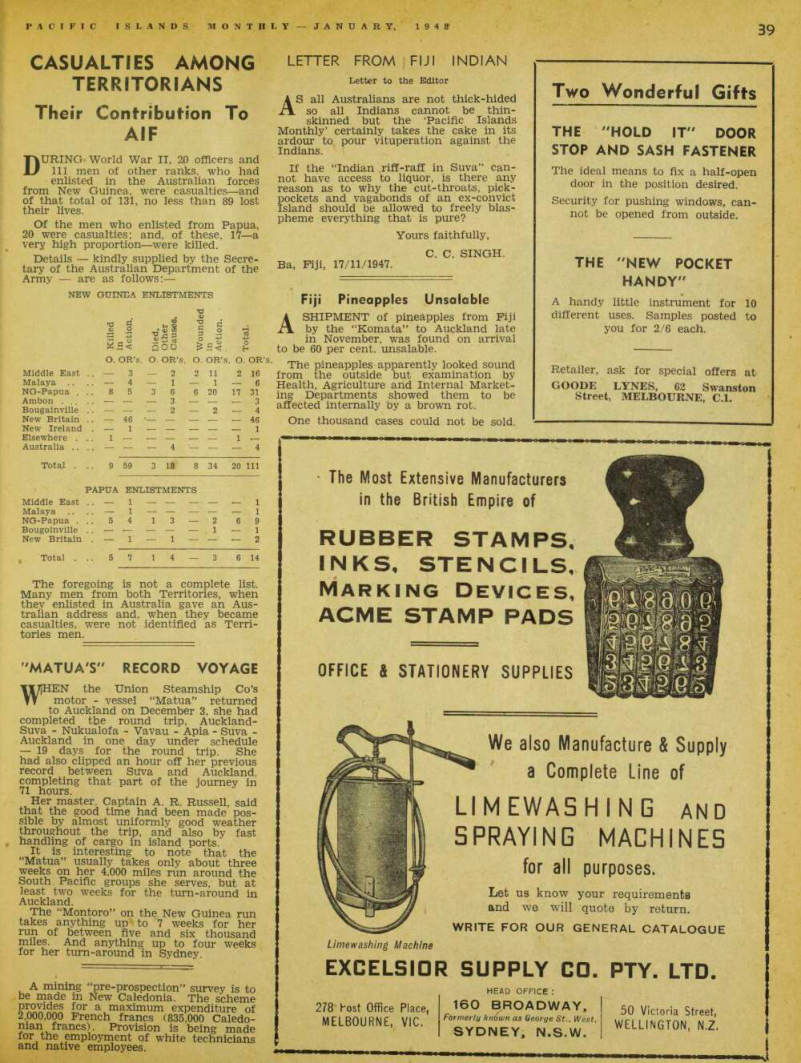
Casualties Among
Territorians
Their Contribution To
Aif
DURING' World War 11, 20 officers and 111 men of other ranks, who had enlisted in the Australian forces from New Guinea, were casualties—and of that total of 131, no less than 89 lost their lives.
Of the men who enlisted from Papua, 20 were casualties; and, of these, 17 —a very high proportion—were killed.
Details kindly supplied by the Secre tary of the Australian Department of the Army are as follows:
New Guinea Enlistments
The foregoing is not a complete list.
Many men from both Territories, when they enlisted in Australia gave an Aus tralian address and, when they became casualties, were not identified as Terri tories men.
Wounded
Killed
s <
Died,
Other
Causes.
c o s <
Total.
O.
OR’s.
O. Or’S.
O.
OR’s
. O. Or’
Middle East 3 — 2 2 11 2 16 Malaya .. — 4 — 1 — 1 — 6 NG-Papua . 8 5 3 6 6 20 17 31 Ambon . — — — 3 — 3 Bougainville — — — 2 — 2 — 4 New Britain — 46 • — 46 New Ireland 1 — 1 Elsewhere . 1 1 — Australia .. — — — 4 — — — 4 Total . •• 9 59 3 18 8 34 20 111
Papua Enlistments
Middle East — 1 — 1 Malaya .. — 1 — — — — — 1 NG-Papua . 5 4 1 3 — 2 6 9 Bougoinville 1 — 1 New Britain — 1 — 1 — — — 2
, Total .
5 7 1 4 - 3 6 14
"Matua's" Record Voyage
117JHEN the Union Steamship Go’s TT motor - vessel “Matua” returned to Auckland on December 3, she had completed the round trip, Auckland- Suva - Nukualofa - Vavau - Apia - Suva - Auckland in one day under schedule —l9 days for the round trip. She had also clipped an hour off her previous record between Suva and Auckland, completing that part of the journey in 71 hours.
Her master. Captain A. R. Russell, said that the good time had been made pos sible by almost uniformly good weather throughout the trip, and also by fast handling of cargo in island ports.
It is interesting to note that the “Matua” usually takes only about three weeks on her 4,000 miles run around the South Pacific groups she serves, but at least two weeks for the turn-around in Auckland.
The “Montoro” on the New Guinea run takes anything up to 7 weeks for her run of between five and six thousand miles. And anything up to four weeks for her tum-around in Sydney.
I A mining “pre-prospection” survey is to be made in New Caledonia. The scheme Provides for a maximum expenditure of 2,000,000 French francs (835,000 Caledo nian francs). Provision is being made for the employment of white technicians and native employees.
Letter From Fiji Indian
Letter to the Editor AS all Australians are not thick-hided so all Indians cannot be thin skinned but the ‘Pacific Islands Monthly’ certainly takes the cake in its ardour to pour vituperation against the Indians.
If the “Indian riff-raff in Suva” can not have access to liquor, is there any reason as to why the cut-throats, pick pockets and vagabonds of an ex-convict Island should be allowed to freely blas pheme everything that is pure?
Yours faithfully,
C. C. Singh.
Ba, Fiji, 17/11/1947.
Fiji Pineapples Unsalable
A SHIPMENT of pineapples from Fiji by the “Komata” to Auckland late in November, was found on arrival to be 60 per cent, unsalable.
The pineapples apparently looked sound from the outside but examination by Health, Agriculture and Internal Market ing Departments showed them to be affected internally by a brown rot.
One thousand cases could not be sold,
Advertisements & other items, p. 41 (1 item)
Spraying Machines
Two Wonderful Gifts
THE "HOLD IT" DOOR
STOP AND SASH FASTENER
The ideal means to fix a half-open door in the position desired.
Security for pushing windows, cannot be opened from outside.
THE "NEW POCKET
HANDY"
A handy little instrument for 10 different uses. Samples posted to you for 2/6 each.
Retailer, ask for special offers at GOODE LYNES, 62 Swanston Street, MELBOURNE, €.l.
The Most Extensive Manufacturers in the British Empire of
RUBBER STAMPS,
INKS, STENCILS,
Marking Devices,
ACME STAMP PADS
OFFICE & STATIONERY SUPPLIES
I*s r’S
We also Manufacture & Supply
a Complete Line of LI M EWAS HI N G AND
SPRAYING MACHINES
for all purposes.
Let us know your requirements and we will quote by return.
WRITE FOR OUR GENERAL CATALOGUE
Limewashing Machine
EXCELSIOR SUPPLY CO. PTY. LTD.
278 host Office Place,
MELBOURNE, VIC.
HEAD OFFICE :
160 BROADWAY,
Formerlg known as George St.. West,
SYDNEY. N.S.W.
50 Victoria Street,
WELLINGTON, N.Z.
Future Status
Of American Samoa
Letter to the Editor COMMENT on possible union of Ameri can and Western Samoa, in your Oc tober issue, suggests to me that you might be interested in the following ex tract from my forthcoming book, “South Seas: An Anatomy of Paradise.” It rep resents the conclusions on this subject
at which I have arrived after exploring the situation in both Samoas earlier this year, and after digesting the results of the United Nations mission to Western Samoa. Naturally, this is from an Ameri can point of view: “The UN mission certainly exercised good judgment in politely neglecting the project of union between American and Western Samoa.
“It is hard to blame the individual Samoan who, in order to visit his emotionally important relatives the other side of the imaginary line between Upolu
and Tutuila, must pay cash for a special permit.
“But the future of the scheme is not bright. The higher chiefs of American Samoa look askance at it, partly because it would put them back directly under the superior mana of the three ‘kings,’ partly because the shrewder ones under stand that the US Navy—or whatever American government agency eventually takes charge—will have more to spend and more posts to fill, particularly in the prestige-rich marine auxiliary corps that the Navy maintains, than would fall to Tutuila’s lot if government were consoli dated at Apia . . .
“The project will probably founder, anyway, on the issue of what Power would be in charge if union were effected.
“There is no sane reason why the States should take over the most persistent head ache in the Pacific —responsibility for Western Samoa.
“If US Navy control of facilities at Pagopago were assured, the States might conceivably hand over American Samoa to New Zealand, as an addition to the present UN trusteeship. But the details of such an arrangement would make an international lawyer see spots before the eyes: a national military force would be localised dictator of an area in an en vironment controlled by an alien nation, not as sovereign, but as deputy of a supra-national organisation.
“It would be more logical for New Zea land, using the security features possible in UN trusteeships, to take over the Pagopago base under agreement permit ting the US full use on demand.
“But that would outrage the US Navy, which has never been noted for the more latitudinarian type of logic; and, unless the New Zealand Navy has more to spend than it ever had yet, would cause economic revolution on Tutuila.
“A solution cannot even be envisaged.
The conclusion must be that the union of the two Samoas is going to wait a long time.” , * The feeling hereabouts seems to be that the UN mission’s recommendations, lust now under consideration by the Trustee ship Council, will be endorsed and approved by the General Assembly.
It is not at all unlikely that the US Navy administration in American Samoa will take some measures roughly corre sponding to those of the New Zealand programme announced in August for Western Samoa.
Well-wishers of the Samoan people, among whom I should like to be counted, will be watching closely to see whether the contrast between Western Samoa’s ex pressed ambitions, and the innovations to which New Zealand is committed as trustee, will blind the Samoans to their very real opportunities under the new arrangements.
I am, etc.,
J. C. Furnas.
Lebanon, New Jersey,
Usa, 6/12/47.
EDITORIAL NOTE: Mr. Furnas is a distinguished writer, and his conclusions may not be lightly passed over. But the following are facts; The people of the Samoan Archipelago are one in race, language, history, out look and tradition.
The archipelago was arbitrarily divided, 50 years ago, between Germany and the United States. The two sections of Samoa were separated as completely as though they belonged to different races.
It is a remarkable and completely illogical thing that perpetuation of this improper political division should be sought by the United, States whose proudest boast is that it stands always for racial unity, political liberty, and complete freedom of national de velopment.
Advertisements & other items, p. 42 (1 item)
*£ndou ouc&nt
P 9 Energy lost during the day is speedily restored when Imperial Hampe is served for the evening meal Hampe, sliced or diced, makes cool, energising salads, sandwiches and savouries, and the satisfying flavour lasts to the very end.
Quick and simple to prepare, Hampe is a treat for all the family.
<5 Try Imperial Meatreat, Corned Beef, Hoi Meals
Imperial
Flavour Sealed Canned Foods Riverstone Meat Co., 5-7 O’Connell Street, Sydney Fiji Representative: Pearce & Co. Ltd., Suva
Magazine Section
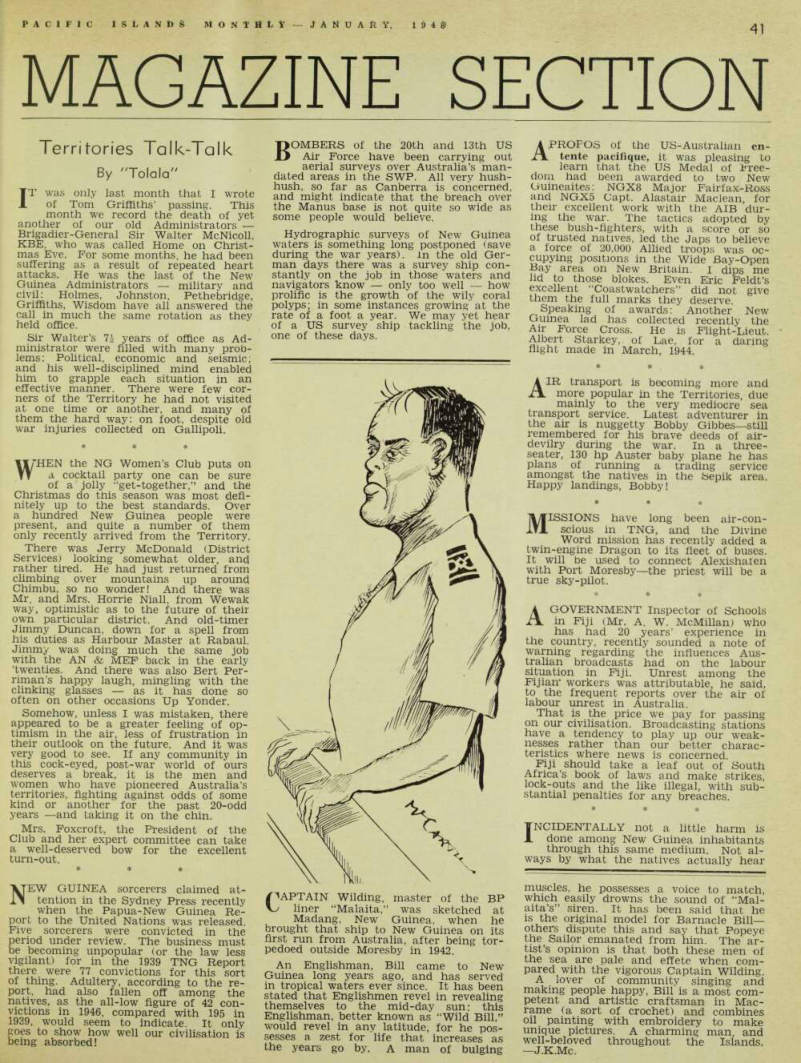
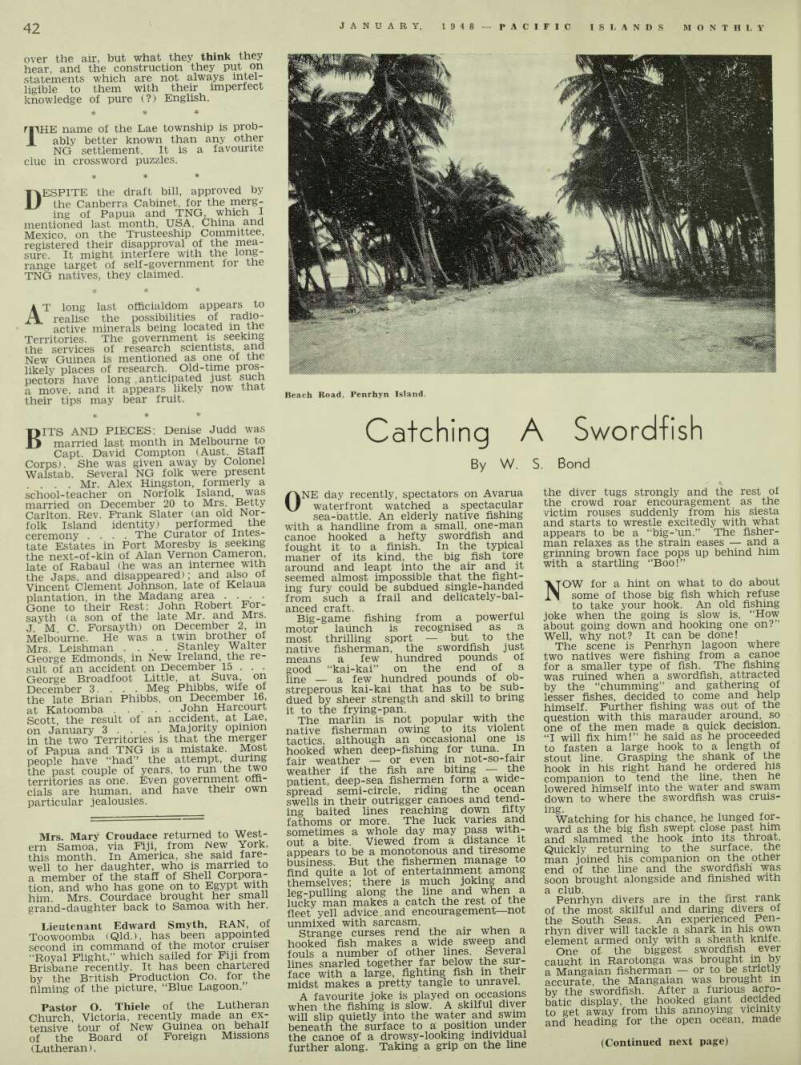
Territories Talk-Talk
By "Tolala"
IT was only last month that I wrote of Tom Griffiths’ passing. This month we record the death of yet another of our old Administrators Brigadier-General Sir Walter McNicoll, KBE, who was called Home on Christ mas Eve. For some months, he had been suffering as a result of repeated heart attacks. He was the last of the New Guinea Administrators military and civil: Holmes, Johnston, Pethebridge, Griffiths, Wisdom have all answered the call in much the same rotation as they held office.
Sir Walter’s 11 years of office as Ad ministrator were filled with many prob lems: Political, economic and seismic; and his well-disciplined mind enabled him to grapple each situation in an effective manner. There were few cor ners of the Territory he had not visited at one time or another, and many of them the hard way; on foot, despite old war injuries collected on Gallipoli. * * * W'HEN the NG Women’s Club puts on a cocktail party one can be sure of a jolly “get-together,” and the Christmas do this season was most defi nitely up to the best standards. Over a hundred New Guinea people were present, and quite a number of them only recently arrived from the Territory.
There was Jerry McDonald (District Services) looking somewhat older, and rather tired. He had just returned from climbing over mountains up around Chimbu, so no wonder! And there was Mr. and Mrs. Horrie Niall, from Wewak way, optimistic as to the future of their own particular district. And old-timer Jimmy Duncan, down for a spell from his duties as Harbour Master at Rabaul, Jimmy was doing much the same job with the AN & MEF back in the early ’twenties. And there was also Bert Per riman’s happy laugh, mingling with the clinking glasses as it has done so often on other occasions Up Yonder.
Somehow, unless I was mistaken, there appeared to be a greater feeling of op timism in the air, less of frustration in their outlook on the future. And it was very good to see. If any community in this cock-eyed, post-war world of ours deserves a break, it is the men and women who have pioneered Australia’s territories, fighting against odds of some kind or another for the past 20-odd years —and taking it on the chin.
Mrs. Foxcroft, the President of the Club and her expert committee can take a well-deserved bow for the excellent turn-out. * * * NEW GUINEA sorcerers claimed at tention in the Sydney Press recently when the Papua-New Guinea Re port to the United Nations was released.
Five sorcerers were convicted in the period under review. The business must be becoming unpopular (or the law less vigilant) for in the 1939 TNG Report there were 77 convictions for this sort of thing. Adultery, according to the re port, had also fallen off among the natives, as the all-low figure of 42 con victions in 1946, compared with 195 in 1939, would seem to indicate. It only goes to show how well our civilisation is being absorbed!
BOMBERS of the 20th and 13th US Air Force have been carrying out aerial surveys over Australia’s man dated areas in the SWP. All very hush hush, so far as Canberra is concerned, and might indicate that the breach over the Manus base is not quite so wide as some people would believe.
Hydrographic surveys of New Guinea waters is something long postponed (save during the war years), in the old Ger man days there was a survey ship con stantly on the job in those waters and navigators know only too well how prolific is the growth of the wily coral polyps; in some instances growing at the rate of a foot a year. We may yet hear of a US survey ship tackling the job, one of these days.
C CAPTAIN Wilding, master of the BP j liner “Malaita,” was sketched at Madang, New Guinea, when he brought that ship to New Guinea on its first run from Australia, after being tor pedoed outside Moresby in 1942.
An Englishman, Bill came to New Guinea long years ago, and has served in tropical waters ever since. It has been stated that Englishmen revel in revealing themselves to the mid-day sun: this Englishman, better known as “Wild Bill,” would revel in any latitude, for he pos sesses a zest for life that increases as the years go by. A man of bulging
muscles, he possesses a voice to match, which easily drowns the sound of “Mal aga’s” siren. It has been said that he is the original model for Barnacle Bill others dispute this and say that Popeye the Sailor emanated from him. The ar tist’s opinion is that both these men of the sea are Dale and effete when com pared with the vigorous Captain Wilding.
A lover of community singing and making people happy, Bill is a most com petent and artistic craftsman in Mac rame (a sort of crochet) and combines oil painting with embroidery to make unique pictures. A charming man, and well-beloved throughout the Islands,
J.K.Mc.
APROPOS of the US-Australian en tente pacifique, it was pleasing to learn that the US Medal of Pree dom had been awarded to two New Guineaites; NGXB Major Fairfax-Ross and NGXS Capt. Alastair Maclean, for their excellent work with the AIB dur ing the war. The tactics adopted by these bush-fighters, with a score or so of trusted natives, led the Japs to believe a force of 20,000 Allied troops was oc cupying positions in the Wide Bay-Open Bay area on New Britain. I dips me lid to those blokes. Even Eric Feldt’s excellent “Coastwatchers” did not give them the full marks they deserve.
Speaking of awards: Another New Guinea lad has collected recently the Air Force Cross. He is Flight-Lieut.
Albert Starkey, of Lae, for a daring flight made in March, 1944.
AIR transport is becoming more and more popular in the Territories, due mainly to the very mediocre sea transport service. Latest adventurer in the air is nuggetty Bobby Gibbes—still remembered for his brave deeds of air devilry during the war. in a three seater, 130 hp Auster baby plane he has plans of running a trading service amongst the natives in the Sepik area.
Happy landings, Bobby! * • * MISSIONS have long been air-con scious in TNG, and the Divine Word mission has recently added a twin-engine Dragon to its fleet of buses.
It will be used to connect Alexishafen with Port Moresby—the priest will be a true sky-pilot. * * * A GOVERNMENT Inspector of Schools in Fiji (Mr. A. W. McMillan) who has had 20 years’ experience in the country, recently sounded a note of warning regarding the influences Aus tralian broadcasts had on the labour situation in Fiji. Unrest among the Fijian* workers was attributable, he said, to the frequent reports over the air of labour unrest in Australia.
That is the price we pay for passing on our civilisation. Broadcasting stations have a tendency to play up our weak nesses rather than our better charac teristics where news is concerned.
Fiji should take a leaf out of South Africa’s book of laws and make strikes, lock-outs and the like illegal, with sub stantial penalties for any breaches. * * * INCIDENTALLY not a little harm is done among New Guinea inhabitants through this same medium. Not al ways by what the natives actually hear
over the air, but what they think they hear, and the construction they put on statements which are not always intel ligible to them with their imperfect knowledge of pure (?) English. * * * THE name of the Lae township is prob ably better known than any other NG settlement. It is a favourite clue in crossword puzzles, DESPITE the draft bill, approved by the Canberra Cabinet, for the merg ing of Papua and TNG, which I mentioned last month, USA, China and Mexico, on the Trusteeship Committee, registered their disapproval of the mea sure. It might interfere with the long range target of self-government for the TNG natives, they claimed. * * * AT long last officialdom appears to realise the possibilities of radio active minerals being located in the Territories. The government is seeking the services of research scientists, and New Guinea is mentioned as one of the likely places of research. Old-time pros pectors have long anticipated just such a move, and it appears likely now that their tips may bear fruit. * * * BITS AND PIECES: Denise Judd was married last month in Melbourne to Capt. David Compton (Aust. Stan Corps). She was given away by Colonel Walstab. Several NG folk were present ... Mr. Alex Kingston, formerly a school-teacher on Norfolk Island, was married on December 20 to Mrs. Betty Carlton. Rev. Frank Slater (an old Nor folk Island identity) performed the ceremony ... The Curator of Intes tate Estates in Port Moresby is seeking the next-of-kin of Alan Vernon Camerpn, late of Rabaul (he was an internee with the Japs, and disappeared); and also ol Vincent Clement Johnson, late of Kelaua plantation, in the Madang area • • • • Gone to their Rest: John Robert For sayth (a son of the late Mr. and Mrs.
J. M C. Forsayth) on December 2, in Melbourne. He was a twin brother oi Mrs. Leishman ... Stanley Walter George Edmonds, in New Ireland, the re sult of an accident on December 15 . . .
George Broadfoot Little, at Suva, on December 3. . . . Meg Phibbs, wife of the late Brian Phibbs. on December 16, at Katoomba John Harcourt Scott, the result of an accident, at Lae, on January 3 . . . . Majority opinion in the two Territories is that the merger of Papua and TNG is a mistake. Most people have “had’’ the attempt, during the past couple of years, to run the two territories as one. Even government offi cials are human, and have their own particular jealousies.
Mrs. Mary Croudace returned to West ern Samoa, via Fiji, from New York, this month. In America, she said, fare well to her daughter, who is married to a member of the staff of Shell Corpora tion, and who has gone on to Egypt with him Mrs. Courdace brought her small grand-daughter back to Samoa with her.
Lieutenant Edward Smyth, RAN, of Toowoomba (Qld.), has been appointed second in command of the motor cruiser “Royal Flight,” which sailed for Fiji from Brisbane recently. It has been chartered by the British Production Co. for the filming of the picture, “Blue Lagoon.”
Pastor O. Thiele of the Lutheran Church, Victoria, recently made an ex tensive tour of New Guinea on behalf of the Board of Foreign Missions (Lutheran).
Catching A Swordfish
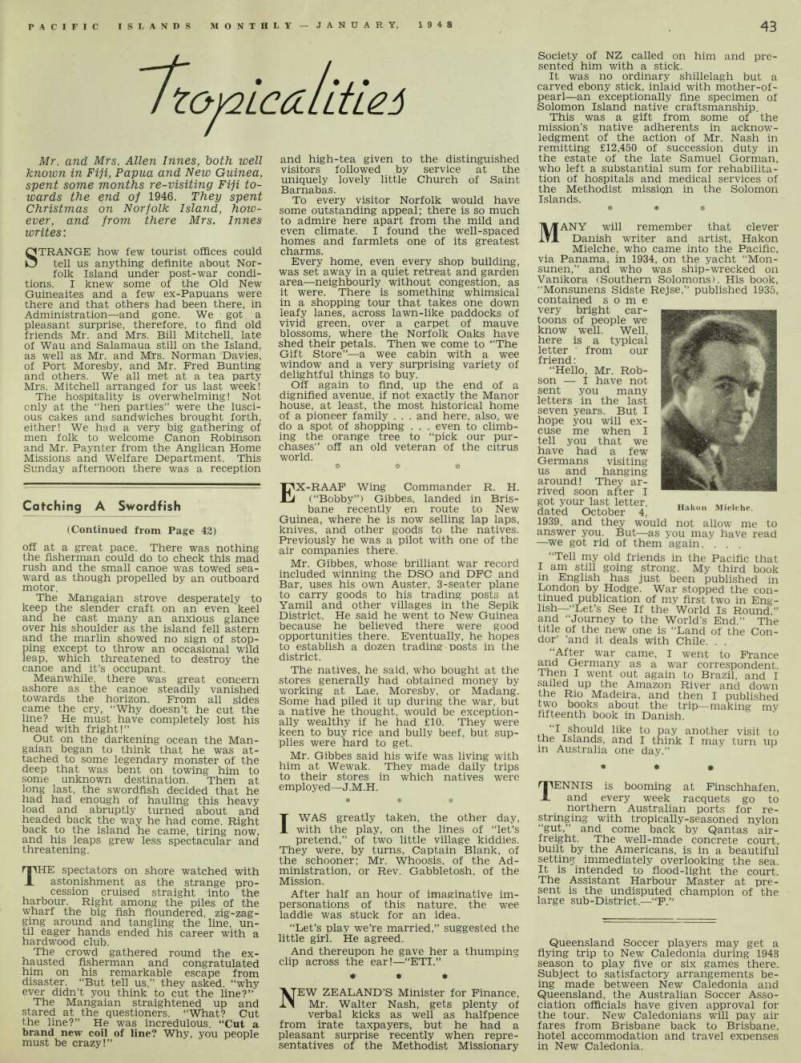
By W. S. Bond
ONE day recently, spectators on Avarua waterfront watched a spectacular sea-battle. An elderly native fishing with a handline from a small, one-man canoe hooked a hefty swordfish and fought it to a finish. In the typical maner of its kind, the big fish tore around and leapt into the air and it seemed almost impossible that the fight ing fury could be subdued single-handed from such a frail and delicately-bal anced cra ft Big-game fishing from a powerful motor launch is recognised as a most thrilling sport but to the native fisherman, the swordfish just means a few hundred pounds of good “kai-kai” on the end of a line a few hundred pounds of ob streperous kai-kai that has to be sub dued by sheer strength and skill to bring it to the frying-pan.
The marlin is not popular with the native fisherman owing to its violent tactics, although an occasional one is hooked when deep-fishing for tuna. In fair weather or even in not-so-fair weather if the fish are biting the patient, deep-sea fishermen form a wide spread semi-circle, riding the ocean swells in their outrigger canoes and tend ing baited lines reaching down fifty fathoms or more. The luck varies and sometimes a whole day may pass with out a bite. Viewed from a distance it appears to be a monotonous and tiresome business. But the fishermen manage to find quite a lot of entertainment among themselves; there is much joking and leg-pulling along the line and when a lucky man makes a catch the rest of the fleet yell advice and encouragement—not unmixed with sarcasm.
Strange curses rend the air when a hooked fish makes a wide sweep and fouls a number of other lines. Several lines snarled together far below the sur face with a large, fighting fish in their midst makes a pretty tangle to unravel.
A favourite joke is played on occasions when the fishing is slow. A skilful diver will slip quietly into the water and swim beneath the surface to a; position under the canoe of a drowsy-looking individual further along. Taking a grip on the line
the diver tugs strongly and the rest of the crowd roar encouragement as the victim rouses suddenly from his siesta and starts to wrestle excitedly with what appears to be a “big-’un.” The fisher man relaxes as the strain eases and a grinning brown face pops up behind him with a startling “Boo!”
NOW for a hint on what to do about some of those big fish which refuse to take your hook. An old fishing joke when the going is slow is, “How about going down and hooking one on?”
Well, why not? It can be done!
The scene is Penrhyn lagoon where two natives were fishing from a canoe for a smaller type of fish. The fishing was ruined when a swordfish, attracted by the “chumming” and gathering of lesser fishes, decided to come and help himself. Further fishing was out of the question with this marauder around, so one of the men made a quick decision.
“I will fix him!” he said as he proceeded to fasten a large hook to a length of stout line. Grasping the shank of the hook in his right hand he ordered his companion to tend the line, then he lowered himself into the water and swam down to where the swordfish was cruis ing.
Watching for his chance, he lunged for ward as the big fish swept close past him and slammed the hook into its throat.
Quickly returning to the surface, the man joined his companion on the other end of the line and the swordfish was soon brought alongside and finished with a club.
Penrhyn divers are in the first rank of the most skilful and daring divers of the South Seas. An experienced Pen rhyn diver will tackle a shark in his own element armed only with a sheath knife.
One of the biggest swordfish ever caught in Rarotonga was brought in by a Mangaian fisherman or to be strictly accurate, the Mangaian was brought m by the swordfish. After a furious acro batic display, the hooked giant decided to get away from this annoying vicinity and heading for the open ocean, made (Continued next page)
Beach Road, Penrhyn Island.
off at a great pace. There was nothing the fisherman could do to check this mad rush and the small canoe was towed sea ward as though propelled by an outboard motor.
The Mangaian strove desperately to keep the slender craft on an even keel and he cast many an anxious glance over his shoulder as the island fell astern and the marlin showed no sign of stop ping except to throw an occasional wild leap, which threatened to destroy the canoe and it’s occupant.
Meanwhile, there was great concern ashore as the canoe steadily vanished towards the horizon. From all sides came the cry, “Why doesn’t he cut the line? He must have completely lost his head with fright!”
Out on the darkening ocean the Man gaian began to think that he was at tached to some legendary monster of the deep that was bent on towing him to some unknown destination. Then at long last, the swordfish decided that he had had enough of hauling this heavy load and abruptly turned about and headed back the way he had come. Right back to the island he came, tiring now, and his leaps grew less spectacular and threatening.
THE spectators on shore watched with astonishment as the strange pro cession cruised straight into the harbour. Right among the piles of the wharf the big fish floundered, zig-zag ging around and tangling the line, un til eager hands ended his career with a hardwood club.
The crowd gathered round the ex hausted fisherman and congratulated him on his remarkable escape from disaster. “But tell us,” they asked, “why ever didn’t you think to cut the line?”
The Mangaian straightened up and stared at the questioners. “What? Cut the line?” He was incredulous. “Cut a brand new coil of line? Why, you people must be crazy!”
Tropicalities
Mr. and Mrs. Allen Innes, both well known in Fiji, Papua and New Guinea,
spent some months re-visiting Fiji to
wards the end of 1946. They spent Christmas on Norfolk Island, how ever, and from there Mrs. Innes writes : STRANGE how few tourist offices could tell us anything definite about Nor folk Island under post-war condi tions. I knew some of the Old New Guineaites and a few ex-Papuans were there and that others had been there, in Administration —and gone. We got a pleasant surprise, therefore, to find old friends Mr. and Mrs. Bill Mitchell, late of Wau and Salamaua still on the Island, as well as Mr. and Mrs. Norman Davies, of Port Moresby, and Mr. Fred Bunting and others. We all met at a tea party Mrs. Mitchell arranged for us last week!
The hospitality is overwhelming! Not only at the “hen parties” were the lusci ous cakes and sandwiches brought forth, either! We had a very big gathering of men folk to welcome Canon Robinson and Mr. Paynter from the Anglican Home Missions and Welfare Department. This Sunday afternoon there was a reception
and high-tea given to the distinguished visitors followed by service at the uniquely lovely little Church of Saint Barnabas.
To every visitor Norfolk would have some outstanding appeal; there is so much to admire here apart from the mild and even climate. I found the well-spaced homes and farmlets one of its greatest charms.
Every home, even every shop building, was set away in a quiet retreat and garden area—neighbourly without congestion, as it were. There is something whimsical in a shopping tour that takes one down leafy lanes, across lawn-like paddocks of vivid green, over a carpet of mauve blossoms, where the Norfolk Oaks have shed their petals. Then we come to “The Gift Store” —a wee cabin with a wee window and a very surprising variety of delightful things to buy.
Off again to find, up the end of a dignified avenue, if not exactly the Manor house, at least, the most historical home of a pioneer family . . . and here, also, we do a spot of shopping . . , even to climb ing the orange tree to “pick our pur chases” off an old veteran of the citrus world. * * EX-RAAF Wing Commander R. H. (“Bobby”) Gibbes, landed in Bris bane recently en route to New Guinea, where he is now selling lap laps, knives, and other goods to the natives.
Previously he was a pilot with one of the air companies there.
Mr. Gibbes, whose brilliant war record included winning the DSO and DFC and Bar, uses his own Auster, 3-seater plane to carry goods to his trading posts at Yamil and other villages in the Sepik District. He said he went to New Guinea because he believed there were good opportunities there. Eventually, he hopes to establish a dozen trading posts in the district.
The natives, he said, who bought at the stores generally had obtained money by working at Lae, Moresby, or Madang.
Some had piled it up during the war. but a native he thought, would be exception ally wealthy if he had £lO. They were keen to buy rice and bully beef, but sup plies were hard to get.
Mr. Gibbes said his wife was living with him at Wewak. They made daily trips to their stores in which natives were
employed
J.M.H.
IWAS greatly takeh, the other day, with the play, on the lines of “let’s pretend,” of two little village kiddies.
They were, by turns, Captain Blank, of the schooner; Mr. Whoosis, of the Ad ministration, or Rev. Gabbletosh, of the Mission.
After half an hour of imaginative im personations of this nature, the wee laddie was stuck for an idea.
“Let’s play we’re married,” suggested the little girl. He agreed.
And thereupon he gave her a thumping
clip across the ear!
“Eti.”
NEW ZEALAND’S Minister for Finance, Mr. Walter Nash, gets plenty of verbal kicks as well as halfpence from irate taxpayers, but he had a pleasant surprise recently when repre sentatives of the Methodist Missionary
Society of NZ called on him and pre sented him with a stick.
It was no ordinary shillelagh but a carved ebony stick, inlaid with mother-of pearl—an exceptionally fine specimen of Solomon Island native craftsmanship.
This was a gift from some of the mission’s native adherents in acknow ledgment of the action of Mr. Nash in remitting £12,450 of succession duty in the estate of the late Samuel Gorman, who left a substantial sum for rehabilita tion of hospitals and medical services of the Methodist mission in the Solomon Islands. * ♦ « MANY will remember that clever Danish writer and artist, Hakon Mielche, who came into the Pacific, via Panama, in 1934, on the yacht “Mon sunen,” and who was ship-wrecked on Vanikora (Southern Solomons). His book, “Monsunens Sidste Rejse,” published 1935, contained some
very bright car toons of people we know well. Well, here is a typical letter from our friend: “Hello, Mr. Rob son I have not sent you many letters in the last seven years. But I hope you will ex cuse me when I tell you that we have had a few Germans visiting us and hanging around! They ar rived soon after I got your last letter, dated October 4,
1939, and they would not allow me to answer you. But —as you may have read —we got rid of them again. . . .
“Tell my old friends in the Pacific that I am still going strong. My third book in English has just been published in London by Hodge. War stopped the con tinued publication of my first two in Eng lish—“ Let's See If the World Is Round,” and “Journey to the World’s End.” The title of the new one is “Land of the Con dor’ ’and it deals with Chile. . .
“After war came, I went to Prance and Germany as a war correspondent.
Then I went out again to Brazil, and I sailed up the Amazon River and down the Rio Madeira, and then I published two books about the trip—making my fifteenth book in Danish. ‘ I should like to pay another visit to the Islands, and I think I may turn up in Australia one day.” • • • TENNIS is booming at Finschhafen, and every week racquets go to northern Australian ports for re stringing with tropically-seasoned nylon “gut,” and come back by Qantas air freight. The well-made concrete court, built by the Americans, is in a beautiful setting immediately overlooking the sea.
It is intended to flood-light the court.
The Assistant Harbour Master at pre sent is the undisputed champion of the
large sub-District.-
“F.”
Queensland Soccer players may get a flying trip to New Caledonia during 1948 season to play five or six games there.
Subject to satisfactory arrangements be ing made between New Caledonia and Queensland, the Australian Soccer Asso ciation officials have given approval for the tour. New Caledonians will pay air fares from Brisbane back to Brisbane, hotel accommodation and travel expenses in New Caledonia.
Hakon Mielche.
Advertisements & other items, p. 45 (1 item)
43
PACIFIC ISLANDS MONTHLY JANUARY, 1948
Catching A Swordfish (Continued from Page 42)
Ladies Don’T
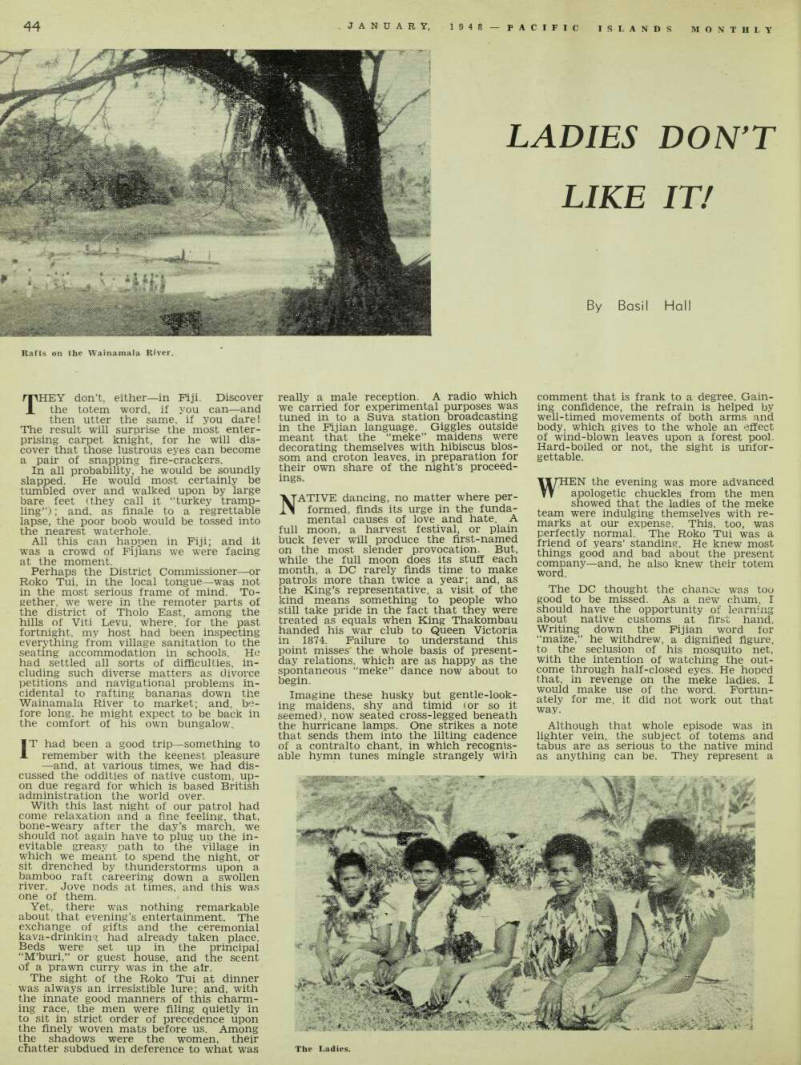
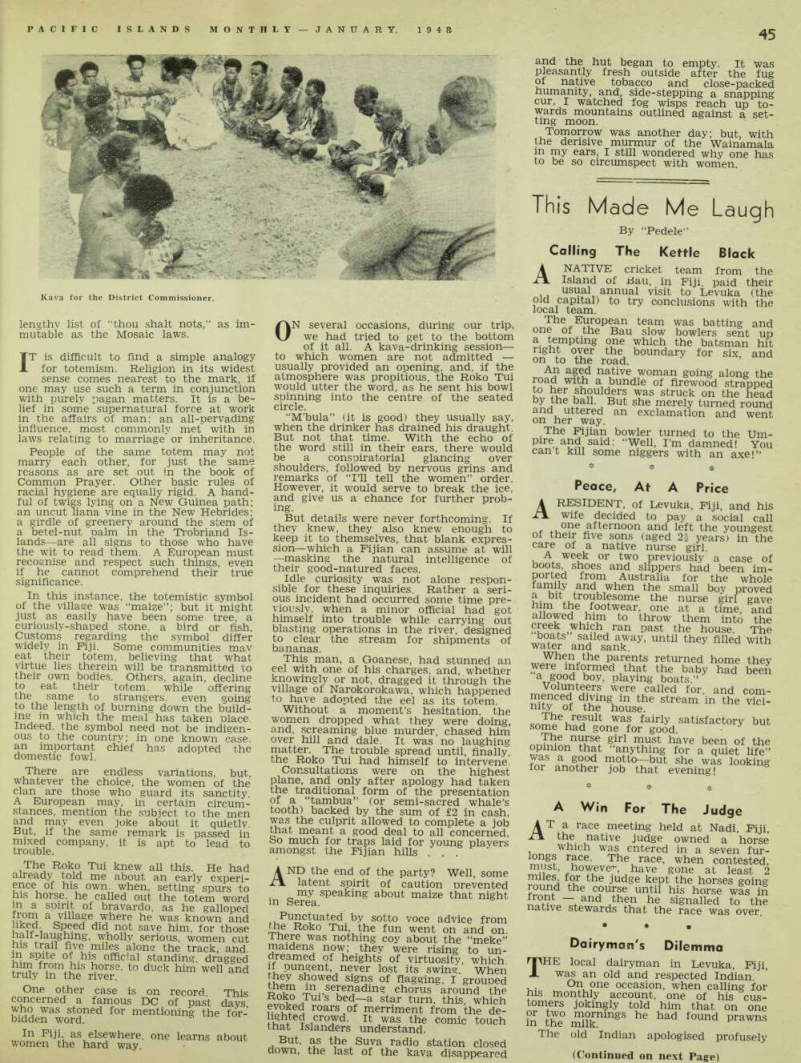
Like It!
By Basil Hall
THEY don’t, either—in Fiji. Discover the totem word, if you can—and then utter the same, if you dare!
The result will surprise the most enter prising carpet knight, for he will dis cover that those lustrous eyes can become a pair of snapping fire-crackers.
In all probability, he would be soundly slapped. He would most certainly be tumbled over and walked upon by large bare feet (they call it “turkey tramp ling”) ; and, as finale to a regrettable lapse, the poor boob would be tossed into the nearest waterhole.
All this can happen in Fiji; and it was a crowd of Fijians we were facing at the moment.
Perhaps the District Commissioner —or Roko Tui, in the local tongue—was not in the most serious frame of mind. To gether, we were in the remoter parts of the district of Tholo East, among the hills of Viti Levu, where, for the past fortnight, my host had been inspecting everything from village sanitation to the seating accommodation in schools. He had settled all sorts of difficulties, in cluding such diverse matters as divorce petitions and navigational problems in cidental to rafting bananas down the Wainamala River to market; and, be fore long, he might expect to be back in the comfort of his own bungalow.
IT had been a good trip—something to remember with the keenest pleasure —and, at various times, we had dis cussed the oddities of native custom, up on due regard for which is based British administration the world over.
With this last night of our patrol had come relaxation and a fine feeling, that, bone-weary after the day’s march, we should not again have to plug uo the in evitable greasy path to the village in which we meant to spend the night, or sit drenched by thunderstorms upon a bamboo raft careering down a swollen river. Jove nods at times, and this was one of them.
Yet. there was nothing remarkable about that evening’s entertainment. The exchange of gifts and the ceremonial kava-drinking had already taken place.
Beds were set up in the principal “M’buri,” or guest house, and the scent of a prawn curry was in the air.
The sight of the Roko Tui at dinner was always an irresistible lure; and, with the innate good manners of this charm ing race, the men were filing quietly in to sit in strict order of precedence upon the finely woven mats before us. Among the shadows were the women, their chatter subdued in deference to what was
really a male reception. A radio which we carried for experimental purposes was tuned in to a Suva station broadcasting in the Fijian language. Giggles outside meant that the “meke” maidens were decorating themselves with hibiscus blos som and croton leaves, in preparation for their own share of the night’s proceed ings.
NATIVE dancing, no matter where per formed, finds its urge in the funda mental causes of love and hate. A full moon, a harvest festival, or plain buck fever will produce the first-named on the most slender provocation. But, while the full moon does its stuff each month, a DC rarely finds time to make patrols more than twice a year; and, as the King’s representative, a visit of the kind means something to people who still take pride in the fact that they were treated as’ equals when King Thakombau handed his war club to Queen Victoria in 1874. Failure to understand this point misses the whole basis of present day relations, which are as happy as the spontaneous “meke” dance now about to begin.
Imagine these husky but gentle-look ing maidens, shy and timid (or so it seemed), now seated cross-legged beneath the hurricane lamps. One strikes a note that sends them into the lilting cadence of a contralto chant, in which recognis able hymn tunes mingle strangely with
comment that is frank to a degree. Gain ing confidence, the refrain is helped by well-timed movements of both arms and body, which gives to the whole an effect of wind-blown leaves upon a forest pool, Hard-boiled or not, the sight is unfor gettable. 11THEN the evening was more advanced »» v, O fHo S h,S SIIOWOQ thclt tllo IcLQIOS of th.o ITIOKO team were indulging themselves with re pt hut pyhphqp r phic fnn ntpo 1 normal Thl‘ Roko Tufwasl friend of years’ standing. He knew most things good and bad about the present company—and, he also knew their totem word The DC thought the chance was too good to be missed. As a new chum, I should have the opportunity of learning about native customs at first hand, Writing down the Fijian word for “maize,” he withdrew, a dignified figure, to the seclusion of his mosquito net, with the intention of watching the out come through half-closed eyes. He hoped that, in revenge on the meke ladies. I "it did not work outlhai “~‘ y lor me - 11 Qlcl not worK out tnat Although that whole episode was in lighter vein, the subject of totems and tabus are as serious to the native mind as anything can be. They represent a
Rafts on the Wainamala River.
The Ladies.
lengthy list of “thou shalt nots,” as im mutable as the Mosaic laws.
IT is difficult to find a simple analogy for totemism. Religion in its widest sense comes nearest to the mark, if one may use such a term in conjunction with purely pagan matters. It is a be lief in some supernatural force at work in the affairs of man; an all-pervading influence, most commonly met with in laws relating to marriage or inheritance.
People of the same totem may not marry each other, for just the same reasons as are set out in the book of Common Prayer. Other basic rules of racial hygiene are equally rigid. A hand ful of twigs lying on a New Guinea path; an uncut liana vine in the New Hebrides: a girdle of greenery around the stem of a betel-nut oalm in the Trobriand Is lands —are all signs to those who have the wit to read them. A European must recognise and respect such things, even if he cannot comprehend their true significance.
In this instance, the totemistic symbol of the village was “maize”; but it might just as easily have been some tree, a curiously-shaped stone, a bird or fish.
Customs regarding the symbol differ widely in Fiji. Some communities mav eat their totem, believing that what virtue lies therein will be transmitted to their own bodies. Others, again, decline to eat their totem, while offering the same to strangers, even going to the length of burning down the build ing in which the meal has taken place.
Indeed, the symbol need not be indigen ous to the country; in one known case, an important chief has adopted the domestic fowl.
There are endless variations, but, whatever the choice, the women of the clan are those who guard its sanctity.
A European may, in certain circum stances, mention the subject to the men and may even joke about it quietly.
But, if the same remark is passed in mixed company, it is apt to lead to trouble.
The Roko Tui knew all this. He had already told me about an early experi ence of his own. when, setting spurs to his horse, he called out the totem word m a spirit of bravardo, as he galloped from a village where he was known and liked Speed did not save him, for those half-laughing, wholly serious, women cut his trail five miles alone the track, and. m spite of his official standing, dragged him from his horse, to duck him well and truly in the river.
One other case is on record This concerned a famous DC of past da vs who was stoned for mentioning the for bidden word. „J n Fiji, as elsewhere, one learns about women the hard way.
ON several occasions, during our trip, we had tried to get to the bottom of it all. A kava-drinking session— to which women are not admitted usually provided an opening, and, if the atmosphere was propitious, the Roko Tui would utter the word, as he sent his bowl spinning into the centre of the seated circle.
“M’bula” (it is good) they usually say, when the drinker has drained his draught.
But not that time. With the echo of the word still in their ears, there would be a conspiratorial glancing over shoulders, followed by nervous grins and remarks of “I’ll tell the women” order.
However, it would serve to break the ice, and give us a chance for further prob ing.
But details were never forthcoming. If they knew, they also knew enough to keep it to themselves, that blank expres sion—which a Fijian can assume at will —masking the natural intelligence of their good-natured faces.
Idle curiosity was not alone respon sible for these inquiries. Rather a seri ous incident had occurred some time pre viously, when a minor official had got himself into trouble while carrying out blasting operations in the river, designed to clear the stream for shipments of bananas.
This man, a Goanese, had stunned an eel with one of his charges, and, whether knowingly or not, dragged it through the village of Narokorokawa, which happened to have adopted the eel as its totem.
Without a moment’s hesitation, the women dropped what they were doing, and, screaming blue murder, chased him over hill and dale. It was no laughing matter. The trouble spread until, finally, the Roko Tui had himself to intervene.
Consultations were on the highest plane, and only after apology had taken the traditional form of the presentation of a “tambua” (or semi-sacred whale’s tooth) backed by the sum of £2 in cash, was the culprit allowed to complete a job that meant a good deal to all concerned, So much for traps laid for young players amongst the Fijian hills ...
AND the end of the party? Well, some latent spirit of caution prevented my speaking about maize that night in Serea. hy sotto voce advice from the Roko Tui the fun went on and on.
There was nothing coy about the “meke” maidens now; they were rising to un dreamed of heights of virtuosity, which, if pungent, never lost its swing. When they showed signs of flagging. I grouped 2 16 !? 1 4, n -,serenading chorus around the Roko Tui s bed—a star turn, this, which evoked roars of merriment from the de lighted crowd. It was the comic touch that Islanders understand.
But, as the Suva radio station closed down, the last of the kava disappeared
and the hut began to empty. It was pleasantly fresh outside after the fug of native tobacco and close-packed humanity, and, side-stepping a snapping cur, I watched fog wisps reach up to wards mountains outlined against a set ting moon.
Tomorrow was another day; but, with the derisive murmur of the Wainamala m my ears, I still wondered why one has to be so circumspect with women.
Kava for the District Commissioner.
This Made Me Laugh
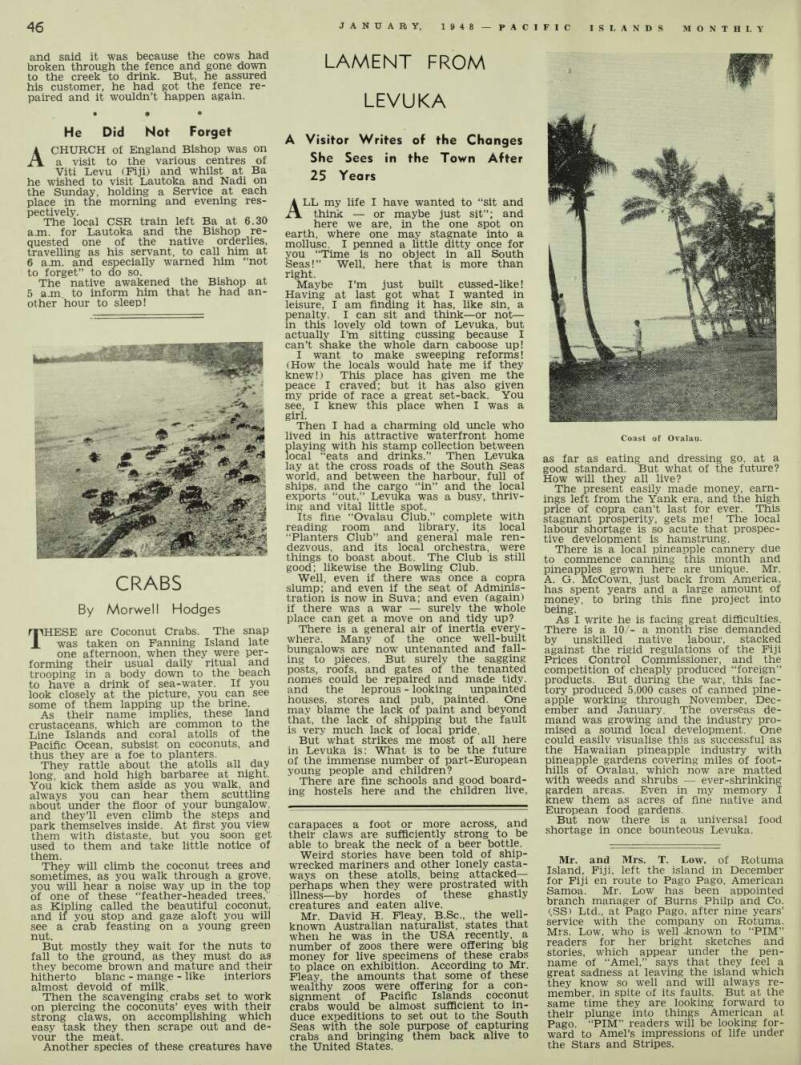
By “Pedele”
Calling The Kettle Black
A NATIVE cricket team from the Island of Bau, in Fiji, paid their usual annual visit to Levuka (the old capital) to try conclusions with the local team.
The European team was batting and one of the Bau slow bowlers sent up a tempting one which the batsman hit nght over the boundary for six, and on to the road.
An aged native woman going along the road with a bundle of firewood strapped hv S?S Ul( lf r ? as struck on the head by the bail. But she merely turned round and uttered an exclamation and went on her way.
The Fijian bowler turned to the Um- Pire and said; “Well, I’m damned! You cant kill some niggers with an axe!” * S $
Peace, At A Price
A RESIDENT, of Levuka, Fiji, and his wife decided to pay a social call , tu o^e afternoon and left the youngest of their five sons (aged 21 years) in the care of a native nurse girl.
A week or two previously a case of boots shoes and slippers had been im ported from Australia for the whole family and when the small boy proved a bit troublesome the nurse girl gave n t s e J. oot wear, one at a time, and allowed him to throw them into the creek which ran past the house. The boats sailed away, until thev filled with water and sank.
When the parents returned home they were informed that the baby had been a good boy, playing boats.”
Volunteers were called for. and com menced diving in the stream, in the vici nity of the house. . n ? e w sult wa f fai rly satisfactory but some had gone for good. nurse girl must have been of the opinion that anything for a quiet life” was a good motto—but she was looking for another job that evening! *** 5jC ••• A Win For The Judge At a race meeting held at Nadi, Fiji, the native judge owned a horse which was entered in a seven fur longs race. The race, when contested, must, however have gone at least 2 rmles, for the judge kept the horses going round the course until his horse was in mPnioTf and he si g na Hed to the native stewards that the race was over. • • .
Dairyman's Dilemma
THE local dairyman in Levuka, Fiji, was an old and respected Indian On one occasion, when calling for his monthly account, one of his cus tomers jokingly told him that on one in the mi?™*^ 8 he had f ° Und prawns The old Indian apologised profusely (Continued on next Page)
and said it was because the cows had broken through the fence and gone down to the creek to drink. But, he assured his customer, he had got the fence re paired and it wouldn’t happen again. • * • He Did Not Forget A CHURCH of England Bishop was on a visit to the various centres of Viti Levu (Fiji) and whilst at Ba he wished to visit Lautoka and Nadi on the Sunday, holding a Service at each place in the morning and evening res pectively.
The local CSR train left Ba at 6.30 am. for Lautoka and the Bishop re quested one of the native orderlies, travelling as his servant, to call him at 6 a.m. and especially warned him “not to forget” to do so.
The native awakened the Bishop at 5 a.m to inform him that he had an other hour to sleep!
Crabs
By Morwell Hodges
THESE are Coconut Crabs. The snap was taken on Fanning Island late one afternoon, when they were per forming their usual daily ritual and trooping in a body down to the beach to have a drink of sea-water. If you look closely at the picture, you can see some of them lapping up the brine.
As their name implies, these land crustaceans, which are common to the Line Islands and coral atolls of the Pacific Ocean, subsist on coconuts, and thus they are a foe to planters.
They rattle about the atolls all day long, and hold high barbaree at night.
You kick them aside as you walk, and always you can hear them scuttling about under the floor of your bungalow, and they’ll even climb the steps and park themselves inside. At first you view them with distaste, but you soon get used to them and take little notice of them.
They will climb the coconut trees and sometimes, as you walk through a grove, you will hear a noise way up in the top of one of these “feather-headed trees,’ as Kipling called the beautiful coconut, and if you stop and gaze aloft you will see a crab feasting on a young green nut.
But mostly they wait for the nuts to fall to the ground, as they must do as they become brown and mature and their hitherto blanc - mange - like interiors almost devoid of milk.
Then the scavenging crabs set to work on piercing the coconuts’ eyes with their strong claws, on accomplishing which easy task they then scrape out and de vour the meat.
Another species of these creatures have
carapaces a foot or more across, and their claws are sufficiently strong to be able to break the neck of a beer bottle.
Weird stories have been told of ship wrecked mariners and other lonely casta ways on these atolls, being attacked — perhaps when they were prostrated with illness —by hordes of these ghastly creatures and eaten alive.
Mr. David H. Fleay, B.Sc., the well known Australian naturalist, states that when he was in the USA recently, a number of zoos there were offering big money for live specimens of these crabs to place on exhibition. According to Mr.
Fleay, the amounts that some of these wealthy zoos were offering for a con signment of Pacific Islands coconut crabs would be almost sufficient to in duce expeditions to set out to the South Seas with the sole purpose of capturing crabs and bringing them back alive to the United States.
Lament From
Levuka
A Visitor Writes of the Changes She Sees in the Town After
25 Years
ALL my life I have wanted to “sit and think or maybe just sit”; and here we are, in the one spot on earth, where one may stagnate into a mollusc. I penned a little ditty once for you “Time is no object in all South Seas!” Well, here that is more than right.
Maybe I’m just built cussed-like!
Having at last got what I wanted in leisure, I am finding it has, like sin, a penalty. I can sit and think—or not— in this lovely old town of Levuka, but actually I’m sitting cussing because I can’t snake the whole darn caboose up!
I want to make sweeping reforms! (How the locals would hate me if they knew!) This place has given me the peace I craved; but it has also given my pride of race a great set-back. You see, I knew this place when I was a girl.
Then I had a charming old uncle who lived in his attractive waterfront home playing with his stamp collection between local “eats and drinks.” Then Levuka lay at the cross roads of the South Seas world, and between the harbour, full of ships, and the cargo “in” and the local exports “out,” Levuka was a busy, thriv ing and vital little spot.
Its fine “Ovalau Club,” complete with reading room and library, its local “Planters Club” and general male ren dezvous, and its local orchestra, were things to boast about. The Club is still good; likewise the Bowling Club.
Well, even if there was once a copra slump; and even if the seat of Adminis tration is now in Suva; and even (again) if there was a war surely the whole place can get a move on and tidy up?
There is a general air of inertia every where, Many of the once well-built bungalows are now untenanted and fall ing to pieces. But surely the sagging posts, roofs, and gates of the tenanted nomes could be repaired and made tidy, and the leprous - looking unpainted houses, stores and pub, painted. One may blame the lack of paint and beyond that, the lack of shipping but the fault is very much lack of local pride.
But what strikes me most of all here in Levuka is: What is to be the future of the immense number of part-European young people and children?
There are fine schools and good board ing hostels here and the children live,
as far as eating and dressing go, at a good standard. But what of the future?
How will they all live?
The present easily made money, earn ings left from the Yank era, and the high price of copra can’t last for ever. This stagnant prosperity, gets me! The local labour shortage is so acute that prospec tive development is hamstrung.
There is a local pineapple cannery due to commence canning this month and pineapples grown here are unique. Mr, A. G. McCown, just back from America, has spent years and a large amount of money, to bring this fine project into being.
As I write he is facing great difficulties.
There is a 10/- a month rise demanded by unskilled native labour, stacked against the rigid regulations of the Fiji Prices Control Commissioner, and the competition of cheaply produced “foreign” products. But during the war, this fac tory produced 5,000 cases of canned pine apple working through November, Dec ember and January. The overseas de mand was growing and the industry pro mised a sound local development. One could easily visualise this as successful as the Hawaiian pineapple industry with pineapple gardens covering miles of foot hills of Ovalau, which now are matted with weeds and shrubs ever-shrinking garden areas. Even in my memory I knew them as acres of fine native and European food gardens.
But now there is a universal food shortage in once bounteous Levuka.
Mi*, and Mrs. T. Low, of Rotuma Island, Fiji, left the island in December for Fiji en route to Pago Pago, American Samoa. Mr. Low has been appointed branch manager of Burns Philp and Co. (SS) Ltd., at Pago Pago, after nine years’ service with the company on Rotuma.
Mrs. Low, who is well -known to “PIM” readers for her bright sketches and stories, which appear under the pen name of “Amel,” says that they feel a great sadness at leaving the island which they know so well and will always re member, in spite of its faults. But at the same time they are looking forward to their plunge into things American at Pago. “PIM” readers will be looking for ward to Amel’s impressions of life under the Stars and Stripes.
Coast of Ovalau.
"Bully Proctor"
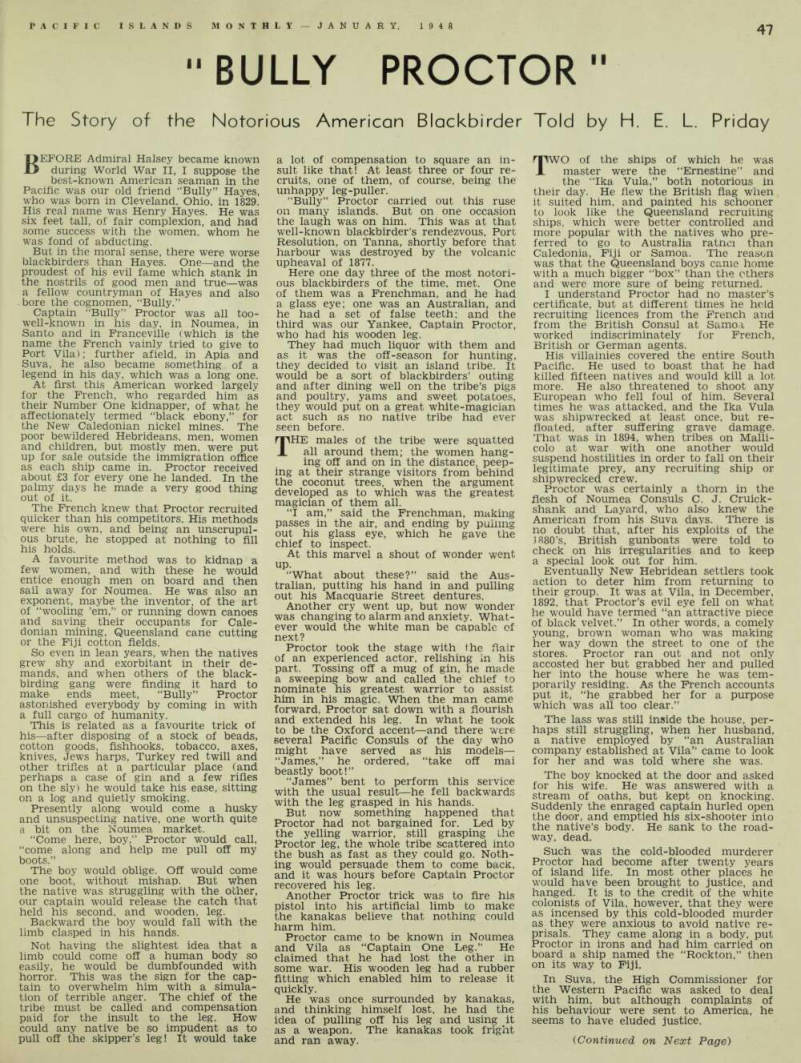
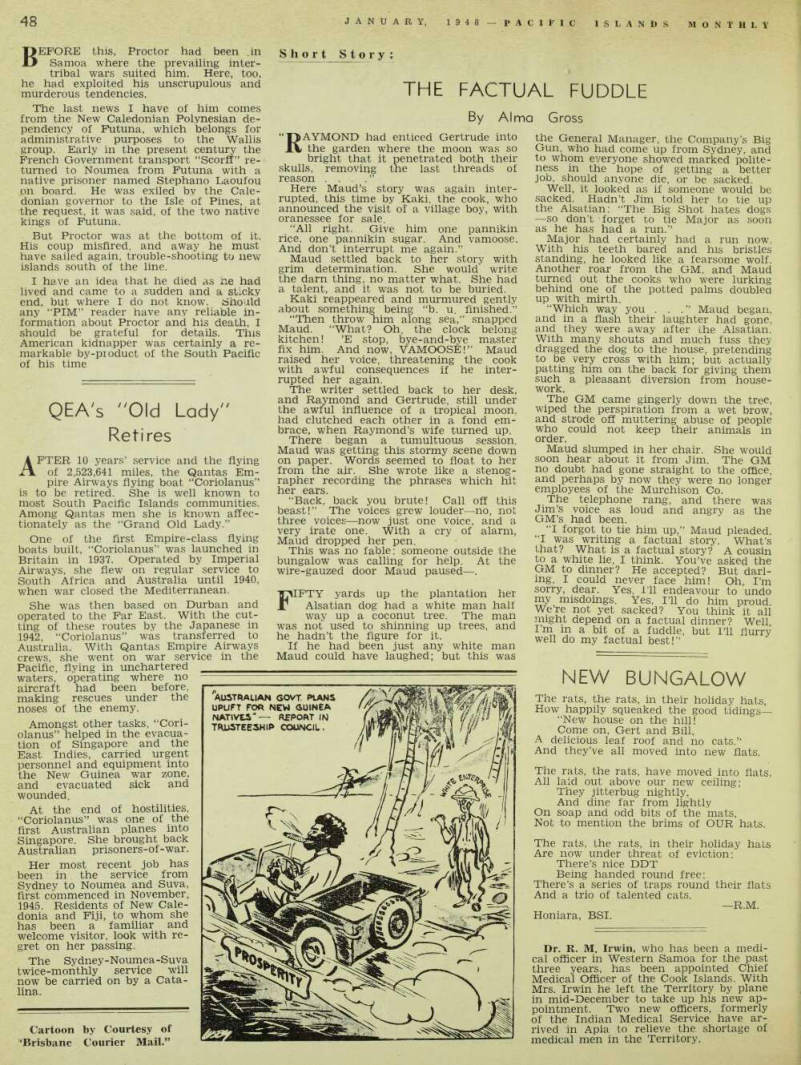
The Story of the Notorious American Blackbirder Told by H. E. L. Friday
BEFORE Admiral Halsey became known during World War 11, I suppose the best-known American seaman in the Pacific was our old friend “Bully” Hayes, who was born in Cleveland. Ohio, in 1829.
His real name was Henry Hayes. He was six feet tall, of fair complexion, and had some success with the women, whom he was fond of abducting.
But in the moral sense, there were worse blackbirders than Hayes. One—and the proudest of his evil fame which stank in the nostrils of good men and true —was a fellow countryman of Hayes and also . bore the cognomen, “Bully.”
Captain “Bully” Proctor was all too well-known in his day, in Noumea, in Santo and in Franceville (which is the name the French vainly tried to give to Port Vila); further afield, in Apia and Suva, he also became something of a legend in his day, which was a long one.
At first this American worked largely for the French, who regarded him as their Number One kidnapper, of what he affectionately termed “black ebony,” for the New Caledonian nickel mines. The poor bewildered Hebrideans, men. women and children, but mostly men, were put up for sale outside the immigration office as each ship came in. Proctor received about £3 for every one he landed. In the palmy days he made a very good thing out of it.
The French knew that Proctor recruited quicker than his competitors. His methods were his own, and being an unscrupul ous brute, he stopped at nothing to fill his holds.
A favourite method was to kidnap a few women, and with these he would entice enough men on board and then sail away for Noumea. He was also an exponent, maybe the inventor, of the art of “wooling ’em,” or running down canoes and saving their occupants for Cale donian mining, Queensland cane cutting or the Fiji cotton fields.
So even in lean years, when the natives grew shy and exorbitant in their de mands, and when others of the black birding gang were finding it hard to make ends meet, “Bully” Proctor astonished everybody by coming in with a full cargo of humanity.
This is related as a favourite trick of his —after disposing of a stock of beads, cotton goods, fishhooks, tobacco, axes, knives, Jews harps, Turkey red twill and other trifles at a particular place (and perhaps a case of gin and a few rifles on the sly) he would take his ease, sitting on a log and quietly smoking.
Presently along would come a husky and unsuspecting native, one worth quite a bit on the Noumea market.
“Come here, boy,” Proctor would call, “come along and help me pull off my boots.”
The boy would oblige. Off would come one boot, without mishap. But when the native was struggling with the other, our captain would release the catch that held his second, and wooden, leg.
Backward the boy would fall with the limb clasped in his hands.
Not having the slightest idea that a limb could come off a human body so easily, he would be dumbfounded with horror. This was the sign for the cap tain to overwhelm him with a simula tion of terrible anger. The chief of the tribe must be called and compensation paid for the insult to the leg. How could any native be so impudent as to pull off the skipper’s leg! It would take
a lot of compensation to square an in sult like that! At least three or four re cruits, one of them, of course, being the unhappy leg-puller.
“Bully” Proctor carried out this ruse on many islands. But on one occasion the laugh was on him. This was at that well-known blackbirder’s rendezvous, Port Resolution, on Tanna, shortly before that harbour was destroyed by the volcanic upheaval of 1877.
Here one day three of the most notori ous blackbirders of the time. met. One of them was a Frenchman, and he had a glass eye; one was an Australian, and he had a set of false teeth; and the third was our Yankee, Captain Proctor, who had his wooden leg.
They had much liquor with them and as it was the off-season for hunting, they decided to visit an island tribe. It would be a sort of blackbirders’ outing and after dining well on the tribe’s pigs and poultry, yams and sweet potatoes, they would put on a great white-magician act such as no native tribe had ever seen before.
THE males of the tribe were squatted all around them; the women hang ing off and on in the distance peep ing at their strange visitors from behind the coconut trees, when the argument developed as to which was the greatest magician of them all.
“I am,” said the Frenchman, making passes in the air, and ending by pulling out his glass eye, which he gave the chief to inspect.
At this marvel a shout of wonder went up.
“What about these?” said the Aus tralian, putting his hand in and pulling out his Macquarie Street dentures.
Another cry went up, but now wonder was changing to alarm and anxiety. What ever would the white man be capable of next?
Proctor took the stage with the flair of an experienced actor, relishing in his part. Tossing off a mug of gin, he made a sweeping bow and called the chief to nominate his greatest warrior to assist him in his magic. When the man came forward, Proctor sat down with a flourish and extended his leg. In what he took to be the Oxford accent —and there were several Pacific Consuls of the day who might have served as his models — “James,” he ordered, “take off mai beastly boot!”
“James” bent to perform this service with the usual result—he fell backwards with the leg grasped in his hands.
But now something happened that Proctor had not bargained for. Led by the yelling warrior, still grasping Lhe Proctor leg, the whole tribe scattered into the bush as fast as they could go. Noth ing would persuade them to come back, and it was hours before Captain Proctor recovered his leg.
Another Proctor trick was to fire his pistol into his artificial limb to make the kanakas believe that nothing could harm him.
Proctor came to be known in Noumea and Vila as “Captain One Leg.” He claimed that he had lost the other in some war. His wooden leg had a rubber fitting which enabled him to release it quickly.
He was once surrounded by kanakas, and thinking himself lost, he had the idea of pulling off his leg and using it as a weapon. The kanakas took fright and ran away.
TWO of the ships of which he was master were the “Ernestine” and the “Ika Vula,” both notorious in their day. He flew the British flag when it suited him. and painted his schooner to look like the Queensland recruiting ships, which were better controlled and more popular with the natives who pre ferred to go to Australia ratnei than Caledonia, Fiji or Samoa. The reason was that the Queensland boys came home with a much bigger “box” than the others and were more sure of being returned.
I understand Proctor had no master’s certificate, but at different times he held recruiting licences from the French and from the British Consul at Samoa He worked indiscriminately for French, British or German agents.
His villainies covered the entire South Pacific. He used to boast that he had killed fifteen natives and would kill a lot more. He also threatened to shoot any European who fell foul of him. Several times he was attacked, and the Ika Vula was shipwrecked at least once, but re floated, after suffering grave damage.
That was in 1894, when tribes on Malli colo at war with one another would suspend hostilities in order to fall on their legitimate prey, any recruiting ship or shipwrecked crew.
Proctor was certainly a thorn in the flesh of Noumea Consuls C. J. Cruick shank and Layard, who also knew the American from his Suva days. There is no doubt that, after his exploits of the 3 880’s, British gunboats were told to check on his irregularities and to keep a special look out for him.
Eventually New Hebridean settlers took action to deter him from returning to their group. It was at Vila, in December, 1892, that Proctor’s evil eye fell on what he would have termed “an attractive piece of black velvet.” In other words, a comely young, brown woman who was making her way down the street to one of the stores. Proctor ran out and not only accosted her but grabbed her and pulled her into the house where he was tem porarily residing. As the French accounts put it, “he grabbed her for a purpose which was all too clear.”
The lass was still inside the house, per haps still struggling, when her husband, a native employed by “an Australian company established at Vila” came to look for her and was told where she was.
The boy knocked at the door and asked for his wife. He was answered with a stream of oaths, but kept on knocking.
Suddenly the enraged captain hurled open the door, and emptied his six-shooter into the native’s body. He sank to the road way, dead.
Such was the cold-blooded murderer Proctor had become after twenty years of island life. In most other places he would have been brought to justice, and hanged. It is to the credit of the white colonists of Vila, however, that they were as incensed by this cold-blooded murder as they were anxious to avoid native re prisals. They came along in a body, put Proctor in irons and had him carried on board a ship named the “Rockton,” then on its way to Fiji.
In Suva, the High Commissioner for the Western Pacific was asked to deal with him, but although complaints of his behaviour were sent to America, he seems to have eluded justice. (Continued on Next Page)
BEFORE this, Proctor had been .in Samoa where the prevailing inter tribal wars suited him. Here, too, he had exploited his unscrupulous and murderous tendencies.
The last news I have of him comes from the New Caledonian Polynesian de pendency of Futuna, which belongs for administrative purposes to the Wallis group. Early in the present century the French Government transport “Scorff” re turned to Noumea from Futuna with a native prisoner named Stephano Laoufou on board. He was exiled by the Cale donian governor to the Isle of Pines, at the request, it was said, of the two native kings of Futuna.
But Proctor was at the bottom of it.
His coup misfired, and away he must have sailed again, trouble-shooting to new islands south of the line.
I have an idea that he died as he had lived and came to a sudden and a sticky end, but where I do not know. Should any “PIM” reader have any reliable in formation about Proctor and his death, I should be grateful for details. This American kidnapper was certainly a re markable by-product of the South Pacific of his time
QEA's "Old Lady"
Retires
AFTER 10 years’ service and the flying of 2,523,641 miles, the Qantas Em pire Airways flying boat “Coriolanus” is to be retired. She is well known to most South Pacific Islands communities.
Among Qantas men she is known affec tionately as the “Grand Old Lady.”
One of the first Empire-class flying boats built, “Coriolanus” was launched in Britain in 1937. Operated by Imperial Airways, she flew on regular service to South Africa and Australia until 1940, when war closed the Mediterranean.
She was then based on Durban and operated to the Far East. With the cut ting of these routes by the Japanese in 1942, “Coriolanus” was transferred to Australia. With Qantas Empire Airways crews, she went on war service in the
Pacific, flying in unchartered waters, operating where no aircraft had been before, making rescues under the noses of the enemy.
Amongst other tasks, “Cori olanus” helped in the evacua tion of Singapore and the East Indies, carried urgent personnel and equipment into the New Guinea war zone, and evacuated sick and wounded.
At the end of hostilities, “Coriolanus” was one of the first Australian planes into Singapore. She brought back
Australian prisoners-of-war.
Her most recent job has been in the service from Sydney to Noumea and Suva, first commenced in November, 1945. Residents of New Cale donia and Fiji, to whom she has been a familiar and welcome visitor, look with re gret on her passing.
The Sydney-Noumea-Suya
twice-monthly service will now be carried on by a Cata lina.
Cartoon by Courtesy of "Brisbane Courier Mail.”
The Factual Fuddle
Short Story:
By Alma Gross
“HAYMOND had enticed Gertrude into MX the garden where the moon was so bright that it penetrated both their skulls, removing the last threads of reason .. .”
Here Maud’s story was again inter rupted, this time by Kaki, the cook, who announced the visit of a village boy, with oranessee for sale.
“All right. Give him one pannikin rice, one pannikin sugar. And vamoose.
And don’t interrupt me again.”
Maud settled back to her story with grim determination. She would write the darn thing, no matter what. She had a talent, and it was not to be buried.
Kaki reappeared and murmured gently about something being “b. u. finished.”
“Then throw him along sea,” snapped Maud. “What? Oh, the clock belong kitchen! ’E stop, bye-and-bye master fix him. And now, VAMOOSE!” Maud raised her voice, threatening the cook with awful consequences if he inter rupted her again.
The writer settled back to her desk, and Raymond and Gertrude, still under the awful influence of a tropical moon, had clutched each other in a fond em brace, when Raymond’s wife turned up.
There began a tumultuous session.
Maud was getting this stormy scene down on paper. Words seemed to float to her from the air. She wrote like a stenog rapher recording the phrases which hit her ears.
“Back, back you brute! Call off this beast!” The voices grew louder —no, not three voices—now just one voice, and a very irate one. With a cry of alarm, Maud dropped her pen.
This was no fable: someone outside the bungalow was calling for help. At the wire-gauzed door Maud paused—.
FIFTY yards up the plantation her Alsatian dog had a white man half way up a coconut tree. The man was not used to shinning up trees, and he hadn’t the figure for it.
If he had been just any white man Maud could have laughed; but this was
the General Manager, the Company's Big Gun, who had come up from Sydney, and to whqm everyone showed marked polite ness in the hope of getting a better job, should anyone die, or be sacked.
Well, it looked as if someone would be sacked. Hadn’t Jim told her to tie up the Alsatian: ‘‘The Big Shot hates dogs —so don’t forget to tie Major as soon as he has had a run.’’
Major had certainly had a run now.
Wflth his teeth bared and his bristles standing, he looked like a fearsome wolf.
Another roar from the GM, and Maud turned out the cooks who were lurking behind one of the potted palms doubled up with mirth.
“Which way you ...” Maud began, and in a flash their laughter had gone, and they were away after the Alsatian.
With many shouts and much fuss they dragged the dog to the house, pretending to be very cross with him; but actually patting him on the back for giving them such a pleasant diversion from house work.
The GM came gingerly down the tree, wiped the perspiration from a wet brow, and strode off muttering abuse of people who could not keep their animals in order.
Maud slumped in her chair. She would soon hear about it from Jim. The GM no doubt had gone straight to the office, and perhaps by now they were no longer employees of the Murchison Co.
The telephone rang, and there was Jim’s voice as loud and angry as the GM’s had been.
“I forgot to tie him up,” Maud pleaded.
“I was writing a factual story. What’s that? What is a factual story? A cousin to a white lie, I think. You’ve asked the GM to dinner? He accepted? But darl ing, I could never face him! Oh, I’m sorry, dear. Yes, i’ll endeavour to undo my misdoings. Yes, I’ll do him proud.
We’re not yet sacked? You think it all might depend on a factual dinner? Well, I’m in a bit of a fuddle, but I’ll flurry well do my factual best!”
New Bungalow
The rats, the rats, in their holiday hats, How happily squeaked the good tidings— •‘New house on the hill!
Come on, Gert and Bill.
A delicious leaf roof and no cats.’’
And they’ve all moved into new flats.
The rats, the rats, have moved into flats, All laid out above our new ceiling; They jitterbug nightly, And dine far from lightly On soap and odd bits of the mats, Not to mention the brims of OUR hats.
The rats, the rats, in their holiday hats Are now under threat of eviction; There’s nice DDT Being handed round free; There’s a series of traps round their flats And a trio of talented cats.
R.M.
Honiara, BSI.
Dr. R. M. Irwin, who has been a medi cal officer in Western Samoa for the past three years, has been appointed Chief Medical Officer of the Cook Islands. With Mrs. Irwin he left the Territory by plane in mid-December to take up his new ap pointment. Two new officers, formerly of the Indian Medical Service have ar rived in Apia to relieve the shortage of medical men in the Territory.
Sir Albert Ellis (British Phosphate Commission) has informed NZ farmers that Nauru phosphate production should be back at pre-war level by the end of 1949.
Mrs. Doris Booth, of Wau (NG), was entertained recently at a garden party in Brisbane by Lady Cilento, Mrs. Booth is an active member of the Brisbane Mothercraft Association,
Advertisements & other items, pp. 51-52 (1 item)
Burns Philp (New Guinea) Limited
General Merchants (Wholesale and Retail)
Shipping, Customs and General Agents
Head Office: PORT MORESBY, PAPUA
Branches: SAMARA I, PAPUA.
RABAUL, LAE, MADANG, T.N.G.
REPRESENTATIVES FOR:
AUSTRALIAN AGENTS:
LONDON AGENTS:
SAN FRANCISCO AGENTS:
LLOYDS OF LONDON
QUEENSLAND INSURANCE CO. LTD.
BURNS, PHILP & CO. LTD.
All States.
BURNS, PHILP & CO. LTD.
"London House", 35 Crutched Friars, E.C.3.
BURNS, PHILP CO. OF SAN FRANCISCO INC. 510 Matson Building.
Distributing Agents, Territory of Papua-New Guinea for:
SHELL COMPANY OF AUSTRALIA LIMITED
Petroleum Products
GENERAL MOTORS CORPORATION
Chevrolet, Buick, Pontiac and Oldsmobile Cars Chevrolet and GMC Trucks Frigidaire Refrigerators
VAUXHALL MOTORS LIMITED
Vauxhall Cars and Bedford Trucks
R. A. LISTER & CO., BRISTOL
Producers of Petrol, Parrafin and Diesel Engines Pumps and Lighting plants
RUSTON HORNSBY LIMITED
Engines
CROSSLEY MARINE ENGINES
G. H. Robinson
ISLAND SUPPLIES
of all kinds—Selected and Shipped to order at lowest possible prices—Piecegoods in Wool, Cotton and Silk, Under and Outerwear, Manchester, Drapery, Grocery, Hardware, Engineers and Leathergoods trade supplies a specialty.
Indents and Transhipments arranged. Large or small orders treated with equal care.
Use our 25 years’ extensive experience.
Enquiries solicited to—
G. H. ROBINSON
51 Macquarie Street, Sydney, N.S.W.
Telegrams: Sunrise, Sydney.
Letters: Box 3317, G.P.0., Sydney.
YOUR FUTURE CAREER . . .
Merchants, Accountants, Secretaries, Bankers and Business Managers ... all hold responsible positions with commensurate salaries. You too can enhance your prospects in this ever-expanding commercial field, which yields abundant returns to those with adequate qualifications. H.R.I. prepare ambitious men and women for all business positions from junior to senior executive. Tuition is practical authoritative up-to-date time saving . . . and certain in its successful results. The H.R.I. is available always to advise you write or wire for information free and without obligation.
H.R.I. tutorial service is proved by the winning of more honours than all coaches in Australasia combined.
H.R.I. Career Training • ACCOUNTANCY 9 SECRETARYSHIP 9 COST ACCOUNTANCY
• PRACTICAL BOOKKEEPING • MARKETING SELLING
ADVERTISING O BANKING • LOCAL GOVERNMENT EXAMS.
Hemingway Robertson Institute
Founded and Owned by Hemingway & Robertson Pty. Ltd.
Consulting Accountants :: :: Professional Tutors
126 BANK HOUSE, BANK PLACE, MELBOURNE
126 BARRACK HOUSE. 16 BARRACK STREET, SYDNEY 126/815
Tragic Events in Pre-European Fiji
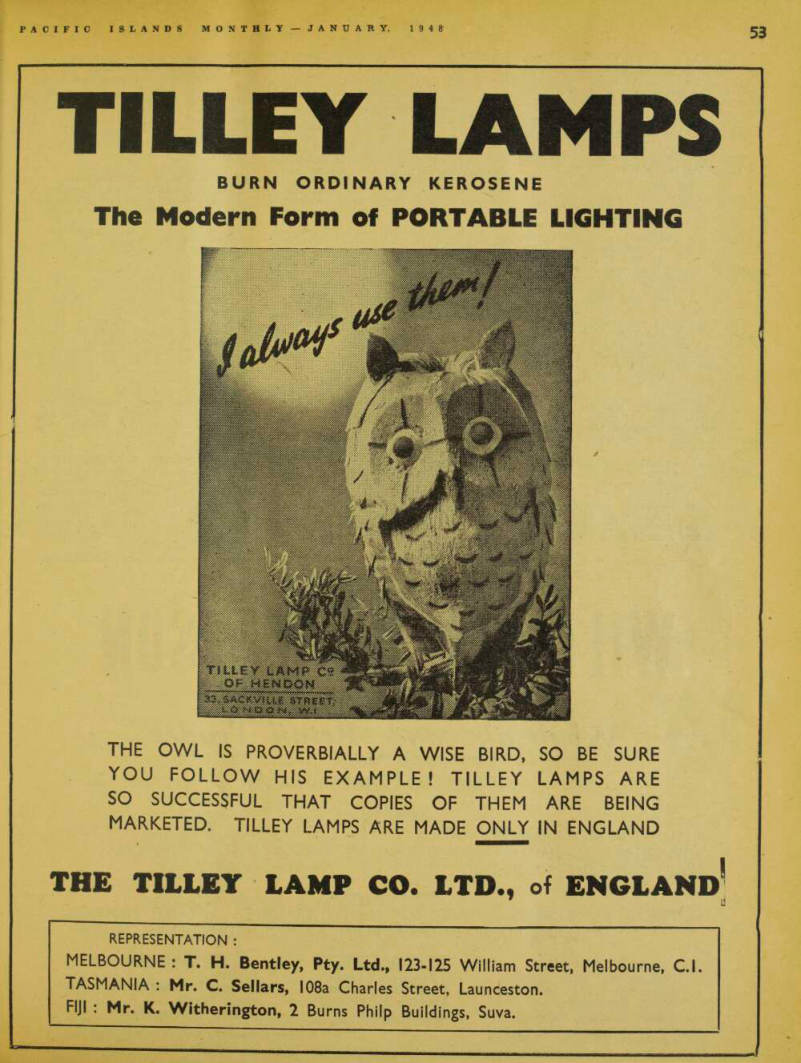
How Suva Was Burned In 1843
T'HE following account of the
early history of Suva was
written by Mr. Thomas Horne,
several years ago, for radio broad
casting.
The town of Suva was first
founded by the Fijians about 1820.
The native town was destroyed by fire, during a great battle in 1843.
Europeans, who began to settle in
Fiji about the middle of that cen
tury, removed the capital of Fiji
from Levuka to Suva in 1882, to the site of the old native town. ✓ mHE present race of Suva people, who X now live at Suva Vo, claim to have crossed the central tableland of Na Viti Levu, from Saivo, on its northern slope above the Viti Levu Bay. Their chief was Taba ni Mako Veve (branch of the crooked Mako tree) who, on the male side, is claimed to be an immediate des cendant of Degei, and hence was of very high rank, while his mother was a prin cess of the Veli, or the dwarf race, the primitive inhabitants of Fiji.
The first migration of the clan south ward towards Suva must have occurred hundreds of years ago.
Those dwarfs survived to a much later period in Vanua Levu, about the head waters of the Wainunu River. Charlie Connor, one of the earliest white men in Fiji, called them “Fairies.”
The ancestors of the Suva people reached the district lying to the south of the Waimanu River, and here they planted, and fished, and built frail vil lages whose names even are forgotten; but they gradually moved on towards the sea. For a time, they stopped about Tamavua, and at Rairainawaqa, which was in the early days the home of the Cuthbert family, and is now owned by Mr. Borron. They finally settled on the high land behind the present lunatic asylum, their citadel being the steep gray rocks of Uluvatu, which rises sheer up
from the waters of Walu Bay.
On the very top of this hill the mounds are still intact, as they were one hun dred years ago when the place was abandoned—they were the yavus on which the great houses stood. That nearest the road was the site of the chief’s house. Immediately in front of this is the council chamber, where the Veteran Chiefs lived; and a little below is the site of the temple of the God Rovono (the Turtle). (CUNNINGLY hidden amongst the trees J at the foot of the bluff was the cave, or refuge, for the women and child ren in times of danger.
The burial place of the Taukeis. or land-owners, was a shelf on the cliff; while the burial place of the chiefs was in a cave in Sea Lark Hill, now demo lished. The Matawawa. or landing place of the canoes, was in Walu Bay, among the mangroves at the foot of the cliff.
The whole place is a natural strong hold. On the flat between the top of the caves and the road were the dwel lings of the Taukeis, those of the Kai Walu, or fishermen, being nearest the sea; and here is still to be seen the yavu, or mound, on which formerly stood the Bure ni Sa, or Club House.
As the population of Uluvatu increased, from natural causes and partly from the accession of units from other clans, a new settlement, and new planting grounds, became necessary; and the site fixed on was the hill then known as Vatuwaqa, now better known as Flag staff Hill. Unlike Uluvatu, it could boast of no rock citadel; but its steep clay sides, rising from the low flats between it and Laucala Bay, made it a natural fort, and on the other sides it was pro tected, where necessary, by huge earthen ramparts, part of which still remain.
After the Suva people had removed from their hill forts, and built the town of Suva on the site of the present Gardens, which are next to Government House, what is now the cricket ground was also partly built on. The spirits after death were supposed to bathe in the little creek, Valeiwai, which runs into the sea at Draiba.
The former inhabitants of Suva shifted across the bay about 1882, and called their town Suva Vo. Their chief was Ratu Amborosa.
The old Fijians believed that every stream was sacred to some guardian spirit. Where the present Grammar School stands once was a cemetery, and called Quara ni moku kau. This phrase, now obsolete, cannot be translated liter ally. It means “The seeking of rest, or peace.”
There was one curious custom at Suva.
It was forbidden to whistle inside the town, as it was said to attract the mos quitoes. In Scotland, in my young days, we were not allowed to whistle on Sun days.
After Tabu ni Ni Mako Vevi, the first chief we can trace was called Batileka.
One of his descendants married Adi Moave of Bau, said to be a full sister of Tanoa. By her he had two sons, Tabukancoro, or Ravulo, and Tui Buia.
Great Bau ladies thought they had to marry whom they were ordered.
The reign of the next Suva Chief, Tabukancoro, was long and eventful. He intermarried with Bau. rpHE founding of the town of Suva J. occurred about 1820. Tabukancoro was a powerful chief. He was not only Tui Suva, with a following of canoe builders and fishermen, and could from his own tribe and their allies muster nearly 1,000 warriors; but he was also
Vasu to Bau, with all the priveleges that went with that dignity.
Knowing the danger of leaving such a, powerful ally of Bau, as Suva then was, m their rear, during the coming struggle, the Rewa chiefs determined to crush Suva. Rewa sent Tabuas to Burebasawa, Togo, Noco, Togodravu, Naselei, Nakelo, Tokotoka, and Lokia, and all of them, eager to share in the plunder, rallied round Rewa, against Suva.
Tabukancoro, the chief of Suva, knew of the danger that threatened him, for he had received information both from Bau and from his own spies. He drew in all his people from the outlying small towns. But his former friends across the bay, and down the coast to the west ward, did not respond as he had expected.
The Rewa people sailed into Laucala Bay, and landed the warriors on the mud flats on the Suva side of the mouth of the Nasinu River, arid they marched along the sandy beach round Muanikau, and formed up for attack on the Suva town, which was where Government House now stands.
The Rewa people had a brass canon, which was part of the plunder of a French ship. At the same time, the men from Kolobo, Tamavua and Waimanu, and every town westward as far as Mau, had mustered together, crossed the Nubu kalou creek, and coming down the old track to the sea near where the Church of England is now, they advanced along the beach. They passed through the bush which was on the present site of the Government Buildings, and prepared to attack from the north. fT\HE attack started about 3 p.m. As X usual, the attack started too far off to do much damage, and though the cannon knocked some of its posts about, it did not seriously injure the fence.
But the Lomai Vuna warriors, who were guests of the Suva people, turned traitors.
Seizing brands from the fire-places where only the night before they had sat and chatted with their hosts, they fired the town, and soon the interior of the fortress was converted into a roaring mass of flames. Every house was burnt, includ ing the temple of Na Vono.
Yet the warriors of Suva fought hard.
They fought back to back at the Northern gate, opposite the present tennis courts, one battalion holding back the Vuna clan inside the fortress, the other trying to force their way through the allied ranks outside.
The Suva men forced their way across the area where now are the public tennis courts, fighting to the end, that their women and children might have a better chance of escape. In the end, only a few broke through the ranks of the enemy that surrounded them; but if they left most of their best and bravest dead beneath the trees, they had at least the consolation of knowing that for every man of theirs who lay there dead, two at least of their enemies had been sent to the place whence no one returns.
Tabukaucoro —who, with his men, was holding the opposite side of the town seeing that the day was hopelessly lost, gathered his warriors together, and with a sudden .rush, broke through the Rewa ranks, and, holding them back, let the women and children through. He passed along the side of what is now Govern ment House, then went on to the old Rara, now the drilling ground for the Police. Then they passed behind Gov ernment House to Cable Hill, and crossed the little stream called Matana Wati (because in its still pools the maidens sought for the faces of their future hus bands) and found refuge among the great big trees that formed the Vu ni Ivi Here they lay till nightfall, being joined from time to time by stragglers from other parts of the fight.
There was but little sleep through that long dark night for the people of Suva, who lay on the ground at Vuni Ivi. At
times one woman, older than the rest, would steal out scouting, hoping to find her husband—for the true woman, no matter what her race, never deserts her mate.
When the stragglers came to Vuni Ivi, just before dawn, they silently crept along the track that led to the ford at Nai Samuni, and crossing this they at last reached their old fortress of Uluvatu.
In the meantime, their enemies feasted on the limbs of their kinsmen, or drank yaqona from their lost plantations. The men repaired the war fence where necessary, for the hill is so strong naturally as to need but little artificial aid for its defence.
For two days the greater part of the victors feasted or slept in Suva. For the plantations were full, and the turtle ponds had been well stocked for their Lomai Vuna guests, while roast bokola was so plentiful that even the meanest camp-follower might hope at least to pick the bones after his betters had finished with them.
AS soon as the town of Suva had fallen, a mata (which means a herald) was sent by the Rewa chiefs to Tanoa, at Bau, to state that by the burning of Suva the insult to them had been atoned fpr, and that the war would now cease.
But on the third morning the Rewa
chiefs, with their followers, moved up from Suva and joined the forces on the heights around Uluvatu.
After a council of war, the Suva chiefs agreed to send a Soro—large Tambua, or whale’s tooth —and one of the fairest maids in Suva, for such was the custom of the land.
Sh£ was a chieftain’s daughter—for to offer a slave-girl would have been an insult. Tall and comely, she no doubt, like many a maid before and since, had had her day-dreams of the Prince Charming who would come to claim her from her people—for was not Suva the close ally of Bau, where all were chiefs.' But such hopes were now gone, forever.
She bathed at dawn, and what little oil was in the .camp was used to annoint her. Dressed in her best finery, she walked forth to death. Unfortunately, no one knows her name. Perhaps the Suva people made it a point of honour to conceal it.
So on the morning of April 9, 1843,
Korotabitibi, the “Mata ko Vuna,” set out with the Soro. They left the cave of refuge, and crossed the fort and through the western entrance, on what is now the reservoir road, and entered the Salata track. This leads south and west of the reservoir, and through Sir Maynard Hedstrom’s grounds, known as Vunivutu.
Less than half a mile from the fort they met the hostile chiefs, of whom Ca mai Sala was leader for Quaraniquio was on his canoe at Walu Bay. The Mata presented the tooth, and prayed the conquerors to spare the lives of his clan, and to allow them to pass in safety.
The Rewa chiefs,. who had known of the coming of the embassy, and who were unwilling to attack desperate men in their almost impregnable stronghold, had decided on their answer. The Soro Was accepted, and, according to Fijian law the lives of the Suva people were safe, and the Mata, or herald, returned with the answer. But he returned alone.
NOW, when a Soro was once made, and the accompanying offering ac cepted, it was Tabu to break coven ant made in connection with it, and we may give Ca mai Sala credit for intending to see that the Suva people were safe.
But it would have been remarkably close to a miracle if over 500 women, feebly protected, had been allowed to pass un scathed through the encircling hostile ranks.
The trouble did not take long in start ing. Close to the south-western corner of the Reservoir, the old natives still point out the spot. Kovelevu, a Rewan chief, seized hold of a Bega woman who was carrying her child (for she was the wife of a Suva warrior). The woman struggled fiercely to get free, and in his anger the man clubbed her and killed her on the spot. The blow was in all probability unpremeditated—but the Tabu was broken.
By shouts, the Suva warriors urged the women to rush past, while they put up a gallant fight in their defence. The fight went on, past where now stands Mr. Ellis’s house; but no one could stand against such odds.
Tabukancoro, with the few warriors left, and such women as could keep up with them, was forced down the steep slope towards the Tamavua River; while Ratu Naileba and his party, when further fighting was useless, and screening all the women they could, took refuge in the deep gully on the opposite side of the road, which is mostly dry, but in tropic rains forms the headwaters of Vatuwaga Creek.
But by far the greater number of the women and children who had escaped death from club or spear in the running fight, were hemmed at Na Ca, the place of evil. Behind them was the steep, precipitous cliff which falls down for a hundred feet to the low bank of the Tamavua River. Then followed one of the darkest tragedies in Fiji history.
The women crowded together on the top <pf the bluff, and died with the stoic fatalism of their race. It is estimated that the number slain from the time that the Bega woman was clubbed, until the last victim fell at Na Ca, was over 400.
After a while the victors fell back, some to their camps at Rairainawaga, and some to the adjacent town of Tamavua, which was in those days nearer the river than it is to-day, to indulge in the banquet on the slam. Long before dark two large war canoes, gunnel deep, sailed out of Walu Bay, and Quaraniquio returned to Rewa.
AFTER the fleet and army of Rewa had returned home, Tui Dreketi sent Kovelevu to Bau, as herald. On his arrival at Bau, he was met by Tui Sau waga, the Bau herald, to whom he gave his message. This took place in front of Cakobau’s house, known as Matanikai lagi. $ Cakobau, who was eating at the time, hearing them speak, came outside, and, throwing on the ground the crab he held m his hand, demanded “Who is this man who brags that he has burned Suva”?
Korolevu drew himself up to his full height and said, “I fired the town of Suva.”
Then the old King Tanoa, who was seated inside the great Vata Ni Tawake, which was near by, called to his son to come to him, and, on his entering, cried put; “Who is going to pay for the burn ing of Suva.”
Cakobau answered: “I am not dirt. I will pay in full for the burning of Suva.”
Tanoa rejoined; “See that you do.”
How Cakobau kept his word is written across the pages of Fijian history.
After the fight and the feasting were done, the Rewa people and their allies realised that they had mortally offended Bau, and gained her bitter enmity; and Bau held the power of the sea.
Accordingly, the Lomai Vuna people,
and those of Lami, fell back on the in land towns on the Waimanu River. The people of Veisari and of Wai Vuso re tired to the headwaters of that stream.
Even the people of Mau took shelter for a time on Bega.
For over a year, the shores of the bay of Suva were as untrodden by man as in the days of the creation. (This story of pre-European Suva will be concluded in February, “PIM.”)
Advertisements & other items, pp. 53-55 (1 item)
Finishes
M V X N V \ \ \ \ > Z 4 X' '
'V.'x'x'
Trop
3mm Every Berger finish must withstand test after test to prove worthy of the Berger label . . . every product must satisfy the Berger technicians and chemists that it will meet the challenge of all climates from tropic heat to arctic cold.
FINISHES
KEEP ON KEEPING ON!
From WHOA !
SIMPLEX
MARINE ENGINES
3, 5 and 10/12 h.p. Suitable for all crafts from 14-32 ft. The 5 and 10 h.p. are supplied with built-in reverse gear. All Australian made. Prices and specifications on request.
C.Q.R. ANCHORS
The lightweight anchor with three times the holding power of any other anchor. No more efficient tool for quick and positive “dig-in” has ever been found than the ploughshare. The O.Q.R. Is two well designed ploughshares welded together. Write for C.Q.R. Anchor leaflet. \
to GO!
W. KOPSEN & CO. PTY. LTD.
Have EVERYTHING for Boats
FISHING
TACKLE
Our new Fishing Department has been opened to provide the utmost service and satisfaction in all classes of fishing gear. Marlin Gut lines, Fishkil Nylon Twist, Geisha Wire Traces, Linen and Cotton lines. Rangoon and Split Cane Rods, Reels and numerous other lines.
KAYEN PRESSURE LAMPS
The all Australian made vapour lamps— reliable—efficient—safe—easy to operate.
Burns for 10 hours on VA pints of kerosene. The lamp illustrated is of 300 C.P. and is the table model (HL7); the allpurpose lamp (AP2) is windproof and ideal for outdoor work. Burn ordinary kerosene. Write for illustrated leaflet.
SHIPCHANDLERS & MARINE ENGINEERS
376-382 KENT STREET, SYDNEY. PHONE: MA 6336 (9 lines).
Cables: “KOPSEN” Sydney.
TILLEY LAMPS
BURN ORDINARY KEROSENE
The Modern Form of PORTABLE LIGHTING
/ mm itti THE OWL IS PROVERBIALLY A WISE BIRD, SO BE SURE YOU FOLLOW HIS EXAMPLE! TILLEY LAMPS ARE SO SUCCESSFUL THAT COPIES OF THEM ARE BEING MARKETED. TILLEY LAMPS ARE MADE ONLY IN ENGLAND THE TILLEY LAMP CO. LTD., of ENGLAND 7 H
REPRESENTATION :
MELBOURNE : T. H. Bentley, Pty. Ltd., 123-125 William Street, Melbourne, Cl.
TASMANIA : Mr. C. Sellars, 108 a Charles Street, Launceston.
FIJI : Mr. K. Witherington, 2 Burns Philp Buildings, Suva.
Questions At Trusteeship
Council
WHEN the Trusteeship Council in New York began consideration on Dec ember 1, of the United Nations Mission’s report on greater powers of self-government for Western Samoa, Awni Khalidy (Iraq) said the report was evidently thorough and sincere, but he questioned some of the recommendations.
He singled out for special criticism re commendations which would provide for European residents of Western Samoa a disproportionate representation in the Government and the right of Europeans to trial by a European Chief Judge or Commissioner.
Awni Khalidy also sought clarification of the exact powers for the proposed High Commissioner. If these powers in cluded veto over money bills, he said, Samoans would be left with very little self-Government.
The report was still under consideration, carry in December.
The recent report of an export levy on the export of soap from New Zealand to Samoa was correct. The levy affects only countries outside New Zealand and her dependencies.
Moresby
The Month In
From Our Own Correspondent
Port Moresby. Dec. 18.
NEW Guinea personalities who re cently met in Moresby—at the local hotel—included the ever-young Syd.
Young, now a member of Island Indus tries, with headquarters at Lae; Richards, one-time Inspector of the Expro-Board and now with PCB; Jack Sedgers, of W .R. Carpenter & Co., Madang; “Blue”
Allan, returning from the RSL congress at Canberra; and Bert Perriman, making one of his periodical visits, for the WRC firm. It is marvellous how these “other siders” stick together. Even in Moresby’s everyday life there are two distinct social groups with apparently different in terests. One wonders if the barrier will break down under the proposed single administration of the Territory of Papua and New Guinea.” * * * A RECENT statement of the Native Labour Department -gave the aver age for unloading ships for the month of November, at Moresby, as 21.5 tons per working hour. This represents a considerable improvement upon recent figures. * * * PORT Moresby parents have sent a petition to the Minister for External Territories seeking financial assist ance to send their children to Australia for post-primary schooling which cannot under present conditions be provided locally. It is understood that the Ad ministration made a recommendation to Canberra in this matter months ago— without result.
ON present salaries, and with rapidly spiralling cost of living, the average parent finds it impossible—short of starving—to pay up to £l5O per annum for each child sent to boarding school in Australia. It is understood that this is one of the subjects listed by the local Public Service Association for discussion with the Minister during his visit in January. * * * THE ABC has announced that a new high-frequency radio transmitter is to be installed at 9PA, within a short time. The present station, which was taken over from the Army, has a very limited reception radius and the new station will be designed to cover the whole of the combined Territory. * * * A REVIVAL and extension of Boy Scout activities is promised, particularly among the native youth. Two groups have been formed at Hanuabada and a camp for instruction of native leaders is to be held during the New Year vacation. The local District Scout Com missioner is Mr, Norman White, solicitor of Port Moresby, and he is assisted by a representative committee forming a local Association.
Scouting has been a popular and effective interest for natives in Fiji and other Pacific Islands and its develop ment in Papua-New Guinea will be watched with interest. * * * Archdeacon romney gill, the longest-service representative of the Anglican Mission in Papua, whose hazardous adventures during the Jap occupation of the Buna area are re membered in these parts, passed through Moresby from his station on the Mamba recently. He went on to Australia for medical treatment.
He is a modest man of many talents and is highly respected by the European community and almost a legend to the natives whom he has served continuously for four decades. * * * I, , . , , N recent days, numerous children have been passing through Port Moresby on their way to their homes in different parts of the Territory, after attending school in Australia.
The Administration arranged for their reception and onward movement from Port Moresby, including cost of the latter.
This service is much appreciated by parents, particularly those in the remoter outposts. * * * ON a short visit to the Territory during December was Dr. Margaret Granger, wife of Mr. Bill Granger, head of Animal Husbandry Division of the De-
partment of Agriculture. Granger spent a year or so after the war with UNRRA in China. His present job is to re establish livestock, including pigs, in the Territory. He will specialise in breed ing locally, and already one establish ment for this purpose has been set up at Erap in the Markham Valley, „ * mHE proposed visit of Minister Ward has aroused much interest in the town T h e local branch of the ALP has made arrangements for a dinner in his honour and it is understood that this organisation has a long list of matters for discussion with him. One matter is the general dissatisfaction with the price control arrangements in the Territory, which fail to keep pace with the pro gressively rising cost of living, The local Public Service Association is also preparing a lengthy agenda.
It is rumoured that the Minister will make himself readily accessible to the general public and to enable this to be done he may not be domiciled at Gov ernment House during his visit.
A public meeting in the picture theatre • has been suggested, where Mr. Ward might address the assembled Europeans and answer questions of general interest. * * * THE number of Commonwealth depart ments and their personnel in the Territory is rapidly increasing. Civil Aviation Works and Housing. Meteoro logical Service, Shipping Directorate are amongst the recent arrivals, in force. In all of these cases, accommodation has to be found although a large number of Ad ministration personnel themselves are in adequately provided for, including at least 40 married men in the Port Moresby area alone who are eagerly seeking the opportunity to establish their homes.
If certain of these departments would concentrate on the local production of building material rather than sharing the limited amount of accommodation now available, the position would be eased.
A recent rumour is that the PMG De partment of the Commonwealth will take over all local postal and tele-communi cations services. And no one apparently feels “het up” about this proposal although there is no complaint against the local postal services as they have (operated against great difficulties since the inception of the Provisional Administra tion. * * ♦ IT appears possible that the planners have finished their work in connection with the designing of the new town of Lae. No one seems to have seen the plans in their completed- form and no doubt there will be many anomalies and particular objections as well as the gen eral objection to the post-war emphasis on “planning.”
From all accounts, however, any planned rebuilding of Lae would be acceptable if it were carried out quickly for no one has been discovered who expresses satis faction with the shambles of a settlement that has grown up there since the war.
The citizens of Lae deserve much better in the way of living conditions; and the sooner these are provided, by planners, or anyone else, the better. • * * THE Anglican Bishop of New Guinea, the Rt. Rev. P. N. W. Strong, who had a pretty active time during the war, has been busy in Port Moresby the last few days. He has just returned from Australia and his engagements in cluded three baptisms and a confirmation service as well as the regular Sunday ser vices at St. Johns on the Hill, at which he officiated.
Prior to his hurried visit to Melbourne for an important episcopal gathering, he had spent two months in a village-to village tour of the Northern Division of Papua.
The Bishop will return to Samarai by the December “Montoro” but he will not have much time at his headquarters at Do gura before he will be off again, this time to the Lambeth Conference of Bishops in London. Archdeacon A. J. Thompson, much loved Anglican Mission represent ative at Samarai, will administer the affairs of the diocese during the absence of the bishop. * * * THE comments made by the Acting Director of District Services and Native Affairs, Mr. J. H. Jones, on his recent official visit to the Polynesian outliers off the New Ireland and Buka coasts, were interesting. He contrasted the happy and healthy conditions of the people of the Mortlocks and Tasmans
with those of the more sophisticated natives of parts of Papua and New Guinea.
The last European visit to the Mort locks —except for a couple of US Navy personnel cast up during the war and later rescued —was in 1939. There being no trade stores or other European in fluences on these islands, the people have reverted to their natural state and were thriving on the old-style fish and coconut economy. Of special significance was the increase in the population and the absence of any widespread disease.
The Japs left these people alone during the war. Perhaps their remoteness will allow them to be left alone to flourish for another few years at least.
THERE was no sign in Port Moresby of a revolution at the news' of the pro posed amalgamation of the two Territories. All the sighings and drear prognostications of a few “old hands” seem to have been worked out during the prolonged life of the “provisional” set-up.
Perhaps the news will enable the Euro peans of the Territory to settle down to a solider sense of security. It Is doubtful if the new arrangement will have any special effect upon the everyday life of tne individual—it is certainly too much to hope that it will influence the rapidly rising cost of living, or improve the sup ply position by providing a more reliable and regular overseas shipping service.
Whether there will be decentralisation through regional sub-capitals or control will continue to be from Port Moresby, is not known. But it would appear likely that Kopopo and Lae will assume more administrative importance than at present—and such a move would be uni versally applauded. * * * District officer j. taylor, of the Central Highlands, to which he now belongs by right of his pioneer patrols, was in Moresby in early December.
He has now gone off for a short break to Australia. Mr. Ivan Champion, As sistant Director of District Services and Native Affairs, has taken over his dis trict for the time being. ♦ ♦ * A PLANE load of European potatoes and cabbage came into the local market recently from the cool, fertile High lands. These- were eagerly sought by Moresby housewives who queued up for an hour or more to get their share. It is hoped that regular supplies will be forthcoming but flying conditions make any such arrangement uncertain and irregular and the vegetables expensive in consequence. A better plan to meet the needs of barren Moresby might be to transport tropical vegetables and fruit from Rabaul. As the regular Qantas freight is 1/- per pound, Moresby residents would find the buying more reasonable than the current rates for local produce on stuff imported from Australia. * * * THE latest issue of the Papua-New Guinea Government Gazette lists a wide range of new jobs to be filled. They
include dental officers, X-ray technicians, pathologists, librarians, storemen, district agricultural officers, and saw-doctors for the Forestry branch. Clerks appear to be required all the time and there is a con tinuous dearth of typists in the Admin istration, in spite of the employment of a large percentage of the married women of Moresby. * * * THE retirement has been announced, from the Chairmanship of the Methodist Mission of Papua, of the Rev. R. J. Andrew, who returned to the Territory after the war to help in re establishment. His temporary successor is the Rev. F. Grey, another old-timer who also came after the war although he had actually retired from the field a decade ago.
Advertisements & other items, pp. 56-58 (1 item)
William H. Watson
ESTABLISHED 1930
RAROTONGA, COOK ISLANDS
Wholesale and Retail Trader
LICENSED STAMP DEALER
Agent For:—
BRITISH TRADERS' INSURANCE CO.
CORONA Cr L. C. SMITH TYPEWRITERS
KAISER & FRAZER MOTOR CARS
B.S.A. CYCLES AND MOTOR CYCLES
AMERICAN LEAD PENCIL CO.
WHITES AVIATION LTD.
Manufacturers of: FOOTWEAR, ALL CLASSES SUITABLE FOR NATIVE TRADING . . . M.O.P. PRODUCTS, INCLUDING ROUND EAR-RING BLANKS AND BUTTON BLANKS Exporter of: “Rarotonga” Hula-Skirts.
Sea-Shell Necklaces.
M.O.P. Jewellery.
Island Produce.
Wholesale and Retail Inquiries Invited .
Prepared to Consider Agencies for all Class of Goods .
Importer of: Textiles.
General Hardware.
Fancy Goods.
General Merchandise.
Cable Address: “Watson” Rarotonga Bankers: Bank of New Zealand, Auckland.
A NEW SHIPPING SERVICE
TO THE ISLANDS
- from New Zealand
The Union Manufacturing and Export Company Limited, Wellington have pleasure in announcing that they have obtained and will commence shortly to operate two modern Motor Vessels with a carrying capacity of approximately 250 tons each.
These vessels can be made available for any Island trade either on charter or on other arrangements for which propositions are invited.
It is our intention to build up trade between New Zealand and the Pacific Islands and we shall be pleased to contact individuals and Companies interested in the import and export of all trade commodities.
Your further inquiries will he welcomed.
UNION MANUFACTURING
& EXPORT CO. LTD.
G.P.0., Box 1060, Wellington, NEW ZEALAND Cables : “UMEC,” Wellington.
Branches at Auckland, Christchurch, Sydney, Melbourne.
Agents throughout the World.
FOR IMPORT
We are interested in purchasing all types of Island produce for New Zealand’s own use and re-export to other countries all raw materials, fruit, shells, timber, hides, skins, bones, and scrap metal of all kinds.
FOR EXPORT
We can offer for prompt delivery a wide range of New Zealand products, including cheese, apples, canned foods, tinned butter, condensed milk, milk powder and all classes of manufactured goods, hardware, textiles and machinery.
American Magazines
Direct to You -from the Publishers.
AMERICAN HOME 17/-
ASIA AND THE AMERICAS 32/6
BETTER HOMES AND GARDENS 21/9
CHARM 32/6
COLLIERS’ JVEEKLY 48/-
CORONET 18/9
ESQUIRE (2 YEARS ONLY) 95/-
FORTUNE 87/-
GLAMOUR 27/-
HOUSE AND GARDEN 42/6
JUNIOR BAZAAR 35/-
LADIES’ HOME JOURNAL 37/6
LIFE 49/-
LOOK 32/-
NEW YORKER 64/6
NEWSWEEK 78/-
POPULAR MECHANICS 22/9
POPULAR PHOTOGRAPHY 26/6
READER’S DIGEST 12/-
SATURDAY EVENING POST 62/6
SCIENTIFIC AMERICAN 40/-
SCIENCE ILLUSTRATED 62/6
TIME 80/-
Rates are for one year and include all charges. Many other overseas
Art, Trade, Technical, Fashion and
Literary periodicals available.
ALL ORDERS AIR-MAILED TO
PUBLISHERS.
MAIL PUBLICITY CO., 175 PITT
STREET, SYDNEY, N.S.W.
AUNT
MARYS
CREAM OF TARTAR
BAKING POWDER
Now Better than Ever!
Death Of Missionary
Builder In Buka
THE Methodist Mission in the Solomons has suffered a setback through the death of Mr. Charles Carter, of Auckland, New Zealand, at Buka, on Oc tober 25, less than a month after his arrival there from New Zealand.
Mr. Carter was a highly qualified fore man-builder who volunteered his services to assist in rebuilding mission stations on Bougainville. He had sailed from New Zealand on September 2, travelled by way of Sydney and Rabaul and reached Buka on September 29, There he was welcomed by the mission staff and he at once set to work to put to good use the building materials which the mission had available in the Bougainville area.
His services as a builder would have been of inestimable value to the missionaries on Bougainville.
In a tribute to Mr. Carter’s devotion to the cause of the mission, the “New Zea land Methodist Times” said: “The measure of this good man’s service to the Solomon Islands will not be measured by his few weeks on the mission field, but by the great love and devotion that con strained him. The native people will be conscious of this.” Mr, Carter leaves a widow and four children.
Progress of APC Bore
THE Australasian Petroleum Company Pty. Ltd., reported that, as at No vember 29, 1947, drilling of the bore at Kariava, Papua, had reached 10,603 feet, depth drilled during the month be ing 451 feet.
Function To End Apia
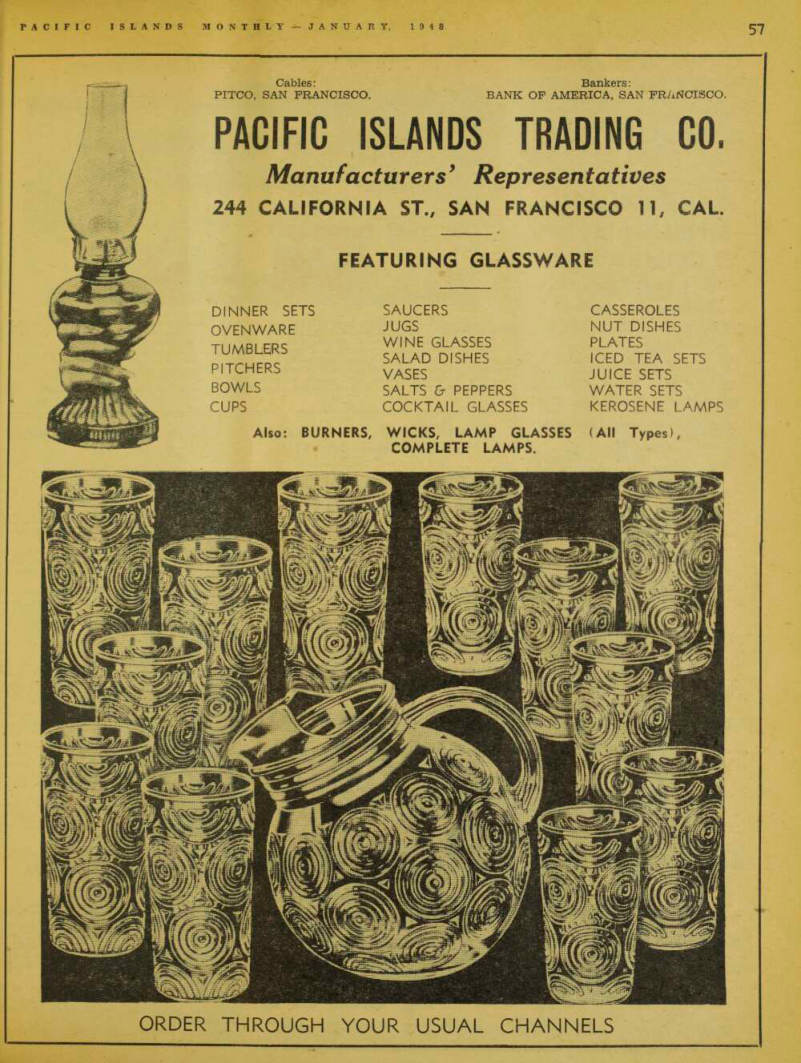
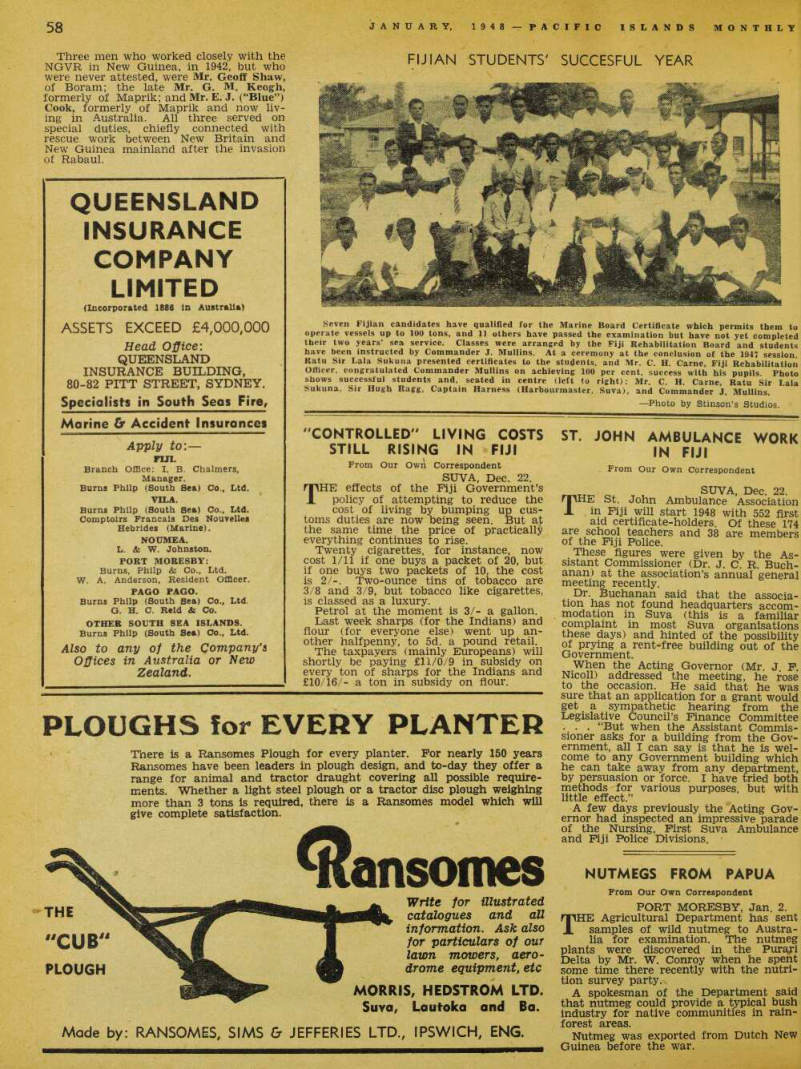
Golfing Season
From Our Owfl Correspondent
Apia. Dec. 11.
A DINNER dance was recently held at the Casino Hotel, Apia, to mark the close of a very successful golfing season.
About 100 people attended the func tion at which the Administrator, Lt.-Col.
F. W. Voelcker, DSO, MC, Patron of the Club, proposed the loyal toast.
The Club has now existed for 22 years. It was founded in 1925 by three gentlemen, one of whom, Mr. H. W.
Moors, is still an active member and now the Club’s Honorary Coach.
The Club is fortunate in its efficient secretary, Mr. W. A. Turner, and a good committee: Judge Herd, Messrs. A.
Macdonald, E. F. Paul, W. R. McCul loch, R. J. Vickers, H. W. Moors, and H.
S. Newton.
Membership for the season had been declared closed at 66 with a waiting list of 15, proof of the great interest shown in the sport.
Three men who worked closely with the NGVR in New Guinea, in 1942, but who were never attested, were Mr. Geoff Shaw, of Boram; the late Mr. G. M. Keogh, formerly of Maprik; and Mr. E. J. (“Blue”) Cook, formerly of Maprik and now liv ing in Australia. All three served on special duties, chiefly connected with rescue work between New Britain and New Guinea mainland after the invasion of Rabaul.
Advertisements & other items, pp. 59-60 (1 item)
Pacific Islands Trading Co.
Cables:
PITCO, SAN FRANCISCO.
Bankers:
BANK OF AMERICA, SAN FRANCISCO.
PACIFIC ISLANDS TRADING CO.
Manufacturers y Representatives
244 CALIFORNIA ST., SAN FRANCISCO 11, CAL.
FEATURING GLASSWARE
DINNER SETS
OVENWARE
TUMBLERS
PITCHERS
BOWLS
CUPS
SAUCERS
JUGS
WINE GLASSES
SALAD DISHES
VASES
SALTS & PEPPERS
COCKTAIL GLASSES
CASSEROLES
NUT DISHES
PLATES
ICED TEA SETS
JUICE SETS
WATER SETS
KEROSENE LAMPS
Also; BURNERS, WICKS, LAMP GLASSES (All Types),
COMPLETE LAMPS.
m r w m E9i m u m. 1 m Hi m % ft. *- B B m r m i £ I m as % i 1 m m V/ V;
ORDER THROUGH YOUR USUAL CHANNELS
QUEENSLAND
INSURANCE
COMPANY
LIMITED
(Incorporated 1886 In Australia)
ASSETS EXCEED £4,000,000
Head Office:
QUEENSLAND
INSURANCE BUILDING,
80-82 PITT STREET, SYDNEY.
Speciolists in South Seas Fire,
Marine & Accident Insurances
Apply to:—
FIJI.
Branch Office: I. B. Chalmers, Manager.
Burns Phllp (South Sea) Co., Ltd.
VILA.
Burns Phllp (South Sea) Co., Ltd.
Comptolrs Francals Des Nouvelles Hebrides (Marine).
NOUMEA.
L. & W. Johnston.
PORT MORESBY:
Burns, Phllp & Co., Ltd.
W. A. Anderson, Resident Officer.
PAGO PAGO.
Burns Phllp (South Sea) Co,, Ltd.
G. H. C. Reid & Co.
OTHER SOUTH SEA ISLANDS.
Burns Phllp (South Sea) Co., Ltd.
Also to any of the Company's Offices in Australia or New Zealand.
PLOUGHS for EVERY PLANTER
There is a Ransomes Plough for every planter. For nearly 150 years Ransomes have been leaders in plough design, and to-day they offer a range for animal and tractor draught covering all possible requirements. Whether a light steel plough or a tractor disc plough weighing more than 3 tons is required, there is a Ransomes model which will give complete satisfaction.
THE
a
CUB
PLOUGH
Mtansomes
Write lor illustrated catalogues and all information. Ask also for particulars of our lawn mowers, aerodrome equipment, etc
MORRIS, HEDSTROM LTD.
Suva, Lautoka and Ba.
Made by: RANSOMES, SIMS Cr JEFFERIES LTD., IPSWICH, ENG.
Fijian Students' Succesful Year
Seven Fijian candidates have qualified for the Marine Board Certificate which permits them to operate vessels up to 100 tons, and 11 others have passed the examination but have not yet completed their two years’ sea service. Classes were arranged by the Fiji Rehabilitation Board and students have been instructed by Commander J. Mullins. At a ceremony at the conclusion of the 1947 session Ratu Sir Lala Sukuna presented certificates to the students, and Mr. C. H. Carne, Fiji Rehabilitation Officer, congratulated Commander Mullins on achieving 100 per cent, success with his pupils. Photo shows successful students and, seated in centre (left to right): Mr. C. H. Carne, Ratu Sir Lala Sukuna, Sir Hugh Ragg, Captain Harness (Harbourmaster, Suva), and Commander J. Mullins.
Photo by Stinson’s Studios.
"Controlled" Living Costs
Still Rising In Fiji
From Our Own Correspondent
Suva, Dec. 22.
THE effects of the Fiji Government’s policy of attempting to reduce the cost of living by bumping up cus toms duties are now being seen. But at the same time the price of practically everything continues to rise.
Twenty cigarettes, for instance, now cost 1/11 if one buys a packet of 20, but if one buys two packets of 10. the cost is 2/-. Two-ounce tins of tobacco are 3/8 and 3/9, but tobacco like cigarettes, is classed as a luxury.
Petrol at the moment is 3/- a gallon.
Last week sharps (for the Indians) and flour (for everyone else) went up an other halfpenny, to sd. a pound retail.
The taxpayers (mainly Europeans) will shortly be paying £ll/0/9 in subsidy on every ton of sharps for the Indians and £lO/16/- a ton in subsidy on flour.
St. John Ambulance Work
In Fiji
Prom Our Own Correspondent T tt „ , SUVA, Dec. 22. he St. John Ambulance Association in Fiji will start 1948 with 552 first aid certificate-holders. Of these 174 are school teachers and 38 are members of the Fiji Police.
These figures were given by the As sistant Commissioner (Dr. J. C. R. Buch anan) at the association’s annual general meeting recently.
Dr. Buchanan said that the associa tion has not found headquarters accom modatiqn in Suva (this is a familiar complaint in most Suva organisations these days) and hinted of the possibility of prying a rent-free building out of the Government.
When the Acting Governor (Mr. J. P.
Nicoll) addressed the meeting, he rose to the occasion. He said that he was sure that an application for a grant would get a sympathetic hearing from the Legislative Council’s Finance Committee . . . “But when the Assistant Commis sioner asks for a building from the Gov ernment, all I can say is that he is wel come to any Government building which he can take away from any department, by persuasion or force. I have tried both methods for various purposes, but with little effect.”
A few days previously the Acting Gov ernor had inspected an impressive parade of the Nursing, First Suva Ambulance and Fiji Police Divisions.
Nutmegs From Papua
From Our Own Correspondent
Port Moresby, Jan. 2.
THE Agricultural Department has sent samples of wild nutmeg to Austra lia for examination. The nutmeg plants were discovered in the Purari Delta by Mr. W. Conroy when he spent some time there recently with the nutri tion survey party.
A spokesman of the Department said that nutmeg could provide a typical bush industry for native communities in rain forest areas.
Nutmeg was exported from Dutch New Guinea before the war.
Hallucinations Plus
Letter to the Editoi IN a recent article in the “Sydney Morn ing Herald,” the Minister for the De partment of External Territories. Mr.
E. J. Ward, appears to have made some wild statements regarding the supply question in New Guinea.
As Mr. Ward has not visited the vast tract of land north-east of Papua, known pre-war as the New Guinea Mandated Territory, it must be difficult for him to understand the difficulties of distribution.
He further intimated that if supplies were low he felt sure that the Admin istrator would have written to him. This statement to me seemed ludicrous. The only way the Administrator could know of events in the New Guinea territory would be to make a personal visit or, better still, to live on “the other side.”
In Port Moresby there has been refrig eration for many months and supplies of fresh foods are shipped there more regularly than in other ports.
But what of the position in ports which are not so well served?
Let us examine the milk situation. First, we get no cow’s milk. Secondly, the last stores of malted, powdered, sweetened condensed milk came to one port of two hundred-odd residents early in September. This was far below the quota and for the last two months the two stores have been unable to supply even nursing mothers, pregnant women, or children with this very necessary article of food.
The meat position is worse. As there has been no refrigeration to date, meat other than tinned has been non-existent for about three months.
Supplies of flour, butter, eggs, apples, oranges and the like have over the last four months become so depleted that it is almost impossible for women to bake.
Expenses are high and on the few occasions when meat is procurable it costs 3/4 per lb. for chops, 2/- per lb. for liver, and anything above 12/6 for small joints.
Butter is 3/9 a pound and apples can be 6/- a dozen.
Yet our happy Canberra visitors assure us that living here is so low, and that they pay so much more for pine-apples than we do. As a ground for comparison, pineapples are ridiculous. It would be much more to the point if we compared the cost of bread. In many parts of the territory residents pay more than 2/- a loaf* for this basic commodity. The equivalent of such a loaf would cost, in Australia, fivepence.
I admit I only live in the Territory and that my only way of knowing I am short of essential foodstuffs is to experi ence the shortage. I may be suffering from hallucinations. This, too, may be a wild idea but I fancy—l said “fancy”— that Mr. Ward gets a much larger salary and allowances to cope with the cost of living, in Canberra, than husbands get in New Guinea.
I am, etc.,
Joan Stevens.
New Guinea, December 16, 1947.
At the recent opening of a new LMS village church at Solo Solo on the east coast of Upolu, Western Samoa, one of the largest crowds which ever gathered for such an occasion attended the func tion which lasted for a week. More than £7,500 in contributions were collected and the enormous crowd consumed moun tains of food, including over 7,000 kegs of salt beef, large quantities of biscuits, bread, tinned meat, pigs, fowls, etc.
Judd - Compton Wedding
Miss Denise Elaine Judd, Only
child of the late Colonel C. C. Judd, of Morobe, New Guinea, and Mrs.
F. McCormack, now of Toowoomba (QJ, was married in Melbourne in December to Captain David Compton, of the Aus tralian Staff Corps. She was given away by Colonel J. Walstab and attended by Mrs. B. Gurr and Miss Winsome Hardaker.
Guests at the reception included Mrs.
Orton Townsend, aunt of the bride, Mrs.
H. A. Gregory, Captain and Mrs. Frank McCaffrey, Lt.-Col. Tim Tape, Lt.-Col. and Mrs. Ben Dawson, Robin Mantle and Lindsay Webb.
Mr. and Mrs. Aubrey Schindler arrived in Brisbane recently by plane from New Guinea. Mr. Schindler, who is in charge of the Government Experimental Station at Aiyura, in the Central Highlands, is on three months’ vacation.
After a fortnight in Fiji, an Australian, Mr. w B Tann er recently returned to Sydney. He said that living in the Colony was too expensive. Eggs were 3/6 a dozen, if you could get them. Bread was 9d. a loaf and soap, at 1/3 a cake, almost unprocurable. Fiji, he said, had not been what he expected. He had gone there as a health officer but had re signed after two weeks.
Advertisements & other items, p. 61 (1 item)
fltlßNr •
PACIFIC ISLANDS SOCIETY
Visitors from the Islands to Sydney (or tho«» interested in Islands affairs), are advised to communicate with the honorary secretary of the above Society, which has been formed to study the history, traditions, economics, and political developments of '’the Pacific Islands.
Regular monthly meetings are held at History House, 8 Young Street, Sydney.
Address for Correspondence:
THE PACIFIC ISLANDS SOCIETY
Box 2434 MM.. G.P.0., Sydney.
pAS>
fltlßNr •
V ■* It’s a great feeling, on the road, to know the other fellow is your friend. The “Share-the-Road” League is a vast brotherhood of motorists who are courteous, competent, thoughtful—who consider other motorists and pedestrians at all times. Join the League and be proud of the badge on your car. cD ®d ra ?um
SHARE-THE-ROAD aism am
HOW TO JOIN. You can join at garages and service stations throughout the State ... or at your nearest Shell Office, Depot or Agency. You will receive your membership card, and the “ flag ” badge, as shown above but in full colours, for your car.
Man Overboard!
Captain C. O. Andersen, Of
Samarai, writes as follows; In the October “PIM,” I noticed a story about “Man overboard,” which brought to my mind an experience I once had of a similar kind. , It happened off the coast of New Guinea, in 1896, on a steamer called the “Ysatael,” recently purchased by Burns, Philp & Co. from the German New Guinea Co.
The former captain and crew were passengers, being returned to New Guinea, and the former German captain acted as a pilot when getting into NG waters.
Captain Thomas Williams was master; Mr. Robinson was first mate and I was second mate. , Nearing the NG coast, the mate was setting the accommodation ladder out, Ind hid one of the NG boys down on the extreme end, trying to ship the platform.
The boy did not know how to 'go about it and the more the mate roused on him the more confused he became, and did not get along with the job at all.
As I happened to come along, I said to the mate that I would hop down and secure the platform, to which he agreed.
Getting down to the extreme end, I took the heavily ironed platform away from the boy and hold him to get behind me.
I had just got it into place, and was shooting the long lock bolt into place (to do this I had to lean well over the ex treme end of the ladder) when the tackle came undone above; the ladder (or the end of it) went down; and, as both my hands were holding on to the platform, I took a header into the sea.
The boy behind me clung to the ladder; but I was in the sea hanging on to the platform, which would have sunk had 1 let it go. , , , As I was falling in, I looked up at the bridge, where the German captain was in charge. He had evidently been watching me at work for he rushed to the tele graph and, as I passing along the ship’s side, I heard the clang of the en gine-room telegraph. mHERE was nothing I could do—just ± tread water until the steamer was brought up to me. But it took a long time, I thought, before she stopped her way; and, when she was just about stationary, Captain Williams went up and took charge of the proceedings.
The engines had been going full astern with the idea of backing near to where I was; and, probably, had that been carried out, they might have brought the steamer near enough to allow me to swim to her side.
Captain Williams, however, put into practice the latest theory of “how to pick up man overboard,” and put the engines full ahead, with helm hard aport. The steamer, after being a fair distance away from me when her forward motion was stopped, had now to go a good deal further away before she could gather enough headway to answer her helm and so describe the circle which would bring her close.
Seeing the steamer drawing away from me, I wondered whether they had lost sight of me, and I waved my hat and got a wave back from the bridge, which reassured me, and I still clung to the platform.
The steamer did not get near enough for me to swim to her so they lowered a boat and I had been in the water well over the half hour when eventually picked up.
Several times I have had to use the method of keeping going when “man overboard” is heard, and just put the helm hard over to'either port or star board, depending which side the man fell from. There is no better may, in my opinion, under ordinary circumstances.
Advertisements & other items, p. 62 (1 item)
a major anxiety
- THAT .
u a R efts 4TA m w m him the
Relief from
a major anxiety
Even the most expert and conscientious individual executor is subject to accident, illness and incapacitation.
Continuity of administration and uninterrupted attention to your estate and your beneficiaries are of paramount importance. Both can be positively assured by appointing this Company your sole Executor or as co-Executor with your present appointee. An interesting explanatory booklet will be forwarded on request.
DIRECTORS;
James Burns. Joseph Mitchell. P, T, W. Black.
Frederick Ewen Loxton. Eric Priestley Lee.
MANAGER: L. S. Parker.
SECRETARY: E. R. Overton, A.F.I.A.
BURNS PHILP TRUST
COMPANY LIMITED
EXECUTOR • TRUSTEE • AGENT
7 BRIDGE STREET, SYDNEY
TELEPHONE: BU 5901. ( B ° X 543 > P Sydney B P 1.45 . t . ■ - - .
"Tagua"
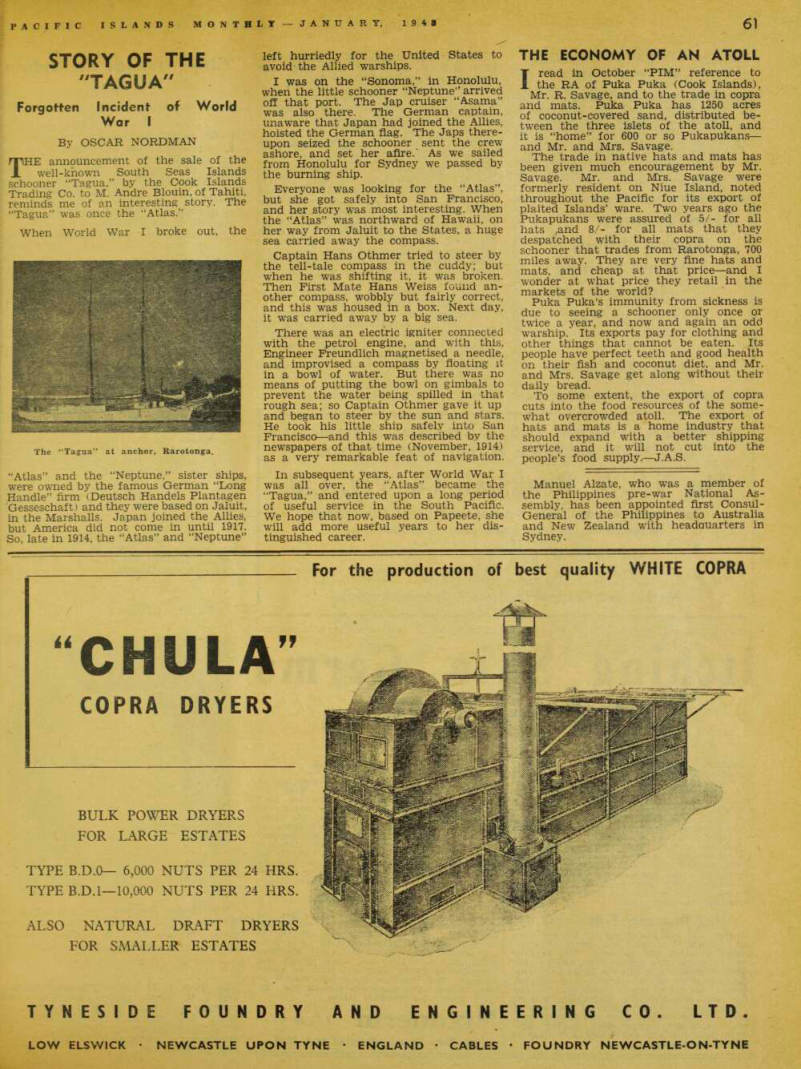
Story Of The
Forgotten Incident of World War I
By Oscar Nordman
THE announcement of the sale of the well-known South Seas Islands schooner “Tagua,” by the Cook Islands Trading Co. to M. Andre Blouin, of Tahiti, reminds me of an interesting story. The “Tagua” was once the “Atlas.”
When World War I broke out, the
“Atlas” and the “Neptune,” sister ships, were owned by the famous German “Long Handle” firm (Deutsch Handels Plantagen Gesseschaft) and they were based on Jaluit, in the Marshalls. Japan joined the Allies, but America did not come in until 1917.
So, late in 1914, the “Atlas” and “Neptune”
left hurriedly for the United States to avoid the Allied warships.
I was on the “Sonoma,” in Honolulu, when the little schooner “Neptune” arrived off that port. The Jap cruiser “Asama” was also there. The German captain, unaware that Japan had joined the Allies, hoisted the German flag. The Japs there upon seized the schooner sent the crew ashore, and set her afire.' As we sailed from Honolulu for Sydney we passed by the burning ship.
Everyone was looking for the “Atlas”, but she got safely into San Francisco, and her story was most interesting. When the “Atlas” was northward of Hawaii, on her way from Jaluit to the States, a huge sea carried away the compass.
Captain Hans Othmer tried to steer by the tell-tale compass in the cuddy; but when he was shifting it, it was broken.
Then First Mate Hans Weiss found an other compass, wobbly but fairly correct, and this was housed in a box. Next day, it was carried away by a big sea.
There was an electric igniter connected with the petrol engine, and with this, Engineer Freundlich magnetised a needle, and improvised a compass by floating it in a bowl of water. But there was no means of putting the bowl on gimbals to prevent the water being spilled in that rough sea; so Captain Othmer gave it up and began to steer by the sun and stars.
He took his little ship safely into San Francisco —and this was described by the newspapers of that time (November. 1914) as a very remarkable feat of navigation.
In subsequent years, after World War I was all over, the “Atlas” became the “Tagua,” and entered upon a long period of useful service in the South Pacific, We hope that now, based on Papeete, she will add more useful years to her dis tinguished career.
The “Tagua” at anchor, Rarotonga.
The Economy Of An Atoll
I read in October “PIM” reference to the RA of Puka Puka (Cook Islands), Mr. R. Savage, and to the trade in copra and mats. Puka Puka has 1250 acres of coconut-covered sand, distributed be tween the three islets of the atoll, and it is “home” for 600 or so Pukapukans— and Mr. and Mrs. Savage.
The trade in native hats and mats has been given much encouragement by Mr.
Savage. Mr. and Mrs. Savage were formerly resident on Niue Island, noted throughout the Pacific for its export of plaited Islands’ ware. Two years ago the Pukapukans were assured of 5/- for all hats ,and 8/- for all mats that they despatched with their copra on the schooner that trades from Rarotonga, 700 miles away. They are very fine hats and mats, and cheap at that price—and I wonder at what price they retail in the markets of the world?
Puka Puka’s immunity from sickness is due to seeing a schooner only once or twice a year, and now and again an odd warship. Its exports pay for clothing and other things that cannot be eaten. Its people have perfect teeth and good health on their fish and coconut diet, and Mr. and Mrs. Savage get along without their daily bread.
To some extent, the export of copra cuts into the food resources of the some what overcrowded atoll. The export of hats and mats is a home industry that should expand with a better shipping service, and it will not cut into the
people’s food supply.
J.A.S.
Manuel Alzate, who was a member of the Philippines pre-war National As sembly, has been appointed first Consul- General of the Philippines to Australia and New Zealand with headquarters in Sydney.
Advertisements & other items, p. 63 (1 item)
Chula”
For the production of best quality WHITE COPRA ii
COPRA DRYERS
BULK POWER DRYERS
FOR LARGE ESTATES
TYPE B.D.O — 6,000 NUTS PER 24 HRS.
TYPE B.D. I—lo,ooo NUTS PER 24 HRS.
ALSO NATURAL DRAFT DRYERS
FOR SMALLER ESTATES
s- . m Ww-
TYNESIDE FOUNDRY AND ENGINEERING CO. LTD.
LOW ELSVVICK * NEWCASTLE UPON TYNE • ENGLAND • CABLES • FOUNDRY NEWCASTLE-ON-TYNE
Fijian Student's Success
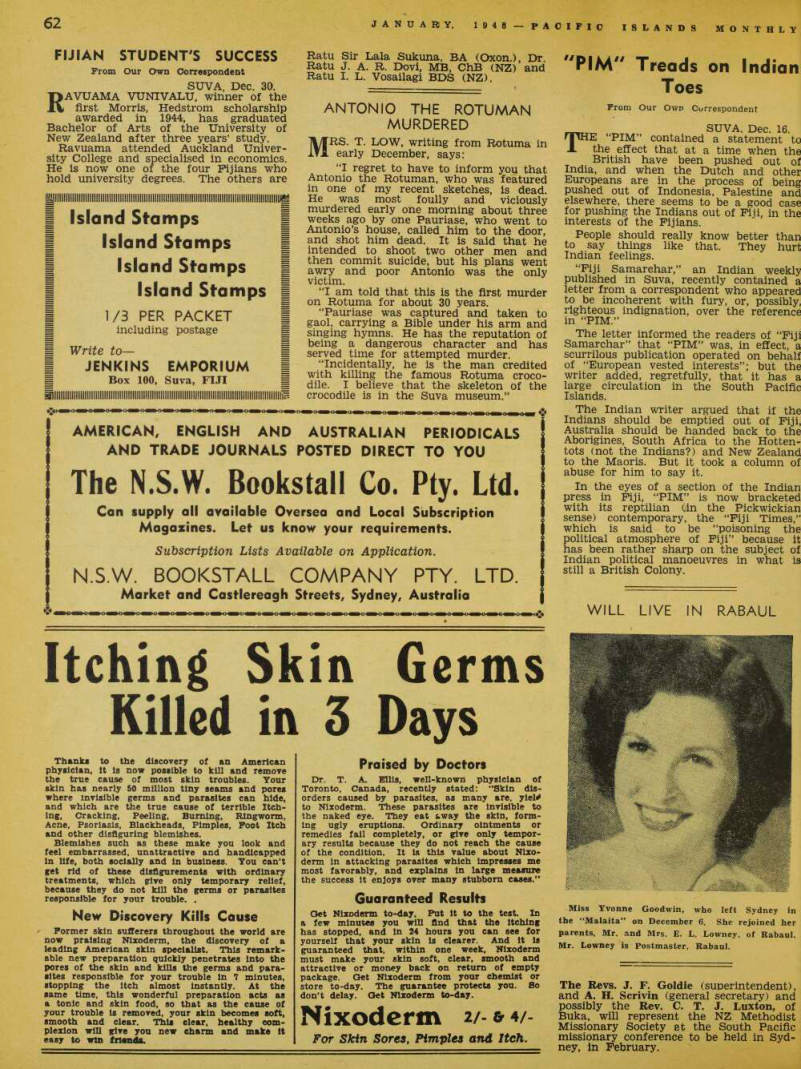
Prom Our Own Correspondent
Suva, Dec. 30.
RAVUAMA VUNIVALU. winner of the first Morris, Hedstrom scholarship awarded in 1944, has graduated Bachelor of Arts of the University of New Zealand after three years’ study.
Ravuama attended Auckland Univer sity College and specialised in economics.
He is now one of the four Fijians who hold university degrees. The others are
Ratu Sir Lala Sukuna, BA (Oxon.), Dr.
Ratu J. A. R. Dovi, MB, Chß (NZ) and Ratu I. L. Vosailagi BDS (NZ).
Antonio The Rotuman
Murdered
MRS. T. LOW, writing from Rotuma in early December, says: “I regret to have to inform you that Antonio the Rotuman, who was featured in one of my recent sketches, is dead.
He was most foully and viciously murdered early one morning about three weeks ago by one Pauriase, who went to Antonio’s house, called him to the door, and shot him dead. It is said that he intended to shoot two other men and then commit suicide, but his plans went awry and poor Antonio was the only victim.
“I am told that this is the first murder on Rotuma for about 30 years.
“Pauriase was captured and taken to gaol, carrying a Bible under his arm and singing hymns. He has the reputation of being a dangerous character and has served time for attempted murder.
“Incidentally, he is the man credited with killing the famous Rotuma croco dile. I believe that the skeleton of the crocodile is in the Suva museum.”
"PIM" Treads on Indian
Toes
From Our Own Correspondent
Suva. Dec. 16.
fPHE “PIM” contained a statement to X. the effect that at a time when the British have been pushed out of India, and when the Dutch and other Europeans are in the process of being pushed out of Indonesia, Palestine and elsewhere, there seems to be a good case for pushing the Indians out of Flii, in the interests of the Fijians.
People should really know better than to say things like that. They hurt Indian feelings.
“Fiji Samarchar,” an Indian weekly published in Suva, recently contained a letter from a correspondent who appeared to be incoherent with fury, or, possibly, righteous indignation, over the reference in “PIM.”
The letter informed the readers of “Fiji Samarchar” that “PIM” was, in effect, a scurrilous publication operated on behalf of “European vested interests”; but the writer added, regretfully, that it has a large circulation in the South Pacific Islands.
The Indian writer argued that if the Indians should be emptied out of Fiji, Australia should be handed back to the Aborigines, South Africa to the Hotten tots (not the Indians?) and New Zealand to the Maoris. But it took a column of abuse for him to say it.
In the eyes of a section of the Indian press in Fiji, “PIM” is now bracketed with its reptilian (tin the Pickwickian sense) contemporary, the “Fiji Times,” which is said to be “poisoning the political atmosphere of Fiji” because it has been rather sharp on the subject of Indian political manoeuvres in what is still a British Colony.
Will Live In Rabaul
The Revs. J. F. Goldie (superintendent), and A. H. Scrivin (general secretary) and possibly the Rev. C. T. J. Luxton, of Buka, will represent the NZ Methodist Missionary Society at the South Pacific missionary conference to be held in Syd ney, In February.
Miss Yvonne Goodwin, who left Sydney in the “Malaita” on December 6. She rejoined her parents, Mr. and Mrs. E. L. Lowney, of Rabaul.
Mr. Lowney is Postmaster, Rabaul.
Advertisements & other items, p. 64 (1 item)
Itching Skin Germs
Island Stamps
Island Stamps
Island Stamps
Island Stamps
1/3 PER PACKET
including postage Write to—
JENKINS EMPORIUM
Box 100, Suva, FIJI
AMERICAN, ENGLISH AND AUSTRALIAN PERIODICALS
AND TRADE JOURNALS POSTED DIRECT TO YOU
The N.S.W. Bookstall Co. Pty. Ltd.
Can supply all available Oversea and Local Subscription Magazines. Let us know your requirements.
Subscription Lists Available on Application.
N.S.W. BOOKSTALL COMPANY PTY. LTD.
Market and Castlereagh Streets, Sydney, Australia
Itching Skin Germs Killed in 3 Days
Thank* to the discovery of an American physician, it is now possible to kill and remove the true cause of most skin troubles. Tour skin has nearly 50 million tiny seams and pores where invisible germs and parasites can hide, and which are the true cause of terrible Itching, Cracking, Peeling, Burning, Ringworm, Acne, Psoriasis, Blackheads, Pimples, Foot Itch and other disfiguring blemishes.
Blemishes such as these make you look and feel embarrassed, unattractive and handicapped in life, both socially and in business. Tou can’t get rid of these disfigurements with ordinary treatments, which give only temporary relief, because they do not kill the germs or parasites responsible for your trouble. .
New Discovery Kills Cause
Former skin sufferers throughout the world are now praising Nizoderm, the discovery of a leading American skin specialist. This remarkable new preparation quickly penetrates into the pores of the skin and kills the germs and parasites responsible for your trouble in 7 minutes, stopping the itch almost instantly. At the same time, this wonderful preparation acts as a tonic and skin food, so that as the cause of your trouble is removed, your skin becomes soft, smooth and clear. This clear, healthy complexion will give you new charm and make It easy to win friends.
Praised by Doctors
Dr. T. A. Ellis, well-known physician of Toronto, Canada, recently stated: “Skin disorders caused by parasites, as many are, yiel* to Nixoderm. These parasites are invisible to the naked eye. They eat away the skin, forming ugly eruptions. Ordinary ointments or remedies fall completely, or give only temporary results because they do not reach the cause of the condition. It is this value about Nixoderm in attacking parasites which impresses me most favorably, and explains In large measure the success It enjoys over many stubborn cases.”
Guoranteed Results
Get Nixoderm to-day. Put It to the test. In a few minutes you will find that the Itching has stopped, and in 24 hours you can see for yourself that your skin is clearer. And It is guaranteed that, within one week, Nixoderm must make your skin soft, clear, smooth and attractive or money back on return of empty package. Get Nixoderm from your chemist or store to-day. The guarantee protects you. So don’t delay. Get Nixoderm to-day.
Nixoderm
For Skin Sores, Pimples and Itch .
Seamen
Wages Of Fijian
Why and How A Union Was Formed
Letter to the Editor A FEW months ago, you published cer tain remarks regarding the Fiji Seamen’s Union. Here are the facts: let your readers judge the matter for themselves.
In many instances, particularly in the smaller vessels in Fiji, native Fiiian sea men in 1947 were receiving the same wages as were paid many years ago, viz. £2/5/- to £3/5/- a month. The families of these seamen all have to live in Suva or Levuka, and anyone acquainted with the conditions and prices in those towns knows that a Fijian family cannot live on such an income.
Some employers have paid a more adequate wage, particularly in larger vessels, say up to £6 a month. These employers have had to compete for freights against those paying the lower wages. There was a complete lack of uniformity in the wages paid to native seamen by different employers. In many vessels there was no proper regulation of hours. There was the same lack of uni formity in this regard and also in the matter of payment for overtime. This same lack of uniformity existed in the matter of rations.
Some increases of wages were granted during the war, as a cost of living bonus, but these increases were by no means commensurate with the actual increase in the cost of living.
A large number of Fijians served in the Armed Forces during the war and these men came to realise that any ordered organisation was better than a haphazard one, and that it would be ad vantageous to all concerned if working conditions in the shipping industry were stabilised. Fijian seamen, on their own initiative, made representations to the Secretary for Fijian Affairs and the Commissioner of Labour. The leading shipowners were consulted and concurred in the view that the best method of ar riving at standard terms and conditions Df work was by the formation of a Union and the negotiation of an agreement.
Both these objects have been attained.
Your assumption that a body of sea men who were contented were being urged by “rose-pink gentlemen who now run the British Empire” to form a Union and thereby be capable of kicking up a row is not correct. Legislation had been passed facilitating the formation of unions. The seamen were not contented.
Thanks to the legislation and the wis
dom of the leading shipowners an amic able agreement now exists. The average wages payable to seamen now range be tween £4/10/- and £7/7/6 a month, ac cording to tonnage of vessel and pro portionately more for higher ratings.
Copra is the principal cargo carried in inter-insular vessels. This commodity has increased in price during the past year, from £l9 a ton to £37 a ton in round figures. It is not believed that any producer will seriously object to a few shillings a ton increase in freight to pay the seamen who carry the copra a living wage.
Finally, it is suggested that a more accurate view of this Union could have been presented to your readers had you made inquiries in Fiji from the Commis sioner of Labour and from the “Big Firms” you mentioned, all of which companies are parties to the agreement.
I am, etc.,
Luke R. Vukivuki,
Hon. Secretary, Fiji Seamen’s Union.
EDITORIAL NOTE: This letter was received in July. Owing to the phrase ology employed, we deemed it wise to make certain inquiries, before publishing the letter hence the delay. There is far more behind the recent organisation of trade unions among Pacific Islands workers than appears on the surface of such smoothly-worded communications as the foregoing recent events in the Cook Islands are an indication of that.
However, the above letter is published for
what it is worth. We shall deal, later on, with the whole subject of the activi ties of “Fellow Travellers” in the Islands.
Advertisements & other items, p. 65 (1 item)
Always Ask For It
TIME-PIECES
REPAIRED
We employ a Fully Qualified
Staff and we are equipped to undertake repairs of
WATCHES CLOCKS
MARINE CHRONOMETERS
We undertake Locksmithing, Key-cutting, etc.
Any goods sent to us by post are attended to promptly and with care.
NOEL LEVY
Victoria Parade, Suva, Fiji Phone 39. P.O. Box 88.
Cablegrams: “Noel,” Suva
PRODUCING UNIFORM GOOD RESULTS SINCE 1868
ALWAYS ASK FOR IT
» I
ALUMINIUM PAINT
The use of Alpaste Aluminium Paint for the exterior coating of roofs, tanks, buildings and other structures provides protection and preservation from the attack of salt atmospheres, smoke, moisture and the acid atmoshere of industrial regions. Alpaste Aluminium Paint’s exceedingly smart appearance can be preserved for long periods without attention.
FOR COMPLETE PROTECTION
AND PRESERVATION
ALUMINIUM UNION
LIMITED
Incorporated in the Dominion of Canada (A Member of the Aluminium Limited Group, Montreal, Canada Ocean House, 34 Martin Place, Sydney, N.S.W.
The largest distributors of aluminium and its alloys in the British Commonwealth zistered Tr Mark
Cutter "Pagan" Reaches
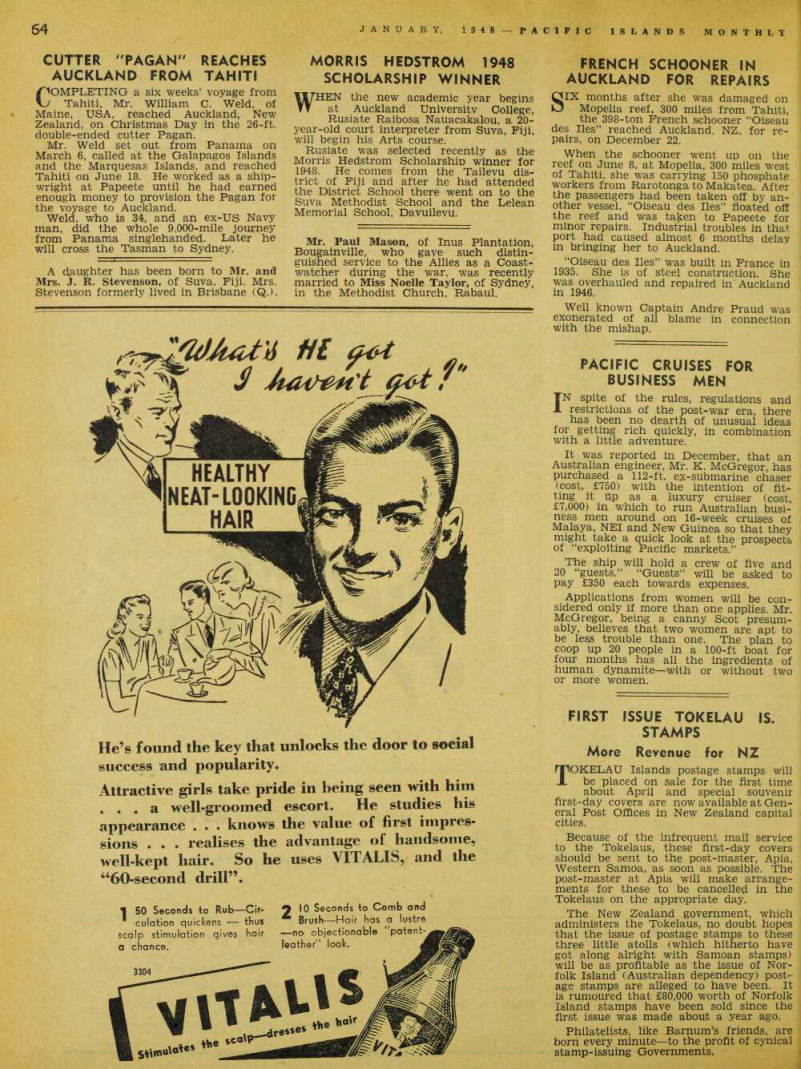
Auckland From Tahiti
COMPLETING a six weeks’ voyage from Tahiti, Mr. William C. Weld, of Maine, USA, reached Auckland, New Zealand, on Christmas Day in the 26-ft. double-ended cutter Pagan.
Mr. Weld set out from Panama on March 6, called at the Galapagos Islands and the Marquesas Islands, and reached Tahiti on June 18. He worked as a ship wright at Papeete until he had earned enough money to provision the Pagan for the voyage to Auckland.
Weld, who is 34, and an ex-US Navy man, did the whole 9,000-mile journey from Panama singlehanded. Later he will cross the Tasman to Sydney.
A daughter has been born to Mr. and Mrs. J. R. Stevenson, of Suva, Fiji. Mrs.
Stevenson formerly lived in Brisbane (Q.).
Morris Hedstrom 1948
Scholarship Winner
WHEN the new academic year begins at Auckland Universitv College, Rusiate Raibosa Nauacakalou, a 20year-old court interpreter from Suva, Fiji, will begin his Arts course.
Rusiate was selected recently as the Morris Hedstrom Scholarship winner for 1948. He comes from the Tailevu dis trict of Fiji and after he had attended the District School there went on to the Suva Methodist School and the Lelean Memorial School, Davuilevu.
Mr. Paul Mason, of Inus Plantation, Bougainville, who gave such distin guished service to the Allies as a Coast watcher during the war, was recently married to Miss Noelle Taylor, of Sydney, in the Methodist Church, Rabaul.
French Schooner In
Auckland For Repairs
SIX months after she was damaged on Mopelia reef, 300 miles from Tahiti, the 398-ton French schooner “Oiseau des lies” reached Auckland. NZ, for re pairs, on December 22.
When the schooner went up on the reef on June 8, at Mopelia, 300 miles west of Tahiti, she was carrying 150 phosphate workers from Rarotonga to Makatea. After the passengers had been taken off by an other vessel, “Oiseau des lies” floated off the reef and was taken to Papeete for minor repairs. Industrial troubles in that port had caused almost 6 months delay in bringing her to Auckland.
“Oiseau des lies” was built in France in 1935. She is of steel construction. She was overhauled and repaired in Auckland in 1946.
Well known Captain Andre Fraud was exonerated of all blame in connection with the mishap.
Pacific Cruises For
Business Men
IN spite of the rules, regulations and restrictions of the post-war era, there has been no dearth of unusual ideas for getting rich quickly, in combination with a little adventure.
It was reported in December, that an Australian engineer, Mr. K. McGregor, has purchased a 112-ft. ex-submarine chaser (cost, £750) with the intention of fit ting it Up as a luxury cruiser (cost, £7,000) in which to run Australian busi ness men around on 16-week cruises of Malaya, NEI and New Guinea so that they might take a quick look at the prospects of “exploiting Pacific markets.”
The ship will hold a crew of five and 20 “guests.” “Guests” will be asked to pay £350 each towards expenses.
Applications from women will be con sidered only if more than one applies. Mr.
McGregor, being a canny Scot presum ably, believes that two women are apt to be less trouble than one. The plan to coop up 20 people in a 100-ft boat for four months has all the ingredients of human dynamite—with or without two or more women.
Stamps
First Issue Tokelau Is.
More Revenue for NZ
rKELAU Islands postage stamps will be placed on sale for the first time about April and special souvenir first-day covers are now available at Gen eral Post Offices in New Zealand capital cities.
Because of the infrequent mail service to the Tokelaus, these first-day covers should be sent to the post-master, Apia, Western Samoa, as soon as possible. The post-master at Apia will make arrange ments for these to be cancelled in the Tokelaus on the appropriate day.
The New Zealand government, which administers the Tokelaus, no doubt hopes that the issue of postage stamps to these three little atolls (which hitherto have got along alright with Samoan stamps) will be as profitable as the issue of Nor folk Island (Australian dependency) post age stamps are alleged to have been. It is rumoured that £BO,OOO worth of Norfolk Island stamps have been sold since the first issue was made about a year ago.
Philatelists, like Barnum’s friends, are born every minute —to the profit of cynical
stamp-issuing Governments.
Advertisements & other items, p. 66 (1 item)
\Asqijft,
H£ a<yt
Cs? il&t,’
mi
HEALTHY
NEAT-LOOKING
HAIR
A 9
\ASQIJft,
AS He’s found the key that unlocks the door to social success and popularity.
Attractive girls take pride in being seen with him , . , a well-groomed escort. He studies his appearance . . . knows the value of first impressions . . . realises the advantage of handsome, well-kept hair. So he uses YITALIS, and the “60-second drill”. 50 Seconds to Rub—Cir- O 10 Seconds to Comb and * culation quickens thus Brush—Hair has a lustre scalp stimulation gives hair —no objectionable patenta chance. leather look. 3304 ♦he h° ir seolp dr«» ses ♦he late*
Them In!
They Cant Keep
Too Many Prison Breaks In Tonga
From Our Own Correspondent
Nukualofa, Nov. 21
11HE two young Tongan prisoners, Mahe Tupou and Tevita Tau’aika, who escaped from the Kingdom on a 14-ft. sailing boat last month, and landed at Ono (the southern-most sel dom-visited outpost of the Lau Group, Fiji) are now serving a six months’ term at the Suva Gaol for landing in the Colony without a permit. They will be brought back to Tonga on the expira tion of their sentence.
This was Mahe Tupou’s third escape to Fiji within the last two years, and Tau’aika’s second not to mention their numerous other short-lived prison breaks' spent within the Kingdom.
Accompanied by two other young Ton gan prisoners, they made a similar es cape on a small sailing boat at the end of 1946 and landed at another island of the Lau Group. They were brought back to Tonga in January, 1947. this year.
The increase in the number of prison escapes in the Kingdom is the cause of public criticism against the head of the Prison Department, the Hon. Akau’ola, Minister of Police. Never in the history of prison life in Tonga has there been so many prison breaks as in the past few years, and this despite the fact that never in the past has there been so many officers employed in the department or so much public money spent on it. The most disturbing thought about the whole question, however, is that the Govern ment seems indifferent about it, and is not seeking any remedy. Obviously there is something wrong somewhere.
Nz's Pacific Wartime
Air Fleet Is Now Scrap
AFTER lying exposed to the weather for two years a total of 442 fighters and bombers, with which the Royal New Zealand Air Force helped to win the war against Japan, are being sold for scrap metal. They cost £13,000,000.
Most are Corsair fighters, which were the very latest when New Zealanders commenced flying them in 1944. The RNZAF is now equipped with two-en gined Mosquitos.
In April, 1943, an RNZAF fighter squadron arrived at Guadalcanal. In October, 1943, NZ fighters were based on New Georgia; and in March, 1944, a squadron arrived at Bougainville in time to experience the Jap shelling of the Torokina strip.
With the formation of a NZ Air Task Force, fighter squadrons were established at Green Island (Nissan), Emirau and Los Negros all in the New Guinea area. Altogether 13 fighter squadrons of the RNZAF saw service in the Pacific, and they accounted for 99 Jap aircraft.
NZ bomber planes were at Espiritu Santo (New Hebrides) as early as October, 1942. They bombed Munda and Rendova early in 1943. Later in 1943 they operated from Munda against Jap bases on Bougainville. They also operated from Torokina and Green Island against Jap nositions on New Britain and New Ire land.
Two NZ torpedo bomber squadrons and one dive bomber squadron operated dur ing March-July, 1944 against Rabaul.—
Ajs.
Advertisements & other items, p. 67 (1 item)
J. G. Merrillees
PTY. LTD.
General Island Merchants
PHOENIX BUILDING, 63 PITT ST,, SYDNEY
Telegrams and Cables: MERRILLEES SYDNEY. Phone: 8W6064
PEST Controllers..
Ants, Flies, Mosquitoes, Silvertish, White Ants,
Cockroaches and Bugs Scientifically Eliminated
ANT CONTROL.
For all types of ants, including white ants (4 per cent. D.D.T.)
FEST CONTROL.
Spray for control of flies, mosquitoes, silverfish, eic. (contains D.D.T. and Pyrethrum)
VERMIN POWDER.
For cockroaches, bugs and silverfish (4 per cent. D.D.T.)
Chemical Industries
LAE, T.N.G.
Manufacturers of COSMETIC OILS, DYES
AND POWDERS. AGRICULTURAL
SPRAYS AND D.D.T. PREPARATIONS
BRILLIANTINE
PRODUCT OF
CHEMICAL INDUSTRIES
LAE. NEWGUINEA
Sole Distributors for Papua
BURNS PHILP & CO„ LTD,
Every Branch Of
ENGINEERING and BUILDING CONSTRUCTION
MILLERS LTD.
SUVA and LAUTOKA
Sawmillers and Timber Merchants; Shipwrights and Sailmakers; Joinery and furniture Manufacturers; Upholsterers; Plumbers; Electricians; Hardware Merchants; Motor Dealers.
AGENCIES :
Chevrolet, Bedford, Vauxhall, Nash Motors. Firestone Tyres.
Fetters Marine and Stationary Engines. G.E.C. Radio Sets.
British Australian Lead Manufacturers Pty., Ltd., Atlas Assurance Co., Ltd.
There is no need to send to Australia or New Zealand for Repairs or Replacements. We can give you a sound Quotation and guarantee First-Class
Workmanship
Hotel License For Wau
IT is notified in the December issue of the Papua-New Guinea Gazette that a publican’s licence has been granted to Mr. J. M. Bourke, of Lae, for premises in Wau township, to be called the Kaindi Hotel, on condition that the premises are completed within eight months.
Mrs. Ethel Campbell died at her home in Suva, Fiji, in early December, She was the daughter of Mr. and Mrs. H.
Bentley and was born in Fiji 78 years ago. She is survived by her daughter, Mrs. Irene Cox, of Suva, and her son Mr. Robert Campbell of the Fiji Govern ment Printing Office.
Madang
Christmas Festivities In Madang
From a Special Correspondent AFTER three and a half months with out fresh supplies, Madang people were determined to give the children good cheer at Christmas. Having raised over £6O at an enjoyable evening at the home of Mr. and Mrs. A. Shields, they spent it on a party at the Club House.
Committees were formed for the event.
Before the great day, Mrs. Reg Johnston was busy for weeks obtaining novelties and making festive caps and baskets. Mrs.
Rees created stockings from mosquito netting and colourful dyes.
Mrs. John Keenan, of Finschhafen, approached Colonel Merritt. Officer-in - Command of the USA War Graves unit, with regard to supplying sweets and drinks. Captain Rutherford graciously arranged to bring the goods to Madang by ship.
Mr. John Rose brought other goods that were unobtainable in the Territory, by air.
Mrs. T. Aitchison helped to make the table gay with attractive place-cards, while Mesdames T. Warburton and Fred James assisted by decorating the tables for the event.
Captain Howard, of the SS “Montoro,” supplied ice cream and apples.
Mesdames Reg Johnstone, Cahill, Dun can, Leyer, and the Misses Sedgers. ladies m charge of the Christmas tree, had a busy time selecting gifts, wrapping parcels and decorating the tree.
In charge of drinks were Sisters Jones, Houghton, and Moss.
A delightful surprise was the arrival of toffee apples, made by Mrs. Roy Collins, whose eldest son was home from school in Melbourne.
The thirty-odd children present at the party participated in sports, before the real party began at a table laden with cookies made by the good ladies from the town and the surrounding districts.
Father Christmas (Mr. George Tirrell) arrived by boat, and an assortment of dolls, pocket watches, musical boxes, rattles and the like was distributed among the chil dren. singing on December 23 was J conducted by the Rev. Maahs, with Mrs. R. T. Weidenhofer at the organ.
It attracted a large gathering. Out of doors beforehand the local choir “waited” at the hospital for the benefit of the staff and the patients. Visiting Samoans contributed dances and songs during the evening.
The arrival of out of town visitors, Mrs. lan Reid, the family of Mr. and Mrs. N.
O’Brien, Mrs. Ken Hicks and infant, Mr. and Mrs. Sherry and family, and Mrs.
Morton Johnston added to the general enjoyment of the festive season.
Everywhere was heard the comment, “Best Christmas yet.”
Nauru Memorial To Brave
Priest
A MEMORIAL to the late Father Kayser, MSG, was unveiled on Nauru on December 7. The Administrator of Nauru, Mr. M. Ridgway, performed the ceremony.
Father Kayser, who was well-known on Nauru before the war, was caught there by the Japanese invasion in 1942. He was later sent to Truk, where he died as a result of beatings inflicted upon him by the Japanese.
Advertisements & other items, p. 68 (1 item)
Butter! 4
LON DON-SUVA
S£*
«\V v, 4 K/ cv
> PANAMA V
For Sailings and Further Particulars Apply To: BETHELL, GWYN & CO., BURNS, PHILP (SOUTH SEA)
138 LEADENHALL ST., CO., LTD.,
LONDON, E.C.3. SUVA
Butter! 4
Crunch
m m <■ * i *
* CLuitLsK
SWALLOW’S
~JlaAkru)v
BWA LLOW A ABIEIL
&:J |1 11Sft1 11W . - • r THa/A*. Ciajffa*tce*, £*t, ’S&cmt
Solomons And New Hebrides
Series of Questions in House of Commons Produces on Outline of British Administrative Policy
From a Special Correspondent
London, Dec. 26.
DURING the past six weeks, Mr. John Parker, Labour MP for Dagenham, has asked a number of written questions in the House of Commons on matters concerning the New Hebrides and the Solomons. The questions were re ported neither in the press, nor in the BBC Pacific Service. The questions and the Minister’s answers, were as follow: What steps are being taken to abolish indentured labour in the British Solomon Islands; and what alternative source of labour is contemplated?
No such steps have yet been taken.
The possibility of replacing indentured labour with a system involving the settle ment of married labourers in villages is now being examined by the High Com missioner.
Will you give details of the amounts of copra produced and the amount ex ported from the British Solomons since the war, compared with the five years before the war?
Up to October 25, 963 tons of copra had been produced in the Protectorate and up to September 22, 554 tons had been exported. The average yearly ex ports of copra between 1936 and 1941 was 21,000 tons. Production is increasing and the current rate of 30 tons per week is expected to rise considerably.
What efforts are being made to increase copra production in the British Solomons through native and plantation enterprise; and to encourage co-operative produc tion and marketing?
The local Government is doing every thing possible to restore production and
to organise shipping facilities. Sanction has been given to the issue of interest free loans to assist the rehabilitation of the plantations, and in some cases, where owners have not yet returned to the Islands, arrangements are being made with Government encouragement for the Islanders to work the plantations on their own account, and, where possible, on a co-operative basis.
What steps are being taken to Improve transport facilities between the islands of the Western Pacific?
A ship was bought in 1946 to provide overseas communication for the British Solomon Islands, pending the resump tion of normal commercial shipping. Two naval craft have been acquired and the building of another craft is being nego tiated to augment the present fleet of small ships used for local inter-island traffic.
As regards the Gilbert and Ellice Is lands, two Army craft have been bought to facilitate copra trading, and the pos sibility of acquiring a ship combining cargo and passenger-carrying in a regu lar round-the-islands schedule is now be ing considered.
I¥7HAT steps are being taken to increase f? the production in the British Solo mons of alternative crops to copra, in particular rice and groundnuts; and what are the results to date of technical surveys financed through the Colonial Development and Welfare Fund?
The growing of food crops, including maize and tapioca, for local consumption, is a first priority, and as the result of
an official survey made this year, the Government has decided to launch a three-year demonstration scheme to grow groundnuts for export on a thousand acres farm in Guadalcanal, with rice and other crops included in a three-years rotation. Peasant production of these crops is also being encouraged.
Cocoa and bananas are alternative crops; but, on agricultural and other grounds, their introduction is not thought possible at present.
Of the two technical surveys so far financed from C. D. &' W. moneys, one was abandoned because of the war and the other, which is a survey of forest resources, is now in the report stage.
What steps are being taken to collect adequate vital statistics in the New Hebrides: and is information about the decline in the native population, particu larly in Malekula sufficient to throw light on the causes and nossible remedies of the decline?
Owing to the size of the various dis tricts of the Condominium, lack of trans
port and shortage of staff, it has only been possible to undertake the collection of vital statistics to some extent in the south and centre of the New Hebrides group. The 1910 figures of poulation are not considered reliable, but the probable decline in the native population of Male kula is attributable to severe mortality during recent years from epidemics of in fluenza and whooping-cough. In more settled areas the population is estimated to have increased during recent years.
When is it proposed to inaugurate a system of native administration in the New Hebrides comparable to that now being developed in the Solomon Islands?
I regret that it is not nossible to say if or when such a system of native ad ministration can be inaugurated in the New Hebrides. Such a step would, of course, require the consent of the French Government. I am, however, studying what steps can be taken to improve the existing system.
What development and welfare schemes are contemplated for the New Hebrides?
The New Hebrides are not eligible for assistance under the C. D. W. Act. In conjunction with the French authorities, we are constantly doing what we can to improve the conditions of the people.
WHAT change is contemplated in the present condominium svstem opera ting in the New Hebrides?
The question of future constitutional arangements for the New Hebrides is now under active review in my Depart ment. I am unable at nresent to make any further statement. Any alterations in the existing system would, of course, require the concurrence of the French Government.
How much British, French and native owned land in the New Hebrides is at present undeveloped; and what steps are
being taken to make this land available to native communities suffering from shortage of land?
It is impossible to provide an answer to the first part of the question as settled titles exist only in the Southern Islands and as there are no figures for developed and undeveloped areas. Native communities have been adequately pro vided for by the allocation to them under the Protocol of inalienable native re serves and by the placing in trust of a large extent of land by the missions; and there is no evidence that they are suf fering from a shortage of land.
What steps are being taken to improve educational facilities in the British Solomons and in the New Hebrides.
As regards the British Solomons, a Director of Education and an Inspectress of Schools ha*ve been recently appointed and are now conferring with Mission bodies to decide on a policy to co-ordi nate measures for educational progress.
In the New Hebrides, there has been some expansion in the activities of the Missions, who, on the British side, are entirely responsible for native education.
I will, however, consider, in consultation with the High Commissioner, what steps can be taken to improve the existing faci lities.
What acreage in the Solomon Islands is now under native co-operative produc tion; how many native marketing co operatives are now functioning; and what technical assistance in methods of co operative organisation is being given by the government?
There is no acreage under native co operative production, and there are no marketing co-operatives at present. The question whether a co-operative move ment could successfully be introduced is under consideration by the High Com missioner.
How many interest-free loans have been taken up by planters in the Solo mon Islands; how many European plan ters have returned since the war to re start their plantations; how many have not yet returned: what proportion of the acreage of European plantations is now under cultivation and what proportion of this acreage is now under native pro duction?
Two interest-free loans have been taken up and two are awaiting signature. Of the 24 planters who left, 11 have resumed operations and 3 have returned to work for Companies. About li per cent, of the European plantations are under cul tivation and of this 1£ per cent, some 2£ per cent is under native production.
WHAT steps are being taken in the New Hebrides to reduce the size of districts, and to increase transport facilities and staff, in order to make satisfactory administration pos sible?
Any change in the size and staffing of districts would require the consent of the French Authorities. I do not consider that the present time is opportune to formulate for their consideration pro posals to alter the existing arrangements.
As regards transport facilities, various vessels allocated to district staff have been unavoidably immobilised through supply and other difficulties, but some improvement is anticipated in 1948.
Do future changes in the Condominium system in the New Hebrides, now being considered, include the creation of a uni fied civil service.
No. But the present organisation of the public service in the New Hebrides will naturally-be included in the review which is being carried out.
What expenditure on health and edu cation services in the New Hebrides has
been made since the end of the war by the British authorities and how does this expenditure compare with that of the French authorities, and of missions, on such services.
The Minister replied as follows: (a) Expenditure on health in 1946 and 1947 British Authorities, £4,942.
French Authorities, £32,860.
British Missions, approx £20,000.
French Missions, nil. (b) Expenditure on education in 1946 and 1947 British Authorities. £578 French Authorities, £6,930.
British Missions, approx. £B.OOO.
French Missions. No figures available but only two mixed Primary Schools are concerned.
The above amounts are quoted in Aus tralian currency.
Advertisements & other items, pp. 69-70 (1 item)
Colyer Watson (New Guinea) Ltd.
HEALTH HORIZON
of interest Overseas January issue includes 6 illustrations and articles on:
X-RAY IN DIAGNOSIS
WHAT IS A VACCINE?
INFANTILE PARALYSIS
CORONARY THROMBOSIS
January, April, July, October Five shillings per year Tavistock House North, Tavistock Square, London, W.C.I.
England
Colyer Watson (New Guinea) Ltd.
Head Office: RABAUL Branches: Kavieng, New Ireland, and at 22 Bridge Street, Sydney
GENERAL MERCHANTS AND BUYERS
OF ISLAND PRODUCE
Plantation Owners and Engineers
Sole Distributors: Chrysler and Plymouth Cars Fargo Trucks Willys-Overland Jeeps G.M. Marine and Industrial Engines Prefect Refrigerators Managing Agents: Union Assurance Society Ltd.
National Mutual Life Association of A/asia Ltd.
Agents: China Navigation Company
ISLAND MERCHANTS
and AGENTS.
GENERAL MERCHANTS
. CoS jifefii
R|f® Mil
/KO Shippers types of t'&fiLlX" Merchandise to the Pacific Islands Representing Australian, British and American Manufacturers * • Buyers for Leading Pacific Islands Traders • Sellers of Island Produce on Consignment \S>
379 KENT ST., SYDNEY
Cable & Telegraphic Address : " Chasull” Sydney. • Importers, Distributors and Manufacturers of Foodstuffs, Softgoods, Textiles, Hardware, Tobaccos, Wines and Spirts, etc. nt .v • “Ultimo" Kerosene Stoves and Heating Appliances • Distributors of High-grade Shirts, Pyjamas and Clothing ft m y • “Southern Queen"
Canned Fruits • Forwarding and Transhipment Agents ,4\ ft m Hill's English Cigarettes When in Sydney, call and see us!
Eradication Of Mosquitoes
AN outstanding instance of mosquito eradication is the elimination of Anopheles gambiae Giles from Brazil.
This species was found in Brazil in 1930 and serious outbreaks of malaria occurred in a small area that year and in 1931. It did not attract attention again until 1938 when it caused the deaths of about 20,000 persons in the 12,000 square miles it then occupied.
The Brazilian Ministry of Health, co operating with the Rockfeller Foundation, concluded a successful eradication pro gramme by the end of 1940.
Apparently a very successful campaign is also being waged in Brazil for the complete eradication of the yellow-fever mosquito, Aedes aegypti (L.). An inten sive programme has been under way for several years and many large areas now seem to be free of this species.
In 1943 Anopheles gambiae was re ported to have caused more than 130,000 deaths in Egypt, having extended its area from the Sudan along the Nile to within 200 miles of Cairo. The Egyptian Government, co-operating with the Rock feller Foundation, assigned more than 4,000 personnel to the task of eradicating this species, which was reported accom plished by the end of 1945.
In Southern Rhodesia the tsetse fly.
Glossina morsitans Westw., has been eradicated from more than 6,000 square miles during the past 10 years, following a programme based on the destruction of all big game in fenced belts 10 miles in depth and 100 or more miles wide. A different method has been successful on the Gold Coast in West Africa against Glossina palpalis RD, and G. tachinoides Westw. From 1940 to 1945 more than 1,000 square miles in an area of very heavy incidence of sleeping sickness were freed of these flies by clearing stream banks of certain vegetation.
In Zululand in the Union of South Africa, where Glossina Pallidipes Aust. is the predominant species, a large-scale experiment in eradication is now being conducted on 40 square miles of bush country, applying a DDT solution by air plane. A recent letter from Dr. Rene du Toit, Veterinary Officer, gives some very interesting details. As to results, he says; “In the Mkuzi Reserve five applications spaced at two-weekly intervals have to date resulted in the almost entire elimi nation of the tsetse flies in the area . . .
So far as other species of insects are concerned the effect upon Anopheles gambiae has been profound. This is a notorious malaria area and not a single case of malaria has developed in a per sonnel of approximately 50 camped in the area throughout the summer months/’
Thus it would seem that in any area in which tsetse flies are eradicated by chemical means, malaria might also dis appear.—From “Tropical Agriculture.”
An Unpopular "Fee"
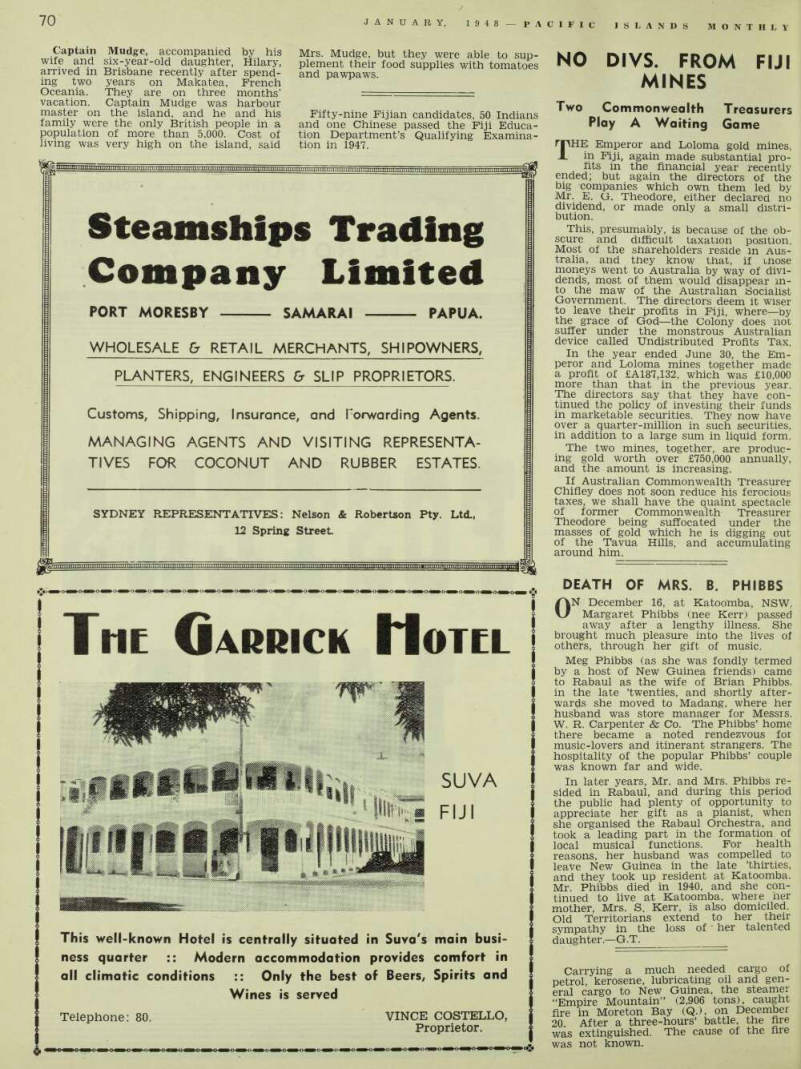
Vila Dec 16
A 1 ’ , ’
LTHOUGH there are no broadcasts from Vila Radio, owners of wireless sets in the New Hebrides have to pay an annual fee of 10 - Stg. for a “Radio Listener’s Licence.” Most people
consider this to be a “racket,” seeing that there are nQ 1()cal broadcasts but ot hers think it is (or was) worth 10 - Stg. per annum if only to tune in to Vila Radio and listen to Dick Eedy’s breezy an nouncements and comments when trans mitting messages per radio telephone, But Dick Eedy now is gone to another department.
Captain Mudge, accompanied by his wife and six-year-old daughter, Hilary, arrived in Brisbane recently after spend ing two years on Makatea, French Oceania. They are on three months' vacation. Captain Mudge was harbour master on the island, and he and his family were the only British people in a population of more than 5,000. Cost of living was very high on the island, said
Mrs. Mudge, but they were able to sup plement their food supplies with tomatoes and pawpaws.
Fifty-nine Fijian candidates, 50 Indians and one Chinese passed the Fiji Educa tion Department’s Qualifying Examina tion in 1947.
Advertisements & other items, pp. 71-72 (1 item)
Fosters
A Limited Quantity Only
COLT PATTERN 45 cal. AUTOMATICS
SPECIAL TROPICAL FINISH.
At the all-time low price of £lO each. Postage extra. Powerful, accurate, they are a weapon you will be proud to own. Ammo, plentiful, 25/per 100, Sa ■ n/nm I Quality Firearms and Fishing
I L nU n U Tackle.
143 ELIZABETH ST. (near Market St.), SYDNEY. Phone: MA 3540.
FOSTERS
urn
BREWED BY
CARLTON & UNITED BREWERIES LTD.
Steamships Trading
Company Limited
PORT MORESBY SAMARA! PAPUA.
WHOLESALE & RETAIL MERCHANTS, SHIPOWNERS,
PLANTERS, ENGINEERS & SLIP PROPRIETORS.
Customs, Shipping, Insurance, and Forwarding Agents.
MANAGING AGENTS AND VISITING REPRESENTA-
TIVES FOR COCONUT AND RUBBER ESTATES.
SYDNEY REPRESENTATIVES: Nelson & Robertson Pty. Ltd., 12 Spring Street
The Garrick Hotel
m
•iii
I I
SUVA
FIJI
This well-known Hotel is centrally situated in Suva's main business quarter Modern accommodation provides comfort in all climatic conditions :: Only the best of Beers, Spirits and Wines is served Telephone: 80. VINCE COSTELLO, Proprietor.
Mines
No Divs. From Fiji
Two Commonwealth Treasurers Play A Waiting Game
THE Emperor and Loloma gold mines, in Fiji, again made substantial pro fits in the financial year recently ended; but again the directors of the big companies which own them led by Mr. E. G. Theodore, either declared no dividend, or made only a small distri bution.
This, presumably, is because of the ob scure and difficult taxation position.
Most of the shareholders reside in Aus tralia, and they know that, if mose moneys went to Australia by way of divi dends, most of them would disappear in to the maw of the Australian Socialist Government. The directors deem it wiser to leave their profits in Fiji, where —by the grace of God —the Colony does not suffer under the monstrous Australian device called Undistributed Profits Tax.
In the year ended June 30, the Em peror and Loloma mines together made a profit of £A187,132, which was £lO,OOO more than that in the previous year.
The directors say that they have con tinued the policy of investing their funds in marketable securities. They now have over a quarter-million in such securities, in addition to a large sum in liquid form.
The two mines, together, are produc ing gold worth over £750,000 annually, and the amount is increasing.
If Australian Commonwealth Treasurer Chifley does not soon reduce his ferocious taxes, we shall have the quaint spectacle of former Commonwealth Treasurer Theodore being suffocated under the masses of gold which he is digging out of the Tavua Hills, and accumulating around him.
Death Of Mrs. B. Phibbs
ON December 16, at Katoomba, NSW, Margaret Phibbs (nee Kerr) passed away after a lengthy illness. She brought much pleasure into the lives of others, through her gift of music.
Meg Phibbs (as she was fondly termed by a host of New Guinea friends) came to Rabaul as the wife of Brian Phibbs. in the late ’twenties, and shortly after wards she moved to Madang, where her husband was store manager for Messrs, W. R. Carpenter & Co. The Phibbs’ home there became a noted rendezvous for music-lovers and itinerant strangers. The hospitality of the popular Phibbs’ couple was known far and wide.
In later years, Mr, and Mrs. Phibbs re sided in Rabaul, and during this period the public had plenty of opportunity to appreciate her gift as a pianist, when she organised the Rabaul Orchestra, and took a leading part in the formation of local musical functions. For health reasons, her husband was compelled to leave New Guinea in the late ’thirties, and they took up resident at Katoomba.
Mr. Phibbs died in 1940, and she con tinued to live at Katoomba. where her mother, Mrs. S. Kerr, is also domiciled.
Old Territorians extend to her their sympathy in the loss of * her talented
daughter.
G.T.
Carrying a much needed cargo of petrol, kerosene, lubricating oil and gen eral cargo to New Guinea, the steamer “Empire Mountain” (2,906 tons), caught fire in Moreton Bay (Q.), on December 20 After a three-hours’ battle, the fire was extinguished. The cause of the fire was not known.
Giant Snails
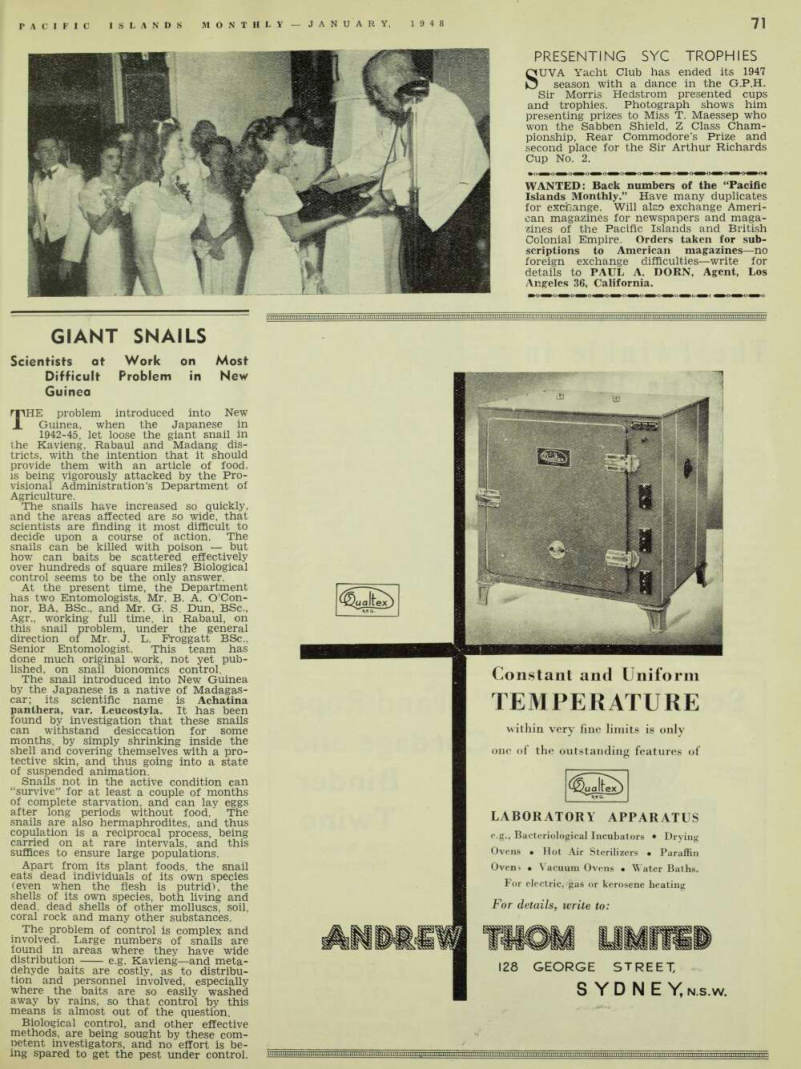
Scientists at Work on Most Difficult Problem in New Guinea
THE problem introduced into New Guinea, when the Japanese in 1942-45, let loose the giant snail in the Kavieng, Rabaul and Madang dis tricts, with the intention that it should provide them with an article of food, is being vigorously attacked by the Pro visional Administration’s Department of Agriculture.
The snails have increased so quickly, and the areas affected are so wide, that scientists are finding it most difficult to decide upon a course of action. The snails can be killed with poison but how can baits be scattered effectively over hundreds of square miles? Biological control seems to be the only answer.
At the present time, the Department has two Entomologists, Mr. B. A. O’Con nor, BA, BSc., and Mr. G. S. Dun, BSc., Agr., working full time, in Rabaul, on this snail problem, under the general direction of Mr. J. L. Froggatt BSc., Senior Entomologist. This team has done much original work, not yet pub lished, on snail bionomics control.
The snail introduced into New Guinea by the Japanese is a native of Madagas car; its scientific name is Achatina panthera, var. Leucostyla. It has been found by investigation that these snails can withstand desiccation for some months, by simply shrinking inside the shell and covering themselves with a pro tective skin, and thus going into a state of suspended animation.
Snails not in the active condition can “survive” for at least a couple of months of complete starvation, and can lay eggs after long periods without food. The snails are also hermaphrodites, and thus copulation is a reciprocal process, being carried on at rare intervals, and this suffices to ensure large populations.
Apart from its plant foods, the snail eats dead individuals of its own species (even when the flesh is putrid), the shells of its own species, both living and dead, dead shells of other molluscs, soil, coral rock and many other substances.
The problem of control is complex and involved. Large numbers of snails are found in areas where they have wide distribution e.g. Kavieng—and meta dehyde baits are costly, as to distribu tion and personnel involved, especially where the baits are so easily washed away by rains, so that control by this means is almost out of the question.
Biological control, and other effective methods, are being sought by these com petent investigators, and no effort is be ing spared to get the pest under control.
Presenting Svc Trophies
SUVA Yacht Club has ended its 1947 season with a dance in the G.P.H.
Sir Morris Hedstrom presented cups and trophies. Photograph shows him presenting prizes to Miss T. Maessep who won the Sabben Shield, Z Class Cham pionship, Rear Commodore’s Prize and second place for the Sir Arthur Richards Cup No. 2.
Advertisements & other items, p. 73 (1 item)
mm uim
WANTED: Back numbers of the “Pacific Islands Monthly.” Have many duplicates for exchange. Will also exchange American magazines for newspapers and magazines of the Pacific Islands and British Colonial Empire. Orders taken for subscriptions to American magazines —no foreign exchange difficulties —write for details to PAUL A. DORN, Agent, Los Angeles 36, California.
1 annex
(Constant and Uniform
TEMPERATURE
ucmex
AN Ml
within very fine limits is only one of the outstanding features of
LABORATORY APPARATUS
e.g., Bacteriological Incubators • Drying Ovens • Hot Air Sterilizers • Paraffin Ovens • Vacuum Ovens • Water Baths.
For electric, gas or kerosene heating For details , write to:
mm uim
128 GEORGE STREET,
SYDNEY, Ns.w.
Butterflies Wanted
RESIDENTS of the Pacific Islands— especially New Guinea—who are in terested in the collection of butter flies may wish to respond to the following communication from Mr. A. Avinoff, Hidden Hollow Locust Valley, Long Is land, USA:— “I desire to obtain butterflies from New Guinea for scientific collections. I have been for 20 years Director of the Carne gie Museum, in Pittsburg, and I am a Member of the Royal Entomological Society, of London. The usual prices will be paid for individual specimens in envelopes ranging from 5 cents to 20 cents, and more, depending on their rarity. Any collector should have the necessary experience. I would prefer specimens from the higher mountains and I particularly want butterflies from New Guinea.”
Persons interested should communicate direct with Mr. Avinoff.
Puzzled Tongans
Even There They Are Sick Of Controls
From Our Own Correspondent
Nuku’Alofa, Nov. 22.
OUR Government has added to its long list of “bans and restrictions” a recent regulation banning the sale or barter of coconuts.
It is difficult to find any motive for this except, perhaps, it is to do away with the harmless practice of some Ton gans of selling pan-cakes for coconuts and paying in coconuts for the hire of trucks to bring the coconuts from their plantations to their homes. One fails to see any evil in such transactions, so far as it relates to copra production.
Whether the coconuts go to pan-cake vendors, or remain in the hands of would-be buyers, they ultimately will be reduced to copra and sold to the Copra Board.
Where owners of distant plantations are without carts or other means of bringing their nuts to their homes to be made into copra, it is convenient and economical for them to hire trucks to do that work, in exchange for coconuts — otherwise the nuts are left to sprout and waste on their plantations.
Baffled by the intricate machinery of Government, the poor Tongan tax-payers dumbly look on in puzzled bewilderment, wondering whether this is a manifesta tion of that freedom so often promised to the citizens of the world by the great statesmen of the powerful nations during the war years. In their faikavas (kava parties) they furtively ask whether this is the tau’ataina (freedom) which the Konisitutone (that magic word to the Tongan—Constitution) speaks of.
Perhaps the situation may be summed up in these words of an old Tongan chief; “Seuke. koe kuonga kuo faikehe hotau kuonga ni,” which literally means, “The time in which we are now living is a strange one indeed.”
Miss Pam Bakewell, of Rabaul, married Mr. M. Foley, Patrol-Officer, Talasea, New Britain, on January 3.
On Again - Off Again!
Comedy of the New Guinea Meat Embargo
AS an interesting comment upon the ways of politicians, we have been supplied with the following data by a well-known Australian meat-packing house; About October, Australian meat ex porters were informed that, they must send no more meat to the Islands the New Guinea quota, which is a regular part of the business of all stunners, was absolutely cut out.
Then came the Parliamentary and Press furore caused by Colonel “Blue”
Allan, who went to Canberra and des cribed the privations being suffered by people in the Mandated Territory, who were very short of foodstuffs and other essential supplies. Minister Ward, sup ported by his loyal henchmen in Port Moresby, denied that there was any shor tage, and they called Colonel Allan wicked names.
But the embargo, recently placed on meat shipments to New Guinea, was hur riedly removed. Since November, Aus tralian meat-packers have been per mitted by the Australian Government to send to New Guinea as much meat as they wish.
Fiji And Australian
Bananas
Letter to the Editor YOU appear to have a certain hos tility to the Australian banana in dustry, as having instigated the closing of the Australian market to Fijian bananas.
Freely admitting your two 'main facts —(1) that compared to the Fijian fruit, the Australian product is a banana only by courtesy; and (2) that the practical prohibition of the entry of Fijian bananas into Australia, is unjust; may I say that other considerations are in volved.
Excluding the natives, who are in the long run independent of any European economy, the Fijian banana growers number a few score Europeans and others: but the Australian industry sup ports thousands of people, and has great value in promoting closer land settle ment of first importance to Australia and therefore to the whole South Pacific.
Prom this point of view, the overseas banana embargo, though unjust and un wise from the wheat-growing angle, is nevertheless necessary. Liberal admis sion of Fijian bananas would, of course, kill the Australian industry in quick time.
The Australian growing area is small and largely restricted to the NSW North Coast. There, because of the not over favourable climate, the business of dragooning Nature into producing some thing like a banana is a heart-breaking peasant grind. The Australian grower does not seek to compete in any overseas market (he couldn’t, anyway) but wants an “open go” in his own home market. This he should have, in the best interests of Australia, if not of the Australian stomach.
I am, etc.,
K. A. Saxby.
S. Murwillumbah, NSW.
The marriage took place recently of Mrs. Eve Campbell, widow of the late Allan Campbell of British Solomon Is lands and New Guinea, and daughter of the late Captain T. A. Darby and of Mrs. Darby, of “Fareham,” Waverley, to Mr. R. A. Robinson, of Rabaul, New Guinea. They are now living in Rabaul,
Advertisements & other items, pp. 74-75 (2 items)
Cordage and
The Twinkle in
Your Eye
COMES FROM ACTIVE
DIGESTION
Good normal digestive and liver activity means good, normal health and fitness. If yo* are becoming gloomy and feel tired out, the cause may be a congested state of your intestinal tract. So many people are troubled with constipation, which, through the retention of waste in the digestive system, causes sick headache, biliousness, pimply skin, unpleasant breath, irritability, slackness and dull eyes.
Regain your bright and attractive appearance by banishing constipation with Pinkett&s. Tiny, perfectly harmless, gentle yet effective, these famous laxative and liver pills painlessly exercise and strengthen the bowels, keep the food tract clean and active, stir the liver, and thus banish sick headache, bilious attacks, pimples, unpleasant breath and gloom. All chemists and stores sell Pinkettes, the perfect laxative and liver pills.
Scott’s “Renown” Brand Rope,
Cordage and
Binder
Twine
of Every
Description
Cable Address Ropeyard, Sydney.
MANUFACTURED AT
MASCOT, N.S.W.
J SCOTT
PTY. LTD.
Head Office and Store
ICS CLARENCE STREET.
SYDNEY,
N.S.W.
Pacific Islands Trading Company
ANCHOR HOCKING GLASSWARE
"The Most Famous Name In Glass" m
"HEAT-PROOF" JADE-ITE
Heat-resisting glass dinnerware in a pleasing opaque jade colour. The only line of its kind made in America. Jade-ite is made of the same heat-resisting material throughout. Will NOT "check" or "craze".
Be assured of fast turn-
over tor year- round
selling
All Big Sellers—Special Values and Low Prices
FIRE-KING OVEN GLASS
(Guaranteed) TUMBLERS (Plain and decorated)
LAMPS
OIL LAMPS (Bases only)
JUMBO ICED TEAS
KITCHEN GLASSWARE
FIRE-KING TABLEWARE
VASES
BANKS
CRYSTAL OCCASIONAL
PIECES
SPARKLING CRYSTAL
DECORATED WARE
FIRE-KING
Useful Items Good Quality
PACIFIC ISLANDS TRADING COMPANY
244 CALIFORNIA STREET, SAN FRANCISCO 11, CALIFORNIA, U.S.A.
EXPORTERS
OBTAINABLE AT YOUR STORE.
N. Ireland Road In Bad
Shape
Kavieng, Jan. 3.
RECENT heavy weather has destroyed the Kimadan bridge. This, and the fact that several streams have to be forded, due to unsafe or no bridges, make the journey from Kavieng to Namatani rather difficult, and the time is eagerly awaited when the PWD will have all bridges completed.
Mr. H. A. Markham, of the British Solomon Islands, has settled down for another year as British Administrative Officer on Christmas Island, in the Gil bert & Ellice Colony. “The climate here is the finest I have struck in all my travels, which have been considerable,” he writes. “The fresh trade-winds blow all insects away to sea, including flies and mosquitoes, which in my estimation makes life worth living.” Christmas Island is practically on the Equator.
"Incident" In New
Guinea Dangers of a Hush-Hush Attitude
IT is notified in the Territories Gazette that Mr. Ivan Champion, Acting As sistant Director of District Services, has been appointed to act ‘Tor the time being” as District Officer in the Central Highlands of New Guinea.
This is the important Territory held until recently by a senior District Officer, the well-known and esteemed Mr. J. L.
Taylor, who was formerly Director of Native Labour; and this re-arrangement of offices gives substance to a series of apparently garbled renorts which have reached Australia.
There appears to have been some un pleasant incident in the Highlands area, in the course of which a number of “wild” natives were shot bv native police in charge of a junior officer. It is stated that Mr. Taylor, as officer in charge of the district, tried to protect the junior official, and did not immediately report the incident; with the result that Mr. Taylor was suspended from duty, pending inquiries. The shooting occurred over three months ago.
It does not appear to have been a very serious incident; but it is unfortunate that the Port Moresby authorities did not immediately make an announcement concerning it. In the hands of an ir responsible newspaper, it could be given an ugly complexion, and might even have UNO repercussions.
Imagine the Russian delegate, at the Council, howling and thump ing the table, and declaiming about Aus tralia’s attempt to conceal her murderous attacks on natives in New Guinea!
Advertisements & other items, p. 76 (1 item)
George J. Logkyer & Company
*s
GILLESPIE’S
The Flour of the Islands
-SYDNEY-
TRAOE
MARK
GEORGE J. LOGKYER & COMPANY
In association with
GEORGE J. LOCKYER (Far East) & CO, and GEORGE J. LOCKYER (Overseas) & CO.
ENGINEERING SUPPLIES, GENERAL HARDWARE EXPORTERS AND MERCHANTS
Agents for the Finest Australian Liquors
Aerated Water and Cordial Manufacturing: Machinery, Bottling and Capping Machinery, etc.
CONSULTING ENGINEERS DOCKYARD MACHINERY
PURCHASING AGENTS:
Electric Light Generating Plants.
Air Conditioning Plants.
Builders’ Hardware.
Marine Engineering Supplies.
Refrigeration Supplies.
Radios and Accessories.
Sanitation Equipment.
Automobile Spare Parts and Garage Accessories.
Abrasive Wheels.
Excavating Machinery.
Electrcal Supples.
Grinding and Pulverising Machinery.
Hydraulic Equipment.
Mechanical Engineering Requirements.
Mining and Quarrying Machinery.
Road and Building Machinery.
Photographs , Drawings ,
EXACT REPLICA OF CANE KNIFE,
MADE IN AUSTRALIA.
VESSELS, ETC.
Steel Cargo Vessels, 35 ft. x 13 ft. 4 ft., New, with
Winch, Hoist, etc.
Auxiliary Transport Vessels,
32 ft. x 9 ft. x 4 ft., New,
without Engines.
Tugs, Trawlers, Cargo
Vessels, Tankers, Motor
Cruisers, Launches, Yachts,
Hoists, Winches, etc.
Schedules, will he Supplied by Return Mail to Genuine Clients.
HEAD OFFICE, 24 BOND ST. SYDNEY, N.S.W.
All communications to be addressed to The General Manager, G.P.O., Box 4553, Sydney.
Bankers: Commonwealth Bank of Australia, Sydney.
Also Bank of N.S.W., Sydney.
'Phones; BW6018 UA7196
Telegraphic and Cable Address: "LOCKMACH,” Sydney.
Australia’S Unsuspected
Islands Empire
100,000 Acres Available in the New Hebrides
HOW many people know that the Australian Commonwealth Gov ernment has a small Empire of about 100,000 acres in the Condominium of the New Hebrides, and that this land is available, at very low rates, to selected and approved persons of
British nationality?
THE land was given to Australia by one of the famous Empire-builders of the South Pacific, the late Sir James Burns, founder of the Burns Philp group of companies.
From his earliest days in the South Seas, Sir James was interested in the New Hebrides and especially the cool, southern islands and he directed some of his great energy to the encouragement of British settlement there. As a good Scotsman, he assisted the Presbyterian Church to go to this group one of the very few places in the Pacific Islands where Presbyterian missionaries may be found to-day.
Soon after the Commonwealth was created, Sir James turned over to the Australian Government all his com panies’ land interests in the New Hebrides, totalling about 100,000 acres, on condition that Australia encouraged the settlement of British planters there.
Australia took over the responsibility, and established its representative in Port Vila.
But the plan did not make great pro gress partly because of the politicians’ indifference, and partly because of the slowness of the Condominium Joint Court in granting titles. The Burns claims to the 100,000 acres (which in cluded a lot of the most desirable land in the group) were based on all sorts of transactions, extending over many years; and although the Burns Philp interests had been in possession, the Court could not grant the permanent titles until it had carefully examined each claim in all its aspects.
THE Joint Court, in dealing with land claims, has been amazingly slow.
It began its task prior to World War I; it was interrupted by World Wars I and II; it was dislocated, again and again, by changes in personnel; and to day, 45 years after Australia took over the land, the claims in respect of only two or three islands have been examined.
For many years, a Mr. Wallace repre sented the Australian Government in Vila, with the title of “Commonwealth solicitor.” After he left, late in the thirties, the work was taken over by Mr. Ballard; but in the early part of World War II he was transferred else where. No one was sent in his place; and, since then, the Vila branch of Burns Philp & Co., Ltd., has been re presenting Australia in respect of these land matters.
DURING the last session of the Com monwealth Parliament Mr. P. C.
Spender, KC, MP, asked the Prime Minister for information about this land in the New Hebrides; and, after a con siderable delay, Mr. Chifley, on Decem ber 4, replied to Mr. Spender as follows: “Under the terms of a mail contract of March 12, 1902, between the Common wealth and Burns Philp & Co., Ltd., the Company agreed and declared that they would hold in trust all lands in the New Hebrides Islands taken over by them from the Australian-New Hebrides Com pany, and of which they were then pos
sessed, inter alia to lease them to such persons at rentals of 1/- per annum for each 50 acres or part thereof, and on such terms and conditions as the Minister
for External Affairs might from time to time approve.
“Numerous leases were granted before the recent war, the usual procedure being to grant leases for three years and then, if the terms of the lease were satisfac torily carried out, to grant a further lease for 96 years. During the recent war the granting of leases was suspended.
“On the termination of the war, In 1945, the granting of leases to approved settlers was resumed; and Burns Philp & Co., Ltd., as trustees, were invited to forward applications for leases for con sideration and were reauested, in view of the fact the Australia was not repre sented in the New Hebrides, to arrange through their Islands Branches for any necessary work in connection with the leases to be carried out.
“Leases of lands have been limited to approved settlers of British nationality.
“The total area of the land included in the agreement of 1902 is estimated at about 100,000 acres.”
THE “PIM” made inquiries recently in Sydney, and was informed that there is plenty of land available to would-be nlanters in the New Hebrides, at absurdly low rates but it is not clear that the land is generally suitable for planting purposes. The difficulty to-day is that it is mostly unimproved land, and labour, building materials and machinery are just as difficult to obtain in the New Hebrides as anywhere else.
The Condominium Government has often been laughed at, as inefficient and unwieldy: but, as a matter of fact, it is one of the few places in the world to-day where the individual can get security, administrative justice and freedom from punitive taxation.
Persons interested should direct their inquiries to th Q Manager, Island Agencies Denartment, Burns Philp & Co., Ltd., 7 Bridge Street, Sydney.
Advertisements & other items, pp. 77-78 (1 item)
Broompields Ltd.
nr For inflamed Eyes and Eyelids ... Sold Everywhere H. Rosei Co.Pty.. Ltd.. Kinq Street. Sydney.
Suppliers of
Building Hardware
General Hardware
Ship Chandlery
Paint Materials
WRITE DIRECT TO
Broomfields Ltd.
152 SUSSEX STREET, SYDNEY
Sole Agents for: P. H. MUNTZ & CO.’s 3-CROWN BRAND METAL
SHEATHING.
PEACOCK & BUCHANS’ ENGLISH READY-
MIXED PAINTS.
n I
SEE
UNDERWATER.
Hunt Fish, Gather Bait, Lobster, Shellfish, with an All- Purpose "Undersee" Swimmer's Mask. Invaluable for checking Keels, HLjIIs, Anchorages, Etc. Made of Soft Durable Rubber, Plate Glass and Stainless Steel.
For all Particulars, apply to Leading Island Stores, or direct to Pacific Island Agents :
KERR BROS. PTY. LTD.
4 YORK ST., SYDNEY
Cable Address: “Care.” Sydney. G.P.O. Box 3838
A NEW Book . . . .
FOR
YOUR
ENTERTAIN-
MENT
72 STORIES, ARTICLES
AND SKETCHES
ABOUT LIFE IN THE
SOUTH PACIFIC
ISLANDS
WITH NUMEROUS
ILLUSTRATIONS
★ Collected by
R. W. Robson
and
Judy Tudor
<r - * - 2 : - f'i. a** - MB K T# W
“Where The Trade
Winds Blow”
These stories and sketches, brought together in this book for your entertainment, are about real people. They describe, without colour or embellishment, conditions of life in the Pacific Islands, as they are to-day.
We still have the Islands setting and the indefinable Islands atmosphere; but life in the Islands—even in savage and primitive Melanesia—has been altered, profoundly.
This book indicates how and where conditions have changed.
At all Leading Booksellers in Australia; at the Stores of Whitcomb & Tombs, Ltd., in New Zealand; at CaldwelVs Book Store, in Suva; from the Islands stores of Burns Philp & Co., Ltd.; and from Booksellers generally.
OR DIRECT FROM THE PUBLISHERS:
Pacific Publications Pty. Ltd, wl E
UNION HOUSE, 247 GEORGE ST., SYDNEY Posted
Rehabilitation Is Difficult

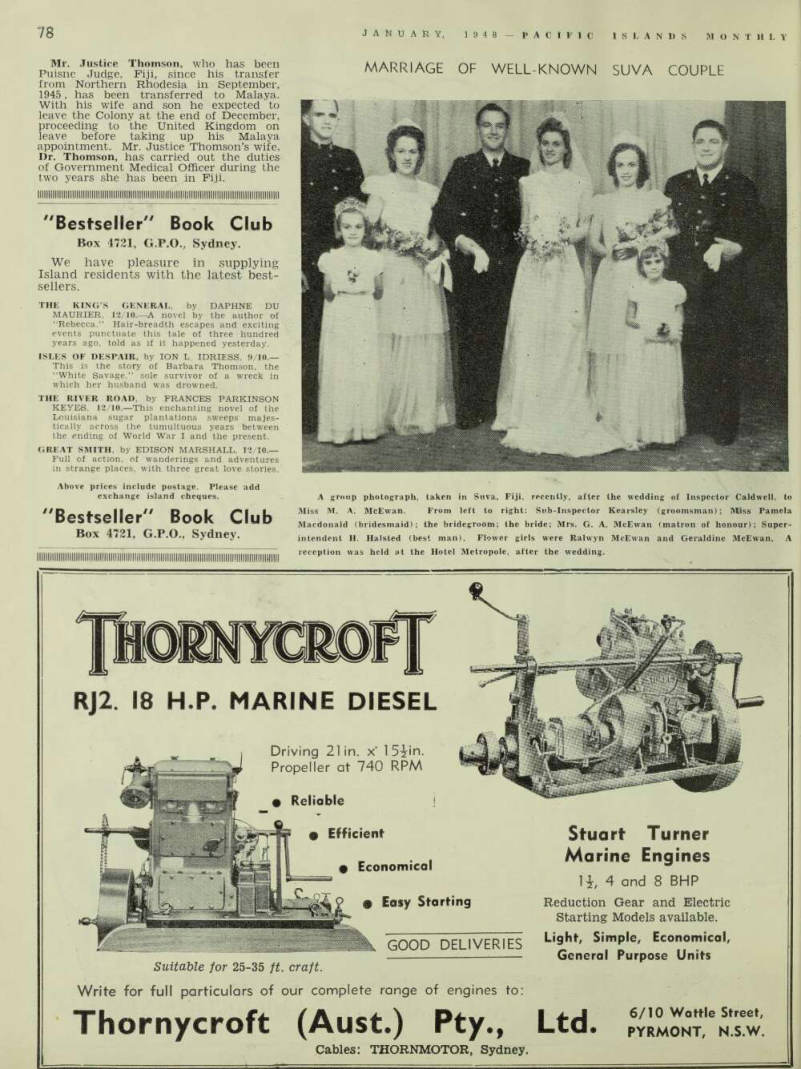
Prom Our Own Correspondent
Cairns, Dec. 16.
THE lack of timber and other building material is holding up the rehabili tation of plantation areas around Madang, while the new Government one year contracts with native labourers are proving a set-back to copra industries, said a Madang plantation owner, Mr.
Geoff Luff, who is at present in Cairns on holidays. Mr. Luff went to New Guinea about 15 years ago and left after the Japanese bombings of Rabaul, and returned when the war ended.
One of his two plantations has been so badly damaged by bombings that he has not yet started to work it again.
Mr. Luff said that only a few people had been lucky enough to buy Army Disposals buildings and had any material for rebuilding on their plantations, and many, including himself, were forced to use roughly untreated timber got by the natives.
He added that although he had not had much trouble with native labour, it was one of the greatest difficulties for other plantation men. Before Australia altered the labour system, natives could be signed on for three years and were bound to remain at the plantation for that time, but now they could not be signed on for more than a year and could leave when they felt like it, making the supply of labour uncertain.
The Native Land Trust Board of Fiji has announced a detailed policy concern ing the control of dealings in native leases and sub-leases. It is stated that “the policy is designed to confine the selling price of native leases and sub leases within reasonable limits and to pre vent speculative buying or selling of leases or undue aggregation of land.”
Mr. Justice Thomson, who has been Puisne Judge, Fiji, since his transfer from Northern Rhodesia in September, 1945, has been transferred to Malaya.
With his wife and son he expected to leave the Colony at the end of December, proceeding to the United Kingdom on leave before taking up his Malaya appointment, Mr. Justice Thomson’s wife, Dr. Thomson, has carried out the duties of Government Medical Officer during the two years she has been in Fiji.
Advertisements & other items, pp. 79-80 (1 item)
{ref^Vt
'cu
ii eufbee
TOOTH PASTE
It's
{ref^Vt
You’ll agree, too, when you use IPANA. It’s refreshingly different, with a distinctive, pleasant taste, that makes your mouth feel grand.
IPANA’S cleaning and polishing qualities give you sparkling teeth and a sunny smile.
With massage, too, IPANA helps ensur firm, healthy gums so vital to sound teeth.
"Bestseller" Book Club
Box 4721, G.P.0., Sydney.
We have pleasure in supplying
Island residents with the latest best-
sellers.
THE KING’S GENERAL, by DAPHNE DU
MAURIER, 12/10. —A novel by the author of “Rebecca.” Hair-breadth escapes and exciting events punctuate this tale of three hundred years ago, told as if it happened yesterday.
ISLES OF DESPAIR, by lON L. IDRIESS. 9/10.— This is the story of Barbara Thomson, the “White Savage,” sole survivor of a wreck in which her husband was drowned.
THE RIVER ROAD, by FRANCES PARKINSON
KEYES, 12/10. —This enchanting novel of the Louisiana sugar plantations sweeps majestically across the tumultuous years between the ending of World War I and the present.
GREAT SMITH, by EDISON MARSHALL. 12/10.
Full of action, of wanderings and adventures in strange places, with three great love stories.
Above prices include postage. Please add exchange island cheques.
"Bestseller" Book Club
Box 4721, G.P.0., Sydney.
Marriage Of Well-Known Suva Couple
A group photograph, taken in Suva, Fiji, recently, after the wedding of Inspector Caldwell, to Miss M. A. McEwan. From left to right: Sub-Inspector Kearsley (groomsman); Miss Pamela Macdonald (bridesmaid); the bridegroom; the bride; Mrs. G. A. McEwan (matron of honour); Super intendent H. Halsted (best man). Flower girls were Ralwyn McEwan and Geraldine McEwan. A reception was held at the Hotel Metropole, after the wedding.
Advertisements & other items, pp. 80-81 (1 item)
Thornycroft (Aust.) Pty., Ltd.
u f o Y 0
RJ2. 18 H.P. MARINE DIESEL
Driving 21 in. x 1 siin.
Propeller at 740 RPM • Reliable StjsSSk < H Efficient Economical Easy Starting
GOOD DELIVERIES
Suitable for 25-35 ft. craft.
Write for full particulars of our complete range of engines to:
Thornycroft (Aust.) Pty., Ltd.
Cables: THORNMOTOR, Sydney.
Stuart Turner
Marine Engines
H, 4 and 8 BHP Reduction Gear and Electric Starting Models available.
Light, Simple, Economical, General Purpose Units 6/10 Wattle Street,
PYRMONT, N.S.W.
THIS IS THE
TEX MORTON
i mm
, " - ' . -i : mmm. ■ .
■■■Psh :
t i
wmm
Finished in Ivory Highlighted in Red Black and Gold
ry^ t
&TS // "K Dad: "Our l{id always seems to be out of it!”
Mum: "That’s the solution.
We’ll buy him a Guitar and give him the chance we never had.” m m f D l: 'I Boy: "Dad, it's a beaut. for some entertainment and fun these long evenings." f.
A
(liffi
Mum: “He's doing postal course was a as we live miles teacher.” fine. The Godsend, from a You can quickly learn to play the Tex Morton Guitar, either Spanish or Hawaiian style. With no previous musical experience, you can play your first tune in half an hour. Easy postal lessons supplied. Write your name and address on the coupon and send it to
TEX MORTON'S MUSIC
WAREHOUSE
Box 1758, G.P.0., Melbourne, Australia T c ,he Tex Morton please send Guitar and Address *
Obtainable ONlTfrom TTXMORTONS MOS/CmRTNOOSCNe/Uanne
Nz Chieftainess's Daughter
At Mauke
From Our Own Correspondent
Mangaia, Nov. 20.
THE appointment, by the NZ Govern ment. of Mr. Alfred Scott, of Wel lington, as Resident Agent, of Mauke, Cook Islands, has brought the Maori tribes of NZ into closer contact with their Cl cousins.
Mr. Scott’s wife, who before her marriage was Miriama Heketa, of Hutt, Welling ton, is the daughter of Mrs. Piri Heketa, a NZ chieftainess of very high rank, who died lately. Mrs. Heketa up until her death was a well-known figure in Wel lington Maori church and social circles, and the dignity and simplicity of her bearing will long be remembered by those Europeans who came into contact with her. The settlement on Mauke Island of her daughter may be considered as an embassy from the “Maoritanga” of NZ to their cousins in Cl.
Mrs. Scott is highly educated, and ar tistic to a degree her dancing was always a feature of Wellington Maori concerts and she has considerable musical skill.
Like Mr. Ryan, the new Resident Agent of Mangaia, Mr. Scott is an ex-officer; it will be interesting to see what changes and improvements he will see fit to effect at Mauke, which, like Mangaia, is a some what primitive place.
Mrs. Jeff Thompson died at Brisbane on December 6. She was Miss Osmer Craig, only daughter of Mr. and Mrs. T.
E. Craig, of Samarai, Papua; and she leaves a son only six weeks of age. Her mother, Mrs. Anna Craig, some weeks ago hurried to Brisbane from Samarai, to be with her.
Finschhafen's
Christmas
Finschhafen, Jan. 10.
ONE Oriental bashed another with a bottle, putting him in hospital. Both were members of thel “Montoro” crew. A few jeeps were “stolen.” House breakers raided a naval officer’s liquor supply. Navy lads incurred the wrath of the gold braid by bathing in the nude during the dark, early hours of Christmas morning, when they should have been in bed or clad from neck to ankle in the twilight, anti-mosquito regulation garb.
But, taken all round, the Festive Season at Finschhafen was one of much gaiety and of considerable good cheer.
Lae literally invaded the place. Guests of HMAS “Tarangau” (local naval base), the visitors relished the cool beer and sumptuous fare, and the athletically minded were treated to a well-organised and varied sports programme.
Owen Pollard, Government Stores, Lae, was admitted to the Lutheran Mission Hospital, where his appendix was removed.
Unhappy climax to the Lae visit was the return trip in an open vessel—for two hours, in the early hours of the morn ing, the boys from the Butibum area lay shivering in a drenching, cold rain.
Personal
A SMILING, vivacious, charming young woman, Phyllis Keenan, has left us.
She had been hostess to numerous visitors to Finschhafen. She sailed South by the December “Montoro” and will be joined in March by her husband, A. D. O.
Jack Keenan. They intend taking a well earned holiday trip to East Africa.
Jerry Pentland, who has business in terests here with Tex Marshall, blew in late in the Festive Season. He certainly believes in moving around these days, and
we do not expect to have him with us long.
Flight-Lieut. Colin Bell, last of the RAAF at Finschhafen, left for Port Moresby on January 6. He was given a farewell at HMAS “Tarangau’s” wardroom.
Miss I. M. Green, a cultured, charming lady, well-known in Melbourne where she did valuable war work, has been staying with her popular, gold-braided brother, Commander Arnold H. Green. DSC, RAN
Minor Tragedies
NUMBER 1 Kiap belong Lae” was very much “in the gun” with the Tami gudu natives for not attending their Christmas “sing-song.” When “Robby” failed to turn up the first day, they thumped the “kundus” in desperation for two more days and nights—but still no “Robby.”
Alas! the only intimation of the big man’s coming had been a pencilled note in the Yabim dialect, written, apparently, by a bright native clerk at Lae, and the unfortunate revellers evidently took this as “official!” As a reprisal, I am told that when the Kiap at Lae wants the Tami gudduites to go down to Lae for a “sing sing” they will refuse to budge unless a vessel is sent for them!
It’s a long tramp from Satelberg to Katika, but a small borrowed coffee grinder repeatedly makes the trip. Labori ously, a Katika boy grinds up coffee beans which he buys from the hinterland kanakas, then, during his periodic trips to Lae, he sells the ground coffee to La 3 residents. With an eye to business, he now intends to buy a larger grinder from Sydney, “enough long £10!”
Queen Salote, of Tonga, who has been in Auckland since December 3, and whose stay in New Zealand is private and unofficial, paid a visit to Wellington during January.
Advertisements & other items, p. 82 (1 item)
Heinz
OF 57 Because of its quality and flavour . . .
Heinz Spaghetti is a favorite with everyone! This month, in all leading newspapers, and national journals, housewives will see Heinz Spaghetti advertisements. To get your share of this business keep ample stocks of Heinz Spaghetti on your shelves.
News
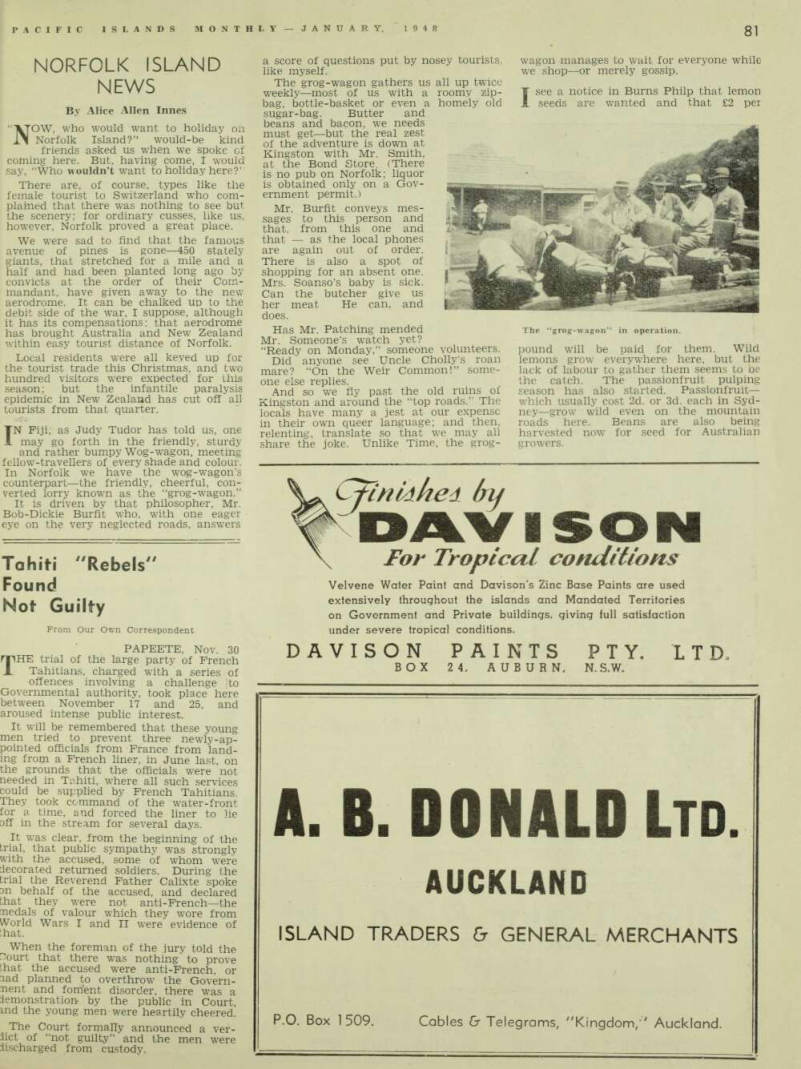
Norfolk Island
By Alice Allen Innes
"V[OW, who would want to holiday on ll Norfolk Island?” would-be kind friends asked us when we spoke of coming here. But, having come, I would say, “Who wouldn’t want to holiday here?’
There are, of course, types like the female tourist to Switzerland who com plained that there was nothing to see but the scenery; for ordinary cusses, like us, however, Norfolk proved a great place.
We were sad to find that the famous avenue of pines is gone—4so stately giants, that stretched for a mile and a half and had been planted long ago by convicts at the order of their Com mandant, have given away to the new aerodrome. It can be chalked up to the debit side of the war, I suppose, although it has its compensations: that aerodrome has brought Australia and New Zealand within easy tourist distance of Norfolk.
Local residents were all keyed up for the tourist trade this Christmas, and two hundred visitors were expected for this season; but the infantile paralysis epidemic in New Zealand has cut off all tourists from that quarter.
IN Fiji, as Judy Tudor has told us, one may go forth in the friendly, sturdy and rather bumpy Wog-wagon, meeting fellow-travellers of every shade and colour.
In Norfolk we have the wog-wagon’s counterpart—the friendly, cheerful, con verted lorry known as the “grog-wagon.”
It is driven by that philosopher, Mr.
Bob-Dickie Burfit who. with one eager eye on the very neglected roads, answers
a score of questions put by nosey tourists, like myself.
The grog-wagon gathers us all up twice weekly—most of us with a roomy zip bag, bottle-basket or even a homely old
sugar-bag. Butter and beans and bacon, we needs must get—but the real zest of the adventure is down at Kingston with Mr. Smith, at the Bond Store. (There is no pub on Norfolk; liquor is obtained only on a Gov ernment permit.) Mr. Burfit conveys mes sages to this person and that, from this one and that as the local phones are again out of order.
There is also a spot of shopping for an absent one.
Mrs. Soanso’s baby is sick.
Can the butcher give us her meat He can, and does.
Has Mr. Patching mended Mr. Someone’s watch yet?
“Ready on Monday,” someone volunteers.
Did anyone see Uncle Cholly's roan mare? “On the Weir Common!” some one else replies.
And so we fly past the old ruins of Kingston and around the “top roads.” The locals have many a jest at our expense in their own queer language; and then, relenting, translate so that we may all share the joke. Unlike Time, the grog
wagon manages to wait for everyone while we shop—or merely gossip.
I see a notice in Burns Philp that lemon seeds are wanted and that £2 per
pound will be paid for them. Wild lemons grow everywhere here, but the lack of labour to gather them seems to be the catch. The passionfruit pulping season has also started. Passionfruit— which usually cost 2d. or 3d. each in Syd ney—grow wild even on the mountain roads here. Beans are also being harvested now for seed for Australian growers.
The “grog-wagon” in operation.
Not Guilty
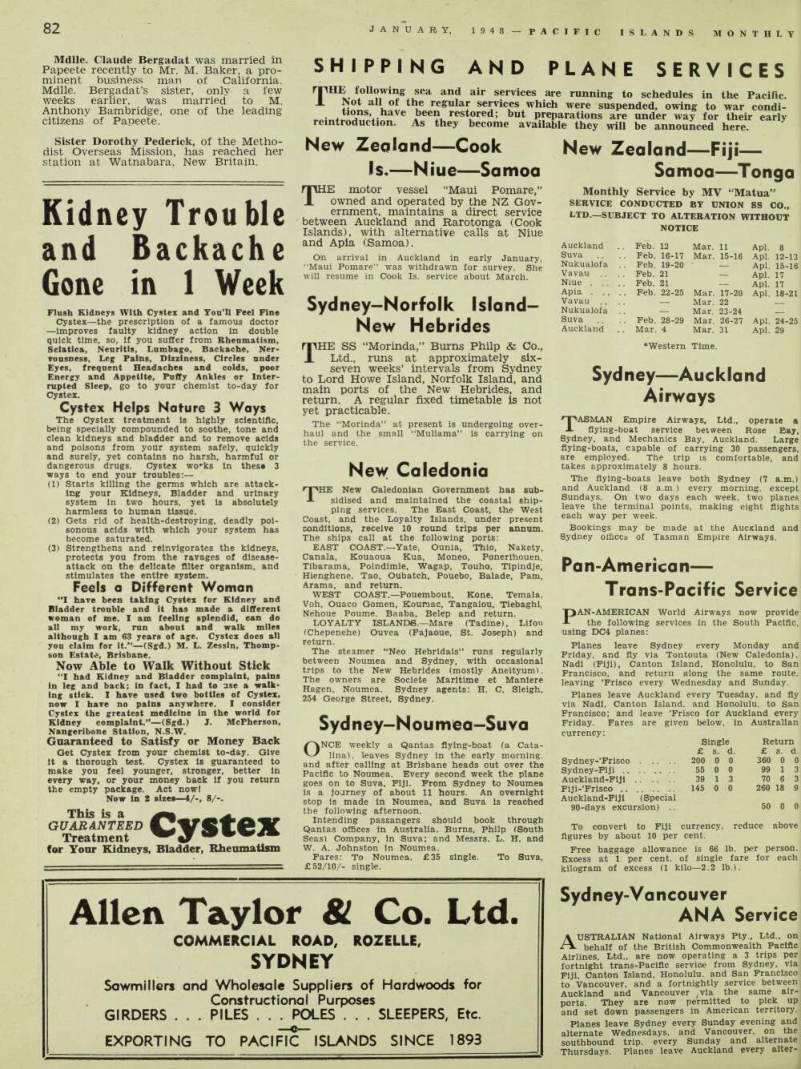
Tahiti "Rebels"
Found Not Guilty
From Our Own Correspondent
Papeete, Nov. 30
THE trial of the large party of French Tahitians, charged with a series of offences involving a challenge !to Governmental authority, took place here between November 17 and 25, and aroused intense public interest.
It will be remembered that these young men tried to prevent three newly-ap pointed officials from France from land ing from a French liner, in June last, on the grounds that the officials were not needed in Tahiti, where all such services could be supplied by French Tahitians.
They took command of the water-front for a time, and forced the liner to lie off in the stream for several days.
It was clear, from the beginning of the trial, that public sympathy was strongly with the accused, some of whom were decorated returned soldiers. During the trial the Reverend Father Calixte spoke on behalf of the accused, and declared that they were not anti-French—the medals of valour which they wore from World Wars I and II were evidence of that.
When the foreman of the jury told the -ourt that there was nothing to prove that the accused were anti-French, or lad planned to overthrow the Govern ment and foment disorder, there was a demonstration by the public in Court, md the young men were heartily cheered.
The Court formally announced a ver dict of “not guilty” and the men were discharged from custody.
Mdlle. Claude Bergadat was married in Papeete recently to Mr. M. Baker, a pro minent business man of California.
Mdlle. Bergadat’s sister, only a few weeks earlier, was married’ to M.
Anthony Bambridge, one of the leading citizens of Papeete.
Sister Dorothy Pederick, of the Metho dist Overseas Mission, has reached her station at Watnabara, New Britain.
Advertisements & other items, pp. 83-84 (1 item)
A. B. Donald Ltd.
Opnidked by
DAY I SON
For Tropical conditions
Velvene Water Paint and Davison's Zinc Base Paints are used extensively throughout the islands and Mandated Territories on Government and Private buildings, giving full satisfaction under severe tropical conditions.
DAVISON PAINTS PTY. LTD.
BOX 24, AUBURN, N.S.W.
A. B. DONALD Ltd.
AUCKLAND
ISLAND TRADERS & GENERAL MERCHANTS
I P.O. Box 1509. Cables & Telegrams, "Kingdom/' Auckland.
Kidney Trouble
and Backache
Gone in 1 Week
Flush Kidneys With Cystex and You’ll Feel Fine Cystex—the prescription of a famous doctor —improves faulty kidney action in double quick time, so, If you suffer from Rheumatism, Sciatica, Neuritis, Lumbago, Backache, Nervousness, Leg Pains, Dizziness, Circles under Eyes, frequent Headaches and colds, poor Energy and Appetite, Puffy Ankles or Interrupted Sleep, go to your chemist to-day for Cystex.
Cystex Helps Nature 3 Ways
The Cystex treatment is highly scientific, being specially compounded to soothe, tone and clean kidneys and bladder and to remove acids and poisons from your system safely, quickly and surely, yet contains no harsh, harmful or dangerous drugs. Cystex wo r ks In these 3 ways to end your troubles:— (1) Starts killing the germs which are attacking your Kidneys, Bladder and urinary system In two hours, yet is absolutely harmless to human tissue. (2) Gets rid of health-destroying, deadly poisonous acids with which your system has become saturated. (3) Strengthens and reinvigorates the kidneys, protects you from the ravages of diseaseattack on the delicate filter organism, and stimulates the entire system.
Feels a Different Woman
“I have been taking Cystex for Kidney and Bladder trouble and it has made a different woman of me. I am feeling splendid, can do all my work, run about and walk miles although I am 63 years of age. Cystex does all you claim for it.”—(Sgd.) M. L. Zessin, Thompson Estate, Brisbane.
Now Able to Walk Without Stick
‘T had Kidney and Bladder complaint, pains in leg and back; in fact, I had to use a walking stick. I have used two bottles of Cystex, now I have no pains anywhere. I consider Cystex the greatest medicine in the world for Kidney complaint.”—(Sgd.) J. McPherson, Nangeribone Station, N.S.W.
Guaranteed to Satisfy or Money Back Get Cystex from your chemist to-day. Give It a thorough test. Cystex Is guaranteed to make you feel younger, stronger, better in every way, or your money back If you return the empty package. Act now!
Now in 2 sizes—4/-, 8/-.
GUARANTEED CVStfiX
Treatment J **
for Your Kidneys, Bladder, Rheumatism
Allen Taylor 81 Co. Ltd.
COMMERCIAL ROAD, ROZELLE,
SYDNEY
Sawmillers and Wholesale Suppliers of Hardwoods for Constructional Purposes GIRDERS . . . PILES . . . POLES . . . SLEEPERS, Etc.
EXPORTING TO PACIFIC - ISLANDS SINCE 1893
Samoa—Tonga
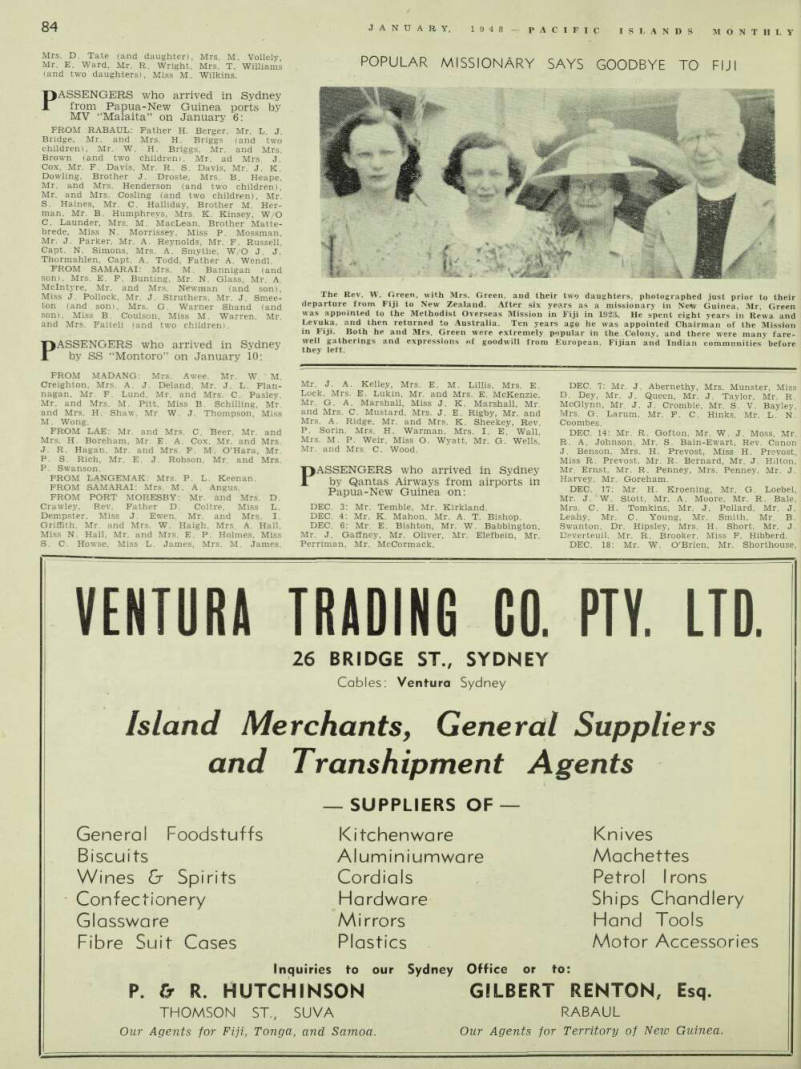
Shipping And Plane Services
THE following sea and air services are running to schedules in the Pacific.
Not all of the regular services which were suspended, owing to war condi • been restored; but preparations are under way for their early reintroduction. As they become available they will be announced here.
New Zealand—Cook
Is.—Niue—Samoa
rE motor vessel “Maui Pomare,” owned and operated by the NZ Gov ernment, maintains a direct service between Auckland and Rarotonga (Cook Islands), with alternative calls at Niue and Apia (Samoa).
On arrival in Auckland in early January, “Maui Pomare” was withdrawn for survey. She will resume in Cook Is. service about March.
Sydney-Norfolk Island-
New Hebrides
THE SS “Morinda,” Burns Philp & Co., Ltd., runs at approximately six seven weeks’ intervals from Sydney to Lord Howe Island. Norfolk Island, and main ports of the New Hebrides, and return. A regular fixed timetable is not
yet practicable.
The “Morinda” at present is undergoing over haul and the small “Muliama” is carrying on the service.
New Caledonia
THE New Caledonian Government has sub sidised and maintained the coastal ship ping services. The East Coast, the West Coast, and the Loyalty Islands, under present conditions, receive 10 round trips per annum.
The ships call at the following ports: EAST COAST. —Yate, Ounia, Thio, Nakety, Canala, Kouaoua Kua, Moneo, Ponerihouen, Tibarama, Poindimie, Wagap, Touho, Tipindje, Hienghene, Tao, Oubatch, Pouebo, Balade, Pam, Arama, and return.
WEST COAST. —Pouembout, Kone, Temala, Voh, Ouaco Gomen, Koumac, Tangaiou, Tiebaghl, Nehoue Poume. Baaba, Belep and return.
LOYALTY ISLANDS.—Mare (Tadine), Lifou (Chepenehe) Ouvea (Fajaoue, St. Joseph) and return.
The steamer “Neo Hebridais” runs regularly between Noumea and Sydney, with occasional trips to the New Hebrides (mostly Aneityum).
The owners are Societe Maritime et Manlere Hagen, Noumea. Sydney agents: H. C, Sleigh, 254 George Street. Sydney.
Sydney-Noumeo-Suvo
ONCE weekly a Qantas flying-boat (a Cata lina), leaves Sydney In the early morning, and after calling at Brisbane heads out over the Pacific to Noumea. Every second week the plane goes on to Suva, Fiji. From Sydney to Noumea is a journey of about 11 hours. An overnight stop is made in Noumea, and Suva is reached the following afternoon.
Intending passangers should book through Qantas offices in Australia. Burns, Philp (South Seas) Company, in Suva; and Messrs. L. H. and W. A. Johnston In Noumea.
Fares: To Noumea. £35 single. To Suva, £52/10/- single.
New Zealand—Fiji—
Samoa—Tonga
Monthly Service by MV “Matua”
Service Conducted By Union Ss Co.,
Ltd,—Subject To Alteration Without
Notice
Auckland .. Feb. 12 Mar. 11 Apl. 8 Suva .. .. Feb. 16-17 Mar. 15-16 Apl. 12-13 Nukualofa .. Feb. 19-20 ' Apl. 15-16 Vavau .. .. Feb, 21 Apl. 17 Niue Feb. 21 Apl. 17 Apia Feb. 22-25 Mar. 17-20 Apl. 18-21 Vavau ... Mar. 22 Nukualofa .. Mar. 23-24 Suva . . .. Feb. 28-29 Mar. 26-27 Apl. 24-25 Auckland .. Mar. 4 Mar. 31 Apl. 29 ♦Western Time.
Sydney—Auckland
Airways
TASMAN Empire Airways, Ltd., operate a flying-boat service between Rose Bay, Sydney, and Mechanics Bay, Auckland. Large flying-boats, capable of carrying 30 passengers, are employed. The trip is comfortable, and takes approximately 8 hours.
The flying-boats leave both Sydney (7 a.m.) and Auckland (8 a.m.) every morning, except Sundays. On two days each week, two planes leave the terminal points, making eight flights each way per week.
Bookings may be made at the Aucxland and Sydney offices of Tasman Empire Airways.
Pan-American—
Trans-Pacific Service
PAN-AMERICAN World Airways now provide the following services in the South Pacific, using DC4 planes; Planes leave Sydney every Monday and Friday, and fly via Tontouta (New Caledonia).
Nadi (Fiji), Canton Island, Honolulu, to San Francisco, and return along the same route, leaving ’Frisco every Wednesday and Sunday.
Planes leave Auckland every Tuesday, and fly via Nadi, Canton Island, and Honolulu, to San Francisco: and leave ’Frisco for Auckland every Friday. Fares are given below, in Australian currency:
To convert to Fiji currency, reduce above figures by about 10 per cent.
Free baggage allowance is 66 lb. per person.
Excess at 1 per cent, of single fare for each kilogram of excess (1 ki10—2.2 lb.).
Sydney-Vancouver
ANA Service
AUSTRALIAN National Airways Pty,, Ltd., on behalf of the British Commonwealth Pacific Airlines, Ltd., are now operating a 3 trips per fortnight trans-Paciflc service from Sydney, via Fiji, Canton Island, Honolulu, and San Francisco to Vancouver, and a fortnightly service between Auckland and Vancouver ( via the same air ports. They are now permitted to pick up and set down passengers in American territory.
Planes leave Sydney every Sunday evening and alternate Wednesdays, and Vancouver, on the southbound trip, every Sunday and alternate Thursdays. Planes leave Auckland every alter
Single Return £ s. d. £ s. d.
Sydney-’Prisco 200 0 0 360 0 0 Sydney-Plji 55 0 0 99 1 3 Auckland-PIJi 39 1 3 70 6 3 Fiji-’Frisco 145 0 0 260 18 9 Auckland-Pijl (Special 90-days excursion) .. 50 0 0
nate Wednesday and arrive In Vancouver the following Saturday. This southbound trip com mences from Vancouver on alternate Fridays.
Fares are (in Australian currency), Sydney- San Francisco, £2OO single and £365 return, Auckland-Vancouver, £AI9B single; Auckland- Nadi (Fiji), £A39.
Skymaster aircraft carrying 36 passengers and a crew of 10 are used on the service.
Sydney—Queensland—
New Guinea Airways
Q A NT AS Empire Airways, Ltd., employing DC3 planes, operate a regular service between Sydney, Port Moresby, Lae and Rabaul, and return, via Brisbane, Rockhampton, Towns ville and Cairns.
This service is now known as the “Bird of Paradise” Service. DC3 aircraft, carrying 21 passengers, are used.
Planes leave Sydney on Mondays, Wednesdays, and Saturdays at 10 a.m., and arrive at Lae at noon on Tuesdays, Thursdays and Sundays. The plane which leaves Sydney on Wednesday and arrives at Lae on Thursday then goes on to Rabaul. It returns on Friday.
Planes leave Lae at 5.45 a.m. on Wednesdays, Fridays and Sundays, and arrive In Sydney at 10 p.m., accomplishing the Lae-Sydney run in a day.
The return plane from Rabaul leaves at 1.30 p.m. on Fridays.
Bookings may be made at Qantas offices at any of the towns named. At present, berths are available only to passengers holding official per mits to visit Papua or New Guinea.
NZ National Airways
South Pacific Services
THE services formerly run by No. 40 Squadron, RNZAF, from Auckland. NZ, to the South Pacific were taken over by the New Zealand National Airways Corporation on November 1. 1947.
Laucala Bay (Suva)—Labasa (Vanua
LEVU): A flying boat service on a fortnightly basis.
Laucala Bay (Suva)-Auckland: Flying
boat leaves Auckland for Fiji each Saturday and returns on Monday.
FIJI - TONGA - SAMOA - COOK ISLANDS: A Douglas DC3 aircraft leaves Nausori each alter nate Tuesday for Tonga and Western Samoa.
There is an additional service, taking in Cook Islands (Aitutaki and Rarotonga) if there is sufficient traffic.
Auckland (Nz)-Norfolk Island-Nadi
(FIJI): A Douglas airliner runs fortnightly on this service, leaving Auckland at 8.30 a.m. on Sunday, arriving Norfolk at 12.40 p.m.; leaving Norfolk at 11.45 p.m.; arriving Nadi at 6.55 a.m. Monday; and going on to Nausori to pick up the Nausori-Tonga-Samoa service. On alter nate Sundays, a Douglas airliner flies from Auckland to NI and returns.
FARES, single (in NZ currency): Auckland to Norfolk, £l2/10/-; to Fiji, £2B/10/-; to Tonga, £3l; to Samoa, £34; to Aitutaki, £39; to Raro tonga, £39/10/-. Norfolk to Fiji, £l9. Fiji to Tonga, £B/15/-; to Samoa, £l3; to Aitutaki. £29/15/-; to Rarotonga, £3l. Samoa to Raro tonga, £l7/15/-. Suva to Labasa, £4/10/-.
Return fares, less 10 per cent.
Pacific Travellers
PASSENGERS who left Auckland, NZ.
by MV “Matua” on December 15: FOR NUKUALOFA: Miss M. M. Akauola, Misses E. A. and A. Carlson, Miss B. M. Clarke, Master S. Tapa.
FOR SUVA: Miss G. E. Atherton, Mr. M. M.
Ashraf, Master W. Armstrong, Master Q. Almao, Master R. H. Bell, Miss D. Brabant, Miss R. D.
Buckhurst, Dr. T. A. Clunie, Mrs. A. J. Chat ham. Mrs. E. I. Cannon, Miss M. E. Carpenter, Mr. P. W. Chapman, Master A. B. Edwards, Mr. J. J. Fenton, Miss Z. Farquhar, Miss B.
O. Fulton, Mrs. H. Hall, Miss E. S. Harris, Miss E. M. Haynes, Miss M. Hayward, Master A. B. Hooper, Miss A. K. Irving, Master J. H.
K. Irving. Master C. W. and G. M. Johnston, Mr. and Mrs. G. Jay (and son). Mr. J. U.
Koroi, Mrs. H. C. Lai (and two children), Mr.
D. M. Major, Mr. E. J. Moon, Mr. K.
McKenney, Miss D. M. McGinley, Mr. J. D.
Mclntyre, Miss J. Menzies, Miss E. J. Morrison, Miss A. Monk, Mr. C. Monks, Master A. Mune, Master J. W. Murray, Master W. A. Morrison, Mrs. E. S. Nicol, Mr. S. Q. Nawalowalo, Mr.
N. I. Oates, Mr. G. A. Patterson, Mr. L. E.
Patterson, Miss D. A. Palmer, Miss E. H.
Parham, Master J. W. Parham, Master M. L.
Palmer, Mrs. H. Ramdulari, Misses E. and J.
Rowley, Miss J. Reay, Mr. D. N. Regan, Master V. D. Richmond, Mr. A. A. Roxburgh, Mr. C.
P. Sharma, Mr. D. D. Sharma, Mr. and Mrs.
E. J. Stinson. Miss M. Stewart, Mr. J. C.
Stevens, Mr. V. Sundram. Mr. H. R. Swann, Master J. B. Sellars, Mr. R. Stinson, Mr. A. T.
Tawake, Mr. W. Wendt, Miss W. M. Wilson, Miss L. J. Wilson, Mr. M. Yusuff.
FOR VAVAU: Master J. W. Harris.
PASSENGERS who arrived in Auck land, NZ, by MV “Matua” on Janu ary 3: PROM NUKUALOFA: Mr. D. Ballard, Mr. and Mrs. K. Lambie (and three children), Mr. and Mrs. C. Ramsay.
PROM VAVAU: Miss A. Baker.
FROM APIA: Mr. L. Ah Kuia, Mrs. £. Cook, Mrs. J. Eden, Miss J. Codinot. Miss N. Leituala, Mrs. D. Mann (and two children), Miss F.
Harass, Miss N. Meredith, Mr. and Mrs S.
McKensie,, Mrs. C. McFarland (and two chil dren). Miss M. Niu Niu, Mrs. N. Skelton, Mrs.
W. Usher.
FROM SUVA: Miss E. Acraman, Mrs. M.
Anderson (and daughter), Mr. T. Abel. Mr. and Mrs. D. Butler, Mrs. R. Browne. Miss V. Cham bers, Mrs. N. Darby, Mrs. A. Evetts, Miss S.
Ferguson, Miss C. Guthrie. Miss A. Heluk, Miss C. Hill. Mrs. R. Holland, Miss K. Heeney, Mr.
D. R, Jennings, Mr. and Mrs. J. Johnson, Mr. and Mrs. A. Kerkham, Mr. and Mrs. L. Lawler, Mrs. P. Mewa, Mr. and Mrs. J. Marshall (and daughter). Miss J. Menzies, Miss C. McCutcheon.
Miss V. McCutcheon, Miss L. Nicol, Miss M.
Ogden, Mr. J. Perry, Miss G. Prince, Mr. J.
Pender, Mr. C. Palmer. Mrs. A. Quedley, Mr.
A. Roache, Miss J. Riddell, Miss R. Ramswarup, Miss S. Ramswarup, Mrs. S. Ramsamaj, Mr. and Mrs. R. Stinson, Miss T. Stowers, Mrs. H.
Slyfield, Miss N. Stewart, Mrs. D. Saunders.
Miss R. Singh, Mrs. M. Southey. Mr. E. Sale, Mr. D. Strong. Mrs. G. Smith, Mrs. L. Smith.
Miss J. Smith, Major and Mrs. W. Tottenham,
Mrs. D. Tate (and daughter), Mrs. M. Vollely, Mr. E. Ward, Mr. R. Wright, Mrs. T. Williams (and two daughters). Miss M. Wilkins.
PASSENGERS who arrived in Sydney
from Papua-New Guinea ports by
MV “Malaita” on January 6: FROM RABAUL: Father H. Berger, Mr. L. J.
Bridge. Mr. and Mrs. H. Briggs (and two children). Mr. W. H. Briggs, Mr. and Mrs.
Brown (and two children), Mr. ad Mrs. J.
Cox. Mr. F. Davis. Mr. R. S. Davis, Mr. J. K.
Dowling. Brother J. Droste, Mrs. B. Heape, Mr. and Mrs. Henderson (and two children), Mr. and Mrs. Cosling (and two children), Mr.
S. Haines, Mr. C. Halliday, Brother M. Her man. Mr. B. Humphreys, Mrs. K. Kinsey. W/O C. Launder, Mrs. M. Mac Lean. Brother Matte brede, Miss N. Morrissey, Miss P. Mossman, Mr. J. Parker, Mr. A. Reynolds, Mr. F. Russell, Capt. N. Simons, Mrs. A. Smythe, W/O J. J.
Thormahlen. Capt. A. Todd, Father A. Wendl.
FROM SAMARAI: Mrs. M. Bannigan (and son), Mrs. E. F. Bunting, Mr. N. Glass, Mr. A.
Mclntyre, Mr. and Mrs. Newman (and son), Miss J. Pollock, Mr. J. Struthers, Mr. J. Smee ton (and son), Mrs. G. Warner Shand (and son), Miss B. Coulson, Miss M. Warren. Mr. and Mrs. Faiteli (and two children).
PASSENGERS who arrived in Sydney by SS “Montoro” on January 10: FROM MADANG: Mrs. Awee. Mr. W. M.
Creighton, Mrs. A. J. Deland. Mr. J. L. Flan nagan, Mr. F. Lund. Mr. and Mrs. C. Pasley.
Mr. and Mrs. M. Pitt, Miss B. Schilling, Mr, and Mrs. H. Shaw, Mr. W. J. Thompson, Miss M. Wong.
PROM LAE: Mr. and Mrs. C. Beer, Mr. and Mrs. H. Boreham, Mr. E. A. Cox. Mr. and Mrs.
J. R. Hagan, Mr. and Mrs. F. M. O’Hara, Mr.
P. S. Rich, Mr. E. J. Robson, Mr. and Mrs.
P. Swanson.
FROM LANGEMAK: Mrs. P. L. Keenan.
From Samarai: Mrs. M. A. Angus.
FROM PORT MORESBY: Mr. and Mrs. D, Crawley, Rev. Father D. Goitre, Miss L.
Dempster. Miss J. Ewen, Mr. and Mrs. I.
Griffith. Mr. and Mrs. W. Haigh. Mrs. A. Hall.
Miss N. Hall, Mr. and Mrs. E. P. Holmes. Miss S. C. Howse, Miss L. James, Mrs. M. James,
Mr. J. A. Kelley, Mrs. E. M. Lillis, Mrs. E.
Lock, Mrs. E. Lukin, Mr. and Mrs. E. McKenzie, Mr. G. A. Marshall, Miss J. K. Marshall, Mr. and Mrs. C. Mustard. Mrs. J. E. Rigby, Mr. and Mrs. A. Ridge. Mr. and Mrs. K. Sheekey, Rev.
P. Sorin, Mrs. H. Warman, Mrs. I. E. Wall, Mrs. M. P. Weir, Miss O. Wyatt, Mr. G. Wells.
Mr. and Mrs, C. Wood.
PASSENGERS who arrived In Sydney
by Qantas Airways from airports in
Papua-New Guinea on: DEC. 3; Mr. Temble, Mr. Kirkland.
DEC. 4: Mr. K. Mahon, Mr. A. T. Bishop.
DEC. 6: Mr. E. Bishton, Mr. W. Babbington, Mr. J. Gaffney. Mr. Oliver, Mr. Elefbein, Mr.
Perriman, Mr. McCormack.
DEC. 7: Mr. J. Abernethy, Mrs. Munster, Miss D. Dey, Mr. J. Queen, Mr. J. Taylor, Mr. R.
McGlynn, Mr, J. J. Crombie, Mr. S. V. Bayley, Mrs. G. Larum, Mr. F. C. Hinks, Mr. L. N.
Coombes.
DEC. 14: Mr. R. Gofton, Mr. W. J. Moss, Mr.
R. A. Johnson, Mr. S. Bain-Ewart, Rev. Canon J. Benson. Mrs. H. Prevost, Miss H. Prevost, Miss R. Prevost, Mr. R. Bernard, Mr. J. Hilton, Mr. Ernst, Mr. R. Penney, Mrs. Penney, Mr. J.
Harvey, Mr. Goreham.
DEC. 17; Mr. H. Kroening, Mr. G. Loebel, Mr. J. W. Stott, Mr. A, Moore, Mr. R. Bale, Mrs. O. H. Tomkins, Mr. J. Pollard, Mr. J.
Leahy, Mr. C. Young. Mr. Smith. Mr. B.
Swanton. Dr. Hipsley, Mrs. H. Short. Mr. J.
Deverteuil. Mr. R. Brooker. Miss F. Hibberd.
DEC. 18: Mr. W. O’Brien, Mr. Shorthouse,
Mr. J. Meir, Mr. Bryan, Mr. Marshall, Mr. A.
Watson, Mr. McCabe, Mr. J. McDonald.
DEC. 20: Mr. J. Richards, Mrs. E. Greenwood, Miss Joan White, Mr, J. Mitchell, Mr. D.
Williams, Mr. D. Maxwell, Mr. F. Donald, Mrs.
Ronald (and infant), Mr. N. Greer, Mr. Thomp son, Master Vassie, Mr. Johnstone, S/Ldr. Rundle, Mr. D. O’Connor.
DEC. 21: Mr. Tregenza, Mr. North, Mr. A.
Collins, Capt. F. S. Furniss.
DEC. 23: Mr. Davis, Mr. Bignold.
DEC. 24: Mr. L. Thomas. Mr. J. McKay, Mr.
M. Minehan, Mr. J. Bowen, Mr. R. B. Brack, Mr. R. J. Sim.
DEC. 27: Mr. Mitchell, Mr. Mehner, Mr.
Trouchet, Mrs. Emmerick, Mr. Nilson, Mr.
Steegman, 4 Natives.
DEC. 28: Mr. G. Donaldson.
DEC. 31: Mr. B. Chambers, Mr. J. G. Gray, Mr. F. O’Dee, Mr. S. W. Lucas, Mr. C. Goyen, Mr. P. J. Lucas, Mr. L. Stuchbury, Mr. Andres son, Mrs. Andresson, Master Andresson, Sister Annette, Mr. Lewis, Mr. Kelz, Mr. Hanson, Mr.
Engel, Mr. Anderson.
JAN. 3: Mr. A. Gerber, Mrs. E. Goad, Mr. J.
Goad, Mr. M. Kirwan, Mrs. M. Kirwan, Mrs.
W. R. McConnor, Mr. Comb, Miss S. Schille.
Mr. E. Booker, Mrs. V. Osborne, Dr. Granger.
PASSENGERS who left Sydney by
Qantas Airways for airports in
Papua-New Guinea on: DEC. 3: Master G. Gilmore, Master B. Cullen, Master Palfreyman, Master J. Schuy, Miss P.
Bates, Father G. Maher, Mr. Barnfield, Mr. C.
Chapman, Mr. R. Bruce. Mr. R. Dickie, Mr. A.
Murray, Mr. A. Kennedy.
DEC. 5: Master P. Thomas, Miss S. Thomas.
Master R. Thomas, Master J. Simpson, Mr. J.
Read. Miss M. Ahearn, Master V. Joseph, Master B. Lockrey, Master R. Rich, Mr. J. Arthur, Mr. R. G. Ormsby.
DEC. 8: Master J. Franklin, Miss J. Simpson, Mr. P. Loneragan, Mr. J. Keegan, Mr. A f . Bretag.
Mr. R. Connolly. Mr. C. Young, Mr. J. Smith.
Master M. Rich. Master W. Price, Master M.
Price, Mr. J. Whiteley, Mr. J. McAdam.
DEC. S': Mrs. R. Davies (and infant), Mrs.
M. Gilbert (and infant), Mrs. C. Thomas, Miss J. Privett, Master R. Graham, Master I.
Graham, Mr. C. McClure,, Mr. G. Wearne, Mr.
B. Kienzle, Mr. K. Kienzle, Miss M. Henderson,
Master Thomas, Master D. Jamieson, Mrs. E.
Lillis.
DEC 10; Mrs. V. F. Adams, Master C. Adams, Master P. Fleming, Master P. Pickwell, Miss Pickwell, Miss J. Britten, Master Dunbar-Reid, Master B. Costello, Mr. A. Hill, Miss P. Russell, Master C. Ashley, Mr. B. Cordukes, Mr. C.
Stewart.
DEC. 12: Master W. R. Owers, Master P. E.
Owers, Master R. Johnston, Master D. Collins, Master C. Gunther, Master D. Rankin, Master Jackson, Master G. Lambden, Master D. Jones, Master G. Jarrett, Master R. Wardrop, Master A. Wardrop, Master A, Nicholson, Mr. J. Lyons, Mr. H. O’Leary, Mr. K. Mahon.
DEC. 15: Mrs. D. M. Gross, Miss P. M.
Gross, Master W. J. Roberts, Mr. B. S. Upton, Mrs. A. Upton, Miss C. Upton, Mr. Chui Leong, Mr. J. Johnstone, Miss A. Furler, Master E.
Kirke, Mr. F. Rickwood, Mr. D. Kennedy, Mr.
J. L. Taylor, Mr. D. H. Tyler, Mrs. G. R.
Bishop, Master L. Garden.
DEC. 16; Mrs. A. Williams (and infant), Mr.
W. Chisolm, Mrs. T. Walters, Mrs. J. Wilson, Mrs. P. Delancre, Mrs. M. Hillier, Mrs. F.
Stewart, Mrs. F. Lovell, Miss W. Lovell, Mr. T.
Yeomans, Master P. Yeomans, Mr. F. Flewellen, Mrs. L. Walmsley (and infant), Rev. Mother Rosa, Mr. E. Ashbrook, Mr. P. Trouchet, Miss J. Read, Miss R. Hall, Master I. Morrison, Master G. Heyen, Master F. McMullen, Master K. McMullen, Miss L. McMullen, Mrs. M. Con nolly, Mrs. F. Frazer (and infant), Mrs. C.
Smith, Miss V. Smith.
DEC. 19: Mrs. G. Cameron, Master W. Cameron, Miss S. Marshall, Miss J. Thomas, Mr. G.
Donaldson, Mr. F. Benstead, Mrs. P. Benstead.
Master R. Francis, Mr. P. Coleman, Miss B.
Tolhurst, Mr. R. Southwick.
DEC. 20; Mr. J. Hanrahan, Mr. R. Stewart, Mrs. E. Anderson (and infant), Master Ander son, Mrs. W. L. Henwood, Master Henwood, Miss Henwood, Mr. G. G. Shearing, Mr. M. Cameron, Mr. J. Rosevear, Mrs. M. Hicks (and infant), Mrs. R. W. McCutcheon, Master J. K.
McCutcheon, Miss F. Rudnagel.
DEC. 22: Mrs. M. Young, Mr. W. Hanrahan, Mrs. W. Hanrahan, Miss O’Brien, Mrs. M.
Birch, Miss M. Heape, Miss J. Heape, Mrs. F.
Grahame (and infant), Mrs. H. Warman, Miss D. Watson, Mrs. K. Ellis, Master R. Sweeney.
DEC. 24: Master J. Cheung, Mr. C. Mariani, Mrs. E. Gilbey, Mr. J. Watson, Mr. S. Clark, Mr. T. Sepania, Mrs. L. Sepania, Master I.
Sepania, Master M. Sepania.
DEC. 26: Mr. L. Heaton (and infant), Mrs.
D. Caldwell (and infant), Mr. E. Hitchcock, Mrs. B. Moon, Mr. H. Hogbin, Mr. E. Verey.
DEC. 29: Miss S. O’Brien, Mr. D. Levine, Mr. M. Hardcastle, Mr. J. Bramell, Mrs. P.
Bramell, Mr. K. R. A. Hamilton, Mr. L.
Raebel.
DEC. 31; Sister Philomena, Mr. J. White, Mr.
Leong Yan Kwai, Mr. Soo Siu, Mr. C. Morgan, Mr. J. O’Riordan, Mr. A. Singleton, Mr. Ingle, Mr. K. Burston, Mrs. G. Gordon, Mr. J. Mit chell, Mr. G. McEachern, Miss I. McArthur.
JAN. 2: Mr. J. Walker, Mr. R. Cavanagh, Miss Sherringham, Mr. L. Olsen, Mrs. L. Olsen, Mr. R. G. Ralph.
JAN. 5; Mr. D. Jackson, Mr. E. Kirwan, Mr.
R. Sinton, Mr. A. E. Brown, Mr. N. Chaffer, Mr. E. J. Hallstrom, Mr. B. M. Hill, Mr. J. A.
Forbutt, Mr. J. H. Ferguson, Mr. K. D. Cullen, Miss D. Lewis.
JAN. 6: Mr. T. G. Murray, Miss H. Mclnerney, Mrs. E. Brosgarth, Mr. G. Budden, Mr. R.
Brown, Mr. W. A. Penney, Mrs. Penney.
JAN. 7: Mr. W. Rabbington, Capt. J. Duncan, Mother Filicitas, Sister Clarisa, Mr. R. W.
Andrews, Mr. Po Kam Yu, Mrs. S. A. Mann, Master B. Mann, Mr. I. S. Loudon, Mrs. Loudon, Mr. S. R. Mock.
Advertisements & other items, p. 85 (1 item)
Equipment
BUDGE REFRIGERATION and
ICE MAKING
COMMERCIAL AND INDUSTRIAL
UNITS
(not domestic) Ammonia and Methyl Chloride machines of large or small capacity.
The illustration is of a small (nine 28 lb. blocks) electric, Methyl Chloride Icemaking plant.
Enquirers should mention dimensions of cold room (or cabinet) and of amount of ice (if any) required per day; also if electric motor or interna! combustion engine is to be included.
JAMES BUDGE PTY. LTD.
REFRIGERATION ENGINEERS
McEvoy Street, Alexandria, Sydney
Telephones: LA 5034-5-6 Established 1890
Popular Missionary Says Goodbye To Fiji
The Rev. W. Green, with Mrs. Green, and their two daughters, photographed just prior to their departure from Fiji to New Zealand. After six years as a missionary in New Guinea. Mr. Green was appointed to the Methodist Overseas Mission in Fiji in 1923. He spent eight years in Rewa and Levuka, and then returned to Australia. Ten years ago he was appointed Chairman of the Mission in Fiji. Both he and Mrs. Green were extremely popular in the Colony, and there were many fare well gatherings and expressions of goodwill from European, Fijian and Indian communities before they left.
Advertisements & other items, pp. 86-87 (1 item)
dsd
o\LLESPIf
(NEW
PHILIPS
RADIO
LAE
TERRITORY OF NEW GUINEA
WHOLESALE
MERCHANTS
GENERAL AGENTS
forwarding, shipping and customs agents Sole New Guinea Agents for:
POPE'S
PRODUCTS
Commonwealth Insurance Company
REMINGTON
TYPEWRITER
RACO
ALUMINIUM
DON'T SAY GIN DON'T SAY
GIN DON'T SAY G
DON'T SAY GIN
GIN DON'T SAY
DON'T SAY GIN
DON'T SAY G I N
T SAY GIN DON'T SAY
DON'T SAY |p I M
DON'T SAY
GIN DON'T SAY |/ \ #/# |),, k Y
DON'T SAY GIN
GIN DON'T SAY
I N
GIN DON'T SA
DON'T SAY GIN DON
G I M DON'T SAY (JIM DON'T DON'T SAY G I M DON'T SAY GIN DON'T
DON
DON
G y ■ s AY Ll ou Mi was ir 0 °Ur n e C °C *Ta
SAY
! Ls "Hi. e y T
S HIP
r 'sb On e
T SAY
■ I N Telegrams and Cables: “GILBETS,” Melbourne.
Address all inquiries to:
W. & A. SILBEY
LTD
Telegrams and Cables: “GILBEYS,” Sydney. 33 ROSSI VN SITRrrT irrerr
Air Travellers To New Guinea
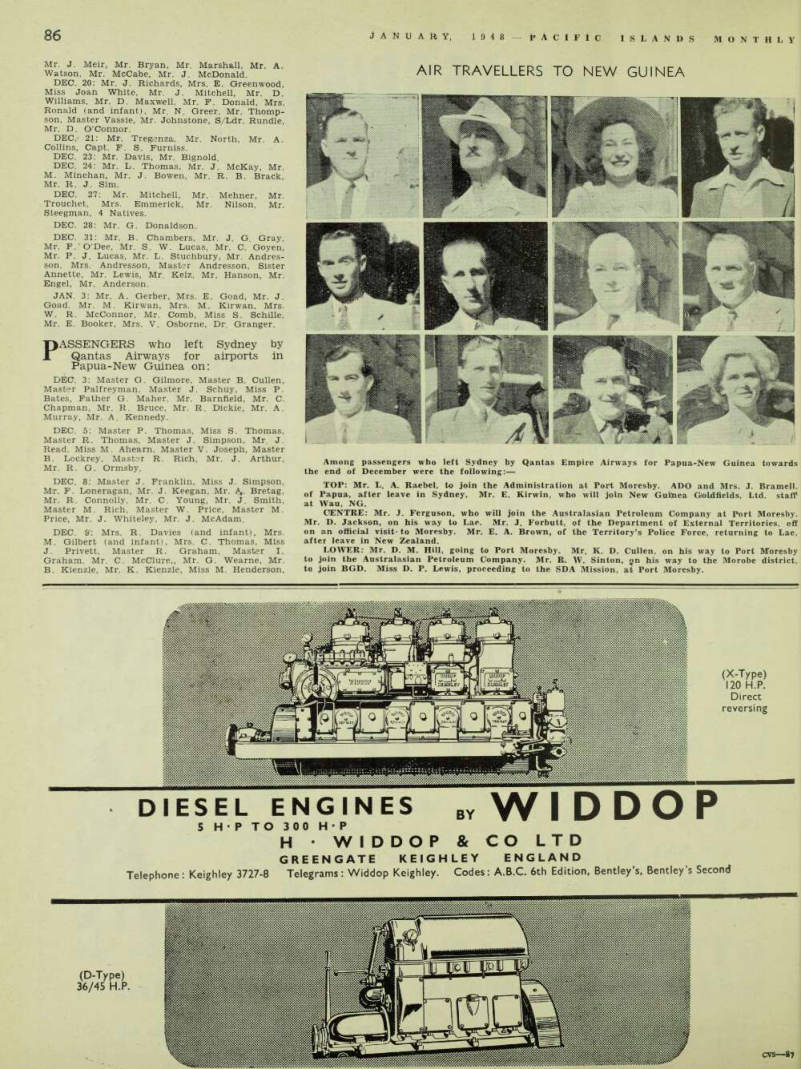
Among passengers who left Sydney by Qantas Empire Airways for Papua-New Guinea towards the end of December were the following:— TOP: Mr. L. A. Rachel, to join the Administration at Port Moresby. ADO and Mrs. J. Bramell. of Papua, after leave in Sydney. Mr. E. Kirwin, who will join New Guinea Goldfields, Ltd. staff at Wau, NG.
CENTRE: Mr. J. Ferguson, who will join the Australasian Petroleum Company at Port Moresby.
Mr. D. Jackson, on his way to Lae. Mr. J. Forbutt, of the Department of External Territories, off on an official visit-to Moresby. Mr. E. A. Brown, of the Territory’s Police Force, returning to Lae, after leave in New Zealand.
LOWER: Mr. D. M. Hill, going to Port Moresby. Mr. K. D. Cullen, on his way to Port Moresby to join the Australasian Petroleum Company. Mr. R. W. Sinton, on his way to the Morobe district, to join BGD. Miss D. P. Lewis, proceeding to the SDA Mission, at Port Moresby.
Advertisements & other items, p. 88 (1 item)
By W I D D O P
DIESEL ENGINES
S H P TO JOO H P
H • WID D O P
by W I D D O P
& CO LTD
GREENGATE KEIGHLEY ENGLAND
Telephone: Keighley 3727-8 Telegrams : Widdop Keighley. Codes: A.B.C. 6th Edition, Bentley’s, Bentley’s Second mm
Ship-Stealing Adventurers
Contract Malaria
Apia, Dec. 26.
THE case against a party of five young Samoans and Euronesians charged with stealing a motor-launch, which was to have been heard in Apia before Christmas, has been adjourned.
The launch, which belonged to Messrs.
A. G. Smyth & Co., Ltd., of Apia, was missing for some months and subse quently was found, with the adventurers, to have been wrecked on Vanikoro, Solo mon Islands.
During their wanderings some of the party contracted malaria which is now keeping them from answering their charges in the Apia Court.
Canberra Rules
Natives Do Not Like Canberra Rules
From a Special Correspondent
Rabaul. Dec. 19.
JfJIHE Administration at present appears JL to be trying to enforce the regula tion which says that a native cannot work more than 25 miles from his village unless he is indentured.
This is a matter that Colonel Allan, in November, took up with Mr. Chifley and Mr. Ward, when he pointed out that the effect of this rule was to nullify the ex pressed intention of the Government that a native should be free to work where he likes.
In this case, New Ireland boys have come over here looking for work and the higher wages obtaining here. The Admin istration, through Mr. Harold Strong, native labour inspector, is trying to stop the natives leaving New Ireland, which has been closed for recruiting. Recruit ing, of course, means soliciting a boy to work under indenture.
The natives are standing up to the Ad ministration, and state that they wish to work as casuals, or day labourers, in Rabaul, and that they will not work in Kavieng.
This is still another case of Adminis tration interference with commerce, and with the freedom of the natives. By their action, they seek to prevent natives work ing, other than for the Administration and it would seem from this that the New Order does not promise much for the native—it is in line with the present day tendency to regimentation. The native is told what he will do, and where, and is not consulted.
In the meantime, the planters, traders and natives are carrying on, trying to keep things going under great difficulties.
The position here has worsened again, as there is no petrol—and there will not be any until the end of December or early in the New Year.
Americans Out After Pacific Tuna
Pacific Tuna
SOUTH Pacific Administrations have been slow to see the advantages of tuna fishing (and canning) which might now be a source of badly needed dollars.
Canned tuna is very popular in America, where something like 75 million pounds weight is caught and canned each year.
The fish has few takers, however, in British countries.
The United States government has been anxious for many years to extend its tuna fishing grounds beyond Californian waters and it recently authorised the survey of fishing areas in the South Pacific where tuna is known to be plentiful.
One fleet is already operating off American Samoa. Other American fish eries and canneries are reported to be fitting out expeditions for other locali ties.
Papeete's Mayor Re-Elected
Papeete, Dec. 16.
THERE was keen interest this month in the election of the Mayor of Papeete. After a close contest, M.
Alfred Poroi was re-elected. M. Poroi has had already an excellent record as chief executive of our town, and is as sured of the whole-hearted support of this community.
Miss T. Richardson of the Methodist Mission, Papua, recently underwent an operation in a Sydney hospital. She is now on the way to recovery.
"Boys In Boots"
Letter to the Editor THE November issue of the “Pacific Islands Monthly” contains two ar ticles re natives wearing boots and other articles of European clothing. The last paragraph in the article "Boys in Boots” states; “Although the Adminis tration has now decreed that a native may wear anything he wishes, old resi dents, who love the country, resent any alteration in native attire. One reason is that it holds them to ridicule among visitors to the Territory.”
Apparently all old residents are not of one mind about this. I know of two stores in Madang, one owned by a large company and staffed mainly by old residents; the other owned by a man who has been a resident in New Guinea for a good many years. These two stores sell boots, shoes, sandshoes and other articles of European clothing to natives.
Whether they agree with the Adminis tration that natives should be able to wear anything they wish or, whether they are just interested in the profit they make out of selling such articles, I do not know. But it seems that the New Order has rebounded to this extent and that some sections of the European community, instead of bewailing the emancipation of Fuzzy-Wuzzy, have not been slow to turn it to good account.
I am, etc.,
Territorian.
Madang, January 1, 1948.
Prosperous Christmas For
W. Samoans
Apia, Dec. 26.
IIfESTERN SAMOA has had an unpre ▼ T cedentedly bright and prosperous Christmas season.
Though the cocoa market has recently receded from the all-time record price of £250 per ton, to £2lO oer ton f o.b.
Apia (presumably on account of the new Accra, West Africa, cocoa crop now coming in) this recession had no effect on the spending power of the Samoan public and Christmas trade in Apia as well as outside districts has nassed all expectations. Apia stores were crowded with buyers and did a record business.
Merchants had been fortunate enough to receive shipments of seasonal goods from the USA and from New Zealand by the “Matua.”
Samoan Murderer
Sentenced
Apia, Dec. 26.
AFTER two days’ hearing before His Honour, Chief Judge C. C. Marsack and a jury of three Europeans and one Samoan, the case against Puna Tia lavea, who was charged with the murder of a Samoan youth. Lui Jose, 16 years old, was terminated on December 11.
Puna Tialavea, a cripple, had brutally murdered, for trivial reasons, the Samoan lad Lui Jose, by attacking him un awares with a large bush knife.
The assessors found the accused guilty of murder, but made a strong recom mendation to mercy on the grounds that he had not premeditated the killing and that he is affected by an infirmity which has for years caused him much mental and physical suffering.
Tialavea was sentenced to hang but it is believed that the sentence will be com muted to life imprisonment when it is submitted to the Governor-General of New Zealand.
Islands Produce
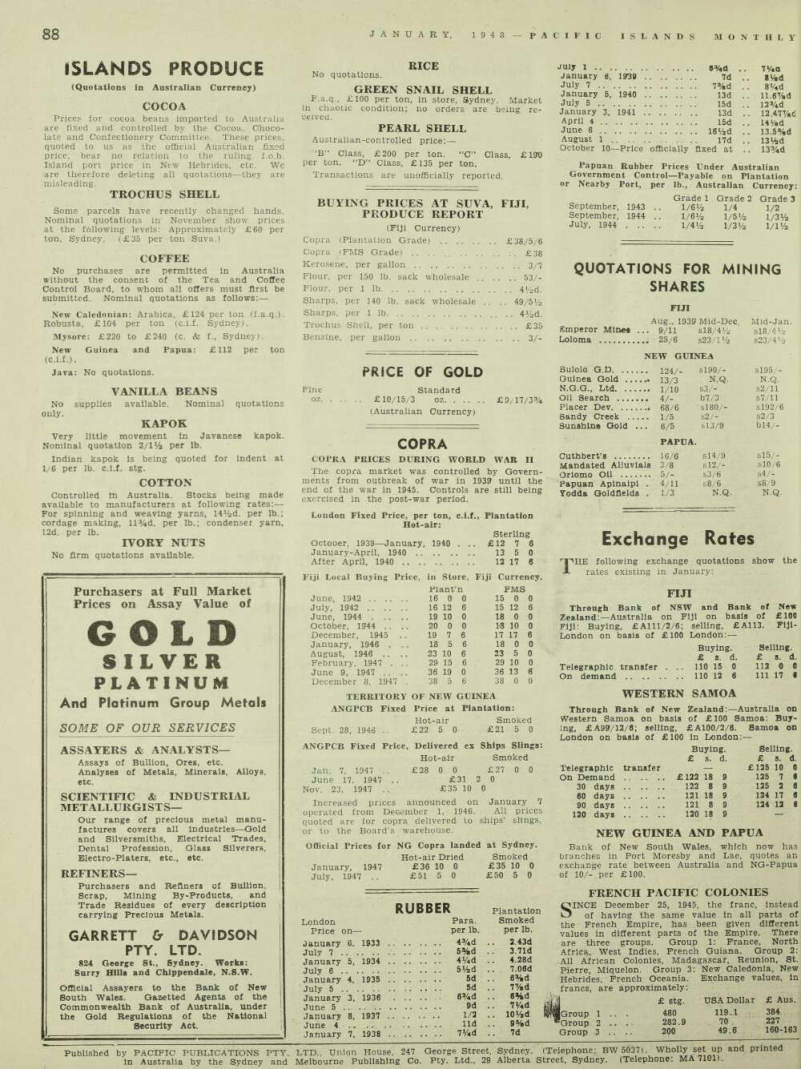
(Quotations in Australian Currency)
Cocoa
Prices for cocoa beans imported to Australia are fixed and controlled by the Cocoa, Choco late and Confectionery Committee. These prices, quoted to us as the official Australian fixed price, bear no relation to the ruling f.o.b.
Island port price in New Hebrides, etc. We are therefore deleting all quotations—they are misleading.
Trochus Shell
Some parcels have recently changed hands.
Nominal quotations in November show prices at the following levels: Approximately £6O per ton, Sydney. (£35 per ton Suva.)
Coffee
No purchases are permitted in Australia without the consent of the Tea and Coffee Control Board, to whom all offers must first be submitted. Nominal quotations as follows: New Caledonian: Arabica, £124 per ton (f.a.q.).
Robusta, £lO4 per ton (c.i.f. Sydney).
Mysore: £220 to £240 (c. & f., Sydney).
New Guinea and Papua: £ll2 per ton (c.i.f,).
Java: No quotations.
Vanilla Beans
No supplies available. Nominal quotations only.
Kapok
Very little movement in Javanese kapok.
Nominal quotation 2/1 Va per lb.
Indian kapok is being quoted for indent at 1/6 per lb. c.i.f. stg.
Cotton
Controlled in Australia. Stocks being made available to manufacturers at following rates;— For spinning and weaving yarns, 14y 2 d. per lb.; cordage making, ll%d. per lb.; condenser yarn, 12d. per lb.
Ivory Nuts
No firm quotations available.
Rice
No quotations.
Green Snail Shell
F.a.q , £lOO per ton, in store, Sydney. Market in chaotic condition; no orders are being re ceived.
Pearl Shell
Australian-controlled price:— ‘B” Class, £2OO per ton. “C” Class, £l9O per ton. “D” Class, £135 per ton.
Transactions are unofficially reported.
Buying Prices At Suva, Fiji,
Produce Report
(Fiji Currency) Copra (Plantation Grade) £3B/5/6 Copra (FMS Grade) .. .. £3B Kerosene, per gallon 3/7 Flour, per 150 lb. sack wholesale 53/- Flour, per 1 lb 4y 2 d.
Sharps, per 140 lb. sack wholesale .. .. 49/5y 2 Sharps, per 1 lb 4y 2 d.
Trochus Shell, per ton £35 Benzine, per gallon 3/-
Advertisements & other items, p. 90 (1 item)
Price Of Gold
Fine Standard oz. . .. .. £10/15/3 oz £9/17/3% (Australian Currency)
Copra
Prices During World War Ii
The copra market was controlled by Govern ments from outbreak of war in 1939 until the end of the war in 1945. Controls are still being exercised in the post-war period.
Loudon Fixed Price, per ton, c.i.f., Plantation Hot-air:
Territory Of New Guinea
ANGPCB Fixed Price at Plantation:
ANGPCB Fixed Price, Delivered ex Ships Slings:
Increased prices announced on January 7 operated from December 1, 1946. All prices quoted are for copra delivered to ships’ slings, or to the Board’s warehouse.
Official Prices for NG Copra landed at Sydney.
Octooer, 1939 —January, 1940 Sterling . £12 7 6 January-April, 1940 13 5 0 After April, 1940 .. . . 12 17 6 Fiji Local Buying Price, in Store, Fiji Currency. .Flant’n
Fms
June, 1942 16 0 0 15 0 0 July, 1942 16 12 6 15 12 6 June, 1944 19 10 0 18 0 0 October, 1944 .. .. 20 0 0 18 10 0 December, 1945 19 7 6 17 17 6 January, 1946 . . . 18 5 6 18 0 0 August, 1946 .. 23 10 6 23 5 0 February, 1947 . .. 29 15 6 29 10 0 June 9, 1947 .. 36 19 0 36 13 6 December 8, 1947 . 38 5 6 38 0 0
Hot-air Smoked Sept. 28, 1946 . . £22 5 0 £21 5 0
Hot-air Smoked Jan. 7. 1947 .. £28 0 0 £27 0 0 June 17. 1947 .. £31 2 0 Nov. 23, 1947 .. £35 10 0
Hot-air Dried Smoked January, 1947 £36 10 0 £35 10 0 July, 1947 .. £51 5 0 £50 5 0
Rubber
Plantation
Papuan Rubber Prices Under Australian Government Control—Payable on Plantation or Nearby Port, per lb., Australian Currency:
London Para.
Smoked Price onper lb. per lb.
January 6. 1933 . . .. ... 4%d 2.43d July 7 . .. .. 5%d 3.71d January 5. 1934 .. .. .. .. 4Vid 4.28d July 6 . .. .. 5%d 7.08d January 4, 1935 .. .. ... Sd 6%d July 5 . ... 5d 7%d January 3, 1936 . . . 6%d June 5 . .. .. 9d 7Vid January 8, 1937 .. .. .. lOVad June 4 .. .. lid 9%d January 7. 1938 . . . . ... 7V4d 7d
July 1 . 7V«a January 6, 19G8 7d ..
SVkd July 7 .. 8V 4 d January 5, 1940 13d .. 11.6 7 /«d July 5 .. 12 3 / 4 d January 3, 1941 . 12.47y«d April 4 .. l4Vsd June 6 . , 16Vad .. 13.5 s /*d August 1 . 17d ..
UVid October 10- -Price officially fixed at ,. 13 3 / 4 d
Grade 1 Grade 2 Grade 3 September, 1943 . 1/8 Vi 1/4 1/2 September, 1944 . 1/6% 1/5% 1/3% July, 1944 1/4% 1/3% 1/1%
Quotations For Mining
Shares
Fiji
Aug.. 1939 Mid-Dec.
Mid-Jan.
Emperor Mines . .. 9/11 $18/4Vb sl8/4V 2 Loloma .. 25/6 s23/iy 2 $23/4 y 2 Bulolo Q.D
New Guinea
.. 124/- sl90/- $195/- Guinea Gold ...
N.Q.
N.Q.
N.G.G., Ltd $3/- $2/11 Oil Search b7/3 $7/11 Placer Dev .. 68/6 $180/- $192/6 Sandy Creek ... .. 1/5 $2/- $2/3 Sunshine Gold .. .. 6/5 S13/9 bl4/- Cuthbert’s
Papua.
.. 16/6 S14/9 $15/- Mandated Alluvlals 3/8 $12/- $10/6 Orlomo Oil .. 5/s3/6 $4/- Papuan Aplnalpl . 4/11 £8/6 $8/9 Yodda Goldfields . 1/3 N.Q.
N.Q.
Exchange Rates
THE following exchange quotations show the rates existing in January:
Fiji
Through Bank of NSW and Bank of New Zealand:— Australia on FIJI on basis of £lOO FIJI: Buying, £Alll/2/6; selling, £AII3. FIJI - on basis of £lOO London:—
Western Samoa
Through Bank of New Zealand;—Australia on Western Samoa on basis of £lOO Samoa: Buy ing, £ A99/12/6; selling, £AIOO/2/6. Samoa on London on basis of £lOO in London:—
New Guinea And Papua
Bank of New South Wales, which now has branches in Port Moresby and Lae, quotes an exchange rate between Australia and NG-Papua of 10/- per £lOO.
French Pacific Colonies
SINCE December 25, 1945, the franc, Instead of having the same value in all parts of the French Empire, has been given different values in different parts of the Empire. There are three groups. Group 1; Prance, North Africa, West Indies, French Guiana. Group 2: All African Colonies, Madagascar, Reunion, St.
Pierre, Mkjuelon. Group 3: New Caledonia, New Hebrides, French Oceania. Exchange values, in francs, are approximately:
Buying. Selling. £ s. d. £ s. d.
Telegraphic transfer . .. 110 15 0 112 0 0 On demand 110 12 6 111 17 •
Buying.
Selling. £ s. d. £ s. d.
Telegraphic transfer — £125 10 0 On Demand £132 18 9 125 7 6 30 days 122 8 9 125 2 6 60 days 121 18 9 124 17 fl 90 days 121 8 9 134 12 e 120 days 120 18 9 —
£ stg. USA Dollar £ Aus.
IGroup 1 .. . 480 119.1 384 'Group 2 .. . 282.9 70 227 Group 3 .. .. 200 49.6 160-163
Advertisements & other items, pp. 90-92 (3 items)
88
JANUARY, 1948 PACIFIC ISLANDS MONTHLY
Published by PACIFIC PUBLICATIONS PTY. LTD., Union House, 247 George Street. Sydney. (Telephone: BW 5037). Wholly set up and printed in Australia by the Sydney and Melbourne Publishing Co. Pty. Ltd., 29 Alberta Street, Sydney. (Telephone: MA7101).
Gold
Purchasers at Full Market Prices on Assay Value of
SILVER
PLATINUM
And Platinum Group Metals
SOME OF OUR SERVICES
ASSAYERS & ANALYSTS—
Assays of Bullion, Ores. etc.
Analyses of Metals, Minerals, Alloys, etc.
SCIENTIFIC & INDUSTRIAL
METALLURGISTS—
Our range of precious metal manufactures covers all Industries—Gold and Silversmiths, Electrical Trades, Dental Profession, Glass Sllverers, Electro-Platers, etc., etc.
REFINERS—
Purchasers and Refiners of Bullion, Scrap, Mining By-Products, and Trade Residues of every description carrying Precious Metals.
GARRETT & DAVIDSON
PTY. LTD.
824 George St., Sydney. Works: Surry Hills and Chippendale, N.B.W.
Official Assayers to the Bank of New South Wales. Gazetted Agents of the Commonwealth Bank of Australia, under the Gold Regulations of the National Security Act.
tropical thirst...
To quench a
0 « X. • .
In nr 10 4 • Jt rr\ i iijit »/ When you’re hot and tired,
there is nothing quite so satisfying
and thirst quenching as a long, cold glass of Your friends and guests, too, will appreciate this really fine
Lager, for “Everybody
drinks K. 8.”
TOOTH’S
LAGER
Capital £1,000,000
ESTABLISHED 1914
COPRA MERCHANTS & MILLERS
BRANCHES THROUGHOUT THE PACIFIC ISLANDS
Buyers and exporters of all kinds of Islands produce. Copra Merchants and Millers.
Agents for Australian, European and American Manufacturers. Distributors of every description of merchandise.
Thirty years of Pacific Islands development and service.
REGULAR CARGO
PACIFIC
Head
W.
Office:
AND PASSENGER SERVICE BETWEEN EUROPE AND
ISLAND PORTS WAS ESTABLISHED BY
R. CARPENTER & CO. LTD.
16 O'CONNELL STREET, SYDNEY.
Cable Address:
CAMOHE.
Telephone: BW 4421.
Postal Address: P.O. Box No. 168, Sydney.