Islands
Pacific
Monthly
April 16, 1946
Vol. Xvi. No. 9.
Established 1930.
[Registered at the G.P transmission by post as a newspaper ]
1/-
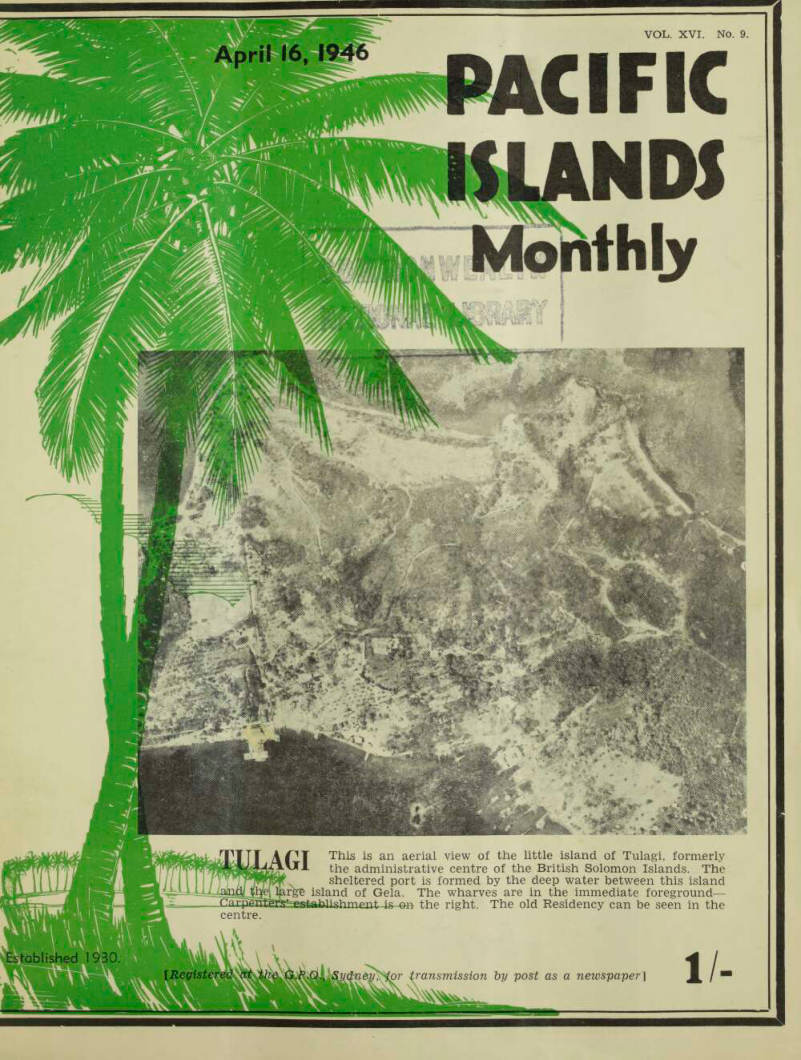
T UL AGI This is an aerial view of the little island of Tulagi, formerly the administrative centre of the British Solomon Islands. The sheltered port is formed by the deep water between this island and the large island of Gela. The wharves are in the immediate foreground— Carpenters' establishment is on the right. The old Residency can be seen in the centre.
Advertisements & other items, pp. 2-7 (4 items)
Hughes
au--a y#- ■^l r $M ~m- Wm^: V&f&yr
tep?-
uiKrA,'-- 1 -'* '•■ "■.»”~ a&«-5Sv ;■■-• « f=\ sag ■■m &I£. £{os> -/ ■; ' ' / &*:'• : if;e/. ! 3fcr ■•■?..• / y^V s *' /**< K <? 1920 1
HUGHES
~to r. // nN> e cV^ rfA$L /Mk* *. r • tAiX' rjpWENTY-FIVE YEARS of service to Australia under nine successive Prime Ministers is one of the records of "Qantas" achievements in the field of air transportation.
Serving without prejudice from Hughes in 1920 to Chifley to-day, from peace, through war and on to peace, 144,000,000 passenger miles have been flown by "Qantas" aircraft in establishing and maintaining Australia's overseas air links.
Equipped with experience based on past achievements, "Qantas" is pre-eminently qualified to assist in developing Australia's International routes.
mfi
• £'3 /t#S* Australia’s INTERNATIONAL Airline
rpHE Beam Wireless Service now operating on a full Peacetime basis offers the public fast and accurate world-wide communication services.
Messages are accepted for transmission to the United Kingdom, the Continent of Europe, the Middle East, Canada, United States, South America, India and the Philippines.
Commercial Wireless Services have recently been re-opened for messages between Australia and Lae, Port Moresby, Java and Nauru.
Codes are again permissible and you can use your registered code name as address and signature.
Specially trained telephonists are available for the acceptance and delivery of Beam Wireless messages.
We will be pleased to open a Credit Account for you. Complete information available regarding codes, classes of messages, rates, routes, etc.
Beam Wireless messages may be lodged at: 47 York St., Sydney Telephone: B 0522.
BEAM WIRELESS OFFICES,
OR AT ANY TELEGRAPH OFFICE
167 Queen St., Melbourne Telephone: MU 9161.
AMALGAMATED WIRELESS (ASIA) LTD.
AUSTRALIA’S NATIONAL WIRELESS ORGANISATION
Delicious Pastes
Manufactured by
HARRY PECK & CO. (Aust.) PTY. LTD. (WfF
Sic
AS ) 4L i Jy
A FIRM FAVOURITE
MADE FROM FINEST AUSTRALIAN
PRIMARY PRODUCT
When you serve Peck’s Meat Pastes you are serving protein food in its most delicious and nutritious form . . . prepared from the choicest Australian primary products.
Peck’s never compromise where quality and purity are concerned. Every ingredient is selected with the utmost care, and the whole process of manufacture is carried out under conditions of the strictest hygiene. Peck’s Fish Pastes too are prepared from carefully selected fish, packed under similarly ideal conditions.
PECKS
BLOATER PASTE
CHICKEN and HAM PASTE
TURKEY and TONGUE PASTE
PICK PECK’S FOR PURITY !
Order Peck's Pastes Through Your Usual Channels, or Direct From:
HARRY J. YOUNG PTY. LTD.
POSTAL ADDRESS:
Box 3661 G.P.0., Sydney.
379 KENT STREET, SYDNEY
BANKERS: BANK OF N.S.W.
CODES:
Bentley’s Comp.
Phrase.
Bentley’s 2nd Phrase.
DAYLIGHT
The outstanding features in all Coleman’s Lanterns have proved their value by active performance over forty years. \ m m / Coleman’s Petrol and Kerosene Lamps in 300 and 500 C.P. rr rs ' ' ' s' S s' Coleman’s Petrol or Kerosene Lamp with large enamelled reflector.
Coleman’s Kerosene Table Lamp can be used as hanging Lamp Coleman Lanterns are made
stronger to last longer:
Pyrex heat-resisting globes
protect the mantles . . . . pressure-tested brass fonts that will not rust . . builtin automatic tip-cleaning needles . . . shut-off valves to avoid constant repumping each time lantern is
lighted. Safe, Steady Brilli-
ance in or out of doors.
Representatives for the Pacific Islands: ROBERT GILLESPIE PTY. LTD. PEARCE £ V * CO LTD 54a PITT STREET, SYDNEY FOR FIJI ISLANDS
PRELIMINARY ANNOUNCEMENT:
PACIFIC
PLANTER’S
HANDBOOK
Publication in 1946 IN response to a strong and growing demand for an authoritative Handbook covering the whole field of Planting and Agriculture in the Pacific Islands, the compilation of the “Pacific Planter’s Handbook” was commenced in 1945. It has been much delayed by strikes, but publication is planned for 1946.
The Handbook is designed to give standard instruction on all the branches of Tropical Planting which might be undertaken in the Pacific Islands, and to be regarded as an indispensable part of a Pacific Planter’s equipment.
SECTIONS of the Handbook deal separately with Palms (including Coconuts and the Manufacture of Copra), Cocoa, Coffee, Rubber, Citrus, Bananas, Vanilla, Spices, Kapok, Pineapples, etc.
The production of every plant grown for profit in the islands is described.
Other Sections cover such subjects as: Livestock on the Plantations; Revenue from Non-Agricultural Products (Sea, Forest, Minerals); How to Ensure Comfortable and Healthy Living Conditions in the Islands; Etc.
SPECIAL SECTIONS: Survey of Opportunities; Selection of Territory (Malarial and non- Malarial, Melanesians and Polynesians, Climate and Rainfall); Lands and Land Laws; Labour Conditions in the Various Territories; Importance of Transport; What You Must Provide For and Against in Choosing Your Plantation.
The subject of MARKETING is dealt with very fully. It is no use planning your plantation until you know where you will find a profitable market for your product, and whether it is dependable.
EACH SECTION WRITTEN BY AN
EXPERT
Numerous Photographs, Diagrams,
Drawings, etc.
PUBLISHED PRICE: Not less than 35/- Australian. (NOTE: Owing to the present difficulty of obtaining paper and binding service, it is impossible to fix a price, until the work is near completion. It will be between 35/- and 40/-, Australian. The edition will he limited. Persons who wish to be sure of a copy may order in advance; and if 35/- is sent, that will be accepted as the price of the book, although the final published price may be higher.) Orders may be sent to:
PACIFIC PUBLICATIONS
PTY. LTD.,
Union House, 247 George Street,
Sydney
or to the PUBLISHERS DIRECT:
PACIFIC PUBLICATIONS (FIJI)
LTD.
P.O. Box 281, Bank of N.S.W T . Building,
FIJI. SUVA, FIJI.
Woven Wire for all Industry
COPRA DRYING TRAYS, FLOORS, Etc.
FRU'T DRYING TRAYS, MINING SCREENS.
Heavy Mosquito Gauze in Phosphor Bronze and other Metals Impervious to Salt Sea Air.
WIRE DOOR MATS AND GENERAL WIRE WORKS
E. WRIGHT & CO. LTD.
Office and Works: 148-152 Cleveland Street, Sydney, N.S.W, Telegraphic Address: “Wrlghtmake,” Chippendale.
T £
BITTER
BRE1EB IT
CARLTON & UNITED BREWERIES LIB.
v.t
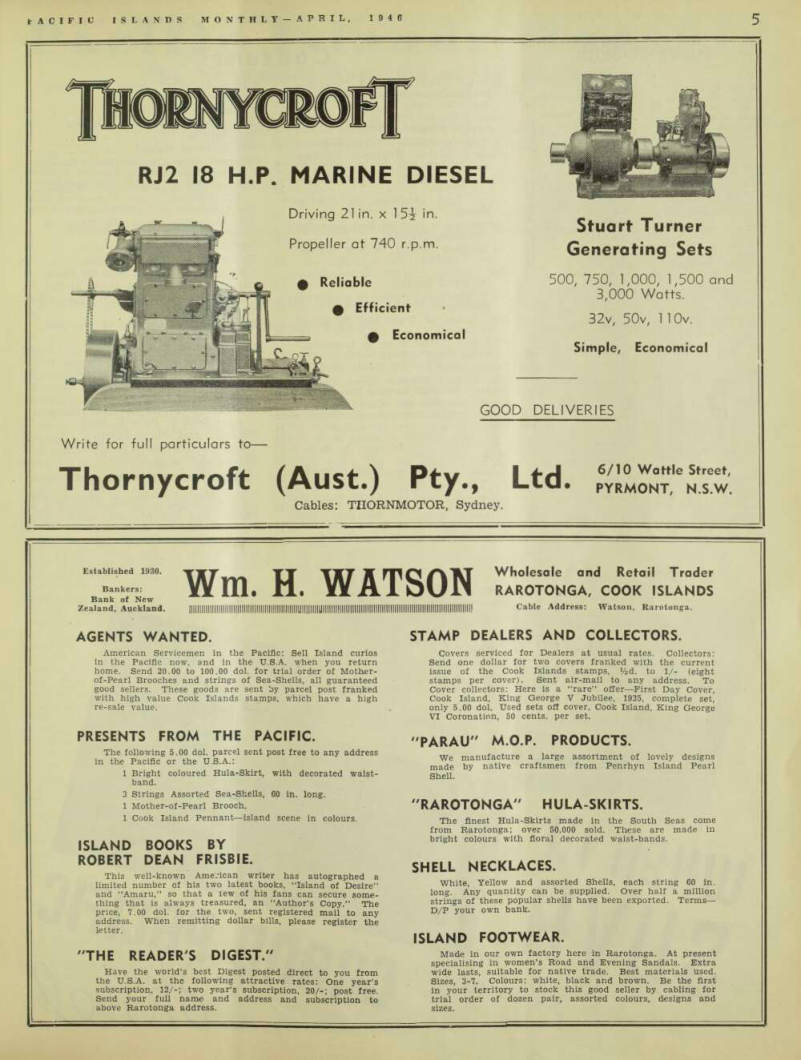
RJ2 18 H.P. MARINE DIESEL
i Driving 21 in. x 1 5i in.
Propeller at 740 r.p.m. 0 Reliable 0 Efficient 0 Economical Stuart Turner
Generating Sets
500, 750, 1,000, 1,500 and 3,000 Watts. 32v, 50v, 11 Ov.
Simple, Economical
GOOD DELIVERIES
Write for full particulars to —
Thornycroft (Aust.) Pty., Ltd.
Cables: TZIORNMOTOR, Sydney. 6/10 Wattle Street,
PYRMONT, N.S.W.
Established 1930.
Bankers: Bank of New Zealand, Auckland.
Wm. H. WATSON
Wholesale and Retail Trader
RAROTONGA, COOK ISLANDS
Cable Address: Watson, Rarotonga.
AGENTS WANTED.
American Servicemen in the Pacific: Sell Island curios in the Pacific now, and in the U.S.A. when you return home. Send 20.00 to 100.00 dol. for trial order of Motherof-Pearl Brooches and strings of Sea-Shells, all guaranteed good sellers. These goods are sent by parcel post franked with high value Cook Islands stamps, which have a high re-sale value.
PRESENTS FROM THE PACIFIC.
The following 5.00 dol. parcel sent post free to any address in the Pacific or the U.S.A.: 1 Bright coloured Hula-Skirt, with decorated waistband. 3 Strings Assorted Sea-Shells, 60 in. long. 1 Mother-of-Pearl Brooch. 1 Cook Island Pennant —island scene in colours.
ISLAND BOOKS BY
ROBERT DEAN FRISBIE.
This well-known American writer has autographed a limited number of his two latest books, “Island of Desire’’ and “Amaru,” so that a lew of his fans can secure something that is always treasured, an “Author’s Copy.” The price, 7.00 dol. for the two, sent registered mail to any address. When remitting dollar bills, please register the letter.
"THE READER'S DIGEST."
Have the world’s best Digest posted direct to you from the U.S.A. at the following attractive rates: One year’s subscription, 12/-; two year’s subscription, 20/-; post free.
Send your full name and address and subscription to above Rarotonga address.
STAMP DEALERS AND COLLECTORS.
Covers serviced for Dealers at usual rates. Collectors: Send one dollar for two covers franked with the current issue of the Cook Islands stamps, */ 2 d. to 1/- (eight stamps per cover). Sent air-mail to any address. To Cover collectors: Here is a “rare” offer —First Day Cover, Cook Island, King George V Jubilee, 1935, complete set, only 5.00 dol. Used sets off cover, Cook Island, King George VI Coronation, 50 cents, per set.
"PARAU" M.O.P. PRODUCTS.
We manufacture a large assortment of lovely designs made by native craftsmen from Penrhyn Island Pearl Shell.
"RAROTONGA" HULA-SKIRTS.
The finest Hula-Skirts made in the South Seas come from Rarotonga: over 50,000 sold. These are made in bright colours with floral decorated waist-bands.
SHELL NECKLACES.
White, Yellow and assorted Shells, each string 60 in. long. Any quantity can be supplied. Over half a million strings of these popular shells have been exported. Terms — D/P your own bank.
ISLAND FOOTWEAR.
Made in our own factory here in Rarotonga. At present specialising in women’s Road and Evening Sandals. Extra wide lasts, suitable for native trade. Best materials used.
Sizes, 3-7. Colours: white, black and brown. Be the first in your territory to stock this good seller by cabling for trial order of dozen pair, assorted colours, designs and sizes.
1
PACIFIC; ISLANDS MONTHLY APRIL, 1946
3
t* acl f 1 c islands monthly April, 1946
5
IrACIFIC ISLANDS MONTHLY— APRIL, 1946
Advertisers
Awa 1
Angliss & Co. . . 23 Atkins Pty., Ltd., Wm 28 Brial & Ball ... 17 Brown & Co., Ltd. 12 Brunton’s Flour . . 55 Burns, Philp Trust Co., Ltd 13 Broomflelds ... 45 BP (SS) Co. . . . 12 Baker, W. Jno. . . 50 Carlton & United Breweries, Ltd. . 4 Carpenter, Ltd., W.
R cov. iv.
Chivers & Sons, Ltd 38 Church, R. H., & Sons 26 Coleman Lamp & Stove Co 39 “Cystex” 22 Consolidated Export & Import Group of Australia . . 54 Dalmore Preserv ing Co 57 Donaghy & Sons . 38 Donald, Ltd., A. B. 53 Dr. Williams Pink Pills 16 Electrolux
Refrigerators . . 20
H. G. Eekhoff . . 55 Foster Clark, Ltd. . 25 Ford Sherington Pty., Ltd 46 Garrett & Davidson 60 Gibson & Co., Ltd.,
J. A. D 64
Gillespie Pty., Ltd., Robert ... 3, 56 Glanz, A 56 Gilbey’s Gin ... 52 Gillespie’s Flour . . 59 Gough & Co., E. J. 39 Grand Pacific Hotel 6 Grove & Sons, W.
H 40
Heinz & Co. Pty., Ltd., H. J. . . .62 Hemingway & Robertson ... 59 Horlicks Malted Milk 27 Hyde, Victor ... 55 Jenkins, Reg. ... 50 Kopsen & Co., Ltd. 58 Lockyer, George J., & Co isr Merrillees, J. C., & Co 43 Masschelien, O. P. . 26 Miscellaneous, 14, 48, 51 “Mendaco” ... 44 Mcllraths Pty., Ltd. 28 Nelson & Robertson Pty., Ltd 64 Newman, M. . . .42 “Nixoderm” ... 41 Noyes Bros. ... 42 Pacific Planters’
Handbook ... 4 Pacific Islands Monthly ... 45 Pacific Is. Society 17 “Pinkettes” ... 52 Primrose Trading Co 53 Qantas Empire Air ways ... cov. ii Queensland Insur ance Co 46 Raymond, Lance, Pty., Ltd. ... 37 Robinson, G. H. . 19 Rose’s Eye Lotion . 40 Rohu, Sil . . . . 22
Rur 14, 59
Scott, Ltd., J. . .18 Southern Pacific Insurance Co. . . 12 Steamships Trading Co., Ltd 16 Shepherd, A. O. . . 51 Sullivan & Co.. C. 49 Swallow & Ariell . 62 Taylor & Co., A. . 50 "Tenax” Soap . . 13 Tillock & Co., Ltd. 47
Turner, F. W. . 57 Thornycroft (Aust.) Pty., Ltd. ... 5 Tooth & Co..
Ltd cov. iii.
Toogood, J. J. . . 47 Tullochs Pty., Ltd. 61 Tilley’s Lamps . . 63 Union Assurance . 58 Watson, Wm. H. . 5 Widdop, H., & Co., Ltd 21
A. Willison ... 21 Wright & Co. . . 54 Wills, W. D. & H. 0 24 Wright & Co., Ltd., E 4 Wunderlich, Ltd. . 51 Young Pty., Ltd., Harry J. . . . 2, 15 Yorkshire Insur ance Co., Ltd. . 53
Contents
Editorial: Events in Micronesia- Pacific Ocean Now a Vast Anglo- American Lake 7 Surplus Goods—Plan to Give Terri torial Buying Priority 9 2,000 More Indians in Fiji Now! .. 9 Western Samoa Welcomes its New Administrator 9 Conditions Improve in New Guinea and Papua 10 Mekeo Boys at Lunch at GH in Moresby h Extraordinary Run of Bad Luck for “Southern Cross” 11 Territorians Return to New Guinea by “Ormiston” 12 New Guinea Under Trusteeship— Dr. Evatt Explains 13 Scrub Typhus—Warning to Returning Territorians 14 Mrs. Baker of Witu—Not Permitted to Return 19 PTA Can Do No More in Australia— Executive Will Move North 17 Tarawa Flag for US Naval Academy 21 New Guinea Balance Sheet—London To Help Savages Become Surgeons .. 25 Expert Endorses Mr. Ward’s Policy .. 22
Censored—“PlM” Editor Tells Story of 1942 26 Territories’ Talk-talk 29 • Money-making Islets of Malaita .. 30 Tropicalities 31 The Story of Rabaul 32 “Gappy”—How Captain Fitch Saved Steamships Trading Co 34 Johnny Frisbie Enters the Writing Business 35 The Character of a Hot-cross Bun .. 36 The Man Who Gave His Name to Townsville 37 New Britain 60 Years Ago 33 Mr. Ward and Press Criticism ... 39 Young Australia Returns to the Sepik 40 History of Fixed Copra Prices in Fiji 41 Old Fiji Residents Pass On 42 The Scolia Wasp 43 Radio-operator Heroine of the SW Pacific 45 Proposed New Calendar 46 “Lucky” Joe Sloane—He Struck It Rich From the Gira to Edie .. 48 “Enemy Alien” Missionaries 50 In Defence of Levuka 51 Introducing Polynesia—New Refer ence Book by Peter H. Buck ... 52 Shipping and Plane Services ... 56 Union Co. Purchases Four Ships .. 57 Commercial, Markets, etc 60
Mr. Dan Costello, of Tavua, Fiji, arrived in Sydney by the “Lurline” in March, and met his son, recently dis charged from the AIF.
Advertisements & other items, p. 8 (1 item)
Wm
w s^ ed w ** Gr „ deV>6" e<i %^^~***^-** > he **» ‘ ** **" w * *. Sov»-'° r >e tr ° ? a- n >^ a ' terS QN M?^ C f . \n^' an “ cr a\n ed o b ' e ’ r d*V- *, 9 er v -
i«bs*
Pacific Islands Monthly
The Newspaper-Magazine of the South Seas [Registered at the G.P.0., Sydney, for transmission by post as a newspaper .]
Published Once Each Month and Circulated in Australia and New Zealand and in the following Pacific Territories and Islands Groups:
Australian Territory of Papua.
Mandated Territory (Australia) of New Guinea.
Australian Territory of Norfolk Island.
New Zealand Territory of Cook Islands.
Mandated Territory (NZ) of Western Samoa.
British Colony of FIJI.
British Solomon Islands Protectorate.
British Protectorate of Tongan Islands.
British Crown Colony of Gilbert and Ellice Islands.
Mandated Territory of Nauru.
British and Free French Condominium of New Hebrides.
Free French Colony of New Caledonia.
Free French Colony of Oceania (Tahiti, etc.).
American Territory of Eastern Samoa.
American Territory of Hawaiian Islands.
Owned and Produced by Pacific Publications Pty. Ltd., Union House, 247 George Street, Sydney.
Vol. XVI. No. 9.
April 16, 1946.
p r i r p l/ ’ Per c °Py* r rice Prepaid; 10/- p.a.
Anglo-American Lake
Events in Micronesia: Pacific Ocean Now a Vast Anglo-American Lake
EVEN Islands-conscious South Pacific capitals like Canberra and Wellington do not yet appreciate the fact that a sweeping and far reaching political change is taking place in the North Pacific.
Until last year, control over the archipelagoes of the North Pacific, eastwards of Indonesia, was divided between the United States and Japan.
To-day, the administrative and poli tical direction of all the archipelagoes of the North Pacific, including Japan itself, is in the hands of the United States.
Anyone standing before a map of the Pacific, and taking an overall view of the whole administrative set up, will realise, with a shock, that the whole of the Territories and archipelagoes of the North and South Pacific, with the exception of New Caledonia and French Oceania, now are under the control of the English speaking nations. South of the equator, the Territories of Papua and New Guinea, and the Bismarck, Solo mon, Fiji, Gilbert and Ellice, Tonga, Samoa, and Cook archipelagoes are administered by Britain, Australia and New Zealand. North of the equator, the United States now either administers or controls the Terri tories of Hawaii, the Commonwealth of the Philippines, Japan, and all the former Japanese-held archipelagoes— the Marshalls, Carolines, Marianas, Palaus, Volcanoes and Bonins.
By coming into the war and saving the Oriental world from Japanese domination, the United States, whether the Americans like it or not, now has upon its hands a vast oceanic empire in the North Pacific.
It is a development of tremendous importance to all the peoples of the South Pacific.
In the North Pacific, before the war, United States held Hawaii, Guam (Marianas) and the Philippines; but the Philippines, after nearly 50 years of American tutelage, were to receive complete independence on July 4, 1946. As a result of the war, the United States is now responsible (with the other Powers, nominally)
for Japan, and all the archipelagoes formerly held by Japan.
President Truman, on April 7, announced: “On July 4 1946, the Philippines Commonwealth will become a full, sovereign, independent nation.’
This means that, despite the dislocation caused by the Pacific war, the original American plan will be carried out The Philippines, nonetheless, will be under the protection of Amenca, and American influence will dominate the new Commonwealth, for a long time.
THE United Nations Organisation, officially, will decide the future of the Mariana, Caroline, Palau and Marshall Islands (all part of Micronesia); but there is no doubt that they will become an administrative responsibility of the United States, The Americans know this, and they already are far advanced with their plans of government.
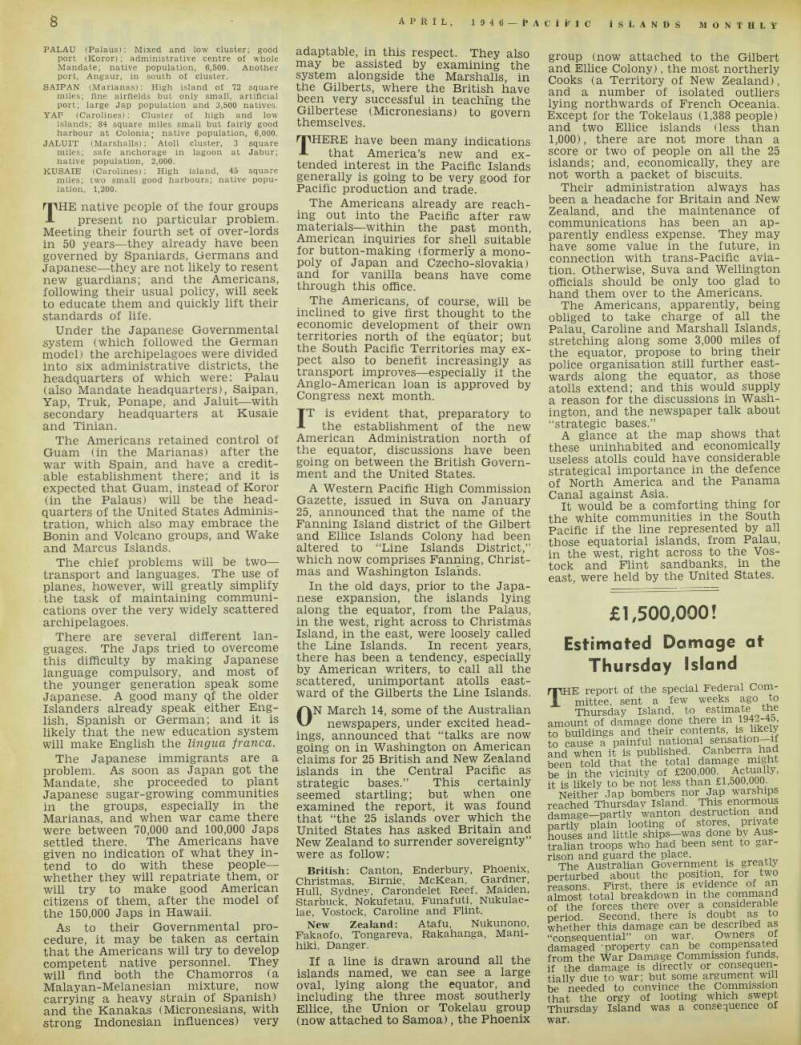
From a territorial and economic viewpoint, the four archipelagoes do not amount to much. They contain less than 900 square miles, and there are only about 120,000 people (including Jap immigrants) in the whole of them. Following are details:
The chief importance of the archipelagoes lies in their strategical situation. Stretching, east to west, across 2,800 miles of North Pacific Ocean, they appear to have provided the migrating hordes of Asia, in pre- Wi p th a T Se i Ul C^ ain ? f ?h?r^? neS rf fr O om f h n o° n - e fl Sla lnt „° the Central and South Pacific, and, under modern conditions, they could
do so again. America, as the Power mainly responsible for policing the Pacific, must take care of the four widely-scattered groups.
THEY have had a remarkable his tory. The Spaniards were in the Marianas and Carolines about 1560, and the groups were generally regarded as Spanish territory until late in the nineteenth century, when Germany sought possession of some of them. A complicated situation was ended after the Spanish-American, war when, in 1899, Germany bought out all Spanish rights in the four groups, and held them until 1914.
During the Spanish and German period, there was considerable inter course between the groups and the South Pacific Territories—the ports of Ponape, Jaluit, Truk and Yap were as well known in the South Seas as Levuka and Apia. Sydney traded re gularly with the Palaus and Caro lines. But when Japan, as Britain’s sleeping partner in World War I, grabbed those German North Pacific possessions in 1914, and got a Man date over them from the League of Nations, the four groups were cut off completely from all European con tacts for 25 years, and made a close preserve of the Japanese.
Under the Americans, they will again be open to the world, and a
new generation of European peoples
will find them most interesting and attractive. Here are some of the
principal places:
TRUK (Carolines); Mixed high and atoll cluster; g° od ports at Eten and Dublon; native popu “ "’“-an anTparim eldS ‘ n Cen ‘ ra ' PONAPE (Caroline.,: Mixed cluster, 145 square miles; small, good port; native population, 8 - s °o-
Marianas Palaus Carolines Marshalls Number of Islands Units* 14 7 41 32 Area (square miles) 215 180 360 75 Population**— Japanese 45,000 18,000 9,000 500 Chamorros 3,250 500 Kanakas 1,000 6,000 30,000 10,000 * By counting every individual islet in each cluster or atoll (an atoll being an “island unit”) we get a total of about 1,500 islands in the four archipelagoes.
These make up 94 island units, of which 70 are inhabited. ** Approximate only.
PALAU (Palaus): Mixed and low cluster; good port (Koror); administrative centre of whole Mandate; native population, 6,500. Another port, Angaur, in south of cluster.
SAIPAN (Marianas); High island of 72 square miles; fine airfields but only small, artificial port; large Jap population and 3,500 natives.
YAP (Carolines): Cluster of high and low islands; 84 square miles small but fairly good harbour at Colonia; native population, 6,000.
JALUIT (Marshalls): Atoll cluster, 3 square miles; safe anchorage in lagoon at Jabur; native population, 2,000.
KUSAIE (Carolines): High island, 45 square miles; two small good harbours; native popu lation, 1,200.
THE native people of the four groups present no particular problem.
Meeting their fourth set of over-lords in 50 years—they already have been governed by Spaniards, Germans and Japanese—they are not likely to resent new guardians; and the Americans, following their usual policy, will seek to educate them and quickly lift their standards of life.
Under the Japanese Governmental system (which followed the German model) the archipelagoes were divided into six administrative districts, the headquarters of which were: Palau (also Mandate headquarters), Saipan, Yap, Truk, Ponape, and Jaluit—with secondary headquarters at Kusaie and Tinian.
The Americans retained control of Guam (in the Marianas) after the war with Spain, and have a credit able establishment there; and it is expected that Guam, instead of Koror (in the Palaus) will be the head quarters of the United States Adminis tration, which also may embrace the Bonin and Volcano groups, and Wake and Marcus Islands.
The chief problems will be two — transport and languages. The use of planes, however, will greatly simplify the task of maintaining communi cations over the very widely scattered archipelagoes.
There are several different lan guages. The Japs tried to overcome this difficulty by making Japanese language compulsory, and most of the younger generation speak some Japanese. A good many of the older Islanders already speak either Eng lish, Spanish or German; and it is likely that the new education system will make English the lingua franca.
The Japanese immigrants are a problem. As soon as Japan got the Mandate, she proceeded to plant Japanese sugar-growing communities in the groups, especially in the Marianas, and when war came there were between 70,000 and 100,000 Japs settled there. The Americans have given no indication of what they in tend to do with these people— whether they will repatriate them, or will try to make good American citizens of them, after the model of the 150,000 Japs in Hawaii.
As to their Governmental pro cedure, it may be taken as certain that the Americans will try to develop competent native personnel. They will find both the Chamorros (a Malayan-Melanesian mixture, now carrying a heavy strain of Spanish) and the Kanakas (Micronesians, with strong Indonesian influences) very
adaptable, in this respect. They also may be assisted by examining the system alongside the Marshalls, in the Gilberts, where the British have been very successful in teaching the Gilbertese (Micronesians) to govern themselves.
THERE have been many indications that America’s new and ex tended interest in the Pacific Islands generally is going to be very good for Pacific production and trade.
The Americans already are reach ing out into the Pacific after raw materials—within the past month, American inquiries for shell suitable for button-making (formerly a mono poly of Japan and Czecho-slovakia) and for vanilla beans have come through this office.
The Americans, of course, will be inclined to give first thought to the economic development of their own territories north of the equator; but the South Pacific Territories may ex pect also to benefit increasingly as transport improves—especially it the Anglo-American loan is approved by Congress next month.
IT is evident that, preparatory to the establishment of the new American Administration north of the equator, discussions have been going on between the British Govern ment and the United States.
A Western Pacific High Commission Gazette, issued in Suva on January 25, announced that the name of the Fanning Island district of the Gilbert and Ellice Islands Colony had been altered to “Line Islands District,” which now comprises Fanning, Christ mas and Washington Islands.
In the old days, prior to the Japa nese expansion, the islands lying along the equator, from the Palaus, in the west, right across to Christmas Island, in the east, were loosely called the Line Islands. In recent years, there has been a tendency, especially by American writers, to call all the scattered, unimportant atolls east ward of the Gilberts the Line Islands.
ON March 14, some of the Australian newspapers, under excited head ings, announced that “talks are now going on in Washington on American claims for 25 British and New Zealand islands in the Central Pacific as strategic bases.” This certainly seemed startling; but when one examined the report, it was found that “the 25 islands over which the United States has asked Britain and New Zealand to surrender sovereignty” were as follow: British: Canton, Enderbury, Phoenix, Christmas, Birnie, McKean, Gardner, Hull, Sydnev, Carondelet Reef, Maiden, Starbuck, Nokufetau, Funafuti, Nukulae lae, Vostock, Caroline and Flint.
New Zealand: Atafu, Nukunono, Fakaofo, Tongareva, Rakahanga, Mani hiki, Danger.
If a line is drawn around all the islands named, we can see a large oval, lying along the equator, and including the three most southerly Ellice, the Union or Tokelau group (now attached to Samoa), the Phoenix
group (now attached to the Gilbert and Ellice Colony), the most northerly Cooks (a Territory of New Zealand), and a number of isolated outliers lying northwards of French Oceania.
Except for the Tokelaus (1,388 people) and two Ellice islands (less than 1,000), there are not more than a score or two of people on all the 25 islands; and, economically, they are not worth a packet of biscuits.
Their administration always has been a headache for Britain and New Zealand, and the maintenance of communications has been an ap parently endless expense. They may have some value in the future, in connection with trans-Pacific avia tion. Otherwise, Suva and Wellington officials should be only too glad to hand them over to the Americans.
The Americans, apparently, being obliged to take charge of all the Palau, Caroline and Marshall Islands, stretching along some 3,000 miles of the equator, propose to bring their police organisation still further east wards along the equator, as those atolls extend; and this would supply a reason for the discussions in Wash ington, and the newspaper talk about “strategic bases.”
A glance at the map shows that these uninhabited and economically useless atolls could have considerable strategical importance in the defence of North America and the Panama Canal against Asia.
It would be a comforting thing for the white communities in the South Pacific if the line represented by all those equatorial islands, from Palau, in the west, right across to the Vos tock and Flint sandbanks, in the east, were held by the United States.
Thursday Island
£1,500,000!
Estimated Damage at Thursday Island
rE report of the special Federal Com mittee, sent a few weeks ago to Thursday Island, to estimate the amount of damage done there in 1942-45, to buildings and their contents, is likely to cause a painful national sensation—if and when it is published. Canberra had been told that 'the total damage might be in the vicinity of £200,000. Actually, it is likely to be not less than £1,500,000.
Neither Jap bombers nor Jap warships reached Thursday Island. This enormous damage—partly wanton destruction and partly plain looting of stores, private houses and little ships—was done by Aus tralian troops who had been sent to gar rison and guard the place.
The Australian Government is greatly perturbed about the position, for two reasons. First, there is evidence of an almost total breakdown in the command of the forces there over a considerable period. Second, there is doubt as to whether this damage can be described as “consequential” on war. Owners of damaged 'oroperty can be compensated from the War Damage Commission funds, if the damage is directly or consequen tially due to war; but some argument will be needed to convince the Commission that the orgy of looting which swept Thursday Island was a consequence of war.
Advertisements & other items, p. 10 (1 item)
8
AfRIL, 1946 t’AClt’IC ISLANDS MONTHLY
Surplus Goods
Plan to Give Territorians Priority in Buying
riIHERE is indignation and anger among X Territorians generally concerning the way in which the bureaucrats have been disposing of large quantities of goods and equipment, taken to the Territories by the Services, and now no longer required.
Practically all Europeans who were resident in the Territories before the in vasion lost their property, wholly or in part, through direct and indirect war damage. In no case does war damage compensation represent full compensa tion.
It was expected that, as a matter of bare justice, the Territorians would have been given the fullest opportunity to buy the goods being thrown on to the market, mostly at sacrifice prices. Actually, the Australian Government has shown com plete indifference regarding the wishes and interests of Territorians. No attempt was made to arrange the sales so that Territorians could participate.
Sales of goods which would greatly have assisted rehabilitation have been going on for the last three months, while the majority of Territorians have been kept in Australia, clamouring in vain for per mission to go back to Papua and New Guinea.
Those who have now returned have found that huge quantities of goods and equipment were disposed of before they arrived. The thing can be described as one of the w° r st scandals in the history of the Territories. But Canberra does not care. The Territorians have no votes. rE sale of 900 motor vehicles to a firm of Melbourne dealers, in re cent weeks, may be cited as typical of many incidents and much muddling.
The dealers agreed to pay 38/- per vehicle, on the ground at Lae, on con dition that they got the full 900. The selling authority cheerily said “OK.”
The dealers proceeded to dismember and pack the vehicles for shipment in the SS “River Murray.”
Then it was found there were not 900 vehicles available. The dealers de manded their full quota: and the embar rassed selling authorities thereupon allowed all the vehicles which thence forward were sent in for disposal to go into that contract—many of them worth hundreds of pounds, and suitable for the work of rehabilitation in the Territory.
But they all went in at 38/- each, for the Australian market.
Canberra finally awakened to what was happening, and a Major was sent hurriedly to put an end to this haphazard and disgraceful method of disposal. He stopped it.
NOW, the New Guinea Returned Sol diers’ organisation has taken a hand, and has insisted that, in all future disposal of such goods, the re turning residents of New Guinea shall have priority.
All remaining goods are being concen trated for sale in Lae and Rabaul — mainly Rabaul —and it has been urged upon the Australian Prime Minister that they shall be disposed of through the Production Control Board, primarily to the Administration and to Territorians.
It is understood that the Prime Minister favours the plan.
Colonel H. T. Allen, a former resident of New Guinea, who recently re linquished the command of the Pacific Islands Regiment, and returned to Aus tralia, met the Returned Soldiers’ Branch
before leaving Rabaul, and was given this letter:—
Rabaul, Mch. 17, 1946.
Col. H. T. Allen.
Vice-president, New Guinea Branch, Returned Soldiers’ League,
Rabaul. New Guinea.
Dear Sir,—I have to inform you that the Branch Executive would be nlensed if. during your forthcoming visit to Aus tralia. vou will make renresentations on behalf of the Branch on the various mat ters discussed at the recent General Meeting held in Rabaul.
In narticular, it is desired that all the benefits of the Repatriation Act be ex tended to cover the Territories of New Guinea and Panua: that the return of former returned soldier residents be ex pedited- and that the Question of the disnosal of surplus Commonwealth nro nertv he discussed with the relevant authority, with a view to safeguarding the interests of our members. (Signed) A. J. GASKIN.
President, NG Branch, RSSAILA.
Colonel Allen, realising the importance to Territorians of the matters placed in his hands, lost no time in dealing with them, and already has visited Melbourne and Canberra for discussions with the relevant authorities. He has been sym nathetically and helpfully received by the various Departments.
He is particularly interested in reserv ing the remaining surplus goods for the Territorians—in his view, mainland dealers and soeculators should be kept cut until the full needs of the Adminis tration and of returning Territorians are met.
It is confidently exnected that, as a result of agreement between the Aus tralian Denartments of the Army and External Territories, the Disposals Com mission. the Provisional Government, the Production Control Board, and the Returned Soldiers’ League, a proper plan for the control and sale of the surplus goods and equipment in New Guinea will be brought into operation very shortly.
2,000 More Indians
Now!
Fijians Have Come a Bad Second in Birth-rate Race in Last Decade.
SUVA, March 20.
LATEST population figures issued here recently, show that there are now 2,000 more Indians in the Colony of Fiji than there are native Fijians. Last census taken was in 1936; these new figures are, therefore, estimated.
Total population of the Colony is now 254.676. an increase of over 56,000 on the 1936 figures. The following interesting table shows the position now in compari son with that of the last census year:—
Dec., 1945 Apl., 1936 Fijians 115,724 * 97,651 Indians 117,256 85,002 European. Part- Furopean, other non - indigenous 21,696 15,726 254,676 198,379
Samoa Welcomes
New Administrator
Prom Our Own Correspondent APIA, March 21.
WESTERN Samoa’s new Administrator, Lieut.-Colonel F. W. Voelcker, arrived in Apia bv the “Matua” on March 4, to take up his new position.
He was accompanied by his elder daughter: his wife and younger daughter are, for the time being, staying in New Zealand.
The new Administrator was given a cordial welcome bv the Samoan people at a Talolo held at Mulinu’u, in the course of which Colonel Voelcker ad dressed the assembled Samoans, and outlined the policy he intended to follow.
He would do his best, he said, to help them in all reasonable aspirations and aims—there would be no promises, but only a clear-cut “yes” or “no” regard ing all matters submitted to him.
He asked the Samoans to have confi dence in him, and to meet him in the same honest and straightforward way in which he intended to meet them.
The European community welcomed the new Administrator at a ball and recep tion held at the Tivoli Theatre on March 19. It proved to be a highly-successful function, and was attended by represen tatives of all sections of the community.
The friendly, cordial and democratic wav in which Colonel Voelcker mixed with the large crowd, and his unassum ing ways have made a great impression on the public.
There were enthusiastic cheers when he announced that the Governor’s residence at Vailima—the historic home of Robert Louis Stevenson--would from now on be thrown open to the public, and that they could have use of the swimming pool and the tennis courts. On March 19, the Ad ministrator called together the few re maining Germans of the Territory to personallv announce to them the lifting of w r artime restrictions. He asked for their loyal co-operation, and promised that if it were forthcoming he would make no distinctions between the different nationalities in the Territory.
There are now. anart from some younger members of the Roman Catholic mission, only about a dozen old German residents left in the Territory. Their length of residence varies from 32 to 54 years, apd their ages from 60 to 80 years. German subjects born in Samoa, and of part-European descent, number several hundred.
Gloucester Visit
Norfolk Island
NORFOLK ISLAND’S 800 residents downed tools and declared a holiday when the Australian Governor- General and the Duchess of Gloucester paid them a three-days’ visit in March.
This was the first time Norfolk had had a Royal visit, and the first time a visit bv aft Australian Governor-General. The Gloucesters travelled by air—the 950mile trip taking five hours.
The Duke and Duchess were welcomed on arrival by the Administrator, Mr.
A. E. Wilson, and introduced to members of the Island’s Advisory Committee.
During their stav on the island the Royal party attended a traditional Island picnic feast, given by descendants of the “Bounty” mutineers, a race meeting, a ball, inspected the New Zealand Air Force station, and toured the island by car.
of Returning Europeans
Conditions Improving In N. Guinea
And Papua
Absence of Shipping and Labour Are Main Problems of Returning Europeans
REHABILITATION of European settle ment and industry in the Australian Territories of Papua and New Guinea is now proceeding at a steadily accelerating pace. The position has im proved considerably, compared with December last.
The new Administrator of the Pro visional Government, Colonel J. K.
Murray, who assumed duty at the end of October, arrived in Canberra, with some of his officers, on March 14; and he spent the ensuing fortnight in consul tation with the Minister and officials of the Department of External Territories.
As the result of four months’ practical experience of Territories conditions, Colonel Murray has been able to make many administrative rearrangements, the benefit of which should be felt in the next few months.
Colonel Murray left Sydney, on his re turn to the Territory, on April 3.
Absence of Shipping
THE greatest problem before the Territories, at the moment, is that of communications and transport.
Termination of an agreement, in March, under which Australia chartered ships through an Empire Pool caused great disorganisation in the Australia- New Guinea shipping arrangements. A number of vessels on which Australia was depending were thrown back on to the free market; and then Australia had to try to charter ships from the owners.
Australian Minister Ward is reported to be now engaged in negotiations under which he hopes to bring into a general plan sufficient ships, either under or out side Government control, to (a) give the Territories regular services with Aus tralia. (b) give the Territories regular inter-island services.
At present, the Territories have neither; and this absence of transport is definitely retarding rehabilitation.
The description of the voyage of the “Ormiston” to the Territories, at the end of March, in another column, gives some idea of the present condition of Terri tories shipping.
Japs Are Departing Quickly
THE shipment of Japanese prisoners of war from the concentration camps in New Britain and the northern districts of the mainland of New Guinea to Japan is proceeding very much more quickly than was expected a few months ago. Only 80,000 out of 110,000 remained at the end of March. Indications are that the Mandated Territory will be clear of Japanese by the end of July.
Meanwhile, the Army, with its atten dant organisation ANGAU, is moving out of New Guinea, more quickly than was estimated; and it is now expected in Canberra that Provisional Civil Govern ment will be extended over the remainder of New Guinea (New Britain, New Ire land, Bougainville and the Admiralty Islands) by the end of April, or May, at the latest.
New Town of Kokopo
THERE has been confusion about the intentions of Canberra in relation to the establishment of a new administrative centre in New Guinea.
The Australian Government statement
that it is laying out a town in Kokopo has puzzled some and given rise to con flicting reports.
The position appears to be that, after the Australian Army took charge in New Britain, an offer was made to the Depart ment of External Territories by the Army to build a town at Kokopo according to an elaborate plan that had been drawn by the Army engineers. It was proposed to get on with this work immediately— using the enormous facilities that were then at the disposal of the Army in the shape of works equipment and engineers, and also to make full use of the 100,000 or so of Japanese prisoners who were being concentrated in camps in the Rabaul area.
It was indicated that the Army follow ing this plan was prepared not only to lay down and partly build a full town: it would also put in roads, airfields, wharves and—more important still —a complete water-supply system.
Canberra following its usual policy, hesitated, dithered and argued; and so many months passed. Finally, Canberra announced that it was prepared to go on with the plan; but by this time the Army definitely was on its 'way out of New Guinea, and Canberra was informed that it was too late—the facilities which had been available in October were not now available.
It is now apparent that the Depart ment of External Territories has made up its mind to go ahead with*the plan to build an administrative centre” at Kokopo; but, instead of having the help of the vast Army resources, it will have to carry out the project at the expense of the Australian taxpayer.
There are critics of the plan. They point out that the Germans, over 40 years ago, proposed to make Kokopo the capital of New Guinea, and then aban doned the project mainly because there are no port facilities there. Ships can lie off Kokopo in fine weather, but it is not a sheltered port. In northerly weather, a strong sea may come in from St. George’s Channel.
But, to-day, transport conditions are different. A great aerodrome —probably the biggest in that part of the world —is planned at Rapopo (formerly the well known plantation of Captain James Duncan) which is just to the east of Kokopo. The Japanese put in a drome there during their occupation, and the Australians are enlarging and improving it. When it is finished it will have a runway 10,000 ft. long.
An 18-miles road, on an easy grade, will connect Rabaul port (which is near the volcanoes) with Kokopo (clear of the volcanoes).
Slow Progress on Goldfields
IT is thought that at least 18 months will elapse before the big goldmining companies get into full operation in the Morobe district. It may be even longer before the smaller concerns re sume their activities.
Labour and transport are the handi caps.
The new policy of Mr. Ward in relation to labour supplies has created an entirely different situation in the big goldmining industry.
One big company is planning now to
(Continued on Page 58)
introduce all sorts of mechanical aids whereby, instead of employing 1,200 natives, they may be able to manage with a maximum of 200. The mechanical aids include such things as electric washing machines for the European staff, so that the need for personal wash boys will be eliminated.
This method of dealing with the labour situation may give the New Guinea Administration an economic headache.
The employment of some 30,000 natives, on various industries, prior to the war, released throughout the native popu lation a large sum of money, which trickled slowly back to the trade stores and, particularly, into the Territory’s treasury in the shape of the head tax.
That money will not now be available.
The reply of the Administration appar ently is that what the natives lose in
wages they will gain by becoming pro ducers of copra, coffee, shell, and so forth. This is probably true, so far as the sophisticated natives of New Britain and New Ireland are concerned.
But they number only a few thousands among the million or so natives of New Guinea.
The Markham-Bulolo Road
THERE is doubt in some quarters as to whether the new military road, built between the Bulolo Valley and the southern mouth of the Mark ham, via the Wampit, will supply the necessary transport service in place of the freight-carrying aeroplanes of pre war days. It is even suggested by some that maintenance cost will be so heavy that the road will have to be abandoned.
It appears, however, that the really bad part of the road is not that which has been newly constructed between Bulolo and the Markham. The part that is giving the most trouble is in the Bulolo Gorge, between Wau and Bulolo—
and those who have been over that very difficult highway can quite believe it.
The Snake Valley section, recently built by the military, is also trouble some, but some who have looked it over sa .y t s at the worst Parts can be dealt W i tl ii. by re ' location - The Army location ot the road was hurried, both in the X alle y and along the south bank i Markham. The Army engineers omit too close to the Markham bank, so there has been erosion and caving-in. this difficulty also can be got over bv re location.
The argument that it is necessary to bridge the Markham is dismissed by those who have examined the situation.
They say the bridging will be too costly —it will be a simpler proposition to con tinue the present method—namely, punt goods from Lae to Labu (the newly formed little port on the south side of the mouth of the Markham). Mr. Mick Leahy, well-known in the Territory, is now carrying Bulolo goods by trucks and barges from Lae to Labu, where they are loaded on to trucks and taken along the new road.
The critics say this will be a cheaper and better method of dealing with the Markham obstacle than building a bridge across the river.
New Settlement in Markham Area
THE Territories residents expect to see considerable developments in and around the Markham Valley, as a result of the building of the new roads.
The road up the northern bank of the Markham, towards the Ramu, already has encouraged a number of planters to investigate the possibilities of land in and around the Nadzab area. Messrs.
W. Edwards, Bertie Heath, E. Jennings, and George Whitaker already have pro mising holdings in that vicinity.
On the south side of the Markham, along the road from Labu towards the Wampit, there is said to be some very good land suitable for most New Guinea crops—and there also are some excellent stands of timber, which have been made accessible by the new road.
It is believed also that there is gold still to be found in that region. The Wampit country has never been properly prospected. Mr. Babington (who was killed in the recent war) found some good gold there in the thirties, but it is
believed that the most promising areas still have to be prospected.
This region also is likely to receive the attention of people interested in the tourist business. It is pointed out that at Zenag, on the divide between the Wampit and Snake Valley, at a height of about 4,000 ft., there is an ideal place for a tourist hotel.
Progress in Lae
LAE is developing into a busy little town, with stores and boarding houses.
Mrs. Flo Stewart has been given con siderable assistance by both Adminis tration and traders since her arrival in Lae, and has been able to establish a large boarding-house by taking over barracks recently vacated by the AMWAS. Mrs. Stewart missed out in regard to some of the war stores that were for sale, but she has been assisted in other directions and the facilities which she is providing there are much appreciated. She still holds the licence of the Lae Hotel (which was totally destroyed by bombing) and she should be able to make use of it in due course.
Wou Still a Wreck
THE town of Wau is still a complete wreck, as the result of fighting and of “scorched earth.” There are no stores or supplies or buildings for accom modation of any kind in Wau, and little has yet been done in the direction of re building.
However, as the mining companies operating in the Edie Creek, Koranga and Upper Bulolo region restore their activities, the rebuilding of Wau will go on.
Rabaul and Kavieng
THE destruction of all buildings and other European facilities in the Rabaul district of New Britain and the Kavieng district of New Ireland is 100 per cent. Nothing remains. All con struction has been destroyed and all goods removed.
Japanese in New Ireland did not even spare the natives—they stole the food and even the spears and the canoes from the native villages. In very many cases, the natives were left with nothing except their lap-laps, and it has been necessary for ANGAU to give them considerable assistance, pending the production of new supplies of food.
There are indications that the natives of the Rabaul and Kavieng areas tend— especially under the encouragement of the new Administration —to organise themselves as producers of copra, coffee, trochus shell, green snail shell, etc. They have petitioned the Government to make available to them some sort of organi sation which will receive their produce and supply them in return with the goods that they require.
Indications of Gold
IT is interesting to learn from mining engineers who recently have been to New Guinea on a survey that war operations have given good indications of gold in certain New Guinea districts.
It is said that such encouraging pros pects of gold have been found in the Torakina district of Bougainville, certain of the Sepik districts, and in the valleys between the head of the Lakekamu River and Edie Creek (while building the rough military road from Bulldog through to Edie Creek) that all those districts are due for early and intense prospecting.
It is likely that concerns interested in the future development of New Guinea will make a strong appeal to the Administration to allow persons of ex perience and proved trustworthiness to
proceed into the areas called hitherto “uncontrolled. 1 ” These “uncontrolled” areas were penetrated often during the war by men engaged on special duty, and they found very interesting indications of gold and (some say) also of oil.
To See How Fiji Indians
Live Visit by High Commissioner for India
From a Special Correspondent CANBERRA, April 8.
Oir Raghunath Paranjpye, In-
dian Hie-h Commissioner in Austra lia, accompanied by Mr. K. R.
Damle, his Official Secretary, will leave Canberra on April 10 on a visit to Fiji.
The visit has been undertaken at the suggestion of the Government of India, who wish to know under what conditions Indians are living in Fiji.
The High Commissioner will be in Fiji for a fortnight, during which he expects to meet nrominent Indian citizens" and the officials of the Colonial Sugar Refining Co., and to see Indian sugar cane plantations in various areas.
He and his nartv have been invited to stay for some time at Government House, Suva.
Re-Establishing Fuzzy
Wuzzy
From a Special Correspondent CANBERRA, April 9.
ITIEDERAL CABINET’S latest decisions JT on New Guinea are: ■ “Re-establishment training” for New Guinea and Papuan natives under 25 years of age who are recommended by District Officers and a Committee headed bv the Administrator, and who served in native regiments and Constabulary or who were carriers and labourers em ployed by the Allied Forces. Training may also be given villagers badly affected by war. ■ Villagers affected by war to receive grants to aid production—grants not to exceed £4O for individuals or £2 per head for whole villages. ■ Funds to be made available to the Administration to replace village live stock. ■ The Administrator to be authorised to take over sawmilling equipment from Disposals Commissions. ■ Radio broadcasts in Motuan and Pidgin and some English to be made for natives, from Army stations.
Advertisements & other items, p. 12 (1 item)
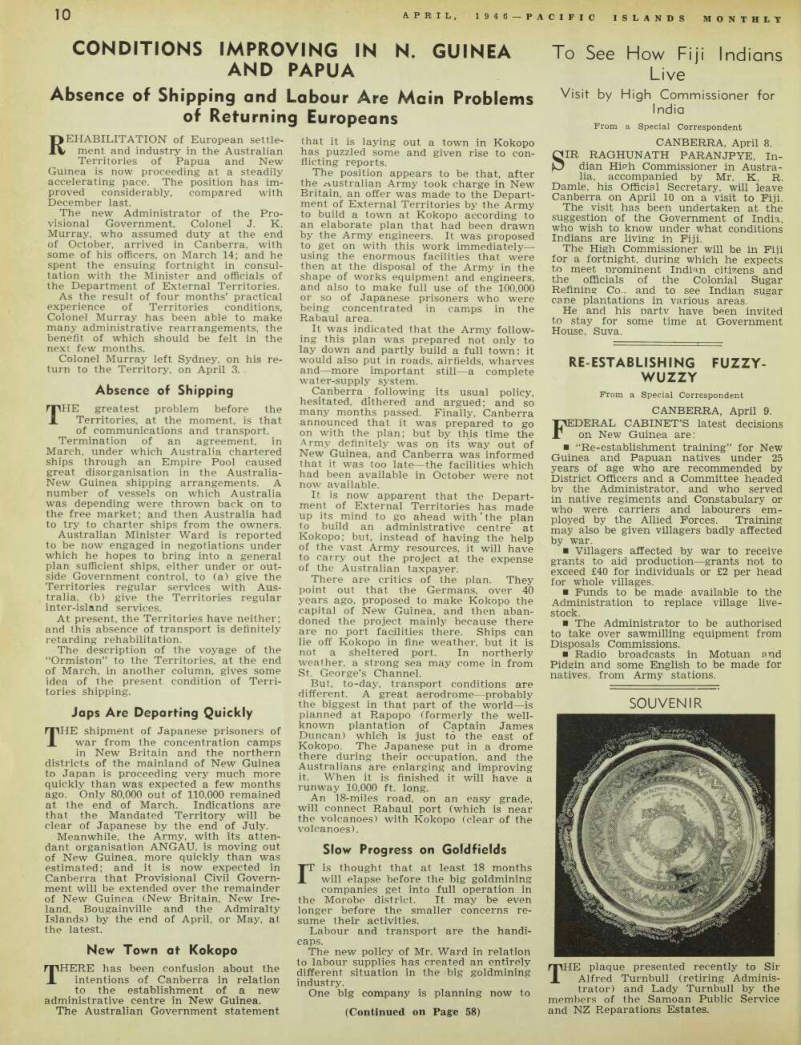
Souvenir
THE plaque presented recently to Sir Alfred Turnbull (retiring Adminis trator) and Lady Turnbull by the members of the Samoan Public Service and NZ Reparations Estates.
Luncheon!
Mekeo Boys at Luncheon!
Official Incident Which Startled Old Hands of Two Territories
From a Special Correspondent THE action of the Papua-New Guinea Administrator, Colonel J. K. Murray, in entertaining two natives at luncheon at Government House, Port Moresby, has aroused comment in the Territories —some of it unfavourable.
The two natives are Mekeo boys, and they were prisoners of the Japs. I do not know how they became prisoners.
Possibly they, like many other Mekeos, ran away from the carrier lines on the Kokoda Trail in 1942, and were caught by the enemy. Old residents do not like Mekeos, anyway—generally, they are born thieves, and untrustworthy.
The two Mekeos were brought from Rabaul, after their release. The Ad ministrator, faithfully following his official policy, decided —evidently as a gesture—that they should be officially honoured, and they were invited to lunch, with his Honor, and six startled “high officials.”
Two of the high officials “ducked,” and escaped the function, on some excuse.
The other four grimly saw the luncheon through.
Angry residents are asking if the Administrator has ever heard of Mr.
Peter Bosgard or Mr. William Gossner.
Both young men were highly respected residents of Papua; both served with credit in the war; both were POW for a time; and both are now back in Papua.
If the Administrator wished to honour returned POW’s, why should he overlook those men, in favour of two Mekeos?
The incident has revived memories of another occurrence, when the Adminis trator and his lieutenants had met some of the Hanuabada people in conference.
The time came when Mr. Lyons, in charge of public works, began to speak.
Naturally, he spoke from his place, where he was seated. The Administrator startled everyone by requesting Mr.
Lyons to stand when he was addressing the gentlemen from Hanuabada. ris very difficult for most senior officials. They esteem the new Administrator for his many fine qualities; but they distrust and strongly dislike this policy of treating the natives as equals, and they fear that it may be misunderstood by the natives. They say it is decades ahead of its time, and may lead to trouble.
My neighbour said: “I know it is the limit that the Administrator should enter tain natives in this way. But, actually,
what is the objection?”
My answer was: “Rightly or wrongly, we cannot live in this country as the equal of the native at this stage of his development. We can only be here as his superior—or not at all.”
taken with High Chiefs and heads of Government Departments, on the eve of the departure of Sir Alfred and Lady Turnbull, from Western Samoa. From left to right: A. Mackenzie, P. Gratton, Hon. Malietoa, Sir Alfred Turnbull, Hon. Mataafa, Lady Turnbull, Hon. Tamasese, Judge J. R. Herd, T. Robson.
Almost Complete
Pan-Air's Plans Almost Complete
THE final approving flight before Pan American Airways recommence their trans-Pacific service was scheduled for April 1 from San Francisco, arriving in Auckland on April 11.
The flight will be made in a Skymaster plane and will carry representatives of the United States Civil Aeronautics Authority, who will inspect the route and the facilities available.
The route of the aircraft on the south bound flight is by way of Honolulu, Palmyra, Canton Island, Suva, Noumea and Norfolk Island. The Skymaster will remain at Whenuapai, NZ, until April 15, when she will leave on the north-bound flight, calling only at Suva, Canton and Honolulu.
Papuan Resident Marries
In Sydney
A “SURPRISE” wedding of interest to Papuan residents took place in Sydney on March 27, when Mr.
Lionel P. B. Armit, of “Mananumu,”
Sogeri Valley, Papua, was married to Miss Peg Christensen, of Sydney.
Mr. Armit is a member of a well known pioneer Papuan family, and before his retirement was a member of the Police and Magisterial section of the Papuan Public Service. His bride is a well-known radio feature writer.
A cousin of the bridegroom, the Rev.
Frank Hanlin, officiated at the ceremony at St. Stephen’s Church, Sydney, and the br.de was given away by Mr. G. Allen Innes, of Salamaua and Sydney.
A reception to 80 guests was given at “Salamaua,” Olola Avenue, Vaucluse, by Mrs. Alice Allen Innes, close friend of both bride and groom. Mrs. Innes is, of course, a well-known and excellent hostess, and, although this reception had to be arranged at short mjtice, it was a particularly happy occasion. Many of the guests were old residents of Papua.
Owing to Mr. Armit having to return to Papua sooner than expected, the final arrangements for the wedding were hurried. However, the newly-married couple hope to meet other old friends, whom they found impossible>o contact, at an “after-wedding” reception at the Hotel Wentworth in the near future.
Extraordinary
Run of Bad Luck "Southern Cross" on Queensland Coast
AN extraordinary chapter of accidents has kept the Melanesian Mission yacht “Southern Cross” in Aus tralian waters. She sailed from Sydney for the Solomon Islands on March 12, with a scratch crew of Solomon Islands planters and traders, after surmounting numerous dockside troubles in Sydney; but in April she was still on the Austra lian coast.
She finally got away from Rockhampton on April 9.
After leaving Sydney, the “Southern Cross” ran into a severe cyclonic storm off the coast of New South Wales. She took a bad dusting, and Captain Upwood took her into Coff’s Harbour for shelter.
The sea moderated, and the ship set off again. The weather was far from good, but they were well on their way when the second mate, Mr. A. Taylor, fell down the companion-way and received concussion and other injuries. The skipper had to turn back towards Bris bane, and radio for an ambulance. The mate was taken to hospital, and the “Southern Cross” lay in Brisbane for a few days, awaiting quieter weather.
The second mate apparently made a good recovery, and rejoined the ship, and she sailed again on March 22. Then they ran into a second cyclonic storm. They were battling along, well out towards the Solomons, when the lubricating system feeding the port engine broke down.
There was nothing else for it—the vessel was turned back, and, with a tri-sail forward assisting the starboard engine, the “Southern Cross” reached Rock hampton on April 2.
Repairs were put in hand quickly— but then the second mate collapsed. The doctor said his injuries were such that he could not possibly continue with the ship.
The mission’s Sydney secretary, Major H. S. Robinson, who had had the “Southern Cross” and her troubles on his hands in Sydney and Brisbane for nearly two months, now began a frantic search in Sydney for a second mate. An officer was found, but none of the airways could give him passage to Rockhampton, where the vessel was waiting—he had to go by train. He was due there on April 8.
Major Robinson said that the one bright spot in all this chain of unhappy events was the extraordinary patience and good temper shown by the “scratch” crew of returning planters and traders.
They had had a frightful dusting in the cyclonic storms—but they had carried on their unaccustomed jobs without a whimper.
New Officers For Melbourne
Ng Association
AT the general meeting of the Mel bourne New Guinea Women’s Asso ciation in March, the following office-bearers were elected: President, Mrs. R. Rigby; vice-president, Mrs. A. Green; treasurer, Mrs. S. Best; secretary, Miss Dorothy Stewart; com mittee, Mrs. R. Smith, Mrs. R. Youlden, Mrs. H. Holland, Mrs. G. Bliss, Mrs. C.
Cooper, Mrs. G. W. Spensley, Mrs. H. A.
Gregory.
Among those mentioned in despatches for “distinguished services” in the South- West Pacific area is Major T. C. Back house, of the AlF—well known before the war as a medical officer in the Territories.
Advertisements & other items, p. 13 (1 item)
11
S> A (3 It' 1 0 ISLANDS MONIHLt - APRIL, 1946
Territorians Returning

"Ormiston" Carries Large Number to Papua and New Guinea
WEDNESDAY, March 27, 1946, may be written down as a red-letter day in the history of the Australian Terri tories of Papua and New Guinea. On that day, the Australian coastal liner “Ormiston” sailed from Sydnev for Port Moresby, Samarai, Lae and Rabaul, carry ing 160 passengers—the majority of them Territorians returning to what is left of their homes after four years of war.
It was not only the largest party of Territorians to return. The fact that they were allowed to return at all marked, to a degree, the -abandonment of the Canberra policy, under which hundreds of unhappy people have been kept idle in Australia, for many unnecessary months, while various Government in strumentalities made their own leisurely arrangements regarding the future dis position and administration of the Terri tories.
The sailing of the “Ormiston” was sur rounded by confusion that was almost incredible—yet typical of the conditions that have ruled in the Territories since they were re-occupied by the Army.
The “Ormiston” is officially a trans port, and under the control of the Ser vices. Inter-departmental squabbling in February and March deprived the Terri
toiies of shipping services. Finally, the position became so urgent that the Aus tralian Government, over the heads of the reluctant Services, insisted that the “Ormiston” be made available for pas sengers and cargo. • T’ke Departments and instrumentalities interested in and sharing control of the ‘‘Ormiston” were: Australian Army, Aus tralian Navy, the Shipping Control Board, the owners of the ship (AUSN Co.), Department of External Territories Papua-New Guinea Administration, and Burns Philp & Co., Ltd. (as being re sponsible for much of the cargo goino- to the Territories).
Among the lot of them, they staged as pretty an official dog-fight as the Sydney waterfront ever has seen.
Passengers and cargo were bound for Port Moresby, Samarai, Lae and Rabaul. The various controllers announced that the ship would go to Port Moresby and Rabaul only. As she was actually to pass through China Strait, within a couple of miles of Samarai, the Samarai interests protested angrily—and officialdom reluc tantly agreed to stop the ship at Samarai.
Many passengers and much cargo wanted to go to Lae. The Army, etc., shook its head Lae was out of the question. They would be booked to Port Moresby. But—demanded Lae people how are we to get from Port Moresby to Lae? Army, etc., apparently didn’t know —and didn’t care.
So the angry Territorians turned back to their last, hope—External Territories Minister Ward. They explained their predicament and officialdom’s ridiculous stand.
For once, their plea bore good fruit.
“Eddie” went into action in good fighting style, only three or four days before the ship was to sail. There were some very lively interchanges—and then it was an nounced that the “Ormiston” would go to Lae.
But, by then, most of the New Guinea mainland passengers had been booked to Port Moresby, and thev sailed as Port Moresby passengers. It was expected that ship’s staff and passengers would be struggling with disembarkation problems all the way to Papua.
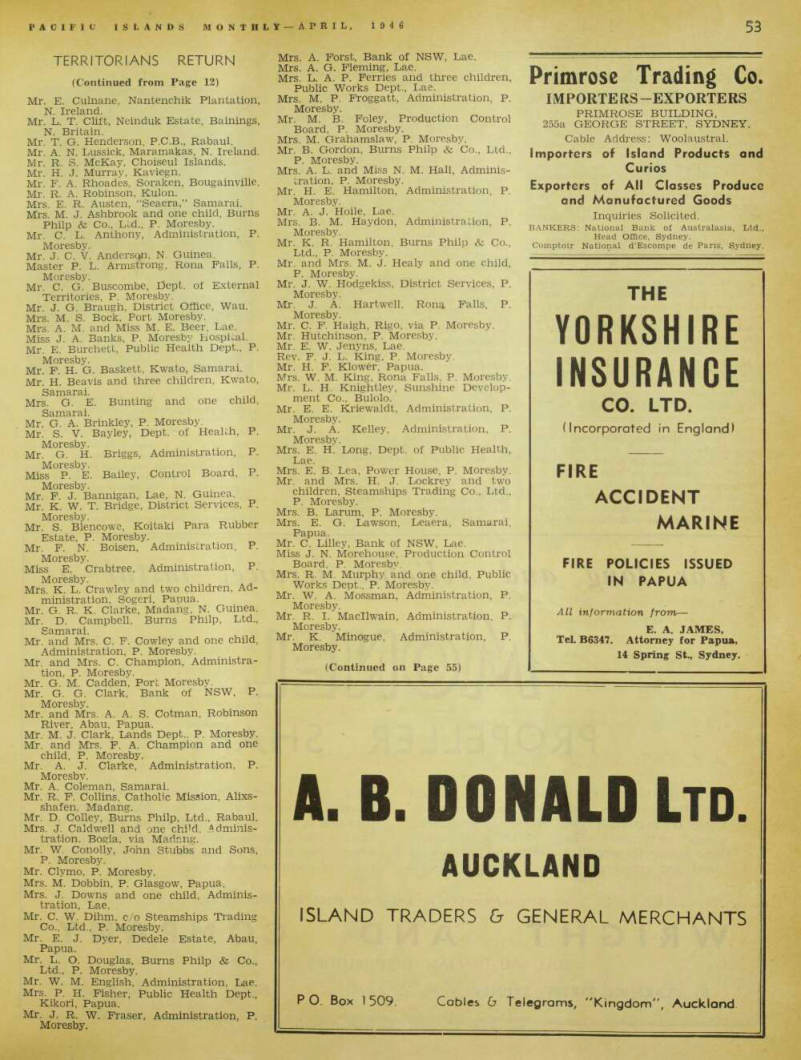
The following is a list of the passengers:— Mr. D. S. Askew, Fileba Plantation, Kavieng.
Mr. F. H. Beighton, W. R. Carpenter & Co., Ltd., Rabaul.
Mr. D. Colley, Burns Philp & Co., Ltd., Rabaul.
(Continued on Page 53)
Mr. E. Culnane, Nantenchik Plantation, N. Ireland.
Mr. L. T. Clift, Neinduk Estate, Bainings, N. Britain.
Mr. T. G. Henderson, P.C.8., Rabaul.
Mr. A. N. Lussick, Maramakas, N. Ireland.
Mr. R. S. McKay, Choiseul Islands.
Mr. H. J. Murray, Kaviegn.
Mr. F. A. Rhoades, Soraken, Bougainville.
Mr. R. A. Robinson, Kulon.
Mrs. E. R. Austen, “Seaera,” Samarai.
Mrs. M. J. Ashbrook and one child, Burns Philp & Co., Ltd., P. Moresby.
Mr. C. L. Anthony, Administration, P.
Moresby.
Mr. J. C. V. Anderson, N. Guinea.
Master P. L. Armstrong, Rona Falls, P.
Moresby.
Mr. C. G. Buscombe, Dept, of External Territories, P. Moresby.
Mr. J. G. Braugh, District Office, Wau.
Mrs. M. S. Bock, Fort Moresby.
Mrs. A. M. and Miss M. E. Beer. Lae.
Miss J. A. Banks, P. Moresby Hospital.
Mr. E. Burchett, Public Health Dept., P.
Moresby.
Mr. F. H. G. Baskett, Kwato, Samarai.
Mr. H. Beavis and three children, Kwato, Samarai.
Mrs. G. E. Bunting and one child, Samarai.
Mr. G. A. Brinkley, P. Moresby.
Mr. S. V. Bayley, Dept, of Health, P.
Moresby. Mr. G. H. Briggs, Administration, P.
Moresby. , Miss P. E. Bailey, Control Board, P.
Moresby.
Mr. F. J. Bannigan, Lae, N. Guinea.
Mr. K. W. T. Bridge, District Services, P.
Moresby.
Mr. S. Blencowe, Koitaki Para Rubber Estate, P. Moresby.
Mr. F. N. Boisen, Administration, P.
Moresby.
Miss E. Crabtree, Administration, P.
Moresby.
Mrs. K. L. Crawley and two children, Ad ministration, Sogeri, Parma.
Mr. G. R. K. Clarke, Madang, N. Guinea.
Mr. D. Campbell, Burns Philp, Ltd., Samarai.
Mr. and Mrs. C. F. Cowley and one child, Administration, P. Moresby.
Mr. and Mrs. C. Champion, Administra tion, P. Moresby.
Mr. G. M. Cadden, Port Moresby.
Mr. G. G. Clark, Bank of NSW, P.
Moresby.
Mr. and Mrs. A. A. S. Cotman, Robinson River, Abau, Papua.
Mr. M. J. Clark, Lands Dept.. P. Moresby.
Mr. and Mrs. F. A. Champion and one child, P. Moresby.
Mr. A. J. Clarke, Administration, P.
Moresby.
Mr. A. Coleman, Samarai.
Mr. R. F. Collins, Catholic Mission, Alixs shafen. Madang.
Mr. D. Colley, Burns Philp, Ltd., Rabaul, Mrs. J. Caldwell and one child. Adminis tration. Bogia, via Madang.
Mr. W. Conolly, John Stubbs and Sons, P. Moresby.
Mr. Clymo, P. Moresby.
Mrs. M. Dobbin, P. Glasgow, Papua.
Mrs. J. Downs and one child, Adminis tration, Lae.
Mr. C. W. Dihm, c/o Steamships Trading Co., Ltd., P. Moresby.
Mr. E. J. Dyer, Dedele Estate, Abau, Papua.
Mr. L. O. Douglas, Burns Philp & Co., Ltd., P. Moresby.
Mr. W. M. English, Administration, Lae.
Mrs. P. H. Fisher, Public Health Dept., Kikori, Papua.
Mr. J. R. W. Fraser, Administration, P.
Moresby.
Mrs. A. Forst, Bank of NSW, Lae.
Mrs. A. G. Fleming, Lae.
Mrs. L. A. P. Ferries and three children, Public Works Dept., Lae.
Mrs. M. P. Froggatt, Administration, p.
Moresby.
Mr. M. B. Foley, Production Control Board, P. Moresby.
Mrs. M. Grahamslaw, P. Moresby.
Mr. B. Gordon, Burns Philp & Co., Ltd., P. Moresby.
Mrs. A. L. and Miss N. M. Hall, Adminis tration, P. Moresby.
Mr. H. E. Hamilton, Administration, P.
Moresby.
Mr. A. J. Hoile, Lae.
Mrs. B. M. Haydon, Administration, P.
Moresby.
Mr. K. R. Hamilton, Burns Philp & Co., Ltd.. P. Moresby.
Mr. and Mrs. M. J. Healy and one child, P. Moresby.
Mr. J. W. Hodgekiss, District Services, P.
Moresby.
Mr. J. A. Hartwell, Rona Falls, P.
Moresby.
Mr. C. F. Haigh, Rigo, via P. Moresby.
Mr. Hutchinson, P. Moresby.
Mr. E. W. Jenyns, Lae.
Rev. F. J. L. King, P. Moresby.
Mr. H. F. Klower, Papua.
Mrs. W. M. King, Rona Falls. P. Moresby.
Mr. L. H. Knightley, Sunshine Develop ment Co., Bulolo.
Mr. E. E. Kriewaldt, Administration, P.
Moresby.
Mr. J. A. Kelley, Administration, P.
Moresby.
Mrs. E. H. Long, Dept, of Public Health, Lae.
Mrs. E. B. Lea, Power House, P. Moresby.
Mr. and Mrs. H. J. Lockrey and two children, Steamships Trading Co., Ltd.,
P. Moresby.
Mrs. B. Larum, P. Moresby.
Mrs. E. G. Lawson, Leaera, Samarai, Papua.
Mr. C. Lilley, Bank of NSW, Lae.
Miss J. N. Morehouse, Production Control Board, P. Moresby.
Mrs. R. M. Murphy and one child, Public Works Dept., P. Moresby.
Mr. W. A. Mossman, Administration, P.
Moresby.
Mr. R. I. Macllwain, Administration, P.
Moresby.
Mr. K. Minogue, Administration, P.
Moresby.
(Continued on Page 55)
Mr. R. S. McKay, Choiseul Islands Plan tation, via Rabaul.
Miss M. A. Mcß. Mackay, Kwato, Samarai.
Mr. C. C. Marr, Administration.
Mr. J. J. Maskill, c/o T. Flower, P.
Moresby.
Mr. H. J. Murray, Kavieng, N. Ireland.
Mr. N. MacAulay, c/o Government Resi dence, P. Moresby.
Miss B. M. Marks, P. Moresby Hospital.
Mr. R. Moller, John Stubbs & Sons, P.
Moresby.
Mr. E. R. McKenzie, John Stubbs & Son, P. Moresby.
Mrs. A. Niall, District Office, Wewak.
Mrs. L. M. Nolan, c/o Government Stores, P. Moresby.
Mr. W. G. Niness, N. Guinea.
Mrs. C. O. O’Neile, Burns Philp & Co., Ltd., P. Moresby.
Mr. T. R. Osborne, Miverna Island, via Samarai.
Mrs. Odgers and one child, P. Moresby.
Mr. M. J. P. Pitt, Administration, P.
Moresby.
Mr. H. T. Plant, Post Office, P. Moresby.
Mrs. T. J. Phillips, Madang.
Mr. J. Peterson, Burns Philp & Co., Ltd., P. Moresby. Mr. W. R. A. Parker, Prod. Control Board, P. Moresby. , , „ Mr. R. G. Pick well, Public Health, P.
Moresby.
Mr. C. Parer, Lae.
Mrs J. M. Pascoe, and three children, SDA Mission, P. Moresby.
Mr. E. D. Ryan, Umuna, Misima Island.
Mr. G. T. Robins, Burns Philp & Co., Ltd., P. Moresby.
Mr. and Mrs. A. J. K. Russell, P. Glasgow, Papua. .. Mr. F. V. Reitano, Administration, P.
Moresby.
Mrs. R. H. Swanson and one child, Lae.
Mr. M. Schultz, District Office, Wau.
Miss P. M. Solomons, Prod. Control Board, P. Moresby.
Mrs. N. E. Stevens and two children, Higaturu, Papua.
Mr. J. H. S. Smith, N. Guinea.
Mr. G. Saunders, P. Moresby.
Mr. H. H. Smith, Administration, P.
Moresby.
Mrs. C. Turner and two children, Losuia, Trobriand Islands.
Mr. W. Tracy, Lae.
Mrs. D. A. Thomas and two children, Ad ministration, Lae.
Mr. C. C. Wood, Government Stores, P.
Moresby.
Mr. A. Whitbourne, Steamships Trading Co., Ltd., P. Moresby.
Mr. M. A. Warren, Samarai.
Mr. E. D. Wren, P. Moresby.
Mrs. M. P. Weir, General Hospital, P.
Moresby.
Mr. E. Wilson, Samarai.
Mrs. M. W. Woodman, Madang.
Mr. F. R. Young, Administration, P.
Moresby.
Mr. G. Zanrosso, Lae.
Advertisements & other items, p. 14 (2 items)
12
April, 1946 PAciPic islands monthly
Burns Philp
\V\C
SPECIALISING
IN
PACIFIC ISLAND INSURANCES
I IRE MOTOR VEHICLE
MARINE HULLS AND CARGO
EMPLOYER’S LIABILITY
GUARANTEES including those for—
DYNAMITE PERMITS.
RECRUITERS' LICENCES.
DEFERRED WAGES
AND ALL OTHER CLASSES ARRANGED
AT LOWEST CURRENT RATES.
Established Agencies:
\V. R. CARPENTER & CO., LTD.
Throughout the Territory of New Guinea.
SOUTHERN PACIFIC INSURANCE
CO.. LTD.
HEAD OFFICE: 60 HUNTER STREET.
SYDNEY.
BURNS PHILP
(SOUTH SEA) CO. LTD.
Inc. In Fiji Registered Office
island Traders and Shipowners
U V A
I J I
Also Branches at:
Code Address: “Burnsouth*.
Levuka, Lautoka, Labasa, Ba, Sigatoka, Rotuma Tonga: Nukualofa, Haapai, Vavau.
Samoa: Apia, Pago Pago (American Samoa).
Solomons: Makambo, Gizo, Faisi.
New Hebrides: Vila Gilberts. Tarawa Norfolk Is. Niue Wallis Is. Futuna Is.
Sole Australian Concessionaries :
GEORGE BROWN & CO. PTY. LTD.
267 Clarence Street, Sydney.
The Ultimate factory has made the change-over from its wartime set-up.
Designs for the new models are now completed and production is about to commence.
These models should be available early in 1946—they will be well worth waiting for. Watch for further announcements.
SERVICE: Servicing of all kinds of radio sets, amplifiers and Rola speakers will continue to be available.
Trusteeship
New Guinea Under Trusteeship Explanation by Australian Minister Evatt
Prom Our Own Correspondent CANBERRA, March 20.
AUSTRALIA must have the exclusive administering authority in the pre sent mandates when those mandates come under the trusteeship of the United Nations’ Organisation, The Australian Minister for External Affairs (Dr. Evatt) said in a long foreign affairs speech in the House of Represen tatives on March 13 that any new agree ment would be acceptable to Australia only if it provided for the Government to administer the Territories, The existing “C” class mandate would provide the basis for the new trusteeship agreement.
Like the present mandate, the agree ment must permit the Territories to be administered as an integral portion of Australia, and under Australian laws, sub ject, of course, to the general duty laid down in the charter and also contained in the mandate to promote the welfare and advancement of the Territories’ in habitants.
One vital difference between the systems dealt with fortification. The Mandated Territories were kept out of the system of collective security. Territories brought under the trusteeship system will play their appropriate part in securitv agree ments. The charter provided that the trusteeship agreement might designate the whole or any part of a trust territory as a strategic area.
Dr. Evatt said: “We shall accordingly ask for the right to establish bases for security’s sake in the mandates. The Japanese took advantage of the League mandate system and installed fortifica tions on their mandates in the Carolines and Marshalls, in direct contravention of the mandate terms.
“We have nothing to fear from bring ing our future administration under the similar review of the new Trusteeship Council, the functions of which will only be advisory.
“Pears of the status of New Guinea under the new charter are baseless. The object of the trusteeship system is to pro mote the welfare of the inhabitants of non-self-governing Territories, their social, political and economic develop ment, and their advancement towards self-government or independence “There is to be an expert Trusteeship Council, responsible primarily to the General Assembly of the United Nations, in order to supervise the due perform ance by the authorities administering trust territories of their obligations under the charter. The trusteeship system is to apply to such non-self-governing terri tories only as are placed under the sys tem by voluntary agreements concurred in by the States directly concerned and approved by the General Assembly.
“The charter fully safeguards the posi tion of the Mandatory States. The terms upon which a Mandated Territory is brought under the trusteeship system must be agreed to by the Mandatory State.
Pending the conclusion of a trusteeship agreement in respect of a Mandated Ter ritory, nothing in the charter shall alter in any way the rights existing under the mandate.”
American Bases
fT!HE Australian Government will not JL admit American claims to Pacific Territories merely because America
captured them during the war. Dr. EVatt made this clear. He hinted at the forma tion of a regional defence area in the South-West Pacific.
Australia was at least as vitally con cerned as any other nation in ensuring that provision was made for the future security of the Pacific. The Government would enter into no commitments which would lessen the control of the Australian people over their own Territories.
“Any consideration of plans for the joint use of any bases in Australia’s de pendent Territories should be preceded by an overall defence arrangement for the region of the Western Pacific, including the islands formerly mandated to Japan,” he said.
“As an incident of any such arrange
ment Australia should be entitled to re ciprocal use of foreign bases in the region.
“This would provide for an overall in crease in the security both of Australia and of all other United Nations with in terests in the region. The Australian Government realises this country’s security is dependent largely on our closest co-operation with the British Commonwealth and the United States of America, Any hindrance to the maxi mum degree of co-oneration with either is contrary to the interests of all these countries. Detailed means of implement ing a security policy for the Pacific have not yet been worked out.”
Advertisements & other items, pp. 15-16 (1 item)
Have You
c, '"'ff * S> B The
CONSIDERED
THIS CODICIL?
By adding a simple codicil to your Will you can guard against difficulties and loss which might arise should your Executor die or become incapacitated.
By means of such a codicil you can name Burns Philp Trust Co. Ltd. as joint Executor with your present appointee or, if you wish, as sole Executor. In this way you gain positive assurance of continuous and sound administration and are relieved of a serious anxiety. The Company will willingly forward full particulars. »
DIRECTORS:
Lewis Armstrong. James Burns. Joseph Mitchell.
R. J. Nosworthy. P. T. W. Black.
MANAGER: L. S. Parker.
SECRETARY: E. R. Overton, A.F.I.A.
BURNS PHILP TRUST
COMPANY LIMITED
7 BRIDGE STREET. SYDNEY
PHONE: B 7901. BOX 543. G.P.0., SYDNEY.
NOTICE TO CREDITORS
In the Estate of Frank Charles Keeble, of Guadalcanal, British Solomon
Islands Protectorate, Storeman,
deceased.
ALL persons having claims against the estate of the abovenamed deceased are required to submit proofs of debt, accompanied by complete invoices for the amount claimed, or, if invoices are not available, by full particulars of the amount claimed, to the undersigned, not later than the 30th day of June, 1946.
In the case of creditors resident outside the Protectorate, claims should be addressed to the undersigned at the Office of the Western Pacific High Commission, at Suva, Fiji.
Any creditor who fails to submit his claim in the manner, and on or before the date aforesaid, may forfeit his right to payment out of the assets of the estate.
Dated at the Seat of Administration in the British Solomon Islands Protectorate this seventh day of March, 1946. (Signed) D. C. C. TRENCH, Lieutenant- Colonel.
Official Administrator of Unrepresented Estates.
Backache. Rheumatism
Sciatica,
QUICKLY EASED BY THIS
SYSTEM-CLEANSING
'lnternal Bath"
If you suffer from swollen, stiff and painful joints and muscles, if your bad: aches perpetually, or the sharp stabbing pains of Neuritis and Sciatica torture you, the cause may oe disordered liver, kidneys and bladder.
What you need is the blessed relief of R.U.R.! It’s a real “internal bath” that gently and thoroughly clears accumulated
MJONEY -BACK GUARANTEE
Neuritis
poisons and acids away from the system, soothes, tones and cleanses the kidneys and bladder and gives the liver a nudge to start the bile flowing freely again.
Very soon your troubles ease, and suppleness, fitness and vigour return. You’ll feel and look much younger, too!
Proof: Mr. Fred Whiley, of Christchurch, New Zealand, writes: “My doctor said I was a done man. He is now dead and I am better than ever. It’s no secret—l took a large packet of
R.U.R.”
THAT R.U.R. WILL SATISFY.
Freedom from pain is yours, or R.U.R. will cost you nothing. Smaller size 4/-, or money-back guaranteed. Pull treatment 7/6; at all chemists and stores. Or write to R.U.R., 841 George Street, Sydney. \ V / a U
AND
N/DNT ywif ADJT
Tourist House For
Nukualofa
A READER, commenting on an article on Tonga in December “PIM,” writes to say that Nukualofa now has a pleasant and well-run boarding-house which is under the supervision of Mrs.
Riechelman. The surroundings are re ported to be attractive and the food is good and, it is believed, the Tongan Gov ernment is subsidising the establishment, in the hope of attracting tourists.
Lack of suitable accommodation in the past has prevented travellers from visit ing Tonga, which, as the only indepen dent Kingdom in the Pacific, should have particular charm for the more serious type of tourist.
Mr. Nandan Sen Deoki, an outstanding member of the Christian Indian commu nity of Fiji, died in New Zealand on December 21, 1945, at the age of 72. He went to Fiji as a child and eventually became a planter and trader at Navua.
Throughout his life he took a prominent part in the social, religious and political life of the community. He is survived by his wife, his sons, Dr. Samson Deoki of Nadi, the Rev. Ramsay Deoki of Suva, Mr. Andrew Deoki, barrister and solici tor of Suva, and two daughters, Mrs. S.
Ram Singh and Mrs. Ram Parsad, both of whom were formerly teachers in Fiji.
Scrub Typhus
Doctor's Grove Warning to Returning Territorians
rE following letter about the danger ous Tsutsugamushi Disease—other wise known as Scrub Typhus and Japanese River Fever —was published in the “Medical Journal of Australia,” of March 23: “Sir: With the impending return of the civil population to New Guinea and the adjacent islands, I feel that publicity should be given to the necessity for pre venting tsutsugamushi disease.
“It has long been known in Malaya that deserted and overgrown plantations are highly dangerous endemic foci for this disease. This fact was repeatedly verified during the New Guinea campaign.
“The only satisfactory protective mea sure at present known is the application of miticides such as di-butyl phthalate or benzyl benzoate. These can be applied by smearing the clothing with two ounces of either, or by impregnating it with a 5 per cent, emulsion (a 2 per cent, soap solution makes a satisfactory emulsifying agent). In the latter method the clothes are steeped in the emulsion, wrung out, and allowed to dry. Such clothes remain impregnated for three weeks, even after three washings. All the clothing, includ ing socks, but excluding underpants, should be treated. As an added pre caution, boots and shoes should be smeared daily.
“To destroy mites in areas where huts etc. are to be built, local spraying with creosote or a 5 per cent, solution of “666” is suitable; but it must be noted that ‘DDT’ is not effective against mites.
However, until areas can be satisfactorily cleared of mites and their rodent hosts, clothing impregnation should be prac tised by all outside workers.”
Yours, etc.,
J. T. Gunther.
University Club, Sydney, March 14, 1946.
Dr. Gunther was well known on the Morobe goldfield before the war. He joined the AIP, was with the Australians in Malaya, and spent some years as a POW in Changi. His warning should be given wide publicity.
Pacific Students 'Prejudice'
Nz-Ers Chances
rARS have been expressed in some quarters in New Zealand that the increasing number of students com ing to University in the Dominion from the Pacific Islands might prejudice the chances of New Zealand scholars.
Commenting on this recently, the “New Zealand Herald” said there appeared to be no likelihood of this at present. This year there were 20 Indians, Fijians and Samoans at Auckland University, some of whom came direct from the Islands, but others of whom had received primary and secondary education in New Zealand and upon matriculation were entitled to the same right of entry to the Universi ties as New Zealand students.
Mr. L. Bintley, who hast been Fiji Gov ernment architect, has been transferred to Kenya in the same capacity. He will be succeeded in Fiji by Major Nettleton, who is still serving with the Royal Engineers.
Advertisements & other items, pp. 17-18 (2 items)
Hflrrt J. Tomnq
“PEERLESS” WHEEL TOYS
FOR THE PACIFIC ISLANDS ...
0
AVAILABLE NOW!
We have pleasure in presenting the first of the post-war "Peerless" toys.
As in pre-war yeaft, "Peerless" toys are finished in bright colours. Enjoyment and satisfaction are ensured by their quality.
TRICAR No. 7.
SCOOTER No. 4.
BRIGHT COLOURS RUBBER TYRES
Available in April
£ a w i %
UTILITY TRUCK.
These three attractive toys will be available from stocks during April
—ORDER NOW.
SPORTS CAR No. 24
Bright colours, rubber tyres, nickel plating and fittings which include horn, mascot, are some of the most attractive features of these toys.
TRICAR No. 9.
Order "Peerless" Wheel Toys From the Sole Pacific Islands Selling
Representatives:
HflRRT J. TOMNQ
POSTAL ADDRESS:
Box 3661 G.P.O., Sydney.
379 KENT STREET, SYDNEY,
BANKERS: BANK OP N.S.W.
PTT. LTD.
CODES:
Bentley’s Comp.
Phrase.
Bentley’s 2nd Phrase.
the 3 Mrtv°»t “her °S=i* r
WEDDING OF RABAUL INTEREST
ON March 14, at St. Barnabas Church, Ashgrove, Brisbane, Mrs. C. H.
Robinson (formerly wife of Mr. H.
E. Robinson, accountant to the Treasury at Rabaul), was quietly married to Lieut.
W. J. Robertson, MC, formerly a grazier, of Condobolin, NSW. Mrs. E. P. Holmes
the 3 Mrtv°»t “her °S=i* r
after P thT a? 1 Hlghga^e Hlll Mrs A th f ivr Al %f r f Sent ix^ re fnH M;c L r R ci S ’ ,¥ rS ; J h elma Whlte and Mrs. G. Shand, all of New Guinea r td K* fu Ti Robll l son spent some time in the Islands before the war. During the war he was attached to the AIB, in the course of which service he won his Military Cross.
Tired,Sleepless
When Worried Tired,Sleepless
And You Feel Run-Down
Worry Is Inescapable. Everyone has a share of it more or less. The great trouble about worry is that it plays havoc with your health and fitness if you let it. You become mentally and bodily weary, depressed; cannot sleep at night, lose appetite and begin to feel a nervous breakdown is impending. That starts the vicious circle. You worry, become run-down and nervy, and that makes you worry more than ever.
Meet your troubles all the way by re invigorating your system and keeping it fit and well by taking Dr. Williams’ Pink Pills. These pills help to restore the red corpuscles and iron content of the blood to their normal quantity.
This enables life-giving oxygen and nourishment to be carried to the nerves, organs and tissue* of the body. In that way you become invigor ated, strengthened by Dr. Williams’ Pink Pills, the vague aches and pains disappear and you are fit again to deal confidently with all your worries. At chemists and stores.
Mrs. Baker Of Witu
Why is She Not Allowed to Return?
Prom Our Own Correspondent
Canberra, Mar. 27.
FEDERAL Parliament to-night heard the story of Mrs. G. L. Baker, copra plantation manageress, Witu Islands, who wants to sail back to New Guinea on her own ketch.
The story was told by the Country Party member for New England, NSW, Mr. Abbott, who read letters sent to the Government by Mrs. Baker in an attempt to get permission to return to her plan tation.
Mrs. Baker was awarded the MBE for her distinguished service in evacuating troops from New Britain after the Japa nese invasion of Rabaul in January, 1942.
Mr. Abbott asked the Government to sanction Mrs. Baker’s return to her plan tation, which she managed before the war, after the death of her husband. He said Mrs. Baker’s offer to sail back on her own ketch had been made in des peration, after repeated requests to the Government for a shipping berth to New Britain had been refused.
Mrs. Baker had first written to the Government asking for permission to enter the Territory and reorganise her plantation.
The Minister for the Army (Mr. Forde) subsequently told her Army authorities controlling the Witu area had no objec tion to her returning. But when she sought a passage to New Britain, her requests were constantly refused.
Mr. Abbott said: “Now Mrs. Baker has offered to sail back herself. She is an experienced navigator and did good work evacuating trapped troops fro.\n New Britain in 1942. Apparently she is being kept here because of her sex. When she was evacuating our troops from New Britain it didn’t matter a damn whether she was a woman.”
The Speaker (Mr. Rosevear): “Order— you can’t use that language.”
Mr. Abbott; “It didn’t matter a bit whether she was a woman.”
Mr. Abbott read extracts from a letter from Mrs. Baker, in which the writer slated the Minister for the Army for his attitude to her requests. He added: “Be cause the backboneless Minister for the Army refuses to assist Mrs. Baker she is denied the right to return to her plan tation. Mrs. Baker has told me she knows the hardships she will have to face in going back to her plantation. She should be allowed back.”
An Mp's Appointment To
Norfolk Island
From Our Own Correspondent
Canberra, Apr. 4.
MR. ALEX WILSON, former MP for Wimmera (Victoria), was appointed Administrator of Norfolk Island because his qualifications for the job were better than those of others available for the administratorship, the Minister for Ex ternal Territories (Mr. Ward) said in the House of Representatives to-day.
He was replying to Mr. Anthony, CP, NSW, who asked whether the position had been advertised, and whether it had been offered to any returned soldier.
In a series of questions directed to Mr.
Ward, Mr. Anthony added: “If no re turned soldier was offered the position, was it considered by the Government that no returned soldier was available and suitable for such appointment?”
Mr. Anthony also requested announce ment of the terms of the appointment of Mr. Wilson, together with details of salary, allowances, and expenses allowed him.
He asked Mr. Ward what previous administrative experience Mr. Wilson had had to fit him for the administrator ship, and what qualifications were con sidered as justifying Mr. Wilson’s ap pointment.
Mr. Ward replied: “Mr. Wilson has been appointed Administrator of Norfolk Island for seven years from January 1 this year. His salary is £l,OOO a year, with free furnished quarters, and afi . entertainment allowance of £l5O a year.
Mr. Wilson had long practical experi ence of agriculture, whilst his adminis trative ability had been demonstrated over a period of some years, when he was assisting the Minister for Commerce and Agriculture in the difficult task of organising Australia’s food front.
“The position was not advertised prior to Mr. Wilson’s appointment. The quali fications of all those who were considered suitable and available for the position were considered at the time. Mr. Wilson was considered to have the best quali fications for the position of those avail able.”
Opposition members have been con stantly critical of Mr. Wilson’s appoint ment, which, they claim, is the “pay off” for services rendered by him while he, as an Independent, helped to keep the Labour Government in power.
They also criticised the appointment of Mr. Coles, formerly MHR for Henty (Victoria), to the Airlines Commission.
Mr. Coles also helped to keep Labour in power.
A Franco-American agreement was signed in Paris in March regarding Franco-American airlines. America will be given the use of bases in Indo-China and New Caledonia, and France will be granted the use of bases in San Francisco, Chicago, and Porto-Rico.
Advertisements & other items, p. 18 (1 item)
Steamships Trading
Company Limited
PORT MORESBY SAMARA I PAPUA.
WHOLESALE & RETAIL MERCHANTS, SHIPOWNERS,
PLANTERS, ENGINEERS Gr SLIP PROPRIETORS.
Customs, Shipping, Insurance, and Forwarding Agents.
MANAGING AGENTS AND VISITING REPRESENTA-
TIVES FOR COCONUT AND RUBBER ESTATES
SYDNEY REPRESENTATIVES: Nelson & Robertson Pty. Ltd., 12 Spring Street
Pta Can Do No More In Australia
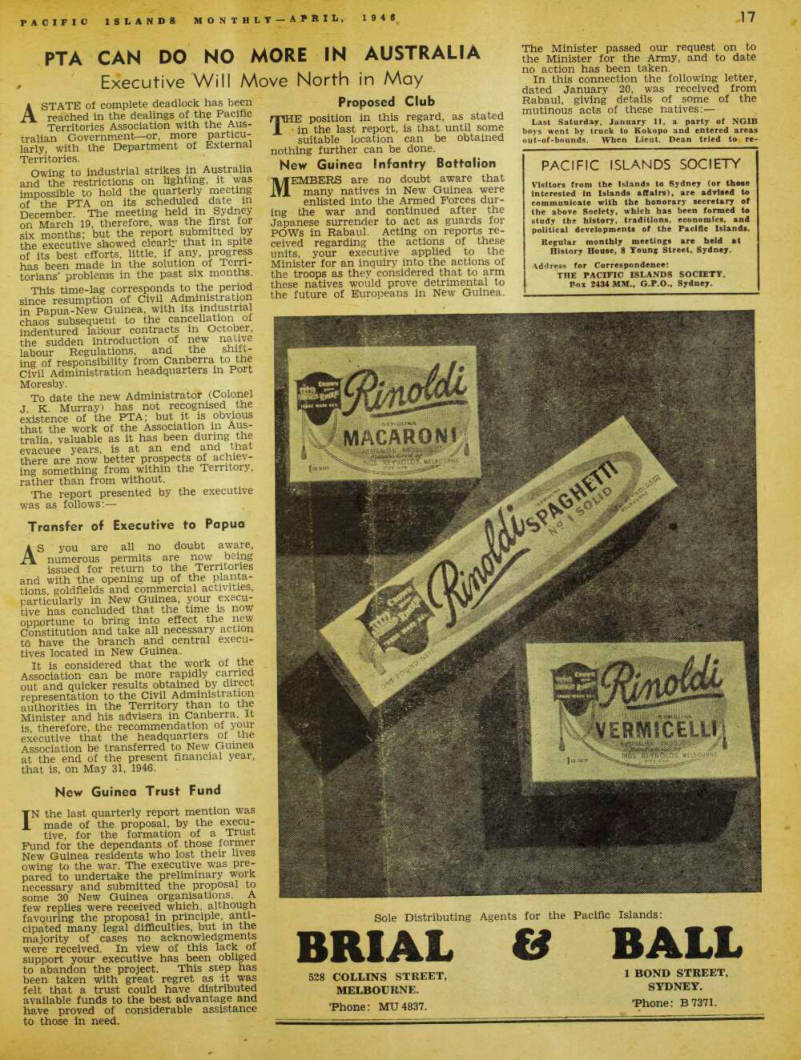

Executive Will Move North in May
A STATE of complete deadlock has been reached in the dealings of the Pacific Territories Association with the Aus tralian Government —or, more particu larly, with the Department of External
Territories.
Owing to industrial strikes in Australia and the restrictions on lighting, it was impossible to hold the quarterly meeting of the PTA on its scheduled date in December. The meeting held in Sydney on March 19, therefore, was the first for six months; but the report submitted by the executive showed clearly that in spite of its best efforts, little, if any, progress has been made in the solution of Tern torians’ problems in the past six months.
This time-lag corresponds to the period since resumption of Civil Administration in Papua-New Guinea, with its industrial chaos subsequent to the cancellation of indentured labour contracts in October, the sudden introduction of new native labour Regulations, and the shift ing of responsibility from Canberra to the Civil Administration headquarters in Port Moresby.
To date the new Administrator (Colonel j K Murray) has not recognised the existence of the PTA; but it is obvious that the work of the Association in Aus tralia, valuable as it has been during the evacuee years, is at an end and that there are now better prospects of achiev ing something from within the Territory, rather than from without.
The report presented by the executive was as follows;
Transfer of Executive to Papua
AS you are all no doubt aware, numerous permits are now being issued for return to the Territories and with the opening up of the planta tions, goldfields and commercial activities, particularly in New Guinea, your execu tive has concluded that the time is now opportune to bring into effect the new Constitution and take all necessary action to have the branch and central execu tives located in New Guinea.
It is considered that the work of the Association can be more rapidly carried out and quicker results obtained by direct representation to the Civil Administration authorities in the Territory than to the Minister and his advisers in Canberra, it is, therefore, the recommendation of your executive that the headquarters of the Association be transferred to New Guinea at the end of the present financial year, that is, on May 31, 1946.
New Guinea Trust Fund
IN the last quarterly report mention was made of the proposal, by the execu tive, for the formation of a Trust Fund for the dependants of those former New Guinea residents who lost their lives owing to the war. The executive was pre pared to undertake the preliminary work necessary and submitted the proposal to some 30 New Guinea organisations. A few replies were received which, although favouring the proposal in principle, anti cipated many legal difficulties, but in the majority of cases no acknowledgments were received. In view of this lack of support your executive has been obliged to abandon the project. This step has been taken with great regret as it was felt that a trust could have distributed available funds to the best advantage and have proved of considerable assistance to those in need.
Proposed Club
rE position in this regard, as stated in the last report, is that until some suitable location can be obtained nothing further can be done.
New Guinea Infantry Battalion
MEMBERS are no doubt aware that many natives in New Guinea were enlisted into the Armed Forces dur ing the war and continued after the Japanese surrender to act as guards for POWs in Rabaul. Acting on reports re ceived regarding the actions of these units, your executive applied to the Minister for an inquiry into the actions of the troops as they considered that to arm these natives would prove detrimental to the future of Europeans in New Guinea.
The Minister passed our request on to the Minister for the Army, and to date no action has been taken.
In this connection the following letter, dated January 20, was received from Rabaul, giving details of some of the mutinous acts of these natives: — Last Saturday, January 11, a party of NGIB boys went by truck to Kokopo and entered areas out-of-bounds. When Lieut. Dean tried to re
move them they threatened him and called him a “bloody ANGAU bastard,” etc., etc., and said that they had won the war here and elsewhere, and that the Australians always ran away, and so on.
The ADO at Kokopo, Capt. Johnson, went with Lieut. Dean to the NGIB headquarters to complain to the Officer-in-Command in the absence of Col. Allen in New Ireland, but only non-New Guinea officers were there who had no idea of dealing with the situation.
The NGIB boys surrounded their car and tried to prevent them from seeing the OC, threaten ing them with Tommy-guns, axes, bayonets, etc., and again called them various so-and-so’s. They also stole Lieut. Dean’s revolver out of the jeep.
This Saturday the performance was repeated at Kokopo, where they released NGIB prisoners and demonstrated threateningly against the ADO and officers whose lives I consider to be in grave danger unless strong action is taken.
In Rabaul, on the same nighf, the NGIB guard on the Jap prison compound left their posts with their Bren-guns, etc., and demonstrated against the OC Native Police, Major Ron Hicks, using similar bad language, threats and boasts.
They then released NGIB and other native prisoners from the calaboose.
This morning there was a conference between the GOC (General Eather), Brigdr. Graham (just arrived from Lae), the District Officer (Major Bates), and others. 1 have not heard what transpired, but I believe they are awaiting the return of Col. Allen before taking action.
This NGIB business seems to be entirely un necessary and undesirable, and I think that, in view of the happenings, it should be disbanded and that the Native Police Force should be built up to sufficient strength for police purposes and other activities not performed by the Aus tralian Garrison troops. If drastic action be not taken there will be serious trouble and possible loss of life, and general disaffection of the native population. If the Government were trying to create an “Indonesian situation” here they could not be doing better towards that end.
Dependents of Lost Residents
MANY members will remember the fight that the executive has continued to carry on since 1943 in order to ob tain just benefits for the dependants of those civilians taken prisoner in, Rabaul.
Although the Government refused to agree to our request that these men be treated as members of the Armed Forces and their dependants be given all rights as such, it has now been announced that the Government has laid down a policy
covering all the matters contained in our original proposals to the Prime Minister in May, 1943.
Native Labour
rE cancellation of native labour con tracts in Papua in October, 1945, has continued to receive attention. The Minister has been asked his policy in regard to the repayment of recruiting fees for the unexpired portion of all contracts: but to date, no finality has been reached m this regard.
As soon as word was received that it was the Intention to cancel all contracts in New Guinea as at February ?8 1946 your executive approached the Minister with a request that all possible action be taken to obviate the chaos which even tuated in Papua.
Unfortunately, our idea of chaos and that of the Minister are apparently far apart, as is shown bv his reply to our 1 o tter ‘ * Minister wrote on February 18 as follows: I have your letter of February 12, and the contents of same have been noted.
Whilst it was anticipated that certain diffi culties would be encountered in the change-over from Army to civil control, it is untrue to assert that there was a state of chaos.
The Government’s policy respecting native labour is proving by results to be giving satis faction beyond its original expectations, and there is no intention to return to the former set-up.
Yours sincerely,
E. J. Ward.
We can only hone that with the return of experienced men to the Territories, the position will gradually right itself.
Production Control Board
11TE are still continuing to press for a f ▼ Producers’ representative on the Production Control Board, hut to date our efforts have not borne fruit, and we can only hope that eventually this democratic right will be allowed bv the Labour Government.
Rehabilitation
IN July, 1945, your executive placed before the Minister certain Questions regarding the return of civilians to the Territories and requesting that they be granted passages, freight on household effects, etc., but desnite repeated requests no derision has yet been advised.
Owing to the apparent impossibility of obtaining any decisions from the Minis ter, your executive formulated a list of 13 Questions which have been submitted to four members of the Opposition parties requesting that these questions be asked in the House. It is hoped by this means to obtain at least some information as to the Government’s intention regarding the Territories of Papua and New Guinea.
The questions submitted are:— ■ What plan has the Government for develop ment of the Territories and what part will ex-residents play? ■ Will the Government hold an inquiry in an endeavour to find out the reason for dis content in the Provisional Government Public Service of Papua and New Guinea? ■ When does the Government intend to end the present Dictatorship in Port Moresby and re establish Government by Legislative Council? ■ What Is being done to repatriate the. Japanese from New Guinea and when will the Territory be cleared of them? ■ Will the Government hold an inquiry and find out why 300 whites were not evacuated from Rabaul but were left to perish when the Japanese arrived? ■ Is the Government aware that native troops have mutinied in Rabaul, and, if so, what action has been taken?
■ Is the Government aware that production of rubber in Papua has ceased, and what action are they taking in this regard? ■ Copra production in New Guinea and Papua, pre-war, was approximately 80,000 tons per year, but has now been only a few thousand tons. In view of the food shortage in Europe and Britain, cannot something be done to remedy this? ■ Are the Papua and New Guinea Territories to be amalgamated under one Administrator? ■ Where will the Capitals or Capital be? ■ What does the Government intend to do re garding the township of Rabaul? ■ What plans have the Government for con trolling native labour? ■ Is the Government aware of the tragic shipping position of the Territories both Inter-Island and Intra-Australia-New Guinea? If so, what are they doing regarding same?
It is understood that steps are being taken in Rabaul to rehabilitate those Chinese who were following pre-war voca tions, such as hairdressers, carpenters, bootmakers, etc., but we have not heard that similar action is being taken in re gard to Chinese trade stores.
Social
YOUR executive arranged for a harbour trip on March 7, 1946, as a get together for Territorians and al though the number present was less than expected a very pleasant night was spent, and we are sure that had the weather remained fine at the time of embarkation a far greater number would have attended.
Executive Changes
OWING to his return to Papua, Mr. G.
Aumuller has resigned from the executive, and Mr. A. N. Lussick, having taken up an appointment in Can berra, has also severed his connections with the executive, and as both these gentle men were representing the planting interests, your executive would be pleased to hear of other members who are pre pared to take their places.
Discussion
SEVERAL members of the Association expressed regret that the executive had been unable to proceed with the formation of a Trust Fund for the benefit of children of those Territorians who had given their lives during the war.
Mr. R. A. Laws, chairman of the meet ing, said that the PTA was still willing to do what it could to help the formation of such a fund, but they' had had to drop the whole question owing to lack of response from those bodies circularised.
Mrs. A. Bowring asked what had become of the £6,000 collected by Morobe citizens for the Wau Spitfire Fund, and still not disposed of at the time of evacuation.
She was told that this had been giyen to Mr. Chifley (then Federal Treasurer) to be used for Australia’s war effort.
Mrs. Bowring asked whether this could be refunded and used as a nucleus of a Trust Fund.
Mr. C. A. M. Adelskold replied that it was extremely unlikely.
Lieut.-Colonel J. C. Mullaly spoke with some heat on the PTA’s request for an inquiry into the alleged mutiny or “in subordination” of members of the NGIB.
He said that these troops had done a magnificent job, had saved the lives of tens of thousands of Europeans during the war years, and that the most searching inquiries should be made into the so called mutiny before the Minister was approached.
Mr. Adelskold replied that the executive was satisfied that the allegations of the member, upon which they had based their request, were well founded.
Several members indicated that the continued silence of the Custodian of Ex propriated Properties on the policy he in tends to take with regard to war damage payments, is causing them anxiety.
According to War Damage Regulations, the Custodian has first charge on ex-pro. properties; and, in many cases, one of the Big Firms has a second charge on the plantations. The Big Firms also are wait ing for a statement of policy from the Custodian before they announce their in tentions.
The executive was asked to write to the Minister and press for a statement of policy from the Custodian. It is believed that 40 per cent, of New Guinea planters owe money to both the Custodian and the Big Firms.
Mrs. N. Wilmott asked if there were any way of finding out how long it would be before certain plantations on the Gazelle Peninsula would be available to their owners. Another member stated that IS plantations on the peninsula were affected by POW camps and that an estimated half-million pounds’ worth of damage had been done in the Rabaul area since the Australian Army took over.
On behalf of members who are finding transport from Australia to Lae impos sible to obtain, it was resolved to send a telegram to the Minister for the Army asking that the “Ormiston,” scheduled to sail from Sydney to Port Moresby and Rabaul on March 26, be divered to Lae with passengers and cargo.
On the motion of Lieut.-Colonel Mullaly it was decided to ask the Gov ernment to declare a 12 months’ mora torium on Government fees, licences, rentals, etc., for all returning ex-resi dents of the Territories, in order to assist in the rehabilitation of residents.
Col. Mullaly Makes A
Protest
AT the close of the meeting Lieut.- Colonel Mullaly spoke on the desir ability of continuing to keep the Association’s dealings with the Govern ment free from political bias. He said that the reforms takijig place in New Guinea were the inevitable result of the war years, when hundreds of thousands of Australian, American and American negro troops had passed through the Territory. The natives of 1946. he said,
were far different from the natives of 1939. They would demand more—and get more. For his part, he did not mind the reforms, or the raised standard of living for the natives. The reforms would mean a guaranteed market and price for the produce of the planter something he had never had in the pre-war years—and
.. , „ (Continued on Page 45)
with these prospects he, for one, was satisfied. He could not see that anything but harm could be done by unconstruc tive abuse of the Government or its Ministers —for example, referring to them
as “gutter-snipe politicians.”
Mr. Norman Nelson, Mr. T. Bellamy and Mr. Adelskold, all members of the execu tive, said that never on any occasion had they brought politics into their discus sions with the Australian Government, nor had they used abusive language. In all matters they had endeavoured to deal first with the Government; but, when this brought no results, in some cases they had tried to achieve something by appeal ing to Opposition members.
Mr. R. W. Robson said that Colonel Mullaly obviously was pointing his re marks in his direction.
Colonel Mullaly interjected that, frankly, he was at the policy of the “Pacific Islands Monthly.”
Mr. Robson said that he had never been in any way associated with the executive of the PTA, nor had he ever sought to influence them or their policy, which to his mind was always everything that was correct, tactful and in good taste. As far as the policy of his paper was concerned, he had waited for about two years to see whether the present Minister for External Territories would help the Territorians, and how; but when it became obvious that Territorians were butting their heads up against a brick wall of official indifference, and that the Department appeared to be going out of its way to make life a misery for the Ter ritorians, then he had attacked the Minis ter in his own way. The methods he had adopted, he felt, were those which would be understood by a politician of Mr.
Ward’s calibre. His newspaper always would attack injustice and official ineffi ciency. in whatever form it might be found.
Colonel Mullaly replied that if Mr.
Robson believed That his paper repre sented the voice of the New Guinea planter, then he should like to disillusion him. In the opinion of New Guinea planters, the criticism of the Minister published in the “Pacific Islands Monthly” did more harm to the planters’ cause than any other factor.
With a dozen private arguments pro ceeding, and several members demanding Colonel Mullaly’s reasons for believing he would have a guaranteed market for his produce under the new set-up, Mr. Laws closed the meeting.
Advertisements & other items, pp. 19-22 (2 items)
17
PACIFIC ISLANDS MON THLY APRIL, 1946
Brial & Ball
PACIFIC ISLANDS SOCIETY
Visitors from the Islands to Sydney (or those interested In Islands affairs), are advised to communicate with the honorary secretary of the above Society, which has been formed to study the history, traditions, economics, and political developments of the Pacific Islands.
Regular monthly meetings are held at History House, 8 Young Street. Sydney.
Address for Correspondence:
THE PACIFIC ISLANDS SOCIETY.
Pox 2434 MM., G.P.0., Sydney.
Sole Distributing Agents for the Pacific Islands:
BRIAL & BALL
528 COLLINS STREET, 1 BOND STREET,
MELBOURNE. SYDNEY.
’Phone: MU4837. ’Phone; 87371.
Refreshing
as a plunge
into a lagoon!
SOAP
iU ci
Germicidal
and fragrant
TENAX TOILET SOAP is
a rapid safeguard against external skin infections, yet it is soothing and kind to the most sensitive skin —even a baby’s!
ORDER TENAX FROM
YOUR ISLAND SUP-
PLIERS. STOCKS ARE
PLENTIFULLY AVAIL-
ABLE.
Scott’s “Renown” Brand Rope,
Cordage and
Binder
Twine
of Every
Description
Cable Address Ropeyard, Sydney.
MANUFACTURED AT
MASCOT, N.S.W.
J. SCOTT
PTY. LTD.
Head Office and Store
163 CLARENCE STREET,
SYDNEY,
N.S.W.
G. H. Robinson
ISLAND SUPPLIES
of all kinds—Selected and Shipped to order at lowest possible prices—Piecegoods in Wool, Cotton and Silk, Under and Outerwear, Manchester, Drapery, Grocery, Hardware, Engineers and Leathergoods trade supplies a specialty.
Indents and Transhipments arranged. Large or small orders treated with equal care.
Use our 25 years’ extensive experience.
Enquiries solicited to —
G. H. ROBINSON
51 Macquarie Street, Sydney, N.S.W.
Telegrams: Sunrise, Sydney.
Letters: Box 3317, G.P.0., Sydney.
George J. Lockyer & Company
Engineering Supplies, General Hardware
Exporters and Merchants
Purchasing Agents. Manufacturers’ Representatives.
Electric Light Generating Plants.
Air Conditioning Plants.
Builders’ Hardware.
Marine Engineering Supplies.
Refrigeration Supplies.
Radios and Accessories.
Sanitation Equipment.
Automobile Spare Parts and Garage Accessories.
Abrasive Wheels.
Excavating Machinery.
Electrical Supplies.
Grinding and Pulverising Machinery.
Hydraulic Equipment.
Mechanical Engineering Requirements.
Mining and Quarrying Machinery.
Road and Building Machinery.
STEELS:
Constructional Alloy Steel.
Stainless Steel.
Special Constructional Steels.
Carbon Tool Steel.
High Speed Steel.
Alloy Tool £leel.
Forging.
Tungsten Carbide.
Mild Steel Bars. (Round, Flat, Square, Hex.) Angles and Tees.
Reinforcing Rods.
Sheets, Plates.
Copper and Brass.
Sheets and Tubing, etc.
All communications to be addressed Bankers: to “The Secretary,” Commonwealth Bajik of Australia, G.P.0., Box 4553, Sydney. Sydney.
Telegraphic and Cable Address: “LOCKMACH,” Sydney.
FAIRLIGHT STREET, FIVE DOCK, SYDNEY, N.S.W.
•Phone: UA7196
Modern Refrigeration for the South Sea Islands
The ELECTROLUX
KEROSENE OPERATED
REFRIGERATOR
MARVEL
OF
MODERN
SCIENCE
f ii & ■ .
THE
MIRACLE
OF
ICE
FROM
HEAT
ELECTROLUX OFFERS ECONOMICAL, modern and completely efficient
REFRIGERATION FOR ISLANDS' HOMES.
FREEZES CONTINUOUSLY WHILE SMALL LAMP BURNS.
Freezing controlled by simply regulating height of flame. N Uses only J gallon of kerosene per week MOTORLESS ... NO PARTS TO GET OUT OF ORDER.
MODEL *L22 MODEL L380 MODEL LK550
Capacity * (as Illustrated) Capacity a a cable feet. Capacity 4 cubic feet. B.S cubic feet.
GUARANTEED FOR TWO YEARS.
• Write to your Local Distributor for prices and full details OBTAINABLE FROM ALL W. R. CARPENTER & CO. LTD.
BRANCHES THROUGHOUT THE ISLANDS
Representation In Papua and New Hebrides.
Tarawa Flag For Us Naval Academy
Presentation of Union Jack by Col, Fox-Strangways
WHEN the new United States aircraft carrier “Tarawa” was commis sioned on December 8, 1945 (the fifth anniversary of Pearl Harbour), one of the people present was Col, V. Fox- Strangways.
Col. Fox-Strangways, it will be remem bered, was appointed Resident Commis sioner of the Gilbert and Ellice Islands Colony in 1941 but before he took over the Japanese had occupied Tarawa; the new RC then joined the RAAF in Aus tralia.
However, late in 1943 he was sum moned to Pearl Harbour, where he assisted in making plans for the libera tion of the Gilberts, and he subsequently landed on Betio islet two days after the United States Marines had gone in to one of the bloodiest battles of their Pacific campaign.
He spent the first night in his new domain in a captured Japanese foxhole.
Next morning the officer commanding the American Forces made it known to him that he wished the British and American flags to be hoisted together at the beach-head. Fox-Strangways was able to produce a Union Jack and. later, it was flown bravely from a bullet scarred coconut tree alongside the Stars and Stripes.
Later still, it was decided to present this flag to the new aircraft-carrier “Tarawa” when that ship was completed.
It was in order to make this presenta tion that Col. Fox-Strangways attended the commissioning ceremony on Decem ber 8.
A LETTER from Col. Fox-Strangways, recently broadcast in Fiji in the
Suva Public Relations Office bulletin, stated that the flag, with an American battle flag presented by Col. Shoup, a United States officer who played a pro minent part in the Tarawa battle, will remain in the ship’s display case for a few weeks, and will then be sent for preservation to the Naval Academy’s museum at Annapolis.
Col. Fox-Strangways described the ceremony in this way: “The whole ship’s company and about 2,000 specators were present on the new carrier’s flight-deck.
Guards of honour for the British and American colours were provided by per sonnel of the Marine Corps who had been in the assault on Tarawa.
“The order of the ceremony was: Invocation by the chaplain; introductory speech by Admiral Ainsworth,'Command ing the Fifth Naval District; presenta tion of the two battle flags, and presen tation of a memorial plaque carved from a Japanse tank by Seabees of Acorn 14 on Tarawa; then there were salutes to the colours, a speech by Ad miral Bellinger, Commander of the United States Air Force in the Atlantic, the setting of first watch, a song (a lament entitled ‘Tarawa’) by a Wave rating, and finally a prayer and bene diction by the chaplain.
“The day was perfect, with warm sun, the lightest of breezes coming in fitful puffs, and hazy distances. The low sun threw long shadows, colouring the ships in the harbour all shades from pearl grey to deep blue-black, and picking out the ships’ ensigns as spots of vivid col our. As an undercurrent to the band and the spoken words, one could hear
the wash of water and the sound of ships’ bells and the incessant din of riveting and hammerir - from the yards.
The ship’s company were steady, and the Marines’ guards both steady and smart. And our little Jack, small and dingy as it was, looked grand in the sunlight against the new blue-grey paint of the ‘island.’ A scene which I, as well as others, felt to be quite unforgettable.”
Seamen's Institute For
Port Of Suva
SUVA, March 20.
SUVA is soon to have a Seaman’s Insti tute. The Government has granted a site for a building in the neigh bourhood of the wharf, and a sum of money is already available towards the cost of erection."
It is hoped to raise sufficient funds for the completion of the job by a public appeal.
The Institute will be run under the auspices of the Missions to Seamen, and the Rev. R. A. Donne, Rector of Holy Trinity Pro-Cathedral in Suva, has been appointed local chaplain.
Mr. R. Shepherd, general manager of the Cook Islands Trading Co., retired at the end of February after 31 years’ ser vice with the firm. He will live in Raro tonga in retirement.
Advertisements & other items, p. 23 (1 item)
Widdop
STAMPS
We buy collections, also all issues in quantity, either off or on paper. Top prices. Send registered mail.
Agents required in Pacific Islands, Papua and New Guinea to service covers and send mint stamps.
A. Willison, Box 128, Burnie, Tasmania.
/'e 9 U a«r'» ■TfeSiirv racasr +Mt bJU. i®
DIESEL ENGINES
WIDDOP
S H.P. to 500 H.P.
H. WIDDOP & CO., LTD. green l£ t g e lasd ghley Telephone ; Keighley 3727-8 :: :: :: Telegrams : Widdop Keighley Codes A.B.C. 6th Edition, Bentleys, Bentley’s Second ** We are prepared to consider Agencies for certain territories / I Motor Coaster S. America. / Firefloat, Egypt. ms Passenger Ferry I Nigeria.
A Tug.
England l ■spr?
Passenger Boat.
Middle East.
Viti Levu's Wet “Wet”
SUVA, March 22.
FIJI— particularly Viti Levu—has been having its wettest wet season for many years.
In the north-western areas of Viti Levu heavy falls of rain have frequently flooded the roads and the damage thus caused has held up traffic on the Ba-Nanukuloa sec tion of the coastal route.
Lieutenant R. J. Booker, DCM, received his discharge in Sydney recentlv, and he immediately left for Manus, to join Mr.
Norman Wheatley in plantation manage ment there. Mr. Wheatley did a Navy job during the war; his partner in exten sive coconut properties in Manus, Mr.
Tony Edgell, became a squadron-leader in the RAAF. Mr. Wheatley returned to Manus early in March, and reports that his properties are in fairly good shape.
Lieut. Booker was awarded the DCM for outstanding service in the Admiralty Group in the critical period of the war.
New Guinea Balance Sheet
London Colonial Expert Endorses Mr. Ward's Policy for the Territories
AN article in_ the “Sydney Morning Herald” of March 28. describes Mr.
Ward, Australian Minister for Ex ternal Territories, as one of New Guinea’s chief assets; and the Public Service and the commercial fraternity as part of the Territories’ liabilities.
The article is by Dr. Lucy Mair, a lec turer in Colonial Administration at the London School of Economics, and lat terly, a lecturer at the School of Civil Affairs at Holdsworthy, NSW, which trained Army men for posts as Patrol Officers in ANGAU. She spent a brief time in New Guinea as the guest of Ex ternal Territories.
Using her own 'language, Dr. Mair’s asset is that she brings a fresh view point to bear on New Guinea; and, whether Territorians will admit it or not, there is something to be said for the viewpoint of an intelligent visitor who can see a Territory, not complete of itself, as residents are apt to do, but in relation to the rest of the world and world trends.
Her disqualifications are that she was associated with Mr. Ward’s department, and went to New Guinea as his guest, and therefore cannot be expected to take an unbiased view of affairs there.
She shows little appreciation of the problems of New Guinea’s European resi dents in fact, refuses to acknowledge that they have problems—and therefore shows little sympathy for them. From the context of an article (called, inci dentally, “New Guinea’s Future Under Trusteeship”) it is indicated that she does not understand the distinction between Papua and the former Mandated Terri tory. It is the Mandate that will be administered under trusteeship, not Papua. In part, her article says:— The restored Civil Government started with these assets: An Administrator with the outside experience that in all other Colonial Territories of the world is re garded as a necessary qualification for the post, a full appreciation of modern trends in colonial policy, and a clear conception of the practical measures that they in volve; a Minister who, for the first time in Australia’s history, had the vision to formulate a policy covering all aspects of development; and a small number of energetic young officials whose experi ence in direct contact with natives has convinced them of the necessity and the practicability of such a policy.
As liabilities, it has: A group of public servants who are more deeply concerned with their own seniority than with the future of New Guinea; a large body of opinion, inside and outside the Public Ser vice, which knows nothing of conditions in the rest of the colonial world and dreads all change; a constitutional rela tionship with Canberra which leads to endless delays on the simplest issues; and the almost complete apathv of the Aus tralian public.
If New Guinea fails to attain standards that are now taken for granted elsewhere,
it will not be because they are unattain able. It will merely be because Australia is not prepared to implement the claims of her representatives abroad to be the apostles of trusteeship by paying what, in terms of modern budgets, would not even be a very high cost.
Editorial Note
rno describe Mr. Ward as the first per- X son in Australia’s history to have such a vision splendid, is plainly ridiculous. Murray, Wisdom, Griffith—to name a few Administrators of Papua or New Guinea—had vision and, as well, the good sense to believe also in a policy of gradualness.
It can be said of Mr. Ward—who, before he became Minister for External Terri tories, was totally disinterested in Fuzzy wuzzies—that he started out in his new role with many pre-conceived ideas about down-trodden natives and their so-called exploitation by Europeans. He then gathered around him theorists of his own political colouring—men and women who had been kept in correct focus by pre vious Administrations, but who under Mr. Ward went to work to formulate a new native labour policy for New Guinea.
Some of their “reforms” were sane and inevitable. Some were stupid. All would have been more valuable had Mr. Ward been realist enough to add men of prac tical experience to his close circle of advisers. He was no realist; neither did he introduce his policy gradually, as was fair and just, but followed the well-worn revolutionary pattern of destroying the old system—the best of it with the worst —and then starting in from that rubble pile to build up the new.
Dr. Mair states that the grievances of the business community and the Public Service are from time to time published in the press, and she comments: “One would think that these were the only people in New Guinea; or, possibly, that the million natives have nothing to com plain of.”
The million natives -of New Guinea have had plenty of which to complain, particularly under the v/ar and imme diate post-war conditions, where Dr. Man saw them. And Australia has a tremen dous amount to learn from other Colonial Administrations. But there has been no lack of newspaper publicity for the Fuzzy wuzzies; since they were discovered by the Australian and overseas Bobby-sox press in 1942, millions of words have been spilled on their virtues and on plans for their future.
On the other hand, space for the just grievances of the European residents of the Territories has seldom been given; and, when it has, reluctantly, there has been complete lack of understanding of Europeans’ problems, or of sympathy.
New Guinea residents were lucky if they escaped the Japanese holocaust with a whole skin; yet no poems have been written eulogising their virtues, imagin ary and otherwise; and there have been no vast schemes blue-printing new heavens and earths for them. Their lot would have been immeasurably worse, however, if they had left it entirely in the hands of the generous construc tionists of Canberra; only by standing to gether and fighting every inch of the way have they managed to survive the onslaughts of Ward’s petty bureaucracy.
Territorians, therefore, will not be im pressed by Dr. Mair’s contention that they have howled over-often to the Aus tralian press.
theorists may feel J that the chaos that has prevailed in Papua and southern New Guinea since October, 1945, is worthwhile so long as their programme of reform is started on schedule. But the realists, whether within or without the Territories, will be hard to convince of that. The essential fact to them is that in Europe men, women and children are starving for want of the very fats which they can produce in New Guinea and which, in the form of copra, are being allowed to rot; that Aus tralia is so short of copra herself that she is importing it from Ceylon, and that a soap famine in Australia is threatened.
When labour contracts were cancelled last October all work on plantations in Papua and south of the Markham ceased.
Because of the shipping position, many of these released labourers could not be immediately repatriated to their places; some of them were still waiting in camps —where they were fed at Government ex pense—in December. On February 28, when territory north of the Markham was taken over by Civil Government, all labour contracts were cancelled there also. The same acute muddle now exists in the northern districts.
It is hard to convince plain men that such waste of money, manpower and a commodity for which the world is clam ouring, is not criminal.
NO doubt, as Dr. Mair indicates, the Territory will sort itself out of its present mess and achieve in the future some measure of success. But this will not be because of Mr. Ward and his visions, or because of his advisers and their theories, but because practical, fair minded men are prepared to knuckle down and do a job of work in a coun try that, whatever its hardshios and drawbacks, they are prepared to make their own.
The perennial native-versus-European wrangling is quite unprofitable at this stage, in any event; so much depends upon the point of view. It is a safe bet that if their Government salaries could be taken from Ward, Mair & Co., if they could be landed on some New Guinea beach with their bare hands, a little gear and their initiative for equipment, and be persuaded to take themselves to the bush for the purpose of making a living—in stead of proceeding on grand conducted tours—they would, in perhaps five years, have a very different opinion of New Guinea, its European residents and its natives, than they have to-day.
It is disclosed that a number of issues of New Caledonian stamps were made by the Vichy Government in France during the war years which have never been seen in New Caledonia. The Noumea “Bulletin de Commerce” remarks that they must have proved a source of profit for metropolitan collaborationists. The Issues include an air-mail stamp of 100 francs, issued June 26, 1944; a Defence of the Empire series issued July 21, 1941; an air-mail PEIQI (protection of native youth) issue of three stamps; a Marshal Petain issue of two stamps (September, 1941); two Oeuvres Coloniales stamps (June 26, 1944); and a Caledonian stamp of the French Entr’aide series (June 25, 1945).
Mr. H. W. Gray, who was for many years in the service of Burns, Philp (South Sea) Co., Ltd., at various Islands branches, and latterly manager at Lau toka, Fiji, has been appointed a director and general manager of Mate’s, Ltd., and Tawonga Timbers Pty., Ltd., of Albury, NSW. The control of these two com panies was recently acquired by Burns Philp & Co., Ltd.
Advertisements & other items, p. 24 (1 item)
Rid Kidneys Of
Poisons And Adds
If you suffer sharp, stabbing pains, If Joints are swollen. It shows your blood Is poisoned through faulty kidney action. Other symptoms of Kidney Disorders are Backache, Aching Joints and Limbs, Sciatica, Neuritis, Lumbago, Sleepless Nights, Dizziness, Nervousness, Circles under Eyes, Loss of Energy and Appetite and Frequent Headaches and Colds, etc. Ordinary medicines can’t help much because you must get to the root cause of the trouble.
The Cystex treatment Is specially compounded to soothe, tone and clean kidneys and bladder and remove acids and poisons from your system safely, quickly and surely, yet contains no harmful or dangerous drugs. Cystex works In 3 ways to end your troubles. 1. Starts killing the germs which are attacking your Kidneys. Bladder and Urinary System In two hours, yet is absolutely harmless to human tissue. 2. Gets rid of health-destroying, deadly poisonous acids with which your system has become saturated. 3. Strengthens and relnvigorates the kidneys, protects from the ravages of disease-attack on the delicate filter organism, and stimulates the entire system.
Praised by One-time Sufferers
Cystex is approved by one-time sufferers In 73 countries from the troubles shown above.
Mr. Reg Thomas, Townsville, Queensland, recently wrote: “My joints were ail stiff, I had leg pains, my back used to ache day and night.
My bladder was weak. I had headaches and no appetite. The first dose of Cystex helped me and before I finished three boxes my health and strength came back.”
Guaranteed to Satisfy or Money Back
Get Cystex from your chemist or store to-day.
Give It a thorough test. Cystex Is guaranteed to make you feel younger, stronger, better In every way, or your money back If you return the empty package.
Now in 2 sizes—4/-, 8/-.
GUARANTEED CVStfiX
Treatment J **
for Your Kidneys, Bladder, Rheumatism.
WANTED TO BUY—QUALITY GUNS AND RIFLES
HIGHEST PRICES GIVEN. WILL ALSO EXCHANGE GUNS.
New 303 Short Service Barrels, 25}<»”, without Sights and Platform, £2/15/. each.
Postage extra.
SI L RO H U Quality Firearms and Fishing Tackle. 143 ELIZABETH STREET. (Near Harfcet St.) SYDNEY.
’PHONE: MA 3540.
N. Guinea German
Residents
Released From Tatura
LATE in March, we were able to get the following information about New Guinea residents of German nation ality who had been interned, for some years, at the Tatura Internment Camp, Victoria. As described in an article in the March “PIM,” the Australian Army authorities curtly refused to give us any information about these people.
P. M. PARKINSON—New Ireland plan ter. He was released from Tatura in March, and wishes to return to his plan
tation. His mother died in New Ireland during his internment.
SOLDWEDEL—Morobe gold-miner. He was released from Tatura in March, and hopes to return to the goldfields, in due course.
FURTER —Rabaul merchant. • Gradu ally failed in health, and died in Tatura Camp in September, 1944.
PAATSCH —Rabaul merchant. In good health and spirits—believed to be still in Tatura.
OTTO STEHR—Planter, Duke of York Group. Released from Tatura in March, and hones to return to his plantation.
Bruno And Oscar Schwartz—
Gold-miners, of the mainland districts.
Released from Tatura in March, and hope to return to New Guinea, in due course.
Advertisements & other items, pp. 25-26 (1 item)
Imperial
TIME OFF FROM
COOKING
4 m m \ i. m i V ■r *3 m w ms M mm m mm i What an idea to be able to serve up meals in 5 minutes! . , . Meals that will bring unanimous appetising pleasure—treats that you yourself will be able to sit down and enjoy.
IMPERIAL Good Foods are ready-cooked for you by expert chefs. Easy-to-serve. Specially processed to seal in the full flavour and keep EVER-FRESH.
Imperial
GOOD FOODS
W. ANGLISS & Co. (Aust.) Pty., Ltd.
Head Office: 5-7 O’Connell Street, Sydney, Australia.
Imperial
MEATREAT
★ Imperial
CAMP PIE
★ Imperial
HAMPE
★ Imperial
HOT MEALS
All over the British Empire, every minute of every day, more and more smokers are saying, "Better buy Capstan (tobacco and cigarettes)—they're blended better."
CAPSTAN
TOBACCO and CIGARETTES
Become Surgeons
To Help Savages
Add a MacGregor Memorial Wing to Suva Medical School for New Guinea Natives.
JI/HY not a Sir William MacGregor wing for the Suva Medical School for use by students from Papua and New Guinea?
The idea—and a worthy one— comes from Mrs. Alice Allen Innes in one of a series of broadcast talks she is doing for the ABC.
Few people remember —if they ever
knew—that Sir William MacGregor (then Dr.) , was chief of medical ser vices in Fiji before he . became Ad ministrator of British New Guinea (now called Papua) in 1888. Even fewer know that it was he who laid the foundations upon which was
built, later, the now-famous medical
school for native practitioners in Suva.
This is how Mrs. Innes describes it: DR. MacGREGOR, as chief medical officer of the Colony, had to face the fact that Europe and Asia has been swept by a smallpox epidemic and that if Fiji could not hastily take pre cautions. that Colony would suffer a like fate.
He took unorthodox means to prepare against it. He called together the young native chiefs and students at the mis sions, tried to explain vaccination and appealed to them to help him.
He found interest and response to his patience and confidence and a natural flair for the alleviation of suffering.
Thus °rew the idea of a native medi cal school in which were enrolled, as the first pupils, his own helpers. In 1914, when I was nursing in Suva, the grand sons of those original medical assistants were in training.
Now I am hoping to hear that Papua and New Guinea will be able —perhaps through the good work of mission bodies —to select suitable natives for training in Fiji. I doubt whether local dabbling efforts in New Guinea itself would be wise. Suva Native Medical School has the tradition, the right teachers, the quarters, the atmosphere—and the under standing of native limitations.
If a Sir William MacGregor could be added to the present establishment bv the Commonwealth Government, or from funds subscribed by the general public, we would have a worthy tribute to the man who founded the Native Medical School in Fiji and who later, when he became Administrator of Papua, laid down the native policv that was to be come a pattern for others to follow.
Surely his wise and splendid work that linked the South Pacific in this wav merits a memorial! And what more fit ting way is there than in expanding the great gospel of healing?
The name of a Rabaul man who was lost in the Pacific war, but which has riot appeared in Pacific Islands casualty lists, is that of Lieutenant Norman Wheeler, who was a chemist in Rabaul, and a well-known resident. He came to Australia, enlisted in the AIF, was posted eventually to the hospital ship “Centaur,” and lost his life when the “Centaur” was torpedoed off the coast of Australia.
nS vfp ca£f- agmg
The "Nukineo"-
An Incident Of 1942
Awtttt K-NOWN mariner nf the sSwe“aci fl T rln 0 e aptain W* Johnston, has protested to us con cerning a paragraph in an article written for the January issue of the “PIM” by Captain E. C. Vider. Captain Vider de scribed several aspects of the escape from U Pn?t A M S nr r P inlnvS
nS vfp ca£f- agmg
U^og^^ U Mores a b n y d ?wlsloilow ing ‘Nukineo,’ with my engine hard pressed to keep up, when there was a smash in our engine-room. The ‘Nukineo’ steamed around us, but would not give us a tow, and then departed.”
Captain Johnston says: ‘‘Mr. Vider and his ship were not left at the mercy of the sea' The ‘Nukineo’ could not possibly have taken ‘Veiya’ in tow, as her own engine was playing up. I turned back,
and B ave them the course to Bramble Cay. and suggested to Mr. Vider that he t hi s sa ii s keep going. I then made for Daru and reported the matter S were sent out from Moresby’to see where J^ erb were -and the Dianes found ‘Veiva’ were behind one of the smln » or benmci one ot tne smail obtain Tohnston who at nresent is
“Vein" Chief office? of the’ resents
the suggestion that he would break one g p b a a^ th r e U r le s V p f to nelp anotnei snip in distress.
" * Sergeant J. R. Houghton recently re ceived his discharge from the AIF, and is headed back to New Guinea. Before the war, he was employed as a plantation manager in the Fead Islands by Mr. Lou Carson (lost on the “Montevideo Maru”>.
Sergeant Houghton served with the AIF in the Middle East.
Advertisements & other items, p. 27 (1 item)
Foster Clark’S
I w 9
LIKE FRUIT WITHOUT
r V.
The mellow richness of Poster Clark’s Creamy Custard takes the “edge” off fruit, and more than doubles its delicious nourishment. The newest idea is to utilize Foster Clark’s Creamy Custard as a basic ingredient in sweets, too! Dozens of recipes in the free Poster Clark Recipe Book.
Write for the free Recipe Book to Foster Clark (Aust.j Ltd., Dept. R. 8., Redfern, N.8.W., enclosing 2hd. postage.
FOSTER CLARK’S
I/# (At
FCI6
"PIM" Editor Tells
Censored!
"PIM" Editor Tells Funny Story of March , 1942
rpHE stupidities of the censorship almost 1 drove me to homicidal mania during the war years. But, seen in retro ?Knnv S e ° f thoSe incidents have their
rr£ y
There was the issue of March, 1942, most of the pages of which were given over to descriptions of what had hap pened in the invasion. It was reported that there had been much looting of early 8 '’iSVSTtSo Unes y w“re Idded-- ' “A store manager declared that ‘the looters were not natives.
In the same issue (March, 1942) we strongly condemned what we called “This anti-British squealing,” which followed the fall of Singapore. We said that the squealing was contained in such phrases as “Damnation to Churchill and his mud dling strategy and his Old School Tie,” and “Finish with England—if Australia escapes the Japs we shall be American in future”; and then we said that “such sentiments betrayed cockeyed ignorance and are sadly and grotesquely wrong,” and we produced facts and arguments to show why they were wrong.
riTHAT issue was printed and posted.
X Then Censorship pounced. The Aus tralian Post Office was forbidden, on “PlM*** death, to deliver one copy of the I - as the publisher of the “PIM,” had no consciousness of wrong-doing. I could not imagine what had caused the black out. High Authority was haughty, sniffy ?“ d al £° f v * toatKi Uke , th< r MtUe gutter and must now e o touted wTthout mother’s kiss^ 1 " 8 *° b “ wlthout The write-off of a whole issue of a newspaper like the “PIM” is a serious matter. The post office was embarrassed, The postage oh the journal had been paid and the journal had been distributed through hundreds of mailbags. What should they do’ c !“ on my belly t 0 Hi « h Authority. wa°s' P lnl ° lm me What High Authority unbent slightly. There were two statements in the “PIM” which the censors would not allow to go into circulation. One was the statement that the Port Moresby looters were not natives The other was the sentence wherein we called down damnation upon Churchill and his muddling strategy and his old school tie.
“But,” I wailed, “the fact that Aus tralian soldiers looted Port Moresbv is well known; and, so far as the Singapore thing is concerned, I merely repeated statements that already had been pub lished. so that I could‘attack them and show the stupidity of them. In the name
of God, what information could either of those things give to the enemy, anyway!”
But High Authority was still sniffy and aloof. The ukase had gone forth, and there was no appeal.
I WENT back to my good friends, the post office officials, and we sat down to consider this amazing censorship, and had a hate session.
One bright lad had an idea. “Look,” he said, “there are only a couple of lines, in two places, which these bloody fools object to. If they were out, the journal could go forward, couldn't it?”
“Yes,” I said, “I think so. But how can I get them out?”
“We could help you to this extent: We could give you back all the copies that have been posted, and —if the censorship is agreeable—we could again receive and distribute the journal, with those lines cut out.”
I began to see some hope. Once more, upon my belly, I approached the mighty intellects which governed the Australian censorship. High Authority said that, without the offending sentences the “PIM” might circulate.
And so it was done. The GPO men, helpful as ever, retrieved thousands of copies from hundreds of mailbags; these were bundled up and taken back to our printery; a team of girls laboriously slipped each copy out of its wrapper, turned to pages 3 and 37 and scissored a few lines from each, and refolded and restored each journal to its wrapper. The job took days. But the issue of March, 1942, was duly posted again, and distri buted.
UNTIL then, I had been my own censor; and I will bet any money that not one line helpful to the enemy ever got publicity through the “PIM.” But, after that illuminating experience, every thing that we published was first sub mitted in proof to the censorship, and formally passed by censorship before it was placed in the paper.
It was a stupid, time-wasting, muddling procedure. What censorship did to those proofs was a sheer delight to anyone with a sense of humour; but they took years from the life of this particular publisher.
I conceived for bureaucracy a hatred and contempt so strong that I think It will go with me into the next world, to chal lenge the dictates of the devil.
I kept a record of the amazing decisions of the Australian censorship. I had in tended, when the war was over, to use this material to show Australians what they had had to put up with.
But, long before the war ended, the Australian newspapers rebelled in a body against the stupidities and the tyranny of the censorship, which to an increasing degree was being used to protect pin headed professional politicians in their positions as Australian Ministers The High Court—the last protector of Austra lian liberty—upheld the newspapers; and
the Australian censorship was kicked con temptuously into obscurity.
However, this little story is written for the information of many subscribers who wanted to know why their “PIM” of March, 1942, “had little holes cut in it.”
So fierce was the censorship then that I could not even tell them that their copies had been censored. Now they know what happened.—R. W. ROBSON.
Advertisements & other items, p. 28 (1 item)
O. F. MASSCHELEIN. Exporter
rv> u on
ISLAND TRA D^o
AUCKLAND, NEW |J ALA
Cable Address.
CHURSHIP," Auckland Codes; BENTLEY’S 2nd Phase BENTLEY'S Complete Phase Postal;
CP O. BOX 1548
PEACE BRINGS A NEW ERA TO THE PACIFIC We are catering thoroughly for Island trade and \ can fulfil your order with competitive merchandise
R. H. CHURCH & SON
Merchants & island Traders 27 Queen St., Auckland, N.Z.
Refer your order to us for New Zealand’s Island famous products
ZZJJk.
O. F. MASSCHELEIN. Exporter
SHIPPER OF AUSTRALIA'S BEST TO THE PACIFIC PRICE LISTS, CATALOGUES AND ALL OTHER INFORMATION AVAILABLE ON INQUIRY Andrews Building, General Exporter of Australian Quality Products 40 King Street, Sydney.
Only Tel. mA 1242, Cables: OSNALINE.
Preferences
Morris Hedstrom Preferences To Get Full 6 Per Cent.
From Our Own Correspondent SUVA, March 20. rE holders of Morris, Hedstrom, Ltd., 219,206 fully paid £1 preference shares, last quoted at 23/6 in Sydney, are henceforth to get their 6 per cent, free of tax.
Although the terms of their issue did not entitle the company to deduct tax, the Colony’s 1921 Income Tax Ordinance provided that companies should deduct tax—that is, at the rate for companies— from their preference share dividends unless the conditions governing the issue of the shares provided to the contrary.
This provision enabled Morris, Hed strom, Ltd., to reimburse itself propor tionately from its preference share divi dends, to the benefit, of course, of its ordinary shareholders.
In December last the law was altered to provide that nothing in the Ordinance should be construed to prevent a com pany from deducting tax from dividends payable to shareholders or to a particu lar class of shareholders.
Being doubtful as to whether to pay the preference shareholders their 6 per cent, dividends less tax, or tax free, the directors recently called in the lawyers and 'a friendly action was accordingly staged between the preference and ordi nary shareholders and the company.
The Court has decided that as the law now is, “the company is neither obliged nor has it the power to deduct income tax from the dividends of its preference shareholders.” The Chief Justice Sir Claud Seton, MC, heard the argument.
There is some local speculation as to whether the company will pay off the £219,206 preference share capital out of its abundant funds; but it is doubtful whether the directors have the power to do this, even if they wished.
MH ordinary shares are under a “ceil ing” of 30/- in Australia; but they have sold lately in New Zealand at 55/-.
Abnormal Wet Season In
W. Samoa
Prom Our Own Correspondent APIA, March 4.
WESTERN SAMOA has just passed through an abnormally wet sea son. The record rainfall during January was followed by even more severe rains during .February, and in the latter half of the month no sunshine was recorded for 10 consecutive days.
The exceptionally heavy rains and oc casional strong winds have affected the cocoa crop adversely. Some damage has also been caused to banana plantations.
Capt. J. M. Joyes, a Territories nlanter. who enlisted in the AIF early in the war —his number was PXB2 —and who saw much service, sailed by the “Ormiston” in March for New Guinea. He hoped to reach Bougainville—although transport is still an uncertain quantity.
Advertisements & other items, p. 29 (1 item)
Nobody
WANTED ME
I saw it happening day
after day, Old friends
forgetting to ring me
. . . even avoiding me. % A 7a
WHERE'S HILDA?
I THOU6HT SHE
WAS COMING.
BUT
LIKE ALL
THE OTHERS
SHE DIDN'T
r (M 6LAD SHE
DIDN'T. SHE'S A
REAL WET BLANKET
NOWADAYS !
r i owe
HER A PHONE
. CALI BUT...
r 'it
AWFUL
LOOK
9L-
WONDER TIRED OUT
BEFORE I START THE
OAV. THIS CAN'T GO
ON. I'D'BETTER SEE
DR. LAWRENCE
St*
SIX WEEKS
LATER
WHOS THAT
WITH
HILDA ? X
S JOHN
HARDING
- THEY'RE
ENGAGED
the
BBBE3MB
WELL, THERE'S CERTAINLY
NOTHING ORGANICALLY WRONG
IN YOUR CASE. BUT YOU SAID
YOU WAKE WITH NO ENERGY
WELL, YOU SEE WHILE YOU
SLEEP YOU SHOULD BE REPLACING
ENERGY LOST DURING THE DAY AT
WORK AND PLAY. EVEN DURING
THE NIGHT YOUR HEART AND LUNGS
CONTINUE THEIR WORK, USING UP
STILL MORE ENERGY. UNLESS YOU GET
COMPLETE REST YOUR ENERGY IS NOT
REPLACED AND YOU WAKE TIRED AND
BECOME NERVY. YOU NEED A CUP OF HOT
HOR LICKS EVERY NIGHT .
Tired and Nervy!
If you wake tired becotn more tired as the day drags on If you find it hard to concen trate . . . get irritable and lose your temper over trivial th'ngs . . . then remember those symptoms can very often be traced back to the fact that you are not replacing the energy you use up.
Try a cup of hot Horlicks just before bed. After Horlicks you wake full of life, and cleareyed. “Nerves” become a thing past. Get some Horlicks from your grocer or chemist today.
HORLICKS
Contains all essential food elements in their natural form.
C 46-4
Subdivision Of Reparation
Estates Urged
From Our Own Correspondent APIA, March 4.
WITH the support of all European or ganisations, local ex-Servicemen are petitioning the New Zealand Gov ernment for a subdivision of portion of Reparation Estates.
Both New Zealand’s Prime Minister
and its Government are reported to be in sympathy with this project which would provide work for many Euronesian returned soldiers, who are now compel led to seek a livelihood in New Zealand rather than in their own country where nothing has been done for their rehabili tation.
A newly-appointed infant mistress for the Suva Grammar School, Miss I. Lloyd, arrived in Suva per the “Viti” in Marche
22% Increase
Preliminary Census Figures Recently Issued in W. Samoa Show Upward Trend Over 10- Year Period.
From Our Own Correspondent APIA, March 4.
SINCE the 1936 census there has been an overall increase in the population of Western Samoa of about 22 per cent. Total population to-day, Samoan and non-indigenous, is 68,041, compared with 55,624 in 1936.
Only decrease was in European popu lation—from 367 in 1936 to 357 in 1945.
This is the lowest number of white resi dents the Territory has had since the German census of 1902 —when there were 347.
Greatest increase was in the Eurone sian population, which jumped by 1647 or 63 per cent, in the period. This figure would be even further increased if the young people who have sought work in New Zealand in recent years were taken into consideration. It is estimated that between 500 and 1,000 part-Samoans have left the Territory in this way.
Native Samoans, in the, period under review, have increased by over 10,000, or 20 per cent.
The following table compares the figures for 1936 and 1945:
1945 1936 Europeans 357 367 Chinese 20 Part-Polynesians ... 5,042 3,482 Samoans . ... 62,600 52,266 Population of the Tokelau Islands (Union Group) is 1,388.
Advertisements & other items, p. 30 (1 item)
McILfiATH’S
FOR
High Quality Food
at Bedrock: Prices Orders ond enquiries to—
McILRATH'S PTY. LTD.
Export Department,
202 PITT ST., SYDNEY, AUSTRALIA
William Atkins Pty. Ltd.
Head Office 449-451 KENT ST., SYDNEY.
Iron & Steel Merchants-Engineers' Supplies
Coach & Motor Hardware
ESTABLISHED OVER 50 YEARS
TRADE
Cable Address: WH.ATKIN, Sydney.
STEEL DEPARTMENT
MILD STEEL:
Rounds, Squares, Flats, Half-rounds, Hexagons, Bevel, Shoeing, Tyre, Angles, Tees, Sheets, Plates, Girder Plates, Chequer Plates, Channels, Hoops, Etc.
BRIGHT STEEL:
Rounds, Squares, Hexagons.
Extra Special High Speed Tool Steel, Mining Steel, Blister Steel and Spring Steel, Rounds, Flats Gr Squares.
Bar Iron—All sections and sizes.
Engineers' Supplies: Set Screws, Studs, Metal Thread Screws, Coach Screws. Piles, Cotter Pins, Bright and Black Bolts, Rivets, Etc., Hack Saw Blades.
Power Transmission Gear: Including Plummer Blocks, Couplings, Collars, Etc.
Coach and Motor Hardware: Axles, Springs, Wheelstuff, Duck, Paints.
Farriers' Supplies: Horse Nails, Anvils, Vices, Etc.
Motor-Trimmers and Motor Builders' & Motor Painters' Requirements
C. A. WILLEY'S
Quick-Drying Coach and Car Paints, Roughstuff, Elastic Gloss, Synflex Enamels, Lacquers.
DUCO Lacquers and DULUX Enamels—FAßßEX Motor Toppings and Leather Cloths, House & Decorators' Paints, Varnishes & Brushwore.
Sole Distributors of CHAMPION'S Decorators Paint Products.
Distributing Agents for BROLITE Lacquers, SYNFLEX Enamels and "POLYGLOSS" Finish.
Magazine Section
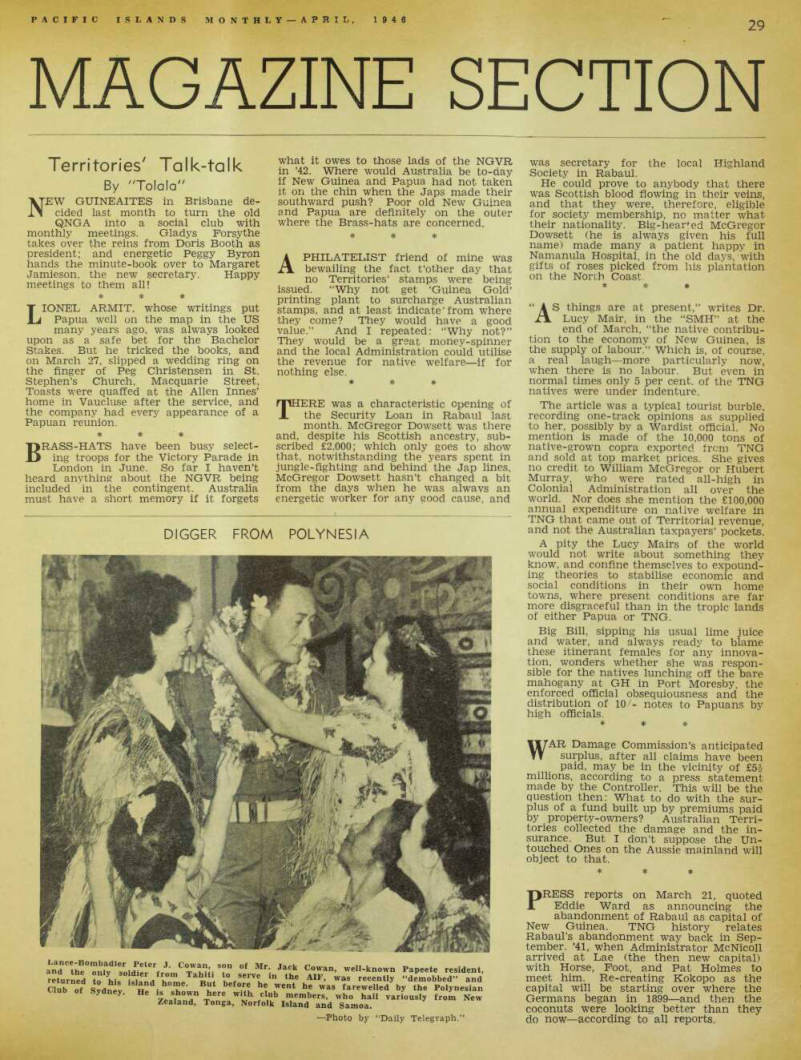
Territories' Talk-talk
By "Tolala"
NEW GUINEAITES in Brisbane de cided last month to turn the old QNGA into a social club with monthly meetings. Gladys Forsythe takes over the reins from Doris Booth as president; and energetic Peggy Byron Jamieson 6 Haonv mSinSJ’tn ™ y> Happy meetings to tnem am * * , * . .
LIONEL ARMIT, whose writings put Papua well on the map in the US many years ago, was always looked upon as a safe bet for the Bachelor Stakes. But he tricked the books, and on March 27, slipped a wedding ring on the finger of Peg Christensen in St.
Stephen’s Church, Macquarie Street, Toasts were quaffed at the Allen Innes’ home in Vaucluse after the service, and the company had every appearance of a Papuan reunion. * * * BRASS-HATS have been busy select ing troops for the Victory Parade in London in June. So far I haven’t heard anything about the NGVR being included in the contingent. Australia must have a short memory if it forgets
what owes to those lads of the NGVR in > 42 . Where would Australia be to-day if New Guinea and Papua had not taken it on the chin when the Japs made their southward push? Poor old New Guinea and Papua are definitely on the outer where the Brass-hats are concerned, * * * . PHILATELIST friend of mine was A bewailing the fact t’other day that no Territories’ stamps were being issued. “Why not get ‘Guinea Gold’ printing plant to surcharge Australian stamps, and at least indicate'from where they come? They would have a good value.” And I repeated: “Why not?”
They would be a great money-spinner and the local Administration could utilise the revenue for native welfare—if for nothing else. ♦ ♦ ♦ fTIHERE was a characteristic opening of 1 the Security Loan in Rabaul last month. McGregor Dowsett was there and, despite his Scottish ancestry, sub scribed £2,000; which only goes to show that, notwithstanding the years spent in jungle-fighting and behind the Jap lines, McGregor Dowsett hasn’t changed a bit from the days when he was alwavs an energetic worker for any good cause, and
was secretary for the local Highland Society in Rabaul.
He could prove to anybody that there was Scottish blood flowing in their veins, and that they were, therefore, eligible for society membership, no matter what their nationality. Big-hear f ed McGregor Dowsett (he is always given his full name) made many a patient happy in Namanula Hospital, in the old days, with gifts of roses picked from his plantation on the North Coast. ♦ * ♦ “AS things are at present,” writes Dr.
Lucy Mair, in the “SMH” at the end of March, “the native contribu tion to the economy of New Guinea, is the supply of labour.” Which is, of course, a real laugh—more particularly now, when there is no labour. But even in normal times only 5 per cent, of the TNG natives were under indenture.
The article was a typical tourist burble, recording one-track opinions as supplied to her, possibly by a Wardist official. No mention is made of the 10,000 tons of native-grown copra exported from TNG and sold at top market prices. She gives no credit to William McGregor or Hubert Murray, who were rated all-high in Colonial Administration all over the world. Nor does she mention the £lOO,OOO annual expenditure on native welfare in TNG that came out of Territorial revenue, and not the Australian taxpayers’ pockets.
A pity the Lucy Mairs of the world would not write about something they know, and confine themselves to expound ing theories to stabilise economic and social conditions in their own home towns, where present conditions are far more disgraceful than in the tropic lands of either Papua or TNG.
Big Bill, sipping his usual lime juice and water, and always ready to blame these itinerant females for any innova tion, wonders whether she was respon sible for the natives lunching off the bare mahogany at GH in Port Moresby, the enforced official obsequiousness and the distribution of 10/- notes to Papuans by high officials. ♦ * * WAR Damage Commission’s anticipated surplus, after all claims have been paid, may be in the vicinity of £5l millions, according to a press statement made by the Controller. This will be the question then: What to do with the sur plus of a fund built up by premiums paid by property-owners? Australian Terri tories collected the damage and the in surance. But I don’t suppose the Un touched Ones on the Aussie mainland will object to that. * * ♦ PRESS reports on March 21, quoted Eddie Ward as announcing the abandonment of Rabaul as capital of New Guinea. TNG history relates Rabaul’s abandonment way back in Sep tember. ’4l. when Administrator McNicoll arrived at Lae (the then new capital) with Horse, Foot, and Pat Holmes to meet him. Re-creating Kokopo as the capital will be starting over where the Germans began in 1899 —and then the coconuts were looking better than they do now—according to all reports.
Advertisements & other items, p. 31 (1 item)
Digger From Polynesia
of Sydney. He is shown here with club members, who hail variously from New Zealand, Tonga, Norfolk Island and Samoa. —Photo by ‘‘Daily Telegraph,”
Money-Making
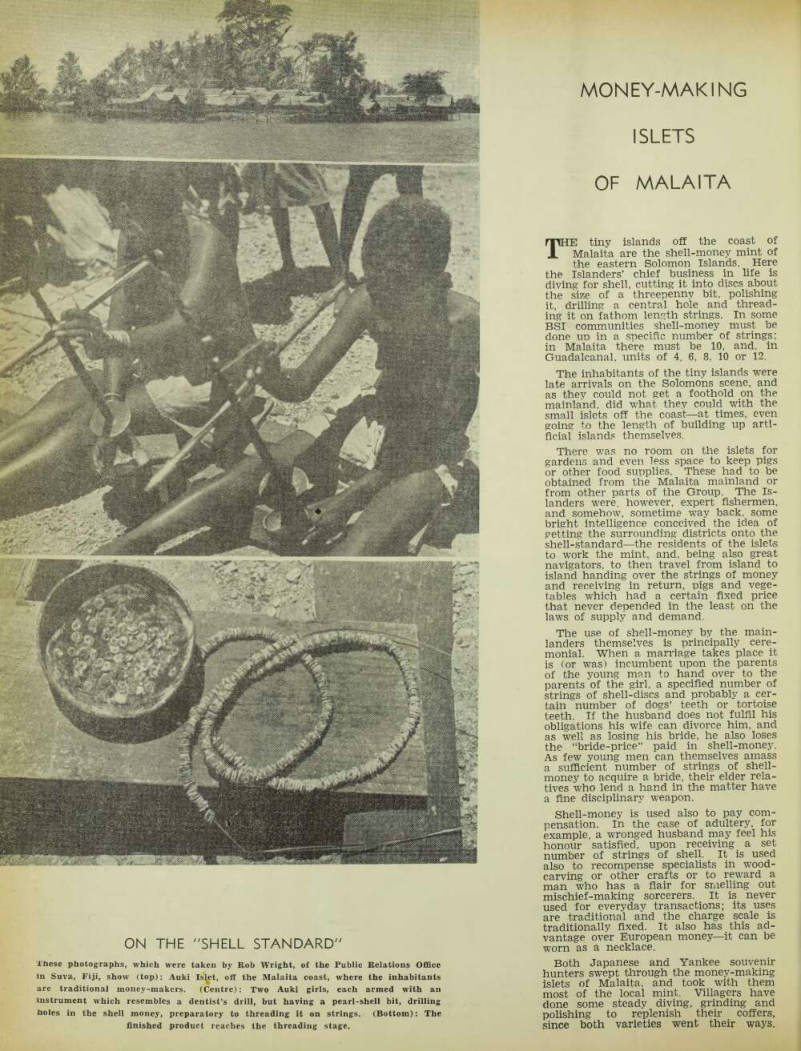
Islets
Of Malaita
mHE tiny islands off the coast of X Malaita are the shell-money mint of the eastern Solomon Islands. Here the Islanders’ chief business in life is diving for shell, cutting it into discs about the size of a threepenny bit, polishing it, drilling a central hole and thread ing it on fathom length strings. In some ESI communities shell-money must be done un in a specific number of strings; in Malaita there must be 10, and. in Guadalcanal, units of 4. 6,8, 10 or 12.
The inhabitants of the tiny islands were late arrivals on the Solomons scene, and as they could not get a foothold on the mainland, did what they could with the small islets off the coast—at times, even going to the length of building up arti ficial islands themselves.
There was no room on the islets for gardens and even less space to keep pigs or other food supplies. These had to be obtained from the Malaita mainland or from other parts of the Group. The Is landers were, however, expert fishermen, and somehow, sometime way back, some bright intelligence conceived the idea of getting the surrounding districts onto the shell-standard—the residents of the islets to work the mint, and, being also great navigators, to then travel from island to island handing over the strings of money and receiving in return, pigs and vege tables which had a certain fixed price that never depended in the least on the laws of supply and demand.
The use of shell-money by the main landers themselves is principally cere monial. When a marriage takes place it is Cor was) incumbent upon the parents of the young man to hand over to the parents of the girl, a specified number of strings of shell-discs and probably a cer tain number of dogs’ teeth or tortoise teeth. If the husband does not fulfil his obligations his wife can divorce him, and as well as losing his bride, he also loses the “bride-price” paid in shell-money.
As few young men can themselves amass a sufficient number of strings of shell money to acquire a bride, their elder rela tives who lend a hand in the matter have a fine disciplinary weapon.
Shell-money is used also to pay com pensation. In the case of adultery, for example, a wronged husband may feel his honour satisfied, upon receiving a set number of strings of shell. It is used also to recompense specialists in wood carving or other crafts or to reward a man who has a flair for smelling out mischief-making sorcerers. It is never used for everyday transactions; its uses are traditional and the charge scale is traditionally fixed. It also has this ad vantage over European money—it can be worn as a necklace.
Both Japanese and Yankee souvenir hunters swept through the money-making islets of Malaita, and took with them most of the local mint. Villagers have done some steady diving, grinding and polishing to replenish their coffers, since both varieties went their ways.
On The "Shell Standard"
These photographs, which were taken by Rob Wright, of the Public Relations Office in Suva, Fiji, show (top): Auki Islet, off the Malaita coast, where the inhabitants are traditional money-makers, (Centre): Two Auki girls, each armed with an Instrument which resembles a dentist’s drill, but having a pearl-shell bit, drilling holes in the shell money, preparatory to threading it on strings. (Bottom): The finished product reaches the threading stage.
Tropicalities
MOST Australians have heard of the large quantities of food which their Mr. Beasley carried with him to starving Britain, and they have reacted to the story according to their personal convictions. But everyone up north — especially men in the shipping business— has laughed over one aspect of the inci dent that is not generally known down south.
The ship which carried the Beasley family went “north about,” and it spent a couple of days in Townsville. Towns ville, like all Australian ports, has a full quota of waterside thieves, and the ex perienced noses of these expert gentlemen guided them unerringly to the High Com missioner’s store of food. The extent of the cargo-broaching is not known; but It was on a scale sufficient to cause a ship board sensation when it was discovered.
A renort which came subsequently from Australia House on the subject of cargo pillaging blistered the gum on the air mail stamps.
The spectacle of a former Leftist Labourite being expertly robbed by tne watersiders (whom the Labour Govern ment has so consistently protected) has given keen delight to some simple-minded people. * ♦ • A RECENT Gallup Poll taken in Aus tralia from a representative cross section of the public, showed that 45 per cent, were against America tak ing over Manus (Admiralty Islands, TNG) as a permanent air-sea base; that 42 per cent, were in favour of it, and 13 per cent, had no opinion about it whatever.
Some of the comment:— Australia cannot afford to hand over its outposts. (Clerk, NSW.) It is Australia’s first line of defence. (Farmer, Qld.) If it came to a disagreement, the US would have us covered. (Farmer, Qld.) A friendly power in the north would protect us. (Farmer’s wife, SA.) America has the men and equipment to hold it. (Pensioner, NSW.) ♦ ♦ ♦ fTTHE scarcity of scissors and razors — JL they are totally unprocurable has had its effect on Mangaia tonsorial fashions. As in the Navy, one has ’em all on or all off! The luckless ones who cannot borrow a safety razor or clippers from a European go “bearded like the pard”; and sport Cavalier love-locks—fit to be tied with ribbon, too.
Others, managing an occasional loan of the tools to do the job, are shaven to the skin, and cropped to charm Cromwell.
We can get some Gillette blades still; but frames to hold them in have been off the local market since ’4O.
The Japanese used to make, in pre-war days, a “Good Morning” razor, at 2/6, that was ideal for the islands. Here, now, is a chance for Birmingham or Coventry.
The Polynesian market is crying out for scissors, knives, razors, needles (includ ing the musical variety), fish-hooks, etc., all formerly foreign-made. This trade
should now go to Britain.-
Eti.
HERE are some of the ships well known to Pacific travellers before the war which will not be seen again:— Three well-known ships of the E. and A.
Line, which were on the run from Aus
tralia to Japan. The “Tanda” and the “Nellore” were torpedoed by a Japanese submarine in the Indian Ocean, and the “Nankin” was captured by a German raider and taken to Japan.
“Rangitane,” of the NZ Shipping Co. line, which was captured and sunk by the three German raiders which bom barded Nauru and Ocean Island.
The Union Company’s “Awatea,” the blue-ribbon ship of the Tasman. Com manded by Captain A. H. Davey, she arrived in Sydney from New Zealand time after time ahead of schedule. She started her war service in December, 1939, by transporting troops from Wellington to Sydney. At the end of October, 1942, she joined the famous 500-ship armada bound for the Mediterranean. On November 11, during the North African landing the “Awatea” seemed to have been singled out by the enemy for special attention. Six or more bombers were over head continuously. The “Awatea” fought back with all her anti-aircraft guns and equipment, and claims to have shot down two aircraft and damaged others. Hit several times by bombs, the ship had to be abandoned. Left ablaze from stem to stern, the “Awatea” sank during the night.
Three of the Burns Philp island fleet.
During the bombardment of Darwin on February 19, 1942, the “Neptuna” was sunk after her commander, Captain W.
Michie, had been killed, and bombers got the “Macdhui” at Port Moresby four months later. Captain L. W. Millar went down with his ship, the “Tulagi,” when it was torpedoed in the Indian Ocean on March 28, 1944. There were only four survivors.
Based on article in “SMH.”
WHEN American troops landed on a certain island in the central Solo mons, news despatches informed the outside world that the landing was unopposed. But the story might easily have been different. Here is what hap pened during the period immediately pre ceding the American invasion.
A British officer had been sent to the island some time before to prepare the way for the landing parties. He had made his headquarters in the interior, and about a week before the date set for the invasion he left with some native scouts for the coastal area which had been selected as the beach-head. When he got there he found 300 Japs, most of them survivors of a recent naval action, bivouacking in a village overlooking the stretch of shore on which the Americans were to land.
It was a disturbing situation, but he devised means of coping with it. He sent two of his Solomon Island scouts down to the village with instructions to make friends with the Japs and persuade them that there was a much better bivouac area in the next bay.
The Islanders did their job thoroughly.
So glowing an account did they give of the facilities available at this alternative site (“plenty food, plenty water, plenty everything”) that the Japs moved off at dawn the next morning to seek this Shangri-La. As soon as they had gone the officer got to work preparing the beach-head for the American arrival and everything was ready at the appointed hour.
The landing, as the news despatches truthfully declared, was unopposed and the invasion force, a couple of days after
getting all its supplies ashore without interference of any kind, was able to make quick work of the unhappy Japs who were still searching vainly for the milk and honey which they had been told they would nnd flowing freely in the nexi
Bay.—Harold Cooper.
* * ♦ ONE sidelight on the Tongan centenary celebrations last December was strictly off the record. The cruiser “Euryalus” took some guns down there, and apparently the Navy wanted a record of this, so they sent a photographer to gether with Fox Movietone and Cine sound men from Sydney on the COMSOPAC’s personal plane.
The crew of the plane were all officers with the exception of one rating who had been attached to the plane as a sort of steward and valet. The plane was in structed to land at Nadi (Fiji), and the photographers were to come to Suva and join the cruiser for the Tongan trip. Com ing via Auckland, they discovered that there was a strip at Nausori, so they landed there.
On the evening prior to the cruiser’s departure, a cocktail party was thrown aboard, and all the notables in Suva were invited. The officers of the crew of the aircraft were also to be guests. Being a democratic bunch, they cast around for some means of taking the rating along with them, and, as he had a Fighting French badge, he was dressed up in Air Force uniform (without the tabs), and taken aboard in the guise of a Fighting French correspondent.
All went very well until the captain and commander of the cruiser bore down on the hapless “correspondent” and bom barded him with voluble French. The perpetrators of the hoax closed their eyes and slid beneath tables, but opened them in amazement when their steward burst forth in French so fluent that it made the captain (who spoke really good French) look like a novice.
The “correspondent” was a huge suc cess, the onlv lapse being when he absent mindedly took the caps off beer bottles
and filled everyone’s glasses.
W.
A FORMER District Commissioner in the Western Solomons, Major W. F. M.
Clemens, wrote from Bedford, Eng land, recently, to “Sydney Morning Herald,’’ challenging the accuracy of the finding of Justice Sir William Webb re garding the Japanese murder of Catho lic missionaries in Guadalcanal. Sir William found that the nriests and nuns were murdered, and that the nuns had been raped. Major Clemens gave details of various incidents which, according to his information, preceded the death of the missionaries, which he apparently thinks did something to explain the crime, and he declares there is no evi dence that the women were outraged. But he agrees that the missionaries were “despatched.”
'Hie letter was published on March 15.
Within three days it was answered, in vigorous style, by the secretary of the Australian War Crimes Commission, Mr.
W. E. Cuppaidge. He pointed out that Major Clemens’s statements were rash and offensive; that Sir William’s findings were based on the sworn oral testimony of the naval officer who found the bodies soon after the murder: and that, although Sir William was well known to have been seeking evidence of war crimes in the Pacific, from June, 1943, until January, 1946, Major Clemens did not communi cate with him—he would have been very pleased to take the major’s evidence.”
One gets the impression that Major Clemens, to use an Americanism, “stuck his neck out.”
The Story Of Rabaul
Thirty-five Years a South Seas Storm Centre
BY 1930 Rabaul had become quite a social and settled community. There were sporting bodies responsible for baseball, cricket and tennis; schools for the children; three churches going at full pressure; a cinema; hire cars; and an occasional race meeting. New bungalows were being built and every year or so the BP passenger-cum-cargo vessels were growing larger and larger. The days of the old “Marsina” and “Melusia” were changing for the “Mataram” and “Mon toro,” and eventually the “Macdhui” came. These were all signs of progress.
Over in the Morobe district gold was being exported in huge quantities. The XPB properties had been all sold, and the private planter was once again a fami liar figure on the Rabaul streets and in the clubs that most of these gentry were under heavy obligations to the big firms was not a matter of great moment.
A planters’ association was formed, and the Returned Soldiers established a branch of the League. If the local world did not function as it should, then meet ings were held of these bodies and long letters of protest forwarded to Canberra, or disgruntled people gave vitriolic inter views in the Australian press when they stepped off the steamer in Sydney.
But it never got anyone anywhere in particular. They were all lone voices cry ing in the wilderness to deaf bureaucrats In Canberra.
The years passed more or less unevent fully. Baseball season followed cricket season. Old-timers in the clubs bewailed the present times—as they always do and have done, and always will do. They longed for the “good old days” again as they squinted through their frosty glass of pink gin or whisky and soda. But they managed to drive around in their own cars, and take a trip to Sydney every other year or so.
Came the establishment of a Legisla tive Council in 1933. Rabaul preened itself of its importance. Tourist boats came, filled with perspiring tourists from Australia, who wandered round the town, attended race meetings or drove out in cars through native villages, then went their way again. Men-of-war dropped anchor in the harbour for a day or so, and Rabaul entertained them in royal style.
The years 1936 and the beginning of 1937 were probably the peak years in Rabaul’s town life. The roads had bitu men on them now, and hundreds of cars speeded here and there; even natives were running hire cars. Over 200 motor vehicles took part in a decorated car procession during the Coronation cele brations in May, 1937.
And then one Saturday morning to wards the end of May, ’37, a series of earth tremors started. Rabaul has al ways been earthquake-minded; gurias, as we called them, were seldom taken seri ously. But the shakes continued and be came more regular as the day wore on.
“It’s nothing,” said the man-in-the street in the morning.
“It’s funny,” he remarked at lunch time when there was no cessation. “Very funny. I wonder ...”
Eruption
WHILST Rabaul was watching a base ball match that Saturday afternoon there was an explosion down the harbour which shook the whole town.
There was a roar and a cloud of steam and water erupted thousands of feet into the air from a point near Vulcan Island
—that same island on which George Brown had landed in 1878 after it had come up in a night.
Inquisitive people rushed down to the waterfront to see the great white cloud rising higher and higher, and then the white cloud became a spewed out mass of volcanic rock and dust which floated over the harbour, creating a blackout wherever it travelled.
People were no longer inquisitive; they became fearful for their safety. Cars rushed out to the north coast and to the hospital at Namanula. There was a tidal wave about nightfall, and dark ness seemed to accentuate the ferocity of the continuing eruption.
It had all the appearance of hell opening up. There was a roar like a train tearing through a tunnel; huge red hot molten rocks were being hurled through the air; electrical storms were cleaving the sky . . .
The next morning there was a general evacuation to Kokopo and the mission at Vunapope. At noon, while some of the people were still waiting on the beach at Nordup, the Tavurvur volcano erupted near Matupi and spewed out slime and
By Gordon Thomas
The Third (and Concluding) Article
mud which fell over Rabaul. it took months to clean that out of the town, and during the process most of the women were evacuated to Australia.
Rabaul was not a pleasant place in which to five for the remainder of 1937.
It was a constant job of cleaning up and making drains to carry away the water which the ground could not absorb be cause of the thick, cement-like coating from the Matupi crater. Actually the damage to ouilaings was not excessive.
But it cost the Government £40,000 to clean the place and bring the town back to normal. Geologists made tours of inspec tion and wrote reports; seismographs were ordered; temperatures of the ground were taken and carefully recorded; observation posts installed. But the town was doomed. “It might happen again,” said the man-in-the-street.
Canberra suddenly become eruption conscious. “Well select a new site for the capital,” said Cabinet, and forthwith appointed a Committee, which travelled the Territory looking for likely spots, with good anchorages, central locations, and fair climate.
There was the usual bickering and heckling over the matter in political circles, while in Rabaul a peculiar situa tion arose for. whereas the public ser vants who had no other interest in Rabaul than a place to work, were anxious to leave, many of the business people and the Big Companies who had material interests in the town and imme diate vicinity were content, and even anxious, many of them, to remain. Some of them said: “It makes no difference to us where the capital is, we remain here.”
Time passed, the eruption bogey was gradually fading into the dim mists of the past. The only reminder was the sinister 700-ft. mountain sentinel at the harbour entrance, built in a night.
Two other Commissions had their begin ning around about this period, too. One delved into the question of amalgamating the Papua and New Guinea Territories; the other revised the Native Labour Ordin ance. Concerning the first question it
was recommended that the merger should not take place; what happened to the NLO revisions, I cannot say. The find ings of neither Committee have had any influence on present-day policy, for Papua and New Guinea are now ’ tem porarily amalgamated and Fuzzy-wuzzies and boongs have come into being!
The years 1938 and early 1939 were un eventful for Rabaul. The town had lost its punch. Officially it was to be aban doned as the capital. There was a new atmosphere: a don’t-care-what’s-the-use there’s-no-future-to-look-forward-to at mosphere. Houses that required re-paint ing became drab and shabby; gardens, so well-kept before, now took on a neglected appearance.
The Second World War
AND then World War II broke out.
Attention was centred on Europe, and the work of interning local enemy nationals. The military spirit was made manifest; a local Volunteer Rifle unit was established; enlistments of young men for overseas service took place.
There were German raiders in the Pacific and shelters were erected in the mountain gullies against possible naval bombard ment. History was repeating itself.
Rabaul had, temporarily, put aside its fears of eruptions and volcanoes. Tem perature recordings in one locality were daily mounting to abnormal heights; but no great alarm was manifested. It really didn’t matter. What was an eruption or two when the world was threatened with extermination by the Nazi machine?
There was much activity amongst the patriotic workers. The women were em ployed knitting and holding raffles and making money for the Red Cross and the Comforts Fund. Local lads were leaving for overseas. And then there was the very secret arrival of troops from Aus tralia as a defence force for Rabaul.
In June, 1941, Matupi crater decided to go on the air again and blew out thou sands of tons of dust and ash, and made the day and night hideous with unearthly, loud roarings. This minor eruption con tinued month after month with scarcely one day’s cessation. The Administrator departed for Lae and 10, the sixth capital of the Territory had been established!
One or two Government Departments accompanied the Administrator. Other Departments were to follow in the near future. But they never did—the Japan ese bombed Pearl Harbour and the daily eruptions from Matupi ceased.
Rabaul Falls to the Enemy
WAR in the Pacific! But here in Rabaul we were safe, said the wish ful thinkers. Not so safe, however, but that the European women and children had not to be evacuated to Aus tralia just a few steps before the Japan ese hordes sailed southward. Even before they left unidentified aircraft had sailed over the town several times.
Troops were now busy digging gun-em placements and strongpoints along the tree-lined avenues. Rabaul had gone back to the days of 1914, when militarism ruled; practically no women remained in the town.
The first Sunday in 1942 saw the first enemy bombers come flying over Tunnel Hill on their way to drop the first bombs on the lower ’drome at Lakunai. The war had come to our own front door at last. That which was supposed to have been the impossible by the wishful thinkers had come to pass. We were no longer a Mandated Territory, -immune from attack, we were the front line of Australia’s defence!
What plans were in the making? what could be done with a handful of troops
against tens of thousands of Japanese, flushed with the victories of Guam, Manila and Hong Kong? There must be some deep-laid plan to allow the Japs to capture Rab'aul and then for our troops to counter-attack and entrap them.
As civilians we knew nothing. We were trusting in our own strategists in Aus tralia.
As the days passed, aerial bombings became more frequent, but, unfortunately for the civilians, raids were restricted to the local ’dromes, and the town proper had escaped bombs.
Then came January 20, and with it, a full-scale air attack by Jap bombers and Zeros. This was the day when half a dozen Wirraways took off and did battle with 140 Jap machines. Impossible odds —Rabaul’s “few” in antiquated training crates against Japan’s modern fighters and bombers. A grand display of Austra lian courage, but, unfortunately, unrecog nised and unsung.
The following afternoon a report from the Army was received by the Chief Warden, Mr. R. L. Clark, that an inva sion force was approaching from the north-west. That night most of the civil population slept in Refuge Gully on the slopes of the Namanula Hill.
There was no invasion that night, and at daylight the Chief Warden, who did a marvellous job of work throughout, con tacted the military.
“What’s the drill?” he inquired.
“Resume normal duties,” came the reply.
Resume normal duties! And the Japs at our door-step. The full seriousness of the situation came to me that morning as I watched wave after wave of Jap planes approach the town, knowing, too, that just over the hills somewhere were warships and transports laden with troops also headed towards the town.
Hundreds of Asiatic women and children still remained in Rabaul; the whole nurs ing staff —brave, fearless women who re fused to leave their posts—were in the Namanula Hospital. And nothing was done. There was no organised plan of evacuation.
Events moved rapidly on January 22, The invading ships were approaching. In the afternoon civilians once again made for the Gully. The hospital patients and staff were evacuated to Kokopo. By 3.30 p.m., the town was practically empty.
During the night and the early hours of the following morning, the landing of the Japanese troops was effected. A handful of our men met the invaders along the slopes of Vulcan—once again the volcano was making history, but man with his destructive machines was staging this upheaval. By daylight the Japs were in possession of the town and shortly after wards three of us: the Chief Warden, Mr.
Hector Robinson, of the Treasury, and the most senior Government officer present, and myself, under a white flag, had sur rendered the civilians in order to obviate any mopping-up complications. Rabaul was in Japanese occupation.
Another phase in the town’s history had been reached. Local residents were now captives at the mercy of victory flushed Nipponese. But this is not a war history—merely the story of Rabaifl. How our troops and some civilians floundered through the jungle of New Britain for weeks in effecting their escape is well known. We know also of the Tol mas sacre, of the sinking of the “Montevideo Maru” with the loss of over 1,000 Aus tralian lives. Hundreds of them had been part and parcel of the town for over 20 years; many of them were “key” men, who had served well and truly that diffi cult tropical apprenticeship and come through with flying colours.
Once again Rabaul streets were re
sounding to the march of troops, the roll of hundreds of mechanised vehicles. But the saddest of all was the looting, the vandalism, the destruction of those pic turesque homes. Furniture was thrown into the streets for fear of booby-traps; valuable books and records were ruth lessly heaped up and burned.
The harbour was filled with ships of every size and description. A hundred thousand troops bedded themselves in bungalows, shops, tents or newly-erected huts. Ack-ack guns surrounded the town; a score of searchlights pierced the darkness at night. Three thousand little ladies of the Amenities Section gave a splash of colour in their gay kimonos amongst the drabness of the grey-green uniforms of the troops.
Rabaul had become the strongest base in the South Pacific.
It had, also, become the most unlovely, highly-smelling, fly-infested, unhygienic centre imaginable. Like a tropical ulcer the town grew and spread in every direc tion. Wooden huts sprang up on every vacant allotment; the hills of Rabaul's Pott’s Point Namanula became de faced with clusters of ugly huts.
A year passed . . . Troops came and went.
It was the jumping-off place for Buna and the Solomons. Then their numbers began to decrease. Local Chinese were evacuated from their homes in Chinatown and sent out to the North Coast to dig themselves in. Preparations for heavy bombing were in hand. The little ladies of the bright kimonos were put on trans ports and started on their journey home, but Allied bombers sank the ships a day or so out of Rabaul.
The Allies Take Over
rEN we were at the end of 1943. Early in 1944 full-scale Allied raids went on over the town. Old landmarks disappeared. Store after store, house after house became a heap of rubble and splintered timbers. By May, ’44 there was little left of Rabaul.
One of the last landmarks to go was the Administrator’s residence on Naman ula Hill.
The Jap Army and Navy had gone to earth on an elaborate scale beneath the hills surrounding Rabaul. No ships had arrived in the town since November, 1943.
Only an occasional submarine sneaked in to land medicines and high officers. The Jap Air Force was a thing of the past too. The Allies had by-passed Rabaul and left stranded there some 80,000 troops, policed by a handful of Allied planes.
Superb strategy! They had been MacArthured!
Rabaul was no longer anything but a name on the map, the floor of its harbour filled with sunken ships. By the middle of 1945 the township the one-time Garden City of the Pacific with its avenue of tropical trees, its hedges of gaily-coloured crotons and hibiscus, its gardens with flowering frangipanni and clusters of orchids—was nothing but a huge vegetable garden of sweet potatoes, beans, and tapioca, overgrown with weeds; with unwieldly humps and hol lows where dug-outs had been made by Japanese, or where craters had been made by Allied bombs.
IN September, ’45, I stood on a ridge at Namanula and gazed down over what used to be Rabaul. I felt very sick at heart for I had cultivated a great affection for the town which fate had treated so harshly.
Isolated as it was, it had, nevertheless, in its 35 years’ life seen two military invasions, a major volcanic eruption, dis turbing political and economical changes, and from days of social gaiety and econo
mic prosperity, Was now merely an area of overgrown weeds, with an Australian Army once again pitching its tents amongst the kunai grass. Rabaul’s cycle had been completed.
From the swampy flats of 1905, through the years of building and progress it had now gone back to devastated wilderness.
In May, 1911, I had steamed slowly up the harbour in an old German NDL steamer, and had seen Rabaul unfold before me, filled with promise. In Sep tember, 1945, I climbed aboard a Catalina flying-boat and, as we made height to proceed southwards, I looked down upon the rusty wrecks of bombed ships along the foreshores, and the wilderness that once was Rabaul.
Has Rabaul fallen never to rise again?
Or will a new cycle commence on some fine, sunny, day and enable it to stage a come-back in a bright and peaceful world?
Time alone will tell.
Advertisements & other items, p. 34 (1 item)
32
atft i l , 1946 Pacific inlands m6na a l if
The Three Stages Of
Sophistication
Mr. Charles B. Nordhoff, of Tahiti, well-known American writer, has settled down in Santa Barbara, USA, for the present. He has developed cataract growth in both eyes, and must undergo a serious operation within a year or two.
“When we meet again,” he says in a letter to the editor of the “PIM,” “I shall be very dignified in a pair of thick glasses.” His partner in the famous col laboration, Mr. James Norman Hall, re cently returned to residence in Tahiti.
A stained glass window (one of a series of eight donated by Miss Emily Robson) was recently unveiled at St. Andrews’s Cathedral, Sydney. It depicts pioneer missionaries Maclaren and Copeland King with the natives of the New Guinea Mission.
The three stages of a Fijian mine labourer. On the left: He arrives, ready to labour, in singlet and pants. Centre: After his first pay, he develops a clothes sense, and arrays himself in a well-laundered shirt. Right: After another two or three days, he appears in a tailored coat and a wristlet watch. And so comes civilisation! —Photo from Mr. Tom Costello, Tavua, Fiji.
“Gappy”
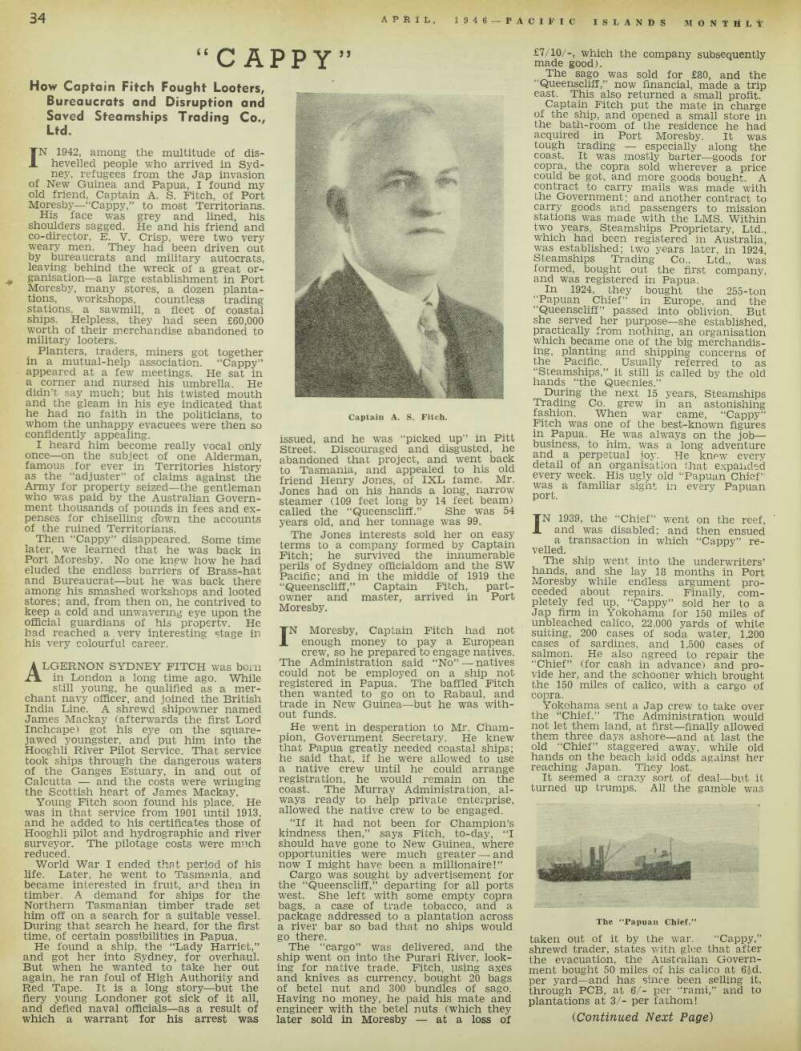
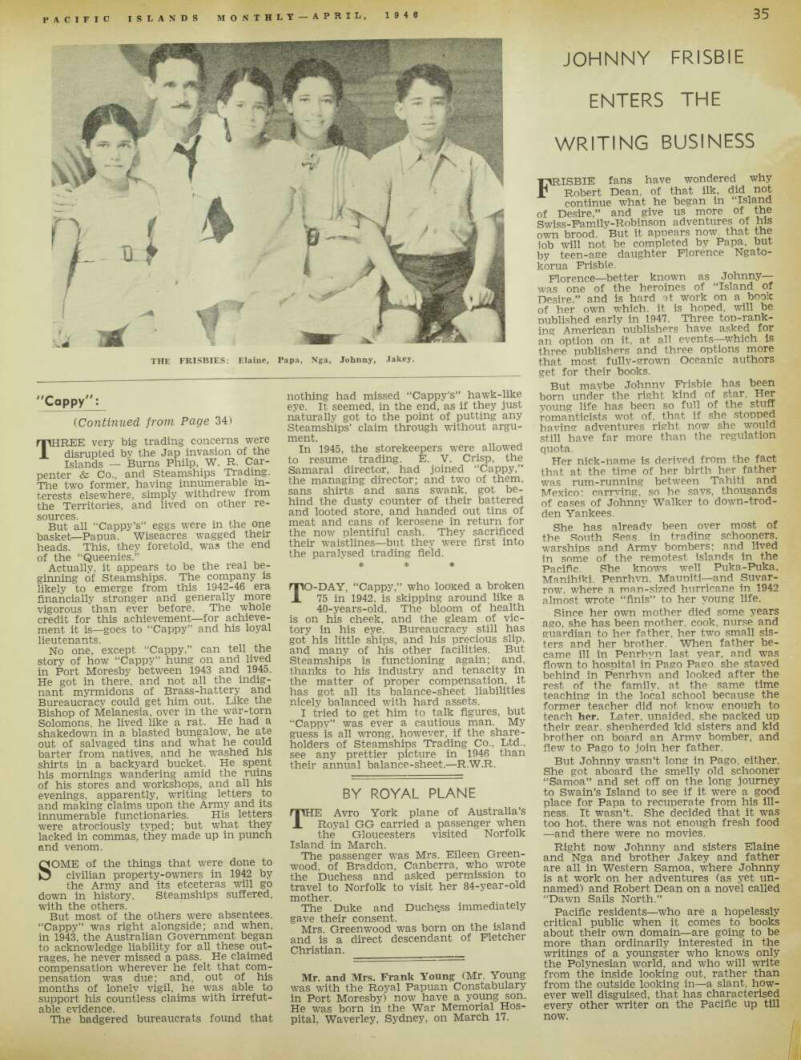
How Captain Fitch Fought Looters, Bureaucrats and Disruption and Saved Steamships Trading Co., Ltd.
IN 1942, among the multitude of dis hevelled people who arrived in Syd ney, refugees from the Jap invasion of New Guinea and Papua, I found my old friend, Captain A. S. Fitch, of Port Moresby—“Gappy,” to most Territorians.
His face was grey and lined, his shoulders sagged. He and his friend and co-director, E. V. Crisp, were two very weary men. They had been driven out by bureaucrats and military autocrats, leaving behind the wreck of a great or ganisation—a large establishment in Port Moresby, many stores, a dozen planta tions, workshops, countless trading stations, a sawmill, a fleet of coastal ships. Helpless, they had seen £60,000 worth of their merchandise abandoned to military looters.
Planters, traders, miners got together in a mutual-help association. “Gappy” appeared at a few meetings. He sat in a corner and nursed his umbrella. He didn’t say much; but his twisted mouth and the gleam in his eye indicated that he had no faith in the politicians, to whom the unhappy evacuees were then so confidently appealing, I heard him become really vocal only once—on the subject of one Alderman, famous for ever in Territories history as the “adjuster” of claims against the Army for property seized—the gentleman who was paid by the Australian Govern ment thousands of pounds in fees and ex penses for chiselling down the accounts of the ruined Territorians.
Then “Gappy” disappeared. Some time later, we learned that he was back in Port Moresby. No one knew how he had eluded the endless barriers of Brass-hat and Bureaucrat—but he was back there among his smashed workshops and looted stores; and, from then on, he contrived to keep a cold and unwavering eye upon the official guardians of his propertv. He had reached a . very interesting stage in his very colourful career.
Algernon Sydney fitch was born in London a long time ago. While still young, he qualified as a mer chant navy officer, and joined the British India Line. A shrewd shipowner named James Mackay (afterwards the first Lord Inchcape) got his eye on the square jawed youngster, and put him into the Hooghli River Pilot Service. That service took ships through the dangerous waters of the Ganges Estuary, in and out of Calcutta and the costs were wringing the Scottish heart of James Mackay.
Young Fitch soon found his place. He was in that service from 1901 until 1913, and he added to his certificates those of Hooghli pilot and hydrographic and river surveyor. The pilotage costs were much reduced.
World War I ended that period of his life. Later, he went to Tasmania, and became interested in fruit, and then in timber. A demand for ships for the Northern Tasmanian timber trade set him off on a search for a suitable vessel.
During that search he heard, for the first time, of certain possibilities in Papua.
He found a ship, the “Lady Harriet,” and got her into Sydney, for overhaul.
But when he wanted to take her out again, he ran foul of High Authority and Red Tape. It is a long story—but the fiery young Londoner got sick of it all, and defied naval officials—as a result of which a warrant for his arrest was
issued, and he was “picked up” in Pitt Street. Discouraged and disgusted, he abandoned that project, and went back to Tasmania, and appealed to his old friend Henry Jones, of IXL fame. Mr.
Jones had on his hands a long, narrow steamer (109 feet long by 14 feet beam) called the “Queenscliff.” She was 54 years old, and her tonnage was 99.
The Jones interests sold her on easy terms to a company formed by Captain Pitch; he survived the innumerable perils of Sydney officialdom and the SW Pacific; and in the middle of 1919 the “Queenscliff,” Captain Fitch, part owner and master, arrived in Port Moresby.
IN Moresby, Captain Fitch had not enough money to pay a European crew, so he prepared to engage natives.
The Administration said “No” natives could not be employed on a ship not registered in Papua. The baffled Fitch then wanted to go on to Rabaul, and trade in New Guinea—but he was with out funds.
He went in desperation to Mr. Cham pion, Government Secretary. He knew that Papua greatly needed coastal ships; he said that, if he were allowed to use a native crew until he could arrange registration, he would remain on the coast. The Murray Administration, al ways ready to help private enterprise, allowed the native crew to be engaged.
“If it had not been for Champion’s kindness then,” says Fitch, to-day, “I should have gone to New Guinea, where opportunities were much greater and now I might have been a millionaire!”
Cargo was sought by advertisement for the “Queenscliff,” departing for all ports west. She left with some empty copra bags, a case of trade tobacco, and a package addressed to a plantation across a river bar so bad that no ships would go there.
The “cargo” w T as delivered, and the ship went on into the Purari River, look ing for native trade. Fitch, using axes and knives as currency, bought 20 bags of betel nut and 300 bundles of sago.
Having no money, he paid his mate and engineer with the betel nuts (which they later sold in Moresby at a loss of
£7/10/-, which the company subsequently made good).
The sago was sold for £BO, and the “Queenscliff,” now financial, made a trip east. This also returned a small profit.
Captain Fitch put the mate in charge of the ship, and opened a small store in the bath-room of the residence he had acquired in Port Moresby. It was tough trading especially along the coast. It was mostly barter—goods for copra, the copra sold wherever a price could be got, and more goods bought. A contract to carry mails was made with the Government: and another contract to carry goods and passengers to mission stations was made with the LMS. Within two years, Steamshins Proprietary, Ltd., which had been registered in Australia, was established; two years later, in 1924, Steamships Trading Co., Ltd., was formed, bought out the first company, and was registered in Papua.
In 1924, they bought the 255-ton “Papuan Chief” in Europe, and the “Queenscliff” passed into oblivion. But she served her purpose—she established, practically from nothing, an organisation which became one of the big merchandis ing, planting and shipping concerns of the Pacific. Usually referred to as “Steamships,” it still is called by the old hands “the Queenies.”
During the next 15 years, Steamships Trading Co. grew in an astonishing fashion. When war came, “Gappy”
Fitch was one of the best-known figures in Papua. He was always on the job— business, to him, was a long adventure and a perpetual joy. He knew' every detail of an organisation that expanded every week. His ugly old “Papuan Chief” was a familiar sight in every Papuan port.
IN 1939, the “Chief” went on the reef, and was disabled; and then ensued a transaction in which “Gappy” re velled.
The ship went into the underwriters’ hands, and she lay 18 months in Port Moresby while endless argument pro ceeded about repairs. Finally, com pletely fed up, “Gappy” sold her to a Jap firm in Yokohama for 150 miles of unbleached calico, 22,000 yards of white suiting, 200 cases of soda water, 1,200 cases of sardines, and 1,500 cases of salmon. He also agreed to repair the “Chief” (for cash in advance) and pro vide her, and the schooner which brought the 150 miles of calico, with a cargo of copra.
Yokohama sent a Jap crew to take over the “Chief.” The Administration would not let them land, at first—finally allowed them three days ashore—and at last the old “Chief” staggered away, while old hands on the beach laid odds against her reaching Japan. They lost.
It seemed a crazy sort of deal—but it turned up trumps. All the gamble was
taken out of It by the war. “Gappy,” shrewd trader, states with glee that after the evacuation, the Australian Govern ment bought 50 miles of his calico at 6ld. per yard—and has since been selling it, through PCB, at 6/- per “rami,” and to plantations at 3/- per fathom!
(Continued Next Page )
Captain A. S. Fitch.
The “Papuan Chief.”
THREE very big trading concerns were disrupted by the Jap invasion of the Islands Burns Philp, W. R. Car penter & Co., and Steamships Trading.
The two former, having innumerable in terests elsewhere, simply withdrew from the Territories, and lived on other re sources.
But all “Cappy’s” eggs were in the one basket—Papua. Wiseacres wagged their heads. This, they foretold, was the end of the “Queenies.”
Actually, it appears to be the real be ginning of Steamships. The company is likely to emerge from this 1942-46 era financially stronger and generally more vigorous than ever before. The whole credit for this achievement —for achieve ment it is—goes to “Gappy” and his loyal lieutenants.
No one, except “Gappy,” can tell the story of how “Gappy” hung on and lived in Port Moresby between 1943 and 1945.
He got in there, and not all the indig nant myrmidons of Brass-hattery and Bureaucracy could get him out. Like the Bishop of Melanesia, over in the war-torn Solomons, he lived like a rat. He had a shakedown in a blasted bungalow, he ate out of salvaged tins and what he could barter from natives, and he washed his shirts in a backyard bucket. He spent his mornings wandering amid the ruins of his stores and workshops, and all his evenings, apparently, writing letters to and making claims upon the Army and its innumerable functionaries. His letters were atrociously typed; but what they lacked in commas, they made up in punch and venom.
SOME of the things that were done to civilian property-owners in 1942 by the Army and its etceteras will go down in history. Steamships suffered, with the others' But most of the others were absentees.
“Gappy” was right alongside; and when, in 1943, the Australian Government began to acknowledge liability for all these out rages, he never missed a pass. He claimed compensation wherever he felt that com pensation was due; and, out of his months of lonelv vigil, he was able to support his countless claims with irrefut able evidence.
The badgered bureaucrats found that
nothing had missed “Cappy’s” hawk-like eye. It seemed, in the end, as if they just naturally got to the point of putting any Steamships’ claim through without argu ment.
In 1945, the storekeepers were allowed to resume trading. E. V. Crisp, the Samarai director, had joined “Gappy,” the managing director; and two of them, sans shirts and sans swank, got be hind the dusty counter of their battered and looted store, and handed out tins of meat and cans of kerosene in return for the now plentiful cash. They sacrificed their waistlines—but they were first into the paralysed trading field. * * * TO-DAY, “Gappy,” who looked a broken 75 in 1942. is skipping around like a 40-years-old. The bloom of health is on his cheek, and the gleam of vic tory in his eye. Bureaucracy still has got his little ships, and his precious slip, and many of his other facilities. But Steamships is functioning again; and, thanks to his industry and tenacity in the matter of proper compensation, it has got all its balance-sheet liabilities nicely balanced with hard assets.
I tried to get him to talk figures, but “Gappy” was ever a cautious man. My guess is all wrong, however, if the share holders of Steamships Trading Co., Ltd., see any prettier picture in 1946 than their annual balance-sheet. —R.W.R.
By Royal Plane
rE Avro York plane of Australia’s Royal GG carried a passenger when the Gloucesters visited Norfolk Island in March.
The passenger was Mrs. Eileen Green wood, of Braddon, Canberra, who wrote the Duchess and asked permission to travel to Norfolk to visit her 84-year-old mother. , The Duke and Duchess immediately gave their consent.
Mrs. Greenwood was born on the island and is a direct descendant of Fletcher Christian.
Mr. and Mrs. Frank Young (Mr. Young was with the Royal Papuan Constabulary in Port Moresby) now have a young son.
He was born in the War Memorial Hos pital, Waverley, Sydney, on March 17.
Writing Business
Johnny Frisbie
Enters The
FRISBIE fans have wondered why Robert Dean, of that ilk, did not continue what he began in “Island of Desire,” and give us more of the Swiss-Family-Robinson adventures of his own brood. ‘But it apnears now. that the iob will not be completed by Papa, but by teen-age daughter Florence Ngato korua Frisbie.
Florence—better known as Johnny— was one of the heroines of “Island of Desire.” and is hard 9t work on a book of her own which, it is hoped, will be oublished early in 1947. Three ton-rank ing American nublishers have asked for an option on it, at all events—which is three publishers and three options more that most fully-grown Oceanic authors get for their books.
But mavbe Johnnv Frisbie has been born under the right kind of star. Her young life has been so full of the stun romanticists wot of. that if she stopped having adventures right now she would still have far more than the regulation quota.
Her nick-name is derived from the fact that at the time of her birth her father was rum-running between Tahiti and Mexico; carrving. so he savs, thousands of cases of Johnny Walker to down-trod den Yankees.
She has alreadv been over most of the South Seas, in trading schooners, warships and Armv bombers; and lived in some of the remotest islands in the Pacific. She knows well Puka-Puka, Manihiki. Penrhvn. Maupiti—and Suvar row. where a map-sized hurricane in 1942 almost wrote “finis” to her young life.
Since her own mother died some years ago, she has been mother, cook, nurse and guardian to her father, her two small sis ters and her brother. When father be came ill in Penrhyn last year, and was flown to hospital in Pago Pago she stayed behind in Penrhvn and looked after the rest of the family, at the same time teaching in the local school because the former teacher did not know enough to teach her. Later, unaided, she packed up their gear, shepherded kid sisters and kid brother on board an Army bomber, and flew to Pago to join her father.
But Johnny wasn’t long in Pago, either.
She got aboard the smelly old schooner “Samoa” and set off on the long journey to Swain’s Island to see if it were a good place for Papa to recuperate from his ill ness. It wasn’t. She decided that it was too hot. there was not enough fresh food —and there were no movies.
Right now Johnny and sisters Elaine and Nga and brother Jakey and father are all in Western Samoa, where Johnny is at work on her adventures (as yet un named) and Robert Dean on a novel called “Dawn Sails North.”
Pacific residents—who are a hopelessly critical public when it comes to books about their own domain—are going to be more than ordinarily interested in the writings of a youngster who knows only the Polynesian world, and who will write from the inside looking out, rather than from the outside looking in—a slant, how ever well disguised, that has characterised every other writer on the Pacific up till now.
THE FRISBIES: Elaine, Papa, Nga, Johnny, Jakey.
Advertisements & other items, p. 37 (1 item)
35
"Coppy": (Continued from Page 34)
PACIFIC ISLANDS MONTHLY APRIL, 1948
The Character Of A Hot Cross Bun
Easter Story:
By Alma Gross
HOW do you take your Easter Bun?
Hot from the oven, dripping with golden butter, and the devil take the rationing?
Do you dispose of it in several hearty bites, or do you break a small piece and test it for texture; turn at on your tongue ruminating on the yeast which was used, the time it took to rise, and the temperature of the oven that baked it?
That these matters are of great im portance, I learned when I was put ashore on a small island in the British Solomons, 40 miles across open sea from the nearest baker. I was ignorant in the art of bread-making. I thought one’s cookie-boys took care of such details, but when I saw the cook’s finger-nails I was apprehensive. They were long and dirty, “They’ll be clean to-night after they knead the bread,” my husband assured me.
When I tasted my first slice of the grey, sour dough that they called bread, I knew that if this were to be my staff of life, then my days were numbered, and I began hunting through my cookery books for information on bread-making.
In the Beginning was Life—and evi dently yeast, too, for to make a new bottle of yeast one added a small amount from the previous bottle!
I had no “previous bottle.” It evidently was something my ancestors neglected to hand down to me. Then I thought of the yeast the cookie-boy used, and al though I felt I was losing caste, I de cided to start with a small amount from the cook’s “previous bottle.”
That evening, after the boys had gone to their quarters, I sneaked into the kitchen, and by the smoky light of a kerosene lantern, and with several brazen rats sniffing from the rafters, I mixed the portion, corked it, tied the cork, and left it on the shelf to “work.” In the early hours of morning I was awakened by a nerve-shattering bang. I thought a native had run amok with a gun.
“Lie down,” said a sleepy husband. “It’s only your precious yeast blown up the kitchen.”
Next morning, when I investigated, the “boys” had swept up the broken bottle, and were washing the yeast from the kitchen walls.
“Yeast, ’e strong too much, Missus,” advised one with a grin.
From then on the “boys” made the yeast. One cook used hops; another made a yeast from the milk of the coconut.
I did the kneading, and the bread lost its greyish hue. But still it wasn’t as bread should be, and when the fresh Sydney butter, which arrived by six weekly steamer, was exhausted, and we were forced to eat butter a la tin, mat ters again became critical.
Then one stormy evening, when a nor’wester drove down the bay, lashing the bungalow with rain and salt sea spray, out of the squall a schooner fought its way to the shelter of our port. On board was a planter and his wife from a neigh bouring planation. They spent the night with us.
Next morning, knowing the unappe tising qualities of my bread, I suggested eggs and bacon for breakfast. Unfor tunately my guests were on strict diet, and asked for just coffee, toast and but ter. Then came my confession and the tale of my struggles in the bakehouse. But at last practical help was at hand.
My neighbour gave me the benefit of her years of experience in the ancient art of bread-making. My flour-bin and
bread-crock were not right. In the tropics even a wooden lid on the bread-crock will give the bread a musty taste. The warm tropical sea water, which almost lapped the kitchen steps, supplied the liquid in gredient for the dough—the sea was the right temperature, and had the correct amount of salt.
From then on matters improved 100 per cent. I became bold, and tried a variety of white, wholemeal, and currant loaves. The seasons revolved—or rather the calendar months were ticked off.
On that island autumn and daisies did not come with Easter. Both in September and April the yellow alamanda dropped its petals on the lawn; and the jasmine
™elt as sweet In May as It did at Christmas. But it was Easter, and I baked my Hot Cross Buns. They looked good to me on the breakfast table on Good Friday morning. But, still sensi tive about bread and its relations, I hoped my husband would recognise them as Easter fare, and not think them an out size in nali-nuts, or potatoes baked in their jackets.
T, 1 ? 6 crucial moment arrived. The lord of the house took his place at the head of the table. He broke a piece of bun and tasted it for texture. He turned it on his tongue, ruminating on the veast which was used, the time it took to J7 se ; the temperature of the oven that baked it.
“Whacko,” he said. “Hot Cross Buns'”
From the other end of the table ‘i breathed again, and decided that never in the outposts of the British Empire had there been such a moment of relief since the end of the siege of Lucknow
Pim
Cook Island Medicine-Man
By Edwin Gold
rE Cook Islands, New Zealand’s tropical fruit garden, have long been neglected by writers; though upon “outer” islands of the archipelago still continues, and flourishes, a native village life (without European guidance) that differs very little, in its funda mentals, from that of Cook’s day.
We have, here on Mangaia, an inde pendent native kingdom, ruled by its “Ariki” and “Aronga-mana” (king and The land on the island is. curious to relate, not actually a part of the British Empire, for it has never been surveyed, and may not even be rented, either by Europeans or “outside” natives.
The Mangaians, however, are the most loyal of British subjects, and the authori ties. by confirming the native landowners in their ancient laws of heredity, have made no error of policy.
The result is seen in the non-existence of social problems; for every man has his plantations and his chickens a)nd pies, his hut and fishing-canoe, etc., which suffice for all his needs, with the exception of clothing and tools, or can ned eatables. To purchase the latter, the local Polynesians pack oranges each season for shipment to New Zealand, and the money obtained is spent with the traders. (The average income of the Mangaian is £5 a year—and he calls that wealth, simple fellow.) rIS preamble would not appear to have any connection with the noble profession of healing. But the ex clusion of Europeans from rental or pur chase of land, plus one of the worst reefs in Central Polynesia, has been the cause of many a curious survival of ancient native usage. The old heathen gods, however, took the count when John Williams instituted missions m the Group (in 1826), and were replaced by Chris tianity: every native to-day is a very pious church-goer.
Native custom, however, has proved tougher than native gods; and the prob lem of the village “ta’unga” is one that still gives the missionary a headache, and even brings him into occasional conflict with his flock, for most of the native deacons are “ta-uneas” as well.
The word “ta’unsra” originally meant an adept, or a witch-doctor; now it means a native masseur and herbalist, such as sick Polynesians call in at need.
Naturally, brown brother is no more free from illnesses than we are: in his case, however, stomach-troubles and rheumatic
pains, caused respectively by injudicious eating and damp huts, are his standard ailments. To such sufferers the “ta’unga” motif” a treatment ’ called in Maori, “te This ‘ motu” is neither medical nor surgical, and the patients who recover do so—in every local European’s view anyhow—not because of it, but in spite of it. The “motu,” in brief, consists of a most violent massage and wringing of the abdomen (where that locality is the seat of the trouble), intended to expel the demons responsible.
The patient (a singularly appropriate word, that!) is laid recument upon a mat. The “ta’unga’s” equipment, which the unclothed victim is to enjoy in ap plication, is simply two big horny hands toughened by plantation-work, and a bottle of coconut oil (the latter used as a lubricant). There is no record of a patient having burst into flames under a “ta’unga’s” ministrations, but without coconut oil I, for one, would not care to finance a fire insurance policy.
When our Maoris eet the tummy-ache, they seem to think along homoeopathic lines—that is, to drive away one pain with another—and they don’t hesitate to express dissatisfaction if the “motu” ex pert appears too gentle. rIS is typical dialogue on such an oc casion : “Ta’unga” (prodding): Is the pain here?
Patient: Yes, and there, and also there (etc.). (The “ta’unga” commences operations, after pouring coconut oil upon his hands . . . Ten minutes pass, while patient grunts, and groans, or even emits a quite audible yelp at intervals. Then the “ta’unga” ceases a moment, to rest.) Patient: Here—what’re you stopping for I’m not feeling better yet! (The “ta’unga” sets to work with in creased vigour, grasping double-handfuls of his victim’s flesh, and twisting the tis sue with renewed violence. Ten more minutes pass.) Patient: Ugh! Gr-r-r-ooh! Phoof!
“Ta’unga”: Thats better, isn’t it? (It ought to be! The “adept” is covered in perspiration, and nearly as short of breath as his patient; both, in fact, look as if they had been wrestling for the world’s championship in a Turkish bath.) Patient: No —I’m not better Your “motu’s” no good—you didn’t HURT me!
Townsville
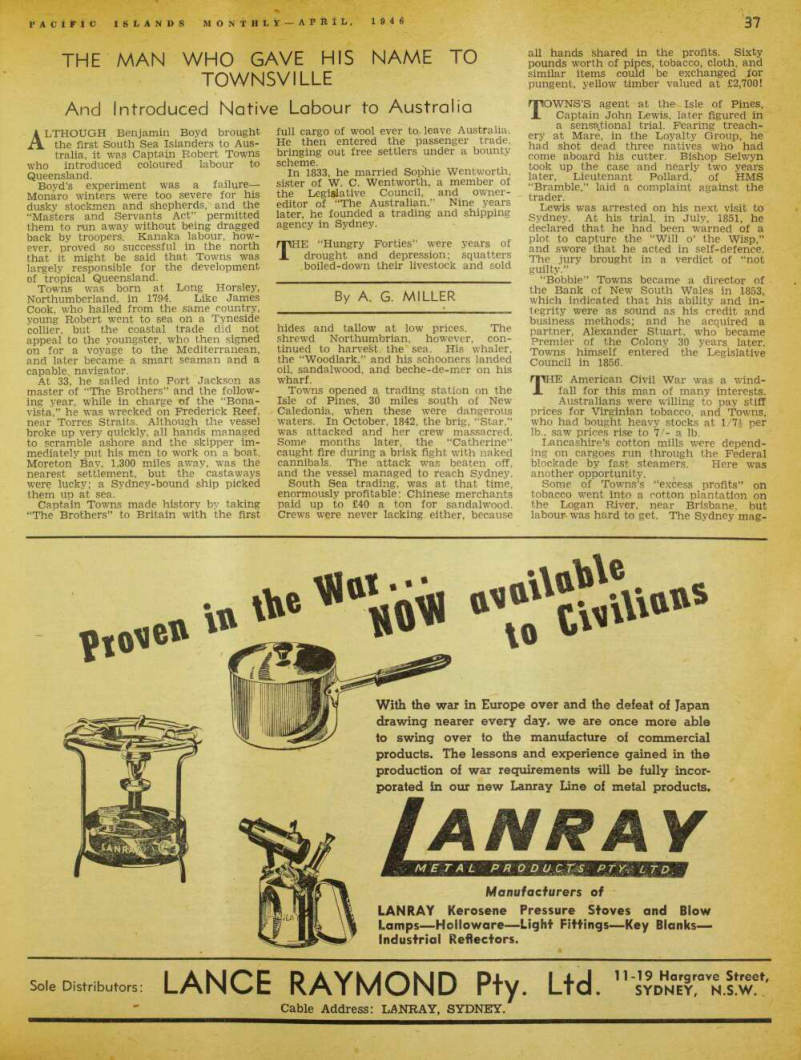
THE MAN WHO GAVE HIS NAME TO
And Introduced Native Labour to Australia
ALTHOUGH Benjamin Boyd brought the first South Sea Islanders to Aus tralia, it was Captain Robert Towns who introduced coloured labour to Queensland.
Boyd’s experiment was a failure — Monaro winters were too severe for his dusky stockmen and shepherds, and the “Masters and Servants Act” permitted them to run away without being dragged back by troopers. Kanaka labour, how ever, proved so successful in the north that it might be said that Towns was largely responsible for the development of tropical Queensland.
Towns was born at Long Horsley, Northumberland, in 1794. Like James Cook, who hailed from the same country, young Robert went to sea on a Tyneside collier, but the coastal trade did not appeal to the youngster, who then signed on for a voyage to the Mediterranean, and later became a smart seaman and a capable navigator.
At 33, he sailed into Port Jackson as master of “The Brothers” and the follow ing year, while in charge of the “Bona vista,” he was wrecked on Frederick Reef, near Torres Straits. Although the vessel broke up very quickly, all hands managed to scramble ashore and the skipper im mediately nut his men to work on a boat.
Moreton Bay, 1,300 miles away, was the nearest settlement, but the castaways were lucky; a Sydney-bound ship picked them ud at sea.
Captain Towns made history by taking “The Brothers” to Britain with the first
full cargo of wool ever to- leave Australia.
He then entered the bringing out free settlers under a bounty '“ss, he married Sophie Wentworth, of W. C. ; n^ Bm o wne? f the Legislative Council, and ownereditor of Nine years later, he founded a trading and shipping agency in Sydney. .. Wlincrrv -pwtips” WPrp VParQ of r V HE Hungry Forties were years of 1 r 9 l u and depression squatters boiled-down their livestock and sold
By A. G. Miller
hides and tallow at low prices. The shrewd Northumbrian, however, con tinued to harvest the sea. His whaler, the “Woodlark.” and his schooners landed oil, sandalwood, and beche-de-mer on his wharf.
Towns opened a trading station on the Isle of Pines, 30 miles south of New Caledonia, when these were dangerous waters. In October, 1842, the brig, “Star.” was attacked and her crew massacred.
Some months later, the “Catherine” caught fire during a brisk fight with naked cannibals. The attack was beaten off, and the vessel managed to reach Sydney.
South Sea trading, was at that time, enormously profitable: Chinese merchants paid up to £4O a ton for sandalwood.
Crews were never lacking either, because
all hands shared in the profits. Sixty pounds worth of pipes, tobacco, cloth, and similar items could be exchanged for pungent, yellow timber valued at £2,700!
TOWNS’S agent at the Isle of Pines, Captain John Lewis, later figured in a sensational trial. Fearing treach ery at Mare, in the Loyalty Group, he had shot dead three natives who had come aboard his cutter. Bishop Selwyn took up the case and nearly two years later, Lieutenant Pollard, of HMS “Bramble,” laid a complaint against the trader.
Lewis was arrested on his next visit to Sydney. At his trial, in July, 1851, he declared that he had been warned of a plot to capture the “Will o’ the Wisp,” and swore that he acted in self-defence.
The jury brought in a verdict of “not guilty.”
“Bobbie” Towns became a director of the Bank of New South Wales in 1853, which indicated that his ability and in tegrity were as sound as his credit and business methods; and he acquired a partner, Alexander Stuart, who became Premier of the Colony 30 years later.
Towns himself entered the Legislative Council in 1856. rE American Civil War was a wind fall for this man of many interests.
Australians were willing to pay stiff prices for Virginian tobacco, and Towns, who had bought heavy stocks at 1/71 per lb., saw prices rise to 7/- a lb.
Lancashire’s cotton mills were depend ing on cargoes run through the Federal blockade by fast steamers. Here was another opportunity.
Some of Towns’s “excess profits” on tobacco went into a cotton plantation on the Logan River, near Brisbane, but labour was hard to get. The Sydney mag
nate tried to import Indian coolies, but the Calcutta authorities gave him no en couragement, and then, as was natural, Towns turned to the South Seas.
The Mitchell Library has a copy of his instructions to his recruiter, Ross Lewin, and to the skipper of the schooner “Don Juan.” Since Lewin could not read, Cap tain Guerber was to instruct him not to use force or trickery. Natives were to be engaged for a period of 12 months.
Good workers could earn 10/- a month, while their rations included rice, meat, pumpkins, and yams.
On August 14, 1863, the “Don Juan” landed 67 Kanakas at Brisbane. There were angry protests from some quarters, but planters watched this experiment with great interest.
The “boys” proved hard workers and the Honourable Louis Hope brought 54 Islanders to his sugar plantation at
Ormiston. Within five years, 2,107 kinky headed natives were employed in Queens land, many as stockmen and station hands. rWNS grew coffee and sugar, planted cotton on Ross Island, in Cleveland Bay, and became a squatter. Part nered by Sir John Robertson and Sir Charles Cowper, he acquired large runs on the Burdekin River, and in the Gulf country, but labour recruiters did not follow Towns’s instructions: young men were lured on board schooners and clapped under hatches. * “Bully” Hayes and other ruffians be haved like Arab slave-raiders. Lewin came under fire, causing Captain Palmer, of HMS “Rosario,” to call him a pirate and a kidnapper. France protested against the stealing of natives from her posses sions, but the labour trade went on; some recruiters even dressed up as missionaries to entice natives aboard their vessels.
Innocent visitors suffered from such crimes—Bishop Patteson and Commodore Goodenough were murdered by natives whose kinsmen had been thus enticed into slavery. Despite Government control and naval patrols, “blackbirding” remained a sordid business until Federation put an end to Lie importation of coloured labour.
ROBERT TOWNS did not live to see Townsville grow into Queensland’s second largest port. He paid the town a visit in 1866, seven years before he died at his mansion overlooking Syd ney Harbour. The firm he founded over a century ago still bears his name, and Australians still remember the mariner merchant who gave his name to Towns ville.
Advertisements & other items, pp. 39-40 (1 item)
Lance Raymond Pty. Ltd.
Ni With the war in Europe over and the defeat of Japan drawing nearer every day, we are once more able to swing over to the manufacture of commercial products. The lessons and experience gained in the production of war requirements will be fully incorporated in our new Lanray Line of metal products.
Manufacturers of LANRAY Kerosene Pressure Stoves and Blow
Lamps—Holloware—Light Fittings—Key Blanks-
Industrial Reflectors.
Sole Distributors
LANCE RAYMOND Pty. Ltd.
11-19 Hargrave Street,
SYDNEY, N.S.W.
Cable Address: LANRAY, SYDNEY.
KANGAROO BRAND
Ropes,
Cordage,
and Twines for every purpose Backed by 86 years of service Manufactured hy :
M. DONAGHY AND SONS,
Pty. Ltd., Geelong and Sydney.
Fiji Representatives :
PEARCE AND CO.
LIMITED
P.O. BOX 237, SUVA
This is the home of ,
CmVERSJAMSW.
1 * «»' s\o*
COU
noo« o*2 V.O 0* t®s Here, at Histon, near Cambridge, is Olivers Factory, surrounded by orchards and gardens where the choicest English fruits are grown. Sun-ripened and in perfect condition for preserving, these fruits come in all their freshness to Olivers Factory to be made into the finest jams it is possible to imagine.
War conditions still limit supplies hut full shipments will be resumed as soon as possible.
CHIVERS
ENGLISH JAMS
Made in the heart of the English countryside by
CHIVERS & SONS Ltd.
The Orchard Factory Histon, Cambridge, England B **s7
Good Prices For Samoan
Produce
rE present price for first (or planta tion) grade cocoa-beans in Western Samoa is £95 per ton, FOB Apia.
This price is fixed by the Administration.
Copra is bringing £22/10/- FOB Apia.
Prices paid planters at their plantations in outer districts are arranged by the Government. Both cocoa-beans and copra are inspected in Apia before ship ment.
New Britain 60 Years Ago
From the Diary of F. J. Goedicke,
Haapai, Tonga
ILEFT Sydney on October 16, 1884, on His Imperial German Majesty’s ship . “Albatros” for New Britain, to be assistant to the German Commissioner von Oertzen.
'Hie Commissioner was sent to New Britain to select a site for administrative buildings; and, until the material arrived, we lived with the manager of the German firm, D. H. and P. G, The entire Terri tory of the Bismarck Archipelago was protected by the German Government, but was placed in the control of a com pany, founded on a basis similar to that of the old British East India Company.
The enterprises of planting coffee, cot ton, and so on had not yet begun, with the exception of an enterprise by an American firm directed by Thomas Far rell, who had accompanied “Queen Emma” (afterwards Madame Kolbe) from Samoa. The labour employed by this firm was brought from the Solomon Islands. It was inferior labour, but very cheap—each man costing less than five dollars a month.
Like the majority of the aboriginal races, the Papuans (natives of that place) were polygamists. A man could have as many wives as his means permitted, and the more capital he invested in this kind of property the better off he was—for his wives were his slaves and were obliged to do all the field labour.
Every morning, lines of naked, dirty women could be seen wending their way to the food gardens, to hoe their master’s yams and taro. Meanwhile, the lords of creation were preparing their canoes for fishing., or repairing the curious basket like fish-traps that they used.
The women seemed perfectly content with their lot rebellion was never dreamed of. Divorce was unknown.
When a man purchased a woman she became his property, like his canoe or his pig. When he became tired of her, he purchased a new wife, and the old one had to console herself by more in dustriously cultivating her lord’s yam patch. If a woman was unfaithful, her paramour was judged guilty of having stolen her, and was called upon to pay her full value. If he refused, war was immediately declared between the two families; or, if Lothario belonged to another tribe, the fight was between the two tribes. The injured husband had the option of killing the erring wife; and the Papuans of those days were not in clined to mercy.
The life of a white trader among those savages was not enviable. Usually, he was landed on a beach from a small vessel, with his box of trade goods and some provisions, among a strange people whose language was unfamiliar; and he was left to shift for himself. He was usually completely isolated, and would not see another white man until the vessel re turned, a month later. He was com pletely at the mercy of the natives—his life, as well as the success of his trading venture, depended upon his wits, and his quality in dealing with primitive savages.
Many of these men lost their lives be cause they were not quick enough in understanding the ways of the people they had gone among. If a trader was not liked by the natives, the chief usually deputed one of his men to kill him, and if he were unsuspicious, he would be speared or clubbed’* in his bed, or poisoned.
Mr. Ward and Press
Criticism
Letter to the Editor rE “PIM” for February is a fine issue, as is usual. Your magazine is of inestimable value to all who live, or have lived in the Pacific or are other wise interested in Pacific affairs.
I write this letter, however, to express my disgust over the attitude of Mr.
Ward, the Australian Minister for Terri tories, in banning you, for the time being, from visiting the Australian Mandated Territories. I write this as one who was born in the Pacific (Fiji), and lived there for years, and who continues to take a lively interest in Pacific affairs. And, being a lawyer, I am a member of a pro fession which in a special way, knows the meaning and value of real liberty, as part of democracy.
You may, in your articles, in the view of some people, lean more towards Islands planters and settlers, and less to wards the natives themselves; but even that view is questionable. Irf any case, as an individual, you have a right to express your own feelings in such mat ters, whether they accord with IVtr. Ward’s personal views or not.
You have recently visited Fiji, where there is a large native and Indian popu lation, and you have provided your readers with excellent articles arising out of this visits You have a perfect right to visit the 1 Australian Mandated Terri tories, and also provide your readers with articles about them.
The Australian Cabinet (for after all Cabinet as a whole must take respon sibility for the actions of any Minister) has, in this matter, acted in a most un- British-like manner towards you, and the Opposition should take it un in the Com monwealth Parliament. Much more is at stake than the improper interference with the liberty of movement of an Aus tralasian citizen. It is an affront to all true lovers of liberty, and is more in keeping with Nazi and Fascist methods.
It is certainly not democracy.
The fact is that Labour in Australia, as here in NZ, is unduly sensitive to criticism. They want “Yes” men every where, not radicals. That ridiculous atti tude alone must inevitably bring about their downfall.
Yours truly,
C. C. Chalmers.
Auckland, NZ, 21/3/46.
Mr. Harry Williams, son of Colonel and Mrs. Frank Williams, of Suva, who served with the NZEF in the Middle East, has now been discharged. He returned to the Colony by air in early March.
War Against Mosquitoes
fT!HE outstanding effectiveness of DMP A (dimethyl phthallate) over other insect repellents as a protection against the malaria-carrying mosquito has been recently demonstrated by the Army Malaria Research Station at Taveta, in Kenya.
Although pyrethrum jelly was also found to be reasonably effective, it was not comparable in effectiveness with
Dmp.
For more than 18 months the Research Station has been carrying out field ex periments on insecticides, larvicides and insect repellents and seeking information of immediate practical value on the habits of the African malaria carriers.
Eight huts were erected in various types of country, and two Africans were em ployed to sleep in each as “bait,” writes a military observer. “It is noteworthy that not only is this generally a popular
form of employment,” states a report on the work, “but no case has yet been re corded of any man thus employed being admitted to hospital with malaria.”
As to the effectiveness of DDT as an insecticide, it is stated that in the case of a tent impregnated at the rate of 200 mgms. of DDT per sq. ft., nine months after treatment 65.5 per cent, of the total number of mosquitoes present in the tent at 08.30 hrs. every morning were already dead; of the remainder 51.5 per cent, were dead within 12 hours. Gammexane, or “666,” appeared to be as good as DDT at the same dosage.—“ Crown Colonist.”
The New Zealand Club building in Suva has been taken over by two Government Departments, One half has been turned into offices for the Rehabilitation and War Pensions Board, and the other is being used in connection with the filariasis campaign.
Advertisements & other items, p. 41 (1 item)
Dependable roteman
NOW AS ALWAYS
For over forty years COLEMAN has built a reputation for dependability in lighting, cooking and heating appliances. Built from the same first quality materials as always, with the exclusive Coleman features, you are always assured of the best when you buy dependable Coleman. Wherever you are there is a Coleman dealer to servfe you with dependable COLEMAN appliances and service.
THE COLEMAN LAMP
AND STOVE COMPANY LIMITED
TORONTO, CANADA
CHICAGO, USA.
J* b 9* 1 Bond Street, Sydney, Australia £* V 4 Xj) 'y y JPI VTeL B 4167. Box 3615 G.P.O.
SUPPLIERS OF GENERAL MERCHANDISE TO LEADING FIRMS THROUGHOUT THE
PACIFIC ISLANDS
Exporters ... Importers ... . Manufacturers' Representatives Bankers: Bank of N.S.W. Bank of Adelaide. Comptoir Nat. d’Escompte de Paris.
Cable Address: “SEAFOODS,” SYDNEY.
Codes: Bentley’s, 2nd and Comp. Phrase; A.8.C., sth and 6th; Peterson, 2nd and 3rd; Banking; Acme.
Young Australia Returns to the Sepik
QNE of the very few Australian
journalists who, after a visit to
the Territories , have been able to write articles about Papua and New Guinea are superficial and silly, is Mr. Frederick Howard, representing Melbourne “Herald” and Sydney “Sun” Mr. Howard, in
March, sent the following description
of the restoration •of the Australian Administration to the Northern New Guinea regions, recently taken over from ANGAU by the Civil Administration.
AVAST waterland of river, lagoons, and swamps, the Sepik River area of New Guinea covers 30,000 square miles. Some of its remote tribes are now violently hostile to the white man — and among them to-day are the survivors of 1,000 Japanese for whom General Adachi could not account when Ije surrendered Into this region, however, the white man’s law is going back. As I write this, a small launch is hammering Its way up the mile-wide reaches of the Sepik, taking an officer of the District Service to establish a Dost 150 miles up stream.
Others will follow. The village areas which were under control before the war will first be contacted. They comprlse some 150,000 known inhabitants.
Beyond them is uncontrolled territory, with perhaps scores of thousands of natives. In due course, the Administration will move in. bringing instruction in hygiene, a medical service, a concept of justice—and a call for taxes by way of payment.
I have been learning about the area by
sitting in at Wewak and Aitape on the conferences of the men who will govern it. rpHE most significant touch was the X plea put to the Assistant District Officer at Aitape (Mr. Frank Moy), by a man who is about to rejoin the District Service after a long term in the AIF. He begged to be assigned to the Sepik and not to be transferred from it until he had had five years in which to see some result from his labours. It was a plea to be sent to the “Siberia” of New Guinea.
Service on the Sepik is notorious for its isolation, physical hardship and danger.
But it is a strange and heartening fact that this quixotic applicant is only one of many coming into the post-war admin istration with a zest for the frontier life.
Among those who served here before, it is more than a zest. New Guinea is their vocation. They have an almost paternal affection for the childlike, proud and direct-minded natives whose trust they won. These public servants will go back to re-establish that trust and dispel the Japanese gospel of hatred for Euro peans.
In their wake will come the fruits of a new policy of research in tropical agricul ture. The tribes will be taught to live better off their weird waterland. Then, on the basis of an improved living stan dard. cultural and technical education can begin.
I GOT some idea of the immensity of this project by flying over 500 miles of the Sepik’s course from the fron tier of Dutch New Guinea to the river’s mouth.
Much of the landscape is a mad scribble of muddy waterways in horizon-wide plains of kunai grass. On the lower Sepik there are patches of higher wooded country. The villages which you may detect here among the trees are mainly deserted. The Sepiks congregate in them only for tribal ceremonies or in times of danger. Normally, families are scattered in their garden patches.
In areas where swamp predominates, natives have carried in soil by canoe to build up mounds in which to plant coco
nuts. In the great flood seasons, water will rise to the floors of their built-up huts, and at night a household may be kept awake by the bumping of crocodiles against the flooring.
You do not slap at mosquitoes in this country. You brush them off your arms 50 at a time, leaving long smears of blood.
To escape them, natives climb into basket shelters at night. The general idea is that it would be courting death to sleep without either one of these semi suffocating shelters or a mosquito net.
In the “little Venice” villages of the Sepik, even the domestic pigs have learned to swim. All life is amphibious here. Because only the fittest survive in the pestilential place, the Sepik native is a rugged type, his shoulders magnificently developed by canoe-paddling. The soles of his feet are soft and near-white, for he hardly ever v/alks on dry, hard ground.
ONE of the “old hands” of this territory, Colonel W. R. Woodman, now Acting District Officer at Madang, told me he built himself a travelling office and home when he went on circuit through the Sepik. On two long canoes lashed to gether he set up a fly-wired office, with tmy kitchen and bathroom.
In this houseboat he lived for months, paddling “overland” in the flood times and moving back through the lagoons to the serpentine river. only traffic that passed him were big floating islands of debris, and once a chieftain’s 60-foot war canoe, hollowed from one log and manned by *4B paddlers.
Such is the Sepik District. It is only one of the remote regions over which Australia now resumes the responsibilities of civil Government. It is perhaps the toughest, and certainly the most out landish. On its borders, in behind Aitape, there is gold, and it is thought that there may be oil.
There are also gentlemen with exqui sitely fashioned bamboo spears and a dis like of strangers. The Sepik is no place for softies.
Corrections To Honour
Roll
TWO corrections to our January Honour Roll supplement have come from Fiji. One concerns J. Simpson, RAAF. whom we have correctly listed as “killed in action over Malta” but have also incorrectly listed as “P/O James Simpson—missing.” James Simpson was a Sergt.-observer at the time he was shot down over Malta in 1941.
P/O Dennis McCaig, RAF, whom we listed as “missing, believed prisoner of war,” is. now in London. He bailed out on two occasions; the first time he landed in friendly territory, but on the second on enemy ground. He was a POW for only a short time, however, having been released by advancing Allied troops.
Very Much Alive!
WE welcome back from the dead, Louis Anger, of the New Hebrides. He was listed in our Honour Roll for several years as “missing after the battle of Bir Hakeim.”
Actually he was missing for a month after the battle but he was then located in hospital, having been evacuated from the battle-area with British troops.
He is now back in the New Hebrides, very much alive.
Dr. Ratu J. A. R. Dovi left Fiji in mid-March to take up a medical appoint ment in Malaita, BSI.
Advertisements & other items, p. 42 (1 item)
W. H. Grove £ Sons
LOTI
P&*- Lye, Ey*h«La
fcOLD EVEItWHEiE
h * Ka*<t A C 6 rty. Ltg. ; Rlfla S* , »y«^-yy
W. H. GROVE £ SONS
Limited Established 1896.
AUCKLAND
Island Traders. p.o. Box 490 Telegraphic and Cable Address - “Grove”. Auckland.
Shippers of all classes of New Zealand products.
Representing English Manufacturers throughout the Cook and Society Islands, Fiji, Tonga, Samoa, Niue, New Caledonia, New Guinea, etc.
In FIJI «• —W. H. Grove & Sent (Fiji) Ltd.
History Of Fixed Copra Prices In Fiji
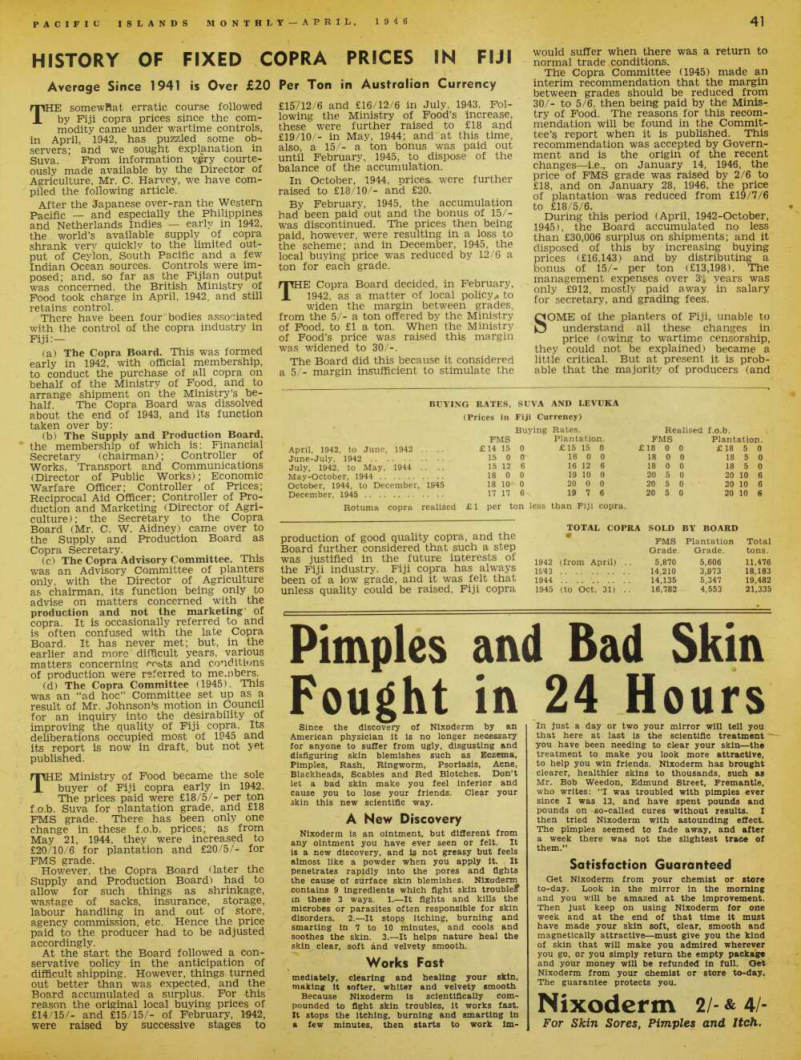
Average Since 1941 is Over £20 Per Ton in Australian Currency
rpHE somewHat erratic course followed JL by Fiji copra prices since the com modity came under wartime controls, in April, 1942, has puzzled some ob servers; and we sought explanation in Suva. From information v£ry courte ously made available by the Director of Agriculture, Mr. C. Harvey, we have com piled the following article.
After the Japanese over-ran the Western Pacific and especially the Philippines and Netherlands Indies early in 1942, the world’s available supply of copra shrank verv quicklv to the limited out put of Ceylon, South Pacific and a few Indian Ocean sources. Controls were im posed; and, so far as the Fijian output was concerned, the British Ministry of Food took charge in April, 1942, and still retains control.
There have been four bodies associated with the control of the copra industry in Fiji;— (a) The Copra Board. This was formed early in 1942, with official membership, to conduct the purchase of all copra on behalf of the Ministry of Food, and to arrange shipment on the Ministry’s be half. The Copra Board was dissolved about the end of 1943, and its function taken over by: (b) The Supply and Production Board, the membership of which is: Financial Secretary (chairman); Controller of Works, Transport and Communications (Director of Public Works); Economic Warfare Officer; Controller of Prices; Reciprocal Aid Officer; Controller of Pro duction and Marketing (Director of Agri culture); the Secretary to the Copra Board (Mr. C. W. Aidney) came over to the Supply and Production Board as Copra Secretary. (c) The Copra Advisory Committee. This was an Advisory Committee of planters only, with the Director of Agriculture as chairman, its function being only to advise on matters concerned with the production and not the marketing of copra. It is occasionally referred to and is often confused with the late Copra Board. It has never met; but, in the earlier and more difficult years, various matters concerning costs and conditions of production were referred to members. (d) The Copra Committee (1945). This was an “ad hoc” Committee set up as a result of Mr. motion in Council for an inquiry into the desirability of improving the quality of Fiji copra. Its deliberations occupied most of 1945 and its report is now in draft, but not yet published. rE Ministry of Food became the sole buyer of Fiji copra early in 1942.
The prices paid were £lB/5/- per ton f.o.b. Suva for plantation grade, and £lB FMS grade. There has been only one change in these f.o.b. prices; as from May 21, 1944, they were increased to £2O/10/6 for plantation and £2O/5/- for FMS grade.
However, the Copra Board (later the Supply and Production Board) had to allow for such things as shrinkage, wastage of sacks, insurance, storage, labour handling in and out of store, agency commission, etc. Hence the price paid to the producer had to be adjusted accordingly.
At the start the Board followed a con servative policy in the anticipation of difficult shipping. However, things turned out better than was expected, and the Board accumulated a surplus. For this reason the original local buying prices of £l4/15/- and £l5/15/- of February, 1942, were raised by successive stages to
£15712/6 and £l6/12/6 in July, 1943. Fol lowing the Ministry of Food’s increase, these were further raised to £lB and £l9/10/- in May, 1944; and at this time, also, a 15/- a ton bonus was paid out until February, 1945, to dispose of the balance of the accumulation.
In October, 1944, prices. were further raised to £lB/10/- and £2O.
By February, 1945, the accumulation had been paid out and the bonus of 15/was discontinued. The prices then being paid, however, were resulting in a loss to the scheme; and in December, 1945, the local buying price was reduced by 12/6 a ton for each grade. rE Copra Board decided, in February, 1942, as a matter of local policy,, to widen the margin between grades, from the 5/- a ton offered by the Ministry of Food, to £1 a ton. When the Ministry of Food’s price was raised this margin was widened to 30/-.
The Board did this because it considered a 5/- margin insufficient to stimulate the
production of good quality copra, and the Board further considered that such a step was justified in the future interests of the Fiji industry. Fiji copra has always been of a low grade, and it was felt that unless quality could be raised, Fiji copra
would suffer when there was a return to normal trade conditions.
The Copra Committee (1945) made an interim recommendation that the margin between grades should be reduced from 30/- to 5/6, then being paid by the Minis try of Food. The reasons for this recom mendation will be found in the Commit tee’s report when it is published. This recommendation was accepted by Govern ment and is the origin of the recent changes—i.e., on January 14, 1946, the price of FMS grade was raised by 2/6 to £lB, and on January 28, 1946, the price of plantation was reduced from £l9/7/6 to £lB/5/6.
During this period (April, 1942-October, 1945), the Board accumulated no less than £30,006 surplus on shipments; and it disposed of this by increasing buying prices (£16,143) and by distributing a bonus of 15/- per ton (£13,198). The management expenses over 3’s. years was only £912, mostly paid away in salary for secretary, and grading fees.
SOME of the planters of Fiji, unable to understand all these changes in price (owing to wartime censorship, they could not be explained) became a little critical. But at present it is prob able that the majority of producers (and
Buying Rates,
Suva
And Levuka
(Prices in Fiji Currency) Buying Rates.
Realised f.o.b.
Fms
Plantation.
Fms
Plantation.
April, 1942, to June, , 1942 ... £14 15 0 £15 15 0 £18 0 0 £18 5 0 June-July, 1942 15 0 0 16 0 0 18 0 0 18 5 0 July, 1942. to May, 1944 ... 15 12 6 16 12 6 18 0 0 18 5 0 May-October, 1944 . . 18 0 0 19 10 0 20 5 0 20 10 6 October. 1944, to December, 1&45 18 10 0 20 0 0 20 5 0 20 10 6 December, 1945 .. .. 17 17 6 19 7 6 20 5 0 20 10 6 Rotuma copra realised £1 per ton less than Fiji copra.
Total Copra
Sold
By Board
Fms
Plantation Total Grade.
Grade. tons. 1942 (from April) .. 5,870 5,606 11,476 1&43 14,210 3,973 18,183 1944 14,135 5,347 19,482 1945 (to Oct. 31) .. 16,782 4,553 21,335
it must not be forgotten that 60 per cerit. of the copra is produced by Fijians) are m favour of the change, as they now get slightly more for FMS copra than before.
On the other hand many owners or operators of large and comparatively efficient estates, or those estates situated in areas where weather conditions make it comparatively easy to make good copra, are disappointed because they lose the wider margin.
Probably, most producers, even those who always produce FMS quality, were disappointed because the rise in price of FMS was small as compared with the fall in plantation grade. But this is explaned by the facts that: • Plantation grade has not recently been more than 20 per cent, of the total output; and, therefore, an equal rise of the one and fall in the price of the other would not have been practicable. • For the past 18 months the scheme has purchased copra at a higher price than was justified by the f.o.b. price, be cause of the accumulation of funds due to the cautious policy followed by the Board during 1942 and 1943.
Advertisements & other items, pp. 43-44 (1 item)
Pimples and Bad Skin
Fought in 24 Hours
Since the discovery of Nlxoderm by an American physician it is no longer necessary for anyone to suffer from ugly, disgusting and disfiguring skin blemishes such as Eczema, Pimples, Rash, Ringworm, Psoriasis, Acne, Blackheads, Scabies and Red Blotches. Don’t let a bad skin make you feel Inferior and cause you to lose your friends. Clear your skin this new scientific way.
A New Discovery
Nlxoderm is an ointment, but different from any ointment you have ever seen or felt. It is a new discovery, and is not greasy but feels almost like a powder when you apply It. It penetrates rapidly Into the pores and fights the cause of surface skin blemishes. Nlxoderm contains 9 Ingredients which fight skin troubles in these 3 ways. I.—lt fights and kills the microbes or parasites often responsible for skin disorders. 2.—lt stops itching, burning and smarting in 7 to 10 minutes, and cools and soothes the skin. 3. —It helps nature heal the skin clear, soft and velvety smooth.
Works Post
mediately, clearing and healing your skin, making it softer, whiter and velvety smooth Because Nlxoderm is scientifically compounded to fight skin troubles, it works fast.
It stops the itching, burning and smarting in a few minutes, then starts to work 1m-
In just a day or two your mirror will tell you that here at last is the scientific treatment you have been needing to clear your skin—the treatment to make you look more attractive, to help you win friends. Nixoderm has brought clearer, healthier skins to thousands, such as Mr. Bob Weedon, Edmund Street, Fremantle, who writes: “I was troubled with pimples ever since I was 13, and have spent pounds and pounds on so-called cures without results. I then tried Nixoderm with astounding effect.
The pimples seemed to fade away, and after a week there was not the slightest trace of them.”
Satisfaction Guaranteed
Get Nixoderm from your chemist or store to-day. Look in the mirror in the morning and you will be amazed at the Improvement.
Then just keep on using Nixoderm for one week and at the end of that time it must have made your skin soft, clear, smooth and magnetically attractive —must give you the kind of skin that will make you admired wherever you go, or you simply return the empty package and your money will be refunded in full. Get Nixoderm from your chemist or store to-day.
The guarantee protects you.
Nixoderm 2/- & 4/-
For Skin Sores, Pimples and Itch.
500,000
Men's Second-hand
JACKETS
and
TROUSERS
SUITABLE FOR PACIFIC
ISLANDS TRADE
Price: 4/- Each
Quick Shipment—Pressed Bales containing 1,000 Assorted Garments.
Establish Confirmed Credits for Payment for Any Quantity on Any English Bank.
M. NEWMAN
(Contractors) LTD,
Government Contractors
HEAP ST., MANCHESTER 7,
ENGLAND
Cable Address: Harbinger, Manchester.
u
tvl 1
viny df» ou r here you
ir>on°
\f/ fit® B?C* 95 ’ 1.7a 1 LtO mo
ISYt»
brO $
OYE*
Hoges
RANGE COVERS:
• ELECTRICAL GENERATING
EQUIPMENT. TRANSFORMERS
AND SWITCHGEAR.
• ELECTRIC MOTORS AND
CONTROL APPARATUS.
• ELECTRIC CABLES AND IN-
SULATING MATERIALS.
• FLUORESCENT AND INCAN-
DESCENT LIGHTING.
• COMMERCIAL COOKING &
HEATING EQUIPMENT.
• DOMESTIC ELECTRIC APPLI-
ANCES, RADIO & WIRING
ACCESSORIES.
• MATERIALS HANDLING
EQUIPMENT.
• MACHINERY & ENGINEER-
ING EQUIPMENT, METALS.
CHEMICALS.
• COAL MINING EQUIPMENT.
• METALLIFEROUS MINING,
QUARRYING AND CEMENT
MAKING MACHINERY.
WOYEf BMI IfYDNPY ITD.
115 CLARENCE STREET. SYDNEY
NEWCASTLE • WOLLONGONG • 0 NISSANE
"Banana-Figs"
W. Samoa Manufactures
From Our Own Correspondent APIA, March 4.
THE New Zealand Government-owned Reparation Estates have recently started the production here of “banana-figs” for the NZ market. They are reported to be of excellent quality and in demand in New Zealand.
Already Estates plan to erect, in addi tion to their present establishment at Vailele, a new factory at Malifanua, on the west coast of Upolu, for the produc tion of the figs.
A large quantity of bananas, which would ordinarily be unsuitable for the NZ market, are utilised in the manufac ture of the new product and this should stimulate fresh banana cultivation.
There is an increased demand for desic cated coconut at present, also, and Reparation Estates intend doubling pro duction at the factory at Malifanua. (Ed. Note: What are “banana-figs”?
Our correspondent does not say. Pre sumably, it is some banana preparation Planter readers of “PIM” would be in terested in this new enterprise in Western Samoa.)
Old Fiji Residents
Pass On
rE deaths of several pioneer residents of the Colony were reported from Fiji during March.
Mrs. Estella Guiney
AFTER long illness, Mrs. Estella Guiney,, wife of Mr. George Guiney, of Suva, died at her home on March 18. She was an Australian who went to the Colony early in life, and subsequently married in Suva, where she made many friends. She is survived by her husband and their daughter Vivien, who is a mem ber of the staff of the Telegraph De partment, Suva.
Mr. Levi Underwood
MR. LEVI UNDERWOOD, who died at the age of 89, was the son of the daughter of a high chief and an American, Mr. Archie Underwood, who came to the Colony over 90 years ago.
Mr. Underwood. Sr., settled in Kadavu, where Levi was 3orn; he was murdered there by his Tanna labourers over 60 years ago.
Levi was a carpenter by trade and in this capacity worked all over the Colony.
Eventually he returned to settle on his freehold at Kadavu. but came back to Suva some years ago to spend the last of his life there with his family. He is survived by a widow, four sons, 42 grand children and 30 great-grandchildren. Two daughters pre-deceased him.
Mrs. Laura Spence
MRS. LAURA SPENCE, whose death occurred on March 18, was the widow of the late Mr. Frank Spence, formerly private secretary to the Governor, and the daughter of the late Mr. and Mrs. Henry Niemann, of Levuka.
Her uncle, Mr. G. L. Griffiths, was the founder of the “Fiji Times” in Levuka in 1869.
On the death of her husband some years ago, Mrs. Laura Spence came to Suva to live. She had a large number of friends throughout the Colony.
Mrs. Amelia Hooker
MRS. AMELIA HOOKER, wife of Mr.
Cecil Hooker, formerly Chief Clerk of the Public Works Department, Fiji, died in Auckland, NZ, on March 15. Since Mr. Hooker’s retirement in 1929, the family has lived in New Zea land. Mrs. Hooker had been in ill-health for many years.
She is survived by her husband and three daughters. Mrs. A. Noerr and Mrs.
H. Clark, of Suva, and Mrs. D. Mortimer, of Auckland.
Mrs. M. Ashley, Sr.
MRS. M. ASHLEY, widow of Mr. W.
Ashley, who was an early resident of Levuka, died at Levuka on March 11.
Mrs. Ashley’s father, Captain Kerrigan, was harbourmaster at Levuka in the early days, and she herself was born in the town, about 85 years ago. She is survived by three sons, Messrs. J.. V., and 8., Ashley, and by one daughter who lives in New Zealand.
News has been received that Flight- Lieutenant H. B. Deland was killed in a motor accident at Labuan, Borneo, on March 25. His parents are Mr. and Mrs.
C. C. Deland, now of Adelaide; Mr.
Deland, Sr., was well known in Kieta, TNG, some years ago. Dr. C. M. Deland, also well known in the Mandated Terri tory, is a half-brother of Flight-Lieu tenant Deland.
The Scolia Wasp
How It Helps to Control the Rhinoceros Beetle
IN reply to a letter concerning the Scolia wasp, written by Mr. Massingham Folkard and published in the Janu ary “PIM,” an officer of the Department of Agriculture, Fiji, has sent us a pamph let dealing with the biological control of the rhinoceros-beetle. This pamphlet (Bulletin No. 21). written by Hubert W.
Simmonds, formerly Government Ento mologist, can be obtained from the Department’s Suva office.
Briefly, it gives the history of early investigations into rhinoceros-beetle con trol as follows: In April, 1912, Mr. F. P. Jepson, then Government Entomologist in Fiji, visited Western Samoa and reported upon the ravages of the beetle in that territory.
Following his report, stringent regula tions were imposed upon all ships coming to Fiji from Western Samoa.
In 1913, a Dr. K. Fredericks made an extensive tour of the eastern tropics in search of natural enemies of the pest.
His investigations, however, were stopned by the outbreak of World War I, just when he had reached Madagascar. In his report, he suggested the introduction into Samoa of the Madagascar Scolids.
In 1933, Mr. Simmonds was seconded for three months to Samoa to report on the position and later he undertook a special mission to Malaya, Mauritius and Madagascar to ascertain what factors, if any, held the pest in check in those countries.
The discovery of the black wasps in Zanzibar and their recent introduction into Western Samoa was described in the October issue of “PIM.”
In his letter, Mr. Folkard asked also for a description of how the Scolia wasns combatted the rhinoceros-beetle. Mr.
Simmons in his pamphlet states that no true parasite of the beetle has been proved to exist. In the laboratory, how ever, Scolia wasps are notorious 'for at tacking the grubs of the rhinoceros-beetle and there is no reason to suppose they do not continue to do so in the field.
All Scoliidae are parasitic in the larval stage, living as external parasites upon the grubs of certain beetles.
To oviposit, the adult female wasp bur rows into the soil, rotten wood or other media where the beetle grub occurs, and then having discovered a suitable one for her purpose, she paralyses it by means of her sting and, prior to laying an egg upon it, generally removes it more deenlv into the media, where she seals it up in a cell of her own construction.
Keeping The Rhinoceros
Beetle Out Of Fiji
GREAT care is constantly exercised in Fiji to prevent the introduction into the Colony of the rhinoceros beetle, which has a devastating effect on coconut palms. For a number of years vessels coming from Western Samoa to Fiji have been required to observe special precau tions. One of these has made it neces sary for the vessels to lie away from the wharves from sunset to sunrise.
Investigation has now shown that this precaution can be safely dispensed with.
But vessels from Samoa must still make Suva their first port of call in Fiji, be cause inspection facilities are available only there. No living or fresh material of vegetable origin may be landed in the Colony from Samoa, arid passengers’ bag gage must be fumigated before being taken aboard at Ania. —Prom Fiji Public Relations Office Bulletin.
Some Changes Suggested
North Borneo
rE British, apparently, are trying to clear up the administrative position in North Borneo. Before the Pacific war, there were four British Territories in North Borneo:— • Sarawak, a practically independent Territory, ruled by the Brooke family, under British protection. • The State of Brunei, under British protection. • British North Borneo, administered by the British North Borneo Company. • The island of Labuan, 40 miles off the coast, one of the Straits Settlements.
It is proposed to bring the whole of the three mainland Territories under one administration. The present Rajah Brooke is reported to have agreed to this —though his Heir-Apparents have objected noisily.
The following is from the October issue of the “Crown Colonist”:— “Discussions have been taking place between the Colonial Office and the Court of Directors of the British North Borneo Company with a view to reaching agree ment on the question of the assumption by His Majesty’s Government of direct responsibility for the administration of the Territory, a development only to be expected in view of events and the need for strong and unquestioned jurisdiction over all territdVy and protection in those waters.
“This has been the inevitable evolution of all Territories under the rule of char tered companies within the Empire, of which North Borneo is now the only re maining example, and the opening of a new era in colonial relations is probably a fitting opportunity for the company to resign its trust into the hands of the Government. There have always been close relations between Government and company in the appointment of the Governor and other matters, and the change will'not be very pronounced.
“The great island of Borneo is un equally divided between the Dutch and the British, but there are two other British Territories adjoining North Borneo—namely, Sarawak and Brunei.
The latter is now part of the Straits Settlements, but Sarawak for over a cen tury has been under the beneficent rule of the Brooke family. One wonders if this will be affected, or whether all British Borneo may come under one administra tion.”
South Pacific interest in this matter lies in the suggestion—made occasionally since Japan invaded the South Pacific and threatened Australia that the Nether lands may be persuaded to accept respon
sibility for North Borneo, in return for the transfer of Western Timor and Western New Guinea to Australia—thus allowing Australia to have more complete control over the arc of Western Pacific islands (Timor to New Hebrides) which are considered vital to her future defence against Asia.
Mr. W. MacDonald Ford, BDS, who arrived by the March “Matua,” has com menced practice in Apia, W. Samoa, as dental surgeon.
Mrs. David Caldwell and her seven months-old daughter, left Sydney rn the “Ormiston” on March 27. They will, join Mr. Caldwell in Madang, where he is in charge of the local hospital.
Advertisements & other items, p. 45 (1 item)
J. C. Merrillees & Co.
NOW AVAILABLE
Pacific Islands
Year Book
FIFTH EDITION
4 rIS has become the recognised standard work of reference on the Pacific Territories and Islands; and it is now printed in Sydney, N.S.W., and in New York.
The sth Edition, 384 pages, has been arranged inf Six Sections—General and Introductory; Eastern Pacific (Polynesia) ; Central Pacific (Micronesia); Western Pacific (Melanesia); Far Western Pacific (Indonesia); and Non-Tropical Islands.
Every Territory and all the Principal Islands are described in detail —history, geography, natives, administration, industries, trade, etc. There are more than 50 maps.
Price: 15/- per copy, plus 6d. postage.
Copies may be obtained at the majority of Booksellers, and Island Stores, or direct from:
Pacific Publications Pty., Ltd.,
Union House, 247 George St.,
Sydney.
Pacific Publications (Fiji), Ltd.,
P.O. Box 281, Suva, Fiji.
The book, named “Pacific Islands Handbook,” is published by The MacMillan Company, New York, for distribution in North and South America, and Hawaii.
J. C. MERRILLEES & CO.
Cha 11 is House, Martin Place, SYDNEY.
BUYERS OF ALL ISLAND REQUIREMENTS. SUPPLIERS OF ALL AUSTRALIAN GOODS. BUYERS OF ISLAND PRODUCE.
X Write or Wire for Quotations
Inquiries Welcomed
'Phone: 8W6569 Telegrams: “Merrillees,”
Sydney.
Radio-Operator Heroine Of The S-W
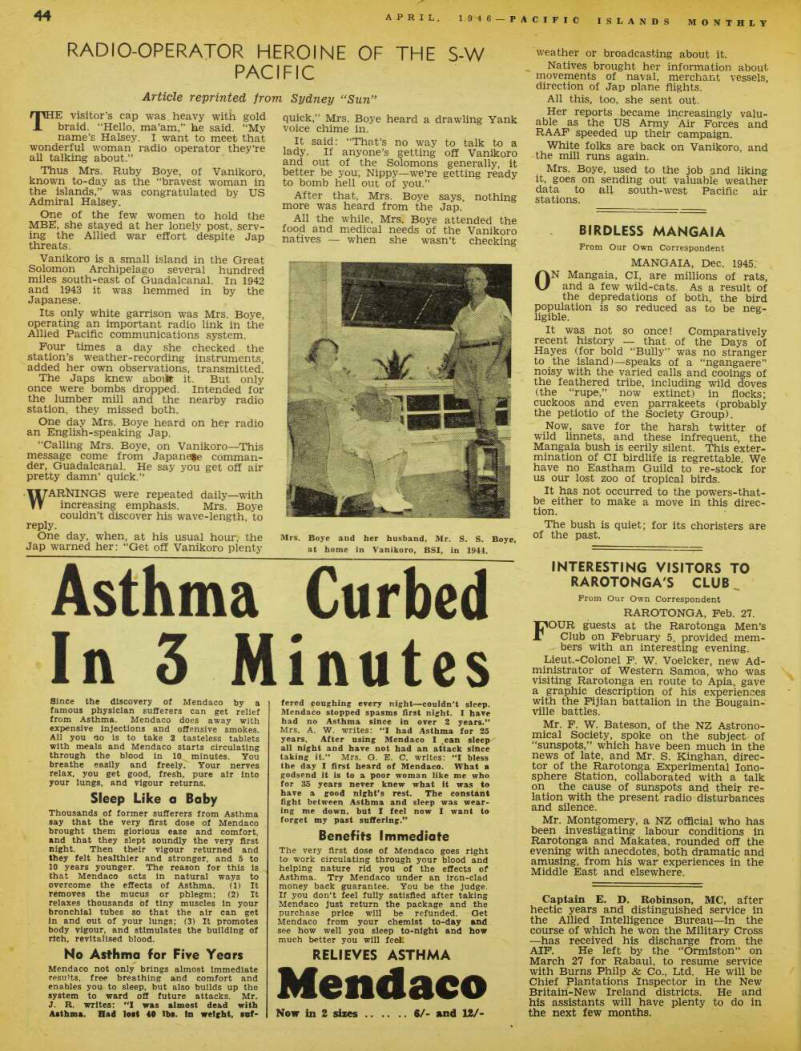
Pacific
Article reprinted from Sydney “Sun”
fITHE visitor’s cap was. heavy with gold X braid. “Hello, ma’am,” he said. “My name’s Halsey. I want to meet that wonderful woman radio operator they’re all talking about.”
Thus Mrs. Ruby Boye, of Vanikoro, known to-day as the “bravest woman in the islands,” was congratulated bv US Admiral Halsey, One of the few women to hold the MBE, she stayed at her lonely post, serv ing the Allied war effort despite Jap threats.
Vanikoro is a small island in the Great Solomon Archipelago several hundred miles south-east of Guadalcanal. In 1942 and 1943 it was hemmed in by the Japanese.
Its only white garrison was Mrs. Boye, operating an important radio link in the Allied Pacific communications system.
Four times a day she checked the station’s weather-recording instruments, added her own observations, transmitted.
The Japs knew aboilt it. But only once were bombs dropped. Intended for the lumber mill and the nearby radio station, they missed both.
One day Mrs. Boye heard on her radio an English-speaking Jap.
“Calling Mrs. Boye, on Vanikoro—This message come from Japanete comman der, Guadalcanal. He say you get off air pretty damn’ quick.”
WARNINGS were repeated daily—with increasing emphasis. Mrs. Boye couldn’t discover his wave-length, to reply.
One day, when, at his usual hour, the Jap warned her: “Get off Vanikoro plenty
quick,” Mrs. Boye heard a drawling Yank voice chime in.
It said: “That’s no way to talk to a lady. If anyone’s getting off Vanikoro and out of the Solomons generally, it better be you, Nippy—we’re getting ready to bomb hell out of you.”
After that, Mrs. Boye says, nothing more was heard from the Jap, All the while, Mrs. Boye attended the food and medical needs of the Vanikoro natives when she wasn’t checking
weather or broadcasting about it.
Natives brought her information about movements of naval, merchant vessels, direction of Jap plane flights.
All this, too, she sent out.
Her reports became increasingly valu able as the US Army Air Forces and RAAF speeded up their campaign.
White folks are back on Vanikoro, and the mill runs again.
Mrs. Boye, used to the job and liking it, goes on sending out valuable weather data to all south-west Pacific air stations.
Mrs. Boye and her husband, Mr. S. S. Boye, at home in Vanikoro, BSI, in 1944.
Birdless Mangaia
From Our Own Correspondent
Mangaia, Dec. 1945.
ON Mangaia, Cl, are millions of rats, and a few wild-cats. As a result of the depredations of both, the bird population is so reduced as to be neg ligible.
It was not so once! Comparatively recent history that of the Days of Hayes (for bold “Bully” was no stranger to the island)—speaks of a “ngangaere” noisy with the varied calls and cooings of the feathered tribe, including wild doves (the “rupe,” now extinct) in flocks; cuckoos and even parrakeets (probably the petiotio of the Society Group), Now, save for the harsh twitter of wild linnets, and these infrequent, the Mangaia bush is eerily silent. This exter mination of Cl birdlife is regrettable. We have no Eastham Guild to re-stock for us our lost zoo of tropical birds.
It has not occurred to the powers-that be either to make a move in this direc tion.
The bush is quiet; for its choristers are of the past.
Rarotonga's Club
Interesting Visitors To
Prom Our Own Correspondent
Rarotonga, Feb. 27.
FOUR guests at the Rarotonga Men’s Club on February 5, provided mem bers with an interesting evening.
Lieut.-Colonel F. W. Voelcker, new Ad ministrator of Western Samoa, who was visiting Rarotonga en route to Apia, gave a graphic description of his experiences with the Fijian battalion in the Bougain ville battles.
Mr. F. W. Bateson, of the NZ Astrono mical Society, spoke on the subject of “sunspots,” which have been much in the news of late, and Mr. S. Kinghan, direc tor of the Rarotonga Experimental lono sphere Station, collaborated with a talk on the cause of sunspots and their re lation with the present radio disturbances and silence.
Mr. Montgomery, a NZ official who has been investigating labour conditions in Rarotonga and Makatea, rounded off the evening with anecdotes, both dramatic and amusing, from his war experiences in the Middle East and elsewhere.
Captain E. D. Robinson, MC, after hectic years and distinguished service in the Allied Intelligence Bureau —In the course of which he won the Military Cross —has received his discharge from the AIP. He left by the “Ormlston” on March 27 for Rabaul, to resume service with Burns Philp & Co., Ltd. He will be Chief Plantations Inspector in the New Britain-New Ireland districts. He and his assistants will have plenty to do in the next few months.
Advertisements & other items, p. 46 (1 item)
Asthma Curbed
In 3 Minutes
Since the discovery of Mendaco by a famous physician sufferers can get relief from Asthma. Mendaco does away with expensive injections and offensive smokes.
All you 10 is to take 2 tasteless tablets with meals and Mendaco starts circulating through the blood in 10 minutes. You breathe easily and freely. Your nerves relax, you get good, fresh, pure air into your lungs, and vigour returns.
Sleep Like a Baby
Thousands of former sufferers from Asthma say that the very first dose of Mendaco brought them glorious ease and comfort, and that they slept soundly the very first night. Then their vigour returned and they felt healthier and stronger, and 5 to 10 years younger. The reason for this Is that Mendaco acts in natural ways to overcome the effects of Asthma. (1) It removes the mucus or phlegm; (2) It relaxes thousands of tiny muscles in your bronchial tubes so that the air can get in and out of your lungs; (3) It promotes body vigour, and stimulates the building of rich, revitalised blood.
No Asthma for Five Years
Mendaco not only brings almost Immediate results, free breathing and comfort and enables you to sleep, but also builds up the system to ward off future attacks. Mr, J. R. writes: “I was almost dead with Asthma. Had lost 40 lbs. in weight, snf-
fered coughing every night—couldn’t sleep.
Mendaco stopped spasms first night. I have had no Asthma since in over 2 years.”
Mrs. A. W. writes: ‘‘l had Asthma for 25 years. After using Mendaco I can sleep all night and have not had an attack since taking it.” Mrs. G. E. C. writes: “I bless the day I first heard of Mendaco. What a godsend it is to a poor woman like me who for 35 years never knew what it was to have a good night’s rest. The constant fight between Asthma and sleep was wearing me down, but I feel now I want to forget my past suffering.”
Benefits Immediate
The very first dose of Mendaco goes right to work circulating through your blood and helping nature rid you of the effects of Asthma. Try Mendaco under an iron-clad money back guarantee. You be the judge.
If you don’t feel fully satisfied after taking Mendaco just return the package and the purchase price will be refunded. Get Mendaco from your chemist to-day and see how well you sleep to-night and how much better you will feel.
RELIEVES ASTHMA
Mendaco
Now in 2 sizes 6/- and 12/-
Mr. P. Costello Guest At
Pta Meeting
MR. PAT COSTELLO, well-known busi ness man of Fiji, arrived in Sydney in March on the Matson liner “Lurline.”
He was a guest at the Pacific Terri tories Association meeting on March 19, and at its conclusion, briefly addressed members.
He said that references by members during the evening to such things as Custodian of Expropriated Properties, war damage insurance claims, lack of labour in New Guinea, rehabilitation, and permits to return to the Territories, had bewildered him, and that he was ap palled at the task that faced planters and other Territorians who wished to re establish themselves.
He said that in Fiji when members of the Chamber of Commerce felt they had a grievance, they invited the Colonial Secretary or some other responsible Gov ernment official, to meet them and the problem was then thoroughly thrashed out, and a solution fpund. • He asked PTA members if they could not do something of the sort with the Minister for External Territories, and others with whom residents of the Territory must deal in their efforts to re-establish themselves.
Mr. R. A. Laws replied that the Associa tion had repeatedly asked Mr. Ward and others to meet them, but so far without any result whatever.
Unlawful!
SUVA, March 20. rREE adventurous Tqngans who broke out of gaol in Nukualofa in June, 1945, and have since been doing an island cruise in a dug-out canoe, have found that it is unlawful to land in any part of Fiji without a permit. The Lau Group—on an island of which they have resided since Janu ary 1 this year—was once the tradi tional meeting place of Tongans and Fijians.
But not now, in the year of our Lord 1946, not even for the technically-free citizen, unless he has a passport or a permit to land. All this comes under the general heading of progress, al though the Tongans in question may not believe it.
On March 16, in Suva, they were brought before the Magistrate’s Court and found guilty of unlawfully landing in the Colony. Each was fined £lO, in default three weeks’ imprisonment.
Nukualofa to Lau in a dug-out, al though it was quite the thing to do in the good old days, might be considered quite an effort to-day had the adven turers not been gaol-birds and therefore quite unworthy of praise.
Thieves have been busy since Noumeans have come into possession of more money than they knew existed in pre-war days.
The latest victim is Mme. Andre, a widow who keeps a shop in • the Trois Poteaux quarter. In French and American notes, somebody robbed her of £5OO. , <rrhnr „ in lntp March v 1 r ’
+nr^ P S’
2 ’cncna°?nr °thf ° a™pHcqn ™Jf°
tons of coco& for th.o AmoriCcin ms-rkot.
The ss -< We stwind” is expected shortly in the port to lift an additional 500 tons of copra for New Zealand,
Advertisements & other items, p. 47 (2 items)
45
PTA MEETING
(Continued from Page 19)
PACIFIC ISLANDS MONTHLY APRIL. 1946
# Ship Chandlery
Copies of
Pacific Islands Monthly
Can ALWAYS be obtained at the following places: %
SYDNEY:
T. L. Cordingley’s Bookstalls at Martin Place, outside G.P.0., near George Street; and at G.P.O. Colonnade, George Street end.
BRISBANE:
R. S. Macdonald, next G.P.0., Brisbane, Qld.
MELBOURNE;
McGill’s Authorised Newsagency, 183-5 Elizabeth Street, Melbourne.
AUCKLAND:
W. A. Webb. Waverley Hotel Bldgs., Queen Street, Auckland.
SUVA:
James A. Muir, Suva, Fiji; and Miss R. Castles, Victoria Parade, Suva, Fiji.
SEE ALSO LIST OF AGENTS ON
PAGE 7
FOR
• • • * Ship Chandlery ® Builders Hardware * General Hardware ® Paint Materials BOAT AND YACHT GEAR OF ALL TYPES
BROOMFIELDS LTD.
152 SUSSEX STREET, SYDNEY.
Sole Agents -for : P. H. MUNTZ & CO.’s 3-CROWN BRAND METAL SHEATHING
PEACOCK & BUCHANS’ ENGLISH READY-MIXED PAINTS.
Proposed New Calendar
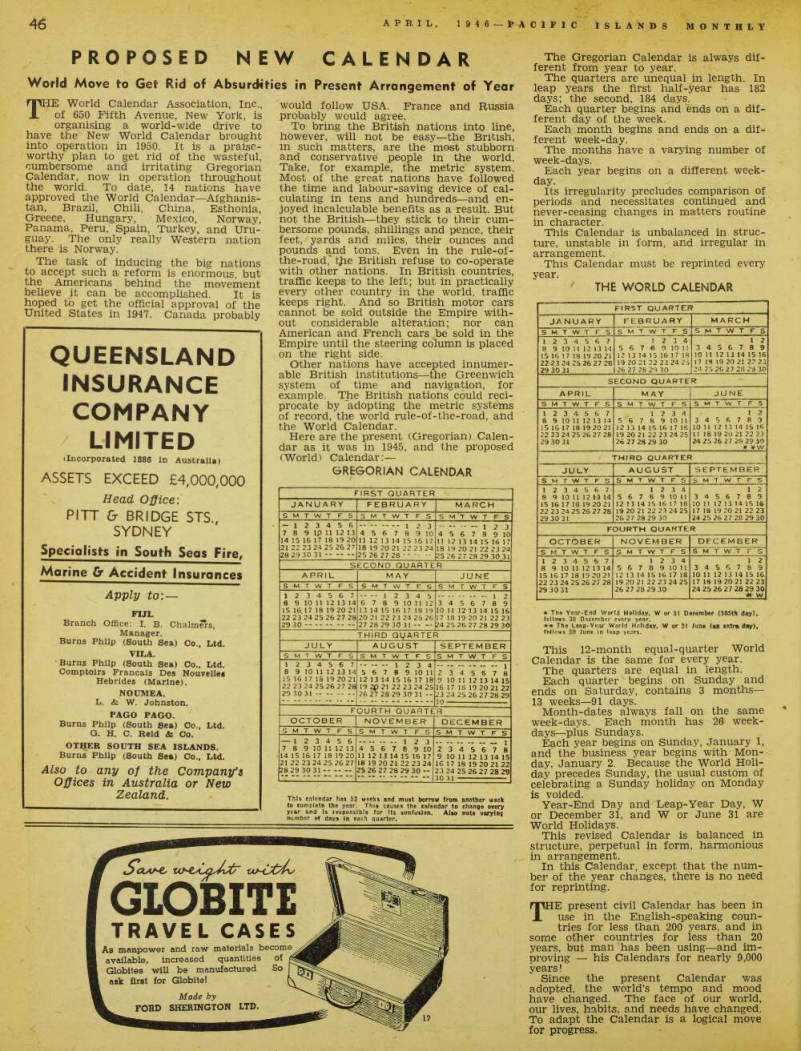
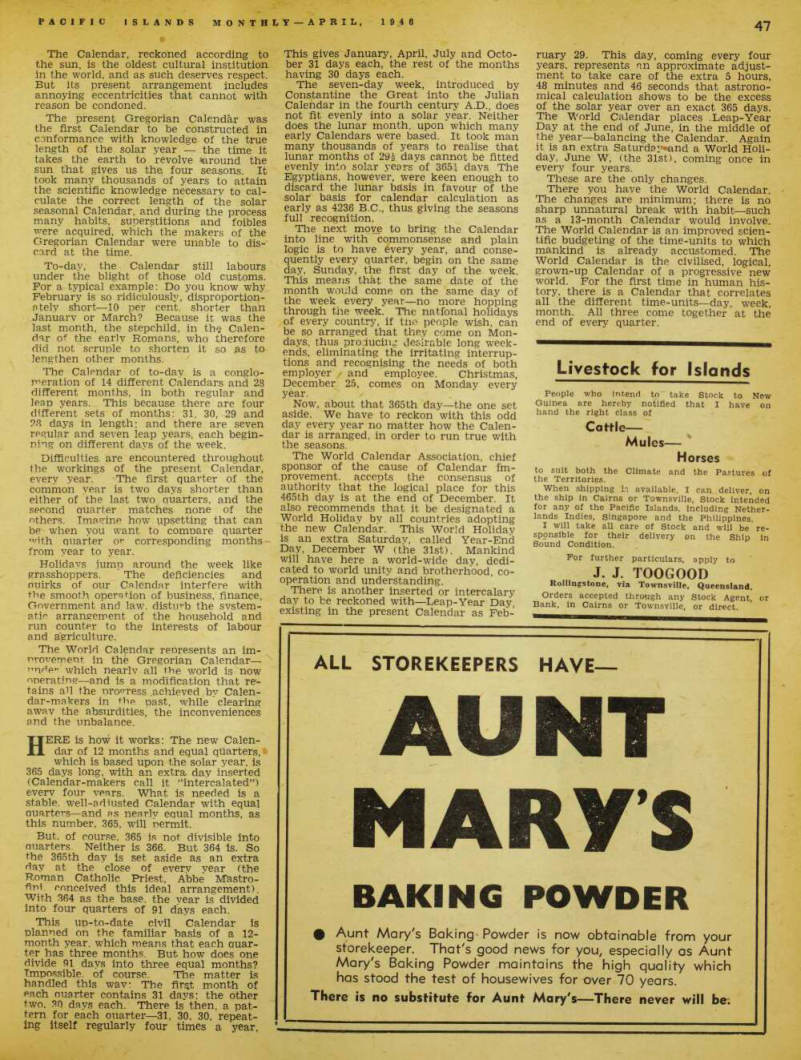
World Move to Get Rid of Absurdities in Present Arrangement of Year
fTIHE World Calendar Association, Inc., X of 650 Fifth Avenue, New York, is organising a world-wide drive to have the New World Calendar brought into operation in 1950. It is a praise worthy plan to get rid of the wasteful, cumbersome and irritating Gregorian Calendar, now in operation throughout the world. To date, 14 nations have approved the World Calendar —Afghanistan, Brazil, Chili, China, Esthonia, Greece. Hungary, Mexico, Norway, Panama, Peru, Spain, Turkey, and Uru guay. The only really Western nation there is Norway.
The task of inducing the big nations to accept such a reform is enormous, but the Americans behind the movement believe jt can be accomplished. It is hoped to get the official approval of the United States in 1947. Canada probably
would follow USA. France and Russia probably would agree.
To bring the British nations into line, however, will not be easy—the British, in such matters, are the most stubborn and conservative people in the world.
Take, for example, the metric system.
Most of the great nations have followed the time and labour-saving device of cal culating in tens and hundreds—and en joyed incalculable benefits as a result. But not the British—they stick to their cum bersome pounds, shillings and pence, their feet, yards and miles, their ounces and pounds and tons. Even in the rule-of the-road,' tjie British refuse to co-operate with other nations. In British countries, traffic keeps to the left; but in practically every other country in the world, traffic keeps right. And so British motor cars cannot be sold outside the Empire with out considerable alteration; nor can American and French cars be sold in the Empire until the steering column is placed on the right side.
Other nations have accepted innumer able British institutions—the Greenwich system of time and navigation, for example. The British nations could reci procate by adopting the metric systems of record, the world rule-of-the-road, and the World Calendar.
Here are the present (Gregorian) Calen dar as it was in 1945, and the proposed (World) Calendar:—
Gregorian Calendar
The Gregorian Calendar is always dif ferent from year to year.
The quarters are unequal in length. In leap years the first half-year has 182 days: the second, 184 days.
Each quarter begins and ends on a dif ferent day of the week.
Each month begins and ends on a dif ferent week-day.
The months have a varying number of week-days.
Each year begins on a different week day.
Its irregularity precludes comparison of periods and necessitates continued and never-ceasing changes in matters routine in character.
This Calendar is unbalanced in struc ture, unstable in form, and irregular in arrangement.
This Calendar must be reprinted every year.
The World Calendar
This 12-month equal-quarter World Calendar is the same for every year.
The quarters are equal in length.
Each quarter begins on Sunday and ends on Saturday, contains 3 months — 13 weeks —91 days.
Month-dates always fall on the same week-days. Each month has 26 week days—plus Sundays.
Each year begins on Sunday, January 1, and the business year begins with Mon day, January 2. Because the World Holi day precedes Sunday, the usual custom of celebrating a Sunday holiday on Monday is voided.
Year-End Day and Leap-Year Day, W or December 31, and W or June 31 are World Holidays.
This revised Calendar is balanced in structure, perpetual in form, harmonious in arrangement.
In this Calendar, except that the num ber of the year changes, there is no need for reprinting. fTTHE present civil Calendar has been in JL use in the English-speaking coun tries for less than 200 years, and in some other countries for less than 20 years, but man has been using—and im proving his Calendars for nearly 9,000 years !
Since the present Calendar was adopted, the world’s tempo and mood have changed. The face of our world, our lives, habits, and needs have changed.
To adapt the Calendar is a logical move for progress.
First Quarter
January
February
March
S M T W T F S S M T W T F S S M T W T F S - 1 2 3 4 5 6 7 8 9 IP 11 12 13 14 15 16 17 18 19 20 21 22 23 24 25 26 27 4 5 6 7 8 9 10 11 12 13 14 15 16 17 18 19 20 21 22 23 24 4 5 6 7 8 9 10 11 12 13 14 15 16 17 18 19 20 21 22 23 24 28 29 30 31 ** ** ** 25 26 27 28 25 26 27 28 29 30 31
Second Quarter
April
May
June
S M T W T F S S M T W T F S S M T W T F S 8 9 10 11 12 13 14 15 16.17 18 19 20 21 22 23 24 25 26 27 28 6 7 8 9 10 11 12 13 14 15 16 17 18 19 20 21 22 23 24 25 26 I 2 3 4 5 6 7 8 9 10 11 12 13 14 15 16 17 18 19 20 21 22 23 24 25 26 27 28 29 30
Third Quarter
July
August
September
S M T W T F S S M T W T F S S M T W T F S 1 2 3 4 5 6 7 8 9 10 11 12 13 14
Is 16 17 Is 19 2021
22 23 24 25 26 27 28| 29 30 31 -- -• -- -- 5 6 7 8 9 10 \ \ 12 13 14 15 16 17 18 19 2D 21 22 23 24 25 26 27 28 29 30 31 -- 2 3 4 5 6 7 8 9 10 11 12 13 14 15 16 17 18 19 20 21 22 23 24 25 26 27 28 29 30 F
Ourth Quarte
fl
October
November
December
S M T W T F S S M T W T F S S M T W T F S — 1 2 3 4 5 6 7 8 9 10 11 12 13 14 15 16 17 18 19 20 21 22 23 24 25 26 27 ~>q *)o in ■} i 4 5 6 7 8 9 10 11 12 13 14 15 16 17 18 19 20 21 22 23 24 25 26 27 28 29 30 — 2 3 4 5 6 7 8 9 10 11 12 13 14 15 16 17 18 19 20 21 22 23 24 25 26 27 28 29
To 42 Ju ** ”
This calendar has 52 to complete the year year and Is tespons number of days In e 1 weeks and must borro This causes the ealei Ible for Its confusion, ach Quarter. w from another week odar to change every Also note varylnt
First Quarter
January
February
March
S M T W T F S S M T W T F S S M T W T F S 1 2 3 4 5 6 7 8 9 10 11 12 13 14 IS 16 17 18 19 2021 22 23 24 2S 26 27 28 29 30 31 12 3 4 5 6 7 « 9 10 11 12 13 14 15 16 17 18 19 20 21 22 23 24 25 26 27 28 29 30 1 2 3 4 5 6 7 8 9 10 11 12 13 14 IS 16 17 19 19 20 21 22 23 24 25 26 27 28 29 30
Second Quarter
April
May
June
S M T W T F S S M T W T F S S M T W T F S 1 2 3 4 S 6 7 8 9 10 11 12 13 14 15 16 17 18 19 20 21 22 23 24 25 26 27 28 29 30 31 12 3 4 5 6 7 8 9 10 II 12 13 14 IS 16 17 18 19 20 21 22 23 24 25 26 27 28 29 30 1 2 3 4 5 6 7 8 9 10 11 12 13 14 IS 16 17 18 19 20 21 22 23 24 25 26 27 28 2930 » * W
Third Quarter
July
August
September
S M T W T F S S M T W T F S S M T W T F s 1 2 3 4 5 6 7 S 9 10 11 12 13 14 15 16 17 18 19 20 21 22 23 24 25 26 27 28 29 30 31 12 3 4 5 6 7 8 9 10 11 12 13 14 15 16 17 18 19 20 21 22 23 24 25 26 27 28 29 30 1 2 3 4 5 6 7 8 9 10 11 12 11 14 15 16 17 18 19 20 21 22 23 24 25 26 27 28 29 30
Fourth Quarter
October
November
December
S M T W T F S S M T W T F S S M T W T F S 1 2 3 4 5 6 7 8 9 10 11 12 13 14 15 16 17 18 19 20 21 22 23 24 25 26 27 28 29 30 31 12 3 4 5 6 7 8 9 10 11 12 13 14 IS 16 17 18 19 20 21 22 23 24 25 26 27 28 29 30 1 2 3 4 5 6 7 8 9 10 11 12 13 14 15 16 17 18 19 20 21 22 23 24 25 26 27 28 29 30 W * The Year-End World Holiday, W or 31 December (365th day). follows 30 December every year. ** The Leap-Year World Holiday. W or 31 June (an extra day), follows 3b June in leap years.
The Calendar, reckoned according to the sun, is the oldest cultural institution in the world, and as such deserves respect.
But its present arrangement includes annoying eccentricities that cannot with reason be condoned.
The present Gregorian Calendar was the first Calendar to be constructed in conformance with knowledge of the true length of the solar year the time it takes the earth to revolve Ground the sun that gives us the four seasons. It took many thousands of years to attain the scientific knowledge necessarv to cal culate the correct length of the solar seasonal Calendar, and during the process many habits, superstitions and foibles were acquired, which the makers of the Gregorian Calendar were unable to dis card at the time.
To-day, the Calendar still labours under the blight of those old customs.
For a typical example: Do you know why February is so ridiculously, disproportion ately short—lo per cent, shorter than January or March? Because it was the last month, the stepchild, in the Calen dar of the early Romans, who therefore did not scruple to shorten it so as to lengthen other months.
The Calendar of to-day is a conglo meration of 14 different Calendars and 28 different months, in both regular and leap years. This because there are four different sets of months: 31, 30, 29 and 28 days in length; and there are seven regular and seven leap years, each begin ning on different days of the week.
Difficulties are encountered throughout the workings of the present Calendar, every year. The first quarter of the common year is two days shorter than either of the last two quarters, and the second quarter matches none of the others. Imagine how upsetting that can be when you want to comnare quarter with quarter or corresponding months from year to year.
Holidays jump around the week like grasshoppers. The deficiencies and ouirks of our Calendar interfere with the smooth operation of business, finance, Government and law. disturb the system atic arrangement of the household and run counter to the interests of labour and agriculture.
The World Calendar reoresents an im provement in the Gregorian Calendar— unde** which nearly all th e world is now operating—and is a modification that re tains all the nrovress .achieved by Calen dar-makers in the past, while clearing away the absurdities, the inconveniences and the unbalance.
HERE is how it works: The new Calen dar of 12 months and equal quarters, which is based upon the solar year, is 365 days long, with an extra, day inserted (Calendar-makers call it “intercalated”) every four years. What is needed is a stable, well-adiusted Calendar with equal Quarters—and as nearly equal months, as this number, 365, will permit.
But. of course, 365 is not divisible into Quarters. Neither is 366. But 364 is. So the 365th day is set aside as an extra day at the close of every vear (the Roman Catholic Priest, Abbe Mastro firn. conceived this ideal arrangement).
With 364 as the base, the vear is divided into four quarters of 91 days each.
This up-to-date civil Calendar is planned on the familiar basis of a 12month year, which means that each Quar ter has three months. But how does one divide 91 days into three equal months?
Impossible, of course. The matter is handled this wav: The first month of each Quarter contains 31 days: the other two. 30 days each. There is then, a pat tern for each Quarter—3l, 30, 30, repeat ing itself regularly four times a year.
This gives January, April, July and Octo ber 31 days each, the rest of the months having 30 days each.
The seven-day week, introduced by Constantine the Great into the Julian Calendar in the fourth century A.D., does not fit evenly into a solar year. Neither does the lunar month, upon which many early Calendars were based. It took man many thousands of years to realise that lunar months of 29i days cannot be fitted evenly into solar years of 365 i days The Egyptians, however, were keen enough to discard the lunar basis in favour of the solar basis for calendar calculation as early as 4236 8.C., thus giving the seasons full recognition.
The next move to bring the Calendar into line with commonsense and plain logic is to have every year, and conse quently every quarter, begin on the same day, Sunday, the first day of the week.
This means that the same date of the month would come on the same day of the week every year—no more hopping through the week. The natfonal holidays of every country, if the people wish, can be so arranged that they come on Mon days, thus producing desirable long week ends, eliminating the irritating interrup tions and recognising the needs of both employer and employee. Christmas, December 25, comes on Monday every year.
Now, about that 365th day—the one set aside. We have to reckon with this odd day every year no matter how the Calen dar is arranged, in order to run true with the seasons.
The World Calendar Association, chief sponsor of the cause of Calendar im provement. accepts the consensus of authority that the logical place for this 465th day is at the end of December. It also recommends that it be designated a World Holiday bv all countries adopting the new Calendar. This World Holiday is an extra Saturdav, called Year-End Day, December W (the 31st). Mankind will have here a world-wide day, dedi cated to world unity and brotherhood, co operation and understanding.
There is another inserted or intercalary day to be reckoned with—Leap-Year Day existing in the present Calendar as Feb
ruary 29. This day, coming every four years, represents an approximate adjust ment to take care of the extra 5 hours, 48 minutes and 46 seconds that astrono mical calculation shows to be the excess of the solar year over an exact 365 days.
The World Calendar places Leap-Year Day at the end of June, in the middle of the year—balancing the Calendar. Again it is an extra Saturdayiand a World Holi day, June W, (the 31st), coming once in every four years.
These are the only changes.
There you have the World Calendar.
The changes are minimum; there is no sharp unnatural break with habit—such as a 13-month Calendar would involve.
The World Calendar is an improved scien tific budgeting of the time-units to which mankind is already accustomed. The World Calendar is the civilised, logical, grown-up Calendar of a progressive new world. For the first time in human his tory, there is a Calendar that correlates all the different time-units—day, week, month. All three come together at the end of every quarter.
Advertisements & other items, pp. 48-49 (1 item)
Gloeite
QUEENSLAND
INSURANCE
COMPANY
LIMITED
(Incorporated 1886 In Australia)
ASSETS EXCEED £4,000,000
Head Office:
PITT & BRIDGE STS.,
SYDNEY
Speciolists in South Seos Fire,
Marine & Accident Insurances
Apply to:—
FIJI.
Branch Office: I. B. Chalmers, Manager.
Burns Phllp (South Sea) Co., Ltd.
VILA.
Burns Philp (South Sea) Co., Ltd.
Comptoirs Francals Des Nouvelle* Hebrides (Marine).
NOUMEA.
L. & W. Johnston.
PAGO PAGO.
Burns Philp (South Sea) Co-, Ltd.
G. H, C. Reid & Co.
OTHER SOUTH SEA ISLANDS.
Burns Philp (South Sea) Co., Ltd.
Also to any of the Company’s Offices in Australia or New Zealand.
«sa/(Ae
GLOEITE
TRAVEL CASES
As manpower and raw materials become available, increased quantities of Globites will be manufactured So ask first for Globite!
Made by
FORD SHERINGTON LTD.
Livestock for Islands
People who intend to take Stock to New Guinea are hereby notified that I have on hand the right class of
Cattle—
Mules—
Horses
to suit both the Climate and the Pastures of the Territories.
When shipping available, I can deliver, on the ship in Cairns or Townsville, Stock Intended for any of the Pacific Islands, Including Netherlands Indies, Singapore and the Philippines.
I will take all care of Stock and will be responsible for their delivery on the Ship In Sound Condition.
For further particulars, apply to
J. J. TOOGOOD
Rollingstone, via Townsville, Queensland.
Orders accepted through any Stock Agent, or Bank, in Cairns or Townsville, or direct.
ALL STOREKEEPERS HAVE—
AUNT
MARYS
BAKING POWDER
Aunt Mary's Baking Powder is now obtainable from your storekeeper. That's good news for you, especially as Aunt Mary's Baking Powder maintains the high quality which has stood the test of housewives for over 70 years.
There is no substitute for Aunt Mary's—There never will be.
Death Of Samoa's Oldest
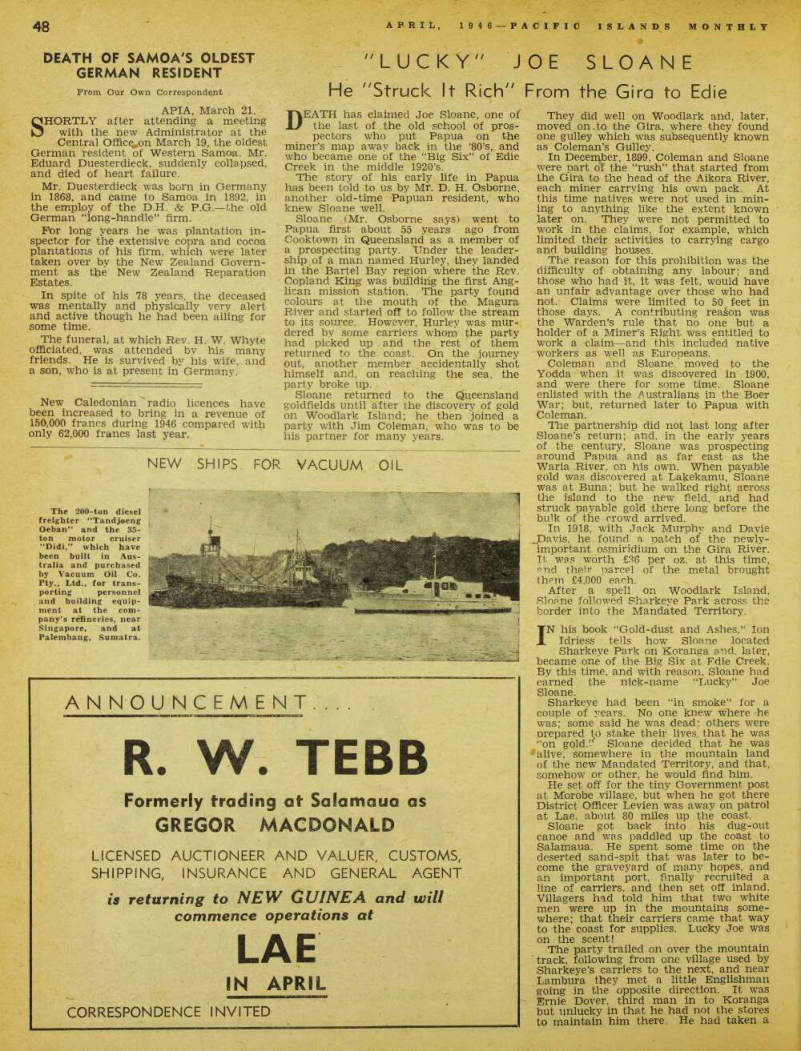
German Resident
From Our Own Correspondent APIA, March 21.
SHORTLY after attending a meeting with the new Administrator at the Central Officq,on March .19, the oldest German resident of Western Samoa. Mr.
Eduard Duesterdieck. suddenly collapsed, and died of heart failure.
Mr. Duesterdieck was born in Germany in 1868, and came to Samoa in 1892, in the employ of the D.H. & P.G.—the old German “long-handle” firm.
For long years he was plantation in spector for the extensive copra and cocoa plantations of his firm, which were later taken over by the New Zealand Govern ment as the New Zealand Reparation Estates.
In spite of his 78 years, the deceased was mentally and physically very alert and active though he had been ailing for some time.
The funeral, at which Rev. H. W. Whyte officiated, was attended by his many friends. He is survived by his wife, and a son, who is at present in Germany.
New Caledonian radio licences have been increased to bring in a revenue of 150,000 francs during 1946 compared with only 62,000 francs last year.
New Ships For Vacuum Oil
The 200-ton diesel freighter “Tandjoeng Oeban” and the 35ton motor cruiser “Didi,” which have been built in Aus tralia and purchased by Vacuum Oil Co.
Pty., Ltd., for trans porting personnel and building equip ment at the com pany’s refineries, near Singapore, and at Palembang, Sumatra.
"Lucky" Joe Sloane
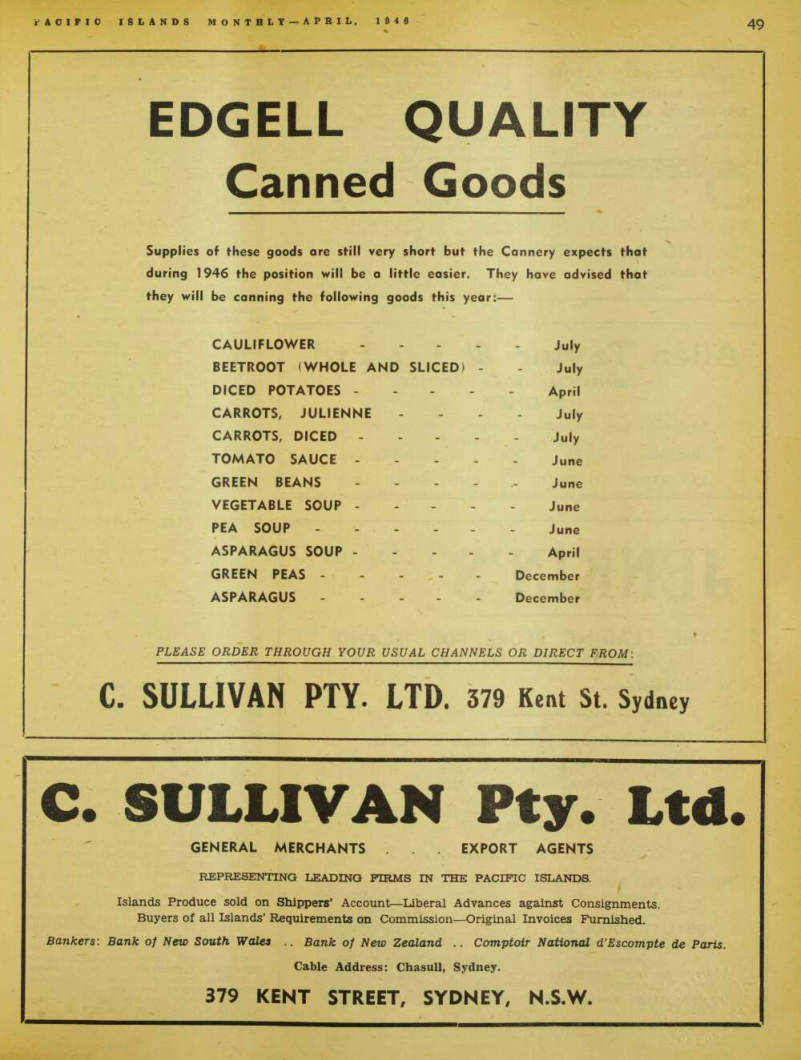
He "Struck It Rich" From the Giro to Edie
DEATH has claimed Joe Sloane, one of the last of the old school of pros pectors who put Papua on the miner’s map away back in the ’Bo’s, and who became one of the “Big Six” of Edie Creek in the middle 1920’5.
The story of his early life in Papua has been told to us by Mr. D. H. Osborne, another old-time Papuan resident, who knew Sloane well.
Sloane (Mr. Osborne says) went to Papua first about 55 years ago from Cooktown in Queensland as a member of a prospecting party. Under the leader ship of a man named Hurley, they landed in the Bartel Bay region where the Rev.
Copland King was building the first Ang lican mission station. The party found colours at the mouth of the Magura River and started off to follow the stream to its source. However, Hurley was mur dered by some carriers whom the party had picked up and the rest of them returned to the- coast. On the journey out, another member accidentally shot himself and, on reaching the sea, the party broke up.
Sloane returned to the Queensland goldfields until after the discovery of gold on Woodlark Island; he then joined a party with Jim Coleman, who was to be his partner for many years.
They did well on Woodlark and, later, moved on. to the Gira, where they found one gulley which was subsequently known as Coleman’s Gulley.
In December, 1899, Coleman and Sloane were part of the “rush” that started from the Gira to the head of the Aikora River, each miner carrying his own pack. At this time natives were not used in min ing to anything like the extent known later on. They were not permitted to work in the claims, for example, which limited their activities to carrying cargo and building houses.
The reason for this prohibition was the difficulty of obtaining any labour; and those who had it, it was felt, would have an unfair advantage over those who had not. Claims were limited to 50 feet in those days. A contributing reason was the Warden’s rule that no one but a holder of a Miner’s Right was entitled to work a claim—and this included native workers as well as Europeans.
Coleman and Sloane moved to the Yodda when it was discovered in 1900, and were there for some time. Sloane enlisted with the Australians in the Boer War; but, returned later to Papua with Coleman.
The partnership did not last long after Sloane’s return; and, in the early years of the century, Sloane was prospecting around Papua and as far east as the Waria .River, on his own. When payable gold was discovered at Lakekamu, Sloane was at Buna; but he walked right across the island to the new field, and had struck payable gold there long before the bulk of the crowd arrived.
In 1918, with Jack Murphy and Davie JDavis. he found a patch of the newly important osmiridiurh on the Gira River.
It was worth £B6 per oz. at this time, and their parcel of the metal brought them £4,000 each.
After a spell on Woodlark Island, Sloane followed Sharkeye Park across the border into the Mandated Territory.
IN his book “Gold-dust and Ashes,” lon Idriess tells how Sloane located Sharkeye Park on Koranga and. later, became one of the Big Six at Fdie Creek.
By this time, and with reason, Sloane had earned the nick-name “Lucky” Joe Sloane.
Sharkeye had been “in smoke” for a couple of years. No one knew where he was; some said he was dead: others were prepared to stake their lives, that he was “on gold.”* Sloane decided that he was alive, somewhere in the mountain land of the new Mandated Territory, and that, somehow or other, he would find him.
He set off for the tiny Government post at Morobe village, but when he got there District Officer Levien was away on patrol at Lae, about 80 miles up the coast.
Sloane got back into his dug-out canoe and was paddled up the coast to Salamaua. He spent some time on the deserted sand-spit that was later to be come the graveyard of many hopes, and an important port, finally recruited a line of carriers, and then set off inland.
Villagers had told him that two white men were up in the mountains some where; that their carriers came that way to the coast for supplies. Lucky Joe was on the scent!
The party trailed on over the mountain track, following from one village used by Sharkeye’s carriers to the next, and near Lambura they met a little Englishman going in the opposite direction. It was Ernie Dover, third man in to Koranga but unlucky in that he had not the stores to maintain him there. He had taken a
job with Sharkeye, and was then on his way to the coast for stores.
Sloane pushed on across the Bulolo River, and came at last to Koranga Creek —and there found Nettleton and Shark eye, and their camp, where they stored gold, casually, in innumerable meat-tins.
Lucky Joe tried the stream above Sharkeye’s claim, and got gold in the first dish. He then hurried off down to the coast again, and up the Markham River, where he recruited a dozen boys and signed them on for two years’ service.
District Officer Levien was by then keenly interested; but he was ill, and went south, and the secret of Koranga was kept for a further seven months, while Sharkeye, Nettleton and Sloane and their teams of boys worked the golden creek. Idriess describes it in this way; “As soon as a meat-tin became empty it was filled with gold. Gold was lying everywhere about the camps; tins of it, bags of it, and then boxes of it; shovel -
fuls of pure gold could be dug out of those boxes.”
But this was not the end of Joe Sloane’s luck. Over two years later, Bill Royal and Dick Glasson, driven desper ate by the fact that other men were on gold while their fortunes steadily dwindled, set out from Koranga up Mount Kaindi, determined to find another gold field, richer if possible than Koranga.
And such is the luck of this game, that they found just that, after the herculean task of climbing 4,000 feet up the un tracked mountain into the mists. Their discovery was Edie Creek, where ground went ounces to the dish, where gold was entangled in the tree roots and studded the creek beds. It was said that they could dig out a shovelful of dirt any where along the creek bed—and get an ounce of gold on the shovel blade.
A few days after their discovery, Royal went down to Koranga Creek to acquaint the chosen few—and the first man he told was Lucky Joe Sloane. Sloane did not wait; he went straight up to Edie.
The party which later became known as the Big Six of Edie consisted of Bill Royal, Dick Glasson, Frank Chisholm, Albert Royal, Joe Sloane and Bill Money, On their first day’s work there they got nearly 70 ounces, with a team of six boys.
Later, the boxes returned anything up to 280 ounces per day. Edie Creek was a small alluvial field, phenomenally rich; its inacessibility gave fortunes to the for tunate few who were able to get in early.
After Sloane had had what he wanted of Morobe’s gold, he retired from the mining life. He had been living in re tirement in southern Queensland for many years before his death on March 7.
Advertisements & other items, pp. 50-52 (2 items)
R. W. Tebb
ANNOUNCEMENT
Formerly trading at Salamauo as
GREGOR MACDONALD
LICENSED AUCTIONEER AND VALUER, CUSTOMS,
SHIPPING, INSURANCE AND GENERAL AGENT
is returning to NEW GUINEA and will commence operations at
LAE
IN APRIL
CORRESPONDENCE INVITED
C. Sullivan Pty. Ltd.
t
GENERAL MERCHANTS . EXPORT AGENTS
REPRESENTING LEADING FIRMS IN THE PACIFIC ISLANDS. f Islands Produce sold on Shippers’ Account—Liberal Advances against Consignments.
Buyers of all Islands’ Requirements on Commission—Original Invoices Furnished.
Bankers'. Bank of New South Wales .. Bank of New Zealand .. Comptoir National d’Escompte de Paris.
Cable Address: Chasull, Sydney.
379 KENT STREET, SYDNEY, N.S.W.
Your old SCISSORS, RAZORS
and KNIVES can be
SHARPENED and REPAIRED
Send them
W. JNO. BAKER ES:
3 HUNTER STREET,
SYDNEY.
Allen Taylor & Co. Ltd.
COMMERCIAL ROAD, ROZELLE,
SYDNEY
Sowmillers and Wholesale Suppliers of Hardwoods for Constructional Purposes GIRDERS . . . PILES . . . POLES . . . SLEEPERS, Etc.
EXPORTING TO PACIFIC ISLANDS SINCE 1893
JENKIN’S
BOX 100
SUVA, FIJI
THE LEADING STORE FOR ISLAND
CURIOS AND SOUVENIRS
We can supply— Tortoiseshell Goods in bracelets, necklets, brooches.
Tortoiseshell Watch-Bands—made to measure.
Tortoiseshell, with "Cat's Eye" Mountings, in bracelets, necklets, brooches, ear drops.
"Cat's Eyes" set in Silver Filigree, in sets of necklace and bracelet.
We can also supply Tappa Cloth.
Fiji-made Novelties in Large Variety.
QUALITY GOODS AT
REASONABLE PRICES
Write for Our Descriptive Catalogue.
We Will Gladly Forward One.
"Enemy Alien" Missionaries
lAM somewhat bewildered as to why some of your readers keep on pick ing at the so-called “enemy alien” missionaries.
According to the PI Yearbook there were 676 missionaries working in the TNG in 1940. Out of this number 374 were of German nationality—which does not mean that they were Nazi partisans, but rather refugees. It is also a fact that no other community sacrificed so many lives for and in TNG than this mission body, staffed mainly by “enemy aliens.”
If these missionaries returned to their home countrv they were threatened by the Nazis with a slow death in concen tration camps, for having loyally sup ported the policy of the Mandated Terri tory Government. On the other hand, because they stayed on, the Japs regarded them as spys of the US Army. The Jap argument was: “If the missionaries (of German nationality) had been regarded as enemy aliens, then they would have been evacuated and interned at the begin ning of the war. That they are left at the battlefront proves their value to the Allies for military purposes.”
And so no less than 180 of the RC Mis sion staff died by Japanese bullets and bayonets, by torture and starvation, or by being exposed to US bombing and strafing. They got it both ways.
I have wondered why the misssionaries who were killed were not included in the list of honour, published as a supplement to January “PIM.” Or is it believed that because they were mostly taken up with the spiritual welfare of the natives they made no other contribution to the com mon welfare of Territorians and natives?
Is there a single case where an enemy alien missionary has been convicted of conspiracy with the Japanese?
Let us build a better world with a fair
deal to all who deserve it.-
Pat.
Advertisements & other items, p. 52 (1 item)
50
APRIL, 1946 HCIHC ISLANDS MONIHLt
In Defence of Levuka

An Open Letter to Judy Tudor
WE read with great interest all you have had to say about Levuka in November “PIM,” but sorry that you apparently did not see your friend “Joe” again after he dumped you and poor little Pat in the middle of your baggage at the hotel. Doubtlessly, if you had, he would have taken you to the Catholic Mission station, Cawaci, at the northern end of our coastal road, where you would have seen one of the biggest and best conducted missions in Fiji. Also, he would have probably taken you to the southern end of the road to view the Ovalau pineapple factory, which also would no doubt have proved interesting to you.
Apparently also you missed seeing our local sports field (Nasau Park) and the bowling green (no doubt through your in ability to walk owing to the piece of your heel you left on the reef at Lodoni), for I feel sure if you had seen them you would doubtlessly have commented on them. Also our .Queen Victoria Memorial Town Hall, and Masonic Lodge, both of which would do credit to tovvns many times the size of Levuka, as also would the Levuka Convent which is just around the corner, a two-storied building with spacious well-kept grounds, staffed with seven European teachers. We also rather pride ourselves on our Ovalau European Club, the first of its kind founded in Fiji.
What a shame you didn’t meet Mr.
“Bob” Lepper and Mr. “Bill” Chapman, and a few more of our “Zombies,” from whom you would have got a wealth of in formation about Levuka and Fiji. The former, a retired planter, is one of the oldest and best-known European pioneers in Fiji, and is now over 90, and the latter is our local town clerk—a mere lad of 82 or 83 years of age—who is marvel lously alert and efficient in his job, and writes a hand which would do credit to a man 50 years younger. Both men came to Fiji when lads.
It seems unfortunate that you should conclude your article with such a refer ence as “four European children” at the Levuka Public for such lack of tact cannot help but cause many pin pricks, which we for ever try to avoid.
We also hope that you will come back to see us some day, and be able to spend more time in our midst, and don’t for get to bring your sandshoes to wear when you are wading out at Lodoni—or maybe you won’t need them, because the Gov ernment may have built that jetty by then, which they have promised us for the last 25 years.
I’ll also see George Thompson, and see he doesn’t allow the children to sing “Waltzing Matilda” when you visit the school. I think that was very unkind of him. It’s bad enough having to wade in the Lodoni billabong with your “bluey” without singing about it.
I am, etc.,
Bob B. Browne.
Levuka, Fiji, December 13, 1945.
Note:
fT\HE way these perambulating she- X journalists babble! The one-day tourists!
But methinks, old pal, that you have been too long in the bush, and have be come over-sensitive concerning things the Great Big World doesn’t care about any more. But if it makes you happy, then I apologise to the four European children about whom I made the “unfortunate” remark. To their parents, also —but since
when, for Pete’s sake, has it been con sidered a disgrace to have European
parents?'
Judy Tudor.
Mr. Edgar Wright, of Suva, Fiji, who won one of the five Nuffield research scholarships awarded in the Colonial Empire in 1945, left the Colony in Feb ruary for Sydney. He was on the staff of the research and laboratories division of the Deoartment of Agriculture in Fiji, and he will study chemistry at the Uni versity of Sydney.
A strange accident recently occurred on the beach at Gadji, about 20 miles from Noumea. Some native children were boil ing crabs in a petrol can when there was an explosion which severely wounded one of them, who later had a hand ampu tated. Though the nature of the explo sion is not known, it was probably a war relic buried in the ground.
Mission boys at Dogura (New Guinea), have sent through their minister, the Rev. J. D. Bodger, another £5 to the Food for Britain Fund. This is their second gift to the Sydney fund.
Advertisements & other items, pp. 53-55 (4 items)
Orrugated Cans
MADE TO STAND HARD WEAR
THE CORRUGATED UTILITY CAN
of a type used in U.S.A. for many years—with maximum p strength at vital points to withstand hard wear.
Il Ideal for use in the HOME,
v FARM, or BUSINESS
PREMISES as Garbage receptacles, Storage Bins for cereals, food-stuffs, grain, cattle fodder and poultry feed. Undent and vermin proof .
AVAILABLE IN 10, 16, 24
and 32 gals, sizes from leading hardware stores.
c/er/lcA
ORRUGATED CANS
U UTILITY CANS TOR GtNtRAL USE
FOODSTUFFS...
We offer you . . . ■ The use of our buying organisation. Through us you may order any type of goods, from Foodstuffs to Machinery. W e welcome your inquiries. ■ Our personal attention to orders from companies or individuals. ■ A 11 perishable products sealed in airtight containers.
SERVICE
FOR THE
ISLANDS
Knowing your need we aim at fulfilling it . . . Let us help with your supply problems and avail yourself of our
EFFICIENT
HANDLING
AND
SWIFT DESPATCH.
Write or call:
APRIL
SPECIAL:
CREAM
IN
POWDER
FORM.
Packed in 4 oz., 1 lb., 2 lb., 5 lb. and 10 lb. tins.
No trouble to mix.
QUALITY
A. 0. SHEPHARD
Telephones: General Merchant and Exporter Code Address: MA 8179 379 KENT STREET “Chrisshep"
MA1142 SYDNEY Sydney
The Twinkle in
Your Eye
COMES FROM ACTIVE
DIGESTION
Good normal digestive and liver activity means good, normal health and fitness. If you are becoming gloomy and feel tired out, the cause may be a congested state of your intestinal tract. So many people are troubled with constipation, which, through the retention of waste in the digestive system, causes sick headache, biliousness, pimply skin, unpleasant breath, irritability, slackness and dull eyes.
Regain your bright and attractive appearance by banishing constipation with Pinkettes. Tiny, perfectly harmless, gentle yet effective, these famous laxative and liver pills painlessly exercise and strengthen the bowels, keep the food tract clean and active, stir the liver, and thus banish sick headache, bilious attacks, pimples, unpleasant breath and gloom. All chemists and stores sell Pinkettes, the perfect laxative and liver pills.
Ison t iay (Jin ..
lit
★ LIQUEURS ★ COCKTAILS ★ WHISKIES
Address all enquiries to:
W. fir A. GILBEY LTD.,
33 ROSSLYN STREET, WEST MELBOURNE.
Telegraphic and Cable Address: "Gilbey's," Melbourne.
109 REGENT STREET, SYDNEY.
Telegraphic and Cable Address: "Gilbey's," Sydney.
OLF.I tA
Lissmssa ***£>•
INTRODUCING POLYNESIA
An Excellent New Reference Book by Peter H. Buck
/\NE of the best reference books on ” Polynesia yet published has re „ cently come from the Bishop Museum Press in Honolulu.
It is the outcome of the occupation of Micronesia and other Pacific territories by United States forces and by the set
s'ocietle? D
ve »°" to research fn he
LiSSMSSa ***£>•
“appraisal” of anthropologyinPolynesia?
The appraisal was more than the Committee actually required and the Bishop Museum decided to publish the material independently as a contribution £ survey, Called “An Introduction to Polynesian Anthropology” it goes even further than title indicates and is a first-class refer cnee book on the history and geography of the Polynesian islands, from Easter to New Zealand, and including the Polyne sian outliers in Melanesia.
Following an introduction on Polynesia in general and the Polynesian people, their origin as far as it is possible to ascertain this, and their voyages, his tory and culture up until the first Euro peans came into the Pacific, there is a brief but comprehensive account of each of the early European explorers who dis covered these islands.
Later in the book, the journals of these early voyagers are listed in chronological order. rERE is much to be learned, says Buck, from the published journals of the early voyagers, and although there is always the possibility of errors and exaggerations, they contain first hand information of the culture of the Polynesians as they were in those days.
Of the journals left by early navigators, those of Cook are the most outstanding.
The first settlers usually fugitives from justice or castaway seamen—were unproductive of any literary work, with the exception of Mariner whose life in Tonga, recorded by Dr. John Martin, has become the standard classical work on the Group.
Traders who came later were hardly more productive in the literary sense than the castaways, although a book by Lament on Penrhyn is described, by Buck, as “good.” A fair amount of source material has been gleaned—after religious details are omitted—from the writings of the missionaries and a list of the best missionary writers is given.
Government officials who followed the castaways, the missionaries and the traders, have not, as a general rule, been given to penetrating observation or of writing of what they saw, but those excep tions have been included in Buck’s list of Pacific writers which, in its entirety, in cludes practically everything worthwhile that has even been written about the Polynesians or their islands. mHERE are short descriptions of the X various societies whose purpose it is to study Pacific islands and a comprehensive study of each of the many field expeditions to the different groups of Polynesia which have been undertaken in modern timete.
At the end of the volume, individual groups and islands are dealt with. Com mencing with Easter Island in the far east, and then working west; recommenc ing in the north and then working south, a brief outline of the history and culture of each island is given, followed by a selected list of the literature available on the subject.
Students of Polynesia, and all writers, will find this latest Bishop Museum pro duction invaluable fqr reference purposes, as well as easy and interesting reading.
It is issued as “Bulletin 187” and pre sumably may be purchased direct from the Museum. == " '~5 —‘ Noumea is awaiting its first consign ment of French wines, liqueurs and per fumes since 1940. It is expected about the beginning of May, by the “Sagittaire,” from Marseilles. The vessel is expected to bring also a large number of officials for the New Caledonian Administration to replace those who were ousted because of Vichy sympathies, those who have retired, died, or otherwise left.
At present acting as Assistant Colonial Secretary in Fiji is Mr. P. D. McDonald, who has recently been transferred to the WPHC after a period of secondment in Trinidad and Tobago.
53
TERRITORIANS RETURN
(Continued from Page 12)
PACIFIC ISLANDS MONTHLY APRIL, 1946
A. B. Donald Ltd.
Primrose Trading Co.
IMPORTERS—EXPORTERS
PRIMROSE BUILDING,
255 a GEORGE STREET, SYDNEY.
Cable Address: Woolaustral.
Importers of Island Products and Curios Exporters of All Classes Produce and Manufactured Goods Inquiries Solicited.
BANKERS: National Bank of Australasia, Ltd., Head Office, Sydney.
Comptoir National d’Escompe de Paris, Sydney.
THE
YORKSHIRE
INSURANCE
CO. LTD.
(Incorporated in England)
FIRE
ACCIDENT
MARINE
FIRE POLICIES ISSUED
IN PAPUA
All information from —
E. A. JAMES.
TeL 86347. Attorney for Papua, 14 Spring; St., Sydney.
A. B. DONALD Ltd.
AUCKLAND
ISLAND TRADERS & GENERAL MERCHANTS
P O. Box 1509. Cables b Telegrams, ''Kingdom", Auckland
Overseas Trade Destroyed
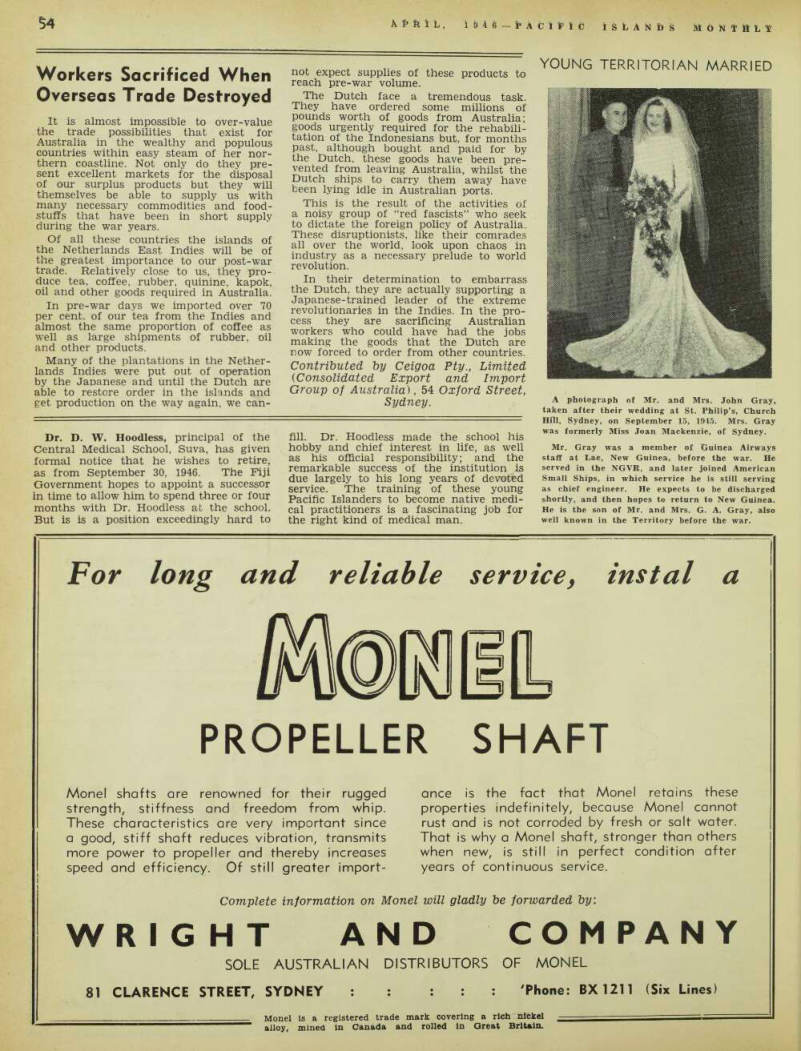
Workers Sacrificed When Overseas Trade Destroyed
It is almost impossible to over-value the trade possibilities that exist for Australia in the wealthy and populous countries within easy steam of her nor thern coastline. Not only do they pre sent excellent markets for the disposal of our surplus products but they will themselves be able to supply us with many necessary commodities and food stuffs that have been in short supply during the war years.
Of all these countries the islands of the Netherlands East Indies will be of the greatest importance to our post-war trade. Relatively close to us, they pro duce tea, coffee, rubber, quinine, kapok, oil and other goods required in Australia.
In pre-war days we imported over 70 per cent, of our tea from the Indies and almost the same proportion of coffee as well as large shipments of rubber, oil and other products.
Many of the plantations in the Nether lands Indies were put out of operation by the Japanese and until the Dutch are able to restore order in the islands and get production on the way again, we can
not expect supplies of these products to reach pre-war volume.
The Dutch face a tremendous task.
They have ordered some millions of pounds worth of goods from Australia; goods urgently required for the rehabili tation of the Indonesians but, for months past, although bought and paid for by the Dutch, these goods have been pre vented from leaving Australia, whilst the Dutch ships to carry them away have been lying idle in Australian ports.
This is the result of the activities of a noisy group of “red fascists” who seek to dictate the foreign policy of Australia.
These disruptionists, like their comrades all over the world, look upon chaos in industry as a necessary prelude to world revolution.
In their determination to embarrass the Dutch, they are actually supporting a Japanese-trained leader of the extreme revolutionaries in the Indies. In the pro cess they are sacrificing Australian workers who could have had the jobs making the goods that the Dutch are now forced to order from other countries.
Contributed by Ceigoa Pty., Limited
(Consolidated Export and Import Group of Australia ), 54 Oxford Street,
Sydney.
Dr. D. W. Hoodless, principal of the Central Medical School, Suva, has given formal notice that he wishes to retire, as from September 30, 1946. The Fiji Government hopes to appoint a successor in time to allow him to spend three or four months with Dr. Hoodless at the school.
But is is a position exceedingly hard to
fill. Dr. Hoodless made the school his hobby and chief interest in life, as well as his official responsibility; and the remarkable success of the institution is due largely to his long years of devoted service. The training of these young Pacific Islanders to become native medi cal practitioners is a fascinating job for the right kind of medical man.
Young Territorian Married
A photograph of Mr. and Mrs. John Gray, taken after their wedding at St. Philip’s, Church Hill, Sydney, on September 15, 1945. Mrs. Gray was formerly Miss Joan Mackenzie, of Sydney.
Mr. Gray was a member of Guinea Airways staff at Lae, New Guinea, before the war. He served in the NGVR, and later joined American Small Ships, in which service he is still serving as chief engineer. He expects to be discharged shortly, and then hopes to return to New Guinea.
He is the son of Mr, and Mrs. G. A. Gray, also well known in the Territory before the war.
Advertisements & other items, p. 56 (2 items)
54
Af»& i l , iMe-HciFic isLANbs MONittLt
/item
For long and reliable instal a
PROPELLER SHAFT
Monel shafts are renowned for their rugged strength, stiffness and freedom from whip.
These characteristics are very important since a good, stiff shaft reduces vibration, transmits more power to propeller and thereby increases speed and efficiency. Of still greater importance is the fact that Monel retains these properties indefinitely, because Monel cannot rust and is not corroded by fresh or salt water.
That is why a Monel shaft, stronger than others when new, is still in perfect condition after years of continuous service.
Complete information on Monel will gladly be forwarded by:
WRIGHT AND COMPANY
SOLE AUSTRALIAN DISTRIBUTORS OF MONEL
81 CLARENCE STREET, SYDNEY : : : : : 'Phone: BX 1211 (Six Lines) Monel is a registered trade mark covering a rich nickel 1 ——— alloy> m i n ed m Canada and rolled in Great Britain.
Fiji Tax Clearances
rPHE second (February) issue of “Fiji X Information” (a pamphlet issued by the Fiji Public Relations Office) re minds residents of the Colony that it is now necessary to obtain a tax clearance certificate before leaving Fiji.
This can be obtained from the Com missioner of Inland Revenue, Government Buildings, Suva.
Matson Ships on "civilian Basis"
"civilian Basis"
Fwas announced in New Zealand in March that three Matson ships, run on a “civilian basis,” will call at Auckland during April and May. (These are in addition to three “bride” ships due in Auckland before mid-April.) The “Lurline” will call on April 30, the “Monterey” on May 17, and the “Mari posa” on May 20. It is expected that financees of American Servicemen will be able to obtain bookings on the ships as well as American citizens wishing to re turn home and New Zealand priority travellers.
Presumably the ships will call at Sydney also and will lift a similar class of passengers.
It was stated by the Auckland agents that the sailing of these ships does not necessarily mean that the Matson trans pacific service is being resumed. After the completion of these voyages, the vessels may be laid up for reconversion.
The Rev. Cecil Gribble, of the Metho dist Mission, and family, have arrived in Sydney from Ton S a - Mr Percy Osborn, who is acting general manager of Cuthbert’s Misima Gold Mines, Ltd., left Sydney for Papua on the “Ormiston” on March 27/ He will make a general survey of the mine on Misima Island.
Advertisements & other items, pp. 57-58 (2 items)
55
TERRITORIANS RETURN
(Continued from Page 53)
PACIFIC ISLANDS MONTHLY APRIL, 1946
H. G. Eekhoff
LAE, NEW GUINEA
—EST. 1921
Miners', Manufacturers' and
General Commission Agent
As in the past, so in the future—
AT YOUR SERVICE
Address until March 31st: C/o Bank of N.S.W., Sydney.
WORLD RANGE
STROMBERG
-CARLSON
RECEIVER
Modelled after the nowfamous “Amenities Receiver” as used by the Fighting Forces, this 5valve A.C. receiver is now in production.
Price, £26/19/6.
AS PURCHASING AGENTS WE WILL PURCHASE ANYTHING FROM "A WHISTLE TO A WINDMILL" QUICKLY & EFFICIENTLY
WRITE DIRECT TO:
SPL6S S6RVIC6
TELEPHONE: BWSI57 • SCOTTISH HOUSE* 19 BRIDGE STREET* SYDNEY • AUSTRALIA , ft G % 'of
PRODUCING UNIFORM GOOD RESULTS SINCE 1868
ALWAYS ASK FOR IT
BUTTERFLIES
and the Larger Moths
WANTED
From all sections of the Pacific Islands.
Will pay not less than: $25.00 per 1,000 for common attractive Butterflies. $30.00 to $50.00 per 1,000 for showey papilios, larger Butterflies and Moths.
For large Moths and Ornithopteras and the Rarer Species, will pay from $lO.OO to $50.00 per 100 specimens.
MUST BE PERFECT FIRST
QUALITY ONLY.
Collectors or Missionaries who can supply us, please get in touch with us. Will pay for samples selection, and advance money to good collectors.
Butterfly World Supply House,
289 East 98th Street,
Brooklyn, 12,
New York, U.S.A.
Samoa—Tonga
Shipping And Plane Services
T HE vI° 110 w n vf sea l and a ! r services are running to schedules in the Pacific.
A been n™i CeS * WhlCh Were suspended, owing to war conditions, have As theybecome are Under Way for their early re-introduction. as iney become available they will be announced here.
New Zealand-—Fiji—
Samoa—Tonga
Service Conducted By Union Ss Co.,
Ltd —Subject To Alteration Without
Notice
New Caledonia
THE New Caledonian Government has sub sidised and maintained the coastal ship ping services. The East Coast, the West Coast, and the Loyalty Islands, under present conditions, receive 10 round trips per annum.
The ships call at the following ports: EAST COAST.—Yate, Ounia, Thio, Nakety, Canala, Kouaoua Kua, Moneo, Ponerihouen, Tibarama, Poindimie, Wagap, Touho, Tipindje, Hienghene, Tao, Oubatch, Pouebo, Balade, Pam!
Arama, and return.
WEST COAST.—Pouembout, Kone, Temala, Voh, Ouaco Gomen, Kouraac, Tangaiou, Tiebaghi, Nehoue Poume, Baaba, Belep and return.
LOYALTY ISLANDS.—Mare * (Tadine), Lifou
(Chepenehe) Ouvea (Pajaoue, St. Joseph) and return.
The steamer “Neo Hebridais” runs regularly between Noumea and Sydney, with occasional trips to the New Hebrides (mostly Aneityum).
The owners are Societe Maritime et Maniere Noumea. Sydney agents: H. C. Sleigh, 254 George Street, Sydney.
New Zealand—Cook
Is.—Niue—Samoa
rE motor vessel “Maui Pomare.” owned and operated by the NZ Gov ernment, maintains a direct service between Auckland and Rarotonga (Cook Island), with alternative calls at Niue and Apia (Samoa).
Sydney—Auckland Airways npASMjAN Empire Airways, Ltd., operate a A flying-boat service between Rose Eay,
“Maui “Maui Pomare”
Pomare”
April May Auckland April 13 May 9 Niue* . ..
April 18 — Rarotonga April 21-23 May 15-20 Auckland May 1 May 28 ♦Western Time.
“Matua”
“Matua”
April May Auckland April 2 May 2 Suva April 5-6 May 6-7 Nukualofa April 8-9 May 9-10 Vavau April 10-11 May 11 Niue* — May 11 Apia* April 11-15 May 12-16 Suva April 18 May 19-20 Auckland April 22 May 24 ♦Western Time.
Sydney, and Mechanics Bay, Auckland. Large flying-boats, capable of carrying 20 passengers, are employed. The trip is comfortable, and takes from 8 to 10 hours, according to weather.
The flying-boats usually leave Sydney at day light on Tuesdays, Thursdays and Saturdays, and leave Auckland at daylight on Mondays, Wednesdays and Fridays.
Bookings may be made at the Auckland and Sydney offices of Tasman Empire Airways.
Sydney— Norfolk Island-
New Hebrides
rE SS “Morinda,” Burns Philp & Co., Ltd., runs at approximately six seven weeks’ intervals from Sydney to Lord Howe Island, Norfolk Island, and main ports of the New Hebrides, and
return. A regular fixed timetable is not
yet practicable.
March: SS “Morinda,” after running on a reef, has been in dock in Sydney.
Sydney—Queensland—
Port Moresby Airways
QANTAS Empire Airways, Ltd., employing DC3 planes, operate a regular service between Sydney, Port Moresby and Lae, and return, via Brisbane, Rockhampton, Townsville and Cairns.
Planes leave Sydney on Mondays, Wednesdays and Fridays at 10 a.m., and arrive at Lae at noon on Tuesdays, Thursdays and Saturdays.
Planes leave Lae at 5.45 a.m. on Wednesdays, Fridays and Sundays, and arrive in Sydney at 10
p.m., accomplishing the Lae-Sydney run in a day.
Bookings may be made at Qantas offices at any of the towns named. At present, berths are available only to passengers holding official per mits to visit Papua or New Guinea.
Pacific Travellers
OWING to pressure on space, the usual list of Pacific travellers has been held over until May.
Advertisements & other items, pp. 58-59 (1 item)
G Llespie Ptv.Ltd
IMPORTERS
EXPORTERS
Island Distributors for
"COLEMAN" HEATING AND LIGHTING APPLIANCES
DINOX " AND " DIX " BRANDS OF BROOMS, BRUSHES AND MOP?
G LLESPIE PTV.LTD
BANKERS: BANK OF N.S.W.
COMPTOIR NATIONAL
D'ESCOMPTE DE PARIS
54a PITT ST. SVDNEV N.S.W.
CABLE ADDRESS;
“ ROBE RG ILL"
PHONES BW 4782-B 1305
■SiE:. .
' I '' ■. '; ,
TO THE
OF THE WORLD!
a. i#A, ■ ; : V/ •■■•% * MB i*s»*
«“S :ii
m m ** J
<!iLiAp
TOM PIPER
• In the hygienic kitchens of Tom Piper, skilled chefs prepare fine foods from the choicest produce of Australia; cooking and capturing with inimitable skill all the flavour and wholesome goodness. And then, by careful pro cessing, all this wealth of good taste and nourishment is conserved by Tom Piper’s modern canning plant.
EXPORT FACILITIES: Tom Piper products will soon be available for export. They offer worthwhile opportunities to overseas wholesalers and merchants with markets for QUALITY in fresh canned foods. Inquiries are invited by the manufacturers.
DALMORE PRESERVING CO. PTY. LTD.
Gardenvale, 5.4. Victoria, Australia.
Code: Bentley’s Second— Telegraphic Address; DALMORCO, Melbourne
TOM PIPER PRO-
DUCTS include: Hot Meat Packs; Camp Pie ; Luncheon Beef ; Corn Beef and Cereal; Tomato ; Vegetable; Celery; Pea and Oxtail Soups; Baked Beans; Beans and Beef; Spaghetti and Tomato Sauce; Creamed Diced Carrots ; Creamed Diced Potatoes; Plum Puddings.
PBRi
Union Co.
Purchases Ships
Four Cargo Vessels For Sydney- Vancouver Run
FOUR 7,000-ton cargo vessels of the Park Line, operated by the Canadian Government, which are already familiar to residents of Pacific ports, have been acquired by the Union Steam Ship Co. of New Zealand, Ltd., to replace war losses.
The ships are the “Parkdale Park,” the “Salt Lake Park,” the “Sunnyside Park” and the “Dominion Park.” They will be renamed “Waikawa,” “Wairuna,” “Wai tomo” and “Waihemo” respectively.
The ships are similar to the American Liberty ships and have a cargo capacity of 10,000 tons. None is more than three years old. The change of ownership is being effected in Canada. The “Sunny side Park” was proceeding to New Zea land in March and would arrive there as the “Waitomo.” The “Parkdale Park” is also Dominion-bound.
It is the intention of the Union Steam Ship Co. to operate a monthly service between Vancouver, San Francisco, New Zealand, Sydney and Melbourne with the new ships.
The four new steamers will replace the “Limerick,” “Hauraki,” Waiotapu” and “Wairuna,” which maintained the Pacific cargo service before the war. The “Lime rick” was sunk during the war, the “Hauraki” was captured by the Japanese and the “Waiotapu” was sold in the United Kingdom last year.
The American authorities have notified the New Caledonian Administration that, as the evacuation of the remaining troops is not being carried out as fast as had been anticipated, it will not be possible to hand over the big ice plant before August 1, instead of April 1, as had been planned. The cost of ice plant and re ceiving station is understood to be in the neighbourhood of five million francs.
The Rev. Dr. J. W. Burton, nresident general of the Methodist Church, accom panied by Mrs. Burton, recently returned from a tour of the United States.
Advertisements & other items, pp. 59-60 (2 items)
Quotations Invited
Manufacturers of and agents for all lines of trade goods are invited to submit prices and full particulars of all lines available to "Trader/ 1 C/o Post Office, Port Moresby, Papua.
W. Kopsen & Co.
Pty. Ltd.
SHIP CHANDLERS AND HARDWARE
MERCHANTS
SIMPLEX
MARINE
ENGINES
Rugged, heavy-duty petrol 3ngines suitable for all ooats up to 26 ft. Three popular models. Illustrated is the powerful 10/12 h.p. twin now immediately available. Ask for catalogue and price list.
KAYEN KEROSENE LAMPS
Reliable, efficient kerosene lamps providing 300 candle power at a cost of 10 hours for U pints. Absolutely windproof and insect-proof and perfectly safe. Made in two popular models—all-purpose lamp and lantern, and the handsome table lamp as here illustrated. Illustrated details and price list sent on request. Kayen lamps are unconditionally guaranteed for 90 days.
A
CQR ANCHORS
Three times the holding power of other anchors. Guarantee your boat’s safety with a CQR.
Sizes for all boats. Ask for leaflet.
We are manufacturers of all classes of ship chandlery and boat and yacht gear. Complete equipment and materials available always for boat-builders and boat-owners. Current price list sent on request.
Wholesale and retail.
376-382 KENT STREET, SYDNEY
Coble: "Kopsen" Sydney
’Phone MA 6336 (7 lines). Est. 1878.
UNION
ASSURANCE SOCIETY LTD.
(Incorporated in England )
FIRE ACCIDENT
FIJI A. E. PEARCE & CO.
RABAUL COLYER WATSON
(New Guinea) Ltd.
N. S. WALES 109 PITT STREET,
SYDNEY.
S. Morrison, Mgr.
CONTROLLING OFFICE —
413 Collins St., MELBOURNE
GEORGE W. GIDDY.
Resident Manager.
58
April. Ih6-pacific islands monthly
CONDITIONS IN NG AND
PAPUA
(Continued from Page 10)
Successful Ng Club Ball
ABOUT 200 Territorians, and their friends, attended the Ball given by the NG Women’s Club of Sydney in the State Ballroom on March 22.
The attendance, although not as large as at some Territories’ functions of re cent years, was good considering the number of Territorians who have now returned to the Islands.
Guests spent an enjoyable night danc ing and meeting old friends.
This function was in the nature of a swan-song for the New Guinea Women’s Club as a wartime organisation. The Club will, however, continue as a social
club, and no doubt will carry on with the good work performed unselfishly during the war years,
Advertisements & other items, p. 61 (1 item)
Gillespie’S
Rheumatism, Kidney
Liver Troubles
Quickly Eased by this System-Cleansing
"Internal Bath"
If you suffer the torture of swollen, stiff, sore joints and muscles, R.U.R. will put you right. R.U.R. is a real “internal bath” quickly clears the system of accumulated acids and poisonOaS wastes which cause your troubles, soothes, cleanses and tones kidneys, bladder and liver. Guaranteed to satisfy, or money back. At all chemists and stores or write to R.U.R. 841 George Street, Sydney.
Take R.U.R. and Right You Are
GILLESPIE’S
The Flour
TRADE
MARK
of the Islands
-SYDNEY -
9 H.R.I. Career Training Accountancy and Commerce- Accountancy. Secretaryship Cost Accountancy Bankers’ Institute Exams.
Insurance Examinations Local Government Exams.
Bookkeeping (all grades) Effective Correspondence Psychology Industrial Psychology Economics Distribution- Selling and Sales Man’g’ment Marketing and Advertising Practical Retail Selling Ticket. Showcard Writing Business Administration- Business Administration Merchandising Management Foremanship & Ind'l Man’g’t General Education- Public Service Grade. School.
Police & Nurses’ Exams.
H.R.I. tutorial service is proved by the winning of more honours than all coaches in Australasia combined.
To Hemingway Robertson Institute! I Please send your 96-page handbook “Guide to Careers in Business."
Name Age 1 <e\ Address . 1 Interested in 126a/778
Vonr Future
A in iinsiness Offers
M p rnrtirni Opportunities
TF you think over those men who are enjoying big positions and large incomes, you will soon realise that most of them are engaged in business pursuits . . . merchants, accountants, secretaries, bankers, and business managers of all kinds. But how did they get their start in business? The answer is simple.
First, by realising that business today offers the best opportunities for a successful career. Secondly, by training and qualifying in a chosen business subject.
If you would like to know how you too can take advantage of these practical opportunities . . . write to H.R.I. today.
H.R.I. is available always to help and advise ambitious men and women. Write or wire for particulars and career information.
Hemingway
Robertson Institute
(Founded and owned by Hemingway & Robertson Pty. Ltd.) Professional Tutors . . . Consulting Accountants 126 a CHALFONT CHBRS., 142 PHILLIP ST., SYDNEY 126 a BANK HOUSE . . . BANK PLACE . . . MELBOURNE and at all Capital Cities, Newcastle and Launceston
Islands Produce
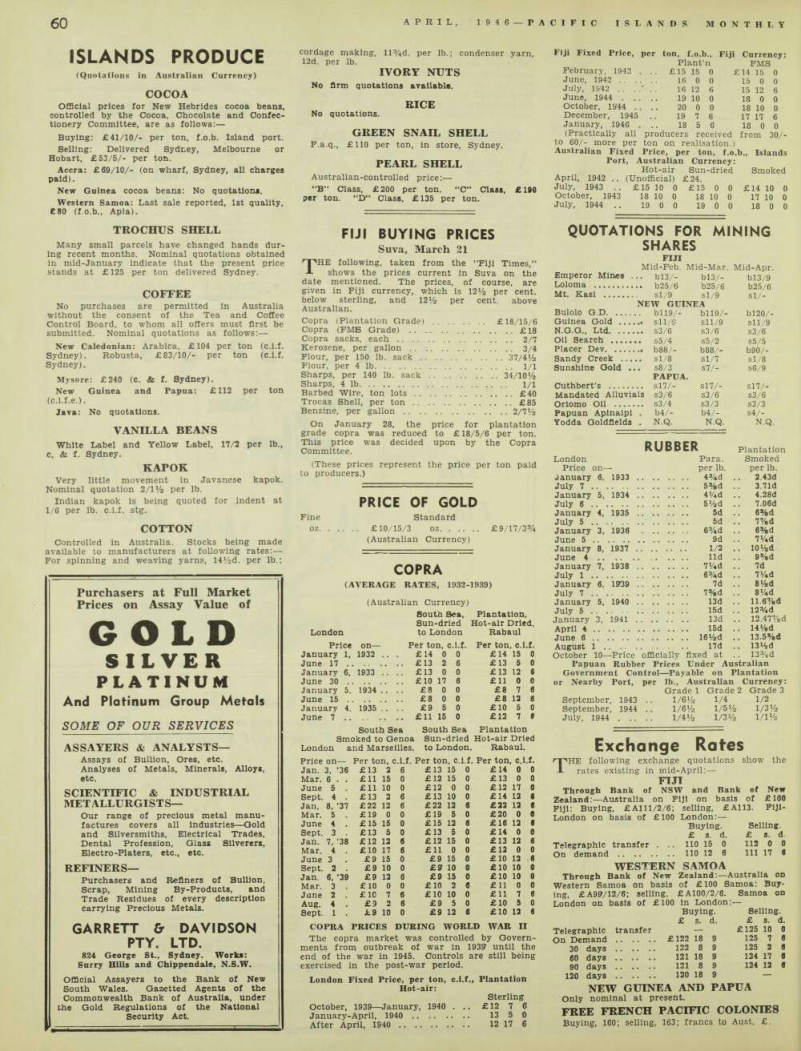
(Quotations in Australian Currency)
Cocoa
Official prices for New Hebrides cocoa beans, controlled by the Cocoa, Chocolate and Confec tionery Committee, are as follows: — Buying; £4l/10/- per ton, f.o.b. Island port.
Selling: Delivered Sydney, Melbourne or Hobart, £53/5/- per ton.
Accra: £69/10/- (on wharf, Sydney, all charges paid).
New Guinea cocoa beans: No quotations.
Western Samoa: Last sale reported, Ist quality, £BO (f.0.b., Apia).
Trochus Shell
Many small parcels have changed hands dur ing recent months. Nominal quotations obtained in mid-January indicate that the present price stands at £125 per ton delivered Sydney.
Coffee
No purchases are permitted in Australia without the consent of the Tea and Coffee Control Board, to whom all offers must first be submitted. Nominal quotations as follows: — New Caledonian: Arabica, £lO4 per ton (c.i.f.
Sydney). Robusta, £B3/10/- per ton (c.i.f.
Sydney).
Mysore: £240 (c. & f. Sydney).
New Guinea and Papua: £ll2 per ton (c.i.f.e.).
Java: No quotations.
Vanilla Beans
White Label and Yellow Label, 17/2 per lb., c. & f. Sydney.
Kapok
Very little movement in Javanese kapok.
Nominal quotation 2/1 Vz per lb.
Indian kapok is being quoted for indent at 1/6 per lb. c.i.f. stg.
Cotton
Controlled in Australia. Stocks being made available to manufacturers at following rates; — For spinning and weaving yarns, 14%d. per lb.;
cordage making, ll%d. per lb.; condenser yarn, 12d. per lb.
Ivory Nuts
No firm quotations available.
Rice
No quotations.
Green Snail Shell
F.a.q., £llO per ton, in store, Sydney,
Pearl Shell
Australian-controlled price:— “B” Class, £2OO per ton. “C” Class, £l9O per ton. “D” Class. £135 per ton.
Fiji Buying Prices
Suva, March 21
THE following, taken from the “Fiji Times,” shows the prices current in Suva on the date mentioned. The prices, of course, are given in Fiji currency, which is 12V 2 per cent, below sterling, and 12V 2 per cent. above Australian.
On January 28, the price for plantation grade copra was reduced to £ 18/5/6 per ton.
This price was decided upon by the Copra Committee. (These prices represent the price per ton paid to producers.)
Copra (Plantation Grade) .. .. .. .. £18/15/6 Copra (FMS Grade) Copra sacks, each Kerosene, per gallon 3/4 Flour, per 150 lb. sack 37/4V2 Flour, per 4 lb Sharps, per 140 lb. sack 34/10V2 Sharps, 4 lb 1/1 Barbed Wire, ton lots Trocas Shell, per ton £85 Benzine, per gallon 2/7V2
Advertisements & other items, p. 62 (1 item)
Price Of Gold
Fine Standard oz. . .. .. £10/15/3 oz £9/17/3% (Australian Currency)
Copra
Prices During World War Ii
The copra market was controlled by Govern ments from outbreak of war in 1939 until the end of the war in 1945. Controls are still being exercised in the post-war period.
(Practically all producers received from 30/to 60/- more per ton on realisation.) Australian Fixed Price, per ton, f.0.b., Islands Port, Australian Currency:
(Average
Rates,
1932-1939) (Australian Currency) South Sea, Plantation, Sun-dried Hot-air Dried, London to London Rabaul Price on— Per ton, c.i.f.
Per ton, c.i.f.
January 1, 1932 . . £14 0 0 £14 15 0 June 17 . £13 2 6 £13 5 0 January 6, 1933 £13 0 0 £13 12 6 June 30 . £10 17 6 £11 0 0 January 5. 1934 £8 0 0 £8 7 6 June 15 . £8 0 0 £8 12 6 January 4. 1935 £9 5 0 £10 5 0 June 7 .. £11 15 0 £12 7 6 South Sea South Sea Plantation Smoked to Genoa Sun-dried Hot-air Dried London and Marseilles to London.
Rabaul.
Price on— Per ton, c.i.f. Per ton, c.i.f. Per ton, c.l.f.
Jan. 3, '36 £13 2 6 £13 15 0 £14 0 0 Mar. 6 . . £11 15 0 £12 15 0 £13 0 0 June 5 . £11 10 0 £12 0 0 £12 17 0 Sept. 4 . £13 2 6 £13 10 0 £14 12 6 Jan. 8, ’37 £22 12 6 £22 12 6 £22 12 6 Mar. 5 . £19 0 0 £19 5 0 £20 0 0 June 4 £15 15 0 £15 12 6 £16 12 6 Sept. 3 £13 5 0 £13 5 0 £14 0 0 Jan. 7, ’38 £12 12 6 £12 15 0 £13 12 6 Mar. 4 . £10 17 6 £11 0 0 £12 0 0 June 3 £9 15 0 £9 15 0 £10 12 6 Sept. 2 £9 10 0 £9 10 0 £10 10 0 Jan. 6, '39 £9 12 6 £9 15 0 £10 10 0 Mar. 3 . £10 0 0 £10 2 6 £11 0 0 June 2 £10 7 6 £10 10 0 £11 7 6 Aug. 4 . £9 2 6 £9 5 0 £10 5 0 Sept. 1 . £9 10 0 £9 12 6 £10 12 6
London Fixed Price, per ton, c.i.f., Plantation Hot-air: Sterling October, 1939 —January, 1940 . .. £12 7 6 January-April, 1940 13 5 0 After April, 1940 12 17 6
Fiji Fixed Price, per ton, f.o.b., Fiji Currency: Plant’n
Fms
February, 1942 . .. £15 15 0 £14 15 0 June, 1942 16 0 0 15 0 0 July, 1942 .. . . 16 12 6 15 12 6 June, 1944 19 10 0 18 0 0 October, 19'44 . . 20 0 0 18 10 0 December, 1945 .. 19 7 6 17 17 6 January, 1946 . .. 18 5 6 18 0 0
Hot-air Sun-dried Smoked April, 1942 .. (Unofficial) £24.
July, 1943 .. £15 10 0 £15 0 0 £14 10 0 October, 1943 18 10 0 18 10 0 17 10 0 July, 1944 .. 19 0 0 19 0 0 18 0 0
Quotations For Mining
Shares
Fiji
Mid-Feb.
Mid-Mar.
Mid-Apr.
Emperor Mines . .. b!3/bl3/bl3/9 Loloma b25/6 b25/6 Mt. Kasi sl/9 sl/9 sl/-
New Guinea
Bulolo G.D .. bll9/bll9/bl20/- Guinea Gold sll/9 sll/9 N.G.G., Ltd s3/6 s3/6 Oil Search s5/2 s5/5 Placer Dev b88/b90/- Sandy Creek ... .. sl/8 sl/7 sl/8 Sunshine Gold .. ,. s8/3 s7/s6/9
Papua.
Cuthbert’s .. s!7/sl7/sl7/- Mandated Alluvials s3/6 s3/6 s3/6 Oriomo Oil s3/3 s3/3 Papuan Aplnaipi . b4/b4/s4/- Yodda Goldfields . N.Q.
N.Q.
N.Q.
Rubber
Plantation
London Para.
Smoked Price on— per lb. per lb.
January 6. 1933 . 4%d .. 2.43d July 7 .. . 5%d .. 3.71d January 5, 1934 . 4»/ 4 d .. 4.28d July 6 .. . sy 2 d .. 7.06d January 4, 1935 . 5d .. 6%d July 5 .. . 5d .. 7y»d January 3, 1936 6 3 / 4 d .. 6%d June 5 .. 9d .. 7y 4 d January 8, 1937 . 1/2 .. ioy 2 d June 4 lid .. 9»/«d January 7, 1938 . 7»/ 4 d .. 7d July 1 .. . 6 3 / 4 d .. 7y 4 d January 6, 1939 . 7d .. 8y»d July 7 .. . 7 3 /sd .. sy 4 d January 5, 1940 . 13d .. 11.6 7 /»d July 5 .. . 15d .. 12%d January 3, 1941 . 13d .. 12.47 7/ 8d April 4 ..
I5d .. i4y«d June 6 .. . isy 2 d .. 13.5 9 /sd August 1 ., 17d .. 13Mjd October 10— -Price officially fixed at .. 13 3/4 d Papuan Rubber Prices Under Australian Government Control —Payable on Plantation or Nearby Port, per lb., Australian Currency: Grade 1 Grade 2 Grade 3 September, 1943 l/6V a 1/4 1/2 September, 1944 1/6 y 2 1/5 y 2 1/3 y 2 July, 1944 . .. 1/4 y 2 1/3 y 2 i/i y 2
Exchange Rates
THE following exchange quotations show the rates existing in mid-April:—
Fiji
Through Bank of NSW and Bank of New Zealand: —Australia on FIJI on basis of £lOO FIJI: Buying. £Alll/2/6; selling, £AII3. FIJI - on basis of £lOO London; —
Western Samoa
Through Bank of New Zealand: —Australia on Western Samoa on basis of £lOO Samoa; Buy ing, £ A99/12/6; selling, £AIOO/2/6. Samoa on London on basis of £lOO in London:—
New Guinea And Papua
Only nominal at present.
Free French Pacific Colonies
Buying, 160; selling, 163; francs to Aust. £.
Buying.
Selling. £ s. d. £ s. d Telegraphic transfer . .. 110 15 0 112 0 0 On demand . . 110 12 8 111 17 6
Buying.
Selling. £ s. d. £ s. d.
Telegraphic transfer — £125 10 0 On Demand £122 18 9 125 7 6 30 days 122 8 9 125 2 0 60 days 121 18 9 124 17 9 90 days 121 8 9 124 12 6 120 days 120 18 9 —
Advertisements & other items, pp. 62-68 (3 items)
Gold
Purchasers at Full Market Prices on Assay Value of
SILVER
PLATINUM
And Platinum Group Metals
SOME OF OUR SERVICES
ASSAYERS & ANALYSTS—
Assays of Bullion, Ores, etc.
Analyses of Metals, Minerals, Alloys, etc.
SCIENTIFIC & INDUSTRIAL
METALLURGISTS—
Our range of precious metal manufactures covers all industries—Gold and Silversmiths, Electrical Trades, Dental Profession, Glass Sllverers, Electro-Platers, etc., etc.
REFINERS—
Purchasers and Refiners of Bullion, Scrap, Mining By-Products, and Trade Residues of every description carrying Precious Metals.
GARRETT (Sr DAVIDSON
PTY. LTD.
824 George St., Sydney, Works: Surry Hills and Chippendale, N.S.W.
Official Assayers to the Bank of New South Wales. Gazetted Agents of the Commonwealth Bank of Australia, under the Gold Regulations of the National Security Act.
Building?
... THEN HERE I GOOD NEWS
FOR YOU—
WHETHER you intend building a STORAGE SHED, DRYING-
ROOM, NATIVE LABOUR HUT, a GARAGE—we—Tulloch’s
Pty. y Ltd., have the building frame to suit your particular requirements—when we say building frame, we mean the complete structural set of members that go to make up the “skeleton” of a building; it is direct to the “bones” of this steel “skeleton” that your walling and roofing materials are fixed.
These frames are comprised of “ECONO-STEEL” trusses delivered to you ready to unfold on location and connect together with “ECONO- STEEL” girts, purlins and braces, which make up a building to dimensions of your particular requirements.
And now, for those requiring a HOME. Steel frames for such—comprising wall, roof and floor-sections—are being produced in our Sydney Factory at the rate of 25 a week. Extensions and extra machinery is now being installed to expand this production to 100 house-steel-frames a week.
This construction technique is so amazingly simple that ex-Servicemen, mostly amateurs, are erecting their own homes in this material.
In some cases tradesmen lay the stone or concrete foundation, then the home builder, with our foolproof plans to follow, erects the steel framework.
Any wall covering such as Durabestos, Fibrous-plaster, plywood, can be nailed direct to the steel section by virtue of its patent nailing slot.
All steel members throughout are treated with “Rust-ban” preservative.
What is more, these homes are fire and vermin-proof.
The average home can be packed into bundles 9 feet by 14 inches by 9 inches, each bundle weighing no more than 500 lb.
Send your queries direct to us—our Building Department will give your problem careful consideration. Literature on our “ECONO- STEEL” commercial, rural, and home building is readily posted to you upon request.
TULLOCH’S PTY. LIMITED
CONCORD RD., RHODES, SYDNEY, AUSTRALIA.
Cable Address: “TULSTEEL,” Sydney.
7&y V rt »’
Scarcity of good ingredients still restricts output... so HEINZ, who place quality before quantity, can offer only small supplies of HEINZ
PERFECT SOUPS.. BAKED BEANS
...SPAGHETTI; but keep asking you may be fortunate enough to secure a tin of one favourite HEINZ variety.
HP 4-6/1
“TO THE GULF OF CARPENTARIA”
"On the 20th August, 1860, the long train of camels and horses set forth from the Royal Park of Melbourne, Burke leading the procession on a little grey horse. The Mayor made a short speech, wishing him God-speed; the explorers shook hands with their friends, and, amid the ringing cheers of thousands of spectators, the long and picturesque line moved forward.”
Thus, according to the historians A. & G. Sutherland, began the Burke and Wills’ expedition, one of the most spectacular, but ill-fated, in the annals of Australian Exploration. The expedition was prompted by the offer of £lOOO by a Melbourne merchant, and financed by the Royal Society of Victoria, who raised subscriptions of £3400, plus a grant of £6OOO by the Victorian Government, "who also spent £3OOO in bringing twenty-six camels from Arabia.”
Of the four men who made the alternate dash to the Gulf—Burke, Wills, Grey and King—only King survived through the friendliness of blacks for whom "he shot some birds and cured their chief of a malady.”
History docs not fell whether Burke and Wills carried with them supplies of Swallow & Ariell Biscuits . although Stvallow Ariell Ship’s Biscuits were a recognised store of the day. But, at that time. Swallow & was already a solidly-established organisation, employing a staff of some 300 operatives. r> i
SERIES
SERVING AUSTRALIA
IN PEACE AND WAR
[al IP
turn
SWALLOW & ARIELL
LIMITED
LEADERS IN THE RISCUIT INDUSTRY SINCE 1854 MAKERS AI.Stl OF THE FAMOUS SWAI.UIW ,V ADIEU. PI.UM I’UIIDIIVGS, CAKES. AND ICE CREAM
TILLEY LAMPS
BURN ORDINARY KEROSENE
The Modern Form of PORTABLE LIGHTING If Be sure you buy a
TILLEY
STORM LANTERNS \ Look for the name!
TABLE LAMPS
SUSPENSION LAMPS
RADIATORS
INSPECTION LAMPS
WALL LAMPS
FLOODLIGHT PROJECTORS
300 C.P.
Storm Lantern
Tilley Lamps are made only at
Hendon, England.
Be sure you buy a TILLEY Look for the name !
Shipments four weeks from receipt of order.
THE TILLEY LAMP CO.. HENDON,
5,000 C.P.
Floodlight Projector
.W. 4, ENG.
REPRESENTATION :
MELBOURNE : T. H. Bentley, Pty. Ltd., 123-125 William Street, Melbourne, C.l.
TASMANIA : Mr. C. Sellars, 108 a Charles Street, Launceston.
FIJI : Mr. K. Witherington, 2 Burns Philp Buildings, Suva.
J.AD.GIBSON AND COMPANY PTY LIMITED
o
GREEN LABEL
FIRST GRADE
<Uu/ 364 Kent Street Sydney
NEWCASTLE BRANCH
CNR KING t DARBY STREETS
NELSON and ROBERTSON Pty. Ltd.
Established 1895
Shipowners - Brokers and
Islands Merchants
All classes merchandise purchased at Best Wholesale Prices. Original Invoices supplied to Island Clients. Cocoa Beans, Copra, Rubber, Trochus Shell and All Islands' Produce Sold on Commission.
Entrust your requirements to the firm with fifty years' practical experience in the Pacific Islands. ■ ivmpi uiicmiun yiTcn iu un cm|uiri6».
NELSON & ROBERTSON IS
12 SPRING STREET, SYDNEY, AUSTRALIA
Telegraphic Address: IVAN, SYDNEY.
A Tropical Thirst
demands a Satisfying Drink
that’s why KB is so popular
south of <( the Line”
All through the tropics, wherever there are men who like good beer, you'll always find KB. It's the drink that men appreciate —a drink just made to satisfy a tropical thirst 1
h A COOL"?!
I > t «AM *9 T A AL
DNCV
FHn
FINEST
Tooth limited CO
SYD
EY u s s\ 0 £ 1
TOOTH'S
KB
LAGER.
— Established 1914 —
THIRTY YEARS OF PACIFIC ISLANDS
DEVELOPMENT AND SERVICE.
W. R. CARPENTER & GO. LTD.
Capital £1,000,000.
GENERAL MERCHANTS AND SHIPOWNERS
Buyers and Exporters of All Kinds of Islands Produce Copra Merchants and Millers Agents for Australian, European and American Manufacturers Distributors of Every Description of Merchandise
DISTRIBUTING AGENTS
FORD MOTOR COMPANY OF CANADA.
ELECTROLUX REFRIGERATORS.
T. G. & C. BOLINDERS (ENGINES).
Etc., Etc.
FOR:
CHRYSLER CORPORATION.
WESTINGHOUSE ELECTRICAL CO.
CATERPILLAR TRACTORS.
BRANCHES THROUGHOUT THE PACIFIC ISLANDS
Head Office: 16 O'CONNELL STREET, SYDNEY
In London: W. R. Carpenter & Co. (London) Ltd., Coronation House, 4 Lloyd's Avenue, London, EC.
The W.R.C. Line
The first Direct and Regular Cargo and Passenger Service between Europe and Pacific Islands’ ports was established by W. R. Carpenter & Co., Ltd.
64
APRIL. 1946 PACIFIC ISLANDS MONTHLY
Published by PACIFIC PUBLICATIONS PTY. LTD., Union House, 247 George Street, Sydney. (Telephone: BW 5037). Wholly set up and printed 1b Australia by the Sydney and Melbourne Publishing Co. Pty. Ltd., 29 Alberta Street, Sydney. (Telephone: MA 7101)