Pacific
Islands
Monthly
July 17, 1943
Vol Xiii. No. 12.
Established 1930
LE entered at the G JP&.i JSydnqy, for transmission by post as a newspaper ]
8"
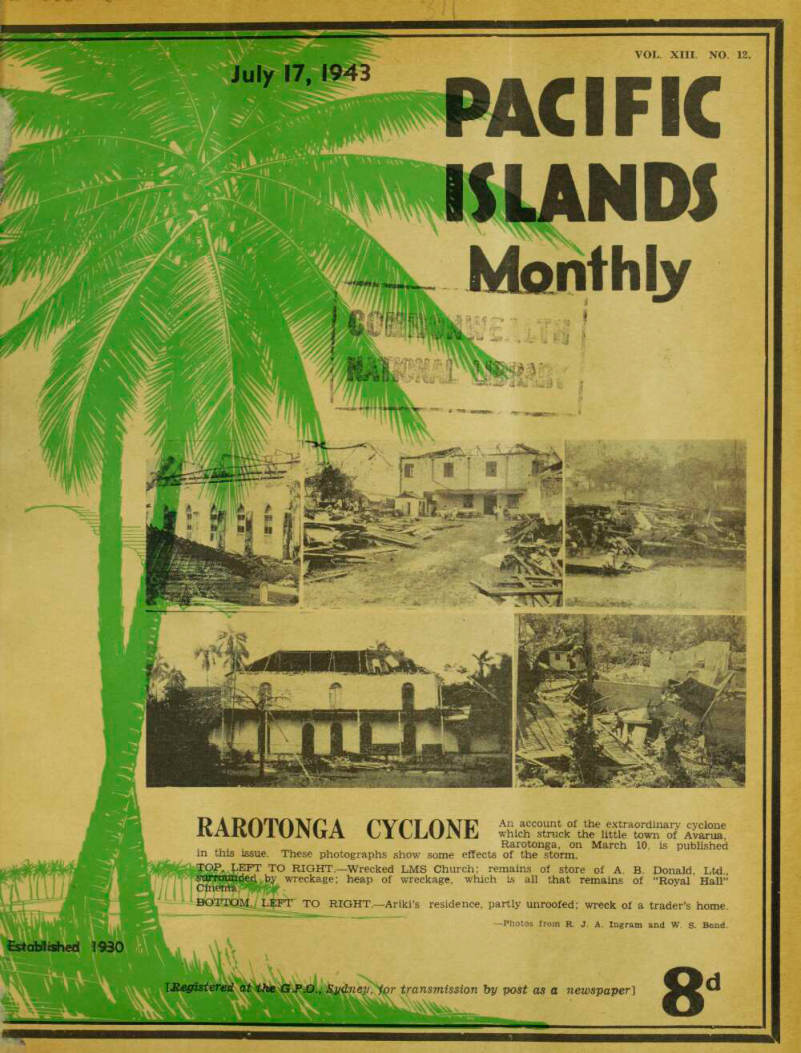
RAROTONGA CYCLONE An account of the extraordinary cyclone which struck the little town of Avarua, Rarotonga, on March 10, is published in this issue. These photographs show some effects of the storm.
TOP, TO RlGHT.—Wrecked LMS Church; remains of store of A. B. Donald. Ltd., surrounded by wreckage; heap of wreckage, which is all that remains of “Royal Hall”
BOTTOM,, LEFT TO RlGHT.—Ariki’s residence, partly unroofed; wreck of a trader’s home. —Photos from R. J. A. Ingram and W. S. Bond.
How Polynesians Came Into
The Pacific
New Angies on a Fascinating Subject
By A. C. Rowland, Papeete. Tahiti
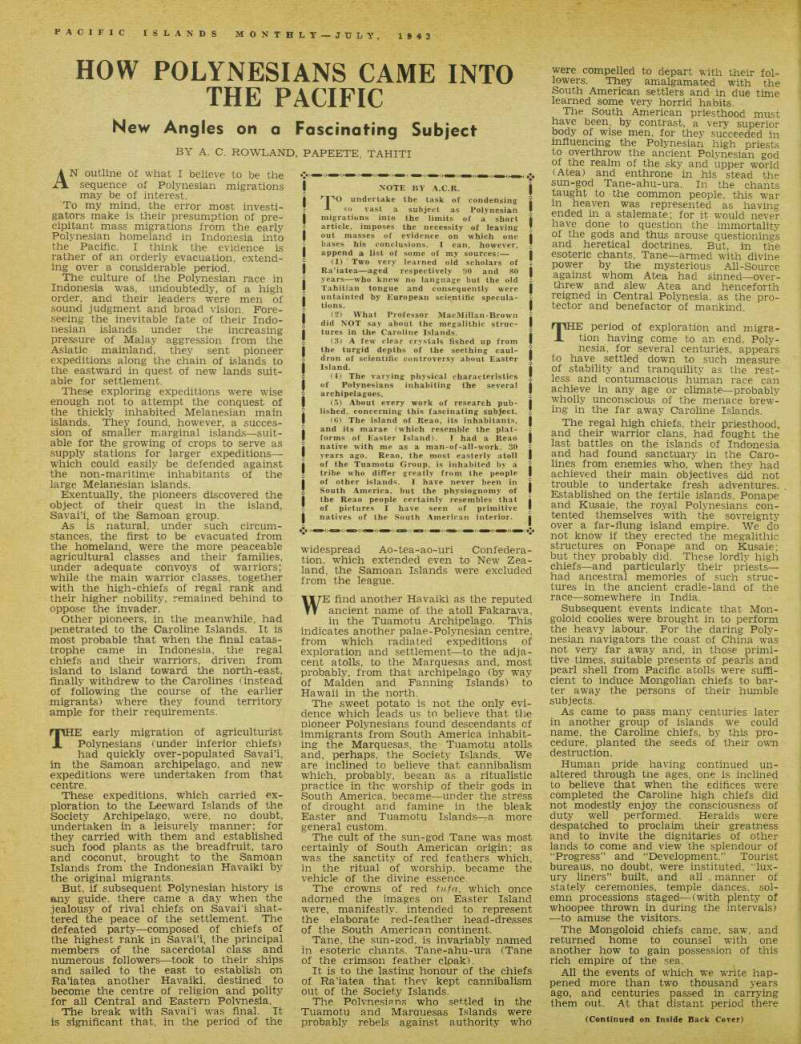
AN outline of what I believe to be the sequence of Polynesian migrations may be of interest.
To my mind, the error most investi gators make is their presumption of pre cipitant mass migrations from the early Polynesian homeland in Indonesia into the Pacific. I think the evidence is rather of an orderly evacuation, extend ing over a considerable period.
The culture of the Polynesian race in Indonesia was, undoubtedly, of a high order, and their leaders were men of sound judgment and broad vision. Fore seeing the inevitable fate of their Indo nesian islands under the increasing pressure of Malay aggression from the Asiatic mainland, they sent pioneer expeditions along the chain of islands to the eastward in quest of new lands suit able for settlement.
These exploring expeditions were wise enough not to attempt the conquest of the thickly inhabited Melanesian main islands. They found, however, a succes sion of smaller marginal islands —suitable for the growing of crops to serve as supply stations for larger expeditions— which could easily be defended against the non-maritime inhabitants of the large Melanesian islands.
Exentually, the pioneers discovered the object of their quest in the island, Savai’i, of the Samoan group.
As is natural, under such circum stances, the first to be evacuated from the homeland, were the more peaceable agricultural classes and their families, under adequate convoys of warriors; while the main warrior classes, together with the high-chiefs of regal rank and their higher nobility, remained behind to oppose the invader.
Other pioneers, in the meanwhile, had penetrated to the Caroline Islands. It is most probable that when the final catas trophe came in Indonesia, the regal chiefs and their warriors, driven from island to island toward the north-east, finally withdrew to the Carolines (instead of following the course of the earlier migrants) where they found territory ample for their requirements. fIIHE early migration of agriculturist X Polynesians (under inferior chiefs) had quickly over-populated Savai’i, in the Samoan archipelago, and new expeditions were undertaken from that centre.
These expeditions, which carried ex ploration to the Leeward Islands of the Society Archipelago, were, no doubt, undertaken in a leisurely manner; for they carried with them and established such food plants as the breadfruit, taro and coconut, brought to the Samoan Islands from the Indonesian Havaiki by the original migrants.
But, if subsequent Polynesian history is any guide, there came a day when the jealousy of rival chiefs on Savai’i shat tered the peace of the settlement. The defeated party—composed of chiefs of the highest rank in Savai’i, the principal members of the sacerdotal class and numerous followers —took to their ships and sailed to the east to establish on Ra’iatea another Havaiki, destined to become the centre of religion and polity for all Central and Eastern Polynesia.
The break with Savai’i was final. It is significant that, in the period of the
widespread Ao-tea-ao-uri Confedera tion, which extended even to New Zea land, the Samoan Islands were excluded from the league.
WE find another Havaiki as the reputed ancient name of the atoll Fakarava, in the Tuamotu Archipelago. This indicates another palae-Polynesian centre, from which radiated expeditions of exploration and settlement—to the adja cent atolls, to the Marquesas and, most probably, from that archipelago (by way of Malden and Fanning Islands) to Hawaii in the north.
The sweet potato is not the only evi dence which leads us to believe that the pioneer Polynesians found descendants of immigrants from South America inhabit ing the Marquesas, the Tuamotu atolls and, perhaps, the Society Islands. We are inclined to believe that cannibalism which, probably, began as a ritualistic practice in the worship of their gods in South America, became—under the stress of drought and famine in the bleak Easter and Tuamotu Islands —a more general custom.
The cult of the sun-god Tane was most certainly of South American origin; as was the sanctity of red feathers which, in the ritual of worship, became the vehicle of the divine essence.
The crowns of red tufa, which once adorned the images on Easter Island were, manifestly, intended to represent the elaborate red-feather head-dresses of the South American continent.
Tane, the sun-god. is invariably named in esoteric chants. Tane-ahu-ura (Tane of the crimson feather cloak).
It is to the lasting honour of the chiefs of Ra'iatea that they kept cannibalism out of the Society Islands.
The Polvnesians who settled in the Tuamotu and Marauesas Islands were probably rebels against authority who
were compelled to depart with their fol lowers. They amalgamated with the South American settlers and in due time learned some very horrid habits.
The South American priesthood must have been, by contrast, a very superior body of wise men, for they succeeded in influencing the Polynesian high priests to overthrow the ancient Polynesian god of the realm of the sky and upper world (Atea) and enthrone in his stead the sun-god Tane-ahu-ura. In the chants taught to the common people, this war in heaven was represented as having ended in a stalemate; for it would never have done to question the immortality of the gods and thus arouse questionings and heretical doctrines. But, in the esoteric chants, Tane—armed with divine power by the mysterious All-Source against whom Atea had sinned—over threw and slew Atea and henceforth reigned in Central Polynesia, as the pro tector and benefactor of mankind. rE period of exploration and migra tion having come to an end. Poly nesia, for several centuries, appears to have settled down to such measure of stability and tranquility as the rest less and contumacious human race can achieve in any age or climate—probably wholly unconscious of the menace brew ing in the far away Caroline Islands.
The regal high chiefs, their priesthood, and their warrior clans, had fought the last battles on the islands of Indonesia and had found sanctuary in the Caro lines from enemies who, when they had achieved their main objectives did not trouble to undertake fresh adventures.
Established on the fertile islands. Ponape and Kusaie, the royal Polynesians con tented themselves with the sovreignty over a far-flung island empire. We do not know if they erected the megalithic structures on Ponape and on Kusaie; but they probably did. These lordly high chiefs —and particularly their priests— had ancestral memories of such struc tures in the ancient cradle-land of the race—somewhere in India.
Subsequent events indicate that Mon goloid coolies were brought in to perform the heavy labour. For the daring Poly nesian navigators the coast of China was not very far away and, in those primi tive times, suitable presents of pearls and pearl shell from Pacific atolls were suffi cient to induce Mongolian chiefs to bar ter away the persons of their humble subjects.
As came to pass many centuries later in another group of islands we could name, the Caroline chiefs, by this pro cedure, planted the seeds of their own destruction.
Human pride having continued un altered through the ages, one is inclined to believe that when the edifices were completed the Caroline high chiefs did not modestly enjoy the consciousness of duty well performed. Heralds were despatched to proclaim their greatness and to invite the dignitaries of other lands to come and view the splendour of “Progress” and "Development.” Tourist bureaus, no doubt, were instituted, “lux ury liners” built, and all manner of stately ceremonies, temple dances, sol emn processions staged—(with plenty of whoopee thrown in during the intervals) —to amuse the visitors.
The Mongoloid chiefs came, saw. and returned home to counsel with one another how to gain possession of this rich empire of the sea.
All the events of which we write hap pened more than two thousand years ago, and centuries passed in carrying them out. At that distant period there
(Continued on Inside Back Cover)
(Continued From Inside Front Cover) was all the time in the world to get things done.
THE decline and fall of the Caroline Empire was brought about by the time-honoured Mongoloid method of infiltration, rather than by direct mili tary invasion, and probably, resulted from a steady and progressive mixture of the two races; until the population became a nation of Mongol-Polynesian half-castes.
These mixed progeny, inheriting alien ideas from their Mongoloid parents, were not inclined to believe implicitly in the divine origin and authority of their rul ers, who had set themselves up as the direct descendants of Ta’aroa, creator of gods and men. The attempt by the royal clan to stem this tide, has come to our knowledge through the Arioi society, which survived in the Caroline Islands and in the Society Archipelago (whither it was subsequently brought), until early in the nineteenth century.
Instituted to preserve the pure blood and the unquestioning fealty of the war rior clans, the Arioi society was fashioned to attract to its fellowship the flower of the youth of unblemished ancestry. To the uninitiated the Arioi were bands of strolling comedians who were held in high esteem by all classes. Internally, the society was a grim hierarchy that exacted the slaughter, at birth, of all infants, if one of the parents should be of inferior rank or of mixed ancestry.
These measures may have delayed, but they did not halt the steady deteriora tion of the Caroline Empire. It is easy to imagine, therefore, that the proud chiefs and priesthood resolved to mend their fortunes in the well-settled archi pelagoes south of the equator, which were far enough away from the Asiatic main land to be safe from raids or infiltration from that quarter. rE first warning the people of Poly nesia had of this enterprise was a sudden descent from the north-west —by way of the marginal islands of Fiji —on Tonga and Samoa.
The sons of Ta’aroa, who had estab lished their headquarters on Rotuma (north of Fiji) did not gather any great advantage from these expeditions. The conquest of Tonga was, indeed, complete; but the campaign against Samoa resulted in nothing more than a prolonged siege that required a large force of warriors to maintain. They were well enough informed to know that the key to the conquest of Polynesia was Havai’i (Ra’iatea) in the centre.
That they abandoned the idea of a military expedition and resolved on Fifth Column procedure is indicated in the fol lowing quotation from “Ancient Tahiti”: • • • There came to Pora Pora from Rotuma, north-west of the Tonga group, a prince named Te Fatu (The Lord), a god’s name, which only the highest of Polynesians ever dared to assume, and which brought this prince great authority upon land from the god Te Fatu, lord of the ocean.”
How this advance agent travelled from island to island and from group to group, and wangled the various high-chiefs into the belief that the very blood descend ants of the creator of gods and men were about to honour ancient Havai’i with their presence, has come down to us with considerable detail.
When all was prepared, the sons of Taaroa moved in. We have no record of their coming. They took good care to cloud that event for posterity in the mist myth and legend, in order to estab lish the belief that they had been there mai te po maira,” i.e., from the begin
ning of time. We have an example in our own time how, within the space of one generation, a group can emerge from the nethermost dungeons of obscurity to the very throne of Olympus itself, by mere assumption.
The Ao-uri-ao-tea Confederation, which resulted from all these activities, was a Commonwealth of Nations that paid reverence to the reliious and cultural centre at Opoa, on Rai’iatea, rather than fealty to secular rulers residing there.
Each of the two divisions of the federa tion maintained a sort of archepiscopal high-commissioner (called respectively the Pa’oa-uri and the Pa’oa-tea) who resided with the Opoa royal family.
THE event which disrupted the con federation resulted in the last great migration to New Zealand, and brought upon Polynesia the night of isolation (each archipelago from the other—during a period of five hundred years), was the murder of the Pa’oa-tea by a chief of the Ao-uri, at a conclave convened at Opoa some time in the middle of the fourteenth century.
And so came to an end the migrations of the greatest race of mariners the human family has produced.
Note By A.C.R.
nro undertake the task of condensing A so vast a subject as Polynesian migrations into the limits of a short article, imposes the necessity of leaving out masses of evidence on which one bases his conclusions. I can, however, append a list of some of my sources:— (1) Two very learned old scholars of Ra’iatea —aged respectively 90 and 80 years—who knew no language but the old Tahitian tongue and consequently were untainted by European scientific specula tions. (2) What Professor MacMillan-Brown did NOT say about the megalithic struc tures in the Caroline Islands. (3) A few clear crystals fished up from the turgid depths of the seething caul dron of scientific controversy about Easter Island. (4) The varying physical characteristics of Polynesians inhabiting the several archipelagoes. (5) About every work of research pub lished, concerning this fascinating subject. (6) The island of Keao, its inhabitants, and its marae (which resemble the plat forms of Easter Island). I had a Reao native with me as a man-of-all-work. 30 years ago. Reao, the most easterly atoll of the Tuamotu Group, is inhabited by a tribe who differ greatly from the people of other islands. I have never been in South America, but the physiognomy of the Reao people certainly resembles that of pictures I have seen of primitive natives of the South American interior.
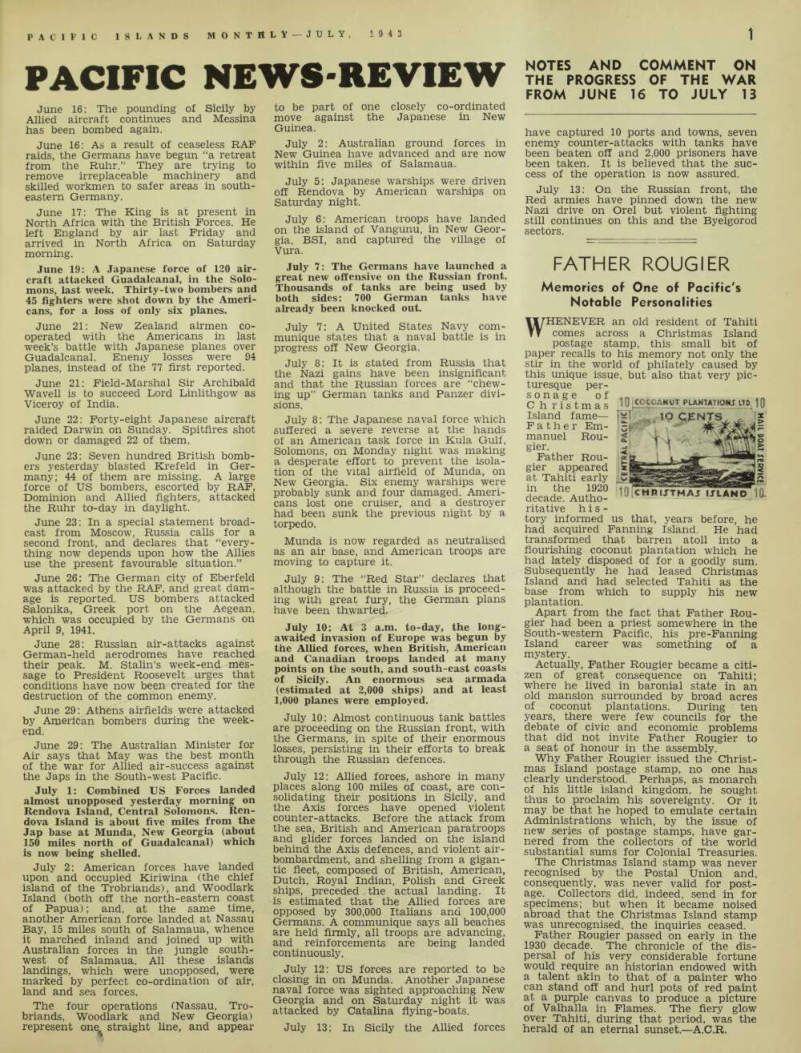
Pacific News-Review
Notes And Comment On
The Progress Of The War
From June 16 To July 13
June 16: The pounding of Sicily by Allied aircraft continues and Messina has been bombed again.
June 16: As a result of ceaseless RAF raids, the Germans have begun “a retreat from the Ruhr.” They are trying to remove irreplaceable machinery and skilled workmen to safer areas in south eastern Germany.
June 17: The King is at present in North Africa with the British Forces. He left England by air last Friday and arrived in North Africa on Saturday morning.
June 19: A Japanese force of 120 air craft attacked Guadalcanal, in the Solo mons, last week. Thirty-two bombers and 45 fighters were shot down by the Ameri cans, for a loss of only six planes.
June 21: New Zealand airmen co operated with the Americans in last week’s battle with Japanese planes over Guadalcanal. Enemy losses were 94 planes, instead of the 77 first reported.
June 21: Field-Marshal Sir Archibald Wavell is to succeed Lord Linlithgow as Viceroy of India.
June 22: Forty-eight Japanese aircraft raided Darwin on Sunday. Spitfires shot down or damaged 22 of them.
June 23: Seven hundred British bomb ers yesterday blasted Krefeld in Ger many; 44 of them are missing. A large force of US bombers, escorted by RAF, Dominion and Allied fighters, attacked the Ruhr to-day in daylight.
June 23: In a special statement broad cast from Moscow, Russia calls for a second front, and declares that “every thing now depends upon how the Allies use the present favourable situation.”
June 26: The German city of Eberfeld was attacked by the RAF, and great dam age is reported. US bombers attacked Salonika, Greek port on the Aegean, which was occupied by the Germans on April 9, 1941.
June 28: Russian air-attacks against German-held aerodromes have reached their peak. M. Stalin’s week-end mes sage to President Roosevelt urges that conditions have now been created for the destruction of the common enemy.
June 29: Athens airfields were attacked by American bombers during the week end.
June 29: The Australian Minister for Air says that May was the best month of the war for Allied air-success against the Japs in the South-west Pacific.
July 1: Combined US Forces landed almost unopposed yesterday morning on Rendova Island, Central Solomons. Ren dova Island is about five miles from the Jap base at Munda, New Georgia (about 150 miles north of Guadalcanal) which is now being shelled.
July 2; American forces have landed upon and occupied Kiriwina (the chief island of the Trobriands), and Woodlark Island (both off the north-eastern coast of Papua); and, at the same time, another American force landed at Nassau Bay, 15 miles south of Salamaua, whence it marched inland and joined up with Australian forces in the jungle south west of Salamaua. All these islands landings, which were unopposed, were marked by perfect co-ordination of air, land and sea forces.
The four operations (Nassau, Tro briands, Woodlark and New Georgia) represent one straight line, and appear
to be part of one closely co-ordinated move against the Japanese in New Guinea.
July 2: Australian ground forces in New Guinea have advanced and are now within five miles of Salamaua.
July 5: Japanese warships were driven off Rendova by American warships on Saturday night.
July 6: American troops have landed on the island of Vangunu, in New Geor gia, BSI, and captured the village of Vura.
July 7: The Germans have launched a great new offensive on the Russian front.
Thousands of tanks are being used by both sides: 700 German tanks have already been knocked out.
July 7: A United States Navy com munique states that a naval battle is in progress off New Georgia.
July 8: It is stated from Russia that the Nazi gains have been insignificant and that the Russian forces are “chew ing up” German tanks and Panzer divi sions.
July 8; The Japanese naval force which suffered a severe reverse at the hands of an American task force in Kula Gulf, Solomons, on Monday night was making a desperate effort to prevent the isola tion of the vital airfield of Munda, on New Georgia. Six enemy warships were probably sunk and four damaged. Ameri cans lost one cruiser, and a destroyer had been sunk the previous night by a torpedo.
Munda is now regarded as neutralised as an air base, and American troops are moving to capture it.
July 9: The “Red Star” declares that although the battle in Russia is proceed ing with great fury, the German plans have been thwarted.
July 10: At 3 a.m. to-day, the long awaited invasion of Europe was begun by the Allied forces, when British, American and Canadian troops landed at many points on the south, and south-east coasts of Sicily. An enormous sea armada (estimated at 2,000 ships) and at least 1,000 planes were employed.
July 10: Almost continuous tank battles are proceeding on the Russian front, with the Germans, in spite of their enormous losses, persisting in their efforts to break through the Russian defences.
July 12: Allied forces, ashore in many places along 100 miles of coast, are con solidating their positions in Sicily, and the Axis forces have opened violent counter-attacks. Before the attack from the sea, British and American paratroops and glider forces landed on the island behind the Axis defences, and violent air bombardment, and shelling from a gigan tic fleet, composed of British, American, Dutch, Royal Indian, Polish and Greek ships, preceded the actual landing. It is estimated that the Allied forces are opposed by 300,000 Italians and 100,000 Germans. A communique says all beaches are held firmly, all troops are advancing, and reinforcements are being landed continuously.
July 12: US forces are reported to be closing in on Munda. Another Japanese naval force was sighted approaching New Georgia and on Saturday night it was attacked by Catalina flying-boats.
July 13: In Sicily the Allied forces
have captured 10 ports and towns, seven enemy counter-attacks with tanks have been beaten off and 2,000 prisoners have been taken. It is believed that the suc cess of the operation is now assured.
July 13: On the Russian front, the Red armies have pinned down the new Nazi drive on Orel but violent fighting still continues on this and the Byelgorod sectors.
Father Rougier
Memories of One of Pacific's Notable Personalities
WHENEVER an old resident of Tahiti comes across a Christmas Island postage stamp, this small bit of paper recalls to his memory not only the stir in the world of philately caused by this unique issue, but also that very pic turesque per
sonage of C h ristmas Island fame — Father Em manuel Rou gier.
Father Rou gier appeared at Tahiti early in the 1920 decade. Autho ritative hi s -
tory informed us that, years before, he had acquired Fanning Island. He had transformed that barren atoll into a flourishing coconut plantation which he had lately disposed of for a goodly sum.
Subsequently he had leased Christmas Island and had selected Tahiti as the base from which to supply his new plantation.
Apart from the fact that Father Rou gier had been a priest somewhere in the South-western Pacific, his pre-Fanning Island career was something of a mystery.
Actually, Father Rougier became a citi zen of great consequence on Tahiti; where he lived in baronial state in an old mansion surrounded by broad acres of coconut plantations. During ten years, there were few councils for the debate of civic and economic problems that did not invite Father Rougier to a seat of honour in the assembly.
Why Father Rougier issued the Christ mas Island postage stamp, no one has clearly understood. Perhaps, as monarch of his little island kingdom, he sought thus to proclaim his sovereignty. Or it may be that he hoped to emulate certain Administrations which, by the issue of new series of postage stamps, have gar nered from the collectors of the world substantial sums for Colonial Treasuries.
The Christmas Island stamp was never recognised by the Postal Union and, consequently, was never valid for post age. Collectors did, indeed, send in for specimens; but when it became noised abroad that the Christmas Island stamp was unrecognised, the inquiries ceased.
Father Rougier passed on early in the 1930 decade. The chronicle of the dis persal of his very considerable fortune would require an historian endowed with a talent akin to that of a painter who can stand off and hurl pots of red paint at a purple canvas to produce a picture of Valhalla in Flames. The fiery glow over Tahiti, during that period, was the
herald of an eternal sunset.-
,-A.C.R.
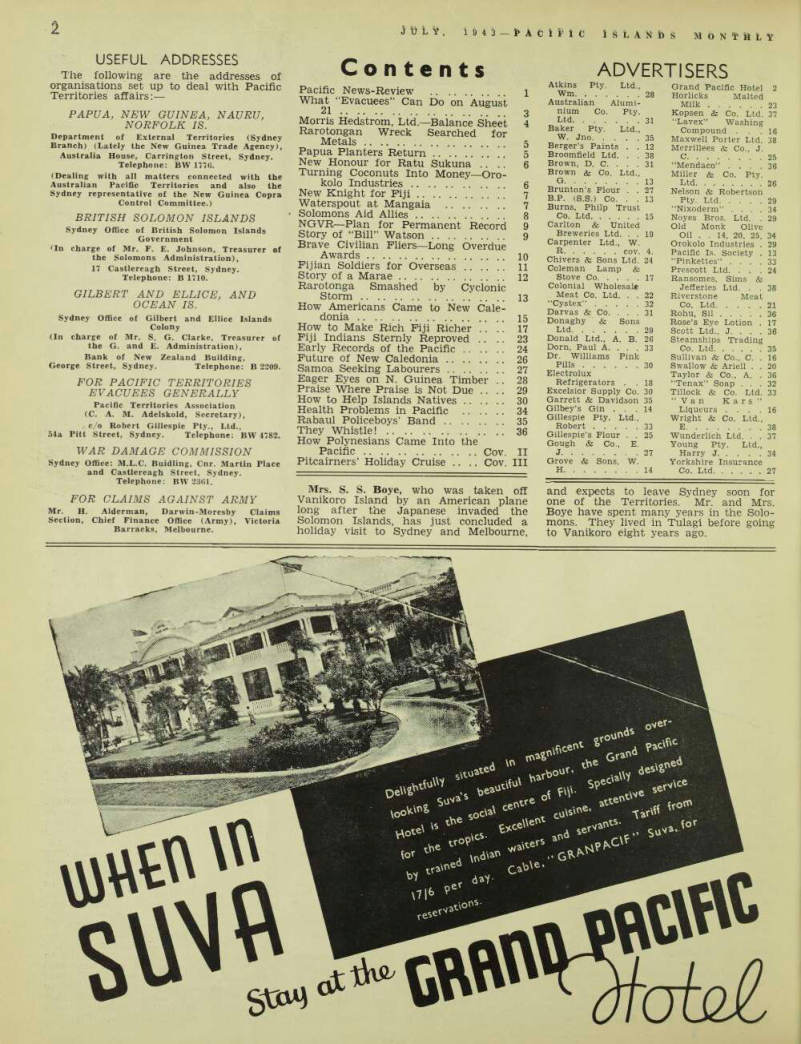
Contents
Pacific News-Review 1 What “Evacuees” Can Do on August 21 2 Morris Hedstrom, Ltd.—Balance Sheet 4 Rarotongan Wreck Searched for Metals 5 Papua Planters Return 5 New Honour for Ratu Sukuna .. ! ’ 6 Turning Coconuts Into Money—Oro kolo Industries 6 New Knight for Fiji 7 Waterspout at Mangaia ! 7 Solomons Aid Allies 8 NGVR—PIan for Permanent Record 9 Story of “Bill” Watson 9 Brave Civilian Fliers—Long Overdue Awards 10 Fijian Soldiers for Overseas 11 Story of a Marae 12 Rarotonga Smashed by Cyclonic Storm 13 How Americans Came to New Cale donia 15 How to Make Rich Fiji Richer .. .. 17 Fiji Indians Sternly Reproved .. .. 23 Early Records of the Pacific 24 Future of New Caledonia 26 Samoa Seeking Labourers 27 Eager Eyes on N. Guinea Timber .. 28 Praise Where Praise is Not Due ... 29 How to Help Islands Natives 30 Health Problems in Pacific 34 Rabaul Policeboys’ Band 35 They Whistle! 36 How Polynesians Came Into the Pacific Cov. II Pitcairners’ Holiday Cruise .. .. Cov. 11l
Advertisers
Atkins Pty. Ltd., Wm 28 Australian Alumi nium Co. Pty.
Ltd 31 Baker Pty. Ltd., W. Jno 35 Berger’s Paints . . 12 Broomfield Ltd. . . 38 Brown, D. C. . . .31 Brown & Co. Ltd., G 13 Brunton’s Flour . . 27
B.P. (S.S.) Co. . . 13
Burns, Philp Trust Co. Ltd 15 Carlton & United Breweries Ltd. . . 19 Carpenter Ltd., W.
R cov. 4.
Chivers & Sons Ltd. 24 Coleman Lamp & Stove Co 17 Colonial Wholesale Meat Co. Ltd. . . 22 “Cystex” 32 Darvas & Co. ... 31 Donaghy & Sons Ltd 29 Donald Ltd., A. B. 26 Dorn, Paul A. ... 33 Dr. Williams Pink Pills 30 Electrolux Refrigerators . . 18 Excelsior Supply Co. 30 Garrett & Davidson 35 Gilbey’s Gin ... 14 Gillespie Pty. Ltd., Robert 33 Gillespie’s Flour . . 25 Gough & Co., E.
J 27 Grove & Sons, W.
H 14
Grand Pacific Hotel 2 Horlicks Malted Milk 23 Kopsen & Co. Ltd. 37 “Lavex” Washing Compound ... 16 Maxwell Porter Ltd. 38 Merrillees & Co., J.
C 25 “Mendaco” ... 36 Miller & Co. Pty.
Ltd 26 Nelson & Robertson Pty. Ltd 29 “Nixoderm” ... 34 Noyes Bros. Ltd. . 29 Old Monk Olive Oil . . 14, 20, 25, 34 Orokolo Industries . 29 Pacific Is. Society . 13 “Pinkettes” ... 33 Prescott Ltd. ... 24 Ransomes, Sims & Jefferies Ltd. . . 38 Riverstone Meat Co. Ltd 21 Rohu, Sil 36 Rose’s Eye Lotion . 17 Scott Ltd., J. ... 36 Steamships Trading Co. Ltd 35 Sullivan & Co., C. . 16 Swallow & Ariell . . 20 Taylor & Co., A. . 36 “Tenax” Soap ... 32 Tillock & Co. Ltd. 33 “Van Kars”
Liqueurs ... 16 Wright & Co. Ltd., E 38 Wunderlich Ltd. . . 37 Young Pty. Ltd., Harry J 34 Yorkshire Insurance Co. Ltd 27
Advertisements & other items, p. 4 (4 items)
2
jUL Y , 1943 PACIFIC iSLA H b S M6N 1* L ¥
Useful Addresses
The following are the addresses of organisations set up to deal with Pacific Territories affairs: —
PAPUA, NEW GUINEA, NAURU,
NORFOLK IS.
Department of External Territories (Sydney Branch) (Lately the New Guinea Trade Agency), Australia House, Carrington Street, Sydney.
Telephone: BW 1776. (Dealing with all matters connected with the Australian Pacific Territories and also the Sydney representative of the New Guinea Copra Control Committee.)
BRITISH SOLOMON ISLANDS
Sydney Office of British Solomon Islands Government 'ln charge of Mr. F. E. Johnson, Treasurer of the Solomons Administration), 17 Castlereagh Street, Sydney.
Telephone: B 1710.
GILBERT AND ELLICE, AND
OCEAN IS.
Sydney Office of Gilbert and Ellice Islands Colony (In charge of Mr. S. G. Clarke, Treasurer of the G. and E. Administration), Bank of New Zealand Building, George Street, Sydney. Telephone: B 2209.
FOR PACIFIC TERRITORIES
EVACUEES GENERALLY
Pacific Territories Association (C. A. M. Adelskold, Secretary), c/o Robert Gillespie Pty,, Ltd., 54a Pitt Street, Sydney. Telephone: BW 4782.
WAR DAMAGE COMMISSION
Sydney Office: M.L.C. Buidling, Cnr. Martin Place and Castlereagh Street, Sydney.
Telephone: BW 2361.
FOR CLAIMS AGAINST ARMY
Mr. H. Alderman, Darwin-Moresby Claims Section, Chief Finance Office (Army), Victoria Barracks, Melbourne.
Mrs. S. S. Boye, who was taken off
Vanikoro Island by an American plane long after the Japanese invaded the Solomon Islands, has just concluded a holiday visit to Sydney and Melbourne,
and expects to leave Sydney soon for one
one of the Territories. Mr. and Mrs.
Boye have spent many years in the Solomons. They lived in Tulagi before going to Vanikoro eight years ago.
so*
Pacific Islands Monthly
The Newspaper-Magazine of the South Seas
IRegistered at the G.P.0., Sydney, for transmission by post as a newspaper .] Published Once Each Month and Circulated in Australia and New Zealand and in the following Pacific Territories and Islands Groups:
Australian Territory of Papua.
Mandated Territory (Australia) of New Guinea.
Australian Territory of Norfolk Island.
New Zealand Territory of Cook Islands.
Mandated Territory (NZ) of Western Samoa.
British Colony of Fiji.
British Solomon Islands Protectorate.
British Protectorate of Tongan Islands.
British Crown Colony of Gilbert and Ellice Islands.
Mandated Territory of Nauru.
British and Free French Condominium of New Hebrides.
Free French Colony of New Caledonia, Free French Colony of Oceania (Tahiti, etc.).
American Territory of Eastern Samoa.
American Territory of Hawaiian Islands.
Owned and Produced by Pacific Publications Pty. Ltd., Union House, 247 George Street, Sydney.
TELEPHONE f Managing Director .. BW 5037 I Business and Editorial MA 4369
P.O. Box 3408 R
Registered Address of Telegrams, Radiograms, and Cables: “Pacpub”, Sydney.
Contributions.
Articles, Stories, and Photographs dealing with Pacific Islands subjects are invited and will be paid for on publication.
Subscription Rates.
Per Annum, within British Empire, Prepaid, Post Free 8/- Per Annum, elsewhere, prepaid, Post Free. 10/- Single Copies Bd.
Editor and Publisher:
R, W. Robson, F.R.G.S.
Advertising Manager: L. W. Bailey.
Advertising Office and Printing-House: 29 Alberta Street, Sydney.
Advertising rates furnished on application.
Colours, etc., by arrangement.
Process Blocks made at Advertiser’s expense when required. Screen 100.
Changes of Advertising Copy should reach this office by Ist of each month, otherwise previous advertisement may be repeated.
Representative In London.
W. C. Harvey, Coronation House, 4 Lloyds Avenue, London, E.C.3, from whom may be obtained copies of Pacific Islands Monthly, Pacific Is. Year Book, advertising schedules, etc.
Agents.
The following are authorised to receive sub scriptions for Pacific Islands Monthly:— Burns, Philp & Co., Ltd., and Burns Phllp (South Sea) Co., Ltd. All branches.
W. R. Carpenter & Co., Ltd. All branches.
Morris, Hedstrom, Ltd. All branches.
Steamships Trading Co., Papua. All branches.
B.N.G. Trading Co., Ltd., Port Moresby, Papua.
J. Muir, Suva, Fiji.
Miss R. Castles, Suva, Fiji.
N. C. Mackenzie Hunt, Wainunu, Bua, FIJI.
Cook Islands Trading Co., Rarotonga, Cook Is.
A. C. Rowland, Papeete, Tahiti.
Islands Branches and Representatives of W. H.
Grove & Sons, Ltd., Auckland, New Zealand.
Ed. Pentecost, Noumea, New Caledonia.
Kerr & Co., Noumea, New Caledonia.
Vol. XIII. No. 12.
July 17, 1943
Pr\ra i Bd * Per Copy * mce £ Prepaid; 8/- p.a.
What "Evacuees" Can Do On August 21
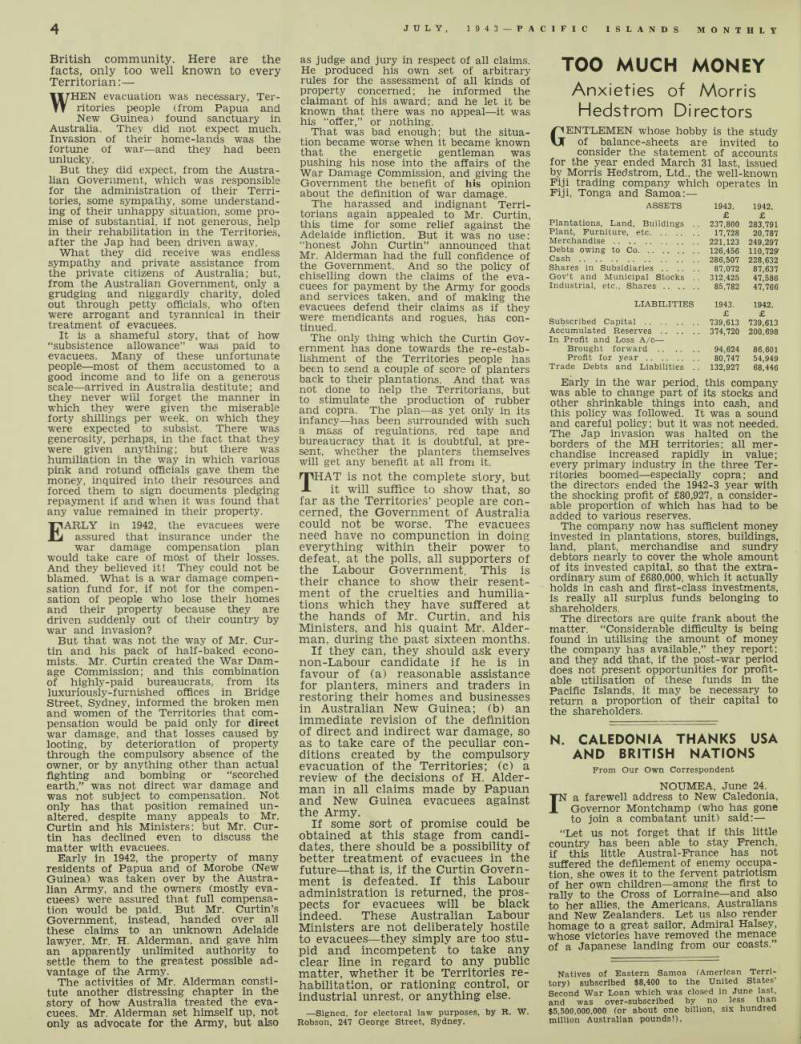
EX-RESIDENTS of New Guinea and Papua have been residents of Australia for about seventeen months —since the evacuation made “evacu ees” of them—and now, for about the first time, they are going to enjoy one of the privileges of Australian citizenship. They have lived long enough in Australia to have the right to vote; and, in that vote, they are permitted to express their opinion of the Government under which they have lived, for seventeen months.
It is to be hoped that all “evacuees” will see to it that they are enrolled; for there is plenty concerning which, at the ballot-box, they may express a forthright opinion.
Judged on performances, the Curtin Government of Australia has been a poor, weak, spineless, muddling ad ministration—no better, and in some respects more dangerous, than the babbling and inefficient Governments of Mr. Menzies and Mr. Fadden which it displaced. Ever since the events of 1939 threw Australia into the maelstrom of war, in which strength and efficiency are the condi tions of survival as a free people, the call has been for statesmen; but, instead. Australia has had to accept as leaders, professional politicians of a deplorable tvne—attended by end less gangs of impractical professors and tyrannical bureaucrats.
Weary of the fumblings and dith erings of the UAP-CP products, Aus tralia in 1940 voted indecisively for Labour. Next month, outraged by the economic dictatorship of Ded man, the one-eyed hooliganism of Ward and the weakness of Curtin,
Australia probably will vote against Labour. If the Curtin Government is not thrown out, it will only be because of the pathetic lack of leadership in the opposing parties.
NEVER was Australia so completely united in one thing—namely, determination and courage to stand beside the United Nations in fighting on for victory, whatever the cost.
And never did Australia, anxious now that her young men on the battle fields shall be adequately supported at home, cry so urgently for leadership.
That Australia, in these desperately critical days, can find only nincom poops and muddlers for the Minis terial offices of her civil administra tion, irrespective of the political party to which she appeals, means that Australia now is reaping the harvest of what she sowed in the fat and lazy years of peace. Then, men were too well-fed and indiffer ent to take any interest in the public affairs of their country. They left membership of the nation’s Parlia ment to middle-class mediocrities, bumble-footed “fixers,” and trade union officials, to whom £l,OOO per annum and a railway-pass seemed like paradise.
To-day, in every district in Austra lia, patriotic and well-instructed men are eager to give Parliamentary ser vice; but the gangs of professional politicians, although held in detesta tion by every class, are so strongly entrenched in their “seats,” and have so powerful a grip on the political party machines, that they cannot be displaced without nation-wide organi sation.
Disgust with the Curtin Govern ment’s record, and hatred of party politics and politicians, probably will result in the defeat of the Labour Government. But heaven alone knows what will take its place! Little can be hoped from a UAP-CP administra tion—the talent simply isn’t there.
Real reform may come, however, if a sufficient number of Independents are elected to constitute a sort of middle party, and force the party hacks to form a National Govern ment, to carry on the war and deal with the appalling problems of peace, free from the poisonous and crippling influences of party strife.
THE “evacuee vote” is not large— only a couple of thousands, per haps, in two millions—but evacuees may do quite a lot to affect the elec tions, if they use all their consider able influence among their friends.
For the unhappy and homeless Ter ritorians, the choice in this election is very simple. As, in relation to the paramount issue—the prosecution of the war—none of the contending candidates is worth more than any other (except, perhaps, the unknown Independents) the evacuee voter need apply to them all only the one mea suring-stick: To what extent will their respective parties pledge the assistance of the Commonwealth Gov ernment in the rehabilitation of the Australian Pacific Territories?
On that basis, the evacuee voter unhesitatingly will vote and work against all Labour candidates. The Labour Government of Mr. Curtin has treated the evacuees with an indifference and cruelty that this writer never thought to see in any
British community. Here are the facts, only too well known to every Terri torian:— WHEN evacuation was necessary, Ter ritories people (from Papua and New Guinea) found sanctuary in Australia. They did not expect much.
Invasion of their home-lands was the fortune of war—and they had been unlucky.
But they did expect, from the Austra lian Government, which was responsible for the administration of their Terri tories, some sympathy, some understand ing of their unhappy situation, some pro mise of substantial, if not generous, help in their rehabilitation in the Territories, after the Jap had been driven away.
What they did receive was endless sympathy and private assistance from the private citizens of Australia; but, from the Australian Government, only a grudging and niggardly charity, doled out through petty officials, who often were arrogant and tyrannical in their treatment of evacuees.
It is a shameful story, that of how “subsistence allowance” was paid to evacuees. Many of these unfortunate people—most of them accustomed to a good income and to life on a generous scale —arrived in Australia destitute; and they never will forget the manner in which they were given the miserable forty shillings per week, on which they were expected to subsist. There was generosity, perhaps, in the fact that they were given anything; but there was humiliation in the way in which various pink and rotund officials gave them the money, inquired into their resources and forced them to sign documents pledging repayment if and when it was found that any value remained in their property, EARLY in 1942, the evacuees were assured that insurance under the war damage compensation plan would take care of most of their losses.
And they believed it! They could not be blamed. What is a war damage compen sation fund for, if not for the compen sation of people who lose their homes and their property because they are driven suddenly out of their country by war and invasion?
But that was not the way of Mr, Cur tin and his pack of half-baked econo mists. Mr. Curtin created the War Dam age Commission; and this combination of highly-paid bureaucrats, from its luxuriously-furnished offices in Bridge Street, Sydney, informed the broken men and women of the Territories that com pensation would be paid only for direct war damage, and that losses caused by looting, by deterioration of property through the compulsory absence of the owner, or by anything other than actual fighting and bombing or “scorched earth,” was not direct war damage and was not subject to compensation. Not only has that position remained un altered, despite many appeals to Mr.
Curtin and his Ministers; but Mr. Cur tin has declined even to discuss the matter with evacuees.
Early in 1942, the property of many residents of Papua and of Morobe (New Guinea) was taken over by the Austra lian Army, and the owners (mostly eva cuees) were assured that full compensa tion would be paid. But Mr. Curtin’s Government, instead, handed over all these claims to an unknown Adelaide lawyer. Mr. H. Alderman, and gave him an apparently unlimited authority to settle them to the greatest possible ad vantage of the Army.
The activities of Mr. Alderman consti tute another distressing chapter in the story of how Australia treated the eva cuees. Mr. Alderman set himself up, not only as advocate for the Army, but also
as judge and jury in respect of all claims.
He produced his own set of arbitrary rules for the assessment of all kinds of property concerned; he informed the claimant of his award; and he let it be known that there was no appeal—it was his “offer,” or nothing.
That was bad enough; but the situa tion became worse when it became known that the energetic gentleman was pushing his nose into the affairs of the War Damage Commission, and giving the Government the benefit of his opinion about the definition of war damage.
The harassed and indignant Terri torians again appealed to Mr. Curtin, this time for some relief against the Adelaide infliction. But it was no use: “honest John Curtin” announced that Mr. Alderman had the full confidence of the Government. And so the policy of chiselling down the claims of the eva cuees for payment by the Army for goods and services taken, and of making the evacuees defend their claims as if they were mendicants and rogues, has con tinued.
The only thing which the Curtin Gov ernment has done towards the re-estab lishment of the Territories people has been to send a couple of score of planters back to their plantations. And that was not done to help the Territorians, but to stimulate the production of rubber and copra. The plan—as yet only in its infancy—has been surrounded with such a mass of regulations, red tape and bureaucracy that it is doubtful, at pre sent, whether the planters themselves will get any benefit at all from it.
THAT is not the complete story, but it will suffice to show that, so far as the Territories’ people are con cerned, the Government of Australia could not be worse. The evacuees need have no compunction in doing everything within their power to defeat, at the polls, all supporters of the Labour Government. This is their chance to show their resent ment of the cruelties and humilia tions which they have suffered at the hands of Mr. Curtin, and his Ministers, and his quaint Mr. Aider man, during the past sixteen months.
If they can, they should ask every non-Labour candidate if he is in favour of (a) reasonable assistance for planters, miners and traders in restoring their homes and businesses in Australian New Guinea; (b) an immediate revision of the definition of direct and indirect war damage, so as to take care of the peculiar con ditions created by the compulsory evacuation of the Territories; (c) a review of the decisions of H. Aider man in all claims made by Papuan and New Guinea evacuees against the Army.
If some sort of promise could be obtained at this stage from candi dates, there should be a possibility of better treatment of evacuees in the future—that is, if the Curtin Govern ment is defeated. If this Labour administration is returned, the pros pects for evacuees will be black indeed. These Australian Labour Ministers are not deliberately hostile to evacuees—they simply are too stu pid and incompetent to take any clear line in regard to any public matter, whether it be Territories re habilitation, or rationing control, or industrial unrest, or anything else. —Signed, for electoral law purposes, by R. W.
Robson, 247 George Street, Sydney.
Too Much Money
Anxieties of Morris Hedstrom Directors
GENTLEMEN whose hobby is the study of balance-sheets are invited to consider the statement of accounts for the year ended March 31 last, issued by Morris Hedstrom, Ltd., the well-known Fiji trading company which operates in Fiji, Tonga and Samoa:—
Early in the war period, this company was able to change part of its stocks and other shrinkable things into cash, and this policy was followed. It was a sound and careful policy; but it was not needed.
The Jap invasion was halted on the borders of the MH territories; all mer chandise increased rapidly in value; every primary industry in the three Ter ritories boomed—especially copra; and the directors ended the 1942-3 year with the shocking profit of £80,927, a consider able proportion of which has had to be added to various reserves.
The company now has sufficient money invested in plantations, stores, buildings, land, plant, merchandise and sundry debtors nearly to cover the whole amount of its invested capital, so that the extra ordinary sum of £680,000, which it actually holds in cash and first-class investments, is really all surplus funds belonging to shareholders.
The directors are quite frank about the matter. “Considerable difficulty is being found in utilising the amount of money the company has available,” they report; and they add that, if the post-war period does not present opportunities for profit able utilisation of these funds in the Pacific Islands, it may be necessary to return a proportion of their capital to the shareholders.
Assets
1943. 1942. £ £ Plantations, Land, Buildings 237,800 283,791 Plant, Furniture, etc 17,728 20,787 Merchandise 221,123 249,297 Debts owing to Co 126,456 110,729' Cash 286,507 228,632 Shares in Subsidiaries 87,072 87,637 Gov’t and Municipal Stocks .. 312,425 47,586 Industrial, etc., Shares 85,782 47,766
Liabilities
1943. 1942. £ £ Subscribed Capital 739,613 739,613 Accumulated Reserves 374,720 200,698 In Profit and Loss A/c — Brought forward 94,624 86,601 Profit for year 80,747 54,949 Trade Debts and Liabilities .. 132,927 68,446
N. Caledonia Thanks Usa
And British Nations
Prom Our Own Correspondent
Noumea, June 24.
Fa farewell address to New Caledonia, Governor Montchamp (who has gone to join a combatant unit) said: — “Let us not forget that if this little country has been able to stay French, if this little Austral-France has not suffered the defilement of enemy occupa tion, she owes it to the fervent patriotism of her own children —among the first to rally to the Cross of Lorraine—and also to her allies, the Americans, Australians and New Zealanders. Let us also render homage to a great sailor, Admiral Halsey, whose victories have removed the menace of a Japanese landing from our coasts.”
Natives of Eastern Samoa (American Terri tory) subscribed $8,400 to the United States’
Second War Loan which was closed in June last, and was over-subscribed by no less than $5,500,000,000 (or about one billion, six hundred million Australian pounds!).
Old Wreck Searched for Metals
Metals
From Our Own Correspondent
Rarotonga. June 1.
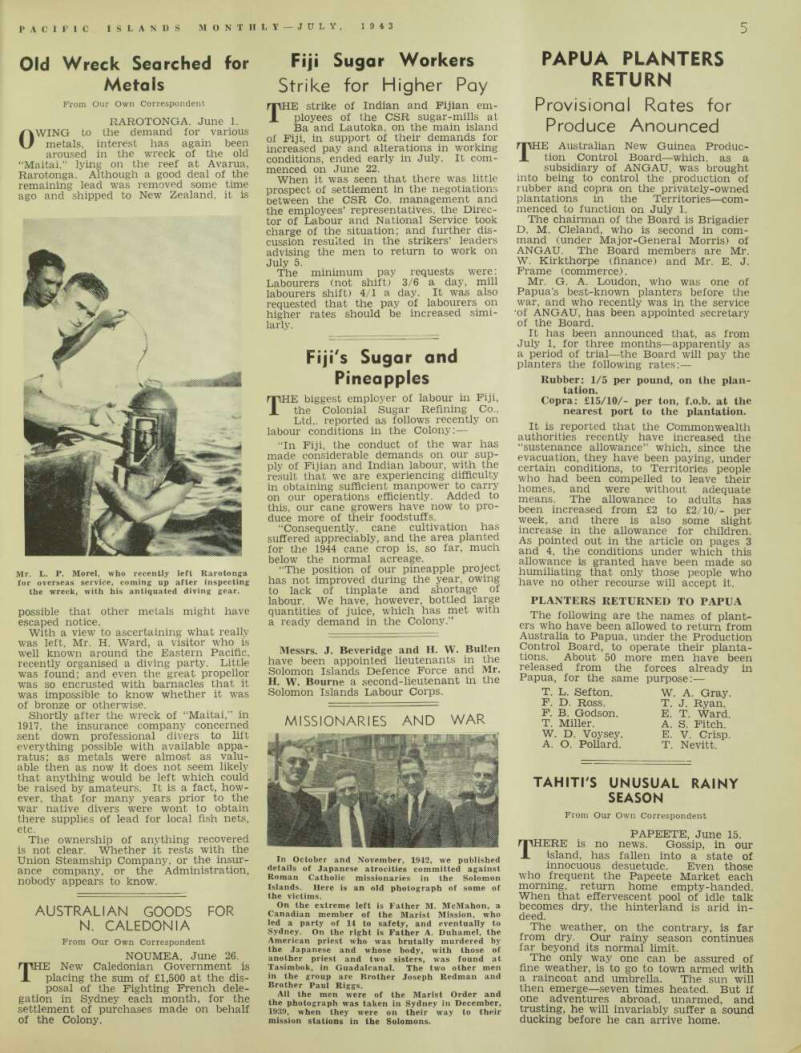
OWING to the demand for various metals, interest has again been aroused in the wreck of the old “Maitai,” lying on the reef at Avarua, Rarotonga. Although a good deal of the remaining lead was removed some time ago and shipped to New Zealand, it is
possible that other metals might have escaped notice.
With a view to ascertaining what really was left, Mr. H. Ward, a visitor who is well known around the Eastern Pacific, recently organised a diving party. Little was found; and even the great propeller was so encrusted with barnacles that it was impossible to know whether it was of bronze or otherwise.
Shortly after the wreck of “Maitai,” in 1917, the insurance company concerned sent down professional divers to lift everything possible with available appa ratus; as metals were almost as valu able then as now it does not seem likely that anything would be left which could be raised by amateurs. It is a fact, how ever, that for many years prior to the war native divers were wont to obtain there supplies of lead for local fish nets, etc.
The ownership of anything recovered is not clear. Whether it rests with the Union Steamship Company, or the insur ance company, or the Administration, nobody appears to know.
Mr. L. P. Morel, who recently left Rarotonga for overseas service, coming up after inspecting the wreck, with his antiquated diving gear.
Australian Goods For
N. Caledonia
From Our Own Correspondent
Noumea, June 26.
THE New Caledonian Government is placing the sum of £1,500 at the dis posal of the Fighting French dele gation in Sydney each month, for the settlement of purchases made on behalf of the Colony.
Fiji Sugar Workers
Strike for Higher Pay
THE strike of Indian and Fijian em ployees of the CSR sugar-mills at Ba and Lautoka, on the main island of Fiji, in support of their demands for increased pay and alterations in working conditions, ended early in July. It com menced on June 22.
When it was seen that there was little prospect of settlement in the negotiations between the CSR Co. management and the employees’ representatives, the Direc tor of Labour and National Service took charge of the situation; and further dis cussion resulted in the strikers’ leaders advising the men to return to work on July 5.
The minimum pay requests were; Labourers (not shift) 3/6 a day, mill labourers shift) 4/1 a day. It was also requested that the pay of labourers on higher rates should be increased simi larly.
Fiji's Sugar and Pineapples
Pineapples
THE biggest employer of labour in Fiji, the Colonial Sugar Refining Co., Ltd,, reported as follows recently on labour conditions in the Colony:— “In Fiji, the conduct of the war has made considerable demands on our sup ply of Fijian and Indian labour, with the result that we are experiencing difficulty in obtaining sufficient manpower to carry on our operations efficiently. Added to this, our cane growers have now to pro duce more of their foodstuffs.
“Consequently, cane cultivation has suffered appreciably, and the area planted for the 1944 cane crop is, so far, much below the normal acreage, “The position of our pineapple project has not improved during the year, owing to lack of tinplate and shortage of labour. We have, however, bottled large quantities of juice, which has met with a ready demand in the Colony.”
Messrs. J. Beveridge and H. W. Bullen have been appointed lieutenants in the Solomon Islands Defence Force and Mr.
H. W. Bourne a second-lieutenant in the Solomon Islands Labour Corps.
Missionaries And War
In October and November, 1942, we published details of Japanese atrocities committed against Roman Catholic missionaries in the Solomon Islands. Here is an old photograph of some of the victims.
On the extreme left is Father M. McMahon, a Canadian member of the Marist Mission, who led a party of 14 to safety, and eventually to Sydney. On the right is Father A. Duhamel, the American priest who was brutally murdered by the Japanese and whose body, with those of another priest and two sisters, was found at Tasimbok, in Guadalcanal. The two other men in the group are Brother Joseph Redman and Brother Paul Riggs.
All the men were of the Marist Order and the photograph was taken in Sydney in December, 1939, when they were on their way to their mission stations in the Solomons.
Produce Anounced
Papua Planters
Return
Provisional Rates for Produce Anounced
rE Australian New Guinea Produc tion Control Board—which, as a subsidiary of ANGAU, was brought into being to control the production of rubber and copra on the privately-owned plantations in the Territories—com menced to function on July 1.
The chairman of the Board is Brigadier D. M. Cleland, who is second in com mand (under Major-General Morris) of ANGAU. The Board members are Mr.
W. Kirkthorpe (finance) and Mr. E. J.
Frame (commerce).
Mr. G. A. Loudon, who was one of Papua’s best-known planters before the war, and who recently was in the service 'of ANGAU, has been appointed secretary of the Board.
It has been announced that, as from July 1, for three months —apparently as a period of trial —the Board will pay the planters the following rates: — Rubber: 1/5 per pound, on the plan tation.
Copra: £l5/10/- per ton, f.o.b. at the nearest port to the plantation.
It is reported that the Commonwealth authorities recently have increased the “sustenance allowance’’ which, since the evacuation, they have been paying, under certain conditions, to Territories people who had been compelled to leave their homes, and were without adequate means. The allowance to adults has been increased from £2 to £2/10/- per week, and there is also some slight increase in the allowance for children.
As pointed out in the article on pages 3 and 4, the conditions under which this allowance is granted have been made so humiliating that only those people who have no other recourse will accept it.
Planters Returned To Papua
The following are the names of plant ers who have been allowed to return from Australia to Papua, under the Production Control Board, to operate their planta tions. About 50 more men have been released from the forces already in Papua, for the same purpose:— T. L. Sefton. W. A. Gray.
F, D. Ross, T. J. Ryan.
F. B. Godson. E. T. Ward.
T. Miller. A. S. Fitch.
W. D. Voysey. E. V. Crisp.
A. O. Pollard. T. Nevitt.
Tahiti's Unusual Rainy
Season
From Our Own Correspondent
Papeete, June 15.
THERE is no news. Gossip, in our island, has fallen into a state of innocuous desuetude. Even those who frequent the Papeete Market each morning, return home empty-handed.
When that effervescent pool of idle talk becomes dry, the hinterland is arid in deed.
The weather, on the contrary, is far from dry. Our rainy season continues far beyond its normal limit.
The only way one can be assured of fine weather, is to go to town armed with a raincoat and umbrella. The sun will then emerge—seven times heated. But if one adventures abroad, unarmed, and trusting, he will invariably suffer a sound ducking before he can arrive home.
Ratu Sukuna
New Honour For
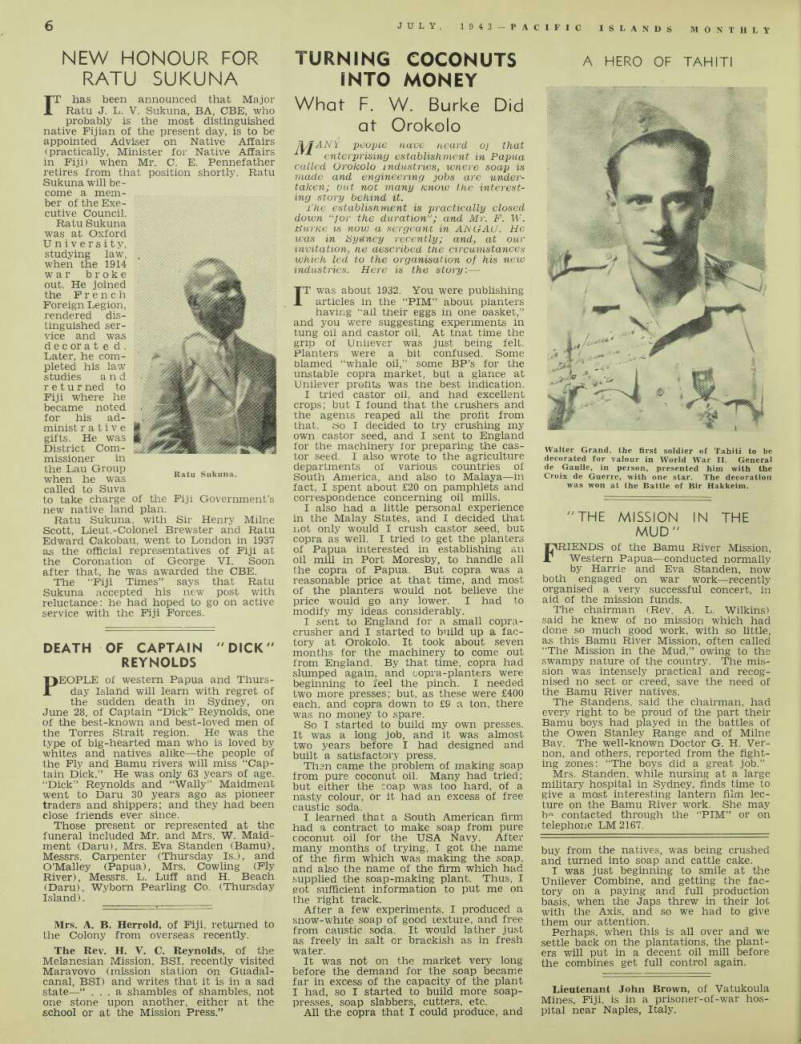
IT has been announced that Major Ratu J. L. V. Sukuna, BA, CBE, who probably is the most distinguished native Fijian of the present day, is to be appointed Adviser on Native Affairs (practically, Minister for Native Affairs in Fiji) when Mr. C. E. Pennefather retires from that position shortly. Ratu
Sukuna will be come a mem ber of the Exe cutive Council.
Ratu Sukuna was at Oxford University, studying law, when the 1914 war broke out. He joined the French Foreign Legion, rendered dis tinguished ser vice and was dec or ate d.
Later, he com pleted his law studies and ret u r ned to Fiji where he became noted for his ad minist r a t i v e gifts. He was District Com missioner in the Lau Group when he was called to Suva
to take charge of the Fiji Government’s new native land plan.
Ratu Sukuna, with Sir Henry Milne Scott, Lieut.-Colonel Brewster and Ratu Edward Cakobau, went to London in 1937 as the official representatives of Fiji at the Coronation of George VI. Soon after that, he was awarded the CBE.
The “Fiji Times” says that Ratu Sukuna accepted his new post with reluctance: he had hoped to go on active service with the Fiji Forces.
Ratu Sukuna.
Death Of Captain "Dick"
Reynolds
PEOPLE of western Papua and Thurs day Island will learn with regret of the sudden death in Sydney, on June 28, of Captain “Dick” Reynolds, one of the best-known and best-loved men of the Torres Strait region. He was the type of big-hearted man who is loved by whites and natives alike —the people of the Fly and Bamu rivers will miss “Cap tain Dick.” He was only 63 years of age.
“Dick” Reynolds and “Wally” Maidment went to Daru 30 years ago as pioneer traders and shippers; and they had been close friends ever since.
Those present or represented at the funeral included Mr. and Mrs. W. Maid ment (Daru), Mrs. Eva Standen (Bamu), Messrs. Carpenter (Thursday Is.), and O’Malley (Papua), Mrs. Cowling (Ply River), Messrs. L. Luff and H. Beach (Daru), Wyborn Pearling Co. (Thursday Island).
Mrs. A. B. Herr old, of Fiji, returned to the Colony from overseas recently.
The Rev. H, V. C. Reynolds, of the Melanesian Mission, BSI, recently visited Maravovo (mission station on Guadal canal, BSI) and writes that it is in a sad state—“ ... a shambles of shambles, not one stone upon another, either at the school or at the Mission Press.”
Turning Coconuts
Into Money
What F. W. Burke Did at Orokolo
Ji/JANY people nave neard of that * enterprising establishment in Papua called Orokolo industries , wnere soap is made and engineering jobs are under taken; Out not many know the interest ing story behind it.
The establishment is practically closed down “for the duration"; and Mr. F. W.
Bur he is now a sergeant in AHOAU. He was in Sydney recently; and , at our invitation, he described the circumstances which led to the organisation of his new industries. Here is the story. — IT was about 1932. You were publishing articles in the “PIM” about planters having “all their eggs in one casket,” and you were suggestmg experiments in tung oil and castor oil. At tnat time the grip of Unilever was just being felt.
Planters were a bit confused. Some blamed “whale oil,” some BP’s for the unstable copra market, but a glance at Unilever profits was the best indication.
I tried castor oil, and had excellent crops; but I found that the crushers and the agents reaped all the profit from that. So I decided to try crushing my own castor seed, and I sent to England for the machinery for preparing the cas tor seed. I also wrote to the agriculture departments of various countries of South America, and also to Malaya—in fact, I spent about £2O on pamphlets and correspondence concerning oil mills, I also had a little personal experience in the Malay States, and I decided that not only would I crush castor seed, but copra as well. I tried to get the planters of Papua interested in establishing an oil mill in Port Moresby, to handle all the copra of Papua. But copra was a reasonable price at that time, and most of the planters would not believe the price would go any lower. I had to modify my ideas considerably.
I sent to England for a small copra crusher and I started to build up a fac tory at Orokolo. It took about seven months for the machinery to come out from England. By that time, copra had slumped again, and copra-planters were beginning to feel the pinch. I needed two more presses; but, as these were £4OO each, and copra down to £9 a ton, there was no money to spare.
So I started to build my own presses.
It was a long job, and it was almost two years before I had designed and built a satisfactory press.
Then came the problem of making soap from pure coconut oil. Many had tried; but either the soap was too hard, of a nasty colour, or it had an excess of free caustic soda.
I learned that a South American firm had a contract to make soap from pure coconut oil for the USA Navy. After many months of trying, I got the name of the firm which was making the soap, and also the name of the firm which had supplied the soap-making plant. Thus, I got sufficient information to put me on the right track.
After a few experiments, I produced a snow-white soap of good texture, and free from caustic soda. It would lather just as freely in salt or brackish as in fresh water.
It was not on the market very long before the demand for the soap became far in excess of the capacity of the plant I had, so I started to build more soap presses, soap slabbers, cutters, etc.
All the copra that I could produce, and
buy from the natives, was being crushed and turned into soap and cattle cake.
I was just beginning to smile at the Unilever Combine, and getting the fac tory on a paying and full production basis, when the Japs threw in their lot with the Axis, and so we had to give them our attention.
Perhaps, when this is all over and we settle back on the plantations, the plant ers will put in a decent oil mill before the combines get full control again.
Lieutenant John Brown, of Vatukoula Mines, Fiji, is in a prisoner-of-war hos pital near Naples, Italy.
A Hero Of Tahiti
Walter Grand, the first soldier of Tahiti to be decorated for valour in World War 11. General de Gaulle, in person, presented him with the Croix de Guerre, with one star. The decoration was won at the Battle of Bir Hakkeim.
"The Mission In The
Mud"
FRIENDS of the Bamu River Mission, Western Papua—conducted normally by Harrie and Eva Standen, now both engaged on war work—recently organised a very successful concert, in aid of the mission funds.
The chairman (Rev. A. L. Wilkins) said he knew of no mission which had done so much good work, with so little, as this Bamu River Mission, often called “The Mission in the Mud,” owing to the swampy nature of the country. The mis sion was intensely practical and recog nised no sect or creed, save the need of the Bamu River natives.
The Standens, said the chairman, had every right to be proud of the part their Bamu boys had played in the battles of the Owen Stanley Range and of Milne Bay. The well-known Doctor G. H. Ver non, and others, reported from the fight ing zones: “The boys did a great job.”
Mrs. Standen. while nursing at a large military hospital in Sydney, finds time to give a most interesting lantern film lec ture on the Bamu River work. She may b° contacted through the “PIM” or on telephone LM 2167.
New Knight For
Fiji
Birthday Honours List
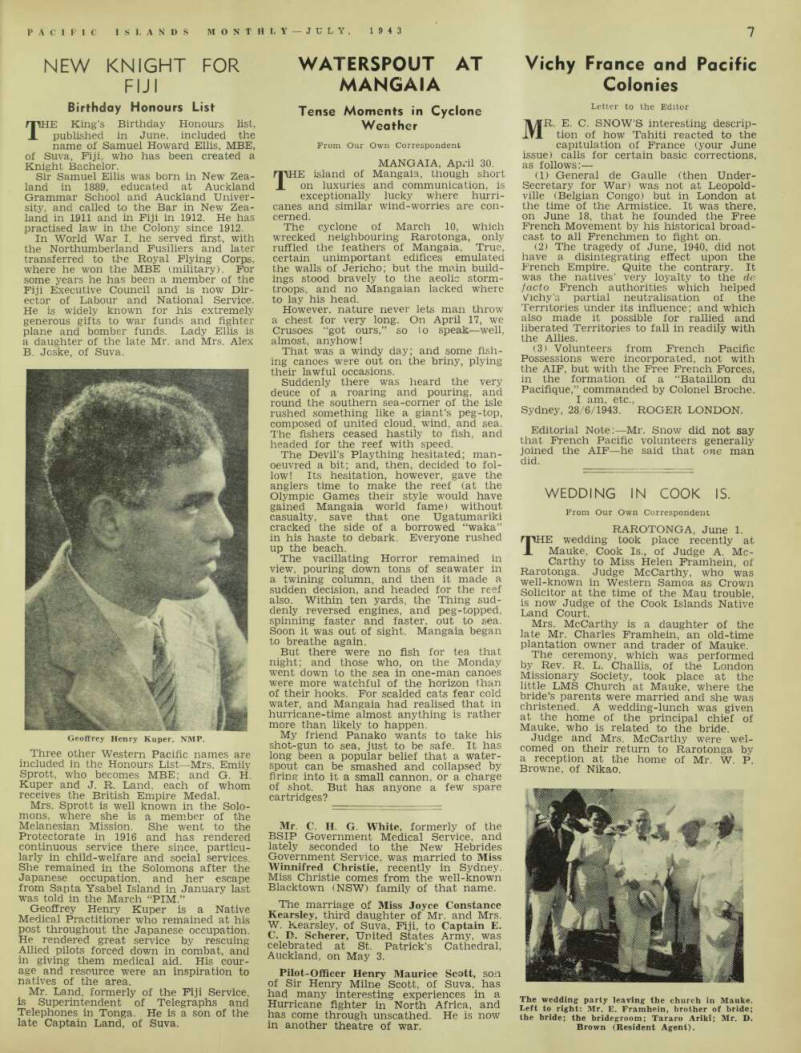
THE King’s Birthday Honours list, published in June, included the name of Samuel Howard Ellis, MBE, of Suva, Fiji, who has been created a Knight Bachelor.
Sir Samuel Ellis was born in New Zea land in 1889, educated at Auckland Grammar School and Auckland Univer sity, and called to the Bar in New Zea land in 1911 and in Fiji in 1912. He has practised law in the Colony since 1912.
In World War I, he served first, with the Northumberland Fusiliers and later transferred to the Royal Flying Corps, where he won the MBE (.military). For some years he has been a member of the Fiji Executive Council and is now Dir ector of Labour and National Service.
He is widely known for his extremely generous gifts to war funds and fighter plane and bomber funds. Lady Ellis is a daughter of the late Mr. and Mrs. Alex B. Joske, of Suva.
Three other Western Pacific names are included in the Honours List—Mrs. Emily Sprott, who becomes MBE; and G. H.
Kuper and J. R. Land, each of whom receives the British Empire Medal.
Mrs. Sprott is well known in the Solo mons, where she is a member of the Melanesian Mission. She went to the Protectorate in 1916 and has rendered continuous service there since, particu larly in child-welfare and social services.
She remained in the Solomons after the Japanese occupation, and her escape from Sapta Ysabel Island in January last was told in the March “PIM.”
Geoffrey Henry Kuper is a Native Medical Practitioner who remained at his post throughout the Japanese occupation.
He rendered great service by rescuing Allied pilots forced down in combat, and in giving them medical aid. His cour age and resource were an inspiration to natives of the area.
Mr. Land, formerly of the Fiji Service, is Superintendent of Telegraphs and Telephones in Tonga. He is a son of the late Captain Land, of Suva.
Geoffrey Henry Kuper, NMP.
Waterspout At
Mangaia
Tense Moments in Cyclone Weather
From Our Own Correspondent MANGAIA, April 30.
THE island of Mangaia, though short on luxuries and communication, is exceptionally lucky where hurri canes and similar wind-worries are con cerned.
The cyclone of March 10, which wrecked neighbouring Rarotonga, only ruffled the feathers of Mangaia. True, certain unimportant edifices emulated the walls of Jericho; but the main build ings stood bravely to the aeolic storm troops, and no Mangaian lacked where to lay his head.
However, nature never lets man throw a chest for very long. On April 17, we Crusoes “got ours,” so 1o speak—well, almost, anyhow!
That was a windy day; and some fish ing canoes were out on the briny, plying their lawful occasions.
Suddenly there was heard the very deuce of a roaring and pouring, and round the southern sea-corner of the isle rushed something like a giant’s peg-top, composed of united cloud, wind, and sea.
The fishers ceased hastily to fish, and headed for the reef with speed.
The Devil’s Plaything hesitated; man oeuvred a bit; and, then, decided to fol low! Its hesitation, however, gave the anglers time to make the reef (at the Olympic Games their style would have gained Mangaia world fame) without casualty, save that one Ugatumariki cracked the side of a borrowed “waka” in his haste to debark. Everyone rushed up the beach.
The vacillating Horror remained in view, pouring down tons of seawater in a twining column, and then it made a sudden decision, and headed for the reef also. Within ten yards, the Thing sud denly reversed engines, and peg-topped, spinning faster and faster, out to sea.
Soon it was out of sight. Mangaia began to breathe again.
But there were no fish for tea that night: and those who, on the Monday went down to the sea in one-man canoes were more watchful of the horizon than of their hooks. For scalded cats fear cold water, and Mangaia had realised that in hurricane-time almost anything is rather more than likely to happen.
My friend Panako wants to take his shot-gun to sea, just to be safe. It has long been a popular belief that a water spout can be smashed and collapsed by firing into it a small cannon, or a charge of shot. But has anyone a few spare cartridges?
Mr. C. H. G. White, formerly of the BSIP Government Medical Service, and lately seconded to the New Hebrides Government Service, was married to Miss Winnifred Christie, recently in Sydney.
Miss Christie comes from the well-known Blacktown (NSW) family of that name.
The marriage of Miss Joyce Constance Kearsley, third daughter of Mr. and Mrs.
W. Kearsley, of Suva, Fiji, to Captain E.
C. D. Scherer, United States Army, was celebrated at St. Patrick’s Cathedral, Auckland, on May 3.
Pilot-Officer Henry Maurice Scott, son of Sir Henry Milne Scott, of Suva, has had many interesting experiences in a Hurricane fighter in North Africa, and has come through unscathed. He is now in another theatre of war.
Colonies
Vichy France and Pacific Colonies
Letter to the Editor MR. E. C. SNOW’S interesting descrip tion of how Tahiti reacted to the capitulation of France (your June issue) calls for certain basic corrections, as follows: — (1) General de Gaulle (then Under secretary for War) was not at Leopold ville (Belgian Congo) but in London at the time of the Armistice. It was there, on June 18, that he founded the Free French Movement by his historical broad cast to all Frenchmen to fight on. (2) The tragedy of June, 1940, did not have a disintegrating effect upon the French Empire. Quite the contrary. It was the natives’ very loyalty to the de facto French authorities which helped Vichy’s partial neutralisation of the Territories under its influence; and which also made it possible for rallied and liberated Territories to fall in readily with the Allies. (3) Volunteers from French Pacific Possessions were incorporated, not with the AIF, but with the Free French Forces, in the formation of a “Bataillon du Pacifique,” commanded by Colonel Broche.
I am, etc.,
Sydney, 28/6/1943.
Roger London.
Editorial Note: —Mr. Snow did not say that French Pacific volunteers generally joined the AlF—he said that one man did.
Wedding In Cook Is.
From Our Own Correspondent
Rarotonga, June 1.
THE wedding took place recently at Mauke, Cook Is., of Judge A. Mc- Carthy to Miss Helen Framhein, of Rarotonga. Judge McCarthy, who was well-known in Western Samoa as Crown Solicitor at the time of the Mau trouble, is now Judge of the Cook Islands Native Land Court.
Mrs. McCarthy is a daughter of the late Mr. Charles Framhein, an old-time plantation owner and trader of Mauke.
The ceremony, which was performed by Rev. R. L. Challis, of the London Missionary Society, took place at the little LMS Church at Mauke, where the bride’s parents were married and she was christened. A wedding-lunch was given at the home of the principal chief of Mauke, who is related to the bride.
Judge and Mrs. McCarthy were wel comed on their return to Rarotonga by a reception at the home of Mr. W. P.
Browne, of Nikao.
The wedding party leaving the church in Mauke.
Left to right; Mr. E. Framhein, brother of bride; the bride; the bridegroom; Tararo Ariki; Mr. D.
Brown (Resident Agent).
Solomons Aid
Allies
Significant Story of What Happened in May-August, 1942
'T'HE Japanese came into the Central ■*- Solomons and occupied Tulagi and the neighbourhood in strengtn at the end of April, 1942; and they remained mere until thrown out by the Americans the following August.
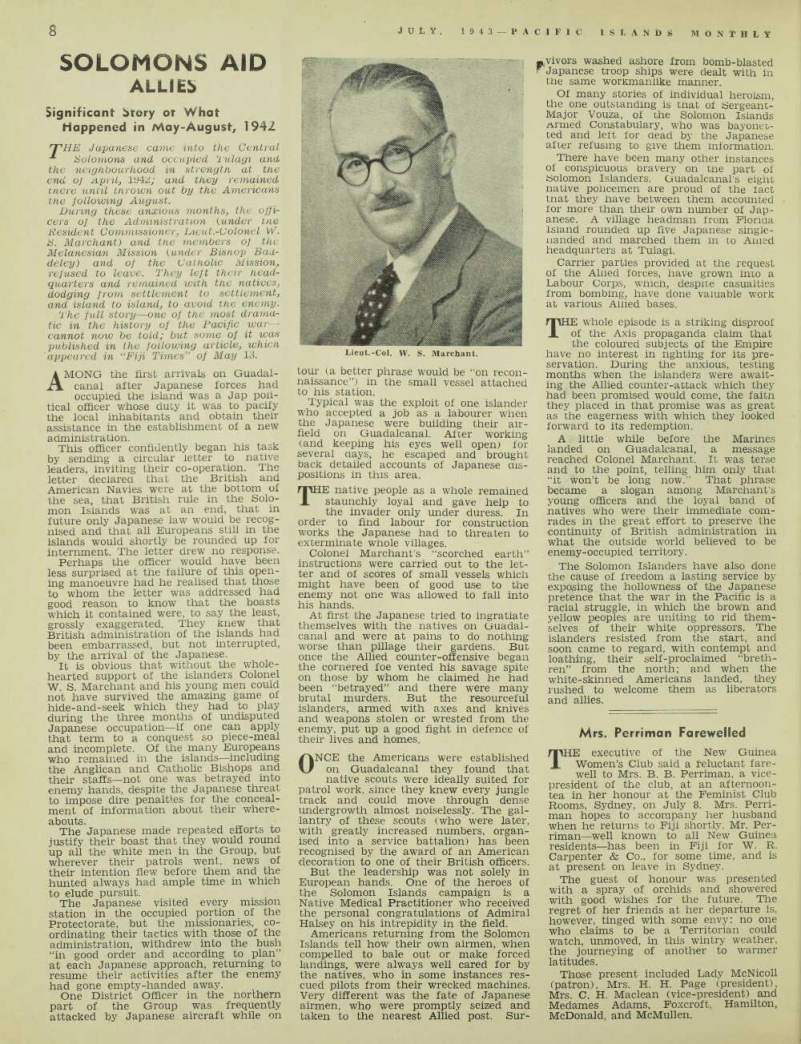
During these anxious months, the offi cers of the Administration (under me Resident Commissioner, Lieut.-Colonel W. if. Marchant) and tne members of the Melanesian Mission (under Bisnop Bad deley) and of the Catholic Mission, refused to leave. They left their head quarters and remained with the natives, dodging from settlement to settlement, and island to island, to avoid the enemy.
The full story—one of the most drama tic in the history of the Pacific war — cannot now be told; but some of it was published in the following article, which appeared in “Fiji Times” of May 13.
AMONG the first arrivals on Guadal canal after Japanese forces had occupied the island was a Jap poli tical officer whose duty it was to pacify the local inhabitants and obtain their assistance in the establishment of a new administration.
This officer confidently began his task by sending a circular letter to native leaders, inviting their co-operation. The letter declared that the British and American Navies were at the bottom of the sea, that British rule in the Solo mon Islands was at an end, that in future only Japanese law would be recog nised and that all Europeans still in the islands would shortly be rounded up for internment. The letter drew no response.
Perhaps the officer would have been less surprised at the failure of this open ing manoeuvre had he realised that those to whom the letter was addressed had good reason to know that the boasts which it contained were, to say the least, grossly exaggerated. They knew that British administration of the islands had been embarrassed, but not interrupted, by the arrival of the Japanese.
It is obvious that without the whole hearted support of the islanders Colonel W. S. Marchant and his young men could not have survived the amazing game of hide-and-seek which they had to play during the three months of undisputed Japanese occupation—if one can apply that term to a conquest so piece-meal and incomplete. Of the many Europeans who remained in the islands —including the Anglican and Catholic Bishops and their staffs—not one was betrayed into enemy hands, despite the Japanese threat to impose dire penalties for the conceal ment of information about their where abouts.
The Japanese made repeated efforts to justify their boast that they would round up all the white men in the Group, but wherever their patrols went, news of their intention flew before them and the hunted always had ample time in which to elude pursuit.
The Japanese visited every mission station in the occupied portion of the Protectorate, but the missionaries, co ordinating their tactics with those of the administration, withdrew into the bush “in good order and according to plan” at each Japanese approach, returning to resume their activities after the enemy had gone empty-handed away.
One District Officer in the northern part of the Group was frequently attacked by Japanese aircraft while on
tour (a better phrase would be “on recon naissance”) in the small vessel attached to his station.
Typical was the exploit of one islander who accepted a job as a labourer when the Japanese were building their air field on Guadalcanal. After working (and keeping his eyes well open) for several days, he escaped and brought back detailed accounts of Japanese dis positions in this area. rE native people as a whole remained staunchly loyal and gave help to the invader only under duress. In order to find labour for construction works the Japanese had to threaten to exterminate whole villages.
Colonel Marchant’s “scorched earth” instructions were carried out to the let ter and of scores of small vessels which might have been of good use to the enemy not one was allowed to fall into his hands.
At first the Japanese tried to ingratiate themselves with the natives on Guadal canal and were at pains to do nothing worse than pillage their gardens. But once the Allied counter-offensive began the cornered foe vented his savage spite on those by whom he claimed he had been “betrayed” and there were many brutal murders. But the resourceful islanders, armed with axes and knives and weapons stolen or wrested from the enemy, put up a good fight in defence of their lives and homes.
ONCE the Americans were established on Guadalcanal they found that native scouts were ideally suited for patrol work, since they knew every jungle track and could move through dense undergrowth almost noiselessly. The gal lantry of these scouts (who were later, with greatly increased numbers, organ ised Into a service battalion) has been recognised by the award of an American decoration to one of their British officers.
But the leadership was not solely in European hands. One of the heroes of the Solomon Islands campaign is a Native Medical Practitioner who received the personal congratulations of Admiral Halsey on his intrepidity in the field.
Americans returning from the Solomon Islands tell how their own airmen, when compelled to bale out or make forced landings, were always well cared for by the natives, who in some instances res cued pilots from their wrecked machines.
Very different was the fate of Japanese airmen, who were promptly seized and taken to the nearest Allied post. Sur
,vivors washed ashore from bomb-blasted Japanese troop ships were dealt with in the same wononanlike manner.
Of many stories of individual heroism, the one outstanding is that of Sergeant- Major Vouza, of the Solomon Islands Armed Constabulary, who was bayonet led and left for dead by the Japanese after refusing to give them information.
There have been many other instances of conspicuous bravery on tne part of Solomon Islanders. Guadalcanal’s eight native policemen are proud of the fact tnat they have between them accounted for more than their own number of Jap anese. A village headman from Florida Island rounded up five Japanese single nanded and marched them in to Amed headquarters at Tulagi.
Carrier parties provided at the request of the Allied forces, have grown into a Labour Corps, which, despite casualties from bombing, have done valuable work at various Allied bases. fITHE whole episode is a striking disproof X of the Axis propaganda claim that the coloured subjects of the Empire have no interest in fighting for its pre servation. During the anxious, testing months when the islanders were await ing the Allied counter-attack which they had been promised would come, the faitn they placed in that promise was as great as the eagerness with which they looked forward to its redemption.
A little while before the Marines landed on Guadalcanal, a message reached Colonel Marchant. It was terse and to the point, telling him only that “it won’t be long now.” That phrase became a slogan among Marchant’s young officers and the loyal band of natives who were their immediate com rades in the great effort to preserve the continuity of British administration in what the outside world believed to be enemy-occupied territory.
The Solomon Islanders have also done the cause of freedom a lasting service by exposing the hollowness of the Japanese pretence that the war in the Pacific is a racial struggle, in which the brown and yellow peoples are uniting to rid them selves of their white oppressors. The islanders resisted from the start, and soon came to regard, with contempt and loathing, their self-proclaimed “breth ren” from the north; and when the white-skinned Americans landed, they rushed to welcome them as liberators and allies.
Lieut.-Col. W. S. Marchant.
Mrs. Perriman Farewelled
THE executive of the New Guinea Women’s Club said a reluctant fare well to Mrs. B. B. Perriman, a vice president of the club, at an afternoon tea in her honour at the Feminist Club Rooms, Sydney, on July 8. Mrs. Perri man hopes to accompany her husband when he returns to Fiji shortly. Mr. Per riman—well known to all New Guinea residents —has been in Fiji for W. R.
Carpenter & Co., for some time, and is at present on leave in Sydney.
The guest of honour was presented with a spray of orchids and showered with good wishes for the future. The regret of her friends at her departure is, however, tinged with some envy: no one who claims to be a Territorial! could watch, unmoved, in this wintry weather, the journeying of another to warmer latitudes.
Those present included Lady McNicoll (patron), Mrs. H. H. Page (president), Mrs. C. H. Maclean (vice-president) and Medames Adams, Foxcroft, Hamilton, McDonald, and McMullen.
Advertisements & other items, p. 10 (1 item)
8
JULY, 1943-HCIFIC ISLANDS MON 1? H L Y
Mr. W. W. Bolton
Now 85 Years Old
From Our Tahiti Correspondent
Mr. William Washington Bol
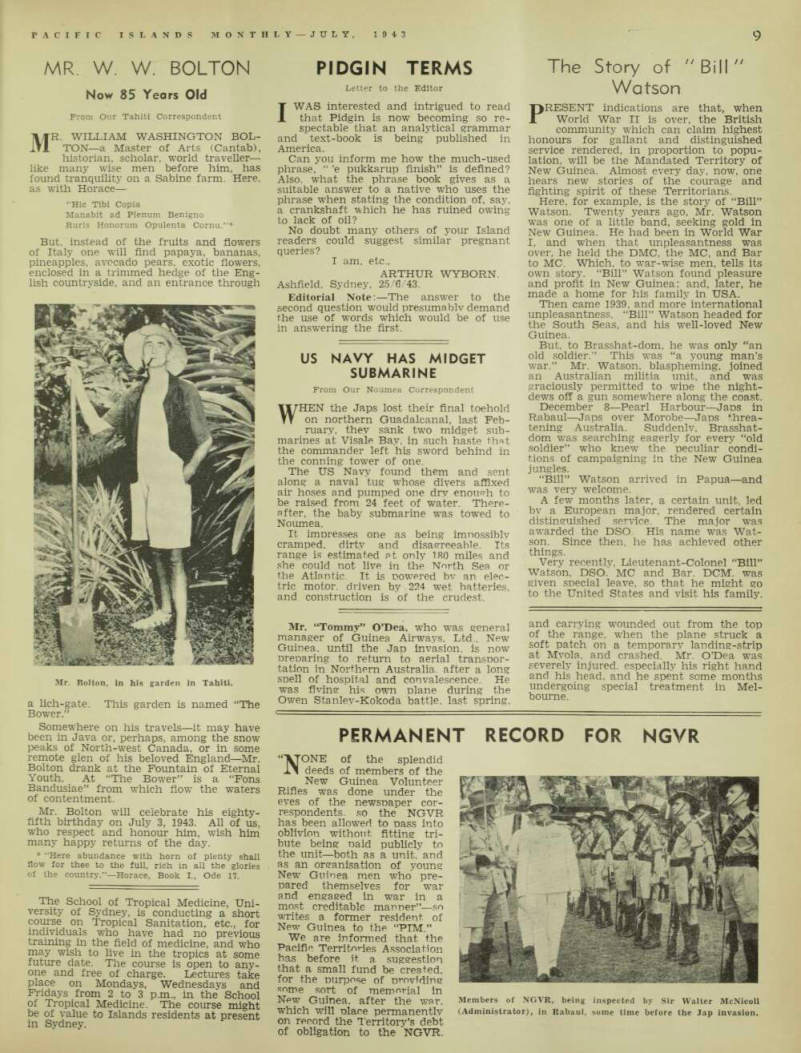
TON—a Master of Arts (Cantab), historian, scholar, world traveller— like many wise men before him, has found tranquility on a Sabine farm. Here, as with Horace— “ Hie Tibi Copia Manabit ad Plenum Benigno Ruris Honorum Opulenta Cornu.”* But, instead of the fruits and flowers of Italy one will find papaya, bananas, pineapples, avocado pears, exotic flowers, enclosed in a trimmed hedge of the Eng lish countryside, and an entrance through
a lich-gate. This garden is named “The Bower.”
Somewhere on his travels —it may have been in Java or, perhaps, among the snow peaks of North-west Canada, or in some remote glen of his beloved England—Mr.
Bolton drank at the Fountain of Eternal Youth. At “The Bower” is a “Fons Bandusiae” from which flow the waters of contentment.
Mr. Bolton will celebrate his eighty fifth birthday on July 3, 1943. All of us, who respect and honour him, wish him many happy returns of the day. * “Here abundance with horn of plenty shall flow for thee to the full, rich in all the glories of the country.”—Horace, Book 1., Ode 17.
The School of Tropical Medicine, Uni versity of Sydney, is conducting a short course on Tropical Sanitation, etc., for individuals who have had no previous training in the field of medicine, and who may wish to live in the tropics at some future date. The course is open to any one and free of charge. Lectures take place on Mondays, Wednesdays and Fridays from 2 to 3 p.m., in the School of Tropical Medicine. The course might be of value to Islands residents at present
in Sydney.
Mr. Bolton, in his garden in Tahiti.
Pidgin Terms
Letter to the Editor I WAS interested and intrigued to read that Pidgin is now becoming so re spectable that an analytical grammar and text-book is being published in America.
Can you inform me how the much-used phrase, “ ’e pukkarup finish” is defined?
Also, what the phrase book gives as a suitable answer to a native who uses the phrase when stating the condition of, say, a crankshaft which he has ruined owing to lack of oil?
No doubt many others of your Island readers could suggest similar pregnant queries?
I am, etc.,
Arthur Wyborn.
Ashfield. Sydney, 25/6/43.
Editorial Note:—The answer to the second question would presumably demand the use of words which would be of use in answering the first.
Us Navy Has Midget
Submarine
From Our Noumea Correspondent WHEN the Japs lost their final toehold on northern Guadalcanal, last Feb ruary. they sank two midget sub marines at Visale Bay. in such haste that the commander left his sword behind in the conning tower of one.
The US Navy found them and sent along a naval tug whose divers affixed air hoses and pumped one dry enough to be raised from 24 feet of water. There after, the baby submarine was towed to Noumea.
It imnresses one as being imnossiblv cramped, dirty and disagreeable. Its range is estimated at only 180 miles and she could not live in the North Sea or the Atlantic. It is cowered bv an elec tric motor, driven by 224 wet batteries, and construction is of the crudest.
Mr. “Tommy” O'Dea. who was general manager of Guinea Airways. Ltd.. New Guinea, until the Jap invasion, is now nrenaring to return to aerial transnor tation in Northern Australia, after a long spell of hospital and convalescence. He was living his own plane during the Owen Stanlev-Kokoda battle, last spring.
and carrying wounded out from the top of the range, when the plane struck a soft patch on a temporary landing-strip at Myola. and crashed. Mr. O’Dea was severely injured, especially his right hand and his head, and he spent some months undergoing special treatment in Mel bourne.
The Story of "Bill"
Watson
PRESENT indications are that, when World War II is over, the British community which can claim highest honours for gallant and distinguished service rendered, in proportion to popu lation, will be the Mandated Territory of New Guinea. Almost every day, now, one hears new stories of the courage and fighting spirit of these Territorians.
Here, for example, is the story of “Bill”
Watson. Twenty years ago, Mr. Watson was one of a little band, seeking gold in New Guinea. He had been in World War I, and when that unpleasantness was over, he held the DMC, the MC, and Bar to MC. Which, to war-wise men, tells its own story. “Bill” Watson found pleasure and profit in New Guinea: and, later, he made a home for his family in USA.
Then came 1939. and more international unpleasantness. “Bill” Watson headed for the South Seas, and his well-loved New Guinea.
But, to Brasshat-dom, he was only “an old soldier.” This was “a young man’s war.” Mr. Watson, blaspheming, joined an Australian militia unit, and was graciously permitted to wine the night dews off a gun somewhere along the coast.
December B—Pearl8 —Pearl Harbour —Japs in Rabaul—Japs over Morobe —Jans threa tening Australia. Suddenlv, Brasshat dom was searching eagerly for every “old soldier” who knew the peculiar condi tions of campaigning in the New Guinea jungles.
“Bill” Watson arrived in Papua—and was very welcome.
A few months later, a certain unit, led bv a European major, rendered certain distinguished service. The major was awarded the DSO His name was Wat son. Since then, he has achieved other things.
Very recently, Lieutenant-Colonel “Bill”
Watson, DSO. MC and Bar. DCM. was given special leave, so that he might go to the United States and visit his family.
Permanent Record For Ngvr
“VTONE of the splendid 11 deeds of members of the New Guinea Volunteer Rifles was done under the eyes of the newspaper cor respondents. so the NGVR has been allowed to pass into oblivion without fitting tri bute being paid publicly to the unit—both as a unit, and as an organisation of young New Guinea men who pre pared themselves for war and engaged in war in a most creditable manner”—so writes a former resident of New Guinea to the “PIM.”
We are informed that the Pacific Territories Association has before it a suggestion that a small fund be created, for the purpose of providing some sort of memorial in New Guinea, after the war. which will place permanently on record the Territory’s debt of obligation to the NGVR.
Members of NGVR, being inspected by Sir Walter McNicoll (Administrator), in Rabaul, some time before the Jap invasion.
Advertisements & other items, p. 11 (1 item)
9
PACIFIC ISLANDS M ONTHLY JULY, 1943
Brave Civilian
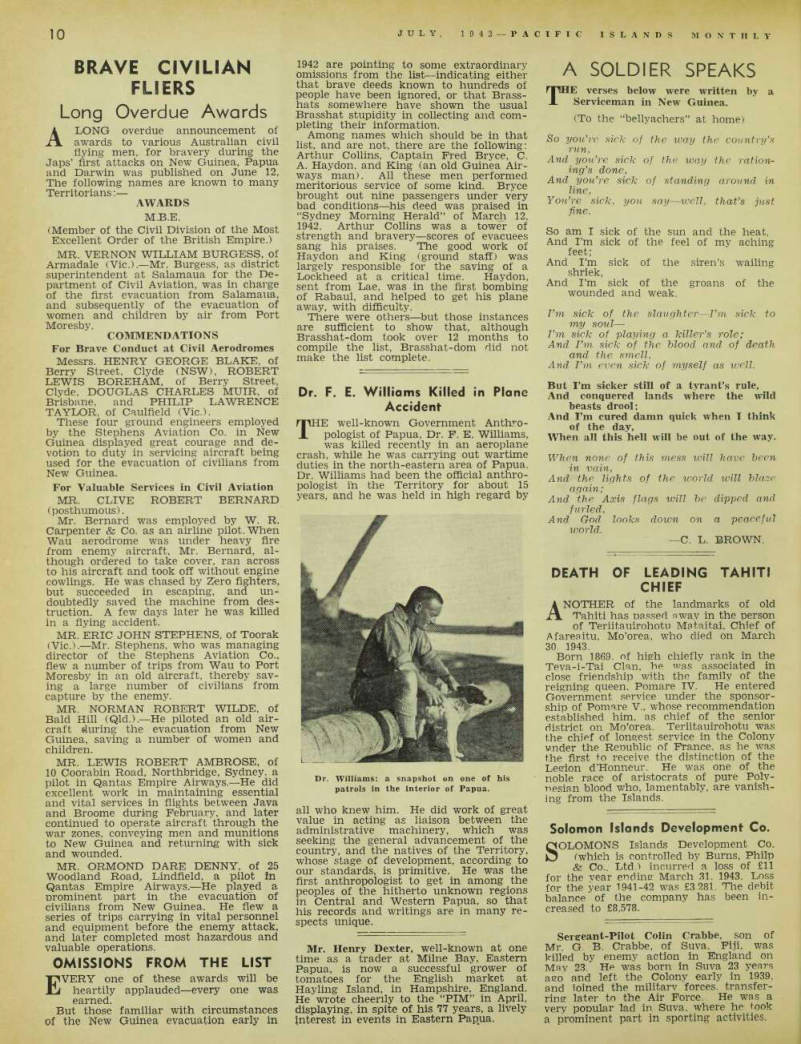
Fliers
Long Overdue Awards
ALONG overdue announcement of awards to various Australian civil flying men, for bravery during the Japs’ first attacks on New Guinea, Papua and Darwin was published on June 12, The following names are known to many Territorians: —
Awards
M.B.E.
(Member of the Civil Division of the Most Excellent Order of the British Empire.)
Mr. Vernon William Burgess, Of
Armadale (Vic.).—Mr. Burgess, as district superintendent at Salamaua for the De partment of Civil Aviation, was in charge of the first evacuation from Salamaua, and subsequently of the evacuation of women and children by air from Port Moresby.
Commendations
For Brave Conduct at Civil Aerodromes
Messrs. Henry George Blake, Of
Berry Street, Clyde (NSW), ROBERT LEWIS BOREHAM, of Berry Street,
Clyde, Douglas Charles Muir, Of
Brisbane, and PHILIP LAWRENCE TAYLOR, of Caulfield (Vic.).
These four ground engineers employed by the Stephens Aviation Co. in New Guinea displayed great courage and de votion to duty in servicing aircraft being used for the evacuation of civilians from New Guinea.
For Valuable Services in Civil Aviation
Mr. Clive Robert Bernard
(posthumous).
Mr. Bernard was employed by W. R.
Carpenter & Co. as an airline pilot. When Wau aerodrome was under heavy fire from enemy aircraft, Mr. Bernard, al though ordered to take cover, ran across to his aircraft and took off without engine cowlings. He was chased by Zero fighters, but succeeded in escaping, and un doubtedly saved the machine from des truction. A few days later he was killed in a flying accident.
Mr. Eric John Stephens, Of Toorak
(Vic.). —Mr. Stephens, who was managing director of the Stephens Aviation Co., flew a number of trips from Wau to Port Moresby in an old aircraft, thereby sav ing a large number of civilians from capture by the enemy.
Mr. Norman Robert Wilde, Of
Bald Hill (Qld.). —He piloted an old air craft during the evacuation from New Guinea, saving a number of women and children.
Mr. Lewis Robert Ambrose, Of
10 Coorabin Road, Northbridge, Sydney, a pilot in Qantas Empire Airways.—He did excellent work in maintaining essential and vital services in flights between Java and Broome during February, and later continued to operate aircraft through the war zones, conveying men and munitions to New Guinea and returning with sick and wounded.
Mr. Ormond Dare Denny, Of 25
Woodland Road, Lindfield, a pilot in Qantas Empire Airways.—He played a prominent part in the evacuation of civilians from New Guinea. He flew a series of trips carrying in vital personnel and equipment before the enemy attack, and later completed most hazardous and valuable operations.
Omissions From The List
EVERY one of these awards will be heartily applauded—every one was earned.
But those familiar with circumstances of the New Guinea evacuation early in
1942 are pointing to some extraordinary omissions from the list—indicating either that brave deeds known to hundreds of people have been ignored, or that Brass hats somewhere have shown the usual Brasshat stupidity in collecting and com pleting their information.
Among names which should be in that list, and are not, there are the following: Arthur Collins, Captain Fred Bryce, C.
A. Haydon, and King (an old Guinea Air ways man). All these men performed meritorious service of some kind. Bryce brought out nine passengers under very bad conditions—his deed was praised in “Sydney Morning Herald” of March 12, 1942. Arthur Collins was a tower of strength and bravery—scores of evacuees sang his praises. The good work of Haydon and King (ground staff) was largely responsible for the saving of a Lockheed at a critical time. Haydon, sent from Lae, was in the first bombing of Rabaul, and helped to get his plane away, with difficulty.
There were others —but those instances are sufficient to show that, although Brasshat-dom took over 12 months to compile the list, Brasshat-dom did not make the list complete.
Dr. F. E. Williams Killed in Plane
Accident
THE well-known Government Anthro pologist of Papua, Dr. F. E. Williams, was killed recently in an aeroplane crash, while he was carrying out wartime duties in the north-eastern area of Papua.
Dr. Williams had been the official anthro pologist ih the Territory for about 15 years, and he was held in high regard by
all who knew him. He did work of great value in acting as liaison between the administrative machinery, which was seeking the general advancement of the country, and the natives of the Territory, whose stage of development, according to our standards, is primitive. He was the first anthropologist to get in among the peoples of the hitherto unknown regions in Central and Western Papua, so that his records and writings are in many re spects unique.
Mr. Henry Dexter, well-known at one time as a trader at Milne Bay, Eastern Papua, is now a successful grower of tomatoes for the English market at Hayling Island, in Hampshire, England.
He wrote cheerily to the “PIM” in April, displaying, in spite of his 77 years, a lively interest in events in Eastern Papua.
Dr. Williams: a snapshot on one of his patrols in the interior of Papua.
A Soldier Speaks
rE verses below were written by a Serviceman in New Guinea. (To the “bellyachers” at home) So you’re sick of the way the country’s run, And you’re sick of the way the ration ing’s done, And you’re sick of standing around in line, You’re sick, you say — well, that’s just fine.
So am I sick of the sun and the heat, And I’m sick of the feel of my aching feet; And I’m sick of the siren’s wailing shriek, And I’m sick of the groans of the wounded and weak.
I’m sick of the slaughter — l’m sick to my soul — I’m sick of playing a killer’s role; And I’m. sick of the blood and of death and the smell, And I’m even sick of myself as well.
But I’m sicker still of a tyrant’s rule, And conquered lands where the wild beasts drool; And I’m cured damn quick when I think of the day, When all this hell will be out of the way.
When none of this mess will have been in vain, And the lights of the world will blaze again; And the Axis flags will be dipped and furled, And God looks down on a peaceful world.
C. L. Brown.
Death Of Leading Tahiti
Chief
ANOTHER of the landmarks of old Tahiti has passed away in the person of Teriitauirohotu Mataitai, Chief of Afareaitu, Mo’orea, who died on March 30 1943 Born 1869. of high chiefly rank in the Teva-i-Tai Clan, he was associated in close friendship with the family of the reigning queen. Pomare IV. He entered Government service under the sponsor ship of Pomare V., whose recommendation established him, as chief of the senior district on Mo'orea. Teriitauirohotu was the chief of longest service in the Colony wnder the Republic of France, as he was the first to receive the distinction of the Lesion d’Honneur. He was one of the noble race of aristocrats of pure Poly nesian blood who, lamentably, are vanish ing from the Islands.
Advertisements & other items, p. 12 (1 item)
Solomon Islands Development Co.
SOLOMONS Islands Development Co. (which is controlled by Burns, Philp & Co.. Ltd ") incurred a loss of £11 for the vear ending March 31. 1943. Loss for the year 1941-42 was £3 281. The debit balance of the company has been increased to £8,578.
Sergeant-Pilot Colin Crabbe, son of Mr. G B. Crabbe, of Suva. Fiji, was killed by enemy action in England on May 23. Hp was born in Suva 23 years aero and left the Colony early in 1939. and ioined the militarv forces, transferring later to the Air Force. He was a very popular lad in Suva, where he took a prominent part in sporting activities.
Regarded as Ideal Type of Jungle Fighters
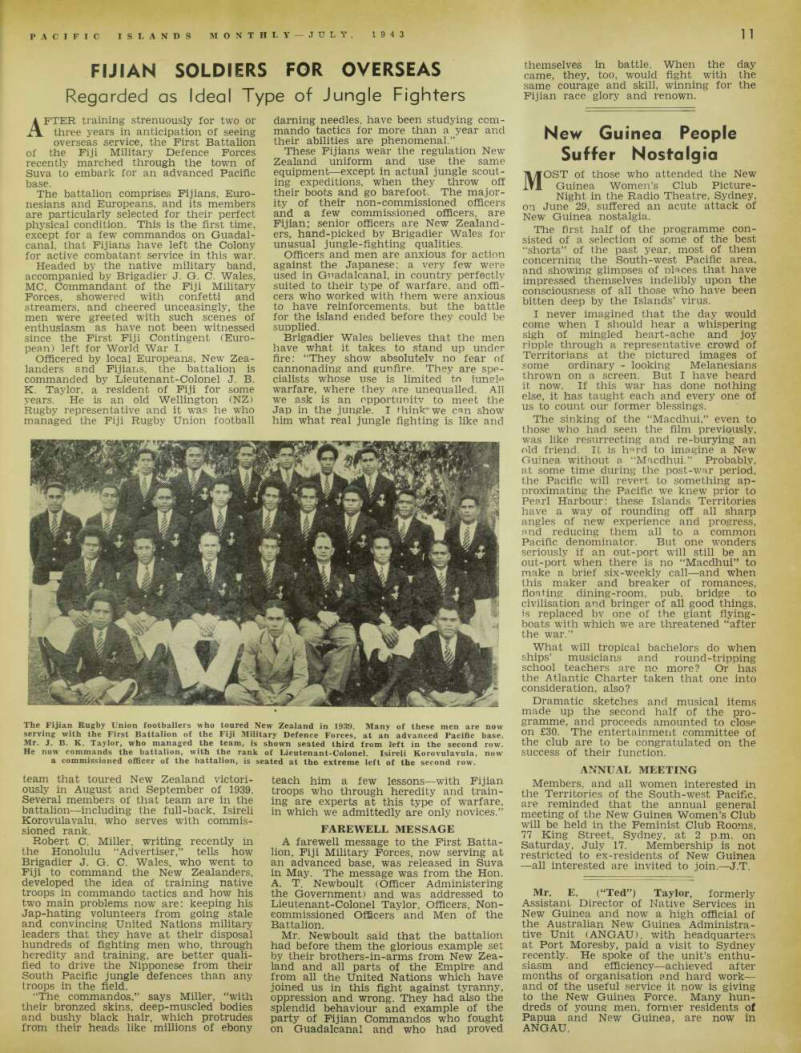
Fijian Soldiers For Overseas
AFTER training strenuously for two or three years in anticipation of seeing overseas service, the First Battalion of the Fiji Military Defence Forces recently marched through the town of Suva to embark for an advanced Pacific base.
The battalion comprises Fijians, Euro nesians and Europeans, and its members are particularly selected for their perfect physical condition. This is the first time, except for a few commandos on Guadal canal, that Fijians have left the Colony for active combatant service in this war.
Headed by the native military band, accompanied by Brigadier J. G. C. Wales, MC, Commandant of the Fiji Military Forces, showered with confetti and streamers, and cheered unceasingly, the men were greeted with such scenes of enthusiasm as have not been witnessed since the First Fiji Contingent (Euro pean) left for World War I.
Officered by local Europeans, New Zea landers and Fijians, the battalion is commanded by Lieutenant-Colonel J. B.
K. Taylor, a resident of Fiji for some years. He is an old Wellington (NZ) Rugby representative and it was he who managed the Fiji Rugby Union football
team that toured New Zealand victori ously in August and September of 1939.
Several members of that team are in the battalion—including the full-back, Isireli Korovulavalu, who serves with commis sioned rank.
Robert C. Miller, writing recently in the Honolulu “Advertiser,” tells how Brigadier J. G. C. Wales, who went to Fiji to command the New Zealanders, developed the idea of training native troops in commando tactics and how his two main problems now are: keeping his Jap-hating volunteers from going stale and convincing United Nations military leaders that they have at their disposal hundreds of fighting men who, through heredity and training, are better quali fied to drive the Nipponese from their South Pacific jungle defences than any troops in the field.
“The, commandos,” says Miller, “with their bronzed skins, deep-muscled bodies and bushy black hair, which protrudes from their heads like millions of ebony
darning needles, have been studying com mando tactics for more than a year and their abilities are phenomenal.”
These Fijians wear the regulation New Zealand uniform and use the same equipment—except in actual jungle scout ing expeditions, when they throw off their boots and go barefoot. The major ity of their non-commissioned officers and a few commissioned officers, are Fijian; senior officers are New Zealand ers, hand-picked by Brigadier Wales for unusual jungle-fighting qualities.
Officers and men are anxious for action against the Japanese: a very few were used in Guadalcanal, in country perfectly suited to their type of warfare, and offi cers who worked with them were anxious to have reinforcements, but the battle for the island ended before they could be supplied.
Brigadier Wales believes that the men have what it takes to stand up under fire; “They show absolutely no fear of cannonading and gunfire. They are spe cialists whose use is limited to iuns> warfare, where they are unequalled. All we ask is an opportunity to meet the Jap in the jungle. I think’we can show him what real jungle fighting is like and
teach him a few lessons —with Fijian troops who through heredity and train ing are experts at this type of warfare, in which we admittedly are only novices.”
Farewell Message
A farewell message to the First Batta lion, Fiji Military Forces, now serving at an advanced base, was released in Suva in May. The message was from the Hon.
A. T. Newboult (Officer Administering the Government) and was addressed to Lieutenant-Colonel Taylor, Officers, Non commissioned Officers and Men of the Battalion.
Mr. Newboult said that the battalion had before them the glorious example set by their brothers-in-arms from New Zea land and all parts of the Empire and from all the United Nations which have joined us in this fight against tyranny, oppression and wrong. They had also the splendid behaviour and example of the party of Fijian Commandos who fought on Guadalcanal and who had proved
themselves in battle. When the day came, they, too, would fight with the same courage and skill, winning for the Fijian race glory and renown.
The Fijian Rugby Union footballers who toured New Zealand in 1939. Many of these men are now serving with the First Battalion of the Fiji Military Defence Forces, at an advanced Pacific base.
Mr. J. B. K. Taylor, who managed the team, is shown seated third from left in the second row.
He now commands the battalion, with the rank of Lieutenant-Colonel. Isireli Korovulavula, now a commissioned officer of the battalion, is seated at the extreme left of the second row.
Suffer Nostalgia
New Guinea People Suffer Nostalgia
MOST of those who attended the New Guinea Women’s Club Picture- Night in the Radio Theatre, Sydney, on June 29, suffered an acute attack of New Guinea nostalgia.
The first half of the programme con sisted of a selection of some of the best “shorts” of the past year, most of them concerning the South-west Pacific area, and showing glimpses of nieces that have impressed themselves indelibly upon the consciousness of all those who have been bitten deep by the Islands’ virus.
I never imagined that the day would come when I should hear a whispering sigh of mingled heart-ache and joy ripple through a representative crowd of Territorians at the pictured images of some ordinary - looking Melanesians thrown on a screen. But I have heard it now. If this war has done nothing else, it has taught each and every one of us to count our former blessings.
The sinking of the “Macdhui,” even to those who had seen the film previously, was like resurrecting and re-burying an old friend. It is to imagine a New Guinea without a “Macdhui.” Probably, at some time during the post-war period, the Pacific will revert to something ap proximating the Pacific we knew prior to Pearl Harbour: these Islands Territories have a way of rounding off all sharp angles of new experience and progress, and reducing them all to a common Pacific denominator. But one wonders seriously if an out-port will still be an out-port when there is no “Macdhui” to make a brief six-weekly call—and when this maker and breaker of romances, floating dining-room, pub. bridge to civilisation and bringer of all good things, is replaced bv one of the giant flying boats with which we are threatened “after the war.”
What will tropical bachelors do when ships’ musicians and round-tripping school teachers are no more? Or has the Atlantic Charter taken that one into consideration, also?
Dramatic sketches and musical items made up the second half of the pro gramme, and proceeds amounted to close on £3O. The entertainment committee of the club are to be congratulated on the success of their function.
Annual Meeting
Members, and all women interested in the Territories of the South-west Pacific, are reminded that the annual general meeting of the New Guinea Women’s Club will be held in the Feminist Club Rooms, 77 King Street, Sydney, at 2 p.m. on Saturday, July 17. Membership is not restricted to ex-residents of New Guinea
—all interested are invited to join.-
J.T.
Mr. E. (“Ted”) Taylor, formerly Assistant Director of Native Services in New Guinea and now a high official of the Australian New Guinea Administra tive Unit (ANGAU), with headquarters at Port Moresby, paid a visit to Sydney recently. He spoke of the unit’s enthu siasm and efficiency—achieved after months of organisation and hard work— and of the useful service it now is giving to the New Guinea Force. Many hun dreds of young men, former residents of Papua and New Guinea, are now in
Angau.
Marae
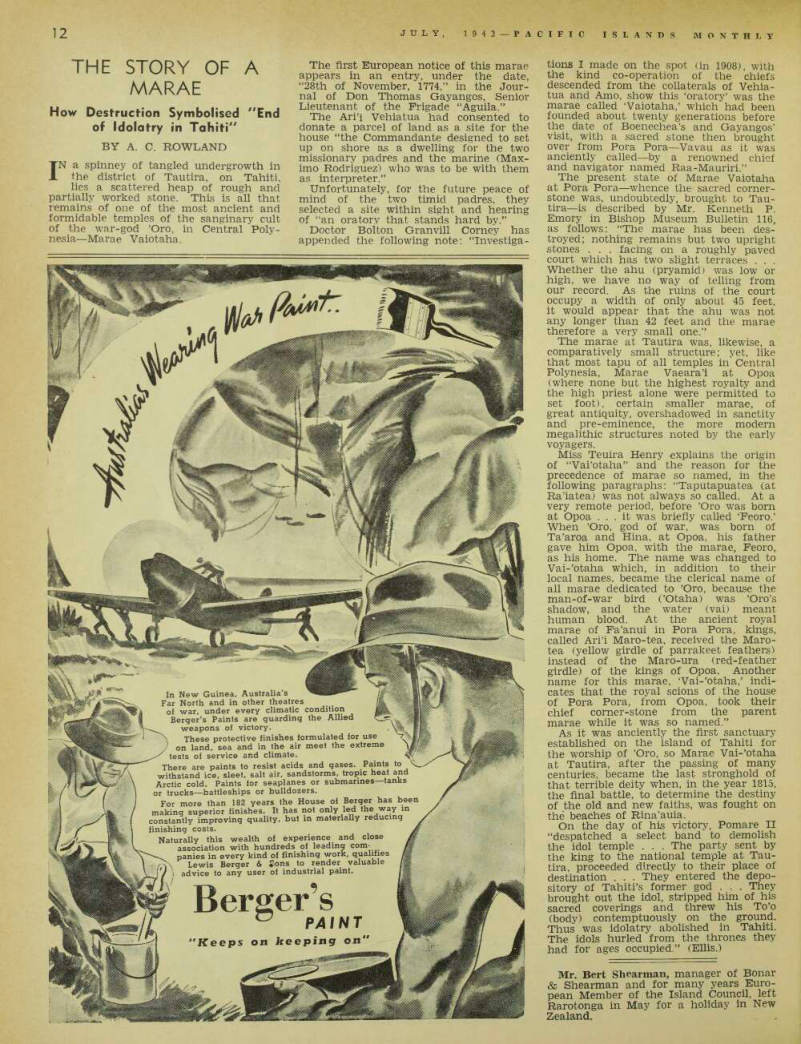
The Story Of A
How Destruction Symbolised "End of Idolatry in Tahiti"
By A. C. Rowland
IN a spinney of tangled undergrowth in the district of Tautira, on Tahiti, lies a scattered heap of rough and partially worked stone. This is all that remains of one of the most ancient and formidable temples of the sanginary cult of the war-god ’Oro, in Central Poly nesia—Marae Vaiotaha.
The first European notice of this marae appears in an entry, under the date, “28th of November, 1774,” in the Jour nal of Don Thomas Gayangos, Senior Lieutenant of the Frigade “Aguila.”
The Ari’i Vehiatua had consented to donate a parcel of land as a site for the house “the Commandante designed to set up on shore as a dwelling for the two missionary padres and the marine (Max imo Rodriguez) who was to be with them as interpreter.”
Unfortunately, for the future peace of mind of the two timid padres, they selected a site within sight and hearing of “an oratory that stands hard by.”
Doctor Bolton Granvill Corney has appended the following note: “Investiga
tions I made on the spot (in 1908), with the kind co-operation of the chiefs descended from the collaterals of Vehia tua and Amo, show this ‘oratory’ was the marae called ‘Vaiotaha,’ which had been founded about twenty generations before the date of Boenechea’s and Gayangos’ visit, with a sacred stone then brought over from Pora Pora—Vavau as it was anciently called—by a renowned chief and navigator named Raa-Mauriri.”
The present state of Marae Vaiotaha at Pora Pora—whence the sacred corner stone was, undoubtedly, brought to Tau tira—is described by Mr. Kenneth P.
Emory in Bishop Museum Bulletin 116, as follows: “The marae has been des troyed; nothing remains but two upright stones . . . facing on a roughly paved court which has two slight terraces . . .
Whether the ahu (pryamid) was low or high, we have no way of telling from our record. As the ruins of the court occupy a width of only about 45 feet, it would appear that the ahu was not any longer than 42 feet and the marae therefore a very small one.”
The marae at Tautira was, likewise, a comparatively small structure; yet, like that most tapu of all temples in Central Polynesia, Marae Vaeara’i at Opoa (where none but the highest royalty and the high priest alone were permitted to set foot), certain smaller marae, of great antiquity, overshadowed in sanctity and pre-eminence, the more modern megalithic structures noted by the early voyagers.
Miss Teuira Henry explains the origin of “Vai’otaha” and the reason for the precedence of marae so named, in the following paragraphs: “Taputapuatea (at Ra’iatea) was not always so called. At a very remote period, before ’Oro was bom at Opoa ... it was briefly called ‘Feoro.’
When ’Oro, god of war, was born of Ta’aroa and Hina, at Opoa, his father gave him Opoa, with the marae, Feoro, as his home. The name was changed to Vai-’otaha which, in addition to their local names, became the clerical name of all marae dedicated to ’Oro, because the man-of-war bird (’Otaha) was ’Oro’s shadow, and the water (vai) meant human blood. At the ancient royal marae of Fa’anui in Pora Pora, kings, called Ari’i Maro-tea, received the Maro tea (yellow girdle of parrakeet feathers) instead of the Maro-ura (red-feather girdle) of the kings of Opoa. Another name for this marae, ‘Vai-’otaha,’ indi cates that the royal scions of the house of Pora Pora, from Opoa, took then chief corner-stone from the parent marae while it was so named.”
As it was anciently the first sanctuary established on the island of Tahiti for the worship of ’Oro, so Marae Vai-’otaha at Tautira, after the passing of many centuries, became the last stronghold of that terrible deity when, in the year 1815, the final battle, to determine the destiny of the old and new faiths, was fought on the beaches of Rina’auia.
On the day of his victory, Pomare II “despatched a select band to demolish the idol temple . . . The party sent by the king to the national temple at Tau tira, proceeded directly to their place of destination . . . They entered the depo sitory of Tahiti’s former god . . . They brought out the idol, stripped him of his sacred coverings and threw his To’o (body) contemptuously on the ground.
Thus was idolatry abolished in Tahiti, The idols hurled from the thrones they had for ages occupied.” (Ellis.) Mr. Bert Shearman, manager of Bonar & Shearman and for many years Euro pean Member of the Island Council, left Rarotonga in May for a holiday in New Zealand.
Advertisements & other items, p. 14 (1 item)
Berger s
In New Guinea, Australia's Far North and in other theatres of war, under every climatic condition Berger's Paints are guarding the Allied weapons of victory - .
These protective finishes formulated for use > on land, sea and in the air meet the extreme tests of service and climate.
There are paints to resist acids and gases. Paints to withstand ice, sleet, salt air, sandstorms, tropic heat and Arctic cold. Paints for seaplanes or submarines—tanks or trucks —battleships or bulldozers.
For more than 182 years the House of Berger has been making superior finishes. It has not only led the way in constantly improving guality, but in materially reducing finishing costs.
Naturally this wealth of experience and close association with hundreds of leading companies in every kind of finishing work, gualifies x Lewis Berger & Sons to render valuable advice to any user of industrial paint.
Berger s
° FAINT
"Keeps on keeping on '
Storm
Rarotonga Smashed By Cyclonic
Grave Damage to Cook Islands Fruit Crops
From Our Own Correspondent
RAROTONGA, March 27 (Delayed).
A HEAVY storm, causing appalling damage, swept the Lower Cook Group on March 10. Its unprece dented suddenness and ferocity caught the population unawares, particularly as the wind swept in from the south-east.
In former hurricanes, within living memory, high winds have sprung from an easterly direction, but "veered round to the north before reaching their full momentum.
Although the actual wind force was not disastrous —the windward side of Rarotonga actually getting off best—the high mountains in the centre of the island apparently produced a cyclone effect in the main settlement of Avarua.
Approximately 40 per cent, of the native made houses in Avarua were demolished and very few frame and iron-roofed houses escaped considerable damage.
Among the main buildings struck were the Ariki Palace, the local cinema, the London Missionary Society compound and Messrs. A. B. Donald’s store and out buildings.
Huge century-old ironwood trees near the LMS church were simply torn out by the roots.
Heavy rain accompanied the storm and continued for four days without ceasing, rendering the hardships of the home less particularly severe.
More disastrous than the damage to housing was the loss of 75 per cent, of the orange and banana crops. In Raro tonga, where banana planting has been recently carried out more extensively than for several years, many of the plantations have been ruined and the psychological effect on the growers (mostly native) disheartening in the extreme. At an Island Council meeting on March 30, Government relief for planters was requested, but the outcome is not yet known.
In the other islands of the Lower
Group, where orange shipments consti tute practically the only income of the natives, losses will be even more hardly felt. An ample supply of provisions, and shoots and cuttings for food planting was, however, forwarded by the Adminis tration by schooner to fill immediate needs.
In- 1941 and 1942, severe storms in the Lower Group, and actual hurricanes in the northern islands, have occurred; but in 1943 is the heaviest setback of all, coming at a particularly inopportune time, when New Zealand needs all the fresh fruit available.
“Some Buildings Seemed To
Explode”
From a Special Correspondent rIS was an extraordinary storm which struck the Lower Cook Group in general (and Avarua in particu lar) on March 10.
Pierce squalls screamed down from the mountain valleys above Avarua, hurling down trees, flattening crops and hitting buildings like shell-bursts. Hundreds of corrugated sheets were ripped off the
roofs, and were whirled about, wrapping around trees and sailing out over the reef. Many large trees were felled, some striking houses, others blocking the main road, while branches of all sizes crashed everywhere. Volleys of coconuts thudded like cannon-balls. Clouds of leaves streamed out to sea.
Some buildings appeared to explode.
The massive roof of the LMS church burst asunder, half falling on either side of the church, smashing down trees and gravestones.. Most of the LMS mission buildings were badly damaged, as were those of the Catholic mission.
The property of Messrs. A. B. Donald, Ltd., was severely battered, the main establishment and the manager’s resi dence being unroofed, while store-sheds and workshops in the yard were wrecked.
It was fortunate that the heaviest part of the blow developed after daybreak, or there must surely have been some loss of life. One old man died from severe head wounds received when his house col lapsed; a number of others were treated for minor injuries from flying debris.
Prompt and efficient service was ren dered by the staff of the Public Works Department and members of the native Defence Force in clearing the roads and patching and reinforcing buildings even while the blow was still in progress.
A sad loss was the destruction of the famous “Royal Hall,” talkie theatre and dance hall, which was blasted into a heap of tangled wreckage. What if the roof was off the church, or one’s little grass shack was wrapped round a coco
nut tree? No singing-cowboys on Sat urday night! Aue!
Increased Fruit Prices
Rarotonga', April 30.
WELCOME indeed was the announce ment in early April of new fruit prices for the hard-hit islands of the Lower Cook Group.
The New Zealand Internal Marketing Division, which controls the Cook Islands fruit trade, has granted increases to the grower of 6d. a case for bananas and 1 /a case for oranges, bringing the average prices to the grower for U-bushel cases to 5/- and 5/6 respectively. Prices for lemons, mandarines, tangerines and grapefruit have been advanced in pro
portion.
Gratifying as the increased prices are it is unfortunate that so little fruit will be available this season owing to the hur ricane. Mangaia is the only island where any appreciable quantity of oranges
remains. With regard to bananas, at least six months must elapse before shipments can be made, and probably longer, unless steps are taken immediately to help the growers clean up the ravaged plantations.
Advertisements & other items, p. 15 (1 item)
Burns Philp
(SOUTH SEA) CO. LTD.
Inc. in Fiji Island Traders and Shipowners Registered Office :
SUV A
FIJI
Also Branches at: Fiji: Levuka, Lautoka, Labasa, Ba, Sigatoka, Rotuma.
Tonga: Nukualofa, Haapai, Vavau.
Samoa: Apia, Pago Pago (American Samoa).
Solomons: Makambo, Gizo, Faisi.
New Hebrides: Vila.
Code Address ; Gilberts: Tarawa.
“Burnsouth”. Norfolk Is. Niue. Wallis Is. Futuna Is.
PACIFIC ISLANDS SOCIETY
Visitors from the Islands to Sydney (or those interested in Islands affairs), are advised to communicate with the honorary secretary of the above Society, which has been formed to study the history, traditions, economics, and political developments of the Pacific Islands.
Regular monthly meetings are held at History House, 8 Young Street, Sydney.
Address for Correspondence:
THE PACIFIC ISLANDS SOCIETY,
Box 2434 MM., G.P.0., Sydney.
Sole Australian Concessionaires :
GEORGE BROWN & CO. PTY. LTD.
267 Clarence Street, Sydney.
As the Ultimate factory is engaged in vital war production, the supply of Ultimate Commercial Receivers cannot be maintained at present.
SERVICE: Ultimate owners are assured of continuity of service. Our Laboratory is situated at 267 Clarence Street, Sydney.
Servicing of all kinds of radio sets or amplifiers, as well as Rola Speakers, is also undertaken at our laboratories.
Strike In Fiji
STREET sweepers in Suva—all elderly men—struck for higher pay in May.
The strike was still unsettled in June, and Suva people and others were being urged to sweep their own piece of street, so that the town might be kept reasonably tidy. The pay of the sweep ers had been increased from 2/6 to 3/6 since war began—but they are now demanding an extra 6d. per day.
Cliff Warren, formerly of the staff of Morris Hedstrom, Ltd., Suva, Fiji, has been reported a prisoner of war in Italy.
To "PIM" Readers
EVERY month, we receive from sub scribers complaints that copies of the “Pacific Islands Monthly,” which they have ordered, have not reached them. Subscribers, therefore, are advised as follows: — 1. Many months ago, when such com plaints became frequent, we instituted a double check over postages. Thus, we are able to say positively that a copy of the journal is posted each month to all current subscribers. It is noted that the majority of such complaints come from Queensland. 2. Many of our readers, especially Ter ritorians, change their addresses. There are indications that GPO, owing to shortage of staff, is unwilling to re-address much second-class mail matter. This may account for non-receipt of some jour nals. Subscribers should promptly notify us of their new addresses. 3. Owing to paper-rationing, we may not print many copies of the “PIM” in excess of those ordered. Those extra copies are quickly sold. We regret, therefore, that we seldom can supply single copies of past issues of the “PIM.”
There are none whatever of all issues subsequent to February, 1942.
We are sorry for the inconveniences being felt by subscribers. These, how ever, are due to wartime conditions, over which we have no control.
Pacific Publications Pty. Ltd.,
Union House, 247 George Street, Sydney.
Travels Of The Giant
Toad
Letter to the Editor IN the interesting review of Mr. Win ston Turner’s account of conditions on Guadalcanal, appearing on page 6 of your April issue, is an inaccuracy about the giant toad.
So far from being introduced to the Solomons from Java, it came from Fiji, having been sent there by this Depart ment. The toad is of South American origin, and could not, therefore, come from the East Indies, where it does not occur.
As your issue for last November refers correctly to this amphibian having been sent from Fiji to the Ellice Islands and Guadalcanal I think you will agree that for the sake of accuracy an editorial comment was due about Mr. Turner’s erroneous record of the source of the toad.
I am, etc.,
H. W. Jack,
Director of Agriculture, Fiji.
Suva, 24/5/43.
EDITORIAL NOTE.—Apologies to Fiji and the enterprising Department of Agri culture. The editor, who has met the toad in Fiji and elsewhere, and knows the reptile’s interesting history, should have corrected Mr. Turner’s error—but, in the shorthanded bustle of wartime conditions, he missed It.
Advertisements & other items, p. 16 (2 items)
enters
W. H. GROVE & SONS
Limited
AUCKLAND
Island Traders. PO. Box 490.
Telegraphic and Cable Address: “Grove”, Auckland.
Shippers of all classes of New Zealand products.
Representing English Manufacturers throughout the Cook and Society Islands, Fiji, Tonga, Samoa, Niue, New Caledonia, New Guinea, etc.
In FIJI as—W. H. Grove fir Sons (Fiji) Ltd.
enters
BUY tIM
Distilleries at London . . . England Toronto . . . Canada Moorabbin . . Victoria Cincinnati . . . U.S.A.
Old Monk
The Worlds Finest Olive Oil San Francisco
New Caledonia
How Americans Came To
Commander Repudiates Ansy Suggestion of Territorial Ambition
By H. E. Priday, Noumea
AT noon on March 12, 1942, the first convoy bringing American troops and materials to New Caledonia anchored in Noumea Harbour. Landing operations proceeded by day and night, unceasingly, transforming the island into a hive of activity.
Governor Henri Montchamp chose the anniversary of this great occasion to refer to Japanese aims and Japanese dis comfiture in the South Pacific; while the American commander here, Major-Gen eral Rush B. Lincoln, by radio, thanked the population for a year of helpful co-operation. He said that America, unlike Japan, has no designs on the sovereignty of France in New Caledonia.
“No one doubted the nature of Jap anese designs relating to New Caledonia,” said Governor Montchamp. “Months of anxiety, following the entry of Japan into the war, ended for our population only on March 12, 1942, when, at noon, thou sands of citizens crowded down towards the docks to witness the arrival of our allies.
“The joy with which they were received in Noumea, the rousing welcome that met them everywhere, provided an un forgettable spectacle, showing the mea sure of our relief.
AFTER paying tribute to the hospital ity and co-operative spirit of the New Caledonians, General Lincoln said: “I wish to take this opportunity to lay at rest any vague feelings of doubt that any of you may have mat America has designs upon the sovereignty of France in New Caledonia.
“Despite statements of thoughtless or ill-advised persons, the American people did not enter this war for conquest or for the acquisition of colonies. We fought in the First World War without thougnt of territorial reward and we fight now with the same hign ideals. Our purpose has been clearly expressed by our Presi dent. I say this not because I feel that this uneasiness has any wide acceptance, but lest by lack of denial it may grow.” rE first American convoy, a special task force under General Patch, arrived in New Caledonia in the critical period following the disastrous actions in the Java Sea, when the inva sion of Australia and even of New Zea land seemed imminent or possible. At the time of the arrival, which went un announced by Washington until the end of April, 1942, the island was inade quately occupied by 2,000 trained French and native troops, unequipped for mod ern warfare, and a local untrained mili tia partly armed with old-fashioned deer rifles, aided by 400 veteran Australians, scattered in small groups along the bush clad coast. Many of these Australians, who were commanded by Colonel Mathe son, had seen the Crete and Egyptian campaigns. The hard-pressed Common wealth Government wanted them re turned to the Commonwealth, but finally reluctantly agreed to General Patch’s request for them to remain in the island some months longer to help train his force in jungle tactics.
The Americans’ quick dispersal to stra tegic points round the island was a creditable achievement under unfavour able conditions, for Patch’s force encoun tered the rainy and mosquito season in full swing.
Eventually it became plain that these preparations were for the Solomons cam paign. It was, in fact, General Patch’s force which took over from the Marines when General Vandergrift’s “leather necks” were withdrawn from Guadal canal. The training Patch’s men received in New Caledonia was put to good account when faced with the problem of cleaning up the Japs on Guadalcanal.
IN all the past year’s co-operation, nothing has done so much to win the gratitude of the local population as the US Army medical department’s
highly-skilled, free and ungrudging ser vices in both the surgical and medical lines to the French and native inhabi tants. Owing to the war, the French health service had been inadequately staffed, while for most people needing operations or hospital treatment the voy age to New Zealand or Australia is so costly as to be impossible.
Not only are Caledonians continuing their co-operation with the armed forces stationed here for the common cause in the spirit of General Lincoln’s appeal, but within their limits they are contri buting or preparing reinforcements for the Colonial French forces gallantly fighting overseas for the liberation of the Patrie. Now that allied troops and allied planes and allied warships ensure their island’s safety from the Japanese, they more and more turn their thoughts to Africa, where their sons and fathers and husbands are fighting, and to France where their relations are living in star vation and misery.
Advertisements & other items, pp. 17-18 (1 item)
Burns Philp Trust
TH47- 4'-! /-
An Executor’s Task
is an Expert’s Task
=ll Executorship is not a task lightly to be imposed upon anyone. It is not always a kindly act to appoint a friend to carry out the responsible and onerous work associated with the administration of an estate. With the best intentions in the world he can fail to perform the duties in the best interests of the beneficiaries. He may not survive the completion of his task and your affairs can pass into the hands of one in whom you would have less confidence. The obvious thing is to appoint an expert executor who never dies. Burns Philp Trust Company Ltd. is a permanent institution under experienced and capable direction. If you would like to have details of the service which it offers write for a booklet which gives you all the necessary information.
James Burns Lewis Armstrong
DIRECTORS:
MANAGER—C. H. Chester.
Robert John Nosworthy Joseph Mitchell
Burns Philp Trust
C O iW P A N Y
LIMITED
7 (RIDGE. STREET. SYDNEY
Telephone: 87901. Box 543 B, G.P.0., Sydney.
BP 6-43
The Standard of Excellence
Uq ueurs
vss"
COMPOUNDED FROM PURE FRUIT
EXTRACTS AND HIGH-CLASS
MATURED SPIRITS.
IN 15 FLAVOURS
Advocaat, Red Curacoa, White Curacoa, Parfait D'Amour, Maraschino, Chartreuse, Apricot Brandy, Cointreau, Cherry Brandy, Creme de Menthe, Creme de Cacao, Peach Brandy, Creme de Banana, Kummei, Friars' Liqueur.
TRADE ENQUIRIES TO BOX 3373, G.P.0., SYDNEY.
LAVEX
The Oxygened Washing Compound
Wonderful for the Wash ... Harmless to the hands
NON-INJURIOUS TO THE FINEST FABRICS
packed in cartons containing 48 x Sox. pkts.
TRADE ENQUIRIES TO BOX 3373, G.P.0., SYDNEY,
C. SULLIVAN & CO.
GENERAL MERCHANTS ISLANDS AGENTS
REPRESENTING LEADING FIRMS IN THE PACIFIC ISLANDS.
Islands Produce sold on Shippers’ Account—Liberal Advances against Consignments.
Buyers of all Islands’ Requirements on Commission—Original Invoices Furnished.
Bankers’. Bank of New South Wales .. Bank of New Zealand .. Comptoir National d’Escompte de Paris.
Wartime Cable Address: Sullivan, Kentstreet, Sydney.
379 KENT STREET, SYDNEY, N.S.W.
How To Make Rich Fiji Richer

Emphasis on Roads and on a Sound Native Policy
From an article written in 1941 (before the Pacific war) by THEO D. RIAZ, Nadarivatu, Colo North, Fiji.
IN March, 1941, the Hon. Member for the North-western Division (Fiji Legislative Council) issued a pam phlet in which he urged that certain public works and services be undertaken.
I am using that as a basis for some observations which I hope may be of assistance in planning Fiji’s post-war Government.
Need For Good Roads
mHE tar-sealing of the circuminsular X road, whilst making for speed and comfort when motoring round the island of Viti Levu, would not contribute much, if anything, to the development of Fiji as a whole and very little towards that of the island which it encircles.
What is needed in order to develop to the utmost the Colony’s resources are:— CD More and better internal roads and (2) A vigorous and comprehensive land settlement policy.
There are routes on this island of Viti Levu which, if formed into good roads, would give access to large areas of agri cultural and grazing land in the Rewa River Valley, the highlands of Viti Levu, and down the Sigatoka Valley to Vuna salu. These roads would run from Nau sori up to Vunidawa, thence over the island to Tavua via Nadarivatu. Another would run from Naval to Navunasalu, via Natutualoko, with branches to Ba and Nadi.
There doubtless are others which could be formed with profit to the Col ony. I have confined myself to Viti Levu because I do not know sufficient about the requirements of Vanua Levu to voice an opinion, though I suppose the prob lems to be solved on that island are the same as those which obtain on Viti Levu.
There is no lack of men on Vanua Levu capable of stating a case for its develop ment.
Native Health
rpHE establishment of a sanatorium for X consumptive Fijians is advocated.
One could write volumes on the ravages of consumption amongst the Fijians, and how mortality among child ren is decimating the race.
The establishment of a sanatorium is a sound policy. But prevention is much better than cure, and this largely is a matter of diet and hygiene. The im provement of these will go a long way towards freeing the Fijians from the ravages of disease. The problem of im proving diet and hygiene are closely linked up with that of more and better internal roads.
Fallacy Of Collectivism
fITHE Hon. Member gives attention to X the Native Department and its administration. He believes that the Fijians of to-day are at the “junction of two roads” —one of which he thinks leads to individualism and the other back to their old system of communal life.
In order—presumably—to make it easier for the Fijian to decide which road he should take, the Hon. Member offers him a third—and this one leads to col lectivism.
I do not wish to pose as an authoritv on the Fijian, but I can say with truth that the Fijian of to-day is a much be wildered man and I firmly believe that he will become more bewildered, and quite possibly rebellious, if any attempt
is made to coerce him into accepting a system such as that outlined by the Hon.
Member.
When he advocates that the Fijian be forced to live in villages of from 200 to 500 houses, the Hon. Member seems to ignore the fact that the Fijian is pas sionately attached to his traditional planting-grounds and that where his vil lages are situated there also are enshrined his Manes and his Lares. He forgets that people of differing “yavusa” never live in amity together.
There are cases in Fiji where, for con venience of administration and other reasons, two and in some cases three different tribes have been brought to gether to form one Buli-ship. In each case, the tribes so brought together have separated, and each tribe has set up and maintained villages distinct from those of the other tribes forming the Buli-ship.
In the province of Colo North there are Buli-ships formed of different tribes —one is that of Bobuco and the other is Nasau, to quote two. Nasoqo is a village in the Buli-ship of Bobuco, yet people belonging to that village dislike being called Kai-Bobuco. Likewise a man from Nabumakita, which is in Nasau Buli ship, will deny with considerable heat that he is a Kai-Nasau.
The people of these Buli-ships inter marry, but the woman always becomes a member of her husband’s tribe, and almost invariably goes to live in his vil
lage. If by any chance a man should wish to take up his residence in a vil lage other than his own, he has to be formally admitted. Then, if he has not been allotted a piece of land by that vil lage, he will go to his tribal lands to carry out his planting, and even if he has been allotted land by his new vil lage he will still do the bulk of his plant ing on his Mataqali land, be it ever so far removed from his new place of abode.
Nasoqo people and those of the District of Nailuva, which is in the province of Ra, intermarry freely and are very friendly; yet neither would agree to their villages being amalgamated in order to form one large town, nor would they agree to being joined with those of other tribes for the purpose of forming one large town of from 200 to 500 houses.
Any attempt to force them into such an amalgamation would most certainly lead to trouble.
I will quote another instance, by tak ing the Nadrau people, who also live in the province of Colo North. They are of one tribe, and have one supreme chief, known as the “Tui Nadrau.” There are four villages in this district, all inhabited by members of the same yavusa, yet they would resent any attempt to transfer them from their individual villages and
(Continued on Page 19)
(Continued from Page 17)
set them up in one large town; further more, any attempt to amalgamate them with members of other tribes for the pur pose of forming one super-town of 300 or 500 houses would, I firmly believe, meet with active resistance.
What I have said of the province of Colo North would apply with equal if not greater force to the province of Ra, and I believe this to be applicable, also, to the whole of Fiji.
MANY attempts have been made at different times by Governments throughout the world to transplant agricultural peoples from their ancestral lands and villages and establish them in places where they could build better vil lages and where there was better land for cultivation; yet, all of these benevo lent moves have failed. It is worth remembering that some of those abortive attempts have been made by Govern ments and individuals in various parts of the British Empire. Nothing is surer than that any attempt to transplant the Fijian people'will also meet with failure, and this in spite of the fact that they are one of the most good-natured and docile people on earth.
But all this does not get away from the fact that it is the Government's bounden duty to do everything possible to help the Fijian to live a more con tented, happier and fuller life than he is living.
As I said before, the Fijian is at present (1941) living in a state of bewil derment, which I think is mainly attri butable to his having been brought into too violent contact with industrial life and its concomitant individualism, the ideals governing both of which are com pletely beyond his comprehension. They are at absolute variance from those which governed his traditional mode of life, and from those taught him by his vari ous Missions and by the old type of Gov ernment administrative officer. The Fijians are suffering great ethical loss through the breakdown of their ancient standards of life.
Disruption Of Village Life
fTIHE Hon. Member made reference to J. the departure some years ago from the custom, then in vogue, of pay ing taxes in kind, and permitting the natives to tender money in lieu of pro duce. This was a grave mistake. But for some years after the new system was instituted the native was protected to the extent that he could not leave his village without having first received the permission of the headman of his village, that of the Buli of his district and, fin ally, that of the DC or Roko of his province.
In 1922, or 1923, during Sir Cecil Hunter-Rodwell’s term as Governor, it was enacted that at certain times of the year a Fijian could leave his village without let or hindrance, for the purpose of earning sufficient money to pay his taxes, and for Christmas. The Fijian has lost rather than benefited by the change, and it is very doubtful whether the Col ony has reaped any benefit either— though the change was made in order to make him more readily available as a labourer. The Fijian most certainly is not the happy, carefree individual he was before being freed from the obliga tions of paying his taxes in kind.
I will not venture an opinion as to whether the Fijians can be induced to return to his traditional mode of life, but I do agree with the Hon. Member when he says that an attempt should be made to persuade him to do so. He does not appear to be in any way suited to take up an individualistic way of life.
But I am positive that any attempt to induce him to live in large villages com
posed of numerous heterogeneous tribes —lf one can use such a term when referring to Fijian tribes—and adopt a systern of collective cultivation far removed from his traditional planting grounds and the haunts of his ancestral gods, is foredoomed to absolute and dismal fallure, and, what is far worse, will bring about the complete collapse of his social life and breakdown of his moral fibre.
I do not prescribe a panacea for all the ills from which the Fijian is suffering, but I feel that a return to the old system of native administration—with modifications to suit modern trends—will go a long way towards ensuring his social moral calvatlon and moral salvation.
Oversight Of Villages
fjIHE Hon. Member says—and I think JL rightly—that DMO’S should visit all
the villages in their respective dis tricts at least once in every three months. It is not very long since it was the obligatory duty of all DC’s and DMO’s to visit each village in their dis tricts every three months. Why was this duty allowed to lapse?
There is a fine body of Native Medical Practitioners now available and the Gov ernment should make the fullest possible use these men’s services for both the c )3 re 1 ? 1 prevention of sickness. They should travel continuously from village to village, giving lectures on the benefits to be . d ® ri X? d fr o m hygiene in living, and varied diet. But the use of these men s services should not be allowed in any way to relieve the D MO’s from the duty of visiting every village in their districts every three months, or even oftener.
(Continued on Next Page)
Care Of The Roads
IT will, in order to make such regular visits possible, be necessary to put all the provincial roads in good order once again. There was a time—not so very long gone—when one could ride over all the roads in Colo North and the province of Ra by night or day, confident that one would not meet with an acci dent. But now it is quite in the nature of an adventure to undertake to ride over them in daylight and, from what I can gather by inquiries, this condition of affairs obtains over the greater part of Fiji.
I would not revert to the old custom of compelling the natives to form and keep in repair all provincial roads with out being paid for the work. On the contrary, I believe that they should be paid for all such work, but I also believe that all Bulis should—as they were in the past—be made responsible for form ing and keeping in regular good order all roads in their districts, with the ex ception of roads like those from Rewa to Tavua, and down the Sigatoka River Valley. Such roads as those would come under the control of the Director of Public Works.
I may appear to have laid great stress on the importance of reading the interior, but I submit that it would not be pos sible to over-stress the value of roads in
promoting the health and prosperity of the people of this Colony.
Rice-Growing
THE, Hon. Member says that he depre cates the spending of money on the Rewa fisheries and on rice-growing experiments—though he does not say what those experiments are. He contends that the agricultural department should not spend money on experimenting on the growing of rice. He gives several reasons for his opposition, the chief among them being the “well-known fact that the Indians are expert rice-growers.”
As a matter of fact, Indians are any thing but expert at rice-growing. Their methods are haphazard in the extreme.
They plant two or maybe three plots of ground with rice, and then, in the majority of cases, leave the rest to nature. If the good God sends rain they, later on, may reap a harvest; but, speak ing generally, the Indians’ philosophy in this country, when summed up, seems to be. “No rain, no grain.” In California and in Australia, some of the world’s best rice is produced on land which is rarely moistened by rain, and the yields per acre, in those countries, are as much as 100 per cent, higher than the best the Indian gets off an acre in Fiji. The crop in those countries is produced by scienti fic cultivation and irrigation, and is har vested with machinery.
If the Director of Agriculture has in view a scheme whereby a supply of locally-grown rice adequate to the Col ony’s requirements can be produced, then all hands should shout: “Let him go to it.” There are many areas of land on the Rewa, Sigatoka, and Dreketi Rivers and other places admirably suited for growing rice by irrigation.
More Gold-Mines Can Be Found
rpHE Hon. Member says that gold-min- JL ing has grown considerably in this Colony, but beyond suggesting that
the present Director of Lands be made Minister for Mines, and giving a lot of figures which proved beyond doubt that the Tavua group had prospered, he did not make one constructive suggestion— he said nothing on the matter of encour aging prospectors to go in search of the precious metal.
The Tavua group of mines are in the very nature of things a diminishing quantity. Therefore, every encourage ment and assistance should be given to prospectors in search for more gold— that is, if there is any desire that another group of mines like those at Tavua should -be discovered. If such another group is lying hidden in Fiji, the men to unearth it are the prospectors—not a swarm of geologists, such as the White hall group were. The prospector in searching for gold, suffers unbelievable hardship and in many cases actual pri vation; he follows the elusive speck until it becomes a prospect in the pan, and suffers bitter disappointment maybe a score of times. Yet, undaunted, on he goes until he lands on a deposit which makes a Tavua mining industry possible.
The prospector is the man who should receive every encouragement from the Government to go out and search for more and still more gold.
Plea For The Euronesian
MANY people, from time to time, have expressed concern, both real and assumed, over the disabilities and restrictions under which the native Fijian lives, and I grant that they are manifold. But it must not be forgotten that the Fijians occupy an extremely strong position, because they have their own villages in which they can live, and they own their own land, on which they can grow all the food they require, so they will never starve.
But there is a people, also native of Fiji, and for whose existence the Euro
pean is solely responsible, living in a state of hopeless uncertainty, beside whose case that of the Fijian fades into insignificance. The people to whom I refer are those of mixed European and Fijian descent.
These people have not had eloquent politicians pleading their cause in the Legislative Council —though most of the latter owe their seats in the Legislative Council to the votes of these people. Yet, God knows, theirs is a cause which needs pleading!
This unfortunate people (and I use the word “unfortunate” in its best sense) has in the main been taught to believe that their sole destiny is to fill the positions of poorly-paid industrial workers and shop-assistants: and, as a result of this belief, they are the people who suffer most hardship during periods of depres sion.
They, for the most part, are taught— or teach themselves—the barest rudi ments of carpentering and engineering: and, as a consequence, the majority of them cannot command high pay for their work, nor obtain permanent employment.
It is my belief that this people should be induced to settle on the land so that they may become useful and self-reliant citizens. I further believe it to be the duty of the Government to give them every encouragement to settle on the land, and to afford them every possible assistance to become good farmers. To this end I would advocate that they be settled in co-operative groups, with effi cient instructors or supervisors, and at the same time encouraging them to man age the affairs of their settlements them selves.
Agricultural colleges, or schools, should be established, in conjunction with demonstration farms, on which they could receive instruction in the theo retical and practical sides of farming There should also be established nical schools, where those who wished to do so could learn trades and professions The young men of this people have taken their place in the defence forces of the Colony, and overseas, and have ren dered a good account of themselves. I feel sure that, if the Government affords them a chance to settle on the land that they will seize the opportunitv to do so and become industrious, self-reliant, self respecting and independent citizens.
In common justice, this people should be granted the right which is theirs by birth—to live happy and useful lives.
Give them a stake in this, their native land, and they will respond, and the Col ony will reap a rich reward from their intelligence and loyalty.
Advertisements & other items, pp. 19-22 (1 item)
Coleman
5 RO E S
LOTIO
For Inflamed Eyas and Eyolida
SOLD EVEHYWHEHE
H. A. Ro«» 4 C«. Pty. Ltd., Kina St., Sydney
ft
Coleman
IS SERVING THE ARMED FORCES
WITH THREE ESSENTIALS OF
LIFE . . .
Light-Heat-Warm Food
Wherever the Armed Forces of the United Nations need quick heat and bright light you’ll find Coleman Lanterns and Stoves. On board steamers, at landing fields, in mobile canteens, emergency hospitals, air-raid shelters, and in actual combat, Coleman appliances are providing invaluable service.
We regret any inconveniences caused through shortage of new stock for civilian requirements, and suggest you keep your present Stove and Lantern in good repair by contacting your local Distributor.
THE COLEMAN LAMP & STOVE CO. LTD.
TORONTO CANADA
Modern Refrigeration for the South Sea Islands
The ELECTROLUX
KEROSENE OPERATED
REFRIGERATOR
MARVEL
OF
MODERN
SCIENCE
dmk
THE
MIRACLE
OF
ICE
FROM
HEAT
ELECTROLUX OFFERS ECONOMICAL, modern and completely efficient
REFRIGERATION FOR ISLANDS' HOMES.
FREEZES CONTINUOUSLY WHILE SMALL LAMP BURNS.
Freezing controlled by simply regulating height of flame. Uses only f gallon of kerosene per week.
MOTORLESS ... NO PARTS TO GET OUT OF ORDER.
MODEL L 22 MODEL L3BO MODEL LKSSO Capacity • (as illustrated) * Capacity 2.2 cubic feet. Capacity 4 cubic feet. 5.5 cubic feet.
GUARANTEED FOR TWO YEARS.
f ' • Write to your Local Distributor for prices and full details.
OBTAINABLE FROM ALL W. R. CARPENTER & CO. LTD.
BRANCHES THROUGHOUT THE ISLANDS
Representation in Papua and New Hebrides.
CARLTON
BREWED BY
UNITED BREWERIES LTD.
OLD MONK
The Worlds Finest Olive Oil San Francisco
a & m sa |p|o£ v v~ * £ \)i w
89 YEARS
*2 Sfe 3
SWAILOWcARIELIItd.
>) HABIBS If BISCIITS • fill POO 0 IH G S
CUIt . VITOCII • ICI CBEAH
BBS
t/v* ifci. vv v J V L-ilt v. *a j;
£40,000 Lost
Methodist Mission Damage in Solomons
DAMAGE done to Methodist Mission property in the Solomons now amounts to about £4O 000, said the Rev. J. F. Goldie, of the Methodist Mis sionary Society of New Zealand, who recently addressed members of the Auckland Chamber of Commerce.
Mr. Goldie founded the mission in the Solomons, and has had 40 years’ experi ence in that area. His own station at Munda, New Georgia, is said to be occu pied by about 25.000 Japanese troops, and is being constantly blasted bv American bombers. Property in the British Solo mons is not covered bv war damage insurance, and Mr. Goldie is of the opinion that the Methodist Church of New Zealand probably will have to find £25,000 to re-establish the mission.
One of the members of the Chamber suggested that the re-establishment of the mission should be made a national matter and not left to purely private interests.
Black Market De Luxe
FIJI apparently has a black market that puts anything so far discov ered in Australia in the amateur class.
The “Fiji Times” reports that motor car fan belts, which normally sell at 4/6 or 5/6, are being sold by one dealer for
as much as £4. It is said that the pro cedure is for the prospective purchaser to go to a certain private house —only one person being admitted at a time.
There he pays over the £4, receives the fan belt and a receipt for 7/6. If he is not prepared to accept that, then there is no business.
Eggs are reported to have sold at 8/a dozen on the “black market” in Gum ming Street, Suva, in May—all sales being to restaurants, where one dollar (equal to about 5/- in Fiji currency) is charged for a meal comprising two eggs, bacon, bread and butter, and coffee.
Advertisements & other items, p. 23 (1 item)
HAMPfi
Here’s the quick, easy way to serve
COOL, APPETISING
HOT-WEATHER MEALS
a o «>£ m <3 * -tS'** n
VVT'
A YOU can prepare crisp, cool, appetising salads in five minutes with Imperial “Hampe” the quick-serve summer delicacy that’s ready-cooked, readyto-serve and flavour-sealed . . . And what a flavour!
Everyone likes the delicious combination of mild-cured Product of Riverstone Meat Co. Pty. Ltd., Sydney.' ham &nd tender veal in FIJI Representatives: Pearce & Co. Ltd., Suva.
“Hampe.” Try it to-day. 1
HAMPfi
Fiji Indians Sternly Reproved
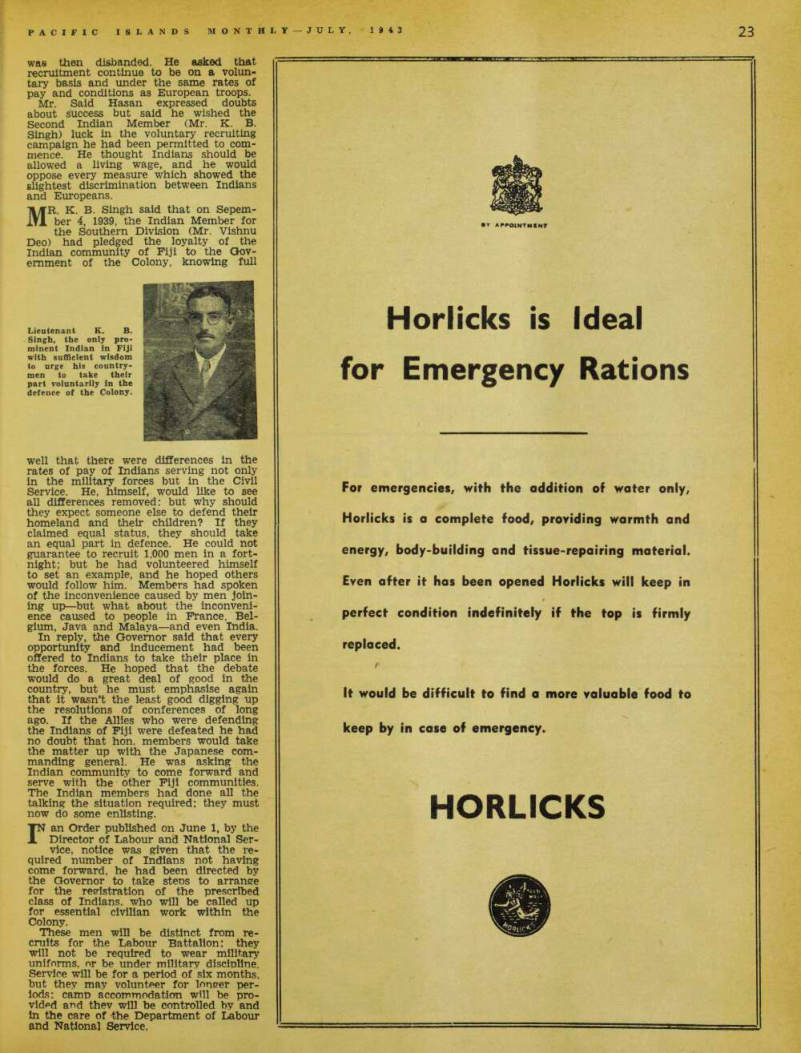
Compulsory Notional Service Follows Their Refusal to Help in Colony's Defence
THE liberty allowed Indian politicians in Fiji in peacetime developed into license in war time; and finally the position has arisen that, while the European and native Fijian communi ties were eagerly and courageously shouldering all their obligations as citizens of a country in the front line of the Pacific war, the Indians were deliberately shirking their share of defence.
Fortunately, in Major-General Sir Philip Mit chell, Fiji has a strong Governor. He has refused to listen to the babbling of the Indian agitators, and he has told the Indians, sternly and precisely, what they are to do.
ON May 4, the Government of Fiji released the following statement:— “In order to provide the labour neces sary for essential war work, Government now requires at least 1,000 Indians, in addition to the many thousands of Fijian volunteers who are already serving as soldiers or civilian labourers. During the past five months, voluntary recruit ment of Indians has been in progress, but so far only 52 Indians have enrolled.
Indians will again be invited to join the Fiji Labour Corps, but Government has decided that, unless the required 1.000 men are recruited by June 1, it will enforce compulsory national service for Indians under the Defence Regulations.”
About the same time, a press camoaign was begun with the object of inducing young Indians to join a labour battalion voluntarily; and at the opening of the Legislative Council, on May 14, the Gov ernor, Sir Philip Mitchell, made a fur ther statement on the matter and a fur ther appeal. He gave a resume of the
work carried out by the Fijian Military Forces and the Fijian Labour Corps; and went on:— “Theirs is an example which I sin cerely trust young Indians in the Colony will immediately follow, at least to the number of 1,000. I am well aware that there are influences at work to persuade these young men to stand aloof from the fight which is being waged, among other things, in order that they may have a future as free men and may enjoy, in security, their lands and their occupa tions. I hope that they will be sensible and resist such dangerous and stupid attempts to deter them from their duty and I warmly welcome the efforts being made by Lieut, the Hon. K. B. Singh and the great moral courage and patriotism that he has shown in taking the lead himself in joining the Army and calling upon his compatriots to follow him.”
ON May 6, the “Fiji Times” expressed, in an editorial, surprise that the Government has shown such patience over the question of non-voluntary en listment of Indians. With the Fijians, the voluntary system has worked well and these people have put up a splendid record of service—providing battalions of fighting troops, and labour corps, man ning ships, merchant and naval, and enlisting in the police and fire services.
The stage has been reached when very little more can be expected of the native Fijian community (said the newspaper)
and It is only fair to expect that the work that these men have left will now be done by others—compulsorily, if not voluntarily.
ON May 17, Indian members of the Legislative Council defined their attitude to the enlistment of their compatriots, at the invitation of the Governor.
Mr. P. D. Lakshman said that the leaders of the Indian people had met a year ago and decided that recruitment of Indians was acceptable provided it were voluntary, and that men recruited were given pay and privileges equal to those received by Europeans. A number of factors had prevented Indians coming forward; Firstly, the question of pay; secondly, the Government had failed to take the long view with regard to many matters—one of them education—and it could not expect full and whole-hearted co-operation from people who had not the education to see things as they should be seen; thirdly—the Indians were mostly small farmers whose security was frail, and who could not leave their farms without their families suffering hardships. All the Indians wanted were certain facilities and reforms—then they would come forward.
Mr. Vishnu Deo said that the Gov ernment was asked to grant permission for the forming of an Indian platoon in the Fiji Defence Force in 1930; this was granted in 1934, but the numbers were kept down to 40 —applications over that number being refused. The platoon had remained in existence for eight years—or until regulations came out, which provided for different rates of pay for Indians and Europeans. The platoon
was then disbanded. He asked that recruitment continue to be on a volun tary basis and under the same rates of pay and conditions as European troops.
Mr. Said Hasan expressed doubts about success but said he wished the Second Indian Member (Mr. K. B.
Singh) luck in the voluntary recruiting campaign he had been permitted to com mence. He thought Indians should be allowed a living wage, and he would oppose every measure which showed the slightest discrimination between Indians and Europeans.
MR. K. B. Singh said that on Sepem ber 4, 1939, the Indian Member for the Southern Division (Mr. Vishnu Deo) had pledged the loyalty of the Indian community of Fiji to the Gov ernment of the Colony, knowing full
well that there were differences in the rates of pay of Indians serving not only in the military forces but in the Civil Service. He, himself, would like to see all differences removed: but why should they expect someone else to defend their homeland and their children? If they claimed equal status, they should take an equal part in defence. He could not guarantee to recruit 1,000 men in a fort night; but he had volunteered himself to set an example, and he hoped others would follow him. Members had spoken of the inconvenience caused by men Join ing up—but what about the inconveni ence caused to people in France, Bel gium, Java and Malaya—and even India.
In reply, the Governor said that every opportunity and inducement had been offered to Indians to take their place in the forces. He hoped that the debate would do a great deal of good in the country, but he must emphasise again that it wasn’t the least good digging up the resolutions of conferences of long ago. If the Allies who were defending the Indians of Fiji were defeated he had no doubt that hon. members would take the matter up with the Japanese com manding general. He was asking the Indian community to come forward and serve with the other Fiji communities.
The Indian members had done all the talking the situation required; they must now do some enlisting.
Fan Order published on June 1, by the Director of Labour and National Ser vice, notice was given that the re quired number of Indians not having come forward, he had been directed by the Governor to take stens to arrange for the registration of the prescribed class of Indians, who will be called up for essential civilian work within the Colony.
These men will be distinct from re cruits for the Labour Battalion; they will not be required to wear military uniforms, or be under military discipline.
Service will be for a period of six months, but they may volunteer for longer per iods; camp accommodation will be pro vided and thev will be controlled by and in the care of the Department of Labour and National Service.
Lieutenant K. B.
Singh, the only pro minent Indian in Fiji with sufficient wisdom to urge his country men to take their part voluntarily in the defence of the Colony.
Advertisements & other items, pp. 24-25 (1 item)
Equal to the World’s Best
Throughout Australia and Overseas there is an ever-increasing demand for
COLONIAL & BRONTE
HIGH-GRADE CANNED MEATS
There is no better quality—none more wholesome. •
TRADE MEATS FOR THE ISLANDS
order
“COLONIAL” BRAND
Roast, Corned and Boiled Beef Packed in 6,5, 4,3, 2, 1 lb. and 12 oz. tins.
Also Corned Beef in 12 oz. Taper Tins.
Roast, Corned and Boiled Mutton. 1 lb. and 12 oz. tins.
Choice Dripping
36 lb., 2 lb., 1 lb. tins, and 1 lb. packets.
DELICIOUS
BRONTE" HOT MEALS
Steak and Kidney Pudding.
Beef Steak Pudding.
Sausage* and Tomato.
Sausages and Vegetable.
Lamb and Green Peas.
Corned Beef and Boston Beans with Tomato Sanee.
Steak and Tomato.
Under 'present conditions it is wise to ensure that you have ample stocks of all our lines.
The Colonial Wbolesale Meat Coy. Pty. Ltd.
30 GROSVENOR STREET, SYDNEY
APPOINT KB NT
Horlicks is Ideal
for Emergency Rations
For emergencies, with the addition of water only, Horlicks is a complete food, providing warmth and energy, body-building and tissue-repairing material.
Even after it has been opened Horlicks will keep in perfect condition indefinitely if the top is firmly replaced. p It would be difficult to find a more valuable food to 'N. keep by in case of emergency.
HORLICKS
Early Records of the Pacific Appeal
Pacific Appeal by Dr. George Mackaness
Letter to the Editor rERE are three matters of some interest to me and to students of Pacific history, concerning which I crave your aid. (1) The probable complete loss of the important collection of Pacific Islands literature made by Mr. Bjarne Kroepelien (whose homeland is now completely sub jugated by the enemy, and whose trea sures have either been destroyed or car ried off by the invaders) urges me to take some action to endeavour to ame liorate the possible loss to historical research workers.
I should, therefore, like you to invite any of your readers who are interested in Early Pacific Literature to get into touch with me, care of the University of Sydney, and to give me any details of the existence of books, pamphlets, trans lations, vocabularies, grammars or manu scripts which they possess.
Particularly, I should like information concerning the early printings made at the various Mission presses, especially those of the Leeward and Windward Islands (French Oceania) the New Heb
rides, Tahiti, Tonga, Samoa and the Philippines, from 1800 onwards.
Early French literature relating to the Pacific may, too, have suffered a loss through the removal of M, Jore’s library from his New Caledonian home. He for many years was working on a “Bib liography of the French Pacific.” (2) As I wish to complete my research work on Robert Louis Stevenson’s asso ciations with Australia and the South Seas, I should also like to make contact with any of your readers who possess Stevensoniana, and, in particular, copies of the “Open Letter to Dr. Hyde Con cerning Father Damien,” published in Sydney about March, 1890, as well as of the two booklets, “An Object of Pity,” and “Objects of Pity,” both bearing the inscription, “Imprinted at Amsterdam” about the year 1892, (3) Can any of your readers inform me of the present whereabouts of the portrait of Captain Cook, made by Web ber at Otaheite, on Cook’s last voyage?
It carried on the back the names of visiting ships, including the “Bounty,” the “Providence” and the “Assistant,” with dates of arrival and departure. It was left in the care of Tinah (Pomare) and his family, but seems to have dis appeared.
I am, etc.,
G. Mackaness.
University of Sydney, Sydney. 16/6/43.
Memories Of Old Papua
Letter to the Editor IWAS much interested in Mr. Osborne’s article in your December issue of the “PIM,” “How Sudest Gold Was Found.”
I was a pearl diver in the Louisiades 32 years ago, and I know the country well. I also prospected for the Quaker- Oats-shaped nuggets on Iron Stone Creek, on the Lakekamu, which Frank Pryke discovered. Following that, I crossed the Owen Stanley Range in 1914, from Buna to Port Moresby, to join my regiment, the Scots Guards, in London, but was too late in arriving in Brisbane to join the other reservists, so I joined up with the AIF.
Captain Thomas Craig, of Scotts Point, Redcliffe, was chief mate on the schoo ner “Governor Cairns,” when the Hon.
John Douglas picked up the first 16 miners in Cooktown, in 1886, to prospect for gold in the Louisiade Archipelago.
The leader of the party was D. White, and his deputy was Masher Clark.
The first landing was made at Janet Island, where they discovered only hun gry quartz. The next day, the Hon.
John Douglas advised the party to try the neighbouring island, Sudest, where they discovered colours of gold in a small creek.
Next day, the party went further afield where they struck payable gold in a large creek which they named “Runcei,” after the name of the captain of the schooner, “Tricknanny,” owned by Burns, Philp.
Captain Craig was for many years sailing on the Papuan coast and North Australia, and chief mate on the follow ing vessels in Papua: “Hygeia,” when she replaced the “Governor Cairns,” in 1887, and continued until 1891, when he took over as second mate on the “Merrie England.”
Captain Craig is well over eighty, is hale and hearty, and remembers the first compound erected on Samarai by John Douglas, for the first native murderers in Papua.
After the murder of another Captain Craig (father of Tommy, of Sudest). off Janet Island, the Hon. John Douglas offered a reward for the heads of the murderers. Nicholas the Greek, being an adventurous sort of individual, sailed with his schooner, the “Prince Albert Edward” (commonly known as the “PCE”) for Janet Island.
During the time that Nicholas was in the bush hunting the murderers, the Resident Magistrate of Samarai, F. O.
Forbes, arrived at Janet Island on board the schooner “Hygeia.” Nicholas, return ing from the hunt, came alongside the “Hygeia” with his dinghy, and threw a bag containing human skulls on board, demanding the reward.
The newspapers in Australia made a great noise over the affair. The Hon.
John Douglas was called South for an inquiry, and during his absence H.
Hastings Romilly was Acting-Governor.
Nicholas, on another occasion, was div ing for pearl and trochus shell off Stew art Island, north of Cooktown, when his crew of Australian aboriginals (Torres Strait natives) left him for dead in the water after attempting to do away with him. He managed to hang on to the rudder till dark set in, when he crawled along to the anchor chain and climbed on board, to give his would-be murder ers the shock of their lives. The boat was left to him, to run it by himself.
On another occasion, Nicholas was Court interpreter on Thursday Island whilst serving a sentence in gaol.
I am, etc.,
Redcliffe, Q.
Mac.
June 10, 1943.
Advertisements & other items, p. 26 (1 item)
Chi Vers
PRESCOTT Pty. Ltd.
SUSSEX ST., SYDNEY,
ore sole wholesale agents for
PINEAPPLE BACON&HAMS
DAISY brand BUTTER "375" BUTTER in TINS 1 lb.-21b.-slb. Sizes.
LEA & PERRINS’ Sauces and Most other Super-Quality Lines of the Trade, such as Cheese, Eggs, Etc.
CHI VERS
FAMOUS ENGLISH PRODUCTS
CANNED ENGLISH VEGETABLES
CANNED ENGLISH FRUITS
OLDE ENGLISH MARMALADE
GOLD MEDAL JAMS
JELLY CRYSTALS, ETC.
Obtainable from all leading Grocery Stores
WRITE TO DEPARTMENT “A”
CHI VERS & SONS LTD.
Histon, Combs., Eng.
FOR ATTRACTIVE RECIPE BOOK
c<: m
SHIVER*
COLD
standard
FRESH
t CNCLISH A
PEAS
nstS
Arthur Brander Is 80
Years Young
From Our Own Correspondent PAPEETE, April 10.
OUR good friend, Mr. Arthur Brander, celebrated his eightieth birthday in March. That figure 80 is only a number, for Mr. Brander looks to be 60, has the straight, soldierly body of a man of 40, and the spirit of youth and good-fellowship of whatever age you will.
Mr. Brander is known by that name only to his acquaintances and on pass ports and other formal documents. To his friends he is Te-ra-tane (The Sun Man). Most of us who have lived long on Tahiti have native names. Some of them are of high-chiefly origin—and we are most proud of them.
Te-ra-tane’s name is, in very fact, of royal origin and was bestowed by Queen Pomare IV herself on the grandson of her bosom friend, Ari’i-oe-hau, high chiefess of Papara—who is the Ari’i-ta’imai of the historic “Memoirs.”
Although Mr. Brander was born on Tahiti, he has been —in every sense of the term—a man of the world. Educated in Scotland, his subsequent vocations have led him to every part of the earth —to South America, where he learned Spanish; to North America, where he established his home; to the Orient and across Siberia to Russia, where he wit nessed the beginning of the Bolshevik revolution; and to his beloved England and Scotland times without number. But, like all of Tahiti, time could not dim nor distance diminish, his love for his native land, and “O Tahiti Nui Pai’umara’a o Te Ra O Tahiti Nui Mare’are’a” (“Great Tahiti, the mounting place of the sun Great Tahiti of the golden haze”) has reclaimed him.
A number of his friends gathered, on his birthday, to do him honour. The dinner was at a country inn on the shore of Puna’auia, in the district where Mr.
Brander has his residence.
Those present included James N. Hall, Richard Delambert (American Consul), Carl Beecher, Marcel Frogier, Lewis Hirshon, —. Patrick (NZ representative), Walter G. Smith, Sidney Coster, J. Frank Stimson, Preston Moore, Scudder Mers man (American Vice-Consul).
Ross Buckley, RNZAF, formerly on the staff of Morris Hedstrom, Ltd., Suva, Fiji, has been reported missing in air opera tions. His sister, Mrs. E. R. Chivers, resides in Suva.
Suva Wedding
Empire People Meet At
MISS Margaret Sampson, late of Bris bane, and Mr. Kenneth Wilkie, of the Shell Oil Company, were mar ried at the Pro-Cathedral, Suva, on April 30, by the Bishop of Polynesia. The bride was given away by Mr. R. H. (“Dick”) Bentley, of Suva; Miss Esmae Taylor was bridesmaid; and Mr. Wesley Woodward was best man.
The bridegroom (“Ken,” as he is known to his many friends in Suva), at one time spent two years in New Guinea, but is an Australian. The bride is a Canadian lass; Esmae Taylor claims New Zealand as her homeland: while “Dick”
Bentley was born in the Colony. It was a representative little Empire group.
After the ceremony, guests were enter tained at the home of Mr. and Mrs. Len.
Bentley, among those present being the Bishop and Mrs. Kempthorne, Mr. and Mrs. John Trotter, Mr. and Mrs. Lawlor (all of Fiii), Miss Jean Leonard (Scot land), and Lieutenant Davies (England).
Laugh, and the worlds laughs with you; Weep, and you weep alone; For the sad old earth must borrow its mirth, But has trouble enough of its own.
The US submarine “Sturgeon” radiod to its flagship after sinking its first Jap ship: “Sturgeon no longer virgin.”
A number of members of the Fiji Naval Volunteer Force are now serving outside the Colony and already have been in action against the enemy. They are in charge of Lieutenant T. H.
Andrews.
Under a recent agreement between underwriters in the United Kingdom and Australia, insurance over goods, while on land awaiting transhipment, may be extended indefinitely. This came into force from April 15, 1943. Prior to that, goods landed at Pacific ports to await transhipment could not be covered against war risk under marine insurance policies for more than 15 days.
Advertisements & other items, p. 27 (2 items)
25
PACIFIC ISLANDS MONDHLV JULY, 1943
jam VOK Liqueurs
There is no substitute tot
OLD MONK
VIRGIN PURE
OLIVE OIL US
San Francisco
GILLESPIE’S
The Flour
TRADE
MARK
of the Islands
- SYDNEY -
Qualite par Excellence.
jam VOK Liqueurs
New Hebrides and DISTRIBUTING AGENTS New Caledonia: MAURICE PELLETIER, 16 BRIDGE STREET, SYDNEY.
Fiji & Tonga: NORTHERN HOTELS LTD., LAUTOKA & BA, FIJI.
TRADE
ENQUIRIES TO:
J. C. MERRILLEES & CO.
ISLAND MERCHANTS
Challis House, Martin Place, Sydney
Bankers; Bank of New South Wales.
Halt In Fijian Recruiting
mHE Director of Labour and National X Services for Fiji stated in Suva on May 31, that, on representations made by his Board, the War Council had decided that no further recruiting of Fijians, either for the Military Forces or the Labour Corps, will be permitted until August 31, when the position will be reviewed.
Fijians are standing by in some dis tricts, in the expectation that they will be required almost at once; but the Dir ector has requested District Commission ers to tell them that this is not the case, and that they should settle down to essential work in their villages or accept civil employment. 1 1 = Mr. H. E. Snell, of Suva, Fiji, has returned to the Colony after a short visit overseas.
Caledonia
Future Of New
Where Reforms Are Needed
From Our Own Correspondent
Noumea, June 10.
WHAT is to be the future of New Caledonia? To-day, this important Territory of Fighting France is enjoying much prosperity—the result of the presence of so many Allied soldiers— and this may be an opportune time to lay new economic foundations for the Colony. Your correspondent discussed some interesting aspects of this prospect with M. Henri Montchamp, who is going away into the combatant ranks of the
Fighting French, after a year’s service as Governor of New Caledonia.
It was suggested to the Governor that France’s exclusive policy should be changed, so that Pacific shipping lines leaving Australian, New Zealand and American ports after the war would call regularly at Noumea. Before the war, no foreign lines called at the port be cause of heavy port dues and the mari time and customs policy pursued; yet these lines passed almost within sight of the New Caledonian coast. The only Line calling was Messageries Maritimes, pro viding a monthly service heavily subsi dised by the French Government.
M. Montchamp agreed that the port had been retarded by the policy pursued and that local requirements should be taken into account. Customs regulations and port dues might well be modified and made more supple in the interests of mutual trade, particularly with New Zealand and Australia. Regular inter course was desirable; there was very real friendship between the New Caledonian people and those two neighbouring coun tries, and an increased interest on their part in Caledonian development and wel fare would be welcomed. Noumea might become an important shipping port as well as an important air base.
No More Japanese!
BEFORE the war the Japanese had a monopoly of several New Caledonian industries. They controlled the trocas (pearlshell) industry, sending the shell to Japan for button-making; they exported beche-de-mer (sea-slug) to China; they were fishers and lumber workers; and they were getting a real hold on rice and coffee growing. Japan was the only country exploiting the Colony’s vast iron ore deposits, and the Japanese were beginning to exploit chrome and nickel mines on a large scale.
Above all in commerce—as merchants and storekeepers—the Japanese were particularly active, and wherever they went it was mainly Japanese goods they were selling. On the whole, it seemed that the average Japanese in New Cale donia was more prosperous than the average French colonist. Was there danger of their return when the war was over?
“If they were relatively richer, then perhaps it was because they worked harder than our colonists, who spend a lot of their time deer hunting and who rely overmuch on Javanese and native labour,” said the Governor. “Commer cially, the Japanese were out to monopo lise wherever they could, and we cer tainly do not want them back.
“This is just where brother nations like Australia and New Zealand might profit ably link themselves with New Cale donian industry for our mutual welfare.
We need local industries here; we should be able to make our own soap, and shoes; we could do our own tanning; we used to make excellent rum; and perhaps we could do with a button factory. Or, if we could not make our own buttons, we should prefer to send our trocas to Aus tralia, if you could establish a button making industry there.
“Mining is a bigger question, still. We have here one of the world’s largest reserves of iron ore. We want to exchange this ore for gold, which we need for smelting nickel. We prefer that this exchange should be with the people with whom we have a real understanding, and for the good of the South Pacific area in general. It would be a very good thing if Australia and New Zealand took con siderably more interest in this country in the way of developing and sharing local industries and exchanging products.”
Evils Of Land Monopoly
mHE Governor said that one thing that X iflight fruitfully be considered in future was a reallotment of land, for the good of the Colony. Up to now, New Caledonians had been living in a state of plutocratic feudalism—the feu dal barons being one or two mining cor porations, two or three large stores, and a handful of cattle-station owners.
To a suggestion that the small miner “did not have a look in under the pre sent system,” the Governor replied that vast areas were certainly held under con cessions by big concerns, without being exploited. But the ownership of mines was always vested in the State which granted the concessions, and perhaps an alteration in the present system might be desirable. What the small miners most needed was to organise themselves into a strong syndicate, which would have the backing of the administration.
He agreed that the island, with 20,000 European inhabitants, was seriously under-populated. One reason was that cattle-stations occupied too large a por tion of the country. Much of these areas was suitable for agriculture—the pro duction of vegetables, coffee, maize, rice, sugar, perhaps wheat. Put at the dis posal of the children of large families and other colonists, settlement would be stimulated and the country fruitfully opened up.
Dominion Status?
I ASKED M. Montchamp if there was any likelihood of New Caledonia developing as a French Dominion— a sort of Gallic New Zealand.
The Governor replied that that might come about when there was a European population of 500,000, with their own faculties, schools, colleges and institu tions, able to turn out their own doctors and professors. That was an essential thing about a Dominion—about Australia and New Zealand, for example, whose contribution to British culture and out look were an admirable feature of world development.
New Caledonians complain that their Governors are changed too frequently, giving them little opportunity to get to know the Colony. Did Monsieur Mont champ not feel that Governors should stay in office for three or five years?
“Yes, that might be a good thing,” he replied. “But the population should see to it that they make life supportable for their Governors!”
Mr. Alfred Gibson, who was Assistant Government Printer in Papua until the evacuation in 1942, and who had spent 27 years in that service, has been visit ing the Cowra district of NSW lately.
He told the local editor that he would not be happy until he could return to Port Moresby a sentiment echoed heartily by many hundreds of people who are shivering in an unusually cold Australian winter.
Advertisements & other items, p. 28 (2 items)
26
JULY, 1943 P ACIFIC ISLANDS MONTHLY
A. B. Donald Ltd.
AUCKLAND
ISLAND TRADERS & GENERAL MERCHANTS
P.O. Box 1509. Cables & Telegrams, ''Kingdom", Auckland.
iWTTvFTTrnTTTrTT?
» OP !v S »
You cou J \ s h eS V G ul nd , ctneH^"
l£W». ■ *f v n „
"■ w ° - ' —• ‘'VA*** Jl & co n v Aqo n ' s L ‘ ®' Vnd * *»*• Aq en ' s ~o. ®°* 36
Samoa Seeking
Labourers
Interest in Cook Islands
From Our Own Correspondent
Rarotonga, June 1.
AN inquiry was made recently in Rarotonga for labour for plantations in Western Samoa. Cocoa, copra and rubber plantations in that Territory are short of reliable labourers and the Samoans themselves are unsuitable.
The project was most popular here and about 600 local men are reported to have applied to go. The wages, 4/- a day plus food and lodging, are attractive to Raro tongans who, in spite of greatly increased prices, are still employed for as little as 3/- a day nett.
About 200 men already have left Raro tonga to work overseas in New Zealand and elsewhere. Any further reduction in the working male population would have a serious effect on Rarotonga’s only industry, fruit-growing.
Protests against any further labour being sent away officially were entered in an Island Council meeting and elsewhere.
No further announcement having been made by the Administration during the past two months it is presumed that these have had some effect.
It is interesting to note, in this respect, the difference between Samoans and their Rarotongan cousins. The Samoan is not enamoured of labouring for others, whereas, generally speaking, the Raro tongan would rather work for a boss than be an independent peasant farmer.
Mr. W. H. Brabant, of Fiji, has returned to the Colony after an extended visit overseas.
Advertisements & other items, p. 29 (1 item)
E. J. Gough & Co.
THE
YORKSHIRE
INSURANCE
CO. LTD.
(Incorporated in England)
FIRE
ACCIDENT
MARINE
FIRE POLICIES ISSUED
IN PAPUA
All information from —
E. A. JAMES,
Tel. 86347. Attorney for Papua, 14 Spring St., Sydney
PRODUCING UNIFORM GOOD RESULTS SINCE 1868
ALWAYS ASK FOR IT
SUPPLIERS OF GENERAL MERCHANDISE TO LEADING FIRMS
THROUGHOUT THE PACIFIC ISLANDS
E. J. GOUGH & CO.
1 BOND STREET, SYDNEY,
AUSTRALIA.
EXPORTERS . , . IMPORTERS . . . MANUFACTURERS' REPRESENTATIVES BANKERS: Bank of N.S.W. Comptoir National d’Escompte de Paris.
War Time Cable Address:
GOUGH CO.,
1 BONDSTREET,
SYDNEY.
Codes; Bentley 2nd and Comp. Phrase, Acme, A.8.C., sth and 6th, Peterson, 2nd and 3rd, Banking.
Telephone: B 4167.
Eager Eyes on N. Guinea
Timber Interesting Post-war Possibilities
AUSTRALIAN timber concerns, with a shrewd, speculative eye upon post war conditions, are already mani festing a lively interest in those magni ficent stands of hoop-pine, cedar, etc., in the Bulolo Valley, New Guinea, which had attracted attention before the out break of war in 1939.
There is going to be a tremendous general demand for timber after the war.
New Guinea is full of timber—the indus try of lumbering in New Guinea, for the Australian market, was developing rap idly in 1938-39. Even seekers of veneer woods from the United States had found their way there.
The timber stands in the Morobe Val ley—the timber improves as one gets up onto the inland plateaux—have been well-known for years, but no one could solve the transport problem. Many plans were discussed, from back-loading for transport planes to rafting the logs down the Bulolo and the Markham at flood-time.
Now, it is assumed that one or other of the combatant forces will build some sort of motor-road between Wau and the coast —an engineering project that de feated the Administrations and the gold mining companies for a decade prior to 1939. A trafficable road means timber transport; and that means the exploita tion of the great timber wealth in the Morobe district of New Guinea. Timber interests will be after the prize, as soon as the Japs are gone from New Guinea.
It is to be hoped that Canberra will not be stampeded into permitting any thing of the kind. As soon as the war is
gone from New Guinea, there will be a terrific job of re-building to be done in Wau and Bulolo, Salamaua and Lae, and something better than the flimsy build ings of the gold-rush period will be insisted on. In other words, all New Guinea’s timber, for a considerable time, will be needed for New Guinea’s own urgent building operations.
Fuzzy-wuzzy Pen Friend!
rE following was published in the issue of the Sydney “Sun” of June 26: “First letter from a new fuzzy-wuzzy pen friend named Mooka Hoolam has reached Mr.
Laurie Trezise, of Bondi.
“It was enclosed in one from Mr. Trezise’s cousin, Pte. Bob Lynch, tvho is a cook with a unit serving in New Guinea. It read:— “ ‘Dear lorie, i rite U this letter. U one big brudder tel me you like big boy Mooka rite U.
I no no what 4 U want me rite. I no body.
U name. Then U big brudder tell me bout U.
I tell U bout me. I 16 year. I carry dyed Aussies and dye finis Aussi in jungle and I lern to rite off Aussie. I got mary 4 kid one dye finish and leave 3. If U rite me one fella Mooka send to U big brudder. E sen me and I read U letter. From U frend Mooka.’
“The letter is written in a large and sprawl ing hand and stamped by the military censor.”
Territorians are here permitted to spit fire and fury—and a dense, sulphuric smoke-screen will be thrown over subse
quent proceedings.
This is a good example of the kind of thing with which returning Territorians will have to deal, after the war. Soldiers in New Guinea, and the poor unsuspect ing “pen friends” in Australia, have no idea at all of how to treat these jungle children—people of the Stone Age—and no suspicion of the trouble they are pil ing up for those who must re-establish social order in the Territories.
Oranges From Sunday
Island?
From Our Own Correspondent
Rarotonga, June 1.
AN auxiliary schooner which arrived at Rarotonga recently, reports that orange-planting on a considerable scale will shortly be carried out by the New Zealand Government on Raoul (Sunday) Island, in the Kermadecs.
Mr. W. T. Goodwin, formerly Director of Agriculture at Rarotonga and now Assistant Director of Horticulture in New Zealand, has visited the island and approves of the plan. Orange trees are known to flourish there in a wild state; properly planted and cultivated, presum ably free from insect pests in a practic ally virgin island, they should respond well.
Although Raoul is very small, there is no indigenous population to consider, and all the suitable land could be utilised.
Only two days’ run from New Zealand, the island is well placed and although the anchorage is extremely bad, this per haps can be improved.
Inasmuch as all citrus fruits exported from the Cook Islands go to the New Zealand market, Rarotonga may be affected. Rarotonga’s wild native orange trees, like old soldiers, are fading away, and replanting is moving so slowly that it seems as if the New Zealand Govern ment may be losing patience.
The effect of Raoul Island would not be so much from quantity as quality. A well-run citrus orchard on a large scale, with plenty of capital, such as is envis aged, would produce better fruit at a cheaper price than the 1-acre peasant groves which are now being planted in Rarotonga. It seems that Rarotonga must wake up—or get left behind.
Advertisements & other items, p. 30 (1 item)
Willia
I I
Atkins Pty. Ltd.
Head Office 449-451 KENT ST., SYDNEY.
Iron & Steel Merchants—Engineers' Supplies
Coach Cr Motor Hardware
ESTABLISHED OVER 50 YEARS
Cable Address: WILATKIN, Sydney.
STEEL DEPARTMENT —-
MILD STEEL:
Rounds, Squares, Flats, Half-rounds, Hexagons, Bevel, Shoeing, Tyre, Angles, Tees, Sheets, Plates, Girder Plates, Chequer Plates, Channels, Hoops, Etc.
BRIGHT STEEL;
Rounds, Squares, Hexagons.
Extra Special High Speed Tool Steel, Mining Steel, Blister Steel and Spring Steel, Rounds, Flats & Squares.
Bar Iron—All sections and sizes.
Engineers' Supplies: Set Screws, Studs, Metal Thread Screws, Coach Screws, Files, Cotter Pins, Bright and Black Bolts, Rivets, Etc., Hack Saw Blades.
Power Transmission Gear: Including Plummer Blocks, Couplings, Collars, Etc.
Coach and Motor Hardware: Axles, Springs, Wheelstuff, Duck, Paints.
Farriers' Supplies: Horse Nails, Anvils, Vices, Etc.
Motor-Trimmers and Motor Builders' & Motor Painters' Requirements
C. A. WILLEY'S
Quick-Drying Coach and Car Paints, Roughstuff, Elastic Gloss, Synflex Enamels, Lacquers.
DUCO Lacquers and DULUX Enamels—FAßßEX Motor Toppings and Leather Cloths, House & Decorators' Paints, Varnishes & Brushware.
Sole Distributors of CHAMPION'S Decorators Paint Products.
Distributing Agents for BROLITE Lacquers, SYNFLEX Enamels and "POLYGLOSS" Finish.
Praise Where Praise Is Not Due
Professor Elkin and Australia's Record in New Guinea
r T , HE following is from an article by ■*- Professor A. P. Elkin, 'published in a recent issue of the Methodist “Missionary Review Professor Elkin holds the Chair of Anthropology at the University of Sydney.
THERE have been sad and disastrous patches in the relations of Western civilised nations and peoples with the peoples of Melanesia, Polynesia, Malaysia, and East Asia; e.g., black birding, exploitation of the natives’ lands, undermining of native culture and society by misdirected missionary zeal, with some consequent depopulation.
On the other hand, there have been wise native and general policies put into operation by the British Administration of Fiji and the Western Pacific, and by our own Administration in Papua and the Mandated Territory of New Guinea.
These policies have not been perfected.
In British territories the education poli cies have lacked imagination and drive, but the interests of natives have been the first consideration. We all realise this is the case of Papua, but it is also true with regard to the Mandated Terri tory of New Guinea.
In the former Territory, we were not trammeled by any preceding type of administration: whereas in the latter, we had to take over from a German system, with its policy of substitution of culture, and its method of force. Moreover, we have had difficulties in this Territory with the indenture system and also with the exploiters of gold and some planta tion folk, who think first, and sometimes also last, of themselves.
The New Guinea Administration, how ever, has not given way to clamour based on selfish interests. It has, moreover, built up a well-selected team of officers, especially trained for them work, who regard the natives as human and social beings. I think we should pay a tribute to the manner in which these Adminis trative officers, wherever possible, have remained in their districts with the natives in spite of the Japanese advance.
Here too, I would like to pay a tribute to the missionaries of various denomina tions who have done the same. Amongst them are both the Church of England missionaries in South-east Papua, and also the Methodist missionaries in New Britain and New Ireland. Unfortunately,
nothing is known about the fate of some of the latter.
With regard to the future; If mission aries are as well-selected and trained as the Administration officers of the Man dated Territory; if full co-operation between the Administration and missions prevails, as is a characteristic of British policy; and if we refuse to depart one iota from the policy of administering these islands for the welfare of their native populations, and of helping the latter to develop them, then prosperity and blessing will follow.
Hard Earth and Cold Facts
AND now, with regret, we must bring Professor Elkin down to hard earth and cold facts.
The record of the Australian Govern ment in relation to the education and the bodily care of the natives of New Guinea is dismal and far from credit able. The “PIM” has been pointing this out, year after year, for at least ten years; and, even yet, whenever a politi cian opens his foolish head on the sub
(Continued on Page 32)
(Continued from Page 29)
ject of New Guinea, he begins to shout about Australia’s “splendid record” there.
And now we have a scientist making the same error. Statistics must supply the answer.
All the development and progress that happened in New Guinea during the twenty years between the wars was con nected with the establishment and
growth of the gold industry. Neither the Australian Government nor the New Guinea Administration had anything to do with the credit goes to the indomitable Australian prospectors who found the goldfields, and the plucky, far visioned investors and engineers who developed them.
The outstanding good thing in Austra lia’s government of the Mandated Ter ritory was the creation, as Professor Elkin has said, of as fine a corps of adminis trative officials as could be found any where in the Pacific. This meant that the work of administration, in a local sense, was done admirably; but the pic ture on the bigger canvas, the creation of policies by the Administration, to be given effect to by the officials, was much less impressive.
Education of natives, health of natives, development of agriculture (both Euro pean and native), encouragement of white settlement and enterprise, provi sion of means of communication—in all such things the Administration, during 20 years, although it had abundant revenues, pursued a policy of laissez faire.
It had “Tropicitis”—it dithered and did nothing.
THAT was because of the Canberra politicians’ practice of appointing to the Administratorship, not a man trained in tropical government, but some ex-soldier or ex-politician who was out of a job. The only Administrator which New Guinea ever knew, who really took hold of Territory affairs and began to frame policies, was General Tom Grif fiths; and, because he refused to bow the knee to the Canberra bureaucrats, and insisted on being administrator in fact as well as in name, he did not remain there two years.
It is a long, unhappy story, which need not be re-told here.
THE story of Papua is less dismal. That was because the man in charge there for 30 years (Sir Hubert Murray) was not only a strong man but also was a Lieutenant-Governor, and not an Administrator; and this gave him certain powers which allowed him to defy the Canberra bureaucrats, whenever they tried to “push him around,” He did what he believed was best for the ter ritory he controlled, and his success was remarkable.
But, when Sir Hubert died, the little tin czars in Canberra promptly changed the Lieut.-Governor-ship to Administra tor-ship, which gave them greater autho rity over the head of the Papuan Administration.
THE history of native education in New Guinea will suffice to show the poor quality of the Australian effort there during two decades, and the lack of any governing policy.
Brig.-General Wisdom retired from the Administrator-ship in 1932, after 11
years’ service. He had, on a couple of occasions, made a worthy effort to inaugurate something worth while in the way of a native education system, but nothing had come of it. Native educa tion—what little there was of it—was almost wholly in the hands of the mis sion bodies.
He was succeeded by Brig.-General Griffiths, an energetic administrator, with considerable experience of Pacific Islands conditions. None knew better than he (a) the need for a comprehen sive native education system; (b) the difficulties in the way of establishing such a system—especially the lack of teachers and the lack of a common language.
Therefore, as soon as he took charge in 1932, and so as to promote “a more rapid expansion of educational activities,” the Administrator in 1932 entered into dis cussions with the various mission organi sations, planning a system under which the missions would undertake entirely the duty of educating the natives. It was proposed that the missions should train, supply and control the school teachers, while the Administration should compel attendance at the schools, pre scribe the curriculum and the hours, grant subsidies and generally supervise the system. There were to be village schools, primary (or middle) schools and high schools (or colleges).
In 1933-34 the plan was still under discussion.
LATE in 1934, General Griffiths, refus ing any longer to carry on “under Canberra office-boy control,” retired and Brig.-General Ramsay McNicoll took over. The following was published in the first report issued by Administrator McNicoll (June 30, 1935) “It has been decided not to proceed with the proposal that the religious mis sions should undertake entirely the edu cation of the natives. It is proposed, however, that the existing system of vil lage schools maintained by the Adminis tration should be extended . . . Develop ment must be slow, and will be dependent on the availability of funds and a suit able staff. The Malaguna elementary school will become a training school for future native teachers ...”
There followed a brief outline of the Administration’s education plan. The natives were to be trained “only to the extent that will enable them to apply their increased knowledge to improve their conditions of living in their villages, or to be absorbed into the community as trained natives, artisans, or clerks.”
On June 30, 1936, Administrator Mc- Nicoll reported that the committee set up by Administrator Griffiths to examine native education had been replaced by a Special Committee of the Legislative Council, consisting mostly of heads of departments. This special committee then apparently engaged in a series of
conferences with the mission bodies; and “was granted further time to study the matter in greater detail.”
AFTER that effort, everyone directly or indirectly responsible for native education went peacefully to sleep; and their slumbers were not again dis turbed until the Japs came bursting into Rabaul in January, 1942.
The “Special Committee” lapsed in 1937. because the Legislative Council had expired. On June 30, 1938, in his annual report, Administrator McNicoll published a series of excuses for his failure to get on with native education: The Special Committee had lapsed; a long time was needed to train native teachers; it was undesirable that important phases of mission work should be disturbed by “the untimely introduction of a scheme of education which had not been scrutinised more closely”; there was a language diffi culty, and it was undesirable that Pidgin should become the lingua franca’, the teaching of English could not be carried out by the missions, because 586 of the 682 missionaries in the Territory were not British; and so on. Good reasons enough, but no sign of any effort being made to solve the difficulties.
After that, the annual reports disclose no attempt to introduce or even to plan a system of native education —although, as shown by the table published here with, hundreds of thousands of pounds of new revenue were being provided by taxes on the new gold industry.
With all due respect to Professor Elkin, it is not a record of which Australia can be proud—especially when comparison is
made with native education systems in territories where revenues are much more limited.
An air-graph service now exists between the United Kingdom, Canada, and the Middle East, and the Colony of Fiji. Sir Philip Mitchell, Governor of Fiji, received the first air-graph from the Secretary of State for the Colonies, at
the end of May. The service to Canada and the Middle East is for the members of the armed forces only; the service to the United Kingdom is for all. Messages cost 9d. (Services personnel) and 1/- (civilians).
1937-8 1938-9 1939-40 Spent on education of natives £6,726 £7,946 £8,274 Native pupils, Government schools 445 485 488 „ „ Mission schools 65,246 68,773 65,598 Spent on public heatlh £80,376 £89,783 £85,207 Total revenue £506,397 £460,835 £496,689 Gold royaltv . . . . £97,464 £107,974 £143,906
Advertisements & other items, pp. 31-32 (1 item)
Ropes,
Capt. L. A. Willis, formerly of Steamships Trading Co., Papua, now of ANGAU, is at present on sick leave in Sydney.
KANGAROO BRAND
Cordage,
and Twines £or every purpose
Backed by
86 years of service.
Manufactured by
M. DONAGHY AND SONS,
Pty. Ltd.,Geelong and Sydney.
Fiji Representatives:
PEARCE AND CO.
LIMITED
P.O. BOX 237, SUVA
OROKOLO INDUSTRIES
(Reg. in Papua) Orokolo, via Port Moresby, Papua
PLANTERS STOREKEEPERS MANUFACTURERS
Although all members of Orokolo Industries are on active service, plantations, and organisation, are being maintained in readiness to function again as soon as victory is won. We shall then be pleased to resume those happy business relationships which, for the time being, must be suspended. In the meantime we send our good wishes to our friends everywhere.
F. W. BURKE.
FOPi
EVERY INDUSTRY
For Essential Industries
Now, more than ever, speed and efficiency in industry are demanded. Only equipment of the highest reputation is worthy of consideration. You can rely on the products of— CROMPTON, PARKINSON LTD.—Motors, Instruments, Transformers. Crompton Lamps.
FERRANTI LTD.—Transformers, Instruments, Meters.
HERBERT MORRIS LTD.—Pulley Blocks, Runways.
CROMPTON, PARKINSON (AUST.) PTY. LTD.—
Parkinson Motors, Crompton Minor Motors, Power Transformers.
CALLENDER’S CABLES & CONSTRUCTION CO.
LTD.—Wires, Cables, Flexibles.
RANSOMES & RAPIER LTD.—Mobile and Breakdown Cranes, Excavators.
HOPKINSONS LTD.—Valves and Boiler Fittings.
NORDBERG MFG. CO. LTD.—Symons Cone Crushers, Vibrating Screens.
AUDLEY ENGINEERING CO. LTD.—“Audco”
Lubricated Plug Valves.
MATHER & PLATT LTD.—Large Electric Motors.
NOYES
11 Watt Street, Newcastle.
BROS. (SYDNEY) LTD.
115 Clarence Streep Sydney
And at Port Kembla. 197 Elizabeth Street.
Brisbane.
NELSON & ROBERTSON
PTY., ltd.
Established 1895.
Islands Merchants
All classes of merchandise purchased at wholesale prices and original invoices supplied to Islands clients.
Cocoa Beans, Rubber and other Islands' produce sold on commission.
Nelson & Robertson
Pty. Ltd. 12 Spring Street, Sydney,
Restlessness and sleeplessness, when due to run-down nerves, frequently respond to treatment with Dr. Williams' Pink Pills.
Dr. Williams’
PINK PILLS
help to enrich the blood, which has a beneficial and restorative effect upon the nervous system.
The Most Extensive Manufacturers in the British Empire of
RUBBER STAMPS,
INKS, STENCILS,
Marking Devices,
ACME STAMP PADS
OFFICE & STATIONERY SUPPLIES
We also Manufacture & Supply a Complete Line of
LIMEWASHING AND
SPRAYING MACHINES
for all purposes.
Let ns know your requirements and we will quote by return.
WRITE FOR OUR GENERAL CATALOGUE
Limewashing Machine
EXCELSIOR SUPPLY CO. PTY. LTD.
278 Post Office Place,
MELBOURNE, VIC.
HEAD OFFICE :
160 BROADWAY,
Formerly known as George St.. West,
SYDNEY, N.S.W.
50 Victoria Street,
WELLINGTON, N Z.
How to Really Help
Islands Natives Practical Suggestions From Melanesian Mission
PRIOR to the Pacific war it was im possible to convince the Adminis trations of the various South-west Pacific Territories that something more was due to the natives than they were getting. At all events, neither the Administrations concerned, nor the British Colonial Office, took it upon them selves to evolve either adequate or far sighted native policies.
At present, of course, there is no lack of suggestions as to what would be a fitting reward for the loyalty these Melanesians have shown in the last 18 months—many of these suggestions obviously emanating from people who have never been in contact with Melanesia or Melanesians.
However, it is generally agreed that our sins were of omission rather than com mission—in just the same way as we neglected to remove slums and want from our own Australian cities. If this be so, there should be no question of reward for loyalty—and presumably the natives should be loyal for the same reason as
the resident of Sydney or Manchester, or any other British subject, is loyal. The question is one of rights, not rewards.
In the post - war wash - up, the Melanesian’s position as a citizen of the world will have to be considered, but we should not be permitted to salve our national conscience with a £lO,OOO “sing sing”—as has been suggested by some circles in Australia—and, for the rest, relegate the Melanesian to his former position in the limbo of lost things, simply because we have the material strength to do so if so minded.
IN “The Southern Cross Log”—the journal of the Melanesian Mission— of July 1, the idea of the £lO,OOO worth of dances for these natives is con demned as fatuous, and a plan of health and education is outlined for Solomon Islanders of the post-war period.
Present medical facilities are inade quate to meet the needs of the many Solomon Islands and their scattered villages.
Contrary to the popular belief that native women have children without any trouble, many do, in fact, die in child birth—due very frequently to entire lack of skilled help, and to the well-meaning but misguided assistance of dirty native helpers, who are useless when compli cations arise. The babies who are left motherless, in such a fashion, occasion ally survive, in spite of wrong feeding, but the majority die. The infantile death rate—even after a normal birth —is ex ceedingly high (about one in four children die within the first vear of life), and this is almost always directly attributable to wrong feeding and no knowledge of hygiene.
All these people, too. are open to in fection from such diseases as yaws, dysentry and malaria—and nothing is done in the way of prevention or teach ing the people the cause and effect of such complaints. It is obvious that a hospital on another island, or at best many miles away, is of little use to these neonle—especially to the women and children, who rarely move very far from their native villages.
On the island of Malaita there is a nonulation of at least 40,000 natives — and just one hosnital. In the whole of the Solomons there is anproximately 100.000 of a native population—and. as can be imagined, the need for medical work there is desperate.
THE native diet of these Islanders is of very limited variety and of Ques tionable value, and primitive methods of agriculture have not always made the best use of the land. Immediately be fore the Pacific war, some of the most intelligent natives were sent to the Government experimental farm in New Britain, and it was hoped that the know ledge they gained there would in time improve native agriculture. Land for permanent gardens was being cultivated, and a greater variety of foods being in troduced. It is confidently expected that better food will improve the health of whole communities.
The building of good, nermanent. native houses should be encouraged, and simple drainage, good roads and tracks, and cleared swamps would do much to eliminate the evils of malaria and dysentry.
Before the Pacific war, too, an increas ing number of lads were being sent to the Native Medical School in Suva, Fiji, and the training is rightly regarded as one of the finest pieces of British Colonial Administration so far seen in the South-west Pacific. But in order to provide boys for this work at the medical school, attention must be paid to their preliminary education—and the facilities
of such education in the Solomons are, to-day, lamentably inadequate. The same high standard of education should be made available to the girls, who have a natural and surprising ability for nursing, and who are proud of the result of mid wifery and mothercraft training.
In conclusion, the “Log” maintains that wonderful benefits are to be had from the establishment of hospitals, each with a chain of dispensaries on each of the larger islands, and maternity and mothercraft centres in sufficient numbers to take care of the wants of all villages.
All of these hospitals, dispensaries and centres should be staffed by NMP’s and native nurses.
Maternity and mothercraft training centres, the selection of the best lads for the Native Medical School —all these call for substantial monetary assistance and the best European teachers. It remains for us to provide for the future of these people with something of lasting benefit.
Advertisements & other items, p. 32 (1 item)
30
1943 PACIFIC ISIANDS MONTHLY
The Rising Of The
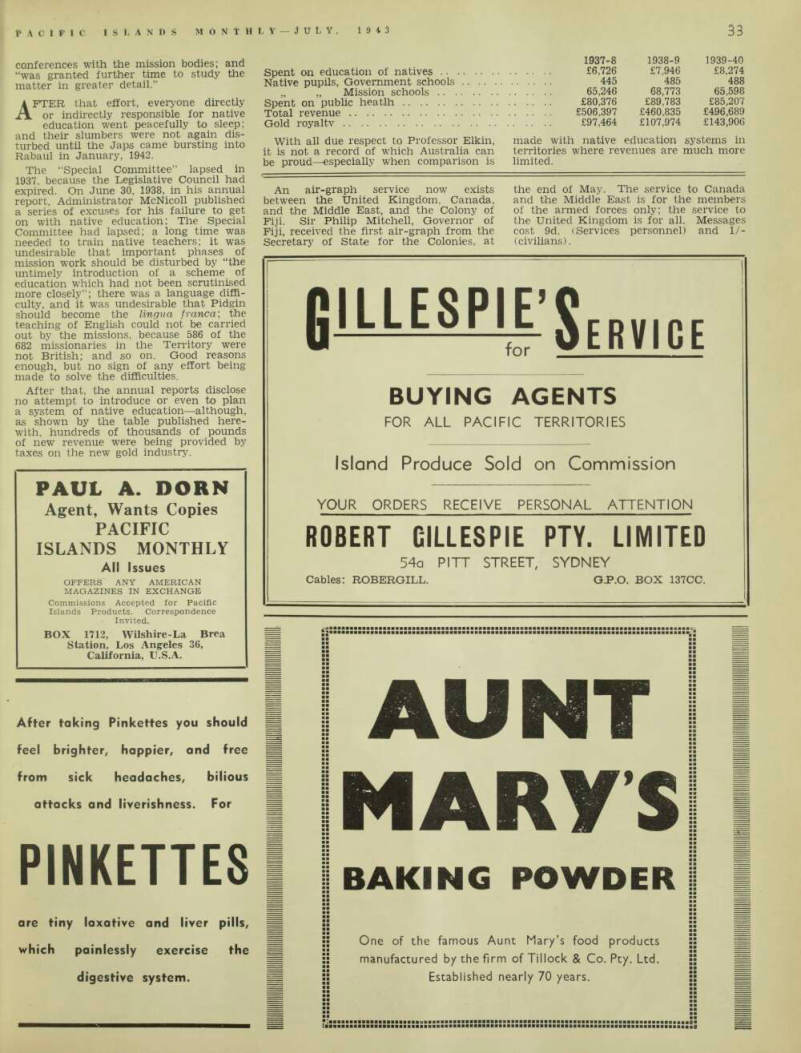
Palolo
What Happens in N. Hebrides
r THE “rising of the palolo”—an edible ■*- coral-reef sea-worm which appears at a particular time each year, and is one of Polynesia’s choicest foods —has been described often by residents of the Central Pacific, especially Samoa. Here is a description by Laurie Walker, in “Sydney Morning Herald” of June 26, of what happens in the New Hebrides.
BEATRICE Grimshaw’s article on “Meat from the Ocean” was most interesting and entertaining. Here are some additional facts about the strange edible sea-worm she mentions.
In the New Hebrides (South Santo) there is this strange *:ea-worm which appears only once a year. It is called “Ale” (A-le) and is anything from two to three feet long, but thin and with numerous legs like a centipede. The natives consider it a great delicacy, and after grating yams, they cut the “Ale” into pieces about four inches in length, mix with the grated yam, and cook in their ovens. It has the flavour of crab, but the whites do not eat it here.
In the New Hebrides there are dozens of different languages, hence this worm is known by various names throughout the islands. In North Malekula it is “Palolo,” but its habits are the same.
The natives know to the hour when it will appear, and for a couple of days before become restless and excited. You cannot get any real work out of them
and the mission school closes for a couple of days until the “Ale” has disappeared.
The strangest thing, however, is the way in which the natives, in this locality, know when it will rise to the surface.
A planter friend, who wished to give me the most reliable information possible, sent for the old man of a nearby village, who gave the following particulars—of course, the explanation was in Pidgin- English—but this is really what he said.
“When the Corotas (an edible nut) comes into flower (October), then four days after the full moon the small ‘Ale’ appear. The day before this (three days after the full moon) a small red sea-ant puts in an appearance, also a small fish resembling a lizard (which the natives call sea-lizard). Both disappear with the ‘Ale.’ The large ‘Ale’ appear six nights after the following full moon (November).” They rise to the surface among the rocks in untold millions, but disappear the next night, and not one is to be found after that until the same time next year.
I understand that the natives never miscalculate as to the time of its appearance.
Mr. L. J, Warren, for six years mana ger for the Union Steamship Company at Rarotonga, has been transferred to Auckland office, and left with Mrs. War ren in April.
Advertisements & other items, pp. 33-36 (2 items)
Darvas
ISLANDS
SOUVENIRS
Popular Islands Shell Necklaces and Hula Skirts posted direct to any part of the world.
Special sample parcel for £1
containing:
1 Genuine Manihiki Skirt; and 12 Assorted Island Necklaces.
Send your Money Order direct to
D. C. BROWN
MERCHANT AND EXPORTER
OF ISLANDS PRODUCE.
P.O Box 16, Rarotonga, Cook Islands.
LARGE QUANTITIES AVAILABLE
—WHOLESALE INQUIRIES INVITED.
BUY DIRECT AND SAVE MONEY
DARVAS
AND
COMPANY
(Proprietors: R. DARVAS, E. KLUGMAN)
35 PITT STREET, SYDNEY
EXPORTERS ::IMPORTERS
GENERAL MERCHANTS
ISLANDS TRADERS
Shippers of all kinds of Merchandise Specialising in Foodstuffs and Spirits Represented in Fiji by V. R. JAM & CO., Suva.
Bankers: Bank of Australasia, Comptoir National D’Escompte de Paris.
Wartime Cable Address:
DARVAS COMPANY SYDNEY.
’Phones: 8W4696, BW 6384.
ALUMINIUM and its ALLOYS
OUR HOUSE FLAG IS FLYING and our production is flowing into the stream of Defence requirements exclusively—in the forms of Aluminium Alloy INGOT, Rolled Aluminium Alloy PLATE, SHEET, STRIP, also as Extruded Aluminium Alloy ROD, BAR, WIRE, TUBING AND SECTIONS.
We look forward to the time when civilian demands can be satisfied by us, to meet the growing applications for our metal in Australia and the South Seas.
AUSTRALIAN ALUMINIUM COMPANY
PROPRIETARY LIMITED °
• INCORPORATED IN THE STATE OF VICTORIA) GENERAL OFFICES AND FABRICATION DIVISION: GRANVILLE. SYDNEY. N.S. W.
Kidney Trouble
and Backache
Gone in 1 Week
Flush Kidneys With Cystex and You’ll Feel Fine Cystex—the prescription of a famous doctor —improves faulty kidney action in double quick time, so, if you suffer from Rheumatism, Sciatica, Neuritis, Lumbago, Backache, Nervousness, Leg Pains, Dizziness, Circles under Eyes, frequent Headaches and colds, poor Energy and Appetite, Puffy Ankles or Interrupted Sleep, go to your chemist to-day for Cystex.
Cystex Helps Nature 3 Ways
The Cystex treatment is highly scientific, being specially compounded to soothe, tone and clean kidneys and bladder and to remove acids and poisons from your system safely, quickly and surely, yet contains no harsh, harmful or dangerous drugs. Cystex works in these 3 ways to end your troubles:— (1) Starts killing the germs which are attacking your Kidneys, Bladder and urinary system in two hours, yet is absolutely harmless to human tissue. (2) Gets rid of health-destroying, deadly poisonous acids with which your system has become saturated. (3) Strengthens and reinvigorates the kidneys, protects you from the ravages of diseaseattack on the delicate filter organism, and stimulates the entire system.
Feels a Different Woman
“I have been taking Cystex for Kidney and Bladder trouble and it has made a different woman of me. I am feeling splendid, can do all my work, run about and walk miles although I am 63 years of age. Cystex does all you claim for it.”—(Sgd.) M. L. Zessin, Thompson Estate, Brisbane.
Now Able to Walk Without Stick
“I had Kidney and Bladder complaint, pains in leg and back; in fact, I had to use a walking stick. I have used two bottles of Cystex, now I have no pains anywhere. I consider Cystex the greatest medicine in the world for Kidney complaint.”—(Sgd.) J. McPherson, Nangeribone Station, N.S.W.
Guaranteed to Satisfy or Money Back Get Cystex from your chemist to-day. Give it a thorough test. Cystex is guaranteed to make you feel younger, stronger, better in every way, or your money back if you return the empty package. Act now!
Now in 2 sizes—4/-, 8/-.
GUARANTEED CVStCX
Treatment
for Your Kidneys, Bladder, Rheumatism
5
tt Guard against Infection with Tenax!
Germicidal Soap used regularly is an
unsurpassed safeguard against external germ
infection. It is kind to the most sensitive skin, yet its germicidal action is eleven times as rapid as carbolic. It is non-irritant and non-poisonou*.
At AH Chemists and Stores .
TENAX 'Uhe Genuinely Germicidal SOAP
QILLESPIE'S er > IC e
BUYING AGENTS
FOR ALL PACIFIC TERRITORIES
Island Produce Sold on Commission
YOUR ORDERS RECEIVE PERSONAL ATTENTION
ROBERT GILLESPIE PTY. LIMITED
54a PITT STREET, SYDNEY
Cables: ROBERGILL. GP.O. BOX 137 CC.
PAUL A. DORN
Agent, Wants Copies
PACIFIC
ISLANDS MONTHLY
All Issues
OFFERS ANY AMERICAN
MAGAZINES IN EXCHANGE
Commissions Accepted for Pacific Islands Products. Correspondence Invited.
BOX 1712, Wilshire-La Brea Station, Los Angeles 36, California, U.S.A.
AUNT
MARYS
BAKING POWDER
One of the famous Aunt Mary’s food products manufactured by the firm of Til lock & Co. Pty. Ltd.
Established nearly 70 years.
After taking Pinkettes you should feel brighter, happier, and free from sick headaches, bilious attacks and liverishness. For
PINKETTES
are tiny laxative and liver pills, which painlessly exercise the digestive system.
There is no substitute for
OLD HONK
VIRGIN PURE
OLIVE OIL
:j| San Francisco
HARRY J. YOUNG PTY.LTD.
379 KENT STREET, SYDNEY
EXPORT REPRESENTATIVES FOR . . .
Bond's Industries Ltd.
Manufacturers of Hosiery and Underwear. Cotton Spinners.
Cottee's Passiona Ltd.
Makers of PASSIONA, Fruit Cordials, Fountain Syrups, Fruit Spreads, Peanut Butter and Peanut Products.
Harry Peck & Co. (Aust.) Pty. Ltd.
Makers of the famous "Anchovette" Fish Paste.
Specialists in Potted Delicacies.
INQUIRIES THROUGH YOUR USUAL CHANNELS WILL RECEIVE
PROMPT ATTENTION.
Bankers: Bank of New South Wales.
Itching, Burning and Smarting of
ECZEMA
Stopped in 23 Minutes
Since the discovery of Nixoderm by an American physician it is no longer necessary for anyone to suffer from ugly, disgusting and disfiguring skin blemishes such as Eczema, Pimples, Rash, Ringworm, Psoriasis, Acne, Blackheads, Scabies and Red Blotches. Don’t let a bad skin make you feel inferior and cause you to lose your friends. Clear your skin this new scientific way.
A New Discovery
Nixoderm is an ointment, but different from any ointment you have ever seen or felt. It is a new discovery, and is not greasy but feels almost like a powder when you apply it. It penetrates rapidly into the pores and fights the cause of surface skin blemishes. Nixoderm contains 9 ingredients which fight skin troubles in 3 ways. 1. It fights and kills the microbes or parasites often responsible for skin disorders. 2. It stops itching, burning and smarting in 7 to 10 minutes, and cools and soothes the skin. 3. It helps nature heal the skin clear, soft and velvety smooth.
Works Fast
Because Nixoderm is scientifically compounded to fight skin troubles, it stops the itching, burning and smarting in a few minutes, then starts to work immediately, clearing and healing your skin, making it softer, whiter and velvety smooth. In just
a day or two your mirror will tell you that here at last is the scientific treatment you have been needing to clear your skin —the treatment to make you look more attractive, to help you win friends. Nixoderm has brought clearer, healthier skins to thousands, such as Mr. R.K., who writes: “I suffered from terribly itching, burning and smarting Eczema for 12 years. Tried everything. At last, 1 heard of Nixoderm. It stopped the itching in 10 minutes. I could see my skin clearing up on the second day. All the red disfiguring blotches and scaly skin disappeared in 10 days.
My friends were amazed at the improvement in my appearance.”
Satisfaction Guaranteed
Get Nixoderm from your chemist to-day.
Look in the mirror in the morning and you will be amazed at the improvement. Use Nixoderm for one week and at the end of that time it must have made your skin soft, clear, smooth and magnetically attractive —or you simply return the empty package and your money will be refunded in full. Get Nixoderm from your chemist to-day. The guarantee protects you.
Nixoderm 2/-&4Z-
For Skin Sores, Pimples and Itch.
33
PACIFIC ISLANDS MONtHLV JULY, 1943
Health Problems in Pacific
Pacific
THE Problem of Health in the Pacific was the subject of a recent address by Professor Harvey Sutton (School cf Tropical Medicine, Sydney University).
Quinine, needed for treatment of malaria, had come mostly from Java, as well as now from South America. But. said the lecturer, it could grow quite well in Northern Queensland if it were deve loped there along similar lines as in Southern India.
The lecturer said the prevention and cure of hookworm are known, and this
disease is avoidable, with suitably organ ised health services.
Leprosy was now mainly centred in tropical regions, and it was making its way into Polynesia particularly at Nauru, where a third of the population had become infected. Leprosy could be cured by the injection of drugs, but is to some extent prevented and cured by an improved diet and better hygiene.
Tropical ulcers depended upon both in fection and dietetic deficiency. In fact, dietetic deficiency is one of the main problems confronting medical science in combating the tropical diseases.
Professor Harvey Sutton said that Sydney University should be the focal point of study, investigation and survey, in connection with the problem of health in the Pacific. Australians should con sider themselves responsible for looking after the health of natives in the nearer territories, such as New Guinea, the Solomon Islands and Melanesia as a whole.
In New Guinea there should be one doctor for each 10,000 people, and one native assistant for every thousand people. We should, therefore, supply 120 doctors and 1,200 native assistants. The native assistants could well be trained at Sydney University. Although the Papuan natives are not as advanced as the Poly nesians, and consequently training would be somewhat difficult in the initial stages, there was great scope for the training of natives as medical assistants.
The problems of diet should rest in the hands of trained agriculturalists and veterinary officers, working in close co operation with the various adminis
trations.
K.R.D.
Coffin Fund For
Rarotongans
From Our Own Correspondent
Rarotonga, May 1.
A NOVEL form of insurance is now in vogue amongst Rarotongans.
Owing to the prevailing hard times and high prices many families find it difficult to provide coffins for deceased members. A fund amongst the natives has been established for this purpose, whereby any person who makes the small subscription required may rest assured that he will be buried in proper style.
Such native co-operative movements do not, also, withstand the test of time.
It is interesting to note, in passing, how burial customs in Rarotonga have changed during the past few years.
Ceremonies are much simpler and less picturesque. No longer to be seen is the grave of a favourite child piled high with beds, sewing-machines, gramo phones, gold ornaments and the like — which is bad for trade but good for progress.
A Test For Teeth
IN days of yore a certain dentist was wont to call periodically upon the inhabitants of Rarotonga.
One old chief, whose molars no longer gave adeouate service, had heard of the wonderful “nio pikikaa” (false teeth) which made old gums youthful again, and forthwith he had a set installed, at great exnense.
Several months later, on his return, the dentist was met bv a toothless raving lunatic, who waved aloft what looked like a mangled piece of old iron.
“What’s wrong?” asked the astonished European.
“What’s wrong,” spluttered the old man, “why. these rotten teeth are so rotten you can’t even husk a coconut with them!”—!.
Advertisements & other items, p. 36 (1 item)
34
JtJLV, 1943 PACIFIC ISLANDS MONTH t \
Rabaul Policeboys'
Band
By Mrs. Dorothy Waterhouse
ALL who remember the Native Police Band of Rabaul will be glad to learn (“PIM ’ 17/6/43) that their former bandmaster, W/O D. Crawley, has been appointed bandmaster to the Royal Papuan Constabulary.
During the four years before Decem ber, 1941, the Policeboys’ Band of Rabaul grew to be a recognised part of the life of the town and I suspect that it was not only the native houseboy who was inclined to let business take care of itself when the band, with all its splendour of polished brass and big drum, led a police march through the streets!
My happiest memories of the band are of the days when, in charge of Chief W/O Sinclair and the bandmaster they took a route march over the hill to Nor dup and halted in the wide green beside Nordup Native School. Sometimes the march was announced beforehand: at other times it came as a surprise. But either way, it was recognised that as soon as the band was heard in the dis tance there would be an unofficial holi day for the rest of the morning.
Nordup School was particularly inter ested in the police, for there were sev eral “old boys” in the Force, and one or two members of the band had served a musical apprenticeship with the school drums and bugles.
After their arrival, the bandsmen would be dismissed for a swim, or a rest on the grass—with perhaps some “kulaus” provided by local friends—while their officers were refreshed with morning tea under the shady mango, which stood almost on the brink of the lapping Chan nel waters. But presently, ranged on the open roadway facing the sea, the band would play for us. Groups of intent and admiring youngsters stood in the back ground; family parties returning from garden or market would join the audi ence and then perhaps the local Luluai would stroll along, dignified and a little aloof, to bestow his patronage on pro ceedings.
The short programme was a varied one and, though a musical critic might have detected some flaws in the performance, there was for us only wonder and appre ciation as we forgot everyday cares for a while and listened to brave march or popular air, or to some simple and haunting old classical melody.
As its skill and repertoire grew, the band took part in many public functions and its music added to the impressive ness of Anzac Day and national celebra tions.
One of the band’s last public appear ances was on Armistice Day, 1941—little more than a month before the Japanese attack on Pearl Harbour revolutionised life for the people of New Guinea.
One cannot think unmoved of all that has since happened to many who were at that gathering—black and brown, as well as white. For the policeboys one can only hope that others, besides the band’s second cornet player, may in time “rejoin the colours” and that, in spite of all they have experienced, their faith in the white man’s ascendency in their country may be ultimately justified.
Fiji Indian Newspaper
Suppressed
mHE Indian language newspaper, "Fiji JL Samachar,” published in Suva, was suppressed by the Governor of Fiji, and the printing press placed under police supervision, by an order under the Defence Regulations, at the end of April.
The Governor announced that the news paper was guilty of “systematic publica tion of matter calculated to foment oppo sition to the successful prosecution of the war.’’
The Fiji Indians generally are well behaved and loyal to the British flag.
But in Fiji—as in all communities where there are Indians —there is a small group of political agitators and trouble-makers who can be dealt with only by force.
They destroyed the small measure of representative government which Fiji once enjoyed: just as their prototypes in India would render peaceful government impossible there, if ever home rule for India were granted by Great Britain.
Mr. L. P. Morel, of A. B. Donald’s staff at Rarotonga, left in May for service with the NZ Forces. His mother, Mrs.
Betty Morel, a very old and respected resident of the island, died last year.
When the Japanese occupied Rabaul, and New Britain was lost to the Allies, the Rev. John Barge and the Kev. B.
Moore, of the Melanesian Mission, dis
appeared. No direct word has been heard from them since that time, but New Guinea officials at present in Sydney are of the opinion that they are probably both safe. Another report is that Mr.
Barge is away in the mountains with natives, who are caring for him and for other Europeans.
Advertisements & other items, pp. 37-38 (2 items)
Steamships Trading
Purchasers at Full Market Prices on Assay Value of
GOLD
SILVER
PLATINUM
And Platinum Group Metals
SOME OF OUR SERVICES
ASSAYERS & ANALYSTS—
Assays of Bullion, Ores, etc.
Analyses of Metals, Minerals, Alloys, etc.
SCIENTIFIC & INDUSTRIAL
METALLURGISTS—
Our range of precious metal manufactures covers all industries—Gold and Silversmiths, Electrical Trades, Dental Profession, Glass Silverers, Electro-Platers, etc., etc.
REFINERS—
Purchasers and Refiners of Bullion, Scrap, Mining By-Products, and Trade Residues of every description carrying Precious Metals.
GARRETT Cr DAVIDSON
PTY. LTD.
824 George St., Sydney. Works: Surry Hills and Chippendale, N.S.W.
Official Assayers to the Bank of New South Wales. Gazetted Agents of the Commonwealth Bank of Australia, under the Gold Regulations of the National Security Act.
Steamships Trading
Company Limited
PORT MORESBY
SAMARA)
PAPUA.
WHOLESALE & RETAIL MERCHANTS, SHIPOWNERS,
PLANTERS, ENGINEERS & SLIP PROPRIETORS.
Customs, Shipping, Insurance, and Forwarding Agents.
MANAGING AGENTS AND VISITING REPRESENTA-
TIVES FOR COCONUT AND RUBBER ESTATES.
SYDNEY REPRESENTATIVES: Nelson & Robertson Pty. Ltd., 12 Spring Street.
CLIENTS PLEASE NOTE
Temporary War Address— C/o Nelson Cr Robertson Pty. Ltd., 12 Spring St., Sydney.
WRITE, CABLE, OR CALL
STEAMSHIPS TRADING COMPANY LIMITED
Cable Address: "Steamships".
Wanted to Buy—Quality Guns and Rifles HIGHEST PRICES GIVEN. WILL ALSO EXCHANGE GUNS.
SI L RO H U Quality Firearms and Fishing Tackle. 143 ELIZABETH STREET (Near Market St.) SYDNEY. ’PHONE: MA 3540.
Allen Taylor & Co. Ltd.
COMMERCIAL ROAD, ROZELLE,
SYDNEY
Sowmillers and Wholesale Suppliers of Hardwoods for Constructional Purposes GIRDERS . . . PILES . . . POLES . . . SLEEPERS, Etc.
EXPORTING TO PACIFIC ISLANDS SINCE 1893
Coughing, Asthma, Bronchitis
Curbed in 3 Minutes
Do you have attacks of Asthma or Bronchitis so bad that you can’t sleep? Do you feel weak, unable to work, and have to be careful not to take cold and can’t eat certain foods?
No matter how long you have suffered or what you have tried, there is new hope for you in a doctor’s prescription called Mendaco.
No dopes, no smokes, no injections, no atomizer.
All you do is take two tasteless tablets at meals and in 3 minutes Mendaco starts working through your blood, aiding nature to remove phlegm, promote free easy breathing and bring sound sleep the first night, so that you soon feel years younger and stronger.
No Asthma in 2 Years
Mendaco not only brings almost immediate comfort and free breathing but builds up the system to ward off future attacks. For instance, J. Richards, Hamilton, Ont., Canada, had lost 40 lbs., suffered coughing every night, couldn’t sleep. Mendaco stopped Asthma spasms first night and he has had none since in over two years.
Money Back Guarantee
The very first dose of Mendaco goes right to work circulating through your blood and helping nature relieve you of the effects of Asthma. Try Mendaco under an iron-clad money back gaurantee. You be the judge. If you don’t feel fully satisfied after taking Mendaco just return the empty package and the full purchase price will be refunded. Get Mendaco from your chemist to-day and see how well you sleep to-night and how much better you feel to-morrow. The guarantee protects
RELIEVES ASTHMA
Mendaco
Now in 2 sizes . . . 6/- and 12/-
Scott’s “Renown” Brand Rope,
Cordage and
Cable Address Ropeyard, Sydney.
Binder
Twine
of Every
Description
MANUFACTURED AT
MASCOT, N.S.W.
J. SCOTT
PTY. LTD.
Head Office and Store
163 CLARENCE STREET.
SYDNEY,
N.S.W.
W. Jno. Baker
Your old SCISSORS, RAZORS
and KNIVES can be
SHARPENED and REPAIRED
n CD Send them to—
W. JNO. BAKER
3 HUNTER STREET,
SYDNEY.
PTY.
LTD.
They Whistle !
"PIM" Correspondent is in o Bad Temper
TAHITI —once upon a time —was an island of song. The laughter of its many waters, the sigh of gentle winds among groves of aito and sacred miro that shadow the ruins of ancient marae, the poetry of ancestral dreams, were distilled in the polyphonic har monies of Tahitian himene.
The husbandman on his plantation, the fisher among the coral reefs, the hunter in the mountains, the wayfarer by night, lightened his task or his loneli ness with a song.
Now, they whistle. This hideous habit is a fungus of recent growth. What par ticular purveyor of civilisation brought it to our island, has not come to our knowledge.
The most probable culprit is a whistling cowboy in some immortal Hollywood drama, or, perhaps, a gramophone record of that sprightly antiquity of the vaude ville stage, “Listen to the Mocking Bird.”
One of the Brotherhood of Perennial Pests perpetrated this latter outrage over the radio one night, not long ago. The servile helots of the radio audience applauded tumultuously. They always do, or they would not be invited to come again.
There is a man in pur neighbourhood who whistles. His whistle is that pene trating tremolo type which can bore through a three-yard wall of ferro-con crete. Its quality and effect fit exactly a description by Mark Twain of the cry of a bird heard in India; “The song of the brain-fevre demon is a spiral twist which augments in intensity and severity with each added spiral, growing more and more painful, more and more agonis ing, more and more maddening, intoler able, unendurable, as it bores deeper and deeper into the listener’s brain.”
At various times the neighbours have united in conclave to devise means to abate the nuisance. Our first scheme was to procure and present to the whistler a Maxim Silencer fitted with a head harness to keep the instrument in place. But at that time the underworld of New York, Kansas City, and that most dismal of all cities, Chicago, were indus triously employed in destroying each other, and the manufacturers pleaded “priorities” as their excuse for inability to supply us.
By the time this emergency had abated, the natives (whom any new thing pleases immeasurably) had taken to whistling—and song and poetry had fled from our island.
The practice of whistling dates from a period later than the fourteenth century: for we have searched in vain through the early cantos of the Divine Comedy to learn the fate of its inventor. During the last century the scientists already there have, no doubt, succeeded in fill ing the place with noise; as they and their progeny have shattered the peace of this mundane sphere.
We can, therefore, imagine (and even hope) that the inventor of whistling is now chained to a burning rock, con demned forever to listen to gramophone recordings of his own performances.
Lieutenant David Robertson, formerly Acting-Superintendent of Works in the Gilbert and Ellice Islands Colony, enlisted in the AIF in June, 1941; and, after seeing active service with the 9th Division in the Middle East, returned to Australia with his Division in March last.
by Sydney Trade Union
French Islands Governor Snubbed by Sydney Trade Union
NOWADAYS, when there are twice as many jobs as there are workmen available, the Australian class conscious unionist can enjoy the privi leges of a dictator. That was the dis covery made by M. Kuter, French Resi dent Commissioner in the New Hebrides.
M. Kuter wanted a walnut bedroom suite, with a night table, such as is com mon in Europe. All other channels being closed, M. Kuter sent to Sydney for it.
The approximate cost was £7O, The secretary of the Furnishing Trade Union of Sydney announced: — Permission was refused by the union, because it is our policy not to allow any luxury or non essential furniture to be made during the war in order to economise manpower. “If returned soldiers from this war or a munitions worker getting married has to be satisfied with austerity furniture, so must a governor.”
The trade union is perfectly correct.
But what sort of an ass, in Vila or Syd ney or somewhere, permitted this order to go through commercial channels, to the point where corrective action has to be taken by a trade union secretary? The order should never have left Port Vila.
Permission has been given for Miss P.
Talbot, of the Melanesian Mission, to return to the mission hospital at Fauabu, BSI. Dr. J. D, Thomson, who was form erly in charge of the hospital, has been attached to the Government and is kept busy travelling around the Protectorate, and there is great need for a trained and experienced nurse at Fauabu, where the hospital buildings have escaped undam aged.
Lutheran Missionaries
And The Japs
TWO Lutheran missionaries, Rev. R.
Inselman and Rev, Paul Freyberg, arrived recently at their homes in Minnesota, USA, after escaping from the Japanese, in the Madang district, in February last. They reported that the Japanese cruelly mistreated some of the Lutherans, and were kind to others —the difference in treatment not being explained.
One Lutheran missionary writes to the
“Pim”: —
“The Australian report that Lutheran missionaries were leading the Japanese up the Markham last year is now proved false. It is proven that the man sus pected of it (a German) was at that time caring for a wounded American, and for Australian pilots who had been shot down near where he was, around Finsch hafen. He fed, clothed and cared for their wounds and then led them to where they could safely reach their base.
“To my knowledge no one has printed this side of the story, and it is a matter concerning which I am often questioned.”
Where New Guinea People Meet
in Brisbane
WHEN a number of New Guinea eva cuees met at the residence of Cap tain R. Kendall, RAN, in Brisbane, a few months ago, they decided to form the Queensland New Guinea Association, with Captain Kendall as president and Mrs. Haslam as secretary. There were then 18 members. To-day the member ship is 162.
They meet at the Lyceum Club, Bris bane, at 7.30 p.m. on the second Satur
day of each month. Any Territorian is welcome —it is a place where many scat tered communities are re-united.
The Bishop of Melanesia, the Right Rev. Walter Baddeley, expects to visit Australia in August.
Advertisements & other items, pp. 39-40 (1 item)
W.KOPSEN & Co.Pty.Ltd.
For those jobs
you do yourself!
c\° h 0% \* x & \>e 6* nH' X) e o° v c c* o’-
WUNDERLICH
DURABESTOS
is available from
ISLANDS’ DISTRIBUTORS.
SIMPLEX
MARINE
ENGINES
Simplex engines from 3 h.p. to 12 h.p. for boats from 14 ft. to 26 ft. are Australia’s best. 2 cycle and 4 cycle with or without reverse gear.
Illustrated is the popular little 3 h.p. suitable for 14 ft. or 16 ft. boats.
Runs for 5 hours on 1 gallon petrol and costs only £29/15/-, complete with all equipment. Ready to instal into any boat, nothing else to buy.
Ask for Simplex catalogue of engines and launches.
SKARSTEN SCRAPERS
TILLEY
Kerosene
LAMPS
British-made Kerosene Lamps providing a steady 300 c.p. light, without flickering, and without smoke or smell.
Model TLIO (illustrated) is a handsome Table Lamp providing exceedingly brilliant illumination and at the same time a fine ornament for any home.
Stands 24 in. high and covers a large area. Attractive parchment shade is finished in autumn tones and matches any furnishings.
Also available is the popular All- Purpose Lamp and Lantern (model EX100) and a variety of Hanging, Table, Wall and Vase Lamps.
Let us send you full details of an Tilley Lamps.
SHIPCHANDLERY
We manufacture and stock the largest range of boat gear in Australia. Everything for boatbuilder and boatowner. Marine paints and varnishes. Rope and Cordage. Rigging. Anchors and M oorings. Copper Nails and Rod . Lighting Plants. Fire Extinguishers. Oars and Sculls, Lamps, Pumps, etc.
GET OUE PEICES FIRST.
Remove paint, varnish, glue, oil, grease, roughness, etc., from wood and metal surfaces. Most useful for scraping deck and hull planks. They leave the surface smooth and dressed and ready for painting. Have renewable blades.
Prices; No. 35, 2/3; 62, 2/6; 80, 3/3.
Reversible, 7/-.
Write for leaflet.
W.KOPSEN & Co.Pty.Ltd.
376/380 KENT STREET, SYDNEY
'Phone: MA6336 (4 lines). Est. 1868. Cables: Kopsen . . . Sydney.
Ship Chandlery Hardware
/Write for j
Ship Chandlery /
Cdtaloaue J
Catalogue
Special “In Bond” Prices for all Islands enquiries quoted on application.
BROOMFIELDS LIMITED
152 SUSSEX STREET :: SYDNEY.
Cables: “Boom”, Sydney.
Large and Complete Stocks of
SHIP CHANDLERY
IRONMONGERY OF ALL KINDS, PAINTS,
WHITE LEAD AND OILS.
Sole Agents for: P. H. MUNTZ & CO.’S 3-CROWN BRAND METAL SHEATHING.
PEACOCK & BUCHANS’ ENGLISH READY-MIXED PAINTS.
BITUMENOID ROOFING
MADE IN AUSTRALIA.
Bltumenold Roofings, Dampcourse and Insulating Pelts are made from the world’s best raw materials. Warranted to stand the most rigid tests.
BITUMENOID THE BEST
Roofing, 1,2, 3-ply; Flooring, Waterproof Materials: Saturated Felt; Resilient Road Jointing; Natural Asphalt Dampcourse: 2 and 3-ply Dampcourse; 1-2 lb. Lead-core Dampcourse; Roofing Cement; Asphalt Paints; Roofing Compound.
SAMPLES AND PRICE LISTS ON APPLICATION.
MAXWELL PORTER & SON LTD.
ESTABLISHED 1888. BUILDERS’ SUPPLIES).
107 REDFERN ST., REDFERN, SYDNEY, N.S.W. ’Phone: M 3157. Cablet Bittunenotd.
Woven Wire for all industry
COPRA DRYING TRAYS, FLOORS, Etc.
FRUIT DRYING TRAYS, MINING SCREENS.
Heavy Mosquito Gauze in Phosphor Bronze and other Metals Impervious to Salt Sea Air.
WIRE DOOR MATS AND GENERAL WIRE WORKS
E. WRIGHT & CO. LTD.
Office and Works: 148-152 Cleveland Street, Sydney, N.S.W.
Telegraphic Address: “Wrightmake,” Chippendale.
T AC £ o £ * Si\&
Perfect
results
The Illustration shows the “Victory”, a popular light all - steel plough, combining maximum strength with minimum weight and draught. in any class of soil can be obtained with one implement or other in the wide selection which we offer Our range covers share and disc ploughs for animal and tractor draught, cultivators, disc harrows, planters, etc.
ansomes
PLOUGHS and
IMPLEMENTS
Ransomes other manufactures Include hand, horse and motor lawn mowers, aerodrome equipment, etc. Write for Illustrated literature and all information.
MORRIS, HEDSTROM LTD.,
Suva Lautoka Ba.
Made by: RANSOMES, SIMS & JEFFERIES, LTD., IPSWICH, ENG.
No Japs In Santa Cruz
A TRADER of Vanikoro, Solomon Islands (Mr. Jones) has been told recently by the natives of Santa Cruz Island (south-east of Solomons) that the Japanese have made no land ings in that small group.
It was reported, early in 1942, that a Japanese force had been landed there, and some reports even had it that an enemy base had been established in Graciosa Bay. A few Japanese vessels were seen around the Santa Cruz group early in 1942, but nothing else occurred.
Special Honour For
N. Penglase
MAJOR N. Penglase, an officer well known in New Guinea—he was a District Officer, Class I, there, before the war—has been selected to undergo a special training in the administration of territories recaptured from the enemy, to commence in Britain on August 30. The only other Australian selected is Profes sor G. W. Paton, of Melbourne University,
New Guinea Women Raise Big
Money in Melbourne
THE Melbourne New Guinea Women’s Association is functioning at full blast. With the aid of a donated tea-set, standard lamp, a dressing case, and a great deal of time and hard work, in April and May, the Association raised the sum of £374—a really magnificent effort. Of this total, £2OO was donated to the Red Cross Prisoner-of-War Fund (which has a natural appeal for these women, whose men were caught up in the Japanese invasion of New Guinea), £75 to the ACF, £25 to the Mission to Seamen, and the balance to club funds.
Early in April, a theatre party netted an extra £lO and an Australian tea, shortly afterwards, £l3.
The club sends parcels to New Guinea service men regularly, but, as their sec retary. Mrs. O. Bliss, states, “our great est difficulty is to find sufficient goods to put into the parcels and we shop with the grim shadow of Mr. Dedman hang ing over us!”
No words of praise are too high for these and other New Guinea evacuees, who are carrying on, not only without complaint, but helping where they can, in spite of the fact that their former mode of life has been completely shat tered by war.
New Guinea Branch Of
Rssaila
A GENERAL meeting of the New Guinea Branch of the RSSAILA will be held in the Returned Sol diers’ Combined Service Club. Barrack Street, Sydney, at 8 pm, on July 23. All members are asked to attend.
Commander A. S. Rosenthal, of the Australian Navy, has been awarded the DSO in recognition of his outstanding skill, determination, and good judgment when he was in command of the RAN destroyer “Nestor.”
Mr. Derek Tovey, NZEP, and formerly of the Bank of New Zealand staff. Suva, Fiji, was killed in action in Tunisia on Anril 20. It was his ambition to join the Navv; but, unable to pass the strict medical test, he went to New Zealand and joined the Armv. He had a wide circle of friends in the Colony, where he was a keen yachtsman. His brother, Lieutenant Tovey, is a member of the Fiji Naval Force.
Australian Short Wave
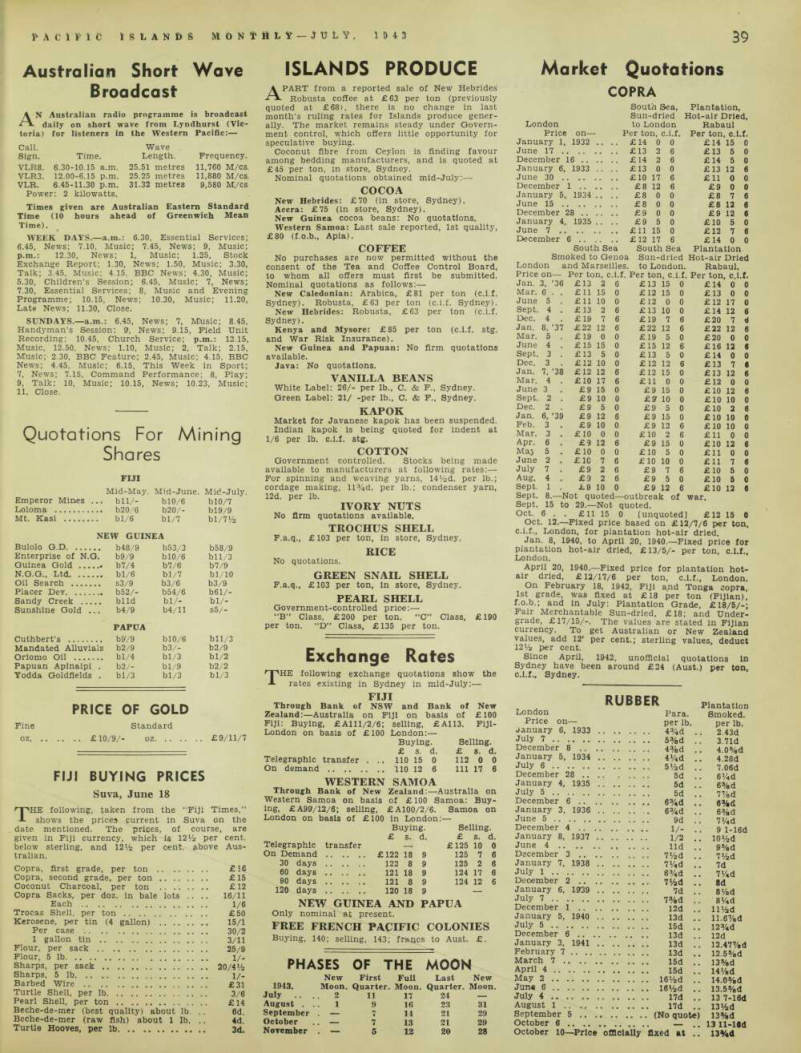
Broadcast
AN Australian radio programme is broadcast daily on short wave from Lyndhurst (Vic toria) for listeners in the Western Pacific:—
Times given are Australian Eastern Standard Time (10 hours ahead of Greenwich Mean Time).
WEEK DAYS.—a.m.: 6.30, Essential Services; 6.45, News; 7.10, Music; 7.45, News; 9, Music; p.m.: 12.30, News; 1, Music; 1.25, Stock Exchange Report; 1.30, News; 1.50, Music; 3.30, Talk; 3.45, Music; 4.15, BBC News; 4.30, Music; 5.30, Children’s Session; 6.45, Music; 7, News; 7.30, Essential Services; 8, Music and Evening Programme; 10.15, News; 10.30, Music; 11.20, Late News; 11.30, Close.
SUNDAYS.—a.m.: 6.45, News; 7, Music; 8.45, Handyman’s Session; 9, News; 9.15, Field Unit Recording; 10.45, Church Service; p.m.: 12.15, Music, 12.50, News; 1.10, Music; 2, Talk; 2.15, Music; 2.30, BBC Feature; 2.45, Music; 4.15, BBC News; 4.45, Music; 6.15, This Week in Sport; 7, News; 7.15, Command Performance; 8, Play; 9, Talk; 10, Music; 10.15, News; 10.23, Music; 11. Close.
Call.
Wave Sign.
Time.
Length.
Frequency.
Vlr8.
6.30-10.15 a.m. 25.51 metres 11,760 M/cs.
Vlr3.
12.00-6.15 p.m. 25.25 metres 11,880 M/cs.
Vlr.
6.45-11.30 p.m. 31.32 metres 9,580 M/cs Power: 2 kilowatts.
Quotations For Mining
Shares
Fiji
Mid-May.
Mid-June.
Mid-July.
Emperor Mines ... bll/blO/6 blO/7 Loloma b20/6 b20/bl9/9 Mt. Kasi bl/6 bl/7 bl/7%
New Guinea
Bulolo G.D b48/9 b53/3 b58/9 Enterprise of N.G. b9/9 blO/6 bll/3 Guinea Gold b7/4 b7/6 b7/9 N.G.G., Ltd bl/6 bl/7 bl/10 Oil Search s3/9 b3/6 b3/9 Placer Dev b52/b54/6 b61/- Sandy Creek blld bl/bl/- Sunshine Gold ... b4/9 b4/ll s5/- Cuthbert’s
Papua
b&79 blO/6 bll/3 Mandated Alluvials b2/9 b3/b2/9 Orlomo Oil bl/4 bl/3 bl/2 Papuan Aplnaipi . b2/bl/9 b2/2 Yodda Goldfields . bl/3 bl/3 bl/3
Advertisements & other items, p. 41 (1 item)
Price Of Gold
Fine Standard oz £10/9/- oz £9/11/7
Fiji Buying Prices
Suva, June 18 THE following, taken from the “Fiji Times,” shows the prices current in Suva on the date mentioned. The prices, of course, are given in Fiji currency, which is 12 Va per cent, below sterling, and 12Va per cent, above Aus tralian.
Copra, first grade, per ton £l6 Copra, second grade, per ton £l5 Coconut Charcoal, per ton £l2 Copra Sacks, per doz. in bale lots .. .. 16/11 Each 1/6 Trocas Shell, per ton £5O Kerosene, per tin (4 gallon) 15/1 Per case 30/2 1 gallon tin 3/11 Flour, per sack 25/9 Flour, 5 lb 1/.
Sharps, per sack 20/4Vi Sharps, 5 lb 1/- Barbed Wire £3l Turtle Shell, per lb 3/6 Pearl Shell, per ton £l4 Beche-de-mcr (best quality) about lb. .. 6d.
Beche-de-mer (raw fish) about 1 lb. .. 4d.
Turtle Hooves, per lb 3d.
Islands Produce
APART from a reported sale of New Hebrides Robusta coffee at £63 per ton (previously quoted at £6B), there is no change in last month’s ruling rates for Islands produce gener ally. The market remains steady under Govern ment control, which offers little opportunity for
speculative buying.
Coconut fibre from Ceylon is finding favour among bedding manufacturers, and is quoted at £45 per ton, in store, Sydney.
Nominal quotations obtained mid-July;—
Cocoa
New Hebrides; £7O (in store, Sydney).
Accra: £75 (in store, Sydney).
New Guinea cocoa beans: No quotations.
Western Samoa: Last sale reported, Ist quality, £BO (f.0.b., Apia).
Coffee
No purchases are now permitted without the consent of the Tea and Coffee Control Board, to whom all offers must first be submitted.
Nominal quotations as follows: New Caledonian; Arabica, £Bl per ton (c.i.f.
Sydney). Robusta, £63 per ton (c.i.f. Sydney).
New Hebrides: Robusta, £63 per ton (c.i.f.
Sydney).
Kenya and Mysore: £B5 per ton (c.i.f. stg. and War Risk Insurance).
New Guinea and Papuan: No firm quotations available.
Java: No quotations.
Vanilla Beans
White Label: 26/- per lb., C. & F., Sydney.
Green Label: 21/ -per lb., C. & F., Sydney.
Kapok
Market for Javanese kapok has been suspended.
Indian kapok is being quoted for indent at 1/6 per lb. c.i.f. stg.
Cotton
Government controlled. Stocks being made available to manufacturers at following rates:— For spinning and weaving yarns, 14Vad. per lb.; cordage making, ll%d. per lb.; condenser yarn, 12d. per lb.
Ivory Nuts
No firm quotations available.
Trochus Shell
F.a.q., £lO3 per ton, in store, Sydney.
Rice
No quotations.
Green Snail Shell
F.a.q., £lO3 per ton, in store, Sydney.
Pearl Shell
Government-controlled price:— “B” Class, £2OO per ton. “C” Class, £l9O per ton. “D” Class, £135 per ton.
Exchange Rates
THE following exchange quotations show the rates existing in Sydney in mid-July:—
Fiji
Through Bank of NSW and Bank of New Zealand;—Australia on Fiji on basis of £lOO Fiji: Buying, £Alll/2/6; selling, £AII3. Fljl- London on basis of £lOO London; —
Western Samoa
Through Bank of New Zealand:—Australia on Western Samoa on basis of £lOO Samoa: Buy ing, £A99/12/6; selling, £AIOO/2/6. Samoa on London on basis of £lOO in London: —
New Guinea And Papua
Only nominal at present.
Free French Pacific Colonies
Buying, 140; selling, 143; francs to Aust. £.
Buying.
Selling. £ s. d. £ s. d.
Telegraphic transfer . .. 110 15 0 112 0 0 On demand 111 17 6
Buying.
Selling. £ s. d. £ s. d.
Telegraphic transfer £125 10 0 On Demand £122 18 9 125 7 6 30 days 122 8 9 125 2 6 60 days 121 18 9 124 17 6 90 days 121 8 9 124 12 6 120 days 120 18 9 —
Phases Of The Moon
New First Full Last New 1943. Moon. Quarter. Moon. Quarter. Moon.
July ... 2 11 17 24 — August ... 1 9 16 23 31 September . — 7 14 21 29 October .. — 7 13 21 29 November . — 5 12 20 28
Market Quotations
Sept. B.—Not quoted—outbreak of war.
Sept. 15 to 29. —Not quoted.
Oct. 6 . . £ll 15 0 [unquoted] £l2 15 0 Oct. 12.—Fixed price based on £l2/7/6 per ton, c.i.f., London, for plantation hot-air dried.
Jan. 8, 1940, to April 20, 1940.—Fixed price for plantation hot-air dried, £l3/5/- per ton, c.i.f., London.
April 20, 1940. —Fixed price for plantation hot air dried, £l2/17/6 per ton, c.i.f., London.
On February 18, 1942, Fiji and Tonga copra, Ist grade, was fixed at £lB per ton (Fijian), f.0.b.; and in July; Plantation Grade, £lB/5/-; Fair Merchantable Sun-dried, £18; and Under grade, £l7/15/-. The values are stated in Fijian currency. To get Australian or New Zealand values, add 12’ per cent.; sterling values, deduct 12 Va per cent.
Since April, 1942, unofficial quotations in Sydney have been around £24 (Aust.) per ton, c.i.f.. Sydney.
London Price on—
Copra
South Sea, Plantation, Sun-dried Hot-air Dried, to London Rabaul Per ton, c.i.f. Per ton, c.l.f.
January 1, 1932 . . £14 0 0 £14 15 0 June 17 . £13 2 6 £13 5 0 December 16 .. £14 2 6 £14 5 0 January 6, 1933 £13 0 0 £13 12 6 June 30 . £10 17 6 £11 0 0 December 1 . . £8 12 6 £9 0 0 January 5 1934 . . £8 0 0 £8 7 6 June 15 . £8 0 0 £8 12 6 December 28 .. £9 0 0 £9 12 6 January 4 1935 . . . . £9 5 0 £10 5 0 June 7 . £11 15 0 £12 7 6 December 6 .. £12 17 6 £14 0 0 South Sea South Sea Smoked to Genoa Sun-dried Plantation Hot-air Dried London and Marseilles, to London.
Rabaul.
Price on— Per ton, c.i.f. Per ton, c.i.f. Per ton. c.l.f.
Jan. 3, ’36 £13 2 6 £13 15 0 £14 0 0 Mar. 6 . . £11 15 0 £12 15 0 £13 0 0 June 5 . £11 10 0 £12 0 0 £12 17 0 Sept. 4 . £13 2 6 £13 10 0 £14 12 6 Dec. 4 . £19 7 6 £19 7 6 £20 7 d Jan. 8, ’37 £22 12 6 £22 12 6 £22 12 6 Mar. 5 . £19 0 0 £19 5 0 £20 0 0 June 4 . £15 15 0 £15 12 6 £16 12 6 Sept. 3 . £13 5 0 £13 5 0 £14 0 0 Dec. 3 . £12 10 0 £12 12 6 £13 7 < Jan. 7, ’38 £12 12 6 £12 15 0 £13 12 6 Mar. 4 £10 17 6 £11 0 0 £12 0 0 June 3 £9 15 0 £9 15 0 £10 12 6 Sept. 2 . £9 10 0 £9 10 0 £10 10 0 Dec. 2 . £9 5 0 £9 5 0 £10 2 6 Jan. 6, '39 £9 12 6 £9 15 0 £10 10 0 Feb. 3 . £9 10 0 £9 12 6 £10 10 0 Mar. 3 . £10 0 0 £10 2 6 £11 0 0 Apr. 6 , £9 12 6 £9 15 0 £10 12 6 May 5 . £10 0 0 £10 5 0 £11 0 0 June 2 . £10 7 6 £10 10 0 £11 7 6 July 7 . £9 2 6 £9 7 6 £10 5 0 Aug. 4 . £9 2 6 £9 5 0 £10 S 0 Sept. 1 . £9 10 0 £9 12 6 £10 12 6
Rubber
Plantation London Para.
Smoked.
Price on— per lb. per lb.
January 6, 1933 . 4 3 Ad . 2.43d July 7 3.71d December 8 .. . 4.0»/ 8 d January 5, 1934 . 4.28d July 6 7.06d December 28 .. . 5d . 6V»d January 4, 1935 . 6 3 /«d July 5 7 7 / a d December 6 .. . 6 3 /«d January 3, 1936 . 6 3 /»d June 5 7V«d December 4 ,. . 9 l-16d January 8, 1937 . 1/2 . 10 Vad June 4 9 s /sd December 3 .. . 7 Vad January 7, 1938 . 7d July 1 7 Vad December 2 .. . 8d January 6, 19 r 39 . 7d . 8 Vad July 7 8 Vad December 1 .. ., 11 Vad January 5, 1940 . 11.6 7 /ad July 5 12%d December 6 .. .. 12d January 3, 1941 . 12.47 7 /ad February 7 12.5*/ad March 7 13 %d April 4 14 Vad May 2 14.0Vad June 6 13.5%d July 4 13 7-16d August 1 13 Vid September 5 .. ., October 6 13 11-lOd October 10—Price officially fixed at . 13Vad
Index to Volume XIII
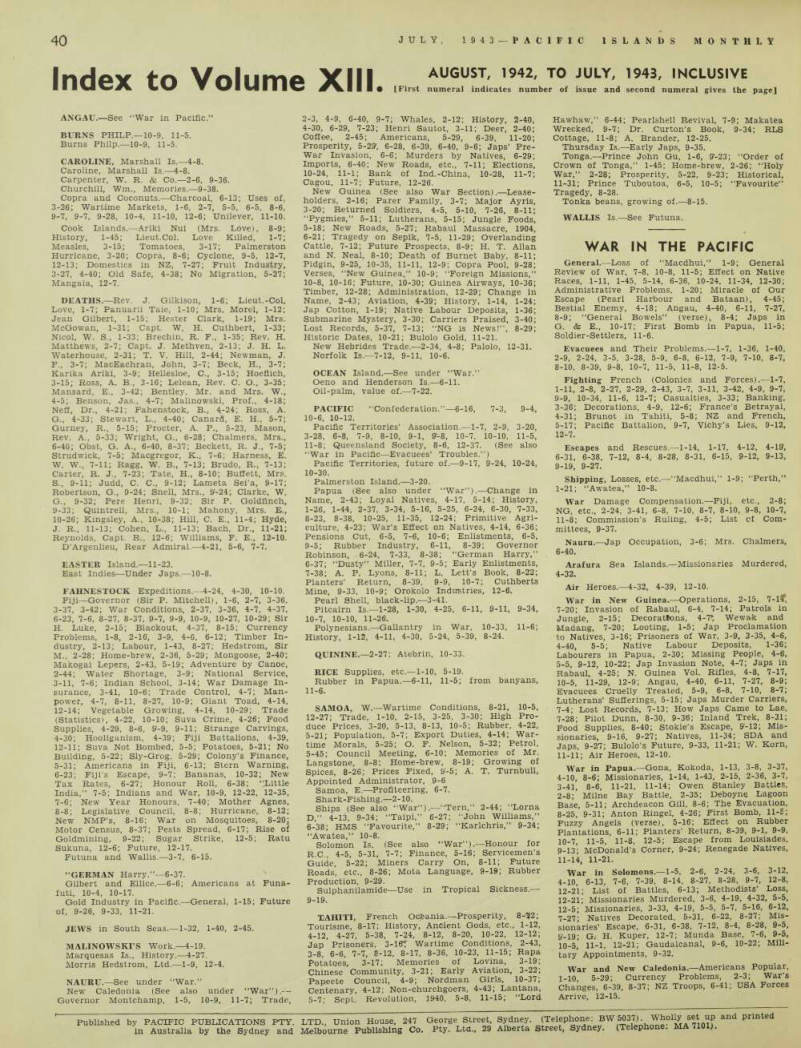
august, 1942, to july, 1943, inclusive [First numeral indicates number of issue and second numeral gives the page]
ANGAU.—See “War in Pacific.”
Burns Philp.—Io-9, 11-5.
Burns Philp.—lo-9, 11-5.
CAROLINE, Marshall Is.—4-8.
Caroline, Marshall Is. —4-8.
Carpenter, W. R. & Co.—2-6, 9-36.
Churchill, Wm., Memories.—9-38.
Copra and Coconuts. —Charcoal, 6-13; Uses of, 3-26; Wartime Markets, 1-6, 2-7, 5-5, 6-5, 8-6, 9-7, 9-7, 9-28, 10-4, 11-10, 12-6; Unilever, 11-10.
Cook Islands.—Ariki Nui (Mrs. Love), 8-9; History, 1-45; Lieut. Col. Love Killed, 1-7; Measles, 3-15; Tomatoes, 3-17; Palmerston Hurricane, 3-20; Copra, 8-6; Cyclone, 9-5, 12-7, 12-13; Domestics in NZ, 7-27; Fruit Industry, 3-27, 4-40; Old Safe, 4-38; No Migration, 5-27; Mangaia, 12-7.
DEATHS.—Rev. J. Gilkison, 1-6; Lieut.-Col.
Love, 1-7; Panuarii Taie, 1-10; Mrs. Morel, 1-12; Jean Gilbert, 1-15; Hester Clark, 1-19; Mrs.
McGowan, 1-31; Capt. W. H. Cuthbert, 1-33; Nicol, W. S., 1-33; Brechin, R. P„ 1-35; Rev. H.
Matthews, 2-7; Capt, J. Methven, 2-13; J. H. L.
Waterhouse, 2-31; T. V. Hill, 2-44; Newman, J.
F. 3-7; MacEachran, John, 3-7; Beck, H., 3-7; Karika Ariki, 3-9; Hellesloe, C., 3-15; Hoeflich, 3- Ross, A. 8., 3-16; Lelean, Rev. C. 0., 3-35; Mansard, E., 3-42; Bentley, Mr. and Mrs. W., 4- Benson, Jas., 4-7; Malinowski, Prof., 4-18; Neff, Dr., 4-21; Fahenstock, 8., 4-24; Ross, A.
G. 4-33; Stewart, L„ 4-40; Canard, E. H., 5-7; Gurney, R., 5-15; Procter, A. P., 5-23, Mason, Rev. A., 5-33; Wright, G., 6-28; Chalmers, Mrs., 6-40; Obst, G. A., 6-40, 8-37; Beckett, R. J., 7-5; Strudwick, 7-5; Macgregor, K., 7-6; Harness, E.
W. W.. 7-11; Ragg, W. 8., 7-13; Brudo, R., 7-13; Carter, R. J., 7-23; Tate, H., 8-10; Buffett, Mrs.
S., 9-11; Judd, C. C., 9-12; Lameta Sei’a, 9-17; Robertson, G., 9-24; Snell, Mrs., 9-24; Clarke, W.
G. 9-32; Pere Henri, 9-32; Sir P. Goldfinch, 9- Quintrell, Mrs., 10-1; Mahony, Mrs. E., 10- Kingsley, A., 10-38; Hill, C. E., 11-4; Hyde, J. R., 11-13; Cohen, L., 11-13; Bach, Dr., 11-21; Reynolds, Capt. R., 12-6; Williams, F. E., 12-10.
D’Argenlieu, Rear Admiral.—4-21, 5-6, 7-7.
EASTER Island.—-11-23.
East Indies —Under Japs.—lo-8.
FAHNESTOCK Expeditions.—4-24, 4-30, 10-10.
Fiji—Governor (Sir P. Mitchell), 1-6, 2-7, 3-36, 3-37, 3-42; War Conditions, 2-37, 3-36, 4-7, 4-37, 6-23, 7-6, 8-27, 8-37, 9-7, 9-9, 10-9, 10-27, 10-29; Sir H. Luke, 2-15; Blackout, 4-37, 8-15; Currency Problems, 1-8, 2-16, 3-9, 4-6. 6-12; Timber In dustry, 2-13; Labour, 1-43, 8-27; Hedstrom, Sir M., 2-28; Home-brew, 2-36, 5-29; Mongoose, 2-40; Makogai Lepers, 2-43, 5-19; Adventure by Canoe, 2- Water Shortage, 3-9; National Service, 3- 7-6; Indian School, 3-14; War Damage In surance, 3-41, 10-6; Trade Control, 4-7; Man power, 4-7, 8-11, 8-27, 10-9; Giant Toad, 4-14, 12-14; Vegetable Growing, 4-14, 10-29; Trade (Statistics), 4-22, 10-10; Suva Crime, 4-26; Food Supplies, 4-29, 8-6, 9'-9, 9-11; Strange Carvings, 4- Hooliganism, 4-39; Fiji Battalions, 4-39, 12-11; Suva Not Bombed, 5-5; Potatoes, 5-21; No Building, 5-22; Sly-Grog, 5-29; Colony’s Finance, 5- Americans in Fiji, 6-13; Stern Warning, 6- Fiji’s Escape, 9-7; Bananas, 10-32; New Tax Rates, 6-27; Honour Roll, 6-38; “Little India,” 7-5; Indians and War, 10-9, 12-22, 12-35, 7- New Year Honours, 7-40; Mother Agnes, 8- Legislative Council, 8-8; Hurricane, 8-12; New NMP’s, 8-16; War on Mosquitoes, 8-20; Motor Census, 8-37; Pests Spread, 6-17; Rise of Goldmining, 9-22; Sugar Strike, 12-5; Ratu Sukuna, 12-6; Future, 12-17.
Futuna and Wallis. —3-7, 6-15.
“GERMAN Harry.”—6-37.
Gilbert and Ellice. —6-6; Americans at Funa futi, 10-4, 10-17.
Gold Industry in Pacific.—General, 1-15; Future of, 9-26, 9-33, 11-21.
JEWS in South Seas. —1-32, 1-40, 2-45.
Malinowski’S Work.—4-19.
Marquesas Is., History.—4-27.
Morris Hedstrom, Ltd. —1-9, 12-4.
NAURU.—See under “War.”
New Caledonia (See also under “War”).— Governor Montchamp, 1-5, 10-9, 11-7; Trade,
2- 4-9, 6-40, 9-7; Whales, 2-12; History, 2-40, 4- 6-29, 7-23; Henri Sautot, 3-11; Deer, 2-40; Coffee, 2-45; Americans, 5-29, 6-39, 11-20; Prosperity, 5-29, 6-28, 6-39, 6-40, 9-6; Japs’ Pre- War Invasion, 6-6; Murders by Natives, 6-29; Imports, 6-40; New Roads, etc,, 7-11; Elections, 10-24, 11-1; Bank of Ind.-China, 10-28, 11-7; Cagou, 11-7; Future, 12-26.
New Guinea (See also War Section). —Leaseholders, 2-16; Parer Family, 3-7; Major Ayris, 3- Returned Soldiers, 4-5, 5-10, 7-26, 8-11; “Pygmies,” 5-11; Lutherans, 5-15; Jungle Foods, 5- New Roads, 5-27; Rabaul Massacre, 1904, 6- Tragedy on Sepik, 7-5, 11-29; Overlanding Cattle, 7-12; Future Prospects, 8-9; H. T. Allan and N. Neal, 8-10; Death of Burnet Baby, 8-11; Pidgin, 9-25, 10-35, 11-11, 12-9; Copra Pool, 9-28; Verses, “New Guinea,” 10-9; “Foreign Missions,” 10- 10-16; Future, 10-30; Guinea Airways, 10-36; Timber, 12-28; Administration, 12-29; Change in Name, 2-43; Aviation, 4-39; History, 1-14, 1-24; Jap Cotton, 1-19; Native Labour Deposits, 1-36; Submarine Mystery, 3-30; Carriers Praised, 3-40; Lost Records, 5-37, 7-13; “NG is News!”, 8-29; Historic Dates, 10-21; Bulolo Gold, 11-21.
New Hebrides Trade. —2-34, 4-8; Palolo, 12-31.
Norfolk Is.—7-12, 9-11, 10-6.
OCEAN Island. —See under “War.”
Oeno and Henderson Is. —6-11.
Oil-palm, value of. —7-22.
PACIFIC “Confederation.”—6-16, 7-3, 9-4, 10-6, 10-12.
Pacific Territories’ Association.—l-7, 2-9, 3-20, 3-28, 6-8, 7-9, 8-10, 9-1, 9-8, 10-7, 10-10, 11-5, 11- Queensland Society, 8-6, 12-37. (See also “War in Pacific—Evacuees’ Troubles.”) Pacific Territories, future of. —9-17, 9-24, 10-24, 10-30.
Palmerston Island.—3-20.
Papua (See also under “War”). —Change in Name, 2-43; Loyal Natives, 4-17, 5-14; History, I- 1-44, 2-37, 3-34, 5-16, 5-25, 6-24, 6-30, 7-33, 8- 8-38, 10-25, 11-35, 12-24; Primitive Agri culture, 4-23; War’s Effect on Natives, 4-14, 6-36; Pensions Cut, 6-5, 7-6, 10-6; Enlistments, 6-5, 9- Rubber Industry, 6-11, 8-39; Governor Robinson, 6-24, 7-33, 8-38; “German Harry,” 6- “Dusty” Miller, 7-7, 9-5; Early Enlistments, 7- A. P. Lyons, 8-11; L. Lett’s Book, 8-22; Planters’ Return, 8-39, 9-9, 10-7; Cuthberts Mine, 9-33, 10-9; Orokolo Industries, 12-6.
Pearl Shell, black-lip.—3-41.
Pitcairn IS.-1-28, 1-30, 4-25, 6-11, 9-11, 9-34, 10- 10-10, 11-26.
Polynesians.—Gallantry in War, 10-33, 11-6; History, 1-12, 4-11, 4-30, 5-24, 5-39, 8-24.
QUININE—2-27: Atebrin, 10-33.
RICE Supplies, etc.—l-10, 5-19.
Rubber in Papua.—6-11, 11-5; from banyans, II- SAMOA, W.—Wartime Conditions, 8-21, 10-5, 12- Trade, 1-10, 2-15, 3-25, 3-30; High Pro duce Prices, 3-20, 5-13, 8-13, 10-5; Rubber, 4-22, 5-21; Population, 5-7; Export Duties, 4-14; War time Morals, 5-25; O. F. Nelson, 5-32; Petrol, 5- Council Meeting, 6-10; Memories of Mr.
Langstone, 8-8; Home-brew, 8-19; Growing of Spices, 8-26; Prices Fixed, 9-5; A. T. Turnbull, Appointed Administrator, 9-6 Samoa, E. —Profiteering, 6-7.
Shark-Fishing.—2-10.
Ships (See also “War”).—“Tern,” 2-44; “Lorna D,” 4-13, 9-34; “Taipi,” 6-27; “John Williams,” 6- HMS “Favourite,” 8-29; “Karlchris,” 9-34; “Awatea,” 10-8.
Solomon Is. (See also “War”). —Honour for R.C., 4-5, 5-31, 7-7; Finance, 5-16; Servicemen’s Guide, 5-22; Miners Carry On, 8-11; Future Roads, etc., 8-26; Mota Language, 9-19; Rubber Production, 9-29.
Sulphanilamide—Use in Tropical Sickness. — 9-19.
TAHITI, French Oceania. —Prosperity, 8-1(2; Tourisme, 8-17; History, Ancient Gods, etc., 1-12, 4- 4-27, 5-38, 7-24, 8-12, 8-20, 10-22, 12-12; Jap Prisoners, 3-16 T Wartime Conditions, 2-43, 3-8, 6-6, 7-7, 8-12, 8-17, 8-36, 10-23, 11-15; Rapa Potatoes, 3-17; Memories of Lovina, 3-19; Chinese Community, 3-21; Early Aviation, 3-22; Papeete Council, 4-9; Nordman Girls, 10-37; Centenary, 4-12; Non-churchgoers, 4-43; Lantana, 5- Sept. Revolution, 1940, 5-8, 11-15; “Lord
Hawhaw,” 6-44; Pearlshell Revival, 7-9; Makatea Wrecked, 9-7; Dr. Curton’s Book, 9-34; RLS Cottage, 11-8; A. Brander, 12-25.
Thursday Is. —Early Japs, 9-35.
Tonga.—Prince John Gu, 1-6, 9‘-23; “Order of Crown of Tonga,” 1-45; Home-brew, 2-26; “Holy War,” 2-28; Prosperity, 5-22, 9-23; Historical, 11- Prince Tuboutoa, 6-5, 10-5; “Favourite”
Tragedy, 8-28.
Tonka beans, growing of.—B-15.
WALLIS Is. —See Futuna.
War In The Pacific
General. —Loss of “Macdhui,” 1-9; General Review of War, 7-8, 10-8, 11-5; Effect on Native Races, 1-11, 1-45, 5-14, 6-36, 10-24, 11-34, 12-30; Administrative Problems, 1-20; Miracle of Our Escape (Pearl Harbour and Bataan), 4-45; Bestial Enemy, 4-18; Angau, 4-40, 6-11, 7-27, 8-9; “General Bowels” (verse), 8-4; Japs in G. & E., 10-17; First Bomb in Papua, 11-5; Soldier-Settlers, 11-6.
Evacuees and Their Problems. —1-7, 1-36, 1-40, 2- 2-24, 3-5, 3-28, 5-9, 6-8, 6-12, 7-9, 7-10, 8-7, 8- 8-39, 9-8, 10-7, 11-5, 11-8, 12-5.
Fighting French (Colonies and Forces). —1-7, 1-11, 2-8, 2-27, 2-29, 2-43, 3-7, 3-11, 3-42, 4-9, 9-7, 9- 10-34, 11-6, 12-7; Casualties, 3-33; Banking, 3- Decorations, 4-9, 12-6; France’s Betrayal, 4- Brunot in Tahiti, 5-8; NZ and French, 5- Pacific Battalion, 9-7, Vichy’s Lies, 9-12, 12- Escapes and Rescues. —1-14, 1-17, 4-12, 4-19 1 , 6- 6-38, 7-12, 8-4, 8-28, 8-31, 6-15, 9-12, 9-13, 9- 9-27.
Shipping, Losses, etc.—“Macdhui,” 1-9; “Perth,” 1- “Awatea,” 10-8.
War Damage Compensation.—Fiji, etc., 2-8; NG, etc., 2-24, 3-41, 6-8, 7-10, 8-7, 8-10, 9-8, 10-7, 11-8; Commission’s Ruling, 4-5; List cf Com mittees, 9-37.
Nauru.—Jap Occupation, 3-6; Mrs. Chalmers, 6- Arafura Sea Islands.—Missionaries Murdered, 4-32.
Air Heroes.—4-32, 4-39, 12-10.
W'ar in New Guinea. —Operations, 2-15, 7-lf, 7- Invasion of Rabaul, 6-4, 7-14; Patrols in Jungle, 2-15; Decorations, 4-7*; Wewa-k and Madang, 7-20; Looting, 1-5; Jap Proclamation to Natives, 3-16; Prisoners of War, 3-9, 3-35, 4-6, 4- 5-5; Native Labour Deposits, 1-36; Labourers in Papua, 2-30; Missing People, 4-6, 5- 9-12, 10-22; Jap Invasion Note, 4-7; Japs in Rabaul, 4-25; N. Guinea Vol. Rifles, 4-8, 7-17, 10- 11-29, 12-9; Angau, 4-40, 6-11, 7-27, 8-9; Evacuees Cruelly Treated, 5-9, 6-8, 7-10, 8-7; Lutherans’ Sufferings, 5-15; Japs Murder Carriers, 7-4; Lost Records, 7-13; How Japs Came to Lae, 7- Pilot Dunn, 8-30, 9-36; Inland Trek, 8-31; Food Supplies, 8-40; Stokie’s Escape, 9-12; Mis sionaries, 9-16, 9-27; Natives, 11-34; SDA and Japs, 9-27; Bulolo’s Future, 9-33, 11-21; W. Korn, 11- Air Heroes, 12-10.
War in Papua.—Gona, Kokoda, 1-13, 3-8, 3-37, 4-10, 8-6; Missionaries, 1-14, 1-43, 2-15, 2-36, 3-7, 3- 8-6, 11-21, 11-14; Owen Stanley Battles, 2- Milne Bay Battle, 2-35; Deboyne Lagoon Base, 5-11; Archdeacon Gill, 8-6; The Evacuation, 8- 9-31; Anton Ringel, 4-26; First Bomb, 11-5; Fuzzy Angels (verse), 5-16; Effect on Rubber Plantations, 6-11; Planters’ Return, 8-39, 9-1, 9-9, 10- 11-5, 11-8, 12-5; Escape from Louisiades, 9- McDonald’s Corner, 9-24; Renegade Natives, 11- 11-21.
War in Solomons. —1-5, 2-6, 2-24, 3-6, 3-12, 4- 6-13, 7-6, 7-39, 8-14, 8-27, 8-28, 9-7, 12-8, 12- List of Battles, 6-13; Methodists’ Loss, 12-21; Missionaries Murdered, 3-6, 4-19, 4-32, 5-5, 12-5; Missionaries, 3-33, 4-19, 5-5, 5-7, 5-16, 6-12, 7-27; Natives Decorated, 5-31, 6-22, 8-27; Mis sionaries’ Escape, 6-31, 6-38, 7-12, 8-4, 8-28, 9-5, 9*-19; G. H. Kuper, 12-7; Munda Base, 7-6, 9-5, 10- 11-1, 12-21; Gaudalcanal, 9-6, 10-22; Mili tary Appointments, 9-32.
War and New Caledonia. —Americans Popular, 1-10, 5-29; Currency Problems, 2-3; War’s Changes, 6-39, 8-37; NZ Troops, 6-41; USA Forces Arrive, 12-15.
Advertisements & other items, p. 42 (1 item)
40
JULY, 1943 PACIFIC ISLANDS MONTHLY
Published by PACIFIC PUBLICATIONS PTY. LTD., Union House. 247 George Street, Sydney. (Telephone: BW 5 037) • set up and printed in Australia by the Sydney and Melbourne Publishing Co. Pty. Ltd., 29 Alberta Street, Sydney. (Telephone. MA7101).
Pitcairners' Holiday
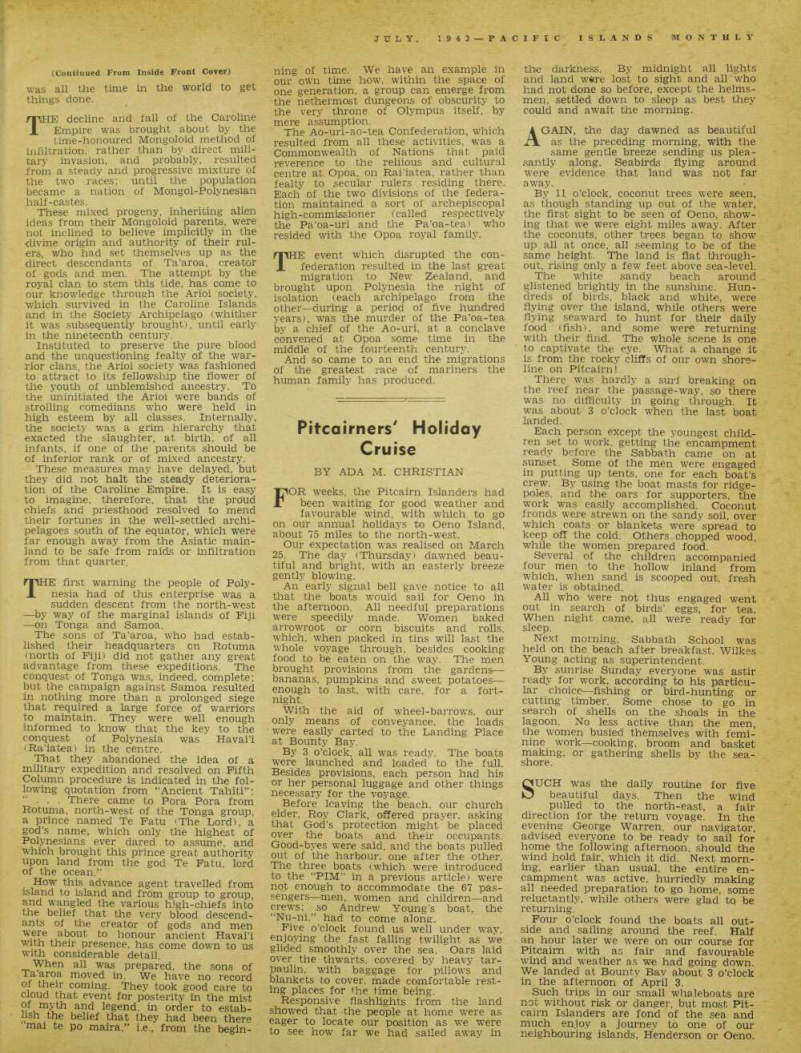
Cruise
By Ada M. Christian
FOR weeks, the Pitcairn Islanders had been waiting for good weather and favourable wind, with which to go on our annual holidays to Oeno Island, about 75 miles to the north-west.
Our expectation was realised on March 25. The day (Thursday) dawned beau tiful and bright, with an easterly breeze gently blowing.
An early signal bell gave notice to all that the boats would sail for Oeno in the afternoon. All needful preparations were speedily made. Women baked arrowroot or corn biscuits and rolls, which, when packed in tins will last the whole voyage through, besides cooking food to be eaten on the way. The men brought provisions from the gardens— bananas, pumpkins and sweet potatoes— enough to last, with care, for a fort night.
With the aid of wheel-barrows, our only means of conveyance, the loads were easily carted to the Landing Place at Bounty Bay.
By 3 o’clock, all was ready. The boats were launched and loaded to the full.
Besides provisions, each person had his or her personal luggage and other things necessary for the voyage.
Before leaving the beach, our church elder, Roy Clark, offered prayer, asking that God’s protection might be placed over the boats and their occupants.
Good-byes were said, and the boats pulled out of the harbour, one after the other.
The three boats (which were introduced to the “PIM” in a previous article) were not enough to accommodate the 67 pas sengers—men, women and children —and crews; so Andrew Young’s boat, the “Nu-ni.” had to come along.
Five o’clock found us well under way, enjoying the fast falling twilight as we glided smoothly over the sea. Oars laid over the thwarts, covered by heavy tar paulin. with baggage for pillows and blankets to cover, made comfortable rest ing places for the time being.
Responsive flashlights from the land showed that the people at home were as eager to locate our position as we were to see how far we had sailed away in
the darkness. By midnight all lights and land were lost to sight and all who had not done so before, except the helms men. settled down to sleep as best they could and await the morning.
AGAIN, the day dawned as beautiful as the preceding morning, with the same gentle breeze sending us plea santly along. Seabirds flying around were evidence that land was not far away.
By 11 o’clock, coconut trees were seen, as though standing up out of the water, the first sight to be seen of Oeno, show ing that we were eight miles away. After the coconuts, other trees began to show up all at once, all seeming to be of the same height. The land is flat through out, rising only a few feet above sea-level.
The white sandy beach around glistened brightly in the sunshine. Hun dreds of birds, black and white, were flying over the island, while others were flying seaward to hunt for their daily food ('fish), and some were returning with their find. The whole scene Is one to captivate the eye. What a change it is from the rocky cliffs of our own shore line on Pitcairn!
There was hardly a surf breaking on the reef near the passage-way, so there was no difficulty in going through. It was about 3 o’clock when the last boat landed.
Each person except the youngest child ren set to work, getting the encampment ready before the Sabbath came on at sunset. Some of the men were engaged in putting up tents, one for each boat’s crew. By using the boat masts for ridge poles, and the oars for supporters, the work was easily accomplished. Coconut fronds were strewn on the sandy soil, over which coats or blankets were spread to keep off the cold. Others chopped wood, while the women prepared food.
Several of the children accompanied four men. to the hollow inland from which, when sand is scooped out, fresh water is obtained.
All who were not thus engaged went out in search of birds’ eggs, for tea.
When night came, all were ready for sleep.
Next morning, Sabbath School was held on the beach after breakfast, Wilkes Young acting as superintendent.
By sunrise Sunday everyone was astir ready for work, according to his particu lar choice—fishing or bird-hunting or cutting timber. Some chose to go in search of shells on the shoals in the lagoon. No less active than the men, the women busied themselves with femi nine work—cooking, broom and basket making, or gathering shells by the sea shore.
SUCH was the daily routine for five beautiful days. Then the wind pulled to the north-east, a fair direction for the return voyage. In the evening George Warren, our navigator, advised everyone to be ready to sail for home the following afternoon, should the wind hold fair, which it did. Next morn ing, earlier than usual, the entire en campment was active, hurriedly making all needed preparation to go home, some reluctantly, while others were glad to be returning.
Four o’clock found the boats all out side and sailing around the reef. Half an hour later we were on our course for Pitcairn with as fair and favourable wind and weather as we had going down.
We landed at Bounty Bay about 3 o’clock in the afternoon of April 3.
Such trips in our small whaleboats are not without risk or danger, but most Pit cairn Islanders are fond of the sea and much enjoy a journey to one of our neighbouring islands, Henderson or Oeno.
Advertisements & other items, p. 44 (1 item)
W. R. Carpenter & Co. Lti
■ ■ , i gH m s^mm m ' ■: I : I k:-. : ■■ .: I ■-*- - ■ mam.
Travel by CARPENTER AIRLINES
Full particulars from Macdonald, Hamilton Cr Co., or Howard Smith Ltd., Sydney.
W. R. CARPENTER & CO. LTI
MERCHANTS, SHIPOWNERS AND AIRCRAFT OPERATORS
———■ aag———■— mm* 111 ■liwim —a— mi———^— — Agents for Australian, European and American Manufacturers, and Distributors of Every Description of Merchai Buyers and Shippers of Copra, Trocas, and ail Classes of Islands Produce.
AGENTS FOR :
Ford Motor Company of Canada. Caterpillar Tractors. Dodge Brothers Inc.
T. G. & C. Bolinders (Engines). Electrolux Refrigerators. Westinghouse Electrical Co. etc., etc.
Branches throughout the Pacific Islands
In London: W. R. Carpenter & Co. (London) Ltd., Coronation House, 4 Lloyds Avenue, London, EC.
Head Office: 16 O’CONNELL STREET, SYDNEY