Pacific
Islands
Monthly
Vol. Xii. No. 9.
April 17. 1942
Established 1930
[ transmission by post as a newspaper ]
8 d
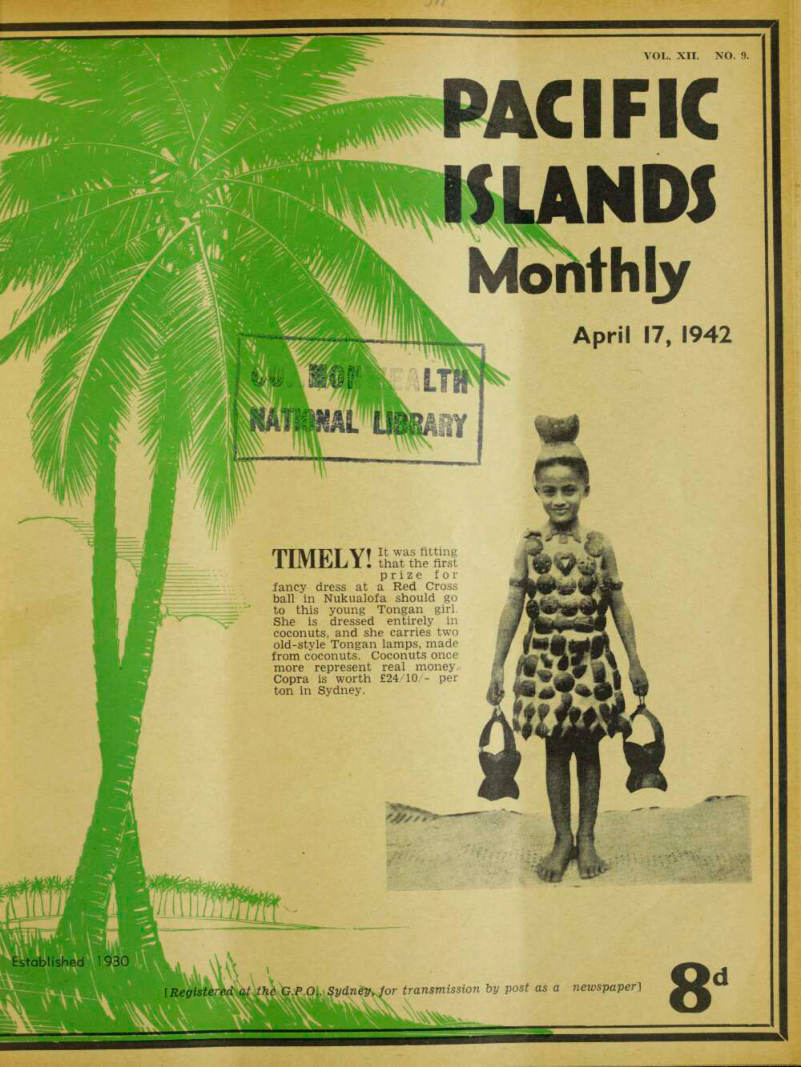
Timely!
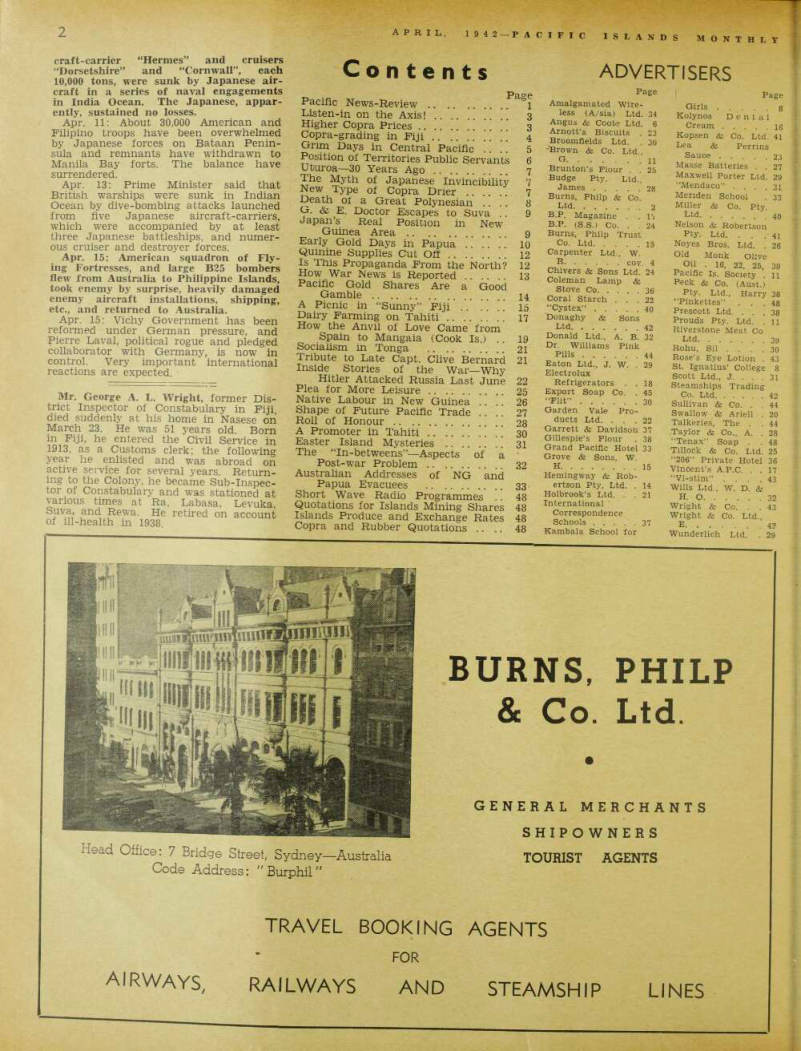
It was fitting that the first prize for fancy dress at a Red Cross ball in Nukualofa should go to this young Tongan girl.
She is dressed entirely in coconuts, and she carries two old-style Tongan lamps, made from coconuts. Coconuts once more represent real money.
Copra is worth £24/10/- per ton in Sydney.
Pacific News-Review
Notes And Comment On
The Progress Of The War
From March 16 To April 15
Mar 16: Darwin (North Australia) was raided— two killed, 12 wounded.
Mar. 17: Washington announced that American Army units, including air and ground troops in considerable numbers are now in Australia.
It is believed that USA will seek to build up a huge force in Australia and use the Commonwealth as a base from which to start an offensive northwards against the Japanese in the Allied terri tories temporarily occupied—namely, New Guinea, East Indies, Malaya, Borneo and the Philippines.
Mar. 17: Berlin radio announced that Japanese forces had arrived in Torres Strait preparatory to a landing on Thursday Island.
But the very hot reception given by American and Australian aircraft to Japanese bombers which appeared off Cape York on March 14, and the heavy losses they suffered, evidently nipped the plan in the bud, because no major attack developed.
Mar. 17: Japan is about to make a thrust at Burma’s oilfields. Half a mil lion refugee Indians are streaming across Burma, along 1,000 miles of road to their own country, choking the highways.
Mar. 18; Furious Russian attacks on Orel and Kharkov, key cities south of Moscow now in German hands, continue.
In Smolensk region (central front), Gen eral Zukhov’s forces have smashed Nazi resistance in an area from which the Germans were to launch their spring offensive.
Mar. 18; Lord Beaverbrook, dropped from British Cabinet, is going to USA “to assist in co-ordinating the resources of the United Nations”.
Mar. 18: Japanese twice raided Tulagi (Solomons). Bombs were dropped on Florida Island. No material damage and few native casualties.
Mar. 18: Allied aircraft yesterday heav ily raided Japanese at Koepang, in Timor.
Mar. 19: American General Douglas MacArthur, recently defender of the Philippines, now in Australia, has been appointed Supreme Commander of all the Allied forces in the South-west Paci fic. The appointment is everywhere hailed with enthusiasm.
Mar. 19: Darwin raided by small force of heavy Jap bombers. Some damage to civilian property—2 people killed, 7 injured.
Mar. 19: Mr. Casey, Australian Minis ter in Washington, appointed British Minister of State in the Middle East and member of the Imperial War Cabinet.
Mar. 20: Japanese commenced north wards drive from Rangoon, in Burma.
British forces are holding a line at Prome, at the head of Irrawaddy Valley.
Mar. 20: Great fires at Kharkov sug gest Nazis are destroying oil stocks and other equipment that cannot be moved, in preparation for retreat.
Mar. 20: Announced that “a consider able Japanese force from Salamaua and Lae is now in Markham River Valley, north-east of Port Moresby, and reported to be advancing overland towards Port Moresby.”
This was apparently reported by ignor ant correspondents and sensationally dis played in Australia as authentic news, althqugh everyone who knew the coun try knew that the suggested advance by the enemy was quite impossible. The newspapers persisted with the silly story for two or three days.
Mar. 22: Chinese troops in northern Burma (where they hold the left of the
Allied front) have had their first big clash with the Japanese.
Mar. 22: Japanese aircraft attacked Katherine, 120 miles south-east of Dar win, injuring 2 blacks. Little damage done. . Darwin was raided; little damage —one Jap bomber shot down. ' Mar. 22: Japanese are massing for a drive through Sittang River area onto British front on Irrawaddy River (Burma).
Mar. 22: Allied aircraft heavily attacked Japanese at Lae (NG), destroying 3 Jap bombers and 9 fighters and damaging 2 bombers and 3 fighters—these enemy aircraft being caught on the ground.
Allied aircraft probably sank one Jap cruiser and seriously damaged two others in Rabaul Harbour on 20th.
Mar. 23: Wyndham (NW Australia) raided by medium force of Jap bombers —little damage. Nineteen Jap bombers and 4 fighters made enemy’s heaviest attack against Port Moresby.
Mar, 23: It is becoming apparent that British and American air forces over the Burma front are unable to maintain aerial supremacy. The enemy has numerically superior air forces and is making effective use of airfields captured in south Burma and Thailand.
Mar. 23: Americans on Bataan in Phil ippines area have not replied to Japan ese demand that they immediately sur render or take the consequences. Every indication that heavy Japanese attacks are coming.
Mar. 24: Port Moresby raided by two waves of Jap bombers.
Mar. 24: Great batle is now raging southwards of Toungoo, in Burma.
Mar. 25: Jap bombers made their nine teenth raid on Port Moresby. No damage and no casualties.
Mar. 25: American fighters made a smashing attack at dawn on a Japanese airfield in northern Siam.
Mar. 25: Japanese, steadily advancing, have now worked around the flank of the Allied defenders of Toungoo, in Burma.
The situation on the Toungoo front is officially described as “serious”.
Mar. 26: Japanese forces have occupied Andaman Islands, including the excellent harbour of Port Blair, in the Bay of Bengal, and now directly menace the eastern coast of India, Ceylon, and all Allied shipping in the Indian Ocean.
Mar. 26: Axis forces in Libya are being steadily reinforced and new fighting on an extensive scale is expected.
Mar. 27: Allied aircraft yesterday raided Koepang, Timor, in very bad WG3ithor Mar. 28: Seven Jap bombers raided Darwin. Two were shot down by Allied fighters and two more probably destroyed. .
Mar. 29: Combined action by British Commando, navy and air forces success fully raided German submarine base at St. Nazaire, in Loire estuary, west coast of France. Five tons of high explosive were placed in bows of an old destroyer, which rammed and destroyed the mam dock gates.
Mar. 31: Sir Stafford Cripps is now m India with complete plan for granting India Dominion status and is trying to get the co-operation of the Indian parties —hitherto irreconcilable.
Mar. 31: Darwin raided yesterday lor eighth time. No damage or casualties.
Japs also raided Port Moresby on 30th with small force, but were driven off.
Mar. 31; Jap forces have been with drawn from Markham Valley area.
Markham reported in heavy flood.
Mar. 31: Allied aircraft again attacked
in Koepang, Timor, and apparently destroyed six grounded aircraft, and three enemy fighters. Allies also raided Lae and damaged the aerodrome. Dar win to-day was raided by seven Jap bombers, but no damage or casualties.
Apr. 1; Although the beginning of the spring thaw has partially quietened Russian fighting, the Russians are hold ing the initiative all along the front and still are attacking.
Apr. 1: The air blitz by the Allies on Japanese bases in Salamaua, Lae, Gas mata and Rabaul is now almost cease less. Salamaua raided to-day.
Apr. 1: Despite intense German efforts, a great convoy carrying supplies to the Russian forces successfully got through to Murmansk, in northern Russia.
Apr. 2: Ten Norwegian ships made a dash for Britain from Swedish ports.
About half were torpedoed, and two or three returned to Sweden.
Apr. 3: Conversations between Sir Staf ford Cripps and the Indian leaders con tinue. Newspapers to-day report “proba bility” of agreement—and the next day, no probability.
Apr. 3: Japanese forces in Burma, advancing steadily, have captured Toun goo and Prome, and British-Chinese lines have been withdrawn to more mountain ous country. Japanese have landed at Akyab, on the coast of Burma, near the Indian frontier and behind the British right flank.
Apr. 5: Japanese aircraft, operating from a carrier, attempted large-scale raid on Colombo; 27 aircraft were destroyed, five probably destroyed and 25 damaged out of a Jap force of 75. The attackers were taken by surprise by large forma tions of British fighters, who apparently were awaiting them.
Apr. 6: Allied aircraft in the Darwin and New Guinea areas claim to have destroyed 17 enemy aircraft and dam aged 10 others in week-end raids.
Apr. 7: Japanese are reported to have occupied Faisi, in the northern Solomons.
Apr. 7: 300 RAF bombers, carrying on their campaign of ceaseless and increas ing raids, at the week-end attacked points in Germany and Occupied France.
Enormous damage was done, and only five were lost.
Apr. 7: Allied bombers yesterday scored direct hits on large vessels in Rabaul Harbour.
Apr. 8: The Allies in Burma are said to be fighting delaying actions, so as to permit development of land com munication through the mountains be tween India and Burma, thus allowing reinforcements to be sent to Burma and air forces to be reorganised.
Apr. 8: Five enemy aircraft raided Madras; casualties were slight.
Apr. 8: Japanese have occupied Loren gau, chief centre in the Admiralty Islands, north of New Guinea.
Apr. 9; There is now a lull on the Burma front, while British and Indian forces take up new positions to defend Burmese oilfields.
Apr. 9: Terrific attack by Japanese upon American positions on Bataan Pen insula is now in its fourth day. The position is regarded as very serious.
Apr. 9: Japanese air forces raided Trincomalee (northern Ceylon) now prob ably Britain’s most valuable naval base in the Indian Ocean.
Apr. 10: Allied air-raids upon Japan ese positions in New Guinea and Timor continue with most results.
Apr, 11: Announced that British air
craft-carrier “Hermes” and cruisers “Dorsetshire” and “Cornwall”, each 10,000 tons, were sunk by Japanese air craft in a series of naval engagements in India Ocean. The Japanese, appar ently, sustained no losses.
Apr. 11: About 30,000 American and Filipino troops have been overwhelmed by Japanese forces on Bataan Penin sula and remnants have withdrawn to Manila Bay forts. The balance have surrendered.
Apr. 13: Prime Minister said that British warships were sunk in Indian Ocean by dive-bombing attacks launched from five Japanese aircraft-carriers, which were accompanied by at least three Japanese battleships, and numer ous cruiser and destroyer forces.
Apr. 15: American squadron of Fly ing Fortresses, and large 825 bombers flew from Australia to Philippine Islands, took enemy by surprise, heavily damaged enemy aircraft installations, shipping, etc., and returned to Australia.
Apr. 15: Vichy Government has been reformed under German pressure, and Pierre Laval, political rogue and pledged collaborator with Germany, is now in control. Very important international reactions are expected.
Mr. George A. L. Wright, former Dis trict Inspector of Constabulary in Fiji died suddenly at his home in Nasese on March 23. He was 51 years old. Born in Fiji, he entered the Civil Service in 1913, as a Customs clerk; the following year he enlisted and was abroad on active service for several years. Return ing to the Colony, he became Sub-Inspec tor of Constabulary and was stationed at various times at Ra, Labasa, Levuka, Suva, and Rewa. He retired on account of ill-health in 1938.
Contents
Page Pacific News-Review 1 Listen-in on the Axis! ... 3 Higher Copra Prices * ‘ 3 Copra-grading in Fiji ' 4 Grim Days in Central Pacific . ! !! 5 Position of Territories Public Servants 6 Uturoa—3o Years Ago 7 The Myth of Japanese Invincibility 7 New Type of Copra Drier 7 Death of a Great Polynesian ... 8 G. & E. Doctor Escapes 10 Suva .. 9 Japan’s Real Position in New Guinea Area 9 Early Gold Days in Papua 10 Quinine Supplies Cut Off 12 Is This Propaganda From the North? 12 How War News is Reported 13 Pacific Gold Shares Are a Good Gamble 14 A Picnic in “Sunny” Fiji',. 15 Dairy Farming on Tahiti 17 How the Anvil of Love Came from Spain to Mangaia (Cook Is.) .. 19 Socialism in Tonga 21 Tribute to Late Capt, Clive Bernard 21 Inside Stories of the War—Why Hitler Attacked Russia Last June 22 Plea for More Leisure 25 Native Labour in New Guinea ... 26 Shape of Future Pacific Trade ... 27 Roll of Honour 28 A Promoter in Tahiti ’ 30 Easter Island Mysteries 31 The “In-betweens”—Aspects of a * Post-war Problem 32 Australian Addresses of NG and Papua Evacuees 33 Short Wave Radio Programmes .. 48 Quotations for Islands Mining Shares 48 Islands Produce and Exchange Rates 48 Copra and Rubber Quotations .. 48
Advertisers
Page Amalgamated Wire less (A/sia) Ltd. 34 Angus & Coots Ltd. 6 Arnott’s Biscuits . 23 Broomfields Ltd. . 30 Brown & Co. Ltd., G 11 Brunton’s Flour . . 25 Budge Pty. Ltd., James 28 Burns, Philp & Co.
Ltd 2 B.P. Magazine . . 17
B.P. (S.S.) Co. . . 24
Burns, Philp Trust Co. Ltd 15 Carpenter Ltd., W.
R cov. 4 Chivers & Sons Ltd. 24 Coleman Lamp & Stove Co 36 Coral Starch ... 22 “Cystex” 40 Donaghy & Sons Ltd 42 Donald Ltd., A. B. 32 Dr. Williams Pink Pills 44 Eaton Ltd., J. W. . 29 Electrolux Refrigerators . . 18 Export Soap Co. . 45 “Flit” 30 Garden Vale Pro ducts Ltd. ... 22 Garrett & Davidson 37 Gillespie’s Flour . 38 Grand Pacific Hotel 33 Grove & Sons, W.
H 15 Hemingway & Rob ertson Pty. Ltd. , 14 Holbrook’s Ltd. . . 21 International Correspondence Schools 37 Kambala School for
Page Girls g Kolynos Dental Cream is Kopsen & Co. Ltd. 41 Lea & Perrins Sauoe 23 Masse Batteries . . 27 Maxwell Porter Ltd. 29
“Mendaco” . . . . 31
Meriden School . 33 Miller & Co. Pty. ktd 40 Nelson & Robertson Pty. Ltd. . . .41 Noyes Bros, Ltd, . 26 Old Monk Olive Oil • 16, 22, 25, 39 Pacific Is. Society . 11 Peck & Co. (Aust.) Pty. Ltd., Harry 38 “Pinkettes” ... 48 Prescott Ltd. ... 38 Prouds Pty. Ltd. . 11 Riverstone Meat Co Ltd 39 Rohu, Sil . . . .30 Rose’s Eye Lotion . 43 St. Ignatius’ College 8 Scott Ltd., J. ... 31 Steamships Trading Co. Ltd 42 Sullivan & Co. . . 44 Swallow & Ariell . 20
Talkeries, The . . 44
.Taylor & Co., A. . 28 “Tenax” Soap . . 48 Tillock & Co. Ltd. 25 “206” Private Hotel 36 Vincent’s A.P.C. . . 17 “Vi-stim” ... 43 Wills Ltd., W. D. & H. 0 32 Wright & Co. . . 43 Wright & Co. Ltd., E. . . 42 Wunderlich Ltd. . 29
Advertisements & other items, p. 4 (1 item)
Burns, Philp
m mt uils mm 111!
HUH
Head Office: 7 Bridge Street, Sydney—Australia Code Address: " Burphil"
BURNS, PHILP
& Co. Ltd.
GENERAL MERCHANTS
SHIPOWNERS
TOURIST AGENTS
TRAVEL BOOKING AGENTS
FOR
airways, railways and steamship lines
Pacific Islands Monthly
The Newspaper-Magazine of the South Seas [Registered at the G.P.0., Sydney, for transmission by post as a newspaper .]
Published Once Each Month and Circulated in Australia and New Zealand and in the following Pacific Territories and Islands Groups:
Australian Territory of Papua.
Mandated Territory (Australia) of New Guinea.
Australian Territory of Norfolk Island.
New Zealand Territory of Cook Islands.
Mandated Territory (NZ) of Western Samoa.
British Colony of Fiji.
British Solomon Islands Protectorate.
British Protectorate of Tongan Islands.
British Crown Colony of Gilbert and Ellice Islands.
Mandated Territory of Nauru.
British and Free French Condominium of New Hebrides, , J Free French Colony of New Caledonia.
Free French Colony of Oceania (Tahiti, etc.).
American Territory of Eastern Samoa.
American Territory of Hawaiian Islands.
Owned and Produced by Pacific Publications Pty. Ltd., Union House, 247 George Street, Sydney.
C Managing Director .. BW 5037 TELEPHONE £ Business and Editorial MA 4369
P.O. Box 3408 R
Registered Address of Telegrams, Radiograms, and Cables: “Pacpub”, Sydney.
Contributions.
Articles, Stories, and Photographs dealing with Pacific Islands subjects are invited and will be paid for on publication.
Subscription Rates.
Per Annum, within British Empire, Prepaid, Post Free 8/- Per Annum, elsewhere, prepaid, Post Free. 107- Single Copies Bd.
Editor and Publisher:
R, W. Robson, F.R.G.S.
Assisted by Selwyn Hughes.
Advertising Manager: L. W. Bailey.
Advertising Office and Printing-House: 29 Alberta Street, Sydney.
Advertising rates furnished on application.
Colours, etc., by arrangement.
Process Blocks made at Advertiser’s expense when required. Screen 100.
Changes of Advertising Copy should reach this office by Ist of each month, otherwise previous advertisement may be repeated.
Representative In London.
W. C. Harvey, Coronation House, 4 Lloyds Avenue, London, E.C.3, from whom may be obtained copies of Pacific Islands Monthly, Pacific Is. Year Book, advertising schedules, etc.
Agents.
The following are authorised to receive sub scriptions for Pacific Islands Monthly:— Burns, Philp & Co.. Ltd., and Burns Philp (South Sea) Co., Ltd. All branches.
W. R. Carpenter & Co., Ltd. All branches.
Morris, Hedstrom, Ltd. All branches.
Steamships Trading Co., Papua. All branches.
B.N.G. Trading Co., Ltd., Port Moresby, Papua.
J. Muir, Suva, Fiji.
Miss R. Castles, Suva, Fiji.
N, C. Mackenzie Hunt, Wainunu, Bua, Fiji.
Kirpal & Co., Victoria Parade, Suva, Fiji.
Cook Islands Trading Co., Rarotonga, Cook Is.
A. C. Rowland, Papeete, Tahiti.
Islands Branches and Representatives of W. H.
Grove & Sons, Ltd., Auckland, New Zealand.
Ed. Pentecost, Noumea, New Caledonia.
Kerr & Co., Noumea, New Caledonia,
Vol. XII. No. 9.
April 17, 1942
PrirP i 8d - Per C°Py rrlCc £ Prepaid; 8/- p.a.
Listen-In On The Axis!
ALL our arm-chair strategists insist on being gloomy and solemn, and discussing prospects from the view point of the Allies. But there is another viewpoint—the viewpoint of the enemy— and if we can see his situation a little more clearly we may find more comfort in our own.
So let us—without being wishful thinkers or stupid optimists—imagine that we are listening-in on a radiophone conversation, in which Adolf Hitler is discussing the general situation with General Tojo, and in which a Ghost Voice persistently interrupts.
HITLER: Marvellous, my brother! So you now hold Philippines, Borneo, Indo-China, Thailand, Malaya, East Indies, New Guinea and part of Burma.
What a man! What a nation!
TOJO (complacently): Yes, and we have sunk half the British fleet, and the rest flee before the Sons of Heaven.
HITLER; Not half the fleet, Tojo— not half. There seem to be an awful lot of British warships around this way.
They are annoying poor Benito in the Mediterranean, too.
Ghost Voice: Seen anything of the American fleet lately? I seem to have heard that America has a few ships in the Pacific.
TOJO: The American navy fears us, Adolf —they hide their ships away in dis tant ports. We ignore them.
HITLER; But, Tojo—l don’t want to worry you—but didn’t America come into the war with a bigger navy than yours?
You got a few of theirs at Pearl Harbour, but they have got a few of yours since then. And this big naval force you have
over in the Indian Ocean. Aren’t you taking a bit of a risk, old fellow. Sup posing that Yank navy decides to have a crack at you in Japanese waters, eh?
TOJO: The Americans fear us, Adolf.
They hide.
Ghost Voice: The Americans with hold their naval forces until they can attack with the aid of overwhelming air forces. Then what?
HITLER: H’m—l don’t like it much, Tojo—seems to me you’ve scattered your fleet very widely. Anyhow, your econo mic condition is much better, now, eh .
TOJO: The Sons of Heaven now have rice and mineral oil, tin and rubber and copra. have sent thousands of our young men into our new territories, to organise supplies and ship them to Japan.
Ghost Voice: And does it ever occur to you that, in reaching out after all these territories, you aban doned the primary advantage you enjoyed—that of isolation in your island home? Your lines of com munication and organisation are spread out over thousands of miles of ocean. How are you going to pro tect them when the American offensive comes?
HITLER (sadly): Well, I wish I had some of your rubber and tin and oil, Tojo. By the way, how are your oil supplies?
TOJO: We can keep going for a while, yet. And now we have the Borneo and Indies oil wells. Ghost Voice: Can you get the oil wells restored and in production be fore the Americans strike? If not, you’re gone.
TOJO: By the way, how’s your fuel supply, Adolf.
HITLER: We still have much good mineral oil, and we have an endless supply of ersatz fuel, for our aeroplanes and tanks.
Ghost Voice: You haven’t got much petrol left novo, and your synthetic fuels do not give you anything like the same efficiency. And the British bombers are reaching further and further into Germany and smashing up your fuel factories.
TOJO; But soon you will have smashed the Russians, Adolf, and then you will have the Caucasus oilfields.
HITLER: Yes, yes, of course. Our glorious Nordics soon will stamp these Bolsheviks into the filth of their eastern front.
Ghost Voice: You were going to smash the Russians last summer. You cannot smash them now. You will need all your strength even to hold them. And even if you drive them back, they will retire unbroken, and come at you again.
TOJO: Oh, and Adolf, please, you will keep Russia very, very busy for me, please. While my glorious forces are sweeping through the South Seas and India, I do not wish to be bothered by Russia, yes?
HITLER: Well, old lad, I thought maybe you could give me a spot of help there. If you were to nip the Bear in the backside, from Manchuria, say, it would make it easier for me to push him back in Europe.
TOJO: Don’t be selfish, Adolf. The magnificent armies of Germany and Italy surely can keep the Bolsheviks engaged, while the Sons of Heaven complete the rout of the British and Americans.
HITLER; Of course, of course, Tojo.
TOJO: These British—are they going to attack you while you are busy with the Bolsheviks?
HITLER: Ach, the swine-dogs! Our guns will keep them off our western shores, and they will run always from our gallant Luftwaffe.
Ghost Voice: Britain now has a magnificently equipped army of over one million men in Britain, apart from forces necessary to resist in vasion. What is she going to do with it?
TOJO: But, dear Adolf, how many divisions would you be able to spare for the western front if the British, with perhaps some Americans, attacked you while you were fighting the Russians?
HITLER: Our noble Nordic armies are quite able to defeat both the British and the Russians. Don’t worry about that— we have friends at our side —Hungarians and Roumanians and Bulgarians, yes.
Ghost Voice: And Italians!
TOJO: And our dear Mussolini —he must be a great comfort to you in these difficult days, Adolf.
HITLER (after strange noises of gut turals and sibilants): Benito is resting.
He is not very well. The Italian armies —they are resting a good deal, too. And the Italian navy and air force —it needs much rest. We are fond of the Italians —we have sent many men to assist them in the government of Italy.
TOJO: Ah, well, you have many friends. The countries you now have occupied for two years—they, of course, now recognise the happiness of life under our New Order. You now have the help of the Norwegians and Danes, Dutch and Belgians, Poles and Czechs, French and Serbs and Greeks—how grateful they all must be to you, Fuhrer!
Ghost Voice: How long can 150,000,000 people be held down under conditions of slavery, starvation and pestilence? Let but the grip of the Hun be shaken off by the Allies, and they will be at his throat!
HITLER: The pig-dogs do not know when they are well and happy. They plot ceaselessly against our gauleiters and shoot our brave German sentries.
But they will learn that we are the master race and it is our mission to bring a New Order to humanity.
TOJO: Yes, indeed. Honourable Nor dic and divinely-inspired Japanese go forward together to the task set by Heaven. * HITLER: Yes-er-yes, of course. We must learn to know each other better Tojo ? when do we meet Y° u in India, TOJO: Our invincible legions alreadv march upon India’s eastern frontier. Our fleet menaces India’s shores. India’s masses rise to welcome our freedom giving banner. The British flee before our irresistible advance. e Ghost Voice: And now take a look f? map. How can any except the most simple and ingenuous minds ST thc fP lt is possible to hold fn nnht? 9 }] ne t °f nd vast territories, bp mtal ar su PPttes must eorted from Japan, unless the American fleet is eliminated, and the 130 O Z no S nm m ° Si P° wer f ul nation of dlfeatedf ramiy-arm People aejeated/ The Americans haven’t even began to fight yet.
We shall salute each other Swastika. e ‘ hl ’ Under the tri «mphant Ghost Voice: Perhaps! But Von must smash (not merely drive back) the Russians. Then you must
march into the Middle East. Then you must over-run or by-pass Turkey ~and the Turks won’t like that. Then you must defeat the British armies in the Middle East. Then you must march across Iraq and Iran. Mean while, you will have to deal with a very strong and belligerent Britain, on your western front, and hold down 150,000,000 subject people.
TOJO; Not under the Swastika, Adolf —under the Rising Sun. This is our show, you know.
HITLER: But Germany is the ruler of the world. Anyway, I’ll see you about that later. How many planes have you got, Tojo?
TOJO: Oh, enough. How many have you got, Adolf?
Ghost Voice: Britain now is build ing as many aeroplanes as Germany.
United States is building as many as Germany, Italy and Japan com bined. Russia’s output is little short of that of Germany. Cannot you planners of high strategy see that this war is going to be decided by air power, and that the Allies are with holding their forces until they can make effective use of their coming overwhelming preponderance in the air? Don’t you know that already the Axis air personnel is nearly ex hausted, while in Great Britain and United States, to say nothing of Russia, there is now an apparently endless stream of well-equipped young airmen coming along, merely awaiting machines?
HITLER: Our gallant Luftwaffe will fight on and on. The Nordic race must conquer. It is written—l have planned it for 25 years. And I, Hitler, the great Fuhrer, will see that Japan has her rightful place in Eastern Asia, TOJO (apparently having difficulty in breathing); You will? Why, don’t you realise that Japan has been divinely ap pointed—by the Son of Heaven, no less— to lead the world into better ways? This mighty, invincible, all-conquering Japan will graciously permit you to bring the benefits of the New Order to Europe, maybe; but all Asia, and Eastern and South Africa, and Australia, and all the Pacific Islands, and South America— they belong to Japan by right of superior will, a superior intelligence and a better sword. (There is the horrid sound of a strong man choking and swooning. Hitler has met his match.) The Ghost Voice: Germany still has tremendous strength, but she has been gravely weakened by exhaust ing months on the Russian front, and may not be able to maintain a two fronts campaign. Japan has enjoyed a long series of successes, and no defeats; but she has not yet met a strong opponent—she only has de feated small isolated armies of Europeans, ill-equipped and vastly out-numbered. Italy is discouraged and weary of the war—she is not a formidable opponent. On the other side, there are America, only be ginning to develop her unlimited war strength; Britain, now stronger and better armed and animated by a stauncher war spirit than ever before in her history; Russia, her incredible man-power mobilised, her industrial organisation functioning well, and her morale apparently high; and China, depending on her Allies for equipment, but with unlimited man power, and eager for war and the humiliation of her age-long foe. Let the Allies be patient and staunch, and the issue is beyond doubt.
Copra
Short Supplies High and Higher Prices
BECAUSE the only copra available to the Allied nations in the Pacific are the limited amounts which come from Fiji, New Hebrides, New Cale donia, Tonga, Samoa, Cook Islands and French Oceania, there has been keen bidding for the available supplies.
Fiji is the chief producer, nowadays, and the price officially fixed in Suva, as reported last month, is £lB (Fijian) per ton, f.o.b. Suva. But as high as £24/10/- (Australian) per ton has been paid for copra in Sydney, and one hears whispers of a “black market” where the rates are still higher. £lB (Fijian) is, of course, equal to £2O/5/- (Australian).
These high prices will greatly stimu late production in all the South Pacific territories, which are free of the enemy, and it is possible that the total output may soon spring to surprising propor tions. But there is one fatal handicap upon this otherwise lucrative trade—lack of shipping.
Shipping was short before December 7, and now there are fewer ships than ever.
The destruction of American shipping by enemy submarines off the Atlantic coast during the past three months has been very serious—it is one of the ugliest angles of the war situation—and every available ship in the Pacific has been needed for the carriage of troops and war materials.
It is an uncertain outlook. A mag nificent price is available. But the un fortunate men with plantations in New Guinea, Solomons, etc., cannot take advantage of it; and if the output of the unoccupied territories increases too rapidly it is possible that the Govern ments will have trouble with shipping space. But if the shipping position im proves, South Seas copra-growers may be in for a good time.
Present indications are that the Japs will be driven out of New Guinea and the Solomons much sooner than from the East Indies and Philippines. It is just possible that our people will get back to their coconut plantations, in the former territories, in time to get some benefit from the high copra rates, before East Indies and Philippines begin to pour out their huge normal supplies.
Position In Fiji
THERE has been a good deal of mur muring in Fiji because the coconut planters are finding that they are not getting anything like the £lB per ton which was officially announced some weeks ago. Some planters resent the fact that copra is now being put into two grades, so that the planter is re ceiving £l5/15/- for “Merchantable” and £l4/15/- for “Plantation Grade”. As two thirds of the copra goes “Plantation”, and the planter has to pay his own freight from his port to Suva, the price on plantation works out at a little better than £l3 per ton.
Such a price, equal to £l4/10/- (Aus tralian) on the plantation, looks like filthy luxury to the poor, homeless planters of New Guinea, Solomons and Papua; but some of the Fijian planters have been expressing disappointment, and a particularly loud protest from Mr.
Percy McConnell, the doughty fighter of Mount Vernon Estate, brought a semi official reply, which was published in the Fiji “Times”. It was as follows, and explains a good deal:— “When the Governor made his an nouncement he said the Ministry of Food
(Continued On Next Page)
would purchase copra at £lB per ton f.o.b. The significance of the term f.o.b. has been overlooked by many. Its local application is free on board the ex port vessel at a Fiji port, so it must be obvious to anyone that costs of handling, storage, shrinkage, insurance, bags, etc., must be deducted from this figure in order to arrive at the price which is paid for the copra as it arrives on Suva or Levuka wharf from the inter-island vessel.
“(b) Your correspondent makes an allowance for freight and bags for any one shipment of 25/- a ton. We figure Taveuni to Suva charges as follows; — Freight on gross weights .. 019 3 Marine and war risk insur ance on £l5 value .. .. 0 7 II Wastage on sacks, presum ing they are used three times .. .. .. 0 8 0 Total . . fl 14 41 which the planter has to deduct from the price he receives for his copra in Suva or Levuka in order to determine what he receives for it on his plantation beach.
“(c) The following may make the situation clearer to your correspondent.
The price paid f.o.b. the export vessel is £lB. The price paid to the planter is £l5/15/- and £l4/15/-. Assuming there are two tons Merchantable for every one ton of Plantation Grade, the average price becomes £l5/1/8. Subtract this from £lB and it leaves £2/18/4. This is made up by expenses such as payment to agents, shrinkage whilst in store awaiting overseas shipment, fire and war insurance, interest on the amount paid to the planter which is not recovered from the Ministry of Food until shipment is made, wastage on sacks used for ex porting the copra, and the remainder of some few shillings which goes to an Equalisation Pool. The planter receives for his copra £l5/15/- or £l4/15/-, accord ing to quality, and from this he must deduct his own shipping expenses, £l/14/4! referred to in (b).
“(d) Your correspondent contends that there is no need for a differential for quality. This is a matter on which opinions differ. It is probable that the differential of £1 at present offered is insufficient to induce the production of better copra. The widening of this dif ferential to £2 might possibly achieve the result provided it is established that this is desirable.”
Advertisements & other items, p. 6 (1 item)
4
April, mj-ficmc islands monthls
Copra Pool
New Hebrides Against Copra Pool
OUR correspondent in the New Heb rides says that the Copra Pool that was proposed in November by the British Administration there was accept able neither to the British nor the French planters.
Most planters, he said, would have pre ferred to run a certain amount of risk with regard to the export of copra— even taking into account the effect of the war upon shipping in the Pacific.
Some planters suggested that, if the whole of the Pacific copra production during the war were bought bv America and Britain, at a fixed price, they would be in favour of some sort of war tax.
Monsieur Lestrade, French District Agent at Santo, has been replaced by Dr. Massal.
How Castaways Escaped
Grim Days In The
Central Pacific
How Castaways Escaped From Japs
CAPTAIN Harold Stead, a merchant seaman who had had much naval experience in the 1914-18 war, left Auckland, NZ. in August last to proceed to Tarawa, Gilbert Islands, to join the Government motor vessel, “Nimanoa”, as first mate. After a tedious and ardu ous trip, via Suva, he eventually reached the “Nimanoa” and took up his job, late in October.
A few weeks later, while the “Nima noa” was lying in Tarawa, Japanese, from the Marshalls, occupied Tarawa; and (as announced in January) the “Nimanoa” was run up on the reef, to
keep her out of enemy hands. Her four European officers (Captain Harness and Mr. Stead, deck officers, and Messrs. Sin clair and Hunt, engineers) were tem porarily prisoners of the Japs, who burned their houses. (Tarawa was the “Nimanoa’s” home port.) The Japs did not stay long. They looted the place of all supplies and de parted; and the handful of European men remaining there settled down to a very restricted diet, and to make plans for escaping southwards.
2,000-Miles Boat Voyage
IN February, there came into Tarawa Lagoon a lifeboat from the Danish motorship, “Donerail”. A Japanese submarine attacked this harmless 3,000tons ship with shellfire about December 9. Under charter by the Union SS Co., she was on her way from Suva to Van couver, when the brutal enemy came alongside, and proceeded deliberately to sink the defenceless ship and murder her complement. Out of 42 people aboard, 24 (including two women and a small baby) were killed on deck by shells; others were killed when trying to launch the boats; 24 got away in one badly-holed lifeboat.
Head-winds drove them away from Hawaii, and they turned eventually for Tarawa. When they got there, after fearful sufferings, only seven of the 24 were left. They had been 38 days in an open boat, and they travelled 2,000 miles.
They spent some time in Tarawa; and Japs visited the place while they were
there, but apparently did not harm them.
Adventure In Lagoon Boat
ONE of the survivors, Mr. M. Cham bers, of Sydney, joined with Mr.
Stead and Mr. Jenner (manager of Burns, Philp and Co.’s Tarawa store), in what really was a desperate attempt to get away South, in a Tarawa lagoon boat. Mr. Stead, the navigator, for some reason, left the boat at an island; but Mr. Jenner and Mr. Chambers pushed on southwards to Nanouti, in the Southern Gilberts.
They had been three weeks making the trip from Tarawa to Nanouti in the lagoon-boat; and they were prepared to try to get to Fiji in it.
The “Fiji Times” of March 18 says that the other survivors from the “Done rail”, in a motor-boat—with (presum ably) other men from Tarawa—caught up with the lagoon-boat navigators at Nanouti; and the whole party eventually reached Suva.
Bp Men Now Safe
WE are informed by Burns, Philp and Co. Ltd., that not only did Mr. Jen ner reach Suva, but that his assist ant, Mr. Clark, and Captain Doughty, the skipper of the firm’s schooner “Helena” (reported in February to have been used by the Japs to carry their loot away from Tarawa) are also safe; and all three are on their way to Sydney.
There is no further word of Captain Stead —we do not know whether he is still on an island in the Southern Gil berts, or whether he eventually reached his home in Taranaki, New Zealand. In any event, he has some new adventures to add to his hundreds of tales of haz ards by land and sea, collected when he was hunting submarines in the Atlan tic and Mediterranean, 25 years ago.
Captain Stead —a snapshot by the editor of the “PIM”, taken in the Ellice Islands last October.
A Visitor From Papua
rE other day, there appeared at the Sydney office of the former Federal Attorney-General (and. at one time, Minister in Charge of Islands Terri tories) Right Hon. William Morris Hughes, a lady who asked to see “the chief”.
She told the inquiry-clerk that her name was Mrs. William Morris Hughes.
The office-boy winked, and the confiden tial typist hurriedly powdered her nose.
The lady certainly was not Dame Mary Hughes. The statesman is 76 years old, and a man of regular habits. But this is wartime, and one never knows.
The lady was announced —with relish and eclat. Experienced “Billy” Hughes is not easily put out of countenance. This time, however, he arose with agitation, and sought frantically for his spectacles.
But it was only the long arm of coin cidence.
It was revealed that Mrs. William Mor ris Hughes is an evacuee from Port Moresby; she is a resident in Mr. Hughes’s electorate; and she was seeking the member’s aid in getting news of her husband, who had been a member of the New Guinea Rifles, and had been ill in Port Moresby.
Dame Mary Hughes came in shortly afterwards, and found her distinguished husband still perspiring slightly.
Mr. Walter L. Coath, who at one time had an auctioneering business in Fiji, died in Auckland, NZ, recently, at the age of 81. He was a member of the Melanesian Mission Trust Board.
Advertisements & other items, p. 7 (1 item)
Copra-grading in Fiji
5
Copra-grading in Fiji (Continued from Page 4)
PACIFIC ISLANDS MONTHLY APRIL, 1942
Territories Public
Servants Canberra's New Regulations
AS soon as military administration was established in Papua and New Guinea, *° meet the advancing Japs, the position of the public servants in those Territories became difficult and invidious, and it has remained so ever since.
A proportion of the public service per sonnel of New Guinea, especially senior men, lias disappeared. Of those who escaped the invaders, most of the men under 45 have been absorbed into the military—as have also all the younger men of Papua.
The remaining senior men from New Guinea, and 28 senior men from Papua, too old for military service, are now in Australia—their jobs and their personal possessions gone, their customary salaries (earned through long years of tropical service) cut off, their careers more or less wrecked and their whole future completely uncertain.
For many weeks, they have been kick ing their heels in Australia, living on their own resources, or anxiously seek ing jobs. Imagine grey-haired men. who have spent their lives in tropical ad ministration—and who stuck to the tropical services because thev were assured of superannuation after 20 or 25 years’ service—scrambling around in the Australian labour market, classified as unskilled men! Yet that is what actu ally occurred, and is occurring. rERE was — and still is — also uncer tainty about the future of all the elderly people who had alreadv retired on superannuation. They were told that there was doubt whether funds now would be available. But all Gov ernmental funds—including superannua tion funds—were brought awav from both Territories.
Presumably, the trouble is that the superannuation funds cannot meet ail claims unless there are annual grants from Government funds; and, as the Governments now are out of action, the outlook is obscure.
But these were Australian territories and Australia cannot do other than assume an obligation like superannua tion allowances. Why should a retired Australian public servant continue to receive his pension while a retired Papuan is passed over?
By the same token, why should the senior Papuan public servants be finan cially punished because of war, while the Australian public servants continue to receive full emoluments?
HOWEVER, the position of these Ter ritories public servants has been considered by the Australian Gov ernment; and the following statement was issued in Melbourne by the Prime Minister on April 13;— “War Cabinet decided on April 9 that consideration would be given to the question of the treatment to be accorded officers of the Public Services of Papua and New Guinea, in consequence of those Territories being placed under military control.
“It had been decided that all recrea tion leave for which officers are eligible, and long leave will be granted. When an officer is authorised to retire from the Service, he will be allowed any fur lough to which he is entitled.
Efforts are being made to place all officers who reach Australia in employ ment in the Commonwealth Public Ser , un til such time as they may be able to resume their appointments in the Territory.
“Officers who have reached the retir ing age will be permitted to retire with all leave, furlough and normal superan nuation privileges. If such officers, how ever are appointed to the Common wealth Service, half superannuation allowance only will be paid. A detention allowance will be paid in the case of officers who are now in the Territories and are detained by the enemy or are awaiting evacuation, but superannuation will remain the responsi bility of such officers.
“Officers who have enlisted or are now serving with the military forces are to have their salaries made up to their civil rates for the first 16 days of service, where this has not already been done and superannuation contributions of those serving in the AIF will be paid by the Commonwealth Government. In the case of those serving in the AMF. super annuation contributions will be paid by the_ Government to the extent to which military pay is less than their civil pay.” . Regulations to give effect to the deci sion of the Government in this matter are being prepared and it is expected that they will be issued at an early date.
Mr. T. A. Greene, accountant and clerk in the British Service, Condominium of the New Hebrides, has been away from the Group since December, on leave.
News was received in the New Heb rides last month that a young British officer, Jeffrey Seagoe, formerly of Vila, was wounded recently in the Far East.
He was among the first New Hebrides men to enlist for service overseas.
Mr. Kenneth P. Finger, South Seas Evangelical Mission worker in the Solo mon Islands, recently married Miss Marion Belot, of Sheffield, Tasmania.
War conditions have prevented their return to BSI and Mr. Finger has accepted an appointment at the Home Mission Station, Turriff, Victoria.
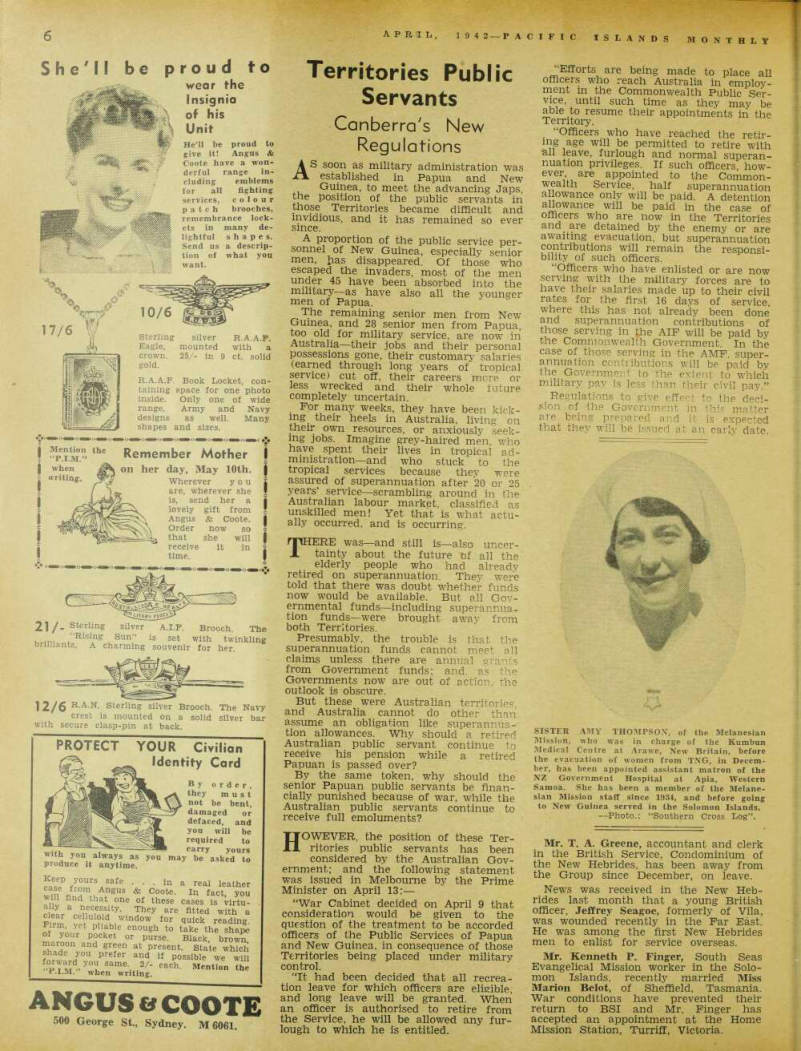
SISTER AMY THOMPSON, of the Melanesian Mission, who was in charge of the Kumbun Medical Centre at Arawe, New Britain, before the evacuation of women from TNG, in Decem ber, has been appointed assistant matron of the NZ Government Hospital at Apia, Western Samoa. She has been a member of the Melane sian Mission staff since 1934, and before going to New Guinea served in the Solomon Islands. —Photo.: “Southern Cross Log”.
Advertisements & other items, p. 8 (1 item)
Angus & Coote
She'll be proud to
wear the
Insignia
of his
Unit
He’ll be proud to give it! Angus & Coote have a wonderful range including emblems for all fighting services, colour patch brooches, remembrance lockets in many delightful shapes.
Send us a description of what you want. 17/6 10/6 g
R.A.A.P.
with R.A.A.F. Book Locket, containing space for one photo inside. Only one of wide range. Army and Navy designs as well. Many shapes and sizes.
Mention the
P.I.M
when writing.
Remember Mother
on her day, May 10th.
Wherever you are, wherever she is, send her a lovely gift from Angus & Coote.
Order now so that she will receive it in time. 21/- Sterling silver A.I.P. Brooch. The f “ Risi A ng Sun” is set with twinkling brilliants. A charming souvenir for her. 12/6 R - A - N -. Sterling silver Brooch. The Navy crest is mounted on a solid silver bar with secure clasp-pin at back. *3
PROTECT YOUR Civilian
Identity Card
By order, they must not be bent, damaged or defaced, and you will be required to . carry yours with you always as you may be asked to produce it anytime, Z ours . safe ■ . . in a real leather wm finrt m tiA ngus & Coofce - In fact * y° u Will find that one of these cases is virtuclear • They are fitted with a Firm SS- ? k I wmdow for Quick reading.
Firm, yet pliable enough to take the shape P !? Cket or P urse - Black, brown! maroon and green at present. State which shade you prefer and if possible we will “, y - same , 2/- each. Mention the r.I.M. when writing.
ANGUS & COOTE
500 George St., Sydney. M 6061.
Prefer?
Which Do You
The Uturoa of 1910, or the Busy Town of To-day ?
UTUROA is the centre of adminis tration for the Leeward Group of the Society Islands. It is a straggling little town on the north shore of Ra’iatea.
To the northward, beyond a broad ex panse of water— flashing with many colours because of the coral in its shallow depths, and calm because of the barrier reef which surrounds both islands —is the sister island, Tahaa.
Twenty-five miles to the east can be seen the ragged outline of Huahine. At a distance of 20 miles to the west, the high peak of Pora Pora stands in lonely grandeur.
Overshadowing the town, like a grim sentinal, is the extinct volcanic peak, Tapioi. j , Thirty years ago Uturoa was a truly native town. There were, perhaps, half a dozen whites, a Chinese bakery, no hotel, and no rum shops. The sale of alcoholic liquors was forbidden at that time in these outer islands.
The life of the town followed that pathway of tranquility which, in other days, characterised remote Islands com munities. By day the people performed, without hurry, their several vocations— fishing, going into the valley for fe’i, preparing the ahimaa (native oven), sun drying copra and curing vanilla; while the young boys and girls attended school in the thatched school-house adjacent to the big church.
By night, nearly everyone, crowned with flower wreaths, gathered about the village green to watch the young folk dance to haunting native tunes, played on mouth-organs, or sat about the long house, where the district chorus prac tised for the Bastile Day celebration or some native festival. .
One such occasion was the state visit of the daughter of a high chief of a dis tant island, who came to Uturoa with a numerous retinue of dancers and singers.
Representatives from all the islands of the Leeward Group came to do her honour, and ceremonies of long ago were revived in all their quaint splendour.
On Sunday, everyone went to church.
There was no compulsion—as cynical writers would have us believe. Young and old went because they liked to listen to eloquent speaking, and to sing the beautiful old hymn tunes, which, like so many other beautiful things, have since passed into disuse.
Uturoa, in those days, seemed the abode of tranquil happiness.
With the passing of the years the calm Uturoa of old has retreated before the steady invasion of modern ideas, and it has become a very up-to-date com munity, with electric lights, motor cars, shops, and a cinema theatre.
Whether it still possesses the peace of mind and happiness we saw there in the early years of the century —we do not know. —A.C.R.
Trainee David Aidney, of Suva, who was one of the first Fiji recruits to go overseas for service with the RAF has been successful in gaining his pilot s “wings”.
The title of “Bataillon du Corps Ex peditionnaire Francais du Pacifique given to the contingent of volunteers from New Hebrides, New Caledonia and French Oceania, now has been altered to “2eme Brigade Division Legere des Forces Francaises Libres du Pacifique .
The Myth of Japanese
Invincibility
QUICK victories in the Pacific have enabled the Japanese, in their pro paganda, to play heavily on the theme of the invincibility of the Japan ese army.
History refutes this. It shows that the Jap is a good starter, but a poor fin isher; that he has been beaten again and again.
He made a brilliant start in the war against Russia in 1904. He won battle after battle. Like ourselves, now, the Russian Government was slow to get moving. But when it did get into its stride, and accumulated men and mater ials in the Far East, the Japanese Gov ernment secretly appealed to President Theodore Roosevelt of the United States to negotiate for peace. How’s that for an “invincible” army?
Here is another case. In 1938, during the so-called border incidents with Rus sia, Japan fought one real battle against Soviet troops. It was on the hill of Changkufeng, south-west of Vladivos tok, which the Japs claimed belonged to Manchukuo and not, as the Russians held, to Siberia. In that battle the Red Army tore the Japanese legend of invin cibility to tatters. The Japs left 3,000 men killed and wounded—and did not get the hill.
Eight months later—in July, 1939—the Japanese generals gave their Samurai spirit another test against the Russians —this time along the frontier of Man chukuo and Outer Mongolia. In seven days’ fighting, in the battle of Khalka River, they lost 5,500 men (including 2,000 killed) and 60 of their planes were shot down.
And what about the war in China— the war that was to last not more than twelve months after Japan deliberately provoked its start in 1937? It has been going on for five years. Some reports insist that the Japanese have lost over a million men—and they are as far away from total victory as they were when the fight started.
And the Philippines? Was there any sign of Japanese invincibility when Gen eral MacArthur’s men threw back numerically superior numbers of Japan ese time and time again?
Japanese invincibility, like Japanese chivalry, and Japanese Co-prosperity, is a myth. The Russians proved it, the Chinese proved it, MacArthur proved it —and the Australians proved it every time when, in Malaya, they met the Japanese on anything even approaching equal terms.
Lieutenant-General Stilwell, the Ameri can officer who now commands Chinas crack troops, said the other day; The Japs are savages. But whenever they come against anything like equal forces they’ve been licked.”
LAC Douglas Kirby, who left Fiji with the first contingent of RAF recruits, was killed recently in a flying accident over seas.
Flying-Officer John C. Lowe, who was reported “missing, believed killed”, in an RAAF casualty list issued on April 11, was one of five Australian pilots who went up to battle with an overwhelming force of Japanese when they made their first “blitz” on Rabaul on January ju.
Before he enlisted in September, 1940, he was employed in Fiji as an overseer by the Colonial Sugar Refining Co. Ltd.
A Copra Drier
Designed by Mr. P. D. Good, Whose Death is Reported
(In the last letter written to the editor of the “PIM” bv Mr. P. D. Good, of Kessa Plantation, Buka, New Guinea, before the Pacific war, we were given his permission to use the following material from the “Rabaul Times”. The Japs are now in occupation of Kessa, and unconfirmed but circumstantial reports which have reached Sydney say that Mr.
Good was murdered by them about the end of February.) MR. P. D. Good, the owner of Kessa Plantation, in Buka, and a man who has spent considerable time in ex perimenting with various types of copra driers, paid us a visit the other day and showed us a plan, with comprehensive details, of a new type of drier, which has proved very successful on his estate at Kessa. for the past 18 months.
The main feature is the large corru gated tunnel-like smoke-box which is constructed of arched galvanised iron, and is completely self-supporting, though it is 6 feet high and 6 feet wide, and 44 feet long. There are stable doors and two 5-inch down-pipes at each end; also four split drums which contain the fire.
At the centre there are two 6-inch down-pipes which draw tne heat over the gap between the fires. The lower copra bed rests across 7 feet iron walls, which complete the hot-air room; access to this room is by doors at each end. A second bed, about 18 inches above the first, is necessary, and a third bed could also be installed, but it is really not necessary.
Cemented platforms on each side of the beds, raised to about 2i feet below the first bed, and windows and shutters in the outer walls, make working very easy. Bag curtains are convenient, and sufficient to keep the heat on the copra.
Mr. Good stated that he has received several requests for particulars of this drier, and as a result made a compre hensive plan, a copy of which he handed to the secretary of the Planters’ Associa tion in' Rabaul for the benefit of mem bers of the Association. Mr. Good took the necessary steps to have the plan copyrighted.
Describing the drier, Mr. Good stated that the heating unit requires little attention, is easy to construct, and is comparatively cheap. It could safely be built of native material.
Henry Eekhoff Seeks a War Job
OUR old friend, Henry G. Eekhoff (trader, of Lae, New Guinea), came down to Sydney in the evacuation, filled with patriotic zeal. His sons are in the fighting forces, and he thought that a fit and adaptable man—as all New Guinea traders must be —could be use fully employed in Australian war-work.
But, although the military wallahs are calling-up Australian men of 50 and forcing them to abandon personally built businesses, there seemed to be no war job anywhere for our New Guinea friend, and finally he gave up the quest.
To-day, Henry Eekhoff, in consider able bitterness of spirit, is a packer of ladies’ corsets and brassieres in a Sydney factory. He is bitter because no real war job can be found for him, and he is grim because his intelligent wife says he is learning far more than is good for him about the variations of the feminine form.
Dr. Balzeau, head doctor at the French hospital at Vila, New Hebrides, was suc ceeded recently by Dr. Mauze, Dr. Pou liquen, assistant doctor at Vila, has been transferred to Santo; his place has been taken by Dr. Gilbert.
Mr. Michael Chambers, an employee at the Vatukoula goldmines, Fiji, died in Lautoka Hospital last month, aged 40.
Born in Ba, he worked for a time at various CSR mills as an engineer.
Advertisements & other items, p. 9 (1 item)
7
PACIFIC ISLANDS M ONTHLY APRIL, 1942
Polynesian
Death Of Great
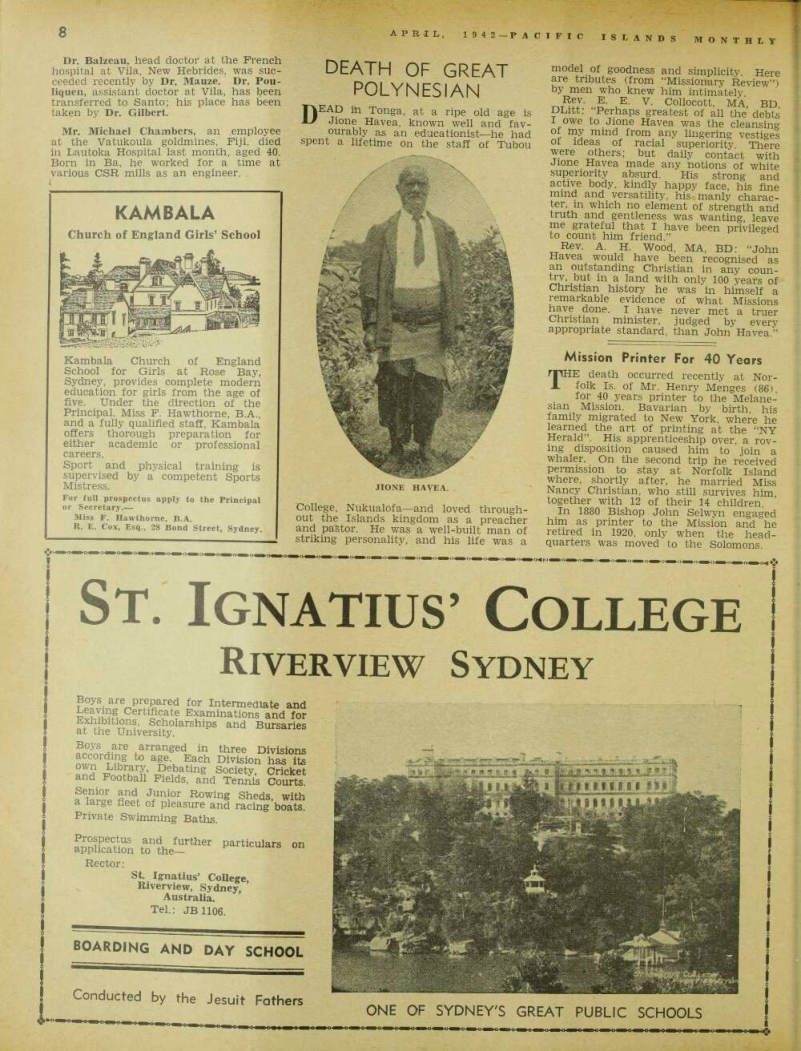
Dead in Tonga, at a ripe old age is Jione Havea, known well and fav ourably as an educationist—he had spent a lifetime on the staff of Tubou
model of goodness and simplicity Here are tributes (from “Missionary Review”) by men who knew him intimately. 3 V> Col locott, MA, BD.
DLitt: Perhaps greatest of all the debts I owe to Jione Havea was the cleansing of my mind from any lingering vestiges of ideas of racial superiority. There were others; but daily contact with Jione Havea made any notions of white superiority absurd. His strong and active body, kindly happy face, his fine mind and versatility, his manly charac ter in which no element of strength and truth and gentleness was wanting, leave me grateful that I have been privileged to count him friend.”
Rev. A. H. Wood. MA, BD: “John Havea would have been recognised as an outstanding Christian in any coun try .but in a land with only 100 years of Christian history he was in himself a remarkable evidence of what Missions have done. I have never met a truer Christian minister, judged by every appropriate standard, than John Havea ”
Jione Havea,
College, Nukualofa—and loved through out the Islands kingdom as a preacher and pastor. He was a well-built man of striking personality, and his life was a
Mission Printer For 40 Years
rE death occurred recently at Nor folk Is. of Mr. Henry Menges (86) for 40 years printer to the Melane sian Mission. Bavarian by birth, his family migrated to New York, where he learned the art of printing at the “NY Herald”. His apprenticeship over, a rov ing disposition caused him to join a whaler. On the second trip he received permission to stay at Norfolk Island where, shortly after, he married Miss Nancy Christian, who still survives him together with 12 of their 14 children.
In 1880 Bishop John Selwyn engaged him as printer to the Mission and he retired in 1920, only when the head quarters was moved to the Solomons
Advertisements & other items, p. 10 (2 items)
Kambala
Church of England Girls’ School *
UJI
If Kambala Church of England School for Girls at Rose Bay, Sydney, provides complete modem education for girls from the age of five. Under the direction of the Principal, Miss F. Hawthorne, 8.A., and a fully qualified staff, Kambala offers thorough preparation for either academic or professional careers, Sport and physical training is supervised by a competent Sports Mistress.
For full prospectus apply to the Principal or Secretary.— Miss F. Hawthorne, B.A.
R. E. Cox, Esq., 28 Bond Street, Sydney.
St. Ignatius’ College
Riverview Sydney
Boy S are prepared for Intermediate and Certificate Examinations and for Scholarships and Bursaries at the University. ®°yf * re arranged in three Divisions according to age. Each Division has its and Fnnfhiu’ ,debating Society, Cricket and Football Fields, and Tennis Courts.
Senior and Junior Rowing Sheds with a large fleet of pleasure and racing’boats.
Private Swimming Baths. application SaJ?** partlculars ° n Rector: St. Ignatius’ College, Riverview, Sydney, Australia.
Tel.: JB 1106.
BOARDING AND DAY SCHOOL
Conducted by the Jesuit Fathers IS me * V
ONE OF SYDNEY'S GREAT PUBLIC SCHOOLS
Dr. Lindsay Isaac In
Suva
IT is reported that Dr. Lindsay Isaac, a well-known member of the medical staff of the Gilbert and Ellice Is lands Colony, has arrived in Suva from the Japanese-occupied Gilberts. The re
port does not say how he escaped. He was in Tarawa early in January, as is proved by a letter just received from him, enclosed in an envelope post marked January 2.
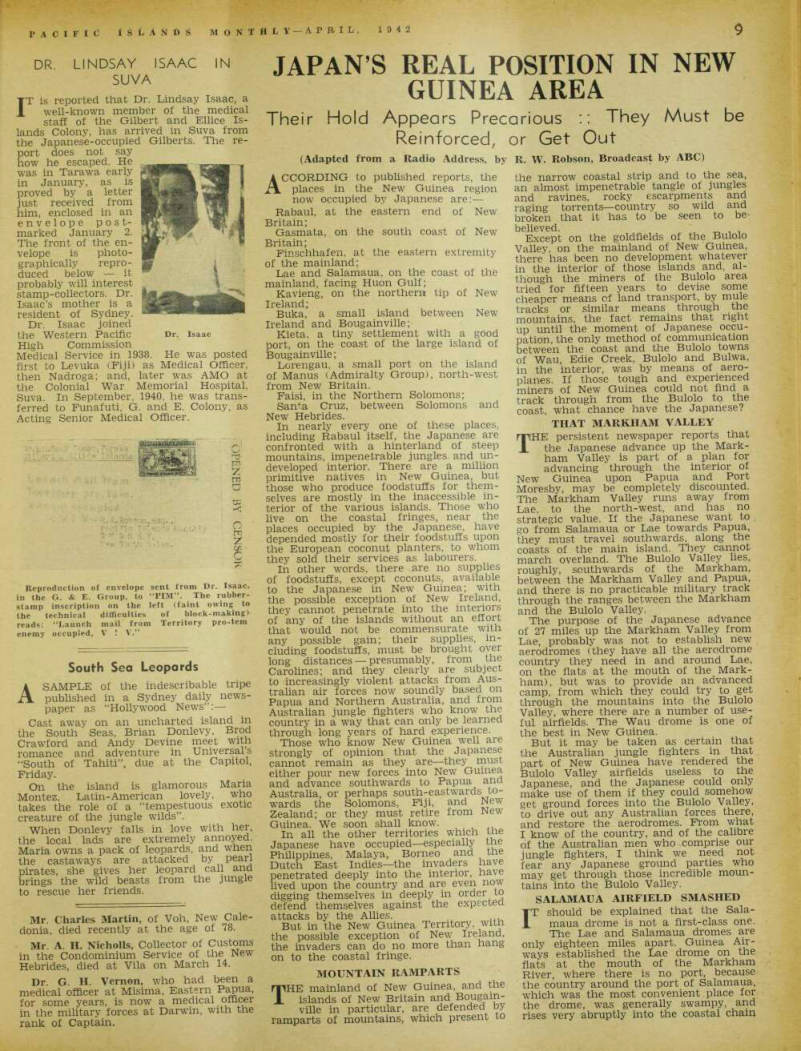
The front of the en velope is photo graphically repro duced below it probably will interest stamp-collectors. Dr.
Isaac’s mother is a resident of Sydney.
Dr. Isaac joined the Western Pacific High Commission
Medical Service in 1938. He was posted first to Levuka (Fiji) as Medical Officer, then Nadroga; and, later was AMO at the Colonial War Memorial Hospital, Suva. In September, 1940, he was trans ferred to Funafuti, G. and E. Colony, as Acting Senior Medical Officer.
Reproduction of envelope sent from Dr. Isaac, in the G. & E. Group, to PIM”. The rubber stamp inscription on the left (faint owing to the technical difficulties of block-making) reads: “Launch mail from Territory pro-tem enemy occupied, V ! V.”
Dr. Isaac
South Sea Leopards
A SAMPLE of the indescribable tripe published in a Sydney daily news paper as “Hollywood News”: — Cast away on an uncharted island in the South Seas, Brian Donlevy, Brod Crawford and Andy Devine meet with romance and adventure in Universals “South of Tahiti”, due at the Capitol, Friday.
On the island is glamorous Maria Montez, Latin-American lovely, who takes the role of a “tempestuous exotic creature of the jungle wilds”.
When Donlevy falls in love with her, the local lads are extremely annoyed.
Maria owns a pack of leopards, and when the castaways are attacked by pearl pirates, she gives her leopard call and brings the wild beasts from the jungle to rescue her friends.
Mr. Charles Martin, of Voh, New Cale donia, died recently at the age of 78.
Mr. A. H. Nicholls, Collector of Customs in the Condominium Service of the New Hebrides, died at Vila on March 14.
Dr. G. H. Vernon, who had been a medical officer at Misima, Eastern Papua, for some years, is now a medical officer in the military forces at Darwin, with the rank of Captain.
Guinea Area
Japan’S Real Position In New
Their Hold Appears Precarious They Must be Reinforced, or Get Out
(Adapted from a Radio Address, by R. W. Robson, Broadcast by ABC)
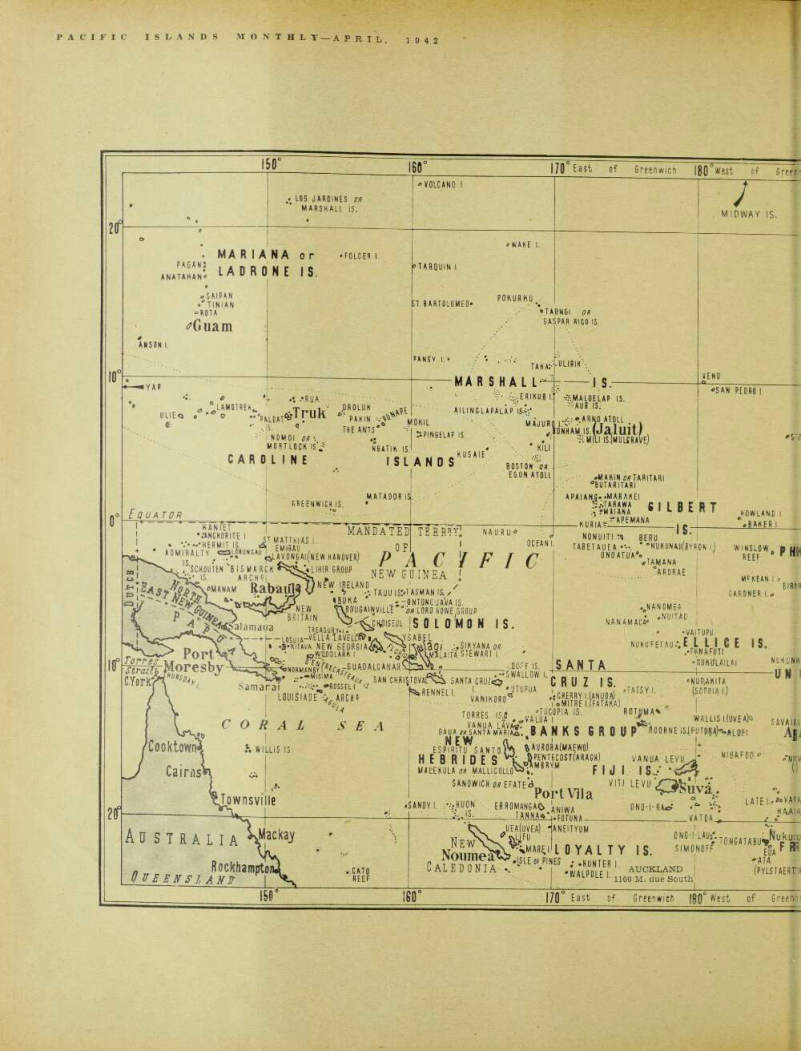
ACCORDING to published reports, the places in the New Guinea region now occupied by Japanese are:— Rabaul, at the eastern end of New Britain; Gasmata, on the south coast of New Britain; Finschhafen, at the eastern extremity of the mainland; Lae and Salamaua, on the coast of the mainland, facing Huon Gulf; Kavieng, on the northern tip of New Ireland; Buka, a small island between New Ireland and Bougainville; Kieta, a tiny settlement with a good port, on the coast of the large island of Bougainville; Lorengau, a small port on the island of Manus (Admiralty Group), north-west from New Britain.
Faisi, in the Northern Solomons; Santa Cruz, between Solomons and New Hebrides.
In nearly every one of these places, including Rabaul itself, the Japanese are confronted with a hinterland of steep mountains, impenetrable jungles and un developed interior. There are a million primitive natives in New Guinea, but those who produce foodstuffs for them selves are mostly in the inaccessible in terior of the various islands. Those who live on the coastal fringes, near the places occupied by the Japanese, have depended mostly for their foodstuffs upon the European coconut planters, to whom they sold their services as labourers.
In other words, there are no supplies of foodstuffs, except coconuts, available to the Japanese in New Guinea; with the possible exception of New Ireland, they cannot penetrate into the interiors of any of the islands without an effort that would not be commensurate with any possible gain; their supplies, in cluding foodstuffs, must be brought over long distances presumably, from the Carolines; and they clearly are subject to increasingly violent attacks from Aus tralian air forces now soundly based on Papua and Northern Australia, and from Australian jungle fighters who know the country in a way that can only be learned through long years of hard experience.
Those who know New Guinea well are strongly of opinion that the Japanese cannot remain as they are —they must either pour new forces into New Guinea and advance southwards to Papua and Australia, or perhaps south-eastwards to wards the Solomons, Fiji, and New Zealand; or they must retire from New Guinea. We soon shall know.
In all the other territories which the Japanese have occupied—especially the Philippines, Malaya, Borneo and the Dutch East Indies—the invaders have penetrated deeply into the interior, have lived upon the country and are even now digging themselves in deeply in order to defend themselves against the expected attacks by the Allies.
But in the New Guinea Territory, with the possible exception of New Ireland, the invaders can do no more than hang on to the coastal fringe.
Mountain Ramparts
THE mainland of New Guinea, and the islands of New Britain and Bougain ville in particular, are defended by ramparts of mountains, which present to
the narrow coastal strip and to the sea, an almost impenetrable tangle of jungles and ravines, rocky escarpments and raging torrents —country so wild and broken that it has to be seen to be believed. . , Except on the goldfields of the Bulolo Valley, on the mainland of New Guinea, there has been no development whatever in the interior of those islands and, al though the miners of the Bulolo area tried for fifteen years to devise some cheaper means of land transport, by mule tracks or similar means through the mountains, the fact remains that right up until the moment of Japanese occu pation, the only method of communication between the coast and the Bulolo towns of Wau, Edie Creek, Bulolo and Bulwa, in the interior, was by means of aero planes. If those tough and experienced miners of New Guinea could not find a track through from the Bulolo to the coast, what chance have the Japanese?
That Markham Valley
THE persistent newspaper reports that the Japanese advance up the Mark ham Valley is part of a plan for advancing through the interior of New Guinea upon Papua and Port Moresby, may be completely discounted.
The Markham Valley runs away from Lae, to the north-west, and has no strategic value. If the Japanese want to go from Salamaua or Lae towards Papua, they must travel southwards, along the coasts of the main island. They cannot march overland. The Bulolo Valley lies, roughly, southwards of the Markham, between the Markham Valley and Papua, and there is no practicable military track through the ranges between the Markham and the Bulolo Valley.
The purpose of the Japanese advance of 27 miles up the Markham Valley from Lae, probably was not to establish new aerodromes (they have all the aerodrome country they need in and around Lae, on the flats at the mouth of the Mark ham), but was to provide an advanced camp, from which they could try to get through the mountains into the Bulolo Valley, where there are a number of use ful airfields. The Wau drome is one of the best in New Guinea.
But it may be taken as certain that the Australian jungle fighters in that part of New Guinea have rendered the Bulolo Valley airfields useless to the Japanese, and the Japanese could only make use of them if they could somehow get ground forces into the Bulolo Valley, to drive out any Australian forces there, and restore the aerodromes. From what I know of the country, and of the calibre of the Australian men who comprise our jungle fighters, I think we need not fear any Japanese ground parties who may get through those incredible moun tains into the Bulolo Valley.
Salamaua Airfield Smashed
IT should be explained that the Sala maua drome is not a first-class one.
The Lae and Salamaua dromes are only eighteen miles apart. Guinea Air ways established the Lae drome on the flats at the mouth of the Markham River, where there is no port, because the country around the port of Salamaua, which was the most convenient place for the drome, was generally swampy, and rises very abruptly into the coastal chain
of mountains. People, for years, despaired of making a good airfield at Salamaua.
It was done, eventually, but it was built on swampy ground, and is surrounded by swamps.
After the smashing which the Salamaua drome has had recently, and in the rainy season which New Guinea is now experiencing, I imagine that the Sala maua drome is practically unusable. In any event, it is not a good drome, because it is tucked in too closely under the overhanging mountains, and is always a headache to pilots inexperienced in New Guinea flying.
Can They Attack Pt. Moresby?
rpHE position is that the Japanese air X forces on the New Guinea mainland are being largely confined to Lae— and, while the Lae drome is good, the Lae region is vulnerable to attack by experienced pilots, who can descend upon it out of the clouds which nearly always enwrap the tops of the 7,000 feet high mountains behind Salamaua, and which often extend right back to the Central Range.
If the Japanese wish to attack Port Moresby from New Guinea, they must employ their famous leap-frog tactics, advancing step by step along the coastal fringe of Papua from the region of Samarai. Such tactics would call for large air and naval forces—and already the Australian and American fighters defending this area have given such proof of their quality that it is unlikely that the Japanese will lightly enter upon such an adventure.
It is argued by some that the Japs could get through from Buna to Kokoda, and thence to Port Moresby. But I do not think that the Kokoda-Port Moresby road is militarily practicable.
Japs At Santa Cruz
npHE Japanese occupation of the large X island of Santa Cruz (in the Santa Cruz Group, between the Solomon Islands and the New Hebrides) may be merely an advanced base for purpose of reconnaissance, or an indication that the Japanese, employing the islands-landing technique which was so successful in the East Indies, are planning an advance through the Solomons, New Hebrides, Fiji, etc., towards New Zealand.
Although Santa Cruz is seldom heard of in Australia, the fact that it has been selected by the Japanese for occupation indicates the thoroughness of the surveys which Japan stealthily made of all the South Sea Islands during the past two decades. The Japanese knew that Santa Cruz has a big, safe harbour, where large ships may lie—namely, Graciosa Bay just as they knew all about Kieta (Bou gainville), and that fine, deep port (Carola Harbour) on the west coast of Buka, where they have established some sort of base. nrSI h iu,ot he^Sp^nis s ex P ed ition under Don Alvaro de Mendana set out to re locate the Solomon Islands (the reputed source of King Solomon’s gold), in 1567, the ships got somewhat off the course and came instead to the Santa Cruz S! P m £ the Spaniards established their colony on Graciosa Bay. That tr ? g l c histor y- It was even *wily Jl lped ?Ht »y sickness and blood sned (the natives then were extremely hp U a C rH le nf f and 9L raciosa Ba y was not heard of for another 250 years. Thirty were o est a hlf?hpri ag °’ coconut Plantations were established on Graciosa Bay bv the Ca P tain . Svensen, and these later became a station of Levers Pacific Plantations Pty. Ltd. Later, however the island was abandoned by British enter ™^™an^ fan 3. ous in Pacific history (Com modore Goodenough) was murdered by natives in Graciosa Bay in 1875, and an
obelisk there commemorates his memory.
Graciosa Bay, in Santa Cruz Island, therefore, has been the scene of tragedies, suffered by a series of visitors. Without wishing the Japanese any special harm, we may hope that the hoodoo that apparently is upon the place has not been broken.
Papua
Early Gold Days in Papua The Mambare Murders
By Mollie Lett
BY 1894, the creeks and gullies on Sud- Est and Misima Islands (Eastern Papua) were practically worked out; so the disappointed miners, convinced that payable gold existed in the interior of the mainland, turned their attention to the Mambare River, after three unsuc cessful attempts behind Bartle Bay.
Earlier in the year, Sir William Mc- Gregor (Administrator of Papua) had found traces of gold on a visit to the Mambare district, so the miners eagerly made arrangements for prospecting the Mambare headwaters. Two parties, formed by George Clarke and William Simpson, left Samarai in June, 1895, making for the northern coast in the “Seagull” and the “Mayflower”.
The Administrator’s report showed that the river, though wide at the mouth, narrowed considerably up-stream, where rapids and shallows had forced him to abandon his launch for a whaleboat.
Above his turning point, 50 miles from the mouth, precipitous banks and broken country barred further progress. He found the natives truculent—they showed marked resentment of his intrusion.
Clarke’s party was the first to enter the river-mouth. Here they unloaded their stores and provisions and made their way up-stream in a whaleboat and canoes bought from natives near the coast.
All went well for 35 miles, until they passed a group of villages below the first large rapids; there, seizing the first favourable opportunity, natives treacher ously murdered Clarke and looted the whaleboat. His companions were forced to retire, leaderless and without provi sions, to the coast.
Retaliation
IN the meantime, Simpson and his party had entered the river and advanced 20 miles from the mouth. When Clarke’s men met them, they joined forces, returned to the scene of the mur der, and retaliated by destroying village houses and killing all the pigs.
The combined party continued up stream, after ah unsuccessful attempt to find Clarke’s body. Without interference from the natives, they made their way over the rapids for 60 miles and built a permanent log camp above Tamata Creek, which became known as Clarke’s Fort. It was a substantial building, on the bend of the river, and the miners made it their depot while prospecting the creeks as they cut their way up the slopes of the rising ranges.
Thirty miles from Clarke’s Fort, they found indications that gold lay ahead So they returned to Tamata and, even tually, to the coast and Samarai to obtain adequate provisions for the ardu ous inland journey.
Govt. Station Established
RECEIVING news of Clarke’s murder, Sir William McGregor took mea sures to establish order. He ordered a Government Station to be formed at
the junction of Tamata Creek and the Mambare River, and appointed John Green as Government Agent, with 10 police under Corporal Sedu.
The site was only a small strip of land low-lying and surrounded by dense jungle’ but Green and his police soon got to work. From native material at hand, they built a post from which Green was able to maintain some semblance of law and order among the war-like tribes.
When Simpson and his men passed through on their return journey up the river, they obtained permission to make Tamata their headquarters.
Simpson’s party had now dwindled to 7 or 8 men, of whom Messrs. A. Clunas, S. McLaughlin, R. Elliot, and S. Mc- Lelland were regarded as outstanding.
All experienced miners, they were cer tainly the most persevering who had ever visited the New Guinea mainland.
Simpson, himself the discoverer of the famous Chartres Towers goldfield, was convinced that gold existed in the dis tant ranges. The more hardships they endured, the more they were determined not to endure them in vain.
Gold!
BY the end of November, they had cut their way over the steep and densely timbered slopes of Mt. Otovia, built a store, bridged the Chirima, and reached the foot of Mt. Scratchley. The waters of the Upper Mambare were by now a mere succession of cascades, flanked by steep slopes of the ranges, and the difficulties of travel were aug mented by incessant rain, fever and in adequate food.
Then, three months out from Tamata, their labours and trials were at an end for while prospecting 10 miles from the Chirima Junction, at the foot of Mt.
Scratchley, they found payable gold in a creek.
In three weeks they won 200 ozs.— worth only £7OO in those days; not an enormous sum, but sufficient to enable them to carry on with their search in the beckoning ranges.
Samarai heard the news of their good fortune and almost immediately every available schooner was making for the Mambare River, crowded with men for the new field, now known as McLaugh lin’s Creek. But so difficult was the long trek from Tamata Station that, in spite of all the excitement over the new dis covery and the numbers that set out, by the end of June, 1896, there were only 12 men working claims in the creek bed.
Seven Miners Murdered
rE natives, thoroughly resentful over the continued invasion of their ter ritory, became openly hostile, and attacked party after party as they made their way up-stream. Five miners were murdered later in the year, and also two others in a village on the banks below Tamata. Becoming bolder, tribesmen attacked a camp at the river mouth, and three miners (Davis, Steele and Patter son) were forced to take to the sea in rafts.
Their audacity reached its climax in January, 1897, when, while professing strong friendship to the Government, they massacred Green and nearly all his police, during the building of a new station.
Principally to get on to higher ground, Green had decided to shift his station two miles further up-stream. He had been taken in completely by the dupli city of the natives, and laid down his fire-arms when they complained of his lack of confidence. As he ordered his police to do likewise, the natives rushed Green and his constables and carriers.
All but two were speared to death.
The escapees hurried to the miners’ camp for assistance, but they were able only to retrieve Green’s body and bury it near the old Tamata buildings.
It was obvious, after Green’s murder, that the whole district would be up in arms, and the miners (except for three on McLaughlin’s Creek) made for the river-mouth. There, like Davis and his mates, they were hunted out to sea on their rafts. Thus was the Mambare left in possession of its war-like tribes.
Some time later, Capt. Butterworth arrived in the district with a contingent of police and he restored order. Mr. W.
M Shanahan was appointed to Tamata Station as successor to Green, in August, 1897.
All missionaries of the Unevangelised Fields Mission who have been serving in Papua have returned to Australia. Of a total of about 13 missionaries evacu ated four are New Zealanders —Mr. and Mrs' T Brunton, Miss Eva Stanton and Mr ’ Keith Dennis, of Hastings. Miss Stanton shortly will marry Mr. Len Twy ford, a fellow-worker in the Mission.
There is still no word of leading pub lic officers of the New Guinea Adminis tration, who were caught in Rabaul inva sion. Among the missing are Mr. Har old Pas-e. Government Secretary and Deputy Administrator; Mr. Gerald Hogan, Crown Law Officer; Mr. George Murray, head of the Department of Agriculture; and Mr. H. O. Townsend, the Treasurer.
Now that an organisation for making inquiries about civil prisoners in Japan ese hands is beginning to operate through the International Red Cross, some word of the missing men may be obtained soon.
All reasonable steps for the safety of property and plant in New Guinea of Sunshine Gold Development Ltd. were taken by the general manager before his departure from the field in January. Gold from the last-minute clean-up of boxes, about 155 oz., was deposited in a secret place. The Co. has an estimated cash surplus of about £5,000 after the dis charge of commitments.
Cuthbert’s Misima Goldmines made a profit of £35,557 in 1941, compared with £37,170 in 1940. There will be no profit in 1942 —operations were suspended and the staff withdrawn in January. This is the famdus Umuna-lode mine. Mr. Cuth bert sold it to the present company for a few years ago, after paying dividends of 100 per cent, on the capital of his own smaller company (New Mis ima Goldmines Ltd., formed in 1929 which held 19 leases, comprising 186 acres, on Misima Island, Eastern Papua) over a period of years.
Advertisements & other items, p. 12 (1 item)
10
Afift 1 L , 19 4 2-ftACIFIC ISLANDS MONTHLY
Fiji and Central Pacific
Territories Secure and Busy
OWING to irregularity of mails, the news from Fiji, Samoa, and French Oceania, available for publication in this issue, is small and fragmentary.
The general position in the Central and Eastern Pacific, however, is far bet ter than might have been expected when the Japanese struck so savagely southwards in December. Although the enemy is established fairly strongly in New Guinea, with what appear to be lightly-held bases out in the Northern Solomons and the Santa Cruz Islands (between the Solomons and the New Hebrides) he has not made any appear ance in force in the important Islands territories to • the eastward and south eastwards.
The important French Colony of New Caledonia, the Condominium of the New Hebrides, the large and rich British Colony of Fiji, the Protectorate of Tonga, the NZ Mandated Territory of Western Samoa, the American Territory of East ern Samoa, the NZ Territory of Cook Islands, and the whole of French Ocea nia, are carrying on normally, without enemy interference.
There are no details available for publication, but it may be taken as certain that the four months since
Japan made her attack upon Hawaii have been usefully employed in creating and firmly establishing an important defence organisation throughout those South Pacific territories, and they now are reasonably secure.
Industry and trade are booming in all of them. The demand for copra is sen sational; and there is a keen market for the other products, of all the territories —coffee, cocoa, sugar, gold, vanilla, etc.
Mr. S. H. and Mrs. Ellis, of Suva, who have given thousands of pounds already to war funds, now have donated £5,500 to the Fiji Fighter Fund to buy a fighter aircraft Jor Britain. It will be named “Comrades in Arms—Fiji and New Zea land”.
Advertisements & other items, p. 13 (1 item)
TillMfAVnE
PACIFIC ISLANDS SOCIETY
Visitors from the Islands to Sydney (or those interested in Islands affairs), are advised to communicate with the honorary secretary of the above Society, which has been formed to study the history, traditions, economics, and political developments of the Pacific Islands.
Regular monthly meetings will be held throughout 1942 at Hotel Carlton, Sydney.
Address for Correspondence:
THE PACIFIC ISLANDS SOCIETY,
Box 2434 MM., G.P.0., Sydney.
MILITARY GOGGLES
o „i nst ri ARF WIND and DUST. The strong and comfortable For perfect protection against olakh, yyinu, rnonKP’« ipnw« , n H have frames are fitted with scientifically-designed WILLSON, or CROOKE S Lenses, and hav ventilated leather side shields. Supplied in strong metal cases.
WILLSON Lenses, 15/-. CROOKE’S Lenses, 9/6.
Other types with Crooke’s Lenses, 5/6, 6/6 paw.
Our finely illustrated coloured Catalogue will be forwarded by return post on application.
ON PARLE FRANCAIS
° PITT & KING STREETS,
SYDNEY
PROUDS PTY. LTD.
TillMfAVnE
U /// /
POWERFUL MULTI-VALVE BANDSPREAD
Full particulars from
GEORGE BROWN & CO.
Electrical Engineers
Used by
• Commander R. E. Byrd on his South Pole Expedition. • Official Australian Adviser to British Broadcasting Commission. • Mr. R. N. Shaw, Editor Short-wave Section “Wireless Weekly”. e Mr. L. J. Keast, Editor Short-wave Section “Radio World”.
There is not a better radio obtainable.
AC & BATTERY MODELS
PTY. LTD.
267 Clarence Street, Sydney, N.S.W.
No Quinine
Result of Jap Invasion of Indies
FOR very many years, quinine (pro duced from the bark of the Cin chona tree) has been a monopoly of the Dutch, in the East Indies. One effect of the occupation of the East Indies by the Japanese has been the virtual dis appearance of quinine supplies from all of the Allied countries.
This is a serious matter. In all the countries of the tropics (especially Africa, Southern India and Central America) quinine still is the standard prophylactic for use against malaria.
Quinine, always, has been essential equipment in British and French homes in Papua, New Guinea, Solomons and New Hebrides. There is no malaria in the Pacific east of Longitude 180 —a fact that we regard as one of the mysteries of medical science.
There is, as yet, no indication of how the situation is to be met. Presumably, present supplies of quinine will be strictly rationed; and the Americans may be expected to proceed immediately to restore the quinine-producing industry to its original home in South America — as they already have done in the case of rubber.
in Syria
New Caledonian Officials in Syria
IT is interesting to note that Frenchmen well known in New Caledonia have . become important officials in the ad ministration of Syria. Syria, last year, was taken from Vichy France by Britain, and then was handed over by Britain to the administrative care of General de Gaulle and the Free France Government.
Commandant Felix Broche and M Bayardelle, being supporters of the Free SS* Government of New Caledonia, entered the administration Photo, shows —On left: Lieut.-Colonel Broche, who commands the Free French Pacific Battalion in Syria. He is here seen at the parade in Noumea in May last. On the right: Monsieur Bayardelle % the Fr ee French civil officials £J^ la> Fo I rm F New Caledonian Secre tary-Genera!, he turned down Vichy’s offer to make him Governor, only a few days before the revolution brought Henri Sautot to Noumea from the New Hebrides. —(Photos by Dunn.) Mrs. Buckeridge, wife of Dr. E. R accident met Wlth a accident last month and for a few weeks was convalescent in Suva.
Miss Audrey Harcourt, clerk in the Secretariat section of the Fiji Civil Ser vice, resigned last month.
Lt.-Colonel Felix Broche and (right) Monsieur Bayardelle.
Is This Propaganda From
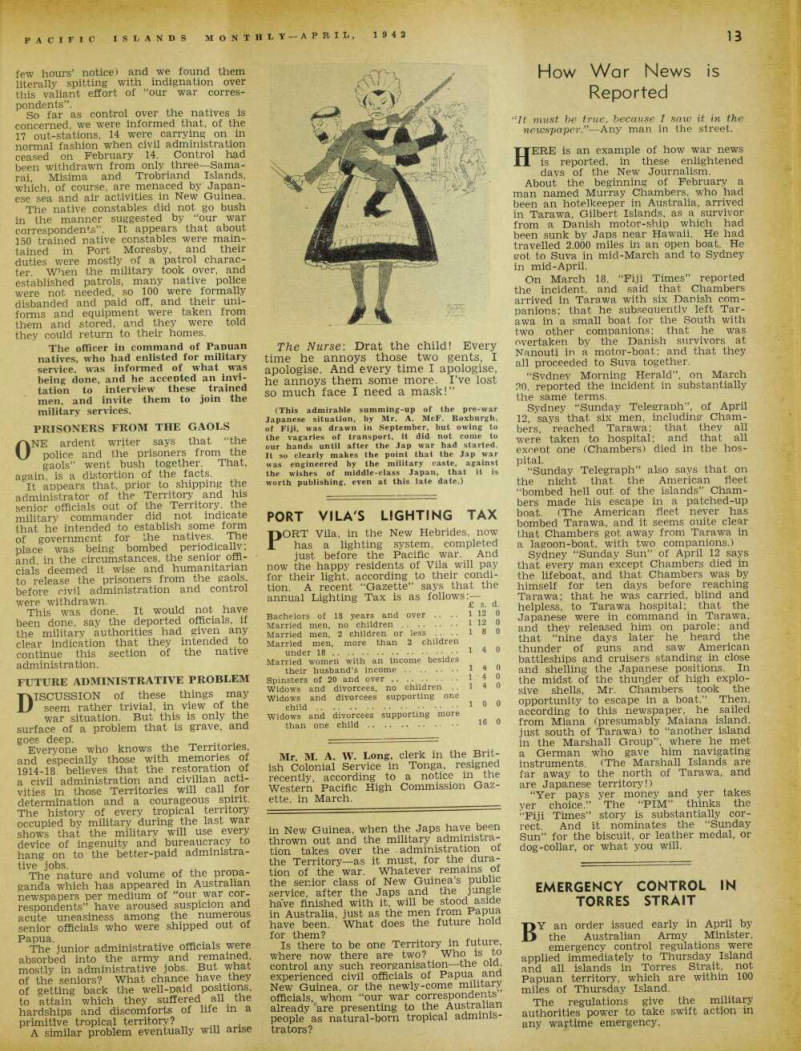
The North?
Some Questions About “War Correspondents '"
Despatches From Port Moresby
rOSE who know Australia’s Pacific Territories, and the ways of politi cians an< * bureaucrats are noting, with concern, what appears to be propa ganda from the north, which is being published in the principal Australian newspapers, and which may affect the future administration of these Territories.
In a sentence, Australian public opin ion is being coached in the belief that the Territories’ administrations were weak, cock-eyed and ultra-conservative; that they did not co-operate with the military authorities; and that the mili tary administration, having got rid of the civil administrations, has shown strength and ability in—as one published article phrased it—“restoring order out of chaos”. rE channels through which this pro paganda is being distributed are “our special war correspondents on the North Australian front”—in other words, three Australian newspaper re porters who know nothing much about war except what the military chiefs tell them, and whose knowledge of the his tory and affairs of Australia’s Pacific Territories can be judged from the some what grotesque nonsense published from week to week by the trustful Australian newspapers.
As a matter of fact, the comments of “our special war correspondents on the North Australian front” are a source of delight to the thousands of Territories’ evacuees in Australia—they so bring entertainment into a somewhat grim and sad world.
It would be hard to say when the three war correspondents are funnier—when they are discussing high strategy, or when they proceed to paint glamorous word-pictures of life in Australia’s tro pics. Probably, the biscuit for sheer fatuity must be handed to the young gentleman who described how the dolce far niente life of Port Moresby’s official and civil population was broken up by the efficient and realistic military.
People \yho know something of the real Papua loved that one.
Stuck In Port Moresby
LITTLE harm would be done if our “war correspondents” merely enter tained us with their delusions that they are Gunthers or Knickerbockers, and that Papua is Malaya or West Africa; but the thing is more serious than that.
They are the guests of the military— they have to be, because the military is in supreme control in Papua and New Guinea. Maybe, they sometimes get an aeroplane ride out of Port Moresby, but for the most part they are stuck in that dismay and uninteresting place, and they see nothing of the war or the country except a little air activity. Obviously, then, most of what they write is filtered through military headquarters, and what they send must be passed by military censors. Actually, no other system would be possible.
But let us see the shape that this fil tered material is taking. We refer to a despatch by one Folkard, published in Melbourne “Herald” on March 16, and another by one Johnston, published in “West Australian” of March 18. There
have been others—but those will suffice We do not propose to quote the articles —anyone interested may examine them But none will deny that in these par ticular productions of “our special war correspondents”, and in similar des patches, the tendency is to heap criti cism and ridicule upon the late civil administrations, and praise the reform ing zeal of the new military administra tion.
If this stuff is not propaganda, why is it sent?
That Horrid Union Jack!
MR. Folkard, for example, points out, as a shocking instance of adminis tiative shortcomings, that the Union Jack always was flown from Gov ernment House flagpole at Port Moresby.
But the military have changed this—the Australian flag now graces the official flag-pole. To “our war correspondent”, this is a significant event; and, if any one read him seriously, one would get the impression that Major-General Mor ns here has nipped in the bud a very dreadful piece of anti-Australianism. In fact, one cannot imagine how these “war correspondents”, trained in the school of the New Journalism, refrained from heading the despatch “Fifth Column Activity Discovered in Government House at Port Moresby”!
Actually, the explanation probably is quite simple. It was the British flag which was used when Commodore Ers kine proclaimed a protectorate on Nov ember 6, 1884, and when Sir William Macgregor formally annexed the Terri tory on September 4, 1888; and, as the same form of administration has con tinued ever since, it was natural and proper that the use of the Union Jack be continued—especially in view of the need of not confusing the native mind in relation to these symbols of govern ment.
It was equally natural and proper that the newly-installed Australian military administration should use the Australian flag. But why make such a song-and dance about it?
Our “war correspondent” also seeks to connect the flag incident with the appar ently shocking fact that the Administra tor of Papua received his commission direct from the Governor-General of Australia. In the name of common sense, from whom else should he receive it?
Control Of Natives
MR. Folkard and Mr. Johnston make much of the alleged fact that the recently-supplanted civil adminis tration had lost control over the native population, and that the military ad ministration had taken drastic steps to “bring order out of chaos”, and to round up, for restoration to duty, 120 native policemen whom the wicked civil ad ministration had turned loose into the bush.
This seemed so extraordinary a state ment to broadcast in Australia that we decided to check up on it. We could not locate Mr. Leonard Murray (civil ad ministrator) ; but several senior mem bers of the Papuan service are living in Sydney (the military administration shipped them out of Port Moresby at a
few hours’ notice) and we found them literally spitting with indignation over this valiant effort of “our war corres pondents”.
So far as control over the natives is concerned, we were informed that, of the 17 out-stations, 14 were carrying on in normal fashion when civil administration ceased on February 14. Control had been withdrawn from only three—Sama ra!, Misima and Trobriand Islands, which, of course, are menaced by Japan ese sea and air activities in New Guinea.
The native constables did not go bush in the manner suggested by “our war correspondents”. It appears that about 150 trained native constables were main tained in Port Moresby, and their duties were mostly of a patrol charac ter. When the military took over, and established patrols, many native police were not needed, so 100 were formally disbanded and paid off, and their uni forms and equipment were taken from them and stored, and they were told they could return to their homes.
The officer in command of Papuan natives, who had enlisted for military service, was informed of what was being done, and he accepted an invi tation to interview these trained men, and invite them to join the military services.
Prisoners From The Gaols
ONE ardent writer says that “the police and the prisoners from the gaols” went bush together. That, again is a distortion of the facts.
It appears that, prior to shipping the administrator of the Territory and his senior officials out of the Territory, the military commander did not indicate that he intended to establish some form of government for the natives. The place was being bombed periodically; and in the circumstances, the senior offi cials deemed it wise and humanitarian to release the prisoners from the gaols before civil administration and control were withdrawn.
This was done. It would not have been done, say the deported officials, if the military authorities had given any clear indication that they intended to continue this section of the native administration.
Future Administrative Problem
DISCUSSION of these things may seem rather trivial, in view of the war situation. But this is only the surface of a problem that is grave, and goes deep.
Everyone who knows the Territories, and especially those with memories of 1914-18. believes that the restoration of a civil administration and civilian acti vities in those Territories will call for determination and a courageous spirit.
The history of every tropical territory occupied by military during the last war shows that the military will use every device of ingenuity and bureaucracy to hang on to the better-paid administra tive jobs.
The nature and volume of the propa ganda which has appeared in Australian newspapers per medium of “our war cor respondents” have aroused suspicion and acute uneasiness among the numerous senior officials who were shipped out of Papua. . „ . , The junior administrative officials were absorbed into the army and remained mostly in administrative jobs. But what of the seniors? What chance have they of getting back the well-paid positions, to attain which they suffered all the hardships and discomforts of life in a primitive tropical territory?
A similar problem eventually will arise
in New Guinea, when the Japs have been thrown out and the military administra tion takes over the administration of the Territory—as it must, for the dura tion of the war. Whatever remains of the senior class of New Guinea’s public service, after the Japs and the jungle have finished with it, will be stood aside in Australia, just as the men from Papua have been. What does the future hold for them? , Is there to be one Territory in future, where now there are two? Who is to control any such reorganisation—the old, experienced civil officials of Papua and New Guinea, or the newly-come military officials, whom “our war correspondents already are presenting to the Australian people as natural-born tropical adminis trators?
The Nurse : Drat the child! Every time he annoys those two gents, I
apologise. And every time I apologise,
he annoys them some more. I’ve lost so much face I need a mask!” (This admirable summing-up of the pre-war Japanese situation, by Mr. A. McF. Roxburgh, of Fiji, was drawn in September, but owing to the vagaries of transport, it did not come to our hands until after the Jap war had started.
It so clearly makes the point that the Jap war was engineered by the military caste, against the wishes of middle-class Japan, that it is worth publishing, even at this late date.)
Fort Vila's Lighting Tax
PORT Vila, in the New Hebrides, now has a lighting system, completed just before the Pacific war. And now the happy residents of Vila will pay for their light, according to their condi tion. A recent “Gazette” says that the annual Lighting Tax is as follows:
Mr. M. A. W. Long, clerk in the Brit ish Colonial Service in Tonga, resigned recently, according to a notice in the Western Pacific High Commission Gaz ette, in March.
£ s. d.
Bachelors of 18 years and over .. .. 1 12 0 Married men, no children 1 12 0 Married men, 2 children or less .. .. 1 8 0 Married men, more than 2 children under 18 1 4 0 Married women with an income besides their husband’s income 1 4 0 Spinsters of 20 and over 1 4 0 Widows and divorcees, no children . 1 4 0 Widows and divorcees supporting one child 1 0 0 Widows and divorcees supporting more than one child 16 0
Reported
How War News is Reported
“It must be true, because I saw it in the newspaper.” —Any man in the street.
HERE is an example of how war news is reported, in these enlightened days of the New Journalism.
About the beginning of February a man named Murray Chambers, who had been an hotelkeeper in Australia, arrived in Tarawa. Gilbert Islands, as a survivor from a Danish motor-ship which had been sunk by Japs near Hawaii. He had travelled 2.000 miles in an open boat. He got to Suva in mid-March and to Sydney in mid-April.
On March 18, “Fiji Times” reported the incident, and said that Chambers arrived in Tarawa with six Danish com panions; that he subsequently left Tar awa in a small boat for the South with two other companions: that he was overtaken by the Danish survivors at Nanouti in a motor-boat; and that they all proceeded to Suva together.
“Svdney Morning Herald”, on March 20. reported the incident in substantially the same terms.
Sydney “Sunday Telegranh”, of April 12, says that six men, including Cham bers, 'reached Tarawa: that they all were taken to hospital; and that all excent one (Chambers) died in the hos
pital.
“Sunday Telegraph” also says that on the night that the American fleet “bombed hell out of the islands” Cham bers made his escape in a patched-up boat. (The American fleet never has bombed Tarawa, and it seems quite clear that Chambers got away from Tarawa in a lagoon-boat, with two companions.) Sydney “Sunday Sun” of April 12 says that every man except Chambers died in the lifeboat, and that Chambers was by himself for ten days before reaching Tarawa; that he was carried, blind and helpless, to Tarawa hospital; that the Japanese were in command in Tarawa, and they released him on parole; and that “nine days later he heard the thunder of guns and saw American battleships and cruisers standing in close and shelling the Japanese positions. In the midst of the thunder of high explo sive shells, Mr. Chambers took the opportunity to escape in a boat.” Then, according to this newspaper, he sailed from Miana (presumably Maiana island, just south of Tarawa) to “another island in the Marshall Group”, where he met a German who gave him navigating instruments. (The Marshall Islands are far away to the north of Tarawa, and are Japanese territory!) “Yer pays yer money and yer takes yer choice.” The “PIM" thinks the “Fiji Times” story is substantially cor rect. And it nominates the “Sunday Sun” for the biscuit, or leather medal, or dog-collar, or what you will.
Emergency Control In
Torres Strait
BY an order issued early in April by the Australian Army Minister, emergency control regulations were applied immediately to Thursday Island and all islands in Torres Strait, not Papuan territory, which are within 100 miles of Thursday Island.
The regulations give the military authorities power to take swift action in any wartime emergency.
Pacific Islands Mining
Shares A Good Gamble
FOR those who like a gold-mining gamble the Sydney Stock Exchange at present offers a unique opportunity. Consider these quotations of New Guinea, Papua and Fiji gold shares, taken from “Svdnev Morning Herald” of the dates stated
Placer and Guinea Gold are mostly holding com panies with very substantial assets in NG mines.
The Japanese war came in December, and New Guinea and Papua goldmining operations ceased in January, when all personnel was withdrawn. Natur ally, all share values declined.
If and when the companies resume operations thev soon will return to profit-making. The gamble is: When will the miners get back into the Territories'?
And when they go back, will they find their valuable installations intact?
So far as is known now, the onlv important gold mmmg property destroyed are the Bulolo Gold Dredg- Company ’ s three big transport planes—worth over £2so.ooo—which were caught on the ground by Jap bombers. There may be damage also to the company’s dredges and power-houses; but the company has enor mous reserves, and it is so well-managed that it could be back in profitable production within a few months.
Cuthbert’s Mine at Misima looks an especially good gamble. Misima is outside the enemy zone, at present and the mine is of the type that will not deteriorate through water. And the Fiji shares are worth to-day much of what they were worth in November, to anv good optimist. y
April 16, Nov. 15, 1942 1941 Bulolo (New Guinea) . 22/- 93/- Cuthbert’s (Papua) 3/3 13/7 Guinea Gold (Australia) . 4/- 10/6 Loloma (Fiji) .. . 12/3 21/10 Mt. Kasi (Fiji) .. .. 9d. 2/1 NG Goldfields (New Guinea) 8d. 1/6 Placer (Australia) 32/6 62/9 Sandy Creek (New Guinea) 6d. 1/3 Sunshine (New Guinea) .. 2/6 9/-
Guinea?
What Hos Happened in New Guinea?
PROBABLY we shall have to wait a long time for a connected account of what happened during the invasion of Rabaul by the Japanese. We do know that when the Japanese arrived some hundreds of Euro pean civilians—all men—went with the Australian troops into the jungles to the westward of Rabaul. We know that the Australian troops—and especially the small party of New Guinea Riflemen who had been organised as a militia unit alongside the Australian troops—put up a magnificent resistance and inflicted heavy losses upon the invaders. But after that all is vague.
We may presume that a section of the younger civilians made sufficient use of their local knowledge to maintain themselves in the jungle.
The Australian soldiers who surrendered to the Japanese and who were subsequently murdered probably were beaten by the jungle.
Many unofficial reports of atrocities committed by the Japanese in New Guinea are in circulation; but people with interests there would be wise to accept these with reserve and await official statements. The latter are made only after the most careful investigation.
Mrs. Phoebe Parkinson, a well-known resident of the Rabaul district of New Guinea, did not come to Aus tralia when the evacuation of women was ordered. Mrs.
Parkinson is now over 80 years old and on latest reports was residing with her son. who is manager of a coconut plantation in the Namatanai district of New Ireland.
Advertisements & other items, p. 16 (1 item)
Announcing
NEW CAREER TRAINING
A Training Plan for you to Win
Success Prestige Security
... in 1942 1943 and after . . . in a New FREE Illustrated Handbook is definitely a career training plan which will enable YOU to achieve success in the business world quickly surely just as there are opportunities and positions waiting for those who start Now to prepare Each training plan has been specially revised enlarged, or completely re-designed to give the Departmento, Accountancy and 5* ,„Tv « ‘"“"t f °T lhe COndi ' Commerce: tlons ot today and the years ahead.
SOME H. & R CAREER
TRAINING SUBJECTS
Accountancy Cost Accountancy Secretarial Practice Bookkeeping Farm and Station Bookkeeping Banking and/or Securities Barkers' Institute Municipal and Local Government Exams.
Effective Correspondence Psychology All General Business Subjects This handbook explains the career possibilities in each section of business ... and tells you exactdy how you can set your feet firmly on the ladder of success . . . much higher up than you could hope to get in years without this aid. It shows you clearly the small cost and how you may pay it.
H. & R. CAREER TRAINING
Goes Hand in Hand with Success Department of Distribution: Marketing and Selling Salesmanship and Sales Management Marketing and Advertising Practical Retail Selling Sales and Mail Order Correspondence Ticket and Show-Card Writing Department of Business Administration: Modern Business Administration (for executives) Modern Merchandising Post the Coupon for this FREE Handbook That you may decide for yourselt which business career best suits your inherent ability and desire, we have printed a new edition of our 108-page illustrated handbook, "The Guide to Careers in Business."
Hemingway
Itobertson
Founders of Commercial Education m Australasia 127 a, Barrack House, 16 Barrack St., Sydney. 127 a, A.P.A. Chambers, 403 Hunter St., Newcastle.
Offices in all Capital Cities, Newcastle & Launceston. y hen you have chosen your vocation am “ t0 j et r H * &R ' train you for Succes in 1942 and after, you have ensured for your sett a complete, practical education for busi ness, that takes you in the shortest time t( the greatest security and higher earnings. enable yourself to take advantage of thf golden opportunity that is yours today Business is so desperately in need of those Vhc are training for business; industry is expandmg so fast and there are so few available to till the vacancies that you, if you start Now can get further in the next 2-3-5 years than you could have hoped to get in many years in normal times.
And from the moment you commence your training, you give yourself Life Security privileges . . . lifelong career and employment co-operation of H. & R, assisting you throughout your business lifetime.
To HEMINGWAY & ROBERTSON.
Please send me FREE copy of the 108-page illustrated handbook, "The Guide to Careers in Business," and details of how the H <S- R. Personal-Individual Tuition Method wilt train me successfully for the career marked below.
I Name - Age...
J Address
I I Career Interested in 127AA/473
Fiji
A Picnic in "Sunny"
By Mrs. Doris Bish, Suva
IT was a glorious morning—just the kind of morning to start out for that picnic we had promised our selves. the children and I.
Big Son, not quite 14, had received a 10-feet punt as a Xmas present; and ever since had issued several invitations to come for a picnic in it.. “She’s a beaut, mum,” he said, with the proud gleam of ownership in his eye.
So this seemed the morning to set out.
“Are you sure it will hold us all?” I asked, surveying the gay little craft.
“Of course it will. But if you are windy, you can walk to the Quarry and I will pick you up there and pull you across.” We decided we were “windy”.
We had planned to picnic at Mosquito Island. (Well-named, until the authori ties realised that by clearing it of scrub they also would clear it of mosquitoes.) So Big Son took the two girls, and the picnic paraphernalia, direct to the island, and the two boys and I walked.
Big Son rowed us to the island, which takes about 10 minutes. The two girls, already deposited there, were thigh-deep in water, yelling, “We can’t stay here.
There’s millions of mossies!”
And how those mossies turned out to welcome us in droves. Smack, smack, smack!
“Quickly, children, come aboard, and we’ll go to that other island. It looks about a quarter of a mile off.”
They piled in. “Hurry, captain—steer a course for Cave Island!” Smack, smack, smack! Ugh, the brutes!
“I’ve killed thousands and thousands, mummy,” says Littlest One.
“Hurry, captain—pull faster!” Smack, smack, smack!
Our captain responds nobly, and at last we are out of the danger-zone. We realised that the scrub had grown up again, and Mosquito Island once more lived up to its name.
Mosquitoes are soon forgotten in new pleasures—bathing, fishing, and exploring Cave Island.
Then it is 4 o’clock, and it is no longer a beautiful day. The wind starts to blow furiously, and dark clouds are scud ding across the sky.
“Quick, children—we must hurry. The storm will be here very soon,”
They are reluctant to leave—but accept the dictum that “Mother knows best”.
AND now begins a very stiff pull. The wind is blowing furiously, trying to drive us back to the island. Then the storm breaks in all its fury.
Big Son is straining hard at the oars, and there is scarcely any free-board, and we are packed like sardines in the 10-feet punt. The sea is very choppy—within a few moments we are all wet to the skin.
Littlest One is frightened. “Hold me tight, mummy.” She hides her head in my lap.
Our captain asks us to sit very still, as it makes it harder for him if we wiggle.
We try not to —as we’ve already tried it, and shipped a bit of water.
I look at their faces and realise they are more than anxious. I feel sorry for Big Son, who is working so hard at the oars, and making so little headway.
“Shall I take the oars?” I inquire.
“No, mum; please don’t try to change places. I’ll get you home.”
I admire his pluck, for every few min utes he has to stop—his hands are numb.
“Come, children, let us sing—it's lovely singing in the rain,” and soon we are singing a little chorus over and over again.
Before we realise it, we are half-way home, and the waves are not so choppy.
Not far away a huge Ogo leaps high out of the water. We yell: “Keep your dis tance, big boy—no room for another pas senger in this boat.”
After passing the harbour entrance, we find the water is quite calm, so we turn the 10-footer’s nose towards the beach and let the breakers do the work. Big Son at last can rest from his labours.
What a thrill as each breaker takes us further in, until we can get out and push her right up in front of a friend’s beach cottage.
Like Brown’s cows, we straggle home
along the highway—a European woman, minus her shoes and stockings, and as wet as a shag, and five children in like manner. I thought some passing motor ists looked surprised.
A hot bath and hot cocoa made all well with the world; and I smiled as I heard: — “A beaut picnic!”
“I’ll say!”
“Were you scared?”
“No! Gosh! I wish we were going for another one to-morrow.”
Oh, dear! I suppose I really ought to try to curb this Austral-American diction.
Lieutenant Cliff Warren, of Taveuni, Fiji, is serving in the Middle East with the New Zealand Forces.
Advertisements & other items, pp. 17-18 (1 item)
W.H.6Rove & Sons
S/
the
A LOAD
OFF YOUR MIND
If you will call at the offices of this Company, or make a brief request in writing, you will learn of a plan whereby your mind can be relieved of worry regarding the efficient conduct of your affairs during lifetime and the administration of your estate should death occur.
The plan has a special appeal to those who have neither time nor liking for the complicated details of taxation, rent collection, estate supervision, and other business matters rendered doubly complex by current conditions. Furthermore, it is a plan which ensures uninterrupted attention to your affairs no matter what contingency may arise.
DIRECTORS—James Burns - Robert John Nosworthy - Lewis Armstrong - Joseph Mitchell MANAGER—C. H. Chester
Burns Philp Trust
COMPANY LIMITED
PHONE: B 7901.
BRIDGE STREET. SYDNEY
Box 543 B, G.P.0., Sydney,
W.H.6ROVE & SONS
Limited
AUCKLAND
Island Traders. po Bo * 490 Telegraphic and Cable Address; "Grove”, Auckland.
Shippers of all classes of New Zealand products.
Representing English Manufacturers throughout the Cook and Society Islands, Fiji, Tonga, Samoa, Niue, New Caledonia, New Guinea, etc.
In FIJI as —W. H. Grove Cr Sons (Fiji) Ltd.
2 m
ClHß®'
\NH£N
new we touch
TOOTH
ih a.
IRON
and.
NEKVfc \
JfQUhIV Iff
fs Wj
?s$SS£
r °°rf't r S*
r^\-Z7^Z
■Hi s I
•ZS^fSi
' ifod^
How Red Tape Tied up a Costly
Lathe
AN example of the kind of official “red tape”, that is driving a large sec tion of the Australian people to a kind of frenzy, has been reported by a Papuan evacuee to the Brisbane “Courier- Mail”:— Mr. Norman Izod, owner of an engin eering workshop at Samarai, brought out with him a £5OO lathe and other precision tools, hoping he would be able to set them up in Australia and do useful munitions work.
He had lost all his other assets and had little ready money.
Customs authorities quoted an import duty of £3OO. Later this was reduced to £lOO, a bank bond of £lOO against the lathe's re-export after the war also being required.
Mr. Izod then wrote direct to the Cus toms Minister (Senator Keane), who finally smoothed out the red tape; but meanwhile Mr. Izod had offered the lathe to the RAAF free of charge for the duration of the war.
The lathe was taken over by the Air Force after it had been six weeks in bond.
Mr. Wilfred Buckhurst, Assistant Dir ector of Surveys in Fiji, is at present on three months’ furlough in New Zealand.
Miss Ella Small has resigned from the office of hon. treasurer of the Pacific Islands Society, Sydney. Her position has been filled by Mr. J. T. Bensted, a former Papuan official.
Seaton Corfield, well known in Papua and New Guinea—he was at one time an inspector in the Department of Agriculture, Rabaul—is the subject of this snapshot, taken outside the Old City, Jerusalem, in 1940. Invalided back on account of fever, he now is doing home duty, in Australia.
Advertisements & other items, p. 18 (1 item)
Old Monk
The World’s Finest Olive Oil San Francisco
Good Cattle On
Tahiti
Dairy Farming and Experimental Breeding
From Our Own Correspondent PAPEETE, March 1.
MR. LEWIS HERSHON, who recently acquired the estate attached to the historic Rougier mansion at Taaone, on Tahiti, has established there a dairy of blooded cattle and mechanical equip ment such as has never been seen before in this part of the world.
Mr. Hershon’s land-holdings now com prise the greater part of the property bought by three pioneers, MM. Robin, Martigny and Manson, in the 1860 decade, and later turned into a sugar plantation by subsequent proprietors—the Tahiti Sugar Company and Mr. Norman Brander.
The building, originally erected as a cotton-gin, and afterward used as a stable and store-house for the sugar plantation, has been remodelled for its present pur pose. The structure, built of sound, heavy timber, in a day when men put honest work and good materials into buildings, needed little new material in its re construction.
Milking machines, food chopper, pumps and other machinery are driven by electricity.
The herd is made up of 20 Jersey and 20 Holstein cows of pure race, and 2 bulls, recently imported from Fiji. The Fiji Pastoral Company, who supplied the cattle, selected the choicest of their herd to fill Mr. Hershon’s requirements, and he is most gratified; all arrived in perfect condition.
Mr. Hershon now is selling his calves to other herders, in order to improve the strain of cattle throughout the is land. Later on, he intends to cross-breed his dairy cows with a pure bred zebu (Indian bull), to add to his beef herd on another plantation.
Death Of Mrs. Gladys
Godson
A YOUNG woman well known and well loved in Papua, Mrs. Gladys Godson (formerly Miss Gladys English), died in Prince Henry Hospital, Sydney, on March 27. The funeral, on March 28, was attended by many of the Papuan “evacuees” in Sydney.
Gladys English was a daughter of the very well-known Papuan pioneer, Mr.
A. C. English. In his fascinating book “Two Lugs on a Lugger”, published about five years ago, the American photo grapher, George Dromgold, who visited the English family at Rigo, referred to Mrs. English, and her two daughters, Marjorie and Gladys, as “charming and delightful personalities”. “The girls” he said, “had only recently returned from school in Sydney and assured us they were having a glorious time back home again with the family, in their own jungles of Rigo. Both girls are seriously interested in story-writing and butterfly collecting Gladys proudly displayed their collection of jewelled wings cap tured in the surrounding jungles. Many were of such size and indescribable beauty that I don't believe them yet.”
Gladys English later married one of the well-known Godson family, of Koitaki. She had been in poor health for some time prior to the evacuation in December. The English and Godson families have a thousand friends, and her untimely death will be sincerely mourned.
Colonial Service Men in Far East
Far East
THE following members of the British Colonial Service, well known in the Pacific, were (says the “Fiji Times”) among the public officials who were in Hongkong and Malaya when those places were over-run by the Japanese:—
Straits Settlements And
Malaya
Sir Percy McElwaine, KC, Chief Justice, formerly Attorney-General in Fiji.
Mr. C. G. Howell, KC, Attorney-General, formerly Attorney-General in Fiji.
Mr. T. T. Russell, former Resident Magistrate at Suva. Mrs. Russell was evacuated to New Zealand.
Mr. W. D. Carew, formerly British Judge of the Joint Court, New Hebrides.
Commander W. Burrows, RN, formerly a District Commissioner in Fiji, now ser ving with the Royal Navy.
Mr. L. Russell, formerly a headmaster of Provincial Schools in Fiji, and latterly with the Malayan Education Department.
Mr. J. S. Smith, recently Conservator of Forests in Fiji, with Mrs. Smith and family, left Fiji on leave and to return to Malaya recently.
Hongkong
Mr. P. J. A. Hamilton, formerly Auditor in Fiji.
Sister Maureen Carew, formerly of the Fiji Nursing Service, but seconded to the Hongkong service in 1940.
Mr. H. W. Forsyth, formerly an en gineer in the Public Works Department in Fiji.
Mr. George Aumuller, who was manager of the Samarai (Papua) branch of Burns, Philp & Co. Ltd. until the evacuation, and who was a member of the Legislative Council of Papua, has retired from the BP service, and has settled down in Sydney for the present. Hundreds of people who have visited the Aumuller home, on the top of Samarai, will hope that, when the shooting is over, they will see Mr. Aumuller, and his charming and hospitable wife, back in the Territory again. They retain many interests there.
Advertisements & other items, pp. 19-20 (2 items)
B.P. Magazine
SURE,SAFE WAY TO
w mf/
aM /
m mcmim
with comma I
When you take Genuine Vincent’s A.P.C. Powders or Tablets you are taking the original, scientific prescription of Aspirin, Phenacetin and Caffeine as first used in one of Australia’s largest public hospitals. That is why you can be so confident of safer, more soothing relief from the pain of all tropical complaints.
Does Not Affect the Heart.
Powders <fe Tablets, 1/6 and 2/6.
Singles, 2d. «
FOR SAFETY’S SAKE—SAY "VINCENT’S.
READ THE
B.P. MAGAZINE
AUTUMN NUMBER
iiiiiiiiiiiiiiiiiiiiiiiiiiiiiiiii^
NOW ON SALE
Short Stories Pictures Travel Articles - - - - Pages for the Children --- Stage Latest Fashions Screen A
ONE SHILLING PEE COPY.
ON SALE AT ALL NEWSAGENTS AND BOOKSELLERS
Modern Refrigeration for the South Sea Islands
The ELECTROLUX
KEROSENE OPERATED
REFRIGERATOR
MARVEL
OF
MODERN
SCIENCE
THE
MIRACLE
OF
ICE
FROM
HEAT
ELECTROLUX offers economical, modern and completely efficient
REFRIGERATION FOR ISLANDS' HOMES.
FREEZES CONTINUOUSLY WHILE SMALL LAMP BURNS.
Freezing controlled by simply regulating height of flame. Uses on i y 3 gal]on 0( kerosene per week MOTORLESS ... NO PARTS TO GET OUT OF ORDER.
MODEL L 22
Capacity 2.2 cubic feet.
MODEL L3BO
(as Illustrated) Capacity 4 cubic feet.
MODEL LKSSO
Capacity 5.5 cubic feet.
GUARANTEED FOR TWO YEARS.
Write to your Local Distributor for prices and full details.
OBTAINABLE FROM ALL W. R. CARPENTER & CO.
BRANCHES THROUGHOUT THE ISLANDS
Representation in Papua and New Hebrides.
LTD.
18
APRIL, 1942 P ACIFIC ISLANDS MONTHL
Strange Story Of 100 Years Ago
How the Anvil of Love Come From Spain to Mangaia
By William S. Bond
ONE September morning in the year 1828, the population of Mangaia (Cook Group) gathered on the beach in a state of great excitement, watching the approach of a large sailing ship.
Four years previously another ship, carrying the missionary John Williams, had visited the island, and there was much speculation as to whether this was another visit of the messengers of the new God. , After a while, eight youths were bold enough to launch their canoes over the reef and venture out to the strange craft.
Among them was Puakeri, 16-years-old son of Karamatangi, chief of the Tavaenga district.
The lads were enticed aboard the ship by the friendly gestures of the crew and a tempting display of foodstuffs, and were soon seated in the main cabin round a table laden with food. As they ate, the smiling foreigners brought more dishes, and later, gifts of clothing, with which the boys were delighted.
A considerable time passed while they were being thus entertained, but even tually they were overcome with the desire to return to the shore, to display their wonderful garments and boast of then good fortune. They suffered a terrible shock when they came on deck to find the ship under full sail, on an empty sea.
Young Puakeri ran to the bows and flung himself down in an extremity of grief. The first mate of the vessel came quietly behind him patting his shoulder and speaking soothing words, and even tually persuaded the boy to accompany him to his cabin, where he gave him more clothes and did his best to make turn understand that he wished to be his fl A n few days later, the ship hove to off Aitutaki, where a further five youths were enticed aboard by the same tactics.
THUS, IS young Cook Islanders became members of the crew of a Spanish whaler. They were fortunate, inas much that they w<?re well treated by the captain and other officers, and had nothing to complain of, except the intense home-sickness of all Polynesians parted from their loved ones.
For several years, the vessel roamed the South Pacific in quest of whales, and a long voyage brought them to Spain, and the port of Barcelona, where they dis charged their cargo and took on fresh stores. Later, they sailed round the coast to Corunna, which was the home port of the mate, who had remained a firm friend of Puakeri. The mate’s real name is not known, “Tarana”, being the nearest that Puakeri could get to its pronun ciation. Although the Mangaian became very familiar with spoken Spanish, he never learned to write the language.
The mate took Puakeri to his home, where he was treated with every kindness, and he became familiar with the town and surrounding countryside.
IN his story, Puakeri described his emo tions at his first contacts with the white-man’s world, outstanding of which was his amazement and terror at the first sight of a horse, and other animals.
The other Maoris were taken to the homes of other members of the crew and, presumably, were also well-treated.
After five months of shore life, they returned to the ship; and several years
were passed in tramping round the coasts of Spain, France and Holland, carrying timber and general cargoes.
One winter’s day they were forced to seek shelter in a cove a hundred miles from Corunna. Five days later the order was given to hoist anchor but the anchor was fouled, and resisted all efforts to move it.
The captain called for a volunteer to go down and endeavour to clear the
anchor. Puakeri offered. At his first try he followed the chain to the limit of his endurance, but was still far from the bottom. A second dive was no more successful.
As he came to the surface, the captain, a short-tempered bully who had replaced the kindly skipper of whaling days, put a hand on his head and thrust him down again. Puakeri followed the chain until his lungs were bursting; but still it went on into the gloom.
When he broke surface the captain again thrust him down, but he swam clear of the ship, being much distressed by his efforts and the intense coldness of the water, and terrified by the captain’s anger.
The mate protested that the man had made a very commendable effort —but his interference only added to the captain’s anger and he shouted that he would have the unfortunate Maori shot the next morning.
That night, the other Polynesians sat with Puakeri, weeping in despair. At mid night, the mate came silently into their midst and bade Puakeri follow him to the bows. .
“Tarana” pointed to a tall pine on the shore.
“You see that tree?” he whispered. ‘You must swim ashore and climb that tree and wait till I come. When it is safe, you must make your way to the road, which
will lead you to Corunna. But it will not be safe to travel on the road—you must use it only as a guide and keep to the bush. Go to my home and await my coming. Now go and bid farewell to your friends.”
After a sad leave-taking, Puakeri re turned to the deck. Now, he said, he was suddenly overcome with the realisation of the great goodness of the God of Whom the missionaries had brought word, only four years before he had been snatched away from his Mangaian home; and he earnestly prayed for the first time in his life.
DROPPING quietly into the water, Puakeri struck out for the shore.
Exhausted by the icy waves, he was rolled up onto the beach, where he lay unconscious until revived by the warmth of the morning sun; whereupon, he crawled to the shelter of the bush and climbed the tall pine.
Aboard the ship, his absence was soon discovered, and the captain—ignorant of the bond of friendship between Puakeri and “Tarana” —ordered the mate ashore with a search party, which included a well-trained dog.
Arrived on shore, the mate divided the party, and sent the men off in opposite directions, himself taking the central trail with the dog. When they reached the tree, the dog began barking furiously.
After hanging a small bag, containing dried meat and biscuits, on a lower branch, the mate took the animal by the collar and dragged it well clear.
When the others came running up, he said that the dog had been chasing birds, and proceeded to lead the party on a day-long wild-goose chase.
PUAKERI descended from the tree, took the bag of food, and started on the 110 miles hike to Corunna.
After an adventurous and exhausting journey of 10 days, existing on the small supply of meat and biscuits, and twice narrowly avoiding capture, he came to the town in the dusk of evening, and made his way to the house of his friend, where he was welcomed by “Parana's” two sisters.
The girls had received a note warning them of his coming, and they hurried him to the cellar—and only just in time. A few minutes later, police officers called, engaged in a house-to-house search for the runaway Maori; but the girls effec tually concealed his presence.
“Tarana” himself soon arrived, having left the ship and obtained a shore job at the harbour.
For six months Puakeri remained hid den in the house, meanwhile assisting with the house-work. Being the son of a high chief, Puakeri had been carefully preserved from the sunlight during his boyhood, as was the Cook Islands custom, so that his skin was very fair. Six months in the house had lightened his acquired tan, so that in European clothes and with a fair knowledge of the language, he passed as a Spaniard. So “Tarana” now produced him as a relative and found him employment at the harbour as his own assistant. The two had become remark ably devoted to each other, and life went on happily for another six months, ONE day, Puakeri was accosted by a drunken sailor. He had difficulty in following the man’s conversation, but one word electrified him—“ Tahiti!”. He followed the sailor to his ship to inquire her destination. From the deck another sailor called to him:— “Hey, Joe!” (Joe was the name by which he was popularly known). “We are going to Tahiti—wouldn’t you like to come with us?”
For the rest of that day he seethed with conflicting emotions, and in the
Mautairi, a school-teacher of Mangaia, who is the grandson of Puakeri. Mautairi is the present keeper of the Anvil of Love. He is photographed with the anvil and hammer referred to in the story.
evening he told “Tarana’ that he wished t 0 grief o "was Pe profound as he had hoped they would remain as brothers for the rest of their days. The ship was sailing in three days time, and the next two days passed m sadness.
On the third day a farewell feast was prepared. In the centre of the table was a heavy blacksmith’s anvil and a hammer.
“Tarana” stood with tears in his eyes. and, indicating the anvil, he began in a broken voice:— “I have already told you that I did not want us to part but you wish to return to your own people. I am not blaming you for breaking our vow. because if I were you I know I should feel just the same.
“But I know we are not going to part.”
He placed his hand on the anvil. “Take this anvil with you and keep it carefully, as I have cared for you. I will tell this to my children and to my children’s children, through my word and my handwriting—that they have a relation on the island of Mangaia, in the far South Sea.
I know that you also will tell this to your grandchildren.
“If ever one of my children stand before your door I know that you will be glad to receive him. I know that someday one of them will come—and this anvil—the everlasting token of our friendship—shall be the guide. Long may you live, and God bless you.”
Puakeri spoke in reply, thanking “Tarana” and his sisters for their kindness to him. and promising that the anvil should remain in his familv for ever “Tarana” accompanied Puakeri to’ the shin and naid his nassne-p captain to take every care of him until thev reached Tahiti “ AN uneventful voyase brought them at length to Puakeri wPnf lengrn to ianiu, where Puakeri went
immediately to the London Missionary Shortly afterwards, the “John Williams” called at Tahiti, and was permission to travel on the vessel to the was explained to him that the ship would not be calling at the Cook Islands on the outward voyage, but would first go to New Zealand and Sydney, and would visit Mangaia on the return passage.
A lew days after leaving Tahiti, the ship was abreast of Aitutaki. When Puakeri learned that he was passing through the Cook Group, he became frantic with excitement. He was assailed by a sudden areaa mat if he passed on now, some new trick of fate might once more spirit him away; and he pleaded with the commander to put him ashore at Aitutaki.
Ib captain tried to assure him that he would reach Mangaia much sooner if he remained with the vessel; but, heedless all argument, the distracted man began Pumng on his clothes with the intention jumping into the sea in an endeavour to r>^ ln ? • *s® fast-receding island. perceiving tnat any further attempt at ESSS? 1 ? 1 wa P ca P tain was * -,P ut *'v® ship about and put 1 „ T vP£v. r • asb Q re 1115 belongings wnicn included tne anvil. *, . . pUAKERI was forced to spend a number of years on Aitutaki, during .. * 1C tim ? * married a woman of laland and four children were born ?- ut ’ las i’ John Williams brought to Man g aia - .
So ’ as a man of 45 > Puakeri returned J^i e^* S il and seen since he paddled his canoe over the reef on that September morning 29 years before. He was indeed a lucky man for the com- £? mons wh ° h l d b ! en kidnapped with him were never heard of again.
Upon his return to Mangaia Puakeri him to test his knowledge
ports and wfs easily clnvfnced oHhe
accuracy of the Mangaian’s account of his remarkable adventures Because on the one hand, Agostini was glad to make the acquaintance of one familiar with his beloved France white Puaklri was naturally attracted to this man from Thl
Mediterranean X remindS himTf hte
other Latin friend, the two became close friends, and remained so for the rest of their days.
Assisted by Puakeri Agostini conducted a trading business, using as his store a cave in the rocky foreshore at Kumu kumu, midway between the villages of Tavaenga and Ivirua.
In Keia village, which is situated on the “makatea” behind the main settle ment of Oneroa, there is a massive tomb stone, which tells us that Josenh Agos tini died in 1873, after more ’ than 36 years’ residence on the island. Behind the grave stands the time-blackened ruin of Joseph’s solidly built coral-lime house.
Trees crowd closely about it, some thrust ing their branches from within the roof less walls. On this property Agostini bestowed the name of “Paris”—the name by which it is still known to the natives, Today, Te Tupaki-anga-auri Aroa—The Anvil Of Love—still rests in Mangaia in the care of Mautairi, a school-teacher, who is the grandson of Puakeri.
It is used for beating out fish-spears— pealing forth its call to the children of “Tarana’s” children in far-off Spain.
Letters and other small articles may be sent from Australia by post to members of the fighting services in Papua and New Guinea, free of charge. This con cession was announced on March 31.
Advertisements & other items, p. 22 (1 item)
Wallowa* Ie Ll
SHREDDED WHEATMEAL
Delicious golden brown biscuits, rich with nourishing whole wheat grains, ripened to perfection in Natures' sunny kitchens.
There's health in every mouthful of these crisp crunchy biscuits. 4 ■ f ' <
t'ft
IM V i m.
MILK ARROWROOT
Children grow up strong, healthy and virile if they have plenty of Swallow & Ariel! Milk Arrowroot Biscuits. The kiddies love them, and their nourishment qualities are second to rone. & a Mm
CLUB CHEESE
These delightful little biscuits are savouries in themselves! Favourites with hostesses everywhere because they're delicious for suppers and afternoon teas.
These popular biscuits, crisped to perfection by Australia's Leading Biscuit Bakers, are specially tropic-packed in airtight tins, thus retaining all their fresh-from-the-oven flavor and crispness. Try them yourself! They're just as good as Swallow & Ariell's other famous products . . . CABIN BISCUITS . . . NAVY and PILOT BREAD . . . PLUM PUDDINGS
CANTERBURY CAKES.
13i%ctuts /unti,
WALLOWA* IE ll
Australia's Famous Biscuit
PORT MELBOURNE . VICTORIA
Socialism In
Tonga
THE little kingdom of Tonga is without a parallel in the countries of the world, for it has neither poverty nor crime, nor a national debt; while a system of virtual land nationalisation prevails.
The Government is constitutional, with the British Consul and Agent as the power behind the throne. The people are prosperous and happy. The conditions of life are easy, and every Tongan has his bit of land. Education is universal and the Tongan’s health is well looked after by European doctors and native medical practitioners.
While there is no poverty in Tonga, there is no wealth. The immemorial tribal system is opposed to the accumulation of property. A man’s relatives have the right to come and live with him, and share what he possesses.
Some years ago a very high chief lost his wife, and married a Samoan of high rank. One result was that he was bothered by his wife’s Samoan relations, who were all related to him because they were related to her. These Samoans came to Tonga with nothing; they returned with well-stocked sandalwood chests, which they had “cadged” from their relation’s husband. He would not break Polynesian etiquette by refusal—he would rather be heavily in debt to the traders!
In Tonga one may see the strength and weakness of Socialism—“a people without poverty, but a people without in dividualism”. The Tongan may be ready to utilise the inventions and discoveries of others, but he will not invent or dis cover for himself. The man who wants to rise above his fellows had better leave the country. .
To those whose ideal of life will be realised in short hours of labour, abun dance of food, and neither poverty nor riches, Tonga is a Utopia.
But whether humanity at large would be content with that Utopia becoming world-wide is a matter of speculation.
Social and economic conditions will alter in our civilised lands —but those changes will not follow the Polynesian pattern.
—F. T. Goedicke.
Papuan Missionaries Go
Inland
THE following is a summary of recent information from Papua regarding the various Mission organisations there.
There is no one left at the Anglican Mission’s coastal station, Dogura, in the North-Eastern Division—Bishop P. N. W.
Strong and his staff have gone further inland. The Bishop was machine-gunned when landing from the Mission schooner “Maclaren King” on the day Japanese planes attacked Buna, but he was not
injured.
Two members of the well-known Kwato Mission (near Samarai), Mr. Abel and Mr. Baskett, have gone inland from Abau with sufficient stores to keep them and their native assistants going for 3 2. months. We understand that all the staff has been evacuated from Kwato.
The LMS has a missionary still estab lished at Saroa and one or two others at stations between Abau and Port Moresby. . .
The Seventh Day Adventist mission aries have been withdrawn from Eastern and Central Panua, but there may be some of them still in the Vailala region.
Most of the staff from the large Roman Catholic Sacred Heart Mission station on Yule Island (Central Division) have gone inland.
Outwitted the Japs
How Copt. Clive Bernard Outwitted the Japs
IN an article on the “Unsung Heroes of New Guinea”, a correspondent of the Melbourne “Argus” recently paid a tribute to, and told something of, the exploits of Captain Clive Bernard, of Morobe, TNG. who was killed when the Carpenter airliner of which he was co pilot crashed into a mangrove swamn a few minutes after leaving Cairns on Feb ruary 14. The other pilot was Captain E. D. Crisp.
“They were two grand men,” the corres pondent said. “They met their deaths in the course of a duty as splendid and as hazardous as the duty demanded in any fighting service in the world. Crisp and Bernard died fighting. They died fighting to save the lives of hundreds of men and women of New Guinea who. they knew, were looking to them for safety.”
The correspondent described how Ber nard took a big Lockheed plane out of the very teeth of the Japanese.
“Bernard was in Wau when 20 Jap anese light and heavy bombers came over and began to toss the Nipnonese new order on to New Guinea in the form of 250 lb. high explosive bombs. Their main attacks were aimed at the aerodrome where the Lockheed was narked, close to the edge of the field. Then the Japs began to concentrate on the plane. Ber nard had never flown the monster mono nlane alone before, but he know that if he didn’t act, the machine would be blown to pieces.
“He ran 400 yards across an airfield that rocked to the bomb blasts, unscrewed a loose cowling on the engine, started the nlane, and taxied to the end of the field.
With motors roaring he raced down the runway through a hail of bombs, took off. and piloted the great machine down a long yawning valley with the Japs in close pursuit behind him.
“Twisting and turning between the steen cliffs he dodged the hail of cannon shells and took his machine over the mountains to Pt. Moresby. Observers later discovered cartridges from the Japanese air cannons strewn for eight miles along the valley floor.”
Clippers' Secret Pacific
Routes
PAN-AMERICAN Clippers, despite the
war, are still onerating in many areas of the Pacific.
The New York “Herald-Tribune” m March stated that the Navy has forbidden snecific details but has permitted the dis closure that the Clippers are taking imnortant passengers and tons of mail and war material between the mainland and unnamed Islands norts of the Pacific.
There are no schedules, but the Clippers are actuallv operating faster and more franuentlv than before the war.
Thev do not follow the same course on each flight. The luxurious interiors have been torn out to allow the transport of as much material as possible.
Mr. R. A. Laws, a well-known mer chant of Morobe, New Guinea, did not . waste time in lamentation after the evacuation. He has purchased a general store at Harris Park, a suburb of Sydney, and already is engaged in the business with characteristic energy. Mr. Laws left his large and well-stocked store in Wau at short notice and it is not known what has happened to his valuable property there.
Mr. Baden Jones, who was a partner with Mr. Eric Hopkins in the Rabaul Carrying Company, Rabaul, and who was evacuated from New Britain in a seriously ill condition at the end of December, died in the Wahroonga Sanatorium, Sydney, on January 31. His widow, Mrs. Isabel M. Jones, is residing at present in North bridge, Sydney.
Advertisements & other items, pp. 23-24 (1 item)
PuK ft
' ttcJb fioohs
It is brewed to full strength, and then like good wine just as it was 140 years ago, when the House of Holbrook was founded in Worcestershire, England.
Holbrooks Pure Malt Vinegar will add an exquisite flavour to your salads and keep your home-made pickles crisp and matured in wood firm."
PURE RICE
STARCH
Always ask for . . .
CORAL BRAND
100% PURE
5-
CORAL BRAND
RICE STARCH
s C °lU lUI C i kta Noted for Its
QUALITY
and
WHITENESS.
Goes Farthest and gives Lasting Finish
WILL NOT
STICK TO
IRON,
Obtainable from Leading Island Stores.
Manufactured by
AUSTRALIAN BICE. LTD.,
Sydney, N.B.W.
* -v Australia's Choicest Products Green Peas French Beans Cauliflower Beetroot Spinach Cabbage Carrots Parsnips Celery Brussels Sproots While Turnips Sweet Corn Tomato Puree Tomato Sauce Tomato Soup Tutti Fruit Sauce (Wofcestenhirr flavor) 15 'm • I • m m Always . . . make sure you have at hand an ample Reserve of these Delicious . .
Garden
Vale
Ready-toserve Vegetables
Why Hitler Attacked Russia Last June
Inside Stories of the War
JJ/HY did Stalin, on August 23, 1939, enter the Nazi-Soviet pact, and thus administer a never-to-be-forgotten shock to the civilised world? Why did Russia remain silent and aloof while Germany. ™Y der f. d Czechoslovakia and Poland, j.+ y did Russia seize Latvia, Estonia, Lithuania, Bessarabia, Bukowina, and attack Finland? Why, despite that Pact ?f Au F ust ’ 1939 ; did Hitler, on June 22, 1941, hurl all his military strength upon Russia?
These things did not seem to make sense, and every war student has asked those questions. Kenneth S. Davies, a competent writer on foreign affairs, has contributed to “Current History” (pub lished in New York) an explanation which seems to fit convincingly into the outline of the events of 1939-1942.
ONE of the certainties of our world had been the Implacable hostility of Communist Russia and Nazi Ger many. Between two such divergent ideologies there could be no possible com promise. Stalin would never make a deal with Hitler.
And yet it happened—and at a moment of intense crisis. Stalin, it would seem had taken a leaf from Chamberlain’s notebook. He had become of all things an “appeaser” suddenly doing an about face in his strategy, and making of Cham berlain’s foreign policy a boomerang—‘‘to save the Soviet Union”. Cynically delib erately, Stalin turned his back on “collec tive security” and pushed the world over the brink of the precipice—“to save the
Soviet Union”. This was the obvious, if incredible, interpretation; this is how things looked on the surface.
For two years we have been asked to believe that Stalin, who as head of the Communist Party was among the first to draw the attention of the doubting na tions of the West to the world threat of Fascism, who argued with irrefutable logic against policies of “appeasement”, and who had only a few years before purged the Russian Communist Party and the Russian Army of allegedly pro- Nazi elements, became all of a sudden as incredibly stupid as Chamberlain and proceeded to build a gallows for his own hanging.
This does not explain the facts and in deed is no real analysis at all. Why should the German strategists choose to attack Russia while they were still busy with Britain, and the United States was just over the horizon? The German High Command* must have been aware of the tremendous actual and potential fighting strength of the Soviet Union. The usual answer is the blanket assertion that Hitler “wants Russian oil and wheat and wants to make his rear secure before he starts his last great assault upon the British Isles”.
Apparently we have made no serious attempt to understand the choice that Stalin was forced to make in 1939. We must begin with the assumption that Hitler meant what he said in “Mein Kampf”, namely, that he does intend to conquer the entire world. Recent history certainly justifies this assumption. We must also assume that Stalin was well aware of Hitler’s intentions long before the rest of the world’s leaders took the German Fuehrer with the requisite seriousness.
This assumption, too, is certainly jus tified by the history of the last decade.
We must remember that the Communists fought Fascism more consistently than any other organized group, all through the 1930’5. They joined in the Popular Front in France; they helped China against Japan and they—almost alone among left-wingers—fought and died for their principles in the armies of Loyalist Spain. The Soviet Union, as all the world knows, went “all out” for collective security against Fascist aggression as an inter national policy, WHAT was the situation, then, in August, 1939? (1) The policy of collective security had failed to gain practical results rapidly enough to justify its continuance in the face of an immediate Fascist threat. It had failed, not because of Russia’s lack of zeal or good faith, but because of the unalterable opposition of the leaders of the Western democracies. (2) Those leaders, whose basic strategy for the last six years had been to use Fascism as a buffer against Communism and to employ Hitler as a tool to crush the Soviet Union, still dominated their governments. The men of Munich were still in charge Chamberlain, Daladier,
and their “appeaser” supporters. These men and governments could obviously not be counted upon to give Russia effective aid in case Russia were attacked. They were psychologically unprepared to do so. (3) They were also physically unpre pared to do so. France was torn by in ternal dissension; there were many in high places who preferred Hitlerism to the making of needed social and economic adjustments within France; and French military leaders, as all the world knew, were preparing to fight only a purely defensive war behind their Maginot line.
Britain—weak in planes and mechanized equipment, and with productive capacities at a relatively low ebb—was unprepared to defend herself adequately, much less give active aid to Poland and Russia. (4) On the other hand, Germany was totally prepared for war, and she was determined that it begin in the summer of 1939. Her diplomatic strategy in the developing Polish crisis was, naturally, to keep her enemies as few and as divided as possible; but if Britain and France backed up their promise to aid Poland in case of Germany’s aggression in Poland it was of small importance. Hitler and the German High Command were well aware that neither France nor Britain would have any effect whatsoever on the military results in Poland. The question was not whether the war was to come that vear or not, but rather, whether the initial drive was to be against Russia or against the Western democracies after Poland was crushed, as she certainly would be in a few weeks. If Hitler was to conquer the world he must crush both Russia and the Western democracies.
His decision now in 1939 will be based upon his weighing of relative costs. Will it cost more to take on Russia now, or later, after the democracies are crushed? (5) Russia, then, stood alone against the tremendous weight of Hitler, aided probably by Finland, almost certainly by the Central European countries and Italy (if needed), and (something we must not forget) by an armed and eager Japan ready to pounce at the first favourable opportunity on Russia’s rear. Against such tremendous odds, what were Stalin’s chances of victory in case he were, at that moment, attacked? The national boundaries drawn in the Treaty of Ver sailles left Leningrad in an exposed posi tion only twenty miles from the fortified Finnish border. The Ukraine is hard to defend against highly mobile mechanized forces. The Russian heavy goods industry had probably not at that time produced war materials in anything like sufficient quantity to balance those of Hitler — much less a Hitler allied with Finland, Central Europe, Italy, and Japan. In short, the Russian chances for victory, in case of an immediate attack of such enormous weight, were slight indeed. rESE, it seems, are the hard, cold facts, requiring “realistic analysis”, that Stalin faced in August, 1939. It is absurd to assume that Stalin placed any faith whatsoever in the permanent efficacy of an “appeasement” policy— though it was naturally to his interest to make Hitler think that he did so.
In view of the assumptions and facts presented here, the logical conclusion is that Stalin was well aware that, sooner or later, Hitler would attack the Soviet Union. But if the attack came soon, Russia was certain to lose —and probably in a relatively short time. France and Britain, far from aiding Russia, would probably have been willing to lend at least passive support to Hitler in a drive to the east.
And after Hitler had conquered Russia what then? With Russian wheat and Russian oil, with a not inconsiderable Russian heavy goods industry ready for his organisation, and able now to turn
almost his entire force to the west, Hitler would have been immeasurably stronger than before. He would have been well on his way to world conquest.
In view of all this, there is no reason to assume that Stalin's decision of August, 1939, was selfishly nationalistic; it can more logically be interpreted as an international policy, designed to strengthen the chances of Socialism in all countries.
WHAT has been the role of Soviet Russia since August 23, 1939? (1) After the collapse of Poland, Russia (to show that she meant business and that she was ready to face Hitler with a stronger force than Britain and France at that time presented) occupied Western Poland. Hitler, unwilling to risk a costly and possibly lengthy conflict on the eastern front, which would give Britain and France a chance to prepare their own defence, took heed of the warning. (2) Russia then proceeded to correct those sections of the Treaty of Versailles which had obviously been designed to weaken Russian defence. After attempts* to negotiate with Finland for the recti fication of the Finnish frontier failed, partly because of British support of Fin land (which, in view of Finland’s close connections with Hitler Germany, seems to constitute evidence of the continuance of British “appeasement” and anti-Soviet
policies), Russia rectified her boundaries by force. (3) Russia bent every effort on war production, suspended temporarily the seven-hour day, strengthened the armies on her western border, and did what she could to sabotage (internally and through export failures) the Hitler war effort. (4) In the spring of 1941, Stalin offered Japan a non-aggression pact, which Japan accepted as a triumph of her own diplomacy and which the Western demo cracies accepted as further indication that Russia was becoming an integral part of the Axis. Japan, we were told, was now given a free hand to the south; she could move against the Netherland East Indies without fear of Russian attack (as if she might not have done so before).
Russia indicated at once, however, that her trade arrangements with unoccupied China were not affected by the treaty with Japan. It seems especially signifi-
£ a v Ma tsuoka entered into his pact Wn.ifu lll^ 11 his way home from Berlin, tom done that if Hit ler had h ir n that the Soviet Union was to be rpiP_ n ® x t victim of German aggression? is. a question that should be con- Sia^ ec L ln J ., any analysis of recent events. n ?y the summer of 1941, Russia is completely on a war footing. It appears to the Soviet leaders that the policy of stalling off Hitler has reached a point of diminishing returns, so far as Russia is concerned; continued longer, the policy will reduce rather than increase Russia’s relative strength. By forcing the Issue now, Stalin can force Hitler to fight— and for the first time in a serious way on two fronts. The British war effort, actively supported by the United States, is beginning to be effective in the west (m the air) and in the Near East and North Africa (in the air and on land) Unless Britain is knocked out soon (which she may be unless a diversion of Hitler’s
forces is effected) she will inevitably become relatively stronger and stronger.
Accordingly, Stalin makes his decision’ now is the time for the inevitable war between the Soviet Union and Nazi Ger- S a ? y o?'i- s Stalin ’ s decision, not Hitler’s it is Stalin who masses troops and war materials, as though preparing for attack probably it is Stalin who spreads rumours and creates psychological tension between Nazi-dominated Europe and the Soviet Union Almost certainly it is Stalin who iets the world know that by August he wdl be ready to attack. Very probably this is bait for Hitler. As the last and crown ing achievement of his foreign policy Stalin sees to it that it is Hitler (striving to claim the tactical advantage of “sur prise”) who breaks the Nazi-Soviet Pact —not Russia; thus he keeps intact Russia s reputation for never breaking her treaties.
SURELY Soviet policy has gained rather than lost. The Soviet Union has gained two powerful allies —the British Empire and the United States, neither of whom was either powerful in a military way or willing to act as a Russian ally in 1939. Japan, by a most brilliant stroke of diplomacy was at least temporarily immobilized at Russia’s rear.
And Russia herself is far better prepared to wage war than she was in 1939 In other words, the Soviet foreign policy stirred Britain and the United States to efforts they would certainly not have made had they continued to think that they could use Russia to pull their chest nuts out of the fire for them, or that they might crush both Stalin and Hitler by driving them against each other—and Japan was sent in groggv confusion to a neutral corner (for a little while).
One can swallow the commonly ac cepted analysis only by assuming at the outset that Stalin is both a monster of iniquity and a fool. Though he mav be the former (opinions vary on that), there is no evidence whatsoever that he is the latter. It is possible that when the final history of this great world crisis is writ ten, Stalin will stand out as the man who saved the civilized world, in spite of it self, through one of the most brilliant pieces of strategy that has ever been employed by a national leader during an international conflict.
THIS is a possibility. There is the al ternative possibility that no en lightened history of this period will be written for centuries—for it mav be that, in spite of everything, Hitler will win.
Frankly, this writer believes that Hitler cannot win in any final sense, but his victory in the present conflict with Russia —if he achieves it—is certainlv not to be taken as evidence of a “mistaken strategy” on Stalin’s part. Because of that very strategy, Stalin has a better chance to win now than he had in 1939; and if he loses now, he would most certainly have lost then.
Advertisements & other items, pp. 24-26 (1 item)
Old Monk I
There is no substitute for
VIRGIN PURE
OLIVE OIL
San Francisc o
Tne/i&ii Um s llied bitOieki theWct'ldcvef'
ECONOMICAL. BECAUSE VOV NELD
JUST A FEW DROPS AT A TIME -
THE FAVOURITE
SCHOOL LUNCH
Usually the school lunch is a very scratchy meal, eaten just when the vigorous exercise of the playground has made a strong demand on the endurance of the child. However, with little trouble it can be improved in value and made wonderfully attractive, simply by adding buttered Milk Arrowroot Biscuits. All children love them.
CLmotis
famous
MILK
ARROWROOT
BISCUITS
c: ALWAYS ASK YOUR GROCER FOR ARNOTT'S !
BURNS PHILP
Registered (SOUTH SEA) CO. LTD. »"' = • Inc. in Fiji SUVA Island Traders and Shipowners \Also Branches at: Fiji: Levuka, Lautoka, Labasa, Ba, Sigatoka, Rotuma.
Tonga: Nukualofa, Haapai, Vavau.
Samoa: Apia, Pago Pago (American Samoa). \\ Solomons: Makambo, Gizo, Faisi.
New Hebrides: Vila.
Code Address: Gilberts: Tarawa.
“Burnsouth”. Norfolk Is. Niue. Wallis Is. Futuna Is.
Cli I V E e »
«s 5
PURE
FOODS
GOLD MEDAL JAMS
CANNED ENGLISH FRUITS
CANNED ENGLISH
VEGETABLES
CUSTARD POWDER
OLD ENGLISH MARMALADE
JELLY CRYSTALS, ETC.
--- write to Departs A.. s, Ltd., Histon, Cambridge, England, for attractive Recipe Book. 1.71
Norfolk Is. Trade
THE trade of Norfolk Island shows little variation. Here are figures for the six months ended December 31, 1941: 6 mos. to 6 mos. to Dec. 31,1941 Dec. 31, 1940 Imports .. .. £14,195 £15,180 Exports .. .. 1,352 1,663 The little Territory’s imports always are in excess of exports—the balance be ing redressed by the salaries paid to administrative officials by Australia, and by remittances from abroad to the many “retired” people living there—but the difference between the two totals is bigger than usual —the effect of wartime con ditions. All trade is with Australia.
Plea For More
Leisure
Why This Feverish Demand for "Schedules"?
By Our Tahiti Correspondent
rE sans souci of the Islands so delec table to Temperate Zone residents in travellers’ books, becomes to their tidy, thrifty minds a cumulative irritant when they have actually settled here in Tahiti, for a season.
“These people have no regard for time or propertv” thev say. “It is all a wicked waste. Look at that axe, that sickle, that machete; dropped at the places where they ceased using them, as though the things were of no value. Their disregard for the value of time is scandalous”; and so on, and so on.
Our friend the retired colonel was one of the most bitter of these critics. Tar diness was the catalyctic agent which transformed his usually calm temper into an explosive compound.
The invariable delay in the departure of Islands schooners, motor-buses and even mail-steamers goaded him to fury; not because he was ever a passenger, but because of the principle of wasted time.
One afternoon three of us strolled down to the wharf to view the departure of the Leeward Islands schooner.
Now, the sailings and arrivals of inter island schooners are occasions of purely native concern and present pictures of uninhibited native life all too rare in this age of sophistication. The emotions of parting, last minute messages, the sending inland for bits of forgotten bag gage, the arrival and stowing of delayed parcels of freight, and the final round up of the crew from the several quarters of the town delay the departure far beyond the scheduled hour.
While this was going on, the colonel had his eye, not on the exotic scene, but on his wrist-watch.
When the schooner finally cast off, 55 minutes after the appointed time, the gallant officer was in as feverish a state of irritation as if a lance-corporal of his old regiment had refused to salute him.
The following day, the colonel had need of a small piece of merchandise —a ribbon hat-band to decorate his new head-gear.
He found what he required at the first shop he visited; but in order to satisfy himself that the price asked was not half a franc too much, he ransacked every emporium in Papeete before he finally bought the ribbon at the original counter.
We looked at our wrist-watch. Two hours and more had gone into the irre coverable past.
We were moved to make a few caustic remarks; but we refrained.
WHEN, later, some of our friends re newed their animadversions on the subject of the axe, sickle and machete, our mind went back to the average farm of our native country, where ploughs, mowing machines, reapers and other costly implements are left unprotected in the fields and barnyards throughout the winter, while their owners attend meet ings of the Farmers’ Alliance and set on the gad-flies in the legislative lobbies to extract grants from an over-burdened nublic to replace the rusted derelicts at home.
The Tahitian, on the contrary, retrieves his axe, sickle and machete, when re quired, rubs off the film of rust with a fragment of coral, sharpens them with a dolorite stone, and eventually hands them on—unimpaired—to his grandchildren.
Often we wonder if sans souci is the exclusive property of inhabitants of lands close to the Equator.
Inquiry for J. T. McEvoy
ANYONE who has knowledge of the whereabouts of Mr. H. S. Taylor, radio officer, or Mr. J, T. McEvoy, planter, both of Manus, New Guinea, is asked to communicate with Mrs. Marion Taylor, c/o Mr. J. S. Taylor, “Oberlin”, Hazelbrook, NSW. Mr. McEvoy, accom panied by Mr. Oaten, of the Carpenter plantations in Manus, is believed to have left Manus in Mr. McEvoy’s schooner “Daydream” about January 13, en route to Kavieng or Rabaul, and they may have arrived about the time of the Japanese invasion. Mr. Taylor, at that time, was still in Manus. Mr. McEvoy is believed to be carrying letters, etc., for Mr. Taylor’s family and friends.
Miss E. E. W. Moraghan, arrived in Suva recently to join the Fiji Public Ser vice, as supervisor in the Telephone
Department.
Mrs. Emily Towson, wife of Mr. N.
Towson, of Savu Savu Bay, Fiji, died last month after a short illness. She is survived by her husband, a daughter, and two sons.
Rev. and Mrs. R. S. Walker, formerly of the Methodist Mission station at Cakaudrove, Fiji, will shortly take up duties at the Methodist Church, Mur willumbah, New South Wales.
Advertisements & other items, p. 27 (1 item)
Old Monk
The Worlds Finest Olive Oil San Francisco
PRODUCING UNIFORM GOOD RESULTS SINCE 1868
ALWAYS ASK FOR IT
Success
with
Scones. . .
Scones, cakes and pastries are always a success when you use Aunt Mary’s Baking for lucky housewives —it must be good!
Even-rising" does it !
It’s the steady “EVEN-RISING” action of Aunt Mary’s Baking Powder . . . which begins the moment you start mixing, and continues until your cake or pastry is baked deliciously light . . . with that fine, even texture and flavour!
BAKING POWDER
Native Labour In
N. Guinea
Comprehensive Report May be Useful Some Day
ONE cannot even guess at the shape of the future administration of New Guinea. First, the Japanese have to be thrown out. Second, the military administration must be removed —and military folk, in quasi-civil tropical jobs take some digging-out!—and then the planting, mining, trading and transport industries must be re-established. So, at this stage, little is to -be gained by dis cussing special aspects of the past administration.
For purposes of record, however, we make some reference to the report of the Native Labour Commission.
As is well known, native labour con ditions in New Guinea, during the past decade, had been the subject of much iqqo' P Finall V. on October 27, iyoy, the Administrator set up a Com mission (“to inquire into all aspects of the native labour system”) comprising Messrs. R. Melrose (Director of District Services), Gerald Hogan (Crown Law Officer), W H. Carpenter (managing director in New Guinea of W R Car penter & Co.), W. S. Hore-Lacy (planter), merit? 1 "' H ’ C ' Hosking (Medical Depart • Commission took some time on the job, but the inquiry was made with great thoroughness; and the Reports, produced in September, 1941, contain most valu able data—sufficient to enable a new native labour policy to be soundly based, the preparation of the Report was so delayed by war conditions that Dr.
Hosking and Mr. Hore-Lacy (who in the meantime had had to leave the Terri tory) prepared in Australia a separate but not a conflicting Report.
Unfortunateiy, before the Reports could be distributed and properly studied the Japs struck and New Guinea had to be abandoned.
The Report submitted by Messrs. Mel rose, Hogan and Carpenter contained 50 pages of closely-typed material, but un fortunately without a summary of recom mendations. A quick glance through their carefully-reasoned arguments in dicates that they recommend:— Women should not be recruited as in dentured workers and encouraged to form “plantation villages”, but wives should be allowed, to a greater extent, to accompany indentured labourers.
A system of indenture must continue, and the retention of the present recruit ing system is favoured, with some adjustments.
Recruiting by Government, and the allotment of zones to professional re cruiters, are not favoured.
Recruiting areas should be considerably widened, and not more than one-third of eligible males in such areas should be taken.
Attempts to remove the provision that natives must be returned to their villages after 4 h years’ continuous service are described as “astonishing and regrettable” —the provision is regarded as “a potent means of preventing the disintegration of native community life”.
In view of the very bad transport conditions surrounding the return to their villages of time-expired labourers —and, frequently, the movements of re cruits —it is recommended that the Government take responsibility for transport of native labourers, and that native labourers be carried only on vessels specially licensed for such trans port.
These Commissioners are against em ployers being authorised to impose corporal punishment, but recommend better gaol facilities and a system of whipping for delinquents under 16.
Stricter supervision of the feeding of labourers is urged. Dietary scales should be revised and enforced.
An easing of the system by which small employers are required to deposit large sums in “deferred wages” is re commended.
Dr. Hosking and Mr. Hore-Lacy con clude their 25-pages Report with a use ful summary of their recommendations, as follows: Wives of labourers should accompany their husbands.
Steps should be taken to arrange for the introduction of immigrant labour for indenture on plantations.
Steps should be taken to reduce infant mortality.
Government repatriation of time
expired labourers and payment of half deferred wages at destination.
More assistance to recruiters, and abolish Section 12 (3).
Assistant recruiter’s licences should be issued.
Recommendations for Government and Mission recruiting.
Encourage idea of work amongst natives. 6 Further investigation of uncensured areas.
Alteration in wage scale for natives employed in mining.
Alteration in guarantee for miners’ labourers.
Suggested scheme of native technical education.
Encouragement of peasant agriculture Highland natives should not be brought into malarious country.
Encouragement of job contract system.
Casual labour should be retained with safeguards.
The age for corporal punishment should be raised to 18.
Adoption of “fit ratio” for purposes of determining when to close villages to recruiting.
Free hospital treatment for maternity cases; free NAB to recruiters.
Mosquitoes
Air-Gunning For
AMONG Islands pastimes and tourist attractions, I have not seen this one listed. It has great possibilities in many parts of the Pacific.
Calling one evening upon a party of young men “baching’' at a lakeside holi day resort, I could not make my knocking heard, so I entered. The lights were on, and the bachelors were intent on firing an air-gun at the wall.
My hosts demonstrated the new sport.
You saw, heard, or felt a mosquito. You tracked him to the wall. If you felt extravagant, you fired a slug at the mosquito, burying him in the wallboard —or concealed the fact that you had missed him, by saying you had buried him. If you felt economical, and honest enough to admit that you had missed—if you happened to miss—you put no slug in, but fired, and the air current flattened the mosquito against the wall—which was by now as spotted with pan-caked “mossies”, as the window panes were with fly-dirt.
I found it easier to kill the mosquitoes without a slug, than with it—the same difference as in shooting a bird with a .22 or with a shot-gun.
I remembered, with regret, a friend of mine on Guadalcanal (BSD who used boxes of matches, every evening, upon mosquitoes. He waited until they fastened on his leg, lit a match, approached the confiding insect with the burning taper, and sent him to destruction. How Geoff, would have delighted in air-gunning for the vermin!
Now, you marksmen, shipping adver tisement writers, and malaria eradicators, get to work on this new sport and rid the Islands of their greatest pest!—H. T. F.
Rev. R. M. Stevenson, DD, Ph D., FRGS, has taken up the ministry at St. Andrew’s Presbyterian Church, Suva, Fiji.
Rev. P. C. Williams, who served with the Melanesian Mission in the New Heb rides for eight years, now has returned to New Zealand, where he is at present assistant-priest at St. Michael’s, Christ church. Most of his service in the Con dominium was as headmaster of the Mission’s school at Vureas (Banks Group).
Advertisements & other items, p. 28 (1 item)
Met her ym require
\o~a 07 XM m h =0
®STORE s , FACTORIES, HOME ANI
OFFICE.—Electrical fittings, Crompton Lamps, Fans, Floodlighting Household Electrical Appliances, Radic Receivers and Equipment. Jas. Rodgers’ Cutlery and Plateware, Cutglass and Perfection E.P.N.S. Ware “Olympic” Spark Plugs.
® ELECTRICAL EQUIPMENT.— Parkin-
s T ° r n fl r Motors, Crompton Switchgear, Transformers, Instruments, Meters Callender Wires and Cables, Lighting Equipment, Electric Drills. S 8 ($) MINING. — Crushing Machinery fnre Fe 1 eders > R ock Drills. Excav7tors, Diesel and Crude Oil Engines Hoists and Runways. Roller Bea?SS
Pacific Trade
Shape of Future Pacific Trade A Subtle Japanese Plan
WHAT is to be the political shape of the post-war Pacific? Will Pacific territories be dominated by the United States? Will Britain and Holland return to the Far East, or must we be come reconciled to a new Japanese
Empire comprising Philippines, Borneo,
Indo-China, Malaya, Thailand and Dutch East Indies?
On the answers to those questions de pend our future life in the South Pacific.
There is significance, therefore, in this article published in a Sydney newspaper on March 30: — The need for the United States to immediately prepare a plan for Australian economy after the war is emphasised by Mr. Felix Morley, editor of the “Washington Post”, in a two column article featured by the “Wall Street Journal”.
Mr Morley predicts that the British position in the Far East had been permanently weak ened as the result of the rising tide of Asiatic nationalism, and Australia will, possibly ex perience great changes.
These, he says, may involve profound modi fications of her tie with Britain, and an equally striking development of her contacts with the United States. .
He argues that as Australian production, both agricultural and industrial, is already strongly competitive with that of America, the rapid development of Australian industry under the stimulus of the war will mean that Australia will buy less from America, while the United States’ success in expanding imports from Canada and Latin America will make it diffi cult for her to absorb any large proportion of Australia’s agricultural surplus.
The Japanese plan is to furnish the Common wealth with oil and rubber while opening to Australian exports the huge markets that Tokio aims to control.
Here is a typical bit of the Seventh
Column activity which we may expect to see in an increasing measure in the United States —and which apparently can find publicity through newspapers which are too blind or stupid to recog nise it.
The meaning of the last paragraph of the quotation is very plain. Japan says to Australia; “Why worry about our taking over those territories from Britain and Holland? You will gain, rather than lose. You will not get any market at all for your products in USA; but, if you acquiesce in our control over Indonesia, we shall provide you with an unlimited market for your wool, dairy products, fruit and meat, in exchange for our wool and rubber.
It is clever, insidious propaganda. But surely it can be seen that if Japan gets away with her present territorial gains, Australia can say good-bye forever to her Pacific and Far East market for every kind of manufactured product.
Australia would not be allowed to manufacture, except for her own re quirements; she would be driven out of the Pacific Territories; she would be compelled to become a country only of primary production; and her chief mar kets for her primary products would be controlled largely by the unscrupulous and undependable Japanese.
Sir Arthur Richards, who was Governor of Fiji and High Commissioner for the Western Pacific from 1936 to 1938, was recently created a GCMG (Knight Grand Cross of the Most Distinguished Order of St. Michael and St. George). He now is Governor of Jamaica, British West Indies.
Miss Rachel Mune, Supervisor of the Suva Telephone Exchange, is now on long leave prior to retirement from the Fiji Civil Service. She has been in the Ser vice for over 25 years.
Good New Guinea Service
Went Unmarked
IT was typical of Canberra’s attitude towards the public service of New Guinea (Mandated Territory) that, in the 20 years that Australia controlled the Territory, only one officer received a deco ration in recognition of good service; and that was only the MBE, which does not rank high. Two or three decorations (KBE and so forth) were given after the Rabaul earthquake—but they had nothing to do with general public service.
In other Territories—especially those under the control of the British Colonial Office—long and good service is certain to earn the distinctions which official people value so much. Never a New Year’s Day or King’s Birthday passes without a long list of Orders being awarded to men who have distinguished themselves in the administrative field.
There were several men in the New Guinea service who deserved rank and recognition—men who had nut into their difficult jobs the best they knew, and whose record would compare favourably with most of those of the British Colonial Service. Practically every departmental head was a really distinquished man— especially H. H. Page, G. G. Hogan, Robert Melrose, E. Tavlor, H. O. Townsend, E. P.
Holmes and George Murray. It is to be hoped that, even in the confused after math of war, their quarter-century's ser vice will not be again forgotten.
Mr Geoffrey Bucknell, who was acci dentally killed on his farm at West Wvalong NSW, recently, was a son ol Mr. and Mrs. C. J. Bucknell, of Koro Levu, Fiji. He was born in the Colony, but came to Australia to take up farming about 18 years ago.
Advertisements & other items, p. 29 (1 item)
■Masse
MASSE CAN TAKE IT - -
BETTER, LIGHTING
. LONGER LIFE
SPRUNG
AGAINST ROAD
SHOCKS
MORE STARTS
BRIGHTER
LIGHTS
CRYSTAL
CLEAR RECEPTION
whether it is for cor, motor
cycle, radio or house light-
ing plant.
If you want to keep clear of battery troubles fit Masse —there’s no more reliable battery made. Rugged plates and case, Supercol Separators and rigid testing during manufacture make for long life under all conditions. Insist on Masse next time.
■Masse
BATTERIES
are Tigers for Work—they simply lap
it up !
OBTAINABLE EVERYWHERE . . . ASK YOUR
ISLAND DISTRIBUTOR.
Roll Of Honour
(It is hoped to assemble, here, the names ot men, former residents of the Pacific Territories, which appear in British and Free French casualty lists, or in lists of honours awarded.
We should be grateful if relations and friends would send us details.)
Killed
Pilot-Officer Len BAYLISS, flying instructor in the RAAF, formerly of Rabaul, New Guinea.
Killed in Sydney, 18/11/1940, when he fell from a trainer aircraft in flight.
A/Bdr. Neville W. BERTWISTLE, AIF artillery (tank unit), formerly a clerk on the staff of W. R. Carpenter and Co. Ltd., of Rabaul, New Guinea. Killed in action, April, 1941.
Pte. W. R. M. BRADNAM, of the NZ Forces, formerly of Fiji. Reported killed in action in the Middle East, 25/11/1941.
Flight-Lieutenant G. J. I. CLARKE, of the RAAF, formerly Assistant Flight Superintendent of Carpenter Airlines, New Guinea. Killed in action during operations off Dakar (French West Africa), while attached to HMAS “Aus tralia”, September, 1940.
Flying-Officer Jack R. COATH, of the RNZAF, formerly on the staff of the Bank of New Zealand, in Suva, Fiji. Killed October, 1941, when a training aircraft crashed in NZ.
Pte. Felix CRAIG, AIF, formerly of accounts department, Australasian Petroleum Co., Port Moresby, Papua. Killed in action. June, 1941.
Pilot-Officer V. L. DEARMAN, of the RAAF (observer), formerly overseer and clerk at the Colonial Sugar Refining Co., Ltd., Raravai, Fiji. Reported killed in action in the Middle East, October, 1941.
Captain Kenneth GARDEN, of the RAF Ferry Command, formerly of Guinea Airways Ltd., in New Guinea. Killed. 2/9/1941, when a bomber he “ferried” from USA crashed on west coast of Britain.
Flying-Officer Moresby GOFTON, of the RAF, son of Mrs. F. S. Stewart, of Wau, New Guinea.
Reported missing, 17/5/1940—presumed killed in air operations.
Pte. Wallace GRAHAM, of the NZ Forces (infantry), formerly on the staff of Morris Hedstrom Ltd., Fiji. Killed in action in the Middle East, November. 1941.
Flying-Officer Alan JOHNSTONE, of the RAP, who was born in Suva, Fiji, in 1915. Killed during bombing raid on Kristiansand, Norway.
April, 1940.
LAC Douglas KIRBY, of the first Fiji con tingent of RAF trainees. Killed in flying accident overseas, March, 1942.
Pte. L. P. MCCARTHY, AIF infantry, form erly supercargo on W. R. Carpenter and Co.’s mter-island vessels “Desikoko” and “Mako” in 30/10/194i ea ’ Reported “ killed in action” in Syria, Pte * Edward Harold PRICE, 2nd NZEF (Machine-gun Battalion), youngest son of Mr and Mrs. J. Price, Savu Savu West, Fiji Killed East S/11/S" 6 thS Übyan MWdle Captain W. H. ROBERTS, NZEF, who was Accountant in the Samoa Treasury Dept., dur ber Killed in action in Libya, Decem .Cpl: Alex - C. SCOTT, AIF, formerly manager at Kieta, TNG, for Burns, Philp and Co Ltd Killed in action in the Middle East, 19/6/1941 Pte -. Popoare TANGIITI, of the NZ Forces (Maori Battalion), formerly of Mangaia, Cook islands. Reported “missing after Battle of Greece—presumed dead”, July, 1941.
Died From Wounds
Pte. Ernest HENRY. AIF, formerly of the Rabaul (NG) staff of Burns, Philp and Co Crete 1/6/1941 m WoUnds received in Battle of P i e - A \ ec • MUNRO, NZ Forces, formerly of Norfolk Island. Died in Libya (Middle East) December, 1941. ’ ,™ e /.''Y alter PEARSON, of first NG quota of acOon. 2V6/7 9 41. Dl6d ,r ° m W ° UndS recelved In A/Bdr. w. R. SCOTT, AIF, of New Guinea.
Died from wounds, July, 1941.
Sgt.-Pilot Peter Clarkson WISE, of the RAP son of Mr. W. Wise, OBE, Director of Public Works, Fiji. Died from wounds received during bombing raid over Germany, January, 1941.
Died From Illness
Clarence A. HUTTON, AIF. formerly of Edie Creek, TNG. Died from illness, April 19’4l Major P. J. WOODHILL, AIP infantry.' formerly legal assistant in the Crown Law Office, Rabaul, New Guinea. Reported deceased”, December, 1941.
Missing
Pte. P. F. BAILEY, AIF infantry, of Rabaul TNG. Reported missing, 17/2/1942 Pte. E. L. CHRISTIE, AIF ‘infantry, of Rabaul, TNG. Reported missing, 17/2/1942.
Pte -, G DICKSON, AIP Infantry, of Rabaul TNG. Reported “missing, believed wounded”, 17/2/1942.
Pte. Ernest (“Paddy”) McGEADY, NZEF son of Mrs. J. McGeady, of Suva, Fiji. Reported I«H2 SSmS ’ believed killed ”’ Libya, January, tmt- 8, r' J ‘ p ASCOE AIF infantry, of Rabaul, TNG. Reported missing, 27/1/1942 Pilot Tom PATTERSON. of the RNZAF formerly of Levuka, Fiji. Reported missing, in November, 1941, after bombing raid on the Continent.
Gnr. Allan H. ROSS, AIP artillery, formerly planter in New Britain, TNG. Reported “miss in 8 believed prisoner of war”, 28/9/19’41. e ‘,. William RUPE, of the NZ Forces (Maori - Battalion), formerly of Aitutaki, Cook Islands fg?! 6d “ missing after Battle of Greece”, July, Pilot James SIMPSON, of the RAF, formerly of Vatukoula, Fiji. Reported missing after air ?Pfy at |° ns over Malta, in the Mediterranean, 1/7/1941.
Pilot-Officer Neville George STOKES, of the RAF, formerly a pilot with Guinea Airways, Ltd., in New Guinea. Reported missing after air operations in Europe, December, 1941.
Wounded
T , Pte j V ’ BLANCO, AIF infantry, of Thursday Island. Wounded in action, July, 1941 L/Cpl. J. P. BLENCOWE, ATP infantry, of Rabaul, TNG. Wounded in action, July 1941 Pte. George BUCKNELL, AIF, son of’ Mr. 'and Mrs. C. Bucknell, of Korolevu, Fiji. Wounded in action in Malaya, January, 19'42.
Pte. Thomas BYERS. AIF infantry, of Thurs day Island. Wounded in action, May, 1<?41.
Acting Warrant-Officer V. M. I. GORDON AIF infantry, of Wau, TNG. Wounded in action February, 1942. ’
Pte. John GRANT, AIP Infantry, of New Guinea. Wounded in neck and thigh, September, 1941; later, reported “rejoined unit”
Sgt. C. HENDRICK, AIF infantry,' of Rabaul TNG. Wounded in action, July, 1941.
Stanley HIGGS, son of Mr. and Mrs. Gordon Higgs, of W. R. Carpenter and Co. Ltd., New Guinea. Member of an English Lancers’ regiment wounded during British evacuation from Dun kirk (France), May, 1940.
Lieut. Lloyd T. HURRELL, AIF infantry, of Rabaul, TNG. Wounded in action, July, 1941.
Cpl. W. H. LANNEN, ALP artillery, of Rabaul, New Guinea. Wounded in action, June, 1941.
Gnr. E. G. LOBAN, ALP artillery, of Thursday Island. Wounded during Greek campaign, May, 1941; invalided home after having his left forearm amputated.
Capt. Edward Tiwi LOVE, NZ Maori Battalion husband of Mrs. Takau Rio Love, Ariki-nui of Rarotonga, Cook Islands. Reported missing dur ing Greek campaign, 27/5/1941; later, 22/6/1941 reported “wounded and safe”.
A/Sgt. Alastair MACLEAN, AIP infantry of Rabaul, New Guinea. Wounded In action’ in Libya, June, 1941.
Sgt. J. D. McCLYMJONT, NZEF, son of Capt.
D. McClymont, Harbourmaster of Apia, Western Samoa. Wounded in action, November, 1941.
Cpl. R. McKERLIE, AIF, of Yandina, BSI, wounded in face by bomb explosion, April, 194i’
S/Sgt. Graham B. MIRFIELD, AIP engineers* of Rabaul, New Guinea. Wounded in action.
July, 1941.
Pte. L. G. (“Mick”) REECE, AIF, of Bulolo,
New Guinea. Wounded in action, July, IS4I.
A/Cpl. N. K. SAWYER, AIF infantry, of Rabaul, TNG. Wounded in action, July, 1941.
Pte. Lance STAMPER, AIF, formerly school master at Wau, New Guinea. Wounded in action, August, 1941.
Pte. Harold G. TURNER, AIF, of Samarai, Eastern Papua. Wounded in action at Bardia (Libya), January, 1941.
Pte. F. D. TWISS, AIF infantry, of New Guinea. Wounded in action, August, 1941.
Prisoners Of War
A/Cpl. Peter W. BOSGARD, AIF infantry, formerly of the Lands Department, Port Moresby, Papua. Reported prisoner of war at Sulmona, Italy, 29/6/1941; transferred to Bolzano prison camp, September, 1941.
A/Sgt. A. A. S. COTMAN, AIF infantry, of Abau, Papua. Reported missing—believed prisoner of war, 5/5/1941; reported later, July, 1941, “wounded in chest and head by shrapnel— taken prisoner”.
Pte. W. GOSSNER, AIF infantry, formerly of the BNG Development Co., Port Moresby, Papua.
Reported prisoner of war, Sulmona, Italy, 6/7/1941.
Gnr. A. L. B. KING, AIF artillery, of Rabaul, TNG. Reported prisoner of war, 29/7/1941.
A/Cpl. John H. LONERGAN, AIF, Supply and Transport, of New Guinea. Reported prisoner of war at Corinthia, Italy, 8/7/1941.
Observer Alex. McKAY, of the RAAF, formerly of the CSR Co.’s staff, at Penang sugar-mill, Fiji. Reported missing, 27/7/1941; reported prisoner of war in Italy, 26/10/1941.
Pte. Harry MARCHINGTON, of the NZ Forces, formerly of Fiji. Reported prisoner of war after Battle of Crete, 2/12/1941.
Pte. John O. SMITH, of the NZ Forces, son of Captain Harry Smith, of “Tul Kauvaro”, and Mrs. Smith, of Suva, Fiji. Missing after Battle of Crete, May, 1941; reported prisoner of war, 21/10/1941.
LAC Charles SOLLIIT', of the RAAF (wire less operator), son of Mr. and Mrs. C, H.
Sollitt, of Nausori, Fiji. Reported missing after air operations in New Guinea, January, 1942; later, March, 1942, reported rescued from sea by Japanese—now prisoner of war.
Pte. Fred SWAN, NZ Army Medical Corps, formerly of Apia, Western Samoa. Missing after Battle of Crete, August, 1941; reported prisoner of war in Germany, November, 1941.
Pte. John D. WHITCOMBE, of the NZ Forces, formerly of Levuka, Fiji. Reported prisoner of war in Germany, November, 1941.
Decorations
Sgt. Henry C. S. COTTON, of the RNZAF, who was born in Samoa (his father was Secre tary of Native Affairs during the NZ military occupation). Awarded the Distinguished Flying Cross.
Lieut. Colin HILL, RANR, of the Australian destroyer, “Waterhen”, formerly second officer on the trans-Pacific liner “Niagara”. Awarded the OBE.
Flying-Officer James R. HYDE, of the RAF, formerly a Patrol Officer in Namatanai and Sepik Districts, TNG. Awarded the Distinguished Flying Cross.
Lieut.-Commander A. W. R. McNICOLL, RAN, son of Sir Ramsay McNicoll, Administrator of New Guinea, and Lady McNicoll. -Awarded the George Medal.
Sgt. Geoffrey MOORE, of the RNZAF, for merly engineer on the NG inter-island vessel “Maiwara” and on the trans-Pacific liner “Aorangi”. Awarded the Distinguished Flying Medal.
Commander Alvord S. ROSENTHAL, RAN, son of Major-General Sir Charles Rosenthal, KCB, CMG, DSO, VD, Administrator of Norfolk Island. Awarded the DSO, November, 1941; awarded the Bar to DSO, February, 1942.
Lieut. George Raymond WORLEDGE, of the RANVR, formerly of Fiji. Awarded the MBE (Military), Sergeant W. Wright, described by Lon don newspapers as “a New Guinea flier”, is a member of the new RAAF Spitfire fighter squadron formed last month in Britain. He took part in the squadron’s first four operational flights across the Channel and is credited with a “probable success”—which means that the Nazi plane he fought was so badly damaged that it was considered unlikely that it could return to its base. Wright was wounded in the leg by a bullet during the engagement and was convalescent in
hospital early in April.
Advertisements & other items, p. 30 (1 item)
Allen Taylor & Co. Ltd.
COMMERCIAL ROAD, ROZELLE,
SYDNEY
Sawmillers and Wholesale Suppliers of Hardwoods for Constructional Purposes GIRDERS . . . PILES . . . POLES . . . SLEEPERS, Etc.
EXPORTING TO PACIFIC - ISLANDS SINCE 1893
I JAMES BUDGF LTD
REFRIGERATION . .
“BUDGE" Automatic or Manually-controlled Refrigeration and Ice-making Plants, with or without insulated Cabinets or Rooms, ranging from 4 cubic feet to 1000 cubic feet or iarger, using ammonia in the large and sulphur dioxide (SO2) in the small units. Where electricity is not available, crude oil engines may be utilised for driving the larger plants and petrol engines for driving the smaller machines. > The accompanying illustration is of a petrol engine driven SO2 unit. Enquirers please state power (if any), size of cabinet and amount of ice required per day.
ALL CLASSES OP REFRIGERATION EQUIPMENT,
JAMES BUDGE PTY. LIMITED
Refrigeration and General Engineers Office and Works:
McEvoy and Harley Streets
ALEXANDRIA, SYDNEY. Established 1890.
Storm Smashes Ancient "Adler"
Wreck
A TERRIFIC sea, pounding the shores of Apia Bay, Western Samoa, on February 4 and 5, caused a good deal of damage by erosion—and shifted the ancient wreck of the “Adler”. The “Adler” was one of the German war ships destroyed in the “Calliope” hurri cane of 50 years ago; and the staunchly built hull has lain on the reef, in front of Apia, ever since. In this last storm, however, the middle portion of the wreck collapsed.
Sir Walter McNicoll, Administrator of New Guinea, has now recovered from the very serious illness from which he was suffering when the Japanese attacked the Territory. He now is living in Sydney, but has been recently in Melbourne and Canberra attending to Territory affairs.
Mrs. Vic. Neumann, after a long period of anxiety concerning the whereabouts of her husband following the Japanese invasion of New Guinea, has received word that Mr. Neumann is safe and well.
He now is serving as a member of the NG military forces. At present, Mrs.
Neumann and her small daughter, Margaret, are living at Nundah, in
Queensland.
Advertisements & other items, p. 31 (1 item)
Build a modefm,
Timber, Joinery
ETC.
PREPARED BUILDINGS ready for erection a specialty.
SHIP AND BOAT BUILDING.
TIMBERS specially catered for.
FIBROLITE, PLYWOODS,
GALVANISED IRON.
CONSIGNMENTS shipped
by RETURN STEAMERS
to the Islands.
John W. Eaton
PTY. LTD.
WEST CRESCENT STREET,
NORTH SYDNEY.
Telephones: X 84051 (6 lines.)
BITUMENOID ROOFING
MADE IN AUSTRALIA.
Bltumenold Roofings, Dampcourse and Insulating Felts are made from the world’s best raw materials. Warranted to stand the most rigid tests.
BITUMENOID THE BEST
Roofing, 1,2, 3-ply; Flooring, Waterproof Materials; Saturated Felt; Resilient Road jointing; Natural Asphalt Dampcourse: 2 and 3-ply Dampcourse: 1-2 lb. Lead-core Dampcourse; Roofing Cement; Asphalt Paints; Roofing Compound.
SAMPLES AND PRICE LISTS ON APPLICATION.
MAXWELL PORTER & SON LTD.
ESTABLISHED 1888. BUILDERS’ SUPPLIES.
107 REDFERN ST., REDFERN, SYDNEY, N.S.W. ’Phone: M 3167. Cables Bltumenold.
Build a modefm,
■KT3 him ok m&A. cost
A Durabestos Home built from a design in our Free booklet.
Note: In the Islands, Corrugated Durabestos would ensure a weather-tight roof.
WUNDERLICH LIMITED, (Estd. 52 Years), REDFERN, SYDNEY.
WUNDERLICH
DURABESTOS
ASBESTOS CEHEWJ BUILDING SHEETS
Islands Newspapers
Suspended
SUSPENDED for the duration are two well-known Islands weekly news papers—“Rabaul Times”, published in Rabaul for over 20 years, and “Papuan Courier”, published in Port Moresby for a much longer period.
“Rabaul Times” was owned by Mr. O. E.
Mouton, once a well-known planter and trader in New Britain, but now living in retirement in Sydney. It was managed, on Mr. Mouton’s behalf, by Mr, Jan Hoogerwerth. Its editor, Mr. Gordon Thomas, is very well known and highly esteemed. Neither Mr. Thomas nor Mr.
Hoogerwerth has been heard of since the Japanese invasion; and it is presumed that they are with the Europeans in the jungle near Rabaul. Mrs. Gordon Thomas
is now living at Taree, New South Wales.
Mr, E. A. James, the well-known editor 01 'the ’Papuan Courier”, came to Sydney when the last European civilians left Papua, and, as he had not been in good health for some time, underwent a period of convalescence. He then joined the staff of the Yorkshire Insurance Co., Sydney, and is now filling an important job.
Just before the Pacific war came, another newspaper, ‘‘Morobe News”, was established at Lae, in New Guinea, with some good plant. It, of couse, is sus pended, and the plant was badly damaged when Lae was attacked by bombers.
Rev. J. F. Goldie, veteran chairman of the Methodist Mission Society of New Zealand <BSI District), has returned to NZ from his station at Roviana, on New Georgia Island.
A Promoter In
Tahiti
The Sad Story of the Fautaua Falls
BEFORE the days of radio, Papeete was the happy hunting ground of fugi tives from justice, alimony evaders, cheats, card-sharpers, false noblemen, confidence men (on holiday), usurpers (who settled permanently), and pro moters.
Of this last category there were many kinds and sizes; but the one who gathered in the greatest haul of dupes and dollars was the man who promoted a hydro electric installation for our Islands metropolis. He was endowed with all the trappings to inspire confidence—a lordly bearing, a noble paunch, a solemn man ner, a smooth tongue, and big horn rimmed eye-glasses.
There was the beginning of an electric lighting system at Papeete—a small generator actuated by a one-lunged gaso line motor —which served a few nearby buildings.
The promoter proposed to harness the falls of the Fautaua River. He issued a prospectus, which was the rosiest docu ment of golden hope we have ever beheld.
The Fautaua Falls are several miles inland. The way thither, at that time, was an overgrown track. The waterfall itself could be glimpsed from a narrow trail which climbed steeply from the bed of the gorge to the Rupe Plateau. Only natives in quest of mountain plantain, and an occasional party of young people on picnic, ever passed that way.
Consequently, the heavy, solid citizens who possessed the money-bags could not know that this upper branch of the Fautaua River was nothing more than a brook that became a mere trickle during the long months of the dry season. After reading the prospectus, one became con vinced that the promoter was about to harness an Iguazu Falls in the centre of Tahiti.
To excite interest and provide visible and tangible evidence of activity, a larger generator and a multiple-cylinder engine were imported, and electric bulbs glowed where no bulbs had glowed before. It was rather a costly proceeding; but the pro moter and his literature assured present and prospective investors that eventually water would flow, turbines would turn and income would pour as a steady stream into the coffers of shareholders. Expense would then be at an end.
Feverish activity about the offices in Papeete, and distant thunders in the mys terious depths of the Fautaua Valley, far inland, gave assurance to the most hesi tant, and money came in ever larger sums, to be exchanged for handsomely printed share certificates.
When all was over—several months later—exploring expeditions into the in terior brought back word that some masses of rock had been blown away by dynamite from the cliffs below the water fall. That was £,ll.
The men of that generation eventually became stony-eyed, cold-hearted statues of granite, from whom even the famous Wallingford could not have persuaded a flicker of interest, had he visited our shores. —A. C. R.
Operations of Rabaul Electricity Ltd., ceased on January 22, owing to the Jap anese invasion of Rabaul. The directors report that all preparations had been made to render the company’s equipment unusable to the enemy. Arrangements for the insurance of all the company’s fixed property, plant, and stocks, have been completed and premiums paid.
Advertisements & other items, p. 32 (1 item)
Iiiiiiiiiiiiiiiiiiiiiiiiiiiiiiiiiiiiiiiiiiiiiiiiiiiiiii|||||||Im
QUALITY GUNS & FISHING TACKLE
QUALITY GUNS BOUGHT, SOLD OR EXCHANGED.
Write for Firearms Catalogue (600 illustrations) and Fishing Catalogue (400 illustrations).
SI I DAU I I 143 ELIZABETH STREET (Near Market St.) SYDNEY.
I I— H W M U ’PHONE: MA 3540.
Ship Chandlery Hardware
r Write for j
j Ship Chandlery /
* Catalogue J
BROOMFIELDS LIMITED
153 SUSSEX STREET SYDNEY.
Cables: “Boom”, Sydney.
Special “In Bond” Prices for all Islands enquiries quoted on application.
Sole Agents for: Large and Complete Stocks of
SHIP CHANDLERY
IRONMONGERY OF ALL KINDS, PAINTS,
WHITE LEAD AND OILS.
P. H. MUNTZ & CO.’S 3-CROWN BRAND METAL SHEATHING.
PEACOCK & BUCHANS’ ENGLISH READY-MIXED PAINTS.
A CA MW cannot
Flit is sure deat -n*, n g ag ents t u e most bination of pote" haS undergo te filing I be excelled- nd is of Uno«n deb msi exhaustive tested ou should alway^ power. Tha all substi less Y to humans. JJ the bo ttie. /)
ALWAYS KILLS
IIIIIIIIIIIIIIIIIIIIIIIIIIIIIIIIIIIIIIIIIIIIIIIIIIIIIII|||IM
Easter Island Mysteries
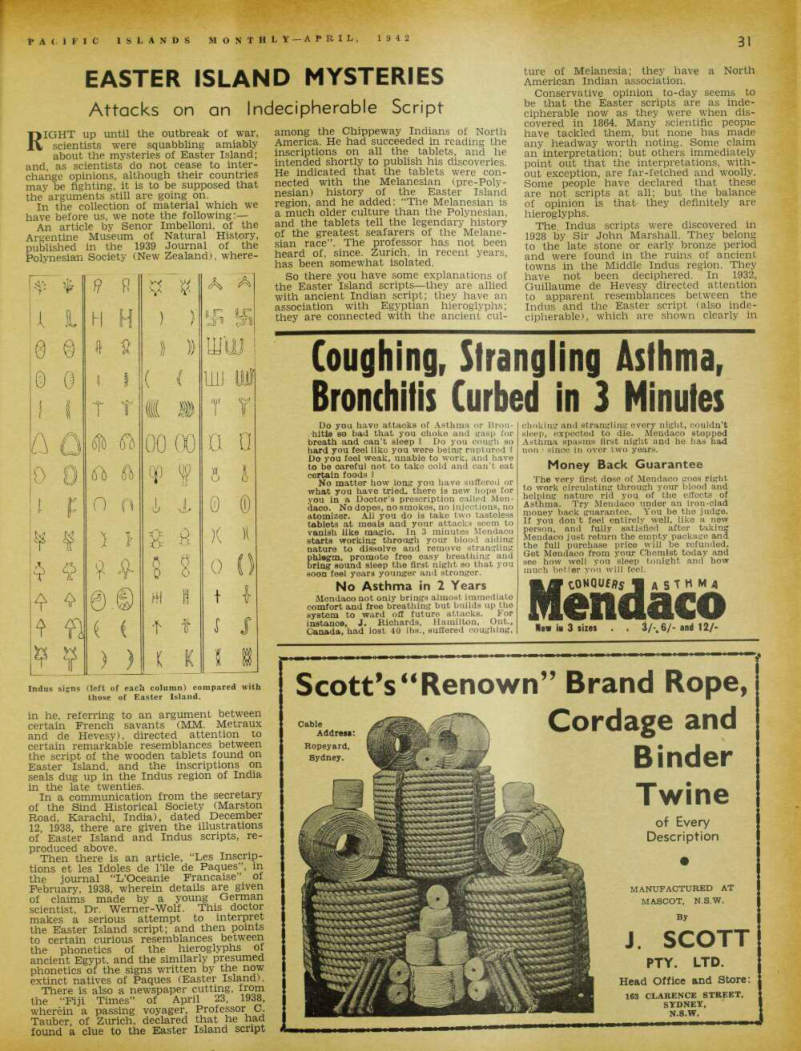
Attacks on an Indecipherable Script
RIGHT up until the outbreak of war, scientists were squabbling amiably about the mysteries of Easter Island; and, as scientists do not cease to inter change opinions, although their countries may be fighting, it is to be supposed that the arguments still are going on.
In the collection of material which we have before us, we note the following:— An article by Senor Imbelloni, of the Argentine Museum of Natural History, published in the 1939 Journal of the Polynesian Society (New Zealand), where-
in he, referring to an argument between certain French savants (MM. Metraux and de Hevesy), directed attention to certain remarkable resemblances between the script of the wooden tablets found on Easter Island, and the inscriptions on seals dug up in the Indus region of India in the late twenties.
In a communication from the secretary of the Sind Historical Society (Marston Road, Karachi, India), dated December 12, 1938, there are given the illustrations of Easter Island and Indus scripts, re produced above.
Then there is an article, “Les Inscrip tions et les Idoles de Tile de Paques”, m the journal “L’Oceanie Francaise” of February, 1938, wherein details are given of claims made by a young German scientist, Dr. Werner-Wolf. This doctor makes a serious attempt to interpret the Easter Island script; and then points to certain curious resemblances between the phonetics of the hieroglyphs of ancient Egypt, and the similarly presumed phonetics of the signs written by the now extinct natives of Paques (Easter Island).
There is also a newspaper cutting, from the “Fiji Times” of April 23, 1938, wherein a passing voyager, Professor C.
Tauber, of Zurich, declared that he had found a clue to the Easter Island script
among the Chippeway Indians of North America. He had succeeded in reading the inscriptions on all the tablets, and he intended shortly to publish his discoveries.
He indicated that the tablets were con nected with the Melanesian (pre-Poly nesian) history of the Easter Island region, and he added: “The Melanesian is a much older culture than the Polynesian, and the tablets tell the legendary history of the greatest seafarers of the Melane sian race”. The professor has not been heard of, since. Zurich, in recent years, has been somewhat isolated.
So there you have some explanations of the Easter Island scripts—they are allied with ancient Indian script; they have an association with Egyptian hieroglyphs; they are connected with the ancient cul
ture of Melanesia; they have a North American Indian association.
Conservative opinion to-day seems to be that the Easter scripts are as inde cipherable now as they were when dis covered in 1864. Many scientific people have tackled them, but none has made any headway worth noting. Some claim an interpretation; but others immediately point out that the interpretations, with out exception, are far-fetched and woolly.
Some people have declared that these are not scripts at all; but the balance of opinion is that they definitely are hieroglyphs.
The Indus scripts were discovered in 1928 by Sir John Marshall. They belong to the late stone or early bronze period and were found in the ruins of ancient towns in the Middle Indus region. They have not been deciphered. In 1932, Guillaume de Hevesy directed attention to apparent resemblances between the Indus and the Easter script (also inde cipherable), which are shown clearly in
Indus signs (left of each column) compared with those of Easter Island.
the accompanying illustration. In fact, the resemblance seemed too marked to be true, and another French savant, Dr.
Alfred Metraux, suggested that de Hevesy, moved by his enthusiasm, “sligntly modi fied the original symbols and accentuated similitudes”.
The controversy extended over years, and the subsequent evidence included a statement by Professor G. R. Hunter that he had carefully examined the two lists of symbols, and that de Hevesy had re produced them “with scrupulous and indeed remarkable exactitude”.
It is worth noting, here, that Senor Imbelloni apparently subscribes to the theory of ancient Melanesian populations in the regions which now comprise Polynesia.
Dr. Werner-Wolf rejects the autoch thone hypothesis (that the mysterious culture of Easter Island originated there), and proceeds to search for its affinities — a search that has been going on ever
!^ C 0 j' he masses of statues were dis seripq6dnfln n\ 122, and the scri P t (on a u f • 2 -° wo oden tablets) by the french missionary-priest Cyraud in 1864. dl( ? n °t a ttempt to decipher the tablets; but in 1868, M. Jaussen, of Tahiti, found an old Easter Islander who declared TQnc C c oUld gl Y e ? general interpretation.
Jaussen made long lists of the hiero glyphs, and put opposite each, in the Easter, the interpretation given by the old native. Jaussen decided, eventually, that the interpretations were not sound, and ceased his investigation.
Fortunately his lists were not destroyed: and now Dr. Werner-Wolf. in the light blwi e i at S r £ n o wle dge, finds these lists helpfu! He believes that the initial sylla bles of the words represented by the glyphs form the names of the dead chiefs whom the ancient writers set out to commemorate. From that point, he finds certain affiliations with Egyptian hiero glyphs. It is a fascinating theory—even if far-fetched.
Advertisements & other items, pp. 33-34 (2 items)
31
t> a«.i f i c islands monthly April, 1942
Mendaco
Coughing, Strangling Asthma, Bronchitis Curbed in 3 Minutes
Do you have attacks of Asthma or Bronhitis so bad that you choke and gasp for breath and can’t sleep ? Do you cough so hard you feel like you were being ruptured ?
Do you feel weak, unable to work, and have to be careful not to take cold and can’t eat certain foods ?
No matter how long you have suffered or what you have tried, there is new hope for you in a Doctor’s prescription called Mendaco. No dopes, no smokes, no injections, no atomizer. All you do is take two tasteless tablets at meals and your attacks seem to vanish like magic. In 3 minutes Mendaco starts working through your blood aiding nature to dissolve and remove strangling phlegm, promote free easy breathing and bring sound sleep the first night so that you soon feel years younger and stronger.
No Asthma in 2 Years
Mendaco not only brings almost immediate comfort and free breathing but builds up the system to ward off future attacks. For instance, J. Richards, Hamilton, Ont., Canada, had lost 40 lbs., suffered coughing.
choking and strangling every night, couldn’t sleep, expected to die. Mendaco stopped Asthma spasms first night and he has had non ' since in over two years.
Money Back Guarantee
The very first dose of Mendaco goes right to work circulating through your blood and helping nature rid you of the effects of Asthma. Try Mendaco under an iron-clad money back guarantee. You be the judge.
If you don’t feel entirely well, like a new Serson, and fully satisfied after taking iendaco just return the empty package and the full purchase price will be refunded.
Get Mendaco from your Chemist today and see how well you sleep tonight and how much better yon will feel. ma CONQU£fly A s T M M 4
Mendaco
in 3 sizes
3/-, 6/- and 12/-
Scott’s “Renown” Brand Rope,
Cordage and
Binder
Cable Address: Ropeyard Sydney.
M
Twine
of Every
Description
MANUFACTURED AT
MASCOT, N.S.W.
By
J. SCOTT
PTY. LTD.
Head Office and Store:
163 CLARENCE STREET,
SYDNEY,
N.S.W.
. B. DONALD Ltd.
AUCKLAND
ISLAND TRADERS & GENERAL MERCHANTS
P O. Box 1509.
Cables & Telegrams, "Kingdom", Auckland.
All over the British Empire, every minute of every day, more and more smokers are saying, "Better buy Capstan they're blended better."
CAPSTAN
Cigarettes and Tobacco
The "In-betweens"
Political Aspects of the Post-war Problems
QOME day; this war will be over. What then? No one believes that we shall go back to the bad old politico-economic system of 1918-1939. Then who is to create the new system, and how? An increasing number of people are asking QllCSllOyiS, The following is a striking extract from a private letter written by a young woman from New Guinea—she was on the Sepik Goldfield for a while—to the editor of the PIM. It was not written for publication; but it shows how the younger generation are thinking.
IF the next half of my life is to mean only further disillusionment—well what the dickens is the use? Think pack to the time when you had reached the stage I have to-day. Who stood the oetter chance of getting anywhere? Did you, with the set of circumstances you had to lick—or do I with the kind of future we have to face?
I think it is my generation that stands to lose most. Yours takes an attitude hke this: “What have I done that this should come upon me at this late date?” —and appears to get some sort of satis faction from it. The very young are frankly bored, or excited, but as they hadnt begun to find their feet, the after math of all this won’t be so tough on them. & But the poor darned in-between people who had just got themselves and their goal sorted out, and had begun to step forward to it, take it on the chin from all directions. It isn’t going to be so easy for them to pick up the pieces and fit them into a workable whole. Yet they are the class on whom this so-called new order or reconstruction is going to depend Well, let’s hope they make a better job of it for those flowing along than the last generation did for us. They couldn’t do much worse, that’s pretty certain. The hectic “twenties”, then the depression just as most of us were leaving school, no jobs, the dole, money-grabbing monop olies, wind-bag degenerate politicians!
It sure was a fine Peace. We must have another one some time!
It’s a never-ending source of amuse ment to me to gather people’s idea of what this “new order” is to be. Fifty per cent, still think in terms of the past; 49 per cent, feel that something different would be desirable, but they don’t know what; and one per cent, are pretty frantic about it.
I think that it is going to be wished on us, whether we want it or not; but anything lasting can only be born of a nation that has reached the bed-rock of misery—however else will it be possible to get everyone of one mind and with one thought?
Death Of Mr. Frank
Hambridge
MR. Frank Hambridge, of Wahroonga, who died in Sydney on March 17, was a metallurgical accountant and well known in Papua and New Guinea.
He was chairman oT directors of Cuth bert’s Misima Gold Mine Ltd., Papua, and was for some years chairman of directors of New Guinea Goldfields Ltd., and a director of Mount Isa Mines.
The Administrator of Papua, Mr.
Leonard Murray, after spending several busy weeks in Sydney and Canberra at tending to the affairs of his Territory, is now living quietly at Manly, Sydney.
Advertisements & other items, p. 34 (1 item)
32
April, 19 4 2 -paciflc islands monthly
Evacuees from NG and Papua
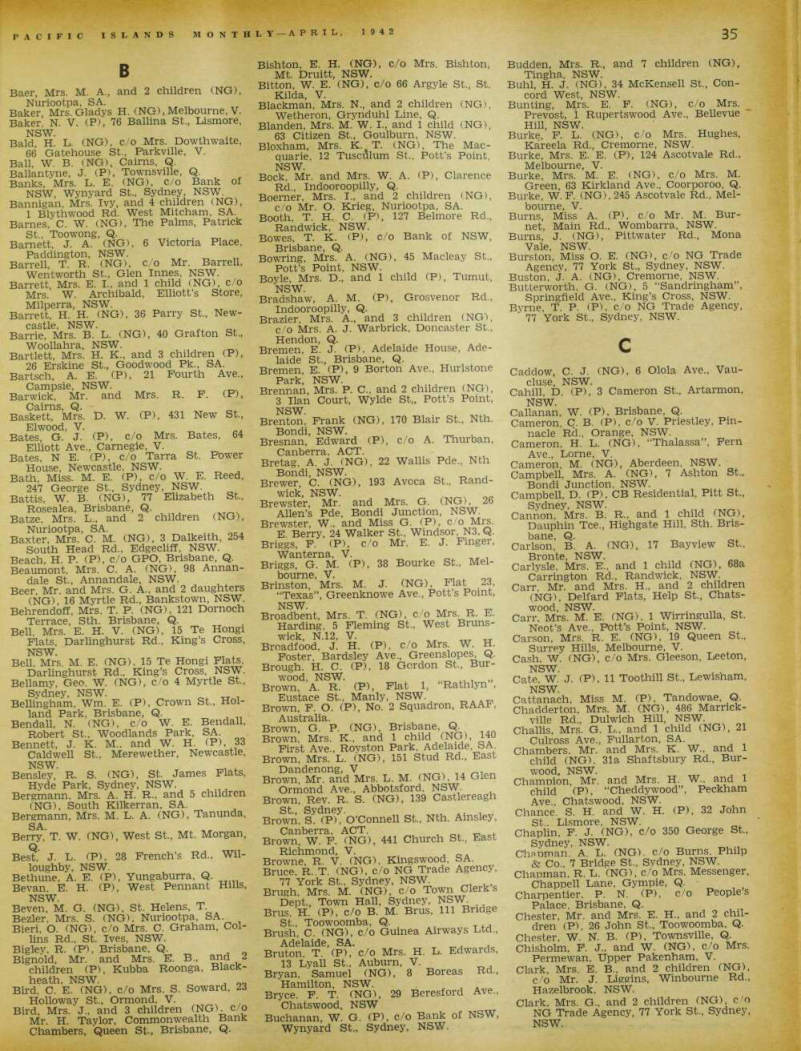
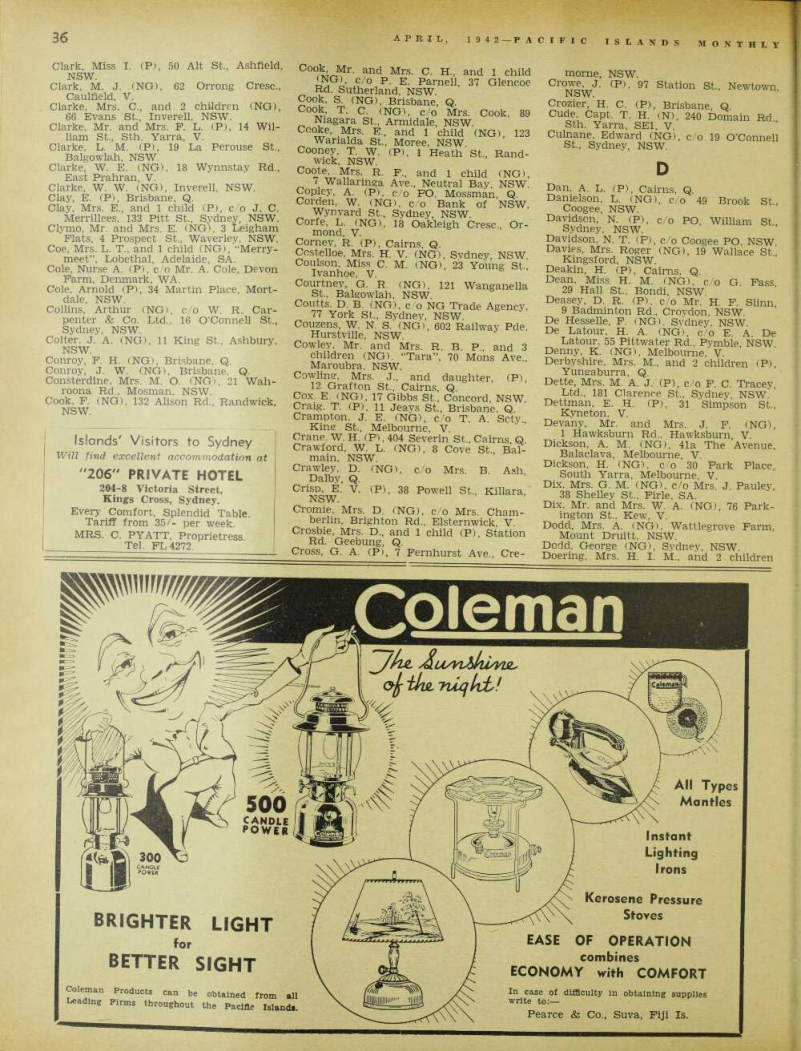
Full List of Australian Addresses
rE following list, together with similar details published in the Feb ruary and March issues of “PIM”, represents an almost complete register of New Guinea and Papua residents who have been evacuated to Australia.
Most of the names have been courte ously made available by the New Guinea Trade Agency, Sydney; the remainder have been compiled by our staff from various sources. A large proportion of them —mostly men—are additions to the already-published lists: in other cases, they record changes of address.
Further names will be published each month in “PIM”. as they come to hand —therefore, Territories residents whose names and full addresses have not ap peared in these lists are requested to forward their postal addresses to the NG Trade Agency, Grace Building, 77 York St., Sydney, or to Pacific Publications Pty. Ltd., 247 George St., Sydney.
A Abbie, Mrs. A. E., and 1 child (P), 16 Fletcher Ave., Bondi, NSW.
Abbie, W. C. (NG), 63 Fletcher Ave., Bondi, NSW.
Abel, Misses P. and M. (P), c/o W. E.
Reed, 247 George St., Sydney, NSW.
Adams, E. H. (P), 474 Pacific Highway, Artarmon, NSW.
Adams, Mrs. Una, and 3 children (NG), 31 Victoria St., Roseville, NSW.
Adamson, W. T. (NG), c/o R. Adamson, Lockhart St., Caulfield, Melbourne, V.
Addison, S. J. (PL Ringwood, V.
Alexander, Miss M. (P), Brisbane, Q.
Allen, Miss Alice (NG), c/o Mr. Allen,
Ravenshoe, Q.
Allen, Mrs. Annie, and 2 children (NG), c/o Mrs. T. W. Jones, 23 Braddon St., Mortlake, NSW.
Alley, Mrs. R. L„ and 2 children (NG), c/o Mr. Ashley, Riverton, NZ.
Allison, Mr. and Mrs. Edward (NG), 32 Carlotta Ave., Gordon, NSW.
Altria, Mrs. Beatrice (NG), 174 Parra matta Rd., Homebush, NSW.
Andersen, Capt. C. O. (P), c/o Mrs. Sulli van, “Windsor”, Green Terrace, Bris bane, Q.
Anderson, Charles O. (NG), 48 Wells St., Birkenhead, Adelaide, SA.
Anderson, D. M. (NG),c/o W. F. Anderson, Cresswick St., Clayfield, Brisbane, Q.
Anderson, James W. (NG), Warrawee,
Nsw.
Anderson, F. K. J. (NG), c/o Bank of NSW, Sydney.
Anderson, S. D. (NG), 11 Mary St., Launceston, T.
Anderson, Miss T. M. (NG), c/o W.
Patterson, Cribb Point, V.
Arboin, C. (P), 3 Raglan St., Mosman,
Nsw.
Archer, R. (P). “Kingslyn”, Kirribilli Ave., Nth. Sydney, NSW.
Argent, Mrs. Ivy, and 1 child (P), Eirious St., Cooparoo, Q.
Armstrong, Mr. and Mrs. K. C., and 1 child (P), 47 The Avenue, Strathfield,
Nsw.
Armstrong, Mrs. Ellen (NG), Flat 42, Hampton Court, King’s Cross, NSW.
Ashbrook, Mr. and Mrs. Eric (P), 108 Perouse Rd., Randwick, NSW.
Ashby, Mrs. Emily, and 3 children (NG), c/o Mrs. Gilbert, 87 High St., Glen Iris, V.
Ashcroft, J. (NG). In Australia.
Ashley, Mrs. V. A., and 1 child (P), Ingham, Q.
Ashton, S. J. (P), 5 Salisbury St., Unley, SA.
Ashwell, Mr. and Mrs. E. H. (NG), 14 Glen Ormond Ave., Abbotsford, NSW.
Atherton, Mrs. I. M., and 2 children (NG), c/o Mrs. G. Adams, Nebo Rd., Mackay, Q.
Atkins, Mrs. A. R., and 2 children (NG), The Hydro, Warburton, V.
Atkinson, O. J. (P), c/o Bank of NSW (Tourist Branch), George St., Sydney,
Nsw.
Auerback, E. A. (P), Wyabalena Rd., Hun ter’s Hill, NSW.
Austin, E. P. (P), c/o Mrs. Austin, “Stonehaven”, Silver St., Bondi, NSW.
Avenell, H. J. S. (NG), Crofton St., Bun daberg, Q.
Avery, E. A. (NG), 12 Gray St., Kogarah,
Nsw.
Avery, G. D. (NG), 6 Cook St., Croydon Park. NSW.
Ayris, Major E. B. (NG), “Tudor”, 106 Elizabeth Bay Rd., Elizabeth Bay,
Nsw.
Ayton, Miss C. H. (NG), 36 Durham Rd., Lambton, NSW.
B Baer, Mrs. M. A., and 2 children (NG), Nuriootpa, SA.
Baker, Mrs. Gladys H. (NG), Melbourne, V.
Baker, N. V. (P), 76 Ballina St., Lismore,
Nsw.
Bald, H. L. (NG), c/o Mrs. Dowthwaite, 66 Gatehouse St., Parkville, V.
Ball, W. B. (NG), Cairns, Q.
Ballantyne, J. (P), Townsville, Q.
Banks, Mrs. L. E. (NG), c/o Bank of NSW, Wynyard St., Sydney, NSW.
Bannigan, Mrs. Ivy, and 4 children (NG), 1 Blythwood Rd. West Mitcham, SA.
Barnes, C. W. (NG), The Palms, Patrick St., Toowong, Q. . x Barnett, J. A. (NG), 6 Victoria Place, Paddington, NSW.
Barrel!, T. R. (NG), c/o Mr. Barrel!, Wentworth St., Glen Innes, NSW.
Barrett, Mrs. E. 1., and 1 child (NG), c/o Mrs. W. Archibald, Elliott’s Store, Milperra, NSW.
Barrett, H. H. (NG), 36 Parry St., New castle NSW.
Barrie, Mrs. B. L. (NG), 40 Grafton St., Woollahra, NSW.
Bartlett, Mrs. H. K., and 3 children (P), 26 Erskine St., Goodwood Pk., SA.
Bartsch, A. E. (P), 21 Fourth Ave., Campsie, NSW.
Barwick, Mr. and Mrs. R. F. (P), Cairns, Q.
Baskett, Mrs. D. W. (P), 431 New St., Elwood, V.
Bates, G. J. (P), c/o Mrs. Bates, 64 Elliott Ave., Carnegie, V.
Bates, N E. (P), c/o Tarra St. Power House, Newcastle. NSW.
Bath, Miss. M. E. (P), c/o W. E. Reed, 247 George St., Sydney, NSW.
Battis, W. B. (NG), 77 Elizabeth St., Rosealea, Brisbane, Q.
Batze, Mrs. L., and 2 children (NG), Nuriootpa, SA.
Baxter, Mrs. C. M. (NG), 3 Dalkeith, 254 South Head Rd., Edgecliff, NSW.
Beach, H. P. (P), c/o GPO, Brisbane, Q.
Beaumont, Mrs. C. A. (NG), 98 Annan dale St., Annandale, NSW.
Beer, Mr. and Mrs. G. A., and 2 daughters (NG), 16 Myrtle Rd., Bankstown, NSW.
Behrendoff, Mrs. T. P. (NG), 121 Dornoch Terrace, Sth. Brisbane, Q.
Bell, Mrs. E. H. V. (NG), 15 Te Hongi Flats, Darlinghurst Rd., King’s Cross,
Nsw.
Bell. Mrs. M. E. (NG), 15 Te Hongi Flats, Darlinghurst Rd.. King’s Cross, NSW.
Bellamy, Geo. W. (NG), c/o 4 Myrtle St., Sydney, NSW. „ .
Bellingham, Wm. E. (P), Crown St., Hol land Park, Brisbane, Q.
Bendall, N. (NG), c/o W. E. Bendall, Robert St., Woodlands Park, SA.
Bennett, J. K. M.. and W. H. (P), 33 Caldwell St., Merewether, Newcastle,
Nsw. .
Bensley, R. S. (NG), St. James Flats, Hyde Park, Sydney, NSW.
Bergmann, Mrs. A. H. R., and 5 children (NG), South Kilkerran, SA.
Bergmann, Mrs. M. L. A. (NG), Tanunda, SA.
Berry, T. W. (NG), West St., Mt. Morgan, Q.
Best, J. L. (P), 28 French’s Rd., Wil loughby, NSW.
Bethune, A. E. (P), Yungaburra, Q.
Bevan. E. H. (P), West Pennant Hills,
Nsw. M
Beven, M. G. (NG), St. Helens, T.
Bezier, Mrs. S. (NG), Nuriootpa, SA Bieri, O. (NG), c/o Mrs. C. Graham, Col lins Rd., St. Ives, NSW.
Bigley, R. (P), Brisbane, Q.
Bignold, Mr. and Mrs. E. 8., and 2 children (P), Kubba Roonga, Black heath, NSW. J no Bird. C. E. (NG), c/o Mrs. S. Soward, 23 Holloway St., Ormond. V.
Bird. Mrs. J., and 3 children (NG). c/o Mr. H. Taylor, Commonwealth Bank Chambers, Queen St., Brisbane, Q.
Bishton, E. H. (NG), c/o Mrs. Bishton, Mt. Druitt, NSW.
Bitton, W. E. (NG), c/o 66 Argyle St., St.
Kilda, V.
Blackman, Mrs. N., and 2 children (NG), Wetheron, Grynduhl Line, Q.
Blanden, Mrs. M. W. 1., and 1 child (NG), 63 Citizen St., Goulburn, NSW.
Bloxham, Mrs. K. T. (NG), The Mac quarie, 12 Tusculum St., Pott’s Point,
Nsw.
Bock, Mr. and Mrs. W. A. (P), Clarence Rd., Indooroopilly, Q.
Boerner, Mrs. 1., and 2 children (NG), c/o Mr. O. Krieg, Nuriootpa, SA.
Booth, T. H. C. (P), 127 Belmore Rd., Randwick, NSW.
Bowes, T. K. (P), c/o Bank of NSW, Brisbane, Q.
Bowring, Mrs. A. (NG), 45 Macleay St., Pott’s Point, NSW.
Boyle, Mrs. D„ and 1 child (P), Tumut,
Nsw.
Bradshaw, A. M. (P), Grosvenor Rd., Indooroopilly, Q.
Brazier, Mrs. A., and 3 children (NG), c/o Mrs. A. J. Warbrick, Doncaster St., Hendon, Q. . , Bremen, E. J. (P), Adelaide House, Ade laide St., Brisbane, Q.
Bremen, E. (P), 9 Borton Ave., Hurlstone Park, NSW.
Brennan, Mrs. P. C., and 2 children (NG), 3 Han Court, Wylde St„ Pott’s Point,
Nsw.
Brenton, Frank (NG), 170 Blair St., Nth.
Bondi, NSW. , Bresnan, Edward (P), c/o A. Thurban, Canberra, ACT.
Bretag, A. J. (NG), 22 Wallis Pde., Nth Bondi, NSW. „ „ J Brewer, C. (NG), 193 Avoca St., Rand wick, NSW. Brewster, Mr. and Mrs. G. (NG), 26 Allen’s Pde, Bondi Junction, NSW.
Brewster, W., and Miss G. (P), c/o Mrs.
E Berry, 24 Walker St., Windsor, N 3, Q.
Briggs, F. (P), c/o Mr. E. J. Finger, Wanterna, V. .
Briggs, G. M. (P), 38 Bourke St., Mel- Brinston, Mrs. M. J. (NG), Flat 23, “Texas”, Greenknowe Ave., Pott’s Point,
Nsw. , „
Broadbent, Mrs. T. (NG), c/o Mrs. R. E.
Harding, 5 Fleming St., West Bruns wick, N. 12, V.
Broadfood, J. H. (P), c/o Mrs W. H.
Foster, Bardsley Ave., Greenslopes, Q.
Brough. H. C. (P), 18 Gordon St., Bur wood, NSW. .. . „ Brown, A. R. (P), Flat 1, “Rathlyn”, Eustace St., Manly, NSW.
Brown, F. O. (P), No. 2 Squadron, RAAF, Australia. Brown, G. P. (NG), Brisbane, Q.
Brown, Mrs. K., and 1 child (NG), 140 First Ave., Royston Park, Adelaide, SA Brown, Mrs. L. (NG), 151 Stud Rd., East Dandenong, V „ Brown, Mr. and Mrs. L. M. (NG), 14 Glen Ormond Ave., Abbotsford, NSW.
Brown, Rev. R. S. (NG), 139 Castlereagh Brown, lT(P)^'O’Connell St., Nth. Ainsley, Canberra, ACT.
Brown, W. F. (NG), 441 Church St., East Richmond. V. .
Browne, R. V. (NG), Kingswood, SA.
Bruce. R. T. (NG), c/o NG Trade Agency, 77 York St.. Sydney, NSW.
Brugh, Mrs. M. (NG), c/o Town Clerks Dept., Town Hall, Sydney, NSW.
Brus, H. (P), c/o B. M. Brus, 111 Bridge St., Toowoomba, Q. . , Brush, C. (NG), c/o Guinea Airways Ltd., Adelaide, SA. , .
Bruton, T. (P), c/o Mrs. H. L. Edwards, 13 Lyall St., Auburn, V.
Bryan, Samuel (NG), 8 Boreas Rd..
Hamilton, NSW.
Bryce. F. T. (NG), 29 Beresford Ave., Chatswood, NSW Buchanan, W. G. (P), c/o Bank of NSW, Wynyard St., Sydney, NSW.
Budden, Mrs. R., and 7 children (NG), Tingha, NSW.
Buhl, H. J. (NG), 34 McKensell St., Con cord West, NSW.
Bunting, Mrs. E. F. (NG), c/o Mrs.
Prevost, 1 Rupertswood Ave., Bellevue Hill, NSW.
Burke, F. L. (NG), c/o Mrs. Hughes, Kareela Rd., Cremorne, NSW.
Burke, Mrs. E. E. (P), 124 Ascotvale Rd., Melbourne. V.
Burke, Mrs. M. E. (NG), c/o Mrs. M.
Green, 63 Kirkland Ave., Coorporoo, Q.
Burke, W. F. (NG), 245 Ascotvale Rd., Mel bourne, V.
Burns, Miss A. (P), c/o Mr. M. Bur net, Main Rd., Wombarra, NSW.
Burns, J. (NG), Pittwater Rd., Mona Vale, NSW.
Burston, Miss O. E. (NG), c/o NG Trade Agency, 77 York St., Sydney, NSW.
Buston, J. A. (NG), Cremorne, NSW.
Butterworth, G. (NG), 5 “Sandringham”, Springfield Ave., King’s Cross, NSW.
Byrne, T. P. (P), c/o NG Trade Agency, 77 York St., Sydney, NSW.
C Caddow, C. J. (NG), 6 Olola Ave., Vau cluse. NSW.
Cahill, D. (P), 3 Cameron St., Artarmon,
Nsw.
Callanan, W. (P), Brisbane, Q.
Cameron, C. B. (P), c/o V. Priestley, Pin nacle Rd., Orange, NSW.
Cameron. H. L. (NG), “Thalassa”, Fern Ave., Lome, V.
Cameron. M. (NG), Aberdeen, NSW.
Campbell, Mrs. A. (NG), 7 Ashton St., Bondi Junction, NSW.
Campbell, D. (P), CB Residential, Pitt St., Sydney, NSW.
Cannon, Mrs. B. R.. and 1 child (NG), Dauphin Tee., Highgate Hill, Sth. Bris bane, Q.
Carlson, B. A. (NG), 17 Bay view St., Bronte, NSW. x Carlysle, Mrs. E., and 1 child (NG), 68a Carrington Rd., Randwick, NSW.
Carr, Mr. and Mrs. H., and 2 children (NG), Delfard Flats, Help St., Chats wood, NSW. . „ Carr, Mrs. M. E. (NG). 1 Wirrmgulla, St.
Neot’s Ave., Pott’s Point, NSW.
Carson, Mrs. R. E. (NG), 19 Queen St., Surrey Hills, Melbourne, V.
Cash. W. (NG), c/o Mrs. Gleeson, Leeton,
Nsw.
Cate. W. J. (P), 11 Toothill St., Lewisham,
Nsw.
Cattanach, Miss M. (P), Tandowae, Q.
Chadderton, Mrs. M. (NG), 486 Marnck ville Rd., Dulwich Hill, NSW.
Ohallis, Mrs. G. L„ and 1 child (NG), 21 Culross Ave., Fullarton, SA.
Chambers. Mr. and Mrs. K. W.. and 1 child (NG), 31a Shaftsbury Rd., Bur wood. NSW.
Chamnion, Mr. and Mrs. H. W.. and 1 child (P), “Cheddywood”, Peckham Ave., Chatswood, NSW.
Chance. S. H. and W. H. (P), 32 John St.. Lismore, NSW.
Chaplin. F. J. (NG), c/o 350 George St., Sydney, NSW.
Chanman. A. L. (NG). c/o Burns. Philp & Co., 7 Bridge St., Sydney, NSW.
Chapman, R. L. (NG), c/o Mrs. Messenger, Chappell Lane, Gympie, Q.
Charpentier, P. N. (P), c/o Peoples Palace. Brisbane. Q.
Chester, Mr. and Mrs. E. H., and 2 chil dren (P), 26 John St., Toowoomba, Q.
Chester. W. N. B. (P). Townsville, Q.
Chisholm, F. J., and W. (NG), c/o Mrs.
Permewan, Upper Pakenham, V.
Clark, Mrs. E. 8.. and 2 children (NG), c/o Mr. J. Liggins, Winbourne Rd., Hazelbrook, NSW.
Clark. Mrs. G., and 2 children (NG), c'n NG Trade Agency, 77 York St., Sydney,
Nsw.
Clark, Miss I. (P), 50 Alt St., Ashfield,
Nsw.
Clark, M. J. .(NG), 62 Orrong Cresc., Caulfield. V.
Clarke, Mrs. C., and 2 children (NG), 66 Evans St., Inverell, NSW.
Clarke, Mr. and Mrs. F. L. (P), 14 Wil liam St., Sth. Yarra, V.
Clarke, L. M. (P), 19 La Perouse St., Balgowlah, NSW.
Clarke, W. E. (NG), 18 Wynnstay Rd., East Prahran, V.
Clarke, W. W. (NG), Inverell, NSW.
Clay, E. (P), Brisbane, Q.
Clay, Mrs. E., and 1 child (P), c/o J. C.
Merrillees, 133 Pitt St., Sydney, NSW.
Clymo, Mr. and Mrs. E. (NG), 3 Leigham Flats, 4 Prospect St., Waverley, NSW.
Coe, Mrs. L. T., and 1 child (NG), “Merry meet”, Lobethal, Adelaide, SA.
Cole, Nurse A. (P), c/o Mr. A. Cole, Devon Farm, Denmark, WA.
Cole, Arnold (P), 34 Martin Place, Mort dale, NSW.
Collins, Arthur (NG), c o W. R. Car penter & Co. Ltd., 16 O’Connell St, Sydney, NSW.
Colter, J. A. (NG), 11 King St., Ashbury,
Nsw.
Conroy, F. H. (NG), Brisbane, Q.
Conroy, J. W. (NG), Brisbane. Q.
Consterdine, Mrs. M. O. (NG), 21 Wah roona Rd., Mosman, NSW.
Cook, F. (NG), 132 Alison Rd., Randwick,
Nsw.
Coo £;J^ r - and Mrs - c - H., and 1 child I C// ° p - E - Par nell, 37 Glencoe Rd. Sutherland. NSW.
Cook, S. (NG), Brisbane, Q.
Cook, T. C. (NG), c/o Mrs. Cook, 89 Niagara St., Armidale, NSW. c °o£ e , Mrs. E., and 1 child (NG), 123 Wanalda St, Moree, NSW.
Cooney, T. W. (P), 1 Heath St, Rand wick, NSW.
Co °, te ’ Mrs. P- F-. and 1 child (NG), 7 Wallaringa Ave., Neutral Bay, NSW.
Copley, A. (P), c/o P'O. Mossman, Q.
Corden, W. (NG), c/o Bank of NSW, Wynyard St., Sydney, NSW.
Corfe, L. (NG), 18 Oakleigh Cresc., Or mond, V.
Cornev, R. (P), Cairns, Q.
Costelloe, Mrs. H. V. (NG), Sydney, NSW.
Coulson, Miss C. M. (NG), 23 Young St..
Ivanhoe, V.
Courtney, G. R (NG), 121 Wanganella St., Balgowlah, NSW.
Coutts. D. B. (NG), c/o NG Trade Agency, 77 York St, Sydney, NSW.
Couzens, W. N. S. (NG), 602 Railway Pde.
Hurstville, NSW.
Cowley. Mr. and Mrs. R. B. P, and 3 children (NG). “Tara”, 70 Mons Ave., Maroubra. NSW.
Cowling, Mrs. J., and daughter, (P) 12 Grafton St, Cairns, Q.
Cox. E. (NG), 17 Gibbs St., Concord, NSW.
Craig. T. (P). 11 Jeays St, Brisbane. Q.
Crampton. J. E. (NG), c/o T. A. Scty., King St, Melbourne, V.
Crane. W. H. (P), 404 Severin St., Cairns, Q.
Crawford, W. L. (NG), 8 Cove St., Bal main, NSW.
Crawley, D. (NG), c/o Mrs. B. Ash Dalby, Q.
Crisp, E. V. (P), 38 Powell St. Killara,
Nsw.
Cromie, Mrs. D. (NG), c/o Mrs. Cham berlin, Brighton Rd., Elsternwick, V Crosbie, Mrs. D., and 1 child (P), Station Rd. Geebung, Q.
Cross, G. A. (P), 7 Fernhurst Ave., Cre
morne, NSW.
Crc^o4Tr J ' 9,7 Station St., Newtown,
Nsw.
Crozier, H. C. (P), Brisbane, Q.
Cude, Capt. T. H. (N), 240 Domain Rd Sth. Yarra, SEI, V.
Culnane, Edward (NG), c/o 19 O’Connell St., Sydney, NSW.
D Dan, A. L. (P), Cairns, Q.
Danielson, L. (NG), c/o 49 Brook St., Coogee, NSW.
Davidson, N. (P), c/o PO, William St., Sydney, NSW.
Davidson, N. T. (P), c/o Coogee PO, NSW Davies, Mrs. Roger (NG), 19 Wallace St., Kmgsford, NSW.
Deakin, H. (P), Cairns, Q.
Dean, Miss H. M. (NG), c/o G. Fass, 29 Hall St., Bondi, NSW Deasey, D. R. (P). c /o Mr. H. F. Slinn 9 Badminton Rd., Crovdon, NSW.
De Hesselle, F. (NG). Sydney, NSW.
De Latour, H. A. (NG), c/o E. A. De Latour, 55 Pittwater Rd., Pymble, NSW Denny, K. (NG), Melbourne, V.
Derbyshire, Mrs. M„ and 2 children (P), Yungaburra, Q.
Dette, Mrs. M. A. J. (P), c/o F. C. Tracey, Ltd., 181 Clarence St.. Sydney, NSW.
Dettman, E. H. (P), 31 Simpson St., Kyneton. V.
Devany, Mr. and Mrs. J. F. (NG), 1 Hawksburn Rd.. Hawksburn, V.
Dickson, A. M. (NG), 41a The Avenue, Balaclava, Melbourne, V.
Dickson, H. (NG). c/o 30 Park Place, South Yarra, Melbourne, V.
Dix, Mrs. G. M. (NG), c/o Mrs. J. Pauley, 38 Shelley St., Firle, SA.
Dix, Mr. and Mrs. W. A. (NG), 76 Park ington St., Kew, V.
Dodd, Mrs. A. (NG). Wattlegrove Farm, Mount Druitt, NSW.
Dodd, George (NG), Sydney, NSW.
Doering. Mrs. H. I. M . and 9 nbiidrpn
(NG), Bethania Junction, Q.
Doherty, H. F. (P), Ardoyne Rd., Oxley, Q.
Dolton, F. (NG), 27 Dudley St., Bondi,
Nsw.
Donald, R. (P), 189 Lake St., Cairns, Q.
Donaldson, Mr. and Mrs, R. C., and family (P), 7 Templeton Flats, Holds worth Ave., Elizabeth Bay, NSW.
Donovan, Mrs. E. (NG), 136 Darling hurst Rd., Darlinghurst, NSW.
Doran, Mr. and Mrs. J. H. and 1 child (NG), c/o Hughes’ Stores, North En trance, Tuggerah Lakes, NSW.
Dougherty, C. A. (P), 38 Alfred St., Gympie, Q.
Downs, Mrs. M. (NG), 17 Heath St., Mel bourne, V.
Doyle, L. (P), Sydney, NSW Doyle, Mrs. M. (NG), c/o 30 Fox Valley Rd., Wahroonga, NSW.
Doyle, Mrs. N., and 2 children (NG), c/o Mrs. R. A. Brown, Dalblair, Gunnedah,
Nsw.
Drane, Mrs. E. A. H. (NG), c/o Mrs.
F W. Butler, Targunne, Yarwan, Q.
Draper, N. W. C. (P), c/o A. L. Nevitt & Co., 1887 W, GPO, Brisbane, Q.
Draper, F. M. (NG), Clifton St., Wilston, Sth. Brisbane, Q.
Drewe Mr. and Mrs. L. A., and 2 children (P)’, 49 Antill St., Wilston, Brisbane, Q.
Driver, C. H. (NG), c/o Mrs. C. Driver, Queen St., Woollahra, NSW.
Driver, J. H. (P), 21 Wilson St., East Malvern, V. , Driver, J. N. (P), Toowoomba, Q.
Drummond, A. D. (P), c/o Bank of NSW, Wynyard St., Sydney, NSW.
Dudley, Albert (NG), c/o Masonic Club, Castlereagh St., Sydney, NSW.
Dudley, Mrs. J. K. (NG), c/o PO, Caloun dra, Brisbane, Q.
Duncan, Mr. and Mrs. N. S. (NG), 43 Darling St., Chatswood, NSW. .
Dunlop, R. (NG), 28 Fortescue St., Bris bane, Q- „ Ql Dutton, M. J. (NG), Newnham St., Launceston, T.
E Earl, Mrs. C. (NG), 9 Chambers Ave., Bondi, NSW. , Earley, Mr. and Mrs. S. H. (NG), c/o Nelson & Robertson Ltd., Spring St., Sydney, NSW.
Ede, H. R., and I. (NG), Sydney, NSW Edwards, Mrs. S. J. (NG), 13 Young St., Annandale, NSW.
Edwards, D. (NG), 7 Park Ave., Drum moyne, NSW.
Eekhoff, Mrs. E. M„ and 1 child (NG), Wood St., Dalby, Q. , - TC .. r Eekhoff, F. (NG), c/o Bank of NSW, Brisbane, Q.
Eglinton, Mrs. J. M. (NG), 18 Muston St., Mosman, NSW.
Einsiedel, Mrs. D„ and daughter (NG), 1354 High St., Malvern, Melbourne, V.
Eldridge, R. H. (NG), 31 Stoddard St., Lakemba, NSW.
Elliott, N. M. (NG), 4 Fairlight St., Manly,
Nsw.
Elliott-Smith, Mrs. M., and 2 children (P), Warwick, Q.
Ellis, J. H. (NG), c/o Bank of NSW, Brisbane, Q.
Ellis, Mrs. K. (NG), 259 Doncaster Ave., Kingsford, NSW.
Ellis, T. W. (NG), c/o NG Trade Agency, 77 York St., Sydney, NSW.
English, A. C., and L. J. (P), c/o Mrs.
Debridge, 87 The Boulevarde, Lak emba, NSW.
Ericksen, C. T. (NG), Sydney, NSW.
Evans, C. (NG), c/o Colonial Sugar Re fining Co., Lautoka, Fiji.
Evenett, Mrs. A., and 1 child (P), Towns ville, Q.
Evenett, E. (P), Gordonvale, Q.
Ewan, R. J. (P), 6 Barncleuth Sq., King’s Cross, NSW.
F Farnham, C. E. (NG), 43 James St., Guilford, WA.
Farnsworth, Mr. and Mrs. L. C. (NG), AWA Ltd., 47 York St., Sydney, NSW.
Farr, Mrs. V. G., and 1 child (NG), Flat 2, 33 Park Ave., Ashfield, NSW.
Farrar, Mrs. V. M., and 2 children (P), Flat 2, 33 Reginald St., Cremorne,
Nsw.
Fay, Mr. and Mrs. L., and 2 children (P), Vanderbilt Flats, Barncleuth Sq., King’s Cross, NSW.
Featherstone, K. (P), Sydney, NSW.
Feetum, Mr. and Mrs. R. W., and 1 child (NG), 135 Weekly Rd., Ormond, V.
Ferguson, N. A. (NG), 73 Wynnum Rd., Brisbane, Q.
Ferries, Mrs. L., and 2 children (NG), c/o Mrs. F. Maples, 237 Cooma St., Yass,
Nsw.
Fisher, Rev. C. R. (P), c/o Rev. G. Farrie, 3 Graham St., Auburn, NSW.
Fisher, Dr. N. H. (NG), Victoria Pde, Clayfield, Q.
Fitch, A. O. (P), 171 Ben Boyd Rd., Neutral Bay, NSW.
Fitzgerald, M. F. (P), c/o NG Trade Agency, 77 York St., Sydney, NSW.
Fitzsimmons, S. (NG), c/o Mrs. Fitz simmons, Flinders St., Mt. Hawthorn, WA.
Fleming, Mrs. A. (NG), 22 Naldera St..
Glandore, SA.
Flower, T. (P), Wallaringa Mansions, Neutral Bay. NSW.
Foley, D. G. (P), c/o GPO, Brisbane, Q.
Forsyth, Mrs. G. M. J. 8., and 1 child (NG), Short St., Stanthorpe, Q.
Frame, Mr. and Mrs. E. J. (P),c/o Burns, Philp & Co., 7 Bridge St.. Sydney, Frank, Mrs. P., and 2 children (P). c/o RAAF Aeronautical Inspection Direc torate, De Haviland Aircraft Pty., Ltd., Mascot, NSW.
Franklin, Nurse M. A. (NG), c/o Travel Dept., Bank of NSW (HO), George St., Sydney, NSW.
Fraser. N. M. (NG), 43 Hastings Rd., Tullamulla, NSW.
Freeman, Mrs. J. I. (NG), 6 Dickenson Ave., Croydon, NSW.
Froggatt. Mrs. M. P. (NG), “The Cots wolds”, Taylor Ave., Wentworth Falls,
Nsw,
Fuller, Mrs. F. M. (NG), 25 Clanalpine St., Mosman, NSW.
Foley, J. V. (P), c/o “Hydro”, Warialda, Moree, NSW.
Furphy, A. T. (NG), 18 Rosebank St., Sydney, NSW.
G Gannon, Nurse J. M. (NG), c/o J. Gan non, Northbridge, NSW.
Garbutt, H. R. (P), c/o Garbutt Pty., Ltd., Townsville, Q.
Garrett, Mrs. N. E., and daughter (.NG), Savoy Flats, 10 Hardie St., Darling hurst, NSW.
Garvie, J. W. (P), PO, Gundagai, NSW.
Gascoigne, Miss B. B. (NG), 209 Mur rumbeena Rd., Murrumbeena, V.
Gaskin, A. J. (NG), c/o NG Trade Agency, 77 York St., Sydney, NSW.
Gay, G. (P), 21 St. Neot’s Ave., Pott’s Point, NSW.
Gay, Mr. and Mrs. R. (NG), 6 Valencia Flats, Blair St., Nth. Bondi, NSW.
Gazzard, Mrs. A. E., and 1 child (NG), c/o Messrs. Cummins & Wallace, Moree, NSW. o>TOTrrS’ 0 >TOTrr S ’ Wallacia, via Penrith,
Nsw.
G “ C B r 7*iM G 0 K ° bWe ’ Dayb ° r ° Line, via Brisbane, Q.
Qf « of NSW ' Ge S, 7 The Lang -
Gerstad, Mrs J E anrf 1 rbiin mn 41 TennysonSt SandriLw? v Gilbert, Mrs. L G c/o c w^Mc Donald ‘lnverness’’ ° n L„ S' Horsham y Verness » 36 Dooen Rd., Gilkison, Mrs A F N anH i nbim ,pi c 0 Mr. W Mill’ ss’’Main ’
dallah, Wdfin NZ ’
Gill, W. (P) c/o GPO Svdnpv ■ntsw Gillingwater, Mrs, B. (NG) Gulf Parade Brighton SA Gill . ln gwater. Mrs. L. M. (NG), 24 Preston Ave., Brighton SA Gi nve it & C °'
GI S R: west-.
Glasson R. (NG), c/o Mrs. Boyce, Ros cabel, Blackheath, NSW.
Gluyas, Mrs. 1., and 3 children (NG), M S Cummins & Wallace, Moree, NSW.
C°ad Mrs, M (NG), 256 Kepple St., Bathurst, NSW.
Go ? f l ' (NG) > 16 Jutland Pde, Dal keith, WA.
Godson, F. B. (P), c/o F. C. Tracy & NSW Ltd " 181 Clarence St -’ Sydney, Gcfton, *R. (NG), 40 Thomas St., Kan garoo Ft., Brisbane, Q.
Good Mrs. E. R. (NG), 37 Drumalbyn Rd., Bellevue Hill, NSW.
Go ??A. Mrs - K M - <NG), 25 Sutton St., Nth. Balwm, V.
Goodwin, Mrs. E. (NG), 21 Ripon Way Rosebery, NSW.
Goodwin, F. (NG), c/o Mrs. W. H. Jack son, 38 John St., Ashheld, NSW Goodwin, Mrs. S. V. (NG), 4 Darling Pt Rd., Darling Pt., NSW.
Goodwood, F. (NG), Cairns, Q.
Gordon, Mr. and Mrs. B. (NG), c/o Mrs.
Fraser, 154 Smith St., Summer Hill,
Nsw.
Gordon, Rev. H. P. K. (P), 16 Vine St., Monee Ponds, V.
Gordon, Miss J. M. (P), Brisbane, Q.
Gordon, R. A. (P), 18 Arthur St., New Farm, Brisbane, Q.
Gore, R. T. (P), Townsville, Q.
Gorringe, N. R. (P), 117 Penshurst St., Willoughby, NSW.
Gors, Mrs. A. and 2 children (P), Yunga burra, Q.
Gotzelmann, Mrs. K. M., and 1 child (NG), Sth. Kilkerran, SA.
Gough, G. A., and T. P. (P), 10 James St., The Valley, Brisbane, Q.
Gough, Mrs. G„ and 1 child (P), Gym pie, Q.
Gough, J. G. (P), Powell St., Bowen, Q.
Graham, Mrs. F. J., and 2 children (P), 7 Strathalbyn St., East Kew, E 5, V.
Graham, G. (NG), Box 40, Baralaba, Q.
Granfelt, C. G. (NG), Sydney, NSW.
Grant, Mrs. I. D., and 3 children (P), 37 White St., Highgate, SA.
Gray, J. (P), Eventide House, Charters Towers, Q.
Greathead, George (NG), 308 Bourbong St., Bundaberg, Q.
Green. H. (NG), “Tainrin”, Cottee, via Coolamon, NSW.
Greenland, Mrs. F. (P), Sydney, NSW.
Gregory, Mrs. A. (NG), c/o Commercial Banking Co. of Sydney, Glenferrie Rd., Hawthorn, V.
Gregory, H. (P), 44 Mark Fair, Kangaroo Point, Brisbane, Q.
Gribben, E. (NG), Gympie, Q.
Gridley, H. C. (NG), c/o Lukey’s Store, Junction Rd., Eagle Junct., Brisbane, Q.
Griffith, Mr. and Mrs. I. L. (P), c/o Mrs.
M. B. Aplin, Maleny, Q.
Griffiths, Mrs. A. (NG), 22 Chapel St., Leichhardt, NSW.
Grigg, H., and M. (NG), 10 Downs St., West Brunswick, V.
Grimes, Mrs. A. E. (P), Sydney, NSW.
Grimmer, Mrs. J., and 1 child (P), Townsville, Q.
Groom, Mr. and Mrs. H. P., and 1 child (NG), c/o AWA Ltd., 47 York St., Sydney, NSW.
Grose, Mrs. M. C. (NG), “Wralba”, Moss Vale, NSW.
Guinan, E. A. (P), c/o Harrison Ramsay Pty. Ltd., 666 Bourke St., Melbourne, V.
H Hadley, Mrs. G., and 1 child (NG), 182 Morehead St., Redfern, NSW.
Hagarty, E. (NG), c/o Mrs. P. J. Hagarty, Gratton Tee.. Manly, via Brisbane, Q- Hall, A. R. (NG). 164 Marrickville Rd., Marrickville, NSW.
Halvorsen. B. (NG), c/o Norwegian Con sulate, 4 Bridge St., Sydney, NSW.
Hamilton, Mrs. A. (P), Cairns. Q.
Hamilton, Mrs. N. B. (NG), 245 Darling
hurst Rd., Darlinghurst, NSW.
Hammond, G. P. (NG), 27 Balfour Rd., Rose Bay, NSW. Hams, Mrs. L. D. (NG), “The Macquarie”, Tusculum St., Pott’s Point, NSW.
Hanlon, Nurse I. (NG), c/o Mrs. N. M.
Lindsay, 69 Agnes St., Torwood, Q.
Harbord, Mrs. M. (P), Warwick, Q.
Hardie, J. W. (NG), 5 Ormonde Rd., Rose ville Chase, NSW.
Harding, E., and W. C. (P), Newport PO, via Manly, NSW.
Hardy, H. W. (P), Townsville, Q.
Hargraves, Mrs. K. A., and 1 child (NG), Tanekaha Rd., Hikurangi, Nth. Auck land, NZ. Harley, J. (NG), c/o M. Taylor, Towns ville Q Harman, R. B. (NG), Auckland, NZ.
Harold, Mrs. L. (NG), Whangarei, NZ Harold, P. L. (NG), c/o Bank of NSW, Wynyard St, Sydney, NSW. , Harris, Mrs. E. M. (P), 16 Fenwick St., Kew, V.
Harrison,. E. W. (P), c/o GPO, Towns ville, Q. .
Harrison, G. F. (P), NZ Harrison, W. F. (P), 371 Miller St., Nth.
Sydney, NSW.
Hart, Mrs. D. M. (NG), 9 Aynesley Hall, Central Ave., Manly, NSW. .
Hart, Mr. and Mrs. W. J. (P), Christian St., West End, Brisbane, Q.
Hartig, Miss E. (NG), c/o Cummins &t Wallace, Moree, NSW.
Hartley, Nurse M. B. (NG), 197 Thistle St, Stafford, Q.
Hartley, Mrs. G., and 4 children (NG), Eyrie Flats, Eagle Heights, Tam bourine, Q. „ Haslam, Mrs. W. M. (NG), 497 Bowen Tee., New Farm, Brisbane, Q.
Hastings, Mrs. G. (P), Nth. Bundaberg, Q.
Hatton, Mrs. N. (P), Toowoomba, Q. Havill, F. R. (NG)), “Virna”, 76 Soldiers Ave., Harbord, NSW.
Hawnt, Mrs. J. (NG), 19 Beacham Ave., Chatswood, NSW.
Hawnt, Mrs. K„ and 1 child (NG), c/o Mrs. A. Smith, 7 King’s Ave., Roseville,
Nsw.
Haydon, Mr. and Mrs. W. A. (NG), c/o Mr. A. H. Small, 22 Carey St, Manly,
Nsw
Hayes, Mrs. E. (P), 332 Glenferrie Rd., Hawthorn, V. „ Hayes, J. (P), c/o BP & Co., 7 Bridge St, Sydney, NSW.
Hayward, G. G. (P), c/o 119 Raglan St, Mosman, NSW.
Haywood, G. G. (P), 119 Raglan St., Mosman, NSW.
Heiner. Mr. and Mrs. C. E. (P), c/o H.
Maclean, Ferris St., Wilston, Q.
Helbig, Mrs. M. E. (NG), Melbourne, V.
Helton, E. C. (NG), Maddocks St, Vir ginia, Brisbane, Q. , e .
Henley, W. (P), 100 Sheridan St., Cairns, Q.
Hennings, C. (P), Sydney, NSW.
Hennings, F. (P), 12 Castlereagh St., Sydney, NSW. .
Herald, Mrs. T. J. (NG), 33 Bayview St, Bronte, NSW. .
Hermann, Mrs. L„ and 2 children (NG), c/o Miss L. Teare, Traveller’s Aid Scty., King St., Melbourne, V.
Hertz, O. J. (NG), c/o Swedish Consul, 254 George St, Sydney, NSW.
Hewlett, James (NG), Empire Hotel, Townsville, Q. , Heyward, G. O. (P), 248 Torraga Rd.,
Hawthorn, V.
Hickson, J. (P), c/o 166 Bourke St., Sydney, NSW.
Hickson, Misses L. M., and P. A. (P), 166 Bourke St., Sydney, NSW.
Hides, Mr. and Mrs. N., and 1 child (P), 32 Ann St., Willoughby, NSW.
Higginbotham, Miss L. M. (NG), 22 Wisdom Rd., Greenwich, NSW.
Higgins, Mrs. C. L. (NG), c/o Govt.
Tourist Bureau, Brisbane, Q.
Hill, J. (NG), 19 Margaret St., Balmain, NSW.
Hindman, A. W. (NG), 7 Hampden Rd., Five Dock, NSW.
Hinds, Mr. and Mrs. P. R., and 1 child (P), High St., Greta, NSW.
Hislop, Mr. and Mrs. F. B. S. (NG), 13 Norwood Ave., Lindheld, NSW.
Hockey, Mrs. G. (NG), Flat 1, Belvoir Flats, 85 Ocean Beach, Manly, NSW.
Hodgson, H. H. (NG), Sydney, NSW.
Hoeger, Mrs. A. M. (NG), c/o Mrs. Theile Dornoch Tee., Brisbane, Q.
Hoel, Rev. T. (P), 317 Collins St., Mel bourne, V.
Hofmann, Mrs. C. M., and 3 children (NG), c/o Edward Helbig, The Manse, Milbrulong, NSW.
Hoffman, J. G. (NG), 52 Wanganella St., Manly, NSW.
Hogan, Mrs. S. E. (NG), .c/o H. W.
Thompson, “The Firs”, Pennant Hills Rd., Dundas, NSW.
Hoggard, I. (NG), c/o NG Trade Agency, 77 York St., Sydney, NSW. t Hoile, Mrs. C. (NG), Box 63, Forbes,
Nsw. .
Holmes, Miss D. (P), 139 Castlereagh St., Sydney.
Holmes, Corporal (NG), Sydney, NSW Holmes, Mr. and Mrs. E. P. (NG), 41 Wil liam St., Roseville, NSW.
Holznecht, Mrs. H. S., and 1 child (NG), Laura, SA.
Hooper, A. W. (NG), 191 Brighton Rd., Brighton, SA.
Horrolt, Mrs. P., and 2 children (NG),
Laura, SA.
Horton, P. W. (NG), Sydney, NSW.
Hosking, Mrs. H. C. (NG), Nonning, via Pt. Augusta, SA.
Houghton, Mrs. V. L. (NG), 27 Bay St., Beauty Pt., NSW.
Howard, F. J. (NG), “Daleside”, Leura,
Nsw.
Howell, L. (P), 125 Fox Valley Rd., Wahroonga, NSW.
Howitt, Mr. and Mrs. E. (NG), c/o Mrs.
M. L. Turner, Board St., Sandgate, Brisbane, Q.
Hug, O. B. (BSD, No. 1 Flat, 25 Have lock Ave., Coogee, NSW.
Hughes, Mrs. M. (NG), 66 Wycombe Rd., Neutral Bay, NSW.
Huie, J. C. (NG)', 30 Ramsgate Ave., Bondi, NSW.
Huish, A. (P), Grand Central Hotel, 151 Clarence St., Sydney, NSW.
Humble, H. J. (NG), New Mile End, Adelaide, SA.
Humphries, W. R. (P), “Texas”, Green knowe Ave., Pott’s Point, NSW.
Hunt, R. (NG), c/o Prince Consort Hotel, Brisbane, Q.
Hunter, Mrs. H. G. (NG), c/o Mrs. Leach, 5 James St., Gilberton, SA.
Husband, Mr. and Mrs. N. E. (NG), Woodend, V.
Hutchinson, H. J. (NG), 12 Tuscumlum St., Pott’s Point, NSW.
Hut A Cl l i 2 So ?’ D - 4 Gleaner St., Ashburton, V.
Hu wmbughb^N ( sw ) ' 26 Wallace st - I Ireland, W. L. (NG). c/o Miss Myles, 5 Bay view Ave., Melbourne, V.
Ireland, C. W. (NG), 24 Lines St, Mel bourne, V.
Irvine, J. G. (P), c/o Bank of NSW, Wynyard St., Sydney, NSW.
Isenbert, F. (NG), c/o Bank of NSW, Townsville, Q.
Ive^jy[r ’ and Mrs - A - S„ and 1 child (NG), 57 Holden St, Ashfield, NSW.
J Jacobson, Miss E., and Master J. (NG), Craigmere Flats, Roslyn Gdns., Dar linghurst, NSW.
Jaeschke, C. B. (P), Taplan, SA.
James, E. (P), “Texas”, Greenknowe Ave., Pott’s Point, NSW.
James, Mr. and Mrs. F. C. (NG), 214 Beach Rd., Black Rock, V.
Jcmes, F. C. (NG), “Leah’s Cottage”, Melville Beach Rd., Applecross, WA James, Mrs. V. (P), Brisbane, Q.
Jamieson, Mrs. S. (P), Brisbane, Q.
Jenkins, I. T. (P), Sydney, NSW.
Jennings, A. G. (P), 164 Grand Parade, Kogarah, NSW.
Jer 22?ir D ’ P - (NC *), c/o Bank of NSW, Wynyard St., Sydney, NSW.
Jewell, Mrs. M. (P), Marlborough Hall, Roslyn Gdns., Darlinghurst, NSW.
Johansen, W. (NG), 125 Cook Rd Cen tennial Pk., NSW.
Johanson, Mr. and Mrs. H. C. B and 2 children (NG), Sydney, NSW Johns, Mrs. H„ and 1 child (NG), South Australian Hotel, Broken ’Hill, NSW.
Johnsen, W. (NG), Oamaru, NZ.
Johnson, E. (NG), c/o Bank of NSW Melbourne, V.
Johnson, Mrs. E. M., and 1 child (NG), Brisbane, Q.
Johnson, Mrs. E. J„ and 2 children (NG) c/o Qld. Tourist Bureau, Brisbane, Q.
Johnston, Mrs. E. M. (P), Lismore, NSW.
Johnson, W. (NG), Flat 4, Dalgeish 21 Balfour Rd., Rose Bay, NSW.
Jones, C. (NG), c/o 144 Boyce Rd., Maroubra, NSW.
Jones, Mrs. D. M„ and 2 children (NG), 89 Henry St., Punchbowl, NSW.
Jones, Mrs. I. M. (NG), 74 Kameruka Rd., Northbridge, NSW.
Josephson, M. E. R. (P), 8 Melbourne St., Manly, NSW.
Joubert, Matron K. (P), c/o T. E Pid cock, 588 Willoughby Rd., Willoughby,
Nsw.
Juan, B. (NG), Land St., Marylands,
Nsw.
Judd, Mrs. S. (P), c/o SDA Mission, Wahroonga, NSW.
K Kane, Mrs. A. W. (NG), Prestwood, Q.
Kay, Mr. and Mrs. A. C. (NG), c/o Dr.
A. Parer, Maleny, Q.
Keegan, Mrs. A. (NG), “Arcadia”, Ewos Parade, Cronulla, NSW.
Keenan, F. (NG), Belmont, Brisbane, Q.
Keenan, G. F. (NG), 22 Council St., Bondi Junction, NSW.
Kelly, J. G. D. (P), 135 Faunce St, Gosford, NSW.
Kelly, Mrs. L., and 3 children (NG), Sydney, NSW.
Kenny, J. T. (NG), Sydney, NSW.
Kent, Mr. and Mrs. T. (NG), 21 Carlisle St., Enfield, NSW.
Kenward, Mrs. M. D., and 1 child (NG), c/o District Hospital, Quandialla,
Nsw.
Keppler, Miss R. (NG), Yorketown, SA.
Kerby, John H. (NG), c/o Cairns Hos pital, Cairns, Q.
Kerr, Mrs. M. E. (NG), Captain’s Flat, Canberra, FCT.
Kerslake, G. R. (NG), Melbourne, V.
Kincaid, H. (NG), Manly, NSW.
Kinder, Miss H. (NG), “Bonnington”, Wentworth Falls, NSW.
King, J. H. (NG), 81 Bayswater Rd., Darlinghurst. NSW.
King, Mrs. M. K„ and Mrs. W. M. (NG), 123 Warialda St., Moree, NSW.
Kingsley, Mrs. M. H. (P), c/o Bank of NSW, George St., Sydney, NSW.
Kirk. Mr. and Mrs. L. H., and 1 child (NG), 11 Carmon Ave., Balmoral,
Nsw.
Kirke, Miss A. A. (NG), NZ.
Kirke, Mr. and Mrs. C. W., and 1 child (NG), 28 Carp St, Bega, NSW.
Kirkman, Mr. and Mrs. H. W., and 1 child (NG), 12 Curranulla St., Cronulla, NSW.
Kirsch, Mrs. M. 8., and 4 children (NG), Tanunda, SA.
Kirwan, Mr. and Mrs. M. P. (NG), 10 Bonus St., Nth. Bondi, NSW.
Kloot, A. Te (P). c/o York House, Mel bourne St., Sth. Brisbane, Q.
Knight, C. L. (NG), Sydney, NSW.
Kohler, Mrs. E.. and 3 children (P). c/o Mrs. Ella Kohler, 3 Elliott Rd., Clare mont. WA.
Korn, Mrs. A. (NG), c/o Mr. J. Wall, Manildra, NSW.
Koskey, A. C. (NG), 70 The Avenue, Moreland, V.
Kroening, Mr. H. A. F., and Miss B. A. (NG), 2 Canrobert St., Mosman,
Nsw.
Kroening, Mr. and Mrs. B. F. (NG), 14 Glen Ormond Ave., Abbotsford,
Nsw.
Kuster, Mrs. A. J., and 4 children (NG), c/o Messrs. Cummins & Wallace, Moree, NSW.
Kuter, Mr. and Mrs. M. L., and 1 child (NG), 41 Tennyson Ave., Turramurra,
Nsw.
Kuter, Mrs. O. E. (NG), c/o Mrs. Foden, 74 Sandringham Rd., Sans Souci,
Nsw.
Kyle, Mrs. L. M. (NG), c/o Mrs. G.
Durie, Teralba, Lake Macquarie. NSW.
L Lambden, Miss L. K. (P), 326 Whitehorse Rd., Balwyn, V.
Lambert, Mrs. A. (P), Warwick, Q.
Lamont, A. R. (NG), 19 Vicliffe Ave., Campsie, NSW.
Lane, Mrs. H. M. (NG), 56 Portland St., Enfield, NSW.
Langford, A. (P), c/o Mrs. T. Ballon, Loco. Dept., Hughenden, Q.
Lappin, J. (NG), Balmain, NSW.
Latapapua, Miss J. (NG), c/o Mrs. Perri man, 18 Burns Rd., Wahroonga, NSW Latapapua, W. (NG), People’s Palace, Pitt St., Sydney.
Lavery, Miss C. A. (NG), 1028 Howitt St., Ballarat, V.
Lawler, D. M. (NG), 10 Ballast Point Rd., Balmain, NSW.
Lawrence, S. G. (NG), c/o J. T. Plun kett, 79 Northbridge Rd., Auburn,
Nsw.
Laws, Miss M. (P), c/o T. J. Laws, Stan ley Tee., Taringa, Brisbane, Q.
Laws, Mr. and Mrs. R. A., and 2 children
(NG), 46 Crimea St., Harris Park,
Nsw.
Lawson, D. (O), c/o BPC, Phosphate House, Collins St., Melbourne, V.
Leadbetter, R. (P), 149 Botany Rd., Botany, NSW.
Lechner, Mrs. E. K., and 1 child (NG), Tanunda, SA.
Lee. W. J. (NG), c/o 131 Park Rd., Grafton, Auckland, NZ.
Lees, Mrs. E. J., and 1 child (P), 16 Lucy St., Ashfield, NSW.
Leetch, F. A. M. (NG), 18 Addison Rd., Kensington, NSW.
Lehmann. Miss E. (NG), c/o Mrs. G. H.
Baker, Melbourne, V.
Leigh, Mrs. A. M. (P), Mackay, Q.
Leigh, Mrs. E. M. (P), Pilligar, NSW.
Leigh P. W. (P), c/o PO, Rockhampton, Q.
Leigh, T. C. (P), Heigh St., Nth.
Mackay, Q.
Leslie, Mr. and Mrs. B. L., and 1 child (NG), 665 Punchbowl Rd., Punchbowl,
Nsw.
Lewin, A. (P), c/o Mr. J. Phillips, Sheridan St., Cairns, Q.
Lewis, Mrs. E. (P), c/o Mrs. C. Protheroe, Rochdale, Brisbane, Q.
Lewis, K. (P), Cairns. Q.
Lewis, Miss M. G. (P), 34 Fifth Ave., Mount Lawley, Perth, WA.
Leyer, Miss E. S. (P), Monto, Q.
Lilley, C. (NG), c/o 10 Wickerhampton, Burnley, Melbourne, V.
Lilwall, C. (NG), Grand Hotel, Hughen den, Q.
Linggood, Mrs. E. M., and 1 child (NG), 21 Jordan St., Malvern, V.
Littler, Miss I. C. (P), c/o Dr. F. G.
Christiansen, Queen St., Brisbane, Q.
"Livingstone, Mrs. M. E., and 2 children (NG), West St., Balgowlah, NSW.
Lochel, Mrs. E., and 1 child (P), Toowoomba, Q.
Lotze, R. J. (BSD, 5 Killara Ave., Killara,
Nsw.
Loudon, G. A. (P), c/o F. C. Tracy, Ltd., 181 Clarence St., Sydney, NSW.
Lourie, Miss E., and 1 child (NG), c/o Cummins & Wallace, Moree, NSW.
Lovegreen, Mrs. M. (NG), Flat 1, 84 Brighton Boulevarde. Nth. Bondi, NSW.
Low, F. (P), 194 Old Kent Rd., Banks town, NSW.
Lowe, J. G. (NG). PO, Eagle Farm, Q.
Lowney, T. V. (P), 176 Newland St., Bondi Junction, NSW.
Lucas, C. (NG), c/o 32 Fountbleau St., Sans Souci, NSW.
Lucas, Mrs. D. A., and 1 child (NG), 1 Langlee Ave., Charing Cross. NSW.
Lucas, Miss M. (NG), Sydney, NSW.
Lucas, P. J. (NG), 120 West Botany St., Arncliffe, NSW.
Lucas, W. (NG), 47 Watson St., Bondi,
Nsw.
Lucker, A. J. (NG), c/o Shell Co. of Aust.,
Margaret St., Sydney, NSW.
Lu ?; , Mrs - A - (NG), Box 2724 X, GPO, Melbourne, V.
Luff Mrs. A. R. (NG), c/o 9 Clarence St., Sydney, NSW.
Luff, Mrs. L. E. (NG), 2 Pembroke St., Cairns, Q.
Lumley, Mr. and Mrs. A. C. (P), c/o Burns, Philp & Co., Brisbane, Q.
Lumley, R. (P), Roma, Q.
Lunn, Arthur (P), Maroochydore, Q.
Lupson, G. M. (P), Bank of NSW, Wynyard St., Sydney, NSW.
Luxmore, C. H. (NG), c/o GPO, Bris bane, Q.
Luxton, Mrs. E. M., and 2 children (NG), 44 Pukuatua St., Rotorua, NZ.
Lyall, Mrs. F. E. (NG), c/o Mr. Staple ton, No. 6 “Highbury”. New South Head Rd., Double Bay, NSW.
Lyon, Mr. A. D., and Miss M. (NG), Flower St., Nundah, Q.
Lyons, A. P. (P), 31 Norman St., Wooloowin, Q.
M McAdam, T. L. (NG), c/o 62 Monmount St., Mt. Lawley, WA.
McCallum, C. C. (NG), 57 Gardyne St., Bronte, NSW.
McCarthy, G. (P), 235 Darlinghurst Rd., King’s Cross, NSW.
McCarthy, J. (P), c /o Bank of NSW
Wynyard St., Sydney, NSW.
McCarthy, Mrs. J. L. (NG), 59 Souther land Rd.. Armadale. V.
McColl, Mrs. E. J. (NG), Red Hill, Bow nmg, NSW.
McConnon, Mrs. M. (NG), 5 Parkes St., Homebush West, NSW.
McCosker, S. (NG), c/o Mrs. F. J B Martin, “Kew”, Lock St., New Farm, Q McDermott, Father (P). Townsville, Q McDonald, Mrs. E. (P), Wilston, Q.
McDonald, Mrs. I. G. (NG), 32 Parriwi Rd.. Mosman, NSW.
McEwan, Miss B. M. (NG), c/o BP & Co 7 Bridge St., Sydney, NSW.
McEwen, E. C. (P), Bagots Well, SA.
McEwan, Mrs. E. E. (NG), 3 Flat, 201 Darlinghurst Rd., Darlinghurst, NSW McEwan, Mrs. M. (NG), 48 Killarney St., Mosman, NSW.
Mac Gill, W. J. (NG), 2 Herries St., Toowoomba, Q.
McGowan, Mrs. B„ and 2 children (NG) 32 Invergowrie Ave., Highgate, SA MacGowan, Wm. L. (NG), c/o Mrs J E Meyer, 641 Hampton St., Hampton, V McGrath, Mr. and Mrs. J. P., and 1 child (NG), 61 Wemyss St., Marrickville,
Nsw.
McGregor, Mrs. R. F. (NG), 32 Macleay St., Potts Pt„ NSW.
McKay, J. M. (NG), c/o Mrs. J. K. Gib son, Gordonvale, NSW.
McKechnie, Mrs. P. 1., and 1 child (NG). 1 Clare Crescent, Five Dock, NSW.
McKenzie, F. B. (NG), c/o Common wealth Bank, Martin Place, Sydney,
Nsw.
MacKenzie, R. and R. B. (NG), c/o 44 Bazentin St., Belmore, NSW.
Mac Lean, Mrs. E. M., and 3 children (NG), 86 Grosvenor Rd., Wahroonga,
Nsw.
Mac Lean, I. F. (NG), Sydney, NSW.
McLean, J. N. (NG), 57 Clifton Rd., Clovelly, NSW.
McMahon, L. J. (NG), Sydney, NSW.
McNicoll, Sir Walter and Lady (NG), 5 “Ulverston”, 507 New South Head Rd..
Double Bay, NSW.
McPherson, H. C. (NG), c/o NG Trade Agency, 77 York St., Sydney.
MacSween, Mrs. H. G. (NG), 9 Elizabeth Bay Rd., Elizabeth Bay, NSW.
Mader, Mr. and Mrs. R. G. (NG) 25 Albert St., Dulwich, SA.
Mager, Mrs. A. (NG), c/o Govt. Tourist Bureau, Brisbane, Q.
Maidment, Mrs. L. B. (P), c/o Matron Davies, St. Ives Private Hospital, 14 Railway St., Liverpool, NSW.
Mainwaring, Mrs. R. C. (NG), Folding St., Wetherill Pk., via Fairfield SA Markwell, Capt. A. A. (P), “Ocean View”
Chatham St., Margate, Redcliffe, Q.
Marlow, Mrs. I. E. D. (P), c/o “Minkin”, 407 Sandgate Rd., Albion, Q.
Marsh, Miss D. (NG), 6 St. George Flats, Darlinghurst Rd., King’s Cross, NSW.
Marshall. A. W. (P), c/o Bank of NSW, Wynyard St., Sydney, NSW.
Marshall, Mrs. S„ and 1 child (NG), c/o Renwick Hospital, Summer Hill. NSW.
Marshall, T. (NG), c/o Mr. Marshall, Lenderbourne Ave., Toorak, V Mason, Rev. A. (BSD, c/o Board of Mis sions, 173 Cashel St., Christchurch, NZ.
Mason, Mrs. D. E. M. (NG), Lilydale, V.
Mason, T. (NG), Sydney, NSW.
Massy-Baker, Mrs. D. (P), Robertstown, SA.
Maurer, Mrs. M. M., and 1 child (NG) Tanunda, S.A.
Maxfield, Mrs. M. (P), Sydney, NSW.
May, Mrs. E. and 1 child (P), c/o Mrs.
Wylie, Panorama Rd., Sydney, NSW.
Meares, E. W. J. (P), Brisbane, Q.
Merrylees, J. I. (NG), 18 Baroona Rd., Milton, Brisbane, Q.
Messenger, Mrs. D. (NG), c/o Mrs.
Wrighton, Howell Ave., Lane Cove, NSW Messenger, Mrs. J. T. (NG), c/o Mrs.
Park, 1 Bradley Ave., Bellevue Hill,
Nsw.
Michell, E. R. (NG), 49 Bouvardia St., Punchbowl, NSW. „ Michell, J. (NG), c/o Miss K. Michell, 624 New South Head Rd., Rose Bay,
Nsw.
Miller, T. J. (P), c/o F. C. Tracy Ltd., 181 Clarence St., Sydney, NSW.
Miller, Wm. D. (NG), 174 Annandale St., Annandale, NSW.
Millis, Mrs. M. L. (P), Brisbane, Q.
Mills, Mrs. J. F., and 1 child (NG), c/o Mrs. E. J. O’Mara, Hurstmere Rd., Takapuna, Auckland, NZ.
Mills, Mrs. R. P., and 2 children (NG), c/o Mrs. F. Creasy, 35 Pittwater Rd., Gladesville, NSW.
Milne, H. (NG), Burleigh Heads, Q.
Minogue, A. N. (P), 196 Pitt Rd., Mos man, NSW. „ Mitchell, A. M. (P), c/o BP & Co., 7 Bridge St., Sydney, NSW.
Mitchell,. Mrs. P. (NG), Royal Hotel, Condobolin, NSW.
Mitchell, W. (NG), c/o R. James, Moss Vale, NSW.
Mitchell, W. G. (NG), c/o “Lorrac”, Lur line St., Katoomba, NSW.
Moen, O. (NG), 68 Shepherd St., Ryde,
Nsw.
Moffat, Mr. and Mrs. R. B. (P), Mel bourne, V. , „ Moll. Nurse H. (NG), Emanuel College, North Adelaide, SA.
Mollison, P. J. (NG), 36 Kensington Rd., South Yarra, V.
Molloy, Mrs. O. (NG), Sydney, NSW.
Moloney, Mr. and Mrs. P. I. (NG), “Urala”. Park St., Flemington, NSW.
Moloney, F. H. (P), 186 Queen St., Woollahra, NSW.
Moncur P. D. (NG), c/o NG Trade Agency, 77 York St., Sydney, NSW.
Monger, C. H. (NG), 3 Loxton St., Kew, E. 4, V.
Moon. T. H. (NG), c/o B. Lewis, 8 Coo gee Bay Rd., Coogee, NSW.
Moore, Mrs. E. E„ and 3 children (NG), c/o Cummins & Wallace, Moree, NSW.
Moore, G. J. A. (P), BP & Co., 7 Bridge St., Sydney.
Morgan, M (NG), Brisbane, Q.
Morton, Nurse O. G. (NG), 50 Merivale St., South Brisbane. Q.
Muir. Miss H. (P), “Pen-y-coe”, Pretoria Ave., Mosman, NSW.
Muir D. C. (NG). c/o Mrs. Prior, Etna St., Gosford. NSW.
Munro, H. L. (P). c/o BP & Co., 7 Bridge St., Sydney, NSW.
Munro, R. S. (P), Clarence Rd., Indoo roopilly, Brisbane. Q.
Munsel, Mrs. R. M„ and 2 children (NG), South Kilkerran, SA.
Munster, Mrs. A. J., and 3 children (NG), 56 Stuart St., Longuevilie, NSW.
Murphy, Mr. and Mrs. J. E. (P), 10 Clapton Place, King’s Cross, NSW.
Murphy, N. J. (P), Orange Rd., Runcorn,
Sth. Coast Line, Q.
Murray, Mrs. G. L. M. (NG), “Rewa”, Irribee Rd., Newport, NSW.
Murray, Mrs. F. (NG), c/o M. Morrison, Morrison Rd., Ryde, NSW.
Murray, H. G. (NG), “Ashby”, Belmore Rd., Coogee, NSW.
Murray, Mr. and Mrs. H. Leonard, and 1 child (P), Hotel Steyne, Manly,
Nsw.
Murray, Mrs. M. E. (P), Brisbane, Q.
Murray, P. (P), c/o D. K. Murray, 128 Oxlade Tee., New Farm, Q.
Mustard, Mrs. C., and 1 child (P), c/o Mrs. C. Stewart, 195 Lyons Rd., Drummoyne, NSW.
Mylonas, K. P. (NG), c/o C. Mylonas, Sunkist Cafe, Tully, Q.
N Nagy, Mrs. E., and 2 children (NG), Tasmania.
Naughton, M. (NG), c/o Miss Naughton, “Arawa”, Tanakiki St., Melbourne, V.
Neale, S. D. (P), 534 Burwood Rd., Haw thorn, V.
Neale, Mrs., and 2 children (P), c/o Commonwealth Investigation Dept., Melbourne, V.
Neate, Mr. and Mrs. R. C. (P), c/o Mrs.
D. Buchanan, “Blair Athol”, Ekibin Rd., Annerley, Q.
Neill, R. (NG), 2 Rippon Grove, Brighton Beach, V.
Nelson. A. (P), 37 Doncaster Ave., Ken sington, NSW.
Nelson-Turner, E. (P), c/o Bank of Australasia, Armidale, NSW.
Nelsson, Mrs. E. (P), 15 ' Greenknowe Ave. Flats, Greenknowe Ave., Pott’s Point, NSW.
Neumann, Mrs Vic. and daughter (Mar garet) (NG), c/o E. Buck, Snr., Northgate Rd., Nundah, NE3, Bris bane, Q.
Nevitt, Tom (P), c/o BP & Co., 7 Bridge St., Sydney.
Newbury, G. W. (P), Broken Hill, NSW.
Newton, W. (P), Eventide Home, Char ters Towers, Q.
Niall, Mrs. A., and 1 child (P), 84 Ken sington Rd., Summer Hill, NSW.
Niner, A. L. (NG), Sydney, NSW.
Nixon, Mrs. J. (P), c/o Mrs. H. L. Hurst, 11 Rose St., Chatswood, NSW.
Nixon, V. R. (NG), 21 Glover St., Mos man, NSW.
Noble, A. L. (NG), c/o Miss B. Noble, 61 Wellersby St., New Farm, Q.
Noller, E. A. (P), Townsville, Q.
Normoyle, Mrs. M. (NG), 76 Lucas St., Burwood, NSW.
O Oakley, Mrs. D. (NG), 3 Belmont Rd., Mosman, NSW.
O’Brien, Miss T. M. (NG), “Cardome”, Mars St., Wilston, Brisbane, Q.
O’Connor, Daniel (NG), Lambeth St., East Hills, NSW.
O’Connor, Denis (P), Bronte Rd., Bronte,
Nsw.
O’Connor, Sister Marie (P), Our Lady of the Sacred Heart Convent, Ken sington, NSW.
O’Dwyer, C. (NG), Livingstone St., Yeer ongpilly, Brisbane, Q.
O’Hehir, Jack (NG), 505 Darling St., Balmain, NSW.
O’Keefe, Sister Kathleen (P), Our Lady of the Sacred Heart Convent, Ken sington, NSW.
Oldham, Mr. and Mrs. E. R. (P), 3 “El Paso”, William St., Double Bay, NSW.
O’Leary, J. (P), 59 Ewing St., Murwil lumbah, NSW.
O’Malley, E. H. (P), Sydney, NSW.
O’Meagher, V. F. (NG), c/o L. C.
O’Meagher, Penrith, NSW.
O’Neil, Mrs. E. M., and 2 children (NG), 52 Harvey St., Ethelton, Semaphore, SA.
O’Neill, Mrs. K. (P), Kingaroy. Q.
Osborne, D. H. (P), Camp St., Toowong, Brisbane, Q.
Owen-Turner, Mrs. E. M. (P). 23 Wood stock St., Bondi Junction, NSW.
Owen-Turner, Mrs. Mabel (P), 147 Don caster Ave.. Kensington, NSW.
Owers, Mrs. K., and 2 children (NG), 44 The Boulevarde, Lewisham, NSW.
P Palmer, J. H. (NG), Blaxland, NSW.
Palmer, Mrs. M. E., and 1 child (NG), “Warenda”, Tahmoor. NSW.
Palmer, Stuart N. (P), Cairns, Q.
Parer, J. A. (NG), c/o L. Morell, “Ava lon”, 245 William St., Sydney, NSW.
Parer, Mrs. M., and 4 children (NG), “Bethany”, Healesville. V.
Parker, L. (NG), c/o Mrs. Brown, 7 Shaw St., Petersham, NSW.
Parnell. J. (NG), c/o 157 Lawson St., Redfern, NSW.
Parry, J. S. (NG), 21 Burgess St., Koga rah, NSW.
Parsell, S. J. (P), 28 Seymour St., Croy don Park, NSW.
Pascoe Mr. and Mrs. S. M. (NG), c/o Pastor J. Pascoe, 41 Fowersham Rd., Canterbury, V.
Pas & E ’ (NG) ’ 7 white st.,
Strathfield, NSW.
Pat i F ‘ L (NG) > c/o BP & Co., 7 Bridge St., Sydney.
Pattison. Miss A. M. (NG), c/o 98 Pen nant Ave., Ryde, NSW.
S*}’ 2 “Carrageen”, Wylde St., Pott’s Point, NSW.
Feacock, J. W. (NG), Military Hospital, Randwick, NSW.
Fearce, Mrs. E. E. (NG), 123 Patrick St., Hobart, T.
Pearce, Miss F. J. (P), c /o Miss M.
Pearce, “Trevider”, Boisdale, V.
A ’ (NG) ’ 42 Stewart St., Bondi, Fearson Mrs n. m.. and 1 child (NG), r JQ ¥ a J sl l all Tce -> Brooklyn Park, SA.
Pechotsch, A. R. (P), c /o Mrs. A. M.
Healy, 369 Hawthorn Rd., Hawthorn.
Peddie, j (NG). c/o 38 Kellett St., King’s Cross, NSW.
PederseiL c (NG) , 29 Balfour Rd., Rose ■tsay, nsw.
Penman, Wm. (NG), c/o G.P.0., Mel bourne, V.
Pen^Te^ the . r ’ Mrs - and 3 children NSW 43 French ’ s Rd - Willoughby, Perichon, Mr. and Mrs. L. J. (P), 409 Victoria Ave., Chatswood, NSW Pe ™ an ’ B. B. (NG). 18 Burns Rd., Wahroonga, NSW.
Perry, Mrs. D. M. (P), c /o Mr Cole Denmark, WA.
Petersen, Dr. and Mrs. E. A (P) c/o US Consulate, 7 Wynyard sit., Sydney
Nsw.
Petersen, Mrs. J. E. (NG), 6 Musgrave St., Mosman, NSW.
Pettersen, Eric (NG), Land St., Mary lands. NSW.
Phelps, Mrs. R. 8., and 4 children (NG), 21 Acacia Ave., Punchbowl NSW Phillpott, Mrs. G. I. (NG), 121 Roseville Ave., Roseville, NSW Pinching. Mrs. H„ and 2 children (NG), Bayswater Hotel, Rushcutter’s Bay,
Nsw.
Pinquet, Mrs. J. H.. and 1 child (NG) 47 Heber St.. Moree. NSW Piper, M. S. (NG). 6 Fitzroy St., Abbots ford. NSW.
Pitty, Miss N. L. (P), c /o W. C. Pittv Bunnaloo, NSW.
Plait. T. (P), 398 Annandale St., Annan dale, NSW.
Planta, P. (P), Hughenden, Q.
Plowman. Mr. and Mrs. A. F.. (P) 67 Edgecliffe Rd., Edgecliffe, NSW Plumb, Mrs, D. P. (NG). 29 Prince St Randwick, NSW.
Poland, Mrs. M. (NG), 37 Carlisle St Rose Bay, NSW.
Pollard. Mr. and Mrs. A. 0., and 3 children (P), Hunter’s Lane, Clay field, Q. J Pollard, J. (NG), c/o 45 Drummond St Belmore, NSW POll A £ G V <* G) > c/0 67 Bolden St., Ashfield, NSW.
Pomeroy, Mrs. P. M. (P), c/o “Caryna”
Ada Ave., Wahroonga, NSW Poole, Mrs. A. J. (NG), 9 Beach St., Kogarah, NSW.
Poole, V. E. (P), c/o H. Poole, Charters Towers, Q.
Pratt, Mrs. L. N. (NG), c/o H. A. Aus tin, Western Beach, Geelong, V.
Price, A. V. (NG), c/o W. H. Macqueen 21 Spofforth St., Cremorne, NSW.
Pnebe, Mrs. D. M., and 1 child (NG), Wood St., Dalby, Q.
Prince, T. (NG), Bank of NSW, Wynyard St., Sydney, NSW.
Provan, W. M. (P), Toowoomba, Q.
Pullen. D. L. (P), “Treetops”, Kyle Pde Blakehurst, NSW.
Purcell, Miss D. (P), c/o W. E. Reed Ltd., 247 George St., Sydney, NSW.
Pym, Mr. and Mrs. A., and I‘child (P) 54 Dickson Ave., Artarmon, NSW.
Q Quinn. Mr. and Mrs. J. B. (P) 28 Chris tie St., Glebe, NSW.
Quinn. W. V. (NG), c/o W. R. Carpenter & Co., 16 O’Connell St., Sydney, NSW Quinton, H. W. (NG). 110 Pacific High way, Roseville, NSW.
Quintrell, J. (P), “The Pines”, Shepherd St., Ryde, NSW.
R Radford, Nurse L. (P), 41 Fairlight St Manly, NSW.
Radford, S. A. (P). Sydney, NSW Radley, J. C. (NG), c/o J. C. Radley Cooranbong, NSW.
Rainey, Miss L. A. (P), c/o Mrs. A. Field Stanton Hill, Townsville, Q.
Ranie, Mrs. A., and 2 children (P), c/o Mrs. N. Martin, Ravenshoe, Q Rankin. Mrs. M„ and 2 children (NG), c/o Mrs. A. W. Dickes, 43 Muston St., Mosman, NSW.
Rankin, Mrs. S. J. (P), c /o Mrs. Rob erts. 6 Peppin St., Camberwell E. 6, V.
Ratcliffe, A. E. (NG), 53 Landcox St., East Brighton, V.
Raynor, C. (P), 15 Pitt St., Rockdale,
Nsw.
Reaby, H. (NG). 3 Alpha Flats, 123 Graf ton St.. Woollahra, NSW.
Reason, Mrs. E. (NG), 32 Macleay St., Pott’s Point, NSW.
Reilly, Miss S. (P), c/o Mrs. H. G. Reilly, “Maranva”. Queen St.. Southport, Q.
Reilly, Mr. and Mrs. S. (P). Brisbane. Q.
Rendel. B. (NG), Cairns, Q.
Rentoul, Mr. and Mrs. A. C. (P), 218 South St., Toowoomba, Q Rich. Mrs. M (P), c/o Mrs. Pritchard, 137 High St., Milson’s Pt„ NSW.
Richards. A. (NG), c/o Mrs. Richards, Sebastapol, Ballarat, V.
Richardson, Mrs. B. (NG), 10 Ivanhoe St., Marrickville, NSW.
Rigby, J. R. (NG), 523 Burwood Rd., Hawthorn, V.
Ririmasse, Mrs. M„ and 4 children (NG), 60 Alfred St., Mascot, NSW.
Roach, Mrs. L. (P), 1 Joan St., Hurst ville, NSW.
Robb, Mrs. J. M., and 1 child (P), Essen don, V.
Roberto, Miss C. M. (NG), Sydney, NSW.
Roberts, Mr. and Mrs. A. A. (NG), 498 Melbourne Rd., Newport, V.
Roberts, G. H. (NG), c/o BP & Co., 7 Bridge St., Sydney, NSW.
Robinson, Mrs. C. H., and 1 child (NG), Fenwick St., Port Arlington, V.
Robinson, R. A. (NG), “Coringa”, 16 Kitchener St., Maroubra, NSW.
Rogerson, Mr. and Mrs. H. W. (P), c/o Miss Passmore, Surrey St., Epping,
Nsw.
Rogerson, P. G. (P), Ramsay St., Ked ron, Q.
Rondahl, Mrs. P. M. (NG), c/o Mrs. S.
R. Cooper, “Fernilee”, Burnside, SA.
Rose, Mrs. L. C. (NG), c/o Cummins & Wallace, Moree, NSW.
Ross, A. M. (P), c/o 100 George St., Rockhampton, Q.
Ross, F. D. (P), c/o F. C. Tracy, Ltd., 181 Clarence St., Sydney, NSW.
Ross, Mrs. M., and 3 children (NG), 19 Beauchamp St., Chatswood, NSW.
Rossiter, O. C. (P), c/o Bank of NSW, Wynyard St., Sydney, NSW.
Roth, Mrs. D. E. M., and child (P), 75 Elliott St., Hawthorn, Q.
Rouse, C. M. (NG), Box 1709, Elizabeth St. G.P.0., Melbourne, V.
Rowe, H. H. (NG), 3 Linley Ave., Pros pect, SA.
Rowe, J. A. J. (NG), 25 Woodstock St., Bondi Junction, NSW.
Rowe. W. M. (NG), 13 Victoria Tee., Unley, SA.
Rowley, Mr. and Mrs. W. (NG), 4 Flat, Onslow Court, Onslow Ave., Elizabeth Bay, NSW.
Rowse, Mrs. A. (NG), 153 Duntroon St., Hurlstone Park, NSW.
Rubeo, Gay (P), 60 Darley Rd., Manly,
Nsw.
Rudd, W. L. (NG), 110 Nelson St., An nandale, NSW.
Rutledge, C. (P), 235 Old Cleveland Rd„ Cooparoo, Brisbane, Q.
Rutter, S. (P), Bowen Vale, Brisbane Rd., Wynnum West, Q_.
Ryan, C. R. (NG), 87 Petersham Rd., Marrickville, NSW.
Ryan, E. D. (P), “Karralee”, Kelso, via Bathurst, NSW.
Ryan, J. W. (P), Oxford House, Bris bane, Q.
Ryan, Mrs. M. M. (NG), 28 Balfour Rd„ Rose Bay, NSW.
Ryan, W. A. (NG), “Verna”, 76 Soldiers’
Ave., Harbord, NSW.
Ryan, W. B. (P), c/o BP & Co. (Inspec tion Dept.), 7 Bridge St., Sydney,
Nsw.
S Sanders, Mrs. M. 8., and 1 child (NG), 16 Radnor Flats, 26-28 Darlinghurst Rd., King’s Cross, NSW.
Saunders, Mr. and Mrs. G. (P), “Holly wood Flats”, Auchenflower, Q.
Saunders, Mrs. U. (NG), 49 Hill St., Roseville, NSW.
Sawkins, Mrs. M. M. C. (NG), P. 0., Yoo gali, Griffith, NSW.
Schacht, A. J. (NG), Gympie, Q.
Schafer, Mr. and Mrs. O. D., and child (P), 51 Somerset St., Windsor, Q.
Schoettler, Mrs. H., and 1 child (NG), Murtoa, V.
Schuler, C. B. (P), c/o 52 Muston St., Mosman, NSW.
Scobie, J. (NG), c/o NG Trade Agency, 77 York St., Sydney, NSW.
Seaforth, P. (NG), c/o Mrs. J. English, Caulfield, V.
Searle, F. J. (P), Sydney, NSW.
Sefton, T. L, (P), c/o E. A. Aitken, 4 Bridge St., Sydney, NSW.
Semple, Miss M. G. (P), 30 Dorset St., Epping, NSW.
Sexton, G. E. (P), 15 Lygon St.. Mel bourne, V.
Seymour, Mrs. L., and 2 children (P), 9 Park Ave., Ashfield, NSW.
Shannon, Miss M. A. (P), c/o Mr. J.
Shannon, Townsville, Q.
Shannon, A. G. (NG), 17 Moore St., Drummoyne, NSW.
Shaw, H. E. (P), Bonalbo, via Casino,
Nsw.
Shaw, Mrs. K. E., and 2 children (NG), “The Anchorage”, Meron St., South port, Q.
Shaw, R. J. (P), c/o W. L. Shaw, “Kam ala”, 64 Gurwood St., Wagga, NSW.
Shea, Mrs. L. A. (NG), c/o Mrs. L.
Shea, “San Diego”, Knox St., Double Bay, NSW.
Shields, A. (P), 3 Oxley Flats, Marma duke St.. Burwood, NSW.
Shonpee, Mrs. L. C. (NG), 35 Normanby St., Middle Brighton, V.
Short, Mrs. L. M. T. (P), c/o Miss B.
Stephens, 129 Rose Tee., Wayville, SA.
Shorthouse. Mr. and Mrs. C. J. (P), 82 Windmill St., Dawes Point, NSW.
Shutt, H. (NG), c/o 157 Gale Rd., Mar oubra, NSW.
Silver, Miss C. (P), c/o Miss R. Silver, 25 Bull St., West Maitland, NSW.
Sim, N. (P), Cairns, Q.
Simpson, A. H. (P), 13 Stanley Ave., Mosman, NSW.
Simpson, Mrs. N., and 1 child (NG), c/o Mrs. Sudlow, 21 Cator St., Hindmarsh West, SA.
Sinclair, Mr. and Mrs. A. M. (NG), 30 Rhodes Ave., Naremburn, NSW.
Sinclair, B. A (NG), c/o Mrs. Booth, River Tee., Sth. Brisbane, Q.
Sinclair, Mrs. M., and 1 child (P), c/o Mrs. Noller, 243 Kent St., New Farm, Q.
Sinclair, Mrs. M. (NG), c/o NG Trade Agency, 77 York St., Sydney, NSW.
Skelly, L. (P), 47 Riverside Rd., Earl wood, NSW.
Skinner, D. McP. (P), “Belvedere”, Wake field St., Albion, Q.
Slater, G. L. (NG), 25 Young St., Croy don, NSW.
Smeeton, J. M. (P), c/o A. J. William son, Pymble Ave., Pymble, NSW.
Smeeton, Mrs. P. (P), c/o W. E. Reed, 247 George St., Sydney, NSW.
Smith, Mr. and Mrs. A. (NG), c/o A. A.
Smith, Cares Rd., Wellington, NSW.
Smith, Bernard (NG), c/o No. 9 Down St., Ipswich, Q.
Smith, Mrs. Edith, and 1 child (P), 31 Reynold St., Cremorne, NSW.
Smith, Miss G. M. (NG), c/o Mrs. A. E.
Smith, 35 Hunt St., Anderson’s Bay, Dunedin, NZ.
Smith, Geoffrey W. (NG), 10 Arthur St., Leichhardt, NSW.
Smith, Gerald G. (P), c/o F. C. Tracy Ltd., 181 Clarence St., Sydney, NSW.
Smith, Leonard C. (NG), 31 Longmore St., St. Hilda, V.
Smith, Mrs. M., and 3 children (NG), Queen St., Moruya, NSW.
Smith, N. R. (NG), Brisbane, Q.
Smith, Richard D. (P), 13 Muston St., Mosman, NSW.
Smith, Robt. J. (P), c/o F. S. Smith, Cardwell, Q.
Smith, Russell, G. (P), Yale Apartments, Upper Edward Street, Brisbane, Q.
Smith, S. (P), c/o NG Trade Agency, 77 York St., Sydney, NSW.
Smith, Sidney S. (P), c/o Common wealth Sub-Treasury, Commonwealth Offices, Martin Place, Sydney, NSW.
Smith, Thos. J. (NG), c/o BP & Co., 7 Bridge St., Sydney, NSW.
Smyth, Mrs. E. (NG), 78 Lang Rd., Cen tennial Park, NSW.
Snadden, Mrs. J. J. (P), 13 Wallace St, Waverley, NSW.
Sneddon. J. (NG), c/o Mrs. Robinson, 5 Bayview St.. McMahon’s Point NSW Solomons, Misses P. M. and Y. P. (NG), “The Peel”, 1 Elizabeth Bay Rd.. Eli zabeth Bay, NSW Sparks, W. C. (P), 67 Banksia Rd., Banks town, NSW.
Spence, A. E. (NG), 53 Freddy’s Rd., Bexley, NSW.
Spence, J. M. (P), c/o Mr. Spence Can tain’s Flat, NSW. ’
Spence, Mrs. L., and 2 children (NG) c/o Cummins & Wallace, Moree NSW Bpencer, H. T. (NG), 72 Balmoral St’
Waitara, NSW.
Spencer Mrs. S. V., and 3 children (NG) c/o Mrs. I. Roffey, Boundary Rd.’
Singleton, NSW. ’
Spencer Thos. (NG), 29 Lancaster Ave Punchbowl, NSW.
Spi il er ’ -r, H : , (P) -> c/ ° Mr - Spiller, BP & Co., Brisbane, Q.
S P ychiger J G. (P), c /o Swiss Consu late, Brisbane, Q.
Stacht A. J. (NG), Gympie, Q.
St& Murtoa S V* H ” &nd 2 children (NG >- S “fie k N S W. (P) ’ C/ ° 11 Hartley St - Ste NSW R ° y (RG) ' C/o GPO - s y dn ey.
Standen, Mr. and Mrs. H. E. (P) Cor- ' Coff s Harbour, NSW Stanfield, Mrs. A., and 3 children (NG) Srockinbmgal. NSW. 7 e 7 4?®’ S /o NG Trade Agency. and 3 , Melbourne/y G ' ’ B ° X 1253L ’ Gp ° Stephens, J. D (NG), Wyoming Plats, QfJ:? 5*- ° r ange, NSW. nIw S ’ (NG) - 61 Pitt St ” Kirribilli, Stewart, Miss G. (NG), 154 Queen Vic tona St., Bexley, NSW Stewart, Mr. and Mrs. G. A (P) c /o BP St °i? e V?l rs - H - S " and 2 children (NG) 41 Osborne Rd., Lane Cove, NSW.
Stopp, j. h. (P). 14 Halsbury Ave., Kmgswood, SA.
G. A. (NG), c/o NG Trade Agency, 77 York St., Sydney, NSW.
Stott, J. w. (NG), c/o Mrs. E. F. Leane, Marion Rd., Sth. Plympton, SA.
Strathearn, Mrs. A. (NG), 94 Parade, Norwood, SA.
Strathearn, J. (NG), 15 Fowler St., Cam perdown, NSW.
Strauss, Mrs. E. and Miss M. W. (NG) Laura, SA.
Street, Mrs. V. E. L. (NG), 5 Flat, 18 Yarranabbe Rd., Darling Point, NSW.
Streicher, Mrs. E., and 2 children (NG), Tanunda, SA.
Stuerzenhofecker, Mrs. I. K„ and 4 child ren (NG), Nuriootpa, SA.
Sturzenhofecker, Mrs. M. B and 2 children (NG), Tanunda, SA.
Sullivan, T. W. (P), 59 Wakecomb Rd., Neutral Bay, NSW.
Swanson, J. E. (NG), 61 Merton St., Albert Park, V.
Swanson, N. C. (P), c/o Mrs. Swanson o i? ugl l es St ” West End - Townsville, Q Sydler, Mrs. M. M. (P), Innisfail, Q Symes J. and R. (BSD, Fryerstown Castlemaine, V.
Symington, J. s. (NG), 84 Berry St. Nth Sydney, NSW.
T Tait, W. (P), c/o BP & Co., 7 Bridge St., Sydney, NSW.
Talty. M. F. (P). 16 Windsor Rd., Dul wich Hill, NSW.
Taylor, Mrs. A. (NG), 103 Silver St, Marrickville, NSW.
Taylor, J. H. (P), 5/56 Griffith St., berra, ACT.
Taylor, P. L. (NG), c/o R. R. Sholl, 24 Somers Ave., Malvern, V.
Taylor, W. (NG), c/o Mrs. Taylor, 3 Aplin St., Cairns, Q.
Theckeston, J. (NG), c/o NG Trade Agency, 77 York St., Sydney, NSW.
Theckston, Mrs. R. (NG), 50 Slaneast St., Melvern, V.
Thomas, E. J. (NG), 3 Franklin St., Concord, NSW.
Thomas, Emlyn (P), c/o Mrs. Howard, Brickfield Hill, Goodna, Q Thomas, Mrs. G. G. (NG), 18 Marita Rd., Claremont, WA.
Thomas, Mr. and Mrs. W. T., and 1 child (NG), Hotel Picton, Picton, NSW Thomas, T. (NG), c/o Bank of NSW, Wynyard St., Sydney, NSW.
Thompson, Miss A. (NG), Box 3416 R, GPO, Sydney, NSW.
Thompson, A. F. (P), 15 Bowman St Drummoyne, NSW.
Thompson, Arthur T. (P), 5 Vista St, Pymble, NSW.
Thompson, Mrs. A. V., and 1 child (NG), 11 Richardson St., Oakleigh, V.
Thompson, Mrs. E. M.. and 1 child (NG) Mount St., East Albury, NSW Thoresby, Miss G. (P), c/o Rev. H L Hurst, 250 Pitt St., Sydney, NSW Thorley, Miss G. (NG), Brisbane, Q Tilse, Edward and Jim (P), 22 Nelson Pde., Hunter’s Hill, NSW.
Tilse, H. A. (P), c/o Mr. A. Tilse, Box 256, Mareeba, Q.
Tomkins, H. C. R. (NG), “Eulowra”, Forbes, NSW.
Tomlinson, E. A. (NG), 85 Curtis Rd, Balmain. NSW.
Townsend, Mrs. A. (NG), c/o J Dennis Epping Forest, Clermont, Q Tracey, Miss D. (NG), 233 Payneham Rd.. Joslin, SA Tracey, L. (P), E. S. & A. Bank Plats, Kiama, NSW.
Traviand, H. J. (P), c /o GPO, Brisbane, Q.
Trent, Mr. and Mrs. Robt. (P), 75 Mor ton St., New Farm, Q.
Trevitt. Mrs. M„ and 1 child (NG), c/o Methodist Ladies’ College, Launces
ton, T.
Tuckey, Mrs. C. (NG), 34 Dawson St., Croydon, NSW.
Tuckey, Mr. and Mrs. C., and 3 child len (NG), “Allowah”, Badgery Cres., Lawson, NSW.
Tunks, H. A. E. (P), c /o NG Trade Agency, 77 York St., Sydney, NSW.
Turner, Mr. and Mrs. E. J„ and 2 child ren (P), 30 Frampton Ave., Marrick ville, NSW.
Turner, Mrs. Eileen (NG), Flat 6, The Grampians, Bayswater Ave., Darling hurst, NSW.
Turner, Mrs. Ethel (P), 6 Barncleuth Sq„ Elizabeth Bay, NSW.
Turner, J. J. (NG), c/o Mrs. Turner, Caloundrie, Q.
Turner, Mrs. P. E., and 3 children (NG), 18 East Crescent St., McMahon’s Pt.,
Nsw.
Twyman, L. A. (P), c/o Mr. H. Twyman, 71 Regatta Pde., Fivedock, NSW.
U Üband, E. J. (NG), 35 Charlotte St.
Paddington, Brisbane, Q.
Upwich, Mr. and Mrs. W. N. van der (P), c/o Mrs. L. Holland, 26 Park St’, Northcote, V.
Ure, Mrs. G. M. (P), Sydney, NSW.
V Vallentine, Mrs. C. (NG), c/o Mrs. Ross 19 Avon Rd., Pymble, NSW Vandenberg, Mrs. D. (NG), c/o Mrs Jones, 23 Braddon St., Mortlake, NSW Vaughan, Mrs. F. (P), 36 Anderson Rd , Hawthorn, V.
Vaughan, Dr. H. B. D. (P), 2 Elmie St., Hawthorn, V.
Venning, Mrs. N. (NG), 72 Wagner Rd Clayfield, Q.
Vernon, Mrs. D. D. (NG), c/o Mrs. Boyes 4 Nottingham, 38 Bay St., Double Bay,
Nsw.
Vesper, M. (P), 11 George St., Redfern,
Nsw.
Vial, Mrs. M. K., and 2 children (NG) 91 Riversdale Rd., Camberwell, V Vicary, J. R. (P), Drouin, V.
Vider, E. C. (NG), c/o NG Trade Agency, 77 York St., Sydney, NSW.
Villiers, Mr. and Mrs. A. G., Miss K., and Mr. A. (NG), Alma Flats, Upper Roma St., Brisbane, Q.
Vivian, R. A. (P), 11 Denbigh Rd., Arma dale, Melbourne, V.
Vogt, Brother J. J. (P), c/o W. T. Vogt, Lovell St., Young. NSW.
Voysey, W. D. (P), Caloola Flats, 68 Spit Rd., Spit Junction, NSW.
W Waddell, R. L. (NG), 89 Balfour Rd., Rose Bay, NSW.
Wagner, Mrs. E. W. (NG), Tanunda, SA.
Wagner, Mrs. M. L., and 1 child (NG), c/o Mr. A. Becker, Tanunda, SA.
Waites, A. S. (P), 89 Birriga Rd.. Belle vue Hill, NSW.
Wale, Rev. E. A. (NH), 43 Kent Rd., Surrey Hills, ElO, V.
Walke, Mr. and Mrs. R. J. P. (P), 13 Stanley Ave.. Mosman, NSW.
Wallace, Mrs. J. T. (NG), c/o Mrs. D.
Fay, Vanderbilt Flats, Barncleuth Sq., King’s Cross, NSW.
Wallis. M. B. (P), c/o Miss C. Wallis, Talbragor St., Dubbo, NSW.
Walmsley, Mrs. A. M. (NG), 167 Forbes St., Darlinghurst, NSW.
Walsh, D. (NG). Brisbane, Q.
Walsh, J. E. (NG), 176 Doncaster Ave., Kensington, NSW.
Walter, Mrs. G., and 1 child (NG), Tan unda, SA.
Walton, G. W., R. A., and R. W. (P), c/o J. T. Walton, 45 Market St., Sydney, NSW.
Warburton, T. (NG), c/o BP & Co., Cairns, Q.
Ward, J. (NG), Cairns, Q.
Wardrop, Robt. (P), c/o G. B. Wardrop, Elgin St., Alderley, Q.
Warren, T. R. (NG), 157 Pittwater Rd., North Manly, NSW.
Washington, E. E. (P), Doombyl St., Eagle Junction, Q.
Washington, Mrs. M. A. (NG), 28 Clov elly St., Concord, NSW.
Waterhouse, Mr. and Mrs. J. H. L. (NG), c/o Pioneers Club, Phillip St., Sydney,
Nsw.
Watkins, Mrs. N,, and 1 child (P), New castie NSW.
Watson, W. W.’(NG), 22 Como St., New st/o£td T.
Wayne, Mrs. H. A., and 1 child (NG), 16 Salisbury Rd., Rose Bay, NSW.
Webb, R. (NG), c/o 1 Coleman St., Homebush, NSW.
Welsch, Mrs. (NG), c/o Mrs. Kruger, Hamilton St., Murton, V.
Wessell, Miss P. (NG), c/o Mrs. G. E.
Hall, 80 St. George’s Cres., Drum moyne, NSW.
Whale, Mr. and Mrs. R. P. (P), 8 Suth erland Rd., Chatswood, NSW.
Whelan, F. J. (NG), c/o Mrs. Whelan, Waimati, South Island, NZ.
White, L. (NG), c/o 2 Beckett St., Ham ilton Sth., Newcastle, NSW.
White, W. P. (NG), Flat 6, “Bonnie View”, Eleanor Ave., Rose Bay, NSW.
Whitehead, C. (P), Eventide Home, Charters Towers, Q.
Whittaker, J. E. (NG), c/o Mrs. G. K.
Whittaker, c/o Palace Theatre Ltd., Cairns, Q.
Widdup, J. (NG), 116 Esplanade, Brigh ton, V.
Wild, Gordon (NG), c/o Mrs. Wild, Allenby Flats, Pott’s Point, NSW.
Wild, L. V. (NG), c/o Mrs. Reece, “Car dington”, Stuart Ave., Manly, NSW.
Wilde, Mr. and Mrs. N. R. (NG), “Rus eldo”, Bald Hills, Q.
Wiles, Mrs. Alma B. (P), c/o SDA Mis sion, Wahroonga, NSW.
Wilkins, H. P. (NG), 3a Duff St., Turra murra, NSW.
Willerding, F. J. (P), 32 Kessell Ave., West Homebush, NSW.
Williams, Cr. F. J. (P), c/o Bank of NSW, George St., Sydney.
Williams, J. (NG), c/o BP & Co., Caims, Q.
Williams, Rev. P. C. (NH), St. Michael’s Church, Christchurch, NZ.
Williamson, Mrs. F. M. E., and 1 child (P), Mareeba, Q.
Willmott, M. J. (NG), c/o WRC Ltd., 16 O’Connell St., Sydney, NSW.
Willmott, Mrs. R. C. (NG), 91 MacLeay St., Pott’s Point, NSW.
Wilson, A. J. (NG), c/o Mrs. H. Stew art, 195 Lyons Rd., Drummoyne, NSW.
Wilson, Edward (P), 54 Dickson’s Ave., Artarmon, NSW.
Wilson, George (P), c/o Basil Wilson, Quilpi, Harrington, Q.
Wilson, Jack (NG), 14 Riverdale Flats, Crick St., Pott’s Point, NSW.
Wilson, Mrs. M. E. (P), c/o Mrs. C. G.
Brown, Park Ave., Sandringham, V.
Wilson, M. L. (NG), c/o Bank of NSW, Brisbane, Q.
Wilton, Mrs. M. M„ and 1 child (NG), 351 Bunnerong Rd., Maroubra, NSW.
Withers, Miss A. A. (P), c/o Mrs. C. T.
Withers, Barnawartha, V.
Wood, P. J. (P), 33 Brighton Rd., West End, Brisbane, Q.
Wood, Thos. (NG), Painswick St., Nth.
Rockhampton, Q.
Woodland, N. G. (P), -Livingston Rd., Marrickville, NSW.
Woods, Mrs. J. M. (NG), c/o Mrs. F.
Hattersley, “Coniston”, 152 Frederick St., Rockdale, NSW.
Woods, N. J. H. (NG), c/o Mrs. N. J.
Woods, 55 Clonaig St., North Brigh ton, V.
Woodward, R. A. (P), “Karori”, Elizabeth Bay Rd., Elizabeth Bay, NSW.
Wright, J. V. (P), c/o Mrs. W. R.
Wright, 262 New South Head Rd., Edgecliff, NSW.
Wright, Mrs. M. (NG), c/o 93 Macleay St., Pott’s Point, NSW.
Wright. Mr. and Mrs. W. H. (P), c/o Mrs.
R. de Prevost, 1 Rupertswood Ave., Bellevue Hill, NSW.
Wyborn, Mr. and Mrs. A. (P), 9 Park Ave., Ashfleld, NSW.
Y Yates, John Heber (P), c/o Thomas Yates, Bairnsdale, V.
Young, L. T. (NG), c/o 39 Eden St., Ireland Bay, Wellington, NZ.
Young, Sydney Robt,, (NG), c/o John Keaney, Registrar, Bankruptcy Court, Sydney.
Younger, C. (BSD, “Brenchley”. 17 Upper Bayview St., McMahon’s Point,
Nsw.
Z Zimmermann, Mrs. I. E., and 2 children (NG), Nuriootpa, SA.
Zischler, Mrs. E. A. E. (NG), Tanunda, SA.
In the foregoing list, the following abbrevia tions are used: New Guinea —NG; Papua —P; British Solomon Islands —BSI; Fiji—F; New Hebrides—NH; Ocean Is.—O; Nauru—N; Queens land —Q; New South Wales —NSW; Victoria —V; South Australia—SA; Western Australia—WA; Tasmania —T; Australian Capital Territory— ACT; New Zealand—NZ.
Mrs. Simpson, wife of Mr. H. G. Simp son, of Thursday Island, has been seriously ill in Brisbane, Queensland.
They will remain in Queensland for the duration.
Rev. N. C. Watt, formerly LMS worker in Papua, now is ministering to the churches at Manly, Belmont and Mt.
Gravatt, in Queensland.
Advertisements & other items, pp. 35-47 (3 items)
Meriden
Church of England Grammar School for Girls.
REDMYRE ROAD, STRATHFIELD, N.S.W.
Situated In beautiful and healthy surroundings within 15 minutes of Sydney.
Comfortable, modern accommodation for boarders. Education from Kindergarten to Leaving Certificate Honours. Scientific Physical Culture and instruction in Art and Musical Appreciation.
Prospectus on Application.
)l n' . . i .. ovef f\ce<' 1 &r ° U j pa<* f ' c * •*£.. ■«• «*** K«> “ ", W , ■t *"* > <-’* „.»* «• «* I* 4 ** «»"• Si-'° ***. &>*** tr a^ ed O b ' C * o< M ' f|6 ? er . -ese^ 0 " 5
1
TEIERADIO 3B
Protect your business and personal interests by installing Teleradio 3B Radio-Telephone communication apparatus. . . . Instantaneous contact with the outside world has become a necessity in households beyond the reach ol landlines . . . not only to expedite business transactions but to provide a means o) acquiring medical or other service in times oi emergency.
A.W.A. Radio Stations at Suva, Rabaul, Pt.
Moresby and other Island Centres will be glad tosupply information on thisequipment.
AMAIGAMATE O WIRELESS (A'SIA) LIMITED
47 YORK STREET, SYDNEY, AUSTRALIA
Islands' Visitors to Sydney Will find excellent accommodation at
“IQS" PRIVATE HOTEL
204-8 Victoria Street, Kings Cross, Sydney.
Every Comfort, Splendid Table.
Tariff from 35/- per week.
MRS. C. PYATT. Proprietress.
Tel. FL 4272.
500
CANDLE
POWER
I 300
brighter light
for
BETTER SIGHT
Coleman Products can be obtained from all Leading Firms throughout the Pacific Island*.
Coleman
o/f the, n
"■X All Types Mantles Instant Lighting Irons Kerosene Pressure Stores
EASE OF OPERATION
combines
ECONOMY with COMFORT
In case of difficulty in obtaining supplies write to;— Pearce & Co., Suva, Fiji Is.
Ifyett&iJoitt
Jfot ffiettm ftjen
Any Employer (MttDS YOU if you arc
AN 1. C. S. TRAINED MAN!
140 ELIZABETH STREET.
SYDNEY.
Sirs,—Please send free prospectus showing how I can succeed in the occupation 1 nave marked A Accountancy —Secretarial (all Inst. Ex.) Bookkeeping—General. Store, Station.
Salesmanship—Gen., Speciality, Retail.
Psychology and Personality in Business.
Advertising —Retail, Mail-Ord., Agency.
Window Disp.—Show Card, Shop Tckts.
Illustrating—Newspaper, Fash., Poster, Free Lance Jour'ism—Short Story Writ.
Matriculation— Leaving-Inter.-Pub. Serv.
Gen. Education—Bus. and Sales Letters.
Police Entr. Exam.. Nurses Entr. Exam.
Architecture —Structural Concrete.
Building Contracting—Air Conditioning.
Draftsmanship (Mech. & all branches).
Motor Eng.—Mir. Mech., Mtr. Exams.
Diesel Eng.—lllumin. Engr., Weld. Eng.
Internal Comb, and Steam Drivers' Exs.
Radio Eng.—Radio Serv., Radio Exms.
Aero Eng— Gd. Eng., Licenses, Rigging.
Elec. Eng.—Elec. Cont. & Mechs' Exms.
Civil Eng.—Shire Eng.—Shire Overseer.
Textile (all branches) —Analyt. Chem.
Dress Design—Drafting, Cutting, Mlnry. (Underline your subject above—if not on list write it here •••■•••) Enquiries cost a 2d. stamp Post Now!
Name PIM Address
INTERNATIONAL CORRESPONDENCE SCHOOLS
Highest Prices Paid For
GOLD
Garrett & Davidson’s organisation is acknowledged far and wide as the main clearing house for precious metals in the Southern Hemisphere.
They have earned a reputation for accuracy and integrity in all their business dealings, which is proved by the fact that they are privileged to handle more gold from the Islands of the Pacific than any other organisation.
Therefore for your complete and lasting satisfaction, you are advised to transact all your precious metals business through the house of Garrett & Davidson.
GARRETT & DAVIDSON PTY. LTD.
ASSAYERS METALLURGISTS REFINERS
Bank of N.S.W. Buildings.
REGENT AND GEORGE STS., SYDNEY.
PRESCOTT Pty. Ltd.
SUSSEX ST. f SYDNEY,
are sole wholesale agents for
PINEAPPLE BACON&HAMS
DAISY brand BUTTER 375 BUTTER in TINS 11b.-21b.-51b. Sixes.
LEA & PERRINS’ Sauces Most ° ther Su P er 'Q ualit y Lin es of the Trade, such as Cheese, Eggs, Etc.
FISH & MEAT PASTES
For lunches or savouries for suppers or breakfast dishes, you can’t beat Peck’s fish and meat pastes . . .
Discriminating hostesses everywhere are using Peck’s Pastes in a hundred different ways. Try them to-day.
Get your supplies from
HARRY J. YOUNG
PTY. LTD.
379 Kent Street, Sydney A Product of Harry Peck & Co. (Aust.), Pty., Ltd., Sydney.
h r
★ Jane Wyman—Hollywood Star, now housewife and mother, serves quick, tasty salads on hot summer days.
Every successful young housewife saves herself
TIME . . . WORRY . . . ENERGY—THIS WAY And what an idea to serve crisp, cool salads in just 5 minutes with Imperial ‘Hampe’’—the quick-serve summer delicacy that’s ready cooked and flavoursealed. Try it sliced or diced or serve it whole as it comes from the can.
Everyone loves the delightful flavour of the mild-cured ham and tender veal in "Hampe”, Be prepared and order three or four cans to-day.
Impe rial
HAMPE
Product of Riverstone Meat Co. Pty. Ltd., Sydney.
Imperil
There Is no substitute for
lUXmi A *z°f* Francisco San
Ankles Swollen, Backache, Nervous, Kidneys Strained!
if you’re feeling out o-sorts. Get Up Nights, or suffer from Dizziness, Nervousness, Backache, Leg Pains, Rheumatism, Swollen Ankles, Burning Passages, Excess Acidity, or Loss of Energy and feel old before your time, Kidney and Bladder Weakness may be the true cause.
Wrong foods and drinks, worry, colds or overwork may create an excess of acids anyplace a heavy strain on your kidneys so that they function poorly and need help to properly refresh your blood and maintain health and energy
Help Kidneys Doctors* Way
Many Doctors have discovered by scientific clinical tests and in actual practice that a quick and modern way to help the kidneys clean out excess poisons and acids is with a scientifically prepared prescription
called Cystex. Hundreds and hundreds of Doctors records prove this. And former sufferers write daily saying that they feel vastly improved in 24 to 48 hours after taking Cystex.
Guaranteed to Put You Right Get Cystex from your chemist or store today. Give it a thorough test. Cystex Is guaranteed to make you feel younger stronger, better in every way, in 24 hours and to be completely well in 1 week or your money back on return of empty package.
Act now ! Now in 3 sizes—1/9, 4/-, B'-
for Kidneys, Bladder, Rheumatism
or Money Back This is a Guaranteed
Remedy
Cystex
II
FOR RELIABILITY
AND LONG SERVICE
USE
MILLER'S "ANCHOR"
BRAND ROPES AND
CORDAGES
Manila, Sisal, New Zealand Coir and Cotton Rope of every description. Twine, Sewing Twine, Shop Twine, Binder Twine and Fishlines, Lashings, Halters, Plough Reins, Sack Cord, Blind Lines, etc.
LENGTH STRENGTH
QUALITY GUARANTEED
Manufactured by; Suva Agents: Sydney Agents:
JAMES MILLER Cr CO. PTY. LTD.
MELBOURNE, VIC., AUST.
A. S. FAREBROTHER Cr CO.
And at Lautoka, P.O. Box 36. Tel.: 261.
P. T. TAYLOR LTD.
NELSON & ROBERTSON
PTY., LTD.
Established 1895.
Islands Merchants
All classes of merchandise purchased at wholesale prices and original invoices supplied to Islands clients.
Cocoa Beans, Rubber and other Islands' produce sold on commission.
Nelson & Robertson
Pty. Ltd. 12 Spring Street, Sydney, Australia.
SIMPLEX
MARINE
ENGINES
TILLEY
Kerosene
LAMPS
Simplex engines from 3 h.p. to 12 h.p. for boats from 14 ft. to 26 ft. are Australia’s best. 2 cycle and 4 cycle with or without reverse gear.
Illustrated is the popular little 3 h.p. suitable for 14 ft. or 16 ft. boats.
Runs for 5 hours on 1 gallon petrol and costs only £29/15/-, complete with all equipment. Ready to instal into any boat, nothing else to buy.
Ask for Simplex catalogue of engines and launches.
SKARSTEN SCRAPERS
British-made Kerosene Lamps providing a steady 300 c.p. light, without flickering, and without smoke or smell.
Model TLIO (illustrated) is a handsome Table Lamp providing exceedingly brilliant illumination and at the same time a fine ornament for any home.
Stands 24 in, high and covers a large area. Attractive parchment shade is finished in autumn tones and matches any furnishings.
Also available is the popular All- Purpose Lamp and Lantern (model EX100) and a variety of Hanging, Table, Wall and Vase Lamps.
Let us send you full details of all Tilley Lamps.
Remove paint, varnish, glue, oil, grease, roughness, etc., from wood and metal surfaces. Most useful for scraping deck and hull planks. They leave the surface smooth and dressed and ready for painting. Have renewable blades.
Prices: No. 35, 2/3; 62, 2/9; 80, 3/7.
Reversible, 7/9.
Write for leaflet.
SHIPCHANDLERY
We manufacture and stock the largest range of boatgear in Australia. Everything for boatbuilder and boatowner and varnishes. Rope and Cordage. Rigging. Anchors and Moorings. Copper Nails and Rod . Lighting Plants. Fire Extinguishers. Oars and Sculls, Lamps, Pumps, etc.
GET OUR PRICES FIRST.
W.KOPSEN & Co. Pty.Ltd.
376/380 KENT STREET, SYDNEY
’Phone: MA6336 (4 lines). Est. 1868. Cables; Kopsen . . . Sydney.
KANGAROO BRAND
Ropes,
Cordage,
and Twines (or every purpose
Backed by
86 years of service.
Manufactured by
M. DONAGHY AND SONS,
Fty. Ltd.,Geelong and Sydney.
Fiji Representatives:
PEARCE AND CO.
LIMITED
P.O. BOX 237, SUVA
Woven Wire for all Industry \
COPRA DRYING TRAYS, FLOORS, Etc
FRUIT DRYING TRAYS, MINING SCREENS.
Heavy Mosquito Gauze in Phosphor Bronze and other Metals Impervious to Salt Sea Air.
WIRE DOOR MATS AND GENERAL WIRE WORKS
E. WRIGHT & CO. LTD.
Office and Works: 148-152 Cleveland Street, Sydney, N.S.W.
Telegraphic Address; “Wrightmake,” Chippendale.
iwjmmmmmi o on j\ mmimmmmrn'Mii
Steamships Trading
Company Limited
PORT MORESBY
SAMARAI
PAPUA.
WHOLESALE & RETAIL MERCHANTS, SHIPOWNERS
PLANTERS, ENGINEERS & SLIP PROPRIETORS
( “. u ft c !T lS/ Shipping, Insurance, and Forwarding Agents
MANAGING AGENTS AND VISITING REPRESENTA-
TIVES FOR COCONUT AND RUBBER ESTATES.
SYDNEY REPRESENTATIVES: Nelson & Robertson Pty. Ltd, 12 Spring Street.
CLIENTS PLEASE NOTE
Temporary War Address C/o Nelson Cr Robertson Pty. Ltd., 12 Spring St., Sydney.
WRITE, CABLE, OR CALL
STEAMSHIPS TRADING COMPANY LIMITED
Cable Address: "Steamships'
EYE LOTIO
For Inflamed Eyes and Eyelids
SOLD EVERYWHERE
H. A. Rose & Co. Pty. Ltd., King St., Sydney
Vigour Restored,
Glands Made Young
In 24 Hours
It is no longer necessary to suffer from loss of vigour and manhood, weak memory and body, nervousness, impure blood, sickly skin, depression, and poor sleep, because an American Doctor has discovered a quick, easy way to end these troubles.
This discovery is in pleasant, easy-to-take tablet form, is absolutely harmless, does away with gland operations and is bringing new youth and vigour to thousands. It works directly on the glands and nerves, and puts new, rich blood and energy in your veins. In 24 hours you can see and feel yourself getting younger. Your eyes sparkle, you feel alive and full of youthful vigour and power.
And this amazing, new gland and vigour restorer, called Vi-Stim, is guaranteed. It has been proved by thousands in America and is now distributed by chemists here under a guarantee of satisfaction or money back.
Vi-Stim must make you feel full of vigour and energy and from 10 to 20 years younger, or you merely return the empty package and get your money back. A special, double-strength bottle of 48 Vi-Stim tablets costs little, and the guarantee protects you.
GUARANTEED
Vi-Stim
to Restore Manhood and Vitality . . .
c IL
PROPELLER SHAFTING
The STRENGTH, TOUGHNESS, and CORROSION-RESISTANCE of
MONEL SHAFTING mean that, like all other forms of MONEL, it is available to-day only for Defence purposes and essential services.
Thanks to the British Navy, the British Mercantile Marine and British Industry, stocks are adequate for essential purposes, and supplies and general information are still available from: WRIGHT AND COMPANY, 81 Clarence Street, Sydney - Monel is a registered trade mark
GRAMOPHONE RECORDS
SEND US YOUR ORDERS.
Goods sent C.O.D. at no extra charge.
Catalogues sent without obligation.
THE TALKERIES,
161 Castlereagh Street, SYDNEY.
TAKE THE
“LEAD” FEELING
OUT OF YOUR LEGS
Get More Oxygen in Your Blood and Get that Pep that Sends You Bounding Up the Stairs.
People who smother to death die because oxygen has been completely cut off from them. Just as surely you are slowly smothering if your blood lacks red corpuscles. Red corpuscles are your oxygen carriers. They carry the oxygen you breathe in to every part of your system.
Without enough oxygen-carrying corpuscies, your kidneys, liver, stomach and bowels slow down. Your skin gets pale, flabby, often pimply. Your nerves J 3ec ® lne jittery—you tire quickly— feel depressed.
What you need is Dr. Williams’ Pink Pills. These world-famous pills help you S^ ke +v, mor ® and better red corpuscles and thus mcrease the oxygen-carrvine Pink"pnii’°? r rf l00d 't Get Pll ] s to ' day at your chemist or store and see for yourself how quickly this time-proven blood-builder will help complexion.”* k y ° Ur pep and cIear
c V
General
Merchants
and
Agents
representing leading firms in the pacific islands
379 KENT STREET,
SYDNEY.
Telephones: MJ 4657 (5 lines).
“•T** 0 *"- Sold on. Shippers' Account - Buyers of all Islands' requirements on Commlsmoeral Advances against Consignments. s ion Original Invoices Furnished. 25 Years’ Islands Trade Experience.
Bankers. Bank of New South Wales. Correspondencejn English and French.
We are Specialists in Trade Soap for Natives Send us your enquiries
EXPORT SOAP COMPANY
41 Church Street, Newtown, Sydney, N.S.W.
Coble Address: XSOAP, Sydney. 'Phone: LA2436.
36
APRIL, 19 4 2 -PACIFIC ISLANDS MONTHLT
40
Ahh.lL, 1942 -PACIFIC ISLANDS MoNthL?
Export Duties In New
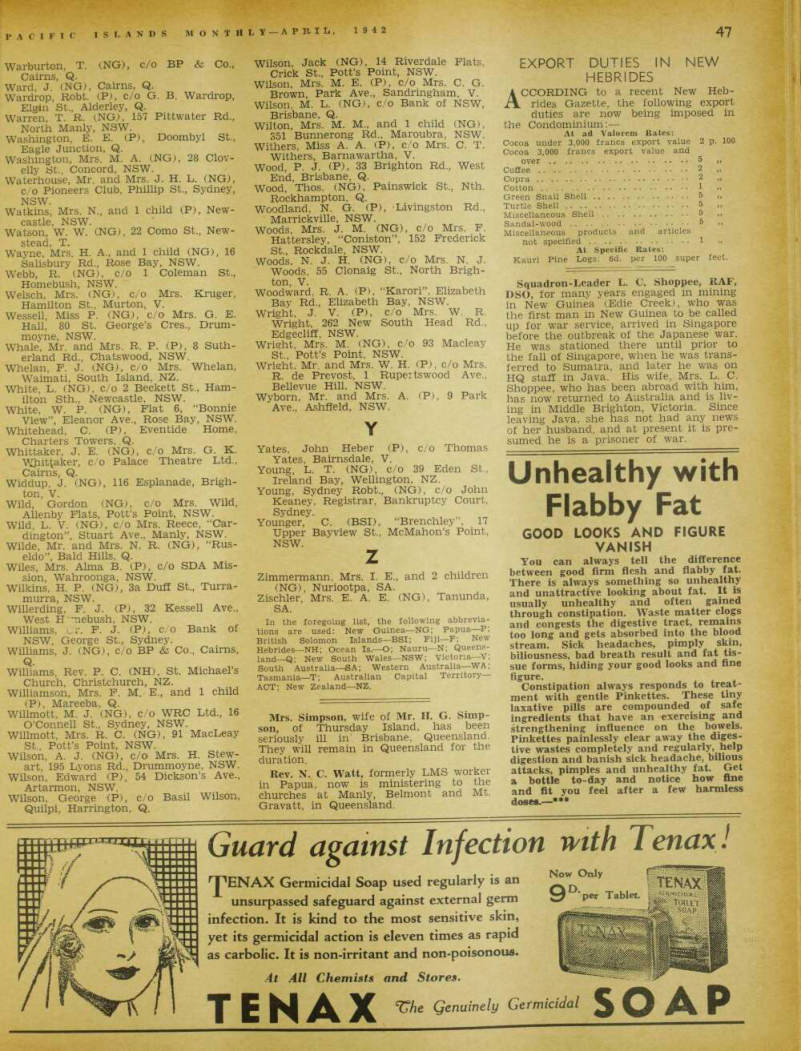
Hebrides
ACCORDING to a recent New Heb rides Gazette, the following export duties are now being imposed in the Condominium: —
Squadron-Leader L. C. Shoppee, RAF, DSO, for many years engaged in mining in New Guinea (Edie Creek), who was the first man in New Guinea to be called up for war service, arrived in Singapore before the outbreak of the Japanese war.
He was stationed there until prior to the fall of Singapore, when he was trans ferred to Sumatra, and later he was on HQ staff in Java. His wife, Mrs. L. C.
Shoppee, who has been abroad with him, has now returned to Australia and is liv ing in Middle Brighton, Victoria. Since leaving Java, she has not had any news of her husband, and at present it is pre sumed he is a prisoner of war.
At ad Valorem Bates: Cocoa under 3,000 francs export value 2 p. 100 Cocoa 3,000 francs export value and over 5 Coffee 2 2 Cotton 1 Green Snail Shell 5 Turtle Shell 5 Miscellaneous Shell 5 Sandal-wood 5 Miscellaneous products and articles not specified 1 At Specific Bates: feet.
Kauri Pine Logs: 6d. per 100 super
Advertisements & other items, p. 49 (1 item)
Flabby Fat
Unhealthy with
GOOD LOOKS AND FIGURE
VANISH
You can always tell the difference between good firm flesh and flabby fat.
There is always something so unhealthy and unattractive looking about fat. It is usually unhealthy and often gained through constipation. Waste matter clogs and congests the digestive tract, remains too long and gets absorbed into the blood stream. Sick headaches, pimply skin, biliousness, bad breath result and fat tissue forms, hiding your good looks and fine figure. , , . .
Constipation always responds to treatment with gentle Pinkettes. These tiny laxative pills are compounded of safe ingredients that have an exercising and strengthening influence on the bowels.
Pinkettes painlessly clear away the digestive wastes completely and regularly, help digestion and banish sick headache, bilious attacks, pimples and unhealthy fat. Get a bottle to-day and notice how fine and fit you feel after a few harmless doses.—
Guard against Infection with Tenax!
Now Only Germicidal Soap used regularly is an
unsurpassed safeguard against external germ *2
infection. It is kind to the most sensitive skin, yet its germicidal action is eleven times as rapid as carbolic. It is non-irritant and non-poisonous.
At All Chemists and Stores.
: TENAX
per Tablet, Milt
TENAX ‘CTie Genuinely Germicidal SOAP
Australian Short Wave
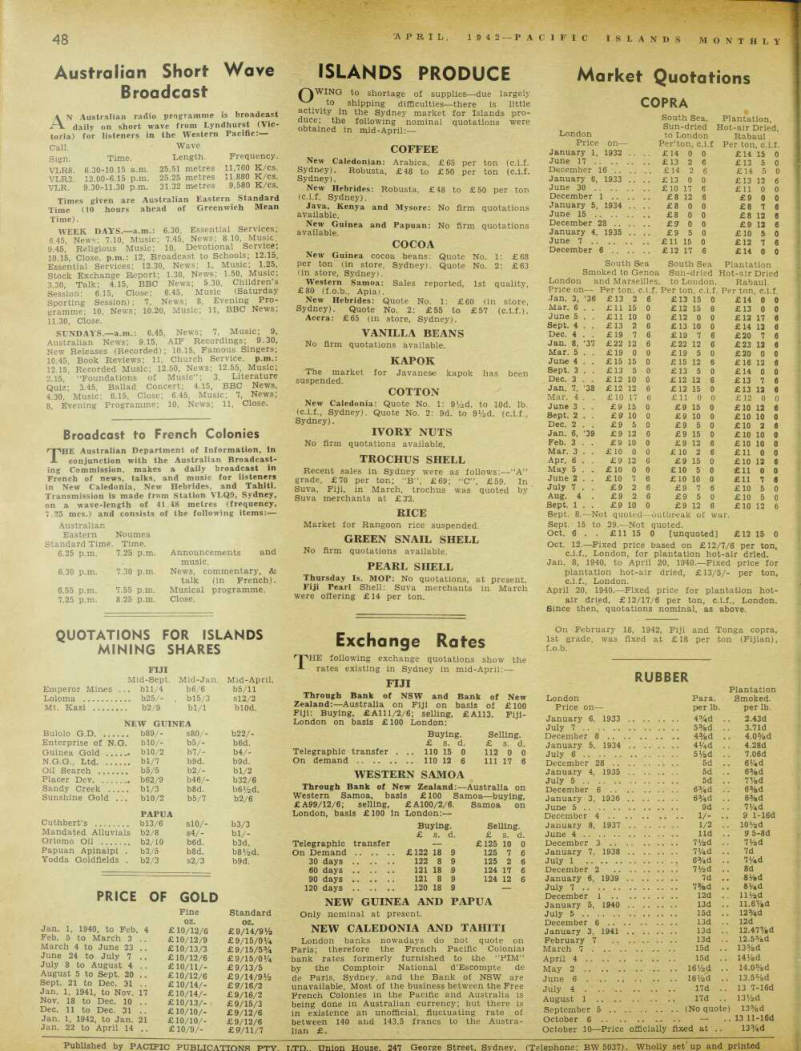
Broadcast
AN Australian radio programme is broadcast daily on short wave from Lyndhurst (Vic toria) for listeners in the Western Pacific:— Call. Wave
Times given are Australian Eastern Standard Time (10 hours ahead of Greenwich Mean Time).
WEEK DAYS.—a.m.: 6.30, Essential Services; 6.45, News; 7.10, Music; 7.45, News; 8.10, Music; 9.45, Religious Music; 10, Devotional Service; 10.15, Close, p.m.: 12, Broadcast to Schools; 12.15, Essential Services; 12.30, News; 1, Music; 1.25, Stock Exchange Report; 1.30, News; 1.50, Music; 3 30, Talk; 4.15, BBC News; 5.30, Children’s Session: 6.15, Close; 6.45, Music (Saturday Sporting Session): 7, News; 8, Evening Pro gramme; 10, News; 10.20, Music; 11, BBC News; 11.30, Close.
SUNDAYS.—a.m.: 6.45, News; 7, Music; 9, Australian News; 9.15, AIF Recordings; 9.30, New Releases (Recorded): 10.15, Famous Singers; 10.45, Book Reviews: 11, Church Service, p.m.; 12.15, Recorded Music; 12.50, News; 12.55, Music; 2.15, “Foundations of Music”; 3, Literature Quiz; 3.45, Ballad Concert; 4.15, BBC News, 4.30, Music; 6.15, Close; 6.45, Music; 7, News; 8, Evening Programme; 10, News; 11, Close.
Broadcast to French Colonies
THE Australian Department of Information, in conjunction with the Australian Broadcast ing Commission, makes a daily broadcast in French of news, talks, and music for listeners in New Caledonia, New Hebrides, and Tahiti.
Transmission is made from Station VLQ9, Sydney, on a wave-length of 41.48 metres (frequency, 7.25 mcs.) and consists of the following items:—
Sign. Time. Length. Frequency.
VLR8. 6.30-10.15 a.m. 25.51 metres 11,760 K/cs.
VLR3. 12.00-6.15 p.m. 25.25 metres 11.880 K/cs.
VLR. 9.30-11.30 p.m. 31.32 metres 9,580 K/cs.
Australian Eastern Noumea Standard Time. Time. 6.25 p.m. 7.25 p.m. Announcements and music. 6.30 p.m. 7.30 p.m. News, commentary, & talk (in French). 6.55 p.m. 7.55 p.m. Musical programme. 7.25 p.m. 8.25 p.m. Close.
Quotations For Islands
Mining Shares
Fiji
Mid-Sept.
Mid-Jan.
Mid-April.
Emperor Mines ... bll/4 b6/6 b5/ll Loloma b25/- , b!5/3 S12/2 Mt. Kasl b2/9 bl/1 blOd.
New Guinea
Bulolo G.D b89/s80/b22/- Enterprise of N.G. blO/b5/b6d.
Guinea Gold blO/2 b7/b4/- N.G.G., Ltd bl/7 b9d. b9d.
Oil Search b5/5 b2/bl/2 Placer Dev b62/9 b46/b32/6 Sandy Creek bl/3 b8d. b6V 2 d.
Sunshine Gold ... blO/2 b5/7 b2/6 Cuthbert’s
Papua
b!3/6 SlO/b3/3 Mandated Alluvials b2/8 s4/bl/- Oriomo Oil b2/10 b6d. b3d.
Papuan Apinaipi . b3/5 b8d. bsy 2 d.
Yodda Goldfields . b2/3 s2/3 b9d.
Price Of Gold
Fine Standard oz. oz.
Jan. 1, 1940, to Feb, , 4 £10/12/6 £9/14/9 Vi Feb. 5 to March 3 £10/12/9 £ 9/15/0 V* March 4 to June 23 .. £10/13/3 £9/15/5% June 24 to July 7 ,. £10/12/6 £9/15/0% July 8 to August 4 .. £10/11/- £9/13/5 August 5 to Sept. 20 .. £10/12/6 £ 9/14/9 V 2 Sept. 21 to Dec. 31 .. £10/14/- £9/16/2 Jan. 1. 1941, to Nov. 17 £10/14/- £9/16/2 Nov. 18 to Dec. 10 .. £10/13/- £9/15/3 Dec. 11 to Dec. 31 £10/10/- £9/12/6 Jan. 1, 1942, to Jan. 21 £10/10/- £9/12/6 Jan. 22 to April 14 .. £ 10/9/- £9/11/7
Islands Produce
/"AWING to shortage of supplies—due largely . to . shipping difficulties—there is little activity in the Sydney market for Islands pro duce; the following nominal quotations were obtained in mid-April:—
Coffee
New Caledonian; Arabica, £65 per ton (c.i.f.
Sydney). Robusta, £4B to £5O per ton (c.i.f.
Sydney), New Hebrides: Robusta, £4B to £5O per ton (c.i.f. Sydney).
Java, Kenya and Mysore; No firm quotations available.
New Guinea and Papuan: No firm quotations available.
Cocoa
New Guinea cocoa beans: Quote No. 1: £6B per ton (in store, Sydney). Quote No. 2: £63 (in store, Sydney).
Western Samoa: Sales reported, Ist quality, £BO (f.0.b., Apia).
New Hebrides; Quote No. 1: £6O (in store, Sydney). Quote No. 2: £55 to £57 (c.i.f.).
Accra: £65 (in store, Sydney).
Vanilla Beans
No firm quotations available.
Kapok
The market for Javanese kapok has been suspended.
Cotton
New Caledonia: Quote No. 1: QViad. to lOd. lb. (c.i.f., Sydney). Quote No. 2: 9d. to 9V 2 d. (c.i.f., Sydney),
Ivory Nuts
No firm quotations available.
Trochus Shell
Recent sales in Sydney were as follows:—“A” grade. £7O per ton; “B”, £69; “C”, £59. In Suva, Fiji, in March, trochus was quoted by Suva merchants at £33.
Rice
Market for Rangoon rice suspended.
Green Snail Shell
No firm quotations available.
Pearl Shell
Thursday Is. MOP: No quotations, at present.
Fiji Pearl Shell: Suva merchants in March were offering £l4 per ton.
Exchange Rates
'T'HE following exchange quotations show the rates existing in Sydney in mid-April:—
Fiji
Through Bank of NSW and Bank of New Zealand:—Australia on Fiji on basis of £lOO Fiji: Buying, £Alll/2/6; selling, £AII3. Fiji- London on basis £lOO London;
Western Samoa
Through Bank of New Zealand:—Australia on Western Samoa, basis £lOO Samoa—buying, £ A99/12/6; selling, £AIOO/2/6. Samoa on London, basis £lOO in London: —
New Guinea And Papua
Only nominal at present.
New Caledonia And Tahiti
London banks nowadays do not quote on Paris; therefore the French Pacific Colonial bank rates formerly furnished to the “PIM” by the Comptoir National d’Escompte de de Paris, Sydney, and the Bank of NSW are unavailable. Most of the business between the Free French Colonies in the Pacific and Australia is being done in Australian currency; but there is in existence an unofficial, fluctuating rate of between 140 and 143.5 francs to the Austra lian £.
Buying.
Selling. £ s. d. £ s. d.
Telegraphic transfer . .. 110 15 0 112 0 0 On demand .. 110 12 6 111 17 6
Buying.
Selling. £ s. d. £ s. d.
Telegraphic transfer — £125 10 0 On Demand £122 18 9 125 7 6 30 days 122 8 9 125 2 6 60 days 121 18 9 124 17 6 90 days 121 8 9 124 12 6 120 days 120 18 9 —
Market Quotations
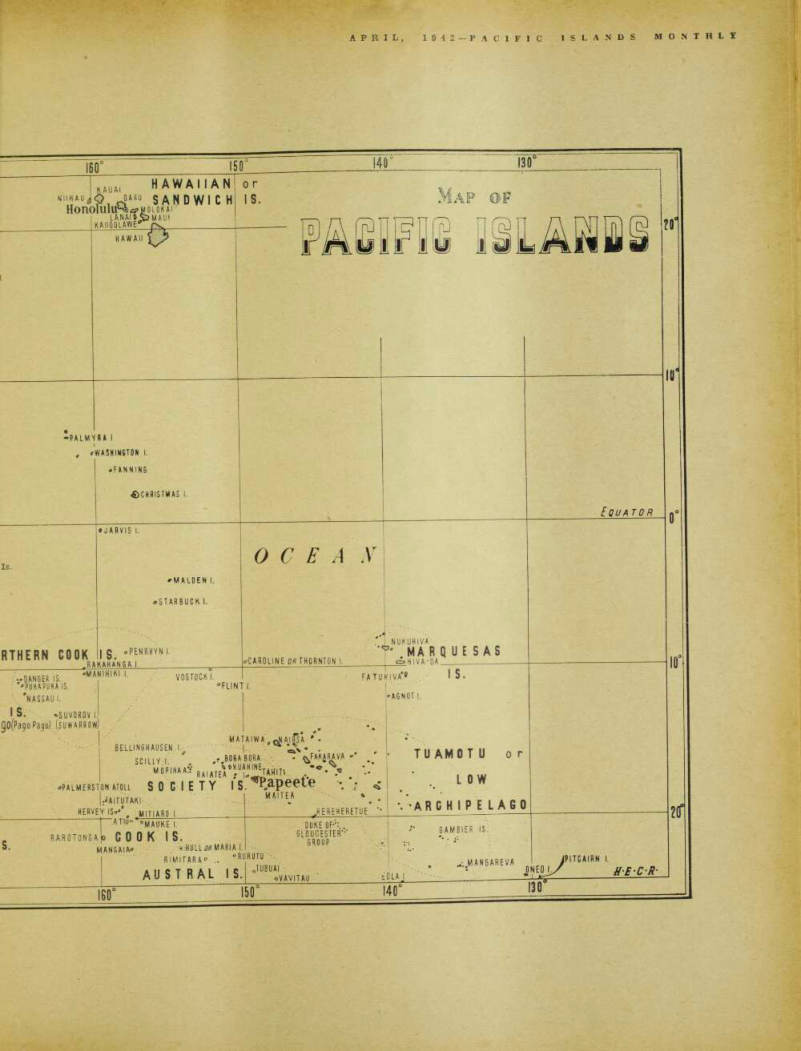
Sept. B.—Not quoted—outbreak of war.
Sept. 15 to 29. —Not quoted.
Oct. 6 . . £ll 15 0 [unquoted] £l2 15 0 Oct. 12.—Fixed price based on £l2/7/6 per ton, c.i.f., London, for plantation hot-air dried.
Jan. 8, 1940, to April 20, 19’40.—Fixed price for plantation hot-air dried, £l3/5/- per ton, c.i.f., London.
April 20, 1940. —Fixed price for plantation hot air dried, £l2/17/6 per ton, c.i.f., London.
Since then, quotations nominal, as above.
On February 18, 1942, Fiji and Tonga copra, Ist grade, was fixed at £lB per ton (Fijian), f.o.b.
Copra
South Sea, Plantation, Sun-dried Hot-air Dried.
London to London Rabaul Price on— Per’ton, c.i.f Per ton .. c.i.f.
January 1 1932 . £14 0 0 £14 15 0 June 17 . £13 : 2 6 £13 5 0 December 16 . . . £14 2 6 £14 5 0 January 6 1933 . £13 i 0 0 £13 12 6 June 30 . £10 17 6 £11 0 0 December 1 .. . £8 12 6 £9 0 0 January 5 1934 . . . £8 0 0 £8 7 6 June 15 . £8 i 0 0 £8 12 6 December 28 .. . £ 9 i 0 0 £9 12 6 January 4 1935 . . . £9 5 0 £10 5 0 June 7 . £11 15 0 £12 7 6 December 6 . . . . £12 17 6 £14 0 0 South Sea South Sea Plantation Smoked to Genoa Sun-dried Hot-air Dried London and Marseilles to London.
Rabaul.
Price on— Per ton c.i.f.
Per ton. c.i.f. Per ton . c.i.f.
Jan. 3, ’36 £13 2 6 £13 15 0 £14 0 0 Mar. 6 . . £11 15 0 £12 15 e £13 0 0 June 5 . . £11 10 0 £12 0 0 £12 17 6 Sept. 4 . . £13 : 2 6 £13 10 0 £14 12 6 Dec. 4 . . £19 ’ 7 6 £19 7 6 £20 7 6 Jan. 8, '37 £22 12 6 £22 12 6 £23 12 6 Mar. 5 . . £19 ( ) 0 £19 5 0 £20 0 0 June 4 . . £15 15 0 £15 12 6 £16 12 6 Sept. 3 . . £13 i j 0 £13 5 0 £14 0 0 Dec. 3 . . £12 10 0 £12 12 6 £13 7 6 Jan. 7, ’38 £12 12 6 £12 15 0 £13 12 6 Mar. 4 . . £10 17 6 £11 0 0 £12 0 0 June 3 . . £9 15 0 £9 15 0 £10 12 6 Sept. 2 . . £9 10 0 £9 10 0 £10 10 0 Dec. 2 . . £9 i j 0 £9 5 0 £10 2 6 Jan, 6, ’39 £9 12 6 £9 15 0 £10 10 0 Feb. 3 . . £9 10 0 £9 12 6 £10 10 0 Mar. 3 . . £10 ( ) 0 £10 2 6 £11 0 0 Apr. 6 . . £9 12 6 £9 15 0 £10 12 6 May 5 . . £10 ( ) 0 £10 5 0 £11 0 0 June 2 . . £10 1 7 6 £10 10 0 £11 7 6 July 7 . . £9 2 6 £9 7 6 £10 5 0 Aug. 4 . £9 ; 2 6 £9 5 0 £10 5 0 Sept. 1 . . £9 10 0 £9 12 6 £10 12 6
Rubber
Plantation London Para.
Smoked.
Price on— per lb. per lb.
January 6, 1933 4 3 / 4 d .. 2.43d July 7 5%d .. 3.71d December 8 .. . 4%d .. 4.0%d January 5, 1934 4V 4 d .. 4.28d July 6 5y 2 d .. 7.06d December 28 . . 5d .. ey 4 d January 4, 1935 5d 6%d July 5 7y 8 d December 6 . . 6 3 Ad .. 6%d January 3, 1936 6 3 / 4 d .. 6%d June 5 7»/ 4 d December 4 .. , 1/- .. 9 l-16d January 8, 1937 1/2 .. ioy 2 d June 4 lid .. 9 5-8d December 3 .. 7*/ a d .. ?y 2 d January 7, 1938 7>/ 4 d .. 7d July 1 7»/ 4 d December 2 7y 2 d .. 8d January 6, 1939 sy 8 d July 7 ay 4 d December 1 .. 12d .. ny 2 d January 5, 1940 13d .. 11.6 7 /sd July 5 I5d .. 12 3 / 4 d December 6 .. . 13d 12d January 3, 1941 13d .. 12.47 7 /»d February 7 13d 12.5 5 /ad March 7 15d .. 13%d April 4 15d .. 14y 8 d May 2 16y 2 d .. 14.0 5 /sd June 6 13.5 5 /ad July 4 17d .. 13 7-16d August 1 .. .. 17d .. 13y 2 d September 5 .. . (No quote) 13%d October 6 .. .. — 13 ll-16d October 10—Price officially fixed at .. 13 3 / 4 d
Advertisements & other items, pp. 50-52 (2 items)
48
APRIL, 1942 PACIFIC ISLANDS MONTHLY
Published by PACIFIC PUBLICATIONS pty. LTD.. Union House. 247 George Street. Sydney. (Telephone: BW 5037). Wholly set'up and printed
W. R. Carpenter & Co. Ltd.
TRAVEL BY CARf ENTER AIRLINES IN THE . •• * 'TT: m - ■ ■ -
EFFORTLESS SPEED and LUXURIOUS COMFORT
OF A "LOCKHEED 14"
CARPENTER AIRLINES / by the recent installation of worldrenowned Lockheed "14' aircraft on their regular service between Sydney and the Territories, bring to this airway the high standard of the world's best air services. Every detail of comfort and convenience has been studied to assure that travellers may thoroughly enjoy, in every respect, their flight over this most glorious of scenic air routes.
FREIGHT
A special feature of "Lockheed 14" Aircraft is their large freight capacity and consignees are now assured that all Freight booked will be despatched without delay.
Minimum Charge 5/-.
Full particulars regarding time-table, fares, etc., are available from the following agencies.— SYDNEY: Macdonald, Hamilton & Co. PAPUA: Burns, Philp & Co. Ltd.
" Howard Smith Ltd. NEW GUINEA: W. R. Carpenter & Co. Ltd.
w. R. CARPENTER & CO. LTD.
Merchants and Shipowners.
ENTS for Australian, European and American Manufacturers, and Distributors of Every Description of Merchandise Complete Range of all Stocks Carried.
Head Office: 16 O’CONNELL STREET, SYDNEY
* nCheS at ‘ RABAUL (New Britain), KAVTENG (New Ireland), MADANG, SALAMAUA, WAU (New Guinea), TULAGI (Solomon Islands), SUVA (Fiji), and other Pacific Islands; and in LONDON.
Buyers and Shippers of: Copra, Trocas, and all Classes of Islands Produce.