Islands
Pacific
Monthly
Vol. Xl No. 4.
November 15, 1940
Established 1930
Register transmission by post as a neivspaper ]
8 a
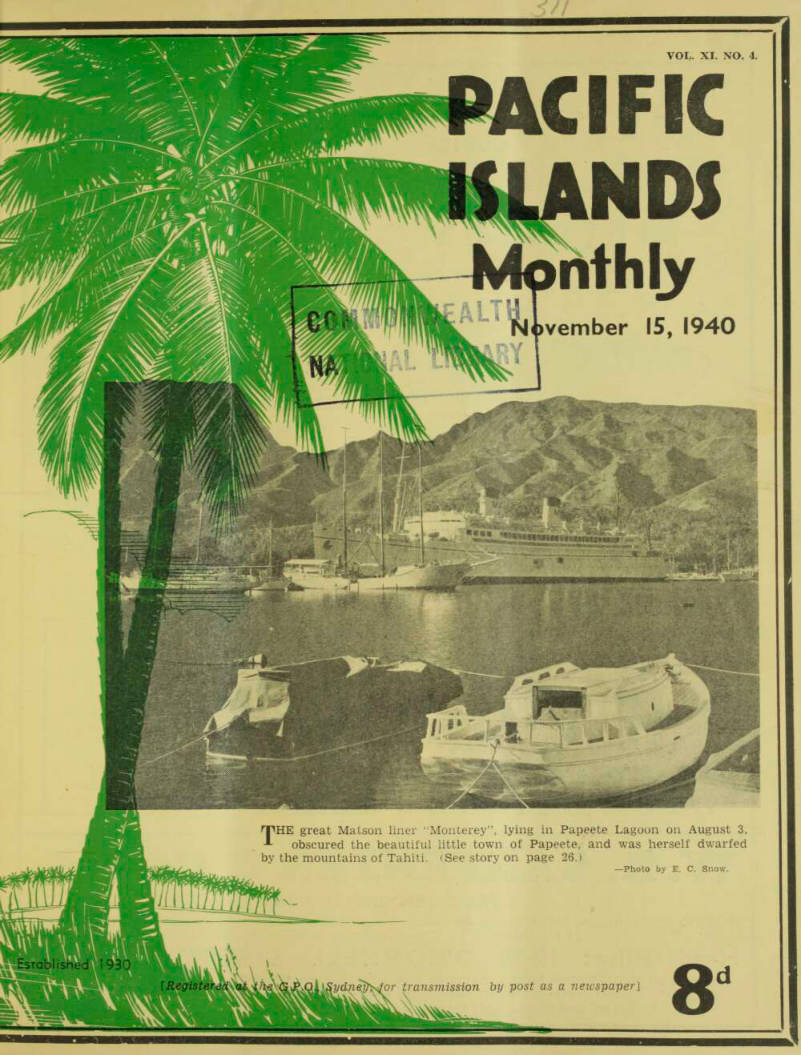
THE great Matson liner “Monterey”, lying in Papeete Lagoon on August 3, obscured the beautiful little town of Papeete, and was herself dwarfed by the mountains of Tahiti. (See story on page 26.) —Photo by E. C. Snow.
Advertisements & other items, p. 2 (1 item)
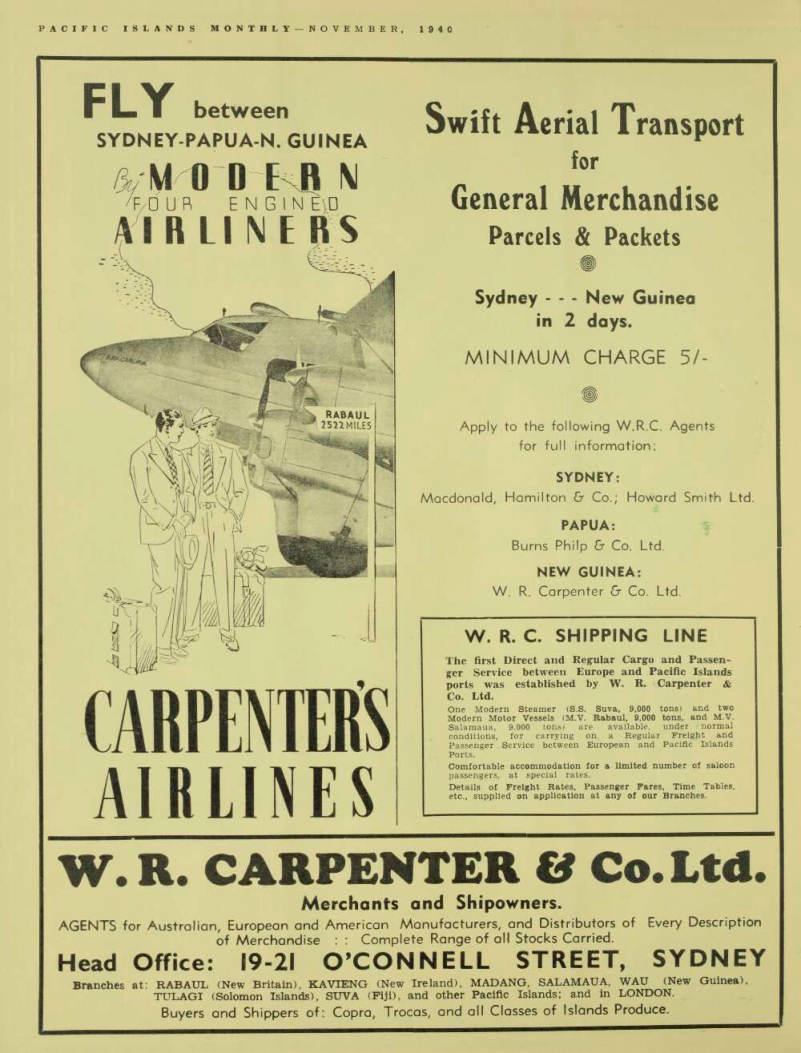
Carpenters
FLY between
SYDNEY-PAPUA-N. GUINEA
MOO E RN
F/Q UR ENG I N E)D
AIRLINERS
RABAUL
2521 MILES
li\t
K
CARPENTERS
AIRLINES
Swift Aerial Transport
for
General Merchandise
Parcels & Packets
Sydney - - - New Guinea
in 2 days.
MINIMUM CHARGE 5/-
Apply to the following W.R.C. Agents for full information:
SYDNEY:
Macdonald, Hamilton Gr Co.; Howard Smith Ltd.
PAPUA:
Burns Philp £r Co. Ltd,
NEW GUINEA:
W. R. Carpenter Cr Co. Ltd.
W. R. C. SHIPPING LINE
The first Direct and Regular Cargo and Passenger Service between Europe and Pacific Islands ports was established by W. R. Carpenter & Co. Ltd.
One Modern Steamer (S.S. Suva, 9,000 tons) and two Modern Motor Vessels (M.V. Rabaul, 9,000 tons, and M.V.
Salamaua, 9.000 tons) are available, under normal conditions, for carrying on a Regular Freight and Passenger Service between European and Pacific Islands Ports.
Comfortable accommodation for a limited number of saloon passengers, at special rates.
Details of Freight Rates, Passenger Pares, Time Tables, etc., supplied on application at any of our Branches.
W. R. CARPENTER & Co. Ltd.
Merchants and Shipowners.
AGENTS for Australian, European and American Manufacturers, and Distributors of Every Description of Merchandise : : Complete Range of all Stocks Carried.
Head Office: 19-21 O’CONNELL STREET, SYDNEY
Branches at: RABAUL (New Britain), KAVIENG (New Ireland), MADANG, SALAMAUA, WAU (New Guinea), TULAGI (Solomon Islands), SUVA (Fiji), and other Pacific Islands; and in LONDON.
Buyers and Shippers of: Copra, Trocas, and all Classes of Islands Produce.
Pacific News-Review
Notes And Comment On
The Progress Of The War
From October 14 To Nov. 11
Oet. 14: British newspapers welcome the emphatic declaration by President Roosevelt that Americans are not to be scared away from Britain by the com pletion of the Japanese-Axis Pact. They comment upon the hesitancy now being shown by Japan in the adoption of a strong pro-Axis policy.
Oct. 14: German armies have practic ally completed the occupation of Rou mania, which now becomes a puppet state of the Axis organisation, it is reported that there is increasing Axis pressure on Yugoslavia. The Yugoslav premier, in an outspoken speech, said that the Yugoslavs will fight for their independence.
Oct. 14: British and American oil interests are removing their huge stores of oil from Chinese ports to Singapore, where they may be used for re-fuelling British and American warships or for transport to China via the re-opened Burma road.
Oct. 15: Very large stocks of war material for China have been concen trated in Burma in anticipation of the opening of the Burma road.
Oct. 16: The attitude of Russia towards German penetration of the Balkans remains unknown and incalculable. Tur key maintains a tone of spirited inde pendence, and declares that she will fulfil all her treaty obligations to Greece if Greece should be attacked by the Axis Powers, Oct. 16: The Germans continue to make mass night raid attacks upon Britain —especially London, where hun dreds of tons of bombs have been drop ped—and the RAF, night by night, is extending the scope and severity of its raids upon German cities, especially Berlin.
Oct. 17; While Italy is continuing to bring pressure to bear upon Greece, trying to induce her to abandon her treaty with Britain, the Germans are doing their utmost to bring Bulgaria under their control. There are indica tions of demoralisation in Syria, owing to the machinations of the Italian offi cials who have been trying to take con trol of that country since the French capitulation.
Oct. 18: Since USA disclosed its strong attitude towards Far Eastern affairs, following upon the Japan-Axis pact, the general tone of the Japanese press towards Britain and the USA has been modified and, while all precautions are being taken, there are hopes of a better understanding in the Far East. An agreement may now be made under which the Netherlands East Indies will supply Japan with 40 per cent, of her petroleum requirements.
Oct. 18; Two important developments to-day were that Britain re-opened the Burma road, described as “China’s life line”; and it was announced that the United States would make another loan to China.
Oct. 20: Yugoslavia, under Nazi pres sure, has entered into a trade agreement with Germany, which virtually means that she becomes economically and poli tically dependent on the Axis Powers. A Yugoslav minister acknowledged that the country had been “obliged to enter a system which promises to become the general European commercial policy.”
This development, combined with Ger man infiltration in Bulgaria, is regarded as a prelude to action against Greece and Turkey, opening the way for an Axis thrust down through the Balkans against British power in the Middle East.
Oct. 20: Japanese aeroplanes are bombing the Burma road. While they are causing some interference with traffic, they are not preventing the operation of hundreds of motor lorries, which now are engaged in transporting war materials into China.
Oct. 20: It is officially stated that what has happened already to Berlin, at the hands of the RAF. is nothing to what is going to happen in the future, and that already all western Germany and the Ruhr have suffered far more heavily than any place in Britain.
Oct. 20: The Italian armies on the western frontier of Egypt are still sitting idly in their trenches, doing nothing except occasionally sending out motor patrols. They are being daily and nightly bombed by the RAF.
Oct. 21: There is in England growing irritation because the British navy is not allowed to use the southern and western ports of Ireland to combat the increasing U-boat menace. Dublin is brightly lit at night, and provides Nazi planes with an invaluable guide in seeking the black out cities of western England, which they plan to bomb.
Oct. 22: Britain’s Prime Minister (Mr.
Churchill) speaking both in English and in French, broadcast a stirring appeal to the French people not to hinder Britain’s fight and to have faith in an Allied victory. He predicted that Britain would gain command of the air next year. Mr. Churchill’s French broadcast was jammed by the Nazis, so that the French people could not hear his re assuring words.
Oct. 23: Conferences between Hitler and Laval (vice-Premier of the Vichy Government), are causing great interest.
It is believed that Germany is putting pressure on the Vichy Government to bring France into the war with Ger many against Britain, and that similar proposals are being put up to Spain.
Oct, 24: Interest in the United States Presidency election, on November 5, is daily growing. The Republican candi date (Mr. Wendel Willkie) is campaign ing strongly. It is believed now that the result will be close. All the influence of the Axis Powers is being used to defeat Mr. Roosevelt.
Oct. 24; Hitler on Wednesday had talks with General Franco (Spanish dictator) which are believed to be closely related to his talks with Laval.
Oct. 25: Hitler and Marshal Petain, head of the Vichy Government, had a historic meeting in France to-day. It is believed in London that Hitler has failed in his main plan—which was to induce France and Spain to declare war on England.
Oct. 27: Officially announced that Hit ler and Marshal Petain have agreed on the “principle of collaboration for the reconstruction of peace in Europe”. This, of course, means that the Vichy Govern ment has resisted Hitler’s demands that France declare war on Britain. Franco appears to have taken up a similar stand in regard to Spain—this is already acknowledged by the controlled Italian newspapers.
Oct. 27: Tension between Italy and Greece is growing. Italy accuses Greek soldiers of having attacked an Italian frontier outpost in Albania.
Oct. 28: Giving Greece only three hours’ notice in the form of an ulti matum, which was delivered at 3 a.m., Italy has attacked Greece and the two nations are now at war. Italian troops
immediately crossed the Greek-Albanian frontier, and fighting is proceeding all along the frontier. Greek Government has ordered general mobilisation and appealed to Britain for aid, which is being given immediately.
It was learned, later, that Italy in this matter perhaps acted independently of Germany. Italy evidently expected Greece to surrender immediately, or collapse very quickly; but, instead, the Axis Pow ers made their most serious miscalcula tion in many months, because Greek ter ritory and bases are now available to the British, and the general British strategic situation in the Mediterranean is now greatly strengthened.
Oct. 28: To-day, Hitler and Mussolini met and conferred at Florence, in north ern Italy.
Oct. 29: The Greek Army is putting up a stubborn defence along the whole Albanian frontier. Reports are few, but there is no indication that the Italians have made any substantial advance anywhere.
Oct. 29: The Royal Air Force every night is attacking military objectives in Germany and Northern Italy, on an ever-inci easing scale. Enormous damage is being done. The German Air Force continues its day and night raids against England. The British people seem to have become accustomed to these condi tions, and the country’s activities go on as usual.
Oct. 29: The most serious aspect of the war situation, and one that is creat ing growing anxiety in responsible quar ters, is seen in the increasing losses of British merchant shipping tonnage. It is evident that large German and Italian submarines are present in large numbers in Atlantic waters, south and north of the British Isles, and the British losses are very serious. In the week ended October 22 the losses totalled no less than 198,000 tons. The Axis Powers, having been defeated in their air attacks upon England, are now concentrating all their strength upon crippling Britain’s sea-borne commerce.
Oct. 29: It is announced that soon six foreign armies will be in training in Britain, each under its own flag, com manders and military law. These pre sumably are the escapees from France, Norway, Holland, Poland, Belgium and Czechoslovakia.
Oct. 30: The re-occupation by Chinese forces of important towns in Southern China is reported. Some newspapers describe these as Chinese victories—but there are indications from several points that Japan is beginning to withdraw her armies from Southern China. No one as yet can see what this portends.
Oct. 30: Reported that five German divisions are waiting in Albania, ready for a lightning attack upon Northern Greece when the Italian forces have conquered the stubborn Greek divisions on the frontier. The organ of the Ger man Foreign Office says that Turkey may shortly receive an ultimatum similar to that delivered by Italy to Greece.
Oct. 31: British warships have bom barded Italian bases in the Dodecanese Islands and British airplanes from Egypt have made raids upon Italian bases dur ing the last few days.
Nov. 2: It is officially announced that British forces—presumably air and naval —have landed in Greece. A strong British base is being rapidly prepared on the island of Crete, from which British air forces can attack the Italians in Albania,
or north-west, against the “heel” of Italy. Greek ports are being made avail abe for the use of British warships.
Nov. 3: The Italians are being held by the Greeks on the coastal sector of the frontier, and Greeks have thrown them back several miles into Albania. The Greeks now threaten the important Albanian town of Koritza.
Nov. 4: All reports from the Balkans indicate that the Greeks are holding up the Italian army on the Greek-Albanian frontier. Meanwhile, the British, using Crete as their base, are rapidly develop ing air attacks for the assistance of the Greeks.
Nov. 4: RAF bombers from England, for the second night in succession, attacked Naples and ‘dropped bombs on military objectives.
Nov. 5: The Prime Minister (Mr.
Churchill) stated that 14,000 civilians have been killed and 20,000 seriously injured in enemy air raids on Britain since the war started —nearly four-fifths of this number in London.
Nov. 5: Losses of British merchant shipping by enemy shipping continue alarming. Two British armed merchant cruisers, the “Laurentic”, 18,700 tons, and the “Patrotlus”, 11,300 tons, have been torpedoed and sunk. One of the largest British merchant vessels afloat, the “Empress of Britain”, 42,300 tons, has been sunk by enemy action.
Nov. 6: In the United States President ial election yesterday, Mr. Roosevelt was returned for a third time with an over whelming majority. He had not a large majority on the popular vote—perhaps 6,000,000 in a total vote of 50,000,000 — but the majority was so well distributed throughout the States that he appears certain to have about 450 votes in the total electoral college vote of 531. The Democrats also secured substantial majorities in both houses of Congress.
As the foreign policy of Mr. Roosevelt was clear and unequivocal—namely, re sistance to the dictators, and all possible help, short of war. to Britain —it ap pears that his re-election in so emphatic a way is one of the most important events since war broke out. The decision of the American people means virtually that the last of the great European democracies —namely, Great Britain — will not be defeated until the United States also is defeated.
Nov. 6: The British Prime Minister ad mitted frankly in the House of Commons that recent destruction of merchant ton nage by enemy submarines in the At lantic has become for Britain a more serious problem than that of enemy attack by air. Mr. Churchill added that the refusal of the Government of Ire land to allow Britain to use ports on the south and west coast of Ireland “imposes a heavy and grievous burden, and a burden which never should have been laid upon our shoulders”.
Nov. 7: Britain’s latest aid to Greece has been a third raid upon Naples by the RAF, and a loan to Greece of £5,000,000.
Nov. 8: The Premier of Ireland 'Mr.
De Valera has caused intense resentment throughout the British Fmpire by re fusing point-blank, and with bitter words, to give or lease to Britain anti-submarine bases on the coast of Ireland.
Nov. 8; The Germans claim triumph antly that a pocket-battleship, which is operating in the North Atlantic, com pletely destroyed a large British convoy totalling about 80,000 tons. The Admiralty says, however, that although some ships were destroyed a number saved them selves by scattering and making no wire
less signals
Nov. 8: British bombers from Crete are now regularly attacking Brindisi and other Italian ports, from which military supplies pass from Italy to Albania.
Nov. 8: It is now clear that the whole of the Japanese forces in South China are being evacuated, and concentrated on the large island of Hainan. Does this new move portend a fuller occupation of Indo-China by Japan, or attack upon the Netherlands Indies.
Nov. 9: • Two large freighters—one British and one American —were destroyed by mines in Bass Strait, between Tas mania and Australia. A minefield, appar ently laid recently by an enemy raider, is being swept up.
Nov. 10: Mr. Neville Chamberlain.
British Prime Minister from 1937 until May, 1940, is dead, at the age of 71. He underwent a serious operation recently.
Nov. 11: Hitler, after tremendous pub licity, was to deliver a broadcast to the German nation from his famous Beer Hall, in Munich, on Friday night. A few minutes after he commenced speaking, RAF bombers appeared over Munich and gave the town a terrific thrashing for several hours. All German radio stations were off the air. A recorded version of the Fuhrer’s speech was broadcast the following day.
Nov. 11: One of the worst earthquakes in European history devastated Rou mania, which recently became a puppet state of the Axis Powers. There has been enormous destruction and loss of life.
Much damage was done to the oil wells, which were the main cause of Germany seizing and occupying this country.
Nov. 11: It is confirmed that Greeks, in central portion of battle-front, have inflicted a severe defeat upon Italians, who are retreating through mountains in disorder.
Nov. 11: RAF bombers, whose offensive strength is constantly growing, last night bombed German Baltic port of Danzig, 1,000 miles from England.
Nov. 11: Molotov, Soviet Premier and Foreign Minister, has arrived in Berlin for conferences with Germans, Italians and Japanese. German newspapers glee fully forecast another diplomatic defeat for Britain.
New System in N. Caledonian
Government
IT was announced semi-officially in Noumea during October that the three governing bodies—the General Council, the Colonial Commission, and the Privy Council—are to be dissolved; and that a committee of 18, represen tative of mining, agricultural, pastoral, business, and shipping interests, and the local de Gaulle party, will be elected to assist the Governor, M. Sautot, in the administration of the Colony.
Mr. A. S. Kerlin has been appointed lighthouse service mechanic at Thursday Island, replacing Mr. Frank Baker, who was transferred to Melbourne.
Mr. William McCredie, who was for 20 years a resident of Suva, most of his time as a member of the staff of the “Fiji Times” and latterly in the Government Service, has now settled down in Sydney, in retirement. When he was a small boy of 10, in Scotland, someone gave him a bible—and he wrote on the fly-leaf: “When I am a man I am going to be a missionary in Fiji”. Long years after wards, when he was a middle-aged news paper man in Sydney, Mr. McCredie was invited to fill a newspaper position in Fiji; and so he and his family trans ferred to Suva. When they were packing, someone came across the long-forgotten bible, with its inscription in childish handwriting. But the missionary part of the prophecy was wide of the mark —“in fact, it missed badly”, say Mr. McCredie’s candid friends.
"Vanilla" Under
A Cloud
What Should Tahiti Product Be Called?
IT appears that there is some confusion as to the correct name of the climb ing tropical orchid called Vanilla, from which comes a widely known flavour ing essence.
The International Rules for Botanical Nomenclature say that the name which has been longest in use must take priority, so Vanilla officially has been Vanilla Planifolia, a name first used in 1808. Now, some scientific nark has discovered that, in 1807, the vine was named Vanilla Fragans; and an ordered world is try ing to change the habits of 130 years.
This is bad enough. But it has been discovered also that there are two or more types of Vanilla: which of them is to be known as Vanilla Fragrans? Says American expert, writing in July, “It is entirely possible that some of the vanilla planifolia vines that were trans planted to other parts of the world were not the same as vanilla fragrans. but really possessed the character of other varieties having a similar appearance.
“The complete difference in flavour character and chemical composition, of the vanilla fruits from Tahiti have caused many to believe that they are not truly from vanilla fragrans, and that their use might be open to question in products labelled as ‘Vanilla’. It is not believed that any botanical investigation of the Tahitian vines has been made in recent years by persons competent to identify them.
“In 1939, there were 115,675 pounds of vanilla beans imported into the United States from Tahiti, compared with 21,498 pounds the previous year. The total of all other groups in 1939 was 901,402 pounds, which was a drop from the 1,001,967 pounds in 1938, from the same sources. Bourbon and Mexican vanilla beans, in early June, 1940, were quoted at approximately $6.50 per pound, while Tahitian beans were around $3.00 per pound.”
Dr. Geoff. Courtney, one-time Govern ment medical officer at Tonga and also of Nauru Island, recently relinquished his appointment as Superintendent of Palm Island Aboriginal Settlement, North Queensland, to take up Australian war duty. He has been succeeded at Palm Island by his father, who will be remem bered as a former medical officer with the Vanikoro Timber Co., at Santa Cruz, 8.5.1. Mrs. Courtney, Jnr., with her three children is living at Canterbury, Mel bourne.
Mr. J. Duncan, of Rapopo Plantation, Kokopo, TNG, writes, “You gave me the wrong initials when you published a paragraph in the October ‘PIM’ concern ing my taking Carpenter and Co.’s small steamer to Australia. My name is James —known to the rising generation as ‘Uncle Jimmy’; Captain R. C. Duncan has not been in the Territory for many years—the last I heard of him was on the China coast.”
Leading Aircraftman John Head, 25. formerly of Fiji, was killed on Novem ber 11 when an RAAF training plane with five other occupants crashed at Cootamundra, NSW. Head was dragged from the blazing wreckage, but died later in hospital. He enlisted in the Air Force last April when in Sydney on leave from his job as an overseer of a CSR
plantation in Fiji.
Advertisements & other items, p. 4 (1 item)
2
November, 1940-Mcitic islands monthly
Pacific Islands Travellers
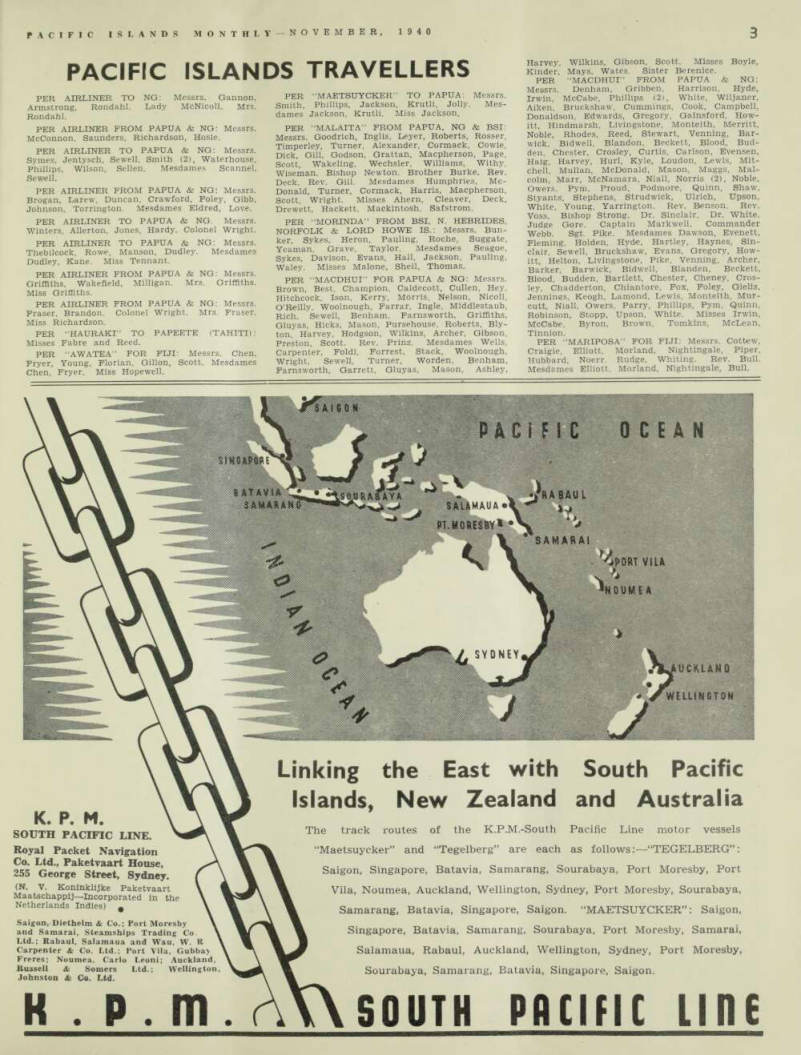
PER AIRLINER TO NG: Messrs. Gannon, Armstrong, Rondahl. Lady McNicoll. Mrs.
Rondahl.
PER AIRLINER FROM PAPUA & NG: Messrs.
McConnon, Saunders, Richardson, Hosie. _- T n .n TT . e •nt/- tvt PER AIRLINER TO PAPUA & NG: Messrs.
Symes. Jentysch, Sewell, Smith (2), Waterhouse, Phillips, Wilson, Sellen. Mesdames Scannel, Sewell.
PER AIRLINER FROM PAPUA & NG: Messrs.
Brogan, Larew, Duncan, Crawford, Foley, Gibb, Johnson, Torrington. Mesdames Eldred, Love. „ „ PER AIRLINER TO PAPUA & NG. Messrs.
Winters, Allerton, Jones, Hardy. Colonel Wright.
PER AIRLINER TO PAPUA & NG: Messrs.
Thebilcock, Rowe, Manson, Dudley. Mesdames Dudley Kane. Miss Tennant.
PFR AIRLINER FROM PAPUA & NG' Messrs
Wa^efleld R °Millieaif Mrs Griffiths’
fl ’ 8 Griffiths. miss urimins.
PER AIRLINER FROM PAPUA & NG: Messrs.
Fraser. Brandon. Colonel Wright. Mrs. Fraser.
Miss Richardson.
Per “Hauraki” To Papeete (Tahiti):
Misses Fabre and Reed.
PER “AWATEA” FOR FIJI - Messrs Chen, Fryer, Young, Florian. Gillon, Scott. Mesdames Chen Fryer Miss Hopewell
Per “Maetsuycker" To Papua: Messrs.
Smith, Phillips, Jackson, Krutli, Jolly. Mes dames Jackson, Krutli. Miss Jackson.
PER “MALAITA” FROM PAPUA, NG & BSI: Messrs. Goodrich, Inglis, Leyer, Roberts, Rosser, Timperley, Turner, Alexander, Cormack, Cowie, p Gill> Godson, Grattan, Macpherson, Page, * W akeline Wechsler Williams Withv e man Bishop Newton Brother Burke Rev!
Deck Rev. Gill. Mesdames Humphries, Me- Donald, Turner, Cormack, Harris, Macpherson, Scott, Wright. Misses Ahern, Cleaver, Deck, Drewett, Hackett, Mackintosh, Safstrom.
Per “Morinda” From Bsi, N. Hebrides,
NORFOLK & LORD HOWE IS.: Messrs. Bun ker, Sykes, Heron Pauling Roche, Suggate, Yeaman, Grave, Taylor Mesdames Seagoe, Sykes, Davison, Evans, Hall Jackson, Pauling, Waley ‘ MiSS6S Malone ’ Sheil ’ Thomas ' PER ‘MACDHUI- FOR PAPUA & NG: Messrs.
Brown Best champion CaldeC ott, Cullen. Hey, Hitchcock Ison, Kerry, Morris, Nelson. Nicoll, O ’R-eilly, Woolnough, Farrar, Ingle, Middlestaub, Rich. Sewell. Benham, Farnsworth, Griffiths, Gluy'as, Hicks, Mason, Pursehouse, Roberts, Bly ton, Harvey, Hodgson, Wilkins, Archer, Gibson, Preston, Scott. Rev. Prinz. Mesdames Wells, Carpenter, Poldi, Forrest, Stack, Woolnough, Wright, Sewell, Turner, Worden. Benham, Farnsworth, Garrett, Gluyas, Mason, Ashley,
Harvey, Wilkins, Gibson, Scott. Misses Boyle, Kinder, Mays, Wates. Sister Berenice.
Per “Macdhui” From Papua & Ng:
Messrs. Denham, Gribben, Harrison, Hyde, Irwin. McCabe, Phillips (2), White, Wiljaner, Aiken. Bruckshaw, Cummings, Cook, Campbell, Donaldson, Edwards, Gregory, Galnsford, How itt. Hindmarsh, Livingstone, Monteith, Merritt, Noble. Rhodes, Reed, Stewart, Venning, Bar wick, Bidwell, Blandon, Beckett, Blood, Bud den, Chester, Crosley, Curtis, Carlson, Evensen, Haig, Harvey, Hurl, Kyle, Loudon, Lewis, Mit chell, Mullan, McDonald, Mason, Maggs, Mal colm, Marr, McNamara, Niall, Norris (2), Noble.
Owers. Pym, Proud, Podmore, Quinn, Shaw, Styants, Stephens, Strudwick, Ulrich, Upson, White, Young. Yarrington. Rev. Denson. Rev.
Voss. Bishop Strong. Dr. Sinclair. Dr. White.
Judge Gore. Captain Markwell. Commander Webb. Sgt. Pike. Mesdames Dawson, Evenett, Fleming. Holden, Hyde, Hartley, Haynes, Sin clair, Sewell, Bruckshaw, Evans, Gregory, How itt, Helton. Livingstone, Pike, Venning, Archer, Barker, Barwick, Bidwell, Blanden, Beckett, Blood. Budden, Bartlett, Chester, Cheney, Cros ley, Chadderton, Chlantore, Pox, Foley, Gielis, Jennings, Keogh, Lamond, Lewis, Monteith, Mur cutt, Niall. Owers. Parry, Phillips, Pym. Quinn, Robinson, Stopp, Upson, White. Misses Irwin, McCabe, Byron, Brown, Tomkins, McLean, Tinnion.
PER “MARIPOSA” FOR FIJI: Messrs. Cottew, Craigie, Elliott, Morland, Nightingale, Piper, Hubbard, Noerr. Rudge, Whiting. Rev. Bull.
Mesdames Elliott, Morland, Nightingale, Bull.
Advertisements & other items, p. 5 (1 item)
South Pacific Line
l—
ISDN
.A
iMAUA •
W»: ■
SYDNEY,
K. P. M.
SOUTH PACIFIC LINE,
Royal Packet Navigation Co. Ltd., Paketvaart House, 255 George Street, Sydney. (N. V. Koninklljke Paketvaart Maatschapplj—lncorporated in the Netherlands Indies) m Saigon, Diethelm & Co.; Port Moresby and Samarai, Steamships Trading Co Ltd.; Rabaul, Salamaua and Wau, W. R Carpenter & Co. Ltd.; Port Vila, Gubba> Freres; Noumea, Carlo Leoni; Auckland, Russell & Somers Ltd.; Wellington, Johnston & Co. Ltd.
k.p . m
Linking the East with South Pacific
Islands, New Zealand and Australia
The track routes of the K.P.M.-South Pacific Line motor vessels “Maetsuycker” and “Tegelberg” are each as follows: —“TEGELBERG”: Saigon, Singapore, Batavia, Samarang, Sourabaya, Port Moresby, Port Vila, Noumea, Auckland, Wellington, Sydney, Port Moresby, Sourabaya, Samarang, Batavia, Singapore, Saigon. “MAETSUYCKER”: Saigon, Singapore, Batavia, Samarang, Sourabaya, Port Moresby, Samarai, Salamaua, Rabaul, Auckland, Wellington, Sydney, Port Moresby, Sourabaya, Samarang, Batavia, Singapore, Saigon.
SOUTH PACIFIC line
Advertisers
“Airzone” Radio . 19 Angus & Coote Ltd. 13 Arnott’s Biscuits . 32 Atkins Ltd., W. . 41 “Ausoline” ... 64 Baker Ltd.. W. Jno. 57
B.A.L.M. Ltd. . . 44
Bank of N.S.W. . 69 Barnet Glass Rub ber Co. Ltd. . . 68 Berger’s Paints . . 38 “Bidomak” ... 16 Blaxland Rae Pty.
Ltd 43 Broomfields Ltd. . 48 Brown & Co. Ltd., G 15 Brunton’s Flour . . 37 Burns, Philp & Co.
Ltd 4 B.P. Magazine . . 26
B.P. (S.S.) Co. . . 36
Burns Philp Trust Co. Ltd 60 Carlton & United Breweries Ltd. . 51 Carpenter Ltd., W.
R cov. 2 “Century” Radio . 71 Chapman & Sherack 47 drivers & Sons Ltd. 36 Clyde Engineering Co. Ltd 23 Coleman Lamp & Stove Co. . . 30, 47 Colonial Mutual Life Assurance Socty.
Ltd 27 Colonial Sugar Re fining Co. Ltd. . 71 Colonial Wholesale Meat Co 20 Compressor & Air Equipment Co. . 64 Coral Starch ... 32 Cosmopolitan Hotel 72 “Cystex” ... 69 Dewar’s Whisky . 42 Doan’s Pills ... 70 Donaghy & Sons Ltd 72 Donald Ltd., A, B. 52 Eaton Ltd., J. W. 39 Electrolux Refrigerators . . 50
Eno’s Fruit Salt . 70 Excelsior Supply Co.
Ltd 65 Fletcher & Sons . 44 “Flit” 68 Foster Clark Ltd. . 56 Garden Vale Pro ducts Ltd. ... 34 Garrett & Davidson 64 Gilbey’s Gin ... 54 Gillespie’s Flour . 33 Gowing Bros. Ltd. 17 Grand Pacific Hotel 53 Grove & Sons, W.
H 13 Guinea Airways Ltd. . cov. 3 Guinness Stout . . 40 “Hansman” Shoes 10 Holbrook’s Ltd. . . 37 Horlick’s Malted Milk 63 Hotel Moresby . . 72 Jantzen (Aust.) Ltd 17 Kodak (A/sia) Pty.
Ltd 12 Kopsen & Co, Ltd. 18 Kork-N-Seal Ltd. . 34 Knox Grammar School 14 Kolynos Dental Cream 62 Kriesler (A/sia) Pty. Ltd 24 Lea & Perrins Sauce 58 Levenson’s Radio . 66 Lustre Hosiery Ltd. 57 Macnaughts Shoe Stores Ltd. ... 10 “Marshall’ Bat teries . . . . 60 Maxwell Porter Ltd. 39 Mcllrath’s Ltd. . 58 McWilliams Wines 59 “Mendaco” ... 65 Merrillees & Co., J. C 68 Miller & Co. Pty.
Ltd 43 Moffat-Virtue Ltd. 25 Nelson & Robert son Pty. Ltd. . 21 Nock & Kirby Ltd. 61
Nestle’s Milk . 35 Noyes Bros. Ltd. . 70 Pacific Is. Society 16 Papua Hotel, The 72 Philips’ Lamps (A/sia) Pty. Ltd. 67 Pike Bros. Ltd. . . 14 Porter & Co., D.
H 48 Prescott Ltd. ... 33 Price’s Radio Ser vice ... .53 Prouds Ltd. ... 11 Ransomes Sims & Jefferies Ltd. . . 52
Riverstone Meat Co, Ltd 55 Rohu, Sil . . . .72 Royal Packet Navi gation Co. . . 3 Scott Ltd., J. ... 48 Shell Oil Co. Ltd. 46 Smyth Pty. Ltd., J. H 27 Spinet Cigarettes . 54 Springwood Ladies’
College 11 Steamships Trading Co. Ltd 23 Sterling Varnish Co 11
St. Ignatius College 10 Sullivan Ltd., C. .31 Swallow & Ariell . 59 Talkeries, The 31, 67 Tasman Marine Engines ... 49 Taylor & Co., A. , 70 “Tenax” Soap . . 29 Thornycroft (A/sia) Pty. Ltd. ... 60 Tilley Lamp Co. . 45 Tillock & Co. Ltd. 31 Toohey’s Ltd. . . 21 Tooth & Co. cov, 4 “206” Private Hotel 30 To Yacht Owners 12
Vacuum Oil Co.
Ltd 22 Vincent’s A.P.C. . 29 “Vi-stim” ... 61 Wenona School for Girls 28 West, Harry ... 43 Weymark & Son . 33 Wills Ltd., W. D. & H.O . . . .26 Woods Great Pep permint Cure 28, 41, 54 Wright & Co. Ltd.
E 39 Wunderlich Ltd. . 39
Contents
Pacific News-Review 1 “Vanilla” Under a Cloud 2 Pacific Islands Travellers 3 International Moves and Counter- Moves 5 Administrator of Papua 6 Extraordinary Position of Bank of Indo-China 6 East Indies Copra Plan 7, 23 N. Hebrides Takes Action Against Japanese Poachers 7 Ready Aid for French Pacific Colonies 7 N.G.’s “Scrap” Rubber Is Valuable .. 8 Copra Market Still Restricted 9 About Islands People 11 Matson Line and Fiji 12 Tropicalities 13 PAA’s Base in New Caledonia ... 16 New Minister for Pacific Territories . 21 Grow Rice & Tobacco in TNG! .. .. 25 Three Mad Days in Tahiti 26 NG Plan to Aid Copra Industry ... 29 Radio Worries in Fiji 32 Unique Record of Fletcher Christian . 34
How to Make Soap 37 Western Samoa’s Finances 39 Our Trade Future Under War Con ditions 41 Marsters’ Descendants on Palmerston Island 42 The Red Gods Call 44 I Keep House in Tahiti 48 Two Ways of Life 51 New Books 53 Do German Missions Mix Politics With Religion? 54 A Section for Women 56 Barriers for Air-Borne Pests 58 Link the Islands With Aeroplanes! .. 60 Plea for Copra Factory Ship 61 New Taxes in Fiji 62 Yacht “Director II” Wrecked 62 Islands Mining News 64 Short Wave Radio Programmes ... 67 Copra and Rubber Prices 68 Exchange and Market Quotations .. 69 Shipping Services in the Pacific ... 70 New Pitcairn Is. Stamps Issued ... 72
Advertisements & other items, p. 6 (1 item)
Burns, Philp & Co. Ltd.
GENERAL
MERCHANTS
> ' I ill ii m 111
ill
15! !
in in
H
in in
ik
SHIPOWNERS
TOURIST AGENTS
Head Office: 7 Bridge Street, Sydney—Australia Code Address: "BurphiJ"
BUYERS OF ALL CLASSES OF ISLAND PRODUCE Regular Steamer Services from Australia to New Guinea Papua Solomon Is.—Lord Howe Is.—Norfolk Is. —New Hebrides —Java and Singapore
Pacific Islands Monthly
The Newspaper-Magazine of the South Seas
[Registered at the G.P.0., Sydney, for transmission by post as a newspaper .] Published Once Each Month and Circulated in Australia and New Zealand and in the following Pacific Territories and Islands Groups:
Australian Territory of Papua.
Mandated Territory (Australia) of New Guinea, Bismarck Archipelago and Northern Solomon Islands.
Australian Territory of Norfolk Island.
New Zealand Territory of Cook Islands.
Mandated Territory (New Zealand) of Samoa.
British Colony of Fiji.
British Solomon Islands Protectorate.
British Protectorate of Tongan Islands.
British Crown Colony of Gilbert and Ellice Islands.
Mandated Territory of Nauru.
British and French Condominium of New Hebrides.
French Colony of New Caledonia.
French Colony of Oceania (Tahiti, etc.).
American Territory of Eastern Samoa.
American Territory of Hawaiian Islands.
American Territory of Guam.
Mandated Territory (Japan) of Marshall, Caroline and Mariana Islands.
Owned ond Produced by Pacific Publications Pty. Ltd., Union House, 247 George Street, Sydney.
tft pphonf f Managing Director .. BW 5037 £ Business and Editorial MA 7101
P.O. Box 3408 R
Registered Address of Telegrams, Radiograms, and Cables: “Pacpub”, Sydney.
Contributions.
Articles, Stories, and Photographs dealing with Pacific Islands subjects are invited and will be paid for, on publication.
Subscription Rates.
Per Annum, within British Empire, Prepaid, Post Free 8/- Per Annum, elsewhere, prepaid, Post Free . 10/- Single Copies 8d
Editor and Publisher;
R. W. Robson, F.R.G.S.
Assisted by Selwyn Hughes.
Advertising Manager: L. W. Bailey.
Advertising Office and Printing-House: 29 Alberta Street, Sydney.
Advertising rates furnished on application.
Colours, etc., by Arrangement.
Process Blocks made at Advertiser’s expense when required. Screen 100.
Changes of Advertising Copy should reach this Office by Ist of each month, otherwise previous advertisement may be repeated.
IN LONDON, the Pacific Islands Monthly is on sale at the Bookstall, Australia House, The Strand, London.
Agents.
The following are authorised to receive sub scriptions for the Pacific Islands Monthly:— Islands Branches of Burns, Philp & Co., Ltd., and Burns Philp (South Sea) Co., Ltd.
Islands Branches of W. R. Carpenter & Co., Ltd.
Islands Branches of Morris, Hedstrom, Ltd.
T. A. Olsson, Wau, New Guinea.
G. Thomas & Co., Rabaul, New Guinea.
Whitten Bros., Ltd., Samara!, Papua.
Steamships Trading Co., Papua. All Branches.
B.N.G. Trading Co., Ltd , Port Moresby, Papua.
J. Muir, Suva, Fiji.
N. C. Mackenzie-Hunt, Wainunu, Bua, Fiji.
Islands Branches and Representatives of W. H.
Grove & Sons, Ltd., Auckland, New Zealand.
Cook Islands Trading Co.. Rarotonga, Cook Is.
A. C. Rowland, Papeete, Tahiti.
Representative in London: W. C. HARVEY, Coronation House, 4 Lloyds Avenue, London, E.C.3, from whom may be obtained copies of Pacific Islands Monthly, Pacific Islands Year Book, advertising schedules, etc.
Vol. XI. No. 4.
November 15, 1 940
Prirp* 8d - Per Copy rMl * c ( Prepaid: 8/- p.a.
Internationa! Moves and Counter-Moves
TO a degree never before seen in the history of the world, this great war partakes of the character of a game of chess. There is intense fighting between specialists—but, ex cept for the blitzkrieg which smashed Poland and France, there has been extraordinarily little military move ment, and the total casualties in this war up to date do not yet equal the bloody slaughter of one great battle in the 1914-18 struggle.
It has been largely a war of economic manipulation, and of inter national realignments. Judged on that basis, the economic advantages remain principally with the Demo cracies (especially in relation to sea power) ; but the advantages of the international realignments unques tionably have been secured by the Dictators, who now dominate the whole of Europe, except for Portugal in the far west, and Greece, Turkey and Russia in the east. This game of international chess goes on, tensely and mercilessly. Present and threat ened moves affect the position in the Pacific; and enough of them can be discerned to indicate that the events of the next few months may decide the course of the war.
Let us briefly review the recent moves. Hitler, early in 1940, was cer tain that he could smash France. He knew—what we did not know—that while the French people were still sound democrats, the core of France —the commercial and political
“princes”—was rotten. But, before attacking France, he took a step which he believed ensured the over throw of Britain—namely, he seized the whole Atlantic coast, from northern Norway through Denmark to Holland and Belgium. With the overthrow of France, and the seizure of French channel ports, he calcu lated that he was in a position to blanket the British Isles with sub marine commerce-destroyers, simul taneously with his aerial blitzkrieg against Britain.
The coup de grace was to be given by Italy, which entered the war as France collapsed. It was calculated that Italy, immediately, would take control of the Mediterranean and sever Britain’s Imperial lifeline through the Mediterranean, North Africa and Suez.
It was a plan of diabolical clever ness, framed by a master chess player, and it just about succeeded. By July, all Central Europe was under German domination; Russia literally was “scared stiff”; and Spain, the Balkan nations, and Turkey, awaited only the final collapse of England to submit to German hegemony.
IN August and September, the demo cracies made their moves, and the picture changed. Britain would not submit, and refused to be invaded. On the seas, she still was supreme, and she gave back blow for blow in the air. In the Mediterranean, the daunt
less British Navy countered the threat of a German-dominated French navy, and sent the chicken-hearted Italians scuttling to their heavily-protected naval bases. The United States gave Britain immense moral and material aid.
So Germany’s “master-mind”, find ing itself unexpectedly thwarted by British resolution, made a new plan.
It brought Japan into the Axis pact, with a view to compelling the United States to keep their men and muni tions at home. It planned a pincers movement by German armies, south wards through Spain and the Balkans, to pinch off the British forces in Egypt and Palestine, and so get control of the Mediterranean; and, as the first step towards preparing the pincers, German armies occupied Rumania and the Rumanian oilfields.
Now Britain began to move her chess pieces effectively. Her resist ance and gallant spirit heartened Turkey, Greece and Spain; and the Nazi “master-mind” found in those nations a stubborn inclination to re sist the pincers movement. The United States refused to be panicked by the spectacle of a Nazified Japan.
Instead, the Americans displayed an unexpected, grim determination to maintain their rights in the Far East.
Japan, hitherto inclined to flag-wav ing and aggressiveness, suddenly moderated her tone. This was check Number II for the Nazi “master mind”.
Check Number 111 came very soon afterwards. Nazi influences used
every wile and stratagem at their command to defeat pro-British Roose velt in the Presidential Election on November 5. But RooseVelt was over whelmingly re-elected. America, in a clear, united voice, declared for Democracy and the right of the in dividual to life, liberty and the pur suit of happiness.
NOW, quickly, the Nazi chess-player is making his next move. His plea for a military highway through the Iberian Peninsula having been rejected by Spain and the Vichy Government, and Greece having un expectedly resisted and mauled the invading Italians, Hitler has turned —rather desperately, it seems—to Russia; and, surprisingly. Dictator Stalin has sent his “Premier” Molo toff, with an impressive entourage, to Berlin. This development has only one meaning. Germany is asking Russia to put pressure upon Turkey, so that Turkey will abandon her understanding with Britain and will not go to the aid of Greece if and when the German armies, carrying out their pincers movement, attack Greece through Germany and Bul garia. Russia will not refuse. Cer tainly, she may temporise—for the plain fact of the matter is that Stalin is desperately afraid of the enormous, highly-mechanised military forces which Germany now has at her com mand.
Meanwhile, two other moves on the chess-board may be noted. Hitler is using his 2,000 miles of Atlantic sea board to launch upon British sea borne commerce an intensified attack, of a character which is causing the gravest alarm in London. Britain has repelled the aerial invasion, but she has not yet solved the problem of how to keep her ships running freely upon the seas, while hundreds of large submarines, from scores of German, Danish, Norwegian, Dutch, and French ports, go hundreds of miles out into the Atlantic.
Meanwhile, Japan hurriedly has withdrawn her armies from Southern China, and assembled them upon the great island of Hainan. What is their destination? Upon that answer, and America’s reaction to it, depends the immediate future in the Pacific.
That is the position on the chess board as this is written: Molotoff is in Berlin, being wildly “Heiled” by Nazi Germany and Fascist Italy; Britain is faced with the grim prob lem of the ceaseless destruction of her shipping; Greece and Turkey await anxiously a sign from Russia; Japan ese armies have gathered near Indo- China and the Netherlands Indies; and the foreign policy of the United States under the new conditions is steadily taking shape.
Mr. Edward €. Snow, of Sydney, a member of the Pacific Islands Society, who had been on a visit to Tahiti, made a hurried departure in August from that island on a British freighter as a result of political developments. Mr. Snow writes that most British and American tourists have withdrawn from the Society Islands, with the exception of a few at Moorea, “where there is plenty of rain but little to eat”. Mr. Snow re turned to Sydney in October.
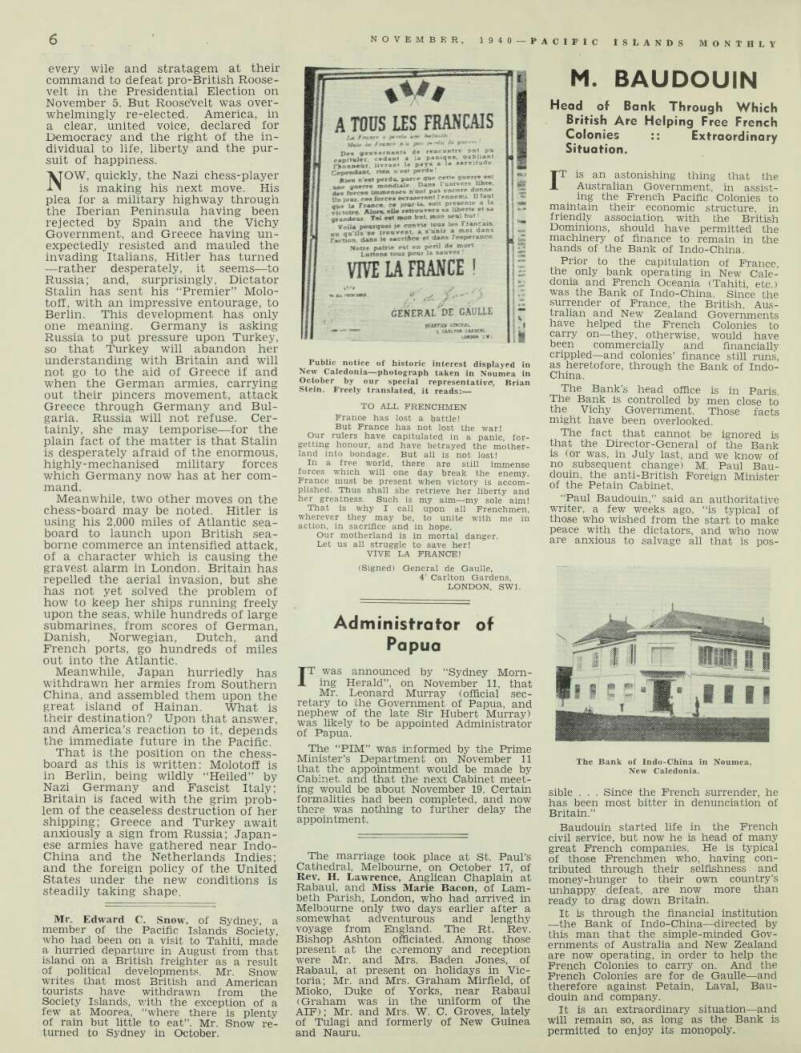
Public notice of historic interest displayed in New Caledonia—photograph taken in Noumea in October by our special representative*, Brian Stein. Freely translated, it reads:—
To All Frenchmen
France has lost a battle!
But France has not lost the war!
Our rulers have capitulated in a panic, for getting honour, and have betrayed the mother land into bondage. But all is not lost!
In a free world, there are still immense forces which will one day break the enemy.
France must be present when victory is accom plished. Thus shall she retrieve her liberty and her greatness. Such is my aim—my sole aim!
That is why I call upon all Frenchmen, wherever they may be, to unite with me in action, in sacrifice and in hope.
Our motherland is in mortal danger.
Let us all struggle to save her!
Vive La France!
(Signed) General de Gaulle, 4 Carlton Gardens,
London, Swi.
Papua
Administrator of Papua
IT was announced by “Sydney Morn ing Herald”, on November 11, that Mr. Leonard Murray (official sec retary to the Government of Papua, and nephew of the late Sir Hubert Murray) was likely to be appointed Administrator of Papua.
The “PIM” was informed by the Prime Minister’s Department on November 11 that the appointment would be made by Cabinet, and that the next Cabinet meet ing would be about November 19. Certain formalities had been completed, and now there was nothing to further delay the appointment.
The marriage took place at St. Paul’s Cathedral, Melbourne, on October 17, of Rev. H. Lawrence, Anglican Chaplain at Rabaul, and Miss Marie Bacon, of Lam beth Parish, London, who had arrived in Melbourne only two days earlier after a somewhat adventurous and lengthy voyage from England. The Rt. Rev.
Bishop Ashton officiated. Among those present at the ceremony and reception were Mr. and Mrs. Baden Jones, of Rabaul, at present on holidays in Vic toria; Mr. and Mrs. Graham Mirfield, of Mioko, Duke of Yorks, near Rabaul (Graham was in the uniform of the AIF); Mr. and Mrs. W. C. Groves, lately of Tulagi and formerly of New Guinea and Nauru.
M. Baudouin
Head of Bank Through Which
British Are Helping Free French
Colonies Extraordinary
Situation.
IT is an astonishing thing that the Australian Government, in assist ing the French Pacific Colonies to maintain their economic structure, in friendly association with the British Dominions, should have permitted the machinery of finance to remain in the hands of the Bank of Indo-China.
Prior to the capitulation of France, the only bank operating in New Cale donia and French Oceania (Tahiti, etc.) was the Bank of Indo-China. Since the surrender of France, the British, Aus tralian and New Zealand Governments have helped the French Colonies to carry on—they, otherwise, would have been commercially and financially crippled—and colonies’ finance still runs, as heretofore, through the Bank of Indo- China.
The Bank’s head office is in Paris.
The Bank is controlled by men close to the Vichy Government. Those facts might have been overlooked.
The fact that cannot be ignored is that the Director-General of the Bank is (or was, in July last, and we know of no subsequent change) M. Paul Bau douin, the anti-British Foreign Minister of the Petain Cabinet.
“Paul Baudouin,” said an authoritative writer, a few weeks ago, “is typical of those who wished from the start to make peace with the dictators, and who now are anxious to salvage all that is pos-
sible . . . Since the French surrender, he has been most bitter in denunciation of Britain.”
Baudouin started life in the French civil service, but now he is head of many great French companies. He is typical of those Frenchmen who, having con tributed through their selfishness and money-hunger to their own country’s unhappy defeat, are now more than ready to drag down Britain.
It is through the financial institution —the Bank of Indo-China —directed by this man that the simple-minded Gov ernments of Australia and New Zealand are now operating, in order to help the French Colonies to carry on. And the French Colonies are for de Gaulle —and therefore against Petain, Laval, Bau douin and company.
It is an extraordinary situation —and will remain so, as long as the Bank is permitted to enjoy its monopoly.
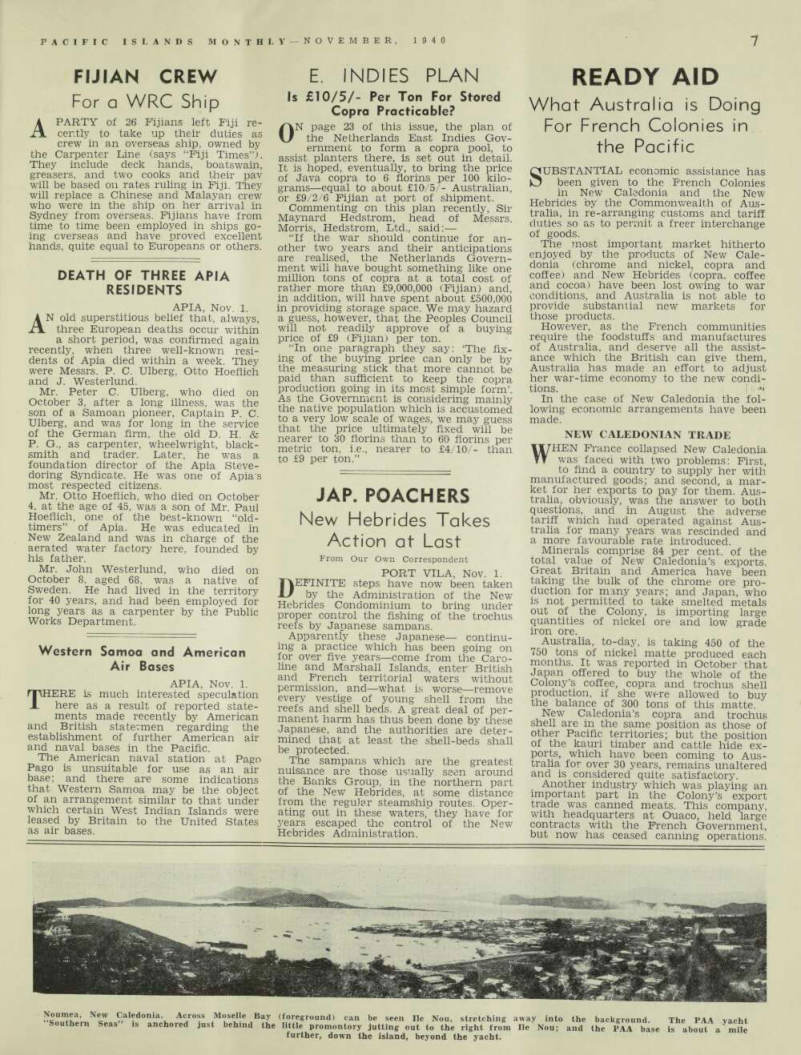
The Bank of Indo-China in Noumea, New Caledonia.
Fijian Crew
For a WRC Ship
A PARTY of 26 Fijians left Fiji re cently to take up their duties as crew in an overseas ship, owned by the Carpenter Line (says “Fiji Times”).
They include deck hands, boatswain, greasers, and two cooks and their pav will be based on rates ruling in F'iji. They will replace a Chinese and Malayan crew who were in the ship on her arrival in Sydney from overseas. Fijians have from time to time been employed in ships go ing overseas and have proved excellent hands, quite equal to Europeans or others.
Death Of Three Apia
Residents
Apia, Nov. 1.
AN old superstitious belief that, always, three European deaths occur within a short period, was confirmed again recently, when three well-known resi dents of Apia died within a week. They were Messrs. P. C. Ulberg, Otto Hoeflich and J. Westerlund.
Mr. Peter C. Ulberg, who died on October 3, after a long illness, was the son of a Samoan pioneer, Captain P. C.
Ulberg, and was for long in the service of the German firm, the old D. H. & P. G., as carpenter, wheelwright, black smith and trader. Later, he was a foundation director of the Apia Steve doring Syndicate. He was one of Apia's most respected citizens.
Mr. Otto Hoeflich, who died on October 4. at the age of 45, was a son of Mr. Paul Hoeflich, one of the best-known “old timers” of Apia. He was educated in New Zealand and was in charge of the aerated water factory here, founded by his father.
Mr. John Westerlund, who died on October 8, aged 68, was a native of Sweden. He had lived in the territory for 40 years, and had been employed for long years as a carpenter by the Public Works Department.
Western Samoa and American
Air Bases
Apia, Nov. 1.
THERE is much interested speculation here as a result of reported state ments made recently by American and British statesmen regarding the establishment of further American air and naval bases in the Pacific.
The American naval station at Pago Pago is unsuitable for use as an air base; and there are some indications that Western Samoa may be the object of an arrangement similar to that under which certain West Indian Islands were leased by Britain to the United States as air bases.
E. Indies Plan
Is £10/5/- Per Ton For Stored Copra Practicable?
ON page 23 of this issue, the plan of the Netherlands East Indies Gov ernment to form a copra pool, to assist planters there, is set out in detail.
It is hoped, eventually, to bring the price of Java copra to 6 florins per 100 kilo grams—equal to about £lO/5/- Australian, or £9/2/6 Fijian at port of shipment.
Commenting on this plan recently, Sir Maynard Hedstrom, head of Messrs.
Morris, Hedstrom, Ltd., said:— “If the war should continue for an other two years and their anticipations are realised, the Netherlands Govern ment will have bought something like one million tons of copra at a total cost of rather more than £9,000,000 (Fijian) and, in addition, will have spent about £506,000 in providing storage space. We may hazard a guess, however, that the Peoples Council will not readily approve of a buying price of £9 (F’ijian) per ton.
“In one paragraph they say: ‘The fix ing of the buying price can only be by the measuring stick that more cannot be paid than sufficient to keep the copra production going in its most simple form’.
As the Government is considering mainly the native population which is accustomed to a very low scale of wages, we may guess that the price ultimately fixed will be nearer to 30 florins than to 60 florins per metric ton, i.e., nearer to £4/10/- than to £9 per ton.”
Jap. Poachers
New Hebrides Takes Action at Last
From Our Own Correspondent
Port Vila, Nov. 1.
DEFINITE steps have now been taken by the Administration of the New Hebrides Condominium to bring under proper control the fishing of the trochus reefs by Japanese sampans.
Apparently these Japanese— continu ing a practice which has been going on for over five years—come from the Caro line and Marshall Islands, enter British and French territorial waters without permission, and—what is worse—remove every vestige of young shell from the reefs and shell beds. A great deal of per manent harm has thus been done by these Japanese, and the authorities are deter mined that at least the shell-beds shall be protected.
The sampans which are the greatest nuisance are those usually seen around the Banks Group, in the northern part of the New Hebrides, at some distance from the regular steamship routes. Oper ating out in these waters,* they have for years escaped the control of the New Hebrides Administration.
Ready Aid
What Australia is Doing For French Colonies in the Pacific
SUBSTANTIAL economic assistance has been given to the French Colonies in New Caledonia and the New Hebrides by the Commonwealth of Aus tralia, in re-arranging customs and tariff duties so as to permit a freer interchange of goods.
The most important market hitherto enjoyed by the products of New Cale donia (chrome and nickel, copra and coffee) and New Hebrides (copra, coffee and cocoa) have been lost owing to war conditions, and Australia is not able to provide substantial new markets for those products.
However, as the French communities require the foodstuffs and manufactures of Australia, and deserve all the assist ance which the British can give them, Australia has made an effort to adjust her war-time economy to the new condi tions. ( -*< In the case of New Caledonia the fol lowing economic arrangements have been made.
New Caledonian Trade
WHEN France collapsed New Caledonia, was faced with two problems: First, to find a country to supply her with manufactured goods; and second, a mar ket for her exports to pay for them. Aus tralia, obviously, was the answer to both questions, and in August the adverse tariff which had operated against Aus tralia for many years was rescinded and a more favourable rate introduced.
Minerals comprise 84 per cent, of the total value of New Caledonia’s exports.
Great Britain and America have been taking the bulk of the chrome ore pro duction for many years; and Japan, who is not permitted to take smelted metals out of the Colony, is importing large quantities of nickel ore arid low grade iron ore.
Australia, to-day, is taking 450 of the 750 tons of nickel matte produced each months. It was reported in October that Japan offered to buy the whole of the Colony’s coffee, copra and trochus shell production, if she were allowed to buy the balance of 300 tons of this matte.
New Caledonia’s copra and trochus shell are in the same position as those of other Pacific territories; but the position of the kauri timber and cattle hide ex ports, which have been coming to Aus tralia for over 30 years, remains unaltered and is considered quite satisfactory.
Another industry which was playing an important part in the Colony’s export trade was canned meats. This company, with headquarters at Ouaco, held large contracts with the French Government, but now has ceased canning operations.
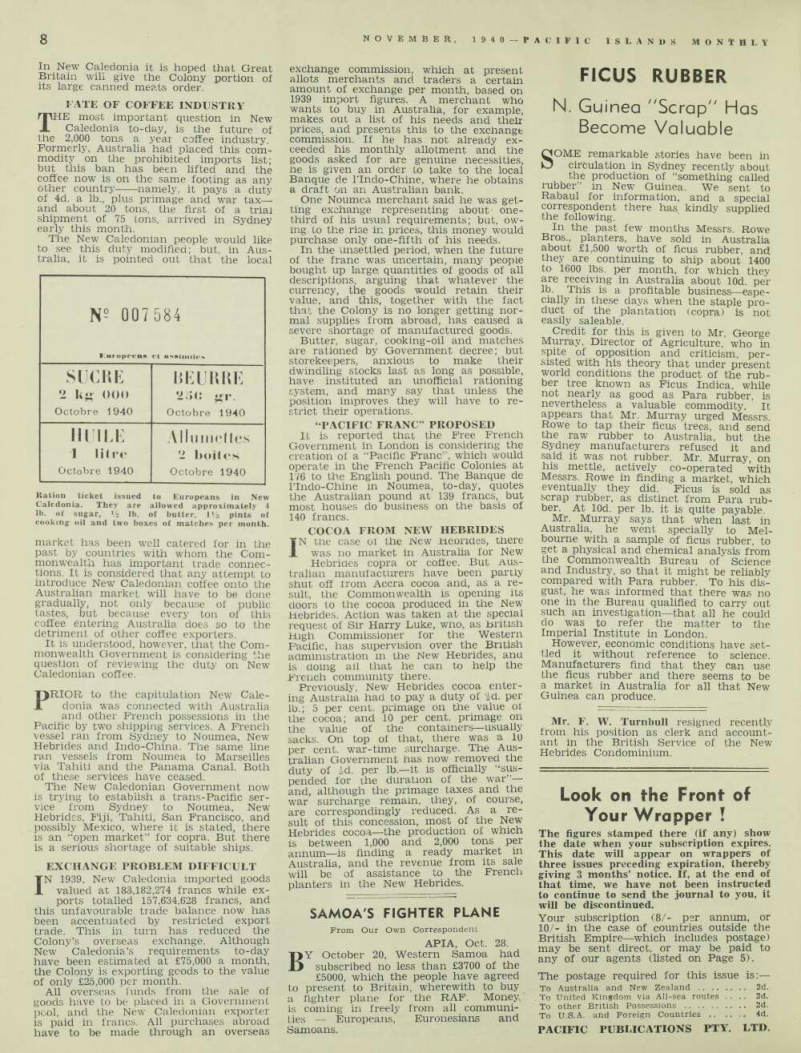
Noumea, New Caledonia. Across Moselle Bay (foreground) can be seen He Non, stretching away into the background. The PAA yacht Southern Seas is anchored just behind the little promontory jutting out to the right from He Nou; and the PAA base is about a^ile further, down the island, beyond the yacht.
In New Caledonia it is hoped that Great Britain will give the Colony portion of its large canned meats order.
Fate Of Coffee Industry
riTHE most important question in New JL Caledonia to-day, is the future of the 2,000 tons a year coffee industry.
Formerly, Australia had placed this com modity on the prohibited imnorts list; but this ban has been lifted* and the coffee now is on the same footing as any other country namely, it pays a duty of 4d. a lb., plus primage and war tax— and about 20 tons, the first of a trial shipment of 75 tons, arrived in Sydney early this month.
The New Caledonian people would like to see this duty modified; but, in Aus tralia, it is pointed out that the local
market has been well catered for in the past by countries with whom the Com monwealth has important trade connec tions. It is considered that any attempt to introduce New Caledonian coffee onto the Australian market will have to be done gradually, not only because of public tastes, but because every ton of this coffee entering Australia does so to the detriment of other coffee exporters.
It is understood, however, that the Com monwealth Government is considering the question of reviewing the duty on New Caledonian coffee.
PRIOR to the capitulation New Cale donia was connected with Australia and other French possessions in the Pacific by two shipping services. A French vessel ran from Sydney to Noumea, New Hebrides and Indo-China. The same line ran vessels from Noumea to Marseilles via Tahiti and the Panama Canal. Both of these services have ceased.
The New Caledonian Government now is trying to establish a trans-Pacific ser vice from Sydney to Noumea, New Hebrides, Fiji, Tahiti, San Francisco, and possibly Mexico, where it is stated, there is an “open market” for copra. But there is a serious shortage of suitable ships.
Exchange Problem Difficult
IN 1939, New Caledonia imported goods valued at 188,182,274 francs while ex ports totalled 157,634,628 francs, and this unfavourable trade balance now has been accentuated by restricted export trade. This in turn has reduced the Colony’s overseas exchange. Although New Caledonia’s requirements to-day have been estimated at £75,000 a month, the Colony is exporting goods to the value of only £25,000 per month.
All overseas funds from the sale of goods have to be placed in a Government pool, and the New Caledonian exporter is paid in francs. All purchases abroad have to be made through an overseas
exchange commission, which at present allots merchants and traders a certain amount of exchange per month, based on 1939 import figures. A merchant who wants to buy in Australia, for example, makes out a list of his needs and their prices, and presents this to the exchange commission. If he has not already ex ceeded his monthly allotment and the goods asked for are genuine necessities, he is given an order to take to the local Banque de ITndo-Chine, where he obtains a draft on an Australian bank.
One Noumea merchant said he was get ting exchange representing about one third of his usual requirements; but, ow ing to the rise in prices, this money would purchase only one-fifth of his needs.
In the unsettled period, when the future of the franc was uncertain, many people bought up larger quantities of goods of all descriptions, arguing that whatever the currency, the goods would retain their value, and this, together with the fact that the Colony is no longer getting nor mal supplies from abroad, has caused a severe shortage of manufactured goods.
Butter, sugar, cooking-oil and matches are rationed by Government decree; but storekeepers, anxious to make their dwindling stocks last as long as possible, have instituted an unofficial rationing system, and many say that unless the position improves they will have to re strict their operations.
‘ Pacific Franc” Proposed
It is reported that the Free French Government in London is considering the creation of a “Pacific Franc”, which would operate in the French Pacific Colonies at 176 to the English pound. The Banque de ITndo-Chine in Noumea, to-day, quotes the Australian pound at 139 francs, but most houses do business on the basis of 140 francs.
Cocoa From New Hebrides
IN the case of the New Heondes, there was no market in Australia for New Hebrides copra or coffee. But Aus tralian manufacturers have been partly shut off from Accra cocoa and, as a re sult, the Commonwealth is opening its doors to the cocoa produced in the New Hebrides. Action was taken at the special request of Sir Harry Luke, who, as British High Commissioner for the Western Pacific, has supervision over the British administration in the New Hebrides, and is domg ail that he can to help the French community there.
Previously, New Hebrides cocoa enter ing Australia had to pay a duty of id. per lb.; 5 per cent, primage on the value of the cocoa; and 10 per cent, primage on the value of the containers —usually sacks. On top of that, there was a 10 per cent, war-time surcharge. The Aus tralian Government has now removed the duty of Id. per lb—it is officially “sus pended for the duration of the war” — and, although the primage taxes and the war surcharge remain, they, of course, are correspondingly reduced. As a re sult of this concession, most of the New Hebrides cocoa—the production of which is between 1,000 and 2,000 tons per annum—is finding a ready market in Australia, and the revenue from its sale will be of assistance to the French planters in the New Hebrides.
Ration ticket issued to Europeans in New Caledonia. They are allowed approximately 4 1b. of sugar, ½ 1b. of butter. 1½ pints of cooking oil and two boxes of matches per month.
Samoa's Fighter Plane
Prom Our Own Correspondent
Apia, Oct. 28.
BY October 20, Western Samoa had subscribed no less than £3700 of the £5OOO, which the people have agreed to present to Britain, wherewith to buy a fighter plane for the RAF. Money, is coming in freely from all communi ties Europeans, Euronesians and Samoans.
Become Valuable
Ficus Rubber
N. Guinea "Scrap" Has Become Valuable
SOME remarkable stories have been in circulation in Sydney recently about the production of “something called rubber” in New Guinea. We sent to Rabaul for information, and a special correspondent there has kindly supplied the following.
In the past few months Messrs. Rowe Bros., planters, have sold in Australia about £1,500 worth of ficus rubber, and they are continuing to ship about 1400 to 1600 lbs. per month, for which they are receiving in Australia about lOd. per lb. This is a profitable business—espe cially in these days when the staple pro duct of the plantation (copra) is not easily saleable.
Credit for this is given to Mr. George Murray. Director of Agriculture, who in spite of opposition and criticism, per sisted with his theory that under present world conditions the product of the rub ber tree known as Ficus Indica, while not nearly as good as Para rubber, is nevertheless a valuable commodity. It appears that Mr. Murray urged Messrs.
Rowe to tap their ficus trees, and send the raw rubber to Australia, but the Sydney manufacturers refused it and said it was not rubber. Mr. Murray, on his mettle, actively co-operated with Messrs. Rowe in finding a market, which eventually they did. Ficus is sold as scrap rubber, as distinct from Para rub ber. At lOd. per lb. it is quite payable Mr. Murray says that when last in Australia, he went specially to Mel bourne with a sample of ficus rubber, to get a physical and chemical analysis from the Commonwealth Bureau of Science and Industry, so that it might be reliably compared with Para rubber. To his dis gust, he was informed that there was no one in the Bureau qualified to carry out such an investigation—that all he could do was to refer the matter to the Imperial Institute in London.
However, economic conditions have set tled it without reference to science.
Manufacturers find that they can use the ficus rubber and there seems to be a market in Australia for all that New Guinea can produce.
Mr. F. W. Turnbull resigned recently from his position as clerk and account ant in the British Service of the New Hebrides Condominium.
Advertisements & other items, p. 10 (1 item)
Your Wrapper !
Look on the Front of
The figures stamped there (if any) show the date when your subscription expires.
This date will appear on wrappers of three issues preceding expiration, thereby giving 3 months’ notice. If, at the end of that time, we have not been instructed to continue to send the journal to you, it will be discontinued.
Your subscription (8/- per annum, or 10/- in the case of countries outside the British Empire—which includes postage) may be sent direct, or may be paid to any of our agents (listed on Page 5).
The postage required for this issue is:— To Australia and New Zealand 2d.
To United Kingdom via All-sea routes ... 2d.
To other British Possessions 2d.
To U.S.A. and Foreign Countries 4d.
PACIFIC PUBLICATIONS PTY. LTD.
Copra
Limited Shipments to a Restricted Market
THERE has been no alteration in the conra situation, in relation to the South Pacific generally, during the month—nor is there likely to be, while the European markets are closed, and shipping is difficult to arrange.
The position in New Guinea and Panua eased considerably—but tempor arily—in October with the arrival of three overseas vessels, which lifted copra and nracticallv cleared the stores of ac cumulations. But there is still much un certainty regarding future ships; and, although the big firms now are buying again, their purchases are practically on a rationed basis —that is to say, they will accept from the various planters with whom they do business only a fixed pro portion of the copra which they accepted from those planters in a normal period.
Messrs. Burns, Philp and Co., Ltd., Rabaul, for instance, were buying copra at the beginning of November; but they explained that they would do so only un til their storage space was exhausted.
They were paying £4/7/6 per ton Rabaul.
The planters described it as “miserable”, but it is stated that the firm itself got only £5 per ton for the last lot of copra
shipped "away.
It is apparent that some of the copra which reaches Europe is received into the stores of the British Food Ministry at the fixed price of £l2/7/6 sterling per ton c i.f. —it is also apparent that only a very small proportion of South Pacific copra gets to the European market now. No one quite knows where South Pacific copra is going to —there is a certain amount of “hush-hush” about it.
North American Markets
There is a limited, but quite strong market in Mexico for copra; but there appear to be no ships to carry it. In any event. British and American Governments frown upon this Mexican trade. The Mexican Government wants to barter mineral oil for copra; and the Anglo- Saxon world cannot forget that it was this same Mexican Government which ruthlessly seized the valuable Mexican oil-wells and kicked out the British and American oil companies, without compen sation, or anything else.
The copra situation may be eased, dur ing the coming year, by the growing friendliness of the United States. There is some hope that eventually British South Pacific copra may be allowed to enter USA on the same terms as Philippines copra. This would greatly alter the economic outlook in the Pacific. The re election of President Roosevelt gives strength to that hope.
Australia still is doing virtually noth ing to help the industry. The “relief scheme” (under which down-and-out planters are allowed a few shillings a week) is being operated by the Terri tories administrations—the Copra Relief Plan Committee cannot be appointed un til certain legislation has been put through at Canberra, and there yet is no indication of when that will be.
A new Minister has taken charge of Territories affairs in Australia; and, if ever he gets around to it, he may do much, in association with New Zealand and the High Commissioner for the Western Pacific, to improve the position of the copra industry.
Robert Kuter
New French Commissioner For N. Hebrides
SHORTLY after M. Sautot assumed office as Governor of New Cale donia and French High Commis sioner for the Western Pacific, it was an nounced in Noumea that M. Robert Kuter had been appointed French Resident Commissioner in the New Hebrides.
M. Kuter was bom in New Caledonia in 1900, and when 20 years of age went to France for training in colonial admini stration. On his return to the Pacific, M.
Kuter held various positions in the French Administration": eventually be coming assistant to M. Sautot at Vila. He speaks English fluently and his appoint ment should facilitate still greater co operation between the Condominium ad ministrations.
to Fight
Free Frenchmen Prepare to Fight
A PARTY of young men from the New Hebrides —mostly Frenchmen and Tonkinese—have arrived in Noumea and have joined a considerable contingent which is receiving military training there, under the banner of Free Prance, in readiness for active service wherever they may be effectively used.
Good Surgeons and Physicians
Tongan N.M.P.'S
THE ability of young Tongans who have been trained at the Central Medi cal School, Suva, as Native Medical Practitioners, has been commented upon favourably by Dr. H. G. Brown, chief medical officer at Tonga, who is visiting Melbourne on leave. Some were excellent surgeons, while others were keen students of medicine, he said. The general health of the Tongan people was excellent.
6 Months' Gaol
For "Theft of a Puppy"
From Our Own Correspondent
Nukualofa, Oct. 22.
MR. C. S. RAMSAY, famous through out the Pacific as the “Tin Can Mailman”, and who returned to Tonga a year ago, was convicted before the Chief Police Magistrate, Mr. W. H.
Stuart, to-day and sentenced to 6 months’ imprisonment for the theft of a puppy, the property of a Tongan boy named Sikini Mu’a.
The evidence disclosed that the puppy wandered away and got into Mr. Ramsay’s home. Mr. Ramsay confessed in Court to having a “soft spot” for all animals and was moved to compassion by the pitiful under-nourished condition of the puppy.
He fed and took care of it for about three weeks, and he had sharp words with the animal’s owner, when the latter eventu ally found and claimed it. However. Mr.
Ramsay, who was represented by a young Tongan lawyer, Hale Vete, failed to con vince the Court that his intention was good. The Court records revealed that he had a previous conviction ('fined £lO for supplying intoxicating liauor to natives several years ago).
The sentence is now suspended pend ing an appeal by Mr. Ramsay to the Privy Council.
Mr. R. F. Field, of Port Moresby, is now in the AIF. his address being PXI9, E Company, Grovely Training Depot, Brisbane, Queensland.
Mrs. F. R. Charlton wife of the Dir ector of Lands, Mines and Surveys in Fiji, died in Suva in October.
Mr. Thomas Bilton, of Teopasino Plantation, Bougainville, NG, died in Namanula Hospital, Rabaul, in October, aged 47. After serving in the Great War with the British Army, he went to the Solomon Islands; and later in the service of Choiseul Plantations, Limited he managed plantations in various parts of New Guinea.
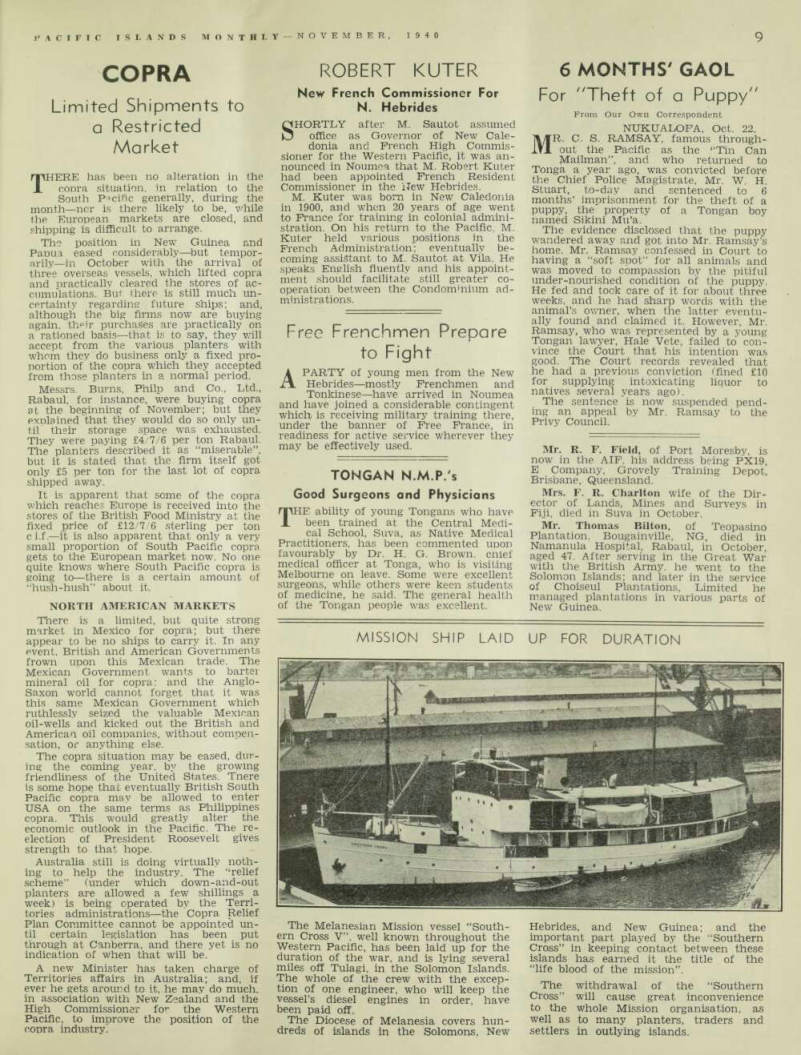
Mission Ship Laid Up For Duration
The Melanesian Mission vessel “South ern Cross V”, well known throughout the Western Pacific, has been laid up for the duration of the war, and is lying several miles off Tulagi, in the Solomon Islands.
The whole of the crew with the excep tion of one engineer, who will keep the vessel’s diesel engines in order, have been paid off.
The Diocese of Melanesia covers hun dreds of islands in the Solomons, New
Hebrides, and New Guinea; and the important part played by the “Southern Cross” in keeping contact between these islands has earned it the title of the “life blood of the mission”.
The withdrawal of the “Southern Cross” will cause great inconvenience to the whole Mission organisation, as well as to many planters, traders and settlers in outlying islands.
Advertisements & other items, p. 12 (1 item)
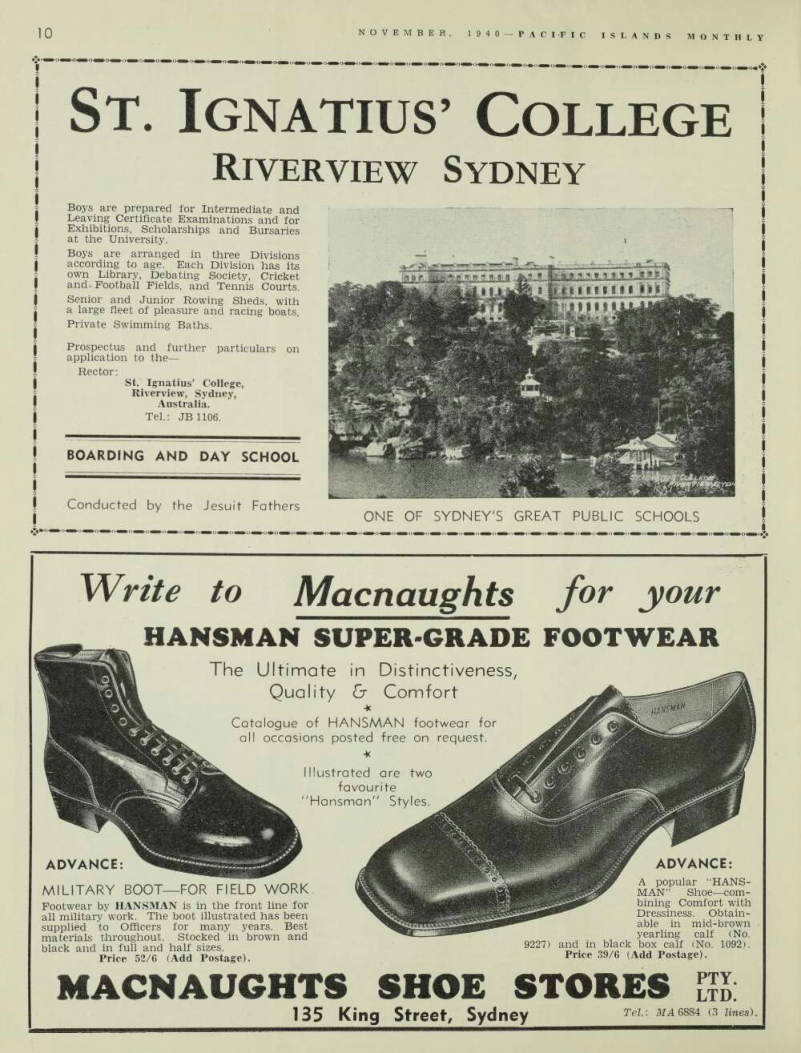
St. Ignatius’ College
Riyerview Sydney
Boys are prepared for Intermediate and Leaving Certificate Examinations and for Exhibitions, Scholarships and Bursaries at the University.
Boys are arranged in three Divisions according to age. Each Division has its own Library, Debating Society, Cricket and -Football Fields, and Tennis Courts.
Senior and Junior Rowing Sheds, with a large fleet of pleasure and racing boats.
Private Swimming Baths.
Prospectus and further particulars on application to the— Rector: St. Ignatius’ College, Riverview, Sydney, Australia.
Tel.: JB 1106.
BOARDING AND DAY SCHOOL
Conducted by the Jesuit Fathers m % s m
ONE OF SYDNEY'S GREAT PUBLIC SCHOOLS
Write to Macnaughts for your
HANSMAN SUPER-GRADE FOOTWEAR
The Ultimate in Distinctiveness,
Quality & Comfort
■* Catalogue of HANSMAN footwear for all occasions posted free on request. * Illustrated are two favourite
"Hansman" Styles.
ADVANCE:
MILITARY BOOT—FOR FIELD WORK
Footwear by HANSMAN is in the front line for all military work. The boot illustrated has been supplied to Officers for many years. Best materials throughout. Stocked in brown and black and in full and half sizes.
Price 52/6 (Add Postage).
ADVANCE:
A popular “HANS- MAN” Shoe —combining Comfort with Dressiness. Obtainable in mid-brown yearling calf (No. 9227) and in black box calf (No. 1092).
Price 39/6 (Add Postage).
MACNAUGHTS SHOE STORES
PTY.
LTD.
135 King Street, Sydney
Tel: MA 6884 <3 lines).
About Islands People

M. Jean Hagen, of Noumea, New Cale donia, paid a visit to Sydney early in November to see his father, M. Nicholas (“Tibby”) Hagen, who has been seriously ill at St. Vincent’s Hospital. Madame Hagen came to Australia by ’plane in October. M. Hagen’s condition in mid- November was reported to be “very much improved”.
News has been received from Beru, headquarters of the London Missionary Society in the Gilbert Islands, of the recent sudden death from food poison ing of Mr, W. A. Levett, who had given a number of years of devoted service to the Mission in those islands. The loss of Mr. Levett will be particularly felt by the Mission in these difficult days of adjust ment to war conditions.
Four Samoa-bom lads, P. Brighouse, A. Williams, E. P. Ryall and E. Gibbs, recently left Samoa in a private yacht to enlist in the New Zealand forces for service overseas.
Dr. Edward Jacomb, formerly well known in New Hebrides, got away from his home in Jersey before the Huns reached the Channel Islands. He be came uneasy when the enemy reached Boulogne, and thought he had better “go while the going was good”. But in the subsequent German occupation he lost everything—house, land, furniture, papers, books, etc. He is at present engaged in war work as temporary medical officer at Rumwell Hospital in Essex.
Mr. and Mrs. S. E. Reilly are at pre sent in Australia on leave. He is staff surveyor for the Papuan Government, in the Delta Division.
Mr. and Mrs. Charles Cleveland, of Thursday. Island, were in Sydney and Melbourne recently on holidays. They will return to TI towards the end of Decem ber.
Mr. T. (“Tiny”) Griffin, for some years senior clerk in the Department of Native Affairs at Rabaul, and later in the Dis trict Services branch, who migrated to Morobe in the early gold rush and spent some time in business there, is now en gaged in Army administrative work in Australia, with the rank of Lieutenant.
Mr. Griffin, who used to vie with Mr.
Paatsch and the late D. O. Mill Towns end for the “heavyweight” record of New Guinea, introduced a spectacular display of New Guinea native curios to Mel bourne at its centenary celebrations, but the venture, while capturing a good deal of public interest, was not a commercial success. He subsequently linked up with a timber company in New Caledonia.
Mr. L. St. George Ryder, manager of Morris, Hedstrom, Ltd.’s Levuka branch, arrived in Sydney from Fiji recently on furlough.
It is reported from Tahiti that the American novelist, Mr. Charles B. Nord
hoflf, has turned rancher. He now has a number of cattle grazing over a consid erable portion of the highlands of the Taiarapu Peninsula, where he has in stalled an electric plant that supplies both light and water. Some fifteen Tahitians are employed there under the direction of M. George Sarge, who was formerly well-known in Papeete business circles. Mr. Nordhoff, who has been visit ing relatives in California, is expected back in Tahiti before the end of the
year. i : i'- ;
Mrs. Janet Cowling, of Daru, Western Division, Panua, and Miss Cowling, are at present spending a holiday at Thurs day Island.
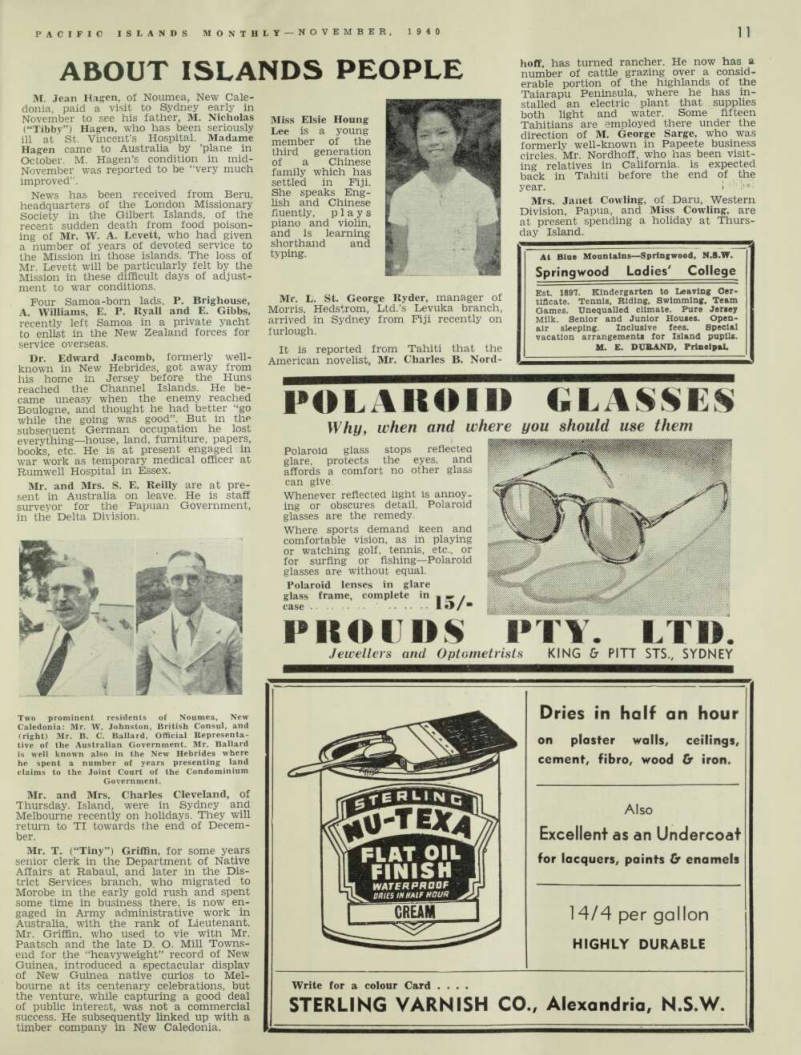
Miss Elsie Houng Lee is a young member of the third generation of a Chinese family which has settled in Fiji.
She speaks Eng lish and Chinese fluently, plays piano and violin, and is learning shorthand and typing.
Two prominent residents of Noumea, New Caledonia: Mr. W. Johnston, British Consul, and (right) Mr. B. C. Ballard, Official Representa tive of the Australian Government. Mr. Ballard is well known also in the New Hebrides where he spent a number of years presenting land claims to the Joint Court of the Condominium Government.
Mr. Floyd McCoy a much travelled member of the little community on Pitcairn Island, was in Australia at the end of ° ctober '
Advertisements & other items, pp. 13-14 (1 item)
m~TA*a
At Blue Mountains —Springwood, N.S.W.
Springwood Lodies' College
Est. 1897. Kindergarten to Leaving Certificate. Tennis, Riding, Swimming, Team Games. Unequalled climate. Pure Jersey Milk. Senior and Junior Houses. Openair sleeping. Inclusive fees. Special vacation arrangements for Island pupils.
M. E. DURAND, Principal.
l>OL\l(OII» GLASSES
Why, when and where you should use them Polaroid glass stops reflected glare, protects the eyes, and affords a comfort no other glass can give.
Whenever reflected light is annoying or obscures detail, Polaroid glasses are the remedy.
Where sports demand keen and comfortable vision, as in playing or watching golf, tennis, etc., or for surfing or fishing—Polaroid glasses are without equal.
Polaroid lenses in glare glass frame, complete in » , case lO/ B
1*1(01 ILS PTY. LTD.
Jewellers and Optometrists KING b PITT STS., SYDNEY
m~TA*a
CREAM
Dries in half an hour on plaster walls, ceilings, cement, fibre, wood Cr iron.
Also Excellent as an Undercoat for lacquers, paints & enamels 14/4 per gallon
HIGHLY DURABLE
Write for a colour Card ...
STERLING VARNISH CO., Alexondria, N.S.W.
Advertiser (Sydney) would like to meet YACHT OWNER, view to distant cruise.
Trading enterprise considered.
Write: J.T., C/o Box 3408 R., G.P.O. Sydney.
Ihmujitte mj|
Cc£uii/v'^m
* * * i ■I &
The Modern
Family Album is
in Living Colour
Truly the breath of life! There’s all the movement and action, all the hues and tints of nature. Children never grow up —great moments never stop happening in the modern family album —it’s . . .
CINE-KODAK Colour Movies
® Let us explain how moderate the investment involved. Catalogues free !
OF ALL CINE-KODAK DEALERS THROUGHOUT THE ISLANDS and
KODAK (A'asia) PTY. LTD.
379 GEORGE STREET, SYDNEY. 9 WOLFE STREET, NEWCASTLE.
War Revives an Old Industry
From Our Own Correspondent
Apia, Nov. 1.
rE shortage of wrapping paper has revived the Samoan wicker-weaving industry. Shoppers in NZ and Australian towns want Samoan hand baskets—strong, light, handy things— and large orders for them have been placed with an Apia firm.
The copra industry is depressed, but the cocoa and banana industries are flourishing.
Mrs. Louise Floyd Murray, of Hong Kong, member of the Polynesian Club of Sydney and well-known in Tahiti, whose sudden death in Sydney was reported in the October “PIM”. Mrs.
Murray, whose Tahitian name was Manuura (Bird of Paradise), came of an old Tahitian family, and, through her father, Edward Chap man, was related to most of the families on Tahiti. Mrs. Murray arrived in Sydney in Sep tember, with a party of women who had been evacuated from Hong Kong.
Tabu
Matson Line Is
Auckland Demands Freer Trade With Fiji
A LIVELY war is going on between the Auckland Chamber of Com merce and the Government of New Zealand in connection with the refusal of the Government to give facilities to the Matson Line for the carriage of cargo between New Zealand and Fiji.
The Minister concerned (Mr. Webb, Minister for Labour) insists that the British line (Union S.S. Co. Ltd.) shall have preference in this trade between British ports: it is a vital principle for the protection of British shipping.
The Chamber takes the point that the service supplied by the Union Company is not sufficient for ordinary trade re quirements and shippers want the right to ship by Matson liner, if they desire.
The discussion, by the end of October, had become somewhat exacerbated. The Chamber’s President (Mr. N. V. Spen cer) pointed out that there was grow ing and important co-operation now between British and American interests in the Pacific, and he put it bluntly to the NZ Government that this was the wrong time to try to apply the prefer ence principle and make a distinction between the Union and Matson liners.
The argument commenced in Septem ber, when the Fiji Chamber of Com merce informed the Auckland Chamber of a number of absurdities which had developed as a result of the prohibition of Auckland cargo for Fiji on the Mat son liners. For instance, that Fiji wished to import New Zealand fish. In order to get regular supplies of cold-water fish onto the Matson liners, the ridiculous situation had developed that the fish had to be shipped in refrigerated cham bers from New Zealand to Melbourne, and in Melbourne it was put aboard the Matson liner and solemnly carried from Australia, via Auckland, to Suva.
Tropicalities
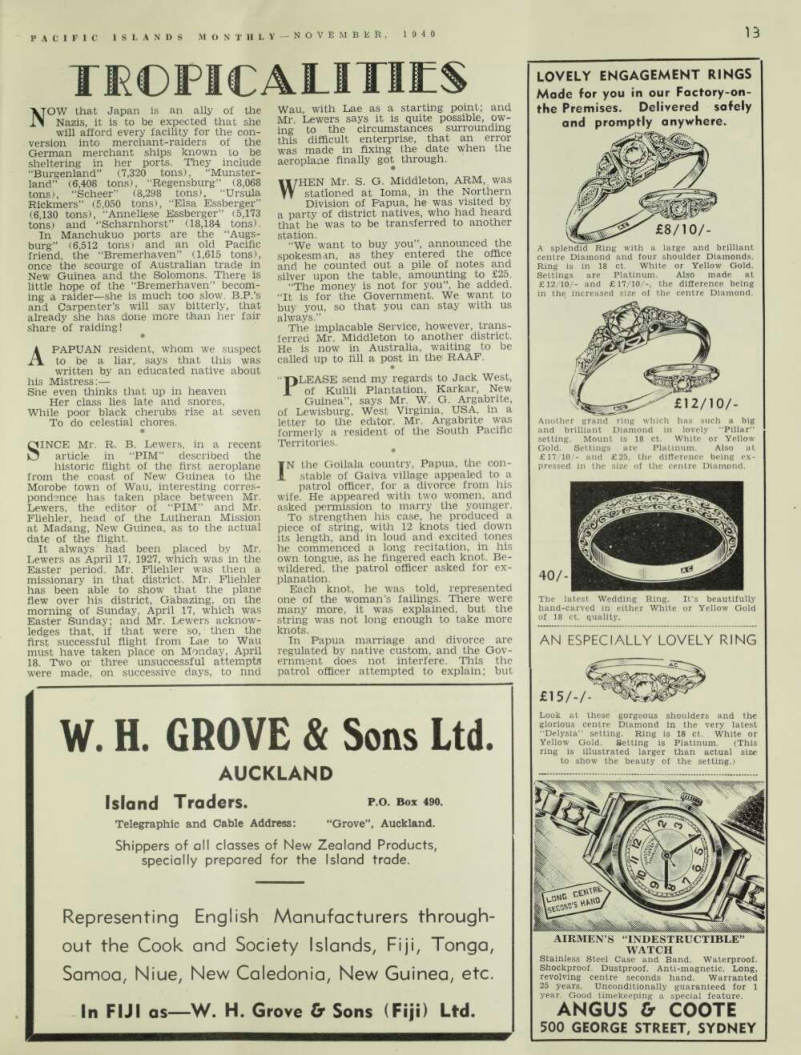
NOW that Japan is an ally of the Nazis, it is to be expected that she will afford every facility for the conversion into merchant-raiders of the German merchant ships known to be sheltering in her ports. They include “Burgenland” (7,320 tons), “Munsterland” (6,408 tons), “Regensburg” (8,068 tons ), “Scheer” (8.298 tons). “Ursula Rickmers” (5,050 tons), “Elsa Essberger” (6,130 tons), “Anneliese Essberger” (5,173 tons) and “Scharnhorst” (18,184 tons).
In Manchukuo ports are the “Augsburg” (6,512 tons) and an old Pacific friend, the “Bremerhaven” (1,615 tons), once the scourge of Australian trade in New Guinea and the Solomons. There is little hope of the “Bremerhaven” becoming a raider—she is much too slow. B.P.’s and Carpenter’s will say bitterly, that already she has done more than her fair share of raiding! * A PAPUAN resident, whom we suspect to be a liar, says that this was written by an educated native about his Mistress:— She even thinks that up in heaven Her class lies late and snores, While poor black cherubs rise at seven To do celestial chores. * SINCE Mr. R. B. Lewers, in a recent article in “PIM” described the historic flight of the first aeroplane from the coast of New Guinea to the Morobe town of Wau, interesting correspondence has taken place between Mr.
Lewers, the editor of “PIM” and Mr.
Fliehler, head of the Lutheran Mission at Madang, New Guinea, as to the actual date of the flight.
It always had been placed by Mr.
Lewers as April 17, 1927, which was in the Easter period. Mr. Fliehler was then a missionary in that district. Mr. Fliehler has been able to show that the plane flew over his district, Gabazing, on the morning of Sunday, April 17, which was Easter Sunday; and Mr. Lewers acknowledges that, if that were so, then the first successful flight from Lae to Wau must have taken place on Monday, April 18. Two or three unsuccessful attempts were made, on successive days, to find
Wau, with Lae as a starting point; and Mr. Lewers says it is quite possible, ow ing to the circumstances surrounding this difficult enterprise, that an error was made in fixing the date when the aeroplane finally got through. * WHEN Mr. S. G. Middleton, ARM, was stationed at loma, in the Northern Division of Papua, he was visited by a party of district natives, who had heard that he was to be transferred to another station. , , “We want to buy you”, announced the spokesman, as they entered the office and he counted out a pile of notes and silver upon the table, amounting to £25.
“The money is not for you”, he added.
“It is for the Government. We want to buy you, so that you can stay with us always.”
The implacable Service, however, trans ferred Mr. Middleton to another district.
He is now in Australia, waiting to be called up to fill a post in the RAAF. * "QLEASE send my regards to Jack West, 1 of Kulili Plantation, Karkar, New Guinea”, says Mr. W. G. Argabrite, of Lewisburg, West Virginia, USA, in a letter to the editor. Mr. Argabrite was formerly a resident of the South Pacific Territories. ♦ IN the Goilala country. Papua, the con stable of Gaiva village appealed to a patrol officer, for a divorce from his wife. He appeared with two women, and asked permission to marry the younger.
To strengthen his case, he produced a piece of string, with 12 knots tied down its length, and in loud and excited tones he commenced a long recitation, in his own tongue, as he fingered each knot. Be wildered, the patrol officer asked for ex planation.
Each knot, he was told, represented one of the woman’s failings. There were many more, it was explained, but the string was not long enough to take more knots.
In Papua marriage and divorce are regulated by native custom, and the Gov ernment does not interfere. This the patrol officer attempted to explain; but
the exasperated husband continued his recital—while his wife stood humbly at his side, secretly pleased at the commo tion she had caused. * THE following is from “Saturday Even ing Post” of March 9, 1940: “Boston: Francis A. Countway, bachelor head of Lever Brothers, soap makers, who paid the country’s highest income tax in 1938, began as an accountant in the sales
department. Out of his salary and bonus of $469,713 he paid approximately $285,000 in Federal income tax, $37,000 in State income tax, leaving him a net in come of $148,000, little more than half of what Washington took. He lives with his unmarried sister in a modest apartment in Brookline.”
It is at least a comfort to coconut planters to know that the gentleman suffered at the hands of the tax-collector something of what the copra-producers endure under the operations of the Lever Combine. The only difference is that, while the poor old planter tries to manage on a bread-and-margarine in come, Mr. Countway still has about £35,000 per annum wherewith to scare the howling wolves away from his portals. * rE town of Rabaul, in New Guinea, is becoming racially colourful, accord ing to this paragraph from a recent issue of “Rabaul Times”:— “Eleven Asiatic females appeared before the District Court on Wednesday charged with playing an unlawful game in a public place. The game was ‘Jimmy Coon’, and the place was on the beach near Ah Tam’s. Police evidence showed that the ‘school’ caused considerable interest amongst the natives who were onlookers.
Each player was convicted and fined 10/-.” ♦ SEVERAL years ago, two members of the Papuan Armed Constabulary, who had put an end to the suffer ings of two desperately-wounded tribes men, found after an encounter with some mountain tribes, were formally tried. In the view of' the law this was murder, and they were sentenced at Samarai to be hanged, in Port Moresby gaol.
The vessel in which they were to travel to Port Moresby was ready to leave and, at the last moment, the two ex-constables
were seen racing along the wharf. They smiled apologetically at the ship’s officer as they jumped on board. “We are very sorry”, they explained, breathlessly. “We were talking to some friends, and forgot that we were going to Port Moresby to be
hanged.”
Their sentence, later, was commuted to a term of imprisonment. * IT is stated by the “Rabaul Times” that there has been so great a reduction in the activities of the New Guinea Public Service, owing to the lull in the copra market, that although some 60 members of the New Guinea Service have joined up for active service overseas and only 5 temporary employees have been engaged to fill vacancies, the service does not appear to be suffering from over work. * FOR many years the Chilean dollar was used as currency in the Pacific especially in Tahiti, Rarotonga, and adjacent islands. When was the coin first introduced? As late as 1900, the dollar was common enough in Rarotonga, and the New Zealand authorities had to make somewhat stringent regulations to ex clude it. It was not for some years, how ever, that it was excluded, and British coinage established there (especially in the outer islands). The reason, of course, was that a fairly regular trade with Tahiti had developed, and the natives had become so accustomed to the dollar that they looked upon any other coin with some suspicion. Though some authorities believe that the Chilean dollar came into prominence when John Brander and other traders in Tahiti developed considerable commercial relations with Chile, it was known on that island long enough before.
Possibly, the whalers and sealers who
found the salubrious climate of Tahiti so attractive, introduced the coin. —“Vakatini”. ♦ AN article of timely interest in the November issue of the New Guinea Agricultural Gazette is entitled: “Copra Deterioration During Storage and Shipping”. A deal of attention is being given to this subject by those who believe that current supplies of copra will be quite insufficient to meet the tremendous oil fat demand when the war is over and the European market is opened again, and who therefore advocate the storage of present supplies of copra. The question that nearly every copra-grower is asking to-day is: “Can copra be stored, and for how long?” Another timely article in this valuable Gazette is: “The Food Value of the Coconut” —an expert analysis which shows the various possibilities of the coconut. * AT a recent meeting of native council lors at Abau, Papua, a recommend ation was placed before the magi strate that two women found talking to gether should be put in prison for two months. They explained that the women “make bad talk” and that the lies that they tell form the basis of evil reports.
The magistrate pointed out that there was already a regulation to punish those who spread lying rumours.
“That’s no good”, cried the reformer.
“Put the women in gaol whenever you find them talking together, and there will be no more lying rumours.” His sug gestion was not adopted. * IT is not generally known that one of the longest roads in the South Seas territories is in New Guinea. It is on the island of New Ireland, and runs southwards from Kavieng. The German administration originally built about 100 miles of this road; and, since then, it has been slowly extended by the Australian administration. The Administrator (Sir Walter McNicoll) after a visit to New Ireland last month, stated that it is now possible to motor from Kavieng south wards to Namatanai, a distance of 220 miles, along a road which was quite a credit to those who were responsible for its construction. * A MAIDEN lady lived in a small coun try house in England with a house maid. The officer arranging for the billeting of children evacuated from Lon don rang the door bell. The maid ad mitted him and then rushed upstairs.
“Please, mum,” she blurted out, “you’ve got to have two babies and the man’s downstairs.” (This one should appeal to Dr, Goebbels!) Two young men of Apia, Western Samoa, Messrs. Kennedy Godwin and Oliver Moors, recently proceeded to Van couver to enlist in the Canadian Forces.
A number of volunteers from the Terri tory are serving with the New Zealand Forces—several on active service in England and Egypt.
Mr. N. C. Watt, formerly a teacher in the Queensland Education Department, has been appointed headmaster of the L.M.S. boys’ school at Port Moresby, Papua, in succession to the late Mr.
Stuart Lade. Mr. Watt, who will take up duties this month, will be accompanied by his wife and two children.
Rev. J. G. Heath, well-known in the Solomon Islands where he spent some five years as a teacher for the Melanesian Mission, has been appointed vicar of Papakura, N.Z.
The Chief Medical Officer of Papua, Dr. F. J. Williams, leaves shortly on leave for New Zealand.
Rev. E. C. and Mrs. Leadley passed through Sydney in October on their re turn to the Methodist Mission’s station at Roviana, Solomon Islands, after spend ing furlough in New Zealand.
Mr. L, L. McKillop, newly appointed field manager for Papuan Apinaipi Petroleum Co., arrived in Port Moresby recently and proceeded to the Co.’s work ings at Oiapu.
Mr. Grahame Dickson, who was acting manager for the Union Company at Rarotonga earlier in the year, has rejoined the “Aorangi” as purser, and is again on the Sydney-Vancouver run.
Mr. Dickson (who visited Rarotonga on numerous occasions on the old “Makura” and other vessels on the San Francisco run) attended several functions in his honour before leaving Avarua.
Advertisements & other items, pp. 15-17 (2 items)
W. H. GROVE & Sons Ltd.
LOVELY ENGAGEMENT RINGS
Made for you in our Factory-on-
the Premises. Delivered safely
and promptly anywhere.
£B/10/- A splendid Ring with a large and brilliant centre Diamond and four shoulder Diamonds.
Ring is in 18 ct. White or Yellow Gold.
Settings are Platinum. Also made at £l2/10/- and £l7/10/-, the difference being in the increased size of the centre Diamond. £l2/10/ aa Another grand ring which has such a big and brilliant Diamond in lovely “Pillar” setting. Mount is 18 ct. White or Yellow Gold. Settings are Platinum. Also at £l7/10 - and £25, the difference being expressed in the size of the centre Diamond. 40/m CL* The latest Wedding Ring. It’s beautifully hand-carved in either White or Yellow Gold of 18 ct. quality.
AN ESPECIALLY LOVELY RING
£l5/-/- Look at these gorgeous shoulders and the glorious centre Diamond in the very latest “Delysia” setting. Ring is 18 ct. White or Yellow Gold. Setting is Platinum. (This ring is illustrated larger than actual size to show the beauty of the setting.) 4
CQ|O
.e
setw 1
AIRMEN S “INDESTRUCTIBLE”
WATCH
Stainless Steel Case and Band. Waterproof.
Shockproof. Dustproof. Anti-magnetic. Long, revolving centre seconds hand. Warranted 25 years. Unconditionally guaranteed for 1 year. Good timekeeping a special feature.
ANGUS & COOTE
500 GEORGE STREET, SYDNEY
W. H. GROVE & Sons Ltd.
AUCKLAND
Island Traders. p.o. box 490.
Telegraphic and Cable Address; “Grove”, Auckland.
Shippers of all classes of New Zealand Products, specially prepared for the Island trade.
Representing English Manufacturers throughout the Cook and Society Islands, Fiji, Tonga, Samoa, Niue, New Caledonia, New Guinea, etc.
In FIJI as —W. H. Grove & Sons (Fiji) Ltd.
EVERY SHAVE
A PERFECT SHAVE
with a
ROLLS RAZOR
We can recommend with every confidence this English Razor. It has a hollow ground blade and is fitted with hone and strop. In strong nickel case . 50/- Silver plated 60/-
PIKE BROTHERS
LIMITED
Queen Street, Brisbane.
Knox Grammar School
WAHROONGA, NEW SOUTH WALES, AUSTRALIA
(Headmaster, Dr. W. Bryden, M.Sc.) The School is situated 12 miles from Sydney, 600 feet above sea level, and accepts day boys and boarders from six years of age. Boys prepared for all usual Examinations.
Spacious playing fields, swimming pool, well equipped gymnasium, library. Cadet Corps, etc. Next term commences February 4. Prospectus on application. ■vs i I T m m ■ i s
“ULTIMATE”
7-VALVE PORTABLE MANTEL
WORLD-WAVE VIBRATOR MODEL
Cut out this Coupon and post to-day.
Specially suited for Island conditions An unique Dual Purpose high quality Set exclusive to “ULTIMATE”.Two sets in one—a superior mantel model and easily-carried multi-wave Vibrator Portable. Instantly detachable lid effects the transformation.
Specially suited to Island reception. Magnificent performance under all circumstances. Thorough dependability guaranteed by “ULTIMATE”. Will satisfy the most fastidious expert.
Take it anywhere—picnics, meetings, dances, boating parties, car outings, etc., etc.— performance will always be superb! Exclusive Light Ray Tuning (obtainable only in “ULTIMATE”). Five controls'. Tone, Volume, Dial Lamp (for conservation of Battery Power), Wave Band and Tuning ; Broadcast 1600-550 kilocycles ; Short Wave 16-52 metres; special 8 in. Rola Reproducer (sealed against humidity) ; High Fidelity Push-Pull Output (unusual in Vibrator Models) ; A.V.C. Spin Tuning, etc., etc. INSECT-PROOF!
Also obtainable in 5-Valve World-Wave Battery Vibrator, in 6- Valve World Wave, and 8 and 10-Valve All-Wave Electric.
GEORGE BROWN & CO. PTY. LTD., 267 Clarence Street, Sydney.
Please send me particulars of “ULTIMATE” Radio Receivers as advertised in “Pacific Islands Monthly”.
Name Address I M
lit
1 u GEORGE BROWN & CO. PTY. LTD., 267 Clarence St., Sydney
15
HdFtc islands Monthly November, 1940
How Pan American Airways Are Bridging
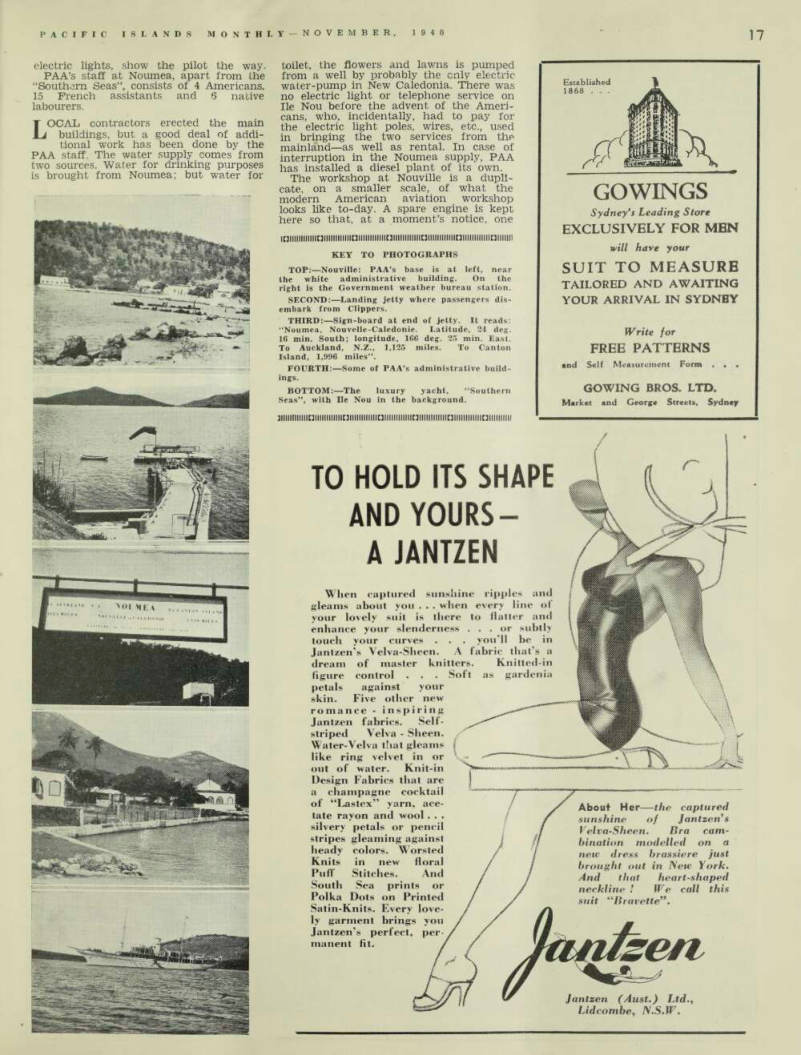
The Pacific New Base at Noumea Built on Ruins of Old Convict Settlement
The wonderful work that Pan American Airways now are doing in pioneering and charting the Central and South Pacific Ocean for sea-plane communications, and in equipping bases for the safe handling of passengers and mails on the Trans pacific services, is described in this article by Brian Stein, of “Pacific Islands Monthly” staff, who recently visited New Caledonia. PA A, for their recently established South Pacific service, have provided bases at Canton Island, Noumea and Auckland; and another base, to be
used in the same service, is now being constructed by the British authorities near Suva, Fiji.
Four years ago, there were indications that Pan American Airways and Im perial Airways would compete bitterly for the traffic available in the South Pacific. To-day, British and Americans are co-operatnig, in an effort to jointly supply an important service. A sign of the times.
PAN American Airways organisation at Noumea, New Caledonia, can be divided into three parts: First, the base where the Boeing flying boats are serviced and the passengers disembark.
Second, accommodation for these pas sengers is provided in the luxury yacht “Southern Seas”.
Third, the radio station at Magenta, just out of Noumea.
Noumea Harbour (see panoramic photo graph in this issue) is formed by two is lands—He Brun and He Nou —which run along- the coast for several miles, across the mouth of a deep indentation in the mainland. On the mainland side of He Nou, about 21 miles from Noumea, is Nouville. Here amid the ruins of the old penal colony, where fifty years ago thou sands of unhappy criminals and politi cal undesirables were housed in huge concrete prisons, PAA has built its base.
The old prisons slowly are crumbling away; but, a little apart from the main group of buildings, there is a walled-off compound which has taken on a new, modern appearance. This site, chosen by Pan American Airways as a base, was once the prison warders’ residence, and the high, brick wall surrounding the buildings and grounds was built in case the prisoners managed to get loose, and turn on their guardians.
In May, 1939, the PAA officials who were to supervise the construction of the base arrived at Nouville. They found the old warders’ compound in ruins, sur rounded by masses of bramble and brush.
In just 101 weeks, however, they an nounced that they were ready to re ceive a plane. An amazing transforma tion had been made; a large cement building had been constructed on the foundations of the warders’ house, and several other buildings, workshops, etc., had been erected.
To-day, clean white gravel paths run between well laid-out lawns; a number of trees provide shade, and flowers line the pathways. A concrete jetty has been built out from the shore and, at the end of it, a landing stage lies upon two float ing pontoons. White buoys mark the mooring positions for the Clippers; and, in the night, red buoys, equipped with
electric lights, show the pilot the way.
PAA’s staff at Noumea, apart from the “Southern Seas”, consists of 4 Americans. 15 French assistants and 5 native labourers.
LOCAL contractors erected the main buildings, but a good deal of addi tional work has been done by the PAA staff. The water supply comes from two sources. Water for drinking purposes is brought from Noumea: but water for
toilet, the flowers and lawns is pumped from a well by probably the only electric water-pump in New Caledonia. There was no electric light or telephone service on He Nou before the advent of the Ameri cans, who, incidentally, had to pay for the electric light poles, wires, etc., used in bringing the two services from the mainland —as well as rental. In case of interruption in the Noumea supply, PAA has installed a diesel plant of its own.
The workshop at Nouville is a dupli cate, on a smaller scale, of what the modern American aviation workshop looks like to-day. A spare engine is kept here so that, at a moment's notice, one
Key To Photographs
TOP:—Nouville: PAA’s base is at left, near the white administrative building. On the right is the Government weather bureau station.
SECOND: —Landing jetty where passengers dis embark from Clippers.
THIRD: —Sign-board at end of jetty. It reads: “Noumea, Nouvelle-Caledonie. Latitude, 24 deg. 16 min. South; longitude, 166 deg. 25 min. East.
To Auckland, N.Z., 1,125 miles. To Canton Island, 1,996 miles”.
FOURTH:—Some of PAA’s administrative build ings.
BOTTOM: —The luxury yacht, “Southern Seas”, with He Nou in the background.
of the four engines on a 42-tons Clipper may be dismantled and replaced.
An idea of the systematic way PAA runs its service can be gauged from the layout of these workshops. All spare parts right down to the smallest nuts and screws, are kept in uniform rows of boxes; each with a particular number marked clearly on the outside. For in stance, on one tab, we read; “36.4312.
Nut, screw machine, steel”. If you went into any PAA base, in any part of the world, and asked for No. 36.4312 you would be given a nut exactly the same as the one in Noumea under that number.
The contents of these boxes are indexed in a file and a strict watch is kept so that the contents never get below a fixed minimum.
Another feature of the base which em phasises the strict uniformity insisted upon by the Company is the colour scheme of the buildings. The builders are told by the head office in USA just what colours have to be used, and where. For
example, in the workshop at Noumea, a black band about one foot wide, runs around the bottom of the walls; then for a specified distance a grey colour is used; and this is followed by a narrow black line; then a silver colour is used for the rest of the wall and the roof. The same colour scheme is used in all PAA base buildings in every part of the world.
The Clipper from Canton Island usually arrives at Noumea from the east at dusk, continues westwards for several miles and then wheels and comes into the He Nou base (opposite Noumea) from the south-west. On alighting, the machine taxis across to the mooring buoys. A line is put aboard and the plane is pulled alongside the landing-stage, tail fore most, by hydraulic power.
The passengers walk ashore to the main building, where they undergo the customs, health and immigration formali ties. This completed, they walk out onto another jetty, and into a speed launch, which takes them to the “Southern
Seas”, the luxurious, residential yacht, moored midway between the base and Noumea.
On the journey southwards, to New Zealand, passengers usually spend the night on the yacht, and leave early the next morning. On the northwards trip, the Clipper arrives from Auckland about mid-day, and leaves the following morn ing, giving passengers an opportunity to see something of New Caledonia.
THE meteorological side of the PAA service is a fascinating study. At Nouville, local weather reports on visibility, temperature, types of cloud formations, velocity of winds, etc,, are issued every six hours, and transmitted to other stopping places on the run from San Francisco. These reports are compiled from information gathered from the base’s own observations; from informa tion made available by the New Cale donian weather bureau; and from reports issued twice daily by PAA bases in the New Hebrides and Loyalty Islands. A theodolite tower has been built at Nou ville, and gas-filled balloons are released at various intervals during the day. As they rise, their progress is watched and automatically recorded by a man at the theodolite. By this means the direction and force of the prevailing wind, at all heights, can be ascertained.
From a meteorological point of view, the flight from San Francisco to Auck land is divided into two parts: the sec tion from San Francisco to Canton Is land coming under the control of the Honolulu divisional weather officer; and the section from Canton Island to Auck land is the concern of the Auckland officer. All intermediate bases co-operate with these two main points, and each day both Auckland and Honolulu issue 4 forecasts, whether a plane is in the air or not.
Two and a half hours before a plane is due to leave Auckland, the meteorologi cal officer there issues a “special prelim inary flight-time analysis”, covering the flight from Auckland to Noumea, which meteorologically is divided into four zones.
These special reports then are issued every hour while "the plane is in flight, and give its crew all possible information concerning weather conditions at 1,000, 7,000 and 10,000 feet. The plane, in turn, sends positional reports to Auckland and Noumea every 30 minutes; and these re ports embody wind speeds, types and quantities of cloud formations encount ered. etc., in addition to information con cerning the plane’s progress. With the Auckland weather reports, and the plane’s and local weather reports, it is possible for officials at Noumea to gauge to a minute just when the plane will land.
In order to get his position, the navi gator of the present-day Clipper does not rely merely upon the bearings he gets from the sun and stars; but he checks these with his wireless. For in stance, if the navigator of a plane flying between Noumea and Canton Island wants to find his position by wireless he makes sure he is on the correct wireless line between Noumea and Canton Island.
He then wants to know just where on that line the plane is, so he makes dir ectional wireless contact with some station between those two points—for ex ample, Suva. He takes a line from Suva across the line from Noumea to Canton, and he knows that where the two lines intersect is the position of the plane Along the route from Honolulu to Auckland, PAA has surveyed sites for use as emergency landing grounds Norfolk Island is among those selected; and in case Noumea Harbour suddenly should become unsuitable for a landing while a
plane is in flight, emergency alighting
places have been provided along the New Caledonian coast and in the New Hebrides.
ONE of the first obstacles encountered at Noumea, when the regular pas senger service was commenced, was the lack of suitable accommodation for the travellers’ overnight stay. Honolulu and Auckland have several first-class hotels, and the problem at Canton Is land was solved by building a modern hotel; but none of the Noumea hotel proprietors made any effort to improve their services to meet the high standards required by PAA. It was reported that as a result of this the Company tried to purchase a hotel and make the necessary alterations: and failing to do this, In spected a hill at the back of Noumea as a possible hotel site.
Finally, however, it was decided to use the luxuriously-equipped yacht “Southern Seas” as a floating hotel, and to-day this vessel is anchored behind Point Lambert —half-way between Nouville and Noumea —and is to be there “indefinitely”.
When Mr. C. T. J, Adamson, of the Public Service of Papua, discovered that his old friend and comrade in many hazardous patrols, Mr. Ivan Champion, had been rejected by the AIF on the eye sight test, Mr. Adamson managed to transfer from the AIF to the Navy. He is a qualified navigator. He passed his en trance examination satisfactorily and has entered the Australian Navy with com missioned rank. In order to be together, Messrs. Champion and Adamson were prepared to join the AIF as privates; but, when that arrangement was not possible, Mr. Adamson looked elsewhere.
Advertisements & other items, pp. 18-22 (1 item)
Bidomak
Get Rid of that
NERVY RUN-DOWN
DEPRESSED FEELING !>
6IDOMAK ends mineral starvation—cause of nerves,
and constitutional disorders—by providing ferrum,
calcium, potassium, sodium, phosphates, glycero-
phosphates, sucrose, copper and manganese.
BIDOMAK gives you a good appetite—brings restful
sleep—strengthens tired nerves—relieves stomach
upsets and dyspepsia—builds energy, "pep" and
endurance. Makes you well and keeps you well.
BIDOMAK contains no dangerous drugs nor opiates.
Start taking BIDOMAK to-day!
SCIENTIFIC
CONTROL
Manufactured in the BIDOMAK Pharmaceutical Laboratories, one of the most up-to-date, hygienic laboratories in the Southern Hemisphere, to which is attached a fully qualified Doctor of Medicine, and under the control of a qualified chemist who was trained in the most modern English Laboratories in the world.
NERVY, FATIGUED, MALARIA SUFFERER
Now Better—With More Energy Than Ever. 70 Newlaw Street, Waverley, 27/3/39. “For many years I have suffered from Malaria. This left me in a very debilitated state, always feeling fatigued and nervy. I have tried many preparations, but I had not received real benefit until I commenced taking BIDOMAK. I now feel much better in every way. I eat better, and have much more energy than I had previously.” (Signed) (Mr.) A. F. GROVER.
BIDOMAK
The Tonic of the Century"
For Nerves, Brain and that “Depressed Feeling' At all Leading Island Stores.
PACIFIC ISLANDS SOCIETY
Visitors from the Islands to Sydney (or those Interested in Islands affairs), are advised to communicate with the honorary secretary of the above Society, which has been formed to study the history, traditions, economics, and political developments of the Pacific Islands.
Next Meeting at Hotel Carlton, Sydney, November 37, 8 p.m.
Mr. Thomas Dunbabin, M.A., will speak on “Mysteries of the Pacific”.
Address for Correspondence:
THE PACIFIC ISLANDS SOCIETY,
Box 3434 MM., G.P.0., Sydney.
Estal 1868 IX
GOWINGS
Sydney’s Leading Store
EXCLUSIVELY FOR MEN
SUIT TO MEASURE
TAILORED AND AWAITING
YOUR ARRIVAL IN SYDNEY
Write for
FREE PATTERNS
and Self Measurement Form . • .
GOWING BROS. LTD.
Market and George Streets, Sydney will have your
TO HOLD ITS SHAPE
AND YOURS -
A JANTZEN
When captured sunshine ripples and gleams about you . . . when every line ol your lovely suit is there to flatter anti enhance your slenderness ... or subtly touch your curves . . . you'll be in Jantzen's Velva-Sheen. A fabric that’s a dream of master knitters. Knitted-in figure control . . . Soft as gardenia petals against your skin. Five other new romance - inspiring Jantzen fabrics. Selfstriped Velva - Sheen.
Water-Velva that gleams
like ring velvet in or out of water. Knit-in Design Fabrics that are a champagne cocktail of “Lastex” yarn, acetate rayon and wool. . .
silvery petals or pencil
stripes gleaming against heady colors. Worsted Knits in new floral Puff Stitches. And South Sea prints or Polka Dots on Printed Satin-Knits. Every lovely garment brings you Jantzen’s perfect, permanent fit. r j About Her —the captured sunshine of Jantzen*s Velva-Sheen. Bra combination modelled on a new dress brassiere just brought (mt in I\ew York.
And that heart-shaped neckline ! We call this suit “Bravette”. *
Jantzen (Aust.) Ltd.,
Lidcombe , IS.S.W.
BRITANNIA OUTBOARDS
Marvellous English quality. No other country can produce an outboard like this. Solid bronze under-water gear, chrome plated. Silent, vibrationless power. Utmost economy. These are only some of the features. Let us send you an illustrated leaflet which will prove that Britain can turn out marine outboards superior to any other. 4 B.H.P. Super Twin. Weight 53 lb. Price £5O. m Single 5 h.p. 4-cycle
SIMPLEX MARINE ENGINES
Australia’s finest in small marine engine manufacture. 7 models from 3 h.p. to 12 h.p. Suitable for boats from 14 ft. to 30 ft. long.
The new twin 10/12 h.p. is now available, and h&s just been accepted by the Navy for small boats.
Gives smooth running at all speeds, with reserve of power for any weather. Economical, easy starting, easy to instal.
Let us send you full particulars of all models.
SIMPLEX LAUNCHES ALSO AVAILABLE.
TIL L E Y
KEROSENE LAMPS
Made at London, England, despite the Blitzkrieg. 14 models available, providing from 300 to 2000 c.p. light. The only lamps which will burn kerosene efficiently. No flickering, no ■ insect trouble, no worry.
Illustrated is the popular Tall Table Lamp, 300 c.p. and suitable for all large rooms. An ideal Xmas present. Write for Tilley catalogue or see local agent.
All our lines can be purchased through any Sydney Agent if preferred.
For all Shipchandlery, Boatgear, Mining Supplies and Hardioare.
W. KOPSEN O CO. PTY. LTD.
380 KENT STREET, SYDNEY. Cables: “Kopsen”, Sydney.
IN TUNE WITH EVERY OCCASION
Whether in sun porch ™ or on location. camp K ¥ Mb I *, ■ L* I there's an Airzone or city flat mantel radio for every occasion, 4. + + For quiet entertainment,
or midnight dance party.
x news bulletins / for latest war
u Ml
or local sporting results. /A '> \ * Airzone fine Radio can satisfy your every need.
"V: At left is the "Symphony Leader"
Model 5098, 5 Valve 1.4 Volt Battery Dual Wave Mantel, designed to measure up to the exacting requirements of these without electric current. Also as Model 5059, 5 Valve Vibrator Powered Dual Wave. Both are Airzone masterpieces of Mantel Model Art!
Above is shown Airzone's new mantel production.
Model 1072VM. It is a 7 Valve Vibrator Powered Dual Wave Mantel with EVERY feature of a console radio in mantel form. The seven valves make it very powerful and long distance or local reception is extremely good. Also as a 6 Valve A.C. Dual Wave Model 1062 AM housed in the same cabinet.
AGENTS FOR NEW GUINEA. PAPUA AND SOLOMON ISLANDS:—
W. R. CARPENTER & CO., LTD.
19 O'Connell Street, Sydney; Salamaua, Rabaul, Kavieng and Madang, N.G.; and Tulagi, Solomon Islands Designed and manufactured hy Airzone (19. U) Ltd., Camperdown. N.8.W.. Australia. HASSO.
NELSON & ROBERTSON
PTY., LTD.
Established 1895.
Islands Merchants
All classes of merchandise purchased at wholesale prices and original invoices supplied to Islands clients.
Cocoa Beans, Rubber and other Islands' produce sold on commission.
SOLE AGENTS FOR
ANKAR INSULATING
WALLBOARD
BEEBE PORTABLE
WINCHES
SKANDIA ENGINES
Nelson & Robertson
Pty. Ltd. 12 Spring Street, Sydney, Australia.
'Equal to the World’s Best
Throughout Australia and Overseas there is an ever-increasing demand for
“COLONIAL” and
“BRONTE”
HIGH-GRADE CANNED MEATS
There is no better quality — none more wholesome.
TRADE MEATS FOR THE ISLANDS
order
“COLONIAL* BRAND
Roast, Corned and Boiled Beef Packed in 0,5, 4,3, 2, 1 lb. and 12 oz. tins.
Also Corned Beef in 12 oz. Taper Tins.
Roast, Corned and Boiled Mutton. 1 lb. and 12 oz. tins.
Choice Dripping
36 lb., 2 lb„ 1 lb. tins, and 1 lb. packets.
All our Meats are canned under the supervision of a Meat Inspector of the Commonwealth of Australia.
Under present conditions it is wise to ensure that you have ample stocks of all our lines.
I lb NETT
CA HP PIE,
MgtefcL: o * l **. WMOUSALf MJ AT CO. W
DELICIOUS
BRONTE" HOT MEALS
Steak and Kidney Pudding.
Beef Steak Pudding.
Sausages and Tomato.
Sausages and Vegetable.
Lamb and Green Peas.
Corned Beef and Boston Beans with Tomato Sauce.
Steak and Tomato.
The Colonial Wholesale Meat Coy. Pty. Ltd.
30 GROSVENOR STREET, SYDNEY
"Chinatown"
A Social Problem in N. Guinea
AN interesting sidelight on life in New Guinea is seen in the insistent demand that a “Chinatown” be created in the new mining town of Wau, New Guinea. “Chinatown”, of course, is that part of a European town set apart exclusively for the Chinese.
There is in New Guinea now a fairly large and steadily-growing Chinese com munity-clever, adaptable people, dis playing all the good qualities of their race, who have been for the most part born under the Australian flag and who, quite properly, claim the privileges of British citizenship.
But the great ambition of the average Chinese is to own and run a trade store —that is, a store which trades directly with the natives. There are a number of such trade stores already in Wau, and they have been established in or near the residential district. The effect, of course, is to bring into the European residential area large numbers of natives, who spend their spare money in the stores, and their spare time hanging around outside. They are quiet and peaceful enough, but they have the habits of natives and, therefore, they create what Europeans regard as a con siderable nuisance in a European area.
The allocation of a “Chinatown”, to which Chinese-conducted trade stores will be restricted, will be welcomed by Wau residents.
Mr. Albert Robert Quintal, one of the best known identities on Norfolk Island, died recently at the age of 47.
New Minister For Pacific
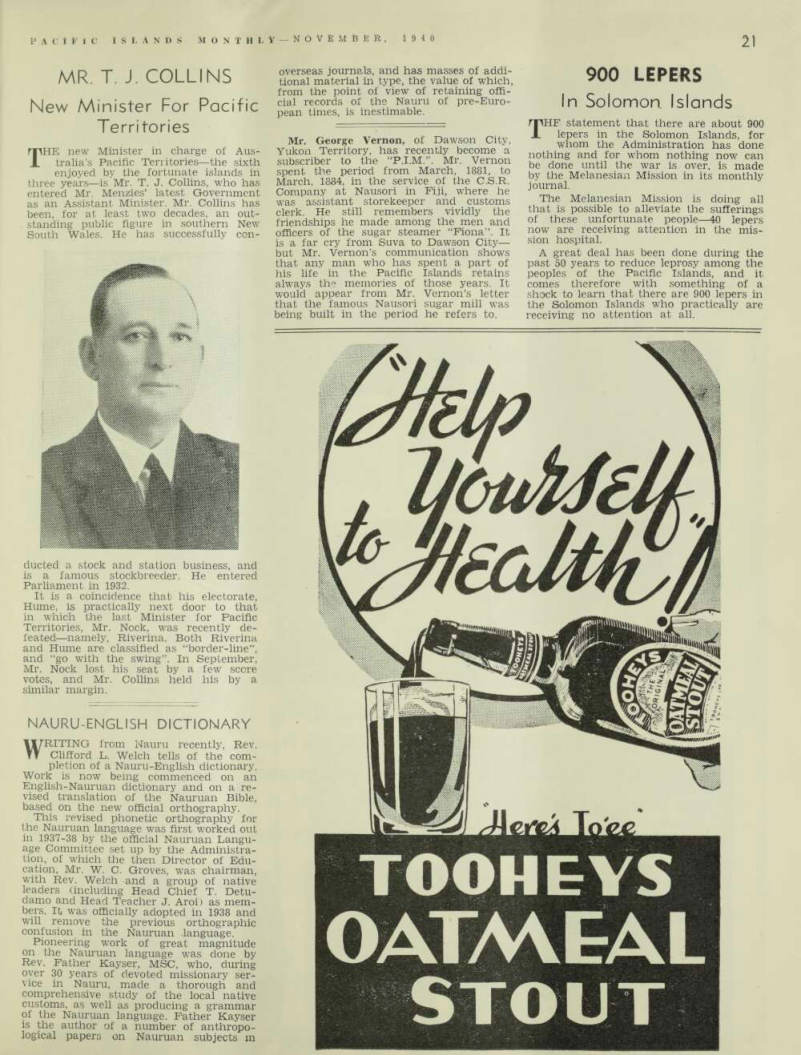
Mr. T. J. Collins
New Minister For Pacific Territories
THE new Minister in charge of Aus tralia’s Pacific Territories—the sixth enjoyed by the fortunate islands in three years—is Mr. T. J. Collins, who has entered Mr. Menzies’ latest Government as an Assistant Minister. Mr. Collins has been, for at least two decades, an out standing public figure in southern New South Wales. He has successfully con-
ducted a stock and station business, and is a famous stockbreeder. He entered Parliament in 1932.
It is a coincidence that his electorate, Hume, is practically next door to that in which the last Minister for Pacific Territories, Mr. Nock, was recently de feated —namely, Riverina. Both Riverina and Hume are classified as “border-line”, and “go with the swing”. In September, Mr. Nock lost his seat by a few score votes, and Mr. Collins held his by a similar margin.
Nauru-English Dictionary
WRITING from Nauru recently, Rev.
Clifford L. Welch tells of the com pletion of a Nauru-English dictionary.
Work is now being commenced on an English-Nauruan dictionary and on a re vised translation of the Nauruan Bible, based on the new official orthography.
This revised phonetic orthography for the Nauruan language was first worked out in 1937-38 by the official Nauruan Langu age Committee set up by the Administra tion, of which the then Director of Edu cation, Mr. W. C. Groves, was chairman, with Rev. Welch and a group of native leaders (including Head Chief T. Detu damo and Head Teacher J. Aroi) as mem bers. It was officially adopted in 1938 and will remove the previous orthographic confusion in the Nauruan -language.
Pioneering work of great magnitude on the Nauruan language was done by Rev. Father Kayser, MSC, who, during oyer 30 years of devoted missionary ser vice in Nauru, made a thorough and comprehensive study of the local native customs, as well as producing a grammar 9f the Nauruan language. Father Kayser is the author of a number of anthropo logical papers on Nauruan subjects in
overseas journals, and has masses of addi tional material in type, the value of which, from the point of view of retaining offi cial records of the Nauru of pre-Euro pean times, is inestimable.
Mr. George Vernon, of Dawson City, Yukon Territory, has recently become a subscriber to the “P.1.M.”. Mr. Vernon spent the period from March, 1881, to March, 1884, in the service of the C.S.R.
Company at Nausori in Fiji, where he was assistant storekeeper and customs clerk. He still remembers vividly the friendships he made among the men and officers of the sugar steamer “Fiona”. It is a far cry from Suva to Dawson City— but Mr. Vernon’s communication shows that any man who has spent a part of his life in the Pacific Islands retains always the memories of those years. It would appear from Mr. Vernon’s letter that the famous Nausori sugar mill was being built in the period he refers to.
900 Lepers
In Solomon. Islands
rpHF statement that there are about 900 X lepers in the Solomon Islands, for whom the Administration has done nothing and for whom nothing now can be done until the war is over, is made by the Melanesian Mission in its monthly journal.
The Melanesian Mission is doing all that is possible to alleviate the sufferings of these unfortunate people—4o lepers now are receiving attention in the mis sion hospital.
A great deal has been done during the past 50 years to reduce leprosy among the peoples of the Pacific Islands, and it comes therefore with something of a shock to learn that there are 900 lepers in the Solomon Islands who practically are receiving no attention at all.
Advertisements & other items, pp. 23-24 (2 items)
21
Hc m c islands moni blv - November, 1940
H
V i
\ § .V s Spring Clean your engine . . Get rid of the Winter oil now dirty, gritty, inefficient . . . Give it a Fresh start with Clean Summer Mobiloil. Have your garageman Drain it. Flush it CLEAN, and refill it with the correct grade, then enjoy its better performance.
It pays to make a proper job of lubrication. Ask your garageman about the gear-box and differential. For complete chassis lubrication look for
MOBILUBRICATION Sign.
Plan For Great Copra Pool
What is Being Done in East Indies
ri\HE following, kindly supplied by ± Messrs. Burns, Philp and Co., is a translation of an article in “De Locomotief”, Netherlands East Indies, of September 9. The Netherlands Indies Government is to establish a copra pool, and important stocks are to be held in the Netherlands Indies for the use of Holland after the war. Details are as follow: — The Government has submitted to the People’s Council an important supple mentary budget from the Department of Economic Affairs, wherein an item is in cluded for the institution of a Copra fonds. The loss on this fonds for 1940 is estimated at one million guilders, whicn sum has been asked for. The cost ot establishing the Coprafonds is estimated at ten million guilders.
The intention is to regulate the buy ing and storage of copra by a body to be called “Coprafonds”, which, under a Government guarantee, will be supplied with the necessary finance. The fact that only a very small portion of copra can be exported will have to be taken into consideration, so that the local stocks will mount rapidly. It is supposed that, at the end of the war, Europe will immediately need fats, and for the supply of which ready stocks will be important. This is of special importance for the Netherlands; with such stocks Netherlands Indies will be able to come to the aid of the Mother Country, for stock feed as well as for fats.
The uncertainty regarding the period of the present conditions, and of the world situation is such that it is impos sible to know what is a payable price, or what the financial consequences might be. More cannot be paid than is suffi cient to keep copra production going m its most simple form.
Recognition must be taken of the fact that the return, in different districts, is influenced by the different freight rates from the different districts; also the fact that there is a variation in the produc tion costs in different districts,
Shortage Of Store Space
In view of the uncertainty, if and when it will be possible to export the copra, the intention is not to transport the copra from the production centres, ex cept to a number of central storage depots. Thereby the buying apparatus will be as close as possible to the pro ducers. It is, however, necessary to keep the number of storage depots as low as possible.
At the moment an estimate of storage space available is not more than 100,000 tons. Therefore in the first year, stores to take about 300,000 tons will have to be erected. The cost of the building of satisfactory wooden stores is estimated at
about f. 5 per ton space.
The above shows that only a very rough idea of the costs in connection with the buying of this copra, can be estimated at present.
The export of copra from the Outer Possessions to Java can, under present conditions, be estimated as roughly 30,000 tons per year. This does not in clude the copra shipped from the Outer Possessions to Java, and which is pressed for coconut oil, for export abroad.
It is intended to prohibit the shipment of copra from the Outer Possessions to Java—and, if such should appear neces sary, also the import of copra from abroad—and permission to do* so only given to Coprafonds. Thereby shall the fonds be placed in a position to bring the
present abnormally low Java price to the normal level of, say, f. 6. per 100 kilo grams.
That will mean, for the numerous copra producers in Java, an important advantage, while the consumers of coco nut oil will only have to pay slightly more for this article.
The Coprafonds shall, in order to make the export of coconut oil possible, sell necessary quantities of copra to oil mills at sufficiently lower prices to make their product competitive.
Finance
The profit from the copra sold by Coprafonds for consumption in Java, may be calculated as follows:
Cost of purchasing 30,000 tons copra in the Outer Pos sessions =31,500 x f. 30 per ton C.I.F. Java harbours in cluding bags . . F. 945,000 Sale of 30,000 tons at f. 60 .. 1,800,000 Profit for Coprafonds 855,000 In view of the fact that there is no possibility of making any estimate of the likelihood of selling the copra purchased by Coprafonds, in the remaining free markets of the world, the amount can only be placed in abeyance. However, in any case, it can be taken for granted that the result will produce more than F. 295,000. The total expenses of Copra fonds during the first year are estimated at F. 11,150,000, less profits (855,000-f -f.295,000).295,000) F. 10,000,000.
The period, during which copra may be stored, can be taken as around 2 h years.
So long as there is no prospect of sell ing the stored popra, as is the case at
present, it is considered advisable from a budgetary point of view, to transfer the storage charges to the Government esti mated budget during the period con cerned —40 per cent, for the first anti second years, and 20 per cent, for the third year.
Copra In The World Market
In considering of the possibilities of placing in other markets that portion of Netherlands Indies copra that in normal times was exported to countries now un reachable, two unfavourable factors must be considered—namely, that only a small portion of world fats (about 8 per cent.! comes from copra; and that the other countries that produce oils and fats for export, will now be in sharp competition with Netherlands Indies in those markets that are still open. It might be added that the most important available market, the United States of America, cover their full requirements of coconut oil from the Philippines, which country enjoys a pre ferential tariff.
As is known, the position of copra in the world market was weak for some time prior to the outbreak of war, occasioned by overproduction during a number of years of oils and fats, caused by a steady increase in the offerings of different sorts of vegetable and other oils and fats, which by the advance in technical know ledge were made satisfactory for the same uses, while on the other hand the consumption slowed down as a result of economic conditions in many consump tion centres.
Through the loss of the principal buying markets for Netherlands Indies copra, the situation is now so unfavour able, that for most of the copra available for export from the Netherlands Indies, no payable market is to be found.
For an example, the average price per
100 kilograms of Menado F.M.S. exclu sive bag, has been as follows: 1927 f 24.30 1935 „ 5.90 1928 „ 23.90 1936 „ 8.00 1929 „ 20.25 1937 „ 7.65 1930 „ 14.60 1988 „ 5.00 1931 „ 8.90 1939 4.55 1982 „ 7.70 (Aug. 27) 1933 4.50 1940 1.60 1934 „ 3.25 Without assistance, the price will with out doubt decline further.
Such a condition cannot be permitted, because the population in large districts, such as North Celebes, the Moluccas and some parts of West Borneo, and the West Coast of Sumatra, depend to a large ex tent on the return from copra. The situ ation, however, is not catastrophic, be cause the population of these districts has, since the outbreak of war, gone over to growing foodstuffs; and this, accord ing to the result of an inspection, will provide sufficient food for practically the whole of the year. However, the indis pensible income to allow of purchase of clothing and other necessities, can only come from the sale of copra, and this has now reached a stage of stagnation.
Recent Exports
EXPORTS of copra from Dutch East Indies in recent years were:—
These are tons of 1000 kilograms.
In addition to these figures, the outer posses sions exported to Java the following quantity of copra:— 1938 27,832 tons 1939' 61,349 tons The principal markets for Netherlands Indies copra were Scandinavia, Central Europe and countries bordering on the Mediterranean Sea.
These countries took:— 1937 .. 353.186 tons, or 70.8% of the total export 1938 .. 422,058 tons or 76.1% of the total export 1939 .. 380,754 tons or 71.5% of the total export The other export destinations in those years were:—
Mr. Ivan Champion, having fought a 2-months’ losing battle with A.I.F. wallahs (who insisted that his eye-sight would not pass the test—said eye-sight having taken him across unexplored New Guinea two or three times) has returned to Papua, and has gone to Daru to re lieve the R.M. (Mr. Austen) for a few months.
From: 1938. 1939.
Sumatra lOff.goS 110,213 Pontianak 41,063 35.798 West Coast of Borneo 31.220 31,128 Bandjermasin 4 Macassar 228,385 212.756 South West Celebes 7.784 9,471 Minahasa (inch Kwandang) . 43.283 40,378 Toll-Toli & North Celebes .. 510 588 Sanglr Islands 25,108 -24,164 Tominlbocht 8,013 17.844 South East Celebes 12 —
Ternate & Ambon and their surroundings 3,808 6.868 Sunda Islands 21,292 10,831 Riouw 33,629 28,185 Java 3,243 200 Other sources 1,224 3,523 Export from the whole Netherlands Indies 554,481 531,947
1937. 1938. 1939'.
Great Britain 85 1,312 Arabia — 1,142 Penang 11,837 9,890 9,884 Singapore 111,233 110,631 113,607 China 351 1,934 7,524 Japan United States of America: 7,309 4,925 1.403 Atlantic Coast 58 95 Pacific Coast 5.378 .— 4,155 Mexico 8,804 5,043 4,155 Total 145,055 132,423 151,193
Advertisements & other items, pp. 25-26 (1 item)
Steamships Trading
Company Limited
PORT MORESBY SAMARAI MISIMA, PAPUA.
WHOLESALE & RETAIL MERCHANTS, SHIPOWNERS,
PLANTERS, ENGINEERS & SLIP PROPRIETORS.
Customs, Shipping, Insurance, and Forwarding Agents.
MANAGING AGENTS AND VISITING REPRESENTA-
TIVES FOR COCONUT AND RUBBER ESTATES.
A full range of Merchandise always in stock, including Plantation, Mining, Prospecting and General supplies.
All classes of ship repairs and engine overhauls undertaken. Vessels up to 400 tons gross slipped at any tide on our patent Slipway, Port Moresby.
AGENTS FOR:—Vacuum Oil Co. Pty., Ltd., Bankers & Traders Ins. Co.. Royal Packet Navigation Co., American Trading & Shipping Co., Wunderlich. Ltd., Dodge Motor Co., Diamond T Motor Trucks, Johnston Outboard Motors, Sawmillers & Traders, Ltd., Coral Sea Insurance Co., Australian General Electric Refrigerators, Hallstroms Kerosene Refrigerators, B.A.L.M. Paints, Kodak, Ltd., Acme Bakery 'Co.
SYDNEY REPRESENTATIVES: Nelson & Robertson Pty. Ltd., 12 Spring Street.
WRITE, CABLE, OR CALL FOR PARTICULARS
STEAMSHIPS TRADING COMPANY LIMITED
Head Office: Port Moresby. Cable Address: "Steamships".
Ml
"MORE POWER TO YOU"
it S
9* . .iitto Ci .ditto CAR .. . RADIO
‘ HOME UGHTINC
PRODUCT OF THE CLYDE ENGINEERING CO LTD Island Agents: Burns, Philp & Co., Ltd,, Rabaul: John L. Peadon, Ltd.
W. R. Carpenter & Co., Ltd. Fiji: Morris, Hedstrom, Ltd.
rf 1 ’ V
> * 0 ' /r •j /b- -*
YOU’RE THERE...
WITH A
KRIESLER
THE BEST SET AT ANY PRICE "
London .. . Paris .. . Berlin .. . U.S.A. etc. Perfect long range reception with supreme tonal quality.
Full particulars write: Featured above is Kriesler Model 4K40 —Mantel type, 6 volt, vibrator operated radio in moisture proof walnut veneered cabinet. Full size chassis and speaker— specially built for the tropics.
Price 31£ Gns.
Kriesler 1.4 volt low consumption battery world range portable Model 4K87.
Price 21 Gns.
KRIESLER (AUSTRALASIA) PTY. LTD., BOX 23 P.O. NEWTOWN, N.S.W.
Grow Rice And
Tobacco!
Economic Problem For New Guinea
IT is being urged that the planters of New Guinea, being unable to sell readily their principal product, copra, should give some attention to the possi bility of producing two articles which now bulk largely in the list of the territories imports. They are rice and tobacco.
The 1939 statistics of the Territory show' that, apart from mining machinery, rice was the Territory’s largest import— the value imported from £70,565, and most of this came from Saigon and China, which are non-sterling sources. Only £13,634 worth of rice came from a sterl ing source —namely, Burma.
The Territory, in the same period, im ported trade tobacco —that is, tobacco for distribution and use among natives, as distinct from tobacco made for European trade —to the value of £35,654, and, of this, £33,691 came directly from the United States another non-sterling source.
It is obvious, as a matter of simple national economics, that if the staple products of the Territory, such as copra and gold, are to be sold abroad, the Terri tory must purchase abroad a certain quantity of foreign products—and rice and tobacco fill the bill as well as any thing else. The ultimate basis of all extra-territorial trade is the exchange of goods.
But, when a country’s staple product loses its market —as copra has done —then it is sound policy to turn around and see if the plantations can produce anything else.
There is no reason that we know why New Guinea’s requirements in rice and tobacco cannot be produced in New Guinea. But one thing is highly neces sary—namely, administrative initiative, direction and drive. What can we expect of an Administration which, for 15 years, has maintained an expensive, liberally staffed and very efficient Department of Agriculture and yet has failed to estab lish in the Territory any agricultural in dustry worthy of the name, apart from the coconut industry. And the coconut in dustry already was established there, quite soundly, when Australia took the territory over from the Germans.
1600 People Raise £8000
For War Funds
IT is worthy of note that already the European community of 1,600 people in Papua has contributed over £B,OOO to various war funds. These include £5,377 to the Papuan War Fund (up to October 25): £1,316 to the Red Cross Society: and £690 to the Ambulance Appeals Fund. £l,OOO was cabled to the Lord Mayor of London on October 1 to be applied to the relief of distress among the victims of German bombing raids. It is worth not ing that at least one hundred Papuan natives have contributed to these funds— in various small sums ranging from 1/to £l.
Flight Lieutenant S. G. Preston, of the R.A.A.F. at Port Moresby, Papua, has been promoted to acting Squadron Leader, serving as medical officer to the unit.
Rev. G. H. Voss, who has been a worker for the Melanesian Mission at Gasmata, New Britain, is expected to arrive in Australia shortly, and probably will join the military forces.
Killed In Air Raid
Former Resident of Papua
ADVICE was received in Sydney in October that Mr. Alastair Ross, formerly a well-known Government servant in Papua, had been killed as the result of an air raid. Mr. Ross, who re tired from the Territory service about nine years ago, and made his home in London, had acted as an air warden, and it was while on duty on October 20 that he met his death. He is survived by his widow, and a son and daughter.
Mr. Ross’s last official position was in the Government Stores Branch at Port Moresby. Mr. Douglas Ross, his brother, is still a resident of Papua.
Rev. W. and Mrs. Wiedemann, of the Melanesian Mission’s station at Sag Sag, New Britain, T.N.G., are expected to arrive in Australia shortly.
Mr, Kenneth H. Bradshaw, a nephew of Mrs. Munro and Mrs. Bock, two well known residents of Port Moresby, has been selected Queensland’s Rhodes Scholar for 1941.
Mr. J. McWhinney, who has been ap pointed to command the Norfolk Island Infantry Detachment, was a member of the Australian Forces which captured German New Guinea in 1914.
Brig.-Gen. T. Griffiths, former Admini strator of New Guinea and also of Nauru, and also chairman of at least two Federal Commissions of Enquiry in New Guinea, who has been acting in an hon orary advisory and liaison capacity with the Department of Defence Co-ordination in Melbourne, has relinquished that posi tion. The Prime Minister paid a public tribute to the selfless work of General Griffiths, on his retirement. The General still maintains his interest in the Islands, and is always happy to meet former Nauruan and New Guinea friends.
Among recent arrivals in Australia, on leave from the Solomons, are Messrs. A.
Waddell and C. E. N. Bengough, Admini strative Officers of San Cristoval and Malaita respectively. Mr. Bengough has been relieved at Malaita by Mr. J. K.
Brownlees, recently returned to the Pro tectorate from leave spent in Sydney. All Civil Service leave from the Solomons has been cancelled until further notice, due to war conditions, except in special circumstances.
Mr. and Mrs. C. Tucker, SD.A, mission aries, have been transferred from the New Hebrides to the Solomon Islands, where Mr. Tucker will take over the in dustrial worx of the mission at Batuna, in the Marovo Lagoon. They will be fol lowed, in the New Hebrides, by Mr. and Mrs. J. E. Martin, who have arrived in Australia from Fiji on furlough. Mr. Mar tin will be the industrial supervisor of the mission, and assistant teacher in the Aore training school.
Advertisements & other items, pp. 27-28 (1 item)
Lighting Plant
s m
ELECTRICITY IS NO
LONGER A LUXURY!
For the outlay of a few pence a day, you can enjoy the great benefits of safe and dependable electricity—yes, brilliant lighting for every room at an amazingly low cost, if you instal a . , .
PHILIPS HOME ELECTRIC
LIGHTING PLANT
complete with world renowned
EXIDE STORAGE BATTERIES
There is no other Lighting Plant that offers such exceptional value as this Philips. The engine is forced draught, air-cooled single cylinder and operates at low speed. The generator has extra large commutator and collector rings, and cannot become overheated, which is most important. With cheap plants excessive heat causes lubrication failure and wear, and this means trouble. So play safe, decide on a Philips. The price of the Philips is only £69/10/-. (Price includes Federal Sales Tax, and F. 0.8. Sydney). Lower price quoted for Plants sold in bond. Let us tell you all about it.
Telegrams: “Virtue”, Sydney. 'Phones; FL 5214 (6 lines).
MOFFAT-VIRTUE LTD. MS
11-25 PALMER ST„ SYDNEY. BOX 15848. G.P.O.
SHOWROOMS: 44 Bridge St. (opp. Winchcombe, Carson, Ltd.), Sydney
AND AT BRISBANE and LONGREACH, Q’LD.
VI/A
/dpeci*i£&f fhe. TROP/CS
CAPSTAN
'S n« t Capstan Navy Cut Tobacco, made from the finest Virginia leaf.
cicAßcrfts
Capstan Cigarettes, round airtight 50's.
Medium and full strength. 8824-10-1
READ THE
B.P. MAGAZINE
SPRING NUMBER
lIIIIIIIIIIIIIIIIIIIIIIIIIIIIIIIIIIIIIIIIM
NOW ON SALE
Short Stories Pictures Travel Articles - - - - Pages for the Children Stage Latest Fashions --- Screen A
ONE SHILLING PER COPY.
ON SALE AT ALL NEWSAGENTS AND BOOKSELLERS
Three Mad Days
When Two Great "Luxury Liners" Visited Tahiti
By Edward C. Snow
IN the middle of a period of depression, for three brief days, Tahiti, geo graphically lucky, fell under favour of the Goddess of Fortune. The Matson Line chose Tahiti as a safe spot for an erstwhile cruise. A third of Papeete's total population in crews and tourists at one visit, and a deluge of perhaps 115,000 dollars! No mean windfall for any city, ancient or modern.
It is not easy to describe how Papeete was turned into Honolulu for three days.
Paradise took on a vicious earthiness, the law of supply and demand ruled in the primordial jungle manner. The
“Soak ’em” motif of the commercants; the sulky, jealous indifference of the de featist French Government, contributed to a picture painted in the rawest prim ary colours.
France has been the playground oi eaters of alien corn from the world over, since tourism began. And French policy had always been to operate special prices for so fine a class of pigeon. For ex clusiveness and record prices, Deauville, Cannes and Monte Carlo stood unbeaten, even in America. But in August, 1940, Tahiti financially decapitated, outbid, shocked and knocked cold even its proua parent.
Prices rose a hundred to three thousand per cent.—6 francs (1/-) was asked and paid for a glass of iced water, 25 francs (3 6) for a packet of the cheapest French cigarettes, 30/- for an ordinary meal. £3 for accommodation for two in a native bungalow, and up to £l3 for a taxi ride round the island, etc.
The Chinese removed their price tags and charged anything they could get, but towards the end the tourists dis played a strong inclination to ‘‘button up” —whereupon prices fell and the dollar rose. Uo to 90 francs worth of mer
chandise was given for a dollar by some Chinamen.
The cruises concluded as former South Sea Bubbles concluded. They burst, and left Papeete with a headache that took a week to get over.
The ships went, the tourists went— and 50 others as well. A number were left behind, not having the 300 dollars the Matson Company asked. Double fare for the single journey may have been in order for movie stars, with plenty of filthy lucre, but that didn’t include the entire tourist complement at Papeete.
THE “Monterey”, from Sydney, entered Papeete Pass at 6.30 a.m. on Sat urday, August 3, with little clear ance between her keel and the coral. Sea planes provided a fitting escort.
Papeete’s pulse quickened. The Tahitian girls, carefully groomed and dressed, jittered as though their blood boiled, assured of conquests to come. Haloed plaited hair and blue black satin pyjamas, with hieh neck collars, struck a dominant note: while motors, by the hundred, lined the main street and wharf.
As though it were a thermometer in boiling water, the temperature of the town arose. It was hard for a person to think clearly, or decide anything, as the invasion of Australian and New Zealand tourists and through American passen gers swent in, like a tidal wave. Every body was on nleasure or business bent, one and all determined to miss nothing.
War-time exchange regulations, forcing all tourists to change their pounds and dollars into Paneete francs, at Spitz Curio Store or the local bank, soon proved
hopelessly inadequate. Despite threats of terrific penalties, the Chinese offered double the pegged rate, and relieved the chaos.
An endless stream of taxis poured out past the customs shed, filled with tour ists who had previously reserved them for a trip round the island. Stops were made at Rivnac’s White Beach Hotel, Lafayette and Cristion’s “Royal Tahitian Bunga lows” for meals and refreshments.
SHARP on schedule, the “Mariposa”, from San Francisco, etc., appeared, and the tempo of the town re doubled. Familiarity with the ships in 'Frisco and Sydney has reduced the im pression they make. However, one’s sense of nroportion was restored by witnessing the effect of forty-five thousand tons of modern shipping in such a setting as a South Sea Island lagoon.
Eyes goggled in awe and wonder as the “Mariposa” cruised along the tree lined foreshore, broadcasting from her boat-deck a fanfaronade of radio music.
The influx of tourists from the States exceeded that of Australia and New Zea land three times, and it speedily turned Papeete into a veritable madhouse.
All sense of proportion was lost, in the rush to get dollars, or spend them. From the cabarets came a bedlam of noise, hou jazzing, jitterbug swing and Tahitian tunes.
From Quinn’s charged a man, scream ing as though demented: “I’m goin’ to buy a hat! I’m goin’ to buy a hat!” He charged up the street waving his arms, reversed, and flew back into Quinn’s again, as though his life depended on it.
The Firewalk nroved a great attraction, though its former mysticism has long since departed. It ended in a fiasco, with every small boy in Papeete waltzing on the basalt rocks.
The expositions of paintings were too numerous to count or describe in detail.
A considerable number of the paintings were what Mr. W. W. Bolton aptly de scribed as “abortions”; a vogue of paint ing originated in Tahiti, many years ago, by Paul Gauguin, and elaborated by Picasso and others. Up to £lO was asked for a bilious-looking mess that a cow could have created with its tail.
Some fine pearl collections came to light—the real things, so unlike the cul tured and artificial kind. There were miniatures in ivory bone and silver, ex quisite filigree work, well worth writing home about, particularly as their setting was so unusual and unexpected.
With the arrival of the “Mariposa”, the entire American tourist complement had to change immediately to the “Monterey” and vice versa. The through passengers stayed as they were. The idea was some thing unique in both Tahiti’s history, and that of tourism generally.
This Tourist Invasion, because of its sweep and extent, cut across a wide stratum of British and American life.
Some were very queer types, others raffish and fascinating people. Many looked like characters out of a story, even like the characters in Grimm’s Fairy Tales.
There was a dwarf woman, only two feet high, who wore three leis round her neck. There was the tallest man in the world (8 feet 6 inches in height), fol lowed by Tahitian natives, from shop to shop, exclaiming “Awaei” or “Aue”! There was a troupe of singers from Honolulu, bound from America to Sydney. Multi coloured shirts festooned with palms, canoes, and natives spearing fish, were all the rage among the American tour ists; while on the pockets were crest badges and shields inscribed “Alohawai”, “Royal Hawaiian” and “Here I come”.
An Appeal to Readers
PAPER is a commodity “officially rationed”. We ■ are liable to severe penalties if we waste paper.
Sending our journal to people whose sub scriptions have expired, and who have not yet ordered renewal, is regarded as waste.
Hitherto, we always have continued to send the “P.1.M.” for three months, to expired sub scribers. while awaiting their renewals. Now, it is not permitted.
We do not wish to lose old readers. Old readers do not wish to lose continuity of “P.1.M.” issues.
Therefore, for “the duration of the argument with Adolf”, please notify renewal promptly, when w’arning of the expiry of your subscription is given.
Changes in Management of
Bulolo Dredging
Changes in Management of Company
THERE have been important changes in the management of Bulolo Gold Dredging, Ltd., New Guinea.
Mr. O. B. Hart has resigned the gen eral managership and Mr. F. W. R.
Godden, who has been assistant and act ing general manager for some time, has been appointed general manager as from November 1.
Mr. J. D. Simpson, who has been act ing field manager of an associate com pany, Pato Consolidated Gold Dredging Limited, of Colombia, South America, has been appointed assistant manager of Bulolo Gold Dredging, Ltd., and is due in Sydney, en route to Bulolo, towards the end of November. Mr. Simpson is an Australian, but has been abroad for seventeen years and has had dredging and mining experience in various parts of South America and Alaska, in addition to his early exnerience with the Electro lytic Zinc Company of Hobart.
Mr. Justice R. T. Gore, of the Supreme Court of Papua, recently left the Terri tory on short leave, which he is spend ing in Australia.
Advertisements & other items, p. 29 (1 item)
The Colonial Mutual Life
WANTED TO PURCHASE
Used stamps of all Pacific Islands.
Highest prices paid. Regular consignments solicited. Remittances guaranteed by return mail.
J. H. SMYTH PTY. LTD.,
114 Castlereagh St., Sydney, Aust.
THE COLONIAL MUTUAL LIFE
ASSURANCE SOCIETY LIMITED
During 1939 the Society issued Policy Contracts to the number of 6 5 S These Policy Contracts, during their currency guarantee to the holders, on survivance, or to heirs in the event of premature death, no less a sum than £12,627,642
CHIEF AGENTS FOR PACIFIC ISLANDS;
MORRIS, HEDSTROM LTD.
New Telephones
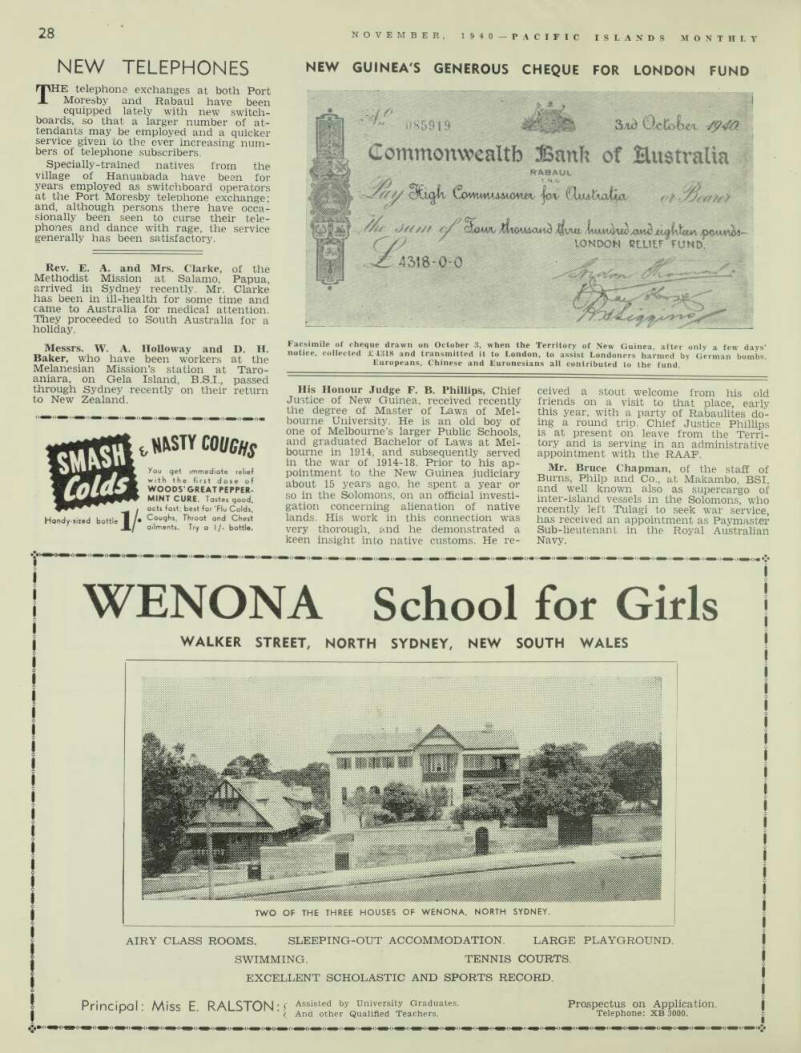
THE telephone exchanges at both Port Moresby and Rabaul have been equipped lately with new switch boards, so that a larger number of at tendants may be employed and a quicker service given to the ever increasing num bers of telephone subscribers.
Specially-trained natives from the village of Hanuabada have been for years employed as switchboard operators at the Port Moresby telephone exchange: and, although persons there have occa sionally been seen to curse their tele phones and dance with rage, the service generally has been satisfactory.
Rev. E. A. and Mrs. Clarke, of the Methodist Mission at Salamo, Papua, arrived in Sydney recently. Mr. Clarke has been in ill-health for some time and came to Australia for medical attention.
They proceeded to South Australia for a holiday.
Messrs. W. A. Holloway and D. H.
Baker, who have been workers at the Melanesian Mission’s station at Taro aniara, on Gela Island, 8.5.1., passed through Sydney recently on their return to New Zealand.
His Honour Judge F. B. Phillips, Chief Justice of New Guinea, received recently the degree of Master of Laws of Mel bourne University. He is an old boy of one of Melbourne’s larger Public Schools, and graduated Bachelor of Laws at Mel bourne in 1914, and subsequently served in the war of 1914-18. Prior to his ap pointment to the New Guinea judiciary about 15 years ago, he spent a year or so in the Solomons, on an official investi gation concerning alienation of native lands. His work in this connection was very thorough, and he demonstrated a keen insight into native customs. He re
ceived a stout welcome from his old friends on a visit to that Diace, early this year, with a party of Rabaulites do ing a round trip. Chief Justice Phillips is at present on leave from the Terri tory and is serving in an administrative appointment with the RAAF.
Mr. Bruce Chapman, of the staff of Burns, Philp and Co., at Makambo, ESI. and well known also as supercargo of inter-island vessels in the Solomons, who recently left Tulagi to seek war service, has received an appointment as Paymaster Sub-lieutenant in the Royal Australian Navy.
New Guinea's Generous Cheque For London Fund
Facsimile of cheque drawn on October 3, when the Territory of New Guinea, after only a few days’ notice, collected £4318 and transmitted it to London, to assist Londoners harmed by German bombs.
Europeans, Chinese and Euronesians all contributed to the fund.
Advertisements & other items, p. 30 (1 item)
WENONA School for Girls
Hondy-siied bottle
H&8TY COUGHS
you get immediate relief with the first dose of
WOODS'GREAT PEPPER
MINT CURE. Tastes good.
I, acts fast; best for 'Flu Colds. /* Coughs, Throat and Chest I ailments. Try a I/- bottle.
WENONA School for Girls
WALKER STREET, NORTH SYDNEY, NEW SOUTH WALES m TWO OF THE THREE HOUSES OF WENONA, NORTH SYDNEY.
AIRY CLASS ROOMS. SLEEPING-OUT ACCOMMODATION. LARGE PLAYGROUND.
SWIMMING. TENNIS COURTS.
EXCELLENT SCHOLASTIC AND SPORTS RECORD.
Principal; Miss E RALSTON :f Assisted b y University Graduates. r X And other Qualified Teachers.
Prospectus on Application.
Telephone: XB 3000.
New Guinea Plan To Aid Copra Industry
A PRACTICAL plan for supporting the New Guinea copra industry, during the present crisis, has been evolved by the Planters’ Association of New Guinea. It is set forth in the following letter to the Administrator, dated Octo ber 4, and signed by J. C. Mullaly (presi dent), H. Adams (vice-president) and V.
A. Pratt (councillor). The plan is as follows; “Whilst appreciative of the efforts of the Commonwealth Government and of the Administration to find a solution to our difficulties . . . the Association re grets having to submit its considered view that that system of assistance arranged does not meet requirements essential to the economic integrity of the residents engaged in copra produc tion and agricultural development gen erally.
“The Association’s view is based prim arily upon the contention that it is un sound to further burden the already overloaded copra producer. The Common wealth’s officer provides loans for meagre sustenance, especially excepting all forms of insurance and assurance. There is no requirement or provision for the full pro duction of copra, or, alternatively, pro visions for the destruction of the con stantly falling coconuts to prevent their growth which would soon turn a plan tation into a terrifying wilderness. Any sound business planter must cease, as has now happened, to produce copra for the want of storage and market, either with or without the Government’s offered loans. Likewise, as the prospects are, he will not employ labour for the destruc tion of nuts and maintenance of plan tation which would produce no revenue, but only debts.
“It is admitted that large profits have been made from the copra industry of this Territory during the past 20 years.
However, they have not been made by the relatively small producer, or any other private planter, excepting for a few months. Consequently, when faced with the present situation of no markets and no immediate prospective markets, the private producer has no reserves upon which to fall back, and is faced with bankruptcy, failing adequate Govern mental intervention. The arrangement offered to the planters is not in the nature of Government assistance pro vided for the many Australian primary industries.
“The country producer in Australia Is cared for, from production to market, by the Parliamentary representative, but here, without any representation, we are offered meagre loans for sustenance.
That means not even for production, be cause production is impracticable without storage' and market.
“The copra industry has credited the trade balance of this Territory with ap proximately £20,000,000 during the past 20 years; also, during that period it has supplied either directly or indirectly something like £2,000,000 to the general revenue of the Territory—the major por tion of Public Funds for the period re ferred to. By doing so, it has materially helped to create, secure and maintain the independent economic security of New Guinea—the front door to Australia. The industry can do nothing in that regard to-day. However, there is nothing upon which to assume that it will not do so in the future.
“The Association claims that those en gaged in the copra industry, scattered throughout the Territory have accepted
a large measure of the responsibility and obligations towards the natives of this Territory, undertaken by Australia in accepting the Mandate.
“Under the circumstances, it is con tended that the Commonwealth Govern ment’s proposal of interest-bearing loan assistance to planters is inadequate. The proposals have the effect of loading the producer with an accumulation of 4 per cent, interest bearing debts, with no definite assurances whatsoever of any corresponding credits. The majority of the planters concerned are men well be yond middle age, most of them with years of service in the last war to their credit, followed by 14 to 20 years of work, worry and struggle to create and secure for themselves and their depend ents an asset in this Territory. The Government’s proposal can only promise to these planters a position of accumu lated indebtedness which it will be im possible for the majority to liquidate.
“The Association submits for early and urgent consideration the following pro posals for substitution of the Govern ment’s arrangement. The application of our proposals would relieve the planter concerned of a crippling impost of evex increasing debts, and which can at the same time be implemented without un due embarrassment to either the Com monwealth Government or the local Ad ministration, and the cost of which would be little in excess of the Government pro posal, and, in the end, the Government may even be reimbursed in full.
“The Association’s proposals are sup ported by the belief that—(a) Copra will keep in storage for a considerable period without undue deterioration: (b) Coco nut oil extracted from copra can be stored for an indefinite period without deterioration: (c) There will be sooner or later a big demand throughout the world for vegetable oils; and (d) The Commonwealth Government is in a posi tion to provide the finance and other facilities necessary to retain and later market the produce—an accomplishment which it is impossible for the individual planter to attempt.
“The Association's proposals are, as follows: 1. A local Copra Board to be created, con sisting of:—fa) An Administration senior official. (b) Delegate of the Custodian. (c) Representative of the planting industry. (d) Representative of the local commercial firms. 2. The Board to be provided with funds from the Commonwealth Government, to be operated by the Board through the local Commonwealth Bank. 3. The Board to make advances in respect of copra produced as hereinafter defined, and store it, or store the oil extracted therefrom, pending future sales as opportunity arises. 4. Funds necessary to be provided by the Com monwealth Government to be obtained from the New Guinea Gold Tax Trust Fund. Any fur ther finance necessary to be obtained by a spe cial taxation levied on excessive profits derived from the gold mining industry, and which are remitted outside the Territory. 5. Those to participate in these proposals shall be as hereunder defined:— (a) Persons substantially dependent upon the copra industry for their livelihood, whether British, Alien or Asiatic. (b) Planters engaged on war service. (c) Absentee planters who can show to the Board good cause for their absence. (d) Native producers approved by the Board. (e) Mission organisations who prove to the Board that the non-sale of their copra will seriously and adversely affect their native welfare activities. 6. With regard to paragraph 5 (d) above, the following qualifications to be observed:—
(aj No provision for natives to contribute direct to the Board. (b) Native-owned coconut groves to be defined into zones, from each of which those natives may dispose of their produce to a trader approved by the Board. (c) The prices to be paid to the natives for their produce shall be governed by the Board. (d) Any goods sold or bartered to the natives by a trader shall be approved by the Board. (e) All copra obtained by traders under this section shall then be subject to these proposals. 7. Priority in marketing by the Board shall be extended to stocks of copra stored by the commercial firms and others, as at the date of these proposals. No advances shall be made by the Board on account of the abovemen tioned stored copra, until such copra has been disposed of. 8. Copra obtained by commercial firms sub sequent to the date of these proposals shall be subject to the control of the Board for mar keting purposes. No advances shall be made by the Board for such copra until disposed of. 9. Subject to the approval of the Board, any person wishing to extract oil or otherwise pro cess copra produced by him shall be exempt from the control under these proposals, so far as relates to such copra. 10. Storage accommodation shall be made available at Rabaul, Kokopo, Kavieng and Madang. Should sufficient storage be unavail able at any of these centres the Board to make provision for the erection of additional sheds of approved designs from local materials. 11. The storage centres shall be used, as far as practicable, to radiate shipping services regu larly and expeditiously to all outlying planta tions. The Board to contract with local ship and schooner owners for these services. 12. The estimated annual production of copra on which advances may be made under these proposals is 32,000 tons, and an additional 7,000 tons should the Missions be Included. 13. All copra upon which advances may be made will be stored at the storage centres and accounted for by Copra Inspectors to District Officer, who will arrange for cash advances to be made to the producer concerned. 14. The average price to be paid to the pro ducer shall be £4/10/- per ton exclusive of freight. The Board to have the power to
increase or reduce this average advance should individual circumstances be proved to warrant such variation. 15. The estimated cost of these proposals to cover initial advances for copra, shipping, stor age and administrative expenses, etc., is £190,000 per annum, o* £222,000 if Mission copra is included. 16. Sales of all copra coming under the con trol of the Board shall be disposed of by the Government selling authorities in Australia. A selling commission to be paid to commercial firms effecting sales. 17. These proposals are submitted for 12 months’ operations, but may be extended by the Commonwealth Government. At the end of the Board’s activities any credit balance remaining, after payment of all relative debts and costs, shall be distributed to the copra contributors in proportion to their copra supplied. How ever, final payments under this section shall first be applied to liquidate respective debts owing by copra producers. 18. The Board shall have the power to grant compensation to any planter whose production is so uneconomical as to cause him to abandon his property. 19. The Board shall evolve a scheme to ensure the payment of native labour deferred pay. 20. The Board shall take all steps to assist the Price Control Commissioner regarding prices charged by trading firms for plantation requirements. 21. Planters whose properties are not pro ductive shall be entitled to apply to the Board for 4 per cent, interest bearing loans which shall be provided from a special fund allocated for this purpose.
“In submitting: the foregoing proposals,
the Executives of the Planters’ Associa tion respectfully submit that these pro
posals offer the following advantages;—
fa) Inter-island shipping service would be resumed and maintained otherwise a subsidy would be required to service and support the necessary means of transport and communications. (b) Whilst planters are producing copra, native labour is normally en gaged in employment, but if deprived of
employment many undesirable features
of the native mind will re-assert them
selves, thus causing disruption to the
native village structure and ever increas ing embarrassment to the Government in its native welfare functions. (c) Consequent upon application ol the Government arrangements, the native impression of the higher races reaction to a crisis would relegate our prestige for a generation. (d) Under our proposals, the producer will make everv endeavour to carry on as normally as practicable, whilst under Government Arrangement he would have little incentive to work a plantation on bankruptcy lines. (e) Plantations will be preserved and maintained in reasonable condition.
“The above proposals have been care fully considered and compiled by the sub-committee of the Planters’ Associa tion Executive, and it is submitted that they should receive favourable and early consideration by the Administration, and adoption by the Commonwealth Govern ment.”
Support By Director Of
Agriculture
IN a letter to the Planters’ Associa tion, dated October 11, the Director of Agriculture (Hon. George Murray) made the following comments upon the plan:— “I am in accord with the view that the relief offered by the Commonwealth is most unsatisfactory and, in my opinion, is an uneconomic proposition, as it is like throwing good money after bad.
“My opinion is that in the event of copra not being purchased by the firms, it should be purchased by the Govern ment and that a Board or Committee should be appointed to organise the scheme on a sound financial basis.
“At present it seems possible that market conditions may improve some what as the firms are still buying copra and will continue to do so as long as there is storage space. An oversea ship recently loaded in Rabaul, another is ex pected soon, and, I am informed that others are likely to follow. The firms must be selling the copra, as they would not be shipping it for storage overseas.
If the firms continue to purchase copra as long as they have storage space, the situation will be relieved to a certain ex tent. It would be unwise, however, to trust to chance and I consider that the Board should be organised, without fur ther delay, to be in readiness for any eventuality that may arise.
“In accord with your covering letter of October 4, I beg to make the follow ing comments on your proposed com munication on the copra situation, for the consideration of Cabinet.
“sth Paragraph. It has been disputed by many that copra cannot be stored without deterioration. This Department is in a position to decide on that point, better even than Ceylon, as there has never been an occasion in the latter country to carry out such investigations, whereas the less frequent overseas ship ping in New Guinea has enabled this
Department to investigate copra stor age for several years. We have had well cured copra in a storage shed, with other copra, for up to 31 years, and it was still in fair condition on examination.
“The Netherlands East Indies Govern ment are now preparing to store 450,000 tons per annum, and are building neces sary godowns (storage) sheds for that purpose.
“I consider that there is no necessity for the Commonwealth to finance the scheme in the first place. The surtax on gold, providing £2*60,000 per annum, which is placed to the credit of a Trust account, presumably for Defence, could be used for the purpose. The mainten ance of the leading agricultural industry is just as much a defence measure as any military or naval enterprise. Com ments: — 1. (a) I consider that the only senior Adminis tration officer having a thorough knowledge of the copra industry is the Permanent Head of this Department and, therefore, that he should represent the Administration on the Board. 2. As stated above, the funds should be pro vided from the surtax on gold, which, of course, is additional to the gold royalty. 6. Natives should have the option of disposing of their copra to the Board the same as other producers. In my opinion, no invidious dis tinctions should be made in producers. 7. The firms have their own organisations for selling, whereas the Government has no such organisation and could not have the same advantages in disposal of produce.
8. No discrimination between firms and plant ers in disposal of produce. If w.e start mak ing discriminations, confusion or worse must ensue. For instance, several producers known to me had sufficient foresight early in the war to make their own provisions for disposal of their copra and, if discriminations are to be made, they should be permitted to enjoy the profits of such foresight. 12. There should be no discrimination made against the Missions. One of the Missions has been carrying out valuable Investigations in new uses for coconut oil in which they have the full co-operation of the Department of Agri culture and they are entitled to all the privi leges available to other producers. If the firms
are to be included in a pool, the Missions should also be included. 14. The Commonwealth having fixed the price, the Board should not be permitted to modify it. If there is sufficient justification, further payments could be made as bonuses after the copra is sold. This is -in accord with business and was practised by the Papuan Industries Ltd., of which I was manager nearly 30 years ago—to the benefit of all concerned. 17. The final payments to be made to the producers for their own disposal, not neces sarily to liquidate their debts to the firms. 18. The Board should not have the power to grant compensation to any planter whose costs of production are excessive or uneconomical. One planter in New Britain has informed me that he cannot produce copra for less than £lO per ton, and another says not for less than £8 per ton. In my own experience, copra has been produced for less than £4 per ton and on a large proprietary estate of 18,000 acres in Malaya with w r hose organisation I am thor oughly familiar and where I have had many lengthy visits, the copra all-in costs of pro duction are under £5 per ton f.o.b. Port Swettenham. 21. I do not consider such loans justified; for one thing there is no such fund available.
This is the province of a Rural Bank.
Sec. (a). Shipping is outside the province of the Board. The firms will provide transport if cargo is available.
Miss Joyce James, A.Mus.A„ of Vic
toria, has taken up duties as nursing sister at the Ballantine Memorial Girls’
School, Suva, Fiji.
Advertisements & other items, pp. 31-34 (3 items)
Get Positive
RELIEF FROM
mm M.U Tested and proved for over 20 years, genuine Vincent’s A.P.C. is acknowledged by the medical profession and the public as the safest and best to relieve all pains and tropical fevers. The reason why Vincent’s A.P.C. is safer and more effective is because it is prepared on the prescription originated by the medical superintendent of one of Australia’s largest public hospitals, where it was first used. Genuine Vincent’s A.P.C. is the only A.P.C. prepared on this scientific hospital prescription. No other A.P.C. is the same as Vincent’s. rowoißS &
TA■I E T $
1/4 AND 2/4.
SIN6l(S24.*a.
FOR SAFETY’S SAKE—SAY “VINCENT’S”.
(MS”' . * V
sow
Non?
4c o • GERMS of Diphtheria, Malaria, Dhobie Itch, Tinea or Surfers’ Foot, cannot live under “TENAX” lather.
Tropical Skin Diseases can be cured by its regular
9° P cr
f abl ct
NO VARIATION HAS BEEN
MADE IN ITS COMPOSITION—
judged from the only true angle, that of quality, TENAX has no competitors as a satisfactory germicidal soap, eleven times as rapid in action as carbolic, yet NON-
IRRITANT and NON-POISONOUS. The
Medical Journal of Australia states that TENAX is a germicidal soap that may be recommended with confidence.
TENAX
GENUINE
GERMICIDAL
SOAP
A PRODUCT OF AUSTRALIAN SOAPS, LTD.
Islands 7 Visitors to Sydney Will find excellent accommodation at
"206" PRIVATE HOTEL
204-8 Victoria Street, Kings Cross, Sydney.
Every Comfort, Splendid Table.
Tariff from 35/- per week.
MRS. C. PYATT, Proprietress.
Tel. FL 4272.
pp™p^
wz- / t s (! % 500
CANDLE
POWER
* T 4 I 300 JW*
Ji.u/nJ>kovuL r
o/filvLruqhi,
Coleman Mantles supply Sun-like light.
BRIGHTER LIGHT
for
BETTER SIGHT
Coleman Products can be obtained from all Leading Firms throughout the Pacific Islands.
C SLa Instant Lighting Stoves & Irons giving maximum of heat in minimum of time
EASE OF OPERATION
combines
ECONOMY with COMFORT
In case of difficulty in obtaining supplies write to:— Pearce & Co., Suva, Fiji Is.
GRAMOPHONE
RECORDS
SEND US YOUR ORDERS
Goods sent C.O.D. at no extra charge.
Catalogues sent without obligation.
THE TALKERIES
161 Castlereagh Street,
SYDNEY
READY TO HEAT
AND SERVE!
Aunt Mary’s
PREPARED SOUPS AND
TASTY MEAL-TIME PRODUCTS
include delicious Mulligatawny, Tomato. Pea and other rich Soups, also Baked Beans with Tomato Sauce, Curried Baked Beans, Spaghetti with Cheese, Curried Spaghetti and other appetizing, wholesome food products. Ready to heat and serve!
Aunt Mary’s
PREPARED
VEGETABLES
offer a great variety of fullflavoured, nutritious dinner vegetables; ready to heat and serve. All Aunt Mary's food products are packed in 1 lb. cans for Tropical conditions
and SOLD BY ALL STORES.
tomato
C.S vm a i
General
Merchants
and
Agents
REPRESENTING LEADING FIRMS IN THE PACIFIC ISLANDS
379 KENT STREET,
SYDNEY.
Cable Address: “Trocas”, Sydney.
Telephones: MJ4657 (5 lines).
Islands Produce Sold on Shippers’ Account Buyers of all Islands’ requirements on Commis- Liberal Advances against Consignments. sion Original Invoices Furnished. 25 Years Islands Trade Experience.
Bankers: Bank of New South Wales. Correspondence in English, French & German.
PURE RICE
STARCH
Always ask for . . .
CORAL BRAND
100% PURE
Noted for Its
QUALITY
and
WHITENESS.
Goes Farthest and gives Lasting Finish
WILL NOT
STICK TO
IRON.
Obtainable from Leading Island Stores. & *d by
[CE, LTD.,
S.W. •V I
CORAL BRAND
RICE STARCH
* Manufacture
AUSTRALIAN R 1
Sydney, N.
THEY KEEP YOU FIT
AND KEEP YOU SLIM
The whole grain of rich, sun-ripened wheat, transformed, after careful selection, into a perfect health food, delicious for breakfast, for afternoon tea or supper.
Arnott's Famous Shredded Wheatmeal Biscuits are rich in precious vitamins and proteins, and very easily digested. . . . Try them with butter, cheese, jam or honey.
CLrnottls
FAMOUS
SHREDDED
WHEATMEAL
BISCUITS
822 ALWAYS ASK YOUR GROCER FOR ARNOTT'S !
30
November. 1940-1-acific tsla n b s monthly
31
i* ACI f 1 C ISLANDS MoNtHLV NOVEMBER, 1940
Radio Worries In
Fiji
By Amel
rpHE break-down occurred with startling J. suddenness. The heroine’s angry father thundered, “Yes . . and what is more, young man, never let me see your beer-sodden face down my chimney again!” But before the heart-broken lover could plead his cause, silence had descended upon him.
There is, perhaps, nothing so baffling as a wireless set when it gets out of order. And when you live in the Fiji bush, many miles from a competent re pair shop, the situation becomes desper ate.
We twirled knobs, to no effect. As soon as I heard them go plink, instead of plonk, I knew that something was wrong.
We sat and looked at the thing. Radio repairs were bevond us. But suggestions) were not lacking. ‘ Perhaps it is short-circuiting some where.” I murmured helpfully. “Perhaps there’s a cockroach in the works? Or a beetle in some vital spot? Maybe one of those nasty little what-d’you-call-’ems has bitten through . .
“Oh yeah? Oh yeah? Oh yeah.” hooted Dad. “I wish you’d keep quiet for a minute. Your ideas only confuse me. This • requires a lot of concentration. Let me think.”
As a result of his thinking, he went outside and climbed up on the roof. After stamping around for ten minutes and disturbing all the rats in the loft, he returned with triumphant mien.
We thought he had done nothing less than dismantle the wireless mast. Instead of which he announced that he had re moved a big spider from the aerial.
“If it doesn’t go now”, he stated, “I’ll have to take it to pieces.”
It didn’t go. So the following morning, he disembowelled it.
“I wonder where you begin on this con traption?” he cogitated, scratching his head with the screw-driver. “Never seen the inside of one before. However, first I’ll remove the loud-speaker ... so. Now, if I unscrew this thingummybob, and poke that whirligig, and wiggle this gazooka a bit, something might fall into place.
The main thing is to keep everything under control, and not to forget where you put things.”
“Fr . . . yes”, I agreed, with a confi dence which I did not feel.
After a morning of painful toil, Dad had surrounded himself with the “in nards” of the radio, and, as he straight ened up and surveyed the tangle, he panicked.
“Jumping Jupiter!” he exclaimed. “This is awful! Where am I to look for the trouble, now I have the set in pieces? I wonder if I can put it together again?
Just go away for a few more hours, will you? I want to be alone!”
At mid-day, the set had been restored to normal, and. with some trepidation, we tuned-in on Suva. A lovely soprano voice drifted over the wireless waves.
“There you are!” said Dad, smugly.
But, to this day, he does not know how he fixed it!
Mr. R. P. Garrity, who has been stationed at Vureas, Lolowai, New Hebrides,, for the Melanesian Mission, has returned to N.Z : .
Rev. D. L. and Mrs. Francis, of Raga, Solomon Islands, passed through Sydney in October en route to their home in New Zealand. He has been a worker for the Melanesian Mission at Lamalana for some time.
Rock-Pictures In New
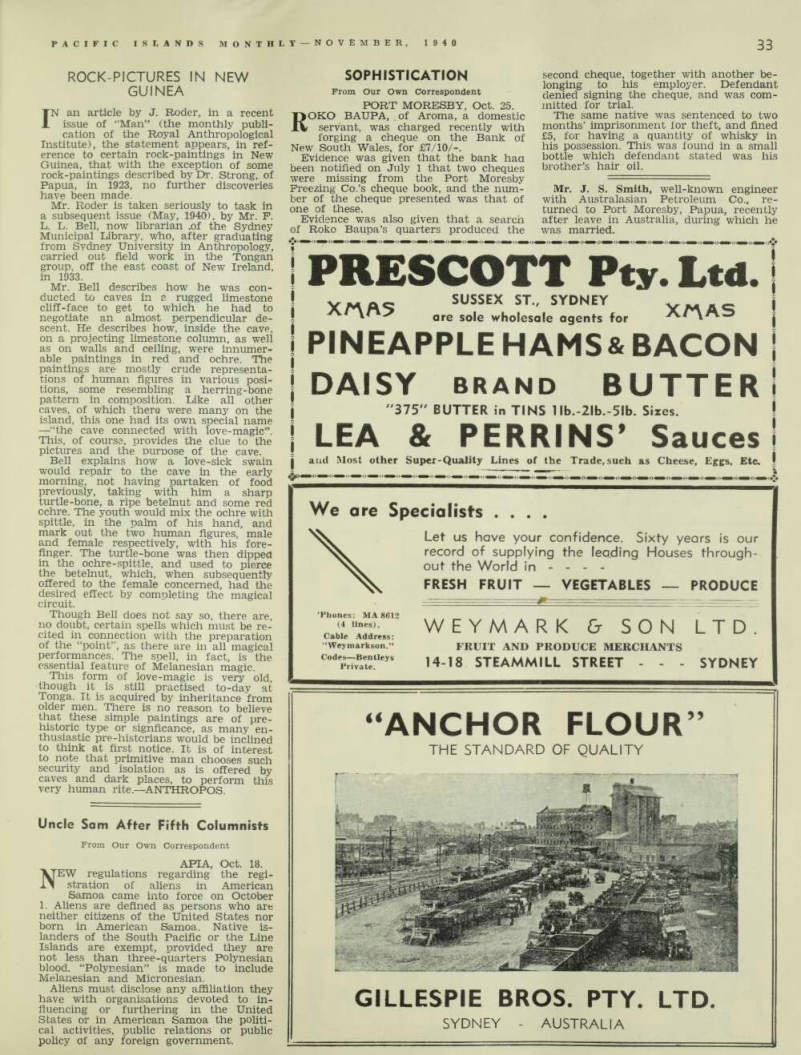
Guinea
IN an article by J. Roder, in a recent issue of “Man” (the monthly publi cation of the Royal Anthropological Institute), the statement appears, in ref erence to certain rock-paintings in New Guinea, that with the exception of some rock-paintings described by Dr. Strong, of Papua, in 1923, no further discoveries have been made.
Mr. Roder is taken seriously to task in a subsequent issue (May, 1940), by Mr. F.
L. L. Bell, now librarian .of the Sydney Municipal Library, who, after graduating from Sydney University in Anthropology, carried out field work in the Tongan group, off the east coast of New Ireland, in 1933.
Mr. Bell describes how he was con ducted to caves in a rugged limestone cliff-face to get to which he had to negotiate an almost perpendicular de scent. He describes how, inside the cave, on a projecting limestone column, as well as on walls and ceiling, were innumer able paintings in red and ochre. The paintings are mostly crude representa tions of human figures in various posi tions, some resembling a herring-bone pattern in composition. Like all other caves, of which there were many on the island, this one had its own snecial name —“the cave connected with love-magic”.
This, of course, provides the clue to the pictures and the purpose of the cave.
Bell explains how a love-sick swain would repair to the cave in the early morning, not having partaken of food previously, taking with him a sharp turtle-bone, a ripe betelnut and some red ochre. The youth would mix the ochre with spittle, in the palm of his hand, and mark out the two human figures, male and female respectively, with his fore finger. The turtle-bone was then dipped in the ochre-spittle, and used to pierce the betelnut, which, when subsequently offered to the female concerned, had the desired effect by comoleting the magical circuit.
Though Bell does not say so, there are, no doubt, certain spells which must be re cited in connection with the preparation of the “point”, as there are in all magical performances. The spell, in fact, is the essential feature of Melanesian magic.
This form of love-magic is very old, though it is still practised to-day at Tonga. It is acquired by inheritance from older men. There is no reason to believe that these simple paintings are of pre historic type or significance, as many en thusiastic pre-historians would be inclined to think at first notice. It is of interest to note that primitive man chooses such security and isolation as is offered by caves and dark places, to perform this
very human rite.
Anthropos.
Uncle Sam After Fifth Columnists
From Our Own Correspondent
Apia, Oct. 18.
NEW regulations regarding the regi stration of aliens in American Samoa came into force on October 1. Aliens are defined as persons who are neither citizens of the United States nor born in American Samoa. Native is landers of the South Pacific or the Line Islands are exempt, provided they are not less than three-quarters Polynesian blood. “Polynesian” is made to include Melanesian and Micronesian.
Aliens must disclose any affiliation they have with organisations devoted to in fluencing or furthering in the United States or in American Samoa the politi cal activities, public relations or public policy of any foreign government.
Sophistication
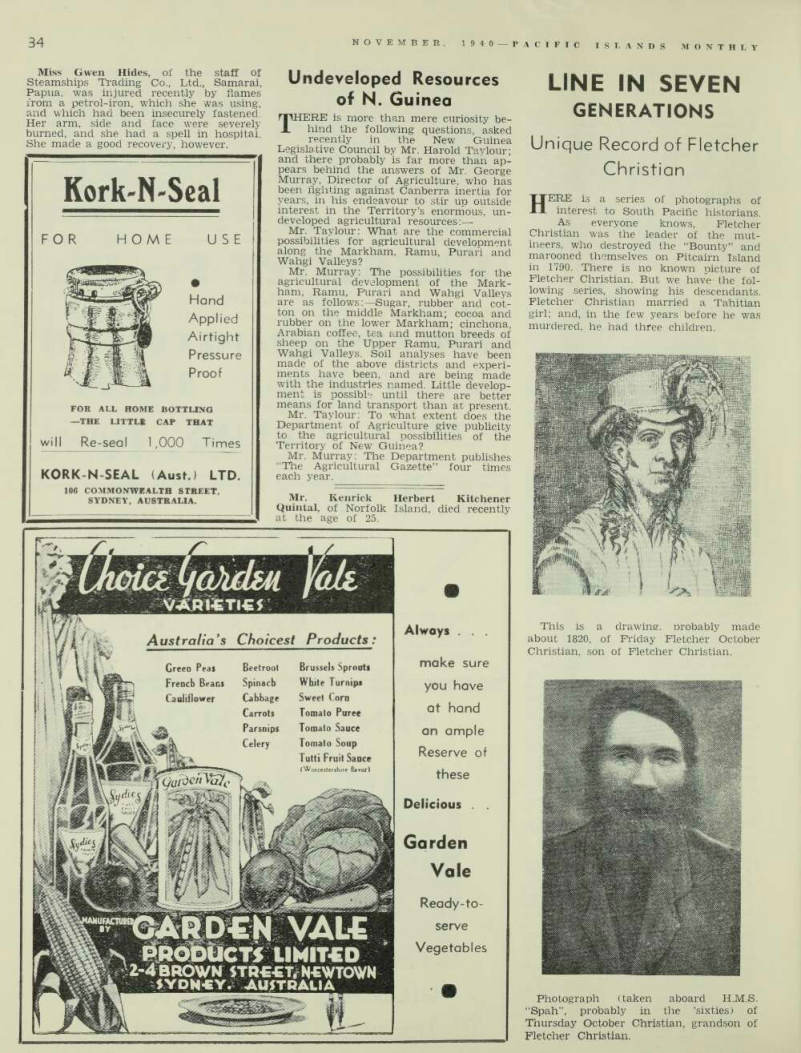
Prom Our Own Correspondent
Port Moresby, Oct. 25.
ROKO BAUPA, of Aroma, a domestic servant, was charged recently with forging a cheque on the Bank of New South Wales, for £7/10/-.
Evidence was given that the bank haa been notified on July 1 that two cheques were missing from the Port Moresby Freezing Co.’s cheque book, and the num ber of the cheque presented was that of one of these.
Evidence was also given that a search of Roko Baupa’s quarters produced the
second cheque, together with another be longing to his employer. Defendant denied signing the cheque, and was com mitted for trial.
The same native was sentenced to two months’ imprisonment lor theft, and fined £5, for having a quantity of whisky in his possession. This was found in a small bottle which defendant stated was his brother’s hair oil.
Mr. J. S. Smith, well-known engineer with Australasian Petroleum Co., re turned to Port Moresby, Papua, recently after leave in Australia, during which he was married.
Miss Gwen Hides, of the staff of Steamships Trading Co., Ltd., Samarai, Papua, was injured recently by flames from a petrol-iron, which she was using, and which had been insecurely fastened.
Her arm, side and face were severely burned, and she had a spell in hospital.
She made a good recovery, however.
Advertisements & other items, pp. 35-36 (1 item)
Prescott Pty. Ltd.
xr\f\ s
SUSSEX ST., SYDNEY
are sole wholesale agents for xnAs
PINEAPPLE HAMS&BACON
DAISY brand BUTTER
"375" BUTTER in TINS llb.-21b.-Slb. Siies.
LEA & PERRINS’ Sauces
aud Most other Super-Quality Lines of the Trade,such as Cheese, Eggs, Etc,
We ore Specialists . . . . \ ’Phones: MA 8612 (4 lines).
Cable Address: “Weymarkson.”
Codes—Bentleys Private.
Let us have your confidence. Sixty years is our record of supplying the leading Houses throughout the World in - - - -
FRESH FRUIT VEGETABLES PRODUCE
WEYMARK & SON LTD.
FRUIT AND PRODUCE MERCHANTS
14-18 STEAMMILL STREET - - - SYDNEY
“ANCHOR FLOUR
THE STANDARD OF QUALITY
5* 8
GILLESPIE BROS. PTY. LTD.
SYDNEY - AUSTRALIA
Kork'N-Scal
USE
• Hand Applied Airtight Pressure Proof
FOR ALL HOME BOTTLING
—THE LITTLE CAP THAT
will Re-seal 1,000 Times
KORK-N-SEAL (Aust.) LTD.
106 COMMONWEALTH STREET.
SYDNEY, AUSTRALIA.
FOR
HOME
Australia's Choicest Products Beetroot Spinach Cabbage Carrots Parsnips Celery Brussels Sprouts White Turnip* Sweet Corn Tomato Puree Tomato Sauce Tomato Soup Tutti Fruit Sauce (Worcestershire flavor) Green Peas French Beans Cauliflower Ri 4 O I » © m mx Always . . . make sure you have at hand an ample Reserve of these Delicious . .
Garden
Vale
Ready-toserve Vegetables
Undeveloped Resources
of N. Guinea
THERE is more than mere curiosity be hind the following questions, asked recently in the New Guinea Legislative Council by Mr. Harold Taylour; and there probably is far more than ap pears behind the answers of Mr. George Murray, Director of Agriculture, who has been righting against Canberra inertia for years, in his endeavour to stir un outside interest in the Territory’s enormous, un developed agricultural resources:— Mr. Taylour: What are the commercial possibilities for agricultural development along the Markham, Ramu, Purafi and Wahgi Valleys?
Mr. Murray: The possibilities for the agricultural development of the Mark ham, Ramu, Purari and Wahgi Valleys are as follows:—Sugar, rubber and cot ton on the middle Markham; cocoa and rubber on the lower Markham; cinchona, Arabian coffee, tea and mutton breeds of sheep on the Upper Ramu, Purari and Wahgi Valleys. Soil analyses have been made of the above districts and experi ments have been, and are being made with the industries named. Little develop ment is possible until there are better means for land transport than at present.
Mr. Taylour: To what extent does the Department of Agriculture give publicity to the agricultural possibilities of the Territory of New Guinea?
Mr. Murray: The Department publishes “The Agricultural Gazette” four times each year.
Mr. Kenrick Herbert Kitchener Quintal, of Norfolk Island, died recently at the age of 25.
Line In Seven
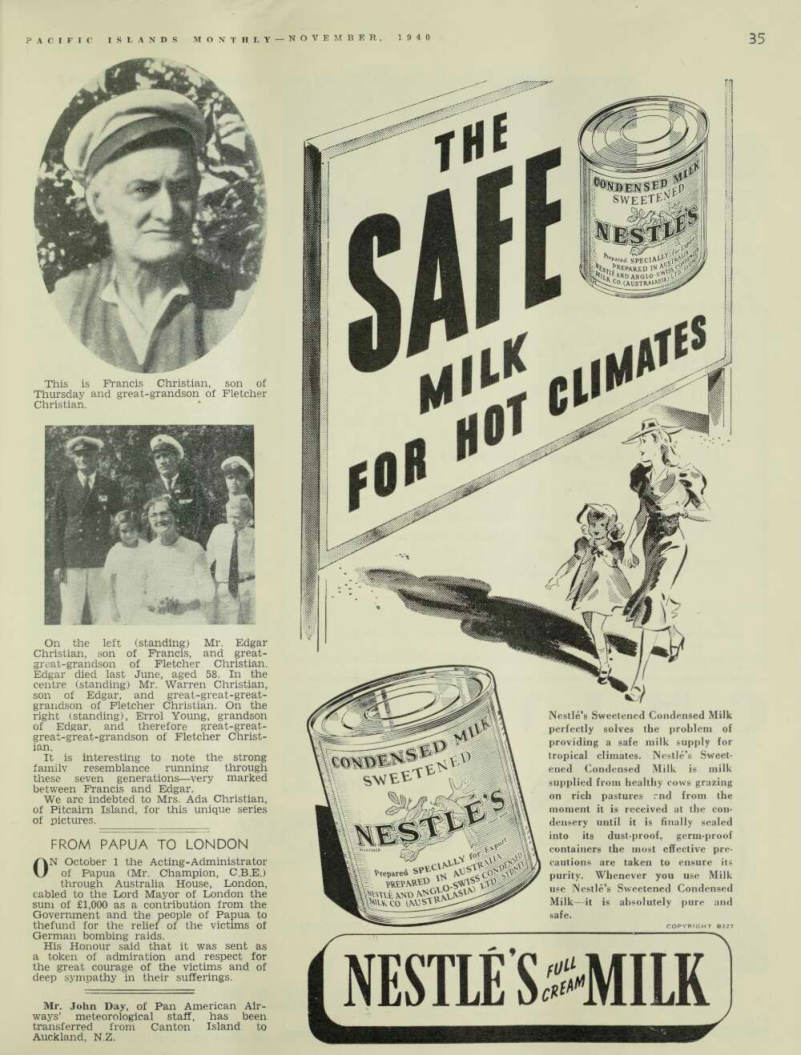
Generations
Unique Record of Fletcher Christian
HERE is a series of photographs of interest to South Pacific historians.
As everyone knows, Fletcher Christian was the leader of the mut ineers, who destroyed the “Bounty” and marooned themselves on Pitcairn Island in 1790. There is no known picture of Fletcher Christian. But we have the fol lowing series, showing his descendants.
Fletcher Christian married a Tahitian girl: and, in the few years before he was murdered, he had three children.
This is a drawing, probably made about 1820, of Friday Fletcher October Christian, son of Fletcher Christian.
Photograph (taken aboard H.M.S.
“Spah”, probably in the ’sixties) of Thursday October Christian, grandson of Fletcher Christian.
On the left (standing) Mr. Edgar Christian, son of Francis, and great great-grandson of Fletcher Christian.
Edgar died last June, aged 58. In the centre (standing) Mr. Warren Christian, son of Edgar, and great-great-great grandson of Fletcher Christian. On the right (standing), Errol Young, grandson of Edgar, and therefore great-great great-great-grandson of Fletcher Christ ian.
It is interesting to note the strong family resemblance running through these seven generations—very marked between Francis and Edgar.
We are indebted to Mrs. Ada Christian, of Pitcairn Island, for this unique series of pictures.
This is Francis Christian, son of Thursday and great-grandson of Fletcher Christian.
From Papua To London
ON October 1 the Acting-Administrator of Papua (Mr. Champion, C.8.E.) through Australia House, London, cabled to the Lord Mayor of London the sum of £l,OOO as a contribution from the Government and the people of Papua to thefund for the relief of the victims of German bombing raids.
His Honour said that it was sent as a token of admiration and respect for the great courage of the victims' and of deep sympathy in their sufferings.
Mr. John Day, of Pan American Air ways' meteorological staff, has been transferred from Canton Island to Auckland, N.Z.
Advertisements & other items, pp. 37-38 (1 item)
Nesties-Milk
1
sweeteSl
SPE f
'Pared Spared
a NDANGLO
CAUSTRM
hot
fO* mo /% p* V V m m m
sP tc\^
ts WepareA sr ‘"~ 3 ’<
vrwM^ d ! o-S^nWl
\ND CO Nestle’s Sweetened Condensed Milk perfectly solves the problem of providing a safe milk supply for tropical climates. Nestle’s Sweetened Condensed Milk is milk supplied from healthy cows grazing on rich pastures rnd from the moment it is received at the condensery until it is finally sealed into its dust-proof, germ-proof containers the most effective precautions are taken to ensure its purity. Whenever you use Milk use Nestle’s Sweetened Condensed Milk—it is absolutely pure and safe.
COPYRIGHT 8227
NESTIES-MILK
BURNS PHILP
(SOUTH SEA) CO. LTD.
Inc. in Fiji
Island Traders and Shipowners
Registered Office ;
SUVA
FIJI
Fij Code Address: “Burnsouth”.
Also Branches at: Levuka, Lautoka, Labasa, Ba, Sigatoka, Rotuma.
Tonga: Nukualofa, Haapai, Vavau.
Samoa: Apia, Pago Pago (American Samoa).
Solomons: Makambo, Gizo, Faisi.
New Hebrides: Vila.
Gilberts: Tarawa.
Norfolk Is. Niue. Wallis Is. Futuna Is.
C H I V E R 5
PURE
FOODS
GOLD MEDAL JAMS
CANNED ENGLISH FRUITS
CANNED ENGLISH
VEGETABLES
CUSTARD POWDER
OLD ENGLISH MARMALADE
JELLY CRYSTALS, ETC.
Obtainable from all Leading Grocery Stores. Write to Department A..
B 76 drivers and Sons, Ltd., Histon, Cambridge, England, for attractive Recipe Book.
Western Samoa's War
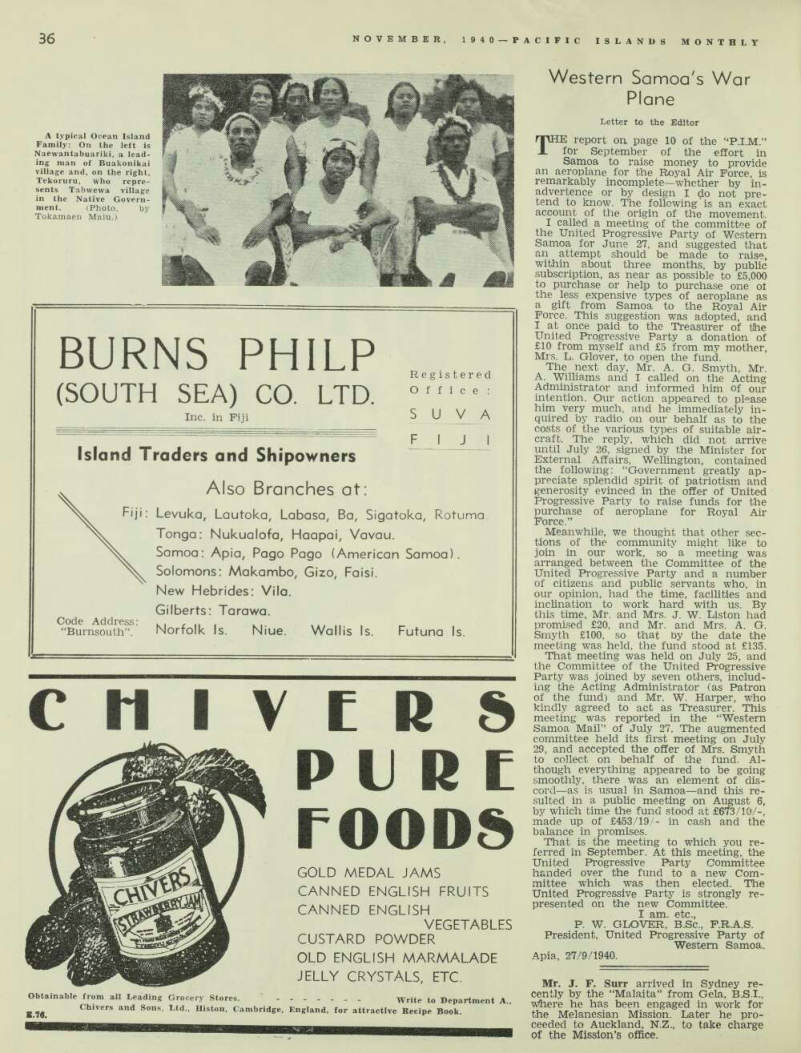
Plane
Letter to the Editor rpHE report on page 10 of the “P.1.M.”
L for September of the effort in Samoa to raise money to provide an aeroplane for the Royal Air Force, is remarkably incomplete—whether by in advertence or by design I do not pre tend to know. The following is an exact account of the origin of the movement.
I called a meeting of the committee of the United Progressive Party of Western Samoa for June 27, and suggested that an attempt should be made to raise, within about three months, by public subscription, as near as possible to £5,000 to purchase or help to purchase one ot the less expensive types of aeronlane as a gift from Samoa to the Royal Air Force. This suggestion was adopted, and I at once paid to the Treasurer of the United Progressive Party a donation of £lO from myself and £5 from my mother, Mrs. L. Glover, to open the fund.
The next day, Mr. A. G. Smyth, Mr.
A. Williams and I called on the Acting Administrator and informed him of our intention. Our action appeared to pl°ase him very much, and he immediately in quired by radio on our behalf as to the costs of the various types of suitable air craft. The reply, which did not arrive until July 26, signed by the Minister for External Affairs, Wellington, contained the following: “Government greatly ap preciate splendid spirit of patriotism and generosity evinced in the offer of United Progressive Party to raise funds for the purchase of aeroplane for Royal Air Force.”
Meanwhile, we thought that other sec tions of the community might like to join in our work, so a meeting was arranged between the Committee of the United Progressive Party and a number of citizens and public servants who, in our opinion, had the time, facilities and inclination to work hard with us. By this time, Mr. and Mrs. J. W. Liston had promised £2O, and Mr. and Mrs. A. G.
Smyth £lOO, so that by the date the meeting was held, the fund stood at £135.
That meeting was held on July 25, and the Committee of the United Progressive Party was joined by seven others, includ ing the Acting Administrator (as Patron of the fund) and Mr. W. Harper, who kindly agreed to act as Treasurer. This meeting was reported in the “Western Samoa Mail” of July 27. The augmented committee held its first meeting on July 29, and accepted the offer of Mrs. Smyth to collect on behalf of the fund. Al though everything appeared to be going smoothly, there was an element of dis cord —as is usual in Samoa —and this re sulted in a public meeting on August 6, by which time the fund stood at £673/10/-, made up of £453/19/- in cash and the balance in promises.
That is the meeting to which you re ferred in September. At this meeting, the United Progressive Party Committee handed over the fund to a new Com mittee which was then elected. The United Progressive Party is strongly re presented on the new Committee.
I am. etc.,
P. W. Glover, B.Sc., P.R.A.S.
President, United Progressive Party of Western Samoa.
Apia, 27/9/1940.
Mr. J. F. Surr arrived in Sydney re cently by the “Malaita” from Gela, 8.5.1., where he has been engaged in work for the Melanesian Mission. Later he pro ceeded to Auckland, N.Z., to take charge of the Mission’s office.
A typical Ocean Island Family: On the left Is Naewantabuariki, a lead ing man of Buakonikai village and, on the right, Tekoruru, who repre sents Tabwewa village in the Native Govern ment. (Photo, by Tokamaen Main.)
How To Make Soap
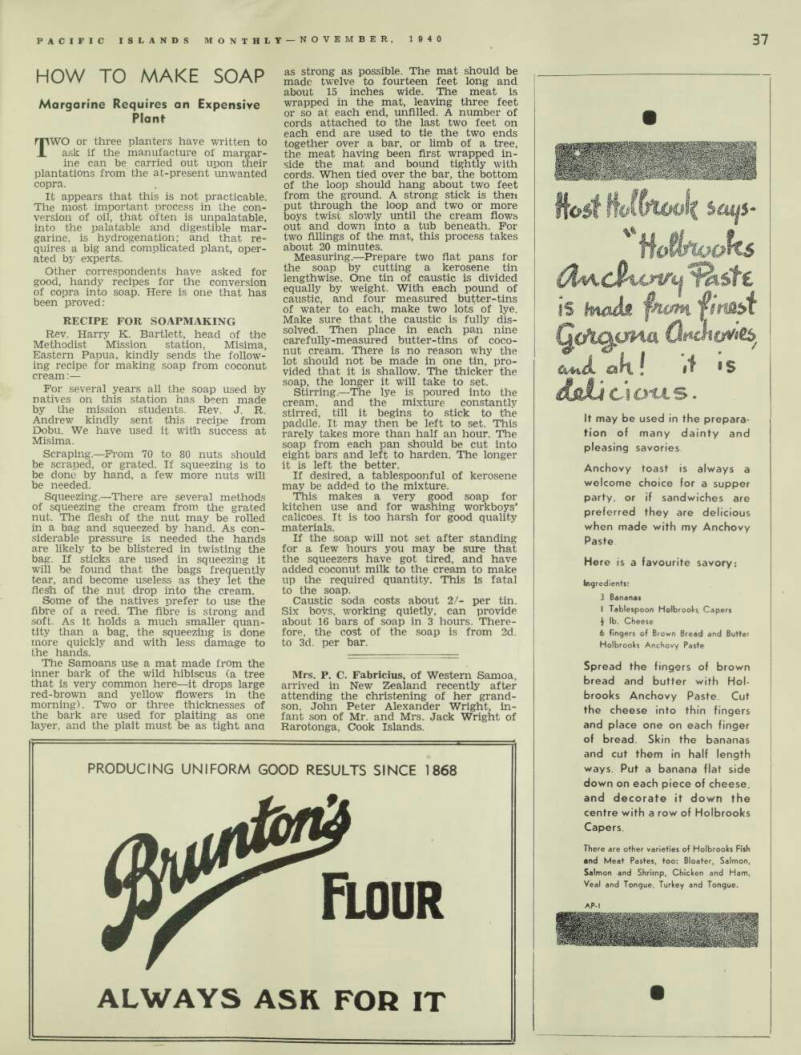
Margarine Requires an Expensive Plant
TWO or three planters have written to ask if the manufacture of margar ine can be carried out upon their plantations from the at-present unwanted copra.
It appears that this is not practicable.
The most important process in the con version of oil, that often is unpalatable, into the palatable and digestible mar garine, is hydrogenation; and that re quires a big and complicated plant, oper ated by experts.
Other correspondents have asked for good, handy recipes for the conversion of copra into soap. Here is one that has been proved;
Recipe For Soapmaking
Rev. Harry K. Bartlett, head of the Methodist Mission station, Misima, Eastern Papua, kindly sends the follow ing recipe for making soap from coconut cream:— For several years all the soap used by natives on this station has been made by the mission students. Rev. J. R.
Andrew kindly sent this recipe from Dobu. We have used it with success at Misima.
Scraping.—From 70 to 80 nuts should be scraped, or grated. If squeezing is to be done by hand, a few more nuts will be needed.
Squeezing.—There are several methods of squeezing the cream from the grated nut. The flesh of the nut may be rolled in a bag and squeezed by hand. As con siderable pressure is needed the hands are likely to be blistered in twisting the bag. If sticks are used in squeezing it will be found that the bags frequently tear, and become useless as they let the of the nut drop into the cream.
Some of the natives prefer to use the fibre of a reed. The fibre is strong and soft. As it holds a much smaller quan tity than a bag, the squeezing is done more quickly and with less damage to the hands.
The Samoans use a mat made from the inner bark of the wild hibiscus (a tree that is very common here—it drops large red-brown and yellow flowers in the morning). Two or three thicknesses of the bark are used for plaiting as one layer, and the plait must be as tight ana
as strong as possible. The mat should be made twelve to fourteen feet long and about 15 inches wide. The meat is wrapped in the mat, leaving three feet or so at each end, unfilled. A number of cords attached to the last two feet on each end are used to tie the two ends together over a bar, or limb of a tree, the meat having been first wrapped in side the mat and bound tightly with cords. When tied over the bar, the bottom of the loop should hang about two feet from the ground. A strong stick is then put through the loop and two or more boys twist slowly until the cream flows out and down into a tub beneath. For two fillings of the mat, this process takes about 20 minutes.
Measuring.—Prepare two flat pans for the soap by cutting a kerosene tin lengthwise. One tin of caustic is divided equally by weight. With each pound of caustic, and four measured butter-tins of water to each, make two lots of lye.
Make sure that the caustic is fully dis solved. Then place in each pan nine carefully-measured butter-tins of coco nut cream. There is no reason why the lot should not be made in one tin, pro vided that it is shallow. The thicker the soap, the longer it will take to set.
Stirring.—The lye is poured into the cream, and the mixture constantly stirred, till it begins to stick to the paddle. It may then be left to set. This rarely takes more than half an hour. The soap from each pan should be cut into eight bars and left to harden. The longer it is left the better.
If desired, a tablespoonful of kerosene may be added to the mixture.
This makes a very good soap for kitchen use and for washing workboys' calicoes. It is too harsh for good quality materials.
If the soap will not set after standing for a few hours you may be sure that the squeezers have got tired, and have added coconut milk to the cream to make up the required quantity. This Is fatal to the soap.
Caustic soda costs about 2/- per tin.
Six boys, working quietly, can provide about 16 bars of soap in 3 hours. There fore, the cost of the soap is from 2d. to 3d. per bar.
Mrs. P. C. Fabricius, of Western Samoa, arrived in New Zealand recently after attending the christening of her grand son, John Peter Alexander Wright, in fant son of Mr. and Mrs. Jack Wright of Rarotonga, Cook Islands.
Miss Thora Richardson, chairman’s assistant and schoolteacher at the Methodist Mission’s station at Salamo, Papua, was in Australia on leave in October.
Sister W. E. Manning has returned to New Zealand from Malaita, 8.5.1., where she was a nurse at the Melanesian Mis sion’s hospital.
Mr. K. S. and Mrs. Willis, and family, arrived in Australia recently on furlough.
He is connected with the Native Hospital at Port Moresby, and during his absence Mr. P. Jensen will relieve him.
Advertisements & other items, pp. 39-40 (1 item)
Q&lQona
ffosl
'fjsS
IS feWi fki/m finssf
Q&lQona
<uulak! it «s
AJtticioxis.
It may be used in the preparation of many dainty and pleasing savories Anchovy toast is always a welcome choice for a supper party, or if sandwiches are preferred they are delicious when made with my Anchovy Paste Here is a favourite savory: Ingredients; 3 Bananas I Tablespoon Holbrooks. Capers i lb. Cheese 6 fingers of Brown Bread and Butter Holbrooks Anchovy Paste Spread the fingers of brown bread and butter with Holbrooks Anchovy Paste. Cut the cheese into thin fingers and place one on each finger of bread. Skin the bananas and cut them in half length ways. Put a banana flat side down on each piece of cheese, and decorate it down the centre with a row of Holbrooks Capers.
There are other varieties of Holbrooks Fish and Meat Pastes, too: Bloater, Salmon, Salmon and Shrimp, Chicken and Ham, Veal and Tongue, Turkey and Tongue.
PRODUCING UNIFORM GOOD RESULTS SINCE 1868
ALWAYS ASK FOR IT
painting
with
v means painting to STAY painted / ftP
Paint
(P R E PARTD)
Oieeps on Xeepikg on/”
AGENTS THROUGHOUT THE ISLANDS.
Morobe Gold
From Our Own Correspondent WAU, Oct. 20. mHE total gold exported in the three X months July 1 to Sentember 30, is 118,562 ounces, the assessed value of which is £A726,272. The output is up to the average of last year, when £ A 3,000,000 worth was produced on the Morobe Gold fields.
Mr. S. Bennett has been re-elected un opposed as European Member of the Rarotonga Island Council.
Public Service Pay in
Wartime Western Samoa Has Typical Budgetary Problem
From Our Own Correspondent APIA, Sept. 20.
IN two sessions on August 7, and August 12-19, the Legislative Council discussed the Territory’s economic position and the financial difficulties of the Administration.
Recommendation for drastic changes in the Government’s financial policy are to be submitted to the N.Z. Government.
The Acting-Administrator (Mr. Turn bull) pointed to the effects of the war in Western Samoa, which has been hit vitally in the depressed condition of the copra industry and the shortage of ships.
The financial difficulties were mirrored in the financial estimates tabled for con sideration of the Council.
HON. O. F. NELSON, seconded by Hon.
Leleua, asked for legislation to en able licensed traders to recover bona fide debts from native Samoans by legal proc°ss. Other debts apart from trade debts, are recoverable now. The lack of protection regarding trade debts had caused numbers of European and Samoan traders to lose their jobs or suffer terms of imprisonment. Samoans, rightfully asking for equal treatment with Europeans in civic privileges, must also accept equal responsibility for their obligations.
Samoan members said that opinions among native Samoans were divided. It was decided to defer the motion until the views of the Fono of Faipule have been obtained.
A RESOLUTION of the Council, moved by Hon. O. P. Nelson and s°conded by Hon. Faalava’au, was passed, ex pressing sympathy with the British Empire in its present struggle, and ex pressing the hope that free institutions may prevail.
THE Acting-Administrator said the fihancial position for the year end ing March 31, 1940 was as follows: Expenditure .. .. £135,648 Revenue £131,416 Deficit £4,231 As revenue included £2,826 transferred from Building Reserve, the excess ex penditure was £7,058.
Public works expenditure was heavier than usual on account of £lO,OOO spent on storm damage. Apart from this, the bulk of expenditure was incurred in con nection with the social services, Health, Education and Native Departments.
Expenditure in past years on health, education and native departments shows increasing benefits derived by the Samoan people.
In the first three months of this year, £IO,OOO less revenue was received than in last year, and the position has further deteriorated, due to decreased trade.
Should they reduce expenditure, or in crease revenue by taxation? The Admini stration wished to maintain, as far as possible, the social services, particularly the health department. Public works ex penditure had been reduced by £13,000, but a deficit of £17,000 still was expected.
Health.
Education.
Native. £ £ £ 1934-5 . . 13,937 4,910 5.385 1935-6 . . 17,797 4,877 5,539 ' 1936-7 . . 19,636 5,619 6,810 1937-8 . . 22,579 7.539 7,320 1938-9 . . 25,904 8,553 8.433 1939’-40 . . 29.147 9,526 8,928
After providing for a deficit of £7,058 for last year, there still was an accumulated surplus of £41,873.
Hon. O. P. Nelson, elected European member, commenting on the outlook, said the Samoans could, at; the worst, re turn to their old methods of living with out imported food and luxuries. It would be very difficult, if not impossible, for Western Samoa to contribute to war funds to any great extent. If exports would come to the estimated total of £186,000 (which was very doubtful) the estimated expenditure of £122,484 would leave only £62,526 for a population of 60,000. If overseas markets for copra be come worse, the estimated £12,375 from export duty on copra would not be ob tained, nor would £30,000 from import duties come to hand, a large portion of which is contributed by copra producers— mostly Samoans, from their purchase of dutiable goods out of the proceeds of their copra.
The Government, he said, had already reduced the export duty on copra by 10/a ton, but since then overseas markets had further declined. It might be better for the Government to forego the whole copra export duty, to enable merchants to pay nroducers better prices, resulting in increased revenue from import duties.
The only way to meet the reduction of revenue was a corresponding reduction in public expenditure, which did not neces sarily mean a material curtailment in essential services. The Samoan public service should voluntarily agree to a salaries reduction before it was done com pulsorily. The salaries of highly paid officials must be reduced.
Last year, 52 European officials from New Zealand received £24,280 in salaries, an average of £467 per annum. Some specialists, like the Chief Medical Officer and the Crown Solicitor could not be re placed by local appointees, but many other positions could be so filled, at some relief to public funds.
The Samoan elected member, Hon.
Faalava'au, pointed out that, while in creases in the low salaries of Samoan officials were refused, owing to shortage of funds, the very high salaries of Euro pean officials remain the same.
A Select Committee was formed to examine the estimates and report back to the Council.
The Treasurer gave figures regarding the first quarter of the current financial year. As at June 30, 1940. the exports were £65,845 compared with £59,235 for the same period of last year, an increase due to the cocoa export figures—mostly the result of an accumulation. Over the same period, the import figures decreased by £2,000.
The unofficial members of the Select Committee on the estimates made many recommendations for saving. Expenditure on European education, European police, officials’ ’ residences, salaries of various European officials, fares for same from and to New Zealand, Treasury and Customs expenditure, the harbour con tract and other items were criticised. The reimposition of the native poll tax was also suggested—and opposed by native members, who argued that the Samoans contribute indirectly through import duties.
The recommendations will be submitted to the New Zealand Minister.
In reply to Mr. Nelson, the Acting- Administrator stated that the salaries of the N.Z. officials are fixed by the N.Z.
Public Service Commissioner, and the pay roll is now considerably lower. The Administration policy was to employ local people in preference to imported officials, but it was hard to get efficient local people—the best were employed by local firms The current estimates would have to
be reviewed, owing to reduced export duties and import duties. The Public Service should not be singled out any more than any other section of the com munity. The cost of living had increased.
The Treasurer said that direct and in direct taxation worked out at about £ll2/- ner head, which did not seem excessive* In the year ended 31/3/40, on a population basis of 57,000, the public debt of £102,210 was £1 15/5 per head.
The Director of Education opposed the reimposition of school fees for European children, which would be a great hard ship, especially for the Euronesian com munity, many of whom are landless and jobless.
Mr. Nelson claimed that Samoans and non-official Europeans had already suffered a serious reduction of their standard of living, so that officials would not be the first to suffer or bear sacri fices. They have, so far, not suffered at all. If salaries in New Zealand had in creased, it must be pointed out that the value of N.Z. primary products had also increased.
Mrs. Spence, wife of Captain R. A.
Spence, M. 0., of the Bth Military Dis trict, has joined her husband in Port Moresby. They were formerly well known residents of Rabaul.
Advertisements & other items, p. 41 (1 item)
Ndipiicw
Timber, Joinery
ETC.
PREPARED BUILDINGS ready for erection a specialty.
SHIP AND BOAT BUILDING.
TIMBERS specially catered for.
FEBROLITE, PLYWOODS.
GALVANISED IRON.
CONSIGNMENTS shipped
by RETURN STEAMERS
to the Islands.
John W. Eaton
PTY. LTD.
WEST CRESCENT STREET,
NORTH SYDNEY.
Telephones: X 84051 (6 lines.)
BITUMENOID ROOFING
MADE IN AUSTRALIA.
Bitumenoid Roofings, Dampcourse and Insulating Felts are made from the world’s best raw materials. Warranted to stand the most rigid tests.
BITUMENOID THE BEST
Roofing, 1,2, 3-ply; Flooring, Waterproof Materials; Saturated Felt; Resilient Road jointing; Natural Asphalt Dampcourse; 2 and 3-ply Dampcourse; 1-2 lb. Lead-core Dampcourse; Roofing Cement; Asphalt Paints; Roofing Compound.
SAMPLES AND PRICE LISTS ON APPLICATION.
MAXWELL PORTER & SON LTD.
ESTABLISHED 1888. BUILDERS’ SUPPLIES.
107 REDFERN ST., REDFERN, SYDNEY, N.S.W. ’Phone: M 3157. Cables Bitumenoid.
Woven Wire for all Industry \
COPRA DRYING TRAYS, FLOORS, Etc.
FRUIT DRYING TRAYS, MINING SCREENS.
Heavy Mosquito Gauze in Phosphor Bronze and other Metals Impervious to Salt Sea Air.
WIRE DOOR MATS AND GENERAL WIRE WORKS
E. WRIGHT & CO. LTD.
Office and Works: 148-152 Cleveland Street, Sydney, N.S.W.
Telegraphic Address: “Wrightmake,” Chippendale.
Or M £ Cj
IT
NDIPIICW
I
DURA T I L E
These oibestot cement sheets give wolls a tiled appearance at less cost. See examples in our showrooms or write for leaflet.
WUNDERLICH LTD.
Crown & Cleveland Sts.. Redfern, Sydney
REMEMBER THE NAME
DIJPATI It
Hon. A. J. Bretag, M.L.C.
From Our Own Correspondent
WAU, Oct. 20.
MR. ALBERT J. BRETAG has been notified that he has been appointed to the Legislative Council of thje Territory of New Guinea, in succession to Mr. B. B. Perriman, resigned. He is president of the Wau branch of the A.L.P. He came to the Territory some seventeen years ago, and was a member of the Expropriation Board staff before starting as miner and prospector. He is now engaged in mining and carrying in the Morobe district, and is 44 years of age. He served in the last war, during which he received his commission. He has always taken a keen interest in public matters in the goldfields and in conjunction with Major H. Taylour the present member, the Goldfields feel that they will be represented by two sterling non-official members.
G. And E. Gifts To War
Funds
THE war funds subscribed by the little Gilbert and Ellice Islands Colony are now over £l3.ooo—a remarkable achievement by so small a communitv.
The following are the details: Gift by the Banaban community to wards War funds £12,500.
Donations towards British Red Cross Society £845.
Donations towards Australian Red Cross Society.
Donations towards Australian War Comforts Fund £53.
The Banabans are natives of Ocean Is land, who, as the original owners, receive a fixed percentage of the money received from the sale of Ocean Island phosphate.
They now have large accumulated funds, from which they have given generously to British war funds.
Is New Guinea Foreign, or British?
British?
Letter to the Editor rIS may seem a silly question. But I am craving a little of your space to ... air a very big grievance we have with a certain gentleman in Sydney—or his Department—who deals with all these permits for exportation of goods.
If you were an importer here, repre senting many clients in a place where communication these days is once in six weeks, and where each word of a radio message costs a shilling, and when goods were ordered they are wanted by the first vessel, and they are ordered because they are a necessity and not a luxury, you would realise the position.
When one sends orders to Sydney in plenty of time for them to be shipped, knowing that the goods ordered are Aus tralian-made, and that the supply is there, would you expect to receive in place of the goods, umpteen memos as such: “We regret that the Permit has not yet reached us” or “We are still try ing to get a Permit”. Another is: “The Department states that all supplies have been taken over by the Government”. (When we get that reply we also note on the ship’s manifest umpteen of the same item shipped from Brisbane!).
I could waste columns in detailing how all this red tape is wound round goods that are urgently wanted here. Recently, I was informed by a representative of one of the big gold mining companies who indented for a very important part of their electrical equipment, that thev received, instead of the article required, the following question: “Is this wanted for new work or for a repair?” And we get a boat every six weeks!
I am not saying the Department is not a necessity. But what we all say is: “Is New Guinea, for trade purposes, regarded as part of Australia, and British, or are we to be treated as a foreign country?”
Why any Permits at all, if these goods can be purchased in Australia by any person requiring them? Let us have our commodities on the vessels in quick time, instead of having to wait months, even if we can get them in that period.
We have been informed that the Department is also acting as a sort of a-dog-in-the-manger, inasmuch that it is forcing warehouses to hold stocks and, if enquiries are made for these articles, they are to inform those interested that they have none or are sold out.
The whole system of Permits wants investigation, and the sooner the better.
Even if Permits can be obtained, why should it take such a long time for the Permit to issue and shipping facilities be missed?
I am, etc.,
“Fed-Up Digger”.
Madang, 12/10/40.
EDITORIAL NOTE: The thing of which our correspondent complains is typical of the conditions produced in Australia by bureaucracy, when war clothes it with new powers. We had it in 1914-18, and it seems to be worse now.
Here and there, there are good, hard working, understanding officials, who do not spare themselves in an effort to co operate with commerce and keep the country going. But the majority are pin headed little jacks-in-office, who will work no more than 9 to 5, five days a week, and who seem to take an evil delight in applying their accursed “regu lations” for the confusion and embarrass ment of the non-official classes. We shall bring this Permit farce under the notice of the Minister for Australian Pacific Territories —when there is one.
Advertisements & other items, p. 42 (1 item)
Guinness
Stout
FOR STRENGTH
TS L *! 55
sia
38! r : Hit?
Si ■n **3:s:
STOCKED BY ALL BRANCHES OF
Brown & Joske Ltd. W. R. Carpenter & Co. Ltd.
Bums Philp & Co. Ltd.
Morris Hedstrom Ltd.
Advertisement of Export Bottlers Ltd., London. A. Maefee A Co. Ltd., Wapptng, Liverpool, England.
Our Trade Future Under
War Conditions What is United States Going to Do?
FROM an old planter in Samoa; “I think a closer economic union of Britain and the United States would be the salvation of the South Seas.”
A view with which the “P.1.M.” agrees entirely.
That economic union must come soon, in the very nature of things. Take your map, and cast vour eve over the world.
Note the countries that still are free to trade with Britain and U.S.A. All Europe, except the two corner-pieces (Portugal and Turkey) and Russia, now is under the Nazi heel. Half of Africa is being dis turbed by Italy, and half of Asia by Japan, and is unable to trade with us.
Gradually, inevitably, the world is be ing brought into two groups—the con quered peoples, held by the predatory nations (Germany, Italy and Japan); and the free peoples, led by Britain and the United States.
Already, the conquered peoples are being battered into an economic union, dominated by the unbacked German mark—the “New Order”, they call it.
There can be only one answer to that: some form of economic union, and much freer trade, between the free nations.
That will be seen, first, in freer trade between United States and the British Empire generally.
The struggle between Democracy and Nazidom may go on for so long that, after a year or two, we shall accept war conditions as normal conditions—just as we did in 1917-18. Trade, after wide re adjustments, will settle down in the
new channels indicated, on one side or the other of a line fixed by war.
So that, presently, the world will be divided between two rival economic systems —each system backing a mighty fighting machine, each machine moving towards the inevitable, final, deciding struggle for world supremacy.
In that contest between rival economic systems, the Democracies will have one enormous advantage: between them, they hold at least two-thirds of the world’s recorded gold. America, in particular, has an incredible amount of gold—which, already, she is using against the Slave 810c —witness recent loans to China and South American republics.
Gold has been, virtually since the dawn of this civilisation, man’s unshake able measurement of value: and, however the Nazis may rave, and try to force their standards upon the world, the people everywhere will, if they can, accept Anglo-American gold-backed tokens in trade, rather than a form of paper-money that can have permanent value only if the Democracies are crushed.
So far, trade generally has held up its head in an amazing manner, so far as the free world is concerned—this despite the fact that some of our best markets disappeared when Europe, North Africa and East Asia were enslaved. This steadiness of trade and finance, in an environment of torture, is due almost en tirely to the strength of London and the staunchness and capacity for self sacrifice of the British people.
Life is going on much as usual to-day, in these Outer Dominions, in the Pacific territories, in North America, because those magnificent people in England and Scotland can “take it”. But they can not endure indefinitely. The war will be lost, for us, if the people of the Empire
and U.S.A., do not make the best possible use of the breathing space given us by the deliberate sacrifice of our kinsfolk in Britain.
Yes, trade in the Pacific may even boom, when the international barriers go down—as soon they will—and Ameri can gold comes into use. But we shall be fools indeed if we regard those happier conditions as anything more than a chance to equip ourselves better for the
crucial struggle ahead.
R.
Britain Buys Cocoa Crops
THE Colonial Office at the end of Sep tember announced the purchase by Britain of the whole of the forth coming cocoa crops of the British Col onies of Gold Coast, Nigeria and West Africa. A cocoa control board is being set up to administer the scheme.
Equal treatment will be extended to producers in the French colonies which have adhered to the Free French move ment and while plans are being settled, the British Government, to provide an immediate resumption of trade in the French Cameroons, is buying 12,000 tons of cocoa as far as possible from stocks of the last crop, 4,500 tons being shipped to Britain immediately.
Advertisements & other items, pp. 43-44 (2 items)
Willia:
<0
KIDDIES’ COUGHS
Break nasty coughs and colds quickly.
Sooths nose, throat chest and kings.
Soke and pleasant to take. Handy-sized bottle. I/-.
with
PEPPERMINT
CURE
Established 50 years—and carrying one of the largest stocks of Iron and Steel in Australia.
Willia:
I I
Atkins Pty. Ltd.
Head Office 449-451 KENT ST., SYDNEY.
FULL, COMPREHENSIVE & UP-TO-DATE RANGE IN ALL
DEPARTMENTS, INCLUDING THE FOLLOWING LINES:—
STEEL DEPARTMENT
MILD STEEL:
Rounds, Squares, Flats, Half-rounds, Hexagons, Bevel, Shoeing, Tyre, Angles, Tees, Sheets, Plates, Girder Plates, Chequer Plates, Channels, Hoops, Etc.
BRIGHT STEEL:
Rounds, Squares, Hexagons.
Extra Special High Speed Tool Steel, Mining Steel, Blister Steel and Spring Steel, Rounds, Flats Gr Squares.
Bar Iron— All sections and sizes.
Iron & Steel Merchants
ENGINEERS' SUPPLIES
COACH & MOTOR HARDWARE.
C»bl« Addreaa: WILATKIN, SYDNEY.
Engineers' Supplies: Set Screws, Studs, Metal Thread Screws, Coach Screws, Files, Cotter Pins, Bright and Black Bolts, Rivets, Etc., Hack Saw Blades.
Power Transmission Gear: Including Plummer Blocks. Couplings, Collars, Etc.
Coach and Motor Hardware: Axles, Springs, Wheelstuff, Duck, Paints.
Forriers' Supplies: Horse Nails, Anvils, Vices, Etc.
Motor-Trimmers and Motor Builders' fir Motor Painters' Requirements
C. A. WILLEY'S
Quick-Drying Coach and Car Paints, Roughstuff, Elastic Gloss, Synflex Enamels, Lacquers.
DUCO Lacquers and DULUX Enamels—FAßßEX Motor Toppings and Leather Cloths, House Cr Decorators' Paints, Varnishes fir Brushware Sole Distributors of CHAMPION'S Decorators Paint Products.
Distributing Agents for BROLITE Lacquers, SYNFLEX Enamels and "POLYGLOSS" Finish.
ggTt*
COPRA IN 1885
When B.P. & Co. Entered the Popuan Trade
Pro. our Own oorreoponnenr
PORT MORESBY. Oct. 30
TN considering the present market value 1 of copra. It is interesting to read the iBBs ro a“lor°th by Sy Se sSl PO c r Lmlsslone? te to S BH«sh N Th °nric e e a ’ If **“ “T The price of coconuts on the south east coast of the Protectorate ranged be -40 for <J ne stick of tobacco, 6,000 to 7 000 going to the ton. Putting tobacco at 16 a pound (22 sticks) Mr.
Fort estimated that including labour and drying, etc., the cost of copra per ton on the ground was about £5. The Sydney
market, at that time, ranged from £lO to £l4 per ton. , Mr - Fort does not state what price the
ggTt*
, u^ der agreement with the then underto^^^Sf^hUQ^ 0 ?' n° hn D ? u ,? laS) along the These sttfons Se tFeZfretZTmf. h to SSHS& *° '*** in devel °P mental *- In A P ri1 ’ 1886 - “ agreement was made with B.P. & Co., to run a monthly steamer service with the “Victory” (80 tons> between Thursday Island and Port Moresby and to extend the service, if necessary, along the south-east coast to East Cape and Dinner Island (Samarai) The subsidy was £5O ner month, from July 1, 1886. to June 30, 1889.
Isolated Palmerston
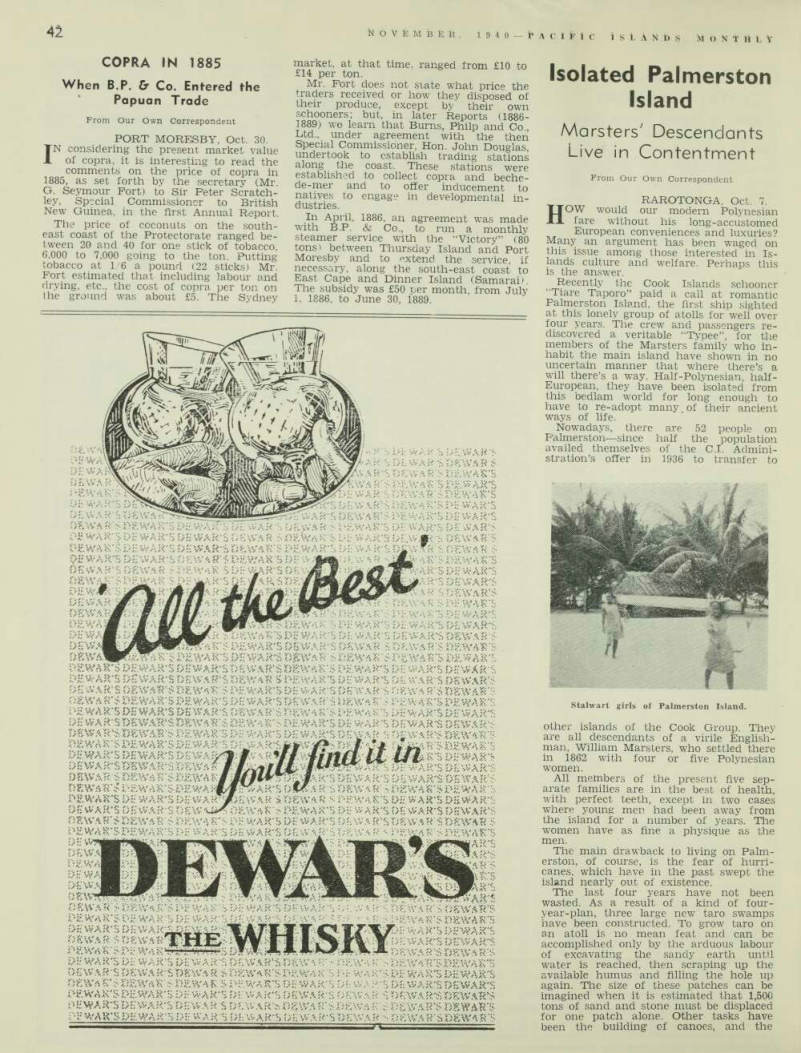
Island Marsters' Descendants Live in Contentment
From Our Own Correspondent
Rarotonga, Oct. 7.
HOW would our modern Polynesian fare without his long-accustomed European conveniences and luxuries?
Many an argument has been waged on this issue among those interested in Is lands culture and welfare. Perhaps this is the answer.
Recently the Cook Islands schooner “Tiare Taporo” paid a call at romantic Palmerston Island, the first ship sighted at this lonely group of atolls for “well over four years. The crew and passengers re discovered a veritable “Typee”, for the members of the Marsters family who in habit the main island have shown in no uncertain manner that where there’s a will there’s a way. Half-Polynesian, half- European, they have been isolated from this bedlam world for long enough to have to re-adopt many of their ancient ways of life.
Nowadays, there are 52 people on Palmerston—since half the population availed themselves of the C.I. Admini stration’s offer in 1936 to transfer to
other islands of the Cook Group. They are all descendants of a virile English man, William Marsters, who settled there in 1862 with four or five Polynesian women.
All members of the present five sep arate families are in the best of health, with perfect teeth, except in two cases where young men had been away from the island for a number of years. The women have as fine a physique as the men.
The main drawback to living on Palm erston, of course, is the fear of hurri canes, which have in the past swept the island nearly out of existence.
The last four years have not been wasted. As a result of a kind of four year-plan, three large new taro swamps have been constructed. To grow taro on an atoll is no mean feat and can be accomplished only by the arduous labour of excavating the sandy earth until water is reached, then scraping up the available humus and filling the hole up again. The size of these patches can be imagined when it is estimated that 1,500 tons of sand and stone must be displaced for one patch alone. Other tasks have been the building of canoes, and the
Stalwart girls of Palmerston Island.
renovation and construction of houses.
Mr. D. Fahey, Rarotonga radio oper ator, who stayed three weeks on Palm erston supervising the erection of a small wireless station, said that after four and a half years of isolation the Islanders’ best clothes and their houses were neater and better looked after than those of any other island he knew. There was an ample variety of food and, wonder of wonders, no flies or mosquitoes. Referring to the climate, Mr. Fahey remarked that after three weeks on the island he never felt fitter in his life. He was the first European to stay any length of time on Palmerston since Marsters died in 1899.
The Islanders have a most courteous, well-mannered bearing, although it was noticed that they are more serious than most Polynesians. The suspicion, how ever, that they might be victims of mel ancholia is negated by the amount of dancing in which they indulge. Cheerful hymns also are sung every evening and the Sunday church service is reminiscent of an old-fashioned English country vil lage.
Although all the inhabitants are direct descendants of the original William Marsters there are no signs of degener ation. It is a curious fact, too, that among this vigorous population only three births have taken place since the last boat-call.
Several tons of copra, which was lifted by the schooner sufficed to provide the Islanders with a few goods. A collection of old clothes had already been made in Rarotonga and the London Missionary Society also sent help.
Of much interest to the Palmerston people was the news that one of the present “patriarch’s” sons, Teraia Marsters, had killed his wife and was serving a 15-years’ sentence in a New Zealand prison.
The provision of the wireless communi cation (mainly for meteorological pur poses) will greatly alter the lives of the Palmerston Islanders, insomuch as more frequent steamer calls will have to be made in future to attend to the radio
plant.
Rev. J. F. Goldie, one of the pioneer missionaries in the Solomon Islands for the Methodist Mission, is convalescing following a serious operation. He is ex pected to come to Australia for a holi day in December.
Right Rev. P. N. W. Strong, M.A., Anglican Bishop of New Guinea, arrived in Australia in mid-October. Before re turning to Papua in December, Bishop Strong will carry out deputation work in Western Australia, Victoria and South Australia.
Advertisements & other items, p. 44 (2 items)
42
hoVfeMBER, 194 0 PACIFIC ISLANDS MONtHIV
Otit
Hit % u mm I WA AW
RAWAR'SRSWARS RS WARS RAWAR
RS. WAR'S RS WAR'S RS WAR'S RAWA A SRAWaR S RS W AR/ R£V/A V-'S RS WAR'S RA WAft*S RAWAR'S RS.WAR'S RS WA ;<*
'X R'S S>S WAR'S RA.WAR'S
Ak S RS WAkSRAWAR S
AR'S RAWAR S SWWAA'S
AR‘ :■ RAW A A aRS. WAR'S
.VAR SRAWARSRSWAK'S
RR W A A ' a R S WA R' S
S'S.WA R'S RS W A R.'
RS -A'AR'a RSWAR 1
:/Dv| RAWAR v
?;* WAR'S RSWAR'S OSWaRSRRWARS RS -A
oawarsoawar
OEW;U: S SW.ji'AR
RS.W/#: •
DR WAR
RAWA'
S'dvA'A
RS W
RAW'/
RAW'A
SRSRS
>< A 0 A WAR
'SASRRW'AA'
xR'SRSWAR'
xk.'S Ra WAR' waadawarw
RAW a A SS?S WAR'S
AA'•aR A W a A' a A'S. WAA'a R A W A R'S RRWaR S RS WAR'S RS WAR'S RSWAR'S vTR AW'A ASRS WAR SRS WAR SRS WAR'S RAW'aA ' a A'a RR WAR'S RRWAR'S RAWAR S RAWaRS RAWARS SRRW'ARa RS WAR'S RaREW'A Aa RRWaA'a RRWAR'S
RAWAR'SRSWAR'SRSWAR'SRAWAR'SRAWARSRS.WAk'SRSW>AR'SRSWARS
RSWAR'SRSWAR'SRAWAA'SRAWaR * RAWAR S RS WAR'S RA WAR S RAWAR’S RS WARS RAW a AS RAWaRS RSWAR'S RS WAR'S RAWaRS RAW A RS RAWARS
OAWaR'SRS;WARSRS.WAR'SRSWARSRAWA.ASRAW'aRRRAWAR'SRS:WAR'S
R£ WAR'S R;; WAR'S RS WAR'S RAWARS RAWaRS S v S;WA AS RSWAR'S RSWAR'S RS WARS RAWA'R ; S /RAW'aR'S RAWaR'S RSWAR'S RS WAR'S RS WAR'S RAW'AR • RAW'A.RS RS: WAR'S RS WAR'S RS WAR'S 'RAW'AR S R£'WAR'S RAWaRS
RAWAA'SRRWAR'SRS:WAR'SR'WVAR'SifcfW/?sr;A/'A?Jt RAWAR';;
RRVMR/S RS WAR'S -R A '#.</ a. ft */# W*i R'S RRVMR''-
W,“ RS WAR'S RS WAR?
S RAW A R* S R A,WAR'S OS WAR'S A R'S R AR S RAW a A RAWA A' S i.'S. W'A R S A WAR S RAW A A S RAWaRS RS. WAR'S RSWAR'; AW'A AS RAWAR'S RS WAR'S RS WAR'S R A WARS
RA\VaA’SRAWaASRRWAA'SRSW'AR'SRSWAR'SRAWaR I SRAWaRSRAWaAS
SASWARSSRR'AWR'SSAS WAR'S RS WAR'S RAWAiAS RAW'aR AS RAvVAA'S RS
RS WAR'S RAW'A R'S RAW'A
RAWARS RAWaRS RAWA
RAWaA
RAW'A R'S RS WAR'S RS WAR'
RS WAR'S RS WARS RAW
SR
RAW'
RAW
RS W
RAW
RAWAR SRAWaR
RAWaA'S RSWA A
RS WAR'S RSWARii
RAW'AR S RAW'AR
S RRWA A S RS WAR'S RS WAR'S •; vRS WAR'S£S WARW RAW* '> ' r
OTIT
RAWaASRSWaAt
RS WAR'S RS WAR'S RS WAR'S RAW'AR‘SRAW'A R' • RAW A A
RAWARSRAW'AR-SRAW'aR SRAWaRSRRWa A S; A WAR
RAWaA'SRAW'aA SSUSW'A A S RR'A'AA'SRS WAR'S RSWAR RAWAA'S RSWAR'S RS WAR'S RS WAR'S R A WARS RAWaR RS WAR'SRSWAR'SRSWAR RAWW A'SS:AWa A S RAWAA'S RAWAA'S S-S WAR'S R;:. WAR'S RS WAR S ?>S WAR'S RS WAR'S RAWA k --RAW'A A SRAWAA'S
A R'S
AR/S
ARS
\IC S
RS
ARS
RAWaRS RAWA R'S
vWSVaR'SS'RWAR'S
S WAR'S RS WAR'S
R A WAR'S RA WAR'S
RAW'A. RS RAW'A RS
• /.;S: WAR'S SW; WAR'S
SRS WAR'S RS.WAR'S
S RS WAR'S R A WAR'S
S R A WAR'S RAWAR'S
Pacific Songs
Sydney Hears Unusual Central Pacific Songs
IN October, the Polynesian Club of Sydney were hosts to a party of young men, residents of the Gilbert and Ellice Groups, who came to Sydney as crew of a small Islands steamer. They were introduced to the Club by Mrs.
Keith Strachan, formerly of Butaritari, whose nephew, Carl Reiher, of Abemama, was one of the party.
Resident members were delighted with the fine part-singing of Samoan ana Gilbert songs, as well as the excellent “Faa Samoa ’ dances, one highlight being a “tauoluga” by Tom Peters, of Tarawa, who was partnered by the graceful Miss Ana Laurenson, of Samoa. The boys were entertained at members’ homes, and a final visit was made to the Club room on the night before their departure. At this last gathering, the Gilberts men showed their “ruoia” dance, while the Ellice Is landers gave a spirited representation of a war-like “faatele” of their own locality.
The Gilbert dance was done to songs resembling somewhat the style of modern Japanese “Western” music; the Ellice men did their act to a complicated chant, in limited scale—almost a Gregorian mode in rhythm!
Musical members were greatly interested in these most unusual forms of Poly nesian and Micronesian songs, different in every way from the familiar songs of the Hawaiians and N.Z. Maori.
In their turn, Club members put their best feet forward ana snowed several forms of Maori poi and “haka taparahi”.
Before leaving the club room, on the final evening, the leader of the boys, Mr.
Joe Florance, of Suva, presented the president, Mr. Leonard Moran, with two pictureque Ellice Islands dancing cos tumes.
Advertisements & other items, p. 45 (2 items)
43
pacific isLA K b s monl'Hlv November, 1940
POWER to spare when wind or tide is tough
SYDNEY'S LEADING
SAILMAKER
AND RIGGER
Also Manufacturer of all Canvas and Rope Work.
ISLANDS WORK a
Speciality.
HARRY WEST
Balmain East, Sydney. Tel.: W 1105
n
FOR RELIABILITY
AND LONG SERVICE
USE
MILLER'S "ANCHOR"
BRAND ROPES AND
CORDAGES
Manila, Sisal, New Zealand Coir and Cotton Rope of every description. Twine, Sewing Twine, Shop Twine, Binder Twine and Fishlines, Lashings, Halters, Plough Reins, Sack Cord, Blind Lines, etc.
LENGTH STRENGTH
QUALITY GUARANTEED
• Manufactured by: JAMES MILLER fir CO. PTY. LTD.
MELBOURNE, VIC., AUST.
Suva Agents: A. S. FAREBROTHER ty CO.
And at Lautoka, P.O. Box 36. Tel.: 261.
Sydney Agents: p. T. TAYLOR LTD.
POWER to spare when wind or tide is tough The Blaxland 31 h.p. pup provides just that extra power to combat a heavy swell or a swift-running tide.
Outstanding mechanical features are the detachable cylinder block, and either the “8.R.” Schebler pattern carburettor or the Chapman Floatless type. Other conveniences are the “8.R.” spring-loaded, self-adjusting clutch, and the patent bounce starting without handle or strap. A “8.R.” product manufactured under licence and employing the famous Chapman Pup patents, this efficient power unit has already established for itself a fine reputation throughout Australia.
BLAXLAND HAE Pty. Ltd.
61-65 SALISBURY ROAD, CAMPERDOWN, SYDNEY, N.S.W.
Telegrams: “Blaxrae”, Sydney. 'Phone; L 5071.
PUP
m Queensland:
MAfRINO PRODUCTS PTY. LTD.,
Brisbane.
Victoria:
MOTOR SPARES LTD.,
Melbourne.
South Australia;
BOAT FITTINGS.
Adelaide.
West. Australia:
HARRIS, SCARFE & SANDOVERS LTD.,
Perth.
Fine-Mat Ceremony In
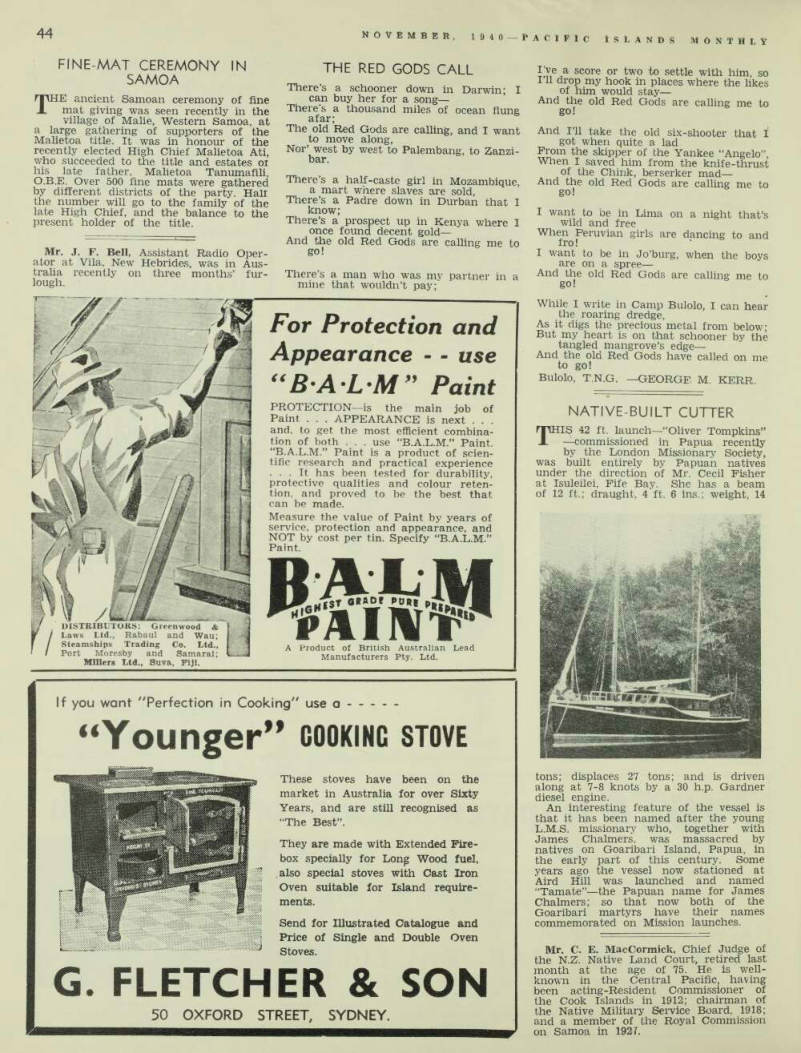
Samoa
THE ancient Samoan ceremony of fine mat giving was seen recently in the village of Malie, Western Samoa, at a large gathering of supporters of the Malietoa title. It was in honour of the recently elected High Chief Malietoa Ati, who succeeded to the title and estates or his late father, Malietoa Tanumafili, 0.8. E. Over 500 fine mats were gathered by different districts of the party. Half the number will go to the family of the late High Chief, and the balance to the present holder of the title.
Mr. J. F. Bell, Assistant Radio Oper ator at Vila, New Hebrides, was in Aus tralia recently on three months’ fur lough.
The Red Gods Call
There’s a schooner down in Darwin; I can buy her for a song— There’s a thousand miles of ocean flung afar; The old Red Gods are calling, and I want to move along, Nor’ west by west to Palembang, to Zanzi bar.
There’s a half-caste girl in Mozambique, a mart where slaves are sold, There’s a Padre down in Durban that I know; There’s a prospect up in Kenya where I once found decent gold— And the old Red Gods are calling me to go!
There’s a man who was my partner in a mine that wouldn’t pay;
J,ye a score or two to settle with him, so 111 drop my hook in places where the likes of him would stay— And the old Red Gods are calling me to go!
And I’ll take the old six-shooter that I got when quite a lad From the skipper of the Yankee “Angelo”, When I saved him from the knife-thrust of the Chink, berserker mad— And the old Red Gods are calling me to go!
I want to be in Lima on a night that’s wild and free When Peruvian girls are dancing to and fro!
I want to be in Jo’burg, when the boys are on a spree— And the old Red Gods are calling me to go!
While I write in Camp Bulolo, I can hear the roaring dredge, As it digs the precious metal from below; But my heart is on that schooner by the tangled mangrove’s edge— And the old Red Gods have called on me to go!
Bulolo, T.N.G.
George M. Kerr.
Native-Built Cutter
rIS 42 ft. launch—“ Oliver Tompkins” —commissioned in Papua recently by the London Missionary Society, was built entirely by Papuan natives under the direction of Mr. Cecil Fisher at Isuleilei, Fife Bay. She has a beam of 12 ft.; draught, 4 ft. 6 ins.; weight, 14
tons; displaces 27 tons; and is driven along at 7-8 knots by a 30 h.p. Gardner diesel engine.
An interesting feature of the vessel is that it has been named after the young L.M.S. missionary who, together with James Chalmers, was massacred by natives on Goaribari Island, Papua, in the early part of this century. Some years ago the vessel now stationed at Aird Hill was launched and named “Tamate”—the Papuan name for James Chalmers; so that now both of the Goaribari martyrs have their names commemorated on Mission launches.
Mr. C. E. MacCormick, Chief Judge of the N.Z. Native Land Court, retired last month at the age of 75. He is well known in the Central Pacific, having been acting-Resident Commissioner of the Cook Islands in 1912; chairman of the Native Military Service Board, 1918; and a member of the Royal Commission on Samoa in 192?.
Advertisements & other items, p. 46 (1 item)
FA I lift*
I ■ / DISTRIBUTORS: Greenwood & Laws Ltd., Rabaul and Wau; Steamships Trading Co. Ltd., Port Moresby and Samaral; Millers Ltd., Suva, Fiji.
For Protection and
Appearance - - use
“BALM” Paint
PROTECTION—is the main job of Paint . . . APPEARANCE is next . . . and, to get the most efficient combination of both . . . use “8.A.L.M.” Paint.
“8.A.L.M.” Paint is a product of scientific research and practical experience . . . It has been tested for durability, protective qualities and colour retention, and proved to be the best that can be made.
Measure the value of Paint by years of service, protection and appearance, and NOT by cost per tin. Specify “8.A.L.M.”
Paint. grade puri
FA I lift*
A Product of British Australian Lead Manufacturers Pty. Ltd.
If you want "Perfection in Cooking" use a a
Younger” cooking stove
These stoves have been on the market in Australia for over Sixty Years, and are still recognised as “The Best”.
They are made with Extended Firebox specially for Wood fuel, also special stoves with Cast Iron Oven suitable for Island requirements.
Send for Illustrated Catalogue and Price of Single and Double Oven Stoves.
G. FLETCHER & SON
50 OXFORD STREET, SYDNEY.
Training Young Euronesian Girls In Fiji
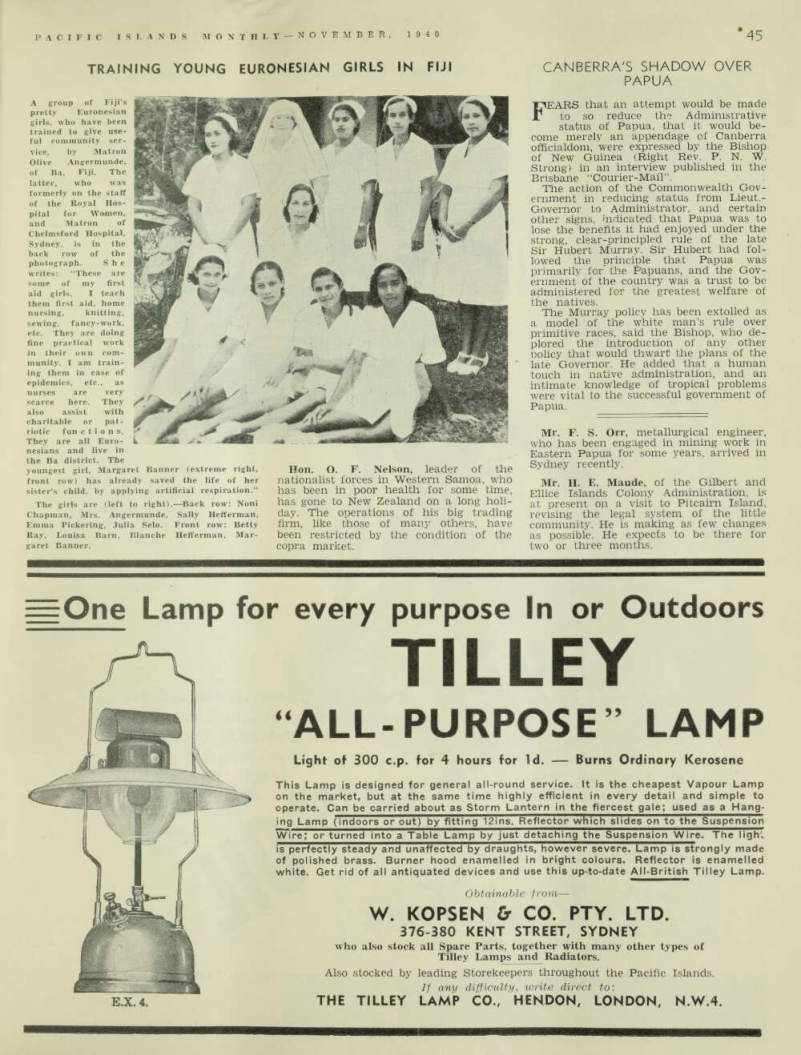
Hon. O. F. Nelson, leader of the nationalist forces in Western Samoa, who has been in poor health for some time, has gone to New Zealand on a long holi day, The operations of his big trading firm, like those of many others, have been restricted by the condition of the copra market.
A group of Fiji’s
pretty Euronesian
girls, who have been trained to give use ful community ser vice, by Matron Olive Angermunde, of Ba, Fiji. The latter, who was formerly on the staff of the Royal Hos pital for Women, and Matron of Chelmsford Hospital, Sydney, is in the back row of the photograph. She writes: “These are some of my first aid girls. I teach them first aid, home nursing, knitting, sewing, fancy-work, etc. They are doing fine practical work in their own com munity. I am train ing them in case of epidemics, etc., as nurses are very scarce here. They also assist with charitable or pat riotic functions.
They are all Euro nesians and live in the Ba district. The
youngest girl, Margaret Banner (extreme right, front row) has already saved the life of her sister’s child, by applying artificial respiration.”
The girls are (left to right).—Back row: Noni Chapman, Mrs. Ang ermunde, Sally Hefferman, Emma Pickering, Julia Selo. Front row: Betty Ray, Louisa Barn, Blanche Hefferman, Mar garet Banner.
Canberra's Shadow Over
Papua
FEARS that an attempt would be made to so reduce the Administrative status of Papua, that it would be come merely an appendage of Canberra officialdom, were expressed by the Bishop of New Guinea (Right Rev. P. N. W.
Strong) in an interview published in the Brisbane "Courier-Mail”.
The action of the Commonwealth Gov ernment in reducing status from Lieut.- Governor to Administrator, and certain other signs, indicated that Papua was to lose the benefits it had enjoyed under the strong, clear-principled rule of the late Sir Hubert Murray. Sir Hubert had fol lowed the nrincinle that Papua was primarily for the Papuans, and the Gov ernment of the country was a trust to be administered for the greatest welfare of the natives.
The Murray policy has been extolled as a model of the white man’s rule over primitive races, said the Bishop, who de plored the introduction of any other nolicy that would thwart the plans of the late Governor. He added that a human touch in native administration, and an intimate knowledge of tropical problems were vital to the successful government of Papua.
Mr. F. S. Orr, metallurgical engineer, who has been engaged in mining work in Eastern Papua for some years, arrived in Sydney recently.
Mr. H. E. Maude, of the Gilbert and Ellice Islands Colony Administration, is at nresent on a visit to Pitcairn Island, revising the legal system of the little community. He is making as few changes as possible. He expects to be there for two or three months.
Advertisements & other items, pp. 47-48 (1 item)
Tilley
=One Lamp for every purpose In or Outdoors
“ALL-PURPOSE” LAMP
Light of 300 c.p. for 4 hours for Id. Burns Ordinary Kerosene This Lamp is designed for general all-round service. It is the cheapest Vapour Lamp on the market, but at the same time highly efficient in every detail and simple to operate. Can be carried about as Storm Lantern in the fiercest gale; used as a Hanging Lamp (indoors or out) by fitting 12ins. Reflector which slides on to the Suspension Wire; or turned into a Table Lamp by just detaching the Suspension Wire. The lighi is perfectly steady and unaffected by draughts, however severe. Lamp is strongly made of polished brass. Burner hood enamelled in bright colours. Reflector is enamelled white. Get rid of all antiquated devices and use this up-to-date All-British Tilley Lamp.
Obtainable from —
W. KOPSEN & CO. PTY. LTD.
876-380 KENT STREET, SYDNEY
who also stock all Spare Parts, together with many other types of Tilley Lamps Radiators.
E.X. 4.
Also stocked by leading Storekeepers throughout the Pacific Islands.
If any difficult!), write direct to: THE TILLEY LAMP CO., HENDON, LONDON, N.W.4.
.JO A VI 0 The thin tough film of Shell Me Oil protects the vital moving parts of your engine under all conditions idling - starting or working under the extreme pressure of pull or speed.
Owners of the largest fleets of Buses and Trucks use the “Drag-Free”
Shell Motor Oil because it reduces wear cuts down repair bills and gives easier starting and more mile-
MOTOR
Its Dnaa -Free
age.
THE SHELL COMPANY OF AUSTRALIA LIMITED (Incorporated In Great Britain) too*
Bulolo Hotel, Wau
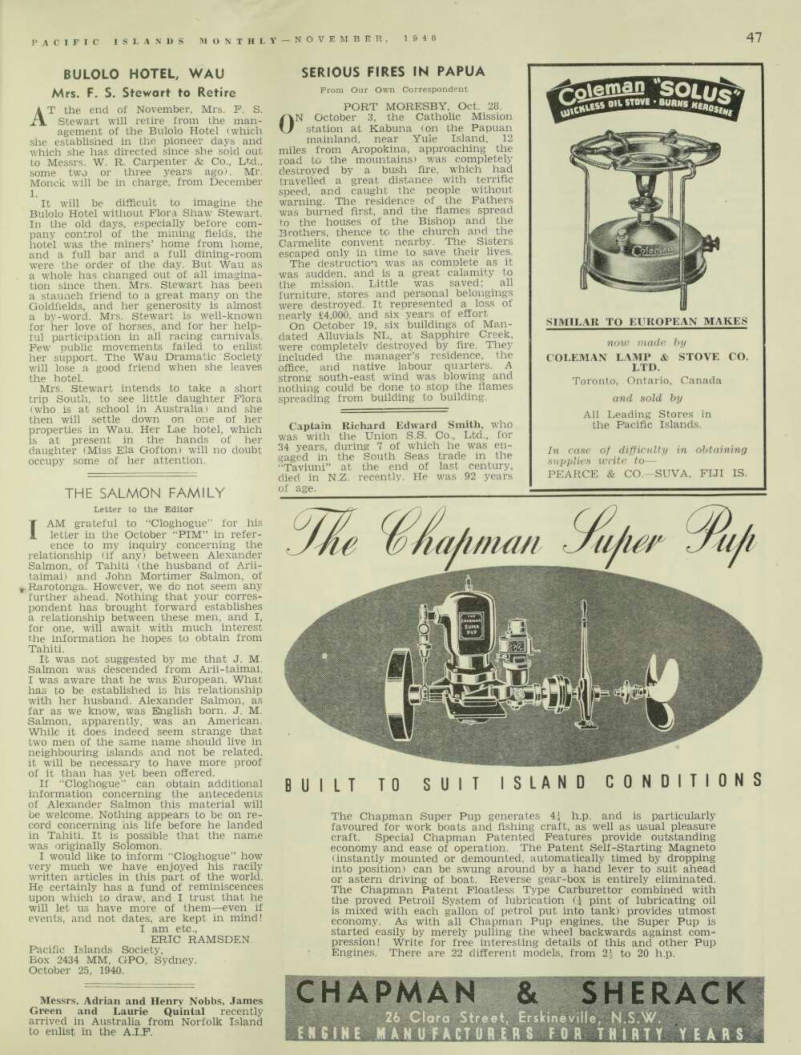
Mrs. F. S. Stewart to Retire
AT the end of November, Mrs. F. S.
Stewart will retire from the man agement of the Bulolo Hotel (which she established in the pioneer days and which she has directed since she sold out to Messrs. W. R. Carpenter & Co., Ltd., some two or three years ago). Mr.
Monck will be in charge, from December 1.
It will be difficult to imagine the Bulolo Hotel without Flora Shaw Stewart.
In the old days, especially before com pany control of the mining fields, the hotel was the miners’ home from home, and a full bar and a full dining-room were the order of the day. But Wau as a whole has changed out of all imagina tion since then. Mrs. Stewart has been a staunch friend to a great many on the Goldfields, and her generosity is almost a by-word. Mrs. Stewart is well-known for her love of horses, and for her help ful participation in all racing carnivals.
Few nublic movements failed to enlist her support. The Wau Dramatic Society v/ill lose a good friend when she leaves the hotel.
Mrs. Stewart intends to take a short trip South, to see little daughter Flora (who is at school in Australia) and she then will settle down on one of her properties in Wau. Her Lae hotel, which is at present in the hands of her daughter (Miss Ela Gofton) will no doubt occupy some of her attention.
The Salmon Family
Letter to the Editor I AM grateful to “Cloghogue” for his letter in the October “PIM” in refer ence to my inquiry concerning the relationship (if any) between Alexander Salmon, of Tahiti (the husband of Arii taimai) and John Mortimer Salmon, of Rarotonga. However, we do not seem any further ahead. Nothing that your corres pondent has brought forward establishes a relationship between these men, and I, for one, will await with much interest the information he hopes to obtain from Tahiti.
It was not suggested by me that J. M Salmon was descended from Arii-taimal.
I was aware that he was European. What has to be established is his relationship with her husband. Alexander Salmon, as far as we know, was English born. J. M.
Salmon, apparently, was an American.
While it does indeed seem strange that two men of the same name should live in neighbouring islands and not be related, it will be necessary to have more proof of it than has yet been offered.
If “Cloghogue” can obtain additional information concerning the antecedents of Alexander Salmon this material will be welcome. Nothing appears to be on re cord concerning his life before he landed in Tahiti. It is possible that the name was originally Solomon.
I would like to inform “Cloghogue” how very much we have enjoyed his racily written articles in this part of the world.
He certainly has a fund of reminiscences upon which to draw, and I trust that he will let us have more of them —even if events, and not dates, are kept in mind!
I am etc.,
Eric Ramsden
Pacific Islands Society, Box 2434 MM, GPO, Sydney.
October 25, 1940.
Messrs. Adrian and Henry Nobbs, James Green and Laurie Quintal recently arrived in Australia from Norfolk Island to enlist in the A.I.P.
Serious Fires In Papua
From Our Own Correspondent
Port Moresby, Oct. 28.
ON October 3, the Catholic Mission station at Kabuna (on the Papuan mainland, near Yule Island. 12 miles from Aropokina, approaching the road to the mountains) was completely destroyed bv a bush fire, which had travelled a great distance with terrific speed, and caught the people without warning. The residence of the Fathers was burned first, and the flames spread to the houses of the Bishop and the Brothers, thence to the church and the Carmelite convent nearby. The Sisters escaped only in time to save their lives.
The destruction was as complete as it was sudden, and is a great calamity to the mission. Little was saved; all furniture, stores and personal belongings were destroyed. It represented a loss of nearly £4,000, and six years of effort On October 19, six buildings of Man dated Alluvials NL, at Sapphire Creek, were completely destroyed by fire. They included the manager’s residence, the office, and native labour quarters. A strong south-east wind was blowing and nothing could be done to stop the flames spreading from building to building.
Captain Richard Edward Smith, who was with the Union S.S. Co., Ltd., for 34 years, during 7 of which he was en gaged in the South Seas trade in the “Taviuni” at the end of last century, died in N.Z. recently. He was 92 years of age.
Papuan Co.'s Profit Maintained
IN the year ended June 30, 1940, Steam ships Trading Co., Ltd., of Port Moresby, Papua, which has a paid up capital of £143,579 made a net profit of £19,051. This is about the same profit as last year and allows the company’s dividend of 8 per cent, to be maintained.
A sum of £l,OOO has been added to the reserve for “vessels’ contingencies and re newals”, and £7,200 to the general reserve (making £33,000) and £3,735 has been carried forward. It is noted in the Dir ectors’ report that stocks of copra at Port
Moresby and Samarai have been written down, owing to doubtful markets, to £3/5/- per ton.
This company’s activities, owing to the wisdom of its founder, Captain A S Fitch, are now widely spread, so that a slump in one direction (as in copra) does not seriously affect the general position The Company’s four main sources of in come are: general trading; transport and shipping; rubber plantations; and copra plantations. Copra is sick, but rubber is booming, and the general economic posi tion in Papua is very good.
Advertisements & other items, pp. 49-50 (1 item)
oner
SIMILAR TO EUROPEAN MAKES
now made hy
COLEMAN LAMP & STOVE CO.
LTD.
Toronto, Ontario, Canada and sold hy All Leading Stores in the Pacific Islands.
In case of difficulty in obtaining supplies write to —
PEARCE & CO.—SUVA, FIJI IS.
U % u
oner
Tj
man
'JiSi; t ,v-;C :i 2' m i k 1 ■ii i i < >€i '€ ■
BUILT TO SUIT ISLAND CONDITIONS
The Chapman Super Pup generates 4.1 h.p. and is particularly favoured for work boats and fishing craft, as well as usual pleasure craft. Special Chapman Patented Features provide outstanding economy and ease of operation. The Patent Self-Starting Magneto (instantly mounted or demounted, automatically timed by dropping into position) can be swung around by a hand lever to suit ahead or astern driving of boat. Reverse gear-box is entirely eliminated.
The Chapman Patent Floatless Type Carburettor combined with the proved Petroil System of lubrication (i pint of lubricating oil is mixed with each gallon of petrol put into tank) provides utmost economy. As with all Chapman Pup engines, the Super Pup is started easily by merely pulling the wheel backwards against compression! Write for free interesting details of this and other Pup Engines. There are 22 different models, from to 20 h.p.
skineviile,
FOR T
if
EARS
Ship Chandlery Hardware
Write for
/VYnre ror j
Ship Chandlery /
Catalogue J
Special “In Bond” Prices for all Islands enquiries quoted on application.
Sole Agents for:
BROOMFIELDS LIMITED
152 SUSSEX STREET ;; SYDNEY
Cables: “Boom”, Sydney.
Large and Complete Stocks of
SHIP CHANDLERY
IRONMONGERY OF ALL KINDS PAINTS
WHITE LEAD AND OILS ’
“JS"™ & co -’ s 3 -crown brand metal sheathing.
PEACOCK & BUCHANS’ ENGLISH READY-MIXED PAINTS.
PROPELLERS
All Sizes to 54 in. diameter . . . any pitch.
SHAFTS MADE TO ORDER.
Bearing and Stuffing Boxes—Rudders— Tanks for Water and Fuel—Exhaust Pipes and Mufflers.
Copper, Bronze and Aluminium Founders.
D. H. PORTER & CO.
43-45 DRUITT STREET, SYDNEY.
Scott’s “Renown” Brand Rope,
Cordage and
Binder
Twine
Cable Address: Ropeyard, Sydney. ■
of Every
Description
MANUFACTURED AT
MASCOT, N.S.W.
J. SCOTT
PTY. LTD.
Head Office and Store:
163 CLARENCE STREET,
SYDNEY,
N.S.W.
I Keep House In
Tahiti
By Shirtey A. Chidsey, who wrote from New York City to the editor of the “PIM”: “If you pay anything for this story , please turn the money over to whatever agency buys cigarettes for your soldiers SINCE we first, with great excitement and in a deluge of tronical rain, came down the passenger ladder of the Messageries Maritimes “Commissaire Ramel to stand at last upon the quay in Papeete, we have gone away and come back three times.
So we are still “tourists”. We own land and furniture in Tahiti, and we are planning, when the war is over and prices of building materials have come down out of the sky, to build a house.
But we are foreigners and we go home once a year or so and our housekeeping problems are still those of a tourist in Tahiti. And that’s what you wanted to know about, isn’t it?
Well, first, of course, there has to be a house. A small house is easy to find, at a rental of anywhere from 250 francs to 2,500 francs a month, furnished. There is no charge for water, which is plenti ful and good; the garbage, you toss into a pit and burn. The main utility is oil: for stove, for lamps or for electric plant.
Oil costs about fifty francs a gallon tin, and the franc is worth about two cents, now.
THE first house we had was in Taunoa, about a mile from the centre of Papeete. The next was in Pirae, three miles away. For the first, we paid 600 francs. The second, we rented from an American and paid for in dollars— fifty of them per month, which is too much to pay for a roof over your head in this country.
Finally, we moved out to Punaauia, 12 miles from town and thoroughly in the country (no electric lights, no stores, a telephone every two miles . . .). Most of the tourists live in Punaauia or in Paea, a few miles further along, and a great many of the French fonctionnaires and business people have week-end houses here along the white coral beach between the Broom Road and the lagoon. A stretch, perhaps an eighth of a mile wide, between the mountains and the sea, and the mountains cleft now and again by deep valleys and rivers, winding back into the rainy, jungly and uninhabited interior of the island: that is Punaauia.
I thought, since a maid of all work is available for 400 francs a month (about £2 Australian) that we should have one I have since tried a great many. They are nearly all abominable cooks. They are usually untrained—it is hard to train a servant, even if you speak French very well, when she speaks only a little French and no English. And, for this reason, too many Americans have thought, as I thought on my first trip to Tahiti: “Oh, well, what’s the use: it’s only for six weeks”, and they have put up with the bad cooking, the careless table setting, the inevitable Tahitian indiffer ence. The Tahitian girls know, too, that we are lenient.
Now, I have a girl, or at least any one of a family of six girls, who comes at ten or thereabouts (“ten o’clock Punaauia time” as we say out here, where if you have a clock at all, it has probably been stopped for several days) every morning to wash the dishes, clean the house and make the beds. For this I pay 150 francs a month. This work is well done. The girls have had to do it at home from earliest childhood; they are essentially
clean themselves, and they are strong and thorough.
ISEND our wash to a woman down the road. I pay by the piece and it is a little expensive (comparatively) but it is carefully washed and ironed, and it is called for and delivered with unfailing regularity (except in the rainy season, when drying, which must be done out doors. may take several days). Laundry is a big item here, where all clothes are washable and where heat and perspira tion make frequent changes necessary every day. To do it yourself, you must be able to manage with a charcoal iron, and the floor for an ironing board! For the two of us (including our household linen) we pay about 200 francs a month.
I am my own cook. I buy vegetables, fruit, eggs and bread from a Chinese who comes around every morning in a cart, blowing on what appears to be a large conch shell, to announce his arrival at the door. The grocery store in Papeete (another Chinese establishment) sends out meat and fish along with any can ned goods I may order, every other day, on the “truck”. They will send ice, too, but usually I order meat for two days, cook it immediately it arrives, and so get along without ice, which is expensive here. (If they do put electricity out to Punaauia. which they say they may do next year, we shall buy an electric re frigerator, and then, oh then, what a life of luxury! We may even someday have an electric stove to replace our well-worn oil burner.) TWICE a week, or so, I,get up at 5.30 and go to town on the “truck”, to vary our rather monotonous round of vegetables and fruit with something
from the Papeete market. The “truck” is a great, lumbering open bus, with ten or twelve seats holding five people each, and an uncounted number more sitting on their laps. The buses go to the market place and are supposed to arrive before the market closes at 8 a.m. If they don’t break down en route, they do get there; some even pass through Punaauia around 3.30 and 4 a.m., which carry Tahitians and their produce in for the opening of the market at 5.30.
I have never seen a native market anywhere in the world which was not worth a visit, whether you were there to buy or not. There are strings and strings of fish; there are sacks containing nearly two dozen oranges, for ten francs; there are baskets woven of palm fronds, full of avocados (five francs for six or eight in a basket); the same baskets full of mangoes in their season, and papayas; there are stacks of plantain, bananas, taro and yams. There are butchers’ booths full of meat; there is an assort ment of vegetables: parsley, string beans, carrots, baby-sized eggplants, lettuce and tomatoes, radishes, occasionally corn on the cob. All are amazingly cheap. Market ing expenses for two persons per day run between 5 and 10 francs —unless you buy a chicken or duck, which often will cost as much as thirty francs.
It is the imported things in cans which are expensive in Tahiti.
At nine-thirty I catch the home-going truck, which passes through Punaauia on its rambling journey, delivering people and packages and mail through the dis tricts from Papeete to Tautira, some sixty miles away.
WE are a gay crowd going out—we have a day’s work (many of the
Tahitians from far out got up at 2 a.m. to make the trip) behind us, and before us a day of sitting on the shady verandah, singing songs, re-telling the gossipy bits heard at the market, drink ing from coconuts or eating the ripe mangoes that will surely have fallen from our big tree by that time. No Tahitian house is without a mango tree, and palms full of fresh green coconuts for drinking, a guitar player and a dozen ears to bend eagerly to the news of the preceding night and day. News travels always by this coconut wireless in Tahiti —there is no other means—and every one in the farthest district knows every thing that goes on on the island.
What do we do there all day? How many times I have been asked that! Well, perhaps swim or fish in the lagoon, per haps weed in my garden, read or go riding on my bicycle. Perhaps play bridge or sit around Rivnac’s (Punaauia’s hotel) cool terrace with a cooler drink.
Perhaps nothing—nothing but enjoy liv ing that day—and that is something in deed!
Miss Vera Cannon, a nurse at the Methodist Mission’s hospital on Choiseul Island, Solomon Islands, arrived In Sydney recently and later proceeded to New Zealand on furlough.
Nurse Dorothy Holmes has been accepted for mission service by the Methodist Mission and will enter the George Brown College, N.S.W., for train ing next April.
Lieut.-Colonel H. E. Woodman, lately one of the best known District Officers in New Guinea, is now Commanding Officer of the 3rd Pioneer Battalion, Wallgrove Camp, NJ3.W.
Advertisements & other items, pp. 51-52 (1 item)
Tasman Marine Engines
pfi
N|V I A
in Pacific Islands Territories
to represent
TASMAN MARINE ENGINES
AUSTRALIA’S FINEST ACHIEVEMENT IN THE SMALL ENGINE CLASS
SUPREME IN POWER—DEPENDABILITY—REFINEMENT
4] HP. MEDIUM
7-9 HP. TWIN
SUPER TIGER
Also 3 h.p. and 5-7 h.p. models
DUTY MODEL.
Specially designed for hard, continuous service in boats up to 18 ft.
Overhead crank starting, water-cooled manifold as standard equipment. Available with built-in one unit reverse gear, having forehead flywheel, also electric starter and generator.
FULLY GUARANTEED
Write for Full Particulars of all our Models.
MANY EXCLUSIVE FEATURES
Applicants for Agency please supply details of organisation, and territory covered.
Tasman Marine Products
191 ELIZABETH STREET, WATERLOO, N.S.W.
N.S.W.
A. S YOUNG, Woy Woy.
JACK BETTINI, Narooma.
E. F. WEBBER, Batemans Bay.
A. A. KOELLNER, Moruya.
AUSTRALIAN AGENTS;
QUEENSLAND. s. AUST.
QUEENSLAND PASTORAL HUGH QUIN,
SUPPLIES, LTD., Ship Chandler, Bowen Street, Brisbane. Port Adelaide.
W. AUS.T.
FLOWER, DAVIES & JOHNSON
PTY. LTD.,
Murray Street, Perth.
Modern Refrigeration for the South Sea Islands
The ELECTROLUX
KEROSENE OPERATED
REFRIGERATOR
MARVEL
OF
MODERN
SCIENCE
THE
MIRACLE
OF
ICE
FROM
HEAT
ELECTROLUX offers economical, modern and completely efficient
REFRIGERATION FOR ISLANDS' HOMES.
FREEZES CONTINUOUSLY WHILE SMALL LAMP BURNS.
Freezing controlled by simply regulating height of flame. Uses only gallon of kerosene per week.
MOTORLESS ... NO PARTS TO GET OUT OF ORDER.
MODEL L 22
Capacity 2.2 cubic feet.
MODEL L3BO
S (as illustrated) Capacity 4 cubic feet.
MODEL LKSSO
® Capacity 5.5 cubic feet.
GUARANTEED FOR TWO YEARS.
• Write to your Local Distributor for prices and full details.
Obtainable from: W. R. Carpenter & Company Ltd. —Sydney, and the following New Guinea Branches; Rabaul, Salamaua, Wau, Kavieng, Madang, and Wewak.
W. R. Carpenter & Coy. (Solomon Is.) Pty. Ltd. —Tulagi, British Solomon Islands.
On Chong & Company Pty. Ltd. —Butaritari, Gilbert and Ellice Islands.
Representation in Papua and New Hebrides.
Two Ways Of Life
THE “sun-kissed son of the South Seas” (quotation from new book) ceases his day’s labours, has a swim in the creek to wash all traces of a day’s work from his system, and bursts into his peculiar way of expressing himself in song—a cross between Bing Crosby and an Australian yodel. He wends his leisurely way to the communal kitchen, to participate in whatever is going, be it rice, wheatmeal or a few dead cus-cus.
When he has dipped deeply into the kai-kai pot, and his “bell” has become extended to the right proportions, he goes to his own dwelling, fills his mouth with betel-nut and rolls his ‘‘smoke”. He lies on his back and thinks what a really great gift life is.
Someone spins a yarn or two—maybe a little exaggerated, but well worth listen ing to, so why worry. Someone else has one to beat it, and gets a good hearing.
Gradually, as dreamland captures its victims, the contestants drop out, till finally the best story-teller is left talk ing to himself. He gazes round the sur rounding hills and sees the dim-dim houses lit with electric lights. Before joining his companions in sleep, he mar vels at the super-minds of the dim-dim, who can produce all these lights and who has radio to listen to. How he would love to have been born a white man and be able to do all these things!
We then take an inquisitive peep into one of the dim-dim homes. We won’t mention any names, for obvious reasons.
The great dim-dim is sitting at his table, which is littered with letters. They all have the same beginning: “To account rendered”. He tears at his hair and glances now and again at a cheque which he has drawn for wages. He is apparently trying to decide to which “account rend ered” he will apply the cheque. He curses his radio, which, since the war news, has been beefing out the advantages of Bil lingham’s food for Bonnie Babies, and so forth.
Finally, after a terrific tug at the fore lock, he places all the letters in a hat, shuts his eyes and takes one out. He places this and the cheque in an envelope together, throws the rest in the fire, switches off the radio, winds the clock, sets the alarm and goes to bed, trying not to think of all the troubles he has thrown in the fire, and wishing with all his heart he had been born a native.
L.H.W.
Memorial For Sir Hubert
Murray
From Our Own Correspondent
Port Moresby, Nov. 2.
A FUND has been opened in Papua to provide a memorial for the late Lt.- Governor of Papua. Sir Hubert Murray, KCMG.
A polished granite obelisk has been suggested, 25 ft. high, on a 5 ft. base, to stand in a prominent position in the centre of Port Moresby.
It is felt by his friends that the pro vision of a suitable memorial should be undertaken as soon as possible, even though the time generally may be un suitable for an appeal to the public.
Mr. F. C. and Mrs. Beazley arrived in Sydney from Rabaul, New Guinea, re cently. He is technical instructor for the Methodist Mission in New Britain and went on to North Australia at the end of October to assist in the construction of a number of buildings the Mission is erecting. He will later return to New Guinea.
Cheese raring o f N.G.V.R. Public
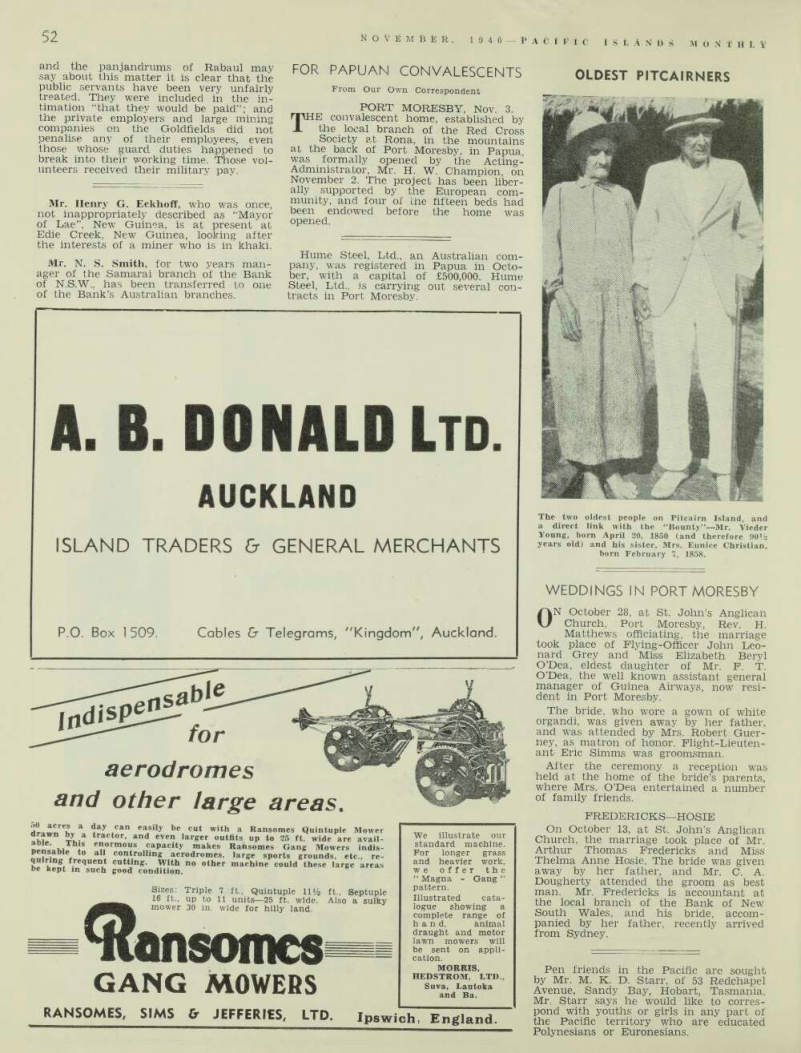
Servants in New Guinea
Prom Our Own correspondent WAU, Nov. 2.
FOLLOWING on the “Second AIF Con tingent” at Salamaua, there comes yet another “incident”, in which those responsible do not appear in a good light The Goldfields detachment of the New Guinea Volunteer Rifles, for a period, had to undertake compulsory guard duties. In the initial stages, these “com pulsory” duties were taken up voluntarily by members of the NGVR, who taelievea then' services were needed only for a few days. Then it was found that guards had to be provided for many weeks.
The NCO’s and men were officially in formed, on parade, that during this time they would be subject to "active service conditions” and would be paid at mili tary rates for all time occupied in guard
duties. There was no distinction made in tWs intimatio n—they would "all” oe paid But when, after considerable delay, the pay-sheets appeared, it was found that those volunteers who happen to be em ployees of the Administration did not appear on the pay roll. They were in formed that as they were public servants, they were precluded from receiving pay ment as "soldiers”, when employed in mih tary duties for which they were detailed "outside their normal Administrative hours”.
There were cases of public servants whose spare time was enormously taken up in guard duties, and who did not lose an hour from their Administrative duties—and it must be emphasised that they were detailed for these duties—there was no "if you please” about it. Further, they were made use of at nights and week-ends, when others "began with one consent to make excuse”, Whatever the Public Service Ordinance
and the panjandrums of Rabaul may say about this matter it is clear that the public servants have been very unfairly treated. They were included in the in timation “that they would be paid’’; and the private employers and large mining companies on the Goldfields did not penalise any of their employees, even those whose guard duties happened to break into their working time. Those vol unteers received their military pay.
Mr. Henry G. Eekhoff, who was once, not inappropriately described as “Mayor of Lae”, New Guinea, is at present at Edie Creek, New Guinea, looking after the interests of a miner who is in khaki.
Mr, N. S. Smith, for two years man ager of the Samarai branch of the Bank of N.S.W., has been transferred to one of the Bank’s Australian branches.
Advertisements & other items, p. 53 (1 item)
Sparkling
refreshment from pure Malt and Hops ★
FOSTER'S
LAGER
For Papuan Convalescents
From Our Own Correspondent
Port Moresby, Nov. 3.
THE convalescent home, established by the local branch of the Red Cross Society at Rona, in the mountains at the back of Port Moresby, in Papua, was formally opened by the Acting- Administrator, Mr. H. W. Chamnion, on November 2. The project has been liber ally supported by the European com munity, and four of the fifteen beds had been endowed before the home was opened, Hume Steel, Ltd., an Australian com pany, was registered in Panua in Octo ber, with a capital of £500,000. Hume Steel, Ltd., is carrying out several con tracts in Port Moresby.
Oldest Pitcairners
The two oldest people on Pitcairn Island, and a direct link with the “Bounty”—Mr. Vieder Young, born April 20, 1850 (and therefore 90 ½ years old) and his sister, Mrs. Eunice Christian, born February 7, 1858.
Weddings In Port Moresby
ON October 28, at St. John’s Anglican Church, Port Moresby, Rev. H.
Matthews officiating, the marriage took place of Flying-Officer John Leo nard Grey and Miss Elizabeth Beryl O’Dea, eldest daughter of Mr. F. T.
O’Dea, the well known assistant general manager of Guinea Airways, now resi dent in Port Moresby.
The bride, who wore a gown of white organdi, was given away by her father, and was attended by Mrs. Robert Guer ney, as matron of honor. Flight-Lieuten ant Eric Simms was groomsman.
After the ceremony a reception was held at the home of the bride’s parents, where Mrs. O’Dea entertained a number of family friends.
Fredericks—Hosie
On October 13, at St. John's Anglican Church, the marriage took place of Mr.
Arthur Thomas Fredericks and Miss Thelma Anne Hosie. The bride was given away by her father, and Mr. C. A.
Dougherty attended the groom as best man. Mr. Fredericks is accountant at the local branch of the Bank of New South Wales, and his bride, accom panied by her father, recently arrived from Sydney.
Pen friends in the Pacific are sought by Mr. M. K. D. Starr, of 53 Redchapel Avenue, Sandy Bay, Hobart, Tasmania.
Mr, Starr says he would like to corres pond with youths or girls in any part of the Pacific territory who are educated Polynesians or Euronesians.
Advertisements & other items, p. 54 (2 items)
52
NOVfiMfiEfi, 1546 - PACIFIC ISLAKCS MoNl'HtV
A. B. Donald Ltd.
AUCKLAND
ISLAND TRADERS & GENERAL MERCHANTS
P.O. Box 1 509. Cables £r Telegrams, "Kingdom", Auckland.
/odisp
ens#
bl£
for
aerodromes
and other large areas.
i 0 M^ re . s a day t can e as«ly be cut with a Ransomes Quintuple Mower tractor ’ and even larger outfits up to 25 ft. wide are avail- *“ e * h ,J h ] s e " ori nous capacity makes Rahsomes Gang Mowers indis- Jufrino. 1 ' al i co “ t . r olling aerodromes, large sports grounds, etc., re- ? I * ng , frequent cutting. With no other machine could these large areas be kept in such good condition.
Sizes: Triple 7 ft., Quintuple liy 2 ft., Septuple 16 ft., up to 11 units—2s ft. wide. Also a sulky mower 30 in. wide for hilly land.
nsomes
GANG MOWERS
We illustrate our standard machine.
For longer grass and heavier work, we offer the “ Magna - Gang ” pattern.
Illustrated catalogue showing a complete range of hand, animal draught and motor lawn mowers will be sent on application.
MORRIS.
HEDSTROM, LTD.,
Suva, Lautoka and Ba.
RANSOMES. SIMS & JEFFERIES, LTD. Ipswich. England.
Severe Drought in N
N. Guinea
THE severe drought which has parched all Eastern Australia has been severely felt also in the Pacific Ter ritories to the northwards —especially the mainland of New Guinea, and New Britain.
Records taken in Rabaul (New Britain) show that October, 1940, was the driest month on record. In October only 29 points of rain were recorded in Rabaul —thus taking the record from October, 1914, which had onlv 62 points.
But the drought broke in Rabaul on November 1, and 208 points were recorded in that afternoon.
On latest advices, however, the drought still was serious in Papua—especially in Port Moresby district, where household ers were suffering severe inconvenience owing to lack of water. The Public Works Department, there, is now bring ing in a supply of mountain water from the Laloki River—but that pipe-line and reticulation will not be completed for several months.
Mr. Leo Tracey, a popular member of the Commonwealth Audit staff at Rabaul, for some years, who recently left there to join up with the AIF, is at present a corporal with an anti-aircraft artillery unit in training. No doubt due to the Spartan training of the Army, he has lost most of his New Guinea embonpoint.
Like his former Audit chief at Rabaul, Walford King, now a Major in the AIF Pay Corps abroad, Mr. Tracey was in the 1914-18 war, with the artillery. He was recently married in Melbourne.
New Books
Language Study For New
Guinea Students By A. Capell, Ma,
PhD. Published by the Australian National Research Council, Science House, Gloucester Street, Sydney. Price 2/6.
Dr. Capell in this short booklet, has done two things—first, he has summarised our present knowledge of New Guinea languages, and, second, he has provided a guide to the learning of those languages He is the* leading authority on the native speech of the Western Pacific—at pre sent he is engaged on the revision of the Fijian Dictionary for the local admini stration —and he wears his learning lightly, and the book will be easily read by those who have no general knowledge of linguistics. There are four parts; Pro nunciation and Spelling; the Languages of the Mainland; the Languages of the Outlying Islands; and Hints on Learn ing a Language. The first part gives an account of the various sounds which are like'y to be met with, the second and third a general description of the gram matical structure, and the fourth pro vides ample guidance as to how to set about acquiring the native speech.
Most persons working in New Guinea require some knowledge, at least, of the native languages, and for administrative officers and missionaries this is essential.
They will find in Dr. Capell’s work exactly what they need.
THE RED DEVIL, by Major George Bruce (published by Angus & Robertson, at 7/6) is a stirring story of adventure, built against a background of an un usual character —namely, the problems of the British administration in India, and the magnificent record of the British in holding at oeace the ancient, warring ele
merits of a population of no less than 400,000,000 people. The “Red Devil” is a Pathan raider, captured by the British on the North-West border, and sentenced to 15 years’ imprisonment. But he is handled bv British officers in the same way that the chiefs of the unexplored sections of Papua used to be handled by the young men of the Murray regime— so that an appeal was made to the better
elements of their character—and so the “Red Devil”, who starts as a murderer and a convict, ends his life as a power ful friend of the British. Major Bruce is a born story-teller.
“IT’S ’ARD TO GO WRONG IN THE SUBURBS”, is a slim and decorative vol ume of exceedingly modern verses, by Kay Grant with illustrations of satisfying snappiness by Jean Cullen. It certainly will be frowned on by practising moralists and stern Presbyterians; but “the troops”, to whom it is dedicated, will get more than a kick out of it. It isn’t literature, and the rhyming mostly is terrible; but it is highly amusing, suggestively naughty, and it surely breathes the spirit of the Bright Young Things. (Angus and Robertson, 2/- per copy.)
Advertisements & other items, pp. 55-56 (1 item)
Radio Repairs!
We Specialise in Radio Parts
FOR TROPICAL USE !
Try us for those spare parts for your Radio. Large stocks of specially treated components always on hand. We can supply speaker transformer windings for all makes of speakers by return mail. We undertake all radio 1 repairs. will If unable to get your set repaired locally ship it to us. We attend to all customs formalities.
Papua and New Guinea residents can get parts by return air-mail. &
Prices Radio Service
5 & 6 ANGEL PLACE, SYDNEY
For Radio and Hobbies Supplies
% •% A\ AS °' ier ' . 0 up G** nd A s \to* cd ' u a rb° ur * 1 . _\w d cS '^ nC ,.«; , w , .*» ♦ *C> “"T. **► “ W« — \** e s &■*** ’ . ise ., so v». (of *• ir ;S- -* ers ..v^ c ' f V* 1 '® 6 C» to ' e ' Arti|b V e
•ese^'^
Sft* 5 *
saps strength
Burt'S puts it back '
/ Rich in juniper and healthful herbs ... & I
dEtifllisj)
Ciprdtfs
of (Dnalitij
In case of difficulty in obtaining supplies, write to
BOX 1861 K., G.P.0., SYDNEY.
the SUOII
CIGARS*** 5
Ipmel
Religion?
Do German Missions Mix Politics With
(The events referred to in this out spoken article hy W.B. are reported fully in the September and October issues of the “Pacific Islands Monthly”, on pages 25 and 42 respectively.) THE outburst of Rev. Father Madigan, of Rabaul, following the arrest of 7 German missionaries in New Guinea, may be welcomed, insofar that it throws a spotlight on the activities of German mission stations in general, and those in New Guinea in particular.
While we acknowledge the good faith of many individual missionaries, we must
remember that the Nazis themselves have told us that their mission stations— whether Lutheran or Roman Catholic are instruments for the furtherance of economic and political aims.
The exploitation of religion for politi cal ends is no new thing in German policy. It was used extensively by Bis marck 50 years ago, and the history of German colonisation is closely bound up with the activities of German mission stations.
Theodor Lautwein, in his book, “11 Years Governor of South West Africa” writes: . . the missions in S.W. Africa were a decisive factor in establishing the German protectorate. It was indeed for tunate that there happened to be a Ger man mission in that coimtry. When the question arose for the natives, whether there should be a German or British pro tectorate, it was above all the mission aries who influenced the decision in Germany’s favour. Also, later, when our nominal protectorate changed to an actual one, it was the missionaries who helped to solve the problems in a peace ful way—it would have been necessary to shoot some of the natives if it hadn’t been for the preparation work of the missionaries”.
A FURTHER account of the role of the mission stations is given in “Das Buch Der Deutschen Kolonien” (The Book of German Colonies) published in 1938. Dealing with the events that led up to Germany becoming a colonial power, the work of the mission stations in each of the former colonies is described.
Dr. Haenicke writes of South West Africa: “Already, in 1868, the inspector of the Barmer Mission, who had passion ately advocated colonial acquisition, begged that the mission enterprises established for years in the Herero and Great Namaland districts should be placed under the nrotection of the Ger man Government.” Evidently during the last 70 years the word “protection” has not greatly changed its meaning in Ger man official circles.
With regard to the occupation of New Guinea, the same writer states: “This exertion of economic and cultural influ ences w*ould certainly not have been pos sible, in such a short time, had it not been that the missionaries, to a great degree, worked for the pacification and enlightenment of the natives. . . . The seed thev planted has been preserved.
One need only refer to the huge growth of the mission field in Kaiser Wilheims land (New Guinea).”
FROM the beginning of the Nazi regime Hitler has seen the value of en couraging missionary activity to achieve his aims. Immediately after his accession to power, the German Foreign Office issued a statement which concluded with the following words: “It is of the greatest importance for the cultural in terest of Germany that the maintenance of the mission stations is safeguarded.
Especially in the former German colonies is the Berlin Missionary Society a very strong factor in preserving Germanism.”
If the missions were not carrying on political work, it would be impossible to understand why—when religion inside Germany was being persecuted—the Nazis were prepared to spend precious foreign exchange in subsidising missions abroad. It would be impossible to under stand the protest wrung from the lips of Walter Braun, head of the Berlin Missionary Society, who said in 1935: “Our missionary work among the people
does not spring from national or economic exigencies, but alone from Holy Scripture . . . We repudiate the mixing of mission ary work with political or economic aims.”
This is a sincere note of alarm sounded by a veteran in missionary activity. But, after the fate of Niemoller and countless other clericals who dared oppose Hitler, one can imagine just how much effect Braun’s protest would have.
The Nazis have stated clearly and un equivocally the role that the mission stations are expected to play. Quoting again from the Book of German Colonies, published by the German Colonial League, in the chapter dealing with Tanganyika, the writer states: “When the German missions extend their districts ever wider afield, so that an ever greater part of the country becomes and remains German, that becomes the most effective prepar atory work for the taking over of Tan ganyika, in the name of Germany.”
THE purpose of the rapidly-extending mission stations in New Guinea has been the same as those in other colonies —to prepare the ground for eventual renossession. According to figures published in the “Book of German Colonies”, the number of missionaries in New Guinea has greatly increased since the last war, and in 1937 the number of natives under German control was ten times greater than in 1914.
Non-German planters have complained that —unless they bribed the missionaries —they were unable to obtain labour in the vicinity of German mission stations, because the missionaries used their in fluence with the natives to prevent them working elsewhere without their permis sion.
The German missions even refused to co-operate with the Government’s edu cational scheme, which was based on a system of grants when the natives had acquired a certain standard, including a working knowledge of English. The Ger man missions actually refused to co operate on the grounds that they objected to teaching the natives English.
To the layman, it seems incomprehen sible that this state of affairs should have been allowed to continue. We have carried a policy of leniency to the ex treme. It lias taken 12 months to round up a few of the German missionaries— most of whom, by the way, have the physique and bearing of storm-troopers rather than of missionaries—and a Ger man mission is still allowed to own and fly a plane from its aerodrome at Sek.
Added to this is the insufferable in sult of Father Madigan, in stating that the Germans have been interned as an act of personal revenge on the part of “degenerate’ local officials.
It is to be hoped that the incident will serve to awaken responsible officials to the need for a general clean-up in the New Guinea situation.
A typhoon which reached a velocity of 115 miles an hour struck Wake Island (in the North Pacific, between Hawaii and Guam) on October 18 and caused a considerable amount of damage to the Pan American Airways base. As a re sult, air schedules on the route be tween the United States and the Philippines were interrupted for several days.
The schooner “Caroline”, a fortnight out from Apia, Samoa, with a crew of eight Islanders, under the command of Captain C. O. Anderson, arrived at Auck land, NZ, on October 30.
Matson Liners Keep to Schedule
Schedule
rE sudden diversion of the Matson liners “Mariposa” and “Monterey” to the Far East by the USA Govern ment to evacuate American citizens to America has not interfered with the nor mal monthly sailings of these vessels from Australia to Suva, Pago Pago, Hono lulu and USA.
The evacuation was so arranged that no interruntion of ordinary services could occur. Th*e “Monterey” on her voyage from San Francisco sailed to the East to pick up Americans. The vessel then came direct to Australia to pick up mail and passengers for the normal trip back to America.
The “Mariposa” on her departure from Sydney sailed to Honolulu, where her passengers were transferred to the “Lur line” for San Francisco. The “Mariposa”
then made a quick voyage to the East to pick up evacuees and returned them to San Francisco.
Mr. Herbert Jacomb, son of Mr. Charles Jacomb, who was born in Vila, New Hebrides, in 1912, and was a lieutenant in the Royal Artillery, was killed in action in Belgium at the end of May. At the time of his birth the two brothers, Mr. Charles and Dr. Edward Jacomb were in partnership in Vila. Mr. Charles Jacomb joined up at the outbreak of war and is at present a lieutenant in the Royal Army Ordinance Corps. He was in France for nearly eight months, and got safely away after a number of narrow escapes.
Mr. Thomas Dunbabin, MA, well known Australian journalist, author and editor, will be the guest of the Pacific Islands Society in Sydney on November 27, and will speak on “Mysteries of the Pacific”.
Advertisements & other items, p. 57 (1 item)
Imperial
For QUICK, ECONOMICAL,
TASTY MEALS
That Give VARIETY
To Your MENUS
Lamb Tongues, 12 oz. tlr
SHEEP TONGUES
Sheep Tongues, 12 oz MP Imperial Camp Pie
ALS
OT
STI
Imperial Hot Meals. 9 Varieties.
ALSO
Imperial Ox Tongues 24 oz. & 32 oz.
Imperial Hampe 12 oz.
Imperial Cheese 8 oz.
Mild or Tasty Imperial Savoury Spreads 4 Varieties
Imperial
GOOD FOOD
Delicious and different. Served, in a moment, without fuss or bother. Try Imperial good foods for flavour and variety. Perfect ingredients, excellent cooking make Imperial foods universal favourites.
All These Different Foods from the Gold Lined Imperial Cans—B ox. & 16 oz. 9 Steak and Kidney Pudding @ Steak and Tomato @ Lamb and Green Peas & Sausages and Vegetables a Sausages and Tomato @ Beef Steak Pudding @ Sausages, Spaghetti and & Irish Stew Tomato Frankfurts in Tomato Sauce
"FITZROY"
Luncheon Beef .. 16 oz. (in oblong can) Pork Sausages .. 16 oz.
Beef Sausages ... 16 oz,
"WESTFIELD"
Corned, Boiled and/or Roast Mutton. 12 oz.
"OX & PALM" OR
"RIVERSTONE"
Native Trade Meats.
Corned, Boiled and/or Roast Beef—l 2 oz., 16 oz., 24 oz., 2 lb., 3 lb., 4 lb., 5 lb., and 6 lb.
Products of
Ri version** Meat Co. Ply. Lid.
5-7 OTonnell Street. Sydney
Cables: "IMPERIAL
Fiji Representatives; PEARCE & CO.. LTD.
A Section For Women
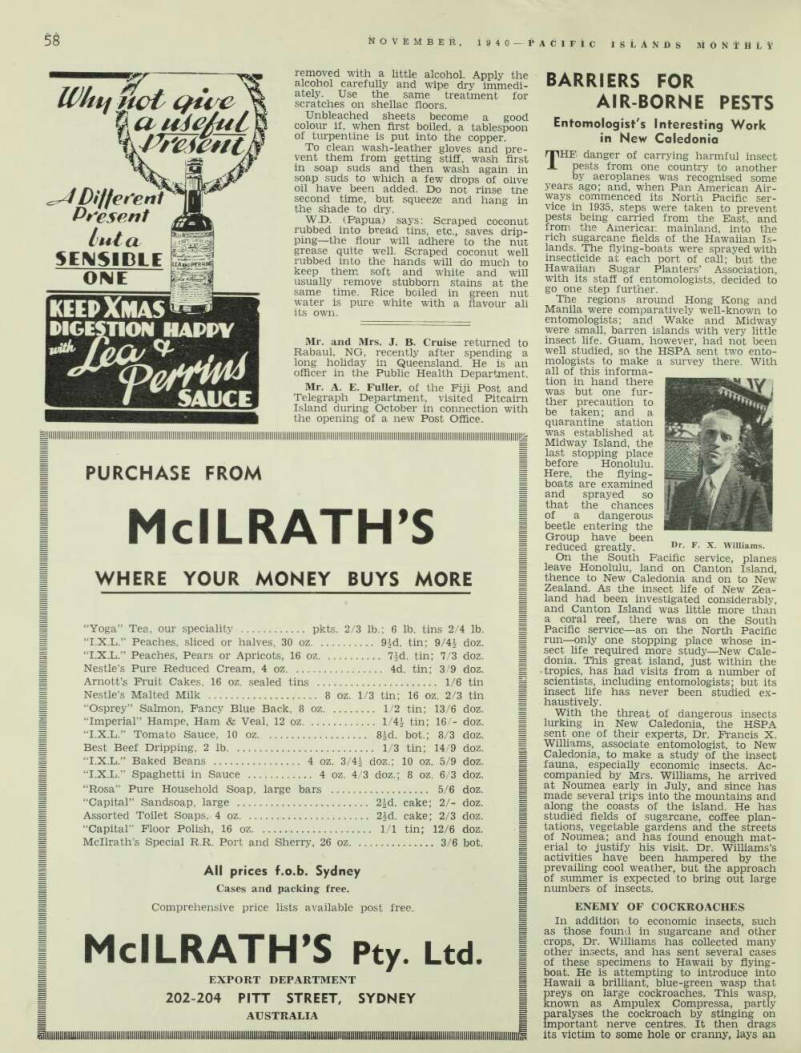
By "Therese"
COLOUR is all important in Fashion’s scheme of things and comes in many combinations calculated to gladden the feminine heart. Frocks of white and pastel shades have yokes of two colours.
A white linen shirtmaker takes unto itself a yoke that is half red and half blue, fitting into the patriotic spirit of the times. Another frock of the same type has contrasting sleeves and panels in the flared skirt, the belt being yet another colour Try it for yourself and see what individuality you can express with your colour schemes.
Pockets are prominent—huge pockets in the skirts, smaller one in the blouses.
They are all shapes, too—square, pointed, round, diamond shaped—and they appear on both day and evening clothes, always managing to look just right.
Many of the new frocks have bodices that are full bloused at the back and skirts that concentrate all the fulness in the front. Loose nanels are also in favour and pinafore frocks seem to be making a bold bid for recognition particularly in sports clothes. A pinafore buttoning right down the front, princess style has several blouses to give it different ’ per sonalities. The skirt can be left open in front, revealing well-cut shorts Pockets are also featured on the pinafore frock and add to its general utility for snorts and beach wear.
Jumper suits are still popular Here again the colour contrast can be ’ intro duced with good effect or the lumper can be of the same colour and material as the skirt, contrast being achieved bv buttons. Buttons are varied in size, shape
and colour—they come in fruit, flower and bird and beast designs, besides other quaint shapes. The covered button finds equal favour though its washing propen sities are rather doubtful.
An attractive jumper suit I saw re cently was of yellow and white silk The coat buttoned to the neck where it was finished with a white sharkskin collar The buttons were of the same material as the suit with a white composition brim. Worn with a white hat and white shoes, it looked delightfully cool and fresh.
TWO tone shoes are as much worn as shoes of a single colour. They look cool, too, and are ideal with simple tailored frocks of the shirtmaker type.
White Oxfords have leather cuban heels and are most attractive with linen and cotton frocks. These heels generally meet with the strong approval of the male who says “Ah, women are being sensible at last”.
For formal afternoon wear, of course the stilt heel is still demanded and un doubtedly is correct. Wedgies, or plat form soles, are in favour for holiday wear and are voted marvellously comfortable Sandals always have their devotees and are good for hot weather wear.
Bags and gloves very often appear as twin sets. Would you have thought of gingham gloves and bag? I saw a blue gingham set the other day worn with a plain blue cotton frock and they struck a delightful and unusual note. It appears that whatever your whim is this season you will be fashionable—so if you use in genuity and colour sense you are bound to be a success.
Beauty—at Short Notice
AN excellent way to prepare your face for a hurried surprise party is to give yourself a quick refresher of egg white. This type of mask is quick and astringent. It will tone the skin, and, although it is not as efficacious as an ice massage it is more suitable for tender skins.
Wash the face in warm water, and then hold hot cloths to the skin, so that the porjs will be thoroughly opened.
Separate the white from the yolk of an egg, and with a small pastry brush paint the white all over the skin. So that you will be relaxed and refreshed for the evening, it is just as well to rest for a few minutes, during which time the white of the egg will set and harden on the skin. This will cause the mask to become astringent and will draw the skin tightly together and remove many of those small tired lines that have accrued during the day. After the mask has hardened, allow it to remain on for five or ten minutes, then remove with warm water. Apply make-up in the usual way.
Another quick and effective way of re freshing the face is to bathe it in milk.
This will give the skin a delightful matte base and make it velvety smooth for the evening.
Recipes
THE response to our request for recipes and hints for the mutual help of Islands women has been gratifying, and we hope that it will encourage readers to forward their pet recipes for the benefit of their sisters in the tropics From Mrs. E. Richards, Bulolo, New Guinea, come some savoury suggestions:— Savoury Prunes If wet-pack prunes are available they will need no previous soaking, if not then soak dry-pack prunes in hot water for one hour. Remove stones carefully; re place with blanched almond and a little
grated cheese. Wrap each prepared prune in a small thin slice of bacon; fasten with tooth pick. Bake or grill until bacon is crisp. Serve hot or cold.
Oyster Savouries Make cases of rich short pastry cooked in small tart patty pans;—Use 1 cup flour, 1 teaspoon baking powder, I tea spoon salt, a pinch cayenne pepper, \ lb. butter (or half butter and half drip ping) ; rub shortening into sifted flour and baking powder and if moisture is needed add a little iced water.
Oyster Filling:—One 8 oz. tin of oysters, drained and finely chopped. For the sauce, melt 1 tablespoon butter in sauce pan, add pepper and salt. Remove from fire and add 1 tablespoon flour. When well blended, cook for 1 minute. Remove from fire and add 1 cup milk, \ cup oyster liquor. Cook and stir till smooth and thick. Add chopped oysters.
Fill each pastry case with oyster sauce and serve hot. Garnish with parsley.
Spreads For Biscuits Grated cheese mixed to paste with anchovy or Worcester sauce.
Sardines mixed with tomato sauce and lemon juice.
One cooked kipper with bones removed pounded to paste with a little butter. 11T.D., Papua, adds her contribution:— ** Banana Jam To 12 bananas cut in round slices add juice of two lemons. Cover with water, bring to boil and cook the fruit. Then add i to i lb. of sugar to each pound of fruit and cook quickly until a little on a saucer jells. The less stirring the better, so add some sterilised silver coins to the mixture when the sugar is added to prevent burning.
Banana Porridge One tablespoon cornflour, 6 firm
bananas, 1 pt. milk, 3 tablespoons sugar and a little nutmeg. Blend the cornflour with a little of the milk. Boil the re mainder; add the cornflour. Stir until it thickens, then add sugar and mashed bananas. Boil for five minutes, stirring all the time. Serve hot sprinkled with nutmeg.
Haricot or Lima Beans Wash and soak dried beans overnight and boil until they begin to split. Drain and put into casserole. Bury a piece of pork or bacon in the beans, cover with boiling water and cook in slow oven for about three hours, adding boiling water when necessary (do not add water the last hour of cooking). Cook without the casserole lid. When nearly cooked put the pork on top of the beans to brown.
When finished the beans should have absorbed nearly all the water and be slightly brown, in colour. This is the ideal way to obtain tender tasty beans that are a pleasant change from quickly boiled beans.
E.J., of Rarotonga, sends in some uses for tomatoes: — Tomato and Pineapple Scoop out firm tomatoes. Cut pine apple into dice, mix with tomato pulp, add sugar if required and 1 dessert spoon orange juice. Fill tomato, cases, place on crisp lettuce leaf and garnish with whipped cream.
Tomato Jelly Heat a tin or pint of tomato juice, add 1 oz. gelatine dissolved in cold water, a pinch of salt and a squeeze of lemon juice and a little sugar. Boil for a few minutes and pour in individual moulds to set. Serve on lettuce leaf and garnish
with parsley.
Tomato-Bacon-Cheese Butter rounds of toast. On each slice,
place a thick round of sliced tomato sea soned with salt and pepper. Over this sprinkle grated cheese. Place three thin short slices of bacon on top of each round and bake in quick oven until the bacon is crisp and the cheese melted.
Household Hints
fT\O use left over mashed potatoes, mix JL with flour and oatmeal and make into scones. Toast and eat hot with butter.
Do not allow soup to boil, but let it simmer slowly. Much of the liquid is wasted in evaporation and the best of the flavour is lost if the soup boils or is allowed to heat too quickly. The same thing applies to stews. Remember the old adage “A stew boiled is a stew spoiled”.
Surface scratches in furniture may be
removed with a little alcohol. Apply the alcohol carefully and wipe dry immedi ately. Use the same treatment for scratches on shellac floors.
Unbleached sheets become a good colour if, when first boiled, a tablespoon of turpentine is put into the copper.
To clean wash-leather gloves and pre vent them from getting stiff, wash first in soap suds and then wash again in soap suds to which a few drops of olive oil have been added. Do not rinse the second time, but squeeze and hang in the shade to dry, W.D. (Papua) says: Scraped coconut rubbed into bread tins, etc., saves drip ping—the flour will adhere to the nut grease quite well. Scraped coconut well rubbed into the hands will do much to keep them soft and white and will usually remove stubborn stains at the same time. Rice boiled in green nut water is pure white with a flavour all its own.
Mr. and Mrs. J. B. Cruise returned to Rabaul, NG, recently after spending a long holiday in Queensland. He is an officer in the Public Health Department.
Mr. A. E. Fuller, of the Fiji Post and Telegraph Department, visited Pitcairn Island during October in connection with the opening of a new Post Office.
Advertisements & other items, pp. 58-60 (1 item)
• T here's FRUIT and CREAM/ CUSTARp /
COME TO DINNER
COME TO DINNER
HEAR THE BELL
HEAR THE BE
'~V- V m % 1111 * • T here's FRUIT and CREAM/ CUSTARp /
rik
O*
WSS
How kiddies love fruit-’n’-Custard. It’s their favourite dish-and the grown-ups aren’t far behind. Foster Clark’s delicious Creamy Custard is a family favourite. Everybody loves the rich flavour of Foster Clark’s-and Mother is pleased because it is nourishing and economical as well.
Foster Clark’s Custard has a world-wide reputation for quality. Never accept substitutes.
192 FREE RECIPES
Sold by all grocers in 3 sizes and 4 flavours.
Write to Foster Clark ( Aust .) Ltd., Dept. R. 8., Redfern, N.S.W., for your free copy of Elizabeth Craig's Recipe Book. It’s crammed with exciting suggestions for hot and cold sweets, ice cream, sweet and savoury sauces and fruit drinks. Please enclose id. stamp for postage.
WIBI7C.
The House of Steel for Quality Cutlery n i MU CD We have a large range of Scissors, Knives, Razors, etc.
W. JNO. BAKER £S;
3 HUNTER STREET. SYDNEY.
Established 1888.
■ V A kj' m or c
LINGER //;
& Youll love its extra
quality
FROM ALL AUSTRALIAN DEPT. STORES
And in the Pacific from Burns Philp & Co. Ltd.
Why get Qti -c
u uie/ul I’t'eieat, u m Different Present a Lula &
SENSIBLE
ONE
nt
PURCHASE FROM
McILRATH’S
WHERE YOUR MONEY BUYS MORE
“Yoga” Tea, our speciality pkts. 2/3 lb.; 6 lb. tins 2/4 lb.
“1.X.L.” Peaches, sliced or halves, 30 oz 9£d. tin; 9/4£ doz.
“1.X.L.” Peaches, Pears or Apricots, 16 oz 7id. tin; 7/3 doz.
Nestle’s Pure Reduced Cream, 4 oz 4d. tin; 3/9 doz.
Arnott’s Fruit Cakes, 16 oz. sealed tins 1/6 tin Nestle’s Malted Milk 8 oz. 1/3 tin; 16 oz. 2/3 tin “Osprey” Salmon, Fancy Blue Back, 8 oz 1/2 tin; 13/6 doz.
“Imperial” Hampe, Ham & Veal, 12 oz l/4£ tin; 16/- doz.
“1.X.L.” Tomato Sauce, 10 oz B£d. bot.; 8/3 doz.
Best Beef Dripping, 2 lb 1/3 tin; 14/9 doz.
“1.X.L.” Baked Beans 4 oz. 3/4£ doz.; 10 oz. 5/9 doz.
“1.X.L.” Spaghetti in Sauce 4 oz. 4/3 doz.; 8 oz. 6/3 doz.
“Rosa” Pure Household Soap, large bars 5/6 doz.
“Capital” Sandsoap, large 2£d. cake; 2/- doz.
Assorted Toilet Soaps, 4 oz cake; 2/3 doz.
“Capital” Floor Polish, 16 oz 1/1 tin; 12/6 doz.
Mcllrath’s Special R.R. Port and Sherry, 26 oz 3/6 bot.
All prices f.o.b. Sydney
Cases and packing free.
Comprehensive price lists available post free.
McILRATH’S Pty. Ltd.
EXPORT DEPARTMENT
202-204 PITT STREET, SYDNEY
AUSTRALIA
Barriers For
Air Borne Pests
Entomologist's Interesting Work in New Caledonia
THE danger of carrying harmful insect pests from one country to another by aeroplanes was recognised some years ago; and, when Pan American Air ways commenced its North Pacific ser vice in 1935, steps were taken to prevent pests being carried from the East, and from the American mainland, into the rich sugarcane fields of the Hawaiian Is lands. The flying-boats were sprayed with insecticide at each port of call; but the Hawaiian Sugar Planters’ Association, with its staff of entomologists, decided to go one step further.
The regions around Hong Kong and Manila were comparatively well-known to entomologists; and Wake and Midway were small, barren islands with very little insect life. Guam, however, had not been well studied, so the HSPA sent two ento mologists to make a survey there. With all of this informa
tion in hand there was but one fur ther precaution to be taken; and a quarantine station was established at Midway Island, the last stopping place before Honolulu.
Here, the flying boats are examined and sprayed so that the chances of a dangerous beetle entering the Group have been reduced greatly.
On the South Pacific service, planes leave Honolulu, land on Canton Island, thence to New Caledonia and on to New Zealand. As the insect life of New Zea land had been investigated considerably, and Canton Island was little more than a coral reef, there was on the South Pacific service—as on the North Pacific run—only one stopping place whose in sect life required more study—New Cale donia. This great island, just within the tropics, has had visits from a number of scientists, including entomologists; but its insect life has never been studied ex haustively.
With the threat of dangerous insects lurking in New Caledonia, the HSPA sent one of their experts, Dr. Francis X.
Williams, associate entomologist, to New Caledonia, to make a study of the insect fauna, especially economic insects. Ac companied by Mrs, Williams, he arrived at Noumea early in July, and since has made several trips into the mountains and along the coasts of the island. He has studied fields of sugarcane, coffee plan tations, vegetable gardens and the streets of Noumea; and has found enough mat erial to justify his visit. Dr. Williams’s activities have been hampered by the prevailing cool weather, but the approach of summer is expected to bring out large numbers of insects.
Enemy Of Cockroaches
In addition to economic insects, such as those found in sugarcane and other crops, Dr. Williams has collected many other insects, and has sent several cases of these specimens to Hawaii by flying boat. He is attempting to introduce into Hawaii a brilliant, blue-green wasp that preys on large cockroaches. This wasp, known as Ampulex Compressa, partly paralyses the cockroach by stinging on important nerve centres. It then drags its victim to some hole or cranny, lays an
Dr. F. X. Williams.
egg under the cockroach’s armpit, and proceeds to close up the entrance to the hole with leaves and tiny stones. When the egg hatches, the young grub finds fresh food in the shape of the still partly-paralysed cockroach. Three weeks later, a new, glistening, blue-green wasp emerges from the cocoon it has spun around itself, and forces its way out of the hole.
Dr. Williams hopes to ship these wasps to Honolulu in the cocoon stage, which is considered the safest period.
Towards the end of October, Dr.
Williams visited the Isle of Pines, south of New Caledonia, to make his studv of the region more complete; and he expects to be in the Colony for several more weeks.
A quarantine station has been estab lished at Canton Island, and flying-boats returning to Hawaii from New Zealand and New Caledonia are dealt with in the same way as at Midway Island, on the North Pacific service.
Pilot-Officer Michael Burrows, formerly of Fiji, has been appointed an instructor at the RAAF training school at Camden.
NSW. He was Bth in proficiency of a list of 80 men training at Archerfield; and at the age of 20, is the youngest instructor in the Royal Australian Air Force.
Miss E. Safstrom, of the Melanesian Mission, is expected to arrive in Aus tralia from the Solomon Islands this month for furlough.
Mr. and Mrs. William Villiers Banting, together with their two children, are ex pected in Suva, Fiji, at the end of this month. Mr. Banting, who has been As sistant Treasurer at Tanganyika since 1930, has been appointed Accountant General and Deputy Treasurer of Fiji.
Advertisements & other items, p. 60 (1 item)
58
November, 1940 pacific islands si omt b l ¥
Tribute to Missionary and Educationist
Educationist
Appreciation of conspicuous service rendered by Rev. Basil R. C. Nottage, during nine years’ missionary work in the New Hebrides, was expressed in a formal resolution of the Victorian Foreign Mission Committee recently, Mr. Nottage, owing to ill-health, has been obliged to leave the New Hebrides.
A former colleague writes of him:— “Pew missionaries have given more thoughtful patience to understanding the traditional ways of the native, and deal ing with their customs so as to divert them from bad to good ends. Even more conspicuous than his knowledge of Islands manners, customs and mentality was his capacity for ‘thinking brown’.
“The best remedy against mistakes in dealing with natives is found in the study of anthropology; and, in Mr. Not tage, the practical scholar and mission ary were seen at work. In David Living stone’s day the popular conception of a missionary was that of a stumpy man with a Bible under his arm; but, that now is out of date. Mr. Nottage was a patron of modern missionary methods, and recognised that the programme of Christianity must be viewed against the background of the lives the natives have to lead in their own social order, and that it embraces human life in its totality, including moral, physical and economic good, as well as spiritual emancipation.
“It is deeply regretted that the Pacific Territories are deprived of the services of such a noted educationist, in view of the important plans devised by the British Government for the development of native races on the successful termin ation of the war.”
Mr. S. H. Chance, who has been acting as Resident Magistrate at Buna, Papua, arrived in Australia on leave recently and preceded to Lismore where he joined his wife and family.
Visitors to Lae, New Guinea, earlv in November, included Mr. L. V. Water house, a director of Bulolo Gold Dredg ing, Ltd., and Guinea Airways, Ltd.; and Mr. H. Morris Smith, managing director of Guinea Airways, Ltd.
£528 From Norfolk Is.
SINCE the Norfolk Island Division of the Australian Red Cross Society was formed in October, 1939, with Lady Rosenthal as President, £528 has been raised and distributed as follows: To the Lady Gowrie Fund. Red Cross Headquarters, Melbourne £142.
For provision of ambulance for Empire troops £l4l.
Purchase of wool and other materials for garments £lOB.
Fund for relief of sufferers from Turk ish earthquake £4O.
Balance in hand £59.
Over 600 garments, including pyjamas, mufflers, socks and balaclava caps have been despatched to headquarters in Aus tralia.
The population of the Island is under 1,000.
Mr. W. Craig, of Cable and Wireless, Ltd., recently returned to Suva, Fiji, for another term of service.
Advertisements & other items, pp. 61-62 (2 items)
59
monthly November, 1940
PACIFIC Ist AN
Plum Pudding
MATURED
TO
PERFECTION
(muiiumms
WINES
SMOOTH out your worries of these trying days with a perfect aperitif and a smoothly restful glass of port, each evening.
You’ll thoroughly appreciate YEN- DARRA Extra Dry SHERRY or
ROYAL RESERVE Sweet SHERRY
and VINTAGE 99 PORT—products of Australia’s leading wine makers for over 60 years.
Write to your nearest agent for supplies:—C. J. CASHMAN & CO.,
DARWIN; J. R. CLAY & CO.,
PAPUA; F. R. FORSYTH, NEW
GUINEA; C. R. YOUNGER,
SOLOMON ISLANDS.
0 / s V. >* m /I i «8*
PLUM PUDDING
You'll earn frlbufe from your family when you serve Swallow's delicious Plum Pudding. They're full flavoured and expertly prepared by Swallow's master cooks. Everybody loves plum pudding and the rich goodness of Swallow's is unique.
Specially tropic-packed in air-tight tins of exact quantities., . but always allow for extra helpings. lb. ... 3 serves, 1 lb. ... 6 serves, 1 % lb. ... 9 serves, 2 lb. ... 12 serves, 3 lb. ... 18 serves.
SWALLOW & ARIELL LTD.
Port Melbourne, Australia
HALF PRICE
IW'For NEW BATTERIES
Buy your battery direct from the manufacturer at half the usual retail price. All Marshall Batteries are fully guaranteed. All types of batteries for cars, trucks, cycles, radio, home and theatre lighting direct to the public at factory prices. Write at once for 16page catalogue on how to choose and look after batteries.
The Marshall Battery Mfg. Co.
36-38 Harbour Street, Sydney.
HONESTY FIDELITY
When making
Safeguard your interests. Ensure their protection and security. Avail yourself of the advantages to be derived from the appointment of this Company as your trustees, in preference to any one individual. Write to or call on any Branch of Burns, Philp & Company Limited, or Burns Philp (South Sea) Company, Limited, for the folder which fully explains these advantages.
Give careful consideration to the benefits to be gained by appointing as your Executors—
BURNS PHILP TRUST CO. LTD.
DIRECTORS
JAMES BURNS LEWIS ARMSTRONG
ROBERT JOHN NOSWORTHY JOSEPH MITCHELL
BURNS PHILP TRUST CO. LTD.
7 BRIDGE STREET SYDNEY. N.S.W.
R.J.2, 18/20 B.H.P. C.I. (DIESEL)
MARINE ENGINE
mm £ T
(AUST.) PTY. LTD.
ALL BRITISH MARINE
PETROL AND DIESEL ENGINES
are not subject to import restrictions. Good deliveries can be given from stock, and your inquiries will be given our immediate attention.
Write, Cable or Call at
6/10 WATTLE STREET,
PYRMONT, N.S.W.
Cable Address: “ Thornmotor”, Sydney.
Agents for the famous Stuart Turner Marine Engines and Auxiliary Lighting Sets. £
Aeroplanes!
Link the Islands With Aeroplanes!
Importance of Pacific Aviation
rjIHE importance of British flying X interests in the Pacific was empha sised by Captain P. G. Taylor, one of the pioneers of exploratory work in that region, when addressing members of the Pacific Islands Society in Sydney in October.
“I look forward to the time when all the important Groups in this great ocean will be linked by aerial services,” said the speaker, who was associated with the late Sir Charles Kingsford Smith in his trans-Pacific flight in 1928, and other famous enterprises. “To-day, we realise the value of the small islands as flying bases. Air transport is going to be the obvious means of moving about the Pacific. Distance can only be eliminated in this manner.”
Captain Taylor referred to the success of inter-island communication by air in the Hawaiian Group, and remarked that a similar service had been established in Fiji. “Why the latter was abandoned I do not know,” he said.
Mr. H. C. Monckton, former Commis sioner for Native Affairs in Fiji, when moving a vote of thanks, said that the Fiji service had been abandoned tem porarily owing to the depression. “There was no other reason that actuated the Government,” he added, “except that of finance.”
The importance of aviation, in the early mining days in New Guinea, was emphasised by Mrs. Allen Innes, who had flown with many of the pioneer aviators in that territory.
Other guests included; Mr. and Mrs.
C. F. Walton (the latter is well known as the Australian aviatrix, Miss Nancy Bird); Mr. A. H. Berts, of the Royal Netherlands Indies Airways, Batavia: and Mr. A. H. Rankin, president of the New castle (NSW) Aero Club. Mr. Alfred E.
Stephen presided over an attendance of more than 60 members.
Mrs. Alan G. Rutter, wife of the medi cal superintendent of the Helena Goldie Hospital, Bailua, 8.5.1., passed through Sydney last month, bound for New Zea land, where she will spend a holiday.
Miss Marjorie Arliss, who has been sis ter in charge of the Anglican Mission’s hospital at Dogura, Eastern Papua, for the past three years, was in Australia recently, spending furlough in Sydney and Melbourne.
Ship
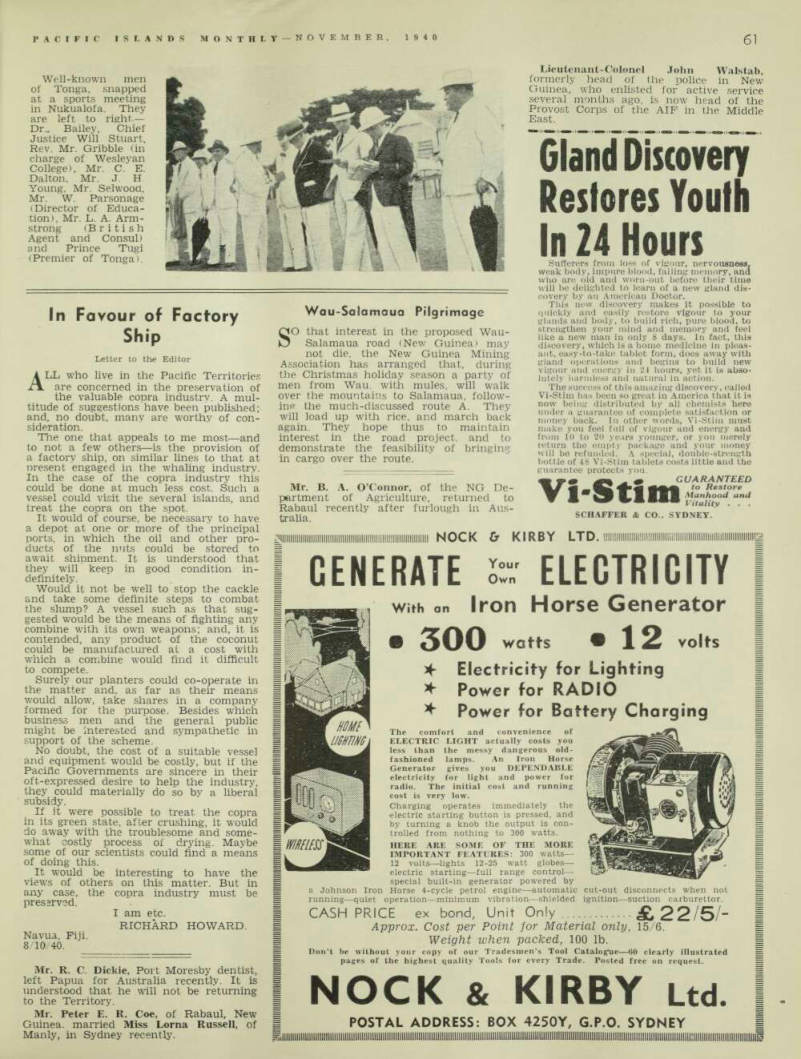
In Favour of Factory Ship
Letter to the Editor ALL who live in the Pacific Territories are concerned in the preservation of the valuable conra industry. A mul titude of suggestions have been published; and, no doubt, many are worthy of con sideration.
The one that appeals to me most—and to not a few others—is the provision of a factory ship, on similar lines to that at present engaged in the whaling industry.
In the case of the copra industry this could be done at much less cost. Such a vessel could visit the several islands, and treat the copra on the spot.
It would of course, be necessary to have a depot at one or more of the principal ports, in which the oil and other pro ducts of the nuts could be stored to await shipment. It is understood that they will keep in good condition in definitely.
Would it not be well to stop the cackle and take some definite steps to combat the slump? A vessel such as that sug gested would be the means of fighting any combine with its own weapons; and, it is contended, any product of the coconut could be manufactured at a cost with which a combine would find it difficult to compete.
Surely our planters could co-operate in the matter and, as far as their means would allow, take shares in a company formed for the purpose. Besides which business men arid the general public might be interested and sympathetic in support of the scheme.
No doubt, the cost of a suitable vessel and equipment would be costly, but if the Pacific Governments are sincere in their oft-expressed desire to heln the industry, they could materially do so by a liberal subsidy.
If it were possible to treat the copra in its green state, after crushing, it would do away with the troublesome and some what costly process of drying. Maybe some of our scientists could find a means of doing this.
It would be interesting to have the views of others on this matter. But in any case, the conra industry must be preserved.
I am etc.
Richard Howard.
Navua, Fiji. 8/10/40.
Mr. R. C. Dickie, Port Moresby dentist, left Papua for Australia recently. It is understood that he will not be returning to the Territory.
Mr. Peter E. R. Coe, of Rabaul, New Guinea, married Miss Lorna Russell, of Manly, in Sydney recently.
Wau-Salamaua Pilgrimage
SO that interest in the proposed Wau- Salamaua road (New Guinea) may not die. the New Guinea Mining Association has arranged that, during the Christmas holiday season a party of men from Wau. with mules, will walk over the mountains to Salamaua, follow ing the much-discussed route A. They will load up with rice, and march back again. They hope thus to maintain interest in the road project, and to demonstrate the feasibility of bringing in cargo over the route.
Mr, B. A. O’Connor, of the NG De partment of Agriculture, returned to Rabaul recently after furlough in Aus tralia.
Lieutenant-Colonel John Walstab, formerly head of the police in New Guinea, who enlisted for active service several months ago, is now head of the Provost Corps of the AIF in the Middle East.
Well-known men of Tonga, snapped at a sports meeting in Nukualofa. They are left to right.— Dr.. Bailey, Chief Justice Will Stuart, Rev. Mr. Gribble (in charge of Wesleyan College), Mr. C. E.
Dalton. Mr. J. H Young. Mr. Selwood, Mr. W. Parsonage (Director of Educa tion), Mr. L. A. Arm strong (British Agent and Consul) and Prince Tugi (Premier of Tonga).
Advertisements & other items, pp. 63-64 (1 item)
Gland Discovery
Restores Youth
In 24 Hours
Sufferers from loss of vigour, nervousness, weak body, impure blood, failing memory, and who are old and worn-out before their time will be delighted to learn of a new gland discovery by an American Doctor.
This new discovery makes it possible to quickly and easily restore vigour to your glands and body, to build rich, pure blood, to strengthen your mind and memory and feel like a new man in only 8 days. In fact, this discovery, which is a home medicine in pleasant, easy-to-take tablet form, does away with gland operations and begins to build new vigour and energy in 24 hours, yet it is absolutely harmless and natural in action.
The success of this amazing discovery, called Vi-Stim has been so great in America that it is now being distributed by all chemists here under a guarantee of complete satisfaction or money back. In other words, Vi-Stim must make you feel full of vigour and energy and from 10 to 20 years younger, or you merely return the empty package and your money will be refunded. A special, double-strength bottle of 48 Vi-Stim tablets costs little and the guarantee protects you.
Vi-Stim
GUARANTEED
to Restore Manhood and Vitality . . .
SCHAFFER & CO.. SYDNEY.
gi I mill NOCK & KIRBY LTD. I I I I
GENERATE Sr ELECTRICITY
an Iron Horse Generator
m
U6HTIM
mm 300
wefts
1 2 volts
Jf Electricity for Lighting
* Power for RADIO
* Power for Battery Charging
The comfort and convenience of ELECTRIC LIGHT actually costs you less than the messy dangerous oldfashioned lamps. An Iron Horse Generator gives you DEPENDABLE electricity for light and power for radio. The Initial cost and running cost is very low.
Charging operates immediately the electric starting button is pressed, and by turning a knob the output is controlled from nothing to 300 watts.
HERE ARE SOME OF THE MORE
IMPORTANT FEATURES: 300 watts—
-12 volts—lights 12-25 watt globes— electric starting—full range control — special built-in generator powered by a Johnson Iron Horse 4-cycle petrol engine—automatic cut-out disconnects when not running—quiet operation—minimum vibration —shielded ignition—suction carburettor. & B * ■H CASH PRICE ex bond, Unit Only £22/5/"
H Approx. Cost per Point for Material only, 15/6. H Weight when packed, 100 lb. Don’t be without your copy of our Tradesmen’s Tool Catalogue—6o clearly illustrated pages of the highest quality Tools for every Trade. Posted free on request.
I NOCK & KIRBY Ltd. I
POSTAL ADDRESS: BOX 4250 Y, G.P.O. SYDNEY
&wM.
WW3«
'4NUM
mm , j jjw m* #9/702/3 r/ ~//9n#& avc
A/O #9A// Z y
—JISM ///OOJ
AWWdM 5V
V9NOI JJ/MJ
L^> 33/A/» St/ H±333 +)S.)d
MVP
dO
SNVIdNI
OONIHS
3dt/353 $2/ xt/g
02 203X3 (7A/V23 qH'
2PS - H2OOW 02/2/ s3ss VX
23X3 N33M 1373 3/7
*S/J W79A7t/
xfp. §S! ,^P
/V-ixsL- ii~
p
SSS *">* /
»ar %■?■■ »5 ' X
pWM
New Taxes in Fiji
Higher Tariff
From Our Own Correspondent
Suva, Nov. 1.
WHEN the Legislative Council met on October 25, it was known that pro vision had to be made for heavy exceptional and additional expenditure, especially under the heading of defence.
Among additional taxation decided upon were heavy increases in the Customs tariff. These included:—
Old. New.
Brit. Gen- Brit. Gen- Pref. eral. Pref. eral.
Bottled beer, gal .. 2/- 4/6 3/6 5/6 Draught beer, gal. . 2/- 4/- 3/- 5/- Sharps, pollard, ton 30/- 50/- 40/- 60/- Benzine, oils Increased by Id. per gal Spirits 26/- 29/- 36/- 49/- Tobacco, per lb. .. 7/- 10/6 9/8 13/2 Cigarettes, per lb. .. 8/- 12/- 11/. 15/.
"Director" Wreck
Loss of Fahnestock Expedition
THE three-masted American schooner “Director II", which brought an American Museum of Natural History expedition, led by Mr. Sheridan Fahnestock, from the United States to Brisbane, via Central Pacific Islands, ran onto a reef four miles from the pilot station, outside Gladstone, on the coast of Queensland, on October 18, and be came a total wreck.
The arrival of the expedition in Bris bane was reported in the October “PIM”.
The expedition was en route to make scientific collections on the Great Barrier Reef. The expedition had collected a large amount of material, on its way across the Pacific.
Mr. Fahnestock went hurriedly to Gladstone and other Queensland ports, and tried to get tug-boats, etc., to pull his yacht off the reef; but a south easter came up before they could make a worth-while attempt, and the schooner began to break up.
Mr. Fahnestock said that all of the
expedition’s equipment, including 20,000
dollars’ worth of hydrographic material was under water and already ruined.
Charts of the Pacific, which the party had been making for the British Ad miralty and the United States Hydro graphic Office; the insect collection; the collection of native music recordings and the material on bird habitat groups had been saved. One of the most important collections was to have been of the bird habitat group of the Barrier Reef.
Tonga's £4,931 For Fighter
Plane
Prom Our Own Correspondent
Nukualofa, Oct. 23.
AS a. result of the gift of £2,000 by Mr.
William Cocker, a well-known mer chant of Nukualofa and the only surviving son of the first British Agent and Consul in Tonga, the late Mr. Joshua Cocker (1860-1866) “The Tonga Fighter Plane Fund” was established for the pur chase of a fighter plane for the Royal Air Force.
Queen Salote, who has given monthly subscriptions amounting to £2OO per annum towards the cost of the war, has con sented to devote the whole of her sub scriptions for the next twelve months to the fund. In addition, the Tongan Gov ernment subscribed £2,000.
The latest subscription list shows the fund at £4,931/16/8.
42 Cricket Teams
Colourful Picture in Samoa
IT is a pity that, a newsreel cameraman was not in Samoa on Flag-Raising Day recently, so that the world could have seen how the old English game of cricket has been adapted to Samoan conditions.
Samoans and Europeans, about 4,500, assembled at the model village of Lepea. near Apia, the seat of High Chief Mataafa; and, to this place, with its fine new cricket pitch, there came no less than 42 teams of Samoan cricketers, each team having 20 players.
It is impossible here to describe the method of play. The competition ex tended over two days.
The crowd and the players made a colourful picture, under the blue sky, amid the coastal palms, in the brilliant Samoan sunshine.
The High Chief and his people provided a sumptuous Samoan feast. It comprised 607 pigs, 265 fowl. 7,404 loads of taro and bananas, and fish and other Samoan delicacies without number.
Out of the proceeds of this mighty cricket game High Chief Mataafa has made a substantial contribution to West ern Samoa’s fund for buying fighter planes for the RAF.
Fiji Firm Hit By Copra
Position
A WELL-KNOWN and old-established merchandising business in Fiji— namely, Jang King Loong Co. Ltd., engaged mostly in buying and selling among natives —announced in October that it was going into liquidation. , “It is with regret,” said the manage ment, in a notice published in the Suva newspaper, “that we are compelled to admit that the copra situation has forced us out of business.”
All Suva stocks of groceries, glassware and draperv were sold during October and earlv November, at whatever prices could be obtained; and, subsequently, the stocks at country branch stores were sold by auction. The collapse of this old business, and the price at which it threw its stocks unon the market, naturally disturbed industry in Fiji during October and November.
Walpole Island Guano
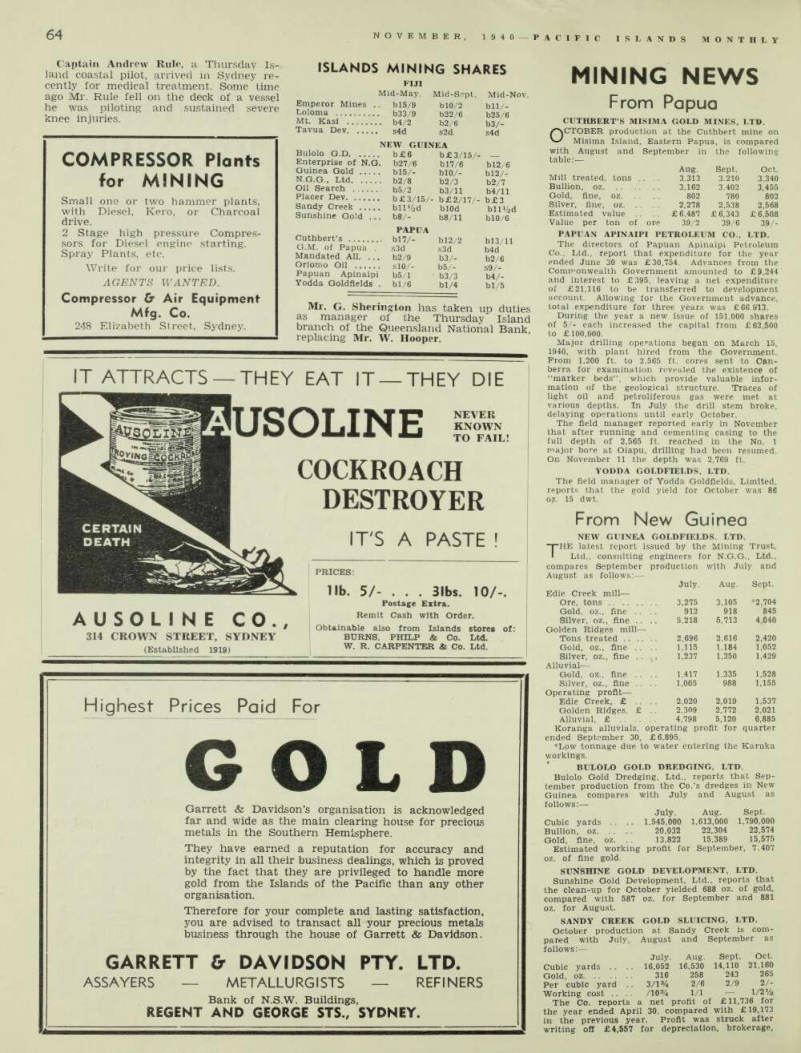
IT is estimated that there are about 100.000 tons of alluvial guano on Wal nole Island, a small French island about 150 miles south of New Caledonia.
Some 20 years ago. a syndicate com menced to exploit the guano and, for about 10 years, 10,000 tons a year was exnorted. Then production practically ceased: but. over the past five years, occasional shipments have been sent to whatever market was available. Consider able quantities had been going to New Zealand but nothing has been exported since February.
There are about 4.000 tons of guano on the island, ready for shipment; but, ow ing to lack of shinning, production has ceased and. unless the position improves, the staff of about 60 whites and labourers will be evacuated shortly.
Among Territories men who were ad mitted to the Royal Australian Air Force early in November were lan Loudon, of Papua; A. T. Timperley, a patrol officer from Papua; and N. P.
Hawke, of Kavieng, New Guinea.
Captain Andrew Rule, a Thursday Is land coastal pilot, arrived in Sydney re cently for medical treatment. Some time ago Mr. Rule fell on the deck of a vessel he was piloting and sustained severe knee injuries.
Advertisements & other items, pp. 65-66 (1 item)
Island Store Manager
MAKES GOOD RECOVERY
COURAGE IS A GRAND THING, BUT SOMETIMES COURAGE ALONE ISN’T ENOUGH. TAKE THE CASE OF ARTHUR WEBSTER, FOR INSTANCE.
ONE EVENING HE WAS WALKING DOWN THE STREET WITH HIS
FRIEND, BILL THOMPSON, WHEN BILL SAID:
“Things pretty good at the store, Arthur?”
“Y-yes. We’re doing all right.”
But the store wasn't doing as well as it should have been. Arthur Webster was really worried. That night he had a heart to heart chat with his wife.
“Arthur darling, you worry too much —things’ll be all right soon.”
“I wish I didn’t feel so tired all the time! I seem to wake up tired lately. I suppose I’ll just have to pull myself together and do a real job for the next couple of months.”
Arthur Webster tried hard but just couldn’t make the grade. The final sales figures showed he was well down. One evening when he was slumped in a chair looking thoroughly despondent his wife came over to him.
“Darling, there’s something really wrong with you. I know what you’re going through . . . but I’m sure there’s something behind this day after day tiredness of yours. Why don’t you see a doctor?”
So Arthur Webster took his ivife’s advice and saw his doctor. After giving him a thorough examination his doctor said:— “Mr. Webster, your whole trouble is Night-Starvation. You see, all night long your heart and lungs
are using up energy. Your heart has to beat 35,000 times and your lungs make 20,000 muscular movements during your eight hours’ sleep.
“So you can see for yourself if energy isn’t replaced during sleep you wake tired, feel run down and get behind in your work. You need Horlick’s. Start drinking Horlick’s every night before you go to bed.”
Arthur Webster started drinking Horlick’s every night before bed.
Soon he lost that heavy , tired feeling and found that he could put twice as much drive into his work.
His sales figures bucked up and for the first time since he had been on the Island the Head Office sat up and took some notice of him.
Do you feel tired all day? Wake tired? Find it hard to concentrate on your work? Feel dull and nervy? Then the chances are that you, too, are suffering from Night-Starvation. Remember, Horlick’s guards against Night-Starvation, keeps you wonderfully fit. Ask your chemist or storekeeper to-day for a bottle of Horlick’s. You can buy Horlick’s in all main towns throughout the British Pacific < Islands. !>OrucKS Jorlic Mixe
COMPRESSOR Plants
tor MINING
Small one or two hammer plants, with Diesel, Kero, or Charcoal drive. 2 Stage high pressure Compressors for Diesel engine starting.
Spray Plants, etc.
Write for our price lists.
AGENTS WANTED.
Compressor & Air Equipment
Mfg. Co.
248 Elizabeth Street, Sydney.
IT ATTRACTS —THEY EAT IT —THEY DIE
USOLINE
CERTAIN
DEATH
NEVER
KNOWN
TO FAIL!
AUSOLINE CO.
314 CROWN STREET, SYDNEY
(Established 1919)
COCKROACH
DESTROYER
IT'S A PASTE !
PRICES:
lib. 5/- . . . 3lbs. 10/-.
Postage Extra.
Remit Cash with Order.
Obtainable also from Islands stores of:
BURNS, PHILP & Co. Ltd.
W. R. CARPENTER 8c Co. Ltd.
Highest Prices Paid For
GOLD
Garrett & Davidson’s organisation is acknowledged far and wide as the main clearing house for precious metals in the Southern Hemisphere.
They have earned a reputation for accuracy and integrity in all their business dealings, which is proved by the fact that they are privileged to handle more gold from the Islands of the Pacific than any other organisation.
Therefore for your complete and lasting satisfaction, you are advised to transact all your precious metals business through the house of Garrett & Davidson.
GARRETT & DAVIDSON PTY. LTD.
ASSAYERS METALLURGISTS REFINERS
Bank of N.S.W. Buildings,
REGENT AND GEORGE STS., SYDNEY.
Islands Mining Shares
Mr. G. Sherington has taken un duties as manager of the Thursday" Island branch of the Queensland National Bank replacing Mr. W. Hooper.
Fiji
Mid-May.
Mid-S?pt.
Mid-Nov.
Emperor Mines . bl5/9 blO/2 bll/- Loloma b33/9 b22/6 b25/6 Mt. Kasl . b4/2 b2/6 b3/- Tavua Dev s4d s2d s4d Bulolo G.D
New Guinea
b£6 b£3/15/- Enterprise of N.G. b27/6 bl7/6 bl2/6 Guinea Gold . bl5/blO/bl2/- N.G.G.. Ltd . b2/8 b2/3 b2/7 Oil Search b5/2 b3/ll b4/ll Placer Dev b £3/15/ - b£2/17/b £3 Sandy Creek bliy 2 d blOd bllVad Sunshine Gold ., . b8/b8/ll blO/6 Cuthberfs
Papita
. bl7/bl2/2 bl3/ll G.M. of Papua . s3d s3d b4d Mandated All. ... b2/9 b3/b2/6 Oriomo Oil . slO/b5/s9/- Papuan Apinaipi b5/l b3/3 b4/- Yodda Goldfields . bl/6 bl/4 bl/5
Mining News
From Papua
Cuthbert’S Mis Ima Gold Mines, Ltd.
OCTOBER production at the Cuthbert mine on Misima Island, Eastern Papua, is compared with August and September in the following table; —
Papuan Apinaipi Petroleum Co.. Ltd.
The directors of Papuan Apinaipi Petroleum Co.. Ltd., report that expenditure for the year ended June 30 was £30,754. Advances from the Commonwealth Government amounted to £9,244 and interest to £395. leaving a net expenditure of £21,116 to be transferred to development account. Allowing for the Government advance, total expenditure for three years was £66 913.
During the year a new issue of 151,000 shares of 5/- each increased the capital from £62,500 to £lOO,OOO.
Major drilling operations began on March 15, 1940, with plant hired from the Government.
Prom 1,200 ft. to 2.565 ft. cores sent to Can berra for examination revealed the existence of “marker beds’’, which provide valuable infor mation of the geological structure. Traces of light oil and petroliferous gas were met at various depths. In July the drill stem broke, delaying operations until early October.
The field manager reported early in November that after running and cementing casing to the full depth of 2,565 ft. reached in the No. 1 major bore at Oiapu, drilling had been resumed.
On November 11 the depth was 2,769 ft.
Yodda Goldfields. Ltd.
The field manager of Yodda Goldfields, Limited, reports that the gold yield for October was 86 oz. 15 dwt.
From New Guinea
New Guinea Goldfields. Ltd.
THE latest report issued by the Mining Trust, Ltd., consulting engineers for N.G.G., Ltd., compares September production with July and August as follows:
Bulolo Gold Dredging. Ltd.
Bulolo Gold Dredging, Ltd., reports that Sep tember production from the Co.’s dredges in New Guinea compares with July and August as follows: —
Sunshine Gold Development, Ltd.
Sunshine Gold Development, Ltd., reports that the clean-up for October yielded 688 oz. of gold, compared with 587 oz. for September and 881 oz. for August.
Sandy Creek Gold Sluicing, Ltd.
October production at Sandy Creek is com pared with July, August and September as follows: —
The Co. reports a net profit of £11,736 for the year ended April 30. compared with £19,173 in the previous year. Profit was struck after writing off £4,557 for depreciation, brokerage,
Aug. Sept. Oct.
Mill treated, tons .. . . 3.313 3.210 3,340 Bullion, oz 3,162 3 402 3.455 Gold, fine, oz 802 780 802 Silver, fine, oz 2,278 2,538 2,568 Estimated value .. .. £6,487 £6,343 £6.508 Value per ton of ore 39/2 39/6 39 -
July.
Aug.
Sept.
Edie Creek mill— Ore, tons 3,275 3,105 *2,704 Gold, oz., fine . . . . 912 918 845 Silver, oz., fine . . .. 5,218 5,713 4.040 Golden Ridges mill— Tons treated 2,696 2,616 2,420 Gold, oz., fine . . . . 1,115 1,184 1,052 Silver, oz., fine . . . . 1,237 1,350 1,429 Alluvial — Gold, oz., fine .. 1.417 1.335 1,528 Silver, oz., fine . . 1.005 988 1,155 Operating profit— Edie Creek, £ 2,020 2,019 1,537 Golden Ridges. £ 2.309 2,772 2,021 Alluvial. £ 4,798 5,120 6,885 Koranga alluvials. operating profit for quarter ended September 30. £6.895. *Low tonnage due to water entering the Karuka workings.
July.
Aug.
Sept.
Cubic yards .. 1,545,000 1,613,000 1,790,000 Bullion, oz 20,032 22,304 22,574 Gold, fine, oz. . . 13,822 15,389 15,575 Estimated working profit for September, 7.407 oz. of fine gold.
July. Aug. Sept. Oct.
Cubic yards .. .. 16,052 16,530 14.110 21,160 Gold, oz 316 258 243 265 Per cubic yard .. 3/1% 2/6 2/9 2/- Working cost .. . . /10% 1/1 — 1/2 Va
preliminary expenses, and other items. With £7,057 brought forward, £18,794 was available.
A dividend of 2d per share was paid in Feb ruary, and a further dividend of 2d per share is recommended, the two dividends requiring £10,333, leaving £8.460 to be carried forward.
During the year 232,017 cubic yards of material wepe treated for a recovery of 3,422 oz. of gold, which realised £28,469, after deduction of £2,014 gold tax, an average value of 2/5V 2 per cubic yard. The mine working cost averaged 11.4 d per cubic yard (sluicing 9.6 d, royalty and gold realisation expenses I.Bd>.
Tests are being made on the property of 330 acres, comprising Bulolo River flats and terraces over which the Co. recently took an option.
Directors consider that payment of the dividend now recommended will leave the Co. with suf ficient funds to purchase and equip the property if the option is exercised.
From Fiji
Emperor Mines, Ltd.
RESULTS from the Emperor mine, at Tavua, for the past four periods compare as follows:—•
Loloma Gold Mines. Ltd.
Production at the Loloma mine during October is compared with the three previous periods as follows:
Mt. Kasi Mines Ltd.
Latest figures, issued Nov. 6, show that 615 oz. of gold were won during October at the Mt.
Kasi mine, Vanua Levu. Tons treated amounted to 3,104; and the value was £A6,150. During the period the mine was idle four days during machinery overhaul.
All Races Send Help to Britain
WARM praise has been given by the Governor of Fiji and High Commis sioner for the Western Pacific (Sir Harry Luke) to the manner in which the low-wage earners in the Colony of Fiji and in other Pacific territories have con tributed to the various British war funds and appeals.
A carnival, held in Suva a few weeks ago, resulted in £5,000 being telegraphed from Suva to the Red Cross and St.
John's Joint Appeal Fund in London— and Europeans, Fijians, Indians, Chinese and various Islands people joined to gether in the most friendly manner in assisting this carnival. Regular contri butions for the war funds have come in from even the most remote islands where, as Sir Harry expresses it. “food is plenti ful and cash is scarce”.
“The manner in which many of the low wage-earning classes have contributed a day s pay to the various war funds has been remarkable”, says Sir Harry Luke.
Mr. Francis Adoiphus Horne died at Edie Creek. New Guinea, in mid-October at the age of 50 years. He went to the Territory in September, 1935, and was engaged in mining for N.G.G., Ltd.
A new member of the Pacific Islands Society in Sydney is Rev. Richard Piper, general secretary for the Methodist Missionary Society of Australasia, who resided in Fiji for many years.
Aug. Sept. Oct. Oct. 7. 4. 2. 30.
Ore treated, tons 10,367 10.05S 9,899 *11,279 Gold, oz.. fine . , 3,716 3,653 f3,026 14.029 Head value, dwt. . 6.95 7.1 10.75 7.6 Residues, dwt, .. 0.95 1.0 1.1 0.67 *In addition, 256 tons of Customs ore were treated. Practically all oxidised ore treated in last three weeks, tlncluding gold from concentrates.
Aug.
Sept. ♦Oct.
Oct. 7. 4. 2. 30.
Tons, treated .. 2,493 2,527 2,628 2,612 Gold, oz., fine 3,428 3,361 3,419 3.450 Head value, dwt. . 28.83 27.7 27.4 27.22 Residues, dwt. 1.33 1.1 1.38 0.61 A dividend of 1/a share has been declared. payable on December 9.
Price Of Gold
(Australian Official Quotations) Pine Standard oz. oz.
January 1, 1940 .. . £ 10/12/6 £9/14/9% February 5 £ 10/12/9 £9/15/0% March 4 to June 17 . £ 10/13/3 £9/15/5% June 24 to July 7 £ 10/12/6 £ 9/15/0 % July 8 £10/11/- £9/13/5 August 5 to Sept. 14 . £10/12/6 £9/14/9% Sept. 21 to Nov. 2 . £10/14/- £9/16/2 November 9 £10/14/- £9/16/2
Advertisements & other items, pp. 67-68 (1 item)
Coughing, Strangling Asthma,
Bronchitis Curbed in 3 Minutes
Do you have attacks of Asthma or Bronhitis so bad that you choke and gasp for breath and can’t sleep ? Do yon cough so hard you feel like you were being ruptured ?
Do you feel weak, unable to work, and have to be careful not to take cold and can’t cat certain foods ?
No matter how long you have suffered or what you have tried, there is new hope for you in a Doctor’s prescription called Mendaco. No dopes, no smokes, no injections, no atomizer. All you do is take two tasteless tablets at meals and your attacks seem to vanish like magic. In 3 minutes Mendaco starts working through your blood aiding nature to dissolve and remove strangling phlegm, promote free easy breathing and bring sound sleep the first night so that you soon feel years younger and stronger.
No Asthma in 2 Years
Mendaco not only brings almost immediate comfort and free breathing but builds up the system to ward off future attacks. For instance, J. Richards, Hamilton, Ont,, Canada, had lost 40 lbs., suffered coughing,
chokin' anJ strangling' every night, couldn’t sleep, expected to die. Mendaco stopped Asthma spasms first night and he has had non; since in over two years.
Money Back Guarantee
The very first dose of Mendaco goes right to work circulating through your blood and helping nature rid you of the effects of Asthma. Try Mendaco under an iron-clad money back guarantee. You bo the judge.
If you don’t feel entirely well, like a new person, and fully satisfied after taking Mendaco just return the empty package and the full purchase price will be refunded.
Get Mendaco from your Chemist today and see how well you sleep tonight ami how much bcHer you will feel. mm tONQUfffj A S T H M
Mendaco
Now in 3 sizes
3/-. 6/- and 12/-
SCHAFFER & CO., SYDNEY.
The Most Extensive Manufacturers in the British Empire of
RUBBER STAMPS,
INKS, STENCILS,
Marking Devices,
ACME STAMP PADS
OFFICE & STATIONERY SUPPLIES
m ta We also Manufacture & Supply a Complete Line of
LIMEWASHING AND
SPRAYING MACHINES
for all purposes.
Let us know your requirements and we will quote by return.
WRITE FOR OUR GENERAL CATALOGUE
Limewashing Machine
EXCELSIOR SUPPLY CD
278 Post Office Place,
MELBOURNE, VIC.
HEAD OFFICE :
160 BROADWAY,
Formerly known as George St., West, \
SYDNEY.'N.S.W. 1
PTY. LTD.
50 Victoria Street,
WELLINGTON, N,Z.
LEARN MORSE CODE.
I FLASH” KITS, KEYS
I
LIKE-A
BUZZERS
m p P.M.G. type Key with Professional Buzzer & Battery, all assembled on Base Board, 42/6.
Junior Morse Code Key, 12/6.
Practice Buzzer Set. 7/6. Buzzer and Light Morse Code, 25/-.
•PRESTO”
THE
MAGIC
BOX
The most Amazing Trick- Just out.
“Presto”. —The greatest, most alluring and outstanding little trick ever Introduced, 2/9. Post Free.
Money back If it’s not the best yet.
", I
? POLICE PATROL MULTI STRAND
j RUBBER COVERED AERIAL.
Needs No Separate Lead-in. 50 ft., 2/6; 100 ft., 5/-.
MAN-O-WAR HEAVY DUTY
I INSULATED AERIAL. MULTI
STRAND WIRES.
50 ft., 5/-; 100 ft. 10/-.
Electric 240 volt Gramoph one Motors, complete 50/-. Highestgrade Gramophone Needles, long lasting, 3/6, 4/6, 5/6 box.
RADIO ACCUMULATORS.
2 Volt. 110 Amp 17/- 20/- 20/6 22/6 36/3 46/6 66/- 73/9 84/6 31/9 40/- 44/6 51/- 49/3 56/9
PHILLIPS RECONDITIONED
BATTERY CHARGERS.
Good As New.
Complete in All Detail .. .. 45/-
WORLD'S LATEST
GAMES
Dart Boards, 4/6, 8/6, 10/6, 15/-.
Brass Competition Darts, Set of 3, 8/11. 4/6, 5/61 Monopoly, 10/6.
Totopoly, 10/6. Bucaneer, 10/6. 3 of the World’s Most Popular Games.
Chinese Checkers, 2/6, 4/6, 8/6.
Tripoly Card Game, 5/-. De Luxe Type, 10/6. Poker Rummy, 1/-.
Pot Luck, 1/-. Playing Card Lotto, 1/-. We Stock All Kinds of Indoor Games. Send for Booklet.
\W// Morse Set Buzzer or light with single switch. All parts include adjustable Key, Switch, Buzzer, Lamp and Battery, all assembled on Base Board, 30/-.
Morse Code Set “De Luxe”. Adjustable High-grade Key, Buzzer and Battery. All mounted on base board ready for use, 27/6. lot*** Md best MATCH BOX tor Safety % Will l«st fo reorv Toke out one motch » you require it; no openmq boa* toch time. Bokelitt moytded l/l Post tree
PATRIOTIC
SOUVENIRS
Felt Pennants for Wall; Autos., Launches, etc., R.A.A.F., Royal Navy and A.I.F. Splendid designs, 3/6 each.
“Duplex” Single 1-Valve Battery Set. A smart little outfit to buy in Kit form, or purchase Readymade. Parts, 63/2. Valve, 12/6.
Batteries, 33/3. Phones, Readymade, complete, £7/18/11. Simple Chart with instructions, 6d., or free with Kit.
Remington, U.S.A. made, Hunting and Sporting Knives in Sheath, 10/6. A Beautiful Article.
Throwing Knives, in Sheath, 6/9.
A.1.F., Royal Navy, Air Force designed Felt Pennants, 3/6. Poker Dart Boards, with 6 Darts Play Posted with Darts, 15/- Set. Quoits, Regulation . Size, with 6 Interior Wired Rope Quoits, 10/6.
Just Arrived! The new Model Aeroplane Manual. Complete guide for Building and Flying, 6/11.
HEADPHONES. All 4000 Ohms.
Lissen 19/6. S.T.C. or B.T.H. 30/-.
Ericssons 32/6. All British.
Rubber Head-phone Pads, 2/6 pair.
Now available (not less than 10/parcels); Magic Wand, 1/6 Jafet’s Wallet, 1/-; Obedient Ball, 1/6; Rattle Box; Mystic Head Chopper, 2/6; Shy Lock, 2/-; Dribble Glass, 2/-; Ventrillo, 1/-; Magic Coin, 1/-; Nest of Nests, 5/-; Voice Echoer, 1/-; Magic Bottle. 1/-; 3 Bell Trick, 1/-. 2 Knife Trick, 6/6. Giant Dice Trick, 1/6. Wonderful Rattle Box Trick, 2/6. 10/-, 20/-, 30/-, 40/-, 50/- Parcels.
HIGHEST GRADE MODEL PLANE
KIT, 15/-, 18/6, and 21/-. Cheaper
Adjustable Morse Code Key on Bakelite Base, highly plated parts, 12/6. Higher grade instrument.
Morse Code Set—Key, Buzzer, Battery, Light and Throwover Switch. A very fine job, 30/-, for professional or novice.
Small Battery Operated Glass and Metal Hanging Lanterns, 4/6.
Wooden Box Type, with Spare Shaded Lamp and Pull Cord Switch.
Both take Standard Batteries.
THE WIRELESS CONSTRUCTOR’S
ENCYCLOPEDIA, 7/6.
Cloth bound, nearly 400 pages, full of interesting and useful hints.
“Wheres” and “Whys” book of Radio.
THE TELEVISION AND SHORT
WAVE HANDBOOK, 5/6.
Cloth bound—up to the moment, simply written explanation and instructions on building Short Wave Sets. etc. A useful dictionary—you should have a copy.
METERS.—Packet Volt Meters. 2 Reading for A. & B. Batteries, 8/6, 10/6.
WATES. —4 in 1 Meter: 0 to 6, 0 to 15, 0 to 180 volts: 0 to 30 M/A, 14/-.
TELSEN. —Millimeter A.C., D.C., British. Reads everything in Radio.
Bench type, 22/6.
PIFCO—A.C.-D.C. Bench Type Radiometer. British. Reads 0 to 30 M/A Valve and Circuit Tester, 0 to 240 V. Q to 15 V., 25/-.
BOOKS! BOOKS! BOOKS! The Be-
ginners’ Book of Radio. The Radio Beginners’ Dictionary. 2/- the 2. The Wireless Constructor’s Encyclopaedia. Giant size, 7/6. Newnes “Everyman’s” Wireless Book, 5/6.
The Book of Practical Radio, also The Book of Practical Television, 8/6 each. Foulsham’s Giant “Party and Fun Book”, 1/6. Humorous Stories and Recitations, 3/9. Card and Conjuring Tricks, 3/9. Tea- Cup Fortune Telling, 3/9. 100 Party Games for Old and Young, 1/9.
Popular Magic and Amateur Conjurer, 1/9. 50 Best Party Games, 1/6. Tricks with Cards, 1/6.
Combination Nest of 4 Pocket Screw Drivers, 2/- Steel or Bakelite.
Strong Breast Drills, 4/11. Card of Steel Drills. 1/9. Radio Saw, 3 Blades, 1 for iron, Bakelite and Metal. 1/9.
Rush Bd. in Stamps for our “GREAT
WONDER BOOK OF SPECIALTIES’’.
Games, Radio, Tricks, Puzzles, etc..
WE SELL DICE OF ALL KINDS.
5/Bth size, Red or Green, Fives and Sixes (s’s and 6’s), set of 5, 8/6. H. & T., Head and Tail; 1 to 6, Hazard Dice; 7/Bth in., 11/6 for 5.
I P.M.G. Model Adjustable Morse Code Key. Heavy Precision Fittings on solid Wooden Base, 19/6.
Morse Buzzer and Light Set, as illustrated, 25/-. // / / , Morse Code Light and Buzzer Set. i A precision De-luxe outfit that cannot be bettered. Perfect Adjustable Morse Code Key, with professional type Buzzer. Light to Buzzer throw-over Switch, and Battery, all ready mounted, for immediate use, on strong solid wooden Base Board, 39/6 the outfit. 58/6 From London, “Cosmocord” De Luxe Crystal Pick-up, with Built-in Vol.
Control, 58/6. Magnetic type Pickups, complete with volume control and tone arm. British Make, 30/-, 35/-, 38/6, 45/-. Studio Model, 50/-.
SWOOFI BRITAIN’S BEST.
“Amplion,” Bakelite PICK-UP, with Volume Control unequalled. Brand new, in original cartons. Listed to sell at 37/6. Now 32/6. Fits and suits all sets.
Play, Talk, Sing, Joke through your Radio. Great Fun, Batteryless type.
Microphone for Hand Holding or Hanging, 22/6. Complete with Flex fixed in a second. Others, 12/6, 15/-, 17/6, 25/-, 28/6, 32/6, All plus 2/for Battery and 1/6 for 20 ft. Cord.
V!
B.G.E. Table Type Microphone. Highly:
recommended fori
Amateur or Profee- I •ional use. Built-In I
Transformer andj
Battery with Volume!
Control Incorporated.; Just plug Into pick-! up terminals of any, set. 39/6. New Bullet Model, also 39/6. j
jlevenson radio rrr
K'h ,0r GAMES, NOVELTIES AND HOBBIES. roUn^Tind 226 A PITT STREET, SYDNEY g v d e d n s s and Manufacturers, Importers, and Exporters. Leaflets
inniniiiiiiTTTiTTni n.s.w., Australia. iiiniiiiiiiimiiiiiiiiii
Cable address: “Leveradioh”. Goods forwarded V.P.P. or Sight Draft. Satisfaction and Service Guaranteed. We can supply by mail all General Merchandise at a Better Price. Quotations with pleasure. Please add freight and packing. Write for full list of interesting leaflets of Games, Hobbies, Novelties, and Electrical Goods. Write for fnU list of Radio Meters.
We Can Supply, at a Keen Price, Any Available Article You Require.
Australian Short Wave
Broadcast
A NATIONAL Short Wave Programme is broad cast daily from Lyndhurst, near Melbourne, Victoria, for listeners in the Western Pacific.
Call signs: From 6.30-10.15 a.m., VLR7; from Noon-6.15 p.m., VLR7; from 6.30-12 p.m., VLR.
Wave Lengths: From 6.30-10.15 a.m., 25.33 metres; from 12-6.15 p.m., 25.33 metres; from 6.30-12 p.m., 31.32 metres. Frequencies: From 6.30-10.15 a.m., 11.84 Megs.; from 12-6.15 p.m., 11.84 Megs.; from 6.30-12 p.m., 9.580 Megs. Power: 2 Kilowatts. Times given are Australian Eastern Standard (10 hours ahead of Greenwich Mean Time).
WEEK DAYS.—a.m.: 6.30, Market Reports; 6.45, News; 7.15, Music; 7.45, News; 8, Music; 9.30, Story; 10, Devotional Service; 10.15, Close, p.m.: 12, Time Signal and Broadcast to Schools; 12.15, Music; 12.35, Essential Services; 12.50, News; 1.10, Music; 1.35, News; 4.15, News; 4.45, Music; 5.30, Young People’s Session; 6.15, Close; 6.30.
Dinner Music; 7, News; 7.45, News; 11.30, Music; 11.50, News; 12, Close.
SATURDAYS.—Same as daily programme, ex cept between 1.05 p.m. and 5.15 p.m., when description of current sporting and athletic events is given, interspersed with music. Close at 12 p.m.
SUNDAYS.—a.m.: 6.45, News; 7, Music; 9, News; 9.30, New Releases (Recorded); 10, Book Reviews; 10.30, Famous Singers; 11, Divine Ser vice. p.m.: 12.15, Great Violinists: 12.50, News; 1.30, News; 2, Close; 3, Classical Compositions: 4.15, News; 4.45, Music; 7, News and Commen tary; 10.30, Music; 11, Close.
December 1 To December 14
Dec. 1 (Sun.) —6 p.m. “Enjoyment of Music” (Neville Cardus); 8.15 Montague Brearley’s Orchestra; 9 Gordon Ireland’s Musical Quiz; 10 Dorothy Helmrich (Soprano).
Dec. 2 (Mon.) —8.15 p.m. “Merry-Go-Round”: 9.30 Play; 10 Saxophone Quartet; 10.15 Ballad Recital.
Dec. 3 (Tues.)—9.3o p.m. Talk; 9.45 Brass Band Recital; 10.50 Male Quartet; 10.15 Cellist Recital (Haydn Beck); 10.30 Jim Davidson’s Dance Band.
Dec. 4 (W'ed.) —1.50 p.m. Ballarat Cup Meet ing: 8.15 “Out of the Bag”; 9.45 Military Band Show; 10.30 Modern Compositions.
Dec. 5 (Thurs.) —1.50 Ballarat Races; 8.15 Musical Feature; 9.45 Orchestral Programme.
Dec. 6 (Fri.)—l.so p.m. Inter-State Cricket Match; 8.15 Play; 9.45 Jim Davidson.
Dec. 7 (Sat.) —1.50 p.m. Sydney and Melbourne Races; Cricket Descriptions; 8.15 Orchestral Con cert; 9.30 Old Time Dance Music.
Dec. 8 (Sun.) —6 p.m. Talk (Neville Cardus); 8.15 Montague Brearley’s Orchestra; 9 Gordon Ireland’s Musical Quiz; 10 Stella Power (Soprano) and Stanley Baines (Flautist).
Dec, 9 (Mon.) —1.50 p.m. Cricket Description; 8.15 “Merry-Go-Round”; 9’.30 Play; 10 A.B.C.
Saxophone Quartet; 10.15 Ballad Recital (Angela Parsolles).
Dec. 10 (Tues.) —1.50 p.m. Cricket Description; 8.15 Sydney Symphony Orchestra; 9.45 Master singers; 10 Jim Davidson; 11.15 “Radio Maga zine”.
Dec. II (Wed.)—l.so p.m. Kyneton Trots; 8.15 “Out of the Bag”; 10.30 Modern Compositions.
Dec. 12 (Thurs.)—l.so p.m. Ascot Races; 8.15 “Strike Up the Band”; 9.45 Melbourne Concert Orchestra; 10.30 Dance Music.
Dec. 13 (Fri.) —1.50 p.m. Cricket Descriptions; 8.15 Play; 9.30 Orchestral Programme; 9.45 Ballads; 10.15 “Music Makers’ Trio”; 10.30 Mili tary Band.
Dec. 14 (Sat.) —1.50 p.m. Race and Cricket Descriptions; 8.15 Orchestral Music; 9.30 Neville Cardus: 9.40 “Masqueradio”; 10.30 Jim David son’s Band.
The death was reported in New Zea land during October of Mr. G. W. W.
Cozens, who was connected with the
phosphate industry at Ocean Island,
many years ago. As a young man, Mr.
Cozens entered the employment of John T. Arundel & Co., then well-known Is lands merchants; and later joined the staff of the Pacific Islands Company, which began to work the phosphate de posits on Ocean Island in 1900. Mr.
Cozens held the position of mooring superintendent at the island from 1907 to 1920, when the workings came under the control of the British, Australian and New Zealand Governments.
Broadcast To French
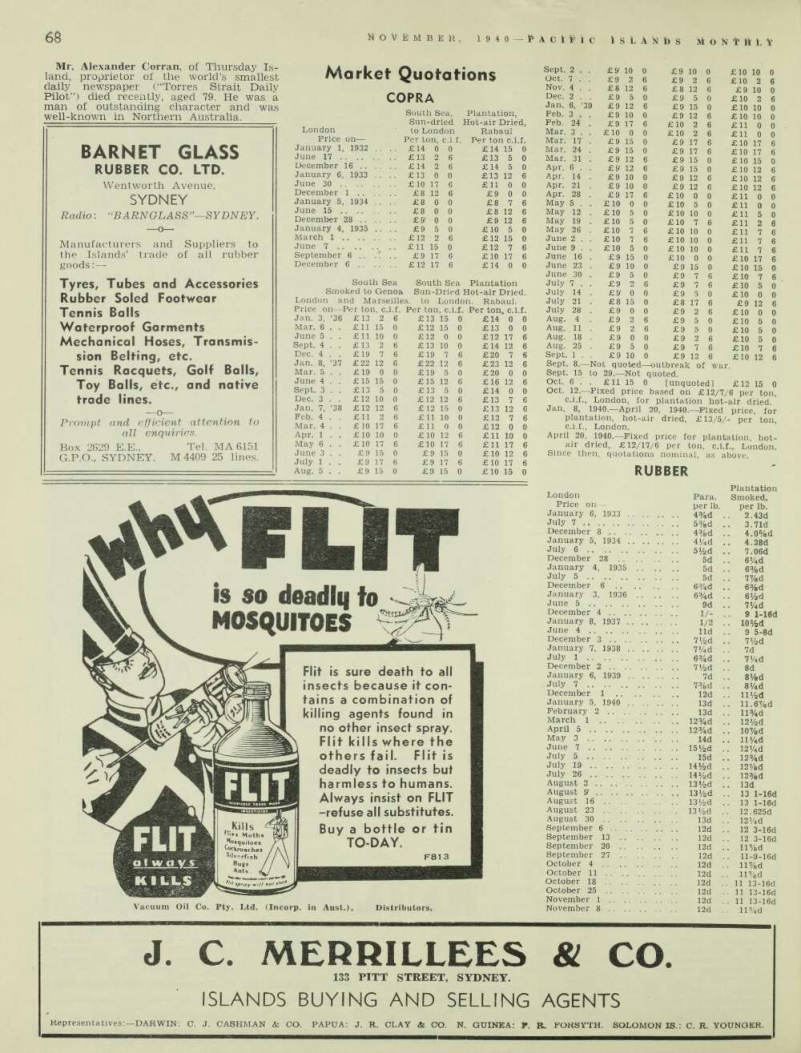
Pacific Colonies
THE Australian Department of Information, in conjunction with the A.8.C., has inaugur ated a daily broadcast in French of news talks, and music for listeners in New Caledonia, New Hebrides, and Tahiti. Transmission is made from Station VLQ, Sydney, on a wave-length of 31.2 metres (frequency, 9.615 mcs.) and con sists of the following items:—
Miss Joan Holland was married to Dr.
Arthur Hay. of Kieta, at St. George’s Church, Rabaul, at the end of October.
Miss Jean Wilson was bridesmaid and Mr.
Roy McPherson was best man. A recep tion was held afterwards at the home of Mr. and Mrs. Robert Melrose.
Aust. Eastern Noumea Standard Time.
Time. 6.55 p.m. 7.55 p.m.
Announcements. 7.00 p.m. 8.00 p.m.
News in French. 7.20 p.m. 8.20 p.m.
Talk in French. 7.25 p.m. 8.25 p.m.
Close.
Mr. Alexander Corran, of Thursday Is land, proprietor of the world’s smallest daily newspaper (“Torres Strait Daily Pilot”) died recently, aged 79. He was a man of outstanding character and was well-known in Northern Australia.
Advertisements & other items, pp. 69-70 (1 item)
fmlqUqijm,
HIS MASTER'S VOICE
GRAMOPHONES
We have a number of demonstrating cabinet models, which retailed formerly at £37/10/-. These instruments are practically brand new, and once sold, further stocks are unprocurable. Each instrument is fully guaranteed for three years, and we will deliver straight to your nearest port for — -£9/15 /- Six popular records, and needles, included. Can be sent C.O.D. if desired, but a deposit of 10% must accompany order.
"TALKERIES"
(The Gramophone Store) 161 Castlereagh Street, Sydney, N.S.W.
“LUXURY LINER”
of the SHORT WA VES
YOU need but little luggage on Philips high-speed radio tour of the world —just an easy chair in which to recline in full comfort, a pipe to smoke, and world-wide Radioplayer 2262 to guide you on this fascinating quest into the unknown.
Tuning is easier (including relocation of overseas stations); reception is clearer; tonal quality is richer —in short, listening is more enjoyable in every way when you cruise on this “luxury liner” of the short waves . . . streamlined 6-valve Radioplayer 2262, complete with every advanced feature of modern radio design. It operates on either 110 or 240 volts, too.
Broadcast coverage, 540—1620 kilocycles.
Short-wave coverage, 8 —22 megacycles.
PHI
fmlqUqijm,
Made by The Largest Radio Organisation in the British Empire. -__ -E Urir IhL — L9iLJ?.yi ANt^fQSJ^ , PHILIPS LAMPS (A/asia) PTY. LTD. . . PHILIPS
HOUSE 69-73 CLARENCE STREET SYDNEY,
N.S.W., AUS.
I Please forward me all information on Model 2262.
I Name
i I Address P.I.M.
BARNET GLASS
RUBBER CO. LTD.
Wentworth Avenue,
SYDNEY
Radio : “BARNGLASS” — SYDNEY.
Manufacturers and Suppliers to the Islands’ trade of all rubber goods:— Tyres, Tubes and Accessories Rubber Soled Footwear Tennis Balls Waterproof Garments Mechanical Hoses, Transmission Belting, etc.
Tennis Racquets, Golf Balls, Toy Balls, etc., and native trade lines. —o — Prompt and efficient attention to all enquiries.
Box 2629 E.E., Tel. MA 6151 G.P.0., SYDNEY. M 4409 25 lines.
is so deadly to
HOSquiTOES
Kills r,1 '» Moth* S ilv?rfi*h' Bugs Ants Flit is sure death to all insects because it contains a combination of killing agents found in no other insect spray.
Flit kills where the others fail. Flit is deadly to insects but harmless to humans.
Always insist on FLIT -refuse all substitutes.
Buy a bottle or tin
TO-DAY.
FBl 3 ’pruy will not Vacuum Oil Co. Pty. Ltd. (Incorp. in Aust.) ; Distributors.
J. C. MERRILLEES & CO.
133 PITT STREET, SYDNEY.
ISLANDS BUYING AND SELLING AGENTS
Representatives:— DAßWlN; C. J. CASHMAN & CO. PAPUA: J. R. CLAY & CO. N. GUINEA: P. R. FORSYTH. SOLOMON IS.: C. R. YOUNGER.
Market Quotations
Sept. 2 . . £&’ 10 0 £9 10 0 £10 10 0 Oct. 7 . . £9 2 6 £9 2 6 £10 2 6 Nov. 4 . . £8 12 6 £8 12 6 £9 10 0 Dec. 2 . . £9 5 0 £9 5 0 £10 2 6 Jan. 6, ’39 £9 12 6 £9 15 0 £10 10 0 Feb. 3 . . £9 10 0 £9 12 6 £10 10 0 Feb. 24 . £9 17 6 £10 2 6 £11 0 0 Mar. 3 . . £10 0 0 £10 2 6 £11 0 0 Mar. 17 . £9 15 0 £9 17 6 £10 17 6 Mar. 24 . £9 15 0 £9 17 6 £10 17 6 Mar. 31 . £9 12 6 £9 15 0 £10 15 0 Apr. 6 . . £9' 12 6 £9 15 0 £10 12 6 Apr. 14 . £9 10 0 £9 12 6 £10 12 6 Apr. 21 . £9 10 0 £9 12 6 £10 12 6 Apr. 28 . £9 17 6 £10 0 0 £11 0 0 May 5 . . £10 0 0 £10 5 0 £11 0 0 May 12 . £10 5 0 £10 10 0 £11 5 0 May 19 . £10 5 0 £10 7 6 £11 2 6 May 26 . £10 7 6 £ 10 10 0 £11 7 6 June 2 . . £10 7 6 £10 10 0 £11 7 6 June 9 . . £10 5 0 £10 10 0 £11 7 6 June 16 . £9 15 0 £10 0 0 £10 17 6 June 23 . £9 10 0 £9 15 0 £10 15 0 June 30 . £9 5 0 £9 7 6 £10 7 6 July 7 . . £9 2 6 £9 7 6 £10 5 0 July 14 . £9 0 0 £9 5 0 £10 0 0 July 21 . £8 15 0 £8 17 6 £9 12 6 July 28 . £9 0 0 £9 2 6 £10 0 0 Aug. 4 . £9 2 6 £9 5 0 £10 5 0 Aug. 11 . £9 2 6 £9 5 0 £10 5 0 Aug. 18 . £9 0 0 £9 2 6 £10 5 0 Aug. 25 . £9 5 0 £9 7 6 £10 7 6 Sept. 1 . . £9 10 0 £9 12 6 £10 12 6 Sept. 8.—Not quoted—outbreak of war Sept. 15 to 29.- -Not quoted.
Oct. 6 . . £11 15 0 [unquoted] £12 15 0 Oct. 12.—Fixed price based on £12/7/6 per ton c.i.f., London, for plantation hot-air dried.
Jan. 8, 1940.—April 20, 1940.—Fixed price, for plantation, hotair dried, £13/5/- per ton. c.i.f., London.
April 20, 1940.— Fixed price for plantation, hotair dried, £12/17/6 per ton, c.i.f., London.
Since then, quotations nominal, as above.
Rubber
Plantation London Para.
Smoked.
Price onper lb. per lb.
January 6, 1933 . .. 43/ 4 d . 2.43d July 7 ,. . . 3.71d December 8 4.0 5 /sd January 5, 1934 ■ •• 4>/ 4 d . . 4.28d July 6 ., . .. sy 2 d . . 7.06d December 28 5d . 6»/ 4 d January 4, 1935 . , .. 5d . . 6%d July 5 .. 7y s d December 6 . . . 6%d January 3, 1936 . .. 6%d . . ey 2 d June 5 ,. . 7y 4 d December 4 9 l-16d January 8, 1937 1/2 . . ioy 2 d June 4 .. 9 5-8d December 3 .. . 7>/ 2 d January 7, 1938 . .. 7V 4 d . . 7d July 1 .. . 7»/ 4 d December 2 8d January 6, 1939 7d . sy 8 d July 7 .. sy 4 d December 1 .. 12d . . ny 2 d January 5, 1940 13d . . 11.6y 8 d February 2 . ny 4 d March 1 . . i2y 2 d April 5 .. . ioy 8 d May 3 .. . ny 4 d June 7 .. . 12y 4 d July 5 .. . 123/ 4 d July 19 .. . i2y 8 d July 26 .. . 12%d August 2 . . 13d August 9 . . 13 l-16d August 16 . 13 l-16d August 23 .. 13V 2 d . . 12.625d August 30 . . 13d . . 12y 4 d September ( . . . 12d . . 12 3-16d September 13 . 12d . . 12 3-16d September 20 . 12d . . ny 8 d September 27 . . . . 12d . ll-9-16d October 4 12d . . liy 8 d October 11 .. 12d . . ny 8 d October 18 . 11 13-16d October 25 . . . 12d • 11 13-16d November 1 . . . 12d . 11 13-16d November 8 . . . 12d . ll 3 / 4 d
Copra
South Sea, Plantation, Sun-dried Hot -air Dried, London to London Rabaul Price on— Per ton, c.i.f.
Per ton c.i.f.
January 1 1932 £14 0 0 £14 15 0 June 17 . £13 2 6 £13 5 0 December 16 . . £14 2 6 £14 5 0
January 6
1933 £13 0 0 £13 12 6 June 30 . £10 17 6 £11 0 0 December 1 .. £8 12 6 £9 0 0 January 5 1934 £8 0 0 £8 7 6 June 15 . £8 0 0 £8 12 6 December 28 . . £&' 0 0 £9 12 6
January 4
1935 £9 5 0 £10 5 0 March 1 £12 2 6 £12 15 0 June 7 . £11 15 0 £12 7 6 September 6 .. £9 17 6 £10 17 6 December 6 . . £12 17 6 £14 0 0 South Sea South Sea Plantation Smoked to Genoa Sun-Dried Hot -air Dried.
London and Marseilles, to London.
Rabaul.
Price on— Per ton, c .i.f.
Per ton, c.i.f.
Per ton . c.i.f.
Jan. 3, ’36 £13 2 6 £13 15 0 £14 0 0 Mar, 6 . . £11 15 0 £12 15 0 £13 0 0 June 5 . . £11 10 0 £12 0 0 £12 17 6 Sept. 4 . . £13 2 6 £13 10 0 £14 12 6 Dec, 4 . . £19 7 6 £19 7 6 £20 7 6 Jan. 8, '37 £22 12 6 £22 12 6 £23 12 6 Mar. 5 . . £19 0 0 £19 5 0 £20 0 0 June 4 . . £15 15 0 £15 12 6 £16 12 6 Sept. 3 . . £13 5 0 £13 5 0 £14 0 0 Dec. 3 . . £12 10 0 £12 12 6 £13 7 6 Jan. 7, ’38 £12 12 6 £12 15 0 £13 12 6 Feb. 4 . . £11 2 6 £11 10 0 £12 7 6 Mar. 4 . . £10 17 6 £11 0 0 £12 0 0 Apr, 1 . . £10 10 0 £10 12 6 £11 10 0 May 6 . . £10 17 6 £10 17 6 £11 17 6 June 3 . . £9 15 0 £9 15 0 £10 12 6 July 1 . . £9 17 6 £9 17 6 £10 17 6 Aug. 5 . . £9 15 0 £9 15 0 £10 15 0
Islands Produce
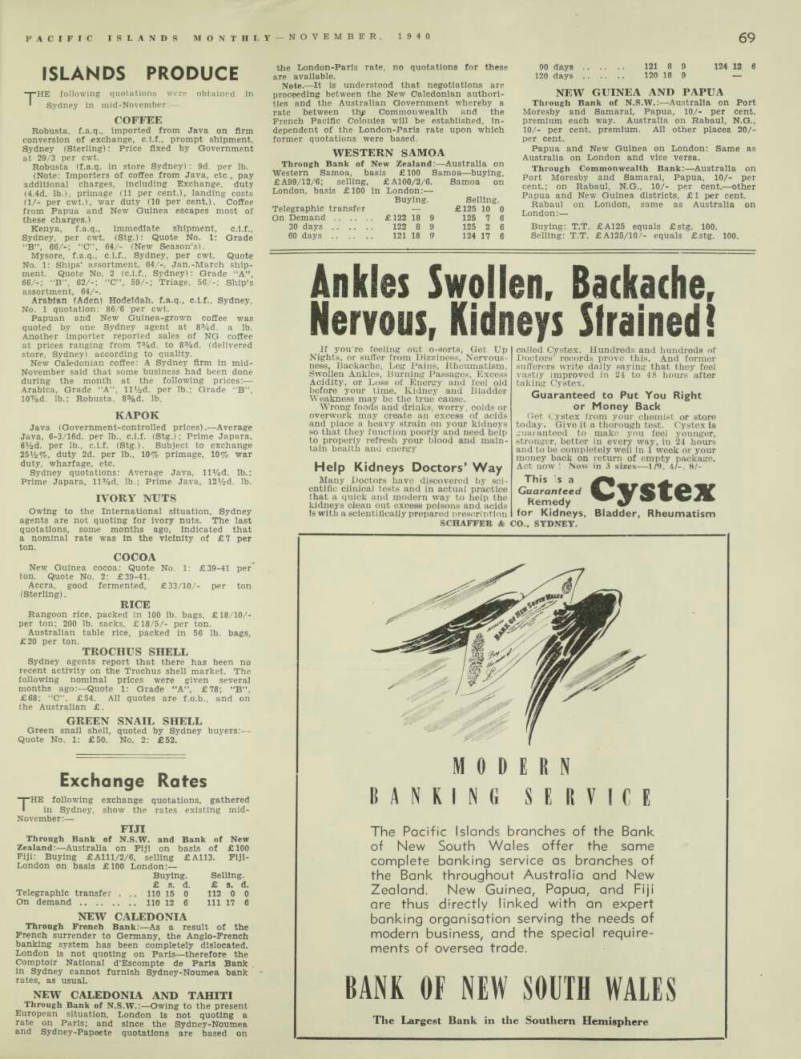
“i“HE following quotations were obtained in • Sydney in mid-November:
Coffee
Robusta, f.a.q., imported from Java on firm conversion of exchange, c.i.f., prompt shipment, Sydney (Sterling): Price fixed by Government at 29/3 per cwt.
Robusta (f.a.q. in store Sydney): 9d. per lb. (Note: Importers of coffee from Java, etc., pay additional charges, including Exchange, duty (4.4 d. lb.), primage (11 per cent.), landing costs (1/- per cwt.), war duty (10 per cent.). Coffee from Papua and New Guinea escapes most of these charges.) Kenya, f.a.q., Immediate shipment, c.i.f., Sydney, per cwt. (Stg.): Quote No. 1; Grade “B”, 66/-; “C”, 64/- (New Season’s).
Mysore, f.a.q., c.i.f., Sydney, per cwt. Quote No. 1: Ships’ assortment, 64/-, Jan.-March ship ment. Quote No. 2 (c.i.f., Sydney): Grade “A”, 66/-; “B”. 62/-; “C”, 59/-; Triage, 56/-; Ship’s assortment, 64/-.
Arabian (Aden) Hodeldah. f.a.q., c.i.f., Sydney, No. 1 quotation: 86/6 per cwt.
Papuan and New Guinea-grown coffee was quoted by one Sydney agent at 8 3 / 4 d. a lb.
Another importer reported sales of NG coffee at prices ranging from 7%d. to B%d. (delivered store, Sydney) according to quality.
New Caledonian coffee; A Sydney firm in mid- November said that some business had been done during the month at the following prices:— Arabica, Grade “A”, IV/zd. per lb.; Grade “B”, 10y B d. lb.; Robusta, B%d. lb.
Kapok
Java (Government-controlled prices).—Average Java, 6-3/16d. per lb., c.i.f. (Stg.); Prime Japara, SVid. per lb., c.i.f. (Stg.). Subject to exchange 25V 2 %, duty 2d. per lb., 10% primage, 10% war duty, wharfage, etc.
Sydney quotations: Average Java, HVid. lb.; Prime Japara, ll%d. lb.; Prime Java, 12%d. lb.
Ivory Nuts
Owing to the International situation, Sydney agents are not quoting for ivory nuts. The last quotations, some months ago, Indicated that a nominal rate was in the vicinity of £7 per ton.
Cocoa
New Guinea cocoa: Quote No. 1: £39-41 per" ton. Quote No. 2; £39-41.
Accra, good fermented, £33/10/- per ton (Sterling).
Rice
Rangoon rice, packed in 100 lb. bags, £ 18/10/per ton; 200 lb. sacks, £lB/5/- per ton.
Australian table rice, packed in 56 lb. bags, £2O per ton.
Trochus Shell
Sydney agents report that there has been no recent activity on the Trochus shell market. The following nominal prices were given several months ago;—Quote 1; Grade "A”, £7B; “B”, £6B; “C”, £54. All quotes are f.0.b., and on the Australian £.
Green Snail Shell
Green snail shell, quoted by Sydney buyers:— Quote No. 1; £5O. No. 2: £52.
Exchange Rates
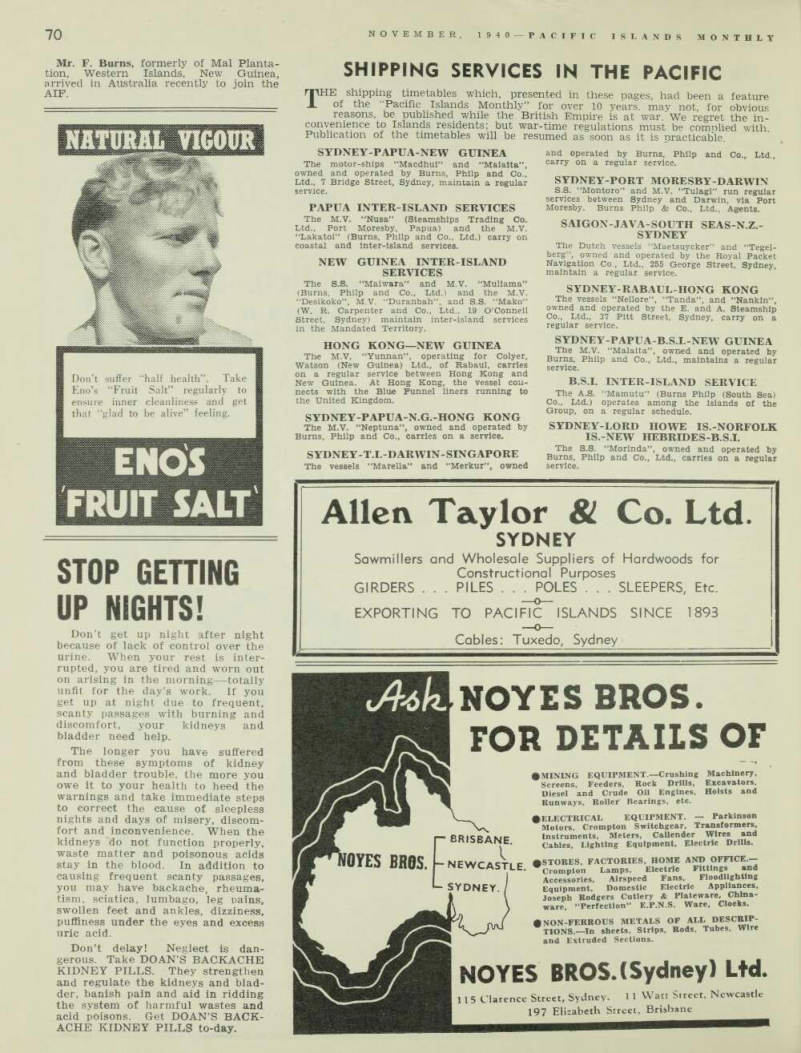
THE following exchange quotations, gathered in Sydney, show the rates existing mid- November;—
Fiji
Through Bank of N.S.W. and Bank of New Zealand:—Australia on Fiji on basis of £lOO Fiji: Buying £Alll/2/6, selling £AII3. Plji- London on basis £lOO London:—
New Caledonia
Through French Bank;—As a result of the French surrender to Germany, the Anglo-French banking system has been completely dislocated.
London is not quoting on Paris—therefore the Comptoir National d’Escompte de Paris Bank in Sydney cannot furnish Sydney-Noumea bank rates, as usual.
New Caledonia And Tahiti
Through Bank of N.S.W.:—Owing to the present European situation, London is not quoting a rate on Paris; and since the Sydney-Noumea and Sydney-Pape-ete quotations are based on
the London-Parls rate, no quotations for these are available.
Note. —It is understood that negotiations are proceeding between the New Caledonian authori ties and the Australian Government whereby a rate between th£ Commonwealth and the French Pacific Colonies will be established, in dependent of the London-Paris rate upon which former quotations were based.
Western Samoa
Through Bank of New Zealand: —Australia on Western Samoa, basis £lOO Samoa —buying, £ A99/12/6; selling, £AIOO/2/6. Samoa on London, basis £lOO in London:—
New Guinea And Papua
Through Bank of N.S.W.:—Australia on Port Moresby and Samarai, Papua, 10/- per cent, premium each way. Australia on Rabaul, N.G., 10/- per cent, premium. All other places 20/per cent.
Papua and New Guinea on London; Same as Australia on London and vice versa.
Through Commonwealth Bank:—Australia on Port Moresby and Samarai, Papua, 10/- per cent.; on Rabaul, N.G., 10/- per cent.—other Papua and New Guinea districts, £1 per cent.
Rabaul on London, same as Australia on London;— Buying: T.T. £AI2S equals £stg. 100.
Selling: T.T. £AI2S/10(- equals £stg. 100.
Buying. Selling.
Telegraphic transfer — £125 10 0 On Demand £ 122 18 9 125 7 6 30 days 122 8 9 125 2 6 60 days 121 18 9 124 17 6
90 days 121 8 9 124 12 6 120 days 120 18 9 —
Buying.
Selling. £ s. d. £ a. d.
Telegraphic transfer . .. 110 15 0 112 0 0 On demand 111 17 6
Mr. F. Burns, formerly of Mai Planta tion, Western Islands, New Guinea, arrived in Australia recently to join the
Aif.
Advertisements & other items, pp. 71-72 (1 item)
Nervous, Kidneys Strained I
Ankles Swollen, Backache, Nervous, Kidneys Strained I
If you’re feeling out o-sorts, Get Up Nights, or suffer from Dizziness, Nervousness, Backache, Leg Pains, Rheumatism, Swollen Ankles, Burning Passages, Excess Acidity, or Loss of Energy and feel old before your time, Kidney and Bladder Weakness may be the true cause.
Wrong foods and drinks, worry, colds or overwork may create an excess of acids and place a heavy strain on your kidneys so that they function poorly and need help to properly refresh your blood and maintain health and energy
Help Kidneys Doctors’ Way
Many Doctors have discovered by scientific clinical tests and in actual practice that a quick and modern way to help the kidneys clean out excess poisons and acids fswith a scientifically prepared prescription
called Cystex. Hundreds and hundreds of Doctors’ records prove this. And former sufferers write daily saying that they feel vastly improved in 24 to 48 hours after taking Cystex.
Guaranteed to Put You Right Get Cystex from your chemist or store today. Give it a thorough test. Cystex Is guaranteed to make you feel younger, stronger, better in every way, in 24 hours and to be completely well in 1 week or your money back on return of empty package.
Act now I Now in 3 sizes—l/9, 4/-. 8/for Kidneys, Bladder, Rheumatism or Money Back This s a Guaranteed
Remedy
Cystex
SCHAFFER & CO., SYDNEY.
r o'’ /
MODERN
RANKING SERVICE
The Pacific Islands branches of the Bank of New South Wales offer the same complete banking service as branches of the Bank throughout Australia and New Zealand. New Guinea, Papua, and Fiji are thus directly linked with an expert banking organisation serving the needs of modern business, and the special requirements of oversea trade.
BANK OF NEW SOUTH WALES
The Largest Bank in the Southern Hemisphere
11 Don’t suffer “half health”. Take Eno’s “Fruit Salt” regularly to ensure inner cleanliness and get that “glad to be alive” feeling.
ENOS
FRUIT SALT
STOP GETTING
UP NIGHTS!
Don’t get up night after night because of lack of control over the urine. When your rest is interrupted, you are tired and worn out on arising in the morning—totally unfit for the day’s work. If you get up at night due to frequent, scanty passages with burning and discomfort, your kidneys and bladder need help.
The longer you have suffered from these symptoms of kidney and bladder trouble, the more you owe it to your health to heed the warnings and take immediate steps to correct the cause of sleepless nights and days of misery, discomfort and inconvenience. When the kidneys do not function properly, waste matter and poisonous acids stay in the blood. In addition to causing frequent scanty passages, you may have backache, rheumatism. sciatica, lumbago, leg nains, swollen feet and ankles, dizziness, puffiness under the eyes and excess uric acid.
Don’t delay! Neglect is dangerous. Take DOAN’S BACKACHE KIDNEY PILLS. They strengthen and regulate the kidneys and bladder, banish pain and aid in ridding the system of harmful wastes and acid poisons. Get DOAN’S BACK-
ACHE KIDNEY PILLS to-day.
Shipping Services In The Pacific
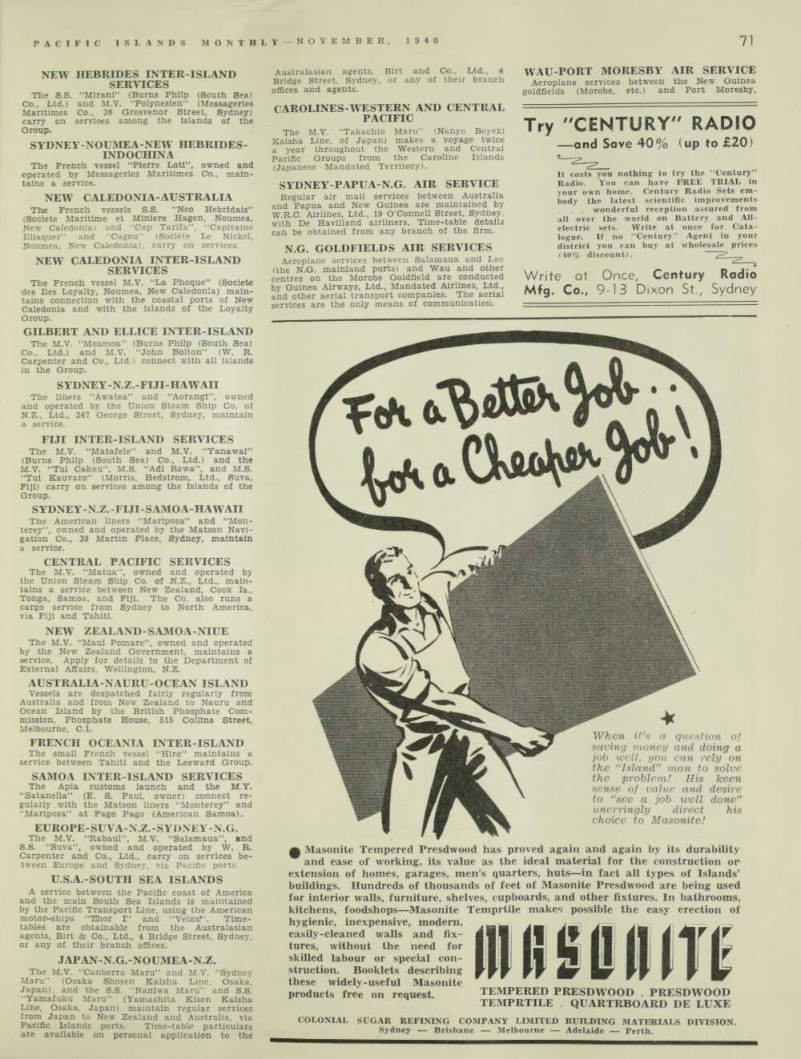
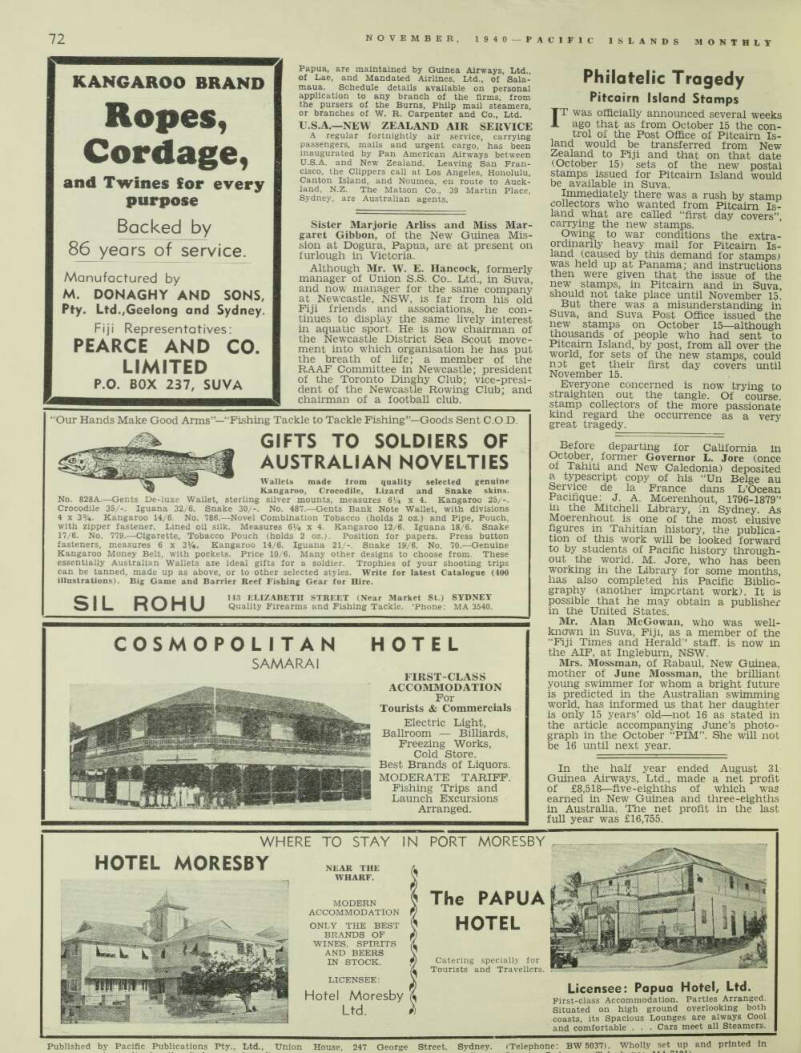
rE shipping timetables which, presented in these nages, had been a feature of the “Pacific Islands Monthly” for over 10 years, mav not, for obvious reasons, be published while the British Empire is at war.'We regret the in convenience to Islands residents; but war-time regulations must be complied with.
Publication of the timetables will be resumed as soon as it is practicable.
Sydney-Papua-New Guinea
The motor-ships “Macdhul” and “Malaita”, owned and operated by Burns, Philp and Co., Ltd., 7 Bridge Street, Sydney, maintain a regular service.
Papua Inter-Island Services
The M.V. “Nusa” (Steamships Trading Co.
Ltd., Port Moresby, Papua) and the M.V.
“Lakatoi” (Burns, Philp and Co.. Ltd.) carry on coastal and Inter-island services.
New Guinea Inter-Island
Services
The S.S. "Maiwara” and M.V. “Muliama” (Burns, Philp and Co., Ltd.) and the M.V.
“Desikoko”, M.V. “Duranbah”, and S.S. “Mako” (W. R. Carpenter and Co., Ltd., 19 O’Connell Street, Sydney) maintain inter-island services in the Mandated Territory.
Hong Kong—New Guinea
The M.V. “Yunnan”, operating for Colyer, Watson (New Guinea) Ltd., of Rabaul, carries on a regular service between Hong Kong and New Guinea. At Hong Kong, the vessel con nects with the Blue Funnel liners running to the United Kingdom.
Sydney-Papua-N.G.-Hong Kong
The M.V. “Neptuna”, owned and operated by Burns, Philp and Co., carries on a service.
Sydney-T.1.-Darwin-Singapore
The vessels “Marella” and “Merkur”, owned
and operated by Burns, Phllp and Co., Ltd., carry on a regular service.
Sydney-Port Moresby-Darwin
S.S. “Montoro” and M.V. “Tulagi” run regular services between Sydney and Darwin, via Port Moresby. Burns Philp & Co., Ltd., Agents.
Saigon-Java-South Seas-N.Z.-
Sydney
The Dutch vessels “Maetsuycker” and “Tegel berg”, owned and operated by the Royal Packet Navigation Co., Ltd., 255 George Street, Sydney, maintain a regular service.
Sydney-Rabaul-Hong Kong
The vessels “Nellore”, “Tanda”, and “Nankin”, owned and operated by the E. and A. Steamship Co., Ltd., 37 Pitt Street, Sydney, carry on a regular service.
Sydney-Papua-8.5.1.-New Guinea
The M.V. “Malaita”, owned and operated by Burns, Philp and Co., Ltd., maintains a regular service.
8.5.1. Inter-Island Service
The A.S. “Mamutu” (Burns Philp (South Sea) Co., Ltd.) operates among the islands of the Group, on a regular schedule.
Sydney-Lord Howe Is.-Norfolk
Is.-New Hebrides-8.5.1.
The S.S. “Morinda”, owned and operated by Burns, Philp and Co., Ltd., carries on a regular service.
New Hebrides Inter-Island
Services
The S.S. “Mlrani” (Burns Phllp (South Sea) Co., Ltd.) and M.V. “Polynesien” (Messageries Maritimes Co., 36 Grosvenor Street, Sydney) carry on services among the Islands of the Group.
Sydney-Noumea-New Hebrides
Indochina
The French vessel “Pierre Loti”, owned and operated by Messageries Maritimes Co., main tains a service.
New Caledonia-Australia
The French vessels S.S. “Neo Hebrldais” (Societe Maritime et Mlnlere Hagen, Noumea, New Caledonia) and “Cap Tarifa”, “Capitaine Illiaquer” and “Cagou” (Societe Le Nickel, Noumea, New Caledonia), carry on services.
New Caledonia Inter-Island
Services
The French vessel M.V. “La Phoque” (Societe des lies Loyalty, Noumea, New Caledonia) main tains connection with the coastal ports of New Caledonia and with the Islands of the Loyalty Group.
Gilbert And Ellice Inter-Island
The M.V. “Moamoa” (Burns Philp (South Sea) Co., Ltd.) and M.V. “John Bolton” (W. R.
Carpenter and Co., Ltd.) connect with all islands in the Group.
Sydney-N.Z.-Fiji-Hawaii
The liners “Awatea” and “Aorangl”, owned and operated by the Union Steam Ship Co. of N.Z., Ltd., 247 George Street, Sydney, maintain a service.
Fiji Inter-Island Services
The M.V. “Matafele” and M.V. “Yanawal” (Burns Philp (South Sea) Co., Ltd.) and the M.V. “Tui Cakau”. M.S. “Adi Rewa”, and M.S.
“Tul Kauvaro” (Morris, Hedstrom, Ltd., Suva, Fiji) carry on services among the Islands of the Group.
Sydney-N.Z.-Fiji-Samoa-Hawaii
The American liners “Mariposa” and “Mon terey”, owned and operated by the Matson Navi gation Co., 39 Martin Place, Sydney, maintain a service.
Central Pacific Services
The M.V. “Matua”, owned and operated by the Union Steam Ship Co. of N.Z., Ltd., main tains a service between New Zealand, Cook Is., Tonga, Samoa, and Fiji. The Co. also runs a cargo service from Sydney to North America, via Fiji and Tahiti.
New Zealand-Samoa-Niue
The M.V. “Maui Pomare”, owned and operated by the New Zealand Government, maintains a service. Apply for details to the Department of External Affairs, Wellington, N.Z.
Australia-Nauru-Ocean Island
Vessels are despatched fairly regularly from Australia and from New Zealand to Nauru and Ocean Island by the British Phosphate Com mission, Phosphate House, 515 Collins Street, Melbourne, 0.1.
French Oceania Inter-Island
The small French vessel “Hiro” maintains a service between Tahiti and the Leeward Group.
Samoa Inter-Island Services
The Apia customs launch and the M.Y.
“Satanella” (E. S. Paul, owner) connect re gularly with the Matson liners “Monterey” and “Mariposa” at Pago Pago (American Samoa).
Europe-Suva-N.Z.-Sydney-N.G.
The M.V. “Rabaul”, M.V. “Salamaua”, and S.S. “Suva”, owned and operated by W. R.
Carpenter and Co., Ltd., carry on services be tween Europe and Sydney, via Pacific ports.
U.S.A.-South Sea Islands
A service between the Pacific coast of America and the main South Sea Islands is maintained by the Pacific Transport Line, using the American motor-ships “Thor I” and “Velox!”. Time tables are obtainable from the Australasian agents, Birt & Co., Ltd., 4 Bridge Street, Sydney, or any of their branch offices.
Japan-N.G.-Noumea-N.Z.
The M.V. “Canberra Maru” and M.V. “Sydney Maru” (Osaka Shosen Kaisha Line, Osaka, Japan), and the S.S. ‘Naniwa Maru” and S.S.
“Yamafuku Maru” (Yamashita Kisen Kaisha Line, Osaka, Japan) maintain regular services from Japan to New Zealand and Australia, via Pacific Islands ports. Time-table particulars are available on personal application to the
Australasian agents, Birt and Co., Ltd., A Bridge Street, Sydney, or any of their branch offices and agents.
Carolines-Western And Central
Pacific
The M.V. “Takachio Maru” (Nanyo Boyeki Kaisha Line, of Japan) makes a voyage twice a year throughout the Western and Central Pacific Groups from the Caroline Islands (Japanese Mandated Territory).
Sydney-Papua-N.G. Air Service
Regular air mail services between Australia and Papua and New Guinea are maintained by W.R.C. Airlines, Ltd., 19 O’Connell Street, Sydney, with De Havilland airliners. Time-table details can be obtained from any branch of the firm. n.g. goldfields air services Aeroplane services between Salamaua and Lae (the N.G. mainland ports) and Wau and other centres on the Morobe Goldfield are conducted by Guinea Airways, Ltd., Mandated Airlines, Ltd., and other aerial transport companies. The aerial services are the only means of communication.
Wau-Port Moresby Air Service
Aeroplane services between the New Guinea goldfields (Morobe, etc.) and Port Moresby,
Papua, are maintained by Guinea Airways, Ltd., of Lae, and Mandated Airlines, Ltd., of Sala tnaua. Schedule details available on personal application to any branch of the firms, from the pursers of the Burns, Philp mail steamers, or branches of W. R. Carpenter and Co., Ltd.
U.S.A.—New Zealand Air Service
A regular fortnightly air service, carrying passengers, mails and urgent cargo, has been inaugurated by Pan American Airways between U.S.A. and New Zealand. Leaving San Fran cisco, the Clippers call at Los Angeles, Honolulu, Canton Island, and Noumea, en route to Auck land, N.Z. The Matson Co., 39 Martin Place, Sydney, are Australian agents.
Sister Marjorie Arliss and Miss Mar garet Gibbon, of the New Guinea Mis sion at Dogma, Papua, are at present on furlough in Victoria.
Although Mr. W. E. Hancock, formerly manager of Union S.S. Co.. Ltd., in Suva, and now manager for the same company at Newcastle, NSW, is far from his old Fiji friends and associations, he con tinues to display the same lively interest in aquatic sport. He is now chairman of the Newcastle District Sea Scout move ment into which organisation he has put the breath of life; a member of the RAAF Committee in Newcastle; president of the Toronto Dinghy Club; vice-presi dent of the Newcastle Rowing Club; and chairman of a football club.
Advertisements & other items, pp. 72-74 (1 item)
For Details Of
Allen Taylor & Co. Ltd.
SYDNEY
Sawmillers and Wholesale Suppliers of Hardwoods for Constructional Purposes GIRDERS . . . PILES . . . POLES . . . SLEEPERS, Etc.
EXPORTING TO PACIFIC ISLANDS SINCE 1893
Cables: Tuxedo, Sydney
d
OYES BROS.
NOYES BROS.
FOR DETAILS OF
• MINING EQUIPMENT.— Crushing Machinery, Screens, Feeders, Rock Drills, Excavators, Diesel and Crude Oil Engines, Hoists and Runways, Roller Bearings, etc.
0 ELECTRICAL EQUIPMENT. Parkinson
Motors, Crompton Switchgear, Transformers, Instruments, Meters, CaUender Wires and Cables, Lighting Equipment, Electric Drills.
“ BRISBANE.
- NEWr ACTI C •STORES, FACTORIES, HOME AND OFFICE.— NEWCASTLE. * Crompt on Lamps. Electric Fittings and Accessories, Airspeed Fans, Floodlighting *— SYDNEY. / Equipment, Domestic Electric Appliances, Joseph Rodgers Cutlery & Plateware, Chinaware. “Perfection” E.P.N.S. Ware, Clocks.
NON-FERROUS METALS OF ALL DESCRIP-
TIONS. —In sheets, Strips, Rods. Tubes, Wire and Extruded Sections.
NOYES BROS.(Sydney) Ltd.
15 Clarence Street, Sydney. 1 1 Watt Street, Newcastle 197 Elizabeth Street. Brisbane
Try "CENTURY" RADIO
—and Save 40% (up to £2O)
It costs yon nothing to try the “Century”
Radio. You can have FIREE TRIAL in your own home. Century Radio Sets embody the latest scientific improvements wonderful reception assured from all over the world on Battery and Allelectric sets. Write at once for Catalogue. If no “Century” Agent in your district you can buy at wholesale prices (40% discount).
Write at Once, Century Radio
Mfg. Co., 9-13 Dixon St., Sydney
a \ a :> I:*:- :-. •■■ M-, * /£ When it’s a question of saving money and doing a job well, you can rely on the “Island” man to solve the problem! His keen sense of value and desire to “see a job well done” unerringly direct his choice to Masonite! i Masonite Tempered Presdwood has proved again and again by its durability and ease of working, its value as the ideal material for the construction or extension of homes, garages, men’s quarters, huts—in fact all types of Islands’ buildings. Hundreds of thousands of feet of Masonite Presdwood are being used for interior walls, furniture, shelves, cupboards, and other fixtures. In bathrooms, kitchens, foodshops—Masonite Temprtile makes possible the easy erection of hygienic, inexpensive, modem, easily-cleaned walls and fixtures, without the need for skilled labour or special construction. Booklets describing these widely-useful Masonite products free on request. 5 r ir
TEMPERED PRESDWOOD . PRESDWOOD
TEMPRTILE . QUARTRBOARD DE LUXE
COLONIAL SUGAR REFINING COMPANY LIMITED BUILDING MATERIALS DIVISION.
Sydney Brisbane Melbourne Adelaide Perth.
KANGAROO BRAND
Ropes,
Cordage,
and Twines for every purpose
Backed by
86 years of service.
Manufactured by
M. DONAGHY AND SONS,
Pty. Ltd.,Gcelong and Sydney.
Fiji Representatives:
PEARCE AND CO.
LIMITED
P.O. BOX 237, SUVA
Our Hands Make Good Arms”—“Fishing Tackle to Tackle Fishing”—Goods Sent C.O.D.
No. 828 A De-luxe Wallet, sterling silver mounts, measures 6Vi x 4. Kangaroo 25/-.
Crocodile 35/-. Iguana 32/6. Snake 30/-. No. 487. —Gents Bank Note Wallet, with divisions 4 x 3 3 A. Kangaroo 14/6, No. 786.—Novel Combination Tobacco (holds 2 oz.) and Pipe, Pouch, with zipper fastener. Lined oil silk. Measures OVi x 4. Kangaroo 12/6. Iguana 18/6. Snake 17/6. No. 779. —Cigarette, Tobacco Pouch (holds 2 oz.). Position for papers. Press button fasteners, measures 6 x 3Vi. Kangaroo 14/6. Iguana 21/-. Snake 19'/6. No. 70.—Genuine Kangaroo Money Belt, with pockets. Price 10/6. Many other designs to choose from. These essentially Australian Wallets are ideal gifts for a soldier. Trophies of your shooting trips can be tanned, made up as above, or to other selected styles. Write for latest Catalogue (400 illustrations). Big Game and Barrier Reef Fishing Gear for Hire.
GIFTS TO SOLDIERS OF
AUSTRALIAN NOVELTIES
Wallets made from quality selected genuine Kangaroo, Crocodile, Lizard and Snake skins.
SIL ROHU
143 ELIZABETH STREET (Near Market St.) SYDNEY Quality Firearms and Fishing Tackle. ’Phone: MA 3540.
COSMOPOLITAN HOTEL
SAMARAI
FIRST-CLASS
ACCOMMODATION
For Tourists & Commercials Electric Light, Ballroom Billiards, Freezing Works, Cold Store.
Best Brands of Liquors.
MODERATE TARIFF.
Fishing Trips and Launch Excursions Arranged.
WHERE TO STAY IN
HOTEL MORESBY
NEAR THE
WHARF.
P
MODERN
ACCOMMODATION
ONLY THE BEST
BRANDS OF
WINES, SPIRITS
AND BEERS
IN STOCK.
LICENSEE:
Hotel Moresby
Ltd.
PORT MORESBY
The PAPUA
HOTEL
Catering specially for Tourists and Travellers.
Licensee: Papua Hotel, Ltd.
First-class Accommodation, Parties Arranged.
Situated on high ground overlooking both coasts, its Spacious Lounges are always Cool and comfortable . . . Cars meet all Steamers.
Philatelic Tragedy
Pitcairn Island Stamps
IT was officially announced several weeks ago that as from October 15 the con trol of the Post Office of Pitcairn Is land would be transferred from New Zealand to Fiji and that on that date (October 15) sets of the new postal stamps issued for Pitcairn Island would be available in Suva.
Immediately there was a rush by stamp collectors who wanted from Pitcairn Is land what are called “first day covers'’ carrying the new stamps.
Owing to war conditions the extra ordinarily heavy mail for Pitcairn Is land (caused by this demand for stamps) was held up at Panama; and instructions then were given that the issue of the new stamps, in Pitcairn and in Suva, should not take place until November 15.
But there was a misunderstanding in Suva, and Suva Post Office issued the new stamps on October 15—although thousands of people who had sent to Pitcairn Island, by post, from all over the world, for sets of the new stamps, could not get their first day covers until November 15.
Everyone concerned is now trying to straighten out the tangle. Of course, stamp collectors of the more passionate kind regard the occurrence as a very great tragedy.
Before departing for California in October, former Governor L. lore (once of Tahiti and New Caledonia) deposited a typescript copy of his “Un Beige au Service de la France dans L’Ocean Pacifique: J. A. Moerenhout, 1796-1879” in the Mitchell Library, in Sydney. As Moerenhout is one of the most elusive figures in Tahitian history, the publica tion of this work will be looked forward to by students of Pacific history through out the world. M. Jore, who has been working in the Library for some months, has also completed his Pacific Biblio graphy (another important work). It is possible that he may obtain a publisher in the United States.
Mr. Alan McGowan, who was well known in Suva, Fiji, as a member of the “Fiji Times and Herald” staff, is now in the AIF, at Ingleburn, NSW.
Mrs. Mossman, of Rabaul, New Guinea, mother of June Mossman, the brilliant young swimmer for whom a bright future is predicted in the Australian swimming world, has informed us that her daughter is only 15 years’ old—not 16 as stated in the article accompanying June’s photo graph in the October “PIM”. She will not be 16 until next year.
In the half year ended August 31 Guinea Airways, Ltd., made a net profit of £8,518 —five-eighths of which was earned in New Guinea and three-eighths in Australia. The net profit in the last full year was £16,755.
Advertisements & other items, pp. 74-76 (2 items)
72
NOVEMBER, 194 0 PACIFIC ISLANDS MONTHLY
Published by Pacific Publications Pty., Ltd., Union House, 247 George Street, Sydney. (Telephone: BW 5037). Wholly set up and printed in
WO/JKO7jmrtwrs
■ ft * * Guinea Airways' planes wing swiftly from Port Moresby to the Gold Fields in 1 hour 40 minutes, whereas, by surface routes, the same journey drags over 6 to 7 weary days . . . Save time—save money —travel throughout New Guinea and Papua by Guinea Airways.
CHARTER SERVICE
Guinea Airways service provides special passenger and freight land and sea planes for charter to any point in New Guinea and Papua. Investigate!
Book by steamer from Australia to Port Moresby and thence by Guinea Airways’ planes which serve over 50 aerodromes and landing grounds throughout New Guinea and Papua. . . . Obtain full information ' New Guinea Office: LAE, Mandated Territory of New Guinea.
Branch offices and agents at Wau, Salamaua. Pt. Moresby and Sydney.
THE WORLD’S LARGEST FREIGHT CARRYING AIR SERVICE/
A Tropical Thirst
demands a Satisfying Drink
that’s why K.B • is so popular
south of u the
All through the tropics, wherever there are men who like good beer, you’ll always find K. B. It’s the drink that men appreciate —a drink just made to satisfy a tropical thirst!
F frfegJN A COOL
ii'STRAUI^
Ly FROM the FINEST
ANO iOTTLED BV
‘°OTH & CO., LIMIXgS
SVDNEY. AUSTRALIA^
ss« 7^ A
TOOTH'S
LAGER.