Pacific
Islands
Monthly
Vol. Xl No. 1.
August 15, 1940
Established 1930
[Registered at th€ transmission by post as a newspaper ]
8“
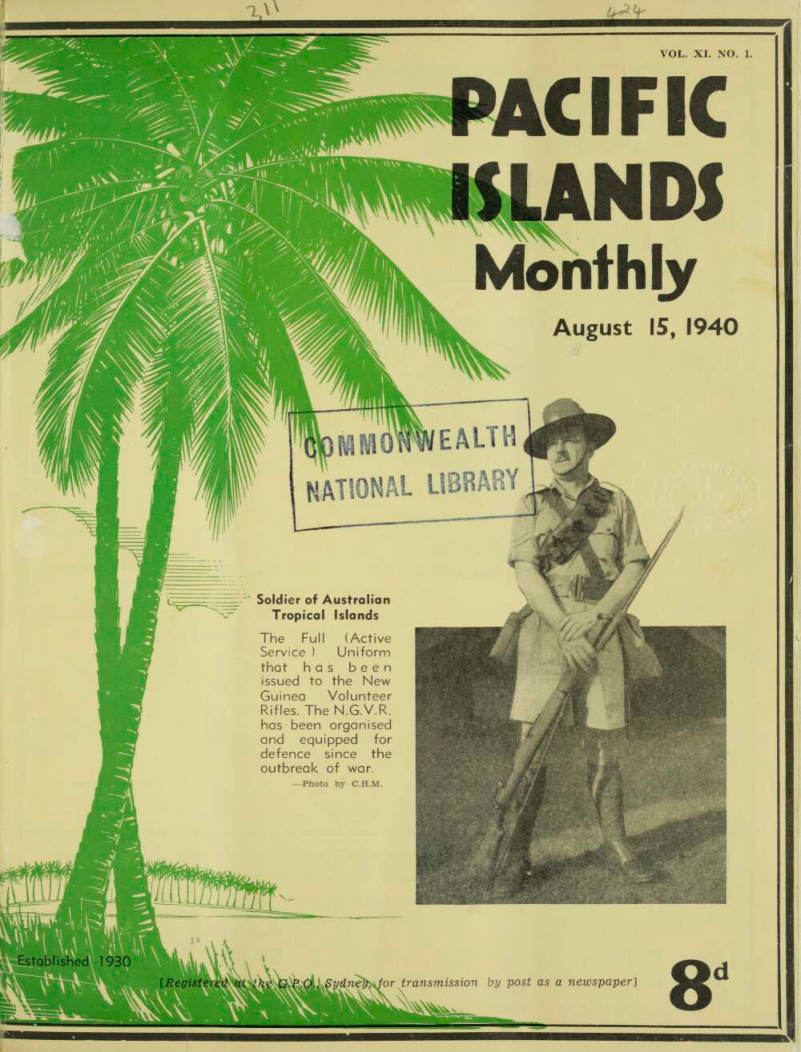
Soldier of Australian Tropical Islands The Full (Active Service ) Uniform that has been issued to the New Guinea Volunteer Rifles. The N.G.V.R. has been organised and equipped for defence since the outbreak of war. —Photo by C.H.M.
Advertisements & other items, p. 2 (1 item)
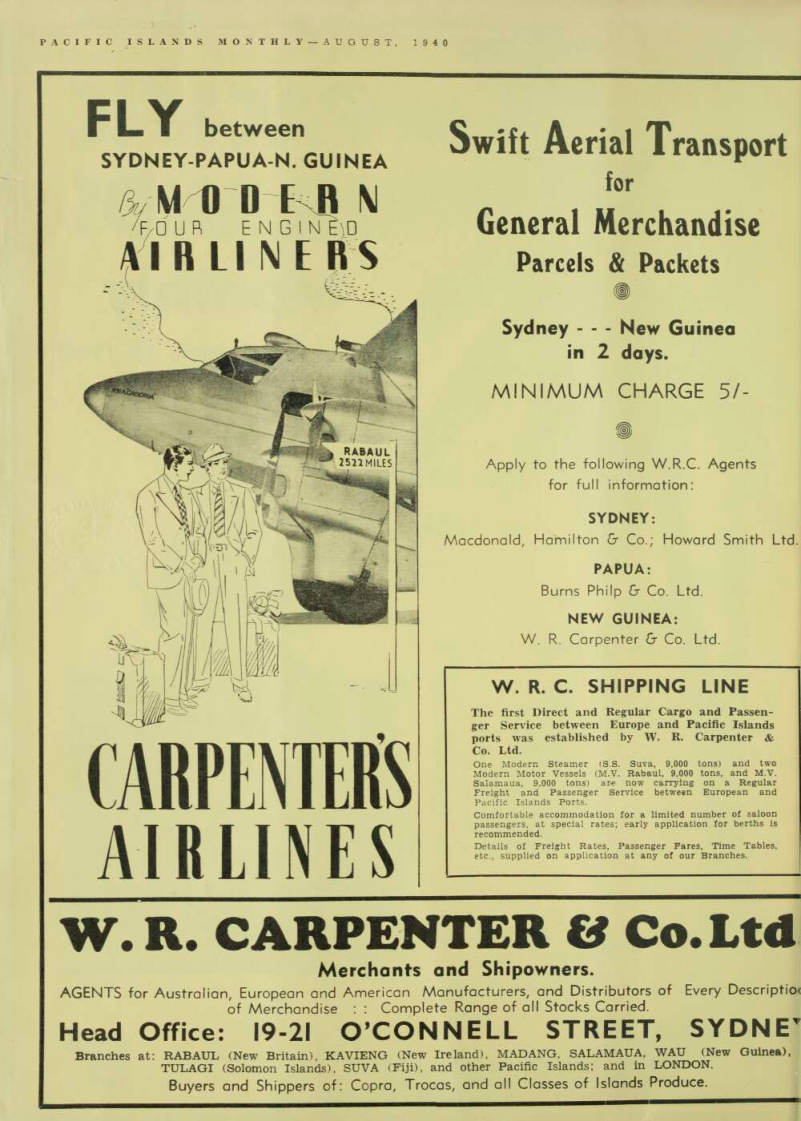
Carpenters
FLY between
SYDNEY-PAPUA-N. GUINEA
M 0 II I n N
/F/0 UR ENG I N E)D
AIRLINERS
t . -
RABAUL
2521 MILES
Lsun
CARPENTERS
AIRLINES
Swift Aerial Transport
for
General Merchandise
Parcels & Packets
Sydney - - - New Guinea in 2 days.
MINIMUM CHARGE
m.
Apply to the following W.R.C. Agents for full information:
SYDNEY:
Macdonald, Hamilton Gr Co.; Howard Smith Ltd
PAPUA:
Burns Philp Gr Co. Ltd.
NEW GUINEA:
W. R. Carpenter Gr Co. Ltd.
W. R. C. SHIPPING LINE
The first Direct and Regular Cargo and Passenger Service between Europe and Pacific Islands ports was established by W. R. Carpenter & Co. Ltd.
One Modern Steamer (S.S. Suva, 9,000 tons) and two Modern Motor Vessels (M.V. Rabaul, 9,000 tons, and M.V.
Salamaua, 9,000 tons) are now carrying on a Regular Freight and Passenger Service between European and Pacific Islands Ports.
Comfortable accommodation for a limited number of saloon passengers, at special rates; early application for berths is recommended.
Details of Freight Rates, Passenger Fares, Time Tables, etc., supplied on application at any of our Branches.
W. R. CARPENTER & Co. Ltd
Merchants and Shipowners.
AGENTS for Australian, European and American Manufacturers, and Distributors of of Merchandise : : Complete Range of all Stocks Carried.
Head Office: 19-21 O’CONNELL STREET,
Every Description
SYDNE’
Branches at: RABAUL (New Britain), KAVIENG (New Ireland), MADANG, SALAMAUA, WAU (New Guinea), TULAGI (Solomon Islands), SUVA (Fiji), and other Pacific Islands; and in LONDON.
Buyers and Shippers of: Copra, Trocas, and all Classes of Islands Produce.
Pacific News-Review
Notes And Comment On
The Progress Of The War
From July 14 To August 12
July 14: First Lord of British Admiralty, broadcasting to the United States, saia that Britain was threatened as she had not been threatened for centuries. She was now prepared to meet the invasion— her air force and her navy were ready.
July 14: One third of the Polish Army in France —estimated at about 80,000 — escaped from France when the Retain Government capitulated. It has been re equipped and re-organised in England.
July 14: Discussion continues on Japan’s demand on Britain that she close the Burma Road against war supplies being sent in to China. Meanwhile, British women and children are being rapidly evacuated from Hongkong. Most of them are going to Australia via Manila.
The preparations which are being made by the British in the Far East clearly indicate that while, every effort is being made to avoid war, the possibil ity of war is recognised.
July 15: Every day, R.A.F. fighters meet German raiders over the English coasts, while every night increasingly large for mations of British bombers strike terrific blows at aerodromes, munition dumps, factories, railway junctions, etc., in West ern Germany. All the evidence obtained through neutral channels indicates that the destruction done by the nightly R.A.F. bombing raids in Germany is very great, and demoralising.
There is a strong suggestion that tne reason why the long-awaited German in vasion does not materialise may be be cause of the damage caused to aero plane and equipment factories by R.A.F. raiders.
July 15: An agreement between Britain and Japan in relation to the Burma Road has been reached. Britain has agreed that for three months she will stop the trans port of munitions and supplies to China —such supplies having come mostly from U.S.A. and Russia.
July 16: Because the army and navy withdrew its suonort. the Japanese Cabinet led by Admiral Yunai has re signed. Prince Konoye will form a new Government, which is expected to have a much stronger pro-German leaning and to favour a Southwards thrust.
This development is obviously the out come of the Burma Road agreement.
The Nazis in Tokyo are trying to counter American support to Britain by forcing Japan into belligerency in the Pacific.
They do not want to see any agreement between Britain and Japan. Anti-British demonstrations will now be organised in Japan. But war between Britain and Japan should not be anticinated. There is a very strong body of middle-class opinion in Japan which will try to keep Japan out of the war.
July 16; Continued clashes between British and Italian forces the borders of Libya, Kenya, Somaliland, etc., have mostly been inconclusive—it is apparent that the Italians have little stomach for fight. Reports coming in of insurrections in Abyssinia are probably the result of wishful thinking. The British, however, have taken the former Abyssinian Emperor, Haile Selassie, who was de throned by Mussolini, from England to the Sudan, and it is insisted that he is going over into Abvssinia to arouse the tribesmen.
July 17: Europe tingles with rumours that Hitler will deliver an ultimatum shortly to Britain—either Britain must enter a peace conference and end the war, or be blown out of existence in a terrific German attack.
July 18; Mr. Roosevelt, by an over whelming majority, secured the Demo
cratic nomination for the Presidency, which will be decided in November. This is the first time that a retiring President has sought a third term of office. As Mr.
Willkie, the Republican nominee, is also a strong advocate of giving the utmost possible American assistance to Britain, the future of the war is not likely to be affected by the Presidential election.
Some observers, however, expect that the United States attitude towards Nazism will become stiffer after Mr. Roosevelt has been elected for a third term.
July 19: The Australian cruiser “Sydney”, 6,830 tons, caught and sank the Italian cruiser “Bartolomeo Colleoni”, 5,069 tons, in the Mediterranean. The two warships were evenly matched in gunpower, but the Italian was much faster. The “Sydney” beat her with more accurate gun fire. Another Italian cruiser escaped under a smoke screen.
July 19: Hitler, addressing a hastily summoned meeting of the Reichstag, made what he called a final appeal lo reason. He demanded that Britain forth with engage in peace discussions with a Germany which he described as being stronger than ever—otherwise he would destroy the British Empire.
July 22; Commentators say there is no possibility of Britain undertaking land operations before 1942. But, in the meantime, Britain should strive to organise revolts in German-occupied nations, and should constantly attack with her navy and her air force.
July 23: Britain has formally rejected the peace conference bait dangled by Hitler. “Britain”, said Lord Halifax, “will not cease fighting until freedom for our selves and others is secure.”
July 25: Rumania, having delivered herself into the hands of Germany and Italy, is now being carved up by those nations and, apparently, can do nothing about it. Germany has decided that Transylvania shall be transferred from Rumania to Hungary and that the Dobruja is to be transferred from Rumania to Bulgaria. Rumania will re main as a small inland state, without a port on the Black Sea. This, of course, means that all Rumanian oil and wheat will now go to Germany. Rumanians are “talking fight”, but their position is quite hopeless. The Rumanians will re ceive no sympathy—in political and economic matters they always have been the scallywags of Europe.
July 25; The Germans topedoed ana sank the French ship “Meknes”, of 6,000 tons, when she was carrying 1,300 French officers, soldiers and citizens back to France. She carried all her French colours and was brightly illu minated. The death roll is heavy. Such a callous act of murder has arousea world-wide indignation.
July 26: The R.A.F. fighters in their daily fight over the Channel to-day against Germans, who were attacking shipping convoys, shot down 28 German planes, for the loss of 5 British planes.
This, for the moment, is a record for one day.
July 26: Great annoyance is expressed by the Retain Government at the action of British airmen in distributing over France a series of leaflets giving the French people a true account of what has happened since the French-Fascist Government surrendered to Germany.
July 26: Many newspapers sharply criticise the British Government because it only now has published the news that the British liner “Lancastria”, 16,250 tons, was sunk by the enemy on June 17, when assisting the British evacuation from France. Of 5,300 refugees who were
aboard the liner, only 2,477 were picked U p—although others may be in enemy hands.
July 28: Some newspapers say that a diplomatic struggle between Germany and Russia for control of the Balkans— and especially Rumania—now occupies the centre of the European stage. But well-informed observers say that there is not the slightest sign of war develop ing between the two dictatorships.
July 29: American wai' observers say that the R.A.F, is daily establishing it self as the finest fighting force in the world and that despite Germany’s superiority in numbers of machines these British airmen clearly have a marked and growing moral ascendancy.
July 29: The arrest of 11 British busi ness men in Japan has caused a great stir. This is believed to be the first move by the new Japanese pro-German Gov ernment to force war with Britain. It is reported that the British are charged with espionage.
July 29: The R.A.F. shot down 15 enemy planes over the Channel to-day.
One British plane was lost.
July 30: The total number of British arrests in Japan is now 14. One, Mr.
Cox, who was Reuter’s agent in Japan, was killed. The Japanese say that he committed suicide. Europeans believe that he was murdered. Britain has pro tested, and is believed to contemplate strong action.
July 30; The Pan American conference at Havana unanimously adopted a reso lution providing for collective trustee ship over the westerp Hemisphere pos sessions of conquered European nations.
This is in furtherance of the Monroe doctrine, which provides that no Euro pean nation shall acquire further terri tory in America.
July 31: Japan’s attitude towards Britain is defiant. She refuses to consider any protest from Britain regarding the arrests.
July 31: The United States announces a complete ban on the export of aviation spirit and scrap iron to Britain, Japan, Germany and Italy. The ban does not affect Britain, because her needs are al ready well provided for, but it is a matter of vital importance to Japan. The Japanese are reacting furiously.
Aug. 1: The new Japanese Government announces that its foreign policy is “The construction of a new order in greater Eastern Asia, having for its foundation the solidarity of a group comprising Japan, Manchukuo and China. The zone affected would include Indo-China and the Netherlands East Indies.”
Aug. 1: Molotov, Russian Premier, out lining Russia’s foreign policy, criticised both Germany and Britain. He re affirmed the German-Soviet pact. He de clared further that Germany would not easily win the war against Britain.
Aug. 2: Britain is still protesting to Japan against the arrest of British busi nessmen. Several of the latter have now been released.
Aug. 4: Britain has arrested a number of Japanese businessmen in London and elsewhere, who have been placed under interrogation. It is stated that this has not been done in retaliation for the arrests of British.
Aug. 4: The appearance of German aeroplanes at Dakar, French West Africa, show the possibilities of the Germans advancing through France, Spain and French North Africa, and thus attacking British spheres in Africa.
Aug. 6: Anglo-Japanese position is now described as “distinctly easier”. British
are withdrawing: 1.500 troops from Shanghai—all they have there. The temper of the Japanese press is quieter.
The position may be regarded still as extremely delicate. Clearly, Germany is trying to induce Japan to embarrass Britain in Asia, while Italy attacks Britain in the Middle East and Germany launches her grand attack on Britain herself. But Japan’s extremist Govern ment, despite itself, is being affected by Britain’s firmness, by the attitude of the United States (as disclosed in the ban affecting aviation spirit) and by the steady resistance of the Japanese middle classes to the idea of an Anglo-Japanese conflict.
Aug. 6: Shiploads of British women and children, evacuated from Hongkong are now arriving in Australia, where they are being warmly welcomed and assisted economically.
Aug. 6: While reports multiply that Germany’s attack on Britain will be made from Norwegian, German and French coasts, about mid-August, there are noticeable movements of Italian troops against the British territory in Egypt and East Africa. It is estimated that there are 100,000 Italian and 150,000 native troops gathered in Libya ready to march across the desert towards Egypt, while large forces of Italians are reported also on the border of British Somaliland and East Africa. British Somaliland is a small, useless, desert-like place of little importance, except that it lies directly opposite the British fortress of Aden, near the mouth of the Red Sea.
Aug. 7: Three Italian columns from Italian Somaliland are simultaneously invading British Somaliland. The only British troops in the place, a camel corps, have been withdrawn towards the coast.
Aug. 7: There is much controversy in the United States as to whether the United States should sell 50 old destroyers zo Britain, where they are urgently needed.
It is expected that President Roosevelt will take action and let them go.
Aug. 7: In to-day’s air battles over the English coasts the R.A.F. definitely de stroyed 60 German planes, for the loss of 16 British fighters. Five ships, totalling 5,000 tons, in a convoy, were sunk, and 7 other small coasters were damaged. The R.A.F. also destroyed 15 Italian planes in Northern and Eastern Africa.
Aug. 10: There are growing indications of preparations for the invasion of Britain. Ah activity over the Channel is now almost continuous. Apart from fighting over the English coasts, the RA.F. bombers, every night, penetrate deep into Germany, causing enormous damage.
Aug. 11: The Germans attacked the British coasts to-day with about 100 planes—2oo being launched against the British naval station at Portland. Fight ing continued all day. 60 German planes are known to have been destroyed and 26 British were shot down, Aug. 12: The British troopship “Mohammed Kebir”, 7,290 tons, was tor pedoed in the Atlantic. 740 of the men aboard were saved and 120 were lost.
Aug. 12: It is reported that troops from various parts of the Empire are be ing assembled to resist the Italians in East Africa. An effort will probably be made to hold Berbera, in British Somali land.
Hon. E. P. and Mrs. Holmes, who recently spent several months’ holiday in Australia, have returned to Rabaul, New Guinea.
Lt.-Colonel N. G. Hatton arrived in Port Moresby, Papua, in July to take up duties as Commandant of the newly created Bth Military District of Papua and New Guinea.
N.G. Gold
Survey of Industry Urged
From Our Own Correspondent WAU, Aug. 3.
TO-DAY, with the Empire at war and the urgent heed for gold to purchase planes, munitions and food in U.S.A., it is strange that little effort is apparently being made in the Colonies and Territories to increase their gold out put. Morobe Goldfield here is the Cin derella of New Guinea—why has a com mittee not been formed by the Admini stration to inquire into every avenue that might lead to a greater production?
In the early days of the field, gold was plentiful—some mining teams gathered it by the 100 ounces a day. Nowadays, apart from the big companies, the small miner has to battle for every ounce, sometimes using costly sluicing plant and other machinery. Admittedly, gold was then worth only £2 an ounce against to day’s £ll.
Experienced men say that lower grade ores abound in Morobe, but costs pro hibit their working. For instance, rice (the staple diet for native labour) has advanced nearly £5 a ton within a few months and now costs over £34 a ton landed at Wau. Many prospectors find they have insufficient funds—and induce ment —to go out and seek fresh fields.
Should not the Government make a move in this direction?
After all. we’ve had commissions of in quiry looking into amalgamation, native labour, etc., but none has made a survey of the gold industry which practically has carried the Territory during the past few years.
Drop In Fiji Banana Trade
THE effect of gales and floods experi enced in Fiji early last year is seen in the lower banana exports for 1939. According to the Fiji “Agricultural Journal”, shipments to New Zealand totalled 55,865 cases compared with 149,365 cases in 1938. Exports to Canada fell from 17,656 bunches in 1938 to 1,242 in 1939; and in February the shipments to Canada ceased altogether owing to a shortage of suitable bunches.
At the invitation of the N.Z. Govern ment the Colonial Secretary and the Fiji Produce Inspector visited Wellington to discuss a new agreement for the sale of bananas on a free-on-board Suva basis.
Under the old agreement N.Z. purchased bananas at 9/1 (Fijian) per case, f.o.b.
Suva. The n p w arrangement came into operation in March and provided for the grading of bananas into two qualities— the first to be paid for at P 9 4i per case, and the second at FB/B£, f.0.b., Suva.
No less than 82.3 per cent, of exports were “A” grade and the average return was F 9 3.1 per case.
The export pool is now working satis factorily. The Fijian Producers’ Associa tion, which shares in the pool, carried on business fairly well considering the unusual difficulties encountered during the year.
Mrs. L. Mayne Anderson, formerly of the Banks Group (and more recently of Norfolk Island) was at the July meeting of the Pacific Islands Society in Sydney.
For many weeks Mrs. Anderson has been an inmate of hospital, though her health has now improved.
Mr. H. C. MacPherson has resumed duties at the Lands and Survey Office, at Rabaul. New Guinea, after furlough in Australia.
News in Brief
Papua’s draft estimates for 1940-1 show: Estimated revenue, £176,809; esti mated expenditure, £183,212 (£185,637 was spent in 1939-40). New taxes on gold and rubber, together with primage tax and higher ’phone charges, will bring in over £20,000. Deficiency in Superannuation Fund amounts to £9,399 (£6,264, the previous year).
Solomon Islands Development Co., Ltd., a copra-producer in which Burns, Philp and Co., Ltd., hold a subsidiary interest, reports, after providing £290 for depreciation, a loss of £779 for the year ended March 31. With no copra markets available overseas, further losses appear to be inevitable. The copra output for the year was 763 tons.
In the year ended March 31, 1940, the Southern Pacific Insurance Co., Ltd., a subsidiary of W. R. Carpenter and Co., Ltd., showed a net profit of £5,640 after making substantial provision for premium, reserve, unsettled claims, and taxation.
It paid a dividend at the rate of 7 per cent, per annum and carried forward £2,272. The company has an issued capi tal of 25,000 £1 shares, and 75,000 10/shares.
New offices for Burns, Philp & Co., Ltd., Rabaul, New Guinea, have been erected adjoining the Co.’s present offices in Mango Street.
Two native corporals in the Gilbert and Ellice Islands Colony Armed Con stabulary—Kaintikuaba and Keakea— have been awarded the Colonial Police and Fire Brigades Long Service Medal for long and meritorious service in the Colony.
The new Swimming Pool in Rabaul, New Guinea, was officially opened by the Administrator (Sir Walter McNicoll) on July 28.
The Indian driver of a 17-seater charabanc was kill in July when the vehicle left the road near Navesau, Fiji, and fell 81 feet into the Wainibuka River. A Fijian passenger was injured.
A slight earth tremor was felt in Port Moresby, Papua, on the evening of July 31.
It is reported from Papua that the house of Mr. William Walsh, 70, well known trader at Kaloura, Central Divi sion was burnt to the ground on July 28 and that he perished in the fire.
Mrs. E. H. Britten departed from Mel bourne recently for Rabaul, New Guinea, where her husband is attached to the District Office staff. Mrs. Britten left the Territory after the 1937 eruption, but owing to an accident whilst in Aus tralia was unable to return.
Crown Prince Tuboutoa will leave Sydney for Tonga in December in order to spend the Christmas holidays with his mother, Queen Salote. It is possible that he will travel as far as New Zealand by air. Just what the future holds for him, the Prince does not know. After obtain ing his LL.B. at the University of Syd ney, he wanted to go to Oxford to study anthropology with Professor Radcliffe Browne. The latter, by the way, was at one time headmaster of the Government College in Tonga. A family conference will be held when the Prince returns to Nukualofa to discuss his educational future. Much will depend, of course, on the length of the present war.
Pacific Islands Travellers
PER AIRLINER FROM PAPUA & N.G.; Messrs.
Ives, Hill, Davies, McConnell.
PER AIRLINER FOR PAPUA & N.G.: Messrs.
Brennan, Bertram, White.
PER AIRLINER FROM PAPUA & N.G.; Messrs.
Winters, Goodhew, Wolfe, Rowlands, Henderson.
PER AIRLINER FOR PAPUA & N.G.: Messrs.
Richardson, Taylor, Bayliss, Fitzgerald. Miss Hatherell.
PER AIRLINER FROM PAPUA & N.G.: Sir W. R. McNicoll. Messrs. Dobell, Townsend, Gee, Armstrong. Mesdames Gee, Zavattaro. Miss Ellis.
PER AIRLINER FOR PAPUA & N.G.: Messrs.
Kienzle, McKenzie.
PER AIRLINER FROM PAPUA & N.G.: Messrs.
Jentsych, Dudley, Brown, Gibson, Smith. Mrs.
Morbeth. Miss James.
Per “Macdhui” From Papua & N.G.:
Messrs. Armstrong, Benton, Benham, Byrne, Curtain, Cunningham, Chapman, Champion, Downey, Dyer, Filmer, Farrar, Finnis, Ferguson, Frame, Foley, Garland, Gilliland, Hitchcock, Hoffman, Hicks, Hammond, Harvey, Hardy, Hunt, Haynes, Hannan, Innes, Knox. Korn.
Knight, Karius, Lovell, Lowe. Lumley, Laxton, Lindley, Mott, Moon, Munro, McLeod, Maxwell, Moore, Marks, May, McDonald, Matley, Moore, Newman, Purves, Stephens, Stedman, Stewart, Swanson, Stach, Smith, Taylor, Tudor, Thurlow, Thompson, Wallace, Woolcott, Walker. Mes
dames Armstrong, Benton, Benham, Broadhurst, Boyle, Conde, Carr, Chapman, Dix, Farrar, Foley. Garland, Garrad, Horne, Heath, Hoff man, Hicks, Hammond, Hall, Hannan, Ives, Lord, Long, Lindley, Mott, McConnan, Maxwell, Ryan, Swanson, Stephens, Smith, Stach, Stevens, Thomas, Tomkins, Watkins, Woolcott, Willis, Walker. Misses Boyle, Flynn.
PER “MACDHUI” FOR PAPUA & N.G.: Messrs.
Thornton, Carfe, Jenkin, Lawes, Beavers, Whelan, Byrne, Barrell, Barrett, Bailey, Head, Schuller, Dabknett, Speedie, Rostron, McNair, Lands, Pearsall, McDonald, Dill, Webb, Sheard, Barnes, Mptley, Carden, McClelland, Aitken, Tonner, Austen, Cattell, Taylor, Fleming, Douglas, McLean, Radley, Merrylees, Barron, Dale, Doyle, Hastie (2), Dixon-Swift, Grose, Denman, Bell (2), Waugh, Fegent, Calow, Creary, Malcolm, Clarke, Leather, Rose, Good win, Young, Veal, Sheath, Walker, Donovan, Blackman, Hancock Buhl, Venners, Avery, Davies, Krebs, Middleton, Gorringe. Rev.
Williams, Rev. Ackermann. Mesdames Saunders, Poland, Barrett, Baskett, Tonner, Williams, Austen, Vesper. Cattell, Coote, Taylor, Fleming, Roberts, Doyle, Waters, Robinson, Hastie, Waugh, Rose, Goodwin, Veal. MacGregor, Day mond. Misses Fry, Fairhall, Pearse, Daymond.
PER “MORINDA” FOR LORD HOWE & NOR FOLK IS., N. HEBRIDES & SOLOMON IS..
Messrs. Buffett, Douglas, Egan, Friend, Hill (2),
Hamilton, Lawton, Lucas, Laing, Langford, Park, Sir Charles Rosenthal. Mesdames Anderson, Coulson, Egan, Hill (2), Lawton, Laing, Mit chell, McPhail, Nelson, Nobbs, Silversides, West wood, West, Adams. Lady Rosenthal. Misses Adams (2), Burkett, Fellows, Nobbs, Quintal, Walker.
Per “Malaita” For B.S.L, Piapuan &
N.G. PORTS: Messrs. Drysdale, Hanson, Hubble, Lancken, Mewton, Sefton, Toogood, Eginton, Beveridge, Brownlees, Kennedy, Smith, Stronge, Waite, Davies, Foster, Morris, Hitchcock, Quin tall, Allerton. Fathers Baldwin and Van Mechelen. Mesdames Allen, Austin, Marshall, Smith, Burchett, Stuart-Russell, Atkinson, Beveridge, Gaskell, Lotze, Train, Seton, Lawrence.
Misses Hackett, MacDonald, McConnell. Sister Marie.
Per “Neptuna” For Papuan & N.G.
PORTS: Messrs. Willson, Sawkins, Doyle, Hogan, Walker, Ewan, Hewitt, Feakes, Maclean, Money, Whelan. Rowe, Bensley, Ross, Hately, Anderson, Jones, Sully, Worth, Kirk, Napierl, Far, Doe, Spencer, Thompson, Moloney, Packwood, Abbott, Beer, Doran. Mesdames Doyle, Walker, Widdup, Ewain, Reid, George. Lucas, Gray (2), Doran, Bell, Beer, Far, Britten, Malcolm, Doe. Misses Ellis, Beer, Sly.
Per “Monterey" From Fiji: Messrs.
Erskine, Theodore, Junor, Forster, McLean, Jones, Noerr, Branster, Gill, McKeogh, Solo mons, Cant. Mesdames Lord, Junor, Pickering, Steel, Branster, Jansson, Jones, Cant. Misses
(Continued On Page 68)
Junor, Lord, Gilmore, Smythe, Anderson, Branster, Tull.
PER “WAIRUNA” FOR FIJI: Mr. and Mrs. and Miss Sachs. Misses Anderson (2).
Per “Monterey” For Fiji: Messrs. Ber
tram, Toomey, Dowson, Bark, Smith, Reeve, Cornish, Cockburn, De Tate, Francis, Hardaker, Forbes, Poo, Griffin, Gut, Horton, Inchboard, Lang, Murray. Mesdames Adams, De Tate, Hardaker, Forbes, Inchboard, Mackinnon, Nason, Snowsill, Reeve, See, Small, Walker. Misses Anderson, Hardaker, M/ackinnon (2), Mitchell, Smith, Snowsill, Walker, Wah. FOR TAHITI: Messrs. Boyce (2), Green, Miller, Seabrook, Walker, Wagner, Townshend. Mesdames Bee cham, Abadee, Banner, Eastment, Ginnever, Morrison, Mclntyre, Walker. Misses McLean, Walsh.
Advertisements & other items, p. 5 (1 item)
South Pacific Line
Linking the East with South Pacific
Islands, New Zealand and Australia
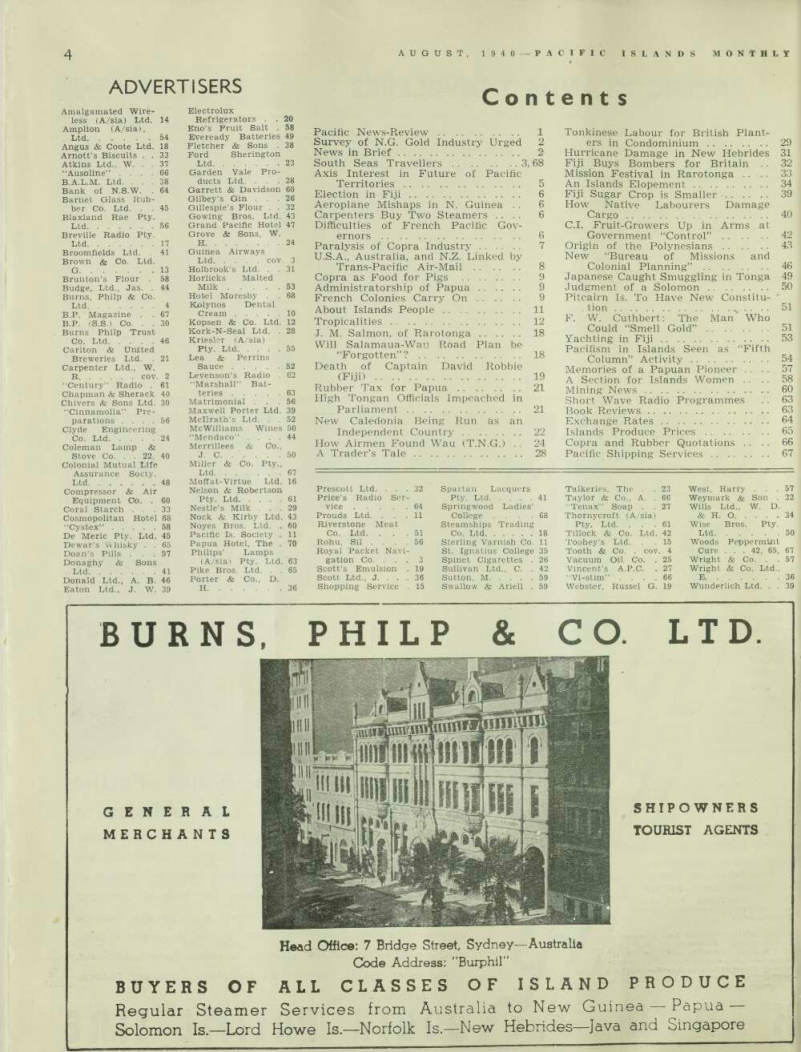
The track routes of the K.P.M.-South Pacific Line new motor vessel “Maetsuycker” and the well-known passenger steamer “Tasman” are each as follows: —“TASMAN”: Saigon, Singapore, Batavia, Samarang, Sourabaya, Port Moresby, Samarai, Port Vila, Noumea, Auckland, Wellington, Sydney, Port Moresby, Sourabaya, Samarang, Batavia, Singapore, Saigon. “MAETSUYCKER”: Saigon, Singapore, Batavia, Samarang, Sourabaya, Port Moresby, Salamaua, Rabaul, Auckland, Wellington, Sydney, Port Moresby, Sourabaya, Samarang, Batavia, Singapore, Saigon.
SOUTH PACIFIC Line
Advertisers
Amalgamated Wire less (A/sia) Ltd. 14 Amplion (A/sia), Ltd 54 Angus & Coote Ltd. 18 Arnott’s Biscuits . . 33 Atkins Ltd., W. . . 37 "Ausoline” ... 66
B.A.L.M. Ltd. ... 38
Bank of N.S.W. . 64 Barnet Glass Rub ber Co. Ltd. . . 45 Blaxland Rae Pty.
Ltd 56 Breville Radio Pty.
Ltd 17 Broomfields Ltd. . 41 Brown & Co. Ltd.
G 13 Brunton’s Flour . 58 Budge, Ltd., Jas. . 44 Burns, Philp & Co.
Ltd 4 B.P. Magazine . . 67
B.P. (S.S.) Co. . . 30
Burns Philp Trust Co. Ltd 46 Carlton & United Breweries Ltd. . 21 Carpenter Ltd., W.
R cov. 2 “Century” Radio . 61 Chapman & Sherack 40 Chivers & Sons Ltd. 30 "Clnnamolia” Pre parations ... 56 Clyde Engineering Co. Ltd 24 Coleman Lamp & Stove Co. . . 22, 40 Colonial Mutual Life Assurance Socty.
Ltd 48 Compressor & Air Equipment Co. . 60 Coral Starch ... 33 Cosmopolitan Hotel 68 "Cystex” 58 De Meric Pty. Ltd. 45 Dewar’s whisky . . 65 Doan’s Pills ... 57 Donaghy & Sons Ltd 41 Donald Ltd., A. B. 46 Eaton Ltd., J. W. 39
Electrolux Refrigerators . . 20 Eno’s Fruit Salt . 58 Eveready Batteries 49 Fletcher & Sons . 38 Ford Sherington Ltd 23 Garden Vale Pro ducts Ltd. ... 28 Garrett & Davidson 60 Gilbey’s Gin ... 26 Gillespie’s Flour . . 32 Gowing Bros. Ltd. 43 Grand Pacific Hotel 47 Grove & Sons, W.
H 24 Guinea Airways Ltd cov. 3 Holbrook’s Ltd. . . 31 Horlicks Malted Milk 53 Hotel Moresby . . 68 Kolynos Dental Cream 10 Kopsen & Co. Ltd. 12 Kork-N-Seal Ltd. . 28 Kriesler (A/sia) Pty. Ltd 55 Lea & Perrins Sauce 52 Levenson’s Radio . 62 "Marshall” Bat teries 63 Matrimonial ... 56 Maxwell Porter Ltd. 39 Mcllrath’s Ltd. . . 52 McWilliams Wines 50 "Mendaco” ... 44 Merrillees & Co., J. C 50 Miller & Co. Pty., Ltd 67 Moffat-Virtue Ltd. 16 Nelson & Robertson Pty. Ltd 61 Nestle’s Milk ... 29 Nock & Kirby Ltd. 43 Noyes Bros. Ltd. . 60 Pacific Is. Society . 11 Papua Hotel, The . 70 Philips’ Lamps (A/sia) Pty. Ltd. 63 Pike Bros. Ltd. . . 65 Porter & Co., D.
H 36
Prescott Ltd. ... 32 Price’s Radio Ser vice 64 Prouds Ltd. ... 11 Riverstone Meat Co. Ltd. ... 51 Rohu, Sil . . . .56 Royal Packet Navi gation Co. ... 3 Scott’s Emulsion . 19 Scott Ltd., J. ... 36 Shopping Service . 15
Spartan Lacquers Pty. Ltd 41 Springwood Ladies’
College ... 68 Steamships Trading Co. Ltd 18 Sterling Varnish Co. 11 St. Ignatius College 35 Spinet Cigarettes . 26 Sullivan Ltd., C. . 42 Sutton, M 59 Swallow & Ariell . 59
Talkeries, The . . 23 Taylor & Co., A. . 66 “Tenax” Soap . . 27 Thornycroft (A/sia) Pty. Ltd. ... 61 Tillock & Co. Ltd. 42 Toohey’s Ltd. . . 15 Tooth & Co. . cov. 4 Vacuum Oil Co. . 25 Vincent’s A.P.C. . 27 “Vi-stim” ... 66 Webster, Russel G. 19
West, Harry ... 57 Weymark & Son . 32 Wills Ltd., W. D. & H. 0 34 Wise Bros. Pty.
Ltd 50 Woods Peppermint Cure ... 42, 65, 67 Wright & Co. . . 57 Wright & Co. Ltd., E 36 Wunderlich Ltd. . . 39
Contents
Pacific News-Review 1 Survey of N.G. Gold Industry Urged 2 News in Brief 2 South Seas Travellers 3,68 Axis Interest in Future of Pacific Territories 5 Election in Fiji 6 Aeroplane Mishaps in N. Guinea . . 6 Carpenters Buy Two Steamers ... 6 Difficulties of French Pacific Gov ernors 6 Paralysis of Copra Industry 7 U.S.A., Australia, and N.Z. Linked by Trans-Pacific Air-Mail 8 Copra as Food for Pigs 9 Administratorship of Papua 9 French Colonies Carry On 9 About Islands People 11 Tropicalities 12 J. M. Salmon, of Rarotonga 18 Will Salamaua-Wau Road Plan be “Forgotten”? 18 Death of Captain David Robbie (Fiji) 19 Rubber Tax for Papua 21 High Tongan Officials Impeached in Parliament 21 New Caledonia Being Run as an Independent Country 22 How Airmen Found Wau (T.N.G.) .. 24 A Trader’s Tale 28
Tonkinese Labour for British Plant ers in Condominium 29 Hurricane Damage in New Hebrides 31 Fiji Buys Bombers for Britain .. 32 Mission Festival in Rarotonga ... 33 An Islands Elopement 34 Fiji Sugar Crop is Smaller 39 How Native Labourers Damage Cargo 40 C.I. Fruit-Growers Up in Arms at Government “Control” 42 Origin of the Polynesians 43 New “Bureau of Missions and Colonial Planning” 46 Japanese Caught Smuggling in Tonga 49 Judgment of a Solomon 50 Pitcairn Is. To Have New Constitu- ‘ tion v .. .. 51 F. W. Cuthbert: The Man Who Could “Smell Gold” 51 Yachting in Fiji 53 Pacifism in Islands Seen as “Fifth Column” Activity 54 Memories of a Papuan Pioneer ... 57 A Section for Islands Women ... 58 Mining News 60 Short Wave Radio Programmes . . 63 Book Reviews 63 Exchange Rates 64 Islands Produce Prices 65 Copra and Rubber Quotations ... 66 Pacific Shipping Services 67
Advertisements & other items, p. 6 (1 item)
Burns. Philp & Co. Ltd.
GENERAL
MERCHANTS
ift m f am f winf u
III!
tin
hi hi
iliu
8
SHIPOWNERS
TOURIST AGENTS
Head Office: 7 Bridge Street, Sydney—Australia Code Address: "Burphil"
BUYERS OF ALL CLASSES OF ISLAND PRODUCE Regular Steamer Services from Australia to New Guinea Papua Solomon Is. —Lord Howe Is. —Norfolk Is.—New Hebrides —Java and Singapore
Pacific islands Monthly
The Newspaper-Magazine of the South Seas
[Registered at the G.P.0., Sydney , for transmission by post as a newspaper .] Published Once Each Month and Circulated in Australia and New Zealand and in the following Pacific Territories and Islands Groups:
Australian Territory of Papua.
Mandated Territory (Australia) of New Guinea, Bismarck Archipelago and Northern Solomon Islands.
Australian Territory of Norfolk Island.
New Zealand Territory of Cook Islands.
Mandated Territory (New Zealand) of Samoa.
British Colony of FIJI.
British Solomon Islands Protectorate.
British Protectorate of Tongan Islands.
British Crown Colony of Gilbert and Ellice Islands.
Mandated Territory of Nauru.
British and French Condominium of New Hebrides.
French Colony of New Caledonia.
French Colony of Oceania (Tahiti, etc.).
American Territory of Eastern Samoa.
American Territory of Hawaiian Islands.
American Territory of Guam.
Mandated Territory (Japan) of Marshall, Caroline and Mariana Islands.
Owned and Produced by Pacific
Publications Pty. Ltd., Union House, 247 George Street, Sydney.
c Managing Director .. BW 5037 i £ Business and Editorial MA 7101
P.O. Box 3408 R
Registered Address of Telegrams. Radiograms, and Cables: “Pacpub”, Sydney.
Contributions.
Articles, Stories, and Photographs dealing with Pacific Islands subjects are Invited and will be paid for on publication at usual rates.
Subscription Rates.
Per Annum, within British Empire, Prepaid, Post Free 8/- Per Annum, elsewhere, prepaid, Post Free . 10/- Slngle Copies Bd.
Editor and Publisher:
R. W. Robson, F.R.G.S.
Assisted by Selwyn Hughes.
Advertising Manager: L. W. Bailey.
Advertising Office and Printing-House; 29 Alberta St., Sydney.
Advertising rates furnished on application.
Colours, etc by Arrangement.
Process Blocks made at Advertiser’s expense when required. Screen 100.
Changes of Advertising Copy should reach this Office by Ist of each month, otherwise previous advertisement may be repeated.
IN LONDON, the Pacific Islands Monthly is on sale at the Bookstall, Australia House, The Strand, London.
Agents.
The following are authorised to receive sub scriptions for the Pacific Islands Monthly;— Islands Branches of Burns, Phlln & Co., Ltd., and Burns Phllp (South Sea) Co., Ltd.
Islands Branches of W. R. Carpenter & Co., Ltd.
Islands Branches of Morris. Hedstrom, Ltd.
G. Thomas & Co.. Rabaul, New Guinea.
T. A, Olsson, Wau, New Guinea.
Whitten Bros., Ltd., Samaral, Papua.
Steamships Trading Co., Papua. All Branches.
B.N.G. Trading Co.. Ltd., Port Moresby.
J. Muir, Suva. FIJI.
N. C. Mackenzle-Hunt, Walnunu, Bua, FIJI.
Islands Branches and Representatives of W. H.
Grove & Sons, Ltd . Auckland. New Zealand.
Cook Islands Trading Co . Rarotonga, Cook Is.
A. C. Rowland, Papeete, Tahiti.
Representative in London; W. C. HARVEY, Coronation House. 4 Lloyds Avenue. London, E.C.3, from whom may be obtained copies of Pacific Islands Monthly, Pacific Islands Year Book, advertising schedules, etc.
Vol. Xl No. 1.
August 15, 1940
Price f 8d - Per c °py v ' c t Prepaid: 8/- p.a.
Axis Interest' in Future of Pacific Territories
A DOLF HITLER described suc cinctly in Douglas Reed’s latest book as an “epileptic mongrel” and “professional perjurer” has been issuing instructions, lately, about the future of Britain’s colonial empire; and his jackal, Mussolini, has been adding a supporting yelp.
The announcement that Papua and the Mandated Territory of New Guinea had been, for defence pur poses, formed into the Bth Australian Military District, with headquarters at Port Moresby, brought howls of rage from the German and Italian news papers, who said that this was clear evidence that Australia had annexed the former German colony. It is a great pity that Australia does not annex it: but the fact is that noth ing has been done other ;than to create a defence organisation, in the manner permitted by the terms of the mandate.
Evidently, it is assumed in Europe that the vast, rich Territory of New Guinea will be again a German colony. That pre-supposes the de feat of Britain. In course of time, the “epileptic mongrel” will discover that he cannot defeat Britain; he even may learn, as a much more able and famous personage admitted, a long time ago, that “these dogs of Englishmen don’t know when they’re beaten”.
THE fate of many rich countries, washed by the waters of the Pacific, is being decided now in
Europe. Assuming that Australia, Canada and New Zealand, in any ( event, will remain independent and " Anglo-Saxon, it would appear that the following Pacific and Asiatic territories are under Totalitarian observation: In South-east Asia : British—Burma, Malaya, Borneo, Hong Kong. French —lndo-China. Dutch—East Indies.
American—Philippines.
In Pacific : British—New Guinea, Solomons, Gilbert and Ellice, Fiji, Tonga, Samoa, Cook Is. French—New Caledonia, French Oceania. Anglo- French—New Hebrides.
Now that Hitler has missed his great opportunity (June-July. 1940) of over-throwing Britain, we may confidently expect that Britain and her Empire will survive. But what of the future of France’s colonies?
It is impossible, at this stage, to make any forecast of their fate. A completely triumphant Britain might secure the restoration of France and France’s colonies. But years may— probably will—pass before Britain gets the upper hand, and forces the Nazis out of France and Holland.
Meanwhile, she can prevent the Ger mans, and their Italian jackals, from taking possession of French and Dutch colonies. But a different posi tion exists in relation to Japan. The Japanese most urgently need such colonies as Indo-China and the East Indies; and Britain can do little to prevent their occupation by Japan.
So it is quite possible that when
Britain, four or five years hence, be gins to dictate terms to Germany, she will be faced with a fait accompli in South-east Asia, any revision of which would mean war with Japan.
DURING this same period of pos sibly four or five years, it is inevitable that the isolated French colonies of New Hebrides and New Caledonia will enter the British Commonwealth; but their ultimate fate depends upon the condition of France some years hence. Im perial France may be restored and able to take back her colonies; but we fear that, when the Huns are done with her, she will be sadly broken, and probably Communistic and anti- British.
France will rise again; but if her Imperial glory is to be temporarily obscured, we may expect to see New Caledonia and New Hebrides, at their own wish, become Australian terri tories. Only a German victory will change the condition of New Guinea: otherwise, New Guinea will become permanently a part of Australia. That is as it ought to be—the security of Australia demands that Australia shall control always the great chain of protective islands that runs around from New Guinea, in the north, to Norfolk Island, in the east. New Caledonia and New Hebrides are in that chain. In the hands of our strong ally, they were no danger to Australia. But if the post-war France is to be militarily weak or socially sick, it is inevitable that Australia will seek to control them. Their economic importance is small—not
worth making a fuss about —but their strategical value to Australia is very great.
Thousands will await, with interest, some indication of the probable fate of French Oceania—the most beauti ful and charming of all the Pacific Islands groups, yet, on account of its comparative isolation, of little im portance economically. If it does not remain in the French Empire, whence will it go? To Britain, by entering the group of South Pacific territories controlled by New Zealand? Or to the United States, as a valuable out lier of the Panama Canal? Japan might be interested, but would have difficulty in formulating a claim, as Tahitian interests are predominantly French, British and American. In the centuries to come, these islands may gain new value from the fact that they can provide important stations on the direct air-route be tween Australia and South America and (if it were desired to avoid the route via North America) between Asia and South America.
Councillors Elected In
Fiji
AN election of a European member to represent the Southern Division in the Fiji Legislative Council, held on July 20, resulted: — Alport Barker .. .. 320 votes A. A. Ragg 185 Mr. Barker was the retiring member.
On the same day, an Indian member for the Southern Division was elected, as follows; — Vishnu Deo 783 K. B. Singh 366 Mr. Vishnu Deo was the retiring mem-
ber Mr. Singh formerly was one of the Indian nominated members.
Mr. H. H. Ragg, who was returned un opposed for the Western Division, donated his election deposit of £25 to the Fiii Bomber Fund.
The'election of an Indian member for th'' North-western Division resulted:— Brahma Dass Lakshman .. 1,010 Sada Nand Maharaj .. .. 447 In this poll, no less than 293 votes were informal, spoilt or “unaccountable”.
Mr. A. H. Cresswell, of Lila-na-kaia Plantations, New Guinea, arrived in Aus tralia recently, and has joined the A.I.F.
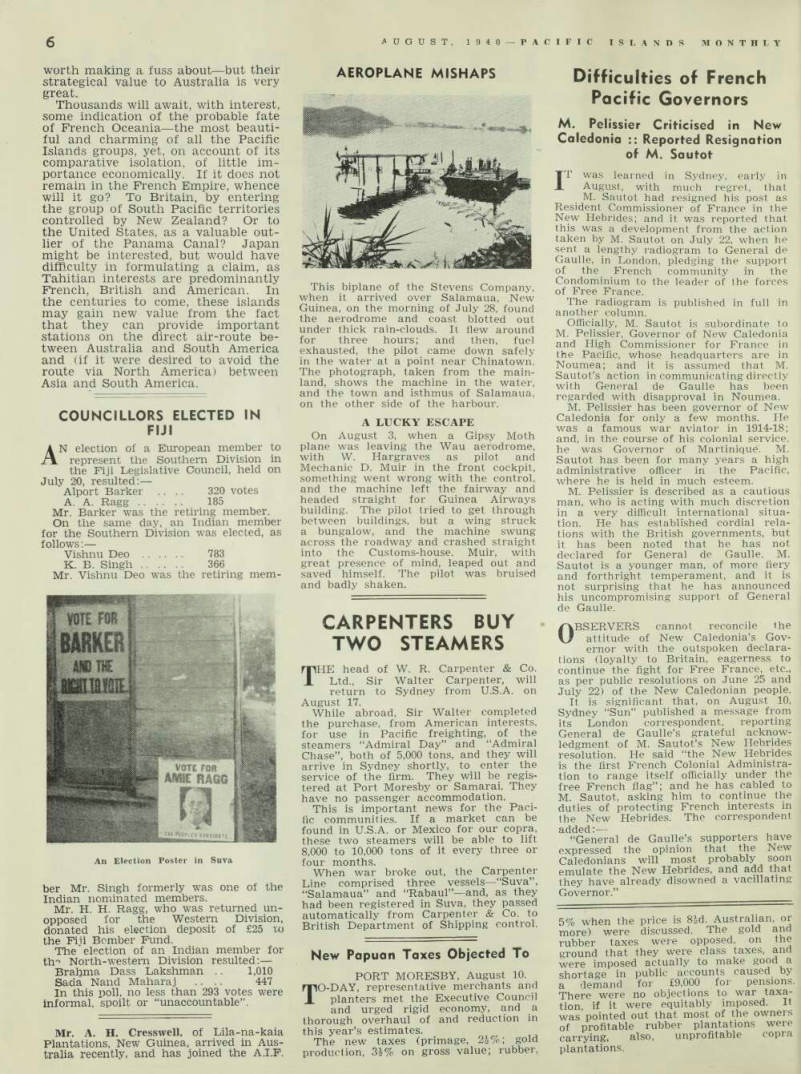
An Election Poster in Suva
Aeroplane Mishaps
This biplane of the Stevens Company, when it arrived over Salamaua, New Guinea, on the morning of July 28, found the aerodrome and coast blotted out under thick rain-clouds. It flew around for three hours; and then, fuel exhausted, the pilot came down safely in the water at a point near Chinatown.
The photograph, taken from the main land, shows the machine in the water, and the town and isthmus of Salamaua, on the other side of the harbour.
A Lucky Escape
On August 3, when a Gipsy Moth plane was leaving the Wau aerodrome, with W. Hargraves as pilot and Mechanic D. Muir in the front cockpit, something went wrong with the control, and the machine left the fairway and headed straight for Guinea Airways building. The pilot tried to get through between buildings, but a wing struck a bungalow, and the machine swung across the roadway and crashed straight into the Customs-house. Muir, with great presence of mind, leaped out and saved himself. The pilot was bruised and badly shaken.
Two Steamers
Carpenters Buy
THE head of W. R. Carpenter & Co.
Ltd., Sir Walter Carpenter, will return to Sydney from U.S.A. on August 17.
While abroad, Sir Walter completed the purchase, from American interests, for use in Pacific freighting, of the steamers “Admiral Day” and “Admiral Chase”, both of 5,000 tons, and they will arrive in Sydney shortly, to enter the service of the firm. They will be regis tered at Port Moresby or Samarai. They have no passenger accommodation.
This is important news for the Paci fic communities. If a market can be found in U.S.A. or Mexico for our copra, these two steamers will be able to lift 8,000 to 10,000 tons of it every three or four months.
When war broke out, the Carpenter Line comprised three vessels —“Suva”, “Salamaua” and “Rabaul”—and, as they had been registered in Suva, they passed automatically from Carpenter & Co. to British Department of Shipping control.
New Papuan Taxes Objected To
Port Moresby, August 10.
TO-DAY, representative merchants and planters met the Executive Council and urged rigid economy, and a thorough overhaul of and reduction in this year’s estimates.
The new taxes (primage, 21%; gold production, 31% on gross value; rubber,
5% when the price is Sid. Australian, or more) were discussed. The gold and rubber taxes were opposed, on the ground that they were class taxes, and were imposed actually to make good a shortage in public accounts caused by a demand for £9,000 for pensions There were no objections to war taxa tion, if it were equitably imposed. It was’pointed out that most of the owners of profitable rubber plantations were carrying, also, unprofitable copra
plantations.
Pacific Governors
Difficulties of French Pacific Governors M. Pelissier Criticised in New Caledonia :: Reported Resignation of M. Sautot
IT was learned in Sydney, early in August, with much regret, that M. Sautot had resigned his post as Resident Commissioner of France in the New Hebrides; and it was reported that this was a development from the action taken by M. Sautot on July 22, when he sent a lengthy radiogram to General de Gaulle, in London, pledging the support of the French community in the Condominium to the leader of the forces of Free France.
The radiogram is published in full in another column.
Officially, M. Sautot is subordinate to M. Pelissier, Governor of New Caledonia and High Commissioner for France in the Pacific, whose headquarters are in Noumea; and it is assumed that M.
Sautot’s action in communicating directly with General de Gaulle has been regarded with disapproval in Noumea.
M. Pelissier has been governor of New Caledonia for only a few months. He was a famous war aviator in 1914-18; and, in the course of his colonial service, he was Governor of Martinique. M.
Sautot has been for many years a high administrative officer in the Pacific, where he is held in much esteem.
M. Pelissier is described as a cautious man, who is acting with much discretion in a very difficult international situa tion. He has established cordial rela tions with the British governments, but it has been noted that he has not declared for General de Gaulle. M.
Sautot is a younger man, of more fiery and forthright temperament, and it is not surprising that he has announced his uncompromising support of General de Gaulle.
OBSERVERS cannot reconcile the attitude of New Caledonia’s Gov ernor with the outspoken declara tions (loyalty to Britain, eagerness to continue the fight for Free France, etc., as per public resolutions on June 25 and July 22) of the New Caledonian people.
It is significant that, on August 10, Sydney “Sun” published a message from its London correspondent, reporting General de Gaulle’s grateful acknow ledgment of M. Sautot’s New Hebrides resolution. He said “the New Hebrides is the first French Colonial Administra tion to range itself officially under the free French flag”; and he has cabled to M. Sautot, asking him to continue the duties of protecting French interests in the New Hebrides. The correspondent added: — “General de Gaulle’s supporters have expressed the opinion that the New Caledonians will most probably soon emulate the New Hebrides, and add that they have already disowned a vacillating Governor.”
Paralysis Of Copra Industry
Buyers Virtually Cease Operations :: But Government Assistance Promised
THE copra industry of the South Pacific faces the greatest crisis of its history. The European copra market has disappeared. Great Britain has six months’ supply. Even if there were markets, freighters can not be spared from urgent war work to lift the copra from the Islands
ports.
Governments are now planning to give sustenance relief to planters, in the hope that plantations somehow can be carried on until a market is available.
It should not be assumed, from this, that the Pacific Territories are “ruined”.
That might have been the case ten years ago. But, now, nearly all Territories have alternative industries, all of which are booming. The coconut planters are hard hit: but producers of rubber, cocoa, coffee, sugar, oranges and bananas, and all gold-mining concerns, are doing very well. Only two small territories, Solo mons and Gilbert and Ellice, are now solely dependant on copra.
Hereunder is a summary of the month’s events in the copra industry.
Aid For Australian Coconut
Planters
ON August 12 the Minister in Charge of Australia’s Pacific Territories was asked by the “Pacific Islands Monthly” if he could make a statement of the position in relation to the copra industry in the Islands; and Mr. Nock made the following information available.
During the past month, the parlous condition of the copra industry in Papua and the Mandated Territory of New Guinea has been very carefully examined by the Commonwealth officials concerned, who have had the assistance of the Administrator of New Guinea, Sir Walter McNicoll (who has made a spe cial visit to Australia) and they also have had advice by radio in relation to the situation from Papua and other places.
Mr. Nock indicated that it obviously was impossible to do anything on the basis of financing the output of copra.
Copra cannot be stored indefinitely; the market overseas now was extremely limited and apparently was fully sup plied at the moment; and in any event there were insufficient freighters avail able to lift the copra from the Islands ports for carriage overseas —all ships were needed for other purposes.
It has been decided, however, to recommend to the Commonwealth Gov ernment the adoption of a plan whereby necessitous planters in Papua and New Guinea would be tided over the present difficult period. This would be temporary financial assistance to planters, pending the formulation of a scheme whereby the industry as a whole could be assisted to carry on during the period of difficulties created by the war. The method employed would be similar to that used by the Farmers’ Relief Board which operates in N.S.W. The assist ance given would be in the shape of advances, which would carry interest at the rate of 4 per cent.
In reply to a comment by the “P.1.M.”, that such a system merely would add to the debts and future embarrassments of the plantation owners, the Minister
said that the utmost consideration would be given individual cases, as was done by the Farmers’ Relief Board of the mainland.
It was gathered in conversation with the Minister that the plan is now in process of formulation, and it is hoped to put it into operation at an early date; that it may be necessary to appoint a special committee to deal with this method of giving relief; and that, of course, some method of close co operation between the Governmental authorities, the big firms and the individual planters would have to be devised.
The financial assistance that is being made available to Australian-Pacific planters is believed in some quarters to have been made available by London, and not by the Commonwealth Govern ment.
It was officially announced in New Guinea on July 26 that “the Govern ment has made arrangements to afford interim relief in the form of recover able loans to employers, other than companies, who are engaged in planting and who notify in writing that they are unable otherwise to meet their obliga tions.
“Under this interim form of relief, the Administrator will advance money to pay current wages of native labourers, and to pay-off time-expired labourers, pay the cost of their sustenance pend ing repatriation and the cost of their repatriation.”
Position In Papua
IT is presumed that the same form of relief is being given in Papua.
In Port Moresby, in response to an inquiry from Canberra, the Acting Administrator (Mr. Champion) called a meeting of planters on July 29, to supply information and make sugges tions. It was ascertained that, last year, in Papua, companies produced 5,500 tons of copra, and individuals 4,000 tons, at an average cost of £7/5/- per ton, f.o.b. port of shipment. Over 4,000 tons now are on hand, awaiting ship ment, representing £29,000. Over 6,000 natives are employed in the industry.
It was urged that, if production must cease, planters be assisted at the rate of £3 per ton on last year’s production, which would at least allow maintenance of plantations.
IT was announced in this journal, in July, that the principal trading firms had virtually ceased to buy copra in the Solomons, New Hebrides and the Mandated Territory of New Guinea.
Barter System In Fiji
HAVING bought copra to the limit of their financial capacity and their storage, the big firms operat ing in Fiji announced that, after July 24, they could no longer purchase copra on a cash basis. Hitherto, the firms have bought copra whenever submitted, at some price; but, now, they will accept it only on a barter basis. This means that they will take copra, at a price to be arranged, from their regular cus tomers, in return for goods or service.
But they will not accept copra from anyone, and they will not, in any cir cumstances, pay cash for it.
The firms say that, as it means a
continued increase in their stored and unsaleable copra, even this system will embarrass them.
The Governor of Fiji, recognising the serious position that is developing in Fiji, and other territories under his care (Solomons, Gilbert and Ellice, New Hebrides and Tonga, especially), owing to the absence of a copra market, has been actively conferring with planters and merchants, and has made an urgent appeal to London.
There is a gleam of hope in a state ment made in the House of Commons on July 24 by the Under-Secretary for the Colonies, who had been asked about the present inability of the British Gov ernment to draw “a substantial portion” of its copra needs from the Pacific (especially Fiji and other territories in the Western Pacific) as it wished to do.
He said the Government was urgently considering the position of the copra trade of the Colonial Empire with a view to ameliorating matters.
It was reported in Sydney on August 12 that Japanese buyers are offering £9 per ton, Suva, for Fiji copra. There is no confirmation of this report.
How Long Can Copra Be Stored?
IN July we wrote to the Department of Agriculture, New Guinea, and asked how long copra can be held in store. Hon. George Murray, Direc tor, replies: “This Department, in the past few years, has made three authori tative tests and has proved that well cured copra, with not more than 5% moisture content, can be stored for 15 to 18 months.”
Mr, Murray adds that New Guinea has storage capacity for 30,000 tons, and that he had been informed that Messrs.
Burns, Philp & Co. Ltd. would store in bulk on their own plantations.
Another correspondent says that coco nut oil, if thoroughly refined, will keep indefinitely. He urges that the Com monwealth Government should use some of New Guinea’s rich gold revenues for the establishment of a big copra crush ing plant in Port Moresby, where hydro electric power presently will be avail able, and where there is plenty of cheap labour. Port Moresby would be a suit able collecting point for copra from all over the Western Pacific.
So far as the Australian territories are concerned, it is being urged that the situation would be saved if Britain would contract to take 50,000 tons of copra p.a. from New Guinea and Papua.
It also is argued that, if Territories shippers were allowed to operate at a free exchange rate, instead of the official conversion rate, 30,000 tons of copra could be sold annually to Mexico.
Another suggestion is that U.S.A. be asked to modify the internal processing tax on oil extracted from copra, which at present gives copra from the Philip pines a preference of 2 cents, a pound over copra from any other source, thus closing the U.S. market to Pacific copra.
One serious effect of the present paralysis of the copra market is the withdrawal from service of many of the small inter-island vessels, especially those run on a fairly regular schedule by the big firms. This will cause great inconvenience and hardships to Euro pean residents on the more isolated islands.
“The Morobe News”, the first news paper printed on the Morobe Goldfields, New Guinea, was published on July 20 at Wau, by Mr. John Wholey. It has six pages, each of four columns.
Included Shortly
United States, Australia and New Zealand Now Linked by Trans-Pacific Air-Mail Fiji Omitted From Inaugural Flights, But May Be Included Shortly
T>AN American Airways’ Boeing flying-boat “American Clipper”, which left San Francisco on July 12, arrived in Auckland, N.Z., on July 18, just as Tasman Empire Airways flying-boat “Awarua” arrived from Sydney. Thus was inaugurated, under Anglo-American co-operation, a Trans-Pacific air-mail service that will have an incalculable effect upon the future of the Pacific nations and territories.
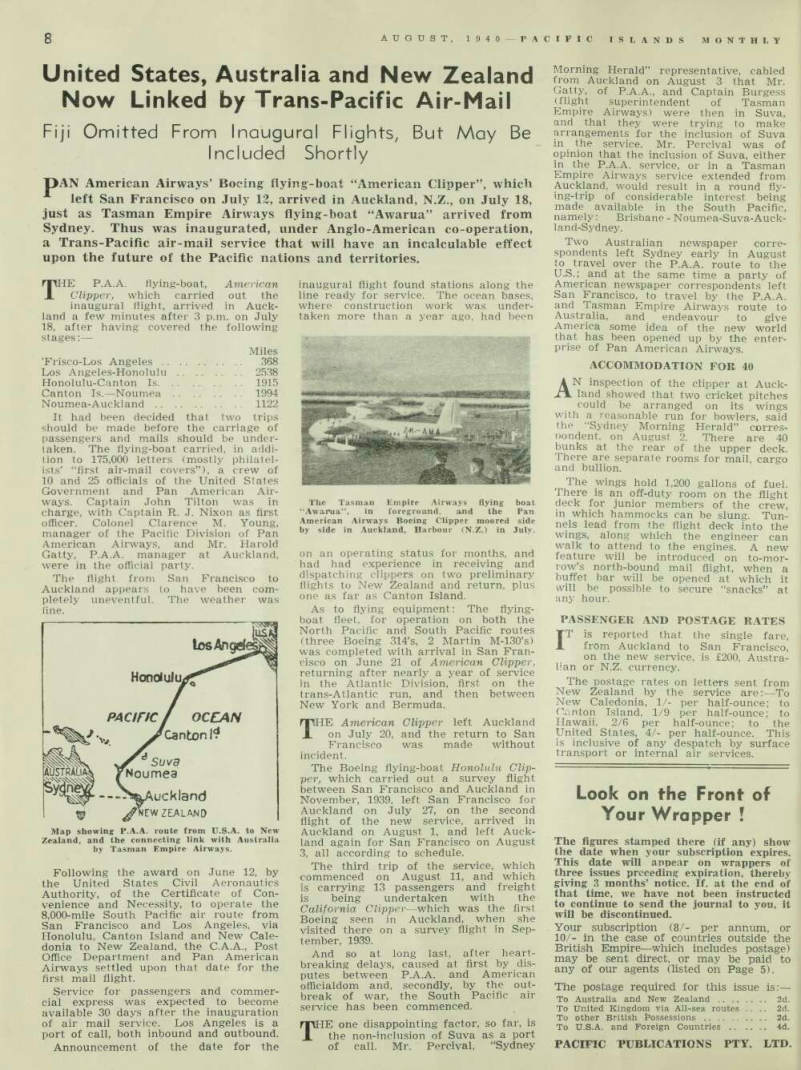
THE P.A.A. flying-boat, American Clipper, which carried out the inaugural flight, arrived in Auck land a few minutes after 3 p.m. on July 18, after having covered the following stages:— Miles 'Frisco-Los Angeles 368 Los Angeles-Honolulu 2538 Honolulu-Canton Is 1915 Canton Is.—Noumea 1994 Noumea-Auckland 1122 It had been decided that two trips should be made before the carriage of passengers and mails should be under taken. The flying-boat carried, in addi tion to 175,000 letters (mostly philatel ists’ “first air-mail covers”), a crew of 10 and 25 officials of the United States Government and Pan American Air ways. Captain John Tilton was in charge, with Captain R. J. Nixon as first officer. Colonel Clarence M. Young, manager of the Pacific Division of Pan American Airways, and Mr. Harold Gatty, P.A.A. manager at Auckland, were in the official party.
The flight from San Francisco to Auckland appears to have been com pletely uneventful. The weather was fine.
Following the award on June 12, by the United States Civil Aeronautics Authority, of the Certificate of Con venience and Necessity, to operate the 8,000-mile South Pacific air route from San Francisco and Los Angeles, via Honolulu, Canton Island and New Cale donia to New Zealand, the C.A.A., Post Office Department and Pan American Airways settled upon that date for the first mail flight.
Service for passengers and commer cial express was expected to become available 30 days after the inauguration of air mail service. Los Angeles is a port of call, both inbound and outbound.
Announcement of the date for the
inaugural flight found stations along the line ready for service. The ocean bases, where construction work was under taken more than a year ago, had been
on an operating status for months, and had had experience in receiving and dispatching clippers on two preliminary flights to New Zealand and return, plus one as far as Canton Island.
As to flying equipment: The flying boat fleet, for operation on both the North Pacific and South Pacific routes (three Boeing 314’s, 2 Martin M-130’s) was completed with arrival in San Fran cisco on June 21 of American Clipper, returning after nearly a year of service in the Atlantic Division, first on the trans-Atlantic run, and then between New York and Bermuda.
THE American Clipper left Auckland on July 20, and the return to San Francisco was made without incident.
The Boeing flying-boat Honolulu Clip per, which carried out a survey flight between San Francisco and Auckland in November, 1939, left San Francisco for Auckland on July 27, on the second flight of the new service, arrived in Auckland on August 1, and left Auck land again for San Francisco on August 3, all according to schedule.
The third trip of the service, which commenced on August 11, and which is carrying 13 passengers and freight is being undertaken with the California Clipper —which was the first Boeing seen in Auckland, when she visited there on a survey flight in Sep tember, 1939.
And so at long last, after heart breaking delays, caused at first by dis putes between P.A.A. and American officialdom and, secondly, by the out break of war, the South Pacific air service has been commenced. rE one disappointing factor, so far, is the non-inclusion of Suva as a port of call. Mr. Percival, “Sydney
Morning Herald” representative, cabled from Auckland on August 3 that Mr.
Gatty, of P.A.A., and Captain Burgess (flight superintendent of Tasman Empire Airways) were then in Suva, and that they were trying to make arrangements for the inclusion of Suva in the service. Mr. Percival was of opinion that the inclusion of Suva, either in the P.A.A. service, or in a Tasman Empire Airways service extended from Auckland, would result in a round fly ing-trip of considerable interest being made available in the South Pacific, namely: Brisbane - Noumea-Suva-Auck land-Sydney.
Two Australian newspaper corre spondents left Sydney early in August to travel over the P.A.A. route to the U.S.; and at the same time a party of American newspaper correspondents left San Francisco, to travel by the P.A.A. and Tasman Empire Airways route to Australia, and endeavour to give America some idea of the new world that has been opened up by the enter prise of Pan American Airways.
Accommodation For 40
AN inspection of the clipper at Auck land showed that two cricket pitches could be arranged on its wings with a reasonable run for bowlers, said the ‘‘Sydney Morning Herald” corres pondent, on August 2. There are 40 bunks at the rear of the upper deck.
There are separate rooms for mail, cargo and bullion.
The wings hold 1,200 gallons of fuel.
There is an off-duty room on the flight deck for junior members of the crew, in which hammocks can be slung. Tun nels lead from the flight deck into the wings, along which the engineer can walk to attend to the engines. A new feature will be introduced on to-mor row’s north-bound mail flight, when a buffet bar will be opened at which it will be possible to secure “snacks” at any hour.
Passenger And Postage Rates
IT is reported that the single fare, from Auckland to San Francisco, on the new service, is £2OO, Austra lian or N.Z. currency.
The postage rates on letters sent from New Zealand by the service are:—To New Caledonia, 1/- per half-ounce; to Canton Island, 1/9 per half-ounce; to Hawaii, 2/6 per half-ounce; to the United States, 4/- per half-ounce. This is inclusive of any despatch by surface transport or internal air services.
Map showing P.A.A. route from U.S.A. to New Zealand, and the connecting link with Australia by Tasman Empire Airways.
The Tasman Empire Airways flying boat “Awarua”, in foreground, and the Pan American Airways Boeing Clipper moored side by side in Auckland, Harbour (N.Z.) in July.
Advertisements & other items, p. 10 (1 item)
Your Wrapper !
Look on the Front of
The figures stamped there (if any) show the date when your subscription expires.
This date will appear on wrappers of three issues preceding expiration, thereby giving 3 months’ notice. If, at the end of that time, we have not been instructed to continue to send the journal to you, it will be discontinued.
Your subscription (8/- per annum, or 10/- in the case of countries outside the British Empire—which includes postage) may be sent direct, or may be paid to any of our agents (listed on Page 5).
The postage required for this issue is:— To Australia and New Zealand 2d.
To United Kingdom via All-sea routes .. .. 2d.
To other British Possessions 2d.
To U.S.A. and Foreign Countries 4d.
PACIFIC PUBLICATIONS PTY. LTD.
Copra as Food For Pigs
Interesting N.Z. Experiment
MR. H. M. Rushworth, Auckland pre sident of the N.Z. Farmers’ Union, visited Fiji recently and arranged for a shipment of two tons of copra to the Dominion. He paid £8 for the two tons, but the landed cost in New Zea land was £lB/7/-.
According to the “N.Z. Herald”, this copra will be distributed among N.Z. pig farmers, who will experiment with it both alone and with a combination of other foodstuffs. If it proves a success as a food, the Government may be approached for facilities to deal with the commodity on a large scale. Landing costs could be substantially reduced, and exchange eliminated by importing from Western Samoa.
Mr. Rushworth said the important thing to be ascertained first was infor mation concerning the precise food value of copra and its effect in producing bacon. He had been told by the Fiji Director of Agriculture that the protein content was very high, and might make the bacon fat and flabby unless topped off with some hardening substance, such as skim-milk.
The idea is excellent; but although copra sheds all over the Pacific are filled to capacity„ copra at £4 per ton is hardly profitable for European planters —in fact, it would barely pay the cost of production and shipment to central ports.
Death Of Fiji Pioneer
Mr. Herbert Charles Swann
a period of 70 years—from 1868 until 1938 —Mr. Herbert Charles Swann was a resident of Fiji, and he saw that important group change from “The Cannibal Isles” into one of the leading Colonies of the - British Empire.
He was born in New Zealand, and went to Fiji with his parents when only a few weeks old. During his life, he was en gaged in coconut planting and inter- Island trading, and for many years he t*as a member of the staff of Messrs.
Burns, Philp & Co., Ltd., Levuka. It was Mr. Swann’s father, the late Mr. James Sutler Swann, who established the busi ness of a retail chemist in Levuka, about 1870, and who, with members of his family, extended the business to Samoa and to Suva in later years. Although a number of generations have come and gone, Swann’s big business is still in existence, and the shop is one of the landmarks of Suva to-day.
Mr. H. C. Swann, two years ago, re tired from Fiji, at the age of 70, and he died in Auckland, at the residence of his son, last month. He is survi/ed by his wife, nine children, 23 grand-children, and 4 great-grand-children.
The "Bulolo"
THE following report by the Australian Associated Press will interest readers in Papua and New Guinea: A Retain Government communique, issued after a Cabinet meeting, declared that the British “cruiser”, “Bulolo”, which had been anchored at Duala (Cameroons, West Africa) since June 24, was replaced by the “Dragon” on July 21, when armed British patrols landed and marched through the town.
Mr. A. Sherwin arrived in Madang, T.N.G., recently, to take up duties in W.
R. Carpenter & Co.’s branch.
be an administrator in the fullest sense of the term, and would not be a figure head.
It is unlikely that an appointment will be made to Papua before the Minister has had an opportunity of visit ing both Territories and meeting a number of men who are interested in the appointment: and it is unlikely that the present Minister will be able to make that visit before the Common wealth general election.
The belief held in some quarters that, as a result of Papua and New Guinea being formed into an Australian military district, with headquarters in Port Moresby, it is necessary that a high military official be appointed Administra tor of Papua, is not regarded seriously in Ministerial circles.
One Minister said to the editor of the “P.1.M.”: “Why should we appoint another military officer? If we want military service in connection with the newly-formed military district, we have a highly-graded military officer at Rabaul, in the person of Sir Walter McNicoll, whose services presumably would be available for the benefit of the entire military district. What is needed is a highly qualified administra tor for Papua, who may be expected to assist the progress of that Territory and make it self-supporting in an economic sense.”
Likely
Administrator Of
Papua
No Early Appointment Likely
THERE is no immediate prospect of an appointment being made to the vacant position of Administrator of Papua.
The Papua Bill, which was introduced into the Australian Parliament some months ago, and which is designed to bring the Papuan Administration somewhat into line with that of New Guinea, passed all stages on August 8.
Members took the opportunity to dis cuss Territory affairs with considerable vigour, and the Bill was strongly opposed by Mr. A. E. Green and others, on the ground that it tended to cen tralise the administrative machinery in Canberra, and make the Administrators of Papua and New Guinea complete “figureheads”.
The Minister in Charge (Mr. Nock> declared that the man who would be appointed to administer Papua would
With this issue of the ‘ P.I.M.”, accom panying all copies addressed to New Caledonia, New Hebrides and French Oceania, there has been circulated a special “Supplement*’, in French. It contains a report of the notable address to French Colonists, made in Port Vila, New Hebrides, by M. Sautot, Resident Commissioner, on July 22, and the full text of M. Santot’s radiogram, in French, to General de Gaulle. We have been glad to publish this supplement, for the information of our many French sub scribers, in the three Territories named : the statements of M. Sautot may be an encouragement to them, in the tragic hours through which their great nation is passing.
Immortelle! ’
‘Vive La France Immortelle! ’
French Colonies Carry on Bravely, in Association With Great Britain
FOLLOWING a period of nervousness and commercial and financial chaos —the natural result of being cut off suddenly and completely from the Mother Country—the French Colonies in the Pacific, late in July, returned to normal life, in close association with the British Colonies and Dominions.
As described in an article on page 22, Australia has helped New Caledonia to restore partially her economic situation; and a new trade between the two coun tries is rapidly developing.
The French community in the New Hebrides also is forming a closer com mercial relationship with Australia; while French Oceania, of which Tahiti is the principal unit, is turning to Aus tralia and New Zealand for most of its requirements. It is not known exactly what is happening in French Oceania— that important French Colony, in a shipping sense, is extremely isolated— but it is assumed that, like New Caledonia, Oceania is carrying on under its own administrative power.
In fact, if not officially, these French Colonies are under the protection of Great Britain; and recognition of the fact is seen in the warm and cordial relationship that exists at present be tween the French citizens in the different colonies and their British neighbours.
The Australian Government made a satisfactory arrangement with the Governor of New Caledonia for the maintenance of economic relations. Mr.
B. C. Ballard, who has represented Australia in certain directions in the New Hebrides, is now official represen tative of Australia in Noumea.
The Governor of New Caledonia, addressmg the Conseil-Generale in Noumea on July 22, expressed his grati tude to the Prime Ministers of Austra lia and New Zealand, and the High Commissioner for the Western Pacific (Sir Harry Luke) for assistance given him in making arrangements which would allow the French colonies in the Pacific to be carried on despite the severence of their communications with the Home Government.
In Port .Vila, on July 20, a large meeting, representing most of the French people in the New Hebrides, heard an address by M. Sautot (French Resident Commissioner in the New Hebrides) in which the general situation was explained; and the meeting, prac tically unanimously, acclaimed the action of the Commissioner in sending to General de Gaulle, in London, leader of free Frenchmen in the French Empire, a radiogram, an English trans lation of the text of which is reproduced on the next page.
The two chief problems facing the three French Colonies in the South Pacific are transportation, and markets for their products. The French South Pacific Line, between France and the French Pacific colonies, via the Panama Canal, has ceased running, and the French colonies are now dependent to a large degree on the ships of other coun tries. New Caledonia and New Hebrides fall naturally into the Australian ship ping orbit, and can be serviced; but the position of French Oceania is a little
difficult. There has been some expecta tion that the Matson Line (running between San Francisco and Australia) will alter its course to include Papeete, the chief town of Tahiti, but there is no indication of this, up to the present date.
There is only a limited market now for the products of the French Colonies.
Australia is taking as much as possible of the New Caledonian metals, but she cannot take all. There is some demand for the cocoa and coffee of New Hebrides, and the vanilla of Tahiti; but the copra of the three Colonies, which previously had a protected market in France, now must enter an exceedingly depressed market, along with the copra of British and Dutch Colonies.
Radiogram to General de Gaulle
The following is a translation of the radiogram sent on July 20, by M. Henri Sautot, Resident Commissioner of France in the New Hebrides, to London, to General de Gaulle, Chief of the Forces of Free France:— “In the name of the French people of the New Hebrides, I transmit the follow ing message to Your Excellency: ‘ln view of the fact that the official government of France is no longer free or independent, we must endeavour to restore our Motherland by employing, to that end, all the forces of the French Colonial Empire which are intact. ‘ln view, also, of the facts that the only chance of salvation for France rests in the victory of our noble Ally, Great Britain; and that His Brittanic Majesty’s Government has appealed for the co-operation of all French colonies in pursuing the struggle to the bitter end. promising in return all assistance, poli tical, economical and financial, and the aforesaid Government having recognised Your Excellency as the only legal head of the Free French beyond the seas; and in further consideration of the fact that Your Excellency has on many occasions expressed our desire to struggle side-by side with Great Britain for the honour of our flag, for the liberation of the Motherland and for the respect of our pledged word, the French population of the New Hebrides place themselves, with confidence and respect, under Your Excellency’s authority, and place at your disposal all their members who are able to bear arms. ‘The French population of the Neiv Hebrides — who, for forty years, have worked in the Condominium at the side of our English friends, whom we have come to appreciate and to admire —ask you to accept this unanimous declara tion as an unshakeable resolution to struggle with you until final victory is attained. ‘The Fi'ench Adyninistration of the Condominium, and the Resident Com missioner of France are associated to the fullest extent in this declaration and range themselves with pride under your flag. ‘Long live immortal France! Lorig live England! ‘A copy of this declaration has been placed by me in the hands of the Resi dent Commissioner of the Government of His Brittanic Majesty.’”
Mr. J. H. Jones, of the New Guinea District Services Department passed through Rabaul at the end of July on his way to Wewak to take up duties as District Officer. He recently has been in Australia on leave.
Advertisements & other items, p. 12 (1 item)
Po You Know
HR ODOR. f PJ CiW
MOMMSEN *V^(
N&7-/OO3J THE EXPERT O*L.
m ROMAN TIMES, wrote that the
DECAY of XM. ROMAN EMPIRE FOLLOWED
the DECAY o£the TEETH-of ROMAN C IT/ZENS - LMPL Y/ARr THAT THE SOFT
l FOOD KEPT NEITHER THEIR TEETH-
IVOR THE/R BRA/A/ /A/ COOP ORDER..
SOFT FOOD LEAVES PARTICLES
WEP6EP BETWEEN Th-E CREVICES
a. OF TH-E TEETH-. THESE START RENTAL
If DECAY. KOLYNOS RE move 3
38
' THESE PA NOE ROUS
PART/CLES - LEAVES
TEETH SPARKLING %
h/TH NEW A
IOVEL/NESS
CvrXS
SC ’A N. \ 9 T/i there are
CASES ON
RECORD of
BOYS WHO HAVE .
rf* 1 N
oytiy/*&
AS A RESULT $f OAO
AFTER FACIN6-Fhe JUVENILEr »i
CODKT their TEETH HAVE jgf
BEEN F/XEP , AHE=>
COMPLETE N! CNR AC-
RE FORM FOLLOWED
\os StaPtß WHEN TINY FOOD DEPOSITS
Jg? ARE LEFT BETWEEN THE TEETH
iff T 0 DECAY. KOLV/YOS Sw/RCS RUrHT Poctors say many between then <\ FLOATS those SERIOUS illnesses deposits away and k/lls pental.
CAM BE TRACES? £$ DECAY OERMS. NOCVAS OS CLEANS PiRECTLY SUROICALLY an.p leaves teeth^
TO OLE AM! NO E OUST£N/N6
DENTALfwr&r^ nm & - ju^
LASTS TW/CE ASLOHC AS
ORP/HATY DENTAL CREAM
I lf E//OUUH- '*
>0 ‘ZtffL a&j
PECAV
V. •V /.*£ m
sIM
0V^ OS
About Islands People
Mr. Charles B. Nordhoff, the well known American writer who has been settled in Tahiti for so long, is expected to join the “Aorangi” on her next trip South, from U.S.A., and tranship at Suva for Tahiti. Mr. Nordhoff has been visit ing his family on the American main land.
Captain George J. McMillan, U.S. Navy, recently took over the office of Governor of Guam Island, replacing Captain James T. Alexander, who has been given the post of commanding officer of the U.S.S.
“Astoria”. The island, which is an A.merican Naval outpost, is situated at the extreme southern end of the Mariana Archipelago (Japanese), in North-West Pacific. It is used as a stopping place by Pan American Airways Clippers in the North Pacific Service, from U.S.A. to the Philippines.
Mr. J. L. Taylor, who is well known in New Guinea for his exploration work in the Hagen-Sepik region, returned to Rabaul in July, after some months in Australia, during which he compiled a valuable report on his 1938-39 patrol through unknown Central N. Guinea.
Mr. Ted Reed, who was for so long associated with Rarotongan agriculture, arrived in New Zealand by the “Matua” recently. Mr. and Mrs. Reed have made several attempts to settle in New Zea land, but have always returned to the Cook Islands. One of the last posts occupied by Mr. Reed was that of acting- Resident at Aitutaki.
Dr. A. zur Werra, a Swiss scientist who has been carrying out anthropological research in the New Guinea hinterland, returned to Rabaul late in July. He spent part of his two years’ study among the natives of the Upper Sepik; he also visited Dutch New Guinea and Papua in connection with his work.
Dr. Alfred Metraux, associate in eth nology at the Bishop Museum, Hawaii, after completing a course of lectures at the Graduate School, Yale University,
has left for Argentina. A Guggenheim Fellowship has made it possible for the French scientist to do field work there.
Dr. Metraux visited Easter Island in 1935, subsequently calling at Tahiti with other members of the Franco-Belgian Expedition, and his writings on the island have since attracted considerable attention. Since then he has been asso ciated with the Bishop Museum. His “Ethnology of Easter Island” is now on the press.
Mr. Brian Cobcroft, of Apia. Samoa, reached England in July with the Royal New Zealand Air Force contingent. He holds the rank of Sergeant-Observer.
Rev. J. W. Poole, together with Mrs.
Poole, will leave Sydney shortly for New Britain, where he will take up duties with the Methodist Mission.
Mr. L. Cay, manager of Mariboi plan tation, Papua, was married in Australia recently and has returned to Port Moresby with his bride.
Captain and Mrs. Frank Williams, of Suva, Fiji, celebrated the 50th anniver sary of their wedding on July 2 —they were married in Suva on that date in 1890. Captain Williams is one of the best known men in Fiji shipping and commercial circles. Having served an apprenticeship with the Norse Line, he went to Fiji and traded for many years with small inter-island vessels. In 1894, he joined the Union S.S. Co. in Suva and until 1933 was chief pilot and stevedore.
He founded the firm of Williams and Gosling, one of the most flourishing in the Colony. Unfortunately, Captain and
MISS D. E. WILSON, who has just been accepted by the Methodist Mission Board to do nursing work in New Britain, will leave Sydney within a few weeks for Rabaul. —“Mission Review” Photo.
Mrs. Williams were not in Suva on the date of their wedding anniversary — they were passengers on the “Niagara” in June, returning to Fiji from a holiday ta . N S W Zealand, when that vessel was mmed. The gay celebrations planned
SfnmldTfe? The w 7
ftbpfr r
hams family m Fiji comprises their four fiV6 daughters and 19 grandchildren.
Alr V of the N G Denartment
to RaSl at Te
rst^L July - atter spending leave in Australia.
Mr. G. R. Richardson, a medical assistant attached to the Australasian Petroleum Co. at Karivava. Papua, who has been spending furlough in New Zealand, returned to Australia recently to undergo further training at Melbourne Hospital. He has been in Papua for 14 years.
Advertisements & other items, pp. 13-14 (1 item)
Engagement Ring
PACIFIC ISLANDS SOCIETY
Visitors from the Islands to Sydney (or those interested in Islands affairs), are advised to communicate with the honorary secretary of the above Society, which has been formed to study the history, traditions, economics, and political developments of the Pacific Islands.
Meetings held regularly at Hotel Carlton, Sydney.
Address for Correspondence:
THE PACIFIC ISLANDS SOCIETY,
Box 2434 MM., G.P.0., Sydney.
V-
When Buying the All-important
Engagement Ring
The choice of a great variety of styles and \ \\ settings is a distinct advantage. Write for our finely illustrated catalogue of Diamond Rings. Fine quality Diamonds in pure platinum settings with 1 Set. yellow, or white gold shanks; and Rings in all pure platinum. The catalogue gives you the advantage of a big range of styles and prices from which to choose.
PROUDS PTY LTD.
Jewellers and Diamond Merchants,
Cr. KING & PITT STREETS, SYDNEY
SS-te *4
CREAM
Dries in half an hour on plaster walls, ceilings, cement, fibro, wood tr iron.
Also Excellent as an Undercoat for lacquers, paints & enamels 14/4 per gallon
HIGHLY DURABLE
Write for a colour Card ...
STERLING VARNISH CO., Alexandria, N.S.W.
PETROL RESTRICTIONS
DON'T WORRY THE
SMALL BOAT OWNER
Thousands of motorists are now turning to small launches for recreation and are surprised to find that it costs them less than a quarter to enjoy. A 16 ft. family motor launch costs from £74 and runs for 5 hours on 1 gallon of petrol. An outboard motor to fit on your own boat or a hired boat costs from £25. Let us send you full particulars of Launches and Engines.
Write for Engine Catalogue.
C. Q. R.
PATENT
ANCHORS
SIMPLEX MARINE ENGINES
3 h.p. 2 cycle and 5 h.p. 4 cycle.
Illustrated is the new 5 h.p. 4 cycle, with built-in Reverse Gears. A fine, powerful little unit suitable for boats up to 20 ft. Has force-feed lubrication, Shebler Carburettor, removable English Magneto with impulse starter. No vibration, economical and sturdy. Bore 3J, Stroke 4 in., R.P.M. 1,000. Made in Australia for hard Australian coast conditions.
Price, complete with Muffler, £52/10/-.
TILLEY
KEROSENE
LAMPS
More than twice the holding power of any other anchor weight for weight. Cannot drag or foul, and holds in any type of ground.
Made in five sizes. 13 lbs. holds 4 tons; 20 lbs. 8 tons.
Write for C.Q.R.
Leaflet 300 CP and 1 500 CP We stock all models and spare parts.
Tilley Lamps are now the British standard, and are used by military forces everywhere.
Prices from 57/6.
Special prices to the trade. Catalogue and parts list posted on request.
W. KOPSEN
& CO. PTY. LTD.
Ship chandlers, Hardware Merchants.
Cables: “Kopsen”, Sydney. 380 KENT STREET, SYDNEY. Xe i. MA6336.
Tropicalities
Dr. George Mackaness Was En
gaged for 10 years on the work of collecting material for the biography of Captain William Bligh, commander of H.M.S. “Bounty” and later Governor of N.S.W. His search extended to all parts of the world and the discovery of docu ments and related facts involved feats of deduction worthy of Sherlock Holmes himself. Dr. Mackaness told the fascinat ing story at a meeting of the Pacific Is lands Society in Sydney on July 21. This distinguished historian’s work on Bligh has won him a great reputation abroad— especially in the United States. The chairman, in thanking Dr. Mackaness for his address, urged the Society to be active in gathering up, collating and pre serving the great mass of historical material now available in the various
Pacific territories, covering the events of the past 150 years; and he issued the warning that, as the older people dropped off, this material was steadily disappear ing, and was irreplaceable. * * * DURING the naval confusion in the Mediterranean early in July, when it was necessary that certain French warships should be destroyed to prevent them from falling into the hands of the enemy, it was announced that the small cruiser “Rigault de Genouilly”, 2,000 tons, had been sunk by a torpedo off Algeria.
This graceful little warship was well- • known in the South Pacific ports, having been based in recent years at Noumea and Papeete. The French officers and crew were welcome visitors in Suva, Auckland and Sydney. It was unofficially reported that the vessel was sunk by a British submarine, but no details have b.en published. * * * THE search for oil in Papua having covered most of the central and western districts is now concentrated on two points—the district inland from the Kikori River where plant worth hundreds of thousands of pounds is be ing assembled to put down a bore which should reach oil if it is anywhere within 5 miles under the earth’s surface; and the small area held by the Papuan Apinaipi Petroleum Company, in the same region. A private letter from a resi dent of Port Moresby to the editor says; “The Apinaipi company seems very con fident of finding good oil soon”. * * * AN Islands newspaper is bitter: “It is reported that the Germans are using a gas which produces ex treme lassitude. Spies have obviously ob tained the serum from this Territory, using trained mosquitoes which have bitten civil servants dozing at their desks. There is no other reasonable ex planation.” * * * EARLY this year, the New Zealand Government prohibited the importa tion of fresh pineapples. Recently, a small consignment of Queensland pine apples reached the Auckland market and sold at from 30/- to 35/- a case—each case containing between 18 and 25 pine apples. The pineapples were sold retail at from 2/6 to 3/6 each. This extra ordinary situation (reported in the “New Zealand Herald” of July 26) persists, al though there is an abundance of pine apples in the nearby Pacific Islands —in Fiji, for example, and in Tonga. It was the quality of its luscious pineapples which first put Aitutaki (in the Cook Islands) on the map. And the Cook Is lands are a dependency of pineapple hungry N.Z.! ♦ • THERE are various kinds of thrills; but even the following incidents gave at least a momentary relief from the monotony of ordering, and receiving about three months later, our regular lines of Islands needs. Also, a good laugh.
For my mission natives, I ordered; “Sankey’s Hymn-book, sol-fa edition, 2 doz”. Sydney price was about 11/- or 12/- per doz. That trip we received mail ahead of cargo, and my agents wrote that, in reference to my order of 2,000 Hymn books, they had to advise that Angus & Robercson had not enough in stock to meet the full order, but were sending what they could that trip, and would forward the remainder by next steamer.
Being isolated here, I couldn’t cable or do anything about it till the cargo
arrived. Imagine my relief to find a mere half-dozen of the dreaded lot of books; and 18 more followed next trip. It was the most comforting anti-climax I have experienced.
A few weeks ago a steamer call brought just the few lines of household stuff that a small family, living quietly, requires.
Among the cargo we expected 4 dozen small tins of assorted soup, and in the order, I had mentioned 5 or 6 varieties.
One or two of the cases were so heavy that I told the boys to open them at the beach, and bring the contents up in bags.
Up at the house, the soup began to arrive—soup, soup, and still more soup.
I don’t remember seeing so much tinned soup anywhere else before —enough for us for about five years. After the first annoyance, it became amusing. They sent merely the bare 4 dozen each of five of the varieties I had mentioned—2o dozen tins of soup! I ask you!—P. * * * BRIEF history of a South Sea island, as set out in the “Saturday Evening Post”: 4000 8.C.—1693 A.D. Uninhabited is land. 1694 A.D.—1778 A.D. Pirates’ Hide-out. 1779 A.D.—1845 A.D. Uninhabited is land. 1846 A.D. —1921 A.D. Treasure-Hunters’
Bonanza. 1922 A.D.—1933 A.D. Escapist Paradise. 1934 A.D.—1937 A.D. Naval Base. 1938 A.D.—1957 A.D. Air Base. 1958 A.D.—4000 B.C. Uninhabited is land. * * * A NOTE from Mr. Edward Auerbach, of the Trobriand Islands, referring to the pioneers of the New Guinea (Morobe) goldfield:— “The Germans don’t do things in the way that we do. Prior to 1914, they founded a company of lh million marks, for prospecting in German New Guinea.
The headquarters were at Luard Island, outside Morobe; Schlinck was their ex pert. I was up there in 1900, and they had in their stores thousands of pounds’ worth of mining machinery. I asked them what it was for, and they told me that when they found gold, the machin ery would be ah ready. I told them that we found the gold first, and got the machinery afterwards. I met Schlinck about 5 years ago, at Samarai. He had been to the Mandated Territory, report ing on oil, for Canberra. I believe he was one of the leading oil experts of the world. The funny part was that the Germans never went into the bush to look for gold. I suppose they expected to find it on Luard Island.” ♦ ♦ * A WELL-KNOWN hotel in Uganda con tains the following notice:— “Visitors are expected to take baths, which are provided at no extra charge; an additional charge of 2/- per day, how ever will be made if no bath is taken!” * * * BACK from a holiday trip to Suva, where he went to meet Lady Gepp, Sir Herbert Gepp is full of praise for the manner in which E. G. Theodore, as managing director of the Loloma and Emperor mines, has organised amenities for the staffs of 1,400 Fijians and 150 Australians. These folk seem to have all the comforts of home, down to —or is it up to? —a nine-hole golf course (says a writer in Melbourne “Herald”).
As a mining engineer, Sir Herbert told me to-day that he “takes his hat off” to Mr. Theodore for the job he has done in providing good homes in the middle of this huge extinct volcano, 140 miles due north of Suva. The Australians are en
gineers, metallurgists, mechanics and accountants, mostly from Melbourne and Sydney, and the mine manager is an American married to an Australian. * * * FTIHE Samoan fale, which aroused so X much attention when exhibited at the Centenary Exhibition in Wellington, New Zealand, will not return to the Islands after all. This marvellous exhibit of Polynesian craftsmanship, which had not a single nail in it, has been bought by Mr. H. J. Kelliher, of Auckland, a director of the Bank of New Zealand. Mr, Kelliher and his wife (who re-
cently visited the Netherlands East Indies) are the owners of Puketutu, an historic island in Manukau harbour, near Auck land, and there the fale is to be erected — just as it appeared at the Exhibition. Mr. and Mrs. Kelliher, who were in Tahiti and Moorea not long ago, have many friends in the Pacific, T\URING the past few months—in fact, JX as soon as the Nazis struck down their weaker neighbours and pro ceeded to overrun Europe—the eagerness among all the younger men of the Pacific Territories to volunteer for milit
ary service of some kind oecame marked.
Much disappointment was expressed lately when it became known that Britain considers that she has, for the moment, all the military forces she requires—the call is for airmen and technicians of every kind. “Footsloggers” may have their opportunity later—they are not wanted just now. Every kind of young man has been literally on the warpath. Three young Presbyterian missionaries in the New Hebrides were so anxious to enlist in Britain’s fighting forces somewhere that the Victorian mission body which controls them had to be quite stem in requesting them to remain at their posts.
The mission committee said that each missionary would of course exercise his own judgment and decide for himself; but the opinion of the committee was that, as that soldiers are actually not needed just now, the missionaries can perform better service for the Empire by remaining on their stations * * * AN ingenious writer recently tried to sum up the everlasting argument in this way:— SOCIALISM.—You have two cows, and you give one to your neighbour.
COMMUNISM. —You have two cows, and you give both cows to the Govern ment, which gives you part of the milk.
FASCISM.—You have two cows, and you keep both cows, and give the milk to the Government, which lets you buy part of it back.
American New Deal.—You Have
two cows, and the Government shoots one cow, buys the milk from the other cow, and puts it down the sewer.
NAZISM.—The Government shoots you and takes the cows and sells the milk.
CAPITALISM.—You have two cows, and you sell one and buy a bull.
SOCIAL CREDIT.—You shoot the bull. * * * HOW many times has this kind of in cident occurred in the Pacific Is lands during the past 150 years?
Early in July, a steamer was preparing to sail from the anchorage at Apia, in Western Samoa, when one of the crew leapt overboard and started away on a half-mile swim to the reef. He had made up his mind to remain in beauti ful Samoa. A constable on duty on the ship immediately disrobed and set off in pursuit. He caught his man and the two of them were taken back to the ship in a boat. A little later, the sailor escaped, and again plunged into the water and, this time, he gave the constable a harder and a longer chase. On the second occa sion, he was locked up ashore, and was returned to the ship only a few minutes before her departure. * * * WHEN that well-known Pacific traveller, Mr. Arthur J. Vogan, visited the Trobriand Islands a few years ago, he brought to Australia a col lection of what he considered the finest yams grown in the Pacific; and these he placed in the hands of Mr. H. A. Joubert, of the Tweed River district, N.S.W. Mr.
Joubert co-operated heartily in the ex periment of producing good yams in Australia, and those Trobriand yams are now a recognised crop all along the northern coast of N.S.W. and in the coastal districts of Queensland. One yam, exhibited at the Hawkesbury Agricul tural College a few years ago by Hon.
Hugh Main, and grown in the Tweed District, weighed nearly 30 lb. Memories of this interesting experiment in trans plantation is revived by the announce ment during the month that Mr. Joubert is dead. He was a member of one of Sydney's oldest families. Mr. Vogan, in an interesting note, says that the yam, apparently, was first brought into the Pacific by the Arab (or Phoenician )
traders nearly 2,000 years ago, from the east coast of Africa. ♦ ♦ ♦ IN these days it would be well for Is lands residents to take to heart the advice which a lady of 78 years of age, residing in Tunbridge Wells, England, cabled to her daughter in Aus tralia. Having received a letter from her daughter, couched in depressing terms, the old lady forthwith cabled a reply to Melbourne: “Nobody here downhearted. Australians, keep your chins up!” * * * A PATROL Officer in the west of Papua was examining a severe arrow wound in a native woman's leg.
“Who did this”, he asked, frowning.
“It was the mosquitoes”, she assured
him plaintively.
Now he knew that mosquitoes were bad in the district, but he doubted if any of them were strong enough to draw a six foot bow. Enquiries revealed that one night the woman’s husband had been un able to sleep because of the pests—magic spells, wood-smoke, aromatic herbs, all proved useless, and even the chanting of the mosquito song had no effect. So he grabbed his bow and arrows and left the hut, to find the mosquitoes even worse among the long grass outside. Irritated beyond endurance, he raised his bow and shot three arrows into the darkness, one of which penetrated the wall of his hut and pinned his wife’s leg to the floor! * ♦ * FOR some years, a new stamp series has been projected to celebrate the 50th anniversary of the Chilean possession of Easter Island, the mystery Island in Eastern Pacific, 1,000 miles east of the Marquesas Group. The anniver sary actually fell in 1938, but the stamps have only just appeared, according to the “Australian Stamp Journal”. The issue consists of two values and the principal feature of the design is a view of the “Abtao”, which visited Easter Island on September 9, 1888, when its commander, Captain Toro, signed a treaty with the native chiefs. On one of the values a portrait of Captain Toro is inset, while on the other is inset a picture of Father Eyraud, a Franciscan friar who lived on the island from 1864 to 1866. Incorporated in the design is a representation of one of the mysteri ous stone statues found on the island, whose origin has caused so much dis cussion and speculation. * ♦ * SOME time ago, Mr. R. H. Phillips, of Suva, presented a large collection of Fiji moths to the Australian Museum, Sydney; and it was reported in July that these now have been placed in the Museum’s reference collection.
In an article in the “Fiji Times”, Mr.
A. Musgrave states that Mr. Phillips first began collecting moths whilst in the service of the Fiji Government. On retiring, in 1928, he became connected with the Colonial Sugar Refining Co., and remained in their employ for three years. All of this time Mr. Phillips added to his collection and, when he handed it over to the Museum, there were no less than 873 different specimens.
Mr. Musgrave also refers to the early entomologists who visited the Fiji Islands. Among the first were French explorers, in their quest for the missing La Perouse expedition. Later, German and English collectors came to the Group; and, to-day, the names of Fijian moths occur quite frequently in scientific journals.
A PRIVATE letter received in Wau, T.N.G., states that Flying-Officer Moresby Gofton (son of Mrs. P. Stewart, of the Bulolo Hotel, Wau) who was re ported missing in June, is believed to be a prisoner of war in Norway. The infor mation is decribed as “garbled” and ap parently unreliable, and no official noti fication has been received by his mother.
Naturally, all friends of Mrs. Stewart and of the gallant young airman hope that the report is correct. It is true that the British were carrying out considerable operations in Norway about the time that young Gofton was reported missing; and it may be that he was with one of several machines which disappeared when over enemy territory. * * * SO many young men have left the service of the Papuan Government to enlist in the Australian forces that the Government is finding itself em barrassed in the matter of carrying on the ordinary work of administration.
Elderly men have been engaged to take
some of the vacant places and in other cases women are being employed as clerks.
Advertisements & other items, pp. 15-17 (2 items)
Just Released!
m m m i
The
Send this Coupon To-day Special Export Price for the Islands
ULTIMATE
8-valve Triple- Wave
A.C. Mantel Model
The only set of its kind obtainable on the Australian Market! Gives super-plus performance, with ULTIMATE reputation for dependability—you'll be proud to own this set!
Featuring Light Ray Tuning (exclusive to ULTIMATE) with Spinner Control; Photo Process Dial with Selective Illumination and many important improvements. Specially protected against insect invasion and impregnated against humidity. Compact and very efficient. The ideal set for the Islands!
Also obtainable In 10 - valve A.C.
Triple-wave and 5- and 7-valve Dual-wave Vibrator Mantel Models GEORGE BROWN & CO. PTY. LTD., 261 Clarence St., Sydney.
Please send me, without obligation, particulars of your “ULTIMATE” Mantel Radio Receivers.
Name...
Address.
E M Ti U / s.
GEORGE BROWN & CO. PTY. LTD., 267 Clarence Street, Sydney.
It ne*> . . . with entirely
new performance
The great scientific and technical resources of A.W.A. have made possible a spectacular advance in receiver design and construction. The new Fisk Radiolas do not merely incorporate improvements—they represent Entirely New Radio .
Radiola Distributors will gladly demonstrate the higher standard of overseas reception, finer tone quality, and the many other outstanding features.
THE FISK
MANUFACTURED AND
GUARANTEED BY
AMALGAMATED WIRELESS (A/SIA) LTD.
Rl4/40 O A D C R S T RECEIVE R——
ANNOUNCEMENT
Mrs. D. V. Irvine, late of Samarai (Papua), and the Solomon Islands, and of the Islands Department of Messrs.
David Jones, Ltd., has organised a Shopping and Buying Service, and is prepared to carry out Shopping Commissions for Pacific Islands Residents.
Inquiries for dresses, millinery, drapery, shoes, men’s clothing, children’s clothing, furnishings, household equipment, library membership, education services, etc., etc., will have Mrs. Irvine’s personal attention.
Inquiries may also be made regarding Accommodation, Travelling Facilities, Storage, etc.
Prompt Personal Service.
MRS. D. V. IRVINE, SHOPPING AND
BUYING SERVICE, P.O. BOX 3618,
G.P.0., Sydney.
3301 S3H3H
xnois
ivewivo
SA3HOO!
vnvaisnv
A 3 NOAS
on SAaHoca i* o» i7io» m 4 r« * A 4. jfc-S ff* F-'i: fc s
ssvio unoi
Ol HIIV3H DNIMfI
Z WOlOfflp/l
14
AUGUST, 1940 HCIFIO ISLANDS MONTHLY
Margarine in Demand—But Copra
Growers Won't Profit!
rE comparatively high price of but ter and the comparatively low price of copra has brought about a very rapid increase in the use of margarine throughout the world and it was reported in Auckland in the middle of July that the growing sales of margarine were causing uneasiness among dairying interests in New Zealand.
A report from London dated June 6 says that since the ration of butter in Britain was increased to 8 ounces per head per week the margarine trade had gone flat, but other reports from Eng land say that although there has been a falling off in the demand for margarine, preparations were being made to meet an increased demand that was expected in July and August.
Another British commentator said that when butter is sold at from 1/- to 1/2
per lb. there is little demand for mar garine, but when butter goes beyond 1/4 per lb. there is a marked swing-over to margarine.
However, the position does not seem to make any difference to the South Seas planter. The situation is completely in command of the Unilever combine.
If there is an increased demand for margarine and greater profits from the handling of coconut oil the profits clearly go into the pockets of the mar garine trust —they do not by any chance find their way into the Pacific.
Mr. Tom Ellis, Junior, married Miss Freda Mathieson at Wewak, New Guinea, recently and travelled by plane to their home at Maprik.
Mr and Mrs. W. Johns, of Bulolo, T.N.G., have been receiving congratula tions on the birth of a daughter (at the Wau Hospital on July 6).
The Star Of Hope On The
Rim Of The Moon
THE constellation of the moon shown in the sketch, which was observed on June 3, at 5 a.m., from one of the Lau (or Windward) islands in Fiji must be of a comparatively rare occurrence.
The moon had passed the last quarter, new moon being due on June 6, but, owing to the purity and dryness of the atmosphere, the whole orb was clearly visible. The star perched so jauntily on its rim is generally accompanied by a smaller one, when observed in the morn-
Ing sky. On this occasion, however, the nearness of dawn had already paled the smaller fry.
It was a lovely picture. The morning sky was of a light blue-black, lit up by the hidden radiance of the approaching sun. The moon, just risen above the inky darkness of the hills, seemed to pour liquid silver over this little sleeping world, dripping from the fronds of the ghostly palm on to the native hut nestling so peacefully in its shelter. No sound broke the deep silence. Even the thunder of the reef, ever awake, ever watchful, had died to a low distant rumble.
Then a slight breeze stirred, like a sigh. A rooster lifted its voice to greet the new day, followed by answering calls from every tree and bush on the home stead.
I gave a last look at the moon—so serene and aloof from the worries of this, our world. Yet that same adornment, in congruous as it looked, placed thus on the great orb, seemed to work a subtle change in its expression. There was a promise, a message of hope.
That star looked exactly like a “teki teki”—as the Fijians call the custom of tucking a flower into one’s hair, just above the temple. You wouldn’t do it if you were depressed. I thought: “Well, if the moon feels like a ‘teki-teki’, things can’t be quite as bad as they look now.
Isn’t it always darkest before dawn?”. — E.H.
Messrs. L. Round, Paul and A. Hogan have been transferred from the Rabaul branch of B.P. & Co., Ltd., to Port Moresby.
A sketch of the moon, made by the writer.
Advertisements & other items, pp. 18-20 (2 items)
Diesel
DRASTIC REDUCTION
IN ALL PRICES OF NEW
JUNKERS
DIESEL
ENGINES
These are all Vertical, Totally enclosed opposed piston models and were originally purchased by Moffat-Virtue Ltd. through arrangements made with the Commonwealth Government, having been paid for by wheat and wool. Engines used for Farming, Pastoral, Mining pursuits and Marine purposes, or installed in Registered Pishing Boats are tax free.
STATIONARY TYPE
Complete with Fuel and Water Tanks, also Pulley. 1 2 2 h.p. Single cylinder . . Price £167 10 25 h.p. Twin cylinder . . „ £261 0 30 h.p. Three cylinder . . „ £3BB 0
MARINE TYPE
Suitable for Direct Coupling but not including
REVERSE GEAR, EXHAUST PIPE, PROPELLER, PROPELLER
SHAFT or FUEL TANK.
12} h.p. Single cylinder . . Price £l9l 0 0 25 h.p. Twin cylinder . . £285 0 0 30 h.p. Three cylinder . . „ £3OO 0 0 All prices include packing and are F. 0.8. Sydney.
Replacement Parts Available from Stock for the above Engines.
DON’T DELAY—YOU WILL NEVER HAVE ANOTHER OPPORTUNITY LIKE THIS—CABLE OR RADIO YOUR ORDER—N OW! ’Phone: FL5214 (6 lines). Telegrams: “Virtue”. Sydney.
MOFFAT-VIRTUE Ltd.
Showrooms: 44 Bridge Street (opp. Winchcombe, Carson Ltd.).
Also at 11-25 PALMER STREET, SYDNEY.
AND AT BRISBANE & LONGREACH, QUEENSLAND.
9'LHEat
JUST IMAGINE!
Three Hot Baths For One Penny ! and a HOT SHOWER whenever you wont it using the
OILHEAT FUEL OIL BURNING BATH HEATER
ABSOLUTELY SAFE TO OPERATE
The OILHEAT Bath Heater burns Fuel Oil, which is perfectly will not ignite from a naked flame.
FUEL OIL is easily obtainable. Oil Companies will gladly arrange supplies on request. Owing to the low Sulphur Content in Fuel Oil, the expense of renewing flue pipe every few months is eliminated, as there are no sulphurous gases given off from the FUEL OIL burnt in OILHEAT.
THE OILHEAT is cheaper to run—heats better and lasts !?nqer.
The average bath costs about ONE-THIRD OF A PENNY.
The Oilheat is solidly constructed of 24-gauge copper throughout, and will last a lifetime.
NO SMOKE, ODOUR, NO FUMES
The Oilheat burns without smoke, odour, or fumes, and there are no free gases to cause an explosion.
IT WILL OPERATE A LARGE SHOWER or will give a medium bath within a few minutes. Heater is started by inserting a small piece of ignited paper into the down draft tube. Oil is then turned on, and is instantly vaporized on the patented Hot-Plate. A strong, steady flame is drawn through the Heater by natural draught, and this heat is conserved, as the design of the Heater being horizontal, allows all water jacketed surfaces to be heated thoroughly before small remaining percentage is drawn up the flue. This is a definite advantage over the vertical type where heat losses are very considerably increased, FULLY GUARANTEED INSTALLATION OF THE OILHEAT HEATER is very simply accomplished, as it requires only about 16 feet of straight 3iin. cheap Galvanised Flue Pipe, and the necessary water connection.
EFFICIENCY IS RATED AT 75% as compared with only approximately 45% in most vertical type Heaters.
OUTPUT IS ONE GALLON OF HOT WATER PER MINUTE raised 70 degs. on water temperature. Running continuously will deliver 1400 gallons of HOT WATER in 24 hours if required. Average Bath COSTS
LESS THAN l/3rd OF A PENNY.
safe. Unlike petrol or kerosene, it u
9'LHEat
m c For Efficiency Safety Economy and Cleanliness
INSTAL THE
"OILHEAT" Fuel Oil Burning Both Heater
(If you require a larger Unit, ask for particulars of Model 200 DB) "Oilheat" gives the Greatest Heat from the Wholesale Distributors :
PRICES
CREAM ENAMEL £7/12/6
NICKEL PLATED £B/12/6
A COMPLETE HOT WATER
SERVICE IS ALSO AVAILABLE
Write for Free Illustrated Folder.
Cheapest Fuel known
AGENTS WANTED
BREVILLE RADIO PTY. LTD.
67-73 MISSENDEN ROAD, CAMPERDOWN, SYDNEY, N.S.W., AUSTRALIA Cables & Telegrams'.
Without obligation, please send me free illustrated literature of the Oilheat fuel oil burning products.
NAME.
ADDRESS.
P.I.M. 8/40
BREVILLE, SYDNEY.
Manufacturers of BREVILLE RADIO RECEIVERS.
Also Wholesale Distributors of these leading lines: JOHNSON IRON HORSE Home Lighting Plants, LEHMANN Non-Electric and STAMPCO Electric Washing Machines, BEACH Electric Refrigerators. WHIRLWIND Non-Electric Vacuum Cleaners, SCHICK Electric Dry Shavers, HARBROS Electric Fence Chargers, OILHEAT Oil Burning Bath Heaters and Hot Water Systems.
Write for particulars.
THE RIGHT THINGS
to give to the Men on Service Knife, Fork and Spoon, complete in leather pouch, which he can easily carry in his pocket.
CLEAN
COMPACT
Ml H= PERMANENT
f and HIS OWN 7/6 is a low price for these three necessary articles which will be “on tap” whenever he wants them.
Spoon and Fork are of Dixon’s Stainless Nickel.
Knife is steel throughout handle and all —and all in one piece.
P 20/- War-Service Leather Wallet, fitted ' with good pocket book and pencil, stainless steel mirror, transparent envelope for identification card or photo, and bank note compartment. In brown (for Army) or navy blue (for Navy or Air Force). His initials will be stamped in Gold, free of charge.
TWO LOVELY
WEDDING RINGS
35/ “ (at left). This shapely Wedding Ring has been beautifu 1 1 y engraved right round, and on the sides, too. It comes to you in 18ct.
Gold, White - or Yellow, as you like.
“ORANGE
BLOSSOMS”
1 7/< (at right). This ' 9ct. Yellow Gold Wedding Ring has been hand-carved all round with the loveliest “Orange Blossom” design. If you would like it in 18ct., Yellow Gold, 35/-, is the price.
GET YOUR COPY OF THE “A. & G.’
GIFT CATALOGUE.
You'll find it handy all the year round!
ANGUS & COOTE
500 GEORGE STREET, SYDNEY
Rarotonga
J. M. Salmon of Rarotonga
Letter to the Editor APROPOS of my letter in the July “P.1.M.” concerning the antecedents of John Mortimer Salmon, of Raro tonga, I have since come across some information that, in part, answers this query. In her “Strange South Seas”, published in 1907, Miss Beatrice Grim shaw makes reference to a meeting with Salmon and his wife, Queen Tinomana of Arorangi.
Miss Grimshaw refers to Salmon as an Anglo-American, says that he landed in Rarotonga in 1874 from the schooner “Venus”, and that he was the grandson of Thomas Dunnett, a Ramsgate sea captain. There is also an account in this book of Salmon’s romance with Tinomana, and a description of Miss Grimshaw’s visit to their home. The five children who were born to them, she says, all died.
Perhaps Miss Grimshaw, who is now a resident of Australia, can enlighten us as to her informant concerning Salmon’s forbears?
Was Alexander Salmon, of Tahiti, also related to this Thomas Dunnett? I think not. The name does not suggest any Jewish association. Nothing appears to be on record concerning Alexander Salmon’s English family. It is said that he was the son of a London banker.
That he was an educated man is obvious. Though he must have been very young when he landed in Tahiti, he certainly appears to have had a good schooling, and the story that he, too, had had banking experience may be true.
I am, etc.,
Eric Ramsden.
The Pacific Islands Society, Sydney, August 5, 1940.
Mr. Richard Edgar Christian, Chief Magistrate of Pitcairn Island, died at Pitcairn Island on June 20.
Salamaua-Wau Road
N.G. interests Resent Suggestion That Rian May be "Forgotten"
STRONG feeling on the subject of the Salamaua-Wau road in New Guinea is shown in a number of communi cations received from the Territory during the month.
Members of the New Guinea Mining Association—the name of a large organ ised group of Morobe gold-miners—are particularly resentful of the statement, made in this journal and in other places, that the Commonwealth Government and the Administration of New Guinea probably will “forget” about the road plan, on the ground that the financing of the project is not practicable under war conditions.
Correspondents point out that early in 1939 the bill authorising the construc tion of the road passed through the Commonwealth Parliament; that the Administrator received instructions from Canberra to carry out the construction work; and that the Administrator stated before the Legislative Council in Rabaul on April 2, 1940, that tenders would be called for the first section of the road.
It is pointed out also, on the ground that it was necessary to provide funds for the construction of a road, the royalty on gold produced in New Guinea was increased in 1927 from 1 per cent, to 5 per cent. The Mining Association says that if the road is not to be built, and is to be forgotten, then that 4 ner cent, additional gold royalty collected for 12 or 13 years, should be returned to the miners.
The miners undoubtedly have justice on their side. Justice is usually shown blindfolded: and in any event what chance has the poor lady of surviving in this war-tom world?
It was reported from Nairobi on July 23 that the Government of Kenya has taken over the Kenya coffee industry.
Advertisements & other items, p. 20 (1 item)
Steamships Trading
Company Limited
PORT MORESBY SAMARA) MISIMA, PAPUA.
WHOLESALE & RETAIL MERCHANTS, SHIPOWNERS,
PLANTERS, ENGINEERS & SLIP PROPRIETORS.
Customs, Shipping, Insurance, and Forwarding Agents.
MANAGING AGENTS AND VISITING REPRESENTA-
TIVES FOR COCONUT AND RUBBER ESTATES.
A full range of Merchandise always in stock, including Plantation, Mining, Prospecting and General supplies.
All classes of ship repairs and engine overhauls undertaken. Vessels up to 400 tons gross slipped at any tide on our patent Slipway, Port Moresby.
AGENTS FOR:—Vacuum Oil Co. Pty., Ltd., Bankers & Traders Ins. Co., Royal Packet Navigation Co., American Trading & Shipping Co., Wunderlich, Ltd., Dodge Motor Co., Diamond T Motor Trucks, Johnston Outboard Motors, Sawmillers & Traders, Ltd., Coral Sea Insurance Co., Australian General Electric Refrigerators, Hallstroms Kerosene Refrigerators, B.A.L.M. Paints, Kodak, Ltd., Acme Bakery Co.
SYDNEY REPRESENTATIVES: Nelson & Robertson Pty. Ltd., 12 Spring Street.
WRITE, CABLE, OR CALL FOR PARTICULARS
STEAMSHIPS TRADING COMPANY LIMITED
Head Office: Port Moresby. Cable Address; "Steamships".
Death of Captain
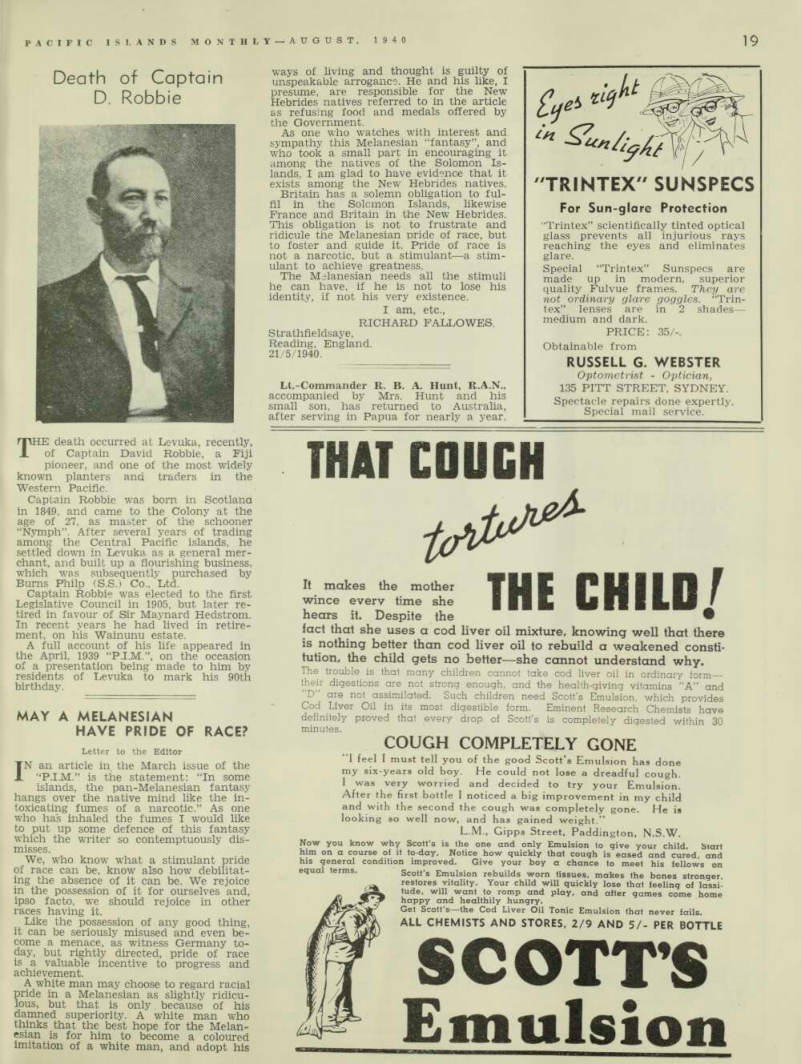
D. Robbie
npHE death occurred at Levuka, recently, JL of Captain David Robbie, a Fiji pioneer, and one of the most widely known planters and traders in the Western Pacific.
Captain Robbie was bom in Scotland in 1849. and came to the Colony at the age of 27, as master of the schooner “Nymph”. After several years of trading among the Central Pacific islands, he settled down in Levuka as a general mer chant, and built up a flourishing business, which was subsequently purchased by Bums Philp (S.S.) Co.. Ltd.
Captain Robbie was elected to the first Legislative Council in 1905, but later re tired in favour of Sir Maynard Hedstrom.
In recent years he had lived in retire ment, on his Wainunu estate.
A full account of his life appeared in the April, 1939 “P.1.M.”, on the occasion of a presentation being made to him by residents of Levuka to mark his 90th birthday.
May A Melanesian
Have Pride Of Race?
Letter to the Editor IN an article in the March issue of the “P.IM.” is the statement; “In some islands, the pan-Melanesian fantasy hangs over the native mind like the in toxicating fumes of a narcotic.” As one who has inhaled the fumes I would like to put up some defence of this fantasy which the writer so contemptuously dis misses.
We, who know what a stimulant pride of race can be, know also how debilitat ing the absence of it can be. We rejoice in the possession of it for ourselves and, ipso facto, we should rejoice in other races having it.
Like the possession of any good thing, it can be seriously misused and even be come a menace, as witness Germany to day, but rightly directed, pride of race is a valuable incentive to progress and achievement.
A white man may choose to regard racial pride in a Melanesian as slightly ridicu lous, but that is only because of his damned superiority. A white man who thinks that the best hope for the Melan esian is for him to become a coloured imitation of a white man, and adopt his
ways of living and thought is guilty of unspeakable arrogance. He and his like, I presume, are responsible for the New Hebrides natives referred to in the article as refusing food and medals offered by the Government.
As one who watches with interest and sympathy this Melanesian “fantasy”, and who took a small part in encouraging it among the natives of the Solomon Is lands, I am glad to have evidence that it exists among the New Hebrides natives.
Britain has a solemn obligation to ful fil in the Solomon Islands, likewise France and Britain in the New Hebrides.
This obligation is not to frustrate and ridicule the Melanesian pride of race, but to foster and guide it. Pride of race is not a narcotic, but a stimulant—a stim ulant to achieve greatness.
The Melanesian needs all the stimuli he can have, if he is not to lose his identity, if not his very existence.
I am, etc.,
Richard Fallowes.
Strathfieldsaye, Reading, England. 21/5/1940.
Lt.-Commander R. B. A. Hunt, R.A.N., accompanied by Mrs. Hunt and his small son, has returned to Australia, after serving in Papua for nearly a year.
Advertisements & other items, pp. 21-22 (1 item)
Scott’S
sr fa
"TRINTEX" SUNSPECS
For Sun-glare Protection “Trintex” scientifically tinted optical glass prevents all injurious rays reaching the eyes and eliminates glare.
Special “Trintex” Sunspecs are made up in modern, superior quality Fulvue frames. They are not ordinary glare goggles. “Trintex” lenses are in 2 shades — medium and dark.
PRICE: 35/-.
Obtainable from
RUSSELL G. WEBSTER
Optometrist - Optician,
135 PITT STREET, SYDNEY.
Spectacle repairs done expertly.
Special mail service.
THAI COUCH
It
THE CHILD/
makes the mother wince every time she
hears it. Despite the
fact that she uses a cod liver oil mixture, knowing well that there is nothing better than cod liver oil to rebuild a weakened constitution, the child gets no better—she cannot understand why.
The trouble is that many children cannot take cod liver oil in ordinary form— digestions are not strong enough, and the health-giving vitamins "A" and are not assimilated. Such children need Scott's Emulsion, which provides 'D'' Cod Liver Oil in its most digestible form, definitely proved that every drop of Scott's minutes.
COUGH COMPLETELY GONE
Eminent Research Chemists have is completely digested within 30 “I feel I must tell you of the good Scott’s Emulsion has done my six-years old boy. He could not lose a dreadful cough.
I was very worried and decided to try your Emulsion.
After the first bottle I noticed a big improvement in my child and with the second the cough was completely gone. He is looking so well now, and has gained weight.”
L.M., Gipps Street, Paddington. N.S.W.
Now you know why Scott's is the one and only Emulsion to give your child. Siart him on a course of it to-day. Notice how quickly that cough is eased and cured, and his general condition improved. Give your boy a chance to meet his fellows on equal terms. Scott's Emulsion rebuilds worn tissues, makes the bones stronger, restores vitality. Your child will quickly lose that feeling of lassitude, will want to romp and play, and after games come home happy and healthily hungry.
Get Scott's—the Cod Liver Oil Tonic Emulsion that never fails.
ALL CHEMISTS AND STORES, 2/9 AND 5/- PER BOTTLE
SCOTT’S
Emulsion
Modern Refrigeration for the South Sea Islands
The
ELECTROLUX
KEROSENE OPERATED
REFRIGERATOR
MARVEL
OF
MODERN
SCIENCE
L
THE
MIRACLE
OF
ICE
FROM
HEAT
ELECTROLUX offers economical, modern and completely efficient
REFRIGERATION FOR ISLANDS' HOMES.
FREEZES CONTINUOUSLY WHILE SMALL LAMP BURNS
Freezing controlled by simply regulating height of flame. Uses only j gallon of kerosene per week.
MOTORLESS ... NO PARTS TO GET OUT OF ORDER.
MODEL L 22
Capacity 2.2 cubic feet.
MODEL L3BO
• (as Illustrated) Capacity 4 cubic feet.
MODEL LKSSO
Capacity 5.5 cubic feet.
GUARANTEED FOR TWO YEARS.
• Write to your Local Distributor for prices and full details. )btainable from V. R. Carpenter & Company Ltd.—Sydney, and followmg Jew Guinea Branches: Rabaul, Salamaua, Wau. Kavieng, fladang, and Wewak.
W. R. Carpenter & Coy. (Solomon Is.) Pty. Ltd. —Tulagi, British Solomon Islands.
On Chong & Company Pty. Ltd.—Butaritari, Gilbert and Ellice Islands.
Representation in Papua and New Hebrides.
Rubber Tax
To be Imposed in Papua
From Our Own Correspondent
Port Moresby, July 29.
IT is understood that the Administra tion will present a Bill to the next session of the Legislative Council, providing for an export tax on rubber from Papua.
The tax will be 5 per cent, on the f.o.b. value at Papuan port, payable if and when such value is not less than Sid. per pound, Australian currency.
Rubber producers in Papua receive, at the present market price, a profit of approximately 1/- per lb. on rubber landed In Sydney.
Bumble-Footed Bungling
in New Guinea
From Our Own Correspondent WAU, July 20. rE second contingent of volunteer recruits from the Goldfields for the A.I.F. met with extraordinary treat ment at Salamaua, when on the first stage of their journey.
On arrival at the Morobe port, they were “ordered” to go on leave, and to pay for their food in advance, daily, at the local hostelry. These men were receiving pay at the rate of 7/5 per day, and they each had to pay 9/- per day before they could get food.
A sum of no less than £56 was imme diately raised on the Goldfields, and remitted to Salamaua, to assist the recruits in their difficulty—many of them had spent practically their last penny in liquidating their obligations before leaving.
This was an example of pure bungling, and reflected badly on the methods adopted in handling men who have enlisted for service.
New Uses For Coconut Oil
AS far back as 1931, the continued low price of coconut products caused grave concern, and efforts were made to find new uses for the coconut.
An important development was then reported in the Philippine Islands, where scientists demonstrated the practicability of using coconut oil as a fuel for Diesel engines. It was claimed that the oil could be produced as cheaply as crude oil. In Manila, at the time, it was thought that the discovery would revolu tionise the industry.
If the use of vegetable oil In combus tion engines is practicable, it is clear that a new era would open for the industry.
It was pointed out, long before 1931, that the world’s mineral oil resources are limited, and that, with the ever-growing demand of the motor trade, it would only be a question of a comparatively short time before supplies are exhausted.
Has there been any further develop ment which would be of interest to Papuan planters?
Tonga's Finances
Nukualofa, July 16.
THE financial estimates of the King dom, for the year to June 30, 1940, passed recently by Parliament, show estimated revenue at £79,148 and estimated expenditure at £78,989.
Of the estimated revenue, £68,325 is to be raised from taxation and £10,823 appropriated from the Kingdom’s accu mulated surplus funds. That the reserve had to be called upon is evidence of the present financial position of the Kingdom.
Impeachments
Extraordinary Occurrences in Tonga
From Our Own Correspondent
Nukualofa, July 18.
DURING the present session of Parlia ment, the Premier (Hon. Tugi), the Minister for Lands (Hon. Ata), the Minister for Police (Hon. Akauola), the Governor of Haapai (Hon. Akauola) and the Governor of Vavau (Hon. Ulukalala) were impeached by the senior Parlia mentary representative of the people for Vavau, Hon. Afuhaamago, on the ground of maladministration.
The charges were heard before the Parliamentary Tribunal, which, presided over by the Chief Justice (Hon. W. H.
Stuart) returned a verdict of not guilty in all cases except that of the Governor
of Vavau, which has been adjourned for trial at some later date.
In the history of Parliamentary im peachments in Tonga, there never have been so many impeachments made simultaneously in any one session of Parliament.
It Is a matter of historical interest to recall that it was Hon. Afuhaamago’s father, who, as Parliamentary Repre sentative of the people, impeached the former Premier, the late Hon. Jiosateki Veikune, for maladministration, before Parliament, which resulted in the lat ter’s dismissal from office and his deportation to Fiji by the High Com missioner for the Western Pacific, in 1904.
It is recalled, too, that the late Hon.
Jione Tubou Faletau was impeached before Parliament and dismissed from office when he was Governor of Vavau, about 1912.
Advertisements & other items, p. 23 (1 item)
Foster’S
park ling
refreshment from pure Malt and Hops w.
ISS.
FOSTER’S
LAGER
Extraordinary Results of the French Capitulation
New Caledonia Being Run As An
Independent Country
STUDENTS of national and political economics will be interested in the history of events in the French Colony of New Caledonia, when that community found itself suddenly cut off completely from the Mother Country by the capitulation of France, in June, to the German hordes.
In ordinary circumstances, New Cale donia is administered by a Governor (ap pointed by the French Colonial Office) and officials under his command; and while the country is generally self-sup porting, its finances were controlled from Paris.
The Colony, which has a population of 27,000 Europeans and about 54,000 natives, exports nickel, chrome, deer and cattle hides and coffee. In the past, most of its exports went to France, but a large pro portion of its imports have been bought in Australia.
It is a country of considerable economic importance. It has agricultural and pastoral industries, and great wealth in minerals —especially nickel and chrome.
For that reason it has had a good deal of attention in recent years from Japanese investors and industrialists.
In June, when France capitulated to Germany, while Britain maintained her mastery over sea communications. New Caledonia found herself cut off entirely from France and thrown upon her own resources.
Details have been supplied to the “P.1.M.” by Mr. Nicolas Hagen, of Noumea, who in August made one of his periodical visits to Sydney. rpHE first effect was seen in the collapse X of the currency. Nominally, 140
francs will purchase £1 Australian and that has been the basis of trading between the two countries for a consid erable time. But in June no one wanted French francs —they could not be sold at any price—and it was no use the mer chants in New Caledonia offering to Australia their ordinary currency where with to purchase from Australia tne foodstuffs which were urgently needed.
For a while, the situation was chaotic.
Its solution was made easier by the fact that the principal banking institution in
New Caledonia, the Bank of Indo-Chine, is autonomous in New Caledonia—al though its headquarters are in Paris — and it issues a special bank note for use in New Caledonia. The situation was taken in hand by the Government of New Caledonia and the Bank of Indo-Chine, acting independently of France and other French Colonies, and an appeal for assistance was made to the Common wealth Government. As a result of this, Australia agreed to buy from New Cale donia a certain large proportion of the nickel and chrome which New Caledonia customarily exports; and, with the credits thereby established, New Cale donia was able to buy from Australia various foodstuffs needed by the com munity. In other words, a simple system of barter was established, controlled by
View of Noumea from the Bay, showing He Nou in the foreground.
the two Governments interested and the Bank of Indo-Chine.
So long as there is a market for New Caledonia products, this system can be carried on indefinitely, and New Cale donia can support itself. But Australia cannot buy anything like all the metal output of the Colony, and a market has also to be found for the other main New Caledonian products—namely, 80,000 deer hides a year, and a large quantity of coffee. These are eminently market able products—but their market dep°nds to a considerable degree upon sufficient shipping being available.
MEANWHILE, pending the operation oi this system of bart°ring, the Euro pean population of New Caledonia has been placed upon strict rations.
These in some directions were severe— half pound of butt°r per head per month, two boxes of matches per head per month, 3 lb. of sugar per head per month, quarter pint of oil per head per month —but, generally, there is plenty of food of the home-grown varieties, and New Caledonia has large herds of cattle and deer.
This sudden economic isolation of New Caledonia has had curious results. For instance, the various ships owned in and operated from New Caledonia have had to re-arrange their insurance. Usually their insurance was held in Prance —now it has been transferred, on what is understood to be quite satisfactory terms, to Australian insurance offices.
The Bank of Indo-Chine has had some difficult problems to handle, but it has succeeded fairly well in stabilising ex change at the former rate —namely, 140 francs to £1 Australian, It is reported in August that francs, which had been quite unsaleable in June, are now negoti able on a satisfactory basis.
Many companies, with headquarters in France, have substantial investments in New Caledonia. Their position is obscure and difficult. Obviously, if New Cale donia, by sheer force of present circum stances, comes into the British bloc of trading countries, there will be no trans fer of money from New Caledonia to Prance for the benefit of the Germans.
Therefore, any profits made by the French-owned companies in New Cale donia will have to remain in New Cale donia for the present—and, probably, per manently, for the ultimate benefit of the Colony.
There have been no indications that Great Britain or Australia have designs on New Caledonia—other than their de finite wish that New Caledonia shall not be held by any Power potentially danger ous to Australia, or to British interests.
Australian trading interests in New Caledonia already are substantial and, in the natural order of things, it would not be surprising if New Caledonia entered the British Commonwealth of Nations. That would seem to be a natural development. But Japan has displayed extraordinary sensitiveness in relation to the future of these Pacific territories; and it is just possible that Japan may regard New Caledonia as in the same category as the Dutch East Indies.
JAPAN apparently will do nothing so long as the Dutch East Indies, and New Caledonia and French Indo china remain nominally independent (although the home countries of eacn are in German occupation) and so long as the Japanese are permitted to trade freely with those territories; but, if it is proposed to transfer any of those terri tories from one country to another, there may be trouble with Japan, on the grounds that the Japanese, as a matter of definite policy, object to any alteration of the status quo in the Pacific.
However, the people of New Caledonia seem to be prepared to carry on quite
cheerfully under the present conditions, for an indefinite period. They have no reason to worry, so long as they can find a market for their principal products.
Advertisements & other items, p. 24 (1 item)
ihz ruqLvt!
ema
JiuuyiMiivuLs
/ f / ika Coleman Mantles supply Sun-like light. ■ 500 1 *
CANDLE
POWER
4
Instant Lighting
Stoves Cr Irons 300
CANDLE
POWER
giving maximum of heat in minimum of time
BRIGHTER LIGHT
for
BETTER SIGHT
EASE OF OPERATION
combines
ECONOMY with COMFORT
In case of difficulty in obtaining supplies write to:— Pearce & Co.. Suva, Fiji Is.
Coleman Products can be obtained from all Leading Firms throughout the Pacific Islands.
Japanese in New
Caledonia
THERE are a total of 1,195 Japanese in New Caledonia (according to “Bulletin du Commerce”, Noumea).
In Noumea alone, statistics show that there are 311 Japanese men and 28 Japanese women in residence.
Of the total number of 1,195 Japanese in the Territory, 1144 are men and 51 women. It is Interesting to compare these figures with statistics of previous years: Noumea. Interior. Total 1918 353 2,105 2,458 1933 330 780 1,110 1936 341 810 1,151 1939 339 856 1,195
Hon. H. W. Champion, acting Lieuten ant-Governor of Papua, accompanied by the Hon. H. L. Murray and His Honour Mr. Justice Gore, made a tour of inspec tion in the Eastern and North-Eastern Divisions in July.
Messrs. Bailey, Bealan, Eglington.
McCarthy, Houghton and Stock, all of whom were members of W. R. Carpenter & Co., Ltd.’s Rabaul staff, have enlisted in the A.I.F.
Mr. Clive Devenish-Meares has been appointed Clerk of the Legislative Coun cn 0 f New Guinea, in succession to Mr.
R M J Cameron Dr/c.’c. Simson is at present on his annual visit to the Territory, and is in specting his plantation at Hisiu, west of p or t Moresby
Advertisements & other items, p. 25 (1 item)
Dustproof Steel Uniform Trunks
Gramophone and
Record Buyers
Reconditioned His Master's Voice Portables Equal to New.
Delivered Straight to You for £4/4/-. No extras to pay for.
Send your record orders to us.
Immediate attention. Can be sent c.o.d.
TALKERIES
161 CASTLEREAGH ST., SYDNEY
DUSTPROOF STEEL UNIFORM TRUNKS
Made of strongly reinforced steel with rubber-sealed lid, this handsome black japanned uniform case is both water- and dustproof. It has two nickel lock bolts, handles at ends and is finished inside in dark blue. Size 36” x 20” x 12”.
STEEL CASH BOX
Coloured olive green, this cash box has an inside tray with divisions and is fitted with a four-lever lock. Two sizes: 10 in. x 6 in. x 3Va in., and 12 in. x 9 in. x 5 in.
HEAVY STEEL DEED BOX
This is made in seven sizes:—l2 in., 14 in., 16 in., 18 in., 20 in., 22 in. and 24 in. It is handsomely finished with a strong four-lever English lock.
TRADERS INVITED TO APPLY FOR PRICE LIST AND FULL PARTICULARS.
FORD SHERINGTON LTD,
MANUFACTURERS, KIPPAX STREET, SYDNEY
How Airmen Found
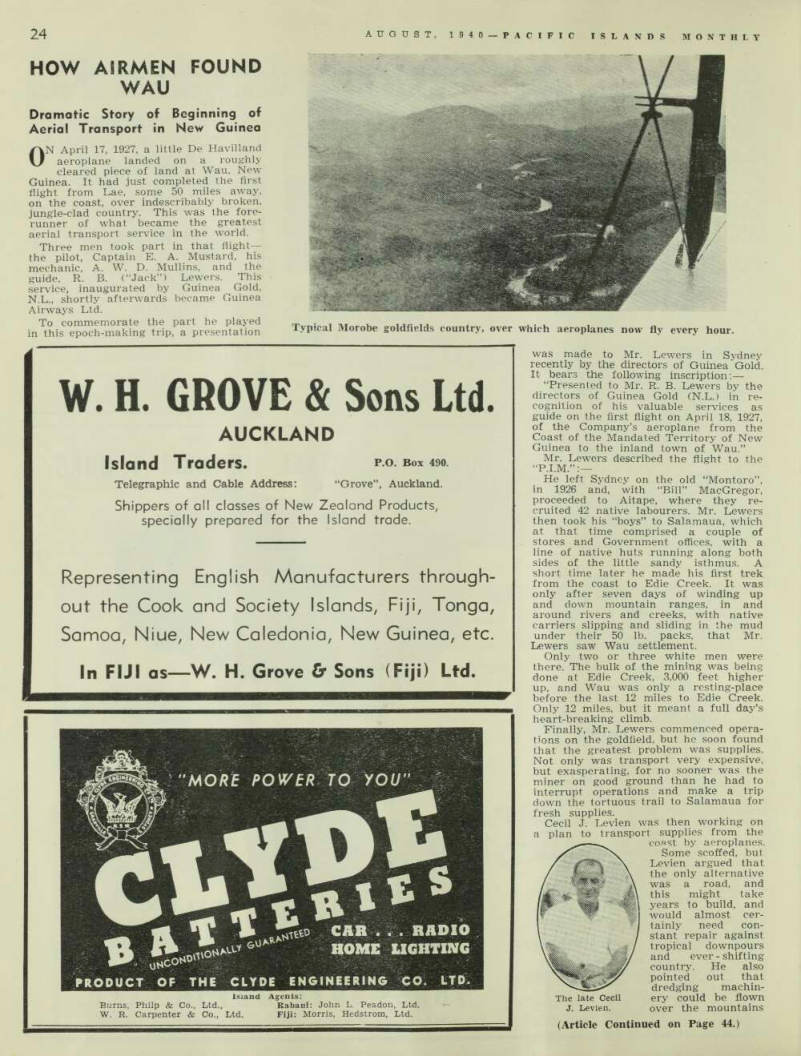

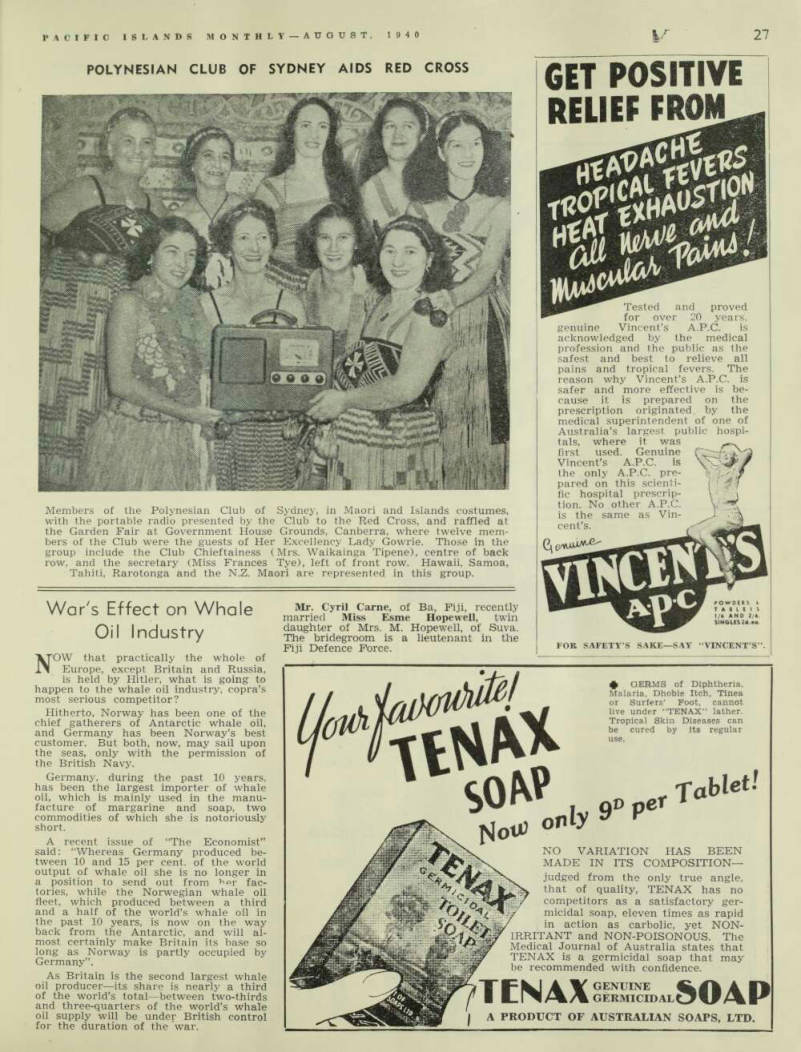
Wau
Dramatic Story of Beginning of Aerial Transport in New Guinea
ON April 17, 1927, a little De Havilland aeroplane landed on a roughly cleared piece of land at Wau, New Guinea. It had just completed the first flight from Lae, some 50 miles away, on the coast, over indescribably broken, jungle-clad country. This was the fore runner of what became the greatest aerial transport service in the world.
Three men took part in that flight— the pilot, Captain E. A. Mustard, his mechanic, A. W. D. Mullins, and the guide, R. B. (“Jack”) Lewers. This service, inaugurated by Guinea Gold, N.L., shortly afterwards became Guinea Airways Ltd.
To commemorate the part he played in this epoch-making trip, a presentation
was made to Mr. Lewers in Sydney recently by the directors of Guinea Gold.
It bears the following inscription;— “Presented to Mr. R. B. Lewers by the directors of Guinea Gold (N.L.) in re cognition of his valuable services as guide on the first flight on April 18, 1927, of the Company’s aeroplane from the Coast of the Mandated Territory of New Guinea to the inland town of Wau.”
Mr. Lewers described the flight to the “P.1.M.”: — He left Sydney on the old “Montoro”, in 1926 and, with “Bill” MacGregor, proceeded to Aitape, where they re cruited 42 native labourers. Mr. Lewers then took his “boys” to Salamaua, which at that time comprised a couple of stores and Government offices, with a line of native huts running along both sides of the little sandy isthmus. A short time later he made his first trek from the coast to Edie Creek. It was only after seven days of winding up and down mountain ranges, in and around rivers and creeks, with native carriers slipping and sliding in the mud under their 50 lb. packs', that Mr.
Lewers saw Wau settlement.
Only two or three white men were there. The bulk of the mining was being done at Edie Creek, 3,000 feet higher up, and Wau was only a resting-place before the last 12 miles to Edie Creek.
Only 12 miles, but it meant a full day’s heart-breaking climb.
Finally, Mr. Lewers commenced opera tions on the goldfield, but he soon found that the greatest problem was supplies.
Not only was transport very expensive, but exasperating, for no sooner was the miner on good ground than he had to interrupt operations and make a trip down the tortuous trail to Salamaua for fresh supplies.
Cecil J. Levien was then working on a plan to transport supplies from the
coest by aeroplanes.
Some scoffed, but Levien argued that the only alternative was a road, and this might take years to build, and would almost cer tainly need con stant repair against tropical downpours and ever - shifting country. He also pointed out that dredging machin ery could be flown over the mountains
(Article Continued on Page 44.)
Typical Morobe goldfields country, over which aeroplanes now fly every hour
The late Cecil J. Levien.
rE following Fiji residents left Suva recently to join up for active ser vice overseas (announces the “Fiji Times’')
Commander W, Burrows (District Ad ministration); Lieutenant M. L. Bernac chi (Acting A.D.C. to the Governor); T.
Allan (Suva); W. J. Blanch (who served with the Fiji Contingent in the last war); C. A. Browne (Suva); O. M.
Browne (Suva); J. H. Broomham (Suva); H. B. Bossley (Nadi); G. A.
Crapp (Suva branch of the Bank of N.S.W.); O. L. Freeman (Rewa); E.
Frost (Suva); A. R. McGowan (“Fiji Times”); E. V. Spaeth (Taveuni); R. H.
Strachan (Suva branch of the Bank of N.S.W.); H. W. Williams (Williams & Gosling Ltd., Suva); E. B. Williams (Tailevu); M. J. White (Suva).
in sections, and could profitably work the deposits of lower value.
With his associates, Levien formed Guinea Gold N.L., and the executives of the company in Adelaide purchased a De Havilland plane and shipped it to Rabaul. There it was assembled, and, on March 31, 1927, Mustard and Mullins flew along the coast of New Britain and landed on a small clearing at Lae, some 25 miles north of Salamaua. But the greatest task had yet to be tackled— that of finding a small township in an incredible maze of mountains, gorges and jungle. Visibility was limited by rain and mist, and there were no aero dromes where a pilot could bring his machine down if anything went wrong.
The only bare places were the Kunai patches on the tops of the razorbacks.
Despite all this, and many solemn predictions of disaster, Levien and Co. went ahead with their plans.
Early in April, Mr. Lewers was at Edie Creek and, together with several other men from the goldfield, he accepted the invitation of Mr. H. S.
Holgarth, manager for Guinea Gold at Lae, to spend Easter week-end with him as his guest—this despite the fact that it would take more than a week to get to the coast!
On April 14 —Good Friday-Mustard
and Mullins, at Lae, said they were ready. Levien had prepared a small section of ground at Wau by burning off the long Kunai grass and filling in
the pot-holes. Mr. Holgarth volunteered to guide them, and that morning the three men took off. Their plan was to fly up the Markham River until they reached the Bulolo River, and then fol low it up to Wau.
The plane was away only three hours, but it was a lifetime to the anxious little party at Lae. Suddenly, the drone of an engine was heard and the De Havilland appeared out of the clouds and landed on Lae aerodrome. Crest fallen, the intrepid little party of avia tors reported that they had been unable to find their objective.
The following day the three men again set out, determined to get to Wau via the Markham and Bulolo valleys, but again they returned—unsuccessful.
Shortly after breakfast on April 17, Lewers was talking to Mustard, and Mustard suddenly said: “I say, Jack, do you think you could find Wau from the air?”
“Oh, yes, I think so,” replied Lewers.
“Not by following the Markham, but by going straight up over the mountains from Salamaua. I have travelled that track many times, and I know most of the landmarks.”
“But do you think you could find it from the air. It looks quite different from up there, you know,” said Mustard.
“Well, I will try,” said Lewers. And
Mr. C. J.
Levien’s First Camp, in the Jungle, near Wau.
so preparations were immediately made, the weather being favourable to flying.
Later in the morning, Mustard and Mullins, accompanied by Lewers, took off from Lae and made for Salamaua, across the corner created by Huon Gulf.
“Here, I picked up the trail from Salamaua to Edie Creek, which looked like a thread of cotton, from the air,” said Mr. Lewers, “and soon I saw the rest-house at the end of the first day’s march, just out of Salamaua. After several more minutes’ flight we reached the highest point in the range we had to fly over—6,2oo feet—and just then I saw the fourth day rest house. It had a galvanised iron roof and was known as House Copper.
“Then I lost the track. I knew that the mountains were very high, here, and I shouted to Mustard to take the plane higher. He could not hear me, above the roar of the engine, so I scribbled a note on a piece of paper, and passed it to him, in the front cockpit.
“We then rose up into the clouds for what seemed like an endless period and I was getting pretty worried. I was beginning to think that it looked like the end of successful flying in this part of New Guinea, when, all of a sudden, the clouds in front of us parted, and through a gap in the mist I saw the tops of some pine trees. By some instinct, I knew they were the ones next to the Bulolo River, which I had passed so many times going to and from the coast.
“When we arrived over the river, Mustard looked round and waved his arm inquiringly. His lips moved in a question ‘Up or down?’ I was doubt ful; but, again, some instinct helped me, and I waved him down.
“He turned the plane to the left and, after several minutes’ flying, during which I scanned every bit of country on either side of the river, I saw a small triangular clearing in the jungle, with a few grass huts near it. It was Wau.
“I signalled to Mustard that I could see our goal. He seemed doubtful.
Apparently, he could not see the huts, and thought the patch of clear ground was like so many others he had seen.
On my repeated assuring gestures, how ever, he brought the machine down into that deep valley between the mountains, in wide circles, looking back every now and again, still with a doubtful expres sion on his face.
“I pointed down, and then he saw the huts and the hospital, which seemed about as big as one’s fingernail.
“As we turned over the river, to land from the north, I remembered that there was a considerable amount of long grass on that end of the field. But, fortunately, the undercarriage did not catch as it swept through the grass, and we landed on the burned-grass section of the improvised aerodrome.
“There were only three white men and a crowd of natives at Wau, and these gathered excitedly around the plane to greet us. Dr. Lambert, who was known as the ‘Lik Lik Doctor’, or assistant doctor, smilingly welcomed us.
Mr. Coldham, then manager of Guinea Gold, was there, and another white man. I don’t remember Levien being there. I think he was then walking down to the coast, to find out what had happened to us. They had been expect ing the plane for some time, and had been lighting signal fires for days.
“We had lunch with Doctor Lambert, Mr. Coldham and the other man and, after an hour or two, took off for Lae again. This time, we followed the Bulolo and Watut Rivers to their junc tion with the Markham, and then flew down the Markham Valley to Lae.
“There was much jubilation in Lae, at our success, and, that night, all the white men in the township assembled to celebrate the occasion. The following were present: H. S. Holgarth (Guinea Airways manger at Lae), E. A. Mustard and A. W. D. Mullins, “Tom” Bayliss (then agent of Guinea Gold at Sala maua), A. L. Simpson (miner, from Edie Creek), E. Broughton Jensen (an engineer who was in New Guinea on behalf of Guinea Gold), P. D. McKenzie (Government doctor at Salamaua), Edgar Betts (wireless operator from Salamaua), Fred Biggs (a miner) and myself.”
Mr. Lewers discounts the belief that the flight was made on April 18—it was on April 17. During the “celebration”, all those present signed a Guinea Gold letterhead, and this was dated April 17, and is in the possession of Mr. Lewers to-day.
“Nobody thought at that time that a service had been started which, in a few years, would grow into the largest aerial transport company in the world,” concluded Mr. Lewers.
Mr. H. Hodgson, who has manager of Morris, Hedstrom’s Suva branch since 1931, has been transferred to Tavua. Mr, G. Snow, of Taveuni, will replace Mr.
Hodgson.
The Dutch East Indies came within the sterling group on July 22, and thus trade between the great Dutch colony and Australia was much simplified. This trade has grown enormously in recent years—from £4,390,327 worth of imports, from the East Indies to Australia, in 1934-5, to £7,119,785 in 1938-39. Last year, Australia imported from the East Indies petroleum spirit worth £3,608,691, and tea worth £1,564,387.
Mr. and Mrs. McPhee have left the district of Navua, Fiji, where he was manager of the Morris. Hedstrom, Ltd. branch for many years, and have now taken up residence at Levuka.
Advertisements & other items, pp. 26-27 (1 item)
W. H. GROVE & Sons Ltd.
AUCKLAND
Island Traders. p.o. box 4»o.
Telegraphic and Cable Address; “Grove”, Auckland.
Shippers of all classes of New Zealand Products, specially prepared for the Island trade.
Representing English Manufacturers throughout the Cook and Society Islands, Fiji, Tonga, Samoa, Niue, New Caledonia, New Guinea, etc.
In FIJI os —W. H. Grove & Sons (Fiji) Ltd.
island Agents: Burns, Philp & Co., Ltd., Rabaul: John L. Peadon, Ltd.
W, R. Carpenter & Co., Ltd. Fiji: Morris, Hedstrom, Ltd.
Its Miles better
BS
The Islands Economy Petrol r%
VACUUM
VACUUM OIL COMPANY PTY. LTD
P 405
Opium Menace In Fiji
SUVA, July 15. npHE Fiji Police, Force is still vigorously JL carrying out its campaign against opium smuggling. In Suva Court on July 2 a Chinese, Joe Lee, was fined £3O, after pleading guilty to a charge of pos sessing opium. Two other Chinese (Ah Lin and Chong On) were heavily fined for frequenting premises used for opium smoking, and a Fijian woman, Litia Makama, was convicted on a similar charge. When the police raided the premises a quantity of opium pellets and other equipment was found.
Inspector W. J. G. Holland told the Court that the authorities were aware that Fijian women helped Chinese opium smokers and often carried the drug for them.
Boyd
Death of Rev. Robert Boyd
rE Rev. Robert Boyd, for many years a missionary at South West Bay, Malekula, New Hebrides, died on July 14, at Gatton, Queensland, at the residence of his daughter, Mrs.
Mcßoberts, His passing removes a notable land mark from the New Hebrides, with whose social and mission activities he had been intimately associated .since 1894. Persist ent weakness dogged his steps since his retirement in 1928, but, during the 34 years he spent on Malekula as a mission ary of the Victorian Presbyterian Church, he was zealous and untiring, and left behind him an honourable re cord of service.
Like many another pioneer who carried through hazardous achievements, Mr.
Boyd’s gifts were not conspicuous on the public platform, but his fellow-mission aries will always remember the wisdom and balance of judgment he displayed in the deliberations of the Mission Synod.
With his modest demeanour and quiet dignity, he was a well-known figure in Islands life, and played a memorable part in promoting the prosperity and development of the native race.
Mr. Boyd was first attracted to the New Hebrides by the wave of missionary enthusiasm that swept over Scotland, following the publication of the mission ary classic, the Autobiography of John G. Pa ton. As a fellow student at Glasgow University, Mr. Boyd had the Moderator of the Victorian Church, the Very Rev.
J. Noble MacKenzie, and both came under the influence of the venerable mission ary, Dr. John G, Paton, then at the height of his renown. The two men volunteered for service in the New Hebrides, and at the close of their college course, were appointed to the Is lands as missionaries of the Victorian Church, Mr. MacKenzie going to Santo and Mr. Boyd to Malekula. On the way through Sydney to the New Hebrides, Mr. Boyd met the lady who afterwards became his wife, and with whole-hearted devotion the two worked for the exten sion of Christianity in the New Hebrides.
Pioneer Of Samoa's Tobacco
Industry Is Dead
From Our Own Correspondent APIA, July 3.
RESIDENTS of Samoa learned with regret of the sudden death by heart failure of one of the most popular and esteemed Catholic priests in the Islands, Rev. Father Xavier Haller, who died at Apia in his 71st year.
A native of Alsace-Lorraine, Father Haller was educated in Belgium and after studying philosophy and theology entered the Society of Mary. After teaching for several years at Marist schools in Belgium, he came to Samoa in 1900, as district priest, serving aj Leulumoega, Vaea, Leone (American Samoa), Loto faga, Palauli, Falealupo and Leauva’a.
Father Haller took great interest in agriculture, particularly tobacco growing.
Importing seeds from Turkey and U.S.A., he improved the native brand of tobacco and was responsible for starting the manufacture of cigarettes from Samoa grown tobacco.
Mr. J. M. Wollev, of Queensland, has taken up his duties as master at the Wau, N.G., school, replacing Mr. L.
Stamper who left the Territory with the second Goldfields contingent for the
A.I.F.
Advertisements & other items, p. 28 (1 item)
€ll ((its I)
saps strength
puts it bacfr P Rich in juniper and healthful herbs ...
THE GIN OF GENERA!
€ll ((its I)
(Hiprcttfs of (SiifllitiJ In case of difficulty in
BOX 1861 K., G.P.0., SYDNEY
net
SOO
:V/'
Polynesian Club Of Sydney Aids Red Cross
Members of the Polynesian Club of Sydney, in Maori and Islands costumes, with the portable radio presented by the Club to the Red Cross, and raffled at the Garden Fair at Government House Grounds, Canberra, where twelve mem bers of the Club were the guests of Her Excellency Lady Gowrie. Those in the group include the Club Chieftainess (Mrs. Waikainga Tipene), centre of back row, and the secretary (Miss Frances Tye), left of front row. Hawaii, Samoa, Tahiti, Rarotonga and the N.Z. Maori are represented in this group.
Oil Industry
War's Effect on Whale Oil Industry
NOW that practically the whole of Europe, except Britain and Russia, is held by Hitler, what is going to happen to the whale oil industry, copra’s most serious competitor?
Hitherto, Norway has been one of the chief gatherers of Antarctic whale oil, and Germany has been Norway’s best customer. But both, now, may sail upon the seas, only with the permission of the British Navy.
Germany, during the past 10 years, has been the largest importer of whale oil, which is mainly used in the manu facture of margarine and soap, two commodities of which she is notoriously short.
A recent issue of “The Economist” said: “Whereas Germany produced be tween 10 and 15 per cent, of the world output of whale oil she is no longer in a position to send out from fac tories, while the Norwegian whale oil fleet, which produced between a third and a half of the world’s whale oil in the past 10 years, is now on the way back from the Antarctic, and will al most certainly make Britain its base so long as Norway is partly occupied by Germany”.
As Britain is the second largest whale oil producer—its share is nearly a third of the world’s total—between two-thirds and three-quarters of the world’s whale oil supply will be under British control for the duration of the war.
Mr, Cyril Came, of Ba, Fiji, recently married Miss Esme Hopewell, twin daughter of Mrs. M. Hopewell, of Suva.
The bridegroom is a lieutenant in the Fiji Defence Force.
A correspondent of the “Fiji Times” makes the startling statement that the infant mortality among native Fijians, in the Lau group, has reached the alarming proportion of 50 per cent, of the birth rate. No explanation is given of this extraordinary figure.
Advertisements & other items, pp. 29-30 (1 item)
Get Positive
RELIEF FROM
Tested and proved for over 20 years, genuine Vincent’s A.P.C. is acknowledged by the medical profession and the public as the safest and best to relieve all pains and tropical fevers. The reason why Vincent’s A.P.C. is safer and more effective is because it is prepared on the prescription originated by the medical superintendent of one of Australia’s largest public tals, where it was first used. Genuine Vincent’s A.P.C. is the only A.P.C. prepared on this scientific hospital prescription. No other A.P.C. is the same as Vincent’s.
POWDERS &
lAII E I S
1/4 AND 2/4.
SINGLES 24. *o
FOR SAFETY’S SAKE—SAY “VINCENT S’”
uw \ * V
tiS*£
SOW
NoU>
/> O <T & as Z 1 4 GERMS of Diphtheria.
Malaria, Dhobie Itch, Tinea or Surfers’ Foot, cannot live under “TENAX” lather.
Tropical Skin Diseases can be cured by its regular
only 9° per
l'abl et -
NO VARIATION HAS BEEN
MADE IN ITS COMPOSITION—
judged from the only true angle, that of quality, TENAX has no competitors as a satisfactory germicidal soap, eleven times as rapid in action as carbolic, yet NON-
IRRITANT and NON-POISONOUS. The
Medical Journal of Australia states that TENAX is a germicidal soap that may be recommended with confidence.
TENAX
GENUINE
GERMICIDAL
SOAP
I A PRODUCT OF AUSTRALIAN SOAPS, LTD.
Kork-N-Seal
FOR HOME USE
Hand Applied Airtight Pressure Proof
FOR ALL HOME BOTTLING
—THE LITTLE CAP THAT
will Re-seal 1,000 Times
KORK-N-SEAL (Aust.) LTD.
106 COMMONWEALTH STREET,
SYDNEY, AUSTRALIA.
T.
Always Australia’s Choicest Products make sure you have at hand an ample Reserve of these Brussels Sprout* While Turnips Sweet Corn Tomato Puree Tomato Sauce Tomato Soup Tutti Fruit Saoce (Worcestershire flavor) Green Peas Beetroot French Beans Spinach Cauliflower Cabbage Carrots Parsnips Jk Celery I*
Qordcn^L£/
Delicious
Garden
Vale
Ready-toserve Vegetables • » EH3
Trader's Tales
A Mixed Grill From the Outer Cooks
By Tukapa Koko"
THE combined naivete and nescience of some of my native neighbours is both my joy and my cross, in the humble post I occupy as village trader.
The thatched reed huts where I trade, live, and have my beans (canned) are often sprinkled liberally but entirely un consciously with Attic salt by the dark sons and daughters of Oceania, and if I myself get a few crystals on me during the process, it is not unbeneflcial. Good ness knows, we in our isolation get little to arouse us, except an occasional fam ily row or a dog-fight.
Among my friends was Tara, a dam sel who filled the eye. Entertaining Tara was no bore. She had a bright, inquisitive mind that sought deeply into the whys and wherefores of the white man’s scheme of things, as viewed at second hand in magazines and news papers. I, informing, was in my turn informed: for the natives do not see pictures with our eyes.
As thus; Upon a day, Tara was turn ing idly over the pages of an illustrated magazine, marvelling at the wondrous palaces that are white men’s homes; and she chanced upon a wealthy mansion that had long passed from the hands of its hereditary owner, an English lord, into the tenancy of a wealthy American porketeer, whose superimposed crest dated but from 1918. Nonetheless, he saw
no shame in its superseding one that had adorned the surcoats of belted knights in the thirteenth century.
The house was magnificent; its panel ling, its floors, its tine embellishments enchanted Tara. In one of its salons, was a collection of family silver, in glass cases, that was worth a pretty penny and that even the porketeer’s family could not pluck up nerve to use.
On the wall of that same opulent room, as big as Mangaia’s cargo-shed (the local standard of infinite space) was a beautiful painting, representing the late King Edward VII. in admiral’s uniform.
The potentate dwelt not in Tara’s re collection—which was pardonable, seeing that she had been born long after he passed on to a better sphere.
The portrait was an exact square, and the grave countenance of the late Roy alty gazed down from a background of blue.
“Eti,” said Tara, “You look this. Plenty money he get, that p’leeceman, all time look in window for no man come steal there?” * * * And, by the same token, of a lapsus memoriae.
At the village of Ivirua dwelt another of my customers, a gay buck, and one who made no mathematical error over the necessary number of beans to total five.
He had a lady friend, with whom he was wont —how shall I say it? —to spend late evenings. Such a thing is not en couraged at Mangaia, where Mission rule is a power in the land.
The Ivirua native pastor wooed these two burning brands, and persuaded them to reverse proverbial process and leap out of the fire of promiscuity into the safe frying-pan of matrimony.
On the nuptial night, the village of Ivirua, always tough and turbulent, was paraded by the usual pair of curfew cops, out to impound daring souls on the road aft.er nine.
It belonged not to the bridegroom’s care. He was snoring by the side of his legal partner, with stately and moral rumbelow.
The gendarmerie flashed their torches onto verandahs where a dark corner might harbor sinful wights seeking whom they might morally devour, and the policemen felt it part of their duty to illuminate the exterior of the house where slept two dearly ransomed souls.
The bridal pair were above suspicion now; but beams of light go where they list, like the wind, and a conditioned reflex is a thing that knows no mastery.
A vagrant torch-beam, like a reveal ing fairy searchlight, fell on the bride groom’s face. He awoke. Leaping to his feet, he dashed out of the house into the bush. .
He had forgotten he was married!
Mrs. G. Nelligan, wife of Mr. G. Nelli gan, of the Fiji Post and Telegraph De partment, Suva, died recently in Mel bourne while visiting relations. She had lived in Fiji for over 25 years.
Mr, James Savage, of Pan American Airways’ staff on Canton Island, joined the PA.A. dinner there on its inaugural flight on July 16 and flew to Auckland; the following week he accompanied the clipper back to U.S.A. Mr. Savage spent nine months on Canton.
Mrs. A. Baker, formerly of Fiji, died in New Zealand last month at the age of 75. She went to Fiji 60 years ago, and three of her children —Mrs. Marr and Mrs. Lindsay (Suva) and Mr. C. Baker (Nairai)—are still residents of the Colony.
Tonkinese For N.H.
British
New Arrangement Ineffective Through France's Collapse
THERE was an interesting develop ment in the relations between Brit ish and French, in the New Heb rides Condominium, in recent months.
French authorities made available to British planters a supply of Tonkinese labourers, from French Indo-China, for work on their plantations, on the same terms as are given the French.
This, for many long years, has been a sore subject in the New Hebrides. Local native labour is irregular and undepend able. The French planters were per mitted, by their Government, to bring in from Indo-China as many Tonkinese labourers as they wanted, on a system of strict indenture: but the British planters, seeking from the Colonial Office authorities the same privilege, were flatly refused. In consequence, French planters have flourished, while British planters have been severely penalised. Many British planters gave up the struggle altogether and left the New Hebrides; others sought and ob tained French naturalisation.
One does not know what understand ing between the French and British authorities preceded the decision to make Tonkinese labourers available to British planters; but it certainly was a gesture much appreciated by the British.
The irony of the situation is that, just after the privilege had been granted to the British planters, following 30 years of heart-burning, it seems that it will prove useless, owing to the lamentable collapse of France. At the moment of this writing, it is doubtful whether Indo- China will remain in the possession of the French Empire, and continue to pro vide a supply of Tonkinese labour.
Gesture May Be Too Late
(Contributed) NO sooner was the gesture made by the French Resident Commissioner (M.
Sautot) in Vila, to mark Anglo- French unity, than rapid events in Europe rendered its operation impractic able.
It now is extremely doubtful whether a continuation of the supply of labourers, even to French planters* will be any longer possible.
It is interesting to recollect that the Condominium was established to thwart a move of the former Kaiser to seize the New Hebrides, on account of the constant strife between French and English. His ambition was to link them up with the other German South Seas Territories.
Many are wondering whether the Fuhrer, as a result of his successes in Europe, may now seek to put into effect the am bitious schemes of the Kaiser.
Hon. Dr. C. M. Dawson, M.L.C., of Apia, who recently received leave of ab sence from the Samoan Legislative Council to proceed to England, has joined the British Merchant Navy as a surgeon.
Mr. H. E. Coombe, formerly a merpber of the staff of the Bank of New Zealand in Fiji, has enlisted in the N.Z. forces.
Mr. F. C. J. Edmunds, who went to Fiji 40 years ago as a coach driver for the Government, died in Suva on July 2 at the age of 69. Before going to Fiji he was a coach driver for the famous Australian pioneer firm of Cobb and Co.
Advertisements & other items, p. 31 (1 item)
Nestle S^Milr
SWEETE
d 1 h« t fO» > - Y?
P '
ipiiiiip.® e x\''
E«T SW Vrepared S? .
WSPA*® 0 .n-S^V' 1
XNV) W?oS> S
HWKCO.
Nestle’s Sweetened Condensed Milk perfectly solves the problem of providing a safe milk supply for tropical climates. Nestle’s Sweetened Condensed Milk is milk supplied from healthy cows grazing on rich pastures and from the moment it is received at the conclensery until it is finally sealed into its dust-proof, germ-proof containers the most effective precautions are taken to ensure its purity. Whenever you use Milk use Nestle’s Sweetened Condensed Milk—it is absolutely pure and safe.
COPYRIGHT 8227
NESTLE S^MILR
How Gold Co.S Benefit
Fiji
THE statement is sometimes made In relation to industries established in Fiji that, while they add enormously to the exports of Fiji, a large portion of the money they earn leaves Fiji and the Colony does not get the benefit of it.
For that reason figures which have been published recently in relation to the Em peror and Loloma gold-mines in Fiji are interesting.
Last year the two companies, operating on the Vatukoula gold-field, paid out the following sums:—Wages. £148,642; income tax, £18,836; royalty on gold, £42,856; port and sendee tax, £8,546; duty and other taxes on direct imports, £10,326. In addi tion to Europeans they employed last year 210 Euronesians and 1,263 natives, making a total wages list of 1,613.
Pied Piper Needed In Samoa
DURING the first two months of each year residents of Upolu (Western Samoa) witness a remarkable mass migration of rats, according to Mr. H. C.
Reed in a recent issue of the “Western Samoa Mail”.
Coinciding with the breeding season of the wild duck (toloa) and the dragon fly, hordes of large brown rats go inland to Lake Laloanea and other of the “crater” lakes; and there they feast on the dragon fly larvae and wild duck eggs. Around the shores, one sees thousands of rats feeding ravenously on the larvae, which grow to the size of one’s little finger and float in millions in the shallow water.
Queer methods are devised by the rats to get these grubs, but many just dive head long into the water to seize them.
In Camp With Papua's
A.I.F. Men
“Private PX 000”, a member of the Papuan Contingent of the A.I.F. which arrived in Brisbane in June, sends a note from the camp where the men are now undergoing training :— WE landed on a Sunday morning at Pinkenbar and immediately were taken by Army trucks to the depot at Fraser’s Paddock. Here we were issued with ‘giggle-suits’ (working suits) and uniforms. The rest of the day was left free. Queensland’s climate seemed a little chilly to us but it could not chill our spirits, and with a day free . . . well, we’ll draw a veil over that!
“Next day we underwent X-ray and other medical tests, one man being de clared unfit. Then we began to learn how Australia’s army does its bit. So far, we have got on very well—except for those cursed potato fatigues. One of our bright young fellows remarked that he could not see why potatoes should not be cooked in their ‘giggle-suits’. It met with general approval—except the approval of the general!
“Out of our party of 18, two men were selected to attend an Officers’ Training School. One now has his first stripe, and the other gets two stripes in a few days.
“Our health has been reasonably good —though malaria has troubled one or two of the lads, but not virulent enough to lay them up.
“Perhaps the most disappointing thing so far is that the men have been allo cated to different units —anti-tank, machine-gun, supply column, ambulance convoy, ordnance, etc. Just the same, the Papuan mob get together at times and really enjoy themselves. The main thing, pf course, is that all are keen on their jobs and seem to be adapting themselves readily to Army life. After going through all the odd jobs we do, we certainly will appreciate our native servants a bit more when we return to the Territory!”
Phosphate Prices Rise
THERE has been a loud outcry from agricultural interests in Australia and New Zealand against the in crease in the cost of superphosphate, which ranges from 13/- to 20/- per ton.
The higher cost is due to increases in freight on phosphate rock from the various Pacific Islands, where phosphate rock is obtained, and which averages about 21 9 per ton. Farmers declare that it is in the national interest that the in creased cost should be borne by the phos phate companies, the shipping companies and other people affected rather than by the already overburdened producing community.
Trochus Shell Protected in N
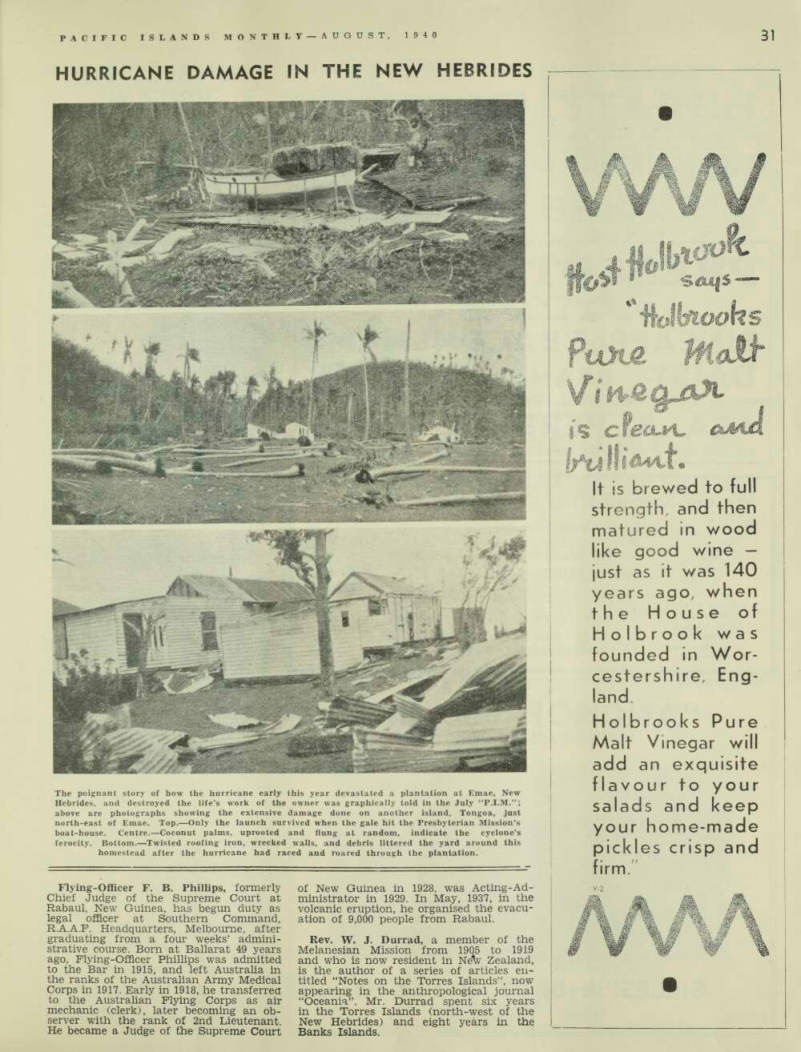
N. Hebrides
A NEW law issued in the New Hebrides prohibits the removal, sale, or ex port of trochus and certain other shell from the New Hebrides without licence. The regulations contain some drastic provisions.
If the purpose of the new law is to prevent the robbing of the shell beds in the New Hebrides by Japanese poachers and others, it is a good example of lock ing the stable door after the horse has escaped. The damage done to beds of shell in the New Hebrides and neigh bouring groups by Japanese poachers dur the last few years will not be restored for many years, if ever.
Flying-Officer F. B. Phillips, formerly Chief Judge of the Supreme Court at Rabaul, New Guinea, has begun duty as legal officer at Southern Command, R.A.A.F. Headquarters, Melbourne, after graduating from a four weeks’ admini strative course. Born at Ballarat 49 years ago, Flying-Officer Phillips was admitted to the Bar in 1915, and left Australia in the ranks of the Australian Army Medical Corps in 1917. Early in 1918, he transferred to the Australian Flying Corps as air mechanic (clerk), later becoming an ob server with the rank of 2nd Lieutenant.
He became a Judge of the Supreme Court
of New Guinea in 1928, was Acting-Ad ministrator in 1929. In May, 1937, in the volcanic eruption, he organised the evacu ation of 9,000 people from Rabaul.
Rev. W. J. Durrad, a member of the Melanesian Mission from 1905 to 1919 and who is now resident in New Zealand, is the author of a series of articles en titled “Notes on the Torres Islands”, now appearing in the anthropological journal “Oceania”. Mr. Durrad spent six years in the Torres Islands (north-west of the New Hebrides) and eight years in the Banks Islands.
Patrol Officer Donald McPhee, of the New Guinea Administration, died on July 13 at Wewak, from septicaemia following a ruptured appendix. Joining the Service in 1936, he became a P.O. in the middle oi 1938 and served in the Salamaua and Sepik Districts. Mr.
McPhee, who was a son of the Hon. Sir John McPhee, a former Premier of Tasmania, was very highly regarded by officials and residents of the areas in which he served.
Miss Betty Reeves, of the Rabaul staff of Burns, Philp &! Co., Ltd., has been transferred to the Port Moresby branch in Papua.
Advertisements & other items, p. 32 (1 item)
Pure
BURNS PHILP
Registered
(SOUTH SEA) CO. LTD.
Inc. in Fiji SUVA rrrT7 F i J I Island Traders and Shipowners \\ Also Branches at: Fiji; Levuka, Lautoka, Labasa, Ba, Sigatoka, Rotuma.
Tonga: Nukualofa, Haapai, Vavau.
Samoa: Apia, Pago Pago (American Samoa).
Solomons: Makambo, Gizo, Faisi.
New Hebrides: Vila.
Gilberts: Tarawa.
Code Address 1 .
"Bumsouth”. Norfolk Is. Niue. Wallis Is. Futuna Is.
C h I VE R s
PURE
FOODS
GOLD MEDAL JAMS
CANNED ENGLISH FRUITS
CANNED ENGLISH
VEGETABLES
CUSTARD POWDER
OLD ENGLISH MARMALADE
JELLY CRYSTALS, ETC.
Obtainable from all Leading Grocery Stores --- Write to Department A., Chlvers and Sons Ltd.. Histon, Cambridge, England, for attractive Recipe Boot.
E. 76.
Hurricane Damage In The New Hebrides
The poignant story of how the hurricane early this year devastated a plantation at Emae, New Hebrides, and destroyed the life’s work of the owner was graphically told in the July above are photographs showing the extensive damage done on another island, Tongoa, just north-east of Emae. Top.—Only the launch survived when the gale hit the Presbyterian Mission’s boat-house. Centre. —Coconut palms, uprooted and flung at random, indicate the cyclone’s ferocity. Bottom.—Twisted roofing iron, wrecked walls, and debris littered the yard around this homestead after the hurricane had raced and roared through the plantation.
Advertisements & other items, pp. 33-34 (1 item)
PuX£ MaJtt
* tUt
IS c
fea.yL ama
It is brewed to full strength, and then matured in wood like good wine — just as it was 140 years ago, when the House of Holbrook was founded in Worcestershire, England.
Holbrooks Pure Malt Vinegar will add an exquisite flavour to your salads and keep your home-made pickles crisp and firm.”
PRESCOTT Pty. Ltd.
SUSSEX ST., SYDNEY,
are sole wholesale agents for
PINEAPPLE BACON&HAMS
DAISY brand BUTTER "375" BUTTER in TINS llb.-21b.-slb. Sizes.
LEA & PERRINS’ Sauces and Most other Super-Quality Lines of the Trade, such as Cheese, Eggs, Etc.
We ore Specialists . . .
X ’Phenes: MA 8612 (4 lines).
Cable Address: "Weymarkson”
Codes—Bentleys Private.
Let us have your confidence. Sixty years is our record of supplying the leading Houses throughout the World in - - - -
FRESH FRUIT VEGETABLES PRODUCE
WEYMARK & SON LTD.
FRUIT AND PRODUCE MERCHANTS
14-18 STEAMMILL STREET - - - SYDNEY
“ANCHOR FLOUR”
THE STANDARD OF QUALITY
im * ■
GILLESPIE BROS. PTY. LTD.
SYDNEY - AUSTRALIA
Did Nazi Spy Visit Pacific?
APIA, July 6. fITHE announcement broadcast by an 1. American radio station a few days ago stating that a German secret agent named Voigt was removed by G men from a Jananese liner at Balboa (entrance to the Panama Canal), aroused speculation here, as residents wonder if he is the same man who visited Samoa Fiji and Tonga in 1937. A Mr. Voigt spent two months in Apia allegedly as travel ling agent for a Maori health remedy. He spoke Japanese fluently and had a pass port made out by the German Embassy at Tokio.
Bombers For
Britain
Fiji Raises £40,000 In One Day
Prom Our Own Correspondent SUVA, July 13.
WHEN the Governor of Fiji (Sir Harry Luke) broadcast an appeal, on July 9, for funds to buy bombing aeroplanes for Great Britain, the result exceeded all expectations. The follow ing morning more than £40,000 had been subscribed—the Colonial Sugar Refining Co. Ltd., Emperor Gold Mining Co., Loloma (Fiji) Gold Mines N.L., each donated £lO,OOO and other contributions included Morris, Hedstrom Ltd., £5,000; Fiji Mines Development Co., £3,000; Hon. E. G. Theodore, £2,000; and Sir Harry Luke £lOO.
About £4,000 more is necessary to cover exchange and then Fiji will remit the cost of two bombers (each costing £20,000, fully equipped) to London. The organisers of the fund will attempt to raise a further £20,000.
When the question of Fiji’s war effort was raised, the Governor called several meetings of representative citizens to discuss the best manner we could assist the Mother country. A number of sug gestions were advanced, including a scheme for the adoption of 2,000 child ren for the duration of the war. Some held the view that it might be better to arrange for the transportation of children to Australia, Fiji paying all expenses.
Finally, the Governor cabled the Secretary of State for the Colonies, ask ing for the opinion of the British Gov ernment, The reply clearly indicated that the best way Fiji could help the Empire under present conditions would be to provide funds for the purchase of heavy bombers, each of which would be named after the Colony.
London press reports state that already a “colonial air fleet”, compris ing 40 bombers and 160 “Spitfire” fight ers, has been purchased with donations from Empire centres, £1,600,000 being raised within a few weeks.
More Taxes In Papua
From Our Own Cor respondent
Port Moresby, July 9.
OWING to the wide margin between estimated revenue and necessary ex penditure for 1940-1941, the Admini stration has found it necessary to impose taxes. Power was taken in 1937 to place an export tax on gold but up to the present it has not been necessary to do this; however as from July 12 an ex port tax of 3 per cent, ad valorem will be imposed on all gold produced in the Territory. Another necessary measure is the re-imposition of the Primage Tax, at the rate of 2 h per cent., with a generous free list designed to avoid hampering dis tressed coconut planters.
It is likely that other measures will be imposed later to help raise the needed revenue.
The death sentence passed on the Samoan child murderess Pa’atonu (see June “P.1.M.”) has been commuted to imprisonment for life by the Governor- General of New Zealand.
Advertisements & other items, p. 34 (1 item)
32
AUGUST, 1940 PACIFI’C ISLANDS MONTHLY
Rarotonga
Mission Festival In
107th Anniversary of Rev. John Williams' Arrival
Prom Our Own Correspondent
Rarotonga, July 2.
AN interesting event took place in the court of the L. M. S. Mission House last month, when the 107th anniversary of the arrival of the Gospel in Rarotonga was celebrated. In actual fact, the anniversary of the arrival of Rev. John Williams fell on May 10, but circumstances compelled the celebration to be postponed until June 12.
For ' weeks past native drums had boomed out their rhythms every after noon—each village is divided into sec tions called “taperes” and the six “taperes” of Avarua (the main settle ment) made the welkin ring with their latest compositions, somewhat to the despair of local Europeans. The “tapere” orchestra in these affairs usually con sists of two huge goatskin drums, two smaller drums of sharkskin, half a dozen “pate’' (hollowed-out pieces of wood, similar to the Fijian “lali") and a couple of husky gentlemen operating with abandon on empty kerosene tins.
June 12 dawned bright and the “pupa ura” (dancing troupes) of the six “taperes”. accompanied by chiefs, deacons and camp followers, made a brave dis play as they danced to the scene of activities. Clad in neat uniforms and covered with magnificent “ei” (floral necklets), they presented a colourful and splendid sight. Specially noticeable was one bandmaster carrying a huge naked sword; others sported all sorts of military and naval headgear, “borrowed” appar ently from visiting warships.
Although one of these functions had not been held for several years, they were formerly an annual event and the donations of the onlookers to the groups that took their fancy were pooled at the end of the day, the proceeds being sent to assist missionary work in Papua and New Guinea, where several Rarotongans worked as native pastors. This year the sum of £3B/10/- was netted and the money will be used for local church activities.
It is interesting to recall the manner of Rev. John Williams’ arrival. In 1820 a certain Captain Goodenough, who was, as far as we know, the first white man to land on Rarotonga, brought his ship into Ngatangiia harbour. After a couple of foolish escapades, he fell foul of the hospitable natives and hastily put out to sea, not, however, before he had seized one of the local belles and signed her on as an involuntary member of the crew.
This girl, Tapaeru Ariki, was apparently too much for the rascally skipper and he put her off at the neighbouring island of Aitutaki. After Williams’ arrival on that island in 1822, Tapaeru, a girl of the highest rank in Rarotonga, quickly became his leading convert and eventually offered to take him to her native island. Her countrymen, on sighting Williams’ schooner, “The Messenger of Peace”, on May 10, 1823, were not at all amicably disposed. The sight, however, of their lost princess and her devotion to John Williams eventually overcame their sus picions and Rarotonga quickly became one of the foremost centres of the Gospel in the Pacific.
Mr. Jack Grimmer of Burns, Philn and Co., Ltd., Port Moresby, Papua, recently married Miss Jean Hart, twin daughter of Mr. and Mrs. W. J. Hart, who have lived in the Territory for nearly 30 years.
Hydro-Electricity Or
Oil Engines?
Difficult Outlook For Fiji
From Our Own Correspondent SUVA, July 12.
SINCE the outbreak of war. our abso lute dependence upon fuel oil has made itself felt throughout the whole Colony. The position of the mining industry, in the event of supplies being cut off, would be precarious.
Some people are wondering why our numerous rivers and waterfalls should not be harnessed to provide electricity newer. Instead, half a dozen diesel engines try inadequatelv to cope with our needs.
Of course, it is late now to do anything in this direction, owing to the difficulty of obtaining machinery, but, with the coming of peace, attention might be giv°n to the promotion of a hydro-electric plan for Fiji.
Mr. John W. Wilkinson, who was well known in Papua, was among the men from Papua who recently enlisted and his most recent address was a training camp in Queensland, where he is a driver in a Supply Column.
Advertisements & other items, p. 35 (1 item)
Qmoftls
PURE RICE
STARCH
Always ask for ii
CORAL’ BRAND
100% PURE
Noted for Its
QUALITY
and
WHITENESS.
Goes Farthest and gives Lasting Finish
WILL NOT
STICK TO
IRON.
Obtainable from Leading Island Stores.
CORAL BRAND
RICE STARCH
C«>U Manufactured by
AUSTRALIAN RICE, LTD.,
Sydney, N.S.W.
THEY KEEP YOU FIT
AND KEEP YOU SLIM
The whole grain of rich, sun-ripened wheat, transformed, after careful selection, into a perfect health food, delicious for breakfast, for afternoon tea or supper.
Arnott's Famous Shredded Wheatmeal Biscuits are rich in precious vitamins and proteins, and very easily digested. ... Try them with butter, cheese, jam or honey.
Qmoftls
FAMOUS
SHREDDED
WHEATMEAL
BISCUITS
B 2: ALWAYS ASK YOUR GROCER FOR ARNOTT'S I
Passing of a Rarotongan Lady
From Our Own Correspondent
Rarotonga, July 4.
TUTINI KI TE MOANA, widow of the late Makea Nui Tinirau Ariki, of Rarotonga, passed away on June 15, having been in poor health ever since the shock of her husband’s death in January, 1939.
The late Makea Vaine came of an old Rarotongan family connected with the Ngati Makea, and thus she was born, lived most of her life, and died at Tapu tapuatea, the “Kainga Ariki” (Hign Chief’s home). When she married Makea Tinirau, nephew of Queen Makea Takau, last independent ruler of Rarotonga, he was still a young man; it was not until 1923 that he became Ariki Nui. She in terested herself in many branches of local activity, particularly Child Welfare and the Girl Guides, and led an active life until the end.
Many distinguished visitors to the Cook Islands will remember the hospitality of Makea Vaine: she was a perfect example of that older and more courteous gener ation, which is fading away year by year.
An impressive funeral took place on June 16, attended by the Resident Com missioner, who arrived that morning by schooner from the Outer Islands, mem bers of the Island Council and a large number of Maori and European friends. A sad feature was that Mrs. Takau Love, her elder daughter and Ariki-elect, is still in New Zealand and could only be notified by wireless.
The Fiji Golf Club’s new course at Samabula, near Suva, was officially opened by the Governor, Sir Harry Luke, in June. Nine holes are in use, and the complete course of 18 holes is being com pleted. The clubhouse at present consists of a main club room, a bar, and two dress ing rooms, with lockers and showers.
An Islands
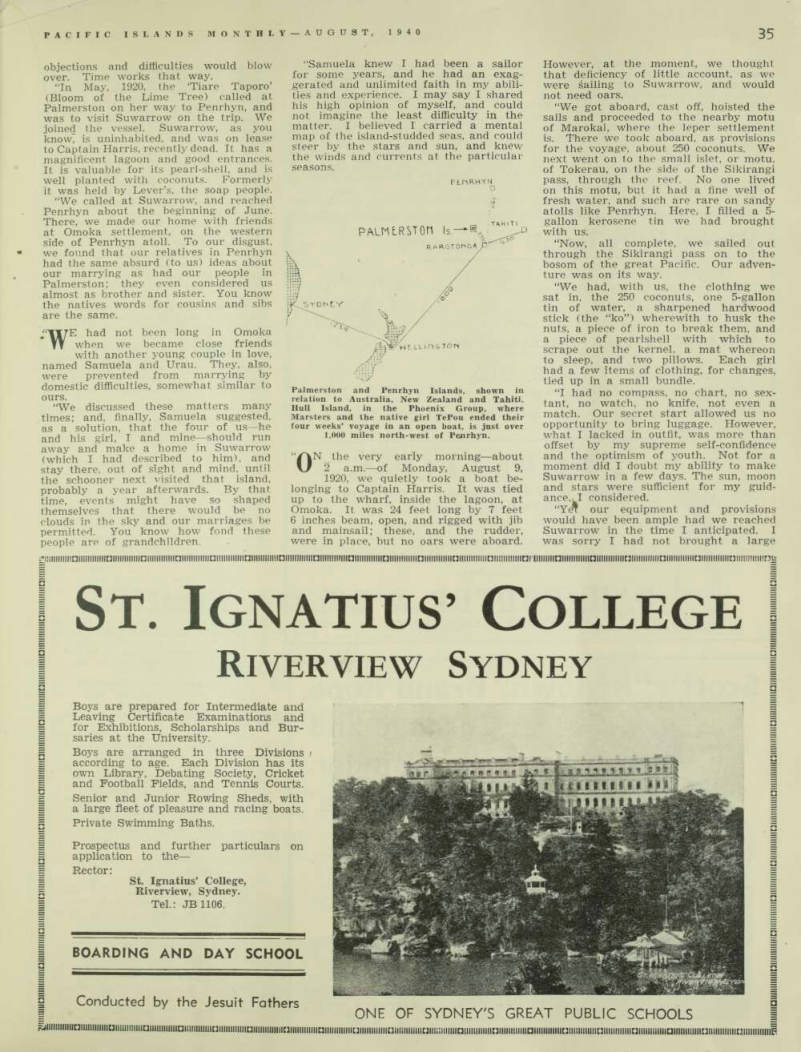
Elopement
Remarkable Story of 28-Days' Wander in Central Pacific
By “Cloghogue”
The story of this remarkable voyage was first told, in rough outline, by a contributor, in the “P.1.M.” of July, 1935, In this article are published the details of the adventure, as, told by one of the principals.
SEVERAL of us were sitting on the verandah, discussing the primal migrations of the Polynesians to the myriad islands of the wide Pacific— a discussion provoked by the contents of a recent book on that subject—and the matter of carrying provisions for the longer journeys was being argued, when we were joined by James Marsters, mate of the schooner “Tagua”.
He listened, for a while, to the vari ous theories advanced, and at last broke in, to say; “To my mind, provided coco nuts were available at that time on the scattered islands, as no doubt was the case, I can see no great difficulty in the matter of food supplies for the crews.
“I and a girl were lost on the Pacific once, for 28 days in a small boat, and coconuts were all we had with us. You must bear in mind that we hear nothing of those voyagers who disappeared at sea, only do we know of those who reached some haven. We two eventually got to land, practically none the worse for our experience.”
The following is his remarkable story, as he told it:— “ A S you know, I’m one of the Marsters family, from Palmerston Island, where, since 1862, from three women, the progeny of my grandfather, William Marsters, have peopled the hitherto uninhabited atoll.
“William Marsters was from England, and knew a lot. One of the basic rules laid down by him was that the progeny of each wife should remain a separate clan, and that cousins from the same clan should not marry. You see, his three wives were two sisters, and a cousin.
“I start my tale by telling you this, because this rule was the seed from which grew the subsequent events.
“There are three clans on the island.
One is from Sara, the sole legitimate wife; one from her sister, TePou; while the third is from their cousin, Matavei.
“I fell in love with my cousin, TePou (named after her grandmother), and we wished to marry. I was from the same grandmother, but had been adopted in infancy, according to native custom, by the Sara family. I had been a sailor on Islands schooners for several years, and did not understand the reason why we should not marry; and being at home for short periods at intervals, I was impatient of delay in setting up a home for myself.
“When the elders of the families knew our desire, they would not allow us to marry. The fact that I had been adopted and reared by the Sara Clan made no difference, they said —we were too near to each other, in blood.
“Well, we two did not concur, and made up our minds to clear off from Palmerston, at the first chance, and go to our relatives in Penrhyn Island.
Marsters’ three wives came from that island. Our idea was that, if we lay out of sight there for some time, the
objections and difficulties would blow over. Time works that way.
“In May, 1920, the Tiare Taporo’ (Bloom of the Lime Tree) called at Palmerston on her way to Penrhyn, and was to visit Suwarrow on the trip. We joined the vessel. Suwarrow, as you know! is uninhabited, and was on lease to Captain Harris, recently dead. It has a magnificent lagoon and good entrances.
It is valuable for its pearl-shell, and is well planted with coconuts. Formerly it was held by Lever’s, the soap people.
“We called at Suwarrow, and reached Penrhyn about the beginning of June.
There, we made our home with friends at Omoka settlement, on the western side of Penrhyn atoll. To our disgust, we found that our relatives in Penrhyn had the same absurd (to us) ideas about our marrying as had our people in Palmerston: they even considered us almost as brother and sister. You know the natives words for cousins and sibs are the same. had not been long in Omoka W when we became close friends with another young couple in love, named Samuela and Urau. They, also, were prevented from marrying by domestic difficulties, somewhat similar to ours.
“We discussed these matters many times; and, finally, Samuela suggested, as a solution, that the four of us—he and his girl, I and mine—should run away and make a home in Suwarrow (which I had described to him), and stay there, out of sight and mind, until the schooner next visited that island, probably a year afterwards. By that time, events might have so shaped themselves that there would be no clouds in the sky and our marriages be permitted. You know how fond these people are of grandchildren.
“Samuela knew I had been a sailor for some years, and he had an exag gerated and unlimited faith in my abili ties and experience. I may say I shared his high opinion of myself, and could not imagine the least difficulty in the matter. I believed I carried a mental map of the island-studded seas, and could steer by the stars and sun, and knew the winds and currents at the particular seasons.
"AN the very early morning—about V/ 2 a.m. —of Monday, August 9, 1920, we quietly took a boat be longing to Captain Harris. It was tied up to the wharf, inside the lagoon, at Omoka. It was 24 feet long by 7 feet 6 inches beam, open, and rigged with jib and mainsail; these, and the rudder, were in place, but no oars were aboard.
However, at the moment, we thought that deficiency of little account, as we were sailing to Suwarrow, and would not need oars.
“We got aboard, cast off, hoisted the sails and proceeded to the nearby motu of Marokai, where the leper settlement is. There we took aboard, as provisions for the voyage, about 250 coconuts. We next went on to the small islet, or motu, of Tokerau, on the side of the Sikirangi pass, through the reef. No one lived on this motu, but it had a fine well of fresh water, and such are rare on sandy atolls like Penrhyn. Here. I filled a 5gallon kerosene tin we had brought with us.
“Now, all complete, we sailed out through the Sikirangi pass on to the bosom of the great Pacific. Our adven ture was on its way.
“We had, with us, the clothing we sat in, the 250 coconuts, one 5-gallon tin of water, a sharpened hardwood stick (the “ko”) wherewith to husk the nuts, a piece of iron to break them, and a piece of pearlshell with which to scrape out the kernel, a mat whereon to sleep, and two pillows. Each girl had a few items of clothing, for changes, tied up in a small bundle.
“I had no compass, no chart, no sex tant, no watch, no knife, not even a match. Our secret start allowed us no opportunity to bring luggage. However, what I lacked in outfit, was more than offset by my supreme self-confidence and the optimism of youth. Not for a moment did I doubt my ability to make Suwarrow in a few days. The sun, moon and stars were sufficient for my guid ance, 1 1 considered.
“Yct our equipment and provisions would have been ample had we reached Suwarrow in the time I anticipated. I was sorry I had not brought a large
Palmerston and Penrhyn Islands, shown in relation to Australia, New Zealand and Tahiti.
Hull Island, in the Phoenix Group, where Marsters and the native girl TePou ended their four weeks’ voyage in an open boat, is just over 1,000 miles north-west of Penrhyn.
knife, but to my mind then, save for that, we were efficiently provided for. As you know, living on these islands demands a minimum of accessories. The from &Fe availalsle “From Sikirangi pass we sailed around Penrhyn, on the western side, keeping about half a mile off the outer side of the reef. I was making for Taruia Ava from which I intended to set my course.
WE had just arrived opposite that pass, when Samuela and his girl
Urau, who had been quarrelling and grumbling between themselves for some time, without a word of warning jumped overboard and swam off for the shore, about a quarter-mile distant.
T << uil r Q prised . and thus > m y girl and af ? ai< * f 2? * wo could a rdly hope to handle the heavy boat ourselves, in bad weather, and keep a ludd'on fc f pp i the f- e fell u ? on a sudden feeling of loneliness, a dread all we islanders know.
“We therefore tried to make the land.
but the wind was against us. The boat was much too heavy, and we went farther and farther seaward, as the wind was off shore. Very soon, we were too far away to think of swimming, especially as the neighbourhood of Pen rhyn swarms with sharks of the worst kind.
“Ere long, I dropped the sails and let the boat drift. Hour after hour, we sat there under a glaring sun, despondently watching Penrhyn gradually fade from sight, until at last, in the sudden dark ness of the tropical nightfall, it dis appeared.
“No succeeding day of our long voy age seemed so painfully wearisome as this, the first of our adventure. We had not reconciled ourselves to circum stances, as we did later, through the passing days; and we had a feeling of irritation at the desertion of our partners.
“We went to sleep that night in the hope that daylight would reveal Pen rhyn in sight, and that we might be able to reach it.
“The morning came. We strained our eyes, looking for clouds, birds or palm tops that might give an indication of land. Not a sign of life or land in any direction. We were alone on the deep.
WITH the idea of reaching Manihiki or Rakahanga—or, if I should miss them, getting to Pukapuka—l hoisted the sails and let the boat run before the S.E. trade wind.
“For five weary, monotonous days we chased the setting sun, but never saw a sign of life or land. Even the great sea-birds, which give notice of land— though at a great distance sometimes — seemed to have deserted us. Nothing but the empty view of interminable rollers, and a cloudless blue sky around us.
“Certain, now, that I must have over run even Pukapuka, I turned and ran back into the sun, with a fading hope of making Penrhyn again or, possibly, Flint Island, to the south, if I missed Penrhyn.
“Seven more days, even more weary, passed on this tack, with never a sight of life, bird, fish, land or ship; under a burning sun; and our water, other than that in the coconuts, close to an end. Not a drop of rain had fallen since we started.
“We had begun to be careful in using the nuts, and now limited ourselves to three nuts each per day—one in the morning, one at mid-day and one at nightfall.
“Our experience is sure testimony to the food value of the coconut, if such be needed. We lived practically on them alone, and not too many either, for 28 days, yet so far as I know we lost neither weight nor energy as a conse auence. They were, I may say, our sole food, also drink for most of the time.
Moreover, when I started work at the end of that period I needed no special feeding to enable me to hold my own with other labourers.
“With such combined food and drink in non-perishable form, the ancient Polynesian adventurers in the Pacific were well equipped for those long-dis tance voyages between islands far apart, which seem so puzzling to-day—at least, that is how I see it.
YEARLY on the morning of Sunday, JE!i August 22 (I kept a tally of the days by marks made on the boat) our first visitor made an appearance.
“My girl TePou, lying asleep in the bottom of the boat, was awakened by something rubbing against it. On sit ting up and looking over the gunwale, she saw an immense blue shark, several
feet longer than our craft, swimming alongside in close touch with our timbers against which it rubbed every now and then. She woke me and, when I had had a look, we were content to sit very quiet, I can assure you. It was possibly 30 feet in length; one of the largest I’ve ever seen, and I’ve seen plenty. It was a visitor and the first life we had come across, but it was nevertheless not welcome.
“Finally, the shark bit at the rudder several times, but fortunately did not take a fancy to shake or otherwise play with the boat, as such sometimes do, with disastrous consequences to the occupants of boats, and canoes especially. After we had lived through a nervy half-hour or so, it swam off, to our relief.
“I now made up my mind to turn north, and try to make Malden Island.
Surely I must be somewhere in its neighbourhood, I believed, for I had seen no sign of expected islands to the south.
As a fact,, I was completely lost. Vanity alone was the parent of any idea of locality I imagined I had. You will understand I did not want to encourage in my inner consciousness the disturbing idea that I was ‘all at sea’.
“I don’t know about such things; but, as some of the old people have since told me, it might be that the shark was sent to bite the rudder to show us that we should change our direction. At any rate, I thought it meant something like that, “It was mid-day on Sunday when I altered course to the north. Three days after that, a booby bird alighted on the main boom and disgorged two flying fish. This visitor, unlike the preceding one, was welcome. The fish we ate raw, a change from the taste of coconut,
which was beginning to pall. The bird I caught, and held until next morning.
But, as we had no means of making a fire to cook it, I let it go—reluctantly, I may add.
“By this time, we had got into a mood where we seldom spoke. We just lay half dozing and let time and tide do their best, or worst. We still had a measure of hope left, but it had dwindied to minuteness, and we were reconciled to whatever fate might bring us.
“Our fresh water was finished. We were reduced to a daily allowance of what was contained in our ration of three nuts, a little more than a pint, and had begun to feel the discomfort of this meagre supply in the tropic heat.
Then, for the first time since we embarked, rain came on. I was able to catch sufficient in the jibsail to fill our kerosene tin once again.
“TOREE nights later TePou woke to X. tell me there was something in the boat, making a peculiar noise. I was a little alarmed, lest it might be water leaking through an opening about the water line. It was a dark night, but, feeling about, I came on a fish (a Ra’i) which somehow had got into the boat and was jumping about.
“This was another welcome visitor.
Being of a respectable size, it made a most satisfying and tasty meal for us in the morning. I have eaten many of these fish, but I never have had one that tasted as good as that one did.
“Four more scorching days. Our water was again exhausted when we were caught in a heavy gale. Wind and rain beat us and drenched us for two days and nights, without a let-up. This was the most uncomfortable and miserable experience of our whole adventure. We
were forced to sit up, sleepless, baling and holding the boat ‘head on to the seas’. It was impossible to lie down, as the waves were breaking over us con stantly. But we were able to fill our kerosene tin with drinking water, “Several more days passed—nothing to see, nothing to do, nothing to talk about, Our tin of water was again finished, and we had but 60 coconuts left, when by the first dim light of dawn, we de scried the tops of palms above the far horizon, away up in the wind. We must have come close to the island in the dark, and had night lasted another half hour we must have passed on, unaware that we had been near land, “It was a close call; for on the course we were then running, there was no more land before the Gilberts, many hundreds of miles westward, “T T was the morning of the 23th day 1 out from Penrhyn, September 6. I turned the boat and made for the island, our hearts singing with thanks and gladness.
“When close to the island, we saw a crowd of naked men running about the beach, with nothing on save girdles of Ti leaves (Ti is one of the Dracoena.) “At an utter loss as to our locality, we imagined at first that we had run into one of the cannibal islands of the Solomons or New Hebrides, and I was just preparing to put about and make away again when we discerned a white man coming through the palms. This meant safety, so I again made for the shore.
“The white man was an American, Mr. Felhall. With his native overseer, both well armed, they put off in a boat He hailed me and asked if I spoke Eng lish. You can imagine that it was diffi
cult to tell what I was, with 28 days’ whiskers and dirt on my face, unkempt and half-dressed. I assured him I could.
“He enquired who we were, where from, how many days out, and so on. I gave him full details, but he seemed to disbelieve us, and asked if he could do anything for us. As it looked for the moment that we were unwelcome, I replied, ‘Fill us up with coconuts and we’ll go on our way.’
“At this, he asked if he might come alongside. Our boats got together and a few minutes’ conversation dispelled all suspicions. He then suggested that we go ashore and I join his working party until an opportunity came of get ting away for home. I was only too pleased to comply. I had had enough of the sea.
r[E_ island proved to be Hull Island, one of the Phoenix Group, owned by Britain, and known to the natives of the Ellice Group as Holona.
Usually, the island is uninhabited; but, fortunately for us, there was a working party of native boys there, in charge of Mr. Felhall, clearing, planting and mak ing copra for the lessee of the island, a Captain Allen.
“We found on the island, besides Mr.
Felhall and his wife, a half-caste Samoan-Chinese from Apia, named Alo bara, 26 men and four women, with a few children, from the Ellice and Toke
lau Groups.
“I remained there, working, for nine months. Then we left for Funafuti, in the Ellice group, in a boat belonging to the firm of Captain Allen. It was a craft similar to mine. There were seven
of us on the trip—Mr. and Mrs. Felhall, TePou and me, and three labour boys, as crew. We made Funafuti in five days, without trouble.
“I left my boat at Hull Island, with the intention of recovering it later.
“Always accompanied by TePou, I engaged at Funafuti as sailor on the ‘Talofa’, one of Allen’s boats, after wards transferring to the ‘Dawn’. After four months, I got back to Hull Island, to find that, in my absence, six of the Tokelau boys had annexed my boat and sailed off with it for Nukunono. After wards, I learned they arrived safely, but I never recovered the boat.
“On the ‘Dawn’, I went from Hull to Sydney Island; thence to Nukunono; thence to Pago Pago, and from there to Apia. At Apia, I joined the Union Steam Ship Co.’s steamer ‘Tofua’ and, calling at Fiji, Niue and Niuafoou (Tin can Island) we eventually got to New Zealand. From there, the ‘Marama’ brought us back to Rarotonga, where we arrived on January 12, 1922—20 months after our elopement from Palm erston.
“The girl was with me throughout.
Never were we separated for a day, throughout that 20-months’ period. But I regret to say that, after our arrival in Rarotonga, we quarrelled, and she left me and married a man named Poata, from Manihiki Island.”
Advertisements & other items, pp. 36-40 (2 items)
Capstans®
ife M
SPECIALLY
PACKED FOR
THE TROPICS
i Capstan Cigarettes round airtight 50's.
Medium and full strength.
I Ao Capstan
\ *l«vy
' Cut Tobacco, made the finest 1 Virginia leaf. from
R m m .
READ THE
B.P. MAGAZINE
WINTER NUMBER
iiiiiiiiiiiiiiiiiiiiiiiiiiiih
Now On Sole
Short Stories Pictures Travel Articles Pages for the Children Stage Latest Fashions Screen A
ONE SHILLING PER COPY.
ON SALE AT ALL NEWSAGENTS AND BOOKSELLERS
St. Ignatius’ College
Riverview Sydney
Boys are prepared for Intermediate and Leaving Certificate Examinations and for Exhibitions, Scholarships and Bursaries at the University.
Boys are arranged in three Divisions t according to age. Each Division has its own Library, Debating Society, Cricket and Football Fields, and Tennis Courts.
Senior and Junior Rowing Sheds, with a large fleet of pleasure and racing boats.
Private Swimming Baths, Prospectus and further particulars on application to the — Rector: St. Ignatius’ College, Riverview, Sydney.
Tel.: JB 1106.
BOARDING AND DAY SCHOOL
Conducted by the Jesuit Fathers
II
ONE OF SYDNEY'S GREAT PUBLIC SCHOOLS
Woven Wire for all Industry
COPRA DRYING TRAYS, FLOORS Etc.
FRUIT DRYING TRAYS, MINING SCREENS.
Heavy Mosquito Gauze in Phosphor Bronze and other Metals Impervious to Salt Sea Air.
WIRE DOOR MATS AND GENERAL WIRE WORKS
E. WRIGHT & CO. LTD.
Office and Works: 148-152 Cleveland Street, Sydney, N.S.W Telegraphic Address: •Wrightmake,” Chippendale. <S&C> *
PROPELLORS
All Sizes to 54 in. diameter . . . any pitch.
SHAFTS MADE TO ORDER.
Bearing and Stuffing Boxes—Rudders— Tanks for Water and Fuel—Exhaust Pipes and Mufflers.
Copper, Bronze and Aluminium Founders.
D. H. PORTER & CO.
43-45 DRUITT STREET, SYDNEY.
Scott’s “Renown” Brand Rope,
Cordage and
Cable Address: Ropeyard, Sydney. .
Binder
Twine
of Every
Description
MANUFACTURED AT
MASCOT. N.S.W.
J. SCOTT
PTY. LTD.
Head Office and Store:
163 CLARENCE STREET,
SYDNEY,
N.S.W.
Established 50 years—and carrying one of the largest stocks of Iron and Steel in Australia.
William Atkins Pty. Ltd.
Head Office 449-451 KENT ST., SYDNEY.
FULL, COMPREHENSIVE & UP-TO-DATE RANGE IN ALL
DEPARTMENTS, INCLUDING THE FOLLOWING LINES:—
STEEL DEPARTMENT
MILD STEEL:
Rounds, Squares, Flats, Half-rounds, Hexagons, Bevel, Shoeing, Tyre, Angles, Tees, Sheets, Plates, Girder Plates, Chequer Plates, Channels, Hoops, Etc.
BRIGHT STEEL:
Rounds, Squares, Hexagons.
Iron & Steel Merchants
ENGINEERS' SUPPLIES
COACH & MOTOR HARDWARE.
Cable Address; WILATKIN, SYDNEY.
Engineers' Supplies: Set Screws, Studs, Metal Thread Screws, Coach Screws, Files, Cotter Pins, Bright and Black Bolts, Rivets, Etc., Hack Saw Blades.
Power Transmission Gear: Including Plummer Blocks, Couplings, Collars, Etc.
Coach and Motor Hardware: Axles, Springs, Wheelstuff, Duck, Paints.
Farriers' Supplies: Horse Nails, Anvils, Vices, Etc, Extra Special High Speed Tool Steel, Mining Steel, Blister Steel and Spring Steel, Rounds, Flats & Squares.
Bor Iron—All sections and sizes.
Motor-Trimmers and Motor Builders' & Motor Painters' Requirements
C. A. WILLEY'S
Quick-Drying Coach and Car Paints, Roughstuff, Elastic Gloss, Synflex Enamels, Lacquers.
DUCO Lacquers and DULUX Enamels—FAßßEX Motor Toppings and Leather Cloths, House fir Decorators' Paints, Varnishes Cr Brushware Sole Distributors of CHAMPION'S Decorators Paint Products.
Distributing Agents for BROLITE Lacquers, SYNFLEX Enamels and "POLYGLOSS" Finish.
I i M / DISTRIBUTORS: Greenwood & Laws Ltd., Rabaul and Wau; !
Steamships Trading Co. Ltd., 1 Port Moresby and Samarai; 1 Millers Ltd., Suva, Fiji.
For Protection and
Appearance - - use
“B A L M” Paint
PROTECTION —is the main job of Paint . , . APPEARANCE is next . . . and, to get the most efficient combination of both . . . use “8.A.L.M.” Paint.
“8.A.L.M.” Paint is a product of scientific research and practical experience . . . It has been tested for durability, protective qualities and colour retention, and proved to be the best that can be made.
Measure the value of Paint by years of service, protection and appearance, and NOT by cost per tin. Specify “8.A.L.M.”
Paint.
ifSlS’r
A Product of British Australian Lead Manufacturers Pty. Ltd.
If you want “Perfection in Cooking" use a
“Younger” cooking stove
These stoves have been on the market in Australia for over Sixty Years, and are still recognised as “The Best”.
They are made with Extended Firebox specially for Long Wood fuel, also special stoves with Cast Iron Oven suitable for Island requirements.
Send for Illustrated Catalogue and Price of Single and Double Oven Stoves.
G. FLETCHER & SON
50 OXFORD STREET, SYDNEY.
New Bishop Museum
Publications
ITIHE following scientific publications L have recently been issued by the Bernice P. Bishon Museum, Honolulu:— By Harold St. John, “Hawaiian Plants Named by Endlicher in 1836”. Hawaiian plant studies 8, Bishop Museum Occa sional Papers, vol. 15, no. 22, pages 229- 238. 1940. Of 21 names proposed by End licher for Hawaiian plants, in a Vienna publication, three are recognised as valid.
By Dudley Moulton, “Thysanoptefa from New Guinea and New Britain”.
Bishop Museum Occasional Papers, vol. 15, no. 24, 1940. Records 42 species of thrips classified into 20 genera; of these 28 species and 3 genera are described as new to science. Most of the specimens were collected by C. B. Pemberton in 1928-29.
By Elwood C. Zimmerman, “Synopsis of the genera of Hawaiian Cossoninae with Notes on their Origin and Distri bution (Coleoptera, Curculionidae)”.
Bishop Museum Occasional Papers, vol. 15, no. 25, pages 271-293, 2 maps, 1940.
Lists 115 species representing 16 genera of weevils, with keys and notes on distri bution. Kauai has the largest number of endemic species and subspecies, with Oahu second and Maui third. The island of Hawaii, despite much larger area, has relatively few endemic species.
By Milton A. Miller, “The Isopod Crustacea of the Hawaiian Islands (Cheli fera and Valvifera)”. Bishop Museum Occasional Papers, vol. 15, no. 26, pages 285-321, 9 figures, 1940. The first of a series of papers which plan to form a monograph of Hawaiian land and marine isopods; gives keys, descriptions and figures.
By Edwin B. Bartram, “Mosses of South-Eastern Polynesia”, Bishop’Museum Occasional Papers, vol. 15, no. 27, pages 323-349, 12 figures, 1940. Records 62 species of mosses from the Tuamotu, Austral and Mangareva Groups, and Rapa, Pitcairn and Henderson Islands. Eleven species are described as new to science. (Reviewed by E. H. Bryan, Jnr., Curator of Collections, Bishop Museum.)
Sugar Crop Is Smaller
Indian Agitators Cause Unrest Among Fiji Cane-Growers
From Our Own Correspondent SUVA. July 9.
THE full effect of propaganda spread throughout the sugar planting community by Indian agitators some time ago will be seen when the Colonial Sugar Co.’s mill at Lautoka completes the crushing of this season’s sugar-cane. Already, it is reported that the crop is not a big one and that the crushing will be finished in about four months.
It will be remembered that when the C.S.R. Co. introduced a new system of paying growers for their cane last year, many Indian planters, influenced by trouble-makers, were convinced that they were being treated unfairly, and promptly ceased planting cane.
The C.S.R. Co.’s plan, however, was an attempt to introduce a fairer method of paying growers. These people are paid according to the sugar content of their cane and at one particular period in the season this is at its peak. Obvi ously, the company’s mills cannot take all the cane offering at this time, with the result that a few growers obtain the benefit of the maximum sugar content and the rest receive a lesser rate when they make their deliveries after this peak period. The company’s new scheme was to pay the whole of the growers according to the season’s average cane sweetness.
Although a settlement of the dispute was eventually reached, with the Fiji Government assuring Indian planters that they would keep an eye on their interests, much valuable planting time was lost, with the result that the crop is less than normal.
The opinion has been expressed here on more than one occasion that the authorities should take quick and severe measures to deal with these unscrupu lous Indian agitators who go among their fellow-countrymen causing trouble and unrest.
How To Destroy Rats
RATS, at times, do get into a house or an outhouse, however carefully kept, and the housewife is naturally keen on keeping the pests away, or of getting rid of them when they appear. Here are a variety of ways found useful, and such as can be dealt with by all women folk.
When a house is infested with rats which refuse to be caught by cheese and other baits, a few drops of the highly scented oil of rhodium poured on the bottom of the trap will be an attrac tion they cannot refuse.
Place on the floor, near where rats’ holes are, a thin layer of moist caustic potash. When the rats travel on this it will cause their feet to become sore, which they lick, and their tongues be come likewise sore. The consequence is that they shun this locality, and seem to inform all the neighbouring rats about it, and the result is that they soon aban don a house that has such a preventive.
Cut some corks as thin as wafers and rub them in grease. Place the same in their tracks; or a bit of sponge dipped in treacle or honey, with a small quan tity of oil of rhodium, will fasten to their coats and cause them to depart.
If a live rat be caught and smeared over with train oil, and afterwards al lowed to escape in the holes of other rats, it will soon cause all to leave.
Take a pan about 12 inches deep and half fill it with water; then sprinkle a thick layer of bran on the water and set the pan in a place where the rats frequent most. In the morning you will find several rats in the pan.
Make two parts of common squills (well bruised) and three parts of finely chopped bacon into a stiff mass, with as much barley meal as may be re quired, and then bake in small cakes and put for the rats to eat. —Tanganyika Adveriser.
Improving New Caledonia's
Livestock
IN recent years, the pastoral industry in New Caledonia has revived, following the 1930-31 slump when the canned beef business fell away almost to noth ing. With a view to improving the standard of the Colony’s livestock, the Government has been purchasing pure bred pigs and dairy cattle from Aus tralian studs in fairly large numbers.
Breeds most in favour are Jersey and Illawarra cattle and Berkshire pigs. The Colony has abundant good cattle country.
Dr. K. Washington Grey, chief geolo gist of the Australasian Petroleum Com pany in Papua, paid a two weeks’ visit
in July to the company’s areas at Wewak Northern New Guinea.
Advertisements & other items, pp. 41-42 (1 item)
Bitumenoid Roofing
Timber, Joinery
ETC.
PREPARED BUILDINGS ready for erection a specialty.
SHIP AND BOAT BUILDING.
TIMBERS specially catered for.
FIBROLITE, PLYWOODS,
GALVANISED IRON.
CONSIGNMENTS shipped
by RETURN STEAMERS
to the Islands.
John W. Eaton
PTY. LTD.
WEST CRESCENT STREET,
NORTH SYDNEY.
Telephones: X 84051 (6 lines.)
BITUMENOID ROOFING
MADE IN AUSTRALIA.
Bitumenoid Roofings, Dampcourse and Insulating Felts are made from the world’s best raw materials. Warranted to stand the most rigid tests.
BITUMENOID THE BEST
Roofing, 1,2, 3-ply; Flooring, Waterproof Materials; Saturated Felt; Resilient Road Jointing; Natural Asphalt Dampcourse: 2 and 3-ply Dampcourse; 1-2 lb. Lead-core Dampcourse: Roofing Cement; Asphalt Paints; Roofing Compound.
SAMPLES AND PRICE LISTS ON APPLICATION.
MAXWELL PORTER & SON LTD.
ESTABLISHED 1888. BUILDERS’ SUPPLIES.
107 REDFERN ST., REDFERN, SYDNEY, N.S.W. Phone: M 3157. Cables Bitumenoid.
o *C* S Obtain a copy before you build.
It contains designs and plan*—in colour—of Homes that con be inexpensively built with
WUNDERLICH DURABESTOS
the indestructible asbestos-cement building sheeting. Write to
WUNDERLICH LIMITED
5.P.0., Box 474aa, SYDNEY
rOR TROPICAL BUILDINGS, SPECIFY
I I
SIMILAR TO EUROPEAN MAKES
now made by
COLEMAN LAMP & STOVE CO.
LTD.
Toronto, Ontario, Canada and sold by All Leading Stores in the Pacific Islands.
In case of difficulty in obtaining supplies wHte to —
PEARCE & CO.—SUVA. FIJI IS.
FOR INTER-ISLAND TRANSPORT
THE CHAPMAN 16 ft. CABIN LAUNCH
This craft is particularly suitable for Island use. The roomy, lock-up cabin provides ample storage space for provisions, stores, etc. Besides, the sturdy Coach-house cabin makes this craft a real rough weather launch—waves roll off like water from a duck's back. Powered with Chapman PUP Engine. Write for details.
Fiji Residents Man Local
Defences
rE following statement has been issued by the Defence Department of the Government of Fiji :— Fiji, which has had no regular troops since 1878, when the Royal Engineers left the Colony, began recently the local engagement of artillery officers and men. These will supplement and even tually replace the gunners who began to arrive from overseas soon after the out break of war. Recruiting closed on January 31.
The Colony is very proud of its new coast defences and there has been an eager response to the call for service.
It is understood that there have been more than three times as many applica tions as there are vacancies available.
Samoa Depending on Cocoa
and Bananas
Prom Our Own Correspondent APIA, July 7.
THE cocoa market is still holding and merchants in Samoa are buying Ist grade hot-air dried beans up to £42 per ton delivered to Apia stores. Our shipments of bananas are now over 15,000 cases per month. These industries com pensate for the low copra price—£2/3/per ton in Apia. Copra stocks in local stores are still heavy.
Damage Cargo
How Native Labourers Damage Cargo
AT Port Moresby, the newcomer to Papua has his first glimpse of what damage Papuan native labour can do to property if allowed to practically run amok in the hold of a ship.
I came through Port Moresby on the “Malaita”, some months back, bound for Samarai, and witnessed the unloading process. I had previously wondered why, quite often, our cargo arrived in store in very small pieces, but the unloading at Port Moresby explained it Two winch boys sat at the winches, while a dozen boys went down below.
Cases of goods were lifted up by the boys in the hold, and dropped from as high as possible on to their corners, and deliberately broken. Whenever a case was smashed, which was frequently, the winch boys would leave their positions, go to the edge of the holds and join in the laughter which took place.
I wondered who was in charge, and when it would cease, but it went on for several hours.
Often, in Port Moresby, natives are before the court for stealing from cargo.
Isn’t it time that some Government official awoke to the fact that if a native is not allowed to deliberately break cases open, the temptation of loose tins of meat will not be placed in his path? If they were made to take reasonable care of the cargo in the hold, the trouble would cease.
We blame the Government for every thing, and we are quite often right.
However, they have to try and mete out justice to many different classes of men, and they have necessarily to protect the native from being exploited. Still, wouldn’t it be as well, in cases like this, to protect the decent white man from being exploited?
If any Government official went down and saw the unloading process from beginning to end he would probably see my point of view.—W.
N.G. Volunteer Rifles
From Our Own Correspondent WAU, * July 25.
Lieutenant Alan ciarke, who obtained his commission in the Militia Forces in Australia before his appointment as chief telephone mechanic in Morobe District, and who has done exceptionally good work with the New Guinea Volunteer Rifles, left for South on leave on July 22. It is understood that he will almost assuredly join the A.I.F. before his leave expires.
Thus the local Volunteers lose another valuable officer.
The idea of appointing young and eli gible men to commissions in the N.G.
Volunteer Rifles would appear to be ineffective, for no sooner are they appointed than they depart for enlist ment in the A.1.F., if their circumstances permit them to do so. It is suggested that a complement of officers who are over the age-limit and have experience behind them would be a much better way of officering the Regiment.
A new rifle range has been built voluntarily by the Edie Creek Platoon of the N.G, Volunteer Rifles at Edie Creek (7,500 ft. above sea-level). It is equipped with two telephones from butts to firing points, the gift of the ladies of Edie Creek.
Operators
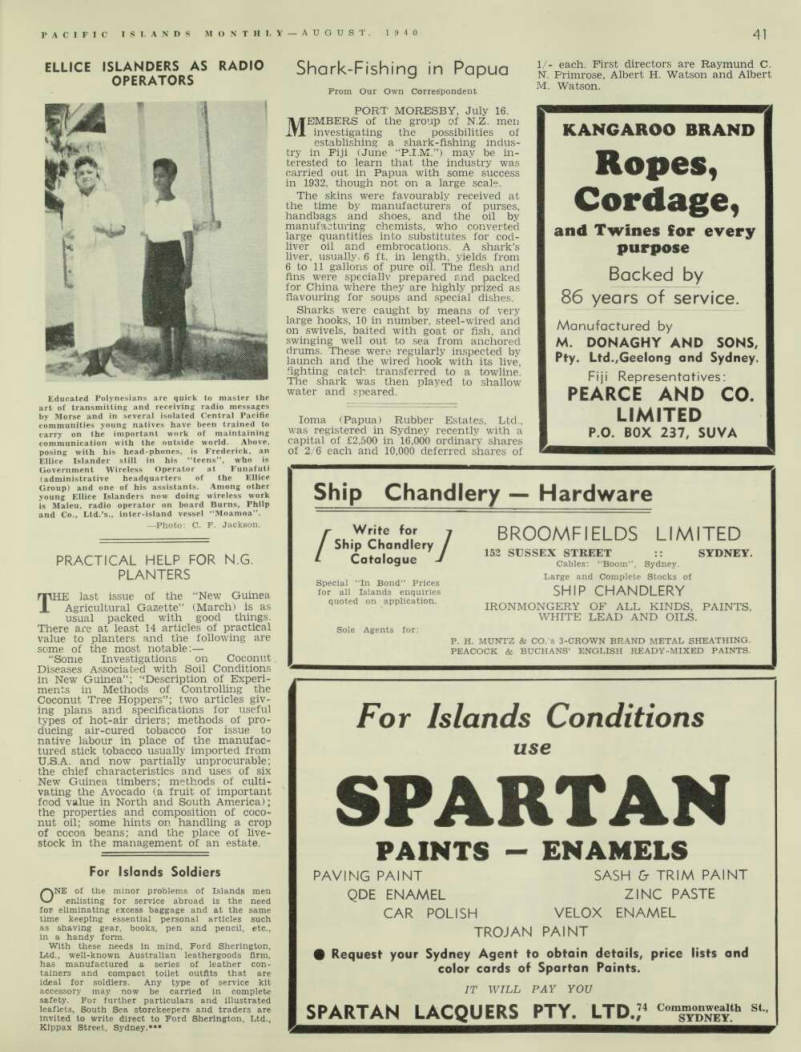
Ellice Islanders As Radio
Educated Polynesians are quick to master the art of transmitting and receiving radio messages by Morse and in several isolated Central Pacific communities young natives have been trained to carry on the important work of maintaining communication with the outside world. Above, posing with his head-phones, is Frederick, an Ellice Islander still in his “teens”, who is Government Wireless Operator at Funafuti (administrative headquarters of the Ellice Group) and one of his assistants. Among other young Ellice Islanders now doing wireless work is Maieu, radio operator on board Burns, Philp and Co., Ltd.’s., inter-island vessel “Moamoa”. —Photo: C. F. Jackson.
Practical Help For N.G.
Planters
THE last issue of the “New Guinea Agricultural Gazette” (March) is as usual packed with good things.
There are at least 14 articles of practical value to planters and the following are some of the most notable:— “Some Investigations on Coconut Diseases Associated with Soil Conditions in New Guinea”; “Description of Experi ments in Methods of Controlling the Coconut Tree Hoppers”; two articles giv ing plans and specifications for useful types of hot-air driers; methods of pro ducing air-cured tobacco for issue to native labour in place of the manufac tured stick tobacco usually imported from U.S.A. and now partially unprocurable; the chief characteristics and uses of six New Guinea timbers; methods of culti vating the Avocado (a fruit of important food value in North and South America); the properties and composition of coco nut oil; some hints on handling a crop of cocoa beans; and the place of live stock in the management of an estate.
For Islands Soldiers
ONE of the minor problems of Islands men enlisting for service abroad is the need for eliminating excess baggage and at the same time keeping essential personal articles such as shaving gear, books, pen and pencil, etc., in a handy form.
With these needs In mind, Ford Sherington, Ltd., well-known Australian leathergoods firm, has manufactured a series of leather con tainers and compact toilet outfits that are ideal for soldiers. Any type of service kit accessory may now be carried in complete safety. For further particulars and illustrated leaflets, South Sea storekeepers and traders are Invited to write direct to Ford Sherington, Ltd., Klppax Street, Sydney.***
Shark-Fishing in Papua
Prom Our Own Correspondent
Port Moresby, July 16.
MEMBERS of the group of N.Z. men investigating the possibilities of establishing a shark-fishing indus try in Fiji (June “P.1.M.”) may be in terested to learn that the industry was carried out in Papua with some success in 1932, though not on a large scale.
The skins were favourably received at the time by manufacturers of purses, handbags and shoes, and the oil by manufacturing chemists, who converted large quantities into substitutes for cod liver oil and embrocations. A shark’s liver, usually. 6 ft. in length, yields from 6 to 11 gallons of pure oil. The flesh and fins were special!v prepared and packed for China where they are highly prized as flavouring for soups and special dishes.
Sharks were caught by means of very large hooks, 10 in number, steel-wired and on swivels, baited with goat or fish, and swinging well out to sea from anchored drums. These were regularly inspected by launch and the wired hook with its live, fighting catch transferred to a towline.
The shark was then played to shallow water and speared. loma (Papua) Rubber Estates, Ltd., was registered in Sydney recently with a capital of £2,500 in 16,000 ordinary shares of 2/6 each and 10,000 deferred shares of
1/- each. First directors are Raymund C.
N. Primrose, Albert H. Watson and Albert M. Watson.
Advertisements & other items, p. 43 (1 item)
Spartan
KANGAROO BRAND
Ropes,
Cordage,
and Twines for every purpose
Backed by
86 years of service.
Manufactured by
M. DONAGHY AND SONS,
Pty. Ltd.,Geelong and Sydney.
Fiji Representatives:
PEARCE AND CO.
LIMITED
P.O. BOX 237, SUVA
Ship Chandlery Hardware
/Write for j
Ship Chandlery /
Catalogue J
Special “In Bond” Prices for all Islands enquiries quoted on application.
Sole Agents for: P. H. MUNTZ & CO.’S 3-CROWN BRAND METAL SHEATHING.
PEACOCK & BUCHANS’ ENGLISH READY-MIXED PAINTS.
BROOMFIELDS LIMITED
152 SUSSEX STREET SYDNEY.
Cables: “Boom”, Sydney.
Large and Complete Stocks of
SHIP CHANDLERY
IRONMONGERY OF ALL KINDS, PAINTS,
WHITE LEAD AND OILS.
For Islands Conditions
use
SPARTAN
PAINTS - ENAMELS
PAVING PAINT
QDE ENAMEL
CAR POLISH
SASH Gr TRIM PAINT
ZINC PASTE
VELOX ENAMEL
TROJAN PAINT
Request your Sydney Agent to obtain details, price lists and color cards of Spartan Paints.
IT WILL PAY YOU
SPARTAN LACQUERS PTY. LTD., 74 Cora s T^ a Y th st
More Losses
C.I. Fruit-Growers Up In Arms at Govt "Control"
From Our Own Correspondent T , T ttt , RAROTONGA, July 3.
HE season of Rarotonga orange ship ments is now approaching its close— probably only one small shipment will be sent to N.Z. this month. The posi tion of the industry during 1940 gradu ated from a poor beginning to an in finitely worse end.
The slightly mollified attitude of the growers was changed to bitter criticism by events during May-June. In the first, place, the Fruit Control Department made an error in their estimations—the result being that over 1,500 full cases of oranges had to be left behind, as well as leaving
a large number unpacked. On May 29,the Department, without consulting the Island Council or Fruit Advisory Com mittee, announced that, in order to meet the losses thus occasioned, payment would be 3/4 per case instead of the usual 3/9.
As this price included a rebate on the manure levy of 3d. per case, the actual loss amounted to about Bd. per case.
The districts of Avarua and Takitumu, who were paid for the fruit on the two days following this announcement, ac cepted payment “under protest” but the independent people of Arorangi, who were not to be paid until June 4, decided after a meeting that they would not take their money until the matter had been investi gated. To this decision they adhered, but apparently economic conditions over ruled their independence and the Gov ernment made a second and successful attempt to pay them on June 6.
Worse was yet to follow. First reports from N.Z. on the May shipment indicated that the Rarotonga fruit had landed with the high loss of 23 per cent. After a few days, the loss rose to th Q staggering figure of nearly 50 per cent. Naturally, the New Zealand “Control” could not carry on shipments on this basis and on June 11 a radio message from Wellington stated that only 4,500 cases would be accepted from Rarotonga for the June shipment These have been picked in a spirit of patient hopelessness by those growers who could not do without the cash in
volved, but many have not considered it worth their while.
Bitter comparison is being made be tween Rarotonga, which has the services of an imported citrus expert and his staff, and the neighbouring island of Mangaia which is iun lock, stock and barrel by one white Resident Agent. Mangaia, in spite of dissatisfaction with the prevail ing price and difficult shipment due to the bad reef, has had a uniformly suc cessful year with low rates of loss. For the June shipment they received space for a maximum of 8,000 cases. When it is calculated that Mangaia shipped six cases against Rarotonga’s one per head
of population the difference can be well judged. Knowledgeable men say that the keeping qualities of the Rarotonga orange are not so high as those of Outer Islands fruit, but one cannot believe that this accounts for the big difference in loss.
Protests and petitions galore from both Europeans and natives are now under way and it is understood that Mr. W.
Mcßirney, a prominent local planter, may bring a suit against the “Fruit Control” as a test case.
Mr. L. Bunting, a New Zealand busi ness man who is well known in the Cook Group—he was for many years lessee of Manuae Island, a small atoll midway be tween Atiu and Aitutaki —recently paid a visit to Rarotonga on the “Matua”.
Mr. L. Trenn, Resident Agent at Mani hiki, Cook Islands, arrived in Auckland in July on four months’ furlough, part of which is being spent touring the North Island of New Zealand.
Shortage of Paper
rE “Pacific Islands Monthly”,
in common with all other British publications, is now subject to severe rationing of paper; and readers, in conse quence, will notice that the jour nal is being severely condensed and compressed. This will become more marked, as time goes on.
We ask for the forbearance of readers and advertisers. Letter press and advertising space have to be reduced, to economise in paper consumption and assist the national war effort. Under such conditions, publishers cannot expect to make profits—their efforts are concentrated on keeping their journals alive, and rendering pub lic service.
So far as Australian publishers are concerned, there has been no move to increase rates. The general policy is to try to “take it”, and to hope that readers will be patient and generous in these diffi cult times.
Advertisements & other items, p. 44 (1 item)
C® Salliva
ft J
KIDDIES’ COUGHS
Break nasty coughs and colds quietly.
Soothe nose, throat, chest and lungs.
Sake and pleasant to take. Handy-sized bottle, I/-.
cure
DELICIOUS, TASTY FOODS
For ISLAND MEALS
AUNT MARY’S COOKFBY
BOOK,
There’s no finer book for every home . . , 212 pages, lavishly Illustrated In colour, and over 400 recipes and useful hints make It a book that every housewife will want. Send only one shilling and twopence to
TILLOCK A' CO. PTY. LTD.,
Sydney N S W.. and get your copy of this great book NOW.
JUST TRY any of AUNT MARY'S Pure Food Products, and you will be bock for more . delicious in themselves or with innumerable dishes.
AUNT MARY'S BAKING POWDER
AUNT MARY'S TOMATO SAUCE
AUNT MARY'S SPAGHETTI IN TOMATO
SAUCE
AUNT MARY'S BAKED BEANS IN TOMATO
SAUCE
AUNT MARY'S CANNED VEGETABLES
Green Peas, Cauliflower, Celery, etc.
RANEE CURRY POWDER
BLOSSOM HONEY In Attractive Jars Or any of the large variety of Pure Pood Products specially packed for Tropical conditions. In Tlllock’s Hermetically Sealed 1-lb. tins. All good* are procurable from your local stores.
TILLOCK & CO. PTY. LTD. SYDNEY
C® Salliva
a
General
Merchants
and
Agents
REPRESENTING LEADING FIRMS IN THE PACIFIC ISLANDS
379 KENT STREET,
SYDNEY.
Cable Address: “Trocas”, Sydney.
Telephones: MJ 4657 (5 lines).
Islands Produce Sold on Shippers’ Account Buyers of all Islands’ requirements on Commis Liberal Advances against Consignments. sion Original Invoices Furnished. 25 Years Islands Trade Experience.
Bankers: Bank of New South Wales. Correspondence in English, French & German
Old Theory
Polynesians
New Scientist With an Old Theory
IN articles published widely in North American newspapers in recent months, Thor Heyerdahl, described as “a Norwegian scientist and traveller”, claimed that he had traced the origin of the Polynesian race to the Bella Coola Valley, a district of British Columbia, in Eastern Canada.
There is nothing new in the theories of Mr. Heyerdahl. The origin of the Polynesian race has been for long a subject of much controversy; but every scientist, of any standing, who has dis cussed the matter agrees that the original Polynesians must have come into the Pacific from South Asia, or South-West Asia, via the East Indian Archipelagoes.
THIS business of the origin of the Polynesians is like a jig-saw puzzle”, Mr. Heyerdahl said, in an interview.
“Once the key is found all the parts fit together perfectly and make it impossible to believe that the Polynesian races came from any place except the North-West Coast of America, and Bella Coola in particular.”
Mr. Heyerdahl, who with his wile spent a year in Polynesia, expressed the belief that the original inhabitants of the mountain-girt Bella Coola Valley had been driven from their homes 1000 A.D. by the war-like Salish Indians of the lower Fraser Valley, 300 miles farther south.
He suggested they fled in their huge dugout canoes until they reached the open seas, where prevailing winds carried them 2,300 miles south-west to the Hawaiian Islands. Some spread on through the South Sea archipelagoes while others penetrated as far as New Zealand, to found the Maori race.
Mr. Heyerdahl declared that stone carvings, found in remote sections of the Marquesas Islands, are identical with those found in the Bella Coola Valley, and that there is a marked relation evi dent in the bark clothes worn by the in habitants of both regions. He also found a similarity in carved columns, instru ments of war and peaceful utensils.
He said that nearly 200 years ago, Captain Cook and Captain George Van couver reported in their journals that the Hawaiian Islanders had canoes 60 ft. long, made of American pine. Heyerdahl said the explorers thought the logs had drifted there, but he sees it as further proof of his theory.
Similarity between the Malays and Polynesians had led scientists to regard the Malayan archipelago as a possible source of the Polynesians, he added, but his theory is that both races started from a common cradle in Asia and went different ways, the Polynesians crossing to North America by way of the Bering Straits.
Mr. Heyerdahl also claims to have solved the riddle of the monster stone monuments on Easter Island, in the South Pacific. He believes they were erected by a pre-Inca civilisation from South America which used Easter Island, the Hawaiian Islands, the Marquesas group, Tahiti and Tonga as colonies.
Dr. Mead Is Sceptical
Dr. Margaret Mead, A World
famous anthropologist, now curator at the Museum of Natural History in Manhattan, New York, who is an authority on the Polynesians and author of the well-known “Coming of Age in Samoa”, said, on the basis of the inter view given by Mr. Heyerdahl, “it does not appear that he is presenting any new
material to support an old, frequently advanced theory, so far unsupported by evidence.
“These superficial resemblances be tween the cultures of the north-west coast of Britisn Columbia arid the cul tures of the Polynesians have led ethno logists and students to construct periodi cally. theories of this sort, for the last 50 years”, said Dr. Mead. ‘‘The Polynesians, in fact, were once called the lost ten tribes, and have been called every other lost thing on earth”, she said. If Mr, Heyerdahl has made archaeological finds in an extensive area and could offer substantial new material of this sort, to support his theory, then it would indeed be of outstanding anthro pological interest.
What has often confused ethnologists has been their finding similar instruments of war and utensils in widely scattered parts of the Pacific. Dr. Mead said many of these were scattered by Captain James Cook and other travellers, who' purchased utensils in one spot and left them in an other.
New Tomato Plant Developed
in Western Samoa
ANEW dwarf hybrid tomato of real merit has been produced by Mr. H.
C. Reed, a local horticulturist, according to the “Western Samoa Mail”.
The fruit is attractive in shape, being round, solid and firm, and having prac tically no “core”. The hybrid is a cross of two distinct varieties of Australian and American tomatoes, and the method used was the Burbank flower-graft.
The new tomato should prove a boon to planters in the tropics who require a quality fruit borne on dwarf plants,
which require neither pruning nor stak ing, and which mature a crop of splen did tomatoes in the short space of 12 weeks.
Owing to the increased demands on the Port Moresby Telephone Service, annual rental has been increased from £5/5/- to £7 10/-. This service is operated entirely by trained Papuan natives.
Advertisements & other items, pp. 45-48 (2 items)
Horse Generator
Estal 1868 X
GO WINGS
Sydney's Leading Store
EXCLUSIVELY FOR MEN
SUIT TO MEASURE
TAILORED AND AWAITING
YOUR ARRIVAL IN SYDNEY
Write for
FREE PATTERNS
and Self Measurement Form . . .
COWING BROS. LTD.
Market and George Streota, Sydney will have your
Generate Your Own Electricity with a
JOHNSON IRON
HORSE GENERATOR
Write for Illustrated Leaflet.
Weight when packed, 100 lb. ■.***
• ELECTRICITY for LIGHTING
• POWER for Radio
• POWER for Battery Charging
Electric Light is now available to everyone with this low-priced dependable generator.
Charging operates immediately the electric starting button is pressed, and by turning a knob the output is controlled from nothing to 800 watts. Electric Light (with the Johnson Generator) costs you less than the messy, dangerous, old-fashioned lamps— you can use 3 lights for 3Va hours every night at a cost of approximately 1/6 per week.
Here are some of the more important features: 300 watts—l 2 Volts—lights 12-25 watt globes—electric starting—full range control—special built-in generator powered by a Johnson Iron Horse 4-cycle petrol engine—automatic cut out disconnects when not running quiet operation —■ minimum vibration shielded Ignition suction carburettor.
CASH PRICE
Ex bond, unit only. £2l/5/-
NOCK & KIRBY Ltd.
BOX 4250 Y, G.P.0., SYDNEY.
Coughing, Strangling Asthma, Bronchitis Curbed in 3 Minutes
Do you have attacks of Asthma or Bronhitis so bad that you choke and gasp for breath and can’t sleep ? Do you cough so bard you feel like you were being ruptured ?
Do you feel weak, unable to work, and have to be careful not to take cold and can’t eat certain foods ?
No matter how long you have suffered or what you have tried, there is new hope for you in a Doctor’s prescription called Mendaco. No dopes, no smokes, no injections, no atomizer. All you do is take two tasteless tablets at meals and your attacks seem to vanish like magic. In 3 minutes Mendaco starts working through your blood aiding nature to dissolve and remove strangling phlegm, promote free easy breathing and bring sound sleep the first night so that you soon feel years younger and stronger.
No Asthma in 2 Years
Mendaco not only brings almost immediate comfort and free breathing but builds up the system to ward off future attacks. For instance, J. Richards, Hamilton, Ont., Canada, had lost 40 lbs., suffered coughing,
choking and strangling every night, couldn’t sleep, expected to die. Mendaco stopped Asthma spasms first night and he lias had none since in over two years.
Money Back Guarantee
The very first dose of Mendaco goes right to work circulating through your blood and helping nature rid you of the effects of Asthma. Try Mendaco under an iron-clad money back guarantee. You be the judge.
If you don’t feel entirely well, like a new person, and fully satisfied after taking Mendaco just return the empty package and the full purchase price will he refunded.
Get Mendaco from your Chemist today and see how well you sleep tonight and how much better you will feel. mjf CONQUf US 1 A S T M M 4
Mendaco
Now in 3 sizes
3/-. 6/- and 12/-
SCHAFFER & CO., SYDNEY.
JAMES BUDGE
LTD
REFRIGERATION ...
“BUDGE” Automatic or Manually-controlled Refrigeration and Ice-making Plants, with or without insulated Cabinets or Rooms, ranging from 4 cubic feet to 1000 cubic feet or larger, using ammonia in the large and sulphur dioxide (SO2) in the small units. Where electricity is not available, crude oil engines may be utilised for driving the larger plants and petrol engines for driving the smaller machines. The accompanying illustration is of a petrol engine driven SO2 unit. Enquirers please state power (if any), size of cabinet and amount of ice required per day.
JAMES BUDGE PTY. LIMITED
Refrigeration and General Engineers Office and Works:
McEvoy and Harley Streets Established 1890.
ALEXANDRIA, SYDNEY.
ALL CLASSES OP REFRIGERATION EQUIPMENT.
BARNET GLASS
RUBBER CO. LTD.
Wentworth Avenue,
SYDNEY
Radio: “BARNGLASS”—SYDNEY.
—o — Manufacturers and Suppliers to the Islands’ trade of all rubber goods:— Tyres, Tubes and Accessories Rubber Soled Footwear Tennis Balls
Waterproof Garments
Mechanical Hoses, Transmission Belting, etc.
Tennis Racquets, Golf Balls, Toy Balls, etc., and native trade lines. —o — Prompt and efficient attention to all enquiries.
Box 2629 E.E., Tel. MA 6151 G.P.0., SYDNEY. M 4409 25 lines.
DISINFECTANTS AND
INSECT DESTROYERS
Here are products of the quality and strength essential for efficiency under island conditions. You can make a real job of it. .. at minimum cost. . . with .. .
De MERIC’S
STANDARD PRODUCTS
DISINFECTANTS, ( LIQUID AND
POWDER), LYSOL, NAPTHALENE,
NON-STAINING FLY SPRAY, MOTH
BALLS, ETC.
Obtainable at good stores everywhere. Traders are invited to write for full wholesale list.
DE MERIC PTY. LTD.
COMMONWEALTH AND STATE GOVERNMENT CONTRACTORS
Doody Street, Alexandria, N.S.W.
A. B. DONALD Ltd.
AUCKLAND
ISLAND TRADERS & GENERAL MERCHANTS
P.O. Box 1509. Cables Gr Telegrams, "Kingdom", Auckland.
HONESTY
FIDELITY
When making yout Will
Safeguard your interests. Ensure their protection and security. Avail yourself of the advantages to be derived from the appointment of this Company as your trustees, in preference to any one individual. Write to or call on any Branch of Burns, Philp & Company Limited, or Burns Philp (South Sea) Company, Limited, for the folder which fully explains these advantages.
Give careful consideration to the benefits to be gained by appointing as your Executors—
BURNS PHILP TRUST CO. LTD.
DIRECTORS
JAMES BURNS LEWIS ARMSTRONG
ROBERT JOHN NOSWORTHY JOSEPH MITCHELL
BURNS PHILP TRUST CO. LTD.
CAPITAL—£2OO.OOO 7 BRIDGE STREET SYDNEY, N.S.W.
(Continued from Page 24)
Organisations
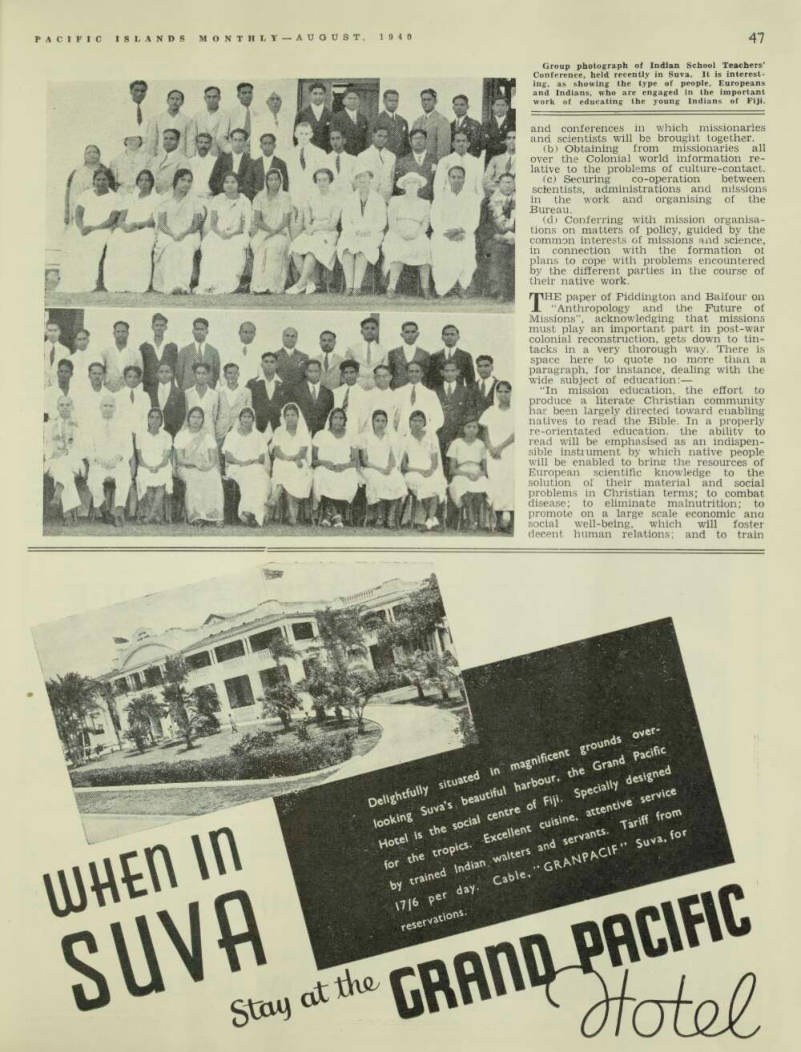
To Link Native Education With Mission
A New "Bureau of Missions and Colonial Planning"
By “Anthropos”
THERE recently has been set up at the University of Aberdeen a Bureau of Missions and Colonial Planning. The sponsors are Sir John Orr, Professor Lancelat Hogben, whose liberal outlook on the world of science is well-known through his popular publications, John Graham, Professor of Systematic Theol ogy at Aberdeen, and Dr. Ralph Pidding
ton, Sydney University graduate, who later worked with Firth and Malinowski at London, and who now holds the Reid Lectureship in Anthropology at Aberdeen.
The title “Bureau of Missions ana Colonial Planning”, impli Q s a recognition of the important role that missions must be expected to fill in any large-scale pro gramme of Colonial development; and this has particular significance for British Colonies, including those of the Pacific area, in view of the proposed £50,000,000 development scheme (which, by the way, has now passed all stages of the Com mons, notwithstanding the urgent claims of war).
It implies, also, a recognition of tne need for practical co-operation and mutual understanding between the sciences (such as medicine and agricul ture); social anthropology, both in the study and the field, and fnissiofiaries, if the interests of the natives are to be fully considered and their future develop ment arranged on scientific and co ordinated lines. That is to say, if the social, moral, material and economic as pects of native life are to be successfully and progressively adapted to the changed cultural conditions and environment which the pursuit of any large-scale Colonial developmental plan would assuredly bring about.
SUCH planned and progressive adapta tion is now, of course, the keynote of British Colonial policy. The alter native is to leave the natives severely alone, which is obviously impossible and economically impracticable, since the success of any development programme is necessarily dependent upon the extent of native participation—unless the devel opment is to be pursued solely through non-indigenous agencies, and is to be of a purely economic nature.
The aims and purpose of the Bureau are outlined in a brochure which has been sent to me. together with a sugges tive introductory paper, “Anthropology and the Future of Missions”, prepared conjointly by Dr. Piddington and Profes sor Graham.
The preamble to the brochure puts the general situation which is to be faced in the following way: “Missions already play an important part in Colonial affairs, control educational facilities, are pre-eminently interested in native affairs, possess the confidence of natives, have a unique knowledge of local conditions, and are increasingly willing to co-operate with scientists and with administrative agencies”.
To secure maximum effort, develop ment of missions must be studied as a special aspect of Colonial reconstruction.
Problems encountered by missionaries must receive detailed and sympathetic consideration, relevant knowledge must be collected and collated for their benefit, with a view to the formulation and carrying out of a constructive policy in such matters as nutrition, agriculture, health, education, and a comprehensive consideration of the problems of culture contact and change.
THE Bureau referred to proposes to take the initiative in certain of these matters, its field of activity to com prise:— (a) Collecting information from vari ous sources, and making it available in published form, and by means of lectures
and conferences in which missionaries and scientists will be brought together. (b) Obtaining from missionaries all over the Colonial world information re lative to the problems of culture-contact. (c) Securing co-operation between scientists, administrations and missions in the work and organising of the Bureau. (d> Conferring with mission organisa tions on matters of policy, guided by the common interests of missions and science, in connection with the formation 01 plans to cope with problems encountered by the different parties in the course of their native work.
THE paper of Piddington and Balfour on “Anthropology and the Future of Missions”, acknowledging that missions must play an important part in post-war colonial reconstruction, gets down to tin tacks in a very thorough way. There is space here to quote no more than a paragraph, for instance, dealing with the wide subject of education:— “In mission education, the effort to produce a literate Christian community has been largely directed toward enabling natives to read the Bible. In a properly re-orientated education, the abilitv to read will be emphasised as an indispen sible instillment by which native people will be enabled to brine the resources of European scientific knowledge to the solution of their material and social problems in Christian terms; to combat disease; to eliminate malnutrition; to promote on a large scale economic ana social well-being, which will foster decent human relations; and to train
Group photograph of Indian School Teachers’
Conference, held recently in Suva. It is interest ing, as showing the type of people, Europeans and Indians, who are engaged in the important work of educating the young Indians of Fiji.
native leaders in their social responsibili ties.”
These are the immediate tasks; and education, adapted to local requirements, must be the pronerlv-used instrument, for the encompassing of these; and the mis sions will be the chief educational agencies available for use to that end.
It is indeed a heavy responsibility; and there can be no doubt that the missions will welcome all the guidance the Bureau can provide (as well as mi the. practical and financial help the various Govern ments can supply)*in their efforts to mea sure up to that responsibility, IN such an adapted system of native education, such theoretical studies as dead languages, and “history as a se quence of political and military exploits centring round bloody tyrants and dis reputable monarchs”, will find no place; but be superseded by a broad programme, on the scholastic side, of locally-applied social studies and the development of vernacular literature. The training of native leaders and teachers must be remodelled to serve a wider social pur pose than that of conducting village church “schools”.
The fullest use must be made in native education of native tradition, music, arts and crafts, native peoples being gradually and progressively drawn into the wider stream of common human progress.
Educational policy will be considered against the background of the lives which the natives will have to live as adults under modern European-contact condi tions. It will not be such as to alienate the educated few from the interests of the people as a whole. Schools and other sides of mission work will be integrative rather than disruptive in their effects in the social lives of the natives.
The bibliographical references attached to this paper are in themselves evidence
of the wide field traversed by the authors.
They include the works of such well known specialists in African native affairs as Evans-Pritchard, Thurnwald and Malinowski (anthropology); Mumford (education); Huxley biology); Lucy Mair, Cullen Young and Lord Hailey (admini
stration) ; Westermann (linguistics);
Dougall, Oldham, Edwin Smith and Pere Dubois (missions); and in the Pacific field. references include Williams (Papua); Hogbin (Solomon Islands) and Groves (Education and Culture-Contact in the Western Pacific).
The writer, from a wide background of contact with both native affairs and missions in the Pacific, would strongly recommend the various missions to link up with the Bureau, and especially to secure copies of the paper of Piddington and Balfour. Nothing of the kind has been produced in such handy form before This will involve no cost at all. How the Bureau is financed I do not know; but apparently its services are available free to those interested. Enquiries should be addressed to Dr. Ralph Piddington, Marischal College. Aberdeen, Scotland.
Advertisements & other items, p. 49 (1 item)
ftt\^
Sto-4
The Soul Of A Nation
The little things of which we lately chattered— The dearth of taxis or the dawn of spring: Themes we discussed as though they really mattered, Like rationed meat or raiders on the wing— How thin it seems to-day, this vacant prattle.
Drowned by the thunder rolling in the West, Voice of the great arbitrament of battle That puts our temper to the final test.
Thither our eyes are turned, our hearts are straining, Where those we love, whose courage laughs at fear, Amid the storm of steel around them raining.
Go to their deaths for all we hold most dear.
New-born of this supremest hour of trial.
In quiet confidence shall be our strength, Fixed on a faith that will not take denial Nor doubt that we have found our soul at length.
O England, staunch of nerve and strong of sinew Best when you face the odds and stand at bay, Now show a watching world what stuff is in you!
Now make vour soldiers proud of you to-day! (Those verses were written by Owen Seaman over 22 years ago, and published in “Punch” on April 3, 1918, when Britain’s armies were retreating before the German’s last thrust—just before the turn of the tide. They are singularly ap propriate to-day, when the best and bravest of the Empire’s young men are guarding the skies above the eastern shores of the beloved Mother Country.) Mrs. Arthur Jewell, wife of Hon. Arthur Jewell, non-official member of the Legis lative and Executive Councils of Papua, is a busy member of the Papuan Division of the Red Cross Society in Port Moresby.
Besides Red Cross work, Mrs. Jewell is arranging a series of entertainments for members of the defence forces stationed in Port Moresby.
Advertisements & other items, p. 50 (1 item)
The Colonial Mutual Life
ASSURANCE SOCIETY LIMITED
MONEY FOR FUTURE DELIVERY
The simplest, surest and most convenient way of securing money for future delivery, payable either to oneself or dependants, is by means of a Colonial Mutual Life Policy Contract.
Through such a contract small sums may be set aside yearly, half-yearly or quarterly, and from the first payment immediate possession of a substantial estate is assured, payable to dependants in the event of death or to the possessor of the policy at the end of a selected number of years. Since its inception, The Colonial Mutual Life Assurance Society has distributed amongst holders of policy contracts or their dependants the huge amount of over £30,750,000
CHIEF AGENTS FOR PACIFIC ISLANDS:
MORRIS, HEDSTROM LTD.
Smuggling
Japanese Caught
£70 Fine in Tongan Court
From Our Own Correspondent
Nukualofa, July 15.
A JAPANESE, Kinzoo Yamashita, trader and fisherman, of the vil lage Belehake, Tongatabu, was fined £7O by the Chief Police Magistrate for having smuggled into the country a prohibited and an undeclared article.
Evidence disclosed that Yamashita, with two Tongans in his employment, stole out, under cover of night, on his motor launch, from Belehake, which is on the shore of the lagoon, Fagauta, to the Japanese steamer, “Momoyama Maru”, when she was recently in Nuku alofa to shift copra for the Japanese firm of Banno Bros. Ltd., and took from her a large cask of Japanese sauce.
A sergeant-major of the Tonga Defence Force, Jiosifa Tolu, having sus pected the movements of the Japanese and his men, waited on the shore at Belehake for their return, and caught them when they landed with the cask.
This is the first time this Japanese has been caught smuggling. Movements of certain Japanese, during the visits here of Japanese vessels, have for some time past aroused, not only a suspicion that certain articles have been smug gled from these ships to the shore and from the shore to the ships, but that they were acting as under-cover men for some other persons in this nefarious business.
Medical Man Injured
From Our Own Correspondent
Port Moresby, July 28.
A SERIOUS accid°nt occurred on July jt jL 24 when Dr. Robert Fruchtman, medical officer with the Methodist Mission, who was relieving Dr. May in Port Moresby, as Government Medical Officer, received injuries to both arms, while attempting to apply the brakes of his car, which was moving down-hill without him. The car crashed against a tree, pinning Dr. Fruchtman’s arm and crushing it, causing a compound frac ture.
Those who witnessed the accident ap plied first aid, until the arrival of Dr.
Williams and Dr. Preston, when the patient was conveyed to the European Hospital. It is understood that Dr.
Fruchtman will leave by plane for treat ment in Australia.
United States Strength
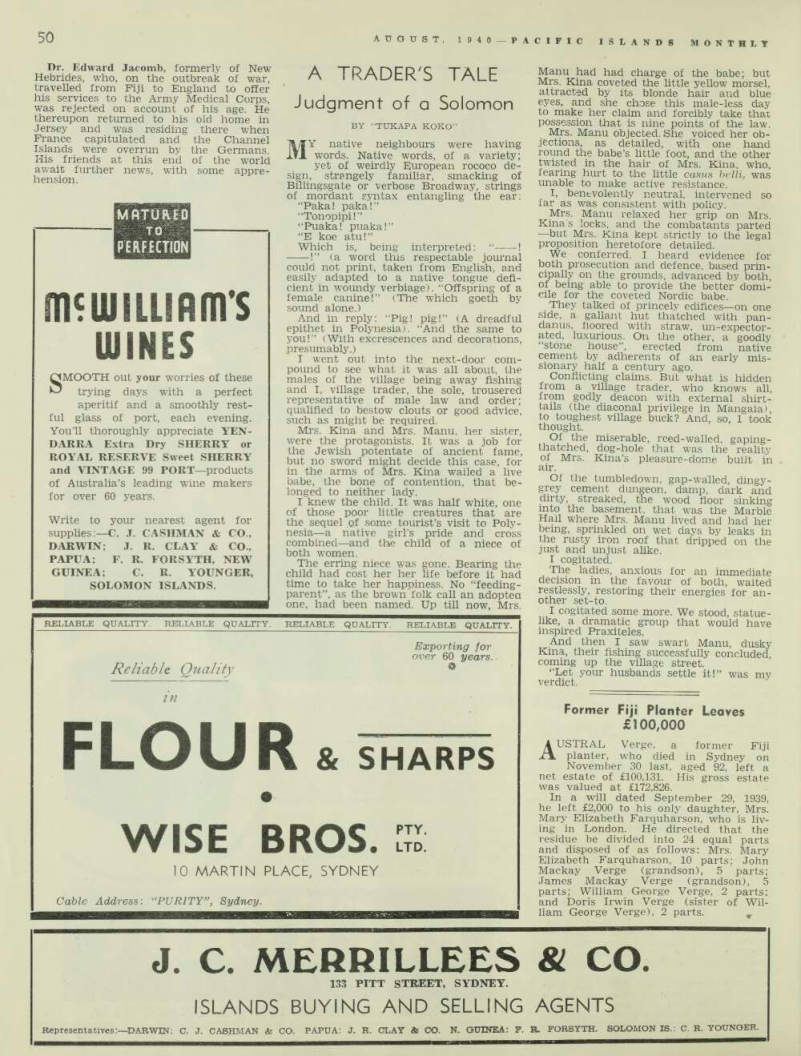
In Pacific
NEWSPAPER correspondents at the end of July quoted astronomical figures to indicate the amount that the United States is preparing to spend on the construction of naval bases in the north-east Pacific—especially around Hawaii, at Midway, Wake, Johnston and Palmyra Islands, and at Guam. Con tracts totalling £42,812,500 have been let by the United States to cover the con struction of new air and naval base facilities on the Pacific and Atlantic coasts.
It was reported last year that the United States Congress would not agree to the fortification of Guam; but refer ences recently indicate that considerable work on fortifications is being done there.
Dr. Edward Jacomb, formerly of New Hebrides, who, on the outbreak of war, travelled from Fiji to England to offer his services to the Army Medical Corps, was rejected on account of his age. He thereupon returned to his old home in Jersey and was residing there when France capitulated and the Channel Islands were overrun by the Germans.
His friends at this end of the world await further news, with some appre hension.
Advertisements & other items, pp. 51-52 (2 items)
49
1* Acl F i c Islands monttt l V - August, is4o
Eveready
The New 1.4 Volt Valve haJ
i&f;
wWmkvtMmmM
m**
★No Accumulator
★ No Recharging
★ Feiver rr ß” Batteries
v.t IF you want to enjoy Country radio at its best—buy one of the new 1.4 volt models available this year. Utilising the amazing new 1.4 volt valve and equipped throughout with dependable Eveready Radio Batteries—a combination that is unbeatable for simplicity and economy —it has NO ACCUMULATOR, and thus no recharging problem. In addition it requires only TWO "B"
Batteries instead of three, so that operating costs are reduced by ONE-
THIRD
Practically every set manufacturer in Australia is turning to 1.4 volt radio as the answer to the Country listener's demand for a more convenient, more economical type of set.
Ask your dealer to demonstrate next time you are in town. mi v:>» y nr.?
EVEREADY
TRADE - Mi R K
RAD I 0 BATTE R I E S
EVEREADY (AUSTRALIA) PTY. LTD., SYDNEY, N.S.W,
rmuiiLLinm’s
WINES
SMOOTH out your worries of these trying days with a perfect aperitif and a smoothly restful glass of port, each evening.
You’ll thoroughly appreciate YEN- DARRA Extra Dry SHERRY or
ROYAL RESERVE Sweet SHERRY
and VINTAGE 99 PORT—products of Australia’s leading wine makers for over 60 years.
Write to your nearest agent for supplies:—C. J. CASHMAN & CO.,
DARWIN; J. R. CLAY & CO.,
PAPUA; F. R. FORSYTH, NEW
GUINEA; C. R. YOUNGER,
SOLOMON ISLANDS.
RELIABLE QUALITY RELIABLE QUALITY. RELIABLE QUALITY. RELIABLE QUALITY.
Exporting for over 60 years.
Reliable Quality ® in
FLOUR & SHARPS
9
WISE BROS. £
10 MARTIN PLACE, SYDNEY
Cable Address : “PURITY”, Sydney.
J. C. MEHRILLEES & CO.
133 PITT STREET, SYDNEY.
ISLANDS BUYING AND SELLING AGENTS
Representatives:— DAßWlN; C. J. CASHMAN & CO. PAPUA: J. R. CLAY & CO. N. GUINEA: P. R. FORSYTH. SOLOMON IS.: C. R. YOUNGER.
Judgment of a Solomon
A Trader's Tale
By “Tukapa Koko”
1%/gY native neighbours were having words. Native words, of a variety; yet of weirdly European rococo de sign, strangely familiar, smacking of Billingsgate or verbose Broadway, strings of mordant syntax entangling the ear: “Paka! paka!'’
“Tonopipi!”
“Puaka! puaka!”
“E koe atu!”
Which is, being interpreted: “ ! !” (a word this respectable journal could not print, taken from English, and easily adapted to a native tongue defi cient in woundy verbiage). “Offspring of a female canine!” (The which goeth by sound alone.) And in reply; “Pig! pig!” (A dreadful epithet in Polynesia). “And the same to you!” (With excrescences and decorations, presumably.) I went out into the next-door com pound to see what it was all about, the males of the village being away fishing and I, village trader, the sole, trousered representative of male law and order; qualified to bestow clouts or good advice, such as might be required.
Mrs. Kina and Mrs. Manu, her sister, were the protagonists. It was a job for the Jewish potentate of ancient fame, but no sword might decide this case, for in the arms of Mrs. Kina wailed a live babe, the bone of contention, that be longed to neither lady.
I knew the child. It was half white, one of those poor little creatures that are the sequel pf some tourist’s visit to Poly nesia—a native girl’s pride and cross combined—and the child of a niece of both women.
The erring niece was gone. Bearing the child had cost her her life before it had time to take her happiness. No “feeding parent”, as the brown folk call an adopted one, had been named. Up till now, Mrs.
Manu had had charge of the babe; but Mrs. Kina coveted the little yellow morsel, attracted by its blonde hair and blue eyes, and she chose this male-less day to make her claim and forcibly take that possession that is nine points of the law.
Mrs. Manu objected. She voiced her ob jections, as detailed, with one hand round the babe’s little foot, and the other twisted in the hair of Mrs. Kina, who, fearing hurt to the little casus belli , was unable to make active resistance.
I, benevolently neutral, intervened so far as was consistent with policy.
Mrs. Manu relaxed her grip on Mrs.
Kina s locks, and the combatants parted —but Mrs. Kina kept strictly to the legal proposition heretofore detailed.
We conferred. I heard evidence for both prosecution and defence, based prin cipally on the grounds, advanced by both, of being able to provide the better domi cile for the coveted Nordic babe.
They talked of princely edifices—on one side, a gallant hut thatched with pan danus, floored with straw, un-expector ated, luxurious. On the other, a goodly “stone house”, erected from native cement by adherents of an early mis sionary half a century ago.
Conflicting claims. But what is hidden from a village trader, who knows all, from godly deacon with external shirt tails (the diaconal privilege in Mangaia), to toughest village buck? And, so, I took thought.
Of the miserable, reed-walled, gaping thatched, dog-hole that was the reality of Mrs. Kina’s pleasure-dome built in air.
Of the tumbledown, gap-walled, dingy grey cement dungeon, damp, dark and dirty, streaked, the wood floor sinking into the basement, that was the Marble Hall where Mrs. Manu lived and had her being, sprinkled on wet days by leaks in the rusty iron roof that dripped on the just and unjust alike.
I cogitated.
The ladies, anxious for an immediate decision in the favour of both, waited restlessly, restoring their energies for an other set-to.
I cogitated some more. We stood, statue like, a dramatic group that would have inspired Praxiteles.
And then I saw swart Manu, dusky Kina, their fishing successfully concluded coming up the village street.
“Let your husbands settle it!” was my verdict.
Former Fiji Planter Leaves
£l00,000
AUSTRAL Verge, a former Fiji planter, who died in Sydney on November 30 last, aged 92, left a net estate of £100,131. His gross estate was valued at £172,826.
In a will dated September 29, 1939, he left £2,000 to his only daughter, Mrs.
Mary Elizabeth Farquharson, who is liv ing in London. He directed that the residue be divided into 24 equal parts and disposed of as follows: Mrs. Mary Elizabeth Farquharson, 10 parts; John Mackay Verge (grandson), 5 parts; James Mackay Verge (grandson), 5 parts; William George Verge, 2 parts; and Doris Irwin Verge (sister of Wil liam George Verge), 2 parts.
New Methodist Missionary
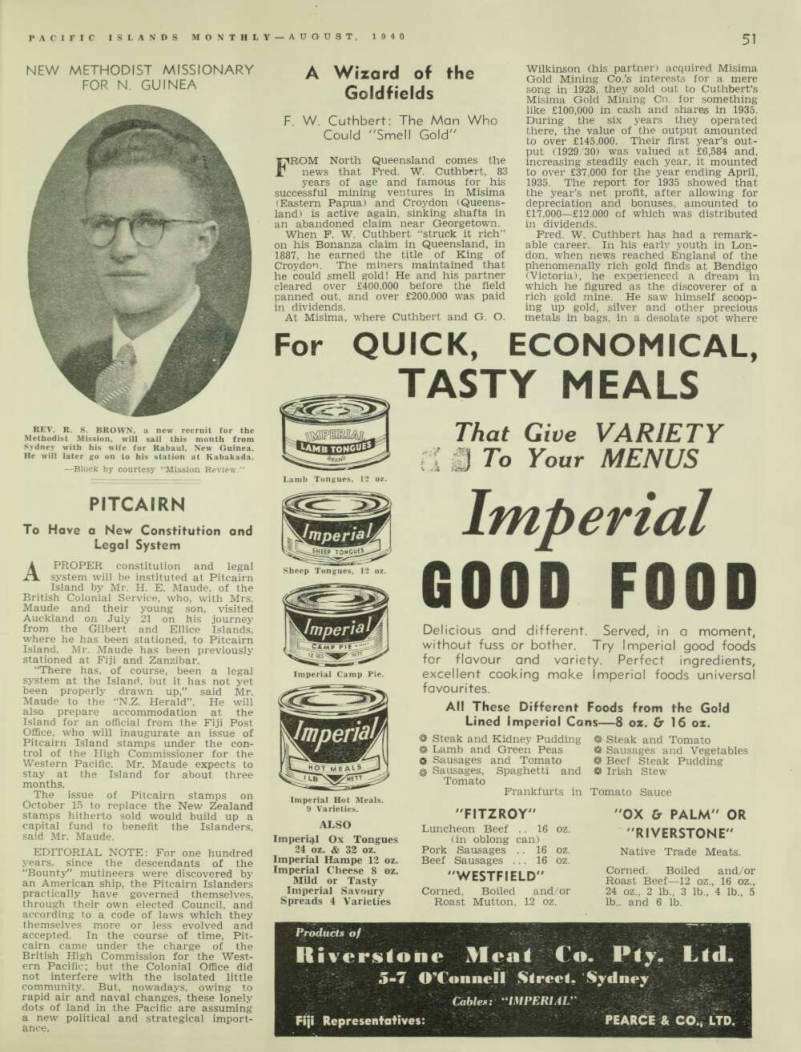
For N. Guinea
REV’. R. S. BROWN, a new recruit for the Methodist Mission, will sail this month from Sydney with his wife for Rabaul, New Guinea.
He will later go on to his station at Kabakada. —Block by courtesy “Mission Review.”
Pitcairn
To Have a New Constitution and Legal System
A PROPER constitution and legal system will be instituted at Pitcairn Island by Mr. H. E. Maude, of the British Colonial Service, who, with Mrs.
Maude and their young son, visited Auckland on July 21 on his journey from the Gilbert and Ellice Islands, where he has been stationed, to Pitcairn Island. Mr. Maude has been previously stationed at Fiji and Zanzibar.
“There has, of course, been a legal system at the Island, but it has not yet been properly drawn up,” said Mr.
Maude to the “N.Z. Herald”. He will also prepare accommodation at the Island for an official from the Fiji Post Office, who will inaugurate an issue of Pitcairn Island stamps under the con trol of the High Commissioner for the Western Pacific. Mr. Maude expects to stay at the Island for about three months.
The issue of Pitcairn stamps on October 15 to replace the New Zealand stamps hitherto sold would build up a capital fund to benefit the Islanders, said Mr. Maude.
EDITORIAL NOTE: For one hundred years, since the descendants of the “Bounty” mutineers were discovered by an American ship, the Pitcairn Islanders practically have governed themselves, through their own elected Council, and according to a code of laws which they themselves more or less evolved and accepted. In the course of time, Pit cairn came under the charge of the British High Commission for the West ern Pacific; but the Colonial Office did not interfere with the isolated little community. But, nowadays, owing to rapid air and naval changes, these lonely dots of land in the Pacific are assuming a new political and strategical import ance.
Goldfields
A Wizord of the Goldfields F. W. Cuthbert: The Man Who Could "Smell Gold"
FROM North Queensland comes the news that Fred. W. Cuthbert. 83 years of age and famous for his successful mining ventures in Misima (Eastern Papua) and Croydon (Queens land) is active again, sinking shafts in an abandoned claim near Georgetown.
When F. W. Cuthbert “struck it rich’’ on his Bonanza claim in Queensland, in 1887, he earned the title of King of Croydon. The miners maintained that he could smell gold! He and his partner cleared over £400.000 before the field panned out. and over £200,000 was paid in dividends.
At Misima, where Cuthbert and G. O.
Wilkinson (his partner) acquired Misima Gold Mining Co.’s interests for a mere song in 1928, they sold out to Cuthbert’s Misima Gold Mining Co. for something like £lOO,OOO in cash and shares in 1935.
During the six years they operated there, the value of the output amounted to over £145,000. Their first year’s out put (1929 30) was valued at £6,584 and, increasing steadily each year, it mounted to over £37,000 for the year ending April. 1935. The report for 1935 showed that the year’s net profit, after allowing for depreciation and bonuses, amounted to £17.000 —£12.000 of which was distributed in dividends.
Fred. W. Cuthbert has had a remark able career. In his early youth in Lon don, when news reached England of the phenomenally rich gold finds at Bendigo (Victoria), he experienced a dream in which he figured as the discoverer of a rich gold mine. He saw himself scoop ing up gold, silver and other precious metals in bags, in a desolate spot where
the sandy gravel surface was relieved only by low. scanty bushes.
Fired by the desire to try his luck, he disregarded his parents’ wishes and signed as second steward on a sailing vessel plying round the Cape, at 1/- a month. After a strenuous voyage of months, the ship reached Melbourne early in 1878. There young Cuthbert left the vessel and made for Echuca.
For a time, he worked in a timber mill; then he made his way to Grafton (N.S.W.) and later arrived in Queens land. Going north again, he reached Croydon, and began fossicking for gold on claims that showed little profit.
Later. Cuthbert entered into partner ship with a man named Shultz, who owned a small but bankrupt store serv ing the miners of the district. Soon, benefiting by his early training in Lon don (where his parents had a shop), he converted the store into a flourishing concern. After a while Shultz and Cuth bert quarrelled and dissolved partner ship, selling out for a profit of over £4OO.
With his share, Cuthbert now entered partnership in a mining claim with Jacob Bickerton. Again he did well and sold at a profit. Bickerton retired and with his proceeds acauired a successful busi ness in the Darling Downs.
Cuthbert was now in a sound finan cial position. In 1887, convinced that his
luck still held, he took over two aban doned claims, near Croydon, which had reverted to the Crown. He put down shafts nearby and to the astonishment of the district, opened up lodes which proved to be some of the richest in North Queensland.
When the field was worked out, Cuthbert visited England to see his parents. He found that they had died, but he got in touch with his sisters, one of whom returned with him to Austra lia. He then took seven years’ holiday from mining, and it was not until 1927 that he first became interested in Papua.
When the manager of Misima Gold Mining Co. (G. O. Wilkinson) ap proached him in Sydney to invest money in the reconstruction of the company at Misima, Cuthbert declined to interest himself in the venture. However, he later offered the buv the owners out for £2,000. with G. O. Wilkinson as his part ner. The offer was accepted immediately.
Cuthbert and Wilkinson concluded the transaction, the richest goldmine in Papua became theirs. —M.L.
Advertisements & other items, pp. 53-54 (1 item)
Imperial
For QUICK, ECONOMICAL,
TASTY MEALS
That Give VARIETY
{J i To Your MENUS
Lamb Tongues, 12 oz.
SHEEP tongues Sheep Tongues, 12 oz.
Ca Imperial Camp Pie.
OT gen Imperial Hot Meals. 9 Varieties.
ALSO
Imperial Ox Tongues 24 oz. & 32 oz.
Imperial Hampe 12 oz.
Imperial Cheese 8 oz.
Mild or Tasty Imperial Savoury Spreads 4 Varieties
Imperial
GOOD FOOD
Delicious and different. Served, in a moment, without fuss or bother. Try Imperial good foods
for flavour and variety. Perfect ingredients,
excellent cooking make Imperial foods universal
favourites.
All These Different Foods from the Gold Lined Imperial Cans—B oz. £r 16 oz. 9 Steak and Kidney Pudding @ Steak and Tomato & Lamb and Green Peas ® Sausages and Vegetables © Sausages and Tomato & Beef Steak Pudding $ Sausages, Spaghetti and & Irish Stew Tomato Frankfurts in Tomato Sauce
"FITZROY"
Luncheon Beef .. 16 oz. (in oblong can) Pork Sausages .. 16 oz.
Beef Sausages ... 16 oz.
"WESTFIELD"
Corned. Boiled and/or Roast Mutton, 12 oz.
"OX & PALM" OR
"RIVERSTONE"
Native Trade Meats.
Corned. Boiled and/or Roast Beef —12 oz., 16 oz., 24 oz., 2 lb.. 3 lb., 4 lb., 5 lb,, and 6 lb. r- "
Products of
Riverstone Meat Co. Pty. Ltd.
5-7 OToimell Street Sydney
Fiji Representatives:
Cables: “ IMPERIAL ’ • V*. - *; •- ■-V . . : ■■ •-...
.. >' : M"" V IP&
PEARCE & CO., LTD.
IJh£Aek1 J h£Aek m
SAUCE
theWcrldwei'
ECONOMICAL. BECAUSE YOU NEED
JU§T A FEW DROPS AT A TIME -
McILRATH’S
Where Prices Are LOW
AND SERVICE IS HIGH
Yoga Tea, our speciality 2/- lb.; 6 lb. tins 12/6 each Sunshine Full Cream Milk, 12 oz l/2£ tin; 14/3 doz.
Best Australian Currants 6d. lb.; 3 lb. tins 2/3 tin Best Australian Sultanas s£d. lb.; 3 lb. tins 2/1 tin Rosa Self-raising Flour, 2 lb 6Jd. pkt.; 6/3 doz.
Choice Evap. Apricots l/3i lb.; 2 lb. tins 3/4 tin Rosa Choice Dripak Prunes, 7 lb 6/- tin I.X.L. Best Assorted Jam 12 oz. 6/9 doz.; 24 oz., 11/- doz.
Marmite Vegetable Extract 4 oz., 1/9; 8 oz., 3/- jar Globex Beef Extract 4 oz.. 1/6; 8 oz., 2/3 tin Garden Vale Green Peas 10 oz., 6/3; 16 oz., 8/3 doz.
I.X.L. Tomato Sauce 10 oz. Bid. bot.; 8/3 doz.
Nestles Malted Milk 8 oz., 1/5; 16 oz., 2/6 tin Dandy Maize Starch, 5 lb. parcels 7d. lb.
Rosa Pure Household Soap 6Jd. bar; 6/- doz.
Tru-Crepe Tissue Toilet Rolls, 6 oz 3/6 doz.
Capital Floor Wax, 16 oz 1/1 tin; 12/6 doz.
Special Vintage Port, Sherry or Muscat, 26 oz 2/2 bot.
Potatoes, Onions, Wheat, Bran and Pollard at lowest rates.
All Prices F. 0.8. Sydney Cases and Packing Free.
Export Price Lists Available —Post Free.
McILRATH’S Pty. Ltd.
EXPORT DEPARTMENT
202-204 PITT STREET, SYDNEY, AUSTRALIA
Food Supplies In New
Guinea
Letter to the Editor IN a recent issue of the “P.1.M.” there was a contribution from your corres pondent in Rabaul, titled “Not So Tough”.
It would appear that your correspond ent in Rabaul is not able to visualise the conditions at a place if he is not liv ing at that particular place, and_ as Rabaul suffers less, being the capital, than anv other part of the Territory when abnormal conditions exist, your corresnondent being quite comfortable, considers that others should not com nlain if they should have services they have be Q n accustomed to suddenly taken from them.
This unexpected shipping curtailment caused a severe shortage of both fresh and tinned supplies in the Sepik District.
If your correspondent was not able to nurchase anything at any of the stores in Rabaul. neither fresh foods from the freezers nor tinned foods from the stores, I have no doubt he would be sending you contributions about their suffering, narticularly if it should be an easy matter to rectifv the complaints.
For the men only, the shortage of food here was not so serious, as they are still as tough as ever: but there are women and children at Wewak and it is verv necessary particularly for the children, to have good foods, if they are to keen good health.
If your correspondent in Rabaul con siders himself tough, he would possibly do more good for New Guinea if he were to go out in the bush, instead of living in comfort and amongst luxuries in Rabaul and help to onen new country.
Thanks to the Administrator, a liner is now making Wewak a port of call.
I am, etc.,
A Wewak Resident With Family.
Wp\vak. N G. 10/5/1940.
Mr, J. J. Murray, who was well-known in the Cook Islands as a trader and nlanter, left by “Matua” recently to take up residence in New Zealand.
Mr. J. Taylor has taken up the position of head teacher at the school on Aitutaki in the Cook Islands, replacing Mr. F. H.
Cotton, who left the Group recently.
Advertisements & other items, p. 54 (1 item)
52
AUGUST, 1940 PACIFIC ISLANDS MONTH L Y
Yachting In Fiji
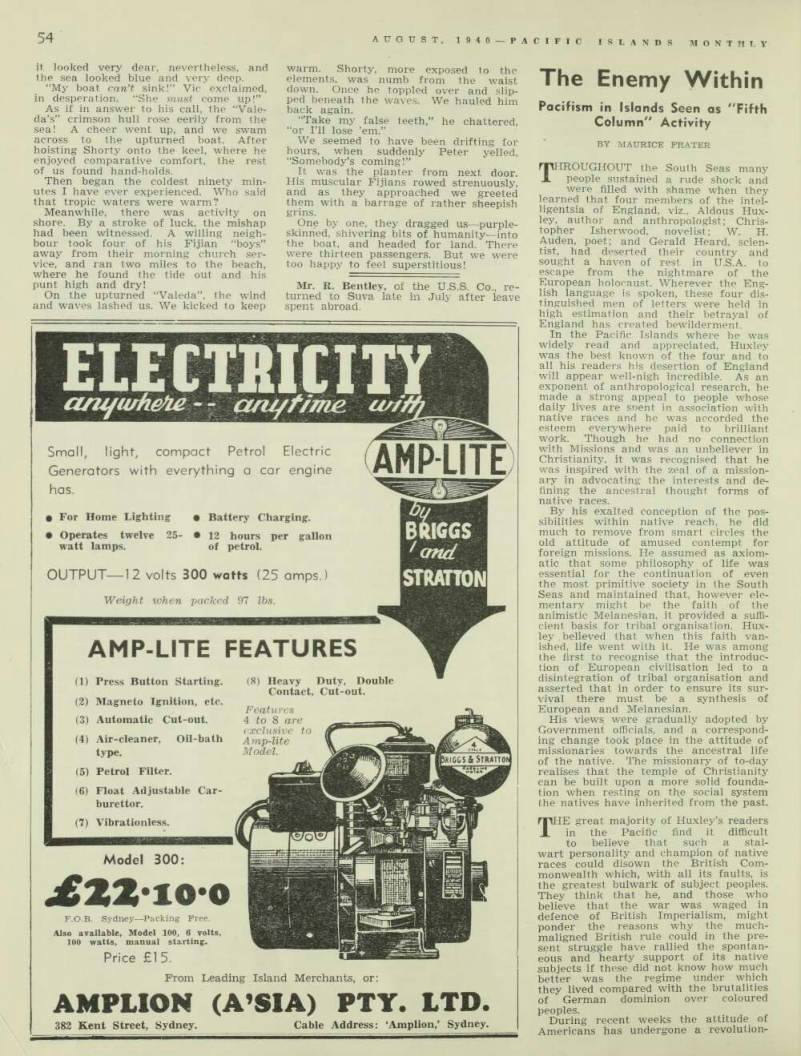
By Amel
rE “Valeda”, eighteen feet of crim son and white, tugged impatiently at her anchor. She was a vivid splotch of colour against the grey background of a wet, south-easterly gale.
It was hardly the sort of day for pleasant sailing; but Vic, the owner skipper, and five others of the gang, were urging us to hurry. They wanted to feel the wind in the sails.
Shorty, a tough little Australian with a philosophical outlook on life, admin istered the coup-de-grace—we were play ing billiards —and, grabbing a tin of chocolate fudge and a hefty fishing line, we ran across the beach to where the “Valeda” rode the foam-capped breakers.
“Bit rough, isn’t it?” remarked Shorty, waist-deep in the briny.
The skipper noticed the doubtful glance that I threw at the 30 ft, mast.
“Fear not,” he said, “It seems dreadfully tall,” I com mented, scrambling into the cockpit. He informed me that, although “Valeda” had capsized twice in Suva Harbour (cheering thought!) she had never mis behaved under his magic touch!
“Let’s go!” he bellowed. Swinging the tiller over, he headed for Dogo Dogo Island, while we hung out from the gunwale, revelling in the thrilling burst of speed, the hissing wave at the bow and the creamy water astern.
In the cramped cabin space, Shorty divided his time between tying un nautical knots in the centre-board ropes and chasing the tin of fudge, which displayed a persistent fondness for the scuppers.
“Reef ahead!” came the cry. “Valeda” answered her helm, and came about as neatly as a pirouetting dancer.
“We’ll take a leg out to the sand bank,” decreed Vic, “And then home.”
“Leg?” I pondered. “Whose?”
John slithered across the cabin roof to see what had happened to Shorty, “What the goodness gracious are you doing, Commodore?” he asked.
“Go away, will you,” said Shorty, with suppressed violence. “I’m untang ling this ruddy fishing line.”
The sand-bank was only three hun dred yards away, and the wind had increased to a steady roar. Mindful of the low tide and lurking reefs, Vic decided to tack again.
“Valeda” came about once more, but not so neatly this time. She trembled on the tip of a big wave. A fierce gust of wind caught the mainsail, and, in two shakes of a dog’s tail, “Valeda” had capsized!
There was no outcry. Only a big splash . . . and a swirl. Five seconds later, seven bewildered white faces dotted the rough sea. Seven? Where was the eighth, Shorty, who couldn’t swim a yard? Frantically, we sought him.
A threshing form broke the surface beside me. We seized him. It was our missing ship-mate.
“Ouch!” puffed Shorty, coughing up a pint of Pacific Ocean. “What happened?
Where am I?”
“You’re in the sea,” said the Dane, gloomily. “The boat has sunk, and we’re two miles from shore. So what?”
We dared not attempt to swim to the sand-bank, for fear of hungry sharks.
We trod water, and shuddered, and waited, hoping that the “Valeda” would rise again. I could see a white speck among the coconut palms on shore.
Anyway, I consoled myself, I shan’t mind dying within sight of home. But
it looked very dear, nevertheless, and the sea looked blue and very deep.
“My boat can’t sink!” Vic exclaimed, in desperation. “She must come up!”
As if in answer to his call, the “Vale da’s” crimson hull rose eerily from the sea! A cheer went up, and we swam across to the upturned boat. After hoisting Shorty onto the keel, where he enjoyed comparative comfort, the rest of us found hand-holds.
Then began the coldest ninety min utes I have ever experienced. Who said that tropic waters were warm?
Meanwhile, there was activity on shore. By a stroke of luck, the mishap had been witnessed. A willing neigh bour took four of his Fijian “boys” away from their morning church ser vice, and ran two miles to the beach, where he found the tide out and his punt high and dry!
On the upturned “Valeda”, the wind and waves lashed us. We kicked to keep
warm. Shorty, more exposed to the elements, was numb from the waist down. Once he toppled over and slip ped beneath the waves. We hauled him back again.
“Take my false teeth,” he chattered, “or I’ll lose ’em.”
We seemed to have been drifting for hours, when suddenly Peter yelled, “Somebody’s coming!”
It was the planter from next door.
His muscular Fijians rowed strenuously, and as they approached we greeted them with a barrage of rather sheepish grins.
One by one, they dragged us —purpleskinned, shivering bits of humanity—into the boat, and headed for land. There were thirteen passengers. But we were too happy to feel superstitious!
Mr. R. Bentley, of the U.S.S. Co., re turned to Suva late in July after leave spent abroad.
Advertisements & other items, pp. 55-56 (1 item)
Two Letters . . .
Frank Peters hit his nails as he read the letter. His wife sat opposite, watching. . . . She looked worried, depressed.
“Bad news, Frank?”
“Read it yourself. Couldn’t be much worse.”
This is what she read: Dear Frank, — When the Board of Directors decided to give you charge of our Islands Branch, I was absolutely certain that you were the right man for the job. As a matter of fact, Frank, you know as well as I do that it was my influence that finally turned the vote in your favour. Now I have to write and tell you, Frank, that we are dissatisfied with your work. The last few months have been a great disappointment. What’s happened to you? Your sales figures for the months of February and March are far lower than last year’s, and lower than they have been for the past five years for the same two months.
There must be a reason for this, Frank, so write at once and give me a full explanation so that I will have something to tell the Board.
In the meantime, for Pete’s sake get your sales figures up, otherwise nothing I can say will alter the fact—we’ll have to make a change.
Kindest regards to you and Mary,
JOHN.
“He says he wants an explanation.
What are you going to tell him, Frank?”
“What can I tell him? Everything he says is true. Sales are down.
There’s no doubt about it, I’m a flop. How can I put my heart and soul into my work when I always feel like this —tired all the time. I even wake up tired nowadays.”
“Darling, I know you haven’t been yourself for the last couple of months. You haven’t got your old energy. You’d better go down and see Doctor Martin.”
So Frank saw Doctor Martin. After giving him a thorough examination Doctor Martin said: — “Frank, the reason why you’re run
down, nervy and tired all the time is very simple. Naturally, this climate takes it out of you. And that’s not all! Tiredness, nerviness —these things are really symptoms of Night-Starvation. You’ve probably never realised it, but while you sleep your body goes on burning up energy. Your heart has to beat 35.000 times and your lungs make 20.000 muscular movements. Naturally, this takes it out of you, and if energy isn’t replaced during sleep you wake tired, and stay tired all day long. You get nervy, run down, and lose your confidence. My advice is, drink a cupful of Horlicks every night before you go to bed.
And so Frank started drinking Horlicks every night before bed.
Three months passed. We meet Frank again. He is opening another letter. When he finishes reading it, he passes it across to Mary. . . .
“Darling, read this\ Isn’t it marvellous?”
This is what Mary read : Dear Frank, — Your latest sales figures were the best thing you could possibly have sent down. There’s no doubt about it, Frank, you can turn on the heat when you have to. All the talk about calling you back to Sydney has been forgotten. As a matter of fact, confidentially, you might find a little something in your stocking at Christmas. Keep up the good work.
JOHN.
Do you find yourself waking tired in the morning, even after a good night’s sleep? Do you get nervy, irritable, over small things that don’t really matter? Is the climate getting you down? Then the chances are that you, too, are suffering from Night-Starvation. Horlicks replaces energy lost during sleep, so that you wake refreshed, clear eyed and alert. Start drinking Horlicks at night and you’ll soon get back all your old drive and vitality.
"T Horlicks Jorlic * >‘wi re o'-'
AMP-LITE
Small, light, compact Petrol Electric
Generators with everything a car engine has. • For Home Lighting • Battery Charging. • Operates twelve 25- • 12 hours per gallon watt lamps. of petrol.
OUTPUT— I 2 volts 300 watts (25 amps.) Weight when yacked 97 lbs.
AMP-LITE FEATURES
(1) Press Button Starting. (2) Magneto Ignition, etc. (3) Automatic Cut-out. (4) Air-cleaner, Oil-bath type. (5) Petrol Filter. (6) Float Adjustable Carburettor. (8) Heavy Duty, Double Contact, Cut-out.
Features 4 to 8 are exclusive to Amp-lit e Model.
Stratto
RIGGS
(7) Vibrationless.
Model 300: •10*0 P. 0.8. Sydney—Packing Free.
Also available, Model 100, 6 volts, 100 watts, manual starting.
Price £1 5.
From Leading Island Merchants, or:
AMPLION (A’SIA) PTY. LTD.
382 Kent Street, Sydney. Cable Address: ‘Amplion,’ Sydney.
The Enemy Within
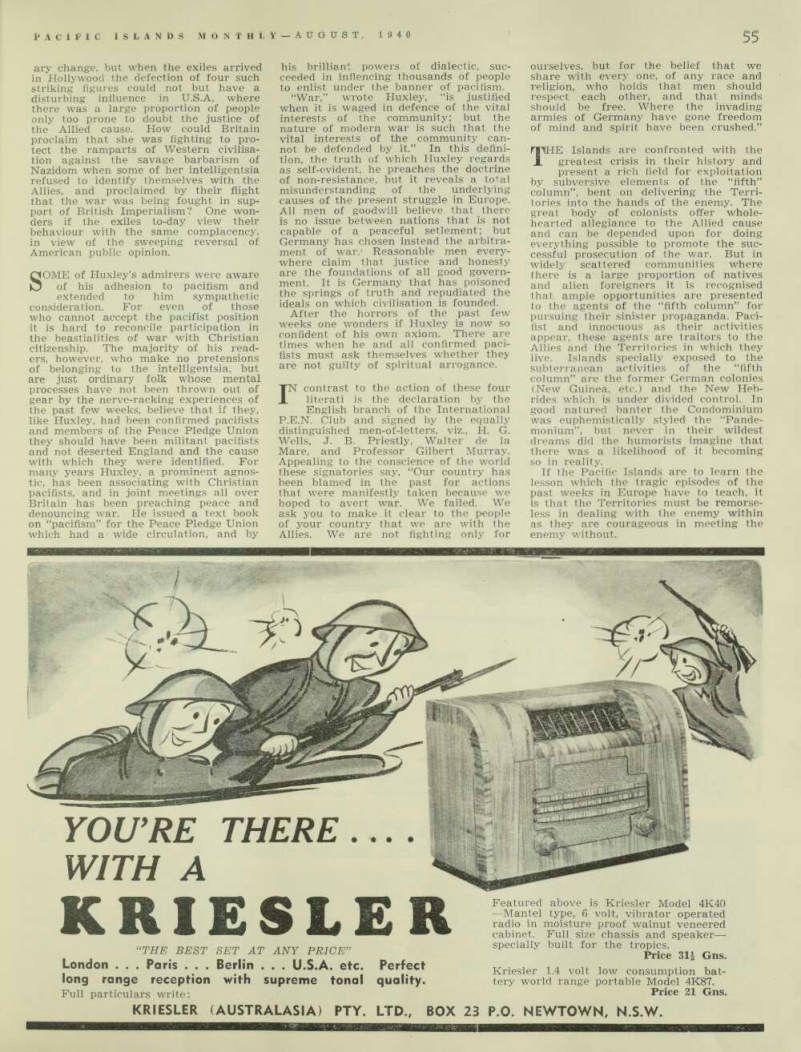
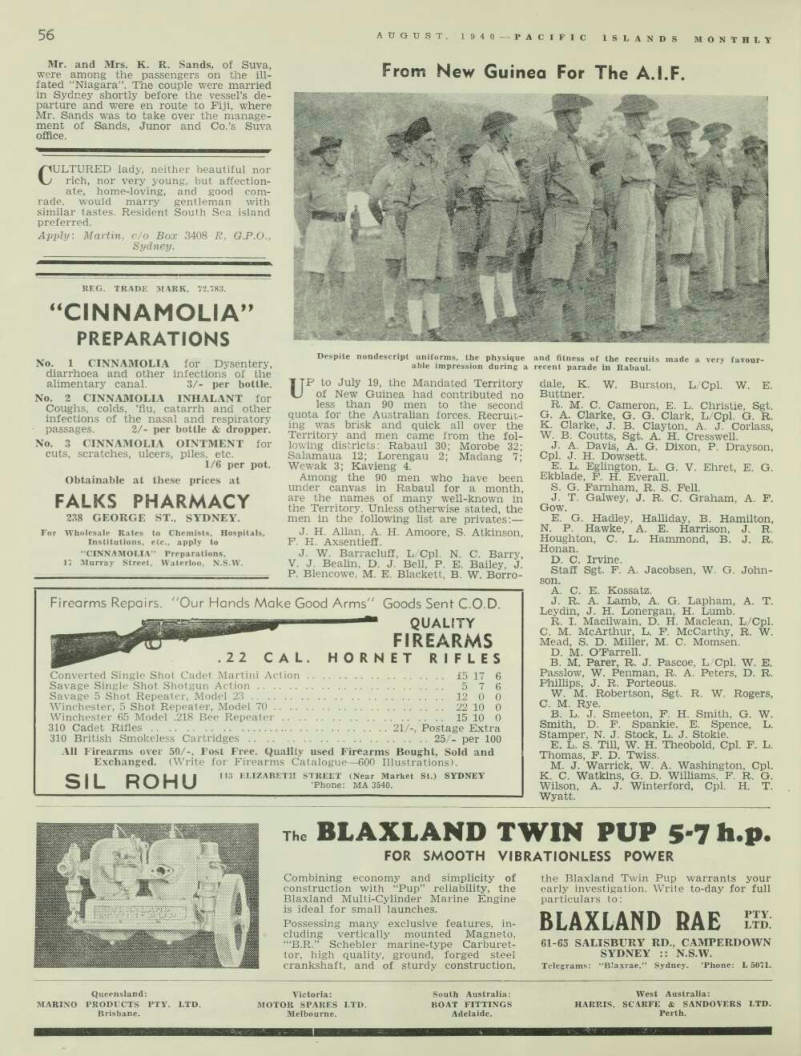
Pacifism in Islands Seen as "Fifth Column " Activity
By Maurice Prater
THROUGHOUT the South Seas many people sustained a rude shock and were filled with shame when they learned that four members of the intel ligentsia of England, viz., Aldous Hux ley, author and anthropologist; Chris topher Isherwood, novelist; W. H.
Auden, poet; and Gerald Heard, scien tist, had deserted their country and sought a haven of rest in U.S.A. to escape from the nightmare of the European holocaust. Wherever the Eng lish language is spoken, these four dis tinguished men of letters were held in high estimation and their betrayal of England has created bewilderment.
In the Pacific Islands where he was widely read and appreciated, Huxley was the best known of the four and to all his readers his desertion of England will appear well-nigh incredible. As an exponent of anthropological research, he made a strong appeal to people whose daily lives are snent in association with native races and he was accorded the esteem everywhere paid to brilliant work. Though he had no connection with Missions and was an unbeliever in Christianity, it was recognised that he was inspired with the zeal of a mission ary in advocating the interests and de fining the ancestral thought forms of native races.
By his exalted conception of the pos sibilities within native reach, he did much to remove from smart circles the old attitude of amused contempt for foreign missions. He assumed as axiom atic that some philosophy of life was essential for the continuation of even the most primitive society in the South Seas and maintained that, however ele mentary might be the faith of the animistic Melanesian, it provided a suffi cient basis for tribal organisation. Hux ley believed that when this faith van ished, life went with it. He was among the first to recognise that the introduc tion of European civilisation led to a disintegration of tribal organisation and asserted that in order to ensure its sur vival there must be a synthesis of European and Melanesian.
His views were gradually adopted by Government officials, and a correspond ing change took place in the attitude of missionaries towards the ancestral life of the native. The missionary of to-day realises that the temple of Christianity can be built upon a more solid founda tion when resting on the social system the natives have inherited from the past. rE great majority of Huxley’s readers in the Pacific find it difficult to believe that such a stal wart personality and champion of native races could disown the British Com monwealth which, with all its faults, is the greatest bulwark of subject peoples.
They think that he, and those who believe that the war was waged in defence of British Imperialism, might ponder the reasons why the much maligned British rule could in the pre sent struggle have rallied the spontan eous and hearty support of its native subjects if these did not know how much better was the regime under which they lived compared with the brutalities of German dominion over coloured peoples.
During recent weeks the attitude of Americans has undergone a revolution
ary change, but when the exiles arrived in Hollywood the defection of four such striking figures could not but have a disturbing influence in U.S.A. where there was a large proportion of people only too prone to doubt the justice of the Allied cause. How could Britain proclaim that she was fighting to pro tect the ramparts of Western civilisa tion against the savage barbarism of Nazidom when some of her intelligentsia refused to identify themselves with the Allies, and proclaimed by their flight that the war was being fought in sup port of British Imperialism? One won ders if the exiles to-day view their behaviour with the same complacency, in view of the sweeping reversal of American public opinion.
SOME of Huxley’s admirers were aware of his adhesion to pacifism and extended to him sympathetic consideration. For even of those who cannot accept the pacifist position it is hard to reconcile participation in the beastialities of war with Christian citizenship. The majority of his read ers, however, who make no pretensions of belonging to the intelligentsia, but are just ordinary folk whose mental processes have not been thrown out of gear by the nerve-racking experiences of the past few weeks, believe that if they, like Huxley, had been confirmed pacifists and members of the Peace Pledge Union they should have been militant pacifists and not deserted England and the cause with which they were identified. For many years Huxley, a prominent agnos tic, has been associating with Christian pacifists, and in joint meetings all over Britain has been preaching peace and denouncing war. He issued a text book on “pacifism” for the Peace Pledge Union which had a wide circulation, and by
his brilliant powers of dialectic, suc ceeded in inflencing thousands of people to enlist under the banner of pacifism.
“War,” wrote Huxley, “is justified when it is waged in defence of the vital interests of the community; but the nature of modern war is such that the vital interests of the community can not be defended by it.” In this defini tion, the truth of which Huxley regards as self-evident, he preaches the doctrine of non-resistance, but it reveals a total misunderstanding of the underlying causes of the present struggle in Europe.
All men of goodwill believe that there is no issue between nations that is not capable of a peaceful setlement; but Germany has chosen instead the arbitra ment of war.* Reasonable men every where claim that justice and honesty are the foundations of all good govern ment. It is Germany that has poisoned the springs of truth and repudiated the ideals on which civilisation is founded.
After the horrors of the past few weeks one wonders if Huxley is now so confident of his own axiom. There are times when he and all confirmed paci fists must ask themselves whether they are not guilty of spiritual arrogance.
IN contrast to the action of these four literati is the declaration by the English branch of the International P.E.N. Club and signed by the equally distinguished men-of-letters, viz., H. G.
Wells, J. B. Priestly, Walter de la Mare, and Professor Gilbert Murray.
Appealing to the conscience of the world these signatories say, “Our country has been blamed in the past for actions that were manifestly taken because we hoped to avert war. We failed. We ask you to make it clear to the people of your country that we are with the Allies. We are not fighting only for
ourselves, but for the belief that we share with every one, of any race and religion, who holds that men should respect each other, and that minds should be free. Where the invading armies of Germany have gone freedom of mind and spirit have been crushed.”
THE Islands are confronted with the greatest crisis in their history and present a rich field for exploitation by subversive elements of the “fifth” column”, bent on delivering the Terri tories into the hands of the enemy. The great body of colonists offer whole hearted allegiance to the Allied cause and can be depended upon for doing everything possible to promote the suc cessful prosecution of the war. But in widely scattered communities where there is a large proportion of natives and alien foreigners it is recognised that ample opportunities are presented to the agents of the “fifth column” for pursuing their sinister propaganda. Paci fist and innocuous as their activities appear, these agents are traitors to the Allies and the Territories in which they live. Islands specially exposed to the subterranean activities of the “fifth column” are the former German colonies (New Guinea, etc.) and the New Heb rides which is under divided control. In good natured banter the Condominium was euphemistically styled the “Pande monium”, but never in their wildest dreams did the humorists imagine that there was a likelihood of it becoming so in reality.
If the Pacific Islands are to learn the lesson which the tragic episodes of the past weeks in Europe have to teach, it is that the Territories must be remorse less in dealing with the enemy within as they are courageous in meeting the enemy without.
Mr. and Mrs. K. R. Sands, of Suva, were among the passengers on the ill fated “Niagara”. The couple were married in Sydney shortly before the vessel’s de parture and were en route to Fiji, where Mr. Sands was to take over the manage ment of Sands, Junor and Co.’s Suva office.
CULTURED lady, neither beautiful nor rich, nor very young, but affection ate, home-loving, and good com rade, would marry gentleman with similar tastes. Resident South Sea island preferred.
Apply: Martin, c/o Box 3408 R, G.P.0., Sydney.
Advertisements & other items, pp. 57-58 (2 items)
55
i* aci f i o islands mon yuly august, i 9 4 o
Kriesler
... i»r * V <7 yr > U j b- • •
YOU’RE THERE
WITH A
KRIESLER
“THE BEST SET AT ANY PRICE”
London .. . Paris .. . Berlin .. . U.S.A. etc. Perfect long range reception with supreme tonal quality.
Full particulars write: Featured above is Kriesler Model 4K40 —Mantel type, 6 volt, vibrator operated radio in moisture proof walnut veneered cabinet. Full size chassis and speaker— specially built for the tropics.
Price 31£ Gns.
Kriesler 1.4 volt low consumption battery world range portable Model 4K87.
Price Z 1 Gns.
KRIESLER (AUSTRALASIA) PTY. LTD., BOX 23 P.O. NEWTOWN, N.S.W.
REG. TRADE MARK, 72,783.
“CINNAMOLIA”
PREPARATIONS
No. 1 CINNAMOLIA for Dysentery, diarrhoea and other infections of the alimentary canal. 3/- per bottle.
No. 2 CINNAMOLIA INHALANT for
Coughs, colds, ’flu, catarrh and other infections of the nasal and respiratory passages. 2/- per bottle & dropper.
No. 3 CINNAMOLIA OINTMENT for
cuts, scratches, ulcers, piles, etc. 1/6 per pot.
Obtainable at these prices at
FALKS PHARMACY
238 GEORGE ST., SYDNEY.
For Wholesale Rates to Chemists, Hospitals, Institutions, etc., apply to “CINNAMOLIA” Preparations, 17 Murray Street, Waterloo, N.S.W.
Firearms Repairs. "Our Hands Make Good Arms" Goods Sent C.O.D.
QUALITY
FIREARMS
.22 CAL. HORNET RIFLES
Converted Single Shot Cadet Martini Action £5 17 6 Savage Single Shot Shotgun Action 5 76 Savage 5 Shot Repeater, Model 23 12 0 0 Winchester, 5 Shot Repeater, Model 70 22 10 0 Winchester 65 Model .218 Bee Repeater 15 10 0 310 Cadet Rifles 21/-, Postage Extra 310 British Smokeless Cartridges 25/- per 100 All Firearms over 50/-, Post Free. Quality used Firearms Bought, Sold and Exchanged. (Write for Firearms Catalogue—6oo Illustrations).
SIL ROHU
143 ELIZABETH STREET (Near Market St.) SYDNEY ’Phone: MA 3540.
The BLAXLAND TWIN PUP 5-7 h.p.
FOR SMOOTH VIBRATIONLESS POWER
Combining economy and simplicity of construction with “Pup” reliability, the Blaxland Multi-Cylinder Marine Engine is ideal for small launches.
Possessing many exclusive features, including vertically mounted Magneto, “‘B.R.” Schebler marine-type Carburettor, high quality, ground, forged steel crankshaft, and of sturdy construction, the Blaxland Twin Pup warrants your early investigation. Write to-day for full particulars to:
BLAXLAND RAE ££
61-65 SALISBURY RD., CAMPERDOWN
SYDNEY :: N.S.W.
Telegrams: “Blaxrae,” Sydney. ’Phone: L 5071.
Queensland:
MARINO PRODUCTS PTY. LTD.
Brisbane.
Victoria:
MOTOR SPARES LTD.
Melbourne.
South Australia:
BOAT FITTINGS
Adelaide.
West Australia: HARRIS, SCARFE & S ANDO VERS LTD.
Perth.
From New Guinea For The A.I.F.
UP to July 19, the Mandated Territory of New Guinea had contributed no less than 90 men to the second quota for the Australian forces. Recruit ing was brisk and quick all over the Territory and men came from the fol lowing districts: Rabaul 30; Morobe 32; Salamaua 12; Lorengau 2; Madang 7; Wewak 3; Kavieng 4.
Among the 90 men who have been under canvas in Rabaul for a month, are the names of many well-known in the Territory. Unless otherwise stated, the men in the following list are privates:— J. H. Allan, A. H. Amoore, S. Atkinson, F. H. Axsentieff.
J. W. Barracluff, L/Cpl. N. C. Barry, V. J. Bealin, D. J. Bell, P. E. Bailey, J.
P. Blencowe, M. E. Blackett, B. W. Borro
dale, K. W. Burston, L/Cpl. W. E.
Buttner.
R. M. C. Cameron, E. L. Christie, Sgt.
G. A. Clarke, G. G. Clark, L/Cpl. G. R.
K. Clarke, J. B. Clayton, A. J. Corlass, W. B. Coutts, Sgt. A. H. Cresswell.
J. A. Davis, A, G. Dixon, P. Drayson, Cpl. J. H. Dowsett.
E. L. Eglington, L. G. V. Ehret, E. G.
Ekblade, F. H. Everall.
S. G. Farnham, R. S. Fell.
J. T. Galwey, J. R. C. Graham, A. F.
Gow.
E. G. Hadley, Halliday, B. Hamilton, N. P. Hawke, A. E. Harrison, J. R.
Houghton, C. L. Hammond, B. J. R.
Honan.
D. C. Irvine.
Staff Sgt. F. A. Jacobsen, W. G. John son.
A. C. E. Kossatz.
J. R. A. Lamb, A. G. Lapham, A. T.
Ley din, J. H, Lonergan, H. Lumb.
R. I. Macilwain, D. H. Maclean, L/Cpl.
C. M. McArthur, L. F. McCarthy, R. W.
Mead, S. D. Miller, M. C. Momsen.
D. M. O’Farrell.
B. M. Parer, R. J. Pascoe, L/Cpl. W. E.
Passlow, W. Penman, R. A. Peters, D. R.
Phillips, J. R. Porteous.
W. M. Robertson, Sgt. R. W. Rogers, C. M. Rye.
B. L. J. Smeeton, F. H. Smith, G. W.
Smith, D. F. Spankie. E. Spence, L.
Stamper, N. J. Stock, L. J. Stokie.
E. L. S. TiU, W. H. Theobold, Cpl. F. L.
Thomas, F. D. Twiss.
M. J. Warrick, W. A. Washington, Cpl.
K. C. Watkins, G. D. Williams. F. R. G.
Wilson, A. J. Winterford, Cpl. H. T.
Wyatt.
Despite nondescript uniforms, the physique and fitness of the recruits made a very favour able impression during a recent parade in Rabaul.
Tough—But Pure
Gold
Memories of a Papuan Pioneer
Mr. J. Nixon Westwood writes an interesting article from San Francisco : — ON reading over some of my old copies of the “P.1.M.” I see the names of “old-timers”, but so far I have not noticed the name of one of the real pioneers of the Territory, Mick Hassett. I am therefore going to tell you a story of this truly good example of the pioneering spirit, which was at all times manifest in most of the Aus tralians who went to British New Guinea in those early days.
Mick was from the west coast of Tasmania, and had done a deal of tim ber-getting in that. area. He, however, came to Port Moresby, and eventually William Cunningham Bruce employed him on some of his clearing contracts.
When W.C.B. arranged, with Mr. George Francis Whybrow, to supply the saw mill at Manumanu with all kinds of logs, Mick was the man chosen to do the actual work.
He was sent with a party of boys up behind the Veimauri, and the work he did, plus the conditions he had to live under, placed him amongst those men who are called Empire-builders. At that time, we were clearing what is now known as Lolorua, an estate several miles further inland than Kanosia, and when I had a day or so to spare, I would go by whaleboat from the Kano sia landing, and up past where Jim Fowler and his wife were living, and visit Mick. He was always pleased to see us, and never failed to make some really hot bread in his Dutch oven.
His other regular visitors were the brothers Ryan—no relation of either Tim or the R. M., Ryan. One was called Tom, and I forget the name of the other. They, also, were interested in this timber-getting business, and had something to do with the hauling side of it. Dexter and Izod also helped, from certain points, and they finally hauled the logs to the mill at the mouth of the Reach.
Mick was the most outspoken man who ever visited Port Moresby. Whilst he was always careful of his language, he had one pet expression which, when used in the wrong place, means fight.
During one of his visits to Port, he had trouble with his teeth, and his temper was not of the best. Therefore, any one who did not appeal to* him was told in no uncertain terms what he, Mick, thought of him.
For some unknown reason he had taken a great dislike to a lawyer, who
had recently made his appearance in Port, and was, I think, an excellent cricketer. By that, I mean that he was able to meet all the men of the village and talk with them on the various games he had taken part in. His attempts to make friends with Mick were singularly unsuccessful.
It so happened that they met at the hotel meal table. Mick sat at the far end, whilst the lawyer sat at the end nearest the door. This, by the way, was in Tom McCrann’s old “pub”, where the Steamships Trading Company now stands (I think).
During the meal, Mick cast his eyes in the direction of the lawyer, and appeared most displeased. When this eye-passing contest seemed at its height, I arrived on the verapdah, to interview Mick about leaving for the bush, and I was greeted with a scowl.
I sensed that all was not well, and I saw that the lawyer was nervous, but I felt that anything I might say would not help matters.
Finally, after several minutes of this sort of eyeing, I heard Mick drop his fork upon the table and, in a most aggressive voice, say: “Mister, what might your name be?”
The reply, which for a lawyer, was most placatory, was: “My name is K -.”
Back came Mick: “Oh, so its Mr.
K ? Well, Mister K , when I likes a bastard I call him a bastard, and when I doesn’t, I calls him Mister. How do you do, Mister K .”
With that, the lawyer left his food and decided to make his getaway. When I took Mick to task for being so aggres sive, I was told that when he, Mick, did not like a man, it was useless anyone trying to alter his opinion.
Poor old Mick did not live long after that. Before he passed on, I met him up at his camp, looking about as de jected as it was possible for any human to look. He had visited Port to have his teeth attended to, and one of the numerous itinerant dentists had jerked them all out, and, sent him from Syd ney, if you please, an upper and lower set which had been made for someone whose mouth was no more like Mick’s than a dog is like a rabbit.
I am certain that this caused another of Nature’s gentlemen to pass over the Great Divide several years before his time. He had a heart of pure gold, and his friends were legion. No one ever appealed to him in vain.
Major G. B. Walker, of Melbourne, paid a visit to Papua by plane recently to inspect the properties of Clarke & Whiting in the Territory.
Mr. H. K. Woodhead. of Suva, was a passenger on a recent liner for Fiji from Sydney, where he had just completed three months’ furlough.
Mr. Ivan Champion, A.R.M. and Patrol Officer D. M. Rutledge, of the Papuan Service have enlisted in the A.I.F.
Messrs. R. H. Ferguson and I. McDonald, of the A.P.C., Ltd., staff have also left the Territory to enlist.
Advertisements & other items, pp. 59-60 (1 item)
If Back Aches
SYDNEY'S LEADING
SAILMAKER
AND RIGGER
Also Manufacturer of all Canvas and Rope Work.
ISLANDS WORK a
Speciality.
HARRY WEST
Balmain East, Sydney. Tel.: W 1105
IF BACK ACHES
KIDNEYS MAY
NEED KELP
Flufh Out Your 15 MILES of Kidney Tubes Get Quick Relief Don’t expect rubbing to make your aching back well and strong again—if the trouble is caused by tired kidneys.
All the blood in your body circulates through your kidneys every 15 minutes to be strained of acids and wastes. Healthy persons pass about 3 pints a day and so get rid of 3 pounds of waste matter. When the kidney tubes become tired, bladder passages are often scanty and difficult. Instead of being filtered out, wastes and acids get back-washed into the blood and may become poisonous. This is often the beginning of nagging backaches, leg pains, loss of pep and energy, getting up nights, lura bago, swollen feet and ankles, puffiness under the eyes, rheumatic pains and dizziness.
Don’t wait for serious trouble to lay you up. Ask your chemist or store for DOAN’S BACKACHE KIDNEY PILLS and get the same quick relief they have been giving millions for many years. If backache is bothering you due to tired kidneys, try DOAN’S BACKACHE KIDNEY PILLS to-day.
/'■LG LvIIIL SHAFT “Still in same condition as when installed! a mmsk The 142 ft. tuna clipper “Azoreana”, first of the Pacific Coast tuna fleet equipped with a Monel shaft.
So reports Mr. Rosa, owner of the “Azoreana”, praising the performance of his Monel propeller shaft.
Installed in November 1937, the boat went through the entire 1938 tuna season travelling from San Diego as far south as Ecuadorean waters, and although much of its time was spent in these tropical waters which are particularly severe on metals, no trouble was ever experienced with the Monel propeller shafting.
Has your boat a Monel shaft? If not, write us to-day for full information on this outstanding material for propeller shafting—Monel.
WRIGHT & COMPANY B W c d l seTn e sw Monel is a registered trade mark.
Don’t suffer “half health”. Take Eno’s “Fruit Salt” regularly to ensure inner cleanliness and get that “glad to be alive” feeling.
Ankles Swollen, Backache, Nervous, Kidneys Strained!
if you’re feeling out o-sorts, Get Up Nights, or suffer from Dizziness, Nervousness, Backache, Leg Pains, Rheumatism, Swollen Ankles, Burning Passages, Excess Acidity, or Loss of Energy and feel old before your time. Kidney and Bladder Weakness may be the true cause.
Wrong foods and drinks, worry, colds or overwork may create an excess of acids and place a heavy strain on your kidneys so that they function poorly and need help to properly refresh your blood and maintain health and energy
Help Kidneys Doctors’ Way
Many Doctors have discovered by scientific clinical tests and in actual practice that a quick and modern way to help the kidneys clean out excess poisons and acids is with a scientifically prepared prescription
called Cystex. Hundreds and hundreds of Doctors’ records prove this. And former sufferers write daily saying 1 that they feel vastly improved in 2-4 to 48 hours after taking Cystex.
Guaranteed to Put You Right Get Cystex from your chemist or store today. Give it a thorough test. Cystex is guaranteed to make you feel younger, stronger, better in every way, in 24 hours and to be completely well in 1 week or your money back on return of empty package.
Act now ! Now fn 3 sizes—l/9, 4/-, 8/for Kidneys, Bladder, Rheumatism or Money Back This is a Guaranteed
Remedy
Cystex
SCHAFFER &
:0., SYDNEY.
PRODUCING UNIFORM GOOD RESULTS SINCE 1868
9
Flour
ALWAYS ASK FOR IT
A Section For Women
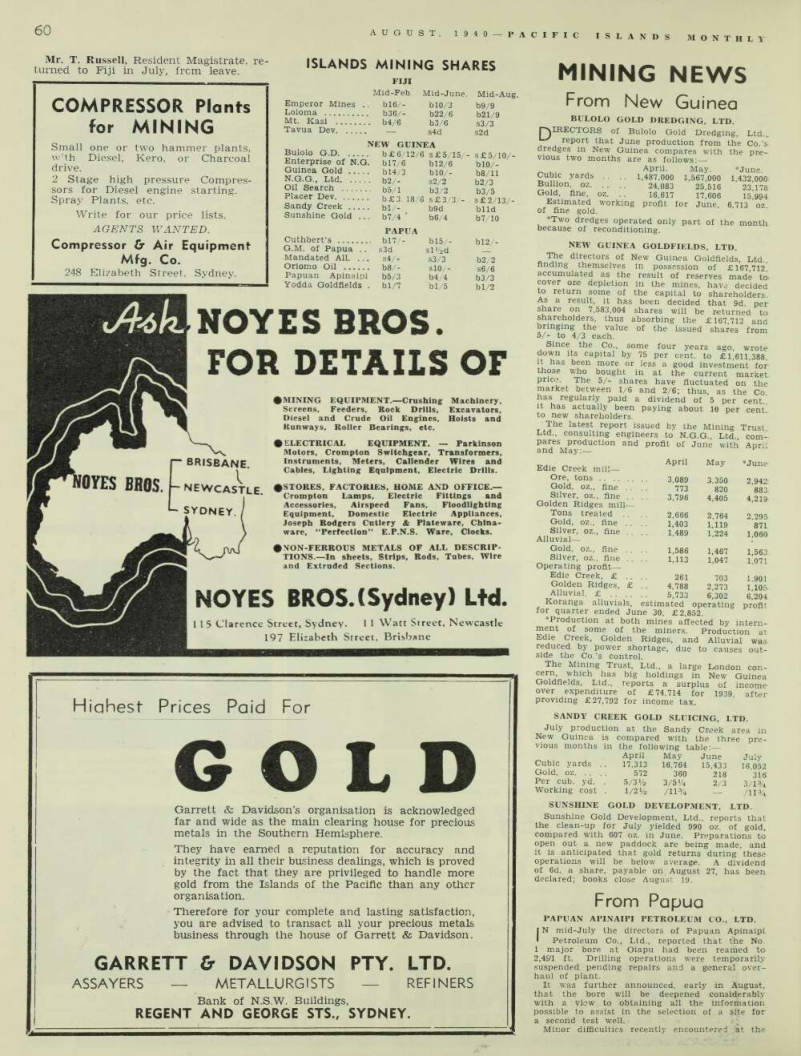
By "Therese"
On Keeping Cool
THE problem of keeping cool is always one that troubles tropic dwellers.
There are so many things to be taken into consideration: clothes, food, skin, hair and entertainment, too.
The clever woman takes time by the forelock and says, “Now is the time to bother about my appearance.” When people see her, they say, “Isn’t it amaz ing how Mrs. So-and-So always looks so cool and well dressed. She must be one of the lucky ones who doesn’t feel the heat.” But Mrs. Sp-and-So feels the heat every bit as much as they do —but she takes measures to combat it, knowing that half the battle lies in preparing for it.
After you have had your morning bath, rub yourself down with toilet water or eau-de-Cologne and, of course, a sprinkle of lightly perfumed dusting powder. When cleaning your face, be careful to remem ber your skin tonic, as it helps to keep the muscles toned up, making the skin feel new-born and fresh.
Brush your hair smoothly behind your ears and cut down on the curls. Fussy hair with lots of fringe and ringlets makes you look hot. Have a neat nape clean lines are cool lines.
Wear a light make-up. Heavy rouges
and lipsticks are not consistent with heat, and dark powders cake and grow Veliow in corners.
Be just as particular about the cut and fit of your washing frocks as you are about the more expensive dresses. The simpler you keep washing frocks, tne cooler and smarter they look, and they have the added virtue of easing the laundry problem. Frills and flounces or anything fussy on a light frock are apu to look hot, which is well on the road to feeling hot.
WE are all apt to get tired of pastel shades, however charming we think them. So if you have always worn light shades why not have a change?
Wear thin dark materials; with light accessories they look unbelievably cool and two tone shoes enhance the effect.
Try a navy linen or shantung, a voile or a washing sheer, and add a pale yellow collar and buttons: or wear brown with lime green or a black linen with white pique for afternoon.
Red, purple and bright blues are not suitable for hot climates. Dead white is not good either; it is too dazzling and shows every crease and mark. Off-white is excellent and is a delightful back ground for touches of colour and con trast.
Be more than a “change-daily girl”.
Change twice a day and see that your lingerie is fresh and immaculate—it is most important for your comfort and ap pearance. Change your stockings twice a day too, your dress as often as you can and your shoes equally as often. In the privacy of your room, wear spotted muslin negligees or house gowns of voile or dimity.
Don’t wear tight sleeves with tight fit ting armholes; high fussy necklines; tight shoes; warm colours; or heavy jewellery. Don’t wear patent leather, it scorches in the sun and draws the feet.
And don’t say, “Phew isn’t it hot?”
In Step With Comfort
CARE of the feet is all important in the tropics and you should give them as much coddling as you do your hands.
The result will be well worth while—your disposition will be better, your face will lose its strained look, your walk will be come graceful and your health improved.
Begin with your shoes. Be reckless and throw away every pair that pinches and presses. Get new ones, long enough and wide enough to let you wriggle your toes in them freely, yet fitting enough to give you support. See that they are close fit ting in arch and heel. Buy different models for different purposes, if neces sary.
Don’t fall into the habit of wearing the same shoes all day long. Wear low heeled broad-toed shoes for walking and practi cal work, and save your high heels for formal occasions. Be sure to keep your shoes always in good repair. Worn heels and broken down shoes are the easiest path to discomfort.
It is difficult these days to find a woman who hasn’t a corn or two. Tem porary relief is made easy by use of one of the correctives on the market; but once the pain has been stopped and the hard kernel removed don’t be tempted to go back to the short narrow-toed shoes which caused the trouble!
Callouses on your soles are a sign that your weight is not evenly distributed on your feet. Perhaps your posture is at fault, or you may have a weakness in your foot structure. It is a good idea to consult a chiropodist next time you come South; he will find the cause of the
trouble and advise you how to overcome it. In the meantime, it helps a lot to rub the horny spots with pumice stone each day after your bath.
STOCKINGS, too, are a big considera tion in foot fit should be perfect, not Just approximate.
There is nothing more uncomfortable than a stocking that twists at the heel and drags into the sole of the shoes. An ill-fitting stocking simply discounts the most careful choice of shoes and can cause equally as much foot discomfort as a badly-fitting shoe.
When your feet are swollen and aching and the soles burn, prompt comfort is what you need. Here are some simple ways to get it. Take off your shoes and stockings and lie down with your feet higher than your head. To relieve ten sion in feet and ankles, remove your shoes and arch the left foot until it is limp, then repeat with the other foot several times.
Aching feet enjoy massage, so rub •cream or soothing lotion all over them.
Brace your thumb on the instep and work deeuly into the ball of the feet, kneading 'between the bones qt the in step. Finish by stretching each toe. Then remove the cream with witch-hazel.
Summer Salads
SALADS are aways good fare for tropic climes, so he?e are a few that are different.
Crab and Cucumber Three-quarter cup sliced cucumber, I cup vinegar, 14 cups boiling water, I cup cold water, flaked crab meat. I teaspoon castor sugar, 2 tablespoons gelatine, 2 tablespoons lemon juice, pepper, 2 table spoons chopped parsley, I teaspoon salt.
Season cucumber with pepper and salt.
Cover with vinegar, saving I cup for jelly. Soak gelatine and stir until dis solved. Cool and add a little green vege table colouring if desired. Strain on to cucumber mixed with parsley. Pour a little mixture into individual moulds; when set, add sliced cucumber dipped in liquid jelly and arrange in pattern on layer of set jelly. When firmly in posi tion, add another layer of jelly and leave till set. Then add flaked crab to taste and remainder of jelly. When quite firm, turn on to a dish lined with lettuce leaves. Serve with mayonnaise flavoured with tomato sauce, ‘well beaten in.
Salmon Salad One tin salmon, 2 hard boiled eggs, some mayonnaise, capers and lettuce.
Remove sxin and bones from salmon, but do not break up. Place in a dish and pour a good mayonnaise over it. Sprinkle with capers. Arrange lettuce leaves round the dish and garnish with hard boiled eggs, cut in quarters.
Pineapple Salad Line a bowl with lettuce leaves. Put in a mixture of finely chopped pineapple and cubes of tomatoes and finely chop ped onion. Season with salt and pepper and cover with salad dressing. Quantity according to size of family. 1 omato Salad Take six even sized tomatoes. 3 table spoons grated cheese, 2 tablespoons chopped walnuts, 1 tablespoon finely chopped onion, 1 teaspoon chopped pars ley, 1 dessert spoon whipped cream (tin ned cream will do), mayonnaise and let tuce leaves.
Cut off tops of tomatoes and scoop out centres. Sprinkle with salt and pepper and a little castor or ordinary sugar.
Mix tomato pulp with cheese and nuts,
onion, parsley and cream. Season with salt and cayenne. Mask top with a little thick mayonnaise and set each tomato on a lettuce leaf.
Original Recipe
The following original recipe for grana dilla butter has been forwarded by Mrs. E.
S. Absolon, of Rabaul, New Guinea. 2 eggs well beat"n, two tablespoons butter or Merra-lea, I cup sugar, 1 cup granadilla juice (or seeds).
Method: Mix all ingredients, put in a jug in a saucepan of water for about half an hour. Let it boil until it thickens.
Stir occasionally.
Mr, T, Russell, Resident Magistrate, re turned to Fiji in July, frcm leave.
Advertisements & other items, pp. 60-62 (2 items)
58
August, i 9 4 o-f Acidic islands monthly
Swallowarielll
The “Serviceable”
LINEN WATCH BAND
for ladies 7 and gents 7 watches
• WASHABLE
• DURABLE
• DRESSY
Assorted colors. A size to lit every watch.
Special shades to suit the Fighting Services.
ASK YOUR LOCAL
STOREKEEPER
Wholesale only from —
M. SUTTON
27 PRINCE ALBERT STREET,
MOSMAN, N.S.W.
* « - h * * BISCUITS Popular Everywhere! "Milk Arrowroot," lull of nourishment, ideal for kiddies. "Club Cheese," a savcry in itself, and "Shredded Whealmeal,' Swallow's own delicious new health biscuit.
CANTERBURY CAKES Chockful of flavour fruity . . and with an inviting "Home Made"
Plain . . Fruit . . Seed, etc. There's a variety every taste.
.. ONLY IF ITS SWALLOWS
Tasty eating comes only from good cooking and finest ingredients, and Swallow & Ariell's products have both. So always say SWALLOW'S when ordering Biscuits . . . Puddings . . . Cakes . . . Cabin Biscuits . . . Navy and Pilot Bread.
Remember that all Swallow's Products are specially tropic-packed in air-tight tins to retain their freshness.
SWALLOWARIELLL
PORT MELBOURNE, VICTORIA, AUSTRALIA
PLUM PUDDINGS Expertly prepared by Swallow's master cooks. Everyone loves "Olde Englyshe" style plum pudding and the rich goodness of Swallow's is unique.
COMPRESSOR Plants
for MINING
Small one or two hammer plants, w : th Diesel, Kero, or Charcoal drive. 2 Stage high pressure Compressors for Diesel engine starting.
Spray Plants, etc.
Write for our price lists.
AGENTS WANTED.
Compressor & Air Equipment
Mfg. Co.
248 Elizabeth Street, Sydney.
Islands Mining Shares
Fiji
Mid-Feb.
Mid-June.
Mid-Aug, Emperor Mines .. bl6/blO/3 b9/9 Loloma b36/b22/6 b21/9 Mt. Kasi b4/6 b3/6 s3/3 Tavua Dev — s4d $2d
New Guinea
Bulolo G.D b£ 6/12/6 s£5/15. s £ 5/10/- Enterprise of N.G. bl7/6 bl2/6 blO/- Guinea Gold bl4/3 blO/b8/ll N.G.G., Ltd b2/s2/2 b2/3 Oil Search b5/l b3/2 b3/5 Placer Dev b £ 3 18/ 6 s£3/3 s £ 2/13/- Sandy Creek bl/b9d blld Sunshine Gold ... b7/4 ' b6/4 b7 10 Cuthbert’s
Papua
bl7 bl5/bl2/- G.M. of Papua .. s3d slV 2 d Mandated All. ... s4/s3/3 b2/2 Oriomo Oil b8/slO/ s6/6 Papuan Apinaipi b5/3 b4/4 b3/3 Yodda Goldfields . bl/7 bl/5 bl/2
Mining News
From New Guinea
Bulolo Gold Dredging, Ltd.
P\IRECTORS of Bulolo Gold Dredging, Ltd., report that June production from the Co.’s dredges in New Guinea compares with the pre vious two months are as follows:
new guinea goldfields, ltd.
The directors of New Guinea Goldfields, Ltd., finding themselves in possession of £167,712, accumulated as the result of reserves made to cover ore depletion in the mines, have decided to return some of the capital to shareholders.
As a result, it has been decided that 9d. per share on 7,583,004 shares will be returned to shareholders, thus absorbing the £167,712 and bringing the value of the issued shares from 5/- to 4/3 each.
Since the Co., some four years ago, wrote down its capital by 75 per cent, to £1,611,388, it has been more or less a good investment for those who bought in at the current market price. The 5/- shares have fluctuated on the market between 1/6 and 2/6; thus, as the Co has regularly paid a dividend of 5 per cent, it has actually been paying about 10 per cent to new shareholders.
The latest report issued by the Mining Trust Ltd., consulting engineers to N.G.G.. Ltd. com pares production and profit of June with April and May:—
The Mining Trust, Ltd., a large London con cern, which has big holdings in New Guinea Goldfields, Ltd., reports a surplus of income over expenditure of £74,714 for 1939 after providing £27,792 for income tax.
Sandy Creek Gold Sluicing, Ltd.
July production at the Sandy Creek area in.
New Guinea is compared with the three pre vious months in the following table:—
Sunshine Gold Development, Ltd.
Sunshine Gold Development, Ltd., reports that the clean-up for July yielded 990 oz. of gold, compared with 607 oz. in June. Preparations to open out a new paddock are being made, and it is anticipated that gold returns during these operations will be below average. A dividend of 6d. a share, payable on August 27, has been, declared; books close August 19.
From Papua
Papuan Apinaipi Petroleum Co., Ltd.
j N mid-July the directors of Papuan Apinaipi ' Petroleum Co., Ltd., reported that the No 1 major bore at Oiapu had been reamed to 2,491 ft. Drilling operations were temporarily suspended pending repairs and a general over haul of plant.
It was further announced, early in August,, that the bore will be deepened considerably with a view to obtaining all the information possible to assist in the selection of a site for a second test well.
Minor difficulties recently encountered at the
April.
May. *June.
Cubic yards . . . . 1,487,000 1,567,000 1,432,000 Bullion, oz 24,083 25,516 23,178 Gold, fine, oz. .. 16,617 17.606 15,994 Estimated working profit for June of fine gold. 6,713 oz. *Two dredges operated only because of reconditioning. part of the month
Edie Creek mill— April May *June Ore, tons 3,089 3,350 2,942 Gold, oz., fine . . . . 773 820 883 Silver, oz., fine . . . . 3,796 4,405 4,219 Golden Ridges mill— Tons treated . . . . 2,666 2,764 2,295 Gold, oz., fine . . . . 1,403 1,119 871 Silver, oz., fine . . 1,489 1,224 1,060 Alluvial— Gold, oz., fine .. .. 1,586 1,467 1,562 Silver, oz., fine . . 1,113 1,047 1,071 Operating profit— Edie Creek, £ .. 261 703 1.901 Golden Ridges, £ . 4,788 2,273 1,105 Alluvial, £ ... 5.733 6,302 6,204 Koranga alluvials, estimated operating profit lor quarter ended June 30, £2.852.
"“Production at both mines affected bv internment ox some of the miners.
Production at Edie Creek, Golden Ridges, and Alluvial was reduced by power shortage, due to causes outside the Co.’s control.
April May June July Cubic yards .. 17,313 16.764 15,433 16 052 Gold, oz 572 360 218 316 Per cub. yd. . 5/3 Va 3/5y 4 2/3 3/1% Working cost . l/2y 2 /11% — /1134
well were investigated by two members of the board, Messrs. Marks and Haynes, and by Dr.
H. G. Raggatt. assistant geological adviser to the Commonwealth Government, and Mr. L. L.
McKillop, acting drilling consultant to the De partment of the Interior. After a discussion between the directors and officers of the De partment of the Interior, the Commonwealth Geological Adviser (Dr. Woolnough) made it clear that steps which have been decided upon will immediately eliminate all existing trouble.
Cuthbeirt’S Mls Ima Goldmine, Ltd.
July production at the mine on Misima Island, Eastern Papua, is compared with May and June in the following table: —
Caltex (Australia) Oil Development.
Caltex (Australia) Oil Development Pty., Ltd., incorporated in Sydney, was registered in Papua, in July as a foreign company, under the Papuan Companies Ordinance. The Co. has a nominal capital of £500,000 in shares of £1 each. Mr. R. D. Bertie, of Port Moresby, is the Public Officer in the Territory.
Yodda Goldfields. Ltd.
Yodda Goldfields, Ltd., reports a net profit of £2,064 for the year ended April 30, compared with £2,118 for the previous year and a loss of £405 two years earlier. With £1,400 brought forward, £3,464 was available. Two dividends each of 3d. per share paid during the year absorbed £2,187, leaving £1,276 to be carried forward A further dividend of 3d. a share was paid last month.
Gold production improved on that of previous years, 961 oz. 15y 2 dwt. being obtained from 50,330 cubic yards. This represents an average of 3/2 a yard. General expenses and labour costs increased considerably. A dredging claim of 54 acres was granted during the year, which is expected to be a valuable acquisition.
From Fiji
Emperor Mines, Ltd.
RESULTS from the Emperor mine, at Tavua, for the past four months have been:—
In the 52 weeks ended July 10, 162,427 tons of ore were treated for a recovery of 53,366 oz. of fine gold, compared with a crushing of 178,164 tons for 52,381 fine oz. in the previous year.
Loloma (Fiji) Gold Mines, N.L.
Loloma (Fiji) Gold Mines, N.L., has declared a dividend of 1/- a share, payable on September 9. The previous distribution, in June, was 2/a share.
Loloma’s August production compares with May, June and July as follows:
Directors of Loloma (Fiji) Gold Mines, N.L., and Emperor Mines, Ltd., in a joint statement on August 7, said that a vigorous programme of development on the Tavua goldfield had been approved. This will call for considerable capital expenditure, which might temporarily affect dividends.
A new main shaft will be sunk in the Em peror mine to 650 ft., and later to 1,000 ft.
This will be equipped for large-scale and under ground production, which will be necessary when open-cut operations are completed. Addi tional treatment plant will be installed at Loloma to maintain throughput of the harder sulphide and semi-sulphide ore.
Extensions to the present plant are neces sary, for which generating sets and a com pressor set have been ordered from England.
Difficulty in obtaining supplies from overseas has prompted the directors to accumulate addi tional stores, including fuel oil, timber, and spare parts.
The result of prospecting and development to date, state the directors, justified the board’s optimism in providing the necessary equipment for a long and profitable existence on the Tavua field.
Mount Kasi Mines, Ltd.
Production at the Mt. Kasi mine on Vanua Levu for the four weeks ended August 7 is compared with the four previous yields in the following table;—-
May June ‘July Mill treated, tons 3,252 3,102 3,064 Bullion, oz 3.326 3,250 3.348 Gold, fine oz 794 701 717 Silver, fine, oz. .. 2,445 2,479 2,551 Estimated value £6,500 £5,765 £5,837 Value per ton of ore 40/ 37/2 38/3 ‘Tonnage affected by overhaul of big engine.
April May June tJuly 17. 15. 12. 10.
Ore treated tons . 11.971 12.500 11,792 11,184 Head value, dwt. . . 6.76 6.72 6.7 7.8 Gold. oz„ fine ... 3,663 3,696 3.704 *4,000 Residues, dwt 0.59 0.65 0.85 1.0 ♦Including 484 oz. from partial treatment of concentrates. tJig concentrates stacked for further treatment estimated to contain 70 oz. fine gold; 66.3 tons flotation concentrates stacked estimated to contain 331 oz. fine.
Pour weeks ended May June July Aug. 15. 12. 10. 7.
Tons treated 2,506 2,540 2,659 2,493 Gold, oz.. fine . . 3,659‘ 3,416 3,523 3,428 Head value, dwt. . 30.35 28.1 27.49 27.5 Residue, dwt 1.15 1.2 0.99 1.33
Four ■ weeks ended Apl.
May June July Aug. 17. 15. 12. 10. 7.
Ore, tons .. . . 3,209 3,198 3,118 3,400 3,348 Gold, fine oz. 656 633 599 706 655 Value, £ A . . . 6.560 6,330 5,990 7,060 6,550
Advertisements & other items, p. 62 (1 item)
Gold
£
OYES BROS
NOYES BROS.
FOR DETAILS OF
• MINING EQUIPMENT. —Crushing Machinery, Screens, Feeders, Rock Drills, Excavators, Diesel and Crude Oil Engines, Hoists and Runways, Roller Bearings, etc.
• ELECTRICAL EQUIPMENT. Parkinson
Motors, Crompton Switchgear, Transformers, Instruments. Meters, Callender Wires and Cables, Lighting Equipment, Electric Drills.
“ BRISBANE.
I
SYDNEY
NEWCASTLE • STORES, FACTORIES, HOME AND OFFICE.— c ’ Crompton Lamps, Electric Fittings and Accessories, Airspeed Fans, Floodlighting Equipment, Domestic Electric Appliances, Joseph Rodgers Cutlery & Plateware, Chinaware, “Perfection” E.P.N.S, Ware, Clocks.
• NON-FERROUS METALS OF ALL DESCRIP-
TIONS.—In sheets, Strips, Rods, Tubes, Wire and Extruded Sections.
NOYES BROS.(Sydney) Ltd.
11 5 Clarence Street, Sydney. 1 1 Watt Street, Newcastle 197 Elizabeth Street, Brisbane
Hiahest Prices Paid For
GOLD
Garrett & Davidson’s organisation is acknowledged far and wide as the main clearing house for precious metals in the Southern Hemisphere.
They have earned a reputation for accuracy and integrity in all their business dealings, which is proved by the fact that they are privileged to handle more gold from the Islands of the Pacific than any other organisation.
Therefore for your complete and lasting satisfaction, you are advised to transact all your precious metals business through the house of Garrett & Davidson.
GARRETT & DAVIDSON PTY. LTD.
ASSAYERS METALLURGISTS REFINERS
Bank of N.S.W. Buildings,
REGENT AND GEORGE STS., SYDNEY.
- - i ■
Price Of Gold
(Australian Official Quotations)
M. Paul Vois, who is managing dir ector of the Societe Le Nickel, a large nickel mining company in New Cale donia, arrived in Australia late in July having travelled by Pan American Air ways clipper from Noumea to Auckland and by the trans-Tasman air mail from Auckland to Sydney. He came to confer w r ith the Commonwealth Government as
a special envoy from the Government of New Caledonia; and, as described in an article on uage 22, he was successful in completing 'an arrangement under which Australia will buy large quantities of nickel and chrome from New Caledonia and in return New Caledonia will buy considerable quantities of foodstuffs and other goods from Australia.
Miss Eva Hunter, 22-years-old daugh ter of Mr. and Mrs. T. Hunter, of Vaiala, Western Samoa, died in Apia Govern ment Hospital in July. She was at one time in the employ of Mr. A. J. Tat tersall, photographer, of Apia, later was on the teaching staff of Iff Iff College where she herself was educated.
Pine Standard oz. oz.
October 2. 1939 . . . . £ 10/11/- £9/13/5 November 6 £10/11/- £9/13/5 December 4 £ 10/12/6 £9/14/9‘/ 2 January 1, 1940 .. .. £10/12/6 £ 9/14/9 Va February 5 £10/12/9 £9/15/0V4 March 4 to June 17 . . £10/13/3 £9/15/5% June 24 £ 10/12/9 £ 9/15/0 % July 1 £10/12/9 £9/15/0V 4 July 8 £10/11/- £9/13/5 July 15 £10/11/- £9/13/5 July 22 £10/11/- £9/13/5 July 29 £10/11/- £9/13/5 August 5 £10/12/6 £ 9/14/9Va August 12 £10/12/6 £ 9/14/9 Vz
Advertisements & other items, pp. 63-64 (1 item)
Beebe
• 1940 Radio For Sale
• £2O Below Retail Price
Your opportunity to buy your Radio direct if there is no “CENTURY” Agent in your district. Buying direct will save you up to £2O cash on retail prices. Satisfaction absolutely guaranteed.
Tone and performance of “Century” Radio Sets are perfect. 1940 Catalogue for Battery and All Electric Sets post free.
Write at once Century Radio Manufacturing Co., 9/13 Dixon Street, Sydney
BEEBE
ALL STEEL
Portable /
Winches
With Holding Yokes.
For use where Power is not Practical or Available. Especially suitable for Log Hauling. Timber Getting and Mill Work. 8-ton capacity, weight . . 6Clb. 5-ton capacity, weight . . 1101 b.
Illustrated folder with full particulars obtainable from:-
Nelson & Robertson Pty. LH.
12 Spring Street, Sydney.
R.J.2, 18/20 B.H.P. C.I. (DIESEL)
MARINE ENGINE
(AUST.) PTY. LTD.
ALL BRITISH MARINE
PETROL AND DIESEL ENGINES
are not subject to import restrictions. Good deliveries can be given from stock, and your inquiries will be given our immediate attention.
Write, Cable or Call at
6/10 WATTLE STREET,
PYRMONT, N.S.W.
Cable Address: “Thornmotor”, Sydney.
Agents for the famous Stuart Turner Marine Engines and Auxiliary Lighting Sets.
“PRESTO"
THE
MAGIC
BOX
The most Amazing Trick — Just out.
“Presto”.—The greatest, most alluring and outstanding little trick ever Introduced, 2/9. Post Free.
Money back if it’s not the best yet. ■
POLICE PATROL MULTI STRAND
RUBBER COVERED AERIAL.
Needs No Separate Lead-in. 50 ft., 2/6; 100 ft., 5/-.
MAN-O-WAR HEAVY DUTY
INSULATED AERIAL, MULTI
STRAND WIRES.
50 ft., 5/-; 100 ft. 10/-.
Electric MODEL MOTORS, work off wet or dry batteries: 5/9, 9/6, 12/6
ACCUMULATORS
We sell all Types and Sizes—Fully Guaranteed.
Brass Competition Darts, Set of 3, 3/11, 4/6, 5/61 Monopoly, 10/6.
Totopoly, 10/6. Bucaneer, 10/6, 3 of the World’s Most Popular Games.
Chinese Checkers, 2/6, 4/6, 8/6.
Tripoly Card Game, 5/-. De Luxe Type, 10/6. Poker Rummy, 1/-.
Pot Luck, 1/-. Playing Card Lotto, 1/-. We Stock All Kinds of Indoor Games. Send for Booklet. li a Neat Metal Bound Wooden Cigarette Cabinet, 4/9, for building Music Box unit into.
Complete Mechanical Units for Musical Cigarette Boxes, etc., 12/6, 15/-. Plays two Tunes. Music- Boxes, 30/-, 35/-, 45/-. Musical Cigarette Boxes, 35/-.
“LIKE-A-FLASH” DE LUXE
RADIO RECEIVERS FROM
MAKER TO USER
Regardless of Make, Trade-Name or Price, “Like-a-Flash” Radio Sets cannot be bettered. Hundreds of our sets are giving excellent service right throughout the Islands.
“Like-a-Flash” De Luxe Dual Wave 5 Valve Battery Operated Receiver.
This is one of the most powerful models in our battery set series, and the Radio Frequency stage ol amplification gives the set a world range on short wave channels as well as full coverage range ot Australasian “A” and “B” Class Broadcasters.
The set is also specially designed to give maximum service in humid climates, such as North Queensland and Pacific Island Territories. A vital part very vulnerable to “dampness” in ordinary receivers is the ‘‘Ritermediate Frequency Section”.
In this set our Engineers have fitted special inductance tuned intermediate frequency transformers, which do not require trimmers.
These units ensure correct alignment for a continuous period. An 8 in. Aero Dial calibrated in stations facilitates tuning. Valves used are:
2—lC4, I—KK2, I—lK6. I—lD4
The speaker is the latest Amplion Permagnetlc Model, capable of high fidelity reproduction. Battery equipment consists of extra heavy capa city units as follows: 1 2 Volt 100 amp. Accumulator. 3 Ever-Ready Superdyne 45 Volt ”B” Batteries. 1 Ever-Ready 4V 2 in. “O” Battery The outfit Is housed In a beautfully veneered floor model Console Cabinet.
PRICE: £22/5/-.
Now available (not less than 10/parcels): Magic Wand, 1/6 Jafet’s Wallet, 1/-; Obedient Ball, 1/6; Rattle Box; Mystic Head Chopper, 2/6; Shy Lock, 2/-; Dribble Glass, 2/-; Ventrillo, 1/-; Magic Coin, 1/-; Nest of Nests, 5/-; Voice Echoer, 1/-; Magic Bottle, 1/-; 3 Bell Trick, 1/-. 2 Knife Trick, 6/6. Giant Dice Trick, 1/6.
DRINKING GLASSES.—What a
Novelty. Outside the Glass a Pretty Miss—portrayed inside it’s a different story. She’s nice and bright, and is a surprise to all.
The Water magnifies her handsome form. Set of 6 for 12/-.
Money Belts For All. Zipper types, 10/6. Other pocket types, 6/6 and 7/6 each.
Rush Bd. in Stamps for our “GREAT
WONDER BOOK OP SPECIALTIES”.
Games, Radio, Tricks, Puzzles, etc.
Books just landed, 1/9 ea.
Popular Party Games.
Tea Cup Telling Fortune Card Tricks—
or Naval Badge attached, best MATCH SOX tor Safety's. Will last to years. Take out one match a Patent Match Box as Illustrated, with Fancy Metal Airforce, A.I.P. eoch hme. Bokelite moulded I/-. Post free.
SOX tor Safety's, Will last fooftnrhpri years. Take out one match a cUldl/lieQ, you require it, no opening boiti/c <sor>h each lime. Bokelite moulded J/ ° “Duplex” Single 1-Valve Battery Set. A smart little outfit to buy in Kit form, or purchase Readymade. Parts, 63/2. Valves, 12/6 Batteries, 33/3. Phones, Readymade, complete, £7/18/11. Simple Chart with instructions, ; 6d., or free with Kit.
Remington, U.S.A. made, Hunting and Sporting Knives in Sheath, 10/6. A Beautiful Article.
giiiaEgsy
Australian Naval Design Dress Rings for Gents, 6/6. Air Force Dress Rings for Lady or Gent, 4/6.
Carborundum 4in. Grinding Wheels 10/6. Large Breast Drills 5/11.
HEADPHONES. All 4000 ohms.
Lissen 19/6. S.T.C. or B.T.H. 30/-.
Ericssons 32/6. All British.
THE WIRELESS CONSTRUCTOR’S
ENCYCLOPEDIA, 7/6.
Cloth bound, nearly 400 pages, full of interesting and useful hints.
“Wheres” and “Whys” book of Radio.
THE TELEVISION AND SHORT
WAVE HANDBOOK, 5/6.
Cloth bound—up to the moment, simply written explanation and instructions on building Short Wave Sets. etc. A useful dictionary—you should have a copy.
METERS.—Pocket Volt Meters. 2 Reading for A. & B. Batteries, 8/6. 10/6.
WATES.—4 in 1 Meter: 0 to 6, 0 to 15, 0 to 180 volts; 0 to 30 M/A, 14/-.
TELSEN.—Millimeter A.C., D.C., British. Reads everything in Radio.
Bench type, 22/6.
PIFCO—A.C.-D.C. Bench Type Radiometer. British. Reads 0 to 30 M/A Valve and Circuit Tester, 0 to 240 V. 0 to 15 V. Panel Mount Meters, 25/-.
BOOKS! BOOKS! BOOKS! The Be-
ginners’ Book of Radio. The Radio Beginners’ Dictionary. 2/- the 2. The Wireless Constructor’s Encyclopaedia. Giant size, 7/6. Newnes “Everyman’s” Wireless Book, 5/6.
The Book of Practical Radio, also The Book of Practical Television, 8/6 each. Fouishatn’s Giant “Party and Fun Book”, 1/6. Humorous Stories and Recitations, 8/9. Card and Conjuring Tricks, 3/9. Tea- Cup Fortune Telling, 3/9. 100 Party Games for Old and Young, 1/9.
Popular Magic and Amateur Conjurer, 1/9. 50 Best Party Games, 1/6. Tricks with Cards, 1/6.
No. 1 Morse Code Practice Seta, with Switch Buzzer to Light. Use as you desire. 25/- complete.
No. 2, with Heavier Type Morse Key: 30/-. Pendograph Bug Key. 70/-. Special High Pitched Adjustable Professional Morse Buzzer, 15/-.
Adjustable Bakelite Base Morse Code Buzzers, British Make, 4/9. Larger size, 3/6. Special High - pitched Circular Buzzers i n Bakelite Case, 5/6.
Adjustable All-way Chromiumed Morse Code Key on Bakelite Base, 12/6, m.Q n type
WONDER
194 Combination Nest of 4 Pocket Screw Drivers, 2/- Steel or Bakelite.
Strong Breast Drills, 4/11. Card of Steel Drills, 1/9. Radio Saw, 3 Blades, 1 for iron, Bakelite and Metal, 1/9.
Volt Ammeter Panel Type, 0 to 25 V., 0 to 5 A., 15/-. British Pocket Volt Meter, 0 to 12, 0 to 150, 0 to 30 M/amps, 10/6. 58/6 From London. “Cosmocord” De Luxe Crystal Pick-up, with Built-in Vol.
Control, 58/6. Magnetic type Pickups, complete with volume control and tone arm. British Make, 30/-, 35/-, 38/6, 45/-. Studio Model, 50/-.
Play, Talk, Sing, Joke through your Radio. Great Pun. Batteryless type.
Microphone for Hand Holding or Hanging, 22/6. Complete with Flex fixed in a second. Others, 12/6, 15/-, 17/6, 25/-, 28/6, 32/6. All plus 2/for Battery and 1/6 for 20 ft. Cord.
B.G.E. Table Type Microphone. Highly recommended for Amateur or Professional use. Built-in Transformer and Battery with Volume Control Incorporated.
Just plug into pickup terminals jf any set. 39/6.
iimniinimiimiii
Write for Punch Board Leaflets
mnaiiiiiimninn
J. LEVENSON RADIO !”
Pin-Game, GAMES, NOVELTIES AND HOBBIES, Tote m and 226 A PITT STREET, SYDNEY ° dd n s s and Manufacturers, Importers, and Exporters. Leaflets
N.S.W., AUSTRALIA. 11111111111111111111111111
Cable address: “Leveradioh”. Goods forwarded V.P.P. or Sight Draft. Satisfaction and Service Guaranteed. We can supply by mail ail General Merchandise at a Better Price. Quotations with pleasure. Please add freight and packing. Write for full list of interesting leaflets of Games, Hobbies, Novelties, and Electrical Goods. Write for full list of Radio Meters.
We Con Supply, at a Keen Price, Any Available Article You Require.
Australian Short Wave
Broadcast
A NATIONAL Short Wave Programme is broad cast daily from Lyndhurst, near Melbourne, Victoria, for listeners in the Western Pacific.
Call signs: From 6.30-8.10 a.m.,VLR6; from 8.15 a.m.-5.15 p.m., VLR3; after 5.30 p.m., VLR. Wave lengths; From 6.30-8.10 a.m.. 25.36 metres; from 8.15 a.m.-5.15 p.m., 25.32 metres; after 5.30 p.m., 31.32 metres. Frequencies: From 6.30-8.10 a.m., 11,830 Kcs. from 8.15 a.m.-5.15 p m., 11,850 KcS;. after 5.30 p.m., 9,580 Kcs. Power: 2 Kilowatts.
Times given are Australian Eastern Standard (10 hours ahead of Greenwich Mean Time).
WEEK DAYS.—a.m.: 6.30, Market Reports; 6.50, News; 7.05, Physical Exercises: 7.15, Music; 7.45, News; 8, Music; 9.30, Story; 10. Devotional Ser vice; 10.15, Close. p.m.: 12, Time Signal and Broadcast to Schools; 12.15, Music; 12.35, Essen tial Service and Sporting Information; 12.50, News; 1.10, Music; 4.15, Overseas News; 4.30, Music; 5.15, Close; 5.30, Young People’s Session; 6.15. Music; 7, News; 7.45, Talk; 9.30, News; 10.30, Dept, of Information Service; 10.45, Talk and News; 11, Close.
SATURDAYS. —Same as daily programme, ex cept between 1.05 p.m. and 5.15 p.m., when description of current sporting and athletic events is given, interspersed with music. Close at 11 p.m.
SUNDAYS.—a.m.: 6.45, Music; 6.50, News; 7, Music; 9, News; 9.15, Sporting Session; 9.30, New Releases (Recorded); 10, Book Re views; 11, Divine Service, p.m.: 12.15, Great Pianists: 12.55, News; 1, Music; 2.20, Classical Compositions: 3.45, Talk; 4.15, News; 4.45, Music; 7, News and Commentary: 9, Special Programme (Dept, of Information): 9.30, News; 10.30, Dept, of Information Service; 11, Close.
September 1 To September 7
Sept. 1 (Sun.) —3.20 p.m. Arnold Coleman and Artists: 6.30 Montagu? Brearley’s Orchestra; 8 Play; 10 Sigrid Sundgren (Pianist).
Sept. 2 (Mon.)—B p.m. Radio Serial; 8.30 “Merry-go-Round” (Musical Feature); 10 “At Short Notice’’.
Sept. 3 (Tues.)—B p.m. “The Silver Patrol” (Musical); 9.15 Light Ensemble; 10 Music of England.
Sept. 4 (Wed.) —1.10 p.m. Ascot Races; 7.45 “The Story and the Song”; 8 Talk; 8.15 “Mas queradio”; 9.10 Violin Recital; 10 Revue.
Sept. 5 (Thurs.) —1.10 p.m. Pakenham Races; 8 Brass Band Music; 8.30 Sir Thomas Beecham conducting Choral Concert; 10 Modern Com posers.
Sept. 6 (Fri.) —8 p.m. Brian Lawrence En semble; 8.30 Play; 10 Orchestral.
Sept. 7 (Sat.) —7.45 p.m. “Music Hall Memo ries”; 8.15 Brisbane Symphony Orchestra (Georg Schneevoight; 10 Military Band & Male Singers.
Pacific Colonies
Broadcast To French
THE Australian Department of Information, in conjunction with the A.8.C., inaugurated this month a daily broadcast in French of news, talks, and music for listeners in New Caledonia.
New Hebrides, and Tahiti. Transmission is made from Station VLQ, Sydney, on a wave-length of 31.2 metres (frequency, 9.615 mcs.) and con sists of the following items:—
Mr. Frank Allen, who had been a sur veyor in Fiji since 1905, died in the Colonial War Memorial Hospital, Suva, in July. He was 60 years of age.
Messrs. D. H. Baker and W. A. Hollo way, who have been stationed at the Melanesian Mission’s new headquarters at Taroaniara, passed through Sydney in July en route to New Zealand on leave.
Mr. A. Gibson has resumed duty at the Government Printing Office in Port Moresbv after leave in Australia. Mr. S.
J. Anderson, of the same department, has arrived in Australia where he joined his wife and family on furlough.
Aust. Eastern Noumea Standard Time. Time. 8.55 p.m. 9.55 p.m. Announcements. 9.00 p.m. 10.00 p.m. News in French. 9.20 p.m. 10.20 p.m. Talk in French.
S , .3Q p.m. 10.30' p.m. Close.
New Books
ISLES OF SPICE by Frank Clune.
Published by Angus and Robertson, Sydney. 12/6. „ lon Idriess —most productive of Aus tralian writers and, in a financial sense, the most successful —will have to look to his laurels. This merry, irresponsible Frank Clune, who goes wandering 911 around Australia’s coasts and nearby is lands, and writing and broadcasting his adventures, seems to be giving us a new book every few months. They have little literary value. Yet they are entertain ing and instructive; and the Australian public, weary of the introspections and inhibitions of sqb-sisters, and the imag inings of crime-hungry morons, are buy ing the books freely, and joining gladly with Mr. Clune in his zestful quest of knowledge, and his rollicking good humour. His books have the salty flavour of the tropical seas, and the cleanliness of the winds in the wide, open spaces.
“Isles of Spice” is simply an account of “a vagabond voyage by air from Botany Bay to Darwin, Bathurst Island, Timor, Java, Borneo, Celebes and French Indo-China”. We thought that every
thing worth a b°ut, in these lands, had been discovered and described; but M r. Clune goes among them, like an inquisitive kid out of school, getting into much quaint mischief, re-discovering the old things, presenting new angles and new discoveries, and re-telling history in an entertaining way. His book is well worth reading, because of its entertainment value; and well worth keeping as
a record, because of the tireless industry with which he has collected hundreds of interesting and useful facts. Unfortun ately, it is not indexed.
Producer Gas For Motor
VEHICLES, by John D. Cash and Mar tin G. Cash. Published by Angus and Robertson, Sydney. 10/-.
With the threatened rationing of petrol throughout the Empire, owing to the need for conserving American funds to purchase war materials, private and commercial motorists are looking about for an efficient substitute fuel.
This timely new book sets forth con cisely and fully the case for producer gas. The principles, construction and use of gas plants are explained in detail; maintenance and driving tech nique are also dealt with. Instructions and suggestions are given that will enable mechanically-minded Islands men to build their own producer units. There are 53 illustrations and an index.
Elementary Dietetics, By G. E.
Dupain. Published by George B. Philip and Son, Sydney. 3/-.
To residents in the tropics, a thorough knowledge of food and its uses is essen tial for continued good health. In this slim volume, the author gives a “bird’s eye view” of modern dietetics in non technical language and shows how vari ous foods should be used to restore, build up and preserve first-class health.
In addition to chapters dealing with “Food Values”, “Meal Planning”, and “Food Preservation and Storage”, a section is devoted to canned foods and their uses.
Roamer Gold Sluicing, Ltd., of New Guinea, is now in voluntary liquidation.
Advertisements & other items, pp. 65-66 (1 item)
roaig'dai/’M
SAVE £%
ON BATTERIES
Buy at wholesale prices and save up to £2 or more. Absolutely new throughout. No rebuilds, no renovations. Full new guarantee on the renowned Marshall Batteries of Sydney.
Write for 1940 catalogue, giving you all particulars, car, truck, cycle, radio, home or theatre lighting batteries. There is no better battery built than by the
Marshall Battery Mfg. Co.
36-38 Harbour Street, Sydney.
■fISS
Mm WM
chuitaiasia s
(Uadie r Ueod(H>i'
ALREADY acclaimed throughout Australasia as a short-wave performer without peer or parallel, Philips Radioplayer Model 2262 brings to you news and entertainment from the four corners of the earth —clearly and with volume to spare. Available for either 110-240 volt operation. Model 2262 is only one of the many magnificent tonal performers in the extensive Philips Radioplayer range.
Model 2262 is a 6 valve Receiver with “Magic Eye” and includes such outstanding exclusive features as “New Audioscopic Reproduction” (sound you can almost SEE), “Legi-line” dial with “window” and Escalator tuning systems for greater short-wave tuning ease, low level tone compensation and new static tone control, Broadcast coverage 540 —1620 Kilocycles.
Short-wave coverage, 8—22 megacycles.
PHILIPS
roaig'dai/’M
Made by The Largest Radio Organisation in the British Empire.
IL LL ihL —_ 9 _an PHILIPS LAMPS (A/asia) PTY. LTD. . . PHILIPS
1 HOUSE 69-73 CLARENCE STREET SYDNEY,
I N.S.W., AUS.
Please forward me all information on Model 2262,
I Name
\ Address P.I.M.
RADIO REPAIRS!
We Specialise in Radio Parts
FOR TROPICAL USE !
Try us for those spare parts for your Radio. Large stocks of specially treated components always on hand. We can supply speaker transformer windings for all makes of speakers by return, mail. We undertake all radio repairs.
If unable to get your set repaired locally ship it to us. We will attend to all customs formalities.
Papua and New Guinea residents can get parts by return air-mail.
Prices Radio Service
5 & 6 ANGEL PLACE, SYDNEY
For Radio and Hobbies Supplies
INSIDE
f
Carry
AND
OUTSIDE
AUSTRALIA
BANK of NEW SOUTH WALES
TRAVELLERS' CHEQUES
419
Exchange Rates
“T“HE following exchange quotations, gathered in Sydney, show the rate existing in mid- August:—
Fiji—Through Bank Of N.S.W.
And Bank Of New Zealand
Australia on Fiji on basis of £lOO Fiji; Buy ing £ All 1/2/6, selling £AII3.
Piji-London on basis £lOO London;—
New Caledonia—Through
French Bank
As a result of the French surrender to Ger many, the Anglo-French banking system has been completely dislocated. London is not quoting on Paris—therefore the Comptoir National d’Escompte de Paris Bank in Sydney is unable to furnish us with Sydney-Noumea bank rates, as usual.
N. Caledonia And Tahiti
Through Bank Of N.S.W.
Owing to the present* European situation, London is not quoting a rate on Paris; and since the Sydney-Noumea and Sydney-Papeete quotations are based on the London-Paris rate, no quotations for these are available.
Western Samoa—Through Bank
Of New Zealand.
Exchange, Australia on Western Samoa, basis £lOO Samoa—buying, £A99/12/6; selling,
£ Aloo/2/6.
Exchange, Samoa on London, basis £ 100 In London:—
New Guinea And Papua—Through
Bank Of N.S.W.
Australia on Port Moresby and Samarai, Papua, 10/- per cent, premium each way. Aus tralia on Rabaul, 10/- per cent, premium. All other places 20/- per cent.
Papua and New Guinea on London; Same as Australia on London and vice versa.
Through Commonwealth Bank
From Australian on Port Moresby and Samarai, 10/- per cent.; on Rabaul, 10/- per cent.—other Papua and New Guinea districts, £1 per cent.
From Rabaul on London, same as Australia on London:— Buying: T.T. £AI2S equals £stg. 100.
Selling: T.T. £AI2S/10/- equals £stg. 100.
Buying.
Selling. £ s. d. £ s. d.
Telegraphic transfer . .. 110 15 0 112 0 0 On demand .. .. 111 17 6
Buying. Selling.
Telegraphic transfer £125 10 0 On Demand £122 18 9 125 7 6 30 days 122 8 9 125 2 6 60 days 121 18 9 124 17 6 90 days 121 8 9 124 12 6 120 days 120 18 9
Cook Islands Trade
Decline
TRADE of the Cook Islands, owing to shrinkage in the orange and tomato output, declined last year, compared with the previous year, as follows:
Banana exports, last year, increased by 1.056 cases, but oranges decreased by 39,250 cases, and tomatoes by 4,582 boxes.
The deficit in public funds was met by a grant of £24,000 from the New Zealand Government.
Niue, a large island near the Cook Group, carried on as a separate admini stration, showed; Revenue £7,341; expendi ture £13,429; exports £11,554; imports £15,459. The d°crease in trade and con sequent disruption of finance was due to lack of shipping.
Year ended Year ended Dec. 31.
Dec. 31, 1938. 1939.
Exports £73,184 £56,689 Imports 74,789 73,559 Public revenue .. — 24,943 Public expenditure . — 53,204 Population 13,107 13,365
Islands Produce
THE following quotations were obtained In Sydney in mid-August:—
Coffee
Robusta, f.a.q., imported from Java on firm conversion of exchange, c.i.f., prompt shipment, Sydney (Sterling): Quote No. 1: 24/- per cwt.
Quote No. 2; 22/6 per cwt.
Robusta (f.o.b. Javan Old crop, 23/- to 25/6. (New crop temporarily withdrawn from market pending fixation of new price, which is ex pected to be slightly in advance of present rul ing price of old crop.) Robusta (f.a.q. in store Sydney): 7 7 / B d. per lb.
The price of Java Robusta has not fluctuated much over the past five years, as can be seen from the average prices made available by a Sydney importer:—l936, 22/9; 1937, 21/6 to 24/6; 1938, 18/4 to 21/6; 1939, 18/- to 20/-; 1940, 25/-. (Note: Importers of coffee from Java, etc., pay additional charges, including Exchange, duty 14d. lb.), primage (10 per cent.), landing costs (1/- per cwt.). war duty (10 per cent.). Coffee from Papua and New Guinea escapes most of these charges.) Kenya, f.a.q., immediate shipment, c.1.f., Sydney, per cwt. (Stg.): Quote No. 1; Grade “B”, 64 “C”. 60 - (Season closed). Quote No. 2: Grade “A”, 64/-; Grade “B”, 58/- (Sep tember shipment).
Mysore, f.a.q., c.i.f., Sydney, per cwt. Quote No. 1: Grade “A”, 74/-; “B”, 68/-; Triage, 62/- (Season closed).
Arabian (Aden) Hodeidah, f.a.q., c.i.f., Sydney.
No. 1 quotation; 84/- per cwt.
Papuan and New Guinea-grown coffee was quoted by one Sydney agent as follows: —Top grade: Bd. per lb.; 2nd grade: 7%d. per lb.; 3rd grade: 7y 2 d. per lb. Another importer re ports that some Papuan coffee (a similar type to Java Robusta) was sold in Sydney recently at 9d. a lb.
Kapok
Government-controlled prices:—Average Java, 6-7/16d. per lb., c.i.f. (Stg); Prime Japara. 6 3 /4d. per lb., c.i.f. (Stg). (Subject to exchange 25y 2 %, duty 2d. per lb., 10% primage, 10% war duty, wharfage, etc.).
Sydney quotations: Average Java, liy 2 d. lb.; Prime Japara, 12V 2 d. lb.
Ivory Nuts
Owing to the International situation, Sydney agents cannot quote for ivory nuts. The last quotations, several weeks ago, indicated that a nominal rate was in the vicinity of £7 per ton.
Cocoa
New Guinea cocoa: Quote No. 1: £4O per ton. Quote No. 2: £39-41. Quote No. 3; £4l.
Accra, good fermented, £32/10/- stg.
Rice
Rangoon rice, packed in 100 lb. bags, £l7/10/per ton; 200 lb. sacks, £l7/5/- per ton.
Australian table rice, packed In 56 lb. bags, £2O per ton.
Trochus Shell
Sydney agents report that there has been no recent activity on the Trochus shell market. The following nominal prices were given some weeks ago:—Quote 1: Grade “A”, £7B; “B”, £6B; “C”, £54. Quote 2: Grade “A”, £80; “B”, £69; “C”, £56. All quotes are f.0.b., and on the Australian £.
Mother of Pearl Shell
Since the outbreak of war, public auctions of M.O.P. shell in London have been suspended, according to Sydney agents.
Green Snail Shell
Green snail shell, quoted nominally by Sydney buyers:—Quote No. 1: £45-50. No. 2: £5O. No. 3: £5l.
Papuans Seek Compensation For Aerodrome Site
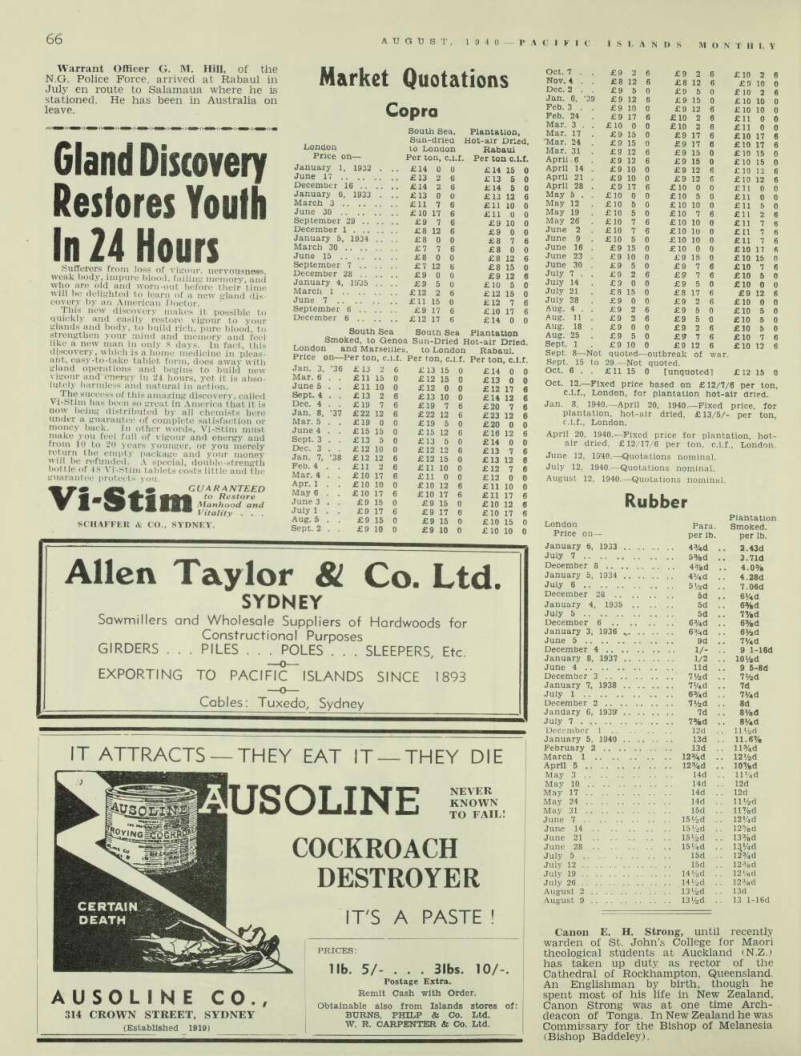
Aerodrome Site
Port Moresby, July 13.
IN the Central Court this week, Mr.
Justice Gore reserved judgment after hearing evidence in the action brought by natives of Kila Kila (near Port Moresby) against the Administra tion, seeking compensation for land re sumed as an aerodrome site. They claimed £5O per acre for 71 acres.
This land, and a smaller area on Rouna Road, was leased from the natives by the Government in 1937 for a term of 10 years at a rental of 6/- per acre.
Early this year when the Government found it necessdry to resume the areas, the native owners objected strongly, on the grounds that they need the land for gardens and that access to their present gardens is impeded by the necessity for walking round the aerodrome.
They claim also that the land, when resumed, was of high value as an aero drome. and that, without resumption, the buildings, etc., would revert to them at the end of the lease.
Warrant Officer G. M. Hill, of the N.G. Police Force, arrived at Rabaul in July en route to Salamaua where he is stationed. He has been in Australia on leave.
Advertisements & other items, pp. 67-68 (2 items)
Wealth
By Appointment
WHEN VISITING
BRISBANE
Pay us a call and let us take your measurements, colour preferences. size records, etc. These will be of great assistance to us for future reference.
A range of the latest Suitings will be gladly forwarded on request.
Pike Brothers Ltd.
Queen Street
, Wealth itwith
Gland Discovery
Restores Youth
In 24 Hours
Sufferers from loss of vigour, nervousness, weak body, impure blood, failing memory, and who are old and worn-out before their time will be delighted to learn of a new gland discovery by an American Doctor.
This new discovery makes it possible to quickly and easily restore vigour to your glands and body, to build rich, pure blood, to strengthen your mind and memory and feel like a new man in only 8 days. In fact, this discovery, which is a home medicine in pleasant, easy-to-take tablet form, does away with gland operations and begins to build new vigour and energy in 21 hours, yet it is absolutely harmless and natural in action. i 7 The success of this amazing discovery, called vi-Stim has been so great in America that it is now being distributed by all chemists here under a guarantee of complete satisfaction or money back. In other words, Vi-Stim must make you feel full of vigour and energy and from 10 to 20 years younger, or you merely return the empty package and your money will be refunded. A special, double-strength bottle of 48 Vi-Stim tablets costs little and the guarantee protects you.
Vi-Stini
GUARANTEED
to Restore Manhood and Vitality . • .
SCHAFFER & CO., SYDNEY.
Allen Taylor & Co. Ltd
SYDNEY
Sowmillers and Wholesale Suppliers of Hardwoods for Constructional Purposes GIRDERS ... PILES .. . POLES . . . SLEEPERS, Etc.
EXPORTING TO PACIFIC ISLANDS SINCE 1893
Cobles: Tuxedo, Sydney
IT ATTRACTS —THEY EAT IT —THEY DIE
3usoline =
COCKROACH
DESTROYER
IT'S A PASTE !
jSgSOlil
OVlNcicd
AUSOLINE CO.
314 CROWN STREET, SYDNEY
(Established 1919)
PRICES:
lib. 5/- . . . Bibs. 10/-.
Postage Extra.
Remit Cash with Order.
Obtainable also from Islands stores of:
BURNS, PHILP & Co. Ltd.
W. R. CARPENTER & Co. Ltd.
Hot Coughs
Handy-sized bottle
you get immediate relief with the first dose of
WOODS 1 GREAT PEPPER-
MINT CURE. Tastes good, acts fast; best for 'Flu Colds, Coughs, Throat and Chest ailments. Try a I/- bottle.
Market Quotations
Canon E. H. Strong, until recently warden of St. John’s College for Maori theological students at Auckland (N.Zj has taken up duty as rector of the Cathedral of Rockhampton, Queensland.
An Englishman by birth, though he spent most of his life in New Zealand, Canon Strong was at one time Arch deacon of Tonga. In New Zealand he was Commissary for the Bishop of Melanesia (Bishop Baddeley).
OCt. 7 . . £9 2 6 £9 2 6 £10 2 6 Nov, 4 . . £8 12 6 £8 12 6 £9 10 0 Dec. 2 . . £9 5 0 £9 5 0 £ 10 2 6 Jan, 6, ’39 £9 12 6 £9 15 0 £10 10 0 Feb. 3 . . £9 10 0 £9 12 6 £ 10 10 0 Feb. 24 £9 17 6 £10 2 6 £11 0 0 Mar. 3 . . £10 0 0 £10 2 6 £11 0 0 Mar. 17 . £9 15 0 £9 17 6 £10 17 6 'Mar. 24 . £9 15 0 £9 17 6 £10 17 6 Mar. 31 . £9 12 6 £9 15 0 £10 15 0 April 6 . £9 12 6 £9 15 0 £10 15 0 April 14 . £9 10 0 £9 12 6 £10 12 6 April 21 . £9 10 0 £9 12 6 £10 12 6 April 28 . £9 17 6 £10 0 0 £11 0 0 May 5 . . £io 0 0 £10 5 0 £11 0 0 May 12 . £10 5 0 £10 10 0 £11 5 0 May 19 . £ io 5 0 £10 7 6 £11 2 6 May 26 £10 7 6 £10 10 0 £11 7 6 June 2 £ 10 7 6 £10 10 0 £11 7 6 June 9 £io 5 0 £10 10 0 £11 7 6 June 16 . £9 15 0 £10 0 0 £10 17 6 June 23 . £9 10 0 £9 15 0 £10 15 0 June 30 . £9 5 0 £9 7 6 £10 7 6 July 7 , . £9 2 6 £9 7 6 £10 5 0 July 14 . £9 0 0 £9 5 0 £10 0 0 July 21 . £8 15 0 £8 17 6 £9 12 6 July 28 . £9 0 0 £9 2 6 £10 0 0 Aug. 4 . . £9 2 6 £9 5 0 £10 5 0 Aug. 11 . £9 2 6 £9 5 0 £10 5 0 Aug. 18 . £9 0 0 £9 2 6 £10 5 0 Aug. 25 . £9 5 0 £9 7 6 £10 7 6 Sept. 1 £9 10 0 £9 12 6 £10 12 6 Sept. 8—Not quoted- -outbreak of war.
Sept. 15 to 29 — Not quoted.
Oct, 6 . . £11 15 0 [unquoted] £ 12 15 0 Oct. 12.—Fixed price based on £12/7/6 per ton. c.i.f., London, for plantation hot-air dried.
Jan. 8, 1940. —April 20, 1940.—Fixed price, for plantation, hot-air dried. £ 13/5/- ■ per ton. c.i.f., London.
April 20. 1940.—Fixed price for plantation, hot air dried. £12/17/6 per ton, c.i.f., London.
June 12, 1940. —Quotations nominal.
July 12, 1940.—Quotations nominal.
August 12, 1940.- —Quotations nominal.
Rubber
Plantation London Para.
Smoked.
Price on— per lb. per lb.
January 6, 1933 , 4 3 Ad .. 2.43d July 7 3.7 Id December 8 .. . 4.0% January 5, 1934 , ,. . 4.28d July 6 7.06d December 28 .. 6‘Ad January 4, 1935 .. 5d .. 6%d July 5 5d .. 7%d December 6 .. .. 6 3 Ad .. 6%d January 3, 1936 . . . 6 3 / 4 d .. 6%d June 5 7>Ad December 4 .. . 1/- .. 9 l-16d January 8, 1937 , 1/2 . . ioy 2 d June 4 lid .. 9 5-8d December 3 .. . .. 7>/ 2 d .. 7V 2 d January 7, 1938 . .. 7>Ad .. 7d July 1 .. 6%d . .
IVtd December 2 .. . 7>/ 2 d .. 8d January 6, 1939 . 7d .. 8Vad July 7 7%d .. 8y 4 d December 1 12d ny 2 d January 5, 1940 . 13d .. 11.6% February 2 ., ., 13d .. ll%d March 1 .. .. .. 12%d .. 12>/ 2 d April 5 .. 12 3 Ad .. 10%d May 3 14d .. ny 4 d May 10 14d 12d May 17 14d . . 12d May 24 14d . . ny 2 d May 31 15d .. ll’/sd June 7 .. 15V 2 d .. 12’Ad June 14 .. ISVad .. 12 5 / s d June 21 .. 15V 2 d .. 13%d June 28 .. .. isy 4 d .. 13,y 4 d July 5 15d .. 12%d July 12 15d .. 12%d July 19 .. 14 V 2 d .. 12 Vsd July 26 . . 14y 2 d . . 12%d August 2 .. 13V 2 d .. 13d August 9 . . 13y 2 d . . 13 l-16d
London Price on—
Copra
South Sea, Plantation, Sun-dried Hot-air Dried, to London Rabaul Per ton, c.i.f. Per ton c.Lf.
January 1, 1932 £14 0 0 £14 15 0 June 17 £13 2 6 £13 5 0 December 16 .. £14 2 6 £14 5 0 January 6 , 1933 . . . £13 0 0 £13 12 6 March 3 £11 7 6 £11 10 0 June 30 . £10 17 6 £11 0 0 September 29 .. £9 7 6 £9 10 0 December 1 . .. £8 12 6 £9 0 0
January 5
1934 . . £8 0 0 £8 7 6 March 30 £7 7 6 £8 0 0 June 15 . £8 0 0 £8 12 6 September 7 .. £7 12 6 £8 15 0 December 28 . . £9 0 0 £9 12 6 January 4, ms £9 5 0 £10 5 0 March 1 £12 2 6 £12 15 0 June 7 . £11 15 0 £12 7 6 September 6 .. £9 17 6 £10 17 6 December 6 . . .. .. £12 17 6 £14 0 0 South Sea South Sea Plantation Smoked, to Genoa Sun-Dried Hot-air Dried.
London and Marseilles, to London Rabaul.
Price on— Per ton, c.l.f, . Per ton, c.i.I.
Per ton, c.l.f.
Jan. 3, ’36 £ 13 2 6 £13 15 0 £14 0 0 Mar. 6 . . £11 15 0 £ 12 15 0 £13 0 0 June 5 . , £11 10 0 £12 0 0 £12 17 6 Sept. 4 . . £13 2 6 £13 10 0 £14 12 6 Dec. 4 . . £19 7 6 £19 7 6 £20 7 6 Jan. 8, ’37 £22 12 6 £22 12 6 £23 12 6 Mar. 5 . . £19 0 0 £19 5 0 £20 0 0 June 4 . . £15 15 0 £15 12 6 £16 12 6 Sept. 3 . . £13 5 0 £13 5 0 £14 0 0 Dec. 3 . . £12 10 0 £12 12 6 £13 7 6 Jan. 7, ’38 £12 12 6 £12 15 0 £13 12 6 Feb. 4 . . £11 2 6 £11 10 0 £12 7 6 Mar. 4 . . £10 17 6 £11 0 0 £12 0 0 Apr. 1 . . £10 10 0 £10 12 6 £11 10 0 May 6 . . £10 17 6 £10 17 6 £11 17 6 June 3 . . £9 15 0 £9 15 0 £10 12 6 July 1 . . £9 17 6 £9 17 6 £10 17 6 Aug. 5 . . £9 15 0 £9 15 0 £10 15 0 Sept. 2 . . £9 10 0 £9 10 0 £10 10 0
Shipping Services In The Pacific
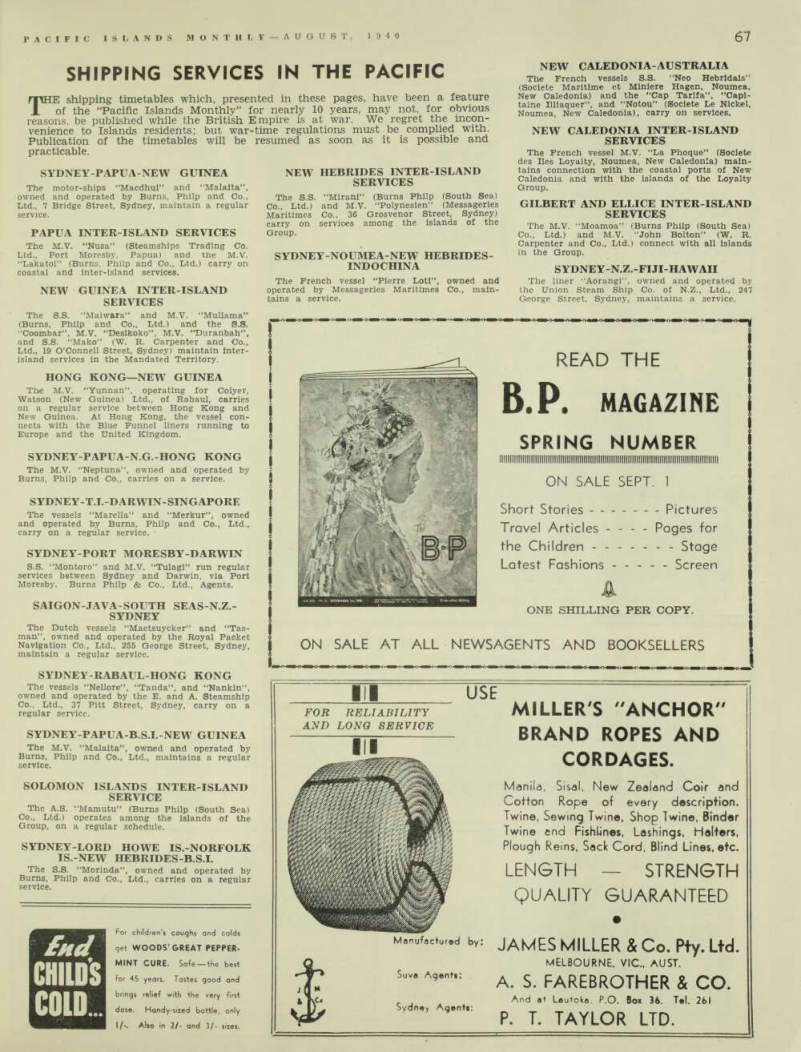
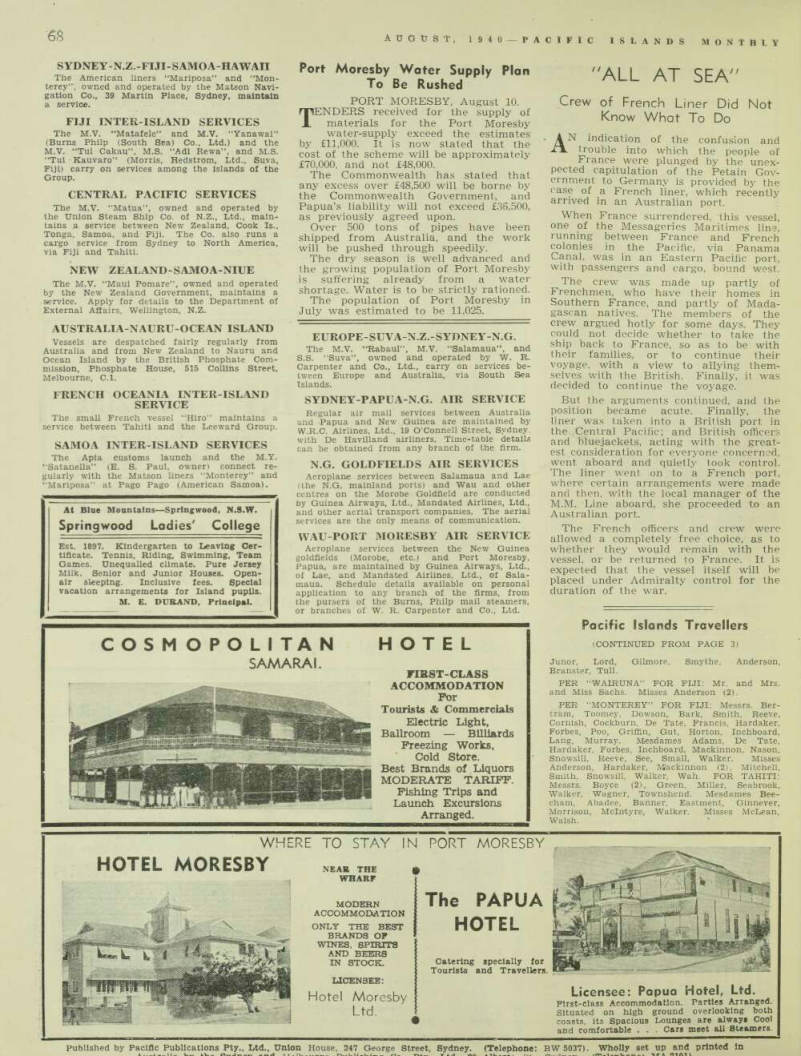
mHE shipping timetables which, presented in these pages, have been a feature 1 of the “Pacific Islands Monthly” for nearly 10 years, may not, for obvious reasons, be published while the British Empire is at war. We regret the incon venience to Islands residents; but war-time regulations must be complied with.
Publication of the timetables will be resumed as soon as it is possible and practicable.
Sydney-Papua-New Guinea
The motor-ships “Macdhui” and “Malaita”, owned and operated by Burns, Philp and Co., Ltd., 7 Bridge Street, Sydney, maintain a regular service.
Papua Inter-Island Services
The M.V. “Nusa” (Steamships Trading Co.
Ltd., Port Moresby, Papua) and the M.V.
“Lakatoi” (Burns, Philp and Co., Ltd.) carry on coastal and inter-island services.
New Guinea Inter-Island
Services
The S.S. "Maiwara” and M.V. “Mullama” (Burns, Philp and Co., Ltd.) and the S.S.
“Coombar”, M.V. “Deslkoko”, M.V. “Duranbah”, and S.S. “Mako” (W. R. Carpenter and Co., Ltd., 19 O’Connell Street, Sydney) maintain Inter island services in the Mandated Territory.
Hong Kong—New Guinea
The M.V. “Yunnan”, operating for Colyer, Watson (New Guinea) Ltd., of Rabaul, carries on a regular service between Hong Kong and New Guinea. At Hong Kong, the vessel con nects with the Blue Funnel liners running to Europe and the United Kingdom.
Sydney-Papua-N.G.-Hong Kong
The M.V. “Neptuna”, owned and operated by Burns, Philp and Co., carries on a service.
Sydney-T.1.-Darwin-Singapore
The vessels “Marella” and “Merkur”, owned and operated by Burns, Philp and Co., Ltd., carry on a regular service,
Sydney-Port Moresby-Darwin
S.S. “Montoro” and M.V. “Tulagi” run regular services between Sydney and Darwin, via Port Moresby. Burns Philp & Co., Ltd., Agents.
Saigon-Java-South Seas-N.Z.-
Sydney
The Dutch vessels “Maetsuycker” and “Tas man”, owned and operated by the Royal Packet Navigation Co., Ltd., 255 George Street, Sydney, maintain a regular service.
Sydney-Rabaul-Hong Kong
The vessels "Nellore”, “Tanda”, and “Nankin”, owned and operated by the E. and A. Steamship Co.. Ltd., 37 Pitt Street, Sydney, carry on a regular service.
Sydney-Papua-8.5.1.-New Guinea
The M.V. “Malaita”, owned and operated by Burns, Philp and Co., Ltd., maintains a regular service.
Solomon Islands Inter-Island
Service
The A.S. “Mamutu” (Burns Philp (South Sea) Co., Ltd.) operates among the islands of the Group, on a regular schedule.
Sydney-Lord Howe Is.-Norfolk
Is.-New Hebrides-8.5.1.
The S.S. “Morinda”, owned and operated by Burns, Philp and Co,, Ltd., carries on a regular service.
New Hebrides Inter-Island
Services
The S.S. “Mirani” (Burns Philp (South Sea) Co., Ltd.) and M.V. “Polynesian” (Messageries Maritimes Co., 36 Grosvenor Street, Sydney) carry on services among the Islands of the Group.
Sydney-Noumea-New Hebrides
Indochina
The French vessel “Pierre Loti”, owned and operated by Messageries Maritimes Co,, main tains a service.
New Caledonia-Australia
The French vessels S.S. “Neo Hebrldais" (Societe Maritime et Minlere Hagen, Noumea, New Caledonia) and the “Cap Tarlfa”, “Capi taine Illiaquer”, and “Notou” (Societe Le Nickel, Noumea, New Caledonia), carry on services.
New Caledonia Inter-Island
Services
The French vessel M,V. “La Phoque” (Societe des lies Loyalty, Noumea, New Caledonia) main tains connection with the coastal ports of New Caledonia and with the islands of the Loyalty Group.
Gilbert And Ellice Inter-Island
Services
The M.V. “Moamoa” (Burns Philp (South Sea) Co., Ltd.) and M.V. “John Bolton” (W. R.
Carpenter and Co., Ltd.) connect with all Islands in the Group.
Sydney-N.Z.-Fiji-Hawaii
The liner “Aorangi”, owned and operated by the Union Steam Ship Co. of N.Z., Ltd., 247 George Street, Sydney, maintains a service.
Sydney-N.Z.-Fiji-Samoa-Hawaii
The American liners “Mariposa” and “Mon terey”, owned and operated by the Matson Navi gation Co., 39 Martin Place, Sydney, maintain a service.
Fiji Inter-Island Services
The M.V. “Matafele” and M.V. “Yanawai” (Burns Philp (South Sea) Co., Ltd.) and the M.V. “Tui Cakau”, M.S. “Adi Rewa”, and M.S.
“Tul Kauvaro” (Morris, Hedstrom, Ltd., Suva, Fiji) carry on services among the islands of the Group.
Central Pacific Services
The M.V. “Matua”, owned and operated by the Union Steam Ship Co. of N.Z., Ltd., main tains a service between New Zealand, Cook Is., Tonga, Samoa, and Fiji. The Co. also runs a cargo service from Sydney to North America, via Fiji and Tahiti.
New Zealand-Samoa-Niue
The M.V. “Maui Pomare”, owned and operated by the New Zealand Government, maintains a service. Apply for details to the Department of External Affairs, Wellington, N.Z.
Australia-Nauru-Ocean Island
Vessels are despatched fairly regularly from Australia and from New Zealand to Nauru and Ocean Island by the British Phosphate Com mission, Phosphate House, 515 Collins Street, Melbourne, 0.1.
French Oceania Inter-Island
Service
The small French vessel “Hiro” maintains a service between Tahiti and the Leeward Group.
Samoa Inter-Island Services
The Apia customs launch and the M.Y.
“Satanella” (E. S. Paul, owner) connect re gularly with the Matson liners “Monterey” and “Mariposa” at Pago Pago (American Samoa).
Europe-Suva-N.Z.-Sydney-N.G.
The M.V. “Rabaul”, M.V. “Salamaua”, and S.S. “Suva”, owned and operated by W. R.
Carpenter and Co., Ltd., carry on services be tween Europe and Australia, via South Sea Islands.
Sydney-Papua-N.G. Air Service
Regular air mail services between Australia and Papua and New Guinea are maintained by W.R.C. Airlines, Ltd., 19 O’Connell Street, Sydney, with De Havilland airliners. Time-table details can be obtained from any branch of the firm.
N.G. Goldfields Air Services
Aeroplane services between Salamaua and Lae (the N.G. mainland ports) and Wau and other centres on the Morobe Goldfield are conducted by Guinea Airways, Ltd., Mandated Airlines, Ltd., and other aerial transport companies. The aerial services are the only means of communication.
Wau-Port Moresby Air Service
Aeroplane services between the New Guinea goldfields (Morobe, etc.) and Port Moresby, Papua, are maintained by Guinea Airways, Ltd., of Lae, and Mandated Airlines, Ltd., of Sala maua. Schedule details available on personal application to any branch of the firms, from the pursers of the Burns, Philp mail steamers, or branches of W. R. Carpenter and Co., Ltd.
Advertisements & other items, pp. 69-70 (1 item)
B.P. Magazine
a :T D D
READ THE
SPRING NUMBER
iiiiiiiiiiiiiiiiiiiiiiiiiiiiiiiiiiiiiiiiiiiiiiiitiiiiiiiiiiiiiniiiiiiiiiitiiiiiiiiiiiiiiin
ON SALE SEPT. 1
Short Stories Pictures Travel Articles - - - - Pages for the Children Stage Latest Fashions Screen A
ONE SHILLING PER COPY.
ON SALE AT ALL NEWSAGENTS AND BOOKSELLERS
11l
USE
FOR
AND
RELIABILITY
LONG SERVICE
MILLER S "ANCHOR"
BRAND ROPES AND
CORDAGES.
Manila, Sisal. New Zealand Coir and Cotton Rope of every description.
Twine, Sewing Twine, Shop Twine. Binder Twine end Fish Lines. Lashings, Halters, Plough Reins. Sack Cord, Blind Lines, etc.
LENGTH STRENGTH
QUALITY GUARANTEED
Manuf.ctur.d b y : j A MES MILLER & Co. Pty. Ltd
MELBOURNE. VIC., AUST.
Suva Agents: $ FAREBROTHER & QQ - , . And at Lautolca. P.O. Bo* 36. Tel. 261 Sydney Agents;
P. T. TAYLOR LTD.
For children’s coughs and colds
get WOODS’GREAT PEPPER-
MINT CURE. Safe—the best for 45 years. Tastes good and brings relief with the very first dose. Handy-sued bottle, only I/-, Also in 2/- and 3/- sizes.
At Bine Mountains —Sprlngwood, N.S.W.
Springwood Ladies 7 College
Est. 1897. Kindergarten to Leaving Certificate. Tennis, Riding, Swimming, Team Games. Unequalled climate. Pure Jersey Milk. Senior and Junior Houses. Openair sleeping. Inclusive tees. Special vacation arrangements for Island pupils.
M. E. DURAND, Principal.
COSMOPOLITAN
SAMARA I.
HOTEL
FIRST-CLASS
ACCOMMODATION
For Tourists & Commercials Electric Light, Ballroom Billiards Freezing Works, Cold Store.
Best Brands of Liquors
MODERATE TARIFF.
Fishing Trips and Launch Excursions Arranged.
WHERE TO STAY IN PORT MORESBY
HOTEL MORESBY
NEAR THE
WHARF
MODERN
ACCOMMODATION
ONLY THE BEST
BRANDS OP
WINES. SPIRITS
AND BEERS
IN STOCK.
LICENSEE:
The PAPUA
HOTEL
Catering specially lor Tourists and Travellers.
Hotel
Moresby
Ltd.
Licensee: Papua Hotel, Ltd.
First-class Accommodation. Parties Arranged.
Situated on high ground overlooking both coasts, its Spacious Lounges are always Cool and comfortable . . . Cars meet all Steamers.
Port Moresby Water Supply Plan
To Be Rushed
Port Moresby, August 10.
TENDERS received for the supply of materials for the Port Moresby water-supply exceed the estimates by £ll,OOO. It is now stated that the cost of the scheme will be approximately £70,000, and not £48,000.
The Commonwealth has stated that any excess over £48,500 will be borne by the Commonwealth Government, and Papua’s liability will not exceed £36,500, as previously agreed upon.
Over 500 tons of pipes have been shipped from Australia, and the work will be pushed through speedily.
The dry season is well advanced and the growing population of Port Moresby is suffering already from a water shortage. Water is to be strictly rationed.
The population of Port Moresby in July was estimated to be 11,025.
"All At Sea"
Crew of French Liner Did Not Know What To Do
AN indication of the confusion and trouble into which the people of France were plunged by the unex pected capitulation of the Petain Gov ernment to Germany is provided by the case of a French liner, which recently arrived in an Australian port.
When France surrendered, this vessel, one of the Messageries Maritimes line, running between France and French colonies in the Pacific, via Panama Canal, was in an Eastern Pacific port, with passengers and cargo, bound west.
The crew was made up partly of Frenchmen, who have their homes in Southern France, and partly of Mada gascan natives. The members of the crew argued hotly for some days. They could not decide whether to take the ship back to France, so as to be with their families, or to continue their voyage, with a view to allying them selves with the British. Finally, it was decided to continue the voyage.
But the arguments continued, and the position became acute. Finally, the liner was taken into a British port in the Central Pacific; and British officers and bluejackets, acting with the great est consideration for everyone concerned, went aboard and quietly took control.
The liner went on to a French port, where certain arrangements were made and then, with the local manager of the M.M. Line aboard, she proceeded to an Australian port.
The French officers and crew were allowed a completely free choice, as to whether they would remain with the vessel, or be returned to France. It is expected that the vessel itself will be placed under Admiralty control for the duration of the war.
Advertisements & other items, pp. 70-72 (2 items)
Pacific Islands Travellers
68
(CONTINUED FROM PAGE 3)
AUGUST. 1940 PACIFIC ISLANDS MONTHLY
Published by Pacific Publications Pty., Ltd., Union House. 247 George Street, Sydney. (Telephone: BW 5037). Wholly set up and printed In
Investigate this special
Guinea Airways Service awaits your arrival at Port Moresby to speed your passage by air to any one of over 50 aerodromes and landing grounds served by the Company throughout New Guinea and Papua.
Guinea Airways 7 fast modern planes cut days of travelling time to a tew hours of flight. As an example, the time of travel by plane to the Goldfields from Port Moresby is only 1 hour 40 minutes as compared with 6to 7 days by surface routes. See more of New Guinea from a better angle and save time and money . . . Travel by Air.
The GUINEA AIRWAY is I/* ONLY WAY to defeat Time and Distance Guinea Airways’ fleet offers the choice of a large variety of passenger and freight planes for special charter service to any point in New Guinea and Papua ...
Investigate this special
CHARTER SERVICE
ft M When sailing from Australia book steamer and air passage at the Steamship Office or obtain full particulars from the purser. i a i THE WORLDS LARGEST FREIGHT CARRYING AIR SERVICE
LAE-SALAMAU A:
New Guinea Office: LAE, Mandated Territory of New Guinea Branch Offices and Agents at WAU-SALAMAUA-
PORT MORESBY and SYDNEY.
The more
SATISFACTION
\oull find tn K.BJ
& AC / V r* < 5 O v\^ x v-\^ CO 0 s kt
Ife
the sun beats down with throatparching fierceness—when the air shimmers with the tropical heat—that's when you'll really appreciate the cooling, enjoyable qualities of K. 8.; for the hotter the weather, the more real refreshment there is in a cool, satisfying glass of TOOTH'S K.B. LAGER.