Pacific
Islands
Monthly
Vol. IX. No. 12.
July 15. 1939
[Registered at ttye G.P.0., Sydney, for transmission by post as a newspaper .]
8"
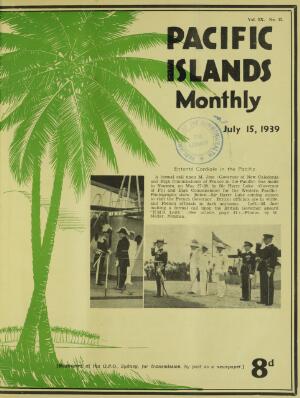
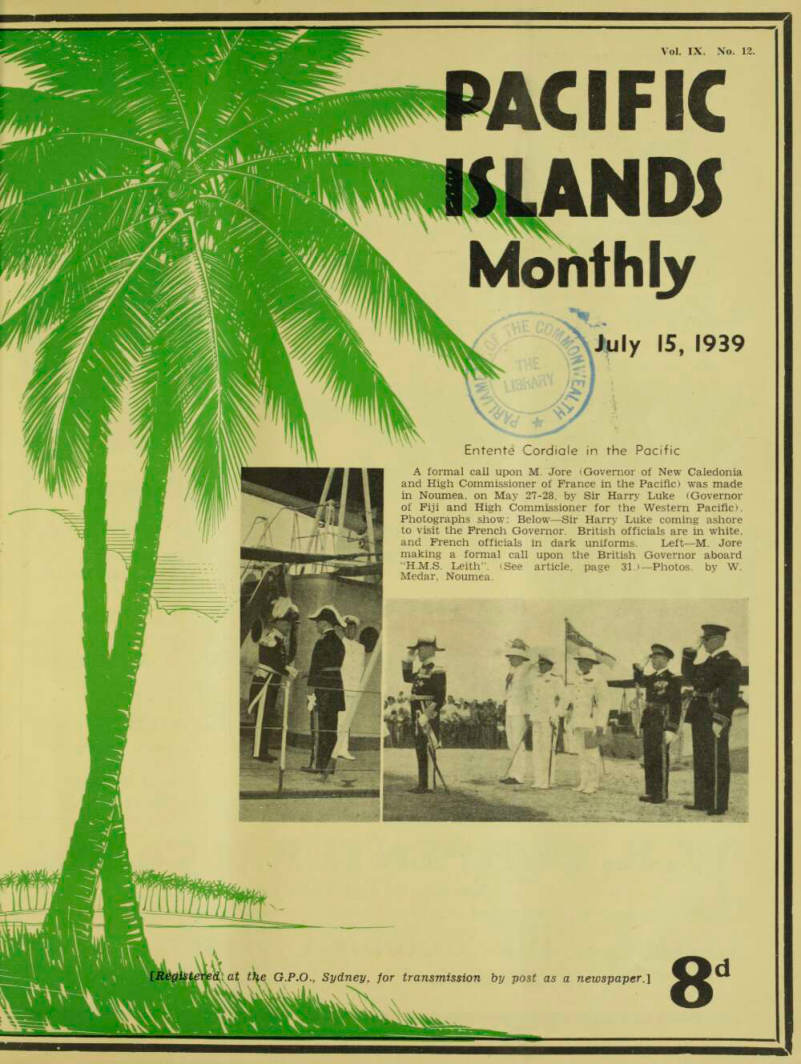
Entente Cordiale in the Pacific
A formal call upon M. Jore (Governor of New Caledonia and High Commissioner of France in the Pacific) was made in Noumea, on May 27-28, by Sir Harry Luke (Governor of Fiji and High Commissioner for the Western Pacific).
Photographs show: Below —Sir Harry Luke coming ashore to visit the French Governor. British officials are in white, and French officials in dark uniforms. Left—M. Jore making a formal call upon the British Governor aboard “H.M.S. Leith”. (See article, page 31.) —Photos, by W.
Medar, Noumea.
Advertisements & other items, p. 2 (2 items)
Pacific Islands Monthl y—J uly 15, 1939
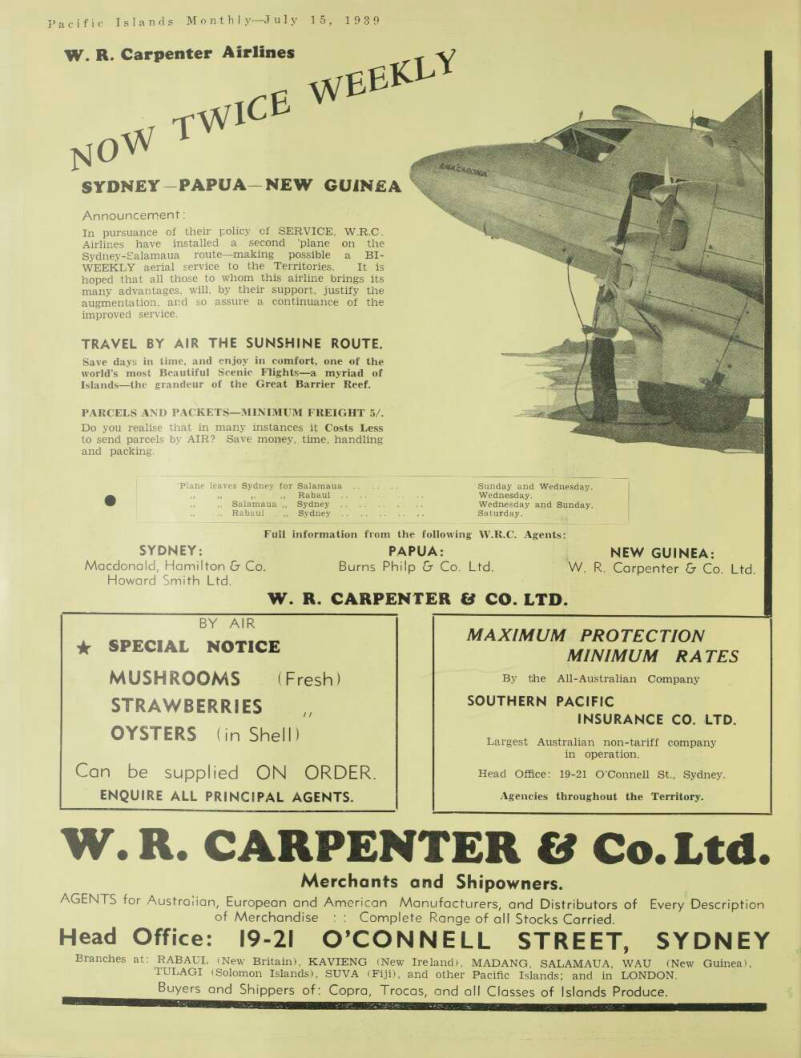
W. R. Carpenter & Co. Ltd.
w. R. Carpenter Airlines
SYDNEY -PAPUA— NEW GUINEA
Announcement; In pursuance of their policy of SERVICE, W.R.C.
Airlines have installed a second ’plane on the Sydney-Salamaua route—making possible a BI- WEEKLY aerial service to the Territories. It is hoped that all those to whom this airline brings its many advantages, will, by their support, justify the augmentation, and so assure a continuance of the improved service.
TRAVEL BY AIR THE SUNSHINE ROUTE.
Save days in time, and enjoy in comfort, one of the world’s most Beautiful Scenic Flights—a myriad of Islands —the grandeur of the Great Barrier Reef.
PARCELS AND PACKETS—MINIMUM FREIGHT 5/.
Do you realise that in many instances it Costs Less to send parcels by AIR? Save money, time, handling and packing.
Plane leaves Sydney for Salamaua Sunday and Wednesday.
Rabaul Wednesday.
Salamaua Sydney Wednesday and Sunday.
Rabaul Sydney Saturday.
Full information from the following W.R.C. Agents:
SYDNEY: PAPUA: NEW GUINEA:
Macdonald, Hamilton & Co. Burns Philp & Co. Ltd. W. R. Carpenter & Co. Ltd.
Howard Smith Ltd.
W. R. CARPENTER & CO. LTD.
BY AIR
* SPECIAL NOTICE
MUSHROOMS (Fresh)
STRAWBERRIES
OYSTERS (in Shell) Can be supplied ON ORDER,
ENQUIRE ALL PRINCIPAL AGENTS.
MAXIMUM PROTECTION
MINIMUM RATES
By the All-Australian Company
SOUTHERN PACIFfC
INSURANCE CO. LTD.
Largest Australian non-tariff company in operation.
Head Office: 19-21 O’Connell St., Sydney.
Agencies throughout the Territory.
W. R. CARPENTER & Co. Ltd.
Merchants and Shipowners.
AGENTS for Australian, European and American Manufacturers, and Distributors of Every Description of Merchandise : : Complete Range of all Stocks Carried.
Head Office: 19-21 O’CONNELL STREET, SYDNEY
Branches at: RABAUL (New Britain). KAVIENG (New Ireland). MADANG, SALAMAUA, WAU (New Guinea), TULAGI (Solomon Islands), SUVA (Fiji), and other Pacific Islands; and in LONDON.
Buyers and Shippers of: Copra, Trocas, and all Classes of Islands Produce.
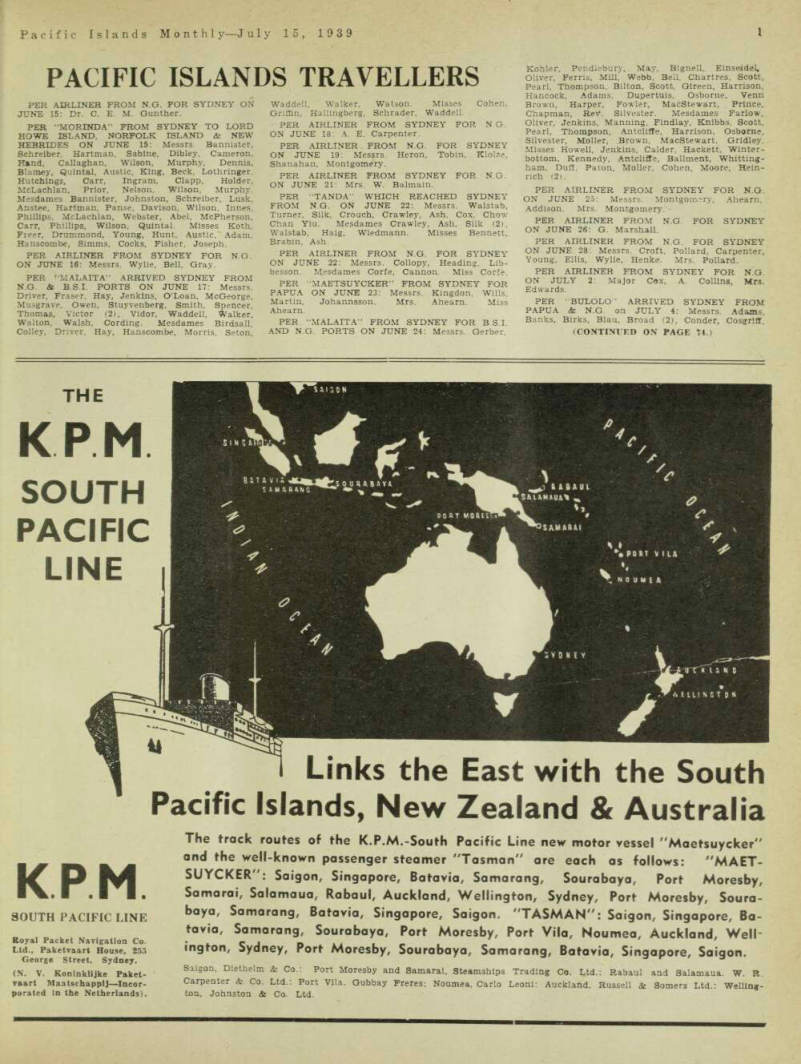
Pacific Islands Travellers
PER AIRLINER FROM N.G. FOR SYDNEY ON JUNE 15: Dr. C. E. M. Gunther.
Per “Morinda” Prom Sydney To Lord
Howe Island. Norfolk Island & New
HEBRIDES ON JUNE 15: Messrs. Bannister, Schreiber. Hartman, Sabine, Dibley. Cameron, Hand, Callaghan. Wilson, Murphy. Dennis, Blarney, Quintal, Austic, King, Beck, Lothringer.
Hutchings, Carr, Ingram, Clapp, Holder.
McLachlan, Prior, Nelson, Wilson, Murphy.
Mesdames Bannister, Johnston, Schreiber, Lusk.
Anstee, Hartman, Panse. Davison, Wilson, Innes, Phillips. McLachlan, Webster, Abel. McPherson, Carr, Phillips, Wilson, Quintal. Misses Koth, Freer, Drummond, Young, Hunt, Austic. Adam.
Hanscomhe, Simms, Cocks, Fisher, Joseph.
Per Airliner From Sydney For N.G.
ON JUNE 16: Messrs. Wylie, Bell, Gray.
Per "Malaita” Arrived Sydney From
N.G. & 8.5.1. PORTS ON JUNE 17: Messrs.
Driver, Fraser, Hay, Jenkins, O’Loan, McGeorge, Musgrave, Owen, Stuyvenberg, Smith, Spencer, Thomas, Victor (2). Vidor, Waddell. Walker, Walton, Walsh, Cording. Mesdames Birdsall.
Colley, Driver, Hay, Hanscombe, Morris. Seton,
Waddell. Walker. Watson. Misses Cohen.
Griffin. Hallingberg, Schrader, Waddell.
Per Airliner From Sydney For N.G.
ON JUNE 18; A. E. Carpenter.
Per Airliner From N.G. For Sydney
ON JUNE 19; Messrs. Heron, Tobin, Klolze, Shanahan. Montgomery.
Per Airliner From Sydney For N.G.
ON JUNE 21: Mrs. W. Balmain.
Per “Tanda” Which Reached Sydney
FROM N.G. ON JUNE 22: Messrs. Walstab, Turner. Silk, Crouch, Crawley, Ash, Cox. Chow Chan Yiu. Mesdames Crawley, Ash, Silk (2), Walstab, Haig, Wiedmann. Misses Bennett, Brabin, Ash.
Per Airliner From N.G. For Sydney
ON JUNE 22: Messrs. Collopy, Heading. Lib besson. Mesdames Corfe, Cannon. Miss Corfe.
Per •Maetsuycker” From Sydney For
PAPUA ON JUNE 23: Messrs. Kingdon. Wills.
Martin, Johannsson. Mrs. Ahearn. Miss Ahearn.
Per “Malaita” From Sydney For 8.5.1.
AND N.G. PORTS ON JUNE 24: Messrs. Gerber,
Kohler, Pendlebury, May, Bignell, Einseidel, Oliver, Ferris. Mill, Webb, Bell. Chartres, Scott, Pearl, Thompson, Bilton, Scott, Gireen, Harrison, Hancock, Adams. Dupertuis, Osborne, Venn Brown, Harper, Fowler, Mac Stewart, Prince, Chapman, ReV. Silvester. Mesdames Farlow, Oliver, Jenkins, Manning, Findlay, Knibbs, Scott, Pearl, Thompson, Antclifle, Harrison, Osborne.
Silvester, Moller, Brown, Mac Stewart, Gridley.
Misses Howell, Jenkins, Calder, Hackett, Winter bottom, Kennedy, Antclifle, Bailment, Whitting ham, Duff, Paton, Moller, Cohen, Moore, Hein rich (2».
Per Airliner From Sydney For N.G.
ON JUNE 25: Messrs. Montgomery, Ahearn, Addison. Mrs. Montgomery.
Per Airliner From N.G. For Sydney
ON JUNE 26: G. Marshall.
Per Airliner From N.G. For Sydney
ON JUNE 28; Messrs. Croft. Pollard, Carpenter, Young. Ellis, Wylie, Henke. Mrs. Pollard.
Per Airliner From Sydney For N.G.
ON JULY 2: Major Cox. A. Collins, Mrs.
Edwards.
Per Bulolo' Arrived Sydney From
PAPUA & N.G on JULY 4: Messrs. Adams, Banks, Birks, Blau. Broad (2), Conder, Cosgriff.
(Continued On Page 74.)
Dix, Daymond, Drew, Pancourt, Flecknoe, Fryer, Gemmell, Glass, Hendrick, Heath, Holt, Hughan, Jenks, Johnson, Luke, de Martini, McCarthy, Mitchell, O’Connell, O’Hara, Parker, Pizzey, Pur cell, Robinson, Shaw, Sims, Smith (2), Swanson, Scott, Searle, Tuckett, Turner, Wooden, West wood, Williams, Rev. Thompson. Mesdames Benwell, Broad, Chaffer, Cosgriff, Dobbin, Edwards, Flecknoe, Glass, Heath, Holt, Jeune, McClure, O’Connell O’Hara, Percy, Pizzey, Roberts, Robinson, Shaw, Sherringham, Smith, Swanson, Searle, Thompson, Wright. Misses Boag, Chaffer, Cooper, Eastwood, Oreene, Good year, Hayman, Holmes, McGuigan, Mac Donnell, Osborne, Pilcher, Sims, Sullivan, Stibbard, Verco, Wines.
Per “Morinda” Arrived Sydney From
Lord Howe Island, Norfolk Island, &
NEW HEBRIDES ON JULY 7: Messrs. Hogan, Cameron, Carr, Callaghan, Horne, Michaelis, Murrell, Yeaman, Blackwood, Blarney, Cameron, Catomore, Clancy, Collins, Crane, Dibley, Harris, Hutchings, Hutchinson, Lothringer, Macdonald, Peck, Douglass, Rev. O’Sullivan. Mesdames Carr, Michaelis, Raff, Tucker, Wheatley, Bruce, Collins, Harris, Larkin, Macdonald. Tyrell.
Misses Buffett (2), Brett, Hanscombe, Hogan, Hunt, Adam, Fisher, Freer, Gellatley, Harris, Joseph, Koth, Wilkinson.
Per Airliner From N.G. For Sydnev
ON JULY 5: Major Cox, Mr. Dennis. Mrs.
Proud.
Per “Monowai” From Sydney For Fiji
ON JULY 6: Messrs. Campbell, Johnson, Lindsell, Plummer, Walshie, Nicholls, Woodward, Witts, Whysall, Goran, Pillay. Mesdames Campbell, Derrick, Lindsell, Mumford, Plummer, Walshie, Nicholls, Milne, Woodward, Stephens, Pillay.
Misses Derrick (2), Harris, Williams, Milne, Hansen.
Advertisements & other items, p. 3 (2 items)
1
Pacific Islands Monthl y—J uly 15, 1939
Pacific
THE
KPM
SOUTH
PACIFIC
LINE
SOURABAYA
&BA U L
SAIAMMIAV
i
'*l PO AT VILA
V NOUMEA
A ft I 111 N C T ON ✓ !S5 il
Links the East with the South
Pacific Islands, New Zealand & Australia
KPM
SOUTH PACIFIC LINE
Royal Packet Navigation Co.
Ltd., Paketvaart House, 255 George Street, Sydney. (N. V. Koninklijke Paketvaart MaatschapplJ—lncorporated in the Netherlands).
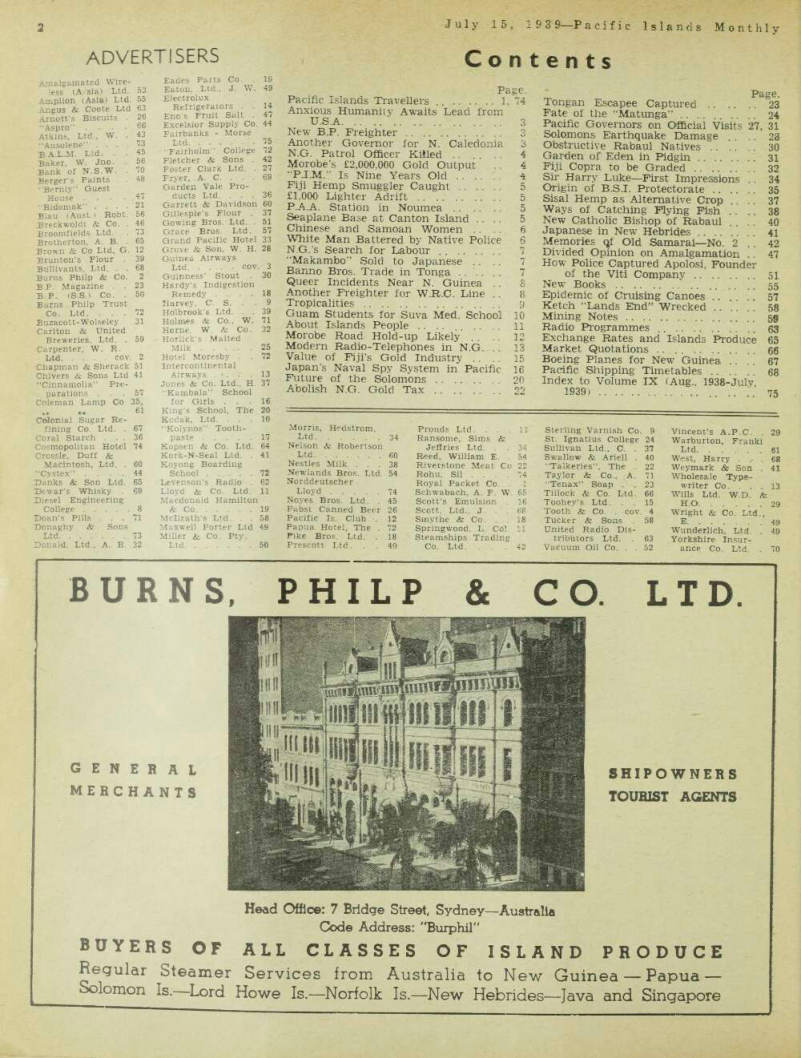
The track routes of the K.P.M.-South Pacific Line new motor vessel "Maetsuycker" and the well-known passenger steamer "Tasman" are each as follows: "MAET- SUYCKER": Saigon, Singapore, Batavia, Samarang, Sourabaya, Port Moresby, Samarai, Salamaua, Rabaul, Auckland, Wellington, Sydney, Port Moresby, Sourabaya, Samarang, Batavia, Singapore, Saigon. "TASMAN": Saigon, Singapore, Batavia, Samarang, Sourabaya, Port Moresby, Port Vila, Noumea, Auckland, Wellington, Sydney, Port Moresby, Sourabaya, Samarang, Batavia, Singapore, Saigon.
Saigon, Diethelm & Co.; Port Moresby and Samarai, Steamships Trading Co. Ltd.: Rabaul and Salamaua. W. R Carpenter & Co. Ltd.: Port Vila. Gubbay Preres; Noumea, Carlo Leoni: Auckland. Russell & Somers Ltd.: Wellington, Johnston Co. Ltd.
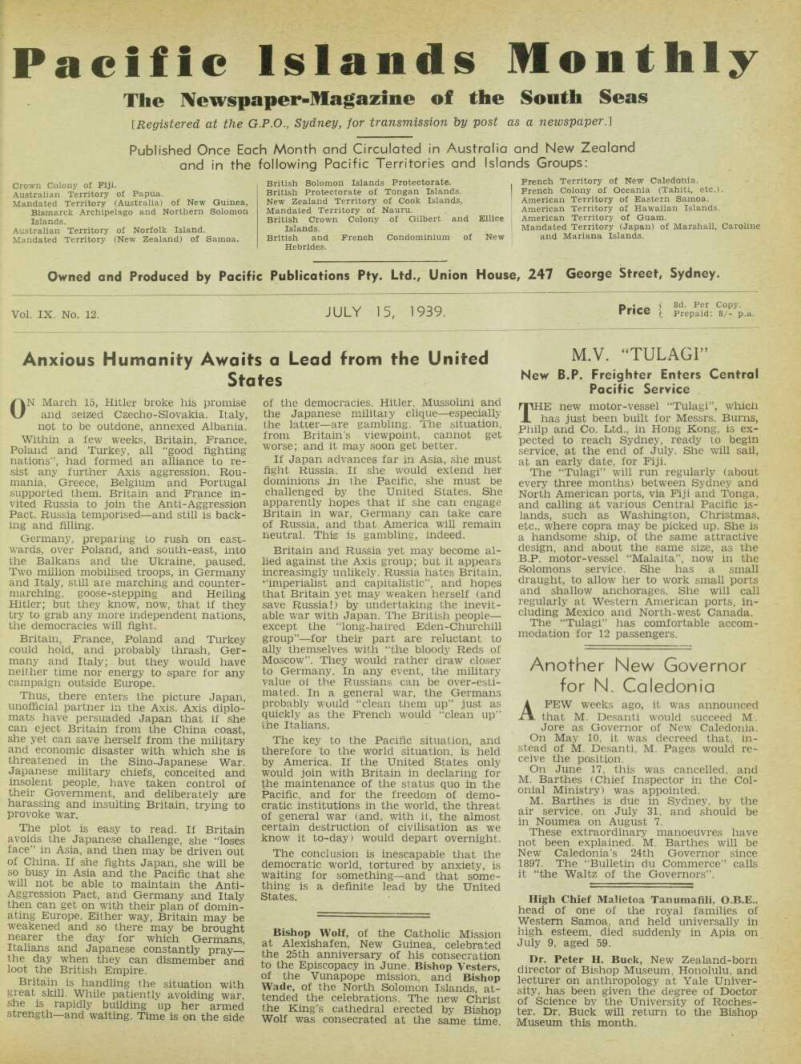
Advertisers
Amalgamated Wire less (A/sia) Ltd. 53 Amplion (Asia) Ltd. 55 Angus & Coote Ltd 63 Arnott’s Biscuits . 26 Aspro” ... 66 Atkins, Ltd., W. . 43 “Ausolene” ... 73
B.A.L.M. Ltd. ■ • 45
Baker, W. Jno. . 56 Bank of N.S.W. . 70 Berger’s Paints . 48 Bernly” Guest House ... 47 Bidomak” ... 21 Blau (Aust.) Robt. 56 Breckwoldt & Co. . 46 Broomfields Ltd. . 73 Brotherton, A. B. . 65 Brown & Co Ltd, G. 12 Brunton’s Flour . 39 Bullivants, Ltd. . . 68 Burns Philp & Co. 2 B.P. Magazine . . 23
B.P. Is.S.) Co. . 50
Burns Philp Trust Co. Ltd. . . .72 Buzacott-Wolseley 31 Carlton & United Breweries, Ltd. . 59 Carpenter, W. R.
L,td cov. 2 Chapman & Sherack 51 Chi vers & Sons Ltd 41 “Cinnamolia” Pre parations ... 57 Coleman Lamp Co 35, 61 Colonial Sugar Re fining Co. Ltd. . 67 Coral Starch ... 36 Cosmopolitan Hotel 74 Crossle, Duff & Macintosh, Ltd. . 60 “Cystex” ... 44 Danks & Son Ltd. 65 Dewar’s Whisky 69 Diesel Engineering College 8 Doan’s Pills ... 71 Donaghy & Sons Ltd 73 Donald, Ltd., A. B. 32
Fades Parts Co. . 19 Eaton, Ltd., J. W. 49 Electrolux Refrigerators . . 14 Eno's Fruit Salt . 47 Excelsior Supply Co. 44 Fairbanks - Morse Ltd 75 • Fairholm" College 72 Fletcher & Sons 42 Foster Clark Ltd. . 27 Fryer, A. C. ... 69 Garden Vale Pro ducts Ltd. ... 36 Garrett & Davidson 60 Gillespie’s Flour . 37 Gowing Bros. Ltd. . 51 Grace Bros. Ltd. 57 Grand Pacific Hotel 33 Grove & Son, W. H. 28 Guinea Airways Ltd. ... cov. 3 Guinness’ Stout . 30 Hardy’s Indigestion Remedy . . .. 18 Harvey, C. S. . - 9 Holbrook’s Ltd. . . 39 Holmes & Co., W. 71 Horne. W. & Co. 32 Horlick’s Malted Milk 25 Hotel Moresby . . 72 Intercontinental Airways . 7 . . . 13 Jones & Co. Ltd.. H. 37 "Kambala” School for Girls ... 16 King’s School, The 20 Kodak, Ltd. ... 10 "Kolynos” Tooth paste 17 Kopsen & Co. Ltd. 64 Kork-N-Seal Ltd. . 41 Koyong Boarding School 72 Levenson’s Radio . 62 Lloyd & Co. Ltd. 11 Macdonald Hamilton & Co 19 Mcllrath’s Ltd. . . 58 Maxwell Porter Ltd 49 Miller & Co. Pty.
Ltd 50
Morris, Hedstrom, Ltd 34 Nelson & Robertson Ltd 60 Nestles Milk ... 38 Newlands Bros. Ltd. 54 Norddeutscher Lloyd 74 Noyes Bros. Ltd. . 45 Pabst Canned Beer 26 Pacific Is. Club 12 Papua Hotel, The . 72 Pike Bros. Ltd. . 18 Prescott Ltd. . . 40
Prouds Ltd. . . .11 Ransome, Sims & Jeffries Ltd. . . 34 Reed, William E. 54 Riverstone Meat Co 22 Rohu, Sil . . . . 74 Royal Packet Co. . 1 Schwabach, A. F. W. 65 Scott’s Emulsion . 16 Scott. Ltd.. J. . . 68 Smythe & Co. . . 18 Springwood. L Col. 11 Steamships Trading Co. Ltd. ... 42
Sterling Varnish Co. 9 St. Ignatius College 24 Sullivan Ltd., C. . 37 Swallow & Ariell . 40 "Talkeries”, The . 22 Taylor & Co., A. 71 “Tenax” Soap . . 23 Tillock & Co. Ltd. 66 Toohey’s Ltd. . . 15 Tooth & Co. . cov. 4 Tucker & Sons 58 United Radio Dis tributors Ltd. . 63 Vacuum Oil Co. . . 52
Vincent’s A.P.C. . 29 Warburton, Frank!
Ltd 61 West, Harry ... 68 Weymark & Son . 41 Wholesale Type writer Co. . . .13 Wills Ltd. W.D. & H.O 29 Wright & Co. Ltd., E 49 Wunderlich, Ltd. . 49 Yorkshire Insur ance Co. Ltd. . 70
Contents
Page.
Pacific Islands Travellers 1. 74 Anxious Humanity Awaits Lead from
U.S.A 3
New B.P. Freighter 3 Another Governor for N. Caledonia 3 N.G. Patrol Officer Kitted ... 4 Morobes £2,000.000 Gold Output . 4 “P.1.M." Is Nine Years Old 4 Fiji Hemp Smuggler Caught 5 £l.OOO Lighter Adrift 5 PA.A. Station in Noumea 5 Seaplane Base at Canton Island ... 5 Chinese and Samoan Women .. .. 6 White Man Battered by Native Police 6 N.G.s Search for Labour 7 “Makambo" Sold to Japanese ... 7 Banno Bros. Trade in Tonga 7 Queer Incidents Near N. Guinea .. 8 Another Freighter for W.R.C. Line .. 8 Tropicalities 9 Guam Students for Suva Med. School 10 About Islands People .. . . 11 Morobe Road Hold-up Likely . . . 12 Modern Radio-Telephones in N.G. .. 13 Value of Fiji’s Gold Industry . . .. 15 Japan’s Naval Spy System in Pacific 16 Future of the Solomons 20 Abolish N.G. Gold Tax 22
Page.
Tongan Escapee Captured 23 Fate of the “Matunga” 24 Pacific Governors on Official Visits 27, 31 Solomons Earthquake Damage . . .. 23 Obstructive Rabaul Natives 30 Garden of Eden in Pidgin 31 Fiji Copra to be Graded 32 Sir Harry Luke —First Impressions .. 34 Origin of 8.5.1. Protectorate 35 Sisal Hemp as Alternative Crop ... 37 Ways of Catching Plying Fish .. .. 38 New Catholic Bishop of Rabaul ... 40 Japanese in New Hebrides 41 Memories qf Old Samarai—No. 2 .. 42 Divided Opinion on Amalgamation .. 47 How Police Captured Apolosi. Founder of the Viti Company 51 New Books 55 Epidemic of Cruising Canoes 57 Ketch “Lands End” Wrecked 58 Mining Notes 59 Radio Programmes * 63 Exchange Rates and Islands Produce 65 Market Quotations 66 Boeing Planes for New Guinea ... 67 Pacific Shipping Timetables 68 Index to Volume IX (Aug., 1938-Julv. 1939) .. .. 75
Advertisements & other items, p. 4 (2 items)
2
July 15, 193 9—P acific Islands Monthly
Burns, Philp & Co. Ltd.
general merchants II
II Ij
mill
& S S
SHIPOWNERS
TOURIST AGENTS
Head Office: 7 Bridge Street, Sydney—Australia Code Address: "Burphil" buyers of all classes of island produce Regular Steamer Services from Australia to New Guinea Papua Solomon Is. Lord Howe Is.—Norfolk Is.—New Hebrides—Java and Singapore
Pacific Islands Monthly
The Newspaper-Magazine of the South Seas
IRegistered at the G.P.0., Sydney, for transmission Toy post as a newspaper .] Published Once Each Month and Circulated in Australia and New Zealand and in the following Pacific Territories and Islands Groups:
Crown Colony of Fiji.
Australian Territory of Papua.
Mandated Territory (Australia) of New Guinea, Bismarck Archipelago and Northern Solomon Islands.
Australian Territory of Norfolk Island.
Mandated Territory (New Zealand) of Samoa.
British Solomon Islands Protectorate.
British Protectorate of Tongan Islands.
New Zealand Territory of Cook Islands, Mandated Territory of Nauru.
British Crown Colony of Gilbert and Ellice Islands.
British and French Condominium of New Hebrides.
French Territory of New Caledonia.
French Colony of Oceania (Tahiti, etc.).
American Territory of Eastern Samoa.
American Territory of Hawaiian Islands.
American Territory of Guam.
Mandated Territory (Japan) of Marshall, Caroline and Mariana Islands.
Owned and Produced by Pacific Publications Pty. Ltd., Union House, 247 George Street, Sydney.
Vol. IX. No. 12.
July 15, 1939.
PricP Bd ' Per Copy ’ mce Prepaid: 8/- p.a.
Anxious Humanity Awaits a Lead from the United
States
ON March 15, Hitler broke his promise and seized Czecho-Slovakia. Italy, not to be outdone, annexed Albania.
Within a few weeks, Britain, France, Poland and Turkey, all “good fighting nations”, had formed an alliance to re sist any further Axis aggression. Rou mania, Greece, Belgium and Portugal supported them. Britain and France in vited Russia to join the Anti-Aggression Pact. Russia temporised—and still is back ing and filling.
Germany, preparing to rush on east wards, over Poland, and south-east, into the Balkans and the Ukraine, paused.
Two million mobilised troops, in Germany and Italy, still are marching and counter marching, goose-stepping and Heiling Hitler; but they know, now, that if they try to grab any more independent nations, the democracies will fight.
Britain, France, Poland and Turkey could hold, and probably thrash, Ger many and Italy; but they would have neither time nor energy to spare for any campaign outside Europe.
Thus, there enters the picture Japan, unofficial partner in the Axis. Axis dinlo mats have persuaded Japan that if ‘she can eject Britain from the China coast, she yet can save herself from the military and economic disaster with which she is threatened in the Sino-Japanese War.
Japanese military chiefs, conceited and insolent people, have taken control of their Government, and deliberately are harassing and insulting Britain, trying to provoke war.
The plot is easy to read. If Britain avoids the Japanese challenge, she “loses face” in Asia, and then may be driven out of China. If she fights Japan, she will be so busy in Asia and the Pacific that she will not be able to maintain the Anti- Aggression Pact, and Germany and Italy then can get on with their plan of domin ating Europe. Either way, Britain may be weakened and so there may be brought nearer the day for which Germans, Italians and Japanese constantly pray— the day when they can dismember and loot the British Empire.
Britain is handling the situation with great skill. While patiently avoiding war, she is rapidly building up her armed strength—and waiting. Time is on the side
of the democracies. Hitler. Mussolini and the Japanese military clique—especially the latter —are gambling. The situation, from Britain’s viewpoint, cannot get worse; and it may soon get better.
If Japan advances far in Asia, she must fight Russia. If she would extend her dominions jn the Pacific, she must be challenged by the United States. She apparently hopes that if she can engage Britain in war, Germany can take care of Russia, and that America will remain neutral. This is gambling, indeed.
Britain and Russia yet may become al lied against the Axis group; but it appears increasingly unlikely. Russia hates Britain, “imperialist and capitalistic”, and hopes that Britain yet may weaken herself (and save Russia!) by undertaking the inevit able war with Japan. The British people— except the “long-haired Eden-Churchill group”—for their part are reluctant to ally themselves with “the bloody Reds of Moscow”. They would rather draw closer to Germany. In any event, the military value of the Russians can be over-esti mated. In a general war, the Germans probably would “clean them up” just as quickly as the French would “clean up” the Italians.
The key to the Pacific situation, and therefore to the world situation, is held by America. If the United States only would join with Britain in declaring for the maintenance of the status quo in the Pacific, and for the freedom of demo cratic institutions in the world, the threat of general war (and, with it, the almost certain destruction of civilisation as we know it to-day) would depart overnight.
The conclusion is inescapable that the democratic world, tortured by anxiety, is waiting for something—and that some thing is a definite lead by the United States.
Bishop Wolf, of the Catholic Mission at Alexishafen, New Guinea, celebrated the 25th anniversary of his consecration to the Episcopacy in June. Bishop Vesters, of the Vunapope mission, and Bishop Wade, of the North Solomon Islands, at tended the celebrations. The new Christ the King's cathedral erected by Bishop Wolf was consecrated at the same time.
M.V. “Tulagi”
New B.P. Freighter Enters Central Pacific Service
THE new motor-vessel “Tulagi”, which has just been built for Messrs. Burns, Philp and Co. Ltd., in Hong Kong, is ex pected to reach Sydney, ready to begin service, at the end of July. She will sail, at an early date, for Fiji.
The “Tulagi” will run regularly (about every three months) between Sydney and North American ports, via Fiji and Tonga, and calling at various Central Pacific is lands, such as Washington, Christmas, etc., where copra may be picked up. She is a handsome ship, of the same attractive design, and about the same size, as the B.P. motor-vessel “Malaita”, now in the Solomons service. She has a small draught, to allow her to work small ports and shallow anchorages. She will call regularly at Western American ports, in cluding Mexico and North-west Canada.
The “Tulagi” has comfortable accom modation for 12 passengers.
Another New Governor
for N. Caledonia
A FEW weeks ago, it was announced that M. Desanti would succeed M.
Jore as Governor of New Caledonia.
On May 10, it was decreed that, in stead of M. Desanti. M. Pages would re ceive the position.
On June 17, this was cancelled, and M. Barthes (Chief Inspector in the Col onial Ministry) was appointed.
M. Barthes is due in Sydney, by the air service, on July 31, and should be in Noumea on August 7.
These extraordinary manoeuvres have not been explained. M. Barthes will be New Caledonia’s 24th Governor since 1897. The ‘'Bulletin du Commerce” calls it “the Waltz of the Governors”.
High Chief Malietoa Tanumafili, 0.8. E., head of one of the royal families of Western Samoa, and held universally in high esteem, died suddenly in Apia on July 9, aged 59.
Dr. Peter H. Buck, New Zealand-born director of Bishop Museum, Honolulu, and lecturer on anthropology at Yale Univer sity, has been given the degree of Doctor of Science by the University of Roches ter. Dr. Buck will return to the Bishop Museum this month.
Killed By
Natives
Another Patrol Officer Lost in N. Guinea
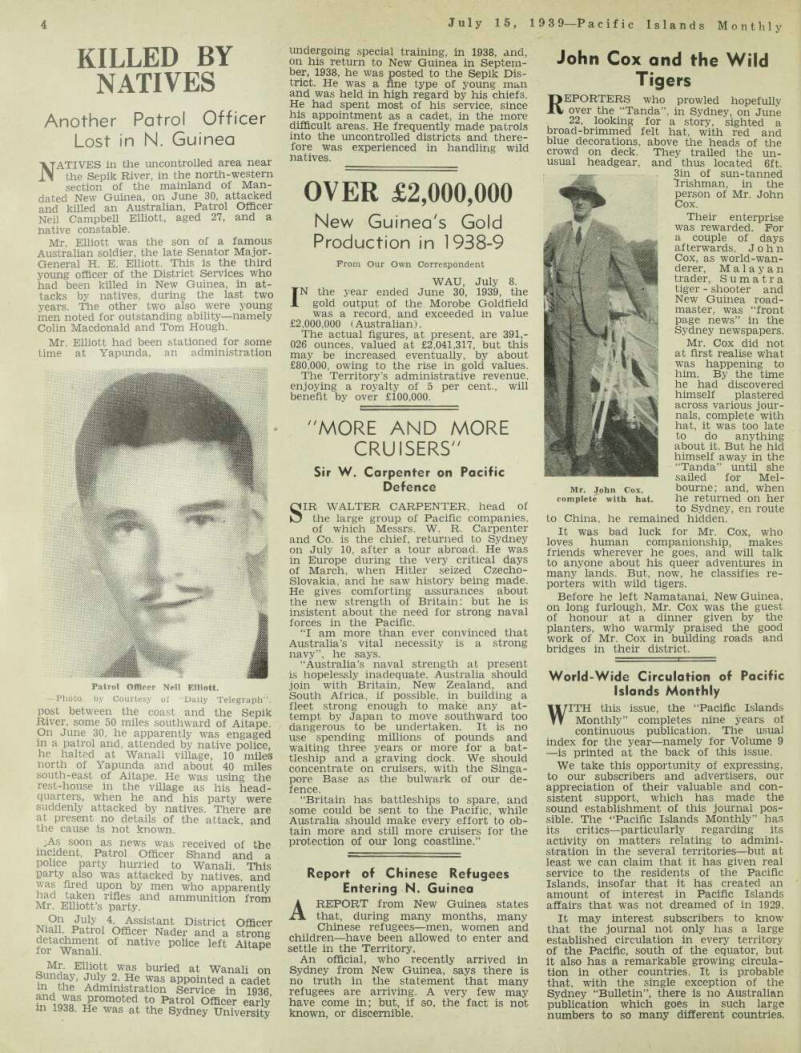
NATIVES in the uncontrolled area near the Sepik River, in the north-western section of the mainland of Man dated New Guinea, on June 30, attacked and killed an Australian, Patrol Officer Neil Campbell Elliott, aged 27, and a native constable, Mr. Elliott was the son of a famous Australian soldier, the late Senator Major- General H. E. Elliott. This is the third young officer of the District Services who had been killed in New Guinea, in at tacks by natives, during the last two years. The other two also were young men noted for outstanding ability—namely Colin Macdonald and Tom Hough.
Mr. Elliott had been stationed for some time at Yapunda, an administration
—Photo, by Courtesy of “Daily Telegraph”. post between the coast and the Sepik River, some 50 miles southward of Aitape.
On June 30, he apparently was engaged in a patrol and, attended by native police, he halted at Wanali village, 10 miles north of Yapunda and about 40 miles south-east of Aitape. He was using the rest-house in the village as his head quarters, when he and his party were suddenly attacked by natives. There are at present no details of the attack, and the cause is not known. -As soon as news was received of the incident, Patrol Officer Shand and a police party hurried to Wanali. This party also was attacked by natives, and was fired upon by men who apparently had taken rifles and ammunition from Mr. Elliott’s party.
XT- 0 ,, 1 uly 4 ’ Assistant District Officer Niall Patrol Officer Nader and a strong detachment of native police left Aitape for Wanali. * buried at Wanali on hwS* J A^ y - 2 -- 1 ? 6 a cadet m the Administration Service in 1936 f„ nC no'o aS Tp romoted t 0 Patrol Officer early’ in 1938. He was at the Sydney University
undergoing special training, in 1938, and, on his return to New Guinea in Septem ber, 1938, he was posted to the Sepik Dis trict. He was a fine type of young man and was held in high regard by his chiefs.
He had spent most of his service, since his appointment as a cadet, in the more difficult areas. He frequently made patrols into the uncontrolled districts and there fore was experienced in handling wild natives.
Patrol Officer Nell Elliott.
Over £2,000,000
New Guinea's Gold Production in 1938-9
From Our Own Correspondent WAU, July 8.
IN the year ended June 30, 1939, the gold output of the Morobe Goldfield was a record, and exceeded in value £2,000,000 (Australian).
The actual figures, at present, are 391,- 026 ounces, valued at £2,041,317, but this may be increased eventually, by about £BO,OOO, owing to the rise in gold values.
The Territory’s administrative revenue, enjoying a royalty of 5 per cent., will benefit by over £lOO,OOO.
Cruisers"
"More And More
Sir W. Carpenter on Pacific Defence
Sir Walter Carpenter, Head Of
the large group of Pacific companies, of which Messrs. W. R. Carpenter and Co. is the chief, returned to Sydney on July 10, after a tour abroad. He was in Europe during the very critical days of March, when Hitler seized Czecho slovakia, and he saw history being made.
He gives comforting assurances about the new strength of Britain: but he is insistent about the need for strong naval forces in the Pacific.
“I am more than ever convinced that Australia’s vital necessity is a strong navy”, he says, “Australia’s naval strength at present is hopelessly inadequate. Australia should join with Britain, New Zealand, and South Africa, if possible, in building a fleet strong enough to make any at tempt by Japan to move southward too dangerous to be undertaken. It is no use spending millions of pounds and waiting three years or more for a bat tleship and a graving dock. We should concentrate on cruisers, with the Singa pore Base as the bulwark of our de fence.
“Britain has battleships to spare, and some could be sent to the Pacific, while Australia should make every effort to ob tain more and still more cruisers for the protection of our long coastline.”
Report of Chinese Refugees
Entering N. Guinea
A REPORT from New Guinea states that, during many months, many Chinese refugees—men, women and children —have been allowed to enter and settle in the Territory.
An official, who recently arrived in Sydney from New Guinea, says there is no truth in the statement that many refugees are arriving. A very few may have come in; but, if so, the fact is not known, or discernible.
Tigers
John Cox and the Wild Tigers
REPORTERS who prowled hopefully over the “Tanda”, in Sydney, on June 22, looking for a story, sighted a broad-brimmed felt hat, with red and blue decorations, above the heads of the crowd on deck. They trailed the un usual headgear, and thus located 6ft.
3in of sun-tanned Irishman, in the person of Mr. John Cox.
Their enterprise was rewarded. For a couple of days afterwards, John Cox, as world-wan derer, Malayan trader, Sumatra tiger - shooter and New Guinea road master, was “front page news” in the Sydney newspapers.
Mr. Cox did not at first realise what was happening to him. By the time he had discovered himself plastered across various jour nals, complete with hat, it was too late to do anything about it. But he hid himself away in the “Tanda” until she sailed for Mel bourne; and, when he returned on her to Sydney, en route
to China, he remained hidden.
It was bad luck for Mr. Cox, who loves human companionship, makes friends wherever he goes, and will talk to anyone about his queer adventures in many lands. But, now, he classifies re porters with wild tigers.
Before he left Namatanai, New Guinea, on long furlough, Mr, Cox was the guest of honour at a dinner given by the planters, who warmly praised the good work of Mr. Cox in building roads and bridges in their district.
Mr. John Cox, complete with hat.
Islands Monthly
World-Wide Circulation of Pacific Islands Monthly
WITH this issue, the “Pacific Islands Monthly” completes nine years of continuous publication. The usual index for the year—namely for Volume 9 —is printed at the back of this issue.
We take this opportunity of expressing, to our subscribers and advertisers, our appreciation of their valuable and con sistent support, which has made the sound establishment of this journal pos sible. The ‘‘Pacific Islands Monthly” has its critics —particularly regarding its activity on matters relating to admini stration in the several territories —but at least we can claim that it has given real service to the residents of the Pacific Islands, insofar that it has created an amount of interest in Pacific Islands affairs that was not dreamed of in 1929.
It may interest subscribers to know that the journal not only has a large established circulation in every territory of the Pacific, south of the equator, but it also has a remarkable growing circula tion in other countries. It is probable that, with the single exception of the Sydney “Bulletin”, there is no Australian publication which goes in such large numbers to so many different countries.
Advertisements & other items, p. 6 (1 item)
4
July 15, 193 9—P acific Islands Monthly
Bogus Books
How Indian Hemp Was Smuggled into Fiji
AN ingenious system of smuggling “Indian hemp” (a forbidden nar cotic) into Fiji through the Post Of fice, was discovered recently, and one of the Indians concerned was fined £lOO.
For some time, the authorities sus pected that the drug was entering the Colony in considerable quantities, but the method of transport was long a my stery. Then the attention of someone was directed to the number of Indian magazines coming in by post, and soon the whole plan was uncovered.
Certain people in India kept a stock of old Bombay railway timetables—thick, chunky books. They cut the centre por tion right out of them, leaving the covers and edges of the pages intact, and into each little compartment thus created they put two ounces of Indian hemp wrap ped in a sheet of rubber. The timetable was then carefully covered, so that it looked like a magazine, and was pre pared for posting.
Meanwhile, in Fiji, other Indians had rented a number of Post Office letter boxes. By each mail, there arrived what apparently were Indian magazines, ad dressed to what apparently were mem bers of the Indian community. The cus toms and postal clerks did not attempt to examine them, and sorted them at once into the boxes to which they were ad dressed. Actually, the names were all fictitious, and the boxes were all rented by one gang.
In May, the Fiji police set a watch upon certain postal boxes; and an In dian named Bhirgu was caught when taking the packages out of one box, while the key of another box, also con taining packages of the drug, was in his hand. Bhirgu declared that he was merely acting for another Indian, Chotk han: but Bhirgu had been caught, and
Chotkhan was not, so Bhirgu, on June 13, was fined £lOO, or four months’ gaol.
Thus, for the moment, has the In dian hemp trade in Fiji been broken up.
A Strange
Visitor
£1,000 Lighter on Reef in Samoa
Prom Our Own Correspondent APIA. June 29.
A MOTOR launch from Savaii, on June 22, reported to the Harbourmaster at Apia that it had noticed a strange craft on the reef at Faleula, westward of Apia.
The Harbourmaster (Captain D. Mc- Clymont) went out and found that the vessel was a lighter, which he towed to Apia.
At first, the appearance and charac ter of the lighter was a complete my stery; but inquiries showed that it be longed to Pan American Airways.
It is a covered steel barge and was specially built for fuelling and anchor ing the Clipper planes of Pan Ameri can Airways. It was last used at Pago Pago, to fuel the “Samoan Clipper”, be fore her last disastrous flight in Janu ary, 1938. Since then it had been lying in Pago Pago. Recently, it was decided to transfer the lighter to the new base at Canton Island, and the U.S.S. “Roger Taney” was towing the lighter to Can ton Island, one night about four weeks ago, when the towline parted and the lighter disappeared into the darkness, and could not be found.
It is calculated that the value of the lighter is at least £l,OOO, and the launch owner who discovered the craft prob ably will be entitled to a substantial sal vage payment.
Notorious lle de Nou
To Be Seaplane Station on Trans pacific Air Route
Prom Our Own Correspondent
Noumea, June 25.
A SMALL army of workmen, under the direction of technical experts sent out by Pan American Airways, Ltd., is now busy preparing a seaplane base at Noumea, in New Caledonia.
The base is being called Nouville. and it is on the island directly opposite the town of Noumea. This is the once notor ious He de Nou, and on it there still re main the great prisons which housed the convicts sent from France.
In more recent times, these old build ings have been used to house the thou sands of Javanese labourers, who are brought in periodically from Java, em ployed for two or three years on the mines and plantations, and then repatriated.
The He de Nou, lying opposite Noumea, helps to enclose the sheltered water which is the port of Noumea.
A special water supply, electric light and power, a meteorological station, and all other modem requirements are being in stalled. The He de Nou. which was once the melancholy home of so much human misery and horror, will in future be an important station on one of the main trans-Pacific aerial routes—a place where lighthearted tourists may spend a few hours under tropical surroundings while on their way between New Zealand (or Australia) and North America.
It is generally expected in Noumea that Pan American Airways will attempt their first test flight between Noumea and Auckland in July; but there is as yet no indication that a suitable seaplane will then be available.
2,000,000 Francs Being Spent
The “Bulletin du Commerce” of June 17 says that the work, which will cost
more than 2,000.000 francs, will comprise: A large pumping station for the re fuelling of the seaplanes; a jetty, equip ped with a crane, which will be con structed close to the former military post; a depot for material; workshops and office; a large hall for the accommoda tion of passengers and crew; and various structures to meet the need of P.A.
All buildings will be erected in modem style, surrounded by lawns, after the American fashion.
In a comparatively short time, the ap pearance of Nouville will be completely changed. This part of the island will re present a miniature city, where great activity will be afoot with giant seaplanes, which will arrive four times per month two will come fortnightly from San Francisco-Honolulu-Canton Island, and two will return from Auckland to San Francisco, with the same itinerary and regularity, every 15 days.
For the radio station, which will be in constant touch with the seaplanes, the property of M. Steinmetz, at Magenta, has been chosen, after close study and examination of the region of Nouville, Brun Isle, and the district surrounding Noumea for a favourable zone.
The P.A. technicians, with complete portable material and little motor, have conducted experiments on the property of M. Steinmetz. They are in touch with the Company’s station on Canton (Phoenix Islands), which is an airport on the San Francisco-New Zealand route. If suit able results are obtained from these ex periments which have lasted several days, arrangements will be made for the erec tion of the necessary works.
Passengers arriving at Noumea in the afternoon, will remain one night in the town and will depart the next day.
It is probable that, at some future time, the seaplanes will call at Brisbane, but the project is still indefinite—nothing official has yet been established.
Sydney-Auckland Air Mail
British Imperial Airways are pushing on steadily with their preparations to make test flights between Sydney and Auckland and between Auckland and Suva. It is officially announced that the Sydney-Auckland air mail will commence in October.
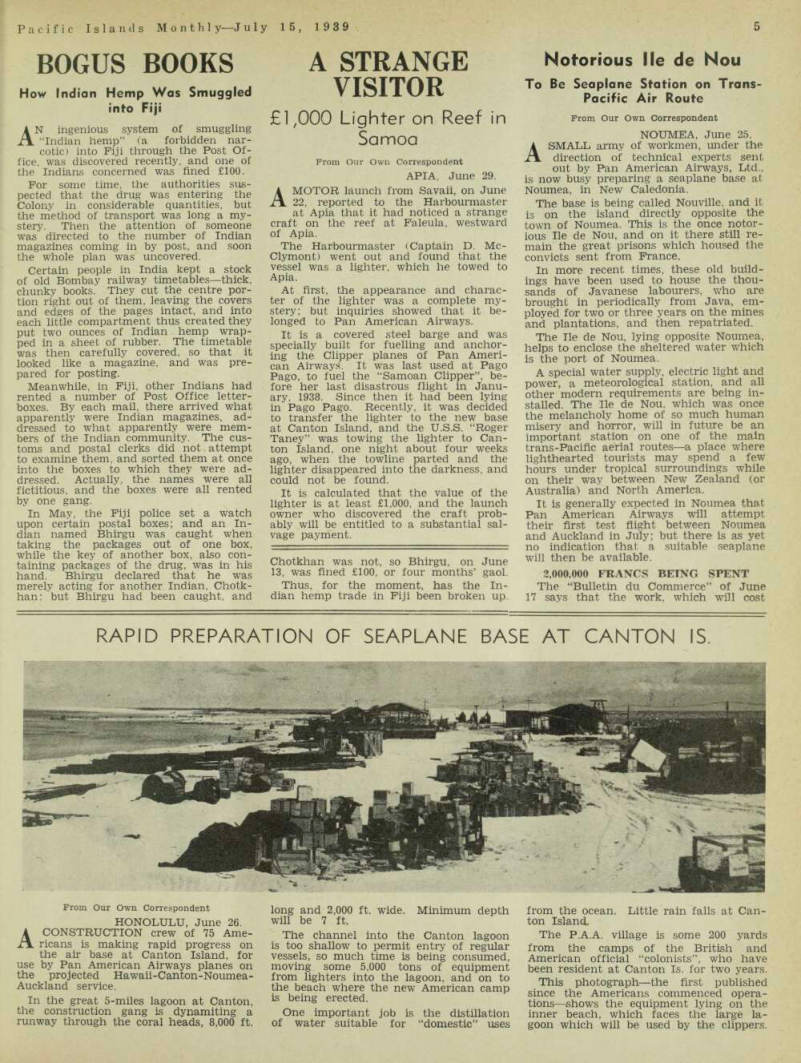
Rapid Preparation Of Seaplane Base At Canton Is.
Prom Our Own Correspondent
Honolulu, June 26.
A CONSTRUCTION crew of 75 Ame ricans is making rapid progress on the air base at Canton Island, for use by Pan American Airways planes on the projected Hawaii-Canton-Noumea- Auckland service.
In the great 5-miles lagoon at Canton, the construction gang is dynamiting a runway through the coral heads, 8,000 ft.
long and 2,000 ft, wide. Minimum depth will be 7 ft.
The channel into the Canton lagoon is too shallow to permit entry of regular vessels, so much time is being consumed, moving some 5,000 tons of equipment from lighters into the lagoon, and on to new AmeriCan CamP » a - One important job is the distillation of water suitable for “domestic” uses
from the ocean. Little rain falls at Can ton Island.
The P.A.A. village is some 200 yards from the camps of the British and American official “colonists”, who have been resident at Canton Is. for two years, This nhotoaranh—the first nublished tions—shows the equipment lying on the inner beach, which faces the large la goon which will be used by the clippers.
XThf Hfeh Courf “wLe"
Unusual Mass
Trai L
Chinese and Samoan Women Convicted of cohabitation
XThf Hfeh Courf “wLe"
1 oa 0 f 21 when 34 Chinese labourers (at present employed on the New Zealand Reparation Estates) and 34 Samoan women were lined up, and convicted of the offence of cohabitating.
There is a law in Western Samoa which says that Samoan women must not live with Chinese coolies on European plan tations.
The Chinese were ordered to come up f o r sentence within three months. The women, many of whom had small child ren with them in the Court, were sen tenced to three days’ in prison, after which they were to be sent back to their villages. The village chiefs were made responsible for seeing that the women did not return to the Chinese.
The New Zealand authorities are de termined to stop this cohabitation. On moral and social grounds, they doubtless are right. it is well known, however, that the Chinese treat their Samoan “wives” kindly and generously, and a home with a Chinaman is eagerly sought. Ethnolo gically, it has been shown that the off spring of a Chinese-Polynesian union are acclaimed the healthiest, brightest, handsomest and most industrious people in the Pacific.
Samoan Launch In
Breakdown
fIIHE Samoan Government launch, JL “Pilot”, with mails and passengers, left Apia on June 29 for Pago, to connect with the “Monterey” en route from Australia to America; but it did not arrive at Pago on June 30.
The launch “Amy” left Apia, and two vessels left Pago, to search. The “Amy” found “Pilot” with a broken shaft; and it picked up passengers and mails and transferred them to the “Monterey”.
Native Police
White Man Battered by Native Police Recent Vila Incident Reflects Badly Upon N. Hebrides Officials
A PARTY of firemen, off the S.S.
“Morinda”, while in Port Vila (New Hebrides), on May 23, were at one of the French bars in the rue Biggin son. Some misunderstanding arose which resulted in the French Command ant of native police arriving on the scene, with some of his native police, into whose custody he handed two of the stokers.
The Frenchman was not in uniform, nor is he able to speak English. One of the stokers resisted arrest, and was dragged along the street by several na tive police, who hammered him with their batons.
Three times, along the street, the batoning of the European was stopped by white men; and the stoker was at length allowed to get away.
This stoker fainted, somewhere on the outskirts of the town. On regaining con sciousness, bleeding and half-naked, he made his way back to the Burns Philp wharf, to await a launch to take him to his ship. A squad of British native police arrived, in charge of a native ser geant, who told the stoker that he had orders to arrest him. So as not to make any further scene, the stoker decided to go with them quietly. En route, the party was met by the British Commander of Native Police.
The man was then taken to the French Police Station, lodged in a cell, and then charged by the British Com mander of police with being drunk and disorderly, and assaulting a police offi cer.
At the subsequent court proceedings, where this man was arraigned, with two of his mates, the stokers claimed that they had been improperly deprived of a bottle of brandy which they had bought: and, when they protested, they were at tacked and ejected.
Evidence was produced that the man who was battered by the native police was neither drunk nor disorderly. The judge found him not guilty, on both charges.
The charge of being drunk and dis orderly was also dismissed in the case of a second fireman; and a third, who pleaded guilty to drunkenness, was fined 5/-.
Such misunderstandings, between peo ple speaking different languages, may occur among the quietest people. But the notorious Condominium of the New Hebrides seems to be the only place where white men can be arrested and manhandled by native police. There have been other similar cases in Vila; and always it has been visiting British men who have become involved, and the manhandling has been done by the French native police.
Apparently well-informed people who have sent this information to the “P.1.M.”, say that the fault lies with cer tain French and British major officials “who are too high and mighty to use a little ordinary tact”. They also say that “the French native police in Vila are an ill-disciplined body, very cheeky, and with little respect for white men, French or English”.
Mr. A. Ulfsby, of Rarotonga, Cook Is lands, where he has been a resident for 10 years, arrived in Sydney in July on his way home to Norway.
Wedding In
Western
Samoa
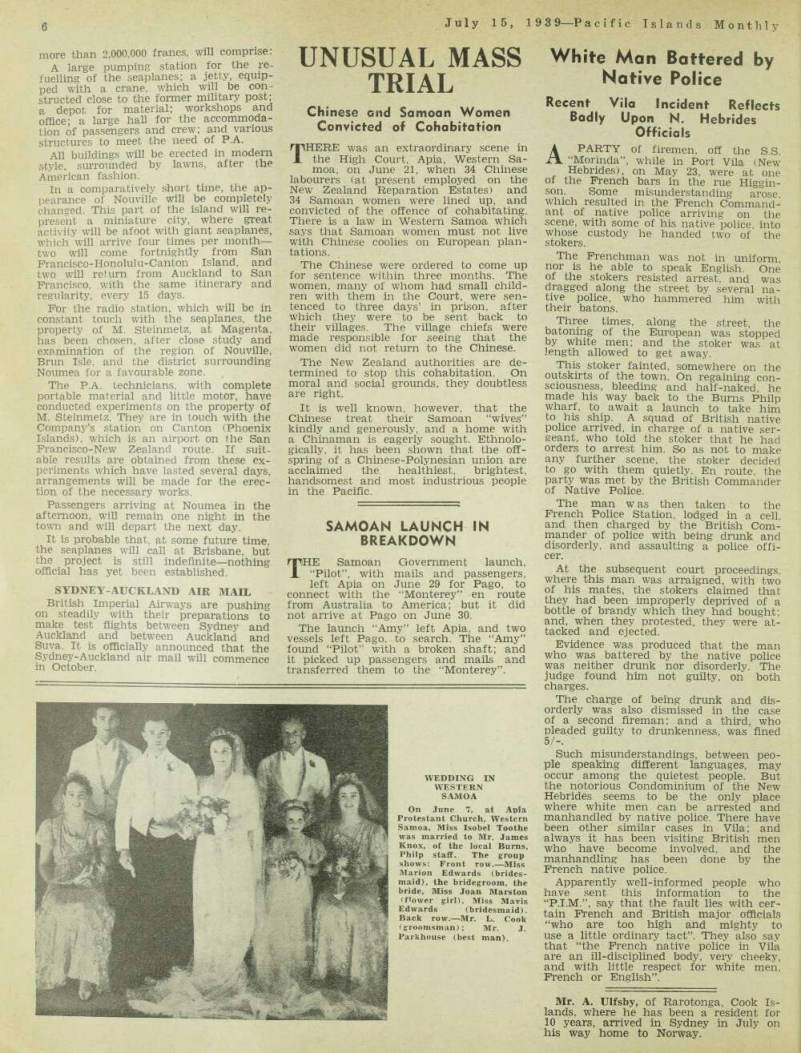
On June 7, at Apia Protestant Church, Western Samoa, Miss Isobel Toothe was married to Mr. James Knox, of the local Burns, Philp staff. The group shows: Front row.—Miss Marion Edwards (brides maid), the bridegroom, the bride. Miss Joan Marston (flower girl). Miss Mavis Edwards (bridesmaid).
Back row.—Mr. L. Cook (groomsman); Mr. J.
Parkhouse (best man).
Advertisements & other items, p. 8 (1 item)
6
July 15, 193 9—P acific Islands Monthly
Urgent Search For
Labour
What New Guinea Has been Doing
Letter to the Editor IN regard to your article on the Native Labour Problem in New Guinea, in the June number, it may interest you to know that New Guinea applied for Javanese labour last year and was re fused.
Only certain countries may apply for Javanese and (I believe) Tonkinese la bour —those countries where the practice of permitting such contracts of labour has become an established custom. There is no intention to extend the privilege to other countries.
On this refusal, the New Guinea Ad ministration applied to the Dutch au thorities for permission to recruit labour in Dutch New Guinea. This, again, was refused —and for the reason that they need all the labour they can command for their own enterprise.
Thereupon, New Guinea approached Papua for permission to recruit labour.
Again, they were turned down—and not unreasonably. It is suspected that it was with the object of removing this last restriction that certain New Guinea in terests supported the idea of amalga mation.
So, you see, the New Guinea Adminis tration really has done its best, and failed. This information is 0.K.. but for some reason which I do not understand it has been suppressed.
I am, etc.,
Rabaulite.
Sydney, July 1, 1939.
Old "Makambo"
Reported Sold to Japanese
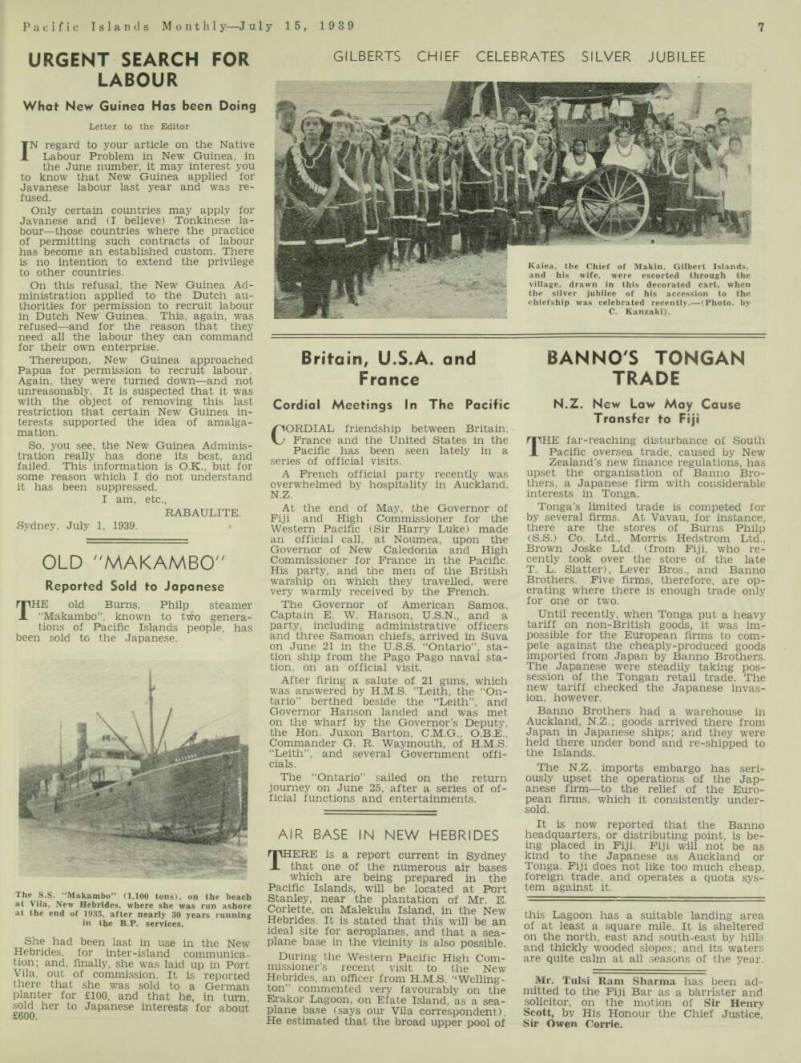
THE old Burns, Philp steamer “Makambo”, known to two genera tions of Pacific Islands people, has been sold to the Japanese.
She had been last in use in the New Hebrides, for inter-island communica tion; and, finally, she was laid up in Port Vila, out of commission. It is reported there that she was sold to a German planter for £lOO, and that he, in turn, sold her to Japanese interests for about £6OO.
The S.S. “Makambo” (1,100 tons), on the beach at Vila, New Hebrides, where she was run ashore at the end of 1935, after nearly 30 years running in the B.P. services.
Gilberts Chief Celebrates Silver Jubilee
Kaiea, the Chief of Makin, Gilbert Islands, and his wife, were escorted through the village, drawn in this decorated cart, when the silver jubilee of his accession to the chiefship was celebrated recently.— (Photo, by C. Kanzaki).
Britain, U.S.A. and France Cordial Meetings
France Cordial Meetings in The Pacific
CORDIAL friendship between Britain, France and the United States in the Pacific has been seen lately in a series of official visits.
A French official party recently was overwhelmed by hospitality in Auckland, N.Z.
At the end of May, the Governor of Fiji and High Commissioner for the Western Pacific (Sir Harry Luke) made an official call, at Noumea, upon the Governor of New Caledonia and High Commissioner for France in the Pacific.
His party, and the men of the British warship on which they travelled, were very warmly received by the French.
The Governor of American Samoa, Captain E. W. Hanson, U.S.N., and a party, including administrative officers and three Samoan chiefs, arrived in Suva on June 21 in the U.S.S. “Ontario”, sta tion ship from the Pago Pago naval sta tion, on an official visit.
After firing a salute of 21 guns, which was answered by H.M.S. ’’Leith, the “On tario” berthed beside the “Leith”, and Governor Hanson landed and was met on the wharf by the Governor's Deputy, the Hon. Juxon Barton, C.M.G.. 0.8. E..
Commander G. R. Waymouth, of H.M.S.
“Leith”, and several Government offi cials.
The “Ontario” sailed on the return journey on June 25, after a series of of ficial functions and entertainments.
Air Base In New Hebrides
r ERE is a report current in Sydney that one of the numerous air bases which are being prepared in the Pacific Islands, will be located at Port Stanley, near the plantation of Mr. E.
Corlette, on Malekula Island, in the New Hebrides. It is stated that this will be an ideal site for aeroplanes, and that a sea plane base in the vicinity is also possible.
During the Western Pacific High Com missioner’s recent visit to the New Hebrides, an officer from H.M.S. “Welling ton” commented very favourably on the Brakor Lagoon, on Efate Island, as a sea plane base (says our Vila correspondent).
He estimated that the broad upper pool of
this Lagoon has a suitable landing area of at least a square mile. It is sheltered on the north, east and south-east by hills and thickly wooded slopes; and its waters are quite calm at all seasons of the year.
Mr, Tulsi Ram Sharma has been ad mitted to the Fiji Bar as a barrister and solicitor, on the motion of Sir Henry Scott, by His Honour the Chief Justice, Sir Owen Corrie.
Banno's Tongan
Trade
N.Z. New Law May Cause Transfer to Fiji
THE far-reaching disturbance of South Pacific oversea trade, caused by New Zealand’s new finance regulations, has upset the organisation of Banno Bro thers. a Japanese firm with considerable interests in Tonga.
Tonga’s limited trade is competed for by several firms. At Vavau, for instance, there are the stores of Burns Philp (S.S.) Co. Ltd., Morris Hedstrom Ltd., Brown Joske Ltd. (from Fiji, who re cently took over the store of the late T. L. Blatter), Lever Bros., and Banno Brothers. Five firms, therefore, are op erating where there is enough trade only for one or two.
Until recently, when Tonga put a heavy tariff on non-British goods, it was im possible for the European firms to com pete against the cheaply-produced goods imported from Japan by Banno Brothers.
The Japanese were steadily taking pos session of the Tongan retail trade. The new tariff checked the Japanese invas ion, however.
Banno Brothers had a warehouse in Auckland, N.Z.; goods arrived there from Japan in Japanese ships; and they were held there under bond and re-shipped to the Islands.
The N.Z. imports embargo has seri ously upset the operations of the Jap anese firm—to the relief of the Euro pean firms, which it consistently under sold.
It is now reported that the Banno headquarters, or distributing point, is be ing placed in Fiji. Fiji will not be as kind to the Japanese as Auckland or Tonga. Fiji does not like too much cheap, foreign trade, and operates a quota sys tem against it.
Advertisements & other items, p. 9 (1 item)
7
Pacific Islands Monthl y —J uly 15, 1939
Queer Incidents Near
New Guinea An Official Party is Startled
TtyfYSTERIOUS incidents, in and aroimd JVI New Guinea, in recent months, have indicated the delicacy of the intei national situation, and emphasised the fact that, just over the horizon from Aus tralia’s Mandated Territory is the Japan ese Mandated Territory of the Marshall and Caroline Islands.
When the E. and A. liner “Neilore” was on her way south, from Manila to Rabaul, about the middle of February, she quite unexpectedly came upon the German (NDL.) steamer “Friderun”, near Manus (Admiralty Islands). The “Friderun” was unloading what appeared to be drums of oil, or motor-spirit, into a small, unidenti fied vessel.
The “Friderun’s” activity may have been quite innocent, but those most inter ested seem to see a particular significance in it.
Within the last three months, the New Guinea Administration’s vessel “Leander” was off the eastern coast of New Ireland when she encountered—apparently by accident—a large mysterious vessel. When the “Leander”, which carried a party of officials, proceeded to investigate, she was met with every indication of hostility.
Exactly what happened, no one knows, outside of officialdom; but it is known that something of an urgent character was reported by radio by the “Leander”, and then the latter vessel returned im mediately and unexpectedly to port. It is known positively, however, that the myster
ious stranger was not Japanese.
About the same time, in the same region (off the eastern coast of New Ireland) just after daylight one morning, a large naval vessel, attended by two or three smaller craft, was noticed travelling south-eastwards; and again, in relation to this visitor, officialdom adopted a policy of “hush, hush!”.
Mr. J. W. Sadlier, who for over 30 years was in charge of the Fiji Government’s Makuluva Quarantine station, died at Nasoata Island, Fiji, in June at the age of 66.
Another Freighter for the W.R.C
W.R.C. Line
AN order for the construction of a new cargo-carrier, of approximately 10,- 000 tons, for service in the Pacific, has been placed in England by Messrs. W.
R. Carpenter and Co. Ltd.
Sir Walter Carpenter, who returned to Sydney in July, placed the order in England while he was there, but was informed that, owing to the number of orders in British shipbuilding yards, it probably would be a few months before the vessel could be laid down.
The W.R.C. freight service was start ed in 1934. with the two motor vessels, “Salamaua” and “Rabaul”. A new steamer was constructed, and named the “Suva”, and entered the service early in 1939. The vessels run on a regular sched ule between European and Pacific Is lands ports.
Mr. George Shepherd, who for many years was a member of the staff of the Suva Metal Works, died in Fiji, in June.
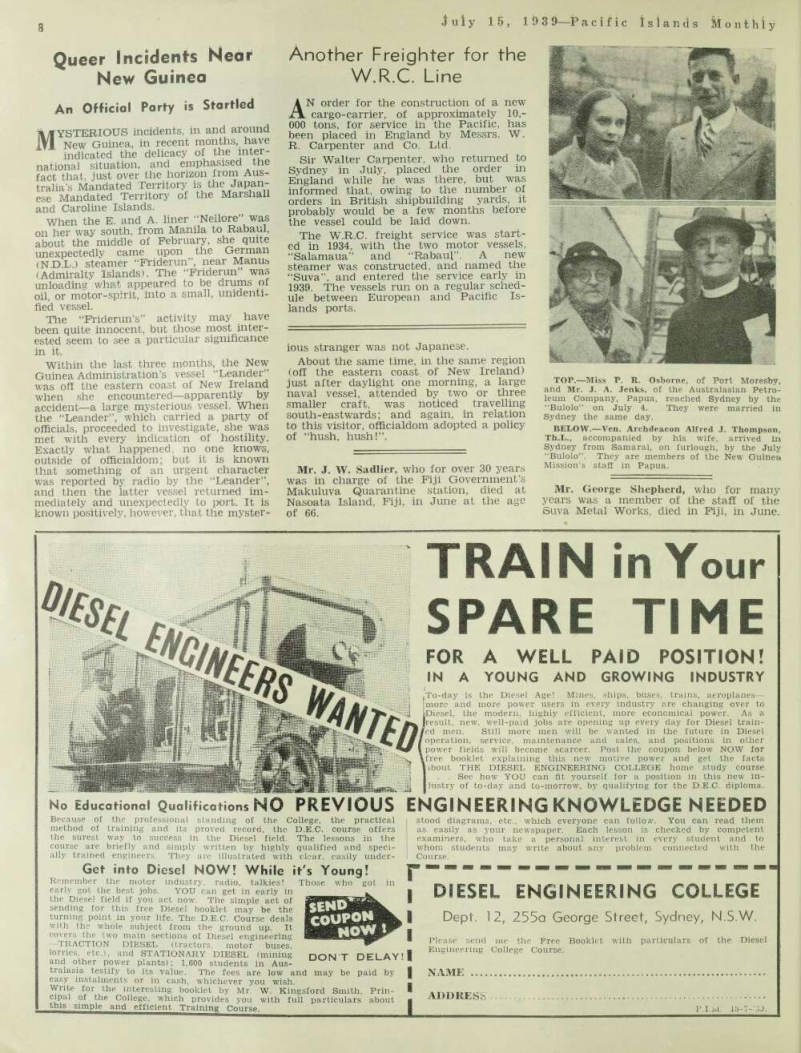
TOP.—Miss P. R. Osborne, of Port Moresby, and Mr. J. A. Jenks, of the Australasian Petro leum Company, Papua, reached Sydney by the “Bulolo” on July 4. They were married in Sydney the same day.
BELOW.—Ven. Archdeacon Alfred J. Thompson, Th.L., accompanied by his wife, arrived in Sydney from Samarai, on furlough, by the July “Bulolo”. They are members of the New Guinea Mission’s staff in Papua.
Advertisements & other items, p. 10 (2 items)
8
July 15, 193 9—P acific islands Monthly
TRAIN in Your
SPARE TIME
FOR A WELL PAID POSITION!
IN A YOUNG AND GROWING INDUSTRY
; is the Diesel Age! Mines, ships, buses, trains, aeroplanes— [more and more power users in every industry are changing over to Diesel, the modern, highly efficient, more economical power. As a result, new. well-paid jobs are opening up every day for Diesel trained men. Still more men will be wanted in the future in Diesel operation, service, maintenance and sales, and positions in other power fields will become scarcer. Post the coupon below NOW for free booklet explaining this new motive power and get the facts ibout THE DIESEL ENGINEERING COLLEGE home study course . . See how YOU can fit yourself for a position in this new iniustry of to-day and to-morrow, by qualifying for the D.E.C. diploma.
No Educational Qualifications NO PREVIOUS ENGI N EERI NG KNOWLEDGE NEEDED & Because of the professional standing of the College, the practical method of training and its proved record, the D.E.C. course offers the surest way to success in the Diesel field. The lessons in the course are briefly and simply written by highly qualified and specially trained engineers. They are illustrated with clear, easily under- Get into Diesel NOW! While it's Young!
Remember the motor industry, radio, talkies! Those who got in early got the best jobs. YOU can get in early in the Diesel field if you act now. The simple act of sending for this free Diesel booklet may be the turning point in your life. The D.E.C. Course deals with the whole subject from the ground up. It covers the two main sections of Diesel engineering TRACTION DIESEL (tractors. motor buses, lorries, etc.), and STATIONARY DIESEL (mining and other power plants); 1,600 students in Australasia testify to its value. The fees are low and may be paid by easy instalments or in cash, whichever you wish.
Write for the interesting booklet by Mr. W. Kingsford Smith, Principal of the College, which provides you with full particulars about this simple and efficient Training Course. stood diagrams, etc., which everyone can follow. You can read them as easily as your newspaper. Each lesson is checked by competent examiners, who take a personal interest in every student and to whom students may write about any problem connected with the Course.
I DIESEL ENGINEERING COLLEGE
Dept. 12, 255 a George Street, Sydney, N.S.W.
DON'T DELAY!
Please send me the Free Booklet with particulars of the Diesel Engineering College Course.
NAME ...
ADDRESS
Tropicalities
NEW Zealand newspapers, at the end of June, foreshadowed the early con struction of two liners, each of 25,000 tons, to replace the Union Company’s “Aorangi” and “Niagara” in the Pacific service, between Sydney and Vancouver.
The vessels are to have each a speed of 22 knots, and each will carry 750 pas sengers.
As the same kind of optimistic an nouncement has been made at intervals during the past five years, residents of the Pacific can be pardoned if they do not treat the latest statement with any great respect.
It is worth noting that the “Niagara” was built in 1913, and the “Aorangi” in 1924. Both liners—but more especially the “Niagara”—do not find it easy to com pete with the more modem vessels of the Matson Line. The managers of the Matson Line, for their part, are now talking of replacing the “Monterey” and “Mariposa” with two more modern liners. * * * CAN anyone explain what this is all about: — “London, June 26. To Pacpub (Paci fic Publications Pty. Ltd.), Sydney.
World’s biggest slander and poison cam paign has failed to ruin me. My enemies are raving. Happy days to everybody. (Signed) C. Hughes”.
This is the third radiogram of a simi lar character, with the same signature, received from London by the "Pacific Islands Monthly” during the past twelve months. Is it a practical joke? If so, when do we laugh? * * * I.IARLY last year, a well-known New Vj Guinea miner was returning to his claim in the Wewak district, taking with him a cherished cat. In Wewak, before departing for his claim, he was eating his first meal in the only restaur ant the place boasted —a combination trade-store and “hash-house” run by a “Kong Kong”—wheh sleek pussy, rubbing herself against his legs as he sat eating, made him give thought to her welfare during his intended short stay in the district.
He called the Chinaman and, indicat ing the cat, told him to open a tin of meat and give it to her. Looking a trifle puzzled, the “Kong” obeyed. The cat immediately sent out a series of calls, which brought several others of the spec ies to join her in the meal.
The miner was rather startled at his cat’s generosity, but decided that if it was all right with her it was O.K. with him, too, and went on with his dinner.
When leaving, he pointed to the cat and instructed the Chinaman to give her a tin of meat every night until further no tice, and to charge her maintenance on his bill. The Chinaman, still looking rather mystified, but grinning widely, agreed.
Arriving at his temporary camp, the miner was met by his personal boy, who informed .him that “Puss cat ’im ’e no got kai-kai, master”.
“Puss cat ’im ’e kai-kai finish”, re plied the master.
“No got”, answered the native. “Puss cat ’im ’e no kai-kai something, ’im ’e ’ungry too mus”.
“Puss cat ’im ’e stop where?” inquired the master, now beginning to have an inkling of what had happened.
“Puss cat ’im ’e stop onetime me fella”.
The inkling became a certainty. The miner had “shouted” a meal for the Kong-Kong's own cat and her family. The standing order for the feline’s sustenance was cancelled next morning.—IMEB. * * * UNDER a double-column heading of “Doing Sums on a Tropic Isle”, the Melbourne “Herald” in June ran an which a fanciful picture was drawn"of a young man undergoing a two days’ examination in the Trobriand Is lands, Eastern Papua, while the Assistant Resident Magistrate sat solemnly at a distance and supervised. The young man was the assistant to the medical officer and he was one of 327 candidates, in Aus tralia and territories, for air pilot’s licence, second class. According to the “Herald” writer, while the young man in side wrestled with his examination prob lems, an admiring circle of Trobriand is landers sat outside under the palm trees and watched the sparkling sea and told each other, “That feller plenty big swot”.
Such is journalism in our time. * * * A MURDER occured in an outback vil lage in Papua, where only recently a village constable had been sta tioned. The newly appointed dignitary promptly arrested a small boy and, tak ing him down to the coast, eventually entered the Resident Magistrate’s office grinning broadly.
“There’s been a murder”, he announced proudly, “and I’ve brought you a prisoner.”
The Magistrate looked doubtfully at the youth with handcuffs on his wrists He was not more than 12 years of age.
“But surely”, he protested, “this young boy has not killed anybody?”
“Oh, no”, the constable replied. “He had nothing to do with it.”
“Then why have you brought him?”
“You see, sir”, the constable explained
eagerly, “you told me to bring a prisoner along every time a man is killed. The man who did the killing said he did not want to come, so I brought this boy in stead. He was the only one I could get!’’ * * * CIAN any student of Pacific history say j who Mount Gower (one of the two main peaks of Lord Howe Island) was named after? Mr. Arthur Peck, of 99 Queen Street, Melbourne, who has been visiting the island, wants to know.
Lieut. Lidgbird Ball, of H.M.S. “Supply”, found the island on February 17, 1788, and gave his name (Mt. Lidgbird) to the other peak. But who was Gower?
Mr. Peck reports that, last year, 22,000 rats (destroyers of the Kentia palm seed) were killed on the island, and a bounty of 3d. each was paid on their tails. The bounty now is down to 2d. per tail. Ken tia palm seed is now worth £l2 per bushel.
Monsieur Cassagne, Commissioner of Police at Vila, New Hebrides, left for fur lough in France by the “Sagittaire” in mid-June. He has been in the Group foi six years.
Advertisements & other items, pp. 11-12 (2 items)
9
Pacific Islands Monthl y—J uly 15, 1939
CO., Alexandria, N.S.W.
AMAZING!
FANTASTIC!!
DYNAMIC!!!
THREE INTERESTING MAGAZINES:
Dynamic Science Stories.
Marvel Science Stories.
Science Fiction.
Post Free. Bd. each. 3 for 1/9.
WESTERN AMERICAN MAGAZINES:
6 for 3/3. 13 for 6/-. Post Free.
All different—every month. « copies for fi months—lB/6 i Post 12 copies for fi months—3s/- i Free.
Also, Plying, Romance. Sports and Movie Magazines.
CHILDREN’S COLOURED COMICS:
6 for 2/3. 12 for 4/3. Post Free.
Postal Address:
C. S. HARVEY
40 KING STREET. SYDNEY.
Box 3546 RR., G.P.0., Sydney.
FLAT OIL
FINISH
WATERPROOF
DRIES IN HALF HOUR
CREAM
Write for a colour Card ...
STERLING VARNISH
Dries in holt an hour on plaster walls, ceilings, cement, fibre, wood Cr iron.
Also Excellent as an Undercoat for lacquers, paints Cr enamels 12/- per gallon
HIGHLY DURABLE
CO., Alexandria, N.S.W.
m> s
KODAK
(A/asia) PTY. LTD.
offers complete
Photographic Service
KODAKS, Miniature Kodaks de luxe, Cine-Kodaks, and Kodascopes, Kodak Equipment for Visual Education, etc. —Complete stocks.
KODAK Developing, Printing and Enlarging Service.
KODAK Photographic and Darkroom Equipment of every description, for professional, commercial, educational, X-Ray, medical, scientific and industrial purposes.
KODAK Dupli-tized Ultra-Speed X-Ray Film KODAK Sensitised Materials Kodak Verichrome, Super Sensitive and Panatomic Roll Film; Kodak Super-XX, Plus-X and Panatomic-X 36-exp. 35mm Films; Kodak Plates and Kodak Cut Film in numerous varieties for amateur, professional and press photographers; Kodak Bromide Papers, Velox, Nepera; Kodak Technical Sensitised Materials (Kodak Process Plates, Kodak Transparency Films. Kodak Chemicals; Mounts, Albums; and all photographic supplies. Cine-Kodak Black and White Processing.
Enquiries Invited
KODAK (A I Esisj Pty. Ltd.
379 George Street, Sydney.
And at Newcastle.
Medical School
Guam Students for Suva Medical School Why Does Australia Hold Aloof?
THE work of the Suva Medical School, a remarkable institution which trains native medical practitioners from all over the Pacific, was warmly praised by various speakers at the Pacific Islands Club meeting in July; and the principal of the School, Dr, Hoodless, who wa* present as the guest of the Club, told something of the history of the move ment.
In the course of discussion. Dr. Hood less was asked if he could give any ex planation of why Australia has so far refused to co-operate with the Suva Medical School, and has sent no trainees from the Australian Pacific Territories to that institution; but Dr. Hoodless said he could not reply to the question.
Small parlies of Papuan youths have been trained in Sydney for medical work, and some system of training of native youths is carried on in the hospitals in New Guinea; but neither system is com parable with the work that is being done in the Suva Medical School.
Selected natives from the Solomon Is lands and from the New Hebrides (who are of the same Melanesian type as the people of Papua and New Guinea) have Oeen trained in Suva and are doing splen did work in both the Solomons and the New Hebrides, The four years’ course that these selected natives undergo at the Suva Medical School not only gives them a useful knowledge of medicine and simple surgery, it also trains them in hygiene, sanitation and administration, and their work in the native villages in consequence is increasingly valuable.
Furthermore, these young men come to gether in Suva from all parts of the Pacific —Fiji, Samoa, Cook Islands, Tonga, New Hebrides, Solomons, Gilbert and Ellice Group—and in this association they get a new understanding of the fjllture of the Polynesian races, a greater confidence in themselves, and this influence is reflected in better social conditions in the villages where they work.
An interesting development recently is the announcement that the American authorities have approved of the Suva Medical School. A party of selected youths from the American island of Guam is be ing sent to Suva to undergo the 4-years* course in training as native medical practitioners.
This means that the United States is co-operating with the British Colonial Office and the N.Z. Government in this institution; and, naturally, the question is asked, with increasing urgency, why Australia holds aloof.
Centenary of Christianity in Rotuma
Rotuma
Rev. c. m. churchward, m.a., of the Methodist Mission has completed a valuable piece of work in the com pilation of a Rotuman Dictionary and Grammar. This is referred to in the highest terms by recognised experts, and the Methodist Mission Board has applied to the Fiji Government for some help in connection with its publication.
The Centenary of Christianity in Rotu ma will be celebrated on July 21 and 22, says the “Mission Review”.
Advertisements & other items, p. 12 (1 item)
10
July 15, 193 9—P acific Islands Monthly
About Islands People
Miss A. Mills, B.Sc., of Plnikidu, New Britain, who has served with the Meth odist Mission for nine years, is at pre sent spending long furlough in New South Wales.
Miss Mildred Free, formerly of Nukua lofa, Tonga, left Sydney in July for Suva, Fiji, where she will reside in future.
Mrs. Harold B. Lange, of Apia, West ern Samoa, who has been visiting rela tives in New Zealand, returned to Apia by the July “Matua”.
Mr. William G. King, formerly of Tam worth, N.S.W., married Miss Jean Fors ter, of Suva, early in June. The cere mony, at the Holy Trinity Pro-Cathed ral, was performed by the Bishop in Polynesia, Rt. Rev. L. S. Kempthorne.
Captain William Ross, a veteran mas ter mariner of the Pacific, died in Auck land, New Zealand, on June 28, aged 89.
In 1884 he entered the Niue Island trade and continued in it for 25 years, with the barquentine “Ysabel”. During the early stages of the Great War, Captain Ross played a prominent part in nego tiating the purchase of premises and stocks of German firms operating in Tonga. It was he who hoisted the Brit ish flag at Haapai on July 24, 1916.
Mr. Mistry Muthan, a mason, who had been in Fiji since 1882, died at Suva in June, aged 93.
His Honour Sir Owen Corrie, Chief Justice of Fiji, left Suva on leave by the “Niagara” in mid-June.
Mr. and Mrs. W. A. Campbell, accom panied by their three children, returned to Fiji by the “Monowai” from Sydney on July 6, after furlough in Australia.
He is a member of the Colonial Sugar Refining Co.’s staff at Ba.
Mr. C. R. Chaseling, well-known Aus tralian aviator, has joined the staff of Carpenter Airlines. He spent June in New Guinea gaining experience of local conditions, flying with Mandated Air lines.
Members, and their families, of the C.S.R. Co., who are booked to sail for Fiji after leave in Australia by the “Mariposa” on July 21 include: Mrs. T.
N. R. Carew and family (Labasa); Mr.
W. Finlayson (Ba); Mrs. J. G. Davis (Lautoka); and Miss Betty Craddick (Lautoka).
Mr. G. C. Holmes, one of the most popular men of the New Ireland district, New Guinea, was entertained at a smoke concert, in Kavieng, by about 30 friends, in June, and presented with a wardrobe trunk. Mr. Holmes has left the Terri tory, to reside in England.
Mr, F. A. Roades, manager of the Burns Philp plantation at Ysabel, Solomon Is lands, who has been in Sydney on fur lough, is now convalescent, having un dergone hospital treatment for a duo denal ulcer.
Lieutenant-Colonel Gaffiero has been appointed head of the Health Department in New Caledonia, replacing Lt.-Colonel Gorjux.
Mr. “Tommy” Horne, of Suva, Fiji, head of the well-known firm of Walter Horne and Co. Ltd., who has been undergoing treatment for his health in Sydney for some considerable time, is now very much better, and expects to return to Fiji at no distant date. He camplains that he is on a “hay diet”, and that the ruthlessness of his doctor destroys many of the savours of life; but, nevertheless, he is in very good form and appears to have quite recovered the health he lost a couple of years ago.
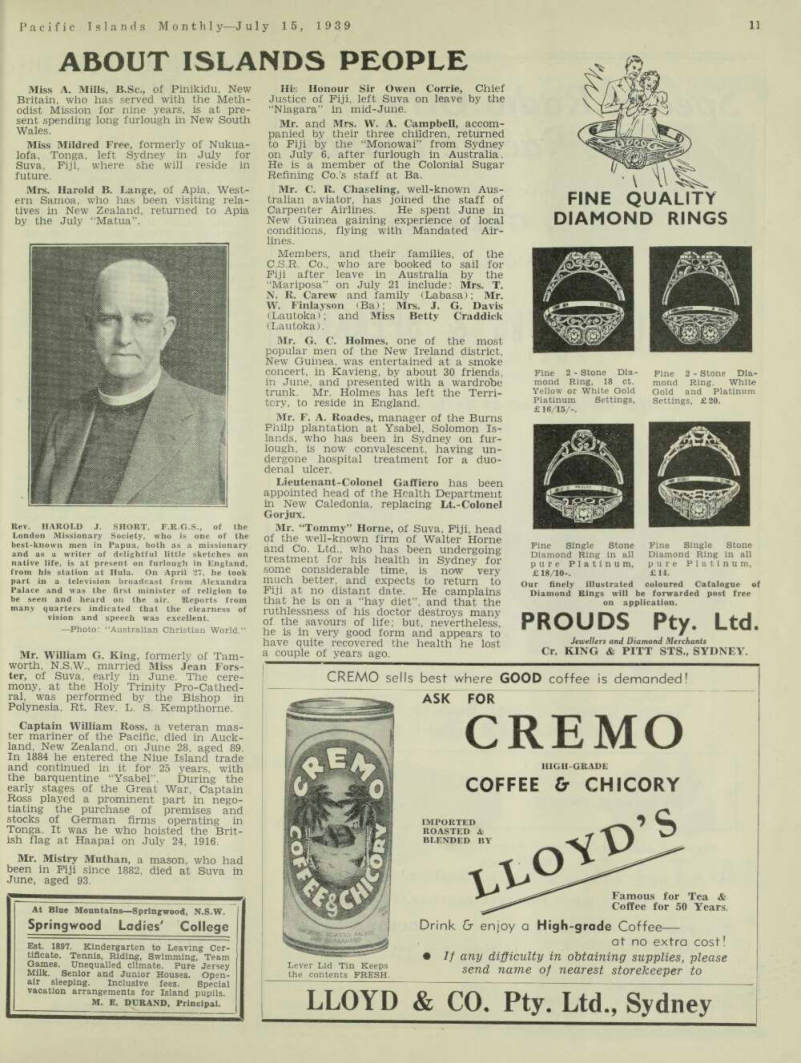
Rev. HAROLD J. SHORT, F.R.G.S., of the London Missionary Society, who is one of the best-known men in Papua, both as a missionary and as a writer of delightful little sketches on native life, is at present on furlough in England, from his station at Hula. On April 27, he took part in a television broadcast from Alexandra Palace and was the first minister of religion to be seen and heard on the air. Reports from many quarters indicated that the clearness of vision and speech was excellent. —Photo: “Australian Christian World.”
Advertisements & other items, pp. 13-14 (2 items)
11
Pacific Islands Monthl y —J uly 15, 1939
Cremo
V □ w
FINE QUALITY
DIAMOND RINGS
r m Fine 2 - Stone Diamond Ring, 18 ct.
Yellow or White Gold Platinum Settings, £ 16/15/-.
Fine 2 - Stone Diamond Ring. White Gold and Platinum Settings, £2O. 3 MS Pine Single Stone Diamond Ring in all pure Platinum, £ 18/10-.
Our finely illustrated Fine Single Stone Diamond Ring in all pure Platinum, £l4. coloured Catalogue of Diamond Rings will be forwarded post free on application.
PROUDS Pty. Ltd
Jewellers and Diamond Merchants
Cr. KING & PITT STS., SYDNEY.
CREMO sells best where GOOD coffee is demanded!
ASK FOR
Lever Lid Tin Keeps the contents FRESH.
CREMO
HIGH-GRADE
COFFEE & CHICORY
IMPORTED
ROASTED &
BLENDED BY
Famous for Tea & Coffee for 50 Years.
Drink Gr enjoy a High-grade Coffee— at no extra cost! • If any difficulty in obtaining supplies, please send name of nearest storekeeper to
LLOYD & CO. Pty. Ltd., Sydney
At Blue Mountains—Springwood, N.S.W.
Springwood Ladies 1 College
Est. 1897. Kindergarten to Leaving Certificate. Tennis, Riding, Swimming, Team Games. Unequalled climate. Pure Jersey Milk. Senior and Junior Houses. Openair sleeping. Inclusive fees. Special vacation arrangements for Island pupils.
M. E. DURAND, Principal.
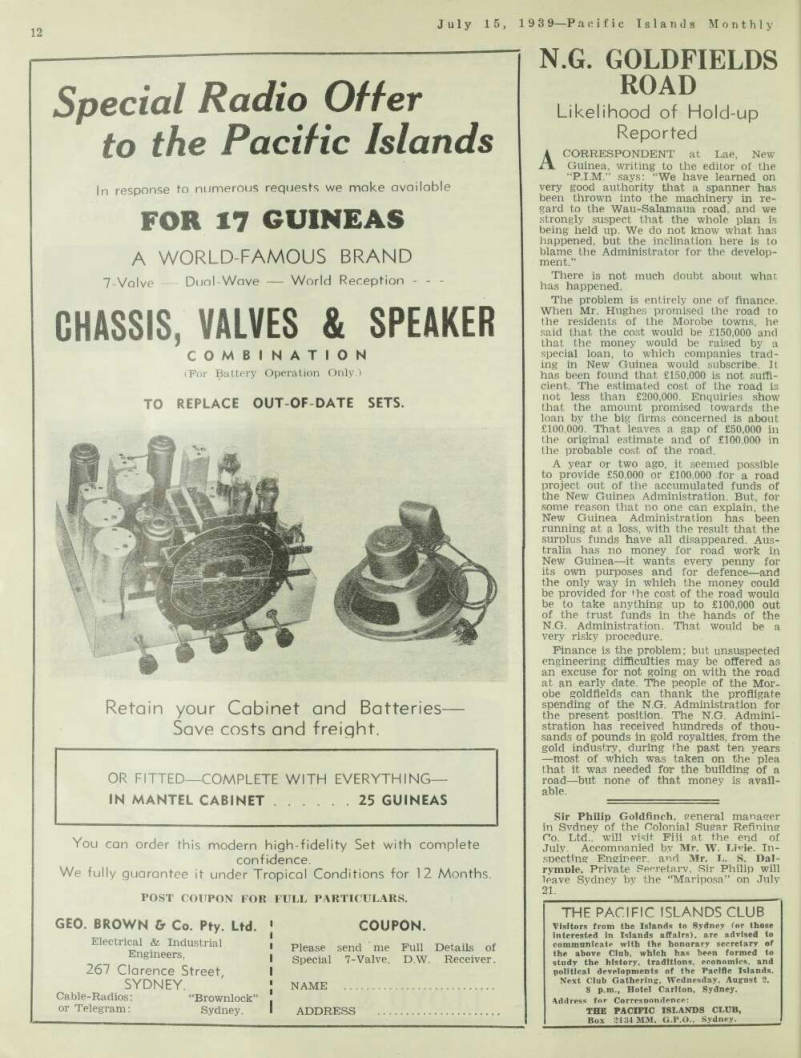
Special Radio Offer
to the Pacific Islands
In response to numerous requests we moke available
FOE 1 1 GUINEAS
A WORLD-FAMOUS BRAND
7-Valve Dual-Wave World Reception - - -
CHASSIS, VALVES & SPEAKER
COMBINATION
(For Battery Operation Only.)
TO REPLACE OUT OF DATE SETS.
Retain your Cabinet and Batteries —
Save costs and freight.
OR FITTED—COMPLETE WITH EVERYTHING—
IN MANTEL CABINET 25 GUINEAS
You can order this modern high-fidelity Set with complete confidence.
We fully guarantee it under Tropical Conditions for 12 Months.
POST COUPON FOR FULL PARTICULARS.
GEO. BROWN & Co. Pty. Ltd. 1 COUPON.
Electrical & Industrial , Plea se send me Full Details of engineers, I special 7-Valve, D.W. Receiver. 267 Clarence Street, I SYDNEY. name Cable-Radios: “Brownlock” or Telegram: Sydney. I ADDRESS
N.G. Goldfields
Road
Likelihood of Hold-up Reported
A Correspondent At Lae, New
Guinea, writing to the editor of the “P.1.M.” says: “We have learned on very good authority that a spanner has been thrown into the machinery in re gard to the Wau-Salamaua road, and we strongly suspect that the whole plan is being held up. We do not know what has happened, but the inclination here is to blame the Administrator for the develop ment.”
There is not much doubt about what has happened.
The problem is entirely one of finance.
When Mr. Hughes promised the road to the residents of the Morobe towns, he said that the cost would be £150,000 and that the money would be raised by a special loan, to which companies trad ing in New Guinea would subscribe. It has been found that £150,000 is not suffi cient. The estimated cost of the road is not less than £200,000. Enquiries show that the amount promised towards the loan by the big firms concerned is about £lOO,OOO. That leaves a gap of £50,000 in the original estimate and of £lOO,OOO in the probable cost of the road.
A year or two ago, it seemed possible to provide £50.000 or £lOO,OOO for a road project out of the accumulated funds of the New Guinea Administration. But, for some reason that no one can explain, the New Guinea Administration has been running at a loss, with the result that the surplus funds have all disappeared. Aus tralia has no money for road work in New Guinea—it wants every penny for its own purposes and for defence—and the only way in which the money could be provided for the cost of the road would be to take anything up to £lOO,OOO out of the trust funds in the hands of the N.G. Administration. That would be a very risky procedure.
Finance is the problem; but unsuspected engineering difficulties may be offered as an excuse for not going on with the road at an early date. The people of the Mor obe goldfields can thank the profligate spending of the N.G. Administration for the present position. The N.G. Admini stration has received hundreds of thou sands of pounds in gold royalties, from the gold industry, during the past ten years —most of which was taken on the plea that it was needed for the building of a road—but none of that money is avail able.
Sir Philip Goldfinch, general manager in Svdney of the Colonial Sugar Refining Co. Ltd., will visit Fiji at the end of July. Accomnanied by Mr. W. Li vie. In specting Engineer, and Mr. L. S. Dal rymnle. Private Secretary, Sir Philip will leave Sydney by the “Mariposa” on July 21.
Advertisements & other items, p. 14 (2 items)
12
July 15, 193 9—P acific Islands Monthly
The Pacific Islands Club
Visitors from the Islands to Sydney (or those interested in Islands affairs), are advised to communicate with the honorary secretary of the above Club, which has been formed to study the history, traditions, economics, and political developments of the Pacific Islands.
Next Club Gathering-, Wednesday, August 2, 8 p.m., Hotel Carlton, Sydney.
Address for Correspondence:
THE PACIFIC ISLANDS CLUB,
Box 2434 MM, G.P.0., Sydney.
System
Radio Telephone
New Guinea Now Has Most Modern System
rpHE installation of a radio-telephone 1 system linking four New Guinea towns, and giving a service based upon principles at least as advanced as those of any similar service in the world, was announced in July by Sir Ernest Fisk, chairman of Amalgamated Wireless (Australasia), Ltd.
Sir Ernest Fisk said that the towns are Lae, Salamaua, Bulolo and Wau. The§e places are from 25 to 60 miles apart, and the intervening country is so rough that to erect telephone lines there would be difficult. Lae and Salamaua are on the coast; but Bulolo and Wau, up in the mountains, would have been cut off from most of the amenities of civilisation, had it not been for aeroplane transport and communication by wireless.
Now, the radio-telephone system gives connection between any two of the four townships by the mere lifting of an or dinary handset telephone, and the press ing of a button to give the pre-arranged signal for the desired station. As soon as a conversation is completed, the re placing of the handset leaves the equip ment in readiness for calls from or to other stations.
Technical Difficulties
The technical difficulties of the instal lation were overcome in the research laboratories of Amalgamated Wireless, which organisation designed and con structed the equipment by arrangement with the Bulolo Gold Dredging Company and Guinea Airways, by which companies it is used for communication in carrying on aeroplane transport services.
Although incorporating the most mod em principles of radio communication, said Sir Ernest Fisk, the system had to be simple, calling for no expert skill nor attention and capable of operation by any layman. Actually, six complete alter nating-current-operated transmitting and
receiving equipments have been provided, fitted for duplex privacy operation, and employing four different transmission frequencies.
Two equipments have been installed at Lae, and one each at Bulolo, Wau and Salamaua, the sixth being a standby.
No Eavesdropping
Eavesdropping has been rendered im possible by the mechanical inversion, or “scrambling”, of speech. If anyone should succeed in overhearing a conversation, the words would be unintelligible, as the inverted speech is only rectified at the receiving instrument.
Samoa's Loyalty
From Our Own Correspondent APIA, June 22.
A FEATURE of the celebration of the King’s Birthday here on June 9. was an address by Hon. O. F. Nelson, on behalf of the European residents. He gave the Government an assurance of the sincere loyalty of the population of the Mandated Territory to the British flag and to the ideals of the British Em pire. A representative of the Samoan race spoke in similar strain.
"La Fhoque" Is Afloat Again
Good Salvage Work in Loyalty Islands
ON June 15, the steamer “Loyalty” reached Noumea, towing the new in ter-island motor-vessel “La Phoque”, which had been successfully salvaged from the beach in Ouvea, Loyalty Is lands, where she was thrown high and dry by the cyclone on March 25.
It was 'reported in May that “<La.
Phoque” was in a hopeless position. But a remarkably successful salvage job was done by M. Brunelet. and by the end of May it was evident that the little vessel would soon be afloat again.
“La Phoque” will be repaired in Nou mea, and should be back on her regular run in August.
Advertisements & other items, pp. 15-16 (3 items)
13
Pacific Islands Monthl y —J uly 15, 1939
SAVE il'i'o
To LONDON
IN EIGHT
COMFORTABLE
DAYS
To travel by Intercontinental Airways (K.N.T.L.M.- K.L.M.) gives you more time at journey’s end for extending your stay, more time for business, for pleasure, for seeing England and visiting the Continent.
Easy flying stages by day, restful stops at best hotels en route, plus an exceptionally low fare that includes meals and even tips, makes “via Intercontinental” a most attractive mode of travel.
Rates on application.
Departures:
EVERY TUESDAY
EVERY SUNDAY
FROM SYDNEY
AND BRISBANE.
Freight Accepted For London and destinations outside Australia.
K.N. I. L. M.
Royal Netherlands Indies’ Airways Ltd., (N. V. Koninklljke Paketvaart Maatschappij— Incorporated In the Netherlands).
PAKETVAART HOUSE, 255 GEORGE ST.,
SYDNEY. BW 2384.
Saigon; Diethelm & Co.; Port Moresby and Samarai: Steamships Trading Co. Ltd.; Rabaul, Salamaua and Wau; W. R. Carpenter & Co.
Ltd.; Port Vila: Gubbay Freres; Noumea: Carlo Leoni; Auckland: Russell & Somers Ltd.; Wellington; Johnston & Co. Ltd.
SAVE il'i'o
SPECIAL ISLAND PRICE
.£lO/10/0 For the smallest, lightest and most compact typewriter in the world.
THE “BABY”
EMPIRE PORTABLE
■ British made, from British steel—Specially finished to withstand tropical conditions, with all bright parts chromium plated, the Baby EMPIRE PORTABLE gives a lifetime of trouble-free service.
The smallest and lightest made yet not one essential feature has been sacrificed. Used in the Commonwealth Bank and on every Empire Flying Boat.
Write for your Baby Empire Portable to-day.
SEND NO MONEY.
POST COUPON NOW r-
, ’4 DAYS' FREE TRIAL. -. -j . Wholesale Typewriter Co., 1 Lombard Chambers, Pitt Street, Sydney. > I Dear Sirs, — • Please forward me on 14 days free trial a ( 1 Baby Empire Portable Typewriter. At the end of this period I agree to forward my I cheque for £lO/10/-, plus exchange, or return .
I the typewriter in good condition. Please use 1 Block Letters. ■ Name Address Business Reference L -
P.L6/39. j
Modern Refrigeration for the South Sea Islands
The ELECTROLUX kerosene operated
REFRIGERATOR
MARVEL
OF
MODERN
SCIENCE
THE
MIRACLE
OF
ICE
FROM
HEAT
THE ELECTROLUX OFFERS economical, modern and completely efficient refrigeration for
ISLANDS' HOMES.
FREEZES CONTINUOUSLY WHILE SMALL LAMP BURNS
Freezing controlled by simply regulating height of flame. Uses only gallon of kerosene per week.
MOTORLESS ... NO PARTS TO GET OUT OF ORDER.
MODEL L 22 MODEL L3BO MODEL LKSSO Capacity $ (as illustrated) * Capacity 2.2 cubic feet. Capacity 4 cubic feet. 5.5 cubic feet.
GUARANTEED FOR TWO YEARS
Obtainable from . .
W. R. Carpenter & Company Guinea Branches : Rabaul, But and Wewak. ® Write to your Local Distributor for prices and full details.
Ltd.—Sydney and following New W. R. Carpenter & Coy. (Solomon Is.) Pty. Ltd.—Tulagi, British Salamaua, Wau, Kaviong, Madang, Solomon Islands.
On Chong & Company Pty. Ltd.—Butaritari, Gilbert & Ellice Islands.
Representation in Papua and New Hebrides.
14
July 15, 193 9—P acific Islands Monthly
Leaves £200,000 P.A.
In Colony
Value of Fiji's New Gold Industry
IT would appear that the new gold industry in Fiji, established within the last few years, is already worth over £200.000 per annum to the Colony.
In an interesting contribution to the “Fiji Times" the chief accountant of the Emperor Gold Mining Co. says that the two mines, Emperor and Loloma, in 1938, employed 1.450 men (Europeans, Euro nesians, Fijians, and a few Indians) and paid them £130,000 in wages. In addition, the companies paid the following;— £ Total direct duty, port and ser vice tax paid during 1938 on imports for the two Companies totalled 11,549 Indirect duty, etc., on purchases of imports from local firms (estimated) 1938 11,127 Total Royalty, Port and Service Tax on Gold Exports for 1938 39,738 Estimated Income Tax payable by the two Companies for the year 1938 16,398 Total £78,814 Mr. Taverner says that it is fully ex pected that these figures will be re peated annually for many years to come.
May Beat Quinine
Monopoly Achievement in New Guinea
THE Australian newspapers, in June, got hold of a story to the effect that, despite the efforts of interests in the Netherlands Indies to keep the quinine industry as a Dutch monopoly. New Guinea had succeeded in breaking through the monopoly, and was now on the way to establishing a quinine industry there.
There were some doubts as to whether this was a correct presentation of the case.
Finally, a reporter discovered Mr. Q.
H. Murray, Director of Agriculture in New Guinea, who has been making a some what slow recovery from an illness, in Wootton Private Hospital, in Darling hurst, Sydney, and got the facts from him.
Mr. Murray said that, four years ago, he obtained a quarter of an ounce of seed from a former German agricultural research station in German East Africa, and from this small quantity of seed, at the experimental station established on the Ramu tableland, on the mainland of New Guinea, he had succeeded in raising 4.000 cinchona trees.
The trees which have been established in New Guinea are of the Red Cinchona variety. This variety yields four times as much quinine from its bark as ordinary cinchona, and this has enabled the Dutch to capture 95 per cent, of the world’s quinine market. The Dutch, for years, have taken extraordinary precautions to prevent the seeds of the Red Cinchona from being taken out of Java, and the world, as a result, has paid “through the nose” for quinine.
Mr. Murray’s success in establishing the Red Cinchona in New Guinea is a rather remarkable feat In tropical agriculture.
Flying Nail Destroys Eye
Rubber Planter's Bad Luck
From Our Own Correspondent
Port Moresby, June 25.
AN unfortunate accident occurred at Kikori, in the west of Papua, on June 19. Mr. Gordon Marshall, man ager of Ogamobu rubber plantation, was opening a packing case when he was struck in the eye by a nail flying up wards and his eyeball was seriously in jured.
A radio message was sent to Port Moresby, and to Guinea Airways at Lae, and the same afternoon Mr. Marshall was brought in to Port Moresby by Stin son seaplane and admitted to the Euro pean hospital. Owing to the serious and
delicate nature of the Injury, it was de cided to send Mr. Marshall by air-liner to Sydney.
Mr. Marshall was taken to St. Vin cent’s Hospital, Sydney, and it was found necessary to remove the injured eye. He is making an excellent recovery.
This family had had its full share of bad luck. A few months ago, Mrs. Mar shall nearly died from blackwater fever.
She was saved by good nursing, and was carried from that plantation to the coastal steamer, and sent to Port Moresby and Sydney, where she was convalescing when her husband arrived.
Mr, W. Candler, well-known representa tive of Australian trading firms, was in Fiji in June on one of his periodical visits to the Colony.
Advertisements & other items, pp. 17-18 (2 items)
15
Pacific Islands Monthl y —J uly 15, 1939
Oata\Eal
11l f 7k A 6/ 4 7,3 'I /. (/'Om's'** JlcfesTo'cc
TCKJHEYS
STOUT
minutes-
That's all the time needed for every strengthening drop of Scott s Emulsion to do its vital work in building up resistance to winter ailments . . . strengthening chest and lungs . . . storing up reserves of energy to meet emergencies. Eminent Research Chemists have proved that Scott's provides all the health-givtheir most easily digested form.
That's why children, who have failed to respond to other tonics, thrive on a course of
SCOTT'S
Emulsion
ing vitamins of Cod Liver Oil in
ALL
CHEMISTS
& STORES
AND
PER
BOTTLE
Japan’S Naval Spy System In
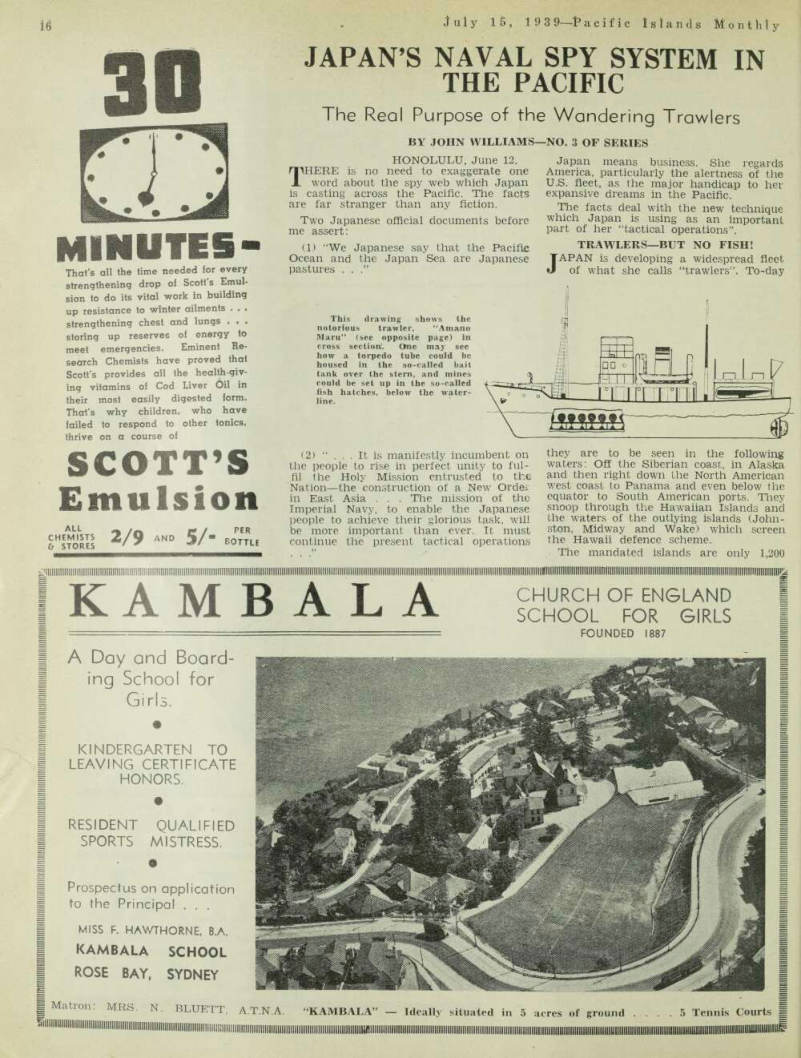
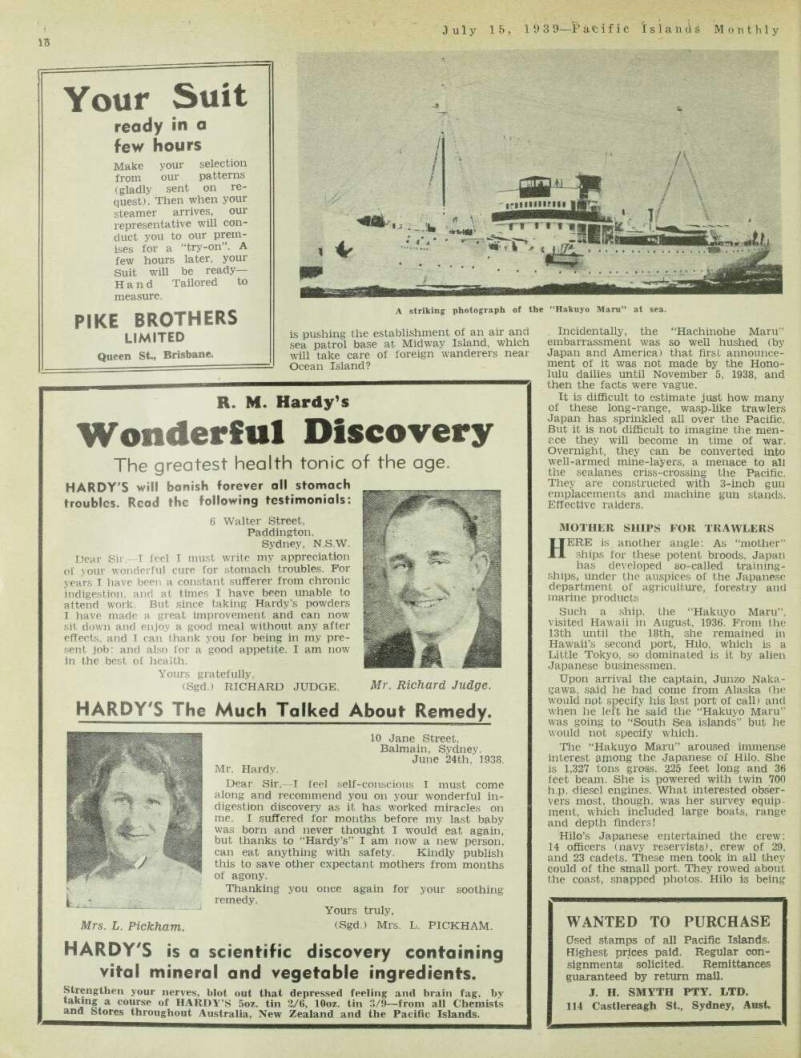
The Pacific
The Real Purpose of the Wandering Trawlers
By John Williams—No. 3 Of Series
Honolulu, June 12.
fTIHERE is no need to exaggerate one A word about the spy web which Japan is casting across the Pacific. The facts are far stranger than any fiction.
Two Japanese official documents before me assert: (1) “We Japanese say that the Pacific Ocean and the Japan Sea are Japanese pastures . .
Japan means business. She regards America, particularly the alertness of the U.S. fleet, as the major handicap to her expansive dreams in the Pacific.
The facts deal with the new technique which Japan is using as an important part of her “tactical operations”.
Trawlers—But No Fish!
JAPAN is developing a widespread fleet of what she calls “trawlers”. To-day
(2) “ ... It is manifestly incumbent on the people to rise in perfect unity to ful fil the Holy Mission entrusted to the Nation—the construction of a New Order in East Asia . . . The mission of the Imperial Navy, to enable the Japanese people to achieve their glorious task, will be more important than ever. It must continue the present tactical operations J 9
they are to be seen in the following waters: Off the Siberian coast, in Alaska and then right down the North American west coast to Panama and even below the equator to South American ports. They snoop through the Hawaiian Islands and the waters of the outlying islands (John ston, Midway and Wake) which screen the Hawaii defence scheme.
The mandated islands are only 1,200
This drawing shows the notorious trawler, “Amano Maru” (see opposite page) in cross section!. One may see how a torpedo tube could be housed in the so-called bait tank over the stern, and mines could be set up in the so-called fish hatches, below the water line.
miles from potent Midway. The mandates have for these trawlers fine roosting and refuelling ports, which are called “com mercial'’ developments. America says the same thing about the warplane, submarine and destroyer facilities now under way at Midway, Wake and Johnston Islands.
These steel-hulled Japanese trawlers are super-North Sea type. Here are aver age specifications: 120 tons gross; range of 10,000 miles with 250 h.p. diesel engines, but range can be doubled by fill ing so-called bait wells, on each side of the trawlers, with fuel oil; they carry crew of 15 men; they are equipped with short wave radio. Sonic depth finders and electric deep-sea sounders.
Remarkable thing about some of these nomadic trawlers is that seldom is a fish seen in their holds by the observers of various Governments who have been justified in boarding them in coastal waters!
Above the stem is a large fish tank: it could house a torpedo tube. The spacious fish hatches below could be converted for mine-laying racks. (See illustration on previous page.) The officers and crews are Japanese navy reserves.
A Sinister Craft
IfNANNOUNCED, the “Amano Maru", / a fine example of these trawlers, called in at Honolulu on July 1 and 2. 1937. Her captain was a Danish citizen.
Christian S. Albertson, and under him he had a crew of 15, all Japanese. The “Amano Maru” sailed for Balboa. Cali fornia, and thence to Panama.
“P.1.M.” readers should read ‘‘Secret Armies”, a new book dealing with the new technique of Nazi warfare, and ex posing Hitler’s undeclared war on the Americas, which has just been published in New York. The author is John L.
Spivak, crack U.S. investigating news man.
Of the “Amano Maru”, Mr. Spivak writes: “ ... In 1937, Yoshitaro Amano, a Japanese millionaire who has far-flung interests all along the Pacific coasts of Central and South America, organised Amano Fisheries, Ltd. The ‘Amano Maru’ was the first of the fleet built in Japan.
It has an extremely secret Japanese in vention for detecting mines . . . On Octo ber 7, 1937, Yoshitaro Amano headed straight for the military zone off the Nicaraguan coast (just north of the Panama canal). He was arrested and charged with espionage . , . Result of this was that the Republic of Panama can celled the ‘Amano Maru’s’ registration . . .
The ‘Amano Maru’ thereupon sped for Punta Arenas, Costa Rica, nearer the canal. in which harbour lurk the Japanese ves sels prohibited from Panamanian waters.
To-day the ‘Amano Maru’ is a mystery ship . . ”
But I can tell a better story about an other Japanese trawler which has been observed in Alaskan, North American and Panama waters—the “Hachinohe Maru”.
Mysterious Wreck
FROM, February to May, 1938, the U.S.
Pacific fleet conducted annual war games which centred, naturally, around the “keystone” of the navy-army bases in Hawaii and rigidly tested the protective screen established about Wake, Midway and Johnston Islands to the w^est.
By a “coincidence”, the “Hachinohe Maru” happened to be in the vicinity and so closely engrossed in the movements of the U.S. fleet that she ran aground on
Ocean or Kure Island (near Midway) on February 18—unknown, of course, to the fleet It was not until March 16, however, that the Japanese Consul-General in Honolulu advised the American naval authorities about the wreck. Japan had despatched a rescue vessel, meanwhile, but it found the trawler deserted (so Japan said). American units inspected the wreck and superficially it looked as though the crew of 25 men might have been drowned in making their escape from the wreck on the exposed reef. No S.O.S. signals were heard by the U.S. fleet or shipping near the area.
But, again, the crew might have been
rescued by another Japanese trawler: after all, the closest port of the man dated isles is only 1,200 miles distant and “Hachinohe Maru " was well e( » ui PP ed wim raa , . , Now, if the “Hachmohe Maru s mission was honest, why was her wreck kept sec ret for so long, and why has the Hono lulu consulate made such efforts to hush every reference to the “disaster ’? Com mercial wrecks, according to international custom, are reported immediately. If she was a commercial vessel, what was she doing in U.S. territorial waters, off the trans-Pacific tracks usually used by com mercial ships?
Is it any wonder that America to-day
is pushing the establishment of an air and sea patrol base at Midway Island, which will take care of foreign wanderers near Ocean Island?
Incidentally, the “Hachinohe Maru” embarrassment was so well hushed (by Japan and America) that first announce ment of it was not made by the Hono lulu dailies until November 5, 1938, and then the facts were vague.
It is difficult to estimate just how many of these long-range, wasp-like trawlers Japan has sprinkled all over the Pacific.
But it is not difficult to imagine the men ace they will become in time of war.
Overnight, they can be converted into well-armed mine-layers, a menace to all the sealanes criss-crossing the Pacific.
They are constructed with 3-inch gun emplacements and machine gun stands.
Effective raiders,
Mother Ships For Trawlers
HERE is another angle: As “mother” ships for these potent broods. Japan has developed so-called training ships, under the auspices of the Japanese department of agriculture, forestry and marine products Such a ship, the “Hakuyo Maru”. visited Hawaii in August. 1936. From the 13th until the 18th, she remained in Hawaii’s second port, Hilo, which is a Little Tokyo, so dominated is it by alien Japanese businessmen.
Upon arrival the captain, Junzo Naka gawa. said he had come from Alaska (he would not specify his last port of call) and when he left he said the “Hakuyo Maru” was going to “South Sea islands” but he would not specify which.
The “Hakuyo Maru” aroused immense interest among the Japanese of Hilo. She is 1,327 tons gross, 225 feet long and 36 feet beam. She is powered with twin 700 h.p. diesel engines. What interested obser vers most, though, was her survey equip ment, which included large boats, range and depth finders I Hilo’s Japanese entertained the crew: 14 officers (navy reservists), crew of 29, and 23 cadets. These men took in all they could of the small port. They rowed about the coast, snapped photos. Hilo is being
A striking photograph of the “Hakuyo Maru” at sea.
improved, coincidently, for U.S. submar ine purposes!
“Snoopers” Annoy Americans
THE Japanese trawlers are a nightmare to the U.S. fleet. During the recent war games of the fleet in the Atlantic, trawlers rounded Cape Horn and made their way into West Indies ports from which they steamed out and shadowed the U.S. fleet’s movements.
What could America do about it? After all, they were on the high seas. But what would Japan do about American “snoopers” off Japan?
These trawlers mean business. I have seen them in Dutch Indies waters, even hovering near Singapore. By now they must have made their way into the waters of the Islands territories admini stered by Australia. The ports of the Japanese mandated islands give them a strategic central Pacific position from which to operate.
Inquisitive Sampans
mHE achievements cf the ocean-going i trawlers are supplemented by smaller Japanese fishing boats, usually called sampans, which confine their ac tivities to local waters.
For example, the California, Mexican and Central American coasts are dotted with them. In Hawaii, alone, there are some 800. This sounds too stupid to be true; but 18 of the Japanese-owned sam pans in Hawaii are permitted to fish within the potent Pearl Harbour navy base itself.
In 1938 when the Pacific fleet was hold ing its war games, a special proclamation was made to exclude these 18 sampans from the harbour from March 30 to May 1- Even though the navy patrols the har bour, every now and then these Japanese are caught out of bounds, fishing in special sections of the harbour which are called “secret”.
For a long time the navy did not think these local sampans could do much about the High Seas Fleet. But an American navy reserve officer caused a panic when he did this: The sampans are ocean-worthy boats.
He stated he could sneak into the fleet at sea under darkness and escape without being detected. Navy observers were placed aboard his sampan.
The Pacific fleet was approaching Hono lulu simulating war conditions. That is, lights out etc. This man cruised out 20 miles and located the battleships. He sneaked in between the flagship (the ex haust muffled under water) and inter cepted small visual signals. These he radioed to the defending army forces at Honolulu, and they flew out bombers, much to the chagrin of the admirals.
Next year, at the next war games, this navy reservist, who knows his coastal boats, repeated the trick.
Now the U.S. navy is watching the sam pans—and the trans-Pacific trawlers— closer than ever. The admirals are con scious now of what “mosquito” coastal craft can do! (Next month’s instalment will deal with unbelievable angles to the menace of Japanese navy tankers in the Pacific, the undercover work they do, how they act as secret links between the Japanese com munities outside Japan. In Honolulu, for example, they remain for several days each visit. What happens behind the scenes of these visits?) Mr. G. Washington, of W. R. Carpenter and Co., Ltd., Salamaua, New Guinea, is at present spending furlough in the East.
Advertisements & other items, pp. 18-20 (3 items)
16
July 15, 193 9—l* acific Islands Monthly
Kamb A L A
A Day and Boarding School for Girls.
KINDERGARTEN TO
LEAVING CERTIFICATE
HONORS.
RESIDENT QUALIFIED
SPORTS MISTRESS,
Prospectus on application to the Principal . . .
MISS F. HAWTHORNE. B.A.
KAMBALA SCHOOL
ROSE BAY. SYDNEY
Matron: MRS. N. BLUETT, A.T.N.A.
CHURCH OF ENGLAND
SCHOOL FOR GIRLS
FOUNDED 1887
m m ‘KAMBALA” Ideally situated in 5 acres of ground . 5 Tennis Courts
DOUBLE
IT'S
MARVELLOUS
THE WAY KOLYNOS
LASTS AND LASTS..
AND LOOK AT MY
TEET H NOW-
REALLY
SPARKLING
mm KOLYNOS lasts TWICE as long because you use
only HALF as much
When you’re doing THIS to your present tube KOLYISOS will still look like THIS !/■ OLYNOS is a concentrated den tal cream, made from the dental prescription of Doctor N. S. Jenkins.
You need only half an inch on youi brush —just half as much as ordin ary tooth pastes. But that half inch of Kolynos multiplies itself 25 times inside your mouth. It bursts into a glorious foam that surges into every pit, fissure and crevice, and cleans and purifies in one action.
Have gleaming white teeth, and save money at the same time, with Koly nos. Awarded the Blue Seal of the Institute of Hygiene, London, for last 20 years. Get a tube to-day. At all chemists and stores medium size 1/3; large 2/-. K 3
BRUSH \S ENOUGH
Your Suit
ready in o
few hours
Make your selection from our patterns (gladly sent on request). Then when your steamer arrives, our representative will conduct you to our premises for a “try-on”. A few hours later, your Suit will be ready— Hand Tailored to measure.
PIKE BROTHERS
LIMITED
Queen St., Brisbane.
R. M. Hardy's
Wonderful Discovery
The greatest health tonic of the age.
HARDY'S will banish forever all stomach
troubles. Read the following testimonials:
6 Walter Street, Paddington, Sydney, N.S.W.
Dear Sir, I feel I must write my appreciation of your wonderful cure for stomach troubles. For years I have been a constant sufferer from chronic indigestion, and at times I have been unable to attend work. But since taking Hardy’s powders I have made a great improvement and can now sit down and enjoy a good meal without any after effects, and I can thank you for being in my present job: and also for a good appetite. I am now in the best of health.
Yours gratefully,
(Sgd.) RICHARD JUDGE.
HARDY'S The Much Tolked About Remedy.
Mr. Richard Judge. i / Mrs. L. Pickham.
Mr. Hardy. 10 Jane Street.
Balmain. Sydney.
June 24th, 1938.
Dear Sir,—l feel self-conscious I must come along and recommend you on your wonderful indigestion discovery as it has worked miracles on me. I suffered for months before my last baby was born and never thought I would eat again, but thanks to “Hardy’s” I am now a new person, can eat anything with safety. Kindly publish this to save other expectant mothers from months of agony.
Thanking you once again for your soothing remedy.
Yours truly,
(Sgd.) Mrs. L. PICKHAM.
HARDY'S is a scientific discovery containing
vital mineral and vegetable ingredients.
Strengthen your nerves, blot out that depressed feeling and brain fag, by taking a course of HARDY’S soz. tin 2/6, lOoz. tin 3/9 —from all Chemists and Stores throughout Australia, New Zealand and the Pacific Islands.
WANTED TO PURCHASE
CJsed stamps of all Pacific Islands, Highest prices paid. Regular consignments solicited. Remittances guaranteed by return mail.
J. H. SMYTH PTY, LTD.
114 Castlereagh St., Sydney, Aust.
17
Pacific Islands Monthl y—J uly 15, 1939
Languages
A Master of Melanesian Languages
THE announcement in the April ‘ P.1.M.” of the death in England, after a paralytic stroke, of Mr. Sid ney Herbert Ray has brought to light interesting details of the career of this former schoolmaster whose study of Melanesian languages won him a fore most place in scientific circles.
Mr. J. H. L. Waterhouse, F.R.G.S., F.R.A.1., who corresponded for some years with Mr. Ray, paid the following tribute to him in a recent issue of the “Rabaul Times”: — The passing of the Grand Old Man of Oceanic linguistics—Sidney H. Ray—will be received with regret the world over.
This wizard of Islands languages could take any one of some 50 Oceanic or In donesian tongues and not only translate their vocabularies, but dissect and explain them word by word. Numerous langu ages of Papua and of New Guinea came under his review; in fact the first link with N.G. was forged some 40 years ago.
In 1898, Cambridge University, ever alert to the value and possibilities of Oceanic research, despatched an expe dition to Borneo, Torres Strait and New Guinea, and in the party was the eager young London schoolmaster who was, in due course, to become the doyen of Ocea nic linguists. He was in Torres Strait again in 1907, with another Cambridge Expedition.
Ray’s achievements have ever carried the hall-mark of a devoted and enthu siastic scientist, and long years have seen
an almost continuous flow of books, mono graphs and reviews from his pen. At the time of his passing, at the age of 80, he had been solely responsible for over 70 publications, apart from another 50 in which he had collaborated. In 1926, his monumental work appeared ‘‘A
Comparative Study of the Melanesian Is land Languages” (600 pages).
He was an active and honoured Fel low of the Royal Anthropological Insti tute for many years, and rendered in valuable service on the Council. A mem ber of the Polynesian Society, he was also associated with various learned so cieties in Europe. The R.A.I. awarded him the Rivers’ Medal and Cambridge bestowed its honoured M.A. honoris Imperial recognition came, too when Mr.
Ray was placed on the Civil List by his late Majesty, King George V.
Monsieur Casimir, who was Acting French Resident Commissioner in the New Hebrides prior to the arrival in April of Monsieur Sautot, has gone to France on leave. He has been in the Con dominium Service since 1927.
Advertisements & other items, pp. 21-22 (2 items)
19
Pacific Islands Mont hi y—J uly 15, 1939
Macdonald
For all your
MOTOR SPARE PARTS
and
ACCESSORY
REQUIREMENTS
write the
Eodes Parts Company
275-277 Miller St.,
NORTH SYDNEY, N.S.W.
WE ARE MAIL ORDER
SPECIALISTS
in the supply of new and used parts for all types of
CARS, TRUCKS & TRACTORS.
All orders have the personal attention of Mr. R. Fades, who has had a lifetime experience with used and new replacements.
LOW PRICES.
PROMPT DESPATCH.
IMMEDIATE ATTENTION TO
ALL INQUIRIES.
Instruction Books and Manuals available.
Tel.: XB 1523.
If flying to Europe or anywhere
consult
MACDONALD
HAMILTON & CO
Air Travel Specialists Telephone 87511 for reservations Booking Agents for
W.R.C. AIRLINES
QANTAS EMPIRE AIRWAYS LTD.
INTERCONTINENTAL
AIRWAYS (KNILM & KLM)
Also Australian National Airways Airlines of Australia Ltd.
Ansett Airways Ltd.
For Reservations and further particulars write to;
MACDONALD HAMILTON & CO.
CHALLIS HOUSE, 4 MARTIN PLACE. SYDNEY
Telegraphic Address: "NALDHAM," Sydney Telephone: B 751 I
THE KING’S SCHOOL
(PARRAMATTA)
N.S.W.
Boarding School, founded 1831.
School year begins February 7, 1940.
For further particulars apply to
H. D. HAKE, M.A. (Cantab.) Headmaster.
Solomons
Future Of The
Gold is Difficult to Work
THERE undoubtedly is gold on the is land of Guadalcanal”, said Mr. A.
Macgeorge, a member of the Austra lian Institute of Mining and Metallurgy, who returned to Sydney from a gold in vestigation in the Solomon Islands in June. “But it seems that its development is a matter for the future. It would cost at least £30,000 to construct a decent road, and the cost of developmental work would be very heavy. ‘‘There is a range of mountains up to 8.000 ft. in height that forms the back bone of the island of Guadalcanal, and it is on the ridges that gold is likely to
be found. But it is difficult, broken, country. Some prospectors are panning small quantities of gold in the rivers in the gullies”.
Australian Control?
MR. C. E. CORDING, who went to Guadalcanal to investigate the chances of purchasing land in gold bearing country, also returned to Syd ney. He said the Solomon Islands should be administered in Australia. ‘‘Colonial Office administration does not seem to be successful”, he added. “The whole place seems to be dead. There is no developmental work. Roads are want ed badly. The British officials there seem to be sitting back waiting for the time they can retire.
“Accommodation for the visitor is bad.
I travelled through Dutch New Guinea several months ago, and the Dutch have erected comfortable resthouses in many places. There is nothing like that in the Solomons”.
Editorial Note
It is easy for casual visitors to criticise and condemn. These Pacific Territories are administered in accordance with cer tain policies. In the case of the Solo mons, the policy of the British Colonial Office is to govern the Protectorate as an important group of islands, of little eco nomic value, except for copra production.
There can be no reading plan unless there is money provided therefor, and money will not be provided unless there is a policy of encouraging settlement and development.
There is no such policy in existence in relation to any of the British-owned Pacific Territories—except Fiji (where the colony is well-established, and the impulse comes from within) and Papua (where there is a Governor wise and strong enough to do something on his own account). In all the other Terri tories, the officials mostly sit and wait for instructions from London, Canberra or Wellington: and the latter Govern ments merely fumble around, aimlessly, and become petulant and spiteful when urged to formulate some well-planned policy of development.
Seeking The Real Lode

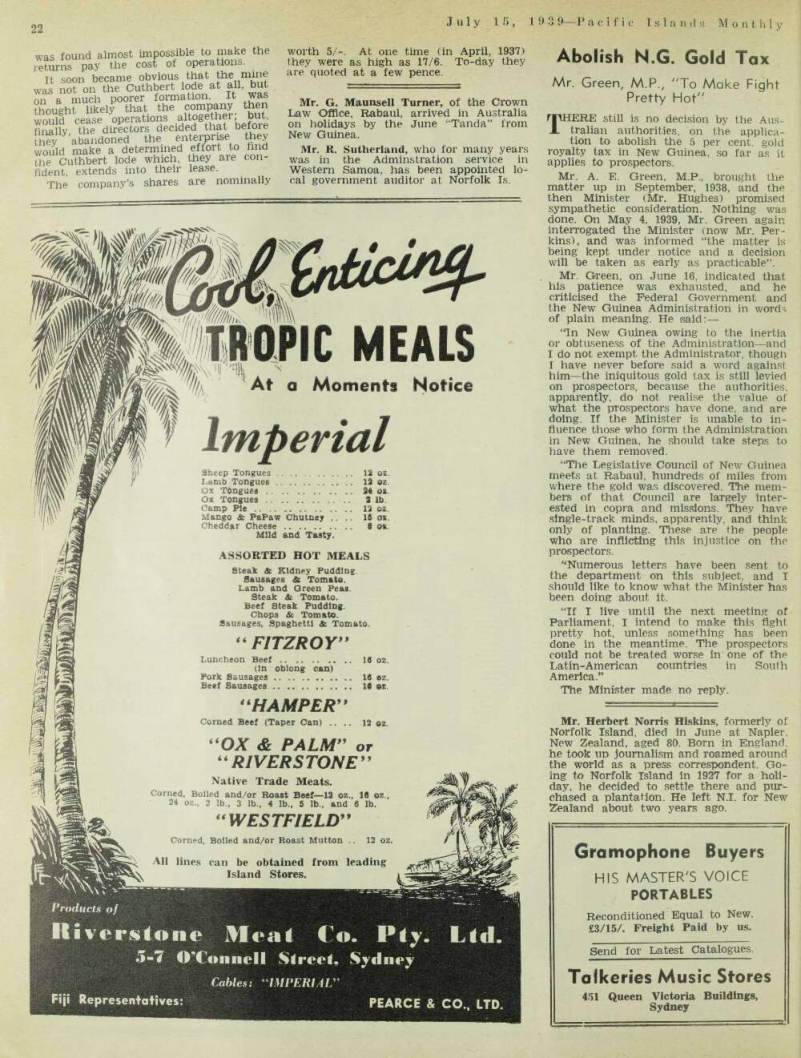
Gold Mines of Papua to Carry on
THE Sydney gold-mining company, Gold Mines of Papua Ltd., which is oper ating a large establishment on Misi ma Island, Eastern Papua, will not dis continue operations, as was announced by some of the newspapers in Austra lia. It will carry on with operations at the mine, and will intensify prospecting operations in its locality, in the hope of picking up the lode on which Cuthbert’s very prosperous gold mine is situated.
Gold Mines of Papua Ltd. was formed several years ago, out of the wreck of Misima Options, Limited. The well-known Pratten group got behind G.M.P., the ground was very carefully examined, and a large milling and recovery plant was placed in a selected part. The company had an extraordinary amount of ill luck, with accidents, sickness, and bad wea ther. but finally it got into operation early in 1938. Everyone believed that the mine was on the rich Cuthbert lode.
All examinations and assays up to that time supported that view. But when operations were commenced it was found that there was an extraordinary percent age of silver in the metal recovered, and a corresponding reduction in the amount of gold, with the result that it
was found almost impossible to make the returns pay the cost of operations.
It soon became obvious that the mine was not on the Cuthbert lode at all, but on a much poorer formation. It was thought likely that the company then would cease operations altogethe: before finally the directors decided that betoie they abandoned the enterprise they would make a determined effort to find the Cuthbert lode which, they are con fident, extends into their lease.
The company’s shares are nominally
worth 5/-. At one time (in April, 1937) they were as high as 17/6. To-day they are quoted at a few pence.
Mr. G. Maunsell Turner, of the Crown Law Office, Rabaul, arrived in Australia on holidays by the June “Tanda” from New Guinea.
Mr. R. Sutherland, who for many years was in the Adminstration service in Western Samoa, has been appointed lo cal government auditor at Norfolk Is.
Advertisements & other items, pp. 22-24 (2 items)
20
July 15, 193 9—P acific Islands Monthly
Nerv
END MINERAL STARVATION as thousands have—and
you end the cause of
BRAIN - FAG
and that “Depressed Feeling”
Lack of Confidence, Headaches, Nervous Indigestion, Sleeplessness, Listlessness, Anaemia, Nerve Pains, and other similar nervous constitutional disorders.
Nerves, lack of "pep", poor appetite and run-down feeling are due to insufficient vital mineral elements in the diet. Bidomak, by providing these important mineral elements, replenishes starved nerve cells and tissues, nourishes the blood, calms the nerves and helps restore perfect health. You'll be amazed, as thousands are, at the difference made by the iron, lime, sodium, potassium, phosphates, glycerophosphates and sucrose which Bidomak provides. It is pleasant and safe for even the youngest child to take—contains no dangerous drugs, opiates or narcotics. Get
Bidomak to-day.
NERVOUS BREAKDOWN ENDED
“I was suffering from a severe nervous breakdown, so started taking Bidomak.
I have found such benefit and feel so much better that I thought I would let you know how pleased I am. I have only had two bottles, but the result is wonderful. I had not slept at nights for months, but now have a good refreshing sleep, which helps such a lot during the next day”. (Signed) Mrs. E.A., Mortlake,
N.S.W.
COULDN'T SLEEP OR EAT
“For the past 12 months I suffered from weakness, fits of the blues, insomnia, loss of appetite and nervousness. After taking BIDOMAK for three weeks, I feel a new person. My nerves have benefited 100 per cent. Every night I knock off work feeling happy and content, even though I am camped on my own in the bush”. (Signed) J.G., Emmorville. N.S.W. 4 6/38.
AFTER 'FLU
Bidomak ends the horrible depression you feel after an attack of influenza and by supplying the important minerals which are lost during illness, it quickly builds body’s cells until you are completely restored to health.
Bidomak quickly overcomes the depressing effects of malaria and tropical lethargy. Energy returns, life becomes brighter—you eat well, sleep well and confidence grows quickly as vigour and nervous strain returns.
SCIENTIFIC
CONTROL
BIDOMAK is manufactured n one of the most up-todate, hygienic laboratories in the Southern Hemisphere, to which is attached a fully qualified Doctor of Medicine, and under the control of Chemists who were trained in the most modern English Laboratories in the world.
The Tonic of the Century
AT ALL LEADING ISLAND STORES
1 m I 1 I s?
I
fcjMJ
TROPIC MEALS
t At a Moments Notice
Imperial
Sheep Tongues 12 oz.
Lamb Tongues 13 oz Ox Tongues 34 oz Ox Tongues 2 ib.
Camp Pie 13 oz.
Mango & PaPaw Chutney ... 18 or Cheddar Cheese i ©a.
Mild and Tasty.
ASSORTED HOT MEALS
Steak & Kidney Pudding Sausages & Tomato.
Lamb and Green Peas Steak &, Tomato.
Beef Steak Pudding.
Chops & Tomato.
Sausages, Spaghetti & Tomato. <<
FITZROY ”
Luncheon Beef .. 18 oz. (in oblong can) Pork Sausages 18 oz.
Beef Sausages 16 ot
“ HAMPER ”
Corned Beef (Taper Can) ... 12 oz. a
OX & PALM" or
‘ RIVERSTONE ”
Native Trade Meats.
Corned, Boiled and/or Roast Beef—l 2 oz., 18 oz.. 24 oz., 2 lb., 3 lb., 4 lb., 5 lb., and 6 lb.
“ WESTFIELD ”
Corned, Boiled and/or Roast Mutton .. 12 oz.
All lines can be obtained from leading Island Stores.
I ro'lucts
Riverstone Meal Co. Ply. Lid
5-7 O’Cwniacll Street. Sydney
Cables: ■ IMPERIAL"
Fiji Representatives: PEARCE & CO.. LTD
Abolish N.G. Gold Tax
Mr. Green, M.P., "To Make Fight Pretty Hot"
THERE still is no decision by the Aus tralian authorities, on the applica tion to abolish the 5 per cent, gold royalty tax in New Guinea, so far as it applies to prospectors.
Mr. A. E. Green, M.P., brought the matter up in September, 1938, and the then Minister (Mr. Hughes) promised sympathetic consideration. Nothing was done. On May 4, 1939, Mr. Green again interrogated the Minister (now Mr. Per kins), and was informed “the matter is being kept under notice and a decision will be taken as early as practicable”.
Mr. Green, on June 16, indicated that his patience was exhausted, and he criticised the Federal Government and the New Guinea Administration in words of plain meaning. He said:— “In New Guinea owing to the inertia or obtuseness of the Administration—and I do not exempt the Administrator, though I have never before said a word against him —the iniquitous gold tax is still levied on prospectors, because the authorities, apparently, do not realise the value of what the prospectors have done, and are doing. If the Minister is unable to in fluence those who form the Administration in New Guinea, he should take steps to have them removed.
“The Legislative Council of New Guinea meets at Rabaul, hundreds of miles from where the gold was discovered. The mem bers of that Council are largely inter ested in copra and missions. They have single-track minds, apparently, and think only of planting. These are the people who are inflicting this injustice on the prospectors.
“Numerous letters have been sent to the department on this subject, and I should like to know what the Minister has been doing about it.
“If I live until the next meeting of Parliament, I intend to make this flght pretty hot, unless something has been done in the meantime. The prospectors could not be treated worse in one of the Latin-American countries in South America.”
The Minister made no reply.
Mr, Herbert Norris Hiskins, formerly of Norfolk Island, died in June at Napier, New Zealand, aged 80. Born in England, he took up journalism and roamed around the world as a press correspondent. Go ing to Norfolk Island in 1927 for a holi day, he decided to settle there and pur chased a plantation. He left N.I. for New Zealand about two years ago.
Advertisements & other items, p. 24 (2 items)
22
July 15, 103 9—P aci f i c Islands Monthly
Gramophone Buyers
HIS MASTER'S VOICE
PORTABLES
Reconditioned Equal to New. £3/15/. Freight Paid by us.
Send for Latest Catalogues.
Tolkeries Music Stores
451 Queen Victoria Buildings, Sydney
Boxing Champion
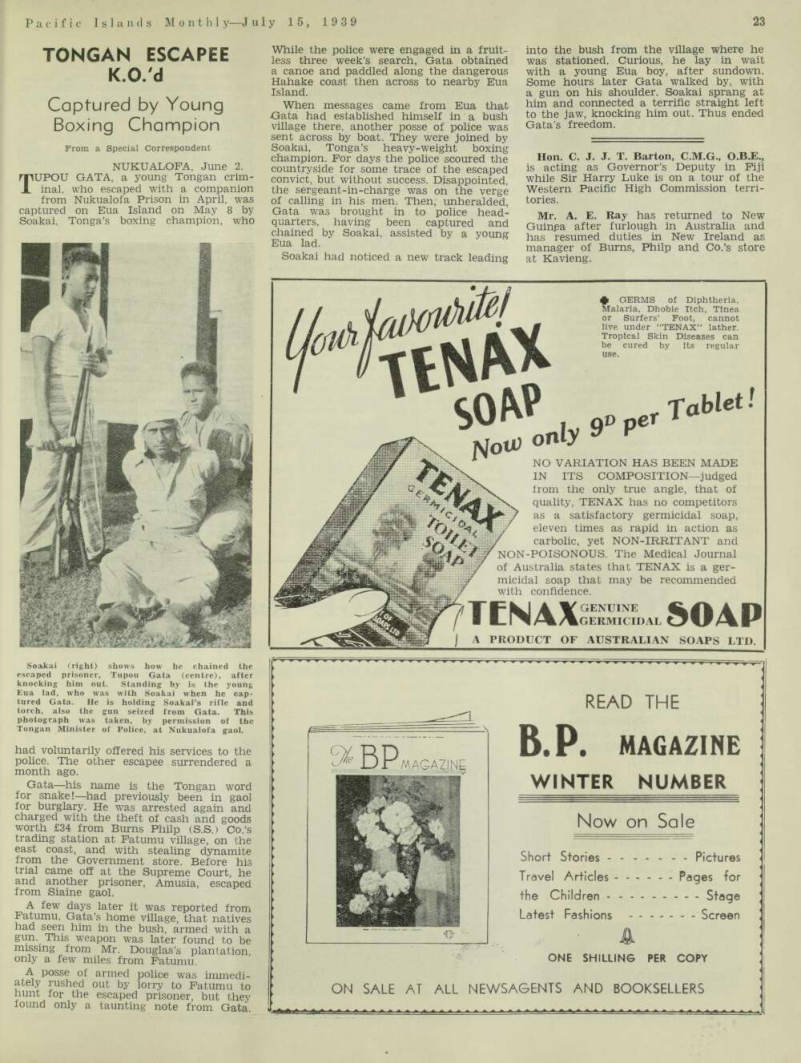
Tongan Escapee
K.O.'d Captured by Young Boxing Champion
From a Special Correspondent
Nukualofa, June 2.
TUPOU GATA, a young Tongan crim inal, who escaped with a companion from Nukualofa Prison in April, was captured on Eua Island on May 8 by Soakai, Tonga’s boxing champion, who
had voluntarily offered his services to the police. The other escapee surrendered a month ago.
Gata—his name is the Tongan word for snake!—had previously been in gaol for burglary. He was arrested again and charged with the theft of cash and goods worth £34 from Burns Philp (S.S.) Co.’s trading station at Fatumu village, on the east coast, and with stealing dynamite from the Government store. Before his trial came off at the Supreme Court, he and another prisoner, Amusia, escaped from Siaine gaol.
A few days later it was reported from Fatumu. Gata’s home village, that natives had seen him in the bush, armed with a gun. This weapon was later found to be missing from Mr. Douglas’s plantation, only a few miles from Fatumu.
A posse of armed police was immedi ately rushed out by lorry to Fatumu to hunt for the escaped prisoner, but they found only a taunting note from Gata
While the police were engaged in a fruit less three week’s search, Data obtained a canoe and paddled along the dangerous Hahake coast then across to nearby Eua Island.
When messages came from Eua that Gata had established himself in a bush village there, another posse of police was sent across by boat. They were joined by Soakai, Tonga’s heavy-weight boxing champion. For days the police scoured the countryside for some trace of the escaped convict, but without success. Disappointed, the sergeant-in-charge was on the verge of calling in his men. Then, unheralded, Gata was brought in to police head quarters, having been captured and chained by Soakai, assisted by a young Eua lad.
Soakai had noticed a new track leading
into the bush from the village where he was stationed. Curious, he lay in wait with a young Eua boy, after sundown.
Some hours later Gata walked by, with a gun on his shoulder. Soakai sprang at him and connected a terrific straight left to the jaw, knocking him out. Thus ended Data's freedom, Hon. C. J. J. T. Barton, C.M.G., 0.8. E., is acting as Governor’s Deputy in Fiji while Sir Harry Luke is on a tour of the Western Pacific High Commission terri tories.
Mr. A. E. Ray has returned to New Guinea after furlough in Australia and has resumed duties in New Ireland as manager of Burns, Philp and Co.’s store at Kavieng.
Soakai (right) shows how he chained the escaped prisoner, Tupou Gata (centre), after knocking him out. Standing by is the young Eua lad, who was with Soakai when he cap tured Gata. He is holding Soakai’s rifle and torch, also the gun seized from Gata. This photograph was taken, by permission of the Tongan Minister of Police, at Nukualofa gaol.
Advertisements & other items, p. 25 (2 items)
23
Pacific Islands Monthl y — J uly 15, 1939
IcfiAite!
SON"
fjou)
r. £ Ac Wr /; O Si 5> rv> * GERMS of Diphtheria, Malaria, Dhobie Itch, Tinea or Surfers’ Foot, cannot live under “TENAX” lather.
Tropical Skin Diseases can be cured by its regular use.
only 9° P er
Tablet
NO VARIATION HAS BEEN MADE
IN ITS COMPOSITION—judged
from the only true angle, that of quality, TENAX has no competitors as a satisfactory germicidal soap, eleven times as rapid in action as carbolic, yet NON-IRRITANT and NON-POISONOUS. The Medical Journal of Australia states that TENAX is a germicidal soap that may be recommended with confidence.
TENAX
GENUINE
GERMICIDAL
SOAP
\ PRODUCT OF AUSTRALIAN SOAPS LTD.
S^.BP
READ THE
B.P. MAGAZINE
WINTER NUMBER
Now on Sole
Short Stories Pictures Travel Articles Pages for the Children - - - Stage Latest Fashions Screen
ONE SHILLING PER COPY
ON SALE AT ALL NEWSAGENTS AND BOOKSELLERS
The Fate Op The “Matunga”
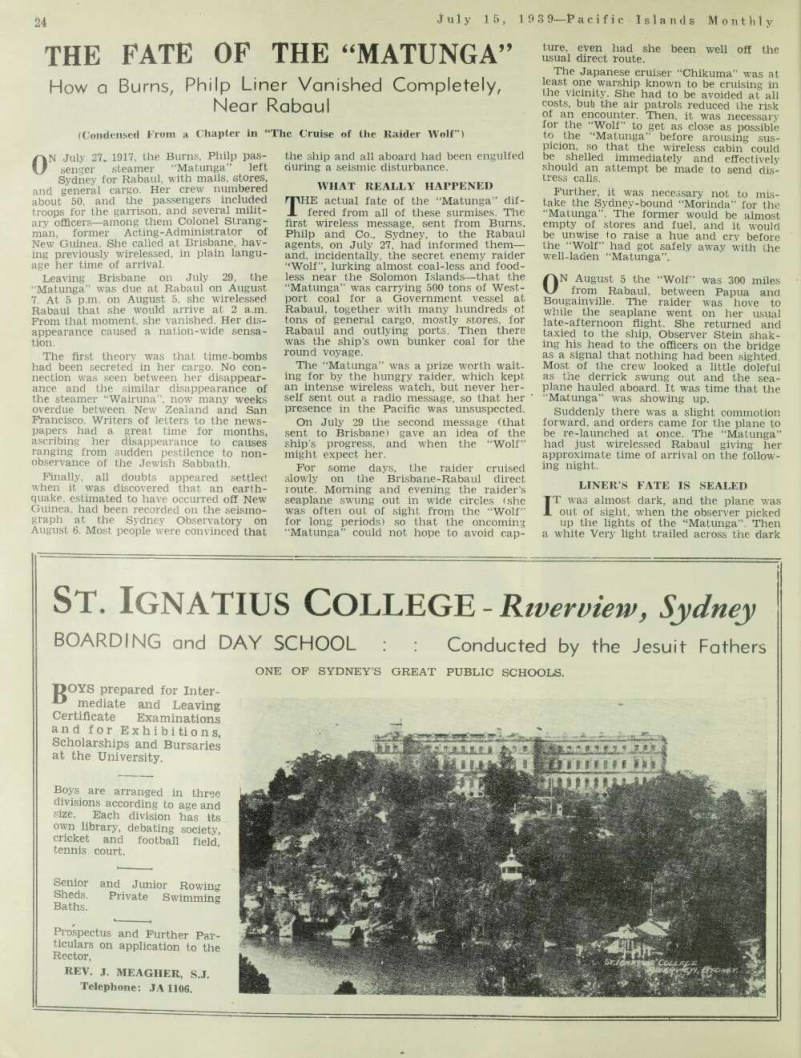
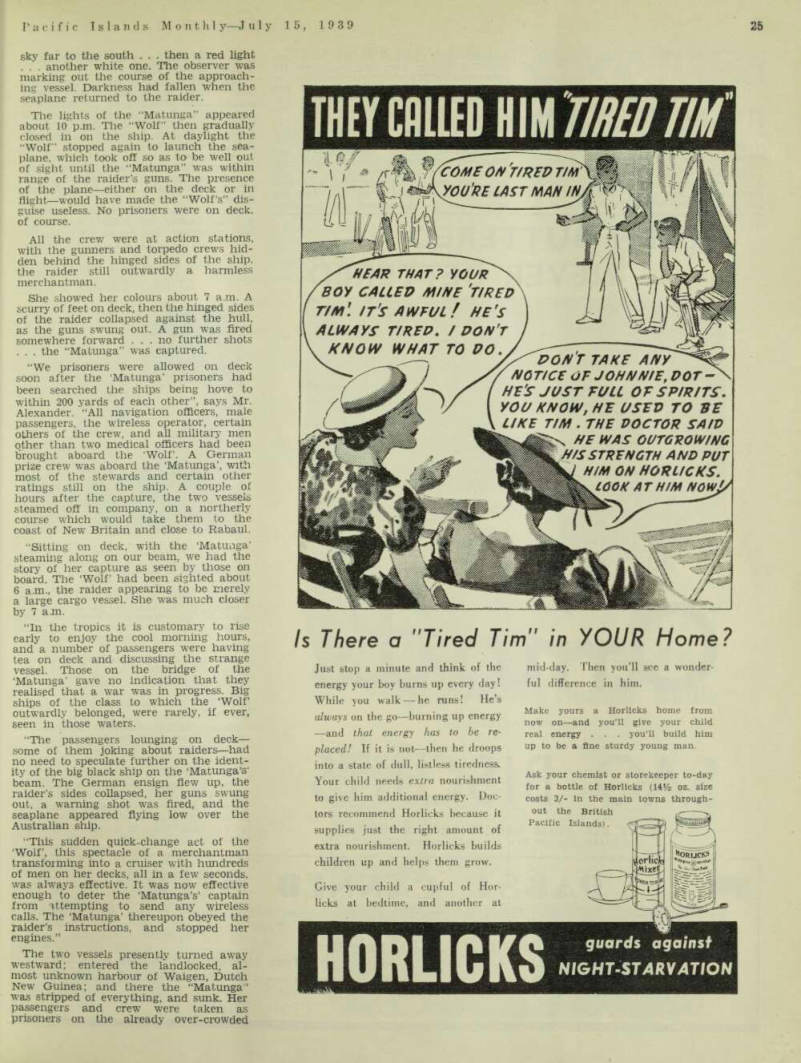
How a Burns, Philp Liner Vanished Completely, Near Rabaul
(Condensed From a Chapter in “The Cruise of the Raider Wolf" I
0N July 27* 1917, the Burns, Philp pas senger steamer “Matunga” left Sydney for Rabaul, with mails, stores, and general cargo. Her crew numbered about 50. and the passengers included troops for the garrison, and several milit ary officers —among them Colonel Strang man, former Acting-Administrator of New Guinea. She called at Brisbane, hav ing previously wirelessed, in plain langu age her time of arrival.
Leaving Brisbane on July 29. the “Matunga” was due at Rabaul on August 7. At 5 p.m. on August 5, she wirelessed Rabaul that she would arrive at 2 a.m.
From that moment, she vanished. Her dis appearance caused a nation-wide sensa tion.
The first theory was that time-bombs had been secreted in her cargo. No con nection was seen between her disappear ance and the similar disappearance of the steamer “Wairuna”, now many weeks overdue between New Zealand and San Francisco. Writers of letters to the news papers had a great time for months, ascribing her disappearance to causes ranging from sudden pestilence to non observance of the Jewish Sabbath.
Finally, all doubts appeared settled when it was discovered that an earth quake. estimated to have occurred off New Guinea, had been recorded on the seismo graph at the Sydney Observatory on August 6. Most people were convinced that
the ship and all aboard had been engulfed during a seismic disturbance.
What Really Happened
THE actual fate of the “Matunga” dif fered from all of these surmises. The first wireless message, sent from Burns, Philp and Co., Sydney, to the Rabaul agents, on July 27, had informed them— and, incidentally, the secret enemy raider “Wolf”, lurking almost coal-less and food less near the Solomon Islands—that the “Matunga” was carrying 500 tons of West port coal for a Government vessel at Rabaul, together with many hundreds of tons of general cargo, mostly stores, for Rabaul and outlying ports. Then there was the ship’s own bunker coal for the round voyage.
The “Matunga” was a prize worth wait ing for by the hungry raider, which kept an intense wireless watch, but never her self sent out a radio message, so that her presence in the Pacific was unsuspected.
On July 29 the second message (that sent to Brisbane) gave an idea of the ship’s progress, and when the “Wolf” might expect her.
For some days, the raider cruised slowly on the Brisbane-Rabaul direct route. Morning and evening the raider's seaplane swung out in wide circles (she was often out of sight from the “Wolf” for long periods) so that the oncoming “Matunga” could not hope to avoid cap
ture, even had she been well off the usual direct route.
The Japanese cruiser “Chikuma” was at least one warship known to be cruising in the vicinity. She had to be avoided at all costs, bubi the air patrols reduced the risk of an encounter. Then, it was necessary for the “Wolf” to get as close as possible to the “Matunga” before arousing sus picion, so that the wireless cabin could be shelled immediately and effectively should an attempt be made to send dis tress calls.
Further, it was necessary not to mis take the Sydney-bound “Morinda” for the “Matunga”. The former would be almost empty of stores and fuel, and it would be unwise to raise a hue and cry before the “Wolf” had got safely away with the well-laden “Matunga”.
ON August 5 the “Wolf” was 300 miles from Rabaul, between Papua and Bougainville. The raider was hove to while the seaplane went on her usual late-afternoon flight. She returned and taxied to the ship, Observer Stein shak ing his head to the officers on the bridge as a signal that nothing had been sighted.
Most of the crew looked a little doleful as the derrick swung out and the sea plane hauled aboard. It was time that the “Matunga” was showing up.
Suddenly there was a slight commotion forward, and orders came for the plane to be re-launched at once. The “Matunga” had just wirelessed Rabaul giving her approximate time of arrival on the follow ing night.
Liners Fate Is Sealed
IT was almost dark, and the plane was out of sight, when the observer picked up the lights of the “Matunga”. Then a white Very light trailed across the dark
sky far to the south . . . then a red light . . . another white one. The observer was marking out the course of the approach ing vessel. Darkness had fallen when the seaplane returned to the raider.
The lights of the “Matunga” appeared about 10 p.m. The “Wolf” then gradually closed in on the ship. At daylight the “Wolf” stopped again to launch the sea plane, which took off so as to be well out of sight until the “Matunga” was within range of the raider’s guns. The presence of the plane—either on the deck or in flight—would have made the “Wolf’s” dis guise useless. No prisoners were on deck, of course.
All the crew were at action stations, with the gunners and torpedo crews hid den behind the hinged sides of the ship, the raider still outwardly a harmless merchantman.
She showed her colours about 7 a.m. A scurry of feet on deck, then the hinged sides of the raider collapsed against the hull, as the guns swung out. A gun was fired somewhere forward ... no further shots . . . the “Matunga” was captured.
“We prisoners were allowed on deck soon after the ‘Matunga’ prisoners had been searched the ships being hove to within 200 yards of each other”, says Mr.
Alexander. “All navigation officers, male passengers, the wireless operator, certain others of the crew, and all military men other than two medical officers had been brought aboard the ‘Wolf’, A German prize crew was aboard the ‘Matunga’, with most of the stewards and certain other ratings still on the ship. A couple of hours after the capture, the two vessels steamed off in company, on a northerly course which would take them to the coast of New Britain and close to Rabaul, “Sitting on deck, with the ‘Matunga’ steaming along on our beam, we had the story of her capture as seen by those on board. The ‘Wolf’ had been sighted about 6 a.m., the raider appearing to be merely a large cargo vessel. She was much closer by 7 a.m.
“In the tropics it is customary to rise early to enjoy the cool morning hours, and a number of passengers were having tea on deck and discussing the strange vessel. Those on the bridge of the ‘Matunga’ gave no indication that they realised that a war was in progress. Big ships of the class to which the ‘Wolf’ outwardly belonged, were rarely, if ever, seen in those waters.
“The passengers lounging on deck — some of them joking about raiders —had no need to speculate further on the ident ity of the big black ship on the ‘Matunga’s’ beam. The German ensign flew up, the raider’s sides collapsed, her guns swung out, a warning shot was fired, and the seaplane appeared flying low over the Australian ship.
“This sudden quick-change act of the ‘Wolf’, this spectacle of a merchantman transforming into a cruiser with hundreds of men on her decks, all in a few seconds, was always effective. It was now effective enough to deter the ‘Matunga’s’ captain from attempting to send any wireless calls. The ‘Matunga’ thereupon obeyed the raider’s instructions, and stopped her engines.”
The two vessels presently turned away westward; entered the landlocked, al most unknown harbour of Waigen, Dutch New Guinea; and there the “Matunga’ was stripped of everything, and sunk. Her passengers and crew were taken as prisoners on the already over-crowded
“Wolf”. Their wanderings and adventures, before they reached Germany and a p?i£m camp, make a very thrilling story.
“Intelligence”
HERE is an extract from the book which any civilian population, faced with war and surrounded by spies, should remember. The “Wolf” is now approaching Singapore: — “For the Wolf’ to push her nose into this area looked like deliberate suicide; particularly considering that the raider was making only ten at the
outside. But Captain Nerger was not steaming blindly into this deathtrap. He possessed fairly recent information of naval movements at Singapore, and was well aware of the risks he ran. His souvenirs from the ‘Wairuna’ had in cluded fourteen bags of mail for America, from New Zealand. This mail had given the raider’s intelligence officer an excel lent idea of general conditions in the Pacific. The mailbags from the ‘Matunga’ had been even more informative. She had been carrying the garrison mail and Gov ernment dispatches to Rabaul. And the private mail, uncensored in Australia,
gave many details of the movements of cruisers in the East.
“Australia is closely linked with Singa pore. Some Australians were serving aboard ships attached to the Singapore base (H.M.S. Psyche as one instance) and the writers of these letters had sent long, gossipy screeds to people in Rabaul, de tailing the movements of mutual friends in the Eastern port. The writers had not imagined that they would fall into Ger man hands, but they gave Captain Nerger valuable information of the renewed naval activities at this base.” (From “Cruise of the Raider Wolf”, by Roy Alexander, just published by Angus and Robertson, Sydney, at 7/6.)
Advertisements & other items, pp. 26-28 (3 items)
24
July 15, 193 9—acific Islands Monthly
St. Ignatius College - River view, Sydney
BOARDING and DAY SCHOOL : : Conducted by the Jesuit Fathers OOYS prepared for Intermediate and Leaving Certificate Examinations and for Exhibitions, Scholarships and Bursaries at the University.
Boys are arranged in three divisions according to age and size. Each division has its own library, debating society, cricket and football field, tennis court.
Senior and Junior Rowing Sheds. Private Swimming Baths.
Prospectus and Further Particulars on application to the Rector,
REV. J. MEAGHER, S.J.
Telephone: JA 1106.
ONE OF SYDNEY’S GREAT PUBLIC SCHOOLS.
i'iiWi'i ill
mmdmMm mm.
mmdm
ii A » « 5? - ‘ .* ' m
mr medium mam
AT# /(COM EON TIRED TIM
t.) LAST MAN LNjtW^M
mh —
HEAR THAT? YOUR
BOY CALLED MINE 'TIRED
r/Nl'. IT'S AWFUL f HE'S
ALWAYS TIRED. / DON'T
*NO« **>TT<>'o..^ BO)l . TTAKe Any -
NOTICE OF JOHNNIE, DOT-
HE'S JUST FULL OF SPIRITS.
YOU KNOW, HE USED TO BE
LIKE TIM . THE DOCTOR SAID
HE WAS OUTGROWING
HIS STRENGTH AND PUT
HIM ON HORL/CKS.
LOOK AT HIM
r *5 i Is There a "Tired Tim" in YOUR Home?
Just slop a minute and think of the energy your boy burns up every day!
While you walk —he runs! He’s always on the go—burning up energy —and that energy has to he replaced! If it is not —then he droops into a state of dull, listless tiredness.
Your child needs extra nourishment to give him additional energy. Doctors recommend Horlicks because it supplies just the right amount of extra nourishment. Horlicks builds children up and helps them grow.
Give your child a cupful of Horlicks at bedtime, and another at mid-day. Then you’ll see a wonderful difference in him.
Make yours a Horlicks home from now on—and you’ll give your child real energy . . . you’ll build him up to be a fine sturdy young man.
Ask your chemist or storekeeper to-day for a bottle of Horlicks (14*72 oz. size costs 3/- in the main towns throughout the British Pacific Islands).
•OUIOO
orlic net ’•Kurort* i :
OFTEN BUTTERED
NEVER BETTERED
CRISP, LIGHT BISCUITS which
bring out the flavour of cheese and add a new attractiveness to fresh or stewed fruit.
A delicious supplement to ham or paste or other tasty savoury, and still an epicurean delight, served simply with fresh butter.
The rich excellence of these famous Biscuits is the result of 67 years of specialisation.
They are packed in air-tight tins or packets for picnic convenience.
Qmotis
FAMOUS
SAO BISCUITS
A 2 ALWAYS ASK YOUR GROCER FOR ARNOTTS !
WILLIAM ARNOTT PTY. LIMITED, HOMEBUSH.
PABST CANNED BEER
Brewed-in one of the world's largest and most modern breweries, PABST comes to you in genuine
"KEGLINED" NON-REFILLABLE CANS
TWO TYPES* S EXPORT BEER— -A Light Lager Beer.
Ir "* I PABST OLD TANKARD ALE—An English Type stronger and heavier than Export.
Packed In Cartons containing 24 x 12 oz. cans and sold throughout the Pacific; but In case of any difficulty In obtaining supplies, write to:
BOX 1861 K, G.P.0., SYDNEY.
"NO LIGHT CAN STEAL ITS FLAVOUR"
25
Pacific Islands Mont hi y—J uly 15, 1939
R.A.A.F. Seaplane Damaged
At Pt. Moresby
Warrant Officer D. Crawley, band master of the New Guinea Police Force, reached Sydney on June 23 by the “Tanda” from Rabaul, with his wife and child. They are now spending a short holi day in Melbourne.
Messrs. McKellar White and Egan, of Mariboi Rubber Estates, Ltd., returned to Australia by the “Macdhui” on June 14 after a short visit to their company’s property in Papua.
Mr. W. Links, assistant manager of Burns Philp (S.S.) Co., Ltd.’s Apia branch, Western Samoa, has resumed duties after an absence of seven months in Australia, recuperating from a severe illness and operation.
The R.A.A.F. Seagull amphibian which broke away from its moorings in Port Moresby Harbour, Papua, during a storm recently and was badly damaged on the reef off Tatana Island, was brought to Sydney on the deck of the “Macdhui”, for repairs. With its wings folded, the seaplane is shown on the wharf at No. 6 Walsh Bay, just after the “Macdhui’s” arrival in Sydney on June 14.
Official Visits
Governors on Tour in Pacific in N.Z. Warships
ALL the small cruisers of the British Navy, stationed in New Zealand, are at present engaged on cruises in the Pacific Islands.
H.M.S. “Wellington” is now completing a visit to the New Hebrides, Solomons, New Caledonia and Gilbert and Ellice Group, carrying the High Commissioner for Western Pacific, Sir Harry Luke. She is due back in Suva on July 24.
H.M.S. “Leander” left Auckland for Suva on June 27. She remained there from July 1 to 12. and will continue to Nukua lofa, July 14-17: Rarotonga, July 19-21; Borabora. July 23-26; Tahiti, July 27- August 2; Auckland, August 11.
The N.Z. Governor-General, Viscount Galway, left with the cruiser “Achilles” from Auckland on July 6. She proceeded to Rarotonga, July 11-12; Mangaia, July 13; Mauke and Aitu, July 14; Aitutaki, July 15; Penrhyn, July 17; Rakahanga and Manihiki, July 18; Danger Island, July 19; Fakaofu and Nukunono, July 21; Atafu, July 22; Apia, July 24-27; Pago Pago, July 28-31; Suva, August 3-9; Nukualofa. August 10-12; Niue. August 12; Auckland, August 18.
H.M.S. “Leith”, which left Auckland on May 18 for the Kermadec Group and Nukualofa, afterwards visited Vavau, Keppel Island, Niuafoo Island. Loma Loma and Levuka. She was at Suva, June 14-21; Turtle Bay, June 24-26; Havannah Harbour, June 27-28; Noumea, June 30- July 2; Norfolk Island, July 4.
"Nutfall" In Solomons
New Hebrides Expert to Investigate
AN entomologist, whose work is well known in the New Hebrides, Mr.
Depurtuis, has gone to the Solomon Islands under engagement to Messrs.
Bums Philp CS.S.) Co. Ltd., to study the problem of “Nutfall” in the coconut plantations in that territory.
As is well-known, “Nutfall” is one of the major problems of the Solomon Is lands. The pest falls upon various plan tations in the principal islands of the group in apparently haphazard fashion, and although different experts have diag nosed various causes, and some planters are convinced that they have found a remedy, the general opinion seems to be that the thing is still a mystery and still requires expert study.
One theory is that the disease is de finitely connected with poverty of soil; another is that some connection can be traced between the incidence of the dis ease and the periodical movements of cer tain species of ant.
Mr. Depurtuis expects to spend some months in the group, and he says that he goes to the problem with an open mind. He says, however, that “Nutfall” is not a thing unknown outside the Solo mons—that on the contrary the disease, or something quite similar, has been ob served in many places where there is ap parently a poverty of soil.
Mr. and Mrs. C. O. Handley and family returned to Fiji by the June “Niagara”, after furlough in Australia. He is ac countant for the C.S.R. Co., at Penang.
Demand For Fresh Foods
World Cruiser in Noumea
From Our Own Correspondent
Noumea, June 6.
WHEN the luxury liner “Franconia” called at Noumea, New Caledonia, with a large company of wealthy tourists on a world cruise, she dislocated the local food situation in no uncertain manner. As she approached the port, she sent orders by radio for fresh foodstuffs.
A dozen bunches of carrots, and 20 or 30 lettuces is a considerable order in Noumea; so that the demand for half a ton of one vegetable, a ton of another, and about a quarter of a ton of fish gave the merchants nervous prostration. Orders for
hundreds of dozens of eggs, and 100 dozen of lobsters and crabs set the distributors wringing their hands, to think that such wealth was about, and could rot be gathered in.
The “Franconia” got some fresh foods, but nothing like what was needed.
The passengers enjoyed themselves. In a procession of 72 hired cars, they wandered over the southern part of the great island, to I’Anse-Vata, Ouen-Toro, promenade Pierre Vernier, cite St-Louis and Plum.
Mr. J. Lods, Assistant Collector of Customs in the New Hebrides, is now spending long leave in Europe. During his absence his post is being filled by Monsieur de Gaillande.
Advertisements & other items, pp. 29-30 (2 items)
27
Pacific Islands Monthl y—J uly 15, 1939
Foster Clark's
s 13 <1 s L*3 ■U mm*®
FREE!
48-Page
Recipe Book
CUSTARP
SOLD BY
Here is a chance for all good cooks to become bettei —at no cost! Elizabeth Craig —England’s foremost cookery expert —has written a book of really delicious, easy-to-make Custard dishes for Foster Clark. The Recipe Book also contains exciting new recipes by an Australian authority. These include suggestions for hot and cold sweets, soups, sauces and fruit drinks.
The new Special Ice Dessext Supplement is particularly interesting to women who like to experiment with original dishes.
Write for your FREE copy of Elizabeth Craig’s Recipe Book to Foster Clark (Aust.) Ltd., Dept.
R. 8., Redfern, N.S.W. Enclose a penny stamp for postage.
ALL GROCERS IN 3 SIZES AND 4 FLAVOURS
FOSTER CLARK'S
W. H. GROVE & Sons Ltd.
Islands Traders po BOX 490 Auckland Telegraphic and Cable Address: “Grove”, Auckland.
Shippers of all classes of New Zealand Products, specially prepared for the Islands trade.
Representing Rylands Cr Sons (Col.) Ltd., of London and Manchester Porbury Henty & Co. Pty. Ltd., of Sydney and Kobe.
"AGFA" Photographic Corporation, of Berlin.
J. Blair King, of London. World-famed Shirts.
Burrell & Co. Ltd., Millwall, London, E. 14. Oil, White Lead and all classes of Paints, including "FERROCENE", their special Tropical Paint PREVENTS CORROSION . . made in RED,
GREY, and GREEN.
0. 1 / Photograph with Agfa Isochrom - this is a film for all types of exposures. It enables you to get the best out of your photographs. Good definition, reproduction of the finest details, brilliant gradation, and high sensitivity. Orthochromatic with wide exposure latitude.
Earthquake
Disastrous B.S.I.
Loss of Life and Heavy Damage on Guadalcanal
FURTHER reports from the Solomon Islands indicate that the earth quake and subsequent tidal waves experienced on April 30 were probably the most severe the Protectorate l as felt.
At least 10 lives were lost on the Guad alcanal coast, mostly women and child ren. Many villages were completely de stroyed and food gardens on the coastal areas were demolished. Although the centre of the disturbance was in the Russell Group (Cape Marsh) and the ad jacent Guadalcanal coast, other parts of the Group were affected.
Lavoro Estate on Guadalcanal was the greatest sufferer, being practically wiped out. All the buildings have gone; the launch was carried 200 yards into the bush; and the motor truck twisted round a tree. Mr. L. G. Hanscombe, the manager, succeeded in reaching the safety of high land with his child, while his wife, as sisted by Mr. Jack Svensen followed. The latter were overtaken by tidal waves, the water passing over their heads several times as they clung to coconut trees. The water reached a height of 20 ft. up the hill at the back of the plantation.
Maravovo and Visale also suffered severely. At the Roman Catholic Mission at Visale the damage to buildings was extensive. The Bishop’s launch was hurled, from the slip.
At Lingatu (Cape Marsh), the bay emptied itself several times. In this area, West Bay and Yandina plantations were the worst sufferers.
Baby In A Tree Top!
On the Ysabel coast many native villages were submerged and the Mel anesian Mission at Mara na Tabu suffered considerable damage. A native woman, rushing to high land with her infant was overtaken by the tidal wave; the child was washed from her arms and she was taken to sea. Brought back by a subsequent wave, she located her baby by its crying, in the top of a tree!
A Marovo Lagoon resident reports that the shock there was severe, the waters rising about 6 ft. above high water mark.
The wharf at Segi was demolished; water tanks were damaged at the house; and a quantity of crockery and glassware was broken. Creaking timbers in the house added to the almost-deafening noise.
The Seventh Day Adventist Mission in the same area reports little damage at the Batuna Station. At Gatakai, near the entrance to the Lagoon, however, a native village was swept to sea and the water reached the flooring of Burns, Philp & Co.’s living quarters.
At Tulagi, the capital, the earthquake was slightly felt, but little damage was done. At Gavutu, headquarters of Levers’
P.P.P., Ltd., a launch was carried on to the wharf, and footpaths and roads were damaged.
On receipt of the news of the earth quake, the Acting Resident Commissioner (Mr. P. E. Johnson) despatched the Gov ernment vessel “Tulagi” to the stricken area, with Major G. E. D. Sandars (Dis trict Officer) and a doctor on board.
Missionary’S Experiences
MR. FRED. R. ISOM, printer at the Melanesian Mission Station at
Hautabu. Guadalcanal, writes under date May 7:— "During my 26 years’ experience In the Pacific. I have known nothing compar able with the disastrous earthquake and tidal wave that struck our place at 2 p.m. on Sunday, April 30. The actual earthquake was tremendous, the violent heaving and shaking must have lasted fully five minutes and many lesser shocks followed.
"Then came a tidal wave variously estimated to have been 20 to 30 ft. high.
We heard the roar and watched it come in over the reef and creep up the foot of our hill, then spread over the plantation inland for a long way. Down below, cow yard and bail were smashed, copra drier turned over, boat shed badly battered, and copra store lifted from its floor and dumped some yards back—still contain ing 20 bags of copra. A newly-erected heavy-duty bridge over the river was badly shaken, but it is still standing.
“In the dwelling house half our china was broken, and the furniture and every kind of household impedimenta littered the floor. Outside, all the seven water tanks were down, four of them squashed like concertinas. What a sight met our eyes in the printing room! Type cases upset everywhere, machines off their run ners, and thousands of sheets of unbound books scattered around the room. A con servative estimate of the damage here is over £275,
“I understand that nearly every native house from Visale back to Hautabu was washed away, as were also the houses for
What the recent earthquake and tidal waves in the Solomon Islands did to the Melanesian Mission School at Maravovo, Guadalcanal Island. Photograph at top left shows Rt. Rev. W. H.
Baddeley (Bishop of Melanesia), Rev. L. Stibbard, and Mr. F. N. Ashley (Resident Commis sioner) on a bridge near the School, when the R.C. paid a visit there in April. The picture at bottom left shows the same bridge a week later, after tidal waves had swept inland from the sea. Top right.—A galvanised-iron copra store was torn from its concrete foundations (where the men are standing) and hurled to the left. The other building did not suffer much damage because its front was open on the sea side. Bottom right.—Water tanks thrown down by the quake. Two other larger tanks were flung to the bottom of the slope, at right.
Photos: A. Lewis Milner.
about 20 miles on the other side of us towards Wanderer Bay. At Naro, the next village to us, six natives were killed out right and three have since died.
“We are still getting a number of nasty shocks each day, but they are gradually easing.”
The work of rebuilding No. 2 jetty (usually known as Burns, Philp’s jetty) in Port Moresby Harbour, Papua, was commenced early in June.
The former French man-o-war “Eure”, whose last station was at Noumea, New Caledonia, and which had been a hulk in Auckland, N.Z., for some years, is now being broken up.
A team of Fijian Rugby Union foot ballers will make a tour of New Zealand between August 17 and September 21.
Advertisements & other items, pp. 30-32 (3 items)
28
July 15, 193 9—P acific Islands Monthly
29
Pacific Islands Monthl y —J uly 15, 1939
Capstans
Quick, Safe
RELIEF from
« Headache
® Tropical Fevers
9 Heat Exhaustion
® Nerve Or Muscular Pains
YOU should NOT suffer pain—it Is harmful and lowers resistance to dangerous germs. Vincent’s A.P.C. is deep-seated in its action; it stimulates the nerve and muscular system causing a healthful relaxation which removes pain and exhaustion. Because Vincent’s A.P.C. has a definite therepeutic value it assists greatly in fighting off and in the actual treatment of tropical fevers, rheumatism, arthritis and sciatica.
At the first sign of headache or any other nerve pain take Vincent’s A.P.C. powders or tablets—and get positive relief WITHOUT after-effects, because Vincent’s is the balanced prescription formulated by the Medical Superintendent of Australias largest public hospital Vincent’s A.P.C. Is the safest
FOR SAFETY’S SAKE. SAY “VINCENT’S”.
and best keep it handy always.
POWDERS i
UllElt
l/» AND 2/*
SINGLES 2d t.
CAPSTANS
vV A T 0^ P G Capstan Cigarettes round airtight 50's.
Medium and full strength. im from N6T
SPECIALLY
iP PACKED FOR
THE TROPICS
Capstan Navy Cut Tobacco, made the finest Virginia leaf. 8826-10-8
GUINNESS
Stout
FOE STRENGTH
m
wtmk
iia L Si trm ?§lffla3!SSftl
STOCKED BY ALL BRANCHES OF
Brown & Joske Ltd. W. R. Carpenter & Co. Ltd.
Burns Phllp & Co. Ltd. Morris Hedstrom Ltd. dvertisement of Export Bottlers Ltd., London. A. Macfee & Co. Ltd., Wapplng, Llverpot aas ... England.
Obstructive
Natives
Difficult Situation Near Rabaui
THERE was a remarkable scene in Rabaul, in the middle of June, when 45 natives from Ratavul, near Rabaul, ap peared before the Compensation Court, presided over by the Chief Judge, and refused to accept payment of compensa tion from the Government for land which had been taken for the erection of a native hospital.
The present native hospital is at Rap indik, beside Rabaul, and must be re moved from the proximity of an active volcano. The Government selected a new site in Ratavul, and the land was re sumed.
Only a few acres are involved and, al though there are thousands more acres of suitable and fertile land available, the natives have obstructed the Government plan in every possible way. Finally, they came to the Compensation Court and said that they would rather have the land than the £727 which it was proposed to pay them as compensation.
The Chief Judge argued with the natives, and discussed the matter very patiently, but they were still stubborn in their refusal. Thereupon, the Court dismissed the natives and took the evi dence of valuers, to satisfy itself that the amount of compensation proposed was fair and equitable.
There is far more in this than meets the eye.
It is well-known that the natives in this particular district are influenced to a considerable degree, against the author ity of the Government, by two Europeans.
The conviction is growing in New Guinea that the only way to put an end to the native restlessness in the district is to remove from the Territory the two Euro peans in question, on the ground that they have no proper appreciation of the responsibilities and obligations which must be carried by Europeans in a primi tive community.
This Life Of Ours
In a clearing hewn out of the jungle, By natives, with axes and knives, Is a hole in the ground, and a battery.
It is here we are spending our lives.
It is here we eke out our existence — Chopping-blocks for the numerous ills, Being eaten by bloodthirsty insects, Getting thin, climbing up and down hills.
Assailed with the odours of natives, Wa<y down in the bowels of the earth; Being bathed in our own perspiration— We ask ourselves, what is it worth!
When time allows us meditation These are some of the thoughts in our mind; When we started on civilisation, We left happiness far back behind.
Where civilised man meets the savage, He learns what is funny, but true: It is better by far to be savage Than work all your life for a “screw”.
Papua.
L.H.W.
105 Aerodromes in Australia's
Pacific Territories
THE Superintendent of Civil Aviation in New Guinea, Mr. J. A. Collopy, who is at present on a visit to Aus tralia, informed newspaper reporters that there are now no less than 105 aero dromes in the territories of New Guinea and Papua. Many of them are merely landing grounds, but all of them are per fectly safe and have been laid down ac cording to official specifications.
Dr. B. G. Mitford, who served as a Government Medical Officer for several years in Western Samoa, died recently at Wairoa, New Zealand.
Mr. V. J. Clinch, who nas been on Sunday Island, Kermadec Group, for two years as radio operator attached to the Government survey party, returned to N.Z. by the June “Maui Pomare”
Advertisements & other items, p. 32 (1 item)
30
July 15, 198 9—P acific Islands Monthly
Governors Meet
British And French
THE small British cruiser, “Welling ton”, with the High Commissioner for the Western Pacific (Sir Harry Luke) on board is now on her usual winter pat rol in the Central Pacific.
From Suva the “Wellington” proceeded to the Condominium of the New Heb rides the British Protectorate of the Solomon Islands, and the Gilbert and Ellice Islands Colony, following generally the itinerary published in the “P.1.M.” in May.
An addition to the programme, how ever, was a visit which His Excellency, Sir Harry Luke, paid to the French High Commissioner for the Pacific (Mon sieur Jore) at Noumea, New Caledonia.
This was the first time for many years that this international courtesy had been observed, as between the Governors of the British and French possessions in the Pacific, and Sir Harry Luke is to be com plimented upon having initiated a cus tom which, it is hoped, will continue.
H.M.S. “Wellington" is expected back in Suva late in July, but will not return to her station in New Zealand until Oc tober. It is not disclosed where she is going in late August and September.
Mr. A. Gaskin, of the New Guinea Audit Department, arrived in Sydney on leave by the airliner “Caronia” in mid- June.
Dr. Phyliss Kaberry has been carrying out research in social anthropology since last May, for the Australian National Re search Council in a village near Maprik aerodrome, Sepik District, T.N.G.
Satan's Colour
The Garden of Eden in Pidgin
THE following conversation took place, in Pidgin, between a European woman in New Guinea and her cook-boy, whom she found was a Mission product.
The lady wanted to find out how much the boy knew of Holy Writ, so she started with Genesis.
Said she: “How’s that man ’e come up along country?”
The boy: “Now one fella garden ’e stop —no got man; now God ’e catch im some fella white-sand; now ’im ’e hold ’im along hand, now ’im ’e blow along ’im, now man ’e come up.”
The lady agreed, and asked the boy if everything was then “good fella”.
“No”, said the boy. “One fella man ’im ’e no good. God ’im ’e like make ’im one fella Mary along : im”, and he duly ex plained how God took a rib from the man and “one fella Mary ’im ’e come up”.
So far so good, thought the lady, and asked him if everything was all right then.
“No”, said the boy, “Now along this fella garden, ’e got one fella dee-why along fruit, ’im ’e itambu. God ’e talk all-a-same, no can kai-kai along this fella. Now Mary ’im ’e catch ’im one fella fruit, all-a-same apple, along this fella dee-why. Now nurra (another) fella man ’e stop along garden, ’im ’e bad fella man, ’im ’e talk all-a-same along Mary ’im ’e catch ’im this fella fruit. Now altogether something along garden ’im ’e come up no good.”
The lady again agreed, and said: “Ah.
this fella man ’e no good, now what name along ’im?”.
“Satan” said the boy glibly.
“True”, said the lady. “This fella ’im ’e bad fella too much; ’im ’e black man true.”
Immediately the reply came: “No, Missy, ’im ’e no black man; 'im ’e white man true!”
Thus are our black brethren instructed.
Silverfish Book Varnish
INQUIRIES are often made for a prep aration that can be painted over the covers of books to prevent damage by silverfish and cockroaches.
The following mixture has been tried successfully over a number of years both in tropical and temperate regions with consistent success:— Shellac i oz. or 10 grams.
Creosote ... 2 drahms or 5 c.c.
Methyld. spirit 8 oz. or 160 c.c.
It is advisable to break the shellac up fairly small as it is slow to dissolve. Mix the ingredients together in a bottle larger than required for the volume, and keep shaking. This varnish is painted over the covers and it is not sticky when dry, and gives a dull surface. It will, unfortunately, dull gold lettering on bindings.—New Guinea Agricultural Gazette.
Mr. Robert Worbey, of the Fiji Public Works Department, Suva, died recently aged 75. He had been in the Colony for 20 years—lo of them spent as a carpen ter and joiner with the Whan Construc tion Co.
Miss Thora Jenkins, of Remeura, ar rived in Sydney by the June “Monterey from New Zealand on her way to the Solomon Islands to take up missionary work with the South Sea Evangelical 9ocietv. She will join her elder sistei.
Miss Molly Jenkins, of Fo’ondo, who has been a worker for the S.S.E. Mission in 8.5.1. for nine years.
Mrs. E. W. Fenner, widow of Mr. E. W.
Fenner, who for many years was Senior Manager in Fiji for the Colonial Su B^ r Refining Co., Ltd., arrived in Suva by the Tune “Niagara” to visit her two sons ana a grandson, all of whom are in the ser vice of the C.S.R. Co, Mr Peter Olssen, of the Walu Bay Depot of the Fiji Public Works Depart ment, died in Suva Hospital recently.
Only 24 years of age, he was well-known and liked in Fiji sporting circles.
Advertisements & other items, pp. 33-34 (2 items)
31
Pacific Islands Monthl y—J uly 15, 1989
Centrifugal Pumps
DIESELS For HARD JOBS
Fetter Crude Oil Engines
Valveless, Iwo-stroke Petter patent cold starter. Low fuel consumption. Perfect lubrication. G to 21 BJLP. Stationary and portable types. Send for new catalogue just published m
Centrifugal Pumps
chain drive. 31
‘7 TO It M»R«ET STREET SYDNEY
EVERY KIND of PLOW
For Every Kind of Job
to heavy-duty tractor-drawn road plow. Long experience of specialized manufacturing gives leadership. Strength, without unnecessary weight, makes "BUZACOTT" the best plow you can buy. Let us quote for the plow you need. from singlefurrow mouldboard D
PETROLECTR 1C LIGHT
BUZACOTT FETTER
800 Watt • 32 Volt
Home Lighting Plant
Dependable and very economical lor the moderate size (arm home.
Buzacott Petrol-Kerosene 2 H.P. Series with multiple vee-belt drive to oversize generator.
Complete with battery, switchboard and push-button starting. Send for particulars
CUTS LOGS QUICKLY
Engine-driven saw for cutting logs up to 7 ft. diameter. Easily operated by one man. Propels itself.
Write to-day for descriptive folders.
"New Record
guzacott-^olseley
ONE-MAN CLEARING
DIGGER" WINCH
Has enormous power, light weight, very compact. One man can operate. Easy to move around. Most powerful winch for its size. Does not dance around the ropes. Write to-day for descriptive folders.
7 TO!! MARKET STREET SYDNEY [&)
Full details of these or any other machinery lines FREE on request .
BUZACOTT-WOLSELEY Ltd., 7-11 Market St., SYDNEY, N.S.W.
A. B. DONALD LTD.
AUCKLAND
ISLAND TRADERS ; GENERAL MERCHANTS
P.O. Box 1509. Cables and Telegrams: “Kingdom”, Auckland. -Branches at Rarotonga and throughout the Cook Islands At Papeete and throughout the Society, Marquesas and Paumotu Islands,
trading as "ETABLISSEMENTS DONALD, TAHITI"
At Fiji; Trading as "Dominion Fruit Co.", Suva.
Your Tropical Rit
When you visit the Pacific Islands, whether on Business or Pleasure, you need Special Equipment—Light Suits of Correct Style, which fit well and launder easily; Tunic Shirts, Silk Shirts, Light Underwear, White Shoes, etc.
WALTER HORNE & CO., LTD., established in 1885, specialise in this Service. Skilled Tailors make your Suits from First-class material within 24 hours. Complete equipment can be supplied from our Large Stock at Reasonable, Moderate Prices.
BUY FROM THE FIRM WHICH UNDERSTANDS YOUR NEEDS AND
DRESSES YOU CORRECTLY.
WALTER HORNE & CO. LTD. carry a Full Range of Drapery of all kinds; also Frocks, Millinery, Foundations and Lingerie, Hosiery, Shoes and Sandals, Ribbons and Laces, Household Drapery.
Ladies' Hairdressing and Manicuring
Men resident in any of the Pacific Territories can he supplied with Suitable Clothes.
Write to us and Describe your Requirements.
WALTER HORNE & CO. LTD.
Drapers and Men's Wear Specialists
SUVA, FIJI.
Plan Attacked By a Practical Grower
Fiji Copra To Be Graded
THE Government of Fiji has decided that compulsory grading of copra grown in Fiji shall be brought into force as soon as the necessary arrangements can be made.
In appealing for the co-operation of merchants and producers in this import ant step the Government made some in teresting observations: — “Instructive methods of improving copra have been demonstrated by the Depart ment of Agriculture during the last three years; and a grading table, applicable to the needs of the local industry, has been devised and tried out in practice with satisfactory results.
“This grading-table is based on the salient characteristics associated with good and bad quality copra, namely, colour, cleanliness, condition, smell (free fatty acid) and dryness; and points, awarded according to a descending scale of excellence for each character, when summed up, indicate the quality of the sample.
“On the average the copra exported from Fiji is of poor quality, and a system of grading will therefore help materially in gaining a better reputation (and an improved price) for the product on the world’s markets.
“Moreover, though poor copra is still marketable, it is readily conceivable that as competition increases a time may come When sales of such a product may not be possible. Hence it is imperative that early steps should be taken to improve the grade of copra exported so that the coco nut industry, which is of great import ance to the Colony, may be maintained.
Furthermore, consistent improvement in the quality of the copra is not only asso ciated with better prices, but losses in manufacture, in storage, and in transit, are materially reduced, while arbitrations (generally affecting prices to the extent of two per cent, or more) can be largely eliminated.
“With a little additional care in manu facture and more attention paid to copra kilns in the wet zones, it is considered that local estates should be able to pro duce copra consistently as good as Rabaul copra, while an increasing percentage of native copra should also be of similar quality. In this connection it should be noted that if half the local production were up to Rabaul standard (at prices, say, 15/- per ton in advance of Fiji prices), some £12,000 additional would accrue annually to the producers in the Colony. In point of fact, during the last six months the average price of Rabaul copra has exceeded that of Fiji by over 17/ per ton sterling.
“Closely associated with the quality of copra in Fiji is the unique practice which has developed of selling ‘green copra’ to local storekeepers and estate managers, who dry the copra themselves for sale.
This practice has been abused in num erous ways in the past. It is the Govern ment’s intention that more frequent in spection of licensed buyers should be made so that improvements may gradu ally be effected in copra derived from this source.’’
Bonus For Good Copra
AS soon as the Government decision was announced, late in May, two representatives of the Coconut Planters’ Union, Ltd., (Mr. Edward Dun can and Major C. A. Brewster), expressed, in the “Fiji Times”, their pleasure that a reform the Union had long advocated had at last been decided upon. They made an interesting suggestion, however;— “It will be some years before the effect of compulsory grading is apparent in higher prices. In order to encourage the production of higher grade copra in the interim, the Union suggested in 1930 that a bonus should be paid by the Govern ment on higher grade copra. At that time, copra was round about £2O per ton, and the Union suggested that the funds for the bonus should be derived from a graduated export tax on low grade
copra. Copra is now round about £lO/£ll oer ton, and such a tax is impracticable.
However, the financial position of the Col'jny has changed very considerably over the last decade, and it is not un reasonable to suggest that such a bonus might be met from General Revenue.
“It is difficult to estimate the cost of such a bonus. If we assume that the bonus be 10/- per ton for first-quality copra, and that during the initial period not more than one quarter of the Colony’s production will qualify, then we arrive at a cost of £4,000. In a Colony which has a budget such as ours, £4,000 cannot be deemed excessive assistance to its oldest industry in time of need.
Is The Extra Price Per Ton
Worth While?
BUT the Government’s plan has not been unanimously praised. Mr. Percy McConnel, of Mt. Vernon Estate, Taveuni, writing in the “Fiji Times” opens up thus: — “Are we to be penalised by a few men living in offices and buyers of copra, and who desire to become dictators over the copra producers of this Colony? Do these gentlemen know anything about making copra? Have they ever made a ton of copra in their lives?”
Mr. McConnel wants to know how planters are going to take the steps neces sary to improve copra, under adverse markets, bad weather and high labour costs. He urges that, instead, steps be taken to induce the Imperial Government to control the combines which have their murderous clutch on the throats of the copra-producers.
“All by-products made from the milling of copra are still being sold at the same
profitable prices as when copra was £3O a ton, because these huge combines are making 100 to 200 per cent, profit from producers at present low prices on copra”, says Mr. McConnel. “ Oil cake still keeps up in price and is sold to the dairy far mers for cattle feed at £8 to £B/15/- a ton in Sydney—now, what about the oil, that is made into margarine, glycerine, shaving soap, tooth paste and scented soaps—if worked out they carry 100 per cent, profit.”
All of which is perfectly true. Mr.
McConnel says that copra-producers, scattered all over the world, cannot fight the combines, and that that is a job for the Government. The fact is, the com bine is international, and now so powerful that it can defy even a combination of Governments. Actually, it is a good ex ample of the kind of evil that is under mining the democratic nations, and which therefore is threatening the very struc ture of European civilisation.
Mr. McConnel argues that the differ ence between smoke-cured and hot-air (Rabaul) copra, 15/- per ton, does not cover the extra cost of making hot-air copra. “If we, in this Colony, took six days to dry our hot-air copra, we should soon be bankrupt.” And he proceeds:— “Major Brewster says over the air that dark and black copra is no good. Yet on the 11th inst., Melbourne tells us smoke dried was worth £lO/2/6, sun-dried £lO/7/6 and hot-air £ll/5/-. Kiln-dried copra takes 30/- to £2 a ton more to produce than smoked, so where does the economic service come in by producing whole copra?
“Only men who have had a life ex perience and worked labour, and not book
worms, should be asked their opinion on grading.”
Finally, on the subject of what should be done with Fiji’s copra production, Mr.
McConnel is emphatic: “Fiji should have its own oil-mill, founded by the Agricultural Department —oil crushed and shipped away in 40 gall, drums, and the oil can be sold at £B/15/per ton—and every planter in time could be a shareholder and receive monthly cheques, the same as the dairy farmer, and so much, according to the percentage of his oil. So, if the copra was of poor standard he would still get so much per ton of oil for his produce. This scheme would double the value of our copra in this Colony.”
Among the employees of the Colonial Sugar Refining Co., Ltd., who returned to Fiji from Australia by the June “Niagara” were: Mr. and Mrs. B. S. Jones (Lautoka), Mr. and Mrs. W. L. Trewenack (Lautoka), Mr. M. E. K. Adams (Penang), Mr. E. M.
Farrar (Nausori), Mr. and Mrs. D. G. F.
Watson (Lautoka), Mr. and Mrs. S. O.
Parker (Rarawai), Mr. G. R. Day (Nausori), Mr. and Mrs. W. Greenwood (Lautoka), Mr. C. B. Mathews (Labasa). and Mr. and Mrs. M. A. Mumford (Lautoka).
Captain Charles Mill Menmuir, who was well-known in the Pacific 25 years ago, died in Sydney recently at the age of 75.
Associated with Lever Bros., he spent 20 years in and about the Islands as master of various trading vessels. Subsequently, he transferred to the British Cable Ser vice and for a number of years was in command of the “Tangaroa”, connecting between Honolulu and Panning Island.
Mr H. Harrison, mill manager for Loloma (Fiji) Gold Mines N.L., at Tavua. is at present on long leave in the United Kingdom. ..
Mr. A. Ahearn, an employee of Gold Mines of Papua, at M Inland, Pa pua. arrived in Sydney m mid-June by the “Macdhui” on three months fur lough.
Captain E. C. Vider, master of the New Guinea Administration’s schooner Eros , reached Sydney from Rabaul by the “Malaita” on June 17, on a holiday. He has been in the Western Pacific for 20 years. Mr. Vider said that one of his re cent tasks was to land a party of three white and 24 native police in the Kunua district, on the west coast of Bougain ville Island, to search for a native murd erer. The native knew he was being hunted, and the party searched for three weeks, in heavy country, without success.
Advertisements & other items, pp. 34-36 (2 items)
32
July 15, 193 9—P acific Islands Monthly
. s erv^ onS '
« \0$ W SW3 '*m^.
*ls*i\
. o'* 6 *' n \f\cd' t r ° U £ ?ac'^ c * ** , w ** S "be sod*' t o\s'° e ’ * -f*# W * 4 . se r^ nlS - , so y a .' ot be^ oP ' C ' *** *”
A Vod' 10 , r a\oed C» b ' e ’ ,, M b P e
. s erv^ onS '
swW®*' 1
MORRIS, HEDSTROM, ltd.,
Registered Office - - Suva, Fiji.
BRANCHES THROUGHOUT FIJI, TONGA AND SAMOA
T Agents tor : 'Y
LLOYD'S
NOBELS (AUSTRALIA) LIMITED—EXPLOSIVES
MATSON NAVIGATION COMPANY
RUSTON & HORNSBY LIMITED
IMPERIAL CHEMICAL INDUSTRIES LIMITED
JOHN LYSAGHT (AUST.) LTD.
VACUUM OIL COMPANY PROP TY. LIMITED
FORD MOTOR COMPANY LIMITED
1 GOODYEAR TIRE & RUBBER EXPORT COY. J.
SYDNEY OFFICE: D A LT O N HOUSE. 115 PITT ST.
PLOUGHS for EVERY PLANTER
There is a Ransomes Plough for every planter. For nearly 150 years Ransomes have been leaders in plough design, and to-day they offer a range for animal and tractor draught covering all possible requirements. Whether a light steel plough or a tractor disc plough weighing more than 3 tons is required, there is a Ransomes model which will give complete satisfaction.
THE
CUB
PLOUGH
ansomcs
Write for illustrated catalogues and all information. Ask also for particulars of our lawn mowers, aerodrome equipment, etc
MORRIS, HEDSTROM LTD,
Suva, Lautoka and Ba.
Mode by: RANSOMES, SIMS & JEFFERIES LTD., IPSWICH, ENG.
Sir Harry Luke
First Impressions of New Administrator
By a Fiji Correspondent
SIR HARRY LUKE, the new Governor of Fiji, and High Commissioner for the Western Pacific, who exercises virtually the powers of a dictator over a large section of the Central Pacific, has made a good impression here. He is a man of marked kindliness and con sideration for others, and he is never too hurried or pressed by business to show those little courtesies which matter so much in both the official and unofficial world. He has been handicapped a lit tle by a lack of knowledge of South Sea conditions, but he has made up for that
by his conscientious and painstaking at tention to every aspect of the innumer able matters brought before him for de cision. He never for one moment for gets that he is the Governor —yet he is approachable and very human in all his contacts with the various classes and races with whom he has to deal. One feels that he takes his many responsi bilities seriously, and that he has a keen sense of justice.
Sir Harry Luke spent some years in important Administrative positions in and about the Mediterranean—latterly, as Governor of Malta —and none under stands better than he the growing strain of the international situation in recent years. Perhaps he hoped that in being transferred to this distant part of the world he would find life a little easier.
By now, I am afraid, he has been un deceived.
If the problem of defence exercises British genius and statesmanship in the Mediterranean region, it makes an even greater call upon the best qualities of British Administrators in this part of the world. One of the first important duties performed by Sir Harry Luke was to attend the South-Western Pacific de fence conference held in New Zealand in April. At this moment, throughout all the Territories which have been placed in the care of Sir Harry Luke, and in the adjoining Territories controlled by France, Australia and New Zealand, steps are beipg taken rapidly to create a sys tem of defence which may be employed if necessary against any terror which may descend upon us from overcrowded Asia.
The Colony of Fiji, by reason of the curious racial position here, demands a form of Government that is practically autocratic; and the success of that Gov ernment depends almost wholly upon the character of the man who is at the head of it. Realising that, the people of Fiji awaited the advent of the new Gover nor with some trepidation. First impres sions have been recorded; and, for the present, we are content.
Chrome Freighter Wrecked Near
New Caledonia
LOADED with 6,000 tons of New Cale donian chrome for Germany, the Greek freighter “Fontini Carras” struck an apparently uncharted reef and was wrecked on June 7, when 250 miles west of N.C. Captain Pantelides and the crew of 27 were rescued by the Danish vessel “Australien”, after rowing 25 miles in the lifeboats. The ship-wrecked men were subsequently transferred to the E. and A. liner “Tanda” near Rabaul, N.G.. and brought to Sydney.
The cook of the “Fontini Carras”, Angelus Ponticus, is used to being wrecked. In 1923 his ship caught fire off Samoa and was abandoned. Twice later, off the Irish coast and outside Gibraltar, he had to take to the lifeboats. In 1935, he spent three days wrecked off a lonely part of the New Caledonian coast.
Ceylon is to try to develop an export trade in brown paper made from coconut husks. Good white paper, it has been found, can also be made out of husks, but its manufacture is not economical.
The bleaching of the husk fibres for this purpose raises the production cost exces sively. But brown paper can be made at an economical cost. (From Supplement to the British Trade Journal and Export World, October, 1938.)
Advertisements & other items, p. 36 (1 item)
34
July 16, 193 9—P acific Islands Monthly
A Banana Freak
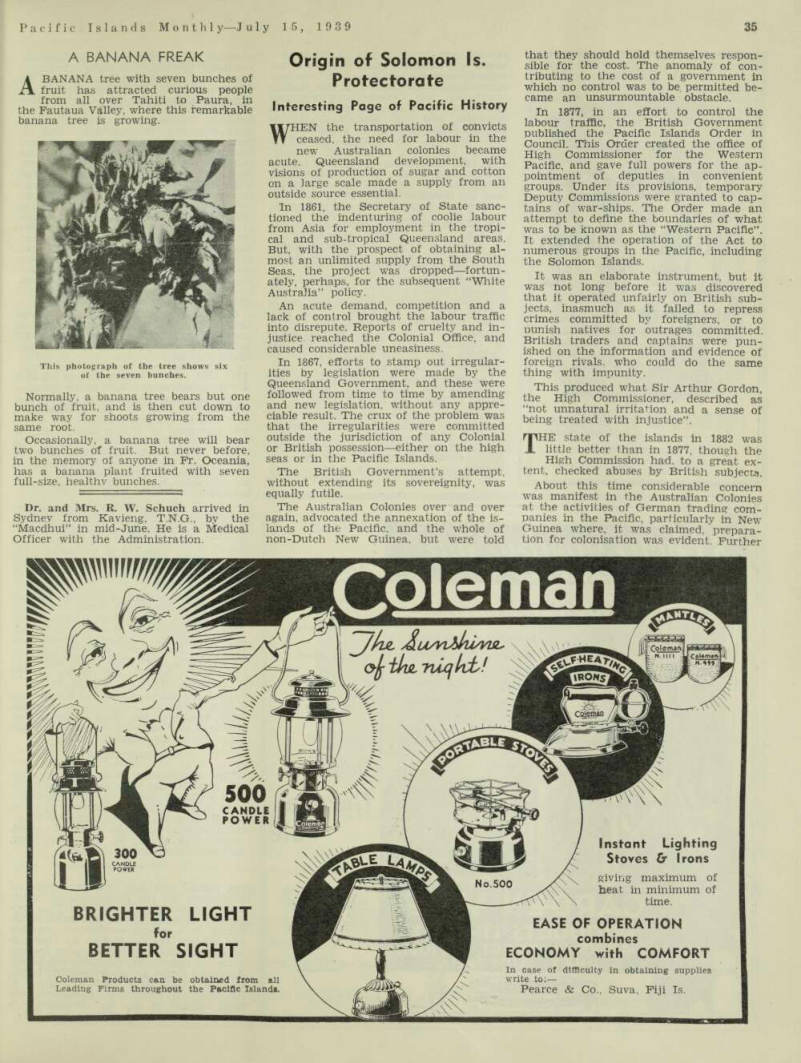
A BANANA tree with seven bunches of fruit has attracted curious people from all over Tahiti to Paura, in the Fautaua Valley, where this remarkable banana tree is growing.
Normally, a banana tree bears but one bunch of fruit, and is then cut down to make way for shoots growing from the same root.
Occasionally, a banana tree will bear two bunches of fruit. But never before, in the memory of anyone in Pr, Oceania, has a banana plant fruited with seven full-size, healthv bunches.
Dr. and Mrs. R. W, Schuch arrived in Sydney from Kavieng, T.N.G., by the “Macdhui” in mid-June. He is a Medical Officer with the Administration.
This photograph of the tree shows six of the seven bunches.
Origin of Solomon Is.
Protectorate Interesting Page of Pacific History
WHEN the transportation of convicts ceased, the need for labour in the new Australian colonies became acute. Queensland development, with visions of production of sugar and cotton on a large scale made a supply from an outside source essential.
In 1861, the Secretary of State sanc tioned the indenturing of coolie labour from Asia for employment in the tropi cal and sub-tropical Queensland areas.
But, with the prospect of obtaining al most an unlimited supply from the South Seas, the project was dropped—fortun ately, perhaps, for the subsequent “White Australia” policy.
An acute demand, competition and a lack of control brought the labour traffic into disrepute. Reports of cruelty and in justice reached the Colonial Office, and caused considerable uneasiness.
In 1867, efforts to stamp out irregular ities by legislation were made by the Queensland Government, and these were followed from time to time by amending and new legislation, without any appre ciable result. The crux of the problem was that the irregularities were committed outside the jurisdiction of any Colonial or British possession—either on the high seas or in the Pacific Islands.
The British Government’s attempt, without extending its sovereignity, was equally futile.
The Australian Colonies over and over again, advocated the annexation of the is lands of the Pacific, and the whole of non-Dutch New Guinea, but were told
that they should hold themselves respon sible for the cost. The anomaly of con tributing to the cost of a government in which no control was to be, permitted be came an unsurmountable obstacle.
In 1877, in an effort to control the labour traffic, the British Government published the Pacific Islands Order in Council. This Order created the office of High Commissioner for the Western Pacific, and gave full powers for the ap pointment of deputies in convenient groups. Under its provisions, temporary Deputy Commissions were granted to cap tains of war-ships. The Order made an attempt to define the boundaries of what was to be known as the “Western Pacific”.
It extended the operation of the Act to numerous groups in the Pacific, including the Solomon Islands.
It was an elaborate instrument, but it was not long before it was discovered that it operated unfairly on British sub jects, inasmuch as it failed to repress crimes committed by foreigners, or to nunish natives for outrages committed.
British traders and captains were pun ished on the information and evidence of foreign rivals, who could do the same thing with impunity.
This produced what Sir Arthur Gordon, the High Commissioner, described as “not unnatural irritation and a sense of being treated with injustice”.
THE state of the islands in 1882 was little better than in 1877, though the High Commission had. to a great ex tent, checked abuses by British subjects.
About this time considerable concern was manifest in the Australian Colonies at the activities of German trading com panies in the Pacific, particularly in New Guinea where, it was claimed, prepara tion for colonisation was evident. Further
anneals for annexation of these terri tories were made to the British Govern ment. .
The matter was the subject of con " siderable diplomatic discussion and Great Britain was assured by Germany that the New Guinea venture was purely a
private one. Later events, however, dis closed an organised preparation for the occupation of the northern portion of the area, through the agency of the trading companies. The German activities con tinued to create a considerable stir in Australia, and were directly responsible for Queensland’s abortive annexation of the Southern New Guinea territory in 1883.
In 1884. Lord Derby re-affirmed his be lief that no foreign power contemplated interference in New Guinea, and intim ated the intention of the British Govern ment to set up some form of jurisdiction.
THREE months later, before action was taken, the German Ambassador in London informed the British Govern ment that Germany intended to estab lish a colony in New Guinea.
Conversations led to strained relations between Germany and Great Britain; but, eventually, Great Britain gave way and in August, 1884, the boundaries of the pro posed British Protectorate in New Guinea (Papua) were announced in the House of Commons. The area excluded the northern part of the island and the is lands to the north and east.
The disputes of 1884 were settled by the Anglo-German Declaration, which was signed in Berlin on April 6, 1886.
By this Declaration, the jurisdiction of the British portion of the Solomon Is lands, which excluded Bougainville, Shortland and Ysabel, was vested in the High Commissioner for the Western Pacific.
At the signing of the Declaration the
German negotiators insisted on Germany retaining the right to engage labourers freely in the British portion of the Solomon Islands, while not allowing re ciprocal rights. (This was also a feature of the agreement of 1889, when the is lands of Choiseul, Shortland and Ysabel were ceded to Great Britain.) The ar rangement was decidedly one-sided and hampered the administration. It intro duced into the area under British juris diction, foreigners with whom the High Commission could not interfere, and with whom British recruiters and traders could not qompete on equal terms. As late as 1894 Mr. Woodford, Resident Commis sioner of the newly-formed Protectorate, complained that the agreement with Ger many, as well as a later agreement with France, permitted recruiting for New Caledonia (French) and New Britain (Ger man) and permitted also the continua tion of the traffic in arms (banned to British) from foreign spheres.
From 1886 to 1893, there was no varia tion in the method of administration in the British portion of the Solomon Is lands. They were policed by vessels of Her Majesty’s navy.
IN 1892, the Commander of H.M.S.
“Royalist”, after a visit to the Solomon Islands, reported that the natives had expressed a wish for the establishment of a British Protectorate. This, no doubt, was sponsored by British traders, in the hope of improving their condition. The request was immediately communicated to the British Government and, influenced by increasing German activities in the Pacific, was given immediate and secret attention.
On May 24, 1893, HM.S. “Curacoa” left Sydney under the command of Captain Gibson, accompanied by H.M.S. “Gold finch”. Captain Gibson was given secret orders which were not to be opened until the ship arrived at Port Moresby. He was also entrusted with a large parcel marked “secret contents”.
The vessels arrived at Port Moresby on May 30, when the secret orders and parcel were opened. The orders contained in structions to proceed at once to the Solo mon Islands and proclaim a British Pro tectorate. The parcel contained 30 new Union Jacks, which were to be hoisted at the various islands. The vessels arrived at Treasury Island on June 10, 1893.
The next island visited was Simbo; and it is interesting to read that “proceedings were hastened, lest some other Power, getting to hear of them, should step in and
get some of the islands”.-
A.M.
The directors of Steamships Trading Co., Ltd., Papua, have issued 6,000 fully paid ordinary shares in the company— -3,000 to J. G. Nelsson and 3,000 to E. D.
Edgell—in payment for plantation inter ests acquired by the company. These shares rank equally in all respects with ordinary shares previously issued.
A special technique has been developed in Malaya for the fumigation of “white ants” (termites) in living trees. This con sists of burning arsenic and sulphur to gether in a special combustion chamber and blowing the fumes into the channels of the termites through a pipe leading from the combustion chamber. The highly poisonous fumes are thus deposited in the Interior of the nest inside the trunk of the tree, and results in killing out the pest, without in any way damaging the tree. —New Guinea Agricultural Gazette.
Advertisements & other items, pp. 37-38 (2 items)
35
Pacific Islands Mont hi y—J uly 15, 1939
&jr ihz rv
5^ V
Cql C*Umi rrHEATy S **
\RO N$
( / r- V n: 500
CANDLE
POW
Instant Lighting
Stoves & Irons 300 *UE
CANDLE
POWER
Kb S Riving maximum of heat in minimum of time. 500
BRIGHTER LIGHT
for
BETTER SIGHT
EASE OF OPERATION
combines
ECONOMY with COMFORT
In case or difficulty in obtaining supplies write to;— Pearce & Co., Suva, Fiji Is.
Coleman Products can be obtained from all Leading Firms throughout the Pacific Islands.
PURE RICE
STARCH
Always ask for . . .
“CORAL BRAND
100% PURE
CORAL BRAND
RICE STARCH
N caiAt •Ui.c.RJ**' Noted for Its
QUALITY
and
WHITENESS.
Goes Farthest and gives Lasting Finish
WILL NOT
STICK TO
IRON.
Obtainable from Leading Island Stores.
Manufactured by
AUSTRALIAN EICE, LTD.
Sydney, N.S.W.
Always . . .
make sure Australia’s Choicest Products you have Brussels Sprouts White Turnips Sweet Corn Tomato Puree Tomato Sauce Tomato Soup Tutti Fruit Sauce (Worcestershire flavor) Beetroot Spinach Cabbage Carrots Parsnips Celery Green Peas French Beans Cauliflower af hand
an ample
Reserve of these
gulden
Delicious . .
Garden
Vale
Ready-to-
serve
Vegetables
sL_i
Why Not Sisal
Hemp?
Could be Grown in New Guinea
IT is a remarkable fact that although general conditions in New Guinea are quite suitable for the production of sisal hemp, and although, under the Papua and New Guinea Bounties Act of 1937, a bounty of £6 a ton is payable to producers of sisal, and although the Agri cultural Department in New Guinea has good stock available for the establishment of crops in New Guinea, the planters of New Guinea seem to have no interest in this possible source of revenue. No doubt the planters of New Guinea know their own business best and there is some good reason why they do not touch sisal, but no one knows what that reason is.
One of the world’s chief producers of sisal hemp is Kenya Colony, in Equatorial Africa, and sisal hemp, to the amount of 80,000 tons in 1937, is the principal ex port from Tanganyika. The capital value of the sisal hemp industry in British East Africa is now calculated at £15,000,000.
There is a large and growing world mar ket for the material.
Selling Titles In Papuan
Rubber Estate
PUBLIC selling by British Papuan Rubber Estates, Ltd., which was re cently registered in Port Moresby, is to be undertaken shortly in N.S.W. and Queensland. In this case it is not “bonds” that will be sold, but “certificates of title”, and it is hoped to dispose of 10,000 of them. They will be sold for £3O each and. according to the prospectus, each entitles the holder to 5 per cent, in terest as soon as the certificate is fully paid up, the interest being payable half yearly until the rubber trees, “which are now being raised on the company’s estate for the purposes of this issue”, produce rubber. From that time on. each certifi cate of title will give the holder of same the right to the net proceeds of one un divided half-acre of the rubber estate.
The plan, apparently is that if 10,000 certificates are sold. 5,000 acres of land will be planted with rubber. Facts and figures are set forth to show that there is an attractive future for rubber grow ing in Papua, and that the owners of all these proposed half-acres will receive a substantial return on their £3O invest ment.
According to the prospectus, “the lands comprising the company’s estate cover an area of approximately 5,200 acres in the wet belt in the Kokoda district, a dis tance of about 70 miles from Port Moresby. The area Is level, and every acre is suitable for planting”.
Under the heading of “management”, the prospectus says: “The company has contracted with Mr. Alfred Kingsley, of Yodda Goldfields Prospecting Syndicate,
and of the Mamba Rubber Estate, of 1,000 acres, to plant and maintain and super intend each successive planting for five years—that is, until each planting reaches tappable growth.”
The directors of the company are, Mr.
G. J. J. O’Sullivan, barrister, of Sydney; Mr. Frederick J. Lett, company director, of Pitt Street, Sydney; and Mr. E. A.
Gornall, investor, of Rose Bay, Sydney.
The secretary is Mr. Lewis J. Moore, public accountant, of 9 Bligh Street, Sydney.
Rabaul Racecourse
Row Is Settled
IT was stated in the last issue of the “P.1.M.”, that friction had developed between the New Guinea Administra tion (owners of the land) and the trustees of the Rabaul Amateur Turf Club, who were the occupiers of the land known as the Lakunai Racecourse, which recently had been used by the Administration for purposes of an aerodrome. It was stated that the trustees were very angry with certain steps which had been taken by the Administration, and had made an appeal to Canberra.
A conference was held in mid-June, be tween the parties interested, and it was arranged that sufficient additional land should be made available by the Admini stration, so as to provide for the needs of an aerodrome, a racecourse, and a golf links. This means that all the several interests concerned, which previously were in conflict, are now acting in har mony.
Advertisements & other items, pp. 39-40 (1 item)
Anchor Flour
H. JONES & CO.
AUSTRALIA'S BEST
H. JONES & CO. LTD.,
Darlington, Sydney. Hobart, Tas.
a
ANCHOR FLOUR
THE STANDARD OF QUALITY
n
GILLESPIE BROS. PTY. LTD.
SYDNEY - AUSTRALIA
Telephones: MJ 4657 (4 lines) and M 2585.
Cable Address: “Trocas”, Sydney.
B an
379 KENT STREET, SYDNEY.
DYERS of all Islands' requirements on Commission— Original Invoices Furnished. 22 Years Islands
Trade Experience.
•LANDS Produce Sold on Shippers' Account Liberal Advances against Consignments.
Bankers: Bank of New South Wales. CORRESPONDENCE IN ENGLISH, FRENCH AND GERMAN.
BECAUSE IT IS
SEALED AGAINST
DUST AND GERMS
The hottest weather cannot affect the purity or flavour of Nestle's Milk. While unopened it will keep sweet and fresh despite the severest climatic conditions. Order a supply to-day.
Copyright 821.
NESTLE'SSM ILR
■ ESI. THEREFORE CHEAPEST
Ways Of Catching
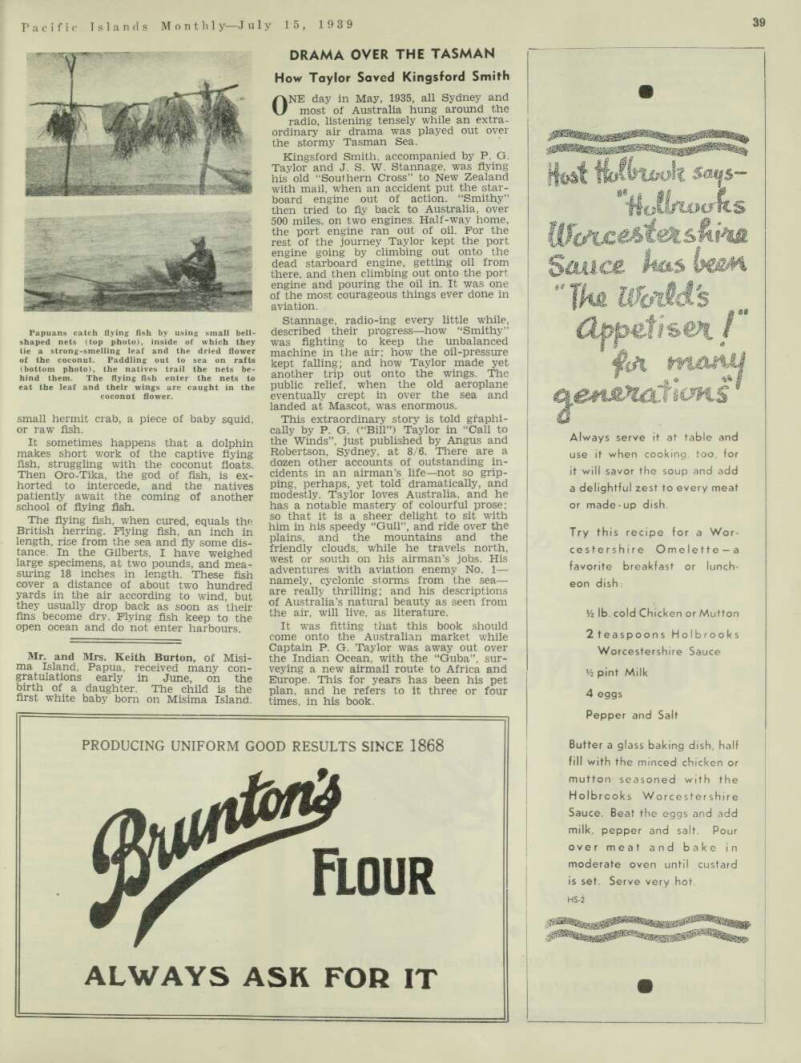
Flying Fish
By H. C. R.
THE method recorded in the of July, 1935, of the native method of catching flying fish on the N.E. coast of Papua, was interesting. Herewith is an account of the method I saw used in the Northern Gilbert Islands, where flying fish are caught on lines of human hair.
The natives fish in canoes, in pairs, working skilfully together. On arrival at the fishing grounds, about a mile and a half from shore, the canoes keep a dis tance of about twenty paces apart. Tney then keep a sharp look-out for sea birds —for the birds usually follow the schools of flying fish, preying on them, as the fish rise from the water, pursued beneath by one or other of the deep-sea big game fish.
The flying fish has many enemies. Near the coasts are the bonito; in the open sea the dolphin—one of the fastest fish in the sea, and, in its dying radiance of rainbow colours, one of the most beauti ful. Not alone these, but the marlins, the giant swordfish, the barracoota, leaping tuna and others of the surface feeders of the ocean. Such fish the native prefers to leave alone; for, apart from the dan ger they have no suitable tackle with which to handle these monsters.
The shark is caught in great numbers by these Islanders, but is much easier to deal with, and specially constructed canoes are used in its capture, as well as shark tackle made from strongly hand woven sennit (coir) lines. To noose a shark, is child’s play to a Gilbert Islander.
The sharks are cut up and dried and a considerable export is made to nearby Is lands.
Flying fish are caught in great numbers by day fishing and by torchlight fishing, at night. In torchlight fishing, two occu pants man the canoe, a navigator, and the fisherman, who stands in the bow, armed with a flaming torch of coconut leaves and his net. Two canoes fish to gether, and. as the fish rise, they are caught up in the net. Anything from one to a dozen hauls may be made.
To join in a torchlight fishing excur sion in the Gilbert Islands is a really thrilling affair. One needs to be able to swim, too, for the canoes frequently turn over without much warning. The natives just laugh, right the canoe by a clever manoeuvre of jerking out the water and climb in again. Only rarely do they lose a limb, in these manoeuvres.
The daylight method of catching flying fish is interesting. The canoes paddle out to the fishing grounds in the open sea, and watch for the birds. When following a school of fish, the birds scream excitedly, and at the same time indicate the dir ection in which the fish are travelling.
The canoes now steer to meet them, and proceed to lay out their lines. Coconut floats are used. The lot-eye is pierced, and a peg of hard-wood inserted. To this is attached a line of woven sennit, about six feet in length, and terminating in a length of finely-braided human hair.
To the hair is attached a curious hook (sometimes two hooks are used) but not quite the orthodox-fashioned hook as used by Walton or Zane Grey. The hook may be mother of pearl, or simply of wire, bent to an angle of twenty-five deg. —the wire being II inches in length. The hook is secured at its centre to the braided hair, and is baited with either a
small hermit crab, a piece of baby squid, or raw fish.
It sometimes happens that a dolphin makes short work of the captive flying fish, struggling with the coconut floats.
Then Oro-Tika, the god of fish, is ex horted to intercede, and the natives patiently await the coming of another school of flying fish.
The flying fish, when cured, equals the British herring. Flying fish, an inch in length, rise from the sea and fly some dis tance. In the Gilberts, I have weighed large specimens, at two pounds, and mea suring 18 inches in length. These fish cover a distance of about two hundred yards in the air according to wind, but they usually drop back as soon as their fins become dry. Flying fish keep to the open ocean and do not enter harbours.
Mr. and Mrs. Keith Burton, of Misi ma Island, Papua, received many con gratulations early in June, on the birth of a daughter. The child is the first white baby born on Misima Island.
Papuans catch flying fish by using small bell shaped nets (top photo), inside of which they tie a strong-smelling leaf and the dried flower of the coconut. Paddling out to sea on rafts (bottom photo), the natives trail the nets be hind them. The flying fish enter the nets to eat the leaf and their wings are caught in the coconut flower.
Drama Over The Tasman
How Taylor Saved Kingsford Smith
ONE day in May, 1935, all Sydney and most of Australia hung around the radio, listening tensely while an extra ordinary air drama was played out over the stormy Tasman Sea.
Kingsford Smith, accompanied by P. G.
Taylor and J. S. W. Stannage, was flying his old “Southern Cross” to New Zealand with mail, when an accident put the star board engine out of action. “Smithy” then tried to fly back to Australia, over 500 miles, on two engines. Half-way home, the port engine ran out of oil. For the rest of the journey Taylor kept the port engine going by climbing out onto the dead starboard engine, getting oil from there, and then climbing out onto the port engine and pouring the oil in. It was one of the most courageous things ever done in aviation.
Stannage, radio-ing every little while, described their progress—how “Smithy” was fighting to keep the unbalanced machine in the air; how the oil-pressure kept falling; and how Taylor made yet another trip out onto the wings. The public relief, when the old aeroplane eventually crept in over the sea and landed at Mascot, was enormous.
This extraordinary story is told graphi cally by P. G. (“Bill”) Taylor in “Call to the Winds”, just published by Angus and Robertson, Sydney, at 8/6. There are a dozen other accounts of outstanding in cidents in an airman’s life —not so grip ping, perhaps, yet told dramatically, and modestly. Taylor loves Australia, and he has a notable mastery of colourful prose: so that it is a sheer delight to sit with him in his speedy “Gull”, and ride over the plains, and the mountains and the friendly clouds, while he travels north, west or south on his airman’s jobs. His adventures with aviation enemy No. 1 — namely, cyclonic storms from the sea— are really thrilling; and his descriptions of Australia’s natural beauty as seen from the air, will live, as literature.
It was fitting that this book should come onto the Australian market while Captain P. G. Taylor was away out over the Indian Ocean, with the “Guba”, sur veying a new airmail route to Africa and Europe. This for years has been his pet plan, and he refers to it three or four times, in his book.
On September 6 a new issue of Papuan air mail stamps will make its appearance, the denominations being the same as those of the present issue—-2d.. 3d., sd„ Bd. and 1/-.
A set of four stamps—ld., Ud., 2'id., and 7d.—will be issued on August 29 to commemorate the 25 years of New Zea land’s control of the Mandated Territory of Western Samoa. Designs will comprise;
Id., a typical Samoan coastal village; Ud.. map of the Group; 2id., Samoan dancing party, with native fales (houses) in the background: 7d., portrait of Robert Louis Stevenson, the famous Scottish author who spent the last years of his life In Samoa.
The ketch “Hispaniola” returned to Sydney on July 5, after her fifth unsuc cessful attempt to reach Lord Howe Is.
Advertisements & other items, pp. 41-42 (1 item)
Flour
ffiw
•fldkooKS
■iKw
Ui
i?peiis
Always serve It at table and use it when cooking, too, for it will savor the soup and add a delightful zest to every meat or made-up dish.
Try this recipe for a Worcestershire Omelette-a favorite breakfast or luncheon dish: Vz lb. cold Chicken or Mutton 2 teaspoons Holbrooks Worcestershire Sauce Vi pint Milk 4 eggs Pepper and Salt Butter a glass baking dish, half fill with the minced chicken or mutton seasoned with the Holbrooks Worcestershire Sauce. Beat the eggs and add milk, pepper and salt. Pour over meat and bake in moderate oven until custard is set. Serve very hot HS-2
PRODUCING UNIFORM GOOD RESULTS SINCE 1868
Flour
ALWAYS ASK FOR IT
I PRESCOTT Pty. Ltd.
SUSSEX ST., SYDNEY,
are sole wholesale agents for
PINEAPPLE BACON&HAMS j
DAISY brand BUTTER; "375" BUTTER in TINS Ilb.-21b.-slb. Sixes.
I LEA & PERRINS’ Sauces
( and Most other Super-Quality Lines of the Trade, such as Cheese, Eggs, Etc.
SWALLOW
& lllllllllllllllllllllllllllllllllllllllllllllillllllllllllllllllllllllll lllllilllllllllllllllllllllllllllilllllllllllllllllllllllllHllllllllllllltlllllllllllllllllltlllllllllllllilllll
PLUM
PUDDINGS
i lb. : 1 lb.
Ulb. :21b. and 3 lb.
Renowned f
Manufactured at Port Melbourne, Australia FIJI REPRESENTATIVES - - PEARCE & CO. LTD.
Rabaul
New Bishop Of
Rev. Father Isidore Scharmach
ADVICE has been received from Rome that Reverend Father Isidore Schar mach, of the Catholic Mission of the Most Sacred Heart (Vunapope) has been appointed by the Holy Father as Vicar Apostolic of Rabaul, New Guinea, in succession to Bishop Vesters, retired.
Father Scharmach, who arrived in New Guinea in 1925, was successively in charge of the Sulka and Arawe mission stations, where, during 14 continuous years, he displayed missionary ability and zeal which brought him under special notice.
He is a Polish national, and served as a soldier in the Great War.
Tropical Agriculture
New Guinea's Valuable Gazette
ONE of the most valuable publications circulating in the tropical territories in the Pacific is the “New Guinea Agricultural Gazette”, published by the Department of Agriculture, Rabaul, every three' months.
In the issue of March, 1939, just to hand, there are, in addition to notes, book reviews, and reports, more than a dozen authoritative articles, every one of which is of value to the tropical planter.
Mr. John L. Froggatt, the department’s entomologist, describes the fight the de partment has had against the coconut pest called Promecotheca. The pest ap peared at the end of 1937, apparently fastening upon coconut trees which had been weakened by the huge discharge of pumice during the eruption at Rabaul; and it was attacked in several ways. In a number of places, the pest was very bad; but the quick breeding-up of natural parasites quickly stopped any serious de velopment and this was assisted by the breeding-up in the laboratory of special contingents of parasites, which were lib erated in the badly-infested areas. By May. 1938, the plague was under control.
In September. 1938, a supply of a special parasite which had been sent from Java to Fiji, and from Fiji to Rabaul, was brought into use, and in recent months large numbers of these parasites have been released in New Guinea, to assist in the work of holding Promecotheca in con trol. The name of this introduced para site is Pleurotropis Parvulus. and it has been successful in Fiji and the New Heb rides in destroying the coconut pest.
Mr. Froggatt also writes on “Fumiga tion and Fumigants”, and on “Insect Pests in Rice”. There is an article by the de partment’s economic botanist, Mr. Dwyer, on “The Fall of Mature Coconut Palms in New Guinea Due to Soil Conditions”.
Other articles of special interest are “The Coconut Oil Industry”, “The Grow ing Importance of the Sisal Industry”, “Upland Rice”. “Soil Fertility”, “pointers on Goat Raising” and “Market for Papain”.
Rev. Norman Goodall, M.A., Foreign Secretary of the London Missionary Society, who is making a tour of the South Seas, was In Fiji early in June, after visiting Samoa and the Ellice Is lands on board the mission vessel “John Williams”.
Advertisements & other items, p. 42 (1 item)
40
July 15, 193 9—P acific Islands Monthly
Hebrides
Japan In New
A Mysterious Occurrence
THE following is part of a letter sent to the editor of the “P.I.M ”, by a resident on one of the outer islands of the New Hebrides: — 11/E had a call from strange visitors TT this afternoon, and we are not quite sure what they were up to.
A Japanese boat anchored in front of the mission station, and there came ashore two Japs, who spoke sufficient Eng lish to make themselves understood. One, a Mr. K. Murooka, intimated that he was the agent of the Nanyo Boyeki Kaisha, Ltd. (South Sea Trading Co.), Tokyo, Japan.
They brought with them a parcel of merchandise and. in the presence of a large number of natives, attracted by curiosity, they laid the goods out on the verandah floor for exhibition.
I imagined they were offering the articles for sale and, having selected a few, was preparing to give them cash in payment, when the agent, with a very magnanimous gesture, said, “Oh, no, all a present for you.” I strongly demurred, but they insisted on me taking the goods as a gift. However, I made a compensating gift of fruit and vegetables, which they gladly accepted for use on board.
But we are just a little perplexed about such unwonted generosity, and wonder what is behind it. Beside their raincoats, which they laid at the end of the ver andah, we noticed a camera, an article which bona-flde traders do not usually carry about with them in the South Seas.
I should not be surprised if the osten tatious display of generosity was meant, not for us, but for the natives. Japan un doubtedly is planning a drive southwards, and any manoeuvre in the South Pacific may be regarded with suspicion, and as a prelude to further encroachment.
Last year, the Japanese opened a whole sale trading house in Vila, and they are now bent on pushing their trade through out these islands. As they sell at prices with which British and French traders cannot possibly compete, there is every likelihood that the Japanese merchants will prove popular with the natives.
By such means the Japanese are steadily increasing their influence and population in the New Hebrides, as they already have done in New Caledonia—the outcome of which will be a further crop of problems for Australia and the Em pire.
Do You Wish To Swap
Your Job?
Letter to the Editor MUCH in your publication keeps me fascinated. I find it very interesting to read how different human natures react to loneliness and the deprivation of civilisation.
“Tropic” (in “This Tropic Life De bunked”), published in the May issue does not seem to be very happy with his fate.
What a difference between his and Father Vocat’s views (also published in May issue).
I am 35 years old, and have lived in the leading capitals of Europe, America and Australia, under the blessings of this
century’s civilisation (including a world war and several minor wars and revolu tions). I also have spent four years on a lonely island and I envy Father Vocat the prospect of spending the rest of his life in his isolated situation.
If “Tropic” is longing for civilisation and the amenities of city life, and “Mel bourne will do him”, I am prepared to swap my executive business position for his open-air job on that lonely island.
Although so many men who live in the tropics consider their jobs an ordeal, I have not been so far successful in con tacting one man who could offer me a job on one of the islands, though I am enthusiastic for and capable of such work.
I am, etc.,
Robert Hoyt.
12 Milton Hall, 574 St. Kilda Road, Melbourne.
Miss Elsie Brammell, M.A., an ethno logist on the staff of the Australian Museum, Sydney, delivered an interest ing illustrated lecture on “Canoes” at the June meeting of the Pacific Islands Club.
She tra'ced the development of the canoe from the Australian dugout to the war canoes of the Polynesians. Miss Brammell, who was born in Papua, is a member of the Council of the Anthropological Society of N.S.W.
Advertisements & other items, p. 43 (2 items)
41
Pacific Islands Mont hi y—J uly 15, 1939
Pure
Kork-N-Seal
FOR HOME USE
o Hand Applied Airtight Pressure Proof
FOR ALL HOME BOTTLING
—THE LITTLE CAP THAT
will Re-seal 1,000 Times
KORK-N-SEAL (AusO LTD.
106 COMMONWEALTH STREET,
SYDNEY, AUSTRALIA,
We are Specialist's .
Let us have your confidence. Sixty years is our record of supplying the leading Houses throughout the World in ... .
FRESH FRUIT VEGETABLES PRODUCE
’Phones: MA 8612 (4 lines).
Cable Address: “Weymarkson”
Codes —Bentleys Private
WEYMARK & SON LTD.
FRUIT AND PRODUCE MERCHANTS
14-18 STEAMMILL STREET - - SYDNEY
cn i v
Obtainable from all Leading Grocery Stores Chivers and Sons Ltd., Histon, Cambridge, E. 76
CBS
PURE
FOODS
GOLD MEDAL JAMS
CANNED ENGLISH FRUITS
CANNED ENGLISH VEGETABLES
CUSTARD POWDER
OLD ENGLISH MARMALADE
JELLY CRYSTALS, ETC.
Write to Department A., England, for attractive Recipe Book.
Grow Your Own Food
From Our Own Correspondent
Honolulu, June 19.
HERE is the germ of an idea for the defence of Australia’s outer island Territories: — U S Congress has passed a bill pro viding the Hawaiian Islands, U.S. Pacific defence keystone, with an adequate sup ply of suitable seeds so that the islands may grow food for the entire population in times of emergency.
The army-navy in Hawaii already have great areas of suitable lands earmarked for planting soon as trouble seems im minent.
Hawaii depends largely upon Califor nia and other U.S. mainland States for vegetables, etc. The shipping strike in 1936, which isolated Hawaii, taught a vivid lesson.
Rev. Harold Graham, of Victoria, sailed from Sydney for Papua by the “Macdhui” on June 21. He will serve with the New Guinea Mission.
Samarai
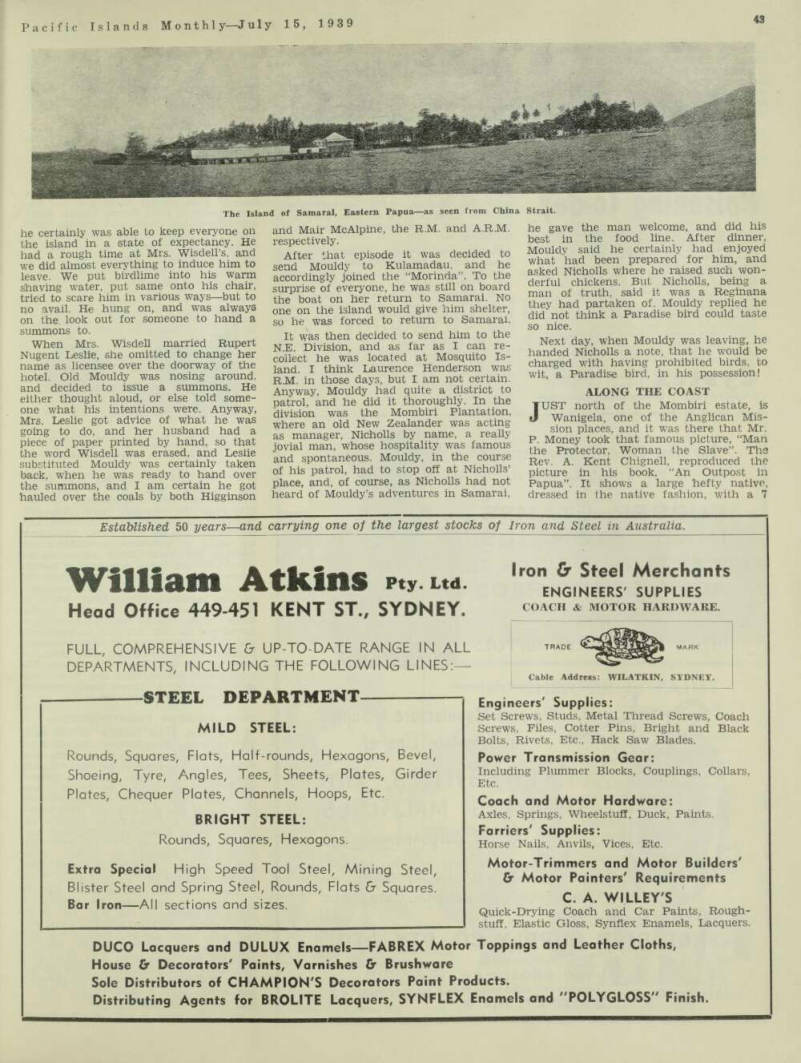
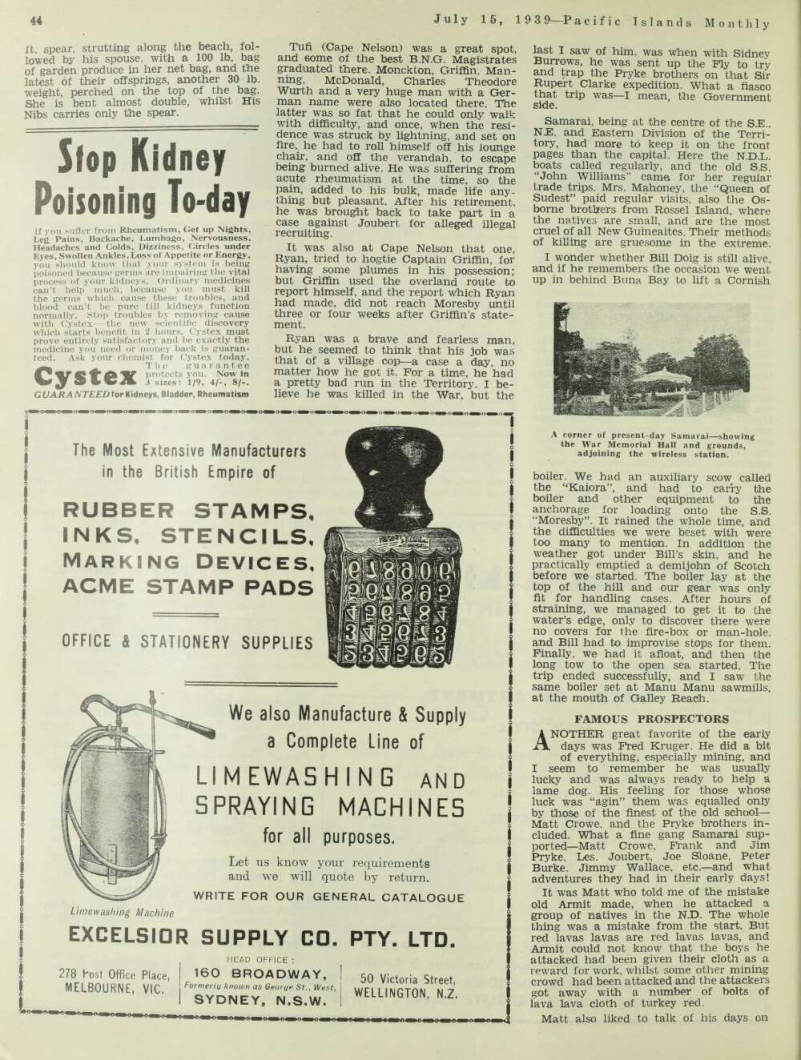
Memories Of Old
By “Wakilobo Of Vilirupu”
NO. 2.
Papuan Pioneers
THE Whitten brothers take their place as real pioneers, and few if any of the miners were not grub-staked by them. Their help to the men on the Yodda, later the Lakekamu, must al ways be remembered by all mining men.
Their grub-staking was done consistently.
I am certain they had little fear that the money would not be repaid. Their boats helped the miners, especially the “Kaiora”, the “Bulldog”.
I wonder if Charlie Whitehead and Gunderson are still alive. Their stories of the gold rushes would be worth tell ing. One of the episodes of Charlie’s life may be given here.
In between times he had a schooner, which carried about 20 tons, and some times he would lift that weight of kumara from the N.E. coast for Port Moresby, selling them at from £4 to £6 per ton.
After the sale, there would be the usual binge in Tom McCrann’s, but Charlie al ways managed to hold on to the major portion of the proceeds. One trip, how ever, there were more “free” drinkers than usual, and Charlie counted up his cash with a few misgivings—although, deep down, he did not really mind the loss of a few pounds, so long as those who drank his health could carry their liquor. Dur ing his soliloquy he heard rasping throat noises, as though someone was trying to be very sick and on looking up, saw Hughie Jones, the hunchback, vomiting violently over the rail. This so incensed Charlie that he rose up like thunder and yelled at the top of his voice, “You so and-so little runt, there goes four tons of the finest sweet potatoes ever grown in New Guinea.”
The two Auerbach lads, Teddy and George, were good side wingers, and their presence in Samarai was always the signal for a few real hectic days—and nights, too, sometimes. Teddy would get one over the seven and paint the settle ment red, but George always appeared to be able to carry his liquor. Another Trobriands visitor was Jimmy Delaney, and he took life very seriously, too. His end was disastrous—that is, if what I heard was true. His launch caught fire, and he and someone else on board were burned to death.
Nick The Greek
THERE was also Nick the Greek, whose daughter, Marion, was mandated to the Ramsays; and a tough guy he was. Poker was his pet hobby, and many a game have I had with him, and others, at “Billy the Cook’s” place. I learned a lot of good points from him. One night we were playing, and the party com prised old Mr. Cox, the gentleman with a Solomon beard, a Customs official called Day. a man from Giligili, whose name I forget (but who died several years ago), Nick the Greek, and myself. Nick did not have a single hand of any use. But he just sat tight, and played right through until 2 a.m„ and was just as even-tem pered as though he had won a packet.
Another individual who used to have Samarai by the ears was called Mouldy Mike. He was the most “ornery son of a gun” ever filled a Government job, and
he certainly was able to keep everyone on the island in a state of expectancy. He had a rough time at Mrs. Wisdell’s. and we did almost everything t 9 induce him to leave. We put birdlime into his warm shaving water, put same onto his chair, tried to scare him in various ways-but to no avail. He hung on, and was always on the, look out for someone to hand a 5,1 When" 5 Mrs, Wisdell married Rupert Nugent Leslie, she omitted to change her name as licensee over the doorway of the hotel. Old Mouldy was nosing around, and decided to issue a summons. He oke e what OU Ws fntentlons Anyway". piece of paper printed by hand, so that taken back, when he was ready to hand over the summons, and I am certain he got hauled over the coals by both Higginson
and Mair McAlpine, the R.M. and A.R.M.
respectively.
After that episode it was decided to sen d Mouldy to Kulamadau, and he accordingly joined the “Morinda”. To the sur p ris e of everyone, he was still on board th / boat on her return to Samarai. No one on the island would give him shelter, so he was for ced to return to Samarai. n e 'nfviston * f afas reco iiect he was located at Mosquito Is- , nd T think Laurence Henderson was
£ £ day™ I am 1
Anywayj Mouldy had quite a district to afvSon^was 6 the MombSl® Plantetton, jovial man> ’ w h ose hospitality was famous MouMy in me course of hls Patrol, had to stop off at Nicholls place, and, of course, as Nicholls had not heard of Mouldy’s adventures in Samarai.
he gave the man welcome, and did his best in the food J ll 6 -
6 prepared 7 for^him J asd
what had SuCh’won de“ul nf c] Jit was a’ Iteelnana ™*n t^ k s^ ld f lt * replied he jjjjy h ?S a RLradise Wrd could tastl thmk a Paradlse mrd could ta,ste Next day, when Mouldy was leaving, he handed Nicholls a note, that he would be charged with having prohibited birds, ro wit. a Paradise bird, in his possession!
Along The Coast
U ®T nor . th of the . Momblrl estate, is f he Woma”Th S e P S aw” The Chignell reproduced me p lctU re m his book. “An Outpost in Papua”. It shows a large hefty native, dressed in the native fashion, with a 7
The Island of Samara!, Eastern Papua—as seen from China Strait.
ft. spear, strutting along the beach, fol lowed by his spouse, with a 100 lb. bag of garden produce in her net bag, and the latest of their offsprings, another 30 lb. weight, perched on the top of the bag.
She is bent almost double, whilst His Nibs carries only the spear.
Tufi (Cape Nelson) was a great spot, and some of the best B.N.G. Magistrates graduated there. Monckton, Griffin, Man ning, McDonald, Charles Theodore Wurth and a very huge man with a Ger man name were also located there. The latter was so fat that he could only walk with difficulty, and once, when the resi dence was struck by lightning, and set on fire,, he had to roll himself off his lounge chair, and off the verandah, to escape being burned alive. He was suffering from acute rheumatism at the time, so the pain, added to his bulk, made life any thing but pleasant. After his retirement, he was brought back to take part in a case against Joubert for alleged illegal recruiting.
It was also at Cape Nelson that one, Ryan, tried to hogtie Captain Griffin, for having some plumes in his possession; but Griffin used the overland route bo report himself, and the report which Ryan had made, did not reach Moresby until three or four weeks after Griffin’s state ment.
Ryan was a brave and fearless man, but he seemed to think that his job was that of a village cop—a case a day, no matter how he got it. For a time, he had a pretty bad run in the Territory. I be lieve he was killed in the War, but the
last I saw of him, was when with Sidney Burrows, he was sent up the Fly to try and trap the Pryke brothers on that Sir Rupert Clarke expedition. What a fiasco that trip was—l mean, the Government side.
Samarai, being at the centre of the S.E., NF. and Eastern Division of the Terri tory, had more to keep it on the front pages than the capital. Here the N.D.L. boats called regularly, and the old S.S.
“John Williams” came for her regular trade trips. Mrs. Mahoney, the “Queen of Sudest” paid regular visits, also the Os borne brothers from Rossel Island, where the natives are small, and are the most cruel of all New Guineaites. Their methods of killing are gruesome in the extreme.
I wonder whether Bill Doig is still alive, and if he remembers the occasion we went up in behind Buna Bay to lift a Cornish
boiler. We had an auxiliary scow called the “Kaiora”, and had to carry the boiler and other equipment to the anchorage for loading onto the S.S.
“Moresby”. It rained the whole time, and the difficulties we were beset with were too many to mention. In addition the weather got under Bill’s skin, and he practically emptied a demijohn of Scotch before we started. The boiler lay at the top of the hill and our gear was only fit for handling cases. After hours of straining, we managed to get it to the water’s edge, only to discover there were no covers for the fire-box or man-hole, and Bill had to improvise stops for them.
Finally, we had it afloat, and then the long tow to the open sea started. The trip ended successfully, and I saw the same boiler set at Manu Manu sawmills, at the mouth of Galley Reach.
Famous Prospectors
ANOTHER great favorite of the early days was Fred Kruger. He did a bit of everything, especially mining, and I seem to remember he was usually lucky and was always ready to help a lame dog. His feeling for those whose luck was “agin” them was equalled only by those of the finest of the old school — Matt Crowe, and the Pryke brothers in cluded. What a fine gang Samarai sup ported—Matt Crowe, Frank and Jim Pryke, Les. Joubert, Joe Sloane, Peter Burke, Jimmy Wallace, etc. —and what adventures they had in their early days!
It was Matt who told me of the mistake old Armit made, when he attacked a group of natives in the N.D. The whole thing was a mistake from the start. But red lavas lavas are red lavas lavas, and Armit could not know that the boys he attacked had been given their cloth as a reward for work, whilst some other mining crowd had been attacked and the attackers got away with a number of bolts of lava lava cloth of turkey red.
Matt also liked to talk of his days on
A corner of present-day Samarai—showing the War Memorial Hall and grounds, adjoining the wireless station.
trek, and his gentle manner, even when annoyed, made him one of the nicest men who ever “padded the hoof” for the elusive pennyweight. For his memory, as well as that of the Pryke brothers, I shall always have a very warm spot.
Advertisements & other items, pp. 44-46 (3 items)
42
July 15, 193 9—P acific Islands Monthly
Over Thirty Years Ago
STEAMSHIPS TRADING COMPANY LTD.
PORT MORESBY PAPUA SAMARA I
Chairman and Managing Director; A. S. FITCH.
Shipowners, Wholesale and Retail Merchants and Traders; Shipping, Customs and Insurance Agents; Copra and Rubber Plantation Owners.
MAIL CONTRACTORS TO COMMONWEALTH AND PAPUAN GOVERNMENTS.
AGENCIES:—At Port Moresby: Coral Sea Insurance Co.: Phoenix Insurance Co.; Delta Sawmills, Ltd.; Acme Bakery Co.; Vacuum Oil Co.. Pty., Ltd. At Samara!: Coral Sea Insurance Co.; Delta Sawmills, Ltd.; Bankers and Traders’
Insurance Co.: National Mutual Life Insurance Co.; Kularo Shipyards; Mamal Plantations.
BRANCHES:—In Papua: Hanuabada, Slvitol, Aroma, Kokl, Hula, Ela Beach, Duga Duga, Yule Island.
SYDNEY: NELSON & ROBERTSON PTY. LTD., 12 Spring St.; Melbourne, 35)6 Flinders Lane: London, E. Whiteaway & Co., 7 Chiswell Street, Finsbury, London.
Cable Address: “STEAMSHIPS.” Code: Bentley’s.
STEAMSHIPS TRADING COMPANY, LIMITED.
MERCHANTS, SHIPOWNERS AND PLANTERS
PORT MORESBY AND SAMARAI.
Our organisation provides every facility and efficient service as
MANAGING AGENTS AND VISITING REPRESENTATIVES OF
COCONUT AND RUBBER PLANTATIONS
Estates supervised in bearing and planting stages.
Comprehensive reports compiled and regular visits made to Estates by our competent Plantation Inspector.
WRITE, CABLE OR CALL FOR PARTICULARS;
STEAMSHIPS TRADING COMPANY LTD.
Over Thirty Years Ago
The first Younger Stove was exported to the Pacific Islands. Ruggedly strong in construction, highly efficient and economical in fuel, has made them the most popular stove in the South Seas.
The illustration shows a Younger Single S s° Ve T , Sp « cial stoves, with cast iron ovens for Islands requirements made to rite us for quotations for special sizes and catalogue of double and single oven stoves.
G. Fletcher & Son
50 OXFORD STREET, SYDNEY
r
William Atkins pty. Ltd.
Established 50 years—and carrying one of the largest stocks of Iron and Steel in Australia.
Head Office 449-451 KENT ST., SYDNEY.
FULL, COMPREHENSIVE Cx UP-TO-DATE RANGE IN ALL
DEPARTMENTS, INCLUDING THE FOLLOWING LINES:—
STEEL DEPARTMENT
MILD STEEL:
Rounds, Squares, Flats, Half-rounds, Hexagons, Bevel, Shoeing, Tyre, Angles, Tees, Sheets, Plates, Girder Plates, Chequer Plates, Channels, Hoops, Etc.
BRIGHT STEEL:
Rounds, Squares, Hexagons.
Extra Special High Speed Tool Steel, Mining Steel, Blister Steel and Spring Steel, Rounds, Flats Gr Squares.
Bar Iron— All sections and sizes.
Iron Cr Steel Merchants
ENGINEERS' SUPPLIES
COACH & MOTOR HARDWARE.
TRADE
MARK
Cable Address: WILATKIN, SYDNEY.
Engineers' Supplies: Set Screws, Studs, Metal Thread Screws, Coach Screws, Files, Cotter Pins, Bright and Black Bolts, Rivets, Etc., Hack Saw Blades.
Power Transmission Gear: Including Plummer Blocks, Couplings, Collars, Etc.
Coach and Motor Hardware: Axles. Springs, Wheelstuff, Duck, Paints.
Farriers' Supplies: Horse Nails, Anvils, Vices, Etc.
Motor-Trimmers and Motor Builders' & Motor Painters' Requirements
C. A. WILLEY'S
Quick-Drying Coach and Car Paints, Roughstuff. Elastic Gloss, Synflex Enamels, Lacquers.
DUCO Lacquers and DULUX Enamels—FAßßEX Motor Toppings and Leather Cloths, House & Decorators' Paints, Varnishes & Brushware Sole Distributors of CHAMPION'S Decorators Paint Products.
Distributing Agents for BROLITE Lacquers, SYNFLEX Enamels and POLYGLOSS" Finish.
Slop Kidney
Poisoning To-day
If vou suffer from Rheumatism, Get up Nights, Leg Pains, Backache, Lumbago, Nervousness, Headaches and Colds, Dizziness, Circles under Eyes, Swollen Ankles, Loss of Appetite or Energy, you should know that your system is being poisoned because germs are impairing the vital process of your kidneys. Ordinary medicines can’t help much, because you must kill the germs which cause these troubles, and blood can’t be pure till kidneys function normally. Stop troubles by removing cause with Cystex the new scientific discovery which starts benefit in 2 hours. Cystex must prove entirely satisfactory and be exactly the medicine you need or money back is guaranteed. Ask your chen '
Cystex
Ask your chemist for Cystex today.
The guarantee protects you. Now in 3 sizes; 1/9, 4/'-, 8/-.
GUAR A N TEEDior Kidneys, Bladder, Rheumatism
The Most Extensive Manufacturers in the British Empire of
RUBBER STAMPS.
INKS. STENCILS,
Marking Devices.
ACME STAMP PADS
OFFICE i STATIONERY SUPPLIES
n r We also Manufacture & Supply a Complete Line of
LIMEWASHING AND
SPRAYING MACHINES
for all purposes.
Let us know your requirements and we will quote by return.
WRITE FOR OUR GENERAL CATALOGUE
Li me washing Machine
EXCELSIOR SUPPLY CO. PTY. LTD.
278 Host Office Place,
MELBOURNE, VIC.
HEAD OFFICE :
160 BROADWAY,
Formerly known as George St., West,
SYDNEY. N.S.W.
50 Victoria Street,
WELLINGTON, N.Z.
Appointment?
Why A Missionary
New Guinea Legislative Council
Letter to the Editor THE Morobe section of New Guinea learned on May 29 that the vacant seat on the Legislative Council had been allotted to Rev. L. A. McArthur, 8.A., of the Wesleyan Methodist Mission. The news came just prior to the Admini strator’s arrival on the goldfields, and cast somewhat of a cloud over the general welcome. However, it was felt that this appointment was not entirely to be laid at the door of the Administrator, but was the outcome of machinations in Australia.
In 1933, Sir Charles Marr opened the first session of the New Guinea Legislative Council, and people felt that a forward step had been made in the democratic government of the Territory. We have learned since, alas, what a vain hope that was. The minority of private members, and the power of “direction” vested in the President, have precluded anything but Government measures going through the Council, but that is no reason why the private members should not be thoroughly representative of the community.
If the presence of a missionary on the Council be imperative, one naturally asks why one was not included in the original formation. Such was not the case, how ever. Too late, we learn how great the influences are in official circles in Aus tralia, to sway the best interests of this Territory.
With the termination of four years, in 1937, the opportunity was seized upon by these “influences” to replace Mr. V.
Pratt’s membership with one of their missionaries, and Rev. F. G. Lewis was appointed. Upon his resignation, nomina tions were called for and, in spite of strongly-suppoi ted candidatures from those who represent industry, advance ment and a large majority of the popu lation, the precedent having once been established by these “powerful influences”, it was followed up by further appoint ment of another missionary.
The industrial community, and particu larly those in the gold industry, have paid and paid to make their way, and inci dentally furnish the Territory revenue with the necessary sinews of government.
Industrialists employ, pay, feed and clothe thousands of natives, with all the attend ant fees, etc—and I refer particularly to gold mining. This industry not only re presents a majority of the white popula tion, but probably employs more natives than any other industry in the Territory.
It is maintained, therefore, that it should be more generously represented in the Council.
Industry does not levy unofficial taxes on the natives, but pays them the where withal to improve their status, in addi tion to educating them (yes, educating them) in domestic duties, cleanliness, various trades and callings, all of which are material to their temporal welfare; and, be it stressed very strongly, the native’s health is by no means a small item in the industrialist’s care of his em ployees.
What percentage of white or native population does the Wesleyan Methodist Mission represent? What percentage of the revenue does it provide from its legitimate calling as a mission and not as a trading concern? The answer in both cases is virtually “nil”.
Thus we are back at our premise. What qualifications has the Wesleyan Method ist Mission to be represented on even such a futile Legislative Council as that of New Guinea? Progress is being stifled and the Territory-wide welfare of the native and the status of the white population are being neglected in such an appoint ment.
And it is all engineered primarily in Australia, where not .0001 per cent, of the people know anything about the Territory or its conditions.
In conclusion; It would appear that the recent “Katoomba” tourist trip had more design than appears on the surface!
I am, etc.
Wau-Ite.
Wau, New Guinea, 6/6/39.
Mrs. Donnan, widow of Mr. R. C. Don nan, formerly on the staff of the Colonial Sugar Refining Co., Ltd., was in Fiji in June paying a visit to her sister, Mrs. G.
Cradick, of Lautoka.
Professor A. M. Hocart, of Cairo Uni versity, who was associated with Dr. W. H.
R. Rivers in scientific research in the Solomons and who later carried out valu able anthropological work in Fiji and Rotuma, died recently.
Advertisements & other items, pp. 47-48 (2 items)
'jpAUHir
POST VOUR
• MINING Crushing Mochinery, Screens, Feeders, Rock Drills, Excovotors, Diesel and Crude Oil Engines, Hoists and Runways, Roller Bearings, etc. • ELECTRICAL EQUIPMENT Parkinson Motors, Crompton Switchgear, Transformers, Instruments, Meters, Callender Wires and Cables, Lighting Equipment, Electric Drills. • STORES, FACTORIES, HOME and OFFICE Electrical Fittings, Crompton Fans, Crompton Lamps, Floodlighting, Household Electrical Appliances, Radio Receivers, and Equipment. Jos. Rodgers Cutlery & Plotewore, Cut-glass and Perfection E.P.N.S. Wore.
DISTRIBUTORS:
Greenwood & Laws Ltd., Rabaul and Wau.
Steamships Trading Co. Ltd., Port Moresby ai Samarai.
Millers, Ltd., Suva, FIJI.
CHEAPER to PAINT
than to repair!
Decay can do no damage if your home is properly protected with good paint.
Use “8.A.L.M.” Paint— “B.A.L.M.” Paint gives protection. And it wears down evenly and very slowly, lasting years longer than ordinary paint.
Decide now to save money by painting; and decide to make maximum savings by using - - - - “8.A.L.M.” Paint! ) A Product of British Australian Lead Manufacturers Pty. Ltd., rjt ST ORAO* PUR| p§ -
'jpAUHir
M. BREGKWOLDT & CO.,
SOUTH SEA MERCHANTS
POSTAL ADDRESSES:— TAHITI:—P.O. Box 60, Papeete.
NEW GUINEA:—P.O. Box 89, Robaul. SAMOA:—P.O. Box 124, Apia.
FIJI:—P.O. Box 111, Suva.
AGENTS FOR...
TELEGRAPHIC ADDRESS:
BREWO
A
BAYER
Irf
R
MEDICINES . .
ATEBRIN— THE PROTECTION AGAINST MALARIA.
ASPIRIN BAYER— THE GENUINE ASPIRIN— AND
ALL OTHER BAYER PRODUCTS.
STOCK ALWAYS AVAILABLE AT OUR BRANCHES.
All Orders Executed at Original "Bayer" Prices.
MERCEDES - BENZ DIESEL TRUCKS:
2 Tonner Type, L. 1,500 -45 H.P. just arrived in Rabaul for demonstration. Fuel consumption— -28 miles on one gallon only of SHELL DiESOLINE, costing about Bid. in Rabaul. Lubricating Oil—Shell Dervoil Medium.
Prices for all types, up to loading capacity of 12,000 lbs., and for special types, on application.
"HANOMAG" Diesel Tractors. "VESTA" Sewing Machines.
"ANCRE" Cast Iron Sauce Pots. "LOHSE" Urolt Lavender.
"FROWO" Hurricane Lanterns. “ "BREWO" Swedish Axes and Hatchets.
"ARARA" Gas Stoves. "ARVIKA" Swedish Axes and Hatchets.
CONTINENTAL Tyres and Tubes for Motor Cars and Bicycles.
DEUTZ and 'MERCEDES-BENZ" Diesel Marine Engines.
OMAX Hurricane Lanterns (Incandesc.) and Lamps. (Not Agents for Tahiti).
TIGER BRAND" Corrugated and Flat Galvanised Ironsheets.
"TAIFUN" Bicycles and Accessories.
"TWO LIONS" Best Known Quality of A.l. Butcher Knives.
"BREWO" Razor Blades, Black, Brown, Blue, Pink, Silver.
"TORPEDO", "BIJOU" and "ERICA" Typewriters, Portable and Office.
"BECK' S" "Key Brand" German Lager.
TELEFUNKEN" Wireless Sets, Battery and Current, Best results obtained.
Many Sold. Ever-increasing Turnover.
ALSO ALL TRADE LINES OF GERMAN, BRITISH, CONTINENTAL, JAPANESE AND CHINESE ORIGIN
AGENTS FOR:
LIEBERMANN, WAELCHLI & CO.,
Kobe, Yokohama, Tokio and Shanghai.
JOHN CAMPBELL & CO., SYDNEY. (All Australian Goods. ) Our Trademark.
PLEASE NOTE:
J~We sell WHOLESALE ONLY but. upon application, we will supply the L names of firms at all places in the Pacific Islands retailing our goods.
46
July 15, 193 9—P acific Islands Monthly
Divided Opinion On Amalgamation
Committee Takes Evidence of Residents in New Guinea and Papua
From Our Own Correspondent
Rabaul, June 16.
THE special committee (Messrs. F. W.
Eggleston, Leonard Murray and Orten Townsend) appointed by the Com monwealth Government to investigate the possibilities of amalgamating Papua and New Guinea first made a tour of the N.G. outports to gather evidence to give them a lead to work on in framing their recommendations for the Federal Cabinet.
They were not inundated with witnesses at the start. New Guinea folk seemed to have but a hazy idea of what was re quired of them, but gradually, as time wore on, the public came forward with a certain degree of interest. At Kavieng, Hon. W. E. Grose (president of the N.G.
Planters’ Association) gave his views on the subject, as also did Mr. Frank V. Saunders and a few other public minded citizens. Opinion was more or less divided: Amalgamation would be a good thing if it ensured so and so; or, it would not be a good thing because it meant so and so.
On June 5 the Committee returned to Rabaul from the outports and on that day received a delegation from the Public Service Association. Mr. P. J. Woodhill put forward the views held by the Asso ciation’s members. After considerable talk about the finances of the two terri tories, and their dissimilarity, examples were mentioned of the difference in the housing, superannuation, salaries and technical officers.
It was pointed out that New Guinea was the only one of the Australian Terri tories that had followed the example of European colonising nations in attempt ing to establish a high educational stand ard for its officers. It was also considered that since the Territories had been de veloped on different lines the Papuan Senior Officer (Resident Magistrate) could not cope with the work which a Senior Officer (District Officer) in the Mandated Territory had to perform, with out further training and experience.
Furthermore, the Council requested that the Committee consider making a recom mendation that a condition of proceeding with any scheme for amalgamation should be the holding of a full enquiry into the Public Service of both the Terri tories —their conditions, administration and future policy.
Another witness to come before the Committee was Hon. E. T. Brennan, chief medical officer. He described the work carried out by his department, stressing particularly the research work. He said there was not much interchange of data with Papua directly, but any liaison which existed between the two Territories was carried out through the Pacific Re lations conferences in Sydney. He said, after some hesitation, that he thought a combined administration of the two Terri tories could be run efficiently.
Capital Site
Referring to the matter of a new capi tal site, Dr. Brennan said that the urgent need for a transfer from Rabaul seemed to have been forgotten. Rabaul now, he declared, was not as healthy as it had been in pre-eruption days—this was due, to a great degree, to the more pronounced incidence of malaria. Lung and throat diseases also showed an increase. In his
opinion the Upper Ramu Plateau was an ideal situation for white residents; no tropical diseases were known there and the natives appeared to be of a very healthy type.
Hon. E. P, Holmes, M.L.C., provided the Committee with some facts and figures concerning the procedure adopted by in tending settlers in obtaining land. He thought the land policy was much the same in both Territories. There were a few areas of Administration land, but usually the settler selected the land he wished to purchase and then his appli cation came up for consideration by the Land Board; if it was found that the natives were willing to dispose of their land then that area became Admini stration land and was leased to the settler,
Difficulties Not Insuperable
Hon. G. G Hogan, Crown Law Officer, considered that the amalgamation of the Public Services would, for a time, give rise to difficulties, but not of such a nature as to prevent amalgamation if it were otherwise desirable. He was doubtful whether the probable advantages of a Commonweath Territorial Service would outweigh the disadvantages. In selecting: officers for the Service he thought this work should be carried out by a speci ally appointed Committee or by the Prime Minister’s Department, though promo tions should be made by the Administra tor-in-Council.
Evidence was also tendered by Mr. R.
E. P. Dwyer (Economic Botanist) and Mr. E. Taylor (Acting Director of District Services) who furnished information re garding the general routine in their de partments. Mr. Taylor stated that in his opinion the differences arising out of wages, taxation, indenture of women and the period of contracts of labourers
could be overcome in the event of amal gamation.
Mr. J. L. Froggatt (Acting Director of Agriculture) said he favoured the amal gamation for the purpose of technical experiments but, nevertheless, the same results could possibly be obtained without amalgamation. He gave details of the system of copra inspection and said that it cost the Administration about £3,000 a year to carry out the inspections. About 1 per cent of copra was destroyed as be ing unfit for shipment overseas.
The Government Secretary (Hon. H. H.
said he was opposed to a combined administration as he could see no advantage, but several disadvantages, in such a step. Any advantages arising out of closer liaison could be attained without amalgamation. Mr. Page referred to the difficulty of effecting personal contact over such a large area as comprised the two Territories. , <ir rvio Mr Gordon Thomas, Editor of The Rabaul Times”, stated that Papua had been very fortunate in having had as its chief executive officer one whose service
had been uninterrupted for over 30 years, New Guinea, he pointed out, had had no less than seven chief executives and had also passed through a period of military occupation. He favoured amalgamation providing it enabled the local admini strations to exercise greater initiative and self-determination, and lessened the autocratic supervision which is exercised at present from Canberra.
A Firm Administrator Needed
Mr. Thomas compared the initiative exercised by the German Administration
m pre-war days to the present state of affairs which was due, to a great extent to the more modern means of communi cation which have eliminated distance and isolation. Mr. Thomas urged that in the event of a combination of the two admini strations the man placed in charge should be a man with sufficient local knowledge and strength of character to shoulder the responsibilities which are justly his. and be free of political influences controlled by Australia.
Referring to the selection of a new capital site, Mr. Thomas pointed out that the Federal Government had given an assurance at a time when the people of Rabaul were suffering from the after effects of the eruption, and was therefore unwilling to make any alteration, but he suggested that Dr. Stehn, the Dutch vul canologist, should be requested to return to Rabaul in order to review the present situation, and also give assistance in the erection of the proposed vulcanological
observatory.
Hold A Referendum?
In answer to questions, he said that m the event of amalgamation the Ad ministrator should have a freer hand in the selection of staff, and be empowered to appoint local residents, particularly young men brought up in the country, who were desirous of joining the field staff. The people of both territories, he added, should have the opportunity of expressing their opinion regarding amal gamation, even to the extent of holding a referendum amongst the non-indigen ous population.
Advertisements & other items, pp. 49-50 (2 items)
47
Pacific Islands Monthl y —J uly 15, 1939
Enos
YOU'RE NEEDING
GO® Feeling good for nothing is the first sign that your system needs toning up, and your best defence against this common complaint is a regular glass of Eno’s “Fruit Salt.” Eno contains no harmful mineral salts and never forms a habit. Get a bottle to-day.
FRUIT SALT
<> , * - -* - Mf ' . -j;'< 5-*'' »*•
■'t ' IK W
I • . * **st
STAY AT
SYDNEY'S NEW GUEST HOUSE,
BERNLY
Delightfully situated at
SPRINGFIELD AVENUE, POTTS POINT
(4 mins, from City) An ideal home for visitors from the Islands and Overseas.
COMFORT . . . CONVENIENCE,
PRIVACY AND GOOD SERVICE.
100 Richly Furnished Bedrooms, many with Private Showers.
HOT & COLD WATER & TELEPHONES
IN ALL ROOMS.
BILLIARDS . . ROOF GARDEN.
CUISINE BY FIRST-CLASS CHEF.
Tariff: From 3 gns. p.w. Inclusive—or Room only if desired.
Proprietor: F. J. BERNE.
4- 0 mm DC
WET
Matone shades are washable, fadeless and are practically permanent.
The peculiar "wet edge" enables the operator to join eachfinishedsection perfectly leaving an unmarked expanse of soft, restful colour that does not reflect light with a glare.
Ask your Berger agent for the Matone colour card. It gives practical suggestions for interior decoration.
Ber ers hamaaaiso vn HE kc
BCRGSR
USTRALU)UMITIP
AGENTS THROUGHOUT THE ISLANDS.
Papuan Arguments
Against Amalgamation
Prom Our Own Correspondent
Port Moresby, June 25.
OP the eight men who presented their views to the Amalgamation Com mittee, at the sittings here on June 19 and 20, only two favoured amalgama tion; and one of them, though favour ing a combined administration, opposed any evasion of the obligations of the Mandate. The other held that complete amalgamation would result in a closer binding of the Mandated Territory to Australia, and would eventually lead to annexation.
The Public Service Association, repre sented by Messrs. W. R. F.
E. Williams and R. Barwick, put in a memorandum pointing out the admini strative difficulties that would follow as a result of amalgamation, in view of the terms of the Mandate.
Mr. Gerald Smith, representing the Planters’ Association of Papua, stated that the planters did not at this stage feel competent to discuss the question of amalgamation, but they were alarmed by what appeared to be the inevitable consequences—namely the absorption by New Guinea of the Papuan labour supply (20,000, now, nearly all employed) and an influx of Chinese artisans and traders from New Guinea to Papua. Mr. Gerald Smith considered that amalgamation should result in economies, and probably better administration.
Mr. Lewis Lett, in a considered mem orandum, set out arguments in answer to the statements that amalgamation or unification would result in increased efficiency of administrative services. He said that, at present, the N.G. service is fully efficient for New Guinea, and the Papua service for Papua; but transfer either to the other’s Territory, and the
result would be chaos. The instance is extreme; but the same result, on a small scale, would occur with every in dividual transfer.
The following are extracts: — “Continuity, according to every author ity on administrative matters, is one of the most important elements in success ful administration; and it is through continuity of policy, of methods, and of personnel, that the Papua Administration has achieved its high standards. Con tinuity in Papua has been preserved through the continuous control of its Lieutenant-Governor; in New Guinea by the long service of permanent officials.
But continuity would be broken by the transfer of officers from one service to the other, or from one territory to the other, if the services were one; and loss of continuity must involve decreased efficiency. Papua and New Guinea differ in too many ways to leave any hope for the success either of amalgamation or of unification of the Services.
“They differ in policy, in that New Guinea is not and never can be a part of Australia, and that the purpose of the Mandate is the safeguard of the native inhabitants until such time as they are able to take care of themselves; while the object in Papua is to raise the status of the native population with a view to fitting them to take their place in the Australian Commonwealth.
“They differ in method, in that Papua has been developed, so far as she is developed, by pioneers who have experi enced the rawest and most primitive conditions, and who have been obliged to depend upon native help in their pros pecting and mining and exploration, de veloping the country gradually and naturally; while in New Guinea the early pioneering was done by an alien nation, and later development has, under the urge of gold, been rapid and in some re spects artificial. And they differ, again, in that to the Papuan Administration the interest of the natives is paramount, while in New Guinea force of circum stance has demanded that native inter ests become, at least in some respects, secondary to commercial considerations.
“The finances of the two territories differ widely. New Guinea is far wealthier than Papua, and usually has a surplus of revenue over expenditure. Papua, on the other hand, is forced to the most rigid economy, and can with difficulty make revenue cover essential expenditure, even with the help of a subsidy from the Commonwealth. Unification of the Ser vices would mean, presumably, that the Papua Administration must be staffed on a scale comparable with that of New Guinea; and this could be done (since no part of the New Guinea revenue would be available to Papua) only by heavilv increased taxation in Papua—an added burden that her few industries would not be able to support—or by means of a very greatly increased Commonwealth subsidy.
“There are hundreds of different tribes in Papua whose peculiarities must be considered. There are hundreds more in New Guinea as diverse in their customs and traditions: and unification would only multiply the problems to which di versity of custom and of language give rise. Pidgin English is not understood in Papua, nor the Motu language in New Guinea; and the necessity for learning a new tongue would add to the many diffi culties that a transferred officer would experience.
“Geographical considerations add weight to the arguments against unifi cation, The combined areas of the two
territories cover a distance of about 900 miles from north to south, and as much from east to west; and to place nearly one million square miles of land and water under one Administration, an area in which there are no railways, nor possibility of them, and where communi cation and transport must be by walking, by slow sea travel, or by expensive air freight, must be to reduce efficiency by abandoning the intimate knowledge of native tribes and of individual settlers which has done so much to bring content ment and mild prosperity to Papua.”
Mr. Stewart Mill, of the South Sea Evangelical Mission Society in the Solo mon Islands, will marry Miss Molly Jen kins, formerly of New Zealand, early in August.
Rev. W. J. Westerman, of Sydney, who is field secretary of the Seventh Day Adventist Mission, arrived in Nukualofa by the “Matua” in June to visit S.D.A. stations in the Tongan Group.
Monsieur E. Buteri, Joint Court Registry Clerk in the New Hebrides Condominium, is at present on seven months’ leave in Europe.
Advertisements & other items, pp. 50-51 (3 items)
48
July 15, 193 9—P acific Islands Monthly
49
Pacific Islands Monthl y—J uly 15, 1939
riiAiiiEl
Timber, Joinery
ETC.
PREPARED BUILDINGS ready for erection a speciality.
SHIP AND BOAT BUILDING.
TIMBERS specially catered for.
FIBROLITE. PLYWOODS. GALVANISED
IRON.
CONSIGNMENTS shipped
by RETURN STEAMERS
to the islands.
John W. Eaton
PTY. LTD.
WEST CRESCENT STREET
NORTH SYDNEY
Telephones: X 84051 (6 lines.)
BITUMENOID ROOFING
MADE IN AUSTRALIA.
Bitumenold Roofings, Dampcourse and Insulating Pelts are made from the world's best raw materials. Warranted to stand the most rigid tests.
BITUMENOID THE BEST
Roofing, 1, 2. 3-ply; Flooring, Waterproof Materials; Saturated Pelt; Resilient Road Jointing: Natural Asphalt Dampcourse; 2 and 3-ply Dampcourse- 1-2 lb Lead-core Dampcourse; Roofing Cement; Asphalt Paints; Roofing Compound.
SAMPLES AND PRICE LISTS ON APPLICATION.
MAXWELL PORTER & SON LTD.
ESTABLISHED 1888. BUILDERS’ SUPPLIES.
107 REDFEBN ST., BEDFERN, SYDNEY, N.S.W. Phone: M 3157. Cables Bitumenold.
Woven Wire for all Industry
COPRA DRYING TRAYS, FLOORS, Etc.
FRUIT DRYING TRAYS, MINING SCREENS
Heavy Mosquito Gauze in Phosphor Bronze and other Metals Impervious to Salt Sea Air WIRE DOOR MATS AND GENERAL WIRE WORKS
E. WRIGHT & CO. LTD.
Office and Works: 148-162 Cleveland Street, Sydney, N.B.W.
Telegraphic Addreee: “ Wrightmake.” Chippendale
WUNDEEIICUB
• ktw ••■><•••■ t I 1 cj I i i iiaiMini.s niHikintttMiii c • »* »•» P
HIM
iIVAX'IX
i»>
dukatile
TKose asbestos cement sheets give walls a tiled appearance at less cost. See examples in oor showrooms or write for leaflet.
WUNDERLICH LTD.
Crown & Cleveland Sts., Redfern, Sydney
REMEMBER THE NAME
riiAiiiEl
No Interference With N.G.
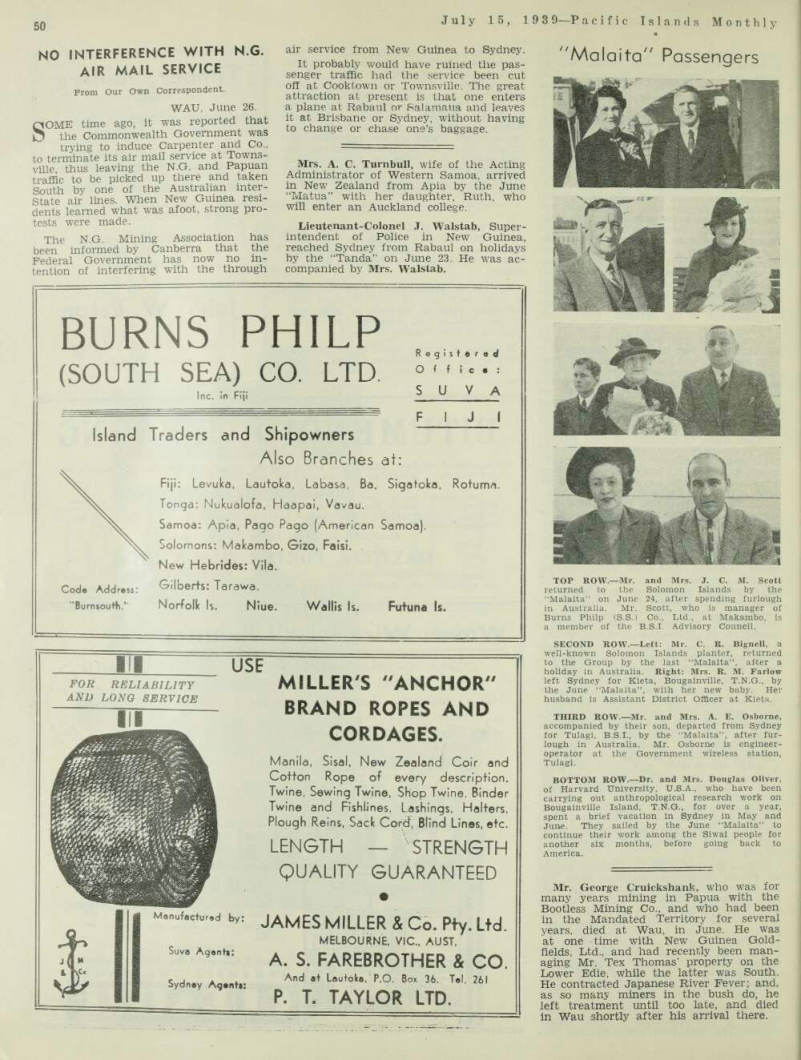
Air Mail Service
From Our Own Correspondent.
WAU, June 26.
SOME time ago, it was reported that the Commonwealth Government was trying to induce Carpenter and Co., to terminate its air mail service at Towns ville thus leaving the N.G. and Papuan traffic to be picked up there and taken South by one of the Australian inter state air lines. When New Guinea resi dents learned what was afoot, strong pro tests were made.
The N.G. Mining Association has been informed by Canberra that the Federal Government has now no in tention of interfering -with the through
air service from New Guinea to Sydney.
It probably would have ruined the pas senger traffic had the service been cut off at Cooktown or Townsville. The great attraction at present is that one enters a plane at Rabaul or Salamaua and leaves it at Brisbane or Sydney, without having to change or chase one’s baggage.
Mrs. A. C. Turnbull, wife of the Acting Administrator of Western Samoa, arrived in New Zealand from Apia by the June “Matua” with her daughter, Ruth, who will enter an Auckland college.
Lieutenant-Colonel J. Walstab, Super intendent of Police in New Guinea, reached Sydney from Rabaul on holidays by the “Tanda” on June 23. He was ac companied by Mrs. Walstab.
"Malaita" Passengers
Mr. George Cruickshank, who was for many years mining in Papua with the Bootless Mining Co., and who had been in the Mandated Territory for several years, died at Wau, in June. He was at one time with New Guinea Gold fields, Ltd., and had recently been man aging Mr. Tex Thomas’ property on the Lower Edie, while the latter was South.
He contracted Japanese River Fever; and, as so many miners in the bush do, he left treatment until too late, and died in Wau shortly after his arrival there.
TOP ROW.—Mr. and Mrs. J. C. M. Scott returned to the Solomon Islands by the “Malaita” on June 24, after spending furlough in Australia. Mr. Scott, who is manager of Burns Philp (S.S.) Co., Ltd,, at Makambo, is a member of the B.S.I. Advisory Council.
SECOND ROW.—Left: Mr. C. R. Bignell, a well-known Solomon Islands planter, returned to the Group by the last “Malaita”, after a holiday in Australia. Right: Mrs. R. M. Farlow left Sydney for Kieta, Bougainville, T.N.G., by the June “Malaita”, with her new baby. Her husband is Assistant District Officer at Kieta.
THIRD ROW.—Mr. and Mrs. A. E. Osborne, accompanied by their son, departed from Sydney for Tulagi, by the “Malaita”, after fur lough in Australia. Mr. Osborne is engineer operator at the Government wireless station, Tulagi.
BOTTOM ROW. —Dr. and Mrs. Douglas Oliver, of Harvard University, U.S.A., who have been carrying out anthropological research work on Bougainville Island. T.N.G., for over a year, spent a brief vacation in Sydney in May and June. They sailed by the June “Malaita” to continue their work among the Siwai people for another six months, before going back to America.
Advertisements & other items, p. 52 (2 items)
50
July 15, 193 9—P acific Islands Monthly
Burns Philp
(SOUTH SEA) CO. LTD.
Inc. In Fiji
island Traders and Shipowners
Also Branches at:
Registered Of f i c e :
SUVA
FIJI
\Fiji: Levuka, Lautoka, Labasa. Ba, Sigatoka, Rotuma.
Tonga: Nukualofa, Haapai, Vavau.
Samoa: Apia, Pago Pago (American Samoa).
Solomons: Makambo, Gizo, Faisi.
New Hebrides: Vila.
Cod. Addr.s*: Gilberts: Tarawa.
"Burn south.*' Norfolk Is. Niue. Wallis Is. Futuna Is.
11l
FOR RELIABILITY
AND LONG SERVICE
MILLER'S "ANCHOR"
BRAND ROPES AND
CORDAGES.
Manila, Sisal, New Zealand Coir and Cotton Rope of every description.
Twine, Sewing Twine, Shop Twine. Binder Twine and Fishlines. Lashings. Halters.
Plough Reins, Sack Cord Blind Lines, etc.
LENGTH STRENGTH
QUALITY GUARANTEED
• ■ £ Manufactured by: Suva Agent*: Sydney Agent*:
JAMES MILLER & Co. Pty. Ltd.
MELBOURNE, VIC., AUST.
A. S. FAREBROTHER & CO,
And at Lautoka, P.O. Box 36, Tel. 261
P. T. TAYLOR LTD.
On The Edge Of Bloodshed

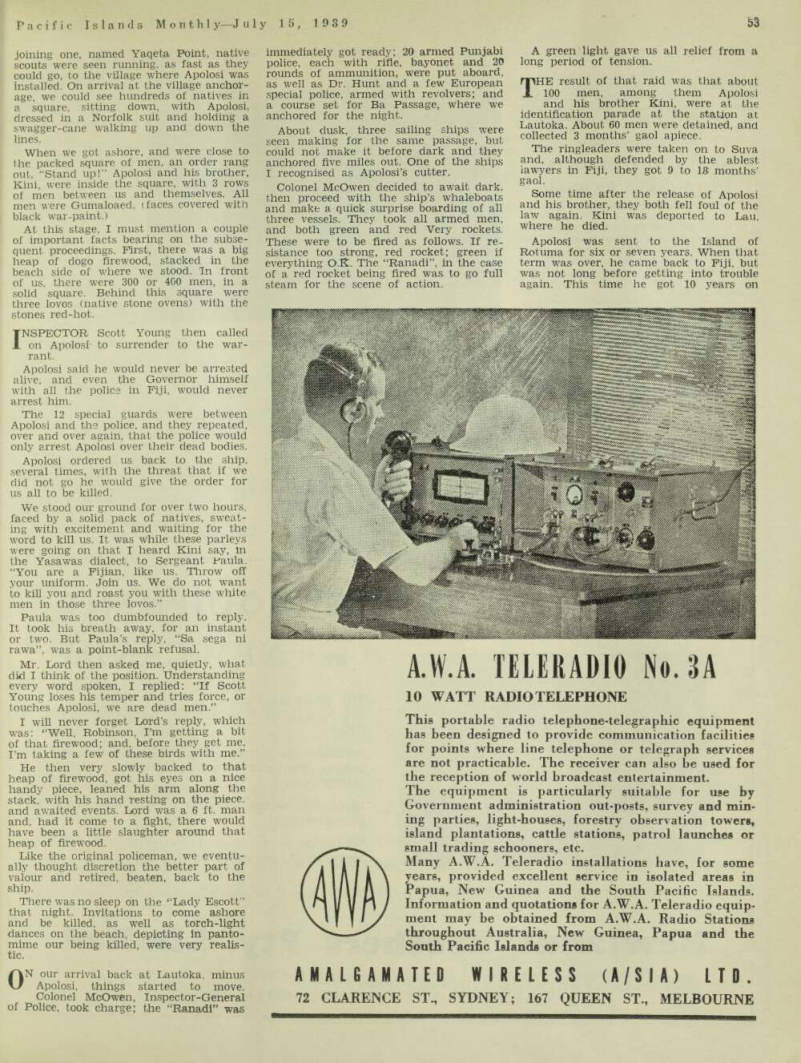
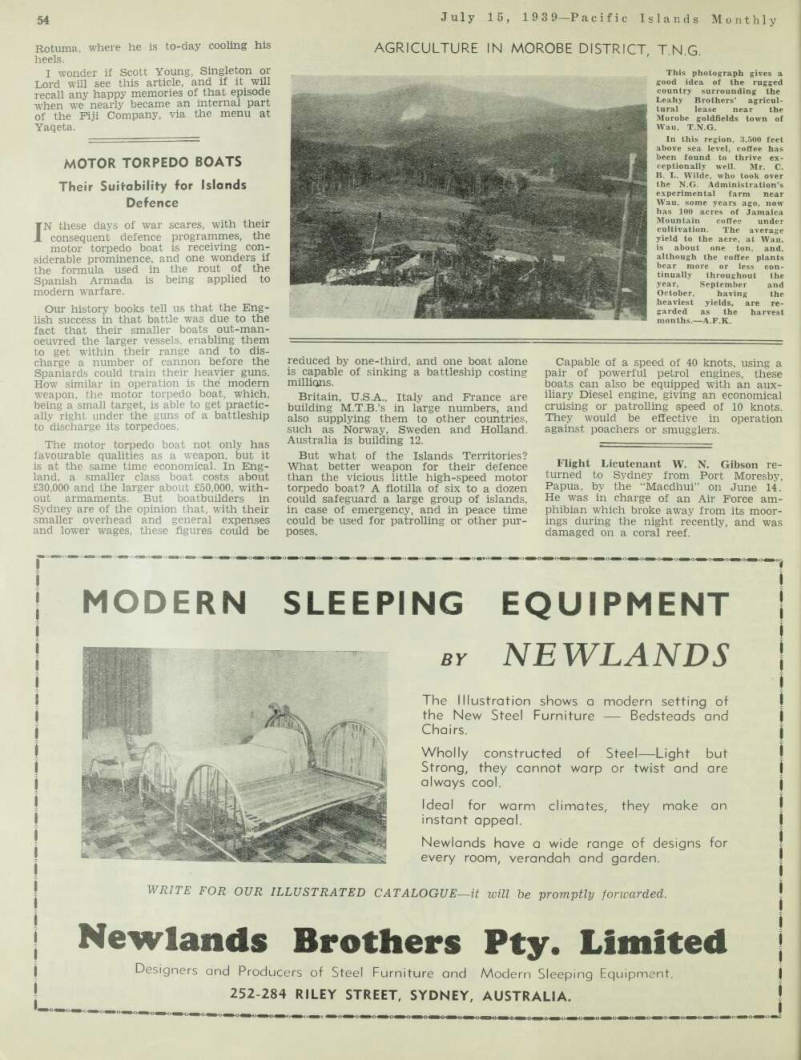
In Fiji
How Police Captured Apolosi, Founder of the Viti Company
IN March, we published some references to the rise and fall of the Viti Company, a partly co-operative concern, established in Fiji some 20 years ago by a clever Fijian, Apolosi Nawai.
It was a commendable plan; but it collapsed because Apolosi and his associates could not be trusted with large sums of money, and because, instead of attending to business, they went on carouses, and were very arrogant towards those who tried to save the enterprise.
We now have received the following interest ing article from Mr. Arthur Robinson, of Vunilagi, Vanua Levu, Fiji.
VIVID memories are recalled by an article in a recent “P.1.M.”, describing the activities of the late Viti Com pany of whom Apolosi R. Nawai was the promotor and director. It also reminds me of how close I myself, Inspector Scott Young, Inspector Swinbourne and Mr, Lord were to taking an internal part in that company, not as active members but as items on Apolosi’s menu at Yaqeta, in the Yasawas Group.
One of the hotbeds of the activities of Apolosi’s Company was the whole of the Yasawas Group, and there the natives were bled white, of both cash and pro duce.
The natives were told that anyone dealing with white men, in any shape or form, would be tried in Apolosi’s own court and imprisoned, as well as being debarred from ever becoming members again of the Viti Company. Head men were stationed right through the Group to collect share moneys, and collect copra for transport to the Company in Suva.
I was trading on the different islands, where I had stores, and all my stores had their quota of pickets stationed near to stop trade with me. It was unsuccess ful, I might add. During this period I would be awake at night, and attending to customers who came to my stores via the bush, while the pickets were home in bed thinking I had closed up and was a,bed, asleep.
And so it went on for months, culmin ating in the arrival of a warrant for Apolosi R. . Nawai’s arrest, for some offence at Rewa. The arrival of this war rant was expected, I believe, and it was through this that I and the Inspectors of Police became involved.
I was in Lautoka when that warrant arrived there, and was asked to take back to the Yasawas with me a native con stable who was to arrest Apolosi, and my cutter was to bring both men back again to Lautoka.
The native policeman was in plain clothes when he landed from my cutter at night, but was evidently recognised by one of the scouts watching arrivals on the beach. The native policeman pro ceeded to the village, in uniform, to carry out his duty of arresting Apolosi. On arrival at the village he found 12 burly natives each armed with spear and knife, stationed around the house out side as guards; these men threatened to kill the policeman if he put his foot in side the house. They said no policeman, white or black, would touch Apolosi’s per son, except over their dead bodies—and they meant every word they said; I am certain of that, to-day. Apolosi, from in side the house, added his threats to those of his guards by saying he would never
be arrested alive; the only thing the police would ever arrest would be his dead body, etc.
THE native policeman thought, as I did, that discretion was the better part of valour. He wrote to Inspector Stan lake, telling him to come and arrest Apolosi, as it was likely he, as a Fijian, would get killed.
I myself wrote to the District Commis sioner, telling him to send white Inspec tors, and arm them, as Apolosi and his followers were in a fighting mood. My letter was not taken seriously.
On the arrival of the “Lady Escott” with Inspector Scott Young, Inspector Swinbourne, Sergeant Paula (native) and a Mr. Lord (who accompanied the party for a pleasure trip) my first question was, “Have you come armed?”
The reply was: “No. What for? Wake up, Robinson! Do you think we want arms to arrest that bird? Where is he? We shall have him aboard this ship and be
back in Lautoka before dark.”
As it happened, Apolosi and his gang had left my island and gone to the ad
joining one, named Yaqeta Point, native scouts were seen running, as fast as they could go, to the village where Apolosi was installed. On arrival at the village anchor age. we could see hundreds of natives in a square, sitting down, with Apolosi, dressed in a Norfolk suit and holding a swagger-cane walking up and down the lines.
When we got ashore, and were close to the packed square of men, an order rang out. “Stand up!" Apolosi and his brother, Kini, were inside the square, with 3 rows of men between us and themselves. All men were Gumaloaed. (faces covered with black war-paint.) At this stage, I must mention a couple of important facts bearing on the subse quent proceedings. First, there was a big heap of dogo firewood, stacked in the beach side of where we stood. In front of us. there were 300 or 400 men, in a solid square. Behind this square were three lovos (native stone ovens) with the stones red-hot.
INSPECTOR Scott Young then called on Apolosi- to surrender to the war rant.
Apolosi said he would never be arrested alive, and even the Governor himself with all the police in Fiji, would never arrest him.
The 12 special guards were between Apolosi and the police, and they repeated, over and over again, that the police would only arrest Apolosi over their dead bodies, Apolosi ordered us back to the ship, several times, with the threat that if we did not go he would give the order for us all to be killed.
We stood our ground for over two hours, faced by a solid pack of natives, sweat ing with excitement and waiting for the word to kill us. It was while these parleys were going on that I heard Kini say, in the Yasawas dialect, to Sergeant Paula.
“You are a Fijian, like us. Throw off your uniform. Join us. We do not want to kill you and roast you with these white men in those three lovos.”
Paula was too dumbfounded to reply.
It took his breath away, for an instant or two. But Paula’s reply. “Sa sega ni rawa”, was a point-blank refusal.
Mr. Lord then asked me, quietly, what did I think of the position. Understanding every word spoken, I replied: “If Scott Young loses his temper and tries force, or touches Apolosi, we are dead men.”
I will never forget Lord’s reply, which was: “Well. Robinson, I’m getting a bit of that firewood; and, before they get me, I’m taking a few of these birds with me.”
He then very slowly backed to that heap of firewood, got his eyes on a nice handy piece, leaned his arm along the stack, with his hand resting on the piece, and awaited events. Lord was a 6 ft. man and, had it come to a fight, there would have been a little slaughter around that heap of firewood.
Like the original policeman, we eventu ally thought discretion the better part of valour and retired, beaten, back to the ship.
There was no sleep on the “Lady Escott” that night. Invitations to come ashore and be killed, as well as torch-light dances on the beach, depicting in panto mime our being killed, were very realis tic.
ON our arrival back at Lautoka. minus Apolosi, things started to move.
Colonel McOwen, Inspector-General of Police, took charge; the “Ranadi” was
immediately got ready; 20 armed Punjabi police, each with rifle, bayonet and 20 rounds of ammunition, were put aboard, as well as Dr. Hunt and a few European special police, armed with revolvers; and a course set for Ba Passage, where we anchored for the night.
About dusk, three sailing ships were seen making for the same passage, but could not make it before dark and they anchored five miles out. One of the ships I recognised as Apolosi’s cutter.
Colonel McOwen decided to await dark, then proceed with the ship’s whaleboats and make a quick surprise boarding of all three vessels. They took all armed men, and both green and red Very rockets, These were to be fired as follows. If resistance too strong, red rocket; green if everything O.K. The “Ranadi”, in the case of a red rocket being fired was to go full steam for the scene of action.
A green light gave us all relief from a long period of tension, , , . , , x . rpHE result of that raid was that about X. 100 men. among them Apolosi and his brother Kini, were at the identification parade at the station at
“gj f ““
collected 3 montns gaol apiece.
The ringleaders were taken on to Suva and, although defended by the ablest lawyers in Fiji, they got 9 to 18 months’ . lP? 10 u in \P, a “'S P* , A H°I? SI anc * 1S brother, they both fell foul of the * a w again. Kim was deported to Lau, where he died.
Apolosi was sent to the Island of Rotuma for six or seven years. When that term was over, he came back to Fiji, but was not long before getting into trouble again. This time he got 10 years on
Rotuma, where he is to-day cooling his heels.
I wonder if Scott Young, Singleton or Lord will see this article, and if it will recall any happy memories of that episode when we nearly became an internal part of the Fiji Company, via the menu at Yaqeta.
Advertisements & other items, pp. 53-55 (3 items)
51
Pacific Islands Monthl y—J uly 15, 1939
Chapman & Sherack
cr
GO WINGS
Sydney’s Leading Store
EXCLUSIVELY FOR MEN
will have your
SUIT TO MEASURE
TAILORED AND AWAITING
YOUR ARRIVAL IN SYDNEY
Write for
FREE PATTERNS
and Self Measurement Form . . .
COWING BROS. LTD.
Market and George Streets, Sydney
*E f ' V' /' m Here in the islands, I need a seaworthy craft, with cool, well ventilated yet roomy cabin and an absolutely reliable engine.
Thus the Chapman 16ft. Cabin Model is my choice. It is powered with a famous Chapman PUP Engine and fitted with a sturdy cabin that provides sleeping accommodation for two as well as ample storage space. Thus there's protection from the tropic sun, wind and seaspray. You, too, write for details of this craft.
CHAPMAN & SHERACK
26 Clara Street, Erskine ville, N.S.W.
ENGINE MANUFACTURERS FOR THIRTY YEARS
BEST
FOR LIGHTING
No other kerosene gives such a "Soft WHITE light/' With Laurel in the lamp you won't get any smoke, nor soot, not smell, nor will hard char form on the tip of the wick to make the flame flicker. "Best for Lighting" is a simple statement of fact. w, I 1 w.'.
L & l
VACUUM
O I L
COMPANY
P T Y. LTD
Agents.
mh
A.W.A. TELERADIO No. 3A
10 WATT RADIOTELEPHONE
m This portable radio telephone-telegraphic equipment has been designed to provide communication facilities for points where line telephone or telegraph services are not practicable. The receiver can also be used for the reception of world broadcast entertainment.
The equipment is particularly suitable for use by Government administration out-posts, survey and mining parties, light-houses, forestry observation towers, island plantations, cattle stations, patrol launches or small trading schooners, etc.
Many A.W.A. Teleradio installations have, for some years, provided excellent service in isolated areas in Papua, New Guinea and the South Pacific Islands.
Information and quotations for A.W.A. Teleradio equipment may be obtained from A.W.A. Radio Stations throughout Australia, New Guinea, Papua and the South Pacific Islands or from
AMALGAMATED WIRELESS (A/SIA) LTD.
72 CLARENCE ST., SYDNEY; 167 QUEEN ST., MELBOURNE
53
Pacific Islands Monthl y—J uly 16, 1939
Motor Torpedo Boats
Their Suit-ability for Islands Defence
IN these days of war scares, with their consequent defence programmes, the motor torpedo boat is receiving con siderable prominence, and one wonders if the formula used in the rout of the Spanish Armada is being applied to modern warfare.
Our history books tell us that the Eng lish success in that battle was due to the fact that their smaller boats out-man oeuvred the larger vessels, enabling them to get within their range and to dis charge a number of cannon before the Spaniards could train their heavier guns.
How similar in operation is the modem weapon, the motor torpedo boat, which, being a small target, is able to get practic ally right under the guns of a battleship to discharge its torpedoes.
The motor torpedo boat not only has favourable qualities as a weapon, but it is at the same time economical. In Eng land, a smaller class boat costs about £30,000 and the larger about £50,000, with out armaments. But boatbuilders in Sydney are of the opinion that, with their smaller overhead and general expenses and lower wages, these figures could be
reduced by one-third, and one boat alone is capable of sinking a battleship costing millions.
Britain, U.S.A., Italy and France are building M.T.B.’s in large numbers, and also supplying them to other countries, such as Norway, Sweden and Holland.
Australia is building 12.
But what of the Islands Territories?
What better weapon for their defence than the vicious little high-speed motor torpedo boat? A flotilla of six to a dozen could safeguard a large group of islands, in case of emergency, and in peace time could be used for patrolling or other pur poses.
Capable of a speed of 40 knots, using a pair of powerful petrol engines, these boats can also be equipped with an aux iliary Diesel engine, giving an economical cruising or patrolling speed of 10 knots.
They would be effective in operation against poachers or smugglers.
Flight Lieutenant W. N. Gibson re turned to Sydney from Port Moresby, Papua, by the “Macdhui” on June 14.
He was in charge of an Air Force am phibian which broke away from its moor ings during the night recently, and was damaged on a coral reef.
Agriculture In Morobe District, T.N.G.
This photograph gives a good idea of the rugged country surrounding the Leahy Brothers’ agricul tural lease near the Morobe goldfields town of Wau, T.N.G.
In this region, 3,500 feet above sea level, coffee has been found to thrive ex ceptionally well. Mr. C.
B. L. Wilde, who took over the N.G. Administration’s experimental farm near Wau, some years ago, now has 100 acres of Jamaica Mountain coffee under cultivation. The average yield to the acre, at Wau, is about one ton, and, although the coffee plants bear more or less con tinually throughout the year, September and October, having the heaviest yields, are re garded as the harvest months.—A.F.K.
Advertisements & other items, p. 56 (2 items)
54
July 15, 193 9—P acific Islands Monthly
Newlands Brothers Pty. Limited
MODERN SLEEPING EQUIPMENT
by NEWLANDS
The Illustration shows a modern setting of the New Steel Furniture Bedsteads and Chairs.
Wholly constructed of Steel—Light but Strong, they cannot warp or twist and are always cool.
Ideal for warm climates, they make an instant appeal.
Newlands have a wide range of designs for every room, verandah and garden.
WRITE FOR OUR ILLUSTRATED CATALOGUE — it will he promptly forwarded.
Newlands Brothers Pty. Limited
Designers and Producers of Steel Furniture and Modern Sleeping Equipment.
252-284 RILEY STREET, SYDNEY, AUSTRALIA.
New Books
The Mystery Of Swordfish
REEF, by Arthur Upheld. Published by Angus and Robertson, Sydney; 6/-.
Here is a book that will entice the most hard-boiled reader of “thrillers” into a midnight session. A rich man, out after big-game hsh, on the southern coast of New South Wales, is murdered. The mystery of his death is solved by Detec tive-Inspector Bonaparte, who, incident ally, is lured into big-game fishing. So, mixed in with a highly exciting criminal hunt, we have many equally exciting and diverting chapters describing the pur suit and capture of marlin, mako shark, tuna, etc. —Australia’s newest sport.
Upheld has created, in Inspector Bona parte, a delightful character who has won his spurs in detective hction. Having made his acquaintance in “The Bone is Pointed” and “Mystery of Swordhsh Reef”, we hope to meet Mr, Bonaparte many times in the future.
“Reaching For The Stars”, By
Nora Wain. Published by Angus & Rob ertson, Sydney; 8/6.
One of the most puzzling phenomena of the world to-day is the sight of Ger many, under the leadership of a shout ing and apparently irresponsible egocen tric, goose-stepping unprotestingly into a world-war that may destroy civilisation.
How is it that Germans, who individu ally are kind and lovable people, are per petrating. in the mass, horrible cruelties upon the Jews, and upon opponents of the political party in power? Have these usually well-balanced people been mes merised?
Here is a book that throws much lierht into what, politically speaking, is the darkest place in Europe. Mrs. Wain, an American, married to an English musician, has just completed four years in Ger many, under conditions which brought her close to the heart of the people. She writes well, and without fear or favour.
She helps to answer the question hund reds of millions are asking to-day: Is Hitler an angel, or a devil, or just a well meaning, loud-mouthed demagogue, dis astrously misplaced?
A New Cocktail In Daru
THE little township of Daru. at the Western end of Papua, had a new excitement some weeks ago.
A crowd of boys could be seen, one day. gathered near the village. Several of them seemed persistently to fall and roll on the ground. It was an interest ing exhibition of how the lordly whites would look, if some of their parties were held in the daylight. Every one was amused.
Several days later, rumours flew about, and natives could be seen going to and coming from the Government office.
Eventually, enough evidence was gathered and there came Der Tag. Fines varying from £2 to £2O were imposed on about twenty natives. Several became guests of His Majesty.
And the reason was that someone had invented the “Erseover” cocktail. The in gredients were coconut milk, sipora and methylated spirits. Some people say that the Upper Ten included boot polish also, in theirs.
Anyway, as one of the tipplers remark ed. it was strong. “Oh, Taubada,” he said, “He strong too much! One drink and boy fall down Erseover”,
01l company men, having been recruit ed from all over the world, mentioned quite a few different drinks. The “Ply- Tox” (boot polish and “metho.”) and the “Condy’s” (bluestone of “pinkie”); but “Erseover” was a new one to them.
The chief result, that we can notice, is that several of the leading lay preach ers at the local mission are not now lay-preachers.
Thus is civilisation brought to the heathen —even in Daru, with its mud,
mosquitoes and monotony-
“Daika”.
Mr. Bill Seale, of Kavieng, New Guinea, married Miss Heather Holmes, daughter of Mr. G. C. (“Jos”) Holmes, at the Meth odist Mission church at Kavieng on June 20. The couple arrived in Sydney by the “Bulolo” early in July on their honey moon.
and Papua

Red Cross In New Guinea and Papua
ANEW GUINEA division of the Aus tralian Red Cross Society was form ed on July 3 in Rabaul, at a large public meeting, presided over by Lady McNicoll, wife of the Administrator. Mr.
Stanley Addison, secretary of the Society, addressed the meeting.
A division of the Red Cross has also been formed in Papua, with headquarters at Port Moresby, with the object of training members for emergency work, including first aid, home nursing and anti-gas relief work.
The “Sagittaire”, recently acquired by Messageries Maritime Co., from the Trans-Atlantic Co., made her first visit to the South Seas in June, on the Europe- Tahiti-New Hebrides-New Caledonia run.
Mrs F. Martin died at Tomo, New Caledonia early in June. She was 73 years of age
Sister May Hayman, of the New Guinea Mission hospital at Gona, Papua, arrived in Sydney by the “Bulolo” on July 4.
Advertisements & other items, pp. 57-58 (2 items)
55
Pacific Islands Mont hi y—J uly 15, 1939
Price £2O/10/-
AMP-LIT
Output 12 volts 300 watts (25 amps) (1 ) Press Button Starting (2) Magneto Ignition, etc. (3) Automatic Cut-out (4) (5) (6) (7) Air-Cleaner, oil bath type Petrol Filter Float - feed adjustable Carburettor Vibration-less
HOME POWER
UNITS
By Briggs & Stratton Small, light, compact Petrol electric generators with everything a car engine has.
ELECTRICITY’
ANYWHERE—
—ANYTIME
For Home Lighting Battery Charging Will operate twelve 25 watt Lamps 12 hours per gallon of petrol.
'-"3 g Features 4,5, 6 & 7 are positively exclusive to Model 300 (Weight when packed 97 lbs.) Also, Model 100, 6 volts, 100 watts, manual starting £l2/10/-. (Weight when packed 70 lbs.) Briggs & Stratton are the World’s largest manufacturers of single cylinder 4-cycle, air-cooled Petrol Motors.
Stationary and Marine Engines also available up to 5 Horsepower.
TRADE ENQUIRIES INVITED.
EXCLUSIVE AGENTS:
AMPLION (A'SIA) PTY. LIMITED
66 CLARENCE ST., SYDNEY.
Cable Address: “AMPLION, M Sydney.
QUALITY
CUTLERY
523.—BREAD BOARD AND KNIFE,
Coloured Knife Handle and Coloured Design on 4 Corners. Knife slips into slot at top of Board. 11/6 complete.
Postage, 1/- extra.
604.—FOUR-PAIR SCISSOR CASE.
Case made of Fine Fancy Roan Leather. Size about BVi in. x 3 in. when folded. Fitted with 4 bestquality Sheffleld-made Scissors—l 7 in.
Cutting-out, 1 5 in. Household, 1 Embroidery, and 1 Nail. 37/6 com-
SEND FOR FREE ILLUSTRATED CATALOGUE.
W. JNO. BAKER SJ:
plete.
3 HUNTER ST.,
SYDNEY, N.S.W.
tliat'vks tir
4711
your ideal
refrcsherl
FAMOUS
RHINE
LAVEN
3827 ■Cm Representative:
ROBERT BLAU
A U S T. )
A Fragrance of
Wistful Charm
‘ Famous Rhine Lavender," wafting to you the dewy sweetness of oldworld Rhenish gardens.
A.C.A. BUILDING, CNR. KING
& YORK STREETS. SYDNEY
Pattern Service
EACH month we publish a Fashions design, E patterns of which may be purchased by our readers direct from this office, post free. To obtain a pattern, print your name and address below, giving the number of the pattern and the bust size, and send to “Pattern Department”, Pacific Islands Monthly, Box 3408 R, G.P.0., Sydney; enclose also the price of the pattern in postal note or stamps.
It will be sent by return mail.
Name Address Pattern Number Size
Mrs. Florence Arbuthnot, a well-known Fiji resident, died at Suva in June, aged 80. She had been in the Colony nearly 60 years.
Madame Amelie Chivot died at Noumea, New Caledonia, in June at the age of 67.
F6448.— A Charming Dirndl Frock. With
FULL SKIRT. With dainty shirring at the waist, giving added fullness to the skirt, this is a very becoming style for any occasion. It takes four and three-quarter yds. 36 in. wide material for size 36 in. bust. Other sizes, 32, 34, 38 and 40 in. bust. Paper pattern, 1/1.
Advertisements & other items, p. 58 (1 item)
56
July 15, 193 9—P acific Islands Monthly
An Epidemic Of Cruising Canoes
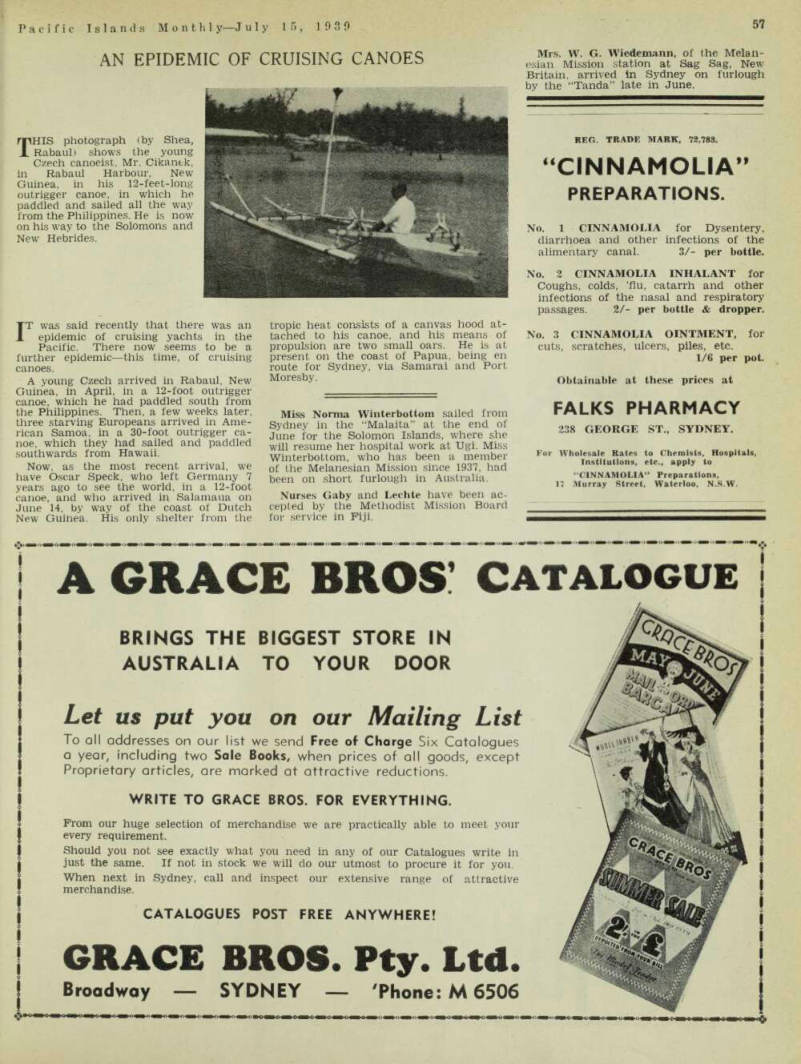
THIS photograph (by Shea, Rabaul) shows the young Czech canoeist, Mr. Cikanek, in Rabaul Harbour, New Guinea, in his 12-feet-long outrigger canoe, in which he paddled and sailed all the way from the Philippines. He is now on his way to the Solomons and New Hebrides.
IT was said recently that there was an epidemic of cruising yachts in the Pacific. There now seems to be a further epidemic—this time, of cruising canoes.
A young Czech arrived in Rabaul, New Guinea, in April, in a 12-foot outrigger canoe, which he had paddled south from the Philippines. Then, a few weeks later, three starving Europeans arrived in Ame rican Samoa, in a 30-foot outrigger ca noe, which they had sailed and paddled southwards from Hawaii.
Now. as the most recent arrival, we have Oscar Speck, who left Germany 7 years ago to see the world, in a 12-foot canoe, and who arrived in Salamaua on June 14, by way of the coast of Dutch New Guinea. His only shelter from the
tropic heat consists of a canvas hood at tached to his canoe, and his means of propulsion are two small oars. He is at present on the coast of Papua, being en route for Sydney, via Samarai and Port Moresby.
Miss Norma Winterbottom sailed from Sydney in the “Malaita” at the end of June for the Solomon Islands, where she will resume her hospital work at Ugi. Miss Winterbottom, who has been a member of the Melanesian Mission since 1937, had been on short furlough in Australia.
Nurses Gaby and Lechte have been ac cepted by the Methodist Mission Board for service in Fiji.
Mrs. W. G. Wiedemann, of the Melan esian Mission station at Sag Sag, New Britain, arrived in Sydney on furlough by the “Tanda” late in June.
Mr. John Ahem, Commercial Superin tendent of Island Explorations Co., ar rived in Papua by airliner from Sydney on June 26. Mrs. Ahern, with her small daughter, followed later by the “Maet suycker” from Sydney on July 1.
Mr. D. T. Tilley, formerly of the Auck land Fire Brigade, has taken up duties as Deputy Fire Officer of the Suva Brig ade.
Mr. T. Fitzpatrick, of the Samoan legal firm of Klinkmueller and Pleasants, ar rived in New Zealand from Apia by the “Matua” recently. He was accompanied by his wife.
Advertisements & other items, pp. 59-60 (1 item)
A Grace Bros’ Catalogue
REG. TRADE MARK, 78,788.
“CINNAMOLIA”
PREPARATIONS.
No. 1 CINNAMOLIA for Dysentery, diarrhoea and other infections of the alimentary canal. 3/- per bottle.
No. 2 CINNAMOLIA INHALANT for
Coughs, colds, ’flu, catarrh and other infections of the nasal and respiratory passages. 2/- per bottle & dropper.
No. 3 CINNAMOLIA OINTMENT, for
cuts, scratches, ulcers, piles, etc. 1/6 per pot.
Obtainable at these prices at
FALKS PHARMACY
238 GEORGE ST., SYDNEY.
For Wholesale Rates to Chemists, Hospitals, Institutions, etc., apply to “CINNAMOLIA" Preparations, 17 Murray Street, Waterloo, N.S.W.
A GRACE BROS’ CATALOGUE
BRINGS THE BIGGEST STORE IN
AUSTRALIA TO YOUR DOOR
Let us put you on our Mailing List To all addresses on our list we send Free of Charge Six Catalogues a year, including two Sale Books, when prices of all goods, except Proprietary articles, are marked at attractive reductions.
WRITE TO GRACE BROS. FOR EVERYTHING.
From our huge selection of merchandise we are practically able to meet your every requirement.
Should you not see exactly what you need in any of our Catalogues write in just the same. If not in stock we will do our utmost to procure it for you.
When next in Sydney, call and inspect our extensive range of attractive merchandise.
CATALOGUES POST FREE ANYWHERE!
GRACE BROS. Pty. Ltd.
Broadwoy SYDNEY 'Rhone; M 6506
T © * £
KEEP FIT and WELL by PURCHASING YOUR
GROCERIES and PROVISIONS
FROM
McILRATH’S
Sunshine Full Cream Powdered Milk, 12oz. 1/2 tin; 13/9 doz.
Best Beef Dripping, lib 9id tin; 21b. 1/3 tin Rosa Virgin Olive Oil lOoz. 1/3 bot.; 250 z. 2/11 bot.
Mcllrath’s Crustless Cheese, Boz 7id. pkt.; 7/3 doz.
Arnott’s Popso Crackers, No. 2 size I ll tin C. &B. Herrings in Sauce .. .. 7oz. 7/6 doz.; 14oz. 10/- doz.
English Smoked Sardines .. .. 4oz. 4 9 doz.; Boz. 8/6 doz.
Selmore Sockeye Salmon .. Boz. 12/6 doz.; 16oz. 17/- doz.
Ovaltine 4\oz. 1/8; 9oz. 2/8; 18oz. 4 8 per tin Nestles Malted Milk Boz. 1/5; 16oz. 2/6 per tin Saunders’ Malt Extract 16oz. Hid.; 21b. 1/11 tin T.X.L.” Shredded Marmalade .. 16oz. §id jar; 9/3 doz.
Keen’s Mustard, Sealed . loz. 4id; 2oz. Bid; 4oz. 1/3 tin Holbrook’s Queen Olives soz. Hid; lOoz. l/5i bot.
Eta Peanut Butter .. .. 4oz. 9d; Boz. 1/2; 12oz. l/4i jar T.X.L.” Golden Sweet Corn .. soz. sid; Boz. 8d per tin Heinz Baked Beans . .. 4oz. 4id; Boz. 6d; 16oz. 10id tin T.X.L.” Spaghetti in Sauce: 4oz. 4id; Boz. 6id; 16oz. 9id tin ‘T.X.L.” Tomato or Vegetable Soup . Boz. sid; 16oz. Bid tin All Prices f.o.b. Sydney. Cases and Packing Free.
McILRATH’S Pty.Ltd.
EXPORT DEPARTMENT.
202-204 PITT STREET, SYDNEY, AUSTRALIA
NEW
EXPORT
LISTS
NOW
AVAILABLE
—POST
FREE.
A Delicious Soup prepared in 5 minutes.
TIKI
Packed in i and 1 lb.
SOUP
tins.
The Flavor appeals from the First Sip.
"Hoodoo" Voyage
Ends on Reef in Eastern Papua
THE South African ketch-rigged yacht “Lands End” was wrecked on a reef in Eastern Papua, described as 115 miles south-east of Misima, on the night of June 8.
The crew of four men got away on a raft; and Captain H. Jeffrey, with his wife (to whom he was recently married in Auckland) and his step-daughter, got away in the dinghy. The company eventu ally reached the island of Misima. Cap
tain Jeffrey left his people there while he went back to try and refloat the “Lands End”.
The “Lands End” left Durban in Sep tember, 1937; crossed the Atlantic to the West Indies; passed through the Panama Canal and visited Tahiti and Rarotonga, on her way to Auckland; and, between June and September, 1938, she was in Northern New Zealand and Central Pacific Islands ports. The “Lands End” left Auckland in December in resumption of her world voyage.
From the time that tne “Lands End” left Auckland in December, there seemed to be a “hoodoo” upon her.
Soon after leaving Auckland, the petrol stove exploded and the crew fought the fire for 20 minutes before it was put out.
Entering Haapai Harbour, Tonga, the “Lands End” struck a reef in the dark ness and listed alarmingly. Members of the crew dived into the water and eventu ally refloated her.
At Nukualofa (Tonga) the yacht had to shelter from a hurricane for a week under the lee of a small island. Every thing on board was soaked. Another hurri cane struck the “Lands End” at Suva.
On the run to New Caledonia from Suva there were gales all the way. There was six inches of water in the forecastle, and the sails were severely damaged. As the yacht entered Vila (New Hebrides) at night she ran aground, but was re floated on a rising tide.
Prom the New Hebrides the “Lands End” sailed to the Solomon Islands, then ran down toward Papua, where she was wrecked.
Inquiry
Finance Session—But No Financial Inquiry
THE meeting of the New Guinea Legis lative Council, held on June 15, was purely formal. The sitting lasted 10 minutes and the only business done was to pass supply for the period ending July, 1940. The newly appointed member of the Council. Rev. L. A. McArthur, was formally welcomed.
And that was all. None of the unoffi cial members apparently thought it worth while to question the Administrator about the financial condition of the terri tory, which is causing considerable con cern.
Mr. Ken Lewis, power house mechanic at Samarai, Papua, has left the Territory on a holiday visit to the East. He is be ing relieved by Mr. Harvey.
Mr. and Mrs. F. Stunzner, formerly of Tuvao Plantation, Western Samoa, left the Territory recently by the “Tisnaren” for Europe where they will live in future.
Mr. Stunzner, who had resided in Samoa for over 35 years, has been advised to live in a cooler climate.
Advertisements & other items, p. 60 (1 item)
58
July 15, 193 9—P acific Islands Monthly
Mining News
From Fiji
Loloma (Fiji) Gold Mines, N.L.
THE last clean-up from Loloma (Fiji) Gold Mines, N.L., Tavua, for the four weeks ended June 14 compared with the three previous yields as follows: —
tNo old residues were treated pending the in stallation of a larger pump.
Emperor Gold Mining Co., Ltd.
Emperor Gold Mining Co.. Ltd.. Tavua, Fiji, reports that figures for the last four production periods compare as follow: —
fConcentrates stacked, pending further treat ment, totalled 38 tons, estimated to contain 266 oz. of fine gold.
A supplementary report stated that churn drilling has been continued in the Cardigan area and the ore body has now been well de fined, which will facilitate extraction of ore.
Mount Kasi Mines, Ltd.
Recent yields from the Mount Kasi mine at Vanua Levu are compared in the following table:—
From the Solomons
Charlton South, N.L.
DIRECTORS of Charlton South. N.L., of Mel bourne, cabled their representative at Tulagi, British Solomon Islands, in mid-June, request ing him to abandon the option acquired by the Co. over the mining area adjoining the Solomon Gold Mines, N.L.. area.
Solomon Gold Mines, N.L.
Solomon Gold Mines, N.L., proposes to wind up voluntarily. The Co. was formed in Mel bourne In April to send Mr. T. R. Victor, mining engineer, to Guadalcanal Island, in the Solo mons, to inspect a prospective gold-bearing area.
Of 1,000 shares of £5 in the capital of the Co., 900 were issued at £2 a share application and allotment. Australian Gold Development, N.L, subscribed for 150 of the shares. The abandon ment of the area was recommended by Mr.
Victor in a cable message from the Solomons on June 9, in which he reported adversely on the prospects,
From Papua
Borneo Options, N.L.
IN a circular to shareholders, directors of I Borneo Options, N.L., reported in June, that an agreement has been finalised by which the Co.'s manganese deposits at Kapa Kapa, Papua, arc to be worked on its behalf by Melbourne interests, inter alia, on the following terms and conditions:— They are to mine and ship a minimum of 7,500 tons a year. The royalty payable to Borneo Options is £2 a ton net on the first 5,000 tons; £l/10/- a ton on the balance, 2,500 tons; £l/10/- a ton on any additional ore mined and shipped above 7,500 tons a year and up to 10.000 tons a year. On all ore mined and shipped in excess of 10,000 tons, the royalty will be at the rate of £2 a ton.
Directors state that satisfactory guarantees have been established for the carrying out of the contract, and the agreement covers a term of seven years, with a right to renew for a further seven years. These royalties are pay able tp Borneo Options monthly as the ore is shipped from Port Moresby. The terms free the Co from the necessity of obtaining any further capital as its mines will be worked at no further
cost to the Co. The circular added that as the guaranteed minimum quantity of ore has to be mined and shipped each year, the Co. must receive a minimum net sum of £13,750 a year.
This yearly income will make possible to the shareholders an estimated dividend of at least £2 a share a year.
Mandated Alluvials, N.L.
Returns from No. 11 shipment of matte from Mandated Alluvials, N.L., of Papua, show;—Ore treated (tons), oxidised 689, sulphite 362; matte produced, 38 Va tons, containing 360 oz. fine gold, 803 oz. silver, and 12 3 /4 tons copper, the net value being £3,675. Further shipments, Nos. 12 and 13, of 28Va and 24y 2 tons respectively, have now been made, and, subject to check assays, the approximate total contents are 530 oz. fine gold, 960 oz. silver, and 15 tons copper.
Reports from the mine indicate that what appears to be a new ore body has been opened up north of No. 6 adit. More than 100 tons of high-grade ore has been mined, and work is proceeding on a face over 15 ft. wide and 10 ft. in height.
The Co. repaid its debentures on July 1.
Papuan apinaipi petroleum co., ltd.
Papuan Apinaipi Petroleum Co., Ltd., reports that the transfer of the Sullivan scout drilling plant to the site of the No. 4 Oiapu bore loca tion has been completed, and drilling commenced there. Mr. E. A. Kodyen, the Commonwealth petroleum technologist, accompanied by Mr.
Launcelot Owen, the Co.’s geologist and general manager, returned to Sydney in June, and Mr.
Kodyen proceeded to Canberra to report to the authorities his recommendations for the test ing by deep drilling of the area held under the Co.’s permit.
In a progress report to shareholders, early in July, Mr. Owen stated that since May 31 de tailed study of the Oiapu area had proved that, in spite of the absence of surface indications of petroleum, the underlying mudstone is definitely petroliferous throughout the area. The light gravity of the traces of oil already encountered in the scout drills indicate the possibility that it is derived from a deep reservoir containing petroleum of much heavier gravity. Deep drill ing is necessary to prove or disprove the exist ence of porous horizons capable of producing
Mar. Apr. tMay tJune 22. 19. 17. 14.
Tons treated . . .. 2,355 2.185 2,390 2,244 Gold, oz.. fine .. . . 3,210 2.944 3,172 3,007 Silver, oz., fine . . .. 563 510 657 580 Residue, dwt 1.07 1.23 1.15 0.9
Mar. Apr. tMay tJune 22. 19. 17. 14.
Ore treated, tons . 14,750 13,650 13,912 14,162 Head value, dwt. .. 6.31 6.5 6.61 6.86 Gold, oz.. fine . .. 4,188 4.023 4,033 4,103 Residues, dwt. ... 0.5 0.47 0.55 0.71
Mar. Apr. May June 22. 19. 17. . 14.
Ore, tons . . . 3.310 2.826 2.893 2,355 Gold, fine, oz .. 652 633 669 592 Value, £ A .. .. 5,705 5,538 5,854 5.180
commercial oil, and the area should be tested to a depth of 5,000 ft. or more.
Cuthbert’S Misima Goldmine, Ltd.
Figures for the June clean-up from Cuthbert’s mine on Misima Island, Papua, compared with the two previous yields as follows: —
‘Reduced tonnage and grade caused by heavy rains and sickness.
From New Guinea
New Guinea Goldfields, Ltd.
A PROGRESS report issued on June 19 by The Mining Trust, Limited, consulting en gineers to New Guinea Goldfields, Limited, com pared the production and profit for March, April, and May, as follows:
April production at all centres was affected by the Easter holidays and by heavy rains. The Edie Creek mill loss in May was due to low heads. Other operations were affected by heavy floods.
Day Dawn South (N.G.), N.L.
The liquidator of Day Dawn South (New Guinea), N.L., has decided a final return of capital to shareholders of 28/- for each 100 shares. This will be paid on surrender of share certificates.
Enterprise Of New Guinea Gold And
Petroleum Development, N.L.
The general manager of Enterprise of New Guinea Gold and Petroleum Development, N.L. (Mr. H. Taylour), reports that the Co. treated 4,104 yards at Surprise Creek in May for a yield of 22 oz. 7 dwt. gold.
On June 14, the Co. made a call of 5/- per share, making 60/- paid.
Sunshine Gold Development, Ltd.
Sunshine Gold Development, Limited, reports that the clean-up for June yielded 375 oz. gold, the plant working 549 hours. The yield for the previous month was 276.2 oz.
Sandy Creek Gold Sluicing, Ltd.
Early in July the mine manager of Sandy Creek Gold Sluicing, Ltd., New Guinea, reported that the last four yields compared as follows;
Morobe Goldfields Output.
The £ A 2,000,000 mark for the Morobe Gold fields’ 12 months’ production to June 30 is be ing rapidly approached, wrote our Wau Corres pondent on June 24. The exact figure to April 30 was £ A 1,692,571. May output was 29.490 oz., representing £A154,039. The bullion value for the 11 months to May 31, therefore, was £ A 1,846,610.
April showed a return of £A166,052, compared with May’s £A154.039. However, considering the three floods which occurred in May, putting many miners out of action and seriously in terrupting New Guinea Goldfields, Ltd.’s opera tions at Golden Ridges, and Koranga Gold Sluicing Co., the average was well maintained; and it is reasonable to suppose that the £ A 12.000 drop might have been more than cov ered had mining kept on an even keel. Flood weather appears to have ceased and there is every prospect of the remaining £A153,390 be ing more than produced in June, thus establish ing a record annual output.
Equator Exploration Syndicate, N.L
Equator Exploration Syndicate, N.L., has been formed in Sydney with a capital of £5,000 in £25 shares to send Captain A. J. Kenrick to South Africa, England and Holland to complete a contract for a licence under Dutch laws for prospecting for gold and petroleum. Captain Kenrick has a concession of about 17,000 square miles in the Netherlands Indies and New Guinea possession. Directors are: Messrs. S. McKellar- White, A. H. Wildridge, and Major-General H.
G. Bennett, all of Sydney.
Mr. J. Hornell, late Director of Fisheries in Madras, will arrive in Fiji in August to carry out an investigation into the fishery resources of the Group and ad vise on the possibility of establishing a
fish canning industry.
Mr. D. McGregor, of the Automobile Association of New Zealand, is now spending several months in Fiji attend
ing to A.A. business.
Mr. G. Toogood, Patrol Officer in the
Papuan Administration, left Port Moresby
by the “Strathaird” for Sydney in June on three months’ leave, during which he
will fly to England.
April. May* June.
Treated, tons 3,056 2,698 3,010 Bullion, oz 2,966 2,525 2,793 Gold, fine oz 808 617.6 770 Silver, fine oz 2,088 1,840 1,956 Est. value £6,591 £5,052 £6,275 Value per ton . . 43/2 37/5 41/8
Golden Ridges mill— Tons treated 2,804 2,597 1,723 Gold, oz. f fine . . . . 1,015 947 778 Silver, oz., fine .. 1,545 1,435 1,121 Operating profit— Edie Creek, £ .. 2,523 *189 *865 Alluvial, £ .. 1,918 1,428 1,927 Golden Ridges. £ .. 1,627 1,555 176 •Loss.
Mar.
Apr.
May.
June.
Cubic yards . . .. 17.834 15,609 13,343 21.201 Gold, oz 463.1 310 153 228 Per cubic yard .. 3/10 Vi 2/11% l/SVi 1/7’A Working cost .. . 1/5 1/4 1/- 1/-
Mar.
Apr.
May.
Edie Creek mill— Ore, tons 3,443 2,769 3,269 Gold, oz., fine .. . 1,111 795 803 Silver, oz., fine .. . 4,143 4,062 3,979 Alluvial— Gold, oz., fine .. . 969 836 1,201 Silver, oz.. fine .. . 716 572 857
Advertisements & other items, pp. 61-62 (3 items)
59
Pacific Islands Monthl y-—J u 1 y 15, 1939
ike to R i A
BITTER
X itiß^U y
Mining Ore
Treatment
Machinery
COMPLETE CYANIDE
PLANTS SUPPLIED
Dorr Classifiers Dorr Thickeners Dorr Agitators Olivor Filtors Merril Crow* Zinc Dust Gold Precipitation Richardson Mine Fans
FANS AND AIR HEATERS
For Ventilation, Copra Drying Rooms, etc. Enquire from
CROSSLE. DUFF AND
MACINTOSH LTD.
52 Bridge Street, SYDNEY
Pumpmobil
Self-contained Portable Pump
Output—
-15,000 gallons to i gallon of benzine or kerosene per hour.
Pressure 601bs. to sq. inch.
All heads up to 132 feet.
Recommended for all Mining purposes Spares in stock.
Further particulars from:
NELSON & ROBERTSON
ft* Pf-v Lfd 12 s P rin s st.,
riy. L.IU., SYDNEY.
Your Next Consignment of
GO mk If you place your gold business in the hands of w Garrett & Davidson you are assured of accuracy of assay, efficient service, and prompt payment at highest ruling rates.
Garrett & Davidson are acknowledged by the foremost gold organisations of the Southern Hemisphere as the main clearing house for precious metals.
This enviable reputation was won by sheer force of merit based on integrity of business methods, modern plant, skilled metallurgists, and meticulous attention to even the smallest consignment. So for better service and complete satisfaction, consign your gold to Garrett & Davidson.
GARRETT & DAVIDSON PTY. LTD.
ASSAYERS METALLURGISTS REFINERS
REGENT & GEORGE STREETS, SYDNEY.
60
July 15, 193 9—P acific Islands Monthly
Quotations For Mining Shares
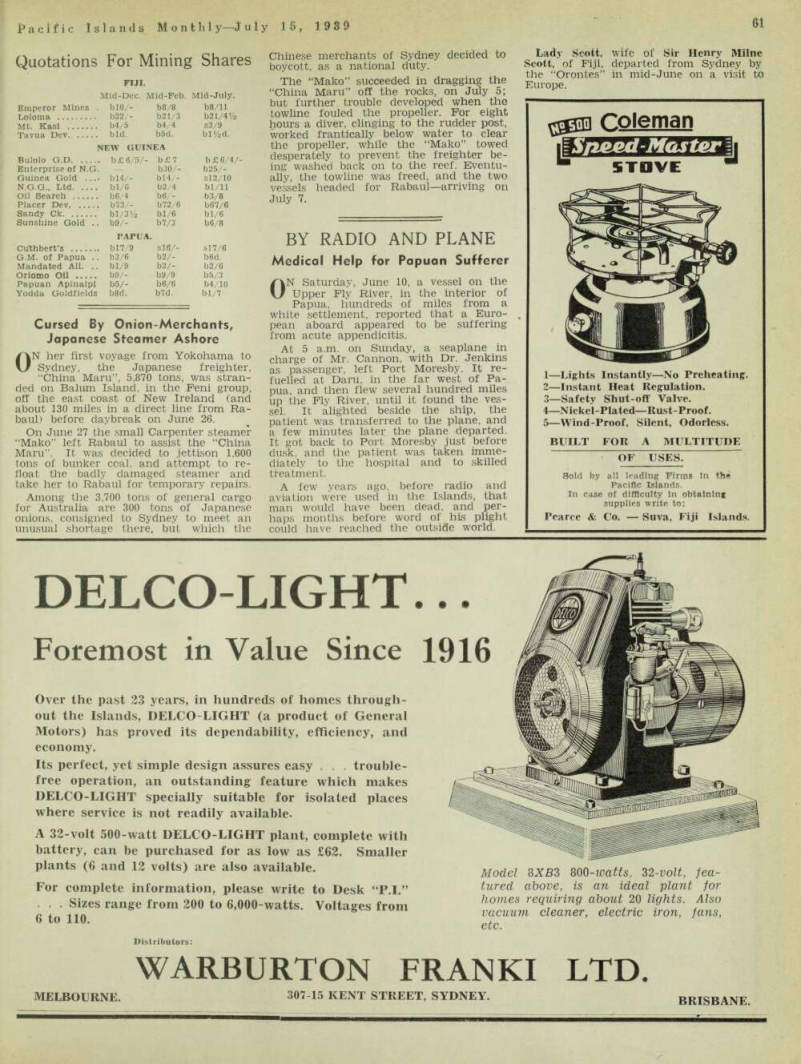
Fiji.
Mid-Dec. Mid-Feb.
Mid-July.
Emperor Mines . blO/b8/8 b8/ll Loloma b22/b21/3 b21/4y 2 Mt. Kasl b4/5 b4/4 s3/9 Tavua Dev bid. b5d. bl'/ 2 d.
J Bulolo G.D
New Guinea
. b £ 6/5/- b£7 b £ 6/4/- Enterprise of N.G. — b30/b25/- Guinea Gold ... . bl4,bl4/ - S12/10 N.G.G., Ltd bl/6 b2/4 bl/11 Oil Search b6/4 b6/b3/8 Placer Dev , b73/b72/6 b67/6 Sandy Ck bl/3% bl/6 bl/6 Sunshine Gold .. b9/b7/3 b6/8 Cuthbert’s
Papua.
, bl7/9 sl6/si 7/6 G.M. of Papua .. b3/6 b2/b6d.
Mandated All. .. bl/9 b2/b2/6 Orlomo Oil b9/b9/9 b5/3 Papuan Apinalpi b5/b6/6 b4/10 Yodda Goldfields b8d. b7d. bl/7
Cursed By Onion-Merchants,
Japanese Steamer Ashore
ON her first voyage from Yokohama to Sydney, the Japanese freighter, “China Maru”, 5,870 tons, was stran ded on Balum Island, in the Feni group, off the east coast of New Ireland (and about 130 miles in a direct line from Ra baul) before daybreak on June 26.
On June 27 the small Carpenter steamer “Mako" left Rabaul to assist the “China Maru”. It was decided to jettison 1,600 tons of bunker coal, and attempt to re float the badly damaged steamer and take her to Rabaul for temporary repairs.
Among the 3,700 tons of general cargo for Australia are 300 tons of Japanese onions, consigned to Sydney to meet an unusual shortage there, but which the
Chinese merchants of Sydney decided to boycott, as a national duty.
The “Mako” succeeded in dragging the “China Maru” off the rocks, on July 5; but further trouble developed when the towline fouled the propeller. For eight hours a diver, clinging to the rudder post, worked frantically below water to clear the propeller, while the “Mako” towed desperately to prevent the freighter be ing washed back on to the reef. Eventu ally, the towline was freed, and the two vessels headed for Rabaul—arriving on July 7.
By Radio And Plane
Medical Help for Papuan Sufferer
ON Saturday, June 10, a vessel on the Upper Fly River, in the interior of Papua, hundreds of miles from a white settlement, reported that a Euro pean aboard appeared to be suffering from acute appendicitis.
At 5 a.m. on Sunday, a seaplane in charge of Mr. Cannon, with Dr. Jenkins as passenger, left Port Moresby. It re fuelled at Daru, in the far west of Pa pua, and then flew several hundred miles up the Fly River, until it found the ves sel. It alighted beside the ship, the patient was transferred to the plane, and a few minutes later the plane departed.
It got back to Port Moresby just before dusk, and the patient was taken imme diately to the hospital and to skilled treatment.
A few years ago, before radio and aviation were used in the Islands, that man would have been dead, and per haps months before word of his plight could have reached the outside world.
Lady Scott, wife of Sir Henry Milne Scott, of Fiji, departed from Sydney by the “Orontes” in mid-June on a visit to Europe.
Advertisements & other items, pp. 63-64 (3 items)
61
Pacific Islands Mont hi y—J uly 15, 1939
Delco-Light...
flgjß Coleman
Speed-Master
STOVE
1— Lights Instantly—No Preheating. 2 Instant Heat Regulation. 3 Safety Shut-off Valve. 4 Nickel-Plated —Rust-Proof. 5 Wind-Proof, Silent, Odorless.
BUILT FOR A MULTITUDE
OF USES.
Sold by all loading Firms In the Pacific Islands.
In case of difficulty in obtaining supplies write to: Pearce & Co. Suva, Fiji Islands.
DELCO-LIGHT...
Foremost in Value Since 1916
Over the past 23 years, in hundreds of homes throughout the Islands, DELCO-LIGHT (a product of General Motors) has proved its dependability, efficiency, and economy.
Its perfect, yet simple design assures easy . . . troublefree operation, an outstanding feature which makes DELCO-LIGHT specially suitable for isolated places where service is not readily available.
A 32-volt 500-watt DELCO-LIGHT plant, complete with battery, can be purchased for as low as £62. Smaller plants (6 and 12 volts) are also available.
For complete information, please write to Desk “P. 1.” . . Sizes range from 200 to 6,000-watts. Voltages from 6 to 110. x IJ o Model BXB3 SOO-watts f 32 -volt, featured above, is an ideal plant for homes requiring about 20 lights. Also vacuum cleaner, electric iron, fans, etc.
Distributors:
WARBURTON FRANKI LTD.
MELBOURNE.
307 15 KENT STREET, SYDNEY.
BRISBANE.
48/6 Just arrived from the maker in London, “Cosmocord” De Luxe Crystal Pick-me-up, with Built-in Vol. Control, 48/6. Write for Full List. Pick ups.
Gramophone Pick up Heads, £6/5/-.
Goldring English Pick-up Heads.
Suit and Fit all Gramophone Tone Arms. Type 44/4 Pick-up Head with Built-in Volume Control: 19/6. Type 44/5 Pick-up Head, with Volume Control attached: 21/-. Type 33/3 Pick-up Head, with Highly Polished Nickel Finish: 18/6. Bakelite Cased Pick-up Head: 16/6. •w sr eo a* 00 Play, Talk, Sing, Joke through your Radio. Great Fun. Batteryless type Microphone for Hand Holding or Hanging, 22/6. Complete with lead,' fixed in a second. Others, 12/6, 15/-, 1 17/6, 25/-, 28/6, 32/6. All plus 1/9 for Battery and 1/6 for 20 ft. Cord.j Write for Detailed List.
B.G.E. Table Type Microphone. Highly] recommended for!
Amateur or Professional use. Built-in' Transformer and Battery with Volume; Control incorporated.
Just plug into pickup terminals of any set. 39/6.
Table Type Interesting Pin Games: 12/6, 15/-. Competition Dart Boards: 21/-. Others: 2/6, 8/IJ, 11/6. Competition Brass & Feathered Darts; 3 for 5/6. Table Tennis Sets: 7/6. 15/-. Model Aeroplane Kits, all types. Write for leaflets. Draught Sets: 4/6, 6/6, 10/6.
Ormond British Made Highest Grade Vernier Dials, 3 Inch Brown Bakelite or Metal, 8/6.
“UTILITY” Short Wave Dials World’s Best: 12/6. m No. 1 Morse Code Practice Sets, with Switch Buzzer to Light. Use as you desire. 22/6 complete.
M/ No. 2, with Heavier Type Morse Key: 30/-. Pendograph Bug Key: 70/-. Adjustable Key (only) 12/6.
Like-a-Flash Cigar 'ette Selling Machines, for Wall or Counter All Metal, Fool Proof, Two sizes, holds 1 packets of 6d. cigar ettes. Price, 45/- Larger size, holds 24j packets, of 6d. cigarettes. Price, 55/-.
Special price in lots of 6 and 12. Traders, write for fullest de tails quantity lots.
Match Vending Machines, 55/-.
“PRESTO”
THE
MAGIC
BOX
The most Amazing: Trick- Just out. 2/6. Money back if it’s not the best ever.
Full instructions. Here’s a splendid range of all the world’s best Tricks, Novelties, etc. “Presto”, the Magic Box, 2/6; The Great Lock Trick, 2/- ‘ Hindu”, the uncanny head cutter 2/6; The Great Bolt and Ring Trick 2/-; The Hindu Magic Paper Folding Trick, 1/-; The Giant Novelty Cigar, 1/-. Send for 20/- Trick parcel.
Model Electric Motors, Work off Wet or Dry Battery or Trans former, as illustrated, 4/9. Other Types, 8/6, 11/6, 15/-, Small Model Motors, 3/6. Kit of Parts to build Small Motors, 2/6. Small Outboard Boat Model Motors 12/6, 19/6.
Now Ready. The World’s Best Range of Indoor Games. "Monopoly”, The world’s best game of its kind, 10/6.
“Totopoly”, a similar game, 10/6.
“Buccaneer”, a somewhat different game, 10/6. “Chinese Checkers' taking the world by storm, 2/6, 4/6, 8/6. “Ching Gong”, a Mystic Eastern Game, 4/6, 8/6. “Tripoly”, a combined card game, 5/- and 10/6.
“Brodi”, a small Fruit-Machine gambling game, 6/6. Destiny Bowls, your fate and fortune revealed, 1/6. 12 different party games, 6d. each game. Playing card “House”, 1/-.
Crazy Questions, 1/-. Pot Luck, 1/-.
Spinning Wheel Race Game, shows odds and winner, 30/-. Roulette Wheels, with cloth and instructions, 32/6. Send for Games Booklet.
Remington, U.S.A. made, Hunter Knives, with sheaths, 10/6. Throw ing Knives, from Sheffield, 6/6, 1 leather sheath.
Swiss made Musical Box Units, for making your own musical Trinket or Cigarette Cases. They each play 2 tunes, 10/6 and 12/6, Box for Unit, Levenson’s can supply all kinds of wet weather wants. We welcome inquiries—for Canvas Goods, Tents Tarpaulins, etc., etc. Write for fullest particulars.
Just arrived. Simplified Radio Books. Everyman’s Wireless Book, 5/6. The Book of Practical Radio, 8/6. The Book of Practical Television, 8/6. The Television and Short Wave Handbook. 5/6. The Wireless Constructor’s Encyclopeadia, 5/-. The Dictionary of Wireless Terms, 6/6.
Hand-winding English Gramophone Motors, 27/6. 240 volt Electric Cosmocord Gramophone Motors, complete with turntable and all fittings, 39/6.
“Like-a-Flash” De Luxe Dual Wave 5 Valve Battery Operated Receiver.
This is one of the most powerful models in the battery set series, and the Radio Frequency stage of amplification gives the set a world range on short wave channels as well as full coverage range of Australasian ‘A” and “B” Class Broadcasters.
The set is also specially designed to give maximum service in humid climates, such as North Queensland and Pacific Island Territories.
A vital part very vulnerable to •dampness” in ordinary receivers is the ‘‘lntermediate Frequency Section”. In this set our Engineers have fitted special inductance tuned intermediate frequency transformers, which do not require trimmers. These units ensure correct alignment for a continuous period.
An ‘‘B” Aero Dial calibrated in stations facilitates tuning. Valves used are: 2—lC4, I—KK2, I—lK6, I—lD4.
The speaker is the latest Amplion Permagnetic Model, capable of high fidelity reproduction. Battery equipment consists of extra heavy capacity units as follows: 1 2 Volt 100 amp. Accumulator. 3 Ever -Ready Superdyne 45 Volt *‘B” Batteries. 1 Ever-Ready 4Vfein. “C” Battery.
The outfit is housed in a beautifully veneered floor model Console Cabinet.
PRICE: £22/5/-.
“LIKE-A-FLASH” 1939-40 AUTO.
RADIO SET.
Suitable for installation in any make of motor car, truck, launch, or ’plane. A single unit 4-valve Radio Receiver fitted with triple purpose valves and special High Gain Coils.
Long Range Reception guaranteed.
Highest Grade Permagnetic Magnet Speaker, lifelike. Excellent quality.
Tonal Reproduction. Lowest possible battery current consumption. Synchronous Vibrator. Six month’s Free service. Fitted to car 30/- extra.
Price: I(> guineas, cash only.
Extremely low noise level. Easily and quickly tuned to the stations you desire. Volume to please yourself.
“Like-a-Flash” 5 Valve Battery Operated Receiver for Broadcast Reception on Wave Lengths between 220 and 550 Metres.
This special receiver has world range valve model, but with a stage of Radio Frequency Amplification added. This gives the receiver long range and is capable of excellent reception from most Australasian stations.
Valves used are: 2—lC4, I—lo 6 or
KK2, I—lK6, I—lD4.
Speaker is an “8” Amplion Permagnetic Unit.
A very neat and attractive floor model cabinet houses all equipment. Battery consists of triple capacity units, as follows: 1 2 Volt 100 amp. Accumulator. 345 Volt Ever-Ready Superdyne “B” Batteries. 1 4V 2 Volt Ever-Ready “C” Battery.
PRICE; £2O/7/6.
@0520®
dCKDS)
<30555® <30555® Like-a-Flash “Eliminoise” Aerial Kit for short or dual-wave sets. Aerial, Pyrex type Insulators,, transposition blocks and 200 ft. aerial coil, 22/6.
Eliminates unwanted aerial and hideous electrical noises from your dual-wave or short-wave sets.
LEARN TO DRAW,
GRAPHOSCOPE.
With it you can copy drawings, photos, illustrations of all kinds, 8/6.
Write for Full List of Novelties. 500 Foreign Stamps, 2/6. 2 Stamps, valued 1/3, Free.
O' 100 Special Stamps, 2/9. 2 Stamps, valued 1/3, Free.
Foreign Stamps—6 Goya 1/-, 10 Nyassa 2/- 25 U.S.A. 1/-, 20 Canada 6d., 40 Hindenberg Mourning 6d., 30 Belgium 6d., 7 Irish Free State 6d., 12 Egypt 6, 3 Spain Pictorials 6d., 6 Nicaragua 6d. Write for full list of Stamps and Stamp Album.
Clubs—Hotels —Tourist Houses. Do you want to make some real easy money?
Then write to Levenson’s for particulars of Punch Boards, Totems, and other money making Devices, Novelties and Slot Machines.
Levenson’s can supply all kinds of Musical Instruments. Enquiries welcomed.
Australian Novelty Koala Bears.
Made from real skins just like the live animal. 7 in.—4/6. 8 in.—5/6. 9Vz in.—7/6. 11 in.—9/6. 13 in.— 12/6. Special price on trade lots.
Koala Bear Tea Cosy 18/6, with teapot holder free Koala Bear Pyjama Bag, 18/6. 4 Radio Books just arrived, 6/- the lot. The Radio Dictionary, Radio for Beginners, How to Read Radio Diagrams, All About Aerials, How to Build popular 1 and 2 valve receivers.
Poker Game Dart Boards, 10/6. Dart Boards, 4/9, 7/6, 8/9, 11/6, 20/-, 30/-. Darts, 6 for 1/6. Competition Darts—3 for 3/6, 4/6 and 5/6.
Microscope sets for students. Junior type 12/6, senior 63/-. Miscroscopes only, 7/6, 9/6, 11/6,
Write for Punch Board Leaflets
LEVENSON’S RADIO
Write ftr
GAMES, NOVELTIES AND HOBBIES Pin-Game,
226 PITT STREET, SYDNEY
Manufacturers, Importers, and Exporters, Branches; Radio Cheapside, 240 a Pitt St. A '® ane "
N.S.W., AUSTRALIA v '~ wvw '™~
Cable address: "Leveradioh.” Goods forwarded V.P.P. or Sight Draft. Satisfaction and Service Guaranteed. We can supply by mail all General Merchandise at a Better Price. Quotations with pleasure.
Please add freight and packing. Write for full list of interesting leaflets of Games. Hobbies, Novelties, and Electrical Goods.
Write for full list of Radio Meters.
62
July 15, 193 9—P acific Islands Monthly
Australian Short Wave
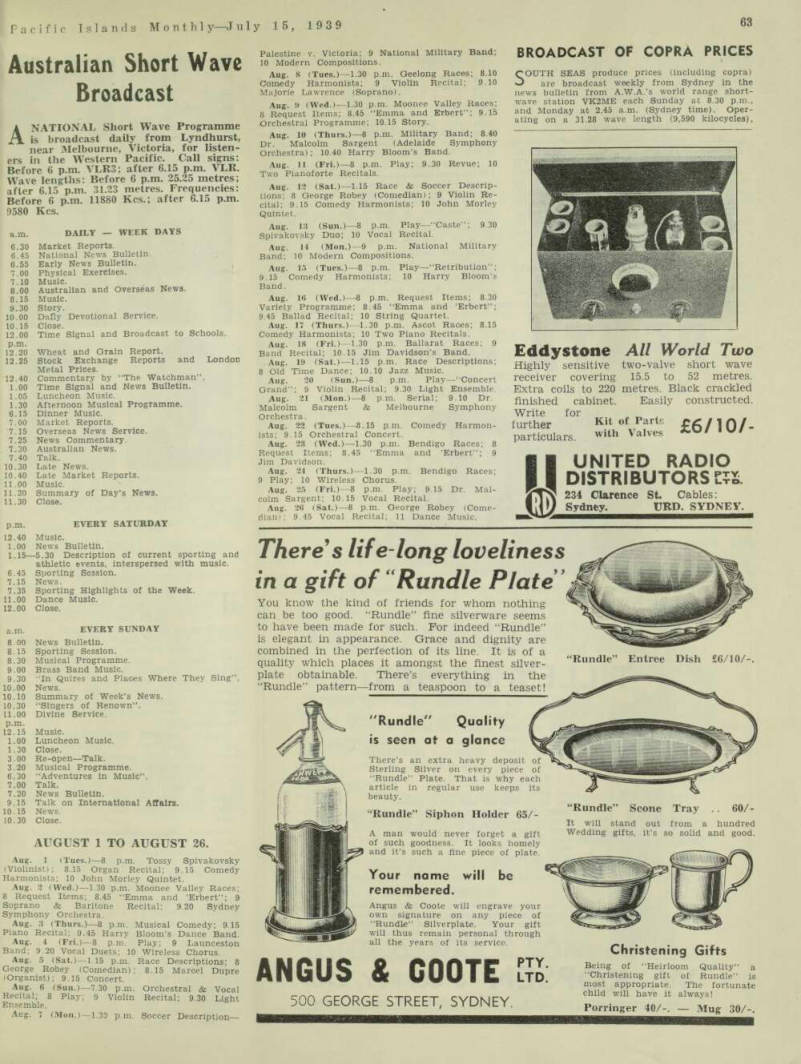
Broadcast
A NATIONAL Short Wave Programme
is broadcast daily from Lyndhurst, near Melbourne, Victoria, for listen ers in the Western Pacific. Call signs: Before 6 p.m. VLR3; after 6.15 p.m. VLR.
Wave lengths: Before 6 p.m. 25.25 metres; after 6.15 p.m. 31.23 metres. Frequencies: Before 6 p.m. 11880 Kcs.; after 6.15 p.m. 9580 Kcs.
A M. Daily Week Days
6.30 Market Reports. 6.45 National News Bulletin. 6.55 Early News Bulletin. 7.00 Physical Exercises. 7.10 Music. 8.00 Australian and Overseas News. 8.15 Music. 9.30 Story. 10.00 Dafly Devotional Service. 10.15 Close. 12.00 Time Signal and Broadcast to Schools, p.m. 12.20 Wheat and Grain Report. 12.25 Stock Exchange Reports and London Metal Prices. 12.40 Commentary by “The Watchman”. 1.00 Time Signal and News Bulletin. 1.05 Luncheon Music. 1.30 Afternoon Musical Programme. 6.15 Dinner Music. 7.00 Market Reports. 7.15 Overseas News Service. 7.25 News Commentary. 7.30 Australian News. 7.40 Talk. 10.30 Late News. 10.40 Late Market Reports. 11.00 Music. 11.20 Summary of Day’s News. 11.30 Close.
P.M. Every Saturday
12.40 Music. 1.00 News Bulletin. 1.15—5.30 Description of current sporting and athletic events, interspersed with music. 6.45 Sporting Session. 7.15 News. 7.35 Sporting Highlights of the Week. 11.00 Dance Music. 12.00 Close.
Am. Every Sunday
8.00 News Bulletin. 8.15 Sporting Session. 8.30 Musical Programme. 9.00 Brass Band Music. 9.30 “In Quires and Places Where They Sing”. 10.00 News. 10.10 Summary of Week’s News. 10.30 “Singers of Renown”. 11.00 Divine Service, p.m. 12.15 Music. 1.00 Luncheon Music. 1.30 Close. 3.00 Re-open—Talk. 3.20 Musical Programme. 6.30 “Adventures in Music”. 7.00 Talk. 7.20 News Bulletin. 9.15 Talk on International Affairs. 10.15 News. 10.30 Close.
August 1 To August 26.
Aug. 1 (Tues.)—B p.m. Tossy Spivakovsky (Violinist); 8.15 Organ Recital; 9.15 Comedy Harmonists: 10 John Morley Quintet.
Aug. 2 (Wed.) —1.30 p.m. Moonee Valley Races; 8 Request Items; 8.45 “Emma and ’Erbert”; 9 Soprano & Baritone Recital; 9.20 Sydney Symphony Orchestra.
Aug. 3 (Thurs.) —8 p.m. Musical Comedy; 9.15 Piano Recital; 9.45 Harry Bloom’s Dance Band.
Aug. 4 (Fri.) —8 p.m. Play; 9 Launceston Band; 9.20 Vocal Duets; 10 Wireless Chorus.
Aug. 5 (Sat.) —1 15 p.m. Race Descriptions; 8 George Robey (Comedian); 8.15 Maroel Dupre (Organist); 9.15 Concert.
Aug. 6 (Sun.) —7.30 p.m. Orchestral & Vocal Recital; 8 Play; 9 Violin Recital; 9.30 Light Ensemble.
Aug. 7 (Mon.) —1.30 p.m. Soccer Description—
Palestine v. Victoria; 9 National Military Band; 10 Modern Compositions.
Aug. 8 (Tues.) —1.30 p.m. Qeelong Races; 8.10 Comedy Harmonists; 9 Violin Recital; 9.10 Majorie Lawrence (Soprano).
Aug. 9 (Wed.)- —1.30 p.m. Moonee Valley Races; 8 Request Items; 8.45 “Emma and Erbert”; 9.15 Orchestral Programme; 10.15 Story.
Aug. 10 (Thurs.) —8 p.m. Military Band; 8.40 Dr. Malcolm Sargent (Adelaide Symphony Orchestra); 10.40 Harry Bloom’s Band.
Aug. 11 (Fri.)—B p.m. Play; 9.30 Revue; 10 Two Pianoforte Recitals.
Aug. 12 (Sat.) —1.15 Race & Soccer Descrip tions; 8 George Robey (Comedian); 9 Violin Re cital; 9.15 Comedy Harmonists; 10 John Morley Quintet.
Aug. 13 (Sun.) —8 p.m. Play—“ Caste”; 9.30 Spivakovsky Duo; 10 Vocal Recital.
Aug. 14 (Mon.) —9 p.m. National Military Band; 10 Modern Compositions.
Aug. 15 (Tues.) —8 p.m. Play—“ Retribution”; 9.15 Comedy Harmonists; 10 Harry Bloom’s Band.
Aug. 16 (Wed.) —8 p.m. Request Items; 8.30 Variety Programme; 8.45 “Emma and ’Erbert”; 9.45 Ballad Recital; 10 String Quartet.
Aug. 17 (Thurs.) —1.30 p.m. Ascot Races; 8.15 Comedy Harmonists; 10 Two Piano Recitals.
Aug. 18 (Fri.) —1.30 p.m. Ballarat Races; 9 Band Recital; 10.15 Jim Davidson’s Band.
Aug. 19 (Sat.) —1.15 p.m. Race Descriptions; 8 Old Time Dance; 10.10 Jazz Music.
Aug. 20 (Sun.) —8 p.m. Play—“ Concert Grand”; 9 Violin Recital; 9.30 Light Ensemble.
Aug. 21 (Mon.) —8 p.m. Serial; 9.10 Dr.
Malcolm Sargent & Melbourne Symphony Orchestra.
Aug. 22 (Tues.) —8.15 p.m. Comedy Harmon ists: 9 15 Orchestral Concert.
Aug. 23 (Wed.) —1.30 p.m. Bendigo Races; 8 Request Items; 8.45 “Emma and ’Erbert”; 9 Jim Davidson.
Aug. 24 (Thurs.) —1.30 p.m. Bendigo Races; 9 Play; 10 Wireless Chorus.
Aug. 25 (Fri.)—B p.m. Play; 9.15 Dr. Mal colm Sargent; 10.15 Vocal Recital.
Aug. 26 (Sat.) —8 p.m. George Robey (Come dian); 9.45 Vocal Recital; 11 Dance Music.
Broadcast Of Copra Prices
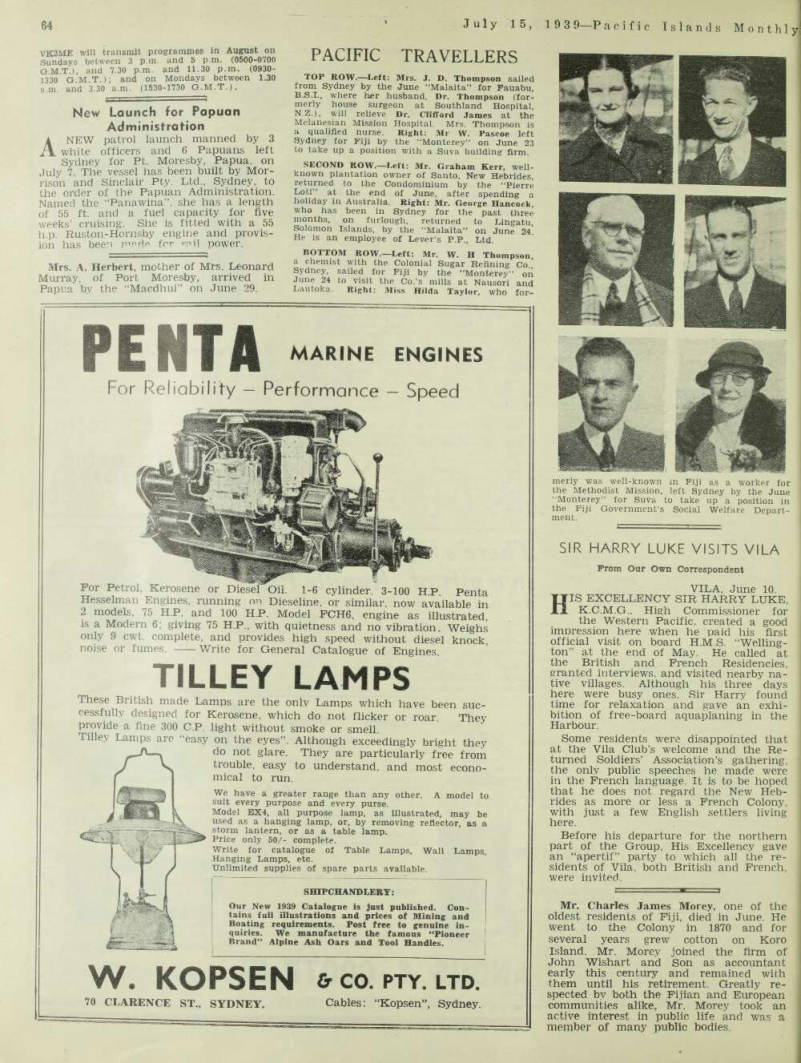
SOUTH SEAS produce prices (including copra) are broadcast weekly from Sydney in the news bulletin from A.W.A.’s world range short wave station VK2ME each Sunday at 8.30 p.m., and Monday at 2.45 a.m. (Sydney time). Oper ating on a 31.28 wave length (9,590 kilocycles).
VK2ME will transmit programmes in August on Sundays between 3 p.ra. and 5 pm. (0500-0700 G.M.T.), and 7.30 p.m. and 11.30 p.m. (0930- 1330 G M T.); and on Mondays between 1.30 a.m. and 3.30 a.m. (1530-1730 G.M.T.).
Advertisements & other items, p. 65 (2 items)
63
Pacific Islands Monthl y—J uly 15, 1939
Angus & Coote
<0 ■
i •ir .
KV-
Eddystone All World Two
Highly sensitive two-valve short wave receiver covering 15.5 to 52 metres.
Extra coils to 220 metres. Black crackled finished cabinet. Easily constructed.
Write for further Kit of Parts £g/IQ/ particulars. with Valves u
UNITED RADIO
DISTRIBUTORS KS.
'M 234 Clarence St. Cables: Sydney. TJRD. SYDNEY.
There s life-long loveliness
in a gift of "Run Plate
You know the kind of friends for whom nothing can be too good. “Rundle” fine silverware seems to have been made for such. For indeed “Rundle” is elegant in appearance. Grace and dignity are combined in the perfection of its line. It is of a quality which places it amongst the finest silverplate obtainable. There’s everything in the “Rundle” pattern—from a teaspoon to a teaset!
"Rundle" Quality
is seen at a glance There’s an extra heavy deposit of Sterling Silver on every piece of • Rundle” Plate. That is why each article in regular use keeps its beauty.
“Rundle” Siphon Holder 65/- A man would never forget a gift of such goodness. It looks homely and it’s such a fine piece of plate.
Your name will be
remembered.
Angus & Coote will engrave your own signature on any piece of “Rundle” Silverplate. Your gift will thus remain personal through all the years of its service.
Rundle Entree l)i>h £6/10/
ANGUS & COOTE
500 GEORGE STREET, SYDNEY.
PTY.
LTD.
“Rundle” Scone Tray .. 60/- It will stand out from a hundred Wedding gifts, it’s so solid and good.
Christening Gifts
Being of “Heirloom Quality” i “Christening gift of Rundle” i: most appropriate. The fortunati child will have it always!
Porringer 40/-. Mug 30/-
New Launch for Papuan
Administration
A NEW patrol launch manned by 3 A white officers and 6 Papuans left Sydney for Pt. Moresby, Papua, on July 7. The vessel has been built by Mor rison and Sinclair Pty. Ltd., Sydney, to the order of the Papuan Administration.
Named the “Panawina”, she has a length of 55 ft. and a fuel capacity for five weeks’ cruising. She is fitted with a 55 h.p. Ruston-Hornsby engine and provis ion has been mode for '•oil power.
Mrs. A. Herbert, mother of Mrs. Leonard Murray, of Port Moresby, arrived in Papua by the “Macdhui” on June 29.
Pacific Travellers
TOP ROW.—Left: Mrs. J. D. Thompson sailed from Sydney by the June “Malaita” for Fauabu, 8.5.1., where her husband, Dr. Thompson (for merly house surgeon at Southland Hospital, N.Z.), will relieve Dr. Clifford James at the Melanesian Mission Hospital. Mrs. Thompson is a qualified nurse. Right: Mr W. Pascoe left Sydney for Fiji by the “Monterey” on June 23 to take up a position with a Suva building firm.
SECOND ROW.—Left: Mr. Graham Kerr, well known plantation owner of Santo, New Hebrides, returned to the Condominium by the “Pierre Loti” at the end of June, after spending a holiday in Australia. Right: Mr. George Hancock, who has been in Sydney for the past three months, on furlough, returned to Lingatu Solomon Islands, by the “Malaita” on June 24* He is an employee of Lever’s P.P., Ltd.
BOTTOM ROW.—Left: Mr. W. H Thompson, a chemist with the Colonial Sugar Refining Co Sydney, sailed for Fiji by the “Monterey” ori June 24 to visit the Co.’s mills at Nausori and Lautoka. Right: Miss Hilda Taylor, who for-
merly was well-known in Fiji as a worker for the Methodist Mission, left Sydney by the June “Monterey” for Suva to take up a position in the Fiji Government’s Social Welfare Depart ment.
Sir Harry Luke Visits Vila
From Our Own Correspondent VILA, June 10.
His Excellency Sir Harry Luke,
K.C.M.G., High Commissioner for the Western Pacific, created a good impression here when he paid his first official visit on board H.M.S. “Welling ton” at the end of May. He called at the British and French Residencies, granted interviews, and visited nearby na tive villages. Although his three days here were busy ones, Sir Harry found time for relaxation and gave an exhi bition of free-board aquaplaning in the Harbour.
Some residents were disappointed that at the Vila Club’s welcome and the Re turned Soldiers’ Association’s gathering, the only public speeches he made were in the French language. It is to be hoped that he does not regard the New Heb rides as more or less a French Colony, with just a few English settlers living here.
Before his departure for the northern part of the Group, His Excellency gave an “apertif” party to which all the re sidents of Vila, both British and French, were invited.
Mr. Charles James Morey, one of the oldest residents of Fiji, died in June. He went to the Colony in 1870 and for several years grew cotton on Koro Island. Mr. Morey joined the firm of John Wishart and Son as accountant early this century and remained with them until his retirement. Greatly re spected by both the Fijian and European communities alike, Mr. Morey took an active interest in public life and was a member of many public bodies.
Advertisements & other items, p. 66 (1 item)
Tilley Lamps
RENTA MARINE ENGINES
For Reliability Performance Speed
A For Petrol, Kerosene or Diesel Oil. 1-6 cylinder.* 3-100 HP. Penta Hesselman Engines, running on Dieseline. or similar, now available in 2 models. 75 HP. and 100 HP. Model FCH6, engine as illustrated, is a Modern 6: giving 75 HP., with quietness and no vibration. Weighs only 9 cwt. complete, and provides high speed without diesel knock noise or fumes. Write for General Catalogue of Engines
TILLEY LAMPS
These British made Lamps are the only Lamps which have been successfully designed for Kerosene, which do not flicker or roar. They provide a fine 300 CP. light without smoke or smell.
Tilley Lamps are “easy on the eyes”. Although exceedingly bright they do not glare. They are particularly free from trouble, easy to understand, and most economical to run.
We have a greater range than any other. A model to suit every purpose and every purse.
Model BX4, all purpose lamp, as illustrated, may be used as a hanging lamp, or, by removing reflector, as a storm lantern, or as a table lamp.
Price only 50/- complete.
Write for catalogue of Table Lamps, Wall Lamps, Hanging Lamps, etc.
Unlimited supplies of spare parts available.
SHIPCHAXDLEBY:
Our New 1939 Catalogue is just published. Contains full illustrations and prices of Mining and Boating requirements. Post free to genuine inquiries. We manufacture the famous “Pioneer Brand” Alpine Ash Oars and Tool Handles.
W. KOPSEN & CO. PTY. LTD.
70 CLARENCE ST., SYDNEY. Cables: “Kopsen”, Sydney.
Exchange Rates
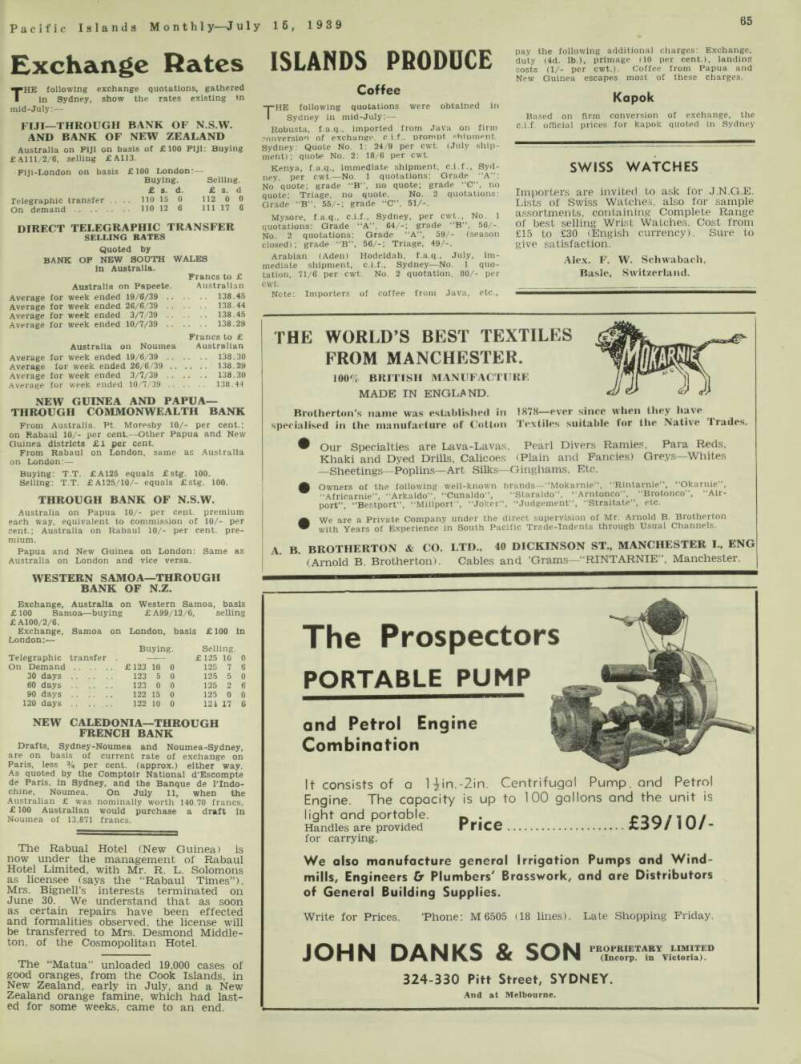
THE following exchange quotations, gathered in Sydney, show the rates existing in mid-July:—
Fiji—Through Bank Of N.S.W.
And Bank Of New Zealand
Australia on FIJI on basis of £lOO FIJI; Buying £Alll/2/6, selling £AII3.
Pljl-London on basis £lOO London; — Buying. Selling.
Direct Telegraphic Transfer
Selling Rates
Quoted by
Bank Op New South Wales
in Australia.
New Guinea And Papua
Through Commonwealth Bank
From Australia. Pt. Moresby 10/- per cent.; on Rabaul 10/- per cent. —Other Papua and New Guinea districts £1 per cent.
From Rabaul on London, same as Australia on London:— Buying: T.T. £AI2S equals £stg. 100.
Selling; T.T. £AI2S/10/- equals £stg. 100.
Through Bank Of N.S.W.
Australia on Papua 10/- per cent, premium each way, equivalent to commission of 10/- per cent.; Australia on Rabaul 10/- per cent, pre mium.
Papua and New Guinea on London: Same as Australia on London and vice versa.
Western Samoa—Through
Bank Of N.Z.
Exchange, Australia on Western Samoa, basis £ 100 Samoa —buying £ A99/12/6, selling
£ Aloo/2/6.
Exchange, Samoa on London, basis £ 100 in London:—
New Caledonia—Through
French Bank
Drafts, Sydney-Noumea and Noumea-Sydney, are on basis of current rate of exchange on Paris, less % per cent, (approx.) either way.
As quoted by the Comptoir National d’Escompte de Paris, in Sydney, and the Banque de ITndo chine, Noumea. On July 11, when the Australian £ was nominally worth 140.70 francs, £ 100 Australian would purchase a draft in Noumea of 13,871 francs. —.. i ■ . = The Rabual Hotel (New Guinea) is now under the management of Rabaul Hotel Limited, with Mr. R. L. Solomons as licensee (says the “Rabaul Times”).
Mrs. Bignell’s interests terminated on June 30. We understand that as soon as certain repairs have been effected and formalities observed, the license will be transferred to Mrs. Desmond Middle ton, of the Cosmopolitan Hotel.
The “Matua” unloaded 19,000 cases of good oranges, from the Cook Islands, in New Zealand, early in July, and a New Zealand orange famine, which had last ed for some weeks, came to an end.
£ s. d. £ s. d Telegraphic transfer .. .. 110 15 0 112 0 0 On demand 110 12 6 111 17 6
Francs to £ Australia on Papeete.
Australian Average for week .ended 19/6/39 .. . . .. 138.45 Average for week ended 26/6/39 .. .. .. 138.44 Average for week ended 3/7/39 .. . . .. 138.45 Average for week ended 10/7/39 . . .. 138.29 Francs to £ Australia on Noumea Australian Average for week ended 19/6/39 ..
Average for week ended 26/6/39 .. .. .. 138.29 Average for week ended 3/7/39 ., Average for week ended 10/7/39 . . . . .. 138.44
Buying. Selling.
Telegraphic transfer . £125 10 0 On Demand £ 123 10 0 125 7 6 30 days 123 5 0 125 5 0 60 days 123 0 0 125 2 6 90 days 122 15 0 125 0 0 120 days 122 10 0 121 17 6
Islands Produce
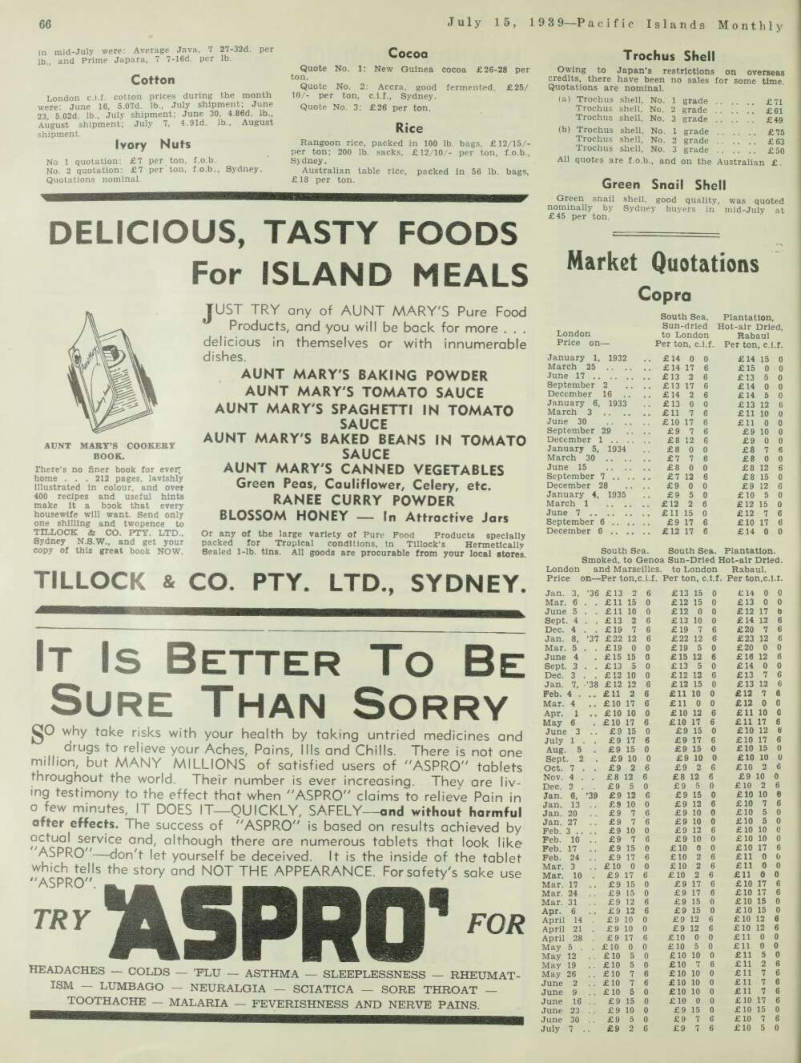
Coffee
THE following quotations were obtained in Sydney in mid-July;— Robusta, f.a.q., imported from Java on firm conversion of exchange, c.i.f.. prompt shlnment Sydney: Quote No. 1: 24/9 per cwt. (July ship ment): quote No. 2: 18/6 per cwt.
Kenya, f.a.q., immediate shipment, c.i.f., Syd ney, per cwt. —No. 1 quotations: Grade “A”: No quote; grade “B”. no quote; grade “C”. no quote: Triage, no quote. No. 2 quotations; Grade “B”, 55/-; grade “C”, 51/-.
Mysore, f.a.q., c.i.f., Sydney, per cwt., No. 1 quotations; Grade “A”, 64/-; grade “B”, 56/-.
No. 2 quotations: Grade “A”, 59/- (season closed): grade “B”, 56/-; Triage, 49/-.
Arabian (Aden) Hodeidah, f.a.q., July, im mediate shipment, c.i.f., Sydney—No, 1 quo tation, 71/6 per cwt. No. 2 quotation, 80/- per cwt.
Note: Importers of coffee from Java, etc.,
pay the following additional charges; Exchange, duty (4d. lb.), primage (10 per cent.), landing costs (1/- per cwt.). Coffee from Papua and New Guinea escapes most of these charges.
Kapok
Based on firm conversion of exchange, the c.i.f. official prices for kapok quoted in Sydney
in mid-July were: Average Java, 7 27-32 d. per lb., and Prime Japara, 7 7-16 d. per lb.
Cotton
London c.i.f. cotton prices during the month were: June 16, 5.07 d. lb., July shipment; June 23 5 02d. lb., July shipment: June 30, 4.86 d. lb., August shipment; July 7, 4.9 Id. lb., August shipment.
Ivory Nuts
No 1 quotation: £7 per ton, f.o.b.
No. 2 quotation: £7 per ton, f.0.b., Sydney.
Quotations nominal.
Cocoa
Quote No. 1: New Guinea cocoa £26-28 per ton.
Quote No. 2; Accra, good fermented, £25/ 10/- per ton, c.i.f., Sydney.
Quote No. 3: £26 per ton.
Rice
Rangoon rice, packed in 100 lb. bags, £l2/15/per ton; 200 lb. sacks, £l2/10/- per ton, f.0.b., Sydney.
Australian table rice, packed in 56 lb. bags, £lB per ton.
Trochus Shell
Owing to Japan’s restrictions on overseas credits, there have been no sales for some time Quotations are nominal. (a) Trochus shell, No. 1 grade £71 Trochus shell. No. 2 grade £61 Trochus shell. No. 3 grade .. '” £49 (b) Trochus shell, No. 1 grade £75 Trochus shell, No. 2 grade £63 Trochus shell, No. 3 grade £50 All quotes are f.o.b., and on the Australian £.
Green Snail Shell
Green snail shell, good quality, was quoted nominally by Sydney buyers in mid-July at £45 per ton.
Advertisements & other items, pp. 67-68 (2 items)
65
Pacific Islands Monthl y—-J uly 15, 1939
The Prospectors
SWISS WATCHES
Importers are invited to ask for J.N.G.E.
Lists of Swiss Watches, also for sample assortments, containing Complete Range of best selling Wrist Watches. Cost from £l5 to £3O ‘Engish currency). Sure to give satisfaction.
Alex. F. W. Schwabach, Basle, Switzerland,
THE WORLD’S BEST TEXTILES
FROM MANCHESTER.
100% BRITISH MANUFACTURE
MADE IN ENGLAND.
Brotherton’s name was established in 187 S—ever since when they have specialised in the manufacture of Cotton Textiles suitable for the Native Trades. • Our Specialties are Lava-Lavas, Pearl Divers Ramies, Para Reds, Khaki and Dyed Drills, Calicoes (Plain and Fancies) Greys—Whites —Sheetings—Poplins—Art Silks—Ginghams, Etc.
A Owners of the following well-known brands—“Mokarnie”. “Rintarnie”, “Okarnie”, ‘Africarnie”, “Arkaldo”, “Cunaldo”, “Staraldo”. “Arntonco”, "Brotonco”, ‘ Airport”, “Bestport”, “Millport”, “Joker”, ‘‘Judgement”, “Straitate”, etc. • We are a Private Company under the direct supervision of Mr. Arnold B. Brotherton with Years of Experience in South Pacific Trade-Indents through Usual Channels.
A. B. BROTHERTON & CO. LTD., 40 DICKINSON ST., MANCHESTER 1., ENG (Arnold B. Brotherton). Cables and ’Grams —“RINTARNIE”, Manchester.
The Prospectors
PORTABLE PUMP
and Petrol Engine
Combination
It consists of a Hin.-2in. Centrifugal Pump and Petrol Engine. The capacity is up to 100 gallons and the unit is light and portable.
Handles are provided for carrying.
Price £39/10/-
We also manufacture general Irrigation Pumps and Windmills, Engineers Cr Plumbers' Brasswork, and are Distributors of General Building Supplies.
Write for Prices. ’Phone: M 6505 (18 lines). Late Shopping Friday.
JOHN DANKS & SON (Incorp. in Victoria). 324-330 Pitt Street, SYDNEY.
And at Melbourne.
DELICIOUS, TASTY FOODS
For ISLAND MEALS
AUNT MARY'S COOKERY
BOOK.
There’s no finer book for ever£ home . . . 212 pages, lavishly Illustrated in colour, and over 400 recipes and useful hints make it a book that every housewife will want. Send only one shilling and twopence to
TILLOCK & CO. PTY. LTD.,
Sydney N.S.W., and get your copy of this great book NOW.
JUST TRY any of AUNT MARY'S Pure Food Products, and you will be back for more . . . delicious in themselves or with innumerable dishes.
AUNT MARY'S BAKING POWDER
AUNT MARY'S TOMATO SAUCE
AUNT MARY'S SPAGHETTI IN TOMATO
SAUCE
AUNT MARY'S BAKED BEANS IN TOMATO
SAUCE
AUNT MARY'S CANNED VEGETABLES
Green Peas, Cauliflower, Celery, etc.
RANEE CURRY POWDER
BLOSSOM HONEY In Attractive Jars Or any of the large variety of Pure Pood Products specially packed for Tropical conditions, in Tillock’s Hermetically Sealed 1-lb. tins. All goods are procurable from your local stores.
TILLOCK & CO. PTY. LTD., SYDNEY.
It Is Better To Be
Sure Than Sorry
gO why take risks with your health by taking untried medicines and drugs to relieve your Aches, Pains, Ills and Chills. There is not one million, but MANY MILLIONS of satisfied users of "ASPRO" tablets throughout the world. Their number is ever increasing. They are living testimony to the effect that when "ASPRO" claims to relieve Pain in o few minutes, IT DOES IT—QUICKLY, SAFELY— and without harmful after effects. The success of "ASPRO" is based on results achieved by actual service and, although there are numerous tablets that look like ASPRO"— don't let yourself be deceived. It is the inside of the tablet which tells the story and NOT THE APPEARANCE. For safety's sake use
"ASPRO"
TRY
FOR
HEADACHES COLDS ’FLU ASTHMA SLEEPLESSNESS RHEUMAT-
ISM LUMBAGO NEURALGIA SCIATICA SORE THROAT
TOOTHACHE MALARIA FEVERISHNESS AND NERVE PAINS.
Market Quotations
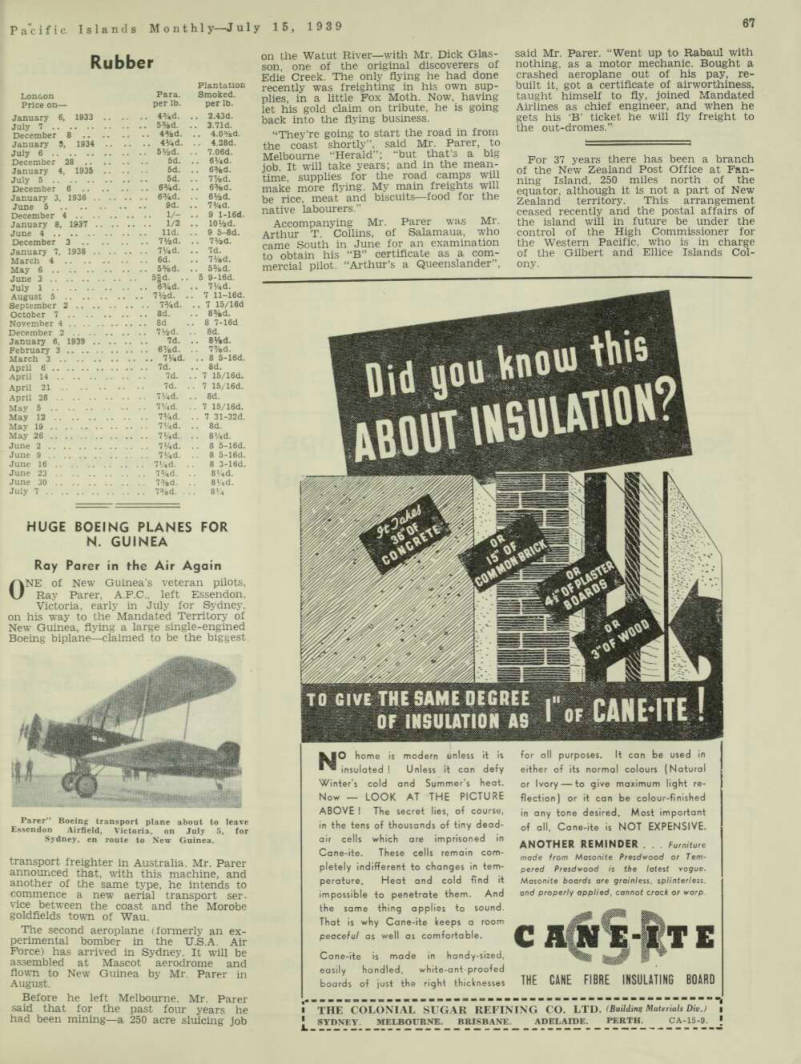
Copra
South Sea, Plantation, Sun-dried Hot-air Dried.
London to London Rabaul Price on Per ton, c.i.f.
Per ton, c.i.f.
January 1, 1932 £14 0 0 £14 15 0 March 25 . . £14 17 6 £15 0 0 June 17 . £13 2 6 £13 5 0 September 2 , . £13 17 6 £14 0 0 December 16 £14 2 6 £14 5 0 January 6, 1933 £13 0 0 £13 12 6 March 3 £11 7 6 £11 10 0 June 30 £10 17 6 £11 0 0 September 29 £9 7 6 £9 10 0 December L .. £8 12 6 £9 0 0 January 5, 1934 £8 0 0 £8 7 6 March 30 £7 7 6 £8 0 0 June 15 £8 0 0 £8 12 6 September 7 ., £7 12 6 £8 15 0 December 28 £9 0 0 £9 12 6 January 4, 1935 £9 5 0 £10 5 0 March 1 £12 2 6 £12 15 0 June 7 .. £11 15 0 £12 7 6 September 6 £9 17 6 £10 17 6 December £12 17 6 £14 0 0 South Sea.
South Sea.
Plantation.
Smoked, to Genoa Sun-Dried Hot-air Dried.
London and Marseilles, to London Rabaul.
Price on— -Per ton.c.i.f.
Per ton, c.i.f, , Per ton.c.i.f.
Jan. 3. ’36 £13 2 6 £13 15 0 £14 0 0 Mar. 6 , . £11 15 0 £12 15 0 £13 0 0 June 5 . . £11 10 0 £12 0 0 £12 17 b Sept. 4 . . £13 2 6 £13 10 0 £14 12 6 Dec. 4 . . £19 7 6 £19 7 6 £20 7 6 Jan. 8, ’37 £22 12 6 £22 12 6 £23 12 6 Mar. 5 . . £19 0 0 £19 5 0 £20 0 0 June 4 £15 15 0 £15 12 6 £16 12 6 Sept. 3 . . £13 5 0 £13 5 0 £14 0 0 Dec. 3 . . £12 10 0 £12 12 6 £13 7 6 Jan. 7, ’38 £12 12 6 £12 15 0 £13 12 6 Peb. 4 . .. £11 2 6 £11 10 0 £12 7 6 Mar. 4 £10 17 6 £11 0 0 £12 0 0 Apr. 1 .. £10 10 0 £10 12 6 £11 10 0 May 6 £10 17 6 £10 17 6 £11 17 6 June 3 .. £9 15 0 £9 15 0 £10 12 6 July 1 . . £9 17 6 £9 17 6 £10 17 6 Aug. 5 . £9 15 0 £9 15 0 £10 15 0 Sept. 2 . £9 10 0 £9 10 0 £10 10 0 Oct. 7 . . £9 2 6 £9 2 6 £10 2 6 Nov. 4 . . £8 12 6 £8 12 6 £9 10 0 Dec. 2 . . £9 5 0 £9 5 0 £10 2 6 Jan. 6, ’39 £9 12 6 £9 15 0 £10 10 0 Jan. 13 .. £9 10 0 £9 12 6 £10 7 6 Jan. 20 £9 7 6 £9 10 0 £10 5 0 Jan. 27 £9 7 6 £9 10 0 £10 5 0 Peb. 3 .. .. £9 10 0 £9 12 6 £10 10 0 Peb. 10 .. £9 7 6 £9 10 0 £10 10 0 Feb. 17 .. £9 15 0 £10 0 0 £10 17 6 Feb. 24 .. £9 17 6 £10 2 6 £11 0 0 Mar. 3 .. £10 0 0 £10 2 6 £11 0 0 Mar. 10 . £9 17 6 £10 2 6 £11 0 0 Mar. 17 .. £9 15 0 £9 17 6 £10 17 6 Mar. 24 .. £9 15 0 £9 17 6 £10 17 6 Mar. 31 .. £9 12 6 £9 15 0 £10 15 0 Apr. 6 .. £9 12 6 £9 15 0 £10 15 0 April 14 £9 10 0 £9 12 6 £10 12 6 April 21 . £9 10 0 £9 12 6 £10 12 6 April 28 £9 17 6 £10 0 0 £11 0 0 May 5 . . £10 0 0 £10 5 0 £11 0 0 May 12 .. £10 5 0 £10 10 0 £11 5 0 May 19 £10 5 0 £10 7 6 £11 2 6 May 26 .. £10 7 6 £10 10 0 £11 7 6 June 2 £10 7 6 £10 10 0 £11 7 6 June 9 £10 5 0 £10 10 0 £11 7 6 June 16 .. £9 15 0 £10 0 0 £10 17 6 June 23 .. £9 10 0 £9 15 0 £10 15 0 June 30 .. £9 5 0 £9 7 6 £10 7 6 July 7 .. £9 2 6 £9 7 6 £10 5 0
Rubber
Plantation Lonaon Para.
Smoked.
Price on— per lb. per lb.
January 6, 1933 .. .. 2.43d.
July 7 .. 3.71d.
December 8 .. .. 4.0%d.
January 9, 1934 .. 4.28d.
July 6 .. 7.06d.
December 28 .. .. .. 5d. .. 6>/4d.
January 4, 1935 .. .. .. 5d. .. 6%d.
July 5 ., .. 5d. .. 7%d.
December 6 .. 6%d.
January 3, 1936 .. .. .. .. 6%d. .. 6y a d.
June 5 . .. 9d. .. 7y»d.
December 4 .. .. 1/- .. 9 l-16d.
January 8, 1937 .. .. ... 1/2 .. lOVid.
June 4 .. .. lid. .. 9 5-8d.
December 3 . .. 7Vfed. .. 7*id.
January 7. 1938 .. .. .. 7d.
March 4 . .. 6d. .. 7Vsd.
May 6 .. .. 5%d. .. 5%d.
June 3 5|d. . . 5 9-16d.
July 1 .. .. 6%d. .. 7V 4 d.
August 5 .. 7 ll-16d.
September 2 .. 7 15/16d October 7 . .. .. 8d. . . 8%d.
November 4 ... 8d .. 8 7-16d December 2 .. 8d.
January 6. 1939 .. .. .. .. 7d. .. 8Vtd.
February 3 .. 7 7 / 8 d.
March 3 .. 8 5-16d.
April 6 ... 7d. .. 8d.
April 14 .. .. 7d. .. 7 15/16d.
April 21 . .. 7d. .. 7 15/16d.
April 28 .. 8d.
May 5 .. 7 15/16d.
May 12 .. 7 31-32d.
May 19 .. 8d.
May 26 .. .. IVtd. .. sy 4 d.
June 2 .. .. 7V 4 d. .. 8 5-16d.
June 9 .. .. 7V 4 d. .. 8 5-16d.
June 16 . .. 7V4d. 8 3-16d.
June 23 . .. 7%d. 8V4d.
June 30 .. 7%d. .. 8>/ 4 d.
July 7 .. .. 7%d. 8V 4
Advertisements & other items, p. 68 (1 item)
66
July 15, 193 9—P acifie Islands Monthly
Huge Boeing Planes For
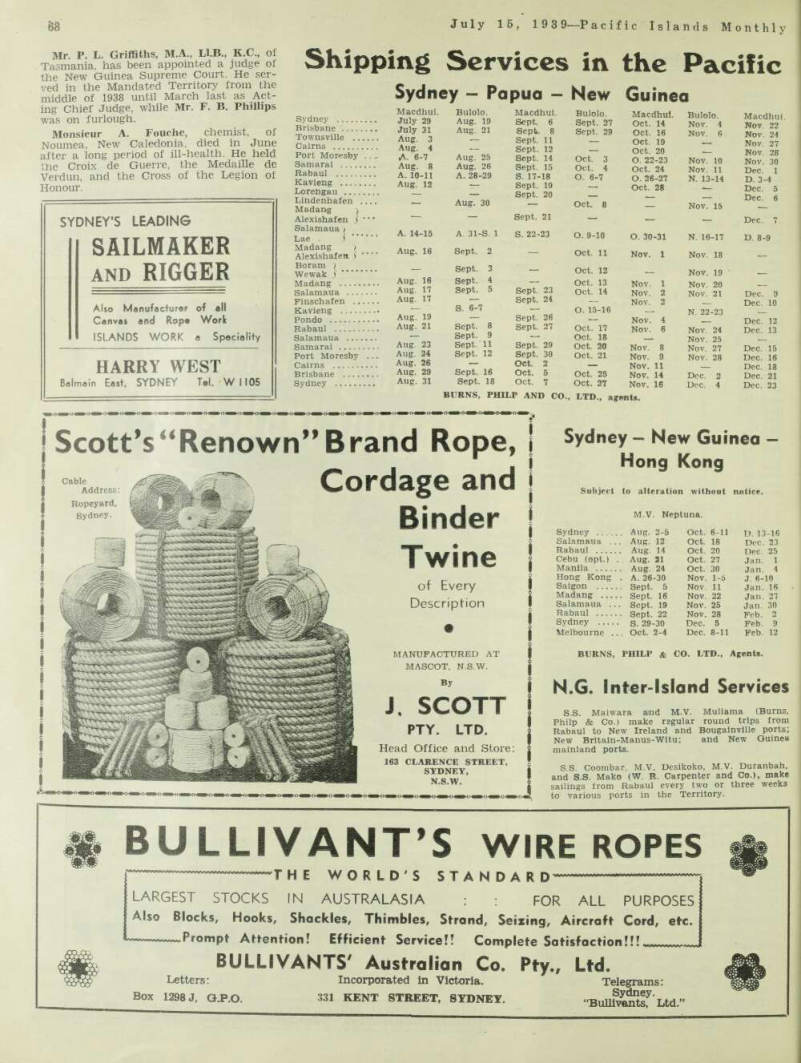
N. Guinea
Ray Parer in the Air Again
ONE of New Guinea’s veteran pilots, Ray Parer. A.F.C., left Essendon, Victoria, early in July for Sydney, on his way to the Mandated Territory of New Guinea, flying a large single-engined Boeing biplane—claimed to be the biggest
transport freighter in Australia. Mr. Parer announced that, with this machine, and another of the same type, he intends to commence a new aerial transport ser vice between the coast and the Morobe goldfields town of Wau.
The second aeroplane (formerly an ex perimental bomber in the U.S.A. Air Force) has arrived in Sydney. It will be assembled at Mascot aerodrome and flown to New Guinea by Mr. Parer in August.
Before he left Melbourne. Mr. Parer said that for the past four years he had been mining—a 250 acre sluicing job
on the Watut River—with Mr. Dick Glasson one of the original discoverers of Edie Creek. The only flying he had done recently was freighting in his own supplies, in a little Fox Moth. Now, having let his gold claim on tribute, he is going back into the flying business.
“They’re going to start the road in from the coast shortly”, said Mr. Parer, to Meiboume ‘‘Herald’’; “but that’s a big job. It wil! take years and in the mean time, supplies for the road camps will make more flying- My mam freights will be rice, meat and biscuits food for the native labourers.”
Accompanying Mr. Parer was Mr.
Arthur T. Collins, of Salamaua, who came South in June for an examination to obtain his “B” certificate as a commercial pilot. “Arthur’s a Queenslander”,
said Mr. Parer. “Went up to Rabaul with nothing, as a motor mechanic. Bought a crashed aeroplane out of his pay, re built it, got a certificate of airworthiness, taught himself to fly, joined Mandated Airlines as chief engineer, and when he gets his ‘B’ ticket he will fly freight to the out-dromes.”
For 37 years there has been a branch of the New Zealand Post Office at Fan ning Island, 250 miles north of the equator, although it is not a part of New Zealand territory. This arrangement ceased recently and the postal affairs of the island will in future be under the control of the High Commissioner for the Western Pacific, who is in charge of the Gilbert and Ellice Islands Col ony.
Parer” Boeing transport plane about to leave Essendon Airfield, Victoria, on July 5, for Sydney, en route to New Guinea.
Mr. P. L. Griffiths, M.A.. L 1.8., K.C., of Tasmania, has been appointed a judge of the New Guinea Supreme Court. He ser ved in the Mandated Territory from the middle of 1938 until March last as Act ing Chief Judge, while Mr. F. B. Phillips was on furlough.
Monsieur A. Fouche, chemist, of Noumea, New Caledonia, died in June after a long period of ill-health. He held the Croix de Guerre, the Medaille de Verdun, and the Cross of the Legion of Honour.
Advertisements & other items, pp. 69-70 (2 items)
67
Pacific Islands Monthl y—J uly 15, 1939
To Give The Same Degree Niuc.Ltc I
OF INSULATION AS ' OF CAN EMIL!
NO home is modern unless it is insulated ! Unless it can defy Winter's cold and Summer's heat.
Now LOOK AT THE PICTURE
ABOVE ! The secret lies, of course, in the tens of thousands of tiny deadair cells which are imprisoned in Cane-ite. These cells remain completely indifferent to changes in temperature. Heat and cold find it impossible to penetrate them. And the same thing applies to sound.
That is why Cane-ite keeps a room peaceful as well as comfortable.
Cane-ite is made in handy-sized, easily handled, white-ant-proofed boards of just the right thicknesses for all purposes. It can be used in either of its normal colours (Natural or Ivory —to give maximum light reflection) or it can be colour-finished in any tone desired. Most important of all. Cane-ite is NOT EXPENSIVE.
ANOTHER REMINDER . Furniture made from Masonite Presdwood or Tempered Presdwood is the latest rogue.
Masonite boards are grainless, splinterless, and properly applied, cannot crack or warp
THE CANE FIBRE INSULATING BOARD
I THE COLONIAL SUGAR REFINING CO. LTD. (Building Materials Div.) i
SYDNEY. MELBOURNE. BRISBANE.
ADELAIDE. PERTH.
CA-15-9. ■
SYDNEY'S LEADING
SAILMAKER
AND RIGGER
Also Manufacturer of all Canvas and Rope Work ISLANDS WORK a Speciality
HARRY WEST
Balmain East. SYDNEY Tel. W 1105
Scott’s “Renown” Brand Rope,
Cordage and
Binder
Twine
Cable Address: Ropeyard, Sydney.
of Every
Description
MANUFACTURED AT
MASCOT, N.S.W.
By
J. SCOTT
PTY. LTD.
Head Office and Store:
163 CLARENCE STREET,
SYDNEY,
N.S.W.
BULLIVANT’S WIRE ROPES
T H
STOCKS IN
WORLD'S
AUSTRALASIA
STANDARD
LARGEST bIUCKb IN AUSTRALASIA FOR ALL PURPOSES Also Blocks, Hooks, Shackles, Thimbles, Strand, Seizing, Aircraft Cord, etc.
Attention! Efficient Service!! Complete Satisfaction!!!
BULLIVANTS' Australian Co* Pty., Ltd.
Letters:
Box 1298 J, G.P.O.
Incorporated in Victoria.
331 KENT STREET, SYDNEY.
Telegrams: Sydney.
“Bull!vents. Ltd. m
Shipping Services in the Pacific
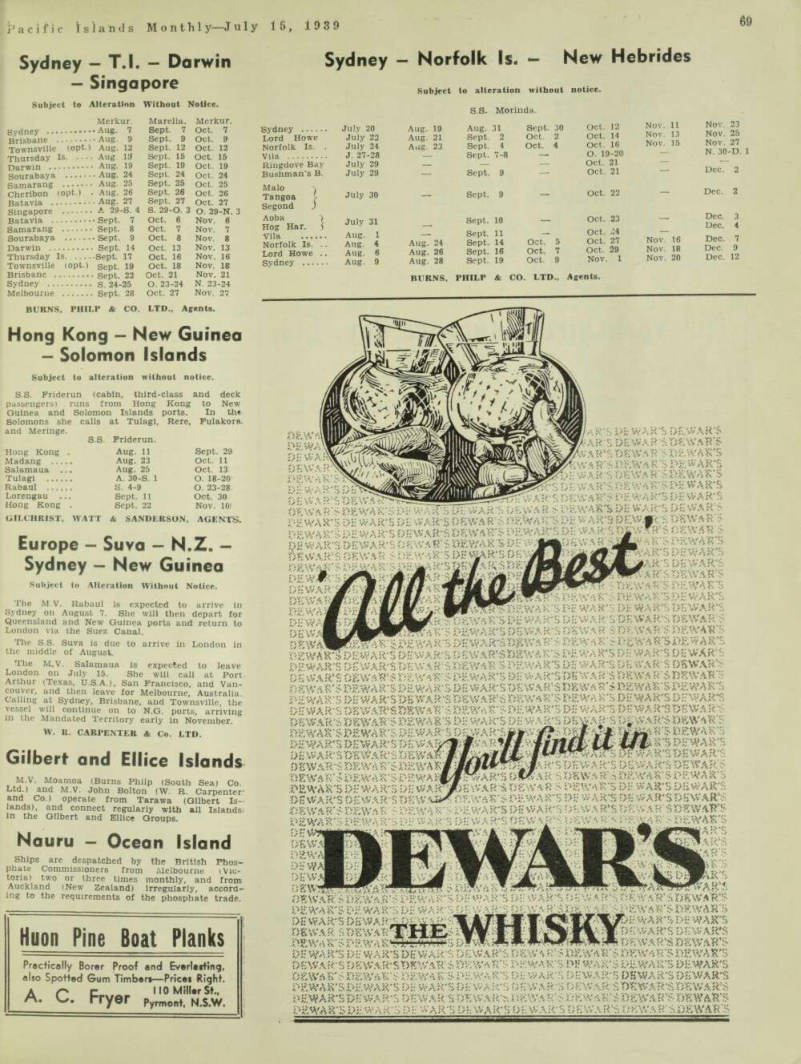
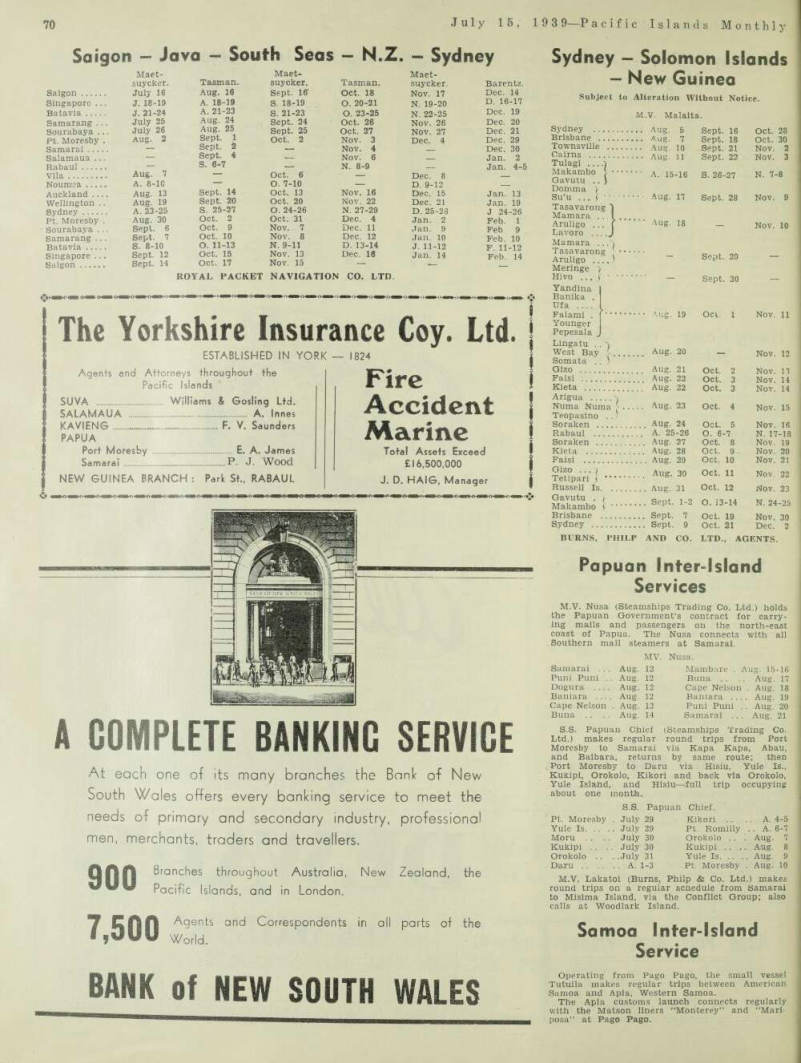
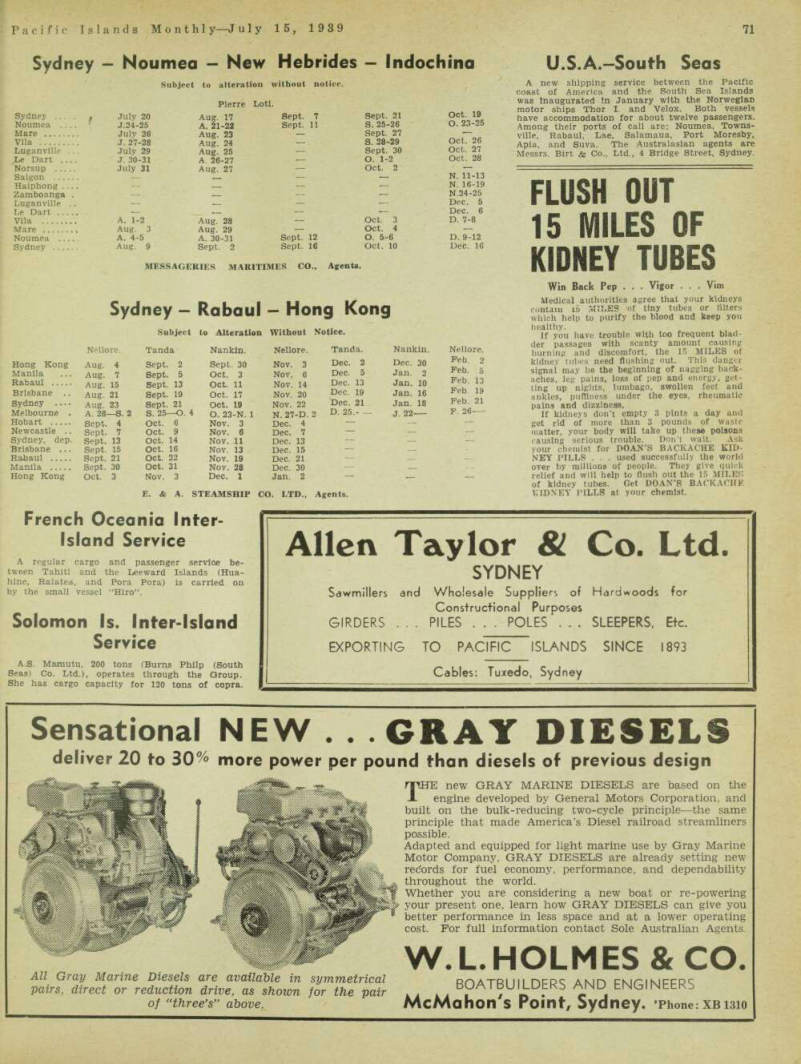
Sydney - Papua - New Guinea
Sydney - New Guinea - Hong Kong
N.G. Inter-Island Services
S.S. Maiwara a'nd M.V. Mullama (Burns, Philp & Co.) make regular round trips from Eabaul to New Ireland and Bougainville ports; New Britaln-Manus-Witu; and New Guinea mainland ports.
S.S. Coombar, M.V, Desikoko, M.V. Duranbah, and S.S. Mako (W. R. Carpenter and Co.), make sailings from Rabaul every two or three weeks to various ports in the Territory.
Sydney Macdhui.
Bulolo.
Macdhui.
Bulolo.
Macdhui.
Bulolo.
Macdhui.
July 29 Aug. 19 Sept. 6 Sept. 27 Oct. 14 Nov. 4 Nov. 22 Brisbane Townsville Cairns Port Moresby ...
July 31 Aug. 3 Aug. 4 »A. 6-7 Aug. 21 Aug. 25 Sept. 8 Sept. 11 Sept. 12 Sept. 14 Sept. 29 Oct. 3 Oct. 16 Oct. 19 Oct. 20 O. 22-23 Nov. 6 Nov. 10 Nov. 24 Nov. 27 Nov. 28 Nov. 30 Samarai Rabaul Kavieng Lorengau Lindenhafen Madang 7 Aug. 8 A. 10-11 Aug. 12 Aug. 26 A,28-29 Aug. 30 Sept. 15 S. 17-18 Sept. 19 Sept. 20 Oct. 4 O. 6-7 Oct. 8 Oct. 24 O.26-27 Oct. 28 Nov. 11 N. 13-14 Nov. 15 Dec. 1 D. 3-4 Dec. 5 Dec. 6 Alexishafen j " * * — Sept. 21 — — Dec. 7 Salamaua t A. 14-15 A. 31-S. 1 S.22-23 N. 16-17 D. 8-9 Lae j O. 9-10
U. Jo-31
Madang 7 Aug. 16 Sept. 2 C\nf 11 Nov.
Nov. 18 Alexishafen \ 1 —— Boram 7 Sept. 3 Oof 19 Nov. 19 Wewak 3 Aug. 16 v-/Cu. 1Z <— Madang Sept. 4 — Oct. 13 Nov. 1 Nov. 20 Salamaua Aug. 17 Sept. 5 Sept. 23 Oct. 14 Nov. 2 Nov. 21 Dec. 9 Finschafen Kavieng Aug. 17 S. 6-7 Sept. 24 O. 15-16 Nov. 2
Xt Oo Oq
Dec. 10 Pondo Aug. 19 — Sept. 26 Nov.
Nov. 4
In. Zz-Zj
Dec 12 Rabaul Aug. 21 Sept. 8 Sept. 27 Oct. 17 6 Nov. 24
Dec! 13
Salamaua —‘ Sept. 9 — Oct. 18 Nov. 25 Samarai Aug. 23 Sept. 11 Sept. 29 Oct. 20 Nov. 8 Nov. 27 Dec. 15 Port Moresby .., Aug. 24 Sept. 12 Sept. 30 Oct. 21 Nov. 9 Nov. 28 Dec. 16 Cairns Aug. 26 — Oct. 2 — Nov. 11 Dec. 18 Brisbane Aug. 29 Sept. 16 Oct. 5 Oct. 25 Nov. 14 Dec. 2 Dec. 21 Sydney Aug. 31 Sept. 18 Oct. 7 Oct. 27 Nov. 16 Dec. 4 Dec. 23
Burns, Philp And Co.,
LTD., agents.
Subject to alteration without notice.
M.V, . Neptuna.
Sydney 2-5 Oct. 6-11 D. 13 -16 Salamaua .. • Aug. 12 Oct. 18 Dec. 23 Rabaul . Aug. 14 Oct. 20 Dec. 25 Cebu (opt.) , Aug. 21 Oct. 27 Jan. 1 Manila 24 Oct. 30 Jan. 4 Hong Kong . A. 26 -30 Nov. 1-5 J. 6- 10 Saigon 5 Nov. 11 Jan. 16 Madang ... 16 Nov. 22 Jan. 27 Salamaua .. ■ Sept. 19 Nov. 25 Jan. 30 Rabaul 22 Nov. 28 Feb. 2 Sydney ■ S. 29- -30 Dec. 5 Feb. 9 Melbourne .. . Oct. 2-4 Dec. 8-11 Feb. 12
Burns,
Ph1Lp
Co. Ltd.,
Agents.
Sydney - T.l. - Darwin - Singapore
Hong Kong New Guinea
- Solomon Islands
Subject to alteration without notice.
S.S. Priderun (cabin, third-class and deck passengers) runs from Hong Kong to New Guinea and Solomon Islands ports. In the Solomons she calls at Tulagi, Rere, Fulakora. and Meringe.
Europe - Suvo - N.Z. -
Sydney New Guinea
Subject to Alteration Without Notice.
The M.V. Rabaul is expected to arrive in Sydney on August 7. She will then depart for Queensland and New Guinea ports and return to London via the Suez Canal.
The S.S. Suva is due to arrive in London in the middle of August.
The M.V. Salamaua is expected to leave London on July 15. She will call at Port Arthur (Texas, U.S.A.), San Francisco, and Van couver, and then leave for Melbourne, Australia.
Calling at Sydney, Brisbane, and Townsville, the vessel will continue on to N.G. ports, arriving in the Mandated Territory early in November.
W. R. Carpenter & Co. Ltd,
Gilbert and Ellice Islands
M.V. Moamoa (Burns Philp (South Sea) Co.
Ltd.) and M.V. John Bolton (W. R. Carpenter and Co.) operate from Tarawa (Gilbert Is lands), and connect regularly with all Islands; in the Gilbert and Ellice Groups.
Nauru - Ocean Island
Ships are despatched by the British Phos phate Commissioners from Melbourne iVic toria) two or three times monthly, and from Auckland (New Zealand) irregularly, accord ing to the requirements of the phosphate trade.
Sydney Norfolk Is. New Hebrides
Subject to Alteration Without Notice.
Merkur.
Marella.
Merkur. . Aug. 7 Sept. 7 Oct. 7 Brisbane • Aug. 9 Sept. 9 Oct. 9 Townsville (opt.) Aug. 12 Sept. 12 Oct. 12 Thursday Is Aug 19 Sept. 15 Oct. 15 Darwin Aug. 19 Sept. 19 Oct. 19 Sourabaya • Aug. 24 Sept. 24 Oct. 24 Samarang Aug. 25 Sept. 25 Oct. 25 Cheribon (opt.) .
Aug. 26 Sept. 26 Oct. 26 Batavia . Aug. 27 Sept. 27 Oct. 27 Singapore A 29-S. 4 S. 29-0. 3 O. 29-N. 3 Batavia • Sept. 7 Oct. 6 Nov. 6 Samarang Sept. 8 Oct. 7 Nov. 7 Sourabaya • Sept. 9 Oct. 8 Nov. 8 Darwin Sept. 14 Oct. 13 Nov. 13 Thursday Is • Sept. 17 Oct. 16 Nov. 16 Townsville (opt.) Sept. 19 Oct. 18 Nov. 15 Brisbane Sept. 22 Oct. 21 Nov. 21 Sydney S. 24-25 O. 23-24 N. 23 -24 Melbourne Sept. 28 Oct. 27 Nov. 27
Burns, Philp & Co.
LTD., Agents.
S.S. Priderun.
Hong Kong . Aug. 11 Sept. 29 Madang Aug. 23 Oct. 11 Salamaua ... Aug. 25 Oct. 13 Tulagl A. 30-S. 1 O. 18-20 Rabaul S. 4-9 O. 23-28 Lorengau ... Sept. 11 Oct. 30 Hong Kong . Sept. 22 Nov. 10)
Gilchrist. Watt & Sanderson, Agents.
Subject to alteration without notice.
S.S. Morinda.
Sydney Lord Howe Norfolk Is. .
Vila Ringdove Bay Bushman’s B.
July 20 July 22 July 24 J. 27-28 July 29 July 29 Aug. 19 Aug. 21 Aug. 23 Aug. 31 Sept. 2 Sept. 4 Sept. 7-8 Sept. 9 Sept. 30 Oct. 2 Oct. 4 Oct. 12 Oct. 14 Oct. 16 O. 19-20 Oct. 21 Oct. 21 Nov. 11 Nov. 13 Nov. 15 Nov.
Nov.
Nov.
N. 30 Dec. 23 25 27 -D. 1 2 Malo Tangos :
Segond )
July 30 - Sept. 9 - Oct. 22 — Dec. 2 Aoba ") Hog Har. ] Vila July 31 Aug. 1 Aug. 4 Aug. 6 Aug. 9 - Sept. 10 Sept. 11 — Oct. 23 Oct. 24 I Dec.
Dec.
Dec.
Dec.
Dec. 3 4 Norfolk Is. ..
Lord Howe ..
Rvrinev Aug. 24 Aug. 26 Aug. 28 Sept. 14 Sept. 16 Sept. 19 Oct. 5 Oct. 7 Oct. 9 Oct. 27 Oct. 29 Nov. 1 Nov. 16 Nov. 18 Nov. 20 7 9 12 OJ U1IV J • • “ *
Burns,
Philp & Co. Ltd.,
Agents.
Saigon Java South Seas N,Z. Sydney
Sydney Solomon Islands - New Guinea
Papuan Inter-Island
Services
M.V. Nusa (Steamships Trading Co. Ltd.) holds the Papuan Government’s contract for carry ing mails and passengers on the north-east coast of Papua. The Nusa connects with all Southern mail steamers at Samarai.
S.S. Papuan Chief (Steamships Trading Co.
Ltd.) makes regular round trips from Port Moresby to Samarai via Kapa Kapa, Abau, and Baibara, returns by same route; then Port Moresby to Daru via Hisiu, Yule Is., Kukipi, Orokolo, Kikorl and back via Orokolo, Yule Island, and Hisiu —full trip occupying about one month.
M.V. Lakatoi (Burns, Philp & Co. Ltd.) makes round trips on a regular schedule from Samarai to Misima Island, via the Conflict Group; also calls at Woodlark Island.
Samoa Inter-island
Service
Operating from Pago Pago, the small vessel Tutuila makes regular trips between American Samoa and Apia, Western Samoa.
The Apia customs launch connects regularly with the Matson liners “Monterey” and “Mari posa” at Pago Pago.
Maetsuycker.
Tasman.
Maetsuycker.
Tasman.
Maetsuycker.
Barentz.
Saigon July 16 Aug. 16 Sept. 16- Oct. 18 Nov. 17 Dec. 14 Singapore ...
J. 18-19 A. 18-19 S. 18-19 O.20-21 N. 19-20 D. 16-17 Batavia J. 21-24 A. 21-23 S. 21-23 O. 23-25 N. 22-25 Dec. 19 Samarang ...
July 25 Aug. 24 Sept. 24 Oct. 26 Nov. 26 Dec. 20 Sourabaya ...
July 26 Aug. 25 Sept. 25 Oct. 27 Nov. 27 Dec. 21 Pt. Moresby .
AUg. 2 Sept. 1 Oct. 2 Nov. 3 Dec. 4 Dec. 29 Samarai — Sept. 2 — Nov. 4 Dec. 30 Salamaua ... — Sept. 4 — Nov. 6 Jan. 2 Rabaul — S. 6-7 — N. 8-9 Jan. 4-5 Vila Aug. 7 — Oct. 6 — Dec. 8 Noumea A. 8-1C — O. 7-10 — D. 9-12 Auckland ...
AUg. 13 Sept. 14 Oct. 13 Nov. 16 Dec. 15 Jan. 13 Wellington ..
Aug. 19 Sept. 20 Oct. 20 Nov. 22 Dec. 21 Jan. 19 Sydney A. 23-25 S. 25-27 O.24-26 N. 27-29 D. 25-23 J 24-26 Pt. Moresby .
Aug. 30 Oct. 2 Oct. 31 Dec. 4 Jan. 2 Feb. 1 Sourabaya ...
Sept. 6 Oct. 9 Nov. 7 Dec. 11 Jan. 9 Feb 9 Samarang ...
Sept. 7 Oct. 10 Nov. 8 Dec. 12 Jan. 10 Feb. 10 Batavia S. 8-10 O. 11-13 N.9-11 D.13-14 J. 11-12 F. 11-12 Singapore ...
Sept. 12 Oct. 15 Nov. 13 Dec. 16 Jan. 14 Feb. 14 Saigon Sept. 14 Oct. 17 Nov. 15 — —
Royal Packet
Navigation
Co. Ltd
Subject to Alteration Without Notice.
M.V. Malalta.
Sydney .
Sept. 16 Oct. 28 Brisbane . .
Aug. 7 Sept. 18 Oct. 30 Townsville Aug. 10 Sept. 21 Nov. 2 Cairns ..
Tulagi ... 1 Sept. 22 Nov. 3 Gavutu ..
J A. 15-16 S. 26-27 N. 7-8 Domma ) Su’u ... ) Sept. 28
Nov.
9 Tasavarong 1 Mamara . ..
Aruligo .. .
Aug. 18 Nov. 10 Lavoro ..
J Mamara .
Tasavarong Aruligo Sept. 29 Meringe ) Hivo ... j — Sept. 30 Yandina Banika .
Ufa ...
Faiami .
Ocl. 1 Nov. 11 Younger Pepesala .
Lingatu ., West Bay Aug. 20 — Nov. 12 Somata . . J Glzo Aug. 21 Oct. 2 Nov.
Nov. 13 14 Faisi Oct. 3 Kleta Oct. 3 Nov. 14 Arigua ..
A Numa Numa ' Aug. 23 Oct. 4 Nov. 15 Teopasino \ Soraken .
Aug. 24 Oct. 5 Nov. 16 Rabaul ..
A. 25-26 O. 6-7 N. 17 -18 Soraken .
Aug. 27 Oct. 8 Nov. 19 Kieta ...
Oct. 9 Nov. 20 Faisi Oct. 10 Nov. 21 Gizo ... Tetipari S Aug. 30 Oct. 11 Nov. 22 Russell Is. .
Aug. 31 Oct. 12 Nov. 23 Gavutu .
Makambo I ) "
Sept. 1-2 O.13-14 N. 24-25 Brisbane Oct. 19 Nov. 30 Sydney ..
Oct. 21 Dec. 2
Burns,
Philp And Co.
Ltd., Agents.
MV. Nusa.
Samarai ... Aug. 12 Mambare . Aug. 15-16 Puni Puni .. Aug. 12 Buna .. . . Aug. 17 Dogura ... Aug. 12 Cape Nelson . Aug. 18 Baniara ... Aug. 12 Baniara Aug. 19 Cape Nelson . Aug. 13 Puni Puni .. Aug. 20 Buna .. .. Aug. 14 Samarai ... Aug. 21
S.S. Papuan Chief.
Pt. Moresby . July 29 Kikori .. . A. 4-5 Yule Is. .. . . July 29 Pt. Romilly .. A. 6-7 Moru ..
July 30 Orokolo .. !
Aug. 7 Kukipi ..
July 30 Kukipi ..
Aug. 8 Orokolo .. ..July 31 Yule Is . Aug. 9 Daru .. .. .. A. 1-3 Pt. Moresby , , Aug. 10
Sydney - Noumea - New Hebrides - Indochina
Sydney - Rabaul - Hong Kong
French Oceania Inter-
Island Service
A regular cargo and passenger service be tween Tahiti and the Leeward Islands (Hua hine, Raiatea, and Pora Pora) is carried on by the small vessel “Hiro”.
Solomon Is. Inter-Island
Service
A.S. Mamutu, 200 tons (Burns Philp (South Seas) Co. Ltd.), operates through the Group.
She has cargo capacity for 120 tons of copra.
U.S.A.-South Seas
A new shipping service between the Pacific coast of America and the South Sea Islands was Inaugurated In January with the Norwegian motor ships Thor I. and Velox. Both vessels have accommodation for about twelve passengers.
Among their ports of call are: Noumea, Towns ville, Rabaul, Lae, Salamaua, Port Moresby, Apia, and Suva. The Australasian agents are Messrs. Birt & Co., Ltd., 4 Bridge Street, Sydney.
Sydney f July 20 Subject to alteration without notice.
Pierre Loti.
Aug. 17 Sept. 7 Sept. 21 Oct. 19 Noumea ...
J.24-25 A. 21-22 Sept. 11 S. 25-26 O. 23-25 Mare July 26 Aug. 23 — Sept. 27 —- Vila J. 27-28 Aug. 24 — S. 28-29 Oct. 26 Luganville . .
July 29 Aug. 25 — Sept. 30 Oct. 27 Le Dart J. 30-31 A 26-27 — O. 1-2 Oct. 28 Norsup July 31 Aug. 27 — Oct. 2 — Saigon — — — N. 11-13 Haiphong — — — N. 16-19 Zamboanga . — — — N.24-25 Luganville ., — — — — Dec. 5 Le Dart — — — — Dec. 6 Vila A. 1-2 Aug. 28 — Oct. 3 D. 7-8 Mare Aug. 3 Aug. 29 — Oct. 4 — Noumea A. 4-5 A. 30-31 Sept. 12 O. 5-6 D. 9-12 Sydney Aug. 9 Sept. 2 Sept. 16 Oct. 10 Dec. 1C
Messageries Maritimes Co., Agents.
Nellore.
Subject Tanda to Alteration Nankin.
Without Nellore.
Notice.
Tanda.
Nankin.
Nellore.
Hong Kong Aug. 4 Sept. 2 Sept. 30 Nov. 3 Dec. 2 Dec. 30 Peb. 2 Feb. 5 Manila Aug. 7 Sept. 5 Oct. 3 Nov. 6 Dec. 5 Jan. 2 Rabaul Aug. 15 Sept. 13 Oct. 11 Nov. 14 Dec. 13 Jan. 10 Feb. 13 Brisbane ..
Aug. 21 Sept. 19 Oct. 17 Nov. 20 Dec. 19 Jan. 16 Feb. 19 Sydney Aug. 23 Sept. 21 Oct. 19 Nov. 22 Dec. 21 Jan. 18 Peb. 21 Melbourne .
A. 28—S. 2 S. 25—0. 4 O. 23-N. 1 N. 27-D. 2 D. 25.
J. 22 — F. 26 — Hobart Sept. 4 Oct. 6 Nov. 3 Dec. 4 — — — Newcastle ..
Sept. 7 Oct. 9 Nov. 6 Dec. 7 — — — Sydney, dep.
Sept. 13 Oct. 14 Nov. 11 Dec. 13 — — — Brisbane ...
Sept. 15 Oct. 16 Nov. 13 Dec. 15 — —. • Rabaul Sept. 21 Oct. 22 Nov. 19 Dec. 21 — — — Manila Sept. 30 Oct. 31 Nov. 28 Dec. 30 — —.
Hong Kong Oct. 3 Nov, 3 Dec. 1 Jan. 2 — — —
E. & A. Steamship Co. Ltd.,
Agents.
Sydney - Noumea - Tahiti
Service
Subject to Alteration Without Notice.
Mails and passengers from Sydney for Tahiti may connect with Messageries Maritimes liners at Noumea, per Pierre Loti (see Sydney-Noumea- New Hebrides service). The M.M. liner’s run between Marseilles and Noumea, via Panama Canal.
New Hebrides Inter-Island
S.S. Mirani (Burns Phllp (South Sea) Co.
Ltd.) connects every six weeks at Vila with S.S. Morinda from Sydney, then proceeds on southern trip, calling at the islands of Efate, Erromanga, Tanna, Aneityum, and re turns to Vila—trip occupying 7 or 8 days.
After 2 or 3 days at Vila, departs on north ern trip, calling at the islands of Efate, Mai, Tongoa, Epi, Paama, Ambrym, Malekula, Aoba, Malo, Santo and returns to Vila, trip oc cupying 25 to 28 days. Vessel extends to Banks Group every second trip equivalent to about every six weeks.
M.V. Polynesien (Messageries Maritimes Ltd.) maintains a service from Vila to northern and southern ports as well as occasional trips to Wallis and Futuna Islands. The service com prises the following:— Northern run; Leaves Vila on August 4, call ing at N’Guna, Mai, Tongoa, Diamond Bay, Ringdove, Nelson, Paama, Port Sandwich, Cralg cove, Olal, Rhanone, Wanour, Bale Homo, Pointe Truchy, Melslssi, Namarang, Loltong, Loloque-pue, Nenglre, Lone, N’Dul-N’Dul, Port Patteson, Port Olry, Hog Harbour, Bale des Requins, Bale des Tortues, Mate Wulu, Saramy, Saraoutou, Surrenda, Aisse, Luganville, Malo, Barclay, Malo Pass, Bale Benler, Vao, Walla, Norsup, Sarmette, Rensari, Banam Bay, Ouesso, Port Sandwich, Lamap, Sakau (Maskelines) and returns to Vila on August 18.
Southern Run:—Leaves Vila on September 24, calling at Lenakel, Ibock, White Sands, Wais sissi, Erromanga, La Teouma, Mele, and re turns to Vila on September 29.
Wallis and Futuna Is.:—Leaves Vila on October 4, calling at Siguave, Mata Utu, and returns to Vila on October 21.
C. Ramel. Eridan. Sagittalre, Papeete A. 13-14 S. 23-24 Nov. 5-6 Suva (opt.) Aug. 21 Oct. 2 Nov 13 Vila Aug. 23 Oct. 4 Nov. 15 Noumea ... A. 25—S. 2 Oct. N. 17-24 Vila Sept. 5 Oct. 17 Nov. 27 Raiatea Sept. 12 Oct. 24 Dec. 4 Papeete S. 13-15 o. 25-27 Dec. 5-7
Messageries Maritimes Co. Ltd., Agents.
Sydney - N.Z. - Fiji - Samoa - Hawaii
Sydney - N.Z. - Fiji Howaii
Australia Central
Pacific U.S.A.
The new B.P. vessel “Tulagi” will commence a freight service between Australia and North American ports, via Central Pacific, at the end of July. The vessel, which has accommodation for 12 passengers, will leave Sydney on a re gular three monthly .service, calling at Fiji and Tonga, with occasional calls at other Central Pacific ports, i.e., Washington and Christmas Islands.
Burns, Philp & Co., Ltd., Agents.
New Caledonian Inter-
Island Services
A vessel owned by Societe des Hes Loyalty makes regular trips, carrying mails and pass engers, from Noumea along the east coast to Arama. Also from Noumea to Poum and Be lep Islands, via the west coast. Leaving Nou mea on the run up the east coast the vessel calls at Yate, Touarou, N. Goye, Kaukue, Thio, Nakety, Canalo, Gouaoua, Hauoilou, Moueo, Pouerihouen, Tieti, Poindimie, Wagap, Touho, Kokingone, Hieghene, Tao, Outbatch, Pouebo, Balada, Pam and Arama. Return by same route. Ports visited on west coast trip are: Bourall, Poya, Mueo, Poumbout, Kono, Voh, Temala, Ouaco, Koumac, Karamble, Tanga diou, Paagoumene, Nehoue, Mouac, Belep, and return by same route.
The same vessel also maintains a 4 weeks’ service between Noumea and the Loyalty Group.
The vessel calls at Tadine (Mare Is.), Chep enehe, and We (Lifou Is.). Fajoue, St. Joseph and Banout (Ouvea Is.). Calls are made oc casionally at Isle of Pines and Walpole Is land.
Noumea Australia
The small steamer Neo Hebridals (Societe Maritime et Miniere Hagen) carries on a monthly service between Noumea (New Caledonia), and Newcastle and Sydney (N.S.W.). The round trip occupies about 17 days.
The three vessels of the Societe Le Nickel.
Cap Tarlfa (2,177 tons), Capitalne Illiaquer (2,138 tons), and Notou (2,384 tons) make ir regular trips between Noumea (New Caledonia) and Sydney, Newcastle, and Port Kembla,
N.S.W.
Subject to Alteration Without Notice.
Monterey Mariposa.
Monterey.
Mariposa.
Monterey.
Mariposa.
Monterey.
Honolulu — July 24 Aug. 21 Sept. 18 Oct. 16 Nov. 13 Dec. 11 Jan. 8 Pago Pago ., . July 29 Aug. 26 Sept. 23 Oct. 21 Nov. 18 Dec. 16 Jan. 13 Suva Aug. 1 Aug. 29 Sept. 26 Oct. 24 Nov. 21 Dec. 19 Jan. 16 Auckland ...
Aug. 4 Sept. 1 S. 29-30 Oct. 27 Nov. 24 D. 22-23 Jan. 19 Sydney Aug. 7 Sept. 4 Oct. 3 Oct. 30 Nov. 27 Dec. 26 Jan. 22 Melbourne ..
A. 11-14 S. 8-11 O. 6-9 Nov. 3-6 Dec. 1-4 D. 29-J. 1 J. 26 -29 Sydney Aug. 18 Sept. 15 Oct. 13 Nov. 10 Dec. 9 Jan. 5 Feb. 2 Auckland , Aug. 21 Sept. 18 Oct. 16 Nov. 13 Dec. 12 Jan. 8 Feb. 5 Suva Aug. 24 Sept. 21 Oct. 19 Nov. 16 Dec. 15 Jan. 11 Feb. 8 Pago Pago ..
Aug. 25 Sept. 22 Oct. 20 Nov. 17 Dec. 16 Jan. 12 Feb. 9 Honolulu Aug. 30 Sept. 27 Oct. 25 Nov. 22 Dec. 21 Jan. 17 Feb. 14
Oceanic Steamship Co., Matson
Line.
Subject to Alteration Without Notice.
Niagara. Monowai. Aorangi. Niagara. Aorangi. Niagara.
Honolulu July 12 Aug. 9 Sept. 6 Oct. 4 Nov. 1 Nov. 29 Suva July 21 Aug. 18 Sept. 14 Oct. 13 Nov. 9 Dec. 8 Auckland ... J. 24-25 A. 21-22 s. 17-18 O. 16-17 N. 12-13 D. H-12 Sydney July 29 Aug. 26 Sept. 22 Oct. 21 Nov. 17 Dec. 16 Sydney, dep. . Aug. 3 Aug. 31 Sept. 28 Oct. 26 Nov. 23 Auckland A 7-8 S. 4-5 O. 2-3 O. 30-31 N. 27-28 Suva Aug. 11 Sept. 8 Oct. 6 Nov. 3 Dec. 1 Honolulu Aug. 18 Sept. 15 Oct. 13 Nov. 10 Dec. 8 —
Union S.S. Co. Ltd., Agents.
N. Zealand-Samoa-Niue
The New Zealand Government’s steamer Maui Pomare (1,159 tons) is the only direct connection between N.Z., the Mandated Territory of Western Samoa and Niue Island. The vessel, which carries mails, passengers, and cargo, is controlled by the Department of External Affairs at Wellington, where application should be made concerning freights, berths, etc.
Central Pacific Services
M.V. Maui Pomare.
Wellington . Aug. 8 Sept. 5 Oct. 3 Oct. 31 Nov. 21 Apia A. 15-17 S. 12-14 o. 10-12 .Nov. 7-9 N. 28-30 Niue Aug. 19 Sept. 16 Oct. 14 Nov. 11 Dec. 2 Lyttelton ... A. 28-29 S. 25-26 0.23-25 Nov. 20 D. 11-12 Wellington .. Aug. 30 Sept. 27 Oct. 26 Nov. 21 Dec. 13
M.V. Matua* Auckland ...
Aug. 15 Sept. 12 Oct. 10 Nov. 7 Nov. 28 Rarotonga ..
Aug. 19 Sept. 16 Oct. 14 Nov. 11 Dec. 2 Outer Islands — — — Rarotonga — .
Nukualofa ..
Aug. 23 Sept. 20 Oct. 18 Nov. 15 Dec. -6 Apia A. 24-26 S. 21-23 O. 19-21 N. 16-18 D. 7-9 Suva A. 29-31 S. 26-28 O. 24-26 N. 21-23 D.12-14 Auckland ...
S. 3-4 Oct. 1 Oct. 29 Nov. 26 Dec. 17 *On arrival in ! Auckland, New Zealand, on July 26, the “Matua” will go into dock for a survey. She will resume from Auckland on .
August 15.
The cargo vessel “Cape Horn” will depart from Sydney on July 21 for Fiji, Tahiti, and North American ports.
She will carry a limited number of nasseneers in addition to mails and general cargo.
The following vessel from Sydney will be the “Talton ”, early in August.
In Ion Steam Ship
Co. Ltd.,
Agents
Advertisements & other items, pp. 71-76 (6 items)
69
Pacific Islands Monthl y—J uly 15, 1939
Huon Pine Boat Planks
'Hill m S' & orv/a 033 WA WA3
OSVv'A:
OR WAV
;>;• •/./A ;<
OS WAR
ORWASSORWAR'S
A;OS :/
a;OS;3>3: WAR'S OSWAjOS
A3OS OSWAjOSORWAfSS
WAR’S ORWAR S ORWAR'S
Rwaß'S ORWARS OR WAR'S
>•■ WAR'S ORV/.ARS OR WAR'S
AR'SORWaRW3.'3: WAR'S
H A R'S OR'W.aR'S ORWAR'S 033 WAR'S AR'SOSWAR •:• ORWAR'S 3/33 'AAR'S OS WAR’S ORWAR'S OS WAR'S OS WA3OS ORWAR SORWAR'S 033 WAR'S O£W-|R. S v>|WAR ORWAR'* 33>33 WA3OS OS WAR'S ORWAR’S ORWAR'S 3/3: A A s<; :> W .Ts< S : .;awA
M«A»^»SWAB-SX)gWftir4aEWAKS»£«vj|AaS>yA!OJ^'-;.? ;
OS WAR'S OKWas AV ' awiS’Js A 30 33- OR W A 30
PAR'S '>'ivVA;<:
30 S OR WAR A
ORWAR'S ORWAR'S
ORWaR'S ORWAR'S SOWAR'S
ORWAR S 3/33 WAR'33- 3>33 WAR'S 3>SWAR'S
.WW;V3WaR’;3.O33 WAR'S 3/SWA3OS DEWAR'SDRW'ARS
frOR'S 3/33,A'A 333'S OSWA3OS ORWAR 33 '0 SWAP'S ORWAR 'S 3’ S OR V-/A 3.33 S ;/;: V/ A 30S O£V/aR' S ORW aR' S ORW A R SOR AAR 'S 3/RWA 30S Ogv;A 30 S 0 S'W AR* S ORW AK' 33- 3>i3. W A R'S 3/ 33 '/V A3OSDSW* A R' S WAR'S 0£ WA3OSDR V/A3O S ORWAR S ORWAR'S 3/33 WAR'S 3;3-3 WA3O S DEWARS; 6'OWA.R’S OKV/aR'S333333WAS 33- ORWAR’S ;>33 WA3OSDRWA3OS V;RWA3<S ORWaRS 3; AWA R' S 33'33; W A 3.33'330 33. V-/A R' 33 3/ 33 W A 3< * SOSW A S’ SI3R WAR’ S 3/ 333 WAA' S 3/33; WA R' S
3/SWA33.
ORWA3
ORWA*
033 W A
OSWA
‘OKWA^
ORWAR
A <•; ORWA 30S 033 WA 3*' S 3; 33 W;
OSWA 30 S ORWA3O S DAW
ORWAR'S ORWAR'S 333;33\VA £
V3£WAA-;?3/RWAK-33.j/33:WASi
3/33'A > A3A'S 3>33 WA3<
D 33 \V A. 3>'S 0 g WA 3< S O S vV Ai<'S ?>
R':> 3/ 333WA333'
3>;3 WA 3<'S 3>SWA,R."3 ;
FA 3<' S OSWA 30 S 0 SWA 30S OS WAR 3
A3<. -3-. OKWA33 3-.OAWAS
3S\VA3< S OSWA 3-3 3 *;33\VAK3>;3 WAR'S ;/3iWAR'S ORWaSSO33.WAR'S 3>33 WA3< S OS WAR*SO3tWAR v S
#EWAS'SDRWaS :3-S'RWAS'S;3'3SWAR'S}/SWA3O:3 OSWA;OSOS\VaRSD2WAFS
j/RVVAR
OS3WAK'-
AR' OS A 30'.'; sv;. :a3< 0333 w 3/33 W 3 ; -. 3>SW; r AK>
33S\VA3<Si;RWAS-;;
OR WAR'S 033. WA3O;
033 WAR'S 033WA3< a
OR V/A 3< S OKV/.A33
OR V/A R' SS'SW A R
ORWARS 3/33 WA3OS 033 V/A
•V jW/'| .-./ >/■ v. 3 ‘S OS \y A 30 S OSV/.A R’?3-
'33:Vv'AR'RORWAK:3
WAR'S 3>RWAR'S
033WA30S0SWA30S
OKWA3OS ORV/A3OV-
-3/33W'A30S33S3WA30SOSWA30S033\VA30SORWA30SOR\VAS‘S33;RV/AS‘f3.ORV v /AR'S
OSWA3OS 3;SV/.A. 30 S T)K V/.AS S OOWaS':- ;S : ;WARS OS WAR'S OR WAR'S 033. WAR'S ORWAS'SORWAR SOR'A'AR ;3-033.WAR'S 033 WAR'S 033WA30S OHWA3.OS OS'WAR'S ORWAR'S 3/33.'A0-30 S 033 WAR'S 033 WA3OS 3; 3-3 AA 30 S OSV/A3O S OSV/A3OS ORWASAS
3/33.WAR'SO33WA30SOSV/A3OS ORV/At'O^ORWAS'SOR'WaR'SORWASa ORWAR':3.
ORWAR';3-ORWAR';3 033 WAR'S O?:WAR'S OSWA3OSOS\VA:OSORWAS SOKWAK :3; I I 111 l I 111. I
VA3OSX
S 3.
Huon Pine Boat Planks
Practically Borer Proof and Everletting, also Spotted Gum Timber*—Price* Right.
A P C Puftr 1 10 Miller St.. a. iryer p yrm0 nt t n.s.w.
The Yorkshire Insurance Coy. Ltd.
ESTABLISHED IN YORK 1824
Agents and Attorneys throughout the Pacific Islands SUVA Williams & Gosling Ltd.
SALAMAUA A. Innes
KAVIENS - - F. V. Saunders
PAPUA
Fire
Accident
Marine
Port Moresby E. A. James Samara! P. J. Wood Total Assets Exceed £16,500,000
NEW GUINEA BRANCH :
Park St., RABAUL J. D
. HAIG. M
anaqer
A COMPLETE BANKING SERVICE
At each one of its many branches the Bonk of New South Wales offers every banking service to meet the needs of primary and secondary industry, professional men, merchants, traders and travellers.
QOH branches throughout Australia. New Zealand, the Pacific Islands, and in London.
Agents and Correspondents in all parts of the f 3UU World.
BANK of NEW SOUTH WALES
FLUSH OUT
15 MILES OF
KIDNEY TUBES
Win Back Pep . . . Vigor . . . Vim Medical authorities agree that your kidneys contain i 5 STILES of tiny tubes or filters which help to purify the blood and keep you healthy.
If you have trouble with too frequent bladder passages with scanty amount causing burning and discomfort, the 15 MILES of kidney tubes need flushing out. This danger signal may be the beginning of nagging backaches, leg pains, loss of pep and energy, getting up nights, lumbago, swollen feet and ankles, pufliness under the eyes, rheumatic pains and dizziness.
If kidneys don’t empty 3 pints a day and get rid of more than 3 pounds of waste matter, your body will take up these poisons causing serious trouble. Don’t wait. Ask your chemist for DOAN’S BACKACHE KID- NEY PILLS . . . used successfully the world over by millions of people. They give quick relief and will help to flush out the 15 MILES of kidney tubes. Get DOAN'S BACKACHE KIDNEY PILLS at your chemist.
Allen Taylor & Co. Ltd.
SYDNEY
Sawmlllers and Wholesale Suppliers of Hardwoods for Constructional Purposes GIRDERS . . . PILES . . . POLES . . . SLEEPERS, Etc.
EXPORTING TO PACIFIC ISLANDS SINCE 1893
Cables; Tuxedo, Sydney
Sensational NEW . . .GRAY DIESELS
deliver 20 to 30% more power per pound than diesels of previous design i T rE new GRAY MARINE DIESELS are based on the engine developed by General Motors Corporation, and built on the bulk-reducing two-cycle principle—the same principle that made America’s Diesel railroad streamliners possible.
Adapted and equipped for light marine use by Gray Marine Motor Company, GRAY DIESELS are already setting new records for fuel economy, performance, and dependability throughout the world.
Whether you are considering a new boat or re-powering your present one, learn how GRAY DIESELS can give you better performance in less space and at a lower operating cost. For full information contact Sole Australian Agents.
All Gray Marine Diesels are available in symmetrical pairs, direct or reduction drive, as shown for the pair of “three’s” above.
W.L.HOLMES & CO.
BOATBUILDERS AND ENGINEERS
McMahon's Point, Sydney. ’Phone: xbmo
“FAIRHOLME”, Mountain School for Girls
' .VX ?*r. ' *"
Wm
HHHHBHRi hH I
Aerial View of Grounds and Buildings.
PRESBYTERIAN GIRLS’ COLLEGE, TOOWOOMBA, Q’LAND.
2,000 feet above sea level. Unrivalled Climate. Academic, Home Science and Commercial Courses. Tennis, Swimming, Organised Games.
Principal: Miss D. E, CULPIN, B.A.
For Prospectus apply Secretary ß. T. PHELPS. F.A.A.. TOOWOOMBA. QLD.
HONESTY
FIDELITY
When mating gout Will
Safeguard your interests. Ensure their protection and security. Avail yourself of the advantages to be derived from the appointment of this Company as your trustees, in preference to any one individual. Write to or call on any Branch of Burns, Philp & Company Limited, or Bums Philp (South Sea) Company, Limited, for the folder which fully explains these advantages.
Give careful consideration to the benefits to b© gained by appointing as your Executors—
BURNS PHILP TRUST CO. LTD.
DIRECTORS
JAMES BURNS LEWIS ARMSTRONG
ROBERT JOHN NOSWORTHY JOSEPH MITCHELL
BURNS PHILP TRUST CO. LTD
capital —£so,ooo II 7 BRIDGE STREET SYDNEY, N.S.W.
Mr. A. R. W. Robertson, Deputy Treasurer in British Guiana, has been appointed Deputy Treasurer and Accountant-General in Fiji, succeeding Mr. A. W.
L. Savage.
Mr. Terence Gardiner, of the Fiji Pastoral Co.. Navua, Fiji, married Miss Norah Gillon, at the Dudley Memorial Church, Suva, in June.
Mr. Percy Wood arrived in Australia by the last “Bulolo” from Samarai, Papua, on three months’ holiday. He is an employee of J. R. Clay & Co.
WHERE TO STAY IN PORT MORESBY
HOTEL MORESBY
> ..s
NEAR THE •
WHARF
MODERN
ACCOMMODATION
ONLY THE BEST
BRANDS OF
WINES, SPIRITS
AND BEERS
IN STOCK.
LICENSEE:
The PAPUA
HOTEL
Catering specially for Tourists and Travellers.
Hotel Moresby
Ltd.
Hi
Licensee: Papua Hotel, Ltd.
First-class Accommodation. Parties Arranged.
Situated on high ground overlooking both coasts, its Spacious Lounges are always Cool and comfortable . . . Cars meet all Steamers.
KANGAROO BRAND
Ropes,
Cordage,
and Twines for every purpose
Backed by
86 years of service.
Manufactured by
M. DONAGHY AND SONS,
Pty. Ltd.,Geelong and Sydney.
Fiji Representatives:
PEARCE AND CO.
LIMITED
P.O. BOX 237, SUVA
Ship Chandlery Hardware
r Write for j
/ Ship Chandlery /
L Catalogue. J
Special “In Bond” Prices for all Islands enquiries quoted on application.
BROOMFIELD'S LIMITED
152 SUSSEX STREET :: SYDNEY.
Cables “Boom”, Sydney.
Large and Complete Stocks of
SHIP CHANDLERY
IRONMONGERY OF ALL KINDS, PAINTS,
WHITE LEAD AND OILS.
Sole Agents for: P H. MUNTZ & CO.’s 3-CROWN BRAND METAL SHEATHING.
PEACOCK & BUCHANS’ ENGLISH READY-MIXED PAINTS.
IT ATTRACTS THEY EAT IT THEY DIE
"USOLINE
|OVING
CPCK?
'i-
CERTAIN
DEATH
NEVER
KNOWN
TO FAIL I
AUSO LINE CO
314 CROWN STREET, SYDNEY
(Established 1919)
COCKROACH
DESTROYER
IT'S A PASTE!
PRICES:
Mb. 5/- . . . 3lbs. 10/- Postage Extra.
Remit Cash with Order.
Obtainable also from Islands stores of
BURNS. PHILP & Co. Ltd.
W. R. CARPENTER & Co. Ltd.
Rev. E. A. Wale, of Myrtleford, Victoria, has been appointed by the Presbyterian Foreign Mission Board to undertake missionary work at Aulua, New Hebrides.
KOYONG . . MOSS YALE
DAY AND BOARDING SCHOOL AND
KINDERGARTEN FOR GIRLS.
Pupils prepared for School, Music Examinations. Excellent Climate and Health Record.
Own Orchard, vegetables, poultry & dairy.
Home Life and Individual Attention.
Boarders taken from six years old.
Prospectus on application.
MISS MEIN, Principal.
FIREARM REPAIRS”. “Our Hands Make Good Arms”.
QUALITY
FIREARMS
GOODS SENT C.O.D.
My Guarantee with everything I sell
A MODERATELY PRICED .32 CAL. RIFLE
No. 136 B.—The Martini Single Shot Cadet Rifle, converted into 32/20 Cal Sporting Rifle (for regular 32 Rifle Cartridges) Barrel 25 in.
Weight 6 lbs. Blade Front and Elevating Windgauge Rear Sights. Fore-end and stock finely checkered, fitted with Sling Loop. TRICE 60/-. A Rifle that is made to withstand rough work Just the Rifle for horse-back work. Cartridges 19/- per 100.
Clay Pigeon Shooting for Sport and Practice.
LC I. Plus Clay Pigeon Trap, £6/16/6. 1.C.1. Minor Clay Pigeon Trap, £3/16/-. Western Hand Clay Pigeon Flinger, 5/-. 1.C.1. Clay Pigeons. Cask of 500, 36/9. 1.C.1. Auto Trap £2B/17/6 Freight Extra on the above prices. ’
Write for Firearms Catalogue, 600 Illustrations, also Second-hand English Hammerless Gun List All Firearms over 50/- Post Free. QUALITY USED FIREARMS BOUGHT, SOLD & EXCHANGED.
Quality Firearms and Fishing Tackle. 143 ELIZABETH STREET, SYDNEY ’Phone MA 3540 (Near Market Street).
SIL ROHU
CO S M
O P O LITA N
SAMARA).
HOTEL
FIRST-CLASS
ACCOMMODATION
For Tourists & Commercials Electric Light, Ballroom Billiards Freezing Works, Cold Store.
Best Brands of Liquors
MODERATE TARIFF.
Fishing Trips and Launch Excursions Arranged.
NORDDEUTSCHER LLOYD. BREMEN
Hongkong —New Guinea—British Solomon Islands Service.
REGULAR SAILINGS BY
S.S. “FRIDERUN.”
Through Bills of Lading and Passage Tickets issued to all parts of the world.
For further particulars apply to MELCHERS & CO., General Agents, P. 0.8., 423, Hongkong, China.
COLYER, WATSON & CO., N.D.L. Agents, Rabaul, New Guinea.
GILCHRIST, WATT & SANDERSON, LTD., N.D.L. Agents, Sydney.
70
July 15, 193 9—P acific Islands Monthly
71
Pacific Islands Monthl y—J uly 15, 1939
72
July 15, 193 9—P acific Islands Monthly
73
Pacific Islands Monthl y —J uly 15, 1939
Acquitted!
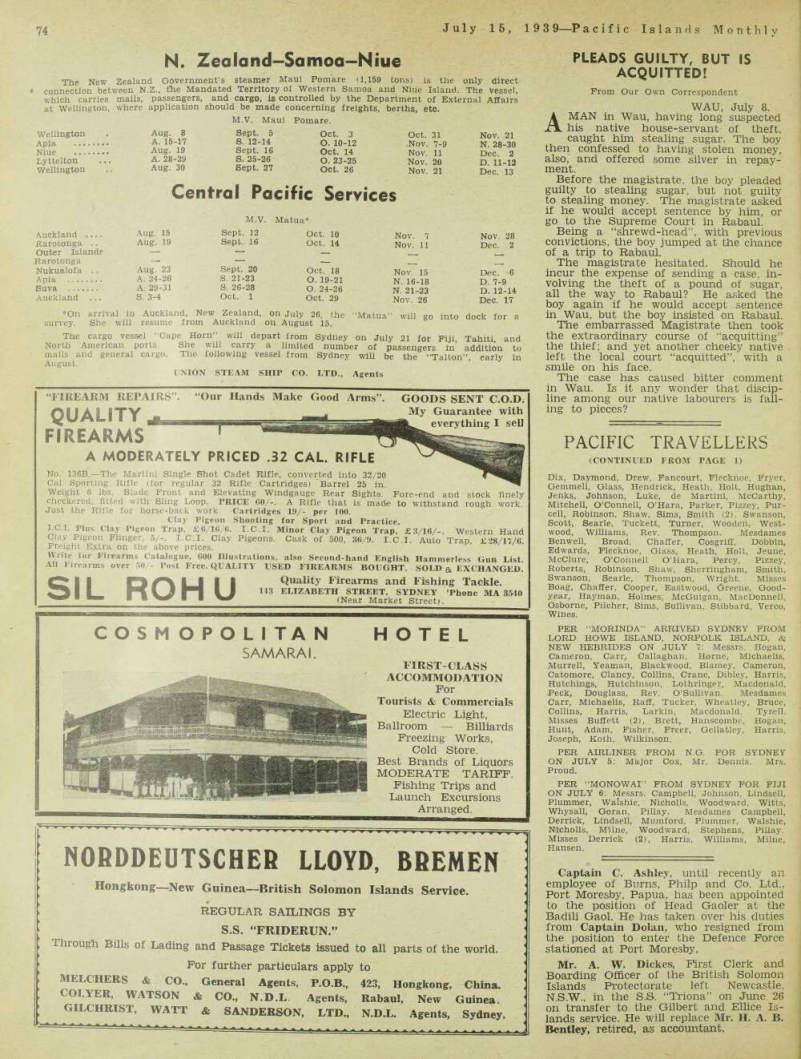
Pleads Guilty, But Is
From Our Own Correspondent WAU, July 8.
A MAN in Wau, having long suspected his native house-servant of theft, caught him stealing sugar. The boy then confessed to having stolen money, also, and offered some silver in repay ment.
Before the magistrate, the boy pleaded guilty to stealing sugar, but not guilty to stealing money. The magistrate asked if he would accept sentence by him, or go to the Supreme Court in Rabaul.
Being a “shrewd-head”, with previous convictions, the boy jumped at the chance of a trip to Rabaul.
The magistrate hesitated. Should he incur the expense of sending a case, in volving the theft of a pound of sugar, all the way to Rabaul? He asked the boy again if he would accept sentence in Wau, but the boy insisted on Rabaul.
The embarrassed Magistrate then took the extraordinary course of “acquitting” the thief; and yet another cheeky native left the local court “acquitted”, with a smile on his face.
The case has caused bitter comment in Wau. Is it any wonder that discip line among our native labourers is fall ing to pieces?
Captain C. Ashley, until recently an employee of Burns, Philp and Co. Ltd., Port Moresby, Papua, has been appointed to the position of Head Gaoler at the Badili Gaol. He has taken over his duties from Captain Dolan, who resigned from the position to enter the Defence Force stationed at Port Moresby.
Mr. A. W. Dickes, First Clerk and Boarding Officer of the British Solomon Islands Protectorate left Newcastle, N.S.W., in the S.S. “Triona” on June 26 on transfer to the Gilbert and Ellice Is lands service. He will replace Mr. H. A. B.
Bentley, retired, as accountant.
Advertisements & other items, p. 76 (1 item)
Pacific Travellers
(CONTINUED FROM PAGE 1)
Index to Volume IX.
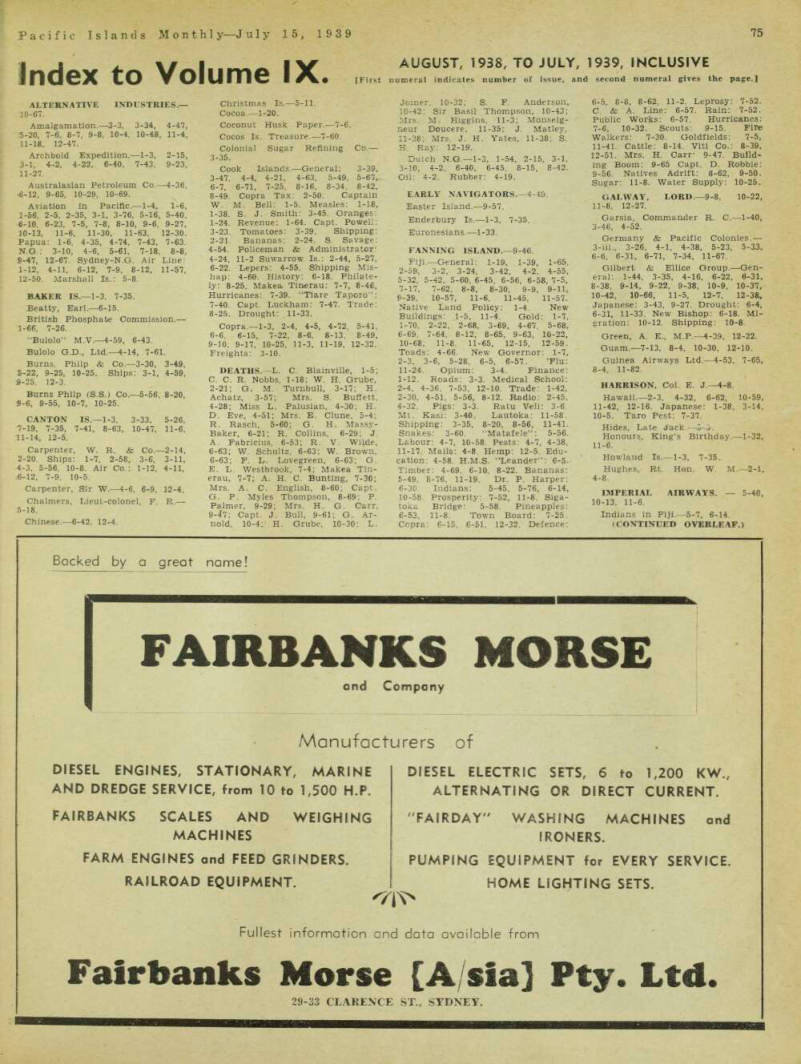
August, 1938, To July, 1939, Inclusive
[First numeral indicates number of issue, and second numeral gives the page.]
Alternative Industries.—
10- Amalgamation.—3-3, 3-34, 4-47, ■5-20, 7-6, 8-7, 9-8, 10-4, 10-48, 11-4, 11- 12-47.
Archbold Expedition.—l-3, 2-15, 3-1, 4-2, 4-22, 6-40, 7-43, 9-23, 11- Australasian Petroleum Co.—4-36, ■6-12, 9-65, 10-29, 10-69.
Aviation In Pacific. —1-4, 1-6, 1-56, 2-5, 2-35, 3-1, 3-76, 5-16, 5-40, 6-10. 6-23, 7-5, 7-8, 8-10, 9-6, 9-27, 10- 11-6, 11-30, 11-63, 12-30.
Papua: 1-6, 4-35, 4-74, 7-43, 7-63.
N.G.: 3-10, 4-6, 5-61, 7-18, 8-8, 9-47, 12-67. Sydney-N.G. Air Line: J-12, 4-11, 6-12, 7-9, 8-12, 11-57, 12- Marshall Is.: 5-8.
Baker Is—L-3, 7-35.
Beatty, Earl.—6-15.
British Phosphate Commission. — 1- 7-26.
“Bulolo” M.V.—4-59, 6-43.
Bulolo G.D., Ltd.—4-14, 7-61.
Burns, Philp & Co. —3-30, 3-49, 6- 9-25, 10-25. Ships: 3-1, 4-59, S-25. 12-3.
Burns Philp (S.S.) Co.—s-56, 8-20, «-6, 9-55, 10-7, 10-25.
Canton Is.—L-3, 3-33, 5-26,
7- 7-35, 7-41, 8-63, 10-47, 11-6, 11- 12-5.
Carpenter, W. R. & Co.—2-14, 2- Ships: 1-7, 2-58, 3-6, 3-11, 4- 5-56, 10-8. Air Co.: 1-12, 4-11, .6-12, 7-9. 10-5.
Carpenter, Sir W. —4-6, 6-9, 12-4.
Chalmers, Lieut-colonel, F. R.— 5- Chinese. —6-42. 12-4.
Christmas Is.—s-11.
Cocoa.—l-20.
Coconut Husk Paper.—7-6.
Cocos Is. Treasure.—7-60.
Colonial Sugar Refining Co.— 3-35.
Cook Islands. —General: 3-39, 3-47, 4-4, 4-21, 4-63, 5-49. 5-67, 6-7, 6-71, 7-25, 8-16, 8-34. 8-42, 8-49. Copra Tax; 2-50. Captain W. M. Bell: 1-5. Measles; 1-18, 1-38. S. J. Smith: 3-45. Oranges: 1- Revenue: 1-64. Capt. Powell; 3- Tomatoes; 3-39. Shipping: 2- Bananas: 2-24. S. Savage: 4- Policeman & Administrator -4-24, 11-2 Suwarrow Is.; 2-44, 5-27, 6- Lepers: 4-55. Shipping Mis hap: 4-60. History: 6-18. Philate ly: 8-25. Makea Tinerau: 7-7, 8-46, Hurricanes: 7-39. “Tiare Taporo ’: 7- Capt. Luckham: 7-47. Trade: 8- Drought: 11-33.
Copra.—l-3, 2-4, 4-5, 4-72, 5-41, 6-6. 6-15, 7-22, 8-6, 8-13. 8-49, 9- 9-17, 10-25, 11-3, 11-19, 12-32.
Freights: 3-10.
DEATHS.—L. C. Blainville, 1-5; C. C. R. Nobbs, 1-18; W. H. Grube, 2-21; G, M. Turnbull, 3-17; H.
Achatz, 3-57; Mrs. S. Buffett, 4-28; Miss L. Palusian, 4-30; H.
D. Eve, 4-51; Mrs. E. Clune, 5-4; R. Rasch, 5-60; G. H. Massy- Baker, 6-21; R. Collins, 6-29; J.
A. Fabricius. 6-53; R. V. Wi}de, 6-63; W. Schultz, 6-63; W. Brown, 6-63; F. L. Lovegreen, 6-63; G.
E. L. Westbrook, 7-4; Makea Tin erau, 7-7; A. H. C. Bunting, 7-30; Mrs. A. C. English, 8-60: Capt.
G. P. Myles Thompson, 8-69: P.
Palmer, 9-29; Mrs. H. G. Carr, 9-*7; Capt. J. Bull, 9-61; G. Ar nold, 10-4; H. Grube, 10-30: L.
Joiner, 10-32; S. F. Anderson, 10- Sir Basil Thompson, 10-43; Mrs. M. Higgins, 11-3; Monseig neur Doucere, 11-35; J. Matley, 11- Mrs. J. H. Yates, 11-38; S.
H. Ray: 12-19’.
Dutch N.G.—l-3, 1-54, 2-15, 3-1, 3- 4-2, 6-40, 6-45, 8-15, 8-42.
Oil; 4-2. Rubber: 4-19.
Early Navigators.—4-49.
Easter Island. —9-57.
Enderbury Is.—l-3, 7-35.
Euronesians.—l-33.
Fanning Island.—9-46.
Fiji.—General: 1-19, 1-39, 1-65, 2-59, 3-2, 3-24, 3-42, 4-2, 4-55, 5- 5-42, 5-60, 6-45, 6-56, 6-58, 7-5, 7-17, 7-62. 8-8, 8-30, 9-9, 9-11, 9- 10-57, 11-6. 11-45, 11-57.
Native Land Policy; 1-4. New Buildings: 1-5, 11-4. Gold; 1-7, 1- 2-22, 2-68, 3-69, 4-67. 5-68, 6- 7-64, 8-12, 8-65, 9-63, 10-22, 10- 11-8. 11-65, 12-15, 12-59.
Toads; 4-66. New Governor: 1-7, 2- 3-6, 5-28, 6-5, 6-57. ’Flu: 11- Opium: 3-4. Finance; 1- Roads: 3-3. Medical School; 2- 4-36. 7-53, 12-10. Trade; 1-42, 2-30, 4-51, 5-56, 8-12. Radio: 2-45. 4- Pigs; 3-3. Ratu Veli: 3-6.
Mt. Kasi; 3-40. Lautoka: 11-58.
Shipping: 3-35, 8-20, 8-56, 11-41.
Snakes: 3-60. “Matafele”: 5-56.
Labour: 4-7, 10-58. Pests; 4-7, 4-38, 11-17. Mails: 4-8. Hemp: 12-5. Edu cation: 4-58. H.M.S. “Leander ”: 6-5- Timber: 4-69. 6-10. 8-22. Bananas: 5- 8-76, 11-19. Dr. P. Harper: 6- Indians: 5-45, 5-76, 6-14, 10-58. Prosperity; 7-52, 11-8. Siga toka Bridge: 5-58. Pineapples: 6-53. 11-8. Town Board: 7-25.
Copra: 6-15, 6-51, 12-32. Defence;
6- 8-8, 8-62, 11-2. Leprosy: 7-52.
C. & A. Line: 6-57. Rain: 7-52.
Public Works; 6-57. Hurricanes: 7- 10-32. Scouts: 9-15. Fire Walkers: 7-30. Goldfields; 7-5, 11- Cattle: 8-14. Viti Co.; 8-39, 12- Mrs. H. Carr- 9-47. Build ing Boom: 9-65 Capt. D. Robbie: 9- Natives Adrift: 8-62, 9-50.
Sugar: 11-8. Water Supply: 10-25.
Galway, Lord—9-8, 10-22,
11-8, 12-27.
Garsia, Commander R. C.—l-40, 3-46, 4-52.
Germany & Pacific Colonies. — 3- 3-26, 4-1, 4-38, 5-23, 5-33, 6-6, 6-31, 6-71, 7-34, 11-67.
Gilbert & Ellice Group.—Gen eral; 1-44, 3-35, 4-16, 6-22, 6-31, 8- 9-14, 9-22, 9-38, 10-9, 10-37, 10- 10-66, 11-5, 12-7, 12-38, Japanese: 3-43, 9-27. Drought: 6-4, 6-31, 11-33. New Bishop: 6-18. Mi gration: 10-12. Shipping: 10-8.
Green, A. E„ M.P.—4-39, 12-22.
Guam.—7-13, 8-4, 10-30, 12-10.
Guinea Airways Ltd. —4-53, 7-65, 8-4, 11-82.
Harrison, Col. E. J —4-8.
Hawaii.—2-3, 4-32, 6-62, 10-59, 11- 12-16. Japanese: 1-38, 3-14, 10- Taro Pest: 7-37.
Hides, Late Jack.—s-J.
Honours, King’s Birthday.—l-32, 11- Howland Is.—l-3, 7-35.
Hughes, Rt. Hon. W. M.—2-1, 4-
Imperial Airways. 5-40,
10-13, 11-6.
Indians in Piji._s-7, 6-14.
(Continued Overleaf.)
“Idle Hour”. —5-4, 6-11.
Insurance, Tropical.—l-29.
JAPAN in Pacific. —1-38, 1-69, 2- 3-iii., 3-14, 3-29, 3-43, 4-4, 5- 6-3, 6-4, 6-33, 7-12, 7-21, 7- 7-54. 8-5, 8-15. 9-3, 9-8, 9-9. 9- 10-3, 10-5, 10-35, 11-11, 11-34, 11- 12-16.
Jarvis Is.—l-3, 5-37, 7-35.
Jewish Refugees.—s-6, 6-10, 7- 14. 8-56, 9-7, 11-25.
Kunzru, Dr.—S-7.
Leprosy. —3-38, 4-52, 4-55, 7-
52.
Long, Dwight.—l-7, 3-18, 5-4. 6- Luke, Sir Harry.—l-7, 2-3, 3-6, 5-28, 6-5, 6-57. 9-6, 9-8, 10-27, 12- 12-34, 12-64.
Malaria. —2-48, 2-62, 3-32, 3-50,
5- 7-54, 9-50.
Marquesas Group.—6-12, 6-30. 11-54.
Marshall & Caroline Islands.— 3- 3-43, 5-8, 6-41, 7-13, 9-60, 9-62.
“Matunga”.—l2-24.
Matson Line.—ll-17.
“Maui Pomare”. —6-33.
McNicoll. Sir W. R.—s-12, 6-4, 11-26.
Melville Island. —3-74.
Midway Island. —1-13.
Missions & Missionary History. —l-18. 1-39, 1-46, 2-5, 2-13, 2-38, 3-25, 3-56, 4-18, 4-31, 4-69. 5-43, 6- 6-12, 6-33, 6-35, 6-42, 6-62, 8- 8-17, 9-31, 10-31, 11-35, 12- 40. “Duff”: 2-45, 11-49.
Morris, Hedstrom Ltd.—ll-82.
Mosquitoes.—7-45, 10-34.
Murray, Sir Hubert. —5-4, 5-10, 5-51, 7-4, 8-20, 9-7, 10-56, NATIVE Labour—l-43, 6-27, 11-1.
Native Medical Practitioners.— 2-4, 7-53, 12-10.
Nauru. —General; 1-40, 2-41, 2- 51, 3-46, 5-21, 6-56, 7-7, 7-12, 7- 9-15, 9-42. Robert Rasch: 1- 5-60. Administrator: 2-73, 5-18. Drought: 5-4, 6-4, 7-24. Edu cation: 6-9, 7-19. Epidemics; 7-57.
Churth: 6-62. Rich Natives: 7-26.
W. C. Groves: 7-27. Phosphate; 10- Nelson, O. F.—s-6, 8-29, 12-13.
New Caledonia. —General; 2-4, 2- 2-66, 3-13, 5-57, 6-37, 6-48, 11- 12-27. Japanese: 5-54, 6-5, 8- Timber; 1-2, 2-48, Wreck Removed: 1-5, 3-1. Gold: 1-70.
“Phoque”: 9-6, 10-49, 12-13. Freez ing Works: 2-4. Mining: 2-67, 6-5, 8- Tonkinese: 5-6. Administra tion: 4-74, 6-32. Aviation; 6-10, 7-5, 8-10, 10-13, 11-6, 12-5. Flour; 10- Governors; 11-3, 12-3.
Freighter Wrecked: 12-34.
New Guinea. —General; 1-9, 2-6, 2- 2-45, 2-66, 3-13, 3-49, 3-58, 3- 4-7, 4-74, 6-8, 6-31, 6-61 7- 40. 8-26, 8-28, 8-55, 9-23, 9-25, 9- 10-7, 10-9, 10-30, 10-38, 11-7, 12- 12-13, 12-30, 12-40. Explor ation: 2-15, 2-36, 3-12, 3-45, 6- 16, 7-21, 8-54, 9-44, 9-51, 10-62, 11- Pests: 2-2, 3-16, 11-17. Agri culture: 3-14. Sulphur: 2-29, 3-39.
Civil Service: 1-20. Oil: 1-3, 4-8. 4- 8-25, 9-22, 10-29, 11-82. Pa trols Attacked; 1-5, 2-82, 12-4. Ad ministration: 1-6, 3-68, 4-1, 4-41, 5- 5-9, 5-63, 5-66, 6-7. Timber; 1- 2-76, 3-66, 4-39, 5-4, 5-22, 10- 11-31. Gold: 1-70, 2-68, 3-70, 4-14, 4-67, 5-68, 5-80, 6-69, 7-61, 7-64, 8-27, 8-63, 8-65, 9-63, 10-68, 11-3, 11-56, 12-4, 12-60. Capi tal Site; 1-8, 1-17, 1-26, 2-5, 2-7, 2- 26, 3-4, 4-3. Cocoa: 1-20. Finance; 2- Sal.-Wau Road: 2-3, 2-65, 3- 4, 4-15, 4-16, 4-53, 5-16, 6-7, 6- 47. 7-16, 8-14, 9-14, 11-32, 12-12.
Wau: 1-19, 1-33, 1-41, 2-31, 3-50, 6-16, 6-63, 7-26, 8-63. 11-26, 11- 46, 11-52, 12-54. Gold Robbery: 1- Recruiting; 1-32, 6-8, 9-30.
Rabaul Aerodrome; 4-82, 5-8, 9-7, 11- Nazis: 6-31. 6-68. New Gold field: 2-3. Iron Ore: 5-63. Jews: 6- 7-14, 8-56. Pests: 6-15.
Drought: 6-4. Roads: 6-10, 11-21.
L. J. Joubert: 6-5, 8-62. Mis sions: 6-8, 6-35, 8-16. N.G. Club: 7- Finances: 6-11, 8-9, 11-24.
Airmail Contract: 8-4. Labour. 6- 27, 11-1, 12-7. Bakery: 7-26. De fence: 5-53, 7,24, 8-62, 10-25. 11-49.
E. W. P. Chinnery: 7-5, 8-49, 8-68 Copra: 7-5. Earthquakes: 7-4.
Coffee: 3-10. Maps: 7-51. “Mono polies”; 2-60. Anthropology; 2-47.
Gold Royalty: 3-15, 11-24, 11-50, 12- Aviation: 1-12, 3-10, 4-6, 4-8, 4-11, 5-61, 6-12, 7-9, 7-18, 8- 8. 9-47, 10-48, 11-57, 12-50, 12-67.
Amalgamation: 3-34, 4-47, 5-20, 7- 6, 8-7, 9-8, 10-4, 10-48, 11-4, Il ls. 12-47. Annexation; 4-6. Land; 4-43, 5-31. Cattle; 3-60. Volca noes: 3-66. Radio: 3-42, 4-24. Epi demics: 5-6, 6-22. Native Policy; 4-26. 7-31, 8-37, 8-51. Bounties; 5- 27. Artifacts; 4-56. Mortgagors: 4- Dairying: 5-4. Pioneers; 5-34.
Health: 6-24. Prospectors: 6-38, 11- 50. “German Harry”: 3-21, 6-39, 8- C. J. Levien; 6-50, 10-26, 11-8. Leg. Council: 8-47, 12-45.
Capt. G. P. M. Thompson: 8-69, Pidgin; 8-52, 10-59. 12-31. Japan ese; 9-8. Central Plateaux: 9-29, 11-58. Rubber: 9-40. House Ser vants: 9-32. Watut: 9-36. George Arnold: 10-4. Canoe Voyages; 10- 8, 12-57. Japanese River Fever: 10-14. Japanese: 10-23, 10-61. La bour Discipline: 10-46. Uncharted Coast; 10-49. Man Deported: 10- Observatory: 10-53. Ship ping: 10-66. Pygmies: 10-67. Guinea Gold, N.L.: 11-4. Taxation: 11-7.
White Man Killed: 11-5. Landslide: 11- Sing-Sings: 11-33. Floods; 11- 46. Crocodiles: 11-47. Mr. D, Waugh; 11-63. Quinine: 12-15.
Sisal Hemp: 12-37. Chinese; 12-4.
N.G. Goldfields Ltd.—2-7, 3-17, 5- 5-22, 5-80, 7-62.
New Hebrides. —General: 2-3, 2- 4-42, 6-29, 6-58. 9-17, 9-33, 11-35, 12-64. Tonkinese: 5-6. Aust.
Administration: 8-7, 9-5. Volcano: 5- Epidemics: 4-6. 8-25. Christ ianity & Natives: 1-30. 8-30, 9- 41. Court Costs: 1-35. Health; 2- 46, 5-48. Public Works: 6-55.
Copra: 8-28. Bishop Patteson: 3- 57. 11-36. Ancient Customs: 4-41 Jews: 6-10, 7-15. Currency; 9-49.
Japanese: 6-33, 7-21, 12-41. Air Base: 12-7. Copra Pests; 11-17.
Henry Grube: 10-30, 11-38. Rats: 11- Colonisation: 10-51. “Ma kambo”; 12-7. White Man Battered: 12- Niue.—3-3, 3-25, 10-53.
Norfolk Island.—l-19, 1-56, 4- 28. 7-31, 8-19'. 8-26. Whaling; 6- Fruit: 2-18.
Nukahiva “Ideal Colony”.—l-25, 3- 10-22.
OCEAN Island.—9-60, 9-62, 10- 17, 11-33.
PACIFIC Defence Conference.—9- 7, 10-56.
Pacific Islands Club. —3-49, 3- 66, 4-9, 4-18, 8-20, 2-55, 9-26, 9- 57.
Pacific Shipping.—l-5, 1-16, 2- 16. 2-61, 2-iv., 3-6. 3-47, 4-3. 4- 59. 6-57, 7-14, 8-30, 10-7, 10-22. 11-17.
Pacific Timber. —2-7.
Pan American Airways.—l-4, 2- 5. 2-35, 3-2, 5-16. 5-40, 6-10. 6- 23, 7-5, 7-8, 8-10, 9-6. 10-13, 11- 6, 11-30, 12-5.
Papua.—General: 2-56, 3-1, 3-33, 4- 4-4. 4-7, 4-55, 5-7, 6-10, 6- 45, 7-4. 7-14, 7-45, 7-58. 8-28, 8- 46. 9-54, 10-9, 10-31, 11-16. 11-24, 11-38, 11-68, 12-15. 12-61, 12-64.
“Uncontrolled” Area; 3-36, 11-22.
Radio: 3-42. Amalgamation; 3-34, 4- 5-18, 6-87, 9-8. Samarai: 3-43, 3-44, 4-33, 11-37, 11-40, 11-49, 12- 42. G. M. Turnbull: 3-17. Oil: 1-3, 2- 3-69, 4-8, 4-23, 4-30, 4-36, 6- 12, 6-41, 9-10, 10-29, 10-69. Avi ation; 1-6, 4-8. 4-11, 4-35. Infan tile Paralysis: 1-40. Trade: 3-30.
Murderer Hung: 1-14, 2-50. Mas sacre Rumour: 1-68. Leg. Council: 1-69. Gold: 1-19, 1-70, 2-69, 3-23. 3- 4-67, 5-67, 6-69, 7-65, 8- 67, 9-64, 10-69, 11-66, 12-20, 12- 59. History: 2-34, 8-33, 8-38.
Coffee; 2-67, 3-10. Copra: 3-10, Rice: 2-67. Stamps: 1-24. Finan ces: 1-32, 2-36, 8-56. Recruiting: 1- G.M. of Papua Ltd.; 5-72, 12-20. Taxes: 6-47. Naval Base: 6- 9. Yachts Wrecked; 6-49, 12-58.
Drought: 7-47. C. T. Wurth; 5-61.
Crime: 6-68, 7-49. Lakekamu: 7- 27. G. H. Massy-Baker: 6-21. Ho tels; 7-29, 10-6. Rev. R. L. Tur ner; 6-33, 9-26. Maps: 7-51. A. H.
C. Bunting; 7-30. Kapok; 8-36.
Mosquitoes; 9-50. Roads: 9-51.
Bishop Strong: 9-53. Measles; 3- 53. Kwato Mission: 3-56, 4-12.
Aquatic Club; 4-51. Steamships Tr Co.: 4-72, 6-34, 10-60, 10-62.
Exploration; 4-74, 5-5, 6-36. Ad ministration: 5-3, 5-8, 6-7.
“Granny” Clune: 5-4. Misima Is.: 5- 10-49. Bounties: 5-27. Na tive Lore: 5-47. Defence: 5-53, 7- 19. 8-8, 8-62, 9-5, 9-25, 11-7, 11- 54. Pt. Moresby Gaol; 7-57. Cro codiles; 8-8. Aerodrome; 8-5. Mili tia: 8-9. 10-16, 11-7, 11-9. Native Policy: 8-20, 11-33. H. W. Cham pion; 8-24. Prosperity: 8-22. Mr.
J. Keegan: 11-4. Measles: 11-29.
Rubber; 12-37.
Perkins, Mr. J. A. —10-14.
Philately.—l-24. 1-44, 1-64, 6- 36, 6-52, 8-25.
Pitcairn Island. —2-33, 3-26, 3- 60. 3-62. 4-4, 4-23, 4-34, 5-6, 10- 18. 11-51.
“Pierre Loti”.—ll-9.
Philippine Islands.—3-32.
Phoenix Islands.—l-3, 5-50, 6-7, 9- 10-12.
Phosphates.—lo-17.
Polynesian Club. —5-31, 7-49, 8- 20, 11-51.
Polynesians, Origin of. —1-45, 3- 52. 4-33, 11-32. History; 4-54, 11- 39.
RABAUL Eruption.—l-5, 2-72, 3- 10-54. 11-69.
Radio—2-45, 2-53, 3-42, 4-4, 4- 24, 4-32, 8-38, 8-63, 11-34, 11-63, 12-13.
Reid, W. M.—6-52.
Rotuma Is.—4-53, 5-30, 12-10.
Rubber from Sugar.—ll-35.
SALOTE, Queen.—3-67, 4-4, 4- 13, 4-49'.
Samoa. Eastern.—3-4, 7-10, 7- 49, 10-7, 10-34, 11-30. Canoe Voyages: 6-61, 11-5.
Samoa, Western. —General; 1-6. 2- 2-6, 2-46, 2-73, 3-3, 3-33, 4- 1. 4-26. 4-66, 5-32, 5-41. 5-44, 6- 22. 6-29. 6-62, 7-52, 8-37, 9-55, 10- 11-55, 11-72. 12-5, Palolo; 5-28. Taxation; 4-35. Franchise: 4- Elections: 5-6, 6-47. Mau: 1- 2. 8-4. H. Achatz: 3-57. Re search: 1-17. Finance: 3-58, Ba nana Inquiry: 1-65, 2-16, 3-26, 6-5, 7- Liquor: 2-7. Pests: 4-7, 4- 38. Bananas: 2-17, 2-58, 8-42, 10- 46. 11-21. Moral Lapses: 4-11.
Niue Labourers: 3-25, 10-53. 1889 Hurricane; 3-44, 7-7, 9-18, 11-8.
Earthquake: 3-26. N.Z. Adminis tration: 4-21. 6-11, 7-14, 7-18, 9-5, Defence: 8-5, 8-62, 9-38. 11-51.
Leg. Council; 8-29. Mataafa Title: 8- 9-16. Tennis; 5-5. Germany: 5- Shipping; 5-56. Mandate Re port; 5-61, Sir H. Luke: 6-5, 6- 57. Cocoa: 8-42. 11-21. Nazis: 5-62, 6- 8-41, 10-65, 11-62. G. E. L.
Westbrook; 7-48, 8-43. Earl Beatty:
6-15. Storms: 7-10, 8-7. “Maui Pomare”: 6-33. Early Historv: 7- 38. Malo: 8-4. Crime: 6-49, Migration: 8-6. 10-7. J. A. Fabri cius; 6-53. A. C. Turnbull: 7-18.
Aerodrome: 7-4, 8-12, 9-38. Tribal Law: 7-36. Chinese: 9-39, 12-6. Den tal Clinic; 10-15. Copra: 11-20.
Schuster, Dr. Carl. —4-60.
Shipping Mishaps.—2-72, 4-60 6- 6-37, 6-63, 9-6, 9-7, 12-34, 12-58, 12-61.
Solomon Islands.—General: 1- 54, 3-30, 3-65, 4-7, 5-47, 7-4, 7- 22, 9-13, 9-61, 10-10, 10-57, 12-35.
Aust. Administration: 2-28, 8-7,. 9-5, 12-20. Gold: 2-32, 9-6, 10-21, 11-3, 11-65, 12-20. Disease; 7-25.
Leprosy: 3-38, 4-52. “Nut Fall”; 9-15, 12-27. Native Designs: 4-60.
Education; 8-69. F. N. Ashley:: 7- 9-6. Administration: 8-4 Earthquake: 7-4, 8-10, 10-63, 12-28.
W. C. Groves; 8-69. Phillip Pal mer; 9-29. New Commissioner: 9-6. Volcano: 9-50. Church: 10- 31.
Substitutes.—lo-42.
TAHlTl.—General: 1-2. 2-61, 3-15, 3-59, 4-31, 6-32, 6-44, 6-50, 6-68, 7-17, 9-20, 9-22, 9-53, 10-63, 11-43, 11-55. Imports: 4-19. Brit.
Consul: 4-55. Birds: 3-54, 10-47.
Pineapples: 4-6. L. C. Blainville: 1-5. Pigs; 7-47. History: 2-37, 3- 36, 4-4. 6-34, 7-28, 7-42. •Hurri cane” Film: 1-26. ’Flu: 3-35. Po mares: 1-34, 2-52, 5-25, 5-38, 9-24.
Native Lore: 4-42, 10-61.
“Leith”; 3-59. Mining & Copra: 3-1, 4-7. 8-28. Chieftain’s Tomb: 1- Lighthouse; 3-28. Vanilla: 2- Shipping: 4-7, 9-62, 10-22.
Chinese: 5-5. Drought: 6-4. Lepers; 6-64. Bishop: 6-33, 11-43. Royal Death: 8-5. Pomare V. Memorial; 6- 9-15. Jews; 9-7. Military Dec orations: 6-54. Moorea: 6-59. Gov ernment Policy; 6-56. Currency: 8- Yacht Wrecked: 6-63. Discov erers; 7-32. Fire: 9-4. Rurutu: 8- 35. N.Z. Cruisers; 7-39. Diseases: 9- Makatea Is.; 9-54, 10-17. His torical Errors; 10-52. “Tahitienne”: 9- Thursday Island. —3-76, 4-4, 11- 25.
Tonga.—General: 1-32, 3-41, 3- 74. 4-33, 5-52, 6-6, 7-21, 7-33, 8- 41. 11-49, 12-23. Roads; 5-43. Mis sions: 4-31, 8-17. Storms: 1-3.
Health; 7-5, 8-41. Taxes: 1-6, 1-64, 3- Education: 9-8 Duties: 1- 16. Trilithon: 2-33. Prince Tubou toa: 8-55. Queen Salote: 3-67, 4-4, 4- 4-49. Shipping: 9-7. Sir H Luke: 6-5. “Tin Can” Mail; 4-46, 7- Treasury Theft: 10-8, 11-5.
Crime: 10-33, 11-68. Sir B. Thomp son: 10-43. Banno Bros.: 12-7.
Torres Strait Islands. —2-53, 9- 49.
Tuberculosis.—^7-50.
UNILEVER Combine.—ll-4.
U.S.A. & Pacific.—6-3, 7-3, 9-3, 10- 12-3.
VESTERS, Bishop.—lo-32.
WALLIS Island.—B-5.
Whale 0i1.—3-31, 5-5, 6-6, 6- 26, 8-49.
Wilhelm ll.—lo-62.
YACHTS Cruising in Pacific.— 7-33. 8-47, 11-6, 11-50. “Ngataki”: 1- “Blue Seas”: 1-62. “Naviga tor”: 2-43. 11-6. “Dwyn Wen”; 2- “Destiny”: 2-51, 3-47. “Au rora”: 2-51. “Henrietta”: 3-33, 11- “Lands Elnd”: 3-49, 11-6, 12- 58. “Laila”: 3-52. “Tagua”: 4-4 “Malabar”: 4-51, 6-63. “Marie”: 5- 11-6. “Otter”; 5-56. “Cru sader”; 6-22. “Moana”: 6-32. “Mu tare”: 6-49. “Ronda”: 10-37, 11- 6. “Ahto”: 11-6. “Hispaniola”; 11-6. “Silver Spray”; 11-6. “Sea ward”: 11-6. “Drifter”; 11-56.
Advertisements & other items, pp. 77-80 (5 items)
75
Pacific Islands Monthl y —J uly 15, 1939
Fairbanks Morse
Backed by a great name!
ond Company
Manufacturers of
DIESEL ENGINES, STATIONARY, MARINE
AND DREDGE SERVICE, from 10 to 1,500 H.P.
FAIRBANKS SCALES AND WEIGHING
MACHINES
FARM ENGINES and FEED GRINDERS.
RAILROAD EQUIPMENT.
DIESEL ELECTRIC SETS, 6 to 1,200 KW„
ALTERNATING OR DIRECT CURRENT.
"FAIRDAY" WASHING MACHINES and
IRONERS.
j PUMPING EQUIPMENT for EVERY SERVICE.
HOME LIGHTING SETS.
'7|V' Fullest information and data available from
Fairbanks Morse [A/sia] Pty. Ltd.
29-33 CLARENCE ST., SYDNEY.
m
UXH
The Development
of the Territory
is Linked-up with GUINEA AIRWAYS
GUINEA AIRWAYS, LIMITED
was established in 1927; and has grown as the figures show.
To-day it is the largest freight-carrying service in the world.
Year Tonnage Passen- Ended Trans- gers Feb. 28. ported Carried. 1929 434 869 1930 ... 949 2,047 1931 1,146 1,995 1932 3,947 1,607 1933 3,980 3,856 1934 6,044 7,398 1935 6,102 9,721 1936 6,476 12,137 1937 6,705 11,869 1938 ... 8.408 12,120 1939 8,939 15,876 Totals .. 53,130 79,495 ★ The development of the territory is linked up with Guinea Airways Ltd. Aerial Transport alone has made possible the thriving gold industry at Morobe.
There is no road between the gold field and the coast.
Aeroplanes running on regular schedules carry in Dredges, Crushing Mills, Cyaniding Plants, Motor Vehicles, Hydro-Electric Machinery, Live Stock, thousands of passengers and every kind of goods needed by a large European community.
GUINEA AIRWAYS LIMITED operate regular air services in New Guinea and Papua. They use over fifty aerodromes and landing grounds in the two Territories.
GUINEA AIRWAYS PLANES depart from Port Moresby for the Goldfield on the arrival of each boat. Tickets are obtainable from the Purser.
Insist on flying with the pioneer Company —both in New Guinea and in Australia.
AUSTRALIAN SERVICES
ADELAIDE-DARWIN—Three Times Weekly, connecting with Overseas services.
ADELAIDE-KANGAROO ISLAND—Four Times Weekly.
ADEL A IDE-PT. LINCOLN—Three Times Weekly.
Full Particulars From All Agents.
W
LIMITED
LAE - SALAMAUA
Heed Office: Austral Chambers, New Guinea Office: Lae, Currie Street, Adelaide, S.A. Mandated Territory of New Guinea BRANCH OFFICES AND AGENTS AT WAU—SALAMAUA—PORT MORESBY AND SYDNEY.
U*H -2 ...
TOOTH i CO
LIMITED
v WAVERLEY BREWERY,
21
SNV
\\\"< ;:<%f
;.VS^fc
SWAvEiu.tr v E 21 X% ensures a
PERFECT DRINK
ottc/t/l€ cl
PRESERVES THE FLAVOUR
When ordering Icfger, first look for the Diamond-shaped Label-that is your guarantee of quality. Then notice the "Spot" Crown Seal, it is designed to retain that quality, and ensure perfect freshness and flavour in any climate.
ii r,si;irs:i,,\i;i;ii
Index to Vol. IX. — (Continued)
76
July 15, 193 9—P acific Islands Monthly
AUGUST, 1938, TO JULY, 1939, INCLUSIVE
[First numeral indicates number of issue, and second numeral gives the page.]
Published by Pacific Publications Pty., Ltd., Union House. 247 George Street, Sydney. (Teleohone: BW 5037). Wholly set up and printed In Australia by the Sydney and Melbourne Publishing Co . Pty.. Ltd.. 29 Alberta St.. Sydney. (Telephone: MA7101).