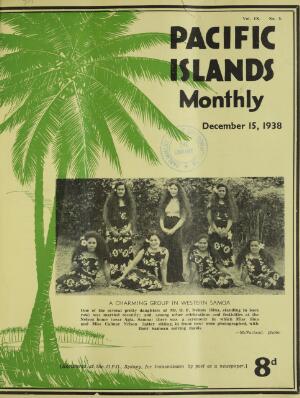
Islands
Pacific
Monthly
Vol. IX. No. 5.
December 15, 1938
■wOterazA tne.G.P.O., Sydney, for transmission by post as a newspaper .]
8 a
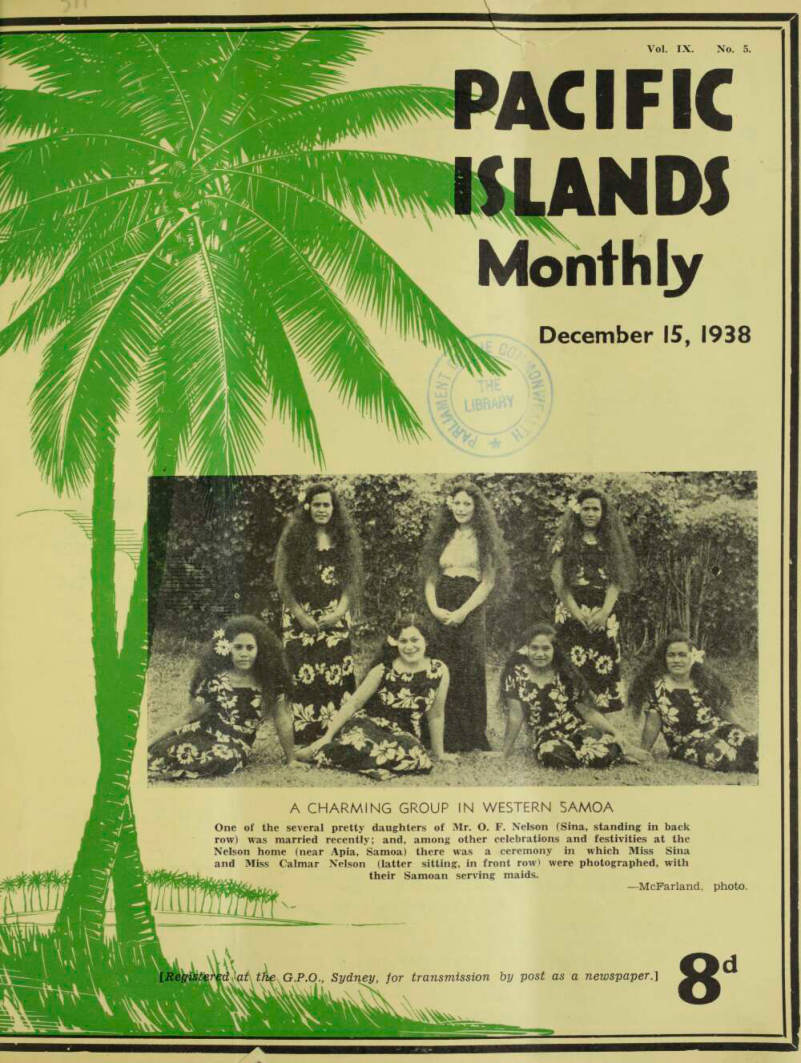
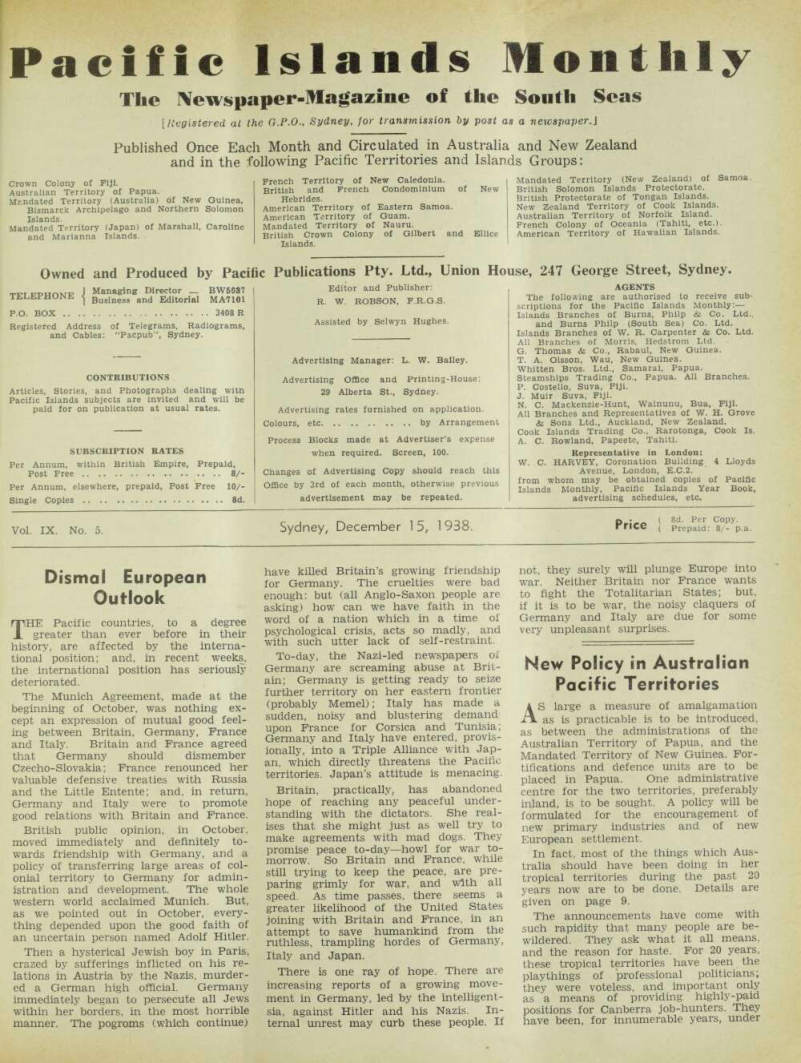
A Charming Group In Western Samoa
One of the several pretty daughters of Mr. O. F. Nelson (Sina, standing in back row) was married recently; and, among other celebrations and festivities at the Nelson home (near Apia, Samoa) there was a ceremony in which Miss Sina and Miss Calmar Nelson (latter sitting, in front row) were photographed, with their Samoan serving maids. —McFarland, photo.
Advertisements & other items, p. 2 (1 item)
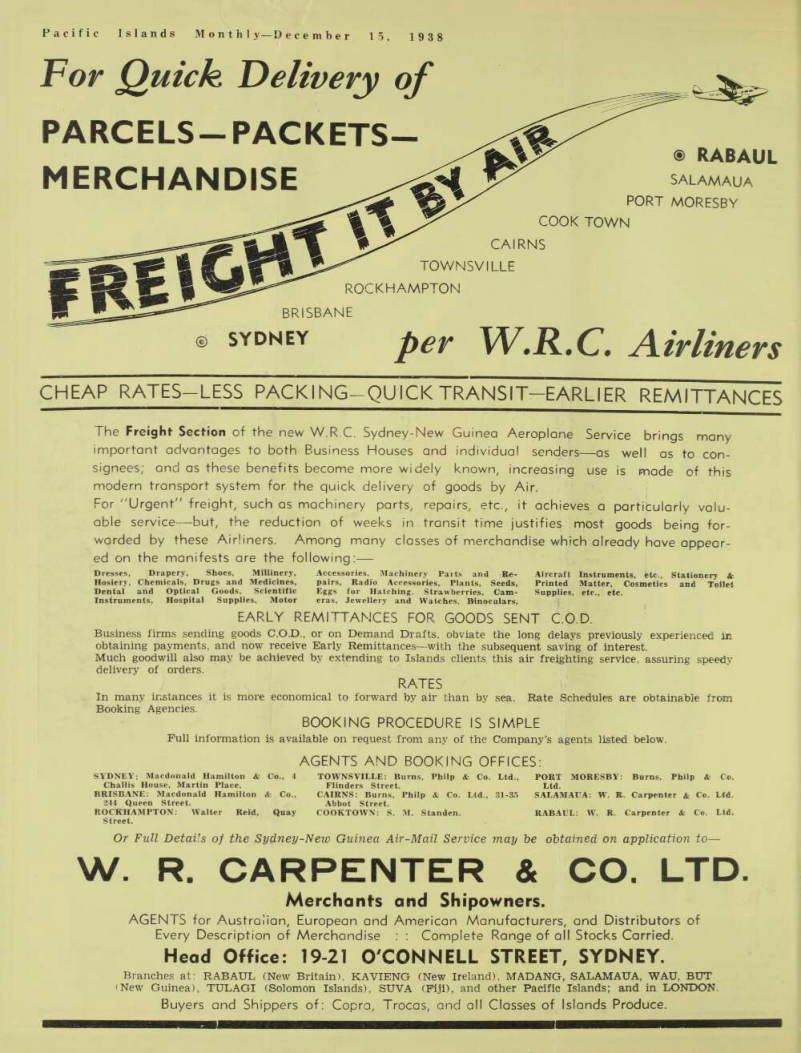
For Quick Delivery of
PARCELS-PACKETS-
MERCHANDISE
• RABAUL
SALAMAUA
For Quick Delivery of
PORT MORESBY
COOK TOWN
CAIRNS
TOWNSVILLE
ROCKHAMPTON
BRISBANE
® SYDNEY
per W.R.C. Airliners
CHEAP RATES-LESS PACKING-QUICK TRANSIT-EARLIER REMITTANCES
The Freight Section of the new W.R.C. Sydney-New Guinea Aeroplane Service brings many important advantages to both Business Houses and individual senders—as well as to consignees; and as these benefits become more widely known, increasing use is made of this modern transport system for the quick delivery of goods by Air.
For "Urgent" freight, such as machinery parts, repairs, etc., it achieves a particularly valuable service—but, the reduction of weeks in transit time justifies most goods being forwarded by these Airliners. Among many classes of merchandise which already have appeared on the manifests are the following:— Dresses, Drapery, Shoes, Millinery, Hosiery, Chemicals, Drugs and Medicines, Dental and Optical Goods, Scientific Instruments, Hospital Supplies, Motor Accessories. Machinery Parts and Re- Aircraft Instruments, etc., Stationery & pairs, Radio Accessories, Plants, Seeds, Printed Matter, Cosmetics and Toilet Eggs for Hatching. Strawberries, Cam- Supplies, etc., etc. eras, Jewellery and Watches. Binoculars,
EARLY REMITTANCES FOR GOODS SENT C.O.D.
Business firms sending goods C.0.D., or on Demand Drafts, obviate the long delays previously experienced in obtaining payments, and now receive Early Remittances—with the subsequent saving of interest.
Much goodwill also may be achieved by extending to Islands clients this air freighting service, assuring speedy delivery of orders.
RATES
In many instances it is more economical to forward by air than by sea. Rate Schedules are obtainable from Booking Agencies.
BOOKING PROCEDURE IS SIMPLE
Full information is available on request from any of the Company’s agents listed below.
AGENTS AND BOOKING OFFICES:
SYDNEY: Macdonald Hamilton & Co., 4 Challis House, Martin Place.
BRISBANE: Macdonald Hamilton & Co., 244 Queen Street.
ROCKHAMPTON: Walter Reid. Quay Street.
TOWNSVILLE: Burns. Philp & Co. Ltd., Flinders Street.
CAIRNS: Burns, Philp & Co. Ltd., 31-35 Abbot Street.
COOKTOWN: S. M. Standen.
PORT MORESBY: Burns, Philp & Co.
Ltd.
SALAMAUA: W. R. Carpenter & Co. Ltd.
RABAUL: W. R. Carpenter & Co. Ltd.
Or Full Details of the Sydney-New Guinea Air-Mail Service may be obtained on application to —
W. R. CARPENTER & CO. LTD
Merchants and Shipowners.
AGENTS for Australian, European and American Manufacturers, and Distributors of Every Description of Merchandise : Complete Range of all Stocks Carried.
Head Office: 19-21 O'CONNELL STREET, SYDNEY.
Branches at: RABAUL (New Britain), KAVIENG (New Ireland), MADANG, SALAMAUA, WAU, BUT fNew Guinea), TULAGI (Solomon Islands), SUVA (Fiji), and other Pacific Islands; and in LONDON.
Buyers and Shippers of; Copra, Trocas, and all Classes of Islands Produce.
Pacific Islands Travellers
Passengers Per ••Malaita” Which Ar
RIVED IN SYDNEY FROM N.G. & B.&.I.
PORTS ON NOVEMBER 18: Messrs. Adair, Baxter, Bergin, Beverley, Blackburn, Boydell, Clayton, Comber, Considine, Elkington, Evans, Green, Hanicks, Hodgess, Laidlad, Lambert, MacLellan, Mitchelhill, Naughton, Osborne, Patten, Pijacun, Taylor, Thomas, Venning, White, Wills, Wood. Mesdames Bergin. Bever ley, Blackburn, Boydell. Clayton, Hitchcock, Hodgess, Knibbs, Laidlaw, Mitchelhill, Palmer, Sanders, Venning, Waker, Fassler. Misses Brewer, Brigitte, Cohen. Deck, Hackett, Ney-
Passengers Per Airmail Liner “Caro
NIA” WHICH LEFT RABAUL, N.G., FOR AUS TRALIA ON NOVEMBER 18: Messrs. Parkin son, Wilson, Oxenbridge, Ward, Pallanza, Flynn. Mesdames Kingsley, Middleton. Misses McGahan (2), Alexander.
Passengers Per “Niagara” Which
ARRIVED IN SYDNEY FROM FIJI ON NO VEMBER 19: Messrs. Day. Mackie, Pascoe, Vernon, Parkinson, Werge. Mesdames Armit, Messmer, McKay, Brauster, Statham. Misses Fryer, McKay, McKindlay, Ward.
Passengers Per “Bulolo” Which
SAILED FROM SYDNEY FOR PAPUA & N.G.
ON NOVEMBER 19: Messrs. Drummond, Lade, Brown, Rogers, Reid, Melville, Barnes, Pan
court, Giblin, Burstal, Reynolds, Matley, Mit chell, Schwartz, Tomlinson, Peterson, Murphy, Pratt, O’Driscoll, Baden Jones, Mossman, Ein siedel, Philpotts, Hamilton, Gough, Palmer, White, Armit, Lannan, Dight, Mild, McLean, Aubrey, Briggs, Dexter, Huenerbein, Holmes, Horne, Clift, Craig, Hancock, Abbott, Josh, Gay, Lovell, Frame, Lament, Hendry, Healy, Duffil, Barnett, Philip, Connor, Williams, Ca hill, Berry, Lord, Kershaw, Targett, Giles, Lee, Rudd. Mesdames Carr, Nicholson, Reid, McCaghern, Gore, Maidment, Ditton, Cox, Mit chell, Tomlinson, Baden Jones, Ryder. Phil potts, Ostrom, Bowden, Palmer, White, Pass more, Mosely, Leigh, Briggs, Bellamy, Hallam Vine, Holmes, Bird, Shaw, Horne, Clift, Er skine, Abbott, Frame, Morgan, Poland, Proctor.
Misses Cooper, Boag, Schwabe, Perry (2), Moss man, Mills, Yates (2), Pearce, Smith, Pigott, Manyon, McNally, Meredith, Perry, Telford, Munford, Cardew, Proctor. Sister Zita.
Passengers Per Airmail Liner
“Carinthia” Which Left Sydney (For
PAPUA & N.G. ON NOVEMBER 22; Messrs.
Dixon, Perriman. Mrs. Seawright, Master Kane.
Passengers Per "Nellcre" Which
Arrived In Sydney Prom New Guinea
ON NOVEMBER 23: Messrs. Muller, Ellis, Pick
erlng, Dix, Tee, Jenkins, Kofler, Rogers, Bees ley, Battis, McGowan, Young, Clark, Nelson.
Mesdames Dix, Jackson, Murfield, Thomas, Battis, Hiscox. Miss Wilks.
Passengers Per “Niagara” Which
SAILED FROM SYDNEY FOR FIJI, ON NO VEMBER 24: Messrs. Allman, Colahan, Fraser, Freeman (2), Hall, Kermode, Lyons, Lowe..
Snodgrass, Trollope, Young, Armstrong, Bes sell, Hodgson, McLean, Stephens, Watson, Chandlri, Deo, Kama, Shama. Mesdames Came, Hall, Kermode, Waters, Armstrong, Bellcham bers, Bentley, Hodgson. Misses Kermode, Ragg,.
Winters. Sister Faddy.
Passengers Per Airmail Liner
SAILED FROM SYDNEY FOR 8.5.1. & N.G.
For Australia On November 25: Messrs.
Gannon, Ronma, Burns, Warne, Archbold,, Campbell, Lennan, Leslies.
Passengers Per “Malaita” Which
SAILED FROM SYDNEY FOR 8.5.1. & N.G PORTS ON NOVEMBER 26: Messrs. Tudberry* Johnson, Dickie, McKenzie, Mason, Bell, Arm strong, Hughes, Sanders, Kane, Bates, Law rence: Father Le Breton, Father Lepping. Mes dames Tudberry, Driver, Mason, McPherson, Sanders. Misses Nicholson, Kennedy, May, Barker, Valenta, Ellis, Sanders, Cohen, Moore, Lynch; Mother Margaret; Sister Madeline.
Passengers Per Airmail Liner
WHICH LEFT SYDNEY FOR PAPUA & N.G, ON NOVEMBER 29: Messrs. Giblin, Rideout,
Continued On Page 80)
Bain. Mesdames Harris, Edwards. Masters Schafer, Munro (2).
Passengers Per “Morinda” Which
Sailed Prom Sydney For Lord Howe
IS., NORFOLK IS. & N. HEBRIDES ON NO VEMBER 29; Messrs. Trougton, Dillon, Smith, Cottee, Harvey, Johnson, Sieveking, Kenny, Richmond, Winchester, Gaven, Harkness, Guest, Palm (2), Watson, Baker, Aston, Far rar, Warwick (2), Bidal, Purkis, Fitzgerald, Hunter, Phillips. Mesdames Smith, Cottee, Sieveking, Kenny, Richmond, Kirby, Hollay, Hyslop, Sanders, Sinclair, Bailey, Swain, Far rar, Bruce, Hankinson. Misses Young, Grand, Sinclair, Hogarth, Tunks, White, Watsford, Evans, Brown, Englert, Sinclair, Bruce, Fen ton, Nash, Larney (2), Flight, Triggs.
Passengers Per Airmail Liner
“Caronia” Which Left Rabaul, N.G., For
Australia On December 2: Messrs. Loh
mann, Thurston, Foon Kang, Bayliss (3), Short, Doebels. Mesdames Sedges, Bowring, Bayliss.
Passengers Per Airmail Liner
“Carinthia’' Which Left Sydney For
PAPUA & N.G., ON DECEMBER 6: Messrs.
Carey, Meneffe, Hyde, Judd, Gander, Bren nan. Mesdames Bergin, Judd, Gander. Miss Gander.
Passengers Per “Macdhui” Which
ARRIVED IN SYDNEY FROM N.G. & PAPUA ON DECEMBER 6; Messrs. Anderson, Anslow, Bateson, Betts, Braithwaite, Cook, Costello, Cruickshank, Doherty, Garms, Hardie, Hay ward, Hope, Howard, Hyde, Jackson, John ston, Lewis, MacGregor, Mackay, McLean, Mc- Leod, McPhee, Mason, Moyle, Neal, O’Dea, Pen razio, Rohrlack, Ross, Scope, Shutt, Skelly, Smith (3), Stephens, Stevenson, Swanson, Tay lor, Theckston, Whelan, Wilton, Woods (2), Young, Zenrosso, Andrew, Bannigan, Bock, Connolly, Day, Frame, Griffin, Guinan, Hall, Kirwan, Kudnig, Lavender, Mclan, Mclver.
Mason, Maxwell, Norris, Parkin, Rodoni, Sef ton, Seward, Shanks, Shorthouse, Williamson, Woolard, Berry, Bradford, Cargill, Moore, Neilsen, Boileau, Clegg, Dudley, Turner, Wurth, Cameron, Connell, Crawford, Hawthorne, Hay les, Armstrong, Borgas, Callanan, Ellery, Mar shall, Scott, Shotton, Topping. Mesdames An
derson, Bateson, Bradford, Brennan, Coghlan.
Cook, Costello, Cromie, Duchatel, Hardie, Hyde, Lewis, Penrazio, Schilling, Shutt, Smith (2) Andrew, Aumuller, Bock, Bonnell, Day, Guinan, Haynes, Lett, Minogue, Sefton, Shorthouse, Couzens, Moore, Berge, Champion, Bowthorpe, Cameron, Hawes, Hayles, Holden, McLean, Cal lanan, Kiessling, Shotton, Wilson. Misses Bayley (2), Kirby, Noonan, Rudd, Whitehead, Blake, Bock, Clarke, Leetch, Healy, Howard, O’Donnell.
Passengers Per Airmail Liner
“Carinthia" Which Left Rabaul, N.G.,
For Australia On December 9: Messrs.
Spinsley, Cromie, Davis, Collins, Korn. Mes dames Carpenter, Bellhouse, Allan.
Passengers Per “Macdhui” Which
SAILED FROM SYDNEY FOR PAPUA & N.G.
ON DECEMBER 10: Messrs. Harris, McPhee, Appleby (2), Koch, Clarke, Mayfield, Cres well, Batze (2), Smallwood, Thomas, Elliott, Smith, Joubert, Gardner, Burch, Lukin, Lloyd (2) Russell, Niall, Adorno, Hill, Smith (2), Livingstone, Page, Pulton, Kiernan, Marshall, Barrow, Brown, Laws, Perry, Parkinson, Mc- Cabe, Mackay, Gibson, Styants, Horward, Etty, Piper, Miller, Harman, McDonald, Mit chell, Morell, O’Donohue, Stack, Toogood, Den nis, Ogg, Broodbank, Moore, Buchanan, Dixon (3) Eccles, Hubble. Mesdames Bestmann, Ap pleby, Koch, Scott, Adorno, Mayfield, Cres well, Richardson, Chambers, Ashwell, Turner, Smallwood, Thomas, Joubert, Batze, McCabe, Ecknoff, Reaby, Russell. Niall, Rowe, Boom, Smith, Osborne, Marshall, Anisimoff, Haire.
Misses Rudd, Kirby, Ewing, Lyons, James, Bestmann, Crowe, Smith, Broodbank, Fay, Matthews, Sinclair, Voysey (2), Evans (2), Warner, Rutledge, Rowe, Pennefather, Adams, Street, Cunningham, Wilde, Chester, Stan field, Love, Gorkin, Ryan, Miller, Barker, An derson, Page (2), Allen, Davies, Stehr (2), Munford, Pattison, Lumley, Mocatta. Masters Matley, Montgomery (2t, Searle, Shaw. Street, Mccatta, Brown, Taylour, Roberts, Hatchard, Coote, Adams, Rentoul, Claris, Dougherty, Griffiths, Leetch, Chester, Pennefather, Stan field, Lumley, Evenett, Miller. Matthews, Mc- Kenna, Spiller, Anisimoff.
Mr. W. A. Bock, Government printer in Papua, arrived in Sydney on Decem ber 6 on 12 months’ leave.
Advertisements & other items, p. 3 (2 items)
1
Pacific Islands Month! y—D ec*in b e r 15, 1938
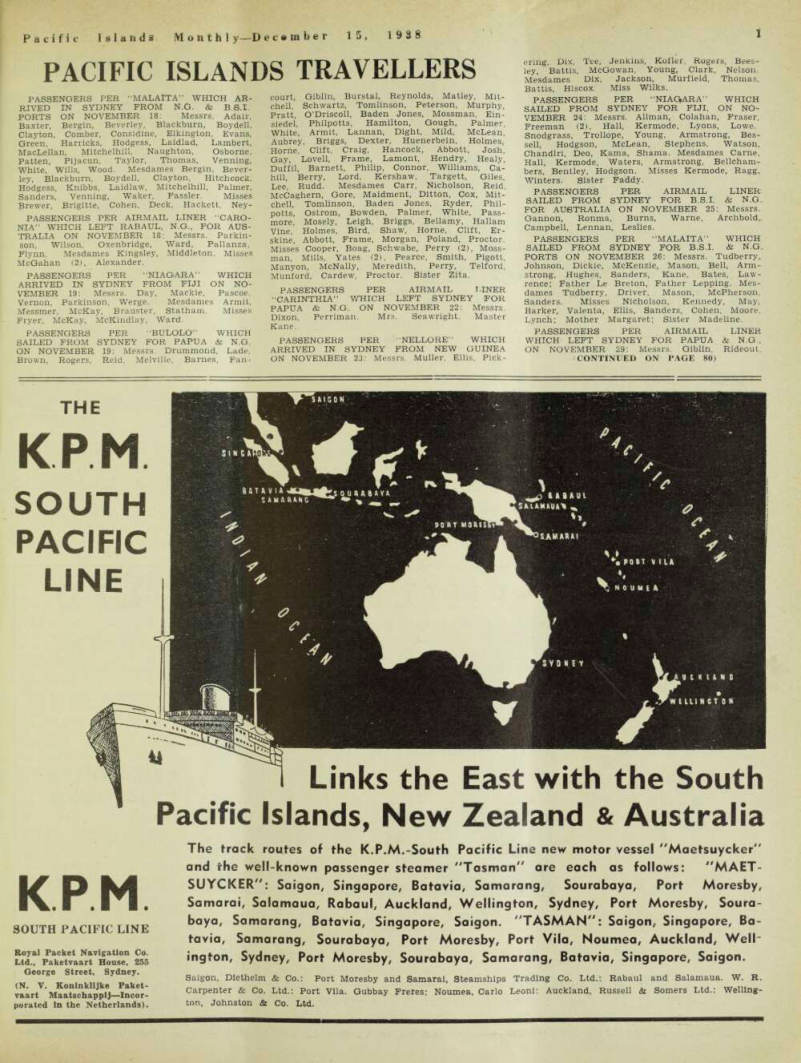
South
THE
KP.M
SOURARAYA
SOUTH
PORT MO RiSEt
PACIFIC
LINE
ii
Links the East with the South
Pacific Islands, New Zealand & Australia
KP.M.
SOUTH PACIFIC LINE
Royal Packet Navigation Co.
Ltd., Paketvaart House, 255 George Street, Sydney. (N. V. Konlnkiijke Paketvaart MaatschappiJ—lncorporated in the Netherlands).
The frock routes of the K.P.M.-South Pacific Line new motor vessel "Maetsuycker" and the well-known passenger steamer "Tasman" are each as follows: "MAET- SUYCKER": Saigon, Singapore, Batavia, Samarang, Sourabaya, Port Moresby, Samarai, Salamaua, Rabaul, Auckland, Wellington, Sydney, Port Moresby, Sourabaya, Samarang, Batavia, Singapore, Saigon. "TASMAN": Saigon, Singapore, Batavia, Samarang, Sourabaya, Port Moresby, Port Vila, Noumea, Auckland, Wellington, Sydney, Port Moresby, Sourabaya, Samarang, Batavia, Singapore, Saigon.
Saigon, Dlethelm & Co.; Port Moresby and Samarai, Steamships Trading Co. Ltd.: Rabaul and Salamaua. W. R.
Carpenter & Co. Ltd.: Port Vila. Gubbay Preres: Noumea, Carlo Leoni: Auckland, Russell & Somers Ltd.; Wellington, Johnston & Co. Ltd.
Advertisers.
“Alnwick Kinder garten ... 65 Amalgamated Wire less of Aust. Ltd 42 Amplion 'A’sia) Ltd 19 Angus & Coote Ltd 71 Arnott’s Biscuits . 36 “Aspro” ... 60 “Ausolene” ... 63
B A.L.M. Ltd. . . 53
Bank of N.S.W. . . 74 Berger & Sons Ltd 50 “Bernly” Guest House ... 72 “Bidomak” ... 17 Blau (Aust.) Robt. 64 Breckwoldt & Co.
W. . . . 48, 62, 69 British Institute of Engineering Tech nology Ltd. . .21 Broomfields, Ltd. . 78 Brunton’s Flour 41 Budge & Co. Ltd. 52 Bullivants, Ltd. . . 56 Burns, Philp & Co. ii.
B.P. Magazine . . 34
B.P. (S.S.) Co. . . 54
Burns, Philp Trust Co. Ltd. ... 78 Buzacott Ltd. . 49 Carpenter, W. R.
Limited . . cov. 2 Chapman & Sherack 22 Chemist—H. P.
Michael ... 63 Chemists’ Supplies Co 67 Chivers & Sons Ltd 35 “Cinnamolia” Pre parations ... 52 Coleman Lamp Co. 20 Continental Com pensations Pty.
Ltd 54, 69 Coral Starch . . 38 Cosmopolitan Hotel 80 Crossle, Duff & Macintosh, Ltd. . 68 “Cystex” ... 76 Banks & Son, Ltd 53
Dewar’s Whisky . . 12 Doan’s Pills ... 78 Donald, Ltd, A. B. 46 Eaton, Ltd., J. W. 51 Electrolux Refrig erators ... 24 Eno’s Fruit Salt . 73 Fairbanks - Morse Limited ... 77 “Fairholm” College 16 Fletcher & Sons. 60 “Flit” 56 For Sale ... 77 Ford Sherington, Ltd 31 “44 Macleay St." . 28 Foster’s Lager . . 44 Freeman’s Sports Store 55 Fryer, A. C. ... 79 Garden Vale Pro ducts, Ltd. . 38 Garrett & Davidson 68 Gillespie’s Flour . 37 Grand Pacific Hotel 45 Grove & Sons, W.
H 32 Guinea Airways, Ltd cov. 3 Hallstroms Pty Ltd 33 Halvorsen Sons Ltd 79 Harper, M. ... 31 Holbrooks’, Ltd. . 41 Horlick’s Malted Milk 27 Hornadge, W. . . 34 Horne, W. & Co. 46 Hotel Moresby . . 80 Intercontinental Airways ... 11 Jantzen (Aust) Ltd 65 Jones & Co. Ltd, H. 37 “Kambala” School for Girls ... 10 King’s School, The 26 Kodak Pty. Ltd. . 18 Kopsen & Co. Ltd. 57 Kork-N-Seal, Ltd . 35 Koyong Boarding School 76 Levenson’s Radio . 70
Lloyd & Co. Pty.
Ltd 13- Lustre Hosiery Ltd. 67 “Majora” Paints . 58 Mclrath’s Ltd. . . 14 Maxwell Porter Ltd 51 Methodist Ladies’
College ... 66 Miller & Co. Pty.
Ltd 56 Morris, Hedstrom, Limited ... 47
N.D.L 78
Nestle’s Milk ... 40 Newington College 66 Newlands Bros. Ltd 43
Newmarket Sad dlery 71 Nock & Kirby Ltd. 23 Noyes Bros., Ltd. 58 “Oriana” ... 76 Pabst Canned Beer 14 Pacific Is. Club . 9 Papua Hotel, The 80 Paul & Grey Ltd. 75 Pike Bros. Ltd. . 12 Positions Wanted 19, 74, 76 Prescott, Ltd. . . 39 Prouds, Ltd. ... 13 Ransome, Sims & Jeffries, Ltd. . . 47 Reed, William E. . 36
Riverstone Meat Co 15 Rohu, Sil . . . . 22 Royal Packet Co. . i.
Scott’s Emulsion . 15 Scott, Ltd., J. . . 34 Shell Oil Co. . . 59 Springwood L. Col. 65 Steamships Trading Co. Ltd 30 Sterling Varnish Co 9 Sullivan, Ltd. C. . 37 Swallow & Ariell . 39 “Talkeries”, The . 31 Taylor & Co., A. . 68 “Tenax” Soap . . 16 “Teviot” College . 64 Tilley Lamp Co. . 61
Tillock & Co Ltd. 30 Tongan Stamps & Photos Bureau . . 49 Toohey’s Ltd. . . 25 “Top Dog” Men’s Wear ... 31 Tooth & Co. . cov. 4 Usher’s Hotel . . 28 Vincent’s A.P.C. . . 72 West, Harry ... 48 Weymark & Son . 35 Wills, W.D. and H. 0., Ltd. ... 31 Wright & Co, . . 73 Wright & Co. Ltd., E 48 Wunderlich, Ltd. . 51
Contents
Page Pacific Islands Travellers 1, 80 Dismal European Outlook 3 New Policy in Australian Pacific Ter ritories 3,9, 14 Ketch “Idle Hour" Wrecked 4 Drought on Nauru 4 Dairy Industry for Central N. Guinea 4 Huge Fleets Out After Whale Oil 5 International Tennis in Samoa .. 5 Western Samoan Election 6 “Bounty” Men’s Graves 6 Refuges for Jews in Pacific 6 Indian Publicist’s Attack on Fiji Conditions 7, 73 New Japanese Air Service 8 Tropicalities 10 Christmas Is. —British or American? 11 About Islands People 13 P.A.A.’s Trans-Pacific Service .. 16, 40 Papua Suspects New Guinea Gold field of Dark and Dirty Designs 18 Increase in B.P. Shipping Subsidy 22 Samoan Attitude to Germany .. .. 23 The Numerous Princesses of Tahiti 25 Bounties for Islands Planters .. .. 27
Education and Protection for Fijians 28 Nature of the Mandates 33 The Romance of Bulolo 34 Kings and Princes in Tahiti .. .. 38 German Praise of Fiji 42 Indians Make Requests for Different Conditions in Fiji 45 Medical Work Among New Hebrides Natives 48 Fijians Grow More Bananas .. .. 49 B.P. Sell Phoenix Is. Leases .. . . 50 Papuan Governor Flies Over New Lands 51 German-Japanese Alliance Theatens the Pacific 53 Treatment of Malaria 57 How a Bridge Was Built in Fiji .. 58 Fashion Hints for Islands Women . 65 Planters and the Big Firms in N.G. 66 Pacific Mining Notes 68 Radio Programmes (Short Wave) .. 71 Quotations for Islands Gold Shares 73 Produce and Exchange Rates .. .. 74 Copra and Rubber Prices 75 Shipping Timetables 76
Advertisements & other items, p. 4 (2 items)
2
Pacific Islands Monthl y—D ecember 15, 1938
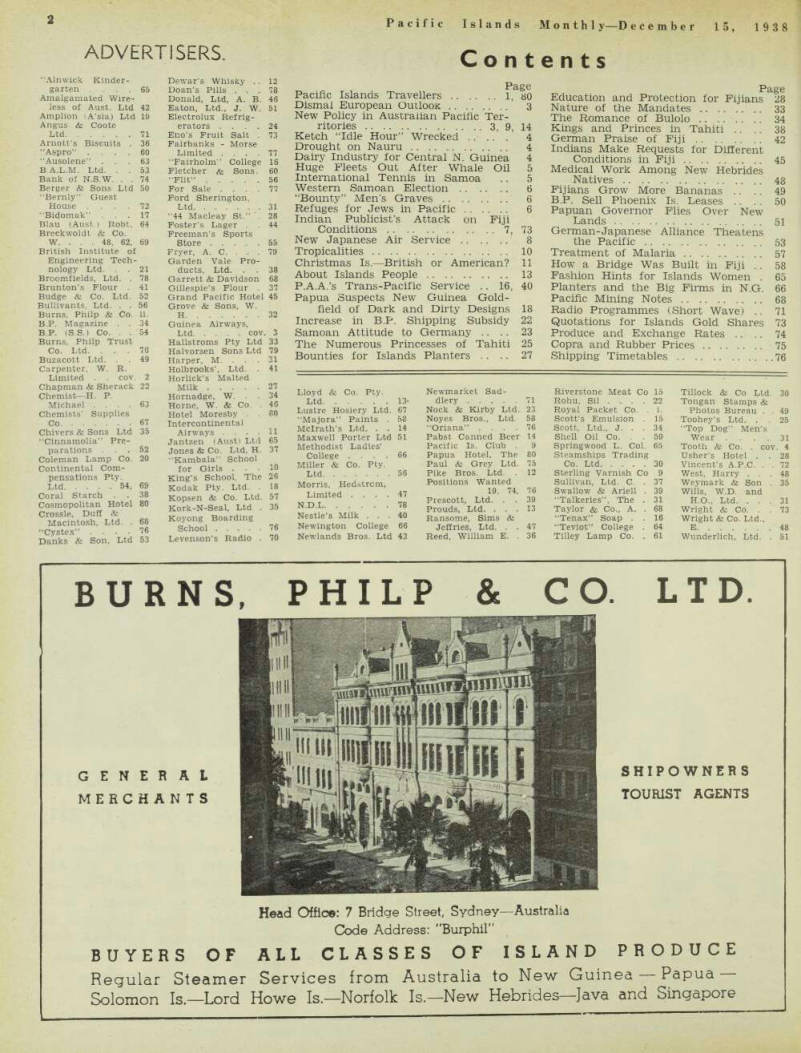
Burns, Philp & Co.
GENERAL
MERCHANTS
t.'-’
P i Willi m m mm 111
tin
till
i
null
HI
ill
I
LTD.
SHIPOWNERS
TOURIST AGENTS
Head Office: 7 Bridge Street, Sydney—Australia Code Address: "Burphil"
BUYERS OF ALL CLASSES OF ISLAND PRODUCE Regular Steamer Services from Australia to New Guinea Papua Solomon Is. —Lord Howe Is. —Norfolk Is. —New Hebrides Java and Singapore
Pacific Islands Monthly
The Newspaper-magazine of the South Seas [Registered at the G.P.0., Sydney, for transmission hy post as a newspaper. J
Published Once Each Month and Circulated in Australia and New Zealand and in the following Pacific Territories and Islands Groups:
Crown Colony of Fiji.
Australian Territory of Papua.
Mandated Territory (Australia) of New Guinea, Bismarck Archipelago and Northern Solomon Islands.
Mandated Territory (Japan) of Marshall, Caroline and Marianna Islands.
French Territory of New Caledonia.
British and French Condominium of New Hebrides.
American Territory of Eastern Samoa.
American Territory of Guam.
Mandated Territory of Nauru.
British Crown Colony of Gilbert and Ellice Islands.
Mandated Territory (New Zealand) of Samoa British Solomon Islands Protectorate.
British Protectorate of Tongan Islands.
New Zealand Territory of Cook Islands.
Australian Territory of Norfolk Island.
French Colony of Oceania (Tahiti, etc.).
American Territory of Hawaiian Islands.
Owned and Produced by Pacific Publications Pty. Ltd., Union House, 247 George Street, Sydney.
tttt irpTinwr J Managing Director 8W5037 TELEPHONE BuBinesg and Editorial MA7IOI
P.O. Box 3408 R
Registered Address of Telegrams, Radiograms, and Cables: “Pacpub”, Sydney.
Contributions
Articles, Stories, and Photographs dealing with Pacific Islands subjects are invited and will be paid for on publication at usual rates.
Subscription Rates
Per Annum, within British Empire, Prepaid, Post Free 8/- Per Annum, elsewhere, prepaid. Post Free 10/- Single Copies Bd.
Editor and Publisher:
R. W. Robson, F.R.G.S.
Assisted by Selwyn Hughes.
Advertising Manager: L. W. Bailey.
Advertising Office and Printing-House: 29 Alberta St., Sydney.
Advertising rates furnished on application.
Colours, etc by Arrangement Process Blocks made at Advertiser’s expense when required. Screen, 100.
Changes of Advertising Copy should reach this Office by 3rd of each month, otherwise previous advertisement may be repeated.
Agents
The following are authorised to receive sub scriptions for the Pacific Islands Monthly:— Islands Branches of Burns, Philp & Co. Ltd., and Burns Philp (South Sea) Co. Ltd.
Islands Branches of W. R. Carpenter & Co. Ltd.
All Branches of Morris, Hedstrom Ltd.
G. Thomas & Co.. Rabaul, New Guinea.
T. A. Olsson, Wau, New Guinea.
Whitten Bros. Ltd., Samarai, Papua.
Steamships Trading Co., Papua. All Branches.
P. Costello, Suva, Fiji.
J. Muir Suva, Fiji.
N. C. Mackenzie-Hunt, Wainunu, Bua, Fiji.
All Branches and Representatives of W. H. Grove & Sons Ltd., Auckland, New Zealand.
Cook Islands Trading Co., Rarotonga, Cook Is.
A. C. Rowland, Papeete, Tahiti.
Representative in London: W. C. HARVEY, Coronation Building 4 Lloyds Avenue, London, E.C.2. from whom may be obtained copies of Pacific Islands Monthly, Pacific Islands Year Book, advertising schedules, etc.
Vol. IX. No. 5.
Sydney, December 15, 1938.
PrirP ( Bd ' Per Copy met: ( prepaid: 8/- p.a.
Dismal European
Outlook
THE Pacific countries, to a degree greater than ever before in their history, are affected by the interna tional position; and, in recent weeks, the international position has seriously deteriorated.
The Munich Agreement, made at the beginning of October, was nothing ex cept an expression of mutual good feel ing between Britain, Germany, France and Italy. Britain and France agreed that Germany should dismember Czecho-Slovakia; France renounced her valuable defensive treaties with Russia and the Little Entente; and, in return, Germany and Italy were to promote good relations with Britain and France.
British public opinion, in October, moved immediately and definitely to wards friendship with Germany, and a policy of transferring large areas of col onial territory to Germany for admin istration and development. The whole western world acclaimed Munich. But, as we pointed out in October, every thing depended upon the good faith of an uncertain person named Adolf Hitler.
Then a hysterical Jewish boy in Paris, crazed by sufferings inflicted on his re lations in Austria by the Nazis, murder ed a German high official. Germany immediately began to persecute all Jews within her borders, in the most horrible manner. The pogroms (which continue)
have killed Britain’s growing friendship for Germany. The cruelties were bad enough: but (all Anglo-Saxon people are asking) how can we have faith in the word of a nation which in a time of psychological crisis, acts so madly, and with such utter lack of self-restraint.
To-day, the Nazi-led newspapers of Germany are screaming abuse at Brit ain; Germany is getting ready to seize further territory on her eastern frontier (probably Memel); Italy has made a sudden, noisy and blustering demand upon France for Corsica and Tunisia; Germany and Italy have entered, provis ionally, into a Triple Alliance with Jap an, which directly threatens the Pacific territories. Japan’s attitude is menacing.
Britain, practically, has abandoned hope of reaching any peaceful under standing with the dictators. She real ises that she might just as well try to make agreements with mad dogs. They promise peace to-day—howl for war to morrow. So Britain and France, while still trying to keep the peace, are pre paring grimly for war, and with all speed. As time passes, there seems a greater likelihood of the United States joining with Britain and France, in an attempt to save humankind from the ruthless, trampling hordes of Germany, Italy and Japan.
There is one ray of hope. There are increasing reports of a growing move ment in Germany, led by the intelligent sia, against Hitler and his Nazis. In ternal unrest may curb these people. If
not, they surely will plunge Europe into war. Neither Britain nor France wants to fight the Totalitarian States; but, if it is to be war, the noisy claquers of Germany and Italy are due for some very unpleasant surprises.
New Policy in Australian
Pacific Territories
AS large a measure of amalgamation as is practicable is to be introduced, as between the administrations of the Australian Territory of Papua, and the Mandated Territory of New Guinea. For tifications and defence units are to be placed in Papua. One administrative centre for the two territories, preferably inland, is to be sought. A policy will be formulated for the encouragement of new primary industries and of new European settlement.
In fact, most of the things which Aus tralia should have been doing in her tropical territories during the past 20 years now are to be done. Details are given on page 9.
The announcements have come with such rapidity that many people are be wildered. They ask what it all means, and the reason for haste. For 20 years, these tropical territories have been the playthings of professional politicians; they were voteless, and important only as a means of providing highly-paid positions for Canberra job-hunters. They have been, for innumerable years, under
the control of unimaginative Ministerial automatons like Sir George Pearce. Once or twice, a young and industrious Min ister has been given “Territories”; but, as soon as he tried to introduce a real colonial policy, he was hunted out by scandalised bureaucrats. The situation was not improved by the vicious system of appointing untrained men to the highest posts in the territories.
These recent, startling changes are the result of Canberra suddenly being confronted with the most urgent prob lem of defending Australia against Jap an, and realising that Papua and New Guinea are a vital part of the defence plan: and of the portfolio of “Territor ies” being handed over to Mr. Harrison, a young man with vision, driving-force and conspicuous administrative ability.
"Amalgamation” will be resisted, on many grounds—the chief being that the two territories have been so differently governed that they now are far apart, and it will be most difficult to reconcile their administrative machinery, finances, superannuation schemes, native policies, and so forth. Those difficulties have been made by men, and men can sweep them away. It is absurd to argue that two areas of New Guinea (plus adjoin ing islands), exactly similar in physical conditions, in climate, in native races, in industries, and in health conditions, cannot be controlled with greater effi ciency by the one organisation.
There is need for the greatest care in one direction, however. During the 30 years in which Sir Hubert Murray has governed Papua, there has been evolved in Papua a native policy which is a model for all countries. Sir Hubert, combining scientific knowledge with vis ion, patience and administrative skill, has helped the natives of Papua to meet and adapt themselves to “Europeanis ation”, and thus has preserved their racial virility and their spirit. Condi tions are not so good in New Guinea: and, if the frontier barriers are to be lowered, it is most important that the Murray native policy shall be protected and shall continue. Otherwise, the most creditable thing in Australia's record of Pacific Islands administration may be destroyed.
New Books In Brief
SPACE pressure compels us to hold over, until next issue, details of books published by Angus & Rob ertson, Ltd., of Sydney. They are:—♦ “Collected Essays of Walter Mur doch”. 8 6—a delightful volume by Aus tralia’s most distinguished writer — “shafts of wisdom, pointed by wit and feathered by fun”.
“The Bone is Pointed”, 6/ a really intriguing murder mystery, woven against a background of inland Australia, by the clever hand of Arthur W. Upheld.
“Free and Easy Land”. 10 6, by Frank Clune. As one reads this bright, amus ing book, one realises that Queensland is Australia’s most colourful State, with patches of fascinating romance in its history.
“Titans of the Barrier Reef”, 8/6, by Norman Caldwell. A series of adven tures, vividly told, vith sharks, devil-fish, groper and other monsters of tropical waters.
“Idle Hour", After 35,000
Miles, Wrecked in Harbour
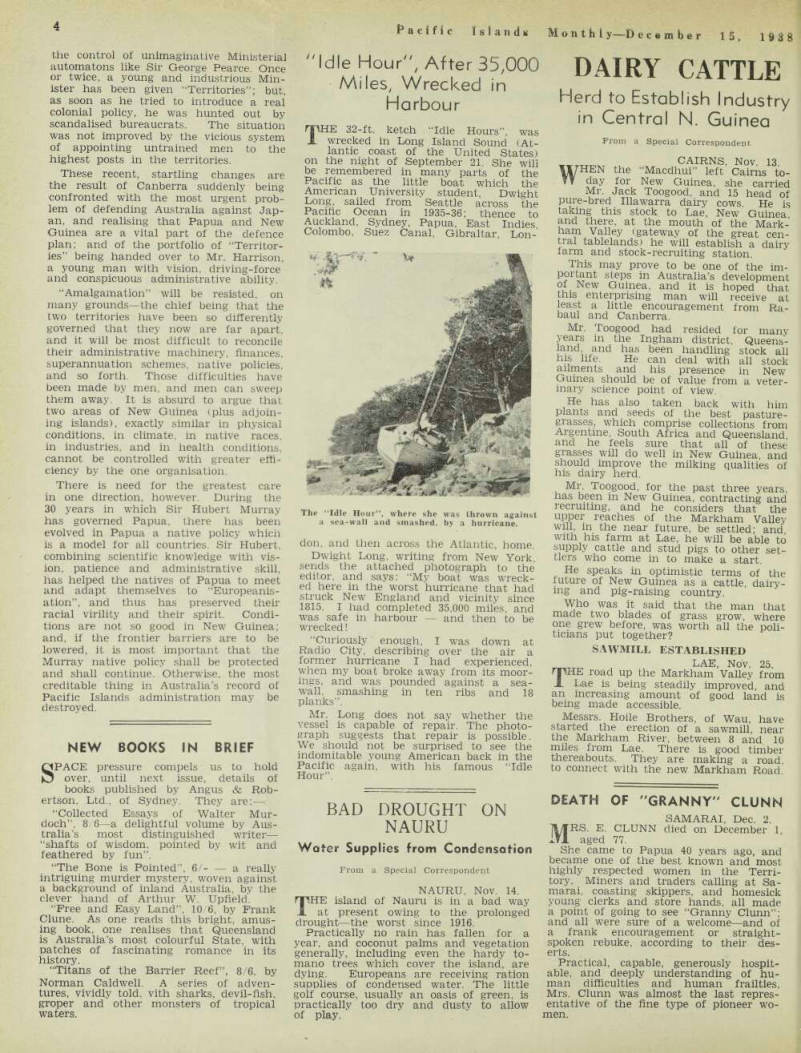
THE 32-ft. ketch “Idle Hours”, was wrecked in Long Island Sound (At lantic coast of the United States) on the night of September 21. She will be remembered in many parts of the Pacific as the little boat which the American University student, Dwight Long, sailed from Seattle across the Pacific Ocean in 1935-36; thence to Auckland, Sydney, Papua, East Indies.
Colombo, Suez Canal, Gibraltar, Lon-
don, and then across the Atlantic, home.
Dwight Long, writing from New York, sends the attached photograph to the editor, and says: “My boat was wreck ed here in the worst hurricane that had struck New England and vicinity since 1815. I had completed 35,000 miles, and was safe in harbour and then to be wrecked!
“Curiously' enough, I was down at Radio City, describing over the air a former hurricane I had experienced, when my boat broke away from its moor ings. and was pounded against a sea wall. smashing in ten ribs and 18 planks”.
Mr. Long does not say whether the vessel is capable of repair. The photo graph suggests that repair is possible.
We should not be surprised to see the indomitable young American back in the Pacific again, with his famous “Idle Hour”.
The “Idle Hour”, where she was thrown against a sea-wall and smashed, by a hurricane.
Nauru
Bad Drought On
Water Supplies from Condensation
From a Special Correspondent
Nauru, Nov. 14.
THE island of Nauru is in a bad way at present owing to the prolonged drought—the worst since 1916.
Practically no rain has fallen for a year, and coconut palms and vegetation generally, including even the hardy to mano trees which cover the island, are dying. Europeans are receiving ration supplies of condensed water. The little golf course, usually an oasis of green, is practically too dry and dusty to allow of play.
Dairy Cattle
Herd to Establish Industry in Central N. Guinea
From a Special Correspondent
W Tm Cairns, Nov. 13.
HEN the “Macdhui” left Cairns to day for New Guinea, she carried Mr. Jack Toogood, and 15 head of pure-bred Illawarra dairy cows. He is taking this stock to Lae, New Guinea and there, at the mouth of the Mark ham Valley (gateway of the great cen tral tablelands) he will establish a dairy farm and stock-recruiting station.
This may prove to be one of the im portant steps in Australia’s development of New Guinea, and it is hoped that this enterprising man will receive at least a little encouragement from Ra baul and Canberra.
Mr. Toogood had resided for many years in the Ingham district, Queens land, and has been handling stock all his life. He can deal with all stock ailments and his presence in New Guinea should be of value from a veter inary science point of view.
He has also taken back with him plants and seeds of the best pasture grasses, which comprise collections from Argentine, South Africa and Queensland and he feels sure that all of these grasses will do well in New Guinea, and should improve the milking qualities of his dairy herd.
Mr. Toogood, for the past three years, has been in New Guinea, contracting and recruiting, and he considers that the upper reaches of the Markham Valley will, in the near future, be settled; and with his farm at Lae, he will be able to supply cattle and stud pigs to other set tlers who come in to make a start.
He speaks in optimistic terms of the future of New Guinea as a cattle dairy ing and pig-raising country.
Who was it said that the man that made two blades of grass grow, where one grew before, was worth all the poli ticians put together?
Sawmill Established
LAE, Nov. 25.
HE road up the Markham Valley from Lae is being steadily improved, and an increasing amount of good land is being made accessible.
Messrs. Hoile Brothers, of Wau, have started the erection of a sawmill, near the Markham River, between 8 and 10 miles from Lae. There is good timber thereabouts. They are making a road, to connect with the new Markham Road.
Death Of “Granny" Clunn
Samarai, Dec. 2.
MRS. E. CLUNN died on December 1, aged 77.
She came to Papua 40 years ago, and became one of the best known and most highly respected women in the Terri tory. Miners and traders calling at Sa marai, coasting skippers, and homesick young clerks and store hands, all made a point of going to see “Granny Clunn”; and all were sure of a welcome—and of a frank encouragement or straight spoken rebuke, according to their des erts.
Practical, capable, generously hospit able, and deeply understanding of hu man difficulties and human frailties, Mrs. Clunn was almost the last repres entative of the fine type of pioneer wo men.
Advertisements & other items, p. 6 (1 item)
4
Pacific Islands Monthl y—t) ecember I§, 1938
Copra's Rival
Huge Ships Out After Whale Oil
ALL the nations are sending larger and more efficient fleets of whale-catch ers and floating factories to the Antarctic this year, and it is likely that the catch of whale oil—which has a de pressing effect on the copra market will be larger than ever. Japan and Ger many set the pace in this industry, and Britain. U.S.A., and the Scandinavian countries have followed.
International agreements, to limit the whale catch and save the whales from extermination have gone by the board.
The “Unitas”, a 21.846 ton German whale factory ship, which left Southamp ton early in November for Capetown, on her way to ninety days’ whale hunting through the Antarctic, is the biggest cargo vessel in the world, and has a bigger draught than any ship afloat.
Having taken on 38.000 tons of fuel oil, the ship had a sailing draught of nearly 40 ft., which is more than 3 ft. in ex cess of the 81,000 tons liner “Queen Mary”. . , This season a new catch-finding ap paratus is to be tried. When a whale is killed by the chasers it is pumped up with air from compressed air cylinders to make the carcase float and left to be picked up by the factory ship. It is then “flagged” to facilitate “spotting", but automatic radio beacons, which emit signals at intervals, are also attached to the carcases, so that they may be picked up even under conditions of bad visibility.
The “Unitas” will work in conjunc tion with a fleet of ten chasers in the region of the Great Barrier. She has a crew of 306. and with the men on the chasers, there is a total of 470.
A New Fish
In Recently Discovered Lake in Central Papua
From Our Own Correspondent.
Pt. Moresby, Dec. 2.
THE newly-discovered Lake Kutubu, on the south-western edge of the uncon trolled area, in Central Papua, is not only a very beautiful sheet of water, but is also achieving fame as the home of fish hitherto unknown.
The fish, though small and bony, are an important item in the diet of the lake-dwellers.
Mr. C. T. J. Adamson who, with Mr.
Ivan Champion, is stationed at the lake, sent specimens of two varieties of the fish to the British Museum, for identi fication. He has received a report that one variety is entirely unknown to sci ence, and that “Adamsonii” has been de cided upon as its baptismal name. The other specimen has not yet been iden tified with any known species, and is expected to prove another new discov ery.
Late Jock Hides
Son Born Posthumously
Mrs. Marguerite Hides, Widow
of the late Mr. Jack Hides, of Papua (who died a few months ago) gave birth to a son on November 24. He has been named John Fairfax Hides.
The young explorer thus is survived by two children —a daughter, who was born when he was away on his famous Tarifuroro patrol, in 1935, and a son, born posthumously.
International Tennis In Samoa
THE Western Samoa tennis team won the Ernest Reid Memorial Trophy, and the Inter-Island Tennis Champion ship, 1938.
Teams from American Samoa and Western Samoa met at Pago Pago on October 21-23, to play in the tournament.
The trophy was presented by Mr. G. H. C. Reid and family, of Pago Pago, in memory of their son, Ernest J. E. Reid.
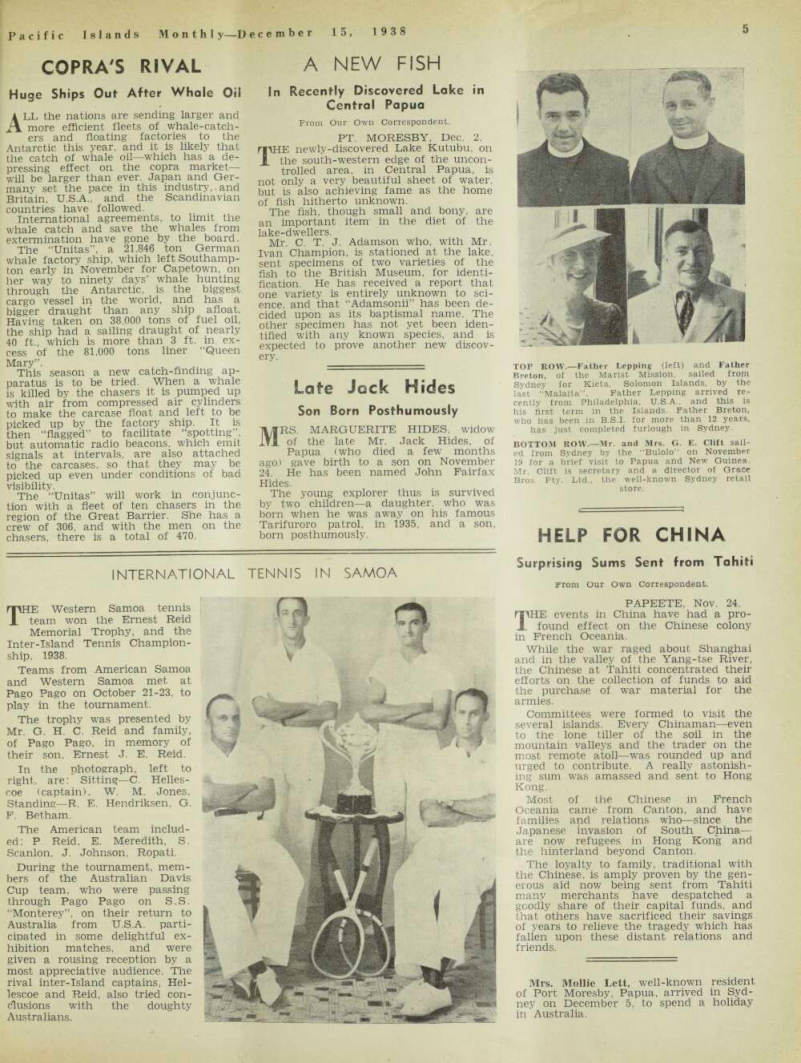
In the photograph, left to right, are: Sitting—C. Helles coe (captain). W. M. Jones, Standing—R. E. Hendriksen, G.
F. Betham.
The American team includ ed; P Reid. E. Meredith. S.
Scanlon, J. Johnson, Ropati.
During the tournament, mem bers of the Australian Davis Cup team, who were passing through Pago Pago on S.S.
“Monterey”, on their return to Australia from U.S.A. parti cipated in some delightful ex hibition matches, and were given a rousing reception by a most appreciative audience. The rival inter-island captains, Hel lescoe and Reid, also tried con clusions with the doughty Australians.
TOP ROW.—Father Lepping (left) and Father Breton, of the Marist Mission, sailed from Sydney for Kieta, Solomon Islands, by the last “Malaita”. Father Lepping arrived re cently from Philadelphia, U.S.A., and this is his first term in the Islands. Father Breton, who has been in B.S.I. for more than 12 years, has just completed furlough in Sydney.
BOTTOM ROW. —Mr. and Mrs. G. E. Clift sail ed from Sydney by the “Bulolo" on November 19 for a brief visit to Papua and New Guinea.
Mr. Clift is secretary and a director of Grace Bros. Pty. Ltd., the well-known Sydney retail store.
Help For China
Surprising Sums Sent from Tahiti
From our Own Correspondent.
Papeete, Nov. 24.
THE events in China have had a pro found effect on the Chinese colony in French Oceania.
While the war raged about Shanghai and in the valley of the Yang-tse River, the Chinese at Tahiti concentrated their efforts on the collection of funds to aid the purchase of war material for the armies.
Committees were formed to visit the several islands. Every Chinaman —even to the lone tiller of the soil in the mountain valleys and the trader on the most remote atoll—was rounded up and urged to contribute. A really astonish ing sum was amassed and sent to Hong Kong.
Most of the Chinese in French Oceania came from Canton, and have families and relations who —since the Japanese invasion of South China — are now refugees in Hong Kong and the hinterland beyond Canton.
The loyalty to family, traditional with the Chinese, is amply proven by the gen erous aid now being sent from Tahiti many merchants have despatched a goodly share of their capital funds, and that others have sacrificed their savings of years to relieve the tragedy which has fallen upon these distant relations and friends.
Mrs. Mollie Lett, well-known resident of Port Moresby, Papua, arrived in Syd ney on December 5, to spend a holiday in Australia.
Advertisements & other items, p. 7 (1 item)
5
Pacific Islands Monthl y—D ecember 15, 1938
West. Samoan
Election
O. F. Nelson Tops The Poll
Apia, Dec. 1.
AN election for two European mem bers of the Legislative Council, for three years, was held on November 26, and resulted:—
Elected
O. F. Nelson (former leader of the Mau) 332 Dr. C. M. Dawson 270
Not Elected
A. G. Smyth (retiring member) .. 216 A. Stowers (prominent in local Labour Party) 152 E. T. Pleasants (a solicitor in Apia) 135 P. W. Glover (Apia business man) 28 The other retiring Councillor, Mr. I.
H. Carruthers, did not seek re-election.
At the last election, there were 111 on the roll—the voter’s qualification be ing property or income worth £2OO p.a.
This election, there were 705 on the roll, of whom 98 per cent, voted. The N.Z.
Labour Government changed the voting qualification from that stated, to “every European male or female, over 21 years of age, provided he or she is either the legitimate child of a European parent or registered as a European”.
This new rule gave the vote to the large community of European-Samoans, who have European status. Of the 705 on the roll, 194 are Europeans, and 511 are European-Samoans. One-third of all the electors are women.
Loss By Fires In Fiji
AFIRE in an electricity plant, owned by Mr. M. P. Khan, did £1,300 worth of damage at Lautoka, Fiji, on No vember 22.
Early in the morning of October 29, a Pre did £lO,OOO worth of damage at Ba, Fiji. Buildings destroyed were: The Avalon Picture Theatre, a bulk store, a garage with five vehicles, a cordial fac tory, two terraces of shops and tene ment buildings, and a number of out buildings. Messrs. Morris Hedstrom Ltd. owned the cordial factory, bakery, bulk store and garage, and Singh owned the remainder.
Serious Epidemic In New
Britain
PRIVATE letters from Rabaul, dated December, say that there has been a “terrifying death-roll” among New Britain natives, apparently from pneu monia, which is the result either of ne glected measles of pneumonic influenza.
“All over this district”, says one planter, near Rabaul, “the natives have been dying like flies in their villages.
No doctor has been near them —there are not enough to cope with this big epidemic”.
THE Fijian coastal steamer, “Yanawai”, left Suva on November 24, heavily laden, for an unknown destination.
She was an object of curiosity as she waited about, near the harbour en trance, for some hours, before disappear ing into the south-east. It is supposed that her mission is connected with the formal occupation of certain islands by Great Britain.
"Bounty" Men's
Graves
Danger That They May Be Lost
HISTORICAL landmarks of value on Pitcairn Island are in danger of be ing lost.
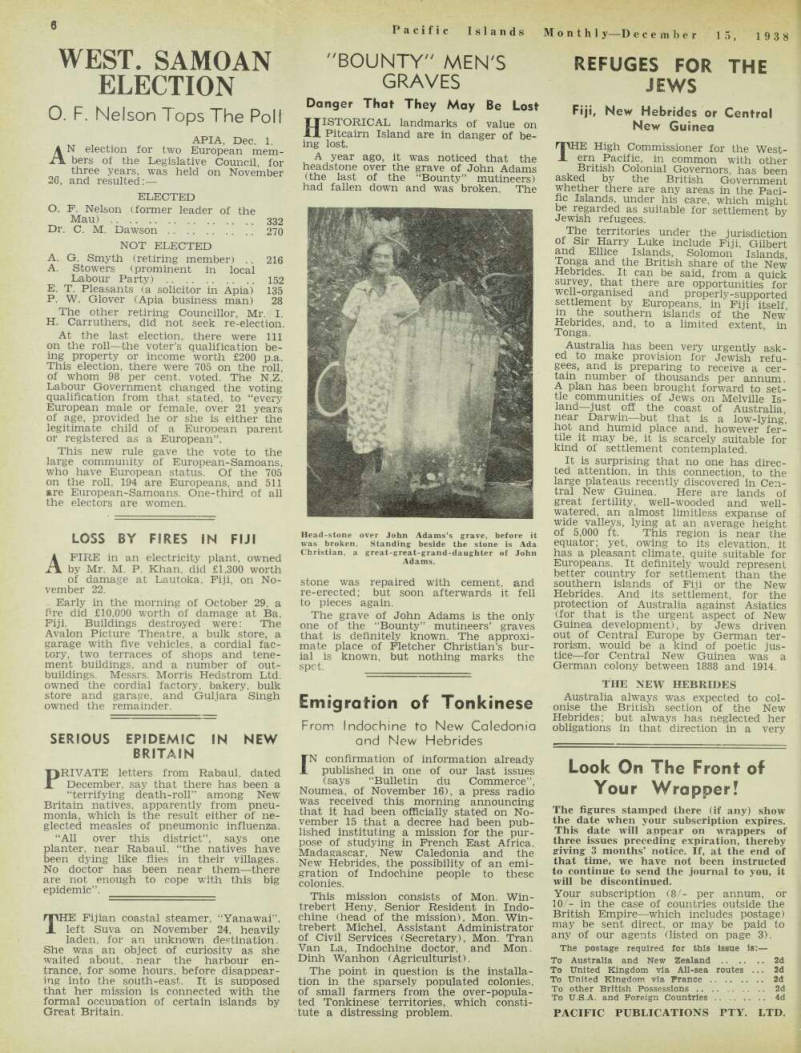
A year ago, it was noticed that the headstone over the grave of John Adams (the last of the “Bounty” mutineers) had fallen down and was broken. The
stone was repaired with cement, and re-erected; but soon afterwards it fell to pieces again.
The grave of John Adams is the only one of the “Bounty” mutineers’ graves that is definitely known. The approxi mate place of Fletcher Christian’s bur ial is known, but nothing marks the spot.
Head-stone over John Adams’s grave, before it was broken. Standing beside the stone is Ada Christian, a great-great-grand-daughter of John Adams.
Emigration of Tonkinese
From Indochine to New Caledonia and New Hebrides
TN confirmation of information already 1 published in one of our last issues (says “Bulletin du Commerce”, Noumea, of November 16), a press radio was received this morning announcing that it had been officially stated on No vember 15 that a decree had been pub lished instituting a mission for the pur pose of studying in French East Africa.
Madagascar, New Caledonia and the New Hebrides, the possibility of an emi gration of Indochine people to these colonies.
This mission consists of Mon. Win trebert Heny, Senior Resident in Indo chine (head of the mission), Mon. Win trebert Michel, Assistant Administrator of Civil Services (Secretary), Mon. Tran Van La, Indochine doctor, and Mon.
Dinh Wanhon (Agriculturist).
The point in question is the installa tion in the sparsely populated colonies, of small farmers from the over-popula ted Tonkinese territories, which consti tute a distressing problem.
Jews
Refuges For The
Fiji, New Hebrides or Central New Guinea
THE High Commissioner for the West ern Pacific, in common with other British Colonial Governors, has been asked by the British Government whether there are any areas in the Paci nc Islands, under his care, which might be regarded as suitable for settlement bv Jewish refugees.
The territories under the jurisdiction of Sir Harry Luke include Fiji, Gilbert and Ellice Islands, Solomon Islands Tonga and the British share of the New Hebrides. It can be said, from a quick survey, that there are opportunities for well-organised and properly-supported settlement by Europeans, in Fiji itself in the southern islands of the New’
Hebrides, and, to a limited extent, in Tonga.
Australia has been very urgently ask ed to make provision for Jewish refu gees, and is preparing to receive a cer tain number of thousands per annum A plan has been brought forward to set tle communities of Jews on Melville Is land-just off the coast of Australia near Darwin—but that is a low-lying, hot and humid place and, however fer tile it may be, it is scarcely suitable for kind of settlement contemplated.
It is surprising that no one has direc ted attention, in this connection, to the large plateaus recently discovered in Cen tral New Guinea. Here are lands of great fertility, well-wooded and well watered, an almost limitless expanse of wide valleys, lying at an average height of 5,000 ft. This region is near the equator; yet, owing to its elevation, it has a pleasant climate, quite suitable for Europeans. It definitely would represent better country for settlement than the southern islands of Fiji or the New Hebrides. And its settlement, for the protection of Australia against Asiatics (for that is the urgent aspect of New Guinea development), by Jews driven out of Central Europe by German ter rorism, would be a kind of poetic jus tice —for Central New Guinea was a German colony between 1888 and 1914.
The New Hebrides
Australia always was expected to col onise the British section of the New Hebrides; but always has neglected her obligations in that direction in a very
shocking way. The result is that, to day, European settlement there is al most wholly French. The British planters have either departed, or sought French citizenship, which gives encour agement and practical help to settlers.
The fact remains, however, that large areas of land in the New Hebrides be long to Australia —a gift made to the Commonwealth, over 30 years ago, by Sir James Burns, the founder of Burns* Philp and Co. Ltd. Surely, this is a suit able time in which to look the New Hebrides situation over, with a view to a little active co-operation between the British Government (which wants to help the Jewish refugees), the Austra lian Government (which has large areas of New Hebrides land upon its hands; and the Jewish organisations which are prepared to finance and help their dis tressed countrymen.
Problems Of Settlement
Someone will say: But how will they live? What will they produce? Where is their market?
Isn’t there fallacy behind those all too-common questions? The true pur pose of settlement is to place a man and his dependants upon land of such an area, and under such conditions, that they can provide directly for their own requirements in food and shelter. That was the method of the original, suc cessful settlements in Australia and New Zealand. Those people lived off their own little, primitive farms; and the few necessities that the land did not provide, were provided, at first, from a very small cash allowance made by the Governments and, subsequently, from the very modest sales they made of the products of their farms.
It was only during the past quarter century that attempts have been made to establish farming settlements on an other scale —“gentleman-farming”, it is called —the basis of which is the produc tion of large quantities of foodstuffs or raw materials for immediate sale. That kind of settlement generally fails. The other kind—the settlement of peasant farmers close to the soil —usually is suc cessful; and it provides, moreover, the basis for a very sound economic struc ture for the nation.
Advertisements & other items, p. 8 (2 items)
6
Pacific Islands Monthl y—D ecember 15, 1938
Your Wrapper!
Look On The Front of
The figures stamped there (if any) show the date when your subscription expires.
This date will appear on wrappers of three issues preceding expiration, thereby giving 3 months’ notice. If, at the end of that time, we have not been instructed to continue to send the journal to you, it will be discontinued.
Your subscription (8/- per annum, or 10/- in the case of countries outside the British Empire—which includes postage) may be sent direct, or may be paid to any of our agents (listed on page 3).
The postage required for this Issue Is:— To Australia and New Zealand 2d To United Kingdom via All-sea routes ... 2d To United Kingdom via Prance 2d To other British Possessions 2d To U.S.A. and Foreign Countries 4d
PACIFIC PUBLICATIONS PTY. LTD.
Lands Commissioner in Papua
From Our Own Correspondent.
Pt. Moresby, Dec. 9.
THE position of Commissioner for Land and Director of Mines and Agricul ture, left vacant by the retirement of the Hon. C. T. Wurth, has been filled by the appointment of Mr. E. R. Old ham, who has for some months been acting as Commissioner for Native Af fairs, during the absence of the Hon. J.
T. O’Malley.
Seeks “Pen Friends”
Madame A. Couvrier, 62 Rue du Marais, Montiguies sur Sambre, Bel gium, writes to say that she would like to make contact with “pen friends” in the Pacific who are interested in stamp-collecting.
Mr. F. R. Charlton, Commissioner of Lands for the Colony of Fiji, was invest ed by His Excellency the High Commis sioner for the Western Pacific, Sir Harry Luke, with the insignia of an Officer of the Most Excellent Order of the British Empire, at the opening of the Legisla tive Council at Suva. Fiji, on Novem ber 25.
Fiji Conditions
Indian Publicist’S Attack On
Provides Fantastic Material for America's Anti-British Newspapers
An outrageous abuse of British hospitality, and a treacherous attack upon British institutions, are disclosed in the following despatch from our Honolulu correspondent;—
Honolulu. Nov. 14.
THE following startling “snapshot” opinions were given to the American press by Dr. H. N. Kunzru, a mem ber of India’s Council of State, who re cently attended the British Common wealth Affairs conference in Sydney as leader of the Indian delegation, and who arrived in Honolulu this week: — British Indians in Fiji are forced to live under one of the most back ward Colonial policies in the Paci fic area. , The conditions under which they live and work are “deplorable”. The position is “acute”.
Dr Kunzru came to Hawaii to make a detailed study of conditions in the local sugar industry, to see if he can’t find a solution of the difficulties which he said he encountered in Fiji.
The American reporters asked Dr.
Kunzru to boil down his complaints to a few words. His answer was as fol lows : The status of the Indians in Fiji is of immediate concern because the short term leases under which they have cul tivated their sugar cane lands now are expiring, and thousands of the Indian planters are faced with the prospect of either not being able to renew their leases, or being forced to accept new short-term grants which give them lit tle or insufficient economic security.
The Indians compose 43 per cent of Fiji’s population, and 90,000 Indians are in the sugar industry.
Boiling down his complaint still fur ther, Dr. Kunzru said:— “The Indians still are subject to an antiquated master-and-servants ordin ance which, in effect, relegates them to the position of feudal slaves”.
Dr. Kunzru’s story was front-paged by the Honolulu press, one reason being, of course, that the Hawaii sugar work ers are told they are the best-off of all world sugar workers.
Reading through the published state ments credited to Dr. Kunzru, these are highlights:— Average annual wages in Fiji of Indian
planters (does that mean workers in the field?) rarely exceed £5O a year.
Now under consideration by the Fijian Government (according to Dr. Kunz ru) is a plan to divide all the land into maior portions: one half to be used by native Fijians, the other to be leased for 99 years by all “foreign” residents, in cluding the “oppressed” Indians.
All sugar production in Fiji is con trolled by the Colonial Sugar Refining Co. The management of this company (according to Kunzru) has exercised considerable influence on the Govern ment to keep the Indian workers in the position of serfs, and has done little to provide economic security for the In dian labourers.
Under current laws (Dr. Kunzru said) Indian planters would be committing penal offences if they attempted to or ganise to form trade unions.
Asked whether he had done anything on the spot about the alleged conditions of the Indians, Dr. Kunzru said that he had discussed the problem with Sir Harry Luke (newly appointed Governor of Fiji).
That was all Dr. Kunzru would say to the American press for publication. On the q.t. (or off the record, as the Ame ricans say) Dr. Kunzru was extremely enlightening.
He told the U.S. press all about him self: He is president of the Servants of India (one of the largest social welfare organisations in India), a graduate of the University of India, a Boy Scout executive, and a potent force in India’s mixed politics.
A survey of the reporters who inter viewed him leaves the impression that Dr. Kunzru is serious. Added several of the reporters: “If only half of what Dr.
Kunzru said is true, there’s lots of social dynamite in Fiji”.
Dr. Kunzru intends to “spend a week” in Hawaii to study the local sugar indus try. Local interests are concerned lest he obtain a “snapshot” opinion of the local set-up, and “sound off” about it in newspapers elsewhere.
Something About Dr. Kunxru and His Methods
THIS Dr Kunzru came to Australia in
e rS ber commonweaU?r Relations
Coni™. Se°Ta TsSe mafwito
treated‘wtfh^proper^courtiesy! &*£
made a number of public addresses. He did not openly display his apparently inherent hatred of Britain.
In Fiji, again, he was given every possible facility for carrying out his ostensible purpose—namely, the promotion of good relations between the people of the British Commonwealth—and for investi- D-ntimr thp rrmdifion nf the Fiii Indians He presided at an All-Indian Conference (see report elsewhere). He
said nothing, publicly, while on British
W Ss
det £&-££&&& S'SuSfS
row about.
But, the moment he found himself on foreign soil, among representatives of an ignorant and sensation-loving Pos which loses no chance of belittling and ridiculing the British Empire and Bnt lsh institutions he .let go a mass o malicious half-truths dwtortlojM o f fact. His purpose is not easy to under stand: but apparently he is one of those Indian intellectuals who cannot resist
a chance of spitting venom at Britain.
He cannot be explained—he is just part of the white man’s burden.
It is far too late, now, to overtake the evil impression made on American minds by this man—we only can state the facts. But it may be said that the harm done to the Indian community in Fiji by an incident like this more than outweighs all the problematical benefits of the visits of a dozen Kunzrus.
One of the most difficult problems in the British Colonial administration is provided by Fiji. The Fijians are in creasing, and are becoming agricultur ists. Britain, under the terms of cession, is the trustee for Fijian lands. The In dians also are increasing, and are avid for land, which they farm well and pro fitably. But the Indians were admitted to Fiji as tenant-farmers of sugar-lands, with certain obligations to the C.S.R.
Co., and subject to the inalienable land rights of the Fijians. The Indians, es caping from the poverty of their over crowded homeland, gratefully accepted the conditions. But nowadays, the cir cumstances of life in India are forgot ten, and the Fiji Indians clamour for more land, more privileges, and equality with the British.
For two decades, the British most conscientiously have striven to adjust racial differences in Fiji. They are try ing in Fiji, as in every part of the Em pire—despite the snarling and malice of all kinds of trouble-makers, from Fas cist to feebleminded, and from Com munists to Kunzrus —to provide social justice and political freedom for all the races they control, and a fair share of the good things of life; and they have made considerable progress. Lately, British official opinion has been definite ly favourable to Fiji-Indian aspirations.
The British have obtained marked con cessions from Fijian landowners in fav our of Indians.
British officials, being what they are, probably will continue their policy, un perturbed—although they scarcely will gain in respect for a race which produces and encourages Kunzrus. But there are others who, when faced with such in cidents as this, will ask the Fiji Gov
ernment seriously whether it is worth while trying to do anything for such an ungrateful and unappreciative commun ity—whether it would not be better to leave the Indians in the condition they originally accepted—namely, cane-grow ers and labourers for the big sugar com pany.
And there is practical commonsense in that question. The C.S.R. Co. has made Fiji the most prosperous colony in the Empire. The Co. must have cane-grow ers and labourers, at a price which will enable it to compete with other sugar producing countries. Already. Fiji sugar-production costs are at their peak.
The Honolulu statements of Dr. Kunz ru can be very briefly disposed of.
I travelled through the cane-growing districts of Fiji not long ago; and I have travelled in India—and the conditions simply are not comparable. The Fiji Indians generally are far from rich— but mostly they are well-fed, well housed, protected and cared for, and in social condition, education, widening opportu nities, they are improving all the time.
I saw no slum conditions, or distress ing poverty. I saw—and photographed— swarms of happy, well-fed, well-clothed Indian children, mostly going to or leav ing schools, which are provided for them by Government and Missions.
Indian cane-farmers may not earn more than £5O-£7O p.a., in cash, from the Co.; but they live on their own lit tle farms and produce most of their own foodstuffs.
Land tenures are a real problem—not of Britain’s making—but very substan tial progress has been made lately (and Dr. Kunzru knew it) in finding a solu tion.
Wherever Indians have emigrated— South and East Africa. Trinidad, Brit ish Guiana, Mauritius, are places that come to mind—they have sat around and howled their discontent with life in gen eral and British rule in particular. Fiji is no exception. Yet. probably, they have made greater progress in Fiji, spiritually and materially, than any where in the world. —R.W.R.
Some Facts, From C.S.R. Co.'s Records
REPORTS of Dr. Kunzru’s Honolulu utterances were shown to Sir Philip Goldfinch, general manager of the C.S.R. Co., in Sydney: and he kindly supplied the following informative notes.
Land and Short-Term Leases: The tenure of lands leased from the Fijian owners is generally 21 years; and, admit tedly, difficulties in connection with re newals have constituted in the past a genuine grievance on the part of Indian lessees. This has long been recognised by the Government: but, owing to the uni que circumstances under which Fiji was ceded to the British Crown (which was specially asked to protect the Fijians against the alienation of their lands), the question of remedial measures was ex traordinarily difficult. However, the Fijians, through their Council of Chiefs, recently agreed (in November) by an overwhelming majority, that it is in the best interests of the native race that all lands (including leases) not required for the maintenance of the Fijian owners be opened for settlement, and that all land (including leases) not so required be handed over to the Government to lease on behalf of the Fijians.
Masters and Servants Ordinance: This law applies to all servants, and not to Indians only, and imposes certain obli gations on masters also. The statement that the Ordinance “relegates Indians
to the position of feudal slaves” is ab surd. Contracts under the Ordinance, like other contracts, are enforceable in law, but in actual practice the law is seldom invoked.
“Wages” of Planters: Presumably the word “wages” is used loosely for “in come”. The proceeds from all agricul tural industry depends mainly on two factors:—(a) The ability of the farmer, (b) The market value of his product.
In the latter regard, it is sufficient to say that the price paid for cane has not varied in the past 15 years, in spite of the depressed state of the sugar mar ket. The burden of low prices has fall en entirely on the manufacturer, and the grower has been paid a price for his cane which compares more than fav ourably with that paid in India and in sugar-producing British Colonies. As a result of this stabilisation in prices, crops have greatly increased.
Labour: Dr. Kunzru’s allegation that “the management of the C.S.R. Co. has exercised considerable influence on the Government to keep the Indian workers in a position of serfs and has done lit tle to provide economic security for the Indian labourers”, if correctly reported, can only be characterised as a slander ous lie. It suggests a conspiracy be
(Continued On Page 73)
tween the Government and a large em ployer which is impossible under any
British administration.
So far as the position of the Indians
in Fiji is concerned, the following
quotations are apposite;—
From The Report Of Messrs Mcneill
And Chimman Lal (1914);
(Mr J. M. McNeill, a senior member of the Indian Civil Service, and Mr ’. C c^^ al J n L f 9 ’ 12 a 3 Indian barrister, were commissioned in 191 2 i to investigate the conditions of Indian immi grants in all British Colonies);— “The great majority of emigrants exchanged grinding poverty, with practically no hope of betterment, for a condition varying from sim ple but secure comfort to solid prosperity. Emi grants live under very much better conditions than their relatives in India, and have had opportunities of prospering which exceeded their own wildest hopes”.
FROM “FIJI AND THE FUTURE” (BY KILMER
O. Moe), 1929:
(Mr. Kilmer O. Moe, a representative of the Kabehameha Schools in Honolulu, with experi ence of the Philippines, was invited by the Methodist Mission to visit Fiji in 1929) ; “The Indian has been transplanted from the hard, sterile soil of India to a fruitful land.
He has struck his roots deeply into the soil and is responding to the improved conditions in a very satisfactory manner. He has forged ahead economically, as well, until he holds at this writing a very strong position in the Col ony. There is little doubt that he has availed himself of the opportunities that have come his way and that he has prospered beyond anything that his brethren in the homeland
may hope for. Fiji, in this respect, has been a land of promise.
“I am not at all impressed with the influen ces that come to Fiji from India. There are too many of them, and they clash with one another.
“The human elements that belong in Fiji hold no menace. The danger was rather from those who would saddle this young and hope ful Colony with dissensions and prejudices brought in from overseas. These have no place in Fiji, or in the South Seas”.
From Sir Frank Stockdale, Report On
Fiji, 1937:
(Sir Frank Stockdale is Agricultural Ad viser to the Colonial Office, and has an in timate knowledge of agriculture throughout the British Empire):— “The sugar-canes were formerly grown by the sugar Companies themselves with hired labour.
The C.S.R. Company now cultivates only a small acreage on its own account and relies almost entirely upon the efforts of small far mers, who cultivate as tenants of the Com pany, or as lessees of lands leased from Fijian owners.
“The change of system is one of the most interesting agricultural developments which have taken place in the Colonial Empire within the past 15 years, and although there at times have been difficulties, these have been faced when they arose and a valuable scheme of co operative production has been evolved”.
FROM REV. J. W. BURTON, CHAIRMAN OF
The National Missionary Council Of
Australia, When Interviewed In Suva
BY THE “FIJI TIMES AND HERALD”. 1938: (Mr. Burton resided in Fiji from 1902 to 1911, and has since frequently visited the Colony): “I was greatly impressed with the improve
merits made for the accommodation of mill la bour. It is manifest that a new and more sympathetic attitude is taken by employers and, as I always maintained, has resulted in economic advantage to the employer and in the begetting of self-respect in the mind of the worker.
“I believe that the three major races in Fiji —European, Fijian and Indian—are finding that co-operation, goodwill, and mental respect are the only satisfactory bases for economic, soc ial and moral life”.
FROM ‘‘INDIA AND THE PACIFIC” (BY C. F.
Andrews), 1937;
“By far the strongest and best impression I have carried away from this, mV third visit to the Fiji Islands, is the advance made in the last 20 years by the Indian population. . . .
The change that I have witnessed has not only given good economic results; it has also pro vided a new social structure. On all my jour neyings among Indians abroad, I have never seen such a complete transformation. . . .
“There will be many criticisms still to offer, both with regard to Government policy and also with reference to the C.S.R. Co.’s method, and I shall offer them freely and frankly; but at the same time I wish to be equally frank in heartily commending the improvements I have witnessed. I can fully appreciate the business foresight which has carried the Com pany through one of the darkest periods in modern economic history”.
Mrs. M. E. Thompson arrived in Syd ney by the “Westralia” on December 12 from " New Zealand. Mrs. Thompson is engaged in mission work for the Meth odist Mission at Nukualofa. Tonga, and will spend leave in Sydney.
Advertisements & other items, p. 9 (1 item)
7
Pacific Islands Monthl y—D ecember 15, 1938
Northward Bound
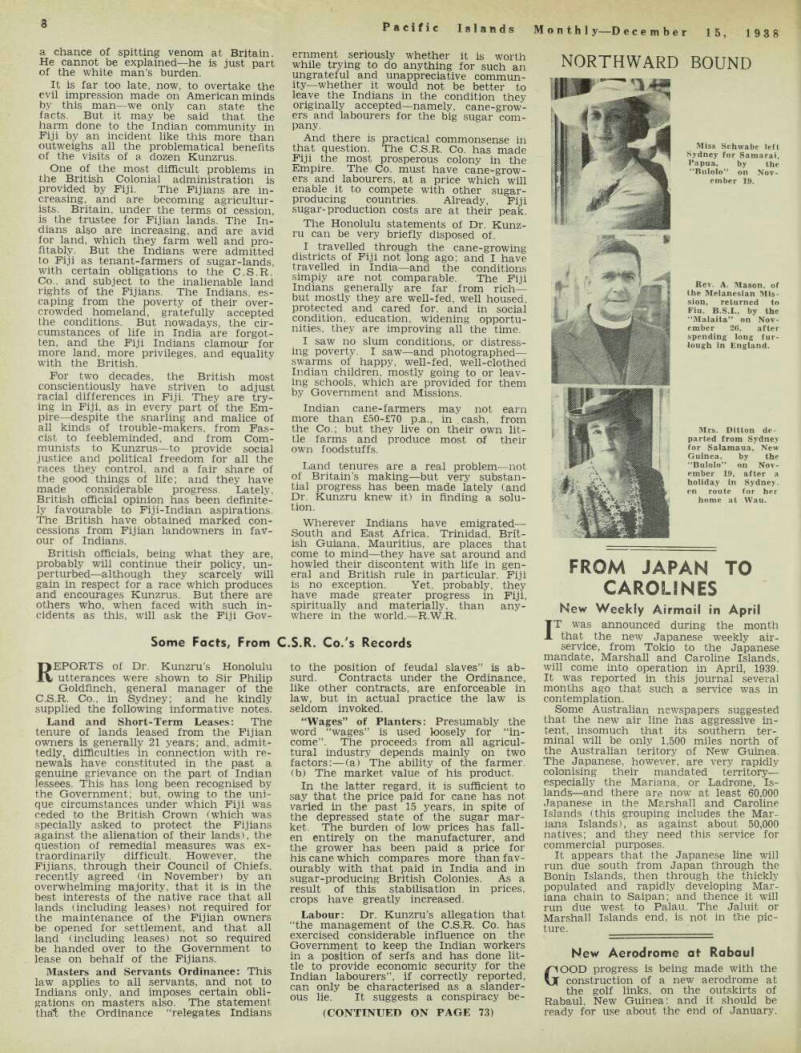
Miss Schwabe left Sydney for Samarai, Papua, by the “Bulolo” on Nov ember 19.
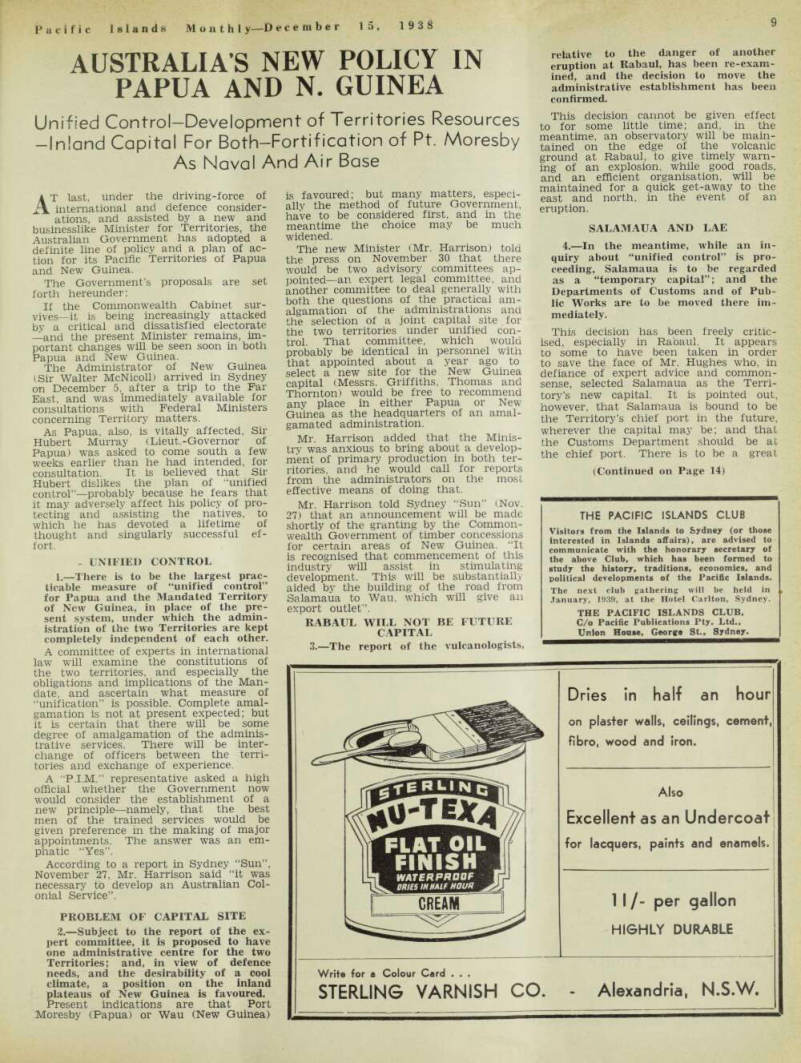
Rev. A. Mason, of the Melanesian Mis sion, returned to Fiu. B.S.I., by the “Malaita” on Nov ember 26, after spending long fur lough in England.
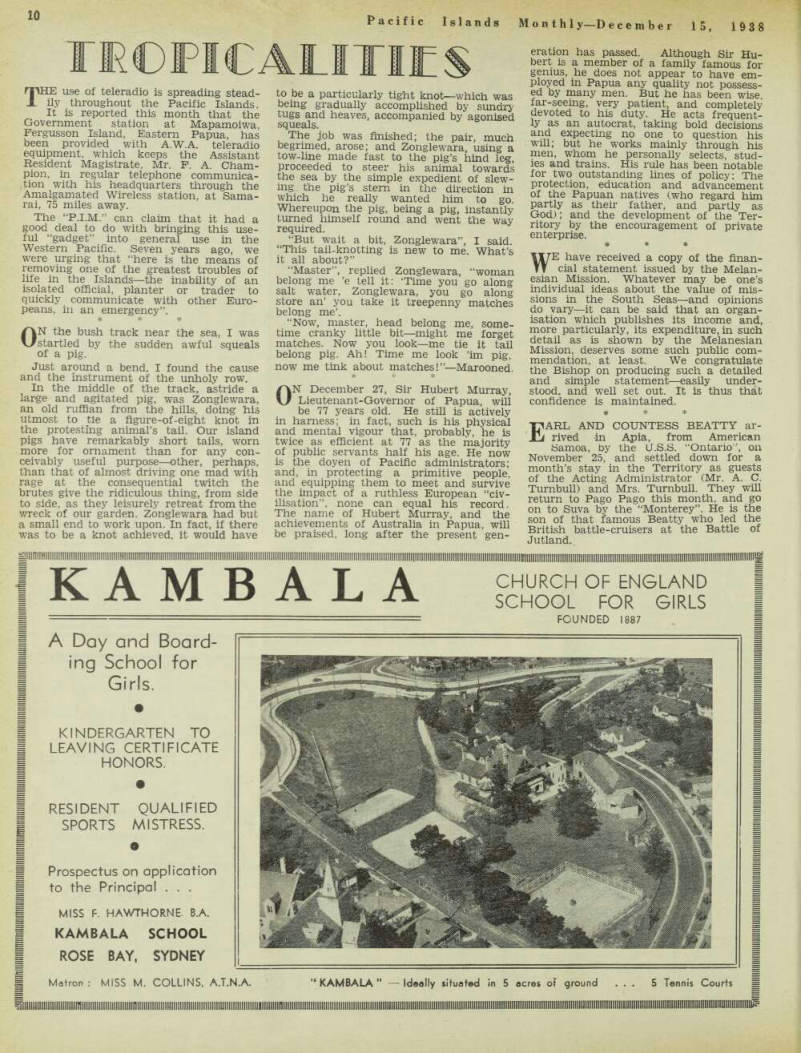
Mrs. Ditton de parted from Sydney for Salamaua, New Guinea. by the “Bulolo” on Nov ember 19, after a holiday in Sydney, en route for her home at Wau.
Carolines
From Japan To
New Weekly Airmail in April IT was announced during the month that the new Japanese weekly air service, from Tokio to the Japanese mandate, Marshall and Caroline Islands, will come into operation in April, 1939.
It was reported in this journal several months ago that such a service was in contemplation.
Some Australian newspapers suggested that the new air line has aggressive in tent, insomuch that its southern ter minal will be only 1,500 miles north of the Australian teritory of New Guinea.
The Japanese, however, are very rapidly colonising their mandated territory— especially the Mariana, or Ladrone, Is lands—and there are now at least 60,000 Japanese in the Marshall and Caroline Islands (this grouping includes the Mar iana Islands), as against about 50,000 natives; and they need this service for commercial purposes.
It appears that the Japanese line will run due south from Japan through the Bonin Islands, then through the thickly populated and rapidly developing Mar iana chain to Saipan; and thence it will run due west to Palau. The Jaluit or Marshall Islands end, is not in the pic ture.
New Aerodrome at Rabaul GOOD progress is being made with the construction of a new aerodrome at the golf links, on the outskirts of Rabaul, New Guinea: and it should be ready for use about the end of January.
Advertisements & other items, p. 10 (1 item)
8
Pacific Islands Mont hi y—D ecember 15, 1938
Australia’S New Policy In
Papua And N. Guinea
Unified Control-Development of Territories Resources -Inland Capital For Both-Fortification of Pt. Moresby As Naval And Air Base
a T last, under the driving-force of international and defence consider ations, and assisted by a new and businesslike Minister for Territories, the Australian Government has adopted a definite line of policy and a plan of ac tion for its Pacific Territories of Papua and New Guinea.
The Government’s proposals are set forth hereunder; If the Commonwealth Cabinet sur vives—it is being increasingly attacked by a critical and dissatisfied electorate —and the present Minister remains, im portant changes will be seen soon in both Papua and New Guinea.
The Administrator of New Guinea (Sir Walter McNicoll) arrived in Sydney on December 5, after a trip to the Far East, and was immediately available for consultations with Federal Ministers concerning Territory matters.
As Papua, also, is vitally affected, Sir Hubert Murray (Lieut.-Governor of Papua) was asked to come south a few weeks earlier than he had intended, for consultation. It is believed that Sir Hubert dislikes the plan of “unified control” —probably because he fears that it may adversely affect his policy of pro tecting and assisting the natives, to which he has devoted a lifetime of thought and singularly successful ef fort.
- Unified Control
1. —There is to be the largest prac ticable measure of “unified control” for Papua and the Mandated Territory of New Guinea, in place of the pre sent system, under which the admin istration of the two Territories are kept completely independent of each other.
A committee of experts in international law will examine the constitutions of the two territories, and especially the obligations and implications of the Man date, and ascertain what measure of “unification” is possible. Complete amal gamation is not at present expected; but it is certain that there will be some degree of amalgamation of the adminis trative services. There will be inter change of officers between the terri tories and exchange of experience.
A “P.1.M.” representative asked a high official whether the Government now would consider the establishment of a new principle—namely, that the best men of the trained services would be given preference in the making of major appointments. The answer was an em phatic “Yes”.
According to a report in Sydney “Sun”, November 27, Mr. Harrison said “it was necessary to develop an Australian Col onial Service”.
Problem Of Capital Site
2. —Subject to the report of the ex pert committee, it is proposed to have one administrative centre for the two Territories; and, in view of defence needs, and the desirability of a cool climate, a position on the inland plateaus of New Guinea is favoured.
Present indications are that Port Moresby (Papua) or Wau (New Guinea)
is favoured; but many matters, especi ally the method of future Government, haVe to be considered first, and in the meantime the choice may be much widened.
The new Minister (Mr. Harrison) told the press on November 30 that there would be two advisory committees ap pointed—an expert legal committee, and another committee to deal generally with both the questions of the practical am algamation of the administrations and the selection of a joint capital site for the two territories under unified con trol. That committee, which would probably be identical in personnel with that appointed about a year ago to select a new site for the New Guinea capital (Messrs. Griffiths, Thomas and Thornton) would be free to recommend any place in either Papua or New Guinea as the headquarters of an amal
gamated administration.
Mr. Harrison added that the Minis trv was anxious to bring about a develop ment of primary production in both ter ritories. and he would call for reports from the administrators on the most effective means of doing that.
Mr. Harrison told Sydney “Sun” (Nov. 27) that an announcement will be made shortly of the granting by the Common wealth Government of timber concessions for certain areas of New Guinea. “It is recognised that commencement of this industry will assist in stimulating development. This will be substantially aided by the building of the road from Salamaua to Wau, which will give an export outlet”.
Rabaul Will Not Be Future
Capital
3. —The report of the vulcanologists,
relative to the danger of another eruption at Rabaul, has been re-exam ined, and the decision to move the administrative establishment has been confirmed.
This decision cannot be given effect to for some little time; and, in the meantime, an observatory will be main tained on the edge of the volcanic ground at Rabaul, to give timely warn ing of an explosion, while good roads, and an efficient organisation, will be maintained for a quick get-away to the east and north, in the event of an eruption.
Salamaua And Lae
4.—ln the meantime, while an in quiry about “unified control” is pro ceeding, Salamaua is to be regarded as a “temporary capital”; and the Departments of Customs and of Pub lic Works are to be moved there im mediately.
This decision has been freely critic ised, especially in Rabaul. It appears to some to have been taken in order to save the face of Mr. Hughes who, in defiance of expert advice and common sense, selected Salamaua as the Terri tory’s new capital. It is pointed out, however, that Salamaua is bound to be the Territory’s chief port in the future, wherever the capital may be; and that the Customs Department should be at the chief port. There is to be a great
(Continued on Page 14)
amount of public works (road-building, harbour improvement, etc.) in this dis trict in the early future: and the Pub lic Works Department may find the Salamaua location temporarily conveni ent.
It is now pretty clear that, between August and October, the chief officials, in both Canberra and Rabaul, thought that Lae would become the new capital of New Guinea, and they proceeded ac cordingly. Lae was the original choice of the Griffiths Committee; was reject ed by the then Minister (Mr. Hughes) who, in association with the Adminis trator, chose Salamaua; and then, as the result of a sharp public outcry, the selection of Salamaua was abandoned.
While Mr. Hughes was still in the Territories Office, and dithering on the question of selecting a site other than Salamaua, the officials evidently thought they could save time and headaches by getting plans ready for a new town at Lae, which seemed the inevitable alter native. Hence the presence of survey ors at Lae.
The removal of Mr. Hughes, however, together with the introduction of a young and energetic Minister, and the belated recognition by Australia of her defence obligations, changed the whole picture. Quite another sort of capital is wanted, now; and the probability of Lae becoming the administrative centre of the Territory has faded into the back ground. It will only come forward again, as a rival of Wau and Salamaua, if “unified control” is found impractic able.
Fortification Of Pt. Moresby
5. —Pt. Moresby is to be fortified, and to become an “important air base and sub-naval base” for units of the Aus tralian navy and air force. No details were given in the official announce ment, published on December 7, ex cept that, through Port Moresby, Australian defence will be linked with Britain and New Zealand.
It is unnecessary, here, to point out the importance of Papua, New Guinea, Solomon Islands, New Hebrides and Nor folk Island in the plan of Australian de fence. Obviously, there should be an advanced base somewhere near Rabaul, as well as at Port Moresby: but the idealists who framed the mandate (at the end of “the war to end war”!) laid it down that a mandated country could not be used by the mandatory for any military purpose. This is a matter that will be closely examined by Australia’s team of legal experts, who are to advise on the future treatment of the man date.
Ships and aeroplanes, based on Port Moresby, probably can look after the northern New Guinea mainland; but the more easterly parts of the mandated territory—New Ireland. Bougainville, etc. —cannot very easily be covered from
Port Moresby.
We therefore have this ridiculous position: Australia is being prepared for defence against an aggressive Asia, led by Japan. The spearhead of Japan’s southwards thrust is in the Marshall and Caroline Islands, only 1,500 miles north of Australian New Guinea. Although Japan holds those islands under the same sort of mandate as was given to Australia in respect of New Guinea, Japan is believed to be using the islands in connection with her naval and mili tary plans—while Australia, considering herself bound by the mandate, refrains from placing in New Guinea certain counter-measures that really are vital to her defences.
Agricultural Council
6. —The appointment of an “Agricul tural Council”, to foster the develop ment of primary industries, and steps to “encourage the growing of tropical crops, timber-cutting and reafforesta tion”, and the encouragement of the oil search, are planned.
Wau-Salamaua Road
7. Regarding the Wau-Salamaua road, there has been no official pro nouncement. But it is quite clear that the construction of the road is to be proceeded with. A final inspection of the alternative routes is being made, and a decision, and an announcement as to how the work will be done, is expected at any moment.
It is known that the men who now are formulating a bigger and wider developmental policy for New Guinea have been embarrassed by the road problem. Should they plan a road di rect from Wau to Salamaua, for the benefit of the goldfields communities only; or a road by the longer route (Buangs or Markham Valley), which would serve also to provide communica tion up the Markham Valley and over onto the Hamu and Purari tablelands?
Meanwhile, the reconstruction and ex tension of the road up the Markham Valley, from Lae, has been proceeding vigorously, and some good country al ready is being opened up to settlement.
In this connection, it is worth noting, as described elsewhere, that a Queens land cattle-man already is on his way into this newly-opened region, with stock.
Parties of surveyors during the past four months have examined five differ ent routes for the Wau-Salamaua road; at the and of November the Director of Public Works in New Guinea, Mr. C. R.
Field, and assistants proceeded from Rabaul to Salamaua, and started to walk over two or three of the alterna tive routes in order to make a final re commendation. It is understood that the party is giving particular attention to the Bitoi River route (which is the shortest) and to the Buangs route, which, while considerably longer, is thought to have fewer engineering diffi culties.
On November 22, the New Guinea Mining Association, Wau, sent to the Australian Prime Minister a strongly worded letter, protesting against: The continued delay in selecting the route for the road; the report that the Act ing Administrator favoured the Buangs or Markham route instead of the short route via the Bitoi; urging that any generally developmental road should be built out of revenue, and not out of the funds now being provided by the gold fields community for cheap road trans port; and suggesting that Australia take this road construction matter out of the hands of the N.G. Administration, and
allow the mining interests .to build the road themselves.
Various Comment
“If we can get over the legal difficul ties, amalgamation of the territories is the soundest course, the obvious thing for us to do”, said Sir Walter McNicoll to “Sydney Morning Herald”. “I have in the past pointed out the necessity of keeping not only New Guinea, but the string of islands extending from Papua through the Solomons to the New Heb rides. Many of these islands, with good harbours, should be semi-fortified and fitted as seaplane or warship bases, as the outer fringe of Australia’s defences”.
Referring to the proposal to develop Salamaua and Port Moresby as ports, with an inland capital for the adminis tration of both Papua and New Guinea, Sir Walter McNicoll said that an inland capital was of military value.
“it would be futile to attempt to for tify these islands heavily”, said Sir Wal ter Carpenter, in Sydney, on December 7 - “because an enemy attacking force would be in such strength that such for tifications would not form an effective barrier to the approach of the enemy to
tne maimana
“As bases for warships or submarines,
however, they would serve a very valu able purpose. Many points, in addition to Port Moresby, might be used for this purpose. Such bases would greatly in crease the mobility and efficiency of Australia’s and Britain’s naval forces. A strong naval force, collaborating with the British fleet based on Singapore, will deter any potential attacker”.
The use of Port Moresby as an ad vanced Australian defence base was vig orously advocated by Mr. White (late Minister for Customs), in a speech in the Commonwealth Parliament on No vember 25.
Can Australia Annex?
“Can Australia annex New Guinea?" was the substance of a question in the Australian Parliament by Mr. A. E.
Green on November 25.
“The mandatory has full power of ad
ministration and legislation over the ter ritory as an integral portion of the Commonwealth”, replied the Minister (Mr. Harrison). “The consent of the Council of the League is a condition pre cedent to any modification of the terms of the mandate. The annexation by any mandatory power of mandated territory by unilateral action, would, however, be regarded as a breach of trust and of the conditions under which the mandate is held”.
That, of course, is the formal official viewpoint. The fact is that the League of Nations is a hollow and useless shell, and has no authority over mandatories, and no power to enforce its decisions.
Mr. H. L. Clarke, manager of Bay Loo Co. Ltd.. Rabaul, left Sydney for New Guinea by the December “Macdhui”.
Advertisements & other items, p. 11 (2 items)
9
Pacific Islands Monthl y—D ecember 15, 1938
Finish
THE PACIFIC ISLANDS CLUB
Visitors from the Islands to Sydney (or those interested in Islands affairs), are advised to communicate with the honorary secretary of the above Club, which has been formed to study the history, traditions, economics, and political developments of the Pacific Islands.
The next club gathering will be held in January, 11)39, at the Hotel Carlton, Sydney.
THE PACIFIC ISLANDS CLUB.
C/o Pacific Publications Pty. Ltd., Union House, George St., Sydney.
FLAT OIL
FINISH
WATERPROOF
DRIES INHALE HOUR
CREAM
Write for a Colour Card . . .
STERLING VARNISH CO.
Dries in halt an hour on plaster walls, ceilings, cement, fibre, wood and iron.
Also Excellent as an Undercoat for lacquers, paints and enamels. 1 I /- per gallon
HIGHLY DURABLE
Alexandria, N.S.W.
Tropicalities
THE use of teleradio is spreading stead ily throughout the Pacific Islands.
It is reported this month that the Government station at Mapamoiwa, Fergusson Island, Eastern Papua, has been provided with AW.A. teleradio equipment, which keeps the Assistant Resident Magistrate, Mr. F. A. Cham pion, in regular telephone communica tion with his headquarters through the Amalgamated Wireless station, at Sama rai, 75 miles away.
The “P.1.M.” can claim that it had a good deal to do with bringing this use ful “gadget” into general use in the Western Pacific. Seven years ago, we were urging that “here is the means of removing one of the greatest troubles of life in the Islands—the inability of an isolated official, planter or trader to quickly communicate with other Euro peans, in an emergency”. * * * ON the bush track near the sea, I was startled by the sudden awful squeals of a pig.
Just around a bend, I found the cause and the instrument of the unholy row.
In the middle of the track, astride a large and agitated pig, was Zonglewara, an old ruffian from the hills, doing his utmost to tie a figure-of-eight knot in the protesting animal’s tail. Our island pigs have remarkably short tails, worn more for ornament than for any con ceivably useful purpose—other, perhaps, than that of almost driving one mad with rage at the consequential twitch the brutes give the ridiculous thing, from side to side, as they leisurely retreat from the wreck of our garden. Zonglewara had but a small end to work upon. In fact, if there was to be a knot achieved, it would have
to be a particularly tight knot—which was being gradually accomplished by sundry tugs and heaves, accompanied by agonised squeals.
The job was finished; the pair, much begrimed, arose; and Zonglewara, using a tow-line made fast to the pig’s hind leg, proceeded to steer his animal towards the sea by the simple expedient of slew ing the pig’s stem in the direction in which he really wanted him to go.
Whereupon the pig, being a pig, instantly turned himself round and went the way required.
“But wait a bit, Zonglewara”, I said.
“This tail-knotting is new to me. What’s it all about?”
“Master”, replied Zonglewara, “woman belong me ’e tell it: ‘Time you go along salt water, Zonglewara, you go along store an’ you take it treepenny matches belong me’.
“Now, master, head belong me, some time cranky little bit—might me forget matches. Now you look—me tie it tail belong pig. Ah! Time me look ’im pig, now me tink about matches!”—Marooned. * * * ON December 27, Sir Hubert Murray, Lieutenant-Governor of Papua, will be 77 years old. He still is actively in harness; in fact, such is his physical and mental vigour that, probably, he is twice as efficient at 77 as the majority of public servants half his age. He now is the doyen of Pacific administrators; and, in protecting a primitive people, and equipping them to meet and survive the impact of a ruthless European “civ ilisation”, none can equal his record.
The name of Hubert Murray, and the achievements of Australia in Papua, will be praised, long after the present gen
eration has passed. Although Sir Hu bert is a member of a family famous for genius, he does not appear to have em ployed in Papua any quality not possess ed by many men. But he has been wise, far-seeing, very patient, and completely devoted to his duty. He acts frequent ly as an autocrat, taking bold decisions and expecting no one to question his will; but he works mainly through his men, whom he personally selects, stud ies and trains. His rule has been notable for two outstanding lines of policy: The protection, education and advancement of the Papuan natives (who regard bim partly as their father, and partly as God); and the development of the Ter ritory by the encouragement of private enterprise. * * * WE have received a copy of the finan cial statement issued by the Melan esian Mission. Whatever may be one’s individual ideas about the value of mis sions in the South Seas—and opinions do vary—it can be said that an organ isation which publishes its income and, more particularly, its expenditure, in such detail as is shown by the Melanesian Mission, deserves some such public com mendation, at least. We congratulate the Bishop on producing such a detailed and simple statement —easily under stood. and well set out. It is thus that confidence is maintained. * * *
Earl And Countess Beatty Ar
rived in Apia, from American Samoa, by the U.S.S. “Ontario ”, on November 25, and settled down for a month’s stay in the Territory as guests of the Acting Administrator (Mr. A, C.
Turnbull) and Mrs. Turnbull. They will return to Pago Pago this month, and go on to Suva by the “Monterey”. He is the son of that famous Beatty who led the British battle-cruisers at the Battle of Jutland.
Advertisements & other items, p. 12 (2 items)
10
Pacific Islands Monthl y—D ecember 15, 1938
Kamb A L A
CHURCH OF ENGLAND
SCHOOL FOR GIRLS
FOUNDED 1887
A Day and Board-
ing School for
Girls,
KINDERGARTEN TO
LEAVING CERTIFICATE
HONORS.
RESIDENT QUALIFIED
SPORTS MISTRESS.
9 Prospectus on application to the Principal . . .
MISS F. HAWTHORNE. B.A.
KAMBALA SCHOOL
ROSE BAY, SYDNEY
* A Matron : MISS M. COLLINS, A.T.N.A. ,4 KAMBALA" —ldeally situated in 5 acres of ground ... 5 Tennis Courts
Christmas Is. —British Oh American?
By Our Honolulu Corres pendent.
IN support of reports first published in the “P.1.M.” early in 1937, it seems that Christmas island, Brit ain’s mid-Pacific possession may be the next on America’s list of islands to be annexed, according to statements em anating from the Honolulu “annexation” office, which supervises the U.S. colonists upon Jarvis, Baker, Howland, Canton and Enderbury, the isles “annexed” since 1935 by America.
As a matter of fact, the local officials were surprised that Christmas was not “an nexed” before Canton and Enderbury were in March, 1938, because for long they have been gathering all the material they can about Christmas in obedience to a blanket order from Washing ton.
Christmas, 1,250 miles south of Honolulu, to-day is occupied commercially by a French copra company with headquarters in Tahiti, under lease from a British company.
Sovereignty of the island has oeen claimed by Great Brit ain many times.
H.M.S. “Leith”, of the New Zealand division of the Royal Navy, visited Christ mas in 1936, and a statement of British sovereignty was placed upon the island. In February, 1937, Mr. Oscar Barrack, a British radio op erator of Suva, was placed on Christmas, where permanent quarters were established.
Regular daily radio schedules are maintained by this British outpost with Suva and Ocean Island. In July, 1937, Mr.
Barrack was replaced by Mr.
William Cowie, also of Suva.
Sovereignty of Christmas has been discussed between Washington and London.
America bases her claim to Christmas on the grounds that it was “re-discovered” by an American whaler in 1857, after British subjects had occupied it. Later, a U.S. warship for mally announced American ownership; but, since then, British subjects again occu pied the island and established to-day’s copra plantations.
Of course, Captain James Cook “discovered” the tropic island on Christmas Day, 1777 —the very day that George
Washington and his army were complain ing about the lean, wintry conditions at historic Valley Forge.
Not much can be added to the volum inous records of Christmas. It is a skillet shaped island 40 miles long, 740,000 acres (200,000 of them arable) in area, 70,000 coconut palms, countless undulating dunes, billions of hermit crabs, swarms of wild cats that have multiplied from the many wrecks in the island’s famed Bay of Wrecks. The Tahitians employed in the copra industry to-day live in a couple of villages called London and Paris, at the entrance to the great lagoon that
is made to order for modern airboat pur poses. There are several landplane areas, too.
First aviation possibilities of Christ mas were expressed by the Australian aviator, Charles Ulm, who in 1934 dumped gasoline there in case he made an emer gency landing at Christmas on his ill fated attempt to fly from America to Aus tralia.
Besides Mr. Cowie, other white inhabi tants of Christmas are the plantation manager, Mr. Franta Jerabak, a Czecho slovakian, and his Austrian wife.
Significant fact about the American
Top: Manager Jerabak’s home on Christmas Is.
Middle: Two of the women on Christmas. They are Tahitians, wives of the men employed on copra production.
Lower: Copra workers spreading their product for sun-drying.
Note fox terrier in foreground—one of many that keep the rats and wild cats on the move.
“annexation” of Pacific islands is that all the islands so far “annexed” were
generally recognised as belonging to Brit ain. This fact cannot be lost on Japan.
British Warship Busy In Central Pacific
(Published in Melbourne Herald on November 26.) Considerable speculation has been aroused concerning the visit to Fiji and other Pacific Islands by the New Zealand cruiser “Leander”, carrying Commodore H. E. Horan, chief of the New Zealand Naval Staff and Major-General J. E.
Duigan, chief of the General Staff.
It is an unusal period of the year for a warship to cruise in the Pacific, particu larly as it is believed that the “Leander’s” voyaging will take her into the hurri cane zone.
The names of the islands to be visited have been kept secret, but it is stated that Apia, and the cable station on Fan ning Island, will be included.
The cruiser arrived at Fiji on Novem ber 11. At the same time a senior Air Force officer arrived. The warship’s move ments and the date of her return to Auckland are unknown. The “Leander’s”
aeroplane has been very busy. It is re ported that work has been started on building an aerodrome in Fiji.
Proceeding from Fiji to an unstated destination, the “Leander” took a sur veyor, also a civil engineer. It is reported that they will be engaged in prelimmary work for the establishment of civil or military air bases at Christmas Island, or on other islands near the Equator.
The Fiji Government has chartered a motorship, it is believed for the purpose of transporting native labour to the is lands.
There is considerable speculation whether Fiji will eventually be used as a naval or Air Force outpost in connec tion with the scheme of Pacific defence.
Although it may be only a coincidence, Fiji’s new governor was previously Lieu tenant-Governor of Malta. He served as intelligence officer on the staff of Admiral Wemyss, was a political officer.
When H.M.S. “Leander” finally left Suva on November 7 she took with her Mr. C. Harlen, Staff Surveyor, of the Lands and Survey Department, and Mr.
R. B. Roberts, Junior Engineer, of the Public Works Department, together with a quantity of surveying equipment and supplies for several months. Their des tination, says “Fiji Herald”, has not been revealed.
Advertisements & other items, pp. 13-14 (2 items)
11
Pacific Islands Monthl y—D ecember 15, 1938
Airways
LONDON
WITHIN 8 DAYS OF AUSTRALIA
——r •M' m m
Two Services Weekly
in Each Direction
London is now but 8 days’ travel from Sydney or Brisbane by Intercontinental Airways’ speedy service via the East, India, Egypt and the Continent.
The through fare to London from Sydney or Brisbane, £lBO Australian currency, includes all hotel accommodation, meals and tips en route and proves itself in actual figures an inexpensive mode of travel, clipping many weeks off the journey to England.
* DEPARTING
SYDNEY
AND BRISBANE
EVERY
THURSDAY
AND SUNDAY.
FREIGHT ACCEPTED FOR LONDON AND
INTERMEDIATE DESTINATIONS OUTSIDE
AUSTRALIA.
INTIRtfINTIMNTAI
AIRWAYS
(Combined Netherlands Indies’ and Dutch Lines).
K.N.I.L.M.—K.L.M.
Managing Agents for Australia and New Zealand:
K.P.M. LINE
Royal Packet Navigation Co., Ltd. (N. V. Koninklijke Paketvaart Maatschappij— Incorporated in the Netherlands).
PAKETVAART HOUSE, 255 GEORGE ST.,
SYDNEY. BW 2384.
Saigon: Diethelm & Co.; Port Moresby and Samarai: Steamships Trading Co. Ltd.; Rabaul and Salamaua: W. R. Carpenter & Co. Ltd.; Port Vila: Gubbay Freres; Noumea; Carlo Leoni; Auckland: Russell «fe Somers Ltd.; Wellington: Johnston & Co. Ltd.
(Post or dkdio (/our
or motuudions as.
Our /fd/rtoocmtat
tod? most /o uxtt cor aro t/our ordsr, or conduct /oil to our /rrems&s...
By Special i Appointment
iIM
PIKE
BROTHERS LIMITED
Queen St., Brisbane.
€ y #% & 9 * I i Vn a T / k Ur- [lO I *»••.(. i • ( 1 1• t i ' w i\. m\
Whe
:n you’ve a toast to give, call for a bottle of Dewar’s the Scotch that always appeals.
There is rare delight and satisfaction in the purity and mellowness of this perfectly matured aristrocrat of whiskies.
DEWARS
7Ae SCOTCH WHISKY
X/X
Administrator Of New
Guinea
THE Administrator of New Guinea, Sii Walter McNicoll, and Lady McNicoll, were guests of honour at the meeting of the Pacific Islands Club in Sydney on December 6. Other guests included Mr.
G. F. Collings, who described “Film Mak ing in Tahiti”, and Mr. W. R. Humphreys, Resident Magistrate in Port Moresby.
Sir Walter McNicoll interestingly des cribed his tour since he left Rabaul late in September on four months’ furlough.
He had been to the Philippines, Japan, China, Cambodia, the Malay States and he had returned to Sydney through the Dutch East Indies.
Sir Walter and Lady McNicoll will spend about a month in Australia before returning to New Guinea.
Mr. F. W. D. Dansey, who had spent nearly 30 years in Fiji, died in the Col onial War Memorial Hospital, Suva, on November 15. For 10 years, until he retired in 1933, he was delivery clerk for the Union S.S. Co. at Suva.
Colonel Dix, accompanied by his wife and daughter, arrived in Sydney from Noumea, New Caledonia, by the Novem ber “Pierre Loti”. He is connected with the meat canning industry at Ouaco.
Rev. Leonard Hurst, London Mission ary Society, secretary for Australia and New Zealand, departed from Sydney on November 19 by the “Orontes” to attend the International Missionary Conference now being held at Madras, India. He was accompanied by Pastor Julepi, of the Ronorono Native Institution, Beru, Gilbert and Ellice Group. Julepi is a Samoan chief of fine type, a big, im pressive figure, dignified and regal in bearing: for 36 years he and his wife, Nei Sera, have been working in the Gilbert Islands as missionaries for the
L.M.S.
Advertisements & other items, p. 14 (1 item)
12
Pacific Islands Monthl y—D ecember 15, 1938
About Islands People
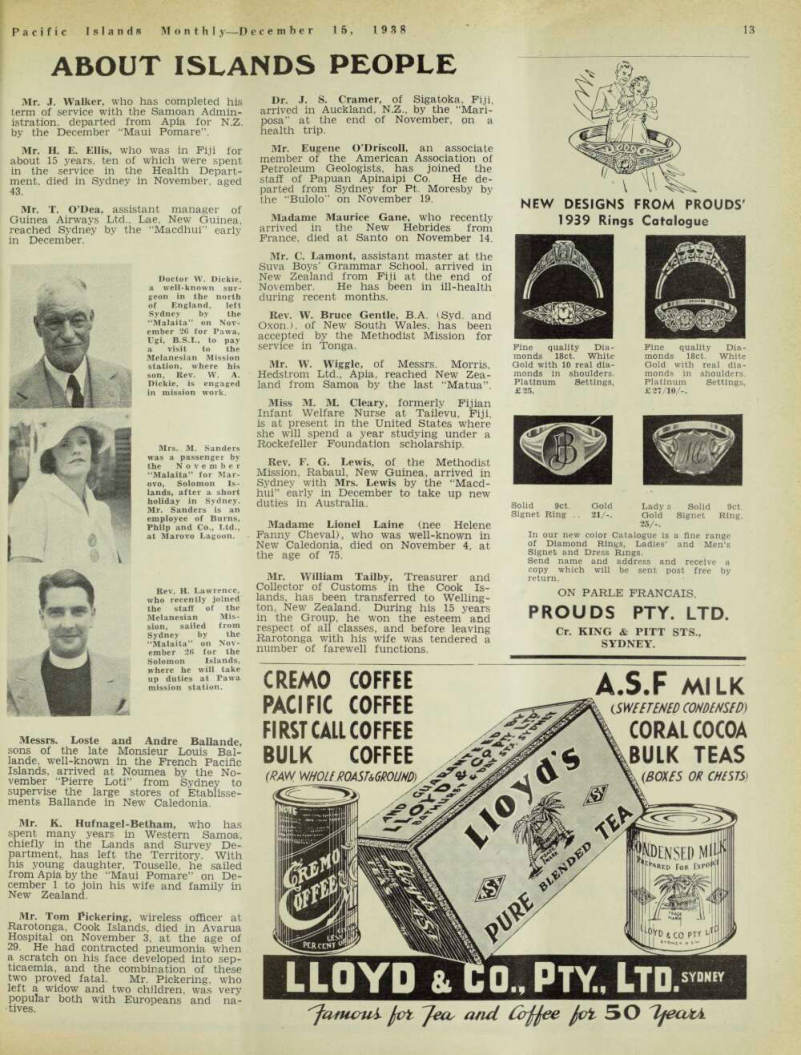
Mr. J. Walker, who has completed his term of service with the Samoan Admin istration. departed from Apia for N.Z. by the December “Maui Pomare”.
Mr. H. E. Ellis, who was in Fiji for about 15 years, ten of which were spent in the service in the Health Depart ment. died in Sydney in November, aged 43.
Mr. T. O’Dea, assistant manager of Guinea Airways Ltd.. Lae. New Guinea, reached Sydney by the “Macdhui” early in December.
Messrs. Loste and Andre Ballande, sons of the late Monsieur Louis Bal lande, well-known in the French Pacific Islands, arrived at Noumea by the No vember “Pierre Loti” from Sydney to supervise the large stores of Etablisse ments Ballande in New Caledonia.
Mr. K, Hufnagel-Betham, who has spent many years in Western Samoa, chiefly in the Lands and Survey De partment, has left the Territory. With his young daughter, Touselle, he sailed from Apia by the “Maui Pomare” on De cember 1 to join his wife and family in New Zealand.
Mr. Tom Pickering, wireless officer at Rarotonga. Cook Islands, died in Avarua Hospital on November 3, at the age of 29. He had contracted pneumonia when a scratch on his face developed into sep ticaemia, and the combination of these two proved fatal. Mr. Pickering, who left a widow and two children, was very popular both with Europeans and na tives.
Dr. J. S. Cramer, of Sigatoka, Fiji, arrived in Auckland, N.Z.. by the “Mari posa” at the end of November, on a health trip.
Mr. Eugene O’Driscoll, an associate member of the American Association of Petroleum Geologists, has joined the staff of Papuan Apinaipi Co. He de parted from Sydney for Pt. Moresby by the “Bulolo” on November 19.
Madame Maurice Gane, who recently arrived in the New Hebrides from France, died at Santo on November 14.
Mr. C. Lament, assistant master at the Suva Boys’ Grammar School, arrived in New Zealand from Fiji at the end of November. He has been in ill-health during recent months.
Rev. W. Bruce Gentle, B.A. (Syd. and Oxon.). of New South Wales, has been accepted by the Methodist Mission for service in Tonga.
Mr. W. Wiggle, of Messrs. Morris, Hedstrom Ltd., Apia, reached New Zea land from Samoa by the last “Matua”.
Miss M. M. Cleary, formerly Fijian Infant Welfare Nurse at Tailevu, Fiji, is at present in the United States where she will spend a year studying under a Rockefeller Foundation scholarship.
Rev. F. G. Lewis, of the Methodist Mission, Rabaul, New Guinea, arrived in Sydney with Mrs. Lewis by the “Macd hui” early in December to take up new duties in Australia.
Madame Lionel Laine (nee Helene Fanny Cheval), who was well-known in New Caledonia, died on November 4, at the age of 75.
Mr. William Tailby, Treasurer and Collector of Customs in the Cook Is lands, has been transferred to Welling ton, New Zealand. During his 15 years in the Group, he won the esteem and respect of all classes, and before leaving Rarotonga with his wife was tendered a number of farewell functions.
Doctor W. Dickie, a well-known sur geon in the north of England, left Sydney by the “Malaita” on Nov ember 26 for Pawa, Ugi, B.S.I., to pay a visit to the Melanesian Mission station, where his son, Rev. W. A.
Dickie, is engaged in mission work.
Mrs. M. Sanders was a passenger by the November “Malaita” for Mar ovo, Solomon Is lands, after a short holiday in Sydney.
Mr. Sanders is an employee of Burns, Philp and Co., Ltd., at Marovo Lagoon.
Rev. H. Lawrence, who recently joined the staff of the Melanesian Mis sion, sailed from Sydney by the “Malaita” on Nov ember 26 for the Solomon Islands, where he will take up duties at Pawa mission station.
Advertisements & other items, p. 15 (2 items)
13
Pacific islands Mont HI y—D ecember 16, 19 3 8
pty. ltd.
NEW DESIGNS FROM PROUDS'
1939 Rings Catalogue
■o* Pine quality Diamonds 18ct. White Gold with 10 real diamonds in shoulders.
Platinum Settings, £25.
Pine quality Diamonds 18ct. White Gold with real diamonds in shoulders.
Platinum Settings, £27/10/-.
Solid 9ct. Gold Lady s Solid Oct.
Signet Ring . . 21/-. Gold Signet Ring, 25/-.
In our new color Catalogue is a fine range of Diamond Rings, Ladies’ and Men’s Signet and Dress Rings.
Send name and address and receive a copy which will be sent post free by return.
ON PARLE FRANCAIS.
PROUDS PTY. LTD.
Cr. KING & PITT STS.,
SYDNEY.
CREMO COFFEE
PACIFIC COFFEE
FIRST CALL COFFEE
BULK COFFEE
(RA W NMOLE ROAShGHO
A.S.F MILK
(SWEETENED CONDENSED)
CORAL COCOA
BULK TEAS
(BOXES OR CHESTS}
a * o is O V •V V Mdensed If' £ ''Red For
OYD
PTY
pty. ltd.
SYDNEY
'famous fot feu and Coffee 50
Ambrym Natives Fear
Volcano
IT is reported in Sydney that natives on the island of Ambrym, in the New Hebrides, fearing a sudden eruption, have set a day and night watch near the crater of a volcano to warn the villagers below of danger from the lava flood.
Mr. D. Ferris, a Seventh Day Adventist missionary, in seven years has seen several of the eruptions, which are steadily eating up the natives’ land and forcing them to vacate the island. A few months ago, said Mr. Ferris, the volcano erupted at 5 p.m. one day and
by daylight the stream of lava had flow ed 12 miles to the seas. Two native villages in its path disappeared.
Mr. N. Proud, of Enterprise of New Guinea Gold and Petroleum Develop ment N.L., returned to Wau from Aus tralia by airliner in mid-November with his bride.
Mr. J. Costelloe, Assistant District Of ficer in the Morobe region, arrived in Sydney from New Guinea with his wife by the December “Macdhui”.
Mr. Hulbert, a recent arrival from New Zealand, has joined the staff of the Apia Post Office, Western Samoa.
Advertisements & other items, pp. 16-18 (3 items)
New Policy for N.G. and Papua
(Continued from Page 9).
Mcilrath’S
LEAD IN LOWER PRICES
FOR QUALITY GROCERIES
St. George Fancy Asstd. Meats, 7 oz. 9/9 doz.
St. George Fancy Asstd. Meats, 14 oz 15/6 doz.
I.X.L. Tomato Sauce, 10 oz B£d. bot. 8/3 doz.
Rosa Worcester Sauce, 9oz 6d. bot. 5/9 doz.
Marmite Vegetable Extract, 4oz 1/8 jar 19/9 doz.
Globex Beef Extract, 4oz 1/4 tin 15/9 doz.
Rosa Dripak Prunes, 7lb 3/9 tin 43/6 doz.
Holbrooks Large Queen Olives, soz 1/- bot. 11/9 doz.
Knighthood Red Salmon, 16 oz l/4i tin 15/6 doz.
Samoa Pilchards, soz 4£d. tin 4/3 doz.
Kia-Ora Fruit Cup Cordial, 20 oz 1/6 bot. 17/- doz.
Rosa Pure Garden Honey, 2lb 1/3 tin 14/9 doz.
Selmore Fruit Saline, 16 oz 1/3 tin 14/6 doz.
Flybane Liquid Fly Spray, 16 oz 1/1 bot. 12/6 doz.
Chefol Peanut Oil, Quart tins 3/- tin 35/- doz.
Cerebos Table Salt, li lb 1/3 drum 14/6 doz.
Mcllrath’s Invalid Port, 26 oz 2/6 bot. 29/6 doz.
Mcllrath’s Brown Muscat, 26 oz 2/- bot. 23/6 doz.
All Prices F. 0.8, Sydney. : Cases and Packing Free.
COMPLETE PRICE LISTS AVAILABLE, POST FREE.
McILRATH’S Pty. Ltd.
EXPORT DEPARTMENT
202 PITT STREET - SYDNEY - AUSTRALIA
PT PABST CANNED BEER
Brewed in one of the world's largest and most modern breweries, PABST comes to you in genuine
"KEGLINED" NON-REFILLABLE CANS
two typf* f PABST EXPORT BEER—A Light Lager Beer. iyvu nrw. i PABST OLD TANKARD ALE—An English Type stronger and heavier than Export.
Packed In Cartons containing 24 x 12 oz. cans and sold throughout the Pacific; but in case of any dlfllculty in obtaining supplies, write to:
BOX 1861 K, G.P.0., SYDNEY.
"NO LIGHT CAN STEAL ITS FLAVOUR"
m
k £A J1 o pe Set
they
{torn ned apP e nd rial imP e meat tut at fresh 11» rich the led they
guaran
flavour per pat dcg ree vide pro iced buy TbeV ana cottorn
persoit
per ;\n eat more
Imperial
HOT
MEATS
in
PUDmffip
BEEFSTEA
nett i L You can choose from
7 Varieties,
@ Imperial Beef Steak Pudding. & Steak and Kidney Pudding. @ Chops and Tomato. ® Steak and Tomato. ® Sausages and Tomato. @ Sausages, Spaghetti and Tomato. & Lamb and Green Peas.
lib., fib. and 11b.
CANS
"FITZROY" BRAND LUNCHEON BEEF in OBLONG CANS.
Packed by a Special Process.
"RIVERSTONE" Cr "OX Cx PALM" BRAND TRADE MEATS.
Corned-Boiled & Roast Meats
120z5., 160z5., 240z5., 21b., 31b., 41b., 51b., 61b.
Try also Imperial MANGO & PA PAW CHUTNEY.
Imperial CRUSTLESS CHEDDAR CHEESE.
RIVERSTONE MEAT CO., PTY., LTD.,
5-7 O'CONNELL STREET, SYDNEY. Cables: "IMPERIAL".
Wet rr- V
kNS
v-
Tropical Diseases
Hold No Terrors
—if you use TENAX Daily The germs of Diphtheria, Malaria, Dhobie Itch, Tinea and Surfer’s Foot, cannot harm you if you are protected by the rich "Ti-trol'’ later of TENAX.
TENAX contains "Ti-trol," eleven times quicker than carbolic as a germicide, but
NON-POISONOUS and NON-IRRITANT.
A PRODUCT OF AUSTRALIAN SOAPS
LIMITED
GUARD AGAINST
INFECTION Sy Muiq
TENAX
Otu. C/muueeoj ■
TOILET SOAP
“FAIRHOLME”, Mountain School for Girls
VA m* i ; *l§ -s Aerial View of Grounds and Buildings.
PRESBYTERIAN GIRLS’ COLLEGE, TOOWOOMBA, Q’LAND.
2,000 feet above sea level. Unrivalled Climate. Academic, Home Science and Commercial Courses. Tennis, Swimming, Organised Games.
Next term commences Ist February, 1939.
Principal: Miss D. E. CULPIN, B.A.
For Prospectus apply Secretary:-R. T. PHELPS, F.A.A., TOOWOOMBA, QLD.
15
Pacific Islands Monthl y—D ccember' 15, 1938
Transpacific?
74-Passenger Plane for Pan- American Airways
ANEW Boeing aeroplane, with four engines, capable of carrying 74 pass engers, was delivered to Pan-Ameri can Airways in San Francisco on De cember 9.
It was reported unofficially that “this plane may be used in 1939 between Honolulu and New Zealand—and pos sibly, between Honolulu and Sydney, in co-operation with the British Govern ment”.
P.A.A. declined to make any state ment. To understand the position, re ference should be made to the article printed on page 40.
Mr. Harold Gatty, Pan-American Air ways representative in New Zealand, was in Sydney in December, but h£ made no statement. There are indications, however, of interesting developments which may taring Pan-American Airways closer to the American Government and closer to British aviation interests. It seems certain that, eventually, Britain and the United States will provide for their Trans-Atlantic aviation needs by a policy of friendly co-operation.
No Beer Boycott
Letter to the Editor I HAVE read, with interest and indigna tion. an article in your issue of Octo ber headed “Beer Boycott”, and I feel incensed at the inaccuracies of your statement.
I am a financial member of the New Guinea Mining Association, and I have attended every meeting. There never has been any mention at any of these meet ings of boycotting the W. R. Carpenter & Co., Ltd., interests and activities in Waii. How you arrive at this and other totally erroneous conclusions, is beyond my comprehension, and I can only con clude that your source of information is prejudiced, or extremely badly informed.
True, there has been some talk of a boy cott of the hotels at Wau in unofficial circles, due to indignation against cer tain interests operating on the goldfields.
But the New Guinea Mining Association has issued no directions to its members as to their actions regarding same.
In common with the majority of gold fields residents, I feel that in fairness to our Association, this mis-statement on your part must be given publication.
I am, etc.,
James Wright.
Wpu, N.G. 19/11/’3B.
EDITORIAL NOTE: Mr. Wright's statement certainly is surprising. Accord ing to reports published in Australian newspapers, apparently from several sources, it appeared that the Mining Association conducted for several days, a very lively boycott of certain interests.
We are glad to have this assurance that the situation was not as • represented— it did not reflect creditably on the Wau community.
Mrs. Chas. Bentley, of Suva, left Syd ney for Fiji by the November “Niag ara” after a trip to Europe. She spent some time at Sydney visiting her niece.
Mrs. Allen Junes.
Mr. Max Harris, of the clerical staff of A. H. Bunting and Co., Samarai, re turned to Panua after three months’ furlough in Sydney, by the December “Macdhui”.
Mr. D. W. D. Maxwell, of the Fiji Government Medical Department, is at present in the United Kingdom on leave.
Advertisements & other items, pp. 18-19 (3 items)
16
Pacific Islands Month! y—D ecember 15, 1938
17
Pacific Islands Monthl y—D ecember 15, 1938
Bidomak
Greatest Offer ever made to Sufferers from
Tropical Lassitude
LACK OF CONFIDENCE . . . HEADACHES . . . NERVOUS INDIGESTION . . . SLEEPNESSNESS . . . LISTLESSNESS . . . ANAEMIA . . . NERVE PAINS AND OTHER SIMILAR
NERVOUS AND CONSTITUTIONAL WEAKNESSES.
No Benefit No Pay Guarantee
by Discoverer of
BIDOMAK
Simply
go to any Chemist or store and buy a
bottle of—
Overcome the Depressing
After Effects of - - -
MALARIA
BIDOMAK re-charges and re-vitalises the whole system with life-giving oxygen, it improves the activity of every gland and organ in the body, and is essential for full recovery from the after-effects of Malaria.
MONEY-BACK TRIAL OFFER
So certain are we that you will notice these benefits quickly, that we guarantee to refund your money if BIDOMAK does not benefit you and you return the nearly-empty bottle to the distributors within 14 days. Nothing could be fairer than that.
BIDOMAK
The Tonic of the Century.
Get a bottle of BIDOMAK to-day, take it as directed and be well.
Use this as directed and if you have not begun to feel the benefit within 14 days, return the nearly empty bottle to the Distributors, and your money will be refunded without question.
This amazing guarantee of Benefit or Money Back is given by the discoverer of Bidomak, because he that Bidomak will give you real benefit If you take it in accordance with his simple directions.
Bidomak provides a method of supplying energy to the cells of the body wherever the natural supply of vitality is insufficient to maintain the normal activity of glands and organs. It provides vital mineral elements. It is a scientific compound of certain vital mineral elements which are lacking in the average modern diet, and which include ferrum, calcium, sodium, potassium, phosphates, glycero-phosphates, sucrose, as well as other necessary elements.
These are the cell foods which are vitally necessary for the blood to build up and maintain the cells and tissues of the body by activating and rejuvenating the cells —which banish the infirmities due to nerves and constitutional weaknesses.
BIDOMAK restores vital energy and gives back youthful enthusiasm to those who have been ill. It makes old arteries young again—it tones up vital organs which have become sluggish—it is winning back for thousands the zest for life the thrill of popularity and the enthusiasm of wonderful health and good spirits.
I
CV&P
BIDOMAK
THE TONIC OF THE mim-for Nerves Brain and
Get a
bottle of
BIDOMAK
to-day—
At all
Stores.
New Administrator

Greeted In Nauru
Prom a Special Correspondent
Nauru, Nov. 14.
HIS Honour Lieut.-Colonel F. R.
Chalmers, C.M.G., D. 5.0., of St.
Helens, Tasmania, having taken over the office of Administrator from his pre decessor, Commander Garsia, R.A.N. (ret’d.) at Canberra, arrived with his wife and four daughters on the island by the M.V. “Triadic”, via Ocean Is land, on November 9.
There was a large attendance of Eu ropeans and natives at Boat Harbour, where His Honour was met by all the officials of the Administration, as well as the executive staff of the British Phos phate Commission at Nauru; and Mrs.
Chalmers by the wives of the European staff of the Administration. Detach ments of native police. Boy Scouts and Girl Guides paraded and were inspected by His Honour on arrival.
Lieut.-Colonel and Mrs. Chalmers met the European inhabitants of the island at an “At Home” as the residency, on Saturday afternoon, November 12.
Rt. Rev. Leonard S. Kempthorne, Bishop in Polynesia, left Fiji in mid-No vember by the “Larchbank” to visit the Tongan Group.
Mr. J. Merriman has joined the mech anical staff of the “Rabaul Times”. New Guinea, replacing Mr. A. McGowan, who recently left Rabaul for Queensland.
Nurse E. M. McKindlay reached Sydney from Fiji by the November “Niagara” to spend a year’s leave in Australia. She is attached to the staff of the Methodist Mission’s Hospital at Ba.
Woodpile?
Nigger In The Unification
Papua Suspects New Guinea Goldfield of Dark and Dirty Designs
Contributed By A Papua Resident
THE project of amalgamation of Papua with the Mandated Terri tory, after being turned down twice, has appeared again. And this time we are told that it is official.
It comes supported by two rather specious arguments. The first is that, as a new capital has to be provided for New Guinea, a great deal of money would be saved by making Port Mores by the capital; but that, as P.M. is in Papua, amalgamation would be neces sary before this could be done.
The second argument is that, since Hitler is anxious for the return of New Guinea, and as his winning personality seems to gain for him everything that he asks, there is danger that Papua’s twin sister may be torn from her and given oyer to Totalitarianism. To pre vent this, N.G. should be incorporated with Papua, which, being a purely Aus tralian colony, is safe from Hitler’s pre datory claws.
These arguments may sound convinc ing to politicians and others who know little and care less about facts and con ditions. But they are so wide open to criticism that old hands begin to look sceptically for the nigger in the wood pile.
He’s there, all right. The nigger is labour.
Native labour is becoming scarce in N.G. The biggest employer of labour is Gold; and, for some time past, Gold has found difficulty in attracting enough la bour. A year or two ago an attempt was made to obtain labour from Papua.
The attempt failed, because Papua has no great surplus of potential labourers; and also because the Papuan Adminis tration was not willing to permit the em ployment of Papuans in conditions which it was not able to control.
Java was the next objective. But Javanese labour, though plentiful, is not inexhaustible. The Netherlands have a vast programme of expansion and development in Netherlands New Guinea and Sumatra: and it is expected that the whole of the visible labour supply will be absorbed. Consequently, the emigration of Javanese labourers is pro hibited except to countries where the traffic is established by custom.
Reference to the report of the New Guinea Planters’ Association for 1937-8 reveals the fact that “a serious short age of native labour is becoming mani fest throughout the Territory”. The re port points out that the number of
labourers employed in various industries has increased by 55 per cent, in the last five years, and states that the question of imported labour must be considered by the Commonwealth Government.
So the thoughts of Gold turned again to Papua. Amalgamation would bring all labour in Papua and New Guinea under one control. That done, there could be no objection to Papuans work ing for wages on the New Guinea goldfields. Hence the present talk of amalgamation.
BUT the comfort and peace of mind of one industry will not compensate for the many evils that must accom pany such a move.
We are told that it would be a much more economical arrangement. But would it? And we are told in the same breath that Civil Service salaries would be higher, and that better men would be attracted to it; which looks like an undeserved slur on two hard working services.
The Gold Companies, of course, are rich. They must have labour. They can afford to pay a rate of wages, and to give working and housing conditions, that no plantation or other industry could even consider. Papua is sparsely popu lated. Even the uncontrolled area of which we have heard such amazing things with regard to its density of population, proves to be but thinly peopled. Already, with the help of the oil-seeking companies, something like 90 per cent, of the estimated available sup ply has been absorbed. If the New Guinea goldfields are permitted to sat isfy their needs from Papua’s meagre resources, then somebody must go short.
That “somebody” will be, in the first instance, the coconut planter. The rub ber planter’s turn will come next; and soon every plantation in Papua will be starved out of existence. Once strangled, the planting industry is not likely to be revived; and agriculture, which is gen erally recognised as the mainstay of any country, must die in order that gold, an ephemeral product, may profit for a few years.
AS to any gain that is to be looked for in administrative method, there seems no likelihood, and but little hope, that such an object would be at tained by amalgamation. Major Furh mann, of Australia House, has just told us that the wise men of Geneva are quite satisfied with the administration of New Guinea; and the administration of Papua is generally accepted as a model by those whose job it is to study such things. So why not leave well alone?
The deeper one looks into the ques tion, the more devastating the project appears; at least, from the Papuan viewpoint.
Of course one may argue that the fittest must survive. And if Papua is not, through her assets and her posi
tion, fitted for survival, she must go under. But there are many who have a genuine affection for Australia’s first colony, and who would be unwilling to see it absorbed by its richer and more populous neighbour.
Although they would probably not ad mit it, old residents in Papua are proud of the admirable work that has been done by the Civil Service in the most trying conditions, and proud of their as sociation with the men who have done it. For years, many of us have critic ised them and quarrelled with them. We have advertised all their faults and sturdily denied their virtues. But through it all we have known that the beloved enemy would go far out of his way to help us in case of need; and we are most unwilling to see them com pulsorily retired on a pension to make room for younger and less experienced men from elsewhere.
An old dog for a hard road. Papua has many problems that have ceased to trouble men who have been dealing with them for years, we have learned that they would trouble extremely the hard boiled politician who looks for a soft and well-paid job as Governor of the com bined territories.
Further, we don’t want our labour laws altered to suit the view of any outside vested interest. After complaining of them for years. But it is certain that they really suit us very well. And we don’t want our land laws altered to con form with the less generous laws of New Guinea. Nor do we want the addea burden of taxation that is almost inev itable if amalgamation should become a fact.
IT seems highly probable that the ma jority of residents in New Guinea are as unwilling as we are to see amal
gamation brought about. The prospect of rich New Guinea having to finance poverty-stricken Papua, and to support a capital city on the wrong side of the mountain range, must be as repugnant to them as are to us any of the changed conditions outlined above.
At least, before the matter is carried any further, the European residents of
both territories should be given an op portunity of expressing their opinion and their wishes. Whatever the preponder ance of public opinion may be, it would surely be as well to know in advance whether the combination of two colonies with differing interests is likely to lead to general satisfaction or to discontent that can end only in disaster.
New Guinea Eager to Escape League Shackles By Gordon Thomas, Editor of “Rabaul Times”.
THIS is an age of mergers more especially in the commercial world.
Big companies with interests of a similar nature are merging, or establish ing combines or tacit understandings of some description, in order to eliminate competition, overhead expenses, or both.
Nations are following their example.
Little wonder, then, that “mergitis” should extend to Australia: and that we hear of the suggested unification of the Administration staffs of New Guinea and Papua, with the possibility of Port Moresby becoming the capital of the United Administrations.
Strangely enough, public opinion in New Guinea does not appear to be op posed to such a union, notwithstanding the fact that in February, 1934, a mo tion was passed in the Legislative Council:— “That the Legislative Council is of opinion that the amalgamation or fed eration of the Territory of New Guinea with the Territory of Papua is not in the best interests of the Territory of New Guinea, and is strongly opposed to any action by the Commonwealth Government which may remove or in terfere with the power of this Council
to legislate in relation to matters af fecting this Territory”.
The speeches by the members left lit tle doubt as to their opinions.
What the feeling is in Papua I cannot say—though it is common knowledge that a certain jealousy exists between the two territories, due possibly to the more prosperous times experienced in New Guinea on the one hand, and the senior political position and more bal anced administration which seem to pre vail in Papua on the other hand.
There are some people in New Guinea who speak of Papua becoming a burden on the more prosperous Mandated Ter ritory. To bear this out, they point to the difference in the surplus of the con solidated revenue accounts of the two territories; that of Papua for the three months ending September 30 was only £52, while New Guinea’s totalled £47,616.
Incidentally, for the same period in 1937 Papua’s was £17,317 and New Guinea’s £73,584. Certainly, an appreciable differ ence. On the other hand, it is more than likely that “overhead” expenses could be cut down in both territories, and the movement is definitely one in the right direction, when such aims as
uniform administration staffs and de fensive measures must be taken into ac count.
The question of the mandate, presum ably, will come up and, perhaps, appear a stumbling block. It is time, though, that there came a show-down of the mandate question, and a change brought about in its legal status, eliminating the League of Nations from its role of Mother-in-law and allow the Fathers— the Allied and Associated Powers—full control and undivided supervision, cast ing off the restrictions which the Lea gue idealistically imposes on countries requiring development in an economic sense, which can go hand in hand with the moral and social evolution of the native inhabitants.
The League’s connection with Man dated Territories has been nothing but an imposition, retarding their normal development, making the task of the Mandatory Powers doubly difficult—re quiring them, to a great extent, to stick their tongues in their cheeks and laud policies which they only half-heartedly approve.
New Guinea —comprising Papua and the Mandated Territory unshackled from the chains of the League, given Federal representation, a strong Admin istrator and a freedom from Canberra interference, would be the grandest country in the world. At any rate, in the* South Seas.
Rev. A. Freund, of the Neuendettelsau Mission Society (Lutheran), returned to his station at Awelkon, Siassi Island, New Guinea, at the end of November, after spending seven months’ leave in South Australia. He was accompanied by Mrs. rxeund.
Advertisements & other items, pp. 20-22 (4 items)
18
Pacific islands Monthl y—D ecember 15, Iy3B
Cine-Kodak
Jf *
is FIRST
ON EVERY COUNT
(•) For Travel Movies. (•) For personal "pictures". ® For living records of Friends or Family. (5) For filming historical events. (S) For full-colour movies in glorious natural colours with Kodachrome.
FREE?
Post Coupon for your copy of the Cine- Kodak Catalogue. Prices from £ll/19/6.
Name Address Of all Cine-Kodak Dealers throughout the Islands and KODAK (Australasia) PTY. LTD. 379 George Street, Sydney. And at Newcastle.
RIGGS & STRATTO
MODEL 300
PRICE - - £24/10/
Briggs & Stratton
AMPUIE
HOME POWER
UNITS
Small, light, compact PetroJ electric generators with everything a car engine has.
“ELECTRICITY”
ANYWHERE—
—ANYTIME
Output 300 watts 12 volts (1) Automatic Starting (2) Air-Cleaner, oil-bath type (3) Petrol Filter (4) Float-feed adjustable Carburettor (5) Magneto Ignition, etc. (6) Automatic Cut-out.
Features 2, 3 and 4 are positively exclusive to Briggs and Stratton. ® For Home Lighting * Battery Charging * Will operate twelve 25 watt Lamps @ Low cost operation Also MODEL 100 (6 volts 100 watts) at £l2/10/- Briggs and Stratton Petrol Motors from J to 5 Horse Power also available
EXCLUSIVE AGENTS:
AMPLION (A'SIA) PTY. LIMITED
66 CLARENCE ST., SYDNEY.
ISLANDS PLANTATION MAN-
AGER, last 2 years managing 25ton copra monthly; good knowledge cocoa, trading, stock, pests and diseases, covercrops, soiltests. machinery, boats, buildings, concrete, plumbing, native labour diseases, books and returns and economy, wants change, with scope for development, on commission if possible. References and integrity.
Reply: ADVERTISER, Pacific Islands Monthly, Box 3408 R, G.P.0., Sydney.
I LIKE MV NEW
Coleman heating IRON
TO USE”.
I
SO SMOOTH—SO EAS*
USE
ECONOMICAL T
o*
ITS
\ y c
SMOOTH THE WAY ON IRONING DAY.
Coleman Irons are self-heating, making their own gas from ordinary petrol.
INSTANT-lighting (no pre-heating)—so no waiting is necessary.
ADVANTAGES;—ECONOMICAL; USE IT
ANYWHERE; PERFECTLY BALANCED;
EASILY REGULATED.
IT IRONS ANYWHERE. No more bending over a hot stove. You can iron on the porch or in the shade of a tree where it's cool! A Coleman Iron will smooth the way with easy work on ironing day.
DISTRIBUTORS IN THE PACIFIC ISLANDS:
All Branches of: Burns, Phllp & Co. Ltd., W. R. Carpenter & Co.
Ltd., Morris, Hedstrom Ltd., Whitten Bros. Ltd., Steamships Trading Co. Ltd., and many other firms throughout the Islands.
19
Pacific Islands Monthl y—D ecember 15, 1938
20
Pacific Islands Monthl y—D ecember 15, 1938
Pacific People
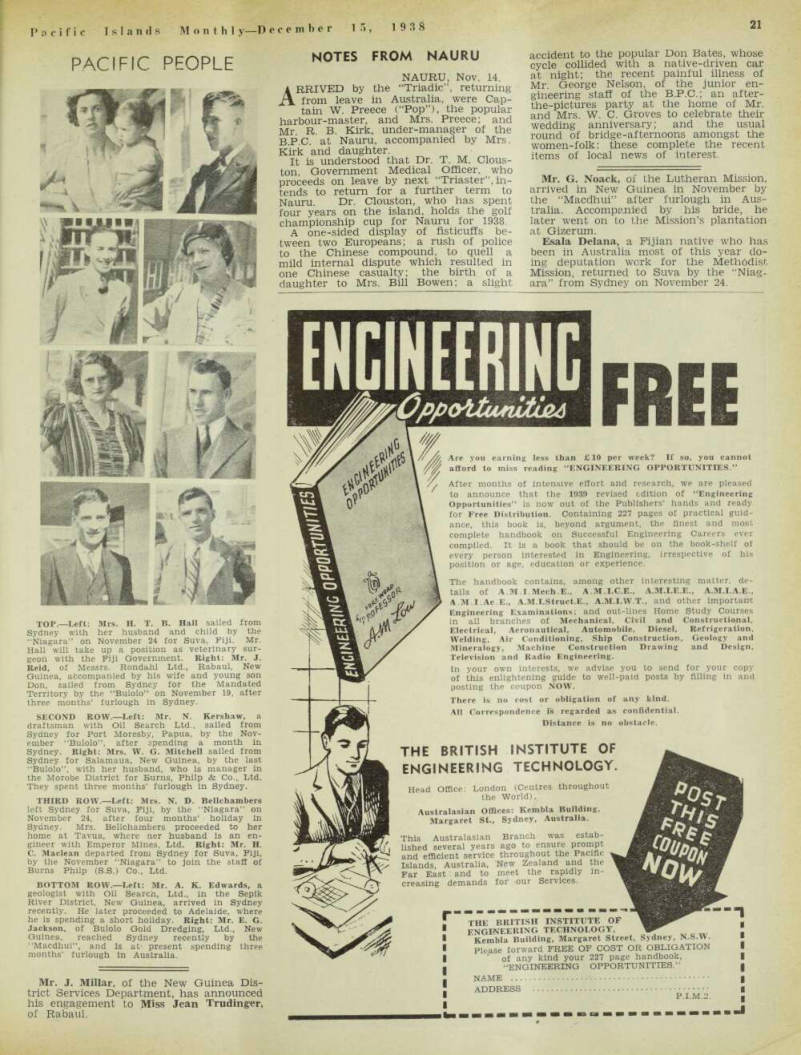
Mr. J. Millar, of the New Guinea Dis trict Services Department, has announced his engagement to Miss Jean Trudinger, of Rabaul.
TOP. —Left: Mrs. H. T. B. Hall sailed from Sydney with her husband and child by the “Niagara” on November 24 for Suva, Fiji. Mr.
Hall will take up a position as veterinary sur geon with the Fiji Government. Right: Mr. J.
Reid, of Messrs. Rondahl Ltd., Rabaul, New Guinea, accompanied by his wife and young son Don, sailed from Sydney for the Mandated Territory by the “Bulolo” on November 19, after three months’ furlough in Sydney.
SECOND ROW.—Left: Mr. N. Kershaw, a draftsman with Oil Search Ltd., sailed from Sydney for Port Moresby, Papua, by the Nov ember “Bulolo”, after spending a month in Sydney. Right: Mrs. W T . G. Mitchell sailed from Sydney for Salamaua, New Guinea, by the last “Bulolo”, with her husband, who is manager in the Morobe District for Burns, Philp & Co., Ltd.
They spent three months’ furlough in Sydney.
THIRD ROW.—Left: Mrs. N. D. Bellchambers left Sydney for Suva, Fiji, by the “Niagara” on November 24, after four months’ holiday in Sydney. Mrs. Bellchambers proceeded to her home at Tavua, where tier husband is an en gineer with Emperor Mines, Ltd. Right: Mr. H.
C. Maclean departed from Sydney for Suva, Fiji, by the November “Niagara” to join the staff of Burns Philp (S.S.) Co., Ltd.
BOTTOM ROW.—Left: Mr. A. K. Edwards, a geologist with Oil Search, Ltd., in the Sepik River District, New Guinea, arrived in Sydney recently. He later proceeded to Adelaide, where he is spending a short holiday. Right: Mr. E. G.
Jackson, of Bulolo Gold Dredging, Ltd., New Guinea, reached Sydney recently by the “Macdhui”, and is at present spending three months’ furlough in Australia.
Notes From Nauru
Nauru, Nov. 14.
ARRIVED by the “Triadic”, returning from leave in Australia, were Cap tain W. Preece (“Pop”), the popular harbour-master, and Mrs. Preece; and Mr R. B. Kirk, under-manager of the B.P.C. at Nauru, accompanied by Mrs.
Kirk and daughter.
It is understood that Dr. T. M. Clous ton, Government Medical Officer, who proceeds on leave by next “Triaster”, in tends to return for a further term to Nauru. Dr. Clouston, who has spent four years on the island, holds the golf championship cup for Nauru for 1938.
A one-sided display of fisticuffs be tween two Europeans: a rush of police to the Chinese compound, to quell a mild internal dispute which resulted in one Chinese casualty: the birth of a daughter to Mrs. Bill Bowen; a slight
accident to the popular Don Bates, whose cycle collided with a native-driven car at night; the recent painful illness of Mr. George Nelson, of the junior en gineering staff of the 8.P.C.; an after the-pictures party at the home of Mr. and Mrs. W. C. Groves to celebrate their wedding anniversary; and the usual round of bridge-afternoons amongst the women-folk: these complete the recent items of local news of interest.
Mr. G. Noack, of the Lutheran Mission, arrived in New Guinea in November by the “Macdhui” after furlough in Aus tralia. Accompanied by his bride, he later went on to the Mission’s plantation at Gizerum.
Esala Delana, a Fijian native who has been in Australia most of this year do ing deputation work for the Methodist Mission, returned to Suva by the “Niag ara” from Sydney on November 24.
draughtsman In Landsman!
SV rve^ Depart P ent ’ died in th e Colonial War Memorial Hospital, Suva, in November. Born in Fiji, he had been in the Civil Service since 1924.
Mr, and Mrs ; Edmund Hawnt, of Ra-
of many congratulations from* e< Rabaul
residents in mid-November on the arrival of a son, Roderick Fraser.
T , , Miss J. C. Barton, who is now on furlough after a short term of service at Ba, Fiji, with the Methodist Mission, has notified the Board that owing to W reasons she finds it necessary to eure '
Advertisements & other items, pp. 23-24 (2 items)
21
Pacific Islands Mon t h 1 y—D ecember 15, 1938
Oppo'Ltamti&A
m 0? /To* tTc.5 ay Are j’ou earning less than £lO per week? If so, you cannot afford to miss reading “ENGINEERING OPPORTUNITIES.’’
After months of intensive effort and research, we are pleased to announce that the 1939 revised edition of “Engineering Opportunities” is now out of the Publishers’ hands and ready for Free Distribution. Containing 227 pages of practical guidance, this book is, beyond argument, the finest and most complete handbook on Successful Engineering Careers ever compiled. It is a book that should be on the book-shelf of every person interested in Engineering, irrespective of his position or age, education or experience.
The handbook contains, among other interesting matter, details of A M I.Mech.E., A.M.1.C.E., A.M.1.E.E., A.M.1.A.E., A.M.I.Ae.E., A.M.l.Struct.E., A.M.1.W.T., and other important Engineering Examinations; and out-lines Home Study Courses in all branches of Mechanical, Civil and Constructional, Electrical, Aeronautical, Automobile, Diesel, Refrigeration, Welding. Air Conditioning, Ship Construction, Geology and Mineralogy. Machine Construction Drawing and Design, Television and Radio Engineering.
In your own interests, we advise you to send for your copy of this enlightening guide to well-paid posts by filling in and posting the coupon NOW.
There is no cost or obligation of any kind.
All Correspondence is regarded as confidential.
Distance is no obstacle.
THE BRITISH INSTITUTE OF
ENGINEERING TECHNOLOGY.
Head Office: London (Centres throughout the World).
Australasian Offices: Kembla Building, Margaret St., Sydney, Australia.
This Australasian Branch was established several years ago to ensure prompt and efficient service throughout the Pacific Islands, Australia, New Zealand and the Far East and to meet the rapidly increasing demands for our Services.
THE BRITISH INSTITUTE OF
ENGINEERING TECHNOLOGY
Kembla Building, Margaret Street, Sydney, N.S.W.
Please forward FREE OF COST OR OBLIGATION * of any kind your 227 page handbook,
“ENGINEERING OPPORTUNITIES.”
NAME
ADDRESS
P.1.M.2. -n
Firearm Repairs: “OUR HANDS MAKE GOOD ARMS’. Goods Sent COD
QUALITY FIREARMS.
MY GUARANTEE WITH EVERYTHING 1 SELL.
RELIABLE SHOTGUNS:
V New Shipment of the Famous Hollis] Shot Guns.
No. 35a.—12 Gauge Double Barrel Hammer Gun by Hollis, 30 in. or 32 in. Jessop Steel Barrel, full choke for 2% Cartridges, Cross Bolt, Pistol Stock, weight 7V 2 lb. Price, £ 14/10/-. No. 7a.—12 Gauge Double Barrel Hammerless Gun by Hollis. ’ Specifications as above, weight 7 A lbs. Price, £25. The Handy single barrel 12 gauge shot gun. No. 44.
Harrington & Richardson 12 Gauge Single Barrel Shotgun. Full choke 30 in. or 32 in. Barrels f° r ; Ca f tr^ d ses. Price 60/-. 36 in. Barrel model, with heavy reinforced breech, 80/-. An ideal Knockabout Gun. No. 41.—Iver Johnson single barrel, 12 gauge shotgun, 30 and 32 in Barrel, full choke for 2% Cartridges, weight 6 lbs. Price, 60/-.
All Firearms over 50/- Post Free. Write for Firearm Catalogue. 600 illustrations. 143 ELIZABETH STREET. SYDNEY ’Phone MA 3540 (Near Market Street).
SIL ROHU
»*•(»»* ?\>9 *
Y^*'*So9 e !
'c**S £ .n? ,^ e cSto W A e .< 4 V vV e A ***, ,*0 S V Co>°"'
CHAPMAN & SHERACK
26 Clara Street, Erskineville, N.S.W.
ENGINE MANUFACTURERS FOR THIRTY YEARS
W Islands* n” Paciflc
Subsidy To Burns
h^ PP ?i g o mail services Mr A d Tr b r-v £l2 ’ 6s4 v. Pe £ an u num? ” asked Mr. A. E. Green, who has become the watch-dog of Pacific Territories af fairs in the Australian Parliament The Prime Minister reniieH agreement between the Commonwealth Government and Bums, Philp and Co Ltd. for the maintenance of shipping ser
vices to the Pacific Islands, which ex pired on March 31, 1937, provided for a subsidy payment at the rate of £44 000 per annum, to which the British Solo mon Islands Protectorate contributed £3,000 per annum. The expenditure dur ing 1937-38 was £40,346.
“A further agreement was made with the company, providing for the mainten ance of the services for a period of six years and nine months from April 1 1937. That agreement requires a sub sidy payment at the rate of £44,000 un til December 31, 1938, or until a new vessel is employed in the Papua-New Guinea service, and thereafter the sub sidy is to be at the rate of £52,500 per annum.
“The agreement also provides for a variation of subsidy in the event of vari ations in the rates of wages of the com pany s employees engaged in the main tenance of the services. Under that pro vision, additional payments were made inoo of the Deriod ended June 30, 1938, and an additional subsidy at the rate of £3,250 per annum is being paid from Jffiy i, 1938. The payment of such additional subsidy is to be reviewed in the event of further variations in the rates of wages”.
N.G. Goldfields' Dividend
A PLEASANT surprise for shareholders m New Guinea Goldfields, Limited was received in a circular on Decem ber 7, when it was announced that a divi d|nd of 5% would be paid. As the shares of this company are now, and have been for many months, quoted at about 1/4 each, the dividend is equal to 20% on a recent investment.
The “P.1.M.” takes the opportunity of pointing out, with complacency, that on number of occasions it urged that N.G.G. shares at anything under 1/6 each were well worth the -attention of investors. The company has not been making sensational profits; but it has been making profits sufficient to pay a good return on the present value of its issued capital (which is now 5/- per share, having been written down from 20/- per share).
Tenders for New Guinea Timber
Extended
TENDERS for the purchase of a per mit to cut and remove about 50,000- 000 super feet of Hoop and Klinkii pine and a similar quantity of cedar and other timbers from the Bulolo Valley.
New Guinea, which were to close on December 2. have been extended to March 10, 1939, to permit of those in terested obtaining some knowledge of the conditions that would obtain following the Government’s decision to build the road from Wau to Salamaua. Mr. Harrison.
Minister for Territories, made the an nouncement on November 27.
Mr. Harrison said that the Govern ment intended to adopt a plan of re afforestation in the Bulolo Valley, under which annual plantings would, in the course of 30 to 50 years, re-establish the forest progressively.
Mr. L. Morris, formerly on the staff of Islands Exploration Co. at Madang, New Guinea, has taken up duties at Pt.
Moresby, Papua, as accountant for both Islands Exploration Co. and Australian Petroleum Co.
Advertisements & other items, p. 24 (1 item)
22
Pacific Islands Month! y—D ecember 15, 1938
To Germany
Samoan Attitude
Fear of the Nazi Rule
Prom Our Own Correspondent
Apia, Nov. 28.
OF late, a little Nazi propaganda has been active in the Territory, among Euronesians and natives, who are told that the return of German rule is imminent. This activity is insignificant, however, and has no apparent influence on the mass of the people of the Terri tory.
There are no German business inter ests now in Western Samoa. There are about a dozen German planters, who have leased plantations from the Government, There are only about 20 German white nationals. Though the 1936 census showed nearly 500 German nationals among the Euronesians, the large ma jority of these do not know the German language and have no ties with Ger many.
The question may be asked; What would be the attitude of the population of Western Samoa, native and European, to a proposal to return the Territory to Germany?
It is interesting, in this regard, to re call the spontaneous offer of the Samoan representatives, the Fono of Faipule, during the recent European crisis, to supply a fighting force of 9,000 young Samoans, for service at home or over seas, coupled with an expression of sin cere loyalty to the British flag.
Would Lose Privileges
Those sentiments were quite natural, considering that the New Zealand Gov ernment has granted the natives a large and liberal measure of self-government, which they very probably would lose under the rule of a Totalitarian State.
There is also apprehension as to the religious aspect of a return of Samoa to Germany under Nazi rule. It is feared that the beneficial influence of the mis sionary bodies, unhindered now under the liberal and tolerant New Zealand Admin istration, would be interfered with, and probably be replaced by some kind of Nazi or semi-pagan ideology.
The section which would be hardest hit by a Nazi Administration would be those of mixed blood, numbering over 3 000 Under Germany’s racial policy, this section, now enjoying equal politi cal and economic rights with Europeans, would be discriminated against and lose
their present privileges.
The position may be summarised by saying that Germans, and German-Sa moans, are proud of their German blood; but thev definitely do not want to come under the power of the Nazis In the circumstances, it can be said that practically the whole of the Euro pean and native population of the Ter ritory are strongly opposed to a return to German rule.
The right of self-determination should be applied, not only to German minori ties in Europe, but also to any Territor ies claimed by Germany; and the Sa moans consider that they are neither chattels nor slaves, to be handed over to a new owner or “protector” without being consulted in the matter. A pleb iscite in Western Samoa probably would give a 95 per cent, majority against ces sion to Germany.
Mr. and Mrs. R. V. Kay left Samoa last month. Mr. Kay had completed a three-years’ term as Crown Solicitor and Commissioner of Labour.
Advertisements & other items, pp. 25-26 (3 items)
23
Pacific Islands Month! y—D ecember 15, 193 ft
Nock E Kirby Ltd
MOCK Sr KIRBY LTD
FOR YOUR HOME
eaism&f
with a “JOHNSON”
“Iron-Horse” Generator
Lights twelve
25 watt globes
300 12
WATTS
VOLTS
Why deny yourself the comfort and convenience of Electric Light and Power for your Radio? With a Johnson “Iron Horse” Generator Electric Light actually costs you less than the messy, dangerous, old-fashioned Lamps—for approximately 1/- you can use 3 lights for 3£ hours every night in the week.
Never before has it been possible to offer such real comfort at such small cost. You no longer need to be inconvenienced with the old-style lighting . . . Electric Light, the great boon of to-day's civilisation, is now available quickly and economically—at the touch of a switch the Johnson "Iron Horse" Generator makes pos sible economical Electric Light for your home and build ings, and at the same time provides Power for your Radio and Power for Charging Batteries.
Here are a Few of the more Important Features ; 300 WATTS ... 12 VOLTS . . . Lights 12-25 Watt Globes . ELECTRIC STARTING —just push a button FULL RANGE CONTROL . . Special Built-in Generator —Johnson Iron Horse 4-Cycle Petrol Engine . . .
AUTOMATIC CUT-OUT disconnects when not running Quiet Operation . . Minimum Vibration.
CASH PRICE, with 70 Amp. Battery ex bond Approx, cost per Point for Material Only 12/6. Weight when packed 100 lbs Freight extra. Write for illustrated Iron Horse Generator Folder giving complete specifications. £24/10/.
NOCK e KIRBY LTD
PostalAddnss...m 4lsoY 6.P.0. SYDNEY
The
Modern Refrigeration for the South Sea Islands
ELECTROLUX
KEROSENE OPERATED
REFRIGERATOR
MARVEL
OF
MODERN
SCIENCE
h % : ■ - ?!
I I 11 W - ■
THE
MIRACLE
OF
ICE
FROM
HEAT
THE ELECTROLUX OFFERS economical, modern and completely efficient refrigeration for
ISLANDS* HOMES.
FREEZES CONTINUOUSLY WHILE SMALL LAMP BURNS
Freezing controlled by simply regulating height of flame. Uses only gallon of kerosene per week.
NO PARTS TO GET OUT OF ORDER.
MODEL LKSS
® Capacity 5.5 cubic feet.
MODEL L 22
Capacity 2.2 cubic feet.
MOTORLESS
MODEL L3B
(as illustrated) ® Capacity 4 cubic feet.
GUARANTEED FOR TWO YEARS
Obtainable from ® Write to your Local Distributor for prices and full details.
W. R. Carpenter & Company Ltd.—Sydney and following New Guinea Branches : Rabaul, Salamaua, Wau, Kavieng, Madang, But and Wewak.
Representation in Papua and New Hebrides.
W. R. Carpenter & Coy. (Solomon Is.) Pty. Ltd. —Tulagi, British Solomon Islands.
On Chong & Company Pty. Ltd.—Butaritari, Gilbert & Ellice Islands.
24
Pacific Islands Monthl y—D ecember 15, 1938
The Numerous Princesses Of Tahiti
Explanation of a Curious Social Phenomenon
Letter to the Editor
WHEN— now full 10 years past—the writer came hither seeking (and finding) quiet and retirement after a strenuous career, clear up to man’s al lotted span, he was surprised at the number of Princesses who roamed the streets of Papeete.
The absence of Princes was as re markable. Possibly they hid themselves from public view through modesty. One only he saw—none could fail to see him — Prince Hinoi—for he was a huge man, head and shoulders towering above the tallest on the island, and of gigantic pro portions.
It was natural enough to look into the matter for one’s own satisfaction. It took time, for one met with a very maze of contradictions and there were tomes to be secured and read.
The upshot was truly astonishing. Some —happily not all—based their claims upon the fact that they were the grand nieces of Queen Marau Salmon, the tem porary consort of Pomare V. She had been a Queen for 13 years, and it was claimed that her nieces and grand-nieces and those yet to follow were princesses.
It is as if our English Queen, who was a Bowes-Lyon, bestowed upon all her Bowes-Lyon nieces and grand-nieces yet to come that same high rank; which, as Euclid would express it, is absurd.
Maybe, the temptation was too over powering to be resisted. It was something to be a princess among the swarm here of the gentler sex. Tourists fell to it— especially, one regrets to say, Americans —it was not everyday that one dines and wines with a princess—nothing was too good for such a divinity. Some even ser iously contemplated marriage, bearing off to their far off homes a live princess—to the astonishment and fearsome jealousy of their friends.
As to princes, it was not modesty that accounted for their absence, but plain commonsense. They knew the claim was preposterous. If the women chose to play the game, let them! It really hurt no one save the gullible tourist and if he was such an ignorant fool, let him pay the price.
But, to the writer, it does not appear in that light—it is abusing an honoured title and not “playing the game”. These self-termed princesses should stand on firmer ground. Charm, beauty and oft fine figure are theirs; pretence and affec tation are but sand. Disillusionment is bound to come sooner or later and, with it, contumely and contempt by those de ceived.
This careless handling of European titles was further pressed home to the writer by the abuse of the still higher title of “King”. There was talk —and there still appears to be talk —of one of Queen Pomare’s younger sons as “King of Moorea”. Kingship is synonymous with sovereignty. The sovereignty of Moorea was the Queen’s. If he was “King”, then Moorea had suddenly become a separate State from Tahiti. What he really was is what the first Pomare vainly tried to be come upon Tahiti, the “Paramount Chief” —the leading chief of all. Makini became that on Moorea in Cook’s day; Teriita punui was created that by his mother, the then Tahitian sovereign. He was, if one can coin the word, the Ari’i of the Ari’i rahi, and the lesser Ari’i of Moorea. If
there be a special word it is certainly not file equivalent of “King”, which implies territorial possession.
The Leeward Islands being separate States from Tahiti till the London Treaty of 1888 was abrogated, and France mas tered them with arms, there were rightly both Kings and Queens thereon; but Moorea, since Mahini’s day, has been as it is to-day, an appenage to Tahiti. The misuse of the title is as if Princess Beat rice for long years past the “Governor” of the Isle of Wight (the small appenage to England off its south coast) was
•Queen of the Isle of Wight”. There would be short shrift at Home if such a claim were made by ill-advised corres pondents, much less talk.
It is surely high time that these flag rant perversions of titles should cease; and, if the writer is privileged to aid in some small measure in such good work, he is well repaid for his long and inter esting research.
A thing which he has been long im pressed with is that the (socially) upper grade of Tahitian half-castes have talked and talked to outsiders till they have lost in large measure the basic facts. In con fusing themselves, they confuse their hearers. The writer long suffered, so he knows; and it has taken years of quiet perseverance to sift the wheat from the chaff. It was well worth the trouble, for Tahiti’s past is not inglorious—though it has dark spots and none darker than
those preceding the coming of the white man—despite the novelist, who grows eloquent on “the noble savage” of a dav now passed.
I am, etc.,
W. W. Bolton.
Tahiti, 10/10/’3B. (This subject is also dealt with in a series of letters published on page 38 Ed.).
Mr. B. W. Bramell, former Commis sioner for Native Affairs in Papua, where he served in the Public Service for over 20 years, died recently in Sydney from pneumonia. He was 71 years old. One of his sons, Mr. J. C. Bramell, is a Pa trol Officer in the Papuan Administra tion, and is stationed at Lake Kutubu.
Advertisements & other items, pp. 27-28 (2 items)
25
Pacific Islands Monthl y—D ecember 15, 1938
*
TooM
FLAG
Jktei Tc'ce"
THE KING’S SCHOOL
(PARRAMATTA)
N.S W.
■■■ i : Extensive Modern Additions—New Class Rooms, Laboratories, Dormitories, Modern Swimming Pool.
Vacancies for 1939 Apply, THE HEADMASTER Next Term commences February Bth, 1939.
Sugar, Please!
The British-American Occupation of Canton Is.
From Our Own Correspondent
Honolulu, Nov. 13.
THE publicity which “P.1.M.” has given to the joint British-U.S. occupation of Canton Island, a potential airways island in the Phoenix Group, is bearing interesting fruit. For example: In the May issue, page 14, it was re ported how Captain William Martin, of R.M.S. “Niagara”, obligingly dropped off some food at the island when the Ameri can residents were running low in their supply.
This was a good human-interest story which the U.S. press duly used; but it
annoyed the U.S. departmental employees, who are responsible tor the victualing oi the American outpost on Canton.
But the score was evened. To-day’s mail brings an official note to this correspon dent from the U.S. department, enclos ing the copy of a radio message from the Britishers on Canton to the U.S. authori ties. The message requests the Americans to secure certain lantern spare parts for the Britishers and, of course, to take them along on the next U.S. cruise to the Line Islands in about one month’s time.
But the British message ends; . also 50 pounds of sugar . . .”
With immense official satisfaction this message was passed on to me to-day.
However, my detached viewpoint is that it is a reflection upon both the U.S. and British authorities. Why should the British group appeal to America? Is the British Colonial Office running short of funds? If the Britishers want food, can not it be sent up from Suva? Why can’t both Governments run their respective shows properly, or is America becoming the housekeeper for John Bull’s Pacific paradises?
If this sort of precedent-establishing goes much further, we’ll have the Aleutian islanders appealing for shipments of Fiji oranges, etc.!
Incidentally, both the British trans pacific liners “Aorangi” and “Niagara” have been ordered to stand well off Can ton. This is an insurance company stipu lation. However, both liners continue to drop overboard food, magazines and other “luxuries” in passing the island, north and southbound. The British colonists have a navy whaler, and they sail out and pick up the parcels which are packed in watertight cans. The contents are shared with the Americans, of course.
Nov. 11 In Eastern Papua
From a Special Correspondent
Misima, Nov. 26.
UNDER fine conditions —unusual in cloud-swept Misima —the first out of-doors ceremony ever held on the Island took place at 10.45 a.m. on Armistice Day, when a large proportion of the population flocked to the Govern ment flagstaff to take part in the cere mony organised by the Returned Men of Misima.
In a hollow square formed of returned men, the general public, a choir from the Methodist Mission (Mrs. H. K. Bart lett), and a detachment of armed con stables, a broadcast of the Service from Brisbane was followed. The facility was due to the courtesy of Mr. F. Lee, wire less manager in Misima. Over eleven beautiful wreaths were laid by the peo ple in memory of dear ones who had fallen; and, as the “Last Post’’ rang out through the sunlit silence, it was a very impressive and long-to-be-remem bered moment.
Dr. D. L. Pullen was largely respon sible for the organisation, and Mrs.
Rentoul served a welcome cup of tea at the end of the ceremony to all ladies present.
The ex-soldiers present were: Messrs.
C. Le B. Brown, A. C. Rentoul, A. Le Boutillier. T. Bollinger, W. Munro, W.
Walton, F. Lee, R. A. Rurherfurd. G.
Brett, J. Murphy, E. Whitehouse, W.
Hellaby, P. J. McDonald, and D. L.
Pullen. ' Mr. Chet. Mayfield, dredgemaster of No. 5 dredge, Bulolo, New Guinea, who married Miss Wilde, of Wau, and went on a honeymoon trip to America, is re turning to New Guinea with his wife, this month.
Advertisements & other items, p. 28 (1 item)
26
Pacific Islands Monthl y—D ecember 15, 1938
Bounties For
Planters
Position in New Guinea and Papua
ALTHOUGH liberal bounties for a variety of products grown in Aus tralia’s tropical territories have been provided since 1927, by the Common wealth, planters in Papua and New Guinea (except cocoa producers, in very recent years) have not taken advantage of the offer to any marked extent.
Questions asked by Mr. A. E. Green in Parliament at Canberra in November brought the following replies from the new Minister for Territories (Mr. Har rison) .
Is the Papua and New Guinea Bount ies Act, which provided for the expendi ture of £25,000 per annum on the pro ducts of New Guinea and Papua, in force to December 31, 1938?
The Minister replied: The Papua and New Guinea Bounties Act 1937, makes provision for the payment of bounties on certain produce of manufacture on importation into the Commonwealth for home consumption for a period of ten years from January 1, 1938. The Act does not make any specific annual ap propriation to cover the payment of the bounties.
Do the Estimates for the year 1938-39 provide for an extension of the bounties?
The Minister said that an amount of £2,000 is provided on the Estimates, 1938- 39, to cover the payment of bounties un der the Act.
What are the primary products on which bounties have been paid, and how much has been paid on each item, to the end of the last financial year, for New Guinea and Papua?
The Minister replied: The Papua and New Guinea Bounties Act, 1926-1936, which was in operation for a period of 11 years from January 1, 1927, made provisions for the payment of bounties in a manner similar to that contained in the Papua and New Guinea Bounties Act 1937. From January 1, 1927, to June 30, 1938, the following bounties were paid: New Guinea —Cocoa beans, £11,764; nutmeg, £4. Papua—Cocoa beans, £2O; kapok, £l3; sisal fibre, £4O.
No Treasure
Search On Pacific Island
NO treasure was found by Mr. J. W.
Wray, owner of the Auckland yacht “Ngataki”, on the lonely island of Suwarrow, in the Northern Cook Group, where a call was made recently to test a story of hidden wealth.
When the yacht left Auckland in Aug ust Mr. Wray said that, while he did not place much credence on the tale of a fortune awaiting discovery on Suwarrow, he intended to investigate reports which had come to him. To this end the “Ngataki” carried a number of kauri gum spears and several old German bayonets with which to probe the sands where the treasure was said to be bur ied. After the vessel’s departure, sup port for the belief that some old-time money or jewels had been hidden in the sands was forthcoming from several sources.
The “Ngtataki” arrived at Niue Island on October 31 from Suwarrow and the crew said no treasure had been found.
The “Ngataki” left Niue on November 2 for Vavau, in the Tongan Group.
Advertisements & other items, p. 29 (2 items)
27
Pacific Islands Mon t h 1 y—D ecem b e r 15, 19 3$
They Called M Fmsb Tim
COME ON T/RED TIM
YOU’RE CAST MAN IN,
HEAR THAT? YOUR
'BOY CALLEVMINE TIRED
t/m’. it's awful! he's
ALWAYS TIRED. / DON'T
KNOW WHAT TO DO.
t
iDON'T TAKE ANY
NOTICE OF JOHNNIE, DOT
HE'S JUST FULL OF SPIRITS.
YOU KNOW, HE USED TO EE
LIKE TIM. THE DOCTOR SAID
HE WAS OUTGROWING
'IS STRENGTH AND PUT
HIM ON HORUCKS.
LOOK AT HIM NOW:
/ f Is There o ' Tired Tim in YOUR Home?
Just stop a minute and think of the energy your boy burns up every day!
While you walk —he runs! He’s always on the go —burning up energy —and that energy has to be replaced! If it is not—then he droops into a state of dull, listless tiredness.
Your child needs extra nourishment to give him additional energy. Doctors recommend Horlicks because it supplies just the right amount of extra nourishment. Horlicks builds children up and helps them grow.
Give your child a cupful of Horlicks at bedtime, and another at mid-day. Then you’ll see a wonderful difference in him.
Make yours a Horlicks home from now on—and you’ll give your child real energy you’ll build him up to be a fine sturdy young man.
Ask your chemist or storekeeper to-day for a bottle of Horlicks (14y 2 oz. size costs 3/- in the main towns throughout the British Pacific Islands). orlic *ixejL 73
guards against
NIGHT-STARVATION
Pololo Makes Annual Appearance
in Samoa
From Our Own Correspondent
Apia, Nov. 21.
PALOLO, the mysterious sea worm which appears only once a year on the coasts of certain South Sea Is lands and is a much sought delicacy for natives and Europeans, made its ap pearance in Samoa on Monday and Tuesday, November 14 and 15. Unfortu nately, the supply was not as plentiful as usual, but the small offering was sold by native fishermen in the streets of Apia in record time.
Education And Protection For Fijians
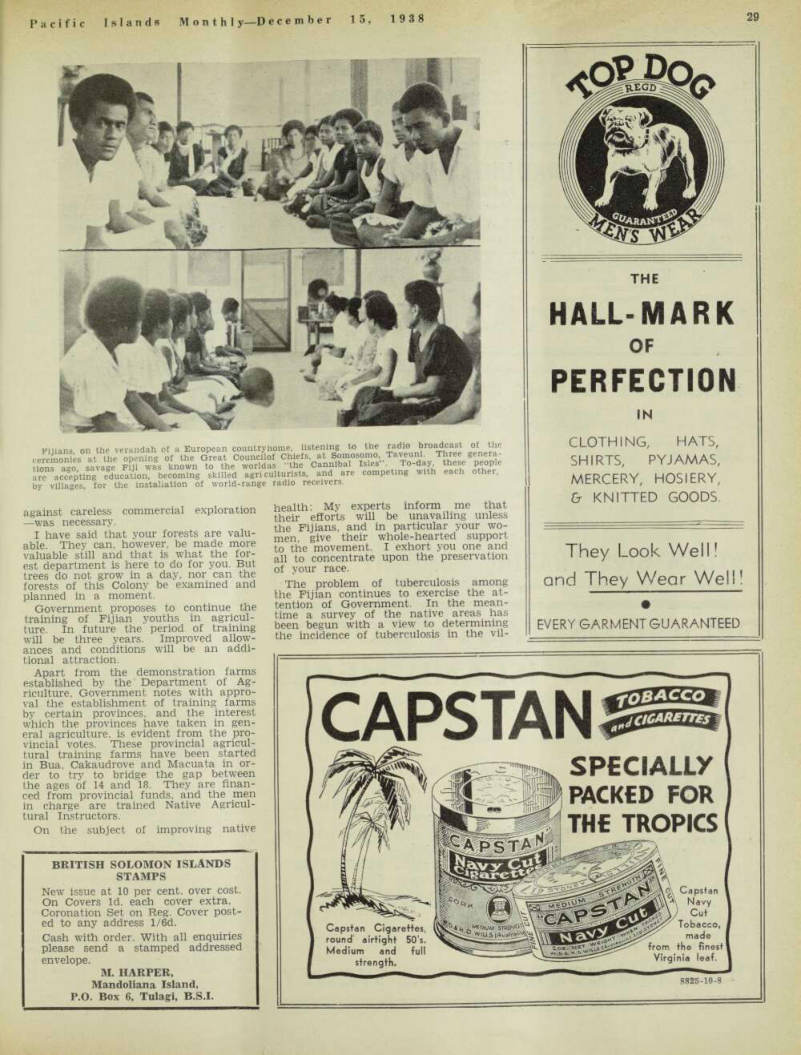
New Governor, Greeted With Picturesque Ceremony, Outlines Official Policy
Picturesque old-time ceremonies marked the first meeting between the new Governor of Fiji, Sir Harry Luke, and the Great Council of Chiefs, which took place at Somosomo, on the island of Taveuni, Fiji Group, at the end of Octo ber. His Excellency received a formal welcome from the natives; and, later, opened the proceedings of the Council in an address in which he dealt with native affairs generally.
OVER 4,000 natives were gathered in Somosomo town (capital of Cakau drove province). There were the customary presentations of tabua
(whale’s tooth), food, and the ceremon ial preparation and presentation of kava, and much native dancing to celebrate the occasion.
When His Excellency came ashore from the motor vessel “Yanawai” there were 1,000 natives crouched respectful and silent on the beach. He was greet ed with a loud “Tama” from the na tives, and then proceeded along a car pet of tapa, which—in one piece—stretched some 300 yards from the beach to the Council house.
The Governor’s address to the natives supplied an admirable summary of the policy of the Government in regard to protection, education and advancement of the Fijian race.
All that he said, and addresses by the Chiefs (some in Fijian, and some in purest Oxford English) was listened to attentively by the great gathering in Somosomo, and —as the proceedings were broadcast by radio —by village gatherings of Fijians throughout the group.
The matter of raising the general standard of native education is receiv ing the consideration of the Government and the Director is taking steps to pro vide a system under which the pupils of the Queen Victoria School will be fitted to pass what are known as the Cambridge Local Examinations or their equivalent, said His Excellency.
I look to you chiefs to encourage parents to ensure the regular attend ance of their children at school so that they may be the better fitted for the higher standards that are now being aimed at.
The matter of raising the age of pri mary school pupils from 14 to 18 years has been fully considered by Govern ment, but no steps can be taken in this direction until an efficient schooling is available for the large majority of child ren from 14 to 16 years. I regret to find that there is a definite lack of properly trained teachers.
You must encourage your young men and women to enter the teaching pro fession, and it is necessary for you to supplement Government grants by pro viding your teachers with houses and gardens.
I am confident that the happiness and prosperity of the vast majority of Fiji ans is dependent upon their being suc cessful agriculturists* and tradesmen; and it is the policy of Government to stress this important fact in the curri culum of all schools.
During April this year the Colonial Sugar Refining Company Limited, open ed at Drasa, in the Lautoka district, its farm school for the training of Fiji an youths in general farming and the cultivation of cane in particular. . . .
After the completion of their training the prospective farmers will be at lib erty to choose whether they will farm sugar-cane (when they will obtain fur ther guidance from the Company) or farm other crops independently of the Company.
The Governor said the conservation of the valuable native forests —especially
against careless commercial exploration —was necessary.
I have said that your forests are valu able. They can, however, be made more valuable still and that is what the for est department is here to do for you. But trees do not grow in a day, nor can the forests of this Colony be examined and planned in a moment.
Government proposes to continue the training of Fijian youths in agricul ture. In future the period of training will be three years. Improved allow ances and conditions will be an addi tional attraction.
Apart from the demonstration farms established by the' Department of Ag riculture. Government notes with appro val the establishment of training farms by certain provinces, and the interest which the provinces have taken in gen eral agriculture, is evident from the pro vincial votes. These provincial agricul tural training farms have been started in Bua, Cakaudrove and Macuata in or der to try to bridge the gap between the ages of 14 and 18. They are finan ced from provincial funds, and the men in charge are trained Native Agricul tural Instructors.
On the subject of improving native
health; My experts inform me that their efforts will be unavailing unless the Fijians, and in particular your wo men, give their whole-hearted support to the movement. I exhort you one and all to concentrate upon the preservation of your race.
The problem of tuberculosis among the Fijian continues to exercise the at tention of Government. In the mean time a survey of the native areas has been begun with a view to determining the incidence of tuberculosis in the vil
Fijians on the verandah of a European country home, listening to the radio broadcast of the ceremonies at the opening of the Great Councilof Chiefs, at Somosomo, Taveunl. Three genera tion ago savage Fiji was known to the worldas “the Cannibal Isles’’ To-day these people are accepting education, becoming skilled agriculturists, and are competing with each other, by villages, for the installation of world-range radio receivers.
lages, and the isolation and treatment of cases is being carried out as far as possible with the existing organisation.
The health of thp Fliinn Vioc % ™ Ki . S FlJ l ar ! ra 9 e has been favourably influenced by the native obstetric nurses, who after training in the hospitals at Suva or Lau-
toka are allocated welfare duties, includ ing obstetrics, in your villages. Assist ed by the improved facilities for edu cating your girls, the Government has decided to establish a school in Suva, where they will receive a more general and more elaborate training than hitherto.
Advertisements & other items, pp. 30-32 (3 items)
famous! FIG
O.SA--
j.queut the Poeitic jreniovs ° U "’ < " ,e hroughout t jich ve We Y 0$ L , h isk Y *‘* h member ; s VJSricrv ctl on, i Hote\ o f D SgSS. *£S5-> rubles'.
WHEN SPENDING YOUR VACATION IN SYDNEY YOUR CHOICE OF RESIDENCE IS A MAHER SO VITAL TO YOUR ENJOYMENT!
May we commend to you for All-round Excellence
SYDNEY'S MOST EXCLUSIVE PRIVATE HOTEL
44 MACLEAY STREET
Here for you await unrivalled Service and Cuisine—Suites with Private Baths— H. & C. Water and Telephones in all rooms—Magnificent Harbour Views Roof Garden Sun Rooms Li wv.
H Spacious Lounges and Smoke Rooms and every modern convenience All under Personal Supervision of the Proprietress,
MISSM. E. BURROWS
il mg* m
TARIFF: From £3/3/-
per week inclusive.
Radios:
'FORTYFOR"
Sydney.
Telephone: FL 2641
29
Pacific Islands Monthl y—D ecember 15, 1938
Perfection
P0 0 ws VJ
THE
HALL-MARK
OF
PERFECTION
IN
CLOTHING, HATS,
SHIRTS, PYJAMAS,
MERCERY, HOSIERY,
& KNITTED GOODS.
They Look Well! and They Wear Well!
EVERY GARMENT GUARANTEED
SPECIALLY
PACKED FOR
wv
ip packed for
. THE TROPICS
mm : Capstan \ Navy / Cut Tobacco, made the finest Inia leaf. & G Capstan Cigarettes, round airtight 50's.
Medium and full strength.
Wills (Aojtfo l, from Virg 8825-10-8
BRITISH SOLOMON ISLANDS
STAMPS
New issue at 10 per cent, over cost.
On Covers Id. each cover extra.
Coronation Set on Reg. Cover posted to any address l/6d.
Cash with order. With all enquiries please send a stamped addressed envelope.
M. HARPER,
Mandoliana Island, P.O. Box 6, Tulagi, 8.5.1.
STEAMSHIPS TRADING COMPANY LTD.
PORT MORESBY PAPUA SAMARAI
Chairman and Managing Director: A. S. FITCH.
Shipowners. Wholesale and Retail Merchants and Traders; Shipping. Customs and Insurance Agents; Copra and Rubber Plantation Owners.
MAIL CONTRACTORS TO COMMONWEALTH AND PAPUAN GOVERNMENTS.
AGENCIES:—At Port Moresby; Coral Sen Insurance Co.; Phoenix Insurance Co.; Delta Sawmills, Ltd,; Acme Bakery Co. ; Vacuum Oil Co. Pty. Ltd. At Samara!: Coral Sea Insurance Co. ; Delta Sawmills, Ltd. : Bankers and Traders’
Insurance Co.; National Mutual Life Insurance Co. ; Kularo Shipyards; Mamai Plantations.
BRANCHES:—In Papua: Hanuabada, Sivitoi, Aroma, Koki, Hula, Ela Beach, Duga Duga, Yule Island.
SYDNEY; NELSON & ROBERTSON PTY. LTD., 12 Spring St.; Melbourne, 396 Flinders Lane; London. E. Whiteaway & Co.. 7 Chiswell Street. Finsbury. London.
Cable Address: “STEAMSHIPS.” Code: Bentley’s.
STEAMSHIPS TRADING COMPANY, LIMITED.
MERCHANTS, SHIPOWNERS AND PLANTERS
PORT MORESBY AND SAMARA I.
Our organisation provides every facility and efficient service as
MANAGING AGENTS AND VISITING REPRESENTATIVES OF
COCONUT AND RUBBER PLANTATIONS
Estates supervised in bearing and planting stages.
Comprehensive reports compiled and regular visits made to Estates by our competent Plantation Inspector.
WRITE, CABLE OR CALL FOR PARTICULARS:
STEAMSHIPS TRADING COMPANY LTD.
DELICIOUS, TASTY FOODS
For ISLAND MEALS
AUNT MARY’S COOKERY
BOOK.
There’s no finer book for every home . . . 212 pages, lavishly illustrated in colour, and over 400 recipes and useful hints make it a book that every housewife will want. Send only one shilling and twopence to
TILLOCK & CO. PTY. LTD.,
Sydney N.S.W., and get your copy of this .great book NOW.
JUST TRY any of AUNT MARY'S Pure Food Products, and you will be back for more . . . delicious In themselves or with innumerable dishes,
AUNT MARY'S BAKING POWDER
AUNT MARY'S TOMATO SAUCE
AUNT MARY'S SPAGHETTI IN TOMATO
SAUCE
AUNT MARY'S BAKED BEANS IN TOMATO
SAUCE
AUNT MARY'S CANNED VEGETABLES
Green Peas, Cauliflower, Celery, etc.
RANEE CURRY POWDER
BLOSSOM HONEY In Attractive Jars Or any of the large variety of Pure Food Products specially packed for Tropical conditions, in Tillock’s Hermetically Sealed 1-lb. tins. All goods are procurable from your local
TILLOCK & CO. PTY. LTD., SYDNEY.
Isle Of Rotuma
Curious Place in Central Polynesian History
From Our Own Correspondent
Papeete, Nov. 19.
THE little island of Rotuma, north of Fiji Archipelago, was at one time closely allied to the islands of Cen tral Polynesia.
The legends and traditions which, in the woof and warp of metaphor and mystical allegory interweave threads of the race, make repeated reference to that faraway isle.
The writer was honoured with the in timate friendship of a venerable scholar, a member of the Opoa clan of Ra’iatea, who passed away 10 years ago at the age of 94. Every now and again, as he recited the ancient poetry, there would be mention of Rotuma. and of heroes who came thence to the Leeward Is lands. Neither of us could make much out of them; the allusions being too misty and fragmentary.
A fragment rescued by Rev. J. M.
Orsmond, tells of a high chief named Te Fatu who, at a remote period, came from Rotuma to Bora Bora, where he married a princess of that island. To gether, they voyaged from island group to island group, negotiating alliances which were consolidated into the con federation of Te-Ao-Uri and Te-Ao-Tea. centred in Opoa, in Ra’iatea.
Such distant places as Rotuma and New Zealand are included in the roster of members of the confederation, but no mention is made of Samoa or Hawaii, although it is certain that voyages were made from Hawaii to the southern is lands. presumably at the times of the great convocations of the alliance—held at stated occasions at Opoa—until the time of the quarrel between Te-Ao-Tea and Te-Ao-Uri, at Opoa. which broke up the confederation early in the four teenth century.
All this implies that, distant though it was, and separated far from the other island groups, Rotuma was a place of great importance and its chiefs held high rank in the Councils of the confed eration.
It would be interesting to know the fountainhead whence flowed the mana that gave precedence to this remote, in significant island: assured unquestioned acceptance of a wanderer who bore a divine name no high chief of Central Polynesia dared assume; and sanctified the Marae Fare-Ura, constructed on Bora Bora, as a great national temple by virtue of its corner stone, brought from the principal Marae of Rotuma by Te- Fatu.
The remnants of ancient lore surviv ing in Central Polynesia give no clue.
Perhaps some hoary legend or fragment of archaic poetry, now reposing in the mind of an ancient in Rotuma itself, might enlighten us.
Mr. and Mrs. B. P. Jones left Sydney for Rabaul. New Guinea, by the Novem ber “Bulolo”, after spending three months’ holiday in Sydney. He is man ager of the Rabaul Carrying Company.
Mr. J. D. Hathaway, a former resident of Fiji, died in Auckland, New Zealand, recently at the age of 82. Before he re tired and left Fiji in 1912, he was for many years a member of the staff of Millar. Headdey and Co., of Levuka, and, later, Morris, Hedstrom, Ltd.
Advertisements & other items, p. 32 (1 item)
Pacific Islands Monthl y—D ecemher 15, 1938
Charged
Abuse Of Natives
Measles Epidemic in T.N.G.
Letter to the Editor I WAS surprised to read in your issue of November 15, 1938, a letter headed “Unused Native Land in New Guinea”. I was not surprised at the tone taken by your correspondent, which is symptomatic, but that you should have published and so headlined the let ter without first ascertaining the facts.
The land being seized was not “un used”, as you suggest. It is heavily planted with coconut trees and food gar dens, and on the area marked out were two copra kilns and many native dwell ing houses belonging to the people of Karavia and Ratavul. Had they been evicted, as was evidently intended, they would have starved, with the many famil ies of eruption refugees who are living with them.
After futile complaints to the District Services Department, the natives took the only defence measure open to them, that of pulling out the survey pegs. This measure was not “inspired” by any Eu ropean. but was agreed to after a meet ing of chiefs and elders. For this ac tion some seventy odd natives were charged and heavily fined by the De partment of Native Affairs. One man was assaulted on his own ground by a Government official.
The natives thereupon drew up a peti tion signed by 582 native men and wo men pointing out that this land repres ents their sole means of livelihood, and that it had been planted up originally with coconuts by their parents under the advice of the German Governor, Dr.
Hahl. One copy of this petition went to the Acting Administrator and one copy to the Prime Minister of Austra lia. On representations made by myself the savage fines were reduced by 80 and 90 per cent. Canberra has promised an inquiry.
Your correspondent states that “tens of thousands” of acres in this district are lying idle. Where? No one else knows of it. He also says that there are areas of bearing coconuts in the vicinity without owners. Again I ask, where? The natives of the district have never heard of these coconuts.
Your correspondent refers to the worthy purpose of erecting a native hos pital. The natives point out that this hospital can be better established on nearby European plantation land, with out the need for dispossessing or starving anyone.
It seems strange that this solicitude for native health has not taken more
practical form in attempting to halt the terrible measles epidemic that for months has been sweeping through the villages, taking an enormous toll of life. One had hoped that prompt measures would have been taken to quarantine the sufferers at the beginning.
In conclusion, as an old Fleet Street man, I protest against any reputable journal publicly accusing another of “lies and exaggeration”, without taking reas onable pains to ascertain the full facts’’.
I am, etc.,
Thomas Valentine Wallace.
New Britain. December 1, 1938.
The Polynesian Club
THE guest of honour at the Polynesian Club’s gathering on November 22 was a young Tongan theological student, Paula Kongaika, a kinsman of the Queen of Tonga. He since has returned to Tonga, after representing his country at the World Methodist Conference in Melbourne. Among Islands visitors were: Mrs. Lembcke, niece of the Fa’atonu, Taisi (O. F. Nelson) of Samoa; Miss Mann, of Tonga; Mrs. Lamacraft, of Tonga: Mr. and Mrs. Freddy Gosnell,
recent arrivals from Suva; Miss Minna Raynton, of Auckland, whose mother was one of the well known Richelman family, of Tonga; Mrs. Edward Gosnell, who has just returned from a long holi day in Fiji. The Samoan “tauoluga” was danced by the guest of honour, with the chieftainess (Mrs. Missen-Garrett, of Rotuma). Mrs. Gosnell and Mr. Fred.
Gosnell, and Mr. Richard Hahn.
The Polynesian Club will soon feature a new and unusual form of entertain ment, when the members inaugurate their Little Theatre movement. Poly nesian stories and legends will be pre sented in drama form, as well as other kinds of playlet. The first playlets to be presented will be: “The Bitter Taro’’, a legend of Maui and fire-making, written by the president (Mr. Moran); “The Singing Post’’, a Maori story, adapted by Miss L. Waugh; “Dontaro Dono”, a comic interlude from the Japanese.
Mr. W. T. Martin, Assistant Comptrol ler of Customs in Sierra Leone, a British protectorate on the west coast of Africa, has been appointed Comptroller of Cus toms in Fiji in succession to Mr. J. M.
Wilson, who has retired. Mr. Martin is expected to arrive in the Colony in April next.
Advertisements & other items, pp. 33-34 (3 items)
31
Pacific Islands Mon t h 1 y—D ecember 15, 1938
Globite
IT FOLDS AND PACKS
YOUR FROCKS FOR YOU!
In a lightweight, neat-looking Globite Robe Cose you can pack 12 frocks in about 3 minutes. They don't crease or crush. They need no pressing when taken out ... they're fresh and ready to wear.
The dresses are put on the hangers provided—there is no folding to do. Fit the skirts into the crook place the crook in its brackets and replace the cover. It's the easiest and best way to pack all your frocks.
Traders are invited to write for full particulars. FORD SHERINGTON, LTD., Manufacturers, (Wholesale only), Kippax Street, Sydney.
GLOBITE
W. H. GROVE & Sons Ltd.
Islands Traders p.o. box 490 AUCKLAND Telegraphic and Cable Address: “Grove,” Auckland.
Shippers of all classes of New Zealand Products, specially prepared for the Island trade.
Representing R\lands & Sons (Col,) Ltd., of London and Manchester. (Including the famous “Dacca” Mills Products.) Parbun Henty & Co. Pty. Ltd., of Sydney and Kobe.
“AGFA” Photographic Corporation, of Berlin.
J. Blair King, of London. World-famed Shirts.
Burrell & Co. Ltd., Millwall, London, E. 14. Oil, White Lead and all classes of Paints, including “FERROGENE” their special Tropical Paint . . . PREVENTS CORROSION made in RED, GREY, and GREEN. lo o r J m
fry.
'VHi
Photograph with Agfa Isochrom - this is a Film for all types of exposures. It enables you to get the best out of your photographs. Good definition, reproduction of the finest details, brilliant gradation, and high sensitivity. Orthochromatic with wide exposure latitude.
Recor Ds
Packed Free and sent C.O.D. without extra charges.
H.M. Voice Slightly-used Portables, delivered straight to your nearest port for .. .. . , £3/15/-.
Send for Latest Record Lists.
Toikeries Music Stores
451 Queen Victoria Buildings, Sydney
A Samoan Boxer
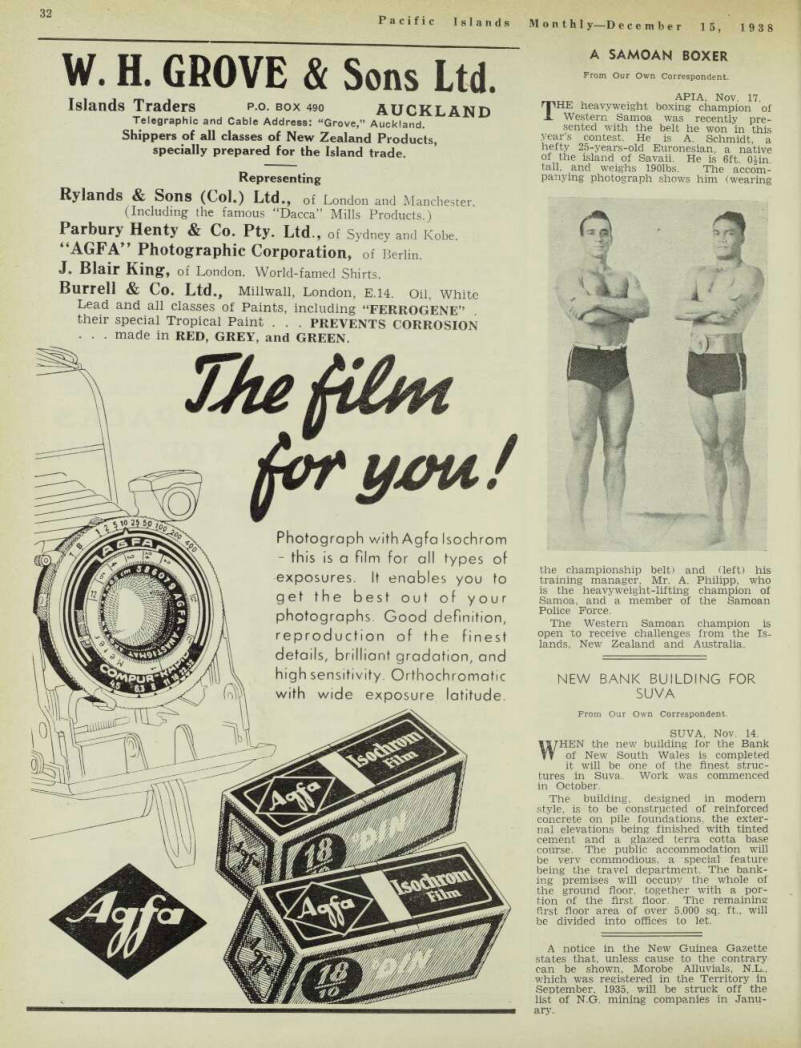
From Our Own Correspondent.
T___ . Apia, Nov. 17.
HE heavyweight boxing champion of Western Samoa was recently pre sented with the belt he won in this year’s contest. He is A. Schmidt, a hefty 25-years-old Euronesian, a native of the island of Savaii. He is 6ft. Oiin tall, and weighs 1901bs. The accom panying photograph shows him (wearing
the championship belt) and (left) his training manager, Mr. A. Philipp, who is the heavyweight-lifting champion of Samoa, and a member of the Samoan Police Force.
The Western Samoan champion is open to receive challenges from the Is lands, New Zealand and Australia.
New Bank Building For
Suva
From Our Own Correspondent.
Suva, Nov. 14.
WHEN the new building for the Bank of New South Wales is completed it will be one of the finest struc tures in Suva. Work was commenced in October.
The building, designed in modern style, is to be constructed of reinforced concrete on pile foundations, the exter nal elevations being finished with tinted cement and a glazed terracotta base course. The public accommodation will be very commodious, a special feature being the travel department. The bank ing premises will occupy the whole of the ground floor, together with a por tion of the first floor. The remaining first floor area of over 5,000 sq. ft., will be divided into offices to let.
A notice in the New Guinea Gazette states that, unless cause to the contrary can be shown, Morobe Alluvials, N.L., which was registered in the Territory in September. 1935, will be struck off the list of N.G. mining companies in Janu ary.
Advertisements & other items, p. 34 (1 item)
32
Pacific Islands Monthl y—D ecember 15, 1938
Nature Of The
Mandates
League Has No Authority to Transfer or Cancel
THERE seems still to be considerable contusion concerning the terms under which the Dominions of Great Britain hold the mandated territories of New Guinea and Western Samoa.
The then Australian Minister for Ter ritories (Mr. Hughes) on November 4, was asked a question about it. He re plied: “The question is similar to one put by the Leader of the Opposition on 14th October last, which was — "Will the Prime Minister state whether the Government subscribes to the sub stance of the statement by the Minister for External Affairs (Mr. Hughes) which appeared in the press of the 10th October, 1938, in reference to the Mandated Ter ritory of New Guinea?’
"The reply given by the Prime Minister was as follows: — " ‘The principle underlying the state ment made by the Minister for Exter nal Affairs is in accord with the views and policy of the Government in connection with the mandate held by Australia.’
"For your information I may add that, summarised, my statement oi 10th Octo ber was to the effect that Australia was given the mandate of New Guinea by the allied and associated powers to whom Germany, under Article 119 of the Ver sailles Peace Treaty, surrendered all its overseas possessions. The surrender was absolute. Our mandate is not limited in time but, subject to one condition, is held as an integral part of the Commonwealth.
The condition is that we are to govern the territory not for the purpose of selfish exploitation, but in the interests of the native population. This condition we have religiously observed. The suggestion that we should relinquish the mandate cannot be seriously entertained. Apart from all else, strategic reasons make this impos sible.”
Mr. Herbert G. Williams, British
M.P., former Parliamentary Secret ary to the British Board of Trade, in an article recently published, said:— "It is believed in many quarters that those Territories (Tanganyika, British Togoland and British Cameroons) as well as the other Mandated Territories con trolled by South Africa, Australia, New Zealand, France, Belgium and Portugal, belong to the League of Nations and that the government of the Territories was en trusted to the respective Mandatory Powers by the League.
“This is a complete delusion.
"The facts of the case are that in Article 119 of the Peace Treaty of Ver sailles Germany renounced all her rights and titles to her overseas possessions in favour of the principal Allied and Associ ated Powers —Belgium, France, Italy, Japan, the United Kingdom and the United States.
"These Powers in turn decided to which countries the various surrendered Ter ritories should be transferred: the trans fer was a permanent one, but was made subject to certain conditions.
“It was laid down that the administra tion of the Territories should be subject to certain restrictions designed to safe guard the natives and designed also to avoid discrimination by the Mandatory
Power against the interests of other nations.
“Many people seem to think that the Mandate is the authority for the control and government of the Territories; it is nothing of the kind, it is merely a list or rules for the purpose of achieving the objects indicated above.
“It was part of the whole scheme that after the transfer of the Territories had been effected the Mandatory Power was to draft the Mandate and to submit it to the League of Nations for approval.
“The process of preparing the Man dates was, in fact, a lengthy process, and in many cases we had been several years in complete control of the Territories before the Mandate was finally settled.” (The first clauses respectively in the Mandates of New Guinea and Western Samoa bear out Mr. Williams’ conten tion. They read:
“Whereas, by Article 119 of the Treaty of Peace with Germany . . . Germany re nounced in favour of the principal Allied and Associated Powers all her rights over her oversea possessions ...” and “whereas the principal Allied and Associated Powers agreed that, in accordance with Article 22, Part 1 (covenant of League of Nations) of the said Treaty, a Mandate should be conferred upon His Britannic Majesty ...” There can be no argument there about the derivation of authority.
The League of Nations did not confer the mandate, and has no power to cancel or transfer it.) Ratu Tiale Vuiyasawa, Roko Tui Ra, has been appointed a member of the Fiji Legislative Council. He fills the vacancy caused by the death of Ratu P.
Veli, Roko Tui Macuata.
Mr. J. N. Marshall, formerly of Oil Search Ltd., Wewak. New Guinea, has joined the staff of Australasian Petro leum Company as commercial superin tendent.
Mr. A. E. Osborne, officer in charge of the Tulagi radio station. British Solomon Islands, reached Sydney on leave with his wife by the last “Malaita”.
Advertisements & other items, pp. 35-36 (2 items)
33
Pacific Islands Mon t h 1 y—D ecember 15, 1938
Hallstrom
The Comforts of Continuous
Refrigeration in South Sea Island
homes, Cost LESS with a
HALLSTROM
Kerosene Operated REFRIGERATOR
'A ■ & Special Islands Model: 10 only does a HALLSTROM cost less in the initial outlay, but for many years to come it will save you money every day. in every way.
A 5 YEAR GUARANTEE Plus
• LOWER PURCHASE COST.
Tremendous sales enable Hallstrom Refrigerators to be sold at a 25% lower price.
GREATER EFFICIENCY AND
ECONOMY WITH CONTINUOUS
REFRIGERATION.
Constant and correct temperature maintained by burning kerosene for ONLY 2 HOURS (approx.) each day in hottest weather.
TROUBLE-FREE SERVICE.
Hallstrom Refrigerators are built to give lifetime service free from service problems.
MORE FOOD STORAGE SPACE.
35% more storage space with maximum efficiency. Capacity: SVz cubic feet. Pood Compartments: 23V 2 in. high, 19% deep, 17% in. wide. Included is a 21 Ice Cube Tray. Cabinet is equipped with sealed, moisture-proof insulation.
Write for particulars to:
Sole Manufacturers;
HALLSTROMS Fly. Ltd.
FOB.
SYDNEY. =
CHEST MODELS
=§ from £2O, f.o.b. Sydney = = Units Only for Other H Makes from £l5 f.o.b. = Sydney. iililllllllllllllllllllllllllllllllllllltlllllllllllllllllllllllllllillllllir Factory; 462 Willoughby Rd., Willoughby, N.S.W Showrooms; 102 Clarence St., Sydney.
LARGEST MANUFACTURERS OF
KEROSENE-OPERATED REFRIGERATORS
IN THE SOUTHERN HEMISPHERE.
WANTED
Regular supplies of Used Pacific Island stamps. All Coronations, Jubilees, Airmails and ordinary issues wanted. Best prices paid. Submit stamps or details to:
W. HORNADGE,
Catherine Hill Bay, N.S.W., Australia.
READ THE
B.P. MAGAZINE
SUMMER NUMBER
Now On Sale Short Stories Pictures Travel Articles Pages for the Children Stage Latest Fashions Screen A
ONE SHILLING PER COPY
ON SALE AT ALL NEWSAGENTS AND BOOKSELLERS BP
Scott’s “Renown” Brand Rope,
Cordage and
Cabla Address: Ropeyard, Sydney a n
Binder
Twine
of Every
Description
MANUFACTURED AT
MASCOT. N.S.W.
J. SCOTT
PTY. LTD.
Head Office and Store:
163 CLARENCE STREET.
SYDNEY
N.S.W.
The Romance Of Bulolo
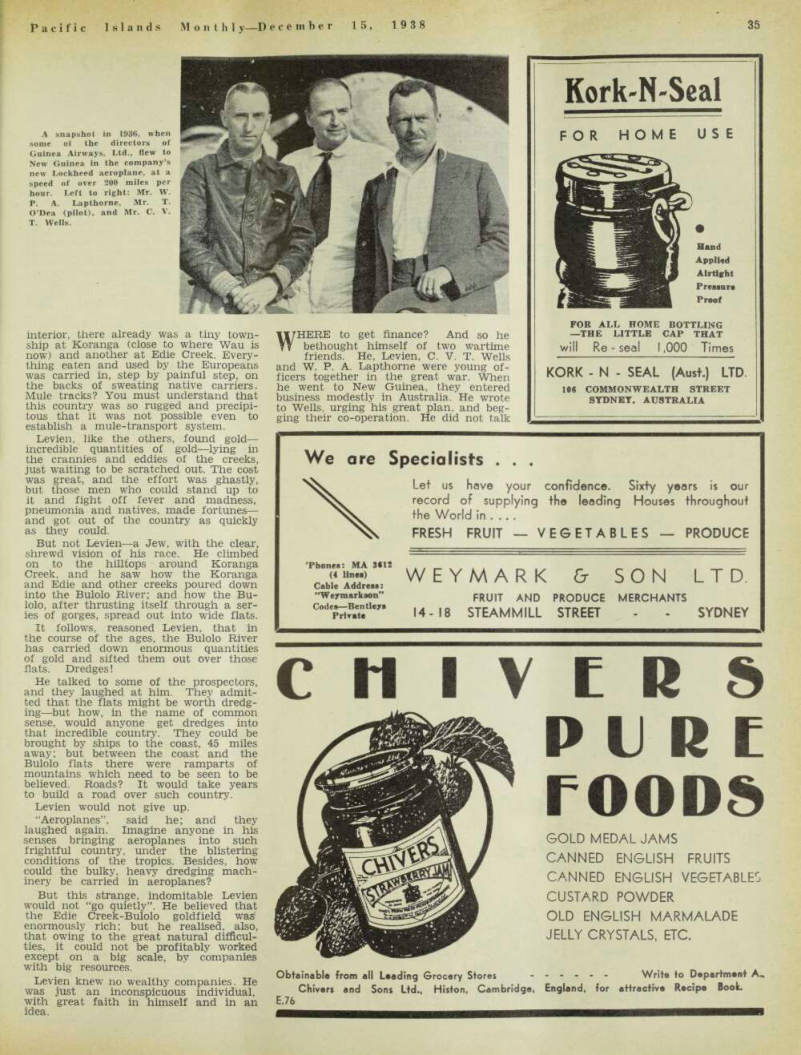
And Some of the Men Who Have Transformed New Guinea
By R. W. Robson
I HAVE before me the annual report of the directors of Bulolo Gold Dredg ing Ltd., dated October 18, 1938.
It is said that nowadays there is no romance in commerce and little, if any. reward for the bold adventurer. I wish others could see the sequence of events which I visualise behind the cold print and prosaic figures of this balance sheet.
Let us first glance at the statistics.
It is shown that Bulolo Gold Dredging, in the year under review, operating six dredges in New Guinea, won gold worth 4,730,000 American dollars. The profit out of that amount, after putting aside 322,600 dollars for amortization, and large sums for other purposes, was 3,453.- 000 dollars. The total subscribed capital is five million dollars, on which they paid a dividend equal to 60 per cent.!
The Amortization Fund (in other words, an insurance for the return of capital when the gold field is worked out) already is 1,420,000 dollars.
What a Golconda! And how did all this happen?
WE find the beginning of the story sitting under a native-built shelter, at a small inlet called Morobe. on the shores of the Huon Gulf, New
Guinea, in the year 1923. He has been listening to news brought to him by primitive natives, who still are stand ing by attentively: but he now is gaz ing thoughtfully out over the misty, sun-drenched sea.
He is Cecil J.
Levien, District Officer at Morobe.
He spoke to the natives again and
questioned them in The late Cecil j. Levie „. a mixture of Pidgin and native dialect. “You say that those white men up there are getting gold?” was the burden of his question. The reply of the natives was emphatically affirma tive.
Levien turned and stared at the gloomy, blue-black mountains towering behind him, already half hidden in the mid-day mists. “I knew it”, he said to himself. “I seem to have known it al ways. There is a great goldfield up there, and Shark-eye and Nettleton have found it. I cannot miss this chance”.
“Sharkeye” Park found the gold in Koranga Creek in 1921, and he and Net tleton followed it up into Edie Creek.
The news trickled out, and in 1922-3 a stream of hard-boiled Australian pros pectors trickled in.
Never did men undertake a more hazardous journey. They were dumped on the beach at Salamaua (a few miles north of Morobe), and then they had to make their way through filthy, ma larious swamps, over mountains of in credible steepness, and through jungles into which the sun never penetrated, and where head-hunters and cannibals were waiting always to pick off the un protected and the unwary.
From Salamaua to Edie Creek is only 50 miles, as the aeroplane now flies; but, in those days, the Australian gold seekers, with their teams of native car riers. found three weeks too short in which to do the frightful journey.
YET, at the end of 1923, when Levien —then a man over 50 —resigned his Government position and followed the first prospectors into the inhospitable
interior, there already was a tiny town ship at Koranga (close to where Wau is now) and another at Edie Creek. Every thing eaten and used by the Europeans was carried in, step by painful step, on the backs of sweating native carriers.
Mule tracks? You must understand that this country was so rugged and precipi tous that it was not possible even to establish a mule-transport system.
Levien, like the others, found gold— incredible quantities of gold—lying in the crannies and eddies of the creeks, just waiting to be scratched out. The cost was great, and the effort was ghastly, but those men who could stand up to it and fight off fever and madness, pneumonia and natives, made fortunes — and got out of the country as quickly as they could.
But not Levien—a Jew, with the clear, shrewd vision of his race. He climbed on to the hilltops around Koranga Creek, and he saw how the Koranga and Edie and other creeks poured down into the Bulolo River; and how the Bu lolo, after thrusting itself through a ser ies of gorges, spread out into wide flats.
It follows, reasoned Levien, that in the course of the ages, the Bulolo River has carried down enormous quantities of gold and sifted them out over those flats. Dredges!
He talked to some of the prospectors, and they laughed at him. They admit ted that the flats might be worth dredg ing—but how, in the name of common sense, would anyone get dredges into that incredible country. They could be brought by ships to the coast, 45 miles away; but between the coast and the Bulolo flats there were ramparts of mountains which need to be seen to be believed. Roads? It would take years to build a road over such country.
Levien would not give up.
“Aeroplanes”, said he; and they laughed again. Imagine anyone in his senses bringing aeroplanes into such frightful country, under the blistering conditions of the tropics. Besides, how could the bulky, heavy dredging mach inery be carried in aeroplanes?
But this strange, indomitable Levien would not “go quietly”. He believed that the Edie Creek-Bulolo goldfield wa£ enormously rich; but he realised, also, that owing to the great natural difficul ties, it could not be profitably worked except on a big scale, by companies with big resources.
Levien knew no wealthy companies. He was just an inconspicuous individual, with great faith in himself and in an idea.
WHERE to get finance? And so he bethought himself of two wartime friends. He, Levien, C. V. T. Wells and W. P. A. Lapthorne were young of ficers together in the great war. When he went to New Guinea, they entered business modestly in Australia. He wrote to Wells, urging his great plan, and beg ging their co-operation. He did not talk
A snapshot in 1936, when some of the directors of Guinea Airways, Ltd., flew to New Guinea in the company’s new Lockheed aeroplane, at a speed of over 200 miles per hour. Left to right; Mr. W.
P. A. Lapthorne, Mr. T.
O’Dea (pilot), and Mr. C. V.
T. Wells.
in hundreds or thousands, but in millions - -figures big enough to scare off most people. But he did not scare Wells and Lapthorne.
It was a heartbreaking task at first.
All the men whom Wells interviewed dismissed him and Levien as dreamers of dreams. Wells was almost in despair, when he was joined by Lapthorne, who also believed in Levien; and then a kind providence brought them into contact with George Jeffrey, of Adelaide an older man. but one with a young heart and a mind capable of appreciating visions. Jeffrey decided to help them. It is a long story—told at some length in lon Idriess’s book, “Gold Dust and Ashes”.
Suffice it to say, here, that Wells, Lapthorne and Jeffrey got behind Levien
in his amazing plan to dig the gold out of the Bulolo flats, amid the mountains of New Guinea, with dredges carried in aeroplanes. Guinea Gold N.L. was form ed, and it took over the leases in the Bulolo Valley. Then came into the pic ture an expert group—Engineer L V Waterhouse, Charles A. Banks, Frank W. Griffin and W. Addison Freeman.
They added technical knowledge to vis ion, and the enterprise began to take shape.
Placer Development Ltd. was formed by Waterhouse and associates to further explore the possibilities. Placer Develop ment formed Bulolo Gold Dredging Co. as an operating company. Guinea Air ways was formed to undertake trans port.
The capital of the group was largely British and Australian, with some Ame rican: but the technique was almost wholly American; and therein, appar ently, lay the secret of phenomenal suc cess.
The whole proposition was most care fully examined, surveyed and calculated.
Dredges were planned to be built in such a way that the heaviest part would not exceed 3i tons (the largest load taken by the largest aeroplane employ ed). Hydro-electric stations were plan
ned to sit astride the swift-rushing streams and supply the dredges and an the European communities to come, wnn light and power. Aerodromes were plan ned in suitable places; a port was plan ned at Lae with a great aerodrome, and aviation work-shops, at the back of it.
Aeroplanes were planned to fly over those hideous mountains with all kinds of loads, in all kinds of weather.
That planning was something about which one might well become lyrical. It was all laid out, step by step, like a vast military campaign. The Bulolo flats were drilled from end to end, so that the engineers knew exactly what each stratum contained', at varying depths.
Certain dredges were to commence work on a certain day, and each dredge was to recover so much gold per week. At a certain date, years hence, a certain dredge would finish working out a cer tain bit of territory, and would be moved to another part of the valley. Costs would be so-and-so, and profits, each year, exactly so-and-so.
AND it all worked. Everything click ed into place, like the last girders in the Sydney Harbour Bridge. See ing that the whole scheme had to be carved out of primitive jungle, and that all necessities, from matches to saw mills, had to be transported by an un tested aeroplane service, this probably is one of the most remarkable gold en terprises in the history of the world — a magnificent achievement in planning and in performance.
It seems to me that, over it all, lies always the shadow of a tragedy. The faith of C. J. Levien literally moved mountains. His genius was the spirit which set this vast development in pro gress—and thus altered the history of New Guinea and, it may be, the history of the Western Pacific. But Levien, worn out by his mighty efforts in the primitive Morobe jungles, died in 1932, just when the magnificent plan was coming into operation and beginning to bear rich fruit.
They say of Wren that St. Paul’s Cathedral is his eternal monument— that he cannot die while that magnifi cent edifice remains. In a more mod est way, the friends of Levien can claim that, while the gold industry is chang ing primitive and inhospitable Morobe into a white man’s country, and while Guinea Gold, N.L., Bulolo Gold Dredging Ltd., Placer Development Ltd., and Guinea Airways Ltd. continue to cut a wide swathe in commerce and finance, the memory of Levien and the visions he cherished will never fade.
So, behind the cold type of this 1938 balance-sheet, there are the colours of romance and the thrill of ad venture. To me, a writer who likes to praise orderliness and achievement, the story of B. G. D. always gives pleasure.
But I wish that Levien had lived to see Wau, and Bulolo, arid Bulwa, and those seven dredges, and the two great hydro electric stations, and that fleet of aero planes, running to a timetable like rail way trains, carrying freight and passen gers all over New Guinea.
LOOKING over the picture, I feel that it is incomplete, unless I bring one figure into greater prominence—that of C. V. T. Wells, of Adelaide. The good Lord knows, it is not easy, for there never was a man so quick and determ ined in dodging the limelight. But the fact is that much of the smoothness of the preliminary success of B.G.D. in New Guinea, stands to the credit of “C.V.T.”.
He is an extraordinary mixture of a man. One side of him is adventurous and bold to the point of rashness—hay ing decided to take a risk, he backs his opinion with all he’s got. The other side
of him is canny, cautious and calculating —the side that demands clear-cut and long-range planning, backed by decimal points and algebraic measurements.
It was not enough that Wells and his friends should back Levien. Their initial interests, as pioneers and plan ners, could easily have been swallowed up in the great developments necessary, if the Levien vision was to have sub stance and a name. All the successive steps, from Levien to Guinea Gold, and from Guinea Gold to Placer and to Guinea Airways were taken under the vigilant eye of C. V. T.; and thencefor ward the whole plan went forward with out argument or friction. It is easy to say that, if there had been no Levien, there would have been no Bulolo. But it is equally certain that, if there had been no Wells, the Morobe goldfield might easily have been a vastly differ ent and much less profitable enterprise.
Wells, perhaps, was lucky in contacting clear thinkers and quick-handed execu tives like Waterhouse and Co. But the latter were lucky in having to deal with a man like Wells, who can appreciate neatness, efficiency and a definite pur pose.
Wells stays quietly in the back ground, as chairman of Guinea Gold, N.L.. and Guinea Airways Ltd. If I were king. I would dig him out of the obscurity of Adelaide, and appoint him Administrator of the New Guinea end of the Mandated Territory. I would bet that he would make such a good job of it that Japan would suffer a perpetual pain in the neck.
The men who set Guinea Gold and Placer and Bulolo Gold Dredging into operation are still at the helm. They long ago must have earned the where withal to retire; but it is the fascin ation of achievement, rather than its fruits, which holds them on the job.
Waterhouse and Banks are just back from New Guinea, after seeing the new deep-digging dredges coming into opera tion; while Freeman and Griffin, not content with their phenomenal gold success, have gone into oil. They were the men instrumental in forming and launching the new “headache powder”— A.P.C., or Australian Petroleum Co. Pty.
Ltd., which already has started to spend £lOO,OOO or so on the search for oil in Papua and New Guinea. Lapthorne. at this moment, is away in Java, making plans, as one of an Adelaide syndicate, to build a great hotel in Darwin, and take steps to start worth-while develop ment in the Northern Territory.
A future generation, looking over the history of Australia’s tropical territories, will call them “men of vision and een ius”, and may put up statues in their honour. The present generation, seeing nothing except their success and their nrofits, calls them “bloody monopolists”!
It was ever thus.
Hon. S. Smith, Treasurer of Papua, is soendine four months’ vacation leave in Australia.
Advertisements & other items, pp. 36-38 (4 items)
34
Pacific Islands Monthl y—D ecember 15, 1938
35
Pacific Islands Month! y—D ecember 15, 1938
Foods
Kork-N-Seal
FOR HOME USE
Hand Applied Airtight Pressure Proof
FOR ALL HOME BOTTLING
—THE LITTLE CAP THAT
will Re - seal 1.000 Times
KORK - N - SEAL (Aust.) LTD.
106 COMMONWEALTH STREET
SYDNEY, AUSTRALIA
We are Specialists
Let us have your confidence. Sixty years is our record of supplying the leading Houses throughout the World in ... .
FRESH FRUIT VEGETABLES PRODUCE
'Phones: MA S«l2 (4 lines) Cable Address: "W eymarkson”
Codes —Bentleys Private
WEYMARK & SON LTD,
FRUIT AND PRODUCE MERCHANTS
14-18 STEAMMILL STREET - - SYDNEY
cn i v
Obtainable from ail Leading Grocery Stores Chivers and Sons Ltd., Histon, Cambridge, E. 76
E R S
PURE
FOODS
GOLD MEDAL JAMS
CANNED ENGLISH FRUITS
CANNED ENGLISH VEGETABLES
CUSTARD POWDER
OLD ENGLISH MARMALADE
JELLY CRYSTALS, ETC.
Write to Department A„ England, for attractive Recipe Book.
25 YEARS OF SERVICE
William E. Reed
(Established 1913)
BROKER & AGENT
Union House, 247 George St., Sydney For all Plantation and Trading Requirements. Enquiries welcome.
YEAR BY YEAR Arnott's Christmas Cakes and Puddings have grown in popularity. Housewives now realise that half the work and worry of Christmas can be avoided by serving these handsome cakes, so rich and moist, so tempting and satisfying. m
ff i
V V This is Arnott's new Cake tin with paper strip label removed. A container in perfect taste yet beautifully colourful. It is a most graceful and desirable Xmas gift.
CHRISTMAS
PUDDINGS
36
Pacific Islands Monthl y—l) ecember 15, 1938
Death In Jarvis Garrison
From Our Own Correspondent.
Honolulu, Nov. 13.
THE first death in connection with the American occupation in recent years of mid-Pacific Islands oc curred on October 8, when Carl Kahele wai, a Hawaiian, died from peritonitis aboard the U.S. coastguard cutter “Roger B. Taney”, which was making a full-speed dash from Jarvis Island to Honolulu with the stricken youth.
Authorities in Hawaii were notified that the youth was ill and until the cut ter reached Jarvis treatment advice was given to Kahelewai’s three companions by radio. Once aboard the cutter the 21-year-old youth seemed easier, and it was decided to delay operating until ar rival in Honolulu. The death occurred two days out of Honolulu.
Friends of the late Rev. George Downton, who was on the staff of the New Guinea Mission in Papua for some time, and for many years A.B.M. Sec retary in Victoria, have proposed that there be a memorial to his life and work in the new Cathedral at Dogura, Papua.
The Bishop of New Guinea approves of this suggestion, and has mentioned a window in the St. Peter’s tower. Such a memorial would be very fitting, and would correspond to the window in the St. Paul’s tower in memory of Miss Ethel King, who also occupied a prom inent place for so long in connection with the work of A.B.M. It is estimated that the cost would be about £5O.
Rev. Albert Mason and Mrs. Mason, who have served in the Melanesian Mis sion for over 20 years, sailed from Syd ney for Mala, British Solomon Islands, by the November “Malaita” after fur lough.
Advertisements & other items, pp. 39-40 (2 items)
37
Pacific Islands Monthl y—D ecember 15, 1938
Anchor Flour
H.JONES £>CO
c
AUSTRALIA'S BEST
H. JONES & CO., LTD.
Darllngfon, Sydnoy Hobarf, Tai.
4 i
ANCHOR FLOUR
THE STANDARD OF QUALITY
m
GILLESPIE BROS. PTY. LTD
SYDNEY - AUSTRALIA
Telephones : MJ 4657 (4 lines) and M 2585
IIJ
Cable Address: “Trocas”, Sydney
379 KENT STREET. SYDNEY
of all Islands' requirements on Commission Original Invoices Furnished. 22 Years Islands Trade Experience.
ISLANDS Produce Sold on Shippers' Account Liberal Advances against Consignments.
Bankers; Bank of New South Wales. CORRESPONDENCE IN ENGLISH. FRENCH AND GERMAN
PURE RICE
STARCH
Always ask for . . . a
CORAL BRAND
100% PURE
CORAL BRAND
RICE STARCH
Noted for Its
QUALITY
and
WHITENESS
Goes Farthest and Rives Lasting Finish
WILL NOT
STICK TO
IRON
CORAL IT AIC ■ LTR
Obtainable from Leading Island Stores Manufactured by
AUSTRALIAN RICE LTD.
Sydney, N.S.W.
Australia’s Choicest Products: Brussels Sprout* White Turnip* Sweet Corn Tomato Puree Tomato Sauce Tomato Soup Tutti Fruit Sauce (Worcestershire flavor) Beetroot Spinach Cabbage Carrots Parsnips Celery Green Peas French Beans Cauliflower
gaften
m •j» • • mm ft.
Always . . . make sure you have at hand an ample Reserve of these Delicious . .
Garden
Vale
Ready-toserve Vegetables
Kings and Princes in Tahiti Who Have
Tahiti Who Have The Right to Name and Titles?
Letter to the Editor WHEN reading the August issue of your excellent journal we found on page 34 a letter of most extraord inary character, addressed to the Editor and signed by Tamatoa Brander Pomare and Pomateao Salmon Pomare.
We presume these signatures represent Monsieur Tamatoa Brander and Madame Pomateao Salmon Stevenson (nee Sal mon).
Knowing these charming young peo ple as we do, we do not believe either of them wrote the letter to which the above signatures are attached. Under no circumstances could we imagine them departing so far from the canons of good taste and good breeding as to have written the last two paragraphs of that letter.
Whoever did write it exhibits an amazing ignorance of heraldry, French law, Tahitian custom and the facts.
The surname Pomare is legitimately borne by but two people of that gener ation: Princess Teriinui-o-Tahiti, the daughter of the late King Pomare V., and Prince Ariipaea. the only surviving son of Prince Teriihinoiatua —the nephew and adopted son of King Pomare V.
Princess Teriinui-o-Tahiti is unmar ried.
Prince Ariipaea Pomare has a large family of sons and daughters, who in herit the name Pomare, and through them alone the name Pomare will be perpetuated.
Madame Pomateao Salmon Stevenson is given the title of Princess by courtesy only.
Monsieur Tamatoa Brander has never claimed nor ever received the title of Prince.
The writer of the letter is trying to bring again to lifp a lost cause, which had better be left decently buried with the individuals who initiated and car ried it on during nearly fifty years.
Mr. Bolton’s essay on the Pomare family, in the April "P.1.M.”, is sustain ed by the records and the facts. It is accurate in every particular.
I am, etc.,
Veritas.
Tahiti, 9/10/1938.
Pomares Of Tahiti And
Heraldic Law
Letter to the Editor FOR the sake of historical accuracy, I seek space to further elucidate the article you kindly published on the Pomares of Tahiti.
The Pomare family and the Pomare surname must not be confused. Queen Pomare’s three grand-daughters (there were five, but two died in childhood, as well as a brother) married as follows: Vaetua married a Brander, whose mother was a Salmon; Navahoroa mar ried two Salmons; Maevarua married her cousin, Hinoi Pomare. Hence, the children of the first two named lost the surname but, of course, were members of the Royal Family, as are their child ren in turn to-day. The tacking on of a family surname to that of the father is an anomaly unheard of anywhere, to the writer’s knowledge, and gives an unfortunate sense of affectation.
The titles “Prince” and “Princess”, borrowed from Europe, are of necessity governed by the laws of heraldry, and, if used elsewhere in place of native names, such as Arii, must needs conform thereto. A leading law is that the above titles cannot descend through a woman unless she is a sovereign reign ing in her own right, not a consort to a king. Queen Victoria, and Tahiti’s Queen, Pomare IV., were sovereigns in their own right. The latter’s son, To ma toa, was therefore a prince, and his five daughters were princesses. But the three daughters already named were unable to pass on the titles to their children. We see the matter clearly por trayed in Britain. The Princess Royal’s sons have never borne the title of prince.
Queen Marau, the last queen, had two daughters. The title, they bear does not come through her. a consort, but through the king. Divorce ended the transmission of the title to her son, born later. These daughters have the right to the surname Pomare; the son has not, nor has ever claimed it. Neither daughter has issue; but if thev had. the title would lapse. So is it with the Brander and the Salmon issue, allied by marriage with the Pomares: but one must again insist that they are mem bers of the Royal Family. They have only lost the right to title, and the use of the surname.
The marriage of the cousins, Hinoi Pomare and Maevarua Pomare, being dissolved, no issue surviving, Hinoi yet had three children fully recognised as his by law (two sons and a daughter),
and all three entitled through him both to bear his title of prince and his sur name. The princess’s daughter bears her white husband’s surname to-day. The eldest son, Prince Hinoi 11., is dead, leav ing no issue. His brother, Prince Arii paea, survives and is entitled fully and unquestionably to bear both title and surname. There cannot possibly be any other adult prince to-day upon Tahiti.
The other few adults are either Salmons or Branders.
The headship of the Pomare family is very clear, when the facts are known.
On the day of the last King Pomare V.’s accession to the throne, he—backed by Chesse, the French Commandant — announced that the succession, and, of course, with it the headship of the fam ily, was to go first to his niece, Vaetua, and her issue; but, if she died or failed in issue, it was to go secondly, to his nephew. Hinoi. Thai was in 1877. But in 1880 he decided to give over his sov ereignity to France. Hence, there was no succession in existence. The Order lapsed; and Vatua, having married into Pomare’s wife’s family, to his annoyance and disgust, he adopted as his son and heir his nephew. The headship thus naturally passed from a niece to his re cognised son and heir. The elder branches of the Pomare family were thus eliminated, both by their marriages and the choice of the one-time king, from any special prior claim by birth.
Hinoi was heir to title as well as pro perty, and was always recognised by the Tahitians of his day as the head of the Pomare family, even as is Ariipaea to day.
Of course, it may seem hard on those elder branches to have both titles and position denied them by heraldic law. and the arbitrary choice of their one-time head, but one must face facts, and also be sure of the ground before putting pen to paper. So also must one be ready to bow to facts, however unpleasing. Some here have willingly done so. There seem to be others who are unwilling, misled by imperfect knowledge.
The Pomare family is no mere fam ily affair, which gentle breeding would forbid enquiring into, but the family of a line of sovereigns which calls for research and careful record on behalf of an interested public.
I am, etc.,
W. W. Bolton.
Papeete, 12/10/1938.
Advertisements & other items, p. 40 (1 item)
38
Pacific Islands Monthl y—D ecember 15, 1938
Another Outline Of Succession
Letter to the Editor FOR the sake of accuracy, may I sub mit the following concerning the Royal succession in Ra’iatea.
A letter printed in the August issue of the “P.1.M." states (among other in accuracies), that the son of John Terii rere (Brander), Tamatoa, “might be Tamatoa Vl.’’.
The facts are as follows: — Tamatoa V., son of Queen Pomare IV., of Tahiti, was crowned king of Ra’iatea and Taha’a on December 1, 1860, at Opoa, by Rev. Mr. Platt. At the coronation, he met with some oppo sition by the people, but as he was pro tected by French troops that were in attendance on the Royal family of Ta hiti, the ceremony passed off in pomp and state. He reigned until February 8, 1871, when he was deposed by his sub jects for misconduct. (Ancient Tahiti — Henry).
The succession then passed to Tahi- Toe, the second grandson of King Ta
matoa IV., of the ancient royal line of Ra’iatea. Tahi-Toe accepted the French protectorate flag in 1880 and died in 1881.
Rereao Hau-Roa-Ari’i, daughter of Tahi-Toe, succeeded her father. She re mained unmarried and died March 18, 1884.
She was succeeded on the throne of Rai’atea and Taha’a by Tamatoa VI.,
son of Queen Te-Ha-Apapa of Huahine and Te-Uru-Ra’a-Ari’i-Mate First, and great-grandson of King Tamatoa IV. He was crowned as Tamatoa Tautu and reigned until his kingdom was annexed to France, March 16, 1888.
I am, etc.,
A Member Of The Family Of
T Amato A A Tautu Vi.
Papeete, 12/10/38.
Advertisements & other items, pp. 41-42 (2 items)
39
Pacific Islands Month! y—D ecember 15, 1938
Puddings
PRESCOTT L T i> SPgaß
are sole wholesale agents fdi'-
PINEAPPLE BACON S HAMS
DAISY BRAND BUTTER
‘375’ BUTTER in TINS ||b.-21b.-slb.Sizes LEA & PERRINS’ Sauces and Most other Super-Quality Lines of the Trade
SWALLOW
& ARIELL’S
lllllllllllllllllllillllllllllllllllllllllllllllllllllllllllilllllllllll lllllllllllllllllllllllllllllllllilllllllllllllllllllllllllllllllllllilllllillllllllllllllllllllllllllllllllHlll
PLUM
PUDDINGS
i lb. : 1 lb. lilb. : 2lb and 3 lb.
Renowned for Quality
Manufactured at Port Melbourne, Australia
v/hehever »Esxyi
i|g| CONIIF jS^
YOU USE
hAILK
OSE •
NEST
BRAND
l^ndAnglo-
SYDNEY
w\ For every occasion on which you use milk —-whether it's for the kiddies, for cooking, for tea, coffee or cocoa—use Nestle's Milk—the safest and purest milk you can buy. Nestle's Milk is rich country milk taken from selected herds. Being hermetically sealed, it cannot become contaminated, and it remains fresh indefinitely while unopened. Order a regular supply of Nestle's Milk and use it always.
NESTLES
FULL CREAM
MILK
Sts Quality is Your Safeguard TlniKvn.hi A ISA A A
Transpacific Air
Honolulu to Auckland
BOEING flying-boats with accommoda tion for 50 passengers will be used on the San Francisco-New Zealand airmail route early next year, according to a statement made to Australian newspapers on December 3 by Mr.
Harold Gatty (representative in New Zea land of Pan-American Airways).
Mr. Gatty said that the route to be followed would be via Honolulu and Can ton Island to Auckland. He expected an announcement of the date of the start ing of the service to be made early next year. u
Losses On North Pacific Service
The Trans-North Pacific service of Pan- American Airways, Inc., which has been in schedule operation since November, 1935, and which has carried passengers since October, 1936, between San Fran cisco and Hong Kong, has made serious losses, according to newspaper reports late in November.
The loss in 1937 was $474,858, and in the first six months of 1938 it was $373,523.
It now has asked the United States Gov ernment for substantial subsidies, in cluding a subsidy of $7 per aircraft mile for the outward journey from San Fran cisco to Hong Kong. It has pointed out that it is seriously embarrassed by lack of equipment, since the “Samoan Clipper" was destroyed in December, 1937, and the “Hawaiian Clipper” on July 28, 1938. Ow ing to its heavy losses, it was unable to finance the purchase of new flying boats (Boeings are on order), and unless it could obtain Government assistance, it would have to depend upon assistance from the parent body, Pan-American Air ways Corporation.
The application at present is under consideration by the Civil Aeronautics Authority of the United States.
British Trans-Pacific Service
Mr. R. M. Wimbush, of the technical department of Imperial Airways, Ltd., who recently passed through Sydney en route to Suva with echo-sounding appar atus, will make a survey of Parengarenga Harbour, New Zealand, to determine if it will be a suitable base for the operation of flying boats on a Pacific service from Sydney to Canada, by way of the Fiji Is lands, the Phoenix Group, Palmyra and the Hawaiian Islands.
Trans-Tasman Service
It is reported that three flying boats have been ordered for the Sydney-New Zealand airmail service (the date for the commencement of which is still unknown).
Meanwhile, it is announced that the Ger mans and Italians, who operate airmail services between West Africa and South America (across the Atlantic) are chang ing from flying boats to land planes.
Mr. D. Ferris, S.D.A., missionary at Ambrym, New Hebrides, arrived in Syd ney by the last “Morinda” on his way to Melbourne to spend leave.
Master Herbert Fairfax Edwards, only son of Mr. and Mrs. H. G. Edwards, of Vaiala, Apia, Western Samoa, died in the Government Hospital early in No vember after six weeks’ illness. He was 19 years of age, and until the end of last year was a pupil at Takapuna Grammar School. Auckland, N.Z.
Advertisements & other items, p. 42 (1 item)
40
Pacific Islands Monthl y—D ecember 15, 19 3 8
Wedding In Well-Known Samoa Family
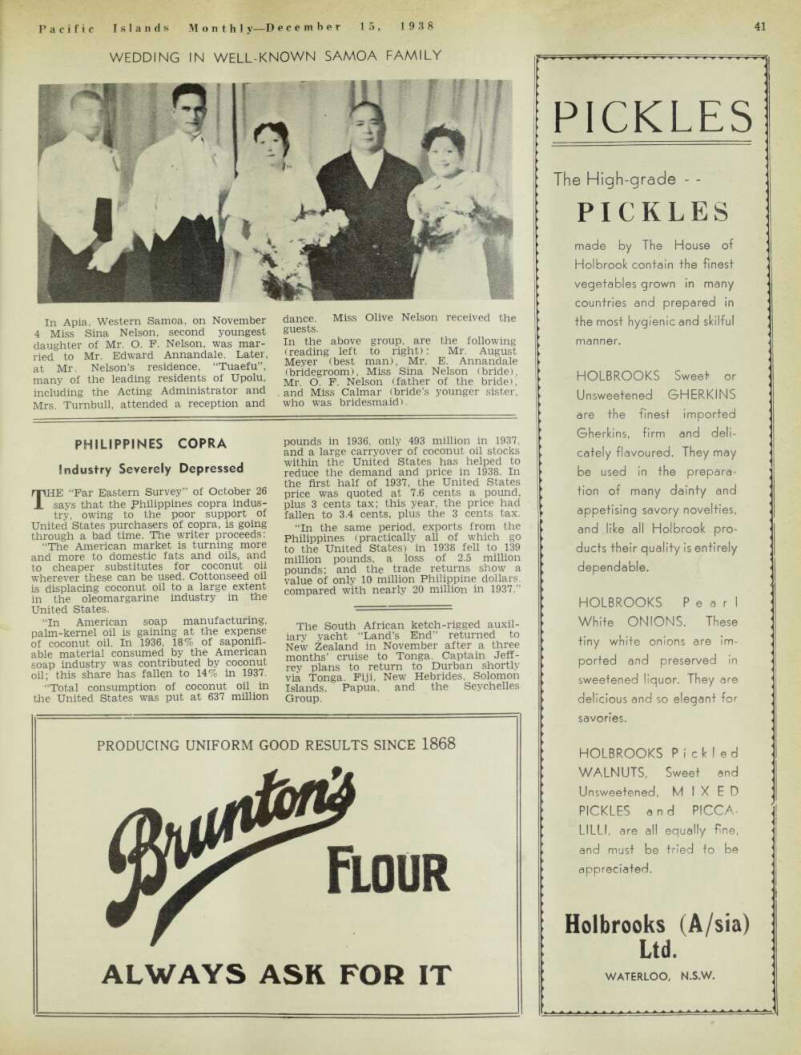
In Apia. Western Samoa, on November 4 Miss Sina Nelson, second youngest daughter of Mr. O. F. Nelson, was married to Mr. Edward Annandale. Later, f atv Lcl-c rpsiripncp “Tiiaefu” at Mi. Nelsons residence, iuaeiu , many of the leading residents of Upolu, including the Acting Administrator and Mrs. Turnbull, attended a reception and
dance. Miss Olive Nelson received the guests.
In the above group, are the following (reading left to right); Mr. August Meyer (best man), Mr. E. Annandale (bridegroom). Miss Sina Nelson (bride).
Mr. O. F. Nelson (father of the bride), and Miss Calmar (bride’s younger sister, who was bridesmaid).
Industry Severely Depressed
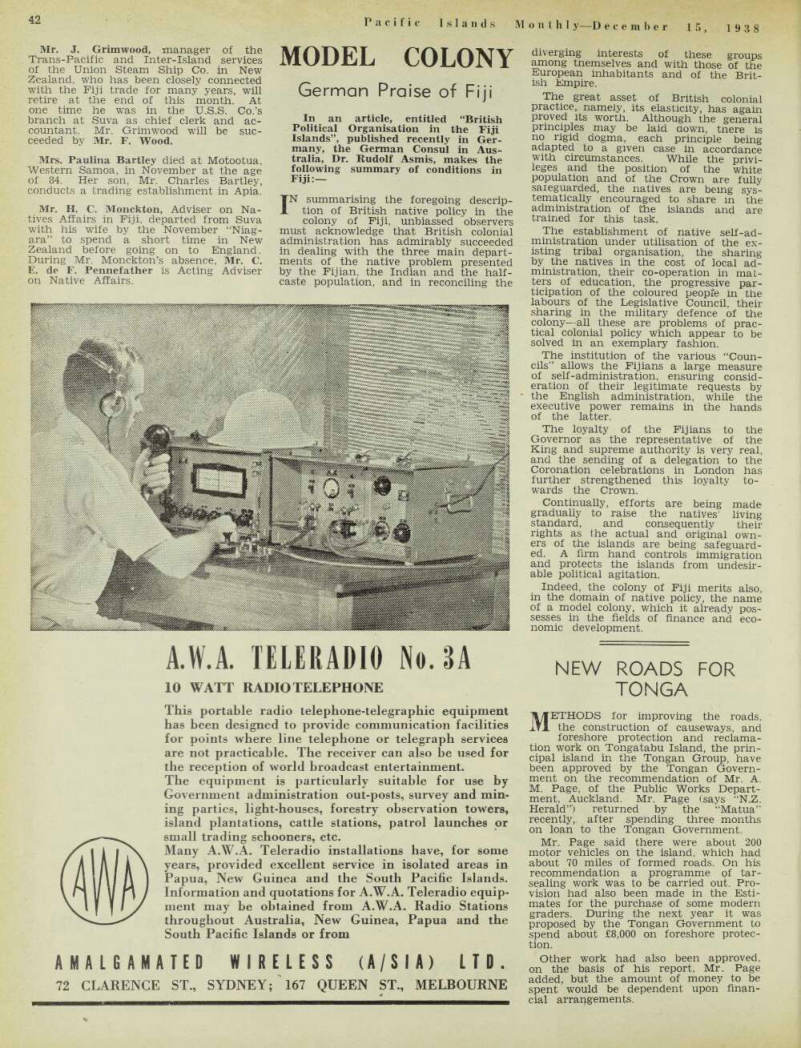
Philippines Copra
THE “Far Eastern Survey” of October 26 says that the Philippines copra indus try, owing to the poor support of United States purchasers of copra, is going through a bad time. The writer proceeds; “The American market is turning more and more to domestic fats and oils, and to cheaper substitutes for coconut oil wherever these can be used. Cottonseed oil is displacing coconut oil to a large extent in the oleomargarine industry in the United States.
“In American soap manufacturing, palm-kernel oil is gaining at the expense of coconut oil. In 1936. 18% of saponifi able material consumed by the American soap industry was contributed by coconut oil; this share has fallen to 14% in 1937.
“Total consumption of coconut oil in the United States was put at 637 million
pounds in 1936, only 493 million in 1937, and a large carryover of coconut oil stocks within the United States has helped to reduce the demand and price in 1938. In the first half of 1937, the United States price was quoted at 7.6 cents a pound, plus 3 cents tax; this year, the price had fallen to 3.4 cents, plus the 3 cents tax.
“In the same period, exports from the Philippines (practically all of which go to the United States) in 1938 fell to 139 million pounds, a loss of 2.5 million pounds; and the trade returns show a value of only 10 million Philippine dollars, compared with nearly 20 million in 1937.”
The South African ketch-rigged auxil iary yacht “Land’s End” returned to New Zealand in November after a three months’ cruise to Tonga. Captain Jeff rey plans to return to Durban shortly via Tonga. Fiji, New Hebrides, Solomon Islands, Papua, and the Seychelles Group.
Mr. J. Grimwood, manager of the Trans-Pacific and Inter-Island services of the Union Steam Ship Co. in New Zealand, who has been closely connected with the Fiji trade for many years, will retire at the end of this month. At one time he was in the U.S.S. Co.’s branch at Suva as chief clerk and ac countant. Mr. Grimwood will be suc ceeded by Mr. F. Wood.
Mrs. Paulina Bartley died at Motootua, Western Samoa, in November at the age of 84. Her son, Mr. Charles Bartley, conducts a trading establishment in Apia.
Mr. H. C. Monckton, Adviser on Na tives Affairs in Fiji, departed from Suva with his wife by the November “Niag ara” to spend a short time in New Zealand before going on to England.
During Mr. Monckton’s absence, Mr. C.
E. de F. Pennefather is Acting Adviser on Native Affairs.
Advertisements & other items, pp. 43-44 (2 items)
41
Pacific Islands Month! y—D ecember 15, 1938
Pickles
The High-grade - -
PICKLES
made by The House of Holbrook contain the finest vegetables grown in many countries and prepared in the most hygienic and skilful manner.
HOLBROOKS Sweet or Unsweetened GHERKINS are the finest imported Gherkins, firm and deli-
cately flavoured. They may
be used in the preparation of many dainty and appetising savory novelties, and like all Holbrook products their quality is entirely dependable.
HOLBROOKS Pearl
White ONIONS. These tiny white onions are im-
ported and preserved In
sweetened liquor. They are
delicious and so elegant for savories.
HOLBROOKS Pickled WALNUTS, Sweet and Unsweetened, MIXED
PICKLES an d PICCA-
LILLI, are all equally fine, and must be tried to be appreciated.
Holbrooks (A/sia)
Ltd.
WATERLOO. N.S.W.
PRODUCING UNIFORM GOOD RESULTS SINCE 1868
ALWAYS ASK FOR IT
A.W.A. TELERADIO No. 3A
10 WATT RADIOTELEPHONE
m This portable radio telephone-telegraphic equipment has been designed to provide communication facilities for points where line telephone or telegraph services are not practicable. The receiver can also be used for the reception of world broadcast entertainment.
The equipment is particularly suitable for use by Government administration out-posts, survey and mining parties, light-houses, forestry observation towers, island plantations, cattle stations, patrol launches or small trading schooners, etc.
Many A.W.A. Teleradio installations have, for some years, provided excellent service in isolated areas in Papua, New Guinea and the South Pacific Islands.
Information and quotations for A.W.A. Teleradio equipment may be obtained from A.W.A. Radio Stations throughout Australia, New Guinea, Papua and the South Pacific Islands or from
AMALGAMATED WIRELESS (A/SIA) LTD.
72 CLARENCE ST., SYDNEY; 167 QUEEN ST., MELBOURNE
Model Colony
German Praise of Fiji
In an article, entitled “British Political Organisation in the Fiji Islands”, published recently in Ger many, the German Consul in Aus tralia, Dr. Rudolf Asmis, makes the following summary of conditions in Fiji:— IN summarising the foregoing descrip tion of British native policy in the colony of Fiji, unbiassed observers must acknowledge that British colonial administration has admirably succeeded in dealing with the three main depart ments of the native problem presented by the Fijian, the Indian and the half caste population, and in reconciling the
diverging interests of these groups among tnemselves and with those of the European inhabitants and of the Brit ish Empire, The great asset of British colonial practice, namely, its elasticity, has again proved its worth. Although the general principles may be laid down, tnere is no rigid dogma, each principle being adapted to a given case in accordance with circumstances. While the privi leges and the position of the white population and of the Crown are fully saieguarded, the natives are being sys tematically encouraged to share in the administration of the islands and are trained for this task.
The establishment of native self-ad ministration under utilisation of the ex isting tribal organisation, the sharing by the natives in the cost of local ad ministration, their co-operation in mat ters of education, the progressive par ticipation of the coloured people in the labours of the Legislative Council, their sharing in the military defence of the colony—all these are problems of prac tical colonial policy which appear to be solved in an exemplary fashion.
The institution of the various “Coun cils” allows the Fijians a large measure of self-administration, ensuring consid eration of their legitimate requests by the English administration, while the executive power remains in the hands of the latter.
The loyalty of the Fijians to the Governor as the representative of the King and supreme authority is very real, and the sending of a delegation to the Coronation celebrations in London has further strengthened this loyalty to wards the Crown.
Continually, efforts are being made gradually to raise the natives’ living standard, and consequently their rights as the actual and original own ers of the islands are being safeguard ed. A firm hand controls immigration and protects the islands from undesir able political agitation.
Indeed, the colony of Fiji merits also, in the domain of native policy, the name of a model colony, which it already pos sesses in the fields of finance and eco nomic development.
New Roads For
Tonga
METHODS for improving the roads, the construction of causeways, and foreshore protection and reclama tion work on Tongatabu Island, the prin cipal island in the Tongan Group, have been approved by the Tongan Govern ment on the recommendation of Mr. A.
M. Page, of the Public Works Depart ment, Auckland. Mr. Page (says “N.Z.
Herald”) returned by the “Matua” recently, after spending three months on loan to the Tongan Government.
Mr. Page said there were about 200 motor vehicles on the island, which had about 70 miles of formed roads. On his recommendation a programme of tar sealing work was to be carried out. Pro vision had also been made in the Esti mates for the purchase of some modern graders. During the next year it was proposed by the Tongan Government to spend about £B,OOO on foreshore protec tion.
Other work had also been approved, on the basis of his report, Mr. Page added, but the amount of money to be spent would be dependent upon finan cial arrangements.
Advertisements & other items, p. 44 (1 item)
42
Pacific Islands M o 11 1 h 1 y—D eccmber 15, 1938
Unsung Side Of Mission Work In The Tropics
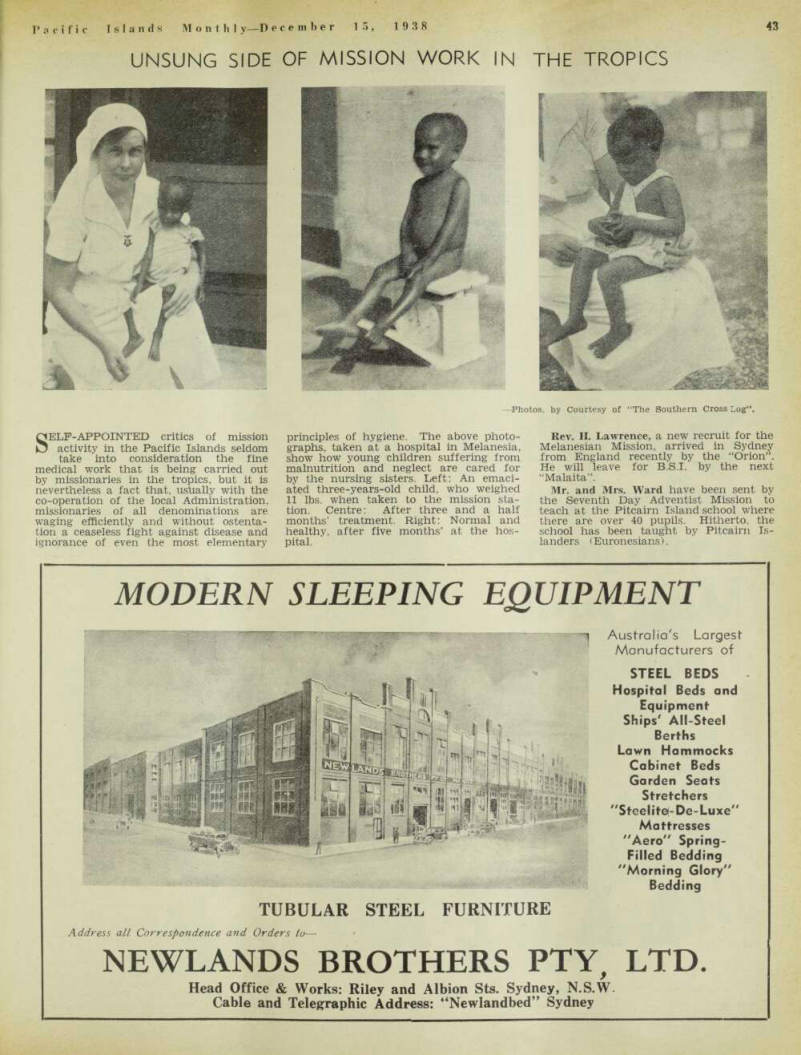
SELF-APPOINTED critics of mission activity in the Pacific Islands seldom take into consideration the fine medical work that is being carried out by missionaries in the tropics, but it is nevertheless a fact that, usually with the co-operation of the local Administration, missionaries of all denominations are waging efficiently and without ostentation a ceaseless fight against disease and ignorance of even the most elementary
principles of hygiene. The above photographs, taken at a hospital in Melanesia, show how young children suffering from malnutrition and neglect are cared for by the nursing sisters. Left: An emaciated three-years-old child, who weighed 11 lbs. when taken to the mission station. Centre: After three and a half months’ treatment. Right: Normal and healthy, after five months’ at the hospital.
Rev. H. Lawrence, a new recruit for the Melanesian Mission, arrived in Sydney from England recently by the “Orion”, He will leave for 8.5.1. by the next “Malaita”.
Mr. and Mrs. Ward have been sent by the Seventh Day Adventist Mission to teach at the Pitcairn Island school where there are over 40 pupils. Hitherto, the school has been taught by Pitcairn Is landers (Euronesians).
—Photos, by Courtesy of “The Southern Cross Log”.
Mr. Organ arrived in Apia with his wife by the November ”Maui Pomare” from New Zealand to join the staff of the Western Samoa Survey Department.
Mr. L. J. Joubert, general manager of Bulolo Gold Dredging Ltd., arrived in hfs d^Tack°to m Ne r w 2 Gu US A - ° n “is way back t 0 New Guinea.
Mr. P. C. Macarthur, of the New Guinea inspection staff of Messrs Burns, Philp and Co. Ltd., is now in the East spending long furlough.
Mr. O. B. Hart, construction engineer for Bulolo Gold Dredging Ltd.. New Guinea, who has been acting as general manager for some months, intends to retire at the end of this year. Mr.
Hart has built over 50 dredges, in all parts of the world. His valued assistant, Mr. Clyde Taylor, arrived in Sydney from U.S.A. on November 28. and will return to the service of B.G.D. Ltd. as construction foreman.
Advertisements & other items, p. 45 (2 items)
43
Pacific Islands Month! y—D ecember 15, 1938
Modern Sleeping Equipment
Hh n
mm "I
ill
A ’tl V" i , 11'in n m s■;; c M i ' 1 ‘- n >u i . :•» Mi $ fW
TUBULAR STEEL FURNITURE
Australia's Largest Manufacturers of
STEEL BEDS
Hospital Beds and Equipment Ships' All-Steel Berths Lawn Hammocks Cabinet Beds Garden Seats Stretchers "Steelito-De-Luxe"
Mattresses "Aero" Spring- Filled Bedding "Morning Glory"
Bedding Address all Correspondence and Orders to —
NEWLANDS BROTHERS PTY, LTD.
Head Office & Works: Riley and Albion Sts. Sydney, N.S.W.
Cable and Telegraphic Address: “Newlandbed” Sydney
"Bring 'Im Ak-is!"
Story of a Wireless Set
LAZARUS lives out on the other side of the sunrise, where he is the soli tary white lord of the Ontong Java (or Lord Howe Group, North-eastern Solomons) and where visitors coincide with Halley’s Comet—more or less.
When the copra market jittered up to nearly £2O per ton. about the close of 1936, Lazarus gave himself a long-pro mised holiday in Sydney. He did not buy a sundial, or take shares in the Bridge; but he was “spruiked” into bringing back £6O worth of wireless, so that, if he was far removed from phy sical contact with Europe he at least could hear what Hitler and Co. were saying.
He duly arrived home; and no time
Wjis lost in installing the set. He switch ed on to hear—profound nothing! As it would probably be six months before the vessel came back again, he instant ly re-cased the set. and sent it back to the suppliers for overhaul.
Months later, it arrived again—with a bill tor about £2O for repairs and charges—and once again it was installed It was switched on—with equally suc cessful results! ak-S°” kie! roared Laz - “Bring ’im A few well-aimed blows with the axe and the whole contraption was reduced to matchwood and bits, which were carefully re-cased and taken back aboard the schooner. v^ d B az - to the skipper: “Hand the X.Y.Z thing over to 8.P.. and tell them to send it back to the suppliers with my compliments, and here’s a covering letter telling ’em that if they can get it going they can have it for nothing on condition that they don’t sell it to anybody in the Solomons”.
The skipper glanced at the remains, and said: “But what did you do that for, Laz.?”
Well”, said Laz.. “Copra, as you know, is down to bedrock, and I can’t afford bread and butter, let alone bills for 20 quid for wireless repairs. So I thought the best thing to do was to cut my
losses !”-
R.C.L.
A Samoan's Labour-Saving
Device
From Our Own Correspondent.
A Apia. Nov. 17.
SAMOAN native named Va’a, of the village of Faleasiu, on the main beach road. 13 miles west of Apia, wanted the dilapidated small shed along side the main road, which was used for packing cases, pulled down, so that the young men of the village would be com pelled to build a new and better one.
But the young men—the taulealeas— did not wish to do the work.
Then Va’a had a brainwave. He bor rowed a long i-inch wire rope from the village missionary and, in the early morning dusk, fastened it to the posts of the old shed and then stretched it across the main road, tying it to a coco nut tree on the other side. Some pass ing motor truck or car would then. Va’a calculated, run against the wire and thus pull the old shed down without any ef fort by him.
And so it happened. A banana truck came along and ran against the wire, and pulled the shed down. Fortunately, it was being driven at a moderate speed, and the driver managed to stop before much damage was done to him or his truck.
But the driver reported the occurrance to the Apia police; and Va’a, repentant and sorrowful, pleaded guilty to having obstructed a public place and created a source of danger to the travelling pub lic. The judge, in view of the man’s obvious ignorance and low mentality, let him off with a fine of 30/-.
Mr. E. J. Gough, who is well-known throughout the Pacific Islands, has join ed the staff of the Islands Export firm of C. Sullivan Ltd., Sydney.
Mr. S. D. Morton married Miss Vera Henderson at St. John’s Anglican Church, Port Moresby, Papua, on No vember 11. They have now settled down in their home at Koitakinumu.
Advertisements & other items, p. 46 (2 items)
44
Pacific Islands Month! y—D ecemher 15, 1938
Foster's
park ling
refreshment from pure Malt and
Hop*
• 9 ft • ★ Malt* m
FOSTER'S
LAGER
Indians Make Requests For Different
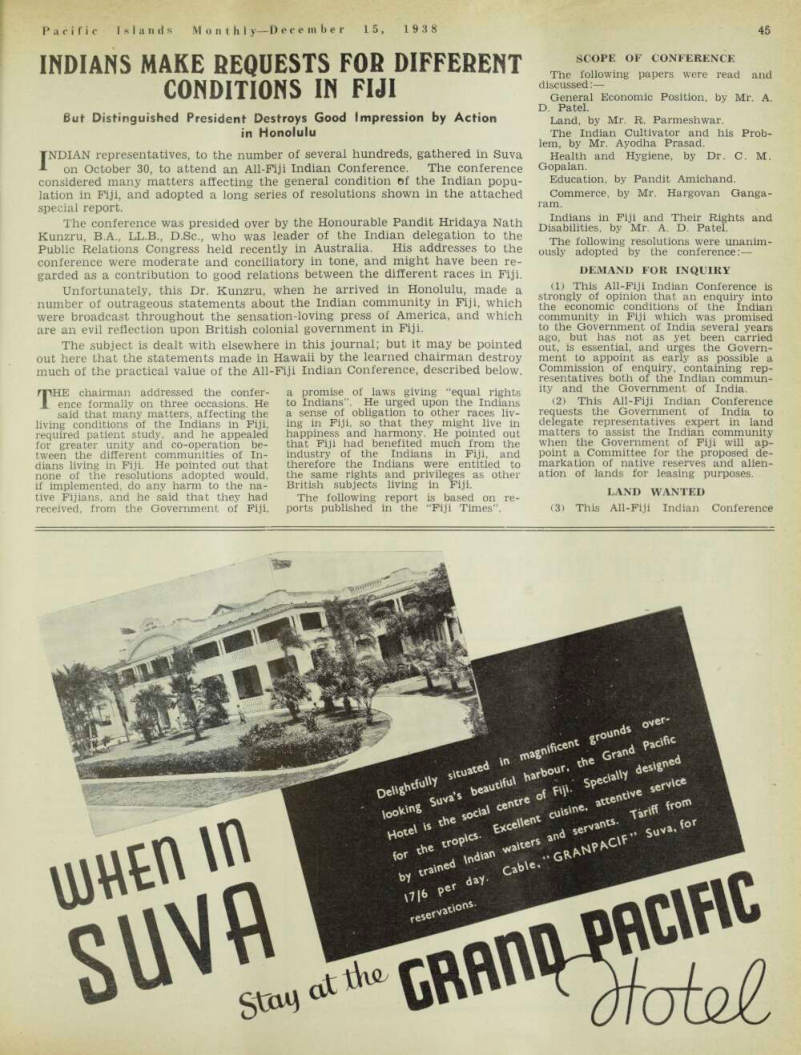
Conditions In Fiji
But Distinguished President Destroys Good Impression by Action in Honolulu
INDIAN representatives, to the number of several hundreds, gathered in Suva on October 30, to attend an All-Fiji Indian Conference. The conference considered many matters affecting the general condition of the Indian popu lation in Fiji, and adopted a long series of resolutions shown in the attached special report.
The conference was presided over by the Honourable Pandit Hridaya Nath Kunzru, 8.A., LL.B., D.Sc., who was leader of the Indian delegation to the Public Relations Congress held recently in Australia. His addresses to the conference were moderate and conciliatory in tone, and might have been re garded as a contribution to good relations between the different races in Fiji.
Unfortunately, this Dr. Kunzru, when he arrived in Honolulu, made a number of outrageous statements about the Indian community in Fiji, which were broadcast throughout the sensation-loving press of America, and which are an evil reflection upon British colonial government in Fiji.
The subject is dealt with elsewhere in this journal; but it may be pointed out here that the statements made in Hawaii by the learned chairman destroy much of the practical value of the All-Fiji Indian Conference, described below.
THE chairman addressed the confer ence formally on three occasions. He said that many matters, affecting the living conditions of the Indians in Fiji, required patient study, and he appealed for greater unity and co-operation be tween the different communities of In dians living in Fiji. He pointed out that none of the resolutions adopted would, if implemented, do any harm to the na tive Fijians, and he said that they had received, from the Government of Fiji,
a promise of laws giving “equal rights to Indians’’. He urged upon the Indians a sense of obligation to other races liv ing in Fiji, so that they might live in happiness and harmony. He pointed out that Fiji had benefited much from the industry of the Indians in Fiji, and therefore the Indians were entitled to the same rights and privileges as other British subjects living in Fiji.
The following report is based on re ports published in the “Fiji Times”,
Scope Of Conference
The following papers were read and discussed: — General Economic Position, by Mr. A.
D. Patel.
Land, by Mr. R. Parmeshwar.
The Indian Cultivator and his Prob lem, by Mr. Ayodha Prasad.
Health and Hygiene, by Dr. C. M.
Gopalan.
Education, by Pandit Amichand.
Commerce, by Mr. Hargovan Ganga ram.
Indians in Fiji and Their Rights and Disabilities, by Mr. A. D. Patel.
The following resolutions were unanim ously adopted by the conference:—
Demand For Inquiry
(1) This All-Fiji Indian Conference is strongly of opinion that an enquiry into the economic conditions of the Indian community in Fiji which was promised to the Government of India several years ago, but has not as yet been carried out, is essential, and urges the Govern ment to appoint as early as possible a Commission of enquiry, containing rep resentatives both of the Indian commun ity and the Government of India. (2) This All-Fiji Indian Conference requests the Government of India to delegate representatives expert in land matters to assist the Indian community when the Government of Fiji will ap point a Committee for the proposed de markation of native reserves and alien ation of lands for leasing purposes.
Land Wanted
(3) This All-Fiji Indian Conference
draws the attention of the Government to the great difficulties experienced by the Indians, who depend to a large ex tent on land for their livelihood, in obtaining leases of agricultural land and requests it to take immediate action to protect Indian interests on the following lines: — (a) Leases of lands at present culti vated should be renewed. (b) Suitable provision should be made for obtaining fresh land. (c) Subject to regular payment of rent and the right of the Govern ment to revise rents after a pre scribed period. Indians should not be disturbed in their possession of agricultural land. The system fol lowed by the Government of In dia in those provinces where land is directly held from the Govern ment should be adopted in Fiji.
(4) (a) This Conference impresses on the Government the urgent need for legislation to regulate the relations of landlords and tenants and to allow to tenants the rights and protection eniov ed by them in all civilised countries The present position is giving rise to wide spread and acute discontent and unless dealt with fairly and boldly will prove seriously detrimental to the future development of Fiji. (b) This All-Fiji Conference is further of opinion that Government should take early action to prevent tenants from be ing forced to work for any individual or association.
Health And Hygiene
(5) This All-Fiji Conference author ises the Indian Association to make suitable representations to the authori ties for the: —
(a) Training of more Indian medical students. (b) Establishment of hospitals in the districts in which there are no proper medical facilities existing at present. (c) Establishment of Indian child welfare centres and training of Indian nurses. (d) Provision of pure water supply in the districts in which such supply is not available. (e) Establishment of a sanatorium for T.B. and such diseases; and (f) Arrangement for necessary in structions to Indian Dais, mid wives, attending confinement cases.
Education
(6) This All-Fiji Indian Conference registers its strong dissatisfaction with the present educational facilities afford ed to the Indian children and strongly urges the Government to put into effect as soon as possible the recommendations contained in Mr. Mayhew’s report on the following points:— (1) Introduction of compulsory edu cation. (2) Provision for technical and voca tional training. (3) Establishment of intermediate and secondary schools. (b) This Conference while welcoming the fact that the Government have adopted the Mayhew recommendations in principle is of opinion that the pro vision made for carrying them out is quite inadequate, specially in view of the neglect of Indian education in the past by Government, notwithstanding the keenness of Indian parents to educate their children. (c) This Conference further records that; (1) As in India, a prescribed per centage of Indian children should be admitted to the European Grammar Schools; and that (2) efforts should be made to obtain trained women teachers from India. (d) This Conference while approving of Mr. Mayhew’s recommendation that scholarships for higher education should not be confined to Europeans only, is strongly of opinion, in view of an in creasing number of Indian boys ready to profit by University education, that ade quate provision should be made for giv ing them higher education outside Fiji.
Other Requests
(7) This Conference authorises the In dian Association to make necessary rep resentations to the authorities to facili tate importation of Indian patent medi cines and matters connected therewith and to remit import duties on foodstuffs. (8) In view of the fact that the In dian community has vast interests in this Colony, this Conference strongly requests the Government to appoint an Indian elected member to the Executive Council which consists of Europeans only at present. (9) This Conference requests the Gov ernment to expedite the publication of the report of the Committee appointed to consider the question of passports and domicile and urges the Government to remove the disabilities, under which In dians labour at present. (10) This All-Fiji Indian Conference considers that the time is opportune for the appointment of an Agent of the Government of India in Fiji and urges the Fiji Government to give facilities for the purpose in the interests of both the Government themselves and the In dian community.
UD This Conference strongly urges the Government to repeal the Masters and Servants Ordinance and to introduce legislation to facilitate registration of agricultural and trade unions in Fiji. (12) This Conference is of the opin ion that the provisions of the Work men’s Compensation Ordinance be ex tended to the Indians and Fijians in this Colony at an early date. (13) This Conference records its em phatic protest against the racial dis crimination made in the Fiji Civil Ser vice against Indians and Fijians and urges the Government to take immedi ate steps to abolish such discrimination and to give equal opportunities to the members of different communities for ca reers in the public service of the Colony, on the ground of personal merit.
Advertisements & other items, pp. 47-48 (3 items)
45
Pacific Islands Month! y—D eceinber 15, 19 3 8
yjP ' u
gOWj tvl
*-■ «%m\ '* As .too" 4 * ~, ma ,^ eOl 4 f r4 oi paC justed » ur . * e 4es*" e 4 * I *** rf f* S?e le •*** S^ s . ce otre ° *t* nt »** S ° C ' a *1 *** Su v». ' or "* ir ers .^^^ c ' f r »\o e4 C» to ' e ’ , ( i»V 6 9 e , s er' , * l '° t ' 4 SB®*
Your Tropical Rit
When you visit the Pacific Islands, whether on Business or Pleasure, you need Special Equipment—Light Suits of Correct Style, which fit well and launder easily; Tunic Shirts Silk Shirts, Light Underwear, White Shoes, etc.
WALTER HORNE & CO. LTD., established in 1885, specialise in this Service. Skilled Tailors make your Suits from First-class material within 24 hours. Complete equipment can be supplied from our Large Stocks at Reasonable, Moderate Prices.
BUY FROM THE FIRM WHICH UNDERSTANDS Y
DRESSES YOU CORRECTLY
WALTER HORNE &! CO. LTD., carry a Full Range of Drapery of all kinds; also Frocks, Millinery, Foundations and Lingerie, Hosiery, Shoes and Sandals, Ribbons and Laces, Household Drapery.
Ladies' Hairdressing and Manicuring
JR NEEDS AND
Men resident in any of the Pacific Territories can be supplied with Suitable Clothes.
Write to us and Describe your Requirements.
WALTER HORNE & CO. LTD.
Drapers and Men's Wear Specialists
SUVA. FIJI
A. B. DONALD LTD.
AUCKLAND
ISLAND TRADERS :: GENERAL MERCHANTS
P. O. Box 1509 Cables and Telegrams: "Kingdom," Auckland Branches at Rarotonga and throughout the Cook Islands At Papeete and throughout the Society, Marquesas and Paumotu Islands trading as " ETABLISSEMENTS DONALD. TAHITI "
At Fiji: Trading as Dominion Fruit C 0.," Suva
46
Pacific Islands Month! y—D ecember 15, 1938
Engines Displace Magic
New Ways of Papuan Coastal Traders
UNTIL recent years the Motu people, who inhabit the large group of vil lages near Port Moresby, set forth each year at the close of the south-east season on trading expeditions to the west.
These were undertaken in clumsy ves sels known as the Lakatoi, consisting of dug-outs lashed together in threes and fours, to form what were little better than rafts. The difficulty of directing such craft, with their crudely-made sails, was generally attributed, not to any imperfection in their design, but to the action of evil spirits incited by some enemy tribe.
To counteract this evil, they invari ably carried magicians on board, whose duty it was to combat spells that raised the violent winds that drew the ungainly craft into danger; and other spells that caused the sails to split, and the stone, that did duty as anchor, to lose its hold, so that they were driven to disaster.
The magicians used more powerful, spells, and ritual that governed every action of the crew—ritual that had for its sole object the placation of hostile spirits, and the retained favour of those who were friendly.
To-day the younger generation of natives are gradually abandoning this primitive method of transport: and many own small powered vessels and sailing craft that trade along the coast. Though they still lash the tail of a king-fish to the mast to insure speed, in the know ledge they have acquired from their white masters about winds, tides and currents, they find little time for spells and ritual, and the old-time magician, for the most part, has lost his job.
M.L.
Sporting History Is Made
From a Special Correspondent,
Tulagi, Oct. 28.
SPORTING history was made in the British Solomon Islands on October 26, 1938, by the playing of the first Rugby football match in the Protector ate.
The game was played at Tulagi, on the King George V. Memorial Ground, between a team representing Tulagi and a team representing M.V. “Malaita,” (Burns, Philp and Co.’s mail steamer).
The match resulted in a win for Tulagi by 28 points (Prince (2), Kneen, Trench, Train and Wager, tries; Chapman kick ed 5 goals) to 5 points (Beverley one try, and kicked a goal).
Successful Yacht Design
PACIFIC Islands residents, who nearly all are small boat navigators, will be interested in the following article published recently in Sydney: With the arrival here of the yawl “Marie”, from U.S.A. via Pacific Islands, yachtsmen have a chance of see ing a sister-ship to the famous yawl “Islander”, twice sailed around the world by Harry Pidgeon.
The design is an enlargement of the little 25 ft. yawl “Seahind”, sailed across the Atlantic by Captain Day in 1906. and recognised by leading naval archi tects as one of the strangest and most seaworthy designs known.
The dimensions of the “Marie” are of interest: 34ft. length over all by 10ft.
94in. beam, and with a draft of water sft she has only 1 2 371 b. of iron on the ee L which makes the design re stably stiff m a seaway m compan son with a round bottom type 01 yacnt Ihe teel & mUCh g " ater g , iU . , . , Boats built from this design have an unequalled record for ocean cruising, one 25-footer successfully weathering a se- V ere typhoon. A sister-ship to the 25footer can be seen any day in Mosman Bay Sydney.
The arrival of the “Marie- is again proof that a small yacht properly hand led is just as sale as the largest liner afloat. Over a dozen yachts of under 40 feet on the waterline have now safely circumnavigated the world.
Mr. and Mrs. E. F. Paul, of Western Samoa, will return to Apia during the month after an extensive tour through the East and U.S.A.
Mrs. Emily Vallance Cox, widow of the late Rev. W. H. Cox, who was for many years a missionary and chairman of the Methodist Mission at Rabaul, New Guinea, died at Strathfield, N.S.W., on November 22, aged 64.
Advertisements & other items, pp. 49-50 (2 items)
47
Pacific Islands Monthl y—D ecember 15, 1938
Mtansomcs
MORRIS, HEDSTROM, ltd.,
Registered Office - - Suva, Fiji.
BRANCHES THROUGHOUT FIJI, TONGA AND SAMOA
Y Agents tor: "Y
LLOYD'S
NOBELS (AUSTRALIA) LIMITED—EXPLOSIVES
MATSON NAVIGATION COMPANY
RUSTON & HORNSBY LIMITED
IMPERIAL CHEMICAL INDUSTRIES LIMITED
JOHN LYSAGHT (AUST.) LTD.
VACUUM OIL COMPANY PROP'TY. LIMITED
FORD MOTOR COMPANY LIMITED
GOODYEAR TIRE & RUBBER EXPORT COY. j.
SYDNEY OFFICE: DALTON HOUSE, 115 PITT ST.
PLOUGHS for EVERY PLANTER
There is a Ransomes Plough for every planter. For nearly 150 years Ransomes have been leaders in plough design, and to-day they offer a range for animal and tractor draught covering all possible requirements. Whether a light steel plough or a tractor disc plough weighing more than 3 tons is required, there is a Ransomes model which will give complete satisfaction.
THE
"CUB
PLOUGH
Mtansomcs
Write for illustrated catalogues and all information. Ask also for particulars of our lawn mowers , aerodrome, equipment, etc
MORRIS, HEDSTROM LTD.
Suva, Laufoka and Ba.
Made by: RANSOMES, SIMS & JEFFERIES LTD., IPSWICH, ENG.
SYDNEY'S LEADING
SAILMAKER
and RIGGER
Also Manufacturer of all Canvas and Rope Work ISLANDS WORK a Speciality
HARRY WEST
Balmain East, SYDNEY Tel. W 1105
Woven Wire for all Industry \
COPRA DRYING TRAYS, FLOORS, Etc.
FRUIT DRYING TRAYS, MINING SCREENS
Heavy Mosquito Gauze in Phosphor Bronze and other Metals Impervious to Salt Sea Air WIRE DOOR MATS AND GENERAL WIRE WORKS
E. WRIGHT & CO. LTD.
Office and Works: 146-162 Cleveland Street, Sydney, N.S.W.
Telegraphic Address: " Wrlghtmake,” Chippendale Or £
WumcaneJ&mtepfM
Best construction - Brightly fire tinned with high illuminating power - Storm - and rain proof - fitted with a globe of special glass. 71A.*15 Wick 4/16' 71/L.50 Wick 4/16 " 71a. 55 Wick 7/16" .and many other types. ]iUx4 ' Wm. Breckwoldt & Co., Rabaul, Suva, Apia, Papeete
Medical Work Among
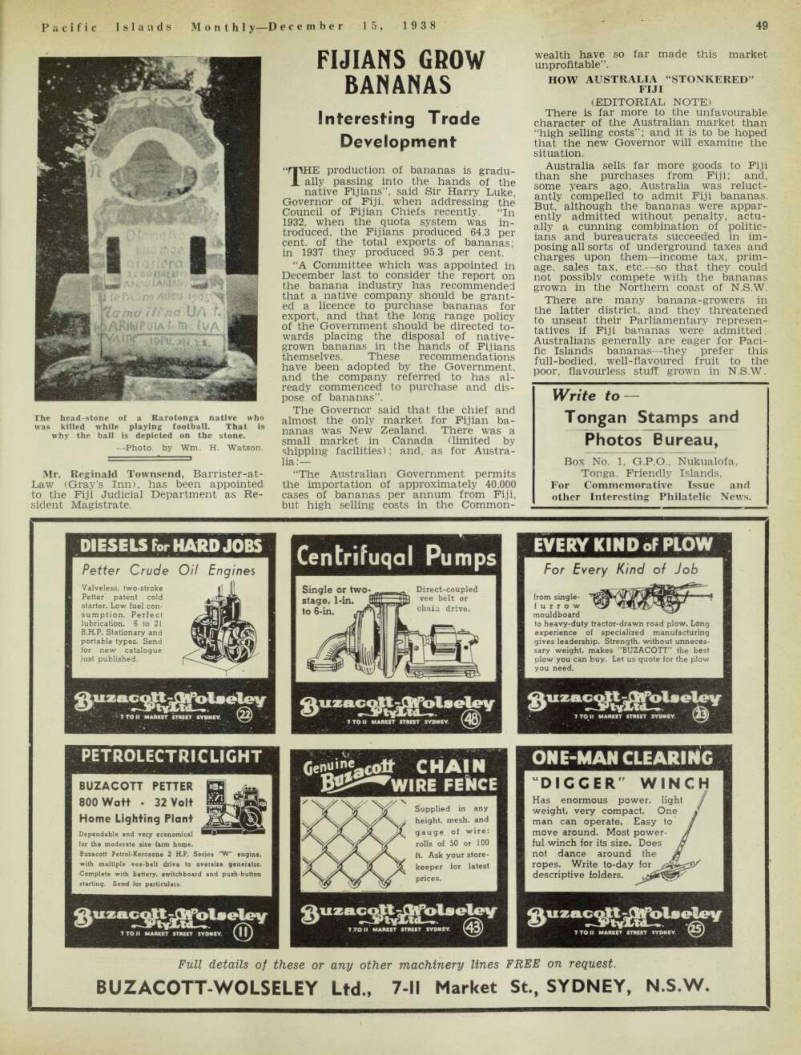
N. Hebrides Natives
Letter to the Editor IN a recent issue of your paper I found it necessary to make some comment on a letter by Mr. E. H. Corlette, in which he implied that a great deal of the medical work done by the Missions was done with the assistance of the Condominium Government and the Rockefeller Institute, whereas planters did similar work without such assist ance.
Mr. Corlette has now (in your issue of September) given an explanation of this. But, unfortunately, his letter is largely a re-assertion, with amplifica tion, of the same mistaken idea. It is not the policy of missionaries to take much notice of such letters, but lest Mr.
Corlette should lead some of your read ers astray I feel that in this case some thing further should be said.
The “Medical Care of the New Heb rides Natives” is not, in our opinion, a
matter of “Credit to Administration or Missions , as your headings suggest. My letter specnicany stated mat a compari son couid be made, out that mat is un necessary in this discussion—the reason being that it would serve no useful pur pose.
Why, then, does Mr. Corlette charge me with being “rather stingy in giving any credit at all to me Administration’ ; and how does ne Know what I am “pre pared to admit”; and why assert that I “belittle wnat is done”? Surely to state clearly some facts with regard to what the Administration does not do in con nection with the worx of the Missions is not to belittle the Administration?
All the statements that I made or now maKe are accurate. Despite his greater experience in me Group, Mr.
Corlette has not been able to Keep his own statements accurate.
It would never occur to me to belittle the worK of the RocKefeller Institute, or to give them less credit than was tneir due, as Mr. Corlette suggests. One lans to see how he reads such into my let ter.
Mr. Corlette speaks of “the fact that the Administration pays . . for the periodi cal rounds of injections of NAB and hookworm treatment”. By this, surely, he means throughout the New Hebrides, since it is of the whole Group that we both speak. Yet, unless he limits his statement to a relatively small proportion of the Group, his statement is very mis leading to anyone who is not in a posi tion to know the facts —for only a very limited portion of the Group could be said to have had “periodical rounds of injections of NAB and hookworm treat ment” at the expense of the Adminis tration, and much of the Group has had none at all. Is he really ignorant of the position, that he should call this assertion a fact?
I thank Mr. Corlette for his explan ation of his paragraph on the source of supply of NAB to the Missions, and I am sorry that in making the transcription of his letter he should have made the slip in two successive sentences. Even the corrected version is only partly accurate, in that the supply of this drug to the Missions is by no means all through the Rockefeller In stitute, though at times it has been lar gely so. At present, it is found to be cheaper to buy through London.
In this, as in other points, Mr. Cor lette speaks as though he is as closely in touch with Mission affairs and mis sionaries as I am, and as though he is more fully and correctly informed of their business and opinions. We both know that that is not so.
A greater purpose can be served by all if they used their best endeavours to assist the natives as well as them selves, and that not only in health. As sisting less fortunate people does not demean one, nor is it without its re ward. No golden future can be foreseen for the New Hebrides unless the na tives are to have some share in it.
The Missions have for almost a cen tury been using their best endeavours in a variety of directions for the bene fit of the natives. I would like it to be perfectly clearly understood that they have been and always will be ready to co-operate with the Administration in any similar work.
I am, etc.,
B. R. C. Nottage.
Tongoa, New Hebrides. 31/10/1938.
Mr. G. R. Jordan, of the Lands and Survey Department, Fiji, is at present on six months’ furlough.
Mr. Reginald Townsend, Barrister-at- Law (Gray’s Inn), has been appointed to the Fiji Judicial Department as Re sident Magistrate.
The head-stone of a Rarotonga native who was killed while playing football. That is why the ball is depicted on the stone. —Photo, by Wm. H. Watson.
Advertisements & other items, p. 50 (1 item)
48
Pacific Islands Monthl y—D ecember 15, 1938
Fijians Grow
Bananas
Interesting Trade Development
“fTVHE production of bananas is gradu- X ally passing into the hands of the native Fijians”, said Sir Harry Luke.
Governor of Fiji, when addressing the Council of Fijian Chiefs recently. “In 1932, when the quota system was in troduced, the Fijians produced 64.3 per cent, of the total exports of bananas; in 1937 they produced 95.3 per cent.
“A Committee which was appointed in December last to consider the report on the banana industry has recommended that a native company should be grant ed a licence to purchase bananas for export, and that the long range policy of the Government should be directed to wards placing the disposal of native grown bananas in the hands of Fijians themselves. These recommendations have been adopted by the Government, and the company referred to has al ready commenced to purchase and dis pose of bananas”.
The Governor said that the chief and almost the only market for Fijian ba nanas was New Zealand. There was a small market in Canada (limited by shipping facilities); and. as for Austra lia:— “The Australian Government permits the importation of approximately 40.000 cases of bananas per annum from Fiji, but high selling costs in the Common
wealth have so far made this market
unprofitable”.
How Australia “Stonkered”
Fiji
(Editorial Note)
There is far more to the unfavourable character of the Australian market than “high selling costs”; and it is to be hoped that the new Governor will examine the situation.
Australia sells far more goods to Fiji than she purchases from Fiji; and, some years ago, Australia was reluct antly compelled to admit Fiji bananas.
But, although the bananas were appar ently admitted without penalty, actu ally a cunning combination of politic ians and bureaucrats succeeded in im posing all sorts of underground taxes and charges upon them—income tax, prim age, sales tax, etc. —so that they could not possibly compete with the bananas grown in the Northern coast of N.S.W.
There are many banana-growers in the latter district, and they threatened to unseat their Parliamentary represen tatives if Fiji bananas were admitted.
Australians generally are eager for Paci fic Islands bananas —they prefer this full-bodied, well-flavoured fruit to the poor, flavourless stuff grown in N.S.W.
But the rings and combines have seen to it, for many years past, that there is not a Pacific Islands banana on sale in Sydney.
When the then Governor of Fiji, Sir Murchison Fletcher, saw how the under ground engineers in Australia were de feating the official decision to admit a few Fiji bananas, he took prompt and drastic action. He imposed a special im port tax upon Australian flour —which is one of Australia’s largest exports to Fiji.
The response was so quick as to be funny. The Australian flour-millers be came alarmed, and inquired into the position; and the millers’ ultimatum to the politicians was to the point: “If you want our support, carry out your bar gain with Fiji, and get that flour tax taken off”.
And it was so—p.d.q. There were apologies and explanations; the under ground charges were quickly taken off Fiji bananas; and, for a time, the trade proceeded. The Fijian tax was taken
off Australian flour. The Australian banana-growers howled; but they were told that the organised flourmillers were of more political importance than the organised banana-growers.
But time marches on. The banana growers appear to have enlisted the aid of the fruit ring; and by devious means the intrusive Fijian bananas were ‘“stonkered” (an Australian slang term, which expresses exactly what we want to say). Australia enjoys an evergrow ing share of Fiji’s trade; but there is no room in Australia for even a miser able 40,000 cases per annum of Fiji bananas.
All lovers of fair play in trade (if there is such a thing!) hate to see the underground engineers succeeding in their underground tactics. A Fijian tax on Australian produce, to be non-opera tive so long as Australia buys 40,000 cases of Fiji bananas per annum, would meet the situation.
Advertisements & other items, pp. 51-52 (2 items)
49
Pacific Islands Monthl y—D ecember 15, 1938
Centrifuqal Pumps
Write to
Tongan Stamps and
Photos Bureau,
Box No. 1, G.P.0., Nukualofa, Tonga. Friendly Islands, For Commemorative Issue and other Interesting Philatelic News.
DIESELS For HARD JOBS
Petier Crude Oil Engines
Valveless, Iwo-slroke Fetter patent cold starter. Low fuel consumption. Perfect lubrication. G to 21 B.H.P. Stationary and portable types. Send for new catalogue just published.
7TO II MARKET STREET SYDNEY.
PETROLECTRICLIGHT
BUZACOTT FETTER gjj ***.
800 Watt • 32 Volt SOS?
Home Lighting Plant
Dependable and very economical lor the moderate size farm home.
Buzacott Petrol-Kerosene 2 H.P. Series "W” engine, with multiple vee-belt drive to oversize generator.
Complete with battery, switchboard and push-button starting. Send lor particulars. 7TO II MARKET STREET SYDNEY. (| 1
Centrifuqal Pumps
UZ ac^£|fol»e«e y
7TO II MARKET STRICT SYDNCV.
CHAIN
—WIRE FENCE
Supplied in any height, mesh, and gauge of wire: rolls of 50 or 100 ft. Ask your storekeeper for latest
7TO II MARKET STREET SYDNEY.
EVERY KIND oF PLOW
For Every Kind of Job
a (rom singlefurrow mouldboard to heavy-duty tractor-drawn road plow. Long experience of specialized manufacturing gives leadership. Strength, without unnecessary weight, makes "BUZACOTT" the best plow you can buy. Let us quote for the plow you need. uzac
7 TO II MARKET STREET SYDNEY.
ONE-MAN CLEARING
“DIGGER" WINCH
Has enormous power, light weight, very compact. One man can operate. Easy to move around. Most powerful winch for its size. Does not dance around the ropes. Write to-day for descriptive folders.
7TO II MARKET STREET SYDNEY
Full details of these or any other machinery lines FREE on request.
BUZACOTT-WOLSELEY Ltd., 7-11 Market St., SYDNEY, N.S.W.
painting
with
.. <1 O >• « - means wnm painting to STAY, painted / 1 / ftp 1*
Paint
(PREPARED)
“Xeeps on Xeepikg /*
AGENTS THROUGHOUT THE ISLANDS
Coveted Phoenix
Islands
Burns Philp Sell Leases to Government
QUICK and interesting moves have oeen taking place among the islands of the Central Pacific, since their value as stations on the proposed Trans pacific airmail services was recognised.
For many decades, all these small is lands were regarded as British no one wanted them. Then the Ameri cans, planning new airways, reached out and grabbed Howland and Baker Is lands, northern outliers of the Phoenix Group (British).
That brought Britain into action. Her warships meticulously visited, re-occu pied and re-annexed all the other islands which stood in her name, and which might be useful in aviation.
The Phoenix Group—valuable, because it lies right on the track between Fiji and Hawaii —was plastered with titles, and added to the Gilbert and Ellice Island Colony (which is administered by the British Colonial Office through Fiji).
But that did not prevent America, last year, sending an official party to fly the Star and Stripes over Canton and Enderbury Islands, potential air bases in the Phoenix Group. The Brit ish already were in occupation there, with the Union Jack flying; and the Americans settled down happily beside them. The idea, of course, is that each nation will have the right to put its aircraft down there.
It is reported that, in similar fash ion, America has designs on Christmas and Washington Islands, already in British occupation.
The latest development is the sale, quite recently concluded, of leases in the Phoenix Group, held for many years by Burns, Philp and Co. Ltd. They have been sold to the G. and E. Islands Gov ernment. The coconut plantations and copra producing plant are to be taken over by the G. and E. Government and, according to the terms of sale, the Gov ernment will establish settlers on the
areas purchased.
Dr. E. P. Ellison, Chief Medical Offi cer in the Cook Group, reached New Zealand from Suva by the November “Niagara”, after a visit to Fiji.
Advertisements & other items, p. 52 (1 item)
50
Pacific Islands Monthl y—D ecember 15, 1938
Governor Flies Over New Lands Visit
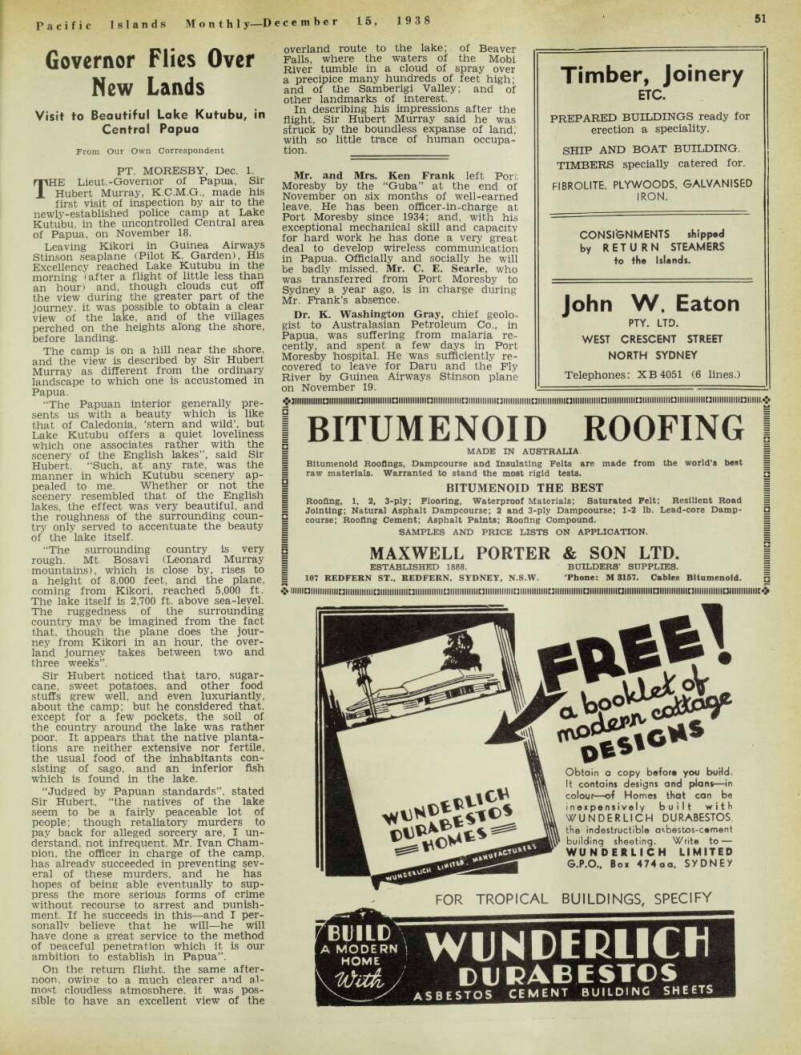
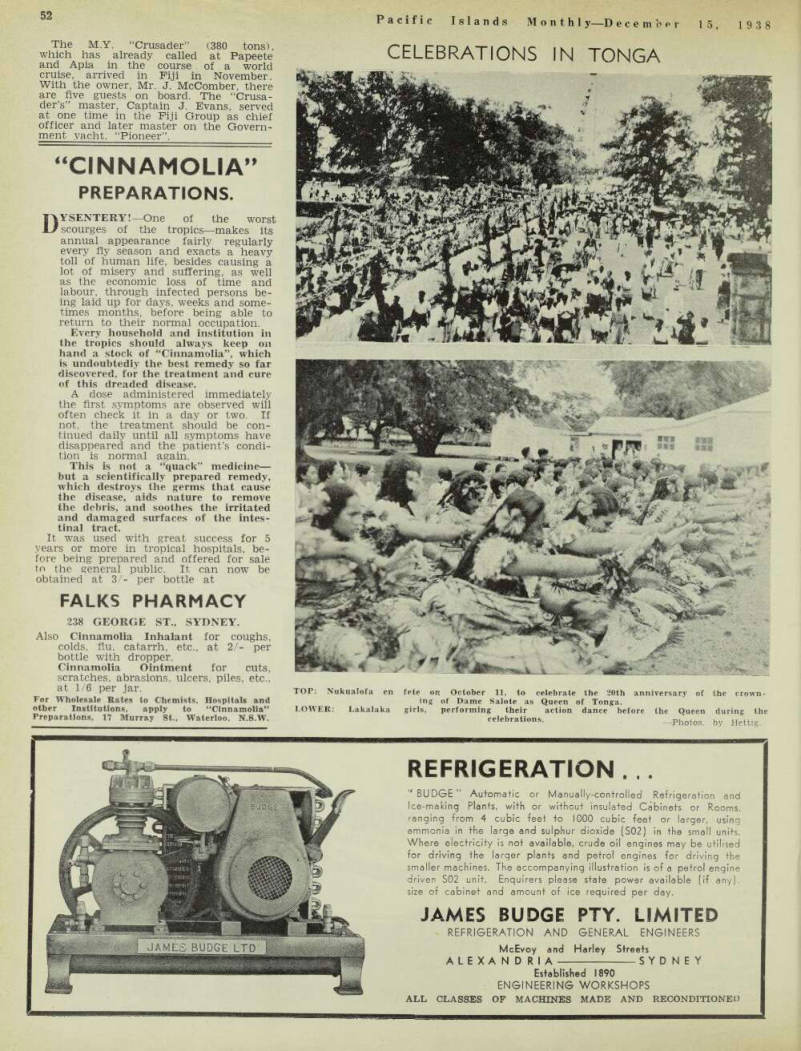
New Lands Visit to Beautiful Lake Kutubu, in Central Papua
From Our Own Correspondent
Pt. Moresby, Dec. 1.
THE Lieut.-Governor of Papua, Sir Hubert Murray, K.C.M.G., made his first visit of inspection by air to the newly-established police camp at Lake Kutubu, in the uncontrolled Central area of Papua, on November 18.
Leaving Kikori in Guinea Airways Stinson seaplane (Pilot K. Garden), His Excellency reached Lake Kutubu in the morning (after a flight of little less than an hour) and, though clouds cut off the view during the greater part of the journey, it was possible to obtain a clear view of the lake, and of the villages perched on the heights along the shore, before landing.
The camp is on a hill near the shore, and the view is described by Sir Hubert Murray as different from the ordinary landscape to which one is accustomed in Papua.
“The Papuan interior generally pre sents us with a beauty which is like that of Caledonia, ‘stern and wild’, but Lake Kutubu offers a quiet loveliness which one associates rather with the scenery of the English lakes”, said Sir Hubert. “Such, at any rate, was the manner in which Kutubu scenery ap pealed to me. Whether or not the scenery resembled that of the English lakes, the effect was very beautiful, and the roughness of the surrounding coun try only served to accentuate the beauty of the lake itself.
“The surrounding country is very rough. Mt. Bosavi (Leonard Murray mountains), which is close by, rises to a height of 8,000 feet, and the plane, coming from Kikori, reached 5,000 ft.
The lake itself is 2,700 ft. above sea-level.
The ruggedness of the surrounding country may be imagined from the fact that, though the plane does the jour ney from Kikori in an hour, the over land journey takes between two and three weeks”.
Sir Hubert noticed that taro, sugar cane, sweet potatoes, and other food stuffs grew well, and even luxuriantly, about the camp; but he considered that, except for a few pockets, the soil of the country around the lake was rather poor. It appears that the native planta tions are neither extensive nor fertile, the usual food of the inhabitants con sisting of sago, and an inferior fish which is found in the lake.
“Judged by Papuan standards”, stated Sir Hubert, “the natives of the lake seem to be a fairly peaceable lot of people; though retaliatory murders to pay back for alleged sorcery are, I un derstand, not infrequent. Mr. Ivan Cham pion, the officer in charge of the camp, has alreadv succeeded in preventing sev eral of these murders, and he has hopes of being able eventually to sup press the more serious forms of crime without recourse to arrest and punish ment. If he succeeds in this —and I per sonally believe that he will—he will have done a great service to the method of peaceful penetration which it is our ambition to establish in Papua”.
On the return flight, the same after noon, owing to a much clearer and al most cloudless atmosphere, it was pos sible to have an excellent view of the
overland route to the lake; of Beaver Falls, where the waters of the Mobi River tumble in a cloud of spray over a precipice many hundreds of feet high; and of the Samberigi Valley: and of other landmarks of interest.
In describing his impressions after the flight, Sir Hubert Murray said he was struck by the boundless expanse of land, with so little trace of human occupa tion.
Mr. and Mrs. Ken Frank left Pori Moresby by the “Guba” at the end of November on six months of well-earned leave. He has been officer-in-charge at Port Moresby since 1934; and, with his exceptional mechanical skill and capacity for hard work he has done a very great deal to develop wireless communication in Papua. Officially and socially he will be badly missed. Mr. C. E. Searle, who was transferred from Port Moresby to Sydney a year ago, is in charge during Mr. Frank’s absence.
Dr. K. Washington Gray, chief geolo gist to Australasian Petroleum Co., in Papua, was suffering from malaria re cently, and spent a few days in Port Moresby hospital. He was sufficiently re covered to leave for Daru and the Fly River by Guinea Airways Stinson plane on November 19.
The M.Y. “Crusader” (380 tons), which has already called at Papeete and Apia in the course of a world cruise, arrived in Fiji in November.
With the owner, Mr. J. McComber, there are five guests on board. The “Crusa der’s” master, Captain J. Evans, served at one time in the Fiji Group as chief officer and later master on the Govern ment yacht, “Pioneer”.
Advertisements & other items, pp. 53-54 (2 items)
51
Pacific Islands Monthl y—D eccmber 15, 1938
Wunderlich
Timber, Joinery
ETC.
PREPARED BUILDINGS ready for erection a speciality.
SHIP AND BOAT BUILDING.
TIMBERS specially catered for.
FIBROLITE. PLYWOODS. GALVANISED
IRON.
CONSIGNMENTS shipped
by RETURN STEAMERS
to the Islands.
John W. Eaton
PTY. LTD.
WEST CRESCENT STREET
NORTH SYDNEY
Telephones: X 84051 (6 lines.)
BITUMENOID ROOFING
MADE IN AUSTRALIA.
Bltumenold Roofings, Dampcourse and Insulating Felts are made from the world’s best raw materials. Warranted to stand the most rigid tests.
BITUMENOID THE BEST
Roofing, 1,2, 3-ply; Flooring, Waterproof Materials; Saturated Pelt; Resilient Road Jointing; Natural Asphalt Dampcourse; 2 and 3-ply Dampcourse; 1-2 lb. Lead-core Dampcourse: Roofing Cement; Asphalt Paints; Roofing Compound.
SAMPLES AND PRICE LISTS ON APPLICATION.
MAXWELL PORTER & SON LTD.
ESTABLISHED 1888. BUILDERS’ SUPPLIES.
107 REDFERN ST., REDFERN, SYDNEY. N.S.W. ’Phone: M 8167. Cables Bltumenold.
«SSS5‘*
n
BUILD
A MODERN|
HOME
Obtain a copy before yoo build.
It contains designs and plans—in colour—of Homes that can be inexpensively built with
WUNDERLICH DURABESTOS
the indestructible asbestos-cement building sheeting. Write to
WUNDERLICH LIMITED
G.P.0., Box 474 aa. SYDNEY
FOR TROPICAL BUILDINGS, SPECIFY
WUNDERLICH
'■cm DURABESTOS
asbestos cement building she ets
“CINNAMOLIA”
PREPARATIONS.
DYSENTERY! —One of the worst scourges of the tropics—makes its annual appearance fairly regularly every fly season and exacts a heavy toll of human life, besides causing a lot of misery and suffering, as well as the economic loss of time and labour, through infected persons being laid up for days, weeks and sometimes months, before being able to return to their normal occupation.
Every household and institution in the tropics should always keep on hand a stock of “Cinnamolia”, which is undoubtedly the best remedy so far discovered, for the treatment and cure of this dreaded disease.
A dose administered immediately the first symptoms are observed will often check it in a day or two. If not, the treatment should be continued daily until all symptoms have disappeared and the patient’s condition is normal again.
This is not a “quack" medicine— but a scientifically prepared remedy, which destroys the germs that cause the disease, aids nature to remove the debris, and soothes the irritated and damaged surfaces of the intestinal tract.
It was used with great success for 5 years or more in tropical hospitals, before being prepared and offered for sale to the general public. It can now be obtained at 3/- per bottle at
FALKS PHARMACY
238 GEORGE ST., SYDNEY.
Also Cinnamolia Inhalant for coughs, colds, flu. catarrh, etc., at 2/- per bottle with dropper.
Cinnamolia Ointment for cuts, scratches, abrasions, ulcers, piles, etc., at 1/6 per jar.
For Wholesale Bates to Chemists, Hospitals and other Instltntions, apply to “Cinnamolia”
Preparations, 17 Murray St., Waterloo, N.S.W.
A— i
JAMES BUDGE LTD
REFRIGERATION...
'‘BUDGE" Automatic or Manually-controlled Refrigeration and Ice-making Plants, with or without insulated Cabinets or Rooms, ranging from 4 cubic feet to 1000 cubic feet or larger, using ammonia In the large and sulphur dioxide (SO2) in the small units.
Where electricity is not available, crude oil engines may be utilised for driving the larger plants and petrol engines for driving the smaller machines. The accompanying illustration is of a petrol engine driven SO2 unit. Enquirers please state power available (if any), size of cabinet and amount of ice required per day.
JAMES BUDGE PTY. LIMITED
REFRIGERATION AND GENERAL ENGINEERS
McEvoy and Harley Streets ALEXANDRI A S Y D N E Y Established 1890
ENGINEERING WORKSHOPS
ALL CLASSES OF MACHINES MADE AND RECONDITIONED
Celebrations In Tonga
TOP: Nukualofa en fete on October 11, to celebrate the 20th anniversary of the crown ing of Dame Salote as Queen of Tonga.
LOWER: Lakalaka girls, performing their action dance before the Queen during the celebrations. -Photos, by Hettlg.
Advertisements & other items, p. 54 (1 item)
52
Pacific Islands Monthl y—D ecem b e r 15, 1938
The Pacific
German-Japanese Alliance Threatens
Facts Which Tropical Territories Must Frankly Face
A DEVELOPMENT of supreme im portance In international relation ships generally, and to Pacific countries in particular, was made public on November 28.
It was announced that, after months of negotiation, Germany, Italy and Japan had reached an agreement, un der which they now are ready to trans form their Anti-Comintern Pact into a Triple Alliance. It is provided in the Alliance that, if any one of the three is threatened by an outside Power or Pow ers, the other members of the alliance will give diplomatic, political and eco nomic assistance.
Great military significance is attach ed to the Alliance.
Germany is ready to sign immediately: but it is believed that Italy is in favour of a few months’ delay.
The objects of the move are clear.
Japan intends to create, in the Far East, a Japanese Empire, to include Japan, Korea, Manchukuo, the whole of Eastern China, and all the Pacific Is lands now held under Mandate. She will be supported in this by Germany and Italy, who hope to push British, American and French interests out of the Far East, and to share with Japan the rich trade advantages thus gained.
The process is going on, already. On December 1, it was announced that Japan was to hold, in Tokio, a Japan ese “Imperial Conference” representing the conquered countries named above.
The seriousness of the outlook cannot be exaggerated. Japan, alone, could be held in the Far East by Britain, France and the smaller democratic countries.
Japan, if she is to be supported by Ger many and Italy, inevitably will turn southwards into the Pacific, and chal lenge the strength of the democratic countries.
If this Triple Alliance is formed—and, although Britain and France are work ing against the plan, its consumma-i tion seems likely—Britain and France will have great difficulty in holding Japan back to the northward of the equator. That is, unless the United States comes in.
This “great and glorious” democracy, however, is completely undependable.
Babbling politicians in high places, reacting pitifully to the cranks and ideologists who direct the world’s most terrible newspaper press, can give no assurance of an intelligent or consist ent foreign policy. Probably, when the British and French Empires are falling to pieces, and all that is best in human relationships is being trampled down by goose-stepping Fascists, the Americans will try, months too late, to “save de mocracy”.
To-day, the writing is on che wall.
South America now is being literally over-run by Germans, Japanese and Italians, and North American interests there are being sadly affected. But. in this as in other matters, the ostrich head of the U.S.A. is buried deep in the sand.
The American people, whom we all know and like, undoubtedly would pre fer the world as it is to a world con trolled by Germany, Italy and Japan.
But no one seems to be able to give them a free choice.
Defence Of Papua And New
Guinea
IT was stated in this journal recently that, during the international crisis on September 26-29, there were Japanese naval forces awaiting orders in the Japanese Mandated Territory of the Caroline and Marshall Islands, very close to Australian territory.
The information was published, not
as an alarmist or sensational item, but as plain truth. Is there any reason why people in the British Pacific territories should not know the danger that threatens them constantly and increas ingly from the direction of Japan?
It long has been the theory of this writer that Japan is engaged in a con spiracy, with other Fascist), land hungry nations, to do everything pos sible to embarrass and weaken the Brit ish and French Empires, in the belief that if those Empires once begin to fall to pieces, they will pick up rich colon ial territories. One sees signs of the conspiracy all over the world. Britain is countering it in the only way possible —by building up her armed strength to invulnerability—but France, owing to the rotten political system which prevents
stable government in that country, is becoming alarmingly weak.
However, this is all theory. Let us stick to facts. There are plenty of them.
The Australian Prime Minister form ally denied that Australia, during the crisis, was menaced by Japanese war ships. But his statement was generally ambiguous, and he did not say that there were no Japanese naval forces in the Carolines and Marshalls.
Was it not the same Mr. Lyons who, only a few weeks ago, snorted with in dignation at the suggestion that Port Moresby should be fortified and made an advanced base for Australian defence?
Nothing of the kind was contemplated, he said —it would be regarded as offen sive by other countries (meaning Japan, of course). The “P.1.M.”, at the time, said in plain and simple language what it thought of Mr. Lyons and his prevari
cation. Now, it is announced officially that Papua and New Guinea are to be regarded as the advanced line of Aus tralia’s defences, and that Port Mores by will be fortified.
Japanese Naval Bases
FACTS? The news of the past month bristles with them.
“Nauticus”, an annual sponsored by the high command of the German Navy, has just published this; “Since the lapse of the naval treat ies, Japan’s intention is unmistakable to extend her bases, already existing outside the home islands, to Formosa, the Pescadores and the Bonin Islands, and to extend the new bases as far as possible towards the south-west, into Mandated territory”.
Germany And Japan In East
Asia
THE following are extracts from a sig nificant article in “Far Eastern Survey” of October 26, 1938: — Recent developments in the Far East are now maxing it apparent that Ger many is envisaging a German-Japanese condominium in East Asia, equally pro fitable to both participants and estab lished on the shattered remains of what was China.
German activities within the- last several months, particularly as revealed in new investments in Manchukuo and preferential treatment of imports to Japan, all show a clearcut objective.
Simultaneously she is liquidating as fast as possible all direct affiliations with the forces representing an independent China. . . .
The real stake of the German gam ble, however, remains of course in China. If Japan wins, Germany can re-enter the Chinese market as Japan’s ally. . . .
It is scarcely accidental that at the height of the Czech crisis in Europe, Japan took the momentous step, by the establishment of the China Affairs Bu reau, virtually to proclaim her inten tion to establish a protectorate over all of China and to remove all Chinese busi ness from the orbit of Japan’s Foreign Office. It is believed that it is within the framework of such a protectorate that German-Japanese politico-econo mic co-operation could best be realised and extended —at the expense of the same powers that have just bowed to the threat of force in Europe.
“Any Day!”
INTERVIEWED in New York on No vember 14, Captain Victor A. Cazalet, M.P., who attended the British Rela tions Conference in Sydney, said:— “Events in the last few months have shown the people living in the Pacific that they may at any time be faced with just as unpleasant a situation as we in Europe have experienced, and it may not be a question of waiting some years. Any day may find a situation which can be dealt with only if we have sufficient strength in defence and attack to ward off Japanese aggression”.
Japanese In New Caledonia
MR. MIKAMI, a Japanese official, whose duties lie largely in the Jap anese Mandate of the Pelew group, recently spent several months in New Caledonia investigating labour condi tions there. He arranged for the pur chase by Japan of agricultural produce, including oranges and cotton, and dried fish and shell.
“Cotton grown in New Caledonia is of very good quality”, he said, “but not enough is grown. Japanese companies will finance the growers, so that their crop will be increased. If the local fisher men need boats to get the shell and fish we want, then they will be financed.
Japanese interests were now active in the development of the mineral resour ces of New Caledonia, Mr. Mikami add ed. Two iron mines at Goro belonged to a Japanese company, and experts had been brought from Japan this year to do the foundation work. It was hoped that ore would be shipped to Japan next month.
“As soon as production starts, we will employ Frenchmen to operate the mines, using Japanese capital”, he explained.
“The French have placed a prohibition on the importation of Japanese labour, and now only Javanese and Tonkinese can be employed”.
Advertisements & other items, pp. 55-58 (4 items)
53
Pacific Islands Monthl y—D ecember 15, 19 3 8
Cuprinqi
roira
DANKS' ISLAND
SPECIALTIES
Write for particulars of lines in which you are interested.
"Petromax’’
Rapid Kerosene Hurricane Lanterns and Table Lamps, burn Kerosene.
Light on Kerosene in 30 Cooking Ranges for Wood, Coal, Gas, Oil.
Electricity.
Refrigerators, Ice or Electric.
Builders’ Hardware, Gal.
Iron, Bituminous Roll Roofing, Sheet Lead. seconds. Latest models.
IN BOND PRICES FOR PETROMAX LAMPS AND LANTERNS. 200 C.P.Lanterns, £2/16/6. 300 C.P. Rapid Lanterns. £3/5/-.
Ordinary preheating type using petrol for starting;—2oo C.P.
Lanterns. £2,6/6. 300 C.P. Lanterns, £2/16/-. 200 C.P. Rapid Table Lamps, £3/7/6. 300 C.P. Rapid Table Lamps, £3/16/6.
PHONE. M 6505 18 LINES—LATE SHOPPING PR I DAY 830 Catalogue of “Modern A jL/Mf *nd Home ” Fittings now available % 321 ' 3:}0 PITT street, nr Sanitary-ware, Baths, Basins, Bath Heaters, Wallboard, Asbestos Building Sheets.
“Billabone” Pumps For Mining and Irrigation, Windmills, Water Piping, Brass Cocks. proprietary limited (incorporated in Victoria*
SYDNEY.
And at Melbourne.
Hush "Silent” Flushers for Pedestal Pans.
“NOX” Electric Lamps
Prevent BORERS
White Ants and
DRY ROT - - -
The attacks of White Ants —Borers—or Dry Rot can be prevented by treating your timber with ‘Cuprinol”, This scientific preservative is insoluble in water, easy to apply, and can be painted or varnished over. “Cuprinol’' will definitely eradicate these pests in timber that has already been attacked. The life of Canvas, Nets, Cordage, etc., can be doubled or trebled by treating with “Cuprinol”—it prevents Mildew and Rot, adds to the tensile strength and doesn’t affect flexibility. Full information on request.
DISTRIBUTORS.
'/t
CUPRiNQI
The Revolutionary Wood and Fabric Preservative.
Steamships Trading Co., Ltd., Port Moresby and Samarai. British Australian Lead Greenwood & Laws Pty. Ltd., Rabaul & Wau, Manufacturers Pty. Ltd.
AUSTRALIAN
BULLDOG BATTERIES
0 These Batteries DO NOT LOSE CHARGE WHEN NOT IN USE . . . 0 Plates DO NOT BUCKLE and Term-
inals DO NOT CORRODE
Radio type are UNCONDITIONAL-
LY GUARANTEED FOR THREE
YEARS.
You will SAVE MONEY by Using BULLDOG BATTERIES Write to ... .
Continental Compensations Pty. Ltd./
422 COLLINS ST., MELBOURNE, VIC.
We also Supply—
DIESEL ENGINES OF ALL TYPES.
A BATTERY
FOR
EVERY
PURPOSE
BURNS PHILP
(SOUTH SEA) CO. LTD.
Inc. in Fiji Island Traders and Shipowners Also Branches at: Registered Office:
SUVA
FIJI
Fiji: Levuka, Lautoka, Labasa, Ba. Sigatoka, Rotuma.
Tonga: Nukualofa, Haapai, Vavau.
Samoa: Apia, Pago Pago (American Samoa).
Solomons: Makambo. Gizo. Faisi.
New Hebrides; Vila.
Cod. Address; Silberts: Tarawa.
"Bumsouth.* 1 Norfolk Is. Niue. Wallis Is. Futuna Is.
BUY HIGH QUALITY GOODS AT WHOLESALE PRICES!
FREEMAN’S SPORTS STORE
(Est. 190o> (Right in The Centre of The Block. 165-167 CASTLEREAGH ST., SYDNEY. Between Park & Market Streets.)
TRADERS SUPPLIED.
MENTS.
Bicycles.
FREE LAMP!
GIVEN to every purchaser of a bicycle!
Good strong Bicycles, slightly used, fixed or free wheel, with brake, in good order, 45/- Good strong Bicycles, slightly used, fixed or free wheel, in good order 50/- Good strong Bicycles, slightly used, fixed or free wheel, with brake, wheel, with brake, in good order, 55/- Good strong Bicycles, slightly used, fixed or free wheel brake, tapered frame, good tyres and tubes, Gent’s Roadster Bicycle, free wheel, electric dynamo and lamp, hand brake, good tyres and tubes, slightly used £3/15/- “Malvern Star” Bicycle, free wheel brake, good order and condition £4/15/- “Speedwell” Bicycle, club racer, free wheel, tapered frame, hand brake, slightly used £4/19/6 Brand New: —Gent’s “Oxford” Special Roadster Bicycle. Equipment:—Brake, lamp, free wheel £5/19/6 “Wynall” Bicycle, free wheel, brake, good tyres and tubes £4/19/6 fiS/.
Powerful Field Glasses.
Extra-powerful Field Glasses, centre focus, complete in case *l/-.
“Lumlere” Paris, High-power, Field Glasses, centre focus, with case and strap ... 30/-.
Extra High-power, Marine Glasses, day and night use, centre focus, in case . .. 45/-.
French “Prisma” Field Glasses, large eyepieces, 6X, wide vision. With strap and leather case 55/- “Carlmere” Field Glasses, with sun shield, extra powerful, in case 50/- “Carlex” 8 x 25 Binocular Field Glasses, extra powerful, centre focus, with shoulder strap, in solid leather case, suitable for races, marine or field use £4/15/-.
“Delmar” 8 x 25 Prismatic Binocular Field Glasses, wide range, centre focus, with strap and solid leather case £4/19/6.
“Achromatic” Field Glasses, War Office model, extra powerful, wide range, complete with shoulder strap, in solid leather case £3/15/-/.
“Audemair”, 8 x 30 Prismatic Field Glasses, extra-wide optics, central and individual focus, complete with strap and case, £6/10/- Postage Paid on all Field Glass Orders.
skirts made of long wearing flexible kip, mounted with bevelled leathers, girth, and 4-bar N.P. irons £6/19/6.
SPECIAL SADDLES MADE TO ORDER.
Jewellery Specials.
Gent’s latest square-shaped lever Wrist Watches; 15 jewelled movement, chrome link band 39/6 Gent’s Chrome 7 jewelled lever Wrist Watches, on leather band 29/6 Gent’s solid gold-filled Wrist Watches; 15 jewels, 5 adjustments, very latest smart shapes 45/- Lady’s Chrome Wrist Watches, latest miniature shapes, on chrome link band .. 39/6 Lady’s 9 ct. gold Wrist Watches, ultra smart shapes, 17 jewelled movement, 5 adjustments 59/6 Postage paid on all jewellery orders.
HEAVY WATERPROOF TARPAULINS.
Heavy, 15 oz., twisted duck Tarpaulins, double-sewn throughout, all eyelets, double reinforced and secured. 10 x 8, 21/-; 12 x 10, 30/-; 14 x 12, 39/6; 16 x 12, 50/-; 18 x 14. 59/6; 20 x 15, 72/6; 20 x 18. 79/6; 20 x 20, 82/6. Special orders taken for all camping and canvas goods.
WE STOCK EVERYTHING. WRITE FOR
YOUR REQUIREMENTS. GOODS FOR-
WARDED V.P.P. OR SIGHTDRAFT.
SERVICE AND SATISFACTION GUAR-
ANTEED. PLEASE ADD FREIGHT. ALL
PACKING FREE.
Musical Instruments.
Ukeleles: Complete with set of strings, Free Tutor 10/6.
Steel Guitars, beautiful tone, Free Tutor, 86/- “Harmony” Guitars, beautiful tone, nicely finished, Free Tutor £3/19/6 “Harmony” Guitars, professional model, pearl position dots, beautiful finish and tone.
With Free Tutor £6/6/-.
Guitar Cases, 19/6. Set of Picks, Steels, 4/6 per set.
High-grade “Valencia” Accordeons, brand new, all steel bronze reeds, nickel protected bellows, ebonlsed frames, good value, magnificent tone, 2 stop 25/- 3 stop 35/- English Banjo Manodlins, 6 brackets, complete with case, tutor 37/6 English Banjo Mandolins, 8 brackets, complete with case, tutor 50/-
Typewriter Bargains.
Slightly used.
Corona. 3-Bank. Portable Typewriters, in case, perfect order £5/19/6.
Corona, 4-Bank, Portable Typewriters. In case, perfect order £B/16/-.
Remington 4-Bank Portable Typewriters, In case, perfect order £B/16/-.
“Royal” Portable Typewriter, 4 bank, in case, perfect order £lO/10/-.
Sporting Goods.
Imported Golf Sets
“J. A. Kirkwood,” hickory shaft, matched Golf Sets; special rustless heads, made in Scotland; includes mid-iron, mashie, putter and brassie-driver, in leather mounted, waterproof, canvas bag 42/6 Steel shaft, matched Golf Sets; latest heavy ridged back design, rustless heads, made in Scotland; includes mid-iron, mashie, putter and brassie-driver, in leather mounted, waterproof, canvas bag 6,9/6
FREE OFFER!
1 doz. tees and 3 golf balls given to every purchaser of a golf set.
“J. A. Kirkwood,” hickory shaft Irons, hand forged, rustless steel heads 8/6 ea.
“J. A. Kirkwood,” hickory shaft Woods, hand forged 10/6 ea.
“J. A. Kirkwood,” steel shaft Irons, hand forged, rustless steel heads, heavy ridge, back design, imported 16/6 ea.
“J. A. Kirkwood,’ steel shaft Woods, hand forged, made in Scotland 18/6 ea.
Waterproof canvas Bags, leather mounted, 9/6 ea.
Oval, waterproof, canvas Bags, with solid leather trimmings 15/6 ea.
Saddlery.
FREE BRIDLE!— To every purchaser of a saddle!
We specialise in High-grade Saddles made of best quality materials t hron ghout.
Strong guaranteed trees and first class workmanship.
All metal work guaranteed Solid Brass.
Strong High-grade Saddles in Stock, Kemp or Poley styles. Strong guaranteed trees, narrow grip, firm pads, best quality flaps and skirts mounted with leathers, girth, & 3-bar N.P. Irons £3/19/6 High-grade Station Saddles, in Kemp or Poley styles, deep comfortable kip seat, narrow grip, wide leather facings at back, strong firm pads, extra long kip flaps and skirts, mounted with leathers, girth, and 3bar N.P. irons £4/19/6.
Very Fine High-grade Super Station Stock Saddles, built on strongly plated, guaranteed trees, deep comfortable hogskln seat, with 4V 2 in. dip, narrow, grip, wide leather facings at back, very firm 5Va In. strong capped pads, raised thigh pads, extended leather points, extra long flaps and
FREEMANS
FOR PROMPT SERVICE
and
HONEST VALUE.
165-167 Castlereagh Street, SYDNEY, New South Wales.
FLIES
CARRY
DISEASE-
FLIT
KILLS THEM
Kill.
FSI
Sold by ALL Storekeepers
MORRIS, HEDSTROM LTD.
Agents
11l
FOR RELIABILITY
AND LONG SERVICE
USE
MILLER'S "ANCHOR"
BRAND ROPES AND
CORDAGES.
Manila, Sisal, New Zealand Coir and Cotton Rope of every description.
Twine, Sewing Twine, Shop Twine, Binder Twine and Fishlines, Lashings, Halters, Plough Reins, Sack Cord, Blind Lines, etc.
LENGTH STRENGTH
QUALITY GUARANTEED
& ■ j Manufactured by: Suva Agents: Sydney Agents:
JAMES MILLER & Co. Pty. Ltd.
MELBOURNE, VIC.. AUST.
A. S. FAREBROTHER & CO.
And at Lautolca, P.O. Box 36. Tel. 261
P. T. TAYLOR LTD.
m %
BU LLIVANTS’ wire ropes
THE WORLD S STANDARD
LARGEST STOCKS IN AUSTRALASIA : FOR ALL PURPOSES Also Blocks, Hooks, Shackles, Thimbles, Strand, Seizing, Aircraft Cord, etc.
Attention! Efficient Service!! Complete Satisfaction!!! i BULLIVANTS' Australian Co. Pty., Ltd.
Letters* Incorporated in Victoria. Telegrams: Sydney.
Box 1298 J, GP.O. 331 KENT STREET, SYDNEY. “Bullivants, Ltd.” m *
54
Pacific Islands Monthl y—D ecember 15, 1938
55
Pacific Islands Monthl y—D ecember 15, 1938
"Matafele" For Fiji, Not
Samoa
Prom Our Own Correspondent.
Apia, Nov. 16.
M.V. “MATAFELE” (Burns Philp S.S.
Co. Ltd.), which was launched at Hong Kong and left for Western Samoa on November 10, is expected here on December 6. She will make only one round trip from Apia and af terwards will be transferred to Suva for the Fiji inter-island traffic.
This news has been received with re gret in Apia. It had been hoped that the “Matafele” would fill a long felt gap in the inter-island passenger trade, par ticularly with American Samoa. The alteration, it is understood, has been made mainly owing to depressed trade conditions in Western Samoa.
Cuthbert’s Misima Goldmine Limited, Eastern Papua, has declared a dividend of 1/- a share payable on December 17.
The previous dividend (1/- per share) was paid in June.
The auxiliary yawl “Ronda”, com manded by Captain R. Hudson, R.N. (rtd.), reached Auckland, New Zealand, from Fiji at the end of November, in the course of a world cruise.
Order
Cruise By Mail
American Captain's Novel Plan
Prom Our Own Correspondent.
Honolulu, Nov. 13.
SOMETHING novel in the way of in ternational yacht cruising will get under way from here late this month when the American 55 ft. ketch “Otter” sails for the Marquesas, Tua motus, Tahiti. Pitcairn, Tonga, Samoa, Fiji, New Zealand, Australia and the Dutch East Indies.
Her owner, Mr. Albert Gallatin Pow ers, sailed here from Monterey, Califor nia, in May last and since then has been pondering his novel plan which is:— More people would travel if they had the time and the money. Most people are footloose at heart. Travel movies and tales are steady favourites.
Mr. Powers started a “sail by mail” club. The idea, in short, is that from every port at which he will touch he will mail back to his subscribers a de scriptive letter of it, its natives, indus tries, and so on.
He will sail the “Otter” into all the out of the way ports that he can.
The period for the cruise so far set is three years. By then Mr. Powers may be sick of the sea, or he may wish to extend it.
So far, into his novel scheme, he has coaxed many U.S. schools, churches, hospitals, clubs and individuals. The size of his club will be restricted only by the amount of writing paper which the sturdy ketch can carry.
A romantic touch, necessary for all cruise stories, has been added already.
Navigator Hugh McDonald, of the “Otter”, has taken unto himself a wife, a resident of the Hawaiian islands, to wit, Evelyn Freitas, who is most come ly. Mrs. Powers will be the only other woman aboard.
Final “sail by mail” cruise touch: cachets are being carried for stamp collecting friends.
Fiji Revenue Exceeds Estimates
Prom Our Own Correspondent.
Suva, Nov. 9.
FOR the nine months ended September 30, Customs revenue in Fiji showed a net in crease on the estimate of £6,900. Import duties were £331,993, an increase of £4,768.
Directors of Sandy Creek Gold Sluic
ing Limited, New Guinea, have declared
a dividend of 3d. per share, payable on December 17.
Advertisements & other items, p. 58 (1 item)
56
Pacific Islands Monthl y—D ecember 15, 1938
New Caledonia Personality
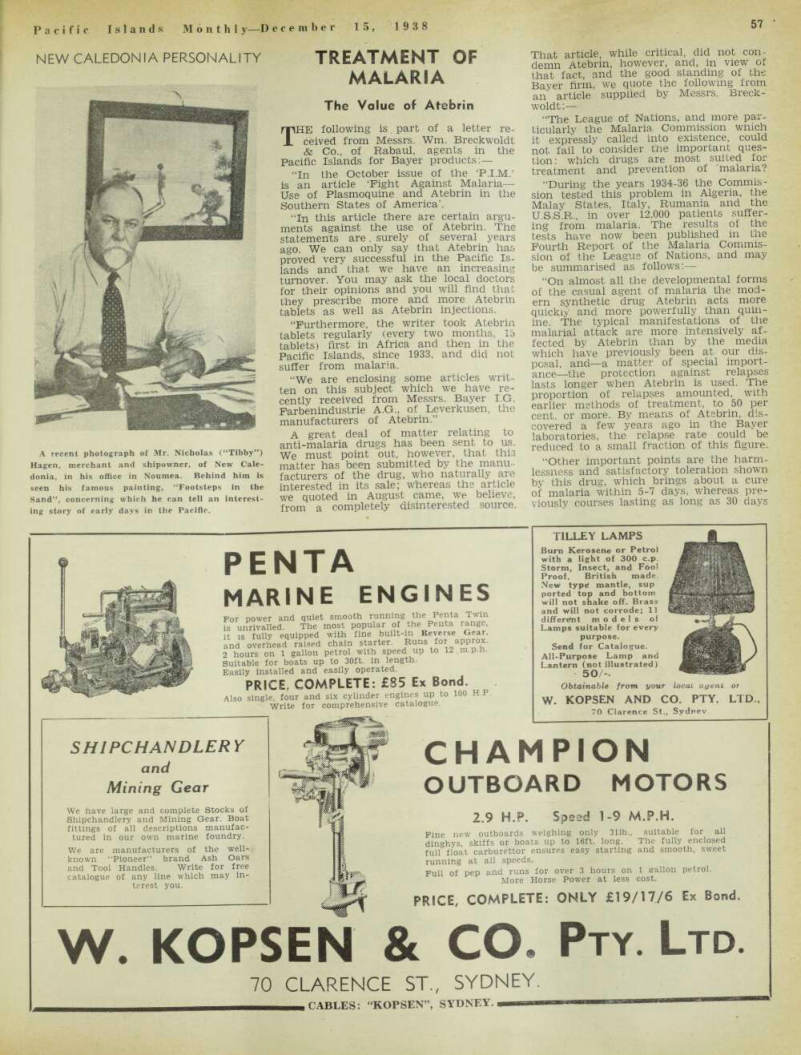
A recent photograph of Mr. Nicholas (“Tibby”) Hagen, merchant and shipowner, of New Cale donia, in his office in Noumea. Behind him is seen his famous painting, “Footsteps in the Sand’’, concerning which he can tell an interest ing story of early days in the Pacific.
Treatment Of
Malaria
The Value of Atebrin
TKE following is part of a letter received from Messrs. Wm. Breckwoldt & Co., of Rabaul, agents in the Pacific Islands for Bayer products:— “In the October issue of the ‘P.I.M.’ is an article ‘Fight Against Malaria— Use of Plasmoquine and Atebrin in the Southern States of America’.
“In this article there are certain arguments against the use of Atebrin. The statements are. surely of several years ago. We can only say that Atebrin has proved very successful in the Pacific Islands and that we have an increasing turnover. You may ask the local doctors for their opinions and you will find that they prescribe more and more Atebrin tablets as well as Atebrin injections.
“Furthermore, the writer took Atebrin tablets regularly (every two months, 15 tablets) first in Africa and then in the Pacific Islands, since 1933, and did not suffer from malaria.
“We are enclosing some articles written^,® n T pJ?if v^ lb fPom^^es^rs^Bayer 6 Ig"
A G the Farbenmdustne A.G., o Leverxusen, tne manufacturers of Atebrin.
A great deal of matter relating to anti-malaria drugs has been sent to us. matter “has manu- 3 facturers of the drug, who naturally are interested in its sale; whereas the article we quoted in August came, we believe, from a completely disinterested source,
That article, while critical, did not con demn Atebrin, however, and, in view of that fact, and the good standing of the Bayer firm, we quote the following from an article supplied by Messrs. Breck woldt: — “The League of Nations, and more par ticularly the Malaria Commission which it expressly called into existence, could not fail to consider the important ques tion: which drugs are most suited for treatment and prevention of 'malaria?
“During the years 1934-36 the Commis sion tested this problem in Algeria, the Malay States, Italy, Rumania and the U.SS.R., in over 12,000 patients suffer ing from malaria. The results of the tests have now been published in the Fourth Report of the Malaria Commis sion of the League of Nations, and may be summarised as follows: — “On almost all the developmental forms of the casual agent of malaria the mod ern synthetic drug Atebrin acts more quickly and more powerfully than quin ine. The typical manifestations of the malarial attack are more intensively af fected by Atebrin than by the media which have previously been at our dis posal, and—a matter of special import ance—the protection against relapses lasts longer when Atebrin is used. The proportion of relapses amounted, with earlier methods of treatment, to 50 per cent, or more. By means of Atebrin, dis covered a few years ago in the Bayer laboratories, the relapse rate could be reduced to a small fraction of this figure.
“Other important points are the harm lessness and satisfactory toleration shown by this drug, which brings about a cure of malaria within 5-7 days, whereas pre viously courses lasting as long as 30 days
or more were necessary—these of course being considerably more expensive than the simple and speedy treatment by Atebrin.
“In the Report emphasis is also laid on the reliable effect of Atebrin as a pre ventive measure against malaria. To take it twice weekly confers certain protec tion without in the least affecting work ing capacity or general health.”
Mr. E. Quin, of the Samoan Admin istration, reached New Zealand with his wife and daughter by the last “Maui Pomare” on leave.
Mr. R. Reed, who conducts the Ra baul dairy, returned to New Guinea in mid-November after a visit to the coun try districts of New South Wales.
Dr. Margaret Mead (who, in private life, is Mrs. Gregory Bateson) who has been studying native life in Bali, Dutch East Indies, for some time, arrived in Sydney with her husband early in De cember and will remain in Australia for several weeks. Dr. Mead is well-known in most of the Pacific Islands on account, first, of her anthropological studies and second, because she is the author of a number of interesting books based on Is lands life. She is now planning another book about Bali.
Advertisements & other items, p. 59 (2 items)
57
Pacific Islands Mbnthl y—D eceniber 15, 1938
W. Kopsen & Co. Pty. Ltd
s
its.
RENTA
marine engines
For power and quiet smooth running the Penta Twin is unrivalled. The most popular of the Penta range, it is fully equipped with fine built-in Reverse Gear, and overhead raised chain starter. Runs for approx. 2 hours on 1 gallon petrol with speed up to 12 m.p.n.
Suitable for boats up to 30ft. in length.
Easily installed and easily operated.
PRICE. COMPLETE; £B5 Ex Bond.
Also single, four and six cylinder engines up to 100 H P.
Write for comprehensive catalogue.
SHIPCHANDLERY
and
Mining Gear
We have large and complete Stocks of Shipchandlery and Mining Gear. Boat fittings of all descriptions manufactured in our own marine foundry.
We are manufacturers of the wellknown “Pioneer” brand Ash Oars and Tool Handles. Write for free catalogue of any line which may interest you.
TILLEY LAMPS
Burn Kerosene or Petrol with a light of 300 c.p.
Storm, Insect, and Fool Proof. British made.
New type? mantle, sup ported top and bottom will not shake off. Brass and will not corrode; 11 different models of Lamps suitable for every purpose.
Send for Catalogue.
All-Purpose Lamp and Lantern (not illustrated) 50/- Obtainable from your local agent or
W. KOPSEN AND CO. PTY. LTD.,
70 Clarence St., Sydney
CHAMPION
OUTBOARD MOTORS
2.9 H.P. Speed 1-9 M.P.H.
Fine new outboards weighing only 311 b., suitable for all dinghys, skiffs or boats up to 16ft. long. The fully enclosed full float carburettor ensures easy starting and smooth, sweet running at all speeds.
Full of pep and runs for over 3 hours on 1 gallon petrol.
More Horse Power at less cost.
PRICE, COMPLETE: ONLY £l9/17/6 Ex Bond.
W. KOPSEN & CO. Pty. Ltd
70 CLARENCE ST., SYDNEY
CABLES: ‘KOPSEN”, SYDNEY.
How A Bridge Was
Built
Forgotten Bit of Fiji History
Letter to the Editor OVER the caption “Sigatoka River Bridge on the New Highway, East ward of Suva, Fiji”, there appears in your issue of October a photo of the C.S.R. Co.’s railway bridge spanning the Sigatoka River at Na Vunasalu. It is a good photo of the bridge, but the cap tion is misleading inasmuch as it conveys the impression that the bridge is of re cent erection. It is quite true that the traffic portion of that structure now forms part of the Queen’s Highway Road westward of Suva, but it was built by the C.S.R. Co, some 28 years ago.
A perusal of the Fiji Legislative Coun cil debates of 1911 will enlighten those who desire to learn how the C.S.R. Co., came to construct—at its own expense— an additional width of bridge, when all it wanted to do was to erect one to carry its own cane trains.
In 1910, the C.S.R. Co., brought a Bill entitled “The Ba-Kavanagasau Light Railways Bill” to the Fiji Legislative Council, asking that it be passed.
The then Acting Attorney-General, Mr.
Alexander, opposed the Bill, on the grounds that it contained no provision whereby the public interests would be safeguarded. He contended, inter alia, if and when the C.S.R. Co., built a bridge over the Na Sigatoka River, that ade quate facilities should be provided for the convenience of the travelling public.
He further submitted that the Co., should be compelled to deck the two bridges which it had already thrown over the Lomawai and Namarau streams.
The debates were conducted with great keenness and even led to an exchange— through the columns of the local press— of correspondence between Mr. E. Knox, general manager of the C.S.R. Co., and the Acting Attorney-General. Mr. Alex ander. Mr. Knox maintained that his Co., constructed the light-tramways, including all bridges, for the sole purpose of fur thering the interests of their business: that the Co.’s enterprise and canital were alone responsible; that the public of Fiji was contributing nothing towards the cost of construction and maintenance, so it was therefore manifestlv unjust that the Fiji Government should attempt to comnel his Co., to contribute anything to wards the public convenience.
Mr. Alexander took un a stand com pletely opposite. He contended that public convenience must come first. The proof that his contention was endorsed by the Legislative Council is to be found in the facts that there is a portion of the Na Sigatoka bridge being used bv the public for general traffic —and has been so used for about 28 years—and that the bridges over the Lomawai and Namarau streams were decked and maintained by the Co., thoue-h these latter did not come into general use for many years.
Though the credit for having should ered the exnense belongs to the C.S.R.
Co., to Sir Brickham Sweet-Escott funder whom Mr. Alexander served) and to his predecessor, Sir H. May, must be given the kudos for having taken so long sighted a view—because. I may state, the Governor did not have the undi vided support of the elected side of the Council.
It cannot do any harm to let the pre sent generation of residents in Fiii know what the Colonv owes to the far-sighted ness and devotion to duty of those Ad ministrators who have gone before.
I am, etc..
Theo. D. Diaz.
Colo North. Fiii.
Nov., 12. 1938.
Mr. and Mrs. M. G. James reached Wellington by the November “Maul Pomare” from Ania. on leave. He is senior wireless operator in Western Sa moa.
Advertisements & other items, pp. 60-61 (3 items)
58
Pacific Islands Mon th 1 y—D ecember 15, 1938
uqqralions
You are cordially invited to visit our Showrooms.
msonablp
Whether intended for gifts or for personal needs Noyes Bros, offer a wide range of high quality lines suitable for Christmas. They include: China and Glassware. Silverware, Cutlery Radio Receivers, Vacuum Cleaners. Electric Hot Water Jugs.
Toasters, Electric Fans. Electric Irons, Reading Lamps, Gramophone Pick-ups and Turntables, and for
BETTER LIGHT-BETTER SIGHT. USE CROMPTON LAMPS.
NOYES BROS. (Sydney) LTD.
115 Clarence Street, Sydney, Phone: B 7581 (10 lines) 11 Watt Street, Newcastle. 197 Elizabeth Street, Brisbane.
Protect Your Property With
0 Years' Experience The Result of Over m m gi\ Til tpfylasa Obtainable from - - ALL BRANCHES BURNS, PHILP & CO. LTD.
AtV« al ®
•i A an o cz Just think of the number of starts, the times you accelerate, slow down and accelerate again, the uphill as well as the flat running you do every time you take the car out. You . . . start the engine a (6) aa- £3 0 41 © drive off, gear changing slow down for a kiddie, then and accelerating . • accelerate again . • OB ZD Q> slow down for an obstructing car, then accelerate . • step on it going uphill 31r- n Mi call in at a friend’s place . .
Srv~
Another start, gear changing and accelerating pull up at shop then another start, changing gears and accelerating . .
This "stop-and-go" driving wastes petrol unless you drive on Shell.
The unrivalled volatility and extra energy content of Shell means many savings to you. On starting you get away immediately, because your engine develops full power at the press of the starter. With gearchanging, the surging power ensures that you change up sooner and more smoothly. You spend less time in low gears. When you accelerate swiftly you get instant response from your engine, and on bends and hills the extra power which Shell provides will take you over in M top H .
So - use the most powerful - therefore, the most economical spirit, Shell.
Saves on ''STOP-and-GO' Drivinq
THE SHELL COMPANY OF AUSTRALIA LTD. (Incorporated in Great Britain)
OS. 58/4 E
59
Pacific Islands Monthl y—D ecember 15, 1938
Stranded In Suva
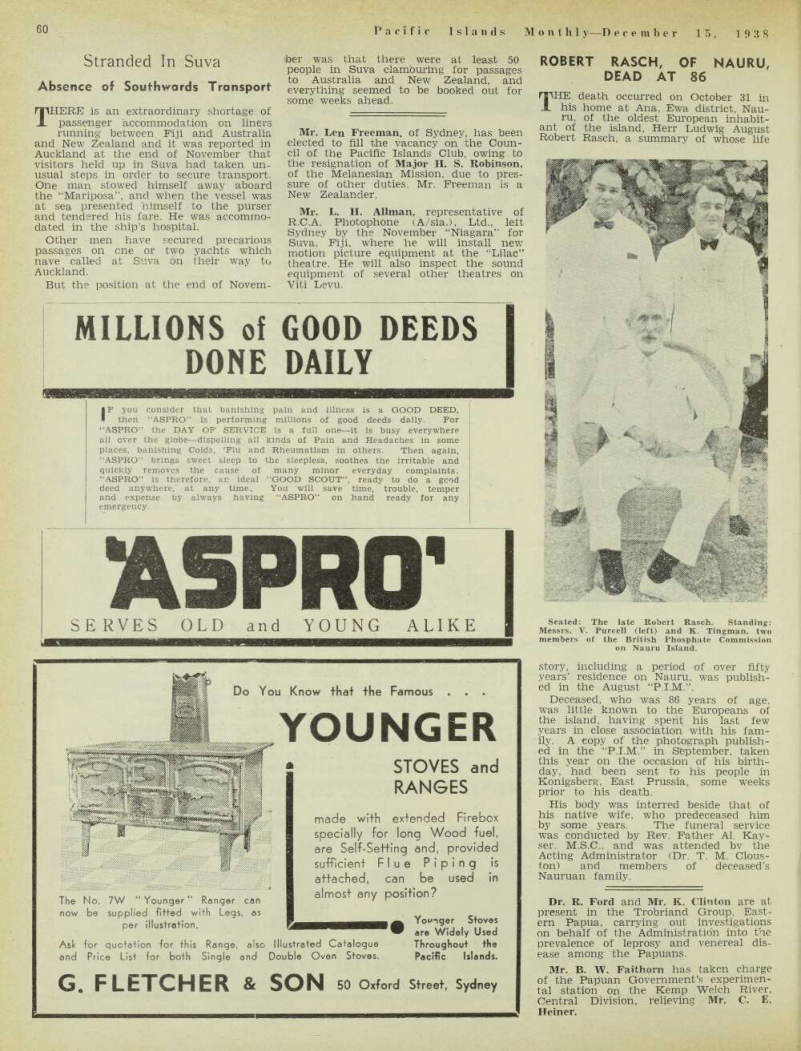
Absence of Southwards Transport
THERE is an extraordinary shortage of passenger accommodation on liners running between Fiji and Australia and New Zealand and it was reported in Auckland at the end of November that visitors held up in Suva had taken un usual steps in order to secure transport.
One man stowed himself away aboard the “Mariposa”, and when the vessel was at sea presented himself to the purser and tendered his fare. He was accommo dated in the ship’s hospital.
Other men have secured precarious passages on cne or two yachts which nave called at Suva on their way to Auckland.
But the position at the end of Novem-
Iber was that there were at least 50 people in Suva clamouring for passages to Australia and New Zealand, and everything seemed to be booked out for some weeks ahead.
Mr. Len Freeman, of Sydney, has been elected to fill the vacancy on the Coun cil of the Pacific Islands Club, owing to the resignation of Major H. S. Robinson, of the Melanesian Mission, due to pres sure of other duties. Mr. Freeman is a New Zealander.
Mr. L. H. Allman, representative of R.C.A. Photophone (A/sia.), Ltd., left Sydney by the November “Niagara” for Suva. Fiji, where he will install new motion picture equipment at the “Lilac” theatre. He will also inspect the sound equipment of several other theatres on Viti Levu.
Robert Rasch, Of Nauru,
Dead At 86
THE death occurred on October 31 in his home at Ana, Ewa district, Nau ru, of the oldest European inhabit ant of the island, Herr Ludwig August Robert Rasch, a summary of whose life
story, including a period of over fifty years’ residence on Nauru, was publish ed in the August Deceased, who was 86 years of age, was little known to the Europeans of the island, having spent his last few years in close association with his fam ily. A copy of the photograph publish ed in the “P.1.M.” in September, taken this year on the occasion of his birth day, had been sent to his people in Konigsberg, East Prussia, some weeks prior to his death.
His body was interred beside that of his native wife, who predeceased him by some years. The funeral service was conducted by Rev. Father Al. Kay ser. M.S.C.. and was attended bv the Acting Administrator (Dr. T. M. Clous ton) and members of deceased’s Nauruan family.
Dr. R. Ford and Mr. K. Clinton are at present in the Trobriand Group, East ern Papua, carrying out investigations on behalf of the Administration into the prevalence of leprosy and venereal dis ease among the Papuans.
Mr. B. W. Faithorn has taken charge of the Papuan Government’s experimen tal station on the Kemp Welch River, Central Division, relieving Mr. C. E.
Heiner.
Seated: The late Robert Rasch. Standing: Messrs. V. Purcell (left) and K. Tingman, two members of the British Phosphate Commission on Nauru Island.
Advertisements & other items, p. 62 (2 items)
60
Pacific Islands Monthl y—D ecember 15, 1938
Younger
MILLIONS of GOOD DEEDS
DONE DAILY
IF you consider that banishing pain and illness is a GOOD DEED, then “ASPRO” is performing millions of good deeds daily. For “ASPRO” the DAY OF SERVICE is a full one—it is busy everywhere 1 all over the globe—dispelling all kinds of Pain and Headaches in some places, banishing Colds, ’Flu and Rheumatism in others. Then again, i “ASPRO” brings sweet sleep to the sleepless, soothes the irritable and i quickly removes the cause of many minor everyday complaints, j “ASPRO” is therefore, an ideal “GOOD SCOUT”, ready to do a good deed anywhere, at any time. You will save time, trouble, temper and expense by always having “ASPRO” on hand ready for any emergency.
Do You Know that the Famous . . .
YOUNGER
STOVES and
RANGES
made with extended Firebox specially for long Wood fuel, are Self-Setting and, provided sufficient Flue Piping is attached, can be used in almost any position?
The No. 7W " Younger" Ranger can now be supplied fitted with Legs, as per illustration.
Ask tor quotation for this Range, also Illustrated Catalogue and Price List for both Single and Double Oven Stoves.
G. FLETCHER & SON 50 Oxford Street, Sydney Younger Stoves are Widely Used Throughout the Pacific Islands.
"Charlie" Wurth
Popular Official Retires From Papuan Service
From Our Own Correspondent.
Pt. Moresby, Dec. 2.
THE Hon. C. T. Wurth, Commissioner for Lands and Agriculture and Direc tor of Mines in the Territory of Papua, finally left Papua on November 29, when he took his long leave. On its termination he will retire from the pub lic service, after 29 years’ service.
Mr. Wurth was born in Queensland exactly 57 years ago. At an early age, he enlisted for service in the South Af rican War, and later entered the service of the South African Government. Then he joined the Queensland Government service, and remained until 1909, when he crossed over to Papua and joined the public service in March, nearly 30 years ago.
Mr. Wurth’s duties first took him to the Northern and North-eastern Divis ion where, at the time, the goldfields on the Mombare and Yodda had at tracted a large community of miners; and, during this remarkable period, Mr.
Wurth held the position of Resident Magistrate.
In 1914, Mr. Wurth volunteered for war service. At the cessation of hostili ties he was transferred to Buna, and as R.M. of this and other stations, even tually became Resident Magistrate of the Central Division, stationed at Port Moresby. In 1936, he was appointed Commissioner of Lands and Agriculture and Director of Mines. Since his ap pointment. he has been faced, not only with awakened interest in agriculture— rubber in particular—but with extensive
work in connection with the operations of tne different oil companies prospect ing for oil in the territory, to whom he has given every assistance. “A tiger for work, very exact, very, very honest, loyal to his salt” —that is a summing up of Hon. C. T. Wurth, who is one of the most popular officers Papua has ever known.
On November 25, at the Public Ser vice Club, Mr. Wurth was presented with a wallet of notes by his fellow-officers.
Some very flattering things were said of him by the Lieut.-Governor’ (Sir Hubert Murray).
Airmail Services In New
Guinea
IT was formally announced in Canberra on November 25 that the New Guinea Administration had “decided to adopt air transport on a permanent and ex tensive scale for the conveyance of ad ministration officers, mails and goods between various parts of the Territory”; and tenders were invited the following day for the conveyance of passengers, mails and goods by air between the Morobe towns and Madang and the Sepik for a period of two years, and be tween the Morobe towns and Port Moresby for a period of one year from March 1, 1939.
Such services have been carried on under contract for the administration for several years past; but Canberra and the Australian newspapers seem to think that there was something new about the arrangement.
Josaia Tawake, a trained Fijian agri culturist of considerable experience has been accepted by the Methodist Mission for service in Papua.
Annual Farce
Mandate Report At Geneva
mKE annual report of the Government i of Western Samoa for the year 1937 was before the Permanent Mandates Commission of the League of Nations in Geneva recently, and the usual farce was enacted.
Dr. R. M. Campbell, Economic Adviser to the N.Z. Government in London, at tended and described what New Zealand was doing to improve the health condi tions and educational standard of the Samoan?.
It is reported that the Commission showed a lively interest in steps, taken and contemplated, towards giving the Samoans a larger measure of self gov ernment; and that “the general attitude was one of commendation”.
In these days, when the taxpayers of Australia and New Zealand are obliged to find enormous sums for armaments and defence, it does seem ridiculous that Australia and New Zealand should con tinue to pay very large amounts each year for the maintainence of the “Great White Palace” of the League of Nations at Geneva. Only Britain and France, and a host of cynical smaller nations, are now members of the League. The League is without power or influence in prevent ing international war; and its examin ation of the annual reports on mandated territories is so completely useless as to be pathetic.
Mr. R. S. Willis, Government Medical Assistant stationed at Port Moresby, Papua, with Mrs. Willis, arrived at Cairns. Queensland, in November by air liner on furlough.
Advertisements & other items, pp. 63-64 (3 items)
61
Pacific Islands Monthl y—D ecember 15, 1938
Tilley
One Lamp for every purpose In or Outdoors
ii
ALL-PURPOSE” LAMP
Light of 300 c.p. for 4 hours for Id. Burns Ordinary Kerosene This Lamp is designed for general all-round service. It is the cheapest Vapour Lamp on the market, but at the same time highly efficient in every detail and simple to operate. Can be carried about as Storm Lantern in the fiercest gale; used as a Hanging Lamp (indoors or out) by fitting 12ins. Reflector which slides on to the Suspension Wire; or turned into a Table Lamp by just detaching the Suspension Wire. The light is perfectly steady and unaffected by draughts, however severe. Lamp is strongly made of polished brass. Burner hood enamelled in bright colours. Reflector is enamelled white. Get rid of all antiquated devices and use this up-to-date All-British Tilley Lamp.
Obtainable throughout the Pacific Islands from the Branches of:
BURNS PHILP & CO.. LTD., ana
BURNS PHILP (SOUTH SEAS) CO.. LTD.
E.X. 4.
CLARENCE ST.
SYDNEY
If any difficulty, write direct to: THE TILLEY LAMP CO. (Dept. P.M.), HENDON, LONDON, N.W.4.
Spare Parts and Lamps yy KOPSEN & CO. PTY. LTD. also obtainable from—
WIKI. BRECKWOLDT & GO.,
SOUTH SEA MERCHANTS
TELEGRAPHIC ADDRESS:
NEW GUINEA:—P.O. Box 89, Rabaul. SAMOA:—P.O. Box 124, Apia FIJI:—P.O. Box 111, Suva.
POSTAL ADDRESSES:—
TAHITI:—P.O. Box 60, Papeete.
AGENTS FOR...
ATERBRIN— THE PROTECTION AGAINST MALARIA.
f A \ ASPIRIN BAYER— THE GENUINE ASPIRIN— AND BAYER] MEDICINES - ALL OTHER BAYER PRODUCTS.
B J STOCK ALWAYS AVAILABLE AT OUR BRANCHES.
All Orders Executed at Original "Bayer" Prices. 2 Tonner Type, L. 1,500 -45 H.P. just arrived in Rabaul for demonstration. Fuel consumption— -28 miles on one gallon only of Shell Dervoil Medium, costing 1 lid. in Rabaul.
Prices for all types, up to loading capacity of 12,000 lbs., and for special types, on application.
CONTINENTAL" Tyres and Tubes tor Motor Cars and Bicycles.
DEUTZ and MERCEDES-BENZ" Diesel Marine Engines.
"PETROMAX" Hurricane Lanterns (fncandesc.) and Lamps. (Not Agents for Tahiti).
"TIGER BRAND" Corrugated and Flat Galvanised Ironsheets.
"TAIFUN" Bicycles and Accessories.
"TWO LIONS" Best Known Quality of A.l. Butcher Knives.
"BREWO" Razor Blades, Black, Brown, Blue, Pink, Silver.
"TORPEDO", "BIJOU" and "ERICA" Typewriters, Portable and Office.
"BECK' S" "Key Brand" German Lager.
"TELEFUNKEN" Wireless Sets, Battery and Current. Best results obtained.
Many Sold, Ever-increasing Turnover.
ALSO ALL TRADE LINES OF GERMAN, BRITISH, CONTINENTAL, JAPANESE AND CHINESE ORIGIN
LIEBERMANN, WAELCHLI & CO.,
Kobe, Yokohama, Tokio and Shanghai.
JOHN CAMPBELL & CO., SYDNEY. (All Australian Goods.)
MERCEDES-BENZ DIESEL TRUCKS
HANOMAG" Diesel Tractors.
ANCRE" Cast Iron Sauce Pots FROWO" Hurricane Lanterns.
ARARA" Gas Stoves. VESTA" Sewing Machines.
LOHSE" Uralt Lavender.
BREWO" Swedish Axes and Hatchets.
ARVSKA" Swedish Axes and Hatchets.
PLEASE NOTE:
Obt Trademark.
We sell WHOLESALE ONLY but, upon application, we will supply names of firms at all places in the Pacific Islands retailing our goods upply the goods.
62
Pacific Islands Monthl y—D ecember 15, I§BB
Officials?
Why Not Consult The Officials?
Canberra, and Problems of New Guinea
Letter to the Editor IT is to be regretted that, with the un limited supply of sound data available amongst Administration representa tives in this (Morobe) District, no one has officially sought the advice or recom mendations of such outstanding officials as Taylor, Feldt. Penglase, Roberts, Down ing, Kyle, Vial, Black and other District and Patrol Officers, concerning the value of Lae and* Wau as administrative centres, and concerning the best way of opening up the country. These are all .able and respected men, whose advice would cer tainly be worth having.
Moreover, they are beyond bribery or corruption, both in regard to “party funds ’, or political influence. They have no axe to grmd, neither are they looking for spoils to be gamed as a result of their recommendations, if consulted.
It was, and still is, generally accepted that the Selection Committee were a practical and honest comomation, and it will ever remam a mystery to the people of New Guinea, as well as those outside, why then recommendations were not ac cepted. If they were incompetent, then why were they selected for such an im portant work? If they were not, then it was a waste of money to send them on what now appears a wild goose chase.
I am. etc.,
Salamaua.
New Guinea, 21/11/’3B.
Editorial Note
It is surprising to know that those well-known officials have not been con sulted. (It is presumed that our corres pondent knows what he is talking about./ Still, the intelligent people at Canberra who ignore the Territory officials now, ignored them in exactly the same way when Administrators were wanted for New Guinea, Northern Territory, Norfolk Island and Nauru. Ex-politicians and ex soldiers, with no experience of tropical administration, have been appointed to the chief positions, and the proved and experienced men of the tropical services have been passed over.
That vicious system has persisted for years. It was typical of the administra tions of Sir George Pearce and Mr.
Hughes; and it is almost too much to hope that the new Minister (Mr. Harri son) will break it down.
Iron Ore In New Guinea
A DEPOSIT of iron ore is known to exist on New Britain (Mandated Territory of New Guinea), but the full extent of the deposit is not known (according to an official statement made in Canberra).
The deposit has been examined by of ficial geologists and by private enter prise. In 1936 the geologist of the New Guinea Administration reported on the deposit, and stated: “Outcrops of high grade magnetite ore occur in several places. Owing to the absence of develop mental work, even surface costeaning, it is difficult to form an estimate of the true extent of the ore bodies”.
Sir Walter McNicoll (Administrator of New Guinea) said in Sydney that these iron deposits were poor and apparently of little value.
Typically Tropic
You can read about the guile and the lure of tropic isles.
And the devastating mischief that they do; How a tired young baronet will fall there for all the wiles, And will buy himself a native wife or two.
You can read of stirring pictures where he sits upon a mat, While half-a-dozen kids ‘are playing round; And he’s smoking trade tobacco; think ing this, and thinking that, And his wives sit at his feet there on the ground.
You can travel through the Islands, or you can take it just from me These pathetic little tales are “all my eye”.
They’re a worn out tropic topic; some thing that you’ll never see; They are libels, and are tales that I deny.
We may be at times romantic in our lazy sort of way, And watch a sun-set from the tropic sand; Or, at times when forced to rise, we will greet the break of day As a sight that’s really swish—you understand.
It’s not often that we moon about the wonderful lagoon, Or the stately palms that wave their heads on high.
We are “tuning-in” to Sydney, Singapore or else Rangoon— There are times, too, when we wear an ev’ning tie.
We’re a fairly moral crowd—and the wives we have are white, And our kiddies are at school in cooler climes; If we’re sun-kissed, we are normal—or. at least, I hope I’m right— We are typically tropic—with the times —Don Gordon Mr. J. I, Blaikie, Headmaster of the King George V. School at Tarawa, Gil bert and Ellice Islands Colony, has been appointed Superintendent of Police on Ocean Island, according to a recent notice issued by the Colonial Office. London.
Mr. D. Eden, of Vailele, Western Sa moa, is at present in New Zealand on furlough with his wife and two sons.
Miss E. Downs, of the London Mission ary Society, arrived back in Samoa by the November “Maui Pomare” after short furlough in New Zealand.
Mr. and Mrs. F. W. Brooks arrived in Australia from Suva by the “Monterey” recently to make their home in Sydney.
For the past 30 years. Mr. Brooks has been in the employ of the Colonial Sugar Refining Co., Ltd., in the Labasa Dis trict.
Rev. E. and Mrs. Fenn, of the London Missionary Society, Aird Hill. Papua, re ceived many congratulations in November on the birth of a daughter.
Mr. Simeon Lewis Lazarus, Second- Lieutenant in the Fiji Defence Force, married Miss Betty Jane Kearsley at the Suva Holy Trinity Pro-Cathedral in November. They spent their honeymoon cruising in the Group on board the bridegroom’s yacht “Cimba”.
Advertisements & other items, pp. 65-66 (2 items)
63
Pacific Islands Monthl y—D ecem b e r 15, 1938
Iusoline
\ DR HENRI'S
NU-VIGOR
ViTALITt
PILLS
OOHINRIS
NU-£Vsc3R
':h Ipu'sf
kk:
MEN
TAKE DR. HENRI’S
Nu-Vigor Vitality Pills
for loss of power and nervous exhaustion. They give wonderful results where overwork, worry, nerve weakness, etc., causes loss of those vital powers so necessary for the full enjoyment of life.
They are made in two strengths to suit individual cases. Week’s supply 3/6, one month’s treatment 10/6. Obstinate cases should take the Extra-Strong Prescription, 7/6 and 21/—stimulates the organs.
Post FREE in plain wrapper. Call or Write for literature and Free Advice to
H. P. MICHAEL, S&.
CHEMIST.
Michael’s Buildings, Cor. Elizabeth & Lonsdale Streets,
MELBOURNE.
MEDICAL GOODS
Best Quality. Lowest Prices.
All Guaranteed.
Write for FREE “Book of Knowledge” Catalogue and Price Lists Medical Goods etc. All Goods sent Post Free, plain wrapper, return mail. Strictly confidential. LADIES! Let the Secura Nurse advise you in the selection of your intimate Medical requirements.
IT ATTRACTS THEY EAT IT THEY DIE
IUSOLINE
Tfc ***• ' - .
VfrCd
CERTAIN
DEATH
NEVER
KNOWN
TO FAIL !
COCKROACH
DESTROYER
IT'S A PASTE
AUSOLINE CO.,
314 CROWN STREET, SYDNEY
(Established 191®)
PRICES:
lib. 5/- . . . 3lbs. 10/- Postage Extra.
Remit Cash with Order.
Obtainable also from Islands stores of:
BURNS, PHILP & Co. Ltd.
W. R. CARPENTER & Co. Ltd.
TEVIOT COLLEGE,
Killara, Sydney, N.S.W.
A Boarding School for Boys, 4 to 1 5 years, situated in a healthy and idea! position on the North Shore heights.
The purpose uf the School is to provide an education, calculated to develop well-balanced minds and bodies, to encourage initiative and breadth of outlook, and to stimulate the formation of wholesome Christian character in a homely atmosphere.
Boys from THE ISLANDS may spend School Vacations at the School Seaside House.
Prospectus on application. Principals: j j^ now a |g S ' g
P m & v \ % 1 r ' 3
NGASSE
\ X "471 I"
Classic Eau de Cologne The world's favourite invigorating, fragrant and cool.
"Tosco" Eau de Cologne A happy union of a glamorous perfume with the freshness of Classic Eau de Cologne,
"Rhinegold" Eau de Cologne
A happy union of an elusive, subtle perfume with the freshness of Classic Eau de Cologne.
REPRESENTATIVE: ROBERT BLAU (AUST.)
A.C.A. BUILDING, CNR. KING & YORK STREETS, SYDNEY
Pattern Service
pACH month we publish a Fashions design, “ patterns of which may be purchased by our readers direct from this office. post free. To obtain a pattern, print your name and address below, giving the number of the pattern and the bust size, and send to “Pattern Department”, Pacific Islands Monthly, Box 3408 R, G.P.0., Sydney; enclose also the price of the pattern in postal note or stamps.
It will be sent by return mail.
Name Address Pattern Number Size
Rev. Henry Whyte, accompanied by his wife, departed from Sydney for New Zea land by the “Niagara” on November 24 to join the “Matua” for Western Samoa where they will engage in work for the London Missionary Society. For the past eight years, Mr. Whyte has been minister of the Congregational Church at Ips wich, Queensland.
H6355.—This delightful suit of spotted un crushable linen is made in cool green, or smart navy fabric. The shirt has the tailored appear ance which modern women demand for sports wear, and the shorts are fully pleated for com fort. In these utility garments, simplicity of making is combined with smartness and comfort.
Material: three and seven-eighth yds. (36 in. wide). Sizes: 32, 34, 36, 38, and 40 inch bust measurements. Pattern—1/ld.
Advertisements & other items, p. 66 (1 item)
64
Pacific Islands Monthl y—D ecember 15, 1938
Fashion Hints for Islands Women
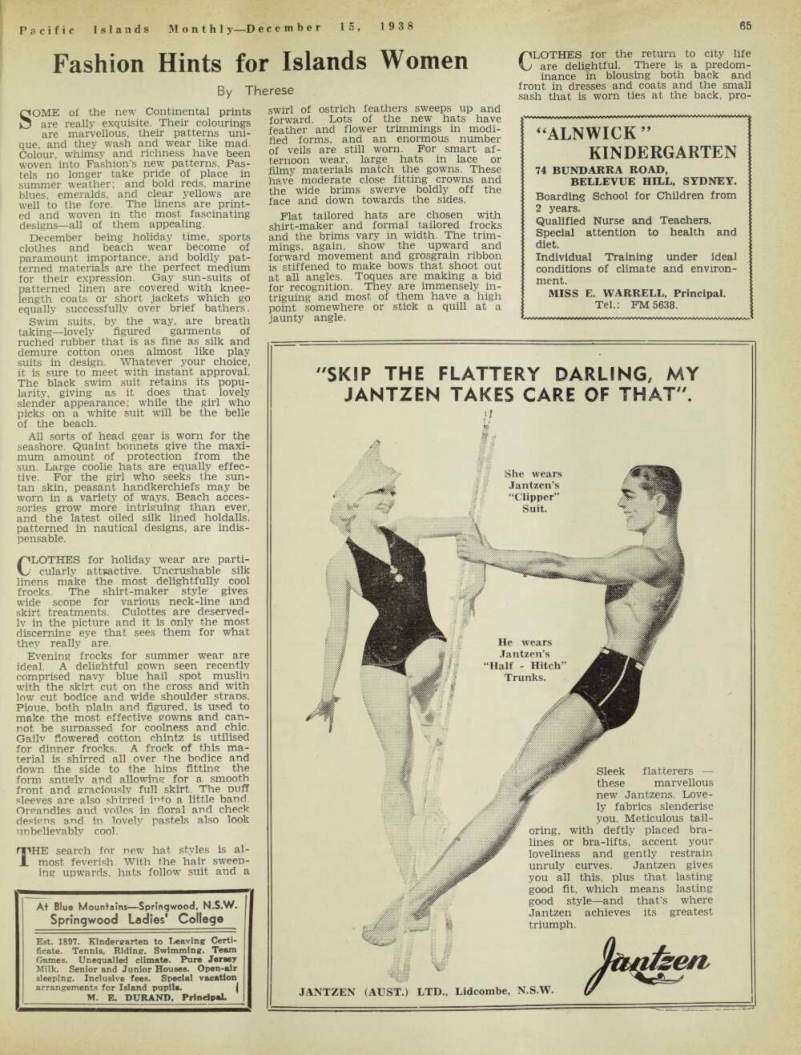
By Therese
SOME of the new Continental prints are really exquisite. Their colourings are marvellous, their patterns uni que, and they wash and wear like mad.
Colour, whimsy and richness have been woven into Fashion’s new patterns. Pas tels no longer take pride of place in summer weather; and bold reds, marine blues, emeralds, and clear yellows are well to the fore. The linens are print ed and woven in the most fascinating designs—all of them appealing.
December being holiday time, sports clothes and beach wear become of paramount importance, and boldly pat terned materials are the perfect medium for their expression. Gay sun-suits of patterned linen are covered with knee length coats or short jackets which go equally successfully over brief bathers.
Swim suits, by the way, are breath taking—lovely figured garments of ruched rubber that is as fine as silk and demure cotton ones almost like play suits in design. Whatever your choice, it is sure to meet with instant approval.
The black swim suit retains its popu larity, giving as it does that lovely slender appearance; while the girl who picks on a white suit will be the belle of the beach.
All sorts of head gear is worn for the seashore. Quaint bonnets give the maxi mum amount of protection from the sun. Large coolie hats are equally effec tive. For the girl who seeks the sun tan skin, peasant handkerchiefs may be worn in a variety of ways. Beach acces sories grow more intriguing than ever, and the latest oiled silk lined holdalls, patterned in nautical designs, are indis pensable.
CLOTHES for holiday wear are parti cularly attractive. Uncrushable silk linens make the most delightfully cool frocks. The shirt-maker style' gives wide scope for various neck-line and skirt treatments. Culottes are deserved- Iv in the picture and it is only the most discerning eye that sees them for what they really are.
Evening frocks for summer wear are ideal. A delightful gown seen recently comprised navy blue hail spot muslin with the skirt cut on the cross and with low cut bodice and wide shoulder straps.
Pioue. both plain and figured. Is used to make the most effective gowns and can not be surpassed for coolness and chic.
Gailv flowered cotton chintz is utilised for dinner frocks. A frock of this ma terial is shirred all over the bodice and down the side to the hips fitting the form snugly and allowing for a smooth front and graciously full skirt. The puff sleeves are also shirred i"to a little band.
Organdies and voiles in floral and check designs and in lovely pastels also look unbelievably cool.
THE search for new hat styles is al most feverish. With the hair sweep ing upwards, hats follow suit and a
swirl of ostrich feathers sweeps up and forward. Lots of the new hats have feather and flower trimmings in modi fied forms, and an enormous number of veils are still worn. For smart af ternoon wear, large hats in lace or filmv materials match the gowns. These have moderate close fitting crowns and the wide brims swerve boldly off the face and down towards the sides.
Flat tailored hats are chosen with shirt-maker and formal tailored frocks and the brims vary in width. The trim mings. again, show the upward and forward movement and grosgrain ribbon is stiffened to make bows that shoot out at all angles. Toques are making a bid for recognition. They are immensely in triguing and most of them have a high point somewhere or stick a quill at a
jaunty angle.
CLOTHES for the return to city life are delightful. There is a predom inance in blousing both back and front in dresses and coats and the small sash that is worn ties at the back, pro
ducing a very youthful effect. Gathered and gracefully draped afternoon frocks are well to the fore, and there is a re vival of the shoulder height achieved by padded rolls at the tops of the sleeves.
The two-piece never loses its popu larity. It always takes a place in Fash ion’s scheme of things in every season.
Simple swing-back coats of three quarter length are worn over well-cut frocks with a draped sash for colour contrast. Evening dresses grow wider and wider and the modified bustle ap pears with greater frequency, IN house gowns nowadays there is no room for fluffiness—they are simple, beautifully cut gowns of satin and chiffon and gay cottons. They can be worn for informal entertaining and no wardrobe should be without them. Py
jama ensembles are delightfully new. The softly tailored pyjamas are worn with a three-quarter length coat and are ideal for cruising or travelling. They are made in the most fascinating striped silks — some of them rainbow-like in effect.
Mr. A. J. Mclver left Sydney for Pt.
Moresby, Papua, by the “Macdhui” on December 10, on his way to Daru where he is employed by Islands Exploration Ltd., as an engineer.
Mr. J. B. Mackay, Patrol Officer in the New Guinea Administration at Madang, departed from Sydney for the Mandated Territory by the last “Macdhui”. He had been in Sydney two months on sick leave.
Advertisements & other items, pp. 67-68 (2 items)
65
Pacific Islands Monthl y—D ecember 15, 1938
kqisen.
“ALNWICK”
KINDERGARTEN
14 BUNDARRA ROAD,
BELLEVUE HILL, SYDNEY.
Boarding School for Children from 2 years.
Qualified Nurse and Teachers.
Special attention to health and diet.
Individual Training under ideal conditions of climate and environment.
MISS E. WARRELL, Principal.
Tel.: FM 5638.
SKIP THE FLATTERY DARLING, MY
JANTZEN TAKES CARE OF THAT".
I! m She wears Jantzen s “Clipper” * Suit.
He wears Jantzen’s “Half - Hitch Trunks.
JANTZEN (AUST.) LTD., Lidcombe, N.S.W.
Sleek flatterers these marvellous new Jantzens. Lovely fabrics slenderise you. Meticulous tailoring, with deftly placed bralines or bra-lifts, accent your loveliness and gently restrain unruly curves. Jantzen gives you all this, plus that lasting good fit, which means lasting good style—and that’s where Jantzen achieves its greatest triumph.
kqisen.
At Blue Mountains—Springwood. N.S.W.
Springwood Ladies' College
Est. 1897. Kindergarten to Leaving Certificate. Tennis, Riding, Swimming. Team Games. Unequalled climate. Pure Jersey Milk. Senior and Junior Houses. Open-air sleeping. Inclusive fees. Special vacation arrangements for Island pupils. M. E. DURAND, Principal.
METHODIST LADIES’ COLLEGE
IrtlliiiiigiliS
BURWOOD
SYDNEY,
(N.S.W.)
A College of
Distinction.
Founded in 1886 for the express purpose of providing a Girls’ Day and Boarding School of the highest order. Complete curriculum from Kindergarten to University. Noted results in Public Examinations. For senior girls, the School offers —Leaving Certificate class —Secretarial course—Special Finishing class.
Every Home Care for Oversea Girls.
New Term: February 7th,*1939. Personal interviews after January 31st.
Principal: Headmistress: REV. H. C. FOREMAN, M.A. MISS M. H. SUTTON, M.8.E., B.A.
MODERATE FEES—PROSPECTUS FROM THE PRINCIPAL. Telephone: UJ 4166.
NEWINGTON
COLLEGE
rniinmmnmmiiiiimiiiiiiiiiiiiiiiiiiinin
STANMORE, SYDNEY, N.S.W,
ESTABLISHED 1863
One of the Great Public Schools of N.S.W.
For Parents in the Islands, Newington offers the ideal Home School for Boys of all Ages.
Education Recreation Characterbuilding.
New Preparatory School, to accommodate 150 scholars, and embodying the maximum of modern teaching aids and domestic comforts, will re-‘ ceive young boys from next term. Prospectus and all particulars from: Headmaster: P. R. Le Couteur, M.A. (Melb. et Oxon.) ’Phone: LM 5355. New Term commences February 7th, 1939.
Big Firms
Planters and the Big Firms How to Improve The Position in N. Guinea
Letter to the Editor AS a resident of the Territory since 1919 I read, from time to time, with great interest, your comments on the administration and progress of New Guinea under the Mandate.
I am not one of those who decry what has been done by our Australian offi cials there. If what has been accom plished had been the result of a Five Year Plan (so popular these days) and carried out in that time, those results would be very creditable. But when we realise that it is the position achieved after 24 years’ occupation, and 18 years of civil administration, there is not so much to be proud of.
If Australians are to retain this Ter ritory, the tempo must be accelerated and a period of real long-sighted develop ment entered upon.
The discovery and development of the goldfields has assisted greatly, and the Administration has been fortunate in having this development by private en terprise, and the revenue therefrom, to cover up the results of absence of or ganised development in other directions.
That we are not now faced with a just claim that, as a colonising effort, our occupation has been a failure, is due to the dogged persistence of the plant ers and to the commercial enterprise of the two big firms (Burns, Philp and Co.
Ltd. and W. R. Carpenter and Co. Ltd.) and such efficient mining companies as Bulolo Gold Dredging Ltd., New Guinea Goldfields Limited, and also Guinea Airways and the plucky pilots. The two commercial firms have practically had a monopoly of the copra and trading busi ness, and undoubtedly assisted planters to survive the previous great depression; but they did so at great profit to them selves (vide the very apparent progress of W. R. Carpenter and Co. Ltd. and the disclosed and undisclosed profits and strengthening of Burns, Philp and Co.
Ltd.).
The Commonwealth Government came to the assistance of purchasers of ex propriated plantations by agreeing to a most reasonable scheme of payments on the fluctuating price of copra. Having done this, however, the Government is not following up its action by seeing that its proteges (the returned sol dier planters) get the full benefit of its scheme.
The parity of copra to London is now less favourable than in the time of the depression. The average “tied” planter gets £3 to £4 under London price, on the beach, and this difference, plus exchange premium of 25 per cent., goes to the firms and transporters. On a £lO Lon don market this is undoubtedly the lion’s share; and so, as you remarked in
one of your articles, copra production is “only a bread and butter business, and not too much butter”.
During the depression, planters were able to do little to free themselves from their tying agreements with the firms and the present unfavourable market, plus the heavy charges for freights, marketing, interest, stores, etc., binds them closer in their toils.
Lack of healthy competition, due to this financial position, is one of the chief troubles. If planters were free to negotiate freely with the firms, and co operate to get better prices and cheaper supplies, the position would be much eas ier, and there would be a greater incen tive to development, and a healthier tone in the agriculture of the Territory —which must, in the long run, be its mainstay.
The Commonwealth Government pro poses shortly to inaugurate a Mort gage Department of the Commonwealth Bank of Australia; and thereby it has a chance of lending valuable assistance to the planters, by opening a branch of the new department in New Guinea and taking over the tied advances of plant ers from the firms on a reasonable basis. This would “unfreeze” the posi tion, and give the planters new hope; and would give the firms extra capital for transport services and other means of marketing their produce.
It would also encourage healthy com petition. The bank could secure itself through control of the distribution in big lots of copra, might be able to se cure better prices, if the firms do not do their part in that direction.
The Administration and, still more, the Commonwealth Government, could be of real assistance to our New Guinea colonists if they would take an intelli gent and constructive interest in these matters.
In spite of conditions very unfavour able as compared with those prevailing at the time of the sale of the expropri ated properties, planters have carried on their part in populating and developing the Territory during the past 12 years, and, like us all, they are getting no younger. It is too late for most of them to think of starting again in Australia in new ventures, even if 10 to 20 years in the tropics has not unfitted them .for other conditions.
The success of the pioneers would be the best means of encouraging future settlement of the Territory by Britishers.
Japan has over 50.000 Japanese (over 60.000, now.—Ed. “P.1.M.”) settled in the relatively small area of their Pacific Mandate. Australian and other white people will only go to New Guinea if they are encouraged to do so by the success of those already there.
If they live reasonably well, and do not go too long without a holiday to temperate climates, whites can keep healthy in most parts of New Guinea, but they must be able to set aside suf ficient money to enable them to send their children to Australia for education, if there is not to be race degeneration.
It is hoped that recent changes in the responsibility for Territory affairs aug urs well for a keener interest in Terri tory matters.
I am, etc.,
Rabaul Asian.
Sydney. 19/11/1938.
Mr. Tom Nevitt, M.L.C., well-known Papuan planter, left Sydney for Port Moresby, Papua, by the “Macdhui” on December 10.
Advertisements & other items, p. 68 (2 items)
66
Pacific Islands Monthl y—D ecember 15, 1938
Diabetes
treated without Injection, Pasting or Pietlng! Free—New Book, entitled “A Treatise on Diabetes—lts Cause and Treatment”, explains fully this latest theory. Successful home method. Write
CHEMISTS’ SUPPLIES CO., Dept. P.M.,
Box 1178, Christchurch, N.Z. (Kindly enclose 6d. stamps . for handling).
Cook Islands Notes
From Our Own Correspondent.
Rarotonga, Nov. 17.
ONCE a year the Catholic Church congregation hold an evening service in their Nikao cemetery. This is known to the natives as the ‘Tu Rama” (to light), and every grave is de corated with flowers, while hundreds of candles are placed on the tombstones and crosses. The service this year, held recently by candle-light, was most impressive and solemn, and was at tended by over 2,000 people.
“Matua’S” Schedule Altered
On account of the recent watersiders’ strike in N.Z., the schedule of the Union Co.’s motor ship “Matua” has been altered. To allow her to leave on the usual mailing date in January, Rarotonga’s call is being omitted next month.
The December cargo of bananas from Raro tonga will be lifted by a cargo boat calling on its way to N.Z, from America.
Tahiti Yacht At Rarotonga
Some time ago Mr. W Wlgmore, well-known Cook Islands planter, left by the local schooner “Tagua” to visit his plantation on Raiatea Island in the Society Group, French Oceania.
Wishing to return to Rarotonga, Mr. Wigmore found that the only way ne could do so was by chartering a yacht. This week the 40 ft. yacht “Nani” sailed into Avarua Harbour with Mr.
Wigmore as passenger, after taking six days to do the 600-odd miles from Tahiti.
New Zealand Bound
Leaving by the November “Matua” for New Zealand are the following:—Mr. and Mrs. Wm.
Tailby, Mr. and Mrs. R. Walker, Mr. and Mrs.
J. W. W. Graham, Miss Paynter, and Mr. Ford.
Miss I. Tooth, who, for the past two years, has been on the nursing staff of
the Government Hospital at Apia, West
ern Samoa, returned to New Zealand by the “Maui Pomare” in December.
Nurse E. W. Broadhurst, of Western Australia, has joined the staff of the Methodist Mission.
Advertisements & other items, pp. 69-70 (2 items)
67
Pacific Islands Monthl y—D ecember 15, 1938
Mike Lingerie
LOVELY
FOR YO U - LOVELY LADY
12.L1 THE feminine heart has never fluttered for more exquisite lingerie than Lustre is showing for this Christmas.
It is so appealingly lovely and glamorous.
New colours, new fabrics, new styles all contribute to joyous moments in the choosing of Lustre lingerie, and the giving or wearing of it afterwards. ■ i=»& 1 From any Burns Philp Store or direct by mail from any Australian store.
Mining Ore
Treatment
Machinery
COMPLETE CYANIDE
PLANTS SUPPLIED
Dorr Classifiers Dorr Thickeners Dorr Agifeters Oliver Filters Merril Crowe Zinc Dust Sold Precipitation Richardson Mine Fans •
FANS AND AIR HEATERS
For Ventilation. Copra Drying Rooms, etc. • Enquire from
CROSSLE, DUFF AND
MACINTOSH LTD.
52 Bridge Street. SYDNEY
Allen Taylor & Co. Ltd
SYDNEY
Sawmillers and Wholesale Suppliers of Hardwoods for Constructional Purposes GIRDERS . . . PILES . . . POLES . . . SLEEPERS, Etc.
EXPORTING TO PAclflc ISLANDS SINCE 1893
Cables: Tuxedo, Sydney
A
PRECIOUS
METALS
GOLD
Throughout the length and breadth of Australasia and the Pacific Islands, we are recognised as the main clearing house for Gold and other precious metals.
Having won an enviable reputation by sheer force of merit based on accuracy of assays, efficiency of service, and prompt payments at highest ruling rates, it is to your advantage to consign your Gold to us.
We are also buyers of Osmiridium, Platinum, Silver, and other precious metals, the smallest shipment receiving the expert attention of experienced metallurgists.
GARRETT £r DAVIDSON, PTY. LTD.
BANK OF N.S.W. BUILDINGS.
REGENT & GEORGE STS., SYDNEY.
Mining Notes
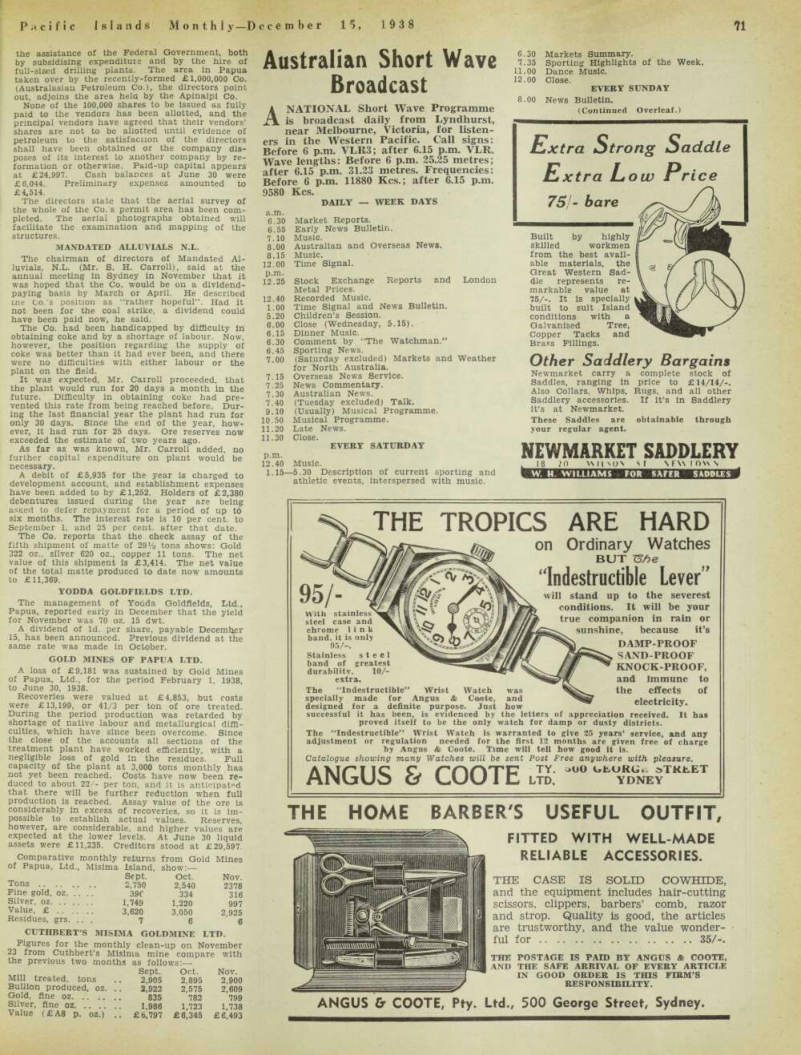
From Fiji
Emperor Mines, Ltd.
CUTURE of Emperor Mines, Ltd., could be 1 viewed with every confidence, said the chairman (Mr. Wallace H. Smith) at the annual meeting in Melbourne in November. All evidence pointed to a long life of uninterrupted dividends with possibilities for increased output and re turns. In addition to overburden removal, open ing up of sufficient working faces to permit regularity of feed, coupled with the necessity to tram additional personnel to handle the larger tonnage needed for the steady increase in out put, all tended to raise costs. Now that full production has been reached, and the mine pre pared for large-scale operations, it is hoped that it will be possible to further reduce costs.
The general manager (Mr. N. E. Nilsen) re ported that from geological evidence there is reason to believe that further exploration will show considerable extension, laterally, as well as downward in the known lodes. Because of the great size of the bodies already disclosed, and the unusual nature of their occurrence, consider able time must elapse before all ascertainable limits have been defined at the present depth.
Recent yields compare as follows:
Combined Head Value averaged 6.9 dwt. per ton New mill head value 6.9 dwt. per ton.
Pilot plant head value 5.9 dwt. per ton. New mill residues 0.53 dwt. per ton. Pilot plant
residues 0.55 dwt. per ton. Concentrates from pilot plant estimated to contain 50.75 oz. fine gold stored for further treatment.
The last progress report, at the end of Novem ber, stated that over-all recovery from semi sulphide ore, using cyanidation and flotation, was considered satisfactory. It was anticipated that installation of two fagergren cells just arrived at the mine would increase the capacity of this plant. Koroere Area: Chum drill tests deferred until electric transmission line completed.
General erection of lime burning plant at Tau nearly completed. Expect start furnaces early in December. Bulk oil tank at Vatia about com pleted.
Loloma (Fiji) Gold Mines N.L.
Loloma (Fiji) Gold Mines N.L. reports that the new agitators in the treatment plant are working well, and that extraction is now over 95 per cent. The flotation section is completed, but running is delayed because of the recent strike of native labour.
Latest yields compare as follows:
Announcing a dividend of 1/- a share payable on December 8, the Co.’s chairman, Mr. P. F.
Cody, addressing shareholders at the third an nual meeting in November, said he confidently expected that the property in Fiji would be pro ductive of good dividends for a long time. He hoped that dividends of 4/- a share per annum would be possible. If sufficient ore was opened up in the bottom level production might be in creased, which would enable more to be paid out in dividends. Ore in sight was equal to six years’ production, exclusive of ore which should be opened up by further development.
Mt. Kasi Mines Limited
Yields from the Mount Kasi Mine, Vanua Levu, Fiji, for the past four months, are compared in the following table:—
From New Guinea
Bulolo Gold Dredging Ltd
A PROFIT of 3,453,463 dollars (£A908,806) was earned by Bulolo Gold Dredging, Ltd., for the year ended May 31. 1938, before providing 322,633 dollars for amortisation. Two dividends required 3,000,000 dollars, leaving a credit bal ance of 2,150,310 dollars, as against 2,019,480 dollars at the beginning of the financial year.
Bullion won returned 4,73u,848 dollars and sundry income 72,340 dollars. Working costs amounted to 979,243 dollars, royalties 234,366 dollars freight refining 18.860 dollars, miscellaneous ex penses 117,253 dollars.
The following table shows the production and yardage for the year, and the totals to date:—
Production of the Co.’s dredges in New Guinea from August to October last was:—
Throughout September the Number 2 dredge was digging in very low values to reach a new location.
Day Dawn South (N.G.) N.L.
Directors of Day Dawn South (New Guinea), N.L., Intend to recommend that the company be wound-up, and the fund* distributed to the holders of the 82,750 shares. As a result of royalties received from tributers, the Co. has in hand £1,400. The tribute was completed on October 20, the directors state, and there is no
Pour weeks ended Sept. 7.
Oct. 5. Nov. 2. Nov. 30 Ore treated, tons 14,583 13,901 13,183 13 085 Head value, dwt. 6.3 6.5 6.81 6.9 Gold, oz. fine .. 4,120.6 4,165.7 4,109.4 4,110 Residues, dwt. . 0.53 0.62 0.5 0.53
Oct. 2 Nov. 2.
Nov. 30.
Tons crushed . . 13.901 13.183 13.085 Head value, dwt. .. 6.5 6.81 6.9 Yield, oz. (est.) .. 4165.7 4109.4 4110 Dwt.. a ton .. 6.0 6.23 6.28 Tailings, dwt 0.62 0.5 0.53
Four weeks ended.
Sept. 7. Oct. 5. Nov. 2. Nov. 30.
Ore. tons .. . 2,754 2,778 3,318 3,272 Gold, fine oz. 615 662 695 671 Value (£A.) . 5,381 5.792 6,081 5,871
Year ended May 31. 1936. 1937. 1938.
Bullion, oz. 175,469 198,229 194,956 Gold, fine. oz. . 121,35* 137,325 134.715 Silver, oz 52,852 59,038 58,891 Cubic yards . . 10.915,500 11,197.000 11,222,000 Grs. fine gold per yard* 5,372 5,919 5,793 ♦Includes silver values converted into gold.
Aug. Sept. Oct.
Cubic yards .. 1,249.000 1.138,000 1,260,000 Bullion, oz 23.492 15,271 19,547 Gold, fine, oz 16,209 10.537 13.487
Value—
Aust. currency* .. £141,829 £92,199 £118,011 Value, per c. yd. . /27.2 /19.4 /22.5 Working profit .. £100,695 £63,875 £77,192 *At £ A8/15/- per fine ounce.
possibility of arranging for a further tribute, though the results obtained indicated the need for proper development and equipment of the mine.
New Guinea Goldfields Limited
The following progress report for October has been issued by the Mining Trust Limited, con sulting engineers for N.G. Goldfields, Ltd.:—
Enterprise Of N.G. Gold
Enterprise of New Guinea’s clean-up at Sur prise Creek mine for November amounted to 34 oz. of retorted gold from 2,730 cubic yards of wash. Floods and heavy rains delayed opera tions during the month Development is now proceeding on three levels at Edie mine. Deve lopment footage for November was 325 ft. No. 2 level is in hard iron-atained quartz, assaying 10 dwt. 9.6 gr., over 30 in., at 140 ft.; and 11 dwt. 19.2 gr. at 150 ft. The steam and com pressed air plant is functioning satisfactorily.
The Co. incurred a loss of £6,829 for the year ended August 31. The loss for the previous year was £7,677. Current assets at balance date ex ceeded outside liabilities by £3,294. A yield of 677 oz. of gold and 427 oz. of silver realised £5,760. The Surprise Creek mine earned a small working profit. Development work proceeded with encouraging results on the Edie lode. The man ager (Mr. H. Taylour) states that the average value of the wash at Surprise Creek Mine is much too low under present working conditions to provide other than low returns. The Edie mine is opening up well and justifies an optimistic outlook.
Sunshine Gold Development Ltd.
Sunshine Gold Development, Ltd., New Guinea, shows a profit of £13,111 for the year ended September 30, compared with £14,123 for the previous period covering 14 months. Two divi dends of 6d. each, equal to 10 per cent., require £10,000. After a transfer of £5,000 to reserve, the carry forward is reduced to £5,916 from £7,805.
The sluicing plant treated 220,800 cubic yards for a gross return of 4,159 oz., of a net value of £25,530, to which is added £777 from the Un daunted lease tribute. Working costs, including depreciation, amounted to £10,705, or 11.63d. per cubic yard. Heavy flood on the Watut River in the early part of the year caused loss of sluicing time and affected the yardage treated, the direc tors report. Another adverse factor was the re moval of an ancient stone-slip in the face of the gravels. The Co. sluiced considerable ground outside the tested area which proved to be pro fitable. According to the present working plan, operations should be within the selected area for some time ahead.
Production figures for the last quarter show: —
Sandy Creek Gold Sluicing Ltd.
The mine manager of Sandy Creek Gold Sluic ing, Ltd., New Guinea, reported early in De cember that recent yields compared as follows:
Mt. Lawson Prospecting Syndicate
One of the most spectacular New Guinea syndicate stocks of the gold-mining boom period of 1935, Mount Lawson Prospecting and Option Syndicate, N.L., will go into liquidation at an early date. The Co.’s main interests were centred in New Guinea, its offshoot companies being Upper Watut Gold Alluvials and Irowat Alluvlals.
From Papua
Papuan Apinaipi Petroleum Co. Ltd.
NET expenditure of Papuan Aplnaipi Petro leum Co., Ltd., for the year ended June 30 the first of operations, was £8,074, including field expenditure of £6,640.
At November 5, the date of the report the Olapu bore was down 1,124 ft. Gas came in at
224 ft. and 774 ft. A slight trace of oil was noticeable at 774 ft., and was continuous to 842 ft. Oil and gas appeared again from 1,047 ft. to 1,065 ft.
The new issue of 150,000 shares of 5/- each should provide sufiicient capital, the directors state, to enable the programme set out by the technical members of tne Commonwealth Oil Advisory Committee to be carried out, thus prov ing the possibilities of the area, and placing the company in a position of being able to secure
Aug.
Sept.
Act.
Edie Creek mill — Gold, oz., fine .. 1,154 1,162 670 Silver, oz., fine .. 3,865 3,734 3,781 Alluvial— Gold, oz., fine .. 809 785 863 Silver, oz., fine .. 612 572 636 Golden Ridges mill- Tons treated .. 1,200 1,633 1,155 Gold, oz., fine .. 113 401 554 Silver, oz 116 542 647 Operating profit— Edie Creek .. .. £2,532 £307 £743 Golden Ridges .. £1,005* £300* £222t Alluvial 2,700 2,591 2,597 •Loss. Low grade tailings and ore treated. ■fLoss, due to low tonnage.
Quarter ended November 30 Cub. yd. Hrs. Gold, oz.
September 19,30C 552 497 October 18,100 644 450.55 November 18,378 442 537.5 Total 56,778 1,638 1,485.05 Previous quarter 80,600 1,617 834.1
Aug. Sept. Oct. Nov.
Cubic yards . . . . 18,497 19,644 16,073 19,154 Gold, oz 53b 359 368 445 Per cubic yard ... 4/4 2/9 3/5 1 /» 3/6 Working cost .. . . 1/2 1/0 Vs 1/2 Vs 1/3
the assistance of the Federal Government, both by subsidising expenditure and by the hire of full-sized drilling plants. The area in Papua taken over by the recently-formed £1,000,000 Co. (Australasian Petroleum Co.), the directors point out, adjoins the area held by the Apinaipi Co.
None of the 100,000 shares to be issued as fully paid to the vendors has been allotted, and the principal vendors have agreed that their vendors’ shares are not to be allotted until evidence of petroleum to the satisfaction of the directors shall have been obtained or the company dis poses of its interest to another company by re formation or otherwise. Paid-up capital appears at £24,997. Cash balances at June 30 were £6,044. Preliminary expenses amounted to £4,514.
The directors state that the aerial survey of the whole of the Co. s permit area has been com pleted. The aerial photographs obtained will facilitate the examination and mapping of the structures.
Mandated Alluvials N.L.
The chairman of directors of Mandated Al luvials, N.L. (Mr. S. H. Carroll), said at the annual meeting in Sydney in November that it was hoped that the Co. would be on a dividend paying basis by March or April. He described tne Co.’s position as “rather hopeful”. Had it not been for the coal strike, a dividend could have been paid now, he said.
The Co. had been handicapped by difficulty in obtaining coke and by a shortage of labour. Now, however, the position regarding the supply of coke was better than it had ever been, and there were no difficulties with either labour or the plant on the field.
It was expected, Mr. Carroll proceeded, that the plant would run for 20 days a month in the future. Difficulty in obtaining coke had pre vented this rate from being reached before. Dur ing the last financial year the plant had run for only 30 days. Since the end of the year, how ever, it had run for 25 days. Ore reserves now exceeded the estimate of two years ago.
As far as was known, Mr. Carroll added, no further capital expenditure on plant would be necessary.
A debit of £5,935 for the year is charged to development account, and establishment expenses have been added to by £1,252. Holders of £2,380 debentures issued during the year are being asxed to defer repayment for a period of up to six months. The interest rate is 10 per cent, to September 1, and 25 per cent, after that date.
The Co. reports that the check assay of the fifth shipment of matte of 29 V 2 tons shows; Gold 322 oz., silver 620 oz., copper 11 tons. The net value of this shipment is £3,414. The net value of the total matte produced to date now amounts to £11,369.
Yodda Goldfields Ltd.
The management of Yodda Goldfields, Ltd., Papua, reported early in December that the yield for November was 70 oz. 15 dwt.
A dividend of Id. per share, payable December 15, has been announced. Previous dividend at the same rate was made in October.
Gold Mines Of Papua Ltd.
A loss of £9,181 was sustained by Gold Mines of Papua, Ltd., for the period February 1, 1938, to June 30, 1938.
Recoveries were valued at £4,853, but costs were £13,199, or 41/3 per ton of ore treated.
During the period production was retarded by shortage of native labour and metallurgical diffi culties, which have since been overcome. Since the close of the accounts all sections of the treatment plant have worked efficiently, with a negligible loss of gold in the residues. Full capacity of the plant at 3,000 tons monthly has not yet been reached. Costs have now been re duced to about 22/- per ton, and it is anticipated that there will be further reduction when full production is reached. Assay value of the ore is considerably in excess of recoveries, so it is im possible to establish actual values. Reserves, however, are considerable, and higher values are expected at the lower levels. At June 30 liquid assets were £11,235. Creditors stood at £29,597.
Comparative monthly returns from Gold Mines of Papua, Ltd., Misima Island, show:—
Cuthbert’S Misima Goldmine Ltd.
Figures for the monthly clean-up on November 23 from Cuthbert’s Mislma mine compare with the previous two months as follows:
Sept. Oct. Nov.
Tons 2,750 2,540 2378 Pine gold, oz 39C 334 316 Silver, oz 1,749 1,220 997 Value, £ 3,620 3,050 2,925 Residues, grs. ... 7 6 6
Sept. Oct. Nov.
Mill treated, tons .. 2,905 2,895 2,900 Bullion produced, oz. .. 2,922 2,575 2,609 Gold, fine oz 835 782 799 Silver, fine oz 1,986 1,723 1,738 Value (£A8 p. oz.) .. £6,797 £6,345 £6,493
Advertisements & other items, pp. 70-72 (2 items)
68
Pacific Islands Monthl y—D ecemher 15, 1938
Automatic Rockbreakers
Mine Owners and Contractors
BRING YOUR PLANT Up-t O-date
USE r
Automatic Rockbreakers
AND Drills
• These Machines are a SELF-CONTAINED UNIT and require no Air Compressor or Pipe Lines. • They are ready for work at all times. d Owing to their Light Weight can be transported very easily.
Address enquiries to:
Continental Compensations Pty. Ltd.,
422 COLLINS ST., MELBOURNE, VIC.
i!M i iM* r /r Th extraordinar advantages of our new PETROMAX Rapid lanterns and table-lamps are obvious: Due to the very high heating efficiency of the absolutely safe and automatic Partffi' pre-heating device, the usual pre heating time of about 5 minutes has been reduced to 30 seconds! m ms d 8 U W. BRECKWOLDT & CO., Robaul. Sole Agents for South Seas.
Car and Radio Accumulators. Re-| built. Half usual price. Send for quotes or leave order to us. 12 months’ guarantee.
Surprise packet of Jump Out Snake Novelties. For Parties, etc., etc., 10/-, 15/-, 20/-.
HIGHEST GRADE AMERICAN
PRESSED STEEL MODEL TOYS
Adjustable all way Morse Code Key as illustrated. 12/6.
P.M.G. Type, 19/6.
Buzzers 2/6, 2/9, 8/6, 7/6.
No. 600—COED ROADSTER, 10/9. Exact
Replica. Fitted with strong Clockwork motor, rubber tyres, etc. Length, 15in.
No. 245—CITY DELIVERY VAN, 4/6. All
Steel Model, with opening door at rear xor parcels. Without Motor. Length, 12in.
No. 337—RACING CAR, 12/6. Replica of Major Seagrave’s Golden Arrow Racer.
Fitted with rubber tyres and extra strong, fast clockwork motor. Length, IBin.
No. 253 SEDAN WITH LIGHTS, 15/-,
Model of Airflow Chrysler Sedan, com- Gramophone Recording Units, over-l Plete with Electric headlights, rubber head cutting Gear, with cutting tyres and strong spring motor. Length Lead; £B/10/-. Motors: 84/-, ism - £s/5/-. Microphones, Needles.
Blank Records, etc., etc. Write for particulars.
A d j u s table Electric Forehead Torch.
Fits snugly; for Professional Men B a n ds m en.
Miners, etc.: 10/6. With separate Torch Battery Container: 18/6. Batteryless Hand Torch, 25/i Heavy Duty XL Electric Solder Irons. 12 months’ guarantee. 32/6 value. NOW 22/6.
Accumulators. Unspillable genuine British Built Every Ready. 2 Volt units. NOW 18/6. Actual output, 20 amps.
i\o, 215—AERIAL LADDER TRUCK, 12/6.
Model of American Fire Engine, with Extension Ladder. When the engine bumps any object, such as a wall, the ladder automatically extends. Fitted with motor. Length of Engine, 18in. Ladder extends 36in.
No. 603—ZEPHYR CAR, 6/6. Mystery Car.
Needs no winding. Smart model of Futuristic Roadster. When car is pulled oackwards slightly, it automatically speeds on its way when released. Lengtn, loin.
No. 244.—CAR & TRAILER, 15/-. This
is a splendid Model of a Ford Sedan, complete with very attractive detacnabie Trailer. All equipped with rubber tyres, and Car with strong Clockwork xviotor. Length overall, approx. 24in.
Like-a-flash ‘Eliminoise’
Aerial Kit, for short or dual wave sets.
Aerial Pyrex type Insulators, transposi ti o n blocks and 200 ft. aerial wire, 22/6. Eliminates unwanted aerial and hideous electrical noises from your dual-wave or snort-wave set. ®OK3®
OCCD®
Goldring English Pick-up Heads. Suit and Fit all Gramophone Tone Arms.
Type 44/4 Pick-up Head with Builtin Volume Control: 19/6. Type 44/5 Pick-up Head, with Volume Control attached; 21/-. Type 33/3 Pick-up Head with Highly Polished Nickle Finish: 18/6. Bakelite Case Pick-up Head: 16/6.
Swiss Music Boxes for Cigarettes, etc.: 21/-. 25/-, 27/6.
Table Type Interesting Pin Games: 12/6, 15/-. Competition Dart Boards 21/-. Others: 2/6, 8/11, 11/6. Competition Brass and Feathered Darts 3 for 5/6. Table Tennis Sets: 7/6, 15/-. Model Aeroplane Kits, all types Write for leaflets. Draught Sets 4/6, 6/6, 10/6. Monopoly Sets: 10/6 16/6, 21/-. Big Business. A Monopoly type of game, 12/6.
V Buy assembled or build the Air Patrol 2 - valve Battery - operated Radio for all short-wave stations and broadcasts. Easy to operate change over switch. All parts £4/1/6, Valves 28/9, Batteries £2/15/9, Phones 30/-, Speaker 21/3 The set assembled and complete, £l2/14/9. Easiway Charts 6d.
Auto Sets for Cars, Planes, Launches, etc.; no Batteries needed; 2 wires to Accumulator (.only) needed: £l6/16/-. 16/-. Trouble Free £22/10/- Value.
Buy now or write for particulars.
Like-a-Fiash Super Het. Mantle Moaei Electric Radio, 1938-9 designs. £l3/10/’ value. NOW £B/10/- CASH.
Trade-in Radios, £5/10/-, £B/10/-, £l2/10/-. All reconditioned as new.
Rebuilt 4 Valve Marco 4 Battery Sets, in Console Cabinets £ 8/10/-.
A Levenson Creation; The Like-a-Flash ‘Liliiput” Portable Battery Operated Radio Receiver. IT’S NEW. 2 Valves, complete with headphones, aerial, earth, etc. Small, compact, and efficient, £7/10/- Complete. Take it with you anywhere you go. The most economical Set ever introduced. Not much larger man a cigar box.
C “Yogi”, The greatest and straightest of all tricks, match size. You keep them guessing or tracing how its done, 2/6.
Microphones. Sing, Play, Recite. Great Fun for Home, Dance, Party, etc., or for use in Factories, Stores, etc. Write for full range. Just plug leads of Pick-up into pick-up terminals of any set. 9/6 to £6/6/-. r ©o 00 //I As illustrated with long lead fitted. Splendid Reproducer.
Excel lent English Mic r o p h o ne, Table Model, with selfcontained Pre - amplifier unit In Base: 39/6.
These Microphones suit all sets. The leads plug into the Pickup terminals of the set.
Write for full illustrated list of the finest range of microphones available.
We guarantee a better price for all kinds of canvas goods, horse rugs, tents, tarpaulins, window blinds, etc.
Also material in the piece. Ask for quote.
Collaro 240 AC Electric Gramo phone Motors, complete, ready to install 49/6. Continental AC-DC 240 Type. £B/8/-. Now £5.
Valves; we guarantee a cheaper price for any replacement. Just send along your order.
“Totem”, a wellmade little game, for Homes, Clubs, Hotels, etc. Push the starting knob and off spin the 2 reels, one the horses and the ther the odds when the spin jrminates the Winner and Winer’s Price is clearly shown.
Iheat and fool-proof, 21/-.
Send for Leaflet.
Electric Dry shavers for 240
A.C. D.C. El-
ectric supply. Write for full list.
“VICO” 75/.
Special price to traders. Write for prices. “Packard” 90/-. We stock every make.
CROWN AND ANCHOR SETS, 10/6,
5 Poker Dice, in box .. .. 7/6 and 10/6 In Leather Case, .. .. 7/6, 10/6, 12/6 Head and Tail Dice, Sets of Five, 8/6 and 11/6. Large Transparent 1 to fa Dice, 1/6 each. Extra Large 2/6.
We stock all kinds of Dice and Dice Cups.—Send for Lists.
Electric Train Sets, Loco., Tender, ana 12 Rails, 65/, 75/-, 85/-, 95/-.
Transformers, 17/6, 21/-, 25/- Extra Auto Aerials, 2 and 3 Strand Rooi Type, 31/, Collapsible Type 21/. Traders, write for Price. Just landed Range U.S.A. Types.
All Metal, Indestructible Vest Pocket Size, Quick and Easy Cigarette Maker, 6/6. •Presto”, the Mys terious Coin-Box !
The most baffling Trick ever conceived* Borrow a coin; re quest owner to mark in a way he will identify it again. In exchange for coin hai!a him a small bakelite box bound up.’
Ask him to open it. Inside he will find a match box, also securely bound. Inside this he will find a cloth bag, also bound up. When opened up, he finds the coin he marked, in the bag. This is one of the most mystifying Tricks ever performed. Price, complete with instructions: 2/6, plus postage, 3d.
Midget Single Jack 1 Hole Mounting 1/3.
“Ormond” British .00035 Single Hole Mount Variable Condensers, with 4in.
Black Polished Bakelite Dial, 15/-.
NOW 7/6.
“Pilot” U.S.A. .00035 Variable Condensers, 11/6. NOW 5/6.
Sterling Silver Cats Whiskers foi Crystal Sets 6d, Pacent” Shockproof UX Bakelite Vale Sockets. Phospher Bronze Fittings 1/3.
G r a phoscope 8/6. With It you can copy any Drawing or Photo up to size 6 x 4 in.
Write for full list of Foreign Stamps and Albums. Sweet Chimln g Bell. A ELECIRIC b e auti f u l BELL Unit. Works off Batt. or CJumU T ran sformer 8/6. Write for full list of Radio Gramophone Microphones.
Wates Pocket Meters: 14/-.
Reads 0 to 6, 0 to 15, 0 to 180 volts. 0 to 30 M/A. 2 Reading Pocket Volt Meters 7/6. 3 Reading Meters 10/6.
Emmicol Universal Meter 18/6. 0 to 6, 0 to 150, 0 to 30 M/A, 0 to 2000 ohms 18/6.
Electrical Continental Solder Irons, 240 volts: 15/-. 6 v.
Electric Solder Irons: 22/6.
Large 50 amp. Battery Clips: 1/3 each.
COiMOCOBD'
“Like a Flash” British make Gramophone Pickups complete Richards, just arrived 25/- “Cosmocord” 25/- “Cosmocord” De Luxe 32/6 "Cosmocord” high definition 38/6 “Cosmocord” Super de Luxe 45/- Amplion (English) 28/6 B.T.H. Crystal Type 75/-.
Write for Full List.
We stock tools for all trades. Prices with pleasure.
Travel Goods, Canvas, leather and Fibre Suit Cases. Attache Cases, Kit Bags, etc., etc. Direct from the factory to you.
LEVENSON S RADIO
. , ~,, „ .. . w Write fu Write for * Pin-Game, Punch GAMES, NOVELTIES AND HOBBIES Totem and Board 226 PITT STREET. SYDNEY odds and Leaflets Manufacturers, Importers, and Exporters. , \ Branches: Radio Cheapside, 240 a Pitt St.
N.S.W., AUSTRALIA
Cable address; “Leveradioh.” Goods forwarded V.P.P. or Sight Draft. Satisfaction and Service Guaranteed. We can supply by mail all General Merchandise at a Better Price. Quotations with pleasure.
Please add freight and packing. Write for full list of interesting leaflets of Games, Hobbies, Novelties, and Electrical Goods.
Australian Short Wave
Broadcast
A NATIONAL Short Wave Programme is broadcast daily from Lyndhurst, near Melbourne, Victoria, for listen ers in the Western Pacific. Call signs: Before 6 p.m. VLR3; after 6.15 p.m. VLR.
Wave lengths: Before 6 p.m. 25.25 metres; after 6.15 p.m. 31.23 metres. Frequencies: Before 6 p.m. 11880 Kcs.; after 6.15 p.m. 9580 Kcs.
Daily Week Days
a.m. 6.30 Market Reports. 6.55 Early News Bulletin. 7.10 Music. 8.00 Australian and Overseas News. 8.15 Music. 12.00 Time Signal, p.m. 12.25 Stock Exchange Reports and London Metal Prices. 12.40 Recorded Music. 1.00 Time Signal and News Bulletin. 5.20 Children’s Session. 6.00 Close (Wednesday, 5.15). 6.15 Dinner Music. 6.30 Comment by “The Watchman.' 1 6.45 Sporting News. 7.00 (Saturday excluded) Markets and Weather for North Australia. 7.15 Overseas News Service. 7.25 News Commentary. 7.30 Australian News. 7.40 (Tuesday excluded) Talk. 9.10 (Usually) Musical Programme. 10.50 Musical Programme. 11.20 Late News. 11.30 Close.
Every Saturday
p.m. 12.40 Music. 1.15—5.30 Description of current sporting and athletic events, interspersed with music.
6.30 Markets Summary. 7.35 Sporting Highlights of the Week. 11.00 Dance Music. 12.00 Close.
Every Sunday
8.00 News Bulletin.
(Continued Overleaf.)
9.20 Musical Programme. 9.30 "On the Land” Session. 9.50 Summary of Weeks News. 11.00 Divine Service, p.m. 1.30 Close. 3.00 Re-open. 6.00 Close. 6.15 Re-open. 7.20 News Bulletin. 8.30 Recordings of Oversea Artists. 9.00 Talk on International Affairs. 10.20 News. 10.30 Close. (Times given are Australian Eastern Standard —lO hours ahead of Greenwich Mean Time.)
December 25 To January 14
Dec, 25 (Sun.)—B a.m. Carols; 10.15 Book Re view; 10.30 "From the Operas”: 8 p.m. Play— " Scrooge”; 8.45 Concerto by Corelli; 9 "Hansel and Gretel”—A Christmas Opera. .Pf r, 26 (Mon.)— Caulheid Races; 8 Pantomime: 9 Military Band; 9.30 Jim Davidson’s Band.
Dec. 27 (Tues.)—l.3o p.m. Yarra Glen Races; 8 Community Singing; 11 Music.
Dec. 28 (Wed.) —1.30 p.m. Epsom Races; 8 Re quests; 8.45 "Emma and ’Erbert”; 9.30 Play
“Santa Claus of Christmas Creek”; 10.05 Harry Bloom’s Orchestra.
Dec - 29 (Thurs.)—l.3o p.m. Ballarat Races; 8 “Do You Remember?—l9sB in Retrospect”; 9.30 A.B.C. Concert Orchestra.
Dec - 30 (Fr1.)—1.30 p.m. Sheffield Shield Cricket; 8 Jim Davidson’s Band; 8.30 Organ Re cital; 8.50 Comedy Harmonists: 9 Adelaide Wire less Chorus.
Dec - 31 (Sat.)—l.ls p.m. Mentone Races; 8 Recorded Numbers by Celebrity Broadcasters for 1939; 9 Jim Davidson’s New Year Party; 11 Dance Music; 12 Close.
Jan. 1 (Sun.)—lo.ls a.m. Book Review; 10.30 “From the Operas”: 7.30 p.m. Salon Orchestra (Harry Bloom); 8.15 Play; 9.30 Tossy Spivakovsky (violinist) and Jascha Spivakovsky (pianist).
Jan - 2 (M0n.)—1.15 p.m. Flemington Races; 8 8-3 ° • >
Lf- cJft}; <*£
Community Singing; 10.50 Recorded Feature.
Jan. 7 (Sat.) —10.15 a.m. Book Review; 3pm Scouts’ Jamboree Farewell; 7.30 Orchestral and Chorus Music; 8.15 Play—" Marie Antoinette” ■ 9.15 Talk (H. G. Wells); 9.30 Spivakovsky Duo.
Jan. 8 (Sun.) —7 p.m. raik; 7.30 Albert Fischer; 8 Jean Hatton (Soprano); 8.15 "Marie Antoinette”: 9.15 H. G. Wells; 9.30 Spivakov sky Duo.
Jan. 9 (M0n,)—1.30 p.m. Ascot Races; 8 Serial —"Singapore Spy”; 9.15 Topical Revue; 9.45 Classic Music.
Jan. 10 (Tues.) —1.30 p.m. Cricket Qld. v. S.A • 8 Symphony Hour; 9 Talk; 9.15 Opera - 10 50 Dance Music.
Jan. II (Wed.) —1.30 p.m. Woodend Races; 8 Requests; 8.45 “Emma and ’Erbert”: 9.45 Sketch; 10 Spivakovsky Duo.
Jan. 12 (Thurs.)—l.3o p.m. Pakenham Races; 8 Play—“ Whistle While You’re Happy”; 9 Talk (H. G. Wells); 9.20 Concert Orchestra. „ ™ an - 13 (Fri.) —8 p.m. Jim Davidson’s Band -8.30 Desmond Tanner (Electric Organ); 8.50 jng Gr awson » 9.15 Music and Community Sing- Jan. 14 (Sat.)—l.ls p.m. Ascot Races; 9.15 Recital (Daisy Richards, violinist, and Allan McCnstal, pianist); 9.45 Mastersingers Quartet.
Advertisements & other items, pp. 73-74 (2 items)
71
Pacific Islands Monthl y—D ecembei* 15, 1938
Extra Strong
Extra Low
751- bare
Built by highly skilled workmen from the best available materials, the Great Western Saddle represents remarkable value at 75/-. It Is specially built to suit Island conditions with a Galvanised Tree, Copper Tacks and Brass Fillings.
Saddle
Price
Other Saddlery Bargains
Newmarket carry a complete stock of Saddles, ranging in price to £l4/14/-.
Also Collars. Whips, Rugs, and all other Saddlery accessories. If it’s In Saddlery it’s at Newmarket.
These Saddles are obtainable through your regular agent.
NEWMARKET SADDLERY
18 20 \\ I I SQN s 1 \r\MONNV
W. H. WILLIAMS FOR SAFER SADDLES
THE TROPICS ARE HARD
on Ordinary Watches
BUT -(She
“Indestructible Lever”
will stand up to the severest conditions. It will be your true companion in rain or sunshine, because it’s
DAMP-PROOF
SAND-PROOF
KNOCK-PROOF,
and immune to the effects of electricity.
It has proved itself to be the only watch for damp or dusty districts.
The “Indestructible” Wrist Watch is warranted to give 25 years’ service, and any adjustment or regulation needed for the first 12 months are given free of charge by Angus & Coote. Time will tell how good it is.
Catalogue showing many Watches will be sent Post Free anywhere with pleasure.
ANGUS & COOTE LTD, °° tC \^NEY TKh^T <V 95/ 9/ <0 a D (1 C> With stainless steel case chrome 1i n band, it is only 95/-.
Stainless steel band of greatest durability. 10/extra.
The “Indestructible” Wrist Watch was specially made for Angus & Coote, and designed for a definite purpose. Just how successful it has been, is evidenced by the letters of appreciation received.
THE HOME BARBER'S USEFUL OUTFIT,
ii
FITTED WITH WELL-MADE
RELIABLE ACCESSORIES.
THE CASE IS SOLID COWHIDE,
and the equipment includes hair-cutting scissors, clippers, barbers’ comb, razor and strop. Quality is good, the articles are trustworthy, and the value wonderful for 35/-.
THE POSTAGE IS PAID BY ANGUS & COOTE, AND THE SAFE ARRIVAL OF EVERY ARTICLE
IN GOOD ORDER IS THIS FIRM’S
RESPONSIBILITY.
ANGUS Cr COOTE Pty. Ltd., 500 George Street, Sydney.
gECAUSE It is the only A.P.C. prepared to the specific therapeutic hospital formula prescribed for use in a large public hospital, Genuine Vincent’s A.P.C. is far more effective for relieving pain than other similar preparations. Send the coupon below and test the greater effectiveness of genuine Vincent's A.P.C. for yourself.
STOPS SAFELY
HEADACHE
FLU &l COLDS
RHEUMATISM
N EU RALC IA
SC I ATICA
NEURITIS
LUMBAGO
AND ALL NERVE AND
MUSCULAR PAINS
PAIN*
MASTER
at
POWDERS &
TABLETS
1/6 AND 2/6.
SINGLES 2d eo
Vincent Chemical Co. Pty. Ltd. 76 Liverpool St.,
FREE SAMPLE
SYDNEY.
Please send me a free sample of your powders and/or tablets.
NAME
ADDRESS
P.I.M.
--ysi
i:m 1 ril? i'j ?
"1 T»/|| ... i-'-* ' -
STAY AT
SYDNEY'S NEW GUEST HOUSE,
BERNLY
Delightfully situated at
SPRINGFIELD AVENUE, POTTS POINT
(4 mins, from City) An ideal home for visitors from the Islands and Overseas.
COMFORT . . . CONVENIENCE,
PRIVACY AND GOOD SERVICE.
100 Richly Furnished Bedrooms, many with Private Showers.
HOT & COLD WATER & TELEPHONES
IN ALL ROOMS.
BILLIARDS ROOF GARDEN.
CUISINE BY FIRST-CLASS CHEF.
Tariff: From 3 gns. p.w. Inclusive —or Room only If desired.
Proprietor : F. J. BERNE.
Story of Misima Enterprise
G.M.O.P. Disappointment
IN April, 1937, the 5 - shares of Gold Mines of Papua Ltd. (formerly Misi ma Options Ltd., on Misima Island Eastern Papua, now controlled by the Pratten Group) were quoted at over 17/-.
To-day, the market says they are worth around 4/-.
The story of “a bitter disappointment” is told, without frills, in the Go’s an nual report, just issued. The mine was to be on the same lode as Cuthbert's famous money-spinner, and treatment was designed accordingly.
But the plant at the beginning was seriously wrong—the ore carried an un expectedly large proportion of silver and it had to be re-arranged. That was the first knock-back.
Then the plant > designed to handle 3,000 tons per month, came into opera tion on February 1, 1938. The report states the position frankly: “It will be seen that the grade of ore sent to the mill, as determined by the recovery, is much below the figure estimated from the assay of the ore in situ. The grade of ore milled since the close of the fin ancial year has shown some improve ment, but is still disappointing”.
Finally, there has been an acute short age of efficient labour—due in part to the demands of the oil companies—and the labour that was obtained was af fected by epidemics and discontent.
The loss for the operating period, February 1 to June 30, was £8,345.
The general manager, R. A. Ruther ford. concludes his report: “In regard to future prospects, it can be confidently stated that these are bright, notwith standing the earlier disappointing re sults. With an increased tonnage and low working costs, the disadvantage of lower grade ore than anticipated can be largely offset. There is also, as indica ted elsewhere in this report, the likely possibility of proving better grade ore in the near future”.
The directors say that working costs now are down to 22/- per ton of ore. and the mine should treat 3,000 tons monthly. That suggests a possible pro fit of £20,000 p.a. on a subscribed capital of £135,000.
Rev. and Mrs. H. P. K. Gordon, 8.A., L.Th., of Victoria, recently joined the staff of the Methodist Mission and will enter the George Brown College for missionary training.
Advertisements & other items, p. 74 (1 item)
72
Pacific Islands Monthl y—D ecember 15, 1938
Quotations For Islands Mining
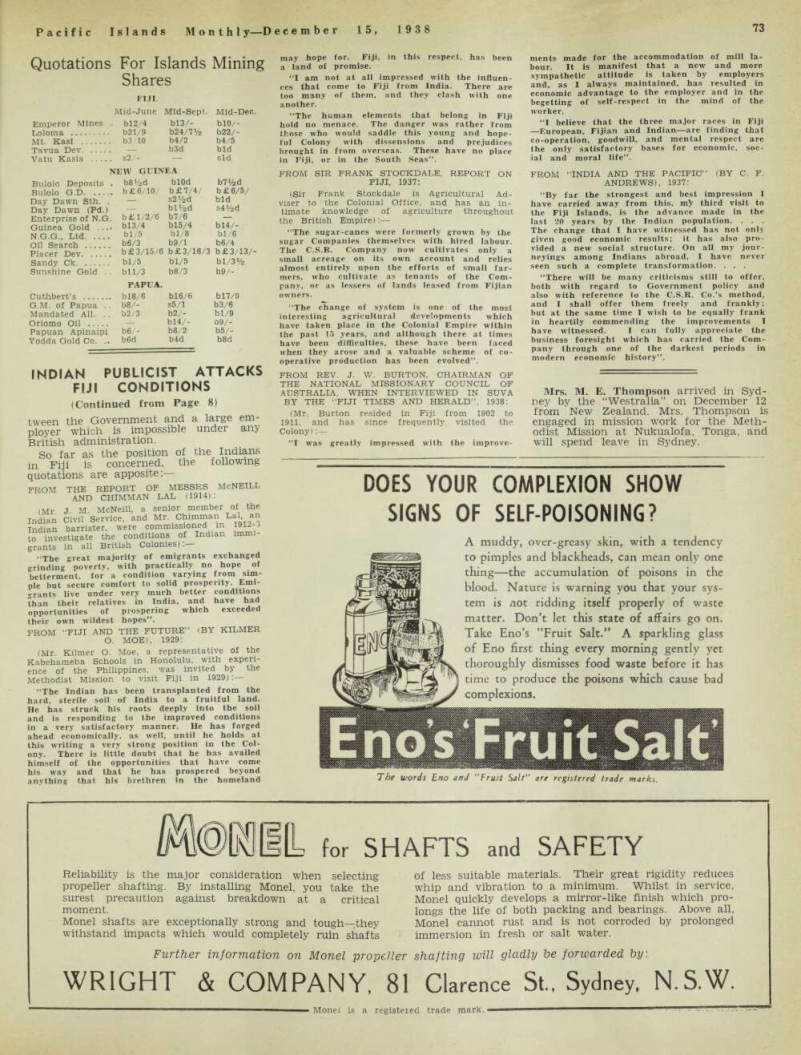
Shares
Fiji.
Mid-June Mid-Sept.
Mid-Dec.
Emperor Mines • b!2/4 bl3/blO/- Loloma b21/9 b24/7V 2 b22/- Mt. Kasl , b3 10 b4/2 b4/5 Tavua Dev . — b3d bid Vatu Kasia ... . s2/- — sld Bulolo Deposits
New Guinea
. bSVid blOd b7Vfed Bulolo G.D . b £ 6/10/ b £7/4/ b £ 6/5/ Day Dawn Sth. . — s2 J /2d bid Day Dawn (Pd.) — blV 2 d s4 y 2 d Enterprise of N.G. b£ 1/2/6 b7/6 — Guinea Gold ... . bl3/4 bl5/4 bl4/- N.G.G., Ltd bl/5 bl/8 bl/6 Oil Search b6/3 b9/l b6/4 Placer Dev b£ 3/15/6 b£ 3/16/3 b£3/13/- Sandy Ck bl/5 bl/5 bi/sy 2 Sunshine Gold . . bll/3 b8/3 b9/- Cuthbert’s
Papua,
. bl8/6 bl6/6 bl7/9 G.M. of Papua .. b8/- 55/1 b3/6 Mandated All. .. b2/3 b2/bl/9 Oriomo Oil — bl4/o9/- Papuan Apinaipi b6/b8/2 b5/- Yodda Gold Co. .. b6d b4d b8d
Advertisements & other items, p. 75 (2 items)
73
INDIAN PUBLICIST ATTACKS
FIJI CONDITIONS
(Continued from Page 8)
Pacific Islands Monthl y—D ecember 15, 1938
Clarence St., Sydney, N.S.W.
DOES YOUR COMPLEXION SHOW
SIGNS OF SELF-POISONING?
A muddy, over-greasy skin, with a tendency to pimples and blackheads, can mean only one thing—the accumulation of poisons in the blood. Nature is warning you that your system is not ridding itself properly of waste matter. Don’t let this state of affairs go on.
Take Eno’s "Fruit Salt.” A sparkling glass of Eno first thing every morning gently yet thoroughly dismisses food waste before it has time to produce the poisons which cause bad
complexions.
The words Eno and "Fruit Salt” are registered trade marks.
'MPi
for SHAFTS and SAFETY
Reliability is the major consideration when selecting propeller shafting. By installing Monel, you take the surest precaution against breakdown at a critical moment.
Monel shafts are exceptionally strong and tough—they withstand impacts which would completely ruin shafts Further information on Monel 'propeller
WRIGHT & COMPANY. 81
of less suitable materials. Their great rigidity reduces whip and vibration to a minimum. Whilst in service, Monel quickly develops a mirror-like finish which prolongs the life of both packing and bearings. Above all, Monel cannot rust and is not corroded by prolonged immersion in fresh or salt water.
shafting will gladly he forwarded by:
Clarence St., Sydney, N.S.W.
Monel is a registeied trade mark.
Islands Produce
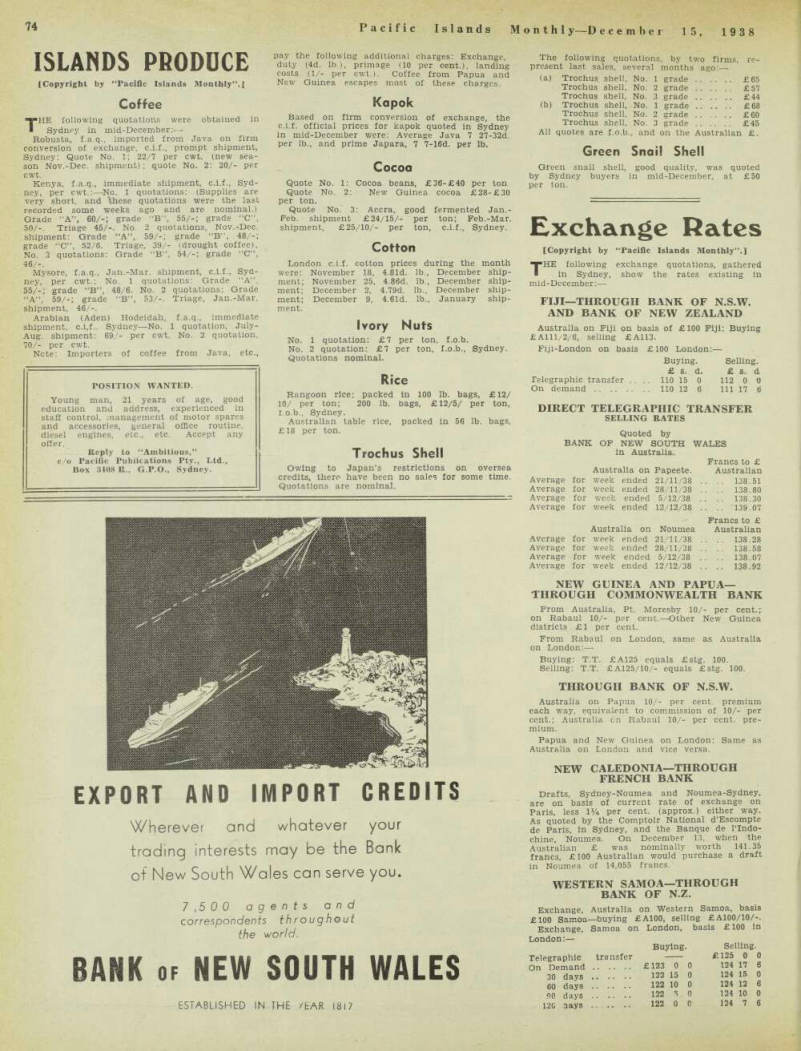
[Copyright by “Pacific Islands Monthly”.]
Coffee
THE following quotations were obtained in Sydney in mid-December: — Robusta, f.a.q., imported from Java on firm conversion of exchange, c.i.f., prompt shipment, Sydney; Quote No. 1; 22/7 per cwt. (new sea son Nov.-Dee. shipment); quote No. 2: 20/- per CW't.
Kenya, f.a.q., immediate shipment, c.i.f., Syd ney, per cwt.; —-No. 1 quotations; (Supplies are very short, and these quotations were the last recorded some weeks ago and are nominal.) Grade “A”, 60/-; grade “B”, 55/-; grade “C”, 50/-. Triage 45/-. No. 2 quotations, Nov.-Dec. shipment: Grade “A”, 59/-; grade ”B”, 48/-; grade "C”, 52/6. Triage, 39/- (drought coffee).
No. 3 quotations: Grade “B”, 54/-; grade “C”, 46/-.
Mysore, f.a.q., Jan.-Mar. shipment, c.i.f., Syd ney, per cwt.: No. 1 quotations; Grade “A”. 55/-; grade “B”, 48/6. No. 2 quotations: Grade “A”, 59/-; grade “B”, 53/-. Triage, Jan.-Mar. shipment, 46/-.
Arabian (Aden) Hodeidah, f.a.q., immediate shipment, c.i.f.. Sydney—No. 1 quotation, July- Aug. shipment: 69/- per cwt. No. 2 quotation, 70/- per cwt.
Note: Importers of coffee from Java, etc.,
pay the following additional charges: Exchange, duty (4d. lb.), primage (10 per cent.), landing costs (1/- per cwt.). Coffee from Papua and New Guinea escapes most of these charges.
Kapok
Based on firm conversion of exchange, the c.i.f. official prices for kapok quoted in Sydney in mid-December were: Average Java 7 27-32 d. per lb., and prime Japara, 7 7-16 d. per lb.
Cocoa
Quote No. 1: Cocoa beans, £36-£4O per ton Quote No. 2; New Guinea cocoa £2B-£3O per ton.
Quote No. 3; Accra, good fermented Jan.- Feb. shipment £24/15/- per ton; Feb.-Mar. shipment, £25/10/- per ton, c.i.f., Sydney.
Cotton
London c.i.f. cotton prices during the month were: November 18, 4.81 d. lb., December ship ment; November 25, 4.86 d. lb., December ship ment: December 2,4.79 d. lb., December ship ment: December 9,4.61 d. lb., January ship ment.
Ivory Nuts
No. 1 quotation: £7 per ton, f.o.b.
No. 2 quotation: £7 per ton, f.0.b., Sydney.
Quotations nominal.
Rice
Rangoon rice; packed in 100 lb. bags, £l2/ 10/ per ton; 200 lb. bags, £l2/5/ per ton, f.0.b., Sydney.
Australian table rice, packed in 56 lb. bags, £lB per ton.
Trochus Shell
Owing to Japan’s restrictions on oversea credits, there have been no sales for some time.
Quotations are nominal.
The following quotations, by two firms, re present last sales, several months ago;— (a) Trochus shell, No. 1 grade £65 Trochus shell, No. 2 grade £57 Trochus shell. No. 3 grade £44 (b) Trochus shell. No. 1 grade £6B Trochus shell, No. 2 grade £6O Trochus shell. No. 3 grade £45 All quotes are f.0.b., and on the Australian £.
Green Snail Shell
Green snail shell, good quality, was quoted by Sydney buyers in mid-December, at £5O per ton.
Exchange Rates
[Copyright by “Pacific Islands Monthly”.] THE following exchange quotations, gathered in Sydney, show the rates existing In mid-December:—
Fiji—Through Bank Of N.S.W.
And Bank Of New Zealand
Australia on Fiji on basis of £lOO Fiji: Buying £Alll/2/6, selling £AII3.
Fiji-London on basis £lOO London:—
Direct Telegraphic Transfer
Selling Rates
Quoted by
Bank Op New South Wales
in Australia.
New Guinea And Papua
Through Commonwealth Bank
From Australia, Pt. Moresby 10/- per cent.; on Rabaul 10/- per cent.—Other New Guinea districts £1 per cent.
From Rabaul on London, same as Australia on London: — Buying: T.T. £AI2S equals £stg. 100.
Selling: T.T. £AI2S/10/- equals £stg. 100.
Through Bank Of N.S.W.
Australia on Papua 10/- per cent, premium each way, equivalent to commission of 10/- per cent.; Australia on Rabaul 10/- per cent, pre mium.
Papua and New Guinea on London: Same as Australia on London and vice versa.
New Caledonia—Through
French Bank
Drafts, Sydney-Noumea and Noumea-Sydney, are on basis of current rate of exchange on Paris, less DA per cent, (approx.) either way.
As quoted by the Comptoir National d’Escompte de Paris, in Sydney, and the Banque de ITndo chine, Noumea. On December 13, when the Australian £ was nominally worth 141.35 francs, £lOO Australian would purchase a draft in Noumea of 14,055 francs.
Western Samoa—Through
Bank Of N.Z.
Exchange, Australia on Western Samoa, basis £lOO Samoa —buying £AIOO, selling £AIOO/10/-.
Exchange, Samoa on London, basis £ 100 In London:—
Buying. Selling. £ s. d. £ s. d Telegraphic transfer ... 110 15 0 112 0 0 On demand 110 12 6 111 17 ti
Francs to £ Australia on Papeete. Australian Average for week ended 21/11/38 .. .. 138.51 Average for week ended 28/11/38 .. .. 138.80 Average for week ended 5/12/38 .. .. 138.30 Average for week ended 12/12/38 .. .. 139.07 Francs to £ Australia on Noumea Australian Average for w T eek ended 21/11/38 .. .. 138.28 Average for week ended 28/11/38 .. .. 138.58 Average for week ended 5/12/38 .. .. 138.07 Average for week ended 12/12/38 .. .. 138.92
Buying. Selling.
Telegraphic transfer £125 0 0 On Demand £123 0 0 124 17 6 30 days 122 15 0 124 15 0 60 days 122 10 0 124 12 6 o 0 days 122 5 0 124 10 0 12C aays 122 0 0 124 7 6
Advertisements & other items, p. 76 (2 items)
74
Pacific Islands Monthl y—D ecembei 15, 1938
Bank Or New South Wales
POSITION WANTED.
Young man, 21 years of age, good education and address, experienced in staff control, management of motor spares and accessories, general office routine, diesel engines, etc., etc. Accept any offer.
Reply to “Ambitious,” c/o Pacific Publications Pty., Ltd., Box 3408 R.. G.P.0., Sydney.
EXPORT AND IMPORT CREDITS
Wherever and whatever your trading interests may be the Bank of New South Wales can serve you. 7,5 0 0 agents and correspondents throughout the world.
BANK or NEW SOUTH WALES
ESTABLISHED IN-THE /EAR 1817
Market Quotations
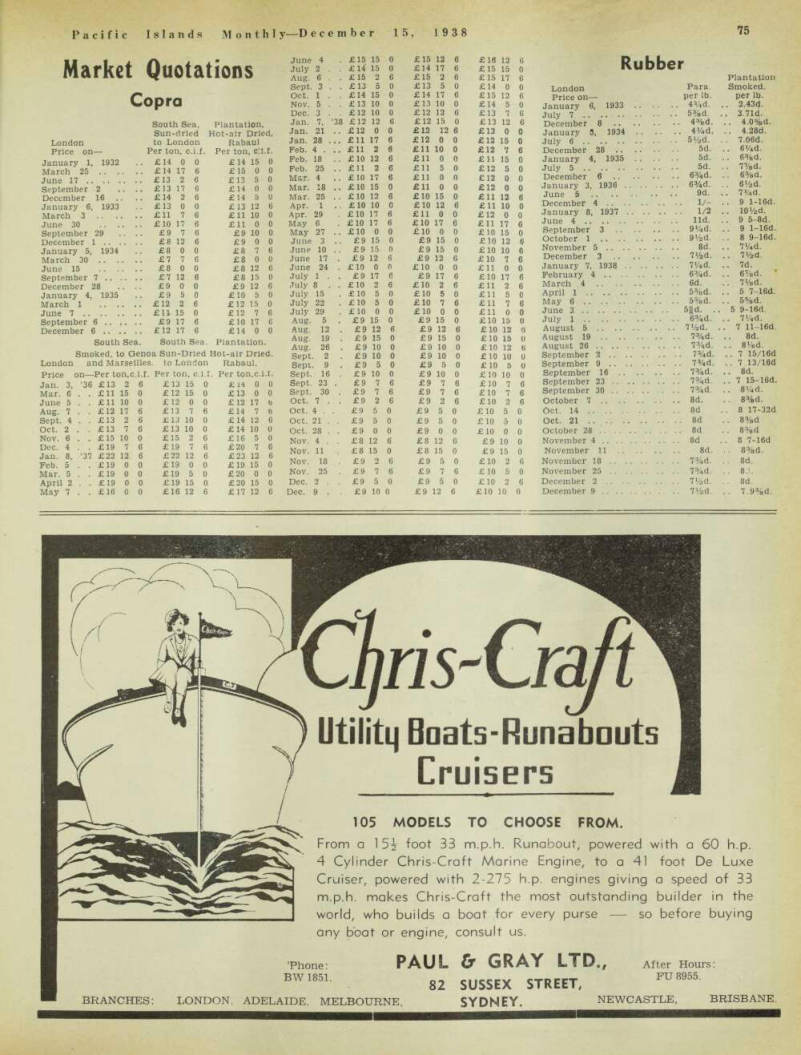
June 4 £15 15 0 £15 12 6 £10 12 6 July 2 . . £14 15 0 £14 17 6 £15 15 0 Aug. 6 . . £15 2 6 £15 2 6 £15 17 6 Sept. 3 . . £13 5 0 £13 5 0 £14 0 0 Oct. 1 . . £14 15 0 £14 17 6 £15 12 6 Nov. 5 . . £13 10 0 £13 10 0 £14 5 0 Dec. 3 . . £12 10 0 £12 12 6 £13 7 6 Jan. 7. ’38 £12 12 6 £12 15 0 £13 12 6 Jan. 21 .. £12 0 0 £12 12 6 £13 0 0 Jan. 28 ... £11 17 6 £12 0 0 £12 15 0 Feb. 4 . .. £11 2 6 £11 10 0 £12 7 6 Feb. 18 . . £10 12 6 £11 0 0 £11 15 0 Feb. 25 .. £11 2 6 £11 5 0 £12 5 0 Mar. 4 £10 17 6 £11 0 0 £12 0 0 Mar. 18 .. £10 15 0 £11 0 0 £12 0 0 Mar. 25 .. £10 12 6 £10 15 0 £11 12 6 Apr. 1 . . £10 10 0 £10 12 6 £11 10 0 Apr. 29 £10 17 6 £11 0 0 £12 0 0 May 6 £10 17 6 £10 17 6 £11 17 6 May 27 .. £10 0 0 £10 0 0 £10 15 0 June 3 .. £9 15 0 £9 15 0 £10 12 6 June 10 .. £9 15 0 £9 15 0 £10 10 0 June 17 . £9 12 6 £9 12 6 £10 7 6 June 24 . £10 0 0 £10 0 0 £11 0 0 July 1 . . £9 17 6 £9 17 6 £10 17 6 July 8 . . £10 2 6 £10 2 6 £11 2 6 July 15 . £10 5 0 £10 5 0 £11 5 0 July 22 . £10 5 0 £10 7 6 £11 7 6 July 29 . £ 10 0 0 £10 0 0 £11 0 0 Aug. 5 . £9 15 0 £9 15 0 £10 15 0 Aug. 12 . £9 12 6 £9 12 6 £10 12 6 Aug. 19 . £9 15 0 £9 15 0 £10 15 (I Aug. 26 . £9 10 0 £9 10 0 £10 12 6 Sept . 2 . £9 10 0 £9 10 0 £10 10 0 Sept . 9 . £9 5 0 £9 5 0 £ 10 5 0 Sept. 16 . £9 10 0 £9 10 0 £10 10 0 Sept. 23 . £9 7 6 £9 7 6 £10 7 6 Sept. 30 . £9 7 6 £9 7 6 £10 7 6 Oct. 7 . . £9 2 6 £9 2 6 £10 2 6 Oct. 4 . . £9 5 0 £9 5 0 £10 5 0 Oct. 21 . . £9 5 0 £9 5 0 £10 5 0 Oct. 28 . . £9 0 0 £9 0 0 £10 0 0 Nov. 4 . . £8 12 6 £8 12 6 £9 10 0 Nov. 11 £8 15 0 £8 15 0 £9 15 0 Nov. 18 . £9 2 6 £9 5 0 £10 2 6 Nov. 25 . £9 7 6 £9 7 6 £10 5 0 Dec. 2 £9 5 0 £9 5 0 £10 2 6 Dec. 9 . . £9 10 0 £9 12 6 £10 10 0
Rubber
Plantation London Para.
Smoked.
Price on— per lb. per lb.
January 6, 1933 .. . . .. 4 3 / 4 d. .. 2.43d.
July 7 . .. 5%d. .. 3.71d.
December 8 ,. .. 43/ a d. .. 4.0%d.
January S, 1934 .. .. 4‘/id. . . 4.28d.
July 6 . . 7.06d.
December 28 ,. .. 5d. .. 6>/ 4 d.
January 4, 1935 .. . .. 5d. .. 6%d.
July 5 .. . . 5d. . . 7 7 /ad.
December 6 . .. 6 3 / 4 d. . . 6 3 / 8 d.
January 3, 1936 .. . . . . .. 6%d. .. 6>/ 2 d.
June 5 . .. 9d. .. 7V 4 d.
December 4 ... 1/- .. 9 l-16d.
January 8, 1937 . . . . ... 1/2 .. 10‘/ 2 d.
June 4 . . .. lid. .. 9 5-8d.
September 3 ,. . . 9V 4 d. .. 9 l-16d.
October 1 .. 8 9-16d.
November 5 .. . . 8d. .. 7V 4 d.
December 3 . .. 7»/ 2 d. .. 7V 2 d.
January 7, 1938 .. . . .. . . 7‘/ 4 d. .. 7d.
February 4 .. . . 6%d. .. 6 7 / 8 d. * March 4 . . . 6d. .. 7*/ad.
April 1 .. .. 5 5 /ad. .. 5 7-16d.
May 6 .. .. 5%d. .. 5 s /sd.
June 3 5|d. .. 5 9-16d.
July 1 .. .. 6 3 / 4 d. .. 7>/ 4 d.
August 5 . .. 7V 2 d. . . 7 ll-16d.
August 19 .. .. 7 3 / 4 d. 8d.
August 26 .. . . 7%d. .. SVad.
September 2 .. .. 7%d. , . 7 15/16d September 9 .. .. 7 3 / 4 d. .. 7 13/16d September 16 .. .. ., .. 7%d. . . 8d.
September 23 .. .. 7 3 /»d. .. 7 15-16d.
September 30 ... .. 7 3 / 4 d. . . 8V 4 d.
October 7 . . .. 8d. .. 8%d.
Oct. 14 . . .. 8d . . 8 17-32d Oct. 21 .. . . 8d . . 8%d October 28 ... 8d .. 8 3 /ad November 4 ... 8d . . 8 7-16d November 11 . . . . 8d. . . 8 3 /ad.
November 18 .. .. 7 3 / 4 d. . . 8d.
November 25 .. .. 7 3 / 4 d. . . 8.1.
December 2 .. . . 7V 2 d. . . 8d.
December 9 ... 7‘/ 2 d. .. 7.9%d.
Copra
South Sea, Plantation, Sun-dried Hot-air Dried, London to London Rabaul Price on— Per ton. c.i.f.
Per ton . C'.i.f.
January 1, 1932 £14 0 0 £14 15 0 March 25 .. £14 17 6 £15 0 0 June 17 .. .. £13 2 6 £13 5 0 September 2 £13 17 6 £14 0 0 December 16 . . £14 2 6 £14 5 0 January 6, 1933 £13 0 0 £ 13 12 6 March 3 £11 7 6 £11 10 0 June 30 . . . £10 17 6 £11 0 0 September 29 £9 7 6 £9 10 0 December 1 .. £8 12 6 £9 0 0 January 5, 1934 £8 0 0 £8 7 6 March 30 .. . £7 7 6 £8 0 0 June 15 .. . £8 0 0 £8 12 6 September 7 .. £7 12 6 £8 15 0 December 28 £9 0 0 £9 12 6 January 4, 1935 £9 5 0 £10 5 0 March 1 .. . £12 2 6 £12 15 0 June 7 £11 15 0 £12 7 6 September 6 .. £9 17 6 £10 17 6 December 6 .. £12 17 6 £14 0 0 South Sea.
South Sea.
Plantation.
Smoked, to Genoa Sun-Dried Hot-air Dried.
London and Marseilles . to London Rabaul.
Price on—Per ton.c.l.f.
Per ton, c.i.I. Per ton.c.i.l.
Jan. 3, ’36 £13 2 6 £13 15 0 £14 0 0 Mar. 6 . . £11 15 0 £12 : 15 0 £13 0 0 June 5 . . £11 10 0 £ 12 0 0 £12 17 b Aug. 7 . . £12 17 6 £13 7 6 £14 7 b Sept. 4 . . £13 2 6 £13 : 10 0 £14 12 6 Oct. 2 . . £13 7 6 £13 10 0 £14 10 0 Nov. 6 . . £15 10 0 £15 2 6 £16 5 0 Dec. 4 . . £19 7 6 £19 7 6 £20 7 6 Jan. 8, ’37 £22 12 6 £22 12 6 £23 12 6 Feb. 5 . . £19 0 0 £19 0 0 £19 15 0 Mar. 5 . . £ 19 0 0 £19 5 0 £20 0 0 April 2 . . £19 0 0 £19 15 0 £20 15 0 May 7 . . £16 0 0 £16 : 12 6 £17 12 6
Advertisements & other items, pp. 77-78 (1 item)
Utility Baats-Runabouts
Cruisers
105 MODELS TO CHOOSE FROM.
From a 15i foot 33 m.p.h. Runabout, powered with a 60 h.p. 4 Cylinder Chris-Craft Marine Engine, to a 41 foot De Luxe Cruiser, powered with 2-275 h.p. engines giving a speed of 33 m.p.h. makes Chris-Craft the most outstanding builder in the world, who builds a boat for every purse so before buying any boat or engine, consult us. ’Phone: BW 1851.
PAUL & GRAY LTD,,
82 SUSSEX STREET,
After Hours: FU 8955.
BRANCHES: LONDON, ADELAIDE. MELBOURNE,
SYDNEY.
NEWCASTLE,
BRISBANE.
QUALIFIED LADIES’ HAIR
DRESSER desires position. Refer ences. M . Kearney, Main St.. Atherton, Q.’land.
KOYONG . . MOSS YALE
DAY AND BOARDING SCHOOL AND
KINDERGARTEN FOR GIRLS.
Pupils prepared for School, Music Examinations. Excellent Climate and Health Record.
Own Orchard, vegetables, poultry & dairy.
Home Life and Individual Attention.
Boarders taken from six years old.
Prospectus on application.
MISS MEIN, Principal.
VISITORS FROM THE
PACIFIC ISLANDS---
will enjoy every comfort and attention at
ORIANA
SYDNEY'S PRIVATE
HOTEL DE LUXE
50-58 MACLEAY ST.
POTTS POINT
Accommodation 150 Guests, 5 minutes City.
Extensive Lounges, Card Room, Smoking Rooms, Billiards Room, Dance Floor, Garages. Tariff: Inclusive, from
£3/3/- WEEKLY.
Telegraphic Address: “Orianaotel”, Sydney. Telephones: F 1095, F 1590,
a
Shipping Services in the Pacific
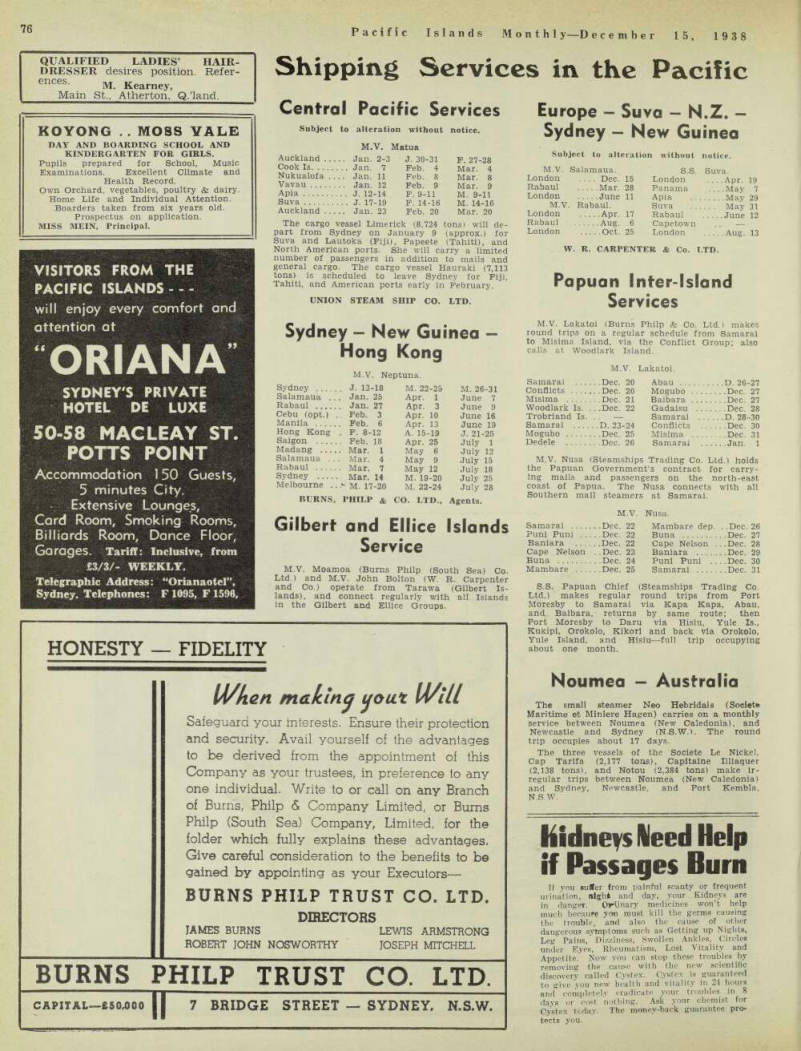
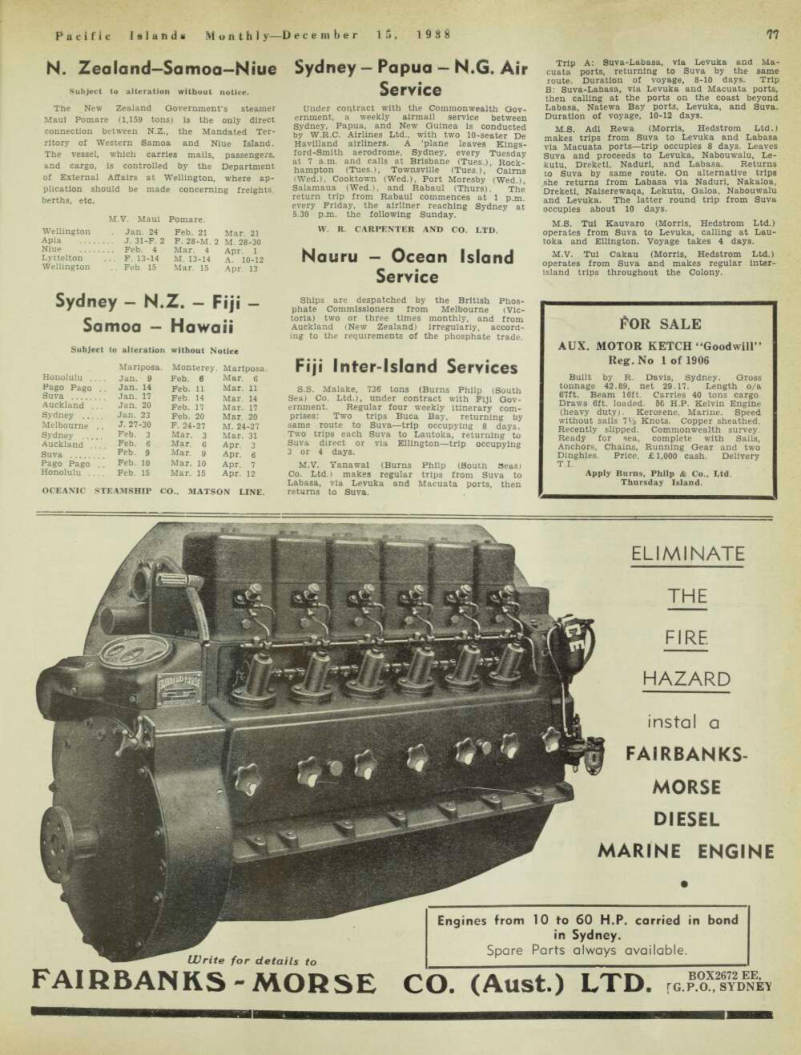
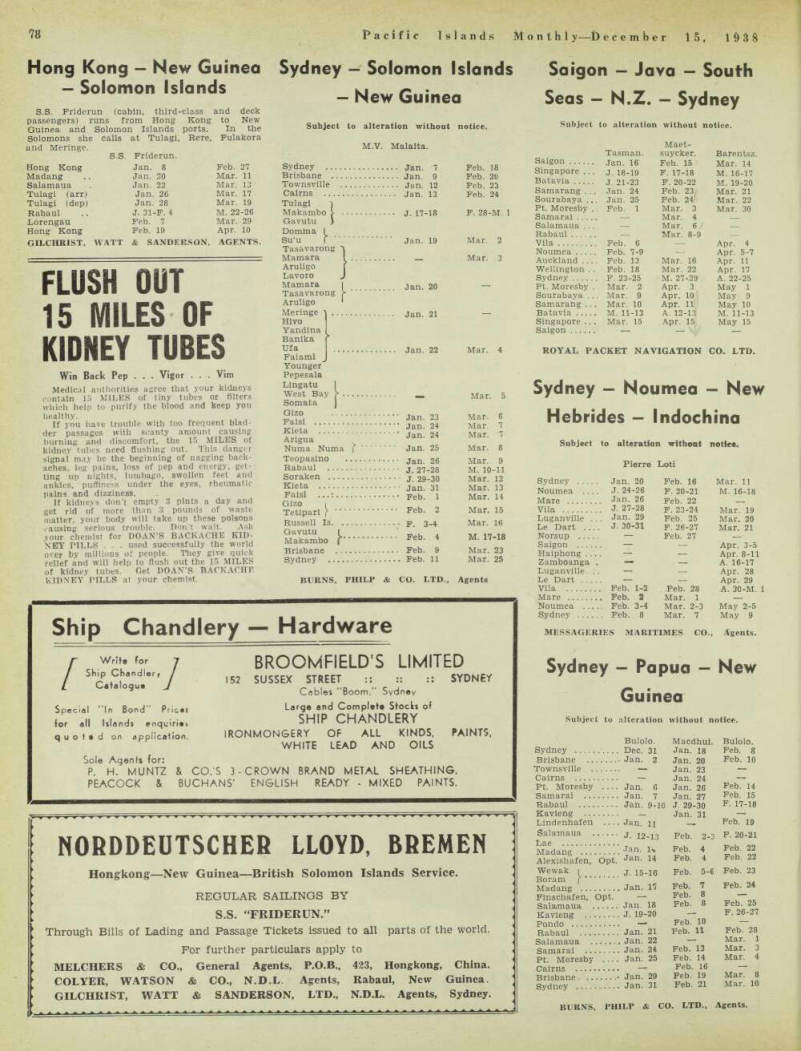
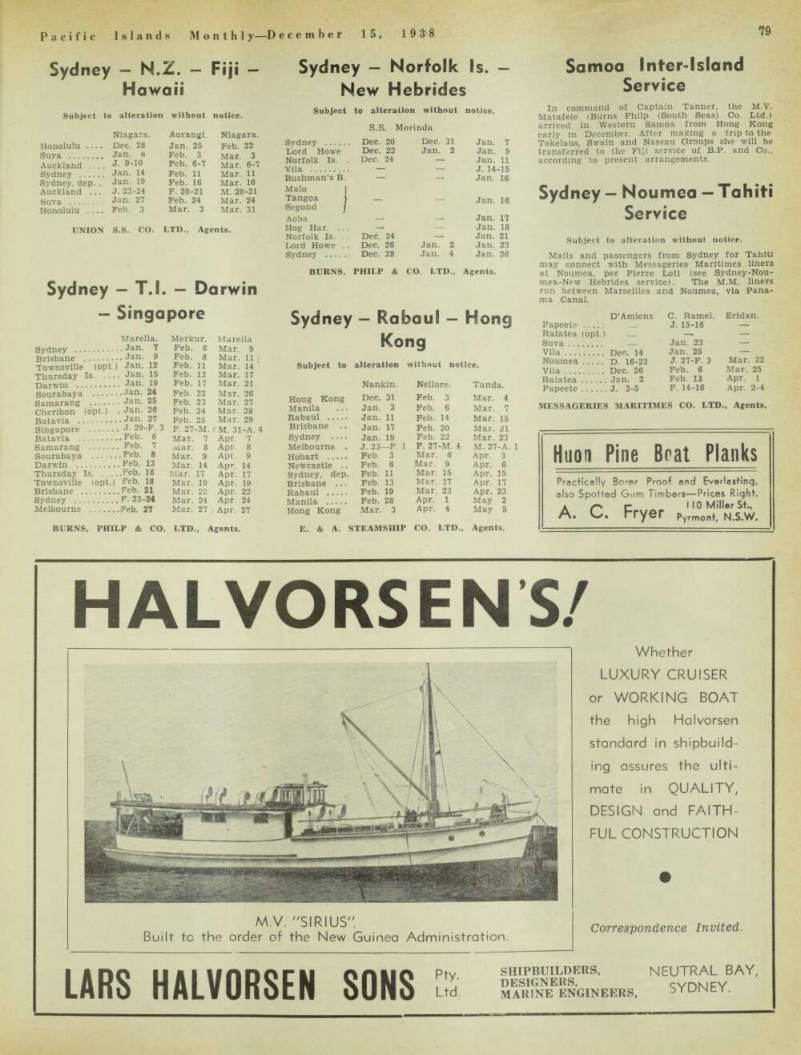
Central Pacific Services
The cargo vessel Limerick (8,724 tons) will de part from Sydney on January 9 (approx.) for Suva and Lautoka (Fiji), Papeete (Tahiti), and North American ports. She will carry a limited number of passengers in addition to mails and general cargo. The cargo vessel Hauraki (7,113 tons) is scheduled to leave Sydney for Fiji, Tahiti, and American ports early in February.
Union Steam Ship Co. Ltd.
Sydney New Guinea
Hong Kong
Gilbert and Ellice Islands
Service
M.V. Moamoa (Burns Philp (South Sea) Co.
Ltd.) and M.V. John Bolton (W. R. Carpenter and Co.) operate from Tarawa (Gilbert Is lands). and connect regularly with all Islands in the Gilbert and Ellice Groups.
Europe - Suva - N.Z. - Sydney - New Guinea
Papuan Inter-Island
Services
M.V. Lakatoi (Burns Philp & Co. Ltd.) makes round trips on a regular schedule from Samarai to Misima Island, via the Conflict Group; also calls at Woodlark Island.
M.V. Nusa (Steamships Trading Co. Ltd.) holds the Papuan Government’s contract for carry ing mails and passengers on the north-east coast of Papua. The Nusa connects with all Southern mail steamers at Samarai.
S.S. Papuan Chief (Steamships Trading Co.
Ltd.) makes regular round trips from Port Moresby to Samarai via Kapa Kapa, Abau, and Baibara, returns by same route; then Port Moresby to Daru via Hisiu, Yule Is., Kukipi, Orokolo, Kikorl and back via Orokolo, Yule Island, and Hisiu —full trip occupying about one month.
Noumea Australia
The small steamer Neo Hebridais (Societe Maritime et Miniere Hagen) carries on a monthly service between Noumea (New Caledonia), and Newcastle and Sydney (N.S.W.L The round trip occupies about 17 days.
The three vessels of the Societe Le Nickel, Cap Tarifa (2,177 tons), Capitaine Illiaquer (2,138 tons), and Notou (2,384 tons) make ir regular trips between Noumea (New Caledonia) and Sydney, Newcastle, and Port Kembla,
N.S.W.
Subject to alteration without notice.
M.V. Matua Auckland . ..
J. 30-31 P. 27-28 Cook Is Feb. 4 Mar. 4 Nukualofa .. .. Jan. 11 Feb. 8 Mar. 8 Vavau Feb. 9 Mar. 9 Apia ... J. 12-14 F. 9-11 M. 9- ■11 Suva ... J. 17-19 F. 14-16 M. 14 -16 Auckland . .. .. Jan. 23 Feb. 20 Mar. 20
M.V. Neptuna.
Sydney . J. 13-18 M. 22-25 M. 26-31 Salamaua .. . Jan. 25 Apr. 1 June 7 Rabaul . Jan. 27 Apr. 3 June 9 Cebu (opt.) , . Feb. 3 Apr. 10 June 16 Manila . Feb. 6 Apr. 13 June 19 Hong Kong . F. 8-12 A. 15-19 J. 21-25 Saigon . Feb. 18 Apr. 25 July 1 Madang . Mar. 1 May 6 July 12 Salamaua .. . Mar. 4 May 9 July 15 Rabaul . Mar. 7 May 12 July 18 Sydney Mar. 14 M. 19-20 July 25 Melbourne .. > M. 17-20 M. 22-24 July 28
Burns,
Philp &
Co. Ltd.,
Agents.
Subject to alteration without notice.
M.V. Salamaua. S.S. Suva.
London ... Dec. 15 London ...Apr. 19 Rabaul Mar. 28 Panama May 7 London June 11 Apia May 29 M.V. Rabaul. Suva May 31 London Apr. 17 Rabaul June 12 Rabaul Aug. 6 Capetown — London Oct. 25 London Aug. 13
W. R. Carpenter & Co. Ltd.
M.V. Lakatoi.
Samarai Dec. 20 Abau D. 26-27 Conflicts Dec. 20 Mogubo Dec. 27 Mlsima Dec. 21 Baibara Dec. 27 Woodlark Is. ...Dec. 22 Gadaisu Dec. 28 Trobrland Is. .. — Samarai D. 28-30 Samarai D. 23-24 Conflicts Dec. 30 Mogubo Dec. 25 Misima Dec. 31 Dedele Dec. 26 Samarai Jan. 1
M.V. Nusa.
Samarai Dec. 22 Mambare dep. . .Dec. 26 Puni Puni Dec. 22 Buna Dec. 27 Baniara Dec. 22 Cape Nelson ...Dec. 28 Cape Nelson ..Dec. 23 Baniara Dec. 29 Buna Dec. 24 Puni Puni ... .Dec. 30 Mambare Dec. 25 Samarai Dec. 31
N. Zealand-Samoa-Niue
Subject to alteration without notice.
The New Zealand Government’s steamer Maui Pomare (1,159 tons) is the only direct connection between N.Z., the Mandated Ter ritory of Western Samoa and Niue Island.
The vessel, which carries mails, passengers, and cargo, is controlled by the Department of External Affairs at Wellington, where ap plication should be made concerning freights, berths, etc.
Sydney — N.Z. — Fiji - Samoa - Hawaii
Sydney - Papua - N.G. Air
Service
Under contract with the Commonwealth Gov ernment, a weekly airmail service between Sydney, Papua, and New Guinea Is conducted by W.R.C. Airlines Ltd., with two 10-seater De Havilland airliners. A ’plane leaves Kings ford-Smith aerodrome, Sydney, every Tuesday at 7 a.m. and calls at Brisbane (Tues.), Rock hampton (Tues.), Townsville (Tues.), Cairns (Wed.), Cooktown (Wed.), Port Moresby (Wed.), Salamaua (Wed.), and Rabaul (Thurs). The return trip from Rabaul commences at 1 p.m. every Friday, the airliner reaching Sydney at 5.30 p.m. the following Sunday.
W. R. Carpenter And Co. Ltd.
Nauru - Ocean Island
Service
Ships are despatched by the British Phos phate Commissioners from Melbourne (Vic toria) two or three times monthly, and from Auckland (New Zealand) irregularly, accord ing to the requirements of the phosphate trade.
Fiji Inter-Island Services
S.S. Malake, 736 tons (Burns Phllp (South Sea) Co. Ltd.), under contract with Fiji Gov ernment. Regular four weekly itinerary com prises: Two trips Buca Bay. returning by same route to Suva —trip occupying 8 days.
Two trips each Suva to Lautoka, returning to Suva direct or via Ellington—trip occupying 3 or 4 days.
M.V. Yanawal (Burns Phllp (South Seas; Co. Ltd.) makes regular trips from Suva to Labasa, via Levuka and Macuata ports, then returns to Suva.
Trip A: Suva-Labasa, via Levuka and Ma cuata ports, returning to Suva by the same route. Duration of voyage, 8-10 days. Trip B; Suva-Labasa, via Levuka and Macuata ports, then calling at the ports on the coast beyond Labasa, Natewa Bay ports, Levuka, and Suva.
Duration of voyage, 10-12 days.
M.S. Adi Rewa (Morris, Hedstrom Ltd.) makes trips from Suva to Levuka and Labasa via Macuata ports—trip occupies 8 days. Leaves Suva and proceeds to Levuka, Nabouwalu, Le kutu, Dreketi, Naduri, and Labasa. Returns to Suva by same route. On alternative trips she returns from Labasa via Naduri, Nakaloa, Dreketi, Naiserewaqa, Lekutu, Galoa, Nabouwalu and Levuka. The latter round trip from Suva occupies about 10 days.
M.S. Tul Kauvaro (Morris, Hedstrom Ltd.) operates from Suva to Levuka, calling at Lau toka and Ellington. Voyage takes 4 days.
M.V. Tul Cakau (Morris, Hedstrom Ltd.) operates from Suva and makes regular inter island trips throughout the Colony.
M.V. Maui Pomare.
Wellington Jan. 24 Feb. 21 Mar. 21 Apia ... J. 31-F. 2 F. 28-M. 2 M. 28-30 Niue Mar. 4 Apr. 1 Lyttelton ... F. 13-14 M. 13-14 A. 10-12 Wellington . Feb 15 Mar. 15 Apr. 13
Subject to alteration without Notice Mariposa.
Monterey.
Mariposa.
Honolulu ...
Jan. 9 Feb. 6 Mar. 6 Pago Pago ..
Jan. 14 Feb. 11 Mar. 11 Suva Jan. 17 Feb. 14 Mar. 14 Auckland ...
Jan. 20 Feb. 17 Mar. 17 Sydney ..
Jan. 23 Feb. 20 Mar. 20 Melbourne ..
J. 27-30 P. 24-27 M. 24-27 Sydney Feb. 3 Mar. 3 Mar. 31 Auckland Feb. 6 Mar. 6 Apr. 3 Suva Feb. 9 Mar. 9 Apr. 6 Pago Pago ..
Feb. 10 Mar. 10 Apr. 7 Honolulu ...
Feb. 15 Mar. 15 Apr. 12
Oceanic Steamship Co.. Matson Line.
Hong Kong New Guinea - Solomon Islands
Sydney — Solomon Islands - New Guinea
Saigon - Java - South Seas - N.Z. - Sydney
Sydney - Noumea - New Hebrides - Indochina
Sydney - Papua - New Guinea
S.S. Friderun (cabin, third-class and deck passengers) runs from Hong Kong to New Guinea and Solomon Islands ports.
In the Solomons she calls at Tulagi, Rere, Fulakora and Meringe.
S.S. Friderun.
Hong Kong Jan. 8 Feb. 27 Madang Jan. 20 Mar. 11 Salamaua Jan. 22 Mar. 13 Tulagi (arr) Jan. 26 Mar. 17 Tulagi (dep) Jan. 28 Mar. 19 Rabaul J. 31-F. 4 M. 22-26 .Lorengau Feb. 7 Mar. 29 Hong Kong Feb. 19 Apr. 10
Gilchrist,
Watt & Sanderson,
Agents.
Subject to alteration without notice.
M.V. Malalta.
Sydney Brisbane ...
Townsville Cairns Jan. 12 jan 13 Feb. 18 Feb. 20 Feb. 23 Feb. 24 P. 28-M. 1 Tulagi i Gavutu Domma I Su’u ( Tasavarong ' Mamara Aruligo Lavoro Mamara Jan. 19 - Jan. 20 Mar. 2 Mar. 3 Tasavaro Aruligo Meringe ' Hivo Yandina Banika Ufa ng Mar. 4 Mar. 5 Faiaml Younger Pepesala Lingatu West Ba; Somata Gizo 1 Falsi Kieta Arigua Numa Numa Tpnnnsinn Jan. 23 Jan. 24 Jan. 24 f Jan. 25 Mar. 6 Mar. 7 Mar. 7 Mar. 8 Rabaul Mar. 9 ■jv/r in 11 Soraken Kieta ..
IVi. iU-11 Mar. 12 A/Tar 17 Paisi .
Jl iviar. u T\/T n mm 11
Gizo
L ..
Mar. 14 Tetlpari , Russell I Gavutu r s. .
Mar. 15 Mar. 16 M. 17-18 Mar. 23 Mar. 25 L Makambo f Brisbane Ryrinpy ...
Feb. 11
Burns,
Philp & Co. Ltd.,
Agents
Subject to alteration without Maetnotice.
Saigon Tasman. suycker.
Barentsz.
Jan. 16 Feb. 15 Mar. 14 Singapore ...
J. 18-19 F. 17-18 M. 16-17 Batavia J. 21-23 P. 20-22 M. 19-20 Samarang . ..
Jan. 24 Feb. 23 Mar. 21 Sourabaya ..
Jan. 25 Feb. 24' Mar. 22 Pt. Moresby . . Feb. 1 Mar. 3 Mar. 30 Samarai , Mar. 4 — Salamaua ... — Mar. 6 Rabaul .
Mar. 8-9 Vila , Feb. 6 — Apr. 4 Noumea Feb. 7-9 — Apr. 5-7 Auckland ... . Feb. 13 Mar. 16 Apr. 11 Wellington ..
Feb. 18 Mar. 22 Apr. 17 Sydney . F. 23-25 M. 27-29 A. 22-25 Pt. Moresby .
Mar. 2 Apr. 3 May 1 Sourabaya .. . Mar. 9 Apr. 10 May 9 Samarang ... , Mar. 10 Apr. 11 May 10 Batavia . M. 11-13 A. 12-13 M. 11-13 Singapore ...
Mar. 15 Apr. 15 May 15 Saigon — — —
Royal Packet Navigation
Co. Ltd.
Subject to alteration without Pierre Loti notice.
Sydney Jan. 20 Feb. 16 Mar. 11 Noumea . . .
J. 24-26 F. 20-21 M. 16-18 Mare Jan. 26 Feb. 22 Vila J. 27-28 P. 23-24 Mar. 19 Luganville . .
Jan. 29 Feb. 25 Mar. 20 Le Dart ...
J. 30-31 F. 26-27 Mar. 21 Norsup — Feb. 27 — Saigon — — Apr. 3-5 Haiphong ... . — — Apr. 8-11 Zamboanga — — A. 16-17 Luganville . — — Apr. 28 Le Dart . . . . — — Apr. 29 Vila . Feb. 1-2 Feb. 28 A. 30-M. 1 Mare ,. Feb. 2 Mar. 1 Noumea ... ., Feb. 3-4 Mar. 2-3 May 2-5 Sydney ... . . Feb. 8 Mar. 7 May 9
Messageries Maritimes Co., Agents.
Subject to alteration without notice.
Sydney Bulolo.
Macdhul.
Jan. 18 Bulolo.
Feb. 8 Brisbane Jan. 20 Feb. 10 Townsville ..
Jan. 23 — Cairns Jan. 24 — Pt. Moresby ... Jan. 6 Jan. 26 Feb. 14 Samarai ...
Jan. 27 Feb. 15 Rabaul J 29-30 F. 17-18 Kavieng ...
Jan. 31 — Lindenhafen Jan. 11 Feb. 19 Salamaua J- 12-13 Feb. 2-3 F. 20-21 Madang Alexishafen, Jan. 1* Feb. 4 Feb. 22 Opt. Jan - 1 4 Feb. 4 Feb. 22 Wewak i J. 15-16 Feb. 5-6 Feb. 23 Boram f ' * Madang Jan. ll Feb. 7 Feb. 24 Pinschafen, Opt. — Feb. 8 — Salamaua Jan. 18 Feb. 8 Feb. 25 Kavieng ...
J. 19-20 — F. 26-27 Pondo — Feb. 10 — Rabaul Feb. 11 Feb. 28 Salamaua ..
Jan. 22 — Mar. 1 Samarai ...
Feb. 13 Mar. 3 Pt. Moresby Jan. 25 Feb. 14 Mar. 4 Cairns — Feb. 16 —■ Brisbane . ...
Feb. 19 Mar. 8 Sydney Feb. 21 Mar. 10
Burns,
Puilp & Co. Ltd.,
Agents.
Sydney - N.Z. - Fiji - Hawaii
Sydney T.l. Darwin - Singapore
Sydney — Norfolk Is. - New Hebrides
Sydney — Rabaul — Hong Kong
Samoa Inter-island
Service
In command of Captain Tanner, the M.V.
Matafele (Burns Philp (South Seas) Co. Ltd.) arrived in Western Samoa from Hong Kong early in December. After making a trip to the Tokelaus, Swain and Nassau Groups she will be transferred to the Fiji service of B.P. and Co., according to present arrangements.
Sydney - Noumea Tahiti
Service
Subject to alteration without notice.
Mails and passengers from Sydney for Tahiti may connect with Messageries Maritimes liners at Noumea, per Pierre Loti (see Sydney-Nou mea-New Hebrides service). The M.M. liners run between Marseilles and Noumea, via Pana ma Canal.
Subject to alteration without notice.
Niagara.
Aorangi.
Niagara.
Honolulu Dec. 28 Jan. 25 Feb. 22 Suva Jan. b Feb. 3 Mar. 3 Auckland ...
J. 9-10 Feb. 6-7 Mar. 6-7 Sydney Jan. 14 Feb. 11 Mar. 11 Sydney, dep. .
Jan. 19 Feb. 16 Mar. 16 Auckland J. 23-24 F. 20-21 M.20-21 Suva Jan. 27 Feb. 24 Mar. 24 Honolulu ...
Feb. 3 Mar. 3 Mar. 31
Union
S.S. Co.
LTD., Agents.
Marella.
Merkur.
Marella Sydney . Jan. 7 Feb. 6 Mar. 9 Brisbane . Jan. 9 Feb. 8 Mar. 11 Townsville (opt.) Jan. 12 Feb. 11 Mar. 14 Thursday Is , Jan. 15 Feb. 13 Mar. 17 Darwin , Jan. 19 Feb. 17 Mar. 21 Sourabaya .Jan. 24 Feb. 22 Mar. 26 Samarang Jan. 25 Feb. 23 Mar. 27 Cheribon (opt.) , Jan. 26 Feb. 24 Mar. 28 Batavia . Jan. 27 Feb. 25 Mar. 29 Singapore J. 29-P. 3 F. 27-M. < M. 31 L-A. 4 Batavia .Feb. 6 Mar. 7 Apr. 7 Samarang Feb. 7 Mar. 8 Apr. 8 Sourabaya ...
Feb. 8 Mar. 9 Apr. 9 Darwin Feb. 13 Mar. 14 Apr. 14 Thursday Is ,Peb. 16 Mar. 17 Apr. 17 Townsville (opt.) Feb. 18 Mar. 19 Apr. 19 Brisbane Feb. 21 Mar. 22 Apr. 22 Sydney P. 23-24 Mar. 24 Apr. 24 Melbourne Feb. 27 Mar. 27 Apr. 27
Burns, Philp & Co.
LTD., Agents.
Subject to alteration without S.S. Morinda notice.
Sydney Dec. 20 Dec. 31 Jan. 7 Lord Howe Dec. 22 Jan. 2 Jan. 9 Norfolk Is. .
Dec. 24 — Jan. 11 Vila — — J. 14 -15 Bushman’s B.
Malo 1 " ■ Jan. 16
Tangoa J.
Segond j
— — Jan. 16 Aoba — — Jan. 17 Hog Har. ... — — Jan. 18 Norfolk Is. . .
Dec. 24 —- Jan. 21 Lord Howe ..
Dec. 26 Jan. 2 Jan. 23 Sydney Dec. 28 Jan. 4 Jan. 26
Burns,
Philp & Co. Ltd.,
Agents.
Subject to alteration without notice.
Nankin.
Nellore.
Tanda.
Hong Kong Dec. 31 Feb. 3 Mar. 4 Manila Jan. 3 Feb. 6 Mar. 7 Rabaul Jan. 11 Feb. 14 Mar. 15 Brisbane ..
Jan. 17 Feb. 20 Mar. -21 Sydney Jan. 19 Feb. 22 Mar. 23 Melbourne .
J. 23—F. 1 F. 27-M. 4 M. 27-A. 1 Hobart Feb. 3 Mar. 6 Apr. 3 Newcastle ..
Feb. 6 Mar. 9 Apr. 6 Sydney, dep, Feb. 11 Mar. 15 Apr. 15 Brisbane ...
Feb. 13 Mar. 17 Apr. 17 Rabaul Feb. 19 Mar. 23 Apr. 23 Manila Feb. 28 Apr. 1 May 2 Hong Kong Mar. 3 Apr. 4 May 5 E. & A.
Steamship
Co. Ltd.,
Agents.
Papeete D’Amlens C. Ramel.
J. 15-16 Eridan.
Ralatea (opt.) —. — Suva Jan. 23 — Vila Deo. 14 Jan. 25 — Noumea D. 16-23 J. 27-P. 3 Mar. 22 Vila Dec. 26 Feb. 6 Mar. 25 Raiatea Jan. 2 Feb. 13 Apr. 1 Papeete J. 3-5 P. 14-16 Apr. 2-4
Messageries
Maritimes Co. Ltd.
Agents.
Advertisements & other items, pp. 78-82 (5 items)
76
Pacific Islands Monthl y—D ecember 15, 1938
Kidneys Weed Help
if Passages Burn
If you suffer from painful scanty or frequent urination, nigh* and day, your Kidneys are in danger. OHinary medicines won’t help much because you must kill the germs causing the trouble, and also the cause of other dangerous symptoms such as Getting up Nights, Leg Pains, * Dizziness, Swollen Ankles, Circles under Eyes, Rheumatism, Lost Vitality and Appetite. Now you can stop these troubles by removing the cause with the new scientific discovery called Cystex. Cystex is guaranteed to give you new health and vitality in 24 hours and completely eradicate your troubles in 8 days or cost nothing. Ask your chemist for Cystex today. The money-back guarantee protects you.
FOR SALE
AUX. MOTOR KETCH “Goodwill”
Reg. No 1 of 1906 Built by R. Davis, Sydney. Gross tonnage 42.89, net 29.17. Length o/a 67ft. Beam 16ft. Carries 40 tons cargo Draws 6ft. loaded. 50 H.P. Kelvin Engine (heavy duty). Kero. c ene, Marine. Speed without sails IVz Knots. Copper sheathed.
Recently slipped. Commonwealth survey.
Ready for sea, complete with Sails, Anchors. Chains, Running Gear and two Dinghies. Price, £l,OOO cash. Delivery T.I.
Apply Burns, Phllp & Co., Ltd.
Thursday Island.
Write for details to
FAIRBANKS - MORSE
ELIMINATE
THE
FIRE
HAZARD
instal a
FAIRBANKS-
MORSE
DIESEL
MARINE ENGINE
Engines from 10 to 60 H.P. carried in bond in Sydney.
Spare Parts always available.
CO. (Aust.) LTD. rG.P.O X , 2 SYm?ET
FLUSH OUT
15 MILES OF
KIDNEY TUBES
Win Back Pep . . . Vigor . . . Vim Medical authorities agree that your kidneys contain 15 MILES of tiny tubes or filters which help to purify the blood and keep you healthy.
If you have trouble with too frequent bladder passages with scanty amount causing burning and discomfort, the 15 MILES of kidney tubes need flushing out. This danger signal may be the beginning of nagging backaches, leg pains, loss of pep and energy, getting up nights, lumbago, swollen feet and ankles, pufliness under the eyes, rheumatic pains and dizziness.
If kidneys don’t empty 3 pints a day and get rid of more than 3 pounds of waste matter, your body will take up these poisons causing serious trouble. Don't wait. Ask your chemist for DOAN’S BACKACHE KID- NEY PILLS . . . used successfully the world by millions of people. They give quick relief and will help to flush out the 15 MILES of kidney tubes. Get DOAN’S BACKACHE KIDNEY PILLS at your chemist.
Ship Chandlery Hardware
[ Write for Ship Chandler/ Catalogue ] Special "In Bond" Pricei tor all Islands enquiries quoted on application.
BROOMFIELD'S LIMITED
152 SUSSEX STREET :: :: SYDNEY
Cables "Boom," Sydney Large and Complete Stocks of
SHIP CHANDLERY
IRONMONGERY OF ALL KINDS. PAINTS.
WHITE LEAD AND OILS
Sole Agents for: P. H. MUNTZ & CO.'S 3-CROWN BRAND METAL SHEATHING.
PEACOCK & BUCHANS' ENGLISH READY - MIXED PAINTS.
NORDDEUTSCHER LLOYD, BREMEN
Hongkong—New Guinea—British Solomon Islands Service.
REGULAR SAILINGS BY
S.S. “FRIDERUN.”
Through Bills of Lading and Passage Tickets issued to all parts of the world.
For further particulars apply to MELCHERS & CO., General Agents, P. 0.8., 423, Hongkong, China.
COLYER, WATSON & CO., N.D.L Agents, Rabaul, New Guinea.
GILCHRIST, WATT & SANDERSON, LTD., N.D.L. Agents, Sydney.
Huon Pine Boat Planks
Practically Borer Proof and Everlasting, also Spotted Gum Timbers—Prices Right. a n 110 Miller St., A. rryer pyrmont, n.s.w.
HALVORSEN S/
M.V. "SIRIUS"
Built tc the order of the New Guinea Administration.
Whether
LUXURY CRUISER
or WORKING BOAT
the high Halvorsen standard in shipbuilding assures the ultimate in QUALITY,
DESIGN and FAITH-
FUL CONSTRUCTION
Correspondence Invited.
LARS HALVORSEN SONS K
SHIPBUILDERS,
DESIGNERS,
MARINE ENGINEERS,
NEUTRAL BAY,
SYDNEY.
4-
LICENSEE:
E.J. MORROW
Cosmopolitan
SAMARAI Hotel
First-class Accommodation for Tourists and Travellers Ballroom ; Electric Light; Billiards; Freezing - works ; Cold Store. Best brands of Wines, Spirits, Ales.
MODERATE TARIFF
Fishing Trips and Launch Excursions arranged
WHERE TO STAY IN PORT MORESBY
Licensee: Papua Hofei, Ltd.
First-class Accommodation. Parties Arranged.
The PAPUA *
HOTEL
Catering specially for
Tourists and Travellers.
Situated on high ground overlooking both coasts, its Spacious Lounges are always Cool and Comfortable. Tariff: Per day, 16/-; per week, £6/5/-; per month, £l4; bed and breakfast, 10/-; bedroom only, 7/6.
Can meet all Steamers, f
Hotel Moresby
NEAR THE
WHARF
COMFORTABLE
ACCOMMODATION
ONLY THE BEST
BRANDS OF
WINES. SPIRITS
AND BEERS
IN STOCK
LICENSEE •
Hotel Moresby
Ltd.
m
77
Pacific Island- Month! y—D ecember 15, 19 8 £
78
Pacific Islands Month! y—D ecember 15, 1938
79
Pacific Islands Mon t h I y—D ecem b e r 15, 19 38
Prospects of N.G. Million
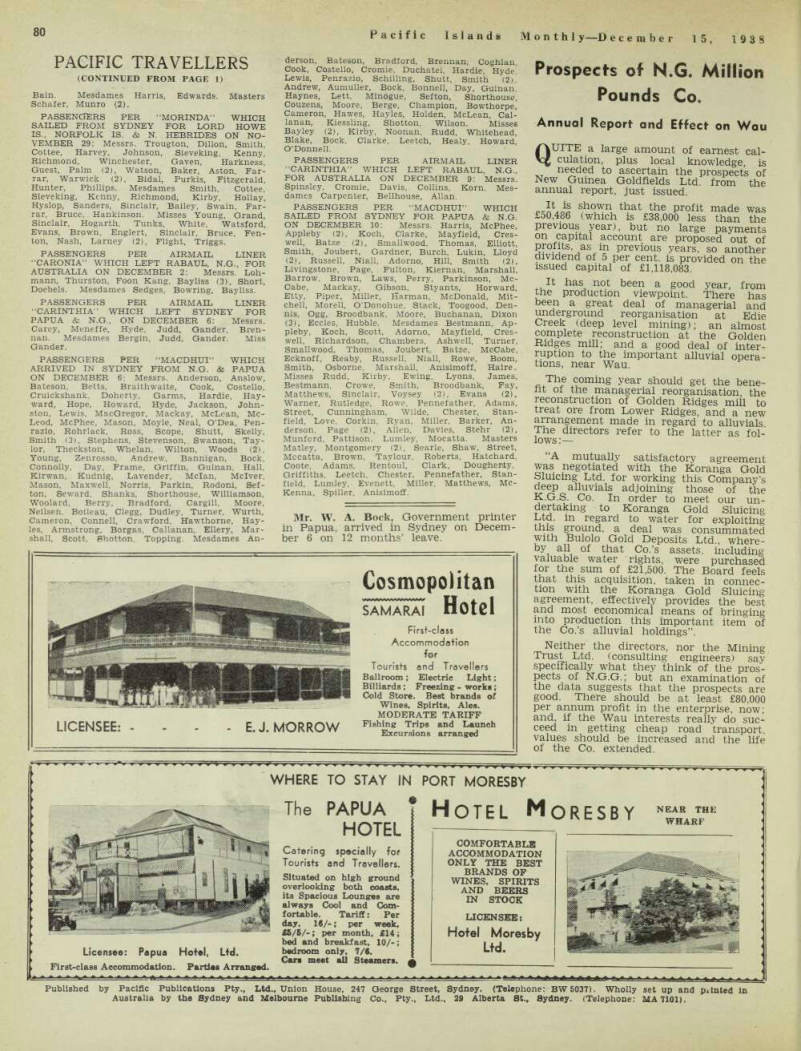
Pounds Co.
Annual Report and Effect on Wau
QUITE a large amount of earnest cal culation, plus local knowledge, is needed to ascertain the prospects of New Guinea Goldfields Ltd. from the annual report, just issued.
Itjs shown that the profit made was £50,486 (which is £38,000 less than the previous year), but no large payments on capital account are proposed out of profits, as in previous years, so another dividend of 5 per cent, is provided on the issued capital of £1,118,083.
It has not been a good year, from the production viewpoint. There has been a great deal of managerial and underground reorganisation at Edie Creek (deep level mining); an almost complete reconstruction at the Golden Ridges mill; and a good deal of inter ruption to the important alluvial opera tions, near Wau.
The coming year should get the bene fit of the managerial reorganisation, the reconstruction of Golden Ridges mill to treat ore from Lower Ridges, and a new arrangement made in regard to alluvials The directors refer to the latter as fol lows: “A mutually satisfactory agreement was negotiated with the Koranga Gold Sluicing Ltd. for working this Company’s deep alluvials adjoining those of the K.G.S. Co. In order to meet our un dertaking to Koranga Gold Sluicing Ltd. m regard to water for exploiting this ground, a deal was consummated with Bulolo Gold Deposits Ltd., where by all of that Co.’s assets, including valuable water rights, were purchased for the sum of £21,500. The Board feels that this acquisition, taken in connec tion with the Koranga Gold Sluicing agreement, effectively provides the best and most economical means of bringing into production this important item of the Co.’s alluvial holdings”.
Neither the directors, nor the Mining Trust Ltd. (consulting engineers) say specifically what they think of the pros pects of N.G.G.; but an examination of the data suggests that the prospects are good. There should be at least £BO,OOO per annum profit in the enterprise, now; and, if the Wau interests really do suc ceed in getting cheap road transport, values should be increased and the life of the Co. extended.
Advertisements & other items, pp. 82-84 (3 items)
Pacific Travellers
80
Pacific Islands Monthl y~D ecember 15, 1938
(CONTINUED FROM PAGE 1)
Published by Pacific Publications Pty., Ltd., Union House, 247 George Street, Sydney. (Telephone: BW 5037). Wholly set up and printed In Australia by the Sydney and Melbourne Publishing Co., Pty., Ltd., 29 Alberta St., Sydney. (Telephone: MA7101),
...By Air!
FROM COAST TO MOUNTAINS...
-V" -
LAE
SKY WAY ONLY
WAU
a
GUINEA AIRWAYS, LIMITED
was established in 1927; and has grown as the figures show To-day it is the largest freight-carrying service in the world.
Year Tonnage Passen- Ended Trans- gers Feb. 28. ported Carried. 1929 434 869 1930 949 2,047 1931 1,146 1,995 1932 3,947 1,607 1933 3,980 3,856 1934 6,044 7,398 1935 6,102 9,721 1936 6,476 12,137 1937 6,705 11,869 1938 8,408 12,120 Totals 44,191 63,619
Building a New Civilization
...BY AIR!
The development of the Territory has been amazingly rapid—thanks to air transport.
GUINEA AIRWAYS LIMITED has transported every type of goods needed by the large and ever-growing European community.
GUINEA AIRWAYS operates regular air services in New Guinea and Papua, using over fifty aerodromes and landing grounds in the two Territories.
GUINEA AIRWAYS planes depart from Port Moresby for the Goldfield on the arrival of each boat. Tickets are obtainable from the Purser.
Fly with GUINEA AIRWAYS—the pioneer Company—in New Guinea and in Australia.
AUSTRALIAN SERVICES
ADELAIDE-DARWIN—Three times weekly, connecting with overseas services. ■2
GUINEA AIRWAYS
LIMITED
LAE-SALAMAUA
Head Office: Austral Chambers, Currie Street, Adelaide, S.A.
New Guinea Office: Lae, Mandated Territory of New Guinea ■ ■ w • • BRANCH OFFICES AND AGENTS AT WAU— SALAMAUA—PORT MORESBY AND SYDNEY.
I PffiSE ER \
SCHS
WAL
EXPO
■SEN
IT I P
VDN
PILSENER
>» •> When two long thirsts equal one
long bottle!
"What's yours?”
”Resch's PUsenet”
"So's mine.”
When you ask for Pilsener insist on the long bottle.
RESCH'S
P IO 2*