Islands
Pacific
Monthly
Vol. Viii. No. 10.
May 25, 1938
[Registered at the. G.P.0., Sydney, for transmission by post as a newspaper .]
8“
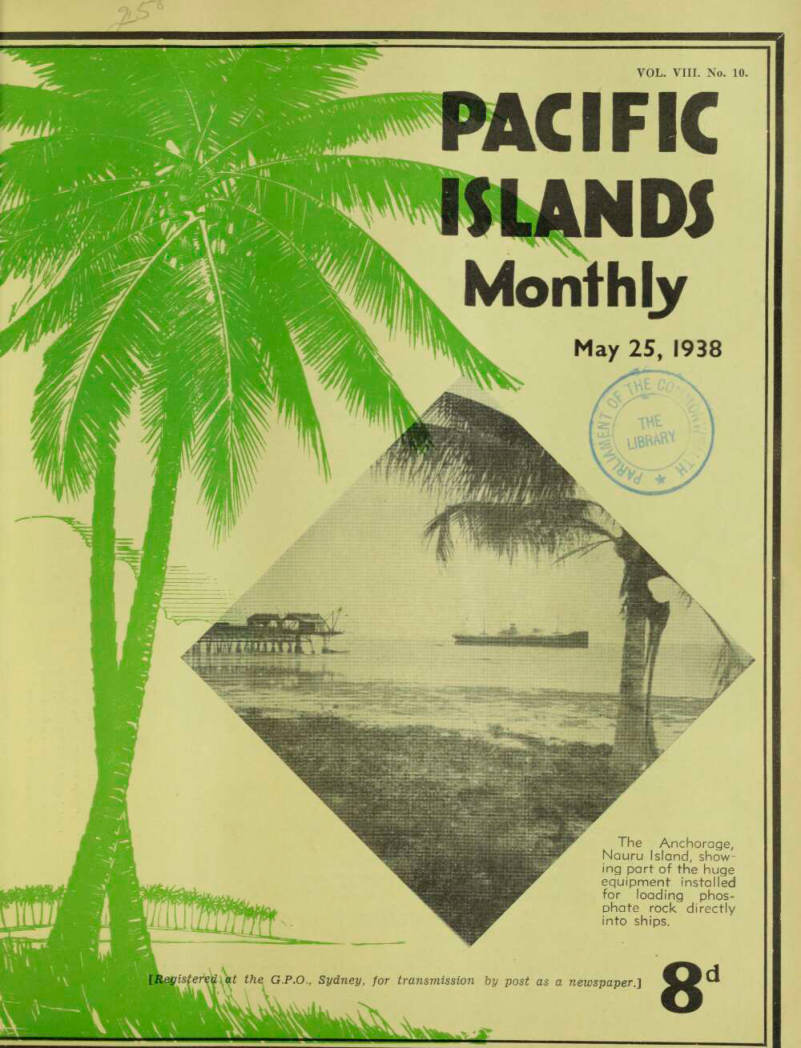
The Anchorage, Nauru Island, show ing part of the huge equipment installed for loading phos phate rock directly into ships.
Advertisements & other items, p. 2 (2 items)
Pacific Islands Monthl y—M ay 25, 1938.
W. R. Carpenter & Co. Ltd.
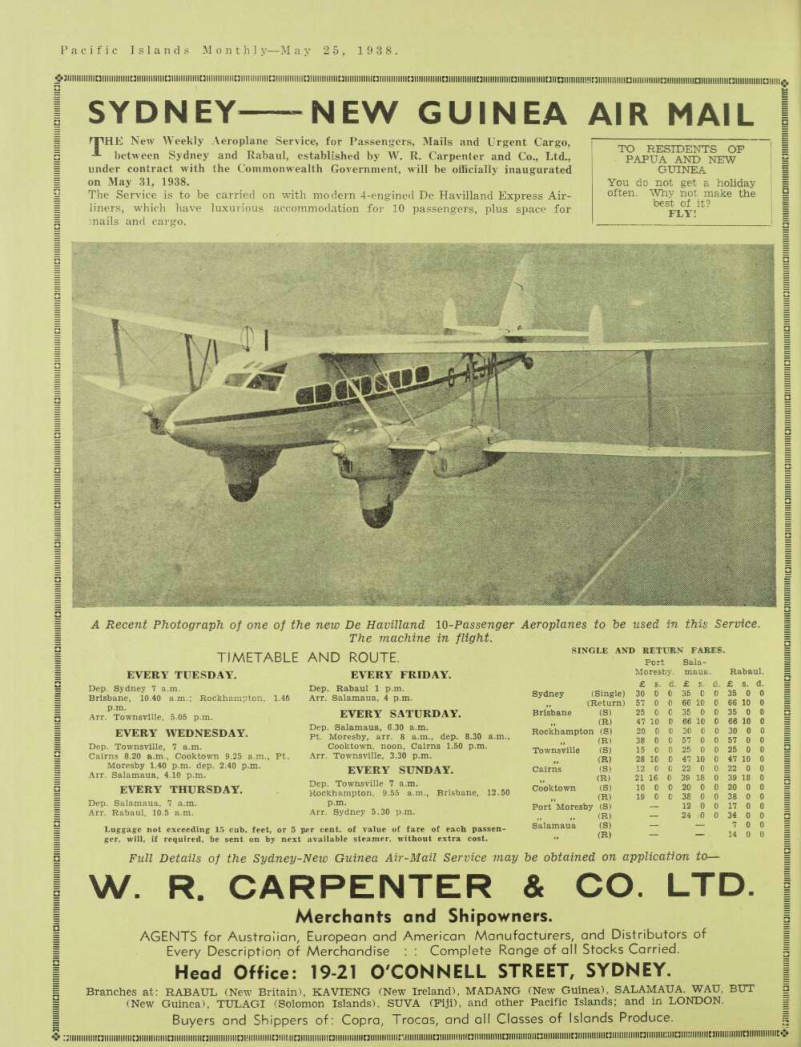
SYDNEY NEW GUINEA AIR MAIL
rpHE New Weekly Aeroplane Service, for Passengers, Mails and Urgent Cargo, between Sydney and Rabaul, established by W. R. Carpenter and Co., Ltd., under contract with the Commonwealth Government, will be officially inaugurated on May 31, 1938.
The Service is to be carried on with modern 4-engined De Havilland Express Airliners, which have luxurious accommodation for 10 passengers, plus space for mails and cargo.
TO RESIDENTS OF
PAPUA AND NEW
GUINEA
You do not get a holiday often. Why not make the best of it? fly: Fi 'l 7 Jm# 9 - SS® 1 * IK . ■ -■ If m m '4: A Recent Photograph of one of the new De Havilland 10 -Passenger The machine in flight.
TIMETABLE AND ROUTE.
EVERY FRIDAY.
Aeroplanes to he used in this Service.
SINGLE AND RETURN FARES.
Rockhampton, 1.46
EVERY TUESDAY.
Dep. Sydney 7 a.m.
Brisbane, 10.40 a.m p.m.
Arr. Townsville, 5.05 p.m.
EVERY WEDNESDAY.
Dep. Townsville, 7 a.m.
Cairns 8.20 a.m., Cooktown 9.25 a.m., Pt.
Moresby 1.40 p.m. dep. 2.40 p.m.
Arr. Salamaua, 4.10 p.m.
EVERY THURSDAY.
Dep. Salamaua, 7 a.m.
Arr. Rabaul, 10.5 a.m.
Dep. Rabaul 1 p.m.
Arr. Salamaua, 4 p.m.
EVERY SATURDAY.
Dep. Salamaua, 6.30 a.m.
Pt. Moresby, arr. 8 a.m., dep. 8.30 a.m., Cooktown, noon, Cairns 1.50 p.m.
Arr. Townsville, 3.30 p.m.
EVERY SUNDAY.
Dep. Townsville 7 a.m, Rockhampton, 9.55 a.m., Brisbane, 12.50 p.m.
Arr. Sydney 5.30 p.m.
Luggage not exceeding 15 cub. feet, or 5 per cent, of value of fare of each passenger, will, if required, be sent on by next available steamer, without extra cost.
Full Details of the Sydney-New Guinea Air-Mail Service may he obtained on application to —
W. R. CARPENTER & CO. LTD.
Merchants and Shipowners.
AGENTS for Australian, European and American Manufacturers, and Distributors of Every Description of Merchandise : : Complete Range of all Stocks Carried.
Head Office: 19-21 O'CONNELL STREET, SYDNEY.
Branches at: RABAUL (New Britain), KAVIENG (New Ireland), MADANG (New Guinea), SALAMAUA, WAU, BUT (New Guinea), TULAGI (Solomon Islands), SUVA (Fiji), and other Pacific Islands; and in LONDON.
Buyers and Shippers of: Copra, Trocas, and all Classes of Islands Produce.
Pacific Islands Travellers
Passengers Per “Malaita” Which Ar
Rived In Sydney From Rabaul (N.G.),
Solomon Islands, Lord Howe Is. And
NORFOLK IS. ON APRIL 24:—Messrs. Adams, Adamson, Anderson, Ashley, Allen, Brown, Browne, Bray, Buffett (3), Campbell, Cavanagh, Davison, Egan, Fahey, Grassick, Hogarth, Clough, Dobinson, Douglass, King, Jones (2), Keogh, Long, Meadley, Morell, Mallett, Nicholls (2), Napier, Nixon, Playfair, Pain, Quintal, Randall, Retmock, Shick, Sherlock, Spence, Sal mond, Slattery, Shannon, Tattle, Taylor, Ward, Wilson, Williams, Westwood, Whitaker Weiss, Major Cobbold, Rev. Deasey, Rev. Ed wards, Father Lebreton, Father Muller, Sir Charles Rosenthal. Mesdames Anderson, Cowan, Dobinson, Fox, Hilliar, Egan, Harkins, Joyes, Kennewell, Morell, Sweet, Stopp, Tattle, Ward, Wilson. Miss Barclay, Brouggy, Bignell, Cohen, Frost, Faulkner, Jeffreys, Fox, Johnston, Morell, Moore, O’Neil, Offner, Philp, Reading, Ross, Sweet, Thomas Turnidge, Taylor, Ward, Wilson, van Zuilicom.
Passengers Per “Maetsuycker” Which
Sailed From Sydney For Port Moresby,
PAPUA, ON APRIL 26:—F. A. Collier, E. P.
Dixon, Mrs. E. C. McFarlane, Masters A. J. and S. McFarlane, Miss E. Myers.
Passengers Per “Neptuna” Which
SAILED FROM SYDNEY FOR N.G. PORTS ON &PRIL 28:—Messrs. Bath, Fowler, Hosking, Keith, Lonergan, Lowe, Lesmond, Manson, Mor gan, Roberts, Rowe, Rabe, Stehr, Simpson, Simmons Schultz, Tregellos. Mesdames Clarke, Colquhoun, Collopy, Cook, Duncan, Farlow, Greenwood, Hyland, Hosking, Ingram. Keith, Lonergan, Lesmond, Lowe, Mullaly, Rothwell Roberts. Misses Chopin, Gofton.
Passengers Per “Malaita”, Which
Sailed From Sydney For Solomon Is.
And Rabaul (N.G.), On April 30;—Messrs.
Aubin, Ayliffe, Bennett, Bernhardt, Bullen, Clax ton, Clarke, Chalmers, Chadwick, Colson Camp bell, Chapman, Cornwell, Davies, Forsyth, Hyne, Holdridge Harbordt, Johnson, Mansfield, Palmer, Rowe, Robertson, Rutter, Svenson, Stewart, Sand ers, Stevens, Scott, Thomas, Trotter, Voyce, Wilton, Williams. Mesdames Bennett, Bern hardt, Chalmers, Clarke, Christmas, Hart. Hyne, Harbordt, Johnson, Kellett, Lanham, Maroney, Palmer, Pickwell, Rutter, Sanders, Scott, Stev ens, Younger. Misses Brown, Grant-Cooper, Cohen, Christmas, Frost, Farland, Faulkiner, Hart, Lee, Lanham, Moore, Sanders, Stead, Sul livan, Todd, Whitehouse.
Passengers Per “Montoro” Which
Arrived In Sydney From New Guinea
and PAPUA ON MAY 11:—Messrs. Beaney, Bell, Bourke, Buttress, Bourne, Burke, Craw ford, Camerson, Christie (2) Dale, Davies, Hall, Gallagher, Goodhead, Devoe, Fay, Flanigan, Gregory, Hall, Hams, Haynes Hayes, Holt, Kent, Ingold, Heers, Lament, McEwan, Marks, Lyons, McDonald, More, Moore, Munro, Nelson, Norris, Owen, Pietz, Parker, Pinnock Ralfs, Russell, Sondi, Symes, Ross* Sanderson, Shaw, Turner, Walsh, Wyborn, Westhoven, Wilkinson, Williams, Baron Marcel de Gray. Mesdames Bell, Bourke, Bowden, Cameron Davies, Frederick, Fox, Gregory, Hall, Haynes, Kienzle, Marks, McDon ald (2), McDougal, Low McKee, Ostrom, Pietz, Vercoe, Taylor, Turner, Williams, Wyborn, Smith, Garten, Baroness Marcel de Gray.
Misses Goodhew, Lament, McLaughlin, Ware, Hutton.
Passengers Per “Morinda” Which
Sailed From Sydney For Lord Howe,
NORFOLK IS., AND NEW HEBRIDES ON MAY 12:—Messrs. Anderson, Bellairs, Buffett (2), Crump, Clough, Deasey, Davies, Douglas, Dunn, Fahey, Gubbay, Henderson, Hetherington, Har vie, Melsham, Kirby, Leamay, Lam, Litchfield, Lean, McAuliffe, Mallett, McKay, Martin, Mankey, McGrath, Payten, Penson, Payne, Peoples, Quintal, Quinn, Rush, Ross, Rosenthal, Retmock, Shave, Stewart, Simons, Thompson, Teall, Thomas, Wickstead, Worden, McKellar
(Continued On Page 80.)
White. Mesdames Bellairs, Bryce, Brown, Ben nett, Crump Cairnes, Deasey, Dewar, Gubbay, Harvey, Hertle, Hellaby, Hill (2), Humphrey, Nelson, Pryke, Rosenthal, Robins, Simons, Sar geant, Stapp, Teall, Thomas, Worden, Mc- Kellar-White. Misses Ahlston, Beaded, Belpitt, Biddle, Carhill, Charlton, Commins, Davis, Hels ham, Swain, Thompson, Williamson.
Passengers Per “Aorangi” Which
SAILED FROM SYDNEY FOR SUVA. FIJI, ON MAY 12:-Mr. Ashley Mrs. S L. Abseil, S.
J- K. Adams E. T. Buckle, Mr. and Mrs. F.
W. Brooks Mr. and Mrs V L. Cozens, Mr. and Mrs. A., Master and Miss Crogen, Mr. and Mrs O. L Davidson Mr and Mrs. E.
A - Humphries, J. A. C. and D. A. Irving, W.
J- Jenkins, H. L. Nicholls, Mr. and Mrs. J.
C. Rutter, Mrs. C. D. Snelling, W. F. Steven son. H. Snowsill, Mrs. Totolon J C Trivett, Mr. and Mrs F E Rev. J. Bertin, Mrs.
F - and Mlss Bell > I - J ■ Blair, Miss M. Cozens, Mr. and Mrs. S. Coffey, Mrs. Collins, T. A.
Dnpsdale, M. D. Dalton, F. C. Gooch, Miss V.
S eard ’T^ rs % H K ’ D> a^ d aS L er D ’,7' D. McDonald, Miss D. M. Reynolds, Mrs. H.
Swift, Mrs. Snodgrass, Mrs. Thurlow, Mr. and Mrs. R. S. and Master W. Waddington, Mr. and Mrs. and Miss N. J. and Master D. J.
Blacklock, N. Khusal, D. Ranchhod.
Passengers Per “Montoro” Which
SAILED FROM SYDNEY FOR PAPUA AND NEW GUINEA ON MAY 14:-Messrs Atkinson Asmis, Anderson, Allen Bardin, Bell, Blackman, Bur nett, Barnett, Berry, Burke, Campbell, Croft, Conde( Callaghan, Chester, Christie, Dawes, Eckhoff> Eckhart, Fitzgerald, Farquhar, Field, Fisher Fo ley. Green, Guth, Halford, Hinks, H arvey, Tertle, Hellaby, Hill (2), Humphrey, Johansson, Lee, McManus, Marsh, Miller, Mul yey, Mitchell, McHugh, McEwan, Nelson, Nolan, obstj o ldham, Parer (2), Rich, Ross, Ryan, Speedie, Sorrell, Shaw, Swinson, Staker, Simp soll) Taellanza, Winters, Whelan, Warwick, Younger. Mesdames Alexander, Briggs, Conde, Dillon, Field, Graham, Scott-Garland, Gillon, Hertle, Hill, Madden, Mace, Mong, Nelsson, Obst, orr, Oldham, Parer, Rich, Swinfield, Swinson, Willis, Chambers. Misses Abel, Corlass, Hut ton, Howard, Hauser, Hagarty, McGahan, Mac kinnon, Pearson, Salas, Strobel.
Passengers Pee “Nankin” Which
Sailed From Sydney For Rabaul, New
GUINEA, ON MAY 14:—Messrs. Woodhill, Har ris, McPherson, Ah Lock, Adair, Brownlee, Drane, Myles-Thompson, Sheekey, Bellhouse, Lowe, Lawrenty, Neill, Southworth, Linggood, Stewart. Mesdames Spinks, Linggood, Miller Smith, Drane, Bellhouse (2). Misses Woodhill, Rowsen, Ching, Smith.
Advertisements & other items, p. 3 (2 items)
1
Pacific Islands Monthl y—M ay 25, 1938.
Out Of
THE EAST
GOMES
KP.M.
LINE.. .
SOUhAbAYA
S AMARANC
i*
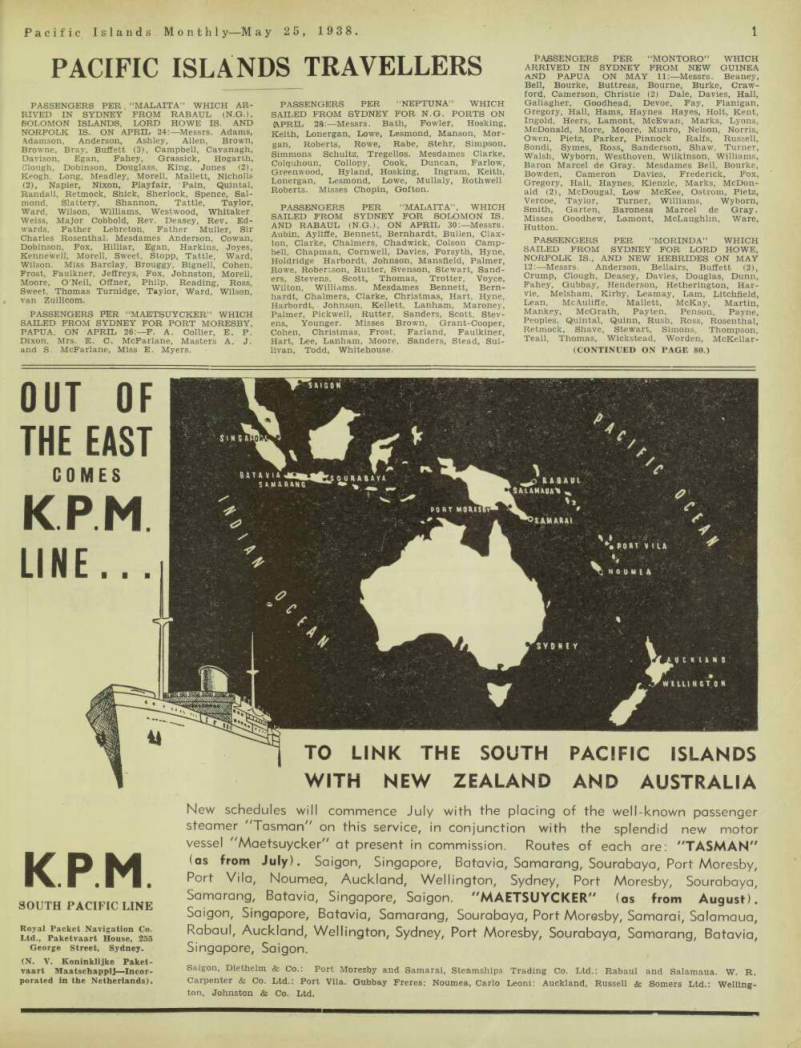
TO LINK THE SOUTH PACIFIC ISLANDS
WITH NEW ZEALAND AND AUSTRALIA
KP.M.
SOUTH PACIFIC LINE
Royal Packet Navigation Co.
Ltd., Paketvaart House, 255 George Street, Sydney. (N. V. Koninklijke Paketvaart MaatschappiJ—lncorporated in the Netherlands).
New schedules will commence July with the placing of the well-known passenger steamer Tasman 77 on this service, in conjunction with the splendid new motor vessel 77 Maetsuycker 77 at present in commission. Routes of each are- "TASMAN" (as from July). Saigon, Singapore, Batavia, Samarang, Sourabaya, Port Moresby, Port Vila, Noumea, Auckland, Wellington, Sydney, Port Moresby, Sourabaya, Samarang, Batavia, Singapore, Saigon. "MAETSUYCKER" (as from August).
Saigon, Singapore, Batavia, Samarang, Sourabaya, Port Moresby, Samarai, Salamaua, Rabaul, Auckland, Wellington, Sydney, Port Moresby, Sourabaya, Samarang, Batavia, Singapore, Saigon.
Saigon, Diethelm & Co.; Port Moresby and Samarai, Steamships Trading Co. Ltd.: Rabaul and Salamaua. W. R.
Carpenter & Co. Ltd.: Port Vila. Gubbay Freres: Noumea, Carlo Leoni: Auckland, Russell & Somers Ltd.: Wellington, Johnston & Co. Ltd.
Advertisers.
“Alnwick” Kinder garten ... 74 Amalgamated Wire less of Aust. Ltd. 71 Angus & Coote Ltd 15 Arnott’s Biscuits . 36 “Aspro” ... 53 “Ausoline” . . . .68 Baker, Ltd., Jno. . 16 8.A.L.M., Ltd. . . 54 Bank of N.S.W. . 75 Berger & Sons Ltd 44 “Bernly” Gst Hse 53 Blau (Aust), Robt. 62 Breokwoldt, Wm. 66 Broomflelds, Ltd. . 48 Brotherton, A. B. 43 Brown & Co. Pty., Ltd.. Geo. ... 17 Brunton’s Flour . 64 Bullivants, Ltd. . 51 Burns, Philp & Co. 2 Burns, Philp & Co. 38
B.P (S.S.) Co. . 22
Burns, Philp Trust Co., Ltd 13 Carpenter, W. R.
Limited . . . ii.
Chapman & Sherack 51 Chivers & Sons Ltd 39 Clyde Engineering Co., Ltd. ... 25 Coleman Lamp Co. 28 Commercial Steels (Aust.), Ltd. . . 76 Coral Starch ... 34 Cosmopolitan Hotel 70 Crossle, Duff & Macintosh, Ltd. . 67 “Cystex” ... 65 Del Cott Pty., Ltd. 69 Dewar’s Whisky . 50 Doans’ Pills ... 60 Dobell, Pty., Ltd. . 13 Donald, A. 8., Ltd. 56 Eaton, Ltd., J. W. 45 Electrolux Refrig erators ... 18 Eno’s Fruit Salt . 16
Excelsior Supply Co 46 Fairbanks - Morse Limited ... 59 “Pairholm” College 63 Pinau, Wm. ... 79 Fletcher & Sons . 52 For Sale—(Boat) . 78 Ford Sherington Ltd 31 “44 Macleay St.’’ ) 63 Foster Clark (Aus.) Limited 38 Freeman’s Sports Store 55 Fryer, A. C. . . .78 Garden Vale Pro ducts, Ltd 34 Garrett & Davidson 67 Gillespie’s Flour . . 37 Gold Flake Cig arettes 61 Gourock Rope Co. . 78 Grand Pacific Htel. 57 Grove & Sons, W.
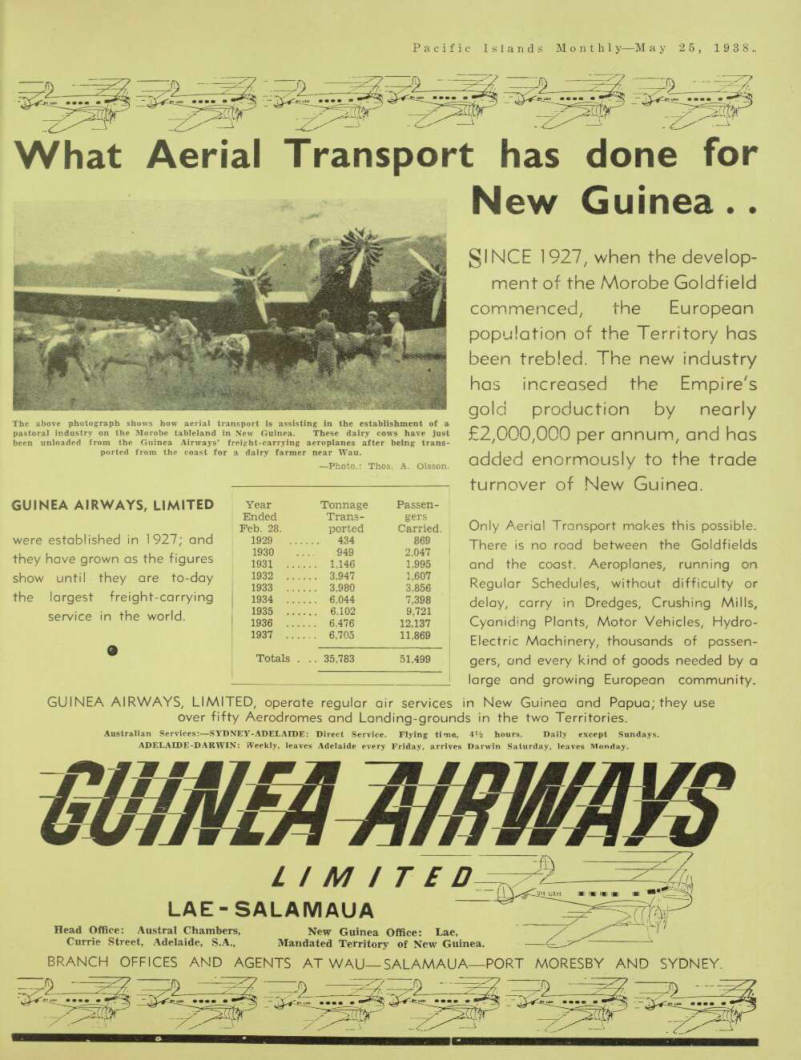
M 30 Guinea Airways Ltd iii.
Hallstroms Pty Ltd 35 Halvorsen Sons Ltd 77 Holbrook’s, Ltd. . . 41 Horlicks Malted Milk 47 Hornadge, W. ... 61 Horne, W. & Co. . 56 Hotel Moresby . . 70 International Cor respondence Schl. 10 Jones & Co Ltd, H. 37 “Kambala” Schl. . Ig Kodak Pty., Ltd. . 23 Kopsen & Co. Ltd. 42 Kork-N-Seal, Ltd. 39 Levenson’s Radio . 72 Lloyd & Co., Pty., Ltd 11 Mcllrath’s Ltd. . . 20 Maleham & Yeo man’s, Ltd. . . 43
Master Sewing Machine Co. ... 28 Maxwell Porter Ltd 45 Miller & Co, Pty., Ltd 43 Morris, Hedstrom Limited 58
N.D.L 74
Nelson <& Robertson Pty., Ltd. . . 24, 68 Nestle’s Milk ... 40 Newlands Bros. Ltd 29 Newman’s Fruit Mart 79 New Zealand Dis tributors, Ltd. . 32 Noyes Bros., Ltd. . 52
Pacific Is. Club . y Papua, Hotel, The . 70 ?ike Bros., Ltd. . 20 Prescott, Ltd. ... 36 Price’s Radio Serv. 54 Prouds, Ltd. ... 11 Ransomes Sims & Jeffries, Ltd. . . 58 Reed, Wm. E. ... 46 Reid, W. M. . 35, 62 Rohu, Sil 15 Royal Packet Co. . 1 Ruston & Hornsby 49 Scott’s Emulsion . 21 Scott, Ltd., J. . .48 Scott & Sons . .. 68 Slade’s Radio ... 73
Springwood, L. Coll. 64 Stanley, Chris. . . 37 Stanley & Co. . . 79 Steamships Trading Co., Ltd 24 Sterling Varnish Co 9 Sullivan, Ltd., C. . 32 Swallow & Ariell . 26 “Talkeries”, The .79 Taylor & Co., A. . 67 “Tenax” Soap . . 22 Tillock & Co. Ltd. 21 Tooheys, Ltd. . . 19 “Top Dog’’ Men’s Wear 33 Tooth & Co. . . iv.
Vacuum Oil Co. .. 47 Vincent’s A.P.C. . 64 Warburton, Prank!
Ltd 14 Webb & Co., A. ..60 West, Harry ... 48 Weymark & Son .. 39 Wills, W. D. and H. 0., Ltd. ... 33 Woods Peppermint Cure 61 Wright & Co. Ltd., E 45 Wunderlich, Ltd. . 45 Yellow Express Car riers, Ltd 10
Contents
Page Pacific Islands Travellers 1 Publicity for the Islands 3 Depressed Politics in Samoa, 4 Earthquake Shakes New Guinea .. 4 Credit Control Scheme for Wau .. 5 Polynesian Kings Meet in Apia ... 5 Sydney-Rabaul Airmail Service ... 6 Great Church Feast in Samoa ... 7 Govt. Patrol Explores Unknown N.G. 7 Need for Defence Force in N.G. and Papua g Tropicalities 9 About Islands People 10 Mrs. Bignell, M.8.E., Prepares for Gaol 11 Yacht Wreck at Pt. Moresby 11 Will N.G. Capital Be On Mainland or Bitapaka? 13 “War” on Canton Island 14 Samoa’s Healthy Trade 15
Page Trans-Pacific Luxury Liners 17 Discoveries in Dutch N. Guinea ... 19 Aerial Defence in the Pacific .. .. 20 Tung Oil in Norfolk Is.? 23 Japan Pushes South .. .. .. .. 25, 61 Adventurers of Torres Strait 26 “Nature Men” in Tahiti 29 “Garden of Eden” at Galapagos ... 32 Tragedy at Atimaono 33 Anzac Night in the Solomons .. .. 40 A Wonder of the Pacific 44 Early P.A, Airways History 50 Passing of a Noted Fijian 56 Fashions for Islands Women 63 Germany and Tonga 65 Mining Reports 67 Radio Programmes 73 Islands Produce and Exchange ... 74 Copra and Rubber Quotations .. .. 75 Pacific Shipping Timetables 76
Advertisements & other items, p. 4 (2 items)
2
Pacific islands Monthl y—M ay 25, 1938.
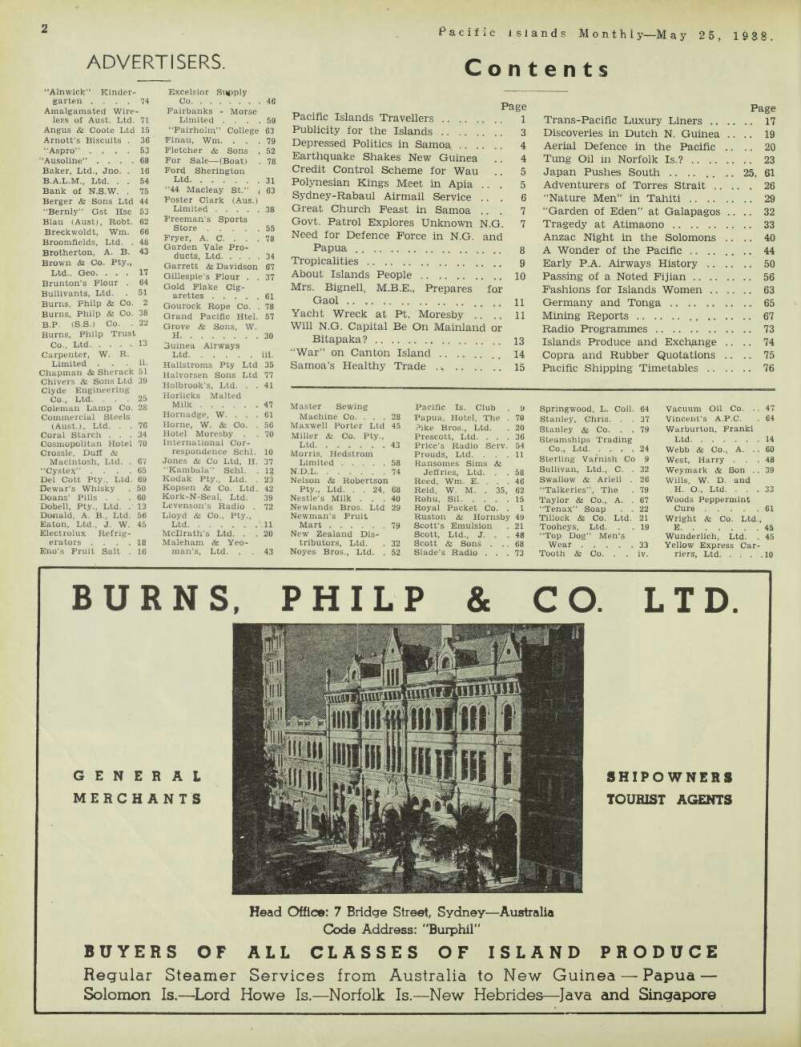
Burns, Philp & Co. Ltd
GENERAL
MERCHANTS
111
ill
111
SHIPOWNERS
TOURIST AGENTS
Head Office: 7 Bridge Street, Sydney—Australia Code Address: "Burphil"
BUYERS OF ALL CLASSES OF ISLAND PRODUCE Regular Steamer Services from Australia to New Guinea Papua Solomon Is.—Lord Howe Is. —Norfolk Is. —New Hebrides —Java and Singapore
Pacific Islands Monthly
The Newspaper-Magazine of the South Seas
[Registered at the G.P.0., Sydney, for transmission by post as a newspaper J Published Once Each Month and Circulated in Australia and New Zealand and in the following Pacific Territories and Islands Groups:
Crown Colony of Fiji.
Australian Territory of Papua.
Mandated Territory (Australia) of New Guinea, Bismarck Archipelago and Northern Solomon Islands.
Mandated Territory (Japan) of Marshall, Caroline and Marianna Islands.
French Territory of New Caledonia.
British and French Condominium of New Hebrides.
American Territory of Eastern Samoa.
American Territory of Guam.
Mandated Territory of Nauru.
British Crown Colony of Gilbert and Ellice Islands.
Mandated Territory (New Zealand) of Samoa.
British Solomon Islands Protectorate.
British Protectorate of Tongan Islands.
New Zealand Territory of Cook Islands.
Australian Territory of Norfolk Island.
French Colony of Oceania (Tahiti, etc.).
American Territory of Hawaiian Islands.
Owned and Produced by Pacific Publications Pty. Ltd., Union House, 247 George Street, Sydney.
Tl . r rpnnvr J Managing Director ...„ 8W5037 TELEPHONE Buginesg and Editorial MA7IOI
P.O. Box 3408 R
Registered Address of Telegrams, Radiograms, and Cables: “Pacpub”, Sydney.
Contributions
Articles, Stories, and Photographs dealing with Pacific Islands subjects are invited and will be paid for on publication at usual rates.
Subscription Rates
Per Annum, within British Empire, Prepaid, Post Free 8/- Per Annum, elsewhere, prepaid. Post Free 107- Single Copies Bd.
Editor and Publisher:
R. W. Robson. F.R.G.S.
Assisted by Selwyn Hughes.
Advertisements
Advertising Manager: L. W. Bailey.
Advertising Office and Printing-House: 29 Alberta St., Sydney.
Advertising rates furnished on application.
Colours, etc by Arrangement Process Blocks made at Advertiser’s expense when required. Screen, 100.
Changes of Advertising Copy should reach this Office by Bth of each month, otherwise previous advertisement may be repeated.
Agents
The following are authorised to receive sub scriptions for the Pacific Islands Monthly:- Islands Branches of Burns, Philp & Co. Ltd., and Burns Philp (South Sea) Co. Ltd.
Islands Branches of W. R. Carpenter & Co. Ltd.
All Branches of Morris, Hedstrom & Co. Ltd.
G. Thomas & Co., Rabaul, New Guinea.
T. A. Olsson, Wau, New Guinea.
Whitten Bros. Ltd., Samarai, Papua.
Steamships Trading Co., Papua. All Branches.
P. Costello, Suva, Fiji.
J. Muir Suva, Fiji. , .
N. C. Mackenzie-Hunt, Wainunu, Bua, Fiji.
All Branches and Representatives of W. H. Grove & Sons Ltd., Auckland, New Zealand.
Cook Islands Trading Co.. Rarotonga, Cook Is.
A. C. Rowland, Papeete, Tahiti.
Representative in London: W. C. HARVEY, Coronation Building 4 Lloyds Avenue, London, E.C.2. from whom may be obtained copies of Pacific Islands Monthly, Pacific Islands Year Book, advertising schedules, etc.
Vol. VIII. No. 10.
Sydney, May 25, 1938.
Prif»P ( 8d - Pei Copy r riCc ( Prepaid: 8/- p.a.
Pacific Territories
Publicity and Progress in the Pacific Territories
AT long last, the attention of the great nations is being given to the Pacific Islands territories. Because of their new value in the calculations of airways companies, and of their almost incalculable importance in Pacific naval strategy—no less than because of their possibilities as rich producers of half the things that mankind needs—“the Islands” have had more “publicity” in the last year than in the whole of the previous decade.
At least three of the biggest terri tories are moving with the times. The enterprise of the Governments of New Guinea and Papua in making, at the Royal Show in Sydney, displays calcu lated to show the arts, crafts, indus tries and resources of the territories pleased everyone concerned. The two Administrations, and especially New Guinea, were successful in getting the co-operation of the mission and com mercial interests, and a splendid job of work was done by Mr. S. Lonergan,
of Rabaul, in arranging the exhibits.
The result was that hundreds of thou sands of people, who eagerly inspected the displays, got a new and favour able impression of the character and potentialities of Australia’s Pacific territories.
One wonders why this sort of pub licity was not undertaken sooner; and what New Guinea and Papua now pro pose to do to follow on and get due advantage from the successful effort they have made. There is not much use in stirring interest and attracting goodwill, in the manner described, un less the thing is part of a national plan of development and progress.
A different kind of publicity effort has been made recently by Fiji. The James Fitzpatrick Travelogue outfit passed that way recently; and all Suva interests—Government, news papers, commercial firms, tourist bureau, Fijian chiefs and people, In dian constabulary—co-operated in an enthusiastic and well-organised effort
to assist the film experts in getting a first-class travel-picture of the beau tiful place for world-wide exhibition.
That is good politics and good busi ness. Fiji possesses great attractions for travellers, yet it has not got one tenth of the tourist traffic it de serves.
Much more could be done by these Pacific territories in making their tourist attractions and developmental possibilities more widely known. Why not a sort of South Seas Publicity Bureau in Sydney, the metropolis of the South Pacific? There is plenty of scope for it. There is no official representative in Sydney of any 7 of the numerous territories, with p lie re sult that the offices of Islands Monthly” are visited every day by people who want information of widely-varying character. We give this service gladly, to'lielp the Islands interests; but ytfe often wonder whether it would not be to the ad vantage of the Territories—especially New Guinea, Papua, Solomons, New Fiji, Samoa, Tonga, and, maybeyThe French colonies—if they got together and carried out this pro pagandist work on their own account. 11l may mean just the difference be tween stagnation and progress.
Earthquake
Morobe District, New Guinea, Severely Shaken
THE whole of the north-eastern section of the "New Guinea mainland was shaken by a severe earthquake early on Friday morning, May 13. The Morobe district suffered most from th,e shock.
Small tidal waves inundated the north ern end of Salamaua and the bulk stores of Burns, Philp and Co. Ltd., W. R. Car penter and Co. Ltd., N.G. Goldfields Ltd., and Vacuum Oil Co. Ltd. suffered con siderable damage. Numerous native houses collapsed and the natives fled in terror to the higher ground. Flood waters for a time cut off Salamaua from the aero drome. There was much minor damage, including the dislocation of telephone services. Numerous drums of petrol were swept by the tidal waves from the water front stores into the swamp. Boats and launches were stranded.
The Bulolo Co.’s hydro-electric power service, covering Wau, Bulolo and Edie Creek, was dislocated, and dredges were temporarily out of action.
Slips blocked the road between Wau and Edie Creek.
Big cracks opened in the ground at Lae, about 30 yards from the shore.
The main shock came at 1.45 a.m. and th,ere were numerous tremors during the succeeding day, but they gradually died away.
At 6.50 p.m. on Sunday, May 15, Mt.
Bagana, in Bougainville Is. (Northern Solomons) erupted strongly and dis charged huge quantities of dust and ashes. Kieta, some 50 miles away to the eastward, was enveloped in smoke and dust for several hours. The natives were terror-stricken, but no damage was re ported.
Coconut Pest in New
Britain Outbreak on the Wane
MUCH alarm has been caused in New Britain during the past four months by a most serious outbreak of the coconut pest Promecotheca Antiqua, which first attacked plantations in the vicinity of Rabaul, and quickly attained plague proportions.
The Agriculture Department officials fought the outbreak with every resource at their command. There were indica tions early in May that the outbreak was on the wane as a result of a local wasp, which appears to have no name, attack ing the pest in ever-increasing numbers.
It is hoped that soon the pest will be wiped out by the local parasite.
The pest is known also in the New Hebrides, and attempts are being made to control it there through the recent in troduction from Java of a parasite named Pleurotrupis Parvulus.
Dr. Leo Brem and Rev. Father Bruno Murche, both of the Catholic Mission of the Sacred Heart at Vunapope, New Guinea, have been made members of 'Jhe Civil Division of the British Empire, ih recognition of services performed during' the Rabaul eruption.
Depressed Politics
In Samoa
OINCE the return from Wellington to Apia of the Nelson deputation, with the depressing news that the New Zealand Government had not received very favourably the various demands of the Mau party, a kind of blight has fallen upon the politics of Western Samoa.
Reading between the lines, it would appear as if the New Zealand Govern ment made it very clear to the Nelson clique that New Zealand is a little tired of the restlessness and greediness of the Mau party, and that the Mau, as a result, has felt it advis able to remain quiet for a while.
The Mau has no reason to complain, however. It has been given amazing concessions by the New Zealand Gov ernment—namely, the formal recogni tion of Mr. Nelson and of the influence of the various members of his family; a considerable increase in the number of Mau-controlled officials in the per sonnel of the Administration; the re moval of the Chinese labourers from Samoa and the consequent embarrass ment of the European planters; and a variety of other things.
Of course, extremism in politics always produces its natural reaction; and the result in Western Samoa has been the sharp revival of the Malo (or Anti-Mau) party, which is moderate in its demands, reasonable in its policy and loyal in its allegiance, and there is every indication that the Malo party now is just as strong numerically, and more influential in character, than the organ isation dominated by Mr. Nelson and his son-in-law, Tamasese. . One extraordinary feature of the Samoan situation is that Mr. A. C.
Turnbull is still kept there by the New Zealand Government in the position of
acting-Administrator—a status that he now has held for over three years. It is an outrageous arrangement,’ unfair to Mr. Turnbull, and embarrassing to Samoa, and the New Zealand Govern ment has made no attempt either to ex plain it or to apologise for it.
It was reported in Wellington, in February, on very good authority, that the New Zealand Government proposed to send Mr. O’Brien, M.P., to Samoa as Administrator. But if there was any truth in the report, it would appear that the Government was scared off the plan by the very strong expressions of indignation at the prospect of such a blatant “political” appointment.
There was an interesting incident in, Samoa early in April when, at a com plimentary social tendered to the Nel son delegation by members of the Samoan Labour party, the President, Mr. Amatu Stowers, said: “The local born Labour Party differs only in name from the Mau, as the ideals and ob jects of each are identical”.
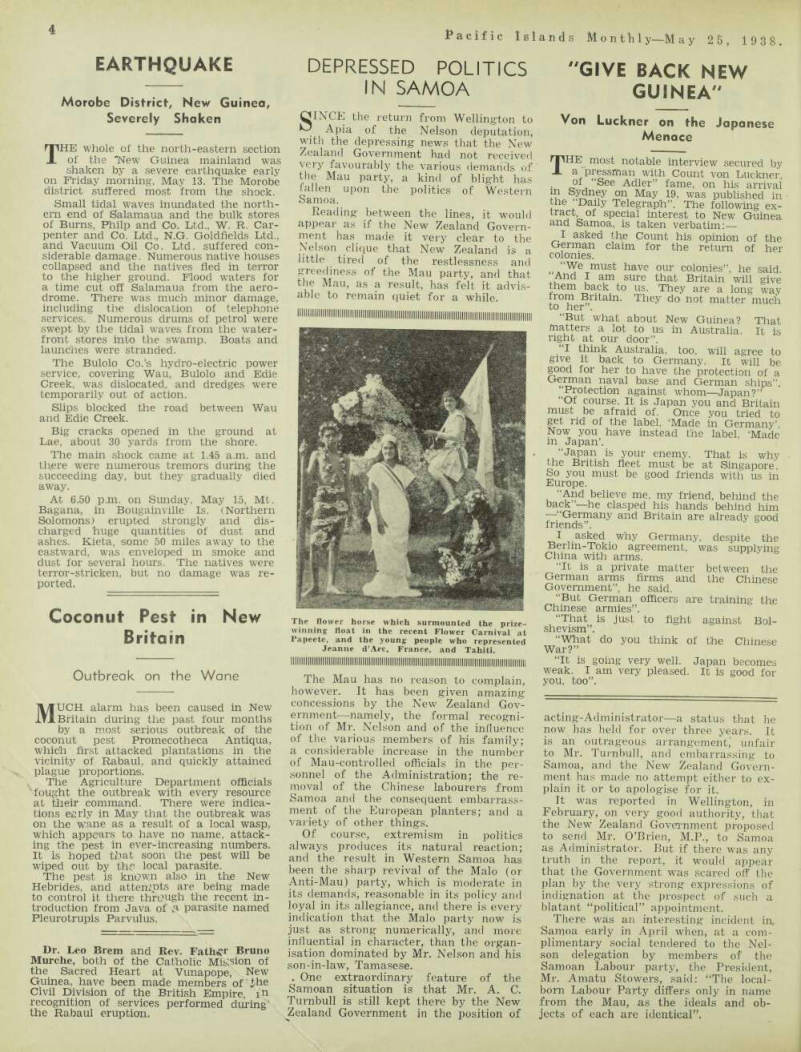
The flower horse which surmounted the prize winning float in the recent Flower Carnival at Papeete, and the young people who represented Jeanne d’Arc, France, and Tahiti.
Guinea"
"Give Back New
Von Luckner on the Japanese Menace
THE_ most notable interview secured by a pressman with Count von Luckner, c? j “See Adler” fame, on his arrival JS Sydney on May 19, was published in the Daily Telegraph”. The following ex tract of special interest to New Guinea and Samoa, is taken verbatim:— I asked th,e Count his opinion of the German claim for the return of her colonies. ‘‘ We must have our colonies”, he said.
I am sure that Britain will give them back to us. They are a long wav from Britain. They do not matter much to her”, ‘‘But what about New Guinea? That matters a lot to us in Australia. It is right at our door”.
“I think Australia, too, will agree to give it back to Germany, it will be good for her to have the protection of a German naval base and German ships”.
“Protection against whom—Japan?”
“Of course. It is Japan you and Britain must be afraid of. Once you tried to get rid of the label, ‘Made in Germany’.
Now you have instead the label. ‘Made m Japan’.
“Japan is your enemy. That is why the British fleet must be at Singapore.
So you must be good friends with us in Europe.
“And believe me, my friend, behind the back”—he clasped his hands behind him ■—“Germany and Britain are already good friends”.
I asked why Germany, despite the Berlm-Tokio agreement, was supplying China with arms.
“It is a private matter between the German arms firms and the Chinese Government”, he said.
“But German officers are training the Chinese armies”.
“That is just to fight against Bol shevism”.
“What do you think of the Chinese War?”
“It is going very well. Japan becomes weak. I am very pleased. It is good for you, too”.
Advertisements & other items, p. 6 (1 item)
4
Pacific Islands Montlil y— M ay 25, 1938
“Cash Only" In
Wau
Credit Control Scheme Starts Co-operative Movement
From Our Own Correspondent.
WAU, May 1.
ALL the principal firms trading on the Morobe Goldfield, having become weary of giving excessive credit and making many bad debts, have joined in a credit control bureau. They have pooled their clients, and have prepared a “C” list (“cash only”) to which they all are adhering. There is an under standing that the people on the list must clear themselves with all the firms, and not with one of them, before they can get credit again.
This drastic step has caused an extra ordinary paralysis of trading, and busi ness, for the moment, is dead. Yet the firms cannot be blamed. The amount of credit given in the past was amazing.
Many people in Wau, Edie Creek, Salamaua and some of the smaller places, have greeted the credit control bureau most resentfully, and a move ment is afoot to strike back by forming a co-operative society, for the trans port and distribution of goods. Two meetings have been held, and there is much activity.
I hear there was some wild talk at the meetings—someone even advanced a plan to advertise for a powerful con cern to start here against the estab lished firms, and to be guaranteed the trade of a certain section of the popula tion. Others claimed that Morobe prices generally are ridiculously high, and it was impossible, in consequence, to keep out of debt.
Out of it all, however, there may come a co-operative society to run its own store and aeroplanes. I hear that at least one man has gone to Sydney with authority to act in certain directions.
Some very “solid” men have associated themselves with the movement; but I am personally doubtful whether there are enough of them to put over a prac tical scheme.
The big firms certainly have done very well out of the Morobe people dur ing the last seven or eight years; but it is a fact that too many people were loafing on the easy credit available, and the firms cannot be blamed for trying to reduce their book debts.
Vessel For New Hebrides
THE new vessel “Polynesien” (Messag eries Maritimes. Ltd.) left Sydney in April for Noumea, New Cale donia, from whence she proceeded to Vila.
New Hebrides, to take up her inter-island service.
Formerly the “Mygreta”, she was built in Shanghai in 1930. is of 1,388 tons, and has a length of 217 ft., with a breadth of 35 ft., and depth of 20 ft. Equipped with twin-screws, the “Polynesien” has a speed of 10 knots. Provision has been made for 10 passengers, as well as accommodation for natives.
Training Fijian Youths
as Farmers
A PROJECT that should be a great boon to Fijian youths, says the “Fiji Times and Herald”, is expected to be under way shortly. It is the Colonial Sugar Refining Co.’s scheme for selected natives from post-primary schools to be trained in agriculture at Drasa, a fertile valley about five miles north of Lautoka.
The C.S.R. Co., already, has spent sev eral thousand pounds on development work, e.g., a school, “bures” (native houses), kitchen, etc. Th,e course will cover three years, and provision has been made for about 75 students. The boys will receive thorough training to fit them for development into tenant farmers in cane or other produce. Each will be given 12/- a month pocket money, and 5/- weekly will be paid into a fund by the Co. so that trainees will have suffi cient capital at the completion of the course to begin farming on their own.
Correction
IT was reported in the April issue of the “Pacific Islands Monthly” that Brigadier- General T. Griffiths, during his recent visit to Rabaul as a member of the Capital Site Com mittee had been treated with a lack of consid eration and courtesy—especially in the matter 0 f transport.
The information was conveyed to us by two persons who had travelled on the same steamer as General Griffiths and who assured us that the incident had caused indignation in Rabaul.
We since have been informed by General Gnf fiths that he was not treated with discourtesy, nor with any lack of consideration. He states that, on the contrary, the Administrator, Sir W.
Ramsay McNicoll, sent a radio to the ship offer in * h ® sp * l t ,ity a " d assi * tanc e to the Committee d that he met the Committee on its arrival at Rabal ,i and placed his own motor car at the disp osal of the Committee. “He and his staff”, says General Griffiths, “did everything possible to assist the Committee and make its sta y pleasant”.
We hasten to publish this correction and to express regret for any annoyance which the incorrect report may have caused to the Ad ministrator of New Guinea or to members of the capital site committee.
Polynesian Kings
From Our Own Correspondent.
Apia, Apr. 15.
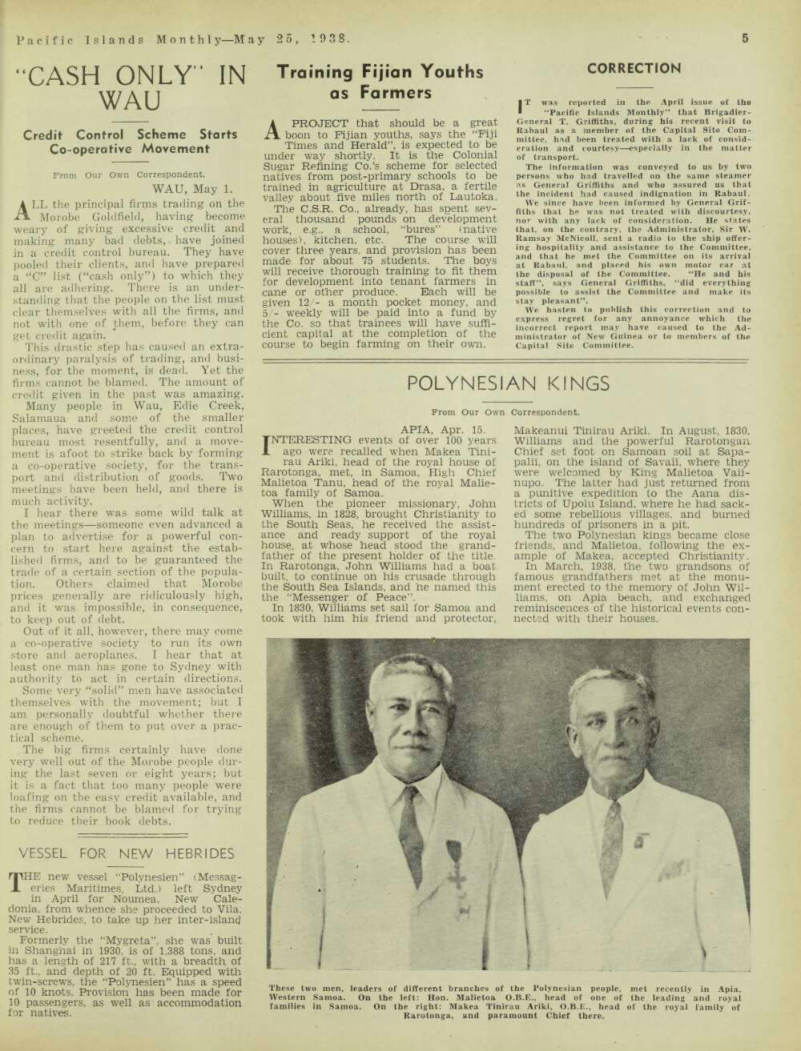
INTERESTING events of over 100 years ago were recalled when Makea Tinirau Ariki, head of the royal house of Rarotonga, met, in Samoa, High Chief Malietoa Tanu, head of the royal Malietoa family of Samoa.
When the pioneer missionary, John Williams, in 1828, brought Christianity to the South Seas, h,e received the assistance and ready support of the royal house, at whose head stood the grandfather of the present holder of the title.
In Rarotonga, John Williams had a boat built, to continue on his crusade through the South Sea Islands, and he named this the “Messenger of Peace”.
In 1830, Williams set sail for Samoa and took with him his friend and protector,
Makeanui Tinirau Ariki. In August, 1830, Williams and the powerful Rarotongan Chief set foot on Samoan soil at Sapa palii, on the island of Savaii, where they were welcomed by King Malietoa Vaii nupo. The latter had just returned from a punitive expedition to the Aana dis tricts of Upolu Island, where he had sack ed some rebellious villages, and burned hundreds of prisoners in a pit.
The two Polynesian kings became close friends, and Malietoa, following the ex ample of Makea, accepted Christianity.
In March, 1938, the two grandsons of famous grandfathers met at the monu ment erected to the memory of John Wil liams, on Apia beach, and exchanged reminiscences of the historical events con nected with their houses.
These two men, leaders of different branches of the Polynesian people, met recently in Apia, Western Samoa. On the left: Hon. Malietoa O.B.E., head of one of the leading and royal families in Samoa. On the right: Makea Tinirau Ariki, O.B.E., head of the royal family of Rarotonga, and paramount Chief there.
Advertisements & other items, p. 7 (1 item)
5
Pacific Islands Monthl y—M ay 25, 1938
Guinea Airways
Increased Business at Lower Rates
GIUINEA AIRWAYS LTD., in its annual f statement of accounts, issued during the month, stated that, although business in New Guinea grew during the year ended February 28. the net profit fell from £13.886 in 1936-7 to £10.895. In 1935-6 the company made a profit of £25,876 from its operations in New Guinea.
It is explained that the cost (£19.252) of establishing the two main air routes in Australia—Darwin-Adelaide and Ade laide-Sydney—is regarded as a capital expense to be written off over a series of years. The first instalment of this is 20 per cent., equal to £5.332. and it has been written-off this year’s accounts.
The £15,503 at credit of Profit and Loss Account (including £4.607 brought for ward) therefore has been disposed of as follows: Dividend of 1/- per share on ordinary shares £4,000 Twenty per cent, of cost of estab lishing mainland services .. .. 5,332 Carried forward 6,170 A total of £16.888 was charged, against revenue, as depreciation on plant in New Guinea and Australia.
Tonnage carried in New Guinea was 8.403, compared with 6,705 tons the pre vious year, and constituted a record. Pas sengers increased from 11,869 in 1937 to 12.120 (which was within 17 of the re cord). but gross revenue fell from £96.134 to £92,542. The fall was caused by a drop from 2.49 d. to 1.94 d. a lb. in the average freight charge, a cut of 20 per cent.
Paid capital has increased from £BO,OOO to £160,000 because of the issue of £BO,OOO preference shares. Reserve remains at £45,000. Bank overdraft has been reduc ed from £24.420 to £10,471. and open ac counts are £13.972. compared with £16.172 in 1937. Sundry debtors have increased from £29,603 to £37,856.
New Guinea Air
Two Planes Needed for First Flight
AFTER a series of exasperating delays, due to the failure of the Common wealth authorities to prepare the North Queensland and Territories aero dromes for fast airmail traffic and their slowness in installing directional and meteorological equipment. Messrs. W. R.
Carpenter and Co. Ltd. have completed all arrangements to officially start the Sydney-New Guinea weekly airmail on Monday, May 30.
Stamp-collectors’ eagerness to use this first airmail has been so excessive that it is practically certain that, to accom modate passengers and mails on this offi cial flight, two ’planes will be necessary, and the reserve De Havilland liner will be used. The ’planes will start a day earlier than schedule, and will spend an extra day in Rabaul, to permit mail-sorting.
Passengers will include the Minister for the Territories (Rt. Hon. W. M. Hughes) and the secretary of the Prime Minister’s Department (Mr. J. R. Halligan), who are going to Rabaul to deal with the Capital site question, and who will return to Syd ney about June 12.
During the past few weeks, while the ground organisation was being completed, W.R.C. Airlines (as the new organisation is called) have been running “survey” flights along the new route and testing out the new timetable. The ’planes car ried passengers and goods, but no mails.
Timetable details are given in the firm’s advertisement on page ii. of the cover.
Mr. R. J, Keegan, of the British Colon ial Administrative Service in the Solomon Islands, was in Sydney during May spend ing part of his long leave.
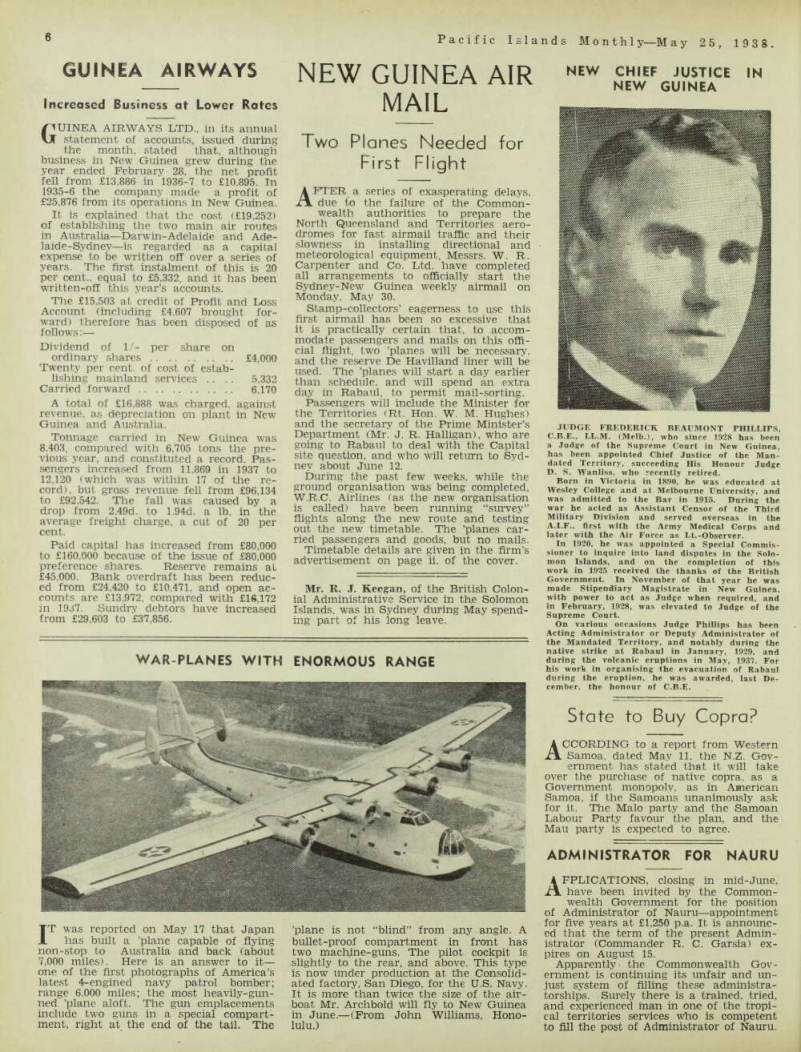
War-Planes With Enormous Range
IT was reported on May 17 that Japan has built a ’plane capable of flying non-stop to Australia and back (about 7,000 miles). Here is an answer to it— one of the first photographs of America’s latest 4-engined navy patrol bomber; range 6,000 miles; the most heavily-gunned ’plane aloft. The gun emplacements include two guns in a special compartment, right at the end of the tail. The
’plane is not “blind” from any angle. A bullet-proof compartment in front has two machjne-guns. The pilot cockpit is slightly to the rear, and above. This type is now under production at the Consolid ated factory, San Diego, for the U.S. Navy, It is more than twice the size of the air boat Mr. Archbold will fly to New Guinea in June—(From John Williams, Hono lulu.)
New Chief Justice In
New Guinea
Judge Frederick Beaumont Phillips,
C.B.E., LL.M. (Melb.), who since 1928 has been a Judge of the Supreme Court in New Guinea, has been appointed Chief Justice of the Man dated Territory, succeeding His Honour Judge D. S. Wanliss, who recently retired.
Born in Victoria in 1890, he was educated at Wesley College and at Melbourne University, and was admitted to the Bar in 1915. During the war he acted as Assistant Censor of the Third Military Division and served overseas in the A.1.F., first with the Army Medical Corps and later with the Air Force as Lt.-Observer.
In 1920, he was appointed a Special Commis sioner to inquire into land disputes in the Solo mon Islands, and on the completion of this work in 1925 received the thanks of the British Government. In November of that year he was made Stipendiary Magistrate in New Guinea, with power to act as Judge when required, and in February, 1928, was elevated to Judge of the Supreme Court.
On various occasions Judge Phillips has been Acting Administrator or Deputy Administrator of the Mandated Territory, and notably during the native strike at Rabaul in January, 1929, and during the volcanic eruptions in May, 1937. For his work in organising the evacuation of Rabaul during the eruption, he was awarded, last De cember, the honour of C.B.E.
State to Buy Copra?
ACCORDING to a report from Western Samoa, dated May 11, the N.Z. Gov ernment has stated that it will take over th,e purchase of native copra, as a Government monopoly, as in American Samoa, if the Samoans unanimously ask for it. The Malo party and the Samoan Labour Party favour the plan, and the Mau party is expected to agree.
Administrator For Nauru
Applications, closing in mid-June, have been invited by the Common wealth Government for the position of Administrator of Nauru—appointment for five years at £1,250 p.a. It is announc ed that the term of the present Admin istrator (Commander R. C. Garsia) ex pires on August 15.
Apparently the Commonwealth Gov ernment is continuing its unfair and un just system of filling these administra torships. Surely there is a trained, tried, and experienced man in one of the tropi cal territories services who is competent to fill the post of Administrator of Nauru.
Great Church Feast In Samoa
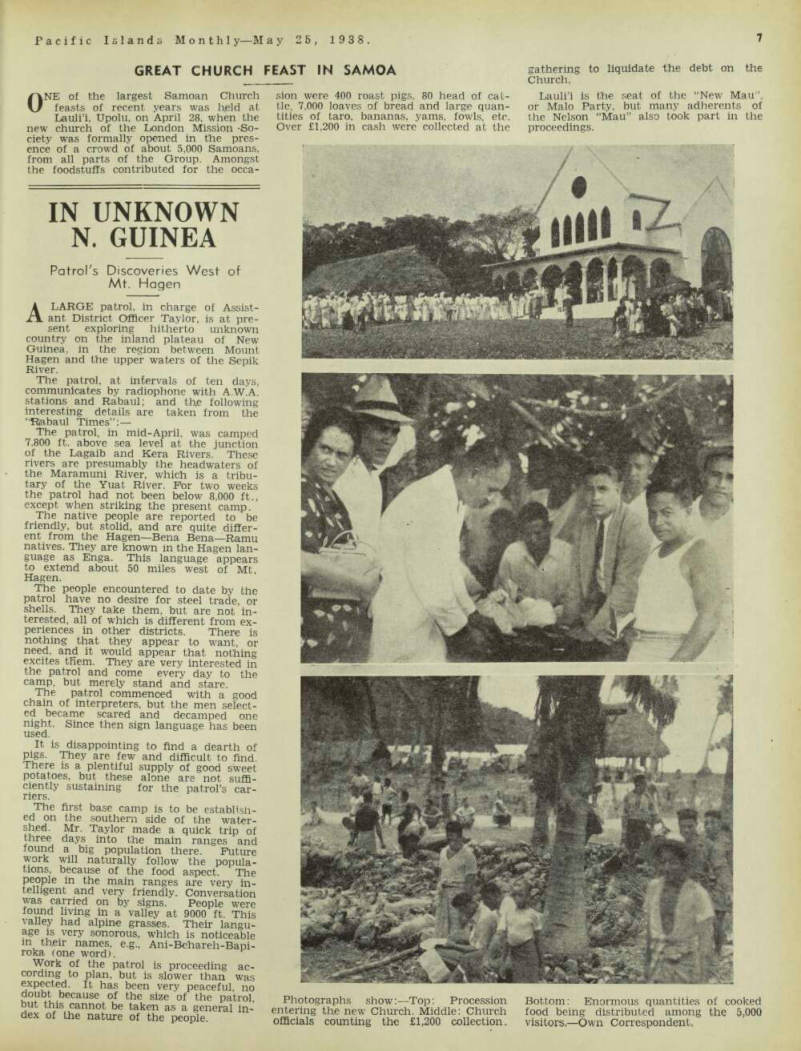
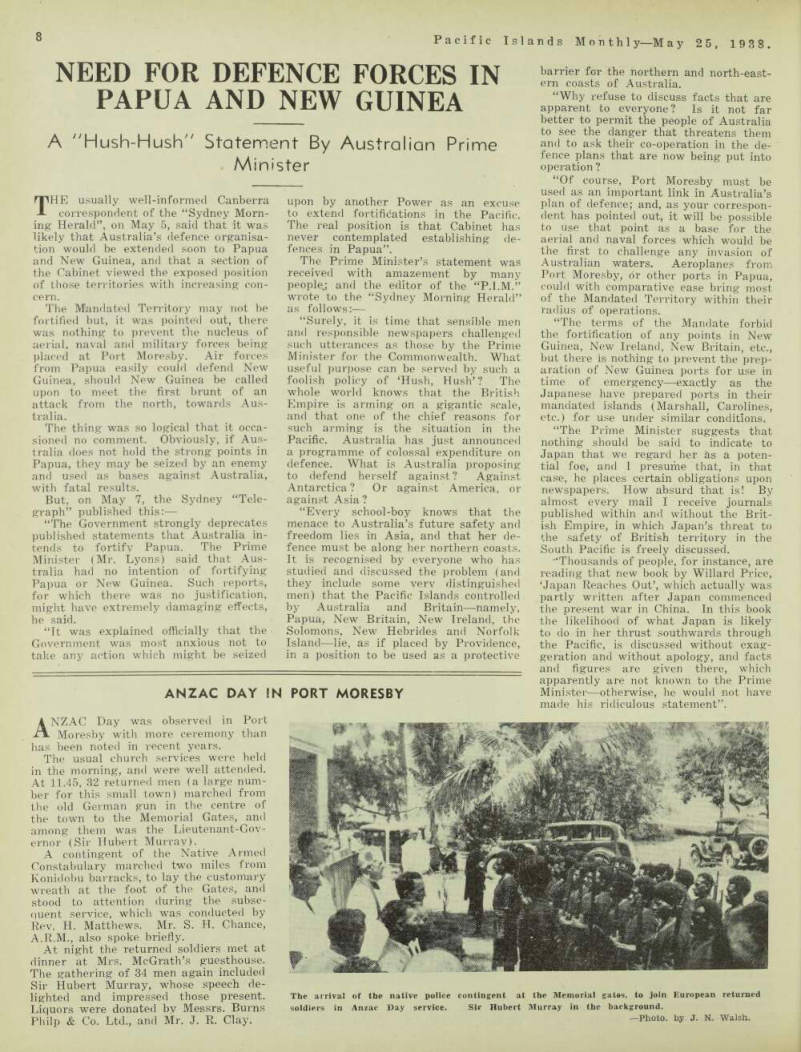
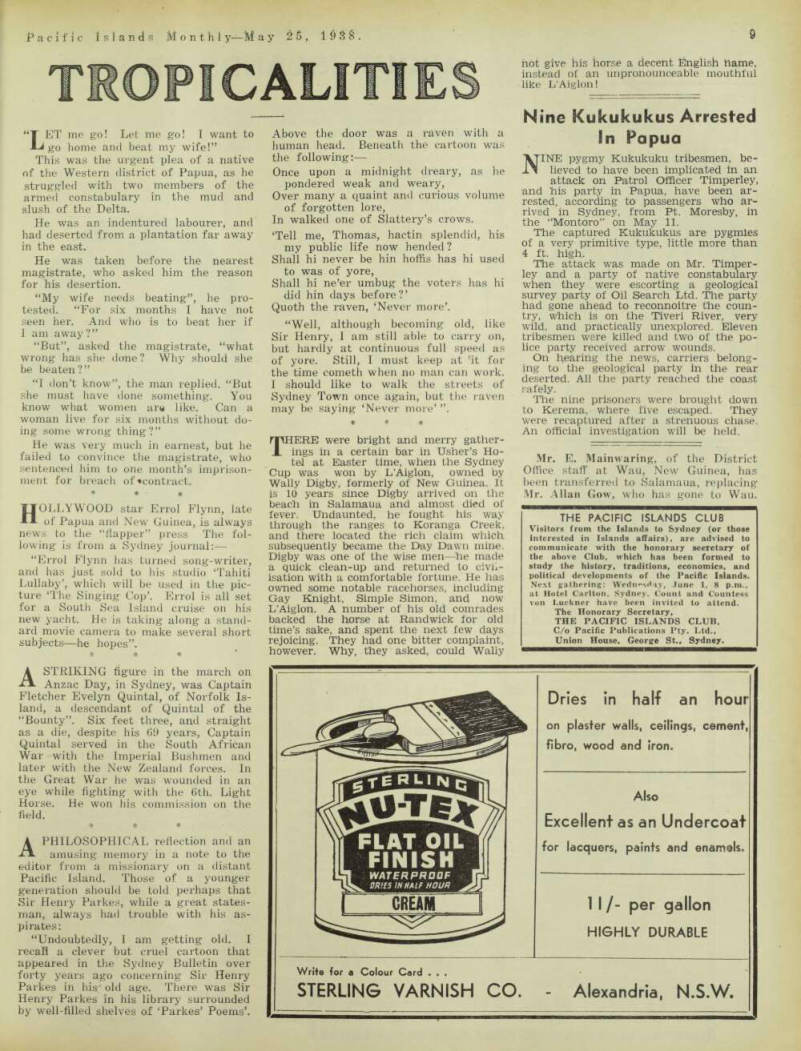
ONE of the largest Samoan Church feasts of recent years was held at Lauli’i, Upolu, on April 28, when the new church of the London Mission -So ciety was formally opened in the pres ence of a crowd of about 5,000 Samoans, from all parts of the Group. Amongst the foodstuffs contributed for the occa
sion were 400 roast pigs, 80 head of cat tle, 7,000 loaves of bread and large quan tities of taro, bananas, yams, fowls, etc.
Over £1,200 in cash were collected at the
gathering to liquidate the debt on the Church, Lauli’i is the seat of the “New Mau”, or Malo Party, but many adherents of the Nelson “Mau” also took part in the proceedings.
Photographs show; —Top: Procession entering the new Church. Middle: Church officials counting the £1,200 collection.
Bottom: Enormous quantities of cooked food being distributed among the 5,000 visitors,-Own Correspondent.
In Unknown
N. Guinea
Patrol's Discoveries West of Mt. Hagen
A LARGE patrol, in charge of Assist ant District Officer Taylor, is at pre sent exploring hitherto unknown country on the inland plateau of New Guinea, in the region between Mount Hagen and the upper waters of the Sepik River.
The patrol, at intervals of ten days, communicates by radiophone with A.W.A. stations and Rabaul; and the following interesting details are taken from the “Rabaul Times”:— The patrol, in mid-April, was camped 7.800 ft. above sea level at the junction of the Lagaib and Kera Rivers. These rivers are presumably the headwaters of the Maramuni River, which is a tribu tary of the Yuat River. For two weeks the patrol had not been below 8,000 ft., except when striking the present camp.
The native people are reported to be friendly, but stolid, and are quite differ ent from the Hagen—Bena Bena—Ramu natives. They are known in the Hagen lan guage as Enga. This language appears to extend about 50 miles west of Mt.
Hagen.
The people encountered to date by the patrol have no desire for steel trade, or shells. They take them, but are not in terested, all of which is different from ex periences in other districts. There is nothing that they appear to want, or need, and it would appear that nothing excites them. They are very interested in the patrol and come every day to the camp, but merely stand and stare.
The patrol commenced with a good chain of interpreters, but the men select ed became scared and decamped one night. Since then sign language has been used.
It is disappointing to find a dearth of pigs. They are few and difficult to find.
There is a plentiful supply of good sweet potatoes, but these alone are not suffi ciently sustaining for the patrol’s car riers.
The first base camp is to be establish ed on the southern side of the water shed. Mr. Taylor made a quick trip of three days into the main ranges and found a big population there. Future work will naturally follow the popula tions, because of the food aspect. The people in the main ranges are very in telligent and very friendly. Conversation was carried on by signs. People were found living in a valley at 9000 ft. This valley had alpine grasses. Their langu age is very sonorous, which is noticeable m their names, e.g., Ani-Behareh-Bapi roka (one word).
Work of the patrol is proceeding ac cording to plan, but is slower than was expected. It has been very peaceful, no ecause s * ze the patrol, but this cannot be taken as a general in dex of the nature of the people.
Advertisements & other items, p. 9 (1 item)
7
Pacific Islands Monthl y—M ay 25, 1938.
Need For Defence Forces In
Papua And New Guinea
A "Hush-Hush" Statement By Australian Prime Minister
THE usually well-informed Canberra correspondent of the “Sydney Morn ing Herald”, on May 5, said that it was likely that Australia’s defence organisa tion would be extended soon to Papua and New Guinea, and that a section of the Cabinet viewed the exposed position of those territories with increasing con cern.
The Mandated Territory may not be fortified but, it was pointed out, there was nothing to prevent the nucleus of aerial, naval and military forces being placed at Port Moresby. Air forces from Papua easily could defend New Guinea, should New Guinea be called upon to meet the first brunt of an attack from the north, towards Aus tralia.
The thing was so logical that it occa sioned no comment. Obviously, if Aus tralia does not hold the strong points in Papua, they may be seized by an enemy and used as bases against Australia, with fatal results.
But, on May 7, the Sydney “Tele graph” published this: — “The Government strongly deprecates published statements that Australia in tends to fortify Papua. The Prime Minister (Mr. Lyons) said that Aus tralia had no intention of fortifying Papua or New Guinea. Such reports, for which there was no justification, might have extremely damaging effects, he said.
“It was explained officially that the Government was most anxious not to take any action which might be seized
upon by another Power as an excuse to extend fortifications in the Pacific.
The real position is that Cabinet has never contemplated establishing de fences in Papua”.
The Prime Minister’s statement was received with amazement by many people.; and the editor of the “P.1.M.” wrote to the “Sydney Morning Herald” as follows: “Surely, it is time that sensible men and responsible newspapers challenged such utterances as those by the Prime Minister for the Commonwealth. What useful purpose can be served by such a foolish policy of ‘Hush, Hush’ ? The whole world knows that the British Empire is arming on a gigantic scale, and that one of the chief reasons for such arming is the situation in the Pacific. Australia has just announced a programme of colossal expenditure on defence. What is Australia proposing to defend herself against ? Against Antarctica ? Or against America, or against Asia?
“Every school-boy knows that the menace to Australia’s future safety and freedom lies in Asia, and that her de fence must be along her northern coasts.
It is recognised by everyone who has studied and discussed the problem (and they include some very distinguished men) that the Pacific Islands controlled by Australia and Britain—namely, Papua, New Britain, New Ireland, the Solomons, New Hebrides and Norfolk Island—lie, as if placed by Providence, in a position to be used as a protective
barrier for the northern and north-east ern coasts of Australia.
“Why refuse to discuss facts that are apparent to everyone? Is it not far better to permit the people of Australia to see the danger that threatens them and to ask their co-operation in the de fence plans that are now being put into operation ?
“Of course, Port Moresby must be used as an important link in Australia’s plan of defence; and, as your correspon dent has pointed out, it will be possible to use that point as a base for the aerial and naval forces which would be the first to challenge any invasion of Australian waters. Aeroplanes from Port Moresby, or other ports in Papua, could with comparative ease bring most of the Mandated Territory within their radius of operations.
“The terms of the Mandate forbid the fortification of any points in New Guinea, New Ireland, New Britain, etc., but there is nothing to prevent the prep aration of New Guinea ports for use in time of emergency—exactly as the Japanese have prepared ports in their mandated islands (Marshall, Carolines, etc.) for use under similar conditions.
“The Prime Minister suggests that nothing should be said to indicate to Japan that we regard her as a poten tial foe, and I presume that, in that case, he places certain obligations upon newspapers. How absurd that is! By almost every mail I receive journals published within and without the Brit ish Empire, in which Japan’s threat to the safety of British territory in the South Pacific is freely discussed. •‘Thousands of people, for instance, are reading that new book by Willard Price, ‘Japan Reaches Out’, which actually was partly written after Japan commenced the present war in China. In this book the likelihood of what Japan is likely to do in her thrust southwards through the Pacific, is discussed without exag geration and without apology, and facts and figures are given there, which apparently are not known to the Prime Minister—otherwise, he would not have made his ridiculous statement”.
Anzac Day In Port Moresby
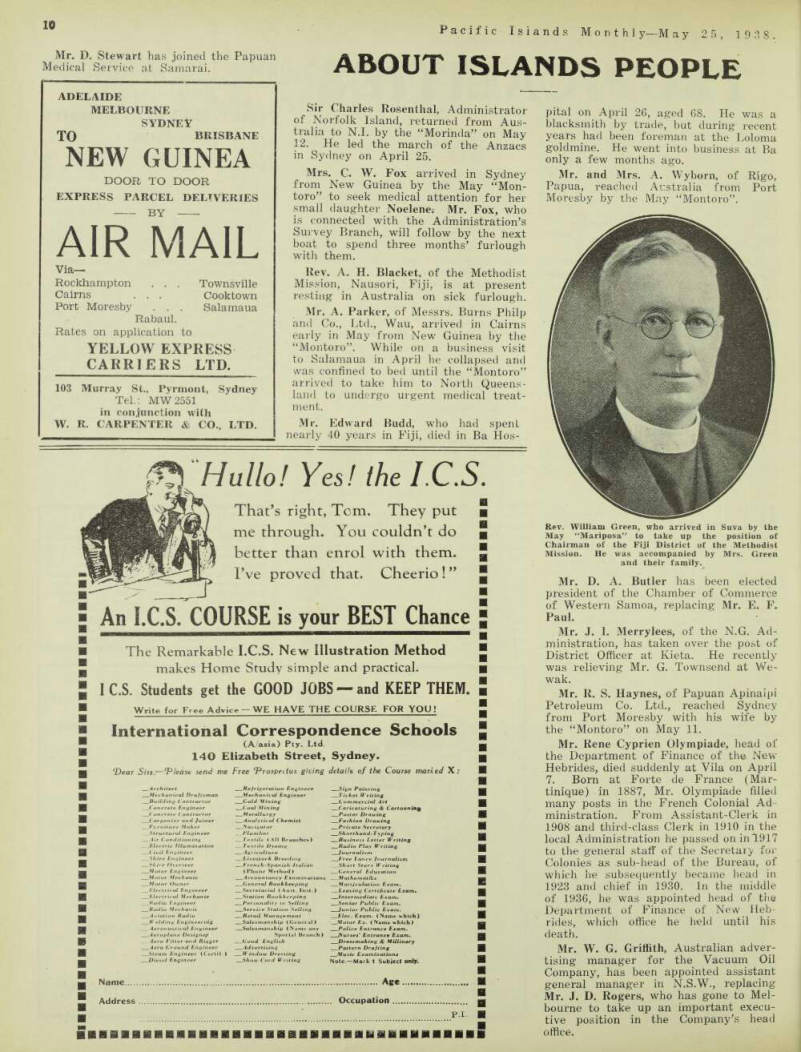
ANZAC Day was observed in Port Moresby with more ceremony than has been noted in recent years.
The usual church services were held in the morning, and were well attended.
At 11.45, 32 returned men (a large num ber for this small town) marched from the old German gun in the centre of the town to the Memorial Gates, and among them was the Lieutenant-Gov ernor (Sir Hubert Murrav).
A contingent of the Native Armed Constabulary marched two miles from Konidobu barracks, to lay the customary wreath at the foot of the Gates, and stood to attention during the subse quent service, which was conducted by Rev. H. Matthews. Mr. S. H. Chance, A.R.M., also spoke briefly.
At night the returned soldiers met at dinner at Mrs. McGrath’s guesthouse.
The gathering of 34 men again included Sir Hubert Murray, whose speech de lighted and impressed those present.
Liquors were donated by Messrs. Burns Philp & Co. Ltd., and Mr. J. R. Clay.
The arrival of the native police contingent at the Memorial gates, to join European returned soldiers in Anzac Day service. Sir Hubert Murray in the background.
Photo, by J. N. Walsh.
Advertisements & other items, p. 11 (1 item)
jĥ
“1 ET me go! Let me go! I want to Li go home and beat my wife!”
This was the urgent plea of a native of the Western district of Papua, as he struggled with two members of the armed constabulary in the mud and slush of the Delta.
He was an indentured labourer, and had deserted from a plantation far away in the east.
He was taken before the nearest magistrate, who asked him the reason for his desertion.
“My wife needs beating”, he pro tested. “For six months I have not seen her. And who is to beat her if I am away?”
“But”, asked the magistrate, “what wrong has she done? Why should she be beaten?”
“I don’t know”, the man replied. “But she must have done something. You know what women ar« like. Can a woman live for six months without do ing some wrong thing?”
He was very much in earnest, but he failed to convince the magistrate, who sentenced him to one month’s imprison ment for breach of«contract. ♦* • * HOLLYWOOD star Errol Flynn, late of Papua and New Guinea, is always news to the “flapper” press The fol lowing is from a Sydney journal:— “Errol Flynn has turned song-writer, and has just sold to his studio ‘Tahiti Lullaby’, which will be used in the pic ture ‘The Singing Cop’. Errol is all set for a South Sea Island cruise on his new yacht. He is taking along a stand ard movie camera to make several short subjects—he hopes”. * * * A STRIKING figure in the march on Anzac Day, in Sydney, was Captain Fletcher Evelyn Quintal, of Norfolk Is land, a descendant of Quintal of the “Bounty”. Six feet three, and straight as a die, despite his 69 years, Captain Quintal served in the South African War with the Imperial Bushmen and later with the New Zealand forces. In the Great War he was wounded in an eye while fighting with the 6th. Light Horse. He won his commission on the field. * « * A PHILOSOPHICAL reflection and an amusing memory in a note to the editor from a missionary on a distant Pacific Island. Those of a younger generation should be told perhaps that Sir Henry Parkes, while a great states man, always had trouble with his as pirates: “Undoubtedly, I am getting old. I recall a clever but cruel cartoon that appeared in the Sydney Bulletin over forty years ago concerning Sir Henry Parkes in his J old age. There was Sir Henry Parkes in his library surrounded by well-filled shelves of ‘Parkes’ Poems’.
Above the door was a raven with a human head. Beneath the cartoon was the following:— Once upon a midnight dreary, as he pondered weak and weary, Over many a quaint and curious volume of forgotten lore, In walked one of Slattery’s crows. ‘Tell me, Thomas, hactin splendid, his my public life now bended ?
Shall hi never be hin hoffis has hi used to was of yore, Shall hi ne’er umbug the voters has hi did hin days before?’
Quoth the raven, ‘Never more’.
“Well, although becoming old, like Sir Henry, I am still able to carry on, but hardly at continuous full speed as of yore. Still, I must keep at ‘it for the time cometh when no man can work.
I should like to walk the streets of Sydney Town once again, but the raven may be saying ‘Never more’ ”. * * * THERE were bright and merry gather ings in a certain bar in Usher’s Ho tel at Easter time, when the Sydney Cup was won by L’Aiglon, owned by Wally Digby, formerly of New Guinea. It is 10 years since Digby arrived on the beach in Salamaua and almost died of fever. Undaunted, he fought his way through the ranges to Koranga Creek, and there located the rich claim which subsequently became the Day Dawn mine.
Digby was one of the wise men —he made a quick clean-up and returned to civil isation with a comfortable fortune. He has owned some notable racehorses, including Gay Knight, Simple Simon, and now L’Aiglon. A number of his old comrades backed the horse at Randwick for old time’s sake, and spent the next few days rejoicing. They had one bitter complaint, however. Why, they asked, could Wally
hot give his horse a decent English name, instead of an unpronounceable mouthful like L’Aiglon!
In Papua
Nine Kukukukus Arrested In Papua
NINE pygmy Kukukuku tribesmen, be lieved to have been implicated in an attack on Patrol Officer Timperley, and his party in Papua, have been ar rested, according to passengers who ar rived in Sydney, from Pt. Moresby, in the “Montoro” on May 11.
The captured Kukukukus are pygmies of a very primitive type, little more than 4 ft. high,.
The attack was made on Mr. Timper ley and a party of native constabulary when they were escorting a geological survey party of Oil Search Ltd. The party had gone ahead to reconnoitre the coun try, which is on the Tiveri River, very wild, and practically unexplored. Eleven tribesmen were killed and two of the po lice party received arrow wounds.
On bearing the news, carriers belong ing to the geological party in the rear deserted. All the party reached the coast safely.
The nine prisoners were brought down to Kerema, where five escaped. They were recaptured after a strenuous chase.
An official investigation will be held.
Mr. E. Mainwaring, of the District Office staff at Wau, New Guinea, has been transferred to Salamaua, replacing' Mr. Allan Gow, who has gone to Wau,
Mr. D. Stewart has joined the Papuan Medical Service at Samarai.
Advertisements & other items, pp. 11-12 (2 items)
9
Pacific Islands Mon t b 1 y-M ay 25, 193 § .
Alexandria, N.S.W.
THE PACIFIC ISLANDS CLUB
Visitors from the Islands to Sydney (or those interested in Islands affairs), are advised to communicate with the honorary secretary of the above Club, which has been formed to study the history, traditions, economics, and political developments of the Pacific Islands.
Next gathering: Wednesday, June 1, 8 p.m., at Hotel Carlton. Sydney. Count and Countess von Luckner have been invited to attend.
The Honorary Secretary.
THE PACIFIC ISLANDS CLUB.
C/o Pacific Publications Pty. Ltd., Union House. George St., Sydney.
FLAT OIL
FINISH
WATERPROOF
DRIES IN HA IF HOUR
w
CREAM
Write for a Colour Card . . .
STERLING VARNISH CO.
Dries in half an hour on plaster walls, ceilings, cement, fibro, wood and iron.
Also Excellent as an Undercoat for lacquers, paints and enamels. 1 I /- per gallon
HIGHLY DURABLE
Alexandria, N.S.W.
ADELAIDE
MELBOURNE
SYDNEY
TO BRISBANE
NEW GUINEA
DOOR TO DOOR
EXPRESS PARCEL DELIVERIES
by
AIR MAIL
Via— Rockhampton . . , Townsville Cairns . . . Cooktown Port Moresby . . . Salamaua Rabaul.
Rates on application to
YELLOW EXPRESS
CARRIERS LTD.
103 Murray St., Pyrmont, Sydney Tel.: MW2551 in conjunction with
W. R. CARPENTER & CO., LTD.
Hullo! Yes! the
That’s right, Tom. They put
me through. You couldn’t do
better than enrol with them.
I’ve proved that. Cheerio ! ”
An I.C.S. COURSE is your BEST Chance
The Remarkable I.C.S. New Illustration Method
makes Home Study simple and practical.
IC.S. Students get the GOOD JOBS —and KEEP THEM.
Write for Free Advice -WE HAVE THE COURSE FOR YOU!
International Correspondence Schools
(A/asia) Pty. Ltd.
140 Elizabeth Street, Sydney.
*Dear Sits. — ‘Please send we Free Prospectus giving details of the Course marked X; Architect Mechanical Draftsman Building Contractor Concrete Engineer Concrete Contractor Carpenter and Joiner Furniture Maker Structural Engineer Air Conditioning Electric Illumination Civil Engineer Shire Engineer Shire Overseer Motor Engineer Motor Mechanic Motor Owner Electrical Engineer Electrical Mechanic Radio Engineer Radio Meehan it Aviation Radio ff elding Engineeririg Aeronautical Engineer Aeroplane Designer Aero Filter and Rigger Aero Ground Engineer Steam Engineer (Certil. ) Diesel Engineer _Refrigeration Engineer _Mechanical Engineer _Cold Mining _Coal Mining _j Metallurgy _Analytical Chemist _Navigator extile < All Branches) _Textile Dyeing _Agriculture _Livestock Breeding _Frcnch-Spanish-ltalian ( Phone Method ) _Accountancy Examinations _General Bookkeeping _Secretarial (Aust. Inst.) _Station Bookkeeping _Personality in Selling Service Station Selling _Retail Management Salesmanship (General) _Salesmanship (Name any Special Branch) JL'ood English _Advertising _ff indow Dressing _Show Card Writing Sign Painting Ticket Writing Commercial Art Caricaturing & Cartooning Poster Drawing Fashion Drawing Private Secretary __Shorthand-Ty ping Business Letter Writing Radio Play Writing Journalism Free Lance Journalism Short Story Wriling General Education Mathematics Matrjculation Exam.
Leaving Certificate Exam* lntermediate Exam.
Senior Public Exam, Junior Public Exam.
Elec. Exam. (Name which) Motor Ex. (Name which) Police Entrance Exam.
Nurses * Entrance Exam • Dressmaking & Millinery Pattern Drafting Music Examinations Note.—Mark 1 Subject only.
Name Age
Address Occupation ...
P.I.
About Islands People
Sir Charles Rosenthal, Administrator of Norfolk Island, returned from Aus tralia to N.I. by the “Morinda” on May 12. He led the march of the Anzacs in Sydney on April 25.
Mrs. C. W. Fox arrived in Sydney from New Guinea by the May “Mon toro” to seek medical attention for her small daughter Noelene; Mr. Fox, who is connected with the Administration’s Survey Branch, will follow by the next boat to spend three months’ furlough with them.
Rev. A. H. Blacket, of the Methodist Mission, Nausori, Fiji, is at present resting in Australia on sick furlough.
Mr. A. Parker, of Messrs. Burns Philp and Co., Ltd., Wau, arrived in Cairns early in May from New Guinea by the “Montoro”. While on a business visit to Salamaua in April he collapsed and was confined to bed until the “Montoro” arrived to take him to North Queens land to undergo urgent medical treat ment.
Mr. Edward Budd, who had spent nearly 40 years in Fiji, died in Ba Hos
pital on April 26, aged 68. He was a blacksmith by trade, but during recent years had been foreman at the Loloma goldmine. He went into business at Ba only a few months ago.
Mr. and Mrs. A. Wyborn, of Rigo, Papua, reached Australia from Port Moresby by the May “Montoro”.
Mr. D. A. Butler has been elected president of the Chamber of Commerce of Western Samoa, replacing Mr. E. F.
Paul.
Mr. J. I. Merry lees, of the N.G. Ad ministration, has taken over the post of District Officer at Kieta. He recently was relieving Mr. G. Townsend at We wak.
Mr. R. S. Haynes, of Papuan Apinaipi Petroleum Co. Ltd., reached Sydney from Port Moresby with his wife by the “Montoro” on May 11.
Mr. Rene Cyprien Olympiade, head of the Department of Finance of the New Hebrides, died suddenly at Vila on April 7. Born at Forte de France (Mar tinique) in 1887, Mr. Olympiade filled many posts in the French Colonial Ad ministration. From Assistant-Clerk in 1908 and third-class Clerk in 1910 in the local Administration he passed on in 1917 to the general staff of the Secretary for Colonies as sub-head of the Bureau, of which he subsequently became head in 1923 and chief in 1930. In the middle of 1936, he was appointed head of the Department of Finance of New Heb rides, which office he held until his death.
Mr. W. G. Griffith, Australian adver tising manager for the Vacuum Oil Company, has been appointed assistant general manager in N.S.W., replacing Mr. J. D. Rogers, who has gone to Mel bourne to take up an important execu tive position in the Company’s head office.
Rev. William Green, who arrived in Suva by the May “Mariposa” to take up the position of Chairman of the Fiji District of the Methodist Mission. He was accompanied by Mrs. Green and their family.
Advertisements & other items, p. 12 (1 item)
10
Pacific Islands Month! y—M ay 25, 1938.
Mrs. Bignell, M.B.E.,
Prepores for Goo!
Rabaul Incident Suggests Need for Inquiry
IT is hoped that the Minister for the Territories (Mr. Hughes), when he visits New Guinea, will inquire into the circumstances surrounding the pro secution —some call it persecution of Mrs. Kathleen D. Bignell, licensee of the Rabaul Hotel, in the matter of mosquito larvae.
The grounds of the hotel occupy some nine acres, and Mrs. Bignell, like every other householder, is expected to take steps to prevent mosquitoes from breed ing on her property. It is no easy task.
Whenever it rains in Rabaul, there are puddles: and, since the eruption, accu mulations of volcanic dust everywhere have formed hidden pools.
The Health Department inspectors looked over the hotel grounds a couple of times, and warned Mrs. Bignell about her mosquitoes, and Mrs. Bignell patiently set her labour team to work and cleaned out the puddles. Then the officials came again: and Mrs. Bignell was duly prose cuted for permitting mosquitoes to breed in a broken flower pot, in a tank, in some empty tins and in a puddle under a tank.
Mrs. Bignell, now thoroughly exasper ated, went to Court and pleaded guilty: but she pointed out that she had spent much money on the restoration of her gardens, while adjoining properties still were in a ruinous state; that she had done her best to comply with the never ending demands of the inspectors; and that it was unfair to prosecute her while a large part of nearby Chinatown was in a filthy condition.
The Magistrate imposed a fine of £5, or one month’s imprisonment.
Mrs. Bignell said this was outrageous, and she would not pay it. She was told that gaol was the alternative. “Very well”, she said, and went home and made preparations to spend one month in prison.
This caused great perturbation. The gaol is not suitable for the accommoda dation of a white woman. Besides, it is only a few months since Mrs. Bignell was publicly awarded the M.B.E. for heroic services performed during the eruption.
About 70 residents got ready to go as a deputation to the Administrator. Offi cialdom gnawed its fingernails.
The matter ended when someone hur ried to the Court and paid the fine.
Niue's Loss Is Samoa's Gain
From Our Own Correspondent.
Apia, May 5.
BANANA quotas for the March “Maui Pomare” and the April “Matua” and “Maui Pomare” were increased ow ing to a shortage of exportable bananas in Niue Island. Over 26,000 cases were shipped by the three boats and pro ducers will thus receive cash payments amounting to more than £6,600.
Probably, for the first time in Samoan history, export values for bananas will exceed the values of copra and cocoa in 1938.
Mr. W. Shirley, of the Lautoka Hotel, returned to Suva, Fiji, by the May “Mariposa”.
Yacht Wrecked At
Pt. Moresby
Mistook Old "Pruth" Hulk For the "Montoro"
Prom Our Own Correspondent.
Pt. Moresby, May 8.
BAD luck attended the cruise of the “Nutara”, which began at Cairns in April and was to have ended at New Caledonia, but wound up at Port Mores by instead.
Mr. and Mrs. Wright, from U.S.A., bought the 35 ft. aux. vessel in North Queensland, and left Cairns with the in tention of sailing her to Noumea. Con trary winds delayed them; and, after a couple of weeks, during which they made only 400 miles, they decided to use the engine. But the engine de cided otherwise, and refused to function.
Mr. Wright then decided to run north in the hope of finding a repair shop somewhere on the island of New Guinea.
The “Nutara” made the Papuan coast near Hula, and turned north-west with a favourable wind; but there were no charts of the coast on board, nor any means of knowing even what coast it was. At this juncture the “Montoro”, on her way to Port Moresby, came up astern; and the voyagers spoke to her, asking for directions. Captain Rothery generously dropped a bundle of charts overboard for their use, and proceeded.
Unfortunately, the “Nutara”, was awk ward to handle; and before she could be manoeuvred to the spot where the charts floated, they disappeared.
At sunset on May 3 the navigators saw a steamer, apparently anchored, ahead of them; and at dark they could see the lights of Port Moresby. Decid ing to approach the steamer, which he took to be the “Montoro”, Mr. Wright kept confidently on; but the vessel was no other than the wreck of the “Pruth”, which has been standing on the barrier
reef at Port Moresby for 15 years.
The rest happened quickly. The “Nutara’s” keel caught the reef. She heeled to a breaking sea, and in a minute or so was lying on her beam-ends, be ing swept by heavy seas. A wallet of papers was all that the adventurous pair had time to save. By means of their small flat-bottomed dinghy, they got across the lagoon and landed on Ela Beach at about 11 p.m.
The vessel became a total wreck. Cus toms officials paid a visit to the scene the following morning, but no trace of her was discernible.
Advertisements & other items, p. 13 (2 items)
11
Pacific Islands Monthl y —M ay 25, 1938
pty. ltd.
SUPERIOR QUALITY
BRUSHES
Examples of Ladies’ and Men’s superior Quality Sterling Silver and Chromium Brushes. These Brushes in attractive shapes have pure bristles, and may relied on for long service.
A 745. —Chromium-plated Brush, Comb and Mirror, in Velvet-lined case 75/-.
Four-piece Set, with Cloth Brush mm A 751. Chromium-plated Military Brush and Comb in case .. .. 35/-.
Catalogue post free on application.
ON PARLE PRANCAIS
PROUDS PTY. LTD.
KING & PITT STS., SYDNEY.
CREMO COFFEE
PACIFIC COFFEE
FIRST CALL COFFEE
BULK COFFEE
(RAW WHOLE ROASTiO
A.S.F MILK
(SWEETENED CONDENSED)
CORAL COCOA
BULK TEAS
(BOXES OR CHESTS)
Cf 0 e=> O & v •v V V" >a ßed Fok Exp° & 1 >Yd
PTY
pty. ltd.
SYDNEY
Jumimi hot Jew and Cojhee 50
German Cruise Ship at Samoa
Samoa
Prom Our Own Correspondent.
Apia, May 5.
THE German Hamburg-American liner “Reliance” visited Apia in April on her world cruise, in between calls at Suva and Honolulu. She was the first tourist ship under the German flag to visit Samoa since the War. The 200 passengers thoroughly enjoyed their stay here in exceptionally good weather.
Members of the crew laid wreaths at the German and British-American monu ments at Mulinu’u.
The German Consul in New Zealand, Dr. W. Hellenthal, who with his family was returning to Germany by the “Re liance”, addressed the gathering at an impressive ceremony. He expressed the hope that the traditional friendship be tween the English and German people would be re-established in the near fu ture.
Rarotonga Police Force, Cook Islands
The Police Force of Raro tonga, Cook Group, with
Inspector Carl
yon seated in centre. On his left is Senior Sergeant Tear iki Kaivanaga, who died on March 14, af ter serving in the Force for 24 years. He was a Ranga tira (lesser chief) his fam ily being rela ted to Makea Ariki, para mount chief of Rarotonga.
Tahiti Memories Of Great
War
From Our Own Correspondent,
Papeete, May 1.
WHEN the naval training ship “Jeanne d’Arc” arrived at Papeete, April 15, the first thought of her commander was to lay a wreath of flowers at the cenotaph, and pay homage to the memory of the soldiers of Tahiti who had given their lives for France.
This stately and solemn ceremony was carried out in the presence of the Gov ernor of French Oceania, the officials of the Administration, and a detachment of 100 officers and men from the warship.
To commemorate this act of remem brance, the association of the veterans of the Great War presented to Com mandant Auphan of the “Jeanne d’Arc” a handsomely executed tablet of Islands workmanship. The delegation from the association were: —Monsieur Guichard (President de PUnion des Combattants); Prince Ariipaea Pomare (the head of the Royal family and a veteran of the Great War); Monsieur Jules Millaud (a member of the Association); Monsieur Paheroo (who holds the highest decora tion for valour).
The ceremony of presentation was performed aboard the warship, where the delegation was received with full military honours.
Advertisements & other items, p. 14 (2 items)
12
Pacific Islands Monthl y—M ay 25, 1928.
Kambala
CHURCH OF ENGLAND
SCHOOL FOR GIRLS
FOUNDED 1887
A Day and Board-
ing School for
Girls.
KINDERGARTEN TO
LEAVING CERTIFICATE
HONORS,
RESIDENT QUALIFIED ,
SPORTS MISTRESS. MB
Prospectus on application t to the Principal . . . -V
'■Sj fcj
St
u KAMBALA "
Ideally situated in 5 acres of ground ... 5 Tennis Courts KAMBALA SCHOOL tivoli heights, rose bay, Sydney Principal : MISS F. HAWTHORNE, B.A. Matron ; MISS M. COLLINS, A.T.N.A.
Mainland Or
Bitapaka?
Australian Minister, Perturbed by Capitol Site Argument, to Fly to New Guinea
A N unexpected and somewhat extraor dinary position has developed in re lation to the question of the future site of the Administrative establishment in New Guinea.
An expert committee (consisting of Brigadier-General T. Griffiths and Mes srs. C. W. Thomas and L. Thornton) was sent to New Guinea by the Com monwealth Government in February to recommend a site to which the adminis trative centre could be transferred from Rabaul. now menaced by volcanic activ ity. The committee made a very thorough job of it—travelling all over the Territory and exhaustively examining every pos sible site —and in April it returned to Aus tralia and. submitted its report.
The Commonwealth Government flatly refused to disclose the terms of the re port. but there is good reason for believ ing that the recommendation was two fold. and somewhat as follows: (a) If it is desired to make a change at the minimum of cost to the Adminis tration. and to the various commercial interests affected, it would be possible to place the administrative establishment out in the hills of the Gazelle Peninsula, about 20 miles from Rabaul, at a point between Bitapaka and the new aerodrome.
This place would be clear of immediate danger of eruption, and could be connect ed with Rabaul by a good motor road.
Then the non-official population could re main at Rabaul or move inland, as it wished. (b) If it is desired to use the present opportunity to encourage the settlement and development of New Guinea, and es tablish industries on the large and fer tile plateaus, which lie round the head waters of the Markham. Ramu and Pu rari Rivers, then it would be advisable to place the new capital on the high lands near the junction of the Markham and Watut Rivers, or alternatively, on the plateau at the back of Lae. In such circumstances, it would be practicable to connect the new capital by good roads with the shipping port of Salamaua, the air-port of Lae. the mining towns of Wau and Bulolo and the undeveloped plateaus of the interior.
It should not have been a difficult choice, but the Lyons Government—with that inability to make up its mind which is so characteristic of it—refused to reach a decision and finally deferred the mat ter, while the Minister now in charge of Territories (Rt. Hon. W. M. Hughes) is making a hurried visit to New Guinea and examining the problem for himself.
It is understood that Mr. Hughes is leav ing Sydney on May 30 by aeroplane for New Guinea.
This is a very puzzling development.
Mr. Hughes is a brilliant statesman, but it really is difficult to imagine what he will learn in a rushed visit to New Guinea—a very tiring procedure for a man 73—which he could not learn in Aus tralia, with the various reports of the experts in front of him.
The decision which Mr. Hughes is to make has nothing to do with local con ditions. The real question is whether Australia is to regard its two main Paci
fie territories of New Guinea and Papua as an essential part of an Australian scheme, and proceed to develop them ac cordingly. If there is to be a continu ance of the purposeless footling, which has been a characteristic of Australian policy in New Guinea in recent years, then there is only one thing to do — namely, leave the administrative officials alone in their pleasant little bungalow offices in Rabaul or neighbourhood.
But if Australia is to justify her con trol over this huge and rich territory so coveted by Asiatic nations, then she must initiate a different policy in New Guinea
—and the necessity of placing the admin istrative centre in a new position pro vides an opportunity of stepping out with the right foot, and really achieving some thing worthy of Australian enterprise and initiative.
However, nothing more can be expect ed until Mr. Hughes returns from New Guinea.
Meanwhile, the sensational newspaper accounts of “alarm and devastation” caus ed by the Salamaua earthquake (reported elsewhere) is believed to have greatly as sisted the advocates of the Bitapaka site, as against the mainlanders.
Advertisements & other items, p. 15 (2 items)
13
1938.
Pacific Islands Monthl y—M ay 2 5
Imperial Typewriter
HONESTY FIDELITY
kitty yout ivm
Safeguard your interests. Ensure their protection and security. Avail yourself of the advantages to be derived from the appointment of this Company as your trustees, in preference to any one individual. Write to or call on any Branch of Burns, Philp & Company Limited, or Burns Philp (South Sea) Company, Limited, for the folder which fully explains these advantages.
Give careful consideration to the benefits to be gained by appointing as your Executors—
BURNS PHILP TRUST CO. LTD.
DIRECTORS
JAMES BURNS
ROBERT JOHN NOSWORTHY
LEWIS ARMSTRONG
JOSEPH MITCHELL
BURNS PHILP TRUST CO. LTD.
CAPITAL—£SO,OOO II 7 BRIDGE STREET SYDNEY, N.S.W.
MOST VERSATILE OF ALL...
for faster, quicker , better work
IMPERIAL TYPEWRITER
After twenty-five years of development by specialists the IMPERIAL British Typewriter sets a world standard for efficiency. Famous for its speedy action, responsive touch, and absolute reliability. Every important feature of convenience and adaptability—including demountable type bar platen and carriage.
All bright parts chromium-plated especially, to resist rust and corrosion in Island climates. Used by leading banks, insurance companies, shipping and transport companies, accountants, manufacturers, etc. Every IMPERIAL Standard Typewriter is backed by a twelve months’ guarantee of perfect efficiency.
Get full patriculars of the to-day I
AGENTS:
Dobell Pty. Limited 107 Pitt Street, Sydney.
W. R. Carpenter & Co. Ltd. Rabaul, Salamaua, Kavieng, Madang, New Guinea.
W. R. Carpenter & Co. (Sol. Is.) Pty. Ltd. Tulagi, Solomon Is.
On Chong & Co. Pty. Ltd Butaritari, Gilbert Is.
Brown & Joske Ltd. Suva, Fiji.
T. E. Page & Co. Pty. Ltd. Rotuma, Fiji.
IMPERIAL)
d - '
Samoa And Fiji Medical

School
From Our Own Correspondent.
Apia, May 2.
THE Samoan Administration has pre sented a Memorial Medal, called the ‘Telu Kuresa” Medal, to the Central Medical School at Suva, Fiji, for com petition annually among students other than Samoans. lelu Kuresa was a Samoan Native Medical Practitioner, trained at the Suva School, who did valuable work in this territory and who died while on medical visitation work in 1936. He had com pleted 15 years of faithful service with the Medical Department of the Western Samoan Administration.
Island
"War" On Canton
Chief Disaster to Date Is Shortage of "Spuds"
From Our Own Correspondent.
Honolulu, May 3.
11/ T HLLE officialdom is trying to sur »» round it with the strictest secrecy, the “rival” occupation of Canton Island in the Phoenix Group by British and American units is proceeding happily, and—at least from the British point of view—with a sense of suitable humour.
Pacific Islanders know the self-im posed importance that some civil ser vants give themselves. Well, that applies
to the Government office here that over sees the sending of food and other things to American colonists on Baker, Howland and Jarvis Islands, as well as Canton.
Thicker red tape than ever has been wound around the Canton venture. But, to the great joy of American newspaper reporters, Captain William Martin, widely popular master of the Union Company’s trans-Pacific liner “Niagara”, comes up smiling with Canton facts.
He took his ship to Canton Island last week. Beforehand, casually he had called Mr. Frank Langdale, deputy commissioner in charge of the British Canton camp, on the radio-telephone and passed the time of day, as he does every voyage going north and south.
Mr. Langdale, a veteran at Colonial Office work, keeps his duties and re sponsibilities running smoothly, and with plenty of hard-headed foresight.
Just before signing off, Captain Mar tin asked: “Do you birds want any thing?” Langdale said his camp was 0.K., but, he wmild ask the Americans how they were.
They pleaded for potatoes, any sort of potatoes. They were short, and prized every one as a gold nugget.
Captain Martin got the “Niagara’s” carpenter to knock together a stout raft and, aboard it, there were stacked sacks of New Zealand “spuds”, fresh meat, vegetables, fruits, cakes, biscuits, magazines and newspapers, and they let the raft overboard with a tiny Austra lian flag fluttering atop the lot.
The British and American camps dipped their flags in salute and thanks, and out popped Langdale, accompanied by an American, in a surf-boat with an outboard motor. Proudly they towed the generously-laden raft into Canton’s lagoon, where the goods were eagerly seized by the Americans.
This daylight visit to Canton was a thrill for the passengers, who snapped the unusual event with still and movie cameras.
Probably the “Niagara” and the “Aorangi” will have to drop off more potatoes and things at Canton because, according to announced plans, an American coastguard cutter will not visit Canton Island again until May or June. However, the publicity which has been given to Captain Martin’s timely generosity may put ahead the Ameri can plans.
I will bet that Mr. Albert Ellis will chuckle reminiscently when he reads about radio-telephoning to Canton.
The “Niagara’s” officers state that the British camp includes a refrigeration house, which enables the men to carry ap propriate stocks of essential foods. The Americans lack this amenity. However, the British are sharing their “modern comforts” with the Americans, who live nearby in a tent “city”.
There is much activity on Canton Is land, according to reports. More radio masts have been erected, and prelimin ary foundations are being prepared for the development of the island as a navy commercial air base.
Conversations still are proceeding in
Washington as to what will happen to Canton and the joint British-American occupation. There continues to be a lot of adverse comment in the American press about the increasing occupation by America of far-flung Pacific Isles whiph are forecast to become burdens in time of war.
Apart from that, Canton gives the sabre-rattlers and after-dinner speakers lots to speak about. If Mr. Ellis could hear them . ... I
Advertisements & other items, p. 16 (2 items)
14
Pacific Islands Monthl y —M ay 25, 1938.
Delco-Light
Electrify
Your
Home
with a
£26/10/-
DELCO-LIGHT
This rugged and dependable Deleo Light plant will bring to you the conveniences of electricity. Generating 200 watts, model 2812 provides ample electric light for your bungalow, camp or boat, also power for your radio. It will supply eight 25 watt lamps from the generator or five from the 105 A.H. battery for 10 hours when fully charged. Economical too, for on one gallon of petrol it will run for 16 hours.
The fine mechanical construction and dependability of Deleo Light are the results of years of research in the laboratories of General Motors and the experience gained in manufacturing similar plants for over 20 years.
Write to-day to Desk P.l. for complete information regarding Deleo Light. Sizes range from 200 to 6,000 watts.
PRICES OF PLANTS—IN BOND, SYDNEY.
2812 (12 volt)—£26/10/-, with 83 A.H. battery (car type.) 2812 (12 volt)—£2o/10/-, with 105 A.H. battery (individual cells.) 286 (6 volt)—£27, with 105 A.H. battery (individual cells.) Distributors :—
WARBURTON, FRANKI, LTD.
307-15 KENT STREET, SYDNEY
MELBOURNE
BRISBANE
A Tongan Wedding
MR. and Mrs. R. J, Woodbridge, of Neiafu, Vavau, Tonga, Mr. Wood bridge is Collector of Customs at Vavau, and he was married on April 10 to Miss Dorothy Whitcombe, daughter of Mr. and Mrs. J. D. Whitcombe, of Devon port, Auckland. Mrs. Woodbridge was born in Suva and has spent several years in Tonga, so is no stranger to Islands life. Her father, Mr. J. D.
Whitcombe, spent some 30 years in the South Seas, both in the Tongan Govern ment and in the Customs Department, Fiji. He is now a resident of Auckland.
Sogeri Plantations Ltd., Papua, has re gistered an increase of 5,000 £1 shares, bringing the total capital of this rubber growing Company to £lO,OOO.
Samoa's Healthy
Trade
Marked Growth in Banana Exports
From Our Own Correspondent.
Apia. Apr. 20.
THE trade figures for Western Samoa for the calendar year 1937 (with previous years shown in comparison) were:— Imports. Exports. 1930 £275.355 £284,515 1931 164.950 194.447 1933 150,856 173,837 1935 135.757 189,298 1936 . . .. . . 167,020 257,255 1937 267,863 352,436 Exports of the principal products, in quantities, were as follows: Copra. Cocoa. Bananas.
Tons. Tons. Cases. 1931 .. .. 11,062 620 85,231 1933 .. .. 11,526 899 81.893 1935 .. .. 12,501 576 109.000 1937 .. .. 14,340 1253 187,755
Another World-Wandering
Yachtsman
From Our Own Correspondent
Papeete, May 1.
AN interesting visitor to Papeete dur ing April, has been Captain Hud son, R.N., retired, aboard his yacht “Ronda”.
The “Ronda” really is not a yacht, but a Brixham yawl, built by' the ship wrights who fashion the sturdy Brix ham trawlers, which fish in the stormy waters of the English Channel and the Bay of Biscay.
When Captain Hudson retired from the British Navy he could not accustom himself to life ashore. He acquired the “Ronda” and had her fitted up in the most comfortable manner, and has since made her his home.
Like Captain Villiers of the “Jose ph Conrad”, Captain Hudson has stahed the “Ronda” with young men of good family, who are glad to get sea-training and discipline under an able naval officer, and to see the world.
The “Ronda” came out via Panama Canal. She will remain at Tahiti about a month for repairs and overhauling, and will then visit the Leeward Islands, Samoa, New Hebrides, New Guinea, Borneo, Singapore, and thence to Eng land via the Cape of Good Hope.
Advertisements & other items, pp. 17-18 (2 items)
15
Pacific Islands Monthl y—M ay 25, 1938.
Your Watch,
l_ M i: T 9 [Z
UAi/
YOU FORGOT
YOUR WATCH,
JOHN
but here it is
Both of them know a fall won’t hurt it because John’s Watch is an - -
INDESTRUCTIBLE
LEVER.
And it’s too !
WHAT A WATCH
FOR THE TROPICS.
Th,e stainless steel back will not tarnish even from perspiration.
Electricity or Wireless does not affect It.
ANGUS & COOTE
Sponsor & recommend the
INDESTRUCTIBLE
LEVER
For the Tropics this is the only watch.
The case is entirely of stainless steel. It is sealed so completely that no damp can gain access to its fine mechanism.
Angus & Coote gunrantee this, and you know Angus & Coote stand up to their guarantees.
The movement of the “Indestructible” watch is a Jewelled, Sv/iss lever of proven accuracy. It is soundly constructed.
Every part is cushioned so that a knock or two won’t damage it. Angus & Coote warrant the “Indestiuctible Lever” to wear 25 years, and give any necessary care during the hrst yea;- without charge. ro i£! i 95/-
and
£5/5/- Ladies’ "Indestructible Lever” with chrome case, stainless QK/, steel back and chrome band .
Ladies’ model is smaller than illustration Gentleman’s stainless steel “Indestructible Lever” with stainless steel band £5/5/- Gentlemen’s sia is illustrated.
SAFE DELIVERY
GUARANTEED
WRITE FOR BEAUTIFUL
CATALOGUE
ANGUS & COOTE ™
500 GEORGE STREET, SYDNEY.
Firearm Repairs: “OUR HANDS MAKE GOOD ARMS”. Goods s'nt C.O.D
25/20 AND 32 20 RIFLES
CARTRIDGES.
NEW
FOR Hl-POWER
Winchester Model 65 Lever Action Repeater with Nickel Steel Barrel. £ll/5/-.
Savage Improved Model 23 Bolt Action Repeater. £9/15/-. 25/20, 32/20 Hl-Speed Cartridges, 21/- per 100.
For Garden and Orchard or Target Practice, the .177 Cal., Air Rifles arc ideal. The Improved Haenel Rifle, 55/-; B.S.A. Break Action Rifle, 95/-; .177 Pellets, 2y- per 500.
Write for Firearm Catalogue, 600 illustrations, • irearms over 50/- Post Frco.
SIL ROHU
Gunsmith, Importer of High-grade Fireauus
and Fishing Tackle Specialist.
143 ELIZABETH STREET, SYDNEY. (Near Market Street.) 'Phone: ma. 540.
HAIR
CUTTING^
CONTAINING
1 Pair BARBERS' SCISSORS.
1 Pair No. 1 CUPPERS.
1 Pair No. 0000, VERY FINE
CUPPERS.
1 COMB.
Post Free for Cash with Order.
W JNO BAKER
PTY., LTD.
3 Hunter St., Sydney, N.S.W.
Our Fiftieth Year' 1888 - 1938
Samoan "Bad Men"
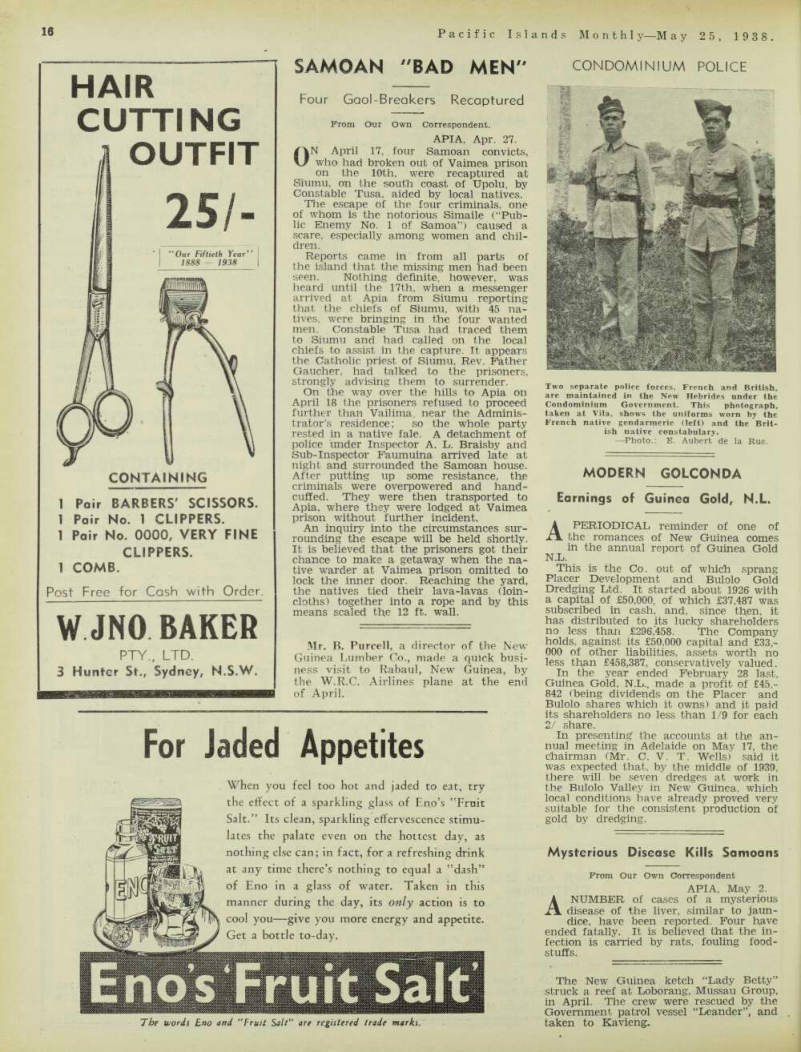
Four Gaol-Breakers Recaptured
From Our Own Correspondent.
Apia, Apr. 27.
ON April 17, four Samoan convicts, who had broken out of Vaimea prison on the 10th. were recaptured at Siumu, on the south coast of Upolu, by Constable Tusa, aided by local natives.
The escape of the four criminals, one of whom is the notorious Simaile (“Pub lic Enemy No. 1 of Samoa”) caused a scare, especially among women and chil dren.
Reports came in from all parts of the island that the missing men had been seen. Nothing definite, however, was heard until the 17th, when a messenger arrived at Apia from Siumu reporting that the chiefs of Siumu, with 45 na tives. were bringing in the four wanted men. Constable Tusa had traced them to Siumu and had called on the local chiefs to assist in the capture. It appears the Catholic priest of Siumu. Rev. Father Gaucher, had talked to the prisoners, strongly advising them to surrender.
On the way over the hills to Apia on April 18 the prisoners refused to proceed further than Vailima, near the Adminis trator’s residence; so the whole party rested in a native fale. A detachment of police under Inspector A. L. Braisby and Sub-Inspector Faumuina arrived late at night and surrounded the Samoan house.
After putting up some resistance, th,e criminals were overpowered and hand cuffed. They were then transported to Apia, where they were lodged at Vaimea prison without further incident.
An inquiry into the circumstances sur rounding the escape will be held shortly.
It is believed that th,e prisoners got their chance to make a getaway when the na tive warder at Vaimea prison omitted to lock the inner door. Reaching the yard, the natives tied their lava-lavas (loin cloths) together into a rope and by this means scaled th,e 12 ft. wall.
Mr. B. Purcell, a director of the New Guinea Lumber Co., made a quick busi ness visit to Rabaul, New Guinea, by the W.R.C. Airlines plane at the end of April.
Condominium Police
Two separate police forces, French and British, are maintained in the New Hebrides under the Condominium Government. This photograph, taken at Vila, shows the uniforms worn by the French native gendarmerie (left) and the Brit ish native constabulary, -Photo.: E. Aubert de la Rue.
Modern Golconda
Earnings of Guinea Gold, N.L.
A PERIODICAL reminder of one of the romances of New Guinea comes in the annual report of Guinea Gold N.L.
This is the Co. out of which sprang Placer Development and Bulolo Gold Dredging Ltd. It started about 1926 with a capital of £50,000, of which £37,487 was subscribed in cash, and, since th,en, it has distributed to its lucky shareholders no less than £296,'458. The Company holds, against its £50,000 capital and £33,- 000 of other liabilities, assets worth no less than £458,387, conservatively valued.
In the year ended February 28 last, Guinea Gold, N.L., made a profit of £45.- 842 (being dividends on the Placer and Bulolo shares which it owns) and it paid its shareholders no less than 1/9 for each 2/ share.
In presenting the accounts at the an nual meeting in Adelaide on May 17, the chairman (Mr. C. V. T. Wells) said it was expected that, by the middle of 1939, there will be seven dredges at work in the Bulolo Valley in New Guinea, which local conditions have already proved very suitable for the consistent production of gold by dredging.
Mysterious Disease Kills Samoans
From Our Own Correspondent
Apia, May 2.
A NUMBER of cases of a mysterious disease of the liver, similar to jaun dice, have been reported. Four have ended fatally. It is believed that the in fection is carried by rats, fouling food stuffs.
The New Guinea ketch “Lady Betty” struck a reef at Loborang, Mussau Group, in April. The crew were rescued by the Government patrol vessel “Leander”, and taken to Kavieng,
Advertisements & other items, p. 18 (2 items)
16
Pacific Islands Monthl y—M ay 25, 1938.
Eno’s Fruit Salt
For Jaded Appetites
■r V- When you feel too hot and jaded to eat, try the effect of a sparkling glass of Eno’s "Fruit Salt.” Its clean, sparkling effervescence stimulates the palate even on the hottest day, as nothing else can; in fact, for a refreshing drink at any time there’s nothing to equal a "dash” of Eno in a glass of water. Taken in this manner during the day, its only action is to cool you —give you more energy and appetite.
Get a bottle to-day.
Eno’s Fruit Salt
The words Eno and "Fruit Salt" are registered trade marks.
Those £2,500,000
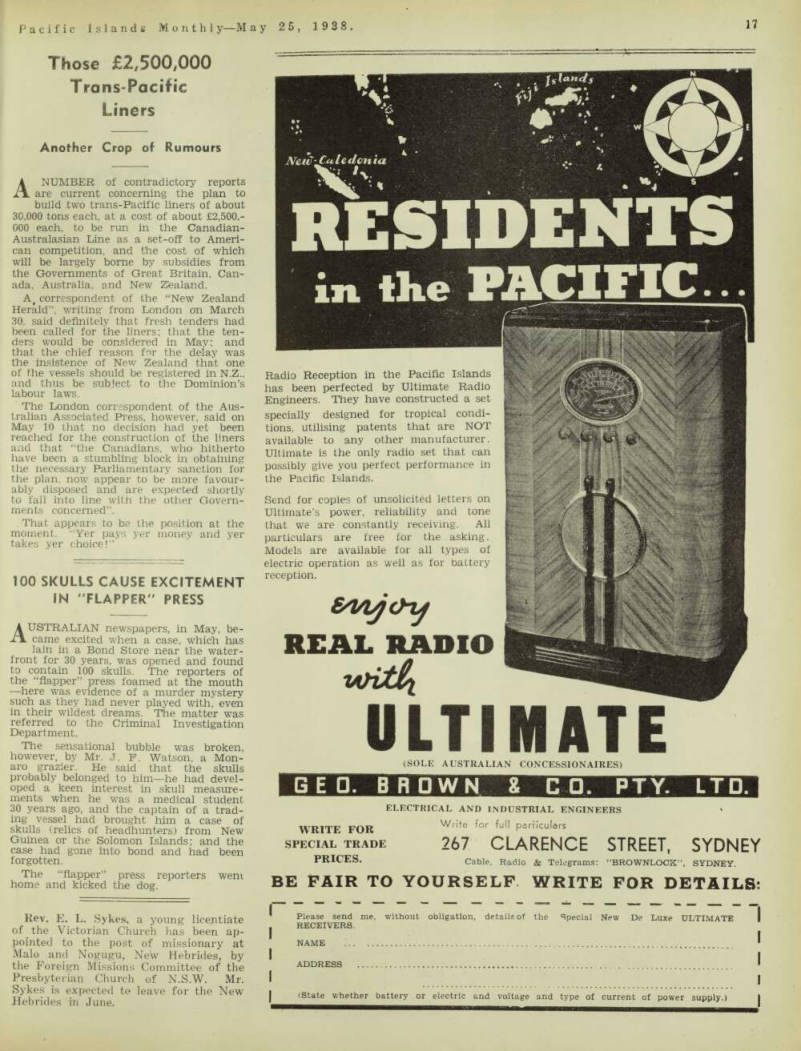
Trans-Pacific Liners Another Crop of Rumours
A NUMBER of contradictory reports are current concerning the plan to build two trans-Pacific liners of about 30,000 tons each, at a cost of about £2,500,- 000 each, to be run in the Canadian- Australasian Line as a set-off to Ameri can competition, and the cost of which will be largely borne by subsidies from the Governments of Great Britain, Can ada, Australia, and New Zealand.
A correspondent of the “New Zealand Herald”, writing from London on March 30, said definitely that fresh tenders had been called for the liners; that the ten ders would be considered in May: and that the chief reason for the delay was the insistence of New Zealand that one of the vessels should be registered in N.Z., and thus be subject to the Dominion’s labour laws.
The London correspondent of the Aus tralian Associated Press, however, said on May 10 that no decision had yet been reached for the construction of the liners and that “the Canadians, who hitherto have been a stumbling block in obtaining the necessary Parliamentary sanction for the plan, now appear to be more favour ably disposed and are expected shortly to fall into line with the other Govern ments concerned”.
That appears to be the position at the moment. "Yer pays yer money and yer takes yer choice!”
100 Skulls Cause Excitement
In "Flapper" Press
AUSTRALIAN newspapers, in May, be came excited when a case, which has lain in a Bond Store near the water front for 30 years, was opened and found to contain 100 skulls. The reporters of the “flapper” press foamed at the mouth —here was evidence of a murder mystery such as they had never played with, even in th,eir wildest dreams. The matter was referred to the Criminal Investigation Department.
The sensational bubble was broken, however, by Mr. J. p. Watson, a Mon aro grazier. He said that the skulls probably belonged to him—he had devel oped a keen interest in skull measure ments when he was a medical student 30 years ago, and the captain of a trad ing vessel had brought him a case of skulls (relics of headhunters) from New Guinea or the Solomon Islands; and the case had gone into bond and had been forgotten.
The “flapper” press reporters wem home and kicked the dog.
Rev. E. L. Sykes, a young licentiate of the Victorian Church has been ap pointed to the post of missionary at
Malo and Nogugu, New Hebrides, by
the Foreign Missions Committee of the Presbyterian Church of N.S.W. Mr.
Sykes is expected to leave for the New Hebrides in June.
Advertisements & other items, pp. 19-20 (3 items)
17
Pacific Islands Monthl y—M ay 25, 1938
Ultimate
Radio Reception in the Pacific Islands has been perfected by Ultimate Radio Engineers. They have constructed a set specially designed for tropical conditions, Utilising patents that are NOT available to any other manufacturer.
Ultimate is the only radio set that can possibly give you perfect performance in the Pacific Islands.
Send for copies of unsolicited letters on Ultimate’s power, reliability and tone that we are constantly receiving. All particulars are free for the asking.
Models are available for all types of electric operation as well as for battery reception.
O-y
REAL RADIO
Witli
ULTIMATE
(SOLE AUSTRALIAN CONCESSIONAIRES)
GEO. B R OWN & C□. PTY. LTD.
ELECTRICAL AND INDUSTRIAL ENGINEERS
WRITE FOR
SPECIAL TRADE
PRICES.
Write for full particulars
267 CLARENCE STREET, SYDNEY
Cable, Radio & Telegrams; “BROWNLOCX”, SYDNEY.
BE FAIR TO YOURSELF WRITE FOR DETAILS: Please send me, without obligation, details of the Special New De Luxe ULTIMATE
RECEIVERS.
NAME
ADDRESS
(State whether battery or electric and voltage and type of current of power supply.)
Modern Refrigeration for the South Sea Islands
The
ELECTROLUX
KEROSENE OPERATED
REFRIGERATOR
The ELECTROLUX offers economical, modern and completely efficient refrigeration for
ISLANDS' HOMES.
FREEZES CONTINUOUSLY WHILE SMALL LAMP BURNS
Freezing controlled by simply regulating height of flame. Uses only gallon of kerosene per week.
MOTORLESS ... NO PARTS TO GET OUJ OF ORDER.
MODEL L 22 MODEL L3B MODEL LKSS Capacity • (as illustrated) Capacity 2.2 cubic feet. Capacity 4 cubic feet. 5.5 cubic feet.
GUARANTEED FOR TWO YEARS
tt Write to your Local Distributor for prices and full details. & Obtainable from W. R. Carpenter Company Ltd.—Sydney and following New Guinea Branches : Rabaul, Salamaua, Wau, Kavieng, Madang, But and Wewak.
W. R. Carpenter & Coy. (Solomon Is.) Pty. Ltd.—Tulagi, British Solomon Islands.
On Chong & Company Pty. Ltd.—Butaritari, Gilbert & Ellice Islands.
Representation in Papua and New Hebrides.
18
Pacific Islands Mont hi y—M ay 26, 1938
Inland New Guinea
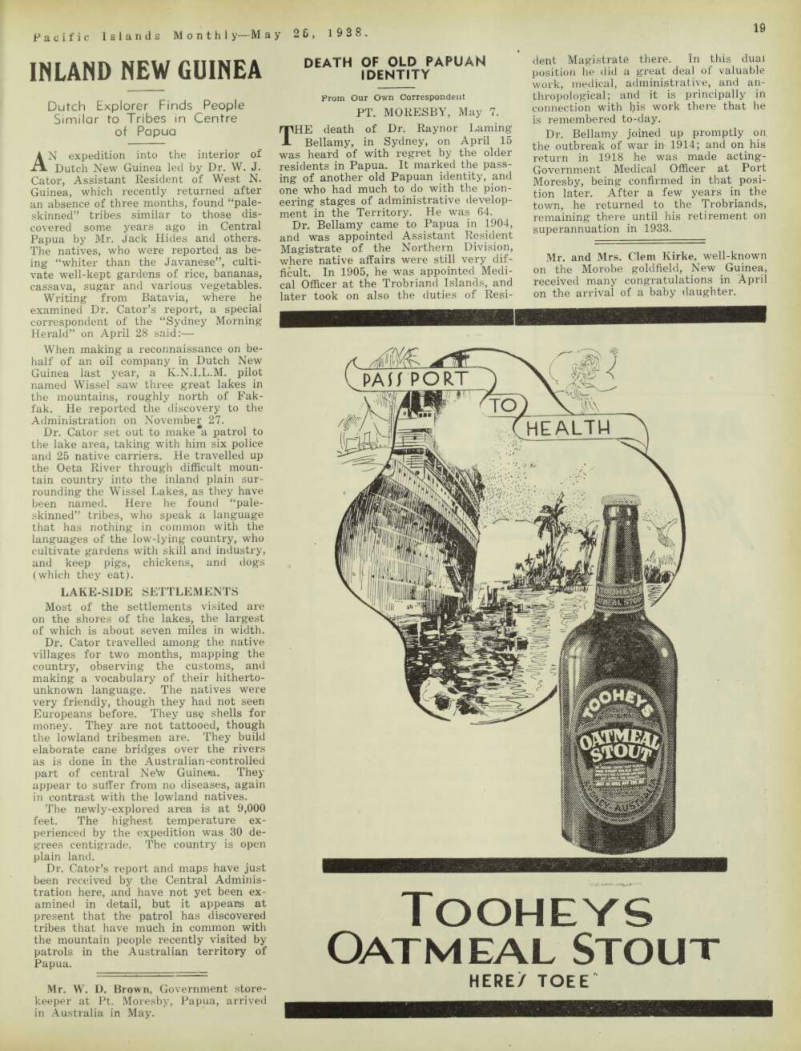
Dutch Explorer Finds People Similar to Tribes in Centre of Papua
AN expedition into the interior of Dutch New Guinea led by Dr. W. J.
Gator, Assistant Resident of West N.
Guinea, which recently returned after an absence of three months, found “pale skinned” tribes similar to those dis covered some years ago in Central Papua by Mr. Jack Hides and others.
The natives, who were reported as be ing “whiter than the Javanese”, culti vate well-kept gardens of rice, bananas, cassava, sugar and various vegetables.
Writing from Batavia, where he examined Dr. Gator’s report, a special correspondent of the “Sydney Morning Herald” on April 28 said:— When making a reconnaissance on be half of an oil company in Dutch New Guinea last year, a K.N.I.L.M. pilot named Wissel saw three great lakes in the mountains, roughly north of Fak fak. He reported the discovery to the Administration on November 27.
Dr. Gator set out to make a patrol to the lake area, taking with him six police and 25 native carriers. He travelled up the Oeta River through difficult moun tain country into the inland plain sur rounding the Wissel Lakes, as they have been named. Here he found “pale skinned” tribes, who speak a language that has nothing in common with the languages of the low-lying country, who cultivate gardens with skill and industry, and keep pigs, chickens, and dogs (which they eat).
Lake-Side Settlements
Most of the settlements visited are on the shores of the lakes, the largest of which is about seven miles in width.
Dr. Gator travelled among the native villages for two months, mapping the country, observing the customs, and making a vocabulary of their hitherto unknown language. The natives were very friendly, though they had not seen Europeans before. They use shells for money. They are not tattooed, though the lowland tribesmen are. They build elaborate cane bridges over the rivers as is done in the Australian-controlled part of central NeV Guinea. They appear to suffer from no diseases, again in contrast with the lowland natives.
The newly-explored area is at 9,000 feet. The highest temperature ex perienced by the expedition was 30 de grees centigrade. The country is open plain land.
Dr. Gator’s report and maps have just been received by the Central Adminis tration here, and have not yet been ex amined in detail, but it appears at present that the patrol has discovered tribes that have much in common with the mountain people recently visited by patrols in the Australian territory of Papua.
Mr. W. D. Brown, Government store keeper at Pt. Moresby, Papua, arrived in Australia in May.
Death Of Old Papuan
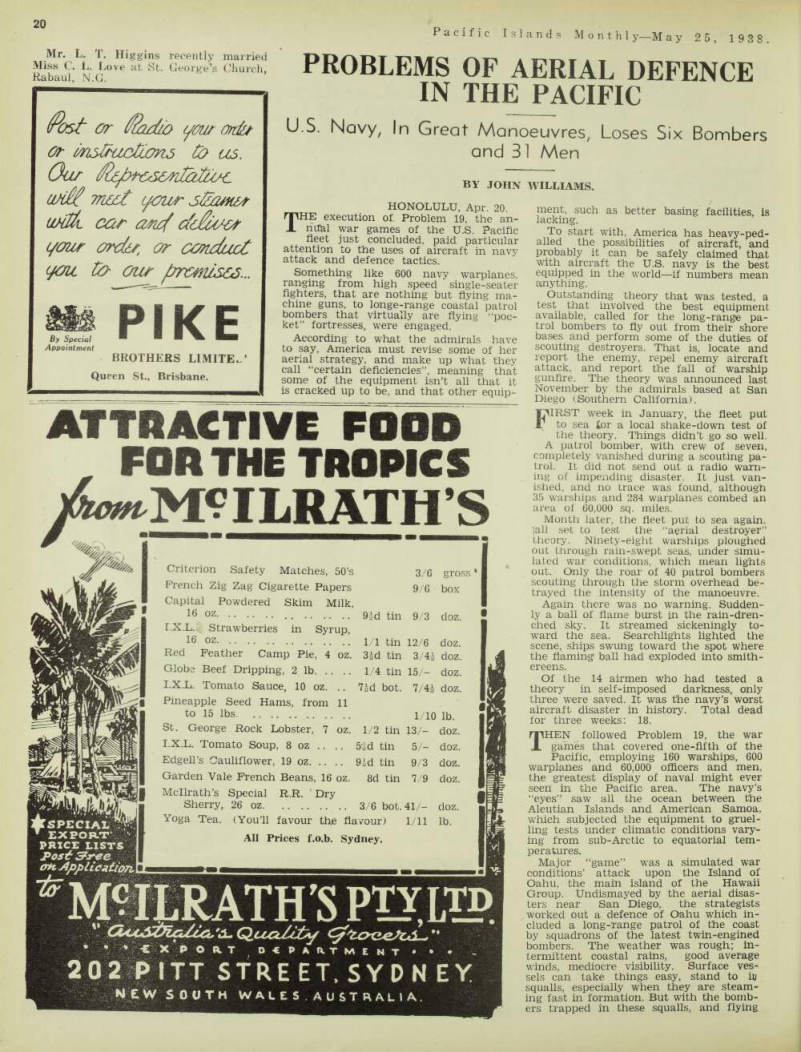
Identity
Prom Our Own Correspondent
Pt. Moresby, May 7.
THE death of Dr. Raynor Laming Bellamy, in Sydney, on April 15 was heard of with regret by the older residents in Papua. It marked the pass ing of another old Papuan identity, and one who had much to do with the pion eering stages of administrative develop ment in the Territory. He was 64.
Dr. Bellamy came to Papua in 1904, and was appointed Assistant Resident Magistrate of the Northern Division, where native affairs were still very dif ficult. In 1905, he was appointed Medi cal Officer at the Trobriand Islands, and later took on also the duties of Resi
dent Magistrate there. In this dual position he did a great deal of valuable work, medical, administrative, and an thropological; and it is principally in connection with his work there that he is remembered to-day. j) r Bellamy joined up promptly on. the out b re ak of war in 1914; and on his return j n 1918 he was made acting- Government Medical Officer at Port Moresby, being confirmed in that posi later. After a few years in the town, he returned to the Trobriands, remaining there until his retirement on super annuation in 1933.
Mr. and Mrs. Clem Kirke, well-known on the Morobe goldfield, New Guinea, received many congratulations in April on the arrival of a baby daughter.
Mr. L. T. Higgins recently married Miss C. L. Love at St. George’s Church, Rabaul, N.G.
Advertisements & other items, pp. 21-22 (2 items)
19
Pacific Islands Monthl y—M ay 26, 1 938.
Tooheys
PAJ/ PORT
i TO
HEALTH
:‘J ii *> HF m
Tooheys
Oatmeal Stout
HERE/ TOEE
Post or tffadio you/ ur instructions to us.
Our t^spfos&oitcti
untit mist yo with, car one/ your order, or conduct you. to our promisee...
m PIKE
By Special " " ® Appointment
BROTHERS LIMITED
Queen St., Brisbane.
ATTRACTIVE POOD
FOR THE TROPICS
?ILRATH’S
PRICE LISTS
Post
att jQpplicAtioTt
Criterion Safety Matches, 50’s French Zig Zag Cigarette Papers Capital Powdered Skim Milk, 16 02 9!d tin f.X.L. Strawberries in Syrup, O2 1/1 tin Red Feather Camp Pie, 4 oz Globe Beef Dripping, 2 lb. .. .
I.X.L. Tomato Sauce, 10 oz. ..
Pineapple Seed Hams, from 11 to 15 lbs St, George Rock Lobster, 7 oz I.X.L. Tomato Soup, 8 oz ..
Edgell’s Cauliflower, 19 oz 9!d tin Garden Vale French Beans, 16 oz. 8d tin Mcllrath’s Special R.R. Dry Sherry, 26 oz 3/6 bot.
Yoga Tea. (You’ll favour th,e flavour) All Prices f.o.b. Sydney. 3id tin 1/4 tin 7!d bot. 1/2 tin s!d tin 3/6 gross 9/6 box 9/3 doz. 12/6 doz. 3/4! doz. 15/- doz. 7/4! doz. 1/10 lb. 13/- doz. 5/- doz. 9/3 doz. 7/9 doz. • * % CXPOAT D-CPAaTMENT • • •
202 PITT STREET. SYDNEY
MEW SOUTH WALES. AUSTRALIA.
Problems Of Aerial Defence
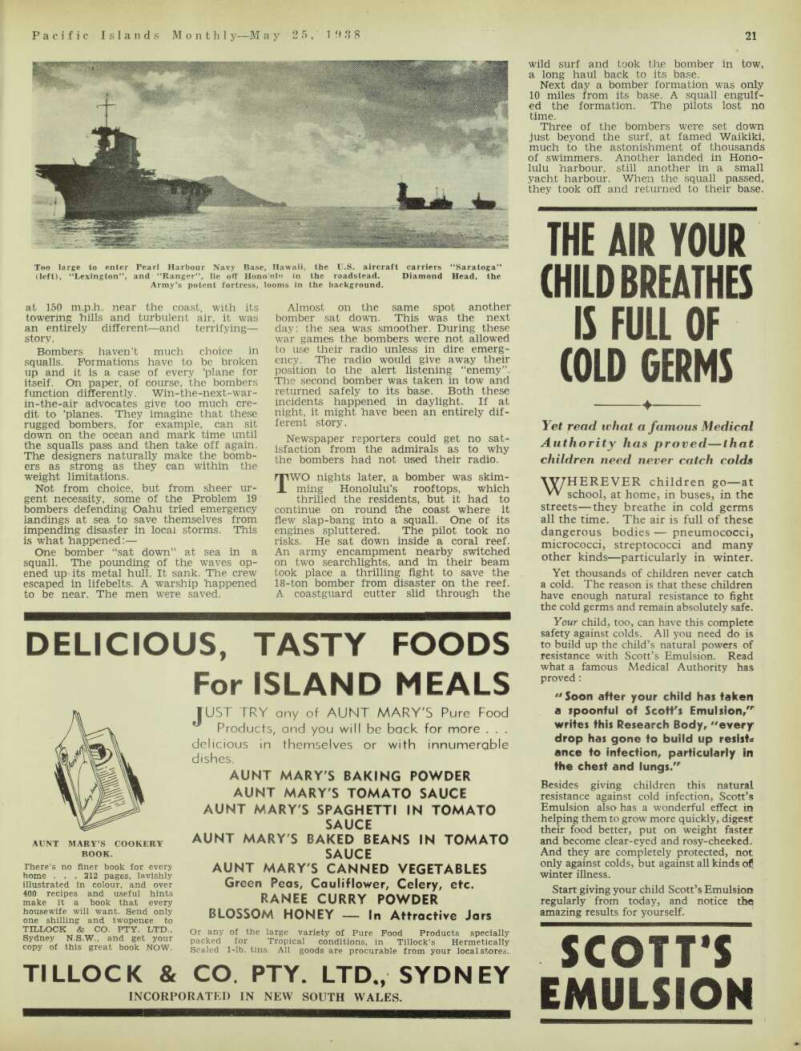
In The Pacific
U S. Navy, In Great Manoeuvres, Loses Six Bombers and 31 Men
By John Williams.
Honolulu, Apr. 20.
THE execution of. Problem 19, the an num war games of the U.S. Pacific fleet just concluded, paid particular attention to the uses of aircraft in navy attack and defence tactics.
Something like 600 navy warplanes, ranging from high speed single-seater fighters, that are nothing but flying ma chine guns, to longe-range coastal patrol bombers that virtually are flying “poc ket” fortresses, were engaged.
According to what the admirals have to say, America must revise some of her aerial strategy, and make up what they call “certain deficiencies”, meaning that some of the equipment isn’t all that it is cracked up to be, and that other equip
ment, such as better basing facilities, is lacking.
To start with, America has heavy-ped alled the possibilities of aircraft, and probably it can be safely claimed that with aircraft the U.S. navy is the best equipped in the world—if numbers mean anything.
Outstanding theory that was tested, a test that involved the best equipment available, called for the long-range pa trol bombers to fly out from their shore bases and perform some of the duties of scouting destroyers. That is, locate and report the enemy, repel enemy aircraft attack, and report the fall of warship gunfire. The theory was announced last November by the admirals based at San Diego (Southern California).
FMRST week in January, the fleet put to sea £or a local shake-down test of the theory. Things didn’t go so well.
A patrol bomber, with crew of seven, completely vanished during a scouting pa trol. It did not send out a radio warn ing of impending disaster. It just van ished, and no trace was found, although 35 warships and 284 warplanes combed an area of 60,000 sq. miles.
Month later, the fleet put to sea again, lall set to test the “aerial destroyer” theory. Ninety-eight warships ploughed out through rain-swept seas, under simu lated war conditions, which mean lights out. Only the roar of 40 patrol bombers scouting through the storm overhead be trayed the intensity of the manoeuvre.
Again there was no warning. Sudden ly a ball of flame burst in the rain-dren ched sky. It streamed sickeningly to ward the sea. Searchlights lighted the scene, ships swung toward the spot where the flaming ball had exploded into smith ereens.
Of the 14 airmen who had tested a theory in self-imposed darkness, only three were saved. It was the navy’s worst aircraft disaster in history. Total dead for three weeks: 18.
THEN followed Problem 19, the war games that covered one-fifth of the Pacific, employing 160 warships, 600 warplanes and 60,000 officers and men, the greatest display of naval might ever seen in the Pacific area. The navy’s “eyes” saw all the ocean between die Aleutian Islands and American Samoa, which subjected the equipment to gruel ling tests under climatic conditions vary ing from sub-Arctic to equatorial tem peratures.
Major “game” was a simulated war conditions’ attack upon the Island of Oahu, the main island of the Hawaii Group. Undismayed by the aerial disas ters near San Diego, the strategists worked out a defence of Oahu which in cluded a long-range patrol of the coast by squadrons of the latest twin-engined bombers. The weather was rough; in termittent coastal rains, good average winds, mediocre visibility. Surface ves sels can take things easy, stand to u? squalls, especially when they are steam ing fast in formation. But with the bomb ers trapped in these squalls, and flying
at 150 m.p.h. near the coast, with its towering hills and turbulent air, it was an entirely different—and terrifying— story.
Bombers haven’t much choice in squalls. Formations have to be broken up and it is a case of every ’plane for itself. On paper, of course, the bombers function differently. Win-the-next-warin-the-air advocates give too much eredit to ’planes. They imagine that these rugged bombers, for example, can sit down on the ocean and mark time until fhe squalls pass and then take off again.
The designers naturally make the bombers as strong as they can within the weight limitations.
Not from choice, but from sheer urgent necessity, some of the Problem 19 bombers defending Oahu tried emergency landings at sea to save themselves from impending disaster in local storms. This is what happened:— One bomber “sat down” at sea in a squall. The pounding of the waves opened up its metal hull. It sank. The crew escaped in lifebelts. A warship happened to be near. The men were saved.
Almost on the same spot another bomber sat down. This was the next day: the sea was smoother. During these war games th,e bombers were not allowed to use their radio unless in dire emerg ency. The radio would give away their position to the alert listening “enemy”, The second bomber was taken in tow and returned safely to its base. Both these incidents happened in daylight. If at night, it might have been an entirely dif ferent story.
Newspaper reporters could get no sat isfaction from the admirals as to why the Grubers had not used their radio, mwo nights later, a bomber was skim j. ming Honolulu’s rooftops, which thrilled the residents, but it had to continue on round the coast where it flew slap-bang into a squall. One of its engines spluttered. The pilot took no risks. He sat down inside a coral reef.
An army encampment nearby switched on two searchlights, and in their beam took place a thrilling fight to save the 18-ton bomber from disaster on the reef, A coastguard cutter slid through the
wild surf and took the bomber in tow, a long haul back to its base.
Next day a bomber formation was only 10 miles from its base. A squall engulf ed the formation. The pilots lost no time.
Three of the bombers were set down just beyond the surf, at famed Waikiki, much to the astonishment of thousands of swimmers. Another landed in Hono lulu harbour, still another in a small yacht harbour. When the squall passed, they took off and returned to their base.
Too large to enter Pearl Harbour Navy Base, Hawaii, the U.S. aircraft carriers “Saratoga” (left), “Lexington”, and “Ranger”, lie off Honolulu in the roadstead. Diamond Head, the Army’s potent fortress, looms in the background.
The most dramatic episode was reserv ed for the last day: March 30. Two bombers, while on coastal patrol, were caught in squalls and were not seen again by their companion bombers. Only one has been located: it was found drifting, a tangled mess, five dead. In spite of the “greatest mass air search” in Hawaii history, no trace, except partially burned clothing, has been found of the other bomber: seven dead.
THIS compelled the navy really to do sorfiething about aircraft theories.
With the same secrecy that nad cloaked the war games, a probe was set going at Pearl Harbour navy base. A board composed of an admiral and some air experts spent three weeks in listen ing to testimony. Rear-Admiral Charles A. Blakely, who is based at San Diego in charge of the navy’s aircraft scouting
force, hurried from California to “ob serve” the proceedings of the secret board.
No public announcement will be made about the outcome of the probe: after all, it is a confidential strategy matter.
However, the taxpayers are concerned about the 31 flying men killed within three months and the wiping out of some 1,500,000 dollars worth of equipment.
Reliable official sources off the record forecast that the probe will result in one of the navy’s biggest shakeups in years; that the present system of navy aircraft being sometimes controlled by ranking of ficers with little or no training in avi ation will cease; that the navy’s air arm will be run by aircraft-trained officers; that there will be more regard for the definite limitations of aircraft in future war games and in the development of strategy for America’s defence.
The secret probe’s testimony has amply proved that patrol bombers and other navy aircraft depend for completely safe flying upon all those radio aids which are vital in the operation of commercial air craft. Aircraft are fine weather imple ments of defence: they must be able to “see”, or else be taken care of by radio aids. In war, aircraft radio aids will be jammed and distorted.
NO secrecy was attached to another im portant aspect of America’s naval air craft defence. Problem 19 definitely proved that the San Diego and Pearl Harbour navy bases, as they stand to-day, are insufficient for the ever-increasing Pacific fleet forces.
For example, the aircraft carriers “Lex ington”, “Saratoga” and “Ranger” are too bulky and unwieldy to enter Pearl Harbour with the rest of the fleet. They are compelled to anchor off the port of Honolulu. There is only one entrance channel to Pearl Harbour. Rear-Admiral Joseph K. Taussig was outspoken about this point. He said other entrance chan nels must be considered.
Three more aircraft carriers, the “Wasp”, “Yorktown” and “Enterprise”, are expected to be in the Pacific service within the next 12 months.
An important result of this is expected to be the permanent basing of one of the carriers in Hawaiian waters, which to-day are patrolled solely by submarines and destroyers and, of course, patrol bombers.
This will cause a revision of defence strategy. It is said that the presence of 100 high-speed naval fighting ’planes in Hawaii, which a carrier would mean, will give the patrol bomber force greater con fidence —which means more effectiveness.
Advertisements & other items, pp. 23-24 (2 items)
21
Pacific Islands Month 1 y—M ay 25 , 1U 3 8
Child Breathes
THE AIR YOUR
IS FULL OF
(OLD GERMS
♦ Yet read tvhat a famous Medical
Authority has proved—that
children need never catch colds W/’HEREVER children go—at school, at home, in buses, in the streets —they breathe in cold germs all the time. The air is full of these dangerous bodies pneumococci, micrococci, streptococci and many other kinds—particularly in winter.
Yet thousands of children never catch a cold. The reason is that these children have enough natural resistance to fight the cold germs and remain absolutely safe.
Your child, too, can have this complete safety against colds. All you need do is to build up the child’s natural powers of resistance with Scott’s Emulsion. Read what a famous Medical Authority has proved: "Soon after your child has taken a spoonful of Scott's Emulsion/" writes this Research Body, "every drop has gone to build up resists ance to infection, particularly in the chest and lungs."
Besides giving children this natural resistance against cold infection, Scott’s Emulsion also has a wonderful effect in helping them to grow more quickly, digest their food better, put on weight faster and become clear-eyed and rosy-cheeked.
And they are completely protected, not only against colds, but against all kinds of| winter illness.
Start giving your child Scott’s Emulsion regularly from today, and notice the amazing results for yourself.
SCOTT’S
EMULSION
DELICIOUS, TASTY FOODS
AUNT MARYS COOKERY
BOOK.
There’s no finer book for every home . . . 212 pages, lavishly illustrated in colour, and over 400 recipes and useful hints make it a book that every housewife will want. Send only one shilling and twopence to
TILLOCK & CO. PTY. LTD.,
Sydney N.S.W., and get your copy of this great book NOW.
For ISLAND MEALS
JUST TRY any of AUNT MARY'S Pure Food Products, and you will be back for more . . . delicious in themselves or with innumerable dishes.
AUNT MARY'S BAKING POWDER
AUNT MARY'S TOMATO SAUCE
AUNT MARY'S SPAGHETTI IN TOMATO
SAUCE
AUNT MARY'S BAKED BEANS IN TOMATO
SAUCE
AUNT MARY'S CANNED VEGETABLES
Green Peas, Cauliflower, Celery, etc.
RANEE CURRY POWDER
BLOSSOM HONEY In Attractive Jars Or any of the large variety of Pure Food Products specially packed for Tropical conditions, in Tillock’s Hermetically Sealed 1-lb. tins. All goods are procurable from your local stores.
TILLOCK & CO. PTY. LTD., SYDNEY
INCORPORATED IN NEW SOUTH WALES.
BURNS PHILP
Registered
(SOUTH SEA) CO LTD.
... .. Fiji SUVA Island Traders and Shipowners
Also Branches at:
x Code Address: "Burnsouth."
Fiji: Levuka, Lau+oka, Labasa, Ba, Sigatoka, Rotuma.
Tonga: Nukualofa, Haapal, Vavau.
Samoa: Apia, Pago Pago (American Samoa).
Solomons: Makambo, Gizo, Faisi.
New Hebrides: Vila.
Gilberts: Tarawa.
Norfolk Is. Niue. Wallis Is. Futuna Is.
Genuinely Germicidal
PREVENTION
is better than
cure.
Disease germs such as those of Diphtheria, Malaria, Dhobie Itch, Tinea, or Surfer’s Foot cannot live under the lather of T E N A X. Besides which T E N A X, used constantly, will cure Tropical Skin Diseases.
T E N A X contains “Ti-Trol,” 11 times quicker than carbolic as a germicide, Containing Ti-Trol
but NON-POISONOUS and NON-IRRITANT.
“The Medical Journal of Australia” says: *'T E N A X is a satisfactory germicidal soap which may be recommended with confidence.”
TENAX
o.he Gmuirre/u SfeAnu&dof-
TOILET SOAP
A PRODUCT OF AUSTRALIAN SOAPS LIMITED
New Aerodrome In Papua
From Our Own Correspondent.
Pt. Moresby, May 11.
ANEW aerodrome has been completed in the Aibala district, to the north and east of Mount Yule, which will be used in communications with the Goilala Police camp. The ’drome has been pre pared under the supervision of the A.R.M. at Goilala, and has a runway not less than 1000 yards in length.
The ’drome was inspected on April 13 by Mr. J. Collopy, of the Civil Avia tion Board, and was pronounced en tirely satisfactory. This new landing ground will present an easy solution of the difficult and costly problem of transport to and from the Goilala camp.
Advertisements & other items, p. 24 (1 item)
& Co., Ltd.
MESSRS. COLYER WATSON
THE following notification of a Com pany registration appeared in the “New Zealand Herald” of April 11: Colyer Watson and Company, Limited (Wellington). Capital: £20,000 in 19,980 “A” shares, and 20 “B” shares of £1 each. Subscribers: Sydney—R. A. M. Col yer, 13,000 “A” and 10 “B”; R. W. Mor ton, 1,000 “A”; J. Spicer, 125 “A”. Well ington—W. V. Watson, 4,800 “A” and 10 “B”; C. R. Pearce, 60 “A”. Auckland— V. M. Ambler, 500 “A”; E. F. Miller, 125 “A”. Rabaul, New Guinea —G. W. Spens ley, 250 “A”. Frankton Junction—C. W.
Moore, 60 “A”. Christchurch—L. H. Boyd, 60 “A”. Objects: Importers and exporters of hides, skins, leather, tallow and copra.
Tung Oil In N.I.?
An Interesting Development
A NUMBER of reports to hand show that under the active and energetic leadership of the new Administrator (Sir Charles Rosenthal), the people of Norfolk Island are making efforts to establish there the industry of growing the profitable tung-oil trees. It would appear that they are being encouraged in their praiseworthy efforts by various Sydney interests, who apparently hope to get something out of the islanders’ enterprise.
The N.I. people would be very well advised to make the most careful in vestigations before they commit them selves to any serious expenditure on account of tung-oil culture.
The idea that the islands of the South Seas could profitably produce tung oil was first advanced in the “Pacific Islands Monthly” about 1931; and the “P.1.M.”, during the next four or five years, kept careful account of the re sults of the experiments made in several Pacific Islands, and especially New Guinea, the Solomons, and New Cale donia.
All the experiments of which we have had authentic news indicate that the tung-oil tree (Aleurites Fordii) grows vigorously on the uplands of the Islands, but that it fails to produce a profitable crop. Various observers were forced to the conclusion that this variety of tung oil tree (which is the variety cultivated
with’ such success in China) will not produce profitably in an oceanic climate —that is, in islands dominated by ocean winds. The Fordii variety, however, grows profitably in China, in • Florida (U.S.A.), and apparently is going to be a profitable producer in the eastern states of Australia —that is, where it is grown under climatic conditions domin ated by land masses.
We believe that the other variety of tung oil—namely, Aleurites Montana— which is successfully cultivated in Cochin-China, would grow satisfactorily in the Pacific Islands, just as it does in Cochin-China; but the Montana variety, as a producer of tung oil, is not com parable with Fordii. We understand that the Montana variety produces smaller nuts with less oil content.
A period of four or five years is needed in which to test out properly the possibilities of Aleurites Fordii. A test was made recently on the north island of New Zealand; and we understand that the result was a failure. Norfolk Island planters should make inquiries.
Captain Julian Dash wood, formerly of Arorangi, Rarotonga, Cook Islands, is now settled down at Mauke Island where he is branch manager for the Cook Is.
Trading Co. He is known to the Is landers as Trader Rakau—"rakau” be ing the Maori word for wood.
Mr. and Mrs. S. A. Bourke, of Koranga Gold Sluicing Ltd., arrived in Australia from the Morobe goldfield, New Guinea, by the May “Montoro”. They are on three months’ furlough.
Archbold To Fly To New
Guinea
Prom Our Own Correspondent.
Honolulu, May 2.
RICHARD ARCHBOLD, research asso ciate of the American Museum of Natural History, who intends to lead another scientific expedition into New Guinea’s interior this year, has completed exhaustive tests of his twin-engined air boat, which he will use as the expedi tion’s mobile base.
He plans to fly from San Diego about June 1. His trans-Pacific route will be: Hawaii, Midway, Wake and Guam, and thence to New Guinea. He hopes to re main there six months, wh.en he may visit Sydney or Brisbane. Australian defence officials have expressed a desire to see his airboat. which is a commercial version of the latest navy patrol bomber in ser vice. It will prove an eye-opener to Australians.
In it he has made several non-stop flights across America. Indeed, his was the first airboat to make the long non stop overland flight.
Mrs. Lorna Mackellar in April was granted a divorce from her husband, Mr. Colin Mackellar, who owns Pigebut Plantation at Kavieng, New Ireland, in the Mandated Territory of New Guinea.
Mrs, Mackellar is a daughter of the
well-known Judge Mocatta, of Sydney.
Mr. C. T. Drane, manager of the Vacuum Oil Co. Pty. Ltd. at Rabaul, sailed from Sydney for New Guinea by the “Nankin” on May 14 with his wife and son
Advertisements & other items, p. 25 (2 items)
23
Pacific Islands Monthl y—M ay 25. 1938.
KODAK (Australasia) Pty. Ltd.
V'.
I I .4
IN FOUR
POPULAR GRADES
matter what kind of picture you want there is a Kodak Film ready to give you better results with every picture opportunity. Four famous emulsions: Verichrome, Super Sensitive Panchromatic, Panatomic and Regular.
Kodak Film is made in Australia in accordance with the latest photographic research. Made to suit tropical conditions and requirements.
Of All Kodak Dealers throughout the Islands and
KODAK (Australasia) Pty. Ltd.
379 GEORGE STREET, SYDNEY.
m > State the Catalogue you want: — (a) Kodaks and Miniature Kodaks de luxe. (b) Cine-Kodaks and Kodascopes. (c) Kodak Accessories (now in the press.)
Newspaper Rubbish
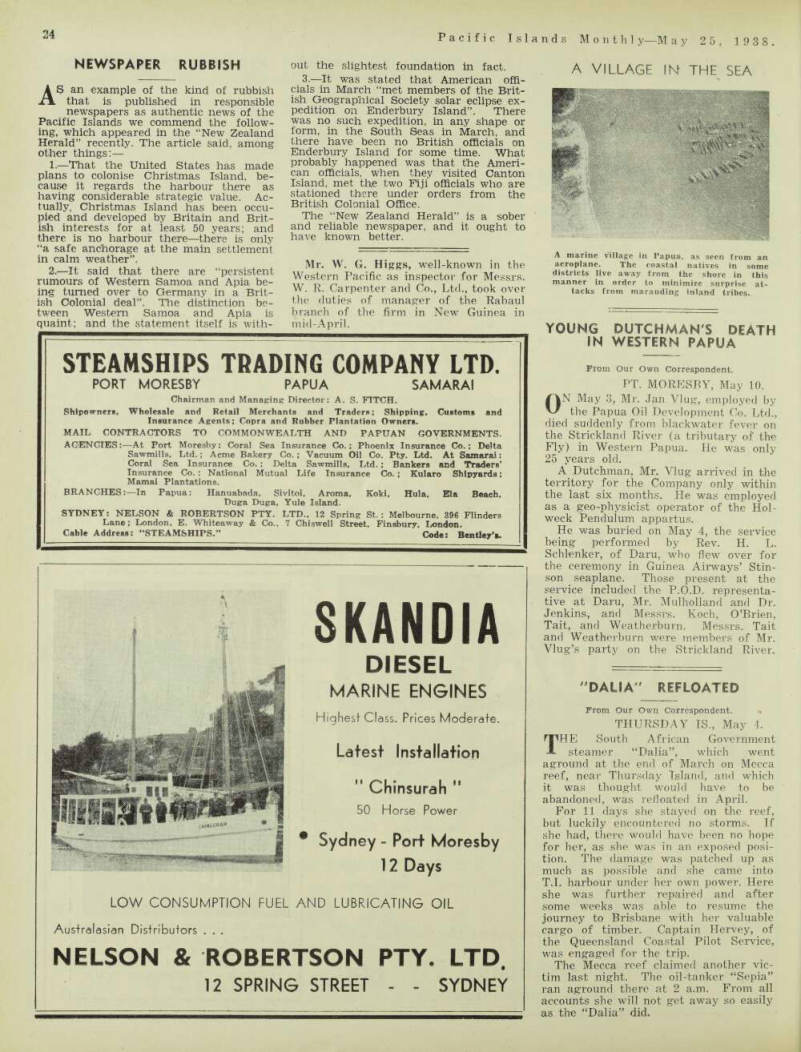
AS an example of the kind of rubbish that is published in responsible newspapers as authentic news of the Pacific Islands we commend the follow ing, which appeared in the “New Zealand Herald” recently. The article said, among other things:— 1. —That the United States has made plans to colonise Christmas Island, be cause it regards the harbour there as having considerable strategic value. Ac tually, Christmas Island has been occu pied and developed by Britain and Brit ish interests for at least 50 years; and there is no harbour there —there is only “a safe anchorage at the main settlement in calm weather”. 2.—lt said that there are “persistent rumours of Western Samoa and Apia be ing turned over to Germany in a Brit ish Colonial deal”. The distinction be tween Western Samoa and Apia is quaint; and the statement itself is with
out the slightest foundation in fact. 3.—lt was stated that American offi cials in March “met members of the Brit ish Geographical Society solar eclipse ex pedition on Enderbury Island”. There was no such expedition, in any shape or form, in the South Seas in March, and there have been no British officials on Enderbury Island for some time. What probably happened was that the Ameri can officials, when they visited Canton Island, met the two Fiji officials who are stationed there under orders from the British Colonial Office.
The “New Zealand Herald” is a sober and reliable newspaper, and it ought to have known better.
Mr. W, G. Higgs, well-known in the Western Pacific as inspector for Messrs.
W. R. Carpenter and Co., Ltd., took over the duties of manager of the Rabaul branch of the firm in New Guinea in
mid-April.
A Village In The Sea
A marine village in Papua, as seen from an aeroplane. The coastal natives in some districts live away from the shore in this manner in order to minimize surprise at tacks from marauding inland tribes.
Young Dutchman's Death
In Western Papua
Prom Our Own Correspondent.
Pt. Moresby, May 10.
ON May 3, Mr. Jan Vlug, employed by the Papua Oil Development Co. Ltd., died suddenly from blackwater fever on the Strickland River (a tributary of the Fly) in Western Papua. He was only 25 years old.
A Dutchman, Mr. Vlug arrived in the territory for the Company only within the last six months. He was employed as a geo-physicist operator of the Hol weck Pendulum appartus.
He was buried on May 4, the service being performed by Rev. H. L.
Schlenker, of Daru, who flew over for the ceremony in Guinea Airways’ Stin son seaplane. Those present at the service included the P.O.D. representa tive at Daru, Mr. Mulholland and Dr.
Jenkins, and Messrs. Koch, O’Brien, Tait, and Weatherburn. Messrs. Tait and Weatherburn were members of Mr.
Vlug’s party on the Strickland River.
"Dalia" Refloated
From Our Own Correspondent.
Thursday Is., May 4.
THE South African Government steamer “Dalia”, which went aground at the end of March on Mecca reef, near Thursday Island, and which it was thought would have to be abandoned, was refloated in April.
For 11 days she stayed on the reef, but luckily encountered no storms. If she had, there would have been no hope for her, as she was in an exposed posi tion. The damage was patched up as much as possible and she came into T.I. harbour under her own power. Here she was further repaired and after some weeks was able to resume the journey to Brisbane with her valuable cargo of timber. Captain Hervey, of the Queensland Coastal Pilot Service, was engaged for the trip.
The Mecca reef claimed another vic tim last night. The oil-tanker “Sepia” ran aground there at 2 a.m. From all accounts she will not get away so easily as the “Dalia” did.
Advertisements & other items, p. 26 (2 items)
24
Pacific Islands Monthl y —M ay 25, 1938
Skandia
STEAMSHIPS TRADING COMPANY LTD.
PORT MORESBY PAPUA SAMARAI
Chairman and Managing Director: A. S. FITCH.
Shipowners, Wholesale and Retail Merchants and Traders; Shipping, Customs and Insurance Agents; Copra and Rubber Plantation Owners.
MAIL CONTRACTORS TO COMMONWEALTH AND PAPUAN GOVERNMENTS.
AGENCIES:—At Port Moresby: Coral Sea Insurance Co.; Phoenix Insurance Co.; Delta Sawmills, Ltd. ; Acme Bakery Co, ; Vacuum Oil Co. Pty. Ltd. At Samarai: Coral Sea Insurance Co. : Delta Sawmills, Ltd. ; Bankers and Traders' Insurance Co. : National Mutual Life Insurance Co.; Kularo Shipyards; Mamai Plantations.
BRANCHES:—In Papua: Hanuabada, Sivitoi, Aroma, Koki, Hula, Ela Beach, Duga Duga, Yule Island.
SYDNEY: NELSON & ROBERTSON PTY. LTD., 12 Spring St.; Melbourne, 396 Flinders Lane; London, E. Whiteaway & Co., 7 Chiswell Street, Finsbury, London.
Cable Address: “STEAMSHIPS.” Code: Bentley’s.
SKANDIA
DIESEL
MARINE ENGINES
Highest Class. Prices Moderate.
Latest Installation " Chinsurah " 50 Horse Power Sydney - Port Moresby
12 Days
LOW CONSUMPTION FUEL AND LUBRICATING OIL
Australasian Distributors . . .
NELSON & ROBERTSON PTY. LTD
12 SPRING STREET - - SYDNEY
m i
Japan Pushes South
Evidence From Samoa and East Indies
FROM all directions, we receive facts and figures showing the steady, southward thrust of Japanese trade and enterprise.
Year by year, for instance, the distribu tion of Japanese goods in the British islands of th,e Pacific is increasing. Ten years ago the United States sold about £40,000 worth of goods to Western Samoa, and Japan practically nothing. Last year Japan sold £39,600 worth of goods to Western Samoa, and bought nothing; while U.S.A. sales to the Territory were worth £21,000, and Americans bought £56,400 worth of Samoan products.
Samoa is a N.Z. Mandate. Not £lOOO worth of British or American goods are allowed to enter Japan’s mandated is lands (Carolines and Marshalls).
Japan In Timor
The following is from the Batavia cor respondent of the “Sydney Morning Herald”, who wrote on April 27: The Nanyo Kohatsu, the semi-official Japanese South Sea Development Com pany, has obtained a one-third interest in the Portuguese company, which practically a monopoly of the trade of Portuguese Timor.
Japanese steamers have established a service from Palau, in the Japanese man dated islands, to Dilly, the capital of Portuguese Timor, which previously was served solely by ships of the Dutch K.P.M. line.
Th,e Portuguese-Japanese company, the Sociedade Agricola, Patria e Trabalho, has such control of the trade of this small colony that it is considered in the Indies to have almost as much power as the Ad ministration itself. The Administration is required by law to pay its own way.
It raises revenue by heavy duties on ex ports, practically all of which are con trolled, and most of which are produced by the Sociedade.
In addition, the Administration levies a poll tax on the natives. A recent visitor to Timor said that the natives, who are poor and live in primitive fashion (they look more closely akin to the Australian aborigines than to th,e Malay peoples) are allowed to pay part of this poll tax by labouring a month a year for the Gov ernment. Practically their only way of getting money to pay the rest of the tax is to work for about two more months of the year for the Sociedade.
The Sociedade, which is controlled by members of th,e family of a former Gov ernor of Portuguese Timor, recently demonstrated its power, and expressed its disapproval of the high export duties by buying the entire coffee crop of Portu guese Timor and omitting to export it.
Thus the Administration was faced with the alternatives of bankruptcy (for lack of revenue), forcible seizure and sale of crop, or compromise. A compromise was arranged.
“It would be futile to complain about Japanese penetration of Timor”, said a Hollander here wh,o has a wide know ledge of the trade of the outer islands.
“It is a poor colony, but probably cap able of development on a large scale, and it must apparently import capital. The solution, from the Dutch and the Aus tralian point of view, is for Dutch and Australian enterprises to take part in the
exploitation of the resources of Portu guese Timor”.
Australia’s interest in the island of Timor is likely to increase. It is an es sential stopping-place on the England- Australia air route. It is nearer to Aus tralia than any other foreign island of considerable size, Portuguese Timor is the only foreign area within 1,000 miles of Australia that is not either Dutch or French.
Mr. F. E. Williams, Government An thropologist in Papua, arrived in Syd ney from Port Moresby by the “Mon toro” on May 11, on three months’ holi day. He was accompanied by Mrs.
Williams, who shortly will proceed to England to visit their son, who ts at school there.
Niue Islanders
THE natives of Niue Island are among the best in the Pacific Islands, and are making satisfactory progress in various ways, said Dr. S. M. Lambert, medical inspector of the Rockefeller Foun dation, who returned to New Zealand re cently by the “Maui Pomare” after spending a month on Niue Island carrying out medical survey work.
The Niue natives were and con tented, and were adjusting themselves rapidly to modem conditions. This was all the more surprising in view of the little contact made with European people.
Sergeant-Major Isikeli Vulavou, of the Fiji Constabulary, has been awarded the Colonial Police Long Service Medal, with two bars.
Advertisements & other items, p. 27 (2 items)
25
Pacific Islands Month! y—M ay 25, 1938
For Island Homes
You can have all the convenience of electric light and power, by installing a home lighting plant equipped with Clyde storage batteries. Clyde Plates are specially designed for slow discharge over long periods. At the snap of a switch, the unfailing power of Clyde Batteries will illuminate your home, operate your wireless, fans, refrigerators and other electrical appliances.
Clyde Home Lighting Batteries are fully guaranteed .
HOME -LIGHTING BATTERIES
Sales & Service Division, 61-65 Wentworth Ave., Sydney.
Island Agents: Borns, Philp & Co. Ltd. W. R. Carpenter & Co., Ltd.
Rabaul: John L. Peadon Ltd. , Fiji: Morris Hedstrom Ltd.
YDE
Any News Of The "Njord"?
Prom Our Own Correspondent.
Honolulu, Apl. 24.
READERS of the “P.1.M.” in the Mar quesas and Tahiti area are asked to watch for and report the ketch “Njord”, which left California early in January for Tahiti and now is unreported, according to the relatives of the men aboard.
Only the names of two are known: Clarence Johnson and John Edlund, of Oregon, U.S.A. They were joined by a third man at San Diego (Southern Cali fornia), from whence they sailed on January 5. It was their intention to pass through the Marquesas Group en route to Tahiti, and then return to Oregon via the Hawaiian Islands.
Dr. C. E. Maguire, who was for a long time in the Fiji and Tongan medical services, sailed from New' Zealand at the end of April for England, after re tiring from the Auckland Hospital Board with w r hich he served for 27 years.
Adventurers Of Torres Strait
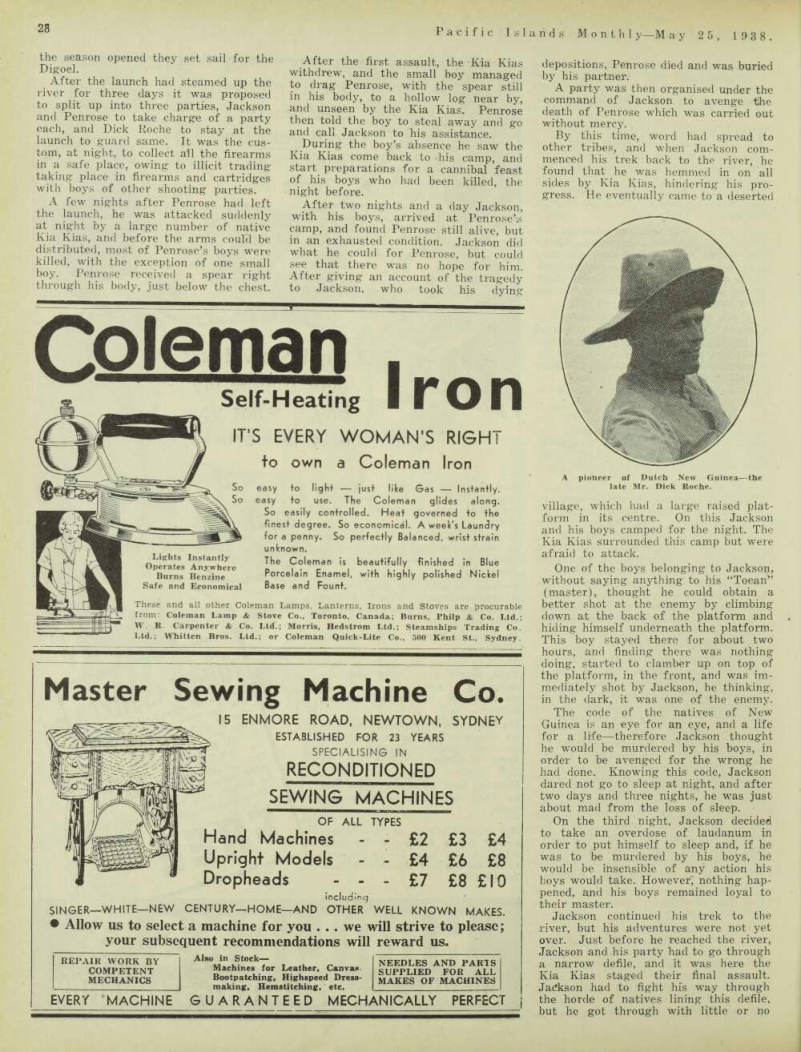
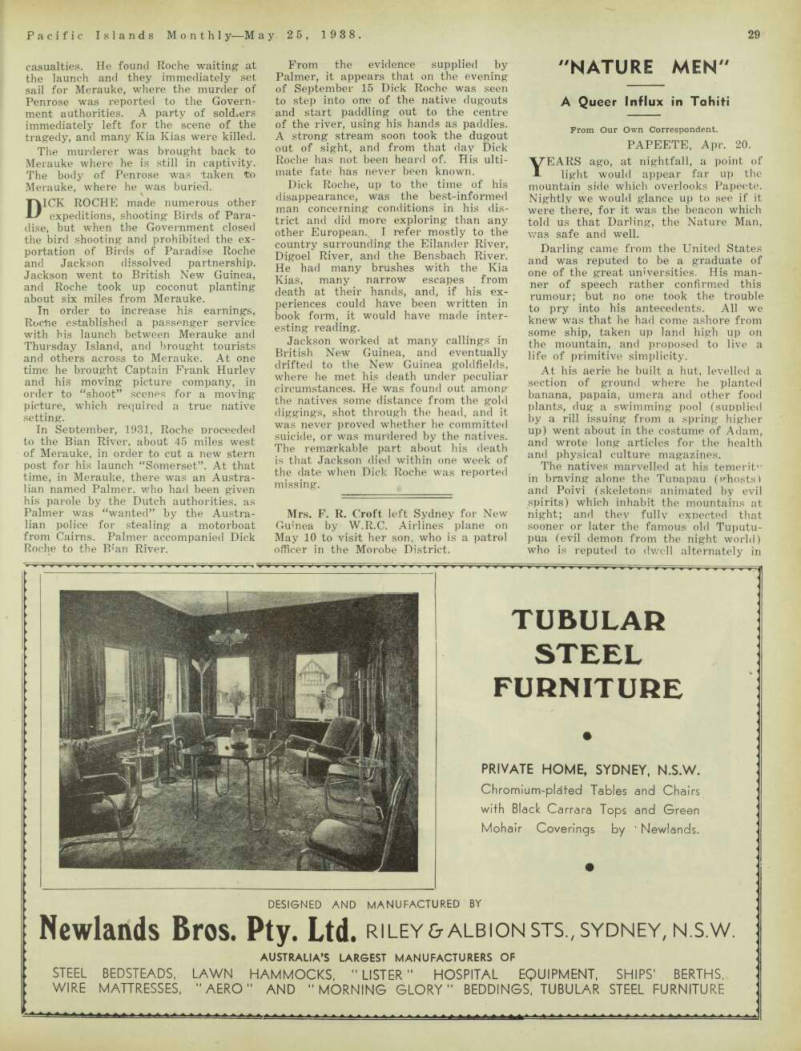
Story of Deliverance Harry"-Murder of Penrose-How Dick Roche Disappeared-Mystery of Jackson's Death
BY C. R. SHELDON, OF DOBO, AROE ISLANDS.
ALTHOUGH this is a short account of men who pioneered and opened up portion of Dutch New Guinea, and shot Birds of Paradise there, I feel I am obliged also to relate the history of a pioneer who lived on Deliverance Island, because his life more or less depended and formed part of the lives of those pioneers of the Netherlands New Guinea.
Deliverance Island, which was dis covered and named by Captain Cook during his voyage of 1770, lies between Thursday Island, Australia, and New Guinea, and forms one of the boundary points of Australia. Very little is known about Deliverance Island. Cer tainly it received some prominence dur ing the war 1914-1918, on account of its close proximity to New Guinea, and the passages joining the Arafura Sea and the Coral Sea.
Deliverance Island is about 1000 kilo metres long by 400 kilometres wide, just a sandy stretch of land, low-lying and with practically no large trees, and is surrounded by sand-banks and coral reefs.
This island was uninhabited until, about 1893, a Danish sailor named Hen rick Enevold took up his abode there.
Very few people knew Henrick Enevold by that name, but he was widely known as “Deliverance Harry”, and until his death, it was generally thought he was a Frenchman.
Harry led a very lonely life, living chiefly on turtles, fish, wild birds, etc.
One of Harry’s best friends was the late Reg. Hockings, a pearler, of Thursday Island, and it was due to the late Mr.
Hockings’ forethought that about 200 coconut trees were planted on the island, as a stand-by, for water and food. De liverance Island is without water.
Again, Harry had to thank the late Mr.
Hockings for a 500 gallon galvanised iron tank and a galvanised iron house to act as a catchment for water.
Mr. Hockings did his utmost to per suade Harry to give up his life on De liverance, but Harry was “man-shy”, and much preferred to remain on his island with his dogs and cats.
Another great friend that Harry had was Dick Roche, of Merauke, a former shipmate, and in latter years Dick Roche made visits to Deliverance, on yearly trips to Thursday Island in his motor boat. It is only 187 miles from Merauke to Thursday Island.
During the South-east monsoons quite a number of pearling luggers from Thursday Island visited Deliverance Is land, taking shelter there during the strong blows, and to catch turtles, and hunt for their eggs. This was another source by which Harry received pro visions and heard all the doings of the outside world.
It was in November, 1928, when Dick Roche was on one of his periodical visits to Deliverance Island that he made a gruesome discovery. His friend Harry was dead, and had been dead for some time. Harry was discovered lying half inside and half outside the doorway of his hut, and the body was in a terrible condition. One of the arms was miss ing, being found some distance away from the body, and the body was muti lated in several places.
It is presumed that Harry hatl been too weak to recover after he had fallen in the doorway, and remained there until he died. Some time after his death, from what evidence was avail able, it appeared that Harry’s dogs had tried to drag the body away from the doorway. Dick Roche buried Harry on his little island and reported his death to the authorities at Thursday Island.
Such was the end of Henrick Enevold,
who for over 45 years knew of no other world than his own little island, and who, during his time there, befriended many a passing ship, and gave welcome to all.
Deliverance island is a wonder ful island for turtles, they come up on the beaches to lay their eggs, not creeping up in ones and twos, but in hundreds at a time. Further, they do not wait until the dead of night, but they come up any old time, as long as the water is fairly high.
In 1929, I was weather bound at De liverance Island on my way to Thurs day Island with Dick Roche, spending close on two weeks there. My children had great fun, riding the turtles down to the sea after they had finished laying their eggs.
A few Malay boys who were on the launch, instead of going to the bother of digging for these eggs, hit upon the novel idea of following the turtle to the place where she wanted to lay, and then placed their hats under the turtle and received the eggs direct from the turtle.
In 1929, Harry’s hut was still stand ing and it came in very handy for our forced stay at Deliverance Island. The water tank was more than acceptable, and after being cleaned out, it rained soon afterwards, so we had ample water for our needs.
CLOSELY bound to Deliverance Is land was Dick Roche by his old shipmate Harry; but Roche—a New Zealander of Irish descent—was one of the pioneers of Netherlands New Guinea.
First in partnership with an Australian called Jackson, and later on joined by another Australian named Penrose, this trio formed the first expedition of white men as “bird shooters” for Birds of Paradise in Netherlands New Guinea.
They led the way, opened up new country, and others followed.
Every season this trio had to open up new hunting grounds, not because of the Birds of Paradise becoming shot out, or anything like that, but on account of Chinese shooting parties following in the wake of the Britishers, and shooting on, more or less, Roche and Co’s grounds. This necessitated the Britishers going every season further afield, breaking new ground, penetrat ing and exploring country where a white man had never been before. I refer mostly to the country surrounding the Eilander River and the upper portions of the Digoel River, where, in this dis trict in the years 1912-1916, the native Kia Kias were head hunters and canni bals, making immediate war, and hunting any strangers entering their country.
It may be a coincidence, but it is a fact, that these three pioneers met with peculiar deaths.
In the latter portion of 1912 Dick Roche and his party, consisting of Jack son, Penrose, and native boys (recruited from other portions of Netherlands New Guinea), sustained their first catas trophe. Earlier in that year, Roche had heard of new hunting grounds on the upper Digoel River, and as soon as
the season opened they set sail for the a?* ji i i i , , , ..
After the launch had steamed up the river for three days it was proposed to split up into three parties, Jackson and Penrose to take charge of a party each, and Dick Roche to stay at the launch to guard same. It was the custom, at night, to collect all the firearms in a safe place, owing to illicit trading taking place in firearms and cartridges with boys of other shooting parties. / eW after Penrose had left the launch, he was attacked suddenly at night by a large number of native Kia Kias, and before the arms could be distributed, most of Penrose’s boys were killed, with the exception of one small boy. Penrose received a spear right through his body, just below the chest.
After the first assault, the Kia Kias withdrew, and the small boy managed to drag Penrose, with the spear still in his body, to a hollow log near by, and unseen by the Kia Kias Penrose then told the boy to steal away and go and call Jackson to his assistance, During the boy’s absence he saw the Kia Kias come back to his camp and start preparations for a cannibal feast of his boys who had been killed, the night before.
After two nights and a day Jackson, with his boys, arrived at ' Penrose’s camp, and found Penrose still alive but in an exhausted condition. Jackson did what he could for Penrose, but could see that there was no hope for him After giving an account of the tragedy to Jackson, who took his dying
depositions, Penrose died and was buried by his partner.
A party was then organised under the command of Jackson to avenge the death of Penrose which was carried out without mercy.
By this time, word had spread to other tribes, and when Jackson com menced his trek back to the river, he found that he was hemmed in on all sides by Kia Kias, hindering his pro gress. He eventually came to a deserted
village, which had a large raised plat form in its centre. On this Jackson and his boys camped for the night. The Kia Kias surrounded this camp but were afraid to attack.
One of the boys belonging to Jackson, without saying anything to his “Toean” (master), thought he could obtain a better shot at the enemy by climbing down at the back of the platform and hiding himself underneath the platform.
This boy stayed there for about two hours, and finding there was nothing doing, started to clamber up on top of the platform, in the front, and was im mediately shot by Jackson, he thinking, in the dark, it was one of the enemy.
The code of the natives of New Guinea is an eye for an eye, and a life for a life —therefore Jackson thought he would be murdered by his boys, in order to be avenged for the wrong he had done. Knowing this code, Jackson dared not go to sleep at night, and after two days and three nights, he was just about mad from the loss of sleep.
On the third night, Jackson decided to take an overdose of laudanum in order to put himself to sleep and, if he was to be murdered by his boys, he w r ould be insensible of any action his boys would take. However, nothing hap pened, and his boys remained loyal to their master.
Jackson continued his trek to the river, but his adventures were not yet over. Just before he reached the river, Jackson and his party had to go through a narrow defile, and it was here the Kia Kias staged their final assault.
Jadcson had to fight his way through the horde of natives lining this defile, but he got through with little or no
A pioneer of Dutch New Guinea-the late Mr. Dick Roche.
casualties. He found Roche waiting at the launch and they immediately set sail for Merauke, where the murder of Penrose was reported to the Govern ment authorities. A party of soldiers immediately left for the scene of the tragedy, and many Kia Kias were killed.
The murderer was brought back to Merauke where he is still in captivity.
The body of Penrose was taken, to Merauke, where he was buried.
DICK ROCHE made numerous other expeditions, shooting Birds of Para dise, but when the Government closed the bird shooting and prohibited the ex portation of Birds of Paradise Roche and Jackson dissolved partnership.
Jackson went to British New Guinea, and Roche took up coconut planting about six miles from Merauke.
In order to increase his earnings, Roctie established a passenger service with his launch between Merauke and Thursday Island, and brought tourists and others across to Merauke. At one time he brought Captain Frank Hurley and his moving picture company, in order to “shoot” scenes for a moving picture, which required a true native setting.
In September, 1931, Roche proceeded to the Bian River, about 45 miles west of Merauke, in order to cut a new stern post for his launch “Somerset”. At that time, in Merauke, there was an Austra lian named Palmer, who had been given his parole by the Dutch authorities, as Palmer was “wanted” by the Austra lian police for stealing a motorboat from Cairns. Palmer accompanied Dick Roche to the B’’an River.
From the evidence supplied by Palmer, it appears that on the evening of September 15 Dick Roche was seen to step into one of the native dugouts and start paddling out to the centre of the river, using his hands as paddies.
A strong stream soon took the dugout out of sight, and from that day Dick Roche has not been heard of. His ulti mate fate has never been known.
Dick Roche, up to the time of his disappearance, was the best-informed man concerning conditions in his dis trict and did more exploring than any other European., I refer mostly to the country surrounding the Eilander River, Digoel River, and the Bensbach River.
He had many brushes with the Kia Kias, many narrow escapes from death at their hands, and, if his ex periences could have been written in book form, it would have made inter esting reading.
Jackson worked at many callings in British New Guinea, and eventually drifted to the New Guinea goldfields, where he met his death under peculiar circumstances. He was found out among the natives some distance from the gold diggings, shot through the head, and it was never proved whether he committed suicide, or was murdered by the natives.
The remarkable part about his death is that Jackson died within one week of the date when Dick Roche was reported missing.
Mrs. F. R. Croft left Sydney for New Guinea by W.R.C. Airlines plane on May 10 to visit her son, who is a patrol officer in the Morobe District.
Advertisements & other items, pp. 28-31 (5 items)
26
Pacific Islands Monthl y—M ay 25, 1938.
Puddings
SWALLOW
lIIIIIIIIIIIIIIIIIIIIIIIIIIIIIIIIIIIIIIIIIIIIIIIIIIIIIIIIIIIIIIIIIIIIUI
lllllllllfllllllllllllllllllllllljlllllllllllllllllllllllllllllllllllllllllllllllllllllllllllllllllllllllllllllll
PLUM
PUDDINGS
£lb. : lib. l*lb. : 2 lb. and 3 lb.
Renowned for Quality
Manufactured at Port Melbourne, Australia
27
Pacific Islands Monthl y—M ay 25, 1938.
Horlicks
But I'm always
tired Doctor,
I even wake tired.]
Think I need a
Tonic ?
N-i.
Night-Starvations
your trouble, my
boy. What you
need is Horlicks.
The demands of the day’s work require vitality body and mind refreshed and energised during sleep.
If you wake tired, it is impossible to concentrate properly or to do justice to your own capacity for good work.
Doctors describe this condition as Night Starvation that is, failure. to replace energy which is used up while you sleep.
If you wake “tired” Start taking Horlicks.
Horlicks taken regularly at bedtime, stores your body with the necessary vitality to meet the demands of the most exacting climate.
Horlicks already contains milk so where milk is scarce you may use water only but use rather more Horlicks to bring out the full flavour.
Horlicks may be taken either Hot or Cold according to your own taste.
Ask your Chemist or Storekeeper to-day for a bottle of Horlicks. (14s oz. size costs 3/- in all main towns throughout the British Pacific Islands.)
tic
It , s Op e 'O(J >e. os, to of C Vs s > *6o d <ii.
't\ e t Ol,s if f f Ilf,. UtM.J
til
om :r'< e/-
HORLICKS
GUARDS AGAINST NIGHT-STARVATION
Coleman
So So
Self-Heating
Iron
Lights Instantly Operates Anywhere Burns Benzine Safe and Economical
IT'S EVERY WOMAN'S RIGHT
to own a Coleman Iron
easy to light just like Gas Instantly, easy to use. The Coleman glides along.
So easily controlled. Heat governed to the finest degree. So economical. A week's Laundry for a penny. So perfectly Balanced, wrist strain unknown.
The Coleman is beautifully finished in Blue Porcelain Enamel, with highly polished Nickel Base and Fount.
These and all other Coleman Lamps, Lanterns, Irons and Stoves are procurable from: Coleman Lamp & Stove Co., Toronto, Canada: Burns, Philp & Co. Ltd.; W. R Carpenter & Co. Ltd.; Morris, Hedstrom Ltd.; Steamships Trading Co.
Ltd.; Whitten Bros. Ltd.; or Coleman Quick-Lite Co., 500 Kent St., Sydney.
Master Sewing Machine Co.
5 ENMORE ROAD, NEWTOWN, SYDNEY
ESTABLISHED FOR 23 YEARS
SPECIALISING IN
RECONDITIONED
SEWING MACHINES
OF ALL TYPES
Hand Machines - - £2 £3 £4 Upright Models - - £4 £6 £8 Dropheads - - - £7 £8 £lO Including
SINGER—WHITE—NEW CENTURY—HOME—AND OTHER WELL KNOWN MAKES.
• Allow us to select a machine for you ... we will strive to please; your subsequent recommendations will reward us.
Also in Stock— Machines for Leather, Canvas- Bootpatching, Highspeed Dressmaking, Hemstitching, etc.
EVERY MACHINE GUARANTEED MECHANICALLY PERFECT
NEEDLES AND PARIS
SUPPLIED FOR ALL
MAKES OF MACHINES
REPAIR WORK BY
COMPETENT
MECHANICS
TUBULAR
STEEL
FURNITURE
PRIVATE HOME, SYDNEY, N.S.W.
Chromium-pidted Tables and Chairs with Black Carrara Tops and Green Mohair Coverings by ’ Newlands. •
DESIGNED AND MANUFACTURED BY
Newlands Bros. Pty. Ltd. riley & albion sts.,Sydney, n.s.w
AUSTRALIA’S LARGEST MANUFACTURERS OF
STEEL BEDSTEADS, LAWN HAMMOCKS, " LISTER" HOSPITAL EQUIPMENT, SHIPS' BERTHS, WIRE MATTRESSES, "AERO" AND " MORNING GLORY" BEDDINGS, TUBULAR STEEL FURNITURE
28
Pacific Islands Mont hi y—M ay 25, 1938
"Nature Men"
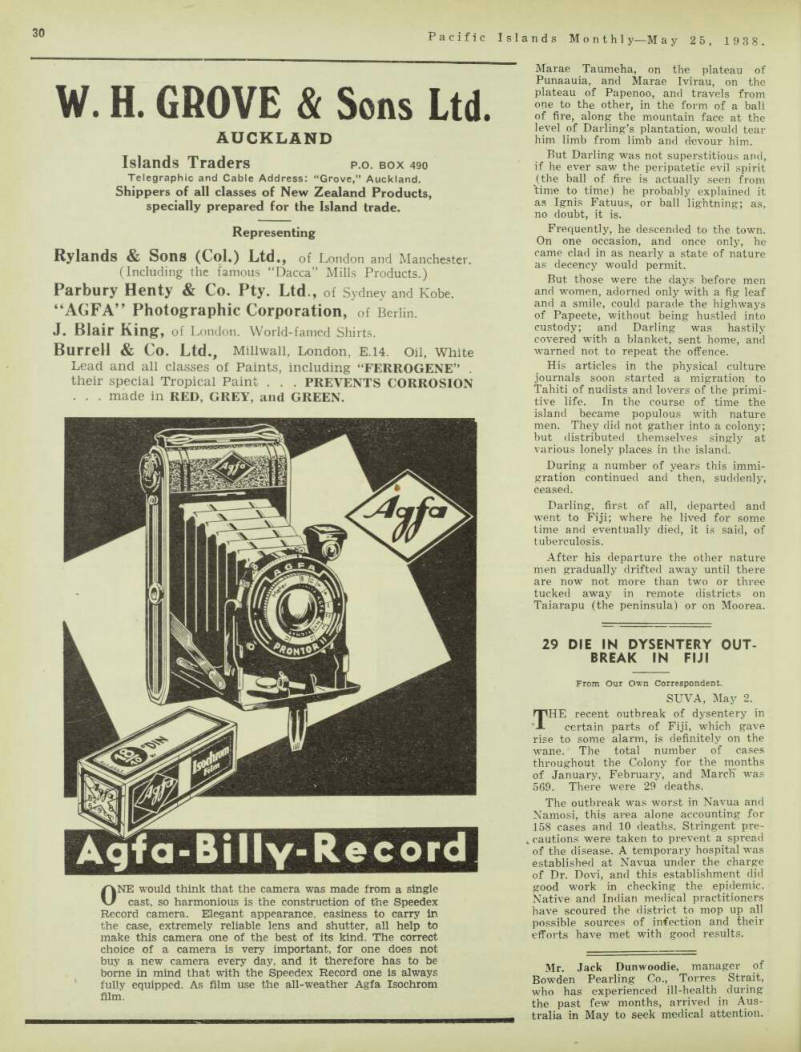
A Queer Influx in Tahiti
Prom Our Own Correspondent.
Papeete, Apr. 20.
YEARS ago, at nightfall, a point of light would appear far up the mountain side which overlooks Papeete.
Nightly we would glance up to see if it were there, for it was the beacon which told us that Darling, the Nature Man, was safe and well.
Darling came from the United States and was reputed to be a graduate of one of the great universities. His man ner of speech rather confirmed this rumour; but no one took the trouble to pry into his antecedents. All we knew was that he had come ashore from some ship, taken up land high up on the mountain, and proposed to live a life of primitive simplicity.
At his aerie he built a hut, levelled a section of ground where he planted banana, papaia, umera and other food plants, dug a swimming pool (supplied by a rill issuing from a spring higher up) went about in the costume of Adam, and wrote long articles for the health and physical culture magazines.
The natives marvelled at his temerit ,T in braving alone the Tunapau (p-hostsl and Poivi (skeletons animated by evil spirits) which inhabit the mountains at night; and thev fullv expected that sooner or later the famous old Tuputu pua (evil demon from the night world) who is reputed to dwell alternately in
Marae Taumeha, on the plateau of Punaauia, and Marae Ivirau, on the plateau of Papenoo, and travels from one to the other, in the form of a ball of fire, along the mountain face at the level of Darling’s plantation, would tear him limb from limb and devour him.
But Darling was not superstitious and, if he ever saw the peripatetic evil spirit (the ball of fire is actually seen from 'time to time) he probably explained it as Ignis Fatuus, or ball lightning; as, no doubt, it is.
Frequently, he descended to the town.
On one occasion, and once only, he came clad in as nearly a state of nature as decency would permit.
But those were the days before men and women, adorned only with a fig leaf and a smile, could parade the highways of Papeete, without being hustled into custody; and Darling was hastily covered with a blanket, sent home, and w T arned not to repeat the offence.
His articles in the physical culture journals soon started a migration to Tahiti of nudists and lovers of the primi tive life. In the course of time the island became populous with nature men. They did not gather into a colony; but distributed themselves singly at various lonely places in the island.
During a number of years this immi gration continued and then, suddenly, ceased.
Darling, first of all, departed and went to Fiji; where he lived for some time and eventually died, it is said, of tuberculosis.
After his departure the other nature men gradually drifted away until there are now not more than two or three tucked away in remote districts on Taiarapu (the peninsula) or on Moorea.
Advertisements & other items, p. 31 (1 item)
29
Pacific Islands Monthl y—M ay 25, 1938.
29 Die In Dysentery Out
Break In Fiji
From Our Own Correspondent.
Suva, May 2.
THE recent outbreak of dysentery in certain parts of Fiji, which gave rise to some alarm, is definitely on the wane. The total number of cases throughout the Colony for the months of January, February, and March was 569. There were 29 deaths.
The outbreak was worst in Navua and Namosi, this area alone accounting for 158 cases and 10 deaths. Stringent pre cautions were taken to prevent a spread of the disease. A temporary hospital was established at Navua under the charge of Dr. Dovi, and this establishment did good work in checking the epidemic.
Native and Indian medical practitioners have scoured the district to mop up all possible sources of infection and their efforts have met with good results.
Mr. Jack Dunwoodie, manager of Bowden Pearling Co., Torres Strait, who has experienced ill-health during the past few months, arrived in Aus tralia in May to seek medical attention.
Advertisements & other items, p. 32 (2 items)
30
Pacific Islands Monthl y—M ay 25, 1938
Agfa-Bi
W. H. GROVE & Sons Ltd.
AUCKLAND
Islands Traders p.o. box 490 Telegraphic and Cable Address: “Grove,” Auckland.
Shippers of all classes of New Zealand Products, specially prepared for the Island trade.
Representing Rylands & Sons (Col,) Ltd., of London and Manchester. (Including the famous “Dacca” Mills Products.) Parbury Henty & Co. Pty. Ltd., of Sydney and Kobe.
“AGFA” Photographic Corporation, of Berlin.
J. Blair King, of London. World-famed Shirts.
Burrell & Co. Ltd., Millwall, London, E. 14. Oil, White Lead and all classes of Paints, including “FERROCENE” . their special Tropical Paint . . . PREVENTS CORROSION . . . made in RED, GREY, and GREEN.
Z4< or lo J <S23( CO
Agfa-Bi
ONE would think that the camera was made from a single cast, so harmonious is the construction of the Speedex Record camera. Elegant appearance, easiness to carry in the case, extremely reliable lens and shutter, all help to make this camera one of the best of its kind. The correct choice of a camera is very important, for one does not buy a new camera every day, and it therefore has to be borne in mind that with the Speedex Record one is always fully equipped. As film use the all-weather Agfa Isochrom film.
Colours For Rarotonga
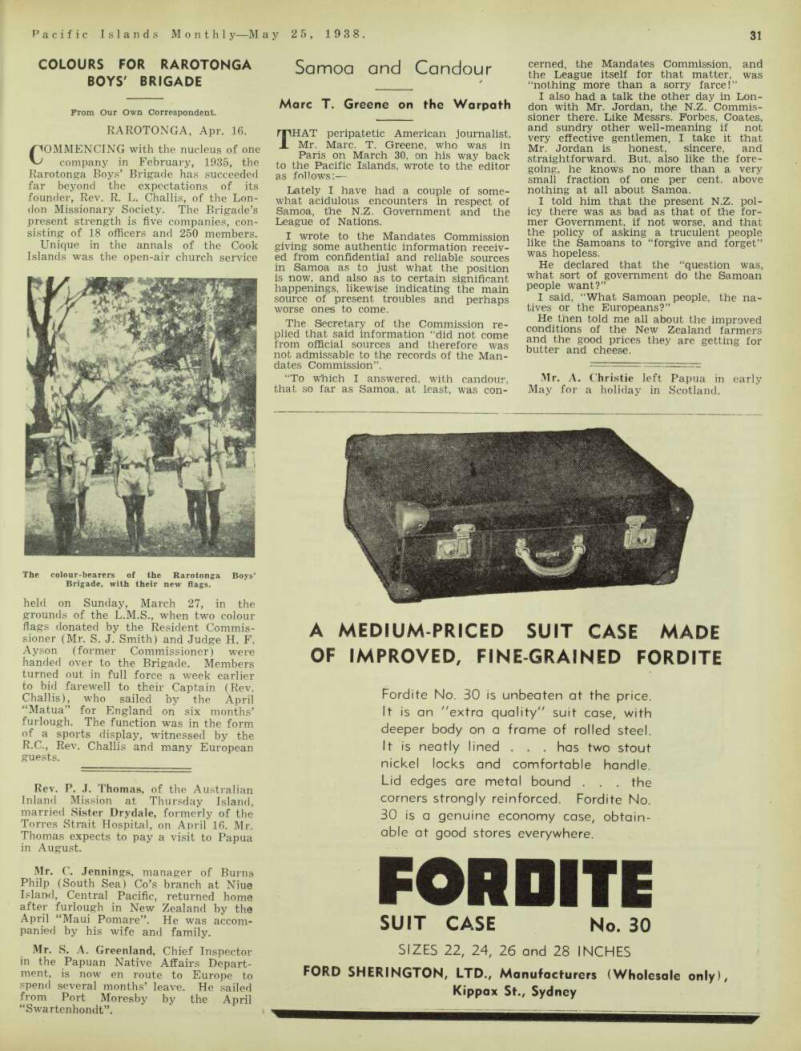
Boys' Brigade
From Our Own Correspondent.
Rarotonga, Apr. 16.
COMMENCING with the nucleus of one company in February, 1935, the Rarotonga Boys’ Brigade has succeeded far beyond the expectations of its founder, Rev. R. L. Challis, of the Lon don Missionary Society. The Brigade’s present strength is five companies, con sisting of 18 officers and 250 members.
Unique in the annals of the Cook Islands was the open-air church service
held on Sunday, March 27, in the grounds of the L.M.S., when two colour flags donated by the Resident Commis sioner (Mr. S. J. Smith) and Judge H. F.
Ayson (former Commissioner) were handed over to the Brigade. Members turned out in full force a week earlier to bid farewell to their Captain (Rev.
Challis), who sailed by the April “Matua” for England on six months’ furlough. The function was in the form of a sports display, witnessed by the R.C., Rev. Challis and many European guests.
Rev. P. J. Thomas, of the Australian Inland Mission at Thursday Island, married Sister Drydale, formerly of the Torres Strait Hospital, on April 16. Mr.
Thomas expects to pay a visit to Papua in August.
Mr. C. Jennings, manager of Burns Philp (South Sea) Co’s branch at Niue Island, Central Pacific, returned home after furlough in New Zealand by the April “Maui Pomare”. He was accom panied by his wife and family.
Mr. S. A. Greenland, Chief Inspector in the Papuan Native Affairs Depart ment, is now en route to Europe to spend several months’ leave. He sailed from Port Moresby by the April “Swartenhondt”.
The colour-bearers of the Rarotonga Boys’
Brigade, with their new flags.
Samoa and Candour
Marc T. Greene on the Warpath
THAT peripatetic American journalist, Mr. Marc. T. Greene, who was in Paris on March 30, on his way back to the Pacific Islands, wrote to the editor as follows: — Lately I have had a couple of some what acidulous encounters in respect of Samoa, the N.Z. Government and the League of Nations.
I wrote to the Mandates Commission giving some authentic information receiv ed from confidential and reliable sources in Samoa as to just what the position is now, and also as to certain significant happenings, likewise indicating the main source of present troubles and perhaps worse ones to come.
The Secretary of the Commission re plied that said information “did not come from official sources and therefore was not admissable to th,e records of the Man dates Commission”.
“To which I answered, with candour, that so far as Samoa, at least, was con
cerned, the Mandates Commission, and the League itself for that matter, was “nothing more than a sorry farce!”
I also had a talk the other day in Lon don with Mr. Jordan, th,e N.Z. Commis sioner there. Like Messrs. Forbes, Coates, and sundry other well-meaning if not very effective gentlemen, I take it that Mr. Jordan is honest, sincere, and straightforward. But, also like the fore going:, he knows no more than a very small fraction of one per cent, above nothing at all about Samoa.
I told him that the present N.Z. pol icy there was as bad as that of the for mer Government, if not worse, and that the policy of asking a truculent people like the Samoans to “forgive and forget” was hopeless.
He declared that the “question was, what sort of government do the Samoan people want?”
I said, “What Samoan people, the na tives or the Europeans?”
He then told me all about the improved conditions of the New Zealand farmers and the good prices they are getting for butter and cheese.
Mr. A. Christie left Papua in early May for a holiday in Scotland.
Advertisements & other items, p. 33 (2 items)
31
Pacific Islands Monthl y—M ay 25, 19 3 8
Fordite
M.
A MEDIUM-PRICED SUIT CASE MADE
OF IMPROVED, FINE-GRAINED FORDITE
Fordite No. 30 is unbeaten at the price.
It is an "extra quality" suit case, with deeper body on a frame of rolled steel.
It is neatly lined . . . has two stout nickel locks and comfortable handle.
Lid edges are metal bound . . . the corners strongly reinforced. Fordite No. 30 is a genuine economy case, obtainable at good stores everywhere.
FORDITE
SUIT CASE No. 30
SIZES 22, 24, 26 and 28 INCHES FORD SHERINGTON, LTD., Manufacturers (Wholesale only) Kippax St., Sydney
Fiji's New Stamps
From Our Own Correspondent.
Suva, Apr. 29.
AT last Fiji has its eagerly awaited pictorial postage stamps and, on the whole, there is general satisfaction with what is regarded as an attractive set.
As anticipated there was a rush for first day covers, and stamp sales in Suva on the day of issue, April 5, amounted to £859, over 3,100 letters being registered. Though satisfactory, this is a long way below the total on Corona tion Day, when sales of Coronation stamps amounted to £1,540 and 6,805 articles were registered.
There are 11 stamps in the set, of a total face value of 12/1. Each stamp carries a vignette of the King’s head. They are: Vzd (green)—Fijian canoe under sail; Id (blue and brown) — native houses and palm trees; IVad (red) —Fijian canoe study: 2d (green and brown) —map of the Group; 3d (blue)—Fijian canoe and the Colony’s coat of arms; 5d (red and blue) —sugar cane; 6d (grey)—map; 1/- (black and yellow)—Fijian with torch, spearing fish; 2/- (mauve and orange)—old view of Suva Harbour; 2/6 (brown and green)—river scene; 5/- (mauve and green)—native house and palm.
Rev. Dr. George A. Forrest-Sale,
M.A., D.Litt., died at Oniviro, Levuka,
Fiji, at the end of March, aged 74. An Englishman, he went to the colony 25 years ago as vicar of the Levuka Angli can Church, and served there faithfully until he retired about nine years ago.
Rev. Forrest-Sale was twice married, his first wife predeceasing him before he reached Suva. His widow and son are at present in England and a
daughter, Mrs. Forster, lives in Fiji.
Another “Garden
of Eden”
Young American Couple in the Galapagos
Prom Our Own Correspondent.
Honolulu, Apr. 26.
Captain G. Allan Hancock, The
California millionaire sportsman who backed the trans-Pacific flight of the Australian aviators, Kingsford- Smith and Ulm, in the “Southern Cross”, has discovered new “Garden of Eden” activities in the famous Gala pagos Isles during his current scientific expedition in the Eastern Pacific, accord ing to radio messages from his yacht.
On the island of Floreana, an Ameri can mining engineer and his young wife were found hacking a clearing on the jungle-clad slopes of the volcanic island. The story has been played up by the American press because it is packed with romantic angles that prove setting up housekeeping in a South Seas paradise is not as easy as it is cracked up to be.
The “Robinson Crusoe” couple are Ainsley Conway and his wife, Frances, an ex-high school teacher. Vowing to work out an existence for themselves in
a wild jungle land that lies just below the equator, the Conways laugh at danger and hardships and revel in the hard work and adventure.
The Conways’ nearest neighbour is Heinz Wittmer, a German who came to the islands more than five years ago.
He has a wife and three children, and the most productive acres in Galapagos.
In April, 1937, Frau Margaret Witt mer gave birth to a little girl, Ingeborg Floreana. Her five-years-old son, Rolfe Hans, was the first white child born in the Galapagos. Another boy, Harry Wittmer, now 19, never was a very healthy child, but is growing stronger in the free and open life on Floreana, where hard work means existence.
Sailing to Guayaquil, the principal seaport of Ecuador, from San Francisco in March last year, the Conways took the old government schooner “San Cristobel” to the Galapagos. Reaching James Island in May, they set them selves up by a little spring to begin farming.
After five months of back-breaking work Conway was informed by Com mandant Carlos A. Puente, Governor of the Galapagos, that there was not sufficient water on James Island and added that he could not afford them military protection. They were picked up and moved bag and baggage 100 miles to Floreana.
Captain Hancock supplied a large variety of staples from civilization, in cluding everything from needles to heavy hardware and candy to canned goods, to the Conways and Wittmers.
Conway followed mining engineering, after serving two years in France dur ing the World War, until dust affected his health. He returned to Chico, Cali fornia, where he was born, and became a newspaper reporter. From that he turned to freelance writing in San Francisco.
Mr. J. Helg has been elected presi dent of the Marist Old Boys’ Union, Samoa, for 1938. Mr. R. Reid was appointed vice-president, and for the fourth year in succession Mr. C. Dean was made secretary. This year is the 50th anniversary of the foundation of the Marist Brothers’ School in the terri tory—it was opened in September, 1888.
Rev. William G. Wiedemann, of the Melanesian Mission, Sag Sag, New Britain, married Miss Ethel Gwendolyn James, at Newcastle, N.S.W., at the end of April. They will leave Sydney for Rabaul by the June mailboat.
Advertisements & other items, p. 34 (2 items)
32
Pacific Islands Monthl y—M ay 25, 1938.
Starline
SPECIFY
STAR LINE
BRAND
vV>
STARLINE
CHINESE LACQUER
For all Indoor and Outdoor Decoration
1/- tin covers 18 sq. feet
"STARLINE" CHINESE LACQUER : Is guaranteed to withstand the severe elements to which paint is subjected in the Tropics, Including Salt Water, Heat and Rain, etc., and will not lose its gloss or permanence.
To give some idea of the covering capacity, one gallon will cover over 1200 sq. ft. 42 colours to choose from . . . Dries in a few hours.
Won't chip or crack,
MADE IN ENGLAND
Write to us for Colour Chart and full particulars regarding attractive sole agency for territories still vacant. c l For Fiji, Tonga and Samoa, Messrs. MORRIS HEDSTROM LTD.
AfotNTS: I p or Tah;+i and Cook s)ands Messrs A B DONALD LTD.
Factory Representative tor all Islands and New Zealand : NEW ZEALAND DISTRIBUTORS LTD., Bo* 530, AUCKLAND, N.Z.
Telephones : MJ 4657 (4 lines) and M 2585
uii
man
L Cable Address : "Vichy," Sydney
379 KENT STREET, SYDNEY
OLIVERS of all Islands' requirements on Commission Original Invoices Furnished. 22 Years Islands Trade Experience.
TSLANDS Produce Sold on Shippers' Account Liberal Advances against Consignments.
Bankers: Bank of New South Wales. CORRESPONDENCE IN ENGLISH, FRENCH AND GERMAN
Tragedy Of Atimaono
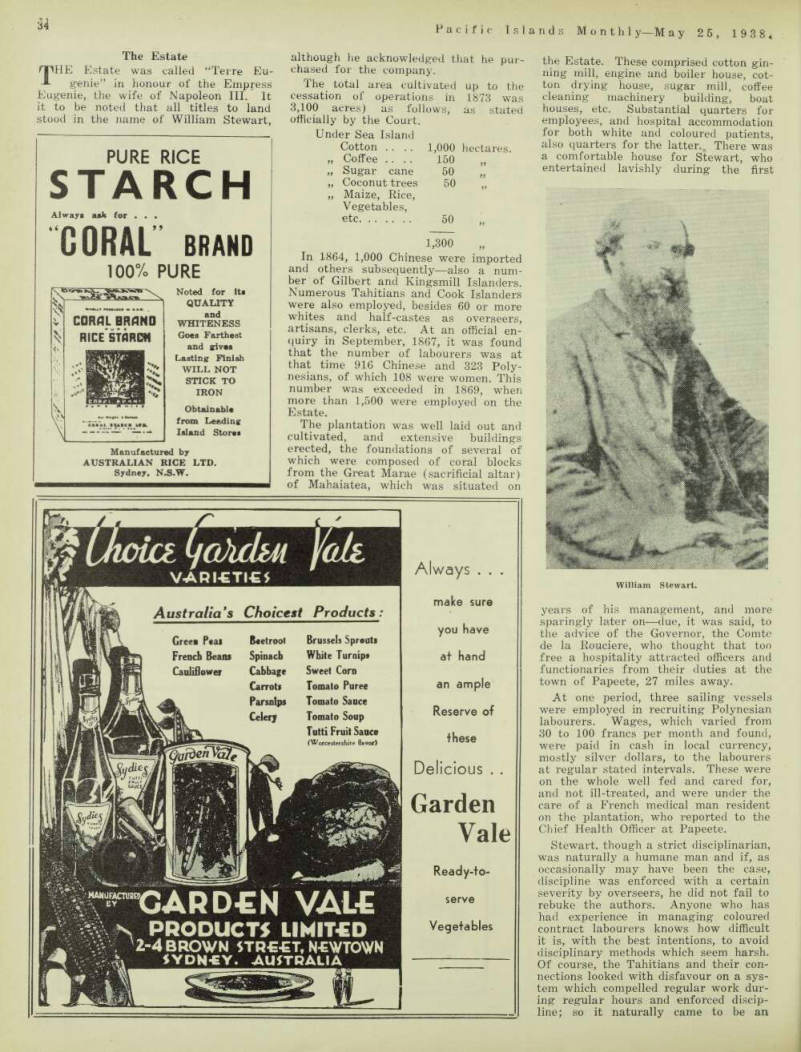
Story of the Rise and Fall of a Tahitian Cotton Enterprise
(From the MS. of J. L. Young, xoritten at Merami, Warren, N.S.W., about i 1928, and edited by W. W. Bolton, M.A.)
Section I.
THE rise and fall of the Tahiti Cotton and Coffee Plantation Company Limited, of 9 Mincing Lane, London, 1863-1873 (also know as “La Compagnie Soares” and “The Atimaono Com pany”) was one of the romances of the Pacific, in which the personality <of William Stewart, the originator of the enterprise and the manager at Tahiti, played a leading part.
In 1862, cotton, in consequence of the Civil War in the United States, had attained a very high price, which in duced William Stewart to visit Tahiti in that year. He obtained from John Griffin Orsmond the transfer of lease of 385 hectares —900 acres —of land at Teahupoo, on the peninsula of Taiarapu.
This land had been leased by natives to Orsmond for a term of 100 years, from 1843, at a rental of 275 francs per annum. The value was small, only a portion being cultivable.
Apparently, on the strength of this acquisition, Stewart induced his brother in-law, Auguste Soares, a Portuguese financier of London and Paris, to form an association styled “The Polynesian Plantation Company”, which was suc ceeded in 1863 by “The Tahiti Cotton and Coffee Plantation Company Limited of London”; capital, £lOO,OOO sterling; general manager, Auguste Soares; manager at Tahiti, William Stewart.
In 1863, Stewart had persuaded the Governor, Commandant de la Richerie, to promise to assist him in acquiring an area sufficiently large to warrant the establishing of an agricultural enter prise: the intention being that lands in the Papara and Atimaono districts should be expropriated and paid for at prices to be agreed upon. The Pro tectorate Government (Tahiti was. a Protectorate from 1842 to 1880) was to guarantee the lands free of taxation for 20 years, and exemption from Customs duties for a like period of all machinery and all other articles of prime necessity for the working of the plantation. It was on these prospects that the T.C.C.P.
Company was formed in London in 1863.
But when Stewart, after visiting London, reached Tahiti, at New Year, 1864, he found that the Governor had received positive instructions from the Minister of Marine at Paris not to carry out any arrangements for expropriation of lands until further orders. These instructions were the result of protests to the Minister by interested parties at Tahiti, who from various motives were opposed to the proposed enterprise.
Stewart, who was a man of action, then
decided to deal with the landowners direct.
The Governor on January 11, 1864, formally notified the natives that they were at liberty to dispose of their lands to Stewart or to decline to do so. How ever, there is no doubt that the Gov ernor strongly advised the proprietors that it would be to the general interest to encourage the cultivation of the waste lands by sale to Stewart, as well as that of the comparatively small area of native food plantations which were contained in the proposed aggregation.
Stewart continued during 1864 and subsequent years to acquire the free hold of an area which, according to the plan made in November, 1867, by Sur veyor John Turnbull, had a frontage of miles to the sea and extended inland and up the mountain side for more than 7 miles, the area being nominally some 7,000 hectares (17,000 acres), of which a large part was rugged mountain. But when, in 1875, the estate was sold at public auction the total area then claimed was 3,950 hectares (9,500 acres) of which 1,450 hectares (3,500 acres) was cultivable and 2,500 hectares (6,000 acres) mountain. All freehold; except 105 hectares of communal lands apper taining to the Chefferie of Atimaono, which was leased to Stewart in 1864 for a term of 50 years, renewable for a further term of 49 years at a rental of a little more than 400 francs each year.
The Estate Estate was called “Terre Eugenie” in honour of the Empress Eugenie, the wife of Napoleon 111. It it to be noted that all titles to land stood in the name of William Stewart,
although he acknowledged that he pur chased for the company.
The total area cultivated up to the cessation of operations in 1873 was 3,100 acres) as follows, as stated officially by the Court.
Under Sea Island Cotton . . . . 1,000 hectares. „ Coffee ... 150 „ Sugar cane 50 „ „ Coconut trees 50 „ „ Maize, Rice, Vegetables, etc 50 1,300 „ In 1864, 1,000 Chinese were imported and others subsequently—also a num ber of Gilbert and Kingsmill Islanders.
Numerous Tahitians and Cook Islanders were also employed, besides 60 or more whites and half-castes as overseers, artisans, clerks, etc. At an official en quiry in September, 1867, it was found that the number of labourers was at that time 916 Chinese and 323 Poly nesians, of which 108 were women. This number was exceeded in 1869, when more than 1,500 were employed on the Estate.
The plantation was well laid out and cultivated, and extensive buildings erected, the foundations of several of which were composed of coral blocks from the Great Marae (sacrificial altar) of Mahaiatea, which was situated on
the Estate. These comprised cotton gin ning mill, engine and boiler house, cot ton drying house, sugar mill, coffee cleaning machinery building, boat houses, etc. Substantial quarters for employees, and hospital accommodation for both white and coloured patients, also quarters for the latter. „ There was a comfortable house for Stewart, who entertained lavishly during the first
years of his management, and more sparingly later on —due, it was said, to the advice of the Governor, the Comte de la Rouciere, who thought that too free a hospitality attracted officers and functionaries from their duties at the town of Papeete, 27 miles away.
At one period, three sailing vessels were employed in recruiting Polynesian labourers. Wages, which varied from 30 to 100 francs per month and found, were paid in cash in local currency, mostly silver dollars, to the labourers at regular stated intervals. These were on the whole well fed and cared for, and not ill-treated, and were under the care of a French medical man resident on the plantation, who reported to the Chief Health Officer at Papeete.
Stewart, though a strict disciplinarian, was naturally a humane man and if, as occasionally may have been the case, discipline was enforced with a certain severity by overseers, he did not fail to rebuke the authors. Anyone who has had experience in managing coloured contract labourers knows how difficult it is, with the best intentions, to avoid disciplinary methods which seem harsh.
Of course, the Tahitians and their con nections looked with disfavour on a sys tem which compelled regular work dur ing regular hours and enforced discip line; so it naturally came to be an
William Stewart.
accepted fact that the Chinese and Gil bert Islanders were slaves.
Attacks on Stewart THIS view was made use of by the opponents of Stewart, for whom “any stick was good enough to beat a dog”. Among these were some who claimed that the land had been acquired by Stewart at prices which were too low —forgetting that originally most of the land, being unoccupied, had no practical value, and in fact an examination of the prices paid the natives, as appears in the Government records, shows that full values were paid, as values were at the time. His critics included some in fluential merchants at Papeete who were jealous of Stewart’s preponderating in fluence and feared injury to their inter ests; also some Chauvinists among French officials and functionaries who objected, not unnaturally perhaps, to the extension of British influence in Tahiti —the memory of the Pritchard affair was still recent —and, of course, the usual crowd who “bark as the caravan goes by”. Not least was the enmity of the British Consul, who had personal reasons for disliking Stewart, and who had actually proceeded unsuccessfully in the French Courts against him on a charge of “insuiting oehaviour” arising from a reply Stewart had made to a letter.
Stewart was a masterful man and was not at all conciliatory in manner to his opponents, some of whom were quite unscrupulous in their methods of attack. For instance, they used as a tool a worthless rascal, a former visi tor to Tahiti, who inspired articles in the American Press, charging cruelty to the labourers on Atimaono, which it was asserted was condoned and actually permitted by the Government.
In consequence of these attacks, which were republished in French and British newspapers, the Governor appointed a Commission to proceed to the plantation and investigate conditions there. The Commission was composed of 14 per sons, all men of position, viz., the high est judicial and the highest executive functionaries of the country, a naval officer, two medical men, one French merchant, three French planters, one British planter, two American ship masters and the German Consul, who was also a prominent merchant. The British Consul was invited but declined to attend.
The Commission made its unanimous report to the Government on Septem ber 27, 1867, which was to the effect that the 1,239 labourers were well fed, well housed and well treated under the care of a qualified French medical man, and with good hospital accommodation.
Further, that no complaints of bad treatment or of having been beaten or flogged, or of want of care or food, were elicidated, though numerous Chinese and natives were interviewed privately by different members of the Commission.
Outside of such minor complaints as that some abusive language had been used by some of the French and Eng lish overseers, the only serious com plaint—if it can be called serious—was
made by the Chinese who claimed that Stewart’s attempt to minimise suicide by their compatriots was unwarranted.
It appeared that certain Chinese who had lost money gambling had hanged themselves. Stewart as a deterrent had fined the fellow-gamblers of the suicides.
They admitted that this measure had caused a cessation of the practice but maintained that suicide was a recognised way of ending trouble and settled all accounts, therefore fines were not in order! The Commission could not take that view, so the grievance remained.
The members of the Commission
unanimously declared their complete satisfaction without reserve with all that they had seen and heard at the plantation, which gave the lie to the statements which had been made to the contrary, which they described as “in famous calumnies”. The report of the Commission is contained in a pamphlet in English, including the Report in French, which was printed at the Gov ernment Printing Office in September, 1867, under the title “An outline of how it came to pass that so many absurd stories have been circulated about the cotton plantation of Terre Etigenie”.
End of Atimaono ginned cotton was principally ex- 1 ported to England, and while the price of the article kept up, it appeared as it success might be assured; but with the fall in price of Sea Island cotton, from 1869 onward, from as much as 3 to even 4 shillings per pound, to one shillmg per pound, and even less, sue-
cess was impossible; and in 1872 failure became inevitable.
Money could not be found to carry on and operations practically ceased in 1873, and William Stewart was declared by the Court to be in a state of insolv ency. AH the lands had been purchased and held in his name and he was there fore legally the owner and responsible
for the debts of the very large estate.
A delay was caused by the necessity of regulating the situation, which was done by Auguste Soares, the general manager of the T.C.C.P. Company Limited, making a declaration in May 1874, before the Lord Mayor of Lon don, that William Stewart had acted solely in the capacity of manager and had never pretended to any personal ownership of the lands or other assets of the company.
Meantime, William Stewart died at Atimaono on September 24, 1873, at the age of 48.
As the result of a suit brought by Andrew Crawford and Co., of San Fran ks 00 ’ i Who were amon g the creditors, the lahitian Court on August 22 1874 declared the T.C.C.P. Co. Ltd., to be insolvent. The creditors having agreed to a voluntary liquidation, the estate was put up to public auction at Papeete ?nnn A nn g f USt 3 H 18 1 5 ’- at the P riee of 500,000 francs for Atimaono, and 20,000 francs for the rights to lease of lands at Teahupoo, and was purchased by a syndicate styled Laharrague, Robin et Cie, composed of the two gentlemen above-named with Mr. de la Casa, Mayor or Paris, Mr. Francois Cardella, of Papeete, and others.
Under the management of Mr. Car del a, a little sugar and rum was made, and a little coffee and vanilla grown, and a precarious and uncertain revenue derived from the slaughter of spme of the half-wild cattle, the progeny of the plantation herd, which had escaped into the mountain valleys. Gradually it was found that there was nqt enough revenue to pay expenses of management, and the estate became a wilderness.
Some of the proprietors entered into litigation with their associates, which proved fruitless; and eventually, about the year 1900, it was finally agreed to dispose of the estate piecemeal. It passed into the hands of several owners, who have planted many thousands of coconut trees, and one established a sugar mill which has turned out some thousands of tons of sugar during the past 25 years.
Mr. de la Richerie was succeeded as Governor-Commandant of Tahiti on December 14, 1863, by Comte de la Rouciere, who held office until June 5, 1869, when he was replaced by M. Tous lard.
M. de la Rouciere believing, as M. de la Richerie had done, that the enterprise of Mr. Stewart was a benefit to Tahiti and to its inhabitants, did not fail to give it encouragement and thus gained the ill-will of those who were opposed to Stewart.
Mont Calme ANY sketch of the history of Ati maono would be incomplete if men tion of this “house on the height” was omitted. Stewart's action in erecting the house impressed the imagination of the people of Tahiti, which was what he intended, among other things.
Mont Calme, also known as the “White House”, was situated on a small
plateau on the mountain-side, at an elevation of 1,630 feet above sea level, nearly three miles in an air line from the sea and about half a mile from the Eastern boundary of the estate. The site is still marked by some tall Nor folk Island pine-trees, and a luxuriant mango tree, both planted by Stewart in 1866. The towering pines are still vis ible from the main road west of Tah aruu River. These trees may be re garded as the only visible memorial of William Stewart, for all the many sub stantial wooden buildings which he caused to be erected, including his com modious residence, have in the course of more than 70 years fallen down through neglect or have been pulled down or burned, and so have totally disappeared.
Mont Calme was the result of a sort of Monte Cristo gesture on the part of Stewart. The Comtesse de la Rouciere remarked to him, in 1866, that such an estate should have a health resort on the heights. He replied that it was too soon to think of such an expense, but began at once to prepare, not mention ing his intention to any person. He had a road made up the hill and a site cleared on the plateau, ostensibly to plant Cinchona trees. All the material for the six-roomed house and outbuild ings was cut and marked ready Jto erect. He then put on most of his 1200 labourers to carry up the material and erect the buildings, to instal the furni ture and to lay out a garden and trans plant bushes and even small trees watered by the supply from a neigh bouring spring. He persuaded the police at the post on the plantation, near the Taharuu River, to stop all traffic towards the town for a day, in order that no news of the work in pro gress should reach that place. Then he hastened over the 27 miles to Papeete with relays of horses and induced the Count and Countess to return with him to be surprised!
On arrival at Atimaono, they were carried in sedan chairs up the winding road to the house, which he then pre sented to the Countess as a “Maison de campagne”, furnished and with a staff of servants. She named the house “Mont Calme”. She did not occupy it very often, for an ever-in creasing feeling of hostility to Stewart was manifested by his opponents, who resented the friendship between the Governor and himself, which had the effect of curtailing the visit of the Count and Countess to Atimaono. The build ing of Mont Calme, though loudly de nounced as an extravagance by those who had no money in the plantation and therefore nothing to lose, was really intended by Stewart as an advertisement and also as an additional lien between the Governor and himself.
Stewart was not extravagant in the management of Atimaono in view of the size and importance of the enter prise and his belief in the permanence of the same. He could not foresee the rapid recovery of the cotton industry in the United States, after the termination of the Civil War in 1865, and the con sequent fall in the price of the article,
any more than did the planters of cot ton in Fiji, Samoa and elsewhere at the same epoch, who equally suffered ruinous losses.
Mont Calme appears on the large plan of Terre Eugenie, made by the Surveyor John Turnbull in November, 1867, as the “White House”.
Barque “Moaroa”
THE following incident throws a light on the conditions of recruiting labourers in the Pacific in those days. (Editor’s Note: The following account of the “Moaroa” tragedy is not regarded by Mr. Bolton as complete or accurate.
It evidently was pieced together by Mr. Young, from several sources.) On July 4, 1869, off Nukunau (Byron Island) the barque “Anna”, of Mel bourne, Captain Bruce, met the barque “Moaroa”, of Tahiti, Captain Blackett, owned by the Atimaono Plantation under the French Protectorate Flag.
The “Anna” had 159 natives of the Gil bert Islands on board, recruited at various islands as labourers for Fiji— most of them no doubt induced to ship by false pretences. Two days pre viously, Captain Bruce had heard from a passing vessel of the action being taken by the courts at Sydney against the captain and supercargo of a vessel for kidnapping and incidentally murder ing natives, and feared prosecution if he proceeded to Fiji with his passengers.
Meeting the “Moaroa”, which vessel was seeking labourers for Atimaono,
J. B. Lattin, a Frenchman, who was the supercargo and also part charterer of the “Anna”, saw the chance of dis posing of his cargo of natives without risk of taking them to Fiji. In concert with Captain Bruce, he told Captain Blackett that his water casks had leaked and that he had not water enough to carry the natives to Fiji, and there fore wished to be rid of them. For pay ment of £6 per head —euphemistically called “passage money”—the 159 natives were sold to the “Moaroa”.
As Captain Blackett had not enough money on board to pay the sum agreed on, J. B. Lattin took passage on the “Moaroa” to get paid on arrival at Tahiti.
The “Moaroa” recruited about 150
more natives at Arorae Island, and some 200 more at various islands, and was bound for Tahiti on July 17 with about 500 natives on board, of whom not less than 100 were women and chil dren.
On that date, at 7 a.m., the vessel being then becalmed about 5 miles S.S.E. of Nukunau, the natives rose and killed Captain Blackett and J. B. Lattin —the former with his own Winchester rifle, the latter with the cook’s axe. They also killed three of the watch on deck, who were Eastern Polynesian natives.
The fourth escaped aloft, and slid down a stay into the forecastle. The natives then attacked the watch below in the forecastle but Maori Harry (a pure blooded Maori) transfixed with a har poon the first man who came down the ladder and so stopped that attack.
Heinhault, the mate (subsequently well known to the writer at San Fran cisco as Master of vessels, but under another name) retreated to the cabin with the second mate, the cook and the steward.
About 9 a.m., all the natives being on deck, the men in the forecastle ran through the hold and joined those in the cabin through the bulkhead. The second mate, having found some liquor, be came foolhardy and insisted on opening one of the cabin portholes to parley with the natives, when he was instantly killed with a double-barrelled gun which had been taken from the interpreter— who, by the way, was not killed, but tied hand and foot on deck. This was about 11 a.m, Maori Harry suggested to the mate to blow up the half-deck next to the cabin.
All the powder obtainable, 34 half pound tins, was emptied into a small keg, which was raised on cases of pro visions, until the mouth of the keg was close up under the half-deck hatch, on which many of the natives were col lected.
The powder was fired by a train, the mate and crew sheltering themselves with blankets, mattresses, etc. The hatch was blown off with considerable noise and smoke and, when the crew immediately rushed on deck shouting, with what weapons they had, the natives became panic-stricken and all jumped overboard.
Some of the natives, finding that the vessel was not destroyed by the ex plosion, tried to board her, but were prevented. It had been calm, all through the tragedy, with the vessel drifting along the land some four or five miles distant, but a light breeze sprang up just after the natives quitted the vessel.
Owing to the strong current running to the S.W., between Nukunau and Beru Island, 20 miles to the West of the former, only few of the swimmers reached Nukunau, and a few of the strongest reached Beru, helped by the current. It is uncertain how many sur vived—some accounts say 8 landed on Beru of which 4 were women, other accounts say 12. Again, it was said that 30 reached Nukunau, others say more than 40, of whom several died soon after landing. Some of the sur vivors declared that they encountered a “demon” shark (“Bakou tuea” or “King Shark”) of great size, who de voured several and that fear and ex haustion caused the others to sink.
It was an awful tragedy. Several were no doubt burned by powder. The writer saw a man at Nukunau, in 1876, who had the mark of a burn on the hip. which he said was caused by the explosion. He said that several infants in arms and older children were among the victims and gave some harrowing details of the lamentations of the un fortunate swimmers who sank, one by one.
Captain Bruce, of the “Anna”, is the same man with whom the writer was wrecked in the “Rose” in the hurricane
of March 20, 1871. He related part of the foregoing—the rest was gleaned from various sources in the Gilbert Group, and at Tahiti and San Fran cisco. The Islands from which the natives on board the “Moaroa” were re cruited are as follow, with approximate population in 1869;—Beru (Francis Island), 1500; Nukunau (Byron Island), 4000; Onoatoa (Clerk Island), 3000; Tamana (Botcher Island), 2000; Arao rae (Hope Island), 2000. These figures are not to be relied on, being merely estimates. Owing to the number of labourers recruited from 1869 to 1873, and the loss of life by starvation dur ing droughts in the late 70’s, it would be difficult to ascertain what the prob able numbers were in 1869—possibly about the foregoing.
Chinese Murders IN 1869, the opponents of Stewarts made much capital of the exe cution of a Chinese who had begn the ringleader in the murder and mutil ation of three other Chinese. Four were accused, but after trial by the Courts at Papeete, only one was con demned to death. The Governor was also abused for having “introduced the guillotine to Tahiti”, and Stewart for having “demanded four heads” by accus ing four men as murderers, which they were!
Tragedy seemed to haunt Atimaono, the last being the murder of Mottu, an aged Swiss, who was employed by the owners of the estate in 1896 (of whom the writer was one at that epoch) as caretaker.
The natives of Papara had for some time been in the habit of trespassing on the property and killing the half wild cattle. Mottu, while sitting by a path watching for the marauders, was sneaked on and killed by a stone thrown by one of them. His body was buried by the murderers and, for a length of time, his disappearance was a mystery to all but the murderers and their friends. After many months, one of the latter was overheard by a half caste relating the story to a boy. The police were informed, the remains ex humed, the man who threw the stone was condemned to imprisonment at Noumea, and “Justice was satisfied”!
The skull of Mottu is a gruesome ex hibit at the Museum at Papeete to the present day.
(To Be Continued.)
Captain and Mrs. H, Gosling left Suva, Fiji, by the April “Mariposa” for England.
Miss Mabel Yandall, who for the past 12 years had been well-known in West ern Samoa as an assistant in the store of Burns Philp (S.S.) Co., Ltd., died at Tufuiopa on April 9, aged 30. The cause of her death was tuberculosis.
Educated in New Zealand, she was closely connected with the Apia Protest ant Church, singing in the choir and teaching in the Sunday school. Miss Yandall visited Sydney at the end of 1936 to seek medical advice.
Advertisements & other items, pp. 35-40 (6 items)
33
Pacific Islands Mont hi y—M ay 25, 193*$
“Top Dog”
B.EGD
so % V4> Stylish Comfortable and Faithfully Made from Tested Materials •I
Clothing, Hats, Shirts, Pyjamas, Mercery Hosiery and Knitted Goods will give full satisfaction They Look Well and They Wear Well •
EVERY GARMENT GUARANTEED
i Vi.'O't
AIRTIGHT TINS
ROUND AIRTIGHT
50’s MEDIUM &
FULL STRENGTH.
KEEP*
TUB nil
I n s in
FRESH
s S 3 3*5 >avr
CAPSTAN NAVY CUT
TOBACCO MADE
FROM THE FINEST
VIRGINIA LEAF
C 6334—8.7
PURE RICE
STARCH
Always ask for . . . *<
CORAL BRAND
100% PURE
CORAL BRAND
RICE STARCH
COIAI
Noted for its
QUALITY
and
WHITENESS
Goes Farthest and gives Lasting Finish
WILL NOT
STICK TO
IRON
Obtainable from Leading Island Stores Manufactured by
AUSTRALIAN RICE LTD.
Sydney. N.S.W.
Australia’s Choicest Products Brussels Spriuts White Turnips Sweet Corn Tomato Puree Tomato Sauce Tomato Soup Tutti Fruit Sauce (Worcestershire Savor) Beetroot Spinach Cabbage Carrots Parsnips Celery Greei Peas French Beans Cauliflower
garden
fj
CARD-EN VALE
MANUFACTURED,
EY
i S PRODUCTS LIMITED
2-4 BROWN STR-E-ET, N-EWTOWN
. SYDN-EY. -AUSTRALIA
Always . . . make sure you have at hand an ample Reserve of fhese Delicious . .
Garden
Vale
Ready-toserve Vegetables J
W M REID EXPORT AGENT
* * • " offers you a buying service based on • Saving of Shipping Cost . . . Attention to Detail • Contact with First - Class Suppliers
WHOSE GOODS CAN BE SAFELY RECOMMENDED
Send your enquiries to W. M. REID for . . .
"VAT 69” WHISKY—by W. SANDERSON & SON, Leith, Scotland. A fine old Scotch Liqueur Whisky without a rival.
"EMU BRAND" ROPES—by O. PENDERGAST & CO. LTD., who are featuring special Islands' Quality Ropes—Cheap and Reliable.
"CLYDE" LAWN MOWERS—By CLYDE ENGINEERING CO. LTD. The widest advertised and best known ball-bearing Lawn Mowers, Sheffield steel blades.
"SNOW DROP" ICE CREAM CONES—by ZUTTION SNOWDROP PRODUCTS LTD.
A sales help for every Ice cream vendor. Always fresh. Pink and white.
STOTT & UNDERWOOD PTY. LTD. for the NEW UNDERWOOD —and also for well known brands of Reconditioned Typewriters.
"VIGOR FOODS"—Vegetables, etc. Dehydrated and not compressed. Remain fresh without refrigerator. No loss of vitamins. No preservatives.
SADDLES. HARNESSES. CANVAS & LEATHER GOODS—by J. P. TALTY LTD. Finest quality materials, and first-class workmanship guaranteed.
For any other requirements in Food, Hardware, Clothing, etc., communicate with . .
W. M. REID, " Reid House," 75 King Street, Sydney
Hallstrom
KEROSENE OPERATED ...
REFRIGERATORS
ANNOUNCE NEW EXPORT POLICY
AND THE BEST REFRIGERATOR VALUE EVER OFFERED To enable us to obtain Full Advantage from the enormous Output Capacity of the new Hallstrom Manufacturing Plant, covering 20 acres and including the finest machinery of its type in Australia, we have decided on a policy of More Sales at Lower Prices We now offer the Model as illustrated at £3l-10-0 F. 0.8, Sydney.
This ever popular Hallstrom model has, over a number of years, stood all tests under all conditions, and may be ordered direct from the factory, or is obtainable, at the new price, from all branches of Burns, Philp & Co. Ltd. and W. R. Carpenter & Co. Ltd.
HALLSTROMS PTY. LTD., Willoughby, Sydney i
PRESCOTT L T J> StiSSU?
ar-a sole wholesale adonis fbi'-
PINEAPPLE BACON & HANS
DAISY BRAND BUTTER
LEA & PERRINS’ H.P.Sauce
LEA & PERRINS’ Sauce
and Most other Super-Quality Lines of the Trade
THE PERFECT
SCHOOL LUNCH
(J SUALLY the school lunch is a very scratch meal which is eaten just when the vigorous exercise of the playground has made a strong demand on the endurance of the child. However with little trouble it can be improved in nutritional value and made wonderfully attractive to the child, simply by adding a few buttered Milk Arrowroot Biscuits; they are a delicious and valuable milk food.
Qmotts
FAMOUS
MILK
ARROWROOT
BISCUITS
Always ask your Grocer for Arnoft’s
THEY ARE BETTER THAN EVER’'
H.JONES &C 0
AUSTRALIA'S BEST
H. JONES & CO., LTD.
Darlington, Sydney Hobart. Tai,
Fruif, Vegetables, and Produce For— Fresh Islands Residents can rely on the old-established Shipping Providers: \s^° ST*.
Island Agents Only Address: 421 Sussex Street. SYDNEY All Orders Promptly Attended
NELSON & ROBERTSON PTY. LTD.
ANCHOR FLOUR
THE STANDARD OF QUALITY
GILLESPIE BROS. PTY. LTD.
SYDNEY - AUSTRALIA
What dicL
Uu G\oaX
Say ? . , .
IS THIS THE
ONE YOU
RECOMMEND?!
m
YES, MADAM,
THIS IS
FOSTER
CLARKS
CREAMY
CUSTARD.
ITS MADE IN
FOUR DIFFERENT
c FLAVOURS.
Your grocer knows that Foster Clark’s is the creamiest and most wholesome Custard Powder on the market. Only the purest ingredients are used in Foster Clark’s Custard. Refuse cheap imitations.
For extra variety, Foster Clark’s Custard is made in four flavours— Vanilla, Lemon, Almond and Standard. Serve one for dinner to-morrow. *r. *f?D Write for Elizabeth Craig’s FREE Recipe Book to Foster Cl ark (Aust.) Ltd., Department Redfern, N.S.W.
Enclose id. stamp for postage.
V7SBA
Foster Clark s
creamy CUSTARD SERVE IT WITH ALL FRUIT. FOR ADDED
FLAVOUR AND NOURISHMENT
jhuj
34
Pacific Islands Monthl y—M ay 25, 1938 4
35
Pacific Islands Monthl y—M ay 25, .1. 9S 8
36
Pacific islands Month! y—M ay 25, 1938
37
Pacific Islands Monthl y—M ay 25, 1938.
N.G. Public Service
EARLY in April the following staff move ments in the New Guinea Public Service were announced by the Government Sec retary, Rabaul:—
Permanent Staff Transfers
Public Health Dept.:—A. R. K. Atkinson, Medical Assistant, Rabaul to Wewak; J. T.
Barraclufif, Medical Assistant, Rabaul to Kavieng; C. W. Lambert, Medical Assistant, Ra baul to Salamaua.
District Services Dept.:—G. F. Hammond, Clerk, Manus to Rabaul; J. A. Costelloe, Patrol Officer, Rabaul to Salamaua: G. W. L. Towns end, District Officer, Rabaul to Wewak; B. W.
Brazier, Clerk, Rabaul to Kavieng; J. I. Mer rylees. District Officer, Wewak to Rabaul.
Agriculture Dept.:—R. F. Brechin, Inspector and Instructor, Rabaul to Madang.
Public Works Dept.:—G. Hoffman, Headmas ter, Rabaul to Salamaua.
Temporary Engagements
Government Secretary’s Dept.:—S. C. Beazley to be Assistant Instructor, Native Technical School.
Treasury Dept.:—Miss H. L. Sweet to be Typlste; F. Venning to be Storeman.
Public Health Dept.:—Mrs. J. W. Smith to be Nurse.
Police Force Transfers
H. Taylor, Warrant Officer, Ist Class, Rabaul to Kavieng; D. McDougall, Warrant Officer, 2nd Class, Wau to Rabaul.
Captain W. Snewin, formerly harbour
master at T.T., died recently at Mary
borough, Queensland.
Advertisements & other items, pp. 41-42 (2 items)
39
Pacific Islands Monthl y—M ay 25, 1938.
Foods
Kork-N-Seal
FOR HOME USE
FOR ALL HOME BOTTLING
—THE LITTLE CAP THAT
will Re - seal 1,000 Times
KORK - N - SEAL (Aust.) LTD.
106 COMMONWEALTH STREET
SYDNEY, AUSTRALIA
Applied Airtight Pressure Proof Hand
We are Specialists . . . \ Let us have your confidence. Sixty years is our record of supplying the leading Houses throughout the World in ... .
FRESH FRUIT — VEGETABLES — PRODUCE
Phones: MA 3«12 (4 line*) Cable Address; “Weymarkson”
Codes —Bentleys Private
WEYMARK & SON LTD.
FRUIT AND PRODUCE MERCHANTS
14-18 STEAMMILL STREET - - SYDNEY
CnIV E R s
Obtainable from all Leading Grocery Stores Chivers and Sons Ltd., Hlston, Cambridge, E. 76
PURE
FOODS
GOLD MEDAL JAMS
CANNED ENGLISH FRUITS
CANNED ENGLISH VEGETABLES
CUSTARD POWDER
OLD ENGLISH MARMALADE
JELLY CRYSTALS, ETC.
Write to Department A., England, for attractive Recipe Book.
t *
SWEETENED CON
BRAND
NEST
I>«<Sa Matli o-Swiss Condensed
SYDNEY
NESTLES MILK
cannot sour
while unopened
Thousands of gallons of rich, creamy milk come info Nestle's Condenseries every day; every batch is carefully analysed fo ensure uniform high quality in the finished product. In every stage of preparation, Nestle's MiHc is fully protected—firstly by a hygienic manufacturing process, and then by the hermetically sealed tin, which prevents any possibility of contamination or souring while it remains unopened. That is why you can always rely on Nestle's Milk—it never varies.
Nestles
FULL CREAM
MILK
BEST THEREFORE CHEAPEST
One Anzac Night
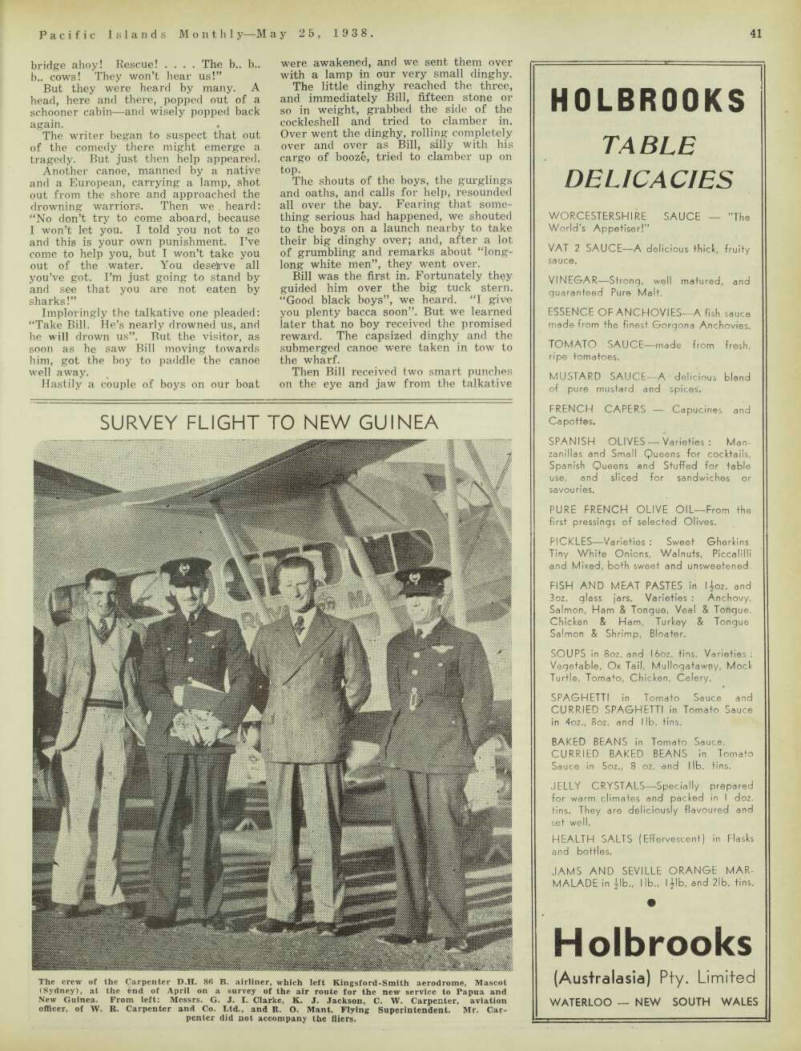
ON April 25, 1938—probably as a result of the menacing inter national situation—Anzac Day was celebrated with more than usual fervour. There were scenes of great feeling and public tenseness; but, later, the crowds relaxed and, led by the now middle-aged ex soldiers, engaged in all kinds of irresponsible and harmless horse play. For several hours, the cheery old “Diggers” took possession of the city of Sydney, and did everything their fancy dictated, from arresting policemen to running a two-up “school” on Central Railway Sta tion.
In the following article, an anony mous correspondent describes an amusing and typical incident in the Solomon Islands.
ON Anzac Day, 1937, the steamer “Malaita” anchored at a port on a large island in the Solomon Group.
The day was celebrated, and celebra tions continued well into the night. But by 11 p.m. most folk had turned in and, by midnight, there was no one about at all.
The tropic night was alluring and beautiful. The stars shone out and not a breath of wind could be felt. It was cool and glorious. The only sound that broke the stillness of the night was the “tut-tut” of the engines of the “Ma laita”, which supplied electric power on board. Then!
Several deck-hands had been ashore celebrating Anzac. In the middle of the night they decided to get aboard their steamer. No boat was available. The launch had long since ceased to run be tween land and steamer. But there was a native canoe tied up to the wharf.
There is no one so venturesome as he who is filled with John Barleycorn. But, halfway to the steamer, it occurred!
One, whom we will call Bill, fat and heavy, upset the frail canoe. A native canoe will support quite a heavy weight when kept free of water. But, sub merged, it takes only a few pounds weight to sink it out of sight.
In the middle of that glorious Anzac night we were rudely awakened by horrid yells, babbling oaths and frantic splashes. We heard: “Keep still you d . . . fool! Keep st . . bbbbbbl. Oh, help! Gawd, he’s gone. No, here he is!
Keep him up. Gawd help us!
Then, evidently, when they had settled down and were allowing the canoe to merely help them to keep afloat, we heard, “No, Jim, you stop on the out rigger and splash all the time with that paddle. There’s sharks here!”
And all through what followed there was that rhythmic splash splash, of poor Jim on the outrigger of the canoe, do ing his bit on Anzac night for the sal vation of himself and his friends.
Then the talkative one organised a community shout and appeal for help.
We heard: “Now, altogether, boys! ‘Ma laita’ ahoy! Rescue! Rescue! ‘Malaita
bridge ahoy! Rescue! ... The b.. b.. b.. cows! They won’t hear us!”
But they were heard by many. A head, here and there, popped out of a schooner cabin —and wisely popped back again.
The writer began to suspect that out of the comedy there might emerge a tragedy. But just then help appeared.
Another canoe, manned by a native and a European, carrying a lamp, shot out from the shore and approached the drowning warriors. Then we heard: “No don’t try to come aboard, because I won’t let you. I told you not to go and this is your own punishment. I’ve come to help you, but I won’t take you out of the water. You deserve all you’ve got. I’m just going to stand by and see that you are not eaten by sharks!”
Imploringly the talkative one pleaded: “Take Bill. He’s nearly drowned us, and he will drown us”. But the visitor, as soon as he saw Bill moving towards him, got the boy to paddle the canoe well away.
Hastily a couple of boys on our boat
were awakened, and we sent them over with a lamp in our very small dinghy.
The little dinghy reached the three, and immediately Bill, fifteen stone or so in weight, grabbed the side of the cockleshell and tried to clamber in.
Over went the dinghy, rolling completely over and over as Bill, silly with his cargo of booze, tried to clamber up on top.
The shouts of the boys, the gurglings and oaths, and calls for help, resounded all over the bay. Fearing that some thing serious had happened, we shouted to the boys on a launch nearby to take their big dinghy over; and, after a lot of grumbling and remarks about “long long white men”, they went over.
Bill was the first in. Fortunately they guided him over the big tuck stern.
“Good black boys”, we heard. “I give you plenty bacca soon”. But we learned later that no boy received the promised reward. The capsized dinghy and the submerged canoe were taken in tow to the wharf.
Then Bill received two smart punches on the eye and jaw from the talkative
one, and was carried aboard the “Ma laita” in an unconscious condition. Next day a Iqvely black eye and a swollen jaw were explained naively—they had been frightening the sharks away with a paddle when they capsized and poor Bill got in the way of the descending blade!
But the “Malaita” folk are very jealous of their prestige in the Islands and, next trip, the trio were missing from the crew, having been promptly dismissed in Sydney.
Advertisements & other items, p. 42 (1 item)
40
Pacific Islands Monthl y—M ay 25, 1938.'
Survey Flight To New Guinea
The crew of the Carpenter D.H. 86 B. airliner, which left Kingsford-Smith aerodrome, Mascot (Sydney), at the end of April on a survey of the air route for the new service to Papua and New Guinea. From left: Messrs. G. J. I. Clarke, K. J. Jackson, C. W. Carpenter, aviation officer, of W. R. Carpenter and Co. Ltd., and R. O. Mant, Flying Superintendent. Mr. Car penter did not accompany the fliers,
Advertisements & other items, p. 43 (2 items)
41
Pacific Islands Monthl y—M ay 25, 1938.
Holbrooks
TABLE
DELICACIES
WORCESTERSHIRE SAUCE "The
World's Appetiser!"
VAT 2 SAUCE—A delicious thick, fruity sauce.
VINEGAR—Strong, well matured, and guaranteed Pure Malt.
ESSENCE OF ANCHOVIES—A fish sauce made from the finest Gorgona Anchovies.
TOMATO SAUCE—made from fresh, ripe tomatoes.
MUSTARD SAUCE—A delicious blend of pure mustard and spices.
FRENCH CAPERS Capucines and Capottes.
SPANISH OLIVES —Varieties : Manzanilias and Small Queens for cocktails, Spanish Queens and Stuffed for table use, and sliced for sandwiches or savouries.
PURE FRENCH OLIVE OlL—From the
first pressings of selected Olives, PlCKLES—Varieties : Sweet Gherkins Tiny White Onions, Walnuts, Piccalilli and Mixed, both sweet and unsweetened.
FISH AND MEAT PASTES in 4oz. and 3oz. glass jars. Varieties : Anchovy, Salmon, Ham & Tongue, Veal & Totigue, Chicken & Ham, Turkey & Tongue Salmon & Shrimp, Bloater.
SOUPS in Boz. and l6oz. tins. Varieties : Vegetable, Ox Tail, Mullogatawpy, Mock Turtle, Tomato, Chicken, Celery.
SPAGHETTI in Tomato Sauce and CURRIED SPAGHETTI in Tomato Sauce in 40z., Boz. and lib. tins.
BAKED BEANS in Tomato Sauce.
CURRIED BAKED BEANS in Tomato
Sauce in soz„ 8 oz. and lib. tins.
JELLY CRYSTALS—Specially prepared for warm climates and packed in I doz. tins. They are deliciously flavoured and set well.
HEALTH SALTS (Effervescent) in Flasks and bottles.
JAMS AND SEVILLE ORANGE MAR-
MALADE in lib., and 21b. tins. •
Holbrooks
(Australasia) Pty. Limited
WATERLOO NEW SOUTH WALES
Famous Yacht In Tahiti
THE handsome yacht “Nourmatial”, the property of Mr. Vincent Astor, of New York, U.S.A., arrived at Papeete on March 25 and departed on March 28.
Mr. Astor, who is a close friend of Mr. Franklin Roosevelt, the President of the United States, has on more than one occasion placed his yacht at the dis posal of the U.S.A, Chief Executive for fishing cruises in the Gulf of Mexico, A member of the Roosevelt family is a guest on the “Nourmatial” during the present cruise.—Papeete Correspondent.
Captain L. H. Ross, of Guinea Air ways Limited, Lae, arrive in Sydney with Mrs. Ross by the April “Neptuna”.
Miss F. .1. Irvine, 8.A., a New Zea lander, has joined the teaching staff of the Methodist Mission in Fiji.
Postal Mystery
Unclaimed Letter for Amelia Earhart
From a Special Correspondent.
Jaluit, Mar. 17.
HERE is a curious thing.
On November 27, 1937, in the Jaluit post-office, in the Marshall Islands (Japanese), among the unclaimed mail a certain letter attracted my atten tion. In its upper left-hand corner was printed “Hollywood-Roosevelt Hotel, Hollywood, California”. A little lower down appeared the postal date stamp, ■with “Los Angeles, California, October 7, 10 p.m.” within the circle. Lower down, in the usual place appeared the following stating address:— “Miss Amelia Earhart (Putnam) Marshall Islands (Japanese) Ratak Group, Maloelab -Is. (10) South Pacific Ocean”.
Written diagonally across one comer was this, “Deliver promptly”. On the back of the envelope “Incognito” was pencilled in very small, fine handwrit ing. The letter was unopened, and con sequently I have no idea of the contents.
Now, it seems to me that anyone in U.S.A. writing as late as October, ought to be well aware that Amelia Earhart had been given up as lost long before.
Hence, it would appear that the letter may have been written by some one de sirous of hoaxing the public. Still, it
is just possible that such may not be the case at all.
Certainly, the writer of the address on the envelope, while making some errors such as anyone at a distance might fnake, displays a little more geo graphical knowledge of these parts than one would expect of the average indi vidual, but which one would certainly expect of anyone about to traverse the Pacific, and who would be passing this group at a distance of a few hundred miles.
It is conceivable that Amelia Earhart may have told some trusted friend in America, before setting out on her ill fated journey, that she intended to take a look-see in at the Marshalls en route, or that she might possibly do so if in danger as she passed by. And it is pos sible that this hypothetical friend in Hollywood might think that Amelia had reached this group, and might be lying low for some reason or other at Maloe lab. It seems curious that anyone with out specific interests in the group should know the name of that particular atoll, which is of no great importance. What the number “10” might mean in con nection with that island, I have no idea.
By a decision of the Governor of French Oceania, dated February 15, 1938, a committee, headed by the Mayor of Papeete, has been constituted for the purpose of erecting at Papeete a monu ment in memory of the last king of Tahiti (Pomare V).
Advertisements & other items, p. 44 (2 items)
42
Pacific Islands Monthl y—M ay 25, 1938.
W. KOPSEN & Co. Pty. Ltd.
TILLEY LAMPS
BURN KEROSENE
with a light of 300 c.p.
Storm Proof, Insect Proof and Fool Proof. British made. New type mantle which is supported top and bottom, and will not shake off. Made of brass and will not corrode. There are 11 different models of Lamps suitable for every purpose.
Complete range of Lamps and Spare Parts available.
Send for Catalogue.
W. KOPSEN & Co. Pty. Ltd.
SHIPCHANDLERS AND HARDWARE MERCHANTS
We have large and complete stocks of Shipchandlery and Mining Gear. Boat fittings of all descriptions manufactured in our own marine foundry.
We are manufacturers of the well known "Pioneer” brand Ash Oars and Tool Handles.
Write for free catalogue of any line which may interest you.
AGENTS OR DISTRIBUTORS FOR .
SKARSTEN MANUFACTURING CO.
SKARSTEN SCRAPERS
AKTIEBOLAGET PENTAVERKEN
PENTA MARINE ENGINES
TILLEY LAMP CO.
TILLEY LAMPS
COLTHURST & HARDING LTD.
PAINTS. OILS AND VARNISHES
R. HAYWARD & CO. LTD.
HAYWARD'S CANVAS
A. JEFFREY & CO.
JEFFREY'S SEAMFLEX AND GLUES
KOCKUMS
TYFON WHISTLES FOR AIR. Etc.
PENTA MARINE ENGINES
3-100 Horsepower, 1-6 Cylinders
FOR KEROSENE, PETROL OR HEAVY OIL
PENTA have just produced a modern 4 and a modern 6 both with electric starter, generator, etc., and dashboard.
These models are particularly robust and compact and are a real marine job.
PENTA ENGINES are precision built, and will last the life of the boat.
Write for catalogue of all models and special export prices.
Cables: "Kopsen," Sydney, 70 CLARENCE STREET SYDNEY Phone: BW 1114 (3 lines)
Polynesians
Origin Of The
Relationship Between India and Easter Island
From Our Own Correspondent.
Papeete, Apl. 24.
A QUESTION which is intriguing the minds of those engaged in research in Polynesian origins, is the possible relationship between the inscriptions found at Mohenjo-Daro (India) and those on the ancient tablets of Easter Island.
“Indus Civilisation”, by Ernest Mac kay, informs us;—“lt is a little more than a decade since the researches of the Archaeological Survey of India re vealed the existence of a great pre historic civilisation in the Indus Valley, dating back to the third and fourth mil lenium 8.C., and rivalling and, in some respects perhaps, excelling, those of ancient Egypt and Babylonia.
“At Mohenjo-Daro, the evidence points to a highly organised society of peaceful character widely engaged in trade; living in carefully-planned brick built cities, with elaborate systems of drainage and public and private baths; making a fine, wheel-turned pottery— often highly decorated; cultivating cotton, wheat, barley and the date palm; and employing wheeled carts for carriage”.
“Hundreds of seals delicately en graved with various figures and in scriptions in pictographic characters that have hitherto defied attempts to decipher them” ... have been un earthed.
The first resemblance between the Easter Island and Mohenjo-Daro in scriptions is the manner of their arrangement—from left to right and right to left alternately—which has been given a long and tongue-twisting name: Boustrophadon, culled from a Greek lexicon by some scientist delighted at his discovery, and signifying “turning like oxen in ploughing”.
Experts in ideographic symbols are fully persuaded of the resemblance of the characters themselves, save that those of Mohenjo-Daro have assumed conventional forms, whereas those of Easter Island are of the crude, primi tive fashion of an earlier age.
The whole matter, however, resides in the realm of theory and will remain there until the discovery of some Ros setta Stone shall disclose the key to unlock the mystery of the Indus Valley inscriptions.
The reason Polynesian scholars are deeply interested in the resemblances is that the establishment of kinship be tween these widely-separated inscrip tions would set a signpost on the road to that baffling, misty homeland of the Polynesian: the Havaiki of their remote ancestors.
That this natal land lies somewhere in Asia has been the opinion of many writers, from Fornander and De Bovis to those of the present day.
Miss Teuira Henry quotes from Mr.
S. Percy Smith:—“Mr. Smith states that a very learned chief of New Zea land, named Taare-Wetere-Te-Kahu, in describing the original Havaiki, of Maori tradition, pictured it as a Tua whenua’ (extensive land), in Atia (India), in which was to be found a very extensive area of level country, bounded inland by very high mountains, which were perpetually capped with snow. Through this expansive country flowed a great river called Tohinga (cleansing by immersion), a word that plays an important part in Maori tradi tion.
“This description of land points to India, the mountains perhaps to the Himalaya range, and the river to the Ganges, in which to this day the Hindus bathe to cleanse themselves of their sins.
“The Maoris have probably retained this old tradition pure from their most ancient tribes, owing to their isolation from more modern blendings, while it has become lost to the central Poly nesians”.
Mr. W. L. Holland, international re search secretary for the Institute of Pacific Relations, New York, is at present in Australia.
Mr. Pat Costello, well-known in con nection with the Fiji mining industry, arrived in Sydney by the April “Mari posa”.
Mr. Geoffrey Cook, of Wau, New Guinea, has announced his engagement to Miss Lorna Reynolds, daughter of Mrs. N. H. P. Neal, of Wau. The ten tative date of the wedding is November.
Mr. Mark Pitt, of the District Services Department, Talasea, New Britain, is at present on furlough. He is being relieved by Assistant District Officer McCarthy, formerly of Buka Passage.
Mr. R. C. Kerkham, auditor for Burns Philp (South Sea) Co., Ltd., at Suva, returned to Fiji by the “Monterey” in early May, after a business visit to Western Samoa. He was accompanied by Mrs. Kerkham.
Mr. R. F. Pickering, manager of the Bank of New South Wales, Suva, has been appointed a nominated member of the Fiji Legislative Council.
Advertisements & other items, pp. 45-46 (2 items)
43
Pacific Islands Monthl y —M ay 25, 1938.
Maleham & Yeomans
LIMITED
BOWDEN STREET. SHEFFIELD, ENS.
Manufacturers of all kinds of Butchers', Sticking and Sheath Knives Razors and Scissors Specialty Hairdresser Scissors
PRICE LIST ON APPLICATION
THE WORLD’S BEST TEXTILES
FROM MANCHESTER.
100% BRITISH MANUFACTURE
MADE IN ENGLAND.
Brotherton’s name was established In 1878—ever since when they have specialised in the manufacture of Cotton Textiles suitable for the Native Trades. ® Our Specialties are: Lava-Lavas, Pearl Divers Ramies, Para Reds, Khaki and Dyed Drills, Calicoes (Plain and Fancies) Greys—Whites—Sheetings —Poplins—Art Silks—Ginghams, Etc. £ Owners of the following well-known brands—“Mokarnie”, "Rintarnie”, “Okarnle”, “Afrlcarnle”, “Arkaldo”, “Cunaldo”, “Staraldo”, “Arntonco”, “Brotonco”, “Airport’’, “Bestport”, “Millport”, “Joker”, “Judgement’’, “Straltate”, etc.
A We are a Private Company under the direct supervision of Mr. Arnold B. Brotherton w with Years of Experience In South Pacific Trade-Indents through usual Channels.
A. B. BROTHERTON & CO., LTD., 40 DICKINSON ST., MANCHESTER 1., ENG (Arnold B. Brotherton). Cables and ’Grams—“RINTARNIE”, Manchester,
■ II USE
FOR RELIABILITY
AND LONG SERVICE
MILLER'S "ANCHOR"
BRAND ROPES AND
CORDAGES.
Manila, Sisal, New Zealand Coir and Cotton Rope of every description.
Twine, Sewing Twine. Shop Twine. Binder Twine and Rshlines, Lashings, Halters, Plough Reins, Sack Cord, Blind Lines, etc.
LENGTH STRENGTH
QUALITY GUARANTEED
o Manufactured by: Suva Agent*: Sydney Agent*:
JAMES MILLER & Co. Pty. Ltd.
MELBOURNE. VIC., AUST.
A. S. FAREBROTHER & CO.
And at Lautolca, P.O. Box 36. Tel. 261
P. T. TAYLOR LTD.
YES/
pamf
Bergers
OF COURSE /
0 ergers
(PRCPARE D)
JCeeps on keeping on/
AGENTS THROUGHOUT THE ISLANDS.
Pacific
A Wonder Of The
WHEN the Seven Wonders of the South Pacific shall be gazetted, the list will surely include the church of Saint Michel on Mangareva.
The most distant from Tahiti of all the islands of French Oceania, Man gareva is situated at the south-eastern extremity of the thousand mile Tua motu barrier and is, to-day, one of the most lonely spots in the broad Pacific.
Twice a year, perhaps, a schooner from Papeete will voyage thither. Less often, a vessel from the coast of South America will stop to rest and refresh the ship’s company. For the major part of the year, the inhabitants look over the placid expanse of the broad lagoon at horizons unblemished by the white canvas and black smoke of ocean traffic.
The stately twin belfries of Saint Michel tower over the groves of bread fruit, orange, and palm trees, which screen and shelter the little settlement, Rikitea. Its great towers and massive walls constructed of cut stone faced with gleaming white coral Saint Michel has the proportions of a cathedral. Within, the roof is supported by white pillars decorated with filigree work in blue.
The high alter and reredos are mar vels of mother-of-pearl inlay wrought in exquisite and intricate patterns of flowers and leaves, by Mangarevan craftsmen of a century ago, under the tutelage of the early fathers of the mission. The massive candelabra are of silver inlaid in flower designs with other materials as well as mother-of pearl, to give variety of colour: rose, blue, and gold. Seated in orderly rows of pews, 1.200 people could comfortably worship in this huge church. On great occasions, 2,000 could enter without overcrowding.
On the island of Akamaru—another of the Gambier Group situated near Man gareva, in the vast lagoon—is another church; much smaller, but of similar design. Its altar and Teredos are also resplendent with inlay of mother-of pearl wonderfully wrought.
The foundations of Saint Michel were laid in the year 1839, five years after the founding on Mangareva of the first Roman Catholic Mission in the South Pacific. At that early time the islands were thickly populated. Later, the treasure of pearl shell and pearls of fine quality brought to these islands ad venturers and traders from many lands.
With them came the diseases of civil ization. The twain accomplished the exhaustion of the pearl beds and the decimation of the people.
France did not take over the islands until 1881.
A.C.R.
Mr. Ivan H. Young, of the Income Tax Office, Brisbane, has been seconded for service at the Thursday Island radio station as assistant engineer and clerk.
"Fruit Control"
Opposed
Cook Islanders Refuse to Cut Bananas
Prom Our Own Correspondent.
Rarotonga, Apr. 25.
SINCE February, when the Resident Commissioner (Mr. S. J. Smith) returned from New Zealand with the fruit prices that the N.Z. Government was prepared to pay for the coming season, everyone had been looking ahead for a prosperous year.
At the end of March the Commissioner issued a notice to the effect that the N.Z. Government would now pay 4/per case for oranges, and 3/6 per case for bananas, instead of the same prices plus 6d. per case where a grower had no debt with the stores, and where he had a debt that 6d. would be deducted from it. The reason for this alteration in prices was due to a misunderstand ing between the N.Z. Government and the C.I. Administration, as this debt col lecting arrangement had been in force last year.
At the same time there was issued the new banana packing regulations. In the past growers had packed their own fruit, but there were many complaints from N.Z. buyers concerning the bad and loose pack. The new regulations stated that the Government would do the packing, the growers delivering the fruit loose at the sheds, where it would be weighed, and a credit slip for the weight given. When the shipment was completed the average weight per case would be known; the growers then would be paid for the number of pounds de livered, less their share of rejects.
This seems to be the fairest method of buying to all concerned.
Without permitting this scheme a fair trial, a number of growers, whom Com missioner Smith calls “hot-heads” and “agitators”, convened meetings of native growers, advising them not to cut bananas, unless the Government was prepared to pay their price of 3/6 for a 70-lb. case, and allow them to do their own packing.
To counteract this propaganda, Mr.
Smith called a meeting of Arikis, Mataiapos, Island Council members, Fruit Advisory Committee, European growers, and traders. He informed them of the true position and asked the leaders to advise their people to give the scheme a fair trial. If the growers did not ship there would be a danger of Rarotonga losing its market in New Zealand, and possibly the steamer ser vice. Councillor Bennett and many of the Arikis spoke in favour of support ing the Government.
Mr. W. P. Browne (who at one time was a chief advocate and supporter of the “fruit control” scheme) bitterly attacked the scheme. He urged that the Government should yield to their de mands otherwise no bananas would be cut.
It is admitted that the price of 3/6 is
hardly adequate for the amount of work entailed to produce a case of bananas, but growers cannot expect any improve ment in price until the quality and are improved.
The upshot of it all was that only 800 cases were shipped to the New Zea land market by the April “Matua”, in stead of the usual 4,000.
Mr. R. B. Jackson, of the New Guinea Police Force, Rabaul, spent furlough in Australia with his wife in April.
Mr. H. Terpstra, an Amsterdam min ing engineer, with two geologists, is making preparations to undertake an other gold-seeking expedition on behalf of the Netherlands New Guinea Mining- Company in Dutch New Guinea.
Mr. J. P. Tracey, of Nauru, Central Pacific, received a welcome cable from Sydney early in May, stating “Mother and three sons are doing well”. The triplets, Richard, John and Joseph, were born to his 26-years-old wife at St.
Margaret’s Hospital on May 1. They are the couple’s first children.
Monsieur Casimar arrived at Vila, New Hebrides, by the April “Ville de Strasbourg” from France to replace Monsieur Sautot as French Resident Commissioner in the New Hebrides dur ing the latter’s leave in Europe.
Inspector G. G. Kermode, accompanied by Mrs. Kermode and family, left Fiji for England on leave by the “Niagara” in April. Inspector I. E. Lucchinelli is relieving him as District Inspector in Suva.
Mr. and Mrs. A. J. Peadon departed from Sydney on May 10 for New Guinea by the W.R.C. Airlines plane. They returned to the Ramu, where their gold claim is situated.
Advertisements & other items, pp. 47-48 (2 items)
45
Pacific Islands Monthl y—M ay 25. 1938,
Wundepnchi
Timber, Joinery
ETC.
PREPARED BUILDINGS ready for erection a speciality.
SHIP AND BOAT BUILDING.
TIMBERS specially catered for.
FIBROLITE, PLYWOODS. GALVANISED
IRON.
CONSIGNMENTS shipped
by RETURN STEAMERS
to the Islands.
John W. Eaton
PTY. LTD.
WEST CRESCENT STREET
NORTH SYDNEY
TELEPHONES: X 5051 (5 lines)
Woven Wire for all Industry
COPRA DRYING TRAYS, FLOORS, Etc.
FRUIT DRYING TRAYS, MINING SCREENS
Heavy Mosquito Gauze in Phosphor Bronze and other Metals Impervious to Salt Sea Air WIRE DOOR MATS AND GENERAL WIRE WORKS
E. VRIGHT & CO. LTD.
Office and Works: 148-152 Cleveland Street, Sydney. N.B.W.
Telegraphic Address: “ Wrightmake,” Chippendale
BITUMENOID ROOFING
MADE IN AUSTRALIA.
Bitumenoid Roofings, Dampcourse and Insulating Felts are made from the world’s best raw materials. Warranted to stand the most rigid tests.
BITUMENOID THE BEST
Roofing, 1,2, 3-ply; Flooring, Waterproof Materials; Saturated Pelt; Resilient Road Jointing; Natural Asphalt Dampcourse; 2 and 3-ply Dampcourse; 1-2 lb. Lead-core Dampcourse; Roofing Cement; Asphalt Paints; Roofing Compound.
SAMPLES AND PRICE LISTS ON APPLICATION.
MAXWELL PORTER & SON LTD.
ESTABLISHED 1888. BUILDERS’ SUPPLIES.
107 REDFERN ST., REDFERN, SYDNEY. N.S.W. Phone: M 8157. Cables Bitumenoid.
WUNDEPNCHI
iiliflififUlllisHl
IBM2BSSff ,finBW *«SB U- msa*#*
DURA T I L E
Those osbestos cement sheets give walls a tiled appearance at less cost. See examples in our showrooms or write for leaflet.
WUNDERLICH LTD.
Crown & Cleveland Sts., Rec Kern, Sydney
REMEMBER THE NAME
Cwf CO)
TO PLANTERS AND TRADERS
William E. Reed
(EstabMshed 1918) Union House, 247 George Sf., Sydney For all Island Requirements.
Island produce sold.
Prices right. Enquiries welcomed.
The Most Extensive Manufacturers in the British Empire of
RUBBER STAMPS,
INKS, STENCILS,
Marking Devices,
ACME STAMP PADS
OFFICE & STATIONERY SUPPLIES
We also Manufacture & Supply a Complete Line of
LIMEWASHING AND
SPRAYING MACHINES
for all purposes.
I Let us know your requirements and we will quote by return.
WRITE FOR OUR GENERAL CATALOGUE
Limewashing Machine
EXCELSIOR SUPPLY CO. PTY. LTD.
278 Post Office Place,
MELBOURNE, VIC.
HEAD OFFICE :
160 BROADWAY,
Former I y known as George St., West,
SYDNEY, N.S.W.
50 Victoria Street,
WELLINGTON, N.Z.
Increasing Use of Tele
radio
WITHIN the last two years a new development in radio has assisted communications between Australia and the Islands, especially New Guinea, Papua, the Solomon and Fiji Islands.
This equipment, called teleradio, is of increasing value to isolated persons and communities, especially planters, ex plorers, prospectors and patrols.
Fifteen years ago, the ambition of every person cut off by distance from civilisation, was to have a telephone.
Often, that was impossible, owing to the cost of line extensions. With the ad vent of broadcasting, a great improve ment was wrought, as it became pos sible for almost anyone to hear news of the outside world. But they could only hear; it was not possible to send any message.
Then came teleradio, a development within the Amalgamated Wireless or ganisation. At first, it consisted of a small wireless receiver and a trans
mitter, which could be carried by one or two native “boys”. It derived its power from a native, pedalling a kind of sta tionary bicycle. Experiments showed that two-way conversations, by word of mouth, could be conducted over dis tances up to 300 and even 400 miles.
The next improvement, for use where either the weight of the equipment was not a material factor, or where the tele radio was to remain in one place, was the introduction of a small engine to generate the necessary electrical power.
In this form, teleradio has proved a wonderful boon. About one hundred in stallations have been made in Australia and the Islands, and settlers bear united testimony to the value of being able at any time to speak to persons in the centres of civilisation. In April, Mr.
Bodger, of the Anglican mission station at Dogura, Papua, found he could talk with Government House, Rabaul, 450 miles away.
The latest extension of the teleradio system is in the Northern Territory, where an equipment has been supplied to Mr. T. A. Holt, of Royallison Pas tures, Ltd. Mr. Holt speaks daily with Darwin, 200 miles distant.
Installations are of varying cost, de tails of which can be supplied on appli cation to the manager of any A.W.A. station. Purchasers will understand, of course, that they are limited to certain specified wave-lengths; and that as a rule they can communicate with tele phone subscribers only through the nearest A.W.A. station. A photograph of an installation is shown in the A.W.A. advertisement in this issue.
Victim Of Eruption At

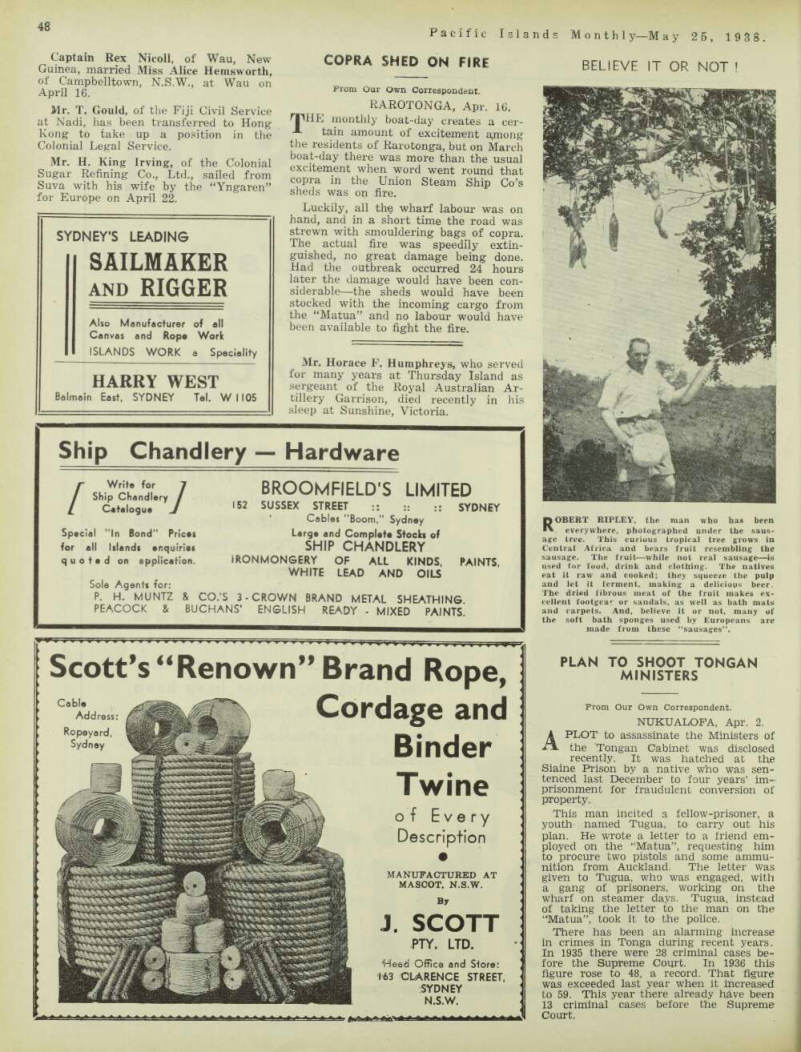
Rabaul
ACCEPTING an affidavit by a New Guinea native, Mr. Justice Nicholas in the Equity Court, Sydney, on May 1 granted leave to swear death in the case of William Wallace Elworthy, 28, engineer at the Rabaul power station, who disappeared on May 29, 1937, on Matupi Island. The affidavit was sworn by Kulau, personal servant to Mr. El worthy, who was with him on that date during the eruption at Rabaul.
Just prior to the outburst on Vulcan Island, according to Kulau, Mr. Elworthy paddled across the harbour in a native canoe to the base of Matupi to obtain some photographs. He began to climb the crater, carrying his camera, and called out for Kulau to follow him, but the terrified native refused. When Mr.
Elworthy was half-way up a black pall of smoke descended on the volcano and beach. Losing sight of him, Kulau searched for 24 hours but was unsuc cessful.
The cable ship “Recorder” arrived in Sydney in April from Singapore, where 140 miles of telegraph cable was taken on board to be used on renewals of the cables between Norfolk Is. and New Zealand and N.T. and Fiji.
Captain Rex Nicoll, of Wau, New Guinea, married Miss Alice Hemsworth, of Campbelltown, N.S.W., at Wau on April 16, Mr. T. Gould, of the Fiji Civil Service at Nadi, has been transferred to Hong- Kong to take up a position in the Colonial Legal Service.
Mr H Kins: Irvins- of thp Colonial
Sugar Refining '™LtS tiled"
Suva with his wife by the “Yngaren” for Europe on April 22.
Advertisements & other items, pp. 48-50 (3 items)
46
Pacific Islands Mont hi y—M ay 25, 1938.
47
Pacific Islands Monthl y—M ay 25, 1 938.
That’S It!
The World’s Best
and Biggest Selling
Motor OH . .
This oil lubricated the first car (Selden's) and the first plane (Wright's) and to-day the makers of Mobiloil supply oil for the lubrication of the engines of the £6,000,000 liner,"Queen Mary"—thus Mobiloil s reputation for outstanding quality has grown till it outsells each and every brand in the world. It is as nearly perfect a lubricant as can be made and, because all gummy, nonlubricating impurities have been removed, there is more oil and, therefore, more protection in a gallon of Mobiloil than in any other brand.
SYDNEY'S LEADING
SAILMAKER
AND RIGGER
Also Manufacturer of all Canvas and Rope Work ISLANDS WORK a Speciality
HARRY WEST
Balmain East, SYDNEY Tel. WIIOS
Copra Shed On Fire
Prom Our Own Correspondent.
Rarotonga, Apr. 16.
T HE monthly boat-day creates a cer -*■ tain amount of excitement a>mong the residents of Rarotonga, but on March boat-day there was more than the usual excitement when word went round that copra in the Union Steam Ship Co’s sheds was on fire.
Luckily, all the wharf labour was on hand, and in a short time the road was strewn with smouldering bags of copra.
The actual fire was speedily extin guished, no great damage being done.
Had the outbreak occurred 24 hours later the damage would have been con siderable—the sheds would have been stocked with the incoming cargo from the “Matua” and no labour would have been available to fight the fire.
Mr. Horace F. Humphreys, who served for many years at Thursday Island as sergeant of the Royal Australian Ar tillery Garrison, died recently in his sleep at Sunshine, Victoria.
Believe It Or Not!
ROBERT RIPLEY, the man who has been everywhere, photographed under the saus age tree. This curious tropical tree grows in Central Africa and bears fruit resembling the sausage. The fruit-while not real sausage—is used for food, drink and clothing. The natives eat it raw and cooked; they squeeze the pulp and let it ferment, making a delicious beer.
The dried fibrous meat of the fruit makes ex cellent footgear or sandals, as well as bath mats and carpets. And. believe it or not, many of the soft bath sponges used by Europeans are made from these “sausages”.
Plan To Shoot Tongan
Ministers
Prom Our Own Correspondent.
Nukualofa, Apr. 2.
A PLOT to assassinate the Ministers of the Tongan Cabinet was disclosed recently. It was hatched at the Siaine Prison by a native who was sen tenced last December to four years’ im prisonment for fraudulent conversion of property.
This man incited a fellow-prisoner, a youth named Tugua, to carry out his plan. He wrote a letter to a friend em ployed on the “Matua”, requesting him to procure two pistols and some ammu nition from Auckland. The letter was given to Tugua, who was engaged, with a gang of prisoners, working on the wharf on steamer days. Tugua, instead of taking the letter to the man on the “Matua”, took it to the police.
There has been an alarming increase in crimes in Tonga during recent years.
In 1935 there were 28 criminal cases be fore the Supreme Court. In 1936 this figure rose to 48, a record. That figure was exceeded last year when it increased to 59. This year there already have been 13 criminal cases before the Supreme Court.
Advertisements & other items, p. 50 (2 items)
48
Pacific Islands Month! y—M ay 25, 193 S
Cordage and
Ship Chandler/ Hardware
/Write for 7 Ship Chandlery j Catalogue J Special "In Bond" Prices for all Islands enquiries quoted on application.
BROOMFIELD'S LIMITED
152 SUSSEX STREET :: :: :: SYDNEY Cables "Boom," Sydney Large and Complete Stocks of
SHIP CHANDLERY
IRONMONGERY OF ALL KINDS, PAINTS,
WHITE LEAD AND OILS
Sole Agents for: P. H. MUNTZ & CO.‘S 3-CROWN BRAND METAL SHEATHING PEACOCK & BUCHANS* ENGLISH READY - MIXED PAINTS^
Scott’s “Renown” Brand Rope,
Cordage and
Binder
Twine
Cable Address: Ropeyard, Sydney C *
of Every
Description
MANUFACTURED AT
MASCOT. N.S.W.
J. SCOTT
PTY. LTD.
,J Head Office and Store:
163 CLARENCE STREET,
SYDNEY
N.S.W.
Wreck of "Joliette" To Be
Removed
MR. JOHNSTONE, an Australian div ing expert, arrived at Noumea, New Caledonia, by the “Notou” dur ing April. Under the direction of the Societe le Nickel, he will attempt to locate and remove the hull of the sail ing ship “Joliette”, which sank at her moorings at Thio, on the east coast of New Caledonia, almost 30 years ago.
On February 11, 1909, the “Joliette” (2,022 tons) was moored to the quay, loading a cargo of nickel. A cyclone hit the harbour, picked up the “Joliette” and flung her against the cargo wharf, demolishing not only the two piles, but also the partly submerged blocks of masonry which supported them. The sailing ship went down like a stone; for tunately, the crew was saved. Since then the wreck has lain at the bottom of the sea hindering shipping traffic.
By a new modern process, Mr. John stone hopes to remove this troublesome wreck.
Mr. C. Hughston, who has spent 18 months in New Guinea with Bulolo Gold Dredging, Ltd., returned to Melbourne in mid-April by the “Neptuna”. He was accompanied by Mrs. Hughston.
Sudden Death Of Fiji
Bandmaster
Prom Our Own Correspondent.
Suva, May 2.
faIHE death occurred at Lautoka on Ap- X ril 25, following an operation, of Mr.
Henry Alfred Collier, Bandmaster to the Fiji Defence Force, in his 46th year.
He went to Lautoka for the Easter rifle meeting and while there took ill and was admitted to the hospital, where he pass ed away.
Mr. Collier had had long service with the army, serving through the Great War, and coming to Fiji in January, 1936.
Since his arrival here he had done splen did work with the Defence Force native band. He left a widow and two daugh ters in England.
His death was a great shock to a wide circle of friends, for he was a most popu lar man, not only with all ranks of the Defence Force but with the community generally. The funeral, which took place in Suva on April 26th and was largely at tended, was fully military in character.
Amalgamated Wireless (A/sia.) Ltd., in April, shipped new radio equipment to the United Kingdom for the Colonial Sugar Refining Co’s, vessel, “Tambua”, being built at Dundee for the Fiji sugar trade The apparatus included a standard 500 watts transmitter and receiver, together with, an auto alarm, and an echometer (an instrument by means of which the depth of water under the ship’s keel may be determined continuously).
"Mystery Warship's" Mid
Night Visit In Carolines
From Our Own Correspondent
Honolulu, Apr. 21.
JAPAN’S mandated islands, that lie sprinkled conveniently (for Japan) above the equator, a stone’s throw from Australian territory, are becoming a mystery to Japan herself.
Coincident with the current American navy war games, th,e Japanese press is playing up a story that a “mystery war ship’’—of course believed to be American —entered Truk Harbour (Caroline Is lands) early in April, and “after mid night, played searchlights over the har bour and surrounding hills, then quickly disappeared”, to quote the front page stories.
Pointed out the potent “Hochi”: “The mystery naturally is connected with the fact that the U.S. navy has expanded its area for Pacific war games. American war ships visited Singapore base recently, America has claimed Canton and Ender bury Islands, and the current war games are featuring landing operations. . .”.
The Japanese newspapers claimed that American warships and warplanes would sweep through the mandated islands dur ing the manoeuvres, a fact which Wash ington and the Pacific fleet’s “brass hats” promptly denied.
Mr. Harry Gregory married Miss Gladys Louise Benton at Rabaul on April 26. They will live at Put Put.
Advertisements & other items, p. 51 (2 items)
49
Pacific Islands Monthl y—M ay 25, 1938.
Ruston
Home Lighting Sets
CAPACITY—I KILOWATT
These Sets provide current at a surprisingly low initial outlay with most economical running costs.
OUTSTANDING FEATURES:
• PUSH BUTTON STARTING.
• EFFICIENCY.
• ECONOMY.
• RELIABILITY.
• DURABILITY.
Write for full particulars of these Ruston Units.
BOSTON & HORNSBY (Aust.) Ply. Ltd.
MELBOURNE
174 King Street
SYDNEY
642-4 Jones Street
BRISBANE
Barry Parade
ADELAIDE
20 Franklin Street
Tongan M.L.A. In Trouble
Prom Our Own Correspondent.
Nukualofa, Apr. 13.
Osaiasi Toga Faleola, Member Of
the Tongan Legislative Assembly for Vavau, was recently committed for trial by the Vavau Police Magistrate, on a charge of fraudulent conversion of money.
Faleola, with others, organised a so ciety at Vavau for the purpose of col lecting money to pay the taxes of its members. The society’s fund, members were informed, was safely accumulating in the Government Savings Bank; but recent investigation revealed that the fund was not in order, and a charge was made against Faleola.
The motor-boat “Magia”, bperated in Western Samoa by Bums Philp (South Sea) Co. Ltd., struck a reef at the Faga passage, Savaii, in April. Several frames and planks were smashed, and the pantry deck house and iron railing were lost. It was reported that a very rough sea was running in the passage at the time of the mishap.
Hawaii —Auckland
No Word Yet of Start of Trans- Pocific Air Service
THERE still is nothing to show when the Pan American trans-Pacific Air Service between Hawaii and Auckland will be commenced. Apparently, the plan is now subject to various Government conversations which are proceeding.
Some P.A.A. History
Letter to the Editor, IN the March issue of “P.1.M.”, Mr.
Harold Gatty objects to my refer ences to certain aspects of the acti vities of Pan American Airways in the Pacific, the division which employs him.
To keep the record straight, I beg to quote from two significant letters. The first was written by Dr. Dana Coman (see Feb. “P.1.M.” story) to a man in New York wh,o. so Dr. Coman told me, was “treasurer” of the Coman Expedition and “go-between” for it and its relations with Pan American. A copy of the letter with
the man’s name was given to me by Dr Coman, who on July 23, 1935, wrote:— general we found upon arrival (in Honolulu) a strong rumor of Pan American interest in our investiga tion. . . Throughout the period, both be fore and after Mr. Gatty left for Aus tralasia we had the protection and most invaluable aid of an intelligent news paperman, Mr. John Williams (Dr. Coman is a psychiatrist!), who continued to keep off too persistent inquiries from the many news services here. . . He knew the facts of the expedition enterprise and would publicise them at a dignified and pro per moment. Premature publicity would only impede the smooth organisation of a legitimate and important expedition.
Due to his access to important contacts otherwise practically unobtainable, he facilitated the establishment of essential co-operation for the sound organisation of our venture. . .
Writing to me on December 20 1935 the New York head office of Pan’Ame rican said this:— We very much appreciate the sympathetic attitude you have taken and are grateful for the interesting informa tion which you have given in this con nection (the N.Z. air route) . , . We were particularly concerned at the time with anyone connected with the purely com mercial aspects of the expedition (Co mans) discussing aeronautical matters in a positive tone that could not entirely be substantiated We are sure you appreci ate the situation. With the other aero nautical activity (Orient route) in the Pacific, such mention was sufficient to cause . . . greatly distorted aspects. .
According to the general Scheme behind the Coman expedition, Mr, Gatty’s job was to visit New Zealand and persuade the Government to sign an agreement with Pan American. As Dr. Coman and the company admit in their letters, I did whatever I could (without compensation.) I was (and am still) anxious to see avi ation get going properly in the Pacific.
To this end, prior to Mr. Gatty’s arrival in New Zealand, I made satisfactory ar rangements so that without waste of time he was able to get “next to’’ Mr.
Gordon Coates, then Prime Minister, and so expedite th,e Scheme, which py 1935 had changed greatly from the original 1933-34 version. Through the courtesy of certain N.Z. newspaper influences which I have the honour of representing here, the real purpose behind Mr. Gattys’ visit to N.Z. was kept secret and announcement with held for many weeks until Mr. Gatty agreed, at the most auspicious moment, to announce his association with Pan American and the plan for a service to Auckland. This was somewhat embarras sing to me because, at Mr. Gatty’s re quest, in the Honolulu papers, I had de nied that he was associated with Pan American. Mr. Gatty continued this de nial (via me) upon his return to Hono lulu—for reasons best known to himself.
By this time (end of 1935) the Coman Expedition had won much publicity for itself. Vital navigation tables had dis appeared from the expedition’s schooner during a visit to Pago Pago; a Pan Ame rican employee aboard was sensationally rescued from drowning in the surf at Baker Island and his coral wounds ef fectively treated by Hawaiian lads on the island; the schooner had engine trouble which necessitated aid from Honolulu, etc. I know all this because almost night ly I maintained radio contact with the expedition and have before me now full notes of all the topsy-turvy business.
These notes, incidentally, go back to early 1934, when I first began to help Mr.
Gatty work on the trans-Pacific Scheme.
Dr. Coman, a most excellent fellow and companion, probably to-day chuckles at many angles of those years, as he in 1935 chuckled at many angles of the first Byrd Antarctic expedition, of which he was medical adviser.
Returning to details of Mr. Gatty’s let ter: The same year of the Coman Expe dition (1935), Mr. Donald Douglas ap peared on Pan American's board of direc tors. This position must have its advan tages, which, I imagine Mr. Douglas ap preciates. They may be worth more to him than actual cash stock in the com pany. Anyhow, he sells plenty of his 'planes to the company. My February “P.1.M.” story was not based upon a let ter which unwarrantedly Mr. Gatty sug gests I obtained through some unethical means. (These personal touches are un like the good-mannered replies to critics which his company issues from its head office.) In reporting, one cannot cover a story from one source alone. Thus, when Mr.
Gatty gave out information, there were natural checks, which in th,e N.Z. ser vice instance meant checks with three U.S. Government Departments that keen ly watched the Coman Expedition’s acti vities. Perhaps Mr. Gatty had read into my story things that were not intended.
There is no law against the principle of capitalistic enterprise, although to-day President Roosevelt is moving to prohibit such enterprise when it climaxes in mo nopolies. Often enough, he has said he is trying to save capitalism, but capital ism will not be saved!
I have reported Pacific aviation, from its bold beginning with the Rodgers U.S. navy flight from California to near Ha waii, in 1925. Pan American operates on a U.S. subsidy of 8,000,000 dollars annual ly. This great network has been under fire and investigation in Washington for at least four years, as Congressional records amply testify. Aircraft builders, defence experts and some observers feel that the network has retarded the besc expansion of U.S. international aviation. While the company uses the huge subsidy, it is long-headed enough to expect the critic ism and close Washington interest which is perfectly legitimate. The first of the competition which the critics demand now is being organised.
I feel that aviation is at an important stage of its rapid growth, particularly in America, the home of so-called “rugged individualism”, which in Australia is called “open slather”.
More and more Washington is going to discipline airline operations, especially those airlines that use great amounts of public money. Transport in America is washed up. One-third of the railroads are bankrupt with the balance operating on public subsidy. The same applies to
the merchant marine. The Government is determined to stave off similar conditions in air transport, which has been too politically ridden and at the mercy of powerful Washington lobbyists representing the major companies.
In regard to international aviation, such as the N.Z. route, I feel the Governments should get together (they foot the eventual bills) and arrange a long-range mutual programme. There has been the extraordinary delay in the N.Z. service solely because there was not enough of both Governments in the Scheme. It was very natural, of course, for the pri-
vate interests behind the original Scheme to try and obtain all the monopolies they could and other “first in” rights. There was nothing illegal about that.
U.S. Government approval of the N.Z. service will not be complete until the post office subsidy is approved by Congress.
The delay in making the grant prob ably best proves that much yet remains to be done before the N.Z. service can start. It depends upon the present Gov ernment conversations, which should have started in 1934.
I am, etc..
John Williams.
Honolulu, April 19, 1938.
Miss Nancy MacKenzie, of Taveuni, Fiji, recently arrived in Australia from Suva to be married to Mr. Charles Pocock, of the Bank of New South Wales staff 0 . T t t * o • x ii Sergeant H. Irwin, Senior Constable in the Samoan Police Department, was in New Zealand in April spending furlough.
Captain A. Campbell, commander of the Burns Philo liner “Nentuna” left t e uins, rmip imer JNeptuna left Sydney early in May by the Otranto for England to take over the new vessel “Bulolo” which will replace the “Montoro” on the Sydney-Papua-New Guinea run. He was accompanied by Mrs. Campbell. At present the “Neptuna” is under the command of Canfom p v » i command oi Laptain t. Vogelmann.
Advertisements & other items, pp. 52-53 (3 items)
50
Pacific Islands Monthl y—M ay 25, 1938
Dewars
The sea has a charm of its own, and so has DEWAR’S Whisky. As invigorating as the winds that blow from out of space, DEWAR’S, like a well-found ship, brings content; boundless and satisfying.
~7A& SCOTCH WHISKY
Engines
fMPUk*
«ASTIR
PUP
THE CHAPMAN
EXPORT PUP
This 2>/ 2 h.p. Engine is made especially for the islands. Direct- Coupled Magneto. Chapman Patent Floatless-type Carburettor.
Often supplied to drive Dynamos, Pumps, Fans, etc. Gives 50 m.p.g. for Marine Work—3 hrs. running to gallon for Stationary work.
All necessary equipment for complete installation.
Chapman
Engines
CHAPMAN
MARINE MOTORS
Export Pup - h.p.
Standard Pup h.p.
Master Pup - 3 h.p.
Super Pup - 4* h.p.
Greyhound - 6-8 h.p.
Seadog - - 10 h.p.
are reliable-cost less to own
Apart from minimum upkeep costs, a Chapman engine is cheap to buy. All the while a 1 Chapman engine saves you money— there are no breakdowns—no expensive overhauls—no high petrol and oil bills because simplified methods of construction, plus the "petroil” system of lubrication make the Chapman engines the cheapest to run.
Chapman engines won't let you down—99% of N.S.W. hire launch services depend upon Chapman marine motors.
Without obligation, post coupon for interesting facts.
To CHAPMAN & SHERACK.
26 Clara Street, Erslcineville, N.S.W.
Gentlemen, Please send, without obligation, details of Chapman marine motors.
Name : 1 -
BULLIVANTS’ wire ropes
THE WORLD'S STANDARD
LARGEST STOCKS IN AUSTRALASIA : FOR ALL PURPOSES Also Blocks, Hooks, Shackles, Thimbles, Strand, Seizing, Aircraft Cord, etc. » Prompt Attention! Efficient Service!! Complete Satisfaction!!!
BULLIVANTS' Australian Co. Pty., Ltd.
Letters: Incorporated in Victoria. Telegrams: Sydney.
Box 1298 J, G.P.O. 331 KENT STREET, SYDNEY. “Bullivants, Ltd.”
"The Devil!"
Monsignor f. x. gsell, Bishop elect of Darwin, supplied a sidelight on the effect of civilisation on the primi tive mind, in an address at the May meet ing of the Pacific Islands Club.
An old native of Bathurst Island approached Monsignor Gsell and ex pressed a desire to see Darwin and the wonders of civilisation he had heard about. Monsignor Gsell consented, and the ancient crossed to Darwin in the mis sion cutter. Wandering around the streets, the native was paralysed with astonishment to see a horse and cart approach. He had seen horses, but never a horse and cart together. He continued his wander, and then he caught sight of a motor car. He threw his arms in the air, cried out “the devil”, and fell dead.
Fiji Has Half Million Surplus
From Our Own Correspondent.
Suva, Apr. 29.
THE satisfactory position of Fiji’s fin ances was revealed in figures given by His Excellency the Governor (Sir Arthur Richards) at the opening of th,e Legislative Council on April 22. These disclosed trade totalling nearly £4,000,- 000 for 1937 and a surplus of £69,232.
His Excellency said that the final fig ures for 1937, within approximately £2OO, showed that ordinary revenue amounted to £861,003, an increase of £129,824 over the original approved estimate. To this must be added extraordinary receipts, £86,333, representing a reimbursement of expenditure on the Government build ings, now recouped from the new loan.
Ordinary expenditure amounted to £688,165, an increase of £7,148 over th,e original estimate. Added to this were: (a) £147,499 expenditure on public works from surplus balances; and (b) £42,440 transferred to general reserve (£30,820) and Government vessels replacement fund (£11,620).
Total revenue (£947,366) exceeded total expenditure (£878,104) by £69,232. The ex cess of assets over liabilities, which at January 1, 1937, amounted to £472,894, was therefore increased to £542,126 at December 31. At the same date the gen eral reserve and the emergency reserve funds stood at £136,541 and £140,000 re spectively.
Total trade for 1937 was £3,974,401, be ing £337,120, or 91 per cent, higher than 1936. Imports valued at £1,760,744 aic the highest on record and, compared with 1936, show an increase of £258,890. Ex ports were valued at £2,213,657, or £78,- 230 higher than in 1936.
New B.P. Vessel For Samoa
ANEW motor vessel to, replace the Burns, Philp inter-island ship “Makoa”, wrecked on a reef at Hull Island in May, 1937, is nearing com pletion at Hong Kong. She will be de livered in Samoa at the end of August.
The “Matafele” will be 110 ft. in length, with a 25i. ft. breadth and 111 ft. depth. Two full diesels, with twin screws, will give her a speed of nine knots. Provision has been made for eight passengers, and she will have cargo space for 120 tons of copra.
It is expected that the “Matafele’' will be in commission at Apia at the end of August when she will take up the run previously maintained by the “Makoa”, i.e., the Tokelaus, Swain’s Is land, Puka Puka, and the Phoenix Group. She will also connect with the Matson liners “Monterey” and “Mari posa” at Pago Pago (American Samoa) . M. Jore, Governor-elect of New Cale donia, sailed from Marseilles for Noumea by the “Ville d’Amiens” on May 16. He is due in New Caledonia on July 1.
Dr. G. H. Vernon, well-known in Thursday Island and Western Papua, has left Daru and gone to Port Glas gow at the eastern end of the Territory where he* has acquired a plantation.
Advertisements & other items, p. 54 (2 items)
52
Pacific Islands Monthl y—M a > 25, 1938.
Over Thirty Years Ago
Value and more
Coif IP CoUL& mpS ■ j-n OMPTON coiled d d Battery-oP« ated s uovac Sets ■ • cle S^ e P rs . • ■ HOUS f e flttion S«ve^ e Horoe , VaCU Todgers Cutlery • • ' CaW* Electrical Fi d Factory ■■ • oU tdoor msta Store and * and ou for tennis '
Rodgers' Cutlery • • • Cables
R . Fittings callender Rations
S» tMt «««»»_
«'• ... .„**-■■ °{""ZZ -rfT
Write |.| UTU. - csvd^ EY) MOYc 5 D p street. Sr*"** t Brisbane. 115 Clarence S‘r St., •> -MpwcasUe*
Over Thirty Years Ago
The first Younger Stove was exported to the Pacific Islands. Ruggedly strong in construction, highly efficient and economical in fuel, has made them the most popular stove in the South Seas.
The illustration shows a Younger Single Stove. Special stoves, with cast iron ovens tor Island requirements made to order. • Write us for quotations for special sizes and catalogue of double and single oven stoves. •
G. Fletcher & Son
50 OXFORD STREET, SYDNEY
r
"La Diademe"
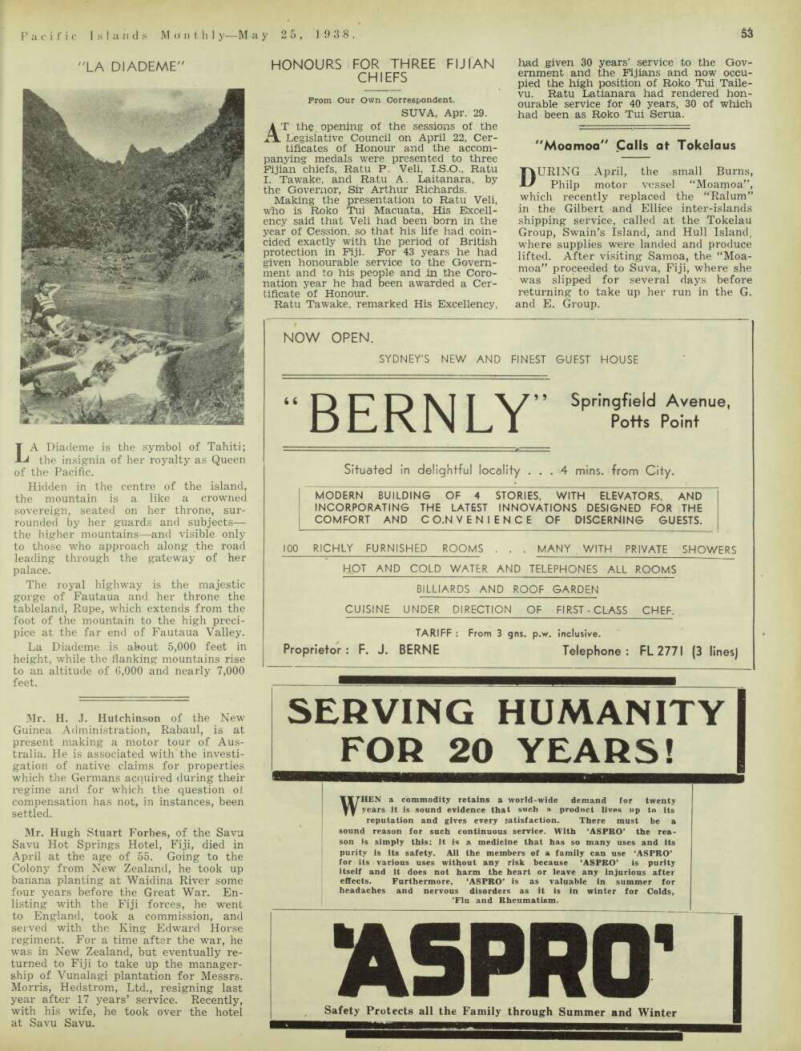
LA Diademe is the symbol of Tahiti; the insignia of her royalty as Queen of the Pacific.
Hidden in the centre of the island, the mountain is a like a crowned sovereign, seated on her throne, sur rounded by her guards and subjects— the higher mountains —and visible only to those who approach along the road leading through the gateway of her palace.
The royal highway is the majestic gorge of Fautaua and her throne the tableland, Rupe, which extends from the foot of the mountain to the high preci pice at the far end of Fautaua Valley.
La Diademe is about 5,000 feet in height, while the flanking mountains rise to an altitude of 6,000 and nearly 7,000 feet.
Mr. H. J. Hutchinson of the New Guinea Administration, Rabaul, is at present making a motor tour of Aus tralia. He is associated with the investi gation of native claims for properties which the Germans acquired during their regime and for which the question oi compensation has not, in instances, been settled.
Mr. Hugh Stuart Forbes, of the Savu Savu Hot Springs Hotel, Fiji, died in April at the age of 55. Going to the Colony from New Zealand, he took up banana planting at Waidina River some four years before the Great War. En listing with the Fiji forces, he went to England, took a commission, and served with the King Edward Horse regiment. For a time after the war, he was in New Zealand, but eventually re turned to Fiji to take up the manager ship of Vunalagi plantation for Messrs.
Morris, Hedstrom, Ltd., resigning last year after 17 years’ service. Recently, with his wife, he took over the hotel at Savu Savu.
Honours For Three Fijian
Chiefs
From Our Own Correspondent.
Suva, Apr. 29.
AT the opening of the sessions of the Legislative Council on April 22, Cer tificates of Honour and the accom panying medals were presented to three Fijian chiefs, Ratu P. Veli, 1.5.0., Ratu I, Tawake, and Ratu A. Laitanara, by the Governor, Sir Arthur Richards.
Making the presentation to Ratu Veli, who is Roko Tui Macuata, His Excell ency said that Veli had been bom in the year of Cession, so that his life had coin cided exactly with the period of British protection in Fiji. For 43 years he had given honourable service to the Govern ment and to his people and in the Coro nation year he had been awarded a Cer tificate of Honour.
Ratu Tawake, remarked His Excellency,
bad given 30 years’ service to the Gov ernment and the Fijians and now occu pied the high position of Roko Tui Taile vu. Ratu Latianara had rendered hon ourable service for 40 years, 30 of which had been as Roko Tui Serua.
" Moamoa" Calls at Tokelaus
DURING April, the small Burns, Philp motor vessel “Moamoa”, which recently replaced the “Ralum” in the Gilbert and Ellice inter-islands shipping service, called at the Tokelau Group, Swain’s Island, and Hull Island, where supplies were landed and produce lifted. After visiting Samoa, the “Moa moa” proceeded to Suva, Fiji, where she was slipped for several days before returning to take up her run in the G. and E. Group.
Mr. Mark White, of Lautoka, Fiji, has been transferred to Nadi as manager of the branch store of Morris, Bedstrom, Ltd.
Mr. R. H. Garvey, of the Western Pacific Hio-h Cnmmisdnn Fiii nrrivpfi
idonTST ’ /Ta
at Ocean Island at the end of April to act as Resident Commissioner. He was accompanied by Mrs. Garvey.
Advertisements & other items, pp. 55-56 (2 items)
53
Pacific Islands M otn th 1 y—M ay 25, 1938.
Aspro'
NOW OPEN.
SYDNEY’S NEW AND FINEST GUEST HOUSE
“BERNLY
Situated in delightful locality ... 4 mins, from City.
MODERN BUILDING OF 4 STORIEsT WITH AND INCORPORATING THE LATEST INNOVATIONS DESIGNED FOR THE
COMFORT AND CONVENIENCE OF DISCERNING GUESTS.
100 RICHLY FURNISHED ROOMS . . . MANY WITH PRIVATE SHOWERS HOT AND COLD WATER AND TELEPHONES ALL ROOMS
BILLIARDS AND ROOF GARDEN
CUISINE UNDER DIRECTION OF FIRST-CLASS CHEF.
TARIFF : From 3 gns. p.w. inclusive.
Proprietor: F. J. BERNE Telephone: FL 2771 (3 lines]
Springfield Avenue,
Pot+s Point
SERVING HUMANITY
FOR 20 YEARS!
WHEN a commodity retains a world-wide demand for twenty years It is sound evidence that such a product lives up to its reputation and gives every satisfaction. There must be a sound reason for such continuous service. With ‘ASPRO’ the reason is simply this: It is a medicine that has so many uses and its purity is its safety. All the members of a family can use ‘ASPRO’ for its various uses without any risk because ‘ASPRO’ is purity itself and it does not harm the heart or leave any injurious after effects. Furthermore, ‘ASPRO’ is as valuable in summer for headaches and nervous disorders as it is in winter for Colds, ’Flu and Rheumatism.
ASPRO'
Safety Protects all the Family through Summer and Winter
Announcing
RADIOMAC
TROPICAL
RADIO
After extensive research, we are proud to be able to offer a radio that will give a minimum of trouble under the most adverse conditions. The chassis illustrated above is housed in a metal cabinet, and the set is supplied with all batteries and aerial equipment. Nothing more to buy.
WRITE FOR FULL SPECIFICATIONS.
price f
COMPLETE V/“
Includes all charges to your nearest port. (T.N.G. Papua, etc.)
PRICE’S RADIO SERVICE
O. G. McINTYBE, 5 & G, Angel PL, SYDNEY
Primitive Divorce
ISOLATED Bathurst Island, in th,e Timor Sea, does not boast magnifi cent divorce courts, but the inhabit ants have provided a substitute for the settlement of marital differences. Like many of their white sisters of more civ ilised regions, those of the weaker sex who become restive under the bonds of wed lock usually express their feelings by re turning to their parents. But, after this, the course of events differs from that gen erally followed by the white lord and master.
The injured spouse of Bathurst Island usually retaliates by dragging the lady back to her place in the home; but this seldom dampens her desire for freedom, so again she may return to her father’s home. After a series of desertions, the husband wonders whether the woman is worth all this trouble, and then he invokes the divorce laws of the community. The h,apless wife is tied to a tree, while the husband takes up a position about thirty yards away. He then proceeds to hurl ten spears, one after another, at the dis turber of his household. Should she be hit, it is then her duty—if still alive—to return and take up the yoke of family duties where she dropped it. If, however, she dodges the spears, she is free.
Monsignor Gseil, who described this system to the Pacific Islands Club, re marked, amid laughter and applause, that its adoption in Sydney would simplify domestic relationships and greatly cheap en the processes of the law.
A daughter was born to Mr. and Mrs.
“Mick” Rees, of B.G.D. Ltd., New
Guinea, in April.
Rev. and Mrs. J. W. P. Gillan re turned to Tangoa, New Hebrides, by the “Morinda” on May 12 after spending furlough in Sydney. Grandson of the famous Dr. J. G. Paton, he is principal of the training institution for teachers and evangelists at Tangoa.
"Wonder-Healer"
Rise And Fall Of A
Samoan "Quack" Who Could Not Cure Himself
Prom Our Own Correspondent.
Apia, Apr. 22.
A FEW months ago Pa’u, a young native taulealea of Satapuala, appeared in the village of Malie, about five miles west of Apia, and proclaimed to the Samoans that after having fasted for seven days in the bush, he had had apparitions and was called upon to heal the sick. Awed by tales of wonderful cures effected by the “wonder-heater”, hundreds of Samoans from all parts of the Group flocked to Malie to be healed by the “doctor”. He was hailed by them as a new Saviour, come to earth again to help suffering mankind.
Pa’u, who had a not unblemished repu tation in his home village, had regular visiting hours. He claimed that all dis eases were caused by “aitus” or ghosts of the dead and he diagnosed disease oy dissolving fluid in a glass of water.
From the resulting colour of the mix ture, he judged what the specific treat ment required should be.
Playing on the well known credulity and superstition of the Samoans, Pa’u succeeded in attracting a large clientele who preferred his “quack” treatment to medical attention by qualified doctors at the Government Hospital. Wisely the “wonder-healer” refused to accept mone tary remuneration for his services, though he took payment in the form of foodstuffs brought by his clients.
The harm done by this charlatan can only be surmised. According to reports a half-caste and his aged mother treated for some time by Pa’u died from un known causes within a few days of each other.
The fame of Pa’u came to an abrupt end. With hundreds of sick natives seeking his help in the crowded village of Malie, he suddenly fell seriously ill himself and—ironically enough—had to seek the help of the Government medi cal practitioners. He died early in April in Apia Hospital.
There have been a number of cases of witch doctors, sorcerers, and “won der-healers” in Samoa in past years, quite a few court convictions having been recorded. The Mandates Commis sion at Geneva has taken great inter est in the matter; though it cannot be said that the existence of these “quacks” has been of importance in the life of the Samoans. Superstition and the belief in devils are still fairly rooted in Samoan life and it will take a great deal of education, especially by >the Missions, to eradicate completely these ancient and hereditary beliefs and pagan practices.
Rev. and Mrs. C. K. Crump, of New Zealand, left Sydney for Nguna, New Hebrides, by the “Morinda” on May 12.
Mr. Crump will carry on the work of the late Rev. W. V, Milne, who was murdered by a demented native in April, 1937.
Advertisements & other items, pp. 56-57 (4 items)
54
Pacific Islands Monthl y—M ay 25, 1988
Baxm
THE NEW TROPICAL PAINT
TUNGICIDfII
Pai im T
A Product of British Australian Lead Manufacturers Pty. Ltd.
"8.A.L.M." Fungicidal Paint is specially formulated for use in the tropics and it contains special ingredients to prevent black mould. "8.A.L.M." Fungicidal Paint will beautify and preserve your propertyit is a durable, long-lasting paint that gives perfect protection and reduces repair bills to a minimum.
"8.A.L.M." Fungicidal Paint is available in Gloss for exterior use and Flat for interior use.
DISTRIBUTORS:
Greenwood & Laws Ltd., Rabaul and Wan.
Steamships Trading Co. Ltd., Port Moresby and Samarai.
55
Pacific Islands Monthl y—M ay 25. 1938.
Freemans
For Quality Goods at Low Prices
ESTABLISHED SINCE 1905
165-167 Castlereagh St., Sydney, N S W,
Jewellery Specials.
Gent’s Modern Shape “Starlex” Chrome Wrist Watches; jewelled lever movement, luminous dial, leather strap 19/6.
Men’s Latest Square-shaped “York” Lever Wrist Watches; 15 jewelled movement, Chrome Link Band 39/6.
Gent’s Chrome 7-Jewelled Lever Watches, on leather band 29/6.
Men’s 10-year Guaranteed Gold-filled Wrist Watches; 15 jewels, 5 adjustments, very latest smart shapes 45/-.
Gent’s Solid Gold-filled Wrist Watches, modern shapes, 15 Jewelled movement, luminous dial, leather band, complete with presentation case 55/-.
“Fenchurch” Solid gold-filled Gent’s Wrist Watches, latest square shape, 15 Jewelled, shock-absorber movement, latest modern dial, Rolled-gold Link Band, complete with presentation case £4/15/-.
Lady’s Chrome Wrist Watches, latest miniature shapes, on chrome link band 39/6.
Lady’s 9ct. Gold Wrist Watches, ultra smart shapes, 17 Jewelled movement, 5 adjustments, 44 hr. time-keepers’ 59/6, Lady’s Solid Chrome Wrist Watches, brilliant studded bezel, dainty baguette shapes, complete with double-rope moire wristband, with presentation case 75/-.
Chrom. STOP WATCHES, Swiss made, 1-5 or 1.10 second, “Floretta” Levers, Guaranteed accurate racing Time Pieces 27/6.
Postage Paid on all Jewellery Orders.
Powerful Field Glasses.
Extra-powerful Field Glasses, centre focus, complete in case 21/-.
High-power Field Glasses, centre focus, special knuckle joint 35/-.
“Lumiere” Paris, High-power, Field Glasses, centre focus, with case and strap ... 35/-.
Extra High-power, Marine Glasses, day and night use, centre focus 45/-.
High-power Super Dreadnought Marine Glasses, extra wide optics, with case, 50/-.
High-power “Loren” Field Glasses, centre focus, 4 x 36 wide vision, complete with leather strap and case 59/6.
“Audemair”, 8 x 30 .Prismatic Field Glasses, extra-wide optics, central and individual focus, complete with strap and case, £6/10/- Carl Zeiss Field Glasses, 6 x magnification; slightly used, with case £6/19/6.
Carl Zeiss Field Glasses, 8 x 30 magnification, wide vision, slightly used .. .. £ll/15/-.
“Goerz” Field Glasses, 6 x 24, Individual focus, slightly used, with case .. .. £6/15/-.
Postage Paid on all Field Glass Orders.
Sewing Machines.
“Pinnock” Hand Sewing Machines, torpedo shuttle, slightly used, perfect order .. 75/-.
“Rowley’’ Hand Sewing Machines, torpedo shuttle, slightly used, perfect order .. 65/-.
Musical Instruments.
Ukeleles: Complete with set of strings, Free Tutor 10/6.
Steel Guitars, beautiful tone, Free Tutor, 35/- "Harmony” Guitars, beautiful tone, nicely finished, Free Tutor £3/19/6 “Harmony” Guitars, professional model, pearl position dots, beautiful finish and tone.
With Free Tutor £6/6/-.
Guitar Cases, 19/6. Set of Picks, Steels, 4/6 per set.
Cameras.
Vest Pocket Cameras, slightly used .. 17/6. 1A Kodak Folding Cameras, double lens, slightly used 27/6.
Agfa “Speedex” Folding Cameras, 16 photos. built-in filter 37/6.
Agfa “Record” Folding Cameras, F 7.7 anastigmat lens 57/6.
Voigtlander “Brilliant” Cameras, P 7.7 Volgtor lens £2/18/-.
“Welta Trio” Cameras, 4.5 lens, compur shutter, 1 sec. to l/250th £6/5/-.
“Leica” Cameras, 3.5 lens, 5 c.m. focus and appropriate viewfinder, focal, plane shutter, 1/20 th to l/500th secs. ... £22/17/6.
Postage Paid on all Camera Orders.
Typewriter Bargains.
Slightly used.
Corona, 3-Bank, Portable Typewriters, in case, perfect order £5/19/6.
Corona, 4-Bank, Portable Typewriters, in case, perfect order £B/15/-.
Remington 4-Bank Portable Typewriters, in case, perfect order £B/15/-.
Bicycles.
Good Strong Bicycles, slightly used, fixed or free wheel, with brake, in good order 45/-.
Gent’s Roadster Bicycle, free wheel, electric dynamo and lamp, handbrake, good tyres and tubes, slightly used .. .. £3/15/-.
“Speedwell” Bicycle, Club-racer, brazed on back stays, free wheel, tapered frame, handbrake, slightly used £4/19/6 Brand-new Gent’s “Oxford” Special Roadster Bicycle. Equipment: Brake, lamp, tools, free wheel £5/19/6.
Gent’s Brand-new Oxford” Club-racer Bicycle, fully tapered frame and forks, brazedon seat stays. Equipment; “Pitz” H/bars, side-pull brake, doubl-sided hub, Endrlck rims, “Dunlop” black and white tyres, speedo. Complete Cycle £B/19/6.
Lady’s brand new “Oxford” Special Cycle, fitted with free wheel, dresis nets, chain guard, mud guards, spring top saddle and handbrake. All English fittings throughout A variety of colors. At the amazing price £6/19 U
WE STOCK EVERYTHING. "wRITE FOR
YOUR REQUIREMENTS. GOODS FOR-
WARDED V.P.P. OR SIGHTDRAFT.
SERVICE AND SATISFACTION GUAR-
ANTEED. PLEASE ADD FREIGHT. ALL
PACKING FStEE.
Sporting Goods.
GOLF SETS.
"J. A. Kirkwood’’ Hickory Shaft Matched Golf Sets; special rustless heads made in Scotland, including mid-iron, mashie, putter and brassle-driver, in leather mounted waterproof canvas bag 42/6.
“J. A. Kirkwood” Steel Shaft Matched Golf Sets; latest heavy ridged back design, rustless heads made in Scotland, including midiron, mashie, putter and brassie-driver, in leather mounted waterproof canvas bag. 69/6.
All well-known makes of Golf Equipment and Sporting Goods of every description always in stock. Enquiries invited for particulars of goods in which you are interested.
Comping Equipment.
TARPAULIN SPECIALS!
Waterproof Tarpaulins, made from superior quality canvas and duck. All tarpaulins are less seam measurements. Special sizes made to order. lOoz. duck, 6xB, 13/6; 8 x 10, 19/6; 10 x 12, 24/6; 12 X 16, 31/6; 12 x 18, 39/-. 15oz. Duck, 6xB, 18/6; 8 x 10, 24/6; 10 X 12, 33/6; 12 X 16, 47/6; 12 x 18, 52/-; 14 X 18, 60/-.
“Birkmyre”, green or khaki, 6xB, 25/-; 8 X 10, 37/6; 10 X 12, 57/6; 12 X 16, 86/-; 12 x 18, 94/-; 14 x 18, 102/6. 12 x 8 Lean-to Auto, Tents, 15 oz. duck roof, 10 oz. duck walls, with poles, ropes, pegs, bags, etc £2/19/6.
All Camping Equipment made to order.
Send your order now.
Saddlery.
We specialise in High-grade Saddles made of best quality materials throughout. Strong guaranteed trees and first class workmanship.
All metal work guaranteed Solid Brass.
Strong High-grade Saddles in Stock, Kemp or Poley styles. Strong guaranteed trees, narrow grip, firm pads, best quality flaps and skirts mounted with leathers, girth, and 3bar N.P. irons £3/19/6.
High-grade Station Saddles, in Kemp or Poley styles, deep comfortable kip seat, narrow grip, wide leather facings at back, strong firm pads, extra long kip flaps and skirts, mounted with leathers, girth, and 3bar N.P. irons £4/19/6.
Very Fine High-grade Super Station Stock Saddles, built on strongly plated, guaranteed trees, deep comfortable hogskin seat, with 4V 2 in. dip, narrow, grip, wide leather facings at back, very firm s*/2 in. strong capped pads, raised thigh pads, extended leather points, extra long flaps and skirts made of long wearing flexible kip, mounted with bevelled leathers, girth, and 4-bar N.P. irons £6/19/6.
SPECIAL SADDLES MADE TO ORDER.
FREEMANS
FOR PROMPT SERVICE
and
HONEST VALUE.
165-167 Castlereagh Street, SYDNEY, New South Wales.
Keable's Old Home
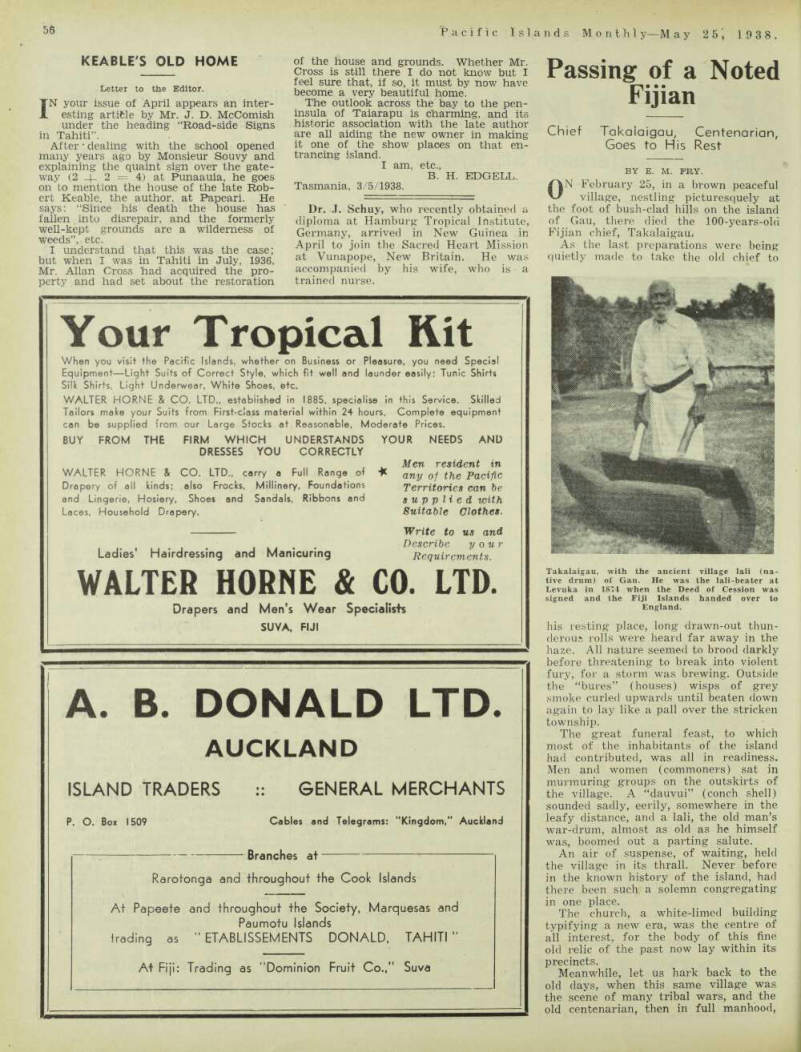
Letter to the Editor.
IN your issue of April appears an inter esting article by Mr, J. D. McComish under the heading “Road-side Signs in Tahiti”.
After * dealing with the school opened many years ago by Monsieur Souvy and explaining the quaint sign over the gate way (2 _4_ 2 = 4) at Punaauia, he goes on to mention the house of the late Rob ert Keable, the author, at Papeari. He says: “Since his death the house has fallen into disrepair, and the formerly well-kept grounds are a wilderness of weeds”, etc.
I understand that this was the case; but when I was in Tahiti in July, 1936, Mr. Allan Cross had acquired the pro perty and had set about the restoration
of the house and grounds. Whether Mr.
Cross is still there I do not know but I feel sure that, if so, it must by now have become a very beautiful home.
The outlook across the bay to the pen insula of Taiarapu is charming, and its historic association with the late author are all aiding the new owner in making it one of the show places on that en trancing island.
I am, etc.,
B. H. Edgell.
Tasmania, 3/5/1938.
Dr. J. Schuy, who recently obtained a diploma at Hamburg Tropical Institute, Germany, arrived in New Guinea in April to join the Sacred Heart Mission at Vunapope, New Britain. He was accompanied by his wife, who is a trained nurse.
Fijian
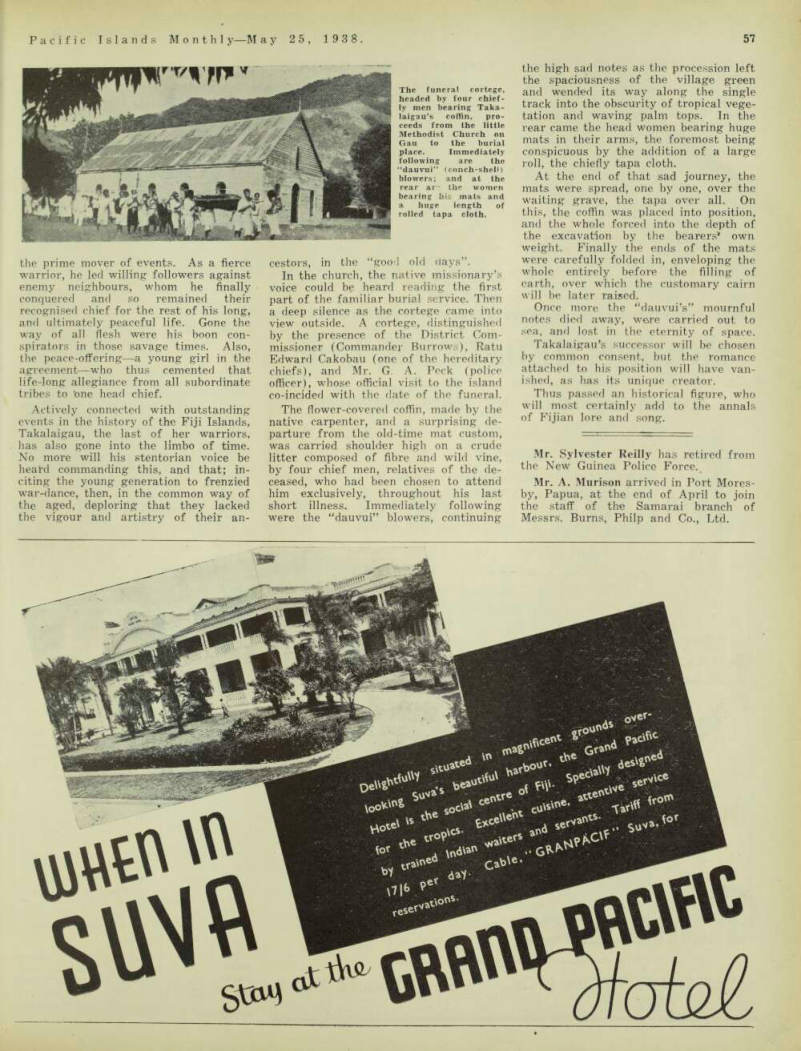
Passing of a Noted Fijian Chief Tokaiaigau, Centenarian, Goes to His Rest
By E. M. Pry.
ON February 25, in a brown peaceful village, nestling picturesquely at the foot of bush-clad hills on the island of Gau, there died the 100-years-old Fijian chief, Takaiaigau, As the last preparations were being quietly made to take the old chief to
his resting place, long drawn-out thun derous rolls were heard far away in the haze. All nature seemed to brood darkly before threatening to break into violent fury, for a storm was brewing. Outside the “bures” (houses) wisps of grey smoke curled upwards until beaten down again to lay like a pall over the stricken township.
The great funeral feast, to which most of the inhabitants of the island had contributed, was all in readiness.
Men and women (commoners) sat in murmuring groups on the outskirts of the village. A “dauvui” (conch shell) sounded sadly, eerily, somewhere in the leafy distance, and a lali, the old man’s war-drum, almost as old as he himself was, boomed out a parting salute.
An air of suspense, of waiting, held the village in its thrall. Never before in the known history of the island, had there been such a solemn congregating in one place.
The church, a white-limed building typifying a new era, was the centre of all interest, for the body of this fine old relic of the past now lay within its precincts.
Meanwhile, let us hark back to the old days, when this same village was the scene of many tribal wars, and the old centenarian, then in full manhood,
Takalaigau, with the ancient village lali (na tive drum) of Gau. He was the lali-beater at Levuka in 1874 when the Deed of Cession was signed and the Fiji Islands handed over to England.
the prime mover of events. As a fierce warrior, he led willing followers against enemy neighbours, whom he finally conquered and so remained their recognised chief for the rest of his long, and ultimately peaceful life. Gone the way of all flesh were his boon con spirators in those savage times. Also, the peace-offering—a young girl in the agreement—who thus cemented that life-long allegiance from all subordinate tribes to ’one head chief.
Actively connected with outstanding events in the history of the Fiji Islands, Takalaigau, the last of her warriors, has also gone into the limbo of time.
No more will his stentorian voice be heat’d commanding this, and that; in citing the young generation to frenzied war-dance, then, in the common way of the aged, deploring that they lacked the vigour and artistry of their an
cestors, in the “good old days”.
In the church, the native missionary’s voice could be heard reading the first part of the familiar burial service. Then a deep silence as the cortege came into view outside. A cortege, distinguished by the presence of the District Com missioner (Commander Burrows), Ratu Edward Cakobau (one of the hereditary chiefs), and Mr. G A. Peck (police officer), whose official visit to the island co-incided with the date of the funeral.
The flower-covered coffin, made by the native carpenter, and a surprising de parture from the old-time mat custom, was carried shoulder high on a crude litter composed of fibre and wild vine, by four chief men, relatives of the de ceased, who had been chosen to attend him exclusively, throughout his last short illness. Immediately following were the “dauvui” blowers, continuing
the high sad notes as the procession left the spaciousness of the village green and wended its way along the single track into the obscurity of tropical vege tation and waving palm tops. In the rear came the head women bearing huge mats in their arms, the foremost being conspicuous by the addition of a large roll, the chiefly tapa cloth.
At the end of that sad journey, the mats were spread, one by one, over the waiting grave, the tapa over all. On this, the coffin was placed into position, and the whole forced into the depth of the excavation by the bearers* own weight. Finally the ends of the mats were carefully folded in, enveloping the whole entirely before the filling of earth, over which the customary cairn will be later raised.
Once more the “dauvui’s” mournful notes died away, were carried out to sea, and lost in the eternity of space.
Takalaigau’s successor will be chosen by common consent, but the romance attached to his position will have van ished, as has its unique creator.
Thus passed an historical figure, who will most certainly add to the annals of Fijian lore and song.
Mr. Sylvester Reilly has retired from the New Guinea Police Force.
Mr. A. Murison arrived in Port Mores by, Papua, at the end of April to join the staff of the Samarai branch of Messrs. Burns, Philp and Co., Ltd.
The funeral cortege, headed by four chief ly men bearing Taka laigau’s coffin, pro ceeds from the little Methodist Church on Gau to the burial place. Immediately following are tho “dauvui” (conch-shell) blowers; and at the rear are the women bearing his mats and a huge length of rolled tapa cloth.
Mr. G. O. Higgins, general manager of Papua Oil Development Ltd., arrived in Australia early in May by the W.R.C.
Airlines plane from Port Moresby, on a short business visit, and returned a week later.
Rev. Dr. Thomas Macmillan, who re tired two years ago after a lifetime of missionary work in the Pacific for the Presbyterian Church, died at his home in Surrey Hills, Victoria, on May 10.
He was 70 years of age. Born in India and educated in Scotland, he went to the New Hebrides 41 years ago and laboured faithfully under the John G.
Paton Fund until he returned to Mel bourne in 1936. Dr. Macmillan is sur vived by a widow and four sons, one of whom is at present engaged in orni thological work in Noumea.
Advertisements & other items, pp. 58-59 (3 items)
56
Pacific Islands Montlil y— May 2 5 1938
Your Tropical Rit
When you visit the Pacific Islands, whether on Business or Pleasure, you need Special Equipment—Light Suits of Correct Style, which fit well and launder easily: Tunic Shirts Silk Shirts, Light Underwear, White Shoes, etc.
WALTER HORNE & CO. LTD., established in 1885, specialise in this Service. Skilled Tailors make your Suits from First-class material within 24 hours. Complete equipment can be supplied from our Large Stocks at Reasonable, Moderate Prices.
BUY FROM THE FIRM WHICH UNDERSTANDS YOUR NEEDS AND
DRESSES YOU CORRECTLY
WALTER HORNE & CO. LTD., carry a Full Range of Drapery of all kinds; also Frocks, Millinery, Foundations and Lingerie, Hosiery, Shoes and Sandals, Ribbons and Laces, Household Drapery,
Ladies' Hairdressing and Manicuring
Men resident in any of the Pacific Territories can be supplied with Suitable Clothes.
Write to us and Describe your Requirements.
WALTER HORNE & CO. LTD.
Drapers and Men's Wear Specialists
SUVA. FIJI
A. B. DONALD LTD.
AUCKLAND
ISLAND TRADERS :: GENERAL MERCHANTS
P. O. Box 1509 Cables and Telegrams: "Kingdom," Auckland : Branches at Rarotonga and throughout the Cook Islands At Papeete and throughout the Society, Marquesas and Paumotu Islands
trading as ” ETABLISSEMENTS DONALD. TAHITI”
At Fiji: Trading as "Dominion Fruit C 0.,” Suva
%
so*
Papuan Rubber Growers
Await Decision
From Our Own Correspondent.
Pt. Moresby, May 4.
THE decision of the Commonwealth Government about assistance to be given to rubber growers in Papua and New Guinea is still awaited with anxiety.
The matter has been shelved by Can berra lately, owing to the urgency of defence problems. To a recent enquiry by the Lieutenant-Governor of Papua (Sir Hubert Murray) a reply was re ceived during the last week in April that the question will be considered at an early date. The decision will then be communicated to the Territories as soon as possible.
Polynesian Kinship
Moori Pilgrimage to Hawaii
MAKING a strange pilgrimage to Hawaii to perform baptisms for their kindred dead, a party of 19 Maoris arrived in Honolulu on the “Niagara” on April 29 from New Zealand. The major ity of the group are members of two fa mous east coast tribes of Maoris in New Zealand, the Ngati-porou and Ngati-ka hungunu.
They have brought with them (says the Honolulu “Star-Bulletin”) genealogies which tend to show that some of them are descendants of early Pacific voy agers who emigrated from Hawaii to the South Pacific. Primary purpose of their visit is to perform baptisms for their dead ancestors and relatives, in accord with th,e tenet of the Mormon faith which makes it possible for the living to be baptized for their dead relatives.
The pilgrims will spend about three weeks at the Mormon colony at Laie, Oahu.
Some members of the party trace their ancestry to immigrants who came to New Zealand in the Takitimu canoe about 1350 A.D, This canoe, according to legend, was captained by the famed Tamatea-ariki, whose ancestors included two famous chiefs in Rarotonga. Genealogies of these chiefs, in turn, may be traced to the Tahitian chief, Hiro.-Hire’s ancestors are said to have migrated to Tahiti from Hawaii.
Indian Expansion In Fiji
BECAUSE of t’heir natural Increase, the number of Indians in Fiji is gradually overtaking that of the Fiji ans, the Commissioner of Lands, Surveys, and Mines in Fiji (Mr. F. R. Charlton) explained at a dinner tendered him by the Old Boys’ Association of the Brisbane Grammar School in Brisbane in April.
Th,e Indian birthrate was high, and the death-rate low, he added. The Fijian birthrate was high, but the death-rate probably three times that of the Indians.
Fijian women were lackadaisical, and did not give their children proper food. Fiji ans numbered 97,651 in a population of 198,379, and Indians 85,000.
The half-castes (people of mixed de scent), with a population of 4,574, ex ceeded the European population by 546.
Fiji had no malaria, sleeping sickness, or yellow fever, but it had the diseases common to more temperate zones, and filariasis, which was mosquito-borne.
Mr. James A. Lawrence McAndrew, well-known in the Buka District of New Guinea, died at Namanula Hospital, Rabaul, on April 15. About 15 years ago he accepted the position of planta tion overseer for Choiseul Plantations Limited and later was manager of the Buka Trading and Plantation’s property at Bonis. Recently he joined the staff of W. R. Carpenter and Co., Ltd., to manage their Kuradui and Maulapao plantations at Kokopo.
Mr. L. Luscombe, of Darwin, has been transferred to Thursday Island to take charge of the wireless station, replac ing Mr. Gerald Walters, who has re turned to Sydney after considerable service at T.I.
Advertisements & other items, pp. 60-61 (3 items)
58
Pacific Islands Monthl y—M ay 25, 1938.
somcs
MORRIS, HEDSTROM, Ltd.,
Registered Office - - Suva, Fiji.
BRANCHES THROUGHOUT FIJI, TONGA AND SAMOA
Y Agents for : >
LLOYD’S
NOBELS (AUSTRALIA) LIMITED—EXPLOSIVES
MATSON NAVIGATION COMPANY
RUSTON & HORNSBY LIMITED
IMPERIAL CHEMICAL INDUSTRIES LIMITED
JOHN LYSAGHT (AUST.) LTD.
VACUUM OIL COMPANY PROPTY. LIMITED
FORD MOTOR COMPANY LIMITED
GOODYEAR TIRE & RUBBER EXPORT COY.
SYDNEY OFFICE: DALTON HOUSE, 115 PITT ST.
Made in 5 Widths
7-inch, 8-inch, 9-inch, 10-inch and 11-in. cut
<ft<m
These ploughs will do good work in new or old land.
Ample clearance is provided for ploughing in thick surface growth.
somcs
y y
“CUB
-.PLOUGHS
Write for illustrated literature and all information.
MORRIS, HEDSTROM LTD. - Suva, Lautoka and Ba Made by: RANSOMES, SIMS & JEFFRIES, LTD., IPSWICH, ENGLAND
On A Fiji Plantation
A team of ploughing bullocks, with the native driver, on a plantation near Nailaga, Fiji. -Photo.: “Missionary Review”.
New Traders In Cook Is.
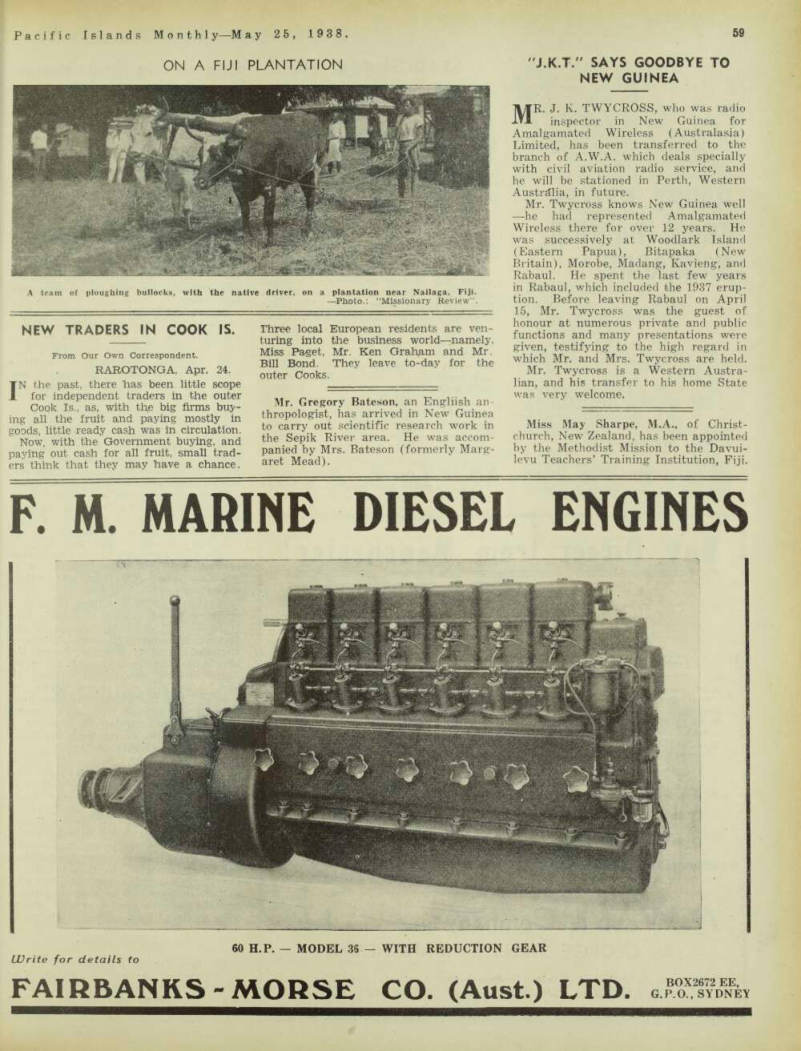
From Our Own Correspondent.
Rarotonga, Apr. 24.
IN the past, there has been little scope for independent traders in the outer Cook Is., as, with th,e big firms buy ing all the fruit and paying mostly in goods, little ready cash was in circulation.
Now, with the Government buying, and paying out cash for all fruit, small trad ers think that they may have a chance.
Three local European residents are ven turing into the business world—namely.
Miss Paget, Mr. Ken Graham and Mr. *** n D -r, ... u t . Mr - Bateson an Englnsh an thropologist has arrived in New Guinea t° carry out scientific research work in the Sepik River area. He was accom
pan.lelby,^rs' Bateson (formerly Marg-
Mead).
"J.K.T." Says Goodbye To
New Guinea
MR. J. K. TWYCROSS, who was radio inspector in New Guinea for Amalgamated Wireless (Australasia) Limited, has been transferred to the branch of A.W.A. which deals specially with civil aviation radio service, and he will be stationed in Perth, Western Australia, in future.
Mr. Twycross knows New Guinea well —he had represented Amalgamated Wireless there for over 12 years. He was successively at Woodlark Island (Eastern Papua), Bitapaka (New Britain), Morobe, Madang, Kavieng, and Rabaul. He spent the last few years in Rabaul, which included the 1937 erup tion. Before leaving Rabaul on April 15, Mr. Twycross was the guest of honour at numerous private and public functions and many presentations were given, testifying to the high regard in which Mr. and Mrs. Twycross are held.
Mr. Twycross is a Western Austra lian, and his transfer to his home State was very welcome.
Miss May Sharpe, M.A., of Christ church, New Zealand, has been appointed by the Methodist Mission to the Davui levu Teachers’ Training Institution, Fiji.
Mrs. Garton, well-known as the pro prietress of the famous swimming-baths and tea-rooms at Ravuvu, near Rabaul, has disposed of her interest in New Guinea. She arrived in Australia by the “Montoro” early in May. Mrs. Gar ton’s Ravuvu establishment was very seriously damaged in the eruption a year ago.
Advertisements & other items, pp. 61-62 (2 items)
59
Pacific Islands Monthl y—M ay 25, 1938.
F. M. Marine Diesel Engines
a 60 H.P, MODEL 36 WITH REDUCTION GEAR Write for details to FAIRBANKS-MORSE CO. (Aust.) LTD. G. RO X , 2 SYimE\
HAPPY RELIEF
FROM PAINFUL
BACKACHE
Caused by Tired Kidneys
Many of those gnawing, nagging, painful backaches people blame on colds or strains are often caused by tired kidneys—and can be relieved when treated in the right way.
The kidneys are one of Nature’s chief ways of taking acids and wastes out of the blood.
A healthy person should pass about 3 pints a day and so get rid of more than 3 pounds of waste matter.
If the 15 miles of iidney tubes and filters don’t work well, this poisonous waste stays in the body. It may start nagging backaches, leg pains, loss of pep and energy, getting up nights, lumbago, swollen feet and ankles, puffiness under the eyes, rheumatic pains and dizziness Don’t let it lay you up.
Ask your chemist for DOAN’S BACKACHE KIDNEY PILLS . . used successfully the world over by millions of people. They give quick relief and will help to flush out the 15 miles of kidney tubes. So be sure you get
DOAN’S BACKACHE KIDNEY PILLS.
Search For Oil
Another Vessel tor P.O.D.
Prom Our Own Correspondent
Pt. Moresby, May 8.
ON May 4, the motor vessel “Philis” arrived in Port Moresby from Rot terdam via Singapore, Java and Dutch New Guinea ports for the service of Papua Oil Development Co. Ltd.
The vessel, which was in charge of Captain W. Groom, with a first officer and two engineers and a coloured crew, will be engaged on the run between Port Moresby and Daru and other bases of the company, replacing the “Angas”, which will remain at Daru as a depot ship. The “Philis” will leave shortly for Western Papua, where she will be taken over by Captain Main. Captain Groom and the first officer and engineer will then return to Europe.
She is a vessel of 363 tons gross, 106 nett, with length over all of 146 ft. and beam 24 ft., and she has capacity for about 300 tons of cargo.
The Papua Oil Development Co. Ltd., which is carrying on a far-reaching in tensive search for oil in New Guinea, has increased its capital by £lOO,OOO, bringing the total to £300,000.
Mr. J. L. Ormond, of Marau estate, T.N.G., recently married Mrs. E. Slatter at Rabaul.
Printed by Melanesians
For Melanesians Products of the Mission Presses
WE have received a copy of a book of 84 pages, very well printed and neatly bound, which is a product of the small press set up by the Papuan Mis sion of the Seventh Day Adventists at Mirigeda, near Port Moresby, in Papua.
The book is a hymnal, and it contains the text of 166 hymns printed in Eng lish and in Motuan. Interest lies in the fact that practically the whole of this work of typesetting and printing was done by Papuans under European instruction.
The missionary, Mr. E. A. Boehm, in sending the book, says his two native assistants, as a result of the training they have had, are now capable of run ning the press by themselves and that their work provides an example of how effectively the Papuan will absorb tech nical education and training.
Another parcel of seven books is to hand from Mr. F. R. Isom, who is in charge of the Melanesian Mission Press at Guadalcanal, in the British Solomon Islands. This is now a printing estab lishment of some importance—from this station there goes out a constant stream of well-printed books and pamphlets in English and in the native languages, to assist the Mission in its work of edu cating and training the natives of the Solomon Islands. Judging by the samples of work to hand—’the last of several —the Solomon Islands native printers, under Mr. Isom, are getting better and better.
And now we have a third batch of a similar character—this time fom Rev.
Harold Short, who has charge of the London Missionary Society’s station at Raukele, near Port Moresby, Papua. Mr.
Short has the same report to make.
These samples of excellent printing, he says—and they comprise a variety of booklets and pamphlets—are the work of native Papuans who have Become typesetters and printers as a result of the instruction which they have re ceived at the Mission station.
These three little presses all provide examples of interest to anyone who studies the present conditions and prob able future of the native races. Apart from the remarkably high quality of the printing done in the three Mission presses, it is noteworthy that by means of this activity an increasing number of native people are learning to read (and, consequently, to think) both in the English language and in their own native language. It is a slow business, but the missionaries concerned can at least feel thaf they are not labouring in vain.
Rt. Rev. Dr. L. Kempthorne, Bishop in Polynesia, reached Auckland, New Zealand, from Fiji by the April “Niag ara” to spend six weeks in the Dominion.
Advertisements & other items, p. 62 (2 items)
60
Pacific Islands Monthl y—M ay 25, 1938.
Buy Direct from Manchester!
Pacific Traders can save money and obtain High Quality Goods and Dependable Service by writing to us for Quotations. We are manufacturers of —
GREY, WHITE AND COLOURED TEXTILES
Rami materials of every description.
Para Reds.
White and Blue Drills.
Grey and White Calicos.
Super Drill.
Ecru Tussore.
Dyed Poplins.
Woven-striped Poplins.
Table Cloths.
Serviettes.
Sheets.
Pillow Cases.
Quilts.
Bedspreads, Art Silk Piece Goods.
Bath Wraps, Glass Cloths.
Sweat Rags.
Bias Binding.
Braids.
Printed Calicos.
Poplins.
Woven Coloured Ginghams, etc. • It will be to your interest,
in the end, to Buy and
Distribute British - made
goods.
Extract from a letter sent to us by an Islands storekeeper who recently retired:— Milne Bay, Papua, 1/10/34.
“ . . . a success due —in a great measure—to the excellent service rendered for so many years by your firm. Yours faithfully,
H. DEXTER .”
A, Webb & Company (Manchester) Ltd.
86 GEORGE STREET - - MANCHESTER
Contractors to H.M. and Foreign Governments. Bentley's Code, and ABC Code ith and sth Editions. Telegraphic Address: “WABTOCK,” Manchester.
Japan's Southwards
Thrust
Ruin of Australia's Pearling Industry
THE Southwards thrust of Japan con tinues.
Early in May, a fleet of no less than 116 Japanese pearling vessels from Pa lau, in the Caroline Islands, appeared off the northern coast of Australia, and pro ceeded to fish for pearl shell.
It was reported in the “Sydney Morning Herald” that the quota allowed to each vessel was 30 tons of shell for the sea son; and it was pointed out that, if each vessel secures its quota of shell, the total will be 3,480 tons, which is double the usual trade requirement of the world.
This overwhelming invasion by Japan ese pearlers of what was exclusively an Australian business, has not only destroy ed the Australian character of the indus try, but is in danger of destroying the in dustry itself. Last year, the activities of the Japanese produced an enormous quantity of pearl shell much of which is still unsold, with the result that the cur rent market price has fallen very seri ously. Further, the Japanese, by taking “chicken” shell, have wiped out many shell-beds.
This is only one more example of what European communities in the Pacific must face in the ceaseless and merciless expan sion of Japanese interests and activities.
It was announced on May 12 that the Japanese luggers had anchored off the North Australian coast. Owing to the war in China they were unable to receive oil supplies from their usual sources, and were trying to purchase oil and other necessary commodities in Darwin.
It was reported in the Dutch East In dies in mid-April that, since the begin ning of 1938, Dutch naval ships have ar rested 10 Japanese motor fishing-vessels in the Rhio Archipelago, south of Singa pore. Dutch destroyers are patrolling the East Indies constantly, trying to keep off the ever-increasing swarms of Japanese fishing-vessels which, unless checked, have no hesitation in invading the three miles’ limit.
The East Indies, being nearer to Jap an, will feel the pressure more quickly than the British and French islands south of the equator; but that does not lessen the ultimate menace.
Mr. Percy Drayson, manager of New
Guinea Estates, Ltd., died in Madang
Hospital at the end of March, after a short illness. He arrived in the Terri tory in 1929 to take charge of the Dylup,
Karenap, Sarang, and Walog planta
tions.
Departure from Nauru
Mr. Frank Waterman’s Departure from Nauru
Nauru, Apr. 26.
MR. F. A. WATERMAN, accountant to the Nauru Administration, left the island, with Mrs. Waterman, by the last “Triaster”, to resume duty with the Commonwealth Public Service. Both Mr. and Mrs. Waterman were highly esteemed on the island.
Mr. Waterman came to the island 12 years ago during the regime of General Griffiths; and during the time he has spent here he has gained the confidence of the native people through his scrupu lous fairness in his dealings with them.
It is reported that Mr.* C. A. Wright, one of the most popular of the young men of the island and a “good all round sport”, who has been Acting-Ad ministration Accountant since the de parture of Mr. Waterman, intends to resign to rejoin the Commonwealth ser vice, in which he will take up the senior grade to which he was recently promoted at Brisbane.
A number of Mr. and Mrs. Water man’s oldest friends in Nauru were present at a farewell party before their departure. During supper, many friends spoke appreciatively of Mr. Waterman’s life and work on Nauru, and of the talents and personality of his charming wife. The party was held at the house of Mr. and Mrs. W. C. Groves. Among those present were Captain and Mrs.
Preece, Captain and Mrs. Stringer, Mr. and Mrs * Lace y> Mr - and Mrs * Marquis, Mr. Wright, Mr. and Mrs. Lloyd, Mr. and Mrs. Dickinson, Mr. and Mrs. Dicks, Mr. and Mrs. Cameron, Mr. and Mrs.
Dr - Thompson, Mr. Waring, Dr. and Mrs. Quin, Mr. and Mrs. McPher son Mi Hitchcock, Mr. and Mrs. Allen, c Welcb and ’ m others.
Na T*?
Mr. Waterman was presented with a book inscribed and auto graphed by all s „ and san b the departure of General Griffiths, some years P go> and only sung . the parture of those who, like General Griffiths, have got very close to the hearts of the Nauruan people.
A Seagull Amphibian left Richmond Air Force Station for Cape York Peninsula on carry a Photographical W a“d h Cooktowm will be away from Richmond station for at least three months.
Advertisements & other items, pp. 63-64 (2 items)
61
Pacific Islands Monthl y —M ay 25, 1938.
Evirytnikie
WANTED
Regular supplies of Used Pacific Island stamps. All Coronations, Jubilees, Airmails and ordinary Issues wanted. Best prices paid. Submit stamps or details to;
W. HORNADGE,
Catherine Hill Bay, N.S.W., Australia.
r J^
EVIRYTNIkie
Will COM!
Akb men?
Though you feel so crook to-night, In the morning slick and bright— Woods’ Great Peppermint Cure!
Everything to get the best, Ease in nostrils, throat and chest, Promptly best to every test — Woods’ Great Peppermint Cure.
Woods’ Great Peppermint Cure, For Coughs and Colds, never fails.
HILL’S En s lish COLD FLAKE CIGARETTES MADE BY R. J. HILL LTD., (ESTABLISHED 1775) LONDON • NON-COMBINE —Jo tSetter Value- • ON SALE THROUGHOUT THE PACIFIC—BUT IF ANY DIFFICULTY IN OBTAINING SUPPLIES
WRITE BOX 1861, G.P.0., SYDNEY.
From £3
C.I.F. Sydney
W. M. REID t b o r y n ou g Direct from the Up-To-Date Factory of Haid & Neu, at Karlsruhe, Baden.
Germany, precision built sewing MACHINES with a reputation maintained during "77 YEARS” for supreme workmanship and materials.
A patented hardening process guarantees smooth action and a long life free of repairs.
Needles, Bobbins, etxx, can be 5 YEARS * nterc^an sed with other well known sewing machines.
Guarantee information, Parts, Patterns and mhhhmv all dress materials are obtainable from the agent . . .
W. M. REID, "Reid House,” 75 King Street, Sydney, G.P.O. Box No. 137 CC.
"Morinda" On Run Again
AFTER undergoing extensive repairs in Sydney, the Burns Philp steamer “Morinda”, which went ashore near Malo Island, New Hebrides, on March 28, resumed the Lord Howe—Norfolk — New Hebrides service on May 12.
A Commonwealth Court of Marine In quiry announced on April 26 that it had found that the grounding of the “Morinda” was the result of a wrong course being set by the master and the second officer shortly before the acci dent. The Court held that neither was guilty of misconduct, but agreed that the second officer, Hugh Sandison, should be severely censured.
The evidence of the master, Captain Richard Perry, and various members of the ship’s company, showed that when the ship struck at 4.13 a.m. visibility was practically nil, owing to rain and mist, and that there was a strong easterly set.
Mr. H. A. Bentley, of the G. and E.
Colony Administrative staff, left Ocean Island in May, on sick leave, to consult an ear specialist in Auckland, N.Z,
Pattern Service
WE have arranged with a well-known Sydney firm of pattern-cutters to publish each month a diagram of a seasonable frock, patterns of which may be obtained by our readers direct from this office, post free, on payment of the sum stated under the diagram.
Address your letter to “Pattern”, Pacific Is lands Monthly, Box 3408 R, Sydney, and en close a note giving the number of the pattern wanted and bust size, and enclose also the price of the pattern in postal note or stamps.
The pattern will be sent by return mail.
11,372. —Fashion’s newest cut for an evening jacket for an Islands dance or bridge party.
Front shoulder yoke corresponds with the back; the latter continues in a panel. Front is fitted at the waist with a dart. Roll collar extends to the front fastening, arranged with a jigger button. Material (for 36 in. bust): 2V 4 yds. 36 ins. wide. Bust sizes 32 to 40 ins.
Evening Jacket, 11,372-8d.
New Road To Rabaul
Aerodrome
ANEW road has been constructed be tween the Rabaul aerodrome and Kokopo, via Kurakakaul plantation, and this provides a considerably shorter route than the road via Wunawutung.
The grade is very severe, however, being 1 in 7 in places.
Mrs. Gibson, wife of Mr. Walter Gib son, of Messrs. Burns Philp (S.S.) Co.
Ltd., died in Suva on May 4, after a brief illness.
Mr. F. J. H. Grattan, of the Samoan Native Affairs Department, married Miss Gareth Barclay, of Rakaia, N.Z., at Apia Protestant Church on April 23.
Advertisements & other items, p. 64 (2 items)
62
Pacific Islands Monthl y —M ay 25, 1938
film
o o* iVvC V aP rpa* (tesP <- .» < >flP‘ VceP 1 • rt p £a vV «ov' V Get" 1 ' a > 4 1 u “4711 ° e its » x Vt°"S h svV'ft i’ c ° vo f r» de fe / • ou aP cVpe dVtf* haP
IP C
ot tV^ Representative:
ROBERT BLAU (Aust.),
A.C.A. Building, Cnr. King 8C York Streets,
SYDNEY.
PeTu DE COL^
mm-
film
u. *(*•** »''ZA ///o ■6tOCKtN&I il,- l W/l.
Fashion Hints for Islands Women
By Therese.
CLOTHES consciousness in women is very necessary if they wish to come under the category of the well dressed. Every detail must be given full consideration and accessories chosen as carefully as the frocks themselves.
Attention must also be given to groom ing, with careful avoidance of exag gerated effects whether it be in coiffure or complexion. Chic springs from sim plicity of line and a knowledge of how to choose and wear clothes; and a study of requirements for individual needs will launch a woman on the road to suc cessful dressing.
There is a wider variety of evening modes than ever before. You may be as slim and sophisticated as a siren or demure and bouffant as your Vic torian ancestress, and whatever you choose will be attended by success if you - have given attention to your in dividual needs. There is no necessity to stick to one type because you have placed yourself in a certain category.
Be daring and adventurous, and with your change of style see to it that your coiffure and your makeup are in har mony.
Tier on tier of material go to the making of a fascinating evening gown.
The bodice is moulded to the figure, the waist slim and the skirt flares gradually until it reaches the floor in a swirl. The foundation of this type of frock may be of satin, and the ruffles of tulle, lace, chiffon or even fringe. Drapings are again to the forefront, and on a heavy crepe intricate drapery is formed by a wide inserted band of material that falls loosely at the back to form a train.
A low bodice buttons down the back— an important point.
The combination of dark blue and cherry is lovely, and when a blue tulle dress takes unto itself a cherry velvet sash its success is a foregone conclu sion.
Sequins appear everywhere, and many gowns are sequin trimmed, while some even boast full jackets of these twink ling discs. The new seasons’ sequins are not only gold and silver, but of every conceivable colour and some beautiful combinations are evolved.
CROATS for evening may be of any J length, from the tiny bolero jacket to the coat reaching to the floor. Now that the winter approaches coats of face cloth and other woollen materials find much favour, and a woollen coat black with a scarlet lining matching the wearer’s frock would be an enviable possession. Many gathers are featured in the bodices of evening gowns, and this note is repeated in the fascinating* little bolero jackets that match or con trast with the frock beneath. Capes still retain a swashbuckling air and are very graceful on the tall woman who lias a good carriage. Capes should be avoided by these of medium height as they have a’ tendency to detract from
height of a woman who is not so tall.
Zipp fasteners in diamante and bril liant colours are sometimes the only splash of contrast on coats, and these same fasteners have ousted buttons from their favoured position. Every second frock one sees whether it be for day or evening boasts one or more of these fasteners. They make ideal trimming for a frock and offer wide choice for colour combinations.
Rust, green, and black seem to be
Fashion’s favourite colours this season; but they are so popular that one is apt to tire of them. Fortunately, there are many other attractive colours to choose should you have no desire to follow the crowd.
Instead of the rust and green com bination try that of brown and royal blue. If cleverly treated it can be ex ceedingly attractive and distinctive.
After all, one ceases to be individual when one follows popular opinion on whatever subject, and particularly is this so of clothes.
HATS are as temperamental as la prima donna. They soar madly skywards or fall flat as a flounder; and
the pill box is as popular as the high crowned Mexican sombrero. Great dis crimination needs to be shown in those hats that tie under the chin. They are really charming for the deb. and sub deb. and even her slightly senior sister may venture forth with some success in them, but the older woman who favours this mode simply courts dis aster—it shows up every facial defect, particularly a double chin line.
Tremendous tassels spring from the centre of page boy hats and these may match or contrast and are very effec tive with an afternoon toilette. Caps
for evening are fast coming into favour.
These appear in all sorts of shapes from the Juliette cap of sequins to the tiny veil surmounted by a coronet of flowers. Even the Spanish mantilla effect is sought after, and this is par ticularly attractive when worn by a woman with the dark glowing com plexion that is typically Spanish.
Flowers have not yet faded from Fashion’s horizon and adorn the coif fure as well as the gown for evening wear.
Gay colours accentuated by novelty trimmings are well in evidence in clothes for day-time wear. Plaid designs that can claim no Scottish forebears find equal popularity with traditional tar tans, and are very chic when worn with plain materials in their predominating colour. Buttoned bodices, with basques cut full or well fitting, are another con tribution to the new season’s scheme of things. Collars fit close to the throat and are frequently lined with another colour. Gaily coloured belts add a note of vivid contrast to the dresses with
which they are worn, and a navy frock adds a scarlet leather belt and tucks a handkerchief of the same brilliant colour in its pocket and is immediately lifted to the heights.
BROAD shoulders make hips look in credibly slim, and a frock of shrimp pink made on these lines has a see saw hem and collar, and six large but tons trim its double-breasted front. A frock of black swathes its waist with scarlet and adds red cuffs reaching well up the arms, which show beneath the three-quarter sleeves of the short ac companying jacket. An amusing black hat flaunts a scarlet feather.
A very lovely hostess gown is of heavy blue crepe with a gracefully draped bodice and sleeves and waist band aglitter with sequin embroidery.
The skirt reaches to the ankles. A de lightfully simple fuschia gown is Mag yar in cut and relies on flat ruched bands on bodice and sleeves for' trim ming.
Blouses and skirts again take their place in Fashion’s scheme of things, and whether for day or evening wear are as delightful as ever. High to the throat and long in the sleeves, they may be made to tuck in the skirt or have fitted waist lines. The jacket blouse is very chic and if you can wear this type do so, as it look trimmer than the one which tucks in the skirt.
Advertisements & other items, pp. 65-66 (1 item)
“Fairholme”
12 and over Under 12 Kindergarten
PRESBYTERIAN GIRLS' COLLEGE
BOARDING SCHOOL FOR GIRLS—TOOWOOMBA. QLD.
Founded 1917. Principal — MISS D. E. CULPIN, B.A.
SCHEDULE OF FEES;
NOTE : The fee charged under the heading of incidentals as above covers Sports, Class Singing, Physical Culture and ordinary school stationery.
A reduction of 10% on all charges other than special subjects is allowed for sisters, and in all cases fees are chargeable from date of entry only.
COURSES AS PRESCRIBED FOR QUEENSLAND UNIVERSITY PUBLIC EXAMINATIONS (Academic, Home Science, Commercial) Provision is made lor the accommodation of boarders from distant parts during short vacations.
For further information apply to the Secretary . . .
MR. R. T. PHELPS, F.A.A., 491 Ruthven Street, Toowoomba, Qld.
WHEN SPENDING YOUR VACATION IN SYDNEY YOUR CHOICE OF RESIDENCE IS A MAHER SO VITAL TO YOUR ENJOYMENT!
May we commend to you for All-round Excellence
SYDNEY'S MOST EXCLUSIVE PRIVATE HOTEL
44 MACLEAY STREET
Here for you await unrivalled Service and Cuisine—Suites with Private Baths— H. & C. Water and Telephones in all rooms—Magnificent Harbour Views Roof Garden Sun Rooms Spacious Lounges and Smoke Rooms and every modern convenience All under Personal Supervision of the Proprietress,
MISS M. E. BURROWS
per week Inclusive.
Radios:
'FORTYFOR'
Sydney.
Telephone: FL 2641 CS* & JD & r*
At Blue Mountains—Springwood, N.S.W.
Springwood Ladies' College
Est. 1897. Kindergarten to Leaving Certificate. Tennis, Riding, Swimming, Team Games. Unequalled climate. Pure Jersey Milk. Senior and Junior Houses. Open-air sleeping. Inclusive fees. Special vacation arrangements for Island pupils.
M. E. DURAND. Principal,
PAI NS
MASTER
POWDERS &
TABLETS
1/6 AND 2/6.
SINGLES 2d. «a.
STOPS SAFELY
HEADACHE
'FLU &l COLDS
RHEUMATISM
NEURALGIA
SCIATICA
NEURITIS
LUMBAGO
AND ALL NERVE AND
MUSCULAR PAINS
Over the past 20 years thousands of men and women have proved Vincent’s A.P.C. to be the most effective remedy for relieving all pain. That is why there are more Vincent’s A.P.C.
Powders and Tablets sold in Australia to-day than all other similar preparations.
If you suffer from Headache, Rheumatism, Heat Exhaustion, Nervous Irritability, Sleeplessness, or any nerve or muscular pain, get a packet of Vincent’s A.P.C. Powders or Tablets and take them as directed. Take Vincent’s A.P.C. also to relieve Feverishness and reduce temperature. You will be more than satisfied at the speedy, effective relief Vincent’s A.P.C. brings. Vincent’s A.P.C. can be taken with perfect safety, as it does not affect the heart orleave any after-effects.
FOR SAFETY’S SAKE, SAY " VINCENT’S A. P. C."
PRODUCING UNIFORM GOOD RESULTS SINCE 1868
ALWAYS ASK FOR IT
"Here Comes The Bride!"
Mfes Else Strobel arrived in Sydney from Germany on May 7 by the “Mosel” on her way to New Guinea to join the teaching staff of the Lutheran Mission at Finschafen. She will remain in the Territory for about five years.
Miss Ellen (Nell) King, daughter of Mrs. M.
King (late of Port Moresby, Papua, and now residing in New Guinea), was married a few months ago to Mr. B. Jack Cooke, of Guinea Airways Ltd., Lae. She is shown being assist ed from one of G.A’s. cars by the best man, Mr.
Moresby King, her brother.
Advertisements & other items, p. 66 (1 item)
64
Pacific Islands Monthl y—M ay 25, 1938
Germany And

Tonga
Interesting Items of Forgotten History
Letter to the Editor.
SINCE 1918 the Tonga Government, in its official Almanac, has published under “Remarkable Days—November 8” the following item:— “Fakata-eaoga ae Talite Fe’ofa’ofani a Toga mo Jiamane i he Fanogonogo 1916” —which means that on November 8, 1916, the Treaty of Friendship be tween Tonga and Germany was abro gated.
Actually, this Treaty was cancelled by Article 4 of the Convention between Great Britain and Germany, signed in London on November 14, 1899, by which the German Emperor renounced, in favour of Great Britain, all the rights of Germany on the Tongan Islands, including the rights of extra-terri toriality in the said Islands.
The “Koe Boobooi” (first Tongan newspaper, printed by the Wesleyan Mis sion), published in the issue of Novem ber, 1877, the fact of the signing of a Treaty of Friendship between H.1.M., Emperor Wilhelm of Germany and King of Prussia, and H.M. King George Tubou of Tonga, which was signed and witnessed by the following:— Ernest Wilhelm Heinrich Hugo Edward Knorr, Commander of H.I.M.S. “Hortha”.
Theodor August Ludwig Weber, Ger man Consul for Samoa and Tonga.
Uiliami Tugi, Minister of Lands and Speaker of Parliament.
Rev. Shirley Waldemar Baker, of the Wesleyan Mission.
The Treaty was signed and sealed by H.M. King George Tubou I, of Tonga.
On January 6, 1879, the following decorations arrived from Germany:— The Insignia of the Red Eagle, Class 11, for H.M. King George Tubou I.
The Insignia of the Red Eagle, Class 111, for Prince Wellington Gu (grand son of George Tubou I).
The Insignia of the Red Eagle, Class IV, for Uiliami Tugi, Minister of Lands and Speaker in Parliament (grandfather of the present Prince Consort, U. Tugi).
A most elaborate, pearl-handled set of surgical instruments for Rev. Shirley Waldemar Baker, of the Wesleyan Mis sion.
On the subject of decorations, it may in terest readers of the P.I.M. to know that the late King George Tubou II received, in 1914, from the Sultan of Morocco, the Insignia of a Commander of the Star of Morocco; and also, in the same year, from the King of Italy, the In signia of a Chevalier of the Order of Peace (founded by Prince Sergim Or loff and at that time under the joint patronage of the Czar of Russia and the King of Italy). H.M. Queen Salote became, in 1935, Dame of the Order of the British Empire, and Prince Tugi was created 0.8. E. in 1937.
I am, etc., Haapai ,Tonga, F. T. GOEDICKE, March, 1938.
EDITORIAL NOTE: Mr. Goedicke is quite correct. The agreement made be tween Britain and Germany in 1899 supplied a clear definition of their inter ests in Samoa, Tonga and the Solo mons. Germany withdrew from Tonga, while the British renounced all claims to the northern Solomon islands of Bougainville and Buka. The latter be came part of the German colony of the Bismarck Archipelago, and that is why to-day they are part of the Mandated Territory of New Guinea, instead of part of the Solomon Islands, to which, geographically, they belong.
The Germans, until the fateful August
of 1914, never lost their interest in Tonga, however. The writer was in Vavau on a ceremonial occasion in May, 1914, and the German flags on display that day easily outnumbered the Tongan and British flags together.
Hon. B. B. Perriman, M.L.C., of W. R.
Carpenter and Co. Ltd., arrived in Syd ney from Rabaul, New Guinea, by the “Nellore” on May 25. After 19 years in the Territory, he is now making his headquarters in Sydney, but will con tinue to make periodic visits to his Company’s N.G. branches.
Advertisements & other items, pp. 67-68 (3 items)
65
Pacific Islands Monthl y—M ay 25, 1938
Germs in Your Kidneys
Kill Health and Vitality
I'M TIRED OUT TRY CYSTEX
NERVOUS,ACHING MAYBE YOUR
AND GET UP NIGHTS KIDNEYS NEED HELP \k_
YOU SAY
CYSTEX 15
GUARANTEED
YES, IT WONT COST
A PENNY IF IT
doesnT FIX YOU UP T mr There is nothing that can make you feel older and more rundown than Kidney and Bladder disorders caused by Germs developed in your body during Colds or from Bad Teeth or Tonsils or during other infectious or bacterial diseases. Ordinary medicines don’t help you much because they do not kill the Germs which are the true cause of your trouble.
Germs in your Kidneys and Urinary System cause you to suffer from one or more of the following dangerous and energy destroying ailments: Getting up Nights, Excess Acidity, Nervousness, Leg Pains, Dizziness, frequent Headaches, Lumbago, Rheumatism, Swollen Ankles, Dark Circles under the Eyes, Dry, Muddy Skin, Physical Weakness, Loss of Energy, and Burning, Itching Passages.
Help Nature 3 Ways
Fortunately for sufferers from troubles due to Germs in the Urinary System all chemists now have a twin-tablet treatment called Cystex, which is a doctor’s prescription. Cystex ends the underlying cause of your trouble in 3 ways: 1. It kills the Germs in the Kidneys and Urinary System. 2. It soothes and tones irritated membranes and combats pain. 3. It acts as a mild, gentle diuretic tonic to the Kidneys and helps them remove excess Uric Acid and other poisonous wastes from the blood.
Feel 10 Years
Younger
More than 5 million men and women in all parts of the world have used Cystex.
Letters in praise of it are written every day.
IT HELPED YOU
WONDERFULLY
YES, MY ANKLES
AREN'T SWOLLEN
AND MY DIZZINESS
IS GONE
8 DAYS LATER
COT MORE
PAY TODAY
AND FEEL
IO YEARS
THATS FINE,JIM,
CYSTEX CERTAINLY
15 WONDERFUL
YOUNGER
THANKS TO
CYSTEX
3 For instance, Mr. B. Mann recently wrote; “For six years kidney trouble and bladder weakness due to germs in the urinary system caused me to suffer from headaches, nervousness, stiffness, swollen joints, and a rundown condition. My appetite was gone. I couldn’t sleep well and felt only half a man. I learned of Cystex and although skeptical decided to try it. Within 24 hours I noticed a marked improvement.
I felt new energy returning. Within three days the improvement was so decided that I knew I had found a remedy to stimulate improved health. After a short time my health and vigour were completely normal.
I can eat anything, sleep soundly, my nerves are steady as a rock, and I feel ten years younger.”
Make This 8-Day
Guaranteed Test
Get Cystex from your chemist today. Put it to the test. See what it can do for you.
Cystex will not cost you a single penny unless it satisfies you completely and you agree that it is easily worth ten times the small cost. Cystex starts working in 3 hours, must alleviate your pain, make you feel younger, stronger and full of life and energy, or you simply return the empty package and your money is refunded in full. You are the sole judge as to your satisfaction. During the first two or three days you probably will notice a marked improvement but we want you to take the tull 8-day supply and see for yourself the tremendous good that this complete twintablet treatment can do for you. Ask your chemist for Cystex today. The guarantee protects you. SCHAFFER & CO., SYDNEY,
WM. BREGKWOLDT & CO.,
SOUTH SEA MERCHANTS
POSTAL ADDRESSES:—
NEW GUINEA: —P.O. Box 89, Robaul. TAHITI:—P.O. Box 60, Papeete.
FIJI:—P.O. Box 111, Suva. SAMOA>—P.O. Box 124, Apia.
TRADE MARK
BREWO
AGENTS FOR...
VESTA
SEWING MACHINES
♦ A R ASPIRIN . . . ATEBRIN . . . YATREN PYRAMIDON . . . PLASMOCHIN . . .
MITIGAL . . .HELMITOL . . . NEOSAL- VARSAN . . . ETC., ETC. . . . /#
PETROMAX"-
HURRICANE LANTERNS, LAMPS AND'
ACCESSORIES.
"FROWO"-
HURRICANE LANTERNS, No. 45, 55, 65,
25, 85, Etc.
"TIGER BRAND"-
CORRUGATED AND FLAT GALVANISED'
IRON.
"TAIFUN"-
BI CYCLES AND ACCESSORIES.
"TELEFUNKEN"-
RADIO SETS.
"ARARA"-
GAS STOVES
ANCRE
CAST IRON SAUCEPANS.
MAKE '
ATRIAL-
APPLY
TO-DAY.
j SWEDISH Axes and Hatchets . . . Bicycles . . .
Sewing Machines . . .
Knives . . . Razor Blades . . . Lavalavas . . . Toothpaste. also all kinds of
GERMAN, BRITISH
and
CONTINENTAL
GOODS.
BLANKETS
"TWO LIONS"-
COPRA KNIVES, BUTCHERS' KNIVES
BECK'S-
"KEY BRAND" GERMAN LAGER.
"BIRKO"-
POLISSE" and "POLO" RAZOR BLADES.
LOHSE,
URALT LAVENDER.
"TORPEDO" "BIJOU" and "ERICA"
TYPEWRITERS.
66
Pacific Islands Monthl y—M ay 25, 1 938.
Reports
Pacific Mining
From Fiji.
Mount Kasi Mines Ltd,
MARKED improvement occurred in the posi tion of Mt. Kasi Mines Ltd., Fiji during 1937. After writing off development charges of £1,356 and depreciation totalling £3,741, the surplus of revenue over expenditure .vas £8,046.
The debit balance of £6,106 has been wiped off and replaced by a credit balance of £1,940.
During the year. 33,232 tons of ore were treated for 7496.52 fine oz. Of gold, or an ave rage of 4.51 dwt. a ton. Average tailings value was .9 dwt., so that the head value of the ore was 5.41 dwt. a ton. Mine working costs showed great improvement. They amounted to 27/6% a ton against 44/8% in 1936. Develop ment work was hindered by shortage of labour, and the difficulty has not yet been entirely overcome.
The general manager estimates that there are 144,700 tons of Ore proved, with an expected value of 5.4 dwt. a ton, while probable ore amounts to 116,700 tons of approximately the same value.
Emperor Mines Ltd.
Treatment figures for four weeks ended April 20, at the Emperor Mine, showed an increased head value of 7 dwt. a ton compared with 6 dwt. in March. Details were:—Crushed 11,444 long tons for 4,133 oz. Of bullion, estimated to contain 3719.3 oz. fine gold. Mead values 7 dwt. a ton, residues .5 dwt. Plant closed for three days for Easter holidays. Ore character enabled increased daily through-put.
Loloma (Fiji) Gold Mines N.L.
The return for Loloma (Fiji) Gold Mines N.L. for the four weeks ended April 20 was as fol lows:—Mill ran 595 hours crushed 1,980 long tons for recovery of 2.603 oz. fine gold and 470 oz. fine silver. Residues 1.95 dwt. per ton.
The Co. has declared a dividend of 1/ a share, payable May 27. The distribution is the first. The dividend will require £41,250. The Co. was formed early in 1935. Production was begun at the mine at Tavua, Fiji, in Septem ber, 1937, and rich yields have been obtained since then. tt is expected that the Co. will now pay quarterly dividends of 1/ a share. Bonuses may also be expected from time to time, as profits are exceeding the amount necessary to pay four dividends of 1/ each a year.
The ‘CO. has had a meteoric history, and so far has justified all the original claims as to its worth. In its first six months Of produc tion it won 11,751 fine ounces of gold from 10,118 tons of ore. Average grade of the stone treated at the mine was thus 23.3 dwt. of gold to the ton. Loloma was the first Fijian area to be floated as a public company. Following the successful development in the privately owned Emperor mine and the market rush for Loloma* shares, more than a score of compan ies were formed. Mining men rushed to the field and the most spectacular share boom of jecent years followed. The parties first in, how ever, had chosen well. After a hectic period, when share prices reached fantastic heights, the interest and resources of most of the com panies waned. Emperor, Loloma and Koroere continued.
Koroere Gold N.L.
Shareholders in Koroere Gold, N.L., at the an nual meeting in Melbourne on April 26, author ised the safe of the Company’s undertakiftg to Emperor Gold Mining Co. Ltd. for £25,000. This is to be satisfied by the issue of 50,000 fully paid 10/ shares in Emperor Mines Ltd.
The managing director (Mr. E. G. Theodore) said that development work by Koroere in the last 12 months had not altered the mine posi tion materially. Unfortunately the early hopes had not been fully realised. Much work has been done on the Koroere Hill and Cardigan areas at an economic cost. On the Cardigan area a valuable ore deposit had been opened up, but, unfortunately, at the lower level (100 ft.) the lode had not shown a continuance of values, although the channel persisted.
On Koroere Hill, he continued, the lode' had proved too low in value for economic milling.
That area contains probably 100,000 tons of ore averaging about 3V 2 dwt. the lode was irregu
lar in shape and value. Possibilities existed in both areas at depth. But to explore them ade quately would need more money than the Co. had or was likely to raise. Attack at depth in the areas could be handled better by the Emperor Co. than by anyone else. If explor ation of the Emperor ore bodies was carried out at depth, that Co. would be in a good posi tion economically to explore the Koroere area.
The Cardigan ore body possibly would per sist in depth. To develop that body to 600 ft. would cost between £15,000 and £20,000. The Emperor Co. would soon begin mining and treating the ore from the Cardigan area, which could be worked easily by open cutting, Mr.
Theodore concluded.
Kasi Development Ltd.
Disappointing results from prospecting work have caused the directors of Kasi Development Ltd., Fiji, to abandon the leases and cease operations. Net cost of prospecting in 1937 was £ 1,807, raising development account to £8,137. At December 31 cash items were £978 and creditors £330.
From New Guinea
Placer & Bulolo Co.’S
UNCHANGED half-yearly dividends have been declared by Placer Development Ltd. and Bulolo Gold Dredging Ltd. Placer’s interim dividend on account of the April 30, 1939, year, is 60 cents (Canadian) per share. Bulolo is paying 1 dollar 50 cents as an interim dividend in respect of the May 31, 1938, year. Both dividends will be payable on June 10, plus ex change ruling on May 21. Dividends payable to non-residents of Canada will be subject to an absentee tax of 5 per cent.
Enterprise Of N.G. Gold And Petro
Leum Development N.L.
Production of unrefined retorted alluvial gold from all sources for April was 44 ozs. 7 dwt., from 3,079 cubic yards wash dirt and 1,972 cubic yards overburden, reports the manager of
Enterprise of New Guinea Gold and Petroleum Development N.L.
Having made an inspection of the Edie gold mine, in New Guinea, Mr. W. J. Turner, min ing engineer, has submitted a comprehensive report to the directors. The mine, Mr. Tur ner reports, is a partly developed low grade prospect of considerable promise. There are three lode systems, but only one of these has been explored to much extent. This is the main western lode that has been traced on the sur face for a length of 4,800 ft. A tunnel has been driven on this lode for a length of 770 ft. and the average width of the ore is 5 ft. and the average assay value 7 dwt. of gold a ton.
A new drainage adit is being advanced to in tersect the lode at an horizon 150 ft. below
the level above and at an average depth of 285 ft. below the surface. Should the lode persist to this depth, and the geological evid ence is in favour of its persistence to much greater depth, a possible 262,500 tons of ore may be developed above this horizon. Assum ing the recoverable gold at 5 dwt. a ton, this would represent £525,000 possible value.
Regarding future operations, Mr. Turner ad vises that the main western lode justifies a vigorous development policy. He recommends that the new drainage adit be advanced as rap idly as possible to intersect the main western lode, then drive on the lode to the eastward and westward. The future of the mine will depend upon the results obtained here. If the lode at this horizon compares with that ex posed in the main western drive above, the mine is worth while developing to the produc ing stage, but if the lode fails here the mine will be a salvage proposition. Whilst this work is in progress the main western drive should be advanced, and No. 2 winze continued to connect with the level below. A rise also should be put through to the surface at a selec ted point in the drive somewhere about the 500 ft. mark. To expedite the programme the installation of a rock-drilling plant is recom mended. During the progress of the under ground campaign metallurgical research work should be conducted at the mine, giving special attention to the economic limit of grinding, flotation tests, and cyanidation tests to be fol lowed up with bulk tests of a ton or so, of rep resentatlve ore, at the Commonwealth Indus trial Research. Melbourne, or the School of Mines, Kalgoorlie, to determine the most eco nomical flow sheet and the class of machinery to be installed.
Bulolo Gold Dredging Ltd.
Production of Bulolo Gold Dredging Ltd. for April, compared with that of the previous two periods, as follows:
Sandy Creek Gold Sluicing Ltd.
No. 1 plant of Sandy Creek Gold Sluicing Ltd., New Guinea, began operations in April at the southern boundary of the Sandy Creek area
at its junction with the Bulolo River. The Co. was occupied during the month in treating the comparatively poor terrace gravels near the Bulolo River, preparatory to starting on the Sandy Creek gravels in May. No. 2 plant was delayed for over ten days by some slips in the Cold Water Creek water race. Production fig ures for the last three months are compared in the following table:—
At the end of April the Co. issued the fol lowing financial statement for the three months ended January 31;—Cash in hand commence ment of period, including balances due on gold sold. £5.563, revenue from operations, £6,720; expenditure, £5,512; cash in hand end of per iod, including balances due on gold sold, £6,771; debtors £220; creditors (approx.) including provision for accruing expenditure. £3,278.
New Guinea Goldfields Ltd.
Production statements of New Guinea Gold fields compare as under:—
Sunshine Gold Development Ltd.
The manager of Sunshine Gold Development Limited, New Guinea, reported on May 5 that a clean-up of the Company’s property in April yielded 325- ozs. of gold.
Bulolo Gold Deposits Ltd.
The following yields have been reported by Bulolo Gold Deposits Ltd., New Guinea;—
Morobe Warden’S Report For March
Gold Export.—Bullion exported from the Mo robe goldfield, New Guinea, in March, was 25,- 560 oz. valued at £A129,068. The effect of No. 5 dredge on production has not yet been felt owing to minor stoppages and owing to not having yet dug clear of tailings. Next month production from Nos. 5 and 6 should mater ially increase the output. Also exported through Wau was 94 oz. valued at £A657 from Madang, and 19 oz. at £AI4B from the Sepik goldfield.
Surveys.—Mr. Bergin and party continued sur veys on the Bitoi. Mr. Livingston was without a chainman for most of the month so did small surveys near Wau, visited Salamaua to fix points for the radio beacon, and assisted the Court in a pegging dispute.
General. —The weather was normal during the month. No. 6 dredge commenced dredging at the end of March. Court work was heavy dur ing the period.
Feb. Mar.
April.
Cubic yards .. 897 000 1.041,000 1,117.000 Bullion, on 11.624 16,281 17.420 Gold, fine. oz. 8.020 11,235 12,020 Value— Aust. currency* . £70,175 £98.306 £105.175 Value, per c. yd. /18.7 /22.6 /22.8 Working profit .. £52,421 £68 958 £73,745 •At £ A8/15/ per fine ounce.
February treatment included 154,000 cubic yards tailings.
Feb. Mar. April.
Yards, treated .. .. 18,441 17,620 18.790 Gold, oz 258 338 212 Value a c. yd 2/114 2/IOV2 I/8V2 Working costs 1/5 1/1 1/4
Jan.
Feb.
Mar.
Alluvial— Fine gold, oz 1274 914 1163 Pine silver, oz. .. 904 665 847 Golden Ridges Mill— Pine gold, oz 308 601 50 Pine silver, oz. . . 359 671 55 Edie Creek Mill— Fine gold, oz. . .. 1181 652 758 Fine silver oz. .. 4126 2936 2845 Alluvial profit .. £2383 £4286 G. Ridges Mill profit . £1018 £3532 £411 Edie Creek profit .. £2502 Edie Creek loss .. — £1214 £1427 The Golden Ridges’ yield was from a cleanup of plant.
Jan.
Mar. 10.
Apr. 27.
Morobe Alluvials— Hours 625 545 825 Yards 7,500 4,720 8,500 Gold, oz 110 120 180 Morobe Deposits— Hours 450 470 850 Yards *3,000 3,500 4,000 Gold, oz 25 t35 50 ♦Incomplete. tlncludes balance of clean-up from previous month.
Advertisements & other items, pp. 69-70 (1 item)
Allen Taylor 8i Co. Ltd.
Mining Ore
Treatment
Machinery
COMPLETE CYANIDE
PLANTS SUPPLIED
Dorr Classifiers Dorr Thickeners Dorr Agitators Oliver Filters Merril Crowe Zinc Dust Gold Precipitation Richardson Mine Fans •
FANS AND AIR HEATERS
For Ventilation, Copra Drying Rooms, etc. • Enquire from
CROSSLE, DUFF AND
MACINTOSH LTD.
52 Bridge Street, SYDNEY
Allen Taylor 8i Co. Ltd.
SYDNEY
Sawmillers and Wholesale Suppliers of Hardwoods for Constructional Purposes GIRDERS . . . PILES . . . POLES . . . SLEEPERS. Etc.
EXPORTING TO PACIFIC ISLANDS SINCE 1893
Cables: Tuxedo, Sydney
If you want the Highest Prices for Your
. .GOLD. .
You will without hesitation consign your shipments to us.
Because of the integrity of our business methods . . . our accuracy of assays . . . and above all, prompt payments, we have built up the enviable reputation of being recognised as Australasia’s clearing house for precious metals.
We hold the greatest proportion of the Gold business of the Islands, and in addition we buy for prompt
cash, OSMIRIDIUM, PLATINUM, SILVER, etc, and
pay the highest prices.
GARRETT & DAVIDSON
BANK OF N.S.W. BUILDINGS.
REGENT and GEORGE STS., SYDNEY.
PUMPMOBIL
LIGHT AND PORTABLE
MOTOR PUMP
& Complete Plant’s weight, 140 lbs. Capacity up to 12,000 gallons per hour.
All heads from 10 to 115 feet.
Fuel consumption, % gallon per hour.
Pressure 551 b. square inch.
Especially suitable prospecting and all Sluicing Requirements.
NELSON & ROBERTSON PTY. LTD
12 SPRING STREET SYDNEY
Copra Mats and Matting
Send your enquiries to us for Woven Wire Mesh in Rolls or framed for Copra Drying and all Screening purposes, Bird Cages, Sieves and Riddles, Builder’s Gravel Screens, Rat Traps, Door Mats, Garden Arches, Chain Wire Mesh, Crimped Wire Mesh for Window Guards, etc.
SCOTT AND SONS
WIREWORKS: RAILWAY PARADE AND MURRAY STREET MARRICKVILLE
IT ATTRACTS THEY EAT IT THEY DIE
USOLINE
NEVER
KNOWN
TO FAIL!
CERTA'N
DEATH
AUSO L I N E
314 CROWN STREET,
COCKROACH
DESTROYER
IT'S A PASTE
CO.
SYDNEY
(Established 1919)
PRICES:
lib. 5/- . . . 3lbs. 10/- Postage Extra.
Remit Cash with Order.
Obtainable also from Islands stores of;
BURNS, PHILP & Co. Ltd.
W. R. CARPENTER & Co. Ltd.
From Papua
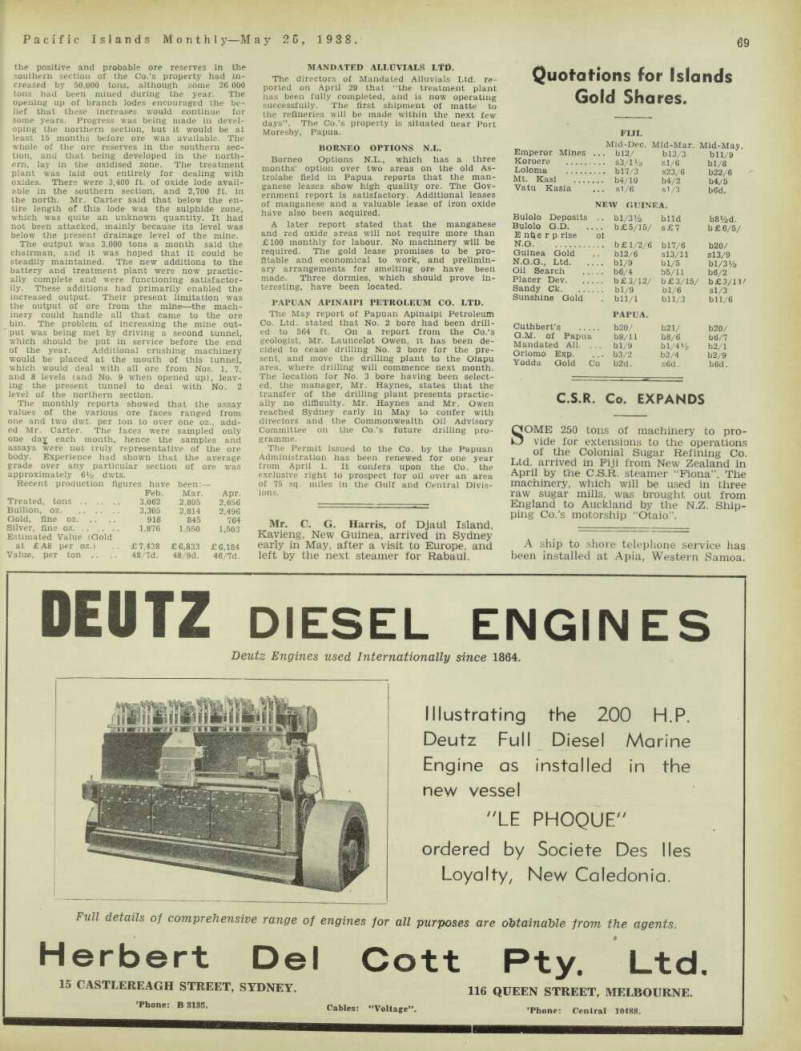
Gold Mines Of Papua Ltd.
GOLD MINES OF PAPUA LTD. reports that during April the plant, running at ap proximately half capacity crushed 1,375 tons ore and recovered gold valued at approximately £930. Most of the mechanical difficulties have been overcome, but metallurgic trouble is still being experienced, the residues carrying high gold values. The preliminary run to March 31 resulted in the treatment of 1,750 tons for gold valued at £1,150, with £350 worth remaining in the plant.
Cuthbert’S Misima Gold Mine Ltd.
At the annual meeting of Cuthbert’s Misima Gold Mine Ltd. in Sydney on April 29, the acting-chairman, Mr. H. G. Carter, said that
the positive and probable ore reserves in the southern section of the Co.’s property had in creased by 50,000 tons, although some 26 000 tons had been mined during the year. The opening up of branch lodes encouraged the be lief that these increases would continue for some years. Progress was being made in devel oping the northern section, but it would be at least 15 months before ore was available. The whole of the ore reserves in the southern sec tion, and that being developed in the north ern, lay in the oxidised zone. The treatment plant was laid out entirely for dealing with oxides. There were 3,400 ft. of oxide lode avail able in the southern section, and 2,700 ft. in the north. Mr. Carter said that below the en tire length of this lode was the sulphide zone, which was quite an unknown quantity. It had not been attacked, mainly because its level was below the present drainage level of the mine.
The output was 3,000 tons a month said the chairman, and it was hoped that it could be steadily maintained. The new additions to the battery and treatment plant were now practic ally complete and were functioning satisfactor ily. These additions had primarily enabled the increased output. Their present limitation was the output of ore from the mine—the mach inery could handle all that came to the ore bin. The problem of increasing the mine out put was being met by driving a second tunnel, which should be put in service before the end of the year. Additional crushing machinery would be placed at the mouth of this tunnel, which would deal with all ore from Nos. 1,7, and 8 levels (and No. 9 when opened up), leav ing the present tunnel to deal with No. 2 level of the northern section.
The monthly reports showed that the assay values of the various ore faces ranged from one and two dwt. per ton to over one oz., add ed Mr. Carter. The faces were sampled only one daj each month, hence the samples and assays were not truly representative of the ore body. Experience had shown that the average grade over any particular section of ore was approximately 6V 2 dwts.
Recent production figures have been:—
Mandated Alluvials Ltd,
The directors of Mandated Alluvials Ltd. re ported on April 29 that “the treatment plant has been fully completed, and is now operating successfully. The first shipment of matte to the refineries will be made within the next few days”. The Co.’s property is situated near Port Moresby, Papua.
Borneo Options N.L.
Borneo Options N.L., which has a three months’ option over two areas on the old As trolabe field in Papua reports that the man ganese leases show high quality ore. The Gov ernment report is satisfactory. Additional leases of manganese and a valuable lease of iron oxide have also been acquired.
A later report stated that the manganese and red oxide areas will not require more than £lOO monthly for labour. No machinery will be required. The gold lease promises to be pro fitable and economical to work, and prelimin ary arrangements for smelting ore have been made. Three dormies, which should prove in teresting, have been located.
Papuan Apinaipi Petroleum Co. Ltd.
The May report of Papuan Apinaipi Petroleum Co. Ltd. stated that No. 2 bore had been drill ed to 564 ft. On a report from the Co.’s geologist, Mr. Launcelot Owen, it has been de cided to cease drilling No. 2 bore for the pre sent, and move the drilling plant to the Olapu area, where drilling will commence next month.
The location for No. 3 bore having been select ed, the manager, Mr. Haynes, states that the transfer of the drilling plant presents practic ally no difficulty. Mr. Haynes and Mr. Owen reached Sydney early in May to confer with directors and the Commonwealth Oil Advisory Committee on the Co.’s future drilling pro gramme.
The Permit issued to the Co. by the Papuan Administration has been renewed for one year from April 1. It confers upon the Co. the exclusive right to prospect for oil over an area of 75 sq, miles in the Gulf and Central Divis ions.
Mr. C. G. Harris, of Djaul Island,
Kavieng, New Guinea, arrived in Sydney
early in May, after a visit to Europe, and left by the next steamer for Rabaul.
Feb. Mar. Apr.
Treated, tons 3,062 2.805 2,656 Bullion, oz 3,305 2,814 2.496 Gold, fine oz 918 845 764 Silver, fine oz 1,876 1,550 1,503 Estimated Value (Gold at £A8 per oz.) £7.438 £6,833 £6.184 Value, per ton .. .. 48/7d. 48/9d. 46/7d.
Advertisements & other items, p. 70 (1 item)
68
Pacific Islands Monthl y—M ay 25, 1938.
Quotations for Islands
Gold Shares.
Fiji.
Mid-Dec. Mid-Mar.
Mid-May.
Emperor Mines ... bl2/ bl3/3 bll/9 Koroere sl/6 bl/8 Loloma ... b!7/3 S23/6 b22/6 Mt. Kasi b4/2 b4/5 Vatu Kasia ... si/6 81/3 b6d.
New Guinea.
Bulolo Deposits .. b 1/3 Vi blld b8Vid.
Bulolo G.D. .. b £ 5/15/ s£7 b £ 6/5/ E nt} e r p rise of N.G . .. b£ 1/2/6 bl7/6 b20/ Guinea Gold bl2/6 S13/11 S13/9 N.G.G., Ltd. ... bl/9 bl/5 bl/3Vi Oil Search .. b6/4 b5/ll b6/2 Placer Dev. .. b£3/12/ b£3/15/ b£3/13/ Sandy Ck ,.. bl/9 bl/6 sl/3 Sunshine Gold . bll/1 bll/3 bll/6
Papua.
Cuthbert’s b20/ b21/ b20/ G.M. of Papua b9/ll b8/6 b6/7 Mandated All. . bl/9 b1/4Vi b2/l Oriomo Exp. ... b3/2 b2/4 b2/9 Yodda Gold Co b2d. s6d. b6d.
C.S.R. Co. Expands
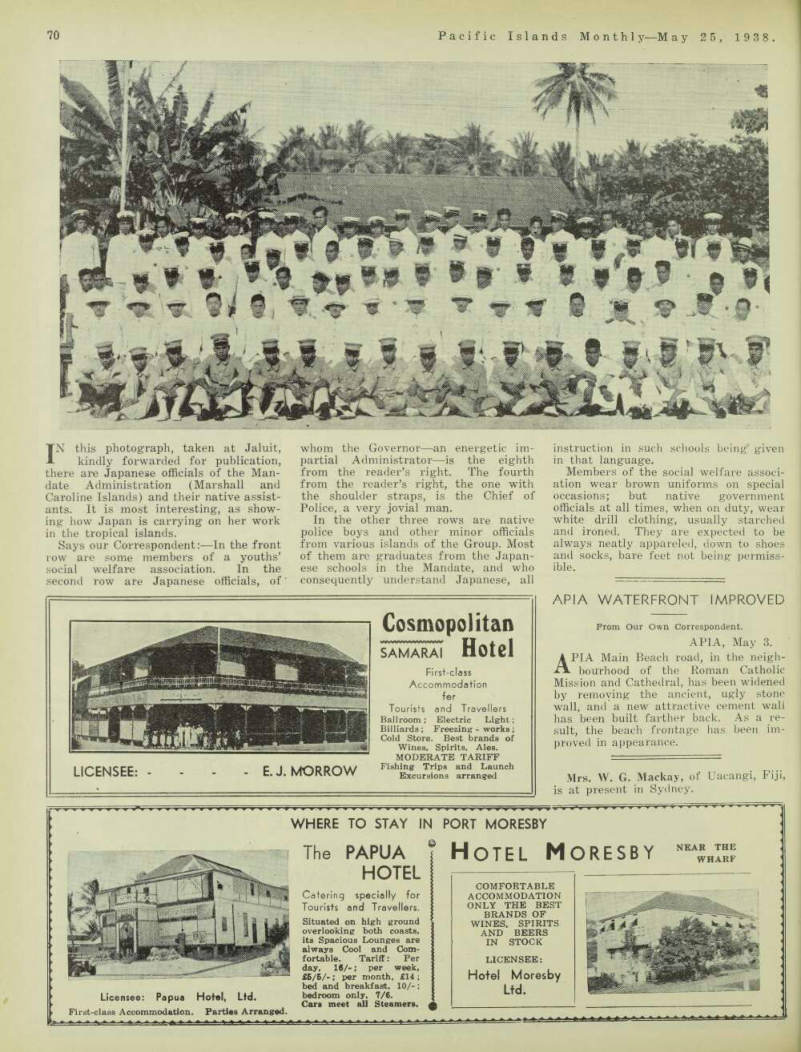
SOME 250 tons of machinery to pro vide for extensions to the operations of the Colonial Sugar Refining Co.
Ltd. arrived in Fiji from New Zealand in April by the C.S.R. steamer “Fiona”. The machinery, which will be used in three raw sugar mills, was brought out from England to Auckland by the N.Z. Ship ping Co.’s motorship “Otaio”.
A ship to shore telephone service has been installed at Apia, Western Samoa.
IN this photograph, taken at Jaluit, kindly forwarded for publication, there are Japanese officials of the Man date Administration (Marshall and Caroline Islands) and their native assist ants. It is most interesting, as show ing how Japan is carrying on her work in the tropical islands.
Says our Correspondent:—In the front row are some members of a youths’ social welfare association. In the second row are Japanese officials, of
whom the Governor—an energetic im partial Administrator—is the eighth from the reader’s right. The fourth from the reader’s right, the one with the shoulder straps, is the Chief of Police, a very jovial man.
In the other three rows are native police boys and other minor officials from various islands of the Group. Most of them are graduates from the Japan ese schools in the Mandate, and who consequently understand Japanese, all
instruction in such schools being given in that language.
Members of the social welfare associ ation wear brown uniforms on special occasions; but native government officials at all times, when on duty, wear white drill clothing, usually starched and ironed. They are expected to be always neatly appareled, down to shoes and socks, bare feet not being permiss ible.
Advertisements & other items, pp. 71-72 (2 items)
69
Pacific Islands Monthl y—M ay 26, 193 8.
Deutz Diesel Engines
Deutz Engines used Internationally since 1864.
Hil l IMS i Illustrating the 200 H.P.
Deutz Full Diesel Marine Engine as installed in the new vessel
"IE PHOQUE"
ordered by Societe Des lies Loyalty, New Caledonia.
Full details of comprehensive range of engines for all purposes are obtainable from the agents.
Herbert Del Cott Pty. Ltd.
15 CASTLEREAGH STREET, SYDNEY. H 6 QUEEN STREET, MELBOURNE.
'Phone: B 8135. Cables: « Vol age „ , phone; Centra , 1048g>
LICENSEE: -
- E.J. MORROW
Cosmopolitan
SAMARAI Hotel
First-class Accommodation for Tourists and Travellers Ballroom ; Electric Light; Billiards; Freezing - works ; Cold Store. Best brands of Wines, Spirits, Ales.
MODERATE TARIFF
Fishing Trips and Launch Excursions arranged
Apia Waterfront Improved
From Our Own Correspondent.
Apia, May 3.
APIA Main Beach road, in the neigh bourhood of the Roman Catholic Mission and Cathedral, has been widened by removing the ancient, ugly stone wall, and a new attractive cement wall has been built farther back. As a re sult, the beach frontage has been im proved in appearance.
Mrs. W. G. Mackay, of Uacangi, Fiji, is at present in Sydney.
Advertisements & other items, p. 72 (2 items)
70
Pacific Islands Monthl y—M ay 25, 1938.
Hotel Moresby
WHERE TO STAY IN PORT MORESBY
Licensee: Papua Hotel, Ltd.
First-class Accommodation. Parties Arranged.
The PAPUA
HOTEL
Catering specially for
Tourists and Travellers.
Situated on high ground overlooking both coasts, its Spacious Lounges are always Cool and Comfortable. Tariff: Per day, 16/-; per week, £6/5/-; per month, £l4 ; bed and breakfast, 10/-; bedroom only, 7/6.
Cars meet all Steamers. &
Hotel Moresby
NEAR THE
WHARF
COMFORTABLE
ACCOMMODATION
ONLY THE BEST
BRANDS OF
WINES. SPIRITS
AND BEERS
IN STOCK
LICENSEE;
Hotel Moresby
Ltd.
I
Outclassed!
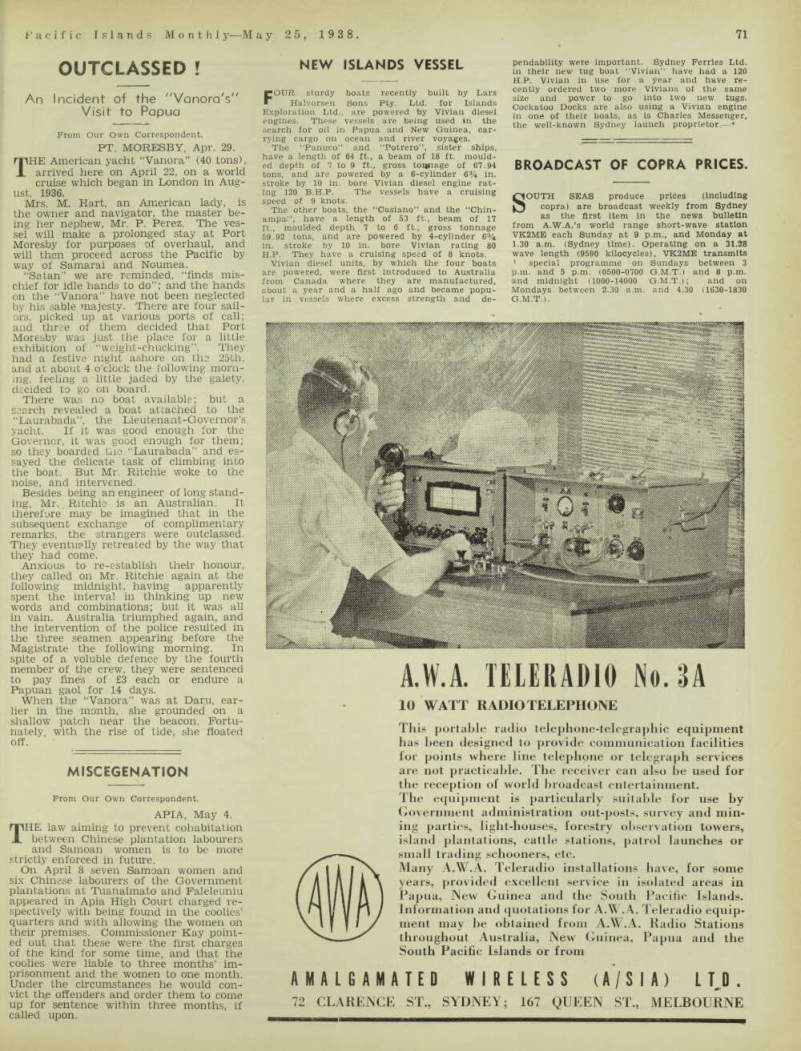
An Incident of the "Vanora's"
Visit to Papua
Prom Our Own Correspondent.
Pt. Moresby, Apr. 29.
THE American yacht “Vanora” (40 tons), arrived here on April 22, on a world cruise which began in London in Aug ust, 1936.
Mrs. M. Hart, an American lady, is the owner and navigator, the master be ing her nephew, Mr. P. Perez. The ves sel will make a prolonged stay at Port Moresby for purposes of overhaul, and will th,en proceed across the Pacific by way of Samarai and Noumea.
“Satan” we are reminded, “finds mis chief for idle hands to do”; and the hands on the “Vanora” have not been neglected by his sable majesty. There are four sail ors, picked up at various ports of call; and three of them decided that Port Moresby was just the place for a little exhibition of “weight-chucking’’. They had a festive night ashore on the 25th, and at about 4 o’clock the following morn ing, feeling a little jaded by the gaiety, decided to go on board.
There was no boat available; but a search revealed a boat attached to the “Laurabada”, the Lieutenant-Governor’s yach,t. If it was good enough for the Governor, it was good enough for them; so they boarded Lie “Laurabada” and es sayed the delicate task of climbing into the boat. But Mr. Ritchie woke to the noise, and intervened.
Besides being an engineer of long stand ing, Mr. Ritchie is an Australian. It therefore may be imagined that in the •subsequent exchange of complimentary remarks, the strangers were outclassed.
They eventually retreated by the way that they had come.
Anxious to re-establish their honour, they called on Mr. Ritchie again at the following midnight, having apparently spent the interval in thinking up new words and combinations; but it was all in vain. Australia triumphed again, and the intervention of the police resulted in the three seamen appearing before the Magistrate the following morning. In spite of a voluble defence by the fourth member of the crew, they were sentenced to pay fines of £3 each or endure a Papuan gaol for 14 days.
When th,e “Vanora” was at Dar.u, ear lier in the month, she grounded on a shallow patch near the beacon. Fortu nately, with the rise of tide, she floated off.
Miscegenation
From Our Own Correspondent.
Apia, May 4.
THE law aiming to prevent cohabitation between Chinese plantation labourers and Samoan women is to be more strictly enforced in future.
On April 8 seven Samoan women and six Chinese labourers of the Government plantations at Tuanaimato and Faleleuniu appeared in Apia High Court charged re spectively with being found in the coolies’ quarters and with allowing the women on their premises. Commissioner Kay point ed out that these were the first charges of the kind for some time, and that the coolies were liable to three months’ im prisonment and the women to one month.
Under the circumstances he would con vict th,e offenders and order them to come up for sentence within three months, if called upon.
New Islands Vessel
FOUR sturdy boats recently built by Lars Halvorsen Sons Pty. Ltd. for Islands Exploration Ltd., are powered by Vivian diesel engines. These vessels are being used in the search for oil in Papua and New Guinea, car rying cargo on ocean and river voyages.
The “Panuco” and “Potrero”, sister ships, have a length of 64 ft., a beam of 18 ft. mould ed depth of 7 to 9 ft., gross tonnage of 67.94 tons, and are powered by a 6-cylinder 6% in. stroke by 10 in. bore Vivian diesel engine rat ing 120 B.H.P. The vessels have a cruising speed of 9 knots.
The other boats, the “Casiano” and the “Chin ampa”, have a length of 53 ft., beam of 17 ft., moulded depth 7 to 6 ft., gross tonnage 59.92 tons, and are powered by 4-cylinder 6 3 A in. stroke by 10 in. bore Vivian rating 80 H.P. They have a cruising spe-id of 8 knots.
Vivian diesel units, by which the four boats are powered, were first introduced to Australia from Canada where they are manufactured, about a year and a half ago and became popu lar in vessels where excess strength and de
pendabllity were important. Sydney Ferries Ltd. in their new tug boat “Vivian” have had a 120 H.P. Vivian in use for a year and have re cently ordered two more Vivians of the same size and power to go into two new tugs.
Cockatoo Docks are also using a Vivian engine in one of their boats, as is Charles Messenger, the well-known Sydney launch proprietor.- *
Broadcast Of Copra Prices.
SOUTH SEAS produce prices (including copra) are broadcast weekly from Sydney as the first item in the news bulletin from A.W.A.’s world range short-wave station VK2ME each Sunday at 9 p.m., and Monday at 1.30 a.m. (Sydney time). Operating on a 31.28 wave length (9590 kilocycles), VK2ME transmits ' special programme on Sundays between 3 p.m. and 5 p.m. (0500-0700 G.M.T.) and 8 p.m. and midnight (1000-14000 G.M.T.); and on Mondays between 2.30 a.m. and 4.30 (1630-1830
G.M.T.).
Advertisements & other items, pp. 73-74 (3 items)
71
Pacific Islands Monthl y—M ay 25, 1938.
A.W.A. Teleradio No. Ba
10 WATT RADIOTELEPHONE
m This portable radio telephone-telegraphic equipment has been designed to provide communication facilities for points where line telephone or telegraph services are not practicable. The receiver can also be used for the reception of world broadcast entertainment.
The equipment is particularly suitable for use by Government administration out-posts, survey and mining parties, light-houses, forestry observation towers, island plantations, cattle stations, patrol launches or small trading schooners, etc.
Many A.W.A. Teleradio installations have, for some years, provided excellent service in isolated areas in Papua, New Guinea and the South Pacific Islands.
Information and quotations for A.W.A. Teleradio equipment may be obtained from A.W.A. Radio Stations throughout Australia, New Guinea, Papua and the South Pacific Islands or from
AMALGAMATED WIRELESS (A/SIA) LTD.
72 CLARENCE ST., SYDNEY; 167 QUEEN ST., MELBOURNE
AMMUNITION.
Levenson’s Ammunition & Rifles .22 Short (Case Lots 5,000), 21/ per 1,000. .22 Long Rifle (Case Cots 5,000), 28/6 per 1,000. Plus Tax.
Browning Automatic (.22 Short), Model 422, £4/5/ nett.
Electric Dry shavers for
240 A.C. El-
ectric supply. Write for full list.
“VICO” 75/.
Special price to traders. Write for prices. “Packard” 90/.
“Schick” £5/5/. With Universal Electric Kit 25/- extra.
All Bakelite R o u 1 e tte Wheels British * . 25/-.
Cloths 9/6, 12/6, 15/.
Other types of Novelties 35/, 38/6, 48/6. 65/, 75/, up to £l2/10/. Write for fullest particulars. Small Roulette glass tops with betting sheets, 3/6. In Wooden Types 12/6.
O' Electric Pore head Torch & Band. For Night Work ers, Bandsmen, Miners etc. 10/6.
Standard Bat teries.
•PRESTO”:
In Moulded Bakelite Handsome Case.
The world’s most outstand ing & Puzzling Trick.
You can master it in a jiffy. 2/6, with instructions. Pocket Size. It creates a furore.
They all want to know how it is done. AGENTS WANTED for this Rapid Seller. Not much larger than a safety-match box.
Ajantel Model Electric 240 volt A.C. Electric Radios in cabinets as illustrated £9/10/-, with 12 months guarantee. Floor Models, £l2/10/. Mantel Cabinets on!y2s/.
BULGIN’
Lightning Highest Grade Electric Solder Iron, 15/.
Heavy Duty Type, 22/6.
“Goldstone” Junior Electric Solder Irons, British, 4/6.
With Flex and 2-pin Plug.
Pocket Telescope & Com pass, Poun tain Pen size.
Coll apsible, High Grade Telescope, in Leather Case. 16/6. 6'e
k mQn-o-u)OfT
RUBBER CLAD
PERIPL
40 STROriQb 5o son to'- (00 FT Like-a-flash ‘Eliminoise’
Aerial Kit, for short or dual wave sets.
Aerial Pyrex type insulators, transposi ti o n blocks and 200 ft. aerial wire. 22/6. Eliminates unwanted aerial and hideous electrical noises from your dual-wave or short-wave set.
QUITS®
(sasai) (sSISXi) m ■h ’
ROLETTE. You back your fancy in the numbers and colors of three balls. The game ejects 3 colored balls. 55/. For homes, hotels clubs, etc. Complete with betting sheet and instructions. Send for Leaflet.
Everlasting All Metal Cigarette Makers. Makes Cigarettes just like the factory, in a jiffy. English make; Vest Pocket size 6/6.
High tone buzzer for Morse Code f/' Work as illustrated 3/6, other 2/6, 3/9 7/6. Morse Keys 12/6 & 19/0.
Pickup Heads, fit all standard Gramophone tone ental 10/6, 12/6.
English Cosmocord 11/6, 19/6.
English “Goldring” 16/6, 18/6, 19/6, with selfcontained Volume Control 21/and 25/- with separate volume control.
“Totem”, the newest and most thrilling Race Game for Home, parties, clubs, hotels, billiardrooms, etc., 21/-. Write for leaflet French-made Black Pegamoidcovered Binoculars, Black Japanned Mounts and Tubes. Fitted with Adjustable Jointed Bars, 45/-, or Fixed Bar, 42/-. Write for full illustrated leaflet.
Build or buy assembled Lakes 1-valve All-wave Battery-operated Radio. Plug in coils for all wave lengths. Coils ready made. Easiway charts, 6d. Free with kit.
Parts 40/1, Valve 12/, Battery 11/9, Phones 30/, complete and built £5.
Hi Buy assembled or build the Air Patrol 2 - valve Battery - operated Radio for all short-wave stations and broadcasts. Easy to operate, change over switch. All parts £4/1/6, Valves 28/9, Batteries £2/15/9, Phones 30/-, Speaker 21/3.
The set assembled and complete, £l2/14/9. Easiway Charts 6d.
G r a phoscope |B/6. With it you can draw anything from any copy.
Fo cussing Torches, 1,500 ft., 5-cell. 6/6 “Cosmocord” British 240 Volt AC Electric Gramophone Motor and all turntable fittings, 39/6.
Valves; we guarantee a cheaper price for any replacement. Just send along your order.
Batteryless Hand Holding Microphone for speech or music, 45/- value for 22/6. \UA coy/ 00 As illustrated. Hand Holding Microphone with long lead fitted. Splendid Reproducer.
Excel lent English Mic ropho ne.
Table Model, with selfcontained pre - amplifier Unit in Base: 39/6.
These Microphones suit all sets. The leads plug into the Pickup terminals of the set.
Write for full Illustrated list of the finest range of microphones available.
Morse Code Keys. As illustrated, Ad- 12/6. justable all ways, Long or S h ort Tappers.
P.M.G. Heavy Brass Pitting Type, 19/6. P.M.G. Type Sounder, 35/. English P.M.G.
Surplus Stock. High Grade Morse Code Set with Sullivan Headphones and Buzzer—good as new, 38/6. Buzzers 2/6, 3/9.
High Tone Adjustable Profes sional type, 7/6.
“Radio Moderne”. The Great est Battery Operated Dual Wave Radio Made. No idle boast. A real and established fact. “Radio Moderne” is specially designed for the Island trade £22/10/. Send for the latest illustrated leaflet.
COSMOCOBD'
25 ‘Like a Flash” British make Gramophone Pickups complete Richards, just arrived 25/- “Cosmocord” 25/- “Cosmocord” De Luxe 32/6 “Cosmocord” high definition 88/6 "Cosmocord” Super de Luxe 45/- Amplion (English) 28/6 B.T.H. bakelite models 32/6 Build or buy ready made the Linguist 8, all-World Battery Operated Radio. Cover All Wave Bands Parts 58/4; batteries, 19/; Valves, 51/6; Phones, 32/6; Speaker, 20/. If to be assembled by us add 30/extra. Charts, 6d.
LEVENSON S RADIO
GAMES, NOVELTIES AND HOBBIES Totemand
226 PITT STREET. SYDNEY gdda and
Manufacturers, Importers, and Exporters.
Branches: Radio Cheapside, 240 a Pitt St.
N.S.W., AUSTRALIA -wwwwvww Cable address: "Leveradioh.” Goods forwarded V.P.P. or Sight Draft. Satisfaction, and Service Guaranteed. We can supply by mail all General Merchandise at a Better Price. Quotations with pleasure.
Please add freight and packing. Write for full list of interesting leaflets of Games, Hobbies, Novelties, and Electrical Goods.
Write for Punch Board Leaflets
72
Pacific Islands Monthl y—M ay 25, 1938.
Australian Short Wave
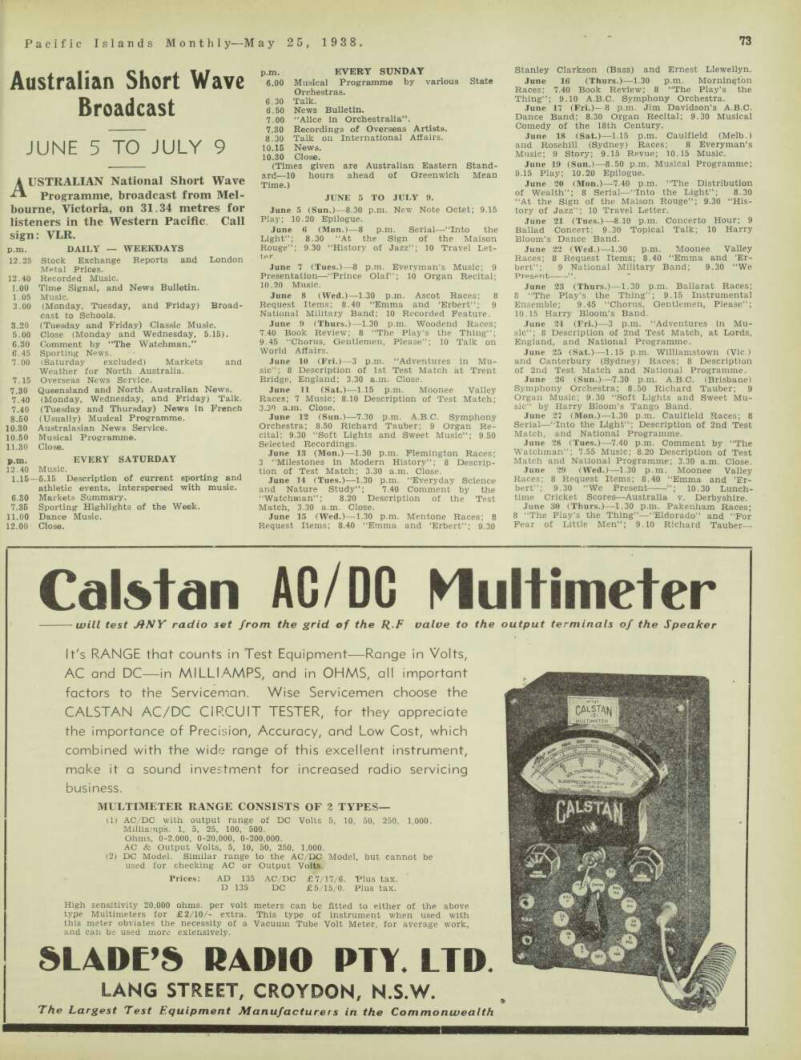
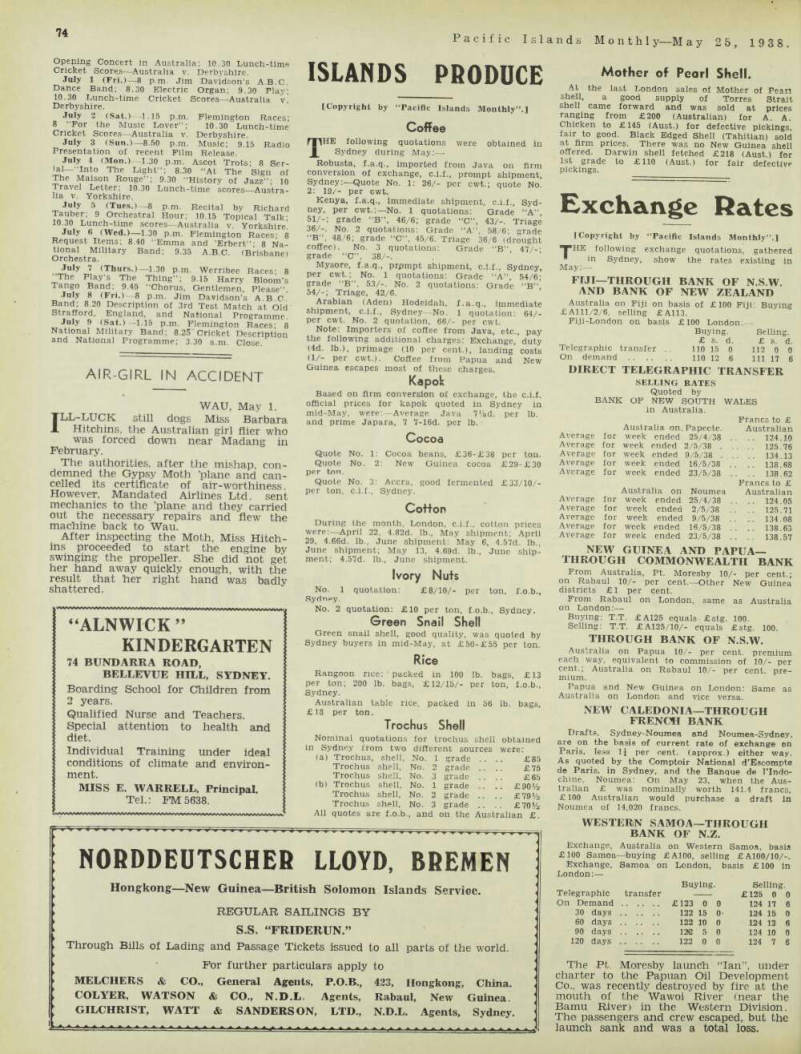
Broadcast
June 5 To July 9
AUSTRALIAN National Short Wave
Programme, broadcast from Mel
bourne, Victoria, on 31.34 metres for
listeners in the Western Pacific. Call
sign: VLR.
P.M. Daily Weekdays
12.25 Stock Exchange Reports and London Metal Prices. 12.40 Recorded Music. 1.00 Time Signal, and News Bulletin. 1.05 Music. 3.00 (Monday, Tuesday, and Friday) Broad cast to Schools. 3.20 (Tuesday and Friday) Classic Music. 5.00 Close (Monday and Wednesday, 5.15). 6.30 Comment by “The Watchman.” 6.45 Sporting News. 7.00 (Saturday excluded) Markets and Weather for North Australia. 7.15 Overseas News Service. 7.30 Queensland and North Australian News. 7.40 (Monday, Wednesday, and Friday) Talk. 7.40 (Tuesday and Thursday) News in French 8.50 (Usually) Musical Programme. 10.30 Australasian News Service. 10.50 Musical Programme. 11.30 Close.
P.M. Every Saturday
12.40 Music. 1.15—5.15 Description of current sporting and athletic events, interspersed with music. 6.30 Markets Summary. 7.35 Sporting Highlights of the Week. 11.00 Dance Music. 12.00 Close.
P.M. Every Sunday
6.00 Musical Programme by various State Orchestras. 6.30 Talk. 6.50 News Bulletin. 7.00 “Alice in Orchestralia”. 7.30 Recordings of Overseas Artists. 8.30 Talk on International Affairs. 10.15 News. 10.30 Close. (Times given are Australian Eastern Stand ard —10 hours ahead of Greenwich Mean Time.)
June 5 To July 9.
June 5 (Sun.) —8.30 p.m. New Note Octet; 9.15 Play; 10.20 Epilogue.
June 6 (Mon.) —8 p.m. Serial —“Into the Light”; 8.30 “At the Sign of the Maison Rouge”; 9-30 “History of Jazz”; 10 Travel Let ter.
June 7 (Tues.) —8 p.m. Everyman’s Music; 9 Presentation—“ Prince Olaf”; 10 Organ Recital; 10.20 Music.
June 8 (Wed.) —1.30 p.m. Ascot Races; 8 Request Items; 8.40 “Emma and ’Erbert”; 9 National Military Band; 10 Recorded Feature.
June 9 (Thurs.) —1.30 p.m. Woodend Races; 7.40 Book Review; 8 “The Play’s the Thing”; 9.45 “Chorus, Gentlemen, Please”; 10 Talk on World Affairs.
June 10 (Fri.) —3 p.m. “Adventures in Mu sic”; 8 Description of Ist Test Match at Trent Bridge, England; 3.30 a.m. Close.
June 11 (Sat.) —1.15 p.m. Moonee Valley Races; 7 Music; 8.10 Description of Test Match; 3.30 a.m. Close.
June 12 (Sun.) —7.30 p.m. A.B.C. Symphony Orchestra; 8.50 Richard Tauber; 9 Organ Re cital; 9.30 “Soft Lights and Sweet Music”; 9.50 Selected Recordings.
June 13 (Mon.) —1.30 p.m. Plemington Races; 3 “Milestones in Modern History”; 8 Descrip tion of Test Match; 3.30 a.m. Close.
June 14 (Tues.) —1.30 p.m. “Everyday Science and Nature Study”; 7.40 Comment by the “Watchman”: 8.20 Description of the Test Match, 3.30 a.m. Close.
June 15 (Wed.) —1.30 p.m. Mentone Races; 8 Request Items; 8.40 “Emma and ’Erbert”; 9.30
Stanley Clarkson (Bass) and Ernest Llewellyn.
June 16 (Thurs.) —1.30 p.m. Morningtbn Races: 740 Book Review; 8 “The Play’s the Thing’’; 9.10 A.B.C. Symphony Orchestra.
June 17 (Fri.) —8 p.m. Jim Davidson’s A.B.C.
Dance Band; 8.30 Organ Recital; 9.30 Musical Comedy of the 18th Century.
June 18 (Sat.) —1.15 p.m. Caulfield (Melb.) and Rosehill (Sydney) Races; 8 Everyman’s Music; 9 Story; 9.15 Revue; 10.15 Music.
June 19 (Sun.) —8.50 p.m. Musical Programme; 9.15 Play; 10.20 Epilogue.
June 20 (Mon.) —7.40 p.m. “The Distribution of Wealth’’; 8 Serial—“lnto the Light”; 8.30 “At the Sign of the Maison Rouge”; 9.30 “His tory of Jazz”; 10 Travel Letter.
June 21 (Tues.) —8.10 p.m. Concerto Hour; 9 Ballad Concert: 9.30 Topical Talk; 10 Harry Bloom’s Dance Band.
June 22 (Wed.) —1.30 p.m. Moonee Valley Races; 8 Request Items; 8.40 “Emma and ’Er bert”; 9 National Military Band; 9.30 “We Present- •”.
June 23 (Thurs.) —1.30 p.m. Ballarat Races; 8 “The Play’s the Thing”; 9.15 Instrumental Ensemble: 9.45 “Chorus, Gentlemen, Please”; 10.15 Harry Bloom’s Band.
June 24 (Fri.) —3 p.m. “Adventures in Mu sic”; 8 Description of 2nd Test Match, at Lords, England, and National Programme, June 25 (Sat.)—l.ls p.jn. Williamstown (Vic.) and Canterbury (Sydney) Races; 8 Description of 2nd Test Match and National Programme.
June 26 (Sun.) —7.30 p.m. A.B.C. (Brisbane) Symphony Orchestra; 8.50 Richard Tauber; 9 Organ Music; 9.30 “Soft Lights and Sweet Mu sic” by Harry Bloom’s Tango Band.
June 27 (Mon.) —1.30 p.m. Caulfield Races; 8 Serial—“lnto the Light”; Description of 2nd Test Match, and National Programme.
June 28 (Tues.) —7.40 p.m. Comment by “The Watchman”; 7.55 Music; 8.20 Description of Test Match and National Programme; 3.30 a.m. Close.
June 29 (Wed.) —1.30 p.m. Moonee Valley Races; 8 Request Items; 8.40 “Emma and ’Er bert”; 9.30 “We Present 10.30 Lunch time Cricket Scores—Australia v. Derbyshire.
June 30 (Thurs.) —1.30 p.m. Pakenham Races; 8 “The Play’s the Thing”—“Eldorado” and “For Pear of Little Men”; 9.10 Richard Tauber
Opening Concert in Australia: 10.30 Lunch-time Cricket Scores—Australia v. Derbyshire.
July 1 (Fri.)—B pm. Jim Davidson’s A.B.C.
Dance Band; 8.30 Electric Organ; 9.30 Play; 10.30 Lunch-time Cricket Scores—Australia v.
Derbyshire.
July 2 (Sat.) —1.15 p.m. Flemington Races; 8 “For the Music Lover”; 10.30 Lunch-time Cricket Scores—Australia v. Derbyshire.
July 3 (Sun.) —8.50 p.m. Music; 9.15 Radio Presentation of recent Film Release.
July 4 (M0n.)—1.30 p.m. Ascot Trots: 8 Ser ial—"lnto The Light”; 8.30 “At The Sign of The Maison Rouge”: 9.30 “History of Jazz”; 10 Travel Letter; 10.30 Lunch-time scores—Austra lia v. Yorkshire.
July 5 (Tues.)—B p.m. Recital by Richard Tauber; 9 Orchestral Hour; 10.15 Topical Talk; 10.30 Lunch-time scores—Australia v. Yorkshire'.
July 6 (Wed.)—l.3o p.m. Flemington Races; 8 Request Items; 8.40 “Emma and ’Erbert”* 8 Na tional Military Band; 9.35 A.B.C. (Brisbane) Orchestra.
July 7 (Thurs.)—l.3o p.m. Werribee Races - 8 “The Play’s The Thing”; 9.15 Harry Bloom’s Tango Band; 9.45 “Chorus, Gentlemen, Please”.
July 8 (Fri.)—B p.m. Jim Davidson’s A.B.C Band; 8.20 Description of 3rd Test Match at Old Strafford. England, and National Programme July 9 (Sat.)-1.15 p.m. Flemington Races; 8 National Military Band; 8.25 Cricket Description and National Programme; 3.30 a.m. Close
Advertisements & other items, p. 75 (2 items)
73
Pacific Islands Monthl y—M ay 25, 1938.
Cal&tan AG/DG Multimeter
will test ANY radio set from the grid of the R.F valve to the output terminals of the Speaker It's RANGE that counts in Test Equipment—Range in Volts, AC and DC—in MILLIAMPS, and in OHMS, all important factors to the Serviceman. Wise Servicemen choose the CALSTAN AC/DC CIRCUIT TESTER, for they appreciate the importance of Precision, Accuracy, and Low Cost, which combined with the wide range of this excellent instrument, make it a sound investment for increased radio servicing business.
MULTIMETER RANGE CONSISTS OF 2 TYPES—
(I) AC/DC with output range of DC Volts 5, 10, 50, 250, 1,000.
Mxlliamps. 1,5, 25, 100, 500.
Ohms, 0-2,000, 0-20,000, 0-200,000.
AC Si Output Volts, 5, 10, 50, 250, 1,000. (2) DC Model. Similar range to the AC/DC Model, but cannot be used for checking AC or Output Volts.
Prices; AD 135 AC/DC £7/17/6. Plus tax.
D 135 DC £5/15/0. Plus tax.
High sensitivity 20,000 ohms, per volt meters can be fitted to either of the above type Multimeters for £2/10/- extra. This type of instrument when used with this meter obviates the necessity of a Vacuum Tube Volt Meter, for average work, and can be used more extensively.
SLADE’S RADIO PTY. LTD.
LANG STREET, CROYDON, N.S.W.
The Largest Test Equipment Manufacturers in the Commonwealth S
Air-Girl In Accident
WAU, May 1.
ILL-LUCK still dogs Miss Barbara Hitchins, the Australian girl flier who was forced down near Madang in February.
The authorities, after the mishap, con demned the Gypsy Moth ’plane and can celled its certificate of air-worthiness.
However, Mandated Airlines Ltd. sent mechanics to the ’plane and they carried out the necessary repairs and flew the machine back to Wau.
After inspecting the Moth, Miss Hitch ins proceeded to start the engine by swinging the propeller. She did not get her hand away quickly enough, with the result that her right hand was badly shattered.
Islands Produce
[Copyright by “Pacific Islands Monthly”.]
Coffee
THE following quotations were obtained in Sydney during May:— Robusta, f.a.q., imported from Java on firm conversion of exchange, c.i.f., prompt shipment, Sydney:—Quote No. 1: 26/- per cwt.; quote No. 2: 18/- per cwt.
Kenya, f.a.q., immediate shipment, c.i.f., Syd ney, per cwt.:—No. 1 quotations: Grade “A”, 51/-; grade “B”, 46/6; grade “C”, 43/-. Triage 36/-. No. 2 quotations: Grade “A”, 58/6; grade “B“, 48/6; grade “C”, 45/6. Triage 36/6 (drought coffee). No. 3 quotations: Grade “B” 47/-grade “C”, 38/-.
Mysore, f.a.q., prpmpt shipment, c.i.f., Sydney, per cwt.; No. 1 quotations: Grade “A”, 54/6; grade “B”, 53/-. No. 2 quotations; Grade “B” 54/-; Triage, 42/6.
Arabian (Aden) Hodeidah, f.a.q., immediate shipment, c.i.f., Sydney-No. 1 quotation; 64/per cwt. No. 2 quotation, 66/- per cwt.
Note: Importers of coffee from Java, etc., pay the following additional charges: Exchange, duty (4d. lb.), primage (10 per cent.), landing costs (1/- per cwt.). Coffee from Papua and New Guinea escapes most of these charges.
Kapok
Based on firm conversion of exchange, the c.i.f. official prices for kapok quoted in Sydney in mid-May, were:—Average Java IVad. per lb. and prime Japara, 7 7-16 d. per lb.
Cocoa
Quote No. 1: Cocoa beans, £36-£3B per ton.
Quote No. 2: New Guinea cocoa £29-£3O per ton.
Quote No. 3; Accra, good fermented £33/10/per ton, c.i.f., Sydney.
Cotton
During the month, London, c.i.f., cotton prices were:—April 22, 4.82 d. Ib.. May shipment; April 29. 4.66 d. lb., June shipment: May 6,4.57 d. lb., June shipment; May 13, 4.69 d. lb., June ship ment; 4.57 d. lb., June shipment.
Ivory Nuts
No. 1 quotation: £B/10/- per ton, f.0.b., Sydney.
No. 2 quotation: £lO per ton, f.0.b., Sydney.
Green Snail Shell
Green snail shell, good quality, was quoted by Sydney buyers in mid-May, at £5O-£55 per ton.
Rice
Rangoon nee: packed in 100 lb. bags, £l3 per ton; 200 lb. bags, £l2/15/- per ton, f.0.b., Sydney.
Australian table rice, packed in 56 lb. bags, £lB per ton.
Trochus Shell
Nominal quotations for trochus shell obtained in Sydney from two different sources were: (a) Trochus, shell. No. 1 grade .. £B5 Trochus shell, No. 2 grade .. .. £75 Trochus shell, No. 3 grade .. .. £65 (b) Trochus shell, No. 1 grade .. £9OV 2 Trochus shell, No. 2 grade .. .. £79V 2 Trochus shell, No. 3 grade .. £7OV 2 All quotes are f.0.b., and on the Australian £.
Mother of Pearl Shell.
At the last London sales of Mother of Pean shell, a good supply of Torres Strait shell came forward and was sold at prices ranging from £2OO (Australian) for A. A.
Chicken to £145 (Aust.) for defective pickings, fair to good. Black Edged Shell (Tahitian) sold at firm prices. There was no New Guinea shell offered. Darwin shell fetched £2lB (Aust.) for Ist grade to £llO (Aust.) for fair defective pickings.
Exchange Rates
[Copyright by “Pacific Islands Monthly’’.] ■THE following exchange quotations, gathered in Sydney, show the rates existing in May:—•
Fiji—Through Bank Of N.S.W.
And Bank Of New Zealand
Australia on Fiji on basis of £lOO Fiji: Buying £AIII/2/6, selling £AII3.
Fiji-London on basis £lOO London:—
Direct Telegraphic Transfer
Selling Rates
Quoted by
Bank Of New South Wales
in Australia.
New Guinea And Papua
Through Commonwealth Bank
Prom Australia, Pt. Moresby 10/- per cent.; on Rabaul 10/- per cent.—Other New Guinea districts £1 per cent.
From Rabaul on London, same as Australia on London:— Buying; T.T. £AI2S equals £stg. 100.
Selling: T.T. £AI2S/10/- equals £stg. 100.
Through Bank Of N.S.W.
Australia on Papua 10/- per cent, premium each way, equivalent to commission of 10/- per cent.; Australia on Rabaul 10/- per cent, pre mium.
Papua and New Guinea on London: Same as Australia on London and vice versa.
New Caledonia—Through
French Bank
Drafts. Sydney-Noumea and Noumea-Sydney, are on the basis of current rate of exchange on Paris, less If per cent, (approx.) either way.
As quoted by the Comptoir National d’Escompte de Paris, in Sydney, and the Banque de ITndo chine, Noumea: On May 23, when the Aus tralian £ was nominally worth 141.4 francs, £ 100 Australian would purchase a draft in Noumea of 14,020 francs.
Western Samoa—Through
Bank Of N.Z.
Exchange, Australia on Western Samoa, basis £lOO Samoa—buying £AIOO, selling £AIOO/10/~.
Exchange, Samoa on London, basis £lOO in London:—
The Pt. Moresby launch “lan”, under charter to the Papuan Oil Development Co., was recently destroyed by fire at the mouth of the Wawoi River (near the Bamu River) in the Western Division.
The passengers and crew escaped, but the launch sank and was a total loss.
Buying.
Selling. £ s. d. £ s. d.
Telegraphic transfer .. 110 15 0 112 0 0 On demand 110 12 6 111 17 6
Average for Australia on week ended Papeete. 25/4/38 Francs to £ Australian . . .. 124.10 Average for week ended 2/5/38 . .. .. 125.76 Average for week ended 9/5/38 . . . .. 134.13 Average for week ended 16/5/38 . . .. 138.68 Average for week ended 23/5/38 . . .. 138.62 Average for Australia on week ended Noumea 25/4/38 Francs to £ Australian . . .. 124.05 Average for week ended 2/5/38 . . .. 125.71 Average for week ended 9/5/38 . . ... 134.08 Average for week ended 16/5/38 . . .. 138.63 Average for week ended 23/5/38 . . .. 138.57
Buying. Selling.
Telegraphic transfer £ 125 0 0 On Demand £123 0 0 124 17 6 30 days 122 15 0- 124 15 0 60 days 122 10 0 124 12 6 90 days 122 5 0 124 10 0 120 days 122 0 0 124 7 6
Advertisements & other items, p. 76 (2 items)
74
Pacific Islands Monthl y—M ay 25, 1938
Norddedtscher Lloyd, Bremer
“ALNWICK ”
KINDERGARTEN
74 BUNDARRA ROAD,
BELLEVUE HILL, SYDNEY.
Boarding School for Children from 2 years.
Qualified Nurse and Teachers.
Special attention to health and diet.
Individual Training under ideal conditions of climate and environment.
MISS E. WARRELL, Principal.
Tel.: FM 5638.
NORDDEDTSCHER LLOYD, BREMER
Hongkong—New Guinea—British Solomon Islands Service.
REGULAR SAILINGS BY
S.S. “FRIDERUN.”
Through Bills of Lading and Passage Tickets issued to all parts of the world.
For further particulars apply to MELCHERS & CO., General Agents, P. 0.8., 423, Hongkong, China.
COLYER, WATSON & CO., N.D.L. Agents, Rabaul, New Guinea.
GILCHRIST, WATT & SANDERSON, LTD., N.D.L. Agents, Sydney.
Market Quotations
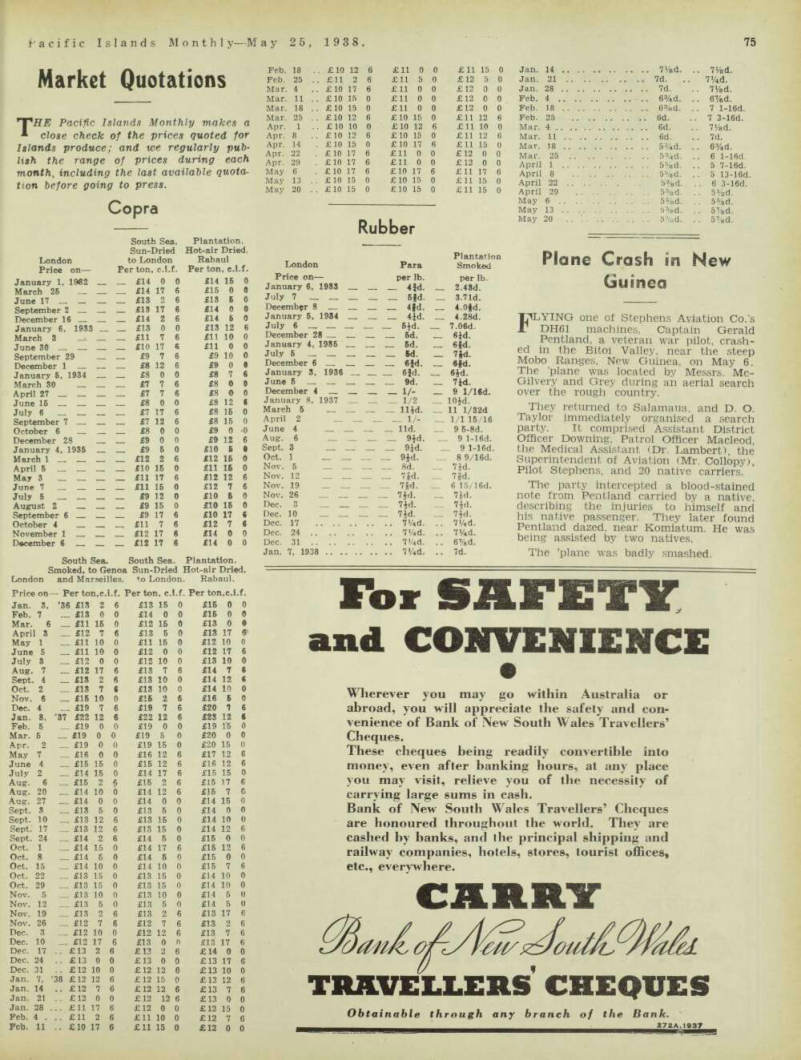
THE Pacific Islands Monthly makes a close check of the prices quoted for Islands produce; and we regularly pub lish the range of prices during each month, including the last available quota tion before going to press.
Jan. 14 TVs d. .. 7Vad.
Jan. 21 7d. . 7V 4 d.
Jan. 28 7d. .. 7Vad.
Feb. 4 6%d. .. 67ad.
Feb. 18 6%d. .. 7 l-16d.
Feb. 25 ... 6d. .. 7 3-16d.
Mar. 4 6d. .. 7>/ad.
Mar. 11 6d. .. 7d.
Mar. 18 53/ 4 d. .. 6%d.
Mar. 25 ,. ..
April 1 5 5 /ad. .. 5 7-16d.
April 8 ... 5 5 /ad. .. 5 13-16d.
April 22 . . . 5%d. .. 6 3-16d.
April 29 .. . . 5 5/ 8 d. .. 5Vad.
May 6 5 3 ad. . . 5 3/ ad.
May 13 5%d. . . 5 7 /ad.
May 20 . . . 53'ad. .. 5 7 / 8 d.
Feb. 18 £10 12 6 £11 0 0 £11 15 0 Feb. 25 . £11 2 6 £11 5 0 £12 5 0 Mar. 4 £10 17 6 £11 0 0 £12 0 0 Mar. 11 .. £10 15 0 £11 0 0 £12 0 0 Mar. 18 . £10 15 0 £11 0 0 £12 0 0 Mar. 25 .. £10 12 6 £10 15 0 £11 12 6 Apr. 1 £10 10 0 £10 12 6 £11 10 0 Apr. 8 £10 12 6 £10 15 0 £11 12 6 Apr. 14 £10 15 0 £10 17 6 £11 15 0 Apr. 22 £10 17 6 £11 0 0 £12 0 0 Apr. 29 £10 17 6 £11 0 0 £12 0 0 May 6 £10 17 6 £ in 17 6 £11 17 6 May 13 .. £10 15 0 £10 15 0 £11 15 0 May 20 £10 15 0 £10 15 0 £11 15 0
Rubber
Plantation London Para Smoked Price onper lb. per lb.
January 6, 1988 4*d. 2.43d.
July 7 — 6|d. - „ 3.71d.
December 8 4|d. 4.0|d.
January 5, 1984 . 4jd. 4.28d.
July 6 . 5*d. 7.06d.
December 28 6d. 6Jd.
January 4, 1985 5d. . , 6|d.
July 5 Sd. 7|d.
December 6 6|d. «fd.
January 8, 1936 . 6|d. 6 id.
June 5 9d. 7Jd.
December 4 — — 1/- 9 l/l«d.
January 8, 1937 1/2 10id.
March 6 Hid. 11 l/32d April 2 — 1/- 1/1 16/16 June 4 ... lid. 9 5-8d.
Aug. 6 9*d. 9 l-16d.
Sept. 3 ... 1M ... 9}d. 9 l-16d.
Oct. 1 .. 9}d. 8 9/16d.
Nov. 5 ... 8d. 7*d.
Nov. 12 — 7 |d. 7fd.
Nov. 19 — 7|d. 6 15/16d.
Nov. 26 ... ... 7id. — 7Jd.
Dec. 3 — ?id. 7id.
Dec. 10 ... 7|d. 7id.
Dec. 17 .. 7‘/id. . . 7V 4 d.
Dec. 24 .. .. 7‘/ 4 d. . . 7V 4 d.
Dec. 31 .. .. 7‘/id. ey 8 d.
Jan. 7. 1938 .. 7 ‘/id. . . 7d.
Copra
South Sea.
Plantation, Sun-Dried Hot-air Dried, London to London Rabaul Price on— Per ton, c.i.f.
Per ton l, c.i.f.
January 1. 1962 £14 0 0 £14 15 0 March 25 £14 17 6 £15 0 0 June 17 . ,, £13 2 6 £18 6 0 September 2 — £13 17 6 £14 0 0 December 16 £14 2 6 £14 6 0 January 6, 1933 £13 0 0 £18 12 6 March 3 * £11 7 6 £11 10 0 June 30 £10 17 6 £11 0 0 September 29 £9 7 6 £9 10 0 December 1 , £8 12 6 £9 0 9 January 5, 1934 £8 0 0 £8 7 6 March 30 , £7 7 6 £8 0 0 April 27 . £7 7 6 £8 0 0 June 15 £8 0 0 £8 12 6 July 6 £7 17 6 £8 16 0 September 7 — £7 12 6 £8 15 0 October 6 £8 0 0 £9 0 •0 December 28 £9 0 0 £9 12 6 January 4, 1936 £9 5 0 £10 6 • March 1 £12 2 6 £12 15 0 April 6 . £10 16 0 £11 16 0 May 3 £11 17 6 £12 12 6 June 7 £11 15 0 £12 7 6 July 6 - £9 12 0 £10 6 0 August 2 £9 15 0 £10 16 0 September 6 — £9 17 6 £10 17 « October 4 £11 7 6 £12 7 6 November 1 £12 17 6 £14 0 0 December 6 — — £12 17 6 £14 0 0 South Sea.
South Sea.
Plantation.
Smoked, to Genoa Sun-Dried Hot-air Dried, London and Marseilles. to London.
Rabaul.
Price on — Per ton.c.i.f. Per ton. c.I.f. Per ton.c.i.f.
Jan. 3, ’ 36 £18 2 6 £13 15 0 £15 0 0 Feb. 7 £13 0 0 £14 0 0 £15 0 0 Mar. 6 ... £11 16 0 £12 16 0 £13 0 0 April 8 £12 7 6 £13 5 0 £18 17 6 May 1 £11 10 0 £11 15 0 £12 10 0 June 5 £11 10 0 £12 0 0 £12 17 6 July 3 £12 0 0 £12 10 0 £13 10 0 Aug. 7 £12 17 6 £13 7 6 £14 7 6 Sept. 4 £18 2 6 £18 10 0 £14 12 6 Oct. 2 £18 7 6 £13 10 0 £14 10 0 Nov. 6 £15 10 0 £16 2 6 £16 6 0 Dec. 4 £19 7 6 £19 7 6 £20 7 6 Jan. 8. *37 £22 12 6 £22 12 6 £28 12 6 Feb. 5 ... £19 0 0 £19 0 0 £19 15 0 Mar. 5 ... £19 0 0 £19 5 0 £20 0 0 Apr. 2 £19 0 0 £19 15 0 £20 15 0 May 7 £16 0 0 £16 12 6 £17 12 6 June 4 £15 15 0 £15 12 6 £16 12 6 July 2 £14 15 0 £14 17 6 £15 15 0 Aug. 6 .._ £15 2 6 £16 2 6 £15 17 6 Aug. 20 £14 10 0 £14 12 6 £15 7 6 Aug. 27 £14 0 0 £14 0 0 £14 16 0 Sept. 3 £18 5 0 £13 5 0 £14 0 0 Sept. 10 £13 12 6 £13 15 0 £14 10 0 Sept. 17 £13 12 6 £13 15 0 £14 12 6 Sept. 24 — £14 2 6 £14 5 0 £15 0 0 Oct. 1 £14 15 0 £14 17 6 £15 12 6 Oct. 8 £14 5 0 £14 6 0 £15 0 0 Oct. 15 £14 10 0 £14 10 0 £15 7 6 Oct. 22 £13 15 0 £13 15 0 £14 10 0 Oct. 29 — £13 15 0 £13 15 0 £14 10 0 Nov. 5 ..._ £13 10 0 £13 10 0 £14 5 0 Nov. 12 £13 5 0 £13 5 0 £14 5 0 Nov. 19 ... £13 2 6 £13 2 6 £13 17 6 Nov. 26 £12 7 6 £12 7 6 £13 2 6 Dec. 3 ... £12 10 0 £12 12 6 £13 7 6 Dec. 10 £12 17 6 £13 0 0 £13 17 6 Dec. 17 . . £13 2 6 £13 2 6 £14 0 0 Dec. 24 . £13 0 0 £13 0 0 £13 17 6 Dec. 31 . £12 10 0 £12 12 6 £13 10 0 Jan. 7, ’38 £12 12 6 £12 15 0 £13 12 6 Jan. 14 . . £12 7 6 £12 12 6 £13 7 6 Jan. 21 . £12 0 0 £12 12 6 £13 0 0 Jan. 28 .. . £11 17 6 £12 0 0 £12 15 0 Feb. 4 . . . £11 2 6 £11 10 0 £12 7 6 Feb. 11 . . £10 17 6 £11 15 0 £12 0 0
Plane Crash in New
Guinea
FLYING one of Stephens Aviation Co.'s DH61 machines, Captain Gerald Pentland, a veteran war pilot, crash ed in the Bitoi Valley, near the steep Mobo Ranges, New Guinea, on May 6.
The 'plane was located by Messrs. Mc- Gilvery and Grey during an aerial search over the rough country.
They returned to Salamaua, and D. O.
Taylor immediately organised a search party. It comprised Assistant District Officer Downing, Patrol Officer Macleod, the Medical Assistant (Dr. Lambert) the Superintendent of Aviation (Mr. Collopy), Pilot Stephens, and 20 native carriers.
The party intercepted a blood-stained note from Pentland carried by a native, describing the injuries to himself and his native passenger. They later found Pentland dazed, near Komiatum. He was being assisted by two natives.
The ’plane was badly smashed.
Advertisements & other items, p. 77 (2 items)
75
Pacific Islands Month! y—M ay 25, 1938.
For Safety,
and CONVENIENCE
Wherever you may go within Australia or abroad, you will appreciate the safety and convenience of Bank of New South Wales Travellers’
Cheques.
These cheques being readily convertible into money, even after hanking hours, at any place you may visit, relieve you of the necessity of carrying large sums in cash.
Bank of New South Wales Travellers’ Cheques are honoured throughout the world. They are cashed by banks, and the principal shipping and railway companies, hotels, stores, tourist offices, etc., everywhere.
GARRY
TRAVELLERS CHEQUES
Obtainable through any branch of the Bank. ; 272A.1937
Shipping Services in the Pacific
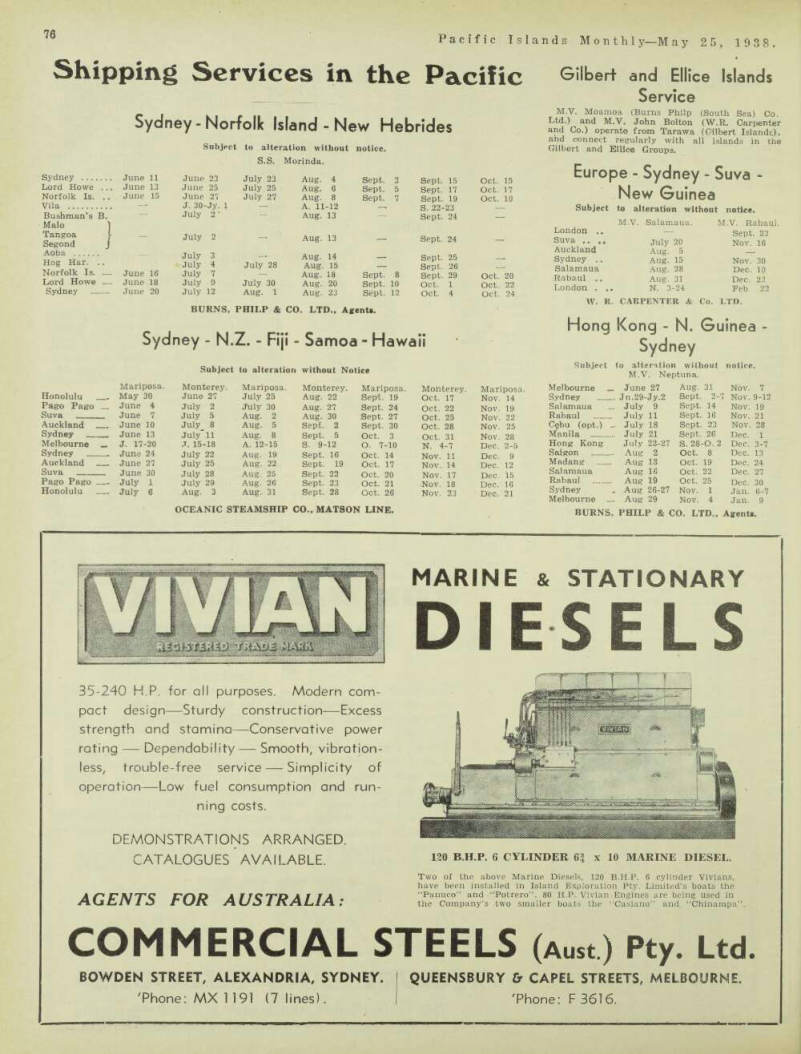
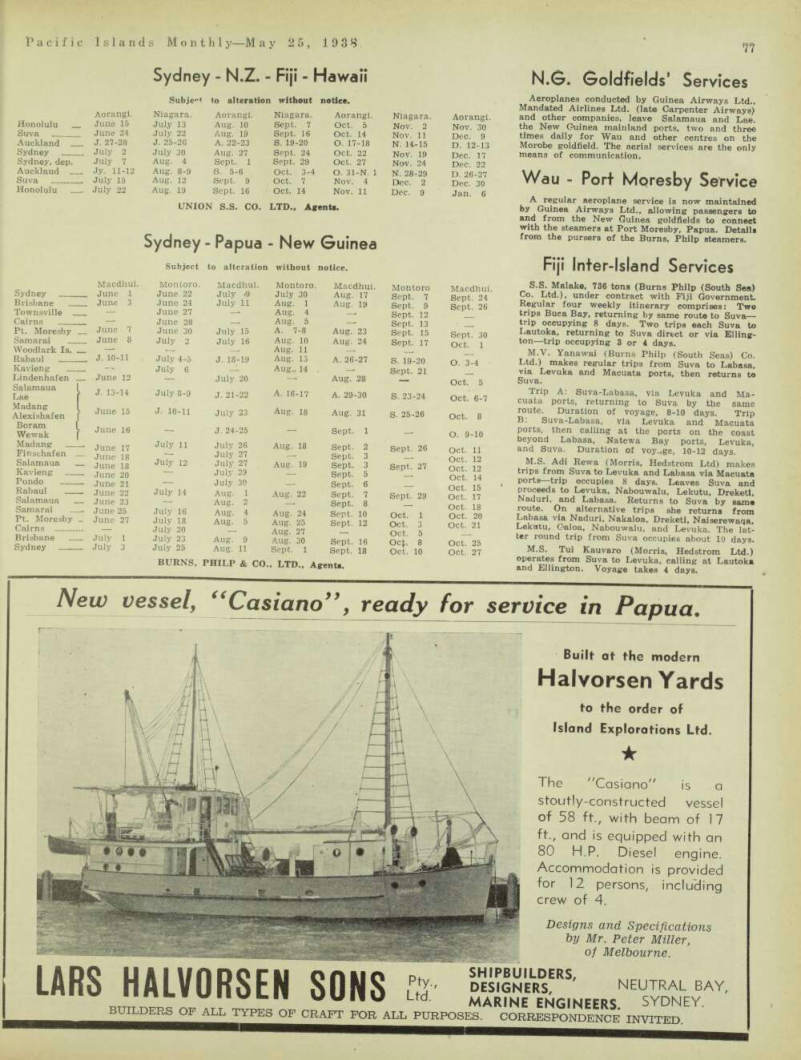
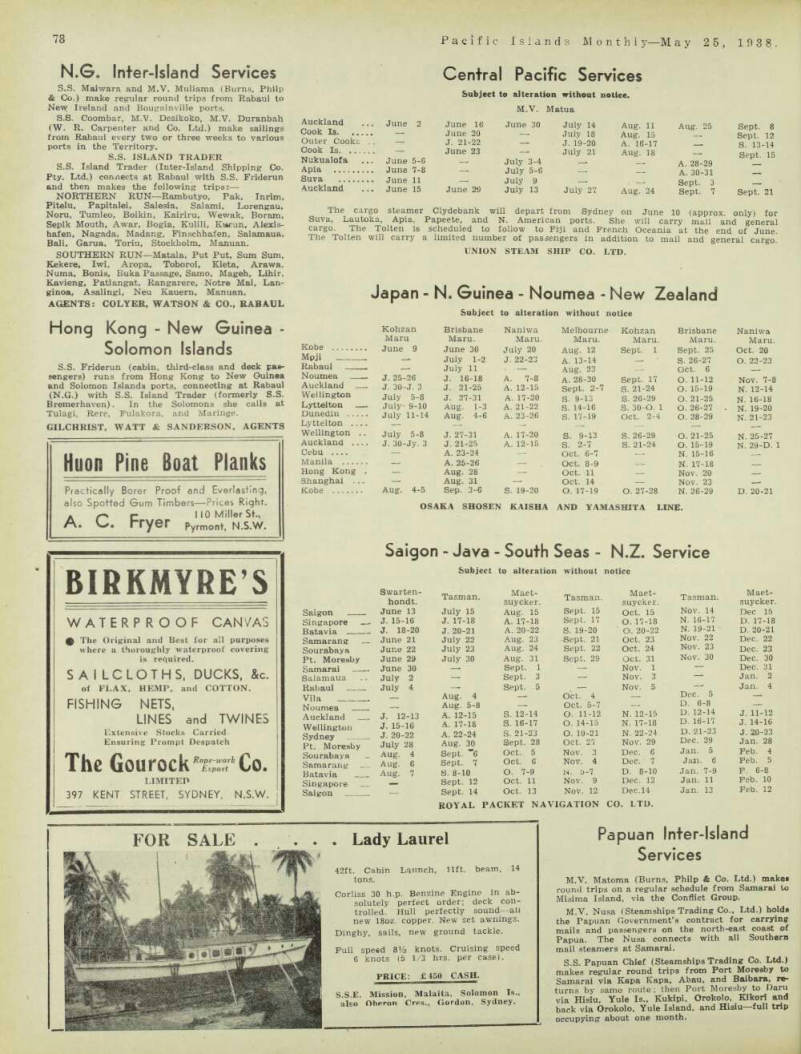
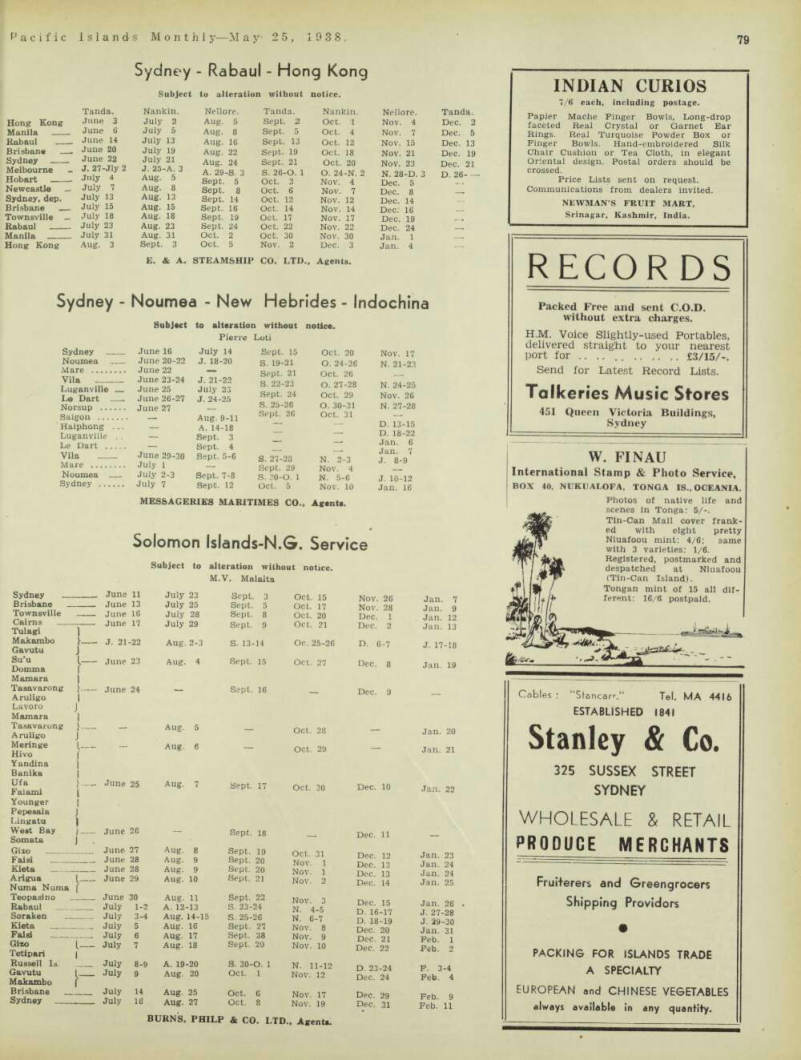
Sydney-Norfolk Island - New Hebrides
Sydney - N.Z. - Fiji - Samoa - Hawaii
Gilbert and Ellice Islands
Service
M.V. Moamoa (Burns Philp (South Sea) Co.
Ltd.) and M.V. John Bolton (W.R, Carpenter and Co.) operate from Tarawa (Gilbert Islands), and connect regularly with all islands in the Gilbert and Ellice Groups.
Europe - Sydney - Suva - New Guinea
Hong Kong - N. Guinea - Sydney
Subject to alteration without notice.
S.S.
Morinda.
Sydney June 11 June 23 July 23 Aug. 4 Sept. 3 Sept. 15 Oct. 15 Lord Howe .,.
June 13 June 25 July 25 Aug. 6 Sept. 5 Sept. 17 Oct. 17 Norfolk Is. ..
June 15 June 27 July 27 Aug. 8 Sept. 7 Sept. 19 Oct. 19 Vila — J. 30-Jy. 1 — A. 11-12 —.
S. 22-23 Bushman’s B. — July 2 * — Aug. 13 —• Sept. 24
Male ]
Tangoa
Segond J
— July 2 - Aug. 13 - Sept. 24 Aoba July 3 Aug. 14 Sept. 25 Hog Har. ..
July 4 July 28 Aug. 15 Sept. 26 Norfolk Is. — June 16 July 7 —- Aug. 18 Sept. 8 Sept. 29 Oct. 20 Lord Howe — June 18 July 9 July 30 Aug. 20 Sept. 10 Oct. 1 Oct. 22 Sydney June 20 July 12 Aug. 1 Aug. 23 Sept. 12 Oct. 4 Oct. 24
Burns. Philp & Co. Ltd., Agent*.
Subject to alteration without Notice Mariposa.
Monterey.
Mariposa.
Monterey.
Mariposa.
Monterey.
Mariposa.
Honolulu May 30 June 27 July 25 Aug. 22 Sept. 19 Oct. 17 Nov. 14 Pago Pago .._ June 4 July 2 July 30 Aug. 27 Sept. 24 Oct. 22 Nov. 19 Suva June 7 July 5 Aug. 2 Aug. 30 Sept. 27 Oct. 25 Nov. 22 Auckland June 10 July 8 Aug. 5 Sept. 2 Sept. 30 Oct. 28 Nov. 25 Sydney June 13
July" 11
Aug. 8 Sept. 5 Oct. 3 Oct. 31 Nov. 28 Melbourne J. 17-20 J. 15-18 A. 12-15 S. 9-12 O. 7-10 N. 4-7 Dec. 2-5 Sydney June 24 July 22 Aug. 19 Sept. 16 Oct. 14 Nov. 11 Dec. 9 Auckland June 27 July 25 Aug. 22 Sept. 19 Oct. 17 Nov. 14 Dec. 12 Suva June 30 July 28 Aug. 25 Sept. 22 Oct. 20 Nov. 17 Dec. 15 Pago Pago — July 1 July 29 Aug. 26 Sept. 23 Oct. 21 Nov. 18 Dec. 16 Honolulu July 6 Aug. 3 Aug. 31 Sept. 28 Oct. 26 Nov. 23 Dec. 21
Oceanic Steamship Co.. Matson Line.
Subject to alteration without notice.
M.V. Salamaua. M.V. Rabaul.
London .. — Sept. 23 Suva .. ,, July 20 Nov. 16 Auckland Aug. 5 Sydney ..
Aug. 15 Nov. 30 Salamaua Aug. 28 Dec. 10 Rabaul ..
Aug. 31 Dec. 22 London . ..
N. 3-24 Feb 22 W. R.
Carpenter & Co.
Ltd.
Subject to alteration without notice.
M.V. Neptuna.
Melbourne June 27 Aug. 31 Nov. 7 Sydney Jn.29-Jy.2 Sept. 2- 7 Nov. 9-12 Salamaua July 9 Sept. 14 Nov. 19 Rabaul July 11 Sept. 16 Nov. 21 C?bu (opt.) - July 18 Sept. 23 Nov. 28 Manila July 21 Sept. 26 Dec. 1 Hong Kong July 23-27 S.28-0. 2 1 Dec. 3-7 Saigon Aug 2 Oct. 8 Dec. 13 Madang Aug 13 Oct. 19 Dec. 24 Salamaua Aug 16 Oct. 22 Dec. 27 Rabaul Aug 19 Oct. 25 Dec. 30 Sydney Aug 26-27 Nov. 1 Jan. 6-7 Melbourne Aug 29 Nov. 4 Jan. 9
Burns.
Philp & Co. Ltd.,
Agent*.
Sydney - N.Z. - Fiji - Hawaii
Sydney - Papua - New Guinea
N.G. Goldfields' Services
Aeroplanes conducted by Guinea Airways Ltd., Mandated Airlines Ltd. (late Carpenter Airways) and other companies, leave Salamaua and Lae. the New Guinea mainland ports, two and three times daily for Wau and other centres on the Morobe goldfield. The aerial services are the only means of communication.
Wau - Port Moresby Service
A regular aeroplane service is now maintained by Guinea Airways Ltd., allowing passengers to and from the New Guinea goldfields to connect with the steamers at Port Moresby. Papua. Details from the pursers of the Burns, Philp steamers.
Fiji Inter-Island Services
S.S. Malake, 736 tons (Burns Philp (South Sea) Co. Ltd.), under contract with Fiji Government.
Regular four weekly itinerary comprises: Two trips Buca Bay, returning by same route to Suva— trip occupying 8 days. Two trips each Suva to Lautoka, returning to Suva direct or via Elling ton—trip occupying 3 or 4 days.
M.V. Yanawai (Burns Philp (South Seas) Co.
Ltd.) makes regular trips from Suva to Labasa. via Levuka and Macuata ports, then returns to Suva.
Trip A: Suva-Labasa, via Levuka and Ma cuata ports, returning to Suva by the same route. Duration of voyage, 8-10 days. Trip B: Suva-Labasa, via Levuka and Macuata ports, then calling at the ports on the coast beyond Labasa, Natewa Bay ports, Levuka, and Suva. Duration of voy..ge, 10-12 days.
M.S. Adi Hewa (Morris, Hedstrom Ltd) makes trips from Suva to Levuka and Labasa via Macuata ports—trip occupies 8 days. Leaves Suva and proceeds to Levuka. Nabouwalu, Lekutu, Dreketl, Naduri, and Labasa. Returns to Suva by same route. On alternative trips she returns from Labasa via Naduri, Nakaloa, Dreketl, Naiserewaqa, Lekutu, Galoa, Nabouwalu, and Levuka. The lat ter round trip from Suva occupies about 10 days.
M.S. Tui Kauvaro (Morris, Hedstrom Ltd.) operates from Suva to Levuka, calling at Lautoka and Ellington. Voyage takes 4 days.
Subject to alteration without notice.
Aorangi.
Niagara.
Aorangi.
Niagara.
Aorangi.
Niagara.
Aorangi.
Honolulu June 15 July 13 Aug. 10 Sept. 7 Oct. 5 Nov. 2 Nov. 30 Suva June 24 July 22 Aug. 19 Sept. 16 Oct. 14 Nov. 11 Dec. 9 Auckland J. 27-28 J. 25-26 A. 22-23 S. 19-20 O. 17-18 N. 14-15 D. 12-13 Sydney July 2 July 30 Aug. 27 Sept. 24 Oct. 22 Nov. 19 Dec. 17 Sydney, dep.
July 7 Aug. 4 Sept. 1 Sept. 29 Oct. 27 Nov. 24 Dec. 22 Auckland Jy. 11-12 Aug. 8-9 S. 5-6 Oct. 3-4 O. 31-N. 1 N. 28-29 D. 26-27 Suva July 15 Aug. 12 Sept. 9 Oct. 7 Nov. 4 Dec. 2 Dec. 30 Honolulu July 22 Aug. 19 Sept. 16 Oct. 14 Nov. 11 Dec. 9 Jan. 6
Union S.S. Co.
LTD., Agents.
Subject to alteration without notice.
Sydney Macdhui.
Montoro.
Macdhui.
Montoro.
Macdhui.
Montoro Macdhui.
Sept. 24 Sept. 26 June 1 June 22 July <9 July 11 July 30 Aug. 1 Aug. 17 Aug. 19 Brisbane June 3 June 24 Sept. 9 Townsville — June 27 —• Aug. 4 —.
Sept. 12 Rent 11 Cairns —— June 28 Aug. 5 .
Pt. Moresby June 7 June 30 July 15 A. 7-8 Aug. 23 Or [J l/. Ij Sept. 15 Sept. 30 Samarai June 8 July 2 July 16 Aug. 10 Aug. 24 Sept. 17 Oct. 1 Woodlark Is. . — ■ — —.
Aug. 11 — Rabaul J. 10-11 July 4-5 July 6 J. 18-19 Aug. 13 A. 26-27 S. 19-20 Sept. 21 O. 3-4 Kavieng — Aug.. 14 Lindenhafen .
June 12 — July 20 — Aug. 28 Oct. 5 Salamaua Lae f J. 13-14 July 8-9 J. 21-22 A. 16-17 A. 29-30 S. 23-24 Oct. 6-7 Madang Alexishafen [ June 15 J. 10-11 July 23 Aug. 18 Aug. 31 S. 25-26 Oct. 8 Boram Wewak f June 16 J. 24-25 - Sept. 1 — O. 9-10 Madang Finschafen Salamaua June 17 June 18 June 18 July 11 July 12 July 26 July 27 July 27 Aug. 18 Aug. 19 Sept. 2 Sept. 3 Sept. 3 Sept. 26 Sept. 27 Oct. 11 Oct. 12 Oct. 12 Kavieng June 20 ■— July 29 — Sept. 5 Oct. 14 Pondo July 30 Aug. 1 Aug. 2 Sept. 6 Sept. 7 Sept. 8 Rabaul , Salamaua
Uui10 Z L
June 22 June 23 July 14 Aug. 22 Sept. 29 Oct. 15 Oct. 17 Oct. 18 Oct. 20 Oct. 21 Samarai .
Pt. Moresby ...
Cairns June 25 June 27 July 16 July 18 July 20 July 23 July 25 Aug. 4 Aug. 5 Aug. 24 Aug. 25 Aug. 27 Aug. 30 Sept. 1 Sept. 10 Sept. 12 Oct. 1 Oct. 3 Brisbane Sydney July 1 July 3 Aug. 9 Alicr 1 1 Sept. 16 Sept. 18 Oct. 5 Ocf. 8 Oct. 25 Oct. 10 Oct. 27
Burns.
Philp & Co.
, LTD., Agents.
N.G. Inter-Island Services
5.5. Maiwara and M.V. Muliama (Burns, Philp & Co.) make regular round trips from Rabaul to New Ireland and Bougainville ports. 5.5. Coombar, M.V. Desikoko, M.V. Duranbah (W. R. Carpenter and Co. Ltd.) make sailings from Rabaul every two or three weeks to various ports in the Territory.
S.S. Island Trader
5.5. Island Trader (Inter-Island Shipping Co.
Pty. Ltd.) connects at Rabaul with S.S. Friderun and then makes the following trips:— NORTHERN RUN—Rambutyo, Pak. Inrim, Pitelu, Papitalei, Salesia, Salami, Lorengau, Noru, Tumleo, Boikin, Kairiru, Wewak, Boram, Sepik Mouth, Awar, Bogia, Kulili, Karun, Alexis hafen, Nagada, Madang, Finschhafen, Salamaua, Bali, Garua, Toriu, Stockholm, Manuan.
SOUTHERN RUN—Matala, Put Put, Sum Sum, Kekere, Iwi, Aropa, Toboroi, Kieta, Arawa, Numa, Bonis, Buka Passage, Samo, Mageh, Lihir.
Kavieng, Patlangat, Rangarere, Notre Mai, Lan ginoa, Asalingi, Neu Kauern, Manuan.
Agents: Colyer, Watson & Co., Raba.Ul
Hong Kong - New Guinea -
Solomon Islands
5.5. Friderun (cabin, third-class and deck pas sengers) runs from Hong Kong to New Guinea and Solomon Islands ports, connecting at Rabaul (N.G.) with S.S. Island Trader (formerly S.S.
Bremerhaven). In the Solomons she calls at Tulagi, Rere, Pulakora, and Maringe.
Gilchrist, Watt & Sanderson. Agents
Central Pacific Services
Japan - N. Guinea - Noumea - New Zealand
Saigon - Java - South Seas - N,Z. Service
Papuan Inter-Island
Services
M.V. Matoma (Burns, Philp & Co. Ltd.) make* roynd trips on a regular schedule from Samara! to Misima Island, via the Conflict Group.
M.V. Nusa (Steamships Trading Co., Ltd.) hold* the Papuan Government’s contract for carrying mails and passengers on the north-east coast of Papua. The Nusa connects with all Southern mail steamers at Samarai.
S.S. Papuan Chief (Steamships Trading Co. Ltd.) makes regular round trips from Port Moresby to Samarai via Kapa Kapa, Abau, and Baibara, re turns by same route; then Port Moresby to Daru via Hisiu, Yule Is., Kukipi, Orokolo. Kikori and back via Orokolo, Yule Island, and Hisiu —full trip occupying about one month.
Subject to alteration without notice.
M.V.
Matua Auckland June 2 June 16 June 30 July 14 Aug. 11 Aug. 25 Sept. 8 Cook Is — June 20 — July 18 Aug. 15 Sept. 12 Outer Cooks .. — J. 21-22 — J. 19-20 A. 16-17 S. 13-14 Cook Is — June 23 — July 21 Aug. 18 Sept. 15 Nukualofa June 5-6 — July 3-4 — A. 28-29 Apia June 7-8 — July 5-6 — A. 30-31 Suva June 11 — July 9 — .
Sept. 3 Auckland June 15 June 29 July 13 July 27 Aug. 24 Sept. 7 Sept. 21 The cargo steamer Clydebank will depart from Sydney on June 10 (approx. onlv) for Suva, Lautoka, Apia, Papeete, and N. American ports.
She will carry mail and general cargo. The Tolten is scheduled to follow to Fiji and French Oceania at the end of June.
The Tolten will carry a limited number of passengers in addition to mail and general cargo.
Union
Steam
Ship Co.
Ltd.
Subject to alteration without notice Kohzan Brisbane Naniwa Melbourne Kohzan Brisbane Naniwa Maru Maru.
Maru.
Maru.
Maru.
Maru.
Maru.
Kobe June 9 June 30 July 20 Aug. 12 Sept. 1 Sept. 25 Oct. 20 Mpji — July 1-2 J. 22-23 A. 13-14 S. 26-27 O. 22-23 Kabaul .
July 11 — Aug. 23 Oct. 6 .
Noumea J. 25-26 J. 16-18 A. 7-8 A. 28-30 Sept. 17 O.11-12 Nov. 7-8 Auckland J. 30-J. 3 J. 21-25 A. 12-15 Sept. 2-7 S. 21-24 O. 15-19 N. 12-14 Wellington July 5-8 J. 27-31 A. 17-20 S. 9-13 S. 26-29 O. 21-25 N. 16-18 Lyttelton — July 9-10 Aug. 1-3 A. 21-22 S. 14-16 S. 30-0. 1 O. 26-27 - N. 19-20 Dunedin July 11-14 Aug. 4-6 A. 23-26 S. 17-19 Oct. 2-4 O.28-29 N. 21-23 Lyttelton — — — , Wellington ..
July 5-8 J. 27-31 A. 17-20 S. 9-13 S. 26-29 O. 21-25 N. 25-27 Auckland ...
J. 30-Jy. 3 J. 21-25 A. 12-15 S. 2-7 S. 21-24 O. 15-19 N. 29-D. 1 Cebu — A. 23-24 — Oct. 6-7 — N. 15-16 Manila — A. 25-26 — Oct. 8-9 — N. 17-18 Hong Kong . — Aug. 28 — Oct. 11 — Nov. 20 Shanghai ... — Aug. 31 — Oct. 14 — Nov. 23 Kobe Aug. 4-5 Sep. 3-6 S. 19-20 O. 17-19 O. 27-28 N. 26-29 D. 20-21
Osaka Shosen Kaisha
And Yamashita Line.
Subject to alteration without notice Swartenhondt.
Tasman.
Maetsuycker.
Tasman.
Maetsuycker.
Tasman.
Maetsuycker.
Saigon June 13 July 15 Aug. 15 Sept. 15 Oct. 15 Nov. 14 Dec 15 Singapore —• J. 15-16 J. 17-18 A. 17-18 Sept. 17 O.17-18 N. 16-17 D. 17-18 Batavia J. 18-20 J. 20-21 A. 20-22 S. 19-20 O. 20-22 N. 19-21 D. 20-21 Samarang June 21 July 22 Aug. 23 Sept. 21 Oct. 23 Nov. 22 Dec. 22 Sourabaya June 22 July 23 Aug. 24 Sept. 22 Oct. 24 Nov. 23 Dec. 23 Pt. Moresby June 29 July 30 Aug. 31 Sept. 29 Oct. 31 Nov. 30 Dec. 30 Samarai June 30 — Sept. 1 — Nov. 1 — Dec. 31 Salamaua July 2 — Sept. 3 — Nov. 3 — Jan. 2 Rabaul July 4 —.
Sept. 5 — Nov. 5 — Jan. 4 Vila Aug. 4 — Oct. 4 — Dec. 5 — Noumea .
Aug. 5-8 — Oct. 5-7 —• D. 6-8 — Auckland J. 12-13 A. 12-15 S. 12-14 O. 11-12 N. 12-15 D.12-14 J. 11-12 Wellington Sydney Pt. Moresby J. 15-16 J. 20-22 A. 17-18 A. 22-24 S. 16-17 S. 21-23 O. 14-15 O. 19-21 N. 17-18 N. 22-24 D. 16-17 D. 21-23 J. 14-16 J. 20-23 July 28 Aug. 30 Sept. 28 Oct. 27
Nov. 29
Dec. 29 Jan. 28 Sourabaya Aug. 4 Sept. **6 Oct. 5 Nov. 3 Dec. 6 Jan. 5 Feb. 4 Samarang Aug. 6 Sept. 7 Oct. 6 Nov. 4 Dec. 7 Jan. 6 Feb. 5 Batavia Aug. 7 S. 8-10 O. 7-9 In. 0-7 D. 8-10 Jan. 7-9 P. 6-8 Singapore Sept. 12 Oct. 11 Nov. 9 Dec. 12 Jan. 11 Feb. 10 Saigon — Sept. 14 Oct. 13 Nov. 12 Dec.14 Jan. 13 Feb. 12
Royal Packet Navigation
Co. Ltd.
Sydney - Rabaul - Hong Kong
Sydney - Noumea - New Hebrides - Indochina
Solomon Islands-N.G. Service
Subject to alteration without notice.
Tanda.
Nankin.
Nellore.
Tanda.
Nankin.
Nellore.
Tanda.
Hong Kong June 3 July 2 Aug. 5 Sept. 2 Oct. 1 Nov. 4 Dec. 2 Manila June 6 July 5 Aug. 8 Sept. 5 Oct. 4 Nov. 7 Dec. 5 Rabaul June 14 July 13 Aug. 16 Sept. 13 Oct. 12 Nov. 15 Dec. 13 Brisbane —.
June 20 July 19 Aug. 22 Sept. 19 Oct. 18 Nov. 21 Dec. 19 Sydney June 22 July 21 Aug. 24 Sept. 21 Oct. 20 Nov. 23 Dec. 21 Melbourne J. 27-Jly 2 J. 25-A. 3 A. 29-S. 3 S.26-0. 1 O. 24-N. 2 N.28-D. 3 D. 26 Hobart - July 4 Aug. 5 Sept. 5 Oct. 3 Nov. 4 Dec. 5 Newcastle July 7 Aug. 8 Sept. 8 Oct. 6 Nov. 7 Dec. 8 Sydney, dep.
July 13 Aug. 13 Sept. 14 Oct. 12 Nov. 12 Dec. 14 Brisbane — July 15 Aug. 15 Sept. 16 Oct. 14 Nov. 14 Dec. 16 Townsville — July 18 Aug. 18 Sept. 19 Oct. 17 Nov. 17 Dec. 19 Rabaul July 23 Aug. 23 Sept. 24 Oct. 22 Nov. 22 Dec. 24 , Manila July 31 Aug. 31 Oct. 2 Oct. 30 Nov. 30 Jan. 1 , Hong Kong Aug. 3 Sept. 3 Oct. 5 Nov. 2 Dec. 3 Jan. 4 — E. & A.
Steamship
Co. Ltd.
, Agents.
Subject to alteration without notice.
Pierre Loti Sydney June 16 July 14 Sept. 15 Oct. 20 Nov. 17 Noumea June 20-22 J. 18-20 S. 19-21 O. 24-26 N. 21-23 Mare June 22 — Sept. 21 Oct. 26 Vila Luganville Le Dart June 23-24 June 25 June 26-27 J. 21-22 July 23 J. 24-25 S. 22-23 Sept. 24 O. 27-28 Oct. 29 N. 24-25 Nov. 26 Norsup June 27 S. 25-26 O. 30-31 N. 27-28 Saigon Aug. 9-11 Sept. 26 Oct. 31 — Haiphong ... — A. 14-18 — D. 13-15 Luganville ..
Le Dart Vila June 29-30 Sept. 3 Sept. 4 Sept. 5-6 S. 27-28 N. 2-3 D. 18-22 Jan. 6 Jan. 7 J. 8-9 Mare July 1 — Sept. 29 Nov. 4 Noumea — July 2-3 Sept. 7-8 S. 30-0. 1 N. 5-6 J. 10-12 Sydney July 7 Sept. 12 Oct. 5 Nov. 10 Jan. 16
Messageries Maritimes Co.
, Agents.
Subject to alteration without notice.
M.V. Malaita Sydney ... ...
June 11 July 23 Sept. 3 Hnf 1 K Nov. 26 Jan. 7 Brisbane ID June 13 July 25 Sept. 5 Op 1 1 n Nov. 28 Jan. 9 Townsville — June 16 July 28 Sept. 8 Oct. 20 Dec. 1 Jan. 12 Jan. 13 Cairns June 17 .Till v 9Q Sept. 9 Cirt 91 Dec. 2 Tulagi 1 Utt.
Makambo Gavutu — J. 21 -22 Aug. 2-3 S. 13-14 Oc. 25-26 D. 6-7 J. 17-18 Su’u I Do mm a h- June 23 Aug. 4 Sept. 15 Oct. 27 Dec. 8 Jan. 19 Mamara 1 Tasavarong June 24 Sept. 16 Dec. 9 Aruligo l
Lavoro J
Mamara
Tasavarong j
Aruligo — Aug. 5 - Oct. 28 - Jan. 20 Meringe [ Hivo r — Aug. 6 — Oct. 29 — Jan. 21 Yandina Banika Ufa Faiami 1 June 25 Aug. 7 Sept. 17 Oct. 30 Dec. 10 Jan. 22 Younger Pepesala J
Lingatu )
West Bay
Somata J
June 26 — Sept. 18 - Dec. 11 - Gizo June 27 Aug. 8 Sept. 19 Oct. 31 Dec. 12 Jan. 23 Faisi June 28 Aug. 9 Sept. 20 Nov. 1 Dec. 13 Dec. 13 Dec. 14 Jan. 24 Kieta June 28 Aug. 9 Sept. 20 Nov. 1 Jan. 24 Arigua I Numa Numa f June 29 Aug. 10 Sept. 21 Nov. 2 Jan. 25 Teopasino June 30 Aug. 11 A. 12-13 Sept. 22 S. 23-24 Nov. 3 4. r Dec. 15 Rabaul July 1-2 Jan. 26 Soraken July July July July 3-4 Aug. 14-15 Aug. 16 Aug. 17 Aug. 18 ' S. 25-26 Sept. 27 Sept. 28 Sept. 29
In . T“ J
TSJ on D. 16-17 J. 27-28 Kieta 5 In . D- ( Nov. 8 Nov. 9 Nov. 10 D. 18-19 Dec. 20 Dec. 21 Dec. 22 J. 29-30 Faisi 6 Jan. 31 Feb. 1 Feb. 2 Gizo [
Tetipari )
, — 7 Russell Is. , r „ July 8-9 A. 19-20 S. 30-0. 1 N. 11-12 D. 23-24 Dec. 24 P. 3-4 Feb. 4 Gavutu [
Makambo f
— July 9 Aug. 20 Oct. 1 Nov. 12 Brisbane July 14 Aug. 25 Aug. 27 Oct. 6 Oct. 8 Nov 17 Dec. 29 Dec. 31 Feb. 9 Sydney July 16 xnov. iy Feb. 11
Burns, Philp & Co. Ltd.
, Agents.
*No Zealand - Samoa - Niue
The New Zealand Government’s steamer Maui Pomare (1,159 tons) is the only direct con nection between N.Z., the Mandated Territory of Western Samoa and Niue Island. The vessel, which carries mails, passengers, and cargo, is controlled by the Department of External Af fairs at Wellington, where application should be made concerning freights, berths, etc.
M.V. Maui Pomare
Sydney - Noumea - Tahiti
Mails and passengers from Sydney for Tahiti may connect with Messageries Maritimes liners at Noumea, per Pierre Loti (see Sydney-Noumea-New Hebrides service). The M.M. liners run between Marseilles and Noumea, via Panama Canal.
New Hebrides Inter-Island
Services
S.s. Mirani (Burns Philp (South Sea) Co. Ltd.) connects every six weeks at Vila with S.S.
Morinda from Sydney, then proceeds on southern trip, calling at the islands of Efate, Erromanga, Tanna, Aneityum, and returns to Vila —trip occu pying 7 or 8 days. After 2 or 3 days at Vila, departs on northern trip, calling at the islands of Efate, Mai, Tongoa. Epi. Paama, Ambrym, Malekula, Aoba, Malo, Santo and returns to Vila, trip occupying 25 to 28 days. Vessel extends to Banks Group every second trip equivalent to about every six weeks.
M.V. Polynesien (Messageries, Maritimes Ltd.) maintains a service from Vila to northern and southern ports as well as occasional trips to Wallis and Futuna Islands. The service com prises the following:— Wallis and Futuna Is.: Leaves Vila on June 1 calling at Siguave, Mata-Utu, and returns on .Trine T_R, Northern run:—Leaves Vila on June 25 call ing at N’Guna, Mai, Tongoa, Diamond Bay, Ringdove, Nelson, Paama, Port Sandwich, Craig cove, Olal, Rhanone, Wanour, Baie Homo, Pointe Truchy, Melsissi, Namarang, Loltong, Loloque-pue, Nengire, Lone, N’Dui-N’Dui, Port Patterson, Port Olry, Hog Harbour, Baie des Requins, Baie des Tortues, Mate Wulu, Saramy, Saraoutou, Surrenda, Aisse, Luganville, Malo, Barclay, Malo Pass, Baie Benier, Vao, Walla, Norsup, Sarmette, Rensari, Banam Bay, Ouesso, Port Sandwich, Lamap, Sakau (Maskelines), and returns to Vila on July 10.
Southern Run:—Leaves Vila on July 17 calling at Lenakel, Ibock, White Sands, Waississi, Er romango, La Teouma, Mele, and returns to Vila on July 22.
New Caledonian Services
M.V. Le Phoque (Societe des lies Loyalty) makes regular trips, carrying mails and passengers, from Noumea along the east coast to Arama.
Also from Noumea to Poum and Belep Islands, via the west coast. Leaving Noumea on the run up the east coast the vessel calls at Yate, Touarou, N. Goye, Kaukue, Thio, Nakety, Canalo, Gouaoua, Houailou, Moueo, Pouerihouen, Tieti, Poindimie, Wagap, Touho, Kokingone, Hieghene, Tao, Outbatch, Pouebo, Balada, Pam and Arama.
Return by same route. Ports visited on west coast trip are: Bourail, Poya, Mueo, Poumbout, Kono, Voh, Temala, Ouaco, Koumac, Karamble, Tanga diou, Paagoumene, Nehoue, Mouac, Belep, and return by same route.
M. V. Le Phoque also maintains a 4 weeks’ ser vice between Noumea and the Loyalty Group. The vessel calls at Tadine (Mare Is.), Chepenehe, and We (Lifou Is.), Fajoue, St. Joseph and Banout (Ouvea Is.). Calls are made occasionally at Isle of Pines and Walpole Island.
Noumea Australia
The small steamer Neo Hebridais (Societe Maritime et Miniere Hagen) carries on a monthly service between Noumea, New Caledonia, and Newcastle, N.S.W. The round trip occupies about 17 days.
Wellington June 14 July 12 Aug. 9 Sept. 6 Oct. 4 Nov. 1 Nov. 22 Apia J- 21-23 J. 19-21 A. 16-18 S. 13-15 O. 11-13 N. 8-10 N. 29-D. 1 Nino June 25 Julv 23 Aue. 20 Sent. 17 Oct. 15 Nnv. 12 Dec. 3 Lyttelton July 4 Aug. 1 Aug. 29 Sept. 26 O. 24-25 Nov. 21 Dec. 12 Wellington July 5 Aug. 2 Aug. 30 Sept. 27 Oct. 26 Nov. 22 Dec. 13
D’Amiens. C. Ramel. Strasbourg Eridan. D’Amiens Papeete June 19-20 J. 31-A. 1 S. 14-15 O. 22-23 Dec. 4-5 Raiatea (opt.) — — Sept. 16 Oct. 24 — yjj a June 29 Aug. 10 Sept. 26 Nov. 2 Dec. 14 Noumea July 1-8 A. 12-18 S. 28-0. 6 N. 4-12 D. 16-23 yila Julv 11 Aug. 21 Oct. 9 Nov. 15 Dec. 26 Raiatea July 18 Aug. 28 Oct. 18 Nov. 22 Jan. 2 Papeete July 19-21 A. 29-31 O. 19-21 N. 23-25 J. 3-5
Messageries Maritimes Co. Ltd.. Agents.
Advertisements & other items, pp. 78-81 (5 items)
76
Pacific Islands Monthl y—M ay 25, 1938.
Diesels
/ 35-240 M.P. for all purposes. Modern compact design—Sturdy construction—Excess strength and stamina —Conservative power rating Dependability Smooth, vibrationless, trouble-free service Simplicity of operation—Low fuel consumption and running costs.
DEMONSTRATIONS ARRANGED.
CATALOGUES AVAILABLE.
AGENTS FOR AUSTRALIA;
MARINE & STATIONARY
DIESELS
120 B.H.P. 6 CYLINDER 62 x 10 MARINE DIESEL.
Two of the above Marine Diesels, 120 B.H.P. 6 cylinder Vivians, have been installed in Island Exploration Ptj r . Limited’s boats the “Panuco” and “Potrero”. 80 H.P. Vivian Engines are being used in the Company’s two smaller boats the “Casiano” and “Chinampa’
COMMERCIAL STEELS (au*.) Pty. Ltd.
BOWDEN STREET, ALEXANDRIA, SYDNEY.
'Phone: MX 1 191 (7 lines).
QUEENSBURY & CAPEL STREETS, MELBOURNE.
'Phone: F 3616.
New vessel, “Casiano”, ready for service in Papua. . j , K Built at the modern
Halvorsen Yards
to the order of Island Explorations Ltd. ★ The "Casiano" is a stoutly-constructed vessel of 58 ft., with beam of 17 ft., and is equipped with an 80 H.P. Diesel engine.
Accommodation is provided for 12 persons, including crew of 4. laL, \r*n i »t a J ZM — 5
LARS HALVORSEN SONS
ti?: .
Designs and Specifications hy Mr. Peter Miller, of Melbourne. , --1 ■ • j . . " 3
SHIPBUILDERS,
DESIGNERS, NEUTRAL BAY
GUILDERS OF ALL TYPES OF CRAFT FOR ALL INVITED.^ Pty., Ltd.
Huon Pine Boat Planks
Practically Borer Proof and Everlasting, also Spotted Gum Timbers —Prices Right.
A r I 10 Miller St., A. v-*. I ry©T Pyrmont, N.S.W.
BIRKMYRE’S
WATERPROOF CANVAS
£ The Original and Best for all purposes where a thoroughly waterproof covering is required.
SAILCLOTHS, DUCKS, &c.
of FLAX, HEMP, and COTTON.
FISHING NETS,
LINES and TWINES
Extensive Stocks Carried Ensuring Prompt Despatch
The Gourock Export Co.
LIMITED
397 KENT STREET, SYDNEY. N.S.W.
FOR SALE
Lady Laurel
42ft. Cabin Launch, lift, beam, 14 tons.
Corliss 30 h.p. Benzine Engine in absolutely perfect order; deck controlled. Hull perfectly sound—ah new 18oz. copper. New set awnings.
Dinghy, sails, new ground tackle.
Full speed BV 2 knots. Cruising speed 6 knots (5 1/3 hrs. per case).
PRICE: £450 CASH.
S.S.E. Mission, Malaita, Solomon Is., also Oheron Cres., Gordon, Sydney.
INDIAN CURIOS
7/6 each, including postage.
Papier Mache Finger Bowls, Long-drop faceted Real Crystal or Garnet Ear Rings. Real Turquoise Powder Box or Finger Bowls. Hand-embroidered Silk Chair Cushion or Tea Cloth, in elegant Oriental design. Postal orders should be crossed.
Price Lists sent on request.
Communications from dealers invited.
NEWMAN’S FRUIT MART,
Srinagar, Kashmir, India.
RECOR DS
Packed Free and sent C.O.D. without extra charges.
H.M. Voice Slightly-used Portables, delivered straight to your nearest port for .. .. . . £3/15/-.
Send for Latest Record Lists.
Tolkeries Music Stores
451 Queen Victoria Buildings, Sydney
W. FINAU
International Stamp & Photo Service,
BOX 40, NUKUALOFA, TONGA IS.. OCEANIA.
Photos of native life and scenes In Tonga: 5/-.
Tin-Can Mall cover franked with eight pretty Niuafoou mint: 4/6; same with 3 varieties: 1/6.
Registered, postmarked and despatched at Niuafoou (Tin-Can Island).
Tongan mint of 15 all different: 16/6 postpaid. it
Cables : "Stancarr." Tel. MA 4416
ESTABLISHED 1841
Stanley & Co.
325 SUSSEX STREET
SYDNEY
WHOLESALE & RETAIL
PRODUCE MERCHANTS
Fruiterers and Greengrocers
Shipping Providers
PACKING FOR ISLANDS TRADE
A SPECIALTY
EUROPEAN and CHINESE VEGETABLES
always available in any quantity.
77
Pacific Islands Monthl y—M ay 25, 19 3 8
78
Pacific Islands Monthl y—M ay 25, 193 8.
79
Pacific Islands Monthl y—M ay- 25, 1938.
Typhoid Kills 40 At Atiu
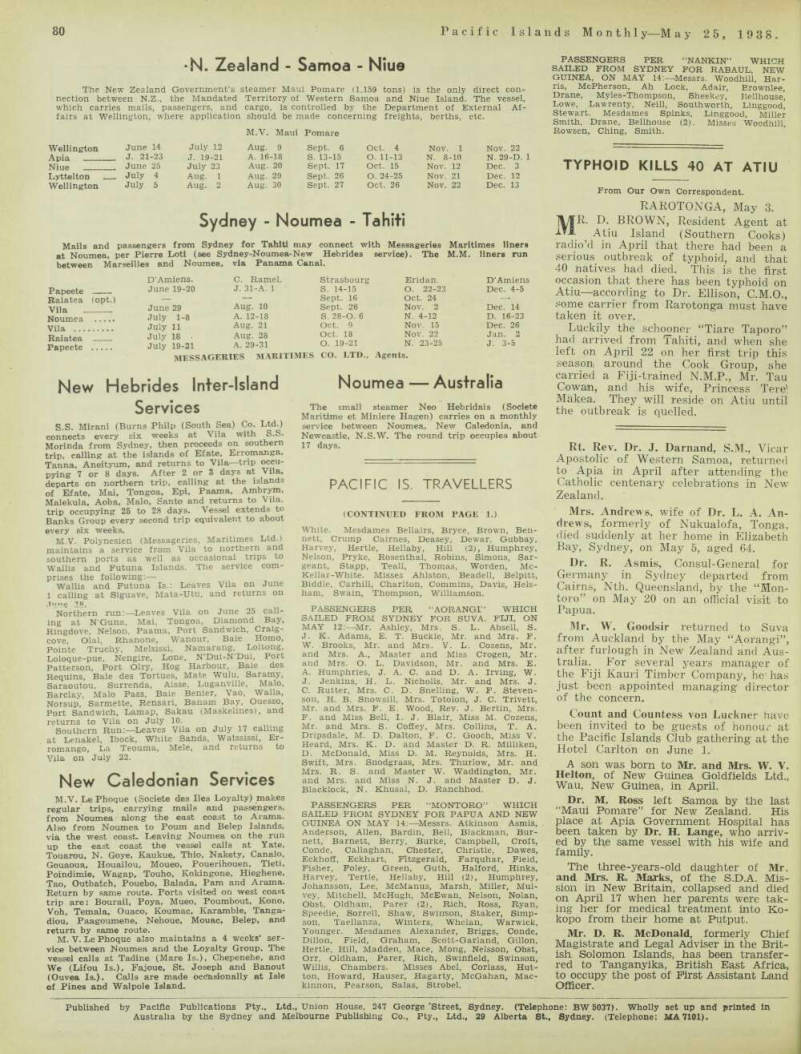
From Our Own Correspondent.
Rarotonga, May 3.
MR. D. BROWN, Resident Agent at Atiu Island (Southern Cooks) radio’d in April that there had been a serious outbreak of typhoid, and that 40 natives had died. This is the first occasion that there has been typhoid on Atiu—according to Dr. Ellison, C.M.0., some carrier from Rarotonga must have taken it over.
Luckily the schooner “Tiare Taporo” had arrived from Tahiti, and when she left on April 22 on her first trip this season around the Cook Group, she carried a Fiji-trained N.M.P., Mr. Tau Cowan, and his wife, Princess Tere', Makea. They will reside on Atiu until the outbreak is quelled.
Rt. Rev. Dr. J. Darnand, S.M., Vicar Apostolic of Western Samoa, returned to Apia in April after attending the Catholic centenary celebrations in New Zealand.
Mrs. Andrews, wife of Dr. L. A. An drews, formerly of Nukualofa, Tonga, died suddenly at her home in Elizabeth Bay, Sydney, on May 5, aged 64.
Dr. R. Asmis, Consul-General for Germany in Sydney departed from Cairns, Nth. Queensland, by the “Mon toro” on May 20 on an official visit to Papua.
Mr. W. Goodsir returned to Suva from Auckland by the May “Aorangi”, after furlough in New Zealand and Aus tralia. For several years manager of the Fiji Kauri Timber Company, he'has just been appointed managing director of the concern.
Count and Countess von Luckner have been invited to be guests of honour at the Pacific Islands Club gathering at the Hotel Carlton on June 1.
A son was born to Mr. and Mrs. W. V, Helton, of New Guinea Goldfields Ltd., Wau, New Guinea, in April.
Dr. M. Ross left Samoa by the last “Maui Pomare” for New Zealand. His place at Apia Government Hospital has been taken by Dr. H. Lange, who arriv ed by th,e same vessel with his wife and family.
The three-years-old daughter of Mr. and Mrs. R. Marks, of the S.D.A. Mis sion in New Britain, collapsed and died on April 17 when her parents were tak ing her for medical treatment into Ko kopo from their home at Putput.
Mr. D. R. McDonald, formerly Chief Magistrate and Legal Adviser in the Brit ish Solomon Islands, has been transfer red to Tanganyika, British East Africa, to occupy the post of First Assistant Land Officer,
Advertisements & other items, pp. 82-84 (4 items)
80
Pacific Islands Monthl y—M ay 25, 1935.
PACIFIC IS. TRAVELLERS
(CONTINUED FROM PAGE 1.)
Published by Pacific Publications Pty., Ltd., Union House, 247 George'Street, Sydney. (Telephone: 8W5037). Wholly set up and printed in Australia by the Sydney and Melbourne Publishing Co., Pty., Ltd., 29 Alberta St., Sydney. (Telephone: MA7101).
Pacific Islands Monthl y—M ay 25, 1938
What Aerial Transport has done for
mm i The above photograph shows how aerial transport is assisting in the establishment of a pastoral industry on the Morobe tableland in New Guinea. These dairy cows have just been unloaded from the Guinea Airways’ freight-carrying aeroplanes after being transported from the coast for a dairy farmer near Wau. —Photo.: Thos. A. Olsson.
GUINEA AIRWAYS, LIMITED
were established in 1927; and they have grown as the figures show until they are to-day the largest freight-carrying service in the world.
Year Tonnage Passen- Ended Trans- gers Feb. 28. ported Carried. 1929 434 869 1930 ... 949 2.047 1931 1.146 1.995 1932 3.947 1,607 1933 3.980 3,856 1934 6.044 7,398 1935 6,102 9,721 1936 6.476 12,137 1937 6,705 11.869 Totals . .. 35,783 51,499
New Guinea ..
SINCE 1927, when the develop-
ment of the Morobe Goldfield
commenced, the European
population of the Territory has
been trebled. The new industry
has increased the Empire's
gold production by nearly
£2,000,000 per annum, and has
added enormously to the trade
turnover of New Guinea.
Only Aerial Transport makes this possible.
There is no road between the Goldfields and the coast. Aeroplanes, running on Regular Schedules, without difficulty or delay, carry in Dredges, Crushing Mills, Cyaniding Plants, Motor Vehicles, Hydro- Electric Machinery, thousands of passengers, and every kind of goods needed by a large and growing European community.
GUINEA AIRWAYS, LIMITED, operate regular air services in New Guinea and Papua; they use over fifty Aerodromes and Landing-grounds in the two Territories.
Australian Services: —SYDNEY-ADELAIDE: Direct Service. Flying time, iVz hours. Daily except Sundays.
ADELAIDE-DARWIN: Weekly, leaves Adelaide every Friday, arrives Darwin Saturday, leaves Monday. »
LIMITED
LAE-SALAMAUA
Head Office: Austral Chambers, Currie Street, Adelaide, S.A., BRANCH OFFICES AND AGENTS AT WAU—SALAMAUA—PORT MORESBY AND SYDNEY.
New Guinea Office: Lae, Mandated Territory of New Guinea.
A Tropical Thirst
demands a Satisfying Drink
that’s why K.B • is so popular
south of u t
All through the tropics, wherever there are men who like good beer, you II always find K. B. It’s the drink that men appreciate —a drink just made to
satisfy a tropical thirst!
IN A COOL
PL A
fRaoe r
MEWt#
MALtW*
0Ntv from the finest
an# BOTTLED BY
tooth
MIX
Co
SYD
ST
TOOTH'S
KB
LAGER.