Pacific
Islands
Monthly
Vol. VIII. No. 7.
February 21, 1938
the G.P.0., Sydney, for transmission by post as a newspaper .]
8“
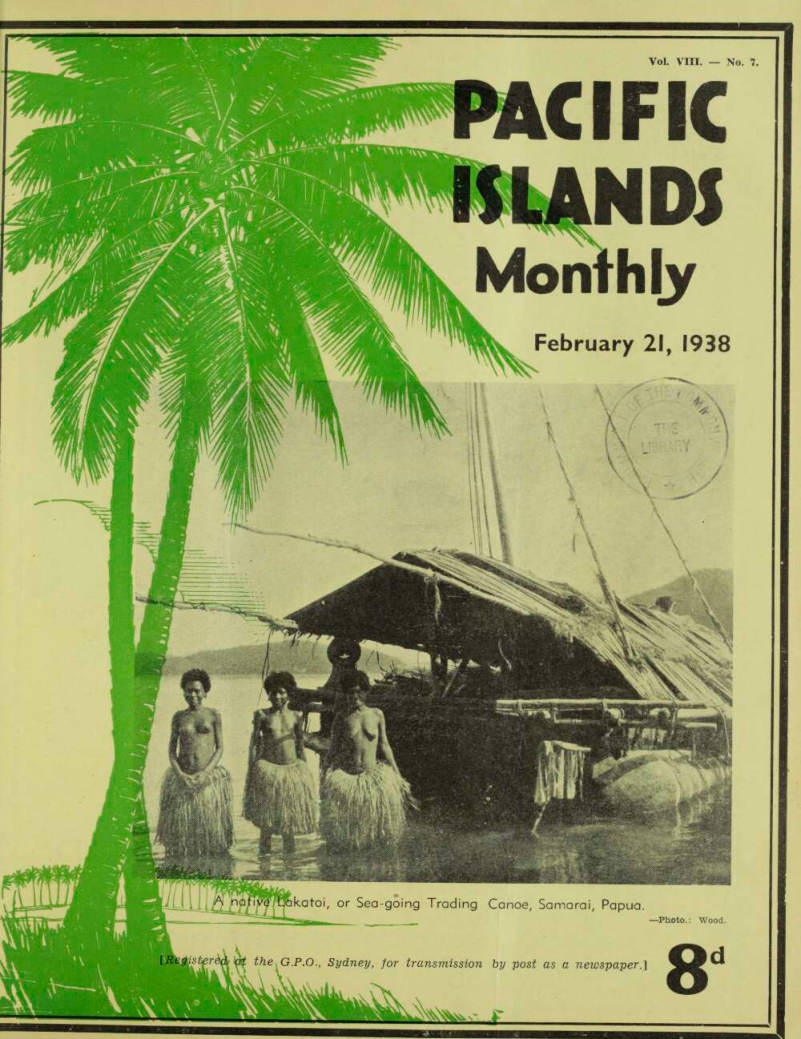
A native Lakatoi, or Sea-going Trading Canoe, Samarai, Papua. —Photo.: Wood.
Advertisements & other items, p. 2 (1 item)
W. R. Carpenter & Co. Ltd.
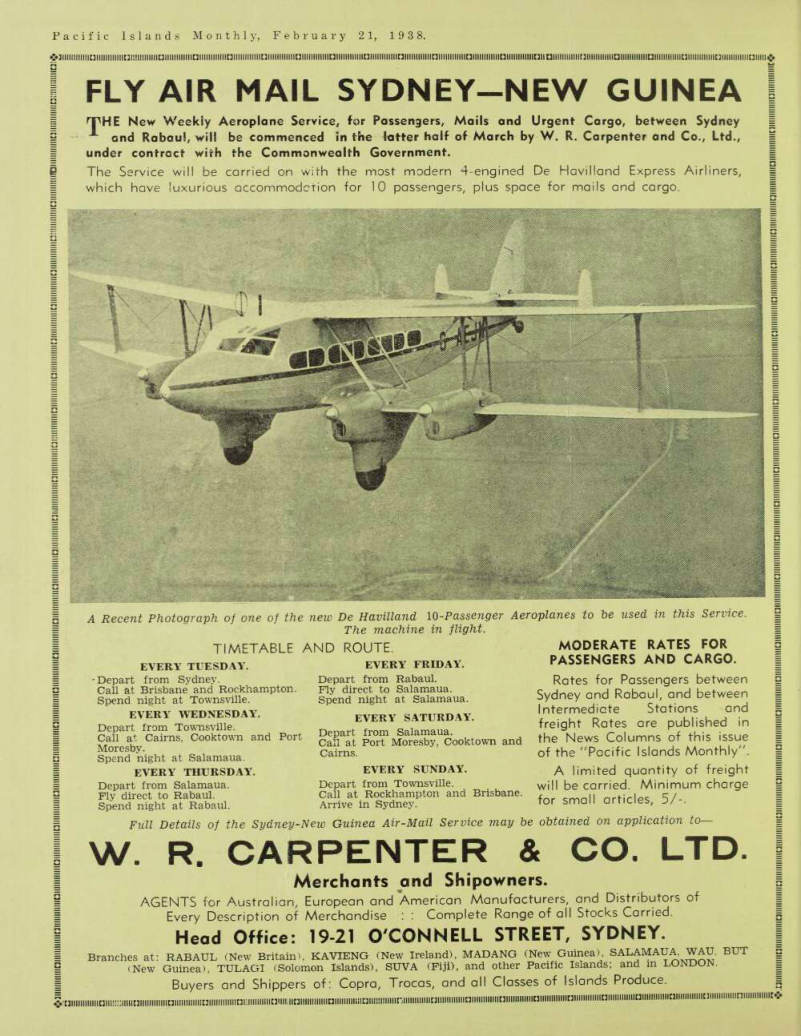
FLY AIR MAIL SYDNEY-NEW GUINEA
T'HE New Weekly Aeroplane Service, for Passengers, Mails and Urgent Cargo, between Sydney A and Raboul, will be commenced In the latter half of March by W. R. Carpenter and Co., Ltd., under contract with the Commonwealth Government.
The Service will be carried on with the most modern 4-engined De Havilland Express Airliners, which have luxurious accommodation for 10 passengers, plus space for mails and cargo. n \
mat
'S' .
A Recent Photograph of one of the new De Havilland 10 -Passenger Aeroplanes to be used in this Service.
The machine in flight.
TIMETABLE AND ROUTE.
EVERY TUESDAY.
Depart from Sydney.
Call at Brisbane and Rockhampton.
Spend night at Townsville.
EVERY WEDNESDAY.
Depart from Townsville.
Call at Cairns, Cooktown and Port Moresby.
Spend night at Salamaua.
EVERY THURSDAY.
Depart from Salamaua.
Fly direct to Rabaul.
Spend night at Rabaul.
EVERY FRIDAY.
Depart from Rabaul.
Fly direct to Salamaua.
Spend night at Salamaua.
EVERY SATURDAY.
Depart from Salamaua.
Call at Port Moresby, Cooktown and Cairns.
EVERY SUNDAY.
Depart from Townsville.
Call at Rockhampton and Brisbane.
Arrive in Sydney.
MODERATE RATES FOR
PASSENGERS AND CARGO.
Rates for Passengers between Sydney and Rabaul, and between Intermediate Stations and freight Rates are published in the News Columns of this issue of the "Pacific Islands Monthly".
A limited quantity of freight will be carried. Minimum charge for small articles, 5/-.
Full Details of the Sydney-New Guinea Air-Mail Service may be obtained on application to—
W. R. CARPENTER & CO. LTD.
Merchants and Shipowners.
AGENTS for Australian, European and American Manufacturers, and Distributors of Every Description of Merchandise : : Complete Range of all Stocks Carried.
Head Office: 19-21 O'CONNELL STREET, SYDNEY.
Branches at: RABAUL (New Britain), KAVIENG (New Ireland), MADANG (New Guinea). SALAMAUA. WAU. BUT (New Guinea), TULAGI (Solomon Islands), SUVA (Fiji), and other Pacific Islands; and m LONDON.
Buyers and Shippers of; Copra, Trocas, and all Classes of Islands Produce.
Pacific Islands Travellers
Passengers Per “Macdhui” Which Ar-
RIVED in SYDNEY PROM NEW GUINEA AND PAPUA ON JANUARY 24;—Messrs. Avery, Bellhouse, Blanden, Barnewitz, Banks, de Boismenu, Claret, Cooke, Chapman, Chant, Champion, Dowsett, Engelhart, Edwards, Ede, Gordon, Harris, Harvey, Hopkins, Hillier, Hilaire, Irwin, Ives, Irvine. Kirby, Lyons, Lambert, Langford, Lesmond, Marr, Minogue, Mcßae, Mackay, Macdonald, Marshall (2), Moyon, McGowan (2), Pierce, Pratt, Simmons, Sjogren, Sim, Stewart, Smith, Simpson, Vocat, Waterhouse, Wheeler, Ward, Walker, Woodman, Zurwerra. Mesdames Bellhouse, Blanden, Banks, Brown, Cooke, Champion, Dowsett, Ede, Carden. Kendra, hopkins, Heath, Ives, Irvine, Lesmond, Middleton, Simmons, Stewart, Street, Smith, Swanson, Tudor, U„ m u’ S , B Ma D xweh Ona.ow, Swain. Simpson, WauCopo,
Passengers Per “Malaita” Which Ar-
RIVED IN SYDNEY FROM NEW GUINEA AND
Solomon Islands Ports On January 28;
—Messrs: Binois, Burke, Clammer, Callahan (2), Greaser, Duggan, Hiler, Johnstone, Luttress,
Musgrave, Neil, Notley, O’Brien, Pabula, Roach, Seton, Stevensen, Stafford (2), Stock Taylor Thomas, Train, Wall, Younger. Mesdames: At kinson, Callahan, Campbell, Corry, Ellis, Han ley. King, Neil, Laurette, Ring, Scotland’ Staf ford, Thomson, Nelson-Turner, Seton, Wright Younger. Misses: Andrea, Atherton, Barrett’
Cook, Cronin, Elkington, Field, Hesse, Holmes!
Kerz, Knox, Lindsay, McColl, McCullough Me- Mullen, Madeleine, Miller, Mlnchinton, ’ Sem mens, Thomas, Vivian, Wilson (2), Thornton.
PASSENGERS per swARTEMMnMnm wwrr’M
Sailed From Sydney For Port Moresby
PAPUA ON JANUARY 28' Mrs C E Dixon Captain A S. p“ E Fletcher W n H. Johnson G A Mong Mrs D ’ Ross W e’
Ryall V G Smith ’
Passengers Per “Morinda" Which Ar
Norpojk^ 1 ?"!?
Hungerford, Lawson, Martin, Monteath, Morse, Olmstead, Owens, Noonan, O’Donnell, Richer, Richmond, Roberts, Thomas, Thompson, Canon Edwards. Mesdames: Creer, Darko, Gane, Gib bes, Grand, Greenwood, Hall, Horrocks, Ingram, Livingston, McNicholl, Monaghan, Noonan, O’Donnell, Olmstead, Richer, Roberts, Thomp
son. Misses: Atkins, Biddle, Brown (2), Chap man, Christie, Pry, Golding, Grand, Greenwood (2), Jenkins, Jennings, Kllminster, Mason, Mac- Donald, McNlcholl (2), Richer (2), Roberts, Stacker, Stout, Wood, Sefton.
Passengers Per “Macdhui” Which
Sailed Prom Sydney For New Guinea
And Papua On February 2:—Messrs:
Aitchison, Andrews, Asquith, Bell, Barnewitz, Beavers, Coomber, Cook, Crocker, Curry, Coo ney, Doe, Dobell, Dickinson, Dale, Eilertz, Egin ton, Parlow, Farrar, French, Farr, Pox, Gorry, Gough, Hartley, Hindman, Irwin, Kenward, Knight, Lambert, Lane, Mclntyre, Munro (2), McDonald, McAdam, Macadam, Mollard, Mc- Lennan, Morton, Monoghan, Mills, Nisbet, Nich olas, Owen, Oberdoff, O’Reilly, Pratt, Pickwell, Parry, Powell, Rogers, Speedie, Scannell, Stokes, Sherringham, Stevenson, Smith (2), Slmnett, Tait, Todd, Tyringham, Thompson, Vial, Willis, Wendling, Waugh, Wood, West, Young, Zur werra. Mesdames: Aitchison, Andrews, Bell, Bouckley, Barker, Collins, Doe, Dickinson, Eil ertz, Plorance, Farrar, French, Fox, Farr, Gough, Henry, Hartley, Harper, Johansen, Jarrett, Jac obsen, Moore, Maguire, Macadam, Nisbet, Nich olas, Perry, Rutledge, Rogers, Russell, Robinson, Schuler, Sherringham, Tait, Tealby, Walshe.
Misses: Andrews, Buchanan, Byron, Coleman, Craig, Eather, Fox, McGregor, Moore, Mahon, Naughton, Russell, Schuler, Smith (2), Tait (2).
(Continued On Page 80.)
(Continued From Page 1.)
Passengers Per “Morinda” Which
SAILED PROM SYDNEY FOR LORD HOWE IS., NORFOLK IS., AND NEW HEBRIDES ON FEB RUARY 3:—Messrs. Astley, Alderson. Bidwell, Burns, Bevan, Brown, Blake, Carr, Corney, Coghlan, Cleary, Collier, Donnelley, Flack, Fraser, Hyder, Jukes, Johnson, Jackson, Jaede, Morris (2), Mackley, Martin, Nicholls, Nott, Perry, Payten, Pearcey, Sykes, Vial, Bragg.
Mesdames Astley, Bevan, Brown, Canney, Carr, Coghlan, Donnelley, De Wilde, Fraser, Hadley!
Johnson, Jaede, Lawrence, Morelle, Nicholls, Perry. Misses Bone, Bennett, Bishton, Cunneen, Goodwin, Gladwyn, Kerr (2), Lancaster, Law rence, McLeod, Mudge, Nicholls, Russell, Ruffles, Shradlow, Saunders, Tinkler, Taylor, Coghlan.
Passengers Per “Neptuna” Which Ar
RIVED IN SYDNEY PROM N.G. PORTS ON FEBRUARY 4:—Messrs. Boyd, Brown, Banks, Baths, Carpenter, Clarke, Emery, Giblin, Halli day, Hanley, Huffori, Harvey, Hewson, Keith, Klee, Latchford, Murison, McLennan, Morgan, Murray (2), McKenna, Millar, Phibbs, Renton, Scherhag, Spiller, Wright (2), Warden, Zinge.
Mesdames Brown, Bergin, Banks, Brackham, Carpenter, Colquhoun, Everall, Halliday, Hufton, Keith, Lyall, Morgan (2), Murray, Millar, Peadon, Swanson, Taylor. Misses Allan, Brown, Dow, Gilmore, Hobler, Ovens, Osborne, Sedgers (2), Page (2),
Passengers Per “Malaita” Which
SAILED PROM SYDNEY FOR N.G. AND SOLO
Mon Islands Ports On February S:
Messrs. Arnoult (2), Brownlees, Campbell, Ca tell, Dionne, de Wotrenge, Goodwin, Fry, Gal lagher, Green, Higgs, Hart, Judd, Love, Mills, Macpherson, Napier, Noble, Pumala, Paton, Ste phen, Walker, Wilson, Wilson, Williamson. Mes dames Anderson, Arnoult, Deck, Herricks, Hart, Judd, Kater, Love, Mills, Osborne, Paton, Leir stein, Snook, Walker. Misses Arnoult, Bernard, Common, Cohen, Devir, Edmondson, Leirstein, Riggall, Talbot, Zeunert; ' Sisters Immaculata and Veronica.
Passengers Per “Niagara” Which Ar
RIVED IN SYDNEY FROM SUVA, FIJI, ON FEBRUARY 12:—R. Rudolph, Mr. R. and Mrs.
A. Phillips, Mrs. A. and Miss A. M. Saunders, J. Stinson, P. Vallabh, Mrs. O. Southey, Mrs.
M., Miss V., and Masters A., C. and J. Stev enson, Mrs. A. and Masters R. and B. Tre wenack, Mr. J. and Mrs. C. and Miss J. Triv ett, R. Twentyman, L. Vance, Miss A. West, Mrs. E. Young, Mrs. M., Master J., and Misses M. and J. Twentyman, Mrs. A. and Miss P.
Vance, G. Young, K. Brabant, S. Carr, E.
Pordham, I. Handley, Mrs. E., Miss E. and Master N. Harness, Mrs. C. Langdon, Mr. H., Mrs. E. and Miss* S. Lansdown, J. Lindsay, Mrs. K. and Master D. Millikin, Miss A. Rob ins, Miss A. Shakspeare, Miss A. Storck. K.
Thornes, B. Vithal, Mrs. F. Walcot, L. Wilson, N. Winton-Brown, C. Cameron, F. Cocks, C.
Dayaram, A. George, E. Gibson, Miss M. Lagi levu. Miss J. Astley, Mr. A., Mrs. E., Master E., and Misses J. and B. Allman, Miss 1.
Blennerhasset, Mr. A. and Mrs. M. Bonamy, Mrs. 8., Master C. and Miss E. Chapman, Mr.
R. and Mrs. B. Clark, J. Clarkson, J. Chap man, Mr. W., Mrs.' E. Cozens and Miss A.
Cozens, Masters W. and C. Curry, Mrs. A. and Miss N. Finlayson, Miss J. Grahame, Mr. E. and Mrs. M. Griffiths, Mr. L. and Mrs. M.
Horsfield, E. Kenyon, W. King, Mrs. E. Law lor, Mrs. J. Mackay, Mr. M., Mrs. E. and Miss P. Nicholls, Mrs. P. and Misses N. and B.
Potts, Miss A. Rice, A. Rourke, Miss B. Sher wood, Mr. A. and Mrs. A. Snodgrass, Masters A., N. and D. and Miss N. Snodgrass, S. H.
Snowsill.
Passengers Per “Nankin” Which Left
Sydney For Rabaul, N.G., On February
12: —Messrs. Bayley, Chambers, Clark, Murray, Hay (2), Edgell, Carpenter, Griffiths, Thorn ton, Costello, Thomas, Harding, Chan, Ram say, Proven. Brother Hartmann. Mesdames Bayley, Murray, Hay, Forsyth, Edgell, Costello, Thomas. Miss Ware.
Advertisements & other items, p. 3 (1 item)
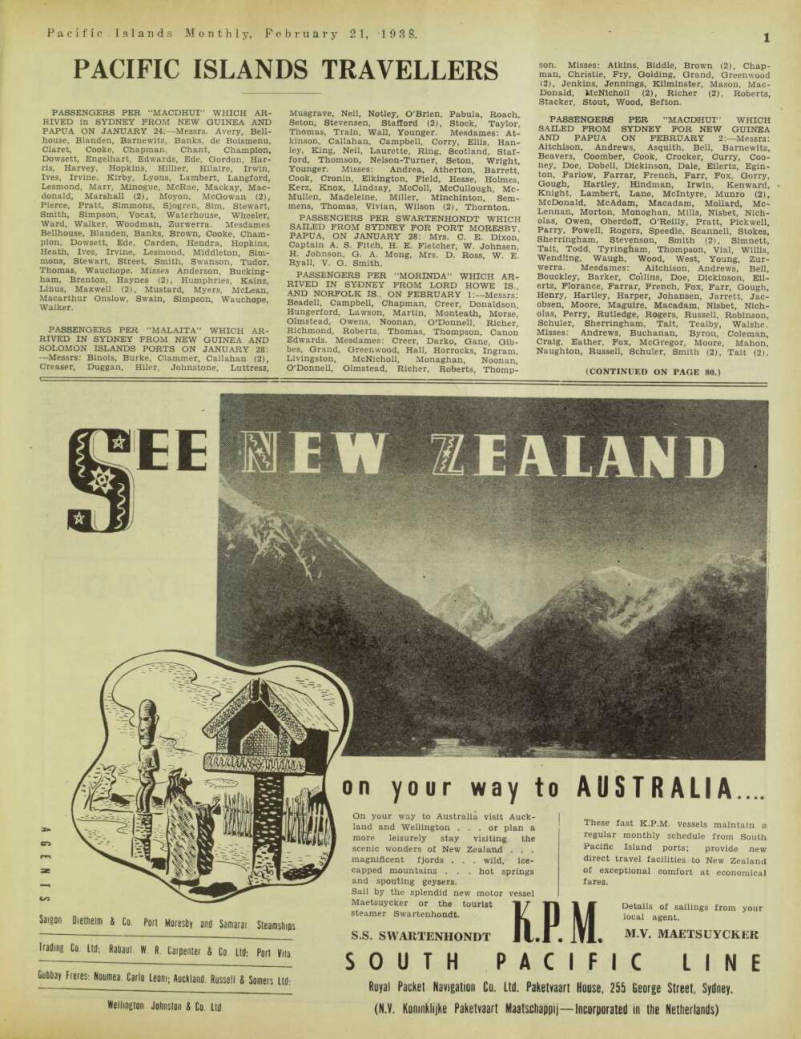
on your way to AUSTRALIA.
Saigon Dietheim & Co. Pori Moresby and Samarai. Steamships Iradmg Co. Ltd; Rabaul W R. Carpenter & Co. Ltd: Port Vila Gubbay Freres-. Noumea, Carlo Leoni; Auckland. Russell & Somers Ltd: Wellington Johnston & Co Ltd
On your way to Australia visit Auckland and Wellington ... or plan a more leisurely stay visiting the scenic wonders of New Zealand . . . magnificent fjords . , . wild, icecapped mountains . . . hot springs and spouting geysers.
Sail by the splendid new motor vessel Maetsuycker or the tourist steamer Swartenhondt, These fast K.P.M. vessels maintain a regular monthly schedule from South Pacific Island ports; provide newdirect travel facilities to New Zealand of exceptional comfort at economical fares.
S.S. SWARTENHONDT
K.P.M
Details of sailings from your local agent.
M.V. MAETSUYCKER
SOUTH PACIFIC LINE
Royal Packet Navigation Co. Ltd. Paketvaan House. 255 George Street, Sydney. (N.V. Konmklijke Paketvaart Maatsohappij—lncorporated in the Netherlands)
Advertisers.
Abrahams & Sons Pty., Ltd.. A. ..57 “Alnwick” Kinder garten . . . .66 Amalgamated Wire less of Aust. Ltd. 76 Angus & Coote Ltd. 21 Arnott’s Biscuits . 28 “Aspro” 59 “Ausoline” ... 80
B.A.L.M. Ltd. . . 68
Bank of N.S.W. .. 75 Berger & Sons Ltd. 44 “Bernly” Guest Hse 59 Blau (Aust.), Robt. 64 Briggs & Sons, Ltd. 15 Broomfields, Ltd. . 52 Brunton’s Flour . 74 Budge & Co. Ltd., J 46 Bullivants, Ltd. .. 54 Burns, Philp & Co. 2 Burns, Philp & Co. 66
B.P. (S.S.) Co. ... 46
Buzacott Pty. Ltd. 24 Carpenter, W. R.
Limited ii.
Chapman & Sherack 50 Chivers & Sons Ltd 37 Clarkson, L. B. ... 79 Crossle, Duff and Co., Ltd 71 Coleman Lamp Co. 23 Coral Starch .. .. 35 Cosmopolitan Hotel 79 Crossie, Duff and Macintosh, Ltd. . 70 “Cystex’’ 24 Del Cott Pty., Ltd. 56 Dewar’s Whisky .78 Doans’ Pills .. .. 74 Dobell Pty., Ltd. . 13 Donald, A. B„ Ltd. 62 Baton, Ltd., J. W. 45 Electrolux R efrig erators 30 Eno’s Fruit Salt . 73 Excelsior Supply
Co 48 Fairbanks - Morse Limited 27 “Fairholm” College 14 Finau, Wm 17 Fletcher & Sons . 26 Ford Sherington Ltd 25 “44 Macleay St.” 21 Foster Clark (Aus.) Limited 65 Fryer, A. C 77 Garden Vale Pro ducts, Ltd. .. .35 Garrett & Davidson 70 Gillespie’s Flour . 36 Grand P a cific Hotel 61 Grove & Sons, W.
H 69 G u inea Airways Ltd iii- Hallstroms Pty Ltd 26 Halvorsen Sons Ltd. 51 Hardie & Co., Jas. 55 Holbrook’s, Ltd. ... 41 H o r licks Malted Milk 29 Hornadge, W 16 Horne, W. & Co. . 60 Hotel Moresby . . 79
1.C.1.A.N.Z., Ltd. . 32
Jantzen, Ltd. . . .67 Jones & Co Ltd, H. 39 Kodak Pty., Ltd. . 17 Kopsen & Co. Ltd. 63 Kork-N-Seal, Ltd. . 37 Lane & Girvan Ltd. 55 Levenson’s Radio . 72 Lloyd & Co., Pty., Ltd 13 Lustre, Ltd 65 Mcllrath’s Ltd. . 18 McKay’s Bookstall 25 McLeod, Bolton & Co 79 Maleham & Yeo mans, Ltd 48
Master Sewing Machine Co. . . .43 Maxwell Porter Ltd 45 Miller & Co. Pty., Ltd 38 Morris, Hedstrom Limited 60
N.D.L 77
Nelson & Robertson Pty., Ltd. 22, 68 Nestle’s Milk . . . 40 Newland Bros. Ltd. 42 New Zealand Dis tributors, Ltd. . 43 N.Z. Tourist Bu reau 12 Nordman, Oscar G. 12 Noyes Bros., Ltd. . 49 Oxymel Oil and
Paint Co., Ltd. . 4V Pabst Canned Beer 70 Pacific Is. Club 22 Papua, Hotel, The 79 Pike Bros., Ltd. .. 18 Position Wanted . 78 Prescott, Ltd. .. .34 Price’s Radio Serv. 50 Prouds, Ltd. .. .14 Ransomes Sims & Jefferies, Ltd. .. 62 Reed, Wm. E. .. .28 Reid, W. M. .. 36, 64 Reilingh, W. .. .54 Riverstone Meat Co.
Limited 31 Rohu, Sil 32 Royal Packet Co. . 1 Ruston & Hornsby 53
Scott’s Emulsion . 19 Scott, Ltd., J. . .52 Scott & Sons .. .. 54 Shell Oil Co. . . . 58 Smyth, Ltd., J. H. 23 Springwood L. Coll 13 Stanley, Chris. .. .39 Stanley fiz Co. .. .75 Steamships Trg. Co. 22 Sterling Varnish Cc 11 Sullivan, Ltd., C. 77 Sullivan, Ltd., J. J. 38 Swallow & Ariell . 34 Talkeries . .. .67 Taylor & Co., A. . 55 “Tenax” Soap .. .57 Tilley Lamp Co. . 20 Tillock & Co., Ltd. 39 Tooheys, Ltd. .. .19
“Top Dog’’ Men’s
Wear t . 49
Tooth & Co iv.
Vincent’s A.P.C. . 66 “Walkabout’’ .. ..33 Warburton Franki Ltd 16 Watson, Victor, Ltd. 12 West, Harry .. ..51 Weymark & Son . 37 Wills, W. D. and H. 0.. Ltd. .. .73 Williams, Ltd., S. . 47 Wright & Co. .. .57 Wright & Co. Ltd., E 52 Wunderlich, Ltd. . 45 Yorkshire Insurance Co 68
Contents
Page.
Pacific Islands Travellers 1, 80 Japan’s Shadow on the Pacific ... 3 Islands Vignettes 4 Girl Flier Missing in N.G 5 “Matua” Hits Reef in Tonga 5 Count Von Luckner’s Box of Gold . 5 New Guinea’s Progress 6 Prance and the New Hebrides ... 6 Sydney-Rabaul Air Service 7 Committee to Select N.G. Capital 8 Mishaps to P.A.A.’s “China Clipper” 8 Fiji’s Sound Finances 9 Complaint About B.P. Snips ... 10 Tropicalities 11 About Islands People 12 New Govt. Offices in Suva 15 Tahiti Schooner Wrecked 17 Rossel Island Financiers (Papua) .. 18 Copra Market Depressed 20
Page.
Chain of Pacific Weather Stations . 24 Islands By the Way—Fascinating History of Torres Strait 25 Preserving Polynesian Relics 29 The Claims of T. H. Harrisson ... 37 Islands Life Pictured on Stamps .. 41 Zeppelin Services for Pacific? .. .. 44 Murder on the High Seas 45 C.I. Fruit* Control a Success 50 Norfolk Island to Change 51 How Washington is Curbing Pan- American Airways 53 Radio Progress During 1937 57 Fashion Hints for Islands Women .. 65 Pacific Mining Notes 68 Radio Programmes 73 Islands Produce Rates 74 Copra and Rubber Quotations .. .. 75 Shipping Services for Islands .. .. 77
Advertisements & other items, p. 4 (1 item)
Burns, Philp & Co.
GENERAL
MERCHANTS
in t in i
LTD.
SHIPOWNERS
TOURIST AGENTS
Head Office: 7 Bridge Street, Sydney—Australia Code Address: "Burphil"
BUYERS OF ALL CLASSES OF ISLAND PRODUCE Regular Steamer Services from Australia to New Guinea Papua Solomon Is.—Lord Howe Is.—Norfolk Is.—New Hebrides —Java and Singapore
Pacific Islands Monthly
The Newspaper-Magazine of the South Seas
[Registered at the G.P.0., Sydney , for transmission by post as a newspaper.] Published Once Each Month and Circulated in Australia and New Zealand and in the following Pacific Territories and Islands Groups:
Crown Colony of Fiji.
Australian Territory of Papua.
Mandated Territory (Australia) of New Guinea.
Bismarck Archipelago and Northern Solomon Islands.
Mandated Territory (Japan) of Marshall, Caroline and Marianna Islands.
French Territory of New Caledonia.
British and French Condominium of New Hebrides.
American Territory of Eastern Samoa.
American Territory of Guam.
Mandated Territory of Nauru.
British Crown Colony of Gilbert and Ellice Islands.
Mandated Territory (New Zealand) of Samoa.
British Solomon Islands Protectorate.
British Protectorate of Tongan Islands.
New Zealand Territory of Cook Islands.
Australian Territory of Norfolk Island.
French Colony of Oceania (Tahiti, etc.).
American Territory of Hawaiian Islands.
Owned and Produced by Pacific Publications Pty. Ltd., Union House, 247 George Street, Sydney.
TFT FPHnNTF J Managing Director 8W5037 j Business and Editorial MA7IOI
P.O. Box 3408 R
Registered Address of Telegrams, Radiograms, and Cables: "Pacpub,” Sydney.
Contributions
Articles, Stories, and Photographs dealing with Pacific Islands subjects are invited, and will be paid for on publication at usual rates.
Subscription Rates
Per Annum, within British Empire, Prepaid, Post Free 8/- Per Annum, elsewhere, prepaid, Post Free 107- Single Copies Bd.
Editor and Publisher :
R. W, Robson. F.R.G.S.
Assisted by Selwyn Hughes.
Advertisements
Advertising Manager: L. W. Bailey.
Advertising office and Printing-House: 29 Alberta St., Sydney.
Advertising rates furnished on application.
Colours, etc. by Arrangement Process Blocks made at Advertiser's expense when required. Screen, 100.
Changes of Advertising Copy should reach this Office by Bth of each month, otherwise previous advertisement may be repeated.
Agents
The following are authorised to receive subscrip tions for the Pacific Islands Monthly:— Islands Branches of Burns, Philp & Co. Ltd., and Burns Philp (South Sea) Co., Ltd.
Islands Branches of W. R. Carpenter & Co.. Ltd.
All Branches of Morris, Hedstrom & Co., Ltd.
G. Thomas & Co., Rabaul, New Guinea.
T. A. Olsson, Wau, New Guinea.
Whitten Bros., Ltd., Samarai, Papua.
Steamships Trading Co.. Papua. All Branches.
P. Costello, Suva. Fiji.
J. Muir, Suva, Fiji.
N. C. Mackenzie-Hunt, Wainunu, Bua, Fiji.
All Branches and Representatives of W. H. Grove and Sons. Ltd., Auckland, New Zealand.
Cook Islands Trading Co., Rarotonga, Cook le.
A. C. Rowland, Papeete, Tahiti.
Representative in London: W. C. HARVEY, Coronation Building. 4 Lloyds Avenue, London, E.C.2. from whom may be obtained copies of Pacific Islands Monthly, Pacific Islands Year Book, advertising schedules, etc.
Vol. Viii., No. 7.
Sydney, February 21, 1938.
Pri™ ( 8d - Pei Copy * i XICc ( Prepaid; 8/ . p . a .
Japan’s Shadow On The Pacific
RESIDENTS in the Pacific Terri tories are looking at the Far East situation with astonishment and alarm. A year or two ago, their north-western horizon seemed clear and peaceful. To-day, a war-cloud hangs heavily in the north-west; and, behind it, Japan makes ready to fight any country which stands in the way of* her deter mination to control the Pacific, for the glory and enrichment of Japan.
The facts are indisputable; and the danger is so real that we need offer no apology for returning to the sub ject, again and again. The peoples of the Pacific must try to realise what is happening.
Pacific residents may feel surprise; but this development was foreseen, years ago, by long-sighted statesmen in Britain and America. The proof is seen in the new British base at Singapore, and in the powerful forti fications and fleet which the United.
States has placed in the north eastern Pacific. We may thank our gods that there were, in power, realists who could see what was go ing to happen in Japan, and who had the courage to prepare accordingly.
Thereby, we have been given a chance to study the situation, from behind the protection of Singapore and Hawaii, and their attendant fleets, and to get ready for the inevitable struggle.
T+ uu, . , . . ? has bee f n expla^ed m tdls J°U r ‘ ? ’ m £ ny timeS ’ at A ?
Europeans and A^ lat 1 ICS by the Japanese is unavoidable. There arp 100,000,000 people in Japan, and only about two-thirds of them can be maintained by their own land: the remainder must depend upon im ported goods. Thus, Japan has be come a manufacturing nation—she must export the products of her fac tories in order to import raw materials and foodstuffs. Therein lies deep-rooted trouble. Millions of Japanese workers live on less than a tenth of what European workers con sider necessary; Japanese labour costs are so low that Japanese manu facturers can undersell almost any European products in any market in the world. European countries, forced to protect the living standards of their people, have imposed higher and higher tariffs against Japanese goods.
The logic of those facts is inescap able. Japan must find either open markets for her manufactured goods, or new colonies for her enormous and growing surplus population. Since neither can be provided voluntarily by the other nations, only one course is open to Japan—armed and organ ised to the utmost of her capacity, she will go forth to destroy European control in the Western Pacific coun tries, and open up markets for her products, and lands for her swarm ing colonists. Japan recognises this now, but whether this knowledge has directed her policy of “westernisation” of her institutions and industries it is hard to say. No European can understand the mind of a Japanese; so we do not know, really, whether Japanese policy during the last two decades has been torn between two different schools of thought (Fascist —expansionists, who would seek world conquest by the sword, and Liberal- Radicals, who would gain the national ends without recourse to war), or whether the only difference of opinion was concerning the right time to strike. It does not matter, now—Japan is now controlled com pletely by the Fascist-Militarist expansionist section, and is com mitted irrevocably to the invasion of China, which, sooner or later, will bring her into conflict with the
European nations. All we can do now is to try to make an intelligent forecast of the probable course of events.
When they threw their country into the Chinese adventure, the Japanese militarists clearly counted on two things: That Britain and FTance, being uncertain of Germany and Italy, would not dare to send sufficient forces out of Europe to interfere in China; and that U.S.A. would decline to enter into any war where the Monroe Doctrine was not involved. Russia was a danger; but (we may suppose Japan argued) Russia cannot fight at the end of 4,000 miles of trans-Siberian railway.
Japan believed that she could over run and control China before any European nation would be free and able to interfere; and could thus bring an incredible number of Asiatic troops against the Europeans.
But it is not working out that way.
Although the Japanese armies are all over eastern China, the Chinese are resisting staunchly; Britain and France have remained calm—but have seen to it that the Chinese are getting good supplies of war materials; American public opinion,
wholly pro-Chinese, is slowly recog nising the inevitability of a struggle in the Pacific against Japan; and there is evidence that increasing supplies of war materials are reach ing the Chinese from Russia, through western China. It is possible that Japan will be seriously weakened, in both a military and an economic sense, through becoming “bogged” in China.
But that cannot change the course of events. Control of China will give Japan a new market, and huge re serves of raw materials and man power, but it will not alter the fact that, sooner or later, Japan must challenge European power in south eastern Asia and the Western Pacific.
Rather, if she is allowed time in which to conquer and mould China to her own ends, will Japan’s con trol of China strengthen her hands for the inevitable struggle.
Meanwhile, all European com munities in the Pacific—and espec ially British, Americans, French and Dutch —must co-operate in prepara tion for war. The prospect is hor rible, in the extreme, yet no one seems able to offer a peaceful solu
tion. On the one hand, we have scores of millions of Asiatics,, de manding new territory for their in creasing surplus population; while on the other hand, we have Pacific territories colonised and developed by Europeans, whose standards of living must be protected by the rigid exclusion of the Asiatic masses.
Administratorship Of
Samoa
It is reported from New Zealand, un officially but on good authority, that Mr.
James O’Brien, Labour member for West land and Chairman of the Parliamentary Committee on Native Affairs, will shortly be appointed Administrator of Western Samoa. He was a member of the “Good will Mission” to Apia, in 1936.
The proposal has been sharply critic ised, hoth in the Dominion and in Samoa, on the grounds that Mr. O’Brien is with out any apparent qualifications and, at 62, is too old to fill such an important and difficult post.
The present Acting Administrator is Mr. A. C. Turnbull, who, since 1935, has carried on with conspicuous ability and tact.
ISLANDS VIGNETTES: New Guinea Ten Years Ago.
TOP LEFT: Alexishafen (Sek), on the Madang Coast, mainland of New Guinea. TOP RIGHT: Madang Harbour (Friedrich Wilhelm’s Hafen in German times), on the north shore of Schering Peninsula. BOTTOM LEFT: Canoes meeting the B.P. steamer “Montoro” at Lorengau, Manus Group. BOTTOM RIGHT: The Father's Quarters at the Society of the Divine Word Mission, Alexishafen.
Girl Flier’S
Mishap
Was Lost For Three Days On Flight To Wau.
From Our Own Correspondent.
Pt. Moresby, Feb. 18.
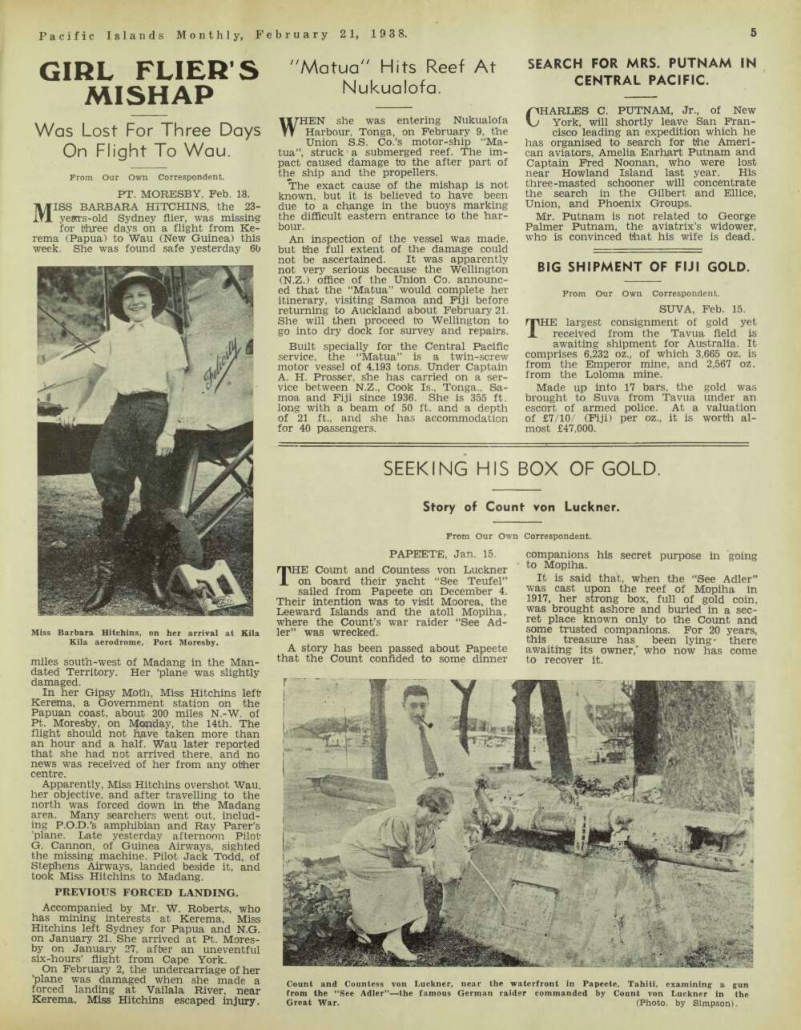
Miss Barbara Hitchins, The 23-
years-old Sydney flier, was missing for three days on a flight from Ke rema (Papua) to Wau (New Guinea) this week. She was found safe yesterday 60
miles south-west of Madang in the Man dated Territory. Her ’plane was slightly damaged.
In her Gipsy Moth, Miss Hitchins left Kerema, a Government station on the Papuan coast, about 200 miles N.-W. of Pt. Moresby, on Monday, the 14th. The flight should not have taken more than an hour and a half. Wau later reported that she had not arrived there, and no news was received of her from any other centre.
Apparently, Miss Hitchins overshot Wau, her objective, and after travelling to the north was forced down in the Madang area. Many searchers went out, includ ing P.O.D.'s amphibian and Ray Parer’s ’plane. Late yesterday afternoon Pilot G. Cannon, of Guinea Airways, sighted the missing machine. Pilot Jack Todd, of Stephens Airways, landed beside it, and took Miss Hitchins to Madang.
Previous Forced Landing.
Accompanied by Mr. W. Roberts, who has mining interests at Kerema, Miss Hitchins left Sydney for Papua and N.G. on January 21. She arrived at Pt. Mores by on January 27, after an uneventful six-hours’ flight from Cape York.
On February 2, the undercarriage of her ’plane was damaged when she made a forced landing at Vailala River, near Kerema. Miss Hitchins escaped injury.
Miss Barbara Hitchins, on her arrival at Kila Kila aerodrome, Port Moresby.
Nukualofa.
"Matua" Hits Reef At Nukualofa.
WHEN she was entering Nukualofa Harbour, Tonga, on February 9, the Union S.S. Co.’s motor-ship “Ma tua”, struck a submerged reef. The im pact caused damage to the after part of the ship and the propellers.
The exact cause of the mishap is not known, but it is believed to have been due to a ch,ange in the buoys marking the difficult eastern entrance to the har bour.
An inspection of the vessel was made, but the full extent of the damage could not be ascertained. It was apparently not very serious because the Wellington (N.Z.) office of the Union Co. announc ed that the “Matua” would complete her itinerary, visiting Samoa and Fiji before returning to Auckland about February 21.
She will then proceed to Wellington to go into dry dock for survey and repairs.
Built specially for the Central Pacific service, the “Matua” is a twin-screw motor vessel of 4,193 tons. Under Captain A. H. Prosser, she has carried on a ser vice between N.Z., Cook Is., Tonga., Sa moa and Fiji since 1936. She is 355 ft. long with a beam of 50 ft. and a depth of 21 ft., and she has accommodation for 40 passengers.
Search For Mrs. Putnam In
Central Pacific.
Charles C. Putnam, Jr., Of New
York, will shortly leave San Fran cisco leading an expedition which he has organised to search for the Ameri can aviators, Amelia Earhart Putnam and Captain Fred Noonan, who were lost near Howland Island last year. His three-masted schooner will concentrate the search in the Gilbert and Ellice, Union, and Phoenix Groups.
Mr. Putnam is not related to George Palmer Putnam, the aviatrix’s widower, who is convinced that his wife is dead.
Big Shipment Of Fiji Gold.
From Our Own Correspondent,
Suva, Feb. 15.
THE largest consignment of gold yet received from the Tavua field is awaiting shipment for Australia. It comprises 6,232 oz., of which 3,665 oz. is from the Emperor mine, and 2,567 oz. from the Loloma mine.
Made up into 17 bars, the gold was brought to Suva from Tavua under an escort of armed police. At a valuation of £7/10/ (Fiji) per oz., it is worth al most £47,000.
Seeking His Box Of Gold.
Story of Count von Luckner.
Prom Our Own Correspondent.
Papeete, Jan. 15.
THE Count and Countess von Luckner on board their yacht “See Teufel” sailed from Papeete on December 4.
Their intention was to visit Moorea, the Leeward Islands and the atoll Mopiha, where the Count’s war raider “See Ad ler” was wrecked.
A story has been passed about Papeete that the Count confided to some dinner
companions his secret purpose in going
to Mopiha.
It is said that, when the “See Adler” was cast upon the reef of Mopiha in 1917, her strong box, full of gold coin, was brought ashore and buried in a sec ret place known only to the Count and some trusted companions. For 20 years, this treasure has been lying- there awaiting its owner,* who now has come to recover it.
Count and Countess von Luckner, near the waterfront in Papeete, Tahiti, examining a gun from the "See Adler”—the famous German raider commanded by Count von Luckner in the Great War. (Photo. by Simpson).
N.G.’s Progress
Administrator's Review at Opening of Legislative Council.
From Our Own Correspondent.
Rabaul, Feb. 15.
OPENING the N.G. Legislative Coun cil on February 10, the President (Sir Walter McNicoll) referred to the progress made in the Territory in the last five years. Revenue, he said, had increased by 57 per cent, to £481,000, ex penditure by 64 per cent, to £460,000, and external trade by 104 per cent, to £3,864,- 039.
During the five years ended June 30 last the white population had increased by 1,515 to 5,881. In the same period the counted native population had increased by 152,463 to 542,394. Indentured labour ers had increased by 13,653 to 40,259.
In the Supplementary Estimates, the Treasurer asked for £ll,OOO more to meet expenditure incurred following the recent eruption, bringing the total sum provided for this purpose to £40,000.
At the beginning of the financial year, the Treasurer said, the surplus for the year was estimated at £40,000. Not withstanding the eruption, this surplus was still expected as the result of in creased revenue, import duty, and the sale of Coronation stamps.
No. 6 Bulolo Ready In March
THE small No. 6 dredge for work on the A area acquired by Bulolo Gold Dredging Ltd. from Bulolo Gold Deposits Ltd. near Wau, New Guinea, is almost completed and will commence operations at the end of March.
The erection of this dredge was held up for a time because of a shortage of steel for the fabrication and the non-arrival of machinery from America. No. 6 is a replica of the dredge built by one of B.G.D.’s associate companies in Columbia, South America.
The first Bulolo deep-digger, No. 5 started in December on the Bulolo flats.
It is working at* considerably less than normal capacity, and will continue so for several months until a new driving mo tor is installed. No. 7, similar to No. 5, is now being built.
Nauru Church Being Built
in Melbourne.
A CHURCH thp,t will be shipped in sections to Nauru Island, Central Pacific, is being built in Melbourne to the order of Rev. C. L. Welsh, of the L.M.S., now on leave in Victoria. It will be ready for shipment in the British Phosphate Commission’s vessel “Triona”, sailing at the end of February.
Wood, cement, and fibrous plaster are the main materials. They were bought with £3,000 subscribed by the Nauruans, who will re-erect the church and carry out the cement and plaster work. The building will accommodate 1,000 people.
The church will be cruciform in shape, with a bell tower and cross. It will have a concrete base, raised altar, and choir stalls, over which there will be a Gothic arch. Spotlights will be used to illuminate the choir, altar, and electric organ chamber. All furnishings will be of red wood to resist white ants, which destroyed the old church.
Burns, Philp Trust Co.
New Subsidiary Formed
'T'HE registration was announced on Jan- A uary 27 of the Burns, Philp Trust Company Ltd., with a capital of £50,000 in £1 shares.
This is a new subsidiary of Burns, Philp and Company Ltd., formed to take over the trustee and agency business hitherto handled by the parent company. All the capital (nominally £50,000) is held by Burns, Philp and Company Ltd. The directors of the subsidiary are Messrs.
James Burns, Robert Nosworthy, Lewis Armstrong, and Joseph Mitchell (all of whom are directors of Burns, Philp and Co. Ltd.), and the manager is Mr. C. H.
Chester.
The new company will act as the trustee of an estate, as the executor of a will, as financial agent for any person or firm, and as manager of property and investments.
Its constitution and associations provide a sufficient guarantee of fidelity.
Mr. T. P. Byrne, Collector of Customs at Samarai, Papua, has been transferred to Port Moresby.
The Stevenson Plate At Tautira, Tahiti.
THIS plate was not pre sented by Robert Louis Stevenson (as stated by your Tahiti correspon dent in November), but by his mother, who accompan ied him on his health-seek ing trip to the South Seas in 1888-1889.
During their stay at Tau tira Mrs. Stevenson attend ed a Communion service in the native church. The wine was in two black beer-bottles, the cups were of very common earthen ware, and the bread was baked bread-fruit. Writing to her sister, who was then residing in Scotland, Mrs.
Stevenson said: “The service, apart from these things, was all that one could wish”.
On her return to Scotland she had a set of suitably-engraved silver Communion vessels made, and sent them to the na tive pastor at Tautira. Each article is
marked underneath: “Given by Mrs.
Thomas Stevenson, Edinburgh”.
The vessels are still in regular use, and the present native pastor is always pleased to show them to European visit
ors.
J. D. Mccomish.
New Hebrides.
France Should Not Be Asked To Make Sacrifice.
IN an article which is justified and timely, the “Bulletin du Commerce” of Noumea, New Caledonia, comments upon some of the ridiculous statements which have appeared in Australian newspapers relating to the New Hebrides. Some Australian newspapers —whose lack of knowledge of Pacific Islands affairs is abysmal—have sug gested that Australia should take over the New Hebrides, and that France should be given some sort of compen sation for withdrawal from the Group.
The Noumea newspaper quite pro perly points out that such a proposal is absurd; and it quotes figures to show the dominance of French interests in the Condominium.
It is pointed out that in 1936 the ex ports of the New Hebrides were 10,131,664 francs and the imports 10,056,000 francs. The French section of the imports was worth 7,404,000 francs (of which a very large propor tion were goods purchased from Aus tralia) and the British section, 2,652,000 francs. Of the exports, the English part represented 626,800 francs, while the French part was 9,504,800 francs.
It is pointed out also that in 1936 the total of British shipping which visited the New Hebrides was 38,000 tons, while the French shipping totalled 258,000 tons.
Finally, the “Bulletin du Commerce” points out that the last census shows that the British and their dependants in the Group numbered only 251, while the French and their dependants num bered 1,706.
The newspaper comments: “The im portance of our trade, the number of our colonists, and the condition and value of our plantations are indisput able, and it is inconceivable that the Government of France would consent to sacrifice this happy result of our successful colonisation.”
Editorial Note: Anyone who knows the recent history and present condition of the New Hebrides will agree with the opinion expressed by the Noumea newspaper. Britain cruelly neglected her colonists in the New Hebrides, while France assisted her nationals in every possible way. In the circum stances, it cannot be expected that France will abandon the New Hebrides simply because a few Australian and British people have awakened, in very belated fashion, to the strategic im portance of the Group. It is much more likely that (a) the Group will be divided, the larger and more valuable islands going to France and the smaller and less important islands to Australia; or (b) that Australia will simply take the place of Britain as a partner in the Condominium, and endeavour to build up British settlement in the New Hebrides, in harmonious co-operation with French interests.
Advertisements & other items, p. 9 (1 item)
Lugger ..."
"ONCE ABOARD THE
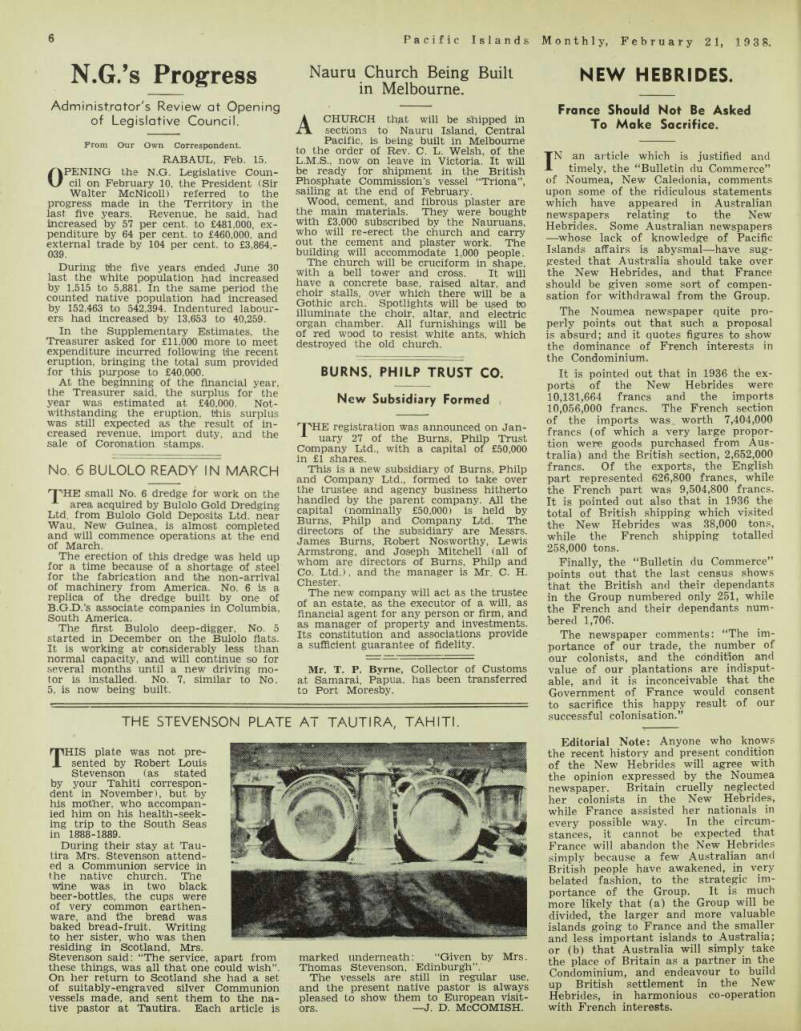
Modern Polynesian Misses at Rarotonga, aboard the Cook Islands schooner “Tiare Taporo”. (Photo by W. H. Watson).
Strike At Lautoka.
Trouble With Sugar Mill Labourers in Fiji.
From Our Own Correspondent.
Suva, Feb. 3.
ON January 11, word was received in Suva that a strike of Indian and Fijian labourers had occurred at th,e Lautoka sugar mill. Details were meagre, but on the 13th it was an nounced that the trouble had been set tled.
It appears that a proposed change in the system of paying the labour led to the strike. The custom of the C.S.R.
Co. in the past, when dealing with, Eu ropean and half-caste employees, was to keep one pay in hand, this to be given over at the completion of employment.
Apparently the Co. attempted to apply this system lndian and Fijian la bour who are *paid weekly.
When their week’s pay was withheld, the labourers immediately went on strike.
They organised pickets and such essen tial services as the delivery of milk, meat, etc., had to be carried out by Eu ropeans. The C.S.R. train was taken out by a half-caste engineer, the regular In dian driver being prevented from doing so by his compatriots.
Eventually the Co. acceded to the de mands of the labour—a fact which caus ed considerable comment throughout the Colony, old hands remarking that it was most unlike the C.S.R. to give in on such a matter.
Mr. W. Macarthur King, of the Colon ial Sugar Refining Co. Ltd., Fiji, is at present* spending furlough at Tamworth, N.S.W., with his family.
Rabaul Electricity Ltd.’s interim divi dend at the rate of 3J per cent, for the half-year to December 31 h#s been de clared payable on February 28.
Sydney - New Guinea Air Mail
Passenger and Freight Rates for New Weekly Service to Rabaul.
ALTHOUGH Messrs. W. R. Carpenter and Co. Ltd., is ready to begin its new weekly air-mail service be tween Sydney and New Guinea, under Government subsidy, th,e actual date of commencement has not yet been decid ed upon by the Federal authorities.
A survey flight will be undertaken dur ing the first week in March, and the inaugural official flight will be made at the end of March or, more likely, early in April. The service will be maintain ed by Carpenter and Co.’s operating subsidiary, W.R.C. Airlines.
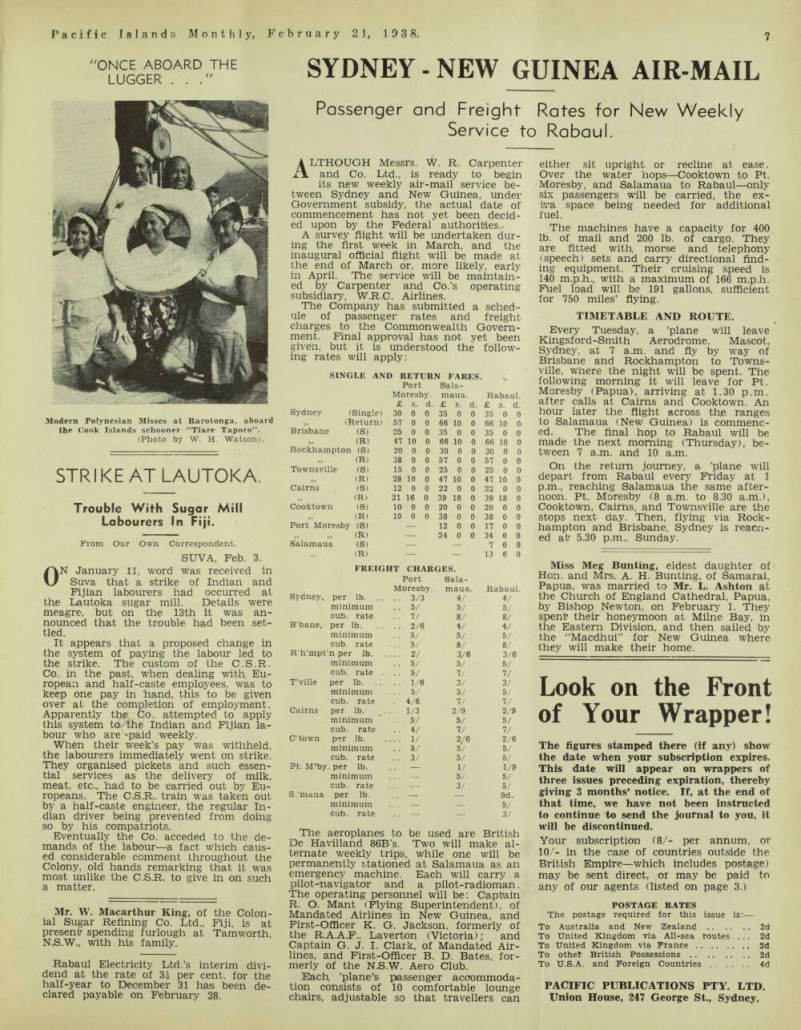
The Company has submitted a sched ule of passenger rates and freight charges to the Commonwealth Govern ment. Final approval has not yet been given, but it is understood the follow ing rates will apply:
The aeroplanes to be used are British De Havilland 86B’s. Two will make al ternate weekly trips, while one will be permanently stationed at Salamaua as an emergency machine. Each will carry a pilot-navigator and a pilot-radioman.
The operating personnel will be: Captain R. O. Mant (Plying Superintendent), of Mandated Airlines in New Guinea, and First-Officer K. G. Jackson, formerly of the R.A.A.F., Laverton (Victoria); and Captain G. J. I. Clark, of Mandated Air lines, and First-Officer B. D. Bates, for merly of the N.S.W. Aero Club.
Each, ’plane’s passenger accommoda tion consists of 10 comfortable lounge chairs, adjustable so that travellers can
either sit upright or recline at ease.
Over the water hops—Cooktown to Pt.
Moresby, and Salamaua to Rabaul —only six passengers will be carried, the ex tra space being needed for additional fuel.
The machines have a capacity for 400 lb. of mail and 200 lb. of cargo. They are fitted with, morse and telephony (speech) sets and carry directional find ing equipment. Their cruising speed is 140 m.p.h., with a maximum of 166 m.p.h.
Fuel load will be 191 gallons, sufficient for 750 miles’ flying.
Timetable And Route.
Every Tuesday, a ’plane will leave Kingsford-Smith Aerodrome, Mascot, Sydney, at 7 a.m. and fly by way of Brisbane and Rockhampton to Towns ville, where the night will be spent. The following morning it will leave for Pt.
Moresby (Papua), arriving at 1.30 p.m. after calls at Cairns and Cooktown, An hour later the flight across th,e ranges to Salamaua (New Guinea) is commenc ed. The final hop to Rabaul will be made the next morning (Thursday), be tween 7 a.m. and 10 a.m.
On the return journey, a ’plane will depart from Rabaul every Friday at 1 p.m., reaching Salamaua the same after noon. Pt, Moresby (8 a.m. to 8.30 a.m.), Cooktown, Cairns, and Townsville are the stops next day. Then, flying via Rock hampton and Brisbane, Sydney is reacn ed at’ 5.30 p.m., Sunday.
Miss Meg Bunting, eldest daughter of Hon. and Mrs. A. H. Bunting, of Samarai, Papua, was married to Mr. L. Ashton at the Church of England Cathedral, Papua, by Bishop Newton, on February 1. They spent* their honeymoon at Milne Bay, in th,e Eastern Division, and then sailed by the “Macdhui” for New Guinea where they will make their home.
Single And Return Fares.
Port Sala- Moresby. maua.
Rabaul. £ S. d. £ S. d. £ s. d.
Sydney (Single) 30 0 0 35 0 0 35 0 0 „ (Return) 57 0 0 66 10 0 66 10 0 Brisbane (S) 25 0 0 35 0 0 35 0 0 M (R) 47 10 0 66 10 0 66 10 0 Rockhampton (S) 20 0 0 30 0 0 30 0 0 „ (R) 38 0 0 57 0 0 57 0 0 Townsville fS) 15 0 0 25 0 0 25 0 0 „ (R) 38 10 0 47 10 0 47 10 0 Cairns (S) 12 0 0 22 0 0 22 0 0 ,, (R) 21 16 0 39 18 0 39 18 0 Cooktown (S) 10 0 0 20 0 0 20 0 0 ,, (R) 19 0 0 38 0 0 38 0 0 Port Moresby (S) — 12 0 0 17 0 0 »» ,, (R) — 24 0 0 34 0 0 Salamaua (S) — — 7 0 0 ,, (R) — — 13 6 0
Freight Charges.
Port Sala- Moresby. maua.
Rabaul.
Sydney, per lb. .. .. 3/3 4/ 4/ minimum .. 5/ 5/ 5/ cub. rate • ■ 7/ 8/ 8/ B’bane, per lb. . . 2/6 4/ 4/ minimum .. 5/ 5/ 5/ cub. rate ... 5/ 8/ 8/ Rh’mpt’n per lb. ... 2/ 3/6 3/6 minimum .. 5/ 5/ 5/ cub. rate . .. 5/ 7/ 7/ T’ville per lb. .. .. 1/6 3/ 3/ minimum ... 5/ 5/ 5/ cub. rate . 4/6 7/ 7/ Cairns per lb. ... 1/3 2/9 2/9 minimum • 5/ 5/ 5/ cub. rate • • 4/ 7/ 7/ C’town per lb. ... 1/ 2/6 2/6 minimum .. 5/ 5/ 5/ cub. rate .. 3/ 5/ 5/ Pt. M’by. per lb. — 1/ 1/9 minimum ... — 5/ 5/ cub. rate — 3/ 5/ S.’maua per lb. — — 9d. minimum ... — — 5/ cub. rate .. — — 3/
Advertisements & other items, p. 9 (1 item)
of Your Wrapper!
Look on the Front
The figures stamped there (if any) show the date when your subscription expires.
This date will appear on wrappers of three issues preceding expiration, thereby giving 3 months’ notice. If, at the end of that time, we have not been instructed to continue to send the journal to you, it will be discontinued.
Your subscription (8/- per annum, or 10/- in the case of countries outside the British Empire—which includes postage) may be sent direct, or may be paid to any of our agents (listed on page 3.)
POSTAGE RATES
The postage required for this issue is:— To Australia and New Zealand 2d To United Kingdom via All-sea routes ... 2d To United Kingdom via France 2d To other British Possessions 2d To U.S.A. and Foreign Countries 4d
PACIFIC PUBLICATIONS PTY. LTD.
Union House, 247 George St., Sydney.
Capital.
To Select a New Capital.
General Griffiths Appointed Head
of the N.G. Committee.
THE personnel of the Committee ap pointed by the Federal Government to select a site for the new capital of New Guinea consists of: — Brigadier-General T. Griffiths, former ly Administrator of New Guinea (Chair man) ; Mr. C. W. Thomas, loans officer of the Commonwealth Treasury (finance mem ber) ; and Mr. L. Thornton, engineer of the De partment of the Interior (technical member), The Committee sailed from Sydney for Rabaul by the “Nankin” on February 12.
A report will be prepared for presenta tion to the Government at the end of March.
Brigadier-General Thomas Griffiths, C.M.G., C.8.E., D. 5.0., was Administra tor of New Guinea from 1919 to 1921, during th,e military occupation, and again from 1932 to 1934 during the civil administration.
Matupi Again Active.
Passengers from Rabaul who reached Cairns by the “Montoro” on February 12, said that severe “gurias” shook the town on th,e Bth. Three distinct shocks were felt, one of which lasted 50 seconds, causing some alarm. Only minor damage was done.
Matupi volcano, it was reported, was showing renewed activity. It was belch ing dense clouds of sulphurous smoke and steam.
Mr. J. Sharpe, one of the passengers, said that the discovery had been made that the entire town site of Rabaul had sunk one foot.
Japan’s Economic Penetration
of Central Pacific
THE gradual peaceful penetration of Japanese commercial interests in Western Samoa and the Cook Is lands is causing concern in official cir cles in New Zealand.
Newspapers have published figures to show the recent rapid increase of Jap an’s trade with the islands administered by the New Zealand Government. Samoa, for instance, imported goods from Japan worth £895 in 1931; in 1936, the Japanese imports had risen to £17,781. In the Cook Group the figures, on a smaller scale, tell a similar story.
Officially the view appears to be that nothing can be done to combat this ten dency. Western Samoa is administered as a mandate and the N.Z. authorities be lieve that this involves no right to in dulge in discriminatory tariffs.
Nauru Phosphate Industry
Expands.
“rpHE phosphate industry at Nauru and A Ocean Islands continues to ex pand”, said Commander R. C.
Garsia, Administrator at Nauru, Central Pacific, who arrived in New Zealand on February 10 by the British Phosphate Commission’s motor-ship, “Triaster”.
The consumption of phosphate by N.Z. and Australia had risen by several hun dred thousand tons in the last two years, he added. At Nauru, new machinery was installed last* year and further in creases in the plant will be made in the near future so that the demands of Aus tralia and N.Z. could be fully met with out delay.
Mr. and Mrs. Les Brown, of Bulolo Gold Dredging Ltd., arrived in Sydney from New Guinea by the February “Neptuna”.
Advertisements & other items, p. 10 (1 item)
Off On A Sheep-Muster.
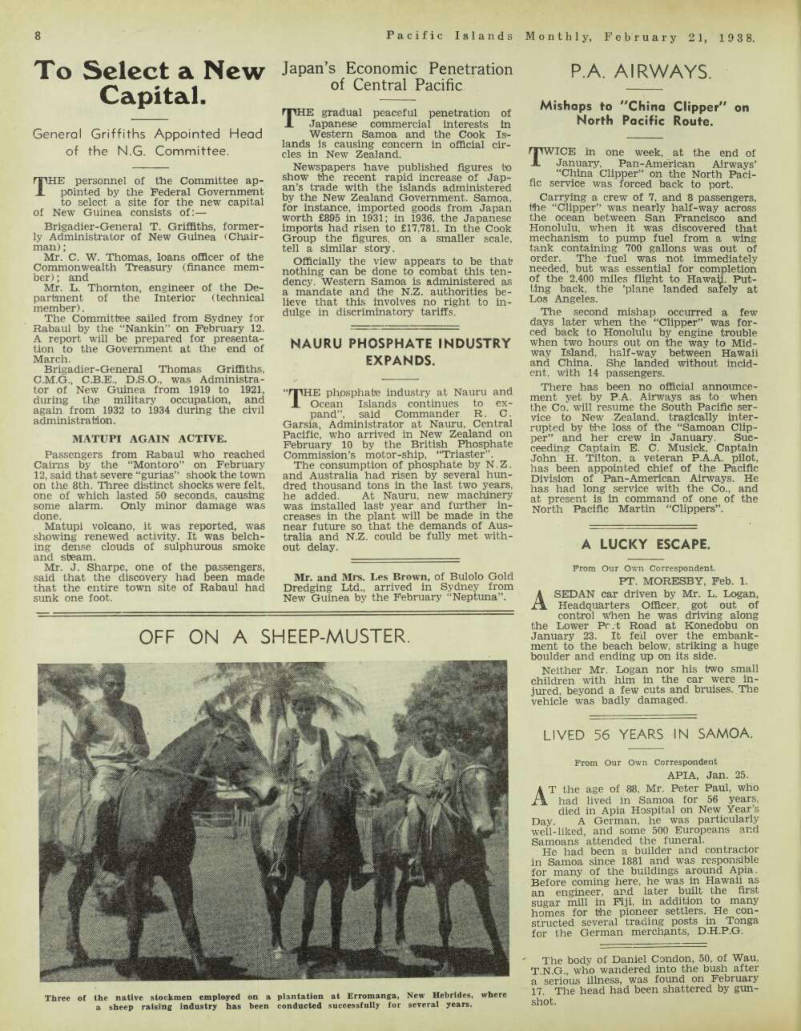
Three of the native stockmen employed on a plantation at Erromanga, New Hebrides, where a sheep raising industry has been conducted successfully for several years.
P.A. Airways.
Mishaps to "China Clipper" on North Pacific Route.
TWICE in one week, at the end of January, Pan-American Airways’
“China Clipper” on the North Paci fic service was forced back to port.
Carrying a crew of 7, and 8 passengers, the “Clipper” was nearly half-way across the ocean between San Francisco and Honolulu, when it was discovered that mechanism to pump fuel from a wing tank containing 700 gallons was out of order. The fuel was not immediately needed, but was essential for completion of the 2,400 miles flight to Hawaii. Put ting back, the ’plane landed safely at Los Angeles.
The second mishap occurred a few days later when the “Clipper” was for ced back to Honolulu by engine trouble when two hours out on the way to Mid way Island, half-way between Hawaii and China. Sh,e landed without incid ent, with 14 passengers.
There has been no official announce ment yet by P.A. Airways as to when the Co. will resume the South Pacific ser vice to New Zealand, tragically inter rupted by the loss of the “Samoan Clip per” and her crew in January. Suc ceeding Captain E. C. Musick, Captain John H. Tilton, a veteran P.A.A. pilot, has been appointed chief of th,e Pacific Division of Pan-American Airways. He has had long service with the Co., and at present is in command of one of the North Pacific Martin “Clippers”.
A Lucky Escape.
Prom Our Own Correspondent.
Pt. Moresby, Feb. 1.
A SEDAN car driven by Mr. L. Logan, Headquarters Officer, got out of control when he was driving along the Lower Pr .t Road at Konedobu on January 23. It fell over the embank ment to the beach below, striking a huge boulder and ending up on its side.
Neither Mr. Logan nor his two small children with him in the car were in jured, beyond a few cuts and bruises. The vehicle was badly damaged.
Lived 56 Years In Samoa.
From Our Own Correspondent
Apia, Jan. 25.
AT the age of 88, Mr. Peter Paul, who had lived in Samoa for 56 years, died in Apia Hospital on New Year’s Day. A German, he was particularly well-liked, and some 500 Europeans and Samoans attended the funeral.
He had been a builder and contractor in Samoa since 1881 and was responsible for many of the buildings around Apia.
Before coming here, he was in Hawaii as an engineer, and later built the first sugar mill in Fiji, in addition to many homes for the pioneer settlers. He con structed several trading posts in Tonga
for the German merchants,
D.H.P.G.
The body of Daniel Condon, 50, of Wau, T.N.G., who wandered into the bush after a serious illness, was found on February 17. The head had been shattered by gun shot.
Tongan Chiefs Visit New Zealand.
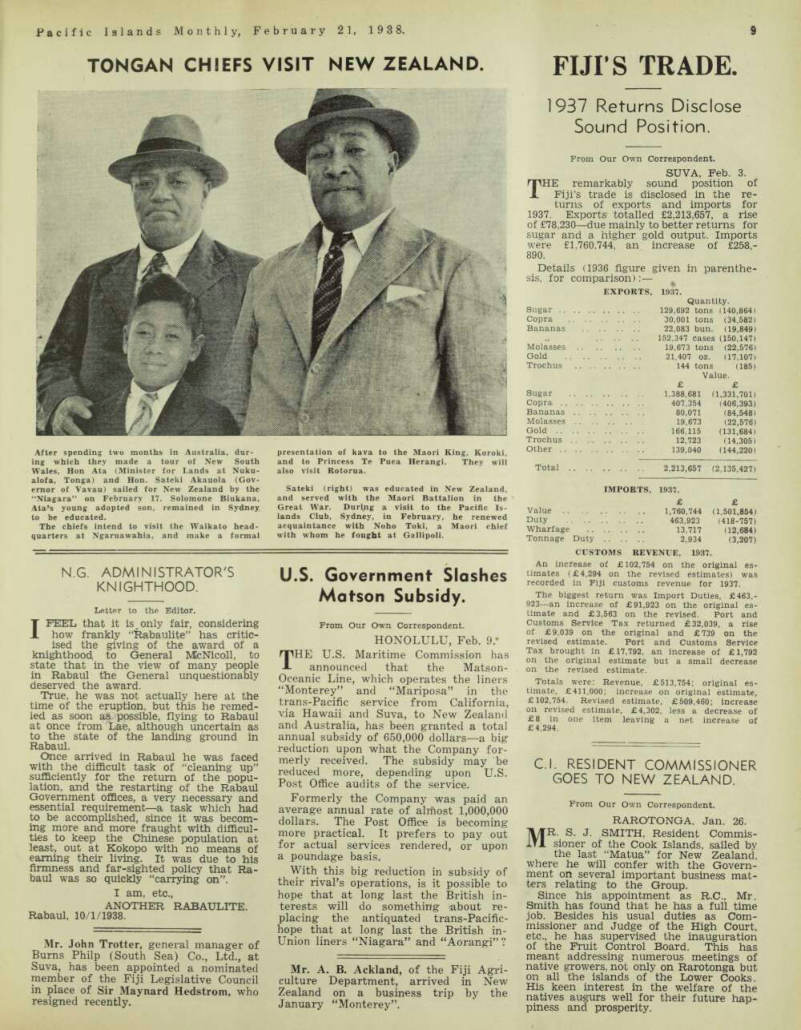
After spending two months in Australia, dur ing which they made a tour of New South Wales, Hon Ata (Minister for Lands at Nuku alofa, Tonga) and Hon. Sateki Akauola (Gov ernor of Vavau) sailed for New Zealand by the “Niagara” on February 17. Solomone Biukana, Ata’s young adopted son, remained in Sydney to be educated.
The chiefs intend to visit the Waikato head quarters at Ngaruawahia, and make a formal
presentation of kava to the Maori King. Koroki, and to Princess Te Puea Herangi. They will also visit Rotorua.
Sateki (right) was educated in New Zealand, and served with the Maori Battalion in the Great War. During a visit to the Pacific Is lands Club, Sydney, in February, he renewed acquaintance with Noho Toki, a Maori chief with whom he fought at Gallipoli.
N.G. Administrator's
Knighthood.
Letter to the Editor.
I FEEL that it is,only fair, considering how frankly “Rabaulite” has critic ised the giving of the award of a knighthood to General MlcNicoll, to state that in the view of many people in Rabaul the General unquestionably deserved the award.
True, h,e was not actually here at the time of the eruption, but this he remed ied as soon as possible, flying to Rabaul at once from Lae, although uncertain as to the state of the landing ground in Rabaul.
Once arrived in Rabaul he was faced with the difficult task of “cleaning up” sufficiently for the return of the popu lation, and the restarting of the Rabaul Government offices, a very necessary and essential requirement—a task which had to be accomplished, since it was becom ing more and more fraught with difficul ties to keep the Chinese population at least, out at Kokopo with no means of earning their living. It was due to his firmness and far-sighted policy that Ra baul was so quickly “carrying on”.
I am, etc.,
Another Rabaulite.
Rabaul, 10/1/1938.
Mr. John Trotter, general manager of Burns Philp (South Sea) Co., Ltd., at Suva, has been appointed a nominated member of the Fiji Legislative Council in place of Sir Maynard Hedstrom, who resigned recently.
Matson Subsidy.
U.S. Government Slashes Matson Subsidy.
From Our Own Correspondent.
Honolulu, Feb. 9.*
THE U.S. Maritime Commission has announced that the Matson- Oceanic Line, which operates the liners “Monterey” and “Mariposa” in the trans-Pacific service from California, via Hawaii and Suva, to New Zealand and Australia, has been granted a total annual subsidy of 650,000 dollars—a big reduction upon what the Company for merly received. The subsidy may be reduced more, depending upon U.S.
Post Office audits of the service.
Formerly the Company was paid an average annual rate of alrftost 1,000,000 dollars. The Post Office is becoming more practical. It prefers to pay out for actual services rendered, or upon a poundage basis.
With this big reduction in subsidy of their rival’s operations, is it possible to hope that at long last the British in terests will do something '.about re placing the antiquated trans-Pacific hope that at long last the British in- Union liners “Niagara” and “Aorangi”?
Mr. A. B. Ackland, of the Fiji Agri culture Department, arrived in New Zealand on a business trip by the January “Monterey”.
Fiji’S Trade.
1937 Returns Disclose Sound Position,
From Our Own Correspondent.
Suva, Feb. 3.
THE remarkably sound position of Fiji’s trade is disclosed in the re turns of exports and imports for 1937. Exports totalled £2,213,657, a rise of £78,230 —due mainly to better returns for sugar and a higher gold output. Imports were £1.760,744, an increase of £258,- 890.
Details (1936 figure given in parenthe sis, for comparison):—
Customs Revenue, 1937.
An increase of £102,754 on the original es timates (£4,294 on the revised estimates) was recorded in Fiji customs revenue for 1937.
The biggest return was Import Duties, £463,- 923 —an increase of £91,923 on the original es timate and £3,563 on the revised. Port and Customs Service Tax returned £32,039. a rise of £9,039 on the original and £739 on the revised estimate. Port and Customs Service Tax brought In £17,792, an increase of £1,792 on the original estimate but a small decrease on the revised estimate.
Totals were: Revenue, £513,754; original es timate, £411,000; increase on original estimate, £102,754. Revised estimate, £509.460; increase on revised estimate, £4,302, less a decrease of £8 in one item leaving a net increase of £4,294.
Exports, 1937.
Quantity.
Sugar .. ., Copra 30,001 tons (34,582) Bananas .. 152,347 cases (150,147) Molasses .. 19,673 tons (22,576) Gold . . . 21,407 oz. (17,107) Trochus 144 tons (185) Value. £ £ Sugar 1,388,681 (1.331.701) Copra .. ..
Bananas ..
Molasses 19,673 (22,576) Gold .. .. 166,115 (131.684) Trochus .. 12,723 (14,305) Other .. ..
Total .. 2,213,657 (2,135,427)
Imports. 1937.
£ £ Value 1,760,744 (1.501,854) Duty 463,923 (418-757) Wharfage 13,717 (12,684) Tonnage Duty 2,934 (3,207)
C.I. Resident Commissioner
Goes To New Zealand.
Prom Our Own Correspondent.
Rarotonga, Jan. 26.
MR. S. J. SMITH, Resident Commis sioner of the Cook Islands, sailed by the last “Matua” for New Zealand, where he will confer with the Govern ment on several important business mat ters relating to the Group.
Since his appointment as R.C., Mr.
Smith has found that he has a full time job. Besides his usual duties as Com missioner and Judge of the High Court, etc., he has supervised the inauguration of the Fruit Control Board. This has meant addressing numerous meetings of native growers, not only on Rarotonga but on all the islands of the Lower Cooks.
His keen interest in the welfare of the natives augurs well for their future hap piness and prosperity.
B.P. Ships.
Complaint About Pre-Embarkation Service.
Letter to the Editor.
PERMIT me space in your journal, to air a Series of grievances relative to the B.P, shipping services.
I advised my intention of travelling from Salamaua (New Guinea) to Sydney and return, well in advance of the scheduled sailing date of the “Neptuna”.
The first annoyance was that the ship de cided to sail from Salamaua four days earlier than advertised —a fact elici ted by me by chance, and of which I was not notifiid. This necessitated a most exasperating rush, to join the steam er, with resultant disorganisation of my working arrangements.
On application to B.P.’s Salamaua branch, I was informed that it would be necessary for me to occupy “steerage ac commodation”, which was endorsed on my first saloon ticket, for which full first saloon fare had been accepted. This accommodation I flatly refused to oc cupy, having viewed the steerage accom modation. which comprised four- and two-birth cabins in the after deck, sad ly lacking in facilities and cleanliness, and, presumably, in use by Asiatics.
I interviewed the ship’s purser, who, whilst commiserating with me in my distress, stated that the matter of inter fering with accommodation held in re serve for other ports, was outside his jurisdiction, without the authority of the Salamaua branch manager being obtain ed. I was put to the annoyance of in terviewing the branch manager and a B.P. inspector, who graciously consented to do their utmost to alleviate my dis tress and perturbation.
Eventually, prior to the hour of sailing, I was allotted a 2-berth cabin, which I oc cupied alone for some few days, despite the fact th#t three friends of mine were in the close confines of a two-berth cabin.
Later I was given a single berth cabin which I held to Sydney.
The service on shipboard was excellent and thoroughly merits the praise be stowed by all passengers, but the exas perations experienced prior to embark
ation tend to leave an ineradicable impres sion, which only time and the untiring solicitude of the ship’s personnel may cause to fade from one’s memory. This state of affairs must be rectified if B.P. hope to continue to attract the class of tourist this ship merits.
I trust the foregoing may bear fruit, and result in better shore administration, with an allotment of space to each port, thus enabling booking clerks to allot staterooms, and numbers of same, in stead of as at present leaving thjs re sponsibility to an overworked purser.
I am, etc.,
James Wright.
Wau, New Guinea.
EDITORIAL NOTE: The above article was shown to the shipping department of Messrs. Bums, Philp and Co. Ltd., Sydney. They explained that on the trip referred to, the “Neptuna’s” cabin accommodation had been allocated between the various ports, and that there were more passen gers wishing to travel to Sydney than there were berths available. B.P. had to get special permis sion from the authorities to carry the extra travellers—mostly school-children returning from their holidays and New Guinea residents on their way south to attend the Sesqui-Oentenary cele brations. The congestion was unavoidable, it was pointed out, because they wished to accommodate all the passengers offering, rather than compel them to await the next steamer.
Another Murnau Film
THE brother of a distinguished German, F. W. Murnau, the film director, who was well-known and beloved in French Oceania, arrived in Australia in February by the “Leuna.” He is Herr Robert Mur nau of Berlin.
Mr. Murnau has been administrator of his brother’s estate since the latter’s death in a motor accident in U.S.A. in 1931. The estate includes property in Europe and America and the tiny island of Anaa, south of the Marquesas, in the Eastern Pacific.
It was on Anaa that Murnau made his magnificent South Seas film “Taboo,” a picture of whose Tahitian girl star, Reri, adorned Mr. Murnau’s cabin in the “Leuna.”
Mr. Murnau said that his brother had made another South Seas travelogue film which had been released to the German Ufa concern three months ago. He ex pected that the new film eventually will be shown in Australian and Pacific Islands centres.
"Zita II" Arrives At Hawaii
Hawaii.
From Our Own Correspondent.
Honolulu, Feb. 4.
RESIDENTS of Pitcairn, Mangareva, th,e Tuamotus, Marquesas, and, fin ally, Tahiti, will be glad to hear that Dr. W. F. Holcomb in the 46 foot stay sail schooner “Zita H.’’, who visited all those islands during 1937, has arrived safely at Hawaii. Leaving San Francis co, in September, 1936, Dr. Holcomb, ac companied by his wife, their two daugh ters, Elizabeth and Iris, and George Over (a University of California sophomore), has covered some 13,000 miles without undue incident.
Before Pitcairn they visited the so called “tragic” isles of Galapagos and met Arthur Wittmer and his family who became emmeshed in the mystery shrouded antics of the sensational Bar oness Eloise Bosquet von Wagner Wehr bom. The latter, a glamorous Viennese noblewoman, set up a strange “Garden of Eden” kingdom on Floriana Island.
The Wittmers were the last to see alive the baroness and her companion, Robert Phillipson, who set sail from Floriana a year or so ago, never to be heard from again. ihe Holcomb party speak highly of 'the generous hospitality which was showered upon them wherever they went in the South Seas.
Violent Earthquake off Coast of Dutch New Guinea
Dutch New Guinea
A SUBMARINE earthquake of great violence convulsed the Arafura Sea near the Aru Islands, off the southern coast of Dutch New Guinea, on February 2. It was the most terrific disturbance ever recorded at Riverview Observatory, Sydney—all the instruments were flung completely out of adjustment. Darwin, Northern Australia, was rocked by a ser ies of tremors for 10 minutes, but only minor damage was suffered.
Mr. E. W. P. Chinnery, Director of District Services and Native Affairs in
New Guinea, is at present spending
long leave in Victoria.
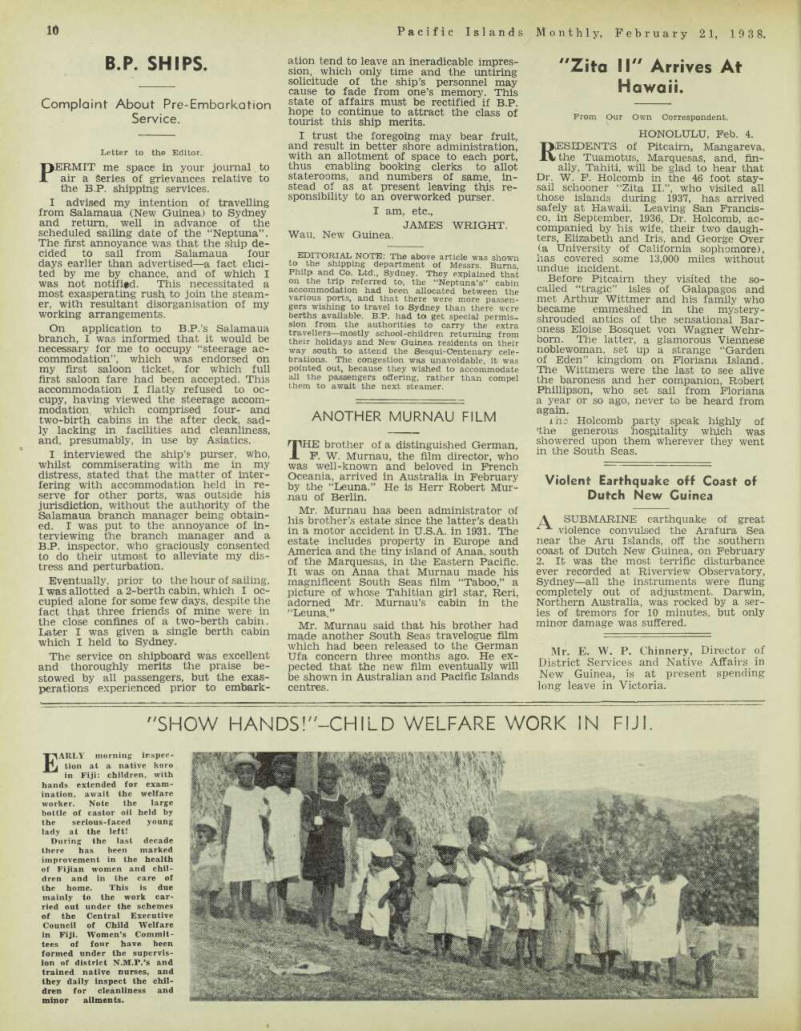
"Show Hands!"-Child Welfare Work In Fiji.
EARLY morning inspec tion at a native koro in Fiji: children, with hands extended for exam ination, await the welfare worker. Note the large bottle of castor oil held by the serious-faced young lady at the left!
During the last decade there has been marked improvement in the health of Fijian women and chil dren and in the care of the home. This is due mainly to the work car ried out under the schemes of the Central Executive Council of Child Welfare in Fiji. Women’s Commit tees of four have been formed under the supervis ion of district N.M.P.’s and trained native nurses, and they daily inspect the chil dren for cleanliness and minor ailments.
Tropicalities
LAST steamer-call, we managed to
salvage three or four pounds of fresh butter, a luxury when no ice-chest exists ashore. However, by the time it reached the house, after a long trip ashore, its pristine icy firmness had given way to a somewhat oily flow. The lady of the house, therefore, without speaking over-carefully, told a native helper to put it in some cold water.
An attempted reconstruction of his mental processes leads me to suppose that he thought the missus had said that it had been in the water; its liquid
appearance would naturally suggest
that. However that may be, the sequel was both simple and rather devastating.
There was Jimmy, standing guard over
a dreadful oily mass, lying in the strong tropical sun; and before the missus could say a word, with pride he looked up and declared, “I think ’e dry now, missus”. No answer!—P. * * * IT is provided in new ' Fijian legis lation relating to mining that re wards may be made to the original dis coverers of precious metals or precious stones.
It is likely that this will permit of recognition being made to the dis coverers of the Tavua goldfield in Northern Fiji—namely, Mr. William Borthwick and Mr. Pat. Costello. * ♦ • THE appointment of General Tom Grif fiths as head of the committee to select a new site for New Guinea’s admin istrative centre has given much satisfac tion in New Guinea, where he is held in high regard. General Griffiths knows New Guinea well —he was there as military Governor, until 1921, and he was adminis trator between 1932 and 1934, when he re tired—and probably there is no man better qualified to weigh up all the varying ad vantages and disadvantages of the differ ent localities suggested. He will not be influenced by any petty or selfish con sideration—the character of this man gives the New Guinea people an assurance that the selection will be made conscientiously and properly.
Mr. Thomas, the second member of the committee, also knows New Guinea thor oughly especially from the planters’ angle, for he was, for years, in charge of expropriated properties—and he should be of great assistance to General Griffiths. ♦ ♦ ♦ A WRITER on Samoan affairs, in a New Zealand newspaper, offers a new and interesting solution of the Samoan Prob lem:— “The history of Samoa clearly reveals the fact that the Samoans have always been troublesome. There was warfare among them long before the advent of Europeans. There was trouble with them during the international occupation of the islands. There was serious trouble between them and the Germans during German occupation. There has been trouble between them and every New Zealand Government since we occupied the place in 1914. They are troublesome now and they will continue to be trouble
some in the future, and there is, at least, one main reason for it. The Samoans have never had a sound thrashing from any of the powers concerned with them, consequently they have got it into their heads that they are invincible.” * * * THE time was the morning after a par ticularly “bright” New Year’s'party; the place, Suva.
Male voice on telephone: “Hello”.
Answering voice: “Hello”.
Male voice: “How are you this morn ing?”
Answering voice: “All right, thank you”.
Male voice: “Sorry, wrong number!” « * * 'T'HE following letter, by Mr. E. H. Hum- A phreys, was published in the Brisbane “Courier Mail,” in January:— “I have read with interest from time to time of the soul-stirring anxiety of the Commonwealth Government for its officials at Rabaul.
“Since the earthquake, and particularly since the report of the expert was received, we have repeatedly been told that the seat of government must be moved. Apparently the remainder of the population may go hang. They have very definitely been told that they can expect no help.
They can move, at their own expense, or stay and be blown up or ruined by loss of business.
“The idea that a government should be expected to go to the expense of saving its mere colonist citizens from ruin or destruction appears to be quite outside the mental capacity of Canberra.
No expense, however, will be spared in looking after the safety of its officials.
“Probably this is so typical that no one has thought to comment on it yet.”
The letter is unnecessarily and unreas onably bitter. The government must ac cept the report of the experts it appointed to advise them, and remove the adminis trative personnel from the danger-zone.
The officials will go because they are told to do so, and the removal will be made at the Government’s cost. The rest of the community, which followed the Adminis tration to Rabaul, in hope of profit in one
shape or another, is free to go or stay, in accordance with ordinary budgetary con siderations. Nevertheless, it does seem hard that all the people who invested in plantations and businesses in the Rabaul district should be heavily penalised, and perhaps ruined, simply because Vulcan chose to blow up on May 28, 1937. In the circumstances, a Government grant, to aid the transport of the non-official com munity to the new site, woud find wide support. * * * rIE fact that the Cook Islanders are now increasing in numbers was quoted by the Resident Commissioner (Mr. S. J.
Smith) in an Auckland interview, and he said that “no greater tribute could be paid to New Zealand’s administration of the Cook Islands.” Hyperbole! New Zealand has an excellent record in the Cook Islands, thanks to her luck in finding some capable administrators: but there is nothing extraordinary in the census position. Practically every branch of the Polynesian race—Samoan. Maori, Tongan, Tahiti —as well as Cook Islanders, having rallied after the first disastrous impact of European “civilisation”, is now increasing steadily in numbers.
The honour of being elected the first ‘honorary members of the Anthropo ogical Society of New South Wales has been accorded Mr. F. E. Williams, Government Anthropologist, Port Moresby, and Mr. Leo Austin, resident magistrate at Daru, in the western division of Papua.
Mr. A. S. Farebrother, of Suva, Fiji, recently presented a window, “The Dove of Peace” to St. Matthew’s Church, Manly, New South Wales, in memory of his mother. It was dedicated by the Archbishop of Sydney (Dr. Mowll) on February 20.
Miss Mavis Father, of Gona, Papua, who has been in Australia spending furlough at Baan Baa, N.S.W., with her parents, returned to the Territory by the last “Macdhui”. She is a worker for the Australian Board of Missions.
Advertisements & other items, pp. 13-14 (1 item)
iOTEv
CREAM
Write for a Colour Card . . .
STERLING VARNISH CO.
Dries in half an hour on plaster walls, ceilings, cement, fibre, wood and iron.
Also Excellent as an Undercoat for lacquers, paints and enamels. 1 I /- per gallon
HIGHLY DURABLE
Alexandria, N.S.W.
TAHITI
OSCAR G. NORDMAN
Specialises in ships' purveying:—Meats, Poultry, Fish, Vegetables, Grocery, Dairy Products, etc. • Ships refuelled from tanks of newly organized oil and coal depots—pipe lines to main wharf.
Also, those contemplating a visit to beautiful Tahiti may assure a comfortable, comprehensive and completely trouble-free Tour by cabling . . .
OSCAR G. NORDMAN
General Shipping Agent and Purveyor
“MAN OF INFORMATION ’*
Cable Address: “Oceanic, Tahiti”
T-WEN at the height of sum ' E mer, New Zealand climate which is upl ped ° chance to aC cool off" to target worries A o VreT; -on-r : iui country in the w “ ld - C oy the glory of land Whether you want ther you wish self wC £ e' a laden air will fill y will save money if »" •“ •'~;;r • P r%. S>«>. u >s gss particulars, write, call or px * fcl 1 M iy l !r ’PhoneßTO^S. id Martin Place, „r,nnsite
Set np in 45 seconds
Power with
Portability . .
THE WATSON "CP" PORTABLE X-RAY APPARATUS
produces more X-Radiaton per pound weight of apparatus and per pound Sterling invested, than any X-ray Unit yet produced. The U CP" is light, compact, and Includes every essential to produce radiographs of unsurpassed excellence —as well as many * advantages hitherto unobtainable in portable X-ray equipment.
For further particulars, communicate with WM
WATSON HOUSE. 9-13 BUSH STREET. SYDNEY
MELBOURNE - BRISBANE - ADELAIDE - PERTH - NEWCASTLE and NEW ZEALAND
About Islands People
Mr. F. L. S. Bell, M.A., who, some years ago, carried out research work in New Guinea, has succeeded Mr. Eric Ramsden as president of the Anthro pological Society of New South Wales.
Mr. Ramsden, who is engaged on an other book, did not see re-election.
Avenai Salabiau, a Fijian Catechist, together with his wife and three children, sailed from Sydney by the “Macdhui” on February 2 for Papua, where he will carry on mission work for the Methodist Mission.
Hon. G. H. Murray, M.L.C., Director of Agriculture in New Guinea, left Sydney for Rabaul on February 12 after spending vacation in Australia. He was accompanied by Mrs. Murray.
Rev. and Mrs. H. Johnstone, of the Methodist Mission, Ba, Fiji, received many congratulations recently on the birth of a son, Peter.
Mrs. Fritz Schober, of Nukualofa, Tonga, who has spent the past year in Sydney, will return to the Friendly Islands by cargo steamer in March.
Her son, Bernhard, will remain at school in Sydney.
Mr. Jack Marshall, author of “Black Musketeers’’ and other books, will address members of the Pacific Islands Club at the Hotel Carlton, Sydney, on march 2. Mr. Marshall, who has just returned from Oxford University, has carried out ornithological work at various times in the New Hebrides and New Guinea.
Mr. R. W. Robson, F.R.G.S., Editor of the “Pacific Islands Monthly”, sailed from Sydney for Auckland by the “Awatea” on January 29 to spend a month’s vacation in New Zealand.
Miss Phoebe Mills, of Queensland, is at present undergoing training at the George Brown Institution, Sydney, prior to taking up an appointment as teacher at the Methodist Mission’s Ballantine Memorial School, Fiji.
Dr. Margaret Mead (now Mrs. Gre gory Bateson), who is well-known in t~e Pacific for her studies of adolescent girls in Samoa and in New Guinea, is now on the island of Bali, Dutch East Indies, with her husband, and will prob ably visit Sydney later in the year. Dr.
Mead is attached to the American Museum of Natural History, New York, and is a noted American anthropologist.
Nurse Talbot, of Christchurch, N.Z., passed through Sydney early in Feb ruary, en route to Malaita, 8.5.1., where she will shortly take up duties at the Melanesian Mission’s Hospital.
Dr. A. J. Borg, of the Fiji Govern ment Medical Service, returned from leave by the “Aorangi” late in January.
Sister Veronica, of the Melanesian Mission, left Sydney for Bunana, 8.5.1., by the “Malaita” on February 5. She has been a member of the Community of the Cross since 1930, Sister Veronica spent her furlough in New Zealand.
Mr. L. A. Lawlor, of Suva, arrived in Sydney from Fiji by the “Monterey” on January 24.
Mr. A. L. Lewis, airport manager in Auckland, New Zealand, for Pan- American Airways, has been recalled to headquarters at Alameda, California.
The transfer is understood to be a tem porary one and, although another offi cer will be sent from U.S.A. to replace him, it is expected that Mr. Lewis will later return to N.Z. as manager.
Mr. R. L. Clark, unofficial member of the Legislative Council of New Guinea, left? for Rabaul by the “Nankin” on Feb ruary 12.
Rev. R. C. G. Page, of the Methodist Mission, returned to Nukualofa, Tonga, by the February “Matua”, after furlough in New Zealand.
Mrs. W. B. Mackay, who has made her home in Fiji for the past seven years, ar rived in Sydney from Suva by the “Niag ara” on February 12 to spend a long holi day with her parents, Mr. and Mrs. F.
E, Basingthwaigte, of Cootamundra,
N.S.W.
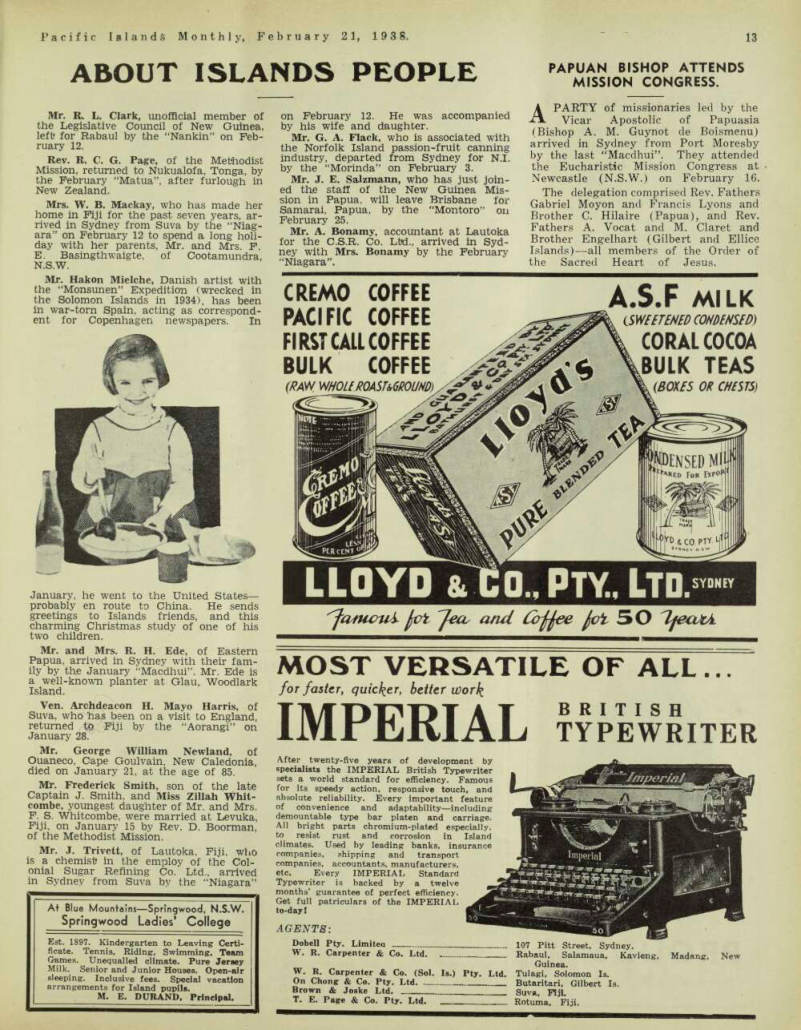
Mr. Hakon Mielche, Danish artist with the “Monsunen” Expedition (wrecked in the Solomon Islands in 1934), has been in war-torn Spain, acting as correspond ent for Copenhagen newspapers. In
January, he went to the United States — probably en route to China. He sends greetings to Islands friends, and this charming Christmas study of one of his two children.
Mr. and Mrs. R. H. Ede, of Eastern Papua, arrived in Sydney with their fam ily by th,e January “Macdhui”. Mr. Ede is a well-known planter at Glau, Woodlark Island.
Yen. Archdeacon H. Mayo Harris, of Suva, who has been on a visit to England, returned td Fiji by the “Aorangi” on January 28.
Mr. George William Newland, of Ouaneco, Cape Goulvain, New Caledonia, died on January 21, at the age of 85.
Mr. Frederick Smith, son of th,e late Captain J. Smith, and Miss Zillah Whit combe, youngest daughter of Mr. and Mrs.
F. S. Whitcombe, were married at Levuka, Fiji, on January 15 by Rev. D. Boorman, of the Methodist Mission.
Mr. J. Trivett, of Lautoka, Fiji, who is a chemist? in the employ of the Col onial Sugar Refining Co. Ltd., arrived in Sydney from Suva by the “Niagara”
® February 12. He was accompanied Mr. G. A. Flack, who is associated with the Norfolk Island passion-fruit canning industry, departed from Sydney for NX by the “Morinda” on February 3.
Mr. J. E. Salzmann, who has just joined the staff of the New Guinea Mislor February 25 P Montoro 0,1 Mr. A. Bonamy, accountant at Lautoka for the C.S.R. Co. Ltd., arrived in Sydney with Mrs. Bonamy by the February “Niagara”.
Papuan Bishop Attends
Mission Congress.
A PARTY of missionaries led by the A Vicar Apostolic of Papuasia (Bishop A. M. Guynot de Boismenu) ® rn X ed , ln i S J, d , ne L f -° in. “ ore s b ? by the last Macdhui . They attended the Eucharistic Mission Congress at Newcastle (N.S.W.) on February 16.
The delegation comprised Rev. Fathers Gabriel Moyon and Francis Lyons and Brother C. Hilaire (Papua), and Rev. atb « rs V ,ocat and M Claret and Brother Engelhart (Gilbert and Ellice Islands)—all members of the Order of the Sacred Heart of Jesus.
Advertisements & other items, p. 15 (2 items)
About Islands People
Imperial
CREMO COFFEE
PACIFIC COFFEE
FIRST CALL COFFEE
BULK COFFEE
(RAW WHOLEROASTiOROUND)
A.S.F MILK
(SWEETENEDCONDENSED)
CORAL COCOA
BULK TEAS
(BOXES OR CHESTS)
4- 2* Js? % 6 Cr <7 £ V \ V MD Ml
ENSED
vmtn RED F ° r ExP °f sh £ &
7 1> &CO PTY 1
pty. Ltd
SYDNEY
'JattwnS fret 'Jea, and Cbjrfee 50 'TfecutA
MOST VERSATILE OF ALL...
for faster, quicker , better work
IMPERIAL
BRITISH
TYPEWRITER
After twenty-five years of development by specialists the IMPERIAL British Typewriter sets a world standard for efficiency. Famous for its speedy action, responsive touch, and absolute reliability. Every important feature of convenience and adaptability—including demountable type bar platen and carriage.
All bright parts chromium-plated especially, to resist rust and corrosion in Island climates. Used by leading banks, insurance companies, shipping and transport companies, accountants, manufacturers, etc. Every IMPERIAL Standard Typewriter is backed by a twelve months’ guarantee of perfect efficiency.
Get full patriculars of the IMPERIAL to-day I
AGENTS:
Dobell Pty. Limited W. R. Carpenter & Co. Ltd.
W. R. Carpenter & Co. (Sol. Is.) Pty. Ltd. Tulagi, Solomon Is.
On Chong & Co. Pty. Ltd. Butaritari, Gilbert Is.
Brown & Joske Ltd. Suva, F!jL T. E. Page & Co. Pty. Ltd. Rotuma, Fiji. 107 Pitt Street, Sydney.
Rabaul, Salamaua, Kavieng, Madang, New Guinea.
At Blue Mountains—Springwood, N.S.W.
Springwood Ladies' College
Est. 1897. Kindergarten to Leaving Certificate. Tennis, Riding, Swimming, Team Games. Unequalled climate. Pure Jersey Milk. Senior and Junior Houses. Open-air sleeping. Inclusive fees. Special vacation arrangements for Island pupils.
M. E. DURAND, Principal.
Group Of Well-Known People At Wau.
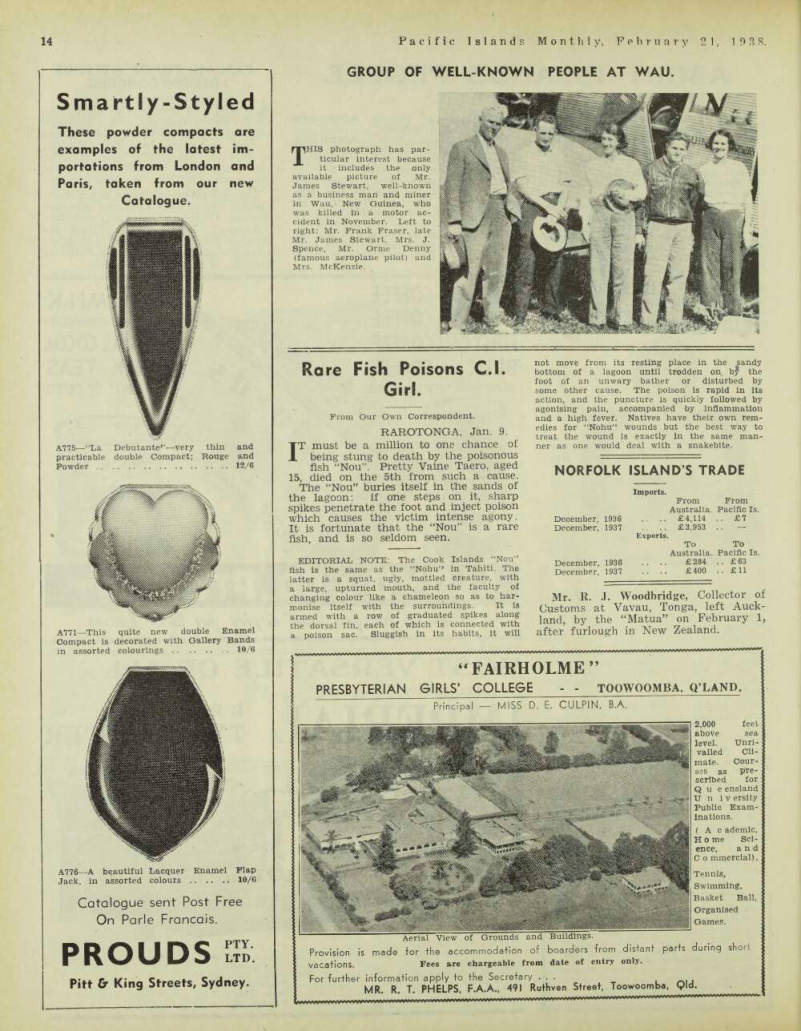
THIS photograph has par ticular interest because it includes the only available picture of Mr.
James Stewart, well-known as a business man and miner in Wau, New Guinea, who was killed in a motor ac cident in November. Left to right: Mr. Prank Fraser, late Mr. James Stewart, Mrs. J.
Spence, Mr. Orme Denny (famous aeroplane pilot) and Mrs. McKenzie.
Rare Fish Poisons C.I.
Girl.
Prom Our Own Correspondent.
Rarotonga, Jan. 9.
IT must be a million to one chance of being stung to death by the poisonous fish “Nou”. Pretty Vaine Taero, aged 15, died on the sth from such a cause.
The “Nou” buries itself in the sands of the lagoon: if one steps on it, sharp spikes penetrate the foot and inject poison which causes the victim intense agony.
It is fortunate that the “Nou” is a rare fish, and is so seldom seen.
EDITORIAL NOTE: The Cook Islands “Nou” fish is the same as the “Nohu’’ in Tahiti. The latter is a squat, ugly, mottled creature, with a large, upturned mouth, and the faculty of changing colour like a chameleon so as to har monise itself with the surroundings. It is armed with a row of graduated spikes along the dorsal fin, each of which is connected with a poison sac. Sluggish in its habits, it will
not move from its resting place in the sandy bottom of a lagoon until trodden on b$ the foot of an unwary bather or disturbed by some other cause. The poison is rapid in its action, and the puncture is quickly followed by agonising pain, accompanied by inflammation and a high fever. Natives have their own rem edies for “Nohu” wounds but the best way to treat the wound is exactly in the same man ner as one would deal with a snakebite.
Mr. R. J. Woodbridge, Collector of Customs at Vavau, Tonga, left Auck land, by the “Matua” on February 1, after furlough in New Zealand.
Norfolk
Island’S Trade
Imports.
Prom Prom Australia. Pacific Is.
December, 1936 .. .. £4,114 .. £7 December, 1937 .. .. £3,953 .. — Exports.
To To
Australia. Pacific Is.
December, 1936 .. .. £284 .. £63 December, 1937 .. .. £400 .. £11
Advertisements & other items, p. 16 (2 items)
PROUDS ltd
Smartly-Styled
These powder compacts are examples of the latest importations from London and Paris, taken from our new Catalogue.
A77s—“La Debutante’’—very thin and practicable double Compact; Rouge and Powder 12/6 ,771 —This quite new double Enamel lompact is decorated with Gallery Bands a assorted colourings 10/6 A 776 —A beautiful Lacquer Enamel Flap Jack, in assorted colours 10/6 Catalogue sent Post Free On Parle Francois.
PROUDS ltd
Pitt Cr King Streets, Sydney.
“Fairholme”
PRESBYTERIAN GIRLS' COLLEGE - • TOOWOOMBA. Q’LAND. 2,000 feet above sea level. Unrivalled Climate. Cour* ses as prescribed for Q u e ensland U n i v ersity Public Examinations. ( A c ademic, H o me Science, and C o mmercial).
Tennis, Swimming, Basket Ball, Organised Games.
during shod
For further information apply to the Secretary ...
MR. R. T. PHELPS. F.A.A.. 491 Ruthven Street. Toowoomba, (?Id.
Principal MISS D. E. CULPIN. B.A.
»>*• Aerial View of Grounds and Buildings.
Provision is made for the accommodation of boarders from distant parts vacations. Fees are chargeable from date of entry only.
New Offices
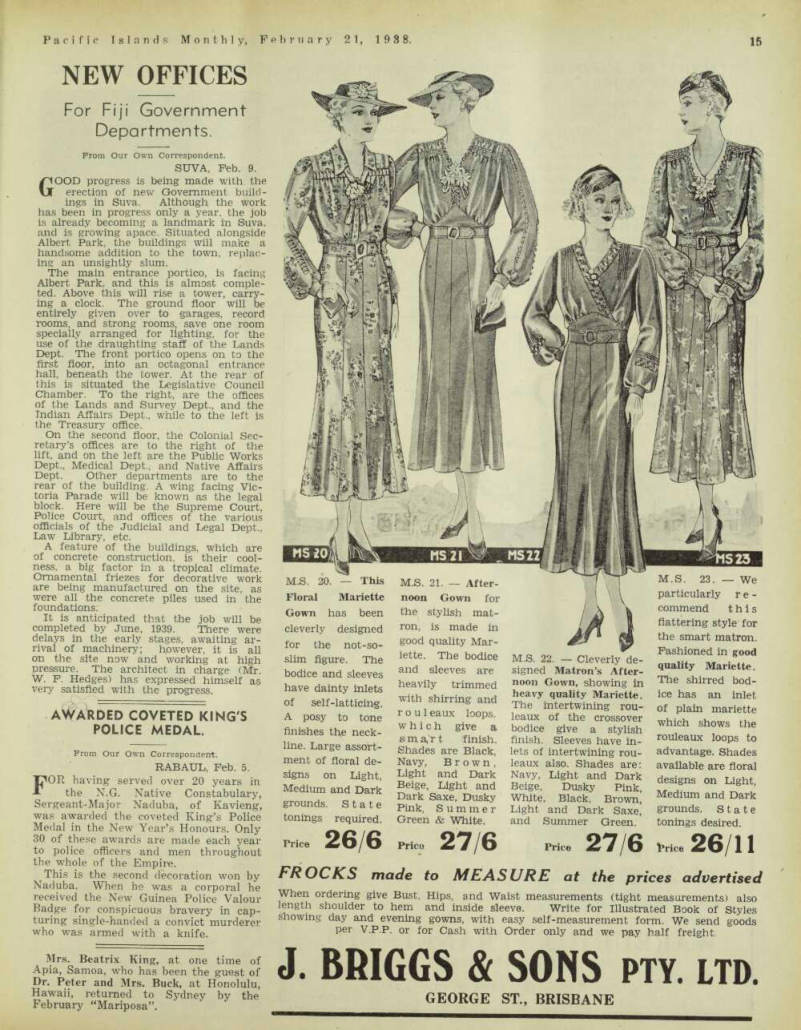
For Fiji Government Departments.
Prom Our Own Correspondent.
Suva, Feb. 9.
GOOD progress is being made with the erection of new Government build ings in Suva. Although the work has been in progress only a year, the job is already becoming a landmark in Suva, and is growing apace. Situated alongside Albert Park, the buildings will make a handsome addition to the town, replac ing an unsightly slum.
The main entrance portico, is facing Albert Park, and this is almost comple ted. Above this will rise a tower, carry ing a clock. The ground floor will be entirely given over to garages, record rooms, and strong rooms, save one room specially arranged for lighting, for the use of the draughting staff of the Lands Dept. The front portico opens on to the first floor, into an octagonal entrance hall, beneath the tower. At the rear of this is situated the Legislative Council Chamber. To the right, are the offices of the Lands and Survey Dept., and the Indian Affairs Dept., while to the left is the Treasury office.
On the second floor, the Colonial Sec retary’s offices are to the right of the lift, and on the left are the Public Works Dept., Medical Dept., and Native Affairs Dept. Other departments are to the rear of the building. A wing facing Vic toria Parade will be known as the legal block. Here will be the Supreme Court, Police Court, and offices of the various officials of the Judicial and Legal Dept., Law Library, etc.
A feature of the buildings, which are of concrete construction, is their cool ness, a big factor in a tropical climate.
Ornamental friezes for decorative work are being manufactured on the site, as were all the concrete piles used in the foundations.
It is anticipated that the job will be completed by June, 1939. There were delays in the early stages, awaiting ar rival of machinery; however, it is all on the site now and working at high pressure. The architect in charge (Mr.
W. F. Hedges) has expressed himself as very satisfied with the progress.
February “Mariposa”.
Awarded Coveted King's
Police Medal.
From Our Own Correspondent.
Rabaul, Feb. 5.
FOR having served over 20 years in the N.G. Native Constabulary, Sergeant-Major Naduba, of Kavieng, was awarded the coveted King’s Police Medal in the New Year’s Honours. Only 30 of these awards are made each year to police officers and men throughout the whole of the Empire.
This is the second decoration won by Naduba. When he was a corporal he received the New Guinea Police Valour Badge for conspicuous bravery in cap turing single-handed a convict murderer who was armed with a knife.
Mrs. Beatrix King, at one time of Apia, Samoa, who has been the guest of Dr. Peter and Mrs. Buck, at Honolulu, Hawaii, returned to Sydney by the
February “Mariposa”.
Advertisements & other items, p. 17 (1 item)
J. BRIGGS & SONS pty. ltd.
a I m & w M.S. 20. This Floral Mariette Gown has been cleverly designed for the not-soslim figure. The bodice and sleeves have dainty inlets
of self-latticing.
A posy to tone finishes th,e neckline. Large assortment of floral designs on Light, Medium and Dark grounds. State tonings required.
M.S. 21. Afternoon Gown for the stylish matron, is made in good quality Mariette. The bodice and sleeves are heavily trimmed with shirring and ro u 1 eaux loops, which give a s m a, r t finish.
Shades are Black, Navy, Brown, Light and Dark Beige, Light and Dark Saxe, Dusky Pink, Summer Green & White.
M.S. 22. Cleverly designed Matron’s Afternoon Gown, showing in heavy quality Mariette.
The intertwining rouleaux of the crossover bodice give a stylish finish. Sleeves have inlets of intertwining rouleaux also. Shades are: Navy, Light and Dark Beige, Dusky Pink, White, Black, Brown, Light and Dark Saxe, and Summer Green.
Price
26/6 Price 27/6
M.S. 23. —We
particularly recommend this flattering style for the smart matron.
Fashioned in good quality Mariette.
The shirred bodice has an inlet of plain mariette which shows the rouleaux loops to advantage. Shades available are floral designs on Light, Medium and Dark grounds. State tonings desired.
Price
27/6 trice 26/11
FROCKS made to MEASURE at the prices advertised When ordering give Bust, Hips, and Waist measurements (tight measurements) also length shoulder to hem and inside sleeve. Write for Illustrated Book of Styles showing day and evening gowns, with easy self-measurement form. We send goods per V.P.P. or for Cash with Order only and we pay half freight
J. BRIGGS & SONS pty. ltd.
GEORGE ST., BRISBANE
"Talkies" For Makogai
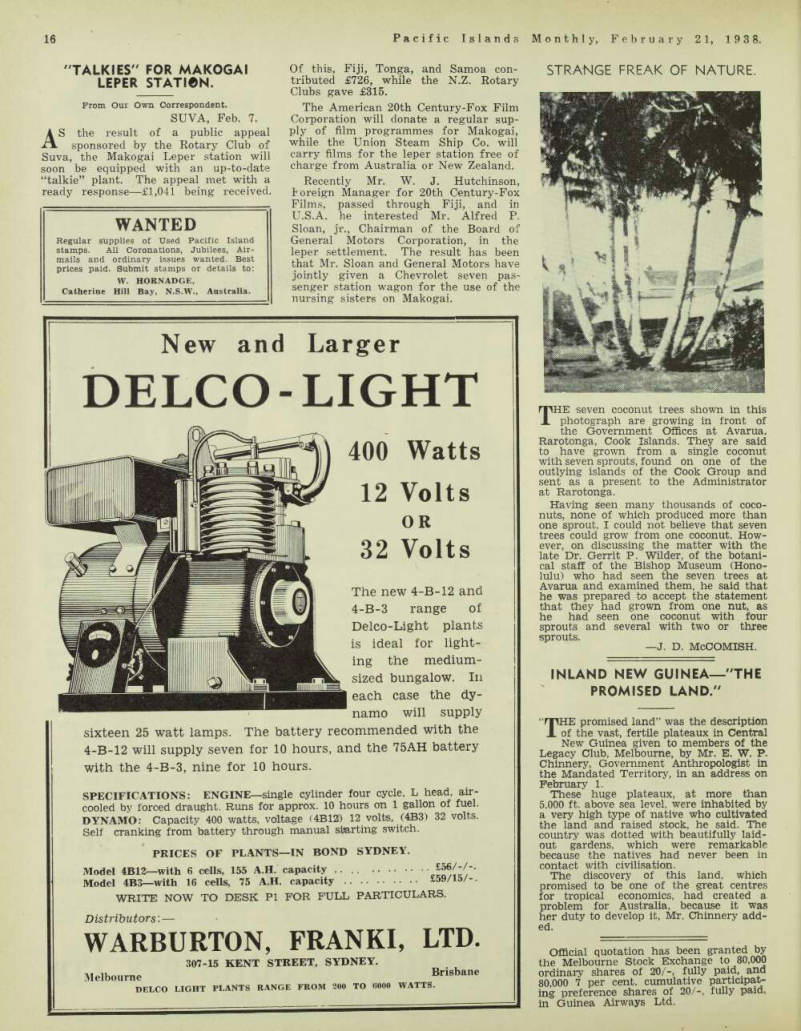
Leper Station.
From Our Own Correspondent.
Suva, Feb. 7.
AS the result of a public appeal sponsored by the Rotary Club of Suva, the Makogai Leper station will soon be equipped with an up-to-date “talkie” plant. The appeal met with a ready response—£l,o4l being received.
Of this, Fiji, Tonga, and Samoa con tributed £726, while the N.Z. Rotary Clubs gave £315.
The American 20th Century-Fox Film Corporation will donate a regular sup ply of film programmes for Makogai, while the Union Steam Ship Co. will carry films for the leper station free of charge from Australia or New Zealand.
Recently Mr. W. J. Hutchinson, Foreign Manager for 20th Century-Fox Films, passed through Fiji, and in U.S.A. he interested Mr. Alfred P.
Sloan, jr., Chairman of the Board of General Motors Corporation, in the leper settlement. The result has been that Mr. Sloan and General Motors have jointly given a Chevrolet seven pas senger station wagon for the use of the nursing sisters on Makogai.
Strange Freak Of Nature.
THE seven coconut trees shown in this photograph are growing in front of the Government Offices at Avarua, Rarotonga, Cook Islands. They are said to have grown from a single coconut with seven sprouts, found on one of the outlying islands of the Cook Group and sent as a present to the Administrator at Rarotonga.
Having seen many thousands of coco nuts, none of which produced more than one sprout, I could not believe that seven trees could grow from one coconut. How ever, on discussing the matter with the late Dr. Gerrit P. Wilder, of the botani cal staff of the Bishop Museum (Hono lulu) who had seen the seven trees at Avarua and examined them, he said that he was prepared to accept the statement that they had grown from one nut, as he had seen one coconut with four sprouts and several with two or three sprouts.
J. D. Mccomish.
Inland New Guinea—"The
Promised Land."
“rpHE promised land” was the description X of the vast, fertile plateaux in Central New Guinea given to members of the Legacy Club, Melbourne, by Mr. E. W. P.
Chinnery, Government Anthropologist in the Mandated Territory, in an address on February 1.
These huge plateaux, at more than 5.000 ft. above sea level, were inhabited by a very high type of native who cultivated the land and raised stock, he said. The country was dotted with beautifully laid out gardens, which were remarkable because the natives had never been in contact with civilisation.
The discovery of this land, which promised to be one of the great centres for tropical economics, had created a problem for Australia, because it was her duty to develop it, Mr. Chinnery add ed.
Official quotation has been granted by the Melbourne Stock Exchange to 80,000 ordinary shares of 20/-, fully paid, and 80.000 7 per cent, cumulative participat ing preference shares of 20/-, fully paid, in Guinea Airways Ltd.
Advertisements & other items, p. 18 (1 item)
Delco- Light
WANTED
Regular supplies of Used Pacific Island stamps. All Coronations, Jubilees, Airmails and ordinary issues wanted. Best prices paid. Submit stamps or details to;
W. HORNADGE,
Catherine Hill Bay, N.S.W., Australia.
New and Larger
DELCO- LIGHT
La
400 Watts
12 Volts
OR
32 Volts
The new 4-B-12 and 4-B-3 range of Delco-Light plants is ideal for lighting the mediumsized bungalow. In each case the dynamo will supply sixteen 25 watt lamps. The battery recommended with the 4-B-12 will supply seven for 10 hours, and the 75AH battery with the 4-B-3, nine for 10 hours.
SPECIFICATIONS: ENGlNE—single cylinder four cycle, L head, aircooled by forced draught. Runs for approx. 10 hours on 1 gallon of fuel.
DYNAMO: Capacity 400 watts, voltage (4812 D 12 volte, (483) 32 volts.
Self cranking from battery through manual smarting switch.
PRICES OF PLANTS—IN BOND SYDNEY.
Model 4Bl2—with 6 cells, 155 A.H. capacity ...
Model 4B3—with 16 cells, 75 A.H. capacity £59/15/-.
WRITE NOW TO DESK PI FOR PULL PARTICULARS.
Distributors'. —
WARBURTON, FRANKI, LTD.
307-15 KENT STREET, SYDNEY.
Melbourne Brisbane DELCO LIGHT PLANTS RANGE FROM 200 TO 6000 WATTS.
Tahiti Schooner
Wrecked.
In Treacherous Tuamotus Pass.
From Our Own Correspondent
Papeete, Jan. 8.
THE Government schooner “Mouette” was wrecked at Amanu, one of the islands of the Tuamotu Archipelago in December.
The passage into the lagoon at Amanu is narrow and dangerous. For nine hours each day a strong current rushes through it as the high tide of the open sea rises above the level of the lagoon. At low tide this current is reversed as the piled up waters in the lagoon drain into the surrounding ocean.
The “Mouette”, carrying the Adminis trator of the Tuamotus (Monsieur Senac) and Doctor Massal on a tour of inspec tion, entered the pass at the time the out flowing current was at its maximum. Her engine is said to have failed at the moment of the schooner’s arrival at the most perilous point in the pass, and the current, laying hold of her, cast her broadside on the edge of the reef. The “Mouette” immediately sent out an S.O.S. call which was picked up by the Marquesas Islands radio station and thence relayed to Papeete.
The schooner “Denys” (Captain Alex ander Mervin) had left Amanu the night before and was at Hao, nine miles away, when the broadcast from Papeete an nouncing the mishap to the “Mouette” was heard. Captain Mervin immediately sailed to Amanu, arriving there late at night. Entering the pass, he could see no sign of the “Mouette”, and it was not until he arrived at the settlement
that he found out what had happened.
It appears that at the turn of the tide the inrushing current had lifted the “Mouette” from the reef and carried her into the lagoon. Her hull had been badly damaged and, as she floated, she filled rapidly and sank in the calm waters within the reef—3o metres below the surface. The ship’s company were res cued and cared for by the natives.
Captain Mervin offered to carry them to Papeete. Meanwhile, word came that the authorities at Tahiti had despatched the schooner “Tamara” and, as there was no radio-transmitting apparatus at Am anu to notify Papeete that the “Denys” was there, the “Mouette” passengers felt obliged to await the coming of the “Ta mara”.
Amanu is a large atoll shaped like a vast bow. It is, without doubt, the “Sagittaria” of the Spaniard Quiros, who passed through the Tuamotu Archipelago in 1606. Quiros’ description of his land ing on an island he named “Sagittaria” once led historians to believe that his ac tual landing place was the isthmus of Taravao on Tahiti; but that has since been disproved. The form of Amanu would suggest to a discoverer the name “Sagittaria” and probably Quiros was so influenced. 3,000 Books for Islands.
ABOUT 3,000 books, comprising novels and general literature, are to be cir culated through Australia’s Islands territories as a result of a grant of £625 a year for three years made by the American Carnegie Foundation. The books were being packed in Canberra in February, under the supervision of the Commonwealth Librarian (Mr. Binns) and will be shipped at the end of the month.
Tonga Saw P.A.A.'S
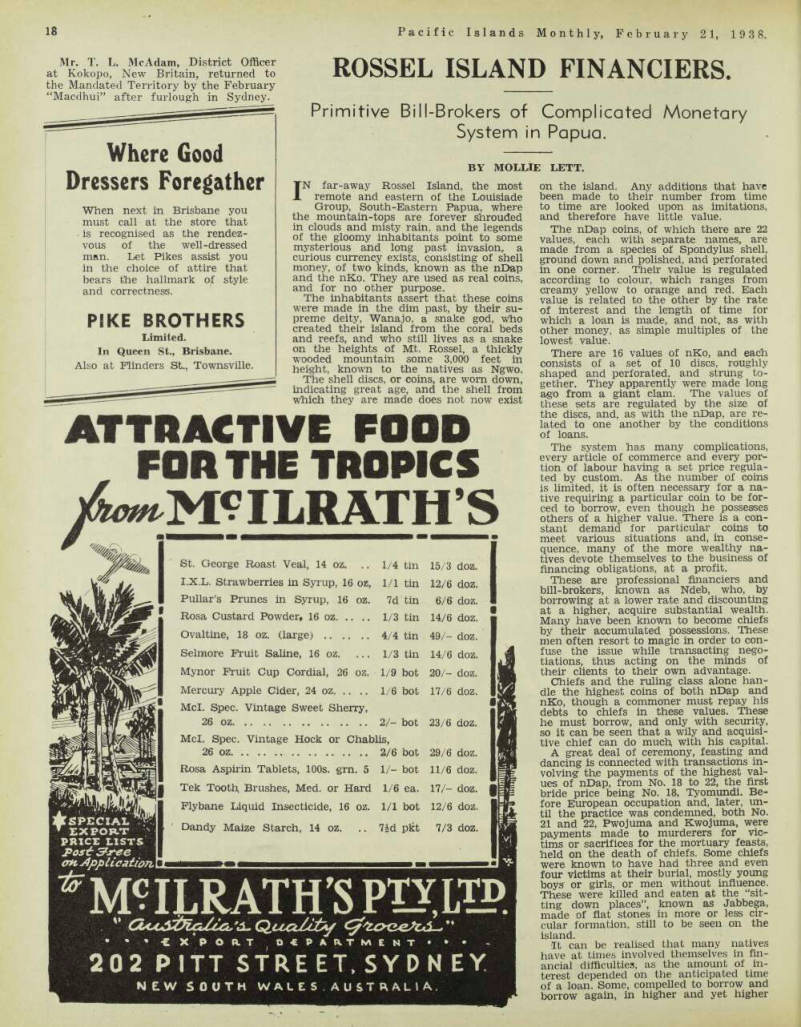
"Samoa Clipper."
From Our Own Correspondent.
Nukualofa, Jan. 7.
PAN-AMERICAN Airways “Samoa Clipper”, on her second survey trip from Pago Pago to N.Z., was sighted at Tongatabu on both her outward and re turn trips.
On the return, she flew right across Nukualofa. On account of losing touch with Pago Pago radio station, she con tacted with the station here, which kept on tapping her from 11 a.m. till 1 p.m., when she again got into touch with American Samoa. As the day was calm and clear, the “Clipper” presented a beautiful sight as she floated majes tically above our town.
Mr. T. L. Me Adam, District Officer at Kokopo, New Britain, returned to the Mandated Territory by the February “Macdhui” after furlough in Sydney.
Advertisements & other items, pp. 19-20 (1 item)
Kodak
W. FINAU
International Stamp & Photo Service,
BOX 40. NUKUALOFA, TONGA IS., OCEANIA.
u fa Photos of native life and scenes In Tonga: 5/-.
Tin-Can Mail cover franked with eight pretty Niuafoou mint: 4/6; same with 3 varieties: 1/6.
Registered, postmarked and despatched at Niuafoau (Tin-Can Island).
Tongan mint of 15 all different: 16/6 postpaid.
1/
Kodak
IN FOUR
POPULAR GRADES
FILM
matter what kind of picture you want there is a Kodak Film ready to give you better results with every picture opportunity. Four famous emulsions: Verichrome, Super Sensitive Panchromatic, Panatomic and Regular.
Kodak Film is made in Australia in accordance with the latest photographic research. Made to suit tropical conditions and requirements.
Of All Kodak Dealers throughout the Islands and
KODAK (Australasia) Pty. Ltd.
379 GEORGE STREET, SYDNEY.
t I I First copies are just coming from the Press! Covers all the newest Kodaks, Brownies and Miniature Kodaks De Luxe. Readers of the “P.LM.” should apply at once for th,eir free copy, thus assuring reservation. Edition is limited.
Where Good
Dressers Foregather
When next in Brisbane you must call at the store that is recognised as the rendezvous of the well-dressed man. Let Pikes assist you in the choice of attire that bears the hallmark of style and correctness.
PIKE BROTHERS
Limited.
In Queen St., Brisbane.
Also at Flinders St., Townsville.
ATTRACTIVE
FOR THE TROPICS
®ILRATH’S
St. George Roast Veal, 14 oz. ..
I.X.L. Strawberries in Syrup, 16 oz, Pullar’s Prunes in Syrup, 16 oz.
Rosa Custard Powder, 16 oz 1/4 tin 1/1 tin 7d tin 1/3 tin
PRICE LISTS
Post &jree
cm Application
Ovaltine, 18 oz, (large) 4/4 tin Selmore Fruit Saline, 16 oz. ... 1/3 tin Mynor Fruit Cup Cordial, 26 oz. 1/9 bot Mercury Apple Cider, 24 oz 1/6 bot Mcl. Spec. Vintage Sweet Sherry, 26 oz 2/- bot Mcl. Spec. Vintage Hock or Chablis, 26 oz 2/6 bot Rosa Aspirin Tablets, 100 s. grn. 5 1/- bot Tek Tooth, Brushes, Med. or Hard 1/6 ea.
Ply bane Liquid Insecticide, 16 oz. 1/1 bot Dandy Maize Starch, 14 oz. .. 7£d pkt 15/3 doz. 12/6 doz. 6/6 doz. 14/6 doz. 49/- doz. 14/6 doz. 20/- doz. 17/6 doz. 29/6 doz. 11/6 doz. 17/- doz. 12/6 doz. 7/3 doz.
PTY.L™
•••-EX PORT department • • •
202 PITT STREET, SYDNEY
MEW SOUTH WALES . AUSTRALIA.
Rossel Island Financiers.
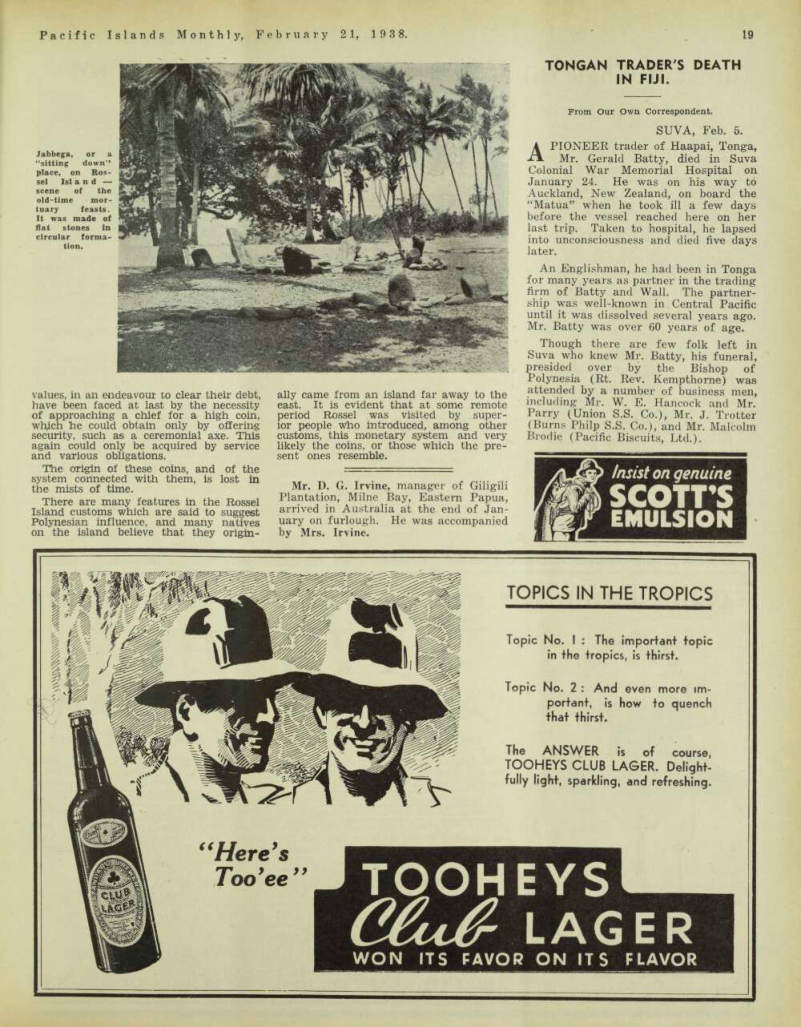
Primitive Bill-Brokers of Complicated Monetary System in Papua.
By Mollie Lett.
IN far-away Rossel Island, the most remote and eastern of the Louisiade Group, South-Eastern Papua, where the mountain-tops are forever shrouded in clouds and misty rain, and the legends of the gloomy inhabitants point to some mysterious and long past invasion, a curious currency exists, consisting of shell money, of two kinds, known as the nDap and the nKo. They are used as real coins, and for no other purpose.
The inhabitants assert that these coins were made in the dim past, by their su preme deity, Wanajo, a snake god, who created their island from the coral beds and reefs, and who still lives as a snake on the heights of Mt. Rossel, a thickly wooded mountain some 3,000 feet in height, known to the natives as Ngwo.
The shell discs, or coins, are worn down, indicating great age, and the shell from which they are made does not now exist
on the island. Any additions that have been made to their number from time to time are looked upon as imitations, and therefore have little value.
The nDap coins, of which there are 22 values, each with separate names, are made from a species of Spondylus shell, ground down and polished, and perforated in one corner. Their value is regulated according to colour, which ranges from creamy yellow to orange and red. Each value is related to the other by the rate of interest and the length of time for which a loan is made, and not, as with other money, as simple multiples of the lowest value.
There are 16 values of nKo, and each consists of a set of 10 discs, roughly shaped and perforated, and strung to gether. They apparently were made long ago from a giant clam. The values of these sets are regulated by the size of the discs, and, as with the nDap, are re lated to one another by the conditions of loans.
The system has many complications, every article of commerce and every por tion of labour having a set price regula ted by custom. As the number of coins is limited, it is often necessary for a na tive requiring a particular coin to be for ced to borrow, even though he possesses others of a higher value. There is a con stant demand for particular coins to meet various situations and, in conse quence, many of the more wealthy na tives devote themselves to the business of financing obligations, at a profit.
These are professional financiers and bill-brokers, known as Ndeb, who, by borrowing at a lower rate and discounting at a higher, acquire substantial wealth.
Many have been known to become chiefs by their accumulated possessions. These men often resort to magic in order to con fuse the issue while transacting nego tiations, thus acting on the minds of their clients to their own advantage.
Chiefs and the ruling class alone han dle the highest coins of both nDap and nKo, though a commoner must repay his debts to chiefs in these values. These he must borrow, and only with security, so it can be seen that a wily and acquisi tive chief can do much, with his capital.
A great deal of ceremony, feasting and dancing is connected with transactions in volving the payments of the highest val ues of nDap, from No. 18 to 22, the first bride price being No. 18, Tyomundi. Be fore European occupation and, later, un til the practice was condemned, both No. 21 and 22, Pwojuma and Kwojuma, were payments made to murderers for vic tims or sacrifices for the mortuary feasts, held on the death of chiefs. Some chiefs were known to have had three and even four victims at their burial, mostly young boys or girls, or men without influence.
These were killed and eaten at the “sit ting down places”, known as Jabbega, made of flat stones in more or less cir cular formation, still to be seen on the island.
It can be realised that many natives have at times involved themselves in fin ancial difficulties, as the amount of in terest depended on the anticipated time of a loan. Some, compelled to borrow and borrow again, in higher and yet higher
values, in an endeavour to clear their debt, have been faced at last by the necessity of approaching a chief for a high coin, which he could obtain only by offering security, such as a ceremonial axe. This again could only be acquired by service and various obligations.
The origin of these coins, and of the system connected with them, is lost in the mists of time.
There are many features in the Rossel Island customs which are said to suggest Polynesian influence, and many natives on the island believe that they origin
ally came from an island far away to the east. It is evident that at some remote period Rossel was visited by super ior people who introduced, among other customs, this monetary system and very likely the coins, or those which the pre sent ones resemble.
Mr. D. G. Irvine, manager of Giligili
Plantation, Milne Bay, Eastern Papua,
arrived in Australia at the end of Jan uary on furlough. He was accompanied by Mrs. Irvine.
Jabbega, or a “sitting down" place, on Ros sel Islandscene of the old-time mor tuary feasts.
It was made of flat stones in circular forma tion.
Tongan Trader's Death
In Fiji.
Prom Our Own Correspondent.
Suva, Feb. 5.
A PIONEER trader of Haapai, Tonga, Mr. Gerald Batty, died in Suva Colonial War Memorial Hospital on January 24. He was on his way to Auckland, New Zealand, on board the “Matua” when he took ill a few days before the vessel reached here on her last trip. Taken to hospital, he lapsed into unconsciousness and died five days later.
An Englishman, he had been in Tonga for many years as partner in the trading firm of Batty and Wall. The partner ship was well-known in Central Pacific until it was dissolved several years ago.
Mr. Batty was over 60 years of age.
Though there are few folk left in Suva who knew Mr. Batty, his funeral, presided over by the Bishop of Polynesia (Rt. Rev. Kempthorne) was attended by a number of business men, including Mr. W. E. Hancock and Mr.
Parry (Union S.S. Co.), Mr. J. Trotter (Burns Philp S.S. Co.), and Mr. Malcolm Brodie (Pacific Biscuits, Ltd.).
Advertisements & other items, p. 21 (1 item)
C£Ol£ Lager
Insist on genuine
SCOTT’S
EMULSION
« M £ r
Here’s
Too’
}> m ee m
TOPICS IN THE TROPICS
Topic No. I : The important topic in the tropics, is thirst.
Topic No. 2 : And even more important, is how to quench that thirst.
The ANSWER is of course,
TOOHEYS CLUB LAGER. Delight-
fully light, sparkling, and refreshing.
TOOHEYS
C£ol£ LAGER
WON ITS FAVOR ON ITS FLAVOR
Threat of Whale Oil
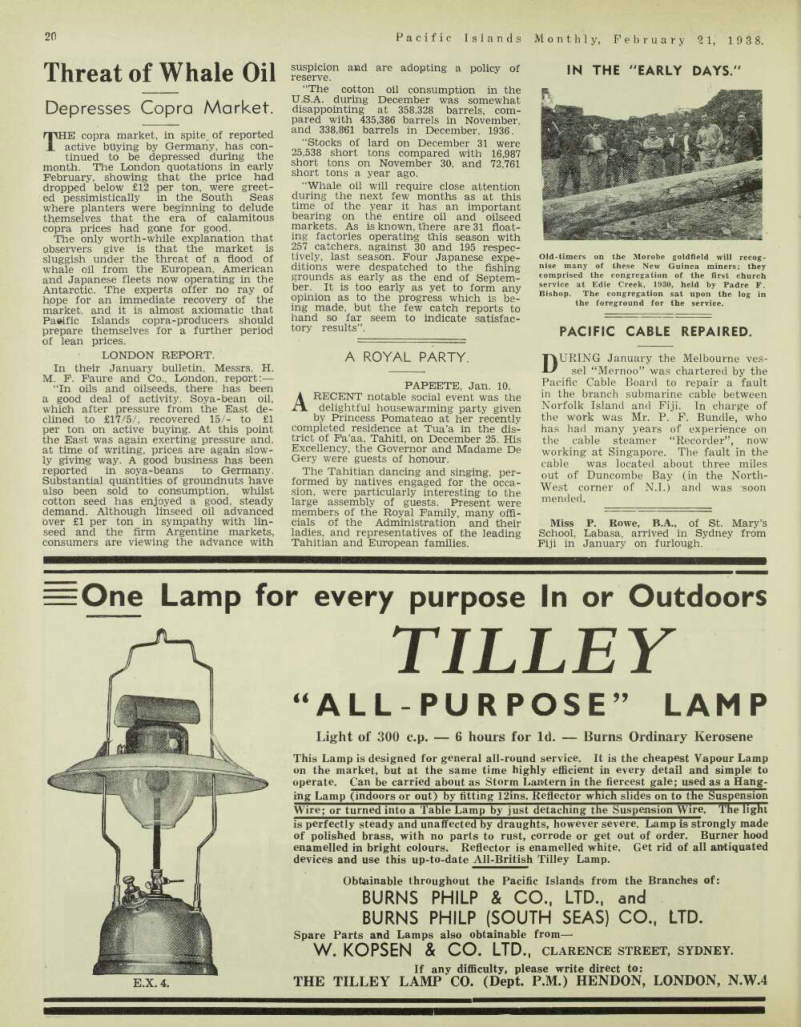
Depresses Copra Market.
THE copra market, in spite, of reported active buying by Germany, has con tinued to be depressed during the month. The London quotations in early February, showing that the price had dropped below £l2 per ton, were greet ed pessimistically in the South Seas where planters were beginning to delude themselves that the era of calamitous copra prices had gone for good.
The only worth-while explanation that observers give is that the market is sluggish under the threat of a flood of whale oil from the European, American and Japanese fleets now operating in the Antarctic. The experts offer no ray of h,ope for an immediate recovery of the market, and it is almost axiomatic that Pacific Islands copra-producers should prepare themselves for a further period of lean prices.
London Report.
In their January bulletin, Messrs. H.
M. P. Faure and Co., London, report:— “In oils and oilseeds, there has been a good deal of activity. Soya-bean oil, which after pressure from the East de clined to £l7/5/, recovered 15/- to £1 per ton on active buying. At this point the East was again exerting pressure and. at time of writing, prices are again slow ly giving way. A good business has been reported in soya-beans to Germany.
Substantial quantities of groundnuts have also been sold to consumption, whilst cotton seed has enjoyed a good, steady demand. Although linseed oil advanced over £1 per ton in sympathy with lin seed and the firm Argentine markets, consumers are viewing the advance with
suspicion and are adopting a policy of reserve.
“The cotton oil consumption in the U.S.A. during December was somewhat disappointing at 358,328 barrels, com pared with 435,386 barrels in November, and 338,861 barrels in December, 1936.
“Stocks of lard on December 31 were 25,538 short tons compared with 16,987 short tons on November 30, and 72,761 short tons a year ago.
“Whale oil will require close attention during the next few months as at this time of the year it has an important bearing on the entire oil and oilseed markets. As is known, there are 31 float ing factories operating this season with 257 catchers, against 30 and 195 respec tively, last season. Four Japanese expe ditions were despatched to the fishing grounds as early as the end of Septem ber. It is too early as yet to form any opinion as to the progress which is be ing made, but the few catch reports to hand so far seem to indicate satisfac tory results”.
A Royal Party.
Papeete, Jan. 10.
A RECENT notable social event was the delightful housewarming party given by Princess Pomateao at her recently completed residence at Tua’a in the dis : trict of Fa’aa, Tahiti, on December 25. His Excellency, the Governor and Madame De Gery were guests of honour.
The Tahitian dancing and singing, per formed by natives engaged for the occa sion, were particularly interesting to the large assembly of guests. Present were members of the Royal Family, many offi cials of the Administration and their ladies, and representatives of the leading Tahitian and European families.
In The "Early Days"
Old-timers on the Morobe goldfield will recog nise many of these New Guinea miners; they comprised the congregation of the first church service at Edie Creek, 1930, held by Padre F.
Bishop. The congregation sat upon the log in the foreground for the service.
Pacific Cable Repaired.
DURING January the Melbourne ves sel “Mernoo” was chartered by the Pacific Cable Board to repair a fault in the branch submarine cable between Norfolk Island and Fiji. In charge of the work was Mr. P, F. Bundle, who has had many years of experience on the cable steamer “Recorder”, now working at Singapore. The fault in the cable was located about three miles out of Buncombe Bay (in the North- West corner of N. 1.) and was -soon mended.
Miss P. Rowe, 8.A., of St. Mary’s School, Labasa, arrived in Sydney from Fiji in January on furlough.
Advertisements & other items, p. 22 (1 item)
Tilley
=One Lamp for every purpose In or Outdoors E.X. 4.
“ALL-PURPOSE” LAMP
Light of 300 c.p. 6 hours for Id. Burns Ordinary Kerosene This Lamp is designed for general all-round service. It is the cheapest Vapour Lamp on the market, but at the same time highly efficient in every detail and simple! to operate. Can be carried about as Storm Lantern in the fiercest gale; used as a Hanging Lamp (indoors or out) by fitting 12ins. Reflector which slides on to the Suspension Wire; or turned into a Table Lamp by just detaching the Suspension Wire! The light is perfectly steady and unaffected by draughts, however severe. Lamp is strongly made of polished brass, with no parts to rust, corrode or get out of order. Burner hood enamelled in bright colours. Reflector is enamelled white. Get rid of all antiquated devices and use this up-to-date All-British Tilley Lamp.
Obtainable throughout the Pacific Islands from the Branches of;
BURNS PHILP & CO., LTD., and
BURNS PHILP (SOUTH SEAS) CO.. LTD.
Spare Parts and Lamps also obtainable from— W. KOPSEN & CO. LTD CLARENCE STREET, SYDNEY.
If any difficulty, please write direct to: THE TILLEY LAMP CO. (Dept. P.M.) HENDON, LONDON, N.W.4
from tonga to B.S.I
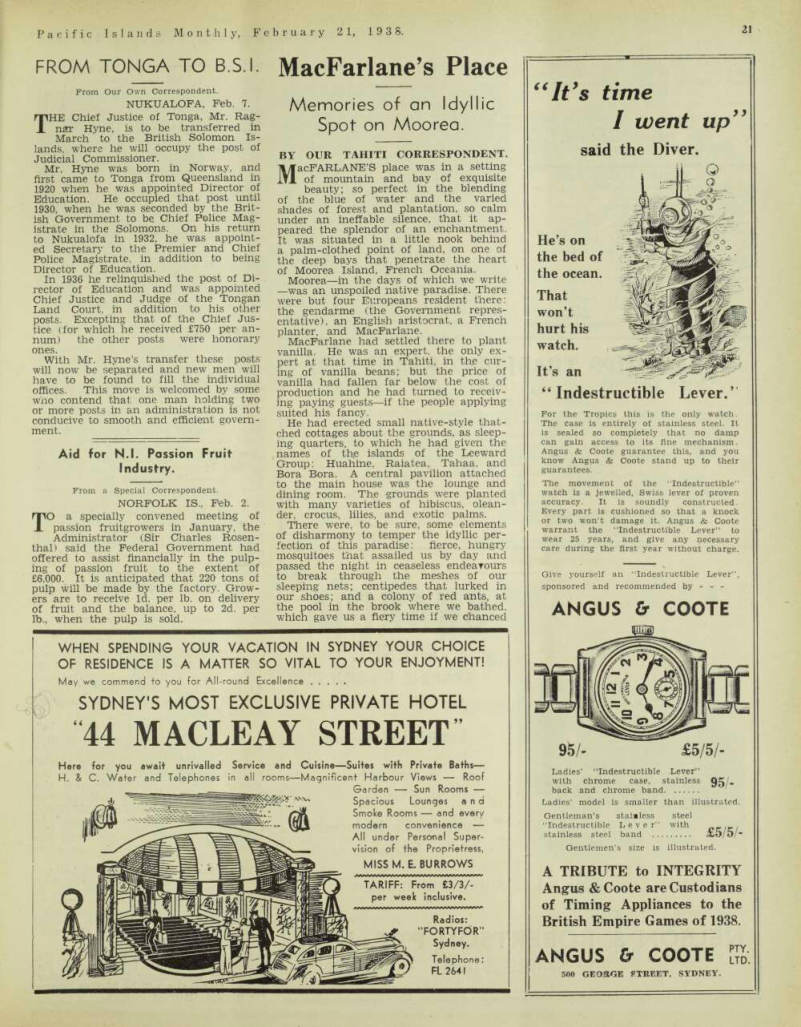
From Our Own Correspondent.
Nukualofa, Feb. 7.
THE Chief Justice of Tonga, Mr. Rag nar Hyne, is to be transferred in March to the British Solomon Is lands, where he will occupy the post of Judicial Commissioner, Mr. Hyne was born in Norway, and first came to Tonga from Queensland in 1920 when he was appointed Director of Education. He occupied that post until 1930, when he was seconded by the Brit ish Government to be Chief Police Mag istrate in the Solomons. On his return to Nukualofa in 1932, he was appoint ed Secretary to the Premier and Chief Police Magistrate, in addition to being Director of Education.
In 1936 he relinquished the post of Di rector of Education and was appointed Chief Justice and Judge of the Tongan Land Court, in addition to his other posts. Excepting that of the Chief Jus tice (for which he received £750 per an num) the other posts were honorary ones.
With Mr. Hyne’s transfer these posts will now be separated and new men will have to be found to fill the individual offices. This move is welcomed by some who contend that one man holding two or more posts in an administration is not conducive to smooth and efficient govern ment.
Industry.
Aid for N.I. Passion Fruit Industry.
From a Special Correspondent.
Norfolk Is., Feb. 2.
TO a specially convened meeting of passion fruitgrowers in January, the Administrator (Sir Charles Rosen thal) said the Federal Government had offered to assist financially in the pulp ing of passion fruit to the extent of £6,000. It is anticipated that 220 tons of pulp will be made by the factory. Grow ers are to receive Id. per lb. on delivery of fruit and the balance, up to 2d. per lb., when the pulp is sold.
MacFarlane’s Place
Memories of on Idyllic Spot on Moorea.
By Our Tahiti Correspondent.
MacFARLANE’S place was in a setting of mountain and bay of exquisite beauty; so perfect in the blending of the blue of water and the varied shades of forest and plantation, so calm under an ineffable silence, that it ap peared the splendor of an enchantment.
It was situated in a little nook behind a palm-clothed point of land, on one of the deep bays that penetrate the heart of Moorea Island, French Oceania.
Moorea—in the days of which we write —was an unspoiled native paradise. There were but four Europeans resident there: the gendarme (the Government repres entative). an English aristocrat, a French planter, and MacFarlane.
MacFarlane had settled there to plant vanilla. He was an expert, the only ex pert at that time in Tahiti, in th,e cur ing of vanilla beans; but the price of vanilla had fallen far below the cost of production and he had turned to receiv ing paying guests—if the people applying suited his fancy.
He had erected small native-style that ched cottages about the grounds, as sleep ing quarters, to which he had given the names of th,e islands of the Leeward Group: Huahine, Raiatea, Tahaa. and Bora Bora. A central pavilion attached to the main house was the lounge and dining room. The grounds were planted with many varieties of hibiscus, olean der, crocus, lilies, and exotic palms.
There were, to be sure, some elements of disharmony to temper the idyllic per fection of this paradise: fierce, hungry mosquitoes that assailed us by day and passed the night in ceaseless endeavours to break through the meshes of our sleeping nets; centipedes that lurked in our shoes; and a colony of red ants, at the pool in the brook where we bathed, which gave us a fiery time if we chanced
to trespass on their chosen highways.
But these were of minor importance com pared with th,e absolute escape from the irritations of modern civilisation, and the unearthly beauty of the place.
Associated with our memories of Mac- Farlane’s place are some of our fellow guests: th,e learned Archdeacon who initiated us into the deeper mysteries of
Anglican canonical lore; the French doc tor from Papeete who gave us an en thusiastic lecture on elephantiasis in th,e presence of an astounded old native lady, who had been sitting on the lawn quiet ly plaiting a hat and suddenly found her ample calves the Exhibit A and Exhibit B of an excited harangue in a language she could not comprehend; and, above all, Puoro.
Puoro was not a guest from a far-away land; he lived about a kilometre down th,e bay, half way to Papetoai. Years be fore, when he was young and svelte, he had been the official player of the ac cordion to King Pomare V., of Tahiti.
Now, he was portly and had not seen his knees since 20 years; but his fingers had not lost their cunning. He knew but one European tune—a Virginia Reel, a favourite in the Old South, of the States before the Civil War; and such was the fire and rhythm when he played, that one could see, in imagination, a laughing damsel in crinoline and her swain trip ping across the floor of an old Southern
ballroom of some cotton king’s mansion.
He was at his best, however, in the exciting rhythms of Tahitian music. We used to invite him up to MacFarlane’s as our guest. When he was well lined with good food and a little good cheer (very little of the latter because he was a good church member) the sound of his accordion would gather together the na tives of the neighbourhood and we would hear native singing and see native danc ing at their natural best.
The going and coming between Tahiti and Moorea was, in these days, some thing of an adventure. The internal combustion engines of that period were petulant and capricious. That on the lit tle schooner voyaging to Moorea would sulk sometimes for hours while the boat tossed and rolled in the swell of the sea; and everyone on board became seasick.
That is why fewer and fewer went to MacParlane’s until finally MacFarlane gave up and went away to the island of Tubuai; and th,e most fascinating, the most idyllic place in the South Seas went back to jungle.
Years afterwards, we met a gentleman who had known MacFarlane before he came to the Islands. His name there was not MacFarlane. The place was the capital city of one of the great Domin ions of the British Empire. MacFarlane was one of its most respected citizens, a man of culture, and a member of the Upper Chamber of the Dominion Parlia ment. One day he packed a bag, put a few pounds sterling in his pocket and disappeared. There was no breath of scandal. His family in their beautiful home were well provided for.
There was no reason whatsoever for his going except a sudden overwhelming dis gust for civilisation. He could have re turned at any time and resumed his name and his position; but he never did. He lived for 30 years in the Islands and died there—he had found the haven of his dreams.
Advertisements & other items, pp. 23-24 (2 items)
“It’s time
I went up”
It’s an
“ Indestructible Lever.’
For the Tropics this is the only watch.
The case is entirely of stainless steel. It is sealed so completely that no damp can gain access to its fine mechanism.
Angus & Coote guarantee this, and you know Angus & Coote stand up to their guarantees.
The movement of the “Indestructible” watch is a Jewelled, Swiss lever of proven accuracy. It is soundly constructed.
Every part is cushioned so that a knock or two won’t damage it. Angus & Coote warrant the “Indestructible Lever” to wear 25 years, and give any necessary care during the first year without charge.
Give yourself an “Indestructible Lever”, sponsored and recommended by - - -
ANGUS & COOTE
Ladies’ ‘‘lndestructible Lever” with chrome case, stainless 95 back and chrome band Ladies’ model is smaller than illustrated.
Gentleman’s staimless steel “Indestructible Lever” with . stainless steel band *5/5/"
Gentlemen’s size is illustrated.
A TRIBUTE to INTEGRITY
Angus & Coote are Custodians
of Timing Appliances to the
British Empire Games of 1938.
ANGUS & COOTE
500 GEORGE STREET, SYDNEY.
said the Diver.
He’s on
the bed of
the ocean.
That
won’t
hurt his
watch.
95/
THE PACIFIC ISLANDS CLUB
Visitors from the Islands to Sydney (or those interested in Islands affairs), are advised to communicate with the honorary secretary of the above Club, which has been formed to study the history, traditions, economics, and political developments of the Pacific Islands.
Next gathering, March 2, at Hotel Carlton, Sydney. Speaker: Mr. Jack Marshall, author of “BLACK MUSKETEERS", on the New Hebrides.
Address communications to: The Honorary Secretary.
THE PACIFIC ISLANDS CLUB,
C/o Pacific Publications Pty. Ltd,, Union House, George St., Sydney.
STEAMSHIPS TRADING COMPANY LTD.
PORT MORESBY PAPUA SAMARAI
Chairman and Managing Director: A. S. FITCH.
Shipowners, Wholesale and Retail Merchants and Traders; Shipping, Customs and Insurance Agents; Copra and Rubber Plantation Owners.
MAIL CONTRACTORS TO COMMONWEALTH AND PAPUAN GOVERNMENTS.
AGENCIES: —At Port Moresby: Coral Sea Insurance Co.; Phoenix Insurance Co.; Delta Sawmills, Ltd.; Acme Bakery Co. ; Vacuum Oil Co. Pty. Ltd. At Samarai: Coral Sea Insurance Co. ; Delta Sawmills, Ltd. ; Bankers and Traders' Insurance Co. ; National Mutual Life Insurance Co. ; Kularo Shipyards; Mamai Plantations.
BRANCHES: —In Papua: Hanuabada. Sivitoi, Aroma, Koki, Hula, Ela Beach, Duga Duga, Yule Island.
SYDNEY; NELSON & ROBERTSON PTY. LTD., 12 Spring St.; Melbourne, 396 Flinders Lane; London, E. Whiteaway & Co., 7 Chiswell Street, Finsbury, London.
Cable Address: “STEAMSHIPS.” Code: Bentley’s.
SKANDIA
DIESEL
MARINE ENGINES
Highest Class. Prices Moderate.
Latest Installation " Chinsurah " 50 Horse Power Sydney - Port Moresby
12 Days
LOW CONSUMPTION FUEL AND LUBRICATING OIL
Australasian Distributors . . .
NELSON & ROBERTSON PTY. LTD.
12 SPRING STREET - - SYDNEY
44 Macleay Street
WHEN SPENDING YOUR VACATION IN SYDNEY YOUR CHOICE OF RESIDENCE IS A MAHER SO VITAL TO YOUR ENJOYMENT!
May we commend to you for All-round Excellence
SYDNEY'S MOST EXCLUSIVE PRIVATE HOTEL
44 MACLEAY STREET
Here for you await unrivalled Service and Cuisine—Suites with Private Baths H. & C. Water and Telephones in all rooms—Magnificent Harbour Views Root Garden - Sun Rooms Spacious Lounges ana Smoke Rooms and every modern convenience All under Personal Supervision of the Proprietress,
MISS M. E. BURROWS
a** & & &
TARIFF: From £3/3/-
per week inclusive.
Radios:
"FORTYFOR 1
Sydney.
Telephone: FL 2641
"Matua" Passenger Fined.
Prom Our Own Correspondent.
Suva, Feb. 2.
A THROUGH passenger on the Islands motorship “Matua” was fined £5 in the Suva Police Court on January -24 for obstructing the Medical Officer (Dr. D. Macpherson) in the execution of his duty.
The traveller, Mr. W. S. Green, had refused to join the line-up for medical inspection. Going to his cabin, he would not return on deck. When a special message was sent telling him that the 'doctor was waiting he declared the latter could stay there until he was ready to come up. Witnesses said Green behaved in a “truculent manner” to both the doctor and the Captain of the “Matua”.
Dr. H. lan Hogbin, Lecturer in Anthro pology at th,e Sydney University, who is the author of several books relating to Melanesian and Polynesian cultures, is now engaged on a new work dealing with the island of Malaita in the British Solomons. He is president of the Paci fic Islands Club, Sydney.
Mother Athanatius, of the Lady of the Sacred Heart Convent, left Sydney by the “Changte” on January 22 for Thursday Island, where she will be Mother Super ior of the Catholic Mission.
New Year's Visit To A Hermit.
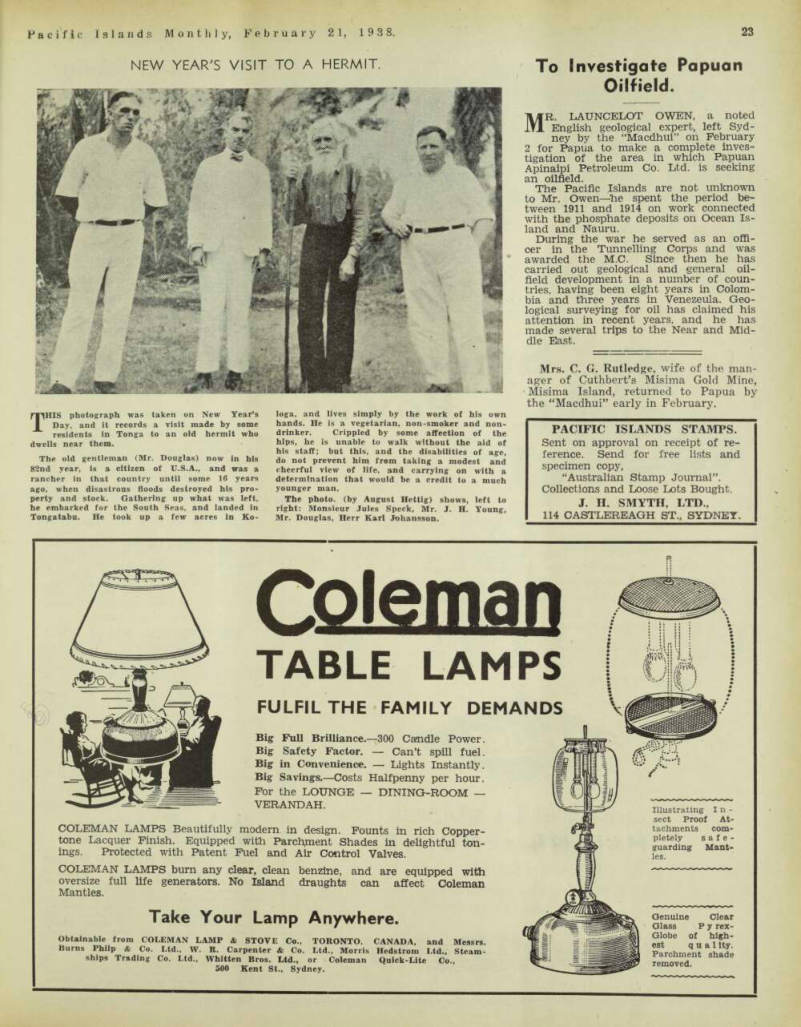
THIS photograph was taken on New Year’s Day, and it records a visit made by some residents in Tonga to an old hermit who dwells near them.
The old gentleman (Mr. Douglas) now in his 82nd year, is a citizen of D.S.A., and was a rancher in that country until some 16 years ago, when disastrous floods destroyed his pro perty and stock. Gathering up what was left, he embarked for the South Seas, and landed in Tongatabu. He took up a few acres in Ko
loga, and lives simply by the work of his own hands. He is a vegetarian, non-smoker and non drinker. Crippled by some affection of the hips, he is unable to walk without the aid of his staff; but this, and the disabilities of age, do not prevent him from taking a modest and cheerful view of life, and carrying on with a determination that would be a credit to a much younger man.
The photo, (by August Hettig) shows, left to right; Monsieur Jules Speck, Mr. J. H. Young, Mr. Douglas, Herr Karl Johansson.
To Investigate Papuan
Oilfield.
Mr. Launcelot Owen, A Noted
English geological expert, left Syd ney by the “Macdhui” on February 2 for Papua to make a complete inves tigation of the area in which Papuan Apinaipi Petroleum Co. Ltd. is seeking an oilfield.
The Pacific Islands are not unknown to Mr. Owen—he spent the period be tween 1911 and 1914 on work connected with the phosphate deposits on Ocean Is land and Nauru.
During the war he served as an offi cer in the Tunnelling Corps and was awarded the M.C. Since then he has carried out geological and general oil field development in a number of coun tries, having been eight years in Colom bia and three years in Venezeula. Geo logical surveying for oil has claimed his attention in recent years, and he has made several trips to the Near and Mid dle East.
Mrs. C. G. Rutledge, wife of the man ager of Cuthbert’s Misima Gold Mine,
Misima Island, returned to Papua by
the “Macdhui” early in February.
Advertisements & other items, p. 25 (1 item)
Coleman
PACIFIC ISLANDS STAMPS.
Sent on approval on receipt of reference. Send for free lists and specimen copy, “Australian Stamp Journal”.
Collections and Loose Lots Bought.
J. H. SMYTH, LTD.,
114 CASTLEREAGH ST., SYDNEY.
Coleman
TABLE LAMPS
FULFIL THE FAMILY DEMANDS
Big Full Brilliance.—3oo Candle Power.
Big Safety Factor. Can’t spill fuel.
Big in Convenience. Lights Instantly.
Big Savings.—Costs Halfpenny per hour.
For the LOUNGE DINING-ROOM
VERANDAH.
COLEMAN LAMPS Beautifully modern in design. Founts in rich Coppertone Lacquer Finish. Equipped with Parchment Shades in delightful tunings. Protected with Patent Fuel and Air Control Valves.
COLEMAN LAMPS bum any clear, clean benzine, and are equipped with oversize full life generators. No Island draughts can affect Coleman Mantles.
Take Your Lamp Anywhere.
Obtainable from COLEMAN LAMP & STOVE Co., TORONTO. CANADA, and Messrs.
Burns Philp & Co. Ltd., W. R. Carpenter & Co. Ltd., Morris Hedstrom Ltd., Steamships Trading Co. Ltd., Whitten Bros. Ltd., or Coleman Quick-Lite Co., 500 Kent St., Sydney. ® i
Pacific Islands Club.
MEMBERS of the Pacific Islands Club held a successful gathering at the Hotel Carlton, Sydney, on February 2, wh,en Hon, George H. Murray, M.L.C., Director of Agriculture in New Guinea, was the guest of honour. Including a number of Islands visitors, there was an attendance of over 80.
Lecturing on “Agriculture, European
and Native, in the Mandated Terri tory”, Mr. Murray dealt with the culti vation of copra, cocoa, coffee, rubber, palm oil, kapok, cinchona, cotton, and sisal hemp. Hon. Ata, of Nukualofa, spoke briefly on “The System of Land Tenure in Tonga”.
The function was rounded off with a musical programme, which included a particularly spirited performance of Maori songs and dances by Chief Noho Toki.
Miss Beatrice Grimshaw, the well known South Seas novelist, wr.s to have addressed the gathering, telling of her ad ventures in the Pacific in search of ma terial for her books; but at the last moment she was unable to attend owing to an attack of malaria. Formerly a resident of Papua, Miss Grimshaw how resides at Kelso, near Bathurst, N.S.W.
The Club now has its own magazine, “Te Karere* (Th,e Messenger), priced 3d., which is sent gratis to all members in the Islands.
Rev. 0. Furness was accepted by the Foreign Mission Board of the Methodist Society in January for work at Rotuma
Island, Fiji.
* Mr. R. Chant, manager of the Sapphire Creek mine of Mandated Alluvials N.L. in Papua, reached Sydney from Port
Moresby by the January “Macdhui”.
Chain of Radio
Stations Collecting Weather Reports for Islands Aircraft.
IMPORTANT expansions of the facilities for compiling meteorological inform ation for aircraft in Central and Western Pacific are to be made as a re sult of the International Meteorological Conference held in New Zealand at the end of last year.
For the New Guinea service, which is scheduled to commence late in March, a first-class weather station will be open ed at Port Moresby (Papua), with second ary stations at Townsville, Cooktown and Rabaul. The principal forecasting sta tion will be Townsville, where two men will be stationed. At the others, there will, at first, be only one officer.
Work at these stations will include ordinary observations for transmission to planes every half hour, upper air observa tions three times a day, and forecasting for the route on the basis of general advice from the central bureau at Mel bourne, where more detailed analysis of the weather position is possible.
Stations will be opened later on Lord Howe Island and Norfolk Island for the use of aircraft on th,e proposed Australia -New Zealand flying-boat service. In addition, supplementary reports for these aircraft will be provided by two observers, to be stationed permanently on ships which regularly cross the Tasman Sea, The Conference urged that Australia should co-operate with New Zealand, Fiji, Samoa, and the Dutch East Indies in collating weather reports. It was stressed that stations should be established at the Solomons, New Hebrides, Suva, Canton Island, Rarotonga, Nukualofa, Apia, and Sunday Island. The Samoan station would obtain information from Howland Island, Kingman Reef and Jarvis Island.
New Patrol Boats For
North.
TWO new fast patrol boats are ex pected to be commissioned for ser vice in the North by the end of Ap ril. There will then be a squadron of three boats patrolling Northern waters to keep Japanese luggers in check.
A launch for the Customs Department will be ready to undertake service at Thursday Island at the end of next month, and delivery of a triple-engined patrol boat for the Department of the Interior is expected early in April.
Advertisements & other items, p. 26 (2 items)
Smooth
s r
Power
The moderate speeds of the British-built Fetter Diesel Marine Engines and their simplicity of design assure a constant supply of smooth power over years of trouble free, economical operation. The extreme simplicity makes a breakdown most Improbable, and the moderate speeds mean less wear, long fife and low operating cost.
Put in a Fetter" the popular engine for all types of craft. New. illustrated literature on request. /
ATOMIC-DIESEL & SEMI-DIESEL
MARINE ENGINE
5 to 480 B.H.P.
These engines can be supplied ex-Bond, free of Australian Customs Duty.
guzacolt
7TO II MARKET STREET SYDNEY
Help Kidneys
Don’t Take Drastic Drugs
Your kidneys have nine million tiny tubes or biters which are endangered by neglect or drastic, irritating drugs. Beware! If Kidney trouble or Bladder weakness makes you suffer from Getting Up Nights, Leg Pains, Nervousness, Dizziness, Stiffness, Rheumatism, Lumbago, Circles Under Eyes, Swollen Ankles, Neuralgia, Burning, Itching.
Smarting, Acidity or Loss of Vigour, don’t delay Try the Doctor’s new discovery called Cystes (Siss-tex). Soothes, tones, cleans, and heals sick kidneys. Starts work in 15 minutes. Brings new health, youth and vitality in 48 hours. Cystex costs little and is guaranteed to end your troubles ia 8 days or money back. Price 4/-, all Stores and Chemists. SCHAFFER * CO., 189 Clarence Street, Sydney.
Islands By The Way.
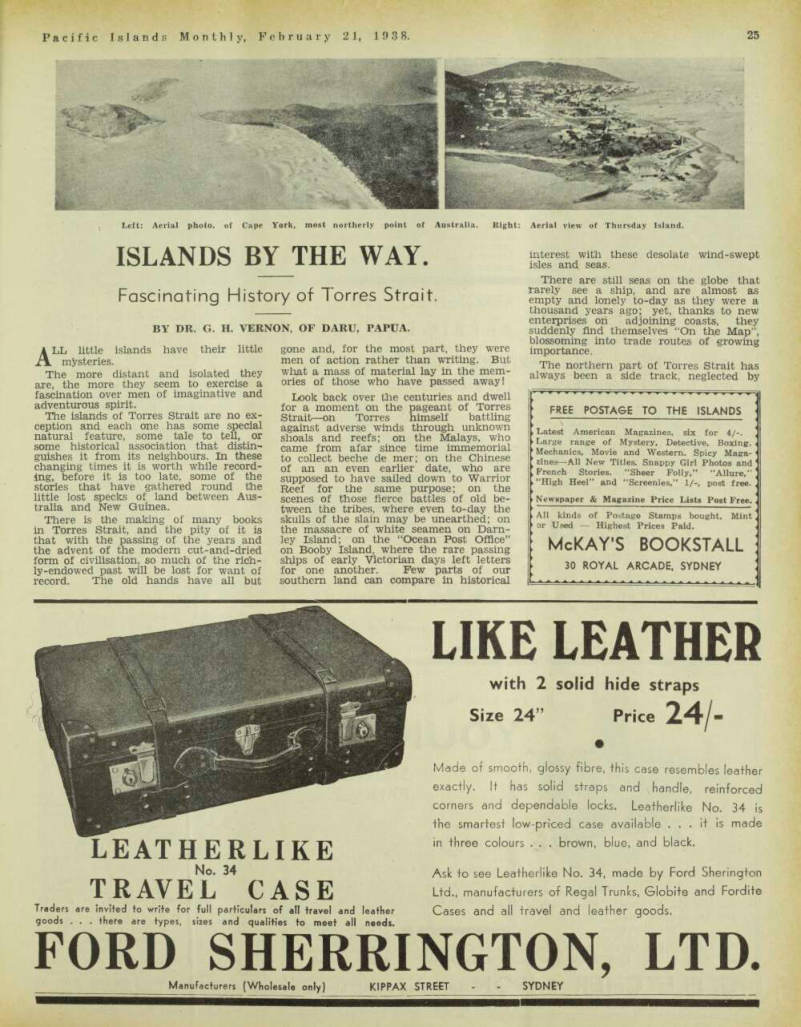
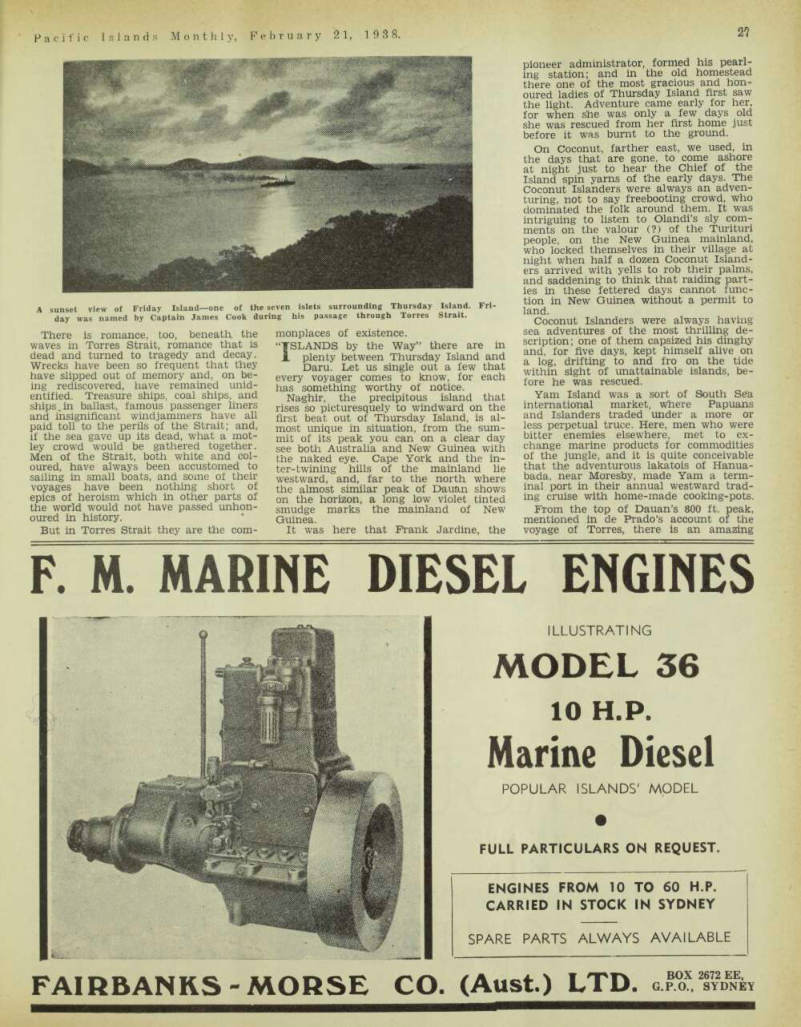
Fascinating History of Torres Strait.
BY DR. G. H. VERNON, OF DARU, PAPUA.
ALL little islands have their little mysteries.
The more distant and isolated they are, the more they seem to exercise a fascination over men of imaginative and adventurous spirit.
The islands of Torres Strait are no ex ception and each one has some special natural feature, some tale to tell, or some historical association that distin guishes it from its neighbours. In these changing times it is worth while record ing, before it is too late, some of the stories that have gathered round the little lost specks of land between Aus tralia and New Guinea.
There is the making of many books in Torres Strait, and the pity of it is that with the passing of the years and the advent of the modern cut-and-dried form of civilisation, so much of the rich ly-endowed past will be lost for want of record. The old hands have all but
gone and, for the most part, they were men of action rather than writing. But what a mass of material lay in the mem ories of those who have passed away!
Look back over the centuries and dwell for a moment on the pageant of Torres Strait—on Torres himself battling against adverse winds through unknown shoals and reefs; on the Malays, who came from afar since time immemorial to collect beche de mer; on the Chinese of an an even earlier date, who are supposed to have sailed down to Warrior Reef for the same purpose; on the scenes of those fierce battles of old be tween the tribes, where even to-day the skulls of the slain may be unearthed; on the massacre of white seamen on Darn ley Island; on the “Ocean Post Office” on Booby Island, where the rare passing ships of early Victorian days left letters for one another. Few parts of our southern land can compare in historical
interest with these desolate wind-swept isles and seas.
There are still seas on the globe that rarely see a ship, and are almost as empty and lonely to-day as they were a thousand years ago; yet, thanks to new enterprises on adjoining coasts, they suddenly find themselves “On th,e Map”, blossoming into trade routes of growing importance.
The northern part of Torres Strait has always been a side track, neglected by
Left: Aerial photo. of Cape York, most northerly point of Australia.
Right: Aerial view of Thursday Island.
the world’s shipping, but to-day it is a changing sea. It is true that for more than half a century the pearling luggers on Thursday Island have sailed its waters in the course of their lawful, and sometimes unlawful, business; but a new class of vessel and a new class of seamen has now appeared, and the future seems to point to a new era in the long history of Torres Strait.
If oil is found over the water from Northern Australia, among the swamps of Western New Guinea—and the search is being feverishly carried out from Daru, the small and hithertp unknown island that fronts the Strait on the north—this shallow sea between two Continents will become a recognised steamer track, where the ships of many nations will come for fuel. Now that so many white men are crossing the Strait,
most of them probably in absolute ig norance of the romance of its past, it may be of interest to recall that these northern waters have played a great part in the drama of Australian exploration, Civilisation came to Torres Strait not as the result of trade, nor in the hopes of opening up new areas for the expan sion of British emigration in the Anti podes, but as the result of a long roll of misfortune and tragedies that beset the intrepid navigators who pioneered the Cape York route. Navigation here has always been, and always will be difficult, but in the earlier years of last century a worse fate than drowning often await ed ship-wrecked mariners in these island studded waters. Escaping from the dan gers of the sea, they fell victim far too often to the savagery of the natives ashore.
Many are the tales of women cast aways who were forced into captivity, and even marriage with their captors, on mainland or island; and even more nu merous the record of sailors who were killed and eaten. Captains of vessels had dangers both afloat and ashore to face, and it became intolerable that a route to India and China of growing import ance should be dominated by bands of nomadic cannibals. Torres Strait had to be cleaned up, BOTH the Home and Queensland Gov ernments were concerned at the in creasing calamities, and in the early sixties the Jar dine Brothers were ap pointed to form a settlement in the vic inity of Cape York for the express pur pose of establishing a depot where ship wrecked sailors might make for safety, and of maintaining order among the vari ous tribes. Thus originated the first permanent occupation of the British in these waters.
The arrival of th,e Jardines, who set tled at famous Somerset, overlooking one of the curving bays of Albany Pass, coincided with the first attempts at pearl ing in Torres Strait; and even had their station not been established at that time, a gradual development ashore must have taken place. Thereafter, matters began to improve, and pearling grew into an important industry that has lasted until the present day.
Torres Strait, however, had been re corded in history long before the advent of the Jardines, and the names of many of our most famous sea-going explorers had already been written there. Cook had passed through Endeavour Strait and raised the Union Jack on Posses sion Island. Bligh, set adrift by mutin eers, had spent a night on Wednesday Island. Flinders had anchored in Horn Island Bight; King, in the leaky “Mer maid”, had made a survey of some of the passages; and many less known though no less courageous navigators had added bit by bit to the knowledge of Torres Strait. An impressive record for one little portion of Australia! Is it any wonder that these are household names on Thursday Island or that those who live there have a well-developed sense of history and feel themselves to be as sociated with some of the most interest ing phases of exploration in the South ern Continent?
THOSE who expect to find a tropical paradise in Torres Strait will be disappointed, for the islands are rocky and arid, covered with long grass and sparse timber, and one looks in vain for the palm-enclosed lagoons and all the rich and ordered beauty of a South Sea Island of fiction, or indeed of fact. But the ocean gap between Australia and New Guinea has an austere beauty of its own, and an undeniable attraction for those who know it, though its skies are not universally blue nor its waters well behaved. Those who live amid the some what meagre amenities of civilised life on Thursday Island have always the feeling of being on the verge of a re gion rich in romance and history.
And, quite apart from the recorded history of Torres Strait, who among us who have dwelt there has not his own store of unrecorded history, of a life rich in incident and adventure and hu man contacts, in a setting of stormy waters and battles with the sea? There are many reasons why those who voy age among the islands feel a heart grip at the very mention of their name, many reasons why these forlorn surroundings have grown into our lives and come to be a part of our very selves.
No one could have lived in Torres Strait and escaped its spell.
There is romance, too, beneath the waves in Torres Strait, romance that is dead and turned to tragedy and decay.
Wrecks have been so frequent that they have slipped out of memory and, on be ing rediscovered, have remained unid entified. Treasure ships, coal ships, and ships.in ballast, famous passenger liners and insignificant windjammers have all paid toll to the perils of the Strait; and, if the sea gave up its dead, what a mot ley crowd would be gathered together.
Men of the Strait, both white and col oured, have always been accustomed to sailing in small boats, and some of their voyages have been nothing short of epics of heroism which in other parts of the world would not have passed unhon oured in history.
But in Torres Strait they are the com
monplaces of existence.
“TSLANDS by the Way” there are in 1 plenty between Thursday Island and Daru. Let us single out a few that every voyager comes to know, for each has something worthy of notice.
Naghir, the precipitous island that rises so picturesquely to windward on the first beat out of Thursday Island, is al most unique in situation, from the sum mit of its peak you can on a clear day see both Australia and New Guinea with the naked eye. Cape York and the in ter-twining hills of the mainland lie westward, and, far to the north where the almost similar peak of Dauan shows on the horizon, a long low violet tinted smudge marks the mainland of New Guinea.
It was here that Frank Jardine, the
pioneer administrator, formed his pearl ing station; and in the old homestead there one of the most gracious and hon oured ladies of Thursday Island first saw the light. Adventure came early for her, for when she was only a few days old she was rescued from her first home just before it was burnt to the ground.
On Coconut, farther east, we used, in the days that are gone, to come ashore at night just to hear the Chief of the Island spin yarns of the early days. The Coconut Islanders were always an adven turing, not to say freebooting crowd, who dominated the folk around them. It was intriguing to listen to Olandi’s sly com ments on the valour (?) of the Turituri people, on the New Guinea mainland, who locked themselves in their village at night when half a dozen Coconut Island ers arrived with yells to rob their palms, and saddening to think that raiding part ies in these fettered days cannot func tion in New Guinea without a permit to land.
Coconut Islanders were always having sea adventures of the most thrilling de scription; one of them capsized his dinghy and, for five days, kept himself alive on a log, drifting to and fro on the tide within sight of unattainable islands, be fore he was rescued.
Yam Island was a sort of South Sea international market, where Papuans and Islanders traded under a more or less perpetual truce. Here, men who were bitter enemies elsewhere, met to ex change marine products for commodities of the jungle, and it is quite conceivable that th,e adventurous lakatois of Hanua bada, near Moresby, made Yam a term inal port in their annual westward trad ing cruise with home-made cooking-pots.
From the top of Dauan’s 800 ft. peak, mentioned in de Prado’s account of the voyage of Torres, there is an amazing
A sunset view of Friday Island—one of the seven islets surrounding Thursday Island. Fri day was named by Captain James Cook during his passage through Torres Strait.
view over the hinterland of Western Papua, which only an aerial photo, could equal. The land of New Guinea here lies spread out like a map on the ground, a vast expanse of plain and swamp, crossed by winding creeks and rivers that gradually fades without change or rise of altitude into the haze of infinity, the flattest, most water-logged land on earth.
It is of interest to note that the gran ite of both Naghir and Dauan is the same as that found in Southern Tas mania—a reminder that these remote is lands are sunken peaks of the Great Dividing Range of Australia.
Next to Dauan is the saucer-shaped is land of Saibai, obviously formed from New Guinea mud and nowhere higher
than ten feet above sea level. Though Torres must have sighted it in his voy age in 1606, Saibai’s contribution to his tory is of recent date. It was in 1916 that a strange vessel approached Saibai in the dusk and signalled the shore. Natives at once set sail for Thursday Is. to re port this visitor, which was supposed to be the famous German raider “Wolf”. Thursday Island rose to the oc casion nobly; a very small launch man ned by a very few riflemen, sailed away into the blue to challenge the enemy, while the rest of the war-time garrison waited with what patience they could for the “Wolf” to be towed into harbour. The launch did not find the “Wolf”—or per haps, we should say that the “Wolf” did not find the launch, or another laurel might have been added to the renown of the British Naval Reserve—but the in tention and, above all; the courage need ed to carry out a duty that must have led to capture or death were proof that Thursday Island’s heart was in the right place.
And here we leave our “Islands by the Way” in the hopes that enough has been culled from their store of history and human endeavour to deepen interest in the subject.
Advertisements & other items, pp. 27-30 (1 item)
Like Leather
FREE POSTAGE TO THE ISLANDS
Latest American Magazines, six for 4/-.
Large range of Mystery, Detective, Boxing, Mechanics, Movie and Western. Spicy Magazines—All New Titles. Snappy Girl Photos and French Stories. "Sheer Folly,” "Allure,"
“High Heel” and “Screenies,” 1/-, post free.
Newspaper & Magazine Price Lists Post Free.
All kinds of Postage Stamps bought. Mint or Used Highest Prices Paid.
McKAY'S BOOKSTALL
30 ROYAL ARCADE, SYDNEY
LEATHERLIKE
No. 34
TRAVEL CASE
Traders are invited to write for full particulars of all travel and leather goods . . . there are types, sizes and qualities to meet all needs.
LIKE LEATHER
with 2 solid hide straps
Size 24” Price 24/- Made of smooth, glossy fibre, this case resembles leather exactly. It has solid straps and handle, reinforced corners and dependable locks. Leatherlike No. 34 is the smartest low-priced case available ... it is made in three colours . . . brown, blue, and black.
Ask to see Leatherlike No. 34, made by Ford Sherington Ltd., manufacturers of Regal Trunks, Globite and Fordite Cases and all travel and leather goods.
FORD SHERRINGTON, LTD.
Manufacturers (Wholesale only)
KIPPAX STREET
SYDNEY
Hallstrom
KEROSENE OPERATED...
REFRIGERATORS
ANNOUNCE NEW EXPORT POLICY
AND THE BEST REFRIGERATOR VALUE EVER OFFERED To enable us to obtain Full Advantage from the enormous Output Capacity of the new Hallstrom Manufacturing Plant, covering 20 acres and including the finest machinery of its type in Australia, we have decided on a policy of More Sales at Lower Prices We now offer the Model as illustrated at £3l-10-0 F. 0.8. Sydney.
This ever popular Hallstrom model has, over a number of years, stood all tests under all conditions, and may be ordered direct from the factory, or is obtainable, at the new price, from all branches of Burns, Philp & Co. Ltd. and W. R. Carpenter & Co. Ltd.
HALLSTROMS PTY. LTD., Willoughby. Sydney
1 m * Do You Know that the Famous . .
YOUNGER
STOVES and
RANGES
made with extended Firebox specially for long Wood fuel,
are Self-Setting and, provided
sufficient Flue Piping is attached, can be used almost any position? m The No. 7W "Younger" Ranger can now be supplied fitted with Legs, as per illustration.
Ask for quotation for this Range, also Illustrated Catalogue and Price List for both Single and Double Oven Stoves.
Younger Stoves are Widely Used Throughout the Pacific Islands.
G. FLETCHER & SON 50 Oxford Street, Sydney
P. M. MARINE DIESEL ENGINES
ILLUSTRATING
MODEL 36
10 H.P.
Marine Diesel
POPULAR ISLANDS' MODEL
FULL PARTICULARS ON REQUEST.
ENGINES FROM 10 TO 60 H.P.
CARRIED IN STOCK IN SYDNEY
SPARE PARTS ALWAYS AVAILABLE
FAIRBANKS-MORSE CO. (Aust.) LTD.
BOX 2672 EE,
G.P.0., SYDNEY
TO PLANTERS AND TRADERS
William E. Reed
■ ■■ (Established 1918) Union House, 247 George St., Sydney For all Island Requirements, island produce sold.
Prices right. Enquiries welcomed.
THE PERFECT
SCHOOL LUNCH
SUALLY the school lunch is a very scratch meal which is eaten just when the vigorous exercise of the playground has made a strong demand on the endurance of the child. However with little trouble it can be improved in nutritional value and made wonderfully attractive to the child, simply by adding a few buttered Milk Arrowroot Biscuits; they are a delicious and valuable milk food.
CLmotts
FAMOUS
MILK
ARROWROOT
BISCUITS
Always ask your Grocer for Arnolt’s
“THEY ARE BETTER THAN EVER”
Tuberculosis Is Rife Among
Tongans.
Prom Our Own Correspondent.
Nukualofa, Jan. 16.
JIOSATEKI TUBOU, one of the four Tongan students attending the Cen tral Medical School, Suva, Fiji, has re turned to Nukualofa by the M.S.
“Roxen” on account of having con tracted tuberculosis. Tubou had com pleted two of the four years’ course, and both his work and conduct were creditable.
Tuberculosis is the scourge of these islands, being responsible for a large percentage of deaths. Residents declare that the authorities should initiate some campaign to stem the rapid inroads of this dreaded white plague into the health of Tongans, who have not the natural immunities of Europeans to re pel the disease.
Canton Island Officially
Inspected.
MR. R. H. GARVEY, Assistant Secre tary to the Western Pacific High Commission, Suva, Fiji, paid an official visit of inspection to Hull Island and Canton Island on board the N.Z. sloop H.M.S. “Wellington” in January. The warship, under the command of Com mander G. N. Loriston-Clarke, also carried Mr. R. C. Farquhar, senior wireless officer, who inspected the radio plants on Hull and Canton, and Mr. T.
Manning, who relieved Mr. F. H. Rostier at the latter base.
Melanesian Mission Relinquishes
Control of Norfolk Island.
A HAPPY association lasting 70 years was severed recently when the Bishop of Melanesia (Rt. Rev. Baddeley) handed over the control of the Anglican Church on Norfolk Island to the Arch bishop of Sydney (Dr. Mowll). St.
Barnabas’ Station, N. 1., was founded by the Melanesian Mission workers Messrs.
Codrington, Palmer, Atkin, and Brooke in 1867.
Rev. E. Lawton, who has been in charge on Norfolk Island since 1932, has been transferred to Lord Howe Island. His successor at N.I. is Rev.
W. K. Deasey.
Originally, Norfolk Island was in cluded in the See of Tasmania, but be cause the Bishop could visit it only at great inconvenience, it was placed under the care of the Bishop of New Zealand.
After much difficulty, Bishop John Pat teson purchased 1,000 acres on Norfolk Island as a site for a mission station, and N.I. eventually became part of the diocese of Melanesia.
Mr. E. M. Marshall, 8.A., Dip. Ed., of Waipukarau, New Zealand, has been appointed to take charge of the Methodist Mission’s Training Institution at Davuilevu, Fiji.
Old Polynesian
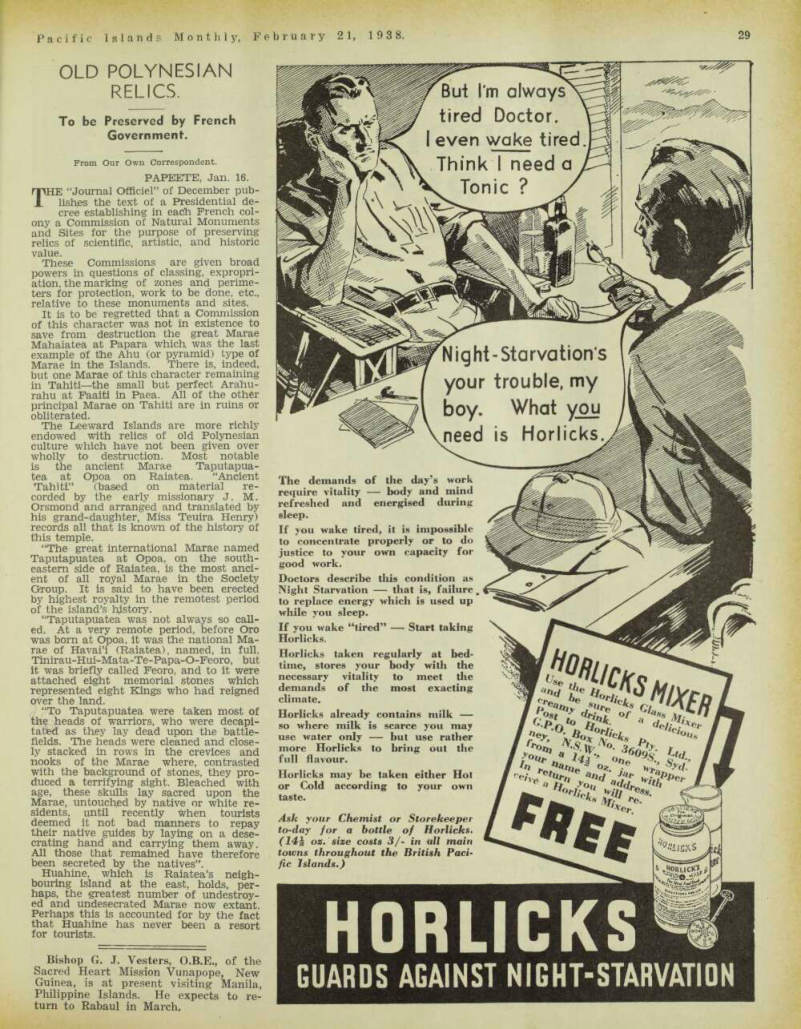
Relics.
To be Preserved by French Government.
From Our Own Correspondent.
Papeete, Jan. 16.
THE “Journal Officiel” of December pub lishes the text of a Presidential de cree establishing in each French col ony a Commission of Natural Monuments and Sites for the purpose of preserving relics of scientific, artistic, and historic value.
These Commissions are given broad powers in questions of classing, expropri ation, the marking of zones and perime ters for protection, work to be done, etc., relative to these monuments and sites.
It is to be regretted that a Commission of this character was not in existence to save from destruction the great Marae Mahaiatea at Papara which was the last example of the Ahu (or pyramid) type of Marae in the Islands. There is, indeed, but one Marae of this character remaining in Tahiti —the small but perfect Arahu rahu at Faaiti in Paea. All of the other principal Marae on Tahiti are in ruins or obliterated.
The Leeward Islands are more richly endowed with relics of old Polynesian culture which have not been given over wholly to destruction. Most notable is the ancient Marae Taputapua tea at Opoa on Raiatea. “Ancient Tahiti” (based on material re corded by the early missionary J. M.
Orsmond and arranged and translated by his grand-daughter, Miss Teuira Henry) records all that is known of the history of this temple.
“The great international Marae named Taputapuatea at Opoa, on the south eastern side of Raiatea, is the most anci ent of all royal Marae in the Society Group. It is said to have been erected by highest royalty in the remotest period of the island’s history.
“Taputapuatea was not always so call ed. At a very remote period, before Oro was born at Opoa, it was the national Ma rae of Havai’i (Raiatea), named, in full, Tinirau-Hui-Mata-Te-Papa-O-Feoro, but it was briefly called Peoro, and to it were attached eight memorial stones which represented eight Kings who had reigned over the land.
“To Taputapuatea were taken most of the heads of warriors, who were decapi tated as they lay dead upon the battle fields. The heads were cleaned and close ly stacked in rows in the crevices and nooks of the Marae where, contrasted with the background of stones, they pro duced a terrifying sight. Bleached with age, these skulls lay sacred upon the Marae, untouched by native or white re sidents, until recently when tourists deemed it not bad manners to repay their native guides by laying on a dese crating hand and carrying them away.
All those that remained have therefore been secreted by the natives”.
Huahine, which is Raiatea’s neigh bouring island at the east, holds, per haps, the greatest number of undestroy ed and undesecrated Marae now extant.
Perhaps this is accounted for by the fact that Huahine has never been a resort for tourists.
Bishop G. J. Vesters, 0.8. E., of the Sacred Heart Mission Vunapope, New
Guinea, is at present visiting Manila,
Philippine Islands. He expects to re turn to Rabaul in March.
Advertisements & other items, pp. 31-33 (2 items)
Horlicks
2
f But I'm always V
tired Doctor,
I even wake tired.
Think I need a
s. Tonic ? y
-v
Night-Starvations
your trouble, my
boy. What you
need is Horlicks.
The demands of the day’s work require vitality body and mind refreshed and energised during sleep.
If you wake tired, it is impossible to concentrate properly or to do justice to your own capacity for good work.
Doctors describe this condition as Night Starvation that is, failure to replace energy which is used up while you sleep.
If you wake “tired” Start taking Horlicks.
Horlicks taken regularly at bedtime, stores your body with the necessary vitality to meet the demands of the most exacting climate.
Horlicks already contains milk so where milk is scarce you may use water only but use rather more Horlicks to bring out the full flavour.
Horlicks may be taken either Hot or Cold according to your own taste.
Ask your Chemist or Storekeeper to-day for a bottle of Horlicks. (14% oz. size costs 3/- in all main towns throughout the British Pacific Islands.) m
M s m
H •fid tn 4© <>! dr ■'Vs Of M ink // er <‘n> f *A (Is f'O w *6O Ltd ■S’ r°nr °n e ■'</ Ur f'er r *e; Hr <■/• *<*dr. y o OH if 'k f'o fa er
HORLICKS
GUARDS AGAINST NIGHT-STARVATION
Modern Refrigeration for the South Sea Islands
The
ELECTROLUX
KEROSENE OPERATED
A
MARVEL
OF
MODERN
SCIENCE
REFRIGERATOR
*m m ■ 1 1 m
THE
MIRACLE
OF
ICE
FROM
HEAT
THE ELECTROLUX OFFERS economical, modern and completely efficient refrigeration for
ISLANDS' HOMES.
FREEZES CONTINUOUSLY WHILE SMALL LAMP BURNS
Freezing controlled by simply regulating height of flame. Uses only 5 gallon of kerosene per week. . MOTORLESS ... NO PARTS TO GET OUT OF ORDER.
MODEL L 22 MODEL L3B
Capacity (as illustrated) ® 2.2 cubic feet. Capacity 4 cubic feet.
GUARANTEED FOR TWO YEARS
• Write to your Local Distributor for prices and full details.
MODEL LKSS
Capacity 5.5 cubic feet.
Obtainable from . .
W. R. Carpenter & Company Ltd. —Sydney and following New Guinea Branches : Rabaul, Salamaua, Wau, Kavieng, Madang, But and Wewak.
Representation in Papua and New Hebrides.
W. R. Carpenter & Coy. (Solomon Is.) Pty. Ltd. —Tulagi, British Solomon Islands.
On Chong & Company Pty. Ltd. —Butaritari, Gilbert & Ellice Islands.
Papuan Belles.
Papuan village girls carrying water to a Mission station. —Photo.: “Missionary Review”.
Plantations
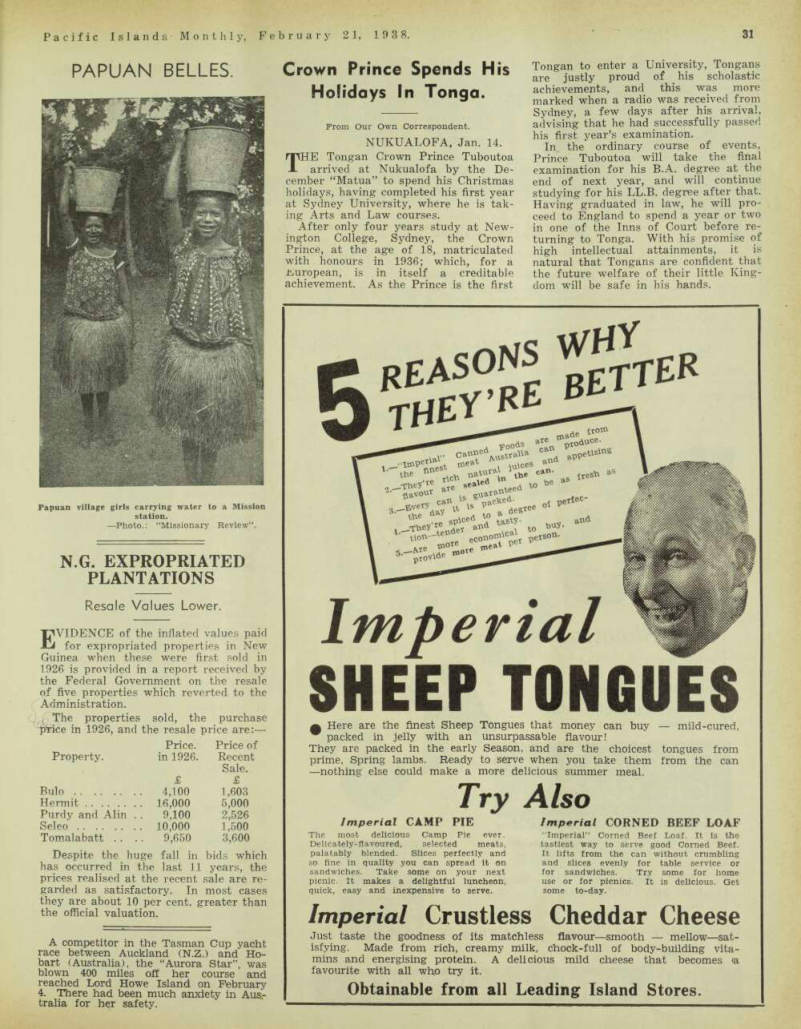
N.G. Expropriated
Resale Values Lower.
EVIDENCE of the inflated values paid for expropriated properties in New Guinea when these were first sold in 1926 is provided in a report received by the Federal Government on the resale of five properties which reverted to the Administration. . jrTThe properties sold, the purchase pteke in 1926, and the resale price are:— Price. Price of Property. in 1926. Recent Sale. £ £ Bulo 4,100 1,603 Hermit 16,000 5,000 Purdy and Alin .. 9,100 2,526 Seleo 10,000 1,500 Tomalabatt .. .. 9,650 3,600 Despite the huge fall in bids which has occurred in the last 11 years, the prices realised at the recent sale are re garded as satisfactory. In most cases they are about 10 per cent, greater than the official valuation.
A competitor in the Tasman Cup yacht race between Auckland (N.Z.) and Ho bart (Australia), the “Aurora Star”, was blown 400 miles off her course and reached Lord Howe Island on February 4. There had been much anxiety in Aus tralia for her safety.
Holidays In Tonga.
Crown Prince Spends His Holidays In Tonga.
Prom Our Own Correspondent.
Nukualofa, Jan. 14.
THE Tongan Crown Prince Tuboutoa arrived at Nukualofa by the De cember “Matua” to spend his Christmas holidays, having completed his first year at Sydney University, where he is tak ing Arts and Law courses.
After only four years study at New ington College, Sydney, the Crown Prince, at the age of 18, matriculated with honours in 1936; which, for a European, is in itself a creditable achievement. As the Prince is the first
Tongan to enter a University, Tongans are justly proud of his scholastic achievements, and this was more marked when a radio was received from Sydney, a few days after his arrival, advising that he had successfully passed his first year’s examination.
In the ordinary course of events, Prince Tuboutoa will take the final examination for his B.A. degree at the end of next year, and will continue studying for his LL.B. degree after that.
Having graduated in law, he will pro ceed to England to spend a year or two in one of the Inns of Court before re turning to Tonga. With his promise of high intellectual attainments, it is natural that Tongans are confident that the future welfare of their little King dom will be safe in his hands.
Advertisements & other items, p. 33 (1 item)
Imperial
WHY
reasons
better
re
they
froth iiva^ 6 ducepro fresh ihe rich •" W * °-«ed « fla Of P ctleC ' degtee iced and buy etson conotn — * pel pro
Imperial
SHEEP TONGUES
a Here are the finest Sheep Tongues that money can buy mild-cured, w packed in jelly with an unsurpassable flavour!
They are packed in the early Season, and are the choicest tongues from prime, Spring lambs. Ready to serve when you take them from the can —nothing else could make a more delicious summer meal.
Try
Imperial CAMP PIE The most delicious Camp Pie ever.
Delicately-flavoured, selected meats, palatably blended. Slices perfectly and so fine in quality you can spread it on sandwiches. Take some on your next picnic. It makes a delightful luncheon, quick, easy and inexpensive to serve.
Also
Imperial CORNED BEEF LOAF “Imperial’' Corned Beef Loaf. It is the tastiest way to serve good Corned Beef.
It lifts from the can without crumbling and slices evenly for table service or for sandwiches. Try some for home use or for picnics. It is delicious. Get some to-day.
Imperial Crustless Cheddar Cheese
Just taste the goodness of its matchless flavour—smooth mellow —satisfying. Made from rich, creamy milk, chock-full of body-building vitamins and energising protein. A delicious mild cheese that becomes <a favourite with all who try it.
Obtainable from all Leading Island Stores.
Wedding At Papeete.
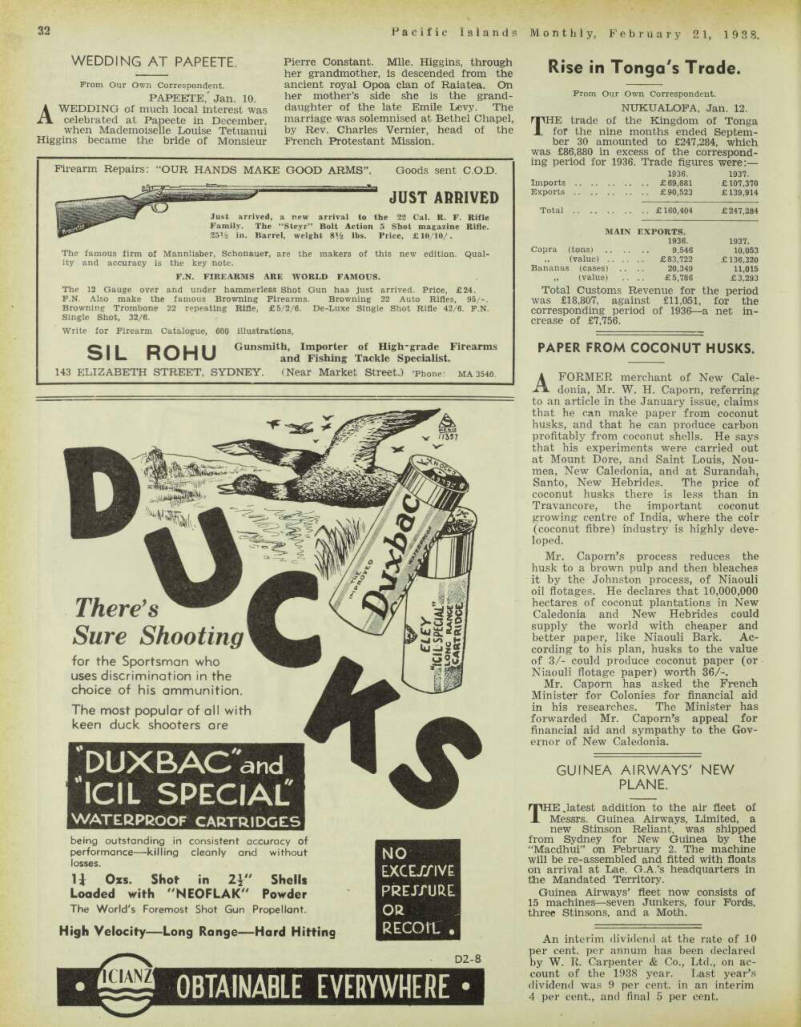
From Our Own Correspondent.
Papeete,' Jan. 10.
A WEDDING of much local interest was celebrated at Papeete in December, when Mademoiselle Louise Tetuanui Higgins became the bride of Monsieur
Pierre Constant. Mile. Higgins, through her grandmother, is descended from the ancient royal Opoa clan of Raiatea. On her mother’s side she is the grand daughter of the late Emile Levy. The marriage was solemnised at Bethel Chapel, by Rev. Charles Vernier, head of the French Protestant Mission.
Rise in Tonga's Trade.
Prom Our Own Correspondent.
Nukualofa, Jan. 12.
THE trade of the Kingdom of Tonga fof the nine months ended Septem ber 30 amounted to £247,284, which was £86,880 in excess of the correspond ing period for 1936. Trade figures were: — 1936. 1937.
Imports £69,881 £107,370 Exports £90,523 £139,914 Total £160,404 £247,284
Main Exports.
1936. 1937.
Copra (tons) 9,546 10,053 (value) £83,722 £136,320 Bananas (cases) .. .. 20,349 11,015 „ (value) .. .. £5,786 £3,293 Total Customs Revenue for the period was £18,807, against £11,051, for the corresponding period of 1936 —a net in crease of £7,756.
Paper From Coconut Husks.
A FORMER merchant of New Cale donia, Mr. W. H. Caporn, referring to an article in the January issue, claims that he can make paper from coconut husks, and that he can produce carbon profitably from coconut shells. He says that his experiments were carried out at Mount Dore, and Saint Louis, Nou mea, New Caledonia, and at Surandah, Santo, New Hebrides. The price of coconut husks there is less than in Travancore, the important coconut growing centre of India, where the coir (coconut fibre) industry is highly deve loped.
Mr. Caporn’s process reduces the husk to a brown pulp and then bleaches it by the Johnston process, of Niaouli oil flotages. He declares that 10,000,000 hectares of coconut plantations in New Caledonia and New Hebrides could supply the world with cheaper and better paper, like Niaouli Bark. Ac cording to his plan, husks to the value of 3/- could produce coconut paper (or Niaouli flotage paper) worth 36/-.
Mr. Caporn has asked the French Minister for Colonies for financial aid in his researches. The Minister has forwarded Mr. Capom’s appeal for financial aid and sympathy to the Gov ernor of New Caledonia.
Guinea Airways' New
Plane.
THE, latest addition to the air fleet of Messrs. Guinea Airways, Limited, a new Stinson Reliant, was shipped from Sydney for New Guinea by the “Macdhui” on February 2. The machine will be re-assembled and fitted with floats on arrival at Lae, G.A.’s headquarters in the Mandated Territory.
Guinea Airways’ fleet now consists of 15 machines —seven Junkers, four Fords, three Stinsons, and a Moth.
An interim dividend at the rate of 10 per cent, per annum has been declared by W. R. Carpenter & Co., Ltd., on ac count of the 1938 year. Last year’s dividend was 9 per cent, in an interim 4 per cent., and final 5 per cent.
S*" 1
te as ss:*.s.s
at Niue Island by the February “Maui [“T', )° lleve „ D ‘- Lange. After m NeW Zealand ’ Dr - . Lan S e W * tak€i Q up an appointment w llll the Western Samoa Medical Department.
C«‘iSTa. , S2
t in the Territory. B™n in Bavarfa 67 years ago, she entered the Order in France and, on the completion of her training, was sent out to New Britain in 1896.
Advertisements & other items, pp. 34-36 (2 items)
"Icil Special'
Firearm Repairs: “OUR HANDS MAKE GOOD ARMS”. Goods sent C.O.D.
Just arrived, Family. The
JUST ARRIVED
new Steyr’ arrival to the 22 Cal. R. F. Rifle Bolt Action 5 Shot magazine Rifle. in. Barrel, weight BV2 lbs. Price, £lO/10/.
The famous firm of Mannlisber, Schonauer, are the makers of this new edition. Quality and accuracy is the key note.
F.N. FIREARMS ARE WORLD FAMOUS.
The 12 Gauge over and under hammerless Shot Gun has just arrived. Price, £24.
F.N. Also make the famous Browning Firearms. Browning 22 Auto Rifles, 95/-.
Browning Trombone 22 repeating Rifle, £5/2/6. De-Luxe Single Shot Rifle 42/6. F.N.
Single Shot, 32/6.
Write for Firearm Catalogue, 600 Illustrations, Gunsmith, Importer of High-grade Firearms
and Fishing Tackle Specialist.
143 ELIZABETH STREET, SYDNEY. (Near Market Street.) ’Phone: ma 3540.
SIL ROHU
7* PEfcP v nw I H >•3 kl
UJ ~J
There's
Sure Shooting
for the Sportsman who uses discrimination in the choice of his ammunition.
The most popular of all with keen duck shooters are
DUXBAC'and
"ICIL SPECIAL'
WATERPROOF CARTRIDGES
being outstanding in consistent accuracy of performance—killing cleanly and without losses.
H Ozs. Shot in 21" Shells Loaded with "NEOFLAK" Powder The World's Foremost Shot Gun Propellant.
High Velocity—Long Range—Hard Hitting NO
EXCE//IVE
PREJTURE
OR
RECOtL .
CIANZI
D 2-8
OBTAINABLE EVERYWHERE
Interesting !
EACH
MONTH
ONE *
SHILLING
GEOGRAPHIC MAGAZINE
Unusual Articles Featuring—
AUSTRALIA...
NEW ZEALAND...
SOUTH SEA ISLANDS
and Travelogues of
THE WORLD AT LARGE
ILLUSTRATED WITH STRIKING PHOTOGRAPHS
A SPECIAL 8-page Camera Section features outstanding Australian, New Zealand and South Sea Island photographic studies each month.
WALKABOUT for reading that is
Interesting !
Entertaining
Educational
ANNUAL SUBSCRIPTION WALKABOUT
A j FLINDERS ST. RAILWAY BLDG., MELBOURNE, C.I. /If or from -L / Jj I Pacific Publications Pty. Ltd.
I 247 GEORGE STREET, SYDNEY.
(Posted anywhere) and their representatives in the Pacific Islands.
DSvrrTaTi rTSvi rTavi fiSvnvgvi r?s\ir?sv; r/a>M .tsv; t/sm r/3>r:
PRESCOTT L T JP I U y S E n X e S^ sole wholesale agents fdi^
PINEAPPLE BACON S HANS
DAISY BRAND BUTTER
LEA& PERRINS’ H. P. Sauce
LEA & PERRINS’ Sauce
and Most other Super-Quality Lines of the Trade
SWALLOW
illilllllllllllllilllllllilllflllllllllillllllllllllllllllllllllllllllll
& ARIELL’S
IllllillllllllllllllllllllllllllljllllllllllilllllllllllllllllllllllllllllllllllllllllllllllllllllllllllllllllUl
PLUM
PUDDINGS
i lb. : 1 lb. li lb. : 2 Ib. and 3 lb.
Renowned for Quality
★ Manufactured at Port Melbourne, Australia
Discipline For
Young Tongans.
Problem of Church and School.
Letter to the Editor.
IN the “Pacific Islands Monthly” of Oc tober, there is a timely article, “Townsmen or Land-Owners?”
There is a large body of opinion in agreement with your correspondent on the subject of education in Tonga, when he says that the educational policy is at fault, but it is doubted whether the evils will be removed by shifting the Govern ment College out of the town of Nukua lofa. There is more affected than the Government College.
First, this scheme may be like others undertaken by the Government of Tonga, with promises to benefit this and that, but almost all resulting in disaster, involving losses to the country of thousands of pounds. May I instance the vessels “Hi fofua” and the “Tokaga” (now “Tui Toga”)? Already £25,000 have been ex pended in the past 16 years on the Gov ernment College, and it is estimated that the removal to the bush would cost an other £2,000; and buildings taken down and put up again are never the same.
Removal of a college from the town to the bush would never solve Tonga’s problem of improving the character as well as the behaviour of its youth. A stiffer discipline is required, not only at the Government College, but at the Na fualu Wesleyan College, and the Wesley an Girls’ College, to bring about without delay a more respectful demeanour to wards their parents and elders and their betters (not only to the faces of the lat ter, but behind their backs as well). A little less arrogance in our young Ton gans is desirable.
The root of the trouble goes further back than the Colleges, and starts with the children just before school age, and in the primary schools. Lack of parental control is a factor. The Missions, also, are too intent on making their children good Callathumpians, rather than good Tongans.
The Government is to be blamed most ly for the present condition of Tonga’s younger generation, because the Govern ment, being mostly Wesleyans, have left too much in the hands of the Wesleyan Mission, who have taken the chance to push on the political influence of Wes leyanism, instead of the Government holding the balance evenly, as between the many competing sects in Tonga—six, to be exact—for the benefit of the children of all, and the population as a whole.
Any scheme touching education put forward by the Wesleyan-ridden Govern ment of Tonga is looked on with suspic ion by many sections of the people, for we have not forgotten, nor will we for get for many a long day, the Wesleyan "manoeuvres” of 1924.
I am, etc.,
Afuha’ Amago.
Member of the Tongan Legislative Assembly.
Nukualofa, 11/l/’3B.
Mr. William H. Potts, a young Eng lishman, who accompanied Dwight Long in his yacht “Idle Hour” from Sydney to Papua in 1936 and who subsequently spent some months travelling in the Mandated Territory and Dutch New Guinea, has returned to his home in Birmingham, England. He is now en gaged in writing a book dealing with his travels.
“City Of Papeete."
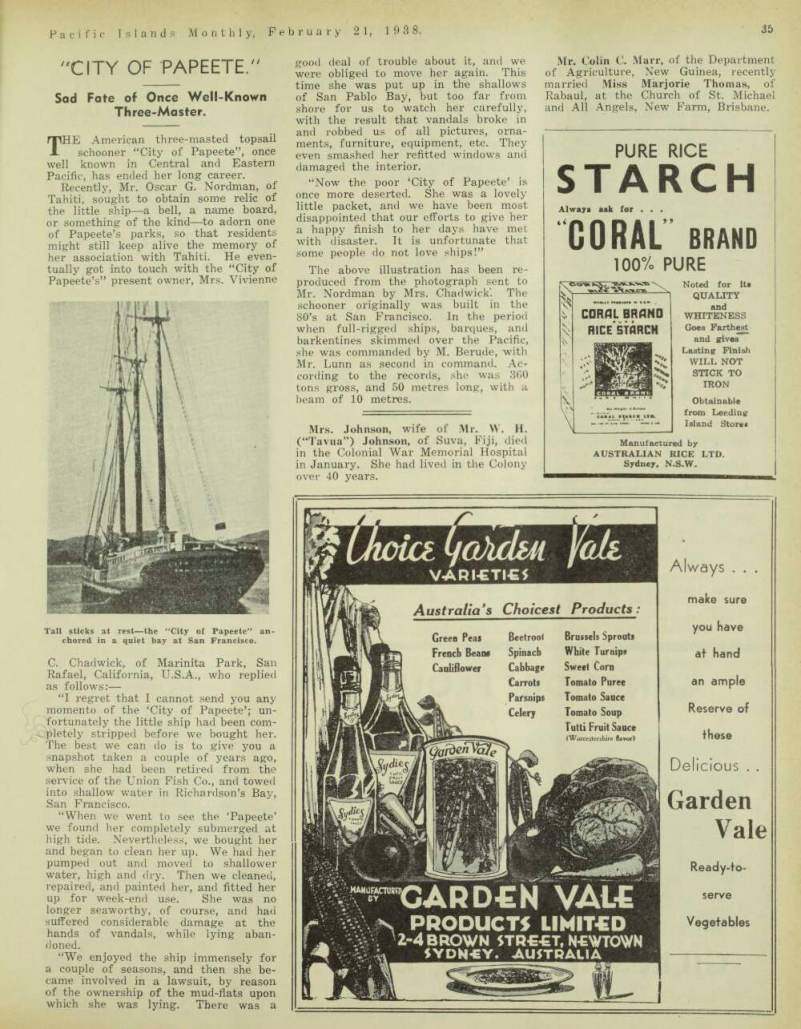
Sad Fate of Once Well-Known Three-Master.
THE American three-masted topsail schooner “City of Papeete”, once well known in Central and Eastern Pacific, has ended her long career.
Recently, Mr. Oscar G. Nordman, of Tahiti, sought to obtain some relic of the little ship—a bell, a name board, or something of the kind—to adorn one of Papeete’s parks, so that residents might still keep alive the memory of her association with Tahiti. He even tually got into touch with the “City of Papeete’s” present owner, Mrs. Vivienne
C. Chadwick, of Marinita Park, San Rafael, California, U.S.A., who replied as follows: “I regret that I cannot send you any momento of the ‘City of Papeete’; un fortunately the little ship had been com pletely stripped before we bought her.
The best we can do is to give you a snapshot taken a couple of years ago, when she had been retired from the service of the Union Fish Co., and towed into shallow water in Richardson’s Bay, San Francisco.
“When we went to see the ‘Papeete’ we found her completely submerged at high tide. Nevertheless, we bought her and began to clean her up. We had her pumped out and moved to shallower water, high and dry. Then we cleaned, repaired, and painted her, and fitted her up for week-end use. She was no longer seaworthy, of course, and had suffered considerable damage at the hands of vandals, while lying aban doned.
“We enjoyed the ship immensely for a couple of seasons, and then she be came involved in a lawsuit, by reason of the ownership of the mud-flats upon which she was lying. There was a
good deal of trouble about it, and we were obliged to move her again. This time she was put up in the shallows of San Pablo Bay, but too far from shore for us to watch her carefully, with the result that vandals broke in and robbed us of all pictures, orna ments, furniture, equipment, etc. They even smashed her refitted windows and damaged the interior.
“Now the poor ‘City of Papeete’ is once more deserted. She was a lovely little packet, and we have been most disappointed that our efforts to give her a happy finish to her days have met with disaster. It is unfortunate that some people do not love ships!”
The above illustration has been re produced from the photograph sent to Mr. Nordman by Mrs. Chadwick'. The schooner originally was built in the 80’s at San Francisco. In the period when full-rigged ships, barques, and barkentines skimmed over the Pacific, she was commanded by M. Berude, with Mr. Lunn as second in command. Ac* cording to the records, she was 360 tons gross, and 50 metres long, with a beam of 10 metres.
Mrs. Johnson, wife of Mr. W. H. (“Tavua”) Johnson, of Suva, Fiji, died in the Colonial War Memorial Hospital in January. She had lived in the Colony over 40 years.
Mr. Colin C. Marr, of the Department of Agriculture, New Guinea, recently married Miss Marjorie Thomas, of Rabaul, at the Church of St. Michael and All Angels, New Farm, Brisbane.
Tall sticks at rest—the “City of Papeete” an chored in a quiet bay at San Francisco.
Advertisements & other items, p. 37 (1 item)
Starch
PURE RICE
Always ask for . . .
CORAL BRAND
100% PURE
CORAL BRAND
RICE STARCH
COM! »5»«l 111.
Noted for Its
QUALITY
and
WHITENESS
Goes Farthest and gives Lasting Finish
WILL NOT
STICK TO
IRON
Obtainable from Leading Island Stores Manufactured by
AUSTRALIAN RICE LTD.
Sydney, N.S.W.
Always . . . make sure Australia’s Choicest Products: you have Brussels Sprouts White Turnips Sweet Corn Tomato Puree Tomato Sauce Tomato Soup Tutti Fruit Sauce Green Peas French Beans Cauliflower Beetroot Spinach Cahhage Carrots Parsnips Celery at hand an ample Reserve of vthese (Worcestershire flavor)
garden
Delicious . .
Garden
Vale
Ready-toserve Vegetables
CARD-EN VALE
MANUFACTURdI
\ BY
N PRODUCTS LIMITED
2-4 BROWN STR-E-ET, NEWTON
4 BROWN STREET, NEWTOWN
SYDNEY. -AUSTRALIA
Boom In Hawaiian Tourism.
Prom Our Own Correspondent.
Honolulu, Jan. 10.
TOURIST traffic to the Hawaiian Islands is booming so much that it has now become the territory’s third “industry”.
The very efficient Hawaii Tourist Bureau, a non-profit organisation, sup ported along the same lines as the Aus tralian National Travel Association, re ports that 53,478 tourists visited the isles during 1937. This does not include the 32,000 “one day” tourists.who came ashore from trans-Pacific liners remain ing in port for the day only.
This great influx of visitors, it is estimated, is responsible for the dis tribution of something like 10,000,000 dollars in cash.
The boom is reflected in local inter island air travel by the Inter Island Company’s amphibians, which are oper ated with more safety than any other airline under the Stars and Stripes. On January 2, no less than 167 passengers were lifted.
Mr. H. G. R. McAlpine, of Otago, New Zealand, has been selected by the British Colonial Office, London, to join the Colonial Service. He has been al located for duty in Fiji.
Tahiti's Trade.
Prom Our Own Correspondent.
Papeete, Jan. 5.
THE following trade figures are avail able:—
Of the phosphate, 115,925 tons went to Japan, and 27,736 tons to Hawaii and to Sweden.
1937. 1936.
Copra (tons) .. .. 20,083 22,520 (9 months only) (9 months) Vanilla (quint.) . . 619 624 ,, Value (fr.) 6,532,000 2,673,000 Phosphates (tons) . 143,662 101,092 Value (fr.) 9,194,000 6,469,000 M.O.P. Shell (quint) 482 Value (fr.) 100,000 Imports (fr.) . . . . 40,429,000 26,889,000
A Jinx On A Japanese
Steamer.
From Our Own Correspondent.
Honolulu, Jan. 5.
THOSE who believe that a jinx is some deliberate stroke of fate will be interested in the career of the old steel freighter “Buffalo Bridge”, which was bought in October last from an American company by Japan. Promptly the rusty steamer was loaded with scrap iron and lumber, and prepared for her long voyage to war-gripped Japan.
On October 23 the engines broke down, when the freighter was 950 miles from Honolulu. A tug was sent to the rescue. With a bad list, the “Buffalo Bridge” was towed into Honolulu for repairs.
On December 6, the ship set off foi Japan. Only 120 miles out of Honolulu, she was forced to turn back; engine trouble again.
On December 17 she set off again for the industrial yards of Osaka, but 400 miles out the jinx worked once more, and back she came to Honolulu.
The “Buffalo Bridge” for the third time is in the hand of local shipwrights.
It is hoped she will sail again for Japan early in January.
The ship was bought for approxi mately 30,000 dollars, and so far her repairs in Honolulu have cost some 25,000 more.
Incidentally, there is another Jap anese steamer in port now lifting a large consignment of scrap metal for Japan’s war factories. The metal came from discards at the U.S. navy base, Pearl Harbour, the purpose of which is to act as U.S. navy pivot in the defence scheme against Japan—just another angle of the inconsistency of the armed nations.
Dr. A. H. B. Pearce, Chief Medical Officer in Fiji, arrived in New Zealand with his wife by the January “Aorangi”, on leave.
Mr. L. J. Warren, manager of the Union S.S. Co., Ltd., in the Cook Group, was in New Zealand in January on furlough.
Mr. Greg Neilson, proprietor of the Picture Theatre at Nukualofa, Tonga, arrived in New Zealand by the January “Matua”.
Advertisements & other items, p. 38 (1 item)
W. M. Reid Export Agent
offers you a buying service based on Saving of Shipping Cosf . . . Attention to Detail • Contact with First - Class Suppliers
WHOSE GOODS CAN BE SAFELY RECOMMENDED
Send your enquiries to W. M. REID for . . .
M VAT 69" WHISKY— by W. SANDERSON & SON, Leith, Scotland. A fine old Scotch Liqueur Whisky without a rival.
EMU BRAND" ROPES —by O. PENDERGAST & CO. LTD., who are featuring special Islands' Quality Ropes—Cheap and Reliable.
"CLYDE" LAWN MOWERS— By CLYDE ENGINEERING CO. LTD. The widest advertised and best known ball-bearing Lawn Mowers, Sheffield steel blades.
"SNOW DROP" ICE CREAM CONES— by ZUTTION SNOWDROP PRODUCTS LTD.
A sales help for every ice cream vendor. Always fresh. Pink and white.
STOTT & UNDERWOOD PTY. LTD. for the NEW UNDERWOOD—and also tor well known brands of Reconditioned Typewriters.
VIGOR FOODS"' —Vegetables, etc. Dehydrated and not compressed. Remain fresh without refrigerator. No loss of vitamins. No preservatives, SADDLES. HARNESSES, CANVAS & LEATHER GOODS— by J. P. TALTY LTD. Finest quality materials, and first-class workmanship guaranteed.
For any other requirements in Food, Hardware, Clothing, etc., communicate with W. M. REID, " Reid House," 75 King Street, Sydney
4 4
ANCHOR FLOUR
THE STANDARD OF QUALITY
GILLESPIE BROS.. LTD.
SYDNEY - AUSTRALIA
The Claims Of T. H. Harrisson
New Hebrides Planter Returns To The Attack.
Letter to the Editor.
IN your issue of October, 1937, Miss Cheeseman takes up the cudgels on behalf of T. H. Harrisson in reply to my challenge in June issue, 1937. I do not say that Mr. Harrisson is an imposter, but there is abundant proof available that he did not see or hear certain things he claims to have seen or heard. I say em phatically that my indictments were jus tified and in the public interest. Self deception is not uncommon.
Miss Cheeseman can sleep in peace. I am not after blackmail nor actuated by petty spite. Whilst in the Group Mr. Har risson received quite a fair deal from me and mine, which I am told he acknow ledged in one of his addresses, and it is not my habit to indulge in personalities or mud-slinging. I am only interested in him so far as he concerns the people of this Group, native and non-native.
Dr. Codrington, an authority whom Mr.
Harrisson quotes largely, said, in one of his books on Melanesia: “A man comes to the Islands, and in two years knows all there is to know about the natives!
He stays on twenty years and learns he knows little”.
There is a story told of Sir William MacGregor which goes somewhat as fol lows: Meeting a young Missionary who appeared ratner confident of everything native, he asked him how long he had been in the Islands and on the young Missionary saying two years, MacGregor asked him if he had written his book yet?
On receiving the negative, he said: “Well, young man, you had better hurry up, for if you stay too long you will find you are not so sure of your facts as to make the book readable”. There you have it in a nutshell, from two unim peachable sources! Mr. Harrisson was in the Group, say, two years, and behold!!
He knows everything!
Should Mr. Harrisson Return?
By asking leading and suggestive ques tions of natives—for the most part more or less detribalised—he gets the replies the natives think he wants, not knowing whether it is the real or the whole truth.
I would suggest to Mr. Harrisson that he pay a visit to the Group again, leaving his superiority complex behind him, in England, learn a dialect, and stay, say, only ten years. At the end of that per iod he will realise he is not so sure of the conclusions he arrived at after less than two years in the Group.
Contrary to Miss Cheeseman’s guess, I have read th,e book. I have not seen the papers he read before the Geographical Society, though I have seen some of re ports of these.
After all, what constitutes an anthrop ologist? One who systematically studies the subject or one who simply dabbles in it? For many years this —and I suppose other Groups also—have had a succes sion of people, coming from this or that University, or Museum, or scientific body, and claiming to be specialists in one or other branch of science. A portion are genuine and keenly in search of know ledge, others are seeking notoriety, cheap or otherwise; others simply seeking local colour to clothe fiction or theories. The people of all the Groups have 'sufficient intelligence to sift the one from the other.
They appreciate and assist, in every way
in their power, the genuine article, but resent the spurious and the notoriety hun ter.
Miss Cheeseman says Mr. Harrisson never inferred he was more than three weeks in the Big Nambus. Let her turn to page 277: “Some of the most pleasant evenings of my life have been spent drinking kava. listening to the endless running flow, of words, the trivial, de scribed as only the ‘lowest’ savage and highest genius can describe it. so that every angle, incident, word and thing ap pears again to conjure up a scene not simply of ... I had not previously real ised that talk could be more than conver sation. . . Talk can be a people’s high est manifestation”. And then, bathos! “I did this for a year and it gave me much, friendship, pleasure, and prestige—espe cially as at the end I could drink any Big Namba under the table”.
As Mr. Harrisson could not speak nor understand ten words of any dialect it was really genuine courtesy for the na
wnS. th S ir d i es - s „ fl ™ °j , t l3 l En Sjjsh or pidgin . Good iU 1 *? 056 £ ls re aders appreciate this trait in the native character!
It does not seem to be realised that Mr.
Harrisson’s headquarters, during the brief period (five months, I believe) he was acting as locum tenens to the District Agent, was not in the Big Nambus area, nor within ten miles of the nearest village. Where he was, the dialect is quite different from that of the Big Nambus and unintelligible to them. The North West dialect and customs are more nearly related to that of the N.E. of Malekula.
T , . . ~. .
It is impossible in the space allowed to go into detail. He has given nothing new to science that will stand. His folk tales are over-edited and distorted. Any man who knows his way about, and more par-
ticularly if he knows a dialect, can col lect a dozen folk tales in a day, from the village story tellers. If left as told, they are valuable, if tampered with, they are valueless. Mr. Harrisson does not realise there are people, even within the Group, with a public school background, planters whose educational status is perhaps even superior to his. It is arro gance for him to think he has discovered Malekula.
Miss Cheeseman endeavours, by taking a sentence away from its context, to draw a herring across the path. The writer has been 34 years in the Group, and, though holding his own views, has suc ceeded in living and working alongside the Missionaries, without difficulty or quarrels. Mr. Harrisson was, say, two years in the Group and was not liked by the Missionaries.
Plenty of planters have been right in land and have even ascended the prin cipal mountains. There are few areas in the North of the Island that the writer has not been into. He was in Taumaro and Amok 32 years ago, with a planter named Robert Petersen, and a Mr. Mo roney, an artist and photographer, who took both sketches and photographs. He has been in Amok once since, and Tau maro several times. Taumaro has been visited constantly for 20 years.
Nowadays the white inhabitants all use boots. Twenty and more years ago a large percentage, owing to constant boat ing, went often barefoot, consequently a goodly percentage showed hookworm. Mr.
Harrisson himself never used boots, and it is possible that he himself was a hook worm positive. The term Tombat is never used in the sense given on page 410. Tom bat is the term applied to initiates in the societies and ceremonies. The term Nelag Sen is what he means. The Tom bats were often the Nelag Sen.
The Chief of Taumaro, the Miliun Vavau, was told of what Mr. Harrisson said of cannibal feasts and of his claim ing by inference to have participated therein. In his characteristic blunt fashion he said: “He lies! We do not eat human flesh in the presence of strang ers. It is absolute tabu for an outsider to see it, let alone participate”. This chief is an unquestionable authority. He is in fact, the man erroneously described as “King of Big Nambus” by a former visiting scientist, who even went so far as to send a spear to the late King George from “One King to Another”—an appar ently harmless freak, but in reality one which caused an endless amount of bad feeling and jealousy among the rival clans.
Planters’ Medical Work.
It is not in anyway true that the Mis sions are the only people who try to do anything for the natives. Many plant ers give medicine—including arsphena mides—free or at actual cost, and they have to pay for it out of their own poc ket at full price. Planters were the first to use both the bismuth and arsenic compounds when they came in, and plant ers were the first to consider the em ployment of N.M.P.’s in this Group.
There is an agreement, which can be produced, between two planters and the Fijian. Malachi, who accompanied Dr.
Lambert on his first survey. It was the existence of this agreement which actu ally shamed the Administration into taking the matter over. I am sure Dr.
Lambert can bear witness to this, as he did to the original agreement!
And what of the not inconsiderable work of the much-maligned Condominium Administration, which supplies the mater ial with which the Missions inject the na tives? During Mr. Harrisson J s stay on Malekula, let him count the number of times he saw Missionaries using arsphena mide injections, and how many times it was Rockefeller trust plus Condominium.
He will then eat his words I hope.
I am not belittling the work done by the Missions when I make this statement.
They will be the first to admit the truth.
In conclusion, I may point out that Mr.
Harrisson has graciously admitted that with few exceptions, the British planters are honest men. He has also told us there are no honest Frenchmen here!
How overcome with conceit the British planters must be at such commendation, and how downcast the poor French must be at their condemnation—and that com ing from such a source!
I am, etc..
E. H. Corlette.
Bushman's Bay, Malekula, New Hebrides. 19/12/’3B.
Advertisements & other items, pp. 39-40 (1 item)
Chi Vers
Kork-N-Seal
FOR HOME USE
FOR ALL HOME BOTTLING
—THE LITTLE CAP THAT
will Re - seal 1,000 Times
KORK - N - SEAL (Aust.) LTD.
106 COMMONWEALTH STREET
SYDNEY, AUSTRALIA
Hand Applied Airtight Pressure Proof
We are Specialists . . . \ ’Phones: MA 3112 (4 lines) Cable Address: “Weymarkson”
Codes—Bentleys Let us have your confidence. Sixty years is our record of supplying the leading Houses throughout the World in ... .
FRESH FRUIT VEGETABLES PRODUCE
WEYMARK & SON LTD.
FRUIT AND PRODUCE MERCHANTS
14-18 STEAMMILL STREET - - SYDNEY
CHI VERS
FAMOUS ENGLISH PRODUCTS
CANNED ENGLISH VEGETABLES
CANNED ENGLISH FRUITS
OLDE ENGLISH MARMALADE
GOLD MEDAL JAMS
JELLY CRYSTALS. ETC.
Obtainable from all leading Grocery Stores
WRITE TO DEPARTMENT "A"
CHIVERS & SONS LTD.
Histon, Cambs., Eng.
FOR ATTRACTIVE RECIPE BOOK
on mm
CHIV£RS
f I / ft CO ID /
STAHOftRO
FRESH
S. ENGLISH J
* k k
PEAS
JtiCKtp A * o pacmp
-UXIK
J. J. SULLIVAN Pty. Ltd.
Sullivan's Buildings
168 -174 SUSSEX STREET, SYDNEY. N.S.W.
Cable and Telegraphic Address : “SULLGREN,” Sydney.
GENERAL MERCHANTS
EXPORTERS
ALL COMMODITIES HANDLED
Best Roller Fiour Best Biscuit
IMPORTERS
SHIPPERS
Flour
HIGHEST GRADE "CORAL" BRAND SHARPS
" Pony " Brand Oats.
Dried Fruits. Prunes, Sultanas, etc.
Canned Meats . . . Canned Fruits Jams. etc. • PROMPT ATTENTION TO CABLE AND MAIL ENQUIRIES, WHICH
ARE APPRECIATED
Telephone: M 626$ (3 lines)
ill
USE
FOR RELIABILITY
AND LONG SERVICE
MILLER'S "ANCHOR"
BRAND ROPES AND
CORDAGES.
Manila, Sisal, New Zealand Coir and Cotton Rope of every description.
Twine, Sewing Twine, Shop Twine, Binder Twine and Fishlines, Lashings, Halters, Plough Reins, Sack Cord, Blind Lines, etc.
LENGTH STRENGTH
QUALITY GUARANTEED
Manufactured by; JAMES MILLER & Co. Pty. Ltd.
MELBOURNE, VIC., AUST.
A. S. FAREBROTHER & CO.
And at Lautoka, P.O. Box 36. Tel. 261
P. T. TAYLOR LTD.
Suva Agents; Sydney Agents:
Veteran Missionary Retires.
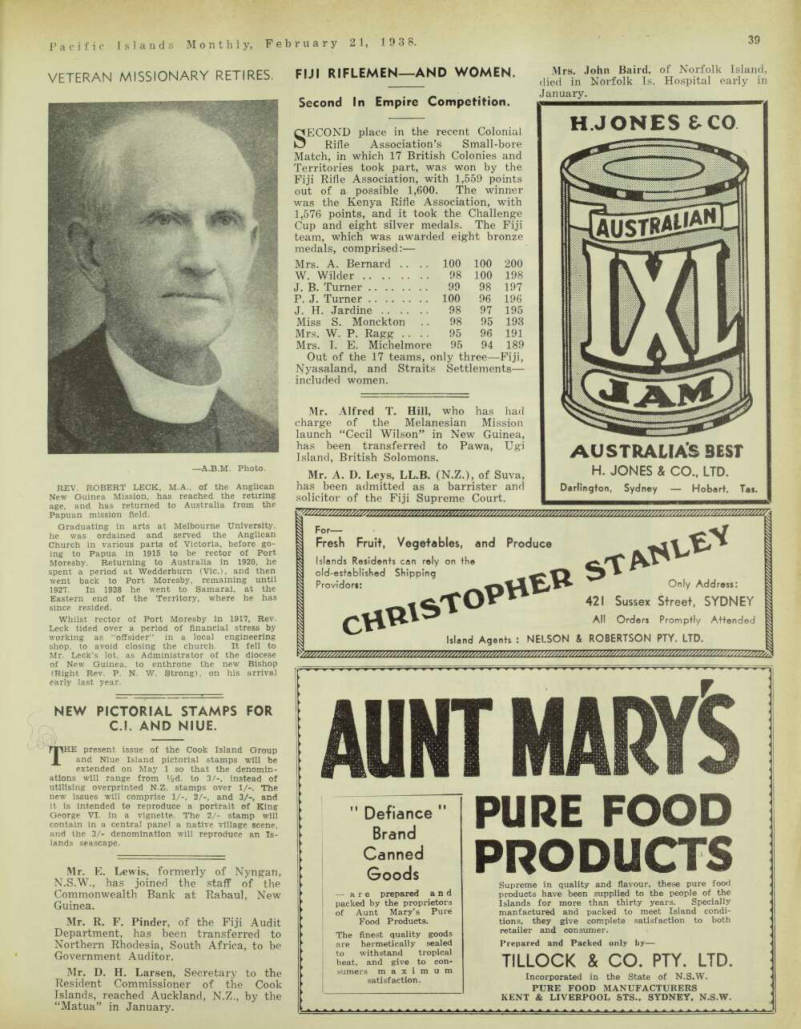
REV. ROBERT LECK, M.A., of the Anglican New Guinea Mission, has reached the retiring age, and has returned to Australia from the Papuan mission field.
Graduating in arts at Melbourne University, he was ordained and served the Anglican Church in various parts of Victoria, before go ing to Papua in 1915 to be rector of Port Moresby. Returning to Australia in 1920, he spent a period at Wedderburn (Vic.), and then went back to Port Moresby, remaining until 1927. In 1928 he went to Samarai, at the Eastern end of the Territory, where he has since resided.
Whilst rector of Port Moresby in 1917, Rev.
Leek tided over a period of financial stress by working as “offsider” in a local engineering shop, to avoid closing the church. It fell to Mr. Leek’s lot, as Administrator of the diocese of New Guinea, to enthrone the new Bishop (Right Rev. P. N. W. Strong), on his arrival early last year.
-A.B.M. Photo.
New Pictorial Stamps For
C.I. And Niue.
fpHE present issue of the Cook Island Group f and Niue Island pictorial stamps will be extended on May 1 so that the denomin ations will range from Vfed. to 3/-, instead of utilising overprinted N.Z. stamps over 1/-. The new issues will comprise 1/-, 2/-, and 3/-, and it is intended to reproduce a portrait of King George VI. in a vignette. The 2/- stamp will contain in a central panel a native village scene, and the 3/- denomination will reproduce an Is lands seascape.
Mr. E. Lewis, formerly of Nyngan, N.S.W., has joined the staff of the Commonwealth Bank at Rabaul, New Guinea.
Mr. R. F. Pinder, of the Fiji Audit Department, has been transferred to Northern Rhodesia, South Africa, to be Government Auditor.
Mr. D. H. Larsen, Secretary to the Resident Commissioner of the Cook Islands, reached Auckland, N.Z., by the “Matua” in January.
Second In Empire Competition.
Fiji Riflemen—And Women.
SECOND place in the recent Colonial Rifle Association’s Small-bore Match, in which 17 British Colonies and Territories took part, was won by the Fiji Rifle Association, with 1,559 points out of a possible 1,600. The winner was the Kenya Rifle Association, with 1,576 points, and it took the Challenge Cup and eight silver medals. The Fiji team, which was awarded eight bronze medals, comprised:— Mrs. A. Bernard . . . . 100 100 200 W. Wilder 98 100 198 J. B. Turner 99 98 197 P. J. Turner 100 96 196 J. H. Jardine 98 97 195 Miss S. Monckton .. 98 95 193 Mrs. W. P. Ragg ... 95 96 191 Mrs. I. E. Michelmore 95 94 189 Out of the 17 teams, only three—Fiji, Nyasaland, and Straits Settlements— included women.
Mr. Alfred T. Hill, who has had charge of the Melanesian Mission launch “Cecil Wilson” in New Guinea, has been transferred to Pawa, Ugi Island, British Solomons.
Mr. A. D. Leys, LL.B. (N.Z.), of Suva, has been admitted as a barrister and solicitor of the Fiji Supreme Court.
Mrs. John Baird, of Norfolk Island, died in Norfolk Is. Hospital early in January.
Advertisements & other items, pp. 41-42 (1 item)
Products
H.JONES 8-CO
AUSTRALIA'S BEST
H. JONES & CO., LTD.
Darlingfon, Sydney Hobarf. Tai.
Fruit, Vegetables, and Produce For— Fresh Islands Residents can rely on the old-established Shipping Providers: lS*°
pVtf-*
Island Agents Only Address: 421 Sussex Street, SYDNEY All Orders Promptly Attended
NELSON & ROBERTSON PTY. LTD.
" Defiance "
Brand
Canned
Goods
are prepared and packed by the proprietors of Aunt Mary’s Pure Food Products.
The finest quality goods are hermetically sealed to withstand tropical heat, and give to consumers maximum satisfaction.
PURE FOOD
PRODUCTS
Supreme in quality and flavour, these pure food products have been supplied to the people of_ the Islands for more than thirty years. Specially manfactured and packed to meet Island conditions, they give complete satisfaction to both retailer and consumer.
Prepared and Packed only by—
TILLOCK & CO. PTY. LTD.
Incorporated in the State of N.S.W.
PURE FOOD MANUFACTURERS
KENT & LIVERPOOL STS., SYDNEY, N.S.W.
t i f! ?l com Hl*
NEST BRAND :v.
*«g<! Twde Mark ": o-S>\iss Condensed
SYDNEY
NESTLES MILK
cannot sour
while unopened
Thousands of gallons of rich, creamy milk come info Nestle's Condenseries every day; every batch is carefully analysed to ensure uniform high quality in the finished product. In every stage of preparation, Nestle's Milk is fully protected—firstly by a hygienic manufacturing process, and then by the hermetically sealed tin, which prevents any possibility of contamination or souring while it remains unopened. That is why you can always rely on Nestle's Milk—-it never varies.
Nestles
FULL CREAM
MILK
BEST. THEREFORE CHEAPEST
Historic German Flags
From Samoa.
BY recent gifts from two New Zealand women, the Auckland War Memo rial Museum now has in its possession the three German flags captured by the N.Z. Expeditionary Force on its arrival in Samoa on August 29, 1914. One is the first German flag to be captured in any theatre of the Great War.
When the N.Z, Force landed at Apia, an official party marched to Government Louse to take possession of the flag.
In the meantime, another party went to the Post Office and cut down the flag there. This latter ensign, which was taken half an hour before the official party secured the one at Government House, was preserved by the soldier who commandeered it. Eventually, it passed into the hands of Mrs. Ewena Cate, of Blenheim, who in December offered it to the Museum. Measuring 3 ft. by 5 ft., it bears the insignia of the former German Crown, above the pos tal sign—a bugle. The N.Z. authorities already had placed the “official” flag in the Museum.
In January, the third of the captured banners was sent to the Museum by Mrs. A. Slattery, of Davonport, whose son, Corporal Gilbert Slattery (now of Sydney), secured it from a German administrative building. It is 9 ft. by 12 ft., and is in perfect condition. In the centre are the German Imperial Eagle and Crown.
Waco Not A Complete Loss.
Letter to the Editor.
I SHOULD be glad if you would state that the Waco aeroplane that was forced down by violent weather near Madang is not a “complete write-off”, and never was. While the machine was under control, Captain Leggatt decided to land and, in doing so, landed in a kunai swamp. It was impracticable to clear a runway there, and so the machine is being salvaged. The only damage was a bent propeller, and, when the wings, fuselage, engine, etc., are brought in the plane will be reassembled again and the “Old Waco” will be just like she used to be.
I am, etc.,
R. Macgregor,
Madang Manager, Stephens Aviation, Ltd., New Guinea.
Races At Rarotonga.
From Our Own Correspondent,
Rarotonga, Jan. 10.
NEW YEAR’S DAY saw the first meeting of the Rarotonga Jockey Club, at Muri Beach sports ground.
Europeans and natives turned out in force, and keen interest was shown in all races. A “tote” operated by the club officials proved very popular; the best dividend of the day was the Cup winner, which paid £l3.
Islands Life Pictured On Stamps.
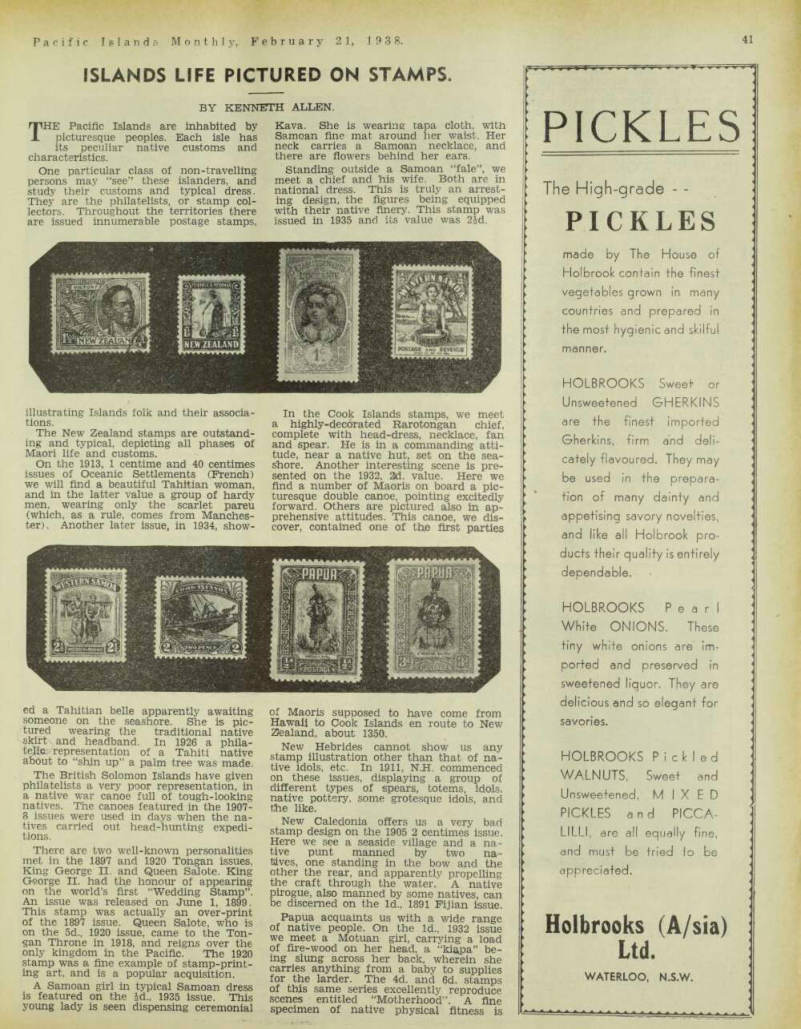
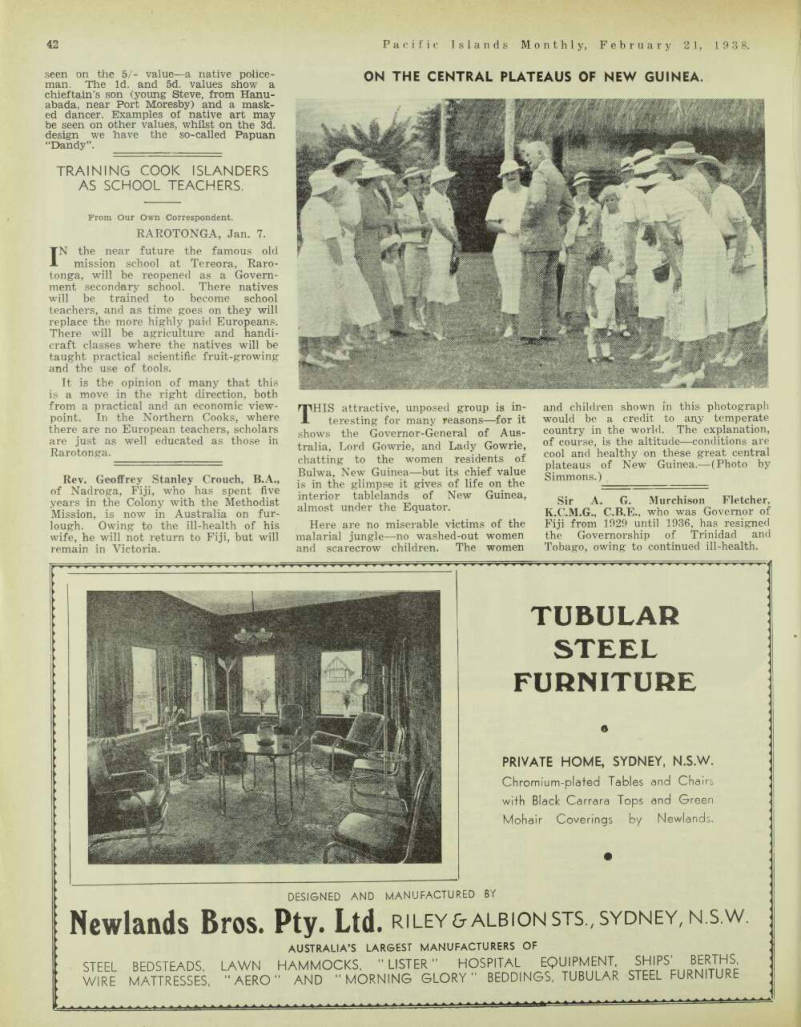
By Kenneth Allen.
THE Pacific Islands are inhabited by picturesque peoples. Each isle has its peculiar native customs and characteristics.
One particular class of non-travelling persons may “see” these islanders, and study their customs and typical dress.
They are the philatelists, or stamp col lectors. Throughout the territories there are issued innumerable postage stamps,
illustrating Islands folk and their associa tions.
The New Zealand stamps are outstand ing and typical, depicting all phases of Maori life and customs.
On the 1913, 1 centime and 40 centimes issues of Oceanic Settlements (French) we will find a beautiful Tahitian woman, and in the latter value a group of hardy men, wearing only the scarlet pareu (which, as a rule, comes from Manches ter). Another later issue, in 1934, show-
ed a Tahitian belle apparently awaiting someone on the seashore. She is pic tured wearing the traditional native skirt and headband. In 1926 a philarepresentation of a Tahiti native about to “shin up” a palm tree was made.
The British Solomon Islands have given philatelists a very poor representation, in a native war canoe full of tough-looking natives. The canoes featured in the 1907- 8 issues were used in days when the na tives carried out head-hunting expedi tions.
There are two well-known personalities met in the 1897 and 1920 Tongan issues, King George 11. and Queen Salote. King George 11. had the honour of appearing on the world’s first “Wedding Stamp”.
An issue was released on June 1, 1899.
This stamp was actually an over-print of the 1897 issue. Queen Salote, who is on the 5d., 1920 issue, came to the Ton gan Throne in 1918, and reigns over the only kingdom in the Pacific. The 1920 stamp was a fine example of stamp-print ing art, and is a popular acquisition.
A Samoan girl in typical Samoan dress is featured on the Id.. 1935 issue. This young lady is seen dispensing ceremonial
Kava. She is wearing tapa cloth, with Samoan fine mat around her waist. Her neck carries a Samoan necklace, and there are flowers behind her ears.
Standing outside a Samoan “fale”, we meet a chief and his wife. Both are in national dress. This is truly an arrest ing design, the figures being equipped with their native finery. This stamp was issued in 1935 and its value was 2ld.
In the Cook Islands stamps, we meet a highly-decorated Rarotongan chief, complete with head-dress, necklace, fan and spear. He is in a commanding atti tude, near a native hut, set on the sea shore. Another interesting scene is pre sented on the 1932, 2d. value. Here we find a number of Maoris on board a pic turesque double canoe, pointing excitedly forward. Others are pictured also in ap prehensive attitudes. This canoe, we dis cover, contained one of the first parties
of Maoris supposed to have come from Hawaii to Cook Islands en route to New Zealand, about 1350.
New Hebrides cannot show us any stamp illustration other than that of na tive idols, etc. In 1911, N.H. commenced on these issues, displaying a group of different types of spears, totems, idols, native pottery, some grotesque idols, and the like.
New Caledonia offers us a very bad stamp design on the 1905 2 centimes issue.
Here we see a seaside village and a na tive punt manned by two na tives, one standing in the bow and the other the rear, and apparently propelling the craft through the water. A native pirogue, also manned by some natives, can be discerned on the Id., 1891 Fijian issue.
Papua acquaints us with a wide range of native people. On the Id., 1932 issue we meet a Motuan girl, carrying a load of fire-wood on her head, a “kiapa” be ing slung across her back, wherein she carries anything from a baby to supplies for the larder. The 4d. and 6d. stamps of this same series excellently reproduce scenes entitled “Motherhood”. A fine specimen of native physical fitness is
seen on the 5/- value —a native police man. The Id. and sd. values show a chieftain’s son (young Steve, from Hanu abada, near Port Moresby) and a mask ed dancer. Examples of native art may be seen on other values, whilst on the 3d. design we have the so-called Papuan “Dandy”.
Advertisements & other items, p. 43 (1 item)
Pickles
The High-grade - -
PICKLES
made by The House of Holbrook contain the finest vegetables grown in many countries and prepared in the most hygienic and skilful manner.
HOLBROOKS Sweet or Unsweetened GHERKINS are the finest imported Gherkins, firm and deli-
cately flavoured. They may
be used in the preparation of many dainty and appetising savory novelties, and like all Holbrook products their quality is entirely dependable.
HOLBROOKS Pearl
White ONIONS. These tiny white onions are imported and preserved in
sweetened liquor. They are
delicious and so elegant for savories.
HOLBROOKS Pickled WALNUTS, Sweet and Unsweetened, MIXED
PICKLES an d PICCA-
LILLI, are all equally fine, and must be tried to be appreciated.
Holbrooks (A/sia)
Ltd.
WATERLOO. N.S.W.
Training Cook Islanders
As School Teachers.
From Our Own Correspondent.
Rarotonga, Jan. 7.
IN the near future the famous old mission school at Tereora, Raro tonga, will be reopened as a Govern ment secondary school. There natives will be trained to become school teachers, and as time goes on they will replace the more highly paid Europeans.
There will be agriculture and handi craft classes where the natives will be taught practical scientific fruit-growing and the use of tools.
It is the opinion of many that this is a move in the right direction, both from a practical and an economic view point. In the Northern Cooks, where there are no European teachers, scholars are just as well educated as those in Rarotonga.
Rev. Geoffrey Stanley Crouch, 8.A., of Nadroga, Fiji, who has spent five years in the Colony with the Methodist Mission, is now in Australia on fur lough. Owing to the ill-health of his wife, he will not return to Fiji, but will remain in Victoria.
On The Central Plateaus Of New Guinea.
THIS attractive, unposed group is in teresting for many reasons—for it shows the Governor-General of Aus tralia, Lord Gowrie, and Lady Gowrie, chatting to the women residents of Bulwa, New Guinea—but its chief value is in the glimpse it gives of life on the interior tablelands of New Guinea, almost under the Equator.
Here are no miserable victims of the malarial jungle—no washed-out women and scarecrow children. The women
and children shown in this photograph would be a credit to an,y temperate country in the world. The explanation, of course, is the altitude —conditions are cool and healthy on these great central plateaus of New Guinea. —(Photo by Simmons.)
Sir A. G. Murchison Fletcher, K.C.M.G., C.8.E., who was Governor of Fiji from 1929 until 1936, has resigned the Governorship of Trinidad and Tobago, owing to continued ill-health.
Advertisements & other items, p. 44 (1 item)
Newlands Bros. Pty. Ltd. riley galbionsts., Sydney, n.s.w.
TUBULAR
STEEL
FURNITURE
PRIVATE HOME, SYDNEY, N.S.W.
Chromium-plated Tables and Chairs with Black Carrara Tops and Green Mohair Coverings by Newlands.
DESIGNED AND MANUFACTURED BY
Newlands Bros. Pty. Ltd. riley galbionsts., Sydney, n.s.w.
AUSTRALIA’S LARGEST MANUFACTURERS OF
STEEL BEDSTEADS,
WIRE MATTRESSES,
LAWN HAMMOCKS, "LISTER" HOSPITAL EQUIPMENT,
"AERO" AND "MORNING GLORY" BEDDINGS, TUBULAR
SHIPS' BERTHS.
STEEL FURNITURE
"Yanawai" Enters Fiji
Trade.
From Our Own Correspondent.
Suva, Jan. 26.
EARLY last month B.P.’s new M.V.
“Yanawai” arrived in Suva from Hong Kong for the Fiji trade.
She is a most up-to-date vessel, and for a small ship has exceptional pas senger accommodation. A feature of the airy cabins is that each is pro vided with a large thermos water bott~ —a necessity where tropical travel is concerned. There is a roomy saloon, a comfortable smokeroom, and a large amount of deck space. The boat deck is provided with a permanent awning, and there is ample room for deck games.
The “Yanawai” has taken up running between Suva and Vanua Levu ports, a route previously covered by the auxi liary ketches “Helena” and “Tui Labasa”. Served by a modern ship, this locality should become popular with tourists, who, in the past, have seldom visited these outlying parts be cause of lack of comfortable travelling facilities.
The vessel was brought out from China by Captain Colquhoun, a skipper well-known in B.P.’s service for many years. Since her arrival she has been taken over by Captain M. Whippy, a local veteran of the B.P. service. Cap tain Colquhoun reported that the little ship proved herself most seaworthy on the trip out. The only incident of note was when she was questioned as to her destination by a Japanese destroyer.
Manslaughter Charges In
New Guinea.
From Our Own Correspondent.
WAU, Feb. 2.
DURING January Judge Phillips, in the Supreme Court, Wau, heard charges of manslaughter against two men who were the drivers of motor vehicles when fatal accidents occurred, Mr. Wally Corden, who was the driver of the motor truck which overturned and killed Mr. James Stewart in Nov ember, was found not guilty of man slaughter and was discharged. The Court evidently took the view that the regrettable occurrence was entirely an accident.
The driver of another motor truck, which ran over and killed a man near Bulolo, and which continued its journey without stopping to ascertain whether harm had been done, was sentenced to two years’ imprisonment.
Rev. 0. G. Parry, B.Ec., with Mrs.
Parry and their three children, departed from Sydney for Papua by the “Macd hui’ on February 2. He will have charge of the London Missionary Society’s Lawes College at Fife Bay, pending the arrival of a new L.M.S.’ missionary.
Airmail Stamps.
First On Central Pacific Route.
From Our Own Correspondent.
Honolulu, Jan. 5.
THOSE collectors who intend putting a price .on the covers of the un official mail carried from Auckland to Hawaii by the survey plane, “Samoa Clipper”, had better know about the first letters carried on the Hawaii-New Zealand air route.
These were carried by the “Samoa Clipper” from Honolulu to Kingman’s * Reef on March 23, 1937, the date of the first survey flight. There were some 30 letters addressed to employees on the
S.S. “North Wind”, the chartered steamer which acted as radio base at the reef.
The mail had been sent by regular sources to the men at Honolulu, but the air company obligingly sent on the mail by the clipper. The alert recipients quickly took advantage of their historic mail.
With razor blades and rubber, they made a neat cancellation stamp which stated “Received at Kingman’s Reef, the date, carried by clipper, etc.”, and Captain A. J. Borklund, the “North Wind’s” skipper, and Stewart Saunders, chief Pan American representative at the reef, obligingly certified the correct facts on each envelope, the location of the reef, date and so on.
So far, only two of these valuable
covers have been sold, and they each fetched 35 dollars. They are all held in the United States.
Incidentally, the mail that was car ried from Auckland to Hawaii by the second survey flight of the “Samoa Clipper” was unofficial, and of this the U.S. post office department was 2are ful to warn collectors in America, It was such a windfall for the men
that they intended sending back the mail to Honolulu by the clipper, but the company, which considers it is entitled to all profits on first mails on its new routes, was angered by the Kingman colonists’ enterprise, and out went an order in code by radio to all the bases on the route that no mail whatsoever could be carried on the northward flight.
Advertisements & other items, pp. 45-46 (1 item)
Starline
Master Sewing Machine Co.
5 ENMORE ROAD, NEWTOWN, SYDNEY
ESTABLISHED FOR 23 YEARS
SPECIALISING IN
RECONDITIONED
SEWING MACHINES
OF ALL TYPES
Hand Machines - -
Upright Models - -
Dropheads - . . including
SINGER-WHITE—NEW CENTURY—HOME—AND OTHER WELL
• Allow us to select a machine for you ... we will strive to please; Y° ur subsequent recommendations will reward us.
Also in Stock— Machines for Leather, Canvas Bootpatching, Highspeed Dressmaking, Hemstitching, etc.
GUARANTEED MECHANICALLY PERFECT
I \ YP ,\v£C
REPAIR WORK BY
COMPETENT
MECHANICS
EVERY MACHINE
NEEDLES AND PARTS
SUPPLIED FOR ALL
MAKES OF MACHINES
SPECIFY
'STARLINE
BRAND
sr
STARLINE
CHINESE LACQUER
For all Indoor and Outdoor Decoration
1/- tin covers 18 sq. feet
STARLINE CHINESE LACQUER : Is guaranteed to withstand the severe elements to which paint is subjected in the Tropics, including Salt Water. Heat and Rain, etc., and will not lose Its gloss or permanence.
To give some idea of the covering capacity, one gallon will cover over 1200 sg. ft. 42 colours to choose from . . . Dries in a few hours.
Won't chip or crack.
MADE IN ENGLAND
Write to us for Colour Chart and full particulars regarding attractive sole agency for territories still vacant.
AGENTS- ( c° r F ii'. Ton ga and Samoa, Messrs. MORRIS HEDSTROM LTD. ’ L For Tahiti and Cook Islands, Messrs. A. B. DONALD LTD, MO., -,r . , F !l t PZ. y Re P resentative for all Islands and New Zealand : NEW ZEALAND DISTRIBUTORS LTD., Box 530, AUCKLAND, N.Z.
0
which)
paint r
rs
OF COURSE
(PR
ARE
/Keeps on 1
AGENTS THROUGHOUT THE ISLANDS
Zeppelin Services
For Pacific?
From Japan To California.
From Our Own Correspondent.
Honolulu, Jan. 10.
THOSE airminded people interested in the expansion of commercial air lines throughout the world should not overlook the announcement of the American Zeppelin Transport company, which has backed the construction of dirigibles in Germany. Commercial zeppelin flights in regular service are to be started in June. Helium gas will be used in inflation.
A subsidiary company has been formed for the exploitation of dirigible services across the Pacific. The first service will be from Japan to California.
A non-stop San Francisco-Sydney ser vice is beyond the discussion stage.
It is on long voyages such as these that the dirigible easily eclipses the heavier-than-air clippers, which have to make so many landings and which are so affected by adverse weather.
Dirigibles revel in storm forecasts.
They detour and hug the edges, and thus make faster time, favoured by tail winds.
The old Graf Zeppelin’s record set many years ago of 3i days non-stop across the Pacific, from Japan to Los Angeles, still stands. It seems likely that it will not be broken until another Zeppelin gets going.
Areas, B.S.I
Tested Guadalcanal Gold
REPRESENTING an English company with a capital of £200,000, Mr. J.
G. Thomas arrived from the Solomons in the “Malaita” on January 29 for Melbourne.
He visited Gaudalcanal Island to test alluvial areas for gold. The results had been satisfactory, he said. In the near future an extensive system of dredging would probably be in operation.
Wireless Station For
Puka Puka.
From Our Own Correspondent.
Rarotonga, Jan. 8.
WHEN the schooner “Tagua” sailed last month she had on board equip ment for the new wireless station at Puka Puka, Northern Cooks. A locally trained native operator will be in charge of the installation.
This new station having no commer cial value is just another link in the chain of radio stations on remote islands of the South Seas for the use of future trans-Pacific air services, and they also will have their use in case of war.
Author R. D. Frisbie will not welcome this incursion of civilisation into his Islands paradise.
Murder On The High Seas.
How The Brothers Rorique Were Trapped in Ponape In 1892.
By A.C.R.
ON July 26, 1895, two men were em barked in the prison ship, “Saint Nazaire”, bound for Cayenne.
They had been condemned by the Tri bunal Maritime of Brest to perpetual im prisonment in France’s South American penal colony, for piracy and murder on the high seas. They were enrolled there under the numbers 27029 and 27030.
They first appear in this history when, in the month of June, 1891, Captain Wohler, of the schooner, “Papeete”, while at Rarotonga, was requested by Messrs.
Lisle and Goodwin (merchants at Raro tonga) to take on his ship two wrecked French sailors who had arrived at th,e is land a short time before. They gave their names as Alexandre and Joseph Rorique, and represented that they had been captain and first mate of the ship “General Bag”, which had been wrecked at Jaluit, in the Marshall Islands; they being the only survivors. From the Mar shall Islands the two had made their way to Penrhyn and thence to Rarotonga, where they became warehousemen for Messrs. Lisle and Goodwin.
There was no truth whatever in this story of a wreck in the Marshall Islands.
In reality, they had come ashore, on De cember 25, 1890, at Penrhyn from the ship “Vagabond”, sailing from Sydney, having deserted the vessel at that island.
This was not known at Rarotonga at the time so Capt. Wohler accepted them on his schooner and transported them to Tahiti.
The Roriques lost no time in insinuating themselves into the good graces of the people of Tahiti.
HOW well they succeeded is witnessed in a letter written on May 28, 1892, by the Governor of that time, Mon sieur Lacascade:—“The brothers Rori que, who speak fluently five languages, appear educated and have irreproachable manners, were recommended by Captain Wohler”.
Le Messager de Tahiti, in relating the horrible tragedy of the “Niuorahiti”, speaks of “the apparent poise, the social talents and the imperturbable politeness of the brothers, Rorique”—wh,o played one, the piano, the other, the flute. Captain Wohler learned that they could set a course, and steer a ship. There is not any doubt that they possessed scientific knowledge. They wrote French, in the style most pure. All of these qualifica tions recommended them to Captain Ar naud, who, sensing the advantages he could derive by employing such men, of fered to establish them in one of the is lands of which he controlled the traffic —th,e atoll Kaukura, in the Tuamotu archipelago.
There is no doubt that, during their so journ together at Kaukura, the brothers Rorique conceived and perfected their plans for the piracy which has made their name infamous in the Pacific.
It was not long before Joseph, returned to Tahiti—alleging that there was not sufficient work for the two of them in Kaukura.
AT Papeete Captain Andre offered Jo seph the post of first mate on his schooner, “Henri”. The “Henri” was on the point of departure when Alexan dre arrived from Kaukura. He had fre
quent conversations with his brother, Joseph, on board the “Henri”, which last ed far into the night. Finally, Alexan dre departed for Kaukura by another vessel while Joseph assumed his duties as mate on the “Henri”. During the voy age Joseph three times requested Cap tain Andre to call at Kaukura; but An dre, suspicious, refused and ordered his crew to notify him if the course of the vessel should be changed during the night.
Returning to Papeete, Joseph left An dre’s schooner and was offered the post of mate on the “Gabrielle”; but refused because, as he said, it was “too small”.
For a long time Joseph remained ashore until, one day, he was introduced to Mon sieur Gibson, captain in fact, although supercargo in name, of the handsome schooner “Niuorahiti”.
“I engage you”, said Gibson. “At least.
I shall have someone to whom I can speak English”.
The following day. Gibson conducted Joseph on board and introduced him to Tehahe, the captain; but hastened to add; “Do not trouble yourself about the captain. I have him on board because I cannot be captain myself. Not being a French citizen, I embark in the quality of supercargo. Nevertheless, everything will be between you and me”.
The “Nluorahiti” was a fine schooner of 50 tons and was owned by Prince Hinoi Pomare, nephew of the late King Pomare y She sailed from Papeete on December 15 1891 The first call was at Makatea.
After leaving that island, Joseph convinced Gibson that it would be to his interest to call at Kaukura. His brother, he said, was desirous of selling a cargo of Mother-of-Pearl shell.
THE “Niuorahiti” arrived at Kaukura on December 20. Alexander feigned to Ha thp Arrival of his brother. “I thought you were still with Captain Andre”, said he.
The same evening, Alexandre was in-
vited to dinner on board. During the meal, he asked Gibson if he would al low him a passage to Fakarava. Gib son, who had no reason for refusing his request, consented and even offered to take him free of charge, Arrived at Fakarava, Alexandre pretend e(j he had missed the mail from Tahiti anc [ begged Gibson to permit him to re main on board. The Roriques took lun cheon with the Administrator, Monsieur Aubert. At evening, there was a party where the brothers distinguished them selves by their musical performance at the harmonica. During the night Joseph « as seized with chills and fever.
“What good fortune”, Gibson said to him, “that your brother is on board!” He was most happy to have with him so ex perienced a mariner. The following morning the schooner sail for Fakarava.
When she left Fakarava, the “Niuora hiti” had on board nine persons—the cap tain Tehahe Gibson the cook Mirey a hEtlf — c&sto), four H3,tiVo s&ilors, p&ss enger named Teteria, and the two Rori ques* After having left a bag of mail at
Kauhehi, the schooner set sail for the Island of Hao.
A clear night and a calm sea. Joseph, who had recovered from his pretended sickness, took the helm. The captain Tehahe, Gibson and Mirey went below to sleep. The crew were already asleep in their quarters forward. The sick passen ger had not moved from his cabin. The two brothers Rorique, were alone on deck.
After some minutes, the captain Te ha'he, complaining that his cabin was too hot, came on deck to sleep in the open.
AT ten o’clock that night, the super cargo Gibson and the cook Mirey were awakened by the sound of two gunshots. Gibson leaped out of bed and said to Mirey: “Pori (Mirey’s Tahitian name), did you not hear two revolver shots on deck?”
“Yes”, replied Mirey. “I will go up and find out the reason”.
“No, stay here”, ordered Gibson, “I will go myself”.
“What has happened?” asked Gibson, on arriving on the poop.
He had scarcely spoken these words when Alexandre came toward him and cried: “Ah, this is what I wish”, and at the same moment discharged his revol ver full into the breast of Gibson. Gib son fell like a log to the’deck. Mirey, who had come some steps up the ladder, stood —his head just above the compan ion-way—terrorised by the spectacle be fore him.
Alexandre stood over Gibson, lying un conscious on deck, and shot him three times in the head, to finish him. Be hind the body of the supercargo, Mirey perceived that of the captain, Tehahe, extended beside the skylight.
“Get below or I’ll kill you”, shouted Joseph to Mirey. Mirey obeyed.
The tw r o brothers then took up the two bodies and cast them, without cere mony, into the sea.
Having started in murder, the Rori que brothers pursued remorselessly their determination to eliminate all possible witnesses of their crime. Mirey they spared because he swore to be faithful to them inasmuch as (so he protested) he would be accused equally with them should they fall into the hands of the authorities, and, secondly, because they needed a cook. The sick passenger died the following day from poison placed by Alexandre in a bowl of nourishment.
The Roriques called the crew aft. “You have nothing to fear”, they said. “For we nurpose putting you on a desert island
with plenty of food to last until you are rescued”. They further told the crew that the passenger had died of an infec tious disease and must be put overboard at once. They read the burial service over the body before they consigned it to the waters of the ocean.
The next morning, Alexandre com manded Mirey to get a half bottle of rum from the cabin and give a glass to each of the four native sailors. Two of the sailors drank their rum, but the two others refused. Those who had taken the rum soon afterwards died in great agony.
“They have caught the contagious dis ease of the passenger”, said Alexandre, and ordered the bodies to be thrown overboard.
Six days followed without incident.
The “Niuorahiti’s” course had been set to the north-west, and she was beyond the limits of French Oceania. There was no land in sight. The nearest island, Penrhyn, was distant many hours of sailing.
AT midday, Alexandre suddenly order ed the two sailors to lower the jib sail. They obeyed, and slid out on the bowsprit to fasten down the sail.
At that moment, Joseph rushed forward, brandishing a revolver. The poor men on the bowsprit knew his intention and, rather than die as had Gibson and Te hahe, they leaped into the sea.
Alexandre, at the helm, did not even turn his head as the men floated by, nor did he change the course of the vessel.
A smile appeared on his lips. The last witnesses they feared were gone. Mirey they could spare because between them they could make sure he would not be tray them. They could keep him in such terror that he would hold hjs tongue.
Besides, Mirey was an excellent cook, and they wished to enjoy a comfortable existence.
Their next task was to disguise the schooner. Alexandre painted over the black letters of the name on the bow and substituted the name “Poe”—which signifies, in the island dialect—a pearl.
Next, they erased the “Niuorahiti- Papeete” on the stem and painted the new name, “Poe-Rarotonga”, in its place. With materials they had at hand they made a flag of Rarotonga—two red bands horizontal, separated by a band of white, on which were sewn three blue stars.
While at Rarotonga they had possessed themselves of blank clearance forms and had carved a replica of the official stamp.
With these in hand, they had already forged complete clearance papers and other documents necessary to convince port Authorities that everything was in order. At the point of a pistol they compelled Mirey to sign on the crew roll as Polydore Dessard, born at Martinique.
The Roriques were now ready to carry out their further plans. Their first land fall was in the Gilbert Islands. The Gilberts were still under their native Kings. There were no critical inspec tions of the ship’s papers as the “Poe” entered the island harbours. It was not until the ship came to Ponape, in the Caroline Islands, that the real test came.
THE Caroline Islands were at that time under the" Spanish flagT Ponape was the seat of administration. When the “Poe” sailed into the harbour there were two Spanish gun boats anchored there.
The “Poe” dropped anchor at 10 a.m. near the Spanish cruiser “Dona Maria de la Molina”, At 11 o’clock the port doc tor came aboard and asked to see the “Poe’s” certificate of health. Alexandre
at once presented to him the false pat ent he had fabricated, on which were the visas of the islands he had previous ly visited. The doctor took some notes and said to Alexandre that the military Governor desired to see him during the afternoon.
At 2 o’clock Alexandre went to the residence. The Governor, who spoke English, wished to examine all of the ship’s papers. Alexandre promised to bring them the following day. The next morning he brought all the falsified documents to the Governor, who stamp ed and signed them with his visa with out reading them.
Alexandre returned on board triumph ant. He called Mirey. “Now, Pori”, he said, “we have nothing more to fear. All our papers have been found in order by the Governor”.
The next day Joseph said to Mirey: “Pori, wh,en we have finished dinner we will go ashore”.
Mirey heard this with secret joy, but he quieted all suspicion by again prom ising to say nothing of what had hap pened during the voyage. Ashore they repaired to a licensed hotel, kept by a German named Narruhn, where many officers of the Spanish military had gath ered for refreshments. The officers in vited Joseph and Alexandre to join their company. The two Roriques entertained
their hosts with music—Joseph at the piano and Alexandre playing an accord ion.
MIREY, meanwhile, was seeking oppor tunity to separate himself from them and to denounce them to someone who could understand French. But the Roriques kept him under constant observation. Final ly, at evening, Mirey said to Alexandre: “I think we must dine on shore for I
have not time to prepare a meal on board”.
Alexandre consented, and directed Nar ruhn to set a table for three.
The wife of Narruhn was a Tahitian woman. Mirey knew that if he could speak to her alone he could accomplish his object.
The Roriques drank heavily at dinner and before the repast was finished both were intoxicated—so much so that Alex andre became sick and went out into the court. His brother soon followed him.
Now was Mirey’s opportunity. He beckoned to the wife of Narruhn. “Are you not of Tahiti?” he asked in the Tahi tian dialect.
“Yes”, she responded, and added that she had even lived at Papeete.
Then Mirey, profiting by the drunken ness of the two brothers, begged the Tahitian woman to conduct him to the Spanish Governor, with her husband as interpreter, as he had a denunciation to make against the captain of the schoon er for crimes committed on the high seas.
At that moment Joseph came stagger ing in from the court. He had overheard the conversation. Alexandre followed, and the two attempted to drag Mirey from the inn.
The Tahitian woman hurriedly told her
husband what Mirey had revealed to her.
Narruhn intervened and, with a blow of his fist, knocked down first Alexandre and then Joseph—both being too intoxicated to offer any resistance.
Mirey was conducted before four offi cers of the Spanish infantry, together with, an interpreter, and there made his declaration in writing as to all that had transpired on the “Niuorahiti”. These ac cusations were so grave that the officers went at once to awaken the Governor, to inform him of what they had heard.
The Governor immediately ordered the arrest of the Roriques, who were there upon seized, taken aboard the “Dona Maria de la Molina” and confined as pris oners.
The inquiry amply confirmed the ac cusations of Mirey. The prisoners were transferred to Manila, in the Philippines, and later turned over to the French au thorities.
THE Roriques were tried before the Marine Tribunal at Brest in France and condemned to death. During the trial it was revealed that the name Rorique was assumed, and that the bro thers were in reality, the scions of a noble and distinguished family of Bel gium. Great influence was brought to bear and their sentences were commuted to imprisonment for life at Cayenne.
Alexandre died at Cayenne. Joseph was released in 1919. He is said to have embarked on an expedition to search for emeralds in Colombia, in the year 1926.
No details of the affair are available, but it is rumoured that he transgressed the laws of the country, was imprisoned and died there in mysterious circumstances. (Note.—The story of the Rorique Bro thers, is, of course, well known to the older residents of Tahiti. The writer, however, has taken his history and some of his phraseology from the account “Les Freres Rorique”, par Rene La Bruyere, published in 1934.)
Advertisements & other items, pp. 47-50 (1 item)
(W^jO* s
Timber, Joinery
ETC.
PREPARED BUILDINGS ready for erection a speciality.
SHIP AND BOAT BUILDING.
TIMBERS specially catered for.
FIBROLITE, PLYWOODS. GALVANISED
IRON.
CONSIGNMENTS shipped
by RETURN STEAMERS
to the Islands.
John W. Eaton
PTY. LTD.
WEST CRESCENT STREET
NORTH SYDNEY
TELEPHONES: X 5051 (5 tines)
BITUMENOID ROOFING
MADE IN AUSTRALIA.
Bitumenoid Roofings, Dampcourse and Insulating Felts raw materials. Warranted to stand the most rigid tests reits are made from WUAiU a
BITUMENOID THE BEST
Roofing, 1,2, 3-ply; Flooring, Waterproof Materials; Saturated Felt; Resilient Road Jointing; Natural Asphalt Dampcourse; 2 and 3-ply Dampcourse; 1-2 lb. Lead-core Dampcourse; Roofing Cement; Asphalt Paints; Roofing Compound.
SAMPLES AND PRICE LISTS ON APPLICATION.
MAXWELL PORTER & SON LTD.
ESTABLISHED 1888. BUILDERS’ SUPPLIES
107 REDFEBN ST., REDFERN, SYDNEY, N.S.W. Phone: M 3157. Cables Bitumenoid.
silts*
(W^jO* s
Obtain a copy before you build.
It contains designs and plans—in colour—of Homes that can be Inexpensively built with
WUNDERLICH DURABESTOS,
the indestructible asbestos-cement building sheeting. Write to
WUNDERLICH LIMITED
5.P.0.. Box 474 aa, SYDNEY
FOR TROPICAL BUILDINGS, SPECIFY
BUILD"
A MODERN I
HOME
DURABESTCS
ASBESTOS CEMENT BUILDING SHEETS
BURNS PHILP
(SOUTH SEA) CO. LTD.
Inc. in Fiji *
Island Traders and Shipowners
Also Branches at; Registered Office:
SUVA
FIJI
x Code Address: "Burnsouth.”
Fiji: Levuka, Lautoka, Labasa, Ba, Sigatoka, Rotuma Tonga: Nukualofa, Haapai, Vavau.
Samoa: Apia, Pago Pago (American Samoa).
Solomons: Gizo, Faisi.
New Hebrides: Vila.
Gilberts: Tarawa.
Norfolk Is. Niue. Wallis Is. Futuna Is.
% ft in
JAMES BUDGE LTD
REFRIGERATION ...
“BUDGE" Automatic or Manually-controlled Refrigeration and Ice-making Plants, with or without Insulated Cabinets or Rooms, ranging from 4 cubic feet to 1000 cubic feet or larger, using ammonia in the large and sulphur dioxide (SO2) in the small units.
Where electricity is not available, crude oil engines may be utilised for driving the larger plants and petrol engines for driving the smaller machines. The accompanying illustration is of a petrol engine driven SO2 unit. Enquirers please state power available (if any), size of cabinet and amount of ice required per day.
JAMES BUDGE LIMITED
REFRIGERATION AND GENERAL ENGINEERS
McEvoy and Harley Streets
ALEXANDRIA SYDNEY
Established 1890
ENGINEERING WORKSHOPS
ALL CLASSES OF MACHINES MADE AND RECONDITIONED
OXYMEL
HI GH GRADE
TIME TESTED
HOME and SHIP
Paints, Enamels, Varnishes,
Lacquers, etc.
" OXYMEL" Co. have been jnanufacturing Paints, etc., for just on 30 years.
We require distributing agents for our products. They are not cheap, shoddy goods.
Catalogues, Colorcards and Leaflets, &c., on request from , 4
THE OXYMEL OIL & PAINT
Co. Pty. Ltd.
47-51 YARRA BANK ROAD. SOUTH
MELBOURNE, VICTORIA, AUSTRALIA
Telephone M 2375
fT&Sk
BUILD AN ATTRACTIVE PERMANENT
HOME OF STEEL
TLLUSTRATED is an attractive “Comet" * steel bungalow recently erected by us.
This building is in no sense a special order, but shows just what can be done with the patented "Comet" principle of Steel Building Construction.
The "Comet" Steel Building, by reason of its patented sectional construction, is easily enlarged and where required, conveniently portable.
The buildings are white-ant proof, fireresisting and economical to erect.
They have definitely proved themselves the best proposition for the Islands.
EMINENTLY SUITABLE
FOR:—
BUNGALOWS
STORES
WORKSHOPS
COPRA SHEDS
BOYS’ HOUSES
HANGARS. ETC.
“COMET”
Steel Buildings
SIDNEY WILLIAMS & CO. (PTY.) LTD.
Steel Building Specialists, Builders and Contractors
DULWICH HILL, SYDNEY.
ROCKHAMPTON BRISBANE TOWNSVILLE
(Incorporated in Queensland)
Maleham& Yeomans
LIMITED
BOWDEN STREET. SHEFFIELD. ENG.
Manufacturers of all kinds of Butchers', Sticking and Sheath Knives Razors and Scissors Specialty Hairdresser Scissors
PRICE LIST ON APPLICATION
The Most Extensive Manufacturers in the British Empire of
RUBBER STAMPS.
INKS, STENCILS,
Marking Devices,
ACME STAMP PADS
OFFICE & STATIONERY SUPPLIES
a We also Manufacture & Supply a Complete Line of
LIMEWASHING AND
SPRAYING MACHINES
for all purposes.
Let us know your requirements and we will quote by return.
WRITE FOR OUR GENERAL CATALOGUE
Limewashing Machine
EXCELSIOR SUPPLY CO. PTY. LTD.
278 Post Office Place,
MELBOURNE, VIC.
HEAD OFFICE :
160 BROADWAY,
Formerlg known as George St., West, I
SYDNEY, N.S.W.
50 Victoria Street,
WELLINGTON, N.Z.
New Guinea Bounties For
10 More Years.
UNDER regulations gazetted on January 27, bounties paid by the Commonwealth Government on pro ducts of New Guinea and Papua for con sumption in Australia have been ex tended for 10 years from January 1, 1938.
The items affected include cocoa beans, cocoa shells, fibres, coir, sago, bamboo and rattan products, spices and kapok.
The bounties on goods produced in these territories were first paid in 1936 and have operated ever since as an in ducement for them to enlarge their trade with the Commonwealth. Rates of bounty are not specified in the regu lations.
Mr. W. E. Bellingham, who has been a miner in Papua for some years, ar rived in Australia by the January “Macdhui”. He intends to settle down in Queensland.
Mrs. A. C. Turnbull, wife of the Acting Administrator of Western Samoa, arrived in New Zealand with her daughter Ruth from Apia by the January “Matua”. Miss Turnbull has become a pupil at Chilton-St. James College, Wellington.
Christmas On T.I. 21 Years Ago.
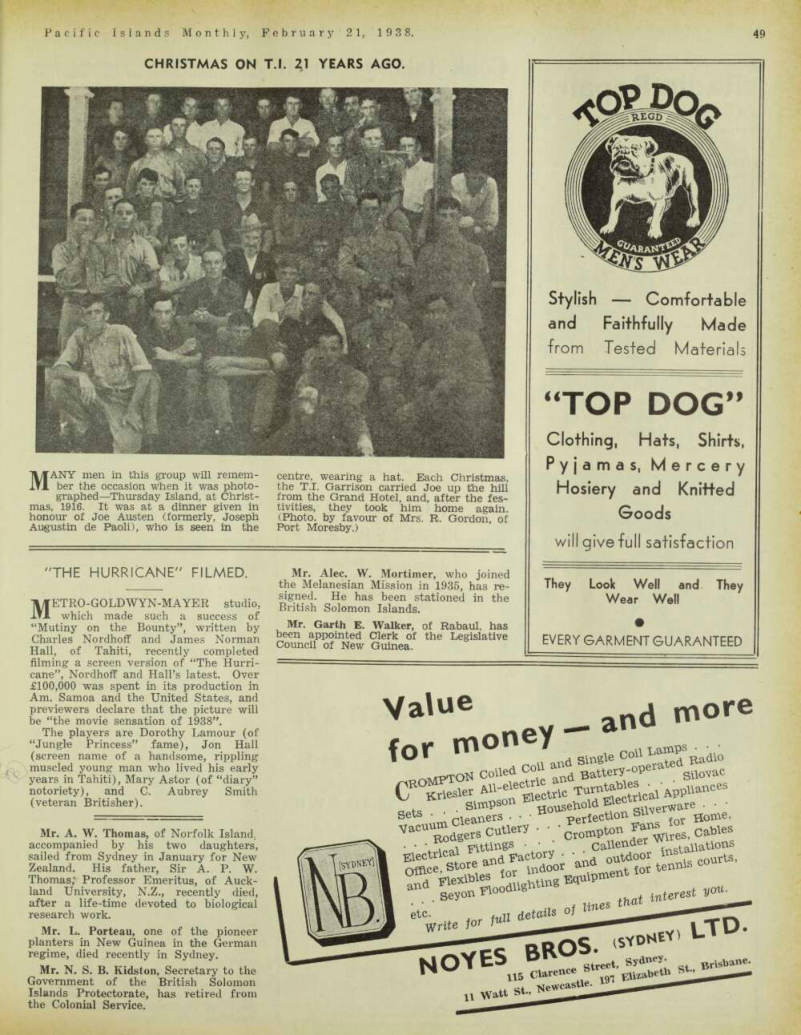
MANY men in this group will remem ber the occasion when it was photo graphed—Thursday Island, at Christ mas, 1916. It was at a dinner given in honour of Joe Austen (formerly, Joseph Augustin de Paoli), who is seen in the
centre, wearing a hat. Each Christmas, the T.I. Garrison carried Joe up the hill from the Grand Hotel, and, after the fes tivities, they took him home again. (Photo. by favour of Mrs. R. Gordon, of Port Moresby.)
Metro-Goldwyn-Mayer Studio,
"The Hurricane" Filmed.
which made such a success of “Mutiny on the Bounty”, written by Charles Nordhoff and James Norman Hall, of Tahiti, recently completed filming a screen version of “The Hurri cane”, Nordhoff and HalFs latest. Over £lOO,OOO was spent in its production in Am. Samoa and the United States, and previewers declare that the picture will be “the movie sensation of 1938”.
The players are Dorothy Lamour (of “Jungle Princess” fame), Jon Hall (screen name of a handsome, rippling muscled young man who lived his early years in Tahiti), Mary Astor (of “diary” notoriety), and C. Aubrey Smith (veteran Britisher).
Mr. A. W. Thomas, of Norfolk Island, accompanied by his two daughters, sailed from Sydney in January for New Zealand. His father, Sir A. P. W.
Thomas; Professor Emeritus, of Auck land University, N.Z., recently died, after a life-time devoted to biological research work.
Mr. L. Porteau, one of the pioneer planters in New Guinea in the German regime, died recently in Sydney.
Mr. N. S. B. Kidston, Secretary to the Government of the British Solomon Islands Protectorate, has retired from the Colonial Service.
Mr. Alec. W. Mortimer, who joined the Melanesian Mission in 1935, has re signed. He has been stationed in the British Solomon Islands.
Mr. Garth E. Walker, of Rabaul, has been appointed Clerk of the Legislative Council of New Guinea.
Advertisements & other items, pp. 51-52 (1 item)
•» -„i£S“. »^«ss»rr»^
REGD
8 V Stylish Comfortable and Faithfully Made from Tested Materials
“TOP DOG”
Clothing, Hats, Shirts,
Pyjamas, Mercery
Hosiery and Knitted Goods will give full satisfaction They Look Well and They Wear Well •
EVERY GARMENT GUARANTEED
Value and m ore
for money —‘ mp!
OMPTON coiled coil and B^ery-ope^^c
rS», “jrs *«
•» -„i£S“. »^«ss»rr»^
VaC Cutlery •• ' CromP ton **^ es , Cables •■ V ;~oi Fitting s ** * Callender talla tions
5SS *sr“TS» '“tSSfS ««»“
s tMt stc. , r fttU details of W*» Write t° r —ITD. ■ i *"
NOYES OK t ' reet , Sydney. bane .
W t!5 a**~* «,
Radio Repairs
If you are unable to get your Set repaired locally
SHIP IT TO US
Regardless of the make or type of Radio, we repair it, it to you condition.
We wi I attend to ali Shipping an Customs mat ters at thi end for you
PRICE'S RADIO SERVICE
d. g. Mclntyre
5 and 6 ANGEL PLACE.
SYDNEY
luarantee to nd return in new
1
iki
MASTER
PU m
THE CHAPMAN
MASTER PUP
3 h.p.—Patented Elevated Selfstarting Magneto—Floatless type Carburettor. "Petroil” method of lubrication. Equipment includes shaft and 3 blade prop., petrol tank, piping, all fittings. Unconditionally guaranteed for 5 years.
Chapman
Engines
CHAPMAN
MARINE MOTORS
Export Pup - 2{ h.p.
Standard Pup 2j h.p.
Master Pup - 3 h.p.
Super Pup - h.p.
Greyhound - 6-8 h.p.
Seadog - - 10 h.p.
are reliable-cost less to own
Apart from minimum upkeep costs, a Chapman engine is cheap to buy. All the while a Chapman engine saves you money— there are no breakdowns—no expensive overhauls—-no high petrol and oil bills because simplified methods of construction, plus the "petroil” system of lubrication make the Chapman engines the cheapest to run.
Chapman engines won't let you down—99% of N.S.W. hire launch services depend upon Chapman marine motors.
Without obligation, post coupon for interesting facts.
To CHAPMAN & SHERACK,
26 Clara Street, Erskineville, N.S.W.
Gentlemen, Please send, without obligalion, details of Chapman marine motors. n i i i i
Cook Islands Fruit
Control.
Officials Claim That Plan Is A Success.
THE first year’s operation of the Cook Islands orange trade (export to and sale in New Zealand) under Govern ment control shows a profit of £1,538, for the period ended December 31 last.
The N.Z. Government advanced £lO,OOO for the operation of the control plan, and at December 31 the position was:— Assets: Cash, £6,093; shocks, £8,890; total, £14,984.
Commitments: Due to N.Z., £10,000; due to Rarotonga Treasury, £1,558; growers’ debts redemption fund, £957; due to shippers, £1,336; reserve fund, £427; total, £14,279.
This is held by the officials to be satisfactory; and they intend to carry on the control scheme vigorously dur ing the current year. Growers in Aitu taki, Atiu, Mauke and Mangaia have agreed to create a fund for the pur chase of boats, trucks, etc., for the operation of the fruit trade.
Levies of varying amounts, from 2d.
to Bd. per case, are being made to meet Administrative costs, purchase of manures, packing shed facilities, insur ance against shipwreck, etc.
“The genuine growers of the Cook Islands—and especially the outer islands —are behind the control scheme,” writes an official. “They ought to be. They have received regular, substantial pay ments in cash, better than the prices they previously received in ‘Kaiou’ (credit with the stores).
“Shipping was ever our great bug bear—a very real difficulty, and one that we will be faced with again this year.
“There is really a new spirit amongst the people in the Outer Group, which is manifested in great activities in road making to develop their fruit areas, and in other public works. Central packing sheds will be erected in April next at Aitutaki, Mauke and Atiu to replace former traders’ sheds, which were dis persed in various parts of the Islands.
“During a recent visit to Atiu the Commissioner opened no less than five new roads, and Mauke has now followed suit and built two magnificent roads across the Island. Jane Tararo Ariki, a fine young woman, headed the labour gangs in carrying stones with the best.
Men, women and children were all in cluded, and the teams vied with each other in order to have their roads com pleted.
“At Atiu, the officials paid out £1,200 in one day, all in cash, and to the in dividual grower, and I assure you it was a wonderful sight to see these people with cash in their hands. Traders raked in good money against old debts that day. In Rarotonga there is con siderable ‘opposition’ by a few, as you may imagine, and they are now at tempting to carry it to the Outer Islands, but meeting with no success whatever.
“Some of the traders, seeing the benefit of control, are now coming into line; but one or two are going to die very hard.”
"Aubaba" Goes To Wau.
From Our Own Correspondent.
WAU, Jan. 14.
ON December 29 and 30, Wau Musical So ciety presented a really wonderful per formance of the pantomime “Alibaba and the Forty Thieves”.
Its presentation was remarkable when it is considered the number of makeshifts which had to be made in such a place as Wau in the way of properties, scenery, costumes, etc.
Every member of the cast filled his or her position brilliantly, and the whole production went with a swing and a glitter.
It would be invidious to single out any one person to offer praise to, but mention must be made of Major Berkeley Ayris, who pro duced the show and who has been the life and backbone of the Society. Mrs. Constance Hoile, who designed the scenery and costumes, also deserves special praise.
The cast was:—Alibaba (Hendy Humble), Cogia (Berkeley Ayris), Hamid (Frank Hoad), Morgiana (Nancy Beck), Cassim (Niell Proud), Zaida (Inez Beckett), Hassan (Charles Parker), Wawak (Colin Rees), Mukkadam (William Southcott), Mahbuba (Mae Looker), Marjanah (Marie Smith).
Mr. H. E. Woodman, of the District Services staff at Wewak, New Guinea, ar
rived in Australia by the January
“Macdhui” on furlough.
Change.
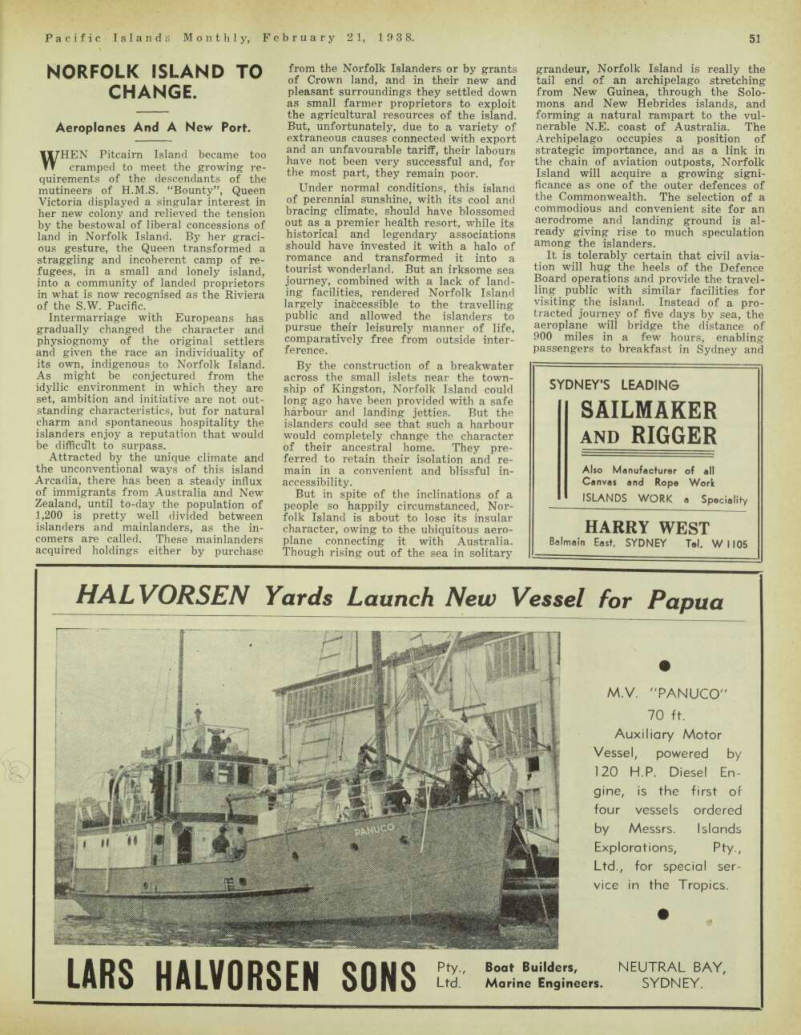
Norfolk Island To
Aeroplanes And A New Port.
WHEN Pitcairn Island became too cramped to meet the growing re quirements of the descendants of the mutineers of H.M.S. “Bounty”, Queen Victoria displayed a singular interest in her new colony and relieved the tension by the bestowal of liberal concessions of land in Norfolk Island. By her graci ous gesture, the Queen transformed a straggling and incoherent camp of re fugees, in a small and lonely island, into a community of landed proprietors in what is now recognised as the Riviera of the S.W. Pacific.
Intermarriage with Europeans has gradually changed the character and physiognomy of the original settlers and given the race an individuality of its own, indigenous to Norfolk Island.
As might be conjectured from the idyllic environment in which they are set, ambition and initiative are not out standing characteristics, but for natural charm and spontaneous hospitality the islanders enjoy a reputation that would be difficult to surpass.
Attracted by the unique climate and the unconventional ways of this island Arcadia, there has been a steady influx of immigrants from Australia and New Zealand, until to-day the population of 1,200 is pretty well divided between islanders and mainlanders, as the in comers are called. These mainlanders acquired holdings either by purchase
from the Norfolk Islanders or by grants of Crown land, and in their new and pleasant surroundings they settled down as small farmer proprietors to exploit the agricultural resources of the island.
But, unfortunately, due to a variety of extraneous causes connected with export and an unfavourable tariff, their labours have not been very successful and, for the most part, they remain poor.
Under normal conditions, this island of perennial sunshine, with its cool and bracing climate, should have blossomed out as a premier health resort, while its historical and legendary associations should have invested it with a halo of romance and transformed it into a tourist wonderland. But an irksome sea journey, combined with a lack of land ing facilities, rendered Norfolk Island largely inaccessible to the travelling public and allowed the islanders to pursue their leisurely manner of life, comparatively free from outside inter ference.
By the construction of a breakwater across the small islets near the town ship of Kingston, Norfolk Island could long ago have been provided with a safe harbour and landing jetties. But the islanders could see that such a harbour would completely change the character of their ancestral home. They pre ferred to retain their isolation and re main in a convenient and blissful in accessibility.
But in spite of the inclinations of a people so happily circumstanced, Nor folk Island is about to lose its insular character, owing to the übiquitous aero plane connecting it with Australia.
Though rising out of the sea in solitary
grandeur, Norfolk Island is really the tail end of an archipelago stretching from New Guinea, through the Solo mons and New Hebrides islands, and forming a natural rampart to the vul nerable N.E. coast of Australia. The Archipelago occupies a position of strategic importance, and as a link in the chain of aviation outposts, Norfolk Island will acquire a growing signi ficance as one of the outer defences of the Commonwealth. The selection of a commodious and convenient site for an aerodrome and landing ground is al ready giving rise to much speculation among the islanders.
It is tolerably certain that civil avia tion will hug the heels of the Defence Board operations and provide the travel ling public with similar facilities for visiting the island. Instead of a pro tracted journey of five days by sea, the aeroplane will bridge the distance of 900 miles in a few hours, enabling passengers to breakfast in Sydney and
then have lunch on Norfolk Island.
But it is certain that the advent of the aeroplane will change the character of the island and the outlook of the islanders. Incidentally, it will provide them with a solution to many of the troubles and marketing difficulties against which they have contended so long. Instead of being impecunious exporters, expending their energies in furnishing agricultural products for an uncertain and unsympathetic market in
New Zealand or Australia, they will en joy a lucrative employment in catering for the requirements of a home market necessitated by the influx of visitors from overseas.
Long before the completion of the breakwater, which the new Adminis trator has in contemplation, Norfolk Island will have assumed the regal position which nature and fortune de signed for her as the Riviera of the South Western Pacific.—M.F.
Advertisements & other items, pp. 53-54 (1 item)
Lars
SYDNEY’S LEADING
SAILMAKER
and RIGGER
Also Manufacturer of all Canvas and Rope Work ISLANDS WORK a Speciality
HARRY WEST
Balmain East. SYDNEY T«l. WIIOS
HALVORSEN Yards Launch New Vessel for Papua L^m if 4< * y « ■ ■ : • ■ • m ■ "’V.-V I '
LARS
' Mm mmmm feirat- s
HALVORSEN SONS
M.V. "PANUCO"
70 ft.
Auxiliary Motor
Vessel, powered by 120 H.P. Diesel Engine, is the first of four vessels ordered by Messrs. Islands Explorations, Pty., Ltd., for special service in the Tropics.
Pty., Boat Builders, Ltd. Marine Engineers.
NEUTRAL BAY,
SYDNEY.
Woven Wire for all Industry
COPRA DRYING TRAYS, FLOORS, Etc.
FRUIT DRYING TRAYS. MINING SCREENS
Heavy Mosquito Gauze in Phosphor Bronze and other Metals Impervious to Salt Sea Air WIRE DOOR MATS AND GENERAL WIRE WORKS
E. WRIGHT & CO. LTD.
Office and Works; 148-152 Cleveland Street, Sydney. N.S.W.
Telegraphic Address: “Wrightmake,” Chippendale tfT/U f: Or £ & sf>
Ship Chandlery Hardware
/ Write for Ship Chandlery Catalogue ] Special "In Bond" Prices tor all Islands enquiries quoted on application.
BROOMFIELD'S LIMITED
152 SUSSEX STREET :: :: ::
Cables "Boom," Sydney Large and Complete Stocks of
SHIP CHANDLERY
IRONMONGERY OF ALL KINDS,
WHITE LEAD AND OILS
SYDNEY
PAINTS.
Sole Agents for: P. H. MUNTZ & CO.'S 3-CROWN BRAND METAL SHEATHING.
PEACOCK & BUCHANS* ENGLISH READY - MIXED PAINTS.
Scott’s “Renown” Brand Rope,
Cordage and
Binder
Twine
Cable Address Ropeyard, Sydney
fcl
of Every
Description
MANUFACTURED AT
MASCOT, N.S.W.
J. SCOTT
PTY. LTD.
Head Office and Store:
163 CLARENCE STREET,
SYDNEY
N.S.W.
Guarding Coconut
Plantations.
Tahiti's Stringent Regulations
Against the Rhinoceros Beetle.
Prom Our Own Correspondent.
Papeete, Jan. 14.
AS the Union Line freight steamers call at Western Samoa and often at the Tongan Islands on their voyages from New Zealand to Tahiti, alarm has been aroused as to the possible intro duction, by these carriers, of the dreaded rhinoceros beetle into the coconut plan tations of French Oceania.
To protect the Colony from invasion by this pest, most stringent regulations have been enacted. The importation of plants, soil, sand, copra, grain, fruits, and vegetable products in general from Eastern and Western Samoa, Tongan Islands, New Guinea, the Bismarck Archipelago, Philippine Islands, For mosa, Cuba, Haiti, San Domingo, and Porto Rico has been interdicted.
All other cargo, parcels, and materials from these territories must be fumi gated by hydro-cyanic gas before land ing in Tahiti. A strict quarantine of the baggage, vestments, and personal effects of passengers will be enforced.
Ships from Samoa and Tonga must cease loading and unloading operations an hour before sunset, withdraw to an anchorage at least 400 metres distant from the quay, and remain there until an hour after sunrise. Palms of all varieties may not be cultivated within a radius of 400 metres of the quay of disembarkation at Papeete.
N.G. Public Service.
THE following staff movements in • the New Guinea Administration were announced by the Government Secretary at Rabaul on January 15:—
Transfers.
Public Health: Dr. R. W. Schuch, Medical Officer, Kokopo to Rabaul; F. N. Green, Medi cal Assistant, Rabaul to Kokopo; C. B. Walsh, Medical Assistant, Rabaul to Wau.
District Services Dept.: W. M. English, Cadet, Rabaul to Kieta; J. L. Taylor, A.D.0., Manus to) Rabaul; E. L. Lownes, Clerk, Wewak to Ra baul: R. I. Skinner, Cadet, Rabaul to Madang; E. Taylor, D. 0., Rabaul to Salamaua; J. I.
Merrylees, D. 0., Rabaul to Wewak; B. F. John son. Clerk, Rabaul to Lae; S. H. Pilan, Clerk.
Rabaul to Wau; R. H. Boyan, Clerk, Rabaul to Wewak.
Agriculture Dept.; B. George, Inspector and Instructor, Rabaul to Kavieng.
Public Works Dept.: G. A. Beer, Foreman Carpenter, Rabaul to Wau.
Lands Dept.: L. H. Livingston, Surveyor, Ra baul to Salamaua.
Temporary Appointments.
Public Works: D. McD. Smith to be Foreman Carpenter; J. D. O. O’Neill to be Roadmaster; F. Wilson to be Overseer Native Labour; E.
Condren to be Bridge Carpenter.
Mr. M. Barnewitz, a pioneer miner in
New Guinea, reached Sydney from
Wewak on January 25 by the “Macdhui”.
He returned to N.G. by the same vessel on February 2.
Ready For The Feast.
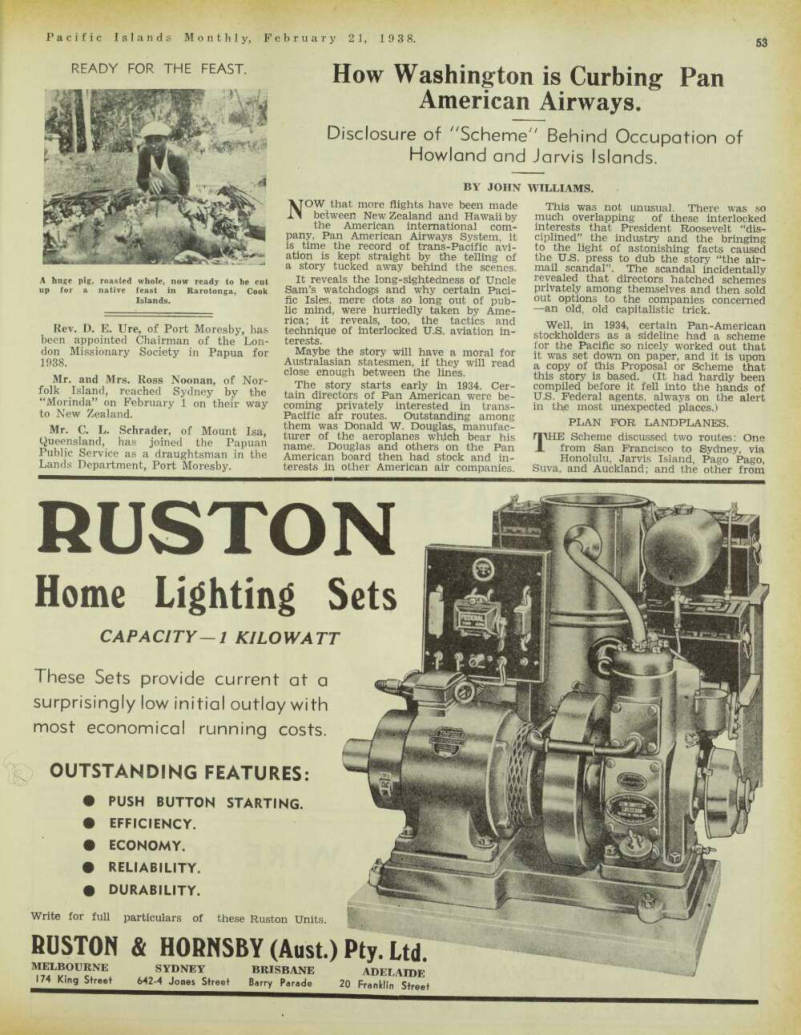
Rev. D. E. Ure, of Port Moresby, has been appointed Chairman of the Lon don Missionary Society in Papua for 1938.
Mr. and Mrs. Ross Noonan, of Nor folk Island, reached Sydney by the “Morinda” on February 1 on their way to New Zealand.
Mr. C. L. Schrader, of Mount Isa, Queensland, has joined the Papuan Public Service as a draughtsman in the Lands Department, Port Moresby.
A huge pig, roasted whole, now ready to be cut up for a native feast in Rarotonga, Cook Islands.
American Airways.
How Washington is Curbing Pan American Airways.
Disclosure of "Scheme" Behind Occupation of Howland and Jarvis Islands.
By John Williams.
NOW that more flights have been made between New Zealand and Hawaii by the American international com pany, Pan American Airways System, it is time the record of trans-Pacific avi ation is kept straight by the telling of a story tucked away behind the scenes.
It reveals the long-sightedness of Uncle Sam’s watchdogs and why certain Paci fic Isles, mere dots so long out of pub lic mind, were hurriedly taken by Ame rica; it reveals, too, the tactics and technique of interlocked U.S. aviation in terests.
Maybe the story will have a moral for Australasian statesmen, if they will read close enough between the lines.
The story starts early in 1934. Cer tain directors of Pan American were be coming privately interested in trans pacific air routes. Outstanding among them was Donald W. Douglas, manufac turer of the aeroplanes which bear his name. Douglas and others on the Pan American board then had stock and in terests in other American air companies.
This was not unusual. There was so much overlapping of these interlocked interests that President Roosevelt “dis ciplined” the industry and the bringing to the light of astonishing facts caused the U.S. press to dub the story “the air mail scandal”. The scandal incidentally reyealed that directors hatched schemes privately among themselves and then sold out options to the companies concerned —an old, old capitalistic trick.
Well, in 1934, certain Pan-American stockholders as a sideline had a scheme for the Pacific so nicely worked out that it was set down on paper, and it is upon a copy of this Proposal or Scheme that this story is based. (It had hardly been compiled before it fell into the hands of U.S. Federal agents, always on the alert in the most unexpected places.)
Plan For Landplanes.
THE Scheme discussed two routes: One from San Francisco to Sydney, via Honolulu, Jarvis Island, Pago Pago, Suva, and Auckland; and the other from
Honolulu to Tokio, via Midway, Wake, and Marcus Islands, with a detour to Guam and Manila.
Landplanes, to be built by Douglas, were to be used, and the costs of the Scheme were based on the operation of Douglas landplanes, DC2’s to be exact. (All the successful Pacific flights up to that time had been in landplanes).
Because landplanes were to be used (the crews actually had been picked, on paper, for the surveys and service) is lands suitable for them had been chosen.
Hence Jarvis and Marcus. The men who compiled the Scheme, incidentally, ad mitted in writing that Jarvis belonged to Britain. Marcus belongs to Japan.
The Scheme went into great detail: Pro moters always are careful not to over look selling points. The Scheme, in a few words, was to be an American in vasion of British Colonial air routes, and, by getting in first, to establish monopo lies. It held out such promise that, to quote the Scheme’s own words: “Mr.
Douglas would personally be willing to
form a syndicate to carry out the sur veys and to pay all costs of same with the understanding that, for the loan of a DC2 for the work by Transcontinental and Western Air (a major company in terested in Douglas operations), they (TWA) would be given an option of tak ing over the work of the survey on com pletion at cost, plus a profit commensur ate with the initial risks and outlay in curred The Scheme foresaw that the aerial invasion of Australasia would be more complete by inviting U.S. steamship com panies, the Matson and Dollar interests, into the scheme. (To-day the Matson Line has $500,000 in the Pacific division of Pan-American.) It also foresaw even tual competition from Australian or Brit ish airlines.
So the Scheme said; “. . . The first company, however, to commence effici ent operations on the routes will have a distinct advantage over a later competi tor, by the leasing of the most advantage ous intermediate points. . . It would
seem logical to commence operations all the way to Australia and, when compe tition seems likely, then to assist a com petitor who will be interested in the pre vention of the duplication of ser vices. . .
The Scheme introduced an interesting personal touch: . The proposed syndicate consid ers that for his efforts, Harold Gatty be granted an interest in the syndicate.
Gatty is still an Australian citizen, ideal ly situated to render valuable assistance in the development of the American line and, through his strong political con nection in Australia, to later carry out the above programme”.
Whoever was responsible for the avi ation details of the Scheme did not sus pect actual Pacific conditions. One item alone reveals this. The Scheme claim ed: “No icing conditions exist anywhere along the proposed Pacific routes”. The man who wrote that should do a bit of flying over the Pacific and learn about Polar fronts, nightmare icing conditions that have been discovered by aviators al most on the Pacific equator, and espec ially between Hawaii and California.
That covers the highlights of thie Scheme, the final draft of which bears the date of June 26, 1934.
Check From Washington.
NOW let us see what happened to the Scheme. First of all, the U.S. Gov ernment agents got busy. U.S. de fence was the primary point. Army-navy officers ordered that Marcus Island would have to be excluded: it is Japanese-own ed, and too near vital outlying U.S. de fence points like Midway and Wake to be developed by a foreign power like Japan to aid private American interests. (The Scheme had unimaginatively said that Japan could be persuaded to oper ate in conjunction with the syndicate’s plans.) So Uncle Sam squashed the route from Wake to Tokio via Marcus.
Next, U.S. army forces were sent sec retly, in a U.S. coastguard cutter, to Jar vis, Howland, and Barker, the equatorial islands, which, last had been occupied by British interests. Uncle Sam was deter mined that such handy islands to the Ha waii defence scheme would be his. So in March, 1935, U.S. army units occu pied them.
However, this was done without the knowledge of the syndicate behind the trans-Pacific air Scheme. The syndicate, meanwhile, formed the Dr. Dana Coman Oceanographic Expedition in mid-1935 (he was with the First Byrd Antarctic Cir cus) and equipped the schooner “Kinka jou”, and parties of youths, with Pan- American Airways portable radio equip ment.
The scheme was that the youths would be placed on Jarvis, Baker and Howland in the name of Dr. Coman, acting as a
blind for the syndicate. Then the syn dicate was to obtain leases of the islands.
But Washington emphatically said “No!”
This angle gives the lie to the flaring newspaper stories about American “rac ing” Britain in the occupation of the is lands. Uncle Sam simply forestalled these certain U.S. citizens. (The full inner history of this dramatic occupa tion of the islands must be kept, for the present.) At this time, too, Pan-American was planning trans-Atlantic dreams, which crashed—temporarily, for political reasons —and so the Martin clippers which were being built for the Atlantic came in handy for the Pacific Scheme. Washington had notified the syndicate, incidentally, that it would not accept Douglas landplanes for the proposed Pacific Scheme. The full Pan-American company, too, got wind of the Pacific syndicate’s plans and as a result of financial moves behind the scenes the company acquired the syndi cate’s ideas. Pan-American, incidentally, has acquired a cut-and-dried technique for absorbing potential rivals, details of which are familiar to detached observers of the expansion of airlines about the Americas.
Change-Over To Plying-Boats.
FORCED to use flying-boats, Pan-Ame rican agents lorthwith poo-hooed the idea that the company had ever in tended to use Jarvis, Baker or Howland.
Government permission was obtained to use Pago Pago, and long-range flying boats meant that Suva could be cut out on the way to Auckland. Uncle Sam, too, stepped in and placed Midway and Wake Islands under navy jurisdiction, just to curb the private air dreams. And in Hawaii, Uncle Sam is creating a flying boat port which the company must use.
Uncle Sam believes in discipline.
John Bull’s family followed suit, with an Empire agreement which forestalled the company’s dream (see “P.1.M.”, Oct., 1937) of flying into Australia. More discipline!
The Scheme was being shot to pieces, although in 1935 the company’s agents were claiming that clippers would be fly ing into Auckland by 1936. Those were very confusing years. If the Scheme had been aired in 1934, all the Governments concerned might have got together and had clippers flying on the route long ago.
THAT is what is irritating official Wash ington: paid agents of a private en terprise attempting to commit foreign Governments like New Zealand to schemes which, would create dangerous monopolies and precedents. One result has been that, eventually, British planes •will duplicate the route from America to New Zealand; and this fact has greatly angered the Pan-American board, which dreamed of a fat monopoly.
In a few words, the 1934 Scheme un imaginatively took too much for granted, with the result that there is plenty more discipline going on behind the scenes in Washington to-day. It will dovetail to make still another story.
Meanwhile, the U.S. post-office has not granted a subsidy for the Auckland route.
Of course, Pan-American, including the men behind the 1934 Scheme, carry on with the route because they possess valu able “first in” assets on the route.
What have the Australasian Govern ments got to say about it, and about Em pire solidarity? At least they might try to be as alert as Uncle Sam! He’s a streamlined horse-trader!
Advertisements & other items, pp. 55-56 (1 item)
Ruston
Home Lighting Sets
CAPACITY—I KILOWATT
These Sets provide current at a surprisingly low initial outlay with most economical running costs.
OUTSTANDING FEATURES:
• PUSH BUTTON STARTING.
• EFFICIENCY.
• ECONOMY.
• RELIABILITY.
• DURABILITY.
Write for full particulars of these Ruston Units.
BOSTON & HORNSBY (Aust.) Ply. Ltd.
'VTI?T RATTDMI'
MELBOURNE SYDNEY BRISBANE ADELAIDE
King Street 642-4 Jones Street Barry Parade 20 Franklin Street -> © 9 * m i
Copra Mats andJMatting
Send your enquiries to us for Woven Wire Mesh in Rolls or framed for Copra Drying and all Screening purposes, Bird Cages, Sieves and Riddles, Builder’s Gravel Screens, Rat Traps, Door Mats, Garden Arches, Chain Wire Mesh. Crimped Wire Mesh for Window Guards, etc.
SCOTT AND SONS
WIREWORKS: RAILWAY PARADE AND MURRAY STREET MARRICKVILLE
MOTOR-COASTERS
The first of its kind has made its entry, and from our experience we dare say that it is practically certain that (as in the Northern Seas) all present sailing and steam-vessels shall have to be replaced by this modern, handsome and highly economical craft.
Be in time, and request me to provide you with specifications and The Motor - Coaster, after having completely conquered the North Sea and the Baltic, is now extending its
TRIUMPHAL MARCH
also to the PACIFIC
WATERS.
estimates.
W. REILI NG H
Former Hon. Consul of the Netherlands and of Sweden in Africa.
ZUIDLAREN (Holland.)
«BU LLIVANTS’ wire ropes *
-mnnnrT* II C \AJ D I 1 Q STANDARD '*^^'***'*** n V ** M ***~**~' r W *
THE
STOCKS IN
WORLD'S
AUSTRALASIA
LARGEST STOCKS IN AUSTRALASIA : FOR ALL PURPOSES Also Blocks, Hooks, Shackles, Thimbles, Strand, Selling, Aircraft Cord, etc.
Prompt Attention! Efficient Service!! Complete Satisfaction!!!
BULLIVANTS' Australian Co. Pty., Ltd.
Letters* Incorporated in Victoria.
Box 1298 J, G.P.O. 331 KENT STREET, SYDNEY.
Telegrams: Sydney.
“Bullivants, Ltd.” «
Tongan Attacks
Policeman.
From Our Own Correspondent.
Nukualofa, Jan. 18.
WHILE he was being arrested to be committed to prison for non-pay ment of poll tax, a young Tongan, Tufui Sesele, attacked Constable Manu Mila with a knife. Although losing much blood from a gash in the palm of his right hand, Mila closed in with Sesele
and, after a short struggle, overpowered him.
This is the first occasion in Tonga that a police officer has been attacked while making an arrest.
At the annual general meeting of the Norfolk Island Association in January, Mr. W. M’Lachlan was re-elected Pre sident for a further period of 12 months; Mr. Fairfax L. Quintal was elected Hon. Secretary; and Mr. J.
Baird, Hon. Treasurer.
Advertisements & other items, p. 57 (1 item)
Fibrolite
Allen Taylor & Co. Ltd.
SYDNEY
Sawmillers and Wholesale Suppliers of Hardwoods for Constructional Purposes GIRDERS . . . PILES . . . POLES . . . SLEEPERS. Etc.
EXPORTING TO PAcTrC ISLANDS SINCE 1893
Cables: Tuxedo, Sydney
The
“Caledonia Dover”
A COOKING STOVE guaranteed to give, complete satisfaction and now recognised as THE BEST on the market.
Suitable for coal, coke, or wood fuel.
Illustrated Catalogue on request.
LANE & OIRVAN. LTD.
BONNY BRIDGE, SCOTLAND
BUILD WITH
Fibrolite
ASBESTOS CEMENT SHEETS
By using this Economical, Fire Retardant and White Ant Proof building material for External and Internal Walls and Ceilings, you can build a comfortable and durable Bungalow Home AT LOW COST! Supplied in big, sturdy building sheets in 44 handy stock sizes. "FIBROLITE" Is easily and quickly erected. No waste.
Less labour. No painting.
For full information, write for illustrated "Fibrolite" Booklet F.6—FREE AND POST FREE!
JAMES HARDIE & COY. LTD.
ASBESTOS HOUSE, YORK ST., SYDNEY, N.S.W.
(Box 3935 V., G.P.0., Sydney)
Dogs And Pigs.
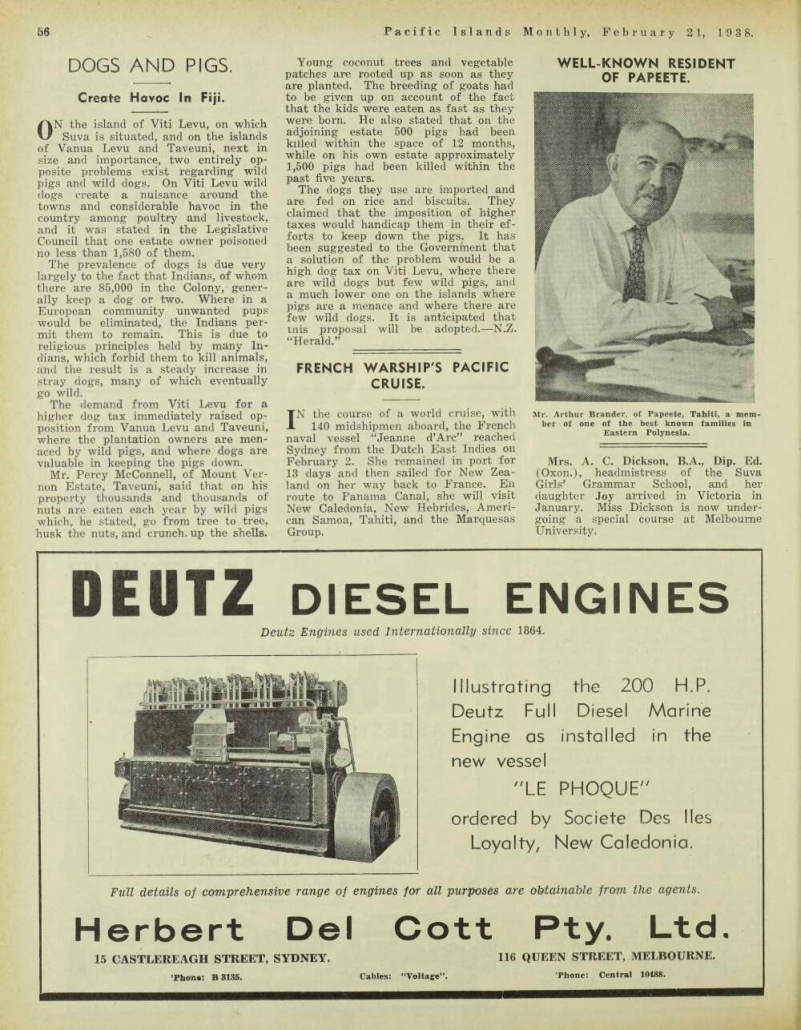
Create Havoc In Fiji.
ON the island of Viti Levu, on which Suva is situated, and on the islands of Vanua Levu and Taveuni, next in size and importance, two entirely op posite problems exist regarding wild pigs and wild dogs. On Viti Levu wild dogs create a nuisance around the towns and considerable havoc in the country among poultry and livestock, and it was stated in the Legislative Council that one estate owner poisoned no less than 1,580 of them.
The prevalence of dogs is due very largely to the fact that Indians, of whom there are 85,000 in the Colony, gener ally keep a dog or two. Where in a European community unwanted pups would be eliminated, the Indians per mit them to remain. This is due to religious principles held by many In dians, which forbid them to kill animals, and the result is a steady increase in stray dogs, many of which eventually go wild.
The demand from Viti Levu for a higher dog tax immediately raised op position from Vanua Levu and Taveuni, where the plantation owners are men aced by wild pigs, and where dogs are valuable in keeping the pigs down.
Mr. Percy McConnell, of Mount Ver non Estate, Taveuni, said that on his property thousands and thousands of nuts are eaten each year by wild pigs which, he stated, go from tree to tree, husk the nuts, and crunch, up the shells.
Young coconut trees and vegetable patches are rooted up as soon as they are planted. The breeding of goats had to be given up on account of the fact that the kids were eaten as fast as they were born. He also stated that on the adjoining estate 500 pigs had been killed within the space of 12 months, while on his own estate approximately 1,500 pigs had been killed within the past five years.
The dogs they use are imported and are fed on rice and biscuits. They claimed that the imposition of higher taxes would handicap them in their ef forts to keep down the pigs. It has been suggested to the Government that a solution of the problem would be a high dog tax on Viti Levu, where there are wild dogs but few wild pigs, and a much lower one on the islands where pigs are a menace and where there are few wild dogs. It is anticipated that mis proposal will be adopted.—N.Z.
“Herald.”
French Warships Pacific
Cruise.
IN the course of a world cruise, with 140 midshipmen aboard, the French naval vessel “Jeanne d’Arc” reached Sydney from the Dutch East Indies on February 2. She remained in port for 13 days and then sailed for New Zea land on her way back to France. En route to Panama Canal, she will visit New Caledonia, New Hebrides, Ameri can Samoa, Tahiti, and the Marquesas Group.
Well-Known Resident
Of Papeete.
Mrs. A. C. Dickson, 8.A., Dip. Ed. (Oxon.), headmistress of the Suva Girls’ Grammar School, and her daughter Joy arrived in Victoria in January. Miss Dickson is now under going a special course at Melbourne University.
Mr. Arthur Brander, of Papeete, Tahiti, a mem ber of one of the best known families in Eastern Polynesia.
Advertisements & other items, p. 58 (1 item)
Deutz Diesel Engines
Deutz Engines used Internationally since 1864.
II m Illustrating the 200 H.P.
Deutz Full Diesel Marine Engine as installed in the new vessel
"LE PHOQUE"
ordered by Societe Des lies Loyalty, New Caledonia.
Full details of comprehensive range of engines for all purposes are obtainable from the agents.
Herbert Del Cott Pty. Ltd.
15 CASTLEREAGH STREET, SYDNEY. 116 QUEEN STREET, MELBOURNE. ’Phone: B 8135. Cables; “Voltage". ’Phone: Central 10488.
A Year Of Radio Progress.
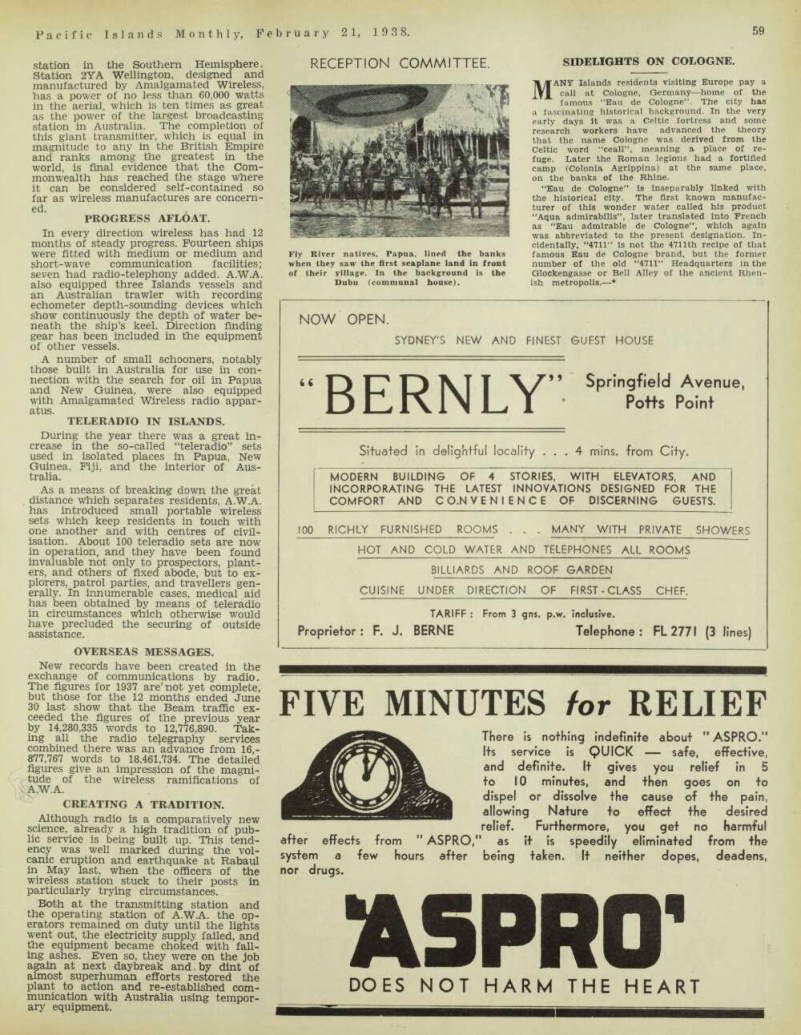
New Aids for Aviation.
THE year 1937 was marked by note worthy developments in the Austra lian and Pacific Islands radio ser vices conducted by Amalgamated Wire less (Australasia), Ltd. More progress was made in the application of wireless to aviation than in all previous years combined. The controlling authorities have now inaugurated a policy which dissociates flying from dependence upon visible landmarks in favour of reliance upon series of radio-beacons and two way communication between ’plane and aerodrome.
Radio telephony and telegraphy are be ing installed at all the principal aero dromes (including Pt. Moresby and Sala maua), and upon all passenger-carrying ’planes in order that the pilot or radio officer may communicate at all times with ground officials who keep him ad vised as to the weather ahead and give him instructions in regard to landing. He is furnished also with meteorological in formation which enables him to avoid an unfavourable wind or to take advantage of one that is travelling with him. He is told where he may meet a rainstorm or bank of clouds and whether he should fly higher or lower to avoid them.
Radio Beacons.
Under contract from the Civil Aviation Board, A.W.A. is to install radio transmit ting and receiving equipment at every capital city in Australia and at several points on the overland journey between Sydney and Cooktown on the N.G. route. The company is also providing radio course beacons over the main routes at intervals of about 200 miles.
These beacons have brought about a further technical advance in radio manu facture in Australia. They operate on the ultra short wave of 9 metres, emit ting a beam-like radio signal, which the approaching or receding pilot keeps straight in front or behind until he either reaches his destination or picks up the next beacon on his course. Associated with the radio course beacon is the mar ker beacon, which is a ray thrown straight up into the air from a station erected at an aerodrome. The pilot knows from his instruments when he enters the marker ray which means that he is immediately above the marker and that the landing place is beneath, even though the ground may be concealed by fog or rain.
Radio-Phone Service,
Another notable development in radio eommunication during the closing year was the opening of the A.W.A. radio
telephone service between Sydney and New Guinea. Owing to the tropical and equatorial areas to be traversed by the wireless channels, considerable technical difficulties were involved in this ser vice, but these were surmounted and the Rabaul-Sydney telephone circuit became the fourth overseas service of the kind from Australia. The others are Sydney- London, Sydney-Java, and Sydney-New Zealand.
Broadcast Stations.
A.W.A.’s fourth short-wave broadcasting station of world range was brought into operation in 1937. It was VK6ME Perth, companion station to VPD2 Suva, VK2ME Sydney and VK3ME Melbourne. These shorti-wave stations have carried Aus tralian news and influences into every country in and bordering on the Pacific.
Ten years have passed since A.W.A. ra diated from VK2ME the first Empire wide radio programme. To-day the pro grammes of four long distance stations are an A.W.A. contribution to the pub licising of the Commonwealth in the out side world.
Wireless manufacture in Australia has made definite strides and 1937 was note
worthy for the advent upon the air of by far the most powerful broadcasting
station in the Southern Hemisphere.
Station 2YA Wellington, designed and manufactured by Amalgamated Wireless, has a power of no less than 60,000 watts in the aerial, which is ten times as great as the power of the largest broadcasting station in Australia. The completion of this giant transmitter, which is equal in magnitude to any in the British Empire and ranks among the greatest in the world, is final evidence that the Com monwealth has reached the stage where it can be considered self-contained so far as wireless manufactures are concern ed.
Progress Afloat.
In every direction wireless has had 12 months of steady progress. Fourteen ships were fitted with medium or medium and short-wave communication facilities; seven had radio-telephony added. A.W.A. also equipped three Islands vessels and an Australian trawler with recording echometer depth-sounding devices which show continuously the depth of water be neath the ship’s keel. Direction finding gear has been included in the equipment of other vessels.
A number of small schooners, notably those built in Australia for use in con nection with the search for oil in Papua and New Guinea, were also equipped with Amalgamated Wireless radio appar atus.
Teleradio In Islands.
During the year there was a great in crease in the so-called “teleradio” sets used in isolated places in Papua, New Guinea, Fiji, and the interior of Aus tralia.
As a means of breaking down the great distance which separates residents, A.W.A. has introduced small portable wireless sets which keep residents in touch with one another and with centres of civil isation. About 100 teleradio sets are now in operation, and they have been found invaluable not only to prospectors, plant ers, and others of fixed abode, but to ex plorers, patrol parties, and travellers gen erally. In innumerable cases, medical aid has been obtained by means of teleradio in circumstances which otherwise would have precluded the securing of outside assistance.
Overseas Messages.
New records have been created in the exchange of communications by radio.
The figures for 1937 are'not yet complete, but those for the 12 months ended June 30 last show that the Beam traffic ex ceeded the figures of the previous year by 14,280,335 words to 12,776,890. Tak ing all the radio telegraphy services combined there was an advance from 16,- 877,767 words to 18,461,734. The detailed figures give an impression of the magni tude of the wireless ramifications of
A.W.A.
Creating A Tradition.
Although radio is a comparatively new science, already a high tradition of pub lic service is being built up. This tend ency was well marked during the vol canic eruption and earthquake at Rabaul in May last, when the officers of the wireless station stuck to their posts in particularly trying circumstances.
Both at the transmitting station and the operating station of A.W.A. the op erators remained on duty until the lights went out, the electricity supply failed, and the equipment became choked with fall ing ashes. Even so, they were on the job again at next daybreak and by dint of almost superhuman efforts restored the plant to action and re-established com munication with Australia using tempor ary equipment.
Advertisements & other items, pp. 59-61 (2 items)
Tenax
COPRA BAGS
A. ABRAHAMS & SONS PTY. LTD.
401 Sussex St., Sydney, N.S.W.
Australia Australia’s largest firm of used bag merchants can supply once used perfect quality sacks size 44 inch by 26h inches, guaranteed equally as good as new bags, at prices which will save you at least 1/6 per dozen as compared with new bag prices.
And remember the largest firm of bag merchants in the Southern Hemisphere guarantees perfect quality and satisfaction. These bags are perfectly clean and indistinguishable from new.
Our cable address is “ABRAHAMS SYDNEY”, and inquiries from wholesale buyers or merchants is solicited.
r
Genuinely
Germicidal
PREVENTION
is better than
cure.
Disease germs such as those of Diphtheria, Malaria, Dhobie Itch, Tinea, or Surfer’s Foot cannot live under the lather of TE N A X. Besides which T E N A X, used constantly, will cure Tropical Skin Diseases.
T E N A X contains “Ti-Trol,” 11 times quicker than carbolic as a germicide,
but NON-POISONOUS and NON-IRRITANT.
“The Medical Journal of Australia” says: “T E N A X is a which may be recommended with confidence.”
Conta ning Trol satisfactory germicidal soap
TENAX
TOILET SOAP
A PRODUCT OF AUSTRALIAN SOAPS LIMITED
I mrnmimmfm*
The POPULAR CHOICE for PROPELLER SHAFTS
Tough, strong and rigid, Monel shafts reduce whip and develops a mirror-like surface which, prolongs the life of vibration to a minimum. Moreover, Monel cannot rust, both packing and bearings. Full information on Monel it stubbornly resists corrosion, and in service quickly will gladly be supplied by:— WRIGHT & COMPANY, 81 Clarence St. Sydney, N.S.W.
MONEL is a Registered Trade Mark. Cables : "CORNRIGHT," SYDNEY
$9 ¥ m IV FAST, Shell Motor Oil flies like a flash to every bearing or friction surface.
TOUGH, it outlasts all ordinary oils.
DRAG-FREE, it speeds the pistons.
You’ll spend less on petrol with Shell Motor Oil in the sump.
SHELL
LO 38/IE
MOTOR on
THE SHELL COMPANY OF AUSTRALIA LTD. (Incorporated in Great Britain).
Reception Committee.
Fly River natives, Papua, lined the banks when they saw the first seaplane land in front of their village. In the background is the Dubu (communal house).
Sidelights On Cologne.
MANY Islands residents visiting Europe pay a call at Cologne, Germany—home of the famous “Eau de Cologne”. The city has a fascinating historical background. In the very early days it was a Celtic fortress and some research workers have advanced the theory that the name Cologne was derived from the Celtic word “ceall”, meaning a place of re fuge. Later the Roman legions had a fortified camp (Colonia Agrippina) at the same place, on the banks of the Rhine. ‘‘Eau de Cologne” is inseparably linked with the historical city. The first known manufac turer of this wonder water called his product “Aqua admirabllis”, later translated into French as “Eau admirable de Cologne”, which again was abbreviated to the present designation. In cidentally, “4711” is not the 4711th recipe of that famous Eau de Cologne brand, but the former number of the old “4711” Headquarters in the Glockengasse or Bell Alley of the ancient Rhen ish metropolis.—•
Advertisements & other items, p. 61 (1 item)
Aspro 1
NOW OPEN,
SYDNEY'S NEW AND FINEST GUEST HOUSE
tt DE?D \T I \7** Springfield Avenue.
D C, KIN L I Potts Point Situated in delightful locality ... 4 mins, from City.
MODERN BUILDING OF 4 STORIES. WITH AND INCORPORATING THE LATEST INNOVATIONS DESIGNED FOR THE COMFORT AND C O.N VENI E N C E OF DISCERNING GUESTS. 100 RICHLY FURNISHED ROOMS . . . MANY WITH PRIVATE SHOWERS HOT AND COLD WATER AND TELEPHONES ALL ROOMS
BILLIARDS AND ROOF GARDEN
CUISINE UNDER DIRECTION OF FIRST-CLASS CHEF.
TARIFF : From 3 gns. p.w. inclusive.
Proprietor: F. J. BERNE Telephone: FL2771 (3 lines)
FIVE MINUTES for RELIEF
There is nothing indefinite about " ASPRO."
Its service is QUICK safe, effective, and definite. It gives you relief in 5 to 10 minutes, and then goes on to dispel or dissolve the cause of the pain, allowing Nature to effect the desired relief. Furthermore, you get no harmful after effects from " ASPRO," as it is speedily eliminated from the system a few hours after being taken. It neither dopes, deadens, nor drugs.
ASPRO 1
DOES NOT HARM THE HEART
A New Wharf.
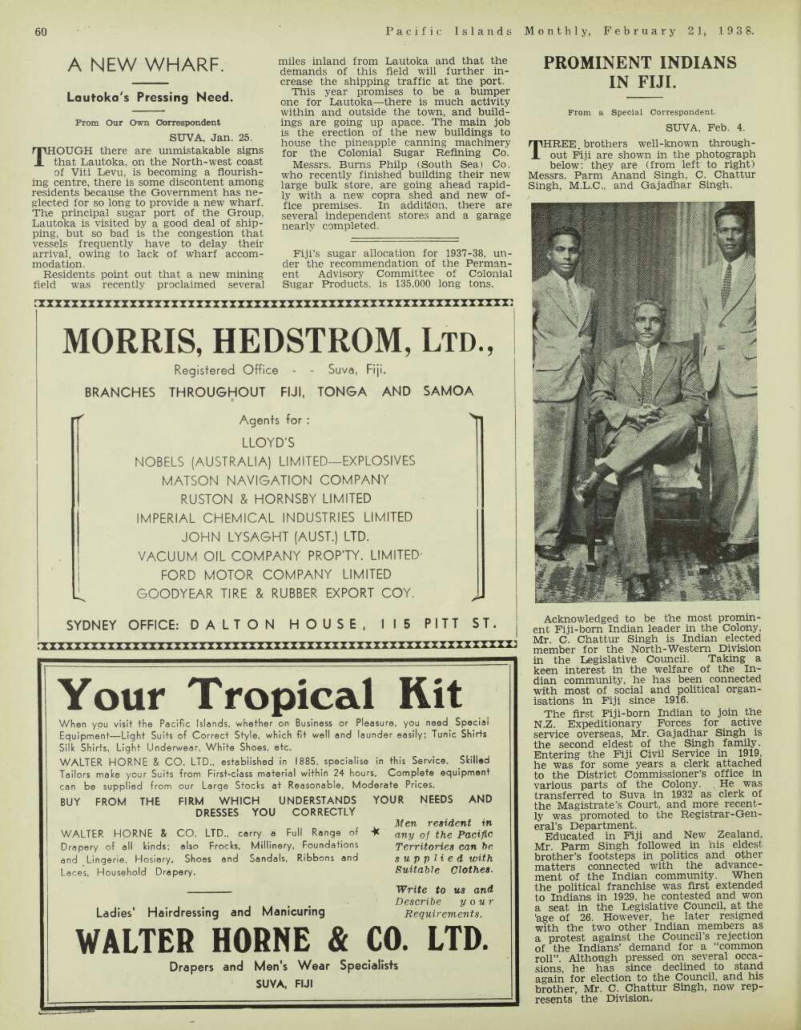
Lautoka's Pressing Need.
Prom Our Own Correspondent
Suva, Jan. 25.
THOUGH there are unmistakable signs that Lautoka, on the North-west coast of Viti Levu, is becoming a flourish ing centre, there is some discontent among residents because the Government has ne glected for so long to provide a new wharf.
The principal sugar port of the Group, Lautoka is visited by a good deal of ship ping, but so bad is the congestion that vessels frequently have to delay their arrival, owing to lack of wharf accom modation.
Residents point out that a new mining field was recently proclaimed several
miles inland from Lautoka and that the demands of this field will further in crease the shipping traffic at the port.
This year promises to be a bumper one for Lautoka—there is much activity within and outside the town, and build ings are going up apace. The main job is the erection of the new buildings to house the pineapple canning machinery for the Colonial Sugar Refining Co.
Messrs. Bums Philp (South Sea) Co. who recently finished building their new large bulk store, are going ahead rapid ly with a new copra shed and new of fice premises. In addition, there are several independent stores and a garage nearly completed.
Fiji’s sugar allocation for 1937-38, un der the recommendation of the Perman ent Advisory Committee of Colonial Sugar Products, is 135,000 long tons.
Prominent Indians
In Fiji.
From a Special Correspondent.
Suva, Feb. 4.
THREE, brothers well-known through out Fiji are shown in the photograph below: th,ey are (from left to right) Messrs. Farm Anand Singh, C. Chattur Singh, M.L.C., and Gajadhar Singh.
Acknowledged to be the most promin ent Fiji-bom Indian leader in the Colony, Mr. C. Chattur Singh is Indian elected member for the North-Western Division in the Legislative Council. Taking a keen interest in the welfare of the In dian community, he has been connected with most of social and political organ isations in Fiji since 1916.
The first Fiji-born Indian to join the N.Z. Expeditionary Forces for active service overseas, Mr. Gajadhar Singh is the second eldest of the Singh family.
Entering the Fiji Civil Service in 1919, he was for some years a clerk attached to the District Commissioner’s office in various parts of the Colony. ,He was transferred to Suva in 1932 as clerk of the Magistrate’s Court, and more recent ly was promoted to the Registrar-Gen eral’s Department.
Educated in Fiji and New Zealand, Mr. Farm Singh followed in his eldest brother’s footsteps in politics and other matters connected with the advance ment of the Indian community. When the political franchise was first extended to Indians in 1929, he contested and won a seat in the Legislative Council, at the ’age of 26. However, he later resigned with the two other Indian members as a protest against the Council’s rejection of the Indians’ demand for a “common roll”. Although pressed on several occa sions, he has since declined to stand again for election to the Council, and his brother, Mr. C. Chattur Singh, now rep resents the Division*
Advertisements & other items, p. 62 (1 item)
Your Tropical Rit
MORRIS, HEDSTROM, Ltd.,
Registered Office - - Suva, Fiji.
BRANCHES THROUGHOUT FIJI, TONGA AND SAMOA
T" Agents for : \
LLOYD'S
NOBELS (AUSTRALIA) LIMITED—EXPLOSIVES
MATSON NAVIGATION COMPANY
RUSTON & HORNSBY LIMITED
IMPERIAL CHEMICAL INDUSTRIES LIMITED
JOHN LYSAGHT (AUST.) LTD.
VACUUM OIL COMPANY PROP'TY. LIMITED-
FORD MOTOR COMPANY LIMITED
GOODYEAR TIRE & RUBBER EXPORT COY. j.
SYDNEY OFFICE: DALTON HOUSE. 115 PITT ST.
Your Tropical Rit
When you visit the Pacific Islands, whether on Business or Pleasure, you need Special Equipment—Light Suits of Correct Style, which fit well and launder easily; Tunic Shirts Silk Shirts, Light Underwear, White Shoes, etc.
WALTER HORNE & CO. LTD., established in 1885, specialise in this Service. Skilled Tailors make your Suits from First-class material within 24 hours. Complete equipment can be supplied from our Large Stocks at Reasonable, Moderate Prices.
BUY FROM THE FIRM WHICH UNDERSTANDS
DRESSES YOU CORRECTLY
YOUR NEEDS AND
WALTER HORNE & CO. LTD., carry a Full Range of Drapery of all kinds: also Frocks, Millinery, Foundations and Lingerie, Hosiery, Shoes and Sandals, Ribbons and Laces, Household Drapery.
Men resident in any of the Pacific Territories can be supplied with Suitable Clothes.
Ladies' Hairdressing and Manicuring
Write to us and Describe your Requirements.
WALTER HORNE & CO. LTD.
Drapers and Men's Wear Specialists
SUVA. FIJI
Giant Rays.
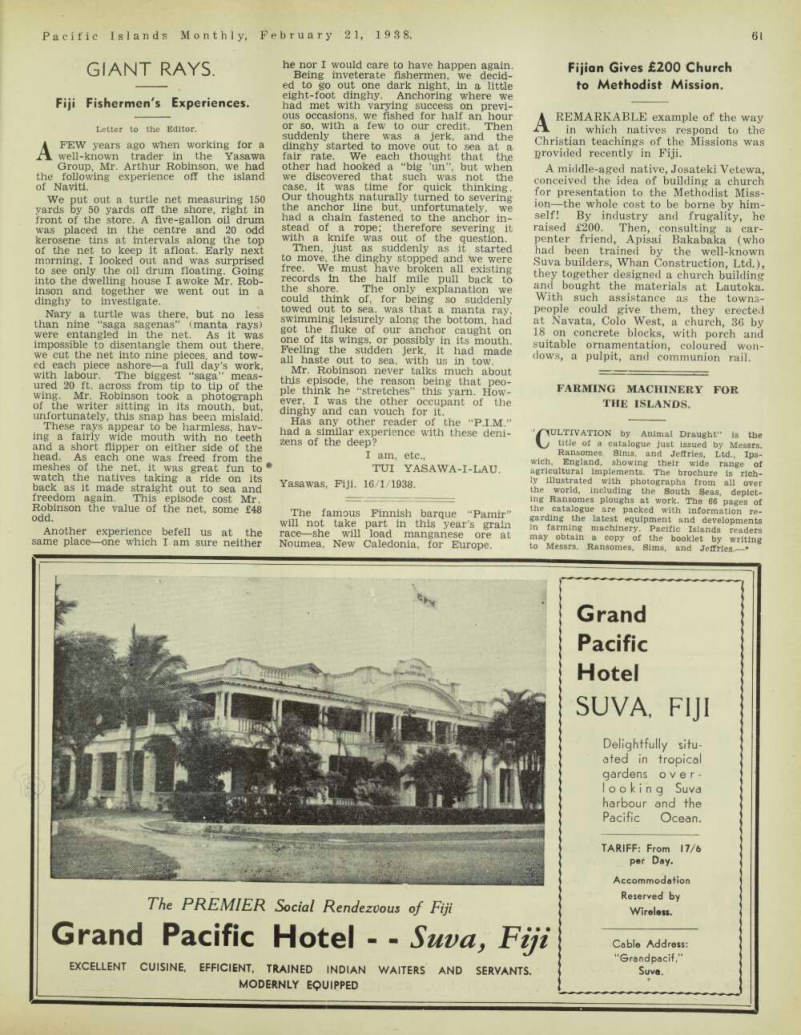
Fiji Fishermen's Experiences.
Letter to the Editor.
A FEW years ago when working for a well-known trader in the Yasawa Group, Mr. Arthur Robinson, we had the following experience off the island of Naviti.
We put out a turtle net measuring 150 yards by 50 yards off the shore, right in front of the store. A five-gallon oil drum was placed in the centre and 20 odd kerosene tins at intervals along the top of the net to keep it afloat. Early next morning, I looked out and was surprised to see only the oil drum floating. Going into the dwelling house I awoke Mr. Rob inson and together we went out in a dinghy to investigate.
Nary a turtle was there, but no less than nine “saga sagenas” (manta rays) were entangled in the net. As it was impossible to disentangle them out there, we cut the net into nine pieces, and tow ed each piece ashore—a full day’s work, with labour. The biggest “saga” meas ured 20 ft. across from tip to tip of the wing. Mr. Robinson took a photograph of the writer sitting in its mouth, but, unfortunately, this snap has been mislaid.
These rays appear to be harmless, hav ing a fairly wide mouth with no teeth and a short flipper on either side of the head. As each one was freed from the meshes of the net, it was great fun to * watch, the natives taking a ride on its back as it made straight out to sea and freedom again. This episode cost Mr.
Robinson the value of the net, some £4B odd.
Another experience befell us at the same place—one which I am sure neither
he nor I would care to have happen again.
Being inveterate fishermen, we decid ed to go out one dark night, in a little eight-foot dinghy. Anchoring where we had met with varying success on previ ous occasions, we fished for half an hour or so, with a few to our credit. Then suddenly there was a jerk, and the dinghy started to move out to sea at a fair rate. We each thought that th,e other had hooked a “big ’un”, but when we discovered that such was not the case, it was time for quick thinking.
Our thoughts naturally turned to severing the anchor line but, unfortunately, we had a chain fastened to the anchor in stead of a rope; therefore severing it with a knife was out of the question.
Then, just as suddenly as it started to move, the dinghy stopped and we were free. We must have broken all existing records in the half mile pull back to the shore. The only explanation we could think of, for being so suddenly towed out to sea, was that a manta ray, swimming leisurely along the bottom, had got the fluke of our anchor caught on one of its wings, or possibly in its mouth.
Feeling the sudden jerk, it had made all haste out to sea, with us in tow.
Mr. Robinson never talks much about tips episode, the reason being that peo ple think he “stretches” this yarn. How ever, I was the other occupant of the dinghy and can vouch for it.
Has any other reader of the “P.1.M.” had a similar experience with these deni zens of the deep?
I am, etc.,
Tui Yasawa-I-Lau.
Yasawas, Fiji. 16/1/1938.
The famous Finnish barque “Pamir” will not take part in this year’s grain race—she will load manganese ore at Noumea, New Caledonia, for Europe.
Fijian Gives £200 Church
to Methodist Mission.
A REMARKABLE example of the way in which natives respond to the Christian teachings of the Missions was provided recently in Fiji.
A middle-aged native, Josateki Vetewa, conceived the idea of building a church for presentation to the Methodist Miss ion—the whole cost to be borne by him self! By industry and frugality, he raised £2OO. Then, consulting a car penter friend, Apisai Bakabaka (who had been trained by the well-known Suva builders, Whan Construction, Ltd.), they together designed a church building and bought the materials at Lautoka.
With such assistance as the towns people could give them, they erected at Navata, Colo West, a church, 36 by 18 on concrete blocks, with porch and suitable ornamentation, coloured won dows, a pulpit, and communion rail.
Farming Machinery For
The Islands.
CULTIVATION by Animal Draught” Is the title of a catalogue just issued by Messrs.
Ransomes, Sims, and Jeffries, Ltd., Ips wich, England, showing their wide range of agricultural implements. The brochure is rich ly illustrated with photographs from all over the world, including the South Seas, depict ing Ransomes ploughs at work. The 66 pages of the catalogue are packed with information re garding the latest equipment and developments in farming machinery. Pacific Islands readers may obtain a copy of the booklet by writing to Messrs. Ransomes, Sims, and Jeffries.—*
Advertisements & other items, p. 63 (1 item)
Grand Pacific Hotel - - Suva, Fiji
N * •■'V * T/ie PREMIER Social Rendezvous of Fiji Grand Pacific Hotel - - Suva, Fiji EXCELLENT CUISINE, EFFICIENT. TRAINED INDIAN WAITERS AND SERVANTS.
MODERNLY EQUIPPED
Grand
Pacific
Hotel
SUVA. FIJI
Delightfully situ-
ated in tropical gardens over-
looking Suva
harbour and the Pacific Ocean.
TARIFF: From 17/6
per Day.
Accommodation Reserved by Wireless.
Cable Address: "Grandpacit,"
Suva.
Archbold Party Expected in Papua
Papua in March
Mr. Richard Archbold, The
wealthy young research associate of the American Museum of Nat ural History, is expected to arrive in Papua at th,e end of March in his new flying-boat specially constructed for a nature survey of British and Dutch New Guinea for the Museum. He is person ally financing the trip.
With his assistants Mr. Archbold will fly a large Consolidated PBY-I flying boat. He was originally the owner of a flying-boat of this type which was bought by Sir Herbert Wilkins for his flight to th,e Arctic regions in the search for the lost Russian fliers.
Mr. Archbold is now having another boat built for the flight to Port Mores
by via Hawaii, Wake, Midway and Guam Islands. Latest advices state that the new flying-boat is now practically com pleted. It is of the very latest type for research work.
Mr. Archbold proposes to fly the air boat from Papua to Melbourne so that Air Board and Civil Aviation officials may inspect it. The expedition will spend several months in the South Seas.
Mrs. Emily Sprott, of Santa Isabel, Solomon Islands, who has served the Melanesian Mission in the Group for over 20 years, is at present spending
furlough in England.
Wilisoni Inia and Delana Kama, Fijian Methodist teachers, arrived in Sydney by the “Aorangi” on January 22. They will carry out deputation work in Australia for the Methodist Mission.
Tongan's Fraud.
How a Native Lived Luxuriously On "Easy Money."
From Our Own Correspondent.
Nukualofa, Jan. 13.
AT the General Sessions of the Supreme Court in December, a Tongan, Benisimani Latuselu, was found guilty of fraudulent conversion of pro perty for his own use, and was sentenced to four years’ imprisonment. Before passing sentence, the Chief Justice said that this was one of the worst cases of fraud in Tonga.
From 1931 to 1937 the accused was in charge of a labour gang working on the wharf. Instead of giving his labourers their earnings, he persuaded them to leave their money with him to accumulate for the purpose of paying their taxes. With this money, he pur chased a car in 1932 and a new Ford V 8 lorry in 1935. His mode of living underwent a complete change—he dis carded his native loincloth for more ex pensive European suits and a cigar was substituted for the native cigarette. In short, he led the life of a well-to-do European. , Last year a number of his labourers were committed to prison for non-pay ment of tax in respect of periods rang ing from one to five years. These labourers complained against Latuselu and the police commenced their in vestigation, which culminated in this charge of fraud.
It came out in evidence that Latuselu paid £1,500 to one firm alone in respect of accounts during the period of four years (1932-1935), and he also dealt with other firms as well. From this an idea may be formed of the consider able amount of money that went through his hands; but like all “easy money”, it slipped away as quickly as it came —at the time pf his trial Latu selu was insolvent.
Death Of Noted N.G.
Missionary.
Prom Our Own Correspondent.
Rabaul, Jan. 12.
THERE was much regret expressed in Rabaul last month at the passing of Father Otto Meyer, of the Sacred Heart Mission, who died on board the “Nellore” on his way back to the Terri tory after receiving medical attention in Australia.
Anthropology lost one of its keenest followers with his death. Rev. Meyer >was well-known in Europe where his scientific articles on native culture, bird life, and fish had won him recognition as an authority on New Guinea matters.
Visiting scientists, research workers, and students seldom missed the opportunity of meeting him at his station on Watom Island.
A German, Father Meyer was born in 1877 and came to New Britain after he was ordained in 1902. His 36 years of missionary endeavour were spent on the North Coast and at Watom.
Advertisements & other items, p. 64 (1 item)
nsomes
A. B. DONALD LTD.
AUCKLAND
ISLAND TRADERS :: GENERAL MERCHANTS
P. O. Box 1509 Cables and Telegrams: "Kingdom," Auckland Branches at Rarotonga and throughout the Cook Islands At Papeete and throughout the Society, Marquesas and Paumotu Islands trading as " ETABLISSEMENTS DONALD. TAHITI "
At Fiji: Trading as "Dominion Fruit C 0.," Suva
These light steel
Cultivators^—
- fss*
lot a „,. a t\oP s
ot oP<
Special Features:— Suitable for use with one bullock or horse. Can “he supplied with a wide range of reversible points and shares.
Supplied in three models: (1) Fixed pattern, with 5 tines covering 24 ins. (2) Single lever expanding pattern, adjustable for width from 14 ins. to 24 ins. (3) Double lever expanding pattern, adjustable for width from 14 ins. to 24 ins. with second lever for controlling the depth.
nsomes
Light Steel Walking Cultivators
Write for illustrated literature and all information.
MORRIS, HEDSTROM LTD. - Suva, Lautoka and Ba Mad© by: RANSOMES, SIMS & JEFFRIES, LTD., IPSWICH, ENGLAND
An Old C.I. Custom.
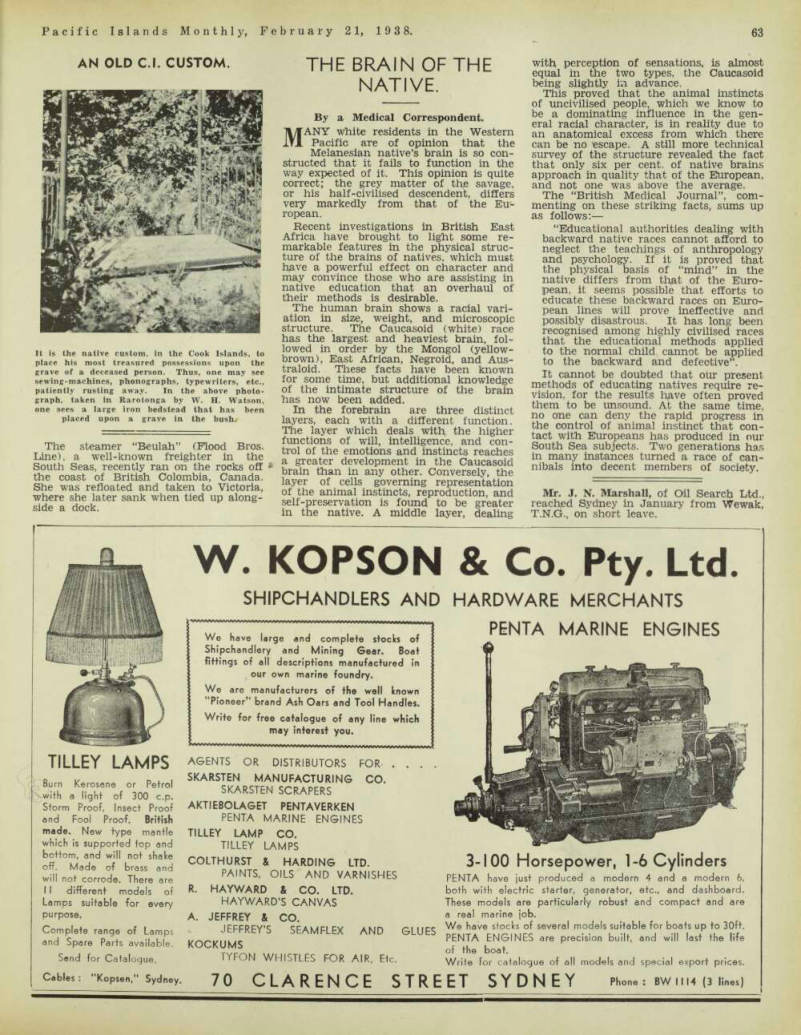
The steamer “Beulah” (Flood Bros.
Line), a well-known freighter in the South Seas, recently ran on the rocks off the coast of British Colombia, Canada.
She was refloated and taken to Victoria, where she later sank when tied up along side a dock.
It is the native custom, in the Cook Islands, to place his most treasured possessions upon the grave of a deceased person. Thus, one may see sewing-machines, phonographs, typewriters, etc., patiently rusting away. In the above photo graph, taken in Rarotonga by W. H. Watson, one sees a large iron bedstead that has been placed upon a grave in the bush.
The Brain Of The
Native.
By a Medical Correspondent.
MANY white residents in the Western Pacific are of opinion that the Melanesian native’s brain is so con structed that it fails to function in the way expected of it. This opinion is quite correct; the grey matter of th,e savage, or his half-civilised descendent, differs very markedly from that of the Eu ropean.
Recent investigations in British East Africa have brought to light some re markable features in the physical struc ture of the brains of natives, which must have a powerful effect on character and may convince those who are assisting in native education that an overhaul of their methods is desirable.
The human brain shows a racial vari ation in size, weight, and microscopic structure. The Caucasoid (white) race has the largest and heaviest brain, fol lowed in order by the Mongol (yellow brown), East African, Negroid, and Aus traloid. These facts have been known for some time, but additional knowledge of the intimate structure of the brain has now been added.
In the forebrain are three distinct layers, each with a different function.
The layer which deals with, the higher functions of will, intelligence, and con trol of the emotions and instincts reaches a greater development in the Caucasoid brain than in any other. Conversely, the layer of cells governing representation of the animal instincts, reproduction, and self-preservation is found to be greater in the native. A middle layer, dealing
with, perception of sensations, is almost equal in the two types, the Caucasoid being slightly in advance.
This proved that the animal instincts of uncivilised people, which we know to be a dominating influence in the gen eral racial character, is in reality due to an anatomical excess from which there can be no escape. A still more technical survey of the structure revealed the fact that only six per cent, of native brains approach in quality that of the European, and not one was above the average.
The “British Medical Journal”, com menting on these striking facts, sums up as follows: “Educational authorities dealing with backward native races cannot afford to neglect the teachings of anthropology and psychology. If it is proved that the physical basis of “mind” in the native differs from th#t of the Euro pean, it seems possible that efforts to educate these backward races on Euro pean lines will prove ineffective and possibly disastrous. It has long been recognised among highly civilised races that the educational methods applied to the normal child cannot be applied to the backward and defective”.
It cannot be doubted that our present methods of educating natives require re vision, for the results h#ve often proved them to be unsound. At the same time, no one can deny the rapid progress in the control of animal instinct that con tact with Europeans has produced in our South Sea subjects. Two generations has in many instances turned a race of can nibals into decent members of society.
Mr. J. N. Marshall, of Oil Search Ltd., reached Sydney in January from Wewak, T.N.G., on short leave.
Advertisements & other items, pp. 65-66 (1 item)
W. KOPSON & Co. Pty. Ltd.
TILLEY LAMPS
Burn Kerosene or Petrol with a light of 300 c.p.
Storm Proof, Insect Proof and Fool Proof. British made. New type mantle which is supported top and bottom, and will not shake off. Made of brass and will not corrode. There are 11 different models of Lamps suitable for every purpose.
Complete range of Lamps and Spare Parts available.
Send for Catalogue.
W. KOPSON & Co. Pty. Ltd.
SHIPCHANDLERS AND HARDWARE MERCHANTS
We have large and complete stocks of Shipchandlery and Mining Gear. Boat fittings of all descriptions manufactured in our own marine foundry.
We are manufacturers of the well known "Pioneer” brand Ash Oars and Tool Handles.
Write for free catalogue of any line which may interest you.
AGENTS OR DISTRIBUTORS FOR . . . .
SKARSTEN MANUFACTURING CO.
SKARSTEN SCRAPERS
AKTIEBOLAGET PENTAVERKEN
PENTA MARINE ENGINES
TILLEY LAMP CO.
TILLEY LAMPS
COLTHURST & HARDING LTD.
PAINTS. OILS AND VARNISHES
R. HAYWARD & CO. LTD.
HAYWARD'S CANVAS
A. JEFFREY & CO.
JEFFREY'S SEAMFLEX AND GLUES
KOCKUMS
TYFON WHISTLES FOR AIR. Etc.
PENTA MARINE ENGINES
r
3-100 Horsepower, 1-6 Cylinders
PENTA have just produced a modern 4 and a modern 6, both with electric starter, generator, etc., and dashboard.
These models are particularly robust and compact and are a real marine job.
We have stocks of several models suitable for boats up to 30ft.
PENTA ENGINES are precision built, and will last the life of the boat.
Write for catalogue of all models and special export prices.
Cables : "Kopsen," Sydney. 7 0 CLARENCE STREET SYDNEY Phone :BW 1114 (3 lines)
From £3
C.I.F. Sydney
W. M. REID MIS?
Direct from Europe’s most up-to-date Factory
PRECISION BUILT SEWING
MACHINES with a reputation maintained during “77 YEARS” for supreme workmanship and materials.
5 YEARS
Guarantee
A patented hardening process guarantees smooth action and a long life free of repairs.
Needles, Bobbins, etc-., can be interchanged with other well known sewing machines.
Information, Parts, Patterns and all dress materials are obtainable from the agent . . .
W. M. REID, “Reid House,” 75 King Street, Sydney, G.P.O. Box No. 137 CC.
rrv< the of* o* at d e d^ e\ of ai vo^ t\^ e // , the V ul , a t\d
Witt VeeP ttesV ne
i« V °\ "4711' GepU \ vts > lo ' >v« ®* . it o® <*s>*?* vatt c ,t c Vvt et ’
Representative:
ROBERT BLAU (Aust.).
A.C.A. Building, Cnr. King & York Streets,
SYDNEY.
Devoted L.M.S. Teacher's

Death.
From a Special Correspondent.
Pt. Moresby, Feb. 4.
AFTER a three-weeks’ illness, Miss Emmie Winifred Riley, 8.A., of the London Missionary Society, died in Port Moresby on January 14, aged 31.
Born in South Australia, Miss Riley graduated at the Sydney University, and then joined the L.M.S. in 1931, serving as leader of the kindergarten depart ment and head of the school for Papuan girls. In a brief period of six years, she left her mark for good on her colleagues and the Papuans alike. She was a most able teacher and trainer of teach ers. Her school at Port Moresby had a tone about it that could only have been achieved by a combination of profes sional skill and high Christian idealism.
An evidence of Miss Riley’s devotion and ability is to be seen in the produc tion of a book of Sunday School Les son Notes for Papuan Teachers, most of the work for which she did during her last furlough. Native girls whom she trained are taking their place in the Papuan educational system, and show evidence that they mean to carry out in their village schools the ideals she kept steadfastly before them.
Pattern Service
\A/E have arranged with a well-known Sydney * firm of pattern-cutters to publish each month a diagram of a seasonable frock, patterns of which may be obtained by our readers direct from this office, post free, on payment of the sum stated under the diagram. Address your letter to “Pat tern,” Pacific Islands Monthly, Box 3408 R, Sydney, and enclose a note giving the number of the pattern wanted and bust size, and enclose also the price of the pattern in postal note or stamps. The pattern will be sent by return mail.
4339.—8ack extends over the shoulder; on to this the front is attached with gathers. Waist is defined with a material belt. Sleeves may be worn in long or shorter length. Patch poc* kets and the large fastening buttons add greatly to the appearance. Material (for 36 in. bust): 3Vt yds. 36 ins. wide; y 2 yd. extra —long sleeve. Bust sizes 32 to 40 ins.
Mr. and Mrs. T. G. Aitchison, returned to New Guinea by the February “Mac dhui”. Mr. Aitchison is an A.D.O. in the New Guinea Administration, and, before his leave, had been stationed in the Ramu District.
Mr. and Mrs. C. B. Andrews left Sydney on February 2 for the Morobe goldfield, New Guinea. Mr. Andrews is a consulting engineer, and will inspect the Bulolo Gold Dredging plant.
Miss Kitty Smith, of Roseville, N.S.W., sailed from Sydney on February 2 by the “Macdhui” for Rabaul, New Guinea, where she was to be married to Mr.
E. A. Hawnt.
House Frock, 4339—1s. 1d.
Fashion Hints for Islands Women
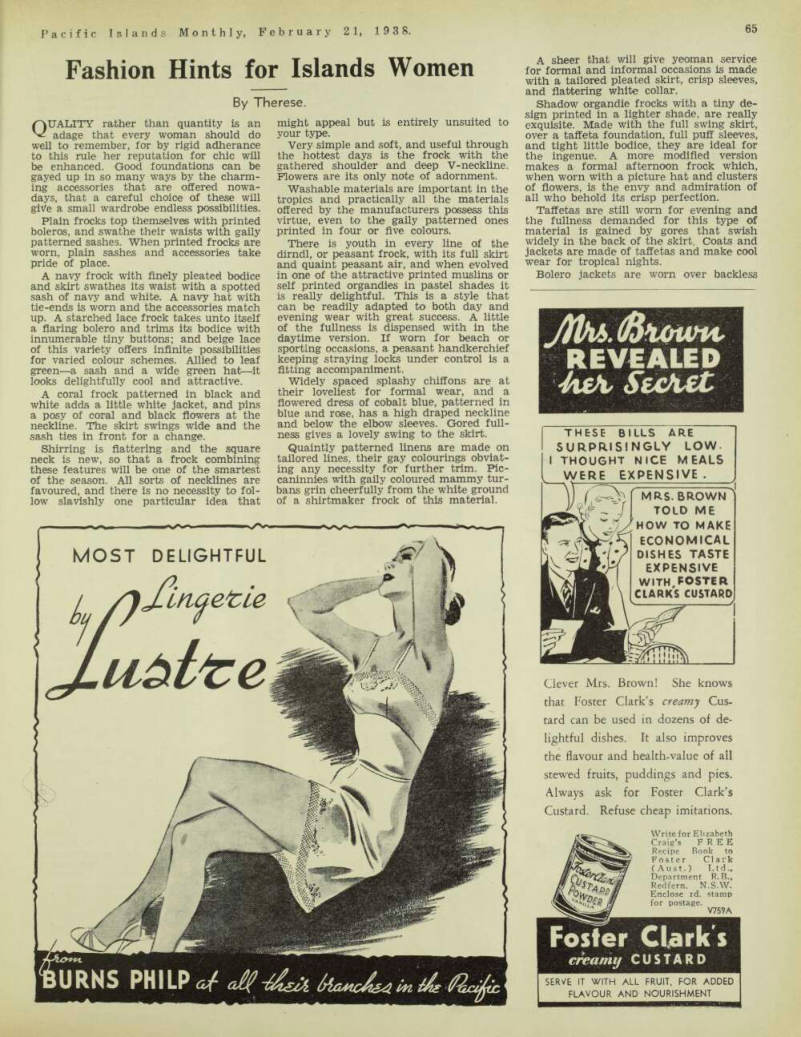
By Therese.
QUALITY rather than quantity is an adage that every woman should do well to remember, for by rigid adherance to this rule her reputation for chic will be enhanced. Good foundations can be gayed up in so many ways by the charming accessories that are offered nowadays, that a careful choice of these will give a small wardrobe endless possibilities, Plain frocks top themselves with printed boleros, and swathe their waists with gaily patterned sashes. When printed frocks are worn, plain sashes and accessories take pride of place.
A navy frock with finely pleated bodice and skirt swathes its waist with a spotted sash of navy and white. A navy hat with tie-ends is worn and the accessories match up. A starched lace frock takes unto itself a flaring bolero and trims its bodice with innumerable tiny buttons; and beige lace of this variety offers infinite possibilities for varied colour schemes. Allied to leaf green—a sash and a wide green hat—it looks delightfully cool and attractive.
A coral frock patterned in black and white adds a little white jacket, and pins a posy of coral and black flowers at the neckline. The skirt swings wide and the sash ties in front for a change.
Shirring is flattering and the square neck is new, so that a frock combining these features will be one of the smartest of the season. All sorts of necklines are favoured, and there is no necessity to follow sla\dshly one particular idea that
might appeal but is entirely unsuited to your type, Very simple and soft, and useful through the hottest days is the frock with the gathered shoulder and deep V-neckline.
Flowers are its only note of adornment, Washable materials are important in the tropics and practically all the materials offered by the manufacturers possess this virtue, even to the gaily patterned ones printed in four or five colours, There is youth in every line of the dirndl, or peasant frock, with its full skirt and quaint peasant air, and when evolved in one of the attractive printed muslins or self printed organdies in pastel shades it is really delightful. This is a style that can be readily adapted to both day and evening wear with great success. A little of the fullness is dispensed with in the daytime version. If worn for beach or sporting occasions, a peasant handkerchief keeping straying locks under control is a fitting accompaniment, Widely spaced splashy chiffons are at their loveliest for formal wear, and a flowered dress of cobalt blue, patterned in blue and rose, has a high draped neckline and below the elbow sleeves. Gored full ness gives a lovely swing to the skirt.
Quaintly patterned linens are made on tailored lines, their gay colourings obviat ing any necessity for further trim. Pic caninnies with gaily coloured mammy tur bans grin cheerfully from the white ground of a shirtmaker frock of this material.
A sheer that will give yeoman service for formal and informal occasions is made with a tailored pleated skirt, crisp sleeves, and flattering white collar.
Shadow organdie frocks with a tiny de sign printed in a lighter shade, are really exquisite. Made with the full swing skirt, over a taffeta foundation, full puff sleeves, and tight little bodice, they are ideal for the ingenue. A more modified version makes a formal afternoon frock which, when worn with a picture hat and clusters of flowers, is the envy and admiration of all who behold its crisp perfection.
Taffetas are still worn for evening and the fullness demanded for this type of material is gained by gores that swish widely in the back of the skirt. Coats and jackets are made of taffetas and make cool wear for tropical nights.
Bolero jackets are worn over backless
frocks, and boast puff sleeves. A mauve chiffon swings wide with the dance, and is held aloft by tiny straps. A huge clus ter of violets trims its low V-decolletage and single violets are scattered over the skirt. A top-knot of the same flowers perches jauntily on the head.
Colour combinations are cleverly adap ted for evening wear. An evening frock has a slim black skirt, flaring at the back, a softly gathered coral bodice, and a widely swathed green sash falling in a panel to the hem of the skirt. Sheath gowns are coming into their own again—column slim, with the fullness beginning from below the knees at the back. The newest form-fitting frocks swirl their fullness all round from below the knees.
The march of time with its wars and rumours of wars has a wide influence on our choice of headgear, and coolie hats, sombreros, and all sorts of quaint head gear appear on Fashion’s horizon.
Hats rise or fall to suit one’s every mood, and plateau hats are extremely popular. Veils more than ever are part of feminine hat fashions, and these are arranged in new and subtle ways, swathed round and tied in a perky bow at the side.
Brims are important and material hats are made in adaptable styles to suit the occasion.
Mower-trimmed hats with chin straps are further vagaries; but if you have the
slightest suspicion of a square chin, avoid them like the plague. You may be proud of your determination, but it is not always wise to draw attention to tell-tale features.
Cocktail and evening hats are frivolous and charming, and are made of whisps of material twisted and swathed, and some times flower-trimmed.
Large hats of the picture variety are flower-trimmed, and the really broad brimmed sailor is the essence of chic when one large bloom relieves its tailored sim plicity.
Annabella hats are still with us; but their popularity sounded their death knell and in a short while they will be seen no more. They will, however, be the founda tion for new and youthful styles.
Advertisements & other items, pp. 67-68 (1 item)
u&tte
THESE BILLS ARE
SURPRISINGLY LOW
I THOUGHT NICE MEALS
WERE EXPENSIVE.
MRS. BROWN
TOLD ME
HOW TO MAKE
ECONOMICAL
DISHES TASTE
EXPENSIVE
WITH, FOSTER
CLARKS CUSTARD
- S, i> !!'!!!
Clever Mrs. Brown! She knows that Foster Clark’s creamy Custard can be used in dozens of delightful dishes. It also improves the flavour and health-value of all stewed fruits, puddings and pies.
Always ask for Foster Clark’s Custard. Refuse cheap imitations.
Am Write for Elizabeth Craig’s FREE Recipe Book to Foster Clark (Aust.) Ltd., Department R. 8., Redfern. N.S.W.
Enclose id. stamp for postage.
V759A
Foster Clark's
creamy CUSTARD SERVE IT WITH ALL FRUIT, FOR ADDED
FLAVOUR AND NOURISHMENT
MOST DELIGHTFUL
u&tte
‘‘ALNWICK”
KINDERGARTEN
74 BUNDARRA ROAD,
BELLEVUE HILL, SYDNEY.
Boarding School for Children from 2 years.
Qualified Nurse and Teachers.
Special attention to health and diet.
Individual Training under ideal conditions of climate and environment.
MISS E. WARRELL, Principal.
Tel.: FM 5638.
PAIN'S
MASTER
POWDERS &
TABLETS
/6 AND 2/6.
SINGLES 2d.ea.
STOPS SAFELY
HEADACHE
FLU & COLDS
RHEUMATISM
NEURALGIA
SCIATICA
NEURITIS
LUMBAGO
AND ALL NERVE AND
MUSCULAR PAINS
Over the past 20 years thousands of men and women have proved Vincent’s A.P.C. to be the most effective remedy for relieving all pain. That is why there are more Vincent's A.P.C.
Powders and Tablets sold in Australia to-day than all other similar preparations.
If you suffer from Headache, Rheumatism, Heat Exhaustion, Nervous Irritability, Sleeplessness, or any nerve or muscular pain, get a packet of Vincent’s A.P.C. Powders or Tablets and take them as directed. You will be more than satisfied at the speedy, effective relief Vincent’s A.P.C. brings. Vincent’s A.P.C. can be taken with perfect safety, as it does not affect the heart or leave any after-effects.
FOR SAFETY’S SAKE, SAY ” VINCENT’S A. P. C.”
pk
New Nurses' Quarters
At Suva.
From Our Own Correspondent.
Suva, Feb. 7.
rR many years past complaints have been voiced about the inadequacy of the European nurses' quarters at the Colonial War Memorial Hospital, Suva, and in June last a start was made with, the erection of a substantial re inforced concrete building.
Very fine progress has been made with the building, which has three stor eys at one end and two at the other.
It will be finished about the middle of this year. From appearances the building should be a comfortable well ventilated one, each, nurse having a room to her self. There are 30 bedrooms, including roomy suites for the Matron, Assistant Matron, and Home Sister.
Another job in hand at the Hospital is the erection of a Children’s Ward, which is being built as an integral part of the main Hospital, on top of the existing medical ward. It will be divided into three compartments, one for Europeans, one for natives and one for other non- Europeans. This Ward is expected to be finished about May.
Government Urged To Take
Over Native Education.
THE establishment of an Administration of Native Affairs, which would cover the Commonwealth, Papua, and the Mandated Territories of New Guinea and Nauru, was suggested to the Minister for the Interior (Mr. McEwen) during an in terview in Sydney on February 5 by rep resentatives of the National Missionary Council.
It was contended by the deputation that the Government should definitely assume the obligation of educating the natives in the Territories, concentrating on the children. They declared that there should be initiated an after-school-age service which might apply to native affairs the principle of vocational training.
The representatives of the Council (Canon J. S. Needham, Rev. J. W. Bur ton, and Rev. J. W. Perrier) were sup ported by Dr. A. P, Elkin, Professor of Anthropology at the Sydney University.
Miss Lilian Caswell, of the New Guinea Mission, will return to her station at Wamira, Papua, by the “Montoro” which is due to leave Sydney on February 23.
Mrs. B. Harper, who works her own gold claim on the Wewak field, N.-W.
New Guinea, returned to the Territory by the “Macdhui” from Sydney on
February 2.
Mrs. Doris Booth,
O.B.E.
r[E owner-manager of the largest in dividual mine on the Morobe gold field, New Guinea, Mrs. Doris Booth, is at present spending a well earned holiday in Tasmania and Victoria.
Charming and well dressed, with her black hair smoothly braided round her head, she is one of the best-known women in the Mandated Territory.
It is just 17 years since Mrs. Booth first went to New Guinea to live on a coconut estate. After three years of plantation life she decided to try her luck on the newly-discovered goldfield at Mo robe, which in those days before aero plane travel was six days’ journey on foot through dense bush from the coast.
Mrs. Booth was the first white woman to make the journey.
Working for the first year with the man who discovered the field, she learnt enough about alluvial mining to begin by herself. Then, in 1925, she pegged out a claim 98 chains in length along the river and 11 chains wide, and began to work her own mine. It was slow work at the beginning. The gold had to be washed in boxes which had been hollow ed out of logs with an adze. It was not until 1930, when machinery was brought up by aeroplane from the coast, that this primitive method was abandoned.
To-day, Mrs. Booth’s mine is a large, busy-looking place, criss-crossed with ma chinery and long sluices. She has five Europeans and 200 natives working for her.
Not the least interesting part of the romantic story of her experiences in those early pioneering days is the splen did work she did in 1926 in organising hospitals and medical care on the goldfield during an exceptionally bad outbreak of dysentery among the natives. Recogni tion came to her for this in the form of an 0.8. E. A trained nurse, she has al ways had a small hospital for the natives working in her own mine, and she at tends to all their medical needs.
Solomons Man Married
In Victoria.
A WELL-KNOWN Solomon Islands re sident, Mr. J. A. D. Love, of Lever’s Pacific Plantations Pty. Ltd., Gavutu, married Miss Mervyn Gwendolen Or monde Lockyer, at St. Andrew’s Church of England, Middle Brighton, Victoria, early in February.
The bride is the twin daughter of Mrs. and of the late Mr. Ormonde Lockyer, of Brighton, and the bridegroom—Mr. John Alfred Duncan Love—is the son of Mrs. D.
G. Irvine, and stepson of Mr. D. G. Ir vine, of Gili Gili, Samarai, Papua.
A waist-length veil of Honiton lace more than 130 years old, belonging to her grandmother, Lady Lockyer, of Devon (England), was worn by the bride, who carried a bouquet of lily of the valley.
Her closely fitting gown was of gold embroidered white cloque, made with puffed sleeves, and the full bodice was drawn into a square neckline. A misty tulle train gave added charm to the sweeping skirt.
Miss Edith Moore sailed from Sydney early in February for New Guinea where she was to be married to Mr.
Graham Hughston. She was accompanied by her aunt, Mrs. William Moore.
Conference in Honolulu.
Another Education Conference in Honolulu.
Prom Our Own Correspondent.
Honolulu, Feb. 6.
EDUCATORS from all over the Pacific are again to be brought together at a conference in Honolulu, Hawaii, in June this year, announces the Progres sive Education Association, of 310 West 90th Street, New York. It will be called the New Education Conference.
The theme of the conference will be education for democracy in a world of conflict. One of the aims of progres sive education is to inflict the adult point
of view less upon receptive child minds.
The children under the new system are allowed to discuss freely in class the trends affecting their everyday life. In other words, less emphasis about George Washington and the picturesque cherry tree and more upon social frontiers in the everyday world.
Mr. Frederick L. Redefer, executive secretary of the Association in New York, is at present in Honolulu arranging de tails of the conference. He is anxious to hear from interested persons in Aus tralasia and the Pacific Islands in gen eral.
Mr. S. H. Ellis, of Suva, returned to Fiji from New Zealand in January.
New Zealand, in 1937, raised £11,568 for Methodist Mission work in 8.5.1.
Advertisements & other items, pp. 69-70 (1 item)
of lattery
Records
Packed Free and sent C.O.D. without extra charges H.M. Voice Slightly-used Portables, delivered straight to your nearest port for £3/15/.
SEND FOR LATEST RECORD LISTS.
Talkeries Music Stores 451 Quwn VXZ Bundings
Su htl
e
of lattery
BY JANTZGN
Every Jantzen is a thrilling fashion story. Slendering fabrics knit from luxurious, quick-drying wool. Lovelier, new “evening gown” colors so exquisite, so easy to wear . . . And in both men and women’s suits that famous Jantzen stitch that gives perfect, permanent fit! (Australia) Limited , Lidcombe , N.S.W,
PUMPMOBIL
LIGHT AND PORTABLE
MOTOR PUMP
Complete Plant’s weight, 140 lbs. Capacity up to 12,000 gallons per hour.
All heads from 10 to 115 feet.
Fuel consumption, \ gallon per hour.
Pressure 551 b. square inch.
Especially suitable prospecting and ail Sluicing Requirements.
NELSON & ROBERTSON PTY. LTD
12 SPRING STREET SYDNEY
The Yorkshire Insurance Coy. Ltd.
ESTABLISHED IN YORK 1824
Agents and Attorneys throughout the Pacific Islands SUVA Williams & Gosling Ltd.
SALAMAUA A. Innes
KAVIENG F. V. Saunders
PAPUA
Port Moresby E. A. James Samarai E. J. Morrow
Fire
Accident
Marine
Total Assets Exceed £16,500,000
NEW GUINEA BRANCH : Park
St., RABAUL
J. D. HAIG, Manager
Prevent BORERS
White Ants and
DRY ROT - - -
The attacks of White Ants—Borers—or Dry Rot can be prevented by treating your timber with ‘Cuprinol”. This scientific preservative is insoluble in water, easy to apply, and can be painted or varnished over. “Cuprinol” will definitely eradicate these pests in timber that has already been attacked. Th,e life of Canvas, Nets, Cordage, etc., can be doubled or trebled by treating with “Cuprinol”—it prevents Mildew and Rot, adds to the tensile strength and doesn’t affect flexibility. Pull information on request.
DISTRIBUTORS.
Steamships Trading Co., Port Moresby and Samarai.
Greenwood & Laws Pty. Ltd., Rabaul & Wau.
CUPRINQI
The Revolutionary Wood and Fabric Preservative.
British Australian Lead Manufacturers Pty. Ltd.
Quotations for Islands
Gold Shares.
Mr. C. V. Caldwell, a District Com missioner in Fiji, accompanied by Mrs.
Caldwell, left Suva on leave by the January “Monterey”
Fiji.
Mid-Sept.
Mid-Dec.
Mid-Feb.
Emperor Mines . . bl4/ b!2/ bll/9 Koroere b3/6 s3/1»/ 2 S4/3 Loloma b24/3 bl7/3 bl7/10V 2 Mt. Kasi .. .. s6/6 b4/10 b4/3 Vatu Kasia s2/6 Sl/6 sl/6 Bulolo Deposits ..
New Guinea.
sl/6 bl/3»/ 2 blld Bulolo G.D. . . . s£ 6/7/6 b £5/15/ s£7 Dev. N.G — — bl2/6 B n t e r p r ise of N.G b £2/5/ b £ 1/2/6 b£ 1/2/6 Guinea Gold b!3/6 bl2/6 bl3/3 N.G.G., Ltd. b2/2 Vz bl/9 bl/6 Oil Search .. b8/l b6/4 b6/6 Placer Dev. .. . s£4 b£3/12/ s£3/19/ Sandy Ck b2/4V z bl/9 bl/6 Sunshine Gold b!2/6 bll/1 bll/6- Cuthbert’s .. ..
Papua.
b22/ b20/ b21/6 G.M. of Papua . blO/6 b9/ll b9/10 Mandated All. . b3/l bl/9 b9d Oriomo Exp. . .. b3/5 b3/2 b3/2 Tiveri G.D — s4/3 Yodda Gold Co. b3d b2d b2d
Pacific Mining
News
From Fiji.
Emperor Gold Mining Co. Ltd.
WITH its new large plant operating, Emperor Gold Mining Co., Ltd., at Tavua, Fiji, treat ed 11,426 tons of ore in the period Decem ber 26 to January 26 for a yield of 3665.6 oz. of bullion, estimated to contain 3,044 oz. of fine gold. This is the first clean-up with the plant, which has a designed capacity, including the original pilot plant, of 3,000 tons a week.
The yield represents a recovery of 5.33 dwt. fine gold a ton. The ore treated was of a head value of 6.8 dwt. a ton, and the gold content of the residues after treatment was 0.63 dwt. a ton.
Milling Derations, the management states, are now on the 12,000 tons a month schedule. Daily throughput for the last 10 days was 430 tons.
In the following table the latest production fig ures are compared with those of the two pre ceding four-weekly periods, when only the pilot plant was in operation:—
The wet season, the management of Loloma Gold Mines, Tavua, Fiji, states, has curtailed the handling of ore and reduced the running time.
The mill was shut down for six days during the holidays to convert the elevator housing from wood to steel. This is to effect an increase in throughput.
In 496V2 hours’ running, the mill crushed 1,663 tons of ore for a recovery of 1,790 fine oz. of gold and 591 fine oz. of silver. This represents a grade of 21.03 dwt. of gold a ton, compared with 25.53 dwt. in the preceding period. The management attributes the lower grade to mois ture in the hanging-wall causing extra dilution.
Residues assayed IV2 dwt. a ton. This compares with 3.4 dwt. in the tailings from the last per iod, and represents a considerable improvement on the result of the first clean-up in October when, because of treatment difficulties and plant absorption, the residues showed the high assay of 11.3 dwt. of gold a ton.
In the following table the result of the latest clean-up is compared with those of the two pre ceding periods:—
A report on development in the bottom (224 ft.) level states that the south drive off the main east crosscut at 60 ft. has been extended to 536 ft. The average assay value of the lode in the last 13 ft. of driving was 44 dwt. a ton over a width of 84 in. This indicates increases in both the width and the grade of the lode as driving has progressed.
Koroere Gold N.L.
Recent operations of Koroere Gold N.L., Tavua, Fiji, are reviewed in a progress report issued early in February.
Work on the Koroere Hill section has been concentrated on two points, No. 1 boundary shaft S. of the Emperor-Koroere boundary and No. 5 lower adit at the S. side of Koroere Hill. Both E. and W. crosscuts in No. 1 boundary shaft have been driven to a depth of 24 ft. to 24 ft.
An S. drive in a narrow band of stone was driven to 31 ft. S., but failed to disclose any definite lode body. While payable ore was loca ted, the average results did not indicate any quantity at this level. Work at this point has been stopped, and the labour transferred to pros pecting on an outcrop nearer the Emperor boun dary and also to two lode outcrops further W., known as the Brewster and Murchison. No. 5 lower adit at 36 ft. showed the first sign of hav ing intersected the old No. 5 lode, and at this point returned 0.8 dwt. a ton. This tunnel has
Nov. Dec. Jan.
Tons crushed 2,600 2,400 11,426 Head value, dwt 8.3 8.8 6.8 Yield, oz. (est.) ... 952 951 3.044 Dwt., a ton 7.3 8 5.33
Loloma (Fiji) Gold Mines N.L.
tNov. 24. Dec. 22.
Jan. 29.
Ore treated, tons . . 1,580 1,700 1,663 Gold, fine, oz 1,669 1,999 1,790 Dwt., a ton .. 21.13 23.53 21.03 Silver, fine, oz 757 755 591 Tailings assay, dwt. . 8.1 3.4 1.5 ton raw treatment 75 per cent, of period.
so far been driven by hand labour. A pipe line will be laid and machines installed. It is pro posed to drive this tunnel to at least 120 ft., which will take the face to the point where reasonably good values were returned from the original No. 5.
At the Cardigan mine the bulk of the work has been concentrated on the W. Cardigan, where a winze has been sunk in the E. crosscut 65 ft.
N. of No. 7 shaft and 18 ft. E. At 33 ft. the in crease in the volume of the water made further sinking difficult and expensive, and the work has been discontinued there for the time being.
While the bottom of the winze is still in lode formation, values tend to fade, and this, coupled with the difficulty of handling the water intake, made it advisable to discontinue. This work can be resumed after the wet season, when it is ex pected that further development of the winze will disclose a considerable tonnage of payable values. This winze is sunk in the centre of the lode channel, which is here 35 ft. in width, which returned good average values for the full width.
It will be necessary to sink a shaft from the surface over the location of the winze, a dis tance of 35 ft. in order to continue sinking, and, if necessary, driving and crosscutting at a lower level. Owing to the present wet season, it has been decided temporarily to stop this work and to make an immediate commencement with the sinking of the main shaft, Canadian lode, to the 200 ft. level. This shaft will be sunk in country rock, and it is not anticipated that there will be any difficulty with water.
From New Guinea
Bulolo Gold Dredging Ltd.
TREATMENT figures issued by Bulolo Gold Dredging Ltd., New Guinea, show that during the last two half-yearly periods, the yardage treated, gold recovered, and work ing profit have all become lower. The Co. is still earning substantial profits, however, and recent estimates give the areas a life of about 17 years.
In the six monthly period ended November 30, 1937, the Co. had a working profit of £387,290 as compared with £412,986 and £451,- 894 in the two preceding six-monthly periods.
Over the last six months, values have risen slightly from 5.9 grains a cubic yard to 6.0 grains a cubic yard. When the property is equipped with the two new dredges. Nos. 6 and 7, a reduction in working costs should be effected. About the middle of last year, output was affected because of the changing of the courses of two dredges. This required the dig ging of a large volume of tailings and some overburden.
A comparison of the treatment figures in the last three half-yearly periods is given in the following table:—
Bulolo Gold Deposits Ltd.
The January report of Bulolo Gold Deposits, New Guinea, compared with recent yields as fol lows:
Nov., May, Nov., 1936. 1937. 1937.
Yds. treated .. . 5,866.400 5,365,190 5,158,300 Bullion, oz 106,182 93,975 93,328 Gold, fine, oz. 74,171 65,070 64,662 Est. work, profit, oz. 51,645 47,199 44,262 Prod, value £648,997 £569,369 £565,799 Working profit £451,894 £412,986 £387,290 January’s production of the five dredges of Bulolo Gold Dredging Ltd. compares with that of the previous two periods as i follows:— Nov.
Dec.
Jan.
Cubic yards .. .. 751 100 826,400 16,404 Ann Bullion, oz ooz.ouu 15,096 Gold, fine, oz. 8,703 11,319 10,408 Value— Aust. currency .. £76,151 £99,041 £91,070 Working profit .. £60,068 £62,343 £65,493
Oct. Dec. Jan.
Morobe Alluvials— Hou rs 480 450 625 Cubic yard 6,000 6,000 7,500 001(1 02 140 110 110 Morobe Deposits— Hours 600 490 450 0111,1(5 yard 8,000 4,500 3,000 °° ld . 02 65 35 25 The January clean-up for the Morobe Deposits area is reported as incomplete, and the
ground being treated is still heavy. The balance of the clean-up from this area for the Decem ber period and not included in returns was 15 oz. 17 dwt. from 950 yards. The chairman of directors, Mr. C. E. Hopkins, has returned from a visit to the properties, and reports satisfac tion with the management and working opera tions.
Sunshine Gold Development Ltd.
Sunshine Gold Development Ltd. has declar ed a dividend of 6d. a share, payable on Feb ruary 28. Books closed on February 17. The previous dividend of 6d. a share was paid on October 1, 1937.
The clean-up at Sunshine’s area in New Guinea during January was 428 oz. gold.
New Guinea Goldfields Ltd.
The Mining Trust, Ltd., consulting engineers for New Guinea Goldfields Ltd., reported as follows on January 24:
Enterprise Of New Guinea.
Mr. Harold Taylour, general manager of En terprise of N.G. Gold and Petroleum N.L., re ported that production of unrefined retorted al luvial gold from all sources for the month ended January 31 was 30 oz. 17 dwt. from 5,103 cubic yards wash dirt and 3,159 overburden.
Owing to the small tonnage treated at the Edie Creek mine no clean-up was made. These figures compare with November and December as follows:
Oct.
Nov.
Dec.
Edie Creek mill— Gold, oz., fine .. 1,014 1,109 1,190 Silver, oz., fine 3,185 3,218 3,951 Alluvial— Gold, oz., fine 1,321 1,132 1,337 Silver, oz., fine . . . . 961 833 961 Golden Ridges mill— Gold, oz.. fine 483 377 296 Silver, oz., fine .. 536 374 346 Operating profit— Edie Creek .. £1,090 £2,013 , £2,329 Alluvial 6,002 5,308 5,540 Golden Ridges 2,394 1,882 1,199
Sandy Ck. Gold Sluicing Ltd.
The mine manager of Sandy Creek Gold Sluicing Ltd., T.N.G., issued the following comparative figures Siof production on February Oct. Nov.
Dec.
Jan.
Cubic yards 17,992 19,981 26,558 (15,150 Gold, oz 360 271 377 249 Per cubic yd. 3/ 2/0 y 2 2/1% 2/5 % Working cost 1/6 1/5 1/2 1/6
Nov.
Dec.
Jan.
Wash dirt, yards .. .. 2,837 2,779 5,103 Overburden, yds. . .. 4,426 2,600 3,159 Unrefined, retorted alluvial gold, oz 833/4 293/4 303/4 Edie Mine— Ore, tons 553 552 Gold, bullion, oz. 121 1273/4 —
Advertisements & other items, pp. 71-72 (1 item)
Agfa-Billy-Record
W. H. GROVE & Sons Ltd.
AUCKLAND
Islands Traders p.o. box 490 Telegraphic and Cable Address: “Grove,” Auckland.
Shippers of all classes of New Zealand Products, specially prepared for the Island trade.
Representing
Rylands & Sons (Col.) Ltd., of London and Manchester. (Including the famous “Dacca” Mills Products.) Parbury Henty & Co. Pty. Ltd., of Sydney and Kobe.
“AGFA” Photographic Corporation, of Berlin.
J. Blair King, of London. World-famed Shirts.
Burrell & Co. Ltd., Millwall, London, E. 14. Oil, White Lead and all classes of Paints, including “FERROGENE” . their special Tropical Paint . . . PREVENTS CORROSION . . . made in RED, GREY, and GREEN. or
Agfa-Billy-Record
ONE would think that the camera was made from a single cast, so harmonious is the construction of the Speedex Record camera. Elegant appearance, easiness to carry in the case, extremely reliable lens and shutter, all help to make this camera one of the best of its kind. The correct choice of a camera is very important, for one does not buy a new camera every day, and it therefore has to be borne in mind that with the Speedex Record one is always fully equipped. As film use the all-weather Agfa Isochrom film.
Mining Ore
Treatment
Machinery
COMPLETE CYANIDE
PLANTS SUPPLIED
Dorr Classifiers Dorr Thickeners Dorr Agitators Oliver Filters Merril Crowe Zinc Dust Gold Precipitation Richardson Mine Fans •
FANS AND AIR HEATERS
For Ventilation, Copra Drying Rooms, etc. • Enquire from
CROSSLE, DUFF AND
MACINTOSH LTD.
52 Bridge Street, SYDNEY
We Pay the Highest
Prices
$ We can honestly claim to hold the greatest proportion of the gold business of the Islands, having among our many regular clients the leading gold mining companies of the Pacific.
We have, from our inception many years ago, steadily built our progressive business on the basic principles of accurate assays, prompt payment and integrity of methods; and we are now recognised as Australasia’s clearing house for precious metals.
We are assayers, bullion merchants, metallurgists of repute, and buy for prompt cash GOLD, OSMIRID- IUM. PLATINUM, SILVER, etc., and pay the highest prices.
SEND YOUR NEXT CONSIGNMENT TO US FOR PROMPT PAYMENT.
GARRETT & DAVIDSON
BANK OF N.S.W. BUILDINGS.
REGENT and GEORGE STS., SYDNEY.
GOLD
PABST CANNED BEER
Brewed in one of the world's largest and most modern breweries, PABST comes to
" KEGLINED " NON-REFILLABLE CANS
two typp<; S EXPORT BEER — A light Lager Beer.
IWU ,TKts> : I PABST OLD TANKARD ALE—An English Type stronger and heavier • Packed in Cartons containing 24 x 12 oz. cans and sold throughout the Pacific: but, in case of any difficulty write to: BOX IB6IK, G.P.0., SYDNEY
"NO LIGHT CAN STEAL ITS FLAVOUR"
you in genuine than Export. in obtaining supplies
From Papua
Cuthbert’S Misima Gold Mine Ltd.
IN the year ended December 31 Cuthbert’s Misima Gold Mine Ltd., Eastern Papua, won gold and silver of an estimated value of £60,884. This compares with £52,160 in the previous year. Tonnage treated and gold and silver extracted all showed increases. The value a ton of ore treated was a little lower. As ac counts for the year ended December, 1936, re vealed a net profit of £27,635, it seems certain that the 1937 profit will show a substantial increase. The Co. is steadily increasing its treatment tonnages, and in November last had a record throughput. The enlarged plant should soon be treating ore at the rate of 40,000 tons a year.
Production for the last three months are compared in the following table:—
Gold Mines Of Papua Ltd.
Gold Mines of Papua Ltd. advise that crush ing commenced at the Company’s mine on Misi ma Island, Eastern Papua, on February 2. Proved and probable ore was estimated on June 30 last at 250,000 tons of mainly oxidised ore and 150,000 tons of sulphide ore above the drain age level. Milling head value of the oxidised ore, of which 120,000 tons had been blocked out at June 30, was estimated at 46/ a ton.
Mandated Alluvials N.L.
At an extraordinary meeting of Mandated Alluvials N.L., held in Sydney on February 11, shareholders were presented with the report of the directors on progress and development of the Company’s property in the Laloki district, about 25 miles from Port Moresby, Papua. Ar rangements were considered for the provision of immediate finance. It is estimated that full production will be reached in March. To reach this stage an additional sum of approximately £3,000 is needed. The directors suggested that the money should be provided by shareholders as temporary loans, repayable, say, within six months. An alternative was an issue of 10,000 preference shares of 5/- each.
Papuan Apinaipi Petroleum.
After consultation with the Commonwealth au thorities, the Papuan Apinaipi Petroleum Co., Ltd., commenced its programme of scout drill ing in December. The first of these bores has been put down to a depth of 509 feet, the sec ond is at present down 50 feet, and cores are being taken during the drilling operations.
The January output of dry rubber
from the Papuan plantations of Koitaki
Para Rubber Estates, Ltd,, was 38,513 lb.
Nov. Dec. Jan.
Mill treated, tons .. 2,640 2,450 2,611 Bullion, oz 2,475 2.316 2.698 Gold, fine, oz 759 713 788 Silver, fine, oz 1,477 1,368 1,587 Est. value (at £A8 oz.) £6,142 £5,769 £6,374 Value per ton .. .. 46/7 47/1 48/10
Morobe Notes.
From Our Own Correspondent.
WAU, Jan. 16.
WAU residents were indeed, sorry to bid fare well to Dr. and Mrs. A. G. Schroeder, who have made themselves so popular here during the short interval in which Dr. Schro eder relieved Dr. McKenna. With Mrs. Mc- Kenna, the latter has now returned from fur lough.
Mrs. A. E. Austin, popular staff member of Burns, Philp and Co., Ltd., Salamaua, returned by the last “Macdhui’’ from three months’ leave She completed the latter part of her journey by ’plane from Moresby.
The ball held by the Wau Club on New Year’s Eve was a wonderful success. It seemed as though the whole of Morobe and his wife were present. Wau Club did itself grand in its usual generous manner, and a good time was had by all—or so they said the next morning.
Members of the Wau Masonic Club journeyed to Madang by Guinea Airways’ tri-engined Ford over the Christmas season to attend a meeting of the Madang Masonic Club. They returned loud in their praise for the wonderful hospi tality shown to them by their fellow Masons of Madang.
Members of Burns, Philp and Co., Ltd. staff entertained the residents of Salamaua at a party in “Block 9’’ Mess on New Year’s Eve. The usual B.P. hospitality was dispensed in no un certain manner, and the affair was voted one of the happiest parties ever held in Salamaua.
Mr. and Mrs. Jack Sedgers at present have their two school-girl daughters from Australia staying with them at Salamaua.
Mr. and Mrs. Spankie, of Golden Ridges, have received many congratulations on the arrival of their first-born —a daughter. Both are doing well, and Mrs. Spankie has now returned home from Wau hospital.
Mrs. R. G. Kerr left hurriedly by ’plane to catch the “Montoro” at Port Moresby, after having received word per radio that her daugh ter, Mrs. Ecclestone, who with her husband is on furlough, has been seriously ill.
Mr. J. P. McGrath has resigned from Bulolo Gold Dredging, Ltd., to join the Administration staff at Madang as road-master. Accompanied by Mrs. McGrath and their two children, he sail ed for Madang on the January “Macdhul”.
Mrs. Ronnie Hoile, popular hairdresser at Wau, is at present enjoying a tour of the East on the “Neptuna’’. She will complete the round-trip to Sydney and return to Salamaua on the same vessel.
Mr. H. Taylor, the well-known police officer on the Morobe goldfields, sailed by the “Macd hui” to take over a new position at Rabaul.
Both Wau and Edie Creek residents wish him every success in his promotion at Rabaul.
Mr. H. T. (“Blue”,) Allan has just returned from a trip to Kavieng per “Macdhui”, where he recruited another labour line for his work ings. He was accompanied by Mrs. Allan.
Mr. and Mrs. D. Sinclair are enjoying the company of their two daughters, Kathleen and Margaret, who are holidaying here during the school vacation. Mr. and Mrs. C. C. Judd are also keeping their school-girl daughter amused during her holidays with them on the Upper Watut.
Eric and Dexter, the schoolboy sons of Dr. and Mrs. W. E. Giblin, have been making the most of their holiday stay here. Swimming, golf, and tennis are the order of the day, and the return to Sydney—and college—is not looked forward to with any enthusiasm.
Wau Tennis Club has taken a new lease of life under a committee headed by Messrs. L.
J. Perichon and E. Mainwarlng.
The Golden Ridges Golf Club has been re formed and great improvement has been made with the course. Messrs. H. T. Allan, F. Priest, and J. Owers hope to get a strong team to gether for a challenge match with the Wau Club.
Pilot and Mrs. G. A. Cannon, of Guinea Air ways, Ltd., have returned from three months’ furlough, and have taken up residence at Lae.
Mr. W. Lambert, of the grocery department of Burns, Philp and Co., Ltd., Wau, sailed on the “Macdhui” for three months’ furlough. He hopes to include a trip to New Zealand during his holidays South.
Attracting Tourists to Outer
Hawaiian Islands.
From Our Own Correspondent.
Honolulu, Feb. 6.
DRASTIC reduction in the steamer rates between Honolulu and the outlying Hawaiian Islands is expected to bring the four main islands closer together and to help put Hawaii, Maui, and Kauai Islands—in addition to Oahu, where Honolulu is situated—on the traveller’s map. The new rates came into effect in January, and the reduc tions average 15 per cent.
The vessels in this Hawaiian inter island service are large modern steamers, offering all the appointments and comforts of trans-oceanic liners,
although the longest passages are just overnight voyages. Hawaii travel exe cutives hope that the reduced steamer fares will encourage visitors to add Kauai, Maui, and Hawaii to their itinerary vocabularies. They declare that tourists who explore the archi pelago beyond Honolulu will have a better idea of the real Hawaii.
Mr. I). C. Chalmers, of Lautoka, re turned to Fiji by the January “Aorangi”.
Mr. A. C. F. Armstrong, an Adminis trative Officer in the Gilbert Islands, arrived in Fiji by the “Aorangi” on January 28. He will be attached to the headquarters of the Western Pacific High Commission at Suva for some time.
Advertisements & other items, pp. 73-74 (1 item)
Clvd
City
for island homes
jgLECTRICITY b rings every city comfort to you . . . make your source of electricity supply Clyde Home Lighting Batteries and you will enjoy the maximum of light, life and power.
Clyde Batteries are chosen for the Royal Australian Navy, the Commonwealth Postal and Telegraphic service, and many other public services.
Clyde Home Lighting Batteries are unsurpassed . .
If you are replacing your batteries, enquire about Clyde's trade-in for replacement arrangement . which give you new batteries for little more than the cost of the plates.
CLVD
HOME LIGHTING BATTERIES
THE CLYDE ENGINEERING CO., LTD.,
61-65 WENTWORTH AVENUE, SYDNEY.
Island Agents: Burns Philp & Co. Ltd., W. R. Carpenter & Co. Ltd.
Rabaul: John L. Peadon Ltd.
Fiji: Morris, Hedstrom Ltd.
Z€f l £ Ji 1 V I 5d22 0/1£ Like-a-Flash Games, as above, all indestructible moulded Bakelite.
“Totem” a betting game, showing winner and winner’s price, 21/-, with betting sheet. Push the lever —off they spin.
“Odds and Evens,” 21/-. Push the lever for results. 2 reds or 2 greens.
Greens for heads, reds for tails. 4 Spinning Wheel games, with instructions and betting sheets, 7/6 each, or set of 4 for 28/6.
“Crown and Anchor” Roulette. The Doncaster Handicap. The Newmarket Sweepstakes. Play them anywhere —everywhere. Always a thrill.
Games, Novelties and Hobbies for Home, Clubs, Hotels, etc., etc. Electric Speedway Race Games 20/-, 25/-. Winding Race Horse Game 15/6, 21/-, 30/-. Crown & Anchor Sets 10/6. Sydney Cup Race Game Wheel 63/-. Dart Boards 6/6, 8/6.
Housie Housie Sets 4/6, 6/6, 15/-, 25/-. Highest Grade Warpless Dart Board 38/6. Send for full list. 240 Volt AC Electric Gramophones, turntable and all plugs 39/6. With Pick-up Mounted 95/- and 105/-.
Electric Shavers, £6/15/-. Schick & Packard. Schick for all Electrical Currents. Packard 240 AC only. Write for wholesale list.
Model Electric Motors for Wet or Dry Battery Operation AC supply, etc., 5/6, 6/9, 8/6, 10/6, 12/6, 15/-. Electric Model Outboard Motor Boat Models 12/6, 19/6.
Roulette Wheels sin, Diam., with Glass Top, 3/6, with Betting Sheet also 19/6. Flat or upright types, sheet supplied. Other beautiful Bakelite Models 25/-. Other Makes 35/-, 45/-, 55/6, 65/-, 75/-, 85/-.
Cloths 6/6, 8/6, 10/6 extra.
If interested in Radio send for an illustrated leaflet on Radio publications. Just landed “The Dictionary of Wireless”. 5/-.
Portable Gramophones, English and Continental Samples, 48/-, 55/-, 60/-, 65/-, 70/-.
Just landed Lissen English 4,000 ohm Headphones 19/9.
"Hammond” Electric Alarm Clock 240 volts AC. Ready to fit into any cabinet. LEVENSON’S PRICE: 35/-.
Everlasting All Metal Cigarette Makers. Makes Cigarettes just like the factory, in a jiffy. Made in England; Vest Pocket size 6/6.
"Like-a-Flash” Long Life Radio Batteries, 45 volts. Light Duty 7/3, Heavy Duty 10/6. Triple Duty 12/6.
Radio Moderne.
The Greatest B a ttery Operated Dual Wave Radio ever introduced, £22/10/ complete. Write for leaflet.
Just arrived.
Numbered Quoit Game. A . great Pastime. 9 quoits on inclined numbered board, 25/.
Mantle Model Electric Superheterodyne Radios £l3/10/-. Value NOW £B/10/. 12 mths. g’tee.
Electric Super Het.
Radios, complete chassis, valves and speaker, £lO/10/-. Fitted in cabinets, 50/- extra. All sets guaranteed twelve months. buy assembled Lakes 1-valve All-wave Battery- Radio. Plug in coils for all wave lengths. All metal work ready drilled. Coils ready made. Easiway charts, 6d.
Free with kit. Parts 40/1, Valve 12/-, Battery 11/9, Phones 30/-, complete and built £5.
Build or buy ready made the Linguist 3, all-World Battery Operated Radio. Cover from 64 to 15 meters. All parts, 58/4 ; batteries, 19/-; Valves, 51/6; Phones, 32/6; Speaker, 20/-. If to be assembled by us add 30/- extra.
HOME BROADCASTING.
Microphones for speech or music, play into any radio, 25/-; circular type as illustrated. Hand holding and hanging type, 22/6. Others 12/6 and 15/. With N i c ke 1 1 e d stand 42/, 45/.
mon-o-iupß''
RUBBER CLAD
PERIPL
40 STROP
no; 5% 50 FT (04 (00 FT A Smart Little All World Radios. The Stratosphere 2 Valve B a ttery 79/- all V a 1 v es Batteries Phones 30/- and Cabinet S p e a ker Ready Set. parts, 3!)/-, 39/-, 19/6, 32/6, 15/-, 20/-. assem blPri. £5/m/- Adjustable all way Morse Code Key as illustrated, 12/6. P.
M.G', Type, 19/6. Buzzer. 2/6, 2/9. 3/6, 7/6. Siemens British P.M.G. Dept. Surplus Morse Set with Sullivan Special Low Resistance Headphones, 38/6 set. wONVQjr Buy assembled or build the Air Patrol 2 - valve Battery - operated Radio for all short-wave stations and broadcasts. Easy to operate, change over switch. All parts £4/1/6, Valves 28/9, Batteries £2/15/9, Phones 30/-, Speaker 21/3.
The set assembled and complete, £l2/14/9.
's£L British Manufactured bell shaped Lightning Arresters, fixed in a jiffy for in or outside mounting, 6/3.
We guarantee at lea st 20 per cent, off the be s t prices of all r e p lacement v a 1 ues.
Send along your order. We g u a rantee satisfaction.
American Aeroplane Model Kits, Solid and Flying Types. Small (flying) Scale Models, 8 inch, 1/6. Fl 6, Sopwith Camel; F 6, Douglas Observer; Curtis Pursuit, Boeing, Yega, Aerenca.
“Flying” Scale Model Planes, 24 inch Wing Span, 3/6. C 2, Spad; Cl 4, Hawker; Cl 7, Caudron, 20 in.; SES; C 4, Nieuport; C 5, Stinson; Cl 5 Curtis Hawk.
Solid (non-flying) Scale Model Planes, Sin. span, 1/6. S 9 Douglas Transport; Sl3, Hawker; Stinson U; SlB Martin Bomber; China Clipper; 527, Stinson Sr.
Super Detailed, 8/8/8 (non-flying) Modern Scale Models, 5/6.
Waco, Navy Boeing, Taylor Cub, Curtis Hawk.
Like-a-flash ‘Eliminoise’
Aerial Kit, for short or dual wave sets.
Aerial Pyrex type Insulators. transposition blocks and 200 ft. aerial wire, 22/6. Eliminates unwanted aerial and hideous electrical noises from your dual-wave or short-wave set. cams*)
HEAD
ONES
Ericssons Professional Phones, 32/6; B.T.H. and S.T.C., 30/-; all 400 ohms. 6ft. phone cords, 2/6. Rubber Phone Caps, 2/.
Lissen Headphones, 19/6.
Tyrex^ypeTilmis
Sin., 4in..
Bin., Glass« type 3 for 7sin. 1/- 3/6, 6/6. 1/-.
Genuine Insulators:
JINS
gsm® 4| ** I Pyrex 30/-
'COSMOCOBD*
25 tyutiaJi ‘Like a Flash” British make 25/- Gramophone Pickups complete Richards, just arrived 25/- “Cosmocord” - 25/- “Cosmocord” De Luxe 32/6 “Cosmocord” high definition - - 88/6 “Cosmocord” Super de Luxe ... 45/- Amplion (English) 28/6 B.T.H. bakelite models 32/6 Radio Gramophone Pickup Heads fit all standard tone arms 11/6, 19/6. 10/6, 12/6. Separate volume control with leads fitted, 4/9.
Gramophone Tone Arms to suit pickup heads, 2/6. Pickup Oddments to complete pickups, 20/-.
Write for Punch Board Leaflets
LEVENSON’S RADIO
GAMES, NOVELTIES AND HOBBIES
226 PITT STREET. SYDNEY
Manufacturers, Importers, and Exporters.
Branches: Radio Cheapside, 240 a Pitt St.
N.S.W., AUSTRALIA
‘Leveradioh.” Goods forwarded V.P.P Write for Pin-Game, Totem and Odds and Evens Leaflets Cable address: “Leveradioh.” Goods forwarded v.r.r. or Sight Draft. Satisfaction and Service Guaranteed. We can supply by mail all General Merchandise at a Better Price. Quotations with pleasure.
Please add freight and packing.
Australian Short Wave
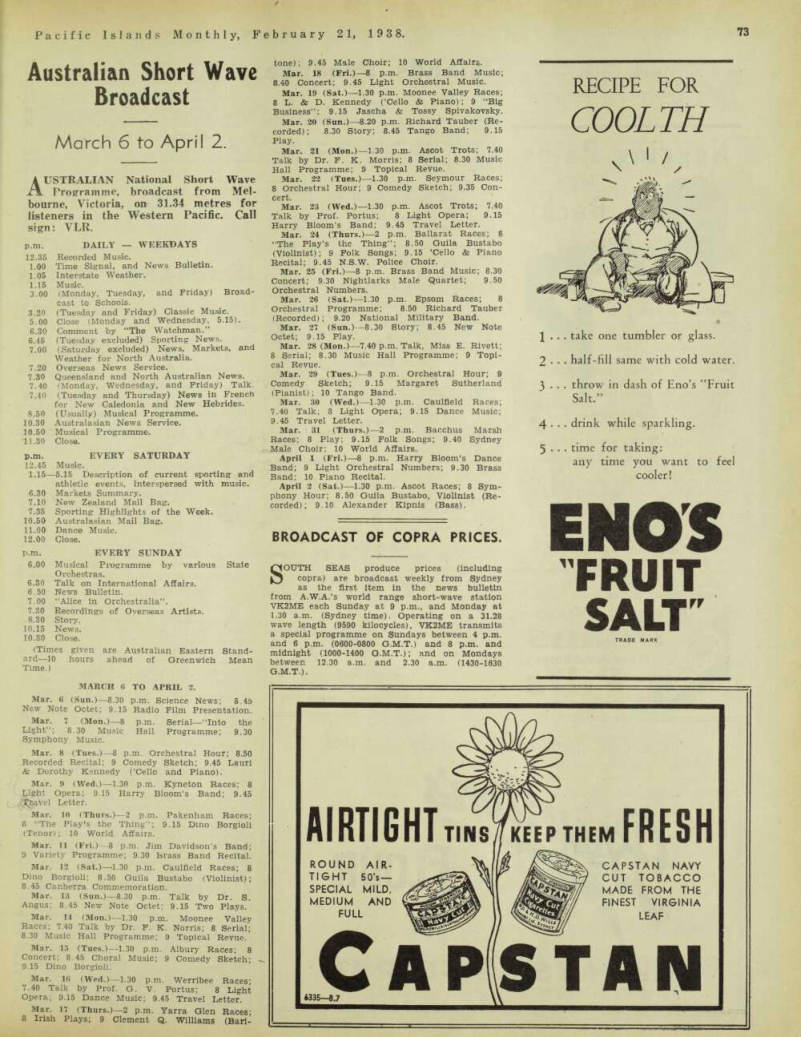
Broadcast March 6 to April 2.
AUSTRALIAN National Short Wave
Programme, broadcast from Mel
bourne, Victoria, on 31.34 metres for
listeners in the Western Pacific. Call
sign: VLR.
P.M. Daily Weekdays
12.35 Recorded Music. 1.00 Time Signal, and News Bulletin. 1.05 Interstate Weather. 1.15 Music. 3.00 (Monday, Tuesday, and Friday) Broad cast to Schools. 3.20 (Tuesday and Friday) Classic Music. 5.00 Close (Monday and Wednesday. 5.15). 6.30 Comment by “The Watchman.” 6.45 (Tuesday excluded) Sporting News. 7.00 (Saturday excluded) News, Markets, and Weather for North Australia. 7.20 Overseas News Service. 7.30 Queensland and North Australian News. 7.40 (Monday, Wednesday, and Friday) Talk. 7.40 (Tuesday and Thursday) News in French for New Caledonia and New Hebrides. 8.50 (Usually) Musical Programme. 10.30 Australasian News Service. 10.50 Musical Programme. 11.30 Close.
P.M. Every Saturday
12.45 Music. 1.15 —5.15 Description of current sporting and athletic events, interspersed with music. 6.30 Markets Summary. 7.10 New Zealand Mail Bag. 7.35 Sporting Highlights of the Week. 10.50 Australasian Mail Bag. 11.00 Dance Music. 12.00 Close.
P.M. Every Sunday
6.00 Musical Programme by various State Orchestras. 6.30 Talk on International Affairs. 6.50 News Bulletin. 7.00 “Alice in Orchestralia”. 7.30 Recordings of Overseas Artists. 8.30 Story. 10.15 News. 10.30 Close. (Times given are Australian Eastern Stand ard —10 hours ahead of Greenwich Mean Time.)
March 6 To April 2.
Mar. 6 (Sun.) —8.30 p.m. Science News; 8.45 New Note Octet; 9.15 Radio Film Presentation.
Mar. 7 (Mon.)—B p.m. Serial—“lnto the Light”; 8.30 Music Hall Programme; 9.30 Symphony Music.
Mar. 8 (Tues.)—B p.m. Orchestral Hour; 8.50 Recorded Recital; 9 Comedy Sketch; 9.45 Lauri & Dorothy Kennedy (’Cello and Piano).
Mar. 9 (Wed.) —1.30 p.m. Kyneton Races; 8 Light Opera; 9.15 Harry Bloom’s Band; 9.45
travel Letter.
Mar. Ift (Thurs.) —2 p.m. Pakenham Races; 8 “The Play’s the Thing”; 9.15 Dino Borgioli (Tenor); 10 World Affairs.
Mar. 11 (Fri.) —8 p.m. Jim Davidson's Band; 9 Variety Programme; 9.30 brass Band Recital.
Mar. 12 (Sat.) —-1.30 p.m. Caulfield Races; 8 Dino Borgioli: 8.50 Guila Bustabo (Violinist); 8.45 Canberra Commemoration.
Mar. 13 (Sun.)—B.3o p.m. Talk by Dr. S.
Angus; 8.45 New Note Octet; 9.15 Two Plays.
Mar. 14 (M0n.)—1.30 p.m. Moonee Valley Races; 7.40 Talk by Dr. F. K. Norris; 8 Serial; 8.30 Music Hall Programme; 9 Topical Revue.
Mar. 15 (Tues.) —1.30 p.m. Albury Races; 8 Concert: 8.45 Choral Music; 9 Comedy Sketch; 9.15 Dino Borgioli.
Mar. 16 (Wed.)—l.3o p.m. Werribee Races; 7.40 Talk by Prof. G. V. Portus; 8 Light Opera; 9.15 Dance Music; 9.45 Travel Letter.
Mar. 17 (Thurs.)—2 p.m. Yarra Glen Races; 8 Irish Plays; 9 Clement Q. Williams (Bari
tone); 9.45 Male Choir; 10 World Affairs.
Mar. 18 (Fri.) —8 p.m. Brass Band Music; 8.40 Concert: 9.45 Light Orchestral Music.
Mar. 19 (Sat.) —1.30 p.m. Moonee Valley Races; 8 L. & D. Kennedy (’Cello & Piano); 9 “Big Business’’; 9.15 Jascha & Tossy Spivakovsky.
Mar. 20 (Sun.) —8.20 p.m. Richard Tauber (Re corded); 8.30 Story; 8.45 Tango Band; 9.15 Play.
Mar. 21 (M0n.)—1.30 p.m. Ascot Trots; 7.40 Talk by Dr. F. K. Morris; 8 Serial; 8.30 Music Hall Programme; 9 Topical Revue.
Mar. 22 (Tues.)—l.3o p.m. Seymour Races; 8 Orchestral Hour; 9 Comedy Sketch; 9.35 Con cert.
Mar. 23 (Wed.)—l.3o p.m. Ascot Trots; 7.40 Talk by Prof. Portus; 8 Light Opera; 9.15 Harry Bloom’s Band; 9.45 Travel Letter.
Mar. 24 (Thurs.) —2 p.m. Ballarat Races; 8 “The Play’s the Thing’’; 8.50 Guila Bustabo (Violinist); 9 Polk Songs; 9.15 ’Cello & Piano Recital; 9.45 N.S.W. Police Choir.
Mar. 25 (Fri.)—B p.m. Brass Band Music; 8.30 Concert; 9.30 Nightlarks Male Quartet; 9.50 Orchestral Numbers.
Mar. 26 (Sat.) —1.30 p.m. Epsom Races; 8 Orchestral Programme; 8.50 Richard Tauber (Recorded); 9.20 National Military Band.
Mar, 27 (Sun.) —8.30 Story; 8.45 New Note Octet; 9.15 Play.
Mar. 28 (M0n.)—7.40 p.m. Talk, Miss E. Rivett; 8 Serial; 8.30 Music Hall Programme: 9 Topi cal Revue.
Mar. 29 (Tues.) —8 p.m. Orchestral Hour; 9 Comedy Sketch; 9.15 Margaret Sutherland (Pianist); 10 Tango Band.
Mar. 30 (Wed.) —1.30 p.m. Caulfield Races; 7.40 Talk; 8 Light Opera; 9.15 Dance Music; 9.45 Travel Letter.
Mar. 31 (Thurs.) —2 p.m. Bacchus Marsh Races; 8 Play; 9.15 Folk Songs; 9.40 Sydney Male Choir: 10 World Affairs.
April 1 (Fri.) —8 p.m. Harry Bloom’s Dance Band; 9 Light Orchestral Numbers; 9.30 Brass Band: 10 Piano Recital.
April 2 (Sat.) —1.30 p.m. Ascot Races; 8 Sym phony Hour; 8.50 Guila Bustabo, Violinist (Re corded); 9.10 Alexander Kipnis (Bass).
Broadcast Of Copra Prices.
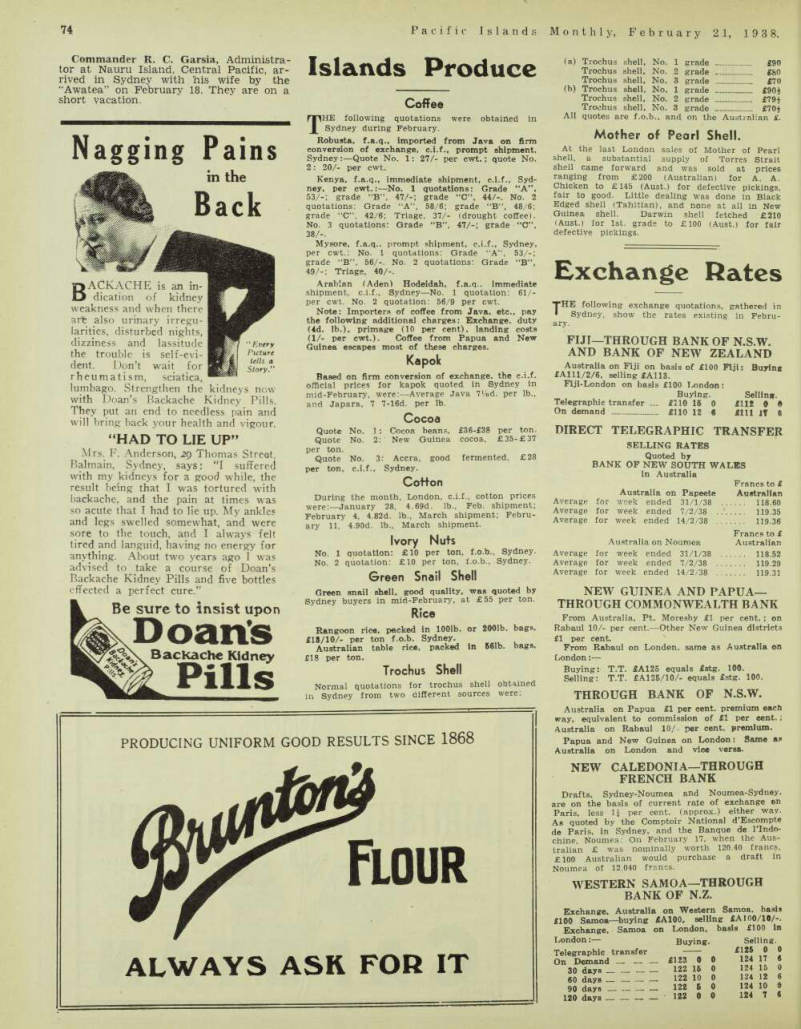
SOUTH SEAS produce prices (including copra) are broadcast weekly from Sydney as the first item in the news bulletin from A.W.A.’s world range short-wave station VK2ME each Sunday at 9 p.m., and Monday at 1.30 a.m. (Sydney time). Operating on a 31.28 wave length (9590 kilocycles), VK2ME transmits a special programme on Sundays between 4 p.m. and 6 p.m. (0600-0800 G.M.T.) and 8 p.m. and midnight (1000-1400 G.M.T.); and on Mondays between 12.30 a.m. and 2.30 a.m. (1430-1630
G.M.T.).
Commander K. C. Garsia. Administra tor at Nauru Island, Central Pacific, ar rived in Sydney with his wife by the “Awatea” on February 18. They are on a short vacation.
Advertisements & other items, pp. 75-76 (1 item)
Capstan
RECIPE FOR
COOLTH
\ i / 1 . . . take one tumbler or glass. 2 . . . half-fill same with cold water. 3 . . . throw in dash of Eno’s "Fruit Salt.” 4 . . . drink while sparkling. time for taking: any time you want to feel cooler!
ENOS
FRUIT
SALT'
TRADE MARK
AIRTIGHT
KEEP THEM
ROUND AIR-
TIGHT 50's—
SPECIAL MILD,
MEDIUM AND
FULL
«35-a.7
TINS
FRESH
CAPSTAN NAVY
CUT TOBACCO
MADE FROM THE
FINEST VIRGINIA
LEAF
Capstan
Nagging Pains
in the
Back
Backache is an dication of kidney weakness and when there art also urinary irregularities, disturbed nights, dizziness and lassitude the trouble is self-evident. Don’t wait for rheumatism, sciatica, lumbago. Strengthen the kidneys now with Doan’s Backache Kidney Pills.
They put an end to needless pain and will bring back your health and vigour. ‘ Every Picture tells a Story."
“HAD TO LIE UP”
Mrs. F. Anderson, 29 Thomas Street, Balmain, Sydney, says; “I suffered with my kidneys for a good while, the result being that I was tortured with backache, and the pain at times was so acute that I had to He up. My ankles and legs swelled somewhat, and were sore to the touch, and I always felt tired and languid, having no energy for anything. About two years ago I was advised to take a course of Doan’s Backache Kidney Pills and five bottles effected a perfect cure."
Be sure to insist upon
Doan's
Backache Kidney
Pills
<s>o r
PRODUCING UNIFORM GOOD RESULTS SINCE 1868
ALWAYS ASK FOR IT
Islands Produce
Coffee
THE following quotations were obtained in Sydney during February.
Robusta, f.a.q., imported from Java on firm conversion of exchange, c.i.f., prompt shipment.
Sydney:—Quote No. 1: 27/- per cwt.; quote No. 2: 20/- per cwt.
Kenya, f.a.q., immediate shipment, c.i.f., Syd ney, per cwt.:—No. 1 quotations: Grade “A”, 53/-; grade “B”, 47/-; grade “C”, 44/-. No. 2 quotations; Grade “A”, 58/6; grade “B”, 48/6; grade “C”. 42/6; Triage, 37/- (drought coffee).
No. 3 quotations; Grade “B”, 47/-; grade “C”, 38/-.
Mysore, f.a.q.. prompt shipment, c.i.f., Sydney, per cwt.: No. 1 quotations: Grade “A”. 53/-; grade “B”, 56/-. No. 2 quotations; Grade “B”, 49/-; Triage, 40/-.
Arabian (Aden) Hodeidah, f.a.q.. immediate shipment, c.i.f., Sydney—No. 1 quotation: 61/per cwt. No. 2 quotation: 56/9 per cwt.
Note: Importers of coffee from Java, etc., pay the following additional charges: Exchange, duty (4d. lb.), primage (10 per cent), landing costs (1/- per cwt.). Coffee from Papua and New Guinea escapes most of these charges.
Kapok
Based on firm conversion of exchange, the c.i.f. official prices for kapok quoted in Sydney in mid-February, were;—Average Java 7ysd. per lb., and Japara, 7 7-16 d. per lb.
Cocoa
Quote No. 1: Cocoa beans, £36-£3B per ton.
Quote No. 2: New Guinea cocoa, £35-£37 per ton.
Quote No. 3: Accra, good fermented, £2B per ton, c.i.f., Sydney.
Cotton
During the month, London, c.i.f., cotton prices were: —January 28, 4.69 d. lb., Feb. shipment; February 4,4.82 d. lb., March shipment; Febru ary 11, 4.90 d. lb., March shipment.
Ivory Nuts
No. 1 quotation; £lO per ton, f.0.b., Sydney.
No. 2 quotation: £lO per ton, f.0.b., Sydney.
Green Snail Shell
Green snail shell, good quality, was quoted by Sydney buyers in mid-February, at £55 per ton.
Rice
Rangoon rice, pecked in 1001 b. or 2001 b. bags, £lB/10/- per ton f.o.b. Sydney.
Australian table rice, packed in 661 b. bags. £lB per ton.
Trochus Shell
Normal quotations for trochus shell obtained in Sydney from two different sources were;
(a) Trochus shell, No. 1 grade £9O Trochus shell. No. 2 grade £BO Trochus shell. No. 3 grade £7O (b) Trochus shell, No. 1 grade - £9os Trochus shell. No. 2 grade ..._ £79s Trochus shell. No. 3 grade £7os All quotes are f.0.b., and on the Australian £.
Mother of Peorl Shell.
At the last London sales of Mother of Pearl shell, a substantial supply of Torres Strait shell came forward and was sold at prices ranging from £2OO (Australian) for A. A.
Chicken to £145 (Aust.) for defective pickings, fair to good. Little dealing was done in Black Edged shell (Tahitian), and none at all in New Guinea shell. Darwin shell fetched £2lO (Aust.) for Ist. grads to £lOO (Aust.) for fair defective pickings.
Exchange Rates
THE following exchange quotations, gathered in • Sydney, show the rates existing in Febru ary.
Fiji—Through Bank Of N.S.W.
And Bank Of New Zealand
Australia on Fiji on basis of £lOO Fiji; Buying £Alll/2/6, selling £AII3.
Fiji-London on basis £lOO London: Buying. Selling.
Telegraphic transfer £llO 16 0 £ll2 0 0 On demand £llO 12 6 £lll IT 6
Direct Telegraphic Transfer
Selling Rates
Quoted by
Bank Of New South Wales
in Australia Francs to £ Australia on Papeete Australian Average for week ended 31/1/38 118.60 Average for week ended 7/2/38 119.35 Average for week ended 14/2/38 119.36 Francs to £ Australia on Noumea Australian Average for week ended 31/1/38 118.52 Average for week ended 7/2/38 119.29 Average for week ended 14/2/38 119.31
New Guinea And Papua
Through Commonwealth Bank
From Australia, Pt. Moresby £1 per cent. ; on Rabaul 10/- per cent. —Other New Guinea districts £1 per cent.
From Rabaul on London, same as Australia on London:— Buying: T.T. £AI2S equals £stg. 100.
Selling: T.T. £AI2S/10/- equals fstg. 100.
Through Bank Of N.S.W.
Australia on Papua £1 per cent, premium each way, equivalent to commission of £1 per cent. ; Australia on Rabaul 10/- per cent, premium.
Papua and New Guinea on London; Same as Australia on London and vice versa.
New Caledonia—Through
French Bank
Drafts, Sydney-Noumea and Noumea-Sydney. are on the basis of current rate of exchange on Paris, less 1$ per cent, (approx.) either way.
As quoted by the Comptoir National d’Escompte de Paris, in Sydney, and the Banque de ITndo chine, Noumea: On February 17, when the Aus tralian £ was nominally worth 120.40 francs, £lOO Australian would purchase a draft in Noumea of 12,040 francs.
Western Samoa—Through
Bank Of N.Z.
Exchange. Australia on Western Samoa, basis £lOO Samoa—buying £AIOO, selling £A 100/10/-.
Exchange. Samoa on London, basis £lOO in
London: — Buying.
Selling.
Telegraphic transfer — £126 0 0 On Demand — — — £123 0 0 124 17 6 30 days — — 122 15 0 124 15 0 60 days — — — — 122 10 0 124 12 6 90 days 122 6 0 124 10 0 120 days 122 0 0 124 7 6
Market Quotations
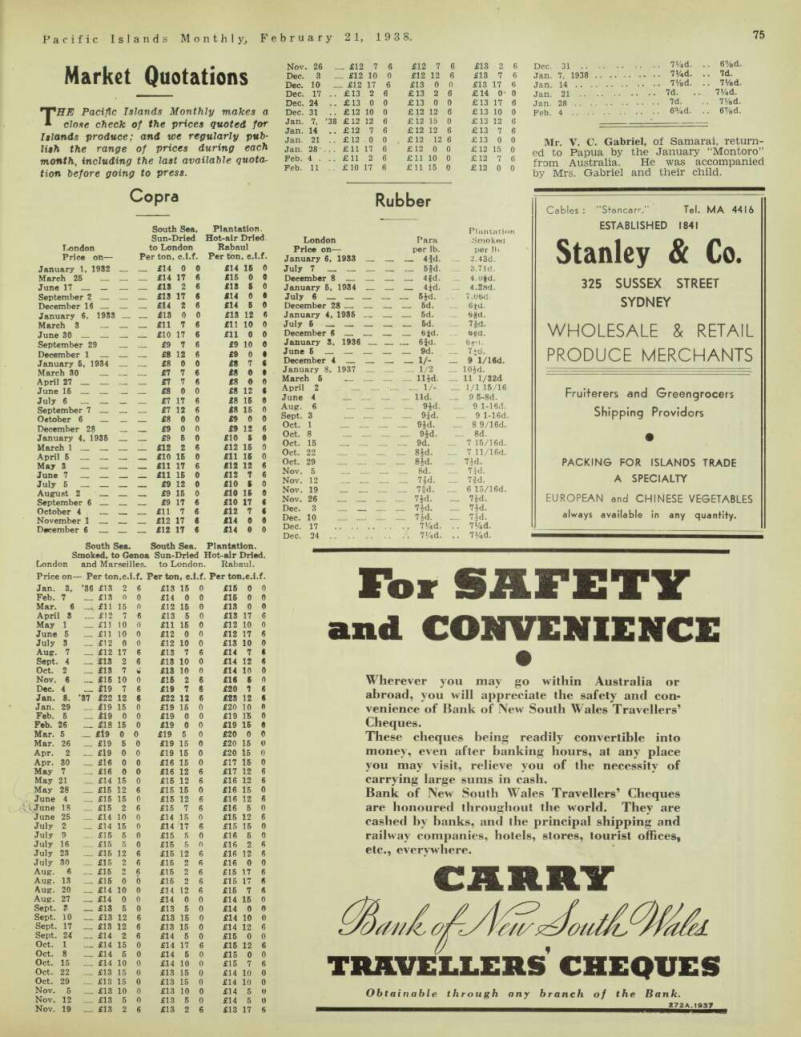
THE Pacific Islands Monthly makes a close check of the prices quoted for Islands produce: and we regularly pub lish the range of prices during each month, including the last available quota tion before going to press.
Copra
Rubber
Mr. V. C. Gabriel, of Samarai, return ed to Papua by the January “Montoro” from Australia. He was accompanied by Mrs. Gabriel and their child.
Dec. 31 .. .. 7'Ad. .. 6 7 /ad.
Jan. 7. 1938 7'Ad. .. 7d.
Jan. 14 ... 7'/ad. .. 7Vad.
Jan. 21 .. .. 7d. .. 7Vid.
Jan. 28 7d. , . 7Vad.
Feb. 4 .. .. 6 3 Ad. . . 6 7 /ad.
Nov. , 26 £12 7 6 £12 7 6 £13 2 6 Dec. 3 ... £12 10 0 £12 12 6 £13 7 6 Dec. 10 ... £12 17 6 £13 0 0 £13 17 6 Dec. 17 .. £13 2 6 £13 2 6 £14 o- 0 Dec. 24 .. £13 0 0 £13 0 0 £13 17 6 Dec. 31 .. £12 10 0 £12 12 6 £13 10 0 Jan. 7, ’38 £12 12 6 £12 15 0 £13 12 6 Jan. 14 .. £12 7 6 £12 12 6 £13 7 6 Jan. 21 .. £12 0 0 . £12 12 6 £13 0 0 Jan. 28 ... £11 17 6 £12 0 0 £12 15 0 Feb. 4 . .. £11 2 6 £11 10 0 £12 7 6 Feb. 11 .. £10 17 6 £11 15 0 £12 0 0
South Sea, Plantation.
Sun-Dried Hot-air Dried, London to London Rabaul Price on— Per ton, c.i.f.
Per ton, c.i.f.
January 1, 1982 £14 0 0 £14 16 0 March 25 £14 17 6 £16 0 0 June 17 £18 2 6 £18 5 0 September 2 £18 17 6 £14 0 6 December 16 £14 2 6 £14 6 0 January 6, 1933 £13 0 0 £18 12 6 March 3 £11 7 6 £11 10 0 June 30 — £10 17 6 £11 0 0 September 29 £9 7 6 £9 10 0 December 1 £8 12 6 £9 0 • January 6, 1934 £8 0 0 £8 7 6 March 80 £7 7 6 £8 0 • April 27 . ... £7 7 6 £8 0 0 June IB £8 0 0 £8 12 4 July 6 £7 17 6 £8 16 0 September 7 £7 12 6 £8 16 0 October 6 £8 0 0 £9 0 0 December 28 £9 0 0 £9 12 6 January 4 . 1935 £9 5 0 £10 5 0 March 1 . £12 2 6 £12 16 0 April 5 . ... £10 16 0 £11 16 0 May 3 . . £11 17 6 £12 12 6 June 7 — £11 16 0 £12 7 6 July 5 £9 12 0 £10 i 0 August 2 £9 15 0 £10 16 0 September 6 £9 17 6 £10 17 6 October 4 £11 7 6 £12 7 « November 1 £12 17 6 £14 0 0 December 6 — — — £12 17 6 £14 0 0 South Sea.
South Sea.
Plantation.
Smoked, to Genoa Sun-Dried Hot-air Dried.
London and Marseilles. to London.
Rabaul.
Price on— Per ton.c.i.f. Per ton, c.
I.f.
Per ton.c.i.f.
Jan. 3, '36 £13 2 6 £13 15 0 £16 0 0 Feb. 7 £13 n 0 £14 0 0 £16 0 0 Mar. 6 £11 15 ft £12 16 0 £13 0 0 April 8 £12 7 6 £13 5 0 £13 17 6 May 1 £11 10 ft £11 15 0 £12 10 0 June 5 £11 10 0 £12 0 0 £12 17 6 July 3 £12 0 0 £12 10 0 £13 10 0 Aug. 7 £12 17 6 £13 7 6 £14 7 6 Sept. 4 . . r £13 2 6 £13 10 0 £14 12 6 Oct. 2 £13 7 w £13 10 0 £14 10 0 Nov. 6 , £16 10 0 £16 2 6 £16 6 ft Dec. 4 £19 7 6 £19 7 6 £20 7 6 Jan. 8. *1 37 £22 12 6 £22 12 6 £28 12 6 Jan. 29 £19 15 0 £19 15 0 £20 10 ft Feb. 5 £19 0 0 £19 0 0 £19 15 0 Feb. 26 £18 IB 0 £19 0 0 £19 IB 0 Mar. 5 £19 0 0 £19 5 0 £20 0 0 Mar. 26 £19 5 0 £19 15 0 £20 15 0 Apr. 2 £19 0 0 £19 15 0 £20 15 0 Apr. 30 £16 0 0 £16 15 0 £17 16 0 May 7 £16 0 0 £16 12 6 £17 12 6 May 21 £14 15 0 £15 12 6 £16 12 6 May 28 £15 12 6 £15 15 0 £16 15 0 June 4 £15 15 0 £15 12 6 £16 12 6 June 18 £15 2 6 £15 7 6 £16 5 0 June 25 £14 10 0 £14 15 0 £15 12 6 July 2 £14 15 0 £14 17 6 £15 15 0 July 9 £15 5 0 £15 5 0 £16 6 0 July 16 ... £15 5 0 £15 5 ft £16 2 6 July 23 £15 12 6 £15 12 6 £16 12 6 July 30 £15 2 6 £15 2 6 £16 0 0 Aug. 6 £15 2 6 £15 2 6 £15 17 6 Aug. 13 £15 0 6 £15 2 6 £15 17 6 Aug. 20 £14 10 0 £14 12 6 £15 7 6 Aug. 27 £14 0 0 £14 0 0 £14 15 0 Sept. ? £13 5 0 £13 5 0 £14 0 0 Sept. 10 £13 12 6 £13 15 0 £14 10 0 Sept. 17 £13 12 6 £13 15 0 £14 12 6 Sept. 24 £14 2 6 £14 5 0 £15 0 0 Oct. 1 , £14 15 0 £14 17 6 £15 12 6 Oct. 8 £14 5 0 £14 6 0 £15 0 0 Oct. 15 £14 10 0 £14 10 0 £15 7 6 Oct. 22 £13 15 0 £13 15 0 £14 10 0 Oct. 29 £13 15 0 £13 15 0 £14 10 0 Nov. 5 £13 10 0 £13 10 0 £14 5 U Nov. 12 £13 5 0 £13 5 0 £14 5 0 Nov. 19 £13 2 6 £13 2 6 £13 17 5
London Price on— January 6, 1983 Para per lb. 4fd.
Plantation Smoke<l per ll> 2.43d.
July 7 ... — B|d. 3.71d.
December 8 4|d. 4.U|d.
January 5, 1984 — 4 id. 4.28d.
July 6 — — — B*d. 7.Ubd.
December 28 — — 6d. 6td.
January 4, 1985 — Bd. 6*d.
July 5 6d. 7 id.
December 6 — — 6Jd. b|d.
January 8, 1936 6|d. (jff'i- June 5 — — — 9d. 7 id.
December 4 — — - V- 9 l/16d.
January 8, 1937 1/2 10*d.
March 6 — — ... Hid. 11 l/32d April 2 — .. ... 1/- 1/1 15/16 June 4 — — „.. lid. 9 5-8d.
Aug. 6 9*d. 9 1-16d.
Sept. 3 9Jd. ... 9 l-16d.
Oct. 1 — . 9*d. 8 9/16d.
Oct. 8 ... 9*d. 8d.
Oct. 15 . ... 9d. 7 15/16d.
Oct. 22 8id. 7 11/16d.
Oct. 29 ... ... 8id. 7id.
Nov. 5 — 8d. 7id.
Nov. 12 ...» — . ... 7|d. 7«d.
Nov. 19 — ... 7§d, 6 15/16d.
Nov. 26 ..„ 7id. 7id.
Dec. 3 — — ... 7id. 7*d.
Dec. 10 ... ... 7 Jd. 7id.
Dec. 17 7V 4 d.
Dec. 24 . . 7V«d.
Advertisements & other items, p. 77 (1 item)
For Safety
Cables: "Stancarr." Tel. MA 4416
ESTABLISHED 1841
Stanley & Co.
325 SUSSEX STREET
SYDNEY
WHOLESALE & RETAIL
PRODUCE MERCHANTS
Fruiterers and Greengrocers
Shipping Providers
PACKING FOR ISLANDS TRADE
A SPECIALTY
EUROPEAN and CHINESE VEGETABLES
always available in any quantity.
For SAFETY
and CONVENIENCE
Wherever you may go within Australia or abroad, you will appreciate the safely and convenience of Bank of New South Wales Travellers’
Cheques.
These cheques being readily convertible into money, even after banking hours, at any place you may visit, relieve you of the necessity of carrying large sums in cash.
Bank of New South Wales Travellers’ Cheques are honoured throughout the world. They are cashed by hanks, and the principal shipping and railway companies, hotels, stores, tourist offices, etc., everywhere.
CARRY
TRAVELLERS CHEQUES
Obtainable through any branch of the Bank. 272A.1937
"To-Morrow!"
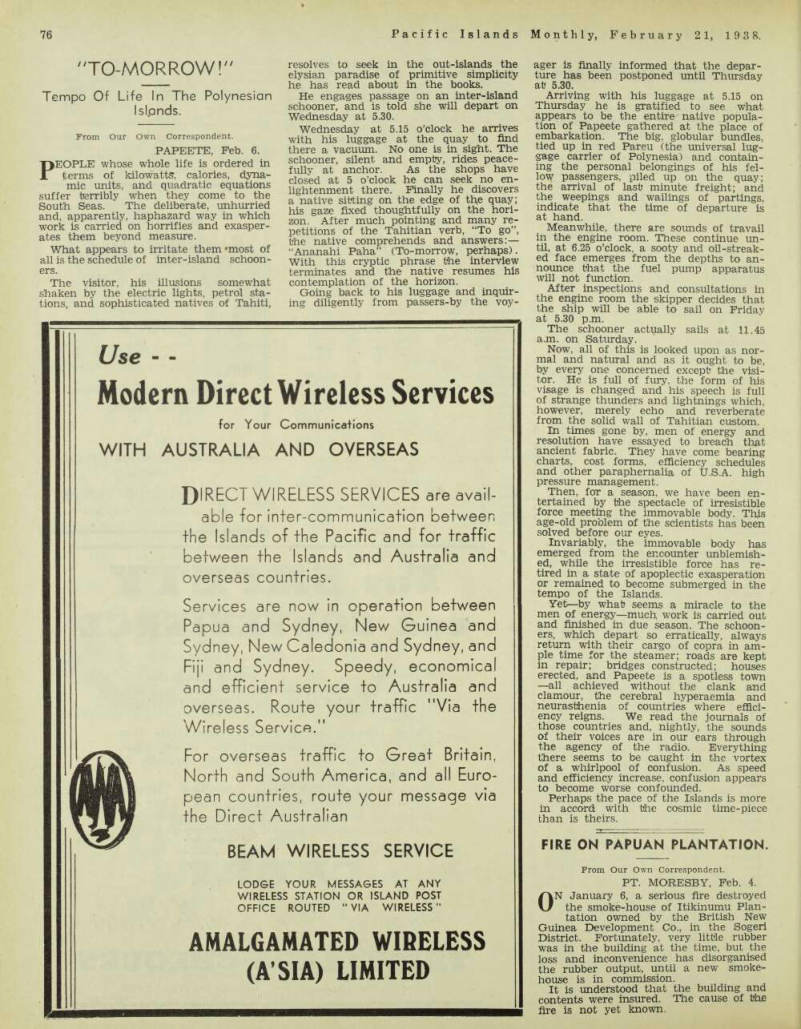
Tempo Of Life In The Polynesian Islands.
Prom Our Own Correspondent.
Papeete, Feb. 6.
PEOPLE whose whole life is ordered in Iterms of kilowatts', calories, dyna mic units, and quadratic equations suffer terribly when they come to the South Seas. The deliberate, unhurried and, apparently, haphazard way in which work is carried on horrifies and exasper ates them beyond measure.
What appears to irritate them*most of all is the schedule of inter-island schoon ers.
The visitor, his illusions somewhat shaken by the electric lights, petrol sta tions, and sophisticated natives of Tahiti.
resolves to seek in the out-islands the elysian paradise of primitive simplicity he has read about in the books.
He engages passage on an inter-island schooner, and is told she will depart on Wednesday at 5.30.
Wednesday at 5.15 o’clock he arrives with his luggage at the quay to find there a vacuum. No one is in sight. The schooner, silent and empty, rides peace fully at anchor. As the shops have closed at 5 o’clock he can seek no en lightenment there. Finally he discovers a native sitting on the edge of th,e quay; his gaze fixed thoughtfully on the hori zon. After much pointing and many re petitions of the Tahitian verb, “To go”, the native comprehends and answers: — “Ananahi Paha” (To-morrow, perhaps).
With this cryptic phrase the interview terminates and the native resumes his contemplation of the horizon.
Going back to his luggage and inquir ing diligently from passers-by the voy
ager is finally informed that the depar ture has been postponed until Thursday at 5.30.
Arriving with his luggage at 5.15 on Thursday he is gratified to see what appears to be the entire native popula tion of Papeete gathered at the place of embarkation. The big, globular bundles, tied up in red Pareu (the universal lug gage carrier of Polynesia) and contain ing the personal belongings of his fel low passengers, piled up on the quay; the arrival of last minute freight; and the weepings and wailings of partings, indicate that the time of departure is at hand.
Meanwhile, there are sounds of travail in the engine room. These continue un til, at 6.25 o’clock, a sooty and oil-streak ed face emerges from the depths to an nounce that the fuel pump apparatus will not function.
After inspections and consultations in the engine room the skipper decides that the ship will be able to sail on Friday at 5.30 p.m.
The schooner actually sails at 11.45 a.m. on Saturday.
Now, all of this is looked upon as nor mal and natural and as it ought to be, by every one concerned except the visi tor. He is full of fury, the form of his visage is changed and his speech is full of strange thunders and lightnings which, however, merely echo and reverberate from the solid wall of Tahitian custom.
In times gone by, men of energy and resolution have essayed to breach that ancient fabric. They have come bearing charts, cost forms, efficiency schedules and other paraphernalia of U.S.A. high pressure management.
Then, for a season, we have been en tertained by the spectacle of irresistible force meeting the immovable body. This age-old problem of the scientists has been solved before our eyes.
Invariably, the immovable body has emerged from the encounter unblemish ed, while the irresistible force has re tired in a state of apoplectic exasperation or remained to become submerged in the tempo of the Islands.
Yet—by what seems a miracle to the men of energy—much work is carried out and finished in due season. The schoon ers, which depart so erratically, always return with their cargo of copra in am ple time for the steamer; roads are kept in repair; bridges constructed; houses erected, and Papeete is a spotless town —all achieved without the clank and clamour, the cerebral hyperaemia and neurasthenia of countries where effici ency reigns. We read the journals of those countries and, nightly, the sounds of their voices are in our ears through the agency of the radio. Everything there seems to be caught in the vortex of a whirlpool of confusion. As speed and efficiency increase, confusion appears to become worse confounded.
Perhaps the pace of the Islands is more in accord with the cosmic time-piece than is theirs.
Fire On Papuan Plantation.
From Our Own Correspondent.
Pt. Moresby, Feb. 4.
ON January 6, a serious fire destroyed the smoke-house of Itikinumu Plan tation owned by the British New Guinea Development Co., in the Sogeri District. Fortunately, very little rubber was in the building at the time, but the loss and inconvenience has disorganised the rubber output, until a new smoke house is in commission.
It is understood that the building and contents were insured. The cause of the fire is not yet known,
Advertisements & other items, p. 78 (1 item)
Modern Direct Wireless Services
Use - -
for Your Communications
WITH AUSTRALIA AND OVERSEAS
DIRECT WIRELESS SERVICES are avail-
able for infer-communication between the Islands of the Pacific and for traffic between the Islands and Australia and overseas countries.
Services are now in operation between Papua and Sydney, New Guinea and Sydney, New Caledonia and Sydney, and Fiji and Sydney. Speedy, economical and efficient service to Australia and overseas. Route your traffic "Via the Wireless Service."
For overseas traffic to Great Britain, North and South America, and all European countries, route your message via the Direct Australian
BEAM WIRELESS SERVICE
LODGE YOUR MESSAGES AT ANY
WIRELESS STATION OR ISLAND POST
OFFICE ROUTED "VIA WIRELESS"
AMALGAMATED WIRELESS
(A SIA) LIMITED
Shipping Services in the Pacific
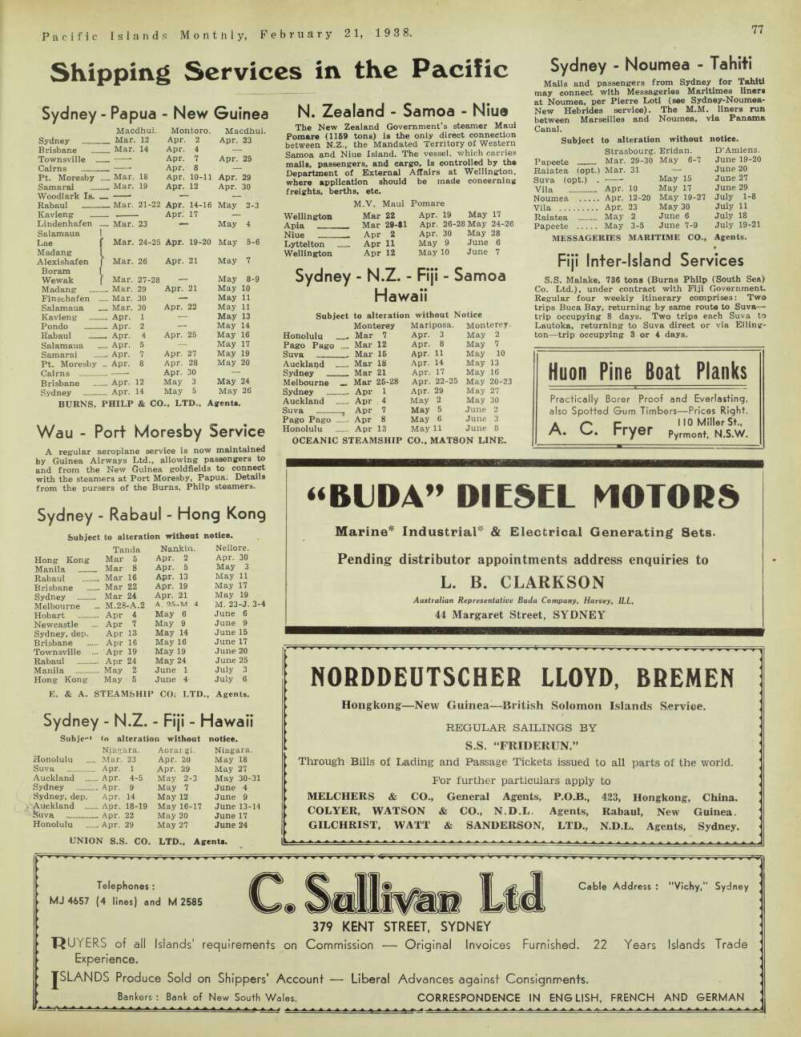
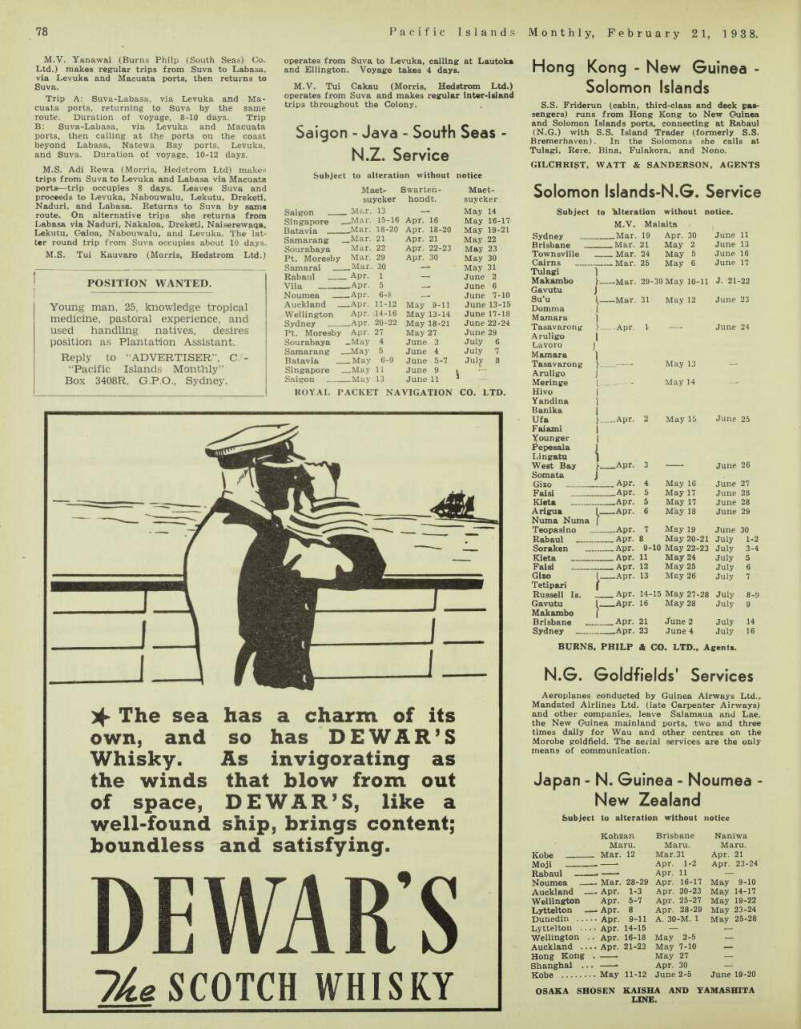
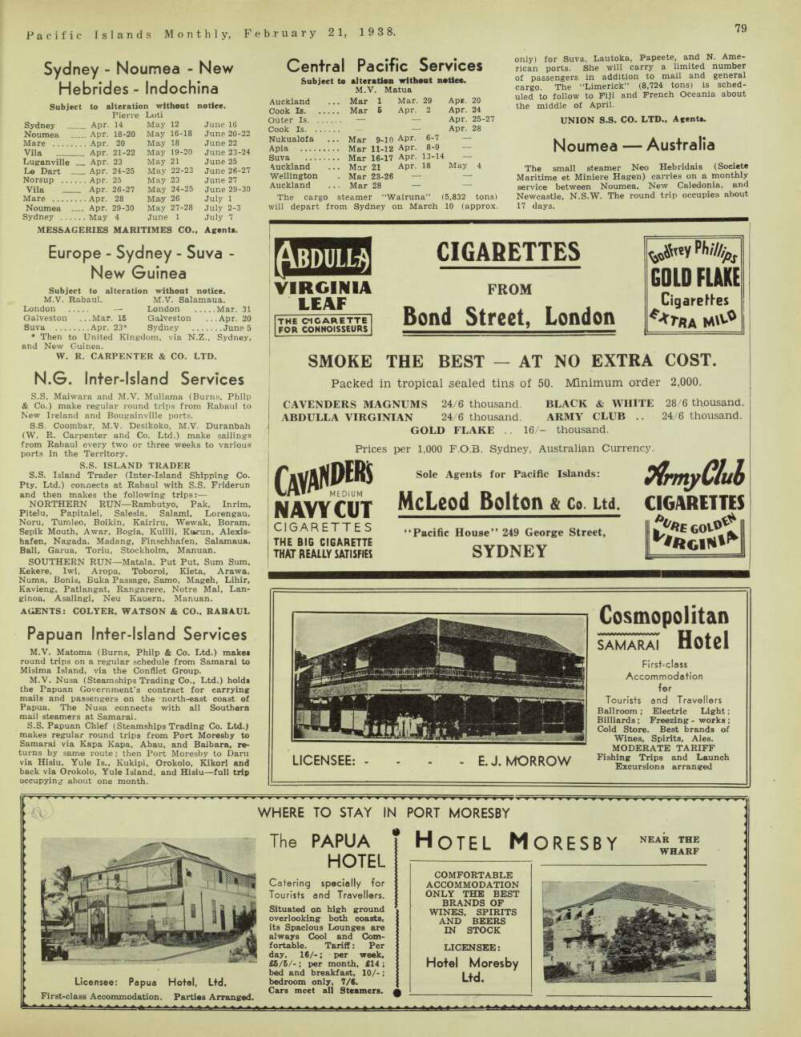
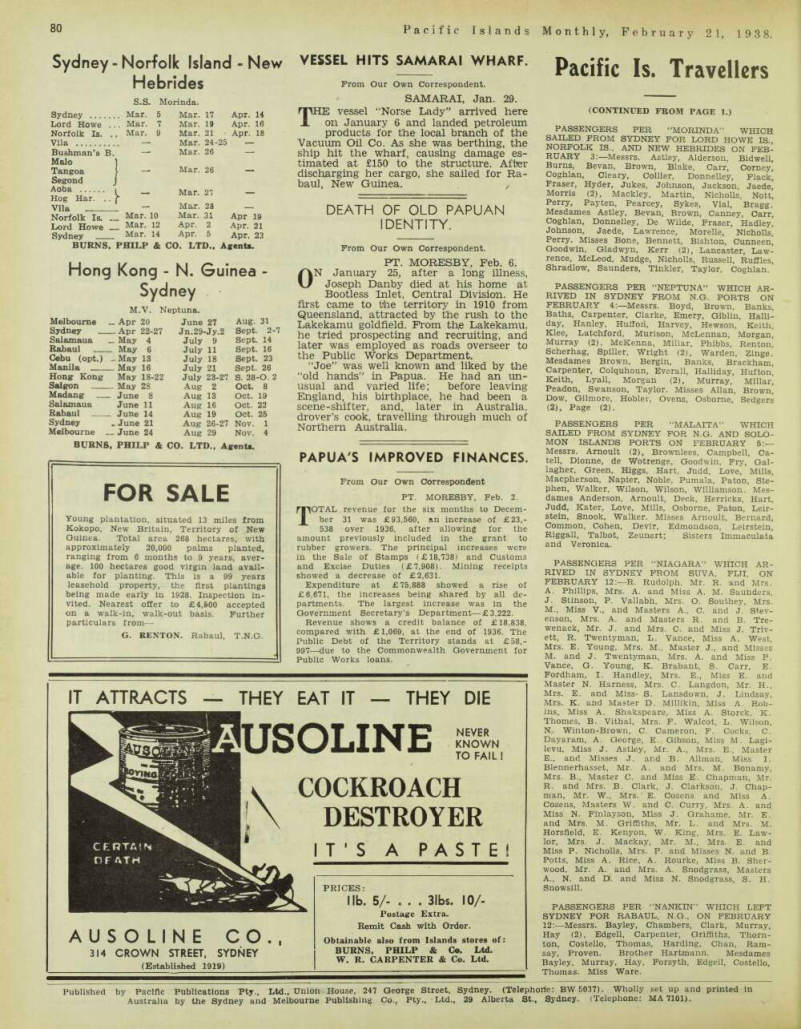
Sydney - Papua - New Guinea
Wau - Port Moresby Service
A regular aeroplane service is now maintained by Guinea Airways Ltd., allowing passengers to and from the New Guinea goldfields to connect with the steamers at Port Moresby, Papua. Details from the pursers of the Burns, Philp steamers.
Sydney - Rabaul - Hong Kong
Sydney - N.Z. - Fiji - Hawaii
N. Zealand - Samoa - Niuo
The New Zealand Government’s steamer Maui Pomare (1169 tons) is the only direct connection between N.Z., the Mandated Territory of Western Samoa and Niue Island. The vessel, which carries mails, passengers, and cargo, is controlled by the Department of External Affairs at Wellington, where application should be made concerning freights, berths, etc.
Sydney - N.Z. - Fiji - Samoa Hawaii
Sydney - Noumea - Tahiti
Mails and passengers from Sydney for Tahiti may connect with Messageries Marltimes liners at Noumea, per Pierre Loti (see Sydney-Noumea- New Hebrides service). The M.M. liners run between Marseilles and Noumea, via Panama Canal.
Fiji Inter-Island Services
S.S. Malake, 736 tons (Burns Philp (South Sea) Co. Ltd.), under contract with Fiji Government.
Regular four weekly itinerary comprises: Two trips Buca Bay, returning by same route to Suva — trip occupying 8 days. Two trips each Suva to Lautoka, returning to Suva direct or via Elling ton—trip occupying 3 or 4 days.
Macdhui.
Montoro.
Macdhui.
Sydney Mar. 12 Apr. 2 Apr. 23 Brisbane Mar. 14 Apr. 4 — Townsville Apr. 7 Apr. 25 Cairns Apr. 8 — Pt. Moresby — Mar. 18 Apr. 10-11 Apr. 29 Samarai Mar. 19 Apr. 12 Apr. 30 Woodlark Is. — — ■ Rabaul Mar. 21-22 Apr. 14-16 May 2-3 Kavieng — Apr. 17 — Lindenhafen — Mar. 23 — May 4 Salamaua I
Lae f
Mar. 24-25 Apr. 19-20 May 5-6 Madang Alexishafen Mar. 26 Apr. 21 May 7
Boram (,
Wewak f
Mar. 27-28 May 8-9 Madang Mar. 29 Apr. 21 May 10 Finschafen — Mar. 30 — May 11 Salamaua — Mar. 30 Apr. 22 May 11 Kavieng Apr. 1 — May 13 Pondo Apr. 2 — May 14 Rabaul .
Apr. 4 Apr. 25 May 16 Salamaua — Apr. 5 — May 17 Samarai —.
Apr. 7 Apr. 27 May 19 Pt. Moresby Apr. 8 Apr. 28 May 20 Cairns Brisbane Apr. 12 Apr. 30 May 3 May 24 Sydney Apr. 14 May 5 May 26
Burns, Philp & Co., Ltd.. Agent*.
M.V. Maui Pomare Wellington Mar 22 Apr. 19 May 17 A pin Mar 29-»l Anr. 26-28 May 24-26 Niue Apr 2 Apr. 30 May 28 Lyttelton Apr 11 May 9 June 6 Wellington Apr 12 May 10 June 7
Subject to alteration without Notice Monterey Mariposa.
Monterey.
Honolulu - Mar 7 Apr. 3 May 2 Pago Pago Mar 12 Apr. 8 May 7 Suva Mar 15 Apr. 11 May 10 Auckland Mar 18 Apr. 14 May 13 Sydney Mar 21 Apr. 17 May 16 Melbourne Mar 25-28 Apr. 22-25 May 20-23 Sydney Apr 1 Apr. 29 May 27 Auckland Apr 4 May 2 May 30 Suva , Apr 7 May 5 June 2 Pago Pago — Apr 8 May 6 June 3 Honolulu — Apr 13 May 11 June 8
Oceanic Steamship
Co., Matson Line.
Subject to alteration without notice.
Strasbourg. Eridan.
D’ Amiens.
Papeete Mar. 29-30 May 6-7 June 19-20 Raiatea (opt.) Mar. 31 — June 20 Suva (opt.) .
May 15 June 27 Vila Apr. 10 May 17 June 29 Noumea Apr. 12-20 May 19-27 July 1-8 Vila Apr. 23 May 30 July 11 Raiatea May 2 June 6 July 18 Papeete May 3-5 June 7-9 July 19-21
Messageries Maritime Co.,
Agents.
Subject to alteration without notice.
Tanda Nankin.
Nellore.
Hong Kong Mar 5 Apr. 2 Apr. 30 Manila Mar 8 Apr. 5 May 3 Rabaul Mar 16 Apr. 13 May U Brisbane —.
Mar 22 Apr. 19 May 17 Sydney Mar 24 Apr. 21 May 19 Melbourne M.28-A.2
A. 9S-Tvt 4
M. 23-J. 3-4 Hobart Apr 4 May 6 June 6 Newcastle Apr 7 May 9 June 9 Sydney, dep.
Apr 13 May 14 June 15 Brisbane — Apr 16 May 16 June 17 Townsville Apr 19 May 19 June 20 Rabaul Apr 24 May 24 June 25 Manila May 2 June 1 July 3 Hong Kong May 5 June 4 July 6 E. & A. STEAMSHIP CO. LTD., Agents.
Subject to alteration without notice.
Niagara. Aorargi. Niagara.
Honolulu Mar. 23 Apr. 20 May 18 Suva Apr. 1 Apr. 29 May 27 Auckland Apr. 4-5 May 2-3 May 30-31 Sydney J..., Apr. 9 May 7 June 4 Sydney, dep. Apr. 14 May 12 June 9 Auckland Apr. 18-19 May 16-17 June 13-14 Suva Apr. 22 May 20 June 17 Honolulu Apr. 29 May 27 June 24
Union S.S. Co. Ltd., Agent*.
M.V. Yanawai (Burns Philp (South Seas) Co.
Ltd.) makes regular trips from Suva to Labasa, via Levuka and Macuata ports, then returns to Suva.
Trip A: Suva-Labasa, via Levuka and Ma cuata ports, returning to Suva by the same route. Duration of voyage, 8-10 days. Trip B: Suva-Labasa, via Levuka and Macuata ports, then calling at the ports on the coast beyond Labasa, Natewa Bay ports, Levuka, and Suva. Duration of voyage, 10-12 days.
M.S. Adi Rewa (Morris, Hedstrom Ltd) makes trips from Suva to Levuka and Labasa via Macuata ports—trip occupies 8 days. Leaves Suva and proceeds to Levuka, Nabouwalu, Lekutu, Dreketi, Naduri, and Labasa. Returns to Suva by same route. On alternative trips she returns from Labasa via Naduri, Nakaloa, Dreketi, Naiserewaqa, Lekutu, Galoa, Nabouwalu, and Levuka. The lat ter round trip from Suva occupies about 10 days.
M.S. Tui Kauvaro (Morris, Hedstrom Ltd.)
operates from Suva to Levuka, calling at Lautoka and Ellington. Voyage takes 4 days.
M.V. Tui Cakau (Morris, Hedstrom Ltd.) operates from Suva and makes regular inter-island trips throughout the Colony.
Saigon - Java - South Seas - N.Z. Service
Hong Kong - New Guinea -
Solomon Islands
S.S. Friderun (cabin, third-class and deck pas sengers) runs from Hong Kong to New Guinea and Solomon Islands ports, connecting at Rabaul (N.G.) with S.S. Island Trader (formerly S.S.
Bremerhaven). In the Solomons she calls at Tulagi, Here, Bina, Fulakora, and Nono.
Gilchrist, Watt & Sanderson, Agents
Solomon Islands-N.G. Service
N.G. Goldfields' Services
Aeroplanes conducted by Guinea Airways Ltd., Mandated Airlines Ltd. (late Carpenter Airways) and other companies, leave Salamaua and Lae, the New Guinea mainland ports, two and three times daily for Wau and other centres on the Morobe goldfield. The aerial services are the only means of communication.
Japan - N. Guinea - Noumea -
New Zealand
Subject to alteration without notice Maet- Swarten- Maetsuycker hondt. suycker Saigon , Mar. 13 — May 14 Singapore _Mar. 15-16 Apr. 16 May 16-17 Batavia _Mar. 18-20 Apr. 18-20 May 19-21 Samarang _Mar. 21 Apr. 21 May 22 Sourabaya Mar. 22 Apr. 22-23 May 23 Pt. Moresby Mar. 29 Apr. 30 May 30 Samarai ...Mar. 30 — May 31 Rabaul . Apr. 1 — June 2 Vila Apr. 5 — June 6 Noumea .Apr. 6-8 — June 7-10 Auckland — _Apr. 11-12 May 9-11 June 13-15 Wellington Apr. 14-16 May 13-14 June 17-18 Sydney ,_Apr. 20-22 May 18-21 June 22-24 Pt. Moresby Apr. 27 May 27 June 29 Sourabaya .May 4 June 3 July 6 Samarang _May 5 June 4 July 7 Batavia _May 6-9 June 5-7 July 8 Singapore _May 11 June 9 I Saigon -May 13 June 11 3
Royal Packet Navigation
Co. Ltd.
Subject to Alteration without notice.
M.V.
Malaita Sydney Mar. 19 Apr. 30 June 11 Brisbane Mar. 21 May 2 June 13 Townsville Mar. 24 May 5 June 16 Cairns Mar. 25 May 6 June 17 Tulagi Makambo [■ Mar. 29-30 May 10- 11 J. 21 -22
Gavutu J
Su’u [
Mar. 31 May 12 June 23
Domma f
Maraara ■)
Tasavarong [■
Apr. 1 — June 24
Aruligo j
Lavoro J
Mamara ]
Tasavarong }■
May 13 — Aruligo Meringe [ May 14 Hivo f Yandina Banika
Ufa }•
.Apr. 2 May 15 June 25 Faiami Younger Pepesala J
Lingata ]
West Bay f Apr. 3 — June 26
Somata J
Gizo Apr. 4 May 16 June 27 Faisi Apr. 5 May 17 June 28 Kieta Apr. 5 May 17 June 28
Arigua [
Apr. 6 May 18 June 29 Numa Numa f Teopasino Apr. 7 May 19 June 30 Rabaul Apr. 8 May 20-21 July 1-2 Soraken Apr. 9-10 Mav 22-23 July 3-4 TCiptn Apr. 11 May 24 July 5 Faisi Apr. 12 May 25 July 6 Gizo 1 Apr. 13 May 26 July 7
Tetipari f
Russell Is.
Apr. 14-15 May 27-28 July 8-9 Gavutu Apr. 16 May 28 July 9 Makambo ( Brisbane Apr. 21 June 2 July 14 Sydney Apr. 23 June 4 July 16
Burns,
Philp
& Co. Ltd.,
Agents.
Subject to alteration without notice Kohzan Brisbane Naniwa Maru.
Maru.
Maru.
Kobe Mar. 12 Mar.31 Apr. 21 Moji Apr. 1-2 Apr. 11 Apr. 23-24 Rabaul Noumea Mar. 28-29 Apr. 16-17 May 9-10 Auckland — Apr. 1-3 Apr. 20-23 May 14-17 Wellington Apr. 5-7 Apr. 25-27 May 19-22 Lyttelton —■ Apr. 8 Apr. 28-29 May 23-24 Dunedin Apr. 9-11 A. 30-M. 1 May 25-28 Lyttelton Apr. 14-15 — — Wellington ..
Apr. 16-18 May 2-5 — Auckland Apr. 21-23 May 7-10 — Hong Kong .
May 27 — Shanghai ...
Apr. 30 — Kobe May 11-12 June 2-5 June 19-20
Osaka Shosen Kaisha And Yamash1Ta
Line.
Sydney - Noumea - New Hebrides - Indochina
Europe - Sydney - Suva -
New Guinea
Subject to alteration without notice.
M.V. Rabaul. M.V. Salamaua.
London London Mar. 31 Galveston ...Mar. 15 Galveston ...Apr. 20 Suva Apr. 23* Sydney Junes ♦ Then to United Kingdom, via N.Z., Sydney, and New Guinea.
W. R. Carpenter & Co. Ltd.
N.G. Inter-Island Services
5.5. Maiwara and M.V. Muliama (Burns, Philp & Co.) make regular round trips from Rabaul to New Ireland and Bougainville ports. 5.5. Coombar, M.V. Desikoko, M.V. Duranbah (W. R. Carpenter and Co. Ltd.) make sailings from Rabaul every two or three weeks to various ports in the Territory.
S.S. Island Trader
5.5. Island Trader (Inter-Island Shipping Co.
Pty. Ltd.) connects at Rabaul with S.S. Friderun and then makes the following trips:— NORTHERN RUN—Rambutyo, Pak, Inrim, Pitelu, Papitalei, Salesia, Salami, Lorengau, Noru, Tumleo, Boikin, Kairiru, Wewak, Boram, Sepik Mouth, Awar, Bogia, Kulili, Kwun, Alexis hafen, Nagada, Madang, Finschhafen, Salamaua, Bali, Garua, Toriu, Stockholm, Manuan.
SOUTHERN RUN—Matala, Put Put, Sum Sum, Kekere, Iwi, Aropa, Toboroi, Kieta, Arawa, Numa, Bonis, Buka Passage, Samo, Mageh, Lihir, Kavieng, Patlangat, Rangarere, Notre Mai, Lan ginoa, Asalingi, Neu Kauern, Manuan.
Agents: Colyer, Watson & Co.. Rabaul
Papuan Inter-Island Services
M.V. Matoma (Burns, Philp & Co. Ltd.) make* round trips on a regular schedule from Samarai to Misima Island, via the Conflict Group.
M.V. Nusa (Steamships Trading Co., Ltd.) hold* the Papuan Government’s contract for carrying mails and passengers on the north-east coast of Papua. The Nusa connects with all Southern mail steamers at Samarai. 5.5. Papuan Chief (Steamships Trading Co, Ltd.) makes regular round trips from Port Moresby to Samarai via Kapa Kapa, Abau, and Baibara, re turns by same route ; then Port Moresby to Daru via Hisiu, Yule Is., Kukipi, Orokolo, Kikori and back via Orokolo, Yule Island, and Hisiu—full trip occupying about one month.
Central Pacific Services Subject to alteration without notice.
only) for Suva, Lautoka, Papeete, and N. Ame rican ports. She will carry a limited number of passengers in addition to mail and general cargo. The “Limerick” (8,724 tons) is sched uled to follow to Fiji and French Oceania about the middle of April.
Union S.S. Co. Ltd., Agent*.
Noumea Australia
The small steamer Neo Hebridais (Societe Maritime et Miniere Hagen) carries on a monthly service between Noumea, New Caledonia, and Newcastle, N.S.W. The round trip occupies about 17 days.
Subject to alteration without notice.
Pierre Loti Sydney Apr. 14 May 12 June 16 Noumea Apr. 18-20 May 16-18 June 20-22 Mare Apr. 20 May 18 June 22 Vila Apr. 21-22 May 19-20 June 23-24 Luganville Apr. 23 May 21 June 25 Le Dart Apr. 24-25 May 22-23 June 26-27 Norsup Apr. 25 May 23 June 27 Vila Apr. 26-27 May 24-25 June 29-30 Mare Apr. 28 May 26 July 1 Noumea Apr. 29-30 May 27-28 July 2-3 Sydney May 4 June 1 July 7
Messageries Maritimes Co.
, Agents.
Auckland M.V. Matua .. Mar 1 Mar. 29 Api. 20 Cook Is.
Mar 5 Apr. 2 Apr. 24 Outer Is — — Apr. 25-27 Cook Is Apr. 28 Nukualofa • • Mar 9-10 Apr. 6-7 — Apia • • Mar 11-12 Apr. 8-9 — Suva .. Mar 16-17 Apr. 13-14 — Auckland .. Mar 21 Apr. 18 May 4 Wellington . Mar 23-26 — — Auckland .. Mar 28 — The cargo steamer “Wairuna” (5,832 tons) will depart from Sydney on March 10 (approx.
Sydney-Norfolk Island - New Hebrides
S.S. Morinda.
Sydney . Mar. 5 Mar. 17 Apr. 14 Lord Howe .. . Mar. 7 Mar. 19 Apr. 16 Norfolk Is. . Mar. 9 Mar. 21 Apr. 18 Vila Mar. 24- 25 — Bushman’s B. — Mar. 26 — Malo 1 Tangoa - Mar. 26 — Segond \ Aoba 1 Mar. 27 Hog Har. .. r Vila Mar. 28 — Norfolk Is. ...
Mar. 10 Mar. 31 Apr 19 Lord Howe Mar. 12 Apr. 2 Apr. 21 Sydney Mar. 14 Apr. 5 Apr. 23
Burns.
Philp & Co. Ltd.,
Agents.
Hong Kong
- N. Gi
uinea -
Sydney
M.V, Neptuna.
Melbourne Apr 20 June 27 Aug. 31 Sydney Apr 22-27 Jn.29-Jy.2 Sept. 2-7 Salamaua May 4 July 9 Sept. 14 Rabaul May 6 July 11 Sept. 16 Cebu (opt.) - May 13 July 18 Sept. 23 Manila May 16 July 21 Sept. 26 Hong Kong May 18-22 July 23-27 S. 28-0. 2 Saigon May 28 Aug 2 Oct. 8 Madang June 8 Aug 13 Oct. 19 Salamaua June 11 Aug 16 Oct. 22 Rabaul June 14 Aug 19 Oct. 25 Sydney June 21 Aug 26-27 Nov. 1 Melbourne June 24 Aug 29 Nov. 4
Burns.
Philp & Co. Ltd.,
Agents.
Advertisements & other items, pp. 79-82 (1 item)
“Bld4” Diesel Motors
Huon Pine Boat Planks
Practically Borer Proof and Everlasting, also Spotted Sum Timbers—Prices Right.
A. C. Fryer
110 Miller St., Pyrmont, N.S.W.
“BLD4” DIESEL MOTORS
Marine* Industrial* & Electrical Generating Sets.
Pending distributor appointments address enquiries to
L. B. CLARKSON
Australian Representative Buda Company, Harvey, ILL, 44 Margaret Street, SYDNEY
NORDDEUTSCHEB LLOYD, BREMEN
Hongkong—New Guinea—British Solomon Islands Service.
REGULAR SAILINGS BY
S.S. “FRIDERUN.”
Through Bills of Lading and Passage Tickets issued to all parts of the world.
For further particulars apply to MELCHERS & CO., General Agents, P. 0.8., 423, Hongkong, China.
COLYER, WATSON & CO., N.D.L. Agents, Rabaul, New Guinea.
GILCHRIST, WATT & SANDERSON, LTD., N.D.L. Agents, Sydney
Telephones : MJ 4657 (4 lines) and M 2585 L c.
Cable Address : "Vichy," Sydney
379 KENT STREET. SYDNEY
R UYERS of all Islands' requirements on Commission Original Invoices Furnished. 22 Years Islands Trade Experience.
JSLANDS Produce Sold on Shippers' Account Liberal Advances against Consignments.
Bankers; Bank of New South Wales. CORRESPONDENCE IN ENGLISH, FRENCH AND GERMAN
POSITION WANTED.
Young man, 25, knowledge tropical medicine, pastoral experience, and used handling natives, desires position as Plantation Assistant.
Reply to “ADVERTISER”, C/- “Pacific Islands Monthly”
Box 3408 R, G.P.0., Sydney.
>f The sea has a charm of its own, and so has DEWAR’S Whisky. As invigorating as the winds that blow from out of space, DEWAR’S, like a well-found ship, brings content; boundless and satisfying.
DEWARS
~?Ae SCOTCH WHISKY
VIRGINIA
LEAF
THE CIGARETTE
FOR CONNOISSEURS
CIGARETTES
FROM
Bond Street, London
iHi Ps
GOLD FLAKE
Cigarettes
**Tra
SMOKE THE BEST AT NO EXTRA COST.
Packed in tropical sealed tins of 50. Minimum order 2,000.
CAVENDERS MAGNUMS 24/6 thousand. BLACK & WHITE 28/6 thousand.
ABDULLA VIRGINIAN 24/6 thousand. ARMY CLUB .. 24/6 thousand.
GOLD FLAKE .. 16/- thousand.
Prices per 1,000 F. 0.8. Sydney, Australian Currency.
(4VAIW®B
MEDIUM
NAVYCUT
CIGARETTES
THE BIG CIGARETTE
THAT REALLY SATISFIES
Sole Agents for Pacific Islands: McLeod Bolton & Co Ltd.
“Pacific House’’ 249 George Street,
SYDNEY
tfrmyClul
CIGARETTES
LICENSEE: -
- E.J. MORROW
Cosmopolitan
samara] Hotel
First-class Accommodation fer Tourists and Travellers Ballroom ; Electric Light; Billiards ; Freezing - works ; Cold Store. Best brands of Wines, Spirits, Ales.
MODERATE TARIFF
Fishing Trips and Launch Excursions arranged
WHERE TO STAY IN PORT MORESBY
m
Licensee: Papua Hotel, Ltd.
First-class Accommodation. Parties Arranged.
The PAPUA f
HOTEL
Catering specially for
Tourists and Travellers.
Situated on high ground overlooking both coasts, its Spacious Lounges are always Cool and Comfortable. Tariff: Per day, 16/-; per week, £6/6/-; per month, £l4 ; bed and breakfast, 10/-; bedroom only, 7/6.
Cars meet all Steamers. £
Hotel Moresby
NEAR THE
WHARF
COMFORTABLE
ACCOMMODATION
ONLY THE BEST
BRANDS OF
WINES. SPIRITS
AND BEERS
IN STOCK
LICENSEE:
Hotel Moresby
Ltd.
I?
FOR SALE
Young plantation, situated 13 miles from Kokopo, New Britain, Territory of New Guinea. Total area 268 hectares, with approximately 20,000 palms planted, ranging from 6 months to 9 years, average. 100 hectares good virgin land available for planting. This is a 99 years leasehold property, the first plantings being made early in 1928. Inspection invited. Nearest offer to £4,600 accepted on a walk-in, walk-out basis. Further particulars from — G. RENTON. Rabaul, T.N.G.
IT ATTRACTS THEY EAT IT THEY DIE
USOLINE
NEVER
KNOWN
TO FAIL!
CERTAIN
PFftTH
AUSOLINE CO..
314 CROWN STREET, SYDNEY
(Established 1919)
COCKROACH
DESTROYER
IT'S A PASTEI
PRICES:
lib. 5/- . . . 3lbs. 10/- Postage Extra.
Remit Cash with Order.
Obtainable also from Islands stores of;
BURNS, PHILP & Co. Ltd.
W. R. CARPENTER & Co. Ltd.
Vessel Hits Samarai Wharf.
Prom Our Own Correspondent.
Samarai, Jan. 29.
rpHE vessel “Norse Lady” arrived here Jl on January 6 and landed petroleum products for the local branch of the Vacuum Oil Co. As she was berthing, the ship hit the wharf, causing damage es timated at £l5O to the structure. After discharging her cargo, she sailed for Ra baul, New Guinea. ,
Death Of Old Papuan
Identity.
Prom Our Own Correspondent.
Pt. Moresby, Feb. 6.
ON January 25, after a long illness, Joseph Danby died at his home at Bootless Inlet, Central Division. He first came to the territory in 1910 from Queensland, attracted by the rush to the Lakekamu goldfield. From the Lakekamu, he tried prospecting and recruiting, and later was employed as roads overseer to the Public Works Department.
“Joe” was well known and liked by the “old hands” in Papua. He had an un usual and varied life; before leaving England, his birthplace, he had been a scene-shifter, and, later in Australia, drover’s cook, travelling through much of Northern Australia.
Papua's Improved Finances.
From Our Own Correspondent
Pt. Moresby, Feb. 2.
TOTAL revenue for the six months to Decem ber 31 was £93,560, an increase of £23,- 538 over 1936, after allowing for the amount previously included in the grant to rubber growers. The principal increases were in the Sale of Stamps (£18,738) and Customs and Excise Duties (£7,908). Mining receipts showed a decrease of £2,631.
Expenditure at £75,888 showed a rise of £6,671, the increases being shared by all de partments. The largest increase was in the Government Secretary’s Department—£3,222.
Revenue shows a credit balance of £18,838, compared with £1,069, at the end of 1936. The Public Debt of the Territory stands at £58,- 997 —due to the Commonwealth Government for Public Works loans.
Advertisements & other items, pp. 82-84 (2 items)
Pacific Is. Travellers
80
Pacific Islands Monthly, February 21, 193 8.
Published by Pacific Publications Pty., Ltd., Union House, 247 George Street. Sydney. (Telephone: BW 5037). Wholly set up and printed in Australia by the Sydney and Melbourne Publishing Cp. ? Pty., Ltd., 29 Alberta St., Sydney. (Telephone: MA 7101).
How Aerial Transport
Developed New Guinea
The Territory owes its amazing development to Aerial Transport. Since 1927, when the development of the Morobe Goldfield commenced, New Guinea's European population has been trebled. The new industry has increased the Empire's gold production by nearly £2,000,000 per annum, and has added enormously to the trade turnover of New Guinea.
Only Aerial Transport makes this possible. There is no road between the Goldfields and the coast. Only regular, uninterrupted air services are responsible for the carrying in of Dredges, Crushing Mills, Cyaniding Plants, Motor Vehicles, Hydro-Electric Machinery, thousands of passengers and every type of goods needed by a large and growing European community.
GUINEA AIRWAYS, LIMITED
were established in 1927. They have grown in the following way, until they are now THE
LARGEST FREIGHT CARRY-
ING SERVICE IN THE WORLD :
I t One of Guinea Airways’ giant freight-carrying aeroplanes with a typical load. This big G-31 Junkers machine transported from Lae, on the coast, to Wau, the Goldfields csntre in the interior, a Baby Austin motor car, an office safe, and 38 bags of rice—a total weight of nearly 21 tons!
GUINEA AIRWAYS, LIMITED, operate regular air services in New Guinea and Papua; they use over fifty Aerodromes and Landing-grounds in the two Territories.
Australian Services. —SYDNEY-ADELAIDE; Direct Service. Flying time, hours. Daily except Sundays.
ADELAIDE-DARWIN: Weekly, leaving Adelaide every Saturday. Arrive Darwin Sunday. /
LIMITED
LAE- SALAMAUA
Head Office: Austral Chambers, Currie Street, Adelaide, S.A., New Guinea Office: Lae, Mandated Territory of New Guinea.
BRANCH OFFICES AND AGENTS AT WAU— SALAMAUA—PORT MORESBY AND SYDNEY.
The more
SATISFACTION
you’ll f K.BJ
& % cP 3 :J D v * o N c° <& o s kt ss the sun beats down with throatparching fierceness—when the air shimmers with the tropical heat—that's when you'll really appreciate the cooling, enjoyable qualities of K. 8.; for the hotter the weather, the more real refreshment there is in a cool, satisfying glass of TOOTH'S K.B. LAGER.