Pacific

Islands
Monthly
Vol. VIII. No. 3
October 22, 1937
\At the\G.P.O., Sydney for transmission by post as a newspaper)
8 d
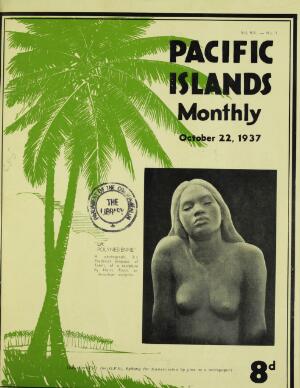
"LA
Polynesienne"
A photograph, by Frederick Simpson, of Tahiti, of a sculpture by Harry Rosin, an American sculptor.
Advertisements & other items, p. 2 (1 item)
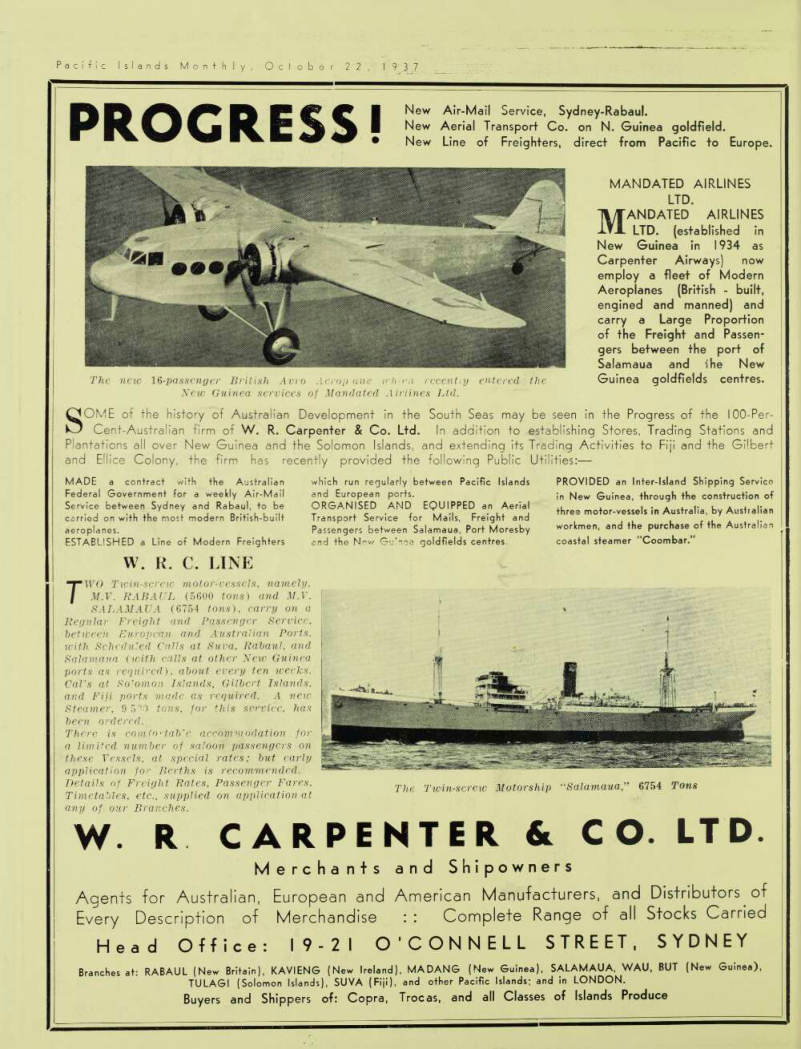
Progress!
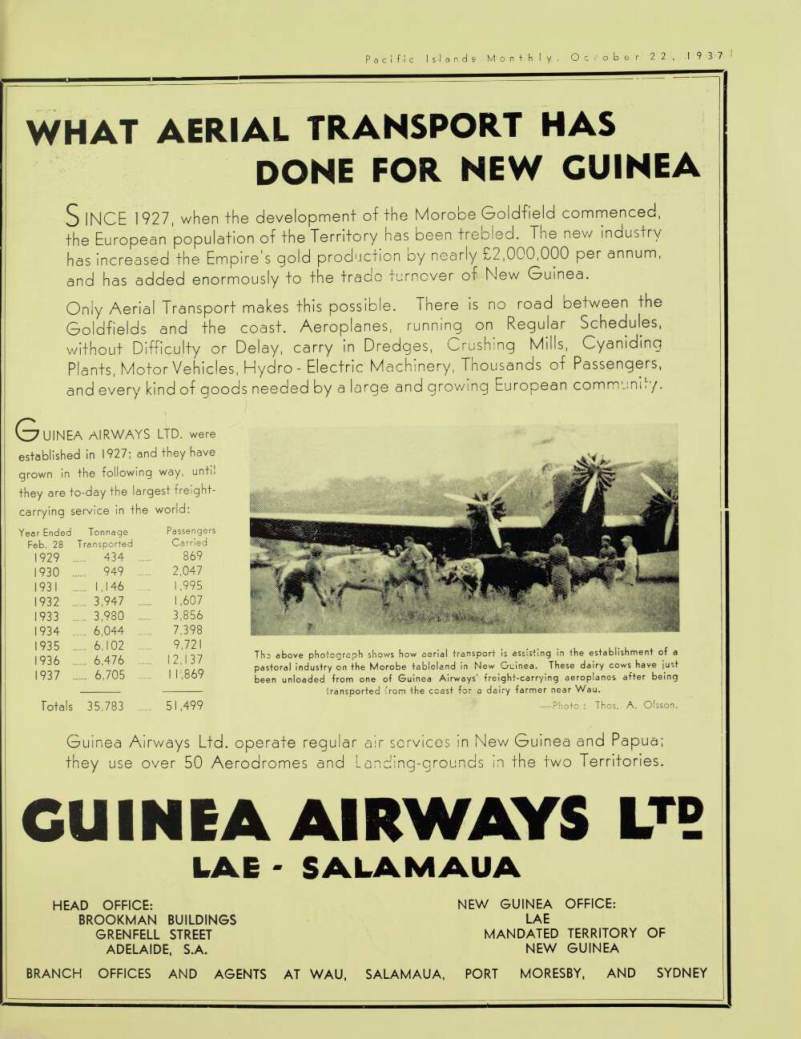
■ m ■ The new 16 -passenger British Avro Acrop une irh'-rh recently entered New Guinea services of Mandated Airlines Ltd.
New Air-Mail Service, Sydney-Rabaul.
New Aerial Transport Co. on N. Guinea goldfield.
New Line of Freighters, direct from Pacific to Europe.
MANDATED AIRLINES
LTD.
Mandated airlines
LTD. (established in New Guinea in 1934 as
Carpenter Airways) now
employ a fleet of Modern
Aeroplanes (British - built,
engined and manned) and
carry a Large Proportion
of the Freight and Passengers between the port of Salamaua and ihe New Guinea goldfields centres. the SOME of the history of Australian Development in the South Seas may be seen In the Progress of the 100-Per- Cent-Australian firm of W. R. Carpenter & Co. Ltd. In addition to establishing Stores, Trading Stations and Plantations all over New Guinea and the Solomon Islands, and extending its Trading Activities to Fiji and the Gilbert and Ellice Colony, the firm has recently provided the following Public Utilities:— PROVIDED an Inter-Island Shipping Service In New Guinea, through the construction ot MADE a contract with the Australian Federal Government for a weekly Air-Mail Service between Sydney and Rabaul, to be carried on with the most modern British-built aeroplanes.
ESTABLISHED a Line of Modern Freighters which run regularly between Pacific Islands and European ports.
ORGANISED AND EQUIPPED an Aerial
Transport Service for Mails, Freight and Passengers between Salamaua, Port Moresby and the New Guinea goldfields centres. three motor-vessels in Australia, by Australian workmen, and the purchase of the Australian coastal steamer "Coombar."
W. H. C. UNE
TWO Twin-screw motor-vessels, namely.
M.V. RABAUL (5600 tons) and M.V.
SALAMAUA (6754 tons), carry on a Regular Freight and Passenger Service, between European and Australian Ports, with Scheduled Calls at Suva, Rabaul, and Salamaua (with calls at other New Guinea ports as required), about every ten weeks.
CaPs at Solomon Islands, Gilbert Islands, and Fiji ports made as required. A neic Steamer. 9 tons, for this service, has been ordered.
There is comiO'tab"c accommodation for a limited number of saloon passengers on these Vessels, at special rates; but early application for Berths is recommended.
Details of Freight Rates, Passenger Fares, Timetables, etc., supplied on application at any of our Branches.
The Twin-screw Motorship “Salamaua” 6754 Tons
W. R CARPENTER & CO. LTD.
Merchants and Shipowners
Agents for Australian, European and American Manufacturers, and Distributors of Every Description of Merchandise : : Complete Range of all Stocks Carried
Head Office: 19-21 O'CONNELL STREET. SYDNEY
Branches at: RABAUL (New Britain), KAVIENG (New Ireland). MADANG (New Guinea). SALAMAUA, WAU, BUT (New Guinea).
TULAGI (Solomon Islands), SUVA (Fiji), and other Pacific Islands: and in LONDON.
Buyers and Shippers of: Copra, Trocas, and all Classes of Islands Produce
Pacific Islands Travellers
Passengers Per Maetsuycker Which
Arrived In Sydney From Papua And
N.G. PORTS ON SEPTEMBER 22: H. L. Brooke, Mr. and Mrs. M. Healy, H. Lindsay, J. Driver, A. R. Pechotsch, Mrs. Sparks, Rev. Father Meyer, Mr. Winand.
Passengers Per Montoro Which
Sailed From Sydney For New Guinea
And Papua On September 22: Messrs.
Arbogastus, Adams, Arnold, Beharrell, Brewster, Batze, Boreham, Crane, Collins, Croft, Chout, Drewe, Douglas, Doody, Dettman, Edwards, English, Farmer, Fraser, Fleming, Fletcher, Gimmer, Gerstad, Gregson, Henklemann, Huon, Harrison, Hagen, Griffin, Judd, Kerrins, Kinsey, Lee, Mclnnes, Meyer, Hogan, Meek, Marsland, Moss, Mackay, McLennan, Moline, Nagy, Norris, Oliver, Price, Rayner (2), Rae, Rich, Robinson, Scheabe, Skinner, Strain, Smith (2), Steele, Slat tery, Turner, Thornell, Thompson, Whittle, Watkin, White, Weston, Wheeler. Mesdames Atherton, Brewster, Batze, Boreham, Carey.
Dockrill, Dettmann, Einsiedal, Gazzard, Ham mond, Harrison, Hoath, Lee, Mackay, McLennan.
Norris, Reece, Reynolds, Reid, Rich, Schafer.
Sinclair, Shoppee, Steel, Thomson, Thornell, Taylor, Washington, Wilkins. Misses Arliss.
Blake, Beale, Cooper, Carey, Giess, Iredale, Ken
nedy. King, Lehman, Linn, Newman, Salas, Swanson, Simpson, Thompson, Wakeford. Rev.
Sisters Hermangardis and Adelaide.
Passengers Per Malaita Which Ar
RIVED IN SYDNEY FROM N.G. AND SOLO
Mon Islands Ports On September 24:
Messrs. Barton, Carlyon, Ellis, Flowers, Firmin, Flanigan, Guthrie, Graham, Grange, Gunther, Kohn, Higgs, Kidnie, Lees, Lukin, McDonald, Mortimer, Mugge, Rowland, Sapsford, Sandforo Shaw, Sim, Stehn, Stronge, Summerland, Temple (2), Thomson, Turnbull, Walker, Ward (2), White, Whitlock, Williams, Wilson, Kai Tak Wong. Mesdames Coote, Flowers, Kidnie, Mc- Donald, Mugge, Shaw, Sprott, Taylor, Roberts, White, Wilson. Misses Devir, Fitzgerald, Leckie, Love, McCorquodale, Mort, Pavey, * Sullivan, Williams, Sisters Veronica and Reine.
Passengers Per Morinda Which
Left Sydney For Lord Howe. Norfolk
IS., AND NEW HEBRIDES ON SEPT. 30: Messrs. Bland, Cotter, Forsyth, Hart. Kerrins, Kennewell, Legge, Nutman. Nobbs, O’Sullivan, Phillips (2), Pye, Reynolds, Robey, Welsh, White, Walton. Mesdames Barry, Bland, Cotter, Edwards, Ingram, Mackay, Miller, Nobbs, Pye, Ross, Skinner, Welsh. Misses Ashcroft, Atkinson, Beattie, Buffier, Forsyth, Fountain, Hodson,
Jones, Knowlman, Ketchen, Kelso, Laing, Levick, Manning, Muir, Miller, Mackey, Parker, Stewart (2), Swinson, Straker, Tucker, Turner, Wilson, Webb.
Passengers Per Aorangi Which
SAILED FROM SYDNEY FOR SUVA. FIJI, ON SEPTEMBER 30: L. R. Burnell, Miss Z. Bestowe, J. E. Baker, A. F. Carhill, R. M. Gumming, E. C. Goldie, A. N. Grayson, Miss M. I. Hum phries, Mr. and Mrs. J. C. Kenny, Miss E. H.
Mcllraith, Mrs. E. Newman, C. R. Roberts, Mr, and Mrs. M. L. Woodyatt, P. Hanna, T. A.
Morrison, Mr. Mortimer, J. Wilkins, W. B.
Martin.
Passengers Per Macdhui Which Ar
Rived In Sydney From New Guinea
AND PAPUA ON OCTOBER 1: Messrs. Ball.
Bell, Bilston, Coomber, Crowhurst, Douglas, Davies (2), Davis, Davidson, Finn, Goad, Gar rett, Gillespie, Geddes, Heading, Helander, De Hesselle, Hay, Hill, Jones (2), Keifer, Low, Lucas, Mason, McMurray, McDonald, McCulloch, Montgomery, Nicholas, Pike Rutledge, Rowe, Smith, Shutt, Scott, Tudor, Vickery, Wynne, Whistler. Webb, Wunsch, Rev. Taylor, Drs. Mainl and Pockley.-Mesdames Brown, Bowring, Brough ton, Coomber, Florance, Godson, Glandville, Garland, Griffiths, Geddes, Hailes, Irwin, Jenner, Marr, Martin, Nicholas, Owers, Pickworth, Pearce, Rutledge, Robertson, Taylor, Vickery, Wood. Misses Allan, Caswell, Clarke, Everett, Frewin, Greaves, Hurd, Macchia, Macgregor,
Stokes.
(Continued On Page 84)
(Continued From Page Iii.)
Passengers Per Malaita Which
Sailed From Sydney For Solomon Is.
AND N.G. PORTS ON OCTOBER 2: Messrs.
Atkinson, Bengough, Corbett, Chalmers, Crook, Cottrell-Dormer, Day. Fearon, Freshwater, Firth, Leirstein, Neilly, O’Brien, Swinbourne, Sharp, Small, Turner, Dr. Jensen. Mesdames Corbett, Ferris. Finkle, Field, Hanley, Murphy, Moore, Rutter, Ring, Small, Turner. Misses Bourke, Dowling, Denvir, Frost, Field, Fitzgerald, Mason, Nethercott, Rutter, White.
Passengers Per Macdhui Which
Sailed From Sydney For Papua And
NEW GUINEA ON OCTOBER 7 : Messrs. Antill, Brogan, Butler, Brydes, Calow, Chance, Craig, Daniells, Davies, Dobbin, De Harrell, Ewing, Ethell, Frederick, Fienberg, Furley, Granger, Glasson, Hosking, Harrison, Jones, Johnson, Kenyon, Kienzle, Levien, Lumley, Large, Murray, Merrin, Moore, Mclntyre, Nicholson, Nicholls, Newton-Scott, Ormsby, Osborne, Peacock, Purves, Peacock, Rees, Ross, Rutledge, Round, Sly, Smith, Stanley, Shay, Smith (2), Verey, Walton, Watson, Wurth, Wagner, Warburton, Wright, Weatherburn, White, Webb, Wallin, Watson, Dr. Bevington, Captain Steele, Revs.
Vogt and Van Lamsweerde. Mesdames Ashton, Bousche, Bevington, Bowman, Cooper, Ellis, Frederick, Hosking, Jones, Mitchell, Murray (2).
Ogg, Preston, Roubley, Steele, Stewart, Vernon.
Misses Bunting, Cooper, Frew n. Head, McGregor, O’GTady, Preston, Robson, Reeves.
Passengers Per Neptuna Which
SAILED FROM SYDNEY FOR N.G. PORTS ON OCTOBER 9: Messrs. Abbie, Eagles, English, Gamble, Huxley, Higgs, McJ'aTerty, Moy, Mc- William, Proud, Piper (2), Parker, Scherp, Skelly, Torrington. Mesdames Adams, Bellamy, Collins, Cameron, Clark, Gee, Lees, Morgan, Quinton, Vial. Misses Bran and Wilde.
Advertisements & other items, p. 3 (1 item)
your way to AUSTRALIA.
0
SEE
a i * CO Saigon Diethelm & Co. Port Moresby and Samarai. Steamships trading Co. Ltd; Rabaul, W, R Carpenter & Co Ltd; Port Vila Gubbay Freres; Noumea. Carlo Leoni; Auckland. Russell & Somers Ltd; Wellington, Johnston & Co ltd
your way to AUSTRALIA.
On your way to Australia visit Auclc land and Wellington ... or plan a more leisurely stay visiting the scenic wonders of New Zealand . . . magnificent fjords . . . wild, icecapped mountains . . . hot springs and spouting geysers.
Sail by the splendid new motor vessel Maetsuycker or the wellknown steamer Van Rees.
HP M.
These fast K.P.M. vessels maintain e regular monthly schedule from South Pacific Island ports; provide new direct travel facilities to New Zealand of exceptional comfort at economical fa res.
Details of sailings from your local agent.
S.S. VAN REES
M.V. MAETSUYCKER
OUTH PACIFIC LINE
Royal Packet Navigation Co. ltd. Pahetvaan Rouse. 255 George Street, Sydney. (N.V. Komnklijke Paketvaart Maatschappij—lncorporated In the Netherlands)
Advertisers
Amalgamated Wire less of Aust. Ltd 79 Anderson, G. A 46 Angus & Coote Ltd 23 Arkins’ Mandolin Course 18 Arnott’s Biscuits 34 “Aspro” 8 “Ausoline” 50 Aust. Nat., Travel Association 25 Austral Stamps 16
B.A.L.M. Ltd 70
Bank of N.S.W 80 Berger & Sons Ltd. 68 Blau (Aust.) Robert 64 Booth & Manning ... 76 Brown & Co Ltd _. 10 Brandt & Steele 16 Broomfields Ltd 54 "Broughton” School 82 Brunton’s Flour 32 Budge Ltd, James ... 48 Bullivants Ltd 83 Burns, Philp & Co. iv.
Burns, Philp & Co. 26
B.P. (S.S.) Co 48
Buzacott Pty Ltd 55 Carpenter, W. R.
Limited iL Chapman & Sherack 7,1 Chivers & Sons Ltd 33 Clyde Engineering Co Ltd 59 Coleman Lamp Co 14 Coral Starch 35 Cosmopolitan Hotel 84 Crossle, Duff and Macintosh Ltd 77 “Cystex” - 60 Del Cott Pty Ltd 69 Dewar’s Whisky . 66 Doan’s Pills 78 Dobell & Co Ltd 13 Docke, Carl Aug. 36 Donald, A. B. Ltd 60 Dunne, H. F. S. 19 Eaton Ltd. J. W 49 Electrolytic Co Ltd 77
Electrolux Refriger ators 12 Fairbanks - Morse Limited 81 “Fairholm” College 26 Finau, Wm 10 Fletcher & Sons 43 Ford Sherington Ltd 30 Ford, W. M 54 Fowler, S 75 “44 Macleay Street” 17 Foster Clark (Aust) Limited 22 Fryer, A. C 83 Garden Vale Pro ducts Ltd 35 Garrett & David on 78 Giilespie’s Flour ... 60 Grand Pacific Hotel 63 Grove & Sons W. H. 24 Guinea Airways Ltd vii Hallstroms Pty 32 Halvorsen Sons Ltd-73 Hannan Bros IS Hardie & Co Ltd. J. 49 Holbrook’s Ltd .. 39 Horlicks Malted Milk - 15 Horne. W, & Co 62 Hotel Moresby 84
1.C.1.A.N.Y. Ltd 52
Jones & Co Ltd, H. 37 “Kambala” School ... 41 Kodak Pty Ltd 11 Kopsen & Co Ltd ... 72 Kork-N-Seal Ltd 33 Lane & Girvan Ltd 51 Levenson’s Radio ... 74 Lloyd & Co Pty Ltd 8 Lustre Ltd 65 McGowan & Co, A. 63 Mcllrath’s Ltd 28 McKay’s Bookstall ... 18 Maleham & Yeomans Limited 69 Master Sewing Machine Co 58 Maxwell Porter Ltd 49
Miller & Co Pty Ltd 70 Modern Food Pro ducts 61 Morris, Hedstrom Limited - 62
N.D.L 83
Nelson & Robertson Pty Ltd - 21. 76 Nestle’s Milk 40 Newland Bros. Ltd 42 New Zealand Distri butors Ltd 56 Nordman, Oscar G. 21 Noyes Bros Ltd 75 Orchards Pty Ltd ... 67 Oxymel Oil and Paint Co Ltd „ 44 Olsson, T. A 66 Pabst Canned Beer 22 Pacific Islands Club 82 Page. S. B 62
Papua Hotel, The ... 84 Ph latelic Investment Trust ...__ 13 Pike Bros Ltd 84 Prescott Ltd 38 Price’s Radio Serv. 24 Prouds Ltd 17 Ransomes Sims and Jefferies Ltd 61 Reed. William E 36 Reid. W. M ... 43, 51 Return Thanks 9 Riverstone Meat Co Limited 29 Rohu, Sil 24 Royal Packet Co iii Ruston & Hornsby 57 St. Ignatius College 27 Scott’s Emulsion 16 Scott Ltd, J 54 Scott & Sons 61
Shell Oil Co Ltd 47 Sinclair Ltd, C. 20, 50, 56 Smyth Ltd, J. H. ... 30 Springwood L. Coll. 65 Stanley, Chris 37 Stanley & Co 34 Stead & Baker 58 Steamships Trg. Co 39 Sterling Varnish Co 7 Sullivan Ltd. C 21 Sullivan Ltd, J. J. 82 Swallow & Ariell ... 38 Talkeries 8 Taylor & Co, A 56 “Tenax” Soap 9 Tilley Lamp Co 45 Tillock & Co Ltd ... 37 Tooheys Ltd 19 “Top Dog” Men’s Wear 13
Tooth & Co viii Trufood 64 Vacuum Oil Co Ltd 31 Vincent’s A.P.C 65 “Walkabout” 53 Wanted 77 Warburton Franki Limited 20 Watson, Victor Ltd 9 West, Harry 72 Weymark & Son 33 Wills, W. D. and H. O. Ltd 52 Williams & Gosling Limited 7 6 Williams Ltd, S 44 Wright & Co 68 Wright &Co Ltd. E. 50 Wunderlich Ltd 51 Yorkshire Insurance Co Ltd 71
Contents
Pacific Islands Travellers iii “Get Busy or Get Out!”—Australia and New Guinea v N.G. Eruption Damage 1 Fiji’s Trade Increases 1 Copra Market Prospects 2 New Base in Unknown Papua 3 Dispute Over Fiji Council Precedence 4 Jack Hides Returns to Sydney 4 Southwards Thrust of Japan 5 After-Effects of Rabaul Eruption 5 B. Rabaul Store Burned 5 Secret Agreement Which Governs South Pacific Air-mail Service 6 About Islands People 9 C. Fruit Industry 10 Samoan Mau Influence Waning 11 N.G. Air-mail Contracts 15 Japan Busy in Her Islands 18
N.G.’s Chinese Problem 20 Sydney-N.G. Air-mail Delayed 24 Problem of the Half-Caste 26 Malden Island To-day 30 Shipping Freight Rates Rise 32 Disaster of the Sarah-Ann 34 A Royal Visit to Tonga 36 Corsican Castaway in Papua 42 German Administration in N.G. 48, 56 Tom Harrisson in New Hebrides 50 Tragedy of the Marquesans 52 Death of David Lyall 58 Fashion Hints for Islands Women ... 65 Matson Interests in Hawaii 71 Pacific Radio Programmes 75 Islands Mining News 76 Produce and Exchange Rates 79 Market Quotations 80 Shipping Services in South Seas 81
Advertisements & other items, p. 4 (1 item)
Burns, Philp & Co. Ltd.
GENERAL
MERCHANTS
ill!
Hill mmm um m 111
ill I
mi HffSS'S HI 1(1
ill
ill
fli
n
SHIPOWNERS
TOURIST AGENTS
Head Office: 7 Bridge Street, Sydney—Australia Code Address: "Burphil"
BUYERS OF ALL CLASSES OF ISLAND PRODUCE Regular Steamer Services from Australia to New Guinea Papua Solomon Is.—Lord Howe Is. —Norfolk Is. —New Hebrides —lava and Singapore
Pacific Islands Monthly
The Newspaper-Magazine of the South Seas
[Registered at the G.P.0., Sydney, for transmission hy post as a newspaper. J Published Once Each Month and Circulated in Australia and New Zealand and in the following Pacific Territories and Islands Groups:
Crown Colony of Fiji.
Australian Territory of Papua.
Mandated Territory (Australia) of New Guinea, Bismarck Archipelago and Northern Solomon Islands.
Mandated Territory (Japan) of Marshall, Caroline and Marianna Islands.
French Territory of New Caledonia.
British and French Condominium of New Hebrides.
American Territory of Eastern Samoa.
American Territory of Guam.
Mandated Territory of Nauru.
British Crown Colony of Gilbert and Ellice Islands.
Mandated Territory (New Zealand) of Samoa.
British Solomon Islands Protectorate.
British Protectorate of Tongan Islands.
New Zealand Territory of Cook Islands.
Australian Territory of Norfolk Island.
French Colony of Oceania (Tahiti, etc,).
American Territory of Hawaiian Islands.
Owned and Produced by Pacific Publications Pty. Ltd., Union House, 247 George Street, Sydney.
Telephone Bw 5037
P.O. Box 8408 R
Registered Address of Telegrams, Radiograms, and Cables: “Pacimb,” Sydney.
Contributions
Articles, Stories, and Photographs dealing with Pacific Islands subjects are invited, and will be paid for on publication at usual rates.
Subscription Rates
Per Annum, within British Empire, Prepaid, Post Free 8/- Per Annum, elsewhere, prepaid. Post Free 107- Single Copies .-. Bd.
Editor and Publisher:
R. W. Robson, F.R.G.S.
Advertisements
Advertising rates furnished on application.
Colours, etc. by Arrangement Process Blocks made at Advertiser’s expense when required. Screen, 100.
Changes of Advertising Copy should reach this Office by Bth of each month, otherwise previous advertisement may be repeated.
Agents
The following are authorised to receive subscrip tions for the Pacific Islands Monthly;— Islands Branches of Burns, Philp & Co. Ltd., and Burns Philp (South Sea) Co., Ltd.
Islands Branches of W. R. Carpenter & Co., Ltd.
All Branches of Morris, Hedstrom & Co., Ltd.
G. Thomas & Co., Rabaul, New Guinea.
T. A. Olsson, Wau, New Guinea.
Whitten Bros., Ltd., Samarai, Papua.
Steamships Trading Co., Papua. All Branches.
P. Costello. Suva, Fiji.
J. Muir, Suva, Fiji.
All Branches and Representatives of W. H. Grove and Sons, Ltd., Auckland, New Zealand.
Cook Islands Trading Co., Rarotonga, Cook Is.
A. C. Rowland, Papeete, Tahiti.
Representative in London: W. C. HARVEY, Coronation Building, 4 Lloyds Avenue, London, E.C.2. from whom may be obtained copies of Pacific Islands Monthly, Pacific Islands Year Book, advertising schedules, etc.
Vol. VIII., No. 3.
Sydney, October 22, 1937.
p n ‘/>p ( 8d - Pei 1 llce ( Prepaid: 8/- p.a.
"Get Busy or Get Out!" - Australia and New Guinea
New Guinea
TF Australia, before long, is not involved in international trouble over New Guinea, she deserves to be. Three of the world’s greatest powers are clamouring aggressively for colonies, and forcing the other three great powers to arm to the teeth, so as to defend their territories.
The holding of occupiable country can be justified, nowadays, only if that coun try is being occupied and developed for human needs.
Australia sits on top of one of the world’s richest and most desirable new territories—New Guinea—and does little more than twiddle her thumbs. She has, on the mainland of New Guinea, the opportunity to open up an attractive country to European occupation, and the personnel and the machinery and the money with which to do it. But, because these things are in charge of -politicians and politicians’ nominees, nothing is done. It cannot go on much longer.
The Mandated Territory of New Guinea, when taken over by Australia, was merely a group of very large, coconut-growing islands, with an unknown and undevel oped mainland, along the coasts of which a few coconut plantations were scattered.
The kind of administration needed by
such a primitive country and small white population was established; and to-day, in all matters of policy, it thinks very muck along the lines that it did in 1921.
Australia, apparently, sees nothing un usual or providential in the fact that, since 1921, a flourishing gold industry has been established in the interior of the mainland; that that industry, through gold royalties, customs duties, license fees, etc., provides undreamed-of revenues for developmental activities; and that, north-west of those Morobe goldfields, there has been discovered a vast region of cool and fertile uplands and river systems, eminently suitable for occupation and development. Why cannot the fortuitous gold industry be used to opei up and develop the tablelands country?
The discovery of the Centra 1 New Guinea plateau, in 1932-33, passed almost unnoticed in Australia. Yet there thus was brought to our knowledge one of the most attractive regions within the world’s tropical territories. Australian indifference towards it is tragic and, in an international sense, criminal.
This new country lies, roughly, be tween the New Guinea-Papua border and
the mountain ranges which parallel the northern New Guinea coast. It runs from the Markham Valley, behind Lae, for hundreds of miles north-westward, into the headwaters of the Fly and Sepik Rivers, near the Dutch frontier. Within it, are three great river systems the Markham (which flows south-east into Huon gulf) ; the Ramu (flows north-west to the coast near Madang); and the Pu rari (which, in some still unknown way, finds a track through the central moun tain ranges and flows south into the Gulf of Papua).
This region, apparently, is a crazy quilt of grassy downs, innumerable large and small rivers, patches of splendid forest, mountain-peaks running up to ever lasting snow, valleys like beautiful parks tucked away in the folds of the ranges.
Most of it, apart from the frequent moun tains, lies at an average altitude of 5,000 feet—which, although it is only a few degrees from the equator, means that it has an equable climate.
I have talked to many men who have been to the Ramu, Wahgi, Chimbu, and Mount Hagen stations—prospectors, gov ernment officials, air-pilots—and all say, usually with enthusiasm, that it is “a white man’s country,” with immense possibilities.
The Morobe district, wherein are the goldfields, is broken and mountainous, incapable of much agricultural develop
ment. Yet it is proposed to build a road in from Salamaua to Wau.
Why cannot some far-visioned bureau crat —if there is one! —consider, instead, a road from Lae up the Markham Valley, across the Ramu —Purari tableland, and sc- on to Madang; with a side-road up the Wampit or Watut Valley into the Bulolo?
This, of course, would be a longer route than Salamaua —Wau, but it is needed only for slow, heavy, cheap traffic. Aero planes always will provide the important transport in this part of New Guinea.
Co-operation with the strongly-established and highly-efficient aerial transport com panies might be, in fact, the first prin ciple in any policy for the development of the Central New Guinea Tableland.
The opening-up of the Central Table lands, via the Markham and the Ramu. would not be expensive. General Wisdom,
with vision for which he was not given credit at the time, easily built 30 miles of highway, from Lae, up the Markham -T-the first step in a great plan. But Canberra was indifferent. Wisdom is gone, nepotism dominates New Guinea af fairs, and the road, these many years, has been given over to disrepair and jungle growth.* Various people in Australia, babbling in ignorance, declare that Australia’s re cord in New Guinea is good, and they quote statistics to show increased settle ment, increased trade, increased develop ment, etc. This is merely the rubbish talked by politicians. Actually, if we sub tract from N.G. statistics the figures for which the gold industry is directly and indirectly responsible, the result is lamentable and discreditable. The development and growth that have taken place in New Guinea are directly due to the initiative and enterprise of the prospector-pioneers, and of the gold min ers and gold companies and trading com panies which followed them. One may search the official records of this terri tory for the last two decades and find very little to justify the claim by the Administration that it has done anything worth noticing, of its own volition, to encourage the settlement and develop ment of the Territory. For the most part it has sat complacently in its office chairs? and seized gratefully upon the revenues brought by the gold companies and com mercial firms to its doors without any apparent effort on its part.
If the Administration had had any developmental policy worthy of the name it by now would have had something to show for those providential revenues— something to take the place of the gold
industry, when it peters out (as it must) ir. another 20 years. But—as the Treas urer’s statement presented at the Legis lative Council in Rabaul last month shows only too clearly—those revenues are being treated as natural and normal, and used mostly to expand the Admini strative establishment and make it more comfortable. “Public works” have been carried out—roads, ’ bridges, aerodromes, wharves—but there is not one sign of anything being done, other than would be done by an unimaginative parish-pump politician in Australia. Most of the new public works are in and about Morobe.
What is being planned to protect that asset—to keep those public utilities in use after the goldfields are finished?
What will happen then to, maybe, £lOO,OOO worth of administrative mach inery (buildings, roads, wharves, aero dromes, etc.)?
The Administration regards New Guinea as it did in 1921 —it seems incapable of producing a policy to meet the new conditions. The carefully-selected men of its district services—splendid material here!—are trotting around in well-worn tracks, which lead practically nowhere.
The team of experts in the department of agriculture, led by an officer of wide experience, seem to be engaged mostly on routine duties—instead of being em ployed, as they should be, in collabora tion with district services and public works, as the spearhead of an advance upon new country and new agricultural enterprises. The truth is that the rank and file of the public services wait, as they must, for instruction and inspira tion from Rabaul: and Rabaul apparent y lives on the formulae and in the tradi tions of 1921.
It is common knowledge that New Guinea can produce, in addition to copra, such crops as coffee, cocoa, rubber, tea, equal to anything in the world. It has the soil, the climate, the labour, the market—and now it has, on the Central Tableland, a region healthy for white planters, and their women and children.
A policy to embrace these things would have both political and economic value— it would justify Australia’s hold on New Guinea, and establish new industries to itake the place of the gold industry, and so employ the considerable administrat ive machinery created in connection with the gold industry.
It will be said, of course, that native rights and interests must take preced ence over ail considerations of new settlement. That argument can be ignored.
Statistics and expert evidence will show that, on the Central Tablelands, as in New Guinea generally, there is plenty of land for new settlement, after all pos sible native needs have been liberally provided for.
This is no new subject. Again and again, in recent years, attention has been drawn to Rabaul’s policy of laissez-faire ; but Rabaul sheltered complacently be hind Canberra. Now, bigger forces are at work—Australia, so far as New Guinea is concerned, may be told by a world
court to get busy or get out.
R.W.R.
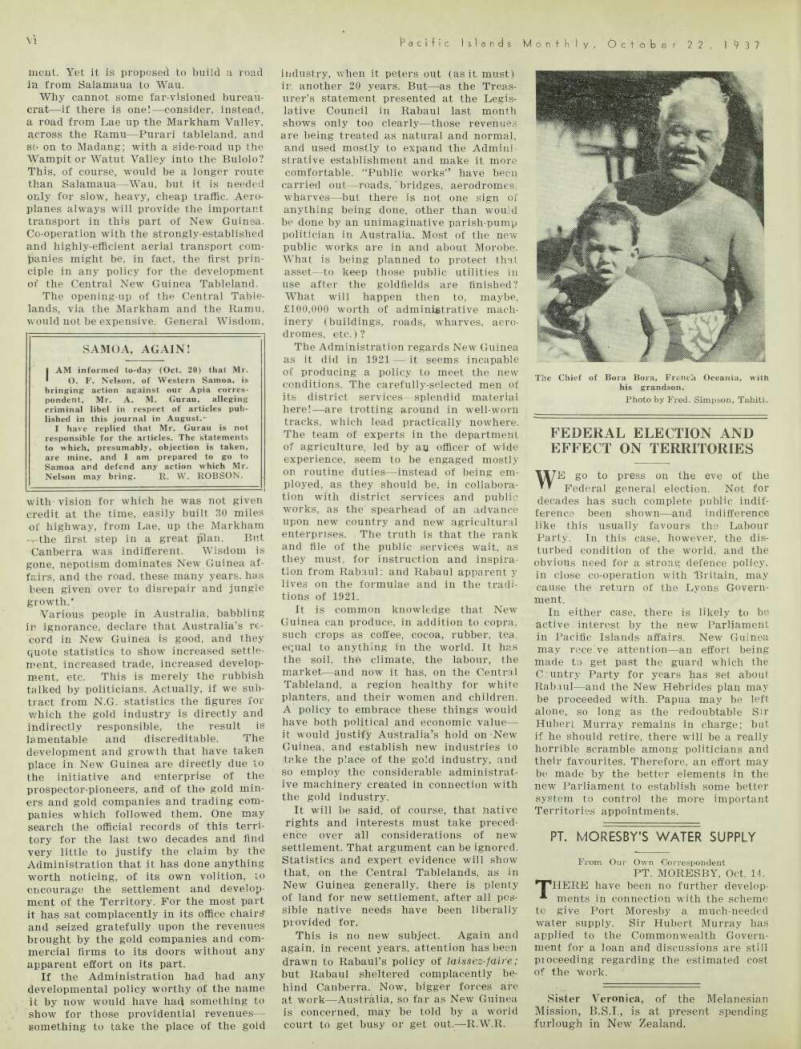
The Chief of Bora Bora, French Oceania, with his grandson.
Photo by Fred. Simpson, Tahiti.
Samoa, Again!
I AM informed to-day (Oct. 20) that Mr. * O. F. Nelson, of Western Samoa, is bringing action against our Apia corres pondent, Mr. A. M. Gurau, alleging criminal libel in respect of articles pub lished in this journal in August.- I have replied that Mr. Gurau is not responsible for the articles. The statements to which, presumably, objection is taken, are mine, and I am prepared to go to Samoa and defend any action which Mr.
Nelson may bring.
R. W. Robson.
Federal Election And
Effect On Territories
YI7E go to press on the eve of the ** Federal general election. Not for decades has such complete public indif ference been shown—and indifference like this usually favours the Labour Party. In this case, however, the dis turbed condition of the world, and the obvious need for a strong defence policy, in close co-operation with Britain, may cause the return of the Lyons Govern ment.
In either case, there is likely to be active interest by the new Parliament in Pacific Islands affairs. New Guinea may receive attention —an effort being made to get past the guard which the Country Party for years has set about Rabaul—and the New Hebrides plan may be proceeded with. Papua may be left alone, so long as the redoubtable Sir Hubert Murray remains in charge; but if he should retire, there will be a really horrible scramble among politicians and their favourites. Therefore, an effort may be made by the better elements in the new Parliament to establish some better system to control the more important Territories appointments.
Pt. Moresby's Water Supply
From Our Own Correspondent
Pt. Moresby, Oct. 14.
TTHERE have been no further develop * ments in connection with the scheme to give Port Moresby a much-needed water supply. Sir Hubert Murray has applied to the Commonwealth Govern ment for a loan and discussions are still pioceeding regarding the estimated cost of the work.
Sister Veronica, of the Melanesian
Mission, 8.5.1., is at present spending
furlough in New Zealand.
Cost Apparently £40,000
Eruption Damage
*"PHE Rabaul eruption knocked holes, in the New Guinea Government’s sur plus.
The financial year 1936-37, opened with £40,954 surplus, and should have closed with £61,907. But the outburst on May 28 altered all that. Nominally, the surplus will be shown, and the cost of the erup tion repairs carried on into the 1937-38 period. But, actually, about half the surplus has gone up in the smoke of Mt. Vulcan and Mt. Matupi.
The Treasurer (Mr. H. O. Townsend) told the Legislative Council in Rabaul last month that expenditure on eruption damage paid in the Territory, to August 24, was £13,880; that the Commonwealth Government had paid sums (for stores, hire of ships, etc.,) totalling £12,832; and that probably another £14,000 would be wanted to complete the clearing of Rabaul. That makes £40,000; but there is some hope that the Commonwealth Government will make a grant of £lO,OOO —a proper thing, in the unfortunate cir cumstances.
Mandarin Dialect
For Chinese Pacific Schools
From Our Own Correspondent
Papeete. Oct. 2.
A RRANGEMENTS have been made for instruction of children and adults in the Mandarin dialect of the Chinese language at the Chinese schools on Tahiti.
The Nanking Government, recognising the necessity of a common speech if the united of China is to be accomplished, has selected the Mandarin dialect for that purpose.
The Chinese of French Oceania are mainly from Southern China and use the Cantonese and kindred dialects. As the Chinese ideographs have the same signi ficance in all dialects, the change from their native speech to Mandarin will pre sent no difficulties to those who have acquired knowledge of Chinese writing, so far as correspondence and record keeping are concerned.
359,000 Pennies Disappear
New Guinea Mints Another Supply
New Guinea, last year, issued ** its own coinage, it put into circula tion 2.552.000 shillings. 101,400 sixpences, 110.000 threepences and 359,520 pennies— a total face value of over £130.000.
In a short time, all the pennies dis appeared. They had a special value, be cause they were one of the few coins issued which carried a reference to “King Edward VIII,” and they have been either sold to collectors or are “salted away.”
New Guinea is now minting a new supply of pennies, which will refer to “King George VI.”
Radiophone to Sydney
Rabaul Can Now Have Radiophone to Sydney
TT’HE radio-telephone service between * Sydney and Rabaul was inaugurated at 11.25 a.m. on October 18, with a con versation between the editor of the Pacific Islands Monthly, in Sydney, and Mr. J. Hoogerwerth, editor of the Rabaul Times, in Rabaul.
The service was excellent and the con versation as clear as if it were purely a local call.
The service will be available between 11 a.m. and noon on week days. The cost is 15/- per minute, with a minimum of three minutes. We are informed that there is a good deal of traffic available already for the service.
Marist Missionaries
From 7 to 2,000 In Century
TPHE arrival of the first band of Marist * missionaries in the Pacific Islands 100 years ago will be celebrated with festivities in November.
From the little islands of Wallis and Futuna, surrounded by coral reefs, the missionaries went later to Samoa, Fiji, and the Friendly Islands, and to-day they are in charge of the vicariate apostolic of the South Solomons, Fiji, Samoa, Tonga, the New Hebrides, and the prefecture apostolic of the North Solomons, Wallis and Futuna were made a separate vicariate apostolic in 1934.
From seven missionaries in 1837, the Marists in the South Seas now number 176 priests, 168 seminarists, -112 lay brothers, 490 sisters, and 1,470 catechists.
Mr. William Mcßae, who was manager of the Bank of N.S.W., and a member of
the Legislative Council in Suva, Fiji,
many years ago, died in Sydney on October 6, aged 74.
Fiji’S Trade
£250,000 Increase In Half-Year
From Our Own Correspondent.
Suva, Oct. 1.
TPUE total trade for the first half of * 1937 considerably exceeded that of 1936. Imports increased by £127,000 and exports by £124,000. Details:
1936 1937 Imports £710,595 £837.597 Exports £603.673 £727.615 Total £1,314,268 £1,565,212
Exports
In Detail
1936 1937 Susrar (tons) 28,010 29,479 £265,724 £301.225 Copra (tons) 14,591 14,945 £165,624 £235,157 Bananas (bunches) 10,165 8,956 (cases) 84,996 71,052 £47,417 £32,848 Molasses (tons) 8,395 7,843 £8,395 £7,843 Gold (ozs.) 7,524 8,609 £57,972 £67,266 Trochus shell (tons) 127 101 £9,638 £8,954 Other Articles £48,803 £74,322
What Is True Value Of
Islands Gold Shares?
'THK prices of several Islands gold shares are at absurdly low levels.
The usual table, printed on page 76, shows that stocks, almost without excep tion, have been marked down heavily.
There is no reason for this, except “nerves.”
If the world-price of gold is not going to fall, an investor can substantially in crease his capital by buying almost any of the leading gold shares of New Guinea, Papua, or Fiji.
The price of gold is, of course, difficult to foresee. Since it has not fal 1 on under the influence of recent events, however, it should hold up in the future. Experts say that the halving of the external value of the French franc, and the consequent doubling of the price of gold in France, should hold up the world’s gold quotation indefinitely.
Fanning Island Ruins
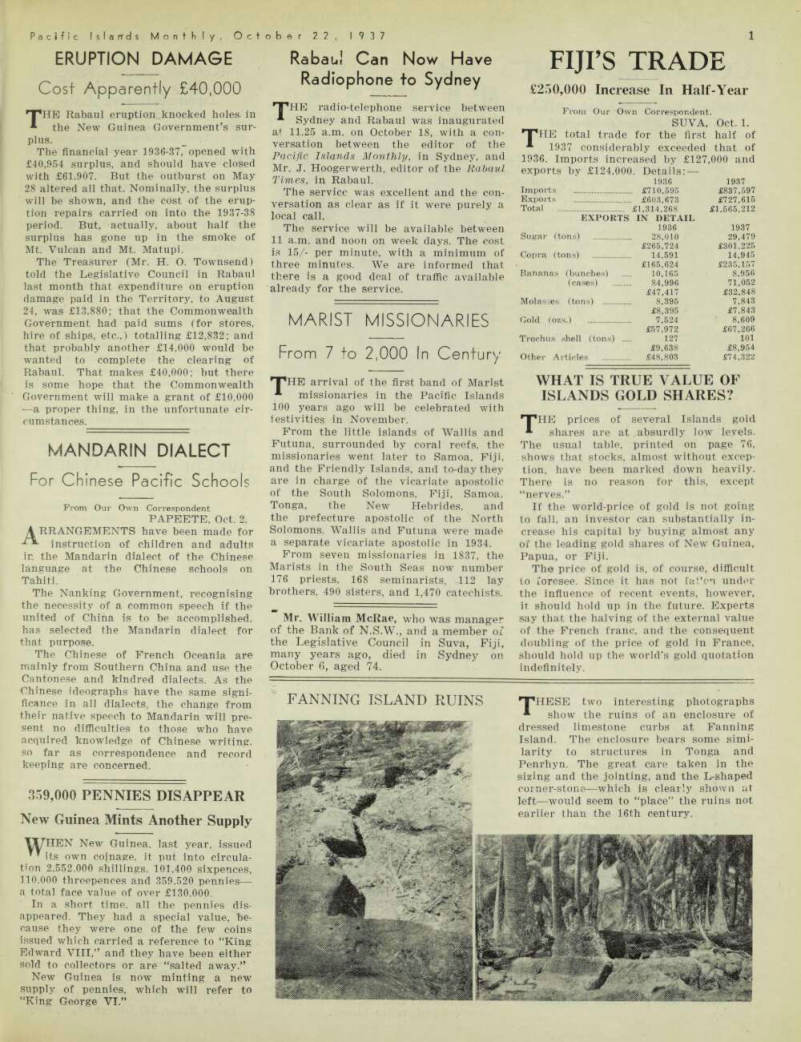
two interesting photographs * show the ruins of an enclosure of dressed limestone curbs at Fanning Island. The enclosure bears some simi larity to structures in Tonga and Penrhyn. The great care taken in the sizing and the jointing, and the L-shaped corner-stone —which is clearly shown at left —would seem to “place” the ruins not earlier than the 16th century.
Advertisements & other items, p. 7 (1 item)
1
Pacific Islarfds Monthly, October 22, 1937
Copra Market
American Buying Reduced Heavy Catch of Whale Oil Expected
HTHE following paragraphs from Messrs. Faure & Go’s monthly report on the oil and fat markets, published in London on September 14, have a direct bearing upon the copra market: We closed our previous Review with the remarks that the outlook remains un certain and markets are likely to fluc tuate in accordance with crop reports.
As a result of the various crop reports received during the past four weeks, we have come to the conclusion that we can no longer expect the United States to import large quantities of vegetable oils, and consequently the outlook, though still verv uncertain nolitically. seems to be for lower levels. The hoped for trade recovery in the late summer or in the autumn is no longer expected with the same confidence.
The principal development since our last Review has been the American Cot ton Bureau Report, which estimates the yield of cotton at half a million bales more than a month ago, with a cor responding increase in the production of cotton seed oil.
The American imports of oilseeds, in cluding copra and palm kernels, during the first half of this vear, show a reduc tion of about 50,000 tons, compared with the first half of 1936, after excluding th« linseed imports. The total imports of all oils and fats, however, at 494,000 short tons, show an increase of 65,000 tons over the first half of 1936.
It looks as if the serious shortage in lard, which had been anticipated for the latter part of this year and earlv next year, will not be so severe after all.
This year’s large corn crop will result in heavy breeding of hogs during the autumn.
The whale oil situation is causing some concern. The agreement entered into earlier this year between the various countries has not vet been ratified. We understand that Japan, who was not a nartv to the whaling agreement, is send ing out four expeditions to the Antarctic this season. Germany will aUo enter the field with two new floating factories.
Against this, it is reported that British and Norwegian Companies will be using six floating factories, with a total capacity of 500,000 barrels, for tank chartering instead of for whaling. The unsold portion of the last whale oil catch is still reported to be fairly con siderable.
That ends the Faure report, which deaU mostly with facts and statistics.
Against its implications, it mav be pointed out that the world, month by month, is increasing its consumption of all commodities. So long as there is no general disturbance, such as a world war, this should continue, and help to main tain copra prices at or near their present level.
Back To New Guinea
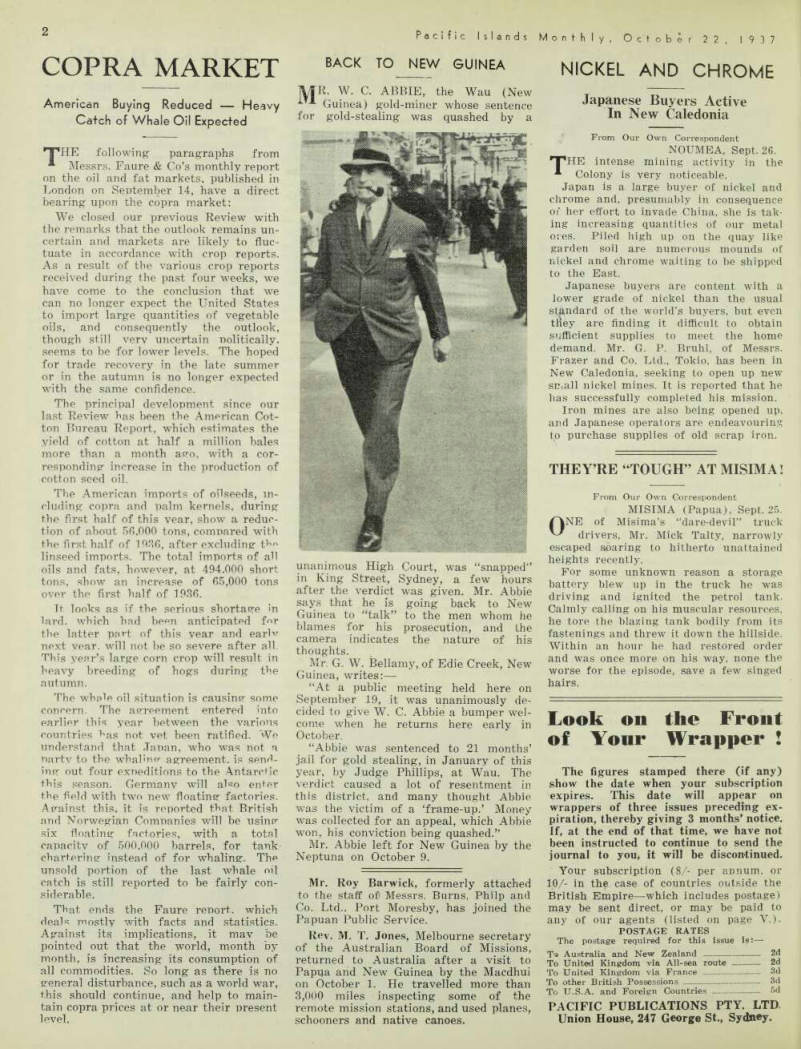
IVTR. W. C. ABBIE, the Wau (New Guinea) gold-miner whose sentence for gold-stealing was quashed by a
unanimous High Court, was “snapped” in King Street, Sydney, a few hours after the verdict was given. Mr. Abbie says that he is going back to New Guinea to “talk” to the men whom he blames for his prosecution, and the camera indicates the nature of his thoughts.
Mr. G. W. Bellamy, of Edie Creek, New Guinea, writes:— “At a public meeting held here on September 19, it was unanimously de cided to give W. C. Abbie a bumper wel come when he returns here early in October.
“Abbie was sentenced to 21 months’ jail for gold stealing, in January of this year, by Judge Phillips, at Wau. The verdict caused a lot of resentment in this district, and many thought Abbie was the victim of a ‘frame-up.’ Money was collected for an appeal, which Abbie won, his conviction being quashed.”
Mr. Abbie left for New Guinea by the Neptuna on October 9.
Mr. Roy Barwick, formerly attached to the staff of Messrs. Burns, Philp and Co. Ltd., Port Moresby, has joined the Papuan Public Service.
Rev. M. T. Jones, Melbourne secretary of the Australian Board of Missions, returned to Australia after a visit to Papua and New Guinea by the Macdhui on October 1. He travelled more than 3,000 miles inspecting some of the remote mission stations, and used planes, schooners and native canoes.
Nickel And Chrome
Japanese Buyers Active In New Caledonia
From Our Own Correspondent
Noumea, Sept. 26.
I "PHE intense mining activity in the * Colony is very noticeable.
Japan is a large buyer of nickel and chrome and, presumably in consequence of her effort to invade China, she is tak ing increasing quantities of our metal ores. Piled high up on the quay like garden soil are numerous mounds of nickel and chrome waiting to be shipped to the East.
Japanese buyers are content with a lower grade of nickel than the usual standard of the world’s buyers, but even tlley are finding it difficult to obtain sufficient supplies to meet the home demand. Mr. G. P. Bruhl, of Messrs.
Frazer and Co. Ltd., Tokio, has been in New Caledonia, seeking to open up new small nickel mines. It is reported that he has successfully completed his mission.
Iron mines are also being opened up. and Japanese operators are endeavouring to purchase supplies of old scrap iron.
They’Re “Tough” At Misima!
From Our Own Correspondent MISIMA (Papua), Sept. 25. f|NE of Misima’s “dare-devil” truck ” drivers, Mr. Mick Talty, narrowly escaped soaring to hitherto unattained heights recently.
For some unknown reason a storage battery blew up in the truck he was driving and ignited the petrol tank.
Calmly calling on his muscular resources, he tore the blazing tank bodily from its fastenings and threw it down the hillside.
Within an hour he had restored order and was once more on his way, none the worse for the episode, save a few singed hairs.
Advertisements & other items, p. 8 (1 item)
of Your Wrapper !
Look on the Front
The figures stamped there (if any) show the date when your subscription expires. This date will appear on wrappers of three issues preceding expiration, thereby giving 3 months’ notice.
If, at the end of that time, we have not been instructed to continue to send the journal to you, it will be discontinued.
Your subscription (8/- per annum, or 10/- in the case of countries outside the British Empire—which includes postage) may be sent direct, or may be paid to any of our agents (listed on page V.).
POSTAGE RATES
The postage required for this issue is:— T« Australia and New Zealand 2d To United Kingdom via All-sea route 2d To United Kingdom via France 2d To other British Possessions 3d To U.S.A. and Foreign Countries - 5d
PACIFIC PUBLICATIONS PTY. LTD.
Union House, 247 George St., Sydney.
Only One Judge In
New Guinea
Judge David Wanliss, of New Guinea, has been granted 18 months’ leave, prior to retirement; which means (according to the Judiciary Ordinance of the Territory) that during that period Judge F. B. Phillips will temporarily ex ercise all the powers and authority of the chief judge.
There is expectation in some quarters that before a successor to Judge Wanliss is appointed, the whole of the judiciary system of New Guinea will be overhauled.
It has been apparent for some consider able time that the present method of administering justice does not meet the requirements of the territory.
If the present Federal Government is returned to office on October 23, the mat ter probably will have the early attention of the Minister in Charge of Territories.
If it is not returned, it is probable that the new Labour Government will make an examination of the judicial system as part of a general review of the whole system of administration in New Guinea.
It seems unlikely that Judge Phillips will be left to carry on the whole of the court work of New Guinea unaided for a period of 18 months —am almost impos sible task. One possibility is that he might be given the temporary assistance of an acting judge, in the person of Mr.
Gerald Hogan, head of the Crown Law Department. Mr. Hogan at present is on furlough, and is somewhere abroad.
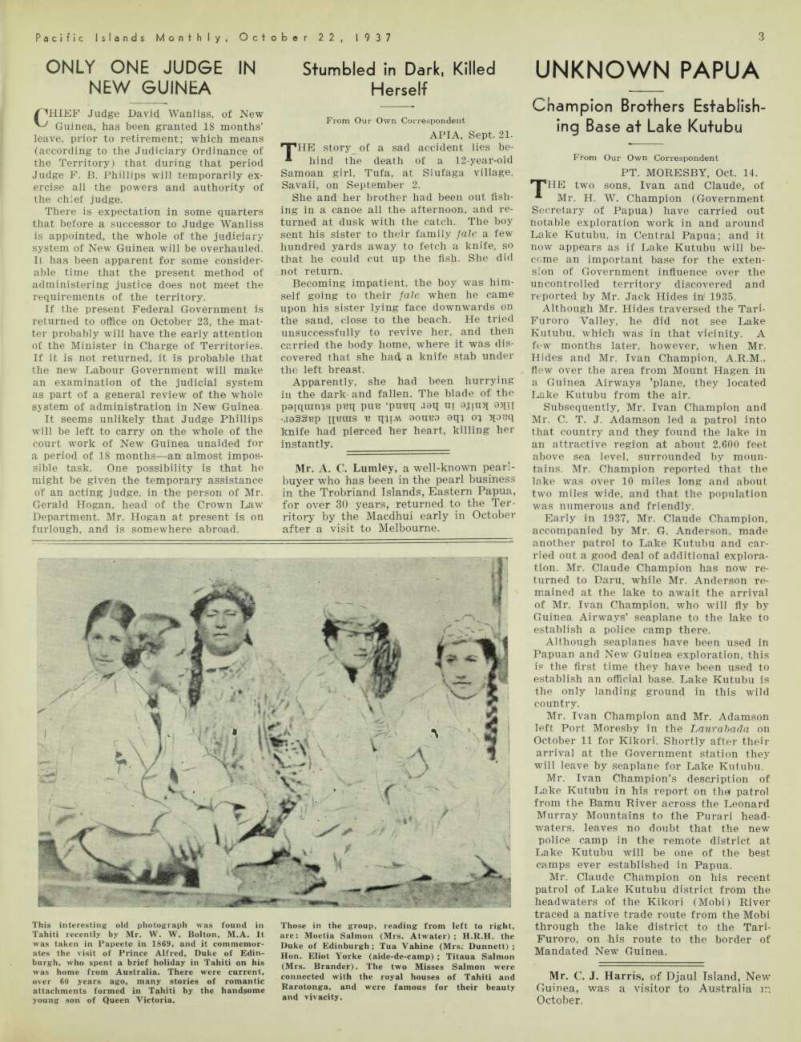
This interesting old photograph was found in Tahiti recently by Mr. W. W. Bolton, M.A. It was taken in Papeete in 1869, and it commemor ates the visit of Prince Alfred, Duke of Edin burgh, who spent a brief holiday in Tahiti on his was home from Australia. There were current, over 60 years ago, many stories of romantic attachments formed in Tahiti by the handsome young son of Queen Victoria.
Those in the group, reading from left to right, are: Moetia Salmon (Mrs. Atwater); H.R.H, the Duke of Edinburgh; Tua Vahine (Mrs; Dunnett) ; Hon. Eliot Yorke (aide-de-camp) ; Titaua Salmon (Mrs. Brander). The two Misses Salmon were connected with the royal houses of Tahiti and Rarotonga, and were famous for their beauty and vivacity.
Stumbled in Dark, Killed
Herself
From Our Own Correspondent APIA, Sept. 21. •TIIE story of a sad accident lies be * hind the death of a 12-year-old Samoan girl, Tufa, at Siufaga village, Savaii, on September 2, She and her brother had been out fish ing in a canoe all the afternoon, and re turned at dusk with the catch. The boy sent his sister to their family fale a few hundred yards away to fetch a knife, so that he could cut up the fish- She did not return.
Becoming impatient, the boy was him self going to their fale when he came upon his sister lying face downwards on the sand, close to the beach. He tried unsuccessfully to revive her, and then carried the body home, where it was. dis covered that she had a knife stab under the left breast.
Apparently, she had been hurrying in the dark and fallen. The blade of the poiqranis pnq pun ‘punq Jaq ui ajiuq aqn -jaSSnp \\vms u qiiAV aouno aqi o; qanq knife had pierced her heart, killing her instantly.
Mr. A. C. Lumley, a well-known pearl buyer who has been in the pearl business in the Trobriand Islands, Eastern Papua, for over 30 years, returned to the Ter ritory by the Macdhui early in October after a visit to Melbourne.
Unknown Papua
Champion Brothers Establish ing Base at Lake Kutubu
From Our Own Correspondent
Pt. Moresby, Oct. 14.
'T’IIE two sons, Ivan and Claude, of * Mr. H. W. Champion (Government Secretary of Papua) have carried out notable exploration work in and around Lake Kutubu, in Central Papua; and it now appears as if Lake Kutubu will be come an important base for the exten sion of Government influence over the uncontrolled territory discovered and reported by Mr, Jack Hides in< 1935.
Although Mr. Hides traversed the Tari- Furoro Valley, he did not see Lake Kutubu, which was in that vicinity. A few months later, however, when Mr.
Hides and Mr, Ivan Champion, A.R.M., flew over the area from Mount Hagen in a Guinea Airways ’plane, they located Lake Kutubu from the air.
Subsequently, Mr. Ivan Champion and Mr. C. T. J. Adamson led a patrol into that country and they found the lake in an attractive region at about 2,600 feet above sea level, surrounded by moun tains. Mr. Champion reported that the lake was over 10 miles long and about two miles wide, and that the population was numerous and friendly.
Early in 1937, Mr. Claude Champion, accompanied by Mr. G. Anderson, made another patrol to Lake Kutubu and car ried out a good deal of additional explora tion. Mr. Claude Champion has now re turned to Daru, while Mr. Anderson re mained at the lake to await the arrival of Mr. Ivan Champion, who will fly by Guinea Airways’ seaplane to the lake to establish a police camp there.
Although seaplanes have been used in Papuan and New Guinea exploration, this is the first time they have been used to establish an official base. Lake Kutubu is the only landing ground in this wild country.
Mr. Ivan Champion and Mr. Adamson left Port Moresby in the Laurabada on October 11 for Kikori. Shortly after their arrival at the Government station they will leave by seaplane for Lake Kutubu.
Mr. Ivan Champion’s description of Lake Kutubu in his report on tho patrol from the Bamu River across the Leonard Murray Mountains to the Purari head waters, leaves no doubt that the new police camp in the remote district at Lake Kutubu will be one of the best camps ever established in Papua.
Mr. Claude Champion on his recent patrol of Lake Kutubu district from the headwaters of the Kikori (Mobi) River traced a native trade route from the Mobi through the lake district to the Tari- Furoro, on his route to the border of Mandated New Guinea.
Mr. C. J. Harris, of Djaul Island, New Guinea, was a visitor to Australia in October,
Dispute over Fiji Council
Precedence Elected Indian Members And Oath Of Office
From Our Own Correspondent SUVA, Sept. 30. the compromise between elec tion and nomination in the new con stitution of the Fiji Legislative Council, al! has not been going smoothly, so far as the Indian members are concerned.
A dispute arose before the sitting of the Council over the matter of precedence —as to whether the elected members or the nominated members should sit at the head of the Indian group. Apparently when the matter was referred to the Governor (Sir Arthur Richards) he de cided to seat the members according to their age, which placed Mr. Said Hasan, one of the two nominated members, and the only Muslim among the five, in the first position. Incidentally, Mr. K. B.
Singh, the other nominated member, and the only one who was member of the last Council, was thus relegated to last position.
At the formal opening of the Council, Mr. Hasan and Mr. Singh took their seats but the three elected members, Messrs.
C. Chattur Singh, Vishnu Deo. and Tula ram did not attend. They were present, however, with other members at a dinner given to the Councillors at Government House the following day.
When Council resumed on September 28, after the first day’s adjournment, the three recalcitrant Indian members en tered the Chamber and took their seats.
Thereupon the Governor said he noticed that there were three members present who had not taken the oath. He there fore asked them to vacate their seats till after the minutes of September 24 were confirmed. This they did.
After the minutes had been read and confirmed His Excellency said that he was prepared to allow any members who had not taken the oath on the opening day to do so. However, the clerk reported that the three Indian members had left the precincts of the Council Chamber, and business proceeded without them.
This morning, after yesterday’s min utes had been confirmed, Sir Arthur Richards said he understood that there were three members present who wished to take the oath. Messrs. Chattur Singh.
Vishnu Deo, and Tularam stepped for ward and took the oath, and then the Council carried on with its work.
Throughout the impasse, the Governor clearly demonstrated that he was the Chairman of the Council and that mem bers—European. Fijian, -and Indian must comply with the regulations. At all times during the dispute, the nominated Indian members complied with the neces sary formalities, and assisted the Council.
Mr. Jack Hides
suffering from the after-effects of the bad form of beri-beri encoun tered in North-west Papua, Mr. Jack Hides arrived in Sydney on October 14.
He crossed from Daru to Thursday Is. and came south in a Japanese liner. An account of Mr. Hides’s most recent ex pedition, and its tragic ending in the death of Mr. David Lyall, is told on page 58 of this issue.
The beri-beri has caused, in Mr. Hides’s case, a form of heart weakness for which he is now receiving attention from a specialist. It also has affected the use of his legs. It was this disease which actually killed Mr. Lyall, who died from a collapse of the heart, following a con dition resembling paralysis. Had it not been for beri-beri, the magnificent effort made by Mr. Hides probably would have saved his companion’s life, as it appears clear that he got Mr. Lyall in to Daru in time to have him treated successfully for the dysentery and other troubles which caused his original illness.
Sympathy For Mrs. Lyall
The sympathy of many friends will be extended to Mrs. Lyall, at this time, tor she not only lost her eldest son in such unhappy circumstances but also has had other troubles. Her mother died very recently and, since David’s death, a younger son, Victor, has been danger ously ill, with appendicitis.
Famous Suva House
Sold To Mr. E. G. Theodore
THE well-known home of Mr. “Tommy”
Horne, “Vunikawai,” about nine miles from Suva, Fiji, has been purchased by Mr. E. G. Theodore, formerly prominent in Australian politics, and now head of the gold-mining industry in Fiji. “Vuni kawai” is a beautiful place, built on a hill 800 feet above the sea; and some of the finest Fijian timbers have been used in the construction of the house.
Supreme Court Fireworks In New Guinea
New Guinea
npiTERE have been fireworks in the * Rabaul Supreme Court in connection with the trial of G. M. C. Ffrost, charged with wilfully killing a native. Mr.
Ollerenshaw, defending, charged Judge Phillips with “interference and interrup tion,” and “sympathy with native wit nesses,” and “protecting him (a native witness alleged to be lying) from cross examining counsel.”
Such statements naturally were re sented by the judge. The trial is unfin ished, so comment at this stage would bo improper.
It may be pointed out, however, that the incident shows how New Guinea’s inadequate and obsolete judicial system reacts undesirably upon the court itself, as well as upon persons undergoing trial.
Pacific's Richest
Territory
Remarkable Growth of Fiji
THE following facts are taken from the official address, delivered to the Fiji Legislative Council, by the new Governor Sir Arthur Richards, on September 24.
Incidentally, the Governor has made an excellent impression. He has taken hold of his administrative job in a busi nesslike way; he apparently is taking the long view in developmental activities and he already has handled two “ticklish’’’ problems (Public Service reorganisation and the Indian political situation) with firmness and tact.
In 1936 revenue was £796.630 and ex penditure £677,152. A deficit of £l5 000 was budgeted for: but the year gave a surplus of £119.478. The Colony’s accu mulated surplus is £472,894. The half year's figures, to June 30 last, gave an other surplus of £70,064.
All industries, especially sugar, copra M mi ’ ■ flourishi “S- Exports, £2,135,281; imports, £1.501,854 Rewa bridge is finished. The Suva Sign, toka road will be completed in a few £lso*ooo ■ A u bl ° Cl l ot offlces ’ t 0 cost £150,000, is being built in Suva New water supply schemes are under consideration for Suva, Nausori, Ba and Sigatoka. and new wharves for Suva and Lautoka. The policy of building develop mental works is justifying itself A new vessel, to replace the Govern ment yacht Pioneer , probably will be built in Hong Kong.
Native Fijian coconut-planters have now installed about 80 small driers and nre producing a good grade of kiln copra. *l.ll is producing increasing quantities or rice and cotton. Dairy farming has been improved and extended Special steps are to be taken to protect and adequately utilise the Colony’s large and valuable natural forests.
The pineapple-canning industry is be ing established by the C.S.R. Co.
It is estimated that in 1938 Fiji will £645 000 86 ’ 000 OUnCBS ° f g ° ld ’ WOrth Is it any wonder that there exists a popular belief that rich uncles come from
R Iji ?
New Administrator For N.I.
THE new Administrator of Norfolk Is land (Sir Charles Rosenthal) and Lady Rosenthal are booked to travel to that territory in the Morinda on October 30; and the retiring Administrator (Cap tain C. Pinney) and Mrs. Pinney are expected to return to Sydney by the same vessel.
Mr. Alec. W. Mortimer arrived in Syd ney from Marovovo, British Solomon Is lands. by the September Malaita. After spending furlough in New Zealand he will return to B.S.T.
Southwards Thrust
Of Japan
T’HE activity and aggressiveness of * Japan, in thrusting southwards through the Pacific, show no diminution, despite her preoccupation in China.
The Dutch are receiving the brunt of it, and are taking measures accordingly.
They have refused Japan’s requests for much increased immigration and trading facilities; and now they are putting in new defences all over the East Indies —a larger fleet, a larger air-force, a defence base at Amboina (Moluccas), and an army of 200,000 based on compulsory service.
On October 3, the Dutch sloop Flores fired two warning shots at a Japanese fishing sampan that was escaping out of territorial waters near Sumatra; ar*d, when it would not stop, fired a third shot which killed two Japanese, wounded two, and made the rest surrender.
Latest is that Japan is planning to obtain right in the Portuguese half of the Timor island. The Dutch, who own the other half of the island, and the Australians at Darwin, only 500 miles away, dislike the proposal.
Major-General Berenshot, head of the Netherlands Indies general staff, now in Holland, said, on October 4, that large orders had been placed for aeroplanes, anti-aircraft guns, machine-guns and armoured cars for the East Indies. These included 40 Glen-Martin (American) bombers.
Nose Bitten Off: Damages
£2,200
11/riSFORTUNE recently befell Nurse Mahoney, daughter of Mrs. Elizabeth Mahoney—once well-known and esteemed in Eastern Papua, and called “the Queen of Sud-Est.”
Mrs. Mahoney, now over 80, lives in Bathurst, N.S.W., and her daughter there conducts a private hospital. Nurse Mahoney kept two green New Guinea parrots, which she had had for several years. On April 29, 1936, a nine-days-old baby, while lying in a cot on a verandah, was attacked: its nose and three fingers were bitten off. No one saw the attack; but it was evident the child was badly mutilated by a b rd. The parrots were 'loose on the verandah, and there was a wild magpie in the yard.
Long litigation ensued. A jury found Nurse Mahoney guilty of negligence, and awarded £2,200 damages.
Eruption
Floods And Dust
After-Effects of Rabaul Eruption
From Our Own Correspondent
\ Rabaul, Oct. 1.
STREETS and gardens have been mostly cleared of mud, and are green again; the wrecked trees in the famous avenues have been sternly pruned, and are showing green; and the town’s ap pearance is regaining normal.
But all over the environs is a heavy thick coating of pumice and volcanic mud. The ground, formerly so porous, now throws off the rain water like an iron roof. An inch of rain, once not noticed, now causes a flood.
So public works engineers and large gangs of native labourers have been very busy lately, putting in a drainage sys tem to cope with the imminent north west (rainy) season. Special drains will carry away the stormwater. Otherwise, torrents would pour through the town.
The fine pumice dust is everywhere and water carts have been freely employed.
The fineness of the dust enables it to penetrate everywhere and there is little doubt that the constant breathing of this substance is not conducive to good health.
There have been very few earth tre mors. Matupi volcano is still emitting smoke and steam, but the new crater ap pears to be dormant—though those who have been there say there is considerable activity.
The report of the experts on the future location of the capital is awaited philo sophically.
Mr. James Larkin
A Correction
TT was stated, in our last issue, that -*• Mr. James Larkin, formerly well known in New Guinea, had arrived in Port Moresby, after a hazardous launch trip. This was entirely incorrect.
The voyagers were Mr. and Mrs. R.
Larking, of Sydney, and they were en route to their plantation near Kavieng, in New Guinea.
We apolog.se for any annoyance that has been caused. The report was supplied to us, and published, in good faith.
So far as we know, Mr. and Mrs. James Larkin now are happily settled in South America.
Tulagi's New Church
A fine new Anglican Church has just been built by the Melanesian Mission in a beautiful setting at Tulagi, the administrative headquarters of the British Solomon Islands. It is constructed of wood, on concrete piers, and asbestos-cement material has been used extensively. Red roofed, the build ing is 72ft. long, and is finished in cream with brown facings.
New Leper Hospital
From Our Own Correspondent
Pt. Moresby, Oct. 18.
’THE new hospital for the treatment of leprosy and tuberculosis patients on Gemo Island, across the harbour from Port Moresby, was officially opened by the Lieutenant-Governor (Sir Hubert Murray) on October 16. There are two main hospital buildings—one for T.B. patients and the other for lepers—and two smaller houses for the sister-in charge (Miss Fairhall) and her Samoan assistants.
B.P. Rabaul Store
Retail Section Totally Burned
*THE large general store and offices of * Messrs Burns, Philp and Co. Ltd., Rabaul, New Guinea, were totally des troyed by fire about midnight on October 13. The concrete strong-room, containing records, etc., survived. The total damage is estimated at over £40,000.
Screaming of ships’ sirens, an explos ion, and a red glare on the low rain clouds caused a minor panic, especially among natives. It was thought that the volcanoes had erupted again; but when the real cause was known, the whole population gathered to watch the huge blaze.
There was no wind, so that nearby buildings (Messrs. Carpenter & Co. Ltd., Treasury, Post Office, etc.) were not in danger.
The firm’s wholesale and bulk stores were not affected. Nevertheless, the com pany’s operations were seriously dis located for a few days.
Messrs. Burns, Philp and Co. are carry ing on in the meantime by using the bulk stores (which formerly comprised the retail store) and by erecting tem porary accommodation to give additional room.
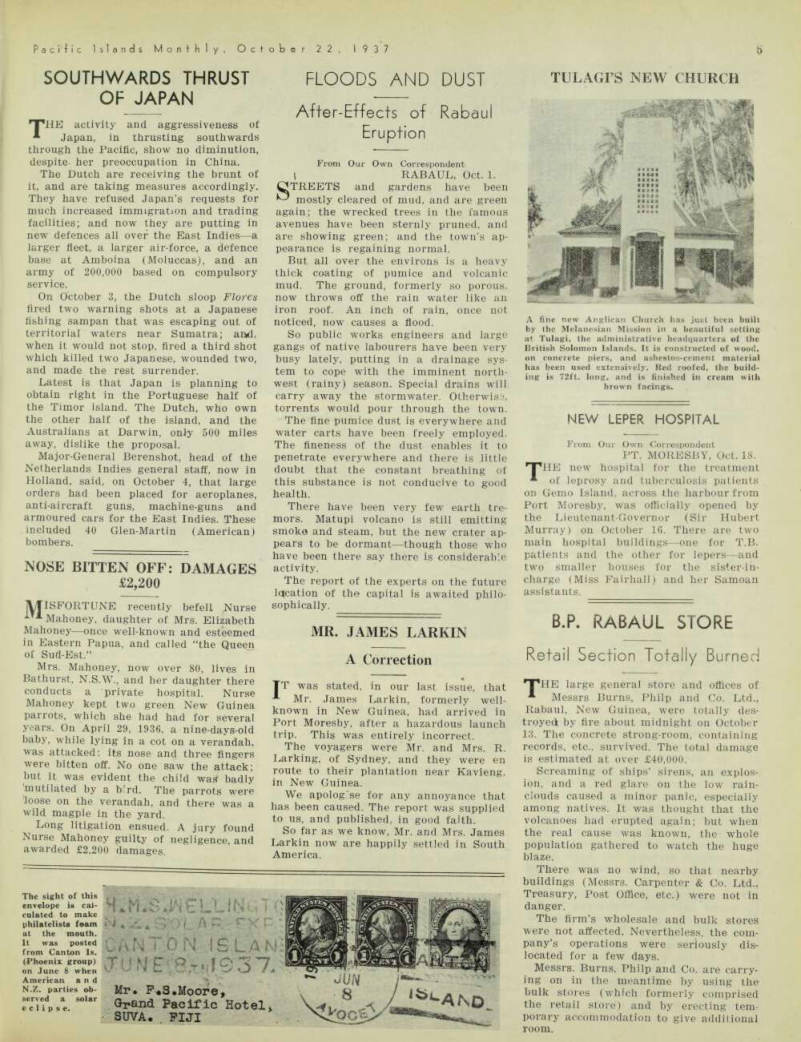
The sight of this envelope is cal culated to make philatelists foam at the mouth.
It was posted from Canton Is. (Phoenix group) on June 8 when American and N.Z. parties ob served a solar eclipse.
Advertisements & other items, p. 11 (1 item)
5
r 22, 1937
Paci'fic Islands Monthly, Oct ok
Secret Agreement Which Governs Plans For South
Pacific Air-Mail Service
Explanation of Hazards and Arguments Which Have Delayed Inauguration of Service
*T 'HE amount of hacking and fil ling which has taken place in connection with the plan of Pan- American Airways to establish a Hawaii Auckland air-mail service must have puzzled many people. In this article, Mr. 'Williams lets a great deal of light in upon the situation. Of special interest are the terms of the secret agreement of October, 1936, published for the first time.
The opinions expressed are Mr.
Williams 1 own. He is an able Aus tralian journalist, noiv resident in Hawaii, and he has made a close and careful study of international aviation developments, especially in relation to the Pacific.
By John Williams
nPHE keynote of the British Empire policy of Trans-Pacific aviation is summarised in the text of the secret resolutions signed on October 2, 1936,
in Wellington, New Zealand, by Mr.
F G. L. Bertram, for the United King dom; Sir Archdale Parkhill, for the Commonwealth of Australia; and Mr. P.
Fraser, for the Dominion of New Zea land.
The document, detailing the resolu tions, reads: — (1) That Pan-American Airways be advised that the N.Z. Government cannot agree to any modification to the 1935 agreement. (2) It is understood that in the event of the failure of Pan-American Airways to carry out the agreement with the N.Z. Govern ment for the provision of a Trans-Pacific air service, the Government of Australia wiil not provide alternative landing facili ties in Australia. (3) That in the event of Pan-American Airways deciding to carry out the 1935 agreement w’ith the N.Z. Government, steps be initi ated through the Governments of the United Kingdom, the Dominion of Canada, the Commonwealth of Australia, and the Dominion of New r Zealand with a view to considering the early establishment of a service in line with the reciprocal rights referred to in Clause 12 of the agreement. (4) That, in any case, steps be taken at once to initiate discussions between the Govern ments of the United Kingdom, Canada, Australia, and New Zealand with a view to the full consideration of the establish ment of an air service across the Pacific at the earliest possible date. (5) Following the discussions between the Gov ernments of the United Kingdom, Canada, Australia, and New Zealand, negotiations be opened with the Government of the United States of America with a view to exploring the possibilities of the establish ment of the best and most effective services on a completely reciprocal basis. (6) The New Zealand Government will take the initiative in promoting the discussions mentioned in (3), (4), and (5).
The conference of the Empire aviation and post office experts in Wellington in September and October, 1936, fully con sidered the possibilities of the Pan- American service entering New Zealand.
The original agreement referred to in Resolution (1) was signed on November 25, 1935, by the N.Z. Government (Mini ster of Transport, Mr. J. G. Coates) and Pan-American Airways (Mr. Lisle Alder ton, Auckland legal representative of the
American firm).
This agreement was not signed until its terms had been considered by the Empire governments, although the N.Z. press earlier had announced the prelimi nary discussions. The press at this time did not hesitate to scold the N.Z. Govern ment (although the conservative group was in power) for its apparent slowness in not signing the agreement. This was because the ballyhoo of the American company’s pressure had bewildered the
management of the papers, with the re sult that for months the news was muzzled, and, when it was announced, it definitely was pro-American.
Great care must be used by Govern ments in considering co-operation with foreign air services. Dangerous prece dents might be established. For example, the birth of the Pan-American Airways system was a result of foreign air repre sentations in Washington. That history is interesting.
History Of P.A.A.
TN 1925, the German head of a small air -*■ company operating in South America
applied for an air-mail contract to lift mail from Florida to South America via the Panama Canal zone. This Dr. von Bauer was turned down. But he persisted and came back to Washington in 1926.
An ex-American army officer, Capt. J.
K. Montgomery, who officially had con sidered Dr. Bauer’s plans, raised the cry in Washington of: “We can’t allow foreigners to fly into America!” and he interested his backers in the German plans. After a lot of political lobbying in Washington and Havana, Montgomery’s group, which he called Pan-American Airways Inc., launched the Florida to Havana service.
Two aviation promoters, Reed Cham bers and Juan T. Trippe, at this time were at a loose end; their last flying efforts, respectively Florida Airways and Colonial Airways, haying proved unsuc cessful for them. These men had inter ested various capitalists.
The two groups started conferences with Montgomery’s group. Followed
months of haggling, one group trying to outwit the other. Holding companies were formed (they still control the des tinies of Pan-American’s network) and great U.S. capitalists like the Rockefel lers, Vanderbilts, and other banking trusts, and interlocking aviation manu facturing interests, were coaxed into the scheme. Trippe was appointed active head of the amalgamation, which decided to use the name of Montgomery’s company.
Thereafter, the Pan-American system grew lustily in the boom period of U.S industrial history—thanks to the ideas o* a German!
British Foreign Office
Caution
nPHE well-informed British Foreign Office knows all this history, familiar to students of U.S. capitalism, and nat urally it did not want to unduly allow the Empire countries to be high-pres sured into signing agreements with Pan- American. It is worthy of mention now that, until the agreement was signed, the
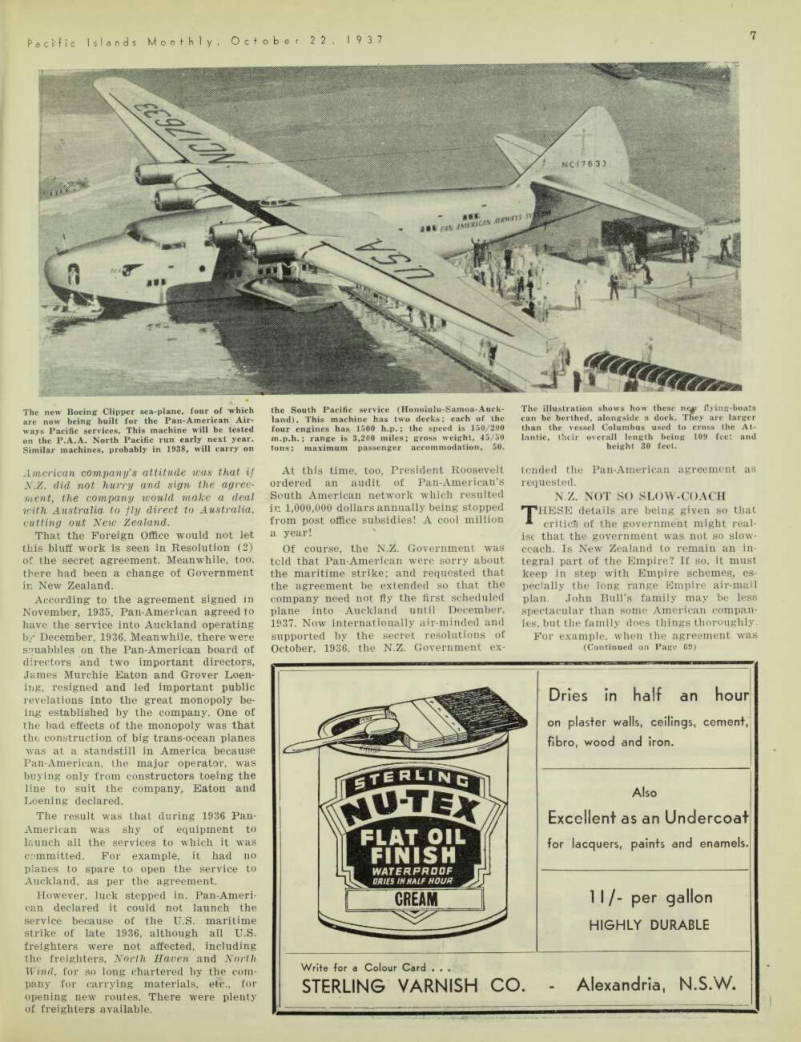
A Pan-American Airways Clipper plane on Pago Pago Harbour (American Samoa) which is landlocked and presents a hazard to all-the-year flying, according to experts of the U.S. Bureau of Air Commerce.
This is one of the obstacles to be surmounted before regular passenger services can be flown between Hawaii and New Zealand.
American company's attitude was that if N.Z. did not hurry and sign the agree ment, the company would make a deal with Australia to fly direct to Australia , cutting out New Zealand.
That the Foreign Office would not let this bluff work is seen in Resolution (2) of the secret agreement. Meanwhile, too, there had been a change of Government in New Zealand.
According to the agreement signed in November, 1935, Pan-American agreed to have the service into Auckland operating by December, 1936. Meanwhile, there were squabbles on the Pan-American board of directors and two important directors, James Murchie Eaton and Grover Loen ing, resigned and led important public revelations into the great monopoly be ing established by the company. One of the bad effects of the monopoly was that the construction of big trans-ocean planes was at a standstill in America because Pan-American, the major operator, was buying only from constructors toeing the line to suit the company, Eaton and Loening declared.
The result was that during 1936 Pan- American was shy of equipment to launch all the services to which it was committed. For example, it had no planes to spare to open the service to Auckland, as per the agreement.
However, luck stepped in. Pan-Ameri can declared it could not launch the service because of the U.S. maritime strike of late 1936, although all U.S. freighters were not affected, including the freighters, North Haven and North Wind , for so long chartered by the com pany for carrying materials, etc., for opening new routes. There were plenty of freighters available.
At this time, too, President Roosevelt ordered an audit of Pan-American’s South American network which resulted in 1,000,000 dollars annually being stopped from post office subsidies! A cool million a year!
Of course, the N.Z. Government was tcld that Pan-American were sorry about the maritime strike; and requested that the agreement be extended so that the company need not fly the first scheduled plane into Auckland until December, 1937. Now internationally air-minded and supported by the secret resolutions of October, 1936, the N.Z. Government ex
tended the Pan-American agreement as requested.
N.Z. Not So Slow-Coach
'X'HESE details are being given so that *• of the government might real ise that the government was not so slow coach. Is New Zealand to remain an in tegral part of the Empire? If so, it must keep in step with Empire schemes, es pecially the long range Empire air-mail plan. John Bull’s family may be less spectacular than some American compan ies, but the family does things thoroughly.
For example, when the agreement was
(Continued on Page 69)
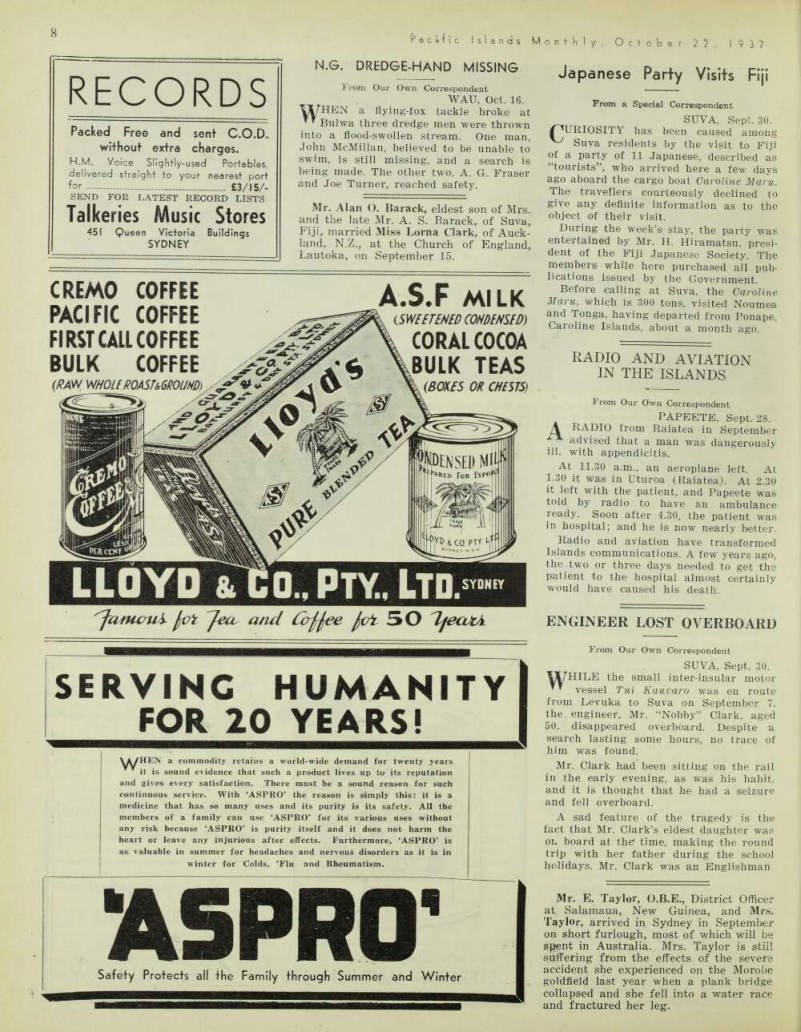
The new Boeing Clipper sea-plane, four of which are now being built for the Pan-American Air ways Pacific services. This machine will be tested on the P.A.A. North Pacific run early next year.
Similar machines, probably in 1938, will carry on
the South Pacific service (Honolulu-Samoa-Auckland). This machine has two decks; each of the four engines has, 1500 h.p.; the speed is 150/200 m.p.h.; range is 3,200 miles; gross weight, 45/50 tons; maximum passenger accommodation, 50.
The illustration shows how these nap flying-boats can be berthed, alongside a dock. They are larger than the vessel Columbus used to cross the At lantic, their overall length being 109 feet and height 30 feel.
signed with Pan-American in 1935, the company boasted that the first planes would be flying into Auckland by July, 1936!
Of course, the Imperial Conference, after the Coronation, fully considered the secret resolutions signed in October. 1936, and accepted them, particularly the sentiments. Accordingly, Mr. Walter Nash was sent to Washington to carry out resolution (5). He discussed recipro city with the U.S. Government; and it is known that the U.S. State Department opposes the idea of allowing British planes to fly into San Francisco, Hawaii, and other U.S. Pacific ports. America is self-conscious about Japan in the Pacific, and is hesitant about agreements with other countries consequently. If America allows British planes to fly from Van couver to Ban Francisco, then to Hawaii en route to Australasia, can Japanese planes be kept out of the Zf.S. ports f British and American interests do not partner with steamers, so why should they with aeroplanes? The public, which foots all the bills, insists upon competi tion for better service.
The North Atlantic aviation experi ments are a good illustration. Pan- American and Imperial Airways have carried out coincident test flights. In accordance with the British Empire scheme, Imperial could fly simply into
Canada and let a local Canadian-U.S. ser vice take passengers down to New York, etc. Of course, Pan-American is anxious to maintain British goodwill, because Pan-American depends so much upon it for entrance into British ports.
Fast Ships Versus Air Liners
MUCH of the enthusiasm over the North Atlantic tests has been dam pened by the fact that the crack French liner Normandie steamed into New York with a big passenger load the same day as the British flying-boat Cambria ar rived empty. The elapsed time of the plane and the steamer was about the same—nearly four days! This important fact, though, is kept hidden by vested air interests.
New Zealand must learn that, until aeroplanes can battle against storms and get through, good steamers like the record-breaking Awatea are far more reliable and practical for all year schedules. Pan-American has demon strated that delays are too numerous for public patience, especially in winter. No matter how big and better the planes are built, adverse weather must always decide whether the planes will fly. Last winter, between San Francisco and Ha waii, all three Trans-Pacific clippers at the same time were delayed for three weeks! Simply through weather 1.500.000 dollars worth of equipment was lying idle, apart from the crews and ground workers and high priced mails (which were sent on by steamer eventually!).
If trans-ocean planes were paid solely upon results, there would be less non sensical claims made for them by pro
moters, who, incidentally, are paid only by results.
America already is learning that the North Atlantic aviation alone is going to keep her busy. German and French test flights indicate the future. President Roosevelt has assigned Mr. Grover Loen ing, the best-informed American (who resigned from Pan-American because he could see the writing on the wall) to report upon the possibilities of inter national aviation as affecting U.S. com panies. Mr, Eaton, who resigned from Pan-American, too, after building up the operating system, has become head of a new American company which is to launch trans-Atlantic services from New York to south European ports supported by a successful parent steamship company already serving the same ports.
Of course, too, on the North Atlantic, German helium zeppelin interests, backed
with U.S. capital, are going ahead with ambitious plans.
Warning To N.Z.
TTHESE and other important possibili * ties make it absurd that the N.Z.
Government should be strong-armed into committing itself to a long-term agree ment, especially with a foreign company.
The U.S. Government, through post office mail subsidies, is using great care in this regard, and making all its contracts short-term, even with steamers.
The U.S. post office already has an nounced that it cannot subsidise the Pan- American service into Auckland until July, 1938, at the earliest. The subsidy is being held up solely on account of the reciprocity aspects of Resolution (5) of the secret Resolutions. As a result of Mr.
Nash’s visit to Washington, Uncle Sam is determined not to be hustled into any move which might prejudice the years to come.
The N.Z. Government was scolded by that country’s press because it did not rush into an agreement with the Ameri can company.
Trouble is that the reporters for the N.Z. newspapers, as yet inexperienced in the subtle ramifications of U.S. capi talistic enterprises, have been believing too much of what they have been told.
Uncle Sam is more wary. He is taking more time about being committed to the scheme than did the N.Z. Government.
Meanwhile, the two Governments are continuing the reciprocity conversations.
These alone will decide what is to be done.
Advertisements & other items, pp. 13-14 (2 items)
7
l-’acl’fic Islands Monthly, October 22, 1937
Bmm
CREAM
Write for a Colour Card . . .
STERLING VARNISH CO.
Dries in half an hour on plaster walls, ceilings, cement, fibre, wood and iron.
Also Excellent as an Undercoat for lacquers, paints and enamels. 11/- per gallon
HIGHLY DURABLE
Alexandria, N.S.W.
RECORDS
Packed Free and sent C.O.D. without extra charges.
H.M. Voice Slightly-used Portables, delivered straight to your nearest port for - - £3/15/-
SEND FOR LATEST RECORD LISTS
Talkeries Music Stores
451 Queen Victoria Buildings
SYDNEY
CREMO COFFEE
PACIFIC COFFEE
FIRSTCALL COFFEE
BULK COFFEE
(MW WHOU RQAShmUHD)/
>-) 4~
A.S.F MILK
(SWEETENEDCONDENSED)
CORAL COCOA
BULK TEAS
(BOXES OR CHESTS)
<*k s
SERVING HUMANITY
FOR 20 YEARS!
a commodity retains a world-wide demand for twenty years ” it is sound evidence that such a product lives up to its reputation and gives every satisfaction. There must be a sound reason for such continuous service. With ‘ASPRO’ the reason is simply this: it is a medicine that has so many uses and its purity is its safety. All the members of a family can use ‘ASPRO’ for its various uses without any risk because ‘ASPRO’ is purity itself and it does not harm the heart or leave any injurious after effects. Furthermore, ‘ASPRO’ is as; valuable in summer for headaches and nervous disorders as it is in winter for Colds, ’Flu and Rheumatism.
ASPRO'
Safety Protects ail the Family through Summer and Winter
N.G. Dredge-Hand Missing
From Our Own Correspondent WAU, Oct. 16.
VI/’HEN a flying-fox tackle broke at ** Bulwa three dredge men were thrown into a flood-swollen stream. One man, John McMillan, believed to be unable to swim, is still missing, and a search is being made. The other two, A. G. Fraser and Joe Turner, reached safety.
Mr. Alan O. Barack, eldest son of Mrs. and the late Mr. A. S. Barack, of Suva, Fiji, married Miss Lorna Clark, of Auck land, N.Z., at the Church of England,
Lautoka, on September 15.
Japanese Party Visits Fiji
From a Special Correspondent SUVA, Sept. 30. has been caused among Suva residents by the visit to Fiji of a party of 11 Japanese, described as “tourists”, who arrived here a few days ago aboard the cargo boat Caroline Maru.
The travellers courteously declined to give any definite information as to the object of their visit.
During the week’s stay, the party was entertained by Mr. H. Hiramatsu, presi dent of the Fiji Japanese Society. The members while here purchased all pub lications issued by the Government.
Before calling at Suva, the Caroline Maru, which is 300 tons, visited Noumea and Tonga, having departed from Ponape, Caroline Islands, about a month ago.
Radio And Aviation
In The Islands
From Our Own Correspondent
A Papeete, Sept. 28.
RADIO from Raiatea in September advised that a man was dangerously ill, with appendicitis.
At 11.30 a.m., an aeroplane left. At 1.30 it was in Uturoa (Raiatea). At 2.30 it left with the patient, and Papeete was told by radio to have an ambulance ready. Soon after 4.30, the patient was in hospital; and he is now nearly better.
Radio and aviation have transformed Islands communications. A few years ago, the . two or three days needed to get the patient to the hospital almost certainly would have caused his death.
Engineer Lost Overboard
From Our Own Correspondent SUVA, Sept. 30.
VI/'HILE the small inter-insular motor ” vessel Tui Kauvaro was en route from Levuka to Suva on September 7, the engineer, Mr. “Nobby” Clark, aged 50, disappeared overboard. Despite a search lasting some hours, no trace of him was found.
Mr. Clark had been sitting on the rail in the early evening, as was his habit, and it is thought that he had a seizure and fell overboard.
A sad feature of the tragedy is the fact that Mr. Clark’s eldest daughter was on board at the 1 time, making the round trip with her father during the school holidays. Mr. Clark was an Englishman Mr. E. Taylor, 0.8. E., District Officer at Salamaua, New Guinea, and Mrs.
Taylor, arrived in Sydney in September on short furlough, most of which will be spent in Australia. Mrs. Taylor is still suffering from the effects of the severe accident she experienced on the Morobe goldfield last year when a plank bridge collapsed and she fell into a water race and fractured her leg.
Advertisements & other items, p. 14 (1 item)
8
PacHic Islands Monthly, 52, 19^2
About Islands People
Mr. L. J. Davis, who originally formed Mandated Alluvials N.L, which is actively seeking gold in Papua, returned to Sydney with his son by the September Montoro, after inspecting the Com pany’s properties near Port Moresby.
Mr. Ronajd G. Speedie, a well-knowr Assistant Resident Magistrate in th; Papuan Public Service, who retired re cently on superannuation, has accepter a position on a plantation at Domara, in the eastern end of the territory. He and his wife left Port Moresby in September by the Veiya to set up their new home on the estate.
Captain and Mrs. Irving Johnson, of Gloucester, Mass,, U.S.A., arrived at Thursday Island in September in their schooner-built yacht Yankee. They are on a world tour with a party of Ameri can university students, and they went on to Bali, D.E.T., from Thursday Is.
Mr. and Mrs. Johnston have iust had their book “Westward Bound in the Schooner Yankee” published by Messrs.
Robert Hale, dealing with a previous 18 months’ trip through the Pacific and the East Indies, Rev. and Mrs. C. M, Rich, of the Lon don Missionary Society in Papua, sailed from Sydney for Samarai by the Macdhui in September after furlough spent in England. They are stationed at Tsuleilei.
Mrs. Ethel Clapp arrived in Sydney from Norfolk Island by the Morinda on September 29 to spend a month’s vaca tion with friends. She has lived on N.T. for 40 years, and has never before visited the mainland.
Mr. J. Quintrell, underground manager for Cuthbert’s Misima Goldmine Ltd., Misima Island, returned to Eastern Papua after furlough in Australia by the Macdhui in September.
Mr. D. G. Ball, Inspector of the N.Z.
Department of Education, paid a short visit to Western Samoa by the Matua during September.
Mrs. Jim Bowring, of Newcastle, N.S.W., reached Sydney on October I by the Macdhui with her two children, Diana and Tony, after visiting her mother-in-law, Mrs. A. Bowring, of Edie Creek, New Guinea.
Mr. W. W. Bolton, M.A., of Papeete, whose scholarly writings on the early history of Tahiti and French Oceania are well known to readers of the P.I.M. He has spent 17 years in the South Seas.
Return Thanks
MRS. E. LYALL, 3 Brooklyn Flats, Waruda St., Kirribilli, Sydney, wishes to thank all those residents of Papua and New Guinea who sent kind messages of sympathy in con nection with the death of her son David, on September 17; and especi ally does she desire to express grati tude to the many people in Western Papua—and notably Dr. Vernon, and the staff of Papua Oil Developments Ltd. —for the help they gave to Mr.
Hides during those few days when her son was rescued, and died, and was buried in Dam.
Advertisements & other items, p. 15 (1 item)
Tenax
Set up in 45 seconds
Power with
Portability .
THE WATSON "CP" PORTABLE X-RAY APPARATUS
produces more X-Radla+on per pound weight of apparatus and per pound Sterling invested, than any X-ray Unit yet produced. The “CP" Is light, compact, and includes every essential to produce radiographs of unsurpassed excellence —as well as many advantages hitherto unobtainable in portable X-ray equipment.
For further particulars, communicate with
'ism
WATSON HOUSE. 9-13 BLIGH STREET. SYDNEY
MELBOURNE - BRISBANE - ADELAIDE - PERTH - NEWCASTLE and NEW ZEALAND
s u\>slftule
*** I tenax
ax ••• *«
tfot
TENAX
THE GENUINELY GEftMICIDAI
TOILET SOAP
o
PREVENT
TROPICAL
DISEASES
You guard yourself against Typhoid, Diphtheria, Malaria, Dhobie Itch, Tinea and Surfer's Foot when you lather daily with TENAX. It is also invaluable in the cure of Tropical Skin Diseases, for TENAX is the ONLY soap containing oil distilled and marketed by Australian essential Oils Ltd. under the registered trade-mark of "Ti-Trol, 1 eleven times quicker than carbolic as a germicide, but NON-POISONOUS and
NON-JRRITANT.
"The Medical Journal of Australia," official organ of the 8.M.A., says: "TENAX is a satisfactory germicidal soap which may be recommended with confidence."
A PRODUCT OF AUSTRALIAN SOAPS LIMITED
Tongans Feel Effect Of
February’S Hurricane
From Our Own Correspondent.
Nukualofa, Sept. 25.
THE people of Tongatabu are now feel * ing the full effect of the hurricane, which swept the islands at the end of February this year.
There is a general scarcity of foodstuffs and coconuts. The position will be worse
when the available yams are used as seeds, now that the planting season is here. The outlook is not too bright for the future, especially with the prices of commodities steadily rising and copra selling at 401bs. for 1/-.
Monsieur Doley, a new judge who will sit on the Condominium Court of the New Hebrides, reached Vila recently from France by the Eridan.
Bigger Crops and
Better Shipping What Cook Is. Fruit Industry Needs
From Our Own Correspondent
Rarotonga, Sept. 19.
THE Resident Commissioner (Mr. S. J.
Smith) is losing no opportunity of seeing for himself the workings of “fruit control.” Accompanied by Mr. W. T.
Goodwin (Director of Agriculture) he was a passenger on the Tiare Taporo which last week visited all Lower Group islands.
With the first orange season barely over, it is still premature either to judge the success of Government control of the industry or to hazard a guess as to its duration. In Rarotonga the crop has steadily been diminishing for many years and little over 12,000 cases were exported this season. In the outer islands, and on Aitutaki particularly, where the crop was late, the position is the reverse and a considerable percentage has been lost through lack of shipping.
Unquestionably, there has been more fluid money about: growers, if they have not actually gained much extra cash, have literally had it jingling in their pockets. The main beneficiaries of this have been the independent retail stores, whose low prices, made possible by small overhead and other costs, are in a favour able position to attract ready money.
Apart from the necessity for a better and an increased citrus production, the paramount need of the fruit industry is for improved shipping facilities. The Matua service has unfortunately fallen a good deal short of expectation, and coupled to this the trans-Pacific cargo steamers which were formerly guaranteed a cargo by the Auckland fruit merchants, now seldom call.
In this connection, unofficial sugges tions have been made to the effect that the £35,000 recently offered by the N.Z.
Government as a loan free of interest for the purpose of erecting a cold storage in Rarotonga, would be better employed and be of greater service to the whole Group if devoted to subsidising a small refrigerated motor vessel which could serve the Cook Islands exclusively.
Mr. C. Cheney, 0 f Kavieng, New Guinea, married Miss Phyllis Waugh at
St. George’s Anglican Church, Rabaul,
early in September,
Advertisements & other items, p. 16 (3 items)
10
Pact f ic Islands Monthly, October 22, 1937
Ultimate
. \slandi
t • •• /. 1 Radio Reception In the Pacific Islands has been perfected by Ultimate Radio Engineers.
They have constructed a set specially designed for tropical conditions, utilising patents that are NOT available to any other manufacturer.
Ultimate is the only radio set that can possibly give you perfect performance in the Pacific Island' This special construction, plus abundant power, accuracy in tuning, and clear natural tone of Ultimate Radio, enables you to get everything that is Interesting on the air—all local and Australian, and countless foreign stations.
Ultimate Radio is available In four types — Vibrator, Air-Cell Battery and A.C. sets.
REAL RADIO
v&itli
ULTIMATE
(SOLE AUSTRALIAN CONCESSIONAIRES)
BED. BRD W N & CO. PT Y. LTD
PRICES FROM
£29/15/-
ELECTRICAL AND INDUSTRIAL ENGINEERS
Write for full particulars
267 CLARENCE STREET,
TELEPHONE M 2544 (2 lines)
SYDNEY
Photographer
WILLIAM FINAU
NUKUALOFA, TONGA. OCEANIA
Have you seen the tiniest kingdom of the Pacific? Do so without leaving home— Sets of well-represented pictures will bring these islands of your dreams to you, 5/- complete. Post paid.
Pretty native hand - made Tapa Cloth, 5/- per piece. Post paid.
Any information, confidential or otherwise, 5/- Money-back Guarantee if dissatisfied • Complete Set of New Tongan Stamps 16/6
Samoan Mau Influence Waning
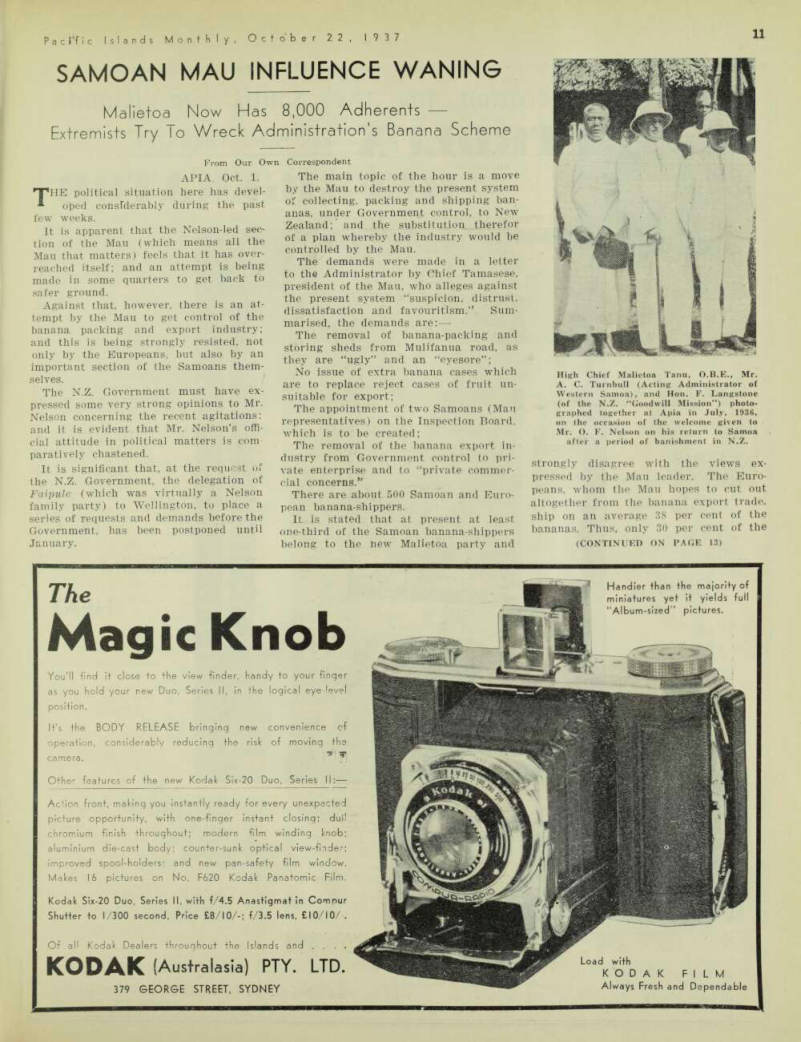

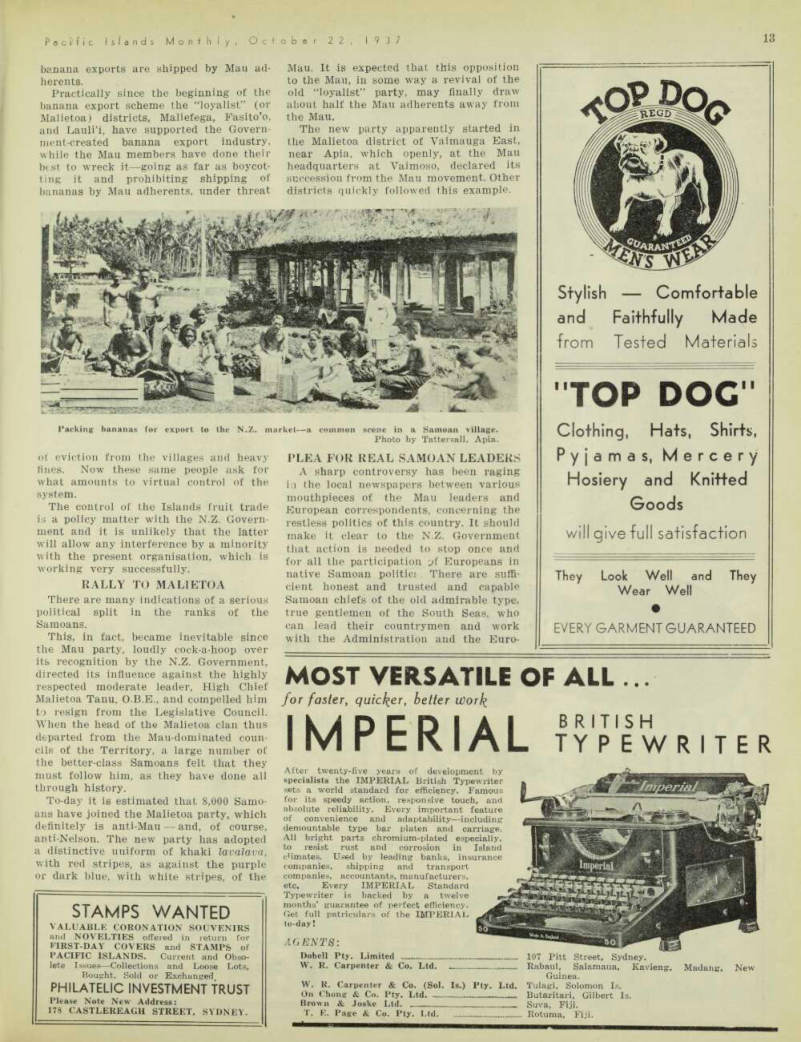
Malietoa Now Has 8,000 Adherents Extremists Try To Wreck Administration's Banana Scheme
From Our Own Correspondent
Apia, Oct. 1.
THE political situation here has devel oped considerably during the past few weeks.
It is apparent that the Nelson-led sec tion of the Mau (which means all the Mau that matters) feels that it has over reached itself; and an attempt is being made in some quarters to get back to safer ground.
Against that, however, there is an at tempt by the Mau to get control of the banana packing and export industry; and this is being strongly resisted, not only by the Europeans, but also by an important section of the Samoans them selves.
The N.Z. Government must have ex pressed some very strong opinions to Mr.
Nelson concerning the recent agitations: and it is evident that Mr. Nelson’s offi cial attitude in political matters is com paratively chastened.
It is significant that, at the request of the N.Z. Government, the delegation of Faipule (which was virtually a Nelson family party) to Wellington, to place a series of requests and demands before the Government, has been postponed until January.
The main topic of the hour is a move by the Mau to destroy the present system of collecting, packing and shipping ban anas, under Government control, to New Zealand: and the substitution therefor of a plan whereby the industry would be controlled by the Mau.
The demands were made in a letter to the Administrator by Chief Tamasese, president of the Mau, who alleges against the present system “suspicion, distrust, dissatisfaction and favouritism.” Sum marised, the demands are: The removal of banana-packing and storing sheds from Mulifanua road, as they are “ugly” and an “eyesore”; No issue of extra banana cases which are to replace reject cases of fruit un suitable for export; The appointment of two Samoans (Mau representatives) on the Inspection Board, which is to be created; The removal of the banana export in dustry from Government control to pri vate enterprise and to “private commer cial concerns.”
There are about 500 Samoan and Euro pean banana-shippers.
It is stated that at present at least one-third of the Samoan banana-shippers belong to the hew Malietoa party and
strongly disagree with the views ex pressed by the Man leader. The Euro peans, whom the Man hopes to cut out altogether from the banana export trade, ship on an average 38 per cent of the bananas. Thus, only 30 per cent of the
(Continued on page 13)
High Chief Malietoa Tanu, O.B. E., Mr.
A. C. Turnbull (Acting Administrator of Western Samoa), and Hon. F. Langstone (of the N.Z. “Goodwill Mission”) photo graphed together at Apia in July, 1936, on the occasion of the welcome given to Mr. O. F. Nelson on his return to Samoa after a period of banishment in N.Z.
banana exports are shipped by Mau ad herents.
Practically since the beginning of the banana export scheme the “loyalist” (or Malietoa) districts, Maliefega, Fasito’o, and Lauli’i, have supported the Govern ment-created banana export industry, while the Mau members have done their best to wreck it —going as far as boycot ting it and prohibiting shipping of bananas by Mau adherents, under threat
Mau. It is expected that this opposition to the Mau, in some way a revival of the old “loyalist” party, may finally draw about half the Mau adherents away from the Mau.
The new party apparently started in the Malietoa district of Vaimauga East, near Apia, which openly, at the Mau headquarters at Vaimoso, declared its succession from the Mau movement. Other districts quickly followed this example.
of eviction from the villages and heavy fines. Now these same people ask for what amounts to virtual control of the system.
The control of the Islands fruit trade is a policy matter with the N.Z. Govern ment and it is unlikely that the latter will allow any interference by a minority with the present organisation, which is working very successfully.
Rally To Malietoa
There are many indications of a serious political split in the ranks of the Samoans.
This, in fact, became inevitable since the Mau party, loudly cock-a-hoop over its recognition by the N.Z. Government, directed its influence against the highly respected moderate leader, High Chief Malietoa Tanu, 0.8. E., and compelled him to resign from the Legislative Council.
When the head of the Malietoa clan thus departed from the Mau-dominated coun cils of the Territory, a large number of the better-class Samoans felt that they must follow him, as they have done all through history.
To-day it is estimated that 8,000 Samo ans have joined the Malietoa party, which definitely is anti-Mau and, of course, anti-Nelson. The new party has adopted a distinctive uniform of khaki lavalava, with red stripes, as against the purple or dark blue, with white stripes, of the
Plea For Real Samoan Leaders
A sharp controversy has been raging in the local newspapers between various mouthpieces of the Mau leaders and European correspondents, concerning the restless politics of this country. It should make it clear to the N.Z. Government that action is needed to stop once and for all the participation jf Europeans in native Samoan politico. There are suffi cient honest and trusted and capable Samoan chiefs of the old admirable type, true gentlemen of the South Seas, who can lead their countrymen and work with the Administration and the Euro
Packing bananas for export to the N.Z. market—a common scene in a Samoan village.
Photo by Tattersall, Apia.
pean residents for the common good, and the progress and development of Samoa.
The Samoans should be protected against Europeans, white or of mixed descent, whose interference, as Samoan history clearly proves, has never brought them any luck.
The only section of the population which really are in need of economic assistance are not the native Samoans, but the 3,000 European-Samoans (of mixed descent). The N.Z. Government tries to help the many local-born unem
ployed by creating land-settlements and employment on public works. The Euro peans also are doing their best to employ the local-born in commercial and agri cultural posts. Mr. Nelson, although ab bitious as to leadership of the native Samoans, shows little interest in the fate of these deserving people.
Mau Starts Its Own Court
Concerning Mau ambitions and activi ties, there has been one very remarkable development.
In Palauli district (Savaii), known as the seat of the most rabid Mau adherents, and represented in the Fono by the ex tremist chief Autagavaia, an indepen dent “court” was established some time ago, in defiance of the Government Court Trials are held before Mau judges, and native offenders are sentenced to terms varying from eight days to nine years of imprisonment, with hard labour. The Mau authorities even paraded their “con victed” prisoners in front of the Resi dent Commissioner’s house, and asked him for tools to be used by their “prison ers.” A prison has been established, which some time ago harboured at least five prisoners.
The Palauli Mau, however, committed an error of judgment when they impri soned two natives of the neighbouring district of Satupaitea. This brought the latter district up in arms against the Palauli Mau, and they demanded that the Satupaitea prisoners be set free at once, as they did not recognise an unlawfully
constituted Mau Court. They declared that if their demand was not complied with, they would use force, and that they were ready to fight if necessary. So far, no additional information has been re ceived concerning this matter.
Chinese Labourers
Regarding the Chinese labour question, the period of contract of the Chinese has been extended until February next. But with the present war going on in China, there is little likelihood of any trans ports being available for Chinese coolies, and this circumstance should suit the N Z. Government very well and “save its face” in a delicate situation. We expect the Chinese labour to be available for some time, despite Mau interference.
Advertisements & other items, pp. 17-20 (2 items)
11
hly, October 22, 1937
PacTfic Islands Monthly
Magic Knob
The
You'll find if close to fhe view finder, handy to your finger as you hold your new Duo, Series 11, In the logical eye-level position.
It's the BODY RELEASE bringing new convenience of operation, considerably reducing fhe risk of moving the "9 1 W camera. "j Other features of the new Kodak Six-20 Duo, Series II: — Action front, making you instantly ready tor every unexpected picture opportunity, with one-finger instant closing; dull chromium finish throughout; modern film winding knob; aluminium die-cast body; counter-sunk optical view-finder; improved spool-holders; and new pan-safety film window.
Makes 16 pictures on No. F 620 Kodak Panatomic Film.
Kodak Six-20 Duo, Series 11, with f/4.5 Anastigmat in Compur Shutter to 1/300 second, Price £B/10/-; f/3.5 lens, £lO/10/ .
Of ah Kodak Dealers throughout the Islands and . . . .
KODAK (Australasia) PTY. LTD.
379 GEORGE STREET. SYDNEY
Handier than the majority of miniatures yet it yields full "Album-siied" pictures.
T-, m m A\ ' Load with
KODAK FILM
Always Fresh and Dependable
Modern Refrigeration for the South Sea Islands
The ELECTIIO LI T X
KEROSENE OPERATED
A
MARVEL
OF
MODERN
SCIENCE
REFRIGERATOR
: 4b ►
THE
MIRACLE
OF
ICE
FROM
HEAT
THE ELECTROLUX OFFERS economical, modern and completely efficient refrigeration for
ISLANDS' HOMES.
FREEZES CONTINUOUSLY WHILE SMALL LAMP BURNS
Freezing controlled by simply regulating height of flame. Uses only f gallon of kerosene per week.
MOTORLESS ... NO PARTS TO GET OUT OF ORDER.
MODEL L 22 MODEL L3B MODEL LKSS Capacity • (as illustrated) Capacity 2.2 cubic feet. Capacity 4 cubic feet. 5.5 cubic feet.
GUARANTEED FOR TWO YEARS
, Write to your Local Distributor, for prices and full details.
Obtainable from . . 1 / W. R. Carpenter & Company Ltd.—Sydney and following New I W. R. Carpenter & Coy. (Solomon Is.) Pty. Ltd. Tulagi, Britisn Guinea Branches : Rabaul, Salamaua, Wau, Kavleng, Madang, Solomon Islands.
But and Wewak. I On Chong & Company Pty. Ltd.—Butaritari, Gilbert & Ellice Islands.
Representation in Papua and New Hebrides.
Q
REG D
ws Stylish Comfortable and Faithfully Made from Tested Materials
"TOP DOC"
Clothing, Hats, Shirts, Pyjamas, Mercery Hosiery and Knitted Goods will give full satisfaction They Look Well and They Wear Well •
EVERY GARMENT GUARANTEED
MOST VERSATILE OF ALL ...
for faster , quicker, better Work
IMPERIAL Ty'p'l WRI T E R
After twenty-five years of development by specialists the IMPERIAL British Typewriter sets a world standard for efficiency. Famous for its speedy action, responsive touch, and absolute reliability. Every important feature of convenience and adaptability—including demountable type bar platen and carriage.
All bright parts chromium-plated especially, to resist rust and corrosion in Island c'imates. Used by leading banks, insurance companies, shipping and transport companies, accountants, manufacturers, etc. Every IMPERIAL Standard Typewriter is backed by a twelve months’ guarantee of perfect efficiency.
Get full particulars of the IMPERIAL to-day!
AGENTS:
Dobell Pty. Limited W. R. Carpenter & Co. Ltd.
IV n L
Mhi
wm W. R. Carpenter & Co. (Sol. Is.) Pty. Ltd.
On Chong & Co. Pty. Ltd. . „ Brown & Joske Ltd T. E. Page & Co. Pty. Ltd. 107 Pitt Street, Sydney.
Rabaul, Salamaua, Kavieng, Madang, New Guinea.
Tulagi, Solomon Is.
Butaritari, Gilbert Is.
Suva, Fiji.
Rotuma, Fiji.
STAMPS WANTED
VALUABLE CORONATION SOUVENIRS
and NOVELTIES offered in return for
FIRST-DAY COVERS and STAMPS of
PACIFIC ISLANDS. Current and Obsolete Issues—Collections and Loose Lots, Bought, Sold or Exchanged
PHILATELIC INVESTMENT TRUST
Please Note New Address:
178 CASTLEREAGH STREET, SYDNEY.
Have easy clean Shaves
u„ a ROLLS RAZOR
THE “Rolls” hollow ground blade is fully guaranteed for five years. It strops and hones itself. English make.
PRICES - 50/- and 60/-
PIKE BROTHERS
LIMITED
Of Queen Street . . . Brisbane
Sudden Death Of Young
Papuan A.R.M.
From Our Own Correspondent
Pt. Moresby, Sept. 21
•THE death occurred suddenly at Sama rai, on September 6 of Mr. A. S.
Petersen, the young Assistant Resident Magistrate stationed there. He had been in the Public Service for a number of years, and before his appointment to the Magisterial Service was in the Medical Department for some time.
Previously to his sudden passing, Mr.
Petersen had been apparently in good health and was shortly taking leave in Australia where his relatives reside.
Advertisements & other items, p. 20 (2 items)
14
'PacWic Islands Monthly, October 2 2, 1937
lanterns
Of
cO s '
CANDLE POWER
A* 1 These new Hi-Power Lanterns develop full 300 c.p. (tested) with the SAME FUEL CON- SUMPTION as a 200 c.p. lantern. 2 15 to 20 hours per litre (I quart) of fuel.
O Compact only 112 inches (29 cm.) high.
A Convenient only lbs. (I* kilo)-
CANDLE POWER
C Equipped with genuine PYREX bulge-type globe, with 30% more lighting surface. £ Safe—has the regular Coleman shut-off valve and all Coleman Safety features.
"7 Equipped with the New Coleman Hi-Power No. 999 Mantle which is 35% stronger and gives 50% more light.
Theand all other Coleman Lamps. Lanterns, Irons and Stoves are procurable from: Coleman Lamp & Stove Co., Toronto, Canada; Burns, Philp & Co. Ltd.; W. R.
Carpenter & Co. Ltd.; Morris, Hedstrom Ltd.: Steamships Trading Co. Ltd.; Whitten Bros. Ltd. ; or Coleman Quick-Lite Co., 500 Kent Street, Sydney.
HO
INCREASE
IN PRICE
0 50%
MORE
LIGHT
r'oleman
HI-POWER
lanterns
Contracts
N.G. Government Airmail
Divided Between Mandated Airlines and Stephens Co.
A NOTICE in the New Guinea Gazette on September 15 announced that the Administration contracts for the carriage of passengers, mails, and cargo on the New Guinea goldfields has been divided between Mandated Airlines Limited (Car penter and Co.) and Stephens Aviation Limited, The contracts cover a period of 13 months, from August 1.
The services are split into two sections.
The major contract, comprising services from Salamaua, went to Mandated Air lines. The other, dealing mostly with ser vices from Madang, was awarded to the
Stephens Company.
The following tables show the freight and passenger rates for the various routes: —
There are no reductions in return rates on the above four services.
Mandated
Airlines Ltd.
Cargo per lb.
Passengers Salamaua-Wau l-ll/16d 35/- Wau-Salamaua Id 17/6 Salamaua-Otibanda 2*d 60/- Otibancla-Salamaua lid 30/- Wau-Otibanda l-l/8d 30/- Otibanda-Wau l-l/8d 10/- Salamaua-Pt. Moresby Hid 155/- Wau-Pt. Moresby Hid 155/-
Stephens
Aviation Ltd.
Cargo per lb.
Passengers Madang-Upper Ramu 5d £5 Madang-Chimbu lid £11 Upper Ramu-Chimbu 6d £6 Wau-Bulolo id 15/-
In Rarotonga

Fate of Runaway Girl In Rarotonga
From Our Own Correspondent
Rarotonga, Sept. 16.
IN May last a young Rarotongan girl * ran away from home after refusing to do some domestic duties. Thinking that she was with relatives in another village, the parents did not worry, but after 10 days when the girl did not return home inquiries were made and no trace of her could be found.
The police were informed, and search parties were organized. For two weeks the valleys and mountains were searched without success. It was then thought that she had been drowned at sea.
George Crummer, a cousin of the miss ing girl, was up the mountains on August 30 shooting wild fowl. Sighting a bird, he drew near to get a good shot but was horrified to see that the fowl was stand ing on a human skull. Wasting no time, he hurried to Ngatangiia where the police were notified. Inspector Carlyon and Dr. Hunt, Government Medical Officer, were soon on the scene.
A careful examination of the remains were made, but no trace of violence or foul play was found. It would appear that the girl becoming mentally de ranged had wandered off and died of exposure.
Mr. J. E. Workman, who recently was appointed Commissioner of Police in Fiji, arrived at Suva by the Port Dunedin in September. L.e was lormerly an adminis trative officer in the Gold Coast Service.
Advertisements & other items, pp. 21-22 (1 item)
Horlicks
But I'm always
tired Doctor.
I even wake tired.
A
Think I need a
Tonic ?
Night-Starvations
your trouble, my
boy. What you
need is Horlicks,
The demands of the day’s work require vitality body and mind refreshed and energised during sleep.
If you wake tired, it is impossible to concentrate properly or to do justice to your own capacity for
good work.
Doctors describe this condition as Night Starvation that is, failure , to replace energy which is used up while you sleep.
If you wake “tired” Start taking Horlicks.
Horlicks taken regularly at bedtime, stores your body with the necessary vitality to meet the demands of the most exacting climate.
Horlicks already contains milk so where milk is scarce you may use water only but use rather more Horlicks to bring out the full flavour.
Horlicks may be taken either Hot or Cold according to your own taste.
Ask your Chemist or Storekeeper to-day for a bottle of Horlicks. (14 2 oz. size costs 3/- in all main totvns throughout the British Pacific Islands.) A fl Os t Of C.p fo f. e e/ oiir lie if o*. ;t *h/ Jiif.
'■> •! m i Hori.icA "1.-.© ■ ' -
HORLICKS
GUARDS AGAINST NIGHT-STARVATION
Insist on genuine
sdorrs
EMULSION
Announcing the New
OPTIMUS
• I I
op Tl MU
2.00
! At)p
sw 300 hurricane lamp Strongly made ot solid brass, heavily nickel plated. This lamp has an automatic cleaning device for cleaning the nipple. It is a general utility lantern suitable for all outdoor requirements.
Storm-proof and insect-proof gives a strong, steady, bright, light SOO- - p o w e r.
Catalogue No. 200.
CANDLE POWER
LANTERN
KEROSENE
OR BENZINE
DUAL HANGING
and
TABLE LAMP
This model is adaptable for use as a swinging lamp or, by merely removing the hanger, is easily converted to a table lamp of standard design.
Gives a 200 - candle power, bright, clear light. Insect-proot and draught-proof.
Catalogue No. 253-A.
WRITE FOR ILLUSTRATED PRICE LIST TO THEi SOLE DISTRIBUTORS BRANDT & STEELE 381 DNE ? REET
AN ABUNDANT SUPPLY OF
ELECTRIC LIGHT
FREE FROM THE WIND
WITH
WRITE
DIRECT
TO
WIND DRIVEN
ELECTRIC LIGHTING
PLANT
* n
HANNAN BROS. LTD.
58-62 FLINDERS STREET. ADELAIDE
Home And Savings Lost
In C.L Fire
From Our Own Correspondent
Rarotonga, Sept. 15.
]\|R. and Mrs. Jimmy Pori saw the result of many years’ work and sav ings go up in flames on the evening of September 4, when their well furnished wooden bungalow was burned to the ground. Nothing was saved, and not being insured they are making a new start with the help of European and native friends.
Hustling Reporter
Twice Crosses Pacific to get from Japan to China’s War-zone.
From Our Own Correspondent
A Honolulu, Sept. 24.
STRAIGHT line isn’t always the quickest distance between two points.
Jim Marshall, correspondent in the Orient for famed Collier's Weekly maga zine of New York, who arrived here a few days ago from U.S.A. by the trans pacific Clipper, will vouch for this.
In Japan, a fortnight ago, he received orders to go to Shanghai and join the other reporters “covering” the undeclar fa war between China and Japan. The Japanese authorities refused to allow Marshall (who is one of the most likeable of U.S. reporters, because he is a veteran and not a skyrocket type like so many of the “modern” news writers) to sail from Japan to Shanghai.
The Japanese know Marshall’s pen. It is unbiased, alert.
Mai shall and his wife, in defiance, boarded a German steamer carrying munitions for Shanghai, but it was stopped by a Japanese patrol and escorted to Yokohama. Mr. and Mrs. Marshall scuttled to Kobe, and sneaked aboard a French steanjer scheduled for Shanghai, but Japanese secret service operators es corted them ashore!
The American then tried every angle known to a news veteran: wire pulling, interviews, bribes, diplomacy, but noth ing worked. There he was burning up only 1,000 miles from Shanghai, the world s current No. 1 magnet for news hawks.
The Japanese Government sighed with relief when later Mr. and Mrs. Marshall sailed, apparently crestfallen, for Seattle on the opposite side of the Pacific. Before the liner docked in Seattle, however, the reporter had hopped into a coast guard cutter, raced ashore, boarded an air liner for San Francisco, and made a connec tion with a trans-Pacific Clipper for Hong Kong, via Hawaii and Manila!
He carries a special visa to his pass port signed by none other than President Franklin Delano Roosevelt. At Manila, a U.S. navy vessel will steam post haste to Shanghai—with Jim Marshall aboard!
By the time he reaches China, he will have travelled 14,000 miles to reach Shanghai which was only 1,000 miles away when he started!
Archdeacon and Mrs. R. de Veil,
formerly of Rabaul, New Guinea, re
ceived many congratulations in August on the birth of a daughter, Frances
Gillian, at St. Margaret’s Rectory, Leven,
Fife, Scotland.
Advertisements & other items, p. 22 (1 item)
Stamp Agent Wanted
AUSTRAL STA MRS
Box 2542 E, G.P.0., Sydney
Cascades On Famous Edie Creek, T.N.G.
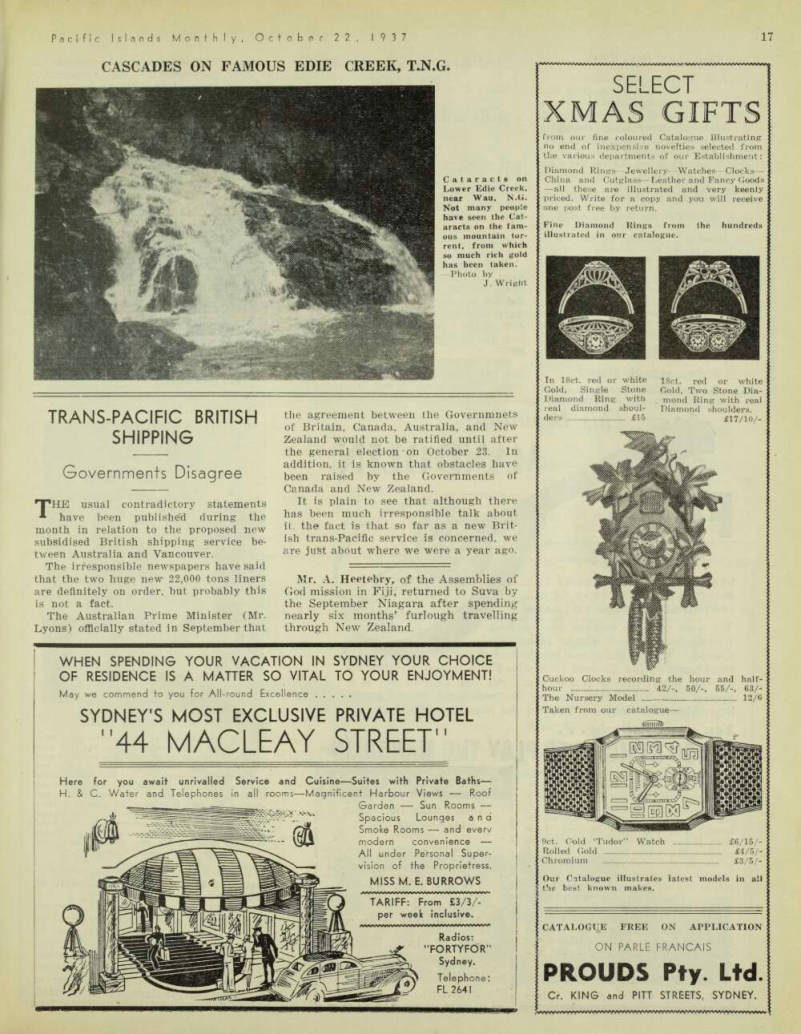
Cataracts on Lower Edie Creek, near Wau, N.G.
Not many people have seen the Cat aracts on the fam ous mountain tor rent, from which so much rich gold has been taken.
Photo by J. Wright
Governments Disagree
Trans-Pacific British
Shipping
•"PHE usual contradictory statements have been published during the month in relation to the proposed new subsidised British shipping service be tween Australia and Vancouver.
The irresponsible newspapers have said that the two huge new 22,000 tons liners are definitely on order, but probably this is not a fact.
The Australian Prime Minister (Mr.
Lyons) officially stated in September that
the agreement between the Governmnets of Britain, Canada, Australia, and New Zealand would not be ratified until after the general election on October 23. In addition, it is known that obstacles have been raised by the Governments of Canada and New Zealand.
It is plain to see that although there has been much irresponsible talk about it. the fact is that so far as a new Brit ish trans-Pacific service is concerned, we are just about where we were a year ago.
Mr. A. Heetebry, of the Assemblies of God mission in Fiji, returned to Suva by
the September Niagara after spending
nearly six months’ furlough travelling
through New Zealand.
Advertisements & other items, p. 23 (1 item)
"44 Macleay Street"
SELECT
XMAS GIFTS
from our fine coloured Catalogue illustrating no end of inexpensive novelties selected from the various departments of our Establishment: Diamond Rings—Jewellery- Watches—Clocks— China and Cutglass—Leather and Fancy floods all these are illustrated and very keenly priced. Write for a copy and you will receive one post free by return.
Fine Diamond Rings from the hundreds illustrated in our catalogue.
Vv hi In 18ct. red or white Gold. Single Stone Diamond Ring with real diamond shoulders £l5 18ct. red or white Gold, Two Stone Diamond Ring with real Diamond shoulders. £l7/10/- Cuckoo Clocks recording the hour and halfhour 42/-, 50/-, 55/-, 63/- The Nursery Model 12/6 Taken from our catalogue— fr m 9ct. Gold ‘Tudor” Watch Rolled Gold Chromium Our Catalogue illustrates latest models in all the best known makes.
CATALOGUE FREE ON APPLICATION
ON PARLE FRANCAIS
PROUDS Pty. Ltd.
Cr. KING and PITT STREETS, SYDNEY.
WHEN SPENDING YOUR VACATION IN SYDNEY YOUR CHOICE OF RESIDENCE IS A MATTER SO VITAL TO YOUR ENJOYMENT!
May we commend to you for AH-round Excellence
SYDNEY'S MOST EXCLUSIVE PRIVATE HOTEL
"44 MACLEAY STREET"
Here for you await unrivalled Service and Cuisine—Suites with Private Baths— H. & C. Water and Telephones in all rooms—Magnificent Harbour Views Roof Garden - Sun Rooms $3 Spacious Lounges and Smoke Rooms and everv modern convenience All under Personal Supervision of the Proprietress,
MISS M. E. BURROWS
per week inclusive.
Radios;
'FORTYFOR'
Sydney.
Telephone; FL 2641
Tongan Boxers
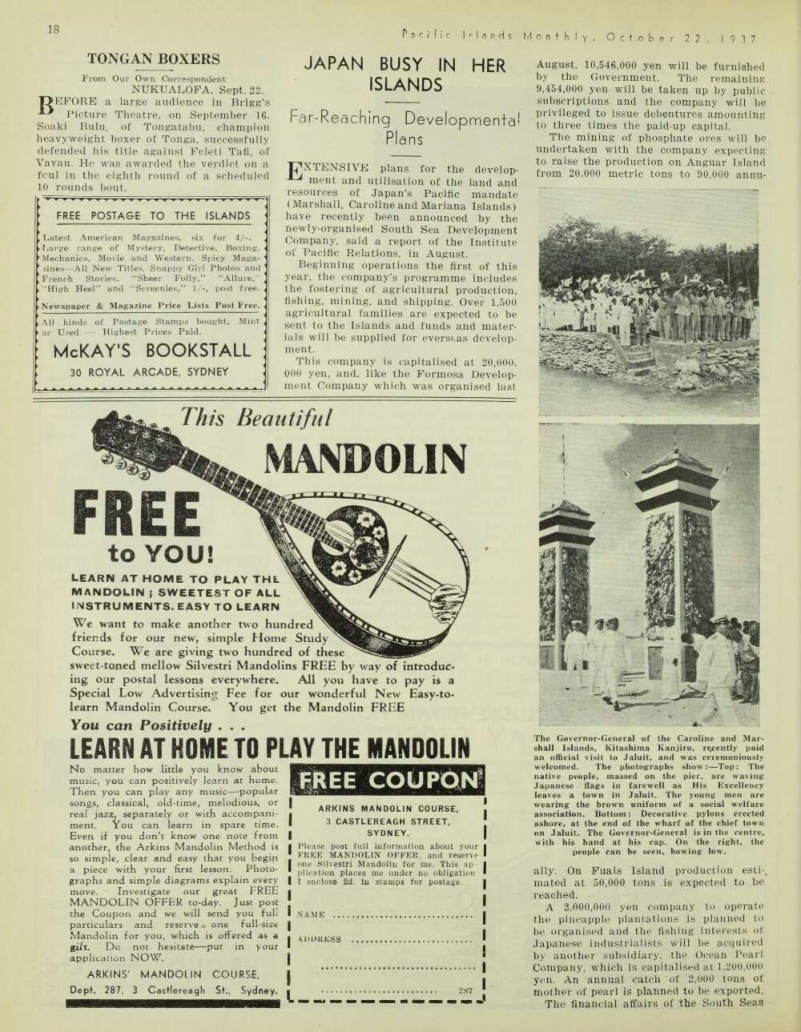
From Our Own Correspondent
Nukualofa, Sept. 22.
T>EFORE a large audience in Brigg’s Picture Theatre, on September 16, Soaki Bulu, of Tongatabu, champion heavyweight boxer of Tonga, successfully defended his title against Feleti Tafi, of Vavau. He was awarded the verdict on a foul in the eighth round of a scheduled 10 rounds bout.
Far-Reaching Developmental
Japan Busy In Her
Islands
Plans
THXTENSIVE plans for the develop -LJ ment and utilisation of the land and resources of Japan’s Pacific mandate (Marshall, Caroline and Mariana Islands) have recently been announced by the newly-organised South Sea Development Company, said a report of the Institute of Pacific Relations, in August.
Beginning operations the first of this year, the company’s programme includes the fostering of agricultural production, fishing, mining, and shipping. Over 1,500 agricultural families are expected to be sent to the Islands and funds and mater ials will be supplied for overseas develop ment.
This company is capitalised at 20,000, 000 yen, and, like the Formosa Develop ment Company which was organised last
August, 10,546,000 yen will be furnished by the Government. The remaining 9,454,000 yen will be taken up by public subscriptions and the company will be privileged to issue debentures amounting to three times the paid-up capital.
The mining of phosphate ores will be undertaken with the company expecting to raise the production on Anguar Island from 20,000 metric tons to 90,000 annu-
ally. On Fuais Island production esti mated at 50,000 tons is expected to be reached.
A 2,000,000 yen company to operate the pineapple plantations is planned to be organised and the fishing interests of Japanese industrialists will be acquired by another subsidiary, the Ocean Pearl Company, which is capitalised at 1,200,000 yen. An annual catch of 2,000 tons of mother of pearl is planned to be exported.
The financial affairs of the South Seas
The Governor-General of the Caroline and Mar shall Islands, Kitashima Kanjiro, recently paid an official visit to Jaluit, and was ceremoniously welcomed. The photographs show:—Top: The native people, massed on the pier, are waving Japanese flags in farewell as His Excellency leaves a town in Jaluit. The young men are wearing the brown uniform of a social welfare association. Bottom: Decorative pylons erected ashore, at the end of the wharf of the chief town on Jaluit. The Governor-General is in the centre, with his hand at his cap. On the right, the people can be seen, bowing low.
Government, which has an annual budget of 8,000,000 yen also will be handled by the new company.
At the present time the South Seas Development Company is reported to be negotiating with the South Seas Trading Company (Nanyo Kohitsu Kabushiki Kai sha), in which the Oriental Development Company is heavily interested, to take over its marine activities. The Trading Company, sometimes called South Seas Development Company Ltd. (but not to be confused with the enterprise now being set up), is an old private company which was established in 1922 following the consolidation of several companies which began their existence in the 19th century.
The South Seas Development Co. and the Mitsui Mining Company have pro moted the South Seas Aluminium In dustry Co., to mine bauxite in Yap and in adjacent islands of the Eastern Caro line group. It is estimated that there are bauxite deposits there of about 5,000,000 tons —enough to ensure that Japan shall have a sufficiency of aluminium. Produc tion operations will begin immediately.
A Japanese naval commander in a broadcast talk on Pacific questions in Tokio in September alluded to the “sparsely populated countries of Aus tralia, New Zealand, and Canada.” He said that Japan’s constantly increasing population, “quite naturally and ever more strongly,” was expanding overseas by immigration, and commercially and industrially: and that the duty of the Japanese navy was to guard these expan
sions, particularly the vital interests of Japan in the Western Pacific.
EDITORIAL NOTE: It is impossible to escape the reflection that, while Japan thus is busily developing her mandated territories in the Pacific, Australia is doing comparatively little to establish industries and encourage commercial progress in her mandated territory of New Guinea. Just imagine what would be happening in New Guinea if it were controlled by Japan instead ot Australia!
Advertisements & other items, p. 24 (2 items)
18
Pacific Inlands Monthly. October 22, I 937
Free
POSTAGE TO THE ISLANDS
Latest American Magazines, six for 4/-.
Large range of Mystery, Detective, Boxing, Mechanics, Movie and Western. Spicy Magazines—All New Titles. Snappy Girl Photos and French Stories. “Sheer Folly,” “Allure,’' “High Heel” and “Screenies,” 1/-, post free.
Newspaper & Magazine Price Lists Post Free.
All kinds of Postage Stamps bought, Mint or Used Highest Prices Paid.
McKAY'S BOOKSTALL
30 ROYAL ARCADE, SYDNEY
This Beautiful
MANDOLIN
LX U
FREE
to YOU!
learn at home to play thl
MANDOLIN ; SWEETEST OF ALL
INSTRUMENTS. EASY TO LEARN
We want to make another two hundred friends for our new, simple Home Study Course. We are giving two hundred of these sweet-toned mellow Silvestri Mandolins FREE by way of introducing our postal lessons everywhere. All you have to pay is a Special Low Advertising Fee for our wonderful New Easy-tolearn Mandolin Course. You get the Mandolin FREE You can Positively . . .
LEARN AT HOME TO PLAY THE MANDOLIN No matter how little you know about music, you can positively learn at home.
Then you can play any music—popular songs, classical, old-time, melodious, or real jazz, separately or with accompaniment. You can learn in spare time.
Even if you don’t know one note from another, the Arkins Mandolin Method is so simple, clear and easy that you begin a piece with your first lesson. Photographs and simple diagrams explain every move. Investigate our great FREE MANDOLIN OFFER to-day. Just post the Coupon and we will send you full particulars and reserve- one full-size Mandolin for you, which is offered as a gift. Do not hesitate —put in your application NOW.
ARKINS' MANDOLIN COURSE,
Dept. 287, 3 Castlereagh St., Sydney.
FREE COUPON’
ARKINS MANDOLIN COURSE,
3 CASTLEREAGH STREET,
SYDNEY.
I Please post full information about your FREE MANDOLIN OFFER, and reserve I one Silvestri Mandolin for me. This ap- -1 plication places me under no obligation I 1 enclose 2d. In stamps for postage.
I
I NAME
ADDRESS
I I L_ 287
Tongan Lorry-Driver Guilty
Of Manslaughter
From Our Own Correspondent
Nukualofa, Sept 21.
A YOUNG Tongan, Tomasi Saiti, who was driving the Ford lorry which capsized in July, near Nukualofa, killing two women and injuring several of the 22 natives aboard, was charged with man slaughter at the last Quarter Sessions of the Supreme Court. He was found guilty, and was sentenced to five years’ im prisonment.
To minimise the future possiblity of accidents resulting from unnecessary speeding, the Government has made new motor traffic regulations. They were pub lished in the Government Gazette (No. 19) on September 16 and provide for speed limits of 20 m.p.h. for commercial vehicles and 30 m.p.h. for taxis. Within congested areas, the speed limit is 15 m.p.h. for all vehicles.
The New Guinea Lumber Co. Ltd.,
Sydney, increased its capital in Septem
ber from £lO,OOO to £50,000 by the creation of 40,000 new £1 shares.
No More Land Available

At Sogeri, Papua
From Our Own Correspondent
Pt. Moresby, Sept. 27
A T the request of the planting interests, the Government has recently investi gated the possibilities of the Sogeri Dis trict for further development. Three officers of the service made an extensive survey of the district and the hinterland beyond.
From their reports it appears that the area of land believed to be available for settlement has been exaggerated, and that there is very little suitable for development beyond two comparatively small areas used by the natives for their hunting grounds. Beyond these areas the country is rocky and precipitous, in some parts rising to a high wall of rock over which extend further rocky ranges.
Thus it would appear that further ex tension of development in the district is impractible.
Mr. A. S. Batty has joined the staff of the Ifi Ifi Government School, Samoa.
Rev. and Mrs. C. Woodhouse and Rev.
D. Taylor will arrive in Sydney from England by the Moldavia on October 26.
They will sail for Papua to join the New Guinea Mission by the next Montoro.
Advertisements & other items, pp. 25-26 (1 item)
Tooh
TO STOREKEEPERS AND TRADERS
H. F. S. DUNNE
BUYING AGENT AND EXPORTER
Packer and Exporter of Islands Necessities.
Island Produce Sold.
All Enquiries . . .
Box 1167 K, G.P.0., Melbourne, Aust.
Or . . . P.O. Box 1646, Auckland. N.Z.
k I > < <
Here s
Too ee”
m
TOPICS IN THE TROPICS
Topic No. I : The important topic in the tropics, is thirst.
Topic No. 2 : And even more important, is how to quench that thirst.
The ANSWER is of course,
TOOHEYS CLUB LAGER. Delight-
fully lighT, sparkling, and refreshing. a A
TOOH
WON ITS FAVOR ON ITS FLAVOR
FREE TO
ASTHMA
SUFFERERS
Latest scientific* treatment brings magic - like relief.
Thousands rej»oit ***" i S permanent relief by this n e \v -assEg:-Satire method which attacks the Basic Cause of Asthma. Endorsed by highest medical authorities. Free from dangerous and habit-forming- drugs. Quickly ends Night Attacks, Goug-hing- Spasms. Gasping- and Choking-, Wheezing:. Breathlessness. IV o matter where you live, what your ag-e, or how long- you have suffered, do not g-ive up hope. Stop using- drugs and send for FREE BOOK, which points the w T ay to permanent Asthma relief. Read all about this amazing new- triumph of medical research —C. Sinclair, Ltd.. Suite 7. 4I9A, Queen St., Auckland, New Zealand.
COUPON FOR FREE BOOK
C. SINCLAIR LTD..
Dept OP. P.O. Box 1769, Auckland, New Zealand.
Please send Free Asthma Book.
Name Address
New Guinea's Chinese Problem
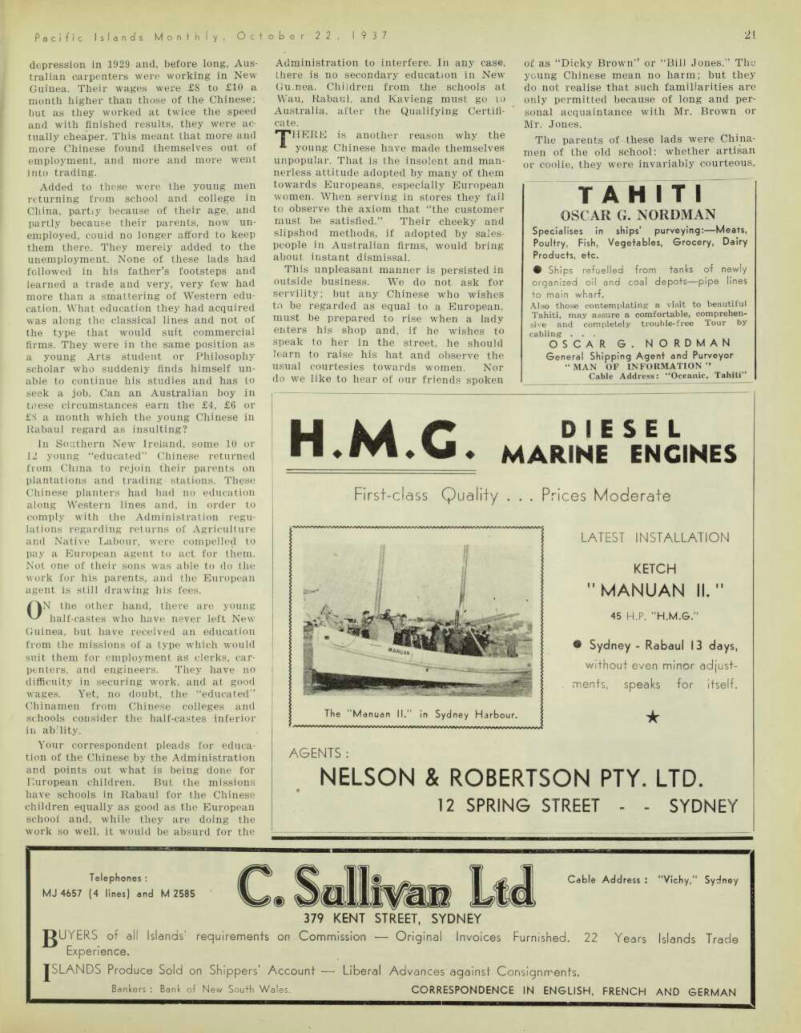
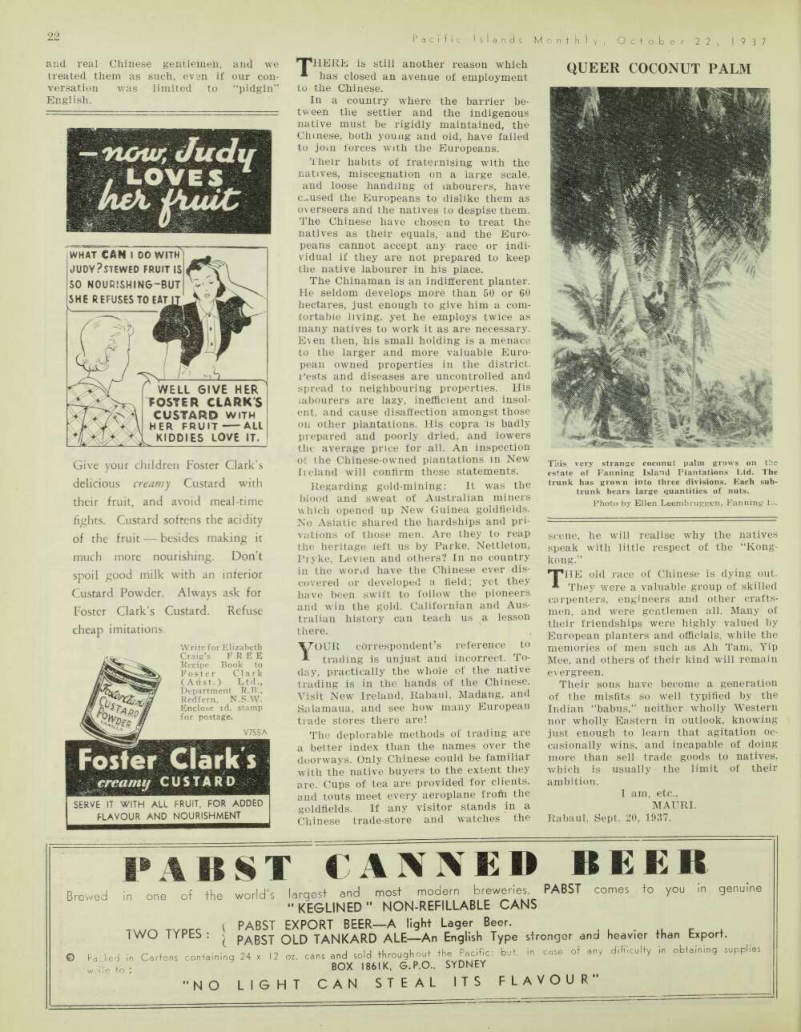
Degeneration of a Once-Valuable Community
Letter to the Editor
“TS Asiatic Community Receiving Jus ■ tice from Australia?” Your corres pondent in the August issue answers your sub-heading with an emphatic “No!”
The question as to what is to be done with this growing community is one that dees definitely exist, and is one that presents alarming features, for there are toe many idle young Chinese hanging about the numerous trade stores through out New Guinea. But it is incorrect to assume that this unhappy state of affairs is due to the administration of the man date by Australia.
The original Chinese settlers brought to New Guinea by the Germans were carpenters, cabinet-makers, shipbuilders, engineers, cooks, waiters, and a number of coolies. The hotels all had Chinese staffs prior to 1921 and, until that year, it was the usual sight to see the ship’s holds and winches invaded by a swarm of half-naked coolies to handle the cargo.
The tradesmen were excellent trained craftsmen, and a good Chinese carpenter or mechanic can hold his own anywhere.
Yet the wages of these men were £6 and £S a month, the coolies a few shillings.
The status of the Chinese residents, right up to the inauguration of the Civil Administration, was low. They were expected to step off the footpath and
raise their headgear when a European passed, and to speak only when addressed.
'T'HIS was all changed in May, 1921. * From that time, a Chinaman was considered a British subject, and an atti tude of servility was neither asked for nor expected. They were given a higher status than that afforded their compat riots in Hong Kong or Singapore—with results to the younger generation which might be expected.
As the skilled tradesmen retired or returned to China, the demand for arti sans became more acute, and those still carrying on their trades were able to ask and receive wages of £l2, £l5 and £lB a month. It was considered, in those days, impossible for a white man to do manual labour in the tropics, not only for health reasons but because it was thought that personal exertion meant a lowering of the white prestige. The high wages being paid to the Chinese artisans began to attract other Chinese who had been cooks, waiters, and coolies. Many of these had never used the tools of the craft to which they now attached themselves, and their work was slow and of shockingly poor quality.
The building and other skilled trades in Australia were severely affected by the
depression in 1929 and, before long, Aus tralian carpenters were working in New Guinea. Their wages were £8 to £lO a month higher than those of the Chinese; but as they worked at twice the speed and with finished results, they were ac tually cheaper. This meant that more and more Chinese found themselves out of employment, and more and more went into trading.
Added to these were the young men returning from school and college in China, partly because of their age, and partly because their parents, now un employed, could no longer afford to keep them there. They merely added to the unemployment. None of these lads had followed in his father’s footsteps and learned a trade and very, very few had more than a smattering of Western edu cation. What education they had acquired was along the classical lines and not of the type that would suit commercial firms. They were in the same position as a young Arts student or Philosophy scholar who suddenly finds himself un able to continue his studies and has to seek a job. Can an Australian boy in toese circumstances earn the £4, £6 or £S a month which the young Chinese in Rabaul regard as insulting?
In Southern New Ireland, some 10 or 12 young “educated” Chinese returned from China to rejoin their parents on plantations and trading stations. These Chinese planters had had no education along Western lines and, in order to comply with the Administration regu lations regarding returns of Agriculture and Native Labour, were compelled to pay a European agent to act for them.
Not one of their sons was able to do the work for his parents, and the European agent is still drawing his fees. the other hand, there are young half-castes who have never left New Guinea, but have received an education from the missions of a type which would suit them for employment as clerks, car penters, and engineers. They have no difficulty in securing work, and at good wages. Yet, no doubt, the “educated”
Chinamen from Chinese colleges and schools consider the half-castes inferior in abdity.
Your correspondent pleads for educa tion of the Chinese by the Administration and points out what is being done for European children. But the missions have schools in Rabaul for the Chinese children equally as good as the European school and, while they are doing the work so well, it would be absurd for the
Administration to interfere. In any case, there is no secondary education in New Gu nea. Children from the schools at Wau, Rabaul, and Kavieng must go to Australia, after the Qualifying Certifi cate.
'TpIIERE is another reason why the young Chinese have made themselves unpopular. That is the insolent and man nerless attitude adopted by many of them towards Europeans, especially European women. When serving in stores they fail to observe the axiom that “the customer must be satisfied.” Their cheeky and slipshod methods, if adopted by sales people in Australian firms, would bring about instant dismissal.
This unpleasant manner is persisted in outside business. We do not ask for servility; but any Chinese who wishes to be regarded as equal to a European, must be prepared to rise when a lady enters his shop and, if he wishes to speak to her in the street, he should learn to raise his hat and observe the usual courtesies towards women. Nor do we like to hear of our friends spoken
or as “Dicky Brown” or “Bill Jones.” The young Chinese mean no harm; but they do not realise that such familiarities are only permitted because of long and per sonal acquaintance with Mr. Brown or Mr. Jones.
The parents of these lads were China men of the old school: whether artisan or coolie, they were invariably courteous,
and real Chinese gentlemen, and we treated them as such, even if our con versation was limited to “pidgin”
English.
SPHERE is still another reason which has closed an avenue of employment to the Chinese.
In a country where the barrier be tween the settler and the indigenous native must be rigidly maintained, the Chinese, both young and old, have failed to join forces with the Europeans.
Their habits of fraternising with the natives, miscegnation on a large scale, and loose handling of labourers, have caused the Europeans to dislike them as overseers and the natives to despise them.
The Chinese have chosen to treat the natives as their equals, and the Euro peans cannot accept any race or indi vidual if they are not prepared to keep the native labourer in his place.
The Chinaman is an indifferent planter.
He seldom develops more than 50 or 60 hectares, just enough to give him a com fortable living, yet he employs twice as many natives to work it as are necessary.
Even then, his small holding is a menace to the larger and more valuable Euro pean owned properties in the district.
Rests and diseases are uncontrolled and spread to neighbouring properties. His labourers are lazy, inefficient and insol ent, and cause disaffection amongst those on other plantations. His copra is badly prepared and poorly dried, and lowers the average price for all. An inspection of the Chinese-owned plantations in New Ireland will confirm these statements.
Regarding gold-mining: It was the blood and sweat of Australian miners which opened up New Guinea goldfields.
No Asiatic shared the hardships and pri vations of those men. Are they to reap the heritage left us by Parke, Nettleton, Pryke, Levien and others? In no country in the wond have the Chinese ever dis covered or developed a field; yet they have been swift to follow the pioneers and win the gold. Californian and Aus tralian history can teach us a lesson there.
YOUR correspondent’s reference to
trading is unjust and incorrect. To day, practically the whole of the native trading is in the hands of the Chinese.
Visit New Ireland, Rabaul, Madang, and Salamaua, and see how many European trade stores there are!
The deplorable methods of trading are a better index than the names over the doorways. Only Chinese could be familiar with the native buyers to the extent they are. Cups of tea are provided for clients, and touts meet every aeroplane frofli the goldfields. If any visitor stands in a Chinese trade-store and watches the
scene, he will realise why the natives speak with little respect of the “Kong kong.”
THE old race of Chinese is dying out.
They were a valuable group of skilled carpenters, engineers and other crafts men, and were gentlemen all. Many of their friendships were highly valued by European planters and officials, while the memories of men such as Ah Tam, Yip Mee, and others of their kind will remain evergreen.
Their sons have become a generation of the misfits so well typified by the Indian “babus,” neither wholly Western nor wholly Eastern in outlook, knowing just enough to learn that agitation oc casionally wins, and incapable of doing more than sell trade goods to natives, which is usually the limit of their ambition.
I am, etc.,
Mauri.
Rabaul, Sept. 20, 1937.
Advertisements & other items, pp. 26-28 (1 item)
Delco-Licht
NOW-Even Bigger and Better
GIVING 33% more power output, and even greater efficiency than previously, the 2812 and 286 range of Delco-Llght plants, provides brilliant electric light for your home, camp or boat, also power for your radio at a touch of a switch.
Generating 200 watts, this Delco-Light plant is remarkably economical, consuming one gallon of petrol in 16 hours. The generator will supply eight 25 watt lamps and the 12 volt 105 A.H. battery five 25 watt lamps for 10 hours when fully charged. The quality and construction of Delco-Light has been outstanding for over 20 years.
SPECIFICATIONS : ENGINE, single cylinder four-cycle, L head, air-cooled by forced draught.
DYNAMO, 6 pole, capacity 200 watts, voltage (2B1 2) 12 volt, (286) 6 volt. Self cranking from battery through manual starting switch.
The complete generating unit weighs only 44-lbs.
Write to Desk PI for full details now; the plant requires no particular skill to operate you can Install it yourself and you'll marvel at its efficiency.
Distributors:
WARBURTON, FRANK), LTD.
Melbourne 307 -15 KENT STREET, SYDNEY Brisbane if i 1 2812 (12 volt) - £25 10 0 with 83 A.H. battery (car type.) 2812 (12 volt) - £2B 10 0 with 105 A.H. battery (individual cell 3.) 286 (6 volt) - £26 ft 0 with 105 A.H. battery (individual cells.)
IN BOND —SYDNEY
TAHITI
OSCAR G. NORDMAN
Specialises in ships' purveying:—Meats, Poultry, Fish, Vegetables, Grocery, Dairy Products, etc. Ships refuelled from tanks of newly organized oil and coal depots—pipe lines to main wharf.
Also those contemplating a visit to beautiful Tahiti, may assure a comfortable, comprehensive and completely trouble-free Tour by cabling . . .
OSCAR G. NORDMAN
General Shipping Agent and Purveyor
“ MAN OF INFORMATION ’’
Cable Address; “Oceanic, Tahiti”
H.M.C
DIESEL
♦ MARINE ENGINES
First-class Quality . . . Prices Moderate The "Manuan II." ir> Sydney Harbour
LATEST INSTALLATION
KETCH
M MANUAN 11. M
45 H.P. "H.M.G."
® Sydney - Rabaul 13 days, without even minor adjustments, speaks for itself. ★
AGENTS :
NELSON & ROBERTSON PTY. LTD.
12 SPRING STREET - - SYDNEY
Telephones : MJ 4657 (4 lines) and M 2585
dft
wm m
379 KENT STREET, SYDNEY
Cable Address : "Vichy," Sydney jgUYERS of all Islands' requirements on Commission Original Invoices Furnished. 22 Years Islands Trade Experience.
JSLANDS Produce Sold on Shippers' Account Liberal Advances against Consignments.
Bankers : Bank of New South Wales. CORRESPONDENCE IN ENGLISH, FRENCH AND GERMAN
WHAT CAN I DO WITH
JUDY?STEWED FRUIT IS
SO NOUKISHING-BUT
SHE REFUSES TO
r
EAT
WELL GIVE HER
FOSTER CLARK'S
CUSTARD WITH
HER FRUIT ALL
KIDDIES LOVE IT.
Give your children Foster Clark’s delicious creamy Custard with their fruit, and avoid meal-time fights. Custard softens the acidity of the fruit besides making it much more nourishing. Don’t spoil good milk with an inferior Custard Powder. Always ask for Foster Clark’s Custard. Refuse
cheap imitations.
Write for Elizabeth Craig’s FREE Recipe Book to Foster Clark (Adst.) Ltd., Department R-8., Redfern, N.S.W.
Enclose id. stamp for postage.
V755A
Foster Clark s
creamy CUSTARD SERVE IT WITH ALL FRUIT, FOR ADDED
FLAVOUR AND NOURISHMENT
Qi *r A/?d
I*A (IST CANNED REEK
Brewed in one of the wo >rld' largest and most modern breweries, PABST comes to you in genuine
" KEGLINED " NON-REFILLABLE CANS
TU/A TVDrc [ PABST EXPORT BEER—A light Lager Beer.
TWO I YPtb : PABST OLD TANKARD ALE—An English Type stronger and heavier than txport.
O Faded In Cartons containing 24 x 12 oz, cans and sold throughout the Pacific: but. In case of any difficulty in obtaining supplies w ; . eto . BOX 1861 K, G.P.0., SYDNEY
"NO LIGHT CAN STEAL ITS FLAVOUR"
Queer Coconut Palm
This very strange coconut palm grows on the estate of Fanning Island Plantations Ltd. The trunk has grown into three divisions. Each sub trunk bears large quantities of nuts.
Photo by Ellen Leembruggen, Fanning [?].
Advertisements & other items, pp. 29-30 (1 item)
Let ANGUS & COOTE be your Santa Claus
21 Your Presents Will Be Sent To Any Address For You
ANGUS & COOTE
will pack your goods
beautifully and en-
close a card bearing
your greetings if
you wish.
£2O ro CM O
SAFE DELIVERY of
every gift in perfect
order is ANGUS &
COOTE'S definite
responsibility.
Solitaire Diamond Ring, with bright centre diamond in new coronet setting, and diamond-set shoulders. 18ct. white gold with platinum settings.
The Rabaul Volcanic Disturbance
£l l/10/ =i
z^iz,--
did not disturb the ‘lndestructible Lever.’ “Mine came through with flying colours,” writes Mr. Scott. “It was one of the few still keeping correct time, when 80 per cent, of other makes had ceased to function. The case has not corroded in any way by the pumice and other matters with which it came in contact.”
High praise indeed —but not too high for the ‘lndestructible Lever .
This watch has proved itself again and again, under the most exacting conditions. It is absolutely water-tight and dust-proof.
Nothing can gain access to harm or rust the movement. A knock or fall wont; hurt it. Thus it is ideal for the energetic wrist of the sportsman in action. It is immune from the effects of electrical machinery, so wireless never upsets it. Any man or woman !n An 18ct. White Gold Ring, with sparkling centre diamond, and bright diamond shoulders. All settings are platinum and so perfectly secure. a ■4 Chrome Wrist Watch. —Smart little watch in dainty chrome case, 4O/-. Same any district may have the convenience of this splendid timekeepe Ladies’ ‘lndestructible Lever’ with chrome case and stainless steel back, 95/-.
Gentleman’s ‘lndestructible Lever’ with special case entirely of stainless steel, 95/- Both watches are complete with cool, modern open-link chrome bands. Luminous dials, 5/- extra. watch in rolled-gold case, 55/-. In each the movement is warranted to wear 10 years, and will be adjusted and regulated free during the first six months if necessary Stylish Baguette Watch. This modern case is fitted with a 15-jewelled Swiss lever which is warranted to give 10 years’ wear, and will be adjusted and regulated free of charge, if necessary, during the first six months. In chrome case it is 45/-.
In rolled gold, 57/6. 9ct. gold, £4/7/6. £l5 White Gold Ring of 18ct. quality, carved with unbelievable delicacy.
Settings are platinum. Two bright diamonds are in centre. Smaller shoulder diamonds also included. & £2O £5/10/-
E.P.N.S,
Fa ' r r There isn’t a housewife —young or old —who wouldn’t be thrilled and gratified to receive this beautiful silverplate Tea and Coffee Service. It is full, family size—and gracefully shaped in the modern manner. It is the hardest and most durable quality plate—and made on the premises by Angus and Coote.
Teapots only at 17/6, 20/-. 25/-, 30/- and 37/6 * ...,hionable 2-stone Diamond Ring with diamond-set shoulders. A new style in 18ct. white gold, with secure platinum settings. This is one of the very newest designs.
Other English
Brush-sets for Gentlemen, at 30/-, 35/- and 42/-.
English Tortoiseshell Xylonite Brush Set which includes a mirror in lid, hair brush, comb, cloth brush, safety razor, and soap and shaving brush containers. All fitted to a leatherette case which is nicely satin-lined. Initials 9d. each letter. m
ism
m
SEVEN - PIECE WATER SET
A two-pint'jug with six goblets, all cut in the diamond pattern for 30/-. A very popular and acceptable present. Safe delivery guaranteed anywhere.
LADIES’ CHROME SET 42/-
The ladies’ chrome set illustrated is 42/-, and comes complete in this case. Other similarly engine-turned chrome sets are available at 65/-, 75/-, and 85/-, in various shapes. Each includes a brush, comb, and mirror, in appropriate presentation case.
WRITE FOR THE NEW USEFUL. ANNUAL, GENERAL CATALOGUE ANGUS & COOTE Pty. Ltd. 500 George S+., Sydney
Radio Repairs
If you are unable to get your Set repaired locally
SHIP IT TO US
Regardless of the make or type of Radio, we guarantee to repair it, and return it to you in new I(l |jj| condition.
We will attend to all Shipping and Customs matters at this end for you.
PRICE’S RADIO SERVICE
d. g. Mclntyre
5 and 6 ANGEL PLACE,
SYDNEY
3Sr^
Write for Firearm Catalogue (600 illustrations) Fishing Catalogue (400 illustrations)
“FISHING TACKLE TO TACKLE FISHING”
Goods sent C.O.D.
It Pays Always to Buy the Best—We Stock no Other.
QUALITY FIREARMS AND FISHING TACKLE
Craft built Big Game Fishing Gear —Beach and Boat Fishing Equipment—World’s Best Trout Specialities—The latest in the World’s Firearm Pi’oduction —Specialist in Rifle and Shotgun Reloading Accessories —Quality Second-hand Firearms —Firearm and Fishing Tackle Repairs.
S I L
ROHU
Quality Firearms and Fishing Tackle
143 ELIZABETH STREET. SYDNEY
(near Market St.) Phone MA 3540
W. H. GROVE & SONS, Ltd
ISLAND TRADERS, AUCKLAND, NEW ZEALAND
Shippers of all classes of New Zealand products, specially prepared for the Islands trade.
REPRESENTING
Rylands & Sons (Col.) Ltd., of London & Manchester (including the famous "Dacca" Mills' products) tor all classes of soft goods.
J. Blair King ot London World-famed Shirts.
Agfa Photographic Corporation, Berlin, Germany.
Parbury Henty & Co. Pty. Ltd., Sydney & Kobe.
Burrell & Co. Ltd., London—Oil, White Lead and all classes of Paint.
I
SL CAMERAS AND
PHOTOGRAPHIC
USE .
MATERIALS
FOR BEST
RESULTS
Sydney-Rabaul
Airmail
Will Not Commence Until March
forecast was made in our last issue that Governmental unreadiness would cause a delay in the inauguration of the new weekly airmail service be tween Sydney, Papua, and New Guinea.
Since then it has been announced that the service will not commence until March, 1938.
The three De Havilland 4-engined air liners, with which Messrs. W. R. Car penter & Co. Ltd. will carry on the service, will be available in Sydney at the end of the year; but the Common wealth authorities nave not got the ground organisation ready.
It is necessary to make improvements in the aerodromes at Cooktown and Port Moresby, and probably at Wau and Rabaul; and, of course, there must be a complete installation of radio directional finding apparatus, and a meteorological organisation to provide prompt and ac curate weather reports.
The Commonwealth Government knew
all this at the beginning of 1937, when it first invited tenders for the service; but, in the manner so dear to the hearts of bureaucracy, the work has been de layed on one pretext and another until it has become impossible to launch the service on the specified date—namely, January 1.
From announcements made by the Administrator of New Guinea and by the airmail contractors, it is understood that the aeroplanes will leave Sydney every Monday and fly to Townsville; remain at Townsville for the night; fly on Tuesday from Townsville to Cooktown, Port Moresby, Wau, and Salamaua; remain at Salamaua for the night; and on Wednesday morning they will fly from Salamaua to Rabaul.
The return journey will be made imme diately. The aeroplanes will leave Rabaul on Wednesday afternoon and fly to Sala maua; on Thursday they will fly from Salamaua to Townsville and on Friday they will complete the journey from Townsville to Sydney.
There has been some criticism of the position of the Rabaul aerodrome, which is 12 or 14 miles west of Rabaul. It is strongly urged that, if Rabaul is co re ceive the full benefit of the aeroplane service, some provision should be made for a landing-ground nearer the town.
Otherwise, it will not be possible for Rabaul people to receive their airmail and reply to it by the outgoing ’plane, the same afternoon.
There originally was a good deal of criticism of the position chosen for the Rabaul aerodrome, but the Administrator ignored it and went ahead with his plan, in characteristic fashion. He secured a moral victory when the eruption occurred, and ’planes were able to land on the aerodrome, which was just outside of the area affected. But he will have to meet a volume of criticism if the present arrangement continues namely, the ’plane to leave Rabaul shortly after its arrival, while the aerodrome is many miles away from Rabaul, at the end of an indifferent road.
The Federal Government, at the be ginning of October, announced that direc tional radio would be established at Cooktown, Port Moresby and Salamaua.
Far East Conflict Stirs
Chinese In Tahiti
From Our Own Correspondent
Papeete* Sept. 8.
nPHE Chinese colony in French Oceania * has been stirrred to its depths by the happenings at Shanghai and Peiping.
These events have served to unite all elements into one common effort to aid their country in such ways as they are able. Funds have been collected and. it is rumoured, many of the younger Chin ese will return to China (should war be prolonged) to enlist in the military forces fighting against the Japanese invaders.
Mr. Norman H. Fisher, Government
Geologist in New Guinea, recently mar
ried Mrs. Ellice Carstens, of Queensland, at the Rabaul Registry.
Advertisements & other items, p. 31 (2 items)
25
Pacific Islands Monthly, Oct o-b e r 2 2 , 19 3 7
January 26 To April 25. 1938
V PLEASURE CITY OE THE SOUTHERN HEMISPHERE, 1 B WILL BE THE CENTRE OF THE SPECIAL CARNIVAL PROGRAMME AND ROUND OF INTERNATIONAL SPORTING EVENTS WHICH AUSTRALIA IS PLANNING TO CELEBRATE THE ATTAINMENT OF THE FIFTH
CONTINENT'S FIRST 150 YEARS OF SETTLEMENT!
SOME IMPORTANT EVENTS
JANUARY 26—Historical pageantry, re-enacting the arrival of Captain Phillip with the First Fleet.
JANUARY 26 Australia's March to Nationhood"—a parade through the city streets of colourful floats.
JANUARY 26—Anniversary Australian Jockey Club Meeting.
JANUARY 26—Anniversary Regatta on Sydney Harbour.
JANUARY 29—Army, Navy, and Air Force Parade.
JANUARY 29—Venetian Carnival on Sydney Harbour.
JANUARY 31 to FEBRUARY s—lnternational Lawn Tennis.
FFBRU/RY 5-12—British Empire Games.
APRIL 9-23—Sydney Roval AoriculturH Show combined with All-Australian Exhibition.
APRIL 16-18-20—Australian Jockey Club Easter Meetings.
APRIL 19-22—P010 Tournament (Australasian Gold Cup).
APRIL 23—Air Force Pageant.
APRIL 25—Naval, Military and Air Force Tattoo. and— Golf, Cricket, Bowls, Swimming and Rifle-shooting: Surf Life-Saving Displays; National Musical Festival; Band Championships; Big-game Angling Competitions: Conventions and Conferences; and, in the country distrids, Agricultural Shows, Picnic Race-meetings, and other fixtures.
Details available at all shipping and travel offices, from AUSTRALIAN NATIONAL TRAVEL ASSOCIATION, Endeavour House, 33 Macquarie Place, Sydney, or from AUSTRALIA'S 150th ANNIVERSARY CELEBRATIONS COUNCIL, Commonwealth Bank Chambers, Martin Place, Sydney.
New Guinea Handbook
THE “New Guinea Handbook” has been pub * lished by the Commonwealth Government and is now available for sale at 5/- per copy (5/7 posted). Copies may be obtained from the New Guinea Trade Agency, Commonwealth Treasury, Sydney.
The book was prepared from material that was originally collected and compiled by Mr. Allan Dawes about ten years ago, and which has been lying in Canberra ever since. It contains' a great mass of useful information about the Mandated Territory, but it is not well edited. The arrange ment of the material is poor and there is no index, go that it is difficult to find the infor mation that one may be looking for. There is a pocket in the back cover which carries statistics relating to New Guinea for the period ended June 30. 1936.
Mr. F. C. T. Lord, of the Colonial Sugar Refining Co. Ltd., Fiji, arrived in Sydney
from Suva by the September Mariposa.
Problem Of The Half-Caste
Europeans Must Provide a Future For the Euro-Polynesian Communities
By Julian Hillas
„„,. , , , I ’HE Euro-Polynesiail half-caste not -*■ only provides a problem for others, but in the majority of cases he presents „ , . one tor himseil. *Forty years ago, an Official census, • t> . „ taken in Rarotonga, Cook Islands, showed a total population of 2,454 persons, of whom 38 were rated as half-castes. To day, it would be safe to estimate this same section of the community as well
into the hundreds, especially if one in cludes the children of half-castes: and, since this is customary in matters where distinctions are made between the various strata of Islands residents, it may also serve for present purposes.
Everywhere, except perhaps in the Union of South Africa, where the colour line is now probably more sharply drawn than anywhere else in the world, mis cegenation has automatically followed the economic fusion of the two races, white and coloured.
Of course, the result of such relation ships, whether lasting or temporary, is children. The offspring of these unions often inherit the less desirable qualities of both races, usually, it will be found, in direct ratio to the biogenetic differ ences which separate the parents.
The European strain does not mix well with Asiatic, African or Mongoloid: whereas, with the North American In dian and Polynesian it is the reverse.
The explanation is not far to seek. With the Polynesian there is a basic strain estimated by some authorities as high as 30 per cent—of Caucasian blood, which forms, as it were, a foundation upon which are superimposed the many sub-strains gathered during the eastward and southward migration of the race.
This, in addition to having a very direct bearing on the compatibility of tempera ment which usually exists in such mar riages, also accounts for the ready adop tion of European habits and manners by Euro-Polynesian half-castes.
The unreliability of the half-caste has frequently been stressed—perhaps to an unfair degree. It is. I think, less a matter of unreliability than a disregard for many of our Western standards of value.
Ancestral memories of a nature utterly foreign to us condition a subconscious philosophy that reveals itself as a kind of Jaisser-fairc which we condemn—not without a trace of envy for the carefree outlook it represents.
TPHE problem of the half-caste confronts * every Administration in the South Eastern Pacific.
In Western Samoa, the Government are attempting to meet it by a scheme of organised land settlement. Land, which the pure native child inherits from both parents, is halved for the children of a mixed marriage, whose only claim, other than on leasehold property, must come through the distaff side. And, in a community drawing its livelihood princi pally from the soil, land is of paramount importance. In the final analysis it en sures to the individual occupier a living, if not a competence, a lack of which forms the whole crux of the problem under review. Such minor official posts, plus the few commercial or clerical open
ings available are, and will continue to be, incapable of absorbing any really large number.
At present, the only alternative seems to be a drift to the customs and social standards of the natives —a movement as wasteful as it is regrettable, but one which no doubt accounts for the dis couragement, in certain quarters, of mixed marriages.
But to discourage miscegenation will not stop it. By far the better and wiser plan would be to recognise frankly its inevitability—even, under certain condi tions, its desirability. 1 EFT to himself, the pure-blooded Poly nesian seems either incapable or un willing to battle with the complicated mechanism of modern life. Physically, he falls an easy victim to introduced disease. Mentally, he is no match for the imported ethics of commerce. Often pro tective land laws alone stand between him and complete destitution. On the other hand, the half-caste, with his in fusion of new blood, appears to gain a two-fold stamina which, coupled with the material background, renders him pecu liarly well adapted to his environment.
That happier results have not been achieved seems primarily due to two causes: (1) An absence of responsibility on the part of white men forming al liances with native women; and (2) the existing lack of co-operation between European and half-caste.
Only too frequently there are cases v/here white men. having contracted unions with Islanders and become fathers of families, desert them when circum
stances or inclination urge them further afield. Thrown back thus upon their own reserves, the native mother has no alter native but to bring up her children as natives.
Few Europeans are so constituted that they can hope to spend their whole lives in close contact with a Polynesian woman unless she has been reared according to their own standards. Unfortunately, equ ally few are constituted to live monas tically. The result is a loosely knit at tachment, often conceived on some lonely island, and which, having no particular financial or conventional ties, eventually becomes wearisome and is shaken off at the cost of a little heart-burning and a few transient regrets. Yet worse again are those casual visitors who indiscrimi nately add their quota to the population of the Islands.
From such raw materials as these good citizens are not evolved.
'“PHE other aspect to which I have drawn attention must surely be only too apparent to anyone who has spent any length of time in the Islands. Euro peans, particularly the better-off ones— although here and there are exceptions— do not make any noticeable effort to raise either the social or cultural status of the half-caste.
The history of Polynesia is one of tra ditional co-operation and a communal spirit still exists strongly in the half caste. Given a worthy incentive, he res ponds nobly. But, all too frequently, there is none, and abilities which might have been devoted to the common weal
are lost in the shadier purlieus of local commercialism. With his intuitive know ledge of the native mind, the educated Euro-Polynesian can be, and often is, exploited to serve the baser ends of others who themselves are ready, with equal facility, to accept the fruits of his labours or to disclaim responsibility for his actions.
T7HOM what and from where is an in * centive to come? The answer, I think, must rest with the policies which underlie Islands Administrations, and their readiness to consider the future, not solely in the light of profit-making for an elect few, but in the interests of all within their territories.
Much of the old framework of Poly nesian life has been shattered by the intrusion of European ideas. It should now be our aim to rebuild this so as best to house both the old and the new, the indigenous population and the stranger from other lands; and it would seem to me that the most lasting adhesive with which to cement such a structure is the half-caste, with his kinship to the native on the one hand, while on the other is his nascent urge towards the progressive life of the European.
The suggestion occasionally advanced by idealists that the white man should abandon the South Seas is wholly im practical. Admittedly, we should never have clattered noisily into this quiet paradise. But, having come, we are bound to remain. Dislocation would inevitably follow evacuation. We have injected our hosts too deeply with the virus of unrest,
so that they, like ourselves, do not quite know what they really want, but will never be content until they gain it. With them, and the half-caste whom we have created, we must now march forward, irrevocably bound together, to whatever destiny may hold for us.
Advertisements & other items, pp. 32-34 (2 items)
B.P. Magazine
READ THE
SPRING NUMBER
NOW ON SALE
Short Stories Pictures Travel Articles Pages for the Children Stage Latest Fashions Screen A
ONE SHILLING PER COPY
ON SALE AT ALL NEWSAGENTS AND BOOKSELLERS i
"FAIRHOLME" A Mountain School for Girl:
■■ -csstg mmmm i Dormitory Wing and Staff Residence
PRESBYTERIAN GIRLS' COLLEGE, Toowoomba, Q'ld.
Principal : MISS D. E. CULPIN, B.A.
ASSISTED BY A STAFF OF UNIVERSITY GRADUATES.
ACADEMIC, HOME SCIENCE & COMMERCIAL COURSES.
Prospectus on application to the Secretary : Mr. R, T, Phelps, F.A.A., 491 Ruthven St,, Toowoomba
St. Ignatius 1 College - Sydney
BOARDING and DAY SCHOOL
Conducted by the Jesuit Fathers
BOYS prepared for Inter-
mediate and Leaving Certificate Examinations and for Exhibitions, Scholarships and Bursaries at the
University.
Boys are arranged In three divisions according to age and size. Each division has its own library, debating society, cricket and football field, tennis court.
Senior and Junior Rowing Sheds.
Private Swimming Baths.
Prospectus and Further Particulars on application to the Rector,
REV. J. MEAGHER, S.J.
Telephone: J 1106
ONE OF SYDNEY’S GREAT PUBLIC SCHOOLS
n w "nr "J ma & m
M9ILRATHS
FOR
CHRISTMAS FARE
EXPORT DEPARTMENT
202 - 204 Pitt Street, Sydney, Australia
American Isles
Useful As Weather Stations
From Our Own Correspondent
Honolulu, Sept. 24.
A MERICAN hopes of using Howland lsland as a landing field on pro jected trans-Pacific air services are be coming more remote, according to spokes men of the U.S. Department of the Interior, which controls Howland, Baker and Jarvis, mid-Pacific equatorial islands which America hurriedly occupied early in 1935.
This statement was made because re cently there were unfounded rumours that Baker, for example, was to be aban doned by the U.S. occupants. The state ment continued: “We do insist, however, that the islands more than pay for their upkeep by their value, present and future, for aerial ob servation outposts, in that full weather records, ground and upper-air, are being compiled and released daily to trans pacific shipping and aviation. This work gives the islands potential military values, apart from the fact that some day they might be of value for trans ocean and land-plane emergency fields.
“Howland already has fine three-way landing facilities for land and amphibian planes.
“However, trans-ocean planes of the future will be of long range, and thus they will fly over the equatorial islands, which then probably would be maintain ed as emergency fields only. The weather reporting facilities, however, would be invaluable.”
This rather belated official statement again draws attention to the fact that the British have occupied the most valu able of mid-Pacific islands for aviation, namely: Fanning, Christmas, Hull, Can ton, etc.
Death Of Robert Overall
From Onr Own Correspondent
Madang, Sept. 10.
HERE was general regret here when it was learned that Mr. Robert Overall had died recently from black water fever, on the Sepik River.
“Masta Bob” was one of the nest known identities on the north coast of New Guinea. He had for many years conducted a recruiting business '/ery successfully in the Sepik River District.
The sincere condolences of many friends were extended to Mrs. Overall and family.
Mr. George Hansen, planter, of New Ireland, Mandated Territory of New Guinea, left Sydney in September on a visit to Europe.
Youngest Planter
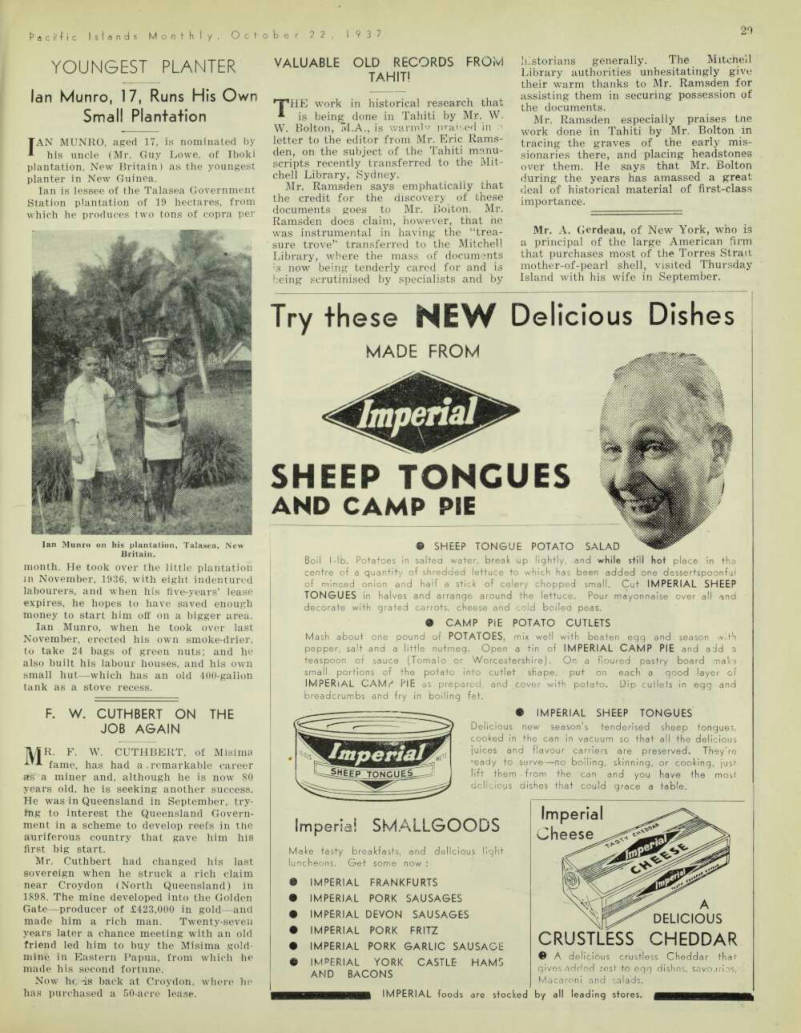
lan Munro, 17, Runs His Own Small Plantation
TAN MUNRO, aged 17, is nominated by -*■ his uncle (Mr. Guy Lowe, of Iboki plantation. New Britain) as the youngest planter in New Guinea. lan is lessee of the Talasea Government Station plantation of 19 hectares, from which he produces two tons of copra per
month. He took over the little plantation in November, 1936, with eight indentured labourers, and when his five-years’ lease expires, he hopes to have saved enough money to start him off on a bigger urea. lan Munro, when he took over last November, erected his own smoke-drier, to take 24 bags of green nuts; and he also built his labour houses, and his own small hut —which has an old 400-gallon tank as a stove recess.
lan Munro on his plantation, Talasea, New Britain.
F. W. Cuthbert On The
Job Again
jyjß. F. W. CUTHBERT, of Misima fame, has had a,remarkable career as a miner and, although he is now 80 years old, he is seeking another success.
He was in Queensland in September, try ing to interest the Queensland Govern ment in a scheme to develop reefs in the auriferous country that gave him his first big start.
Mr. Cuthbert had changed his last sovereign when he struck a rich claim near Croydon (North Queensland) in 1898. The mine developed into the Golden Gate —producer of £423,000 in gold—and made him a rich man. Twenty-seven years later a chance meeting with an old friend led him to buy the Misima gold mine in Eastern Papua, from which he made his second fortune.
Now he. -*is back at Croydon, where he has purchased a 50-acre lease.
Valuable Old Records From
Tahiti
THE work in historical research that is being done in Tahiti by Mr. W.
W. Bolton, M.A., is warm.lv praised in .•> letter to the editor from Mr. Eric Rams den, on the subject of the Tahiti manu scripts recently transferred to the Mit chell Library, Sydney.
Mr. Ramsden says emphatically that the credit for the discovery of these documents goes to Mr. Bolton. Mr, Ramsden does claim, however, that he was instrumental in having the “trea sure trove” transferred to the Mitchell Library, where the mass of documents 's now being tenderly cared for and is being scrutinised by specialists and by
historians generally. The Mitchell Library authorities unhesitatingly give their warm thanks to Mr. Ramsden for assisting them in securing possession of the documents.
Mr. Ramsden especially praises tne work done in Tahiti by Mr. Bolton in tracing the graves of the early mis sionaries there, and placing headstones over them. He says that Mr. Bolton during the years has amassed a great deal of historical material of first-class importance.
Mr. A. Gerdeau, of New York, who is a principal of the large American firm that purchases most of the Torres Strait mother-of-pearl shell, visited Thursday Island with his wife in September.
HTHERE was a time (writes a Madang resident, bitterly) when we people isolated in this little town used to enjoy’ some social life by gathering in the even ings in the Madang Hotel. There, at least, there was some light and liveliness.
Now, for some reason, all that has been changed, and the hotel at nights has assumed a monastic appearance. We people who do not worry much about the passing of time who does, in the tropics ?—cannot help remarking on the punctuality with which the lights are extinguished in the hostelry as the dock strikes the forbidden hour. The powers that direct the licensed house are ob serving the law in letter as well as spirit—but they represent a sad develop ment so far as we are concerned.
Advertisements & other items, pp. 35-36 (1 item)
Sheep Tongues
Try these NEW Delicious Dishes
MADE FROM
AND CAMP PIE
i
9 SHEEP TONGUE POTATO SALAD
Boil 1-lb. Potatoes in salted water, break up lightly, and while still hot place in the centre of a quantity of shredded lettuce to which has been added one dessertspoonful of minced onion and half a stick of celery chopped small. Cut IMPERIAL SHEEP TONGUES in halves and arrange around the lettuce. Pour mayonnaise over all and decorate with grated carrots, cheese and cold boiled peas.
9 CAMP PIE POTATO CUTLETS
Mash about one pound of POTATOES, mix well with beaten egg and season with pepper, salt and a little nutmeg. Open a tin of IMPERIAL CAMP PIE and add a teaspoon of sauce (Tomato or Worcestershire). On a floured pastry board make small portions of the potato into cutlet shape, put on each a good layer of IMPERIAL CAMP PIE as prepared, and cover with potato. Dip cutlets in egg and breadcrumbs and fry in boiling fat. tongues
• IMPERIAL SHEEP TONGUES
Delicious new season's tenderised sheep tongues, cooked in the can in vacuum so that all the delicious juices and flavour carriers are preserved. They're r eady to serve—no boiling, skinning, or cooking, just lift them from the can and you have the most delicious dishes that could grace a table.
Imperial SMALLSOODS
Make tasty breakfasts, and delicious light luncheons. Get some now :
9 IMPERIAL FRANKFURTS
• IMPERIAL PORK SAUSAGES
• IMPERIAL DEVON SAUSAGES
• IMPERIAL PORK FRITZ
• IMPERIAL PORK GARLIC SAUSAGE
9 IMPERIAL YORK CASTLE HAMS
AND BACONS
Imperial
Cheese
o A
DELICIOUS
CRUSTLESS CHEDDAR
® A delicious crustless Cheddar thaf gives added zest to egg dishes, savouries, Macaroni and salads.
IMPERIAL foods are stocked by all leading stores.
Pacific Islands Stamps
Sent on approval on receipt of reference.
Send for free lists and specimen copy, "Australian Stamp Journal."
Collections and Loose Lots Bought
J. H. SMYTH LTD.
114 CASTLEREAGH STREET, SYDNEY
LOW-PRICED LIGHTWEIGHT CASES
Travel light with these strongly-made, economical cases . . . there are sizes to meet all needs, from 12-inch attaches to 28-inch travel cases.
The- lids are reinforced with metal edges . . . the corners fitted with stout guards that prevent wear. Each Case has two nickel-plated English locks and keys.
N?
BEK
m u- > V r-i 20"
I r ?A N? 7 7 Storekeepers everywhere can supply them . . . ask to see cases by Ford Sherington Ltd. At the price, they offer value unsurpassed. 2.8”
TRAVEL and LEATHER
GOODS
il, Klierlngtoii, Ltd
MANUFACTURERS (Wholesale Only)
KIPPAX STREET. SYDNEY
Malden Island To-Day
Uninhabited Barren Rock Was Once World’s Most Valuable Guano Deposit
From Our Own Correspondent
Papeete, Sept. 11.
her return voyage to Tahiti from Christmas Island recently, the schooner Denys stopped for a day at Malden Island, the home of the mysteri ous temples of some past Pacific race.
Malden, at one time, was one of the most valuable guano islands in the world.
Owned by Great Britain, it is situated about 150 miles north-east of Starbuck Island, which is mid-way between Christ mas and Tahiti. Occupying an area of 35 square miles, the island is some 12 miles in length by six miles wide. It was dis covered by the warship Blonde in 1825.
Miss Beatrice Grimshaw, the well known Islands novelist, (who visited Malden Island in 1908) gives this inter
esting bit of history in her book In the Strange South Seas :
“Malden has had an interesting history.
In 1848, Captain Chapman, an American whaling master who lived in Honolulu (he was the founder of the Chapman family of Tahiti and father of the fam ous Lovina) happened to come upon Mal den during the course of a long cruise.
He landed on the island, found nothing for himself and his crew in the way of fruit or vegetables, but discovered the guano beds, and made up his mind to sell the valuable knowledge as soon as his voyage was over. Then he put to sea again and did not reach San Francisco for the best part of a year.
“Meantime, another American, Captain English, had found the island and its treasure. Wiser than Captain Chapman, he abandoned his cruise, and hurried at once to Sydney, • where he sold Malden for a big price to the trading firm who have owned it ever since.”
Captain Mervin, who has just visited Malden in the Denys, reports the island as uninhabited except by bands of pigs which live, apparently, on the eggs of myriads of sea birds that swarm there to make their nests. The place appears to have been hurriedly abandoned. The company s buildings (now falling into decay) are still full of all manner of merchandise. A pharmacy had its shelves full of bottles of medicine, and ware houses were still stocked with miscel laneous goods.
Captain Mervin did not permit his crew to disturb or carry away any of this material, as it is the property of the company which owns the island.
Malden has practically no trees and is therefore a blazing furnace; which must have been fatal to the working staff —as the large cemetery there bears witness.
Miss Grimshaw wrote: “Half a million hard cash has been made out of it in the last 30 years, and it is good for another 30.” That was in 1908.
In 193 <, Malden is a barren rock given back to the sea birds which have inhabi ted it for ages.
Guinea Miner
Ihe Song Of The New
Up the hill, an’ down the hill, An’ through th’ blasted kunai.
“Come on, mate! Keep goin’ till We can make our strike.”
Howlin’ dog an’ stinkin’ smell— An’ still the blasted kunai.
“Hold on, mate! All will be well When we make our strike.”
Kai is scarce and boys are sick — Hell take this blasted kunai!
“Never mind! We’ll do the trick, And yet we’ll make our strike.”
Singin’ sometimes, cursin’ others.
Always the blasted kunai.
“Anyhow, we’ll stick like brothers, Till we make th’ strike.”
Helena M. Rex.
Advertisements & other items, p. 37 (2 items)
31
PecffiC Islands Monthly, October 22, 1937
Prove this in your own car
with
Easily the Best Motor Spirit
you can buy The unrivalled volatility of PLUME make, it easily the best motor spirit you can buy in the Islands for Starting, Acceleration, Power and Mileage- in fact, it's perfect for all-round performance.
Prove this in your own car
i
IDS
A Comparison Between Taro
And Rice
A PLANTER at Talasea, New Britain, Mr. J. Guy Lowe, although 150 miles away from Rabaul in a direct line, felt the earth tremors of the Rabaul eruption on May 28, and heard loud reports.
In the course of an interesting letter, Mr. Lowe says that he assumed that Rabaul would be in chaotic condition, and that he could not depend on the usual shipping service; and, as he has a big labour line to maintain, he immediately commenced shooting fish and trading it for taro, which might take the place of his usual supplies of rice.
His rice supplies were interrupted
though not seriously, but he actually saved money on the development, ft worked out like this: The cost of suf ficient taro to feed his boys for six days was about 2 Bd. worth of dynamite; whereas rice for six days for his 40 men costs about 20/-.
Incidentally, Mr. Lowe is one of the New Guinea planters who are making experiments with the Cebu-European cross of cattle. He has 260 animals on his plantation and he has been shipping working bullocks to Rondo. He says that he sent off recently a bullock team of 10, with a boy in charge, armed with a real bullock-whip plaited from a half- Cebu hide. But he says nothing about the native bullocky’s lingual equipment— which is the most important item of bullock driving.
Higher Freights
Result of World Shortage of Shipping
CHIPPING freights continue to rise, to the discomforture of Pacific Islands residents.
Some correspondents are eager to at tack the Australian shipping companies.
But the Australians can do nothing—it is all part of a world-wide movement, based most definitely on a shortage of shipping.
The following extract from the Lon don Daily Tevegraph. of September 11, 1937, sets out the position quite clearly:
Shipping Freights
“As was expected, the August index number of shipping freights prepared by the Chamber of Shipping of the United Kingdom reflects the continued activity of the freight market. The index number for August on the basis 1929 = 100 was 153.56. This is 11.47 p.c. higher than in July, when the index was 137.76 and 73.91 p.c. higher than in August, 1936.
“The August figure is the highest for several years. It is significant, however, that the index on the basis 1920 =f 100 is still only 38.19—in other words, that freights are still, on the average, less than 40 p.c. of the level they reached during the 1920 boom.
“The high point of this month’s index is again the time charter rate, which is 22.22 p.c. higher than a month ago and 202 p.c. higher than a year ago. The rise in those markets in which there are minimum schedules in operation was generally less marked than in the uncon trolled markets. This is perhaps natural, because co-operation among shipowners was able to prevent those rates falling to the full extent of the general decline, and advances in those markets were se cured at an earlier stage in the recovery.”
Chinese Community In Madang
From a Special Correspondent
Madang, Sept. 20.
SEVERAL Europeans are asking why the Administration is permitting the Asiatic section of our community to gradually invade the European area of the town. This process has been going on for some time and is now made evi dent by the erection of another Chinese store, on the end of that thin wedge of territory called Chinatown, bringing that area another step closer to the European section.
If means were adopted to make a few more allotments available to Europeans, it would be the sort of policy which one would expect the authorities to follow.
But, as it is, the Chinese traders are slowly but surely getting a strangehold on the town.
Rev. W. T. Taylor, of Wanigela, Papua, arrived in Sydney by the Macdhui on October 1, accompanied by his wife.
Advertisements & other items, pp. 38-39 (3 items)
32
Paci-fic Islands Monthly, October 22, 1937
uCall:
PRODUCING UNIFORM GOOD RESULTS SINCE 1868
ALWAYS ASK FOR IT
KEROSENE OPERATED...
StfOfYl REFRIGERATORS
ANNOUNCE NEW EXPORT POLICY
AND THE BEST REFRIGERATOR VALUE EVER OFFERED To enable us to obtain Full Advantage from the enormous Output Capacity of the new Hallstrom Manufacturing Plant, covering 20 acres and including the finest machinery of its type in Australia, we have decided on a policy of More Sales at Lower Prices We now offer the Model as illustrated at £3l-10-0 F. 0.8. Sydney. ■ w Us mm This ever popular Hallstrom model has, over a number of years, stood all tests under all conditions, and may be ordered direct from the factory, or is obtainable, at the new price, from all branches of Burns, Philp & Co. Ltd. and W. R. Carpenter & Co. Ltd.
HALLSTROMS PTY. LTD., Willoughby, Sydney
In A “One Man Breeze’’
Native trying to balance a sailing outrigger in a “one man breeze,” on Ananuka Lagoon, Gilbert Islands. —Photo by Father Dumas.
Radio In The Wilds
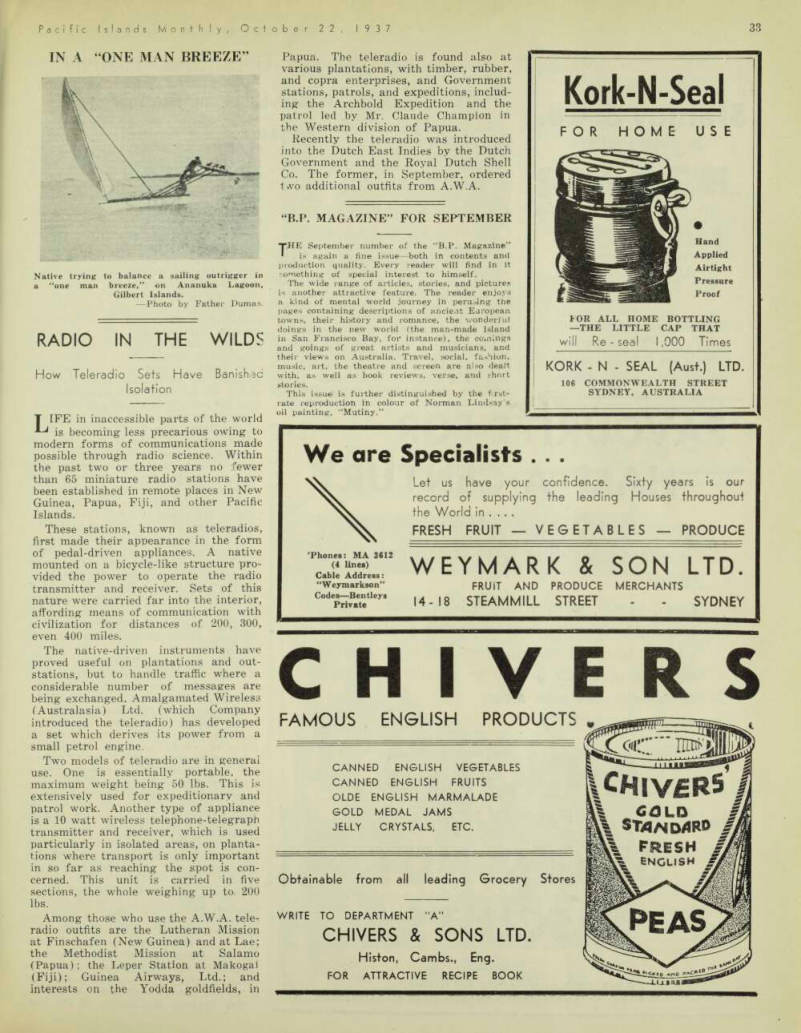
How Teleradio Sets Have Banished Isolation
T IFE in inaccessible parts of the world is becoming less precarious owing to modern forms of communications made possible through radio science. Within the past two or three years no fewer than 65 miniature radio stations have been established in remote places in New Guinea, Papua, Fiji, and other Pacific Islands.
These stations, known as teleradios, first made their appearance in the form of pedal-driven appliances. A native mounted on a bicycle-like structure pro vided the power to operate the radio transmitter and receiver. Sets of this nature were carried far into the interior, affording means of communication with civilization for distances of 200, 300, even 400 miles.
The native-driven instruments have proved useful on plantations and out stations, but to handle traffic where a considerable number of messages are being exchanged. Amalgamated Wireless (Australasia) Ltd. (which Company introduced the teleradio) has developed a set which derives its power from a small petrol engine.
Two models of teleradio are in general use. One is essentially portable, the maximum weight being 50 lbs. This is extensively used for expeditionary and patrol work. Another type of appliance is a 10 watt wireless telephone-telegraph transmitter and receiver, which is used particularly in isolated areas, on planta tions where transport is only important in so far as reaching the spot is con cerned. This unit is carried in five sections, the whole weighing up to> 200 lbs.
Among those who use the A.W.A. tele radio outfits are the Lutheran Mission at Finschafen (New Guinea) and at Lae; the Methodist Mission at Salamo (Papua); the Leper Station at Makogai (Fiji); Guinea Airways, Ltd.; and interests on the Yodda goldfields, in
Papua. The teleradio is found also at various plantations, with timber, rubber, and copra enterprises, and Government stations, patrols, and expeditions, includ ing - the Archbold Expedition and the patrol led by Mr. Claude Champion In the Western division of Papua.
Recently the teleradio was introduced into the Dutch East Indies by the Dutch Government and the Royal Dutch Shell Co. The former, in September, ordered two additional outfits from A.W.A.
“B.P. Magazine” For September
THE September number of the “B.P. Magazine”
' is again a fine issue—both in contents and production quality. Every reader will find in it .•omething of special interest to himself.
The wide range of articles, stories, and pictures is another attractive feature. The reader enjoys a kind of mental world journey in perusing the pages containing descriptions of ancient European towns, their history and romance, the wonderful doings in the new world (the man-made island in San Francisco Bay, for instance), the comings and goings of great artists and musicians, and their views on Australia. Travel, social, fashion, music, art, the theatre and screen are aiso dealt with, as well as book reviews, verse, and short stories.
This issue' is further distinguished by the f rst rate reproduction in colour of Norman Lindsay's oil painting, “Mutiny.”
Advertisements & other items, pp. 39-40 (1 item)
Chiv E R S
Kork-N-Seal
FOR HOME USE
• Hand Applied Airtight Pressure Proof
I 1 OR ALL HOME BOTTLING
—THE LITTLE CAP THAT
will Re - seal 1,000 Times
KORK - N - SEAL (Ausf.) LTD.
106 COMMONWEALTH STREET
SYDNEY, AUSTRALIA
We are Specialists . . .
\ 'Phones: MA 3612 (4 lines) Cable Address: “Weymarkson”
Codes—Bentleys Private Let us have your confidence. Sixty years is our record of supplying the leading Houses throughout the World in ... .
FRESH FRUIT VEGETABLES PRODUCE
WEYMARK & SON LTD.
FRUiT AND PRODUCE MERCHANTS
14-18 STEAMMILL STREET - - SYDNEY
CHIV E R S
FAMOUS ENGLISH PRODUCTS
CANNED ENGLISH VEGETABLES
CANNED ENGLISH FRUITS
OLDE ENGLISH MARMALADE
GOLD MEDAL JAMS
JELLY CRYSTALS, ETC.
Obtainable from all leading Grocery Stores
WRITE TO DEPARTMENT "A"
CHIVERS & SONS LTD.
Histon, Cambs., Eng.
FOR ATTRACTIVE RECIPE BOOK
cc mi
CHIV£RS
COLD
i STfl/SiDflRO ■
\\ fresh /
i\« ENGLISH f/
s
PEAS
AC*** CK 11>
XIXBJU
Cables : "Stancarr." Tel. MA 4416
ESTABLISHED 1841
Stanley & Co.
325 SUSSEX STREET
SYDNEY
WHOLESALE & RETAIL
PRODUCE MERCHANTS
Fruiterers and Greengrocers
Shipping Providers
PACKING FOR ISLANDS TRADE
A SPECIALTY
EUROPEAN and CHINESE VEGETABLES
always available in any quantity.
FAVOURITE FOR
HALF A CENTURY
p OR over 60 years the biscuit par excellence where masculine taste is concerned is Arnott’s Famous Ginger Nuts.
Crisp, brown, warmly delicious in flavour and crunchy in texture, they hold pride of place as a hardy he-man’s biscuit which has never been equalled in either quality or popularity. Try some with your next order.
ARNOTTIS
FAMOUS
GINGER NUT
BISCUITS
Always ask your Grocer for Arnoft’s
“THEY ARE BETTER THAN EVER”
The Disaster Of The "Sarah-Ann"
Last Instance of Cannibalism In the Tuamotus
By “Ua-Huka”
story of the last case of canni * balism in the Tuamotu Islands was told to the writer many years ago by Mr. Thomas Adams, a pioneer in French Oceania, who went to Tahiti in 1841 and died there in 1915 at the venerable age of 90.
The writer has been fortunate, how ever, in discovering a written account of the happening in a volume on Tahiti written in 1860 by Monsieur G. Cuzent, Pharmacien de la Marine, who was stationed at Papeete from November, 1854, until May, 1858. The story by M.
Cuzent (which confirms exactly that re lated by Mr. Adams) is as follows: The schooner Sarah-Ann left Valpar aiso (Chile) in March, 1856, for the Gambier Islands, where she was due to take on a cargo of pearl shell. This schooner was commanded by Captain
Krayser, who had with him his wife, a young child of 22 months, and, as a servant, a young girl of Tahiti. There were on board, also, Monsieur Ehlers (supercargo) and Monsieur Botcher, (merchant, whom I had occasion to know some months before at Tahiti, whither he was returning after a voyage to Valparaiso). The crew was composed of nine men, in addition to two boys, sons of Captain Stevens of Tahiti. That is to say 17 persons in all.
The Sarah-Ann anchored at the Gam bier Islands in April, and found in the roadstead of Mangareva the sloop-of-war Sarcelle, commanded by Lieutenant Ferre. Monsieur Botcher remarked to his friends, the officers of the warship, that they would see each other very soon at Papeete: for he thought the Sarah-Ann would not be more than eight days be hind the Sarcelle in arriving at that port.
From that time (April, 1856) until June, 1857, nothing was heard of the Sarah- Ann: Everyone thought that she had foundered at sea during a storm.
On June 1, 1857, the schooner Julia, belonging to the house of Hort Freres. of Papeete, dropped anchor at Tahiti. Her captain, M. Danhum, related that when passing the island of Bligh (Tematangi) he had seen what he believed to be the remains of a wrecked vessel. As he ap proached nearer he saw natives armed with spears following along the beach the course of his schooner. He recognised floating from their shoulders, or attached to some trees, cloth of various colours, and remarked certain wreckage which led him to believe that this could well be the place where the Sarah-Ann had been wrecked.
Seeing no traces of Europeans and as the natives exhibited a hostile disposi tion, he sailed away fully persuaded that the ship’s company had been put to death and devoured by the Islanders.
The French Government hastened to despatch from Tahiti the steamship Milan, in order to rescue the Sarah-Ann’s crew, if there was still time. At the is land of Bligh, landing parties of marines searched diligently without making any discoveries. The report of M. Caillot. en sign, stated that the huts were empty.
There were found in them only some fish, freshly caught, hanging on the posts and on the ground, mats spread out which, still warm, bore witness that the inhabi tants had taken flight but a moment before.
This island, very low, circumscribes an interior lake. Composed of coral, it is covered with a great number of pandanus palms which form impenetrable thickets.
Into these the marines discharged some shells and many gun shots. A number of trees, huts and canoes were burned. AH this did not lead to any result, and the Milan put to sea and returned to Tahiti.
Mrs. Stevens, the mother of the two
boys on board the Sarah - Ann, and a woman of great energy, immediately chartered the schooner Julia and sailed in July, 1857, for Bligh Island to search for her children.
She stopped, in passing, at the He de la Chaine (Anaa) and took with her 25 resolute natives acquainted somewhat with the language of the Bligh Islands and the Chief, Teina, to direct the expedi tion.
Arriving at Bligh, the Anaa natives penetrated the thickets of pandanus and, having made a tour of the island, they returned without having discovered any thing of importance.
During this time, the chief, Teina, re mained alone, having waited for the scouts to go ahead. He was preparing to rejoin his companions when the sound of a rolling stone attracted his attention.
Ho perceived, then, between some blocks of piled up coral a hand which was work ing to clear them away from the entrance of a subterranean cavity. The natives of Bligh, hearing no further sounds, be lieved the strangers had departed and were preparing to come out from their h'ding place.
At the rallying cry of Teina, his com panions came on the run and assisted him in opening the passage to the cavern.
There they found 16 persons—including four children —whom they placed on board the Julia.
The remains of human bones, a head of blonde hair (supposed to have belonged to the wife of the captain), a part of the body of a! child, dried by the sun and attached to the summit of a pole to serve as a fetish, and teeth and finger bones were found on the island.
The skulls had been cut triangularly in order to extract the brains. These grisly remains, together with the head of blonde hair, were carried to Tahiti.
The Julia, arriving with only 13 prison ers (three having died during the voy age), dropped anchor in the roadstead of Papeete on August 5, 1857, having brought the sad certitude of the disaster of the Sarah-Ann.
Rush For B.S.I. Stamps
GO great was the demand that 45 minutes after Tulagi post office open ed up for business at 8 a.m. on May 18, the whole Tulagi quota of the Solomon Islands issue of Coronation stamps, with the exception of l|d, was sold out—even although mail orders had been cut down 33 l-3rd per cent. The result was that many Islands residents, outside Tulagi, who were unable to join the queue have not and perhaps never will see the Id and 3d issues, unless they care to indent a few from Dublin, or elsewhere. As one who does his mite to balance the budget, I suggest, to keep the money in the
group, another issue.
A.M.A.
Mr. Fred Biggs, of Messrs. Bums Philp (S.S.) Co. Ltd., married Miss Florrie Quintal at the Norfolk Island Methodist Church recently.
French Scientists
Voyage Through South Seas in a Catamaran
HAVING sailed across the Pacific from Hawaii to So'urabaya in a catamaran, Captain Eric de Bisschop and his com panion Joseph Tatibouet completed an other stage of their voyage to France when they arrived at Capetown, South Africa, on August 29, after a 61-days journey through the Indian Ocean.
These two French scientists have spent three years in the South Seas, doing research work in connection with the origin of the Polynesian race. Captain de Bisschop holds the ethnological theory that the Polynesians came from America, and not Asia, as is generally believed. He bases his contention largely on a study of ocean currents, which he says are from east to west in the Pacific. The currents move with such force, he states, that it would have been almost impossible for the early voyagers in their primitive canoes to have sailed directly against them.
After an earlier abortive attempt to cross the Pacific, the two adventurers left China at the end of 1934 in a queer junk like vessel, the Fou Po 11. They called at the Caroline Group, Thursday Island, Papua (where their craft was driven
ashore by south-east seas onto the Gulf of Papua), the Solomons, and Jaluit (Marshall Is.). Then for months they battled unsuccessfully with the currents in an endeavour to sail eastwards —thereby strengthening their migration theory.
Eventually, their boat was wrecked at Molokai Island (Hawaii) in December, 1935 led ? pr ! Z h e % 6 - 00 ° francs f< T his ! researches by the French Geographical Society, Captain de Bisschop set about building a catamaran on a Hawaiian beach. In eight months he and his companion had their vessel ready for launching. It consists of two 30ft. canoes joined by decking, on which are two masts.
There is a small cabin in each canoe, and the craft is propelled by bat-wing sails similar to those of a Chinese junk.
Late last year, the French Geographical Society asked them to sail westward across the North Pacific, and until they reached Java some four months ago, little was heard of their progress. After a rest at Capetown, they will sail direct to Cannes, in the south of France.
Captain de Bisschop intends .to return to Hawaii to marry and settle down.
Mr. A. B. Brewster, a Victorian, who was for 40 years in Fiji during which he was Governor’s Commissioner and Com mander of the Native Constabulary, has written an interesting book about the early days of the Colony. Published by Messrs. Robert Hale & Co., London, it is entitled “King of the Cannibal Isles."
Advertisements & other items, pp. 41-42 (1 item)
Starch
PURE RICE
Always ask for . . .
"CORAL" Brand
100% PURE
Manufactured by
AUSTRALIAN RICE LTD.
Sydney, N.S.W.
Ik r Australia's Choicest Products: Brussels Sprouts While Turnips Sweet Corn Tomato Puree Tomato Sauce Tomato Soup Tutti Fruit Sauce (Worcestershire flavor) Green Peas Beetroot French Beans Spinach Cauliflower Cabbage Carrots Parsnips
tlk Celery
I f m v. • IB
Wmm
mm Always . . . make sure you have at hand
an ample
Reserve of these Delicious . .
Garden
Vale
Ready-to-
serve Vegetables
TO PLANTERS AND TRADERS
William E. Reed
(Established 1913) Union House, 247 George St., Sydney For all Island Requirements, Island produce sold.
Prices right. Enquiries welcomed.
>FEUERHAND<
HURRICANE
LANTERNS £
\ * > * -^1 \ If m 5y3 m S and many other types of varied shape and style!
Sole Agent for the South Sea and New Guinea:
CARL AUG. DOCKE BREMEN/germany
Exporter of all goods, suitable for the Islands trade Importer of any kind of Island Produce Correspondence invited
A Royal Visit To Tonga
By F. T. GOEDICKE, of Haapai
TTOW the report got afloat I now forget, * but many years ago it was said that His Royal Highness the Duke of Edin burgh intended to pass through the Ton gan Islands, on his way to Tahiti from Fiji. The report caused immense excite ment among the natives.
I know they all felt honoured at the anticipated visit, and that they thought it quite natural that such a visit should take place.
When I told the natives that I thought that it was at least very doubtful that we should be honoured by a visit from a son of “Vika” (as they called Her Majesty) they laughed at me.
I remember, at this time, asking a chief what sort of duties or pleasures occupied the Queen of England. Of the former he had no idea, but he thought that perhaps, as King George of Tonga (Tubou I.), on fine evenings, sat on his verandah among his chiefs and people, drinking kava and eating ripe bananas, a great chieftainess like Her Majesty might do the same. But kava papalagi (square gin) would probably be substi tuted at Windsor Castle for Tongan kava , and salt beef and sardines —in those days thought to be the acme of all good things —for bananas: and she would be sur rounded certainly with captains of war ships.
One bright morning, at one of the chief villages of Tongatabu, I saw most of its female population shouting and running down to the beach, waving rags and waist cloths, towards a large ship which was steaming into the eastern passage of Tonga. They were certain that it was the long expected Duke.
There was a marsh in those days near the sea beach, and close to Nukualofa, which marsh occupied a portion of land belonging to an Englishman, who had been in those parts much longer than I.
I went to call on. him.
“Yes, the Prince is certainly coming,” he said, “and we ought, for the credit of the people, to get up something to amuse him and show loyalty to our Queen.”
There were about 20 weatherboard houses in Nukualofa then, and there were no great shakes either.
“But what could we do?’’ I asked.
“What could we show him. if he does come?”
“The best thing,’' I continued, “always providing that the almighty missionaries will allow it, is to get the Prince to go in one of his boats, with plenty of cham pagne, etc., and sail to one of the small islands over the reef yonder, where there are white beaches, sunlight, green palm trees, and grass; and we could take out a bevy of dusky beauties, who could dance before him, in old native style.”
The idea appeared to please him, for he said: “That would be nice, with noth ing on; but that would never be per mitted.”
“No,” I said. “But if the Prince ex
pressed a wish to see a ancient dance, the missionaries would hardly object.”
I was on friendly terms with old King George in those days. He was not then full of ridiculous ideas of his magnifi cence with which he was subsequently stuffed by his advisers. I went to see him, to find out why he expected the Galatea.
I found His Majesty on his verandah, looking seaward. He had obtained from Eua all the Kalas (parrots) that could be procured, as a present for the expected royal guest, and they were all in a large wicker aviary in the palace ground.
He had the waterfront decorated for more than a mile with upright poles, all festooned with sisi kakalas, which are girdles the natives wear round their waists. These are made of dead ferns, only procurable at Eua, and of different kinds of flowers. Chinese lanterns were not known here then, otherwise all the poles would doubtlessly have been decor ated with them, too.
As soon as the King had shaken hands with me, he spoke about the Prince’s visit to Tonga.
I told him that I was in Sydney on that day when the Prince was wounded by a madman, and of how Sydney went almost mad with rage.
We were in the midst of our kava and talk, when a boat was reported to be coming in. There was a blinding sun, but His Majesty seized his telescope, and looked out.
“Koe mooni!” he said. “A boat is com ing, and it appears to be rowed better and more regularly than my Tonga people could row one, and there are many oars on each side of her.”
“Perhaps,” I said, “it is a boat from the Galatea, sent off to look for a pilot.”
"Ten teuV (get all ready), cried His Majesty to his attendants.
But before long, the supposed boat from H.M.S. Galatea , was found to be the German firm’s large boat, full of dirty bags of copra, from a neighbouring bay.
Prince Alfred, at about that time, was making Jiis transit across the Pacific, a thousand miles from Tonga, on his way from the Colonies to Tahiti.
600 -Mile Ocean Trip In
Native Canoe
A N adventurous 600 mile voyage in a native dug-out from Port Moresby, Papua, to Australia by Messrs J. J.
Laverack and A. R. Marshall ended abruptly in mid-September when the canoe was wrecked on a coral reef off the Queensland coast. The two young men managed to get ashore at the Lockhart River Mission Station and later were taken to Cairns in the steamer Wandana.
They left Port Moresby with the dug out laden with native spears, tomahawks, etc., and planned to sell these curios in towns along the Australian coast. After live days’ paddling they reached the Bar rier Reef and then ran into mountainous seas. Most of their cargo and belongings were washed overboard, before they struck the reef.
a Defence Link
New Guinea's Value as a Defence Link
nPHE N.S.W. Congress of the Returned Soldiers’ League in Sydney in Sep tember urged that Australia’s mandate in New Guinea should be terminated and the Mandated Territory proclaimed Com monwealth territory. Captain G. D.
Mitchell declared that Australia needed a barrier to link up with Singapore and help to prevent invasion from the north.
The motion had been advocated by re turned soldiers in New Guinea.
Colonel Murphy said that Australia held New Guinea as a trusteeship by a mandate from the League of Nations. It was exactly because she needed them for her own defence that Japan, in withdraw ing from the League, had said she was determined to keep the Pacific Islands over which she held a mandate. He asked were they proposing that Australia should put herself in the same position as Japan?
The Congress also recorded its strong opposition to the return to Germany of the colonies lost in the Great War. One delegate said that in view of the develop ments of modern air warfare, it would be dangerous for former colonies, con tiguous to British dominions to be re turned to Germany lest they should be converted into air bases.
Mr. Cecil Abel, of the Kwato Mission, Samarai, recently returned to Capua after a visit to England.
Mr. Torao Wakamatsu, Consul-General for Japan at Sydney, has received authority empowering him to exercise jurisdiction in respect of the Gilbert and Ellice Islands, the Solomons Protectorate, Tonga, the New Hebrides, and other islands under the High Commission for the Western Pacific, according to a notice in the W.P.H.C. Gazette issued in Suva recently.
Mr. N. A. Pyne, late Collector of Cus toms of Tonga, who resigned to take up the secretaryship of Panels Pty. Ltd., Sydney, is now renewing old Islands associations by importing large quan tities of New Guinea logs and timbers into Australia.
Colonel and Mrs. J. Walstab, of Rabaul, returned to New Guinea in September, after a visit to England.
Advertisements & other items, pp. 43-44 (1 item)
Aunt Marts
H.JONES &C 0
austrMl^
AUSTRALIA’S BEST
H. JONES & CO., LTD.
Darlington, Sydney Hobart, Tai.
Fruit, Vegetables, and Produce For— Fresh Islands Residents can rely on the old-established Shipping Providers:
OPV^
St* Only Address: 421 Sussex Street, SYDNEY All Orders Promptly Attended Island Agents : NELSON & ROBERTSON PTY. LTD.
AUNT MARTS
" Defiance "
Brand
Canned
Goods
i are prepared and j packed by the proprietors of Aunt Mary’s Pure Food Products.
I The finest quality goods are hermetically sealed j to withstand tropical [ heat, and give to con- I sumer s maxi m u m \ satisfaction.
PURE FOOD
PRODUCTS
Supreme in quality and flavour, these pure food products have been supplied to the people of the Islands for more than thirty years. Specially manfactured and packed to meet Island conditions, they give complete satisfaction to both retailer and consumer.
Prepared and Packed only by—
TILLOCK & CO. PTY. LTD.
Incorporated in the State of N.S.W.
PURE FOOD MANUFACTURERS
KENT & LIVERPOOL STS., SYDNEY, N.S.W.
PRESCOTT L T D Iyd E ne S y are sole wholesale agents fbi'-
PINEAPPLE BACON s HANS
DAISY BRAND BUTTER
LEA & PERRI NS' H P. Sauce
LEA & PERRINS' "T,' : T!5
and Most other Super-Quality Lines of the Trade
Swallow & Ariell's
WORLD RENOWN ED
CANTERBURY
CAKES
CXXXXXXXXX3
FRUIT
PLAIN
SEED
PLUM
ALMOND
LXXXXXXXXX3
Carc^
MELBOURNE
xxxxxxxxx:
PRESERVED
GINGER
SULTANA
CHERRY
RIPE
GENOA
xxxxxxx: :xxxxxxxxxxxxxxxxxxxxxxxxxxxxxxxxxxxxxxxxxxxxx: Each Cake is Enclosed, by special process, in air-tight tin, and is warranted to keep its condition for a
considerable period.
lxxxxxxxxxxxxxxxxxxxxxxxxxxxxxxxxxxxxxxxxxxxxxx:
Stir Among Papeete's "Elder
Beauty Parlour In
Tahiti
Stir Among Papeete's "Elder Statesmen"
From Our Own Correspondent
Papeete, Sept. 20.
VI/E have been informed that a Beauty ** Parlour has been established at Papeete.
This news has bucked up some of us “elder statesmen” immensely. We are told we can have our grey hair changed to flaming titian bronze, or to the sleek black of a raven’s wing. And, more, the crow’s feet at our temples can be bur nished out, and the wattles of our jowls raised to the smooth plumpness of a Devonshire peach.
This is like the sun rising in the west and turning the evening of our lives into the brightness of mid-day.
Years ago, we used to go to the Jcun ease Tahitienne dances. We were already grey of hair then. But we told everyone we were platinum blondes, who had been born that way and that really we were not within 20 years of the age our un usual appearance proclaimed us.
The young women were very polite about it. They always danced with us when we asked them. Nevertheless, we suspected our stories were not very con vincing: for they were continually asking us if we were not too tired from dancing so much and we often caught them look ing longingly—over our shoulder during the dance —at some young fellow with black shellac hair.
Then, one day, we overheard them re ferring to us as ruau (old men) and we became discouraged. We decided to stay at home and be venerable and dignified, as our wives had long before told us— in curtain lectures of some length and tartness —befitting the number of our years.
But this new prospect changes things entirely. Already, we are making daily expeditions up Semaphore Hill to get the creakiness out of our knees. When we have finished our beauty treatments we are going again to the Jeunesse Tahiti enne dances to show those gals we can still shake a wicked foot in the tango and charleston—that is, if our wives do not find out what we are up to and nip the whole scheme in the bud!
Sir Frank Stockdale, K.C.M.G., C.8.E., M.A. (Cantab.), Agricultural Adviser to the British Colonial Office, sailed from Suva in September after carrying out official agricultural investigations in Fiji for three weeks. He is editor of the “Tropical Agriculturist” and has written
extensively on tropical agriculture.
Mr. P. M. McGregor, of the Auto mobile Association of Auckland, N.Z., a branch of which was recently established in Fiji, has been in the Colony with an Association patrol car, carrying out sign posting work on the roads of Viti Levu.
Investiture Of Tongan Prince
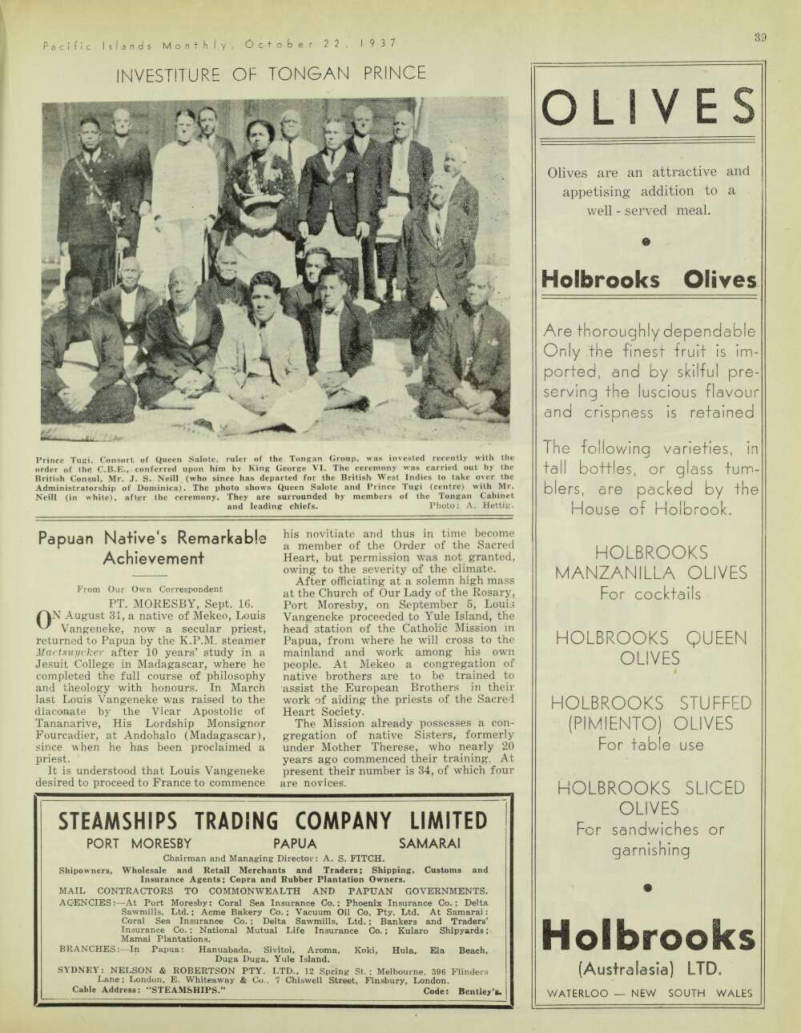
Prince Tugi, Consort of Queen Salote. ruler of the Tongan Croup, was invested recently with the order of the C.B.E., conferred upon him by King George VI. The ceremony was carried out by the British Consul, Mr. J. S. Neill (who since has departed for the British West Indies to take over the Administratorship of Dominica). The photo shows Queen Salote and Prince Tugi (centre) with Mr.
Neill (in white), after the ceremony. They are surrounded by members of the Tongan Cabinet and leading chiefs. Photo: A. Hettig.
Papuan Native's Remarkable
Achievement
From Our Own Correspondent
Pt. Moresby, Sept. 16.
August 31, a native of Mekeo, Louis Vangeneke, now a secular priest, returned to Papua by the K.P.M. steamer Mactsuycker after 10 years’ study in a Jesuit College in Madagascar, where he completed the full course of philosophy and theology with honours. In March last Louis Vangeneke was raised to the diaconate by the Vicar Apostolic of Tananarive, His Lordship Monsignor Fourcadier, at Andohalo (Madagascar), since when he has been proclaimed a priest.
It is understood that Louis Vangeneke desired to proceed to France to commence
his novitiate and thus in time become a member of the Order of the Sacred Heart, but permission was not granted, owing to the severity of the climate.
After officiating at a solemn high mass at the Church of Our Lady of the Rosary, Port Moresby, on September 5, Louis Vangeneke proceeded to Yule Island, the head station of the Catholic Mission in Papua, from where he will cross to the mainland and work among his own people. At Mekeo a congregation of native brothers are to be trained to assist the European Brothers in their work of aiding the priests of the Sacred Heart Society.
The Mission already possesses a con gregation of native Sisters, formerly under Mother Therese, who nearly 20 years ago commenced their training. At present their number is 34, of which four are novices.
Advertisements & other items, pp. 45-46 (1 item)
Olives
are an attractive and appetising addition to a well - served meal. • Holbrooks Olives Are thoroughly dependable Only the finest fruit is imported, and by skilful preserving the luscious flavour and crispness is retained The following varieties, in tall bottles, or glass tumblers, are packed by the House of Holbrook.
HOLBROOKS
MANZANILLA OLIVES
For cocktails
HOLBROOKS QUEEN
OLIVES
HOLBROOKS STUFFED
(PIMIENTO) OLIVES
For table use
HOLBROOKS SLICED
OLIVES
For sandwiches or garnishing
Holbrooks
(Australasia) LTD,
WATERLOO NEW SOUTH WALES
STEAMSHIPS TRADING COMPANY LIMITED
PORT MORESBY PAPUA SAMARAI
Chairman and Managing Director: A. S. FITCH.
Shipowners, Wholesale and Retail Merchants and Traders; Shipping, Customs and Insurance Agents; Copra and Rubber Plantation Owners.
MAIL CONTRACTORS TO COMMONWEALTH AND PAPUAN GOVERNMENTS.
AGENCIES: —At Port Moresby: Coral Sea Insurance Co.; Phoenix Insurance Co.; Delta Sawmills, Ltd.; Acme Bakery Co. ; Vacuum Oil Co. Pty. Ltd. At Samarai: Coral Sea Insurance Co. ; Delta Sawmills, Ltd.; Bankers and Traders’
Insurance Co. ; National Mutual Life Insurance Co. ; Kularo Shipyards; Mamai Plantations.
BRANCHES:—In Papua: Hanuabada, Sivitoi, Aroma, Koki, Hula, Ela Beach, Duga Duga, Yule Island.
SYDNEY: NELSON & ROBERTSON PTY. LTD., 12 Spring St.; Melbourne, 396 Flinders Lane: London, E. Whiteaway & Co., 7 Chiswell Street, Finsbury, London.
Cable Address: “STEAMSHIPS.” Code: Bentley’s.
EVAPORATED
tA#*
SISVVEETENEP
tTTI •
»5 •x: 'ki V>U‘
IDEAL
for all your
COOKING
“Ideal” because it is the purest, freshest milk vou can buy. “Ideal” because of the added flavour knd nourishment it gives. “Ideal” because it is always safe and cannot become contaminated while unopened.
“Ideal” Milk is just pure, rich country milk com cent rated to almost the consistency of cream. No preservatives are added—only water is taken from it. lor cooking, just dilute with water and use as ordinary milk. With fruit and other sweets, serve “Ideal”
Milk undiluted—it’s delicious and nourishing.
Evaporated Unsweetened
MILK
A NESTLE’S PRODUCT
Copyright 3141 i
From A Window In

Wau
By “Motley”
ALTHOUGH the hole in the centre of N.G. shillings is to enable natives' to string their wealth around their necks in the absence of pockets, the habit of string “marks” has also been acquired by Europeans. The other day I heard of an out-back miner paying an account amounting to over £l5 in shillings strung in this fashion. Of course, this is carry ing things too far, as no doubt the native said who had to hawk them around, but no one can begrudge an isolated “digger” the simple pleasure of a practical joke. * * * AND speaking of practical jokes reminds me of the “new ’and” who came to work in one of the local stores recently and consigned an order to Edie Creek ’drome; but he wasn’t trying to be funny. The man who can discover a ’drome on the pinnacles of Kaindi will be a saviour indeed to those who pad the track or take a nerve-wrecking ride on a motor truck. * * * SNAKES! Several of them " have been seen—and killed—around Wau lately, no doubt disturbed by the Government grass line in the course of its duties. Rabbie Burns composed “To a Mouse” when suffering pangs of re morse for having broken up a mouse’s happy home with his plough. But I don’t think anyone will write a pretty poem to a python on being awakened from its sleep. One snake measuring 17ft. was killed recently not far from Burns, Phiip & Co’s store and another the following day measuring 12ft. and weighing 18 lbs. near the Wau Freezer. * * * VI/’HILE on the subject of pets, I ** noticed Miss Ela Gofton, popular daughter of Mrs. Stewart, of Wau, with a little orphaned “seacow”—anyway that is how the natives pronounce it. It is a species of ’possum and it had lost its mother at the hands of natives on the search for kai-kai. The “joey” had been spared and presented to Ela who is rear ing it on Glaxo. What a chance for a testimonial! * * * TN front of Wau District Office where * the Australian flag flutters languidlv, reminding passers-by that the sun never sets on the British flag and of such like patriotic slogans, there lies a cool sweep of lawn which sets off the seat of local government handsomely. The native mind, however, apparently does not see kin this light. Having little esthetic sense he regards it from the Viewpoint of utility, and on sunny days police boys can be seen airing their laundry—ready for the next dress inspection no doubt. 5fC VI/’AU has grown by leaps and bounds ’ since the Edie Creek trail of ’26 but it by no means justifies the flattering address appearing on a letter received at Wau recently—4o4b High Street. This is going a bit too far.
Advertisements & other items, p. 46 (1 item)
40
Pacl'fic Islands Monthly, October 22, 1937
Crossing The Reef At Atiu, Cook Islands
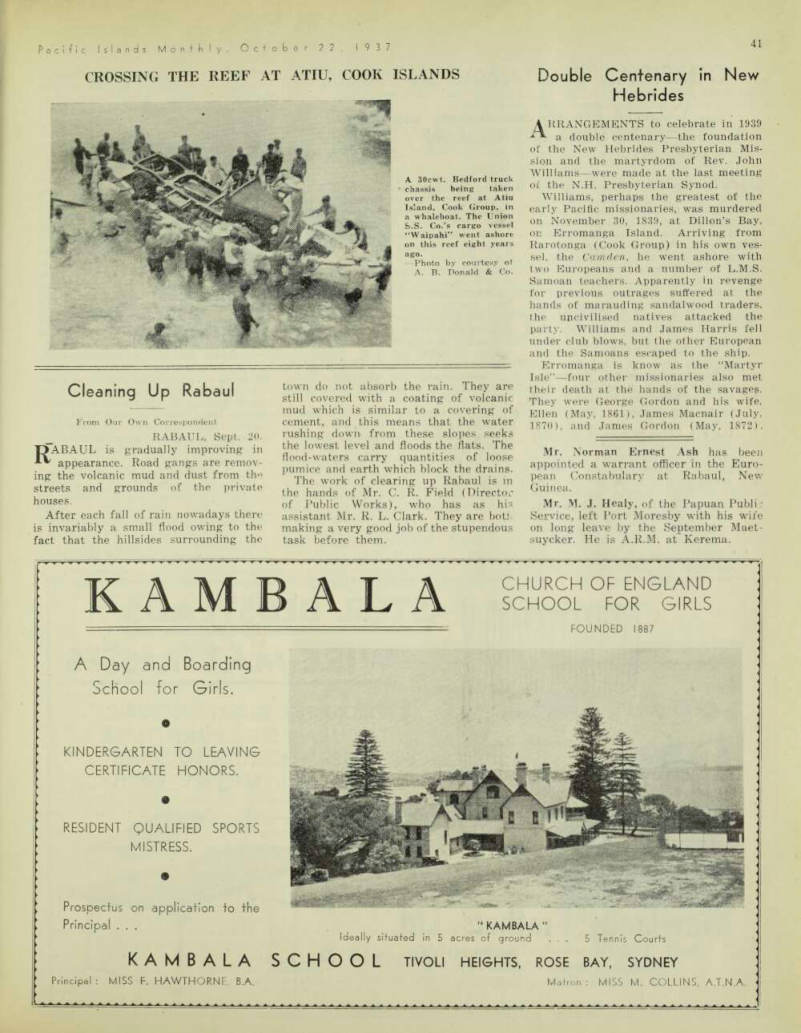
A 30cwt. Bedford truck chassis being taken over the reef at Atiu Island, Cook Group, in a whaleboat. The Union S.S. Co.’s cargo vessel “Waipahi” went ashore on this reef eight years ago.
Photo by courtesy ot A. B. Donald & Co.
Cleaning Up Rabaul
From Our Own Correspondent
Rabaul, Sept. 20.
"OABAUL is gradually improving in appearance. Road gangs are remov ing the volcanic mud and dust from the streets and grounds of the private houses.
After each fall of rain nowadays there is invariably a small flood owing to the fact that the hillsides surrounding the
town do not absorb the rain. They are still covered with a coating of volcanic mud which is similar to a covering of cement, and this means that the water rushing down from these slopes seeks the lowest level and floods the flats. The flood-waters carry quantities of loose pumice and earth which block the drains.
The work of clearing up Rabaul is in the hands of Mr. C. R. Field (Director of Public Works), who has as his assistant Mr. R. L. Clark. They are boti making a very good job of the stupendous task before them.
Double Centenary in New
Hebrides
A KRANGEMENTS to celebrate in 1939 a double centenary—the foundation of the New Hebrides Presbyterian Mis sion and the martyrdom of Rev. John Williams —were made at the last meeting of the N.H. Presbyterian Synod.
Williams, perhaps the greatest of the early Pacific missionaries, was murdered on November 30, 1839, at Dillon’s Bay, on Erromanga Island. Arriving from Rarotonga (Cook Group) in his own ves sel, the Camden , he went ashore with two Europeans and a number of L.M.S.
Samoan teachers. Apparently in revenge for previous outrages suffered at the hands of marauding sandalwood traders, the uncivilised natives attacked the party. Williams and James Harris fell under club blows, but the other European and the Samoans escaped to the ship.
Erromanga is know as the “Martyr Isle” —four other missionaries also met their death at the hands of the savages.
They were George Gordon and his wife, Ellen (May, 1861), James Macnair (July, 1870), and James Gordon (May, 1872).
Mr. Norman Ernest Ash has been appointed a warrant officer in the Euro pean Constabulary at Rabaul, New Guinea.
Mr. M. J. Healy, of the Papuan Public Service, left Port Moresby with his wife on long leave by the September Maet suycker. He is A.R.M. at Kerema.
Advertisements & other items, p. 47 (1 item)
A Day and Boarding
KAMBALA S ° F F o E R NG^
FOUNDED 1887
School for Girls.
KINDERGARTEN TO LEAVING
CERTIFICATE HONORS.
RESIDENT QUALIFIED SPORTS
MISTRESS.
Prospectus on application to the
Principal . . . '‘KAMBALA"
Ideally situated in 5 acres of ground ... 5 Tennis Courts KAMBALA SCHOOL tivoli heights, rose bay, Sydney Principal : MISS F. HAWTHORNE, B.A. Matron : MISS M. COLLINS, A.T.N.A.
Corsican Castaway In Papua
Colourful Life of Joe Austen, Crimean Veteran and Vagabond
By Mollie Lett
OAPUA or British New Guinea, as it A was called 30 years ago, has har boured many interesting characters in its time. Men of all nationalities have landed on its shores, either by chance or design, and attracted either by the unique opportunities for wild adventure or the offer of easy wealth that an undeveloped savage country seems to hold out for those who dare to explore it.
In old records one comes across long forgotten names, not only of Englishmen and Frenchmen but also of Germans and Italians, as well as Greeks and Cor sicans. The Chinese, too, took a hand in the very early days, and it is known that long before our occupation both Portu guese and Spaniards made attempts to discover the hidden wealth that Papua so determinedly withholds from those who seek it.
In the Fly River estuary, a 40-miles span where breakers thunder and hurl themselves on the sandbanks stretching far out to sea, mysterious and untrace able wreckage still floats ashore occa sionally in the numerous channels be tween the sandbanks and islands. Relics, no doubt, of some long forgotten adven ture by men whose skulls have rotted many years past in the “long houses” of the head-hunters who dominated the
district. Nothing remains to tell the tale of their disasters, beyond the drift ing wreckage dislodged from its long resting place in the deep mud and sand.
It is difficult to keep trace of Papua’s early characters, and it is just as dif ficult to find the reasons for their presence in this strange land. Even more so is to discover their previous history.
Many, indeed, seem to have dropped from the skies and after a few years vanished into an obscurity that is impos sible to penetrate. But occasionally the life story of some rover is clearly defined and in following out the records one seems to gather an indication as to the general character of the many other adventurers of whom little is definitely known.
Such a character was Joseph Augustin de Paoli, a Corsican by birth, known later as Joe Austen or Joe, who as far back as the 70’s was cast away on the sand banks of the Fly estuary, along with the crew of his vessel, driven there by the strong tides that sweep through the Papuan Gulf. De Paoli alone survived the general massacre that followed, hold ing back the repeated attacks of the Kiwai, who were determined to add his head to those of his less fortunate com panions.
Born at Ajaccio in 1833, Joseph Augustin was reared in the restless atmosphere of a Corsican town whose traditions were centred around the glories of past campaigns. His family proudly claimed as a near relative the national hero General Pasquale de Paoli, known in 1790 as “the father of the country” whose secretary, Carlo Bonaparte, was father to the future Emperor of the French—Napoleon, whom Pasquale later defied.
Full of ambition for a military career, young Augustin entered the French Army in 1851, and two years later was a lieutenant of artillery, fighting the Rus sians in the Crimean War. Returning to Paris, he was given the rank of captain and’ later, in 1876, fought against the Prussians at Saarbrucken, Metz, and Sedan, in the Franco-Prussian War. In an encounter with a body of light cavalry he was wounded, and carried a scar from a Uhlan’s lance to the end of his days.
With the fall of the Empire in 1871, de Paoli joined the communists under Monsignor Thiers and fought against the Government. After several weeks of bitter fighting he was arrested. Brought before the Council, he was tried as a political prisoner, convicted, and sen tenced to five years’ penal servitude in New Caledonia, one of the worst penal settlements of its kind.
Thus ended de Paoli’s ambitions for a military career. In 1873 he was shipped on board a sailing vessel making for Australia via the Cape, and as the vessel set sail from Marseilles, he despaired of ever again seeing the shores of his beloved France.
The long voyage south was made under
the most appalling conditions. Becalmed for weeks with a shortage of water and supplies, and herded with the worst type of criminals, de Paoli became so dis mayed over his impending fate that he resolved to escape, whatever the cost, at the very first opportunity. The chance came in Melbourne. With the help of a fellow Corsican, he slipped oyer the ship’s side, and swam ashore. Hiding in the thick undergrowth, he evaded capture and disappeared from the world as a
political prisoner.
Then began his career as a vagabond.
For three years he swept the streets, cooked, taught French, prospected for gold, tramped, starved, and begged, until at last he found employment on a vessel sailing for the East Indies and China.
It was while making the passage through Torres Strait that the skipper struck trouble, and de Paoli eventually found himself alone and stranded on the sand banks of the Fly River estuary, sur rounded by a howling mob of savages.
That de Paoli survived was due not only to his courage, but to his being left on guard while the others pushed off in boats for the shore. He waited in vain for their return, and it was only the following day after a prolonged search that he came across their dismembered bodies on the river bank.
Their murderers pursued him hotly back to the vessel. Then for days he held them at bay with rifles and ammu nition from the ship’s stores, repelling each determined attack, until the Kiwai, recognising his superiority, lessened their efforts-and withdrew.
Finally, they made overtures of friendship, and friendly relations were soon established. De Paoli settled near the village of Sui, where he purchased land and established himself as a trader with a miscellaneous assortment of goods collected from the wreck.
The Kiwais at that time were great warriors, skilled agriculturists, and keen traders. Though they indulged in cere monial man-eating and were continually at war and on the look-out for heads, de Paoli found them an amiable, indus trious, and intelligent people.
Their trading expeditions extended from the lower reaches of the Fly and the mainland, as far as Darnley and Murray Islands in Torres Strait, where they exchanged turtles, beche-de-mer, and garden produce for odd bits of iron and pearl shell. These trading expedi tions were a source of great interest to de Paoli, who, as time passed, became recognised as an identity in the district.
There is nothing attractive about the lower reaches of the Fly. Nipa and man grove trees line the river’s muddy banks for mile upon mile, and for hundreds of miles very little of the country is above high water mark. The whole surface of £iwai Island also is low and flat and except for sago swamps and small forest undergrowth, there is practically no timber. So it is not hard to understand that the Corsican welcomed the change and excitement of trading expeditions to vary the monotony of his life and sur roundings.
In time, he shifted from Kiwai Island
to Parama (Bampton Island), separated from the mainland on the right bank of the Fly, and it was there that Sir William MacGregor discovered him in 1889. It is said that the Governor severely rebuked him for his scanty attire (conspicuous by its absence) and for his somewhat unusual manner of living and ordered him, to leave.
It is difficult to understand how or where de Paoli (or Joe Austen as he was now known) could have replenished his dwindling w T ardrobe, as it gradually fell from him in rags. Except for the far distant centre of Port Moresby, recently established, no European settlement existed along the whole coastline of the little-known possession. The unfortunate
castaway, pitchforked years ago into this desolate region, had no alternative but to regulate his mode of life to his imme diate needs and to the savage conditions of his surroundings.
Disgusted and disheartened over the injustice of his reception and the lack of appreciation over what he considered was quite a meritorious achievement, Austen at length withdrew from Parama to the western mainland, and finally drifted through Torres Strait to Thurs day Island. There he acquired a small lugger and became actively interested in pearl fishing.
He prospered to some extent with his new enterprise, and with his reputation as a Crimean veteran and an explorer
of savage New Guinea, soon acquired a standing in his new surroundings. The soldiers of the T.I. Garrison hailed him as a hero and warships calling in rarely failed to pay some mark of respect to Joe. He had by now no desire to return to his home country—his lands had long been confiscated—and there seemed no reason why he should abandon his pre sent good prospects.
But Joe’s good fortune was short lived. In a hurricane that swept over the northern shores of Queensland and Thursday Island, his little fleet was com pletely destroyed, and by now far too old and worn out to acquire new tricks, he fell upon bad times. Finally the kindly management of the Grand Hotel took him in and cared for him, reserving a small building for his use near the premises.
A little later, in 1910, Lord Kitchner visited Thursday Island while reporting on the problems of Australia’s defence. •To Joe’s gratification, Lord Kitchner not only recognised him as a veteran of the Crimean War but, it is said, commended him for a small pension, which did much
to compensate him for past misfortunes and disappointments.
With his memory gradually failing, the years now rolled on uneventfully for Joe, until he changed the shelter of the hotel for that of the hospital. There after a long illness he died in 1927, at the age of 94.
Advertisements & other items, pp. 48-50 (2 items)
Newlands Brothers Ltd.
STEEL BEDSTEADS
WIRE MATTRESSES
"MORNING GLORY" BEDDING
TUBULAR STEEL FURNITURE
" LISTER " HOSPITAL EQUIPMENT
SHIPS' ALL METAL BERTHS
WE WILL GLADLY
FORWARD OUR
COMPLETE SETS OF CATALOGUES
Produced in Australia by
Newlands Brothers Ltd.
RILEY STREET :: SYDNEY, N.S.W.
Australia's Largest Manufacturers of Modern Sleeping Equipment.
Cable Address “Newlandbed,”
Sydney *
W.M.REID
EXPORT AGENT
offers you a buying service based on • Saving of Shipping Cost . . . Attention to Detail Contact with First - Class Suppliers
WHOSE GOODS CAN BE SAFELY RECOMMENDED
Send your enquiries to W. M. REID for . . .
"VAT 69" WHISKY—by W. SANDERSON & SON, Leith, Scotland. A fine old Scotch Liqueur Whisky without a rival.
"EMU BRAND" ROPES—by O, PENDERGAST & CO. LTD., who are featuring special Islands' Quality Ropes—Cheap and Reliable.
"CLYDE" LAWN MOWERS—By CLYDE ENGINEERING CO. LTD. The widest advertised and best known ball-bearing Lawn Mowers, Sheffield steel blades.
"SNOW DROP" ICE CREAM CONES—by ZUTTION SNOWDROP PRODUCTS LTD.
A sales help for every ice cream vendor. Always fresh. Pink and white.
STOTT & UNDERWOOD PTY. LTD. for the NEW UNDERWOOD—and also for well known brands of Reconditioned Typewriters.
"VIGOR FOODS"*—Vegetables, etc. Dehydrated and not compressed. Remain fresh without refrigerator. No loss of vitamins. No preservatives, SADDLES. HARNESSES. CANVAS & LEATHER GOODS—by J. P. TALTY LTD. Finest quality materials, and first-class workmanship guaranteed.
For any other requirements in Food, Hardware, Clothing, etc., communicate with , . .
W. M. REID, " Reid House," 75 King Street, Sydney
Over 30 Years Ago..
The first Younger Stove was exported to the Pacific Islands. Ruggedly strong in construction, highly efficient and economical in fuel, has made them the most popular stove in the South Seas.
The illustration shows a Younger Single Stove. Special stoves, with cast iron ovens for Island requirements made to order. • Write us for quotations for special sizes and catalogue of double and single oven stoves. •
C. Fletcher & Son
50 OXFORD STREET. SYDNEY
m r
OXYMEI
HIGH GRADE
TIME TESTED
HOME and SHIP
Paints, Enamels, Varnishes,
Lacquers, etc.
" OXYMEL" Co. have been manufacturing Paints, etc., for just on 30 years.
We require distributing agents for our products. They are not cheap, shoddy goods.
Catalogues, Colorcards and Leaflets, &c., on request from ...
THE OXYMEL OIL & PAINT
Co. Pty. Ltd.
47-51 YARRA BANK ROAD. SOUTH
MELBOURNE, VICTORIA, AUSTRALIA
Telephone M 2375
BUILD AN ATTRACTIVE PERMANENT
HOME OF STEEL
ILLUSTRATED is an attractive '‘Comet" steel bungalow recently erected by us.
This building Is In no sense a special order, but shows just what can be done with the patented "Comet" principle of Steel Building Construction.
The "Comet" Steel Building, by reason of Its patented sectional construction, is easily enlarged and where required, conveniently portable.
The buildings are white-ant proof, fireresisting and economical to erect.
They have definitely proved themselves the best proposition for the islands.
SIDNEY WILLIAMS &
EMINENTLY SUITABLE
FOR:—
BUNGALOWS
STORES
WORKSHOPS
COPRA SHEDS
BOYS' HOUSES
HANGARS, ETC.
I I
COMET
Steel Buildings
CO. (PTY.) LTD.
11 Steel Building Specialists, Builders and Contractors
DULWICH HILL. SYDNEY.
ROCKHAMPTON BRISBANE TOWNSVILLE
1 1 m.nrnnratflH in Queensland!
43
PacFfic Islands Monthly. October 22, 1937
May Be Abandoned By
Baker Island
May Be Abandoned By United States
From Our Own Correspondent
Honolulu, Sept. 21.
A FTER going to tremendous expense (and bother to keep it secret as long as possible) to colonise Baker Island, an equatorial island between the lati tudes of the Gilbert and Phoenix Islands, the United States Government is con sidering abandoning it, according to recent United Press despatches.
When the U.S.A. colonised Baker in 1935 with army units and Honolulu high school boys, she also secretly occupied nearby Howland and Jarvis (1,000 miles east). Baker and Howland are only 35 miles apart.
For some time radio and meteorologi cal stations have been located on the three. Various U.S. Government officials often have stated that the islands were occupied because they might be of some use to aircraft employed in projected air lines to the Antipodes.
For long in charge of Army and Bureau of Air Commerce officers, the islands, to stop any criticism from Japan, are now being administered by the Department of the Interior. Last year 35,000 dollars was spent in the occupation and work. The high school boys living and working on them, most of them part- Hawaiian, Portuguese, Chinese, etc., are paid four dollars and keep per day. Each boy usually remains at least six months.
The Government now considers that not much point is being gained by occupying Baker owing to its proximity to Howland, which is a better island for aircraft to boot.
It is expected that nothing decisive will be done about Baker, however, until after the islands are visited this month by Dr. Ernest Greuning, who administers the islands.
Dr. T, G. and Mrs. Braun and Rev. J.
Mager and his bride are returning to their duties as members of the staff of the Lutheran Mission in New Guinea, and they are using the Hong Kong route.
Dr. Braun is travelling from Seattle across the Pacific Ocean, whilst Rev.
Mager is coming from Europe via Suez.
Miss Joyce Terry, of Watson’s Bay, Sydney, returned to Australia by the September Morinda from the New Hebrides where she spent nearly five months’ holiday. She stayed at Vila with her uncle and aunt, Mr. and Mrs. A.
Lamey. Mr. Larney is Chief Surveyor in the Condominium Service.
Ban On Visitors
To Rurutu and Rimatara Islands in Fr. Oceania
From Our Own Correspondent.
Papeete, Sept. 14.
A DECISION recently promulgated by His Excellency the Governor of French Oceania decrees that access to and sojourn on the islands of Rurutu and Rimatara are interdicted to persons not natives of those islands.
Rurutu and Rimatara are among the last in Eastern Polynesia where the nat ive inhabitants follow the life and habits of their ancestors, modified only by the better elements of European civilisation.
This wise and merciful decree will bear fruit in the health and happiness of these people, who are worthy representatives of the finest type of pure-blood Polynesian which, by inter-marriage with other races, is rapidly disappearing in the South Pacific.
The natives of Rurutu and Rimatara are devout church people. The manner of the introduction of Christianity to Rimatara is an interesting story.
When the first white men landed, in 1811, a Marae was discovered erected to Jehovah, and which served alike with their other gods but with clearly greater attention. The reason was soon found. A woman castaway, the lone survivor of a canoe which had been blown out of its course from Tahiti, had initiated the cult.
All save her had died of exposure and thirst and she was nigh dead herself when the canoe was seen from Rimatara and brought to land. A leading chief, who was continually at war with chiefs of other districts, took her as his wife.
Again and again he lost out in the con stant fights. The woman finally persuaded him to call upon the new god she had heard of at Tahiti, her home, since his own gods seemed useless. He followed her advice, built a special Marae to the woman’s Jehovah, told his followers they would now be invincible, and so enthused them that they carried all before them.
From that time Jehovah took precedence over all the other Rimatara deities.
Captain Henry—a relative (not a son) of Henry, of the Duff —who discovered Rimatara in 1811, took measures to teach the people the true meaning of the Gospel and since that time native pastors have been in religious charge.
Rurutu Island (discovered by Cook in 1769) decided for Christianity in 1821 without the aid of European outsiders.
Some years previously an epidemic struck the island and two double canoes filled with natives fled to neighbouring isles.
But the winds were contrary: one canoe load perished of want; the other was blown to Raiatea.
The newcomers were so impressed by the work of the missionaries on that island that they sought to learn of the new teachings and took two native teach ers with them when they returned to Rurutu. Arriving, they related their adventures and the two Christians knelt
down for prayer in the sacred Marae. of Oro.
This was a terrible sacrilege, and the home pagans did not doubt but that both would shortly die.
When they continued in perfect health, the residents were rudely shaken in their old beliefs and listened readily to the Christian creed. When they were told that, contrary to pagan custom, both sexes could and should eat together, the test was made in fear and trepidation.
Nothing happened, so the idols were des troyed, being consumed in flame and the various Marae thrown down.
N.G. Public Service
THE following staff movements in the New * Guinea Public Service were announced by the Government Secretary in Rabaul in August-
Transfers
District Services Department: J. K. McCarthy, A.D.0., Rabaul to Kokopo ; J. L. Taylor, A.D.0., Morobe District to Manus.
Public Health Department; Miss E. E. Carpenter, Rabaul to Wau; Miss D. M. Maye, Rabaul to Kavieng.
Public Works Department: D. Sinclair, Engin eering Assistant, Rabaul to Wau ; W. J. Stewart, Roadmaster, Kavieng to Rabaul ; E. Donovan, Wharf Carpenter. Kavieng to Rabaul.
Temporary Staff Engagements
Treasury Dept.: Miss H. Rundnagel, Typiste, Stores Branch.
Public Health Dept.: N. H. Wheeler, Medical Assistant.
District Services Dept.: Miss A. G. Evans, Typiste: Miss J. Trudinger, Typiste.
Public Works Dept.: Native Labour Overseers: W. Walker-Flynn, R. H. Lander. E. Neil, R. S.
Dobbie and W. Pearson: Roadmaster (Kieta) : D. J, White: Carpenters: R. T. Bruce and C. JN.
Hailes.
Advertisements & other items, p. 51 (1 item)
Tilley
One Lamp for every purpose In or Outdoors E.X. 4.
"ALL-PURPOSE" LAMP
Light of 300 c.p. 6 hours for Id. Burns Ordinary Kerosene This Lamp is designed for general all-round service. It is the cheapest Vapour Lamp on the market, but at the same time highly efficient in every detail and simple to operate. Can be carried about as Storm Lantern in the fiercest gale; used as a Hanging Lamp (indoors or out) by fitting 12ins. Reflector which slides on to the Suspension Wire; or turned into a Table Lamp by just detaching the Suspension Wire. The light is perfectly steady and unaffected by draughts, however severe. Lamp is strongly made of polished brass, with no parts to rust, corrode or get out of order. Burner hood enamelled in bright colours. Reflector is enamelled white. Get rid of all antiquated devices and use this up-to-date All-British Tilley Lamp.
Obtainable throughout the Pacific Islands from the Branches of:
BURNS PHILP & CO., LTD., and
BURNS PHILP (SOUTH SEAS) CO., LTD.
Spare Parts and Lamps also obtainable from— W. KOPSEN & CO. LTD CLARENCE STREET, SYDNEY.
If any difficulty, please write direct to: THE TILLEY LAMP CO. (Dept. P.M.) HENDON, LONDON, N.W.4
B.S.I. Co. Winds Up
SHAREHOLDERS of San Christoval Estates Limited were asked at an extraordinary meeting held in Sydhey on September 16 to agree to a voluntary liquidation of the company. A small dis tribution will be available to share holders.
The concern was formed in 1925 to work copra and timber interests in the British Solomon Islands. Its main assets consisted of shares in Vanikoro Kauri Timber Prt. Ltd.
Miss Maureen Head arrived in Sydney recently after spending two years in New Guinea with her uncle and aunt, Mr. and Mrs. W. V. Quinn, of Wau.
Search For Oil In
Papua
Letter to the Editor T HAVE read with interest and appre- A ciation the series of four articles recently contributed to the Pacific Islands Monthly under the heading, “Search for Oil in Papua.” Concerning a portion of Part IV., however, which appeared in the May issue, I feel I must correct cer tain statements for which I realize Dr.
Simon Papp’s report upon Cape Vogel may have been in part responsible.
I write to you as Dr. Papp’s chief assistant with the Cape Vogel geological survey of 1928. The greater portion of the geological mapping and field work was carried out by me, as well as the
testing and examination of Mr. Dolton’s collection of drilling samples from the Kukuia bore.
Briefly, there is no “known oil-horizon” as described by your Papuan contributor.
A careful examination and tests with chloroform of the drilling samples from between 565 ft. and 618 ft. failed to reveal any evidence of oil impregnation. An equally careful examination of the out cropping strata over a very wide area of the “Kukuia Anticline” also failed to disclose any oil indications. In fact the “ Kukuia Anticline ” proved to ba not an anticline at all, but an unfaulted monocline. Dr. Papp and I were able therefore to cover at outcrop the exact range of strata shown on the drilling-log as occurring at between 565 ft. and 618 ft. in the bore-hole —the “known oil-horizon” in fact. Had there been a known oil horizon within this range of the strati graphical sequence we must have located it as the outcropping strata were not suitable for sealing off oil at depth.
Regarding Dr. Pann’s selection of a second drilling-site at Kukuia. this was forced upon him by Mr. Dolton’s insist ence, and bv Dr. Papp preferring this sort of compromise to saying outright that Cape Vogel possessed absolutelv no petroleum possibilities and that neither he nor any of us had any belief in it, I tried to persuade him to say. Never theless we did not leave the district until the fruitless survey (from the oil point of view) w T as geologically and topographically complete.
Dr. Papp’s real opinion of Cape Vogel mav be gathered from the fact that he declined to return as promised even after receiving a telegram advising “that the oil - horizon had been re encountered in the second bore-hole!”
In conclusion, I would add that your correspondent’s opening paragraph to Part IV. is also somewhat misleading, since it suggests that the late Evan R.
Stanley drew attention to the oil pos sibilities of Cape Vogel. My recollection of Stanley’s report does not support this, and I can also state with knowledge that the Cape Vogel stratigraphy differs markedly from that of the Vailala area, although the geological age is roughly about the same, I am, etc.,
J. Nason-Jones.
Pt. Moresby, Papua.
July 20, 1937.
Captain T. S. Talbot, an English master mariner who has had wide experi ence in many parts of the world, sailed from Sydney for the Solomons by the Malaita recently to take over the com mand of the Melanesian Mission’s vessel Southern VII. from Captain R. Williams.
The latter has resigned from the Mis sion owing to the serious illness of his father which will necessitate his imme diate return to Wales. Captain Williams reached Sydney at the end of September.
Miss E. A. Downs, principal of the London Missionary Society’s Girls’ School at Papauta, Western Samoa, has returned to Apia after spending extended furlough in England.
Advertisements & other items, pp. 52-53 (2 items)
Timber ■
USE Local
ALL CLASSES OF
Building - Furniture
and
Joinery Timbers
IN STOCK —OR CUT TO ORDER
TIMBER SUPPLIED FROM SALAMAUA
DEPOT TO ANY REGULAR
PACIFIC ISLANDS' PORT,
AT SHORTEST NOTICE
SPECIALISING IN ALL CLASSES OF
MACHINED TIMBERS
Rusticated Weatherboards ■—- Tongued and Grooved Linings and Floorings Mouldings, etc. • GET MY QUOTE BEFORE PLACING YOUR NEXT ORDER.
ENQUIRIES INVITED
WRITE . . .
C. A. ANDERSON
WAU N. GUINEA
and eyes are resting, too!
You can’t relax properly if your eyes are being irritated and strained by the flickering of a lamp.
How different you find the steady light from PENNANT Kerosene ! No flickering, no crusting or charring of the lamp-wick, no odour.
PENNANT is super-refined, free from sulphur and impurities, the best you can buy. Order PENNANT—for your eyes’ sake.
THE SHELL COMPANY OF AUSTRALIA LIMITED (Incorporated in Great Britain) p
German Administration
in New Guinea A Rabaul Reply to Mr. Humphries
Letter to the Editor jV/fR. W. R. HUMPHRIES, of Papua, in his censure of the German Adminis tration in New Guinea (P. 7.37., August issue), states he travelled through 200 miles of New Guinea territory that was formerly German, but he made no investigation.
I have travelled through thousands if miles of this territory and have made every investigation. I had to—my life depended on it as I was not travelling with hordes of armed police boys. After spending many years in ex-German New Guinea, probably more years than Mr.
that he is wrong in every particular.
Firstly, the Germans had to bring the coastal districts under control, then build headquarters and stations. Whilst they were doing this by no means easy job, as the salt water “boys” are invariably more cunning than the bush “boys,”
Germans were traversing the interior with teams of Malays and “boys” shoot in S birds of paradise and planting big areas on the coast in the off seasons f ro m the profits derived from the birds, 1 have vivid recollections of meeting “Kar-Kar” Schmidt, Eidelbach, Solt wedel, and many other German pioneers years before Mr. Humphries made his recorded trip, and in places where no Administration official has penetrated even yet. 1 also met that splendid German Baum, who was murdered by natives fairly recently whilst opening uo new country for our Administration, We have occupied ex-German New Guinea for 23 years and had a flying start being provided with hospitals,
a really wonderful medical service, wharves, all buildings, and a fleet of large inter-island steamers. Yet we are still dependant on old German charts.
We have done little charting or marine surveying, and that little in coastal regions.
After 23 years of our marvellous Ad ministration huge areas of N.G. are still “uncontrolled,” although the opening up that has been done has been made pos sible mostly by civilians such as the Morobe “Big Six,” the Leahy Bros., the Fox Bros, and other miners and pro spectors. Had Mr. Humphries in vestigated (such an essential proceeding he triumphantly denies) he would have been shown maps of the interior with Kempf’s mining concessions plainly marked and registered long before he knew where Morobe was.
For an official of Papua with its years of deficits and subsidy beggings to criticise German New Guinea is similar to an Arnhem Land aboriginal criticising the modern city of Sydney. After many years of development huge areas of Papua are proudly proclaimed by the Papuan Administration to be “uncon trolled,” and remain closed to business men of Australia whose enterprise would help lift the burden of the Papuan sub sidy from the shoulders of the Australian taxpayer.
As a Britisher owning property in ex- German N.G. and a returned soldier, I consider that the greatest calamity that ever befell the N.G, natives was the change from German Administration.
There was an infinitely better relation ship existing between the Germans and the natives than exists with us British people.
If Mr. Humphries is an attentive reader of the P. 7. Monthly or the Rahaul Times he must have noted the sinister trend of events.
It speaks volumes for the “bright altruistic feelings towards the owners of the land” (Mr. Humphries’ phrase) that no N.G. Administration dwelling is erected without elaborate wired-in sleep ing quarters for the protection of officials’ wives and children. This was
unknown in the German time when wide open doors and windows was the order of the day.
Unfortunately, barbed-wire entangle ments cannot be carried around the streets. White women have been dragged off the main roads of Rabaul in broad daylight by natives, one an official’s wife, another a missionary. Why not re civilise Rabaul and Port Moresby before dreaming of the ‘ vast regions beyond” —again Mr. Humphries’ grandiloquent phraseology.
I am, etc.,
Redrabit.
Rabaul, T.N.G.,
Sept. 11, 1937.
EDITORIAL NOTE. —Reference is made to the foregoing letter in an article on page 56 entitled “What Is Wrong In New Guinea?”
Advertisements & other items, p. 54 (1 item)
Burns Philp
(SOUTH SEA) CO. LTD.
Inc. in Fiji Island Traders and Shipowners Also Branches at: Registered Office:
SUVA
FIJI
Fiji: Levuka. Laufoka, Labasa, Ba, Sigatoka, Rofuma.
Tonga: Nukualofa, Haapai, Vavau.
X Samoa: Apia, Pago Pago (American Samoa).
Solomons: Makambo, Glzo, Faisi.
New Hebrides: Vila.
Code Address: Gilberts: Tarawa.
"Bumsouth." Norfolk Is. Niue. Wallis Is. Futuna Is.
A~ mm
JAMES BUDGE
LTD
REFRIGERATION
“BUDGE" Automatic or Manually-controlled Refrigeration and Ice-making Plants, with or without insulated Cabinets or Rooms, ranging from 4 cubic feet to 1000 cubic feet or larger, using ammonia in the large and sulphur dioxide (SO2) in the small units.
Where electricity is not available, crude oil engines may be utilised for driving the larger plants and petrol engines for driving the smaller machines. The accompanying illustration is of a petrol engine driven SO2 unit. Enquirers please state power available (if any), size of cabinet and amount of Ice required per day.
JAMES BUDGE LIMITED
REFRIGERATION AND GENERAL ENGINEERS
McEvoy and Harley Streets
ALEXANDRIA SYDNEY
Established 1890
ENGINEERING WORKSHOPS
ALL CLASSES OF MACHINES MADE AND RECONDITIONED
The Education of the Nauruans
Nauruans
r T , HAT enthusiast on the subject of * native education, Mr. W. C. Groves (who is now Director of Education in Nauru) has .aunched an interesting ex periment in Nauru which should be worth watching. He has taken charge of the Boy Scout Movement in Nauru and he has produced in connection therewith a neat little newspaper entitled the Nauruan Scouter. It gives, in English and Nauruan, in parallel columns, all the news which is likely to interest the young Nauruan spouts, and a good deal of news of general interest.
The idea obviously is to inculcate the ideals of the Boy Scout movement among the Nauru natives, and introduce a new interest into their community life (a subject that is close to the heart of Mr.
Groves), and also to encourage the Nauruans to read and think. The Naur uan people are a good class of Micro nesian, in which Polynesian traits pre dominate. Their eagerness to acquire education will assist Mr. Groves in his work.
The Nauruan Scouter carried the warm commendation of the Administrator, Commander R. C. Garsia.
Mr. Benjamin William Grey Costello, of Gire Gire Plantation, Kokopo, New Guinea, died suddenly at the end of August, aged 42. He was one of Rabaul’s most popular and public-spirited citizens.
Arriving in New Guinea in 1922, he was a dentist for a time before taking up planting and trading interests. His home at Gire Gire was one of the finest in Kokopo District. At one time he was interested in the Kokopo Hotel, and also was on the Morobe goldfields for a while.
As a member of the Rabaul Ttirf Club, Mr. Costello was an enthusiastic owner and rider.
Mr. Chris. Slattery, of Middle Park,
Victoria, sailed from Sydney for Rabaul,
New Guinea, by the Montoro on Septem ber 22 to join the District Services Department as a cadet. Mr. Slattery was formerly a student at Xavier College, Melbourne.
Few Men On Lakekamu
Goldfield
From Our Own Correspondent
Pt. Moresby, Sept. 25.
■"PHE few miners left on the Lakekamu * goldfield, Papua, are now well scat tered, being from 15 to 30 miles distant from one another, and there is little com munication between them.
Two men are doing well —Mr. A. E.
Bethune and Captain G. F. W. Zimmer (formerly of the magisterial service).
Captain Zimmer is at Goose Creek —and it is reported that the proverbial goose is maintaining its reputation. Mr.
Bethune’s claim is at Sunset Creek.
Mr. J. Nason-Jones stuck to the field for a long time, in spite of much dis couragement, but it is reported that he has now abandoned his holding and has gone over to the Mandated Territory, to the Morobe field.
Rev. Simeon Hanoia, a young Tongan probationer of the Methodist Mission, has been accepted for Papuan mission work.
Advertisements & other items, pp. 55-56 (2 items)
49
Pacffic Islands Monthly, October 2 2, 1937
Fibrolite
Timber, Joinery
ETC.
PREPARED BUILDINGS ready for erection a speciality.
SHIP AND BOAT BUILDING.
TIMBERS specially catered for.
FIBROLITE, PLYWOODS, GALVANISED
IRON.
CONSIGNMENTS shipped
by RETURN STEAMERS
to the Islands.
John W. Eaton
PTY. LTD.
WEST CRESCENT STREET
NORTH SYDNEY
TELEPHONES: X 5051 (5 lines)
BITUMENOID ROOFING
MADE IN AUSTRALIA
Bitumenoid Roofings, Dampcourse and Insulating Felts are made from the world’s best raw materials. Warranted to stand the most rigid tests.
BITUMENOID THE BEST
Roofing, 1,2, 3-ply; Flooring, Waterproof Materials: Saturated Felt; Resilient Road Jointing; Natural Asphalt Dampcourse ; 2 and 3-ply Dampcourse ; l-21b. Lead-core Dampcourse ; Roofing Cement; Asphalt Paints; Roofing Compound.
SAMPLES AND PRICE LISTS ON APPLICATION
MAXWELL PORTER & SON LTD.
ESTABLISHED 1888. BUILDERS' SUPPLIES
107 REDFERN ST., KEDFERN, SYDNEY, N.S.W. Phone, M 3157. Cables Bitumenoid
BUILD WITH
Fibrolite
ASBESTOS CEMENT SHEETS
By using this Economical. Fire Retardant and White Ant Proof building material for External and Internal Walls and Ceilings, you can build a comfortable and durable Bungalow Home—AT LOW COST! Supplied in big, sturdy building sheets in 44 handy stock sizes. "FIBROLITE" : s easily and quickly erected. No waste.
Less labour. No painting.
For full Information, write for illustrated "Fibrolite" Booklet F.6—FREE AND POST FREE!
JAMES HARDIE &COY. LTD.
ASBESTOS HOUSE, YORK ST., SYDNEY, N.S.W.
(Box 3935 V., G.P.0., Sydney) .
HIGH
BLOOD
PRESSURE
Quick Relief
At Last.
Amazing ne w exclusive treatment reduces pressure and KEEPS it low. This new non-drug method ends Dizziness, Nervousness, Heart Pains, Giddiness. Trembling, Shaldness, Ringing in Ears, Weakness, Exhaustion, Fears of Collapse, or “Stroke.” Hastens rebuilding- of new tissues in arteries.. Relieves strain on the heart. Entirely different from old drug treatments. Send for FREE BOOK which explains how this spectacular new treatment overcomes dangerous Hig-h Blood Pressure in Nature’s way. Tested by over 300,000 people.—C. Sinclair Ltd.. Suite 7, 419 A Queen St., Auckland, New Zealand.
FREE BOOK COUPON
C. SINCLAIR LTD.,
Dept OP. P.O. Box 1769, Auckland, New Zealand.
I please send Free High Blood Pressure Book. Name ! Address
C\3TA
Woven Wire for all Industry
COPRA DRYING TRAYS, FLOORS. Etc.
FRUIT DRYING TRAYS, MINING SCREENS
Heavy Mosquito Gauze in Phosphor Bronze and other Metals Impervious to Salt Sea Air WIRE DOOR MATS AND GENERAL WIRE WORKS
E. WRIGHT & CO. LTD.
Office and Works: 148-152 Cleveland Street, Sydney, N.S.W.
Telegraphic Address: “Wrightmake,” Chippendale
IT ATTRACTS THEY EAT IT THEY DIE!
IUSOLINE
i»no
NEVER
KNOWN
TO FAIL!
CL-RTAIN
DTATH
COCKROACH
DESTROYER
IT'S A PASTE!
AUSOLINE CO.,
314 CROWN STREET, SYDNEY
(Established 1919)
PRICES:
Mb. 5/- . . . 3lbs. 10/- Postage Extra.
Remit Cash with Order.
Obtainable also from Islands stores of:
BURNS, PHILP & Co. Ltd.
VV. R. CARPENTER & Co. Ltd.
Tom Harrisson in
the New Hebrides
Letter to the Editor FN your June issue was an article en -*■ titled “Tom Harrisson’s Exploits in New Hebrides Sharply Challenged by Malekula Resident.” This article seems to imply that Mr. Harrisson is an im poster who has just published a book under false pretences, deceiving the read ing public with an account of work which he didt not actually carry out.
Some P.I.M. readers might imagine your correspondent’s criticisms and in dictments to be justified, and they might thereby miss an opportunity of reading Savage Civilisation or the two papers which Mr. Harrisson read before the Royal Geographical Society. This would be a vast pity, because I know several thoughtful readers in the New Hebrides who can estimate a brilliant piece of work at its true value, even if they hap pened to dislike the author’s personality.
The article was not a review but a criticism based on a review. It is very evident that the writer has not read the book nor the scientific papers, but the reviewer has apparently roused his ire by calling Mr, Harrisson an anthropolo gist. It may soothe your correspondent
to learn that Mr. Harrisson himself has not made such a statement, on the con trary he wrote “though primarily an or nithologist, I accumulated much anthro pological information.”
The greatest authority on primitive cultures in Malekula, Mr. John Layard, referring to Mr. Harrisson before the R.G.S., said; “He went to the New Hebrides as an ornithologist knowing nothing about anthropology, and he has returned knowing more about the natives than most anthropologists.”
Since Mr. Harrisson never inferred that he was more than three weeks with the Big Nambas tribe it is perplexing why that should be quoted against him.
Nor does it seem to merit censure that he “gives great praise to missionaries.”
In fact the whole article gives the de plorable impression that the writer (who cannot, of course, have intended this) has some private grudge which needs sating. Moreover, it rouses a feeling of contempt for the method of attack with its final hint of blackmail: “You daren’t throw mud at me because I can stir up more mud than you!”
Most people enjoy a clean fight, but it is not pretty to try to wind your oppon ent. When a big thing has been accom plished and has been approved by those who are competent to judge (such as Sir Arthur Keith, Dr. Haddon, etc.), it seems a pity that this pettifogging mishandling of main issues should be presented to your wide-spread Pacific readers.
I am, etc.,
Evelyn. Cheesman,
London, Sept. 12.
F.R.E.S., F.Z.S.
Investigating Affairs Of
Tahiti's Chinese
From Our Own Correspondent
Papeete, Sept. 6.
BY the August Ville D'Amiens, there arrived at Papeete a high dignitary of the Chinese National Administration, Mr. Tseng Chian-Ming.
He is making a world tour for the pur pose of investigating the affairs of over seas Chinese and has already visited Saigon, Singapore, and Colombo.
For the past 10 years he has been a member of the Committee of Organisa tion in the Central Government at Nan king. China’s capital. His sojourn in Tahiti will be prolonged in order to in vestigate, adjudicate, and compose, if pos sible, the deep-seated troubles which have disturbed the Chinese community in French Oceania during the past eight years.
Rev. and Mrs. C. W. Light, who re cently resigned from the New Guinea Mission for health reasons after serving 14 in Papua, departed from Sydney by the Ormonde on October 9 on their way to England.
Mr. C. R. Croft, of the District Ser vices Department, Salamaua, sailed from Sydney for Rabaul, New Guinea, by the September Montoro, after spending short furlough in Australia.
They Keep On Paying!
Position of Unfortunate Husbands in N. Guinea
Letter to the Editor TN moving about through the Islands for the past 20 years, I have been surprised at the great number of men practically separated from their wives, with little hope of ever rejoining them.
They lead lonely lives in this uncomfor table place simply because they have to earn the alimony granted to their wives by the courts.
Some of these cases are pathetic. Most of them have good cause for divorce but, owing to the prohibitive legal and other costs, they are prevented from taking action. By the time the alimony and their own keep are paid, there is nothing left to take legal action with. So they do the only thing possible—that is, keep on paying, whilst they can.
One man has been paying alimony for over ten years, and has not seen his wife during that time.
In another case, a young man was mar ried after being engaged for two years, just before coming to the Islands to which his wife agreed to come before they were married. At the last minute, objection was raised by her: it was bet ter for him to go first and make a home, and she would follow later. This was done, but his so-called wife kept delaying, and finally refused, because she heard the climate was terrible for wo men. He refused to pay more money for her keep, and, in the end, she got ali mony from the court. This alimony he has been paying for some two years or more. He was asked why he did not go for divorce, but the same reply was received; he could not save sufficient to pay legal expenses. A friend called at the address where his letters were sent, and was told that she only called there for letters, and they did not know her private address.
In another case, an employee on a boat had been separated from his wife and young son since the depression, when he came to the Islands to fill the only posi tion he could find. He left his wife and son behind, on the understanding they would follow later. Three months later, he forwarded the money for their fares, and got word back that she was too sick to come then, but would come later.
Shortly after, his relations wrote him that she was living with another man as his wife, and he refused to send more money. She got a court order against him, and he has been paying this toe years.
There are dozens of this class of case, amongst plantation men, engineers, store men and captains of boats, without any hope of their getting rid of the encum berance, because they cannot get suffi cient money to pay the big price for solicitors and private detectives, although they have plenty of evidence.
There are many in the same position; but when conversation leads to matri monial matters, they agree that they
have not seen their wives for years, and know nothing of them, and beyond that they refuse to go. On one boat the cap tain and two officers are separated from their wives.
Surely something can be done to remedy this cruel state of affairs. There is something wrong. It was never in tended that two people, finding they are not able to live together, through the fault of one or both, should be condemned to lead a life, quite unnatural and cruel.
What about the unfortunate working man who cannot pay for the divorce he is entitled to? Must he live and die in misery? What, might I ask, has become of the proposed legislation to make a separation for five years a legal ground for divorce?
There are many more cases that I could quote, but I fear that they would take too much space in your valuable paper, I am, etc.,
Habaulite.
Rabaul, N.G., Sept. 11, 1937.
Dr. J. R. Nimmo has been elected to the Thursday Island Town Council.
Advertisements & other items, pp. 57-58 (1 item)
"Caledonia Dover"
From £3
C.I.F. Sydney
w. M. Rei d ■ * ■
TO YOU
Direct from Europe’s most up-to-date Factory
PRECISION BUILT SEWING
MACHINES with a reputation maintained during “77 YEARS” for supreme workmanship and materials.
5 YEARS
Guarantee A patented hardening process guarantees smooth action and a long life free of repairs.
Needles, Bobbins, etc., can be interchanged with other well known sewing machines.
Information, Parts, Patterns and all dress materials are obtainable from the agent . . .
W. M. REID, “Reid House,” 75 King Street, Sydney, G.P.O. Box No. 137 CC.
The
"Caledonia Dover"
A COOKING STOVE guaranteed to give complete satisfaction and now recognised as THE BEST on the market.
Suitable for coal, coke, or wood fuel.
Illustrated Catalogue on request.
LANE & GIRVAN, LTD.
BONNY BRIDGE, SCOTLAND
BUILD
MODERN HOME WITH
TT K I p
ASBESTOS CEMENT BUILDING SHEETS
Low cost with good appearance and endurance is assured when you specify Durabestos for walls and ceilings in new buildings or for additions or repairs to existing structures.
Write for literature illustrating the new horizontal application of Durabestos, in modern buildings.
WUNDERLICH LTD.,
Crown and Cleveland Sts., Redfern SYDNEY 16 DC
0 *> 'U Uy Q :rr 12 {Cf Confidence in the cartridges one uses not only makes shooting more pleasurable, but it assures
BETTER SHOOTING.
With the knowledge that every cartridge is scientifically accurate in its production and tested before marketing, the user of Eley & Kynoch Cartridges can always depend upon reliability in performance.
Obtainable
Everywhere
ii O *
ICI
"There's Not A Faulty Cartridge In A Million.'’
AIRTIGHT
TINS/ KEEP THEM
ROUND AIR-
TIGHT 50's
SPECIAL MILD,
MEDIUM AND
FULL
FRESH
SS
CAPSTAN NAVY
CUT TOBACCO
MADE FROM THE
FINEST VIRGINIA
LEAF
Capstan
6335—8.7
A Polynesian Tragedy
Marquesas, Cultural Leaders of Early Pacific, Are a Dying Race
By Eric Ramsden
QE all the Polynesian peoples none had a more magnificent physique than the Marquesans. Whereas to-day the Maoris, Rarotongans, Fijians and Tongans are all increasing in numbers, the Marquesans are slowly sinking into their graves, and only the shreds of one of. the most interesting cultures in the Pacific remaln -
Mr. Harold Nossiter, of Sydney, who recently returned from a world cruise with his two sons in his yacht Sirius. was appalled at what he saw in the Mar quesas. Not more than'so pure-blooded Marquesans are left, Mr. Nossiter, incidentally, was fortun ate in securing the accompanying photo graph of one of the sacrificial stones on
the island of Hiva-Oa, where a good natured Marquesan posed for him on the block in the old-fashioned manner.
Scientists agree that the degeneration of the Marquesan physique is due to the introduction of European and Asiatic diseases, against which the natives have been in no way protected. When Cook visited these exquisite islands in 1774 he estimated the population at 100,000.
Liquor, drugs, and tobacco, together with a listless, inactive life, have resulted in a decay of the whole system of life, and the elimination of all natural avenues for expression.
“One sees the poor natives and half castes with loathesome skin diseases,” says Mr. Nossiter. “There are lepers in the streets of the small coastal villages, and hollow-cheeked men suffering with consumption and elephantiasis.” The Chinese, who are rapidly assuming con trol in these islands, as in Tahiti, are permitted to sell opium to the natives.
Another factor in the degeneration of the Marquesans, he contends, is that the natives wear clothing unsuitable for tro pical conditions.
Sacrificial stone blocks similar to those
A Masquesan posed for Mr. Harold Nossiter, the Sydney yachtsman, on this sacrificial stone at a me’ae on the island of Hiva-Oa. The photograph is of unique interest as among the trees, on close examination, can be seen a number of stone-carved human faces. The native is illustrating the method adopted when victims were placed on the stone in former years.
seen by Mr. Nossiter on Hiva-Oa are also to be found at Ta’a Oa and Pua’Mau.
Such altars, however, are lacking on vir tually all the other me’ae, and there is little evidence to show that others of wood were used. Only one manuscript, in the possession of the Roman Catholic Mission, suggests that an akau, or wooden altar, was used. When Herman Melville was in these islands in the 40’s he saw the putrefying remains of human sacri fices. After the bodies were taken down from the trees, in which they were often
suspended, they were buried in the ground of the sacred precincts: human, animal, and fish bones are still occasion ally found to-day in the vicinity of such platforms.
E. S. Craighill Handy, in his authori tative work on the native culture in the Marquesas, which was published by the Bishop Museum at Honolulu as a bulletin in 1923, says that the order of procedure at the time of human sacrifice was: first, the designation by the priest of the num ber of people required: then the seeking of the victims and their capture by war riors; the return home of the warriors with their prizes, and the presentation o F them to the priests. The victims were laid in a row, face down on the ground, in the me'ae. After the bloodthirsty rite, drumming and chanting continued for seven days. At such times the tribe as a whole was under a ceremonial tapu.
Human victims were sometimes offered as a means of breaking drought, or for securing plentiful harvests. On occasion, a human sacrifice was made for the con secration of a new canoe, a house, or a coffin for a chief or chieftainess. There were times, however, when a tortoise was substituted for a human victim.
But those bad old days have gone for ever, and the virility has departed from the descendants of the people who per formed such rites. Mr. Nossiter found little hesitancy on the part of the latter in discussing them. So much concerning the past is forgotten, nevertheless, that Craighill Handy (who was at Hiva-Oa 15 years before the Australian yachtsman visited the island), declared that “only the lingering shreds of the ancient prac tices remain— survivals of eating habits, of customs connected with adoption, and so on.’ The genuine ancient culture has completely disappeared. Even the genealo ' ;ical tables, upon which other Polynes ians pride themselves, were found by this investigator to be hopelessly confused by the Marquesans, and in some instances Quite conflicting. “Every genealogy that I possess has in it, doubtless, numerous errors!” he declared, the American Civil War of the 60’s an attempt was made to grow cotton in the Marquesas, as was also the case in Tahiti. Yet, curiously enough, little is on record relating to this important historical development.
William Stewart, of Atimaono plan tation fame, was one of the pioneers of this movement. Another was Captain John Hart, one of the best known traders of his day. Hart, on one occasion, even sent a schooner to Pitcairn Island in an effort to induce the Bounty descendants there to grow cotton. However, nothing came of his enterprise.
Atimaono ended in financial disaster.
Naturally, when the southern states of America re-commenced to produce cotton the venture in the Marquesas became unprofitable and died out.
Culturally, the Marquesans had few superiors among kindred folk. Maori art. v/hich is regarded as the finest develop ment of the Polynesians, was probably influenced by the Marquesans. An inter esting example of a Marquesan house stands in the grounds of the palatial home erected by the German-American film director, Murnau, at Punauuia, Tahiti. The main house, then occupied by Lord Beauchamp, was destroyed by fire a year or so ago. These buildings were regarded as among the show places of the island.
The Marquesan house, which stood apart from the dining room, was rectan gular in form and was built on an ele vated stone platform. Its ends were closed with thatching which Murnau had specially brought from the Marquesas at much expense in order to be correct in every detail. Carved and ornamental designs were so placed in the interior that they could be seen and enjoyed by those lying in bed.
Similar stone platforms for houses throughout the great valleys in the Mar quesas Islands still bear silent witness to the considerable population once seen by Herman Melville and other early visitors. They will always constitute a reproach to the European culture which swept that of these interesting natives into oblivion.
Advertisements & other items, pp. 59-61 (3 items)
53
Paciific Islands Monthly, October 22, 1937
1 i
A
GEOGRAPHIC MAGAZINE
UNUSUAL ARTICLES FEATURING
AUSTRALIA...
NEW ZEALAND...
SOUTH SEA ISLANDS
and Travelogues of
THE WORLD AT LARGE
ILLUSTRATED WITH STRIKING PHOTOGRAPHS
SPECIAL 8-page Camera Section features outstanding Australian, New Zealand and South Sea Island photographic studies each month.
EACH
MONTH
WALKABOUT for reading that is
INTERESTING !
ENTERTAINING ! !
EDUCATIONAL I ! I
ANNUAL SUBSCRIPTION
.ONE
SHILLING
(Posted anywhere]
WALKABOUT
FUNDERS ST. RAILWAY BLDG., MELBOURNE, C.l.
or from Pacific Publications Pty. Ltd.
247 GEORGE STREET, SYDNEY
and their representatives in the Pacific Island;. . - vwwvwwvyvwwwvA
W. M. FORD
Ship, Yacht and Boat Builder
Berry's Bay - North Sydney
(Established 1870) BUILDERS of all kinds of Island Craft from Dinghies to Auxiliary Schooners of any tonnage. New and Second-hand Island Craft of various types in stock.
New and Second-hand Full Diesel, Crude Oil, Benzine and Kerosene Engines.
Please Send on Your Enquiries
Ship Chandlery Hardware
/ Write for Ship Chandlery Catalogue ]
BROOMFIELD'S LIMITED
152 SUSSEX STREET :: :: SYDNEY
Cables "Boom," Sydney Special "In Bond" Prices Large and Complete Stocks of for all Islands enquiries SHIP CHANDLERY quoted on application. IRONMONGERY OF ALL KINDS, PAINTS.
WHITE LEAD AND OILS
Sole Agents for: P. H. MUNTZ & CO.’S 3-CROWN BRAND METAL SHEATHING.
PEACOCK & BUCHANS’ ENGLISH READY - MIXED PAINTS.
Cable Address Ropeyard, Sydney
Scott's Renown Brand Rope,
Cordage and
Binder
Twine
of Every
Description
MANUFACTURED AT
MASCOT. N.S.W.
j. scon
PTY. LTD.
Head Office and Slore:
163 CLARENCE STREET,
SYDNEY
N.S.W.
A Study In Black
AND WHITE
Taken at Apia, Western Samoa, this camera study shows a Samoan albino and a Solomon Islander, with Mrs. Bertha Betham, the popular stewardess at the Concondia Club.
Patrol Vessels For
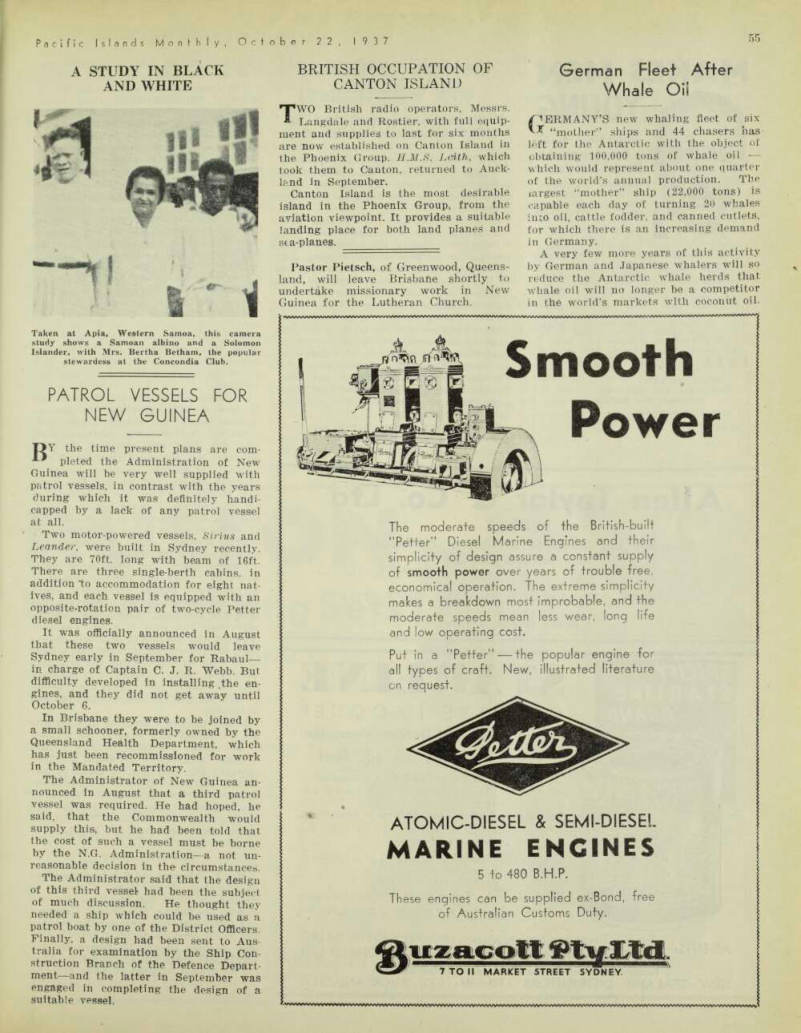
New Guinea
T>Y the time present plans are com pleted the Administration of New Guinea will be very well supplied with patrol vessels, in contrast with the years during which it was definitely handi capped by a lack of any patrol vessel at all.
Two motor-powered vessels. Sit'ius and Leander . were built in Sydney recently.
They are 70ft. long with beam of 16ft.
There are three single-berth cabins, in addition to accommodation for eight nat ives, and each vessel is equipped with an opposite-rotation pair of two-cycle Petter diesel engines.
It was officially announced in August that these two vessels would leave Sydney early in September for Rabaul— in charge of Captain C. J. R. Webb. But difficulty developed in installing .the en gines, and they did not get away until October 6.
In Brisbane they were to be joined by a small schooner, formerly owned by the Queensland Health Department, which has just been recommissioned for work in the Mandated Territory.
The Administrator of New Guinea an nounced in August that a third patrol vessel was required. He had hoped, he said, that the Commonwealth would supply this., but he had been told that the cost of such a vessel must be borne by the N.G. Administration—a not un reasonable decision in the circumstances.
The Administrator said that the design of this third vessel had been the subject of much discussion. He thought they needed a ship which could be used as a patrol boat by one of the District Officers.
Finally, a design had been sent to Aus tralia for examination by the Ship Con struction Branch of the Defence Depart ment—and the latter in September was engaged in completing the design of a suitable vessel.
British Occupation Of
Canton Island
TWO British radio operators, Messrs.
Langdale and Rostier, with full equip ment and supplies to last for six mouths are now established on Canton Island in the Phoenix Group. H.M.S. Leith , which took them to Canton, returned to Auck land in September.
Canton Island is the most desirable island in the Phoenix Group, from the aviation viewpoint. It provides a suitable landing place for both land planes and sea-planes.
Pastor Pietsch, of Greenwood, Queens land, will leave Brisbane shortly to undertake missionary work in New Guinea for the Lutheran Church.
Whale Oil
German Fleet After Whale Oil
(GERMANY’S new whaling fleet of six X “mother” ships and 44 chasers has left for the Antarctic with the object of obtaining 100,000 tons of whale oil *— which would represent about one quarter of the world’s annual production. The largest “mother” ship (22,000 tons) is capable each day of turning 20 whales Into oil, cattle fodder, and canned cutlets, for which there is an increasing demand in Germany.
A very few more years of this activity by German and Japanese whalers will so reduce the Antarctic whale herds that whale oil will no longer be a competitor in the world’s markets with coconut oil.
Advertisements & other items, pp. 61-62 (1 item)
Smooth
Irfni r ft -
Power
% The moderate speeds of the British-built "Fetter" Diesel Marine Engines and their simplicity of design assure a constant supply of smooth power over years of trouble free, economical operation. The extreme simplicity makes a breakdown most improbable, and the moderate speeds mean less wear, long life and low operating cost.
Put in a "Fetter" the popular engine for all types of craft. New, illustrated literature on request.
A
ATOMIC-DIESEL & SEMI-DIESEL
MARINE ENGINES
5 to 480 B.H.P.
These engines can be supplied ex-Bond, free of Australian Customs Duty.
W
7 TO II MARKET STREET SYDNEY
HAKES MEN
YOUNG
i “Nerves,” Del).lay.
Vigour, Premature
Amazing New
Rejuvenating
Giand Substance
Restores new vigour of life to we.ak, ailing men. Thousands report spectacular results in Mental and Bodily Weakness, Exhaustion, Decline of Youthful Ageing, Degeneration and Decay. New secret, irradiated “vitality food” contains vital gland substance combined with vitamin and a mineral electrolyte. Restores new vigour of life to men. rejuvenates the entire body strengthens the vital powers—quick’
Relieves infirmities d'ue to gland deficiencies. Increases youthful energies, mental activity and aggressiveness. Send to-day for FREE ROOK. C. Sinclair, Ltd., Suite 7 4 19A Queen St.. Auckland, New Zealand’
FREE BOOK COUPON
C. SINCLAIR LTD..
Dept OP. P.O. Box 1763, Auckland, New Zealand.
Please send Free Book.
Name Address
Allen Taylor & Co. Ltd
SYDNEY
Sawmillers and Wholesale Suppliers of Hardwoods for Constructional Purposes GIRDERS . . . PILES . . . POLES . . . SLEEPERS, Etc.
EXPORTING TO PACIFIC ISLANDS SINCE 1893
Cables: Tuxedo, Sydney
SPECIFY
STARLINE
BRAND
'^asssssssggs
STAIILINE
CHINESE LACQUER
For all Indoor and Outdoor Decoration
1/- tin covers 18 sq. feet
"STARLINE" CHINESE LACQUER : Is guaranteed to withstand the severe elements to which paint is subjected in the Tropics, including Salt Water, JHeat and Rain, etc., and will not lose its gloss or permanence.
To give some idea of the covering capacity, one gallon will cover over 1200 sq. ft. 42 colours to choose from . . . Dries in a few hours.
Won't chip or crack.
MADE IN ENGLAND
Write to us for Colour Chart and full particulars regarding attractive sole agency for territories still vacant. a/~cmtc i For Fiji, Tonga and Samoa, Messrs. MORRIS HEDSTROM LTD.
I For Tahi+i and Cook , s andS( Messrs A B DONALD LTD.
Factory Representative for all Islands and New Zealand : NEW ZEALAND DISTRIBUTORS LTD., Box 530, AUCKLAND, N.Z.
What Is Wrong In
New Guinea?
Visionless Government And An III-Conceived Native Policy
IN a letter to the editor, published on page 48, a Rabaul resident makes r. comparison between New Guinea under the Germans, and conditions as they are to-day.
It would seem that our correspondent has seized upon a quotation from Mr.
Humphries’ 20-years’ old book merely as an excuse to express some very sour opinions about Australia’s administration of New Guinea. He has exaggerated, and indulged in hyperbole; and his views are correspondingly valueless. The history of New Guinea during the past 20 years shows progress and sound growth. But that is the result of the discovery of gold, and of the enterprise of commercial interests. Although a comparison with the German administration is not prac ticable, it can be said that the Australian administrative record in New Guinea is nothing to boast about.
There is nothing wrong with the plan ters, traders and miners in New Guinea —in fact, no finer class of Australian
civilians could be found anywhere. The same may be said of the rank and file or the public service—Australia can be proud of the majority of these young men.
But, in the upper ranks of the Admini strative service, there is footling incom petency, allied with visionless complac ence, the outcome of political patronage in making important appointments when Australia took over in 1921, and con tinued ever since in the selection of administrators.
The result is seen clearly in two or three directions. There has been a remarkable lack of vision in directing development, and a lamentable inability to plan for the future. There has been a progressive degeneration in the relat ionship between Europeans and natives.
And—probably the outcome of both the foregoing—the men who actually are doing developmental work in New Guinea, planters and miners, have been given little encouragement by the Ad ministration, and even have been sub jected, on occasions, to cruelty and per secution.
Criticism is very difficult. High officials in New Guinea, including the obvious “square pegs,” are mostly kindly, con scientious, well-meaning, courteous men, who are liked and esteemed by their fellows. But the good qualities of citi zenship are not the qualities needed to properly govern and develop this great rich territory, which lies ominously, as a sort of barrier, between two continents, and the future condition of which may affect the destinies of nations. Those high officials are the victims of a rotten sys tem of political patronage.
Unfortunately, the position is made worse by a very bad judicial system—a jury-less and almost omnipotent court, which savagely enforces a native policy that was conceived in ignorance and in experience and born in error. The Gov ernment and the judges fatuously believe that, in prosecuting planters and miners ad lib., they are protecting the primitive natives. Actually—though it is apparent that they cannot see it —they are creating a situation that is at once ridiculous and dangerous.
If anyone wants proof of this, let him get the official data showing the number of Europeans convicted in New Guinea of assaults on native labourers; and then compare the figures with those of any similar territory. Then let him be given information bearing upon the character and records of the men convicted and punished by this jury-less New Guinea court. The result will be found to be
startling.
R.W.R.
Mr. J. Edwards, of Salamaua, arrived in Sydney from New Guinea on September 17 by the Montoro. He was met by his fiancee, Miss Nance Cameron, of Cowra, and they were quietly married the same evenings at St. Andrew’s Col lege, Sydney University, where Mr. Ed wards was formerly in residence. They are at present staying at Elizabeth Bay for three months and then will leave for Salamaua.
In For A Duck!
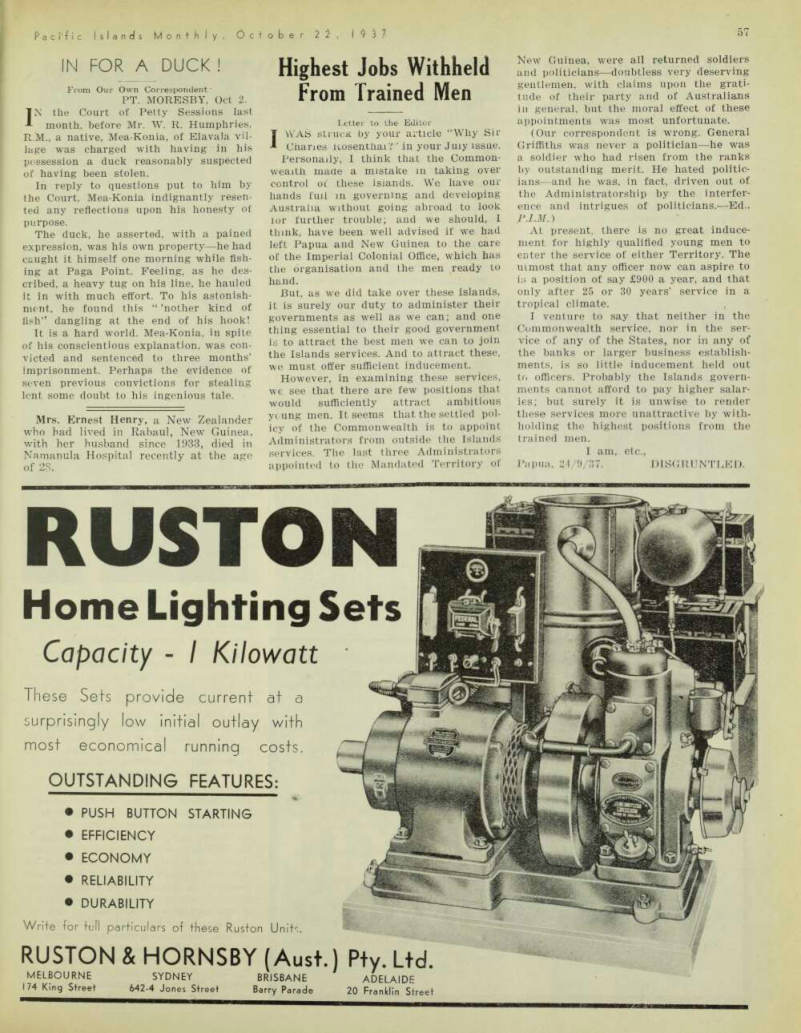
From Our Own Correspondent •
Pt. Moresby, Oct 2.
IN the Court of Petty Sessions last month, before Mr. W. R. Humphries, R.M., a native, Mea-Konia, of Elavala vil lage was charged with having in his possession a duck reasonably suspected of having been stolen.
In reply to questions put to him by the Court, Mea-Konia indignantly resen ted any reflections upon his honesty of purpose.
The duck, he asserted, with a pained expression, was his own property—he had caught it himself one morning while fish ing at Paga Point. Feeling, as he des cribed, a heavy tug on his line, he hauled it in with much effort. To his astonish ment, he found this “ ’nother kind of fish” dangling at the end of his hook!
It is a hard world. Mea-Konia, in spite of his conscientious explanation, was con victed and sentenced to three months’ imprisonment. Perhaps the evidence of seven previous convictions for stealing lent some doubt to his ingenious tale.
Mrs. Ernest Henry, a New Zealander who had lived in Rabaul, New Guinea, with her husband since 1933, died in Namanula Hospital recently at the age of 28.
Highest Jobs Withheld
From Trained Men
Letter to the Editor IWAS strucK by your article “Why Sir Chanes Rosenthal V ’ in your July issue.
Personally, I think that the Common wealth made a mistake in taking over control of these islands. We have our hands full in governing and developing Australia without going abroad to look tor further trouble; and we should, I think, have been well advised if we had left Papua and New Guinea to the care of the Imperial Colonial Office, which has the organisation and the men ready to hand.
But, as we did take over these islands, it is surely our duty to administer their governments as well as we can; and one thing essential to their good government is to attract the best men we can to join the Islands services. And to attract these, we must offer sufficient inducement.
However, in examining these services, we see that there are few positions that would sufficiently attract ambitious young men. It seems that the settled pol icy of the Commonwealth is to appoint Administrators from outside the Islands services. The last three Administrators appointed to the Mandated Territory of
New Guinea, were all returned soldiers and politicians—doubtless very deserving gentlemen, with claims upon the grati tude of their party and of Australians in general, but the moral effect of these appointments was most unfortunate. (Our correspondent is wrong. General Griffiths was never a politician—he was a soldier who had risen from the ranks by outstanding merit. He hated politic ians—and he was, in fact, driven out of the Administratorship by the interfer ence and intrigues of politicians.—Ed., P.1.M. ) At present, there is no great induce ment for highly qualified young men to enter the service of either Territory. The utmost that any officer now can aspire to is a position of say £9OO a year, and that only after 25 or 30 years’ service in a tropical climate.
I venture to say that neither in the Commonwealth service, nor in the ser vice of any of the States, nor in any of the banks or larger business establish ments, is so little inducement held out to officers. Probably the Islands govern ments cannot afford to pay higher salar ies; but surely it is unwise to render these services more unattractive by with holding the highest positions from the trained men.
I am, etc.,
Papua, 24/9/37.
Disgruntled.
Advertisements & other items, p. 63 (1 item)
Huston
Home Lighting Sets
Capacity - I Kilowatt •
These Sets provide current at a
surprisingly low initial outlay with
most economical running costs.
OUTSTANDING FEATURES:
• PUSH BUTTON STARTING
• EFFICIENCY
• ECONOMY
• RELIABILITY
• DURABILITY
Write for full particulars of these Ruston Units.
RUSTON & HORNSBY (Aust.) Pty. Ltd
MELBOURNE
I 74 King Street
SYDNEY
642-4 Jones Street
BRISBANE
Barry Parade
ADELAIDE
20 Franklin Street & © f i m m S? % u
Aerodrome At Papeete
From Our Own Correspondent
Papeete, Sept. 2.
npHE new flying-field at Papeete was * completed early in August, and the aviation officers celebrated with a grand ball.
The guests of honour at the function were the Governor and Madame De Gery.
Present also were the Commander and officers of the cruiser Rigault de Gen ouilly, the Commandant of the military forces, many officers of the Government service and their ladies, the British Consul-General, the Consul of the U.S.A. and Madame Mersman, and many other distinguished residents of Tahiti.
Tragedy In Western Papua
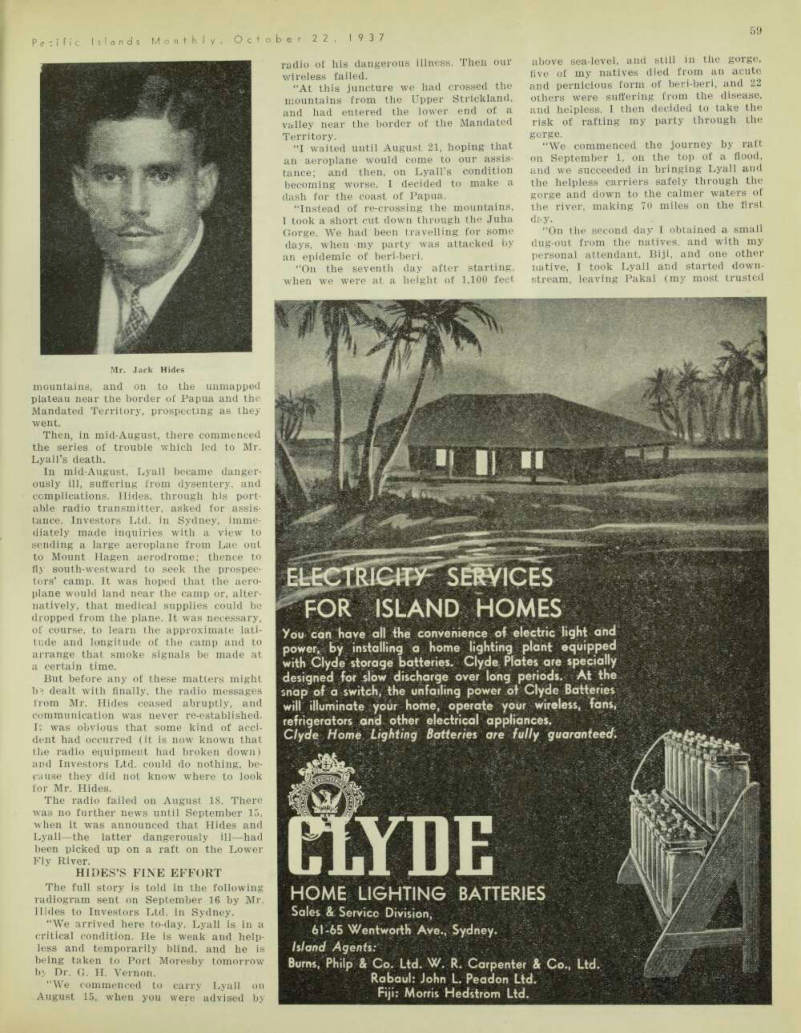
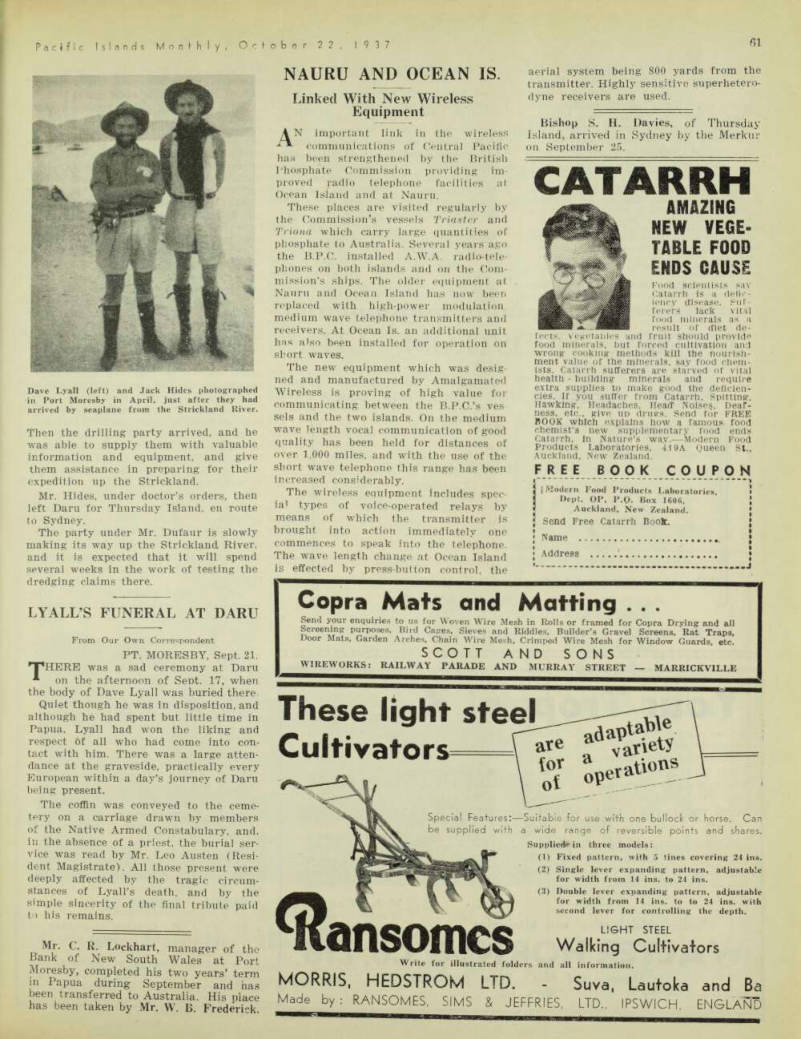
David Lyall Dies At Daru After Being Brought From Strickland Head-waters In Remarkable Circumstances By Jack Hides.
A LTHOUGH he succeeded, in a heroic effort, in bringing his companion, David Lyall, out of the centre of un explored New Guinea to Daru (Western Papua) in exceptionally quick time, Mr.
Jack Hides failed to save his friend.
Lyall died of beri-beri at Daru on Sept. 17.
The story is one of the minor tragedies of Papua. It also adds another exploit to the list of Jack Hides’s remarkable achievements in Papua.
Mr. Hides retired from the service of
the Papuan Government in 1936; and he subsequently was engaged by Investors Ltd., of Sydney, to proceed to the Strick land River, Western Papua, and thence to prospect for gold in certain areas in the unexplored region around the head waters of the river, which had become
known to him on his patrols in the ser vice of the Papuan Government.
Mr. Hides chose, as his companion, Mr.
David Lyall, already well-known in New Guinea as a practical miner. Lyall was with his father on Edie Creek in 1927, when, although only 17, he worked his own claim. Father and son did well in the following years. Mr. Lyall senior died in New Guinea in 1935, and David returned to Australia. He was then a young man of independent means.
History Of Expedition
Messrs. Hides and Lyall, with plenty of equipment and stores, left Sydney early in 1937, and proceeded immediately to the Strickland River, via Port Moresby, Dam and the Fly River. At a point on the Middle Strickland, above Observatory Bend and Everill’s Steep Pass, they ex amined extensive flats and found gold prospects so promising in character that special steps were taken immediately to obtain rights over the area.
In April and May, 1937, Investors Ltd. were granted two dredging claims on the Strickland River totalling 45 square miles and 35 square miles respectively.
In May, after the last claim had been granted, Messrs. Hides and Lyall pushed on rapidly up the Strickland, over the
Mr. David Lyall —Hollywood Studios.
mountains, and on to the unmapped plateau near the border of Papua and the Mandated Territory, prospecting as they went.
Then, in mid-August, there commenced the series of trouble which led to Mr.
Lyall’s death.
In mid-August, Lyall became danger ously ill, suffering from dysentery, and complications. Hides, through his port able radio transmitter, asked for assis tance. Investors Ltd. in Sydney, imme diately made inquiries with a view to sending a large aeroplane from Lae out to Mount Hagen aerodrome; thence to fly south-westward to seek the prospec tors’ camp. It was hoped that the aero plane would land near the camp or, alter natively, that medical supplies could be dropped from the plane. It was necessary, of course, to learn the approximate lati tude and longitude of the camp and to arrange that smoke signals be made at a certain time.
But before any of these matters might b? dealt with finally, the radio messages from Mr. Hides ceased abruptly, and communication was never re-established.
It was obvious that some kind of acci dent had occurred (it is now known that the radio equipment had broken down) and Investors Ltd. could do nothing, be cause they did not know where to look for Mr. Hides.
The radio failed on August 18. There was no further news until September 15, when it was announced that Hides and Lyall—the latter dangerously ill—had been picked up on a raft on the Lower Fly River.
Hides’S Fine Effort
The full story is told in the following radiogram sent on September 16 by Mr.
Hides to Investors Ltd. in Sydney.
“We arrived here to-day. Lyall is in a critical condition. He is weak and help less and temporarily blind, and he is being taken to Port Moresby tomorrow by Dr. G. H. Vernon.
“We commenced to carry Lyall on August 15, when you were advised by
radio of his dangerous illness. Then our wireless failed.
“At this juncture we had crossed the mountains from the Upper Strickland, and had entered the lower end of a valley near the border of the Mandated Territory.
“I waited until August 21, hoping that an aeroplane would come to our assis tance; and then, on Lyall’s condition becoming worse, I decided to make a dash for the coast of Papua.
“Instead of re-crossing the mountains, I took a short cut down through the Juha Gorge. We had been travelling for some days, when my party was attacked by an epidemic of beri-beri.
“On the seventh day after starting, when we were at a height of 1,100 feet
above sea-level, and still in the gorge, live of my natives died from an acute and pernicious form of beri-beri, and 22 others were suffering from the disease, and helpless. I then decided to take the risk of rafting my party through the gorge.
“We commenced the journey by raft on September 1, on the top of a flood, and we succeeded in bringing Lyall and the helpless carriers safely through the gorge and down to the calmer waters of the river, making 70 miles on the first day.
“On the second day I obtained a small dug-out from the natives, and with my personal attendant, Biji, and one other native, I took Lyall and started down stream, leaving Pakai (my most trusted
Mr. Jack Hides
native assistant, and an ex-sergeant of the Papuan Native Constabulary) to bring the remainder of the party along.
“Travelling by day and night, on Sep tember 6, we reached Totoma, on the Lower Fly. Sere, owing to my having miscalculated the phase of the moon, a disaster occurred.
“ At midnight 011 the 6th, we ran into the tidal river bore (which is represented by a huge wave > on the Lower Fiy, and travels Up-river at an appalling Speed), We just managed to reach the bank with I vnll Vmt -wro fv,,, os t the Canoe, With every thing it contained.
“Thp npyt rinv T cppf -Rili off /1™.,-, . 1,16 next Oay, i sent Bljl Oft down river for help, while I and the other native made a raft and dnwlv mrwod native maae a rart ana slowly moved Lyall down the river, under terrible COn ditions “Biji travelled 65 miles down the track less western bank of the Fly River, being
without food for the entire journey, and on the seventh day aiter ne lett us, he met the munch Fauune, wnich is oper ated by Papua Oil Development Co. Ltd. ■‘The Famine proceeded up-river witn ail speed, and it yesterday picked up Lyail and myseif, and brought us to Daru.’' The message ended with a request that the Governments of Papua and New Guinea be informed that his party main tained completely friendly relations with all the tribes met with in the course of die journey. j Ivir. R. j. D. Richardson (acting chair man of Investors Ltd.) said on September 10 that the feat performed by Mr Hides, in bringing his incapacitated companion through about 400 miles of practically unknown country, in such quick time, was a remarkable one. Only a man of his superb bush-craft, and qualities of leader ship, could have done it., Further details of Mr. Lyall’s condition would be awaited with anxiety.
The breakdown of the radio set had been most unfortunate, said Mr. Richard son. The last message received from Mr.
Hides indicated that he was prepared to return down the river, and asked for confirmation of this. The Company, hav ing found that it was impossible to land an aeroplane anywhere near Mr, Hides, replied that the return trip seemed the best solution. But Mr. Hides obviously never received that message.
The Company, added Mr. Richardson, was very grateful to Papua Oil Develop ment Co. Ltd. for the timely help given tc the Hides party, at a very critical stage. He understood that P.O.D. had in structed all its boats in the vicinity of the P’ly River to search for Mr. Hides — a generous act that was very much appreciated.
Death Of Mr. Lyall
It appears that Mr. Lyail died early on Friday morning, September 17. His heart collapsed, the result apparently of the mysterious beri-beri sickness. If it had not been for that. Hides’s remarkable feat in bringing him to Daru probably would have saved his life.
The death of Lyail in such tragic cir cumstances received a gread deal of not ice in the Australian newspapers, and there were expressions of sympathy from all classes of people, including the Governor-General (Lord Gowrie) himself.
Lyail was buried at Daru.
Hides, himself suffering from beri-beri, and deeply distressed by Mr. Lyall’s death, was facing a complicated problem.
His party of carriers were somewhere on the Strickland River, following him down. A drilling party sent by Investors Ltd. under Mr. Dufaur, assisted by Mr.
Davies, was somewhere between Pt.
Moresby and Daru. en route to the Strick land River to test the dredging claims.
The vessel Vaila 7 a was at Daru, being prepared to take the party up the Fly and Strickland.
Mr. Hides had to get some order into this situation. Fortunately, his team of carriers came safely down the river to Daru, and he was able to pay them off and arrange to send them to their homes.
Then the drilling party arrived, and he was able to supply them with valuable information and equipment, and give them assistance in preparing for their expedition up the Strickland.
Mr. Hides, under doctor’s orders, then left Daru for Thursday Island, en route to Sydney, The party under Mr. Dufaur is slowly making its way up the Strickland River, and it is expected that it will spend several weeks in the work of testing the dredging claims there.
Dave Lyall (left) and Jack Hides photographed in Port Moresby in April, just after they had arrived by seaplane from the Strickland River.
Advertisements & other items, pp. 64-66 (2 items)
Master Sewing Machine Co
15 ENMORE ROAD, NEWTOWN, SYDNEY
ESTABLISHED FOR 23 YEARS
SPECIALISING IN
RECONDITIONED
SEWING MACHINES
OF ALL TYPES
Hand Machines
Upright Models
Dropheads
including
SINGER—WHITE—NEW CENTURY—HOME—AND OTHER WELL KNOWN MAKES.
• Allow us to select a machine for you ... we will strive to please; your subsequent recommendations will reward us.
Also in Stock — Machines for Leather, Canvas- Bootpatching, Highspeed Dressmaking, Hemstitching, etc.
EVERY MACHINE GUARANTEED MECHANICALLY PERFECT
NEEDLES AND PARTS
SUPPLIED FOR ALL
MAKES OF MACHINES
REPAIR WORK BY
COMPETENT
MECHANICS
EVERYTHING FOR CAR CR TRUCK
ACCESSORIES SPARE PARTS TOOLS
HARDWARE ANYTHING IN METAL
PRICE LIST SENT POST FREE
We carry a great variety of stocks not listed in our pamphlet and we shall be happy to quote for all special requirements, large or small.
Established for over 25 years. We have a very large clientele of satisfied customers throughout Australia and the Pacific Islands.
Every order entrusted to us receives prompt attention and careful consideration.
—NO DELAYS
• Write for Price List to-day — Your Enquiry will he Appreciated.
STEAD & BAKER
Engineers .. . Brass Founders .. . General Hardware Merchants
743-5, HARRIS STREET, BROADWAY, SYDNEY, N.S.W.
Telegrams : " Steady," Sydney.
For Island Homes
-r-. s
You can have all the convenience of electric light and power, by installing a home lighting plant equipped with Clyde storage batteries. Clyde Plates are specially designed for slow discharge over long periods. At the snap of a switch, the unfailing power of Clyde Batteries will illuminate your home, operate your wireless, fans, refrigerators and other electrical appliances.
Clyde Home Lighting Batteries are fully guaranteed .
HOME LIGHTING BATTERIES
Sales & Service Division, 61-65 Wentworth Ave., Sydney.
Island Agents: Burns, Philp & Co. Ltd. W. R. Carpenter & Co., Ltd.
Rabaul: John L. Peadon Ltd.
Fiji; Morris Hedstrom Ltd.
Help Kidneys
Don’t Take Drastic Drugs
Your kidneys have nine million tiny tubes or Alters which are endangered by neglect or drastic, irritating drugs. Beware! If Kidney trouble or Bladder weakness makes you suffer from Getting Up Nights, Leg Pains, Nervousness Dizziness, Stiffness, Rheumatism, Lumbago, Circles Under Eyes, Swollen Ankles, Neuralgia, Burning, Itching, Smarting, Acidity or Loss of Vigour, don’t delay Try the Doctor’s new discovery called Cystex (Siss-tex). Soothes, tones, cleans, and heals sick kidneys. Starts work in 15 minutes. Brings new health, youth and vitality in 48 hours. Cystes costs little and is guaranteed to end your trouble* in 8 days or money back. Price 4/-, all Stores and Chemists. SCHAFFER & CO., 189 Clarence Street, Sydney.
A. B. DONALD LTD.
AUCKLAND
ISLAND TRADERS :: GENERAL MERCHANTS
P. O. Box 1509 Cables and Telegrams: "Kingdom," Auckland Branches at Rarotonga and throughout the Cook Islands At Papeete and throughout the Society, Marquesas and Paumotu Islands trading as " ETABLISSEMENTS DONALD, TAHITI " ■ At Fiji; Trading as "Dominion Fruit C 0.," Suva
11
ANCHOR" FLOUR
THE STANDARD OF QUALITY
Hi ’SI : I . wmm-
GILLESPIE BROS, LTD
SYDNEY - AUSTRALIA
Lyall’S Funeral At Daru
From Our Own Correspondent
Pt. Moresby, Sept. 21.
TPHERE was a sad ceremony at Daru * on the afternoon of Sent. 17, when the body of Dave Lyall was buried there.
Quiet though he was in disposition, and although he had spent but little time in Papua, Lyall had won the liking and respect 6f all who had come into con tact with him. There was a large atten dance at the graveside, practically every European within a day’s journey of Darn being present.
The coffin was conveyed to the ceme tery on a carriage drawn by members of the Native Armed Constabulary, and, in the absence of a priest, the burial ser vice was read by Mr. Leo Austen (Resi dent Magistrate). All those present were deeply affected by the tragic circum stances of Lyall’s death, and by the simple sincerity of the final tribute paid to his remains.
Mr. C. R. Lockhart, manager of the Bank of New South Wales at Port Moresby, completed his two years’ term
in Papua during September and has
been transferred to Australia. His piace has been taken by Mr. W. B, Frederick.
Nauru And Ocean Is.
Linked With New Wireless Equipment
A N important link in the wireless communications of Central Pacific has been strengthened by the British Phosphate Commission providing im proved j’adio telephone facilities at Ocean Island and at Nauru.
These places are visited regularly by the Commission’s vessels Triaster and Triona which carry large quantities of phosphate to Australia. Several years ago the B.P.C. installed A.W.A. radio-tele phones on both islands and on the Com mission’s ships. The older equipment at Nauru and Ocean Island has now been replaced with high-power modulation medium wave telephone transmitters and receivers. At Ocean Is. an additional unit has also been installed for operation on short waves.
The new equipment which was desig ned and manufactured by Amalgamated Wireless is proving of high value for communicating between the B.P.C.’s ves sels and the two islands. On the medium wave length vocal communication of good quality has been held for distances of over 1,000 miles, and with the use of the short wave telephone this range has been increased considerably.
The wireless equipment includes spec ial types of voice-operated relays by means of which the transmitter is brought into action immediately one commences to speak into the telephone.
The wave length change at Ocean Island is effected by press-button control, the
aerial system being 800 yards from the transmitter. Highly sensitive superhetero dyne receivers are used.
Bishop S. H. Davies, of Thursday Island, arrived in Sydney by the Merkur on September 25.
Commander J, C. Plante arrived in Sydney early in October by the Maioja to take command of the French Pacific Station sloop Rigault de Genouilly, which is well known in Central and Eastern Pacific. He has been in the French Navy since 1 913 and has lately been in the Naval War College in Pans.
Advertisements & other items, pp. 67-68 (1 item)
ansomcs
CATARRH
AMAZING
NEW VEGE-
TABLE FOOD
ENDS CAUSE
Teels' Food scientists say Catarrh Is a deficiency disease. Sufferers lack vital food minerals as a result of diet de- Vegetables and fruit should provide food minerals, hut forced cultivation and wrong- cooking- methods kill the nourishment value of the minerals, say food chemists. Catarrh sufferers are starved of vital health - building- minerals and require extra supplies to make good the deficiencies. If you suffer from Catarrh, Spitting.
Hawking. Headaches, Head Noises, Deafness. etc., give up drugs. Send for FREE BOOK which explains how a famous, food chemist’s new supplementary food ends Catarrh, in Nature’s way.—Modern Food Products Laboratories. 419 A Queen St., Auckland, New Zealand.
FREE BOOK COUPON
I" * 1 9 I Modern Food Products Laboratories, I Dept. OP, P.Q, Box 160fi, J Auckland, New Zealand, j Send Free Catarrh Book. ; J Name • Address * a- J
Copra Mats and Matting . . .
Send your enquiries to us for Woven Wire Mesh in Rolls or framed for Copra Drying and all Screening purposes, Bird Cages, Sieves and Riddles, Builder’s Gravel Screens, Rat Traps, Door Mats. Garden Arches. Chain Mesh. Crimped Wire Mesh for Window Guards, etc.
SCOTT AND SONS
WIREWORKS: RAILWAY PARADE AND MURRAY STREET MARRICKVILLE
These light steel
Cultivators
are
lor
or
ati° nS
Special Features:—Suitable for use with one bullock or horse. Can be supplied with a wide range of reversible points and shares Supplied* in three models: (1) Fixed pattern, with 5 tines covering 24 ins. (2) Single lever expanding pattern, adjustable for width from 14 ins. to 24 ins. (3) Double lever expanding pattern, adjustable for width from 14 ins. to to 24 ins. with second lever for controlling the depth.
ansomcs
Write for illustrated folders and all information.
LIGHT STEEL
Walking Cultivators
MORRIS, HEDSTROM LTD. - Suva, Lautoka and Ba Made by: RANSOMES, SIMS & JEFFRIES, LTD., IPSWICH, ENGLAND
STAMPS
Packets of stamps containing no common issues, world-wide variety, airmails, etc., best value in Australia, at 1/-, 2/6, 5/-, 10/-. 15/-, 20/-. 25/-, 30/-, 40/-. Money back guarantee. Also beginners packets. Larger quantities at same prices Albums: 4/6, 7/-, 13/6; with maps, 16/-, 27/6; loose-leaf, 10/-, 20/-, 40/-. etc. All post free.
Wanted, immediately, for cash, quantities of 100 and more Papua Id and 2d; also Tongans and Coronations.
S. B. PAGE, Yolande, Coonamble, N.S.W., Aust.
MORRIS, HEDSTROM, LTD.
Registered Office - - Suva, Fiji.
BRANCHES THROUGHOUT FIJI, TONGA AND SAMOA
Agents for: Y"
LLOYD'S
NOBELS (AUSTRALIA) LIMITED—EXPLOSIVES
MATSON NAVIGATION COMPANY
RUSTON & HORNSBY LIMITED
IMPERIAL CHEMICAL INDUSTRIES LIMITED
JOHN LYSAGHT (AUST.) LTD.
VACUUM OIL COMPANY PROP'TY. LIMITED
FORD MOTOR COMPANY LIMITED
Jv GOODYEAR TIRE & RUBBER EXPORT COY. J.
SYDNEY OFFICE: DALTON HOUSE, 115 PITT ST.
Your Tropical Kit
When you vi-sit the Pacific islands, whether on Business or Pleasure, you need Special Equipment—Light Suits of Correct Style, which fit well and launder easily; Tunic Shirts Silk Shirts. Light Underwear, White Shoes, etc.
WALTER HORNE & CO. LTD., established in 1885, specialise in this Service. Skilled Tailors make your Suits from First-class material within 24 hours. Complete equipment can be supplied from our Large Stocks at Reasonable. Moderate Prices.
BUY FROM THE FIRM WHICH UNDERSTANDS YOUR NEEDS AND
DRESSES YOU CORRECTLY
WALTER HORNE & CO. LTD., carry a Full Range of M Drapery of all kinds; also Frocks, Millinery, Foundations and Lingerie, Hosiery, Shoes and Sandals, Ribbons and Laces, Household Drapery.
Men resident in any of the Pacific Territories can he supplied with Suitable Clothes.
Ladies' Hairdressing and Manicuring
WALTER HORNE &
Write to us and Describe your Requirements.
Co. Ltd.
Drapers and Men's Wear Specialists
SUVA, FIJI
Yasawa Caves
Location of Ancient Carvings
“YOU have published, occasionally,
* articles describing the the subter ranean caves on the island of Yasawa-i -lau, in the Yasawa Group, Northern Fiji,” writes a resident of Tamasua, Yasawas.
“May I contribute yet another?’’
“These are the caves known as ‘Mr.
Vogan’s Caves,’ because it was he who made known to the world the curious carvings, evidently ancient Chinese script, which are found on the walls there.
“The scripts are in the main cave.
Entrance to this is gained by clambering over limestone rocks, needle like in formation, in some cases.
“Once inside, the visitor is immediately struck with the beauty of the interior.
Perpendicular walls, with ledges jutting out here and there, and the carvings showing up well since their application of shellac: sunlight streaming through the top, and setting off to advantage the smooth deep-green water of the cave.
Hundreds of names are chalked all over the walls by Fijians, who visit the cave from time to time. There is an occasional hole, just wide enough to admit a man’s body, perhaps some ten feet above the water, where one may venture through into semi-darkness, coming out again into the main cave 40 or 50 feet away from where you entered.
“The more venturesome, who may wish to explore the inner cave, may gain en trance by swimming under water a few feet and emerging into a perfect dome shaped cave, wherein are numerous abut ments where one may rest and admire the artistic work of nature. Unfortunately this inner cave is in semi-darkness, only odd streaks of light finding their way through an occasional crack in the roof.
“It is wonderful, and yet uncanny, to sit on a rock in the main cave and listen to a number of natives in the inner cave singing their songs, the echo making them as loud as brass bands.
“An amusing incident occurred during the Easter holidays, when two friends of the writer, Messrs. Batty and Marriott, came to visit him. They arrived at Tama sua on Sunday afternoon and, as they had to go back early next morning, a start was made right away to explore the caves.
“After a swim around the main cave they decided to venture into the inner one. A Fijian boy went in first to act as guide.
“Mr. Batty followed the bnv and ne gotiated the channel at his first pttempt.
Mr. Marriott made two attempts, but back-pedalled on each occasion.
“Mr. Batty, inside, began to worry as to whether Mr. Marriott had net stuck on his way through, and decided to dive out again and investigate.
“As he dived hack from the inner cave.
Mr Marriott dived from the main cave, with the result that thev met in a head on collision half-way through.
“It was amusing from the spectator’s poiut of view, but a b l 't sore from the explorers. However, on his third attemnt.
Mr. Marriott got through without any hitch.
“Both men were loud in their praise of the wonders of these caves.
“Ther Q are numerous other caves on the island, wherein an electric torch is required to investigate.”
Mr. F. J. H. Grattan, Secretary of Apia Government Hospital, Western Samoa, arrived in Sydnev by the Mon golia on September 30, after undergoing a course of anthropology at Cambridge University, England. He joined the Mon golia at Bombay, having travelled over land from London in a “baby” car.
Townsmen or Land-owners?
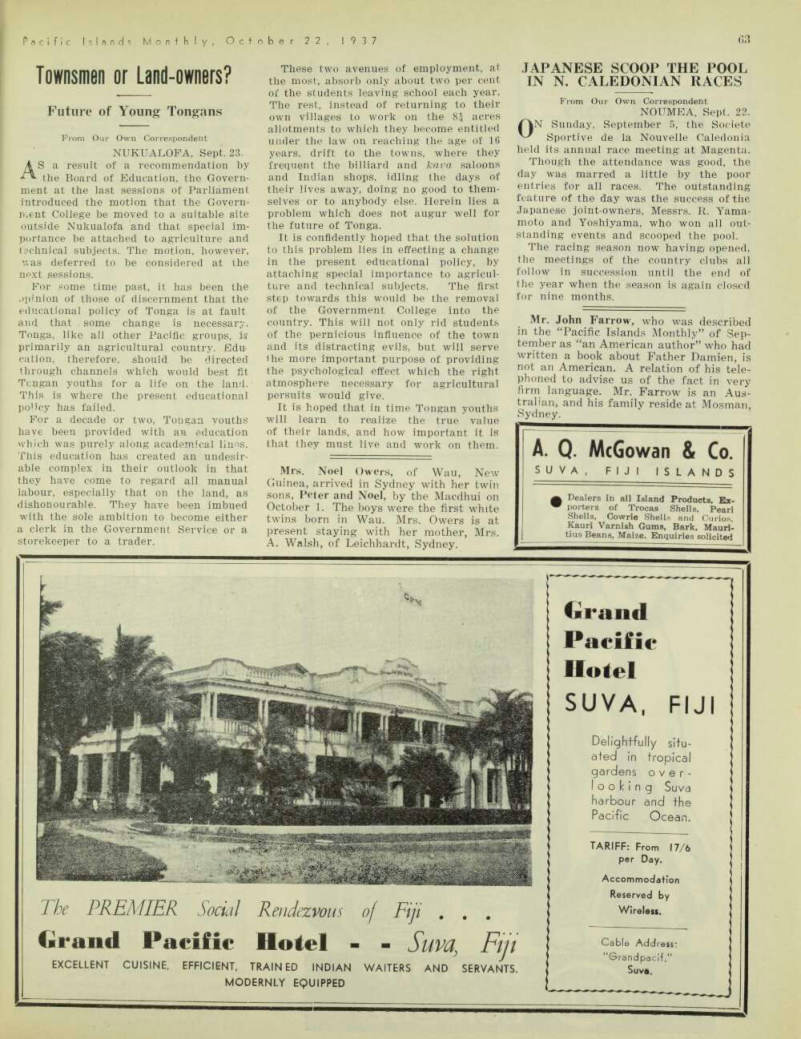
Future of Young Tongans
From Our Own Correspondent
Nukualofa, Sept. 23.
A S a result of a recommendation by the Board of Education, the Govern ment at the last sessions of Parliament introduced the motion that the Govern ment College be moved to a suitable site outside Nukualofa and that special im portance be attached to agriculture and technical subjects. The motion, however, was deferred to be considered at the next sessions.
For some time past, it has been the opinion of those of discernment that the educational policy of Tonga is at fault and that some change is necessary.
Tonga, like all other Pacific groups, U primarily an agricultural country. Edu cation, therefore, should be directed through channels which would best fit Tcngan youths for a life on the land.
This is where the present educational poßcy has failed.
For a decade or two, Tongan youths have been provided with an education which was purely along academical lines.
This education has created an undesir able complex in their outlook in that they have come to regard all manual labour, especially that on the land, as dishonourable. They have been imbued with the sole ambition to become either a clerk in the Government Service or a storekeeper to a trader.
These two avenues of employment, at the most, absorb only about two per cent of the students leaving school each year.
The rest, instead of returning to their own villages to work on the 8J acres allotments to which they become entitled under the law on reaching the age of 16 years, drift to the towns, where they frequent the billiard and kava saloons and Indian shops, idling the days of their lives away, doing no good to them selves or to anybody else. Herein lies a problem which does not augur well for the future of Tonga.
It is confidently hoped that the solution to this problem lies in effecting a change in the present educational policy, by attaching special importance to agricul ture and technical subjects. The first step towards this would be the removal of the Government College into the country. This will not only rid students of the pernicious influence of the town and its distracting evils, but will serve the more important purpose of providing the psychological effect which the right atmosphere necessary for agricultural persuits would give.
It is hoped that in time Tongan youths will learn to realize the true value of their lands, and how important it is that they must live and work on them.
Mrs. Noel Owers, of Wau, New Guinea, arrived in Sydney with her twin sons, Peter and No e l, by the Macdhui on October 1. The boys were the first white twins born in Wau. Mrs. Owers is at present staying with her mother, Mrs.
A. Walsh, of Leichhardt, Sydney.
Japanese Scoop The Pool
In N. Caledonian Races
From Our Own Correspondent
Noumea. Sept. 22.
Sunday, September 5, the Societe ” Sportive de la Nouvelle Caledonia held its annual race meeting at Magenta.
Though the attendance was good, the day was marred a little by the poor entries for all races. The outstanding feature of the day was the success of the Japanese joint-owners, Messrs. R. Yama moto and Yoshiyama, who won all out standing events and scooped the pool.
The racing season now having/ opened, the meetings of the country clubs all follow in succession until the end of the year when the season is again closed for nine months.
Mr. John Farrow, who was described in the “Pacific Islands Monthly” of Sep tember as “an American author” who had written a book about Father Damien, is not an American. A relation of his tele phoned to advise us of the fact in very firm language. Mr. Farrow is an Aus tralian, and his family reside at Mosman,
Sydney.
Advertisements & other items, pp. 69-70 (1 item)
Suva, Fiji
A. Q. McGowan & Co.
SUVA, FIJI ISLANDS
A Dealers in all Island Products. Exw Porters of Trocas Shells. Pearl Shells, Cowrie Shells and Curios.
Kauri Varnish Gums. Bark. Maurfl tius Beans. Maize. Enquiries solicited
N .
The PREMIER Social Rendezvous of Fiji . . .
(■rand Pacific Hotel - - Fiji
EXCELLENT CUISINE, EFFICIENT. TRAINED INDIAN WAITERS AND SERVANTS.
MODERNLY EQUIPPED
Grand
Pacific
Hotel
SUVA, FIJI
Delightfully situ-
ated in tropical gardens over-
looking Suva
harbour and the Pacific Ocean.
TARIFF: From 17/6
per Day.
Accommodation Reserved by Wireless, Cable Address: "Grandpacif,"
Suva.
Get your
FREE
COPY
of the
NEW TRUFOOD
RECIPE BOOK
W specially tested recipes—all kinds of new ideas for attractive things to cook cakes, pastry, puddings, custards, desserts, savour es, sauces, etc.
POST*HIS common
’ ■ .. v• ■ i ' . '&> “ Recipe Department," c/- Box 3y22TT G.P.O.
Sydney.
Please send me POST FREE, a copy of The Trufood Book of 69 Tempting Recipes Name
(BLOCK LETTERS)
Address
'jr/T> ' r
When dancing
or at the theatre don’t forget now and then to dab a few drops of **47 11" Genuine Eau de Cologne on temples and forehead; it will refresh, invigorate, revive. ■Bto S&j
Cologne
Protecting The Papuans
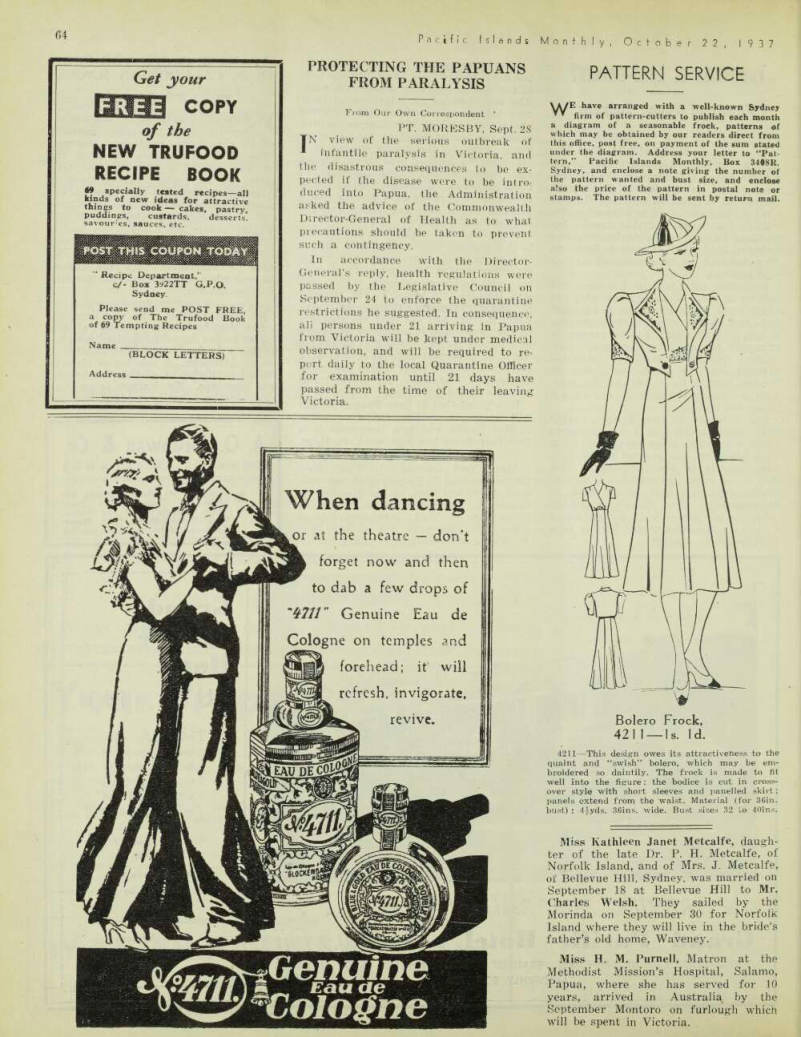
From Paralysis
From Our Own Correspondent ’
Pt. Moresby, Sept. 28
¥N view of the serious outbreak of * infantile paralysis in Victoria, and the disastrous consequences to be ex pected if the disease were to be intro duced into Papua, the Administration asked the advice of the Commonwealth Director-General of Health as to what precautions should be taken to prevent such a contingency.
In accordance with the Director- General’s reply, health regulations were passed by the Legislative Council on September 24 to enforce the quarantine restrictions he suggested. In consequence, all persons under 21 arriving in Papua from Victoria will be kept under medical observation, and will be required to re port daily to the local Quarantine Officer for examination until 21 days have passed from the time of their leaving Victoria.
Pattern Service
\A/E have arranged with a well-known Sydney firm of pattern-cutters to publish each month a diagram of a seasonable frock, patterns of which may be obtained by our readers direct from this office, post free, on payment of the sum stated under the diagram. Address your letter to “Pat tern,” Pacific Islands Monthly, Box 3408 R, Sydney, and enclose a note giving the number of the pattern wanted and bust size, and enclose also the price of the pattern in postal note or stamps. The pattern will be sent by return mail.
Miss Kathleen Janet Metcalfe, daugh ter of the late Dr. P. H. Metcalfe, of Norfolk Island, and of Mrs. J. Metcalfe, of Bellevue Hill, Sydney, was married on September 18 at Bellevue Hill to Mr.
Charles Welsh. They sailed by the Morinda on September 30 for Norfolk Island where they will live in the bride’s father’s old home, Waveney.
Miss H. M. Purnell, Matron at the Methodist Mission’s Hospital, Salamo, Papua, where she has served for 10 years, arrived in Australia by the September Montoro on furlough which will be spent in Victoria.
Bolero Frock,
4211 — 1s. 1d. 4211 —This design owes its attractiveness to the quaint and “swish” bolero, which may be em broidered so daintily. The frock is made to fit well into the figure; the bodice is cut in cross over style with short sleeves and panelled skirt; panels extend from the waist. Material (for 36in. bust) : 44yds. 36ins. wide. Bust sizes 32 to 40ins.
Fashion Hints for Islands Women
By Therese
THE gaiety of flowered prints, the fluid line of pure classicism, the dashing little bolero, the long swathed sash reach ing to the gown’s hem, and the return to romance are Fashion’s chief dictates of the moment.
The flowered prints are lovely. Every flower that blooms has been used to tempt us to extravagances. For every occasion the clock round, they are the dernier cri.
Printed slips flick from under the dress of plain georgette, the skirt of which is slit from waist to hemline. Gaily pat terned prints assert themselves in a navy gown of silk crepe which sweeps with sudden fullness to the front, and girds its waist with a scarlet cord. Navy acces sories accompany it.
A chic redingote swings out over a brilliant patterned crepe dress. The pas tel top coat for day wear grows in popu larity. Delphinium blue goes over wine, beige over lime green, Mediterranean blue, or the “somehow expected” brown.
Beige still holds its favoured place in the colour scheme of things, and justifies itself a thousand-fold. There is not a colour that does not achieve new beauty when contrasted with this strangely pas sive shade. With black accessories, it is chic personified.
A dress of beige adopts a bolero as its piece de resistance. Brown globular but tons trim the dress, and the bolero is outlined with brown and white spotted crepe which makes the flowing tie and swathed belt. A large brown hat with jaunty patent bow adds its quota to suc cess.
Suits are unquestionably right at all times. Their quiet unassuming chic de mands attention. The skirts are straight, but with well concealed fullness, rather than pencil slimness. Paisley suits are charming, and a suit of this design worn with a blouse in one of its misty shades is a delightful possession. A pale grey linen suit surprisingly chooses tan acces sories. Grey, too, has infinite colour pos sibilities which one cannot overlook.
Man tailored clothes are perfect, and shantung is the ideal medium. The smooth line of such a frock is accen tuated by a narrow suede belt and scarf in contrasting colour. Box pleats extend from the,bodice pockets to the hem of the skirt. A gay little breton sailor hat begs to go along with it.
A zig-zag striped frock of silk jersey, white upon navy, has white collars and cuffs, enormous white buttons, and a scarlet leather thong for a belt.
Sugar-stick striped sheers are the gay est things for day or evening. Horizontal striped frocks band their hems with two and sometimes three colours, and make boleros for little chiffon dresses. The same stripes evolve blouses for summer suits.
Bright jackets of lime yellow, fuschia pink, pale rose, and cobalt blue are com
bined with dark colours, giving them a glowing beauty.
All the turbulence of the Spanish senorita is in the gown of fine black lace.
The short bodice, wide stomacher, and widely swirling skirt are redolent of romance. One thrills to the tango and hears the castanets.
'There is classic beauty in the gown of pure white for evening, and the studied simplicity of a gown of blistered crepe
is something to wonder about. The cross over bodice tapers gently to the shoul ders, forming a low decolletage. The widely sweeping double skirt is buckled with a jewelled clip and changes itself into a dashing cape when winds blow free. A vision of absolute splendour is the gown of white dull crepe studded with rhinestones, the hem and the off the-shoulder cape heavily encrusted with a Vandyke bead design.
A black net dinner gown with throat high drapery mocks its modesty with a low sweep to the back. Its gathered skirt floats wide. There is magic in the billows of lace over tulle, chiffon, or organza in every shade of pink. Jewelled bracelets and clips gleam through the dusky folds of the lace. Pink and black are Fashion’s favourites and are used whenever pos sible, A tiny cut away bolero is outlined with lace and goes over the tight bodice and full skirt of a taffeta frock. The skirt, too, is trimmed with ruffled lace, giving it an old world air. A bright little posy tucks into the knotted belt.
The dirndl, young, gay and new, has swept into Fashion’s picture with quaint charm. Its peasant bodice, wide stom acher, and simply gathered skirt possess a something that is different—a some thing that is hard to define but has all the qualities of youth. Crisp, cool cot tons are its happiest medium.
Slim sheathes are as much in favour as the bouffant romantic type of gown.
A black dress, column slim, adds a
draperie that crosses on the bodice and floats diaphanously to the floor —a con tradiction in terms. A white dress with the neck and sleeves of the religeuse, dramatically throws over its stark sim plicity a scarlet cape reaching to the floor.
Go in for linen in a big way for day and sports clothes. It is always correct.
The square neck, square arm holes, belt, and pocket of a white tennis frock are adorned with rows of stitching. The skirt buttons to the knees, then opens freely. Starched gingham jackets add a jaunty air to plain coloured sleeveless frocks. The ginghams of this season are gay and colourful, and are even used for sashes. Sashes are worn on every possible occasion, and are the perfect complement of the bolero jacket, when they take unto themselves a dashing toreador-ish air.
Beach clothes add their quota to Fash ion’s colour pageant. They are in the brightest colours and most carefree styles imaginable. The accessories' accom panying them are chic and amusing.
Backless beach dresses, little play suits, shorts, and culotte all vie for supremacy.
A tug of the breeze and a coat swings out over the play suit of printed linen.
The play suit is backless and brief, and the loose coat has a box pleat at centre back. A crazy coloured ’kerchief ties in a mammy knot and becomes a natural part of the delightful ensemble.
Navy shorts with a navy shirt that boasts white cuffs and collar is cool and chic in its simplicity. The culotte of white, has a blue shirt and scarlet cow boy scarf, and is charming as only the culotte knows how to be.
Beach hats run the -gauntlet of every style. The wide hat with rolled brim is pure Castillian in its line. The Mexican sombrero keeps treacherous suns at bay.
The peasant handkerchief and the little girl sun-bonnet are delightful and amus ing for the bright young things.
Advertisements & other items, pp. 71-72 (2 items)
65
Pacific Islands Monthly, October 2 2, I $ 3 7
uS tte
At Blue Mountains —Sprlngwood, N.S.W.
Springwood Ladies' College
Est. 1897. Kindergarten to Leaving Certificate. Tennis, Riding, Swimming, Team dames. Unequalled climate. Pure Jersey Milk. Senior and Junior Houses. Open-air sleeping. Inclusive fees. Special vacation arrangements for Island pupils.
M. E. DURAND, Principal.
PAINS
MASTER
o\*s2SSb
POWDERS &
TABLETS
1/6 AND 2/6.
SINGLES 2d. eo.
STOPS
HEADACHE
'FLU & COLDS
RHEUMATISM
NEURALGIA
SC I ATI C A
NEURITIS
LUMBAGO
AND ALL NERVE AND
MUSCULAR PAINS
Reduce temperature and relieve feverishness with Vincent’s A.P.C. It diminishes the likelihood of complications and leaves no after effects. Doctors recommend it because it is prepared on the scientific hospital formula and has stood the test of experience for over 18 years. Keep a packet of Vincent’s A.P.C- always at hand.
FOR SAFETY’S SAKE. SAY ” VINCENT’S A. P C"
—"'fi \ \ o w
uS tte
THE MOST DELIGHTFUL
luge tie
m From BURNS PHILP at all their branches*, a* Pacific
PHOTOS OF GOLDFIELDS
DISTRICT, NEW GUINEA,
FOR SALE
I have over 3,000 negatives available, showing Mines and Mining Work, Aerial Transport and Aeroplanes, Natives, Native Life, Scenery, Towns, etc.
Photos, in any size, from 1" x li" up to full plate. Postcard photos., 6d. each. Send for some photos, of the gold mine you are interested in.
Agent for: Leica Cameras and accessories; Agfa Cameras and material. Stocks always on hand.
THOS. A. OLSSON, Photographer
Box 47, WAU, New Guinea
>f The sea has a charm of its own, and so has DEWAR’S Whisky. As invigorating as the winds that blow from out of space, DEWAR’S, like a well-found ship, brings content; boundless and satisfying.
DEWARS
1/t.e SCOTCH WHISKY
Countess Of Jersey
In Samoa
APROPOS of the P.I.M. review of Isobel Field’s This Life Tve Loved, one is reminded that the Countess of Jersey (who is still alive, aged 88) visited the Stevensons in Samoa about 1892, and caused commotion by making a call upon the rebel camp of Mataafa.
Owing to the fact that her husband was then in office as Governor of! New South Wales, Stevenson suggested that Lady Jersey should take the name of his cousin, Amelia Balfour. But Mataafa and his followers saw through the subterfuge.
All went well until the formal presen tation —in private—of kava. Mataafa, the soul of diplomacy, presented the kava first to Lady Jersey—and not to R.L.S. apparently the most distinguished person present. However, next day, when it was given in public, Stevenson received the coconut shell first. Lady Jersey was much criticised for visiting Mataafa. But as she had already called on Malietoa, she felt that taking the name of Stevenson’s cousin would not entail any diplomatic
contretemps.—Eriki.
Matrons' Ball
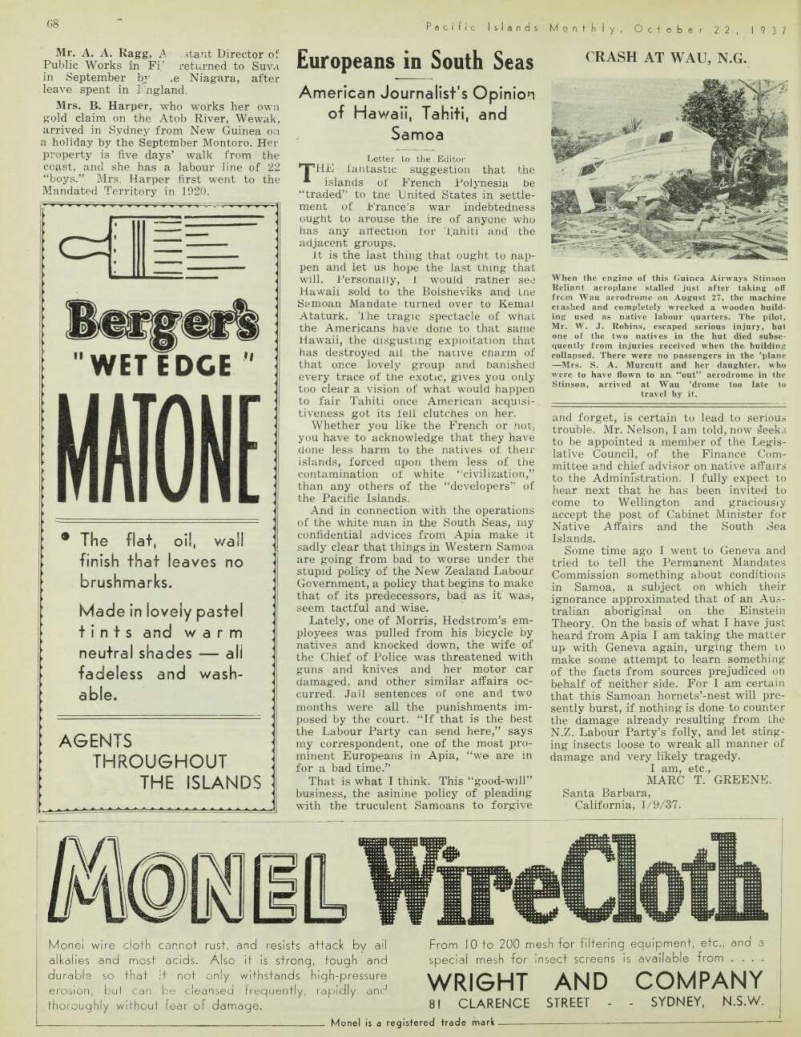
Ballad Of The
THE Matrons of Port Moresby recently enter tained the Spinsters and Bachelors of that town at a ball, the invitation to which was couched in the form of a graceful limerick: “The Matrons of Moresby aren’t done.
Like you all they are x-eady for fun,” etc.
It was merely the invitation, not the ball itseli, which inspired the following lines. Since they were written some time in advance of the even', it goes without saying that the three characters and the brief rencontre in which they become Involved are all imaginary.
THE Matrons of Moresby declare they aren’t done; Like ourselves, they are ready and anxious for fun.
A bold declaration, howe’er you construe it.
To which we could answer that most of us knew it.
Yet hark to a story, both simple and moving, (As if such a statement required any proving) Of one, the most daring, I’m sure you will think.
Who approached, stood upon, and looked ovet, the brink. * * * Survey the scene, a spacious hall Fitly bedecked for a Matron’s ball; The guests, a starched and jewelled crowd.
Mid saxophonic music loud In giddy couples by the score Gyrate upon the powdered floor. * * * Hark you amid this festive rout.
Superb and fairly standing out, A bachelor tall and debonair.
With faultless tie and shining hair.
His roving eye hath yon descried A matron by her husband’s side Whose aspect seems so dutiful That all must deem it beautiful.
And yet th’ expectant smile that plays Lightly o’er her lips betrays A disposition to be naughty. (Her age is, gently speaking, forty.) In short, she hath the look of one Who’s really out for an evening’s fun. * * * His glance, of magnetism full.
Like Cupid’s shaft now scores a bull; And hers, from under curving lashes.
The dazzling signal quickily flashes.
Straight then he goes, respectful bows Before the lady and her spouse.
And as they dance off cheek to cheek.
We hear the wretched villian speak. * * * “Come, reverend dame and faithful wife.
Tonight you’ve got the chance of life.
Forget your rightful lord and master.
And, while the fun grows fast and faster.
Leave him sitting in his place And yield for once to a new embrace.” * * * Behold him now, her sovereign lord.
Alone and silent, greatly bored.
At first he’s grumpy; then he’s drowsy; Now he votes the whole show lousy.
While, then, they dance in gay rotation We’ll keep him under observation.
No dancer he, absurd and frisky!
Methinks his mind is on his xvhisky.
He’d gladly leave this glorious hub Of Moresby fashion for the pub.
But hist! Observe his breathing deep.
His drooping eyelids! He’s asleep. * * * And now the guileful bachelor Edges his partner to the door.
And, feigning sympathy the while.
Bespeaks her with a crooked smile: “Pray, madam, don’t you find this tiring?
And, look, I see you are perspiring!
Your brow serene is sparkling set With bright globicula of sweat.
Perchance, with noise and heat opprest.
You’d welcome just a moment’s rest.”
When she with eye responsive winks, “The bird is mine!” he surely thinks.
So out they slip, the guilty pair.
Ostensibly to take the air. ♦ * * Ten minutes pass. They now return.
His look is sheepish; hers is stern.
One glance she gives him that might scorch
His shirt-front as they near the porch; Then onward sails and leaves him standing Discomforted upon the landing.
Briefly before the mirror bevelled She re-arrays her hair dishevelled; And now with proud and haughty stare Doth on the dancing bach’lors glare; Sweeps by them with majestic carriage Seeking her partner true in marriage.
And when she finds him, widely yawning (Blame him not—’tis two in the morning!) Hear in her voice repentent virtue, “What, dear old boy, did I desert you?”
And hear him answer, curt and surly, “I though that we were going early!”
“But just one dance,” she fondly cries, “With you, my dear;” and, see! her eyes With unshed tears are slightly wet.
Tears of chagrin, relief, regret. * * ♦ Anon they dance. Ah, what a flop!
Poor Matron, can this awkward hop Compare with that inspired skill Which lately gave you such a thrill ?
This antiquated circus-ride.
Thy spouse’s own, what is’t beside The steps of nineteen thirty seven That swirl a Matron up to Heaven?
Yet art thou pleased. Thine errant charms.
Now safe in matrimonial arms.
Have made their small experiment.
Gone quite as far as they had meant. * * * But has she really learnt her lesson.
Or when perhaps she puts her dress on For such another festive night Will she essay a longer flight?
And what of you, bad bachelor.
Standing gloomy by the door.
For cigarettes your fingers fumbling.
Curses round your midriff rumbling?
We know, oft-disappointed swain.
That you at least will try again.
Argus.
Mrs. W. Ramsay McNicoll, wife of the Administrator of New Guinea, arrived by the Neptura on September 2 to spend some time in Sydney.
Mr. A. A. Ragg, A" slant Director of Public Works in Fi‘ returned to Suva in September by *e Niagara, after leave spent in I ngland.
Mrs. B. Harper, who works her own gold claim on the Atob River, Wewak, arrived in Sydney from New Guinea on a holiday by the September Montoro. Her property is five days’ walk from the coast, and she has a labour line of 22 “boys.” Mrs. Harper first went to the Mandated Territory in 1920.
Advertisements & other items, pp. 73-74 (1 item)
Orchards S
OF COURSE
YOU’VE GOT A WATCH
BUT!
Does it give complete satisfaction in tropical conditions ? Does it resist the damaging effects of dust and humidity? Will it stand up to hard usage? You can't afford to take these risks.
The CYMA "Watersport" is a scientific Invention, being absolutely dustproof and waterproof. It is specially constructed as the Ideal Watch for the man In the tropicr. *3 in o cO
CYMA
CYMA is the world's most famous make of Watches. This magnificent model in stainless steel case, with fully jewelled precision shockproof lever movement, is an absolutely perfect timekeeper and is guaranteed to wear at least for 10 years.
ORDERS TO BOX 65. HAYMARKET P. 0., SYDNEY
ORCHARDS s
2 SYDNEY STORES
RAILWAY SQUARE and 401 PITT STREET
E S
WET EDGE
The flat, oi!, wall finish that leaves no brushmarks.
Made in lovely pastel
tints and warm neutral shades all fadeless and washable.
AGENTS
THROUGHOUT
THE ISLANDS
Europeans in South Seas
American Journalist's Opinion of Hawaii, Tahiti, and Samoa
Letter to the Editor fantastic suggestion that the islands of French Polynesia be “traded” to tne United States in settle ment of France’s war indebtedness ought to arouse the ire of anyone who has any affection for Tahiti and the adjacent groups. it is the last thing that ought to nap pen and let us hope the last thing that will. Personally, 1 would rather see Hawaii sold to the Bolsheviks and tne S&moan Mandate turned over to Kemai Ataturk. The tragic spectacle of what the Americans have done to that same Hawaii, the disgusting exploitation that has destroyed ail the' native charm of that once lovely group and banished every trace of the exotic, gives you only too clear a vision of what would happen to fair Tahiti once American acquisi tiveness got its fell clutches on her.
Whether you like the French or not, you have to acknowledge that they have done less harm to the natives of their islands, forced upon them less of the contamination of white “civilization,” than any others of the “developers” of the Pacific Islands.
And in connection with the operations of the white man in the South Seas, my confidential advices from Apia make it sadly clear that things in Western Samoa are going from bad to worse under the stupid policy of the New Zealand Labour Government, a policy that begins to make that of its predecessors, bad as it was, seem tactful and wise.
Lately, one of Morris, Hedstrom’s em ployees was pulled from his bicycle by natives and knocked down, the wife of the Chief of Police was threatened with guns and knives and her motor car damaged, and other similar affairs oc curred. Jail sentences of one and two months were all the punishments im posed by the court. “If that is the best the Labour Party can send here,” says my correspondent, one of the most pro minent Europeans in Apia, “we are in for a bad time.”
That is what I think. This “good-will” business, the asinine policy of pleading with the truculent Samoans to forgive
and forget, is certain to lead to serious trouble. Mr. Nelson, lam told, now seeks to be appointed a member of the Legis lative Council, of the Finance Com mittee and chief advisor on native affairs to the Administration. I fully expect to hear next that he has been invited to come to Wellington and graciously accept the post of Cabinet Minister for Native Affairs and the South Sea Islands.
Some time ago I went to Geneva and tried to tell the Permanent Mandates Commission something about conditions in Samoa, a subject on which their ignorance approximated that of an Aus tralian aboriginal on the Einstein Theory. On the basis of what I have just heard from Apia I am taking the matter up with Geneva again, urging them to make some attempt to learn something of the facts from sources prejudiced on behalf of neither side. For I am certain that this Samoan hornets’-nest will pre sently burst, if nothing is done to counter the damage already resulting from the N.Z. Labour Party’s folly, and let sting ing insects loose to wreak all manner of damage and very likely tragedy.
I am, etc.,
Marc T. Greene.
Santa Barbara, California, 1/9/37.
Crash At Wau, N.G.
When the engine of this Guinea Airways Stinson Reliant aeroplane stalled just after taking off from Wau aerodrome on August 27, the machine crashed and completely wrecked a wooden build ing used as native labour quarters. The pilot, Mr. W. J. Robins, escaped serious injury, but one of the two natives in the hut died subse quently from injuries received when the- building collapsed. There were no passengers in the ’plane —Mrs. S. A. Murcutt and her daughter, who were to have flown to an “out” aerodrome in the Stinson, arrived at Wau ’drome too late to travel by it.
Advertisements & other items, pp. 74-76 (2 items)
Wright And Company
V C A iq •w Monei wire cloth cannot rust, and resists attack by ail alkalies and most acids. Also it is strong, tough and durable so that it not only withstands high-pressure erosion, but can be cleansed frequently, rapidly and thoroughly without fear of damage.
From 10 to 200 mesh for filtering equipment, etc., and a special mesh for insect screens Is available from . . . .
81 CLARENCE STREET - - SYDNEY, N.S.W, Monel is a registered trade mark
Maleham & Yeomans
LIMITED
BOWDEN STREET. SHEFFIELD. ENG
Manufacturers of all kinds of Butchers’, Sticking and Sheath Knives Razors and Scissors Specialty Hairdresser Scissors
PRICE LIST ON APPLICATION
DEU T Z
DIESEL
ENGINES
Deufz Engines used Internationally since 1864
MARINE DIESEL " OM " TYPE
1481 Range from 10 to 140 B.H.P.
Full information obtainable from the Agents
Herbert Del Cott Pty. Ltd.
15 CASTLEREASH STREET, SYDNEY
Rhone; 8 3135
"A E " ELECTRICAL
E. Vl . EQUIPMENT
FREE ELECTRICITY !
with “A E G” Turbinamos
A " Turbinamo " working from a stream generates sufficient electricity for households, plantations or communities.
Simple to Instal Reliable Supply No Running Costs Looks After Itself Write for particulars e b Sizes G.i» kv to 40 kw.
State head of water availabh Electricity output required.
Cables "Voltage"
116 QUEEN STREET. MELBOURNE
Phone: Central 10488
I *
FOR RELIABILITY
AND LONG SERVICE
USE
MILLER'S ’ANCHOR'
BRAND ROPES
AND CORDAGES
Manila, Sisal, New Zealand Coir and Cotton Rope of every description.
Twine, Sewing Twine, Shop Twine, Binder Twine and Fishlines, Lashings, Halters, Plough Reins, Sack Cord, Blind Lines, etc.
LENGTH STRENGTH
QUALITY GUARANTEED
& Manufactured by: JAMES MILLER & Co. Pty. Ltd.
MELBOURNE, VIC.. AUST.
Suva Agents: A. S. FAREBROTHER & CO.
And at Lautolca, P.O. Box 36. Tel. 261 Sydney Agents: P. T. TAYLOR LTD.
Prevents Black Mould
Fungicidal Paint not your property —but It
"B.A.L.M.
beautifies gredients that prevent Black Mould. This Paint Is specially made for use In the Tropics— use it for lasting beauty and protection! only protects and contains special in-
-OALIV|
FUNGICIDAL
PAINT
"Cuprinol" gives canvas, nets and cordage added strength while preserving them from Mildew and Rot, It does not affect the flexibility. It will treble the life of the fabrics.
“Cuprinol" also gives timber immunity from attacks of White Ants and Dry Potand exterminates these pests in v/ood that has already been affected.
Products of British Australian Lead Manufacturers Pty. Ltd.
Cl
Treble the Life of Canvas
CUPRINQI
THE REVOLUTIONARY WOOD
AND FIBRE PRESERVATIVE
DISTRIBUTORS :
Steamships Trading Co. Ltd., Port Moresby and Samarai.
Greenwood & Laws Ltd., Rabaul and Wau.
Secret Agreement for Sth.
69
Pacific Islands Monthly. October 22. 1937
Pacific Air Service
(CONTINUED FROM PAGE 7)
"Tonga's Taxes Are Too High"
A "Left" M.L.C. Censures the Government
Letter to the Editor T SHOULD be much obliged if you would grant me a little space in your jour nal to correct an impression which might be formed by readers of the “Tongan Notes” in your July issue.
Your correspondent states that Taukolo Lagi and I are the leaders of a number of “ hot-heads ” who have been discussing the “ rights and equality of man” and have repeatedly petitioned the Queen to dismiss the Pre mier on grounds that appear to exist only in our imaginations. May I say that there is nothing hot-headed in discussing the rights of man or in desiring a change in the Premiership.
The policy of my friend Taukolo and those who support us is to bring about a reduction of expenditure by the Ton gan Government and a corresponding reduction in taxation. For several years the excessive expenditure of the Govern ment has necessitated the imposition of taxes upon the people which are in reality a' very heavy burden.
We desire to see the Pension Scheme abolished, as the resources of Tonga are quite inadequate for such a scheme. We also consider that there are far too many civil servants, many of them with insuffi cient work to keep them occupied even during the short hours they are supposed to work —a reduction should be made.
There is too much leave on full pay and too much spent on passages—nearly all unnecessary. Why do people want to be tripping off for several months every three years on full pay from one of the healthiest countries in the world?
Those who puli the strings of the Ton gan Government are too busy looking after Number One and have very little time left to do anything about reducing the burdens of the people. If some of the £63,000 odd which is to be spent during the current financial year were used to help those who are short of food, as a result of the hurricane in February* last, it would be more creditable to the Gov ernment.
The roads are badly in need of repair, and it is only a waste of time, money, and material, to drop pieces of broken stone here and there without rolling them, as they are mostly scattered by read users.
We would like to see a change of Mini sters every five years instead of the same people hanging on year in and year out, apparently for ever. When they want an excuse for something for their own bene fit they say the British Government does it Let them follow the example of the British Government by giving the people a chance to turn them out.
I am, etc.,
Afuha’Amago,
Member, Tongan Legislative Assembly Nukualofa, Sept. 22, 1937.
Advertisements & other items, p. 76 (1 item)
70
PacPfic Islands Monthly, October 22, 1937
Matson Interests
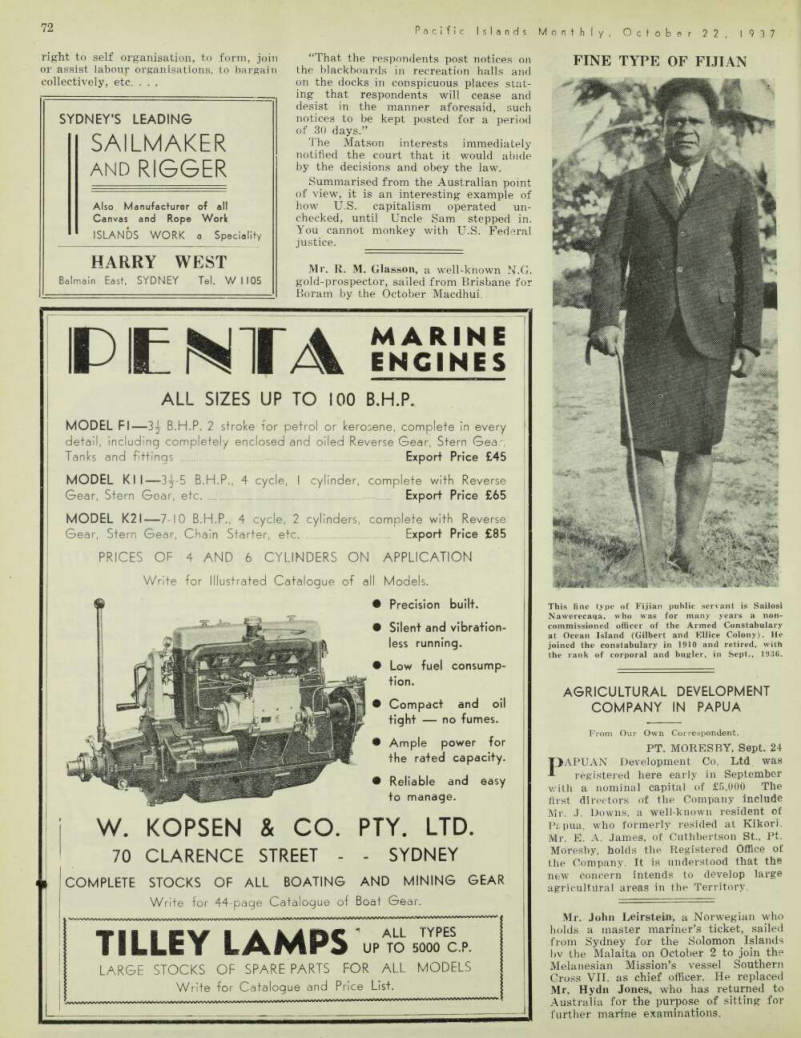
In Hawaii
interesting Result of a Federal investigation
From Our Own Correspondent
Honolulu, Sept. 27.
T ITTLE things, as the adage says, grow into big things. But little did the U.S. Federal Government investiga tors suspect where their work would lead to when they were assigned early this year to inquire into complaints lodged by Honolulu stevedores (“wharfies” to Australians) that Hawaiian business interests, bossed by the Matson Steam ship Company, were antagonistic to organised labour, in a manner contrary to American law.
Evidence was heard before Examiner George 0. Pratt, of the National Labour Relations Board (N.L.R.8.). The Matson interests were watched by an array of legal talent.
Mr. Pratt’s report and conclusions have just been made public; and, because they compose an outstanding, impartial summary, they must be regarded as a faithful picture of modern Hawaii—at least, of its economic status.
The Big Five
The sugar and pineapple industries are the lifeblood of the islands, and they are controlled by the interlocking director ates of five firms, known locally as The Big Five.
“Of The Big Five, however, the finan cial relations of Castle & Cooke are the most far-reaching,” says Mr. Pratt’s summary. “Their unity of control is tacitly recognised by the inhabitants of the territory, and this recognition has had the effect of giving Castle & Cooke and the Big Five a measure of control far greater than the circumstances war rant, and greater than can be demon strated on paper ... (as a result) there is an attitude of feudal paternalism on the part of the employers toward the working peoples of the islands. The con dition, it is believed, is unique among U.S. possessions to-day . . .”
Evidence indicated that Castle & Cooke, agents for the Matson Line and heavy stockholders in it, created sub sidiaries purposely to play the red herring trick, a familiar weapon of U.S. capitalist monopolies. In speaking of these subsidiaries, Mr. Pratt says: “ . . . The acts of one melt into the acts of another without line of demar cation that it is impractical to separate.”
The effect of this monopoly in the labour as well as the business market Mr. Pratt summarises: “No impartial person who observed the demeanour of witnesses on the stand and who heard the testimony and read the exhibits could fail to be impressed with the fact that the longshoremen (wharfies) in the employ of the respondents (the Matson interests) are afraid, and they have reason to be. Their employer con trols virtually the entire economic life of the territory. To be discharged as a wharfie at the port of Honolulu means
that either one must eke out a living fishing, or go as a suppliant to one of the other enterprises owned or controlled by Castle & Cooke and seek employment.
“If one makes a remark that reflects in any manner on Castle & Cooke (the Matson agents and stockholders) it is sure to get back to the management and one is called on the carpet for it. An employee must remember this, even when seeking relaxation in drink, for his irresponsible statements made under the influence of liquor are reported and he is penalised just as if they were made when sober. The police department works in with the Castle & Cooke (Mat
son) to check any untoward activity (to their interests) and this is well under stood,”
This industrial spying, Mr. Pratt found, is “an outgrowth of the economic setup of the territory,” and naturally attacked organised labour, and Mr. Pratt calls it “an unhealthy condition.”
Outcome of the whole evidence and its consideration is that Examiner (or Judge) Pratt concluded and recom mended: “That the respondents (Castle & Cooke-Matson) cease and desist from interfering with, restraining or coercing their employees in the exercise of the
right to self organisation, to form, join or assist labour organisations, to bargain collectively, etc. . . .
“That the respondents post notices on the blackboards in recreation halls and on the docks in conspicuous places stat ing that respondents will cease and desist in the manner aforesaid, such notices to be kept posted for a period of 30 days.”
The Matson interests immediately notified the court that it would abide by the decisions and obey the law.
Summarised from the Australian point of view, it is an interesting example of how U.S. capitalism operated un checked, until Uncle Sam stepped in.
You cannot monkey with U.S. Federal justice.
Mr. R. M. Glasson, a well-known N.G. gold-prospector, sailed from Brisbane for Boram by the October Macdhui.
Advertisements & other items, pp. 77-78 (1 item)
Chapman Engines
The Yorkshire Insurance Coy. Ltd.
ESTABLISHED IN YORK 1824
Agents and Attorneys throughout the Pacific Islands SUVA Williams & Gosling Ltd.
SALAMAUA A. Innes
KAVIENG F. V. Saunders
PAPUA
Port Moresby E. A. James Samarai E. J. Morrow
NEW GUINEA BRANCH: Park St., RABAUL
Fire
Accident
Marine
Total Assets Exceed £16,500,000 J. D. HAIG, Manager
CHAPMAN ENGINES
are reliable cost less to run
A Chapman engine is cheap to buy—saves you money on upkeep costs —no breakdowns—no expensive overhauls—low petrol and oil bills. Simplified constructions makes Chapman Pup Engines sturdy, reliable. Write tor particulars of models and horse powers.
THE CHAPMAN RANGE OF MARINE MOTORS
Export Pup - - Standard Pup Master Pup h.p. Super Pup 2j h.p. Greyhound 3 h.p. Seadog £ To CHAPMAN & SHERACK, clara street, erskineville, n.s.w.
Please send me particulars of Chapman Marine Motors model h.p.
Name „ Address
SYDNEY'S LEADING
SAILMAKER
and RIGGER
Also Manufacturer of all Canvas and Rope Work ISLANDS WORK a Speciality
HARRY WEST
Balmain East, SYDNEY Tel. W 1105
ip ie NT a awa;
ALL SIZES UP TO 100 B.H.P.
MODEL Fl B.H.P. 2 stroke for petrol or kerosene, complete in every detail, including completely enclosed and oiled Reverse Gear, Stern Gear, Tanks and fittings . Export Price £45 MODEL Kl I — 8.H.P., 4 cycle, I cylinder, complete with Reverse Gear, Stern Gear, etc. Export Price £65 MODEL K2l —7-10 8.H.P., 4 cycle, 2 cylinders, complete with Reverse Gear, Stern Gear, Chain Starter, etc. Export Price £B5 PRICES OF 4 AND 6 CYLINDERS ON APPLICATION Write for Illustrated Catalogue of all Models. • Precision built. • Silent and vibrationless running. • Low fuel consumption. • Compact and oil tight no fumes. • Ample power for the rated capacity. • Reliable and easy to manage.
W. KOPSEN & CO. PTY. LTD.
70 CLARENCE STREET - - SYDNEY
COMPLETE STOCKS OF ALL BOATING AND MINING GEAR Write for 44-page Catalogue of Boat Gear.
A .
TILLEY LAMPS
LARGE STOCKS OF SPARE PARTS
ALL TYPES
UP TO 5000 C.P.
FOR ALL MODELS
Write tor Catalogue and Price List.
Fine Type Of Fijian
This fine type of Fijian public servant is Sailosi Nawerecaqa, who was for many years a non commissioned officer of the Armed Constabulary at Ocean Island (Gilbert and Ellice Colony). He joined the constabulary in 1910 and retired, with the rank of corporal and bugler, in Sept., 1936.
Agricultural Development
Company In Papua
From Our Own Correspondent.
Pt. Moresby, Sept. 24
PAPUAN Development Co. Ltd was registered here early in September with a nominal capital of £5,000 The first directors of the Company include Mr. J. Downs, a well-known resident of Pepua, who formerly resided at Kikori.
Mr. E. A. James, of Cuthbertson St., Pt.
Moresby, holds the Registered Office of the Company. Tt is understood that the new concern intends to develop large agricultural areas in the Territory.
Mr, John Leirstein, a Norwegian who holds a master mariner’s ticket, sailed from Sydney for the Solomon Islands hv the Malaita on October 2 to join the Melanesian Mission’s vessel Southern Cross VII. as chief officer. He replaced Mr. Hydn Jones, who has returned to Australia for the purpose of sitting for further marine examinations.
Value of its Medical Work
Melanesian Mission
A NEW medical centre solely for exam ■^*L ining and treating natives, has just been opened on Ugi Island, British Solo mons, by the Melanesian Mission. This hospital station is under the charge of Sister Estelle Field, with a fully trained assistant, Sister C. Woods.
The principal hospital is situated at Fauabu on the island of Malaita, and has modern plant and equipment valued at £6,000. Another two are at Lupun, on the New Britain Coast, and Lolowai, in the New Hebrides. These three medical centres are in addition to the large, well-equipped hospital at Fauabu, under the control of Dr. Clifford James, who is well-known in New Guinea where he spent a number of years at Rabaul.
It is understood that the 8.5.1. Admini stration has bought the small island of Bassakanna, near Fauabu, and that a leprosarium will be established there.
The leper hospital will be under the supervision of Dr. James, and will em body many of the features and ideas gained by him during his visit to Mako gai Leper Settlement in Fiji a few months ago.
Through the kind offices of an English supporter, the Melanesian Mission has received a legacy which, with exchange, exceeds £l,OOO. The Mission will purchase a launch in Australia, which will be at tached to the Fauabu Hospital and will be used exclusively to enable the medical staff to visit native villages along the Malaita coast.
Too much emphasis cannot be laid on the value of the medical work being done by the Melanesian Mission and other mis sionary organisations in the South Seas.
Critics, who are inclined to scoff at Missions in general and ridicule “psalm singing and soul-saving,” could with profit examine the medical side of the Missions’ activites. Even a casual perusal of their medical reports, and a note of the quiet efficient way in which they are tackling, with the help of the various Governments, the stupendous task of ministering to the health needs of Pacific Islanders particularly the primitive people of Melanesia —would bring con viction to their minds, despite their ancient prejudices.
Samoan Banana Quotas
Increased
From Our Own Correspondent APIA, Sept. 22.
INURING September, quotas for banana shipments from Western Samoa to New Zealand have been considerably in creased. The Maui Pomare on September IB took 7,719 cases, while the Matua on the 24th is expected to load 8,900 cases.
This makes a total of 16,619 cases for which £4,150 will be paid to banana growers.
Mrs. G. C. Holmes, who for over 20 years had lived in various parts of New Guinea, died at Kavieng early in Sep
tember, after a long illness. Arriving
from the Solomons in 1913, she lived for a time at Numa Numa (Bougainville), before going to Lindenhafen and Rabaul.
She is survived by Mr. Holmes and their two children, Heather and Geoffrey.
Transforms Madang
Invasion of Oil-Seeking Co.
From Our Own Correspondent
Madang, Sept. 25.
by the Administrator and the ’ Governor-General, and then an al most unbelievable rush of shipping—the Montoro and Macdhui within a fortnight of each other —have forced residents to the conclusion that Madang is not the place it used to be. Instead it seems to be a hive of industry, with a gradual increase in population by each steamer.
This is because Islands Exploration Ltd. (Vacuum Oil Co.) is gradually con solidating its position in the district and increasing its staff. The oil people are causing quite a transformation of Madang, and whether this will be for better or for worse remains to be seen.
The Company has been granted, by the Commonwealth Government, almost un limited concessions in the District so that they can make a thorough search for oil-bearing areas.
Residents are thankful that the Com pany employs a few men experienced in the working of natives, and has a man at the head of affairs who at all times endeavours to carry on his work without in any way disturbing the district.
Dr. Paul Mitchell, Chief Common
wealth Quarantine Officer, paid an official
visit of inspection to Thursday Island at the end of September.
Mr. Tremewan arrived in Samoa from New Zealand by the September Maui Pomare to join the staff of the Apia Observatory.
Advertisements & other items, pp. 79-80 (1 item)
Lars Halvorsen Sons
THE HAL VORSEN STANDARD IN BOAT BUILDING
IS ENDORSED BY MANY DISCERNING CLIENTS
Distributing Agents tor . . ,
MORRIS MARINE ENGINES
LARS HALVORSEN SONS
PTY.
LTD.
NEUTRAL BAY - SYDNEY, N.S.W.
Orders tor 1937, completed or under construction, include : Cruiser, 45ft. (as illustrated).
Cruiser, 50ft.—for E. Hillier, Esq.
Three 32ft, Standardised Cruisers One 32ft. Standardised Cruiser (building).
Cruiser, 55ft.—tor H. P. Christmas, Esq.
Vessel, 70ft.—for N.G. Administration.
Fishing Boat, 40ft.—for Rockhampton, Auxiliary, 30ft.—for Burns Philp & Co. t td.
Seven, 15ft., Morris powered, Tenders.
Whaleboat, 25ft. for Islands.
Three 15ft. Launches for New Guinea.
Two 70ft. Vessels, under construction for Island Explorations Limited, In addition much repair and overhauling work was done, and many engine installations carried out.
Like-a-flash ‘Eliminoise’
Aerial Kit, for short or dual wave sets.
Aerial Pyrex type Insulators, transposi t i o n blocks and 200ft. aerial wire, 22/6. Eliminates unwanted aerial and hideous electrical noises from your dual-wave or short-wave set.
Now Ready: The “Stratosphere” super Dual Wave 2-valve battery operated radio for all wave reception. A real little thoroughbred radio receiver. All parts, 63/4 ; Valves, 35/-; Batteries, 30 9; Phones, 30/-, 32/6; Cabinet, 15/-; Speaker, 23/9 ; Ready Built complete, £10; Easiway Assembly Charts, 6d.
New Games w : ,th all directions: International Derby Race (lame 15/-, “Roular” Monte Carlo Game 15/-, Newmarket Table Race Game 15/-, Coojee Race Game — The horse jumps the hurdles 35/-, Miniature Table Pin Games 17/6.
The book of practical Radio by Scott-taggart 10/6 163 diagrams, 63 platen. 320 patres.
T£ LSE h a.c-dc
MULTlM PTE B
AC-DC multimeter, tests all in radio and domestic electrical appliances, British made, reads 0 to 30 and 300 ma, 0 to 8, 16 and 240v. 25/-.
"Totem,” the newest game for home, club, picnic or party 21/-.
“ Odds and Evens,” a new Head and Tail spin game 21/ designed as repro- Bush lever and away they go.
Batteryless Hand Microphone, just plug into pick up terminals of set, 45/value, now 25/ -3 For Music, Song, or Speech. Others 19/6
f.jCAM*
Everyman’s Wi The wireless constructor’s Encyclopedia by Camm — 410 pages, 490 illustrations, cloth bound. The only work of its type now 7/6.
Just arrived — reless Book, 5/6.
Ormond English 3 inch geared, front of panel vernier dials, 2 action, 8/6.
Utility 2-Speed Micro Dial, absolutely best made for short wave or broadcast. 10 '- 106
• MORSE COE
TWIN SET
Morse code outfits for beginners, complete with battery, 10/6 ea. Morse code with buzzcr or lamp.
smcssoti
HEAD
J) J&utuA,
PROFESSIONAL 32/6
4000 ohms
B.T.H. or S.T.C., 30/-.
All British, three makes.
P fi J The “Air Patrol” 2 valve all wave battery set. Covers from 15.5 to 835 metres — £11/17/1 complete with speaker, ’phones and all accessories, a midget in name only, but a giant in performance. Receives local, interstate and overseas broadcasts.
Models for boys from 9 to 80 years of age: Outboard Motor Boat Models, 25/-; Motor only, works off wet or dry batteries, 19/6 ; Electric Motor Kit, 2/6 ; Electric Motors, 7/6, 11/6, 16/-; Electric Train Sets with rails, 95/- ; Engine and Tender, 28/6 ; 240 volt A.C.
Transformer; Midget Microscopes, pocket type, 2/6: Match Box Sets for Model Building, 2/6 ; Model Aeroplane Kits, solid models, 1/6; larger, 5/6; flying models, 1/6 ; larger, 3/6.
I “Like-a-FIash” de luxe Morse code keys, adjustable every way. 12/6 ; P.M.G. type all brass fittings, 19/6 ; Junior models, 9/6, 10/6; High grade buzzers, 7/6.
K?
Send for Levenson’s Radio Bargain Bulletin, 8d, post free.
Also Levenson’s Radio Buyer’s Guide and Assembly Chart Handbook, 2/- post free.
Pyrex type Glass Insulators; 3in„ 1/- 4in.. 3/6, (SQang) 3, NS «« 7 V n or 2.
Genuine Pyrex, 30/-.
COSVIOCOBD'
/K 25 cyulLiJi Richards, just arrived 25/- “Cosmocord” 25/- “ Cosmocord” De Luxe 32/6 “Cosmocord” high-definition 38/6 “Cosmocord” Super de Luxe 45/- Amplion (English) 28/6 Gramophone Pickups, B.T.H.
Bakelite Models ' 32/6 Gramophone pick-up heads, 10/6, 12/6, and English made Cosmocord, 11/9 and 19/6. They fit all standard tonearms.
High pitched tone adjustable professional buzzers for morse code, 7/6.
Others, 26 md 3/6. The widest range ofering at Levenson’s. Junior »ractice morse code sets, 4/6.
RADIOMODERNE
THE IDEAL RADIO FOR THE PACIFIC ISLES Positively the Greatest Battery Operated Radio Receiving Set Ever Introduced.
THE 1938 “RADIO MODERNE”
No Sales Boast—A Real Live Established Fact A DUAL WAVE Battery-operated Radio cmploying the latest and definitely the most outstanding jj 6 j et ' c * rcu * t with a radio frequency stage added, to operate with the New Air Cell Battery (eliminating the old-time messy accumulator). , rh ® ew Air Cel1 Battery is designed to give 1.C00 hours service, and should last with ordinary use from 9 to 12 months. No messy acid. No accumulators to have recharged. The New Air Cell does away with all of that.
The “RADIO MODERNE” has incorporated in the circuit:— The New Iron Cored Intermediates giving greater distance getting capabilities than you ever expected. Improved Selectivity. Pleasing Tone, 100 per cent, and variable to suit the most fastidious tastes. Reproduction magnificent. As life like as humanly possible. Pie Wound Litz Aerial, R.F. and Oscillator colls giving further improved sensitivity. Four Controls, Tuning, Volume, Tone and Wave Change Switch. Coloured New calibrated Dial, showing plainly all Australasian and Oversea Stations. Tuning operation exceptionally oasy. Speaker: Amplion’s latest type, perfectly matched. Handsome Floor Model Cabinet, workmanship finest, and quality perfect in every detail.
Valves: Latest standard types, leading makers.
Guarantee: 12 months set and speaker, 90 days valves.
South Sea Islands Residents Note: All coils specially impregnated by a new process, as a protection against humidity in tropical conditions.
“RADIO MODERNE” complete, ready for opera- Uon with Triple Duty Batteries and the new Air Cell “A” Battery £25
"TELSEr
» »i ti s m •Otufr rvp£ VOlT wnT# i / Three readings 10/6, 0 to 9, 180v., 0 to 30 ma. Other Bakelite cased Voltmeters, 0 to 10, 0 to 125 v., 4/6. Others to read A and B batteries, 2/6. 3/9. 4/6
'‘ninn-o-uiPR"
RUBBER CLRD
PERIflL
40 STRRnDS
SOFT.
I00FT |Q4
Games For All: Monopoly, the world’s new craze, 17/6 and 21/-; Crown and Anchor game, 10/6 ; Crown and Anchor dice, 5/6, 6/6 ; Betting Cloth for above, 3/6; Dart boards, 7/6, 8/6, 10/6, 12/6, with darts; Housie Housie sets, 3/6, 5/6, 11/6 and 25/- complete.
Electric Race Game, 35/-; Table Race Game, you wind the handle, 15/-, 17/6, 21/- 25/-; Sydney Cup Race Game Wheel, 63/- ; Roulette Wheels, upright, 21/-, flat type, 12/6; Poker Dice in case, set of 5, 10/6, others 5 for 6/6 ; Put and Take Tops, 1/6 ; Pocket Race Games, 1/3 and 1/6 ; Pony Race Punch Boards, 1,000 holes, 25/-; Punch Board (send for full lists), 100 holes, 4/-; 300 holes, 10/-; 500 holes, 15/-; 1.000 holes, 21/-; Electric Speedway Race, 20/-, 25/-; 5 Dice Roll, 6/6; Put and
Take Dice Roll, 4/6; 3 Dice Roll Game, 3/6.
Write for Punch Board Leaflets
LEVENSON S RADiO
226P.I- Pin STREET, SYDNEY
Manufacturers, Importers, and Exporters. Evens Branches: Radio Cheapside, 24 0a Pitt St. Leaflets
N.S.W., AUSTRALIA
’Phones, M 2525 and M 2526-7. Cable address. “Leveradioh.” Goods forwarded V.P.P. or Sight Draft. Satisfaction and Service Guaranteed. We can supply by mail all General Merchandise at a Better Price. Quotations with pleasure. Please add freight and packing Buying Offices: London, ’Frisco, New York, Osaka, Tokio.
Spinning Wheel Games, indestructible, Bin in diameter, complete with all instructions and betting suuecs: Crown and Anchor, Newmarket Handicap, Roulette Wheel, Doncaster Handicap all 7/6; or the set of four for 28/6.
Home Broadcasting microphone for speech, music, etc. easily fitted to any set, 19/6
Australian Short Wave
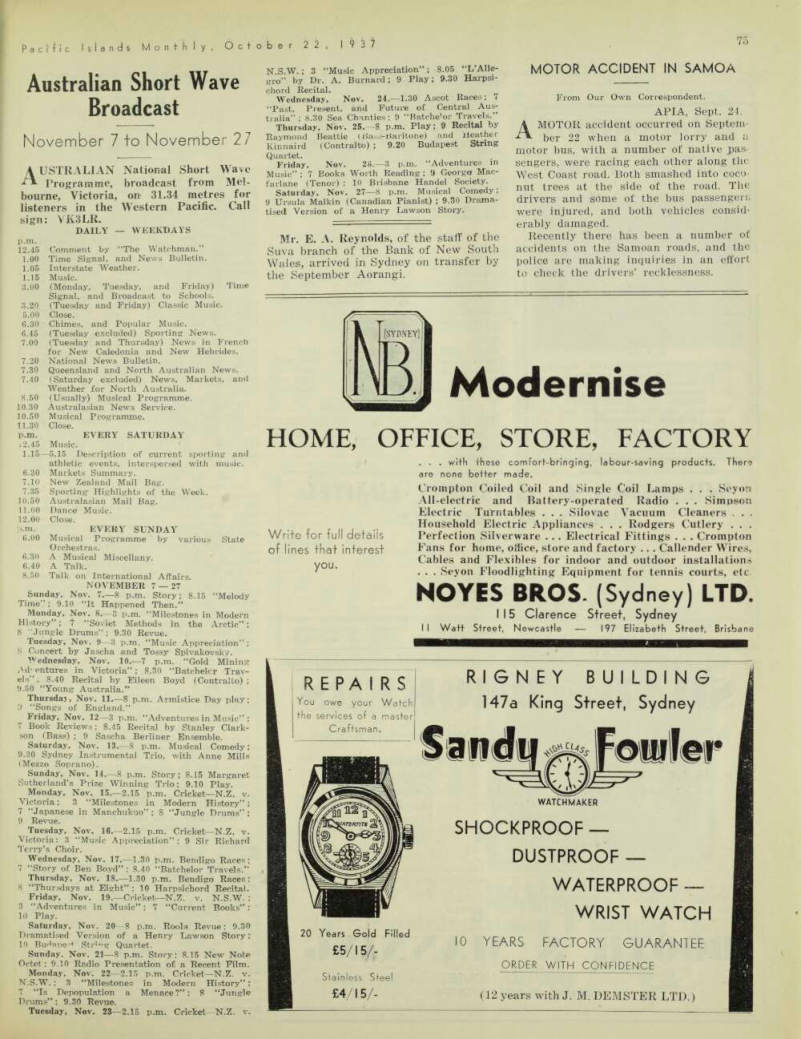
Broadcast November 7 to November 27
AUSTRALIAN National Short Wave
Programme, broadcast from Mel
bourne, Victoria, on 31.34 metres for
listeners in the Western Pacific. Call
sign: VK3LR.
Daily Weekdays
p.m. 12.45 Comment by “The Watchman.” 1.00 Time Signal, and News Bulletin. 1.05 Interstate Weather. 1.15 Music. 3.00 (Monday, Tuesday, and Friday) Time Signal, and Broadcast to Schools. 3.20 (Tuesday and Friday) Classic Music. 5.00 Close. 6.30 Chimes, and Popular Music. 6.45 (Tuesday excluded) Sporting News. 7.00 (Tuesday and Thursday) News in French for New Caledonia and New Hebrides. 7.20 National News Bulletin. 7.30 Queensland and North Australian News. 7.40 (Saturday excluded) News, Markets, and Weather for North Australia. 8.50 (Usually) Musical Programme. 10.30 Australasian News Service. 10.50 Musical Programme. 11.30 Close.
P.M. Every Saturday
i 2.45 Music. 1.15 —5.15 Description of current sporting and athletic events, interspersed with music. 6.30 Markets Summary. 7.10 New Zealand Mail Bag. 7.35 Sporting Highlights of the Week. 10.50 Australasian Mail Bag. 11.00 Dance Music. 12.00 Close,
M. Every Sunday
6.00 Musical Programme by various State Orchestras. 6.30 A Musical Miscellany. 6.40 A Talk. 8.50 Talk on International Affairs.
November 7 27
Sunday, Nov. 7.-8 p.m. Story; 8.15 “Melody Time” ; 9.10 “It Happened Then.”
Monday, Nov. 8.-3 p.m. “Milestones in Modern History”; 7 “Soviet Methods in the Arctic”; 8 "Jungle Drums”; 9.30 Revue., Tuesday, Nov. 9—3 p.m. “Music Appreciation”: S Concert by Jascha and Tossy Spivakovsky.
Wednesday, Nov. 10. —7 p.m. “Gold Mining Ad- entures in Victoria”; 8.30 “Batchelor Trav els” ; 8.40 Recital by Eileen Boyd (Contralto) ; 9.50 “Young Australia.”
Thursdaj, Nov. 11.—8 p.m. Armistice Day play; 0 “Songs of England.”
Friday, Nov. 12—3 p.m. “Adventures in Music” ; 7 Book Reviews; 8.45 Recital by Stanley Clark son (Bass) ; 9 Sascha Berliner Ensemble.
Saturday, Nov. 13.—8 p.m. Musical Comedy; 9.30 Sydney Instrumental Trio, with Anne Mills (Mezzo Soprano).
Sunday, Nov, 14.—8 p.m. Story; 8.15 Margaret Sutherland’s Prize Winning Trio; 9.10 Play.
Monday, Nov. 15.—2.15 p.m. Cricket—N.Z, v.
Victoria; 3 “Milestones in Modern History”; 7 “Japanese in Manchukuo” ; 8 “Jungle Drums”; 9 Revue.
Tuesday, Nov. 16.—2.15 p.m. Cricket—N.Z. v.
Victoria: 3 “Music Appreciation”; 9 Sir Richard Terry’s Choir.
Wednesday, Nov. 17.—1,30 p.m. Bendigo Races; 7 “Story of Ben Boyd” ; 8.40 “Batchelor Travels.”
Thursday, Nov. 18.—1.30 p.m. Bendigo Races; 8 “Thursdays at Eight” : 10 Harpsichord Recital.
Friday, Nov. 19.—Cricket—N.Z. v. N.S.W. : 3 “Adventures in Music”; 7 "Current Books”; 10 Play.
Saturday, Nov. 20 —8 p.m. Roola Revue; 9.30 1 Dramatised Version of a Henry Lawson Story r 10 Butane f Str sr, g Quartet.
Sunday. Nov. 21—8 p.m. Story; 8.15 New Note Octet: 9.10 Radio Presentation of a Recent Film.
Monday, Nov. 22 —2.15 p.m. Cricket—N.Z. v.
N.S.W. ; 3 “Milestones in Modern History” r 7 “Is Depopulation a Menace ?”; 8 “Jungle Drums”; 9.30 Revue.
Tuesday, Nov. 23—2.15 p.m. Cricket —N.Z. v.
N.S.W.; 3 “Music Appreciation”; 8.05 “L’Alle gro” by Dr. A. Burnard; 9 Play; 9.30 Harpsi chord Recital.
Wednesday, Nov. 24. —1.30 Ascot Races; 7 “Past, Present, and Future of Central Aus tralia”; 8.30 Sea Chanties: 9 “Batche’or Travels.”
Thursday, Nov. 25.-8 p.m. Play; 9 Recital by Raymond Beattie (Bass-Baritone) and Heather Kinnaird (Contralto) ; 9.20 Budapest String Quartet.
Friday, Nov. 26.-3 p.m. “Adventures in Music” ; 7 Books Worth Reading ; 9 Georgo Mac farlane (Tenor) ; 10 Brisbane Handel Society.
Saturday, Nov. 27—8 p.m. Musical Comedy: 9 Ursula Malkin (Canadian Pianist) ; 9.30 Drama tised Version of a Henry Lawson Story.
Mr. E. A. Reynolds, of the staff of the Suva branch of the Bank of New South Wales, arrived in Sydney on transfer by
the September Aorangi.
Motor Accident In Samoa
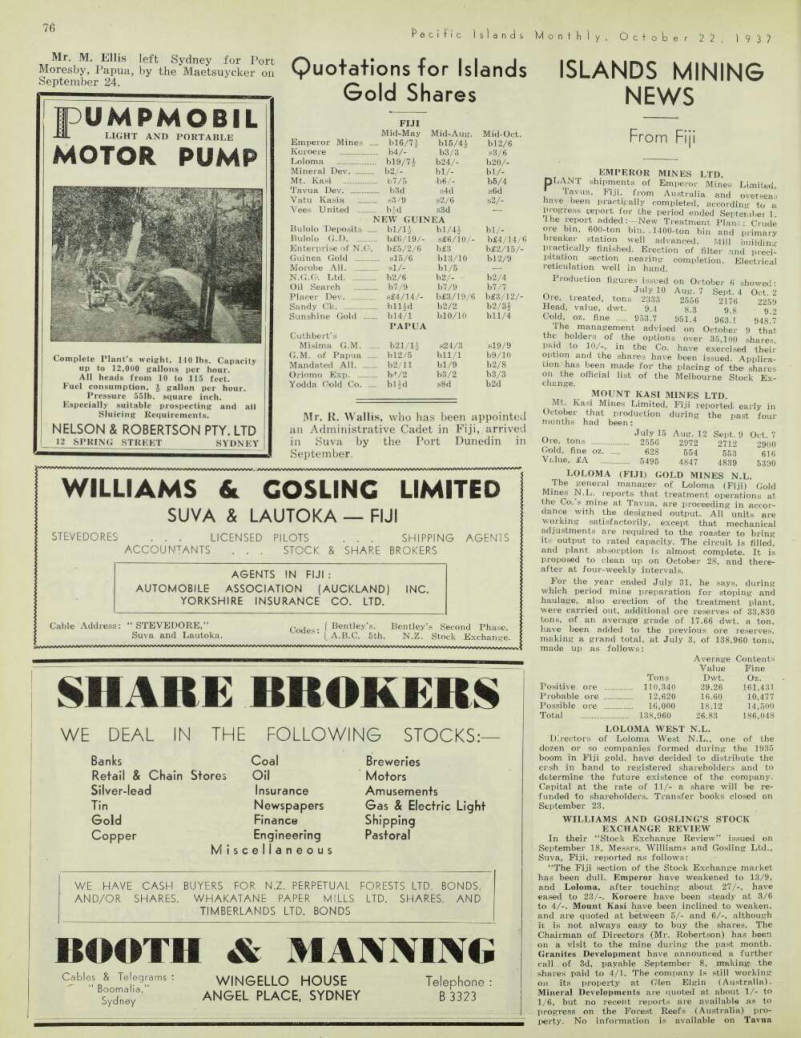
From Our Own Correspondent.
APIA, Sept. 24.
A MOTOR accident occurred on Septem ber 22 when a motor lorry and a motor bus, with a number of native pas sengers, were racing each other along the West Coast road. Both smashed into coco nut trees at the side of the road. The drivers and some of the bus passengers were injured, and both vehicles consid erably damaged.
Recently there has been a number of accidents on the Samoan roads, and the police are making inquiries in an effort to check the drivers’ recklessness.
Mr. M. Ellis left Sydney for Port Moresby, Papua, by the Maetsuycker on September 24.
Advertisements & other items, pp. 81-82 (1 item)
Home, Office, Store, Factory
. , . with these comfort-bringing, labour-saving products. There are none better made.
Crompton Coiled Coil and Single Coil Lamps . . . Seyon All-electric and Battery-operated Radio . . . Simpson Electric Turntables . . . Silovac Vacuum Cleaners . . .
Household Electric Appliances . . . Rodgers Cutlery . . .
Write for full details Perfection Silverware ... Electrical Fittings .. . Crompton of lines that interest Fans for home, office, store and factory ... Callender Wires, vou Cables and Flexibles for indoor and outdoor installations . . . Seyon Floodlighting Equipment for tennis courts, etc
NOYES BROS. (Sydney) LTD.
115 Clarence Street, Sydney
II Watt Street, Newcastle 197 Elizabeth Street, Brisbane
REPAIRS
You owe your Watch the services of a master Craftsman.
RIONEY BUILDING
147 a King Street, Sydney
*ygmn 20 Years Gold Filled £5/15/- Stainless Steel £4/15/- V \ /
WATCHMAKER
SHOCKPROOF
DUSTPROOF
WATERPROOF
WRIST WATCH
10 YEARS FACTORY GUARANTEE
ORDER WITH CONFIDENCE
(12 years with J. M. DEMSTER LTD.)
ipUMPMOBIL
-OL LIGHT AND PORTABLE
MOTOR PUMP
% A Complete Plant's weight, 140 lbs. Capacity up to 12,000 gallons per hour.
All heads from 10 to 115 feet.
Fuel consumption, \ gallon per hour.
Pressure 551 b. square inch.
Especially suitable prospecting and all Sluicing Requirements.
NELSON & ROBERTSON PTY. LTD
12 SPRING STREET SYDNEY
WILLIAMS & GOSLING LIMITED
SUVA S LAUTOKA FIJI
STEVEDORES . . . LICENSED PILOTS . . . SHIPPING AGENTS ACCOUNTANTS . . . STOCK & SHARE BROKERS
AGENTS IN FIJI :
AUTOMOBILE ASSOCIATION (AUCKLAND) INC.
YORKSHIRE INSURANCE CO. LTD.
Cable Address; “STEVEDORE,” c , f Bentley’s. Bentley’s Second Phase, Suva and Lautoka. [ A.B.C, sth. N.Z. Stock Exchange.
SHARE BROKERS
WE DEAL IN THE FOLLOWING STOCKS:—
Banks Retail & Chain Stores Silver-lead Tin Gold Copper Coal Oil Insurance Newspapers Finance Engineering Breweries Motors Amusements Gas & Electric Light Shipping Pastoral Miscellaneous WE HAVE CASH BUYERS FOR N.Z. PERPETUAL FORESTS LTD. BONDS, AND/OR SHARES. WHAKATANE PAPER MIJLLS LTD. SHARES, AND
TIMBERLANDS LTD. BONDS
BOOTH & MANNING
Cables & Telegrams : " Boomalia,"
Sydney
WINGELLO HOUSE
ANGEL PLACE, SYDNEY
Telephone
B 3323
Quotations for Islands
Gold Shares
Mr. R. Wallis, who has been appointed an Administrative Cadet in Fiji, arrived in Suva by the Port Dunedin in September.
Fiji
Mid-May Mid-Aug.
Mid-Oct.
Emperor Mines b!6/7£ bl5/4J bl2/6 Kcroere b4/b3/3 s3/6 Loloma bl9/7* b24/b20/- Mineral Dev ... b2/bl/bl/- Mt. Kasi b7/5 b6/b5/4 Tavua Dev b3d s4d s6d Vatu Kasia s3/9 s2/6 s2/- Vees United Md s3d Bulolo Deposits .
New Guinea
bl/li bl/4£ bl/- Bulolo G.D b£6/19/s£6/10/~ b£4/14/G Enterprise of N.C '. b£5/2/6 b£3 b£2/15/- Guinea Gold s!5/6 bl3/10 bl2/9 Morobe All. si/bl/5 — N.G.G'. Ltd b2/6 b2/b2/4 Oil Search b7/9 b7/9 b7/7 Placer Dev ... s£4/14/b£3/19/6 b£3/12/- Sandy Ck bll^d b2/2 b2/3J Sunshine Gold ... bl4/l bl0/10 bll/4 Cuthbert’s Misima G.M.
Papua
... b21/li s24/3 sl9/9 G.M. of Papua bl2/5 bll/1 b9/10 Mandated All b2/ll bl/9 b2/8 Oriomo Exp b//2 b3/2 b3/3 Yodda Gold Co. blid s8d b2d
Islands Mining
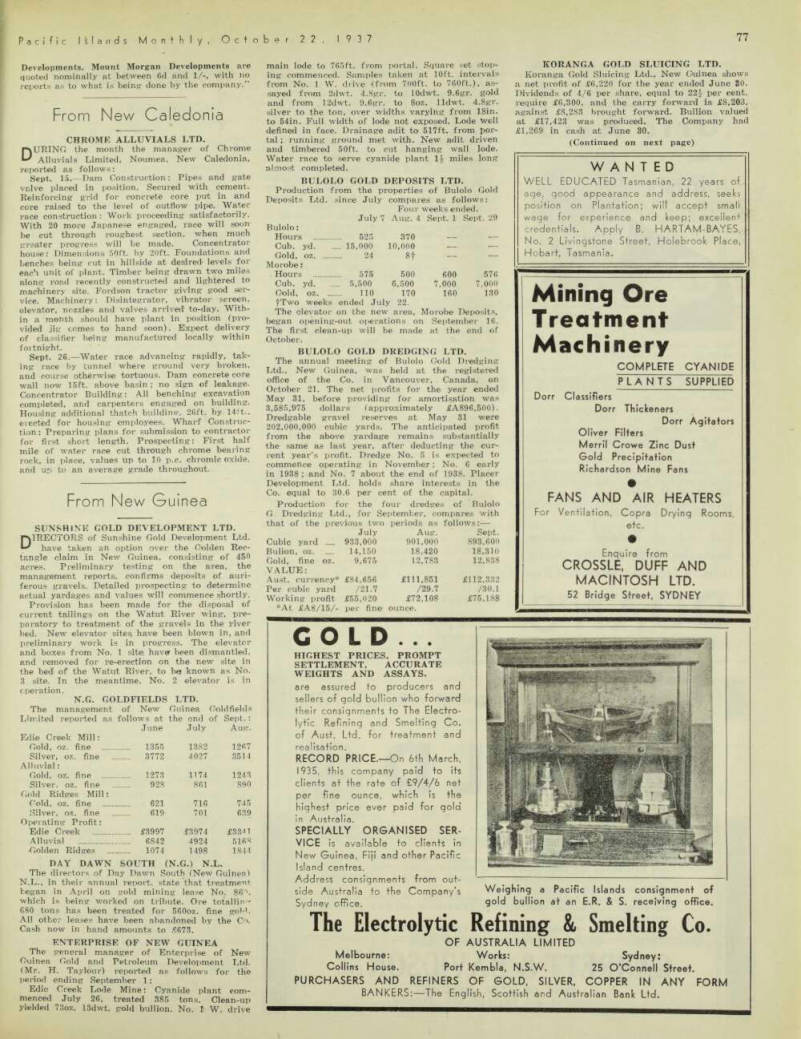
News
From Fiji
Emperor Mines Ltd,
HLANT shipments of Emperor Mines Limited, Tavua, Fiji, from Australia and overseas have oeen practically completed, according to a progress report for the period ended September 1. the report added:—New Treatment Plan;,; Crude ore bin, 600-ton bin, 1400-ton bin and primary breaker station well advanced. Mill building practically finished. Erection of filter and preci pitation section nearing completion. Electrical reticulation well in hand.
Production figures issued on October 6 showed:
The management advised on October 9 that the holders of the options over 35,100 shares, paid to 10/-, in the Co. have exercised their option and the shares have been issued. Applica tion has been made fob the placing of the shares on the official list of the Melbourne Stock Ex change.
Mount Kasi Mines Ltd.
Mt. Kasi Mines Limited, Fiji reported early in October that production during the past four months had been;
Loloma (Fiji) Gold Mines N.L.
The general manager of Loloma (Fiji) Gold Mines N.L. reports that treatment operations at the Co. s mine at Tavua, are proceeding in accor dance with the designed output. All units are working satisfactorily, except that mechanical adjustments are required to the roaster to bring its output to rated capacity. The circuit is filled, and plant absorption is almost complete. It is proposed to dean up on October 28, and there after at four-weekly intervals.
For the year ended July 31, he says, during which period mine preparation for stoping and haulage, also erection of the treatment plant, were carried out, additional ore reserves of 33,830 tons, of an average grade of 17.66 dwt. a ton, have been added to the previous ore reserves, making a grand total, at July 3, of 138,960 tons, made up as follows:
Loloma West N.L,
Directors of Loloma West N.L., one of the dozen or so companies formed during the 1935 boom in Fiji gold, have! decided to distribute the cash in hand to registered shareholders and to determine the future existence of the company.
Capital at the rate of 11/- a share will be re funded to shareholders. Transfer books closed on September 23.
Williams And Gosling’S Stock
Exchange Review
In their “Stock Exchange Review” issued on September 18, Messrs. Williams and Gosling Ltd., Suva, Fiji, reported as follows: “The Fiji section of the Stock Exchange market has been dull. Emperor have weakened to 13/9, and Loloma, after touching about 27/-, have eased to 23/-. Koroere have been steady at 3/6 to 4/-. Mount Kasi have been inclined to weaken, and are quoted at between 5/- and 6/-, although it is not always easy to buy the shares. The Chairman of Directors (Mr. Robertson) has been on a visit to the mine during the past month.
Granites Development have announced a further call of 3d, payable September 8, making the shares paid to 4/1. The company is still working on its property at Glen Elgin (Australia).
Mineral Developments are quoted at about 1/- to 1/6, but no recent reports are available as to progress on the Forest Reefs (Australia) pro perty. No information is available on Tavua
n , . , Jul y 10 Aug- 7 Sept. 4 Oct. 2 Ore treated, tons 2333 2556 2176 2259 Head, value, dwt. 9.4 8.3 9.8 9 2 Gold. oz. fine 953.7 951.4 963.1 948 7
July 15 Aug. 12 Sept. 9 Oct. 7 Ore. tons ... 2550 2972 2712 2900 (-old, fine oz 628 554 553 616 Value, £A 5495 4847 4839 5390
Average Contents Value Fine Tons Dwt. Oz.
Positive ore 110,340 29.26 161.431 Probable ore 12,620 16.60 10,477 Possible ore 16,000 18.12 14,500 Total 138,960 26.83 186,048
Developments. Mount Morgan Developments are quoted nominally at between 6d and 1/-, with no reports as to what is being done by the company.”
From New Caledonia
Chrome Alluvials Ltd.
DURING the month the manager of Chrome Alluvials Limited, Noumea, New Caledonia, reported as follows: Sept. 15. —Dam Construction: Pipes and gate valve placed in position. Secured with cement.
Reinforcing grid for concrete core put in and core raised to the level of outflow pipe. Water race construction : Work proceeding satisfactorily.
With 20 more Japanese engaged, race will soon be cut through roughest section, when much greater progress will be made. Concentrator house: Dimensions 50ft. by 20ft. Foundations and benches being cut in hillside at desired levels for each unit of plant. Timber being drawn two miles along road recently constructed and lightered to machinery site. Fordson tractor giving good ser vice. Machinery: Disintegrator, vibrator screen, elevator, nozzles and valves arrived' to-day. With in a month should have plant in position (pro vided jig comes to hand soon). Expect delivery of classifier being manufactured locally within fortnight.
Sept. 26. —Water race advancing rapidly, tak ing race by tunnel where ground very broken, and course otherwise tortuous. Dam concrete core wall now 15ft. above basin ; no sign of leakage.
Concentrator Building: All benching excavation completed, and carpenters engaged on building.
Housing additional thatch buildine. 26ft. by 1411., erected for housing employees. Wharf Construc tion: Preparing plans for submission to contractor for first short length. Prospecting: First half mile of water race cut through chrome bearing rock, in place, values up to 10 p.c. chromic oxide, and up to an average grade throughout.
From New Guinea
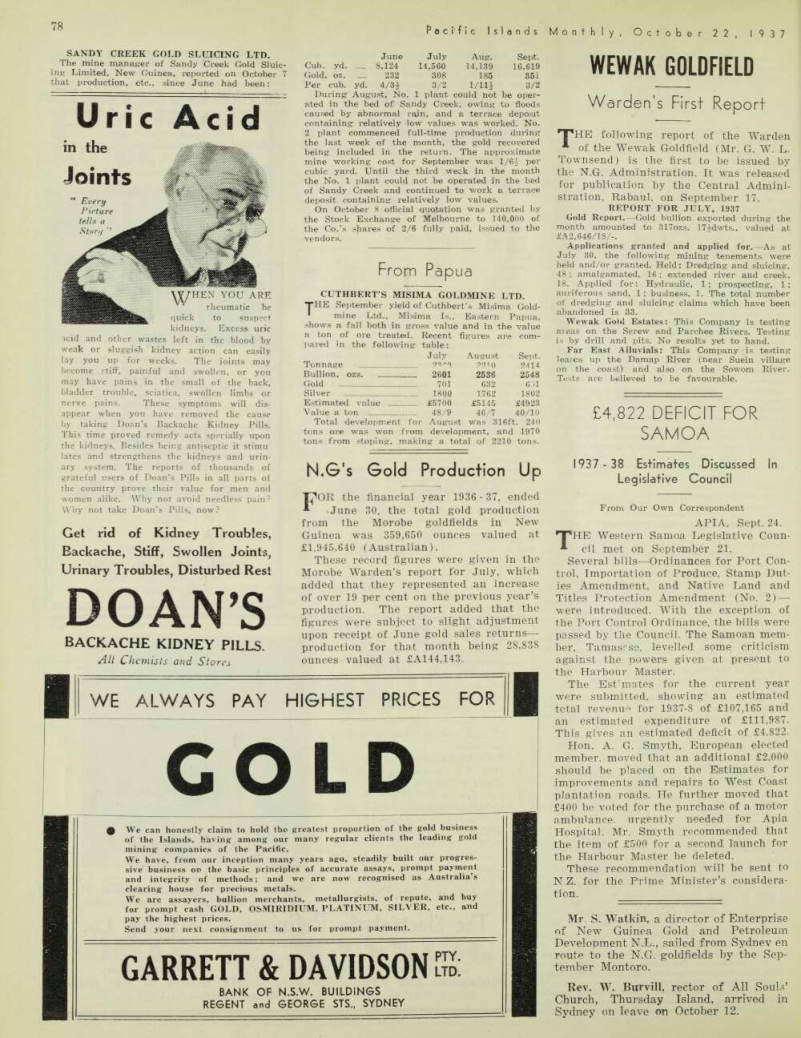
Sunshine Gold Development Ltd.
DIRECTORS of Sunshine Gold Development Ltd. have taken an option over the Golden Rec tangle claim in New Guinea, consisting of 450 acres. Preliminary testing on the area, the management reports, confirms deposits of auri ferous gravels. Detailed prospecting to determine actual yardages and values will commence shortly.
Provision has been made for the disposal of current tailings on the Watut River wing, pre paratory to treatment of the gravels in the river bed. New elevator sites, have been blown in, and preliminary work is in progress. The elevator and boxes from No. 1 site havef been dismantled, and removed for re-erection on the new site in the bed of the Watut River, to be known as No. 3 site. In the meantime, No. 2 elevator is in operation.
N.G. Goldfields Ltd.
The management of New Guinea Goldfields Limited reported as follows at the end of Sept.:
Day Dawn South (N.G.) N.L.
The directors of Day Dawn South (New Guinea) N.L., in their annual report, state that treatment began in April on gold mining lease No. 86°. which is being worked on tribute. Ore totalling 680 tons has been treated for 5600 z. fine goH.
All other leases have been abandoned by the Co.
Cash now in hand amounts to £673.
Enterprise Of New Guinea
The general manager of Enterprise of New Guinea Gold and Petroleum Development Ltd. (Mr. H. Taylour) reported as follows for the period ending September 1: Edio Creek Lode Mine: Cyanide plant com menced July 26. treated 385 tons. Clean-up yielded 730 z. 13dwt. gold bullion. No. !■ W. drive
main lode to 765 ft. from portal. Square set stop ing commenced. Samples taken at 10ft. intervals from No. 1 W. drive (from 700 ft. to 760 ft.), as sayed from 2dwt. 4.Bgr. to lOdwt. 9.6 gr. gold and from 12dwt. 9.6 gr. to Boz. lldwt. 4.Bgr. silver to the ton, over widths varying from 18in. to 54in. Full width of lode not exposed. Lode well defined in face. Drainage adit to 517 ft. from por tal ; running ground met with. New adit driven and timbered 50ft. to cut hanging wall lode.
Water race to serve cyanide plant 1£ miles long almost completed.
Bulolo Gold Deposits Ltd.
Production from the properties of Bulolo Gold Deposits Ltd. since July compares as follows:
The elevator on the new area, Morobe Deposits, began opening-out operations on September 16.
The first clean-up will be made at the end of October.
Bulolo Gold Dredging Ltd.
The annual meeting of Bulolo Gold Dredging Ltd., New Guinea, was held at the registered office of the Co. in Vancouver, Canada, on October 21. The net profits for the year ended May 31, before providing for amortisation was 3,585,975 dollars (approximately £A896,500).
Dredgable gravel reserves at May 31 were 202,000,000 cubic yards. The anticipated profit from the above yardage remains substantially the same as last year, after deducting the cur rent year’s profit. Dredge No. 5 is expected to commence operating in November; No. 6 early in 1938 ; and No. 7 about the end of 1938. Placer Development Ltd. holds share interests in the Co. equal to 30.6 per cent of the capital.
Production for the four dredges of Bulolo G. Dredging Ltd., for September, compares with that of the previous two periods as follows:
Koranga Gold Sluicing Ltd.
Koranga Gold Sluicing Ltd., New Guinea shows a net profit of £6,220 for the year ended June 80.
Dividends of 4/6 per share, equal to 22J per cent, require £6,300, and the carry forward is £8,203, against £8,283 brought forward. Bullion valued at £17,423 was produced. The Company had £1,269 in cash at June 30. (Continued on next page)
Four weeks ended.
July 7 Auk. 4 Sept. 1 Sept. 29 Bulolo: Hours 525 370 .— — Cub. yd. ... 15,000 10,000 ■ .— — Gold, oz 24 8f — .— Morobe J Hours 575 500 600 576 Cub. yd. ... 5,500 6,500 7,000 7.000 Gold, oz 110 170 160 130 tTwo weeks ended July 22.
July Aug-. Sept.
Cubic yard 933,000 901,000 893.600 Bulion, oz 14,150 18,420 18,310 Gold, fine oz. 9,675 12,783 12,838
Value:
Aust. currency* £84.656 £111,851 £112,332 Per cubic yard /21.7 /29.7 /30.1 Working profit £55,020 £72,108 £75,188 *At £A8/15/- per fine ounce.
June July Aup.
Eclie Creek Mill: Cold, oz. fine 1355 1382 1267 Silver, oz. fine 3772 4027 3514 Alluvial: Gold, oz. fine 1273 1174 1243 Silver, oz. fine 928 861 890 Gold Ridpes Mill: Cold, oz. fine 621 716 745 Silver, oz. fine 619 701 639 Operating Profit!
Edie Creek £3997 £3974 £3341 Alluvial 6842 4924 5168 Golden Ridpes 1074 1498 1844
Sandy Creek Gold Sluicing Ltd.
The mine manager of Sandy Creek Gold Sluic ing Limited, New Guinea, reported on October 7 that production, etc., since June had been:
During August, No. 1 plant could not be oper ated in the bed of Sandy Creek, owing to floods caused by abnormal ra,in, and a terrace deposit containing relatively low values was worked. No. 2 plant commenced full-time production during the last week of the month, the gold recovered being included in the return. The approximate mine working cost for September was 1/6| per cubic yard. Until the third week in the month the No. 1 plant could not be operated in the bed of Sandy Creek and continued to work a terrace deposit containing relatively low values.
On October 8 official quotation was granted by the Stock Exchange of Melbourne to 140,000 of the Co.’s shares of 2/6 fully paid, issued to the vendors.
June July Aug. Sept.
Cub. yd. 8,124 14,560 14,139 16,619 Gold, oz. 232 308 185 35i Per cub. yd. 4/3* 3/2 1/11J 3/2
Advertisements & other items, pp. 83-84 (1 item)
The Electrolytic Refining & Smelting Co.
WANTED
WELL EDUCATED Tasmanian, 22 years of age, good appearance and address, seeks position on Plantation: will accept small wage for experience and keep; excellent credentials. Apply B. HARTAM-BAYES, No. 2 Livingstone Street, Holebrook Place, Hobart, Tasmania.
Mining Ore
Treatment
Machinery
COMPLETE CYANIDE
PLANTS SUPPLIED
Dorr Classifiers Dorr Thickeners Dorr Agitators Oliver Filters Merril Crowe Zinc Dust Gold Precipitation Richardson Mine Fans •
FANS AND AIR HEATERS
For Ventilation, Copra Drying Rooms, etc. • Enquire from
CROSSLE. DUFF AND
MACINTOSH LTD.
52 Bridge Street, SYDNEY
COLD...
HIGHEST PRICES, PROMPT
SETTLEMENT, ACCURATE
WEIGHTS AND ASSAYS.
are assured to producers and sellers of gold bullion who forward their consignments to The Electrolytic Refining and Smelting Co. of Aust. Ltd. for treatment and realisation.
RECORD PRICE.— On 6th March, 1935, this company paid to its clients at the rate of £9/4/6 net per fine ounce, which Is the highest price ever paid for gold in Australia.
SPECIALLY ORGANISED SER-
VICE is available to clients in New Guinea, Fiji and other Pacific Island centres.
Address consignments from outside Australia to the Company's Weighing a Pacific Islands consignment of Sydney office. gold bullion at an E.R. & S. receiving office.
The Electrolytic Refining & Smelting Co.
OF AUSTRALIA LIMITED
Melbourne: Works: Sydney: Collins House. Port Kembla, N.S.W. 25 O’Connell Street.
PURCHASERS AND REFINERS OF GOLD, SILVER. COPPER IN ANY FORM BANKERS:—The English, Scottish and Australian Bank Ltd. mm -
Uric Acid
icid and other wastes left in the blood by weak or sluggish kidney action can easily lay you up for weeks. The joints may become stiff, painful and swollen, or you may have pains in the small of the back, bladder trouble, sciatica, swollen limbs or nerve pains. These symptbms will disappear when you have removed the cause by taking Doan’s Backache Kidney Pills.
This time proved remedy acts specially upon the kidneys. Besides being antiseptic it stimu lates and strengthens the kidneys and urinary system. The reports of thousands of grateful users of Doan’s Pills in all parts of the country prove their value for men and women alike. Why not avoid needless pain?
Why not take Doan’s Pills, now?
Get rid of Kidney Troubles,
Backache, Stiff, Swollen Joints,
Urinary Troubles, Disturbed Rest
DOAN’S
BACKACHE KIDNEY PILLS.
Joints
Every
I‘irture tells a Story ’’
HEN YOU ARE
rheumatic be k to suspect
in the
quick to suspect kidneys. Excess uric
All Chemists and Stores
11 WE ALWAYS PAY HIGHEST PRICES FOR
COLD
£ We can honestly claim to hold tho greatest proportion of the gold business of the Islands, having among our many regular clients the leading gold mining companies of the Pacific.
We have, from our inception many years ago, steadily built our progressive business on the basic principles of accurate assays, prompt payment and integrity of methods; and we are now recognised as Australia s clearing house for precious metals.
We are assayers, bullion merchants, metallurgists, of repute, and buy for prompt cash GOLD, O&MIRIDIUM, PLATINUM, SILVER, etc., and pay the highest prices.
Send your next consignment to us for prompt payment.
GARRETT & DAVIDSON 55:
BANK OF N.S.W. BUILDINGS
REGENT and GEORGE STS., SYDNEY
From Papua
Cuthbert’S Misima Goldmine Ltd.
THE September yield of Cuthbert’s Misima Gold -1 mine Ltd., Misima Is., Eastern Papua, shows a fall both in gross value and in the value a ton of ore treated. Recent figures are com pared in the following table:
Total development for August was 316 ft. 240 tons ore was won from development, and 1970 tons from stoping, making a total of 2210 tons.
July August Sept.
Tonnage ??i 0 2414 Bullion, ozs. 2601 2536 2548 Cold 701 632 6)1 Silver 1800 1762 1802 Estimated value £5700 £5145 £4923 Value a ton 48/9 46/7 40/10
N.G's Gold Production Up
the financial year 1936 - 37, ended * June 30, the total gold production from the Morobe goldfields in New Guinea was 359,650 ounces valued at £1,945,640 (Australian).
These record figures were given in the Morobe Warden’s report for July, which added that they represented an increase of over 19 per cent on the previous year’s production. The report added that the figures were subject to slight adjustment upon receipt of June gold sales returns — production for that month being 28,838 ounces valued at £A144,143.
Wewak Goldfield
Warden's First Report
The following report of the Warden * of the W T ewak Goldfield (Mr. G. W. L.
Townsend) is the first to be issued by the N.G. Administration. It was released for publication by the Central Admini stration, Rabaul, on September 17.
Report For July, 1937
Gold Report.—Gold bullion exported during the month amounted to 3170z5. 17Jdwts., valued at £A2,646/18/-.
Applications granted and applied for.—As at July 30, the following mining tenements were held and/or granted. Held: Dredging and sluicing, 48 ; amalgamated, 16 ; extended river and creek, 18. Applied for: Hydraulic, 1; prospecting, 1; auriferous sand, 1 ; business, 1. The total number of dredging and sluicing claims which have been abandoned is 33.
Wewak Gold Estates: This Company is testing aieas on the Screw and Parchee Rivers. Testing is by drill and pits. No results yet to hand.
Far East Alluvials: This Company is testing leases up the Damap River (near Suein village on the coast) and also on the Sowom River.
Tests are believed to be favourable.
Samoa
£4,822 Deficit For
1937 - 38 Estimates Discussed in Legislative Council
From Our Own Correspondent APIA, Sept. 24.
'THE Western Samoa Legislative Council met on September 21.
Several bills—Ordinances for Port Con trol, Importation of Produce, Stamp Dut ies Amendment, and Native Land and Titles Protection Amendment (No. 2) were introduced. With the exception of the Port Control Ordinance, the bills were passed by the Council. The Samoan mem ber, Tamasese, levelled some criticism against the powers given at present to the Harbour Master.
The Esfmates for the current year were submitted, showing an estimated total revenue for 1937-8 of £107,165 and an estimated expenditure of £111,987.
This gives an estimated deficit of £4,822.
Hon. A. G. Smyth, European elected member, moved that an additional £2,000 should be placed on the Estimates for improvements and repairs to West Coast plantation roads. He further moved that £4OO be voted for the purchase of a motor ambulance, urgently needed for Apia Hospital. Mr. Smyth recommended that the item of £5OO for a second launch for the Harbour Master be deleted.
These recommendation will be sent to N.Z. for the Prime Minister’s considera tion.
Mr. S. Watkin, a director of Enterprise of New Guinea Gold and Petroleum Development N.L., sailed from Sydney en route to the N.G. goldfields by the Sep tember Montoro.
Rev. W. Burvill, rector of All Souls’
Church, Thursday Island, arrived in
Sydney on leave on October 12.
Advertisements & other items, p. 84 (1 item)
78
Paci’ fic Islands Monthly, October 22. 1937
Islands Produce
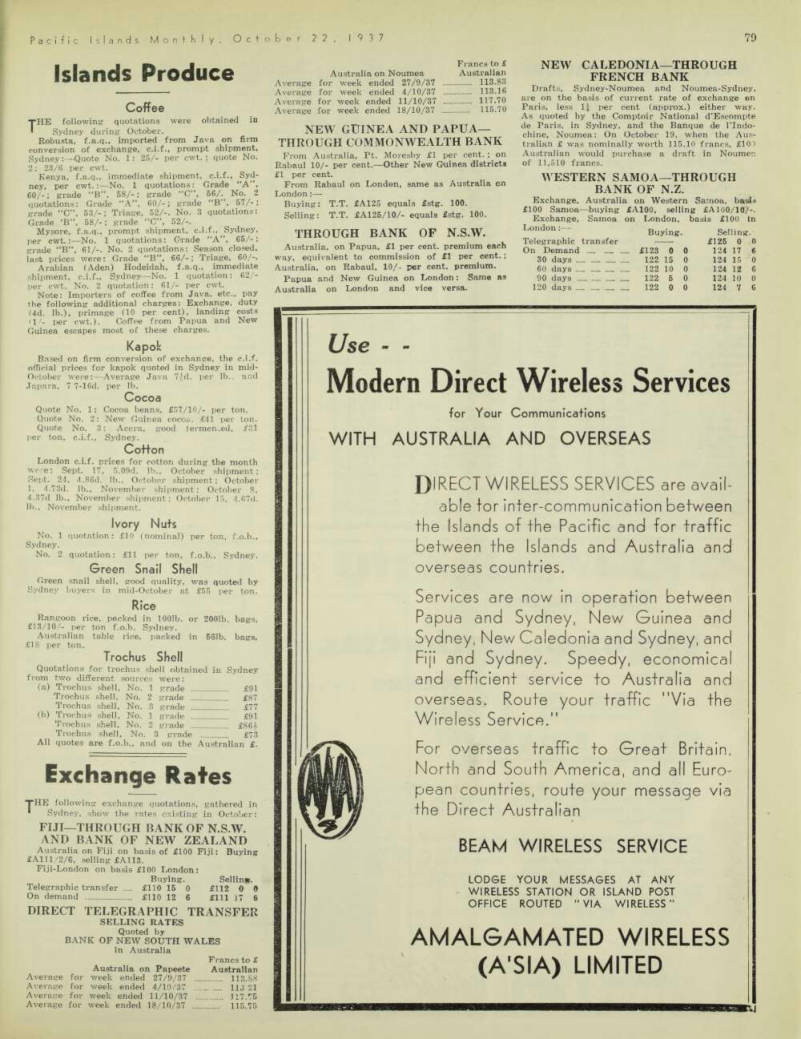
Coffee
THE following quotations were obtained in Sydney during October.
Robusta, f.a.q., imported from Java on firm conversion of exchange, c.i.f., prompt shipment, Sydney:—Quote No. 1: 25/- per cwt. ; quote No. 2: 23/6 per cwt.
Kenya, f.a.q., immediate shipment, c.i.f., Syd ney, per cwt.: —No. 1 quotations: Grade “A”, 60/-; grade “B”, 58/-; grade “C”, No. 2 quotations: Grade “A”, 60/-; grade “B”, 57/-; grade “C”, 53/-; Triage, 52/-, No. 3 quotations: Grade ‘B”. 58/-; grade “C”, 52/-.
Mysore, f.a.q., prompt shipment, c.i.f., Sydney, per cwt.: —No. 1 quotations; Grade “A”, 65/-: grade “B”, 61/-. No. 2 quotations: Season closed, last prices were: Grade "B”, 66/-: Triage, 60/-.
Arabian (Aden) Hodeidah, f.a.q., immediate shipment, c.i.f., Sydney—No. 1 quotation: 62/per cwt. No. 2 quotation: 61/- per cwt.
Note: Importers of coffee from Java, etc., pay the following additional charges: Exchange, duty < 4d. lb.), primage (10 per cent), landing costs ri/- per cwt.). Coffee from Papua and New Guinea escapes most of these charges.
Kapok
Based on firm conversion of exchange, the c.i.f. official prices for kapok quoted in Sydney in mid- October were:—Average Java 7|d. per lb., and Japara, 7 7-16 d. per lb.
Cocoa
Quote No. 1: Cocoa beans, £57/10/- per ton.
Quote No. 2: New Guinea cocoa, £4l per ton.
Quote No. 3: Accra, good lermemed, £3l per ton, c.i.f,, Sydney.
Cotton
London c.i.f. prices for cotton during the month were: Sept. 17, 5.09 d. lb., October shipment; Sept. 24, 4.86 d. lb., October shipment : October 1. 4.73 d. lb., November shipment; October 8, 4.37 d lb., November shipment; October 15, 4.67 d. lb., November shipment.
Ivory Nuts
No. 1 quotation: £lO (nominal) per ton, f.0.b., Sydney.
No. 2 quotation: £ll per ton, f.0.b., Sydney.
Green Snail Shell
Green snail shell, good quality, was quoted by Sydney buyers in mid-October at £55 per ton.
Rice
Rangoon rice, pecked in 1001 b. or 2001 b. bags, £l3/10/- per ton f.o.b. Sydney.
Australian table rice, packed in 561 b. bags, £lB per ton.
Trochus Shell
Quotations for trochus shell obtained in Sydney from two different sources were: (a) Trochus shell, No. 1 grade £9l Trochus shell. No. 2 grade £B7 Trochus shell. No. 3 grade £77 (b) Trochusi shell, No. 1 grade £9l Trochus shell, No. 2 grade £B6i Trochus shell, No. 3 grade £73 All quotes are f.0.b., and on the Australian f.
Exchange Rates
THE following exchange quotations, gathered in * Sydney, show the rates existing in October:
Fiji-Through Bank Of N.S.W.
And Bank Of New Zealand
Australia on Fiji on basis of £lOO Fiji: Buying £Alll/2/6, selling £AII3.
Fiji-London on basis £lOO London:
Direct Telegraphic Transfer
Selling Rates
Quoted by
Bank Of New South Wales
in Australia
New Guinea And Papua
Through Commonwealth Bank
From Australia, Pt. Moresby £1 per cent. ; on Rabaul 10/- per cent. —Other New Guinea districts £1 per cent.
From Rabaul on London, same as Australia on London: — Buying: T.T. £AI2S equals £stg. 100.
Selling: T.T. £AI2S/10/- equals £stg. 100.
Through Bank Of N.S.W.
Australia, on Papua, £1 per cent, premium each way, equivalent to commission of £1 per cent.: Australia, on Rabaul, 10/- per cent, premium.
Papua and New Guinea on London: Same as Australia on London and vice versa.
New Caledonia—Through
French Bank
Drafts, Sydney-Noumea and Noumea-Sydney, are on the basis of current rate of exchange on Paris, less per cent (approx.) either way.
As quoted by the Comptoir National d’Escompte de Paris, in Sydney, and the Banque de I’lndo chine, Noumea: On October 19, when the Aus tralian £ was nominally worth 115.10 francs, £lOO Australian would purchase a draft in Noumea of 11,510 francs.
Western Samoa—Through
Bank Of N.Z.
Exchange, Australia on Western Samoa, basis £lOO Samoa —buying £AIOO, selling £AIOO/10/-.
Exchange, Samoa on London, basis £lOO in
Francs to f Average Average Average Average Australia on Noumea for week ended 27/9/37 for week ended 4/10/37 for week ended 11/10/37 for week ended 18/10/37 Australian 113.83 113.16 117.70 115.70
London: — Telegraphic transfer Buying Selling. £125 0 0 On Demand £123 0 0 124 17 6 30 days 122 15 0 124 15 0 60 days 122 10 0 124 12 6 90 days 122 6 0 124 10 0 120 days 122 0 0 124 7 6
Buying.
Selling.
Telegraphic transfer £110 15 0 £112 0 0 On demand £110 12 6 £111 J7 6
Francs to £ Australia on Papeete Australian Average for week ended 27/9/37 113.88 Average for week ended 4/10/37 113 21 Average for week ended 11/10/37 117.75 Average for week ended 18/10/37 . 115.75
Advertisements & other items, p. 85 (1 item)
Modern Direct Wireless Services
Use - -
for Your Communications
WITH AUSTRALIA AND OVERSEAS
9
DIRECT WIRELESS SERVICES are avail-
able for inter-communication between the Islands of the Pacific and for traffic between the Islands and Australia and overseas countries.
Services are now in operation between Papua and Sydney, New Guinea and Sydney, New Caledonia and Sydney, and Fiji and Sydney. Speedy, economical and efficient service to Australia and overseas. Route your traffic "Via the Wireless Service."
For overseas traffic to Great Britain.
North and South America, and all European countries, route your message via the Direct Australian
BEAM WIRELESS SERVICE
LODGE YOUR MESSAGES AT ANY
WIRELESS STATION OR ISLAND POST
OFFICE ROUTED "VIA WIRELESS"
AMALGAMATED WIRELESS
(A'SIA) LIMITED
Market Quotations
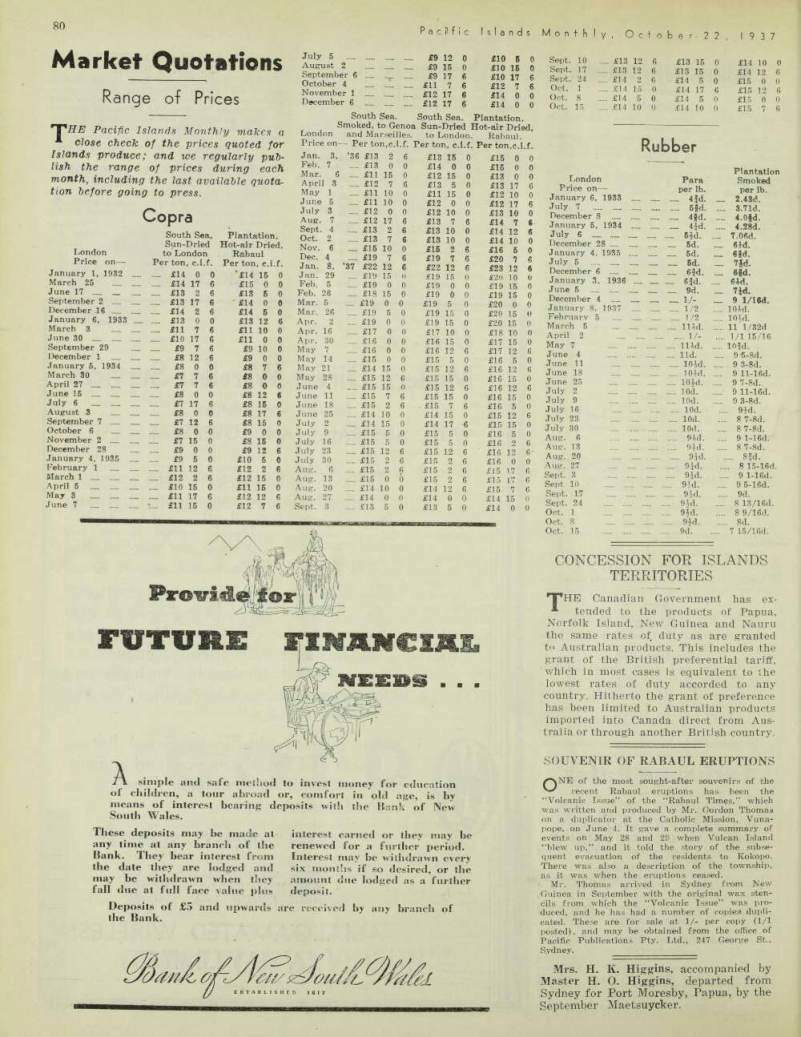
Range of Prices
TTrr® Pacific Islands Monthly makes a * close check of the prices quoted for Islands produce; and we regularly pub lish the range of prices during each month, including the last available quota tion before going to press.
Copra
South Sea. South Sea. Plantation.
Smoked, to Genoa Sun-Dried Hot-air Dried, London and Marseilles. to London. Rabaul.
Price on— Per ton.c.i.f. Per ton, c.i.f. Per ton.c.i.f.
Rubber
London Price on— South Sea, Sun-Dried to London Per ton, c.i.f.
Plantation.
Hot-air Dried, Rabaul Per ton, c.i.f.
January 1, 1932 £14 0 0 *£14 15 0 March 25 £14 17 6 £15 0 0 June 17 £13 2 6 £13 5 0 September 2 £13 17 6 £14 0 0 December 16 £14 2 6 £14 6 0 January 6, 1933 £13 0 0 £13 12 6 March 3 £11 7 6 £11 10 0 June 30 £10 17 6 £11 0 0 September 29 £9 7 6 £9 10 0 December 1 £8 12 6 £9 0 0 January 5, 1934 £8 0 0 £8 7 6 March 30 ,,, £7 7 6 £8 0 0 April 27 £7 7 6 £8 0 0 June 15 £8 0 0 £8 12 6 July 6 £7 17 6 £8 16 0 August 3 £8 0 0 £8 17 6 September 7 £7 12 6 £8 15 0 October 6 £8 0 0 £9 0 0 November 2 £7 15 0 £8 15 0 December 28 £9 0 0 £9 12 6 January 4, 1935 £9 5 0 £10 5 0 February 1 £11 12 6 £12 2 6 March 1 £12 2 6 £12 15 0 April 5 — £10 15 0 £11 16 0 May 3 £11 17 6 £12 12 6 J une 7 ' £11 15 0 £12 7 6
July 5 — — £9 12 0 £10 5 0 August 2 — £9 15 0 £10 15 0 September 6 £9 17 6 £10 17 6 October 4 £11 7 6 £12 7 6 November 1 £12 17 6 £14 0 0 December 6 ... ... £12 17 6 £14 0 0
Jan. 3, ’36 ; £13 2 6 £13 15 0 £15 0 0 Feb, 7 £13 0 0 £14 0 0 £15 0 0 Mar. 6 £11 15 0 £12 15 0 £13 0 0 Apri 1 3 £12 7 6 £13 5 0 £13 17 G May 1 £11 10 0 £11 15 0 £12 10 0 June i 5 £11 10 0 £12 0 0 £12 17 6 July 3 £12 0 0 £12 10 0 £13 10 0 Aug. 7 £12 17 6 £13 7 6 £14 7 « Sept, . 4 £13 2 6 £13 10 0 £14 12 6 Oct. 2 £13 7 6 £13 10 0 £14 10 0 Nov. 6 £15 10 0 £15 2 6 £16 5 0 Dec. 4 £19 7 6 £19 7 6 £20 7 6 Jan. 8. ’37 £22 12 6 £22 12 6 £23 12 6 Jan. 29 £19 15 0 £19 15 0 £20 10 0 Feb. 5 £19 0 0 £19 0 0 £19 15 0 Feb. 26 £18 15 0 £19 0 0 £19 15 0 Mar. 5 £19 0 0 £19 5 0 £20 0 0 Mar. 26 £19 5 0 £19 15 0 £20 15 0 Apr. 2 £19 0 0 £19 15 0 £20 15 0 Apr. 16 £17 0 0 £17 10 0 £18 10 0 Apr. 30 £16 0 0 £16 15 0 £17 15 0 May 7 £16 0 0 £16 12 6 £17 12 6 May 14 £15 0 0 £15 5 0 £16 5 0 May 21 £14 15 0 £15 12 6 £16 12 6 May 28 £15 12 6 £15 15 0 £16 15 0 June 4 £15 15 0 £15 12 6 £16 12 6 June 11 £15 7 6 £15 15 0 £16 15 0 June 18 £15 2 6 £15 7 6 £16 5 0 June 25 ... £14 10 0 £14 15 0 £15 12 6 July 2 £14 15 0 £14 17 6 £15 15 0 July 9 £15 5 0 £15 5 0 £16 5 0 July 16 £15 5 0 £15 5 0 £16 2 6 July 23 £15 12 6 £15 12 6 £16 12 6- July 30 £15 2 6 £15 2 6 £16 0 0 Aug. 6 £15 2 6 £15 2 6 £15 1.7 6 Aug. 13 £15 0 0 £15 2 6 £15 17 6 Aug. 20 £14 10 0 £14 12 6 £15 7 6 Aug. 27 £14 0 0 £14 0 0 £14 15 0 Sept. 3 £13 5 0 £13 5 0 £14 0 0
Sept. 10 £13 12 6 £13 15 0 £14 10 0 Sept. 17 ... £13 12 6 £13 15 0 £14 12 6 Sept. 24 £14 2 6 £14 5 0 £15 0 0 Oct. 1 £14 15 0 £14 17 6 £15 12 6 Oct. 8 £14 5 0 £14 5 0 £15 0 0 Oct. 15 £14 10 0 £14 10 0 £15 7 6
London Price on- January 6, 1933 Para per lb. — 4$d.
Plantation Smoked per lb. 2.43d.
July 7 — B*d. 3.71d.
December 8 — 4fd. 4.0|d.
January 5, 1934 — 4*d. 4.28d.
July 6 .._ BJd. 7.06d.
December 28 — Bd. 6id.
January 4. 1935 — 5d. 6|d.
July 5 — Bd. 7|d.
December 6 6fd. 6Sd.
January 3, 1936 . — 6fd. 6id.
June 5 — 9d. 7*d.
December 4 — 1/- 9 l/16d.
January 8, 1937 1/2 lOid.
Febniarv 5 1/2 lOid.
March 5 ... lUd. 11 l/32d April 2 ... . ... 1/- 1/1 15/16 May 7 ... ... iiid. 10fd.
June 4 ... ... lid. 9«-8d.
June 11 lOid. 9 3-8d.
June 18 ... lOid. 9 ll-16d.
June 25 ... 10$d. 9 7-8d.
July 2 ... lOd. 9 ll-16d.
July 9 lOd. 9 3-8d.
July 16 ... lOd. .. 9id.
July 23 ... lOd. 8 7-8d.
July 30 . ... lOd. 8 7-8d.
Aug. 6 ... 9 id. 9 l-16d.
Auer. 13 ... 9id. 8 7-8d.
Aug. 20 ... 9Jd. 8?d.
Aug. 27 ... ... 9 id. .. 8 15-16d.
Sept. 3 ... 9}d- . 9 l-16d.
Sept 10 ... 9id. 9 5-16d.
Sept. 17 , 9 id. . 9d.
Sept. 24 ... 9id. 8 13/16d.
Oct. 1 ... 9id. 8 9/16d.
Oct. 8 ... 9*d. . 8d.
Oct. 15 9d. 7 15/16d.
Concession For Islands
Territories
THE Canadian Government has ex * tended to the products of Papua, Norfolk Island, New Guinea and Nauru the same rates of duty as are granted to Australian products. This includes the grant of the British preferential tariff, which in most cases is equivalent to the lowest rates of duty accorded to any country. Hitherto the grant of preference has been limited to Australian products imported into Canada direct from Aus tralia or through another British country.
September Maetsuycker.
Souvenir Of Rabaul Eruptions
of the most sought-after souvenirs of the recent Rabaul eruptions has been the “Volcanic Issue” of the “Rabaul Times,” which was written and produced by Mr. Gordon Thomas on a duplicator at the Catholic Mission, Vuna pope, on June 4. It gave a complete summary of events on May 28 and 29 when Vulcan Island “blew up,” and it told the story of the subse quent evacuation of the residents to Kokopo.
There was also a description of the township, as it was when the eruptions ceased.
Mr. Thomas arrived in Sydney from New Guinea in September with the original wax sten cils from which the “Volcanic Issue” was pro duced, and he has had a number of copies dupli cated. These are for sale at 1/- per copy (1/1 posted), and may be obtained from the office of Pacific Publications Pty. Ltd., 247 George St., Sydney.
Mrs. H. K. Higgins, accompanied by
Master H. 0. Higgins, departed from Sydney for Port Moresby, Papua, by the
September Maetsuycker.
Advertisements & other items, p. 86 (2 items)
80
PacHlc Islands Monthly, Oc+ober-22, 1937
Future Fznawc3As.
Proirid
or
A simple and safe method to invest money for education ol children, a lour abroad or, comfort in old age, is by means of interest bearing deposits with the Bank of New South Wales.
These deposits may be made at any lime at any branch of the Bank. They bear interest from the date they are lodged and may be withdrawn when they fall due at full face value plus Deposits of £5 and upwards the Bank. interest earned or they may be renewed for a further period.
Interest may be withdrawn every six months if so desired, or the amount due lodged as a further deposit. are received by any branch of an
flc&L
O/lt/L
Shipping Services in the Pacific
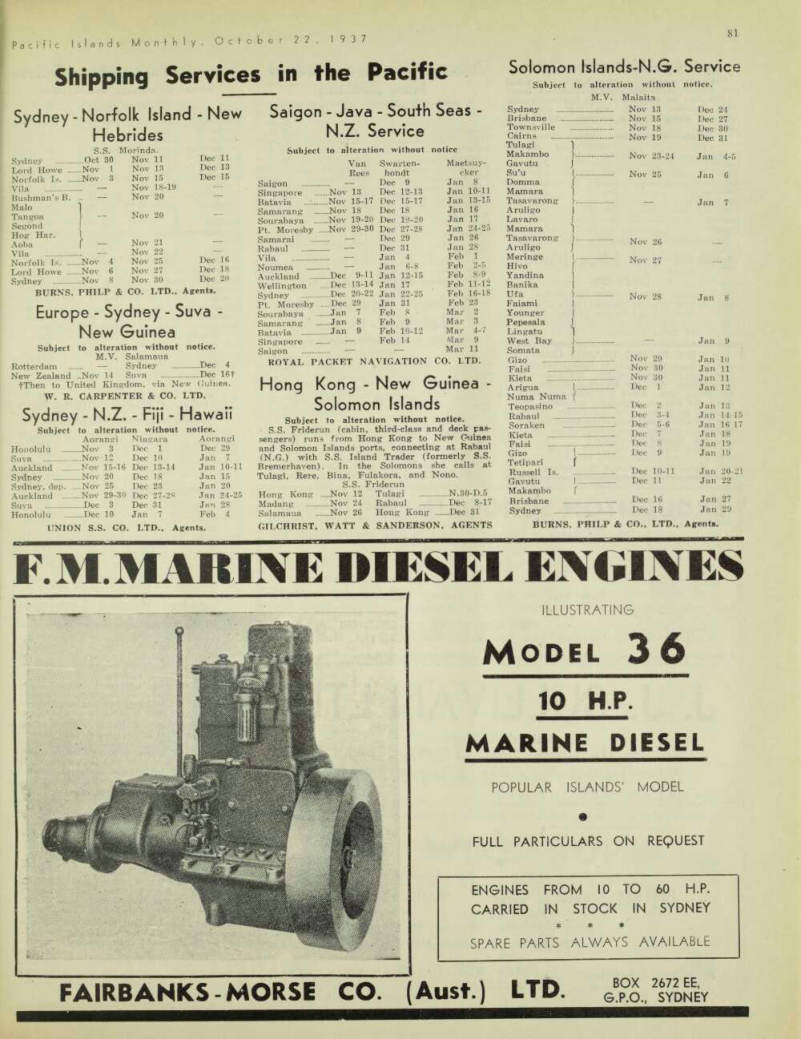
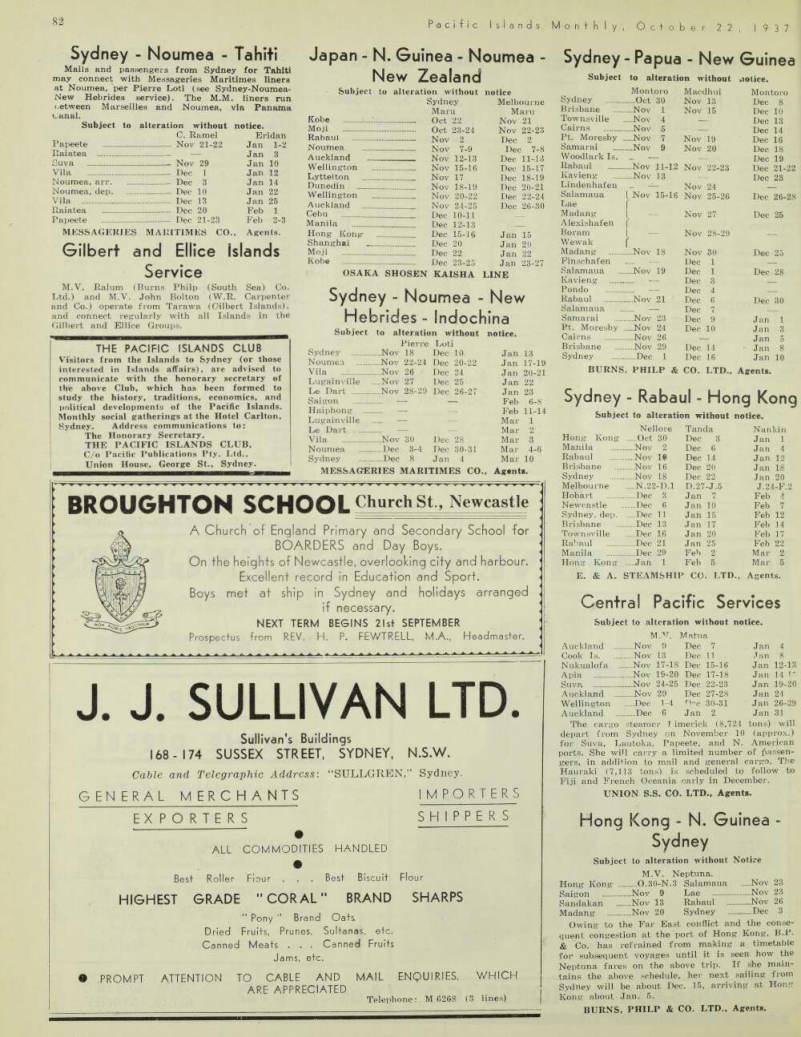
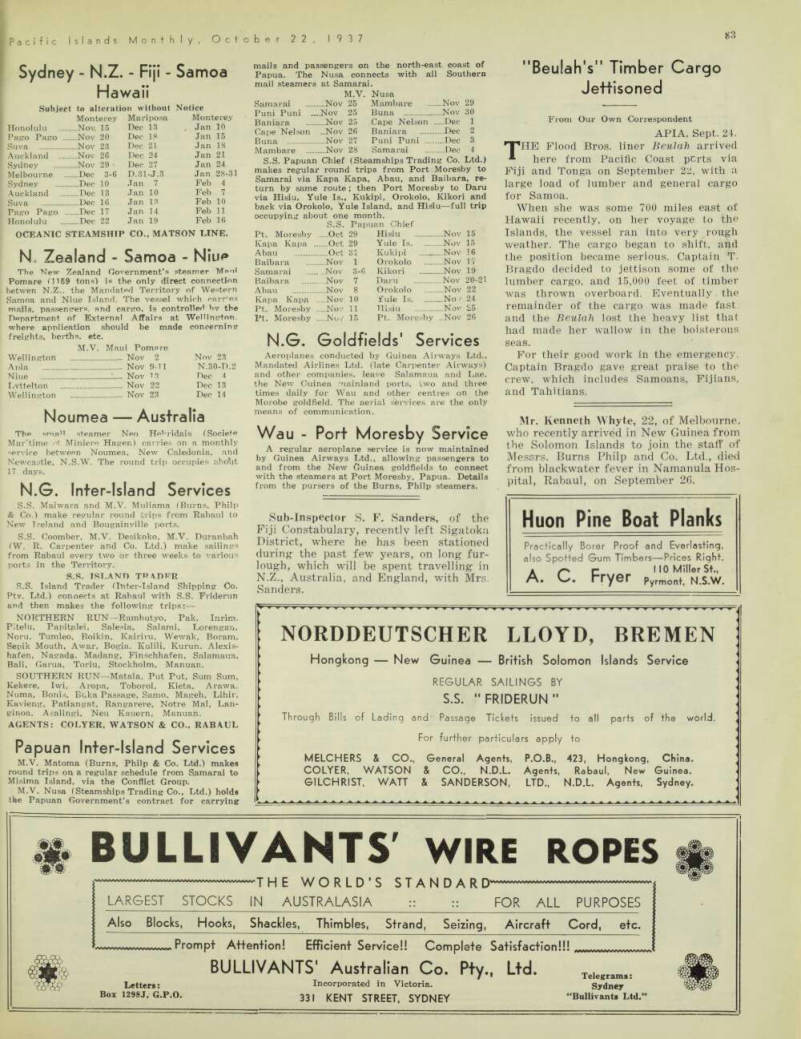
Sydney - Norfolk Island - New Hebrides S.S. Morinda.
Burns, Philp & Co, Ltd.. Agents.
Europe - Sydney - Suva -
New Guinea
Subject to alteration without notice.
M.V. Salamaua Rotterdam - Sydney Dec 4 New Zealand ...Nov 14 Suva Dec 16f fThen to United Kingdom, via New Guinea.
W. R. Carpenter & Co. Ltd.
Sydney - N.Z. - Fiji - Hawaii Subject to alteration without notice.
Union S.S. Co. Ltd., Agents.
Saigon - Java - South Seas - N.Z. Service Subject to alteration without notice
Royal Packet Navigation Co. Ltd.
Hong Kong - New Guinea -
Solomon Islands
Subject to alteration without notice.
S.S. Friderun (cabin, third-class and deck pas sengers) runs from Hong Kong to New Guinea and Solomon Islands ports, connecting at Rabaul (N.G.) with S.S. Island Trader (formerly S.S.
Bremerhaven). In the Solomons she calls at Tulagi, Rere, Bina, Fulakora, and Nono.
S.S. Friderun Hong Kong Nov 12 Tulagi N.30-D.5 Madang Nov 24 Rabaul Dec 8-17 Salamaua Nov 26 Hong Kong Dec 31
Gilchrist, Watt & Sanderson, Agents
Solomon Islands-N.G. Service
Burns. Philp & Co., Ltd., Agents.
Sydney Oct 30 Nov 11 Dec 11 Lord Howe Nov 1 Nov 13 Dec 13 Norfolk Is _Nov 3 Nov 15 Dec 15 Vila - — Nov 18-19 — Bushman’s B. ... — Malo Nov 20 — Tangoa Segond Hog Har. t Nov 20 Aoba f — Nov 21 — Vila — Nov 22 — Norfolk Is. ..—Nov 4 Nov 25 Dec 16 Lord Howe Nov 6 Nov 27 Dec 18 Sydney Nov 8 Nov 30 Dec 20
Aorangi Niagara Aorangi Honolulu Nov 3 Dec 1 Dec 29 Suva Nov 12 Dec 10 Jan 7 Auckland Nov 15-16 Dec 13-14 Jan 10-11 Sydney Nov 20 Dec 18 Jan 15 Sydney, dep Nov 25 Dec 23 Jan 20 Auckland Nov 29-30 Dec 27-28 Jan 24-25 Suva Dec 3 Dec 31 Jan 28 Honolulu Dec 10 Jan 7 Feb 4
Van Swarten- Maetsuy- Rees hondt cker Saigon Dec 9 Jan 8 Singapore Nov 13 Dec 12-13 Jan 10-11 Batavia Nov 15-17 Dec 15-17 Jan 13-15 Samarang - ..Nov 18 Dec 18 Jan 16 Sourabaya ..Nov 19-20 Dec- 19-20 Jan 17 Pt. Moresby ..Nov 29-30 Dec 27-28 Jan 24-25 Samarai ...
Dec 29 Jan 26 Rabaul Dec 31 Jan 28 Vila Jan 4 Feb 1 Noumea Jan 6-8 Feb 2-5 Auckland Dec 9-11 Jan 12-15 Feb 8-9 Wellington 13-14 Jan 17 Feb 11-12 Sydney ...Dec 20-22 Jan 22-25 Feb 16-18 Pt. Moresby ... . Dec 29 Jan 31 Feb 23 Sourabaya — ...Jan 7 Feb 8 Mar 2 Samarang ...Jan 8 Feb 9 Mar 3 Batavia Jan 9 Feb 10-12 Mar 4-7 Singapore Feb 14 Mar 9 Saigon Mar 11
Subject to alteration without notice.
M.V.
Malaita Sydney Nov 13 Dec 24 Brisbane Nov 15 Dec 27 Townsville Nov 18 Dec 30 Cairns Nov 19 Dec 31 Tulagi 1 Makambo Nov 23-24 Jan 4-5 Gavutu J Su'u Nov 25 Jan 6 Dotnma r Mamara Tasavarong — Jan 7 Aruligo i Lavaro Mamara i Tasavarong Nov 26 Aruligo Meringe Nov 27 Hi vo Yandina Banika Ufa \ Nov 28 Jan 8 Faiami Younger 1
Pepesala J
Lingatu 1 West Bay I- — Jan 9 Somata Gizo Nov 29 Jan 10 Faisi Nov 30 Jan 11 Kieta Nov 30 Jan 11 Arigua 1 Dec 1 Jan 12 Numa Numa r Teopasino Dec 2 Jan 13 Rabaul — M1 ... - Dec 3-4 Jan 14-15 Soraken Dec 5-6 Jan 16 17 Kieta - 1 )ec 7 Jan 18 Faisi Dec 8 Jan 19 Gizo Dec 9 Jan 19 Tetipari r Russell Is.
Dec 10-11 Jan 20-21 Gavutu I Dec 11 Jan 22 Makambo r Brisbane Dec 16 Jan 27 Sydney — Dec 18 Jan 29
Sydney - Noumea - Tahiti
Mails and passengers from Sydney for Tahiti may connect with Messageries Maritimes liners at Noumea, per Pierre Loti (see Sydney-Noumea- New Hebrides service). The M.M. liners run i-etween Marseilles and Noumea, via Panama canal.
Subject to alteration without notice.
Messageries Maritimes Co.. Agents.
Gilbert and Ellice islands
Service
M.V, Ralum (Burns Philp (South Sea) Co.
Ltd.) and M.V. John Bolton (W.R. Carpenter and Co.) operate from Tarawa (Gilbert Islands), and connect regularly with all Islands in the Gilbert and Ellice Groups.
Japan - N. Guinea - Noumea - New Zealand Subject to alteration without notice
Osaka Shosen Kaisha Line
Sydney - Noumea - New
Hebrides - Indochina
Subject to alteration without notice.
Pierre Loti Sydney Nov 18 Dec 10 Jan 13 Noumea Nov 22-24 Dec 20-22 Jan 17-19 Vila Nov 26 Dec 24 Jan 20-21 Lugainville Nov 27 Dec 25 Jan 22 Le Dart Nov 28-29 Dec 26-27 Jan 23 Saigon Feb 6-8 Haiphong Feb 11-14 Lugainville Mar 1 Le Dart Mar 2 Vila Nov 30 Dec 28 Mar 3 Noumea Dec 3-4 Dec 30-31 Mar 4-6 Sydney Dec 8 Jan 4 Mar 10
Messageries Maritimes Co., Agents.
Sydney - Papua - New Guinea Subject to alteration without notice.
Burns, Philp & Co. Ltd., Agents.
Sydney - Rabaul - Hong Kong
Subject to alteration without notice.
E. & A. STEAM&HIP CO. LTD., Agents.
Central Pacific Services
Subject to alteration without notice.
M. v . Matua Auckland Nov 9 Dec 7 Jan 4 Cook Is Nov 13 Dec 11 Jan 8 Nukualofa Nov 17-18 Dec 15-16 Jan 12-13 Apia Nov 19-20 Dec 17-18 Jan 14 l r Suva Nov 24-25 Dec 22-23 Jan 19-20 Auckland Nov 29 Dec 27-28 Jan 24 Wellington Dec 1-4 30-31 Jan 26-29 Auckland Dec 6 Jan 2 Jan 31 The cargo steamer I imerick (8,724 tons) will depart from Sydney on November 10 (approx.) for Suva, Lautoka, Papeete, and N. American ports. She will carry a limited number of passen gers, in addition to mail and general cargo. The Hauraki (7,113 tons) is scheduled to follow to Fiji and French Oceania early in December.
Union S.S. Co. Ltd., Agents.
Hong Kong - N. Guinea *
Sydney
Subject to alteration without Notice M.V. Neptuna.
Hong Kong 0.30-N.3 Salamaua Nov 23 Saigon Nov 9 Lae Nov 23 Sandakan Nov 13 Rabaul Nov 26 Madang Nov 20 Sydney Dec 3 Owing to the Far East conflict and the conse quent congestion at the port of Hong Kong, B.P. & Co. has refrained from making a timetable for 1 subsequent voyages until it is seen how the Neptuna fai’es on the above trip. If she main tains the above schedule, her next sailing from Sydney will be about Dee, 15, arriving at Hong Kong about Jan. 5.
Burns, Philp & Co. Ltd., Agents.
C. Ramel Eridan Papeete Nov 21-22 Jan 1-2 Raiatea — Jan 3 Suva - Nov 29 Jan 10 Vila Dec 1 Jan 12 Noumea, arr Dec 3 Jan 14 Noumea, dep — Dec 10 Jan 22 Vila Dec 13 Jan 25 Raiatea Dec 20 Feb 1 Papeete Dec 21-23 Feb 2-3
Sydney Melbourne Mar u M aru Kobe Oct 22 Nov 21 Moji Oct 23- 24 Nov 22-23 Rabaul Nov 2 Dec 2 Noumea Nov 7- -9 Dec 7-8 Auckland Nov 12- -13 Dec 11-13 Wellington Nov 15 -16 Dec 15-17 Lyttelton Nov 17 Dec 18-19 Dunedin Nov 18- -19 Dec 20-21 Wellington Nov 20 -22 Dec 22-24 Auckland Nov 24- -25 Dec 26-30 Cebu Dec 10- 11 Manila Dec 12- 13 Hong Kong Dec 15- 16 Jan 15 Shanghai Dec 20 Jan 20 Moji Dec 22 Jan 22 Kobe Dec 23- 25 Jan 23-27
Montoro Macdhui Montoro Sydney Oct 30 Nov 13 Dec 8 Brisbane Nov 1 Nov 15 Dec 10 Townsville Nov 4 Dec 13 Cairns Nov 5 Dec 14 Pt. Moresby Nov 7 Nov 19 Dec 16 Samarai _Nov 9 Nov 20 Dec 18 Woodlark Is. ... - Dec 19 Rabaul Nov 11-12 Nov 22-23 Dec 21-22 Kavieng Nov 13 Dec 23 Lindenhafen ... - Nov 24 Salamaua [ Nov T. ae 15-16 Nov 25-26 Dec 26-28 Madang Nov 27 Dec 25
Alexishafen f
Boram Nov 28-29
Wewak f
Madang Nov 18 Nov 30 Dec 25 Finschafen Dec 1 Salamaua Nov 19 Dec 1 Dec 28 Kavieng - Dec 3 Pondo - Dec 4 Rabaul Nov 21 Dec 6 Dec 30 Salamaua Dec 7 Samarai Nov 23 Dec 9 Jan 1 Pt. Moresby Nov 24 Dec 10 Jan 3 Cairns Nov 26 — Jan 5 Brisbane Nov 29 Dec 14 - Jan 8 Sydney Dec 1 Dec 16 Jan 10
Nellore Tanda Nankin Hong Kong Oct 30 Dec 3 Jan 1 Manila Nov 2 Dec 6 Jan 4 Rabaul Nov ie Dec 14 Jan 12 Brisbane Nov 16 Dec 20 Jan 18 Sydney Nov 18 Dec 22 Jan 20 Melbourne N.22-D.1 D.27-J.5 J.24-F.2 Hobart Dec 3 Jan 7 Feb 4 Newcastle Dec 6 Jan 10 Feb 7 Sydney, dep.
Dec 11 Jan 15 Feb 12 Brisbane Dec 13 Jan 17 Feb 14 Townsville Dec 16 Jan 20 Feb 17 Rabaul Dec 21 Jan 25 Feb 22 Manila Dec 29 Feb 2 Mar 2 Hong Kong .
Jan 1 Feb 5 Mar 5
Sydney - N.Z. - Fiji - Samoa Hawaii Subject to alteration without Notice
Oceanic Steamship Co., Matson Line.
N, Zealand - Samoa - Niu<*
The New Zealand Government’s steamer M»ui Pomare (1159 tons) is the only direct connection betwen N.Z.. the Mandated Territory of Western Samoa and Niue Island. The vessel which carres mails, passengers, and cargo, is controlled hv the Department of External Affairs at Wellington, where application should be made concerning freights, berth s. etc.
M.V. Maui Pomare Wellington Nov 2 Nov 23 Aida - Nov 9-11 N.30-D.2 Niue Nov 13 Dec 4 Lvttelton - Nov 22 Dec 13 Wellington Nov 23 Dec 14
Noumea Australia
The small steamer Neo Hehridais (Societe Maritime ot, Miniere Hagen) carries on a monthly service between Noumea, New Caledonia, and Newcastle, N.S.W. The round trip occupies- abolit 17 days.
N.G. Inter-Island Services
5.5. Maiwara and M.V. Muliama (Burns. Philp & Co.) make regular round trips from Rabaul to New Ireland and Bougainville ports. 5.5. Coomber, M.V. Desikoko, M.V. Duranbah (W. R. Carpenter and Co. Ltd.) make sailings from Rabaul every two or three weeks to various ports in the Territory.
S.S, Island Trader
5.5. Island Trader (Inter-Island Shipping Co.
Ptv. Ltd.) connects at Rabaul with S.S. Friderun and then makes the following trips:— NORTHERN RUN—Rambutyo, Pak. Inrim.
Pitelu, Papitalei, Salesia, Salami, Lorengau, Noru, Tumleo, Boikin, Kairiru, Wewak, Boram, Sepik Mouth, Awar, Bogia. Kulili, Kurun, Alexis hafen, Nagada. Madang, Finschhafen, Salamaua, Bali, Garua, Toriu, Stockholm, Manuan.
SOUTHERN RUN—Matala, Put Put. Sum Sum, Kekere, Iwi, Aropa, Toboroi, Kieta, Arawa, Numa, Bonis, Buka Passage, Samo, Mageh, Lihir, Kavieng, Patlangat, Rangarere, Notre Mai, Lan ginoa, Asalingi, Neu Kauern, Manuan.
Agents: Colyer, Watson & Co., Rabaul
Papuan Inter-Island Services
M.V. Matoma (Burns, Philp & Co. Ltd.) makes round trips on a regular schedule from Samarai to Misima Island, via the Conflict Group.
M.V. Nusa (Steamships Trading Co., Ltd.) holds the Papuan Government’s contract for carrying
mails and passengers on the north-east coast of Papua. The Nusa connects with all Southern mail steamers at Samarai.
M.V. Nusa Samarai Nov 25 Mambare Nov 29 Puni Puni Nov 25 Buna Nov 30 Baniara Nov 25 Cape Nelson Dec 1 Cape Nelson ...Nov 26 Baniara Dec 2 Buna Nov 27 Puni Puni Dec 3 Mambare Nov 28 Samarai Dec 4 S.S. Papuan Chief (Steamships Trading Co. Ltd.) makes regular round trips from Port Moresby to Samarai via Kapa Kapa, Abau, and Baibara, re turn by same route; then Port Moresby to Daru via Hisiu, Yule Is., Kukipi, Orokolo, Kikori and back via Orokolo, Yule Island, and Hisiu—full trip occupying about one month.
S.S. Papuan Chief Pt. Moresby Oct 29 Hisiu Nov 15 Kapa Kapa Oct 29 Yule Is Nov 15 Abau Oct 31 Kukipi Nov 16 Baibara Nov 1 Orokolo Nov IV Samarai ..Nov 3-6 Kikori Nov 19 Baibara Nov 7 Daru Nov 20-21 Abau Nov 8 Orokolo Nov 22 Kapa Kapa Nov 10 Jfule Is No/ 24 Pt. Moresby Nov 11 TUsiu Nov 25 Pt. Moresby No/ 15 Pt. Moresby ...Nov 26
N.G. Goldfields' Services
Aeroplanes conducted by Guinea Airways Ltd., Mandated Airlines Ltd. (late Carpenter Airways) and other companies, leave Salamaua and Lae, the New Guinea mainland ports, two and three times daily for Wau and other centres on the Morobe goldfield. The aerial services are the only means of communication.
Wau - Port Moresby Service
A regular aeroplane service is now maintained by Guinea Airways Ltd., allowing passengers to and from the New Guinea goldfields to connect with the steamers at Port Moresby, Papua. Details from the pursers of the Burns, Philp steamers.
Sub-Inspector S. F. Sanders, of the
Fiji Constabulary, recently left Sigatoka
District, where he has been stationed
during the past few years, on long fur lough, which will be spent travelling in
N.Z., Australia, and England, with Mrs.
Sanders.
Monterey Mariposa Monterey Honolulu Nov. 15 Dec 13 Jan 10 Pago Pago Nov 20 Dec 18 Jan 15 Suva Nov 23 Dec 21 Jan 18 Auckland Nov 26 Dec 24 Jan 21 Sydney „Nov 29 Dec 27 Jan 24 Melbourne Dec 3-6 D.31-J.3 Jan 28-31 Sydney Dec 10 Jan 7 Feb 4 Auckland Dec 13 Jan 10 Feb 7 Suva Dec 16 Jan 13 Feb 10 Pago Pago Dec 17 Jan 14 Feb 11 Honolulu Dec 22 Jan 19 Feb 16
Advertisements & other items, pp. 87-88 (1 item)
F.M. Marine Diesel Engines
ILLUSTRATING
Model 36
10 HP.
MARINE DIESEL
POPULAR ISLANDS' MODEL
FULL PARTICULARS ON REQUEST
ENGINES FROM 10 TO 60 H.P.
CARRIED IN STOCK IN SYDNEY
SPARE PARTS ALWAYS AVAILABLE
FAIRBANKS-MORSE CO. (Aust.) LTD
BOX 2672 EE,
G.P.0., SYDNEY
THE PACIFIC ISLANDS CLUB
Visitors from the Islands to Sydney (or those interested in Islands affairs), are advised to communicate with the honorary secretary of the above Club, which has been formed to study the history, traditions, economics, and political developments of the Pacific Islands.
Monthly social gatherings at the Hotel Carlton, Sydney. Address communications to; The Honorary Secretary,
THE PACIFIC ISLANDS CLUB,
C/o Pacific Publications Pty. Ltd., Union House, George St., Sydney.
BROUGHTON SCHOOL Church St., Newcastle
A Church of England Primary and Secondary School for BOARDERS and Day Boys.
On the heights of Newcastle, overlooking city and harbour.
Excellent record in Education and Sport.
Boys met at ship in Sydney and holidays arranged if necessary.
NEXT TERM BEGINS 21st SEPTEMBER
Prospectus from REV. H. P. FEWTRELL, M.A., Headmaster.
J. J. SULLIVAN LTD.
Sullivan's Buildings
68 -174 SUSSEX STREET, SYDNEY, N.S.W.
Cable and Telegraphic Address: “SULLGREN,” Sydney.
GENERAL MERCHANTS IMPORTERS
EXPORTERS
SHIPPERS
ALL COMMODITIES HANDLED
Best Roller Flour . . . Best Biscuit Flour
HIGHEST GRADE "CORAL" BRAND SHARPS
" Pony ■' Brand Oats, Dried Fruits, Prunes, Sultanas, etc.
Canned Meats . . . Canned Fruits Jams, etc.
O PROMPT ATTENTION TO CABLE AND MAIL ENQUIRIES, WHICH
ARE APPRECIATED
Tplenhone; M 62G8 (3 lines)
"Beulah's" Timber Cargo
Jettisoned
From Our Own Correspondent APIA, Sept. 24. •THE Flood Bros, liner Beulah arrived * here from Pacific Coast pcrts via Fiji and Tonga on September 22, with a large load of lumber and general cargo for Samoa.
When she was some 700 miles east of Hawaii recently, on her voyage to the Islands, the vessel ran into very rough weather. The cargo began to shift, and the position became serious. Captain T.
Bragdo decided to jettison some of the lumber cargo, and 15,000 feet of timber was thrown overboard. Eventually the remainder of the cargo was made fast and the Beulah lost the heavy list that had made her wallow in the boisterous seas.
For their good work in the emergency.
Captain Bragdo gave great praise to the crew, which includes Samoans, Fijians, and Tahitians.
Mr. Kenneth Whyte, 22, of Melbourne, who recently arrived in New Guinea from the Solomon Islands to join the staff of Messrs. Burns Philp and Co. Ltd., died from blackwater fever in Namanula Hos
pital, Rabaul, on September 26.
Advertisements & other items, p. 89 (1 item)
Bullivants' Wire Ropes N
Huon Pine Boat Planks
Practically Borer Proof and Everlasting, also Spotted Sum Timbers —Prices Right, n 110 Miller St., • l"ry6f Pyrmont, N.S.W.
NORDDEUTSCHER LLOYD, BREMEN
Hongkong New Guinea British Solomon Islands Service
REGULAR SAILINGS BY
S.S. " FRIDERUN "
Through Bills of Lading and Passage Tickets issued to all parts of the world.
For further particulars apply to MELCHERS & CO., General Agents, P. 0.8., 423, Hongkong, China.
COLYER, WATSON & CO., N.D.L. Agents, Rabaul, New Guinea.
GILCHRIST. WATT & SANDERSON. LTD., N.D.L. Agents, Sydney.
ft m
BULLIVANTS' WIRE ROPES n
—~T I_J c \A / rNDin*c ct a ki n a o rw
THE WORLD'S STANDARD
LARGEST STOCKS IN AUSTRALASIA
FOR ALL PURPOSES
Also Blocks, Hooks, Shackles, Thimbles, Strand, Seizing, Aircraft Cord, etc.
Letters:
Box 1298 J, G.P.O.
Prompt Attention! Efficient Service!! Complete Satisfaction!!!
BULLIVANTS' Australian Co. Pty., Ltd.
Incorporated in Victoria.
331 KENT STREET, SYDNEY
Telegrams: Sydney Bullivants Ltd. ft
New Service For Tahiti?
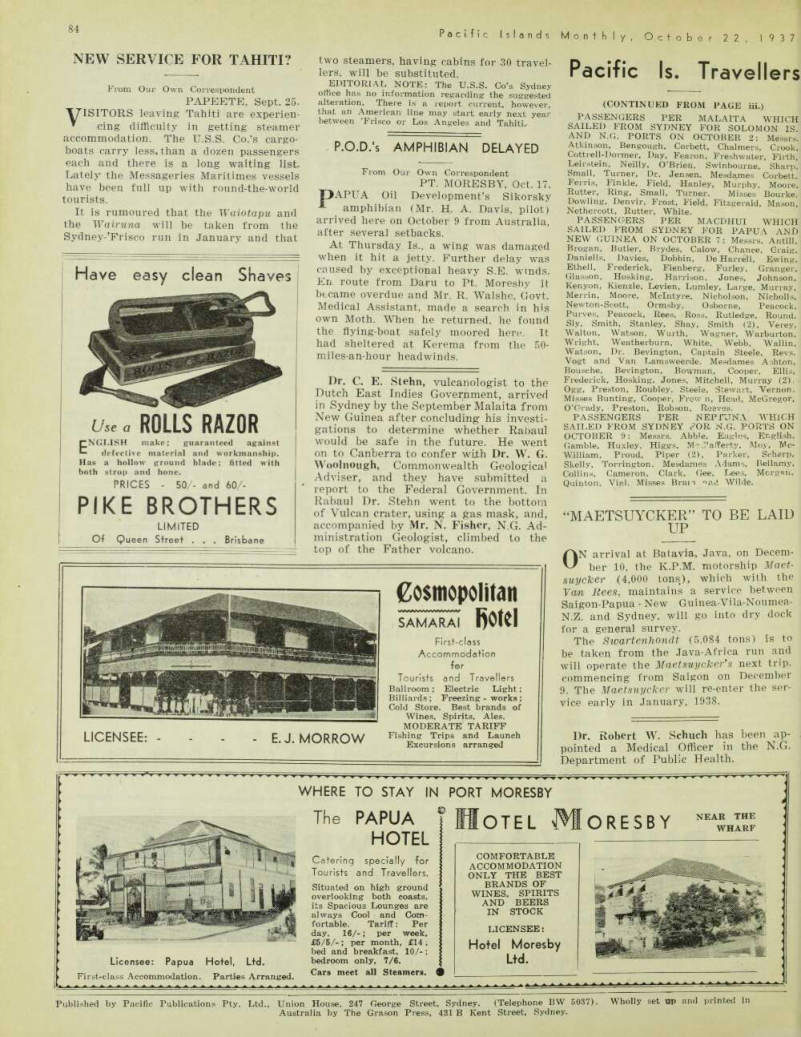
From Our Own Correspondent
Papeete, Sept. 25.
leaving Tahiti are experien ’ cing difficulty in getting steamer accommodation. The U.S.S. Co.’s cargo boats carry less, than a dozen passengers each and there is a long waiting list.
Lately the Messageries Maritimes vessels have been full up with round-the-world tourists.
It is rumoured that the Waiotapu and the Wairuna will be taken from the Sydney-’Frisco run in January and that
two steamers, having cabins for 30 travel
lers, will be substituted.
EDITORIAL NOTE: The U.S.S. Co’s Sydney office has no information regarding the suggested alteration. There is a report current, however, that an American line may start early next year between ’Frisco or Los Angeles and Tahiti,
P.O.D.'S Amphibian Delayed
From Our Own Correspondent
Pt. Moresby, Oct. 17.
OAPUA Oil Development’s Sikorsky A amphibian (Mr. H. A. Davis, pilot) arrived here on October 9 from Australia, after several setbacks.
At Thursday Is., a wing was damaged when it hit a jetty. Further delay was caused by exceptional heavy S.E. winds.
En route from Daru to Pt. Moresby it became overdue and Mr. R. Walshe, Govt.
Medical Assistant, made a search in his own Moth. When he returned, he found the flying-boat safely moored here. It had sheltered at Kerema from the 50miles-an-hour headwinds.
Dr. C. E. Stehn, vulcanologist to the Dutch East Indies Government, arrived in Sydney by the September Malaita from New Guinea after concluding his investi gations to determine whether Rabaul would be safe in the future. He went on to Canberra to confer with Dr. W. G.
Woolnough, Commonwealth Geological Adviser, and they have submitted a report to the Federal Government. In Rabaul Dr. Stehn went to the bottom of Vulcan crater, using a gas mask, and, accompanied by Mr. N. Fisher, N.G. Ad ministration Geologist, climbed to the top of the Father volcano.
“Maetsuycker” To Be Laid
UP
ON arrival at Batavia, Java, on Decem ber 10, the K.P.M. motorship Maet suycker (4,000 tons), which with the Van Rees, maintains a service between Saigon-Papua - New Guinea-Vila-Noumea- N.Z. and Sydney, will go into dry dock for a general survey.
The Swartenhondt (5,084 tons) is to be taken from the Java-Africa run and will operate the Maetsuycker’s next trip, commencing from Saigon on December 9. The Maetsuycker will re-enter the ser vice early in January, 1938.
Dr. Robert W. Schuch has been ap pointed a Medical Officer in the N.G.
Department of Public Health.
Advertisements & other items, pp. 90-92 (3 items)
Pacific Is. Travellers
84
Pacific Islands Monthly, October 22, 1937
Published by Pacific Publications Pty. Ltd., Union House, 247 George Street, Sydney. (Telephone BW 5037). Wholly set up and printed in Australia by The Grason Press, 431 B Kent Street, Sydney.
Cosmopolitan
Have easy clean Shaves
use a ROLLS RAZOR
PNGLISH make; guaranteed against defective material and workmanship.
Has a hollow ground blade; fitted with both strop and hone.
PRICES - 50/- and 60/-
PIKE BROTHERS
LIMITED
Of Queen Street . . . Brisbane
a»gf»ww»iCTi
LICENSEE: -
- E.J. MORROW
Cosmopolitan
SAMARAI Rote!
First-class Accommodation tor Tourists and Travellers Ballroom ; Electric Light; Billiards ; Freezing - works ; Cold Store. Best brands of Wines, Spirits, Ales.
MODERATE TARIFF
Fishing Trips and Launch Excursions arranged
otel Moresby
WHERE TO STAY IN PORT MORESBY
-■I
Licensee: Papua Hotel, Ltd.
First-class Accommodation. Parties Arranged.
The PAPUA
HOTEL
Catering specially for
Tourists and Travellers.
Situated on high ground overlooking both coasts, its Spacious Lounges are always Cool and Comfortable. Tariff: Per day, 16/-; per week, £5/5/-; per month, £l4, bed and breakfast, 10/-: bedroom only, 7/6.
Cars meet all Steamers. ©
otel Moresby
NEAR THE
WHARF
COMFORTABLE
ACCOMMODATION
ONLY THE BEST
BRANDS OF
WINES. SPIRITS
AND BEERS
IN STOCK
LICENSEE:
Hotel Moresby
Ltd.
H
WHAT AERIAL TRANSPORT HAS
DONE FOR NEW GUINEA
S INCE 1927, when the development of the Morobe Goldfield commenced, the European population of fhe Territory has been trebled. The new industry has increased the Empire s gold production by nearly £2,000,000 per annum, and has added enormously to the trade turnover of New Guinea.
Only Aerial Transport makes this possible. There is no road between the Goldfields and the coast. Aeroplanes, running on Regular Schedules, v/ithout Difficulty or Delay, carry in Dredges, Crushing Mills, Cyaniding Plants, Motor Vehicles, Hydro - Electric Machinery, Thousands of Passengers, and every kind of goods needed by a large and growing European communl. /.
Guinea airways ltd. were established in 1927; and they have grown In the following way, until they are to-day the largest freight- ..
'f'n ■ The above photograph shows how aerial transport Is assisting in the establishment of a pastoral industry on the Morobe tableland in New Guinea. These dairy cows have just been unloaded from one of Guinea Airways' freight-carrying aeroplanes after being transported from the coast for a dairy farmer near Wau. —-Photo : Thos. A. Olsson.
Guinea Airways Ltd. operate regular air services in New Guinea and Papua; they use over 50 Aerodromes and Landing-grounds in the two Territories.
GUINEA AIRWAYS L™
LAE • SALAMAUA
HEAD OFFICE:
BROOKMAN BUILDINGS
GRENFELL STREET
ADELAIDE, S.A.
NEW GUINEA OFFICE:
LAE
MANDATED TERRITORY OF
NEW GUINEA
BRANCH OFFICES AND AGENTS AT WAU, SALAMAUA, PORT MORESBY, AND SYDNEY
Sjfif I fit 2S > a z at 0 V i rEVV^t lt
\%r_[OOTH t CO.MMI Tt, .2S/'
uwrm.
S**fy 21 Kescli’s Lager is protected Ly the seal It refreshes and invigorates you as no flavour, because it is fully protected other drink can. In Resch’s Lager, against climatic conditions by the specivou get all the original freshness and ally designed “Spot” Crown Seal.
RESCHS^LACER
R.L.12.27