Pacific
I Slands
Monthly
Vol. VII.—No. 2
i e |» I v in l> r ’-i I, m io:t«
|[ Registered at the G.P.0., Sydney, for transmission ty post as a newspaper .]
6 d
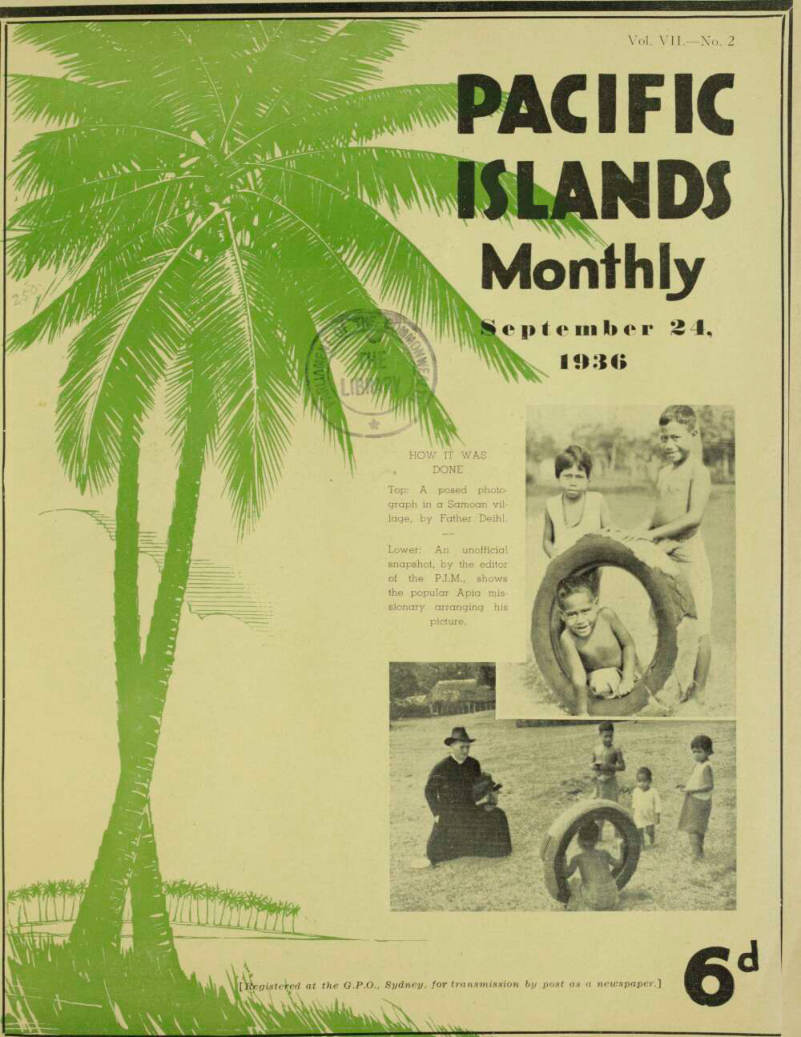
How It Was
Done
Top: A posed photo graph in a Samoan vil lage, by Father Deihl.
Lower: An unofficial snapshot, by the editor of the shows the popular Apia mis sionary arranging his picture.
Advertisements & other items, p. 2 (1 item)
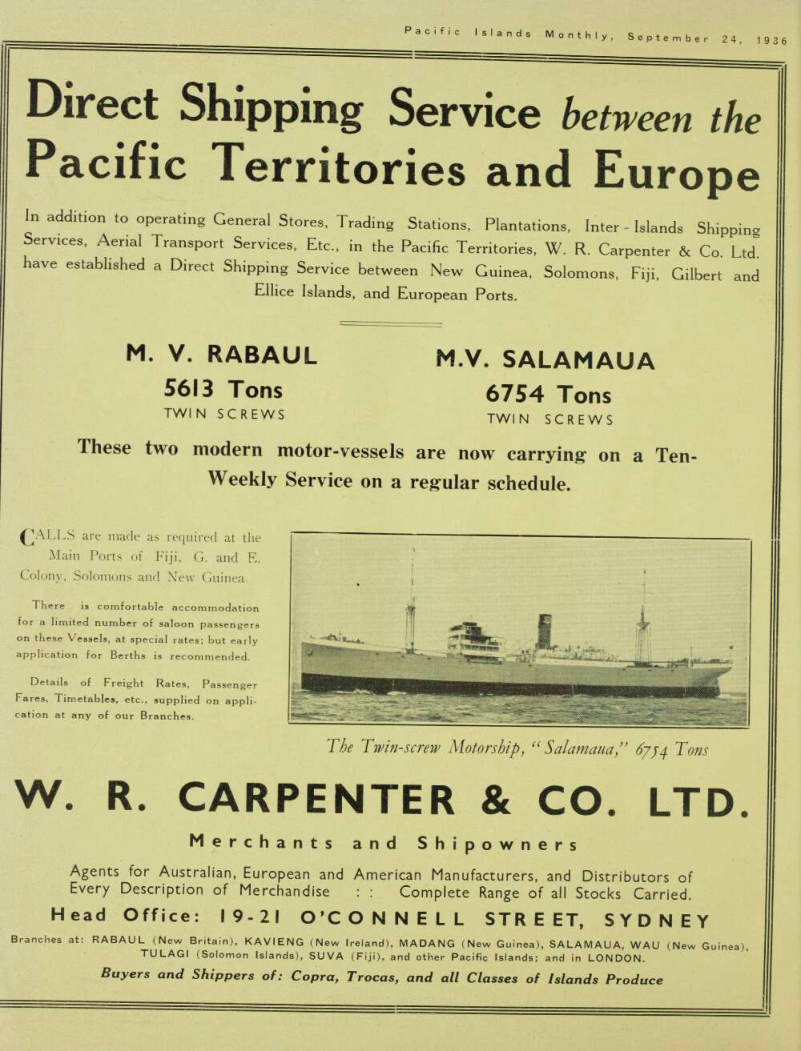
Pacific Territories and Europe
Direct Shipping Service between the
In addition to operating General Stores, Trading Stations, Plantations, Inter - Islands Shipping Services, Aerial Transport Services, Etc., in the Pacific Territories, W. R. Carpenter & Co. Ltd. have established a Direct Shipping Service between New Guinea, Solomons, Fiji, Gilbert and Ellice Islands, and European Ports.
M. V. RABAUL M.V. SALAMAUA
5613 Tons 6754 Tons
TWIN SCREWS TWIN SCREWS
These two modern motor-vessels are now carrying on a Ten-
Weekly Service on a regular schedule.
(]ALLS are made as required at the Main Ports of Fiji, G. and E.
Colony, Solomons and New Guinea There is comfortable accommodation for a limited number of saloon passengers on these Vessels, at special rates; but early application for Berths is recommended.
Details of Freight Rates, Passenger Fares, Timetables, etc., supplied on application at any of our Branches.
W. R. CARPENTER & CO. LTD.
Merchants and Shipowners Agents for Australian, European and American Manufacturers, and Distributors of Every Description of Merchandise ; Complete Range of all Stocks Carried.
Head Office: 19-21 O’CONNELL STREET, SYDNEY
Branches at; RABAUL (New Britain), KAVIENG (New Ireland), MADANG (New Guinea), SALAMAUA, WAU (New Guinea), TULAGI (Solomon Islands), SUVA (Fiji), and other Pacific Islands; and in LONDON.
Buyers and Shippers of: Copra , Trocas , and all Classes of Islands Produce ■MB The Twin-screw Moforship, “ Salamaua,” 6yjA Tons
Pacific Islands Travellers
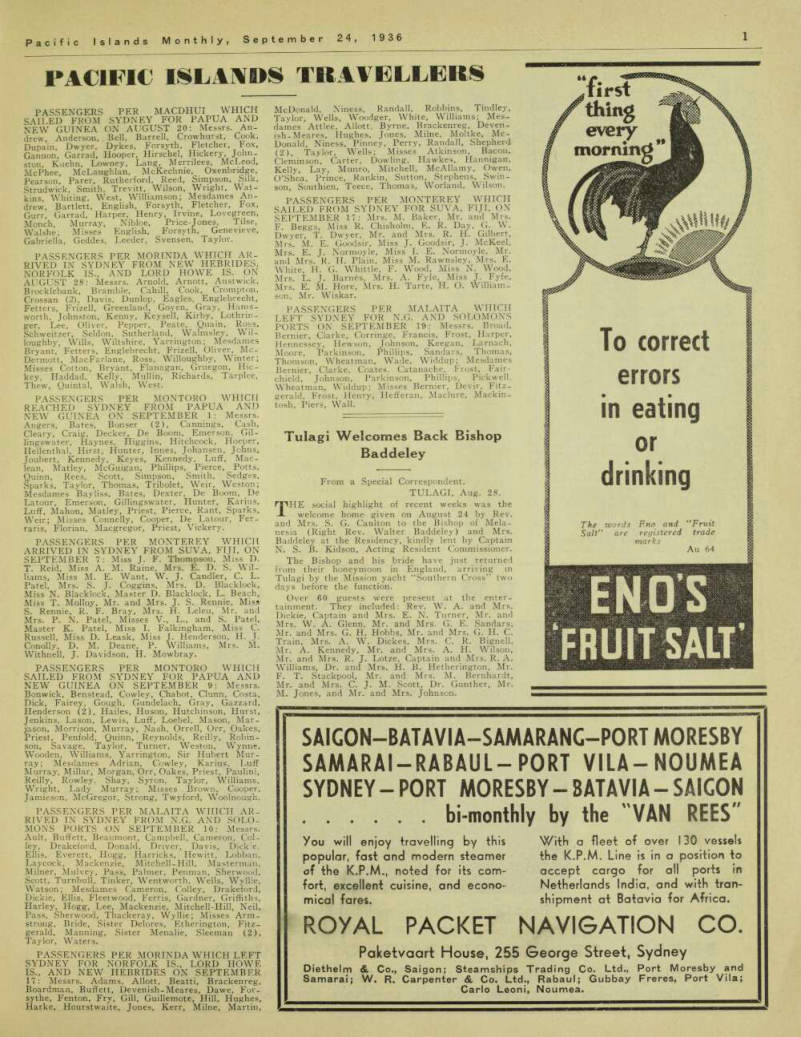
Passengers Per Macdhui Which
Sailed From Sydney For Papua And
NEW GUINEA ON AUGUST 20: Messrs. An drew Anderson, Bell, Barrell, Crowhurst, Cook, Dupain, Dwyer, Dykes. Forsyth. Fletcher, Fox, Gannon, Garrad, Hooper, Hirschel, Hickery John ston, Kuehn, Lowney, Lang, Mernlees, McLeod, McPhee, McLaughlan, McKechnie, Oxenbndge, Pearson, Parer. Rutherford, Reed, Simpson. Silk, Strudwick, Smith, Trevitt, Wilson, Wright, Wat kins, Whiting, West, Williamson; Mesdames An drew. Bartlett, English, Forsyth, Fletcher, Fox, Gurr, Garrad, Harper, Henry, Irvine, Lovegreen, Monch, Murray, Nibloe, Price-Jones, Tilse, Walshe; Misses English, Forsyth, Genevieve, Gabriella, Geddes, Leeder, Svensen, Taylor.
Passengers Per Morinda Which Ar
Rived In Sydney From New Hebrides,
NORFOLK IS.. AND LORD HOWE IS. ON AUGUST 28: Messrs. Arnold, Arnott, Austwick, Brocklebank, Bramble, Cahill, Cook, Crompton.
Crossan (2), Davis, Dunlop, Eagles, Englebrecht, Fetters, Frizell, Greenland, Goyen, Gray, Hams worth, Johnston, Kenny, Keysell, Kirby, Lothrin ger, Lee, Oliver, Pepper, Peate, Quain, Ross, Schweitzer, Seldon, Sutherland, Walmsley, Wil loughby, Wills, Wiltshire, Yarrington; Mesdames Bryant, Fetters, Englebrecht, Frizell, Oliver, Mc- Dermott, MacFarlane, Ross, Willoughby, Winter; Misses Cotton, Bryant, Flanagan, Gruegon, Hic key, Haddad, Kelly, Mullin, Richards, Tarplee, Thew, Quintal, Walsh, West.
Passengers Per Montoro Which
Reached Sydney From Papua And
New Guinea On September 1: Messrs.
Angers, Bates, Bonser (2), Cannings, Cash, Cleary, Craig, Decker, De Boom, Emerson, Gil lingswater, Haynes, Higgins, Hitchcock, Hoeper, Hellenthal, Hirst, Hunter, Innes, Johansen, Johns, Joubert, Kennedy, Keyes, Kennedy, Luff, Mac lean, Matley, McGuigan, Phillips, Pierce, Potts.
Quinn, Rees, Scott, Simpson, Smith, Sedges.
Sparks, Taylor, Thomas, Tribolet, Weir, Weston; Mesdames Bayliss, Bates, Dexter, De Boom, De Latour, Emerson, Gillingswater, Hunter, Karius, Luff, Mahon, Matley. Priest, Pierce, Rant, Sparks, Weir; Misses Connelly, Cooper, De Latour, Fer raris, Florian, Macgregor, Priest, Vickery.
Passengers Per Monterey Which
ARRIVED IN SYDNEY FROM SUVA, FIJI, ON SEPTEMBER 7: Miss J. F. Thompson, Miss D.
T. Reid, Miss A. M. Raine, Mrs. E. D. S. Wil liams, Miss M. E. Want, W. J. Candler, C. L.
Patel, Mrs. S. J. Coggins, Mrs. D. Blacklock, Miss N. Blacklock, Master D. Blacklock, L. Beach, Miss T. Molloy, Mr. and Mrs. J. S. Rennie, Miss S. Rennie, R. F. Bray, Mrs. H. Leleu, Mr. and Mrs. P. N. Patel, Misses V., L., and S. Patel, Master K. Patel, Miss I. Falkingham, Miss C.
Russell, Miss D. Leask, Miss J. Henderson, H. J.
Conolly, D. M. Deane, P. Williams, Mrs. M.
Withnell, J. Davidson, H. Mowbray.
Passengers Per Montoro Which
Sailed From Sydney For Papua And
New Guinea On September 9: Messrs.
Bonwick, Benstead, Cowley, Chabot, Clunn, Costa, Dick, Fairey, Gough, Gundelach, Gray, Gazzard, Henderson (2), Hailes, Huson, Hutchinson, Hurst, Jenkins, Lason, Lewis, Luff, Loebel, Mason, Mar jason, Morrison, Murray, Nash, Orrell, Orr, Oakes, Priest, Penfold, Quinn, Reynolds, Reilly, Robin son, Savage, Taylor, Turner, Weston, Wynne, Wooden, Williams, Yarrington, Sir Hubert Mur ray; Mesdames Adrian, Cowley, Karius, Luff Murray, Millar, Morgan, Orr, Oakes, Priest, Paulini, Reilly, Rowley, Shay, Syron, Taylor, Williams, Wright, Lady Murray; Misses Brown, Cooper, Jamieson, McGregor, Strong, Twyford, Woolnough.
Passengers Per Malaita Which Ar
RIVED IN SYDNEY FROM N.G. AND SOLO
Mons Ports On September 10: Messrs.
Ault, Buffett, Beaumont, Campbell, Cameron, Col ley, Drakeford, Donald, Driver, Davis, Dick'e, Ellis, Everett, Hogg, Harricks, Hewitt, Lobban, Laycock, Mackenzie, Mitchell-Hill, Masterman, Milner, Mulvey, Pass, Palmer, Penman, Sherwood, Scott, Turnbull, Tinker, Wentworth, Wells, Wyllie, Watson; Mesdames Cameron, Colley, Drakeford, Dickie, Ellis, Fleetwood, Ferris, Gardner, Griffiths, Harley, Hogg, Lee, Mackenzie, Mitchell-Hill, Neil, Pass, Sherwood, Thackeray, Wyllie; Misses Arm strong, Bride, Sister Delores, Etherington, Fitz gerald, Manning, Sister Menalie, Sleeman (2), Taylor, Waters.
Passengers Per Morinda Which Left
Sydney For Norfolk Is.. Lord Howe
Is., And New Hebrides On September
17: Messrs. Adams, Allott, Beatti, Brackenreg, Boardman, Buffett, Devenish-Meares, Dawe, For sythe, Fenton, Fry, Gill, Guillemote, Hill, Hughes, Harke, Hourstwaite, Jones, Kerr, Milne, Martin,
McDonald, Niness, Randall, Robbins, Tindley, Taylor, Wells, Woodger, White, Williams; Mes dames Attlee, Allott, Byrne. Brackenreg, Deven ish-Meares, Hughes, Jones, Milne, Moltke, Mc- Donald, Niness, Pinney, Perry, Randall, Shepherd (2), Taylor, Wells; Misses Atkinson, Bacon, Cleminson, Carter, Dowling, Hawkes, Hannigan, Kelly, Lay, Munro, Mitchell, McAllamy, Owen, O’Shea, Prince, Rankin, Sutton, Stephens, Swin son, Southien, Teece, Thomas, Worland, Wilson.
Passengers Per Monterey Which
SAILED FROM SYDNEY FOR SUVA, FIJI, ON SEPTEMBER 17: Mrs. M. Baker, Mr. and Mrs.
F. Beggs, Miss R. Chisholm, E. R. Day, G. W.
Dwyer, T. Dwyer, Mr. and Mrs. R. H. Gilbert, Mrs. M. E. Goodsir, Miss J. Goodsir, J. McKeel, Mrs. E. J. Normoyle, Miss I. E. Normoyle, Mr. and Mrs. R. H. Plain, Miss M. Rawnsley, Mrs. E.
White, H. G. Whittle, F. Wood, Miss N. Wood.
Mrs. L. J. Barnes, Mrs. A. Fyfe, Miss J. Fyfe, Mrs. E. M. Hore, Mrs. H. Tarte, H. O. William son, Mr. Wiskar.
Passengers Per Malaita Which
Left Sydney For N.G. And Solomons
PORTS ON SEPTEMBER 19: Messrs. Broad.
Bernier, Clarke, Corringe, Francis, Frost, Harper, Hennessey, Hewson, Johnson, Keegan, Larnach, Moore, Parkinson, Phillips, Sandars, Thomas, Thomson, Wheatman, Wade, Widdup; Mesdames Bernier, Clarke, Coates, Catanache, Frost, Fair chield, Johnson, Parkinson, Phillips, Pickwell, Wheatman, Widdup; Misses Bernier, Devir, Fitz gerald, Frost, Henry, Hefferan, Maclure, Mackin tosh, Piers, Wall.
Tulagi Welcomes Back Bishop
Baddeley
From a Special Correspondent.
Tulagi, Aug. 28.
THE social highlight of recent weeks was the welcome home given on August 24 by Rev. and Mrs. S. G. Caulton to the Bishop of Mela nesia (Right Rev. Walter Baddeley) and Mrs.
Baddeley at the Residency, kindly lent by Captain N. S. B. Kidson, Acting Resident Commissioner.
The Bishop and his bride have just returned from their honeymoon in England, arriving m Tulagi by the Mission yacht “Southern Cross” two days before the function.
Over 60 guests were present at the enter tainment. They included: Rev. W. A. and Mrs.
Dickie, Captain and Mrs. E. N. Turner, Mr. and Mrs. W. A. Glenn, Mr. and Mrs. G. E. Sandars, Mr. and Mrs. G. H. Hobbs, Mr. and Mrs. G. H. C.
Train, Mrs. A. W. Dickes, Mrs. C. R. Bignell, Mr. A. Kennedy, Mr. and Mrs. A. H. Wilson, Mr. and Mrs. R. J. Lotze, Captain and Mrs. R. A.
Williams, Dr. and Mrs. H. B. Hetherington, Mr.
F. T. Stackpool, Mr. and Mrs. M. Bernhardt, Mr. and Mrs. C. J. M. Scott, Dr. Gunther, Mr.
M. Jones, and Mr. and Mrs. Johnson.
Advertisements & other items, p. 3 (1 item)
drinking
first thing every morning To correct errors in eating or drinking I s A
SAIGON-BATAVIA-SAMARANC-PORT MORESBY
SAMARA!-RABAUL- PORT VILA-NOUMEA
SYDNEY - PORT MORESBY - BATAVIA - SAIGON
bi-monthly by the "VAN REES"
You will enjoy travelling by this popular, fast and modern steamer of the K.P.M., noted for its comfort, excellent cuisine, and economical fares.
With a fleet of over 130 vessels the K.P.M. Line is in a position to accept cargo for all ports in Netherlands India, and with transhipment at Batavia for Africa.
ROYAL PACKET NAVIGATION CO
Paketvaart House, 255 George Street, Sydney
Diethelm & Co., Saigon; Steamships Trading Co. Ltd., Port Moresby and Samarai; W. R. Carpenter & Co. Ltd., Rabaul; Gubbay Freres, Port Vila; Carlo Leoni, Noumea.
Advertisers
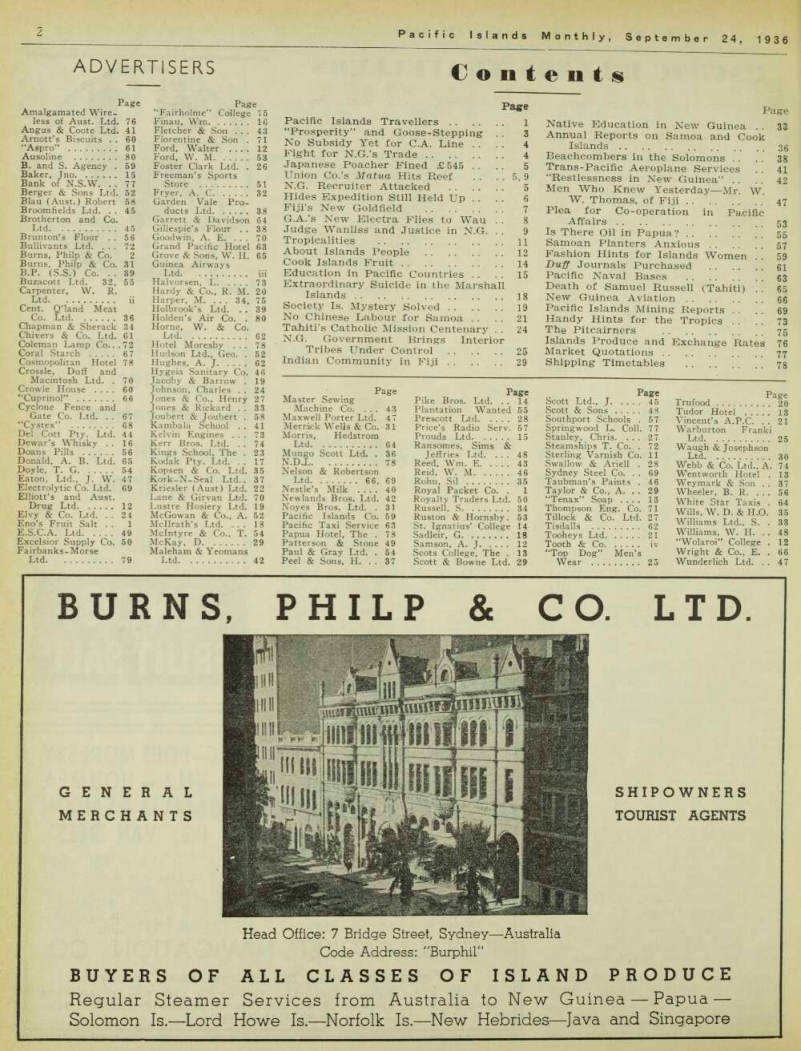
Page Amalgamated Wire less of Aust. Ltd. 76 Angus & Coote Ltd. 41 Arnott’s Biscuits . . 60 “Aspro” 61 Ausoline 80 B. and S. Agency . 59 Baker, Jno 15 Bank of N.S.W. . . 77 Berger & Sons Ltd. 52 Blau (Aust.) Robert 58 Broomfields Ltd, . . 45 Brotherton and Co.
Ltd 45 Brunton’s Flour . . 56 Bullivants Ltd. ... 72 Burns, Philp & Co. 2 Burns, Philp & Co. 31
B.P. (S.S.) Co. .. 39
Buzacott Ltd. 32, 55 Carpenter, W. R, Ltd ii Cent. Q’land Meat Co. Ltd 36 Chapman & Sherack 34 Chivers & Co. Ltd. 61 Coleman Lamp C0...72 Coral Starch 6 7 Cosmopolitan Hotel 78 Crossle, Duff and Macintosh Ltd. . 70 Crowle House ... 60 “Cuprinol” 66 Cyclone Fence and Gate Co. Ltd. . . 67 “Cystex” 68 Del Cott Pty. Ltd. 44 Dewar’s Whisky . . 16 Doans Pills 56 Donald, A. B. Ltd. 65 Doyle, T. G 54 Eaton, Ltd., J. W. 47 Electrolytic Co. Ltd. 69 Elliott’s and Aust.
Drug Ltd 12 Elvy & Co. Ltd. . . 24 Eno’s Fruit Salt . . 1
E.S.C.A. Ltd 49
Excelsior Supply Co. 50 Fairbanks- Morse Ltd 79
Page “Fairholme” College 75 Finau, Win 16 Fletcher & Son ... 43 Florentine & Son . 71 Ford, Walter ... 12 Ford, W. M 53 Foster Clark Ltd. . 26 Freeman’s Sports Store 51 Fryer, A. C 32 Garden Vale Pro ducts Ltd 38 Garrett & Davidson 64 Gillespie’s Flour . , 38 Goodwin, A. E. ... 70 Grand Pacific Hotel 63 Grove & Sons. W. H. 65 Guinea Airways Ltd hi Halvorsen, L 73 Hardy & Co., R. M. 20 Harper, M. ... 34, 75 Holbrook’s Ltd. . . 39 Holden’s Air Co. . 80 Horne, W. & Co.
Ltd 62 Hotel Moresby ... 78 Hudson Ltd., Geo. . 52 Hughes, A. J 62 Hygeia Sanitary Co. 46 Jacoby & Barrow , 19 Johnson, Charles . . 24 Jones & Co., Henry 27 Jones & Rickard . . 33 Joubert & Joubert . 58 Kambala School . . 41 Kelvin Engines ... 73 Kerr Bros. Ltd. . . 74 Kings School, The . 23 Kodak Pty. Ltd. . . 17 Kopsen & Co. Ltd. 35 Kork-N-Seal Ltd.. 37 Kriesler (Aust) Ltd. 22 Lane & Girvan Ltd. 70 Lustre Hosiery Ltd. 19 McGowan & Co., A. 52 Mcllrath’s Ltd. ... 18 Mclntyre & Co., T. 54 McKay, D 29 Maleham & Yeomans Ltd 42
Page Master Sewing Machine Co. ... 43 Maxwell Porter Ltd. 47 Merrick Wells & Co. 31 Morris, Hedstrom Ltd 64 Mungo Scott Ltd. . 36
N.D.L 78
Nelson & Robertson Ltd 66, 69 Nestle’s Milk ... 40 Newlands Bros. Ltd. 42 Noyes Bros. Ltd. . 31 Pacific Islands Co. 59 Pacific Taxi Service 63 Papua Hotel, The . 78 Patterson & Stone 49 Paul & Gray Ltd. . 54 Peel & Sons, H. . . 37
Page Pike Bros. Ltd. . . 14 Plantation Wanted 55 Prescott Ltd 28 Price’s Radio Serv. 57 Prouds Ltd 15 Ransomes, Sims & Jeffries Ltd. ... 48 Reed, Wm. E 43 Reid, W. M 46 Rohu, Sil 35 Royal Packet Co. . 1 Royalty Traders Ltd. 50 Russell. S 34 Ruston & Hornsby. 53 St. Ignatius’ College 14 Sadleir, G 18 Samson, A. J 12 Scots College, The . 13 Scott & Bowne Ltd. 29
Page Scott Ltd., J 45 Scott & Sons 43 Southport Schools . 57 Springwood L. Coll. 77 Stanley, Chris. ... 27 Steamships T. Co. . 72 Sterling Varnish Co. 11 Swallow & Ariell . 28 Sydney Steel Co. . . 69 Taubman’s Paints . 46 Taylor & Co., A. . . 29 “Tenax” Soap ... 13 Thompson Eng. Co. 71 Tillock & Co. Ltd. 27 Tisdalls 62 Tooheys Ltd 21 Tooth & Co iv “Top Dog” Men’s Wear 25
Page Trufood 20 Tudor Hotel 13 Vincent’s A.P.C. . . 21 Warburton Franki Ltd 25 Waugh & Josephson Ltd 30 Webb & Co. Ltd., A. 74 Wentworth Hotel . 13 Weymark & Son . , 37 Wheeler, B. R. ... 56 White Star Taxis . 64 Wills, W. D. & H.O. 35 Williams Ltd., S. . 33 Williams, W. H. . . 48 “Wolaroi” College . 12 Wright & Co., E. . 66 Wunderlich Ltd, . . 47
Contents
Page Pacific Islands Travellers 1 “Prosperity” and Goose-Stepping . . 3 No Subsidy Yet for C.A, Line . . . . 4 Fight for N.G.’s Trade 4 Japanese Poacher Fined £545 .. .. 5 Union Co.’s Matua Hits Reef .. ..5,9 N.G. Recruiter Attacked 5 Hides Expedition Still Held Up .. . . 6 Fiji’s New Goldfield 7 G.A.’s New Electra Flies to Wau . . 8 Judge Wanliss and Justice in N.G. . . 9 Tropicalities 11 About Islands People 12 Cook Islands Fruit 14 Education in Pacific Countries .. .. 15 Extraordinary Suicide in the Marshall Islands ] 8 Society Is. Mystery Solved 19 No Chinese Labour for Samoa . . . , 21 Tahiti’s Catholic Mission Centenary . . 24 N.G. Government Brings Interior Tribes Under Control 25 Indian Community in Fiji 29
Page Native Education in New Guinea . . 33 Annual Reports on Samoa and Cook Islands Beachcombers in the Solomons .. . . 38 Trans-Pacific Aeroplane Services .. 41 “Restlessness in New Guinea” .. .. 42 Men Who Knew Yesterday—Mr. W.
W. Thomas, of Fiji 47 Plea for Co-operation in Pacific Affairs Is There Oil in Papua? 55 Samoan Planters Anxious 57 Fashion Hints for Islands Women .. 59 Duff Journals Purchased 61 Pacific Naval Bases 63 Death of Samuel Russell (Tahiti) . . 65 New Guinea Aviation 66 Pacific Islands Mining Reports . . . . 69 Handy Hints for the Tropics . . . . 73 The Pitcairners 75 Islands Produce and Exchange Rates 76 Market Quotations 77 Shipping Timetables 73
Advertisements & other items, p. 4 (1 item)
Burns, Philp & Co. Ltd.
GENERAL
MERCHANTS
iiiii'jn mm m r 111 mi
suit
11 Head Office: 7 Bridge Street, Sydney—Australia Code Address: "Burphil"
BUYERS OF ALL CLASSES OF ISLAND
SHIPOWNERS
TOURIST AGENTS
PRODUCE
Regular Steamer Services from Australia to New Guinea Papua Solomon Is.—Lord Howe Is.—Norfolk Is. —New Hebrides —Java and Singapore
Pacific Islands Monthly
The Newspaper-]flag , a*iiie of tlie South Seas [Registered at the G.P.O. Sydney, for transmission by post as a newspaper .]
Published Once Each Month and Circulated in Australia and New Zealand and in the following Pacific Territories and Island Groups:
Crown Colony of Fiji.
Australian Territory of Papua.
Mandated Territory (Australia) of New Guinea, Bismarck Archipelago and Northern Solomon Islands.
Mandated Territory (Japan) of Marshall, Caroline and Marianna Islands.
French Territory of New Caledonia.
British and French Condominium of New Hebrides.
American Territory of Eastern Samoa.
American Territory of Guam.
Mandated Territory of Nauru.
British Crown Colony of Gilbert and Ellice Islands.
Mandated Territory (New Zealand) of Samoa.
British Solomon Islands Protectorate.
British Protectorate of Tongan Islands.
New Zealand Territory of Cook Islands.
Australian Territory of N«prfolk Island, French Colony of Oceania (Tahiti, etc.).
American Territory of Hawaiian Islands.
Owned and Produced by Pacific Publications Ltd., Union House, 247 George Street, Sydney
Telephone Bw 5037
P.O. Box 3408 R
Registered Address of Telegrams, Radiograms, and Cables: “PACPUB,” Sydney.
Contributions Articles, Stories, and Photographs dealing with Pacific Islands subjects are invited, and will be paid for on publication at usual rates.
Subscription Rates Per Annum, within British Empire, Prepaid, Post Free 6/- Per Annum, elsewhere, prepaid. Post Free 8/ Single Copies 6d.
Editor and Publisher:
R. W. Robson. F.R.G.S.
Advertisements
Advertising rates furnished on application.
Colours, etc by Arrangement.
Process Blocks made at Advertiser’s expense when required. Screen, 100.
Changes of Advertising Copy should reach this Office by Bth of each month, otherwise previous advertisement may be repeated.
Agents
The following are authorised to receive subscrip tions for the Pacific Islands Monthly:— Islands Branches of Burns, Philp & Co., Ltd., and Burns Philp (South Sea) Co., Ltd.
Islands Branches of W. R. Carpenter & Co., Ltd.
All Branches of Morris, Hedstrom & Co., Ltd.
G. Thomas & Co., Rabaul, New Guinea.
Whitten Bros., Ltd., Samarai, Papua.
P, Costello, Suva, Fiji.
J. Muir, Suva, Fiji.
All Branches and Representatives of W. H. Grove and Sons, Ltd., Auckland, New Zealand.
Cook Islands Trading Co., Rarotonga, Cook Is.
W. H. Watson, Rarotonga, Cook Is.
Representative in London; W. C. HARVEY, Coronation Building, 4 Lloyds Avenue, London, E.C.2. from whom may be obtained copies of Pacific Islands Monthly, Pacific Islands Year Book, advertising schedules, etc.
Vol. VII., No. 2
Sydney, September 24, 1 936
D_* f 6d. Per Copy. 1 nCc j Prepaid: 6/- p.a.
“Prosperity” And Goose-Stepping
TTiESE are the wisest words pub- 1 lished during the month:- .. A Sir Walter Carpenter uttered a warning (and this, he emphasised, was his personal view and was not necessarily that of the other directors), that the present prosperity was based on the rush of nations to construct armaments m
d wnn’lS'V
period as possible. Slackness would inevitabiy follow the rush. Governments should stop borrowing for public works, public works programmes.”
This significant statement, which every politician and every merchant should paste in his hat, was buried away in a report of the annual meeting of W. R. Carpenter and Co. Ltd.
What student of world affairs can doubt that Sir Walter is right? Two years ago every country was embarrassed by great unemployment and poverty. Then the nations, led by Germany, Italy, and Russia, began furiously to arm. Huge armies were organised; incredible quantities of munitions and war machinery were
ordered. We know what happened in the case of Britain. The whole Empire awoke to the peril of its unarmed con dition ; and, since 1934, warships and aeroplanes and armaments generally have been manufactured in British fac tories on a scale never before known in peace time.
That has been happening in nearly every country; and, of course, millions of men who had been standing idle are now in regular employment as soldiers, sailors, airmen, or workers in the in numerable industries which supply armaments. Generally speaking, the unemployment terror has disappeared.
The nations found new work for their people to do—the work of defence— and the tragic gap between the needs of the nation, and the number of men available to supply those needs, has been closed. In many countries — Britain, especially—men who for years were unemployed are now working, and earning, and spending; and a con
we call “ prosperity ” has But how long will this last? Ob viously, only so long as the demand for armaments continues. While the nations are in this frenzy of goose , . , , P „ii Stepping, and are clamouring for all kinds of destructive or defensive equip , t „ A r hu I nd^ ec |f of thoi sa^ ds °.
Will be kept busy ; and the price Ot scores of commodities will remain high, . , But, inevitably, sooner or later, the nations will have made good their C °TT Tu' deficiencies in war material and then they must plan a much modified pro gramme, designed only to keep their defences efficient and ready. Does it not follow, as certainly as the night follows day, that many less men will be required ; and that there must ensue anot her period of economic readjust ment> atte nded by slump, unemploy ment, and suffering? study of history since 1900 shows that these things have gone in cycles; and, because there is no semblance of economic planning between nations, they will continue to run in cycles, Machinery, scientific organisation of
industries, mass production—all these mean that a nation’s normal peacetime needs can be supplied by fewer men, working under the old rates and con ditions. There is “not enough work to go round.” Therefore, under our exist ing lunatic system three-quarters of our men work, and are specially taxed to maintain the other quarter in misery on the dole. Under such conditions war scares and war come as blessings: the workless section of the people are provided with employment—and the whole nation is taxed a little more heavily to provide armaments instead of the dole.
If there is no war, it is inevitable, as Sir Walter Carpenter says, that a period of economic slackness will fol low all this goose-stepping: and wise men will make provision accordingly.
In the Pacific Islands the warning should be heeded. For many months now, week by week, the market for copra has been active and rising: and the majority of planters now are taking their profit and facing the future blithely. Administrators are regarding comfortable surpluses with complac ency, and planning expenditure on more spacious lines than they have known for half a decade. A tendency to speculate is being disclosed among monied interests in some of the terri tories.
Planters and administrators and merchants should go cautiously for a while, and see what comes out of this international imbroglio. If there is to be war between some of the nations, the demand for national service and war material will continue indefinitely, so that everyone will be busy and money will circulate. But if all this international snarling is based merely upon hot air, there undoubtedly will come a time when “rearmament pros perity” will dwindle, and when the world, faced again with a wilderness of tariff walls, and a tangle of ex changes and restrictions, will be unable to trade with freedom or profit.
Men at the head of affairs, while the outlook is so uncertain, should play safe.
Mr. Lionel Dudley, a preacher of the Yarrawonga Church of Christ, Victoria, has resigned in order to undertake mis sionary work in the New Hebrides.
Rev. W. H. MacFarlane, who spent 17 years as an Anglican missionary in Torres Strait, is seriously ill at his home in Scotsdale, Tasmania. He recently underwent an operation in St. Margaret’s Hospital, Launceston, and has been sent home in order to rebuild his strength in readiness for another and more serious operation.
No Decision
Incorrect Report of Subsidy for C.A. Line
SPHERE have been various reports dur ing the past few months to the effect that Britain, Australia, New Zealand, and Fiji have agreed jointly to pay a substan tial subsidy to the Canadian Australasian Line Limited, so as to enable the line to compete on something approaching equal terms with the Matson Line.
It will be remembered tlPat an official announcement was made several months ago that if no such subsidy is available the Canadian Australasian Line may be compelled to cease operations at an early date.
The latest official pronouncement on the subject comes from the Prime Minis ter of Australia (Mr. J. A. Lyons), who stated on September 7 that ‘‘no decision has yet been reached concerning a sub sidy.” He said that the Federal Cabinet was waiting for a report from the Im perial Shipping Committee, which was then sitting in London.
It was reported in June that the four Governments had agreed to provide an annual subsidy of £250,000 for the Canad ian Australasian Line. This caused much satisfaction in the Central Pacific, where it was believed that the two trans-Paciflc lines (Canadian Australasian and Mat son), working under subsidy conditions, would provide Central Pacific territories with first-class transport services.
The disclosure that nothing yet has been done will cause dismay in many quarters. It is an outstanding example of the manner in which important Imperial interests are being hamstrung by im potent and muddling Governments.
Guadalcanal Gold
Good Prospects for Large Scale Operations in Solomons
ACCORDING to Mr. L. J. Davis, an Australian mining expert, who re turned by the Malaita early in September, a rich goldfield, equal to that of the New Guinea and Papua fields might be expected in the Solomon Islands, where preliminary prospecting had been completed.
Following the operations of Pioneer Ex pedition N.L., which carried out prelimin ary research and survey, it is intended to win gold from the area as soon as local ordinances are framed to permit it.
Mr. Davis explained that the field on Guadalcanal Island, in the Solomons Group, had been proved to contain paying quan tities of alluvial and reef gold, but it re quired capital. It was not a poor man’s show, and must be mined on a sufficiently large scale to be successful.
Deaths In Tahiti
From Our Own Correspondent PAPEETE, September 2.
WITHIN 24 hours, on August 27-28, the deaths occurred of three leading and esteemed residents of Papeete—Mons.
Octave Moreau (President of the Superior Council of the French Protestant Churches in French Oceania); Mons.
Emmanuel Lucas (pilot of Papeete har bour) ; Mr, Samuel Russell (British Vice- Consul),
Fight for New Guinea Trade
Australian, German, and Japanese Interests
THE non-receipt on August 31 of any tenders for the mail and shipping services between Australia and the Wes tern Pacific Islands (carried on for years by Messrs. Burns, Philp and Co.) caused surprise. The period for tendering was extended by Canberra to September 30.
It is believed that the delay has been caused by the new shipping law in New Guinea—and especially by the recent amendment, which gives the Administra tor power to license the German ships to trade between other than declared ports after January 1.
It is understood that Australian in terests declined to tender until they re ceived some assurance concerning future shipping and trading conditions in the Mandated Territory.
The issues involved are of great im portance. German interests are doing their utmost to hold on to the trade they have in New Guinea. Japanese interests have made urgent application to be given the same facilities there as the Germans.
The Commonwealth Government, as part of its general policy of conserving South Seas trade for British-Australian inter ests, decided early this year to limit the operations of the German ships (which run between Hong Kong and New Guinea) after December 31; but is now thought to be weakening on that decision.
Months
Lost At Sea For Two
Marshall Islanders Drift to Nauru
THE 40-tons Japanese schooner Regina arrived at Nauru Island, in Central Pacific, early in September, after having been drifting in distress since July 7.
With one Japanese and 22 natives, in cluding three women and four children, on board, the schooner set out from one of the Marshall Islands on a 12 hours’ sail to a neighbouring Island, but missed its objective and became hopelessly lost.
When their food and water eventually became exhausted, those on board had to depend on passing showers for water, and their sighting of Nauru was providential, as they were suffering intensely from thirst and starvation.
Officials of the Nauru administration took all the people ashore, and are nurs ing the sick, one of whom, an elderly man, was in a critical condition.
Aeroplanes For Tahiti
From Our Own Correspondent PAPEETE, September 9.
AN inter-island aeroplane service is in preparation. An aerodrome is being constructed near Tahiti; and aeroplanes are making practice flights about the islands every day.
Sir Hubert Murray (Lieutenant-Gover nor of Papua) and his official secretary, Mr. Leonard Murray, sailed for Port Moresby by the Montoro tm September 9.
Sir Hubert has returned to Papua after several months spent abroad.
Sampan Seized
Poacher Fined £545 in Solomons
From a Special Correspondent
Tulagi, Aug. 26.
A JAPANESE sampan of about 20 tons has been prowling about the Solo mons and has been seen close to the land at various places near Ysabel.
During August, becoming more cheeky, it actually anchored at Kia and other vil lages, and the 17 Japanese went ashore and mixed with the natives. They allowed natives to go aboard their vessel.
On August 7 the sampan anchored off the Government station at Lenabuli for a day and night and fished the reefs. The District Officer, Mr. J. K. Brownlees, was unable to take proceedings as his vessel was in Tulagi under repair and he had no means of boarding the sampan.
The Japanese then moved on up the Ysabel coast on the S.W. side.
After five days Mr. Brownlees got back his vessel Wai-ai and chased them to Alla dyce Point where he blocked them on a narrow channel among the reefs. With an armed guard, he boarded the ship and made them understand by signs to “up anchor” and proceed to Tulagi.
The Wai-ai acted as escort, with four Japanese aboard, while Mr, Brownlees re mained on the sampan which steamed at about eight knots.
On arrival in Tulagi, after a most un comfortable night, Mr. Brownlees reported his capture and the Japanese were quar antined.
Court proceedings ensued and they were found guilty, on several different charges, and fined £545 in all. The shell and beche de mer were confiscated and the sampan seized.
The sampan is about 60 feet long and roughly built, and is in a filthy condition.
The shell is thrown into the hold with the fish in it and allowed to rot there.
There is a definite feeling of satisfaction that steps were taken with regard to this ship and all credit is due to Mr. Brownlees for his prompt action.
Murder Alleged
Recruiter Attacked in N.G.
IT has been reported from New Guinea that Mr. C. A. Gough, a well-known trader and recruiter of Aitape, has been murdered by natives near the village of Umbrum, which lies some 30 miles inland from Suein (on the coast, midway between Aitape and Wewak). Umbrum is in grass country, in the Sepik Valley, south eastwards of the Torricelli Mountains.
Gough was seeking recruits and, accord ing to native reports, he was attacked, speared in the back and neck, and killed.
There was a fight, in which four hostile natives were killed. Gough’s native lab ourers ran away and four of them, all wounded, arrived at Wewak and reported the matter to the District Officer, Mr. G.
W. L, Townsend.
Mr. Townsend and his assistant, Mr. J.
McCarthy, left Wewak early in September to inquire into the incident.
Umbrum is not in “uncontrolled” terri tory.
Mrs. Luckham, wife of Mr. A. A. Luck- Ham, C.8.E., Resident Agent at Aitutaki, Cook Islands, died as the result of a cerebral haemorrhage on August 12. Mr.
Luckham was formerly Resident Commis sioner at Niue Island.
Three Of A Kind
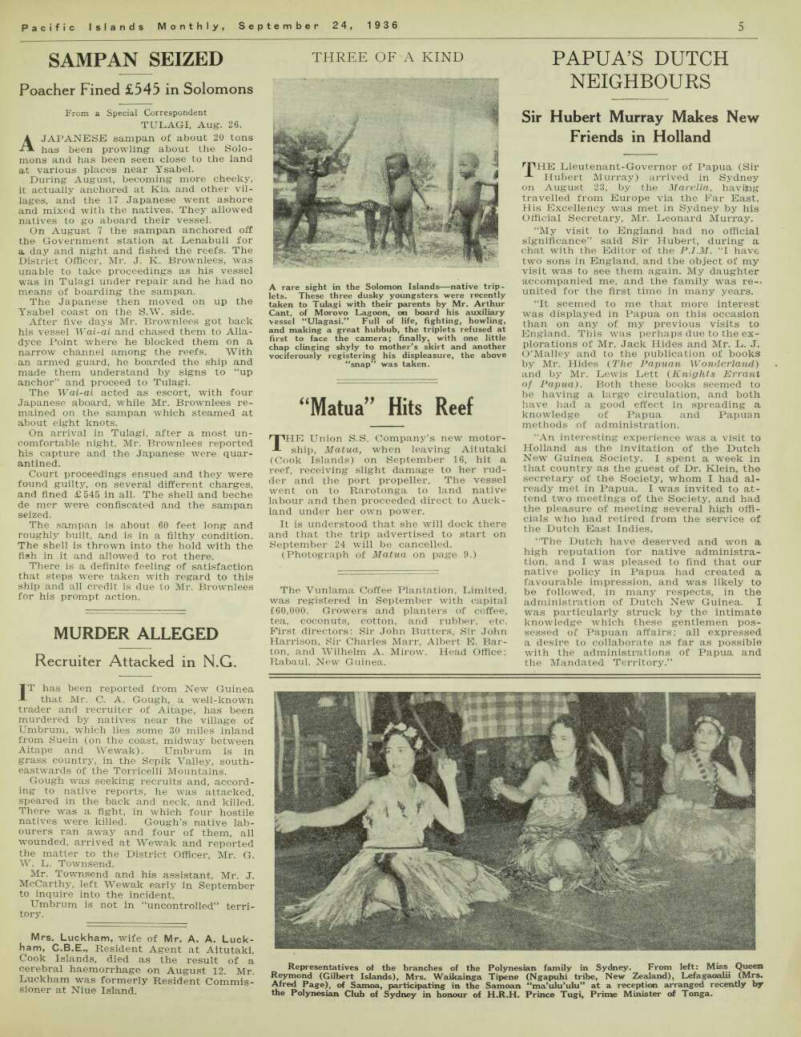
A rare sight in the Solomon Islands—native trip lets. These three dusky youngsters were recently taken to Tulagi with their parents by Mr. Arthur Cant, of Morovo Lagoon, on board his auxiliary vessel “Ulagasi.” Full of life, fighting, howling, and making a great hubbub, the triplets refused at first to face the camera; finally, with one little chap clinging shyly to mother’s skirt and another vociferously registering his displeasure, the above “snap” was taken.
“Matua” Hits Reef
THE Union S.S. Company’s new motor ship, Matua, when leaving Aitutaki (Cook Islands) on September 16, hit a reef, receiving slight damage to her rud der and the port propeller. The vessel went on to Rarotonga to land native labour and then proceeded direct to Auck land under her own power.
It is understood that she will dock there and that the trip advertised to start on September 24 will be cancelled. (Photograph of Matua on page 9.) The Vunlama Coffee Plantation, Limited, was registered in September with capital £60,000. Growers and planters of coffee, tea, coconuts, cotton, and rubber, etc.
First directors: Sir John Butters, Sir John Harrison, Sir Charles Marr, Albert E. Bar ton, and Wilhelm A. Mirow. Head Office; Rabaul, New Guinea.
Neighbours
Papua’S Dutch
Sir Hubert Murray Makes New Friends in Holland
THE Lieutenant-Governor of Papua (Sir Hubert Murray) arrived in Sydney on August 23, by the Marella, havijng travelled from Europe via the Far East.
His Excellency was met in Sydney by his Official Secretary, Mr. Leonard Murray.
“My visit to England had no official significance” said Sir Hubert, during a chat with the Editor of the P.I.M. “I have two sons in England, and the object of my visit was to see them again. My daughter accompanied me, and the family was re-* united for the first time in many years.
“It seemed to me that more interest was displayed in Papua on this occasion than on any of my previous visits to England. This was perhaps due to the ex plorations of Mr. Jack Hides and Mr. L. J.
O’Malley and to the publication of books by Mr. Hides ( The Papuan Wonderland) and by Mr. Lewis Lett ( Knights Errant of Papua). Both these books seemed to be having a large circulation, and both have had a good effect in spreading a knowledge of Papua and Papuan methods of administration.
“An interesting experience was a visit to Holland as the invitation of the Dutch New Guinea Society. I spent a week in that country as the guest of Dr. Klein, the secretary of the Society, whom I had al ready met in Papua. I was invited to at tend two meetings of the Society, and had the pleasure of meeting several high offi cials who had retired from the service of the Dutch East Indies.
“The Dutch have deserved and won a high reputation for native administra tion, and I was pleased to find that our native policy in Papua had created a favourable impression, and was likely to be followed, in many respects, in the administration of Dutch New Guinea. I was particularly struck by the intimate knowledge which these gentlemen pos sessed of Papuan affairs; all expressed a desire to collaborate as far as possible with the administrations of Papua and the Mandated Territory.”
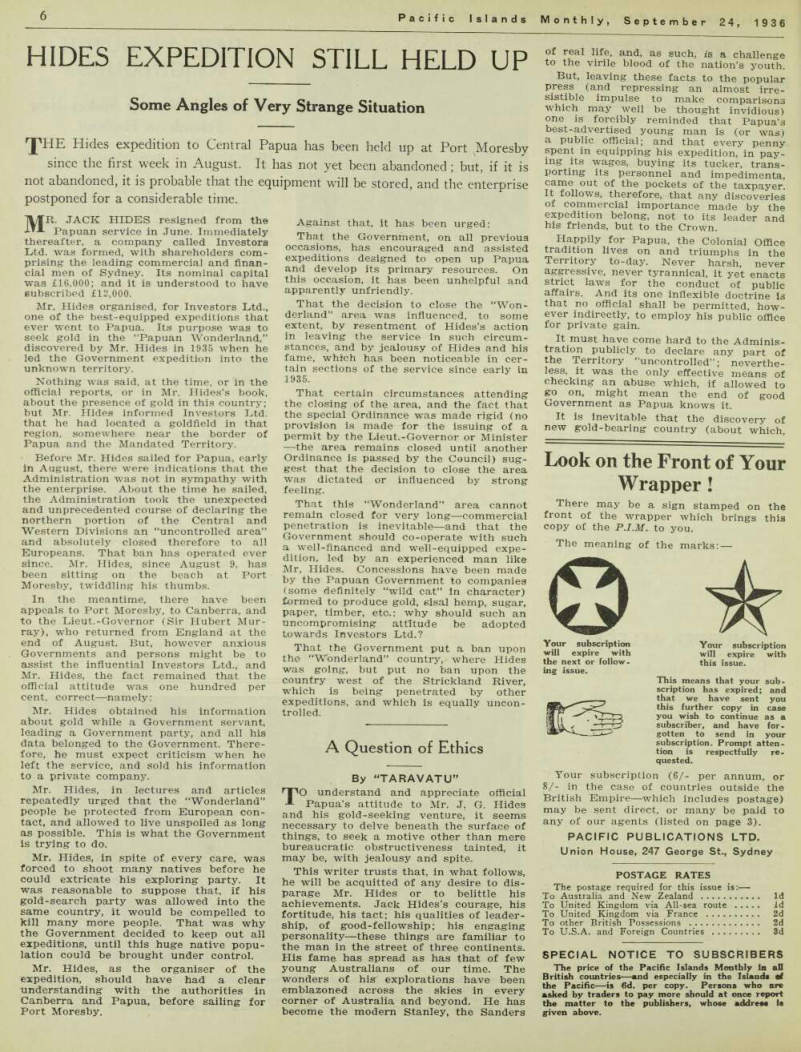
Representatives ot the branches of the Polynesian family in Sydney. From left: Miss Queen Reymond (Gilbert Islands), Mrs. Waikainga Tipene (Ngapuhi tribe. New Zealand), Lefagaoalii (Mrs.
Afred Page), of Samoa, participating in the Samoan “ma’ulu’ulu” at a reception arranged recently by the Polynesian Club of Sydney in honour of H.R.H. Prince Tugi, Prime Minister of Tonga.
Hides Expedition Still Held Up
Some Angles of Very Strange Situation
'J’HE Hides expedition to Central Papua has been held up at Port Moresby since the first week in August. It has not yet been abandoned; but, if it is not abandoned, it is probable that the equipment will be stored, and the enterprise postponed for a considerable time.
MR. JACK HIDES resigned from the Papuan service in June. Immediately thereafter, a company called Investors Ltd. was formed, with shareholders com prising the leading commercial and finan cial men of Sydney. Its nominal capital was £16,000; and it is understood to have subscribed £12,000.
Mr. Hides organised, for Investors Ltd., one of the best-equipped expeditions that ever went to Papua. Its purpose was to seek gold in the “Papuan Wonderland,” discovered by Mr. Hides in 1935 when he led the Government expedition into the unknown territory.
Nothing was said, at the time, or in the official reports, or in Mr. Hides’s book, about the presence of gold in this country; but Mr. Hides informed Investors Ltd. that he had located a goldfield in that region, somewhere near the border of Papua and the Mandated Territory.
Before Mr. Hides sailed for Papua, early in August, there were indications that the Administration was not in sympathy with the enterprise. About the time he sailed, the Administration took the unexpected and unprecedented course of declaring the northern portion of the Central and Western Divisions an "uncontrolled area” and absolutely closed therefore to all Europeans, That ban has operated ever since. Mr. Hides, since August 9, has been sitting on the beach at Port Moresby, twiddling his thumbs.
In the meantime, there have been appeals to Port Moresby, to Canberra, and to the Lieut.-Governor (Sir Hubert Mur ray), who returned from England at the end of August. But, however anxious Governments and persons might be to assist the influential Investors Ltd., and Mr. Hides, the fact remained that the official attitude was one hundred per cent, correct —namely: Mr. Hides obtained his information about gold while a Government servant, leading a Government party, and all his data belonged to the Government. There fore, he must expect criticism when he left the service, and sold his information to a private company.
Mr. Hides, in lectures and articles repeatedly urged that the “Wonderland” people be protected from European con tact, and allowed to live unspoiled as long as possible. This is what the Government is trying to do.
Mr. Hides, in spite of every care, was forced to shoot many natives before he could extricate his exploring party. It was reasonable to suppose that, if his gold-search party was allowed into the same country, it would be compelled to kill many more people. That was why the Government decided to keep out all expeditions, until this huge native popu lation could be brought under control.
Mr. Hides, as the organiser of the expedition, should have had a clear understanding with the authorities in Canberra and Papua, before sailing for Port Moresby.
Against that, it has been urged: That the Government, on all previous occasions, has encouraged and assisted expeditions designed to open up Papua and develop its primary resources. On this occasion, it has been unhelpful and apparently unfriendly.
That the decision to close the “Won derland” area was influenced, to some extent, by resentment of Hides’s action in leaving the service in such circum stances, and by jealousy of Hides and his fame, which has been noticeable in cer tain sections of the service since early in 1935.
That certain circumstances attending the closing of the area, and the fact that the special Ordinance was made rigid (no provision is made for the issuing of a permit by the Lieut.-Governor or Minister —the area remains closed until another Ordinance is passed by the Council) sug gest that the decision to close the area was dictated or influenced by strong feeling.
That this “Wonderland” area cannot remain closed for very long—commercial penetration is inevitable—and that the Government should co-operate with such a well-financed and well-equipped expe dition, led by an experienced man like Mr. Hides. Concessions have been made by the Papuan Government to companies (some definitely “wild cat” in character) formed to produce gold, sisal hemp, sugar, paper, timber, etc.; why should such an uncompromising attitude be adopted towards Investors Ltd.?
That the Government put a ban upon the “Wonderland” country, where Hides was going, but put no ban upon the country west of the Strickland River, which is being penetrated by other expeditions, and which is equally uncon trolled.
A Question of Ethics
By “Taravatu”
'T'O understand and appreciate official Papua’s attitude to Mr. J. G. Hides and his gold-seeking venture, it seems necessary to delve beneath the surface of things, to seek a motive other than mere bureaucratic obstructiveness tainted, it may be, with jealousy and spite.
This writer trusts that, in what follows, he will be acquitted of any desire to dis parage Mr. Hides or to belittle his achievements. Jack Hides’s courage, his fortitude, his tact; his qualities of leader ship, of good-fellowship; his engaging personality—these things are familiar to the man in the street of three continents.
His fame has spread as has that of few young Australians of our time. The wonders of his explorations have been emblazoned across the skies in every corner of Australia and beyond. He has become the modern Stanley, the Sanders
of real life, and, as such, is a challenge to the virile blood of the nation’s youth.
But, leaving these facts to the popular press (and repressing an almost irre sistible impulse to make comparisons which may well be thought invidious) one is forcibly reminded that Papua’s best-advertised young man is (or was) a public official; and that every penny spent in equipping his expedition, in pay ing its wages, buying its tucker, trans porting its personnel and impedimenta, came out of the pockets of the taxpayer.
It follows, therefore, that any discoveries of commercial importance made by the expedition belong, not to its leader and his friends, but to the Crown.
Happily for Papua, the Colonial Office tradition lives on and triumphs in the Territory to-day. Never harsh, never aggressive, never tyrannical, it yet enacts strict laws for the conduct of public affairs. And its one inflexible doctrine is that no official shall be permitted, how ever indirectly, to employ his public office for private gain.
It must have come hard to the Adminis tration publicly to declare any part of the Territory “uncontrolled”; neverthe less, it was the only effective means of checking an abuse which, if allowed to g-o on, might mean the end of good Government as Papua knows it.
It is Inevitable that the discovery of new gold-bearing country (about which,
by the way, the Administration appears to have been told little or nothing) should offer rare and glowing opportunities for stay-at-home speculators. The men behind Investors Limited are, indeed, people to be reckoned with. Many of them have held public office; their photo graphs appear in the illustrated weeklies labelled “Eminent This” or “Prominent That.” Their favours are sought by poli
ticians; they ooze wealth and bristle with genuine importance. In the commercial, sporting and financial worlds they are the supreme arbiters. Docility is not one of their virtues, nor is a readiness to acknowledge defeat one of their weak nesses. Nevertheless, that the “higher authorities” in Canberra will attempt to thwart the Legislative Council’s efforts to keep its party clean may well be doubted.
As to whether those authorities should be allowed to do so, there can be no doubt whatever. The thing would be a crime.
Advertisements & other items, pp. 8-9 (1 item)
Wrapper !
Look on the Front of Your
There may be a sign stamped on the front of the wrapper which brings this copy of the P.I.M. to you.
The meaning of the marks: O k Your subscription (6/- per annum, or 8/- in the case of countries outside the British Empire—which includes postage) may be sent direct, or many be paid to any of our agents (listed on page 3).
PACIFIC PUBLICATIONS LTD.
Union House, 247 George St., Sydney
SPECIAL NOTICE TO SUBSCRIBERS
The price of the Pacific Islands Monthly in bD British countries—and especially in the Islands a i the Pacific—is 6d. per copy. Persons who nre asked by traders to pay more should at once report the matter to the publishers, whose address Is given above.
Your subscription will expire with the next or following issue.
Your subscription will expire with this issue.
This means that your subscription has expired; and that we have sent you this further copy in case you wish to continue as a subscriber, and have forgotten to send in your subscription. Prompt attention is respectfully requested.
POSTAGE RATES
The postage required for this issue is:— To Australia and New Zealand To United Kingdom via All-sea route ... .
To United Kingdom via France To other British Possessions To U.S.A. and Foreign Countries Id Id 2d 2d 3d
PT. MORESBY, Sept. 22.
The Hides expedition has been abandoned. It is understood that Mr.
Hides will return to Australia.
Tragedy of Jack Hides
Letter to the Editor SOMETHING akin to tragedy lies behind the resignation of Jack Hides from the Papuan Government service.
To those present in Papua at the time of his return from his last famous patrol, and especially after his return from his triumphant reception in Australia, it became evident that with few exceptions the officers of the Papuan service treated this brilliant young officer with coolness.
Apparently young Hides had done the unforgiveable thing—he had achieved fame!
To a sensitive soul like Jack Hides the effect of this reception was devastating.
So bad did his nervous condition become that at last he was ordered South by his medical officer for three months’ complete rest.
There is little doubt that Hides’ ill health was brought about by three main factors. They were: The extreme strain to which he had been subjected, especially on his last famous journey through the lime-stone barrier; the enormous pub licity to which he was exposed when he should have been recovering from the strain; and, lastly, the absence of appre ciation on the part of his fellow-officers (many of whom took up an attitude of chilly aloofness at a time when Hides was most badly in need of sympathy and support).
Jack Hides was fortunate in the friend ship of Sir Hubert Murray (Lieutenant- Governor of Papua) who was absent in England at the time of his resignation.
One thing is very certain, and that is that Hides will not be able to keep away from Papua. He was born in that Terri tory and there is too much of the thing in him. His understanding of native life, his knowledge of the wider spaces and of its people, will all form a chain which he will find himself quite unable to break.
Papua will see Jack Hides again— nothing is more certain—and Papuans generally will be glad of him.
I am, etc.,
Main Range.
Fiji’S New Goldfield
Two Real Mines, Two or Three Possibilities and a Lot of “Duds”
By R. W. Robson, Written
In August.
WHEN the car left the main road at Tavua and ran in land 6 miles to the Tavua gold field, among the foothills of the Fijian mountains, I was stirred with a great curiosity.
I had seen the Sydney and Melbourne stock exchanges go mad over this place; and then a slump, wherein thousands of fool investors ran around lamenting “the collapse of Fiji gold.” Where lay the truth?
Tavua goldfield amazed me.
Instead of the little mining camp of 1935, here were intense
activity, and scores of substantial build ings, being added to daily. A big cluster of buildings, buzzing with machinery, marked the Emperor Mine. The steel skeleton of a large new powerhouse crowned the hill (see photograph). All this did not look like “collapse.”
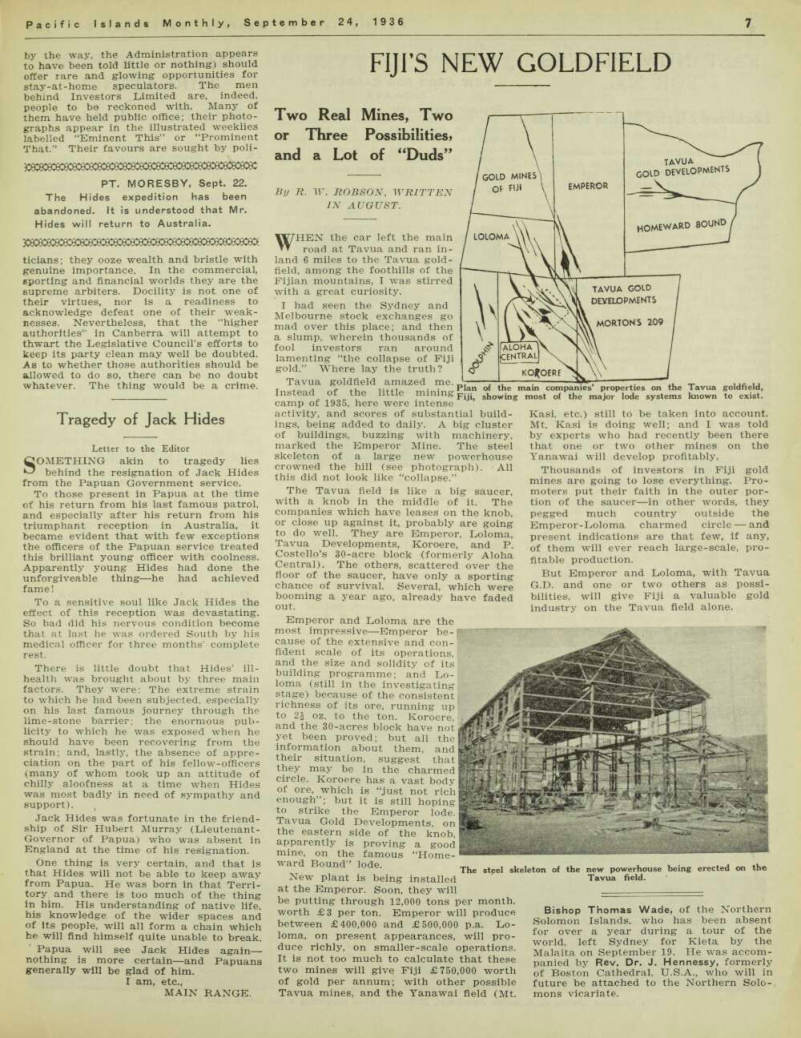
The Tavua field is like a big saucer, with a knob in the middle of it. The companies which have leases on the knob, or close up against it, probably are going to do well. They are Emperor, Loloma, Tavua Developments, Koroere, and P.
Costello’s 30-acre block (formerly Aloha Central). The others, scattered over the floor of the saucer, have only a sporting chance of survival. Several, which were booming a year ago, already have faded out.
Emperor and Loloma are the most impressive—Emperor be-| cause of the extensive and con fident scale of its operations,! and the size and solidity of its building programme; and Lo loma (still in the investigating stage) because of the consistent richness of its ore, running up to oz. to the ton. Koroere, and the 30-acres block have not yet been proved; but all the information about them, and their situation, suggest that they may be in the charmed circle. Koroere has a vast body of ore, which is “just not rich enough”; but it is still hoping to strike the Emperor lode.
Tavua Gold Developments, on the eastern side of the knob, apparently is proving a good mine, on the famous “Home ward Bound” lode.
New plant is being installed at the Emperor. Soon, they will
be putting through 12,000 tons per month, worth £3 per ton. Emperor will produce between £400,000 and £500,000 p.a. Lo loma, on present appearances, will pro duce richly, on smaller-scale operations.
It is not too much to calculate that these two mines will give Fiji £750,000 worth of gold per annum; with other possible Tavua mines, and the Yanawai field (Mt.
Kasi, etc.) still to be taken into account.
Mt, Kasi is doing well; and I was told by experts who had recently been there that one or two other mines on the Yanawai will develop profitably.
Thousands of investors in Fiji gold mines are going to lose everything. Pro moters put their faith in the outer por tion of the saucer—in other words, they pegged much country outside the Emperor-Doloma charmed circle and present indications are that few, if any, of them will ever reach large-scale, pro fitable production.
But Emperor and Loloma, with Tavua G.D. and one or two others as possi bilities, will give Fiji a valuable gold industry on the Tavua field alone.
Bishop Thomas Wade, of the Northern Solomon Islands, who has been absent for over a year during - a tour of the world, left Sydney for Kieta by the Malaita on September 19. He was accom panied by Rev. Dr. J. Hennessy, formerly of Boston Cathedral, U.S.A., who will in future be attached to the Northern Solo mons vicariate.
Plan of the main companies’ properties on the Tavua goldfield, Fiji, showing most of the major lode systems known to exist.
The steel skeleton of the new powerhouse being erected on the Tavua field.
Fast New Planes
For N.G.
Lockheed Electra Makes Records
new Lockheed Electra monoplane, imported from America to Australia by Guinea Airways Ltd. for use in New Guinea, has been making aviation his tory in Australia.
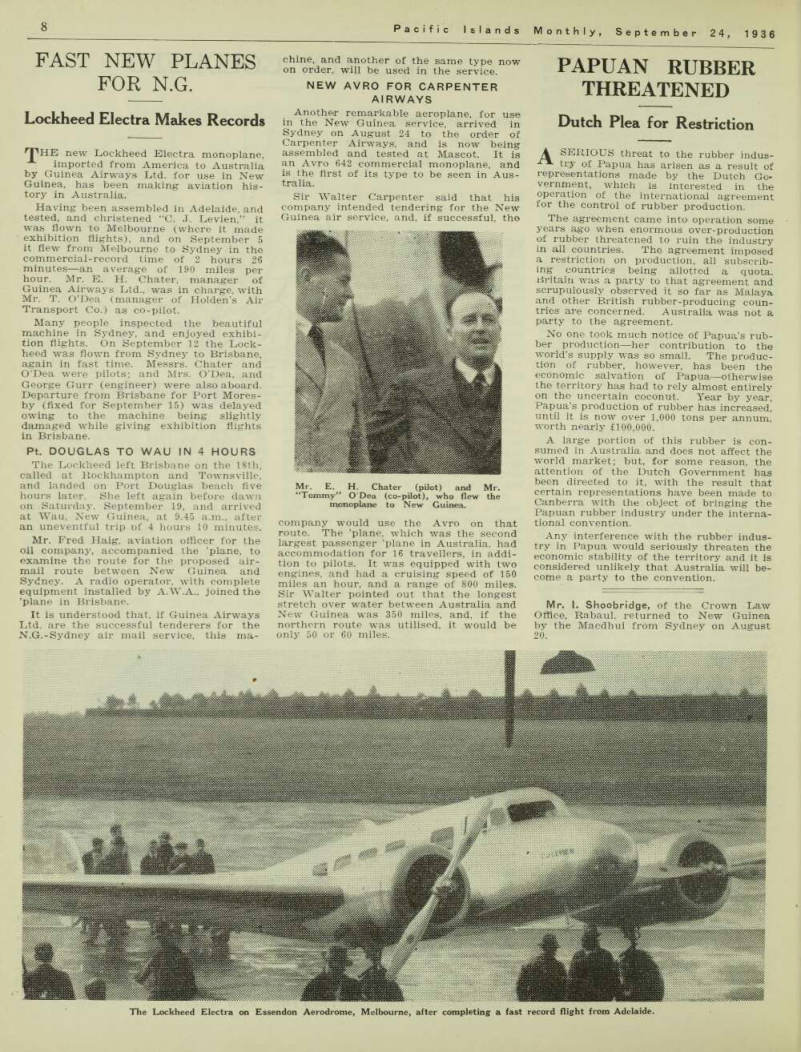
Having been assembled in Adelaide, and tested, and christened “C. J. Levien,” it was flown to Melbourne (where it made exhibition flights), and on September 5 it flew from Melbourne to Sydney in the commercial-record time of 2 hours 26 minutes —an average of 190 miles per hour. Mr. E. H. Chater, manager of Guinea Airways Ltd., was in charge, with Mr. T. O’Dea (manager of Holden’s Air Transport Co.) as co-pilot.
Many people inspected the beautiful machine in Sydney, and enjoyed exhibi tion flights. On September 12 the Lock heed was flown from Sydney to Brisbane, again in fast time. Messrs. Chater and O’Dea were pilots; and Mrs. O’Dea, and George Gurr (engineer) were also aboard.
Departure from Brisbane for Port Mores by (fixed for September 15) was delayed owing to the machine being slightly damaged while giving exhibition flights in Brisbane.
Ft. DOUGLAS TO WAU IN 4 HOURS The Lockheed left Brisbane on the 18th, called at Rockhampton and Townsville, and landed on Port Douglas beach five hours later. She left again before dawn on Saturday, September 19, and arrived at Wau, New Guinea, at 9.45 a.m., after an uneventful trip of 4 hours 10 minutes.
Mr. Fred Haig, aviation officer for the oil company, accompanied the ’plane, to examine the route for the proposed air mail route between New Guinea and Sydney. A radio operator, with complete equipment installed by A.W.A., joined the ’plane in Brisbane.
It is understood that, if Guinea Airways Ltd. are the successful tenderers for the N.G.-Sydney air mail service, this ma
chine, and another of the same type now on order, will be used in the service.
New Avro For Carpenter
Airways
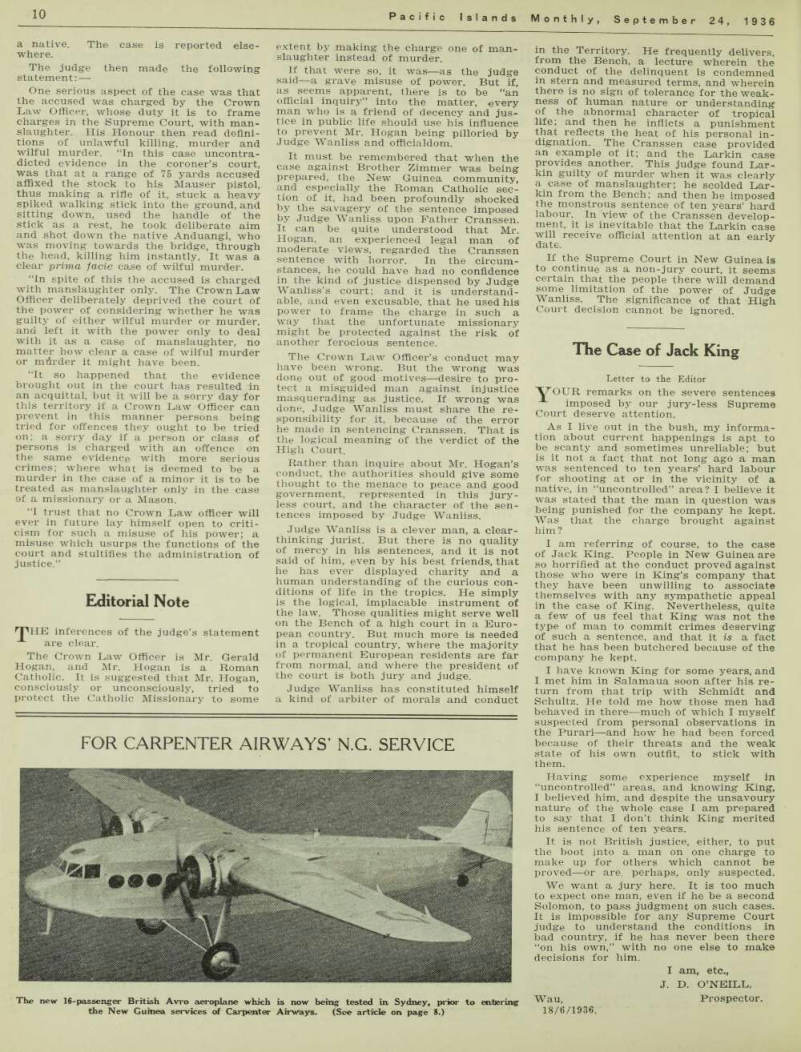
Another remarkable aeroplane, for us© in the New Guinea service, arrived in Sydney on August 24 to the order of Carpenter Airways, and is now being assembled and tested at Mascot. It is an Avro 642 commercial monoplane, and is the first of its type to be seen in Aus tralia.
Sir Walter Carpenter said that his company intended tendering for the New Guinea air service, and, if successful, the
company would use the Avro on that route. The ’plane, which was the second largest passenger ’plane in Australia, had accommodation for 16 travellers, in addi tion to pilots. It was equipped with two engines, and had a cruising speed of 150 miles an hour, and a range of 800 miles.
Sir Walter pointed out that the longest stretch over water between Australia and New Guinea was 350 miles, and, if the northern route was utilised, it would be only 50 or 60 miles.
Mr. E. H. Chater (pilot) and Mr.
“Tommy” O'Dea (co-pilot), who flew the monoplane to New Guinea.
The Lockheed Electra on Essendon Aerodrome, Melbourne, after completing a fast record flight from Adelaide.
Threatened
Papuan Rubber
Dutch Plea for Restriction
A SERIOUS threat to the rubber indus try of Papua has arisen as a result of representations made by the Dutch Go vernment, which is interested in the operation of the international agreement for the control of rubber production.
The agreement came into operation some years ago when enormous over-production of rubber threatened to ruin the industry in all countries. The agreement imposed a restriction on production, all subscrib ing countries being allotted a quota. -Britain was a party to that agreement and scrupulously observed it so far as Malaya and other British rubber-producing coun tries are concerned. Australia was not a party to the agreement.
No one took much notice of Papua’s rub ber production—her contribution to the world’s supply was so small. The produc tion of rubber, however, has been the economic salvation of Papua—otherwise the territory has had to rely almost entirely on the uncertain coconut. Year by year, Papua’s production of rubber has increased, until it is now over 1,000 tons per annum, worth nearly £lOO,OOO.
A large portion of this rubber is con sumed in Australia and does not affect the world market; but, for some reason, the attention of the Dutch Government has been directed to it, with the result that certain representations have been made to Canberra with the object of bringing the Papuan rubber industry under the interna tional convention.
Any interference with the rubber indus try in Papua would seriously threaten the economic stability of the territory and it is considered unlikely that Australia will be come a party to the convention.
Mr. I. Shoobridge, of the Crown Law Office, Rabaul, returned to New Guinea by the Macdhui from Sydney on August 20.
Judge Wanliss And Justice In New Guinea
High Court’s Significant Decision—The Attack on Crown Law Officer
THERE have been some remarkable oc currences in connection with the ad ministration of justice in New Guinea.
In our May issue, we directed pointed attention to the case of Father Cranssen — a young missionary, who had been sen tenced by Judge Wanliss to five years’ imprisonment for “having counselled cer tain persons wilfully and unlawfully to set fire to a dwelling house in New Guinea.”
The facts were simple. There was bit ter rivalry between this missionary and the Lutheran missionaries, out in the “uncontrolled area” behind Madang. The safety, if not the life, of Father Cranssen had been threatened by certain native teachers of the Lutheran organisation.
Father Cranssen sent his native helpers out to deal with the situation, and they deliberately burned down three grass huts occupied by the Lutherans.
Judge Wanliss, on May 8, in imposing the sentence of five years, scolded the missionary in these terms: “You have been a traitor to your Church —a Church that has spread Chris tianity to all parts of the earth. You have degraded your mission, and humili ated your bishop and his fathers. It
makes one’s blood boil to think of what you have done.”
We said, at the time, that it was an outrageous sentence —five years’ gaol for what after all was a trivial offence, com mitted in extraordinary circumstances.
The missionary was sent to Emu Plains prison farm, in New South Wales, to serve his sentence.
There was an appeal to the High Court in August; and on August 20 the High Court reduced the sentence. One judge thought the sentence should be two years: but the other three agreed that it should be six months.
With various remissions, this term be came four months, and Father Cranssen was released from the prison farm on September 2, and taken care of by his friends. He will not return to New Guinea.
The High Court judges said: “It appears manifest that a sentence of five years’ imprisonment is out of all pro portion to any view of the seriousness of the offence which reasonably could be taken. Chief Judge Wanliss’s opinion of the facts contains many observations which confirm the conclusion that he took altogether too extreme a view of the matter.”
While agreeing that there was no justi fication for Father Cranssen’s acts and that these were actuated by resentment against the intrusion of the Lutheran mission, a sentence of five years was “a crushing punishment.”
Lutheran Released
AN unexpected announcement was made in Canberra on September 8 when the Minister in Charge of Territories said that Rev. Henry Foege (a Lutheran missionary who was sentenced by Judge Wanliss in Rabaul last June to two years’ gaol for having “unlawfully deprived a native of his personal freedom”) will be released from gaol on October 1.
The Minister gave no explanation, be yond saying that the Administrator of New Guinea (Brigadier-General W. R. McNicoll), exercising powers vested in him by the Judiciary Ordinance, had remitted the balance of Mr. Foege’s sentence.
An appeal against the sentence, made on behalf of Mr. Foege, was dismissed by the High Court in Sydney in August.
Judge Makes Charge Against
Crown Law Officer
August 19, in the Supreme Court at Rabaul, Judge Wanliss found Brother Lucidius Zimmer, a Catholic missionary, not guilty of a charge of illegally killing
a native. The case is reported else where.
The judge then made the following statement: One serious aspect of the case was that the accused was charged by the Crown Law Officer, whose duty it is to frame charges in the Supreme Court, with man slaughter. His Honour then read defini tions of unlawful killing, murder and wilful murder. “In this case uncontra dicted evidence in the coroner’s court, was that at a range of 75 yards accused affixed the stock to his Mauser pistol, thus making a rifle of it, stuck a heavy spiked walking stick into the ground, and sitting down, used the handle of the stick as a rest, he took deliberate aim and shot down the native Anduangi, who was moving towards the bridge, through the head, killing him instantly. It was a clear prima facie case of wilful murder, “In spite of this the accused is charged with manslaughter only. The Crown Law Officer deliberately deprived the court of the power of considering whether he was guilty of either wilful murder or murder, and left it with the power only to deal with it as a case of manslaughter, no matter how clear a case of wilful murder or mtirder it might have been.
“It so happened that the evidence brought out in the court has resulted in an acquittal, but it will be a sorry day for this territory if a Crown Law Officer can prevent in this manner persons being tried for offences they ought to be tried on; a sorry day if a person or class of persons is charged with an offence on the same evidence with more serious crimes; where what is deemed to be a murder in the case of a minor it is to be treated as manslaughter only in the case of a missionary or a Mason.
“I trust that no Crown Law officer will ever in future lay himself open to criti cism for such a misuse of his power; a misuse which usurps the functions of the court and stultifies the administration of justice.”
Union S.S. Co.’S "Matua” Links Central Pacific Groups
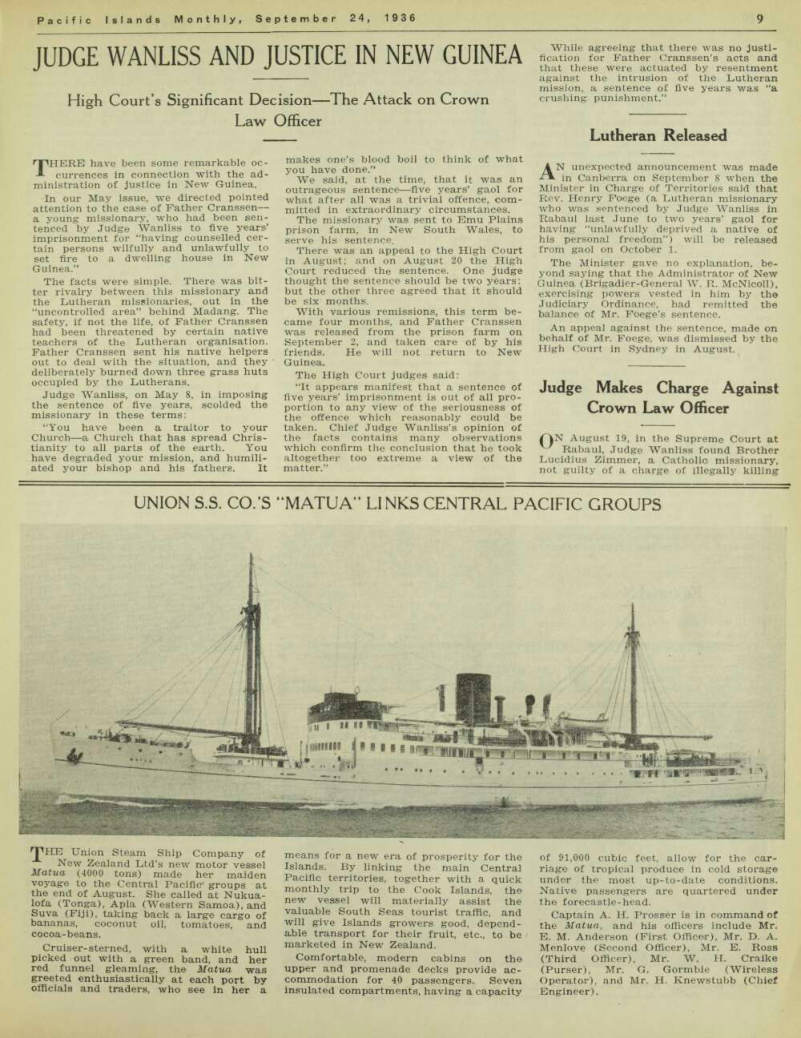
Union Steam Ship Company of New Zealand Ltd’s new motor vessel Matua (4000 tons) made her maiden voyage to the Central Pacific 1 groups at the end of August. She called at Nukua lofa (Tonga), Apia (Western Samoa), and Suva (Fiji), taking back a large cargo of bananas, coconut oil, tomatoes, and cocoa-beans.
Cruiser-sterned, with a white hull picked out with a green band, and her red funnel gleaming, the Matua was greeted enthusiastically at each port by officials and traders, who see in her a
means for a new era of prosperity for the Islands. By linking the main Central Pacific territories, together with a quick monthly trip to the Cook Islands, the new vessel will materially assist the valuable South Seas tourist traffic, and will give Islands growers good, depend able transport for their fruit, etc., to be marketed in New Zealand.
Comfortable, modern cabins on the upper and promenade decks provide ac commodation for 40 passengers. Seven insulated compartments, having a capacity
of 91,000 cubic feet, allow for the car riage of tropical produce in cold storage under the most up-to-date conditions.
Native passengers are quartered under the forecastle-head.
Captain A. H. Prosser is in command of the Matua, and his officers include Mr.
E. M. Anderson (First Officer), Mr. D. A.
Menlove (Second Officer), Mr. E. Ross (Third Officer), Mr. W. H. Craike (Purser), Mr. G. Gormbie (Wireless Operator), and Mr. H. Knewstubb (Chief Engineer).
Editorial Note
rpHE inferences of the judge’s statement are clear.
The Crown Law Officer is Mr. Gerald Hogan, and Mr. Hogan is a Roman Catholic. It is suggested that Mr. Hogan, consciously or unconsciously, tried to protect the Catholic Missionary to some
extent by making the charge one of man slaughter instead of murder.
If that were so, it was—as the judge said —a grave misuse of power. But if, as seems apparent, there is to be “an official inquiry” into the matter, every man who is a friend of decency and jus tice in public life should use his influence to prevent Mr. Hogan being pilloried by Judge Wanliss and officialdom.
It must be remembered that when the case against Brother Zimmer was being prepared, the New Guinea community, and especially the Roman Catholic sec tion of it, had been profoundly shocked by the savagery of the sentence imposed by Judge Wanliss upon Father Cranssen.
It can be quite understood that Mr.
Hogan, an experienced legal man of moderate views, regarded the Cranssen sentence with horror. In the circum stances, he could have had no confidence in the kind of justice dispensed by Judge Wanliss’s court; and it is understand able, and even excusable, that he used his power to frame the charge in such a way that the unfortunate missionary might be protected against the risk of another ferocious sentence.
The Crown Law Officer’s conduct may have been wrong. But the wrong was done out of good motives—desire to pro tect a misguided man against injustice masquerading as justice. If wrong was done, Judge Wanliss must share the re sponsibility for it, because of the error he made in sentencing Cranssen. That is the logical meaning of the verdict of the High Court.
Rather than inquire about Mr. Hogan’s conduct, the authorities should give some thought to the menace to peace and good government, represented in this jury less court, and the character of the sen tences imposed by Judge Wanliss.
Judge Wanliss is a clever man, a clear thinking jurist. But there is no quality of mercy in his sentences, and it is not said of him, even by his best friends, that he has ever displayed charity and a human understanding of the curious con ditions of life in the tropics. He simply is the logical, implacable instrument of the law. Those qualities might serve well on the Bench of a high court in a Euro pean country. But much more is needed in a tropical country, where the majority of permanent European residents are far from normal, and where the president of the court is both jury and judge.
Judge Wanliss has constituted himself a kind of arbiter of morals and conduct
in the Territory. He frequently delivers, from the Bench, a lecture wherein the conduct of the delinquent is condemned in stern and measured terms, and wherein there is no sign of tolerance for the weak ness of human nature or understanding of the abnormal character of tropical life; and then he inflicts a punishment that reflects the heat of his personal in dignation. The Cranssen case provided an example of it; and the Larkin case provides another. This judge found Lar kin guilty of murder when it was clearly a case of manslaughter; he scolded Lar kin from the Bench; and then he imposed the monstrous sentence of ten years’ hard labour. In view of the Cranssen develop ment, it is inevitable that the Larkin case will receive official attention at an early date.
If the Supreme Court in New Guinea is to continue as a non-jury court, it seems certain that the people there will demand some limitation of the power of Judge Wanliss. The significance of that High Court decision cannot be ignored.
Advertisements & other items, p. 12 (1 item)
For Carpenter Airways’ N.G. Service
The new 16-passenger British Avro aeroplane which is now being tested in Sydney, prior to entering the New Guinea services of Carpenter Airways. (See article on page 8.)
The Case of Jack King
Letter to the Editor "V"OUR remarks on the severe sentences imposed by our jury-less Supreme Court deserve attention.
As I live out in the bush, my informa tion about current happenings is apt to be scanty and sometimes unreliable; but is it not a fact that not long ago a man was sentenced to ten years’ hard labour for shooting at or in the vicinity of a native, in “uncontrolled” area? I believe it was stated that the man in question was being punished for the company he kept.
Was that the charge brought against him?
I am referring of course, to the case of Jack King. People in New Guinea are so horrified at the conduct proved against those who were in King’s company that they have been unwilling to associate themselves with any sympathetic appeal in the case of King. Nevertheless, quite a few of us feel that King was not the type of man to commit crimes deserving of such a sentence, and that it is a fact that he has been butchered because of the company he kept.
I have known King for some years, and I met him in Salamaua soon after his re turn from that trip with Schmidt and Schultz. He told me how those men had behaved in there —much of which I myself suspected from personal observations in the Purari—and how he had been forced because of their threats and the weak state of his own outfit, to stick with them.
Having some experience myself in “uncontrolled” areas, and knowing King, I believed him, and despite the unsavoury nature of the whole case I am prepared to say that I don’t think King merited his sentence of ten years.
It is not British justice, either, to put the boot into a man on one charge to make up for others which cannot be proved—or are, perhaps, only suspected.
We want a jury here. It is too much to expect one man, even if he be a second Solomon, to pass judgment on such cases.
It is impossible for any Supreme Court judge to understand the conditions in bad country, if he has never been there “on his own,” with no one else to make decisions for him.
I am, etc.,
J. D. O’Neill,
Wau, 18/6/1936.
Prospector.
Tropicalities
THERE are bitumen roads all around Apia (Samoa) now; and the mis chievous boys of the native villages de rive entertainment from the fact that the bitumen surface can be made very slip pery. For this nefarious purpose, they use the juice of the bread-fruit, which they smear on the roadway. The unsus pecting elder of the village—or anyone else, for that matter —walking in the darkness onto the juicy patch, is said to turn as pretty a “seven” as anything seen in vaudeville. The dignified representa tive of the New Zealand United Press, on a visit there in July, thought the prac tice quite funny—until he himself was trapped, and performed vivid acrobatics before a mixed and appreciative com pany. * * * THE following typical “item” was pub- A lished recently in a newspaper in Los Angeles., U.S.A.: “A new British-American syndicate soon will be formed to mine placer gold from deepest, head-hunting New Guinea, according to Mr. Stanley Johnston, pros pector, of Australia, who arrived in Los Angeles aboard the Mariposa. After a few days in Los Angeles he proposed to hurry on to New York to sail thence for London.
“Mr. Johnston, who said he had already found rich sands in Papua, declared he had concessions from Australia and Hol land to prospect for gold and oil far in the interior, where last year a patrol found two strange races. One was white, of fair skin and light hair and of stocky build; the other black and of Semetic features, who excelled at bartering. Not one-fifth of the country’s 300,000 square miles has been prospected, he said, due to malaria and to savage tribes.
“Of the strange race of white men found last year, he quoted their discov erers, Messrs. Jack Hides, a magistrate, and J. O’Malley, a patrol officer: ‘They avoid intermarriage by yearly inviting single males of another tribe for a three day party with maids of another,’ he said.
When the party is over the men take home new wives. When they want div orces all they have to do is cast them off!’ ” ♦ * * 'ATOUNG Cakobau, of the royal house of Fiji, was on a liner in Sydney har bour, on his way home to Suva from an Australian college, when he was ap proached by a reporter, who made the initial mistake of trying to talk to him in a kind of Pidgin. Having settled that matter to his satisfaction, the prince grimly awaited further developments.
“And what are you going to do, now, in Fiji, Mr. Cakobau?” chirruped the re porter.
“Oh, I’m going to grow bananas with zip fasteners!” replied the prince, and thus got rid of the pest. * * * THE New Zealand authorities, who operate in Samoa one of the most fantastic systems of liquor-control ever seen in captivity, excuse themselves by saying that the system is planned for the protection of the natives.
There are Polynesians in Tonga and semi-Polynesians in Fiji; but the Gov ernments of those Territories, who are just as concerned as New Zealand about
native welfare, do not attempt anything so ridiculous as the Samoan prohibition law. Europeans in Tonga can purchase whatever liquor they require; but if they misbehave, or break the liquor laws, they are forbidden to have liquor. Natives must not be supplied with liquor, except in special circumstances.
In Fiji, liquor is sold to Europeans, without restriction, through licensed hotels and clubs. Liquor must not be supplied to Fijians or Indians; but re sponsible Indians and Fijians, of good class, may obtain permits to purchase liquor. Misbehaviour, of course, brings cancellation of the permit. * * * /AUR ethnological friends may be interested in a statement made to me by Mr, C. E. Hall, cabinet-maker, of Apia.
Mr, Hall has made almost a lifetime study of Samoan timbers, and he says that two trees, peculiar to India, were found growing on the coastal belt of Savaii and Upolu when Europeans arrived. They are the timbers known as Indian Nutwood (wild almond) and Tulip-wood. For an explanation of their presence in Samoa, we apparently must go back beyond re corded history, to the so-called Poly nesian migrations, which are believed to have had their origin in India. —R.W.R. * * * A WELL-KNOWN citizen of Suva met many old friends in Sydney, with the inevitable result. The Suva man, being very completely under “the influence,” decided to call it a day and go home. He found his way out into Martin Place, crawled carefully into a taxi, and curled up on the seat. In Suva, such matters are easily arranged: the Indian taxi drivers know him, and his home, and no further directions are required. But the Sydney taxi-man was at a disadvantage, “Where to, sir?” he said. The Suva man sighed deeply. The taxi-man repeated his question. The Suva citizen stirred him
self slightly. “Home, dammit, home!” he growled. And as that was all the driver could get out of him, he did the only poss ible thing, and drove the patient round and about the city until he had sufficiently recovered to give his Sydney address.
Another Fiji resident, celebrating in Sydney his accession to a share of gold fields wealth, drove a car out to Double Bay; and, in front of a block of flats there, ran over and broke a fire hydrant.
The resulting waterspout lifted the car into the air, but the Fiji man got safely away from it. He was sitting sadly watching the waterspout when indignant caretakers and police assembled. “Who did this?” they asked him. “A woman driver,’” said the Fijian. “She hopped it.
Terribly unreliable, these women drivers —oughtn’t to be allowed to have licenses.”
The police are still looking for the care less woman motorist. • * * XT ERE is a new kind of family pet. I was having afternoon tea with a family in Suva when I was unexpectedly nipped on the ankle by a tortoise. When the excitement had died down, and apolo gies had been given for the unladylike be haviour of “Cleopatra,” I asked why so curious a creature had been admitted to the domestic circle. “Dogs and cats soon get old and die,” I was informed. “We grew tired of weeping over them and burying them. We were told that tor toises live for hundreds of years. Cleo patra is said to be over 50 years old, and she isn’t a bit withered. Cleopatra knows us all, and is very happy.”—R.W.R.
Monsieur F. Colardeau, member of New Caledonia’s Parliament, arrived in Sydney in September on his way to France- for a year. He is president of the Returned Soldiers’ Association at Noumea and is one of the most distinguished lawyers in the French Colony.
Mrs. Waikainga Tipene, chieftainess of the Polynesian Club of Sydney, left for New Zealand in September on a visit. In Wellington she will convey reciprocal greetings to the Maori Club from Sydney Polynesians.
Advertisements & other items, pp. 13-14 (1 item)
Home
STERLING
HOME PAINT
Guaranteed
LOOKS
BETTER
LONGER
MADE BY
STERLING VARNISH CO.
RmoK
HOME
J!
For
TROPICAL
SUN and
SALT-LADEN
AIR
SYDNEY, N.S.W.
NEGLECT OF DEFECTIVE SIGHT
MAY CAUSE SERIOUS RESULTS
Take Care of Your Eyes Consult
WALTER FORD
D. 8.0. A., M .0.0. A. Optometrist and Optician 4th Floor, Challis House Martin Place, Sydney Established over 30 years Tel.: Most moderate charges BW 6131
Wolaroi College, n.s.w.
I J A Boys’ School situated on the Central Tablelands within easy reach of Sydney. EX-
CELLENT CLIM-
ATE. 3000 feet above sea-level.
Preparatory and Secondary School.
P rofessional, Commercial and A g ricultural Courses.
Every facility for Sport in grounds of 50 acres.
LIBERAL DIET: Wolaroi has its own Jersey Herd, Poultry and Vegetable Garden. Fruit from the Canobolas Orchards.
For ILLUSTRATED PROSPECTUS apply to
Stanley G. Brown, M.A., B.Sc., Principal.
S5-S ■3 ■ ■> 'c.-V
BAYLEFB
FLUID MAGNESIA
A Product of
ELLIOTTS & AUSTRALIAN DRUG Ltd.
A Valuable Aid to Digestion
Relieves —
HEARTBURN
DISPEPSIA
BILIOUSNESS, etc.
OBTAINABLE
AT ALL HIGH-CLASS CHEMISTS
AND STORES.
About Islands People
Queen Salote, of Tonga, and the Prime Minister and Royal Consort, Prince Tugi, will leave Sydney by the Awatea on Sep tember 25 for New Zealand. In the Waikato the Queen and her husband will be guests of the young Maori king, Koroki.
His Excellency Sir Arthur Richards, Governor-designate of Fiji, is expected to arrive in the Colony by the Matua on November 27.
Mr. Arthur Mayhew, C.M.G., C.1.E., M.A., secretary to the Advisory Committee on Native Education in the British Colonies, London, arrived at Suva from Honolulu by the Niagara on August 28. He was
accompanied by the Hon. James Russell, M.C., 8.A., Director of Education for Fiji, who was returning from the international conference on Education of Pacific Peoples recently held at Honolulu. Mr.
Mayhew, who was for many years en gaged in educational administration in India, and who has visited almost every British colony during the past few years, will spend three weeks in Fiji, examining the system of education.- It is expected that he will give a good deal of attention to investigating the educational work be ing carried out amongst the Indian popu lation of Fiji.
Dr. Bernard Mishkin, anthropologist, from Columbia University, U.S.A., arrived in Australia by the Monterey on Septem ber 7 to carry out research in New Guinea. Messrs. S. M. Reed and J. W.
Whiting, former students of Professor Peter H. Buck, at Yale, have already left for New Guinea on a similar mission, and will make their headquarters in a village on the Sepik River.
Dr. S. M. Lambert, chief of the medical research staff of the American Rockefeller Foundation, of Suva, Fiji, arrived in Apia in August accompanied by Miss E. Ten nant, of the Foundation’s nursing service.
They are travelling extensively on Upolu and Savaii, studying medical and sani tary conditions, with special regard to child welfare work.
Miss Edith Twyford, Methodist Mission nursing sister, left Sydney for Papua on her return to the Salamo Hospital by the Montoro on September 9. It is almost two years since she left Salamo after a stay of six years, and she has now gone back for an indefinite period.
Mrs. O. M. Parr, of the Samoan Educa tion Department, left Apia in August by the Maui Pomare for New Zealand. Mrs.
Parr, who has done much valuable work in the re-organisation of the European and native schools in Western Samoa, was farewelled by the Government Malifa and Avele schools and presented with suitable souvenirs in appreciation of her work.
Miss Nita Inman, a teacher of the Aus tralian Board of Missions stationed at Taupota, Papua, who has been on fur lough in Victoria, spent some weeks In Tasmania early in September in the in terests of the New Guinea Mission’s, work in Papua.
Mr. Major Harper, well-known planter and trader of Mandoliana Island in the Solomons Group, has been in Australia on holidays since May last. After spending a few months in Sydney, he went on to Adelaide where, for several weeks, he was the guest of Mr. and Mrs. Frank Stafford- Jones, of Kensington Gardens. Before leaving for Tulagi by the September Malaita he paid a short visit to Queens land.
Mr. P. Kodanda Rao, M.A. travelling re presentative of the Servants of India Society, arrived in Suva by the Niagara on August 28. After spending a year in the study of race relations at Yale Uni versity, U.S.A., under a Carnegie Fellow ship, Mr. Rao visited British Guiana to investigate the social conditions of the Indian population there. He stopped over at Honolulu to attend the Conference on Pacific Education before proceeding to Fiji to inquire into the educational and social conditions of the Indian population.
Mr. Rao, who is a quiet, cultured type of Indian gentleman, has held many import ant posts in India. After spending a month in Fiji, he will nroceed to New Zea land and Australia, t<r deliver lectures and will return to Poona via Rabaul and the East Indies.
Mr. George Bailey, an old identity of Norfolk Island, died at the age of 87 on August 25. An Englishman, he spent some years in New Zealand before mak ing his way to Norfolk Island where he resided for 40 years. He married a daughter of Charles Christian, a descend ant of the Bounty mutineers. When the Melanesian Mission had its headquarters on Norfolk Island, Mr. Bailey was ap pointed blacksmith; and he was asociated with the Mission, particularly as a musi cian, throughout the whole of his life.
Rev. W. A. Dickie, of the Melanesian Mission, who has been stationed for two years at Pawa school on the island of Ugi in the Solomons Group, reached Syd ney on furlough by the Malaita on Sep tember 11.
Mr. Russell, Legal Adviser to the Go vernment of Siam, has been appointed Chief Police Magistrate in Fiji in succes sion to Mr. A. Hallam Roberts, who was recently transferred to Zanzibar. Mr.
Russell is expected to arrive in Suva in October.
Mr. Francis E. Williams, of Papua, and Professor A. P. Elkin, of Sydney Univers ity, returned to Australia from Hawaii by the Monterey on September 7. Mr.
Williams, who is Government Anthropolo gist in Papua, returned to Port Moresby with his wife by the Montoro from Sydney on September 9.
Mr. Joseph Williams, of Levuka, Fiji, married Miss Rosaline Jane Rosa, daught er of Mr. and Mrs. W. J. Rosa, of Kaibu, Yacata Island, on August 8. The mar riage ceremony, performed by Rev. Mr.
Bock, linked two of Fiji’s oldest pioneer ing families.
Rev. D. F. Boorman, L.Th., departed from Sydney for the Methodist Mission’s station at Levuka, Fiji, by the Mariposa, on August 19.
Mr. J. W. Matley, manager of Waiganl plantation, Eastern Papua, arrived in Sydney with his wife by the Montoro from Port Moresby on September 1.
Mr. Frederick Godfrey Palfreyman, of the Department of Education, New Guinea, resigned from the Public Service on August 6.
Mr. H. Sabben, Mechanical Engineer in the Fiji Public Works Department, ac companied by Mrs. Sabben, left Suva on leave by the Niagara on August 28.
Mr. Robert Boulter, British Trade Com missioner for New Zealand, arrived in Western Samoa from Tonga by the Tis naren in August. He is investigating trade conditions in the various Pacific groups.
Mr. A. Lewis Milner, who has been teaching on behalf of the Melanesian Mis sion at Pawa, Ugi, in the Solomons, passed through Sydney in September on his way to spend furlough in New Zealand. He joined the mission from New Zealand in 1934, and was for a time on Aoba Island.
Rev. Canon S. W. Williamson, rector of Tocumwal Anglican Church, N.S.W., re turned to Melbourne by the Triaster on September 9, after one of his periodical visits to Ocean Island.
Mr. James Duthie, 55, of Nausori, Fiji, died on August 23, following a short ill ness. He had been in the employ of the Colonial Sugar Refining Co. Ltd., at Nausori, all his life.
Mr. J. G. Grant, manager of Messrs.
Walter Horne and Co. Ltd., of Suva, re turned to'Fiji by the August Aorangi.
Advertisements & other items, pp. 14-16 (2 items)
Kurrajong
Wheeny Creek Farm
Forty-five miles from Sydney Superior modern accommodation, abundance of cream, eggs, and poultry, 5 acre* orchard. Tennis, etc.
Tariff: Double, £2/2/- each; Single, £2/10/* ’Phone: Kurrajong 42 Proprietor: A. J. SAMSON Formerly New Guinea Public Service
THE SCOTS COLLEGE
BELLEVUE HILL, SYDNEY
Boys' Boarding and Day College (Presbyterian) with Preparatory School.
Principal: A. K. ANDERSON, M.A.
A Great Public School of N.S.W. Staffed with nineteen Masters. Professional, Commercial and Pastoral Courses.
Prospectus on application to Principal or Bursar.
nn V ' m \ V
•’ .&A. Y A \
V Si 1
GUARD AGAINST
INFECTION
rropical Diseases
Hold I\o Terrors
—if you use TEN AX Daily
The germs of Diphtheria, Malaria. Dhobie Itch and Tinea cannot harm you if you are protected by the rich "Ti-trol" lather of
TENAX.
TENAX is the ONLY soap containing oil distilled and marketed by Australian Essential Oils Ltd. under the registered trade-mark of "Ti-Trol," eleven times quicker than carbolic as a germicide, but NON-
POISONOUS and NON-IRRITANT.
A Product of Australian Soaps Limited
TENAX
Oht C/ejMUfceuf
TOILET SOAP
“ The!
Wentworth
CHURChmiU., SYDNEY
’Phone: BW 1361 (10 Lines) Telegraphic Address: “Mum,” Sydney
Sydney’s Exclusive
Hofei
Situated only two minutes from the General Post Office, Railway Station, and leading theatres. All rooms Steam-heated in Winter and Air-cooled in Summer, and equipped with Telephone, and Hot and Cold Water.
Excellent Cuisine.
Tariff. Room and Breakfast, from 10/6 per day; Inclusive from 18/- per day.
For full particulars apply to The Manager.
I » t It* % m
TUDOR HOTEL
Room Only Rate, 5/- per day. Meals a la carte. Accommodation for 100 guests. One minute from G.P.O.
127 PHILLIP ST. Tel.: BW 2788
Next door to Martin Place
Sydney
TROPICAL
suits”*
FOR many years the House of Pike Brothers Limited has specialised in the production of Tropical Suits. The quality, cut and general design are irreproachable.
Write for full particulars of their Tropical Wear including Suits, Helmets, Underwear, etc.
LIMITED
m Queen Brisbane
i
About Islands People
Cook Is. Fruit
Recommendations of N.Z.
Delegation
From Our N.Z. Correspondent
Auckland, Sept. 9.
r pHE report of the Parliamentary delega tion which recently visited the Cook Group to inquire into fruit marketing, has been tabled in the House of Representa tives. The chief recommendations made by the delegation, which comprised Messrs. J. Robertson and C. L. Hunter (Labour), and S. G. Holland (National), are as follows: The whole of the fruit trade should be under the personal supervision of a Director of Agriculture or general mana ger, having full powers to carry out Go vernment policy and general control of the industry.
A citrus expert should be appointed. A long term citrus planting plan should also be inaugurated to be developed concur rently with the growing of crops on exist ing trees in order to avoid a disturbance of growers’ incomes.
A central packing shed and cool store should be established at Rarotonga to replace the existing seven district native packing sheds.
Negotiations should be entered into be tween the Government and N.Z. mer chants to dispose of the fruit at an “agreed fair price.” The improvement in the quality of the fruit exported, to gether with the improved shipping, should enable merchants to pay a higher price.
Such negotiations should include provi
sions for adequate payment for all useful service rendered and should result in a substantial reduction in th e retail price of fruit to the N.Z. public.
The report mentions that in view of the fact that a commission was inquiring into the system of marketing fruit in New Zealand, the delegation had conferred with it, and it was proposed at the conclusion of that inquiry to make a separate and a joint report covering proposals for the future disposal of Cook Island fruit in New Zealand.
The disparity in shipping charges on Cook Islands’ bananas to southern ports compared with the charges on Samoan and Niue bananas is commended to the Government for investigation.
The report will be considered by the Industries and Commerce committee of the House in framing its recommenda tions. on the two petitions from Rarotonga presented earlier in the year.
N. Guinea Gold Production
Down 12 %
exported from the Morob© gold field, New Guinea, during June was 37,264 ounces valued at £A186,594, bring ing the total for the year to 300,730 ounces worth £A1,649,788. This is a re duction of about 12 per cent, on last year’s figures.
This information was contained in the Warden’s official report issued early in July, which added that the figures are subject to adjustment on final returns being received.
On August 4, the Warden announced that production for July was 25,828 ounces, valued at £A153,748.
Advertisements & other items, p. 16 (1 item)
St, Ignatius' College - Kiverview, Sydney
BOARDING and DAY SCHOOL :: :: :: Conducted by the Jesuit Fathers
ONE OF SYDNEY’S GREAT PUBLIC SCHOOLS
gOYS prepared for Intermediate and Leaving Certificate Examinations and for Exhibitions, Scholarships and Bursaries at the University.
Boys are arranged in three divisions according to age and size.
Each division has its own library, debating society, cricket and football field, tennis court.
Senior and Junior Rowing Sheds. Private Swimming Baths.
Prospectus and Further Particulars on application to the Rector,
REV. J. MEAGHER, S.J.
Telephone, J I 106. saaa . c:. t ' mil
til
i i 'AT m , m m ¥ V- ■r 11 i -■■■ 111
Education In Pacific Countries
Summary of Proceedings at Honolulu Conference
From a Special Correspondent.
Honolulu, Sept. 2.
THE Carneeie-snonsored Conference on HE Carnegie sponsored Conterence on Educatmn in Pacific Countries with over 50 delegates varioa ® Pac * flc Terntones, U S.A., and the East, has coneluded after five weeks of session. The members have all departed for their respective spheres of work. . , , .
The sessions were conducted under the joint auspices of the Universities of Hawaii and Yale (L.S.A.); Dr. Felix Keesmg a New Zealander), Professor of Anthropology at Irawaii, and Dr. C. T.
Loram (formerly of South Africa), Sterhng Professor of Education and Race Relations at Yale, being co-directors.
Sessions were held in camera, so that little publicity was given to the proceedings. In consequence, the importance of the meetings was overshadowed by the Pan-Pacific Medical Congress, which sat for two weeks at Honolulu simultaneously with the Education Conference; and by the Institute 'of Pacific Relations sessions being held at Yosemite (U.S.A.). In order to appreciate what the Education Conferenoe accomplished, It is necessary to know what its purpose was.
The delegates were not merely teachers and professional educational theorists, but “people more interested in the results of education than in its processes, techniques or administration: anthropologists sociologists, colonial administrators and the like, rather than school chiefs or teachers.
The objective of the conference was not so much the solution of problems as the evaluation of results that have accrued from the application of different national educational policies in colonial and dependent areas. The proceedings dealt with all aspects of European contact with non-European peoples, and the broadly educational implications of such contact.
Perhaps the chief accomplishment of the Conference lay in the comparison of situations in different regions, of methods adopted in those regions, and the pooling
of ideas generally. Every delegate left with a feeling unity of purpose with all other delegates; with a clear conception of princi p les; and a wider understanding of the nature of the problems of race relations in the Pacific, ~, . , Throughout the sessions, which covered a wlde diversity of controversial subjects, there was a complete absence of national istic bias or rancour, each group, Japan esGj British> u.s.A., French, and Chinese. working in absolute harmony with the others . T he method of proceedings was f or selected members to present formal pa p ers on particular aspects of the gen eral subject (as, for example, McCor mick, of the Philippines, and Williams, of Papua, on "The Language Problem”), and these papers were followed by shorter statements from representatives of other Territories, with freedom of comment, question and discussion after the formal presentations. The system worked ad mirably and resulted in a vast amount of comparative material and numerous points of view being reviewed in each topic-session.
The proce edings will be published, in summarised form, within the next few months; and they should provide a handy reference for all those interested in native development and race relations in the Pacific.
The hope was unanimously expressed by tlie delegates that means might be found t 0 set up a cen tral clearing-house, with a skeleton secretariat, for the col lation of materials and the study of pro jects relating to native education, the University of Hawaii being suggested as a suitable location for such a bureau, Reference should be made to the tre mendous amount of organization work done by Dr. Keesing before and during the conference. He and his brilliant wife (also a New Zealander) were untiring in their day-to-day work of organizing papers and generally arranging proceed ings.
The Australian group presented a num
ber of formal papers, and contributed freely to general discussions. Professor A. P. Elkin, of Sydney, and Mr. N. B. Tin dale, of Adelaide, adequately treated the problem of the Australian aborigine, while Mr. F. E. Williams, Papua’s official an thropologist, delivered a most interesting public lecture on “In Primitive Papua.”
Mr. William C. Groves gave an address to the Pan-Pacific Union luncheon assembly, on “The Native Situation in the Terri tory of New Guinea.” The Australian group also presented a symposium before the Anthropological Society of Hawaii.
Fiji was represented by Hon. James Russell, Director of Education in that Colony; the Maoris and Polynesian gen
erally by Dr. Peter Buck and Dr. Ernest Beaglehole, anthropologists, and Mr. D.
G. Ball, of the Maori section of the N Z Dept, of Education; the Gilbert and Ellice Islands, by Mr. H. E. Maude (anthropolo gist and colonial official); Western Samoa, by Mr. D. J. Rutherford in person, and by a paper prepared by Mr. McKay, Secretary for Native Affairs in Samoa; and the Barstow Foundation in American Samoa was represented by Dr. Gordon Brown, anthropologist, who is conducting an interesting experiment in educating a group of Samoan native lads on the foun dation of Samoan native arts and culture.
This experiment will be watched with interest by students of race-contacts, if only because its procedure is radically opposed to the official educational pro gramme of American Samoa, which is organized to develop on English-speaking, semi-Europeanised Samoan people of the future. There is room for a number of experiments on similar lines in the South Pacific, in view of the present indefinite educational policies of certain territories, and it is not improbable that one or other of the Research Foundations may be pre vailed upon to supply the finance for such projects. Every member of the Confer ence seemed convinced of the wisdom of
a slow, experimental ’ and scientific ap proach to native education and develop ment in the future. To proceed too fast was to defeat the real purpose—of adjust ing native life to modern conditions of European civilization.
One British delegate, interviewed after the Conference had concluded, gave the following as representing the general con clusions which he personally drew from the sessions, especially in the matter of native education: 1. The desirability of protecting native peoples trom aggressive European contacts and conse quent disorganisation of social life. 2. The right of native peoples to develop and progress side by side with European occupation and development of the Territories concerned. 3. Need to give recognition to the worth-while and indispensable elements of native social life and culture in formulating educational schemes tor native development; adapting native culture to new conditions and blending it with those Euro pean practices necessary to such development. 4. All education aimed at native social develop ment must proceed slowly, the impulse to pro gress being made to come, as far as possible, from within the native societies themselves. 5. An evolutionary process of compromise in directing natives towards development, is more stable and far-reaching than a revolutionary and uncompromising Europeanising plan, such as has been pursued in certain Territories in the past. 6. Special attention needs to be given to the economic development of the native peoples, in dependently of European economic enterprises; such economic development to be planned and directed by the governments or under government educational supervision. 7. While the value of the social and educational work being done amongst native peoples by mis sions is recognised, it is desirable that such work be always subject to government regulation and supervision, and conducted in accordance with the general policy of native affairs of the government. 8. Because of the special part played by mis sions in native yillage life of to-day, the need for close co-operation and understanding between government and missions in all secular educational and social work is stressed. 9. An alliance of social anthropology and educa tion is desirable in organising projects for native development, in order that the projects may be built primarily on a natural foundation of native life, interests and institutions. Scientific know ledge of native sociology and psychology appears essential to success in a process of adaptation that aims at a blend of native and European cultures. 10. The need for continuity of effort in educa tional projects, frequent changes of policy, methods and educational personnel make for disjointed work, and bewilder the natives, who tend to lose confidence in the system. It is recognised that those missions have become most firmly and per manently established in native life, whose Euro pean staffing arrangements have undergone least changes. 11. A skeleton organisation of permanent govern ment educational staff, carefully-selected and rightly-trained, is more effective than a recur rently-changing temporary group. This applies more particularly to the directing personnel and those connected with supervision of missionary educational activities.
Advertisements & other items, pp. 17-18 (1 item)
Prouds
Examples of
Sterling Value
obtainable at
PROUDS
FINE QUALITY DIAMOND RINGS 18ct.
White Gold and newest Filigree Settings in Pure Platinum
193? Catalogue
Of 80 pages illustrating all the latest novelties will be ready for posting in October. Write now for your copy and it will be mailed post free.
Prouds Limited
V £25/-/- £25/-/- Smaller Stones £2O/-/- Smaller Stones £l5/-/- £25/-/- £25/-/- Smaller Stones £l5/15/- Smaller Stones £l5/-/-
The
On parle Francais
Corner KING & PITT STREETS. SYDNEY
Improved ALLEGRO SHARPENER
-FOR SAFETY BLADES
Stroppmqßlock Blade Carrier
k iblad'* With
3 HUNTER
SV.ONE t
Automatically strops and hones both sides of blade without removing blade. No skill required—just slide blade holder up and down.
Made in different models to fit the following types of blades.
For Gillette Type only; for both Auto Strop and Gem; for both Star and large size Wilkinson; for Empire Model Wilkinson Blades.
Price in Black Enamel Finish, 25/- each; Nickel-plated, 28/- each.* Nickel-plated Machine for Durham Duplex or Sextoblade Blades, 28/- each.* Please state for which type Blade Machine is required.
POST FREE FOR CASH WITH ORDER
W. Jno. Baker Ltd.
WILLIAM FINAU
Photographer
FRIENDLY IS., OCEANIA
™ Tongan views and Natives’ ■i life scenes, set, 5/3 prepaid ▼ anywhere. Tapacloth, largo piece, 6/6 prepaid anywhere.
Much that comes down to us from the past is of a quality that can be described only as truly rare DEWAR’S is the classic instance amongst whiskies. •«in» toMrfis H Venetian Glass in Murano Museum, green with detail /a, i in cream <sc gold.
DEWAR’S
l&s
SCOTCH WHISKY
Possible Distinguished

Visitors For New Guinea
THE Administrator of New Guinea (Brig.-General McNicoll), who is at present in Australia on furlough, has sug gested that the Governor-General (Lord Gowrie) and the Prime Minister (Mr.
Lyons) should pay an official visit to New Guinea, and see how Australia is carrying out her responsibilities as a Mandatory.
The suggestion has been received with interest, and is being considered.
It is too late, this year, to make the trip. Next year, Mr. Lyons must go to London, to the Coronation. But the Governor-General may pay New Guinea a visit.
Mr. M. L. Bernacchi, who has been appointed a Cadet in the Fiji Civil Service, arrived in the Colony by the Port Fairy on August 19.
Captain E. A. Barnett, Deputy Inspector General of Constabulary in Fiji, accom panied by Mrs. Barnett and family, re turned to the Colony from long leave in England by the Port Fairy on August 19.
Captain Barnett is now acting as In spector General of Constabulary.
Advertisements & other items, pp. 19-20 (1 item)
<Odak
Ik
All that's Newest
in Picture Making
/ The new Kodak Catalogue, now in the press, contains all the latest news and information about the world's most fascinating, most personal hobby—Photography.
Island readers should apply by return post for their free copy of this beautiful book (size 10 x 7 inches, 68 pages), the supply of which is very limited.
i liniii
urn
KODAK RETINA
offers those popular, convenient features of work with 36 exp. 35mm.
Kodak Film Magazines at lowest possible cost. Has f/3.5 Anastigmat Lens, Compur Shutter with speeds to 1/500 second.
Price £lO/10/-. New improved model with Chromium Finish. Price £l2/-/-.
BANTAM SPECIAL
Smart streamlined style in machined aluminium case.
Directly - coupled military type range finder; automatic film measuring and centring; new f/2 Ektar Lens; Compur Rapid Shutter. Sets an entirely new standard of value at £26/10/-
KODAK REGENT
Completely streamlined with every thing “built-in.” Has directly coupled range finder. With f/3.8 Lens and Compur Shutter. For popular 2\ x 3* inch pictures.
Price £lB/10/- Of All KODAK Dealers throughout the Islands and . . .
<ODAK
(Australasia) PTY. LTD.
379 GEORGE STREET, SYDNEY - AND ALL STATES No matter what kind of pictures you want, there’s an up-to-the-
minute Kodak, embodying num-
erous modern developments, that exactly fills your needs. wm i
NATO
m v e % I vfc s* • ftC Made in Australia.
Always fresh and dependable.
KODAK
FILM
A complete range to suit every need.
Active Agents Wanted
Handle battery tonic guaranteed rejuvenate sulphated batteries.
Gives new batteries 50% longer life performance.—7s% profit.
Write G. N. SADLEIR
26 Bridge Street, Sydney
McILRATH’S
GOODWILL HAMPERS
CONCENTRATED AUSTRALIAN
SUNSHINE FOR FRIENDS OVERSEAS
THE EASIEST GIFT SCHEME EVER!
Simply lodge your order with Mcllrath’s and they will guarantee safe delivery of a hamper right to the home of your friend in England, Scotland, or Northern Ireland without further charge.
GOODWILL HAMPER No. 1
You have the choice of Five Hampers, priced from 20/ to 43/—.
Nos. 1, 2 and 3 contain Assorted Australian Products of Unexcelled Quality, and Nos. 4 and 5 Assorted Penfold’s Wines.
DESCRIPTIVE LEAFLETS AVAILABLE ON APPLICATION
To ensure Christmas delivery, please lodge your order not later than 17th October, 1936.
MAIL ORDERS AND ENQUIRIES TO
McILRATH’S LIMITED
HEAD OFFICE:
202 PITT STREET, SYDNEY, AUSTRALIA
M.V. “Maui Pomare”
TT was stated by the Prime Minister of New Zealand recently in reply to a question in Parliament that the State owned M.V. Maui Pomare (which maintains connection between Wellington and Samoa) has been a payable proposition for some time and that the ship was expected to show a profit of about £6OOO for 1936.
It is expected that at an early date ex tensive alterations will be made to the Maui Pomare in order to provide more com fortable accommodation for passengers and crew.
Mr. Cyril King, of Levuka, Fiji, was recently elected president of the Ovalau Club.
Extraordinary
Suicide
Wife Gnaws Through The Fatal Cord
From a Special Correspondent JALUIT, August 4.
ANOTHER case of suicide by a native is reported.
A married man named Laire, who lived at Arno, had a dispute with his wife in April, and announced that he would hang himself. His alarmed wife tried to dis suade him; but, with his knife, he cut a couple of strips from the upper surface of the midrib of a green coconut leaf.
He then climbed a pandanus, fastened one end of the strip to a bough, made a noose at the other end, and sat up there smoking a cigarette while his wife stood beneath the tree, pleading with him to come down. He finished his smoke, slipped the noose over his head and lowered himself from the bough until the strip of coconut leaf was tight around his neck. He then let go.
His terrified wife, standing on her toes, could just reach his feet, and she tried to push him up so as to loosen the noose.
She failed in this. So she seized his legs and swung on them, hoping that her addi tional weight would break the strip of leaf.
But the coconut fibre did not break, and the noose was drawn tighter.
Then the frantic woman struggled up the tree and reached the bough where her husband was suspended. She had no knife, and therefore commenced to gnaw at the tough strip of fibre. It was a slow business but, finally, she gnawed through the strip of leaf, and her hus band’s body fell to the ground.
Other natives arrived on the scene and gave what help they could. But by that time the man was dead.
There was another case of attempted suicide about the same time.
A woman had a dispute with her daugh ter, and as a result she went into the out house and hanged herself by a cord, on a beam. The cord broke and her husband, hearing the noise of the falling body, en tered the outhouse.
Finding his wife there in circumstances which clearly indicated attempted suicide, he dealt with the matter promptly and ad ministered vigorous chastisement to the lady. That ended it—there were no more attempts at suicide.
Pickled Eggs Recipe
TAKE any number of eggs. Boil them A hard: when cold, remove the shells.
Prepare a quantity of vinegar, exactly as you would for pickling onions, viz.: Bring to the boil, after having added spice to taste.
Pour the vinegar into stoppered, or corked, jars, and fill with the eggs.
Surplus eggs, and those too small to market, can be used.
These pickled eggs make a very fine relish with cold meat, and can be minced
and used for sandwich flllingv
"Dex."
Miss Nancy Armstrong, who joined the Melanesian Mission staff as a teacher from New Zealand last year, has been transferred from the Solomon Islands to Lolowai, New Hebrides. She arrived in Sydney by the Malaita on September 11.
From Gilbert Islands to Zanzibar
Zanzibar
A TRANSFER that will be greatly re gretted by Europeans and natives alike in the Gilbert and Ellice Group has just been announced. Mr. H. E. Maude, M.A., Colonial official, who has been stationed there for five years, has been promoted to be District Officer at Zanzibar, in East Africa.
Mr. Maude, with Mrs. Maude, who shares his interest in anthropology and Pacific affairs, recently returned fi'om furlough in England and New Zealand, and was a British delegate to the Carnegie Education Conference at Honolulu.
In the Gilberts, Mr. Maude carried out special work as Lands Enquiry Commis sioner.
He has presented* his extensive and unique collection of Gilbert and Ellice Islands artifacts and curios to the Auck land Memorial Museum. In Honolulu, he conducted researches into early Gilbert and Ellice Islands history, finding much hitherto unearthed material in the official archives. He intends to publish a com prehensive historical and ethnographic survey of the Gilbert and Ellice Islands and people—a field of interest which has not previously been investigated.
Captain Harry Pearson, who was navi gating officer of H.M.S. Calliope when she steamed out of Apia Harbour in March, 1889, and safely rode out a hurricane which destroyed 16 vessels, died in Lon don on August 17. In the early 80’s, the trading interests of Great Britain, Amer ica, and Germany produced international difficulties in Samoa. Matters were brought to a crisis in 1889 when three German warships, three American war ships, and H.M.S. Calliope arrived in Apia, with war looming. On March 15, a terrific hurricane broke; all save the Cal liope trusted to their anchors. Captain Kane, in consultation with Captain Pear son. decided to face the storm at sea. The Calliope’s dash from Apia Harbour in the teeth of the hurricane is regarded as one of the finest feats of seamanship in British naval history.
Society Is. Mystery
Solved
Castaways were Four Tahitians Escaping from Mopiha
From Our Own Correspondent PAPEETE, August 7.
ON June 27 a radio message was re ceived from the Port Darwin stating that while passing Bellingshausen Island (an atoll at the most western extremity of the Society Archipelago) a great smoke was observed. The vessel went in as closely as she prudently could, but on account of the dangerous reefs and heavy seas could not send one of her small boats to investigate.
The ship was near enough, however, for the captain to discern, through his glass, the figure of a man signalling for assist ance.
The Governor of French Oceania took measures to send immediately a schooner to Bellingshausen, as suggestions had been received from Australia that the castaway might have been the lost aviator, C. P. T.
Ulm.
It was found that five young Tahitians, employed on the coconut plantations of Mopiha (in the Society Group about 100 miles from Bellingshausen) after having been ill-treated by the resident manager, had escaped in a small boat. They had endeavoured to navigate it to Raiatea the seat of government for the Western Society Islands.
The natives lost their bearings. After drifting for five days, their boat was wrecked during the night on the reefs of Bellingshausen. One of the boys was drowned. The other four got ashore and existed on coconuts and shell fish until help arrived.
The schooner Danys from Papeete rescu ed the castaways. Under the authority of the Administrator of the Leeward Society Islands, she called at Mopiha, and the plantation manager was arrested. He will be tried before the Court at Papeete.
Sub-Inspector A. J. Chichester, of the Fiji Constabulary, accompanied by Mrs.
Chichester, arrived in Suva from leave by the August Mariposa.
Advertisements & other items, pp. 21-22 (1 item)
Electric Fans
JS Lingerie of the highest quality. You can obtain Slips, Vests, Knickers in many styles as well as Pyjamas, Nighties, Kiminos and Dressing Jackets, too. \\ Lustre Lingerie is obtainable frpm
BURNS PHILP
at all their Branches in the Pacific.
ELECTRIC FANS
Bin. Fixed Fan as shown, 230/250 volts, 50 cycles A.C. Powerful Induction motor. Uses very little current, and does not interfere with Radio Reception. Brings positive heat relief. An ideal, all-purpose and economical fan for the home and office ... 25/ - each Other models 30/. and 37/6 lOin. Fixed and Oscillating Fans from . . £3/5/- 12in. and 16in. Fixed and Oscillating, as well as all types of exhaust and ceiling fans carried in stock.
F. 0.8. SYDNEY.
Trade Inquiries Invited.
Distributors:
Jacoby & Barrow
274-276 KENT STREET, SYDNEY
Cable Address: (, Acob,” Sydney K I
Get your
rang copy
of the
NEW TRUFOOD
RECIPE BOOK
•9 specially tested recipes—all kinds of new ideas for attractive things to cook cakes, pastry, puddings, custards, desserts, savouries, sauces, etc.
POST THIS COUPON TODAY
Recipe Department*’ c/- Box 4267 Y. G.P.0., Sydney.
Please send me POST FREE, a copy of The Trufood Book of 69 Tempting Recipes Name
(BLOCK LETTERS)
Address
Plane Falls - Lives Lost
“No apparent
mechanical faults
found.”
Could the Pilot have been paralysed with the gripping, agonising pains of stomach disorder?
Read This:
Colonel J. Stacey, 31 Erskine Street, Sydney, N.S.W.
Dated February 10, 1933.
Mr. R. M. Hardy, Hardy’s Chambers, 5 Hunter Street, Sydney, N.S.W.
Dear Sir, —Some three months ago I was very ill, caused by severe ’Flu and Nervous Breakdown. I suffered intense pains in the stomach, my condition was serious for over a month and getting worse. 1 was advised to try your Indigestion and Stomach Remedy, and after ten days’ treatment all pains were gone and my nerves became normal.
I regained my health, and feel that your Remedy is all you claim for it.
Yours truly,
COLONEL J. STACEY.
C*
WHY RISK YOUR LIFE?
take
R.M. Hardy’s
Indigestion and Ulcerated
Stomach Remedy
Obtainable at All Burns, Philp & Co. Stores.
Price: 3/9, 3/6, and 2/6 per Tin.
No Dieting—No Headaches—No Stabbing
Pains
Old Acquaintances
Tahiti’S Governor Renews
From Our Own Correspondent PAPEETE, August 7.
THE coming of one of H.M. ships of the Australasian division to Tahiti is always a happy event. It has been especi ally so during the residence at Papeete of the present Governor.
His former post of duty was that of Administrator representing Prance in the New Hebrides where he made warm friend ships both among the British members of the Administration and the officers of the visiting warships.
The cruiser Dunedin which arrived at Papeete on August 5 has been the occasion for the meeting of old comrades and re newing friendships made in the New Hebrides.
Mr. J. W. Matthewson, general manager of the Union Steam Ship Co. of New Zea land Ltd., who had been in England since early this year, died on board the steamer Narbada on September 3, while returning to Auckland from India. He was 57 years of age. Mr. J. N. Greenland, a New Zea lander, who joined the Company in 1902, has now been promoted to general mana ger. He is succeeded as assistant general manager by Mr. M. B. Miller.
Moresby King 5/-Shares at 42/-
Papuan Goldmine Boom
'THERE has been an extraordinary flutter in the 5/- shares of Mandated Alluvials Ltd., which owns the Moresby King Mine in Papua (near Port Moresby) and a num ber of leases in New Guinea.
The 5/- shares were quoted at 7/8 in mid-July. They began to move in August: and by the end of August they were boom ing. They went up to 30/- and by Sep tember 3 they had touched 42/-. Then they sagged to 34/- on the announcement that there was to be another issue of shares.
This is all the result of the discovery of rich values in the Moresby King Mine (16| miles from Port Moresby), of which the Sydney Market got definite advice late in August. The speculators promptly went crazy. There are less than 50,000 5/shares issued in this company and it is calculated that nearly 30,000 of them changed hands within three weeks.
The report of Moresby King assays for the period ended August 25 (published in full in our Mining Reports) shows the reason for the excitement. Most of the ore runs around 20 dwt. per ton: some goes over 40 dwt.
It looks as if Papua, at long last, is to have a profitable mainland gold mine. The only good goldfield it has now in operation is away over on the island of Misima.
Mandated Alluvials was formed in June, 1935; its chief office is at 117 Pitt Street, Sydney. Its nominal capital is £25,000 in 5/- shares. Twenty thousand fully paid shares were allotted to Dominion Gold Ltd. and Pioneer Expedition N.D. for certain options. The directors, at the end of 1935 were: W. S. H. Carroll, A. T.
Black, E. J. Harman.
Japanese
Sampans Held
How French Deal With Japanese
THE two Japanese sampans caught poaching in New Caledonian waters by the French authorities and arrested are still in Noumea. One is a 30-tons vessel, with a crew of 22, and the other is an 80tons vessel, with a crew of 30.
Each vessel was fined £6O, in Noumea, and the confiscation of the vessels and cargo was ordered. The masters of the sampans appealed to a higher court; the appeal was dismissed; and now the case is going on for hearing by a Supreme Court in Paris.
Meanwhile, the crews of the vessels are stranded in Noumea. The French authori ties are anxious that they should be re patriated, but insist that the cost of re patriation shall be borne by Japan. While the argument is going on, the Government has given permission for the Japanese to take employment in New Caledonia, where there is at present a considerable demand for manual labourers, especially for the nickel and chrome industry.
Brother Leo, of the Marist Brothers, arrived in Samoa at the end of August to take charge of the boys’ school at Apia.
He has replaced Brother Herrman, who has been transferred to Pago Pago, American Samoa.
Exaggerated
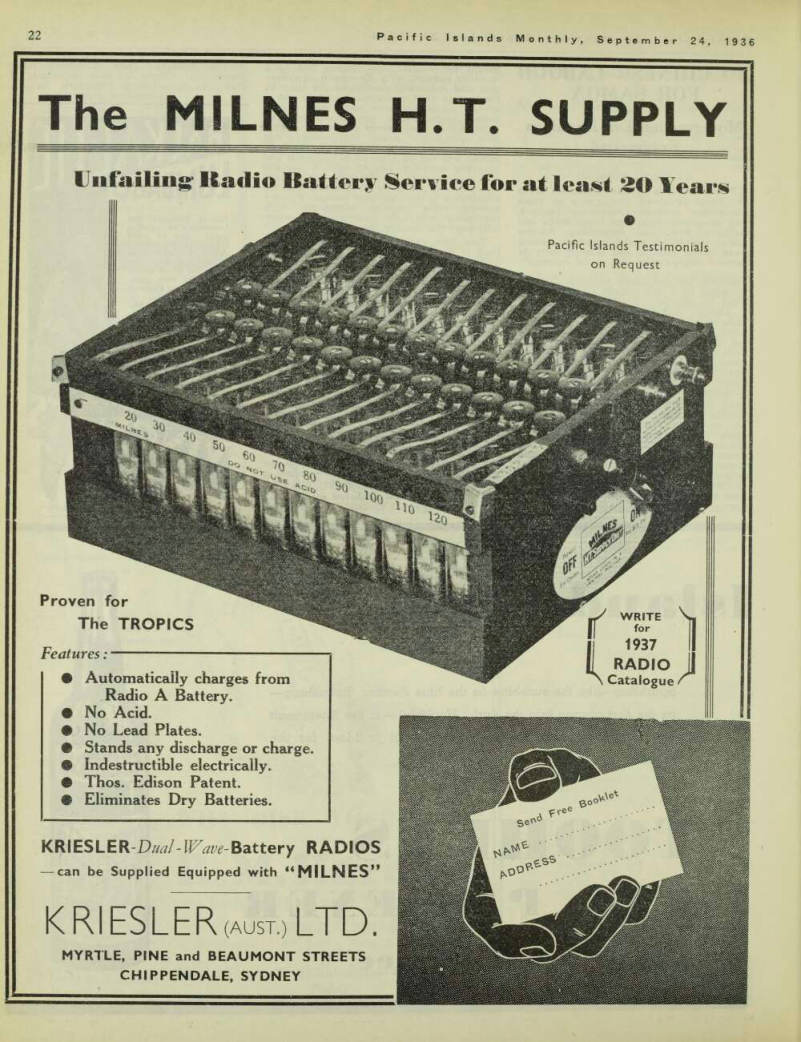
No Chinese Labour
For Samoa
Miscegenation Evil Has Been Exaggerated
By R. W. Robson
“TF the planters of Samoa cannot solve A these problems (i.e., carry on their plantations without indentured labour), they obviously must seek fresh fields and pastures new. ... Importing Asiatic labour means a racial contact having dread social effects, and leading only to Samoan degradation and social misery.” fT'HOSE are pertinent extracts from a A letter by a Mr. George Graham, pub lished in the New Zealand Herald early in August, and having reference to an “interview” by myself, which was pub lished in that newspaper on August 5. I had said, in the plainest terms, that New Zealand had failed to bring about any economic development in Samoa; and that the decision to repatriate all Chinese labour would almost certainly bring about the financial ruin of the Territory.
Mr. Graham’s letter is typical of New Zealand comment on this matter, and of the mawkish, Old Granny sentiment which has distinguished N.Z.’s admini stration of this unhappy country, “If plantation interests cannot be retained except at the grave detriment of the social welfare of the native people,” declares Mr. Graham, “then it were better to allow them to revert to the primitive jungle.”
What priceless twaddle! Do these N.Z.
people not realise that Samoa has been in close contact with European exploita tion and organised commerce for over 50 years, and that a standard of life and a system of government have been estab lished there which are based on the existence of plantations and their profit able operation? A few well-meaning but quite impracticable idealists from N.Z. surely will not be allowed to wipe out the planting industry, simply with a gesture and a pious sigh. If N.Z. will not protect the planting industry in Samoa, and do something to develop that country’s enor mously rich natural resources, N.Z. inevitably will lose Samoa. And, many will say, the sooner the better!
This idea that “a splendid Polynesian race is being poisoned by Chinese coolie blood” is sheer moonshine. I had that idea myself, once, and howled out in print “against the tragedy of Chinese half-castes.” I was challenged at once by a learned body with headquarters in Honolulu, which produced convincing data from all over Polynesia to show that, of all crosses, the Chinese-Poly nesian cross is the best type, physically, mentally and morally. Since then, I have been able to investigate personally this subject, and I must acknowledge that, as a type, there are no better people in the South Seas than the virile, intelligent, attractive Chinese-Polynesians. It is a fascinating subject, because it involves the original ethnological makeup of the Polynesian race, but I may not follow it here. Anyone interested should discuss it with Mr. Rutherford, the very able direc tor of education in Western Samoa, or with the Marist Brothers, who conduct a school for Chinese half-castes in Apia.
The point is that Chinese miscegena tion is no more and probably less harmful
to the Samoans than European mis cegenation. There are now thousands of European-Samoans in Western Samoa,
(Continued on Page 23)
Chinese labourers, brought into Samoa to work on plantations for limited periods, do make irregular, temporary unions with Samoan women, and almost always have children. The children usually are excellent specimens and being absorbed in the mother’s family group, they do well enough and commit no harm.
The women —invariably of low caste —are not regarded as very terrible sinners.
But the system is undesirable, even deplorable, and should have been wiped out long ago. One may go to almost any large plantation, and see Samoan women living with the indentured Chinese. True, no one who knows anything of Islands life is disturbed by the moral considera tions of such an arrangement: so it has been winked at for many years. An effort to abolish the system, some years ago, merely reduced it. It continued; and thus provided Old Granny, in N.Z., with a first-class excuse for wiping out the Chinese indenture From that angle, the planters have only themselves to blame. The only real reason given to date by officialdom for abolishing the Chinese is that “the coolies are debauch ing the native women,”
Actually, the evil is of astonishingly small dimensions. Only a small number of Chinese have these irregular unions with Samoans —perhaps a couple of score.
The women are not really harmed — irregular unions are common among the lower classes. There is eagerness for this association with the Chinese, who are in variably kind and generous. The children, as explained, are of a type by no means undesirable. To suggest that the system is poisoning the Samoan race, or affecting its social structure, is simply ridiculous.
Still, on moral grounds, it is not an arrangement that can be defended.
One week’s work by the authorities, and the promulgation of a definite, clear cut law, would put an end to the system which permits Samoan women to live openly with the Chinese. Despite all laws, there still would be some association between Chinese men and low-class local women—just as there is in Auckland and Sydney. But the open flouting of the European social system would not be permitted. And that, surely, is all that is needed.
Instead, a combination of political hum bugs and well-meaning old women plan to drive the Chinese out of Samoa, and to make no other provision for supplying planters with essential labour. If the planters cannot manage with local labour, they can close up, say the old ladies.
What a travesty on administration!
What a confession of failure by a country holding a mandate to govern a rich tropical territory!
Advertisements & other items, pp. 23-24 (1 item)
Tooheys
LUMbago
Relieve Backache and Lumbago’s excruciating pain I For 16 years Genuine Vincent’s A.P.C., prepared on the scientific, hospital formula, has given quick, safe relief from pain.
Be sure to get Genuine Vincent’s A.P.C., recommended by the Medical Profession. Powders and Tablets: 12 for 1/6. 24 for 2/6.
All chemists and stores , or direct from •-» Vincent Chemical Co.: Ltd., 76-78 Street, Sydney
FOR SAFETY’S SAKE. SAY “VINCENTS’*
Island 1dy11...
Sparkling—like the sunshine on the blue Pacific. Refreshing— as the first plunge into the surf. Healthful—as the finest malt and hops can make it—Tooheys Pilsener is ideal for the Islands.
TOOHEYS
PILSENER
“Here’s To’ee”
The MILNES H.T. SUPPLY
Unfailing: Radio Battery Service for at least 20 Years Pacific Islands Testimonials on Request m s * r 20 iO Tj 50 % M 6 r 1937 Proven for
The TROPICS
Features: • Automatically charges from Radio A Battery. • No Acid. • No Lead Plates. • Stands any discharge or charge, • Indestructible electrically. • Thos. Edison Patent. • Eliminates Dry Batteries.
WRITE
for
|l RADIO J
A Catalogue f
KRIESLER-DW-IF^-Battery RADIOS
can be Supplied Equipped with “MILNES”
KRIESLER (AUST.) LTD.
MYRTLE, PINE and BEAUMONT STREETS
CHIPPENDALE, SYDNEY
m Vt\e e°° fre e Se'' m
Pacific Shipping
Subsidy
Time for Tenders Extended
¥>ECAUSE no tenders had been received for the operation of the Pacific Islands shipping services, the Federal Government decided to extend the date of application from August 31 to Sep tember 30.
The services for which the Government is calling tenders are those from Aus tralia to Papua, New Guinea, British Solomon Islands, Lord Howe Island, Nor folk Island, and the New Hebrides.
The services are being carried on at present by Messrs. Burns, Philp and Co.
Ltd., under an extension of the old con tract, which expired over 18 months ago.
Remarkable Newspaper Story
Seaplane Service For
Pacific
AN extraordinary statement, to the effect that Sydney is to be linked shortly with the various Pacific Groups by means of an amphibian (seaplane) service was published in the Sydney Daily Telegraph on September 4.
It is stated that the amphibians will operate in each direction in alternate weeks. One week an amphibian will fly to New Guinea; thence across to Suva (presumably by way of the Solomon Islands and the New Hebrides); and thence will fly from Suva via New Caledonia, Norfolk Island, and Lord Howe Island to Sydney.
In the following week an amphibian will
cover the same route, but in the contrary direction.
It is stated that each amphibian would have accommodation for six passengers and for substantial freight: and that the pas senger fares and freight rates would be competitive with the steamer services.
To persons with any knowledge of the Pacific territories and of the transport conditions which at present exist, the story is in the highest degree fantastic; but it was quite seriously advanced by the news paper on September 4 and repeated on September 5.
The various Australian aviation com panies, including Guinea Airways Limited and Carpenter Airways, have denied any knowledge of or connection with the amphibian scheme.
Mr. Cecil Gregan has been transferred to the Thursday Island customs office from Brisbane.
Mr. W. E. Links, assistant manager at Apia for Messrs. Burns Philp (S.S.) Co.
Ltd., departed from Western Samoa in August to spend holidays in Australia, Mr. R. J. Keegan, who has been Assist ant Commandant of Police (British Sec tion) in the New Hebrides for some years, has been transferred to the Solomon Islands administration, where he becomes a District Officer. Mr. and Mrs. Keegan passed through Sydney en route to Tulagi, in September.
Mr. William C. Groves, one of the Aus tralian delegates to the Carnegie Interna tional Conference on the Education of Pacific Races recently held in Hawaii, re turned to Sydney by th e Niagara on Sep tember 5. He proceeded to Melbourne to complete his second work on New Guinea ethnography under a National Research Fellowship in Social Anthropology.
Advertisements & other items, pp. 25-26 (1 item)
The King’S School
(PARRAMATTA)
N.S.W.
s
Sifl
1 . ' Extensive Modern Additions made in 1934-1935 New Class Rooms, Laboratories, Dormitories, Modern Swimming Pool.
The School Re-opens on Wednesday, 10th Feb., 1937 'Vacancies for 1937 Apply, THE HEADMASTER
ORDER
RECORDS
by MAIL
Use Elvy’s Special Gramophone Record Mail Department for Island residents.
Orders over £2 insured, posted FREE.
Write for free catalogues and lists NOW.
E LVY & CO. LTD.
397 GEORGE STREET, SYDNEY
Charles Johnson
We've gone all over English for this issue. Carriages at eleven, sort of thing. Headache next morning just the same, but we'll skip that.
When the Cable news came through with the fact that the Male Fashion eye of the World had turned on Four Men, and all four English, it said plenty. English cutters with English tweed, worsteds or flannels (have it your own way), plus that inimitable courtesy and attention that is definitely handed out to you at the store at 143 King Street, Sydney, plus the fact of marvellous value, gives you all there is to be obtained in the perfection of clothes.
And who doesn't want perfection? You Lads, up there on the Islands for the best part of the year, when that Sydney trip draws nigh, what do you think of? No, we must keep it clean. After that, then comes clothes, or does it?
However, wear what you will, while the Sun's burning rays give The ultimate in Tailoring and Gents* Accessories at the Right Price
T ailor for )ten of
discrimination
143 KING STREET
SYDNEY
clothed by Charles Johnson, because that's his business. all to he obtained at
CHARLES JOHNSON
THE TAILOR FOR MEN WHO CARE
143 KING STREET, SYDNEY
100 Years
Foundation of Catholic Mission Commemorated at Tahiti
From Our Own Correspondent PAPEETE, August 4.
IN the presence of His Excellency, the -I- Governor of French Oceania and over 6000 people, the mission of the • Roman Catholic Church in the French settlement of Oceania celebrated, on June 14, the cen tenary of its foundation at Tahiti.
In this assembly were representatives from all districts of Tahiti, from Moorea, and from the archipelagoes of the colony— the Tuamotus, Marquesas, and Gamblers, where the Catholic faith has been firmly established.
The ceremonies were opened by the cele bration of High Mass conducted in the open air by Monseigneur Le Cadre, Bishop of the Marquesas Islands, assisted by Mon seigneur Bernadin, Apostolic' Prefect of Rarotonga. Later a stately procession passed from the Papeete Cathedral to the mission valley.
After the Mass, the ceremony of unveil ing and blessing a handsome monument erected to the memory of the pioneer mis sion fathers, was performed. Standing in the garden of the episcopal residence, this memorial carries the bust portraits of Fathers Laval and Garret (two priests who brought the Roman Catholic faith to Tahiti) and Monseigneur Rouchouse (the superior who sent them).
At the dedication of the memorial, the Vicar Apostolic of Tahiti (Monseigneur Amedee de Nouailles) spoke eloquently of the founders of the mission, of their self sacrifice, of their courage in their difficult task, and of their piety. In moving phrases he recounted the tragedy of the ship, voyaging from France to Tahiti with Monseigneur Rouchouse and many mis sionaries on board, and carrying a cargo of supplies and building materials for the erection of churches, which was lost with all hands while rounding Cap© Horn.
The first Roman Catholic Church on Tahiti was built by Father Laval in the district of Mataia. It is still standing.
Official Visits In Samoa
From Our Own Correspondent APIA, August 21.
THE Governor of American Samoa (Cap tain M. Milne) paid his first official visit to Western Samoa, with his daughter and his official staff, by the Ontario on August 17.
The party stayed with the Acting Ad ministrator and Mrs. A. C. Turnbull, at Vailima, where an official dinner was given on the night of their arrival. A dance in honour of the visitors on August 19 was attended by many Apia residents.
The guests were also shown the attractive scenery in the neighbourhood of Apia.
The Ontario departed for Pago Pago on August 20.
Mr. A. C. Turnbull (Acting Administrat or) with an official party will return the visit on August 25.
Mrs, A. C. English, of Baradobu, in the Rigo District of Papua returned to Port Moresby with her daughter, Miss Mar jorie English, by the Macdhui late in August, after several months’ holiday in Sydney.
By Peaceful Penetration

N.G. Government Brings the Interior Tribes Under Control
From a Special Correspondent
WAU, Aug. 4.
PEACEFUL penetration has accom plished much in the Chimbu-Wahgi district. It Is learned that shortly horse traffic will be employed on the recently constructed roads in the area. Only a few years ago this area was entirely unknown to the Administration.
The officer in charge of the Chimbu- Wahgi post has carried out an extensive programme of road construction, linking up all the Mission stations in the districts with one another and with the Govern ment post. Villages are also connected by this progressive sememe.
The natives will soon have the unusual spectacle of horse traffic which will no
doubt cause them more astonishment than did the first ’planes that landed in their midst and to which they are now accus tomed.
So interested were the inhabitants of this area in the construction of the roads that literally thousands threw themselves into the work helping the Government with enthusiasm, and using primitive tools when others were not available. It is reported that their work both in mag nitude and excellence exceeded anything that the authorities had experienced before.
Pacification of the tribes continues steadily in the Chimbu valley, though out breaks occur occasionally. In an inter-
Seeing the white man’s wonders. Primitive Chimbru-Wahgi natives crowd around and gaze incredulously at an aeroplane on Mount Hagen landing ground.
tribal fight recently in which the Govern ment interfered it was found necessary to open fire. The Government party arriving on the scenes were attacked themselves by large numbers.
Since the affray, however, the natives have displayed an entirely friendly atti tude towards the Government, and the prospects are most encouraging.
Bena Bena Base Camp
Bena Bena base camp will soon be connected with the Ramu station. The road which has been under construction is now nearing completion. Soon, as with the Chimbu area, horse traffic will be in general use for those travelling from Ramu to Bena Bena, Chimbu, and Wahgi.
The hostility of the natives, though marked at first, is gradually giving way as the policy of peaceful penetration steadily continues. A regular police mail between Ramu and Bena Bena through Finintegu is maintained to which the natives are gradually becoming accus tomed.
On the Upper Ramu post rest houses have been constructed at various points along the roads and there also the work of pacification is steadily increasing.
Oribanda Post
A comparatively large European popu lation, including women, with a large labour force has sprung up in the Ori banda district. The little mining com munity has had little difficulty with the Kukukuku tribes which are already under the influence of the Government, and the relationship of the miners, labourers and Kukukukus is most satisfactory. The natives freely exchange their produce for trade and any goods they desire.
Advertisements & other items, pp. 27-28 (1 item)
Electricity for Everyone, Everywhere
Q
RE GD
i £1
STYLISH—COMFORTABLE
AND FAITHFULLY MADE
from Tested Materials
TOP DOG
Clothing, Hats, Shirts, Pyjamas, Mercery, Hosiery and Knitted Goods 'will give full satisfaction They Look Well andj They Wear Well €very Qarment (guaranteed
Electricity for Everyone, Everywhere
with a PORTABLE DELCO-LIGHT PLANT!
6 volt, £22/15/- (with battery, i Bond, Sydney) £24/10/ To light your bungalow, your boat, or camp; to charge your car or radio batteries, here's a 150 watt, 6 or 12 volt plant, that weighs only 44 lbs. and operates for 8 hours on a two-quart tank filling.
The Model B 6 or 812 Delco-Light plant is self-cranking, requires no particular skill to operate, and can be transported easily to wherever you wish to use it.
Write for full ticulars. There s a Delco-Light Plant for your requirements. par- Distributors:
Warburton, Frank), Ltd
307-15 KENT ST., SYDNEY.
y ft- -a o o o * o.
OF CEH
DO YOU THINK GEORGE
COULD STAY TO DINNER
I KNOW THERE'S NOT MUCH
IN THE HOUSE BAR THE
LAMB S the PLUMS
WE'LL MANAGE,
DARLING.IT WILL
ONLY TAKE A FEW
MINUTES TO MAKE
A LOVaY CUSTARD.
GIVE GEORGE A
CIGARETTEJHEN
COME AND
V HELP MEj
fv.
THIS CUSTARD IS TIP-TO?]
MRS MOLES WORTH.
I'LL BET IT'S AN
OLD FAMILY
SECRET. . . k •sjf C Li wm m l ' r r
I7Ml 7 M SO GLAD
YOU LIKE IT,
GEORGE. I HEAR
YOU'RE QUITE
AN EXPERT
ON COOKERY.
Stewed fruit, puddings and pies are all vastly improved by the addition of Foster Clark’s world-famous creamy Custard.
It transforms the simplest dish into one you will be proud to serve. Foster Clark’s Custard is so smooth, so rich, so deliciously flavoured that it arouses enthusiasm in the most exacting man.
It’s economical, too. Always ask for Foster Clark’s Custard, and refuse cheap imitations.
SIX MONTHS LATER
PLUMS S CUSTARD.
IT REMINDS ME Of
THE NIGHT WE GOT
ENGAGED. YOU'RE
GREAT AT CUSTARDS
DARLING
. m r v\ &
FSI3;
IT'S THE OLD
FAMILY SECRET
GEORGE. I USE
FOSTER CLARK'S
CREAMY CUSTARD
FREE RECIPE BOOK
Write to Foster Clark (Aust.) Ltd., Dept.
R. 8., Redfern, N.S.W., for your FREE copy of Elizabeth Craig’s delightful Custard Recipes. Enclose Id. stamp for postage.
Foster Clark's
creamy CUSTARD
Germans In The
South Seas
jVT R. KURT OFPENBURG, formerly the representative of the German news paper Frankfurter Zeitung in the Far East, in an address in Sydney in July, said that Germany, in spite of her clam our for cronies, did not want the Man dated Territory of New Guinea returned to her.
Germany was more interested in ob taining dominion over the Ukraine. Her former African colonies were closer and therefore more practicable, but even her claims for the return of these must not be taken too seriously, because, to a cer tain extent, it was propaganda for home consumption. It also might be designed with a view* to strengthening her bargain ing position in the future, when it might suit her to say, “Give us a free hand in the Ukraine and we will withdraw our African demands.”
Leprosy Spreading In
New Guinea
“T EPROSY is spreading rapidly in New Guinea, and is likely to become a big problem in the next generation,” said Dr.
E. A. Holland, Government Medical Officer in charge of the New Ireland district, on reaching Melbourne recently by the Nankin.
It was introduced by returning labourers from other parts of the Pacific. Already 600 were in the leper colony at Kavieng, and about 400 more were still at large on the mainland of New Guinea. These were now being segregated from the rest of the natives and taken to New Ireland,
Papuans
Assaulted Plantation
Assistant
Five Years’ Gaol for Two Papuans
From Our Own Correspondent
Pt. Moresby, Aug. 20.
IN the Central Court earlier in the month 10 natives of the Tufl district employed on Itikinumu Plantation, Sogeri District, were charged with attempting to kill Mr. Laidley Cay, a plantation assistant.
It appeared that Mr. Cay while count ing the rubber tappers one morning was attacked by one of |tie accused. Mr.
Cay was thrown to the ground with a heavy blow on the head from a club. All the accused admitted having hit Mr. Cay.
Evidence by the Crown disclosed that the attack was premeditated and that the telephone wire leading from Mr. Cay’s house to the main buildings had been cut.
The reason for the attack was ascribed by the prime movers in the assault, as being retaliation to an assault by Mr.
Cay on the previous Saturday.
His Honour Mr. Justice Gore found Kiwai and Piria guilty and sentenced each to five years’ imprisonment. The remainder of the accused were convicted of common assault and sentenced to four months with hard labour.
Mr. Cay who was taken to the Euro pean Hospital immediately after the assault, has now recovered from his wounds and has returned to his duties on Itikinumu.
Society Group
Adrift For 65 Days
Honolulu Yacht Ends Up In Society Group
The story of how a Honolulu schooner, with four men aboard, was blown from her course and drifted helplessly for 65 days before reaching the Society Islands, was told by Pastor G. L. Sterling, of Pa peete, who arrived in Sydney from Tahiti by the Makura on August 22.
About two months ago, said the S.D.A. missionary, the party reached Tahiti and made known their amazing experience. It appeared that they had gone out for a short pleasure cruise from Honolulu in an auxiliary yacht. The engine failed, and, encountering adverse winds, they were swept out of sight of Oahu.
For 65 days in which they drifted about the Pacific, their vessel was the plaything of winds and currents. Fortunately, the craft had been used just previously for a long voyage, and was reasonably well equipped with water and tinned food.
After covering some 2500 miles, the yacht ended up in the Society Group, near Bora Bora Island. Finally the crew were rescued and taken to Papeete.
They did not have passports, and when Pastor Sterling left Tahiti there was still much uncertainty about their future move ments and how they were to get back to Hawaii.
Monsieur Reverce, president of the * Council General of New Caledonia, has been made a Chevalier of the Legion of Honour.
Missionary And
Shooting
Incident in Chimbu Region of New Guinea
From Our Own Correspondent.
Rabaul, Aug. 15.
FOR the third time within a few months a mission worker stood in the dock of the Supreme Court, Rabaul, and faced Chief Judge Wanliss on a serious charge.
Small of stature, with a long flowing beard and long dark hair, Brother Lucidius Zimmer is now standing his trial on a charge of illegally killing a native up in the Chimbu-Wahgi country, an “uncon trolled” portion of the Morobe district. The Brother has been in the Territory for over eight years and has been working in the Madang district and amongst the Denga ragu tribe in Morobe.
Mr. P. J. Woodhill represented the Crown, and Mr. A. N. McLennan ap peared for the accused, who pleaded not guilty.
The Crown’s evidence was that accused killed a native, Andungi, by shooting him on February 8, 1936; and called two local native school-boys who witnessed the shooting. A statement in Pidgin made by the accused was also put in as evidence, and Patrol Officer C. D. Bates, of the local police post, who investigated the
matter, also gave evidence, as well as Bro.
Marcolinus Hoffman, who was on the Dengaragu station when the alleged offence was committed.
Outlining the Crown case, Mr. Woodhill said that the Dengaragu Catholic station was situated towards the headwaters of the Chimbu River, some 7,000 feet above sea level. The mission station was situated on an old battleground used by the Inau and the Dengaragu tribes, who were constantly at war, and since the advent
of the mission had selected an adjacent site for a new battleground. Two bridges had been built by the mission across the Chimbu River. On February 8, tribal fight in £ broke out and the accused, with some of bis school-boys, ascended a hill to watch the fighting. The accused was armed with a Mauser pistol and carried a heavy walking stick, Evidence would show, said Mr. Wood hill, that the mission had prohibited the use of one of the bridges by the natives
when engaged in fighting. While the ac cused and the boys were watching the fighting, three large armed parties of natives came along towards the bridge.
Accused shouted and waved to them to go back. They all obeyed with the excep tion of the deceased, who proceeded to wards the bridge head. Accused Ihen fired his pistol; and the native Andungi fell down, having been shot through the head. Patrol-Officer Bates of the Chimbu- Wahgi post arrived on February 21, and received a report from the accused, and again visited the station for further inves tigations on April 2.
The taking of the evidence in this case, as in so many similar cases, has been long and tedious. The two native school boys, lads of about 10 or 12 years of age, are members of the Dengaragu tribe which has but recently come under the influence of whites and have but a limited knowledge of pidgin English, and it is difficult for them to understand the seri ousness of the situation or the importance which may be attached to their every spoken word. Often, during their exam ination in the box, their attention seemed to be far more occupied with the whirring of the revolving electric fan above their heads or the speed of a passing motor in the street. An interpreter was supplied for the accused, in order that he might be cognisant of everything that was being said.
Gun Expert’S Evidence
Mr. McLennan, for the defence, first called Warrant Officer Worman, who is an expert armourer, having served 16J years in the Life Guards and 3i years with the Australian Permanent Forces, and gave evidence as to the condition of the Mauser pistol. After testing the weapon, on which he discovered a bulge on the barrel and a distinct groove in the rifle of the muzzle, he stated that the accuracy of the pistol was unreliable and might shoot anywhere.
The accused was then put into the box, and after describing in detail the position of the mission house, the bridges and the fighting natives on the day in question, he stated that he fired one shot from the pistol into the air when the warriors first took no notice of his command not to cross the bridge. Then, later, he fired at the bridge head for the purpose of frightening both tribes and preventing them from using the bridge, which was tabu for fighting pur poses, and on which tribal tabu marks had been placed in accordance with local cus tom. The shot which he fired at the bridgehead accidentally killed the native Andungi. He had no intention of hitting the native.
Accused also stated that Father Mor scheuser and Brother Eugene were both killed near Dengaragu in December, 1934.
When accused returned to Dengaragu from Alexishafen in January, 1936, he travelled the latter part of the journey with Patrol Officer Bates, who had occa sion to fire on the natives; but he did not remember how many shots were fired.
The verdict was “not guilty.” The Judge’s remarks on the case are referred to elsewhere.
Mr. A. Long, of the Buka Plantation and Trading Co. at Numa Numa, Bou gainville, arrived in Sydney from New Guinea by the Nellore on August 25.
Rev. Walter Shepherd, M.A., 8.D., who has been appointed to Tonga by the Methodist Missionary Society to replace , Rev. A. H. Wood, M.A., 8.D., sailed from Auckland for Nukualofa with his wife and daughter by the Matua at the end of August.
Advertisements & other items, pp. 29-30 (1 item)
Marys
H.JONES &C 0
c
AUSTRAU^
AUSTRALIA’S BEST
H. JONES & CO., LTD.
Darlington, Sydney Hobart, Ta».
Fop— Fresh Fruit, Vegetables, and Produce Islands Residents can rely on the old-established Shipping Providers; C*" u Only Address: 421 Sussex St., SYDNEY Islands AII orders Promptly Attended Representatives: Nelson & Robertson Ltd. W. M. Reid
A new, simple lid for your,
convenience; a new
patented parchment seal
to ensure perfect fresh-
ness.
AUNT
MARYS
BAKING POWDER
Send 1/- plus 2d. postage to Tillock and Co.
Ltd., Sydney, for “Aunt Mary’s” Cookery Book.
It’s the best.
PRESCOTT LT? Iy S dUe S y ar-e sole wholesale adenis fdi^-
PINEAPPLE BACON & HANS
DAISY BRAND BUTTER
TIC E R cruyere CHEESE
LEA & PERRINS 7 SAUCE
& Most other Super- QuaUiy_ Lines_ of* ihe Trade
Swallow & Arie M’s
WORLD RENOWNED
Canterbury
Cakes
Each Cake is Enclosed, by special process, in air-tight tin, and is warranted to keep its condition for a considerable period
Indian Community In Fiji
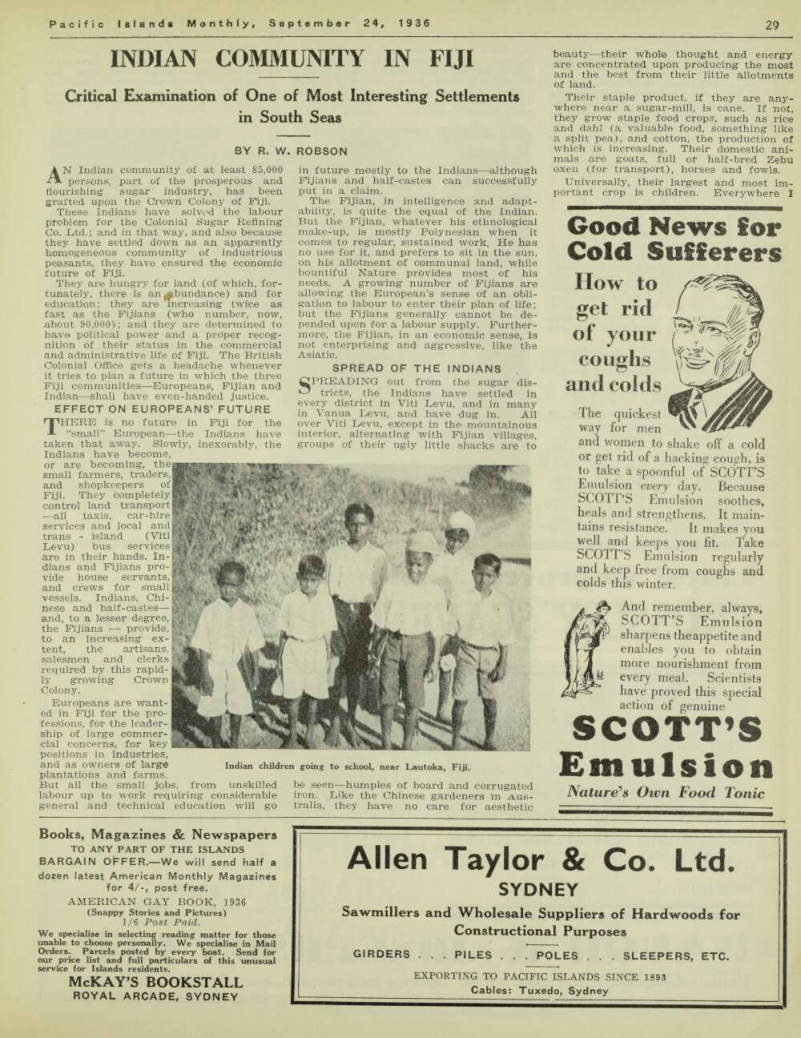
Critical Examination of One of Most Interesting Settlements in South Seas
By R. W. Robson
AN Indian community of at least 85,000 persons, part of the prosperous and flourishing sugar industry, has been grafted upon the Crown Colony of Fiji.
These Indians have solved the labour problem for the Colonial Sugar Refining Co. Ltd.; and in that way, and also because they have settled down as an apparently homogeneous community of industrious peasants, they have ensured the economic future of Fiji.
They are hungry for land (of which, for tunately, there is an and for education; they are increasing twice as fast as the Fijians (who number, now, about 90,000); and they are determined to have political power and a proper recog nition of their status in the commercial and administrative life of Fiji. The British Colonial Office gets a headache whenever it tries to plan a future in which the three Fiji communities—Europeans, Fijian and Indian—shall have even-handed justice.
Effect On Europeans’ Future
THERE is no future in Fiji for the “small” European—the Indians have taken that away. Slowly, inexorably, the Indians have become,
or are becoming, thej small farmers, traders,! and shopkeepers of I Fiji. They completely! control land transport] —all taxis, car-hire! services and local and] trans - island (Vitij Levu) bus services] are in their hands. In dians and Fijians pro-] vide house servants, and crews for small j vessels. Indians, Chi- j nese and half-castes — i and, to a lesser degree,! the Fijians provide,] to an increasing ex-1 tent, the artisans, salesmen and clerks ] required by this rapid- j ly growing Crown
Colony.
Europeans are want ed in Fiji for the pro fessions, for the leader ship of large commer cial concerns, for key I positions in industries, and as owners of large plantations and farms.
But all the small jobs, from unskilled labour up to work requiring considerable general and technical education will go
in future mostly to the Indians—although Fijians and half-castes can successfully put in a claim.
The Fijian, in intelligence and adapt ability, is quite the equal of the Indian.
But the Fijian, whatever his ethnological make-up, is mostly Polynesian when it comes to regular, sustained work. He has no use for it, and prefers to sit in the sun, on his allotment of communal land, while bountiful Nature provides most of his needs. A growing number of Fijians are allowing the European’s sense of an obli gation to labour to enter their plan of life; but the Fijians generally cannot be de pended upon for a labour supply. Further more, the Fijian, in an economic sense, is not enterprising and aggressive, like the Asiatic.
Spread Of The Indians
SPREADING out from the sugar districts, the Indians have settled in every district in Viti Levu, and in many in Vanua Levu, and have dug in. All over Viti Levu, except in the mountainous interior, alternating with Fijian villages, groups of their ugly little shacks are to
be seen—humpies of board and corrugated iron. Like the Chinese gardeners in Aus tralia, they have no care for aesthetic
beauty—their whole thought and energy are concentrated upon producing the most and the best from their little allotments of land.
Their staple product, if they are any where near a sugar-mill, is cane. If not, they grow staple food crops, such as rice and dahl (a valuable food, something like a split pea), and cotton, the production of which is increasing. Their domestic ani mals are goats, full or half-bred Zebu oxen (for transport), horses and fowls.
Universally, their largest and most im portant crop is children. Everywhere I
Indian children going to school, near Lautoka, Fiji,
went among the Indian villages, I found swarms of children; happy, well-fed, well clothed, attractive little rogues.
These Indians marry early. On Sunday, July 26, there were seven statutory notices of Indian marriages posted before the Courthouse in Lautoka; and the following details were copied therefrom:
The bulk of the Indian population is clustered around the big sugar mills in Viti Levu. Practically the whole of the vast areas of flat land, between the moun tains and the sea, along the northern and western coasts of Viti Levu, is under sugar-cane. This land, for the most part, is leased out by the Sugar Company to the Indian farmers, who grow the cane under contract and guarantee for the C.S.R. Company.
The humpies and shacks of the Indian growers are scattered through this cane land —hidden, mostly, by the growing cane.
It is now the policy of the Company to encourage the growers to build better houses. Not a bad idea.
There are small villages, scattered about, where are small tradesmen to cater for communal needs. In these villages and alongside main roads, one sees small build ings of unmistakable, exotic character the temples of the Indian religions. Chris tian missionaries have been hard at work among these Fiji Indians for some decades, but they have achieved little; the Indians cling to the old faiths. Lautoka, Ba. Siga toka, Nausori—these are virtually Indian towns. On a market day, when the streets
are lined with produce stalls, when the footpaths are thronged with Indians, tur baned and bearded, or with women in gay colours, with little gold ornaments in the nostrils, with red dust lying thickly under the tropical trees and shrubs, one could easily imagine oneself in Southern India.
r T'HESE people are thrusting out from the canefields, and their demand is double-barrelled and insistent—land and recognition. The Government, long ago, accepted the Indian community as a factor to be provided for in the future economy of Fiji.
A typical Indian roadside market in Fiji: A Saturday morning snapshot in Nausori.
Age of Age of Bridegroom Bride 22 ... ... 14 16 ... ... 13 18 ... .. .. 14 19 ... ... 14 16 ... 24 ... .. .. 15 16 ...
There is plenty of land. Experts calcu late that this large, amazingly fertile island of Viti Levu could comfortably carry ten times its present population.
They compare it, in size, fertility, produc tivity, and general physical features, with Jamaica. Jamaica supports 1,250,000 people; Viti Levu something under 120,000.
Indian settlement, properly directed and controlled, could make Viti Levu marvel lously productive.
At first sight, the thing is simple. There is far more land available than is at pre sent needed by Fijians. The Indians settle down very happily in this great tropical island, and are good farmers. Parcel the land out among the Indians, on a tenure which will encourage the farmer, while safeguarding the ultimate ownership of the Fijian.
But it is not as easy as that. First of all, the Indians want a greater and ever greater security of tenure. They hate the C.S.R. tenure, under Ifrhich they occupy land practically only so long as they can be depended upon to produce cane. They want security. There is not a great deal of freehold land available —much of it is represented by the original grants to Europeans for cotton-growing. The In dians will pay any price for freehold —they paid £6O per acre recently for freehold near Ba. Failing freehold they seek always for long leases.
The Government is not unsympathetic to this demand. It is recognised that the Indians are there for all time, that they are good farmers, and that increased pro duction will be for the good of Fiji.
But, if Indians are to hold and work this land, two paramount interests must be considered and protected—the financial interests of the Europeans, who pioneered, pacified and developed this country; and the original land interests of the Fijians.
The Fijians are as numerous as the In dians, and they are increasing in numbers, now, but not so fast as the Indians are increasing. The Indian couple has a child per annum: the Fijian couple a child every two or three years.
Fiji chiefs ceded Fiji to Britain, in trust for the Fijian people; and recognition of this fact constitutes the first principle of British administration in Fiji. The right of the Fijians to Fijian land is the foun dation of all government in that Crown Colony. No one, European, or Indian, or a ny° ne else, may come in and occupy Fijian land, unless the governing authority is first convinced that such occupation shall not injure the Fijians, either now or in the future.
Demand For European Status
A XOTHER source of embarrassment to the Government is the aggressiveness of the Indian, and his demand for equal communal, if not individual, rights, with the European and the Fijian. Let me quote two recent instances of this difficult, jealous spirit.
The Municipal Council built attractive salt-water baths on the water-front at Suva, for the use of Europeans. Indians were not allowed to use the baths. They applied repeatedly for admission, and were refused. Then they protested bitterlv, in the fashion that may be imagined. ' The Council, conscious that there are Indian as well as European ratepayers, was not quite happy in its mind; so it built another lot of baths, for the use of the Indian com munity. They told me, when I was in Suva in July, that not one Indian had used the Indian baths. The Indians did not want baths at all—what they actually were demanding was equal status with 'Euro peans.
It was the practice of the Suva agent of a leading steamship company, when preparing lists of Fiji passengers for the newspapers, to put the usual prefix of
“Mr.” or “Mrs” before the names of Euro peans, but not before the names of In dians. No disrespect was intended or ap peared— it was assumed, as it is in many places, that Asiatic people do not appre ciate European titles. That agent was much surprised to receive, transmitted through his head office, a very fierce protest against this so-called deliberate discourtesy from the newly formed Indian Chamber of Commerce in Suva. Indian passengers are now “Mr.”
Little things; but they suffice to show the temper of the Indian community. The history of the demand for the common roll, the alteration of the constitution of the Legislative Council to meet the new con ditions created by Indian aspirations, and the substitution of nominated town boards for the elected borough councils (to avoid
the embarrassment of the Indian agitation for a common roll for the municipalities)— all these are recent things which do not need recapitulation, but they show the difficulties which confront the Government of Fiji when it is planning for the future of the Colony.
PERSONALLY, I am inclined to think that those difficulties are mostly on the surface. All this supersensitiveness about status and titles, this agitation for a common roll and greater recognition in connection with government, come not from the mass of Indians, but from a very small section of them—which claims to speak on behalf of all the Indians.
There are somewhere about 85,000 Indians in Fiji. They are not of one race or religion. There are approximately 10,000
Mohammedans, 25,000 Madrassis, and 45,000 Hindus. The Hindus exercise all the power and influence—the others come nowhere. The Hindus, in their turn, are dominated and controlled by the Arya Samaj, which is a Vedic cult —really a resuscitation of the ancient religion which ante-dated Brahminism. The Ayra Samaj is in the hands of clever, young educated Indians, who seem to have plenty of money. Put in another way: A small group of educated Indians control Arya Samaj; Arya Samaj controls the Hindus; and the Hindu section controls the Indian community in Fiji.
Actually, 95 per cent, of the adult In dian men in Fiji do not care two hoots about politics, or the common roll, or any thing other than the percentage of sugar in their cane (which is the basis of the payment they receive from the Sugar Company) and the possibility of getting land on a secure tenure. They do as they
are told by a handful of educated Indians who are eager for power.
I expected to find Fiji seething with the political unrest of the Indians. Actually, I found the Colony completely—almost monotonously—quiet and peaceful. Let the Government do something to satisfy the Indians’ land hunger, and it need worry no more about political agitation— and agitators.
The Problem Of Languages
THE education of these people is a real problem. In that sense, they cannot be regarded as a homogeneous community —among them, they employ eight or ten languages. Among the Madrassis there are Tamil, Telegu, Kanerese and Mala’ayum; there is Hindu; there is Urdu; and there are two or three other languages commonly used. The children are being taught their mother-tongue (whichever it may be) and English; but the change-over to English, which would seem to point the way to the future of this community in this Colony, is surprisingly slow.
The Marist Brothers conduct a good many schools among these Indian child ren; and it has been noted, as an indica tion of how these people cling to their own institutions, that while these children accept the European education readily enough, they rarely abandon their own religions.
Fijians And Indians
ONE of the most interesting things con nected with this Indian Colony in Fiji is the complete absence of any racial mixture between Fijians and Indians.
They live together, in apparent social har mony, in villages all over Fiji, but they do not mix. There are in Fiji thousands of half-castes; but they are the offspring of unions between Europeans and Fijians, and Chinese and Fijians. There may be half a dozen Indian-Fijians in existence, but they are so rare that the thing really is a natu ral phenomenon.
There seems little chance of an Indian - Fijian rapprochement. Their cultures are as the Poles apart. The Indian, very proud of his traditions and his institutions, regards the Fijian as a savage, a barbar ian. The Fijian, for his part, regards the ceaselessly-toiling Indian as a Kaisi —a slave. The Fijian never was a labourer: he is a warrior and hunter, the defender of his home —the routine of growing and preparing food belongs to the women.
Even to-day, if a Fijian hires himself out as a labourer, he is ashamed—he always seeks a job in a district far removed from his home.
So the Fijian and the Indian regard each other with a kind of humorous contempt.
The Indian thinks the Fijian is a good natured savage; the Fijian looks upon all Indians as Kaisi.
Advertisements & other items, pp. 31-34 (1 item)
Emulsion
Good News for
Cold Sufferers
How to
get rid
of your -j,
coughs
and colds
The quickest way for men and women to shake off a cold or get rid of a hacking cough, is to take a spoonful of SCOTT’S Emulsion every day. Because SCOTT’S Emulsion soothes, heals and strengthens. It maintains resistance. It makes you well and keeps you fit. Take SCOTT’S Emulsion regularly and keep free from coughs and colds this winter.
And remember, always, SCOTT’S Emulsion sharpens theappetite and enables you to obtain more nourishment from every meal. Scientists have proved this special action of genuine
SCOTT’S
Emulsion
Nature’s Own Food Tonic
Books, Magazines & Newspapers
TO ANY PART OF THE ISLANDS
BARGAIN OFFER. —We will send half a dozen latest American Monthly Magazines for 4/post free.
AMERICAN GAY BOOK, 1936
(Snappy Stories and Pictures) 1/6 Post Paid.
We specialise in selecting reading matter for those unable to choose personally. We specialise in Mail Orders. Parcels posted by every boat. Send for our price list and full particulars of this unusual service for Islands residents.
McKAY’S BOOKSTALL
ROYAL ARCADE, SYDNEY
Allen Ta/lor & Co. Ltd.
SYDNEY
Sawmillers and Wholesale Suppliers of Hardwoods for Constructional Purposes GIRDERS . . . PILES . . . POLES . . . SLEEPERS, ETC.
EXPORTING TO PACIFIC ISLANDS SINCE 1893
Cables: Tuxedo, Sydney
Latest improved Marine Engine...
"CROSSLEY" SCAVENGE PUMP DIESEL
The Crossley Scavenge Pump direct Reversing Marine Diesel Engine combines the advantages of the four stroke and two stroke types, without the disadvantages of either. Why not have the latest low running cost Marine Engine available? Write for full particulars now.
DRS. 125 B.H.P.
As recently supplied to C. Hegarty, for use in Ferry in Sydney Harbour.
WAUGH «& .lOSi;i*IIS«\ LTD.
Unwin’s Bridge Road, St. Peters, N.S.W. 102-104 Melbourne St., South Brisbane, Queensland.
CASH PAID
! 7 or Used Postage Stamps
Send large or small accumulations of used postage stamps of the Pacific Islands in good condition. We make prompt and liberal payment. American commissions also executed.
MERRICK WELLS & CO.
284 West 70th St., New York City
mi
READ THE
B.P. MAGAZINE
SPRING NUMBER
NOW ON SALE
Short Stories . . . Pictures Travel Articles . . Pages for the Children Stage Latest Fashions ... Screen o
ONE SHILLING PER COPY
ON SALE AT ALL NEWSAGENTS AND BOOKSELLERS
PRIESTMAN
GRABS
Capacities from 1 cubic foot to 16 cubic yards. All types for all materials. Single and Multi-chain and rope operated.
Outstanding features include: Very Narrow Head.
Low Centre of Gravity. Improved Lugs with Nonturning Pins. Priestman Ball-Bearing Swivel.
for every
excavating job
Send for details of Grabs for your specific requirements.
Sole Agents:
Noyes Bros. (Sydney) Ltd.
115 Clarence St., Sydney
11 Watt Street, Newcastle. 197 Elizabeth Street, Brisbane.
Huon Pine Boat Planks
Practically Borer Proof and Everlasting, also Spotted Gum Timbers—Prices Right A C Frvpr 110 Miller st v*. r i /cr, Pyrmont> n.s.w.
2': -
cuuf Woik- Qmfwhete
It does not matter where you go, in any part of the world where motor boats or pleasure launches are used, you will find Fetter Engines giving the most satisfactory service: in larger vessels, too, whether used as auxiliary in sailing boats or as motive power in any vessel up to the largest liners, the Fetter Engine is favoured.
The reason is, that Fetters are valued for their reliable service under all conditions; for their low upkeep and low consumption costs; and for their long life of dependability.
When you install a Fetter in your craft you install lasting satisfaction. You will find that years of solid service, rough wear, and all the buffeting and stresses to which it has been subjected, make no impression on its efficiency and you will experience that pride in your judgment which every Fetter owner feels. Write to-night for full particulars.
Fetter Engines
Atomic-Diesel Semi-Diesel 5 to 540 B.H.P.
Buzacott & Co. Ltd.
7-11 Market St.
Sydney
“Ho Ho” Continues World
Cruise
From Our Own Correspondent.
Auckland, Aug. 25.
IN continuation of the world cruise begun three years ago, the Norwegian yacht Ho Ho left Auckland for Norfolk Island on August 11, after a stay of over a month.
The yacht took back the three Norfolk Island passengers brought to New Zealand.
Later the owners, Messrs. T. Schyberg, B. Bryhn and T. Ostmoen, will probably call at Tahiti, Galapagos Islands, and Ecuador, before passing through the Panama Canal on the way back to Nor way.
Mr. B. E. Crawfurd, District Officer in the Solomon Islands Administration, has been transferred to Northern Rhodesia.
Native Education In New Guinea
Administration’s Policy Defended
Letter to the Editor.
I HAVE read with interest the contri buted article headed “New Guinea’s Wasteful, Feeble Record in Native Edu cation” (P.1.M., May 22). 1 would suggest that your contributor make himself thoroughly conversant with facts before writing statements which are far from correct.
He has apparently obtained his infor mation from other than official sources, and has rushed into print without troub ling to make himself acquainted with the true facts of the case, in his apparent desire to raise a laugh at the expense of the Administration.
The first pupils enrolled at the Adminis tration School at Kokopo were, as he says, drawn from all parts of the Territory.
This was probably a mistake, as the dia lects spoken by these natives were many and varied. Consequently the teacher “Billy” Groves —could not use the native language as a teaching medium, there being no native language common to all pupils.
He had two courses open; one, to use Pidgin as a teaching medium (which he did), and another, to begin teaching simple English words, phrases, and sentences in the first months, illustrating the different words by presenting objects or by actions.
Later, the pupils would learn to read these words and gradually increase their vocabulary. Progress with this method would be slow at first, but at the end of the second year the pupils would be able to speak, read, and write in simple Eng lish and understand commands given by the teacher.
The idea of this method —which is in use at the Malakuna School at the pre sent time —is to eliminate the use of Pid gin, which is not (and never will be) a satisfactory teaching medium.
The transfer of the Administration Native School from Kokopo to Malakuna (near Rabaul) took place in 1924. At about that time a Technical School was inaugurated at Malakuna for the purpose of instructing natives in the rudiments of carpentry, plumbing, painting, and sail making. This section of the Administra tion’s educational enterprise has proved very successful, and many trainees from the Technical School have obtained out side employment at wages ranging from 15/- to £3 a month.
Many of these trainees have proved equal to Asiatic tradesmen who are paid as much as £2O a month. The present demand by plantation owners and others for boys trained at the Administration Native Technical School is proof of the success of this section of the Govern ment’s educational policy.
Your contributor has either never heard of the Technical School, or has conve niently forgotten to mention it.
Certainly, the cost of building the Ele mentary and Technical Schools at Mala kuna was high (approximately £23,000), but at the time building materials were very costly, and the structures included a bungalow and a block of seven self-con tained flats, not to mention half-caste quarters. Yes, Mr. Editor, half-castes are educated at Administration schools, and, moreover, the Administration contributes towards the upkeep of half-castes kept in the mission schools.
Let me also inform your contributor that “Billy” Groves was married many
months before he left Rabaul, and, had the final choice been his, I do not doubt that he would have remained in Rabaul.
More teachers came. Though a small proportion left owing to the fact that the Administration had made no provision for a permanent teaching staff, I can name four teachers with six or more years of service, only one of whom left from choice.
I also know of six teachers who would be applicants for permanent appointment, should the Administration make provision for same. Two teachers at present on the staff have each more than nine years’ service.
Your contributor is somewhat astray when he states that the cost of educating a handful of natives (approximately 100) is £lO,OOO a year. It may have been so in “Billy” Groves’ time (although even at that time there were more than 100 pupils on the roll of the Elementary and Tech nical Schools).
At present there are three Administra
tion elementary schools (including two boarding establishments) and one techni cal school in operation, the total number of native pupils being more than 350.
The cost of these schools, including rations and issues for about 240 pupils (boarders), maintenance of buildings, etc., is less • than £ 2000 a year. Add to this the salaries of seven European teachers (three of whom are attached to the Tech nical School) and the total is less than £5OOO per annum. I might add that two
of the European teachers were appointed only at the beginning of this year, and r i, ns T e ars 1932-35 the European
“eaSSESto leVoml
£7OO per annum less than the present Tn Instead of costing £lOO per annum for each pupil, as your contributor has tried to make out, the cost per annum is less than £l5 per pupil, and this includes the cost of rations for the 240 boarders mentioned above. Quite an appreciable reauction, is it not. Mr. Editor?
The missionaries may have laughed silently at the Administration’s efforts, though I doubt it. The Administration scheme for the education of natives was against the missions’ interests as it took numbers of natives out of their control,
though many natives recruited for the Administration schools were orphans not wanted in their villages or natives in whom the missions were not interested.
The Administration has not to my knowledge attempted to educate the natives to a standard beyond their capa bilities. The present standard is slightly lower than that aimed at by the missions, and the amount of time spent in secular education is approximately 50 per cent, more than the amount of time spent on similar subjects in mission village schools.
I have seen the syllabus requirements for the village schools of one mission, and it aims at a standard almost equal to that expected of European children, though the time allowed for instruction in secular subjects in village schools each week is only equal to two-thirds of the time spent by European children on similar subjects. Moreover, the work of teaching in these village schools is done by natives only. From personal observa tion, I should say that the missions con centrate on the brighter pupils in the vil lage schools, such pupils proceeding to their colleges for training to fit them as native missionaries. The missions are mainly concerned in spiritual teaching and in their colleges a big percentage of school time is taken up in Bible study and religious teaching.
When Mr. B. McKenna visited the Territory in 1929, he inspected both the Elementary and Technical School at Malakuna, and commented favourably on
the work being done there. He also visited the chief mission schools and colleges, and, in the case of one of these colleges' he reported:— “The site, buildings and surround ings are all that could be desired.
Habits of discipline are enforced and reasonably good progress appears to prevail.”
Beyond that he could say very little, as having no knowledge of the local ver nacular, he was unable to examine the
pupils thoroughly.
H , e f, ls ? visited several village schools controlled by the missions, and reported: “I visited one mission village school where I was not expected. The pupils were dirty and undisciplined, and de rived no benefit from the so-called teaching. Neglect was apparent everywhere. It is very desirable to vest control of schools of this type in the Director of Education.”
Mr McKenna also recommended the establishment of a college for the train mg of native teachers who would even tually be placed in charge of village schools controlled by the Administration ln . i , vl ® w of the diversity of dialects met with in the Territory, he suggested that English should be made the main instru ment of instruction. In his report he stated: “The teaching of English is funda mental, and, with proper methods, there is no reason why a native should not acquire a knowledge of English as readily as he does Pidgin. If one native language were common throughout the Territory it would be advisable to make it the main teach ing medium, but, as this is not so, there is a double reason for making English the main working tongue.”
So much for Mr. McKenna’s visit, about which your contributor would appear to have obtained “inside information” of the wrong kind.
The missions certainly deserve praise for the work done by them, though it can not be claimed that the natives educated by them are of use to anyone but the missionaries themselves. One cannot criti cise them in this respect as religious teaching takes first place in their training scheme.
Certainly, no taxes are raised by the Administration to aid the missions, but contributions are received from people in Australia and other countries. Moreover, in the case of at least one mission, the natives themselves contribute many thou sands of pounds annually.
The Administration’s aim has been to educate the natives to fit them for em ployment as native clerks, native teachers, or native storekeepers. A course of train ing at the Technical School is calculated to fit the native to obtain employment in one or other of the trades. That this policy has proved effective is shown by the fact that more than 30 pupils of the Elementary School at Malakuna have, in the past seven years, been placed in em ployment, while more than 40 pupils of the Technical School have found positions as carpenters or plumbers.
With regard to the two natives sent to Melbourne, I would inform your contribu tor that these “boys” did not leave
Rabaul until February, 1928 —just two years after “Billy” Groves had left. Again he errs in saying that they were brought back to Rabaul when the native strike occurred in 1929. They did not return to Rabaul until January, 1930 —just one year after the strike, and after they had com pleted two years (as specified) at a Vic torian State school. That the expenditure on these two natives was not wasted is evidenced by the fact that they are now proving useful to the Administration.
Other natives, at the end of their train ing, were placed in Administration offices, and most of them made good, thus saving the Administration a considerable amount in wages. In one or two instances it may be claimed that the natives so employed are at present doing work previously done by Europeans. This statement can be verified should your contributor desire to do so.
Your contributor says that a start was made at Kavieng and Nodup a few months after Mr. McKenna’s visit. He would, no doubt, be surprised to know that the Administration native school at Kavieng was opened in August, 1927 — two years before Mr. McKenna visited the Territory—while the school at Nodup was not started until 1932 (being opened in July of that year) exactly three years after Mr. McKenna’s visit.
General Griffiths’ scheme was to hand over the education of natives and Asia tics to the missions and to subsidise the missions on a basis of payment by results.
He intended to insist on the teaching of English, saying that missions which did not teach English would receive no sub sidy.
Your contributor continually mentions the gratuitous services given by the mis sions. The missionaries of most of the different societies in this Territory receive reasonable remuneration for their services and for the purpose of paying for these “gratuitous” services funds are raised, not only here, but also in other parts of the world. It is only right that they should receive payment for services ren dered, but why call such services “gratui tous” ?
All education should have a purpose in view. The aim of the missions in educat ing the natives would appear to be to select their brighter pupils for training as native missionaries. That this object can be more easily attained by combining secular and religious teaching is no reason why the Administration should be expected to subsidise the missions in their present object. The natives trained at mission colleges are of no benefit to the general public.
Far better would be General Griffiths’ idea of having the mission schools subsi dised by the Administration, provided that they conformed to the requirements of a syllabus set out by the Administration, and provided that they were prepared to allow for periodic inspections by Adminis tration officers. The Administration does not assist tire missions by means of mone tary grants, and at the present time there is no reason why it should. They are not bound down by any Administration laws in attempting to carry out their educa tional activities, and are not responsible to the Administration for the conduct of their schools.
Secular education is, to missions, of secondary importance, being merely a means to an end. Their best pupils sel dom (if ever) leave the services of the missions, and, therefore, are of little use to the European community generally.
It is complained that an extravagant system of education is provided for Euro pean children. Why should it not be so?
Simply because this Territory appears to
be so far from civilisation is no reason why a “ten cent” educational system should be provided for European children whose parents are compelled, through circumstances, to make the Territory their home, and who would find it both expensive and inconvenient to have their children educated elsewhere.
Education of European children in the Territory is proving scarcely more expensive than the systems provided for white children in other parts of the world. As Mr. McKenna remarked: “In education more, perhaps, than in anything else, you get just what you pay for.” Parents in
New Guinea have the right to expect at least a reasonable education for their children. The present system can scarcely be called extravagant when one considers the qualifications of the teachers employed in this work and the standard reached by the pupils. i fail to agree with your contributor in his statement that the education of natives by the Administration has proved useless, and that the natives cannot respond to it.
The Administration has achieved results with its present educational policy, and has proved that the natives are educable.
More than a few of the “ripe fruits of
the system” have proved their usefulness and were in employment as early as 1928.
The Administration has proved that the native can be educated both technically and in the “three R’s.” It does not claim to have turned out bachelors of arts or science during the past decade, though this is what your contributor apparently has expected.
I am sure that “only ignorance” of the true facts of the case has been the cause of the outburst on the part of your con tributor, who appears to have had “inside” (although not authentic) information.
I am, etc.,
"Fair Go."
Rabaul, New Guinea, 13/7/1936.
Pastor R. Reye, of the S.D.A. organisa tion in Western Samoa, arrived in Sydney by the August Mariposa.
Advertisements & other items, pp. 35-38 (1 item)
Comet
V. H. Jones & Rickard
Electrical Engineers
525 ELIZABETH STREET
SYDNEY
Specialists in rewinding and repairing all classes and sizes of electrical machines and equipment. Special treatment given to work for the tropics.
TELEPHONE: MA 1397
ttr s ■■ i,; •i;
Build an Attractive PERMANENT
Home of STEEL
ILLUSTRATED is an attractive “Comet” steel bungalow recently erected by us.
This building is in no sense a special order, but shows just what can be done with the patented “Comet” principle of Steel Building Construction.
The “Comet” Steel Building, by reason of its patented sectional construction, is easily enlarged and where required, conveniently portable.
The buildings are white-ant proof, fireresisting and economical to erect.
They have definitely proved themselves the best proposition for the islands.
EMINENTLY SUITABLE
FOR:—
BUNGALOWS
STORES
WORKSHOPS
COPRA SHEDS
BOYS' HOUSES
HANGARS, ETC.
COMET
Steel Buildings
SIDNEY WILLIAMS & CO. [PTY.] LTD.
Steel Building Specialists, Builders and Contractors
DULWICH HILL, SYDNEY
ROCKHAMPTON—BRISBANE—TOWNSVILLE
M. HARPER
MAN DOLI AN A ISLAND, GELA
P-O. Box 6, Tulagi, Solomon Islands
RECRUITING CONTRACTS
UNDERTAKEN
A. V. PAPARI AVAILABLE FOR
CHARTER
Further details from
PACIFIC ISLANDS MONTHLY
Union House, 247 George St., Sydney
»PK tHAPMAN P(K
SO^Su^/
z i f & TMeJd Oieur / <2s? y&a/i tcwuuf S Se
Chapman Pup Engines
are World-famed as power plant for MOTOR LAUNCHES.
Thousands in use throughout Australasia. Owners from all parts continually writing praising their astounding simplicity, reliability, and Economy. Built in a number of different sizes from 2i h.p. to 10 h.p. Write for leaflets and all information direct to the manufacturers—
CHAPMAN & SHERACK,
ENGINE MANUFACTURERS & LAUNCH
BUILDERS
ERSKINEVILLE, N.S.W., AUSTRALIA.
SAMUEL RUSSELL
ESTATE AND GENERAL AGENT
P.O. Box 64, Papeete, Tahiti
Real Estate. Investments, Estate Management and Administration. Valuations and Reports. Houses & Lands for Lease or Sale.
Sole Proprietor: TAHITI PERFUMES.
Cables: Russell, Tahiti (Bentley’s Code)
Firearm Repairs “OUR HANDS MAKE GOOD ARMS ” ■nri - tii i Firearms sent
C.O.D.
Quality 22 Cal. REPEATING RIFLES Highly Recommended.
Winchester model 62, hammer £5/5/-. Browning Repeater £.5/2/6.
Winchester model 61, hammerless .. £7/10/-. B.S.A. model 1925, hammerless ... £7/2/6.
Remington model 12A. sl'de action .. £5/10/-. Mauser bolt action £lO/10/-.
Remington model 34, bolt action ... £4/17/6. Walther ditto £lO/10/-.
Marlin model 39, lever action £7/10/-. ALL FIREARMS OVER 50/- carriage free.
WRITE FOR CATALOGUE. 500 ILLUSTRATIONS.
Bj *AHII IT Gunsmith, Importer of High-grade Firearms and "" HI Fishing Tackle Specialist. 143 Elizabeth Street, Sydney (near Market Street)
“FISHING TACKLE TO TACKLE FISHING’'
W. KOPSEN & CO., LTD.
SHIPCHANDLERS AND GENERAL MERCHANTS
Tilley Lamp* made
Special Quotations for Island Trade GENUINE Tilley Parts 68-70 Clarence St., Sydney CABLES: SE £ w SY m E 6 Y i
ps^i
CAPSTAN
CIGARETTES
r.
CORK-TIPPED
OR PLA I N
(M^T /:U> A Aw 1 m#*:
PSH
PST
U • :
CAPSTAN
NAVY CUT TOBACCO
m/ulefwm (fuittf
Utiquium leaf
A
MUNGO SCOTT Ltd.
EXPORTERS OF
SUPERB FLOUR
FOR
38 YEARS
SUPERB
RELIABILITY
AND PROMPT
SHIPMENT
SUMMER HILL SYDNEY AUSTRALIA
SPICED, CORNED, ROAST IN 12 0z,1ib., 2 lb, Sib. 4 lb. FITZROY Stf BOILED BEEF 51b,£' 64b. ROUND SHEEP AND IN MUTTON LgjipgSJ CANS AND IN TAPERS * TONGUES CORNED OXTONGUES - BEEF & PORK SAUSAGES
FITZROY
[ THE ORIGINAL. PACK 1H A CLASS BY ITSELF /
ALSCJUt PAMOUS SSI HAMPER MEATS
W HOUND AND TAP£R CANS /2 OZ- 24- OZ. £<s /LBS
C»(D*M»(E C<D. Lm, DSEAND TRADE MEATS
BERSERKER OX-RUM BRANDS
/NSVgRY size. * R.OM /Z OZ TO 6LD CANS.
NO &XTR,A FOR. A S SOR.TM E“N "f PACKED CASES DR CA(RT<DNS - SEND EOJR. PKJCE LAST
S& CENTRAL QUEENSLAND MEAT EXPORTXO. LTD,
■° LAKES CREEK - ROCKHAMPTON °
CABLE ADDRESS:- TOMOANA ROCKHAMPTON.
Court For Norfolk Is.
, T HE establishment of a court for Nor folk Island, with full jurisdiction, was provided for in an ordinance gazetted at Canberra in August.
The Governor-General is empowered to appoint as judge, a barrister or solicitor of the High Court of Australia, or of a Supreme Court, where he has had not less than five years’ standing.
The Governor-General may also ap point any person to be a special magis trate, and to appoint justices of the peace.
Mrs. Duncan Irvine, wife of the manager of Gili Gili Plantation, Samarai, returned to Papua at the end of August.
She had been in Melbourne since last May, visiting her daughters.
Annual Reports on Samoa
and Cook Is.
From Our N.Z. Correspondent
Auckland, Aug. 15.
r f HE 16t h annual report of the N.Z.
Government on the administration of .amoa has been prepared for presenta tion to the League of Nations at Geneva.
The report states that the administra tion during the year functioned normally.
Improved conditions were noticeable, the higher prices and exports of copra being reflected in additional spending power and increased turnover for merchants and in the Government revenue.
The trade turnover for 1935 was £325,- 055 (an increase of 47 per cent.). Ex ports increased by 3,500 tons. Banana shipments created a new record of 109,000 cases, with the price remaining at 4/6 a case, to growers. The financial year ended with a surplus of £11,132. Ac cumulated surpluses amounted to £30,885, including £B,OOO set aside for the replace ment of assets.
It was found desirable to extend ex penditure so that necessary work which had been reduced to a minimum because of curtailed revenue could be proceeded with when the funds were available. Re venue totalled £111,876 and expenditure, £100,736, both being considerable in creases on the previous year.
Cook Islands And Niue
The annual reports on the administra tion of the Cook Islands and Niue Island have been presented to the N.Z. Parlia ment.
For the year ended March 31, 1936, there was an excess of expenditure over income of £135 for the Cook Is., but tak ing into account cash in hand at the be ginning of the year and receipts and pay ments as well, the year ended with £1,468 in hand. Subsidies from the N.Z. Trea sury for public health and education totalled £11,038 and in addition a subsidy of £4,529 was received for hurricane re paration. Trade figures show an excess of imports for the year of £8,077. The balance-sheet of the administration indi-. cates that assets exceed liabilities by £72,604.
The report refers to the uncertainty of the copra market in spite of a recent ris ing tendency, and to the low prices real ised for oranges, bananas and tomatoes.
The prospects for the coming orange season were for a light crop, as trees had not fully recovered from the hurricane.
Prospects were better in the Lower Group where the crop should be an average one.
It probably would be 12 months before normal crops of bananas were again avail able.
The Niue section states that by ob serving the utmost economy during the period of financial stringency it had been possible to do without the usual N.Z. grant of £3,500. This was the first year in which no subsidy had been received.
None was being requested for the finan cial year ending March 31, 1937, the in tention being to make good any de ficiency from the reserve fund.
The anticipated deficit for the year of £4,627 had proved to be only £2,111, Re ceipts amounted to £15,409, which was £4,328 in excess of the estimate, and pay ments £17,520, an excess of £1,812. Im ports totalled £15,288 for the calendar year ended December 31, and exports were £12,076.
Rev. R. L. Newman, who has been serving with the New Guinea Mission at Eroro, Papua, for three years, arrived in Brisbane in August on furlough.
Bishop Wade’s Opinion
Mission Friction
Exaggerated
Vicar Apostolic of the Northern Solomon Islands (the Most Rev. Dr.
Thomas Wade, S.M.), in an address in Sydney on August 25, on “From the Paths of Primitives to the Shrines of Mystics,” said that, despite statements that there was serious friction among the various missions, he had been very happy in his relations with missionaries of every denomination. Interested people, he said, exaggerated the extent of any friction that did occur.
As far as the Mandated Territory was concerned, continued Dr. Wade, he had been disappointed that General Griffiths’s proposal to subsidise mission education had been thrown aside. It had been stated that missionaries educated only to serve their own interests, but he thought that the best possible service was given to the State. Because of a multiplicity of languages, the best interests of the na tives would be served by teaching English everywhere.
Splendid relationships existed between the missionaries and the New Guinea Ad ministration. Friction usually ensued when the younger officials and young missionaries listened to native tales. In many instances the natives went out of their way to cause trouble. People ap peared to get excited easily in the tropics.
Anthropologists who visited the Terri tory accomplished much good, but they frequently missed the point because of the brevity of their visits.
The report that natives could not live happily in monogamous marriage was ab solutely untrue. There might be isolated cases, but thousands of natives were liv ing happily in Christian marriage.
Death of Hawaiian Feudal Lord
THE natives of Niihau Island, in the A northern portion of the Hawaiian group, have been mourning the death of their feudal lord, Audrey Robinson, who died recently at the age of 82, on the is land of Kauai.
Mr. Robinson was the sole owner of Niihau, which is 23 miles long and 8 wide, and is one of the most inaccessible islands of the group. He inherited it from his grandmother, Mrs. Eliza Sinclair, who went to Hawaii from Australia about the middle of last century, and in 1863 pur chased the island from King Kame hameha IV. for £2,000.
Mr. Robinson maintained rigid control of his domain. Visitors were not allowed without permission, and he banned motor cars, wireless, and telephones. The few Hawaiian families who worked on the Robinson estate were forbidden liquor and tobacco, and attendance at church was compulsory.
Mr. F. J. H. Grattan, secretary of the Apia Hospital recently left Samoa for England on extended leave. During his year’s furlough he will spend a term at Cambridge University.
Mr. E. A. Lang, an English mining engineer, sailed from Sydney for Port Moresby by the Macdhui on August 20, en route to the Morobe goldfield to in spect New Guinea Goldfields Ltd.’s pro perties. He is an alluvial mining expert.
39 Years In Rarotonga
From Our Own Correspondent
Rarotonga, Aug. 9.
'p'Oß 39 years a resident of Rarotonga, Mrs. S. Shearman, passed away on July 27, aged 79 years.
Mrs, Shearman, who had been in ill health for some time, was well-known for her readiness to help those in less for tunate circumstances and it would indeed be hard to calculate the number whom she unobtrusively assisted in time of sickness or adversity during the last quarter of a century. The largely attended funeral took place in the L.M.S. grounds in Avarua.
Pastor W. N. Lock, of the Seventh Day Adventist Mission in Papua, arrived in Sydney by the August Macdhui on a two months’ business visit. He is stationed at Merigeda.
Mr. Marc T. Greene, world wandering American pressman, writes to the Editor from Cork, Ireland, to ask about old friends in Samoa. He still is hoping to arrive in Tahiti at an early date. The last half dozen letters we have received from Marc T. Green were headed respec tively—Buenos Aires, Norfolk (Virginia), Bucharest, Marseilles, Brussels, Cork.
Advertisements & other items, pp. 39-40 (1 item)
Kork-N-Seal
FOR ALL HOME BOTTLING
THE LITTLE CAP THAT WILL
RE-SEAL 1,000 TIMES
KORK-N-SEAL (Aust.) Ltd.
106 COMMONWEALTH STREET
SYDNEY, AUSTRALIA
FOR HOME USE
Applied Airtight Pressure Proof Hand
We are
\ ’Phones: MA 3612 (4 lines) Cable Address: “Weymarkson”
Codes—Bentleys Private
Specialists...
Let us have your confidence. Sixty years is our record of supplying the leading Houses throughout the World in ... .
FRESH FRUIT, VEGETABLES, PRODUCE
WEYMARK & SON LTD.
FRUIT AND PRODUCE MERCHANTS
14-18 STEAMMILL STREET SYDNEY
A
H.PEEL&SONS
FI fH
PORTER/
PHHis & EXPORTERS
QUOTES
SENT
ANYWHERE
Phone*; MW 1603 FX 5011 Purveyors of Scotch, Canadian, N.Z. and Australian
Fresh and Smoked Fish
SHIPPING
PROVEDORES
239 HARRIS ST., PYRMONT
SYDNEY, New South Wales
GILLESPIE’S
“ANCHOR ”
FLOCK
TRADE
MARK
The Standard of Quality
m / Australia’s Choicest Products: Green Peas Beetroot Brussels Sprouts French Beans Spinach White Turnips Cauliflower Cabbage Sweet Corn Carrots Tomato Puree |Si Carrots Tomato Puree Parsnips Tomato Sauce Celery Tomato Soup Tutti Fruit Sauce (Worcestershire flavor) m i
QaftenVafe
-r •~r *j i tm m
Always
make sure you have at hand an ample Reserve of these Delicious . .
Garden
Vale
Ready-toserve Vegetables
Beachcombers In
Solomons
Letter to the Editor HP HE statement about “beachcombers,” attributed by the Sydney newspapers to Mr. F, N. Ashley (Resident Commis sioner in the Solomon Islands) has caused indignation among the residents down here, especially the “old hands.”
In the first place, the remark was utterly tactless; and, secondly, it was incorrect, as the bond was instituted long before Mr. Ashley arrived—although it was not enforced, except in certain cases, and at the discretion of the Customs Department. Thirdly, I have been a resident here for over twenty years, and know every corner of the group, and all who have come and gone during that time, and I have never yet seen that interesting personage, the beachcomber.
Other old residents agree, and would like Mr, Ashley to name a few for our enlightenment.
Perhaps Mr. Ashley may have seen a planter, who has come to Tulagi with engine trouble, and has been in oily, dirty clothes while working on his boat. He has thought: “Ah, a beachcomber!” and drawn away, never dreaming that in birth and education the same oily individual was his equal and perhaps his superior.
Mr. Ashley seldom comes down from his house on the hill, to meet or mix with the people who really make the Solomons.
Probably, he does not know the name and status of half the residents within a
fifty miles radius of Tulagi. He lets his dislike both for people and place be very well known, which is not conducive to good feeling.
Again, Mr. Ashley may have mistaken for beachcombers some of the old, respected planters who have been thrown off their plantations after years of pioneering and struggle owing to the vagaries of the copra market, the de pression, and the complete lack of help or interest by the Government. These men. in some cases, have remained on, working for the firm that closed on them, being allowed only sufficient clothes and food to live. Others, whose places were com pletely closed down, started off again with undaunted courage to try and earn an honest penny, some freighting or re cruiting, others trading and shelling—but all working, even if only relief work, now and again.
Some years ago Mr. Ashley referred to a certain Mr. X as a beachcomber. This, briefly is Mr. X’s record.
He was born in England of an old and respected family, and he went to Africa, where he joined the Cape Mounted Police, and served through the Boer war.
While in Africa, he decided to join a relation who had settled in the Solomons in the early days.
Mr. X left his children in England and arrived in the Solomons in 1908. He started a plantation and worked happily until the Great War, when he immedia tely joined up and served in France until the Armistice. His relation then wrote that his plantation was in good order and persuaded him to come back. He returned with his two sons, only to find his place utterly neglected—his house fallen down and his prospects nil. The natives, at that time, were very in dependent and, knowing that he had little money, refused to work for him.
Alone, he tried to fight the under growth, etc. His sons became ill and went to friends, and Mr. X began to break down in health. The Government demanded rent and when it was not forthcoming, turned him off the place. He got various jobs and so carried on for years, always keeping his head up and not forgetting the tradition of his family.
Eventually, he became very ill and was taken to Tulagi hospital. It was then that Mr. Ashley made his famous remark about beachcombers and suggested de porting him. The remark aroused a storm of protest and the subject was dropped.
Mr. X has now recovered, and has returned to his old place; no house and a mass of jungle where coconuts once grew.
There he lives, all alone, no one within forty miles of him, a fine, tall elderly man with a wonderful war record —no mark against his name —a non-drinker and non gambler—noted for his old world courtesy.
That is the type of man, it seems, that our Resident Commissioner calls a “beachcomber.”
I am etc.,
Old Planter
Tulagi.
Aug. 14, 1936.
Mr. George Missen, a pioneer resident of Rotuma Island, Fiji, died at Motusa in July, aged 66. He was a well-known Is- Tands figure and in the early days of the Colony conducted a large trading busi ness.
Mr. Raymond Hill, who was for 18 months at the Melanesian Mission’s sta tion on the Ilak River, New Britain, re cently spent five weeks in St. Luke’s Hos pital, Sydney. He has now recovered and is spending the remainder of his fur lough in the south of New Zealand.
Captain Viggo Rasmussen Is
Popular Appointment
Captain Viggo Rasmussen Is New R.A. at Penrhyn Is.
.From Our Own Correspondent
Rarotonga, Aug. 9.
ANE of the most popular official announcements made for many years is the recent appointment of Captain Viggo Rasmussen to the post of Resident Agent at Penrhyn Island, in the Northern Cooks.
In Captain “Viggo” the Administration has perhaps at last found the almost per fect R.A. He has had 40 years’ exper ience ashore and afloat in the Islands, the last 30 spent in the employ of Messrs.
A. B. Donald & Co. Intimate with every phrase of native life, married to a Penrhyn woman, shrewd, kindly, hospit able and generous to a fault, Viggo Ras mussen stands head and shoulders above the majority of candidates for such posts, where too frequently it would seem that political, commercial or social Influences have more weight than actual qualifica tions.
So much of his time has already been spent in Penrhyn when the Tiare Taporo hibernated there for three months an nually during the hurricane season that it will seem more like “going home” than entering upon a new life. The islanders are to be congratulated in that they are obtaining an R.A. whose knowledge covers so exactly the requirements of the position.
The new R.A. will not take up his official duties until the end of the year. In the meantime it is understood that A. B.
Donald & Co. are procuring another skipper from New Zealand for the Tiare, commanded since 1918 by Captain Ras mussen.
Exports of railway sleepers from Aus tralia to the Pacific Islands during the period from January 1 to June 30, 1936, were:—Fiji, 5,256 (£843), Nauru, 4,194 (£894), and Gilbert and Ellice Group, 300 (£4l).
in Papua
First Cathedral
Growth of New Guinea Mission in Papua
X'ORTY-FOUR years after the arrival of the first two Anglican missionaries in Papua, Rev. A. Maclaren and Rev.
Copeland King, who arrived in a whale boat from Samarai, 80 miles away, the first Cathedral in Papua is now in course of erection at Dogura for the New Guinea Mission.
During the 44 years the work of the church has grown, and to-day there are 11,000 Christians among the Papuans.
There are now 15 central stations, a training college for teachers and ordin ands, and 29 out-stations, and the old palm-leaf chapel is to give place to the modern cathedral.
The work of building the cathedral is being undertaken by the natives under a system of voluntary labour. Sixteen boys from separate districts are working in rotation for three months, then returning home.
The plan of the cathedral provides for the following dimensions:—Nave, with crossing, total length 110 ft., across the two transepts 70 ft., chancel and sanc tuary 45 ft. The height of the cathedral from floor to apex of roof will be 40 ft., and that of the two towers 56 ft.
On the facade of the cathedral pro vision has been made for two statues—of St. Peter and St. Paul —to be placed in decorated alcoves. The two towers will be known as the Maclaren and King towers, in memory of the two founders of the mission. These towers will be seen by all passing vessels as they round Cape Frere.
The foundation stone was laid toward the end of last year and, if sufficient funds are available, the cathedral will be completed within two years.
Brigadier-General W. Ramsay McNicoll
(Administrator of New Guinea) and Mrs.
McNicoll arrived in Sydney by the Nel lore on August 25 on three months’ holi day.
Advertisements & other items, pp. 41-42 (1 item)
Olives
are an attractive and appetising addition to a well-served meal. •
Holbrooks Olives
Are thoroughly dependable.
Only the finest fruit is imported, and by skilful preserving the luscious flavour and crispness is retained.
The following varieties, in taH bottles, or glass tumblers, are packed by the House of Holbrook.
HOLBROOKS
MANZANILLA OLIVES
For cocktails
HOLBROOKS QUEEN
OLIVES
HOLBROOKS STUFFED
(PIMIENTO) OLIVES
For table use
HOLBROOKS SLICED
OLIVES
For sandwiches or garnishing •—'• v —'
Holbrooks
(Australasia) Ltd.
WATERLOO - NEW SOUTH WALES
BURNS PHILP
(South Sea) Co. Ltd.
Island Traders & Shipowners Registered Office: Suva, Fiji.
ALSO BRANCHES AT:
Fiji • Levuka, Lautoka, Labasa, Ba, Sigatoka, Rotuma.
Tonga: Nukualofa, Haapai, Vavau.
Samoa: Apia, Pago Pago (American Samoa).
Solomons: Makambo, Gizo, Faisi.
New Hebrides: Vila.
Gilberts: Tarawa.
Norfolk Is. Niue. Wallis Is. Futuna Is.
Code Address: “Burnsouth.”
WHENEVER
YOU USE
hAILK
il SVV EETENED
I vu
CONS
BRAND
Psll' fe ? Condensed
USE •
SYDNEY
II For every occasion on which you use milk —whether it's for the kiddies, for cooking, for tea, coffee or cocoa—use Nestle's Milk—the safest and purest milk you can buy. Nestle's Milk is rich country milk taken from selected herds. Being hermetically sealed, it cannot become contaminated, and it remains fresh indefinitely while unopened. Order a regular supply of Nestle's Milk and use it always.
NESTLES
FULL
CREAM
MILK
Its Quality is Your Safeguard Oanvritphi JLORA.A
Fruit Juice

Useful Secondary Industry in the Cook Is.
From Our Own Correspondent
Rarotonga, Aug. 9.
TJNTIL comparatively recent years a considerable portion of the Raro . tonga orange crop went entirely to waste.
Fruit rejected on account of size or other export regulations was either left to rot or found its way into the übiquitous “bush-beer” tub. The loss occasioned in this way was tremendous.
To the business 'foresight of Mr.
Robert McKegg, managing director of the Cook Is. Trading Co., is due the credit of being the first to size up the possibilities of the situation. By his initiative in turning these to good ac count, he has benefited not only his own firm but also all those growers who were formerly unable to find an outlet for their rejected or surplus products.
To-day, during the orange season, some 22 natives are regularly employed to deal with an average of 140 cases per day, bought from the grower at 1/3 a case.
The oranges are first washed in a fungoid and bacteria destroying tank, sliced in halves and the sections squeezed on a series of revolving cups. The juice thus extracted is then strained, passed through a container where it is brought to within a few degrees of boiling point before being led into glass jars which are after wards sealed and placed in racks to cool off. The whole process, although a sim ple one, requires minute supervision to maintain the necessary standards of cleanliness, temperature, etc., which are essential to its success.
For the past two seasons the services of Mr. H. T. Hunter, manager of Citrus Products Co. (Auckland) have been spec ially engaged. This firm is the only one in N.Z. at present preparing fruit juices in a similar manner, and Mr. Hunter’s experience in the Dominion has proved invaluable at this end. Under his man agement the local plant—which has a maximum daily capacity of 400 gallons of juice—turned out last year 3,600 gallons.
This year the estimated output is slightly over 4,000 gallons.
Unfortunately these figures represent but a fraction of what could be produced during the orange season, and indeed only represent the quantity which can be ab sorbed by the Co.’s present clientele among the N.Z. aerated water and allied trades. Nor are the prospects of a greatly increased production likely until the authorities place a higher tariff on the Australian manufactured juices which are now flooding the N.Z. market to the detriment of the local industry.
Lubeti Finau, a 20-years-old Tongan, has been distinguishing himself in Syd ney, where he is a student at Newington College. At the school sports in August he won the 120 yards hurdles, the shot putt, and the high jump, equalling the College record in the last event with a leap of sft. B|in.
Rev. W. J. V. Saville of the London Missionary Society is at present working on a translation of the New Testament for the use of the Mailu Island people, off the coast of Papua. He has had 35 years of service under the L.M.S. on Mailu, and is a learned anthropologist whose work has been highly praised by such authorities as Dr. A. C. Haddon and Professor Malinowski.
this^AofcaS p^engers
Transpacific
Aeroplanes
Pan American Southward Line Is Still In Indefinite Stage
possibilities of a branch line of A the American trans-Pacific air ser vice, from Hawaii to New Zealand, are not mentioned in the latest and eighth annual report to the stockholders of Pan American Airways, operators of the trans pacific route (says the Honolulu corres pondent of the N.Z. Herald).
However, official Government interest in the possibilities is being maintained.
A thorough record of the upper air con ditions is being made by the United States Navy at Pago Pago, American Samoa. Pan American aeroplanes, using high speed, high altitude engines, usually cruise at about 8000 ft.
Upper air records are being made, too, from stations at Jarvis, Howland and Baker Islands, midway between Hawaii and Samoa. These islands were occupied and claimed for America last year, and for 12 months until March, 1936, four American youths on each island collected ground weather data and went through the daily formality of hoisting the Stars and Stripes.
This occupation and work was done for the Department of Commerce air bureau.
In May, 1936, President Roosevelt, by executive order, assigned the administra tion of the islands to the Department of the Interior, which is responsible for American territories and possessions.
Philippine Islands Service
Early in July a fresh expedition of American youths was hurriedly assembled in Honolulu and despatched to Jarvis, Howland and Baker Islands in the coast guard cutters Itasca and Tiger. Four youths were left at each island to repeat the collection of weather data and the hoisting of the American flag.
Later in the month another expedition left for the islands, this time headed by Mr. William T. Miller, superintendent of airways for the Department of Com merce, and Mr. Richard B. King, field re presentative of the Department of the Interior.
Pan American’s service from San Francisco to the Philippine Islands is booming - . Starting in July the previous fortnightly service was increased to three return flights a month. Soon this will be speeded up to four flights.
At present only mails and express are being carried by the giant clipper ’planes, but it is learned that the company will start the trans-Pacific service for passen f. er ? early ln November. Already the pre limmary work is being undertaken pre paratory to ushering in the passenger service between California and China. One ° £ the , cli PP ers recently dating. from 13
stewards and otLr aTtend
rooms, with stewards and other attend proceeding very carefully with
this^AofcaS p^engers
Pan American official. “We furnished might make observations. It also afforded the attendants an opportunity of accus to their surroundings b® £o , re ac£aal entry "'“I 6 P ass ,? n S ers on the long trlp across the Pacific,
Possible Formosa Link
Prospects that Pan American Airways may extend .its service in 1937 to For mosa were revealed recently by Mr. H.
Salto, chief of the business division of the Japan Air Transport Co., when visit ing Honolulu en route home from a busi ness visit to America. He mentioned Taihoku, capital of Formosa, as the poss ible terminus of the line. He admitted that extension of Pan American’s service into Formosa would require the consent of the Japanese Foreign Office, but he was convinced that the office would give its consent unhesitatingly.
T Taihoku is already linked with Tokio, Japan, by a 1,600 miles air line, mam three round trips eac A h week- Mr * gaito s company operates 50 aeroplanes, Shortly a new service will be opened be- T° ki o and . Hokkaido, in the north, For it Mr. Saito inspected Canadian aero planes which are equipped with wheels and skds for winter flying,
Huge Undertaking
Pan American Airways’ latest annual report is a revelation of the company’s vast international aerial network. The scheduled route mileage now flown totals 40,470. There are 202 terminal and inter
mediate airports in the system. Ground radio control and communications sta tions number 122. Passenger miles flown over the entire system totalled 53,000,000, an increase of 30 per cent, over the pre ceding year. Altogether 1,500,0001 b. of express were carried, an increase of 60 per cent. Payments made by the United States post office amounted to 4,500,000 dollars.
There are 3,100 Pan American em ployees. They are stationed within the United States and 38 foreign countries and colonies. The last year’s operations resulted in a profit of 1,193,732 dollars.
Gross income amounted to 10,100,000 dol lars. Flight equipment and ground facilities valued at 4,000,000 dollars were purchased during the year.
Mr. J. A. Lamb, of Messrs. R. S. Lamb and Co. Ltd., left Sydney on a brief visit to Suva, Fiji, by the Orford on August 27.
Advertisements & other items, pp. 43-44 (1 item)
Angus & Coote
HIGH CLASS
Engagement Rings
of Rare Value and Charm
Each one was made in
ANGUS & COOTE'S
famous George Street factory, and is covered by their unquestioned guarantee Solitaire ring of 18ct. white gold with platinum settings. Four diamonds in each shoulder and a large centre diamond. £l5/-/m H as & B a £2O 305 £25 1 Two-stone ring with bright centre diamonds and three in each shoulder. 18ct. white gold and platinum. £B/10/- Three-stone ring of graceful designing. Two diamonds in each shoulder. All settings are platinum.
Angus & Coote’s
Free General Catalogue, This book is a useful shopping guide, freshly compiled annually. It is used and appreciated by the thousands throughout the Pacific Islands, who are obliged to shop by mail.
Send your name for a copy.
Promptness and a real interest in a customer’s requirements are distinguishing features of this firm’s service, and are at your disposal.
Angus & Coote
LIMITED
500 George Street - - - Sydney
K.4MBALA Church of England School for (jirls Founded 1887.
A Day and Boarding School for Girls Rose Bay,
SYDNEY, N.S.W.
Kindergarten to Leaving Certificate Resident Qualified Sports Mistress Prospectus on application to the Principal, Kambala School, Tivoli Heights, Rose Bay, Sydney.
Principal: MISS F. HAWTHORNE, B.A. Matron: Miss L. WHITE, A.T.N.A.
Maleham & Yeomans
Ltd
BOWDON ST., SHEFFIELD, ENG.
Manufacturers of all kinds of
BUTCHERS’, STICKING AND
SHEATH KNIVES
RAZORS AND SCISSORS
Specialty
HAIRDRESSER SCISSORS
PRICE LIST ON APPLICATION
“Restlessness In New Guinea”
M.L.C.’s Reply to Charge that Bureaucracy is Abroad Again
Letter to the Editor
JN the July number of your magazine, you published under the heading of Restlessness in New Guinea,” a letter from “Trader,” dated 9/5/36.
From the subject matter and the state ments therein, I feel certain that the majority of your New Guinea readers will imagine, as I do, that “Trader” is the nom de plume of some disgruntled civil servant.
Usually, the average reader does not give a great deal of thought or concern to contributions of this nature, savouring as they do of anonymity and aimed at persons who are denied the privilege of reply. It becomes an entirely different matter, however, when an editorial note of twice the length of the original letter is appended thereto, and, wffiilst admitting that “we do not know exactly what it is our correspondent complains of,” goes on to generalise in a manner which can only be described as dangerously mis leading to a great number of the unin formed non-residents who subscribe to the Pacific Islands Monthly and who are naturally more impressed with statements having the weight of editorial authority.
At this juncture, when there exists so much doubt and uncertainty as to the ulti mate fate of New Guinea —I refer to Germany’s demands for the return of pre war colonies—it is unfortunate to find your journal, circulating as it does throughout Australasia, also the British Crown and foreign colonies in the Pacific,
aligning itself with the “defeatist” element in this Territory and a certain section of the Australian press, which also seizes on half-truths and enlarges upon them in a manner calculated to do -New Guinea the greatest possible harm.
The extraordinary manner in which purely domestic affairs of this Mandated Territory have been “written up,” whilst for our Papuan neighbours—not under mandate —are claimed all the virtues, has become suspect. In Papua, we are told the Administration is a model for the whole world. Some of its officials receive a bigger “press” than many well-known moving picture actors; but for New Guinea, its Administration, its official and civilian population who together have done more to develop this Territory in 16 years, than has been accomplished in Papua in 60 years, is reserved the role of a land governed by a Bureaucracy “continuing unchecked on its distressing way, and the life of the Administrator .. . made increasingly miserable by the discontent within the service, and the growling of the populace without.”
Admitted that there are discontented officers in the service, and growlers amongst the residents—point out a ser vice or community where these do not exist—but the discontent is not with the efficient officers, or with individuals out side the service who are “pulling their weight.”
The discontent and growling that exists
to-day in New Guinea is not caused by, or is at the Administration, it is by and at the lack of administration caused by the Bureaucracy of Canberra. The statement of “Trader,” that “the new Administrator leaves most of the important decisions to Canberra” is unfortunately only too true, but “Trader” knows —being, as he claims, in daily touch with officials, traders, planters etc. —that the Administrator has no option. He is not permitted to use his own good judgment, not even with the aid of the Executive Council.
Does “Trader” seriously expect us to believe that any individual who has the capacity to attain the rank of Brigadier- General, and possessed of the ambition to undertake “a job of work” at an age when most of us would be counting the days to retirement and ease, is going to refuse to grasp with both hands every opportunity to make himself secure in the hearts and minds of the community whose goodwill and respect are so neces sary to successful administration, but from choice defers to the good judgment of the politicians and lobbyists in Aus tralia?
Unfortunate and undesirable as it is, there is another half-truth that calls for comment, and that is in the comparison of the methods of General Griffiths, and those of the present Administrator, General McNicoll. Too much cannot be said of the virtues of General Griffiths as Administrator, and as “a kindly, humane man,” but to infer that the dis cipline under General McNicoll is “harsh” is juggling with the truth. The discipline in the service has never been harsh— everything else but —and he is a brave civil servant who will state with truth that his officers preferred the personal contact method of General Griffiths to the existing “discipline, routine, and official formality.”
Despite his personal dislike of formality when it affected himself, General Griffiths introduced mast of the official formality existing to-day, and accessible as he was to everyone, I have yet to learn that the civil servants availed themselves of this to any greater degree than they do under the present system.
Mention of official formality and its effect on those of us not in the Public Service, prompts the question—what is wrong with it? For many years this Territory suffered from a decided lack of formality, and it can still do with a little more of it even now. As it exists to-day, it is something approaching that which most of us would expect to find in any Crown Colony or Protectorate the size of Matupi Island, but because it exists to a limited degree in this Australian Man dated Territory, it is all wrong. The real reason of this attitude is, I suspect, the perpetuation of the “myth” that Australians generally dislike all for mality, despite the fact that most of us would cheerfully risk our necks, rather than be out of it, particularly if it happens to be of the social brand.
On the other hand, I doubt if the excess of formality complained of by you, would be remedied by the importation of an experienced British Colonial Office Gover nor, as recommended by “Trader.” If the complaint arises out of an impression that difficulties are placed in the way of individuals anxious to interview the Administrator personally, I can assure you that exhaustive inquiries have failed to reveal an authentic instance of this.
Should it be meant to apply to the regard the Administrator evidently has for his own personal appearance, I can assure you that he has not yet disciplined quite a few of his senior officers into the formality of even wearing a tie during official hours, and permits other odd dis crepancies which one might reasonably expect to be present as the outward and
visible sign of a re-established “Bureau cracy.”
The truth of this particular matter is: General McNicoll has raised the dignity of his office of Administrator of New Guinea to the plane where it rightly belongs. He has considered it necessary to make a point of extending courtesies and entertainment to distinguished and influential visitors, prominent and not so prominent out-station staff going and coming from furlough, and generally doing all those “extra duties,” the lack of which was so noticeable, and commented upon at other times. If this is the formality complained of, particu larly as practically all of it is at the expense of the Administrator, I am not alone in saying that I am all for it.
Referring to “Trader’s” statement that '“he has not heard a good word for the Government for months,” I hasten to
assure him that most of us who have been here since the commencement of civil administration, have not heard it yet, and have no expectation of it hap pening in the immediate future.
If “Trader” and others would only remember that for 13 years, the residents of this Territory were denied any voice— even an expression of opinion—in the
management of the affairs of the Terri tory, and that all the accumulated grievances, real and imaginary, of that period, have been aired ad lib and to some effect in the short life of the Legislative Council, they will then per haps realise that all these complaints and growlings are not peculiar to the existing Administration, but to a system which, until recently, had been in exist ence since 1921.
That the Administrator has come through this most hectic period of the
Territory’s history with so few scars, and retained the respect of those who have been in opposition to his policy, or rather the policy of the Government which he represents, is an answer to those whose object is not only to “white-ant” the Administration, but anything and every thing calculated to advance the interests of New Guinea.
I am, etc.,
H. L. Clark, M.L.C.
Rabaul, New Guinea.
Advertisements & other items, pp. 44-45 (1 item)
Newlands Brothers Ltd.
STEEL BEDSTEADS
WIRE MATTRESSES
“MORNING GLORY” BEDDING
TUBULAR STEEL FURNITURE
“LISTER”HOSPITAL EQUIPMENT
SHIPS’ ALL METAL BERTHS
WE WILL GLADLY FORWARD OUR
COMPLETE SETS OF CATALOGUES
. -m Produced in Australia by
Newlands Brothers Ltd.
RILEY STREET :: SYDNEY, N.S.W.
Australia’s Largest Manufacturers of Modern Sleeping Equipment.
Cable address: “Newlandbed,”
Sydney
Your Sydney Agent?
William E. Reed
(Established 1913)
UNION HOUSE
247 GEORGE ST., SYDNEY
Shell sold, and goods supplied at wholesale prices, on commission.
Enquiries welcomed.
MASTER SEWING MACHINE CO.
ESTABLISHED FOR 23 YEARS
‘ o % Let us know your requirements.
We will be pleased to quote by return mail.
Reconditioned
SEWING MACHINES
For Industrial and Household use.
All Types for Sale.
From £3 Each
Every Machine Guaranteed Mechanically Perfect.
We have the most complete range of Sewing Machines in New South Wales.
Repairs promptly attended to by Competent Mechanics.
No Delays :: All Goods Carefully Packed
Master Sewing Machine Co.
15 Enmore Road, Newtown, Sydney
Over 30 Years Ago..
The first Younger Stove was exported to the Pacific Islands.
Ruggedly strong in construction, highly efficient and economical in fuel has made them the most popular stove in the
South Seas.
The illustration shows a Younger Single Stove. Special stoves with cast iron ovens for Island requirements made to order.
Write us for quotations for special sizes and catalogue of double and single oven stoves.
G. Fletcher & Son
50 OXFORD STREET, SYDNEY
Two Years of Present Administration—Canberra's Dictation
From Our Own Correspondent.
Rabaul, Aug. 17.
HPHE Administrator of New Guinea, A Brig.-General W. Ramsay McNicoll, accompanied by Mrs. McNicoll sailed for Australia by the Nellore to-day, on leave.
It is nearly two years since General McNicoll arrived here to take over from Brig.-General Griffiths. During that period, he has done far more travelling than any other administrator. It was his main idea to get out and see the Territory for which he was responsible— mostly in small comfortless schooners.
Blessed with a well-stocked Treasury, General McNicoll has been responsible for an elaborate new works programme, and public servants have been well pro vided with houses on the outstations as well as in Rabaul, and new government offices have been erected in nearly every district. The goldfields have had large sums spent for road construction and Salamaua now possesses fine staff quar ters, and bungalows and the suburb of Kila shows great improvement. The
aerodrome at Salamaua will be something to delight the hearts of the pilots when it is finished.
Ramsay McNicoll has had his crosses to bear. First and foremost, is the in terminable interference from Canberra in matters purely local, and which Canberra has succeeded in “putting over.” Critics have blamed him for allowing this bureaucratic dictatorship to over-ride local demands. Had he protested he would have been replaced by a more subservient official.
There came into existence, with General McNicoll’s arrival, a return to the more stringent official regime which, to the many returned soldier residents., savours too highly of the militaristic days of the War. New Guinea officialdom bears no contradiction; it tolerates un kindly any outside criticism. As a machine, New Guinea officialdom has attained some most satisfactory results: it has made the country a veritable public servants’ paradise. But the machine —
like all mechanical contrivances without a soul—lacks that great essential quality: . uman Touch and Understanding.
Officialdom in New Guinea does every thing; if non-official residents were asked to have a bigger finger in the Administra tion pie there might be a happier atmosphere.
But even if General McNicoll’s training allowed him to appreciate that value it is pretty certain that Canberra (which is always a-shiver lest something should happen here and the P.M.C. at Geneva should scowl) would never tolerate such a popular move. Agricultural, educational, shipping and aviation boards are all required in this Territory. The personnel of such boards could easily be selected from non-official residents.
No one should welcome such a change in policy more than Ramsay McNicoll himself who, by his thorough inspection of every district in the Territory, has come to realise its potentialities and its prob lems and who should be most willing to share his responsibilities with the more experienced residents.
Mr. J. P. Bayly, Acting-A.D.C. to the Governor of Fiji, arrived in Sydney from London by the Orford on August 26, en route to Suva.
Mr. C. E. Clarke, who recently arrived in Rarotonga from Auckland to become resident dentist in the Cook Group, has for long occupied a prominent place in New Zealand’s scientific circles. He was noted for his collection of moths and but terflies, containing over 50,000 specimens, which took him 30 years to assemble. Be fore leaving for the South Seas, Mr.
Clarke presented his collection, valued at over £l,OOO, to the Auckland Museum.
Advertisements & other items, p. 46 (1 item)
De Ut Z Diesel
■- ■ *- ENGINES
Deutz Engines used Internationally since 1864
MARINE DIESEL “OM” TYPE
DtUI
548 i Range from 10 to 140 B.H.P.
Full information obtainable from the Agents
Herbert Del Cott Pty. Ltd.
15 CASTLEREAGH STREET, SYDNEY
’Phone: B 3135
“A C p ” ELECTRICAL
C* VJ • EQUIPMENT
FREE ELECTRICITY!
with “A EG” Turbinamos
I A “Turbinamo" working from a stream generates sufficient electricity for households, plantations or communities.
Simple to Instal Reliable Supply No Running Costs Looks After Itself Sizes 0.5 kw. to 40 kw.
Write for particulars. State head of water available and Electricity output required.
Cables “Voltage" 116 QUEEN STREET, MELBOURNE ’Phone: Central 10488
Sampans Again
Raid in the New Hebrides
From a Special Correspondent VILA, August 25.
TAPANESE from a sampan which had been working the southern portion of the New Hebrides landed at Erromanga Island on August 15 and absconded with 10 tons of sandalwood. The wood was owned by Mr. S. O. Martin, the sole British inhabitant, who runs the island as a sheep and cattle station.
A few days later, Mr. J. M. Nicol, Dis trict Agent at Tanna, surprised two sampans, with boats out, working off the island of Aneityum. Boarding one of the vessels, he made investigations but all his questions were answered by “no savvy.” He ordered the sampans to leave.
It is reported from Aneityum that a sampan located and salved the safe of the mission steamer Southern Cross VI. wrecked in 1932, in which there were 500 sovereigns and additional money in notes.
Mr. H. O. Freeman, a plamter and trader on Aneityum, reports that a sam pan which was trochus-shelling there three or four months ago left 300 gallons of oil on the beach in order to accommo date more shell, intending to return for the oil on her next voyage.
The sampans have collapsible masts and are capable of high speeds. It is believed locally that they are continually in touch by wireless with a parent ship.
International “Courtesies” In
the Solomons
From Our Own Correspondent
Tulagi, Aug. 1.
CJINCE, a few weeks ago, a Japanese sampan presented itself at Tulagi, got water, and departed with the official blessing, more of the fleet have turned up. They seem to be devoting themselves to the Eastern Solomons for the moment, and have paid friendly calls on a couple of old settlers.
At one trading station, where an old identity had a few tons of trochus stowed, three sampans were sighted to gether, and there was a hasty interment of the trochus shell. The trader’s launch went out, ensign flying, in the vain hope of scaring the Japanese. As soon as they sighted the flag, they made for the launch, which very promptly made haste for home.
However, beyond skinning the reefs round about which the trader would later have harvested they took nothing that was not theirs. At least, they left the buried shell.
Another sampan, with 35 men aboard, called at an equally isolated island. They were not sighted soon enough to do any shell-funerals, and the trader being one against 35, and having Tulagi’s recent example in international courtesy to guide him, received them politely, and assisted in repairing the engine, so getting them out of his area with all expedition.
So impressed was the Nipponese com mander that he took out his conversation book, and with a struggle that was pain ful to see, carefully announced, “You, English gentleman!”
There seems to be ample indication
that these vessels are provisioned and unloaded by means of a mother-ship, their stores being all fresh and plentiful, in spite of their having been a long time from port.
Mr. L. Pierre Ledoux, B.Sc., an anthro pologist of the American Museum of Natural History who recently carried out research work for five months in the Sepik River District in New Guinea, sailed from Sydney for the United States by the Mariposa on August 19.
Dr. W. Foskett, District Medical Officer in the Fiji Civil Service, arrived in Syd ney with his wife and four children by the Strathaird on August 20. After a few days they left by the same vessel for Eng land.
Rev. and Mrs. J. R. Andrew, of Dobu, who have been in Papua for 30 years, returned to Port Moresby by the Macdhui from Sydney on August 20, after a visit to South Australia. Mr. Andrew is chair man of the Papua District of the Metho dist Missionary Society of Australasia.
Mr. Oscar Rondahl, of Rabaul, who has extensive copra plantations in New Guinea, arrived in Sydney by the Nellore on August 25. He has gone on to Hong Kong to supervise the construction of a 40-tons schooner for inter-plantation work.
Advertisements & other items, pp. 47-48 (1 item)
Cordage and
Ship Chandlery—Hardware
/Write for 7 Ship Chandlery /
Catalogue J
Special “In Bond” Prices for all Islands enquiries quoted on application.
P. H. MUNTZ
PEACOCK &
BROOM FIELDS LIMITED
152 SUSSEX STREET :: :: :: SYDNEY Cables: “BOOM,” Sydney- Large and Complete Stocks of
SHIP CHANDLERY
IRONMONGERY OF ALL KINDS, PAINTS,
WHITE LEAD AND OILS
Sole Agents for:
& CO.’S 3-CROWN BRAND METAL SHEATHING.
BUCHANS’ ENGLISH READY-MIXED PAINTS.
“Mokarnie” COTTON TEXTILES
A. B. Brotherton & Co. Ltd.
{Arnold B. Brotherton )
GOVERNMENT CONTRACTORS
40 DICKINSON STREET, MANCHESTER, 1
Manufacturers of “MOKARNIE” Fabrics, Joker-Brand, etc. Lava-Lavas, Pearl Divers’ Khaki Drills, Denims Shirtings, Longcloths, Italians, Linings, etc. suitable for the South Pacific Trade.
NO DIRECT TRADE.—Orders only through European Houses.
Scott’s Renown Brand Rope,
Cordage and
Binder
Cable Address : Ropcyard, Sydney.
Twine
of Every
Description
MANUFACTURED AT
MASCOT. N.S.W.
By
J. Scott Ltd.
Head Office and Store:
163 CLARENCE ST..
SYDNEY, N.S.W.
W. M. KEII>
C/o. Robert Reid & Co., Ltd.
32-34 YORK STREET, SYDNEY
Wholesale Exporter of Goods of all Classes from Australia
The Hygeia Dissolvenator. Approved by Health Authorities
A Nell* Contained Sanitary System
SUITABLE FOR USE INDOORS
Easily and cheaply installed. Guaranteed.
NO WATER SUPPLY REQUIRED.
No odours, germs, flies or other insect pests.
Turns the excrement and paper into an innocuous solution which runs off and is absorbed by the soil.
Gives thoroughly efficient, long,
care-free service.
The Shell Oil Co. alone has given 52 repeat orders.
Hygeia Sanitary Company
✓ Price, F. 0.8. Sydney, £l5/10/0 26 Bridge Street, Sydney.
mj
MSS
\(h --r--'a*-. 45
RECOMMENDED!
"SUN” Brand Paint on your Home means
definite PROTECTION against tropical
sun and sea-moist air.
Sun Proof and Rain Proof on every Surface
DOCKERS
n*"" PAINT
W. R. CARPENTER & CO., LTD.
NEW GUINEA, SOLOMON ISLANDS
and all other South Sea Islands.
Lubras on Luggers: Japanese
Fined £50
TWO Japanese captains Nishiyima and Nakamura were each fined £5O on August 24 at Darwin for harbouring female aborigines on pearling luggers.
The police prosecutor said that on August 6, the master of the Common wealth Government patrol launch boarded two pearling luggers which were anchor ed off Buchanan Island, a small island near Bathurst Island aboriginal reserve.
They discovered four lubras aboard Nishiyima’s lugger and three aboard Nakamura’s.
More Settlers
For Isolated Sunday Island
From Our N.Z. Correspondent
Auckland, Aug. 15.
TT is likely that Sunday Island, in the Kermadec Group, may become a regular settlement in the not distant future.
It will be recalled that two Auck landers, Messrs. Bacon and Robertson, went to settle there last year and accord ing to reports they are enjoying the isolated life. Advice now has been re ceived in New Zealand from Mr. V. Ven ables, owner of the ketch Yvonne which sailed from Sydney on July 30, that his son and two of the crew of the vessel will be left at the island on her way to Auck land. If there is any prospect of making the settlement venture a success, the ketch will run regularly to the island from Auckland with supplies and will bring back Sunday Is. fruit for the New Zealand market.
It was Mr. Venables’ intention to secure a boat for this purpose when he left Auckland for Australia nearly two years ago. A number of Aucklanders have in terests in the estate originally settled in the 19th century, and several of them still cherish the idea of founding a per manent settlement on Sunday Island. The remainder of the land is owned by the Crown. Two years ago when there was a move to settle the island the N.Z. Gov ernment stated that it did not favour the project.
Novel Amphibian
Mr. J. Ward Williams’ Plane Flies to Papua
AN American amphibian ’plane of the most unusual design yet seen in Australia took oft from Mascot, Sydney, on August 26 on a flight to Port Moresby where it will be used by a syndicate, headed by Selection Trust Ltd., to search for gold in the Western Division.
The ’plane is named “Tuppy,” after a young son of the owner, Mr. J. Ward Wil liams, an American mining engineer. It is one of the earlier Sikorsky types, sin gle engined. It is a high wing monoplane, having an all-metal cabin. With the landing wheels retracted it lands on a boat-like hull.
The machine, which carried radio and full emergency equipment, was piloted by Flight-Lieutenant Stuart Campbell, who is well-known in Papua where he has made several adventurous flights. Mr.
Roy Savage, of Sydney, also left with the ’plane as engineer.
Mr. Williams, who sailed from Brisbane for Port Moresby by the Macdhui on Aug ust 22, said that reconnaissance flights would be made by members of his ex pedition in the amphibian to find large gold dredging areas.
Mr. W. M. Du pa in, manager for Messrs.
Burns, Philp and Co. Ltd. at Port Moresby, returned to Papua after short leave spent in Sydney by the Macdhui on August 20.
Mr. B. B. Perriman, manager of Messrs.
W. R. Carpenter and Co. Ltd., at Rabaul, arrived in Sydney on furlough by the Nellore on August 25. He is a non-official member of the Legislative Council.
Men Who Knew Yesterday
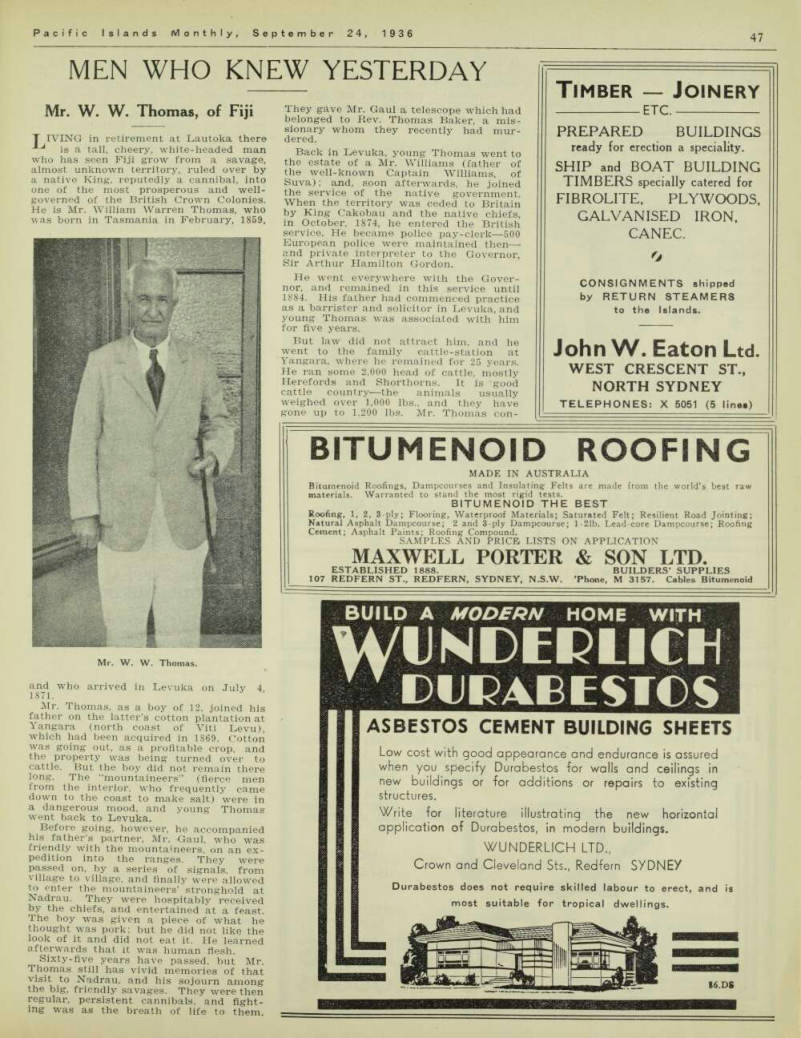
Mr. W. W. Thomas, of Fiji
T IVING in retirement at Lautoka there is a tall, cheery, white-headed man who has seen Fiji grow from a savage, almost unknown territory, ruled over by a native King, reputedly a cannibal, into one of the most prosperous and well governed of the British Crown Colonies.
He is Mr. William Warren Thomas, who was born in Tasmania in February, 1859,
and who arrived in Levuka on Julv 4 1871.
Mr. Thomas, as a boy of 12, joined his father on the latter’s cotton plantation at Yangara (north coast of Viti Levu), which had been acquired in 1869. Cotton was going out, as a profitable crop, and the property was being turned over to cattle. But the boy did not remain there long. The “mountaineers” (fierce men from the interior, who frequently came down to the coast to make salt) were in a dangerous mood, and young Thomas went back to Levuka.
Before going, however, he accompanied his father’s partner, Mr. -Gaul, who was friendly with the mountaineers, on an ex pedition into the ranges. They were passed on, by a series of signals, from village to village, and finally were allowed to enter the mountaineers’ stronghold at Nadrau. They were hospitably received by the chiefs, and entertained at a feast.
The boy was given a piece of what he thought was pork; but he did not like the look of it and did not eat it. He learned afterwards that it was human flesh.
Sixty-five years have passed, but Mr.
Thomas still has vivid memories of that visit to Nadrau, and his sojourn among the big, friendly savages. They were then regular, persistent cannibals, and fight ing was as the breath of life to them.
They gave Mr, Gaul a telescope which had belonged to Rev. Thomas Baker, a mis sionary whom they recently had mur dered.
Back in Levuka, young Thomas went to the estate of a Mr. Williams (father of the well-known Captain Williams, of Suva); and, soon afterwards, he joined the service of the native government.
When the territory was ceded to Britain by King Cakobau and the native chiefs, in October, 1874, he entered the British service. He became police pay-clerk—soo European police were maintained then— and private interpreter to the Governor, Sir Arthur Hamilton Gordon.
He went everywhere with the Gover nor, and remained in this service until 1884. His father had commenced practice as a barrister and solicitor in Levuka, and young Thomas was associated with him for five years.
But law did not attract him, and he went to the family cattle-station at Yangara, where he remained for 25 years.
He ran some 2,000 head of cattle, mostly Herefords and Shorthorns. It is good cattle country—the animals usually weighed over 1,000 lbs., and they have gone up to 1,200 lbs. Mr. Thomas con
Mr. W. W. Thomas.
trolled butcheries at Lautoka and Ba.
Eventually, he sold out to his brothers, and they later sold to the Colonial Sugar Refining Co.
Mr. Thomas saw the first Indian lab ourers arrive in Fiji in the ship Leoin Das, about 1877. They were disembarked
at Levuka, and indentured to the various planters. To-day, there are nearly 90,000 Indians, settled in Fiji.
Horrible Incident Of 1871
Mr. Thomas has many lively memories of early Levuka. He still recalls with horror, an incident that occurred in 1871.
The Lavoni tribe were entrenched in a strong position on top of Ovalau Island, and were being besieged by the armies of Bau. Finally, the Lavoni people were induced by a missionary, who was acting as an intermediary, to surrender to the Bau people, on condition that they would be protected and would not be taken as slaves. The Lavoni folk were duly rounded up, left their stronghold, and were marched down to the native village in Levuka.
Then a cruel thing occurred. The help less Lavoni people, about 200 men, women and children, were put up at public auction in Levuka, and sold as slaves to planters in the islands round about.
“That was one of the most disgraceful incidents in the history of the South Seas,” says Mr. Thomas. “I remember hearing my father say to my mother; ‘That is the most awful piece of bar barism I ever saw. We need labour, but we should not be a party to things like that’.”
The need for labour led to kidnapping, or “blackbirding,” and some old-time skippers achieved great notoriety. The native government seized, at Levuka, one particularly infamous brig, called the Carl, and that was the end of her. Among the rogues and cut-throats aboard her, Mr. Thomas was interested to find the son of the pastor in the village he had lived in, in Tasmania.
A Forgotten Port
The man who organised the native government, in the seventies, was a re tired naval officer, George Austin Woods.
He believed in developing trade; and there was a surprising amount of traffic between Fiji and the British colonies in those days.
In 1873, there were three steamers running between ’Frisco and Sydney, which served Fiji.' The port of call was °n Kadavu, the big island southward of Viti Levu, and a little steamer of 200 tons maintained communication between Levuka and Kadavu. The latter was a bright little place, with a hotel and a few stores. The bottom had fallen out of cotton: but there was plenty of activity.
Trade was absolutely free, and living was very cheap.
South Seas Rendezvous
Levuka, in the seventies, w'as a ren dezvous for the South Seas. Many well known Pacific “characters” came in there.
A hotel kept by William T. Sturt was a famous meeting-place. Sturt himself was a remarkable person. Once a man, W'ho had ordered a drink of whisky (6d), poured a huge “nip” out of the bottle.
Sturt ostentatiously walked to the till, took out 3d, and handed it to his cus tomer. “What’s this for?” demanded the latter, suspiciously. “I made a mistake — you’re a wholsesale, and not a retail customer. You must have wholesale rates,” said Sturt.
It was in Sturt’s hotel that Mr. Thomas, then a youth of 16 or 17, met Captain “Bully” Hayes. He describes Hayes as a big, broadshouldered black-bearded man, with a slight American accent and a jovial manner. After he was murdered in 1877, his widow and two daughters, lived in Levuka for a while, at the Planters Club Hotel, kept by a Mr. Ryan.
The girls were fascinating creatures — musical, good singers, very vivacious, and they could dance in a way that won the hearts of Levuka’s younger set. Mrs.
Hayes kept a private boarding house in Suva for a time, and later was licensee of the Victoria Hotel.
Advertisements & other items, pp. 49-50 (1 item)
Bitumenoid Roofing
Timber Joinery
ETC.
PREPARED BUILDINGS
ready for erection a speciality.
SHIP and BOAT BUILDING
TIMBERS specially catered for
FIBROLITE, PLYWOODS.
GALVANISED IRON.
CANEC.
O CONSIGNMENTS shipped
by RETURN STEAMERS
to the Islands.
John W. Eaton Ltd.
WEST CRESCENT ST.,
NORTH SYDNEY
TELEPHONES: X 5051 (5 lines)
BITUMENOID ROOFING
MADE IN AUSTRALIA
Bitumenoid Roofings, Dampcourses and Insulating Felts are made from the world’s best raw materials. Warranted to stand the most rigid tests.
BITUMENOID THE BEST
Roofing, 1, 2, 3-ply; Flooring, Waterproof Materials; Saturated Felt; Resilient Road Jointing; Natural Asphalt Dampcourse; 2 and 3-ply Dampcourse; l-21b. Lead-core Dampcourse; Roofing Cement; Asphalt Paints; Roofing Compound.
SAMPLES AND PRICE LISTS ON APPLICATION
MAXWELL PORTER & SON LTD.
ESTABLISHED 1888. BUILDERS’ SUPPLIES
107 REDFERN ST., REDFERN, SYDNEY, N.S.W. ’Phone, M 3157. Cables Bitumenoid
BUILD A MODERN HOME WITH
ASBESTOS CEMENT BUILDING SHEETS
Low cost with good appearance and endurance is assured when you specify Durabestos for walls and ceilings in new buildings or for additions or repairs to existing structures.
Write for literature illustrating the new horizontal application of Durabestos, in modern buildings.
WUNDERLICH LTD.,
Crown and Cleveland Sts., Redfern SYDNEY Durabestos does not require skilled labour to erect, and is most suitable for tropical dwellings.
PQQ
86.DS
Find out What’s Inside
before you buy a low-priced Saddle.
THE KING OF 'EM ALL
NARROW
Is a “Safer Saddle Offers Sensational Advantages * Being built on a Galvanised Tree, heavily bar plated, and strained with English web, riders are assured of its genuine foundation. Its soft, pliant kip flaps are hard-wearing, while the swecpy seat gives superb riding comfort.
Fivted with Best Leather, Folded Girth, £5/5/- Freight Free With Capped Pads, 15/- extra.
Write for Catalogue P 1935.
Sydney’s High-Class Saddler.
Newmarket Saddlery
W. H. Williams for “Safer" Saddles 18-20 Wilson St., Newtown, N.S.W.
Stirrups
Copra Mats ami Matting: . . .
Send your enquiries to us for Woven Wire Mesh in Rolls or framed for Copra Drying and all Screening purposes, Bird Cages, Sieves and Riddles, Builder’s Gravel Screens, Rat Traps, Door Mats, Garden Arches, Chain Wire Mesh, Crimped Wire Mesh for Window Guards, etc.
SCOTT AND SONS
WIREWORKS: RAILWAY PARADE AND MURRAY STREET MARRICKVILLE
These light steel ploughs...
Made by Ransomes, Sims & Jefferies Ltd.
Ipswich, England are made in 5 widths:— 7in., Bin., 9in., 10in., and llin. cut.
These ploughs will do good work in new or old land. Ample clearance is provided for ploughing in thick surface growth.
Write for illustrated Catalogues and all information. •
MORRIS,
HEDSTROM
Ltd.
Suva, Lautoka and Ba.
ansomcs
CUB” PLOUGHS
£10,000 Appeal For
N. Hebrides Mission Work
rpHE Foreign Missions Committee of the -*■ Presbyterian Church of Victoria has launched a special appeal to church members all over Australia for £lO,OOO to clear the debt which exists on the work ing of foreign mission activities. Unless the money is forthcoming, work in the main field (New Hebrides) will be seriously curtailed.
The New Hebrides Mission has a special claim on the goodwill of Presby terians as the first missionary was the late Rev. John G. Paton, father of the Rev. F. H. L. Paton (born in the group and until recently minister of a Victorian Presbyterian church) and of the Rev. F.
J. Paton, at present a missionary in the New* Hebrides.
Many Presbyterians believe it is un thinkable that the late Dr. Baton's great work, for which he gave his life, should be blemished by any falling off in efficiency. The" mission has been of in calculable benefit to the people of New Hebrides.
Mr. and Mrs. H. O. Fletcher, of Salami Plantation, in the Manus District, New Guinea, returned to Lombrum by the August Macdhui.
Rev. H. J. Pearson, 8.A., sailed from Sydney for Rabaul for the Methodist Mission Society of Australasia by the Macdhui on August 20. Accompanying him was Mr, J. Trevitt, M.A., Dip. Ed., who is the new headmaster for the Mis sion’s Training College at Vunairima.
New Britain.
N.G. Legislative Council
Speed Record Maintained
From Our Own Correspondent
Rabaul, Aug. 15.
THE second meeting of the Legislative A Council in 1936 opened on August 5 with the Administrator presiding. All official and non-official members were present and in 1J days, or approximately five working hours, 18 Bills were dealt with. One, dealing with Workmens’
Compensation, was referred to a special committee.
Most of the measures were of a routine, or machinery nature, such as defining more adequately the owner of a motor car, introducing permits for the brewing of liquor, measures affecting timber cutting for miners; public servants’ privileges; making the Wireless Tele phony Act of Australia operative here; exempting natives from the Licenses Ordinance: legalising lotteries, sweeps and the tote when approved; introducing measures extending leasehold periods of trading stations; and better conditions relating to companies desiring to work kunai grasslands.
New Shipping Bill
An amendment of the new shipping Ordinance was introduced for the purpose of “facilitating the administration of the Shipping Ordinance.” It alters the prin cipal ordinance by amending the defini tion of “local ship.” A “local ship” now is one licensed to engage in local trade (which is taking on board any passengers or cargo at any port in the Territory for landing at any port within the Territory).
A “local ship” must be licensed by the Administrator.
A further amendment is that a vessel which does not trade solely in the Terri tory may be granted a license to engage in local trade, and may then engage both in local and overseas trade; such licenses may be issued by the Administration in his “absolute discretion.”
Hon. J. C. Mullaly spoke strongly against the Bill more especially as an other amendment had been handed to them a week before; and this particular one was only placed on their desks on the morning the meeting opened.
Messrs. Grose, McLennan and Clark also spoke strongly against the Bill.
The Bill eventually was passed, being opposed by all the non-official members, with the exception of Mr. Perriman.
Estimates For The Year
Interesting figures were divulged when the Treasurer (the Hon. Orton Townsend) presented the estimates, which amounted to £454,100, for year ending June 30, 1937.
A new works programme had been drawn up with an expenditure of £102,770. Actual disbursement is not expected to exceed £78,000, when £3,000 from insurance of the Hermes is credited, and £21,770, is the amount estimated to remain unexpended at the close of the year.
Reductions in taxation will take the form of amending the present tariff on automobiles and parts from 20 per cent, to 10 per cent., and a remission of native labour taxes for another year.
The debates during the session were tame in comparison with previous meet ings. The non-official members appear to have become resigned to the omni potent power of Canberra, which over shadows everything.
Mr. R. E. Dwyer, Economic Botanist in the N.G. Department of Agriculture, re turned to Rabaul after leave by the Macdhui in August.
American Sea Scouts On
Pacific Cruise
From Our Own Correspondent.
Suva, Aug. 12.
IN the course of a training cruise of the Pacific, the American motor vessel Stranger arrived in Suva in July. She sailed again for Tonga on August 6.
The Stranger is a converted Swedish cargo vessel. She is commanded by Cap tain Fred E. Lewis, who is conducting a South Seas cruise as a means of training a party of United States Sea Scouts.
There are over 50 cadets on board.
While on the cruise the party is collect ing museum specimens, particularly marine life. The specimens are kept in special saltwater tanks on board.
Mr. Vernon Dorrell, a pilot attached to Pan American Airways, who has been in Australia supervising the assembly of Guinea Airways’ new Lockheed Electra monoplane, returned to the United States by the Mariposa on August 19, By the same vessel Mr. H. G. Townshend, who has been in Sydney tuning up the engines of W. R. Carpenter and Co.’s new Gannet monoplane, also departed for San Fran cisco.
Mr. and Mrs. Dick Ely, of Maritsoan Plantation, New Ireland, recently arrived in Sj r dney by the Malaita, en route to South America where Mrs. Ely has in herited some property.
Miss E. E. Brabin, 8.A., departed from Australia for Rabaul by the August Macdhui to join the staff of the Girls’
School at Vunairima, conducted by the Methodist Mission.
Advertisements & other items, pp. 51-52 (1 item)
Headquarters
LEATHER BELTS
r or NATIVES
'manufacturers 4 Specialists
PATTERSON & STONE. CRICHTON WORKS,
WALSALL, ENGLAND.
HI m W Kl ■ -
The..
Headquarters
House / or
ELECTRICAL
EQUIPMENT
BOTH
Domestic & Industrial Jr.
READING
LAMPS
that Stand, Hang or Clamp. Big variety from 14/6
ELECTRIC
FANS
for all voltages.
Desk and Ceiling Types
HECLA
ELECTRIC
APPLIANCES
MOTORS & GENERATORS
Any Size for Any Job Ronaldson-Tippett Electric Lighting Plants •
TUDOR BATTERIES
VAN DORN Portable Electric Tools: Drills, Grinders, etc.
Include: Kettles from 39/- Irons with moulded bakelite Grip and Flared Sole 25/6 Toasters 21/6 Grillers from 32/6
REMEMBER FOR QUICK DELIVERY...
ORDER YOUR SUPPLIES FROM
"TSSSS* P? QS/tfrJt
EDWARD ST JL O A Aik. STURT SI
BRISBANE ICWNSVIUI
ENCINEERINO Supply cvcf AIJSTEAIIA E?>
If you have bad luck to the Lottery, games, gambling, love, busl ness, you should carry a pair of ( Mystic Brahma Highly - Dynamic Loadstones. These loadstones are carried by occult Oriental people as a powerful * I charm—one to prevent bad luck, evil, and misfortune, and the other, to attract much good luck, ‘ love, happiness, and prosperity Posted by return mall, price 4/6 the pair. Posted 2d. extra f Money refunded 1» T days If not satisfied.
Royalty Traders, Room 40PD, ii
3 Castlereagh St., Sydney il
EXCELSIOR SUPPLY CO. LTD.
The most extensive Manufacturers in the British Empire of
RUBBER STAMPS,
INKS, STENCILS.
Marking Devices.
ACME STAMP PADS
We have a big range of Special
FRUIT CASE MARKING SETS
We also Manufacture or Supply a complete line of
Spraying Machines
for all purposes.
Let us know your requirements and we will quote you by return. Ask for our Big Catalogue.
Sole Australasian Distributors of the World Famous SHEAFFER FOUNTAIN
PENS and PENCILS.
EXCELSIOR SUPPLY CO. LTD.
Head Office 160 BROADWAY,
SYDNEY. N.S.W.
Archbold Expedition
From Our Own Correspondent
Pt. Moresby, Aug. 25.
HPHE Ronald S. arrived at the base camp, formerly used by Oroville Co., a little above D’Albertis Junction on the Upper Fly on August 10, with Mr. Ward Williams’ mining party on board.
Members of the Archbold Expedition who had rafted down from the slopes of Mt. Blucher were already there and the Ronald S. left on her return journey with the Archbold party on August 13. Though Mr. Archbold returned to Daru, several members of his expedition proceeded to Lake Murray to make collections before they return to Daru and Port Moresby in September.
Pastor R. W. Lane, of the S.D.A. Mis sion at Suva, Fiji, arrived in Sydney by the August Mariposa.
Mr. E. A. Guigan, manager of the desiccating factory at Aroa in the Central Division of Papua, reached Sydney by the Macdhui in mid-August to join his wife and family who are spending holi days in Australia.
Planting In New
Guinea
Market Rises Give Confidence to Copra Producers
From a Special Correspondent RABAUL, August 2.
A GENERAL feeling of hopefulness pre vails among the planting community in New Guinea, especially among the copra producers.
Planters have become more confident now that the market prices are firmer. Pro duction has increased and copra sheds are now filled to overflowing awaiting ship ments to European and Australian ports.
Great care is being taken to maintain N.G. copra at its usual standard thus securing the best possible price.
Leguminous cover plants are now almost universally employed throughout the planting areas with excellent results.
There has been a decided improvement in the appearance of the large scattered hold ings, especially in those where the legum inous plants have become firmly estab lished. Apart from the orderly aspect, the nourishment derived by the plants greatly assists production.
Coffee And Cocoa
At Keravat Demonstration Plantation outside Rabaul, which is under the control of the Agricultural Department, great in terest has always been taken in the cultiva tion of coffee. Several years back some 17 acres were interplanted with Robusta, Hybrid, Arabian and Stenophylla varieties for experimental purposes. The Robusta plants especially showed good promise.
Coffee and cocoa are now both yielding profitably, the former is all sold locally and a few shipments of the latter have been sent to Australia to test the market. Sel ected pods of best cocoa trees are sold to local planters, and their demand increases as the production is becoming more general.
Several new buildings have been com pleted at Keravat, including stores and a cocoa drier with movable roof,
Kapok
Some interest has been taken in the pro duction of kapok, but not on a large scale.
One plantation has recently had good crops and a reasonably good market in Australia offers some reward for the enterprise.
Both Java and Jamaica seed were dis tributed among New Guinea planters some years back and several growers achieved success with the Java seed. One New Britain planter cultivated over 2000 trees.
Repent
Papuan Ate Cat: A Month to Repent
From Our Own Correspondent
Pt. Moresby, Aug. 24.
IN the Court of Petty Sessions on August 18 before the Resident Magistrate, Mr.
W. R. Humphries, a well-known Eastern native, ladikoi, was charged with unlaw fully killing a manx cat, the pet of a lady resident in Port Moresby.
Fully knowing that the cat was a valued possession, he deliberately killed it and ate it, inviting his friends to share in the titbits. ladikoi was sentenced to one month’s imprisonment, without the option of a fine.
Mr. S, H. C. Short, overseer of Tinputz Plantation, Northern Bougainville, New Guinea, returned to Kieta after furlough in Australia by the Malaita on August 8.
During his holidays in Sydney, he married Miss Una Macandrew, sister of Mr. J. A. Macandrew, of Bonis Plantation, Buka, and his bride accompanied him back to Tinputz.
Advertisements & other items, pp. 53-54 (1 item)
Freemans
For QUALITY GOODS at LOW PRICES
147 CASTLE REACH STREET,
SYDNEY - - New South Wales Right in the Centre of THE BLOCK • v* yvnki i f u l kv/rr rn/V/CO
Freemans
(ESTABLISHED 1905)
Between Park and Market Streets.
Sporting; Goodi
BRAND NEW BRAND NEW
GOLF SETS! GOLF SETS!
Free with every Golf Set purchased: One Dozen Tees and Two Golf Balls.
Matched Hickory Shaft Golf Sets, hand forged, including mid-iron, mashie, putter, and brassie-driver in leather mounted waterproof canvas bag 37/6 “J. Kirkwood” Hickory Shaft Matched Golf Sets, rustless Scotch heads, hand forged, including mid-iron, mashie, putter and brassiedriver, in leather mounted waterproof Canvas Bag 42/6 Steel Shaft Golf Sets, including mid-iron, mashie, putter and brassie driver, in leather mounted waterproof Canvas Bag 63/-
WE STOCK ALL SPORTING REQUISITES
Write for our Free Catalogue of the Sports needs in which you are interested.
Tents! Flys! Brand New
Strongly made and reinforced.
Extra heavy English Calico Tents: 3ft. walls, 6xB, 16/9; 8 x 10. 21/6; 10 x 12, 27/6.
Extra heavy English Calico Flys: 8 x 10. 10/6; 11 x 9, 13/6; 10 x 12, 16/6; 12 x 12. 19/6; 12 x 14. 22/6; 14 x 14, 25/-.
Extra heavy English lOoz. twisted Duck Tents, 3ft. walls, 6xB, 24/-; 8 x 10, 30/-: 10 x 12, 42/6.
Extra heavy English lOoz. twisted Duck Flys, 8 x 10, 12/6; 11 x 9, 16/6; 10 x 12, 19/6; 12 x 12. 22/6; 12 x 14. 25/-; 14 x 14. 27/6.
Folding Camp Stretchers, brand new, 14/6 ea.
Haversacks, strongly made of waterproof khaki 6 / 6 ea>
Auto Tents—Brand New
12 x 12 Marquee Auto Tents, extra heavy English 15oz. twisted duck roof, lOoz twisted duck walls, with calico partition, telescopic poles, ropes, pegs, and waterproof duck ba S £6/10/0
Saddles Saddles
BRAND NEW—GUARANTEED TREES
High-grade Stock Saddles, built on strong guaranteed trees, very deep comfortable kip seat, narrow grip, wide leather facings at back, 4m. firm pads (set up high, giving greater security to the rider), extra long kip flaps and skirts, mounted with leathers, rolled girth, and 3-bar N.P. irons £4/10/0 Special Concessions to traders • an d storekeepers for quantities. ? Write for quotations. -it■>i» t > i i tiiti t ■ i i*
Sewing Machines
Slightly Used.
Hand Sewing Machines, in good order and condition, always on hand. Prices range trom 45/-
Musical Instruments
Special Bargains in High-grade Musical Instruments.
Brand New Imported Ukeleles, with pegs and strings, splendid tone. Free Tutor .. . 10/6 Brand New Imported Steel Guitars, magnificent tone. Free Steel Picks, Tutor ... 35/- Brass Bugles, slightly used 19/6 Oval-back Mandolins, in case, slightly used.
Free Tutor 35/.
Standard Banjos in case, good condition, free tutor 42/6 Brand New Chinese Temple Blocks, set of ■ 42/6 per set Very fine Violins, full size, with case and bow, slightly used, free tutor 45/.
Very fine Tenor Banjos, in case, slightly used 50/.
“Mandy Joe” Banjo Mandolins, in case, all metal, slightly used, free tutor 45/- Very fine “Stella” flat back Banjo Mandolins, in case, free tutor 45/.
Italian Oval-back Mandolins, pearl inlaid, slightly used 55/- “Reliance” large size Banjo-Ukeleles, 'with resonator, in case, slightly used, free tutor, 55/ Magnificent Italian Flat-back Mandolins, mother-of-pearl inlaid, nearly new, free tutor 50/.
Magnificent Silver-plated Trumpets, “Ambassador” make, quick change, A or B, in solid leather case, nearly new £9/10/- Silver-plated “Besson” Baritones, Class A. good condition £lO/10/- Magnificent Silver-plated “Higham” Trumpet, Champion Star model, quick change to A or B, in solid leather case, nearly new £ll/10/- Magnificent Standard Banjos, with fine resonator, 24 brackets, nearly new, in case, £5/10/- Very fine Old Violins, bow, case . £5/10/- Silver-plated “Conn” Cornets, class A. in case, nearly new £6/10/- Magnificent “Windsor” Tenor Banjos, "Pixie.” marvellous tone, complete in case, nearly new, cost £24; will sell £l2/10/- “Decca” Portable Gramophones, slightly used 35/.
Columbia Portable Gramophones, slightly used 45/- “His Master’s Voice” Portable Gramophones, slightly used 79/6
Brand New Accordeons
Brand New high grade German Accordeons, steel bronze reeds, built on ebonised frames, 2 stop. 32/6; 3 stop, 3D/6; 4 stop, 47/6.
Piano Accordeons
21 notes, 8 Sunken Basses, green pearloid finish body. 14 folded bellows, with nickelplated corner protectors, with free tutor, £6/15/ Antonio Silvagni Piano Accordeons, 21 notes, 12 sunken Basses, dark blue pearloid finish body and sloping keyboard, rounded black keys chromium plated key cover, 14 fold bellows, nickel-plated corners, protectors, strong leather bass & shoulder straps, with free tutor £7/15/- We Stock all kinds of Musical Instruments.
Write for our Free Catalogue.
Bicycles
Special Bargains in Used Bicycles Very Strong Bicycles, fixed or free wheel, handbrake, well shod 55/- Very strong. Red Painted Bicycles, free wheel, handbrake, in good order and condition . . £3 Strong Blue Painted Bicycles, free wheel, handbrake, in good order and condition £3 Very Strong Bicycles, fixed or free wheel, 2 handbrakes, good tyres and tubes . . £3/15/.
Eadie Coaster Bicycles, good order ... 75/.
Very Strong Red Painted Bicycles, tapered frame, handbrake, fixed wheel, well shod, 75/- Very Strong Eadie Coaster Bicycles, tapered frame, good order £4 Red Painted “Speedwell” Bicycles, free wheel, 2 handbrakes, nearly new condition, £5/10/- “Malvem Star” Club Racer Bicycles, tapered frame, fixed wheel, 2 handbrakes, in good order and condition £5/10/- Very fine “Carbine,” Blue Painted, Bicycles, Club Racer, tapered frame, 2 handbrakes, nearly new condition £5/19/6 Good, strong, slightly used Bicycles always in stock. Prices range from 55/-
Field and Race Glasses
Slightly Used.
Powerful Field Glasses 25/- Extra powerful Field Glasses 39/5 Powerful Field Glasses, in case 49/6 English Prismatic Binocular Field Glasses, 6x, >n case 75/, “Colmont” Binocular Field Glasses, 6x. in case. very powerful £4/15/- “Ross” stereo prism Binocular Field Glasses, 6x, in case 95/- French Field Glasses. 8x £4/15/.
English Field Glasses, 8x magnification, powerful, in case £5/15/.
“Colmont” Binocular Race Glasses, Bx, extra powerful, in case £6/15/- “Carl Zeiss” Binocular Field Glasses, 6 x 80, in case, powerful £6/15/- “Carl Zeiss” Binocular Race Glasses, Silvamar, Bx, extra powerful £9/10/-
Slightly Used Cameras
Vest Pocket Kodak Cameras 15/- Kodak 1A Folding Cameras 20/- Kodak 2A Folding Cameras 27/6 Kodak 3A Folding Cameras 30/-
Slightly Used Typewriters
“Corona” Portable Typewriters, 3 bank, good order and condition £6/10/- “Corona,” 4 bank, Portable Typewriters, in case, slightly used £lO/10/- “Remington,” 4 bank Typewriters, good order and condition £7/10/- Remington Portable Typewriters, 4 bank, good order and condition £B/10/- Royal 4 bank Portable Typewriters, nearly new, in case £lO/10/- Monarch 4 bank Typewriters, good order and condition £6/10/-
All Mail Orders Promptly Attended to
FREEMANS
. . We Guarantee you every satisfaction nquines invited. Kindly add carriage on all Mail For Prompt Service and Honest Value
WE STOCK EVERYTHING
Orders.
147 Castlereagh Street,
Sydney, New South Wale*
A. Q. McGowan & Co.
SUVA, FIJI ISLANDS
• Dealers in all Island Products, Exporters of Trocas Shells, Pearl Shells, Cowrie Shells and Curios, Kauri Varnish Gums, Bark, Mauritius Beans, Maize. Enquiries solicited.
B.N.G. Development
Declares 3% Dividend
Port Moresby, Aug. 15.
THE British New Guinea Development Co. Ltd., which first started operations in Papua in 1910, has declared a dividend of 3 per cent.
The annual report for the period ended January 31 shows a net profit of £16,532. Of this, deben ture interest absorbed £7684, leaving an amount of £BB4B. The directors recommended the pay ment of a 3 per cent, dividend (less income tax at 4/9 in the £), calling for £4379. This leaves a balance of £4470 to be carried forward.
The dividend is payable on the reduced capital of £191,412. Ordinary shares have been written down to 2/- each.
Output of copra amounted to 2219 tons, and rubber 792,6701 b. Including the Commonwealth bounty of 2d per lb, the average net price realised on rubber was 9d. Production of copra resulted in a profit of 36/6 a ton during the year.
Amazing Escape
Survivors Swam for Eight Hours After Papuan Ketch Lost
■p’VIDENCE given recently at the Go vernment inquiry into the loss several months ago of the ketch Lytton and nine natives in Eastern Papua showed that the master, Mr. Bruce Hamilton, and Sealass, a young native were amazingly lucky to reach the shore safely.
With a crew of five, the 18-tons schooner was sailing under jib and mizen for Sama rai with 16 recruits. At 8.30 a.m., two and a half hours after leaving East Cape, Mr. Hamilton went below, leaving the boss boy at the wheel. Suddenly a waterspout hit the vessel and a terrific whirl of wind and spray enveloped her. With a jerk, her stern lifted, and she rolled over with the starboard side under.
Panic-stricken, the natives jumped into the sea and were too terrified to help the master when he rushed on deck to get on© of the two lift, dinghies clear. Within a few minutes the Lytton was engulfed, with both boats.
Land was six miles away; with the aid of the boss boy, Mr. Hamilton got the natives together and the 22 men set out on a long landward swim. Within half an hour a howling squall of wind and blinding rain swept upon them, and, in the cori fusion, the swimmers separated. When it cleared Mr. Hamilton found that only two boys were still with him, including the 14-years-old Sealass.
A breaking sea was running, making swimming almost impossible, but the three men battled on. Another squall struck them, and one of the natives was drowned.
"With the aid of a kerosene case, Mr.
Hamilton and Sealass kept on, grimly mak ing for the land in spite of several shark scares. After almost eight hours in the water, they came within 300 yards of the shore in the Killerton Islands. Natives working for a trader, Mr. Harry Reid, paddled out in a canoe, and the exhausted pair hung on to the craft until they were taken through the sweeping surf.
Of the 18 natives who had been separated from Mr. Hamilton just after the disaster, 10 managed to struggle ashore about a mile further along.
Papuan Finances
From Our Own Correspondent
Port Moresby, Aug. 16.
THE total revenue for Papua for 1935/36 tc June 30 amounted to £165,688, compared with £152,611 for the previous year. This is a rise of £13,077, due chiefly to increases in import duties, sale of stamps, and station produce.
Expenditure was up £13,348, principal increases being in the magisterial services and the Govern ment Secretary’s Department. Medical services also showed an increase as did the accounts of the Public Works Department.
At the close of the year the balance on revenue account showed £295, compared with £428 in the previous year. The public debt stood at £61,472, due to the Commonwealth of Australia.
Archdeacon and Mrs. Ralph de Voil, of the Melanesian Mission, Rabaul, New Guinea, received many congratulations on August 6 on the birth of a son, Chris topher Charles.
Mrs. George H. Murray, wife of the Director of Agriculture in the Mandated Territory of New Guinea, left Sydney to join her husband at Rabaul by the Macdhui on August 20.
Advertisements & other items, p. 54 (1 item)
Keeps on Keeping* on /”
a (PREPARED)
AGENTS THROUGHOUT THE ISLANDS
Hudson’s Ready-Cu ”Homes
Design No. 504 containing 5 large rooms, bathroom and wide verandahs. Materials ready-cut with weatherboard or asbestos cement walls, plaster lined, galvanised iron roof.
Price at wharf, Sydney, £382 HUDSON’S Ready - Cut System offers the most practical solution of the building of a home in districts . where skilled labour is difficult to obtain. The framework is prepared ready for erection, the doors and windows are fitted and hung in frames with locks, hinges, etc., ready for placing in position and all verandah posts, plates, barge boards, etc., are cut ready for fixing.
Waste is almost entirely eliminated and erection costs are reduced by half.
A very efficient plan service is provided which makes the work of erection a very simple matter, and it is not necessary to employ skilled labour.
We quote for your own or any design Send for latest catalogue containing many new designs.
GEORGE HUDSON LTD.
Timber Merchants, GLEBE, SYDNEY, N.S.W.
Ready-Cut Homes Department, 7 Castlereagh Street.
ilium
Plea For Co-Operation In Pacific Affairs
An Address Broadcast from Suva Station, Fiji, on July 24, 1936, by
R. W . Robson
T AM going to take advantage of this opportunity, kindly given to me by the Fiji Broadcasting Company Limited, to urge that some kind of organisation be created for the exchange of opinion and experience between the Territories of the South and Central Pacific.
For several years, I have been in close touch with the Pacific communities. It is to me a matter of increasing wonder that all these people, with similar con ditions of life, similar points of view, and similar problems to solve, should continue to exist in watertight compartments, almost completely isolated one from the other.
I can claim to have personal know ledge of the Territories of Papua, New Guinea and Norfolk Island, which are controlled by Australia; of Fiji, Solomon Islands, Tonga and the Gilbert and Ellice Group, which are governed by the British Colonial Office; of Samoa and the Cook Islands, controlled by New Zealand; of the New Hebrides, which constitutes a Condominium; and of New Caledonia and Tahiti, which are governed by France.
Except that there is malaria fever in the western and not in the central and eastern islands, and except for variations in the types of native people, represented by the differences between Polynesians and Melanesians, the conditions of life in all those 12 territories are almost identical. Yet, apart from the fact that the four Central Pacific groups are linked
together in the High Commission for the Western Pacific, there is absolutely no co-operation between these various terri tories, not even to the extent of con sultation on matters of common interest.
One would suppose that there would be some kind of co-operation between the Australian territories of New Guinea and Papua, because they are controlled from the same Department in Canberra. But, actually, there is no evidence of it. Papua and New Guinea have quite independent non-interchangeable public services, and separate and apparently independent policies regarding health, education, native affairs, etc.
THE only matter in which there is some semblance of co-operation in the Pacific, is in the training of native medical practitioners. In the Suva Medical School, one finds the finest types of young natives from Fiji, Cook Islands, Samoa, Tonga, Gilbert and Ellice, Ameri can Samoa, and the Solomons, undergoing a four years’ course; and, what is equally important, learning to know each other, at work and in play. The Suva Medical School, both as a professional training institution, and as a means of creating unity of thought and purpose among the native races of the Pacific, appears to be 100 per cent, successful.
One would have supposed that, with this institution as an inspiration, there would be a general move among the 12
administrations towards co-operation in other fields. But there is no evidence of it. One finds, on the contrary, that Aus tralia is holding aloof even from this system of training native medical prac titioners. No young natives are being sent to Suva from Papua or New Guinea —although, owing to the generous contri butions of the Rockefeller Foundation, the total cost is only £75 per student per annum. Instead, a selected number of young Papuans are receiving medical training in Sydney—which is a system that, from the social angle, has some very undesirable features. So far as the Mandated Territory of New Guinea is concerned, there is no systematic training of natives as medical practitioners— although New Guinea has a huge native population, and a substantial financial surplus.
T SHOULD like to urge that there should be consultation and, wherever practic able, co-operative action in such matters as public health (more especially in the treatment of tropical diseases), in native education, in planting and agriculture, in shipping and quarantine regulations, in
the handling of the half-caste problem, and in many other matters of common concern, which will readily occur to men who know the conditions of Islands life.
One thing in which, in my opinion, there is really urgent need for an exchange of views, with a view to cooperation, is that of giving advice to planters regarding crops which they may produce at a profit, Everywhere I have gone in the South Seas I have found planters clamouring for information about practicable crops and possible markets. They can find out for themselves, or with the help of their local departments of agriculture, what crops they can grow and the approximate cost of production: but they cannot by themselves obtain that other equally vital information—namely, the character and
dependability of the market for such commodities. Such information involves a good deal more merely gSring data about the ruling price fo? certail commodities—one must have, also in formation about world demand and’sup- Ply, cost of transport from producer to market, packing and grading, and the extent of co-operation that can be expected from the big trading firms.
If . the possession of these numerous Pacific Territories by Europeans is to be justified, the primary resources of the Territories must be developed in such a wa y that there will be a contented population of small planters, in which due provision is made for native and half caste planters, as well as for Europeans That surely involves the creation, in the Pacific, of a Central Bureau of
Economics, on which the agricultural departments of the several administra tions, the planters, and the big trading firms would all have representation. This bureau would gather essential informa tion about marketing from all over the world, and distribute it to planters.
Instead of planters having to speculate blindly as to whether they could profit ably grow this, that or the other, they could apply to the Bureau for reliable data. The creation of such a Bureau of Economics seems to me to be the only logical development of the maintenance of all these separate departments of agriculture. They all are doing valu able work—but in too limited a sphere.
A LL those who try to take a helpful v interest in Pacific affairs will hope that, before long, we shall see the definite beginnings of a movement for inter territorial consultation and co-operation.
The ideal, of course, would be co operation by Britain, France, the United States, Australia, and New Zealand, to advance their numerous common interests in the South Seas; but that must come slowly. Let a start be made by the British communities; and let the success of the Suva Medical School (in which already you enjoy very generous Ameri can co-operation) be your inspiration.
Advertisements & other items, pp. 55-56 (1 item)
Ruston & Hornsby (Aust.) Pty. Ltd.
W. M. FORD
Ship, Yacht & Boat Builder
Berry’s Bay, North Sydney
(Established 1870) BUILDERS of all kinds of Island Craft from Dinghies to Auxiliary Schooners of any tonnage. New and Second-hand Island Craft of various types in stock. New and Secondhand Full Diesel, Crude Oil, Benzine and Kerosene Engines.
Please Send on Your Enquiries
Notable Features ...
Totally Enclosed
iSritlsh Itiiilt Well Balanced, and of Compact Design.
Highly Economical at All Loads on Almost Any Brand of Crude or Residual Oil.
Reliable and Instant Starting from Cold under all Weather Conditions.
Full particulars without obligation from
RUSTON & HORNSBY (AUST.) PTY. LTD.
Registered Office: 174-180 KING STREET, MELBOURNE Cables: M eibfu?n. SßYS ’”
Branches at Sydney and Brisbane.
Sole Agents for the Mandated Territory: BURNS, PHILP & CO. LTD., Rabaul, New Guinea. h • t r ‘ r iHhi n
PAINT. . HORSE SHOE BRAND
IN PASTE OR READY
MIXED FORM
Made in Scotland— THOMAS MACINTYRE & CO. LTD., -GLASGOW. SCOTLAND
WHITE LEAD. WHITE ZINC
AND ALL COLOURS
-therefore Reliable!
DOYLE’S famous VETERINARY REMEDIES
OOYLfs : m : &
ORES#
REDUCINE—Cures Your Lame Horse. Cures him painlessly and you can work him all the time.
Cures Splints, Curbs, Capped Hocks, Sprung Tendons, Bog Spavins, and all Bony and Bursal En- (argments. Price, 12/6 per can. Postage 1/-.
LARYNGINEj—A sure cure for Coughs, Colds, Strangles, etc. Price, 5/- per can. Postage, 1/-.
SKIN DRESSING.—A certain remedy for Mange and Allied Parasitic Skin Diseases in Horses, Dogs, etc. Price, 7/6 (large), 3/6 (small). Postage, 1/-.
DISTEMPER MIXTURE.—A safe and reliable remedy for Coughs, Colds, Asthma, etc. Price, 2/6. Postage, 9d.
T. G. DOYLE, V.S., 9 KING STREET, RANDWICK, N.S.W. for Free Veterinary Advice and Booklet
CUPRINOL
—for Protection against
• WHITE ANTS
Official tests conducted by Union of South Africa, Forest Department, at Pienaars River with Eucalyptus s.aligna.
Test started 11/9/30—Treatment by immersion in Green Cuprinol.
I nspections Island Distributors.
PAUL A GRAY LTD.
82-84 SUSSEX STREET, SYDNEY
Pulp Industry
Preparing for Papua’s Paper Pulp Industry
From Our Own Correspondent
Pt. Moresby, Aug. 25.
T'HAT the preparations for the con struction of the British and Aus tralian Pulp and Paper Co.’s mill and plant at Collingwood Bay, Papua, are well under way is causing much satis faction in the Territory.
Plans for a tramway and a wharf are almost completed, and serve to show that there will be permanent employment shortly for not only a large number of labourers, but also many European ar tisans, engineers and overseers.
The establishment of the paper pulp mills in Collingwood will mean much for the development of the country. It is said that the first unit of plant with an output of 20,000 tons of bleached pulp per annum will alone represent a capital expenditure of £500,000. It is anticipated that 650 natives will be employed on this project, both for cultivating and harvest ing the Kuru-Kuru grass.
A.V. “Piedu” Wrecked On
Guadalcanal Coast, B.S.I.
From Our Own Correspondent.
Tulagi, Aug. 2.
THE prevailing bad weather has taken further toll of shipping: it is now reported that Mr. A. Olsen’s A.V. Piedu is a total wreck.
According to report, the Piedu was loaded and had left Tenamba for Tulagi, when engine trouble occurred. In the gales that have been prevailing the Gua dalcanal coast is a hopelessly lee shore, and every effort to save the ship was unavailing.
The Piedu was a comparatively new ship, built in 1927. SJie was specially de signed for Mr. T. B. Mason-Robinson, of Shortlands, for Islands trading, with special regard for the deck space available on the old Melusia, which carried her to the Solomons. Since she became the pro perty of Mr. Olsen, she had the glamour of gold, serving prospecting parties and making history.
Not By Bishop Blanc
History Of Tonga
r ¥THERE appears to have been some mis- A understanding about a history of Tonga, reported to have been compiled by Bishop Blanc, of Tonga.
The following is a copy of the fly-leaf of the pamphlet: “A History of Tonga, or Friendly Islands, Compiled by Monseigneur Bishop Blanc; Translated by Charles Stuart Ramsay, Swimming Mail-man of the South Seas: Printed by the Vista Press, Vista, California, U.S.A.”
When we saw the announcement, we wrote to Bishop Blanc and asked if it were possible to procure a copy of this history. We have now received a letter from Bishop Blanc in which he denies responsibility for the publication, and he adds: ‘As some people might be misled, like you, I should be very grateful to you if you would publish in the Pacific Islands Monthly that I do not acknowledge the pamphlet of Mr. Ramsay as a translation of anything written by me. It is only a translation of some passages of my Tongan paper, with a certain number of blunders, and on the whole it is the work of Mr.
Ramsay himself and not mine.”
Pastor G. H. Engelbrecht, mission superintendent in the New Hebrides for the Australian Union Conference of Seventh Day Adventists, arrived in Syd ney on furlough by the Morinda on August 28. He is stationed on the island of Acre, in the narrow strait between Santo and Malo Islands.
Oil In Papua?
Three Companies Have Permits To Search
T'HE search for oil in Papua and the Mandated Territory of New Guinea is being intensified and the Common wealth Government has announced that a sum not exceeding £250,000 is avail able to assist the search in those terri tories.
This represents the extension of the search that is being carried on in Dutch territories (East Indies and Dutch New Guinea) by American and Japanese oil interests.
The Standard Oil Company, of Cali fornia, has obtained a concession from the Dutch Government of 1,482,000 acres for oil exploitation in Sumatra. This Standard Oil Co. controls the Netherlands Pacific Petroleum Co.; and the latter holds a 20 per cent, interest in the Netherlands New Guinea Petroleum Company. The latter company, it is understood, is supported also by the Dutch Shell Co. and Pan Pacific Oil Co., and it is carrying on an active search for oil at the present time in Dutch New Guinea.
It is reported that, as a result of this oil search, oil wells have been found by drilling at Bongu, which is a few miles west of the border between Dutch New Guinea and Papua.
Meanwhile, the Japanese are securing supplies of new oil from three islands in the Dutch East Indies —Borneo, Sumatra, and Java. It is reported that
a Japanese oil combine with a capital of about £3,000,000 has been formed by the Mitsui, Mitsubishi, and Sumitomo in terests; and that this combine is eagerly seeking concessions to enable the oil search to be prosecuted in the Dutch islands further south.
The new ordinances passed in Papua and New Guinea allow encouragement to be given to British interests in the shape of concessions over large areas of coun try, and subsidies. Either Administration is empowered to impose conditions, such as to assure that the investigations shall be carried out expeditiously and satisfac torily. Following such investigations, permit-holders will be entitled to select licence areas, each up to 250 square miles.
Five such licenses (total area, 1250 square miles) can be granted to any one permit holder, subject to the approval of the Petroleum Advisory Board and the Minister.
Upon discovery of oil in paying quan
titles, and resultant proclamation of an oilfield, the Administrator would be em powered to grant leases of an area from eight to 20 square miles, not more than five of such leases going to any one qualified person, plus three reward leases in certain circumstances.
The “Petroleum Oil Search Act, 1936,” makes a first appropriation of £250,000 on a £1 for £1 basis to assist private concerns in drilling for oil on approved locations. Application for a permit is submitted to the Legislative Council in Rabaul or Port Moresby, after submis sion to the local Petroleum Advisory Board. After the application' is approved by the Legislative Council, it is then submitted to the Minister for Territories in Canberra for final approval, and settle ment of terms as to cash guarantee and specific performance preliminary to issue of the permit.
Three Permits Issued In Papua
It was announced in Canberra at the end of August that three permits had been issued to companies to prospect for oil in Papua. They are as follows: Papua Development Co. Ltd.— Permit to prospect for petroleum over 20,000 square miles in the Western and Delta Divisions.
This company was registered in Port Moresby on July 9, and is reported to be connected with one of the major oil companies.
Island Explorations Pty. Ltd. —Permit to prospect for oil over 20,000 square miles in Papua. This concern was registered in Melbourne on June 16 with a capital of £50,000. Directors are Hugh Hamilton, Senator J. D. Millen, W. A. Ince, and J.
C. Blair. Mr. L. B. Tomlins is secretary.
Some of the directors are also associated with the Vacuum Oil Co.
Oriomo Oil Ltd. —Permit to prospect for oil in an area of 12,000 square miles.
Oriomo Explorations Ltd. was formed in Sydney some time ago.
Advertisements & other items, pp. 57-58 (1 item)
Clear those idle acres
American desires to take over Management of small Coconut or other Plantation on Share Basis or Lease. Would consider partnership with initial investment up to £4OO.
Location preferred, about or below 1 7 degrees South latitude.
Please send full details to D.S., c/o. Pacific Publications Ltd.,
Box 3408 R, G.P.0., SYDNEY.
Clear those idle acres
* y
Buzacott & Co.
LTD.
7-11 Market St.
SYDNEY
With the Digger Winch Grubbing Machine one man can do a giant’s work. He can pull eighty trees a day without fatigue. Read this proof of its enormous strength. One man writes:—“lt took less than 6 minutes to pull a 4 ft. diameter green gum out of bone dry land.”
Think that over and realise what a profit maker, time and labour-saver this machine is—think what it can do for you when clearing land. It is so light that one man can carry it anywhere —and yet it is so strong that it’s impossible to break it.
Write to-night for particulars.
The Digger Winch
The Buzacott New Record Drag Saw is the working partner of the Digger Winch, and makes land clearing profitable and easy. Manipulation of this saw is the work of a moment, and the largest log only a few minutes’ work for the saw.
It is a one-man machine—and the man looks on while the saw does the work— or he goes on pulling trees- with the Digger Winch.
If the saw jambs, it cannot break—the engine runs free until the saw is cleared.
The Buzacott
* A
Drag Saw
fdoritjmjketU!
"Every Picture tells a Story"
DEWARE of Kidney trouble!
Weeks of needless pain and discomfort can be avoided by prompt treatment of the early symptoms and an occasional self-examination is advisable. 1. Do you wake up in the morning with a bad back ? 2. Are your eyelids puffy? Arc there dark swellings under your eyes ?
Are the ankles and hands swollen ? 3. Is the urine cloudy, gravelly or scalding ? 4. Are your limbs shaky and rheumatic, especially in damp weather ?
If you must answer "Yes” to any of these questions, start taking Doan’s Backache Kidney Pills
straight away. This special kidney
tonic can help you as surely as it has helped hundreds of thousands of others.
Be sure to insist upon
Doan's
Backache Kidney
Pills
Papua Oil Development Co,
From Our Own Correspondent
Pt. Moresby, Aug. 25.
THE staff of the Papua Oil Development Co., who arrived in the Territory in July, have begun work in earnest. Two additional members of the staff arrived by the Montoro on August 7.
Messrs. L. W. Myers and J. D. Hanley, surveyors who, together with Mr. A.
Robertson, chief gravity surveyor, will form the first field party to go to the large oil concession the company have secured in Western Papua.
The party has already set off with Mr.
P. R. Hinds, a well-known resident of Papua, who on account of his knowledge of the Western District has been engaged as transport officer for the company The party left Port Moresby for Daru on August 23, in the auxiliary ketch Palma, 13 tons, which arrived in Port Moresby from Townsville on August 19, chartered by the Papua Oil Development Co. for use in Papua. A native crew has been put on board and Captain Keyes and his crew will return by the Montoro.
A much larger vessel is to arrive shortly for the company’s operations, manned by a Malay crew. Approximately 18 months will be spent establishing a permanent base on the Fly River, from where field parties will set forth to examine the oil prospects of this vast area.
Mr. E. Bland in charge of the com pany’s operations, in Papua, is at present in Port Moresby. The company have acquired offices in Douglas St., Port Moresby.
Coinage
N.G. Natives Take to New Coinage
From a Special Correspondent
Rabaul, Aug. 6.
THHE Territory’s new coinage has been x accepted without comment by the natives.
Prior to European occupation of the country native shell money was always strung in bundles of from 10 to 15 pieces.
This custom had much to commend it, as it ensured safety. It can be easily under stood that the natives welcomed the change from money which was difficult to handle to the present coins which have a hole in the centre.
Up to June 30, shillings to the value of over £72,000 had been put into cir culation, sixpences to the value of £1,450, and threepences to the value of £950.
The face value of coinage minted was: shillings, £75,000; sixpences, £10,000; threepences, £15,000, Mr. C. Lexius Burlington, who is well known in Papua and on the New Guinea goldfields, where he was connected with several mining ventures, departed from Sydney for England, via U.S.A., with his wife and young daughter on September 2.
Mr, Burlington has gone to London prin cipally to witness the Coronation cere monies, and will be away for a year. On his return to the South Seas, he plans to lead an expedition, financed by a London syndicate, into the Fly-Strickland-Purari watershed of Papua in search of gold. Mr.
Burlington believes that by the time he is ready to enter the area the restrictions on private parties penetrating that sec tion of the Territory will have been modified.
Advertisements & other items, p. 58 (2 items)
Flour
PRODUCING UNIFORM GOOD RESULTS SINCE 1868
9
ALWAYS ASK FOR IT
% Island Shipping
Freight, Forwarding and Customs Service. Import and Export.
B. R. WHEELER
17-19 Bridge St., SYDNEY Correspondence Invited. Tel.: B 5396
Anxious
Samoan Planters
Menaced by Mad-headed Socialist Flans
From Our Own Correspondent.
APIA, Sept. 2. r ¥''HE political situation here at present is quiet.
The planters have been profoundly dis turbed by the reported determination of the N.Z. Socialist Government to abolish all Chinese labour in Western Samoa.
The planters can see in this proposal the ruin of their industry and serious re trogression in Samoa generally. If the plantations are not to have an efficient and permanent labour supply it will be impossible to keep the Samoan, as well as the European plantations, clean and clear of disease, and pests will spread everywhere.
The planters contemplate an appeal to the New Zealand Parliament, and also propose to seek the assistance of the organised farmers in New Zealand. It is, however, feared that great damage will be done to the territory before the reso lution of the Socialist Government can be broken down.
Already, the managers of the N.Z.
Reparation Estates (Government-con trolled) have received instructions to re patriate not only the Chinese, but also the Solomon Islanders, who were brought in by the Germans and who have been employed on these estates since 1914.
These Solomon Islanders number about 80 and nearly all are married to Samoan women and have families. None of them wish to return to the Solomons or to Buka (in the Mandated Territory of New Guinea) and the Solomons and New Guinea authorities do not approve of this repatriation.
It is to be presumed, however, that the New Zealand Government will presist with its mad-headed plan.
The Administrator
It is generally believed here that Mr.
A. C. Turnbull, who has been Acting Administrator for a long time, will be appointed Administrator. The appoint ment would be welcomed by all classes in Samoa, where both Mr. and Mrs. Turn bull are held in high esteem.
Political Situation
Mr. O. F. Nelson, since his return, has adopted a moderate political view, and is taking no prominent part in political activities, beyond urging both natives and Europeans to be satisfied with the concessions obtained from the N.Z. Gov ernment, and to co-operate for the good of the country.
It is reported that the Mau leaders have ordered heads of families to deliver lOOlbs. of dry copra to Mr. Nelson’s stores, as a gift, in recognition of Mr.
Nelson’s services to the Mau movement.
The Samoan natives connected with the Mau movement are at present preparing to elect their representatives to the new Samoan Parliament, which is to be con vened on September 30. It is expected that a new constitution for Samoa will then be proclaimed.
Advertisements & other items, pp. 59-60 (1 item)
The Southport Church of England Schools
REPLACEMENT PARTS
FOR ALL RADIO SETS
SPECIALLY IMPREGNATED
AGAINST MOISTURE
SPECIAL SETS MADE FOR
TROPICAL USE
KITS OF PARTS FOR ALL
TYPE RECEIVERS
WRITE FOR PRICE LIST AND
DESCRIPTION OF SPECIAL
TROPICAL BATTERY RECEIVER
The Southport Church of England Schools
(Under the Direction of the Diocesan Board of Education ) ON PACIFIC COAST OF SOUTHERN QU EENSLAN D—H EALTH Y EQUABLE CLI MATE—EVERY FACILITY FOR
EDUCATION AND SPORT
*.*■ W.
St. Hilda** School
CHURCH OF ENGLAND GRAMMAR SCHOOL FOR GIRLS Thorough general education from Primary to University Senior Public Examination Standard.
Beautiful new building, large, airy rooms, electric light, septic system, all modern conveniences, mild climate, sea bathing. Special care taken of delicate girls.
Pupils may specialise in Pianoforte, Violin, Singing, Art (painting, drawing, etc.), Handicrafts, Domestic Science,
Commercial Subjects, Physical Culture, Swimming and
Dancing, or Elocution.
The School has 25 acres of ground, so there is every facility for sport.
JUNIOR SCHOOL receives pupils from the age of five years.
FIRST TERM FOR 1937 COMMENCES FEBRUARY 3rd.
For prospectus and all particulars, apply to THE PRINCIPAL - - WINIFRED L. FITTOCK, B.A.
The Southport School
(FOR BOYS)
(Founded hy the Right Rev. H. H. Dixon, M.A., Bishop Coadjutor of the Diocese of Brisbane) Head Master: REV. V. L. JOHNSTONE, MA. (Oxon.), (late Fellow and Tutor Keble College, Oxford) Full Secondary Course to University Matriculation, and all Examinations. New Chemistry Laboratory.
Special Commercial Course for Business or Station Life. : All Sports, including ROWING and SWIMMING at the School.
A SEPARATE JUNIOR HOUSE provides accommodation for 75 boys from six years of age. HEAD MASTER: C. G. PEARCE, BA. Candidates prepared for State Scholarships. Senior School, 200 boys, in 3 “Houses.”
FIRST TERM FOR 1937 COMMENCES FEBRUARY 2nd.
Illustrated Prospectus on application to — THE BURSAR, The Southport School, SOUTHPORT, Q.
AVOID INERT CREAMS
What woman does not sigh after this radiant freshness, this juvenile tint that excites admiration? CREME SIMON makes the skin lovely, —it is always active and is delicately perfumed.
For Perfect Beauty use
CREME SIMON
poudrVsimon
(7 Shades), and
SIMON SOAP
CREME
SIMON
PARIS
Obtainable Chemists and Stores Sole Agents: Joubert <S>- Joubert Pty. Ltd.,Melbourne
Fijian Golfers
From Our Own Correspondent SUVA, Sept. 4.
THE island of Kadavu has the unique 1 distinction of having a golf club, the members of which, with one exception, are all full Fijians.
It was largely due to the efforts of Mr.
C. S. Sharp, European member of the Club, who has been stationed at Kadavu for some time as headmaster of the school and Acting Government Officer, that it was formed, and the links at Vunisea laid out.
The club is in a flourishing condition, and visits have been exchanged with the Suva Golf Club.
The fame of the Fijian golfers is spread ing. Some time ago, a paragraph was published in the local press stating that one of the members had holed out in one; recently he received a request from the Manchester Guardian for a photograph and an article on the club.
Captain O. Anderson, of Apia, Western Samoa, who recently returned from a trip to Europe, has taken charge of the pas senger launch Tutuila running between Pago Pago (American Samoa) and Apia.
Pattern Service
WE have arranged with a well-known Sydney firm of pattern-cutters to publish each month a diagram of a seasonable frock, patterns of which may be obtained by our readers direct from this office, post free, on payment of the sum stated under the diagram. Address your letter to “Pat tern,” Pacific Islands Monthly, Box 3408 R, Sydney, and enclose a note giving the number of the pattern wanted and bust size, and enclose also the price of the pattern in postal note or stamps. The pattern will be sent by return mail
3072 —A forecast of oversea fashions is given in this attractive .model with the dainty contrast bolero. The frock, equally attractive worn with out the bolero, is shirred up the centre front of bodice. Two-piece skirt is plain. Neck and belt are trimmed with small bows. Material (for 36 in. bust): 3 yds 36 ins. wide; bolero, 1J yds. 36 ins. wide. Bust sizes 32 to 40 ins.
Mr. L. H. Trenn, who for the past 10 years has been a wireless expert, ashore and afloat, in the Pacific, has been ap pointed Resident Agent of Manihiki and Rakahanga Islands in the Cook Group.
He will now become officer-in-charge of that section of a big wireless chain soon to be laid down between the Cooks and other Pacific Islands by New Zealand for defence purposes and as meteorological stations to assist Pan American Airways clippers when the proposed Honolulu- Auckland air line is established. Before taking up his new position, Mr. Trenn arrived in Sydney by the Makura on August 22 to spend a brief holiday.
Bolero Frock, 3072—1s.1D.
Advertisements & other items, p. 60 (1 item)
When dancing
w
SS/£ *7' or at the theatre don’t forget now and then to dab a few drops of “4711” Genuine Ean de Cologne on temples and forehead; it will refresh,
invigorate, revive.
Representative:
ROBERT BLAU (Aust.),
A.C.A. Building, Cnr. King 8c York Streets
SYDNEY.
iiEAU DE k m V\ 4711 111
Fashion Hints for Islands Women
By Therese
LOVELY as have been the materials of past seasons, those presented to us this Spring are more delightful than ever.
Novelty fabrics, in cottons, linen, and silk, that wash and wear like mad, are printed in all conceivable and inconceivable de signs.
Evening is romantically heralded by chiffons, crepes, embroidered organdy (for the jeune fille), sheer laces of cobweb fine ness, satin, tulle, stiffened silk and cotton nets, and cottons of an almost unbelievable charm, in plain, floral, or figured effect, and in colours rivalling the rainbow.
Day time clothes are of plain colour or quaintly figured with flowers blooming and beasts roaming. Non-crushable linens are a god-send, as are the near linens, also of the uncrushable variety, but at half the cost.
Quaint little bob-tail bunnies in colours that would turn the real live rabbits pale with envy, scamper boldly on a field of palest green and go to the making of a most fascinating frock, whose only trim mings are three large buttons and a vivid sash knotted on one hip.
A navy and white polka dot bolero jac ket and skirt has as an accompaniment a crisp white blouse. The jacket has a demure Peter Pan collar, and wide tie ends. When a small-boy sailor hat, white gloves, and two-tone shoes of navy and white are added, chic steps abroad.
A diagonal check frock of shirt-maker type picks out its predominating colour and matches it up with belt, hat, and gloves.
Short sleeves, buttoned bodice, slanting pockets, and tailored lapels, imbue a morn ing frock with crisp charm. Its slender skirt is kick-pleated, thereby giving ample freedom of movement.
Lots of stitching and two front pleats in the skirt, are the features of a demure little frock of linen in pink or blue. The Peter Pan collar, pockets in both skirt and blouse, and the belt, are trimmed with rows of stitchery.
Two panels of pleats give a swing to the afternoon frock of georgette or crepe. The neckline is high, but is softened by a bunch of narrow multi-coloured ribbons forming a jabot effect. The sleeves are the new three-quarter length and the gay ribbon note is repeated in miniature.
The square yoke of contrasting colour comes to gladden our hearts, since it pleases the eye and makes humble obeis ance to the pocket. One dress becomes many by this clever lightning change pro cess. The sleeves, which are merely a short extension of the shoulder, are in one with the yoke, which buttons to the square top of the frock with three or four large buttons, front and back. It is particularly' attractive in two shades of blue, green and white, or any colour combination that ap peals.
Dark blouses top light skirts. Gentian
blue goes with navy, brown with pink or string, and so on. The skirts are well tailored and the blouse whatever style cap tures your wayward fancy.
Devastating in its simplicity for the eighteens and just about twenties, is the smocked Russian peasant blouse topping a^ brief skirt. A gay peasant’s handker chief covers the head, tying beneath the chin, and is ideal for the tropics, where the übiquitous sunshade of cartwheel proper tions keeps treacherous suns at bay.
Lutle-girl shoes of black patent leather. and socks, white or brilliantly coloured,
rolled to just above the ankle, complete a picture joyously youthful.
If your wardrobe is to be an all service one, you must possess a suit of sorts.
Your choice is endless, since whatever jacket appeals it is happily correct. It may be the bolero with its toreadorish air; the waist, finger tip, or three-quarter length; the straight and Chinese; the loose swing back—so cool and comfortable —or the little basque jacket. Always the skirt is slim and well tailored with kick pleats or slight flare for necessary width.
There is nothing more feminine and alluring than an evening gown of lace. It is an ever present need and possesses the happy knack of being always right. Fra gile designs are woven by fairy fingers on the finest nets, but for all their cobweb fragility they have surprising wearing pro pensities.
The masculine dinner jacket with col umn slim skirt is still popular for evening —suitable for the tropics in white pique.
The evening decolletage is generally low front and back, but with paradoxical charm and an unexpectedness that is startling, it lifts the front of its bodice high to the throat line and defiantly bares its back to the world.
“My mother bids me bind my hair” — and since the binding is of such attraction,
we rush to do her bidding. Bands, broad and narrow, multi-coloured or plain, gleaming or glittering, keep wayward locks’ from straying when evening zephyrs blow.
Top knots of flowers go to the head of a sculptured gown of satin, statuesque and lovely, that metamorphoses its wearer into “A daughter of the Gods, divinely tall And most divinely fair.”
For the young and lovely, comes the
romantic frock of palest pink organdy, scattered lightly with stars, silver em boidered. A sash of deeper pink ties in a huge bow at the hip.
A gown of pale grey tulle floating like drift down over a foundation of rosy pink is like the first pale flush of dawn. Its waist is swathed with a vivid sash and a posy of mixed flowers is tucked in the de colletage. Over it goes one of the new pleated tulle coats or capes—multi-col oured and more brilliant than Joseph’s coat.
Unusual and dramatic in effect is the treatment of the so chic black and white combination. A gown of black georgette, with pleated skirt, veils itself with a coat of stiffened white net of large mesh. The coat top fits closely at the waist, while the skirt floats widely floorwards. The billow ing sleeves are caught in a narrow band at the waist and are held in place by in visible bands. Their colourful note is repeated in the decolletage.
Hats are varied as the whim of woman little-boy sailors, little-girl bonnets, snappy boaters, and picture hats flower trimmed with single blooms or blossom covered. Stitched hats of pique linen, taf feta, and even tulle are really delightful.
The tulle is stitched in layers till it as sumes the appearance of finely woven straw.
Belts are colourful and wide with buckles of most intriguing design. Scarves are gay and flaunting, and all the fashion world is ablaze with colour to greet the Spring.
Advertisements & other items, pp. 61-62 (1 item)
Pacific Islands Co
THE PACIFIC ISLANDS CO.
ASK YOU TO
>4^ \ *** Holbrooks Pure Best Assorted Jam. 240-z. tins 8/3 doz. 27/- c/s. (4 doz.) Brunton s Finest Roller Flour, 50lb. bags . 6/7 i each McCorquodale’s Finest Roller Flour, 501 b. bags 5 7\ each Burnett’s Jelly Xtals. Pint Pkts. 4d. each 3 6 doz.
Mums Pure Fruit Jellies. Pint Pkts. 6d. each 5/9 doz. » e Cocoa,• 4°z. tins 6d. each 5/9 doz.
Griffith s Golden Tips Tea. u P « f 7 S ‘ ’ ' 1 / 11 eacb » 5,b tins, 10/- each Holbrooks Wore. Sauce. 19oz. bottles 2/21 each 25/6 doz.
Preservene Starch. 14oz. Pkts. . . B*d. each 8 3 doz.
Reykitt s Blue 1 j2\ doz.
ReX Pork Sausages. 16oz. tins ... 1/- each 11/6 doz Pure Plantation Coffee. 16oz. tins 2 3 each 25 9 doz Pure Mocha Coffee. 16oz. tins ... 2/7 each 30/- doz Harper’s Special Xed Coffee and Chicory. 16oz. tins 2/2 each 25/-.doz.
Aunt Mary s Baking Powder. !6oz tins 1/Ioi each 21/6 doz.
Foster Clarke’s Custard Powder. 16oz. tins 1/6 each 17/6 doz.
Horseshoe Red Salmon. 16oz. tins . . 1/4 each 15/6 doz.
Pure White Pepper. 16oz. tins . 1/5 each 16/6 doz.
Lackersteen’s Tomato Sauce. 20oz. bottles 1/3 each 14/9 doz.
Prices F. 0.8. Sydney Price Lists on Application
Pacific Islands Co
7th Floor, Grace Building
77 York Street, Sydney
AUSTRALIA
B. & S. Estate Agency
ROSEVILLE, SYDNEY
Specialising in Flat reservations, suburb, for Island Residents visiting Sydney. Correspondence invited. ’Phone J 5269.
Proprietor - - Campbell M. Smith
IN THE HEART
OF SYDNEY
PRIVATE
HOTEL
ANNOUNCEMENT. . .
ISLANDS’ PATRONS of “CROWLE HOUSE” are
informed that this well-known SYDNEY PRIVATE HOTEL is under NEW AND EXPERT MANAGE- MENT, and has been LAVISHLY RE-FURNISHED THROUGHOUT. Every convenience is available, including Hot and Cold Water in all Bedrooms, Electric Elevator, Laundries, Electric Irons, Pressing Rooms, etc. (Free Service).
Visitors holidaying in Sydney will find Comfort and Contentment at this conveniently situated Hotel. Excellent Cuisine.
TARIFF:
Single Room. Bed & B’fast., 7/6 per day. 45/- per week.
Double Room. Bed & B’fast., 14/- per day. 84/- per week. Casual Meals 2/- each.
161 CASTLEREAGH ST.
J. C. HUGHES
Proprietor Radios and Telegrams:
‘‘CROWL-
HOUSE.”
SYDNEY.
BETTER THAN
EVER
IF you want to please the men folk, give them Ginger Nuts to crunch—but make certain to give them the best.
ARNOTTS FAMOUS GINGER NUT BISCUITS have
never been equalled or even approached in quality and excellence, they are real Ginger Nuts, crunchy and spicy. If you give these to your men folk and try them yourself they will be elected instantly to a permanent position on your grocery order.
Crisp, delicious, unrivalled in quality and excellence.
ARNOTTiS
FAMOUS
GINGER NUT
BISCUITS
Always ask your Grocer for Arnett's
“THEY ARE BETTER THAN EVER”
Overseas
Fiji Boxers Prominent
From Our Own Correspondent SUVA, Sept. 1. nPWO Fiji boxers, who have gone over * seas, are beginning to come into the limelight—one in London, and one in New Zealand.
The first, Ben Valentine, a half-caste, went to London some time ago, then hold ing the Fiji heavyweight championship, although he is actually nearer the middle weight class. Tremendously strong, Val entine had made a name for himself here as a hard hitter, and being very fast on his feet. Since he has been in London, he has received proper tuition, and has im proved wonderfully. Fighting chiefly in London suburban stadiums, he has not yet lost a fight, having had 27 bouts and 27 victories.
The latest man to go overseas was Semi, a full-blooded Fijian, who, in the absence of Valentine, claimed the Fijian heavy weight title. A few weeks ago, he went to Auckland, and the other night had his first fight, against an Australian, Claude Nichol, whom he defeated.
Broadcasting the fight an announcer said that the Fijian was a most unorthodox boxer. In bare feet and a pair of bright blue shorts, he captured the crowd at once, and by the running account, the fight was a willing one, Mr. A. Rennie, chief clerk in the Fiji Department of Agriculture, arrived in Sydney from Suva on leave by the Mon terey on September 7.
Mr. John W. Vandercock, an American who was in Fiji and New Guinea a year or so ago gathering material for U.S. scientific journals, has written a thriller in which the quick-moving plot is staged on the island of Viti Levu. The book, published by Doubleday, Doran and Co.
Inc., of New York, is entitled “Murder in Fiji.”
Advertisements & other items, p. 62 (1 item)
60
Islands Monthly, September 24, 1936
Pacific
“Duff” Journals Purchased
Early Records of Tahiti, Marquesas, and Tonga
T)Y a progressive policy of making judicious purchases whenever his toric material comes on the market, the Mitchell Library in Sydney has gradually added to its collection of early Pacific MSS until it is to-day in an unrivalled position as far as research work in the Pacific is concerned.
Not the least interesting of recent addi tions is a collection recently obtained from London relating to the early Duff missionaries, a band of men whose names will always be associated with the history of Tahiti, Tonga, the Marquesas, and other parts of the Pacific. These paper? were once in the possession of the Hev, Thomas Haweis, one of the stalwarts of the London Missionary Society.
Fragments from the journal of Samuel Harper, one of the first martyrs in Oceania, occupy 38 closely written pages.
The journal describes the journey in the Duff to Tahiti, via Rio de Janiero, in 1796-97, and the continuation of the voyage to Tonga where Harper wa? landed to meet his death.
Harper has left on record an interesting account of the Tonga of his day, and of the trouble he experienced with several Europeans already settled there,
Palmerston Island In 1797
This new material provides the inter esting information that one of the Tahitians on the Duff took possession of Palmerston Island, where the vessel called en rout© to Tonga, on April 1, 1797.
The island was found to be uninhabited.
There were signs, however, that natives had been there some time before. An ac count says that after several attempts to land, one of the Tahitians jumped over board and swam ashore: “ . . . . after staying a few minutes on the island he returned ... and stated that he had taken possession of it for young Otoo, (Pomare II), the young King of Taheite ... Part of a double canoe was found lying on the beach, and ap peared to have been there a considerable time.”
The Tahitians later scaled the trees and secured coconuts for the mission aries. Several trees, incidentally, had been cut down by former visitors. The same witness remarked that the birds seemed as if they had not been disturbed for a very long period. “Several of them suffered us to take them from among the bushes,” he said. “Others were knocked down with stones.” Harper, in his ac count, also mentioned the presence of in numerable sharks about Palmerston Is land. Three were captured and dragged on board the Duff.
Mission At Marquesas
The voyage to the Marquesas was not without incident. The vessel was almost wrecked on Sir Thomas Middleton’s Is land, which was named by Captain Wil son, of the Duff. “Only the interposition of Providence saved us!” declared Crook.
The Marquesas were reached early in June, and Crook was landed at Christiana.
The people appeared kind, friendly, and teachable. “They have no human sacri fices, neither do they kill children,” he wrote. “All we can do with this people till we have learned the language is to set them a good example, which we hope through Grace to do.” The pity is that other Europeans did not do likewise. As
it was, the Marquesans scattered like chaff before the wind on the advent of Europeans.
These papers throw interesting light on the relations between the missionaries themselves after their arrival in Tahiti.
It is quite evident that many of them were against the project of evangelising the Marquesans and Tongans at that time. Some thought that their numbers should not be divided. One of the band speaks of the “imperious behaviour” of Cover, (who returned later to England), Lewis, (who was murdered in Tahiti), and Henry, (who eventually died in New South Wales). “It is well-known,” he commented, “that some of the brethren have long viewed the married people with a jealous eye, and made no secret in de claring their intention of separating from
them if possible.” All the married men remained in Tahiti. Within a year the majority of them fled to New South Wales, though the Tahitians begged them to stay; they even followed them to the vessel, weeping.
It is apparent, too, that the missionaries had pre-conceived ideas concerning the Tahitians. “The women frequently come on board (the Duff),” wrote one of the band, “but behave with much more modesty and decency than we had been led to expect!”
Eric Ramsden.
Mr. J. Wadsworth, who has been direc tor of Apia Observatory for the last six years, has been transferred to Wellington, New Zealand. He has been succeeded by Mr. Ralph Dyer.
Miss Nellie Hullett, a worker for the New Guinea Mission at Naniu, Papua, has been spending furlough in Australia.
Advertisements & other items, pp. 63-64 (1 item)
Aspro'
HOW TO STOP FEVER
BEFORE IT GETS YOU DOWN...
'T'HERE are many forms of fever—Dengue—Malaria—Five Days Fever, etc. All are characterized by high body temperature—thirst—loss of strength, etc. Fever may develop from a chill. A quick, safe and effective method of combating fever is to take “ASPRO” according to the directions on the leaflet in each packet as soon as you develop a temperature. “ASPRO” reduces temperature and fever conditions because, after ingestion in the system, it is anti-pyretic or fever reducing, and is an antiseptic, anti-periodic and anti-fermentative. It is also a powerful germicide. You take no risk with “ASPRO” because it is pure medicine in tablet form. “ASPRO” conforms to the standard of purity laid down by the British Pharmacopoeia (the guiding authority of the Medical Profession). It does not harm the heart and is much preferable to quinine. There are no injurious after effects.
ASPRO'
NIPS FEVER IN THE BUD
CHiVEBS
FAMOUS ENGLISH PRODUCTS
CANNED ENGLISH VEGETABLES
CANNED ENGLISH FRUITS
OLDE ENGLISH MARMALADE
GOLD MEDAL JAMS
JELLY CRYSTALS, ETC.
Obtainable from all leading Grocery Stores
WRITE TO DEPARTMENT “A”
CHIVERS & SONS LTD.
Histon, Cambs., Eng.
FOR ATTRACTIVE RECIPE BOOK
C<; ” M LU
CHIV£RS
COLD
i STANDARD .
FRESH
ENGLISH
peas
PACKtP
“•CKtP
OILSKINS
HUGHES’ OILSKINS
9 for long, hard wear anywhere. Every coat guaran- Write for teed. No shops supplied.
Catalogue Hughes' Tropical Oilskins will not stick, crack or A I Hnnlioc P® 1 * I ** l “ the Hottest of cli- •J. nugnes mates. They have been (Estab. 1893) known to withstand eleven 121 Regent St years of continuou * wear *
Sydney - ■ -
“Pen-Friends”
AN appeal for “pen-friends” in the Pacific is contained in a letter from Mr. Lionel F. Stetson, radiotrician, 4422 Greenview Avenue, Chicago, U.S.A. Mr.
Stetson takes a keen interest in Islands affairs and would be glad to correspond with anyone in the Pacific who may wish to engage in a friendly interchange of letters. He suggests an exchange of newspapers, magazines, stamps, etc. He says that already, through correspondence originating as a result of his reading the Pacific Islands Monthly, he has made many good friends in the South Seas.
Mr. M. R. Hunter, who is in charge of the printing and production department of the “Papuan Courier” reached Sydney by the Montoro on September 1.
Condemned
Fiji Government's New Vessel
From Our Own Correspondent SUVA, Sept. 1.
TTTHREE months ago a new vessel, the Seniceva, was launched with a great flourish of trumpets from the Government’s slipway in the Public Works Department yards.
Designed by the Director of Public Works (Hon. W. Wise), the vessel cost £4000; she was said to be one of the finest sailing craft ever turned out of the yard.
For her type she was luxuriously fitted; she had a diesel engine, was fitted with a saloon, proper bathroom on the upper deck, and was a most comfortable job.
The vessel was to be used chiefly by the District Commissioner of Lau, Ratu J. L.
V. Sukuna.
Before she had been long in commis sion, it is stated that Ratu Sukuna found that she was not suitable, and declined to sail in her. Then the N.Z. Division of the Royal Navy arrived, and, although the Government is very reticent on the mat ter, it is understood that a Naval archi tect, who examined the vessel, condemned her so far as deep-sea* voyaging was con cerned, stating that she was only fit for harbour and river work. Drawing 9ft. of water, she can hardly be classed as suit able for this kind of work.
The insurance on the vessel has been lifted, but what the Government intends to do with her is not known. There is a rumour current that it is intended to reconstruct her partially to make her sea worthy, but such rebuilds are rarely satis factory. However, the fact remains that the Government still has to provide a vessel for the Lau group.
Moresby Hospital
New X-Ray For Port
From Our Own Correspondent
Pt. Moresby, Aug. 25.
T'HE installation of the X-ray plant recently purchased by the Admini stration for the Port Moresby European Hospital is now complete.
The plant is a Stanford shock-proof mobile unit, carrying all requirements for X-ray diagnosis, both photographic and visual. Mounted on a rubber tyred trol ley, it is available for all wards, where it can be used at the bedside of patients.
The installation represents the first Aus tralian made shock-proof unit of this power (85,000 volts) to be exported from the Commonwealth.
The new X-ray serves an urgent need and is a forward step in the steady pro gress of the territory. A special annex to the European Hospital is to be built for the benefit of the natives needing X-ray treatment.
Messrs. Bernard F. W. Moore, A. T.
Hill, and J. F. Surr, recently arrived in Sydney from London by the Orsova as re cruits for the Melanesian Mission in the Western Pacific. They sailed from Syd ney for the Solomon Islands by the August Malaita. The three young men are remaining at Tulagi for the present, but it is probable that the Bishop shall call upon them shortly for work in the Melanesian Mission’s new sphere in the Mandated Territory of New Guinea.
Advertisements & other items, p. 64 (1 item)
Tisdalls
lOUTSTANDING RIFLE VALUES
Single Shot:
Winchester —Model 67, 50/-; Model 68, 55/ Remington —Model 41, 50/-.
Springfield —Model 53, 45/-.
Repeaters and Automatics:
Winchester —Model 69 (bolt action), £4/10/-; Model 62 (slide action), £5/5/-; Model 62 (slide action hammerless), £7/10/-; Model 63 (automatic, for .22 long rifle), £lO/10/- Remington —Model 341 (bolt action), £5.
Springfield —Model 56 (bolt action), £4/5/-.
And many others.
Ask for Illustrated Catalogue of Firearms and Shooting Accessories.
TISDALLS
SHORTLAND STREET, AUCKLAND
LARGEST RETAILERS OF FIREARMS IN NEW ZEALAND.
lour Tropical Kit
When you visit the Pacific Islands, whether on Business or Pleasure, you need Special Equipment—Light Suits of Correct Style, which fit well and launder easily; Tunic Shirts, Silk Shirts, Light Underwear, White Shoes, etc.
WALTER HORNE & CO. LTD., established in 1885, specialise in this Service.
Skilled Tailors make your suits from First-class material within 24 hours.
Complete equipment can be supplied from our Large Stocks at Reasonable, Moderate Prices.
BUY FROM THE FIRM WHICH UNDERSTANDS YOUR NEEDS AND
DRESSES YOU CORRECTLY
Walter Horne & Co. Ltd.
WALTER HORNE & CO. LTD. carry
of Drapery of all kinds; also Frocks, Minmcry, ruundations and Lingerie, Hosiery, Shoes and Sandals, Ribbons and Laces, Household Drapery.
Men resident in any of the Pacific Territories can be supplied with Suitable Clothes.
Ladies ’ Hairdressing and Manicuring
Write to us and Describe your Requirements.
Drapers and Men’s Wear Specialists
SUVA, FIJI
of Treaty
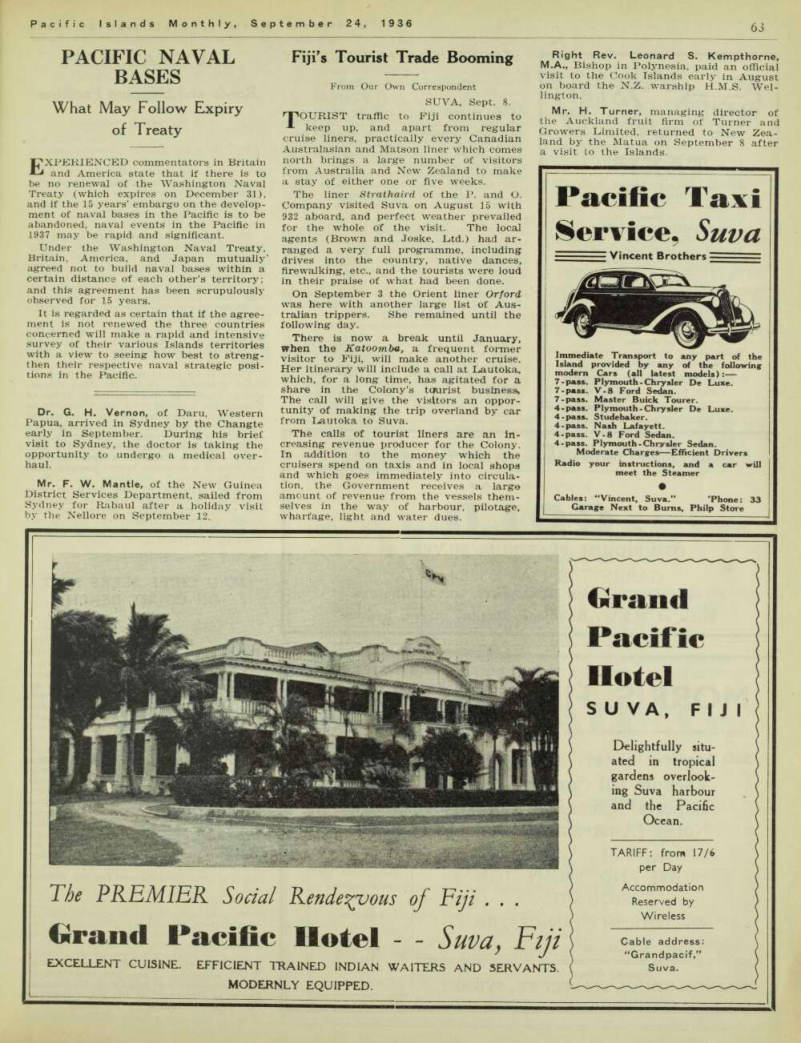
Pacific Naval
Bases
What May Follow Expiry of Treaty
EXPERIENCED commentators in Britain and America state that if there is to be no renewal of the Washington Naval Treaty (which expires on December 31), and if the 15 years’ embargo on the develop ment of naval bases in the Pacific is to be abandoned, naval events in the Pacific in 1937 may be rapid and significant.
Under the Washington Naval Treaty, Britain, America, and Japan mutually’ agreed not to build naval bases within a certain distance of each other’s territory: and this agreement has been scrupulously observed for 15 years.
It is regarded as certain that if the agree ment is not renewed the three countries concerned will make a rapid and intensive survey of their various Islands territories with a view to seeing how best to streng then their respective naval strategic posi tions in the Pacific.
Dr. G. H. Vernon, of Daru, Western Papua, arrived in Sydney by the Changte early in September. During his brief visit to Sydney, the doctor is taking the opportunity to undergo a medical over haul.
Mr. F. W. Mantle, of the New Guinea District Services Department, sailed from Sydney for Rabaul after a holiday visit by the Nellore on September 12.
Fiji’s Tourist Trade Booming
From Our Own Correspondent SUVA, Sept. 8. r I TOURIST traffic to Fiji continues to keep up, and apart from regular cruise liners, practically every Canadian Australasian and Matson liner which comes north brings a large number of visitors from Australia and New Zealand to make a stay of either one or five weeks.
The liner Strathaird of the P. and O.
Company visited Suva on August 15 with 932 aboard, and perfect weather prevailed for the whole of the visit. The local agents (Brown and Joske, Ltd.) had ar ranged a very full programme, including drives into the country, native dances, firewalking, etc., and the tourists were loud in their praise of what had been done.
On September 3 the Orient liner Orford was here with another large list of Aus tralian trippers. She remained until the following day.
There is now a break until January, when the Katoomba, a frequent former visitor to Fiji, will make another cruise.
Her itinerary will include a call at Lautoka, which, for a long time, has agitated for a share in the Colony’s tourist business.
The call will give the visitors an oppor tunity of making the trip overland by car from Lautoka to Suva.
The calls of tourist liners are an in creasing revenue producer for the Colony.
In addition to the money which the cruisers spend on taxis and in local shops and which goes immediately into circula tion, the Government receives a large amount of revenue from the vessels them selves in the way of harbour, pilotage, wharfage, light and water dues.
Right Rev. Leonard S. Kempthorne, M.A., Bishop in Polynesia, paid an official visit to the Cook Islands early in August on board the N.Z. warship H.M.S. Wel lington.
Mr. H. Turner, managing director of the Auckland fruit firm of Turner and Growers Limited, returned to New Zea land by the Matua on September 8 after a visit to the Islands.
Advertisements & other items, pp. 65-66 (1 item)
Service, Suva
Pacific Taxi
Immediate Transport to any part of the Island provided by any of the following modern Cars (all latest models) : 7-pass. Plymouth-Chrysler De Luxe. 7-pass. V-8 Ford Sedan. 7-pass. Master Buick Tourer. 4-pass. Plymouth-Chrysler De Luxe. 4-pass. Studebaker. 4-pass. Nash Lafayett. 4-pass. V-8 Ford Sedan. 4-pass. Plymouth-Chrysler Sedan.
Moderate Charges—Efficient Drivers Radio your instructions, and a car will meet the Steamer Cables: “Vincent, Suva." ’Phone: 33 Garage Next to Bums, Philp Store Vincent Brothers
N r The PREMIER Social Rendezvous of Fiji . . .
Grand Pacific Hotel - - Suva, Fiji EXCELLENT CUISINE. EFFICIENT TRAINED INDIAN WAITERS AND SERVANTS.
MODERNLY EQUIPPED.
Grand
Pacific
Hotel
SUVA, FIJI
Delightfully situated in tropical gardens overlooking Suva harbour and the Pacific Ocean.
TARIFF: from 17/6 per Day Accommodation Reserved by Wireless Cable address: “Grandpacif,”
Suva.
ty/titc,
’Star
TAXIS
Garage: Princes Street, Suva.
'Phone 322.
Cable Address: “Tillak.” G.P.O. Box 124, Suva.
AT YOUR SERVICE:
Sedan and Touring Cars. Latest Models equipped with radio.
Our Cars Meet all Steamers Motor Lorries & Launches for Hire.
General Carriers.
Quotes given for Immediate Transport to all parts of Island Suva Tavua Lautoka—Sigatoka. Open always, including Sundays and Holidays.
Plume Motor Spirit and Gargoyle Mobiloil Service Station.
Terms cash. Monthly accounts to approved customers only.
White Star Motor Garage
Tillak Bros., Proprietors
Second “Tiafau” Inquiry
From Our Own Correspondent APIA, August 29.
THE second inquiry into the wreck early this year of the Motor Launch Tiafau has been completed, and the findings have been published. The second findings differ from those of the ;first Commission in that they exonerate the owners of the vessel, Messrs. Burns Philp (S.S.) Co.
Ltd. of neglect and place the blame solely on the captain of the Tiafau, Mr. Willy Hicks, who is held responsible for the casualty.
The minority report by an assessor of the first Commission, Hon. I. H. Car ruthers, expressing the opinion that the foundering of the vessel was an act of God, is also contradicted by the second Com mission.
It may be stated that the findings of the first and second Commissions were not in accordance with public opinion in Apia.
Mr. M. V. Bell, who has completed a three years’ term as Registrar of Courts in the Cook Islands, arrived in Welling ton, New Zealand, with his wife on August 17. He will shortly take over the duties of Chief Clerk of the Native Land Court in Auckland.
Lautoka’S Needs
Roads and Shipping Facilities
From Our Own Correspondent SUVA, Sept. 1.
HPHE need for drastic improvements 5n x the township of Namoli, Lautoka, the principal sugar port of Fiji, has for long been pressed by the Lautoka Chamber of Commerce, and opportunity was taken re cently to approach the Acting Governor (Hon. Juxon Barton) on the subject when he visited the district.
The Chamber of Commerce urged the need of developmental work, especially with regard to roads and footpaths, bet ter shipping facilities, and an improved telephone service. His Excellency told the Chamber that all developmental work had been postponed until the Secretary of State for the Colonies had reviewed the financial position of Fiji.
The Chamber has agreed to petition the Secretary of State asking him to give urgent consideration to the needs of Lau toka.
There is no doubt that drastic improve ment is needed. In wet weather the so called roads in the business area of Namoli are a sea of mud, and footpaths do not exist. Drainage is another urgent matter. In fact, the whole township site could do with a thorough cleaning up. One section of Namoli is known as Tin Can Alley, and the name is no misnomer as the area is a disgrace to any modem com munity.
Better policing of the town is also asked for by the Chamber, as of late there has been a considerable amount of crime which has gone undetected. It is not altogether fair to blame the police, who are working shorthanded.
Mau Chief Seeks Seat
On Court Bench
From Our Own Correspondent APIA, August 27.
TN the case arising from an affray during -*■ a church consecration at Falefa vil lage, East Upolu, on June 19, Tapa, a Samoan, was accused of having killed an other Samoan, during a general fight.
Chief Judge Watson and a jury of four assessors found him guilty of manslaught er, and he was sentenced to nine years’ imprisonment, with hard labour.
An interesting incident took place in Court during the trial. An Apia Mau leader rose and asked to be allowed to sit with the Judge on the case—the appoint ment of a Samoan Judge to sit with the N.Z. magistrate on cases affecting Samoan natives was one of the demands of the Mau submitted to the “Goodwill” Mission.
The Judge courteously declined the offer of Chief Tagaloa, pointing out that the accused was defended by counsel and any thing of importance should be pleaded in Court through the counsel for the defence.
M iss Dorothy Blake, a worker for the New Guinea Mission at Doubina, Papua, recently arrived in Australia to spend annual leave.
M. Manuel Bosch Boret, a Spanish judge, arrived at Vila, New Hebrides, by the Van Rees on August 6 to take up duties as President of the Joint Court of the Condominium.
Advertisements & other items, p. 66 (1 item)
G Old
c 'Australia’s Clearing House for the Precious (^Metals
BUYERS OF
OSMIRIDIUM, PLATINUM, SILVER, &c.
GARRETT & DAVIDSON, LTD.
ASSAYERS, BULLION MERCHANTS, METALLURGISTS
Bank of N.S.W. Buildings, Regent Street, Sydney
MORRIS, HEDSTROM, Ltd.
FIJI
Sole Agents in Fiji for . . .
Vacuum Oil Company (Pty.) Limited
Imperial Chemical Industries Limited
Nobel (Australasia) Pty Ltd.—Explosives
Full Stocks of
MINERS AND PROSPECTORS’
REQUISITES
Also SODIUM CYANIDE, ZINC
DUST, Etc., Etc.
Sydney Office:
DALTON HOUSE, 115 PITT ST., SYDNEY
Branches throughout the gold hearing areas Lautoka, Ba, Tavua, Penang, Nadi, and Sigatoka
Samuel Russell
Dead
Well-known Figure in Tahiti
PAPEETE, August 28.
THE death occurred to-day, from pneu monia, of Mr. Samuel Russell, a well known resident. He had been acting as British Consul here for over a year.
An Appreciation
■JVTEWS of the passing of Samuel Russell, until recently H.M.’s Acting-Consul in French Oceania, will come as a distinct shock to all who knew and enjoyed the friendship of this well-known and popu lar identity in Papeete. Only a few short months ago I sat with him on the veran dah of the Hotel du Diadem and listened as he genially initiated me into the de lights of the Tahitian cuisine. Indeed, there was little pertaining to Tahiti upon which he could not expand—when he had a mind to.
Sam Russell was a man of few words.
Quiet and dignified, typical of the Briton who has wandered into the four quarters of the globe, this Englishman played a difficult role in a foreign com munity and succeeded remarkably well.
From the maelstrom of Tahitian politics (in the eddies of which a foreigner might well come to grief), he kept aloof. Re ward came to him last year when, on the retirement of Dr. Williams he received the highest honour that can be accorded a British resident in Tahiti: and he held that office with quiet, efficient distinction until a successor was appointed by the Foreign Office.
To the Polynesian people he in deed, a friend. Kindly, cheerful, and helpful, he was always ready to give them the benefit of his knowledge and wisdom.
With them, too, he held the common bond of language. To Mrs. Russell (sister to Mrs. Nordhoff, wife of the American novelist), and to members of his family, will be extended the sympathy of all who knew him.
To the newcomer in Tahiti, and par ticularly those of his own race, Sam Rus sell’s experience in the tropics was invaluable. When Lord Beauchamp wanted to rent a mansion in the country or Lady Louis Mountbatten desired to hire a schooner to cruise as far as the Australs, it was to Sam Russell that they applied. But there were others who, like myself, desired neither yachts nor palaces, and to his fellow countrymen he offered the right hand of fellowship and a genial welcome.
What a story he might have written, what tales he might have told! He left home as a lad, served his country in South Africa, went to Tahiti and ate of the mountain plantain and—remained. On that lovely island he spent the best years of his life, and the colourful valley of Pa- Uranie, on the outskirts of Papeete, has now received what is mortal of him.
Papeete had no more interesting spot than Sam Russell’s store. Men whose names are world famous were content to drop in there for a quiet chat with its owner.
Apart from his friendly interest in wan dering Britons, and the courteous manner in which he fulfilled his multifarious duties, Sam Russell has another claim to fame. He was the author of “Tahiti and French Oceania.” In his little book the writer made no claim for literary dis tinction. Yet it filled a long-felt want in
Polynesian literature, and will be a more lasting memorial than any stone placed in Pa-Uranie cemetery. No previous attempt had been made to compile a book of that character relating to French Oceania. Men of acknowledged scientific and literary status such as Charles B.
Nordhoff, James Norman Hall, and Frank Stimson, willingly gave their help to en sure its being, as the author desired, “a reliable source of information for those who contemplate a visit to this compara tively, little known portion of the South Sea.”
Though, in all particulars, it fulfils the essential qualifications of a guide book, there are some exquisite descriptive pas sages within it, written by a sure and able hand; within its pages breathes the spirit of a man, quiet and unobtrusive, who took a simple pleasure in the familiar sights he had known so long, and in the life of the people with whom he was so inti
mately acquainted. Such a man was Samuel Russell.
“Ua iriti e, I te tumu no te Tiare-Tahiti ...” (It is uprooted, The roots of the Tiare-Tahiti . . . ) This fragment from an old Tahitian song will express the grief of those who knew him best. The tree is uprooted. Life’s hurricane has passed. . . .
Eric Ramsden.
Dr. Walter Hellenthal, German Vice- Consul in Sydney, returned from an eight weeks’ tour of Papua and New Guinea by the Montoro on September 1.
Mr. J. M. Mitchell, chief accountant of Bulolo Gold Dredging Ltd., New Guinea, is at present spending furlough in Aus tralia, with his wife. Mr. Mitchell was married in Sydney on August 29.
Advertisements & other items, pp. 67-68 (1 item)
A. B. Donald Ltd.
yy
USE ..
-Agfa
CAMERAS AND
PHOTOGRAPHIC
MATERIALS
FOR BEST
RESULTS
m
W. 11. GROVE A SONS, Ltd.
Auckland, New Zealand Representing Rylands <& Sons (Col.) Ltd., of London <S Manchester (including the famous "Dacca" Mills' products for all classes of soft goods).
Agfa Photographic Corporation, Berlin, Germany.
Parbury Henty & Co. Pty. Ltd., Sydney & Kobe.
A. B. DONALD Ltd.
AUCKLAND
Island Traders :: General Merchants P.O. Box 1509 :: Cables and Telegrams: “Kingdom," Auckland Branches at Rarotonga and throughout the Cook Islands At Papeete and throughout the Society, Marquesas and Paumotu Islands
trading as “ETABLISSEMENTS DONALD, TAHITI*'
At Fiji: Trading as “Dominion Fruit Co.,’’ Suva
Nelson and Robertson Ltd.
(ESTABLISHED
1895)
Island Merchants
COCOA BEANS.—Special attention devoted to their sale in Australian and Oversea markets.
COPRA, TROCHUS SHELL, and other Island Produce sold on commission.
All classes of merchandise and Mining Machinery purchased at wholesale prices and original invoices supplied to Island clients. Small commission.
Prices submitted for comparison.
SOLE AGENTS FOR
PUMPMOBIL Portable Pumping Plants. Recommended for Sluicing and all Mining purposes. Weight 120 lbs., 12,000 gals, per hour, 10 to 100 feet head.
REDUCED PRICES.
ARCHIMEDES.—Latest in outboards; Swedish manufacture.
SKANDIA ENGINES, FULL DIESEL AND SEMI-DIESEL; all powers, Marine and Stationary.
UPSON BRITISH BOARD.—Wallboard and insulating material in one, strong and light in weight. 6ft. to 12ft. lengths always in stock.
NELSON AND ROBERTSON LIMITED
12 SPRING STREET, SYDNEY, AUSTRALIA
Telegraphic Address: “Ivan Sydney”
Woven Wire for All Industry
COPRA DRYING TRAYS. FLOORS, Etc.
FRUIT DRYING TRAYS. MINING SCREENS
Heavy Mosquito Gauze in Phosphor Bronze and Other Metals Impervious to Salt Sea Air WIRE DOOR MATS AND GENERAL WIRE WORKS
E. mtIGUT A CO. LTD.
Office and Works: 148-152 Cleveland St., Sydney, N.S.W.
Telegraphic Address: “Wrightmake,** Chippendale. f- <*■ £ p' rp lP A
"Cuprinol" will definitely render timber and fabric (nets, canvas, etc.) permanently immune to the attacks of FUNGI —the cause of Dry Rot, Decay and Mildew —and prevent the depredations of Termites (White Ants). "Cuprinol" does not evaporate, it is insoluble in water, it has no offensive smell and it can be painted over. "Cuprinol" increases the tensile strength of fabric and does not affect its flexibility. Until you use "Cuprinol" you do not know how really effective a scientific preservative can be. Write for free booklet.
CUPRINOL
THE REVOLUTIONARY WOOD AND
FABRIC PRESERVATIVE
Islands Distributors:
Paul & Gray Ltd.
82-84 SUSSEX ST., SYDNEY
N.G. Aviation
Keen Competition in Goldfields Services
A L.THOUGH there have been no not able developments during the month in connection with the proposed merger of aviation transport interests in New Guinea, it has been reported that the aviation interests there have virtually formed themselves into two groups—one representing Guinea Airways Ltd.— Holden’s Air Transport Services Ltd. in terests, and the other, headed by Car penter Airways, the remainder of the aviation companies carrying on the gold fields services.
It is reported that there have been sub stantial concessions made in connection with freight and passenger rates and that competition is keen. A correspondent in Wau says: “Many consignees of goods, when ordering, stipulate freighting to Wau by a particular company, and although the packages as a rule bear the name of the company, in many cases it is disregarded by rival concerns whose pilots seem to have been instructed to carry everything they can lay their hands on. Recently goods carried to Wau by other companies than that authorised, have been refused.
The practice is chiefly confined to freezer goods.”
G.A’S Passenger Insurance
Policy
Another indication of the keen competi tion in New Guinea aviation circles is the new passenger insurance policy offered by Guinea Airways Ltd. which gives pas sengers in possession of a signed flight ticket the following assurance and cover age:— “Our modern and up-to-date workshops at Lae, a staff of high-grade mechanics, and up-to-date aircraft are a sound foundation on which a good Insurance Policy can be built,” stated a circular re cently issued by the Company. “In addi tion, all passengers flying with this Com pany have been insured, and we are now pleased to inform you that under our new Passenger Insurance Policy your interests are adequately protected.
“We have been successful in obtaining the following excellent Passenger Insur ance Policy and that every passenger in possession of a signed Flight Ticket is covered under this Policy free of charge.
"Death or permanent total disablement .. £750 “Permanent partial dis ablement £375 “Temporary total dis ablement (limited to 52 weeks) £6 per week "Temporary partial dis ablement £3 per week "Travelling expenses to hospital up to £2O “Medical and Hospital Fees up to £3O “Additional cover can be arranged at small additional cost, if passengers so desire.”
Mendham Service For Sale
The following appeared in the Sydney Daily Telegraph on August 26; Mr. George Mendham has decided to give up flying in New Guinea. Up there he was known, wholly without justifica tion. as “Crashem and Mendham,” be cause he collected a couple of nasty crashes, although there was 200,000 miles of trouble-free flying in between. But he
always managed to mend ’em—and him self.
Now he has decided to give up his avia tion interests and to sell his ’planes. But that will not prevent him starting up an other aviation business in Australia. He has acquired Mr. de Kantzow’s autogyro on lease, and is now hovering about in that craft.
Guinea Airways and Holdens
Shareholders of Holden’s Air Transport Services Ltd. have been given until early in November to decide whether they will accept a proposal of the directors to amalgamate with Guinea Airways Ltd. of Adelaide.
A relatively distant date for decision has been fixed to enable shareholders resident in New Guinea to record their vote.
As an alternative to amalgamation, liquidation of the company is suggested by the directors. This course, it is pointed out, would entail a possible heavy capital loss.
Guinea Airways Ltd. acquired a con trolling interest of 15,000 shares in Hold en’s in June, 1934. Guinea Airways offers shareholders of Holden’s one Guinea Air ways share of £1 for every two Holden’s shares of £1 each.
A circular to shareholders of Holden’s states that the constant increase in freight with the development of the goldfields had been responsible for much competition
and price-cutting, but during the past 12 months the rapid growth had abated. With the volume of freights approaching sta bility, and the probability of further re ductions in transport charges, the direc tors decided to recommend a merging of operations.
P.A.T.’s Moth Wrecked
WAU, Sept. 11.
A BIRD flying against the propellor was responsible for Pacific Aerial Trans port Company’s No. 3 Gipsy Moth crash ing between Sunshine and Roamer aero dromes, New Guinea, on September 5.
The machine, piloted by Mr. William Grey, was freighting supplies.
With a shattered propellor, Pilot Grey skilfully brought the plane down into trees. He escaped injury, although the machine was wrecked. Mr. Grey walked several miles to Sunshine ’drome, where another aeroplane took him back to Wau.
Pilot Clark Forced Off Route
From Our Own Correspondent SALAMAUA, September 15.
TILTING a Moth aeroplane owned by A Carpenter Airways, Pilot G. J. Clark was forced by extremely bad weather to fly off his route between Juni aerodrome and Wau, New Guinea, and make for the Papuan coast on September 12. He landed on a plantation.
Mr. Clark returned to Salamaua on September 14.
Mr. and Mrs. J. A. Sheringham, of Bulolo, New Guinea, arrived in Melbourne with their son early in September to spend annual leave. Mr. Sheringham is assayer for Bulolo Gold Dredging Ltd.
Advertisements & other items, p. 69 (2 items)
67
Pacific* Islands Monthly, September 24, 1 936
And Permanent
PURE RICE
STARCH
Always ask for , . .
“CORAL” Brand
100% PURE
Manufactured by
AUSTRALIAN RICE LTD.
Sydney, N.S.W.
I I
till
*:■ m m m m. m
and PERMANENT
The quality and distinction of a "Cyclone" Ornamental Gate makes the entrance to a home more imposing. But fine appearance is by no means the only advantage.
Strength and permanence are extremely marked. The framework of the fence, of strong steel tubing electrically welded, keeps its shape and swing accurately for a lifetime. We shall be happy to send you full details of "Cyclone" Ornamental Gates, and Fences to match. Write us. No obligation.
ORNAMENTAL
GATES &
FENCES
CYCLONE FENCE & GATE CO. PTY. LTD.
THE GRACE BUILDING. 77 YORK STREET, SYDNEY, and at Melbourne and Adelaide.
Wau News

From Our Own Correspondent WAU, August 21.
PNEUMONIA is becoming increasingly preva lent in Wau and district. In recent months it has accounted for several deaths among the native and white population, and some Euro peans have been compelled to travel South in search of more helpful climatic conditions. The majority of cases have been at Edie Creek.
The roads in and around Wau have been much improved lately, particularly Levien Street, which has been widened considerably. Provision has been made for a footpath alongside. The turn at Tur ner’s corner has also been widened and levelled, and will allow for safer driving.
The burning-off of much timber and under growth in the town area has smartened the appearance of Wau, as well as minimising the chance of mosquitoes breeding in any numbers.
The fever menace will be lessened as a result.
This work is controlled by the Public Health Department.
The lack of rain has aided the burning-off pro cess, and between smoke and dust Wau has been uncomfortably stuffy. Growers of vegetable pro duce are awaiting good rains before planting up again. Vegetables are scarce at the moment, and drinking water in the tanks is also low.
Miss Blackwood, an anthropologist from Cam bridge University, England, recently spent a few days in Wau making preparations for her sojourn in the domain of the Kukukukus. At present she is stationed in the village of Minki on the Kuku kuku border. She will remain amongst these hill people for some time, studying their habits and customs.
Since the formation of the new course, golf has dominated all other sporting activities in Wau.
Although the greens are not yet ready for play, it will not be many more weeks before a very attractive six-hole course is available. The course lies below the European Hospital to the west of Edie Road.
Torres Strait Notes
From Our Own Correspondent THURSDAY IS., August 25.
'T' HE outstanding feature last month was the X visit of Their Excellencies Lord and Lady . G °wne, the Governor-General of Australia, and ms wffe. The Mayor (Alderman Alex Corran) presided over a civic welcome accorded the dis tinguished visitors in the Town Hall. From here ~v e» n or- General travelled to Cairns by the Marella.
Dr. and Mrs. Weston A. Price, of Cleveland.
Ohio, U.S.A., recently came up from Cairns In an aeroplane. They are taking part in a nation wide investigation into the dietary problems of the natives, and made a tour of the principal Torres Strait Islands.
Miss Annie Norgate and Mr. Frank Norgate have helped to make T.I. history by being the first local passengers to go by ’plane to Cairns with Pilot McDonald, Mr. J. D. Mac Lean, Police Magistrate and Protector of Aborigines at Thursday Island, has received notice of his transfer to Chinchilla.
Queensland. Mr. J. H. Moore, of Innisfail, has been transferred to Thursday Island as Acting- Police Magistrate. Mr. V. M. Griffin. C.P.S. at Thursday Island, has been transferred to Chin chilla.
Mrs. Armstrong, of Moa Island. Torres Strait, is at present on a visit to Rockhampton, Queens land, with her children.
Mr. and Mrs. H. Somerset Vidgen have returned from their honeymoon in Australia.
Miss Fergusson has returned from a lengthy stay in Brisbane and has been appointed a pro bationer at the Torres Strait Hospital.
Mr. H. Pimm, of the local Quarantine Station, has been transferred to the Quarantine Station at Lytton, near Brisbane.
Messrs. Hodels Ltd., an old established firm on Thursday Island, has closed its doors, and gone out of business. It has been in voluntary liquida tion for some years. General regret is expressed at the necessity for this step.
Mr. Newman Pusey of the T.I. radio station, has gone to Darwin for temporary relieving duties.
Mr. Walters is the new officer in charge of the Thursday Island radio station.
General Sir Julius Brusche has spent another holiday on Thursday Island. He made numer ous excursions to various islands in the Torres Strait.
Mr. G. C. Pestorius, District Inspector of Schools for the Queensland Education Department, re cently examined the three schools on Thursday Island.
The many friends of Mr. and Mrs. Ernest J.
Hennessey have said farewell to them, as Mr.
Hennessey has now decided to retire from business and reside at the seaside resort of Southport in Queensland. These good people have closely iden tified themselves with the life of the island for many years, having proved themselves model citi zens.
Educating Islands Girls
AN excellent Church of England School for Islands girls is St. Hilda’s School, South port, Queensland, which receives pupils from the age of five upwards.
General teaching is entirely in the hands of graduates under the Principal, Miss Fittock, B.A.
Training in the art of speech is undertaken by Miss Nerva Levy, formerly of the staff of the Royal Academy of Dramatic Art, London; Miss J.
Robeson, who had 7 years’ training at the Art Gallery School in Melbourne, is in charge of the Art School; while Miss Betty Samuel, a graduate of the Chelsea Physical Training College, London, teaches gymnastics, classical dancing, ball-room dancing, swimming, and sports.
The school building is modern in design with lofty, airy rooms, and there are 30 acres of ground on which are tennis and netball courts. The School has had a remarkable health record, and special care is taken of delicate girls. Reserva tions for 1937 are now being made, and parents who desire to enter pupils are advised to make early application.*** Sister Hettie Muir, who has been ap pointed to the Methodist Mission Hospital at Salamo, Papua, will sail from Sydney by the Macdhui on September 30.
Advertisements & other items, p. 70 (1 item)
Kill Kidney Acid
Win Back Vigour,
Clear Your Skin,
Cook Younger.
V-^ Women Need Help More Often Than Men When Acids and poisons accumulate in your blood you lose your vitality and your skin becomes coarse and cloudy—you actually feel and look years older than you are. And what is worse, functional Kidney disorders may cause more serious ailments, such as Getting Up Nights, Nervousness, Leg Pains, Lumbago, Swollen Joints, Rheumatic Pains. Dizziness, Dark Circles Under Eyes, Headaches, Frequent Colds, Burning, Smarting, Itching and Acidity.
The only way your body can clean out the Acids, poisons, and toxins from your blood is through the function of 9 million tiny, delicate tubes or filters in your Kidneys. When your Kidneys get tired or slow down because of functional disorders, the acids and poisons accumulate and thus cause much trouble.
Fortunately, it is now easy to help stimulate the diuretic action of the Kidneys with a Doctor’s prescription, Cystex (pronounced Siss-Tex) which is available at all chemists.
Doctors Praise Cystex
Doctor T. J. Rastelii, famous Doctor, Surgeon, and Scientist, of London, says : “ Cystex is one of the finest remedies I have ever known in my medical practice. Any Doctor will recommend it for its definite benefit in the treatment of many functional Kidney and Bladder disorders. It is safe and harmless.” And Dr. C. Z. Rendelle another widely known Physician and Medical Examiner of San Francisco, recently said ; “ Since the Kidneys purify the blood, the poisons collect in these organs and must be promptly flushed Dr. T. J. Rastelii. from the system, otherwise they re-enter the blood stream and create a toxic condition. I can truthfully recommend the use of Cystex.”
World-Wide Success
Cystex is not an experiment, but is a proven success in 22 countries throughout the world. It is prepared with scientific accuracy and in accordance with the strict requirements of the British Pharmacopoeia, and as it is intended especially for functional Kidney and Bladder disorders, it is swift, safe, and sure in action.
Guaranteed To Work
Cystex is offered to all sufferers from functional Kidney and Bladder disorders under an unlimited guarantee. Put it to the test. See what it can do in your own particular case. It must bring you a new feeling of energy and vitality in 48 hours —it must make you look and feel years younger and work to your entire satisfaction in 8 days or you merely return the empty package and your money is refunded in full. You are the sole and final judge of your own satisfaction. Cys tex costs only a small sum per dose at all chemists and as the guarantee protects you fully, you should not take chances with cheap, inferior, or irritating drugs or with neglect.
Ask your chemist for guaranteed Cystex (pronounced Siss-Tex) today.
Price 4/-, from all Stores and Chemists.
Schaffer & Co., 189 Clarence Street, Sydney. unu Cystex
Reports
Pacific Islands Mining Reports From Fiji
Tavua Gold Developments Ltd.
D.R. LOFTUS HILLS, mining geologist, has submitted to the directors of Tavua Gold Developments Ltd. a report on the company’s pro perty at Tavua, Fiji. Options were originally acquired over four areas which showed promising possibilities.
Summarising operations carried out, Dr. Hills advises that the work on Morton’s area has been disappointing, and no further expenditure is war ranted at present. All the lodes have been tested by adits and diamond drilling, but the results do not show the existence of any body of ore down to 300 feet which could be the basis of successful mining operations.
The results at Wai Kata Kata, although show ing values of 4.5 dwt. in places, indicate a lack of longitudinal and depth continuity. Such continuity being essential to possible economic operations on a low-grade proposition, these areas must be now classed as unattractive.
The results of the work during the past six months on the Homeward Bound area are, Dr.
Hills states, important and encouraging. Diamond drilling and shaft sinking have exposed a lode sys tem carrying gold values averaging 10 dwt. a ton.
There is here a potential mine. The phase of working now reached is the systematic opening up of the lode system by shafts, drives and cross cuts at the 100-feet level. The policy should be to concentrate on the Homeward Bound, which should continue to show good results.
GOLD MINES OF FIJI AND FIJI GOLD
Cease Operations
Two companies, formed to test areas in Fiji, have decided to cease operations, boring having failed to give the results anticipated.
The management of Gold Mines of Fiji N.L. re ports that the third bore on Goodsir’s block has been completed at 351 feet, without results.
Fiji Gold N.L. has completed the fourth bore on Ragg’s block, also without results.
All bores put down -by both companies on their areas have given negative results.
Emperor Mines Limited
The directors of Emperor Mines Ltd., reported on September 11 that Mr. H. J. C. Conolly, of Western Mining Corporation, Ltd., and consult ing geologist at Emperor, has returned from Tavua goldfields, Fiji.
In a preliminary report, he states that ore re serves comprise approximately 720,000 tons De veloped oxidised ore is 620,000 tons, and telluride ore 50,000, while partly-developed ore, consisting mostly of telluride, is 50,000 tons. Mr. Conolly estimates the values of the oxidised ore at lOdwt. fine gold a ton Taking gold at £B/10/ an oz. (Australian) values in the mine at present, on the data supplied, would represent a total of ap proximately £3,000,000 gross. Working costs at £1 a ton, and Fijian gold taxation of 5 per cent., would absorb about £1,000,000, leaving £2,000,000.
Issued shares in the company are 1,500,000, but these will be increased to 1,850,000 if the vendors, who have received 600,000 fully-paid shares already, exercise their option to take up a further 350,000 shares at par’ (10/), within 18 months, starting from September 15, Emperor Mines production for the four weeks to September 5, compared with the two previous yields, was:—
Mt. Kasi Mines Ltd.
The mine manager of Mount Kasi Mines Limited hiji, reported early in September as follows:
Mandated Gold N.L.
Directors of Mandated Gold N.L. state in their report for the year ended February 29 that during the period a number of properties were investi gated but none proved worthy of consideration, having regard to the company’s limited finances, since the close of the accounts a parcel of 100
shares of £lO paid to £2 has been acquired in Fiji Mining Corporation, N.L., which has a pro perty on the Tavua field in Fiji. Developments to date are said to have been most encouraging, and the directors of that company believe that a valu able mine will be developed. Operations have been suspended temporarily, pending further progress by adjoining companies, which are proving the lode at depth.
Four weeks ended July 11.
Aug. 8 Sept. 5 Ore treated, tons ... . 2275 2277 2315 Plead value, dwt . 10.14 10.5 10.0 Gold, oz. fine . 1050^4 1048 1060 From slag, oz. fine 98 y 2
Four weeks ended, July 3. Aug. 14. Sept. 11* Ore tons 867 ,. 848 .. 1444 Buhon °z 252 .. 295 .. 358 Value (Aus. cur.) .. 1861 .. 2260 .. 2601 * Mill stopped five days for repairs and renewals. Main south-east drive No. 2 level has been advanced 13ft., average 16dwt.
From Papua
Mandated Alluvials N.L.
Mining leases held by Mandated Alluvials N.L., Papua, comprise 125 acres, made up of Moresby King, 20 acres; Sapphire, 30 acres; Moresby King No. 2, 50 acres; Moresby King No. 3, 15 acres, and Moresby King No. 4, 10 acres. Mr. H. E. Hallam, general manager, has submitted to the directors a report on operations to the middle of August.
He advised that although only a small part of the area has been so far prospected, the systematic exploration has extended over a short aggregate length, the size and tenor of the lodes is such that the probabilities are high of developing sufficient quantities of medium to high-grade ore to estab lish a sound producing mine.
The progress report for the period August 6 to August 25 was as follows:—No. 3 adit, north drive off No. 1 east crosscut advanced 7ft. in ore (not yet assayed). Costeen over No. 3 adit. A cross cut costeen 40ft. south discloses the lode over a width of 24ft., averaging 14dwt. gold per ton, foot wall not disclosed. Driven on for 23ft., the value at 20ft. is 20dwt. gold per ton. No. 6 adit: North drive advanced 39ft. in ore averaging 29dwt. gold per ton to a total length of 75ft. Crosscuts at 50ft. north driven east 25ft., and west 6ft., disclose of ore, averaging 13dwt. gold per ton. No. 4 winze in south drive was sunk vertically to the
footwall through 12ft. of ore, averaging 14dwt. gold per ton. South drive off No. 4 winze was driven 12ft. in ore averaging 44dwt. gold per ton. No. 4 shaft: Sunk a further 39ft., total 70ft. in ore.
Average value from 31ft. to 70ft., 17dwt. gold per ton. No. 7 adit: West drive advanced 19ft. in
ore, averaging 20.9dwt. gold per ton to a total of 19ft. Crosscut south-east to No. 3 shaft advanced 33ft. in ore, averaging 27.8dwt. gold per ton. No. 5 winze at 20ft. in north drive sunk to 30ft. in ore, averaging 16dwt. gold per ton. No. 8 adit: Driven 70ft. in country. Casteening at 115 ft. north-east of No. 7 adit so far discloses 3ft. of ore, assay ing lldwt. gold per ton. (All values in fine gold per long ton.) The manager’s report for the period August 25 to September 7 stated: Sapphire leases, No. 4 shaft sunk 10 ft. to 80 ft. averaging 20dwts. gold per ton, width 6ft., neither wall disclosed. No. 6 underlie shaft, 90ft. south of No. 7 adit sunk 30ft. to 30ft. averaging 21dwt., width No. 7 underlie shaft, 90ft. north of No. 7 adit, the approaches in ore 29ft. averaging 13)4dwt., width and shaft then sunk 25ft. averaging width 3ft. lOin. No. 8 underlie shaft, 200 ft. north of No. 7 adit, the approaches carry no values for 35ft., now sunk 20ft., averaging 16dwt., width 3ft. lOin. (Values in fine gold.) The directors on September 12 offered for sub scription at a premium of 5/ each 28,000 of the 30,000 shares held in reserve, payable 5/ a share on application and 5/ on allotment. The shares are to rank equally with the shares issued. The new issue was offered to shareholders in the proportion of 40 shares for every 100 shares held. The issue was underwritten by Messrs. C. B. Quinan and Co.
Cuthbert’S Misima Goldmine Ltd.
Monthly clean-up for Cuthbert’s Misima gold mine Limited on August 23 compared with prev ious two months as follows:
Irregular steamer service between Misima and Samarai is the reason for delay in receiving bullion returns for August. The new 10-head stamp bat tery and the new 180 b.h.p. crude oil engine for the enlarged plant have been shipped from Sydney
to Misima. A rock breaker has been erected to treat the hard quartz ore. Additional houses for white staff and natives have been completed.
Tiveri Gold Dredging Co.
A profit of £682 was earned by Tiveri Gold Dredging Co. Ltd., Papua, for the year ended June 30, 1936. The year’s production was 7200 z. gold, against 10260 z. in 1935.
The manager anticipates better results, as the overburden is less troublesome, and the run of wash better defined. The dredge has operated satisfactorily, 158,135 yards having been treated during the year, compared with 154,843 yards for the previous year.
The directors are considering a scheme for work ing the “Twisty” areas and also the area on “Sunset” which is at present being prospected.
Referring to the “Twisty” areas, the engineer estimates that the Middle Creek section contains 4,898,080 cubic yards, valued at £139,935, and that the Camp Creek section contains 1,467,117 yards, valued at £72,159.
Developments (N.G.) N.L.
An option over an area of 160 acres, adjoining the southern boundary of the property of Man dated Alluvials N.L., 17 miles from Port Moresby, Papua, has been acquired by Developments (New Guinea) N.L.
The option was secured for the latter company by Mr. F. A. Roberg, following an inspection of the area. On behalf of the same company, Mr.
Roberg also pegged out an area of 160 acres ad joining the northern boundary of the Mandated Alluvials holdings.
During the last few months a lode about 60ft, wide, containing values in excess of 1 oz. of gold a ton, has been opened up by Mandated Alluvials.
More than 100,000 tons of ore are said to have been developed.
Misima Reefs Ltd.
With a nominal capital of £lOO,OOO in £1 shares, Misima Reefs Ltd. has been formed in Sydney to acquire the leases on Misima Island, Eastern Papua, formerly held by Misima Gold Reefs (New Guinea), N.L. The latter company received 20,000 fully paid shares at the end of August, and these were distributed among the shareholders in the proportion of 22 shares for each Misima Gold Reefs share held. The vendor syndicate had the right to nominate two persons as directors of the new company.
The 10 leases, comprising 198 acres, were placed under options to Oroville Dredging Co. Ltd., of London, in March, 1934. Under the supervision of Major Stuart Love systematic testing operations were carried out, and the option was exercised at the end of May of this year. The agreement pro vided for formation of an operating company with in three months. Proved ore aggregates 46,000 tons at an average grade of 5.8 dwt. of gold a ton.
The directors of Misima Reefs Ltd. are Messrs.
F. W. Baker, London (chairman of directors of Oroville Co.); P. M. Owen, Sydney; R. C. M.
Boyce, Sydney; together with two directors to be nominated by Misima Gold Reefs (N.G.) N.L.
June.
July* August Mill treated (tons) 1580 1305 1753 Bullion produced (oz.) .. 2396 1558 2272 Gold, fine oz 499 348 528 Silver, fine oz 1843 1150 1671 Estimated value (gold at £A8 per oz.) £4122 £2844 £4306 Value per ton of ore .. 52/2 43/7 49/1 * To July 18.
Advertisements & other items, pp. 71-72 (1 item)
ipUM
II LIGHT
PMOBIL
and PORTABLE
MOTOR PUMP
Complete Plant’s weight, 140 lbs. Capacity up to 12,000 gallons per hour.
All heads from 10 to 115 feet.
Fuel consumption, \ gallon per hour.
Pressure 551 b. square inch Especially suitable prospecting and all Sluicing Requirements.
Nelson & Robertson Ltd.
12 SPRING STREET, SYDNEY
WE DID THE WHOLE CONTRACT
Your confidence in our service will not he misplaced.
NEW OVERHAUL
SHOP
AND STORE AT LAE
for
GUINEA AIRWAYS
LTD.
IN few undertakings do reliability, expedition, and efficient service count more than in Structural Steel contracts.
The Sydney Steel Company Ltd. R S v «ee^ s w - Steel Merchants and Structural Engineers
GOLD
HIGHEST PRICES
PROMPT SETTLEMENTS
ACCURATE WEIGHTS AND
ASSAYS
are assured to producers and sellers of gold bullion who forward their consignments to The Electrolytic Refining and Smelting Co. of Aust. Ltd. for treatment and realisation.
RECORD PRICE.— On 6th March, 1935, this company paid to its clients at the rate of £9/4/6 net per fine ounce, which is the highest price ever paid for gold in Australia.
SPECIALLY ORGANISED SER-
VICE is available to clients in New Guinea, Fiji and other Pacific Island centres.
Address consignments from outside Australia to the Company's Sydney office. mr Weighing a Pacific Islands consignment of gold bullion at an E.R. & 8. receiving office.
The Electrolytic Refining & Smelting Co.
OF AUSTRALIA LIMITED.
Melbourne: Works: Sydney: Collins House. Port Kembla, N.S.W. 25 O’Connell Street.
Purchasers and Refiners of Gold, Silver, Copper in any form BANKERS.—The English, Scottish and Australian Bank Ltd.
Mining Ore Treatment
Machinery
Complete Cyanide Plants Supplied- Dorr Classifiers.
Dorr Thickeners.
Dorr Agitators.
Oliver Filters.
Merril Crowe Zinc Dust Gold Precipitation Richardson Mine Fans.
FANS AND AIR HEATERS
For Ventilation, Copra Drying Rooms, etc.
Enquire from
CROSSLE, DUFF AND
MACINTOSH LTD.
52 Bridge Street. SYDNEY
The
“ Caledonia Dover ”
A COOKING STOVE guaranteed to give complete satisfaction and now recognised as THE BEST on the market. Suitable for coal, coke, or wood fuel.
Illustrated Catalogue on request.
LANE & GIRVAN, LTD.
BONNY BRIDGE, SCOTLAND
A. E. GOODWIN LTD.
PIPE, WELDING AND GENERAL ENGINEERS
RAILWAY PARADE, LIDCOMBE, N.S.W.
Specialists in Design, Fabrication and Erection of all Welded Steel Constructions, Girder, and Plate Work.
Pipes, Bends, and Specials. • Correspondence Invited
From New Guinea
Gum River Development
Gum River Development N.L. reports that a large part of the company’s funds is represented by survey fees held by the Government of New Guinea. Having abandoned its lease applications the company is entitled to a refund of these fees, and it is expected that the refund will be avail able before the beginning of November. The chair man of directors, Mr. A. G. R. Williams, has been investigating at his own expense an alluvial sluicing property situated near Omeo, Victoria, which is now being worked by a small syndicate. He will have this examined and if satisfied will submit the proposition to the share holders for consideration.
Sunshine Gold Development Ltd
Sunshine Gold Development Ltd.’s plant, which has been in continuous operation since July 31, is working efficiently. The overburden has been removed, the paddock opened out, and the elevator is down to 35 feet. It is expected that a clean-up of the paddock to a depth of 30 feet will take place at the end of September. The average depth of ground now being sluiced is 50 feet.
Bulolo Gold Dredging Ltd.
Production for the four dredges of the Bulolo Gold Dredging, Ltd., for August compares with that of the previous two periods as follows:
June.
July.
Aug.
Cubic yards .. 1,002,000 986,700 978,000 Bullion, oz 15,682 19,812 17,740 Gold, fine oz. . 11,065 13,904 12,484
Value-
Aust. currency* .. £96,818 £121,660 £109,235 Per cubic yard .. /23.19 /29.S9 /26.8 Working profit .. £65,380 £84,621 £75,748 *At A £8/15/ per fine ounce.
Irowat Gold Alluvials N.L.
The legal manager of Irowat Gold. Alluvials N.L. has received advice from the company’s mine manager in New Guinea that since the date of the last report (August) 29,507 cubic yards have been treated for a return of 2400 z. of gold. No. 1 elevator began operations on creek flat ground on August 29. It is expected that two further elevators will be installed during September.
New Company To Take Over
Enterprise Of N. Guinea
Enterprise of New Guinea Gold and Petroleum N.L. has been formed with a capital of £150,000 divided into 30,000 shares of £5 each to acquire the undertaking of Enterprise of New Guinea N.L.
It is understood that shareholders in Enterprise of New Guinea N.L. will be issued about 20,000 shares paid to £1 each, on a one for one basis in the new company, leaving an unpaid liability of £4 on each share.
The company has been formed to prospect for oil in New Guinea and Papua on leases applied for by Enterprise of New Guinea N.L. These leases are believed to cover an area of more than 10,000 square miles. It is understood that further areas have been granted. When these applications are granted active prospecting for oil will be carried out.
A large British oil company, it is understood, has been prospecting for oil in New Guinea and Papua for almost nine years, and has spent be tween £300,000 and £400,000. This company be lieves that petroliferous formations exist in the country. Gold production and prospecting on the leases of Enterprise of New Guinea will still be carried on.
Application has been made for the registration of the new company. Messrs. E. Ward, D. Reid.
J. Reid, J. S. G. Wright, and S. E. Watkin appear on the application form as shareholders of the company, and Mr. A. Leo Kaines, of 317 Collins Street, Melbourne, is legal manager.
As far back as September, 1935, the general manager of Enterprise of New Guinea N.L. (Mr.
Harold Taylour) suggested that the capital of the company should be increased with the object of extending its activities to petroleum search, and further mining and general development in New Guinea.
Reporting on the progress of operations for the period August 5 to August 24, Mr. H. Taylour, general manager of Enterprise of New Guinea N.L., advised that in the Surprise Creek area, box and ground sluicing proceeded on day shift
on dredging or sluicing claims Nos. 276 and 540.
Nozzle sluicing on three shifts was started on claim No. 540. In the Edie Creek area prospecting within the boundaries applied for as an exclusive prospecting area has proved the continuation of the Edie mine main lode channel for about 200 yards. A superficial blanketing of boulder tuff masks the underlying mudstone and porphyry in which the known lodes occur, consequently under ground prospecting may have to be resorted to in order to trace the continuation of the lode channel. A few fine colours of gold can be panned in most of the streams so far examined in the area now being prospected.
Bulolo Gold Deposits Ltd.
Bulolo Gold Deposits Ltd. received advice from the manager at Wau, New Guinea, early in Sep tember, that 13,000 cubic yards of wash were treated during 445 working hours for a recovery of 207 oz. of gold.
The directors report that the company has taken an option on satisfactory terms over a large potential dredging area at Graytown, Victoria.
Arrangements will be made at an early date to carry out preliminary testing operations.
New Guinea Goldfields Ltd.
The monthly return of production and estimated profits of New Guinea Goldfields, Ltd., are as follows:
Upper Watut Gold Alluvials N.L.
In April shareholders of Upper Watut Gold Alluvials N.L. sanctioned an increase in the nominal capital to £300,000 by the creation of 400,000 new shares of 5/- each. These shares were offered to Bulolo Gold Dredging Ltd. at par, the
agreement between the companies providing that the Canadian concern would further test the property on the Morobe field, New Guinea, prior to making the first payment on September 3.
Provision was also made in the event of the option being exercised, that Bulolo should act as managers for 10 years, the remuneration for which was to be £lOOO per annum, in addition to out-of-pocket expenditure, and supply, if neces sary, such of its surplus electrical power as required by the Upper Watut company, including 5 per cent, amortisation. The Bulolo company was
Month ended Tune 14. July 14. Auer. 14.
Edie Creek Mill— Tons 3,566 3,448 4,089 Fine gold, oz 1,269 1,161 1,417 Fine silver, oz 3,581 3,037 — Alluvial— May June July Fine gold, oz 1,088 1,141 1,166 Fine silver, oz Golden Ridges Mill—.. 826 863 837 Fine gold, oz 1,344 1,599 1,617 Fine silver, oz 847 1,039 1,258 April. May.
June.
Operating profit— Alluvial £5,478 £4,600 £4,214 Golden Ridges, mill 5,999 3,782 6,130 Edie Creek mill .. 3,731 3,704 2,275
also to have a seat on the board of directors.
Doubts as to whether the option would b® exercised by Bulolo were expressed in the market towards the end of August, and shares of Upper Watut became weaker.
The management of Upper Watut Gold Alluvials N.L. officially announced on August 26 that Bulolo Gold Dredging Ltd. had relinquished its option over the unissued shares.
During the period of the option the company’s constructional programme had been continued, and ground sluicing commenced. The programme, as outlined in the prospectus, would be proceeded with, and would not be affected as a result of the Bulolo company’s decision.
Sandy Ck. Gold Sluicing Ltd.
At the first annual meeting of the Sandy Creek Gold Sluicing, Ltd., held on August 21, the chairman (Mr. H. B. Jamieson) said that the sluicing plant on Sandy Creek was expected to commence working last October, but delays were experienced, owing to trouble with the plant. It was not until January that the plant was operat ing under reasonably satisfactory conditions.
Scarcity of water, he continued, had been the main cause for the monthly output being lower than expected. Less frequent movings of the pipe line would be required from now on, as the creek flats being worked into were more extensive.
“The value of gold per cubic yard,” Mr. Jamie son said, “which has so far been recovered in Sandy Creek has been fairly satisfactory, but not up to expectations. In the operations to date, patches have been found containing very rich values, other areas have been found which by themselves would hardly pay to put through, and still others which were passed by owing to values being unpayable. On the present basis of opera tions, it is estimated that there should be work for the present plant on Sandy Creek, on the area below the intake of the present race, for from three to four years. In addition to this area, there is a further substantial area on Sandy Creek above the intake of the present race, which the board considers should prove of value.
Mr. Jamieson added that it was hoped that negotiations with Bulolo Gold Dredging, Ltd., would result in the most suitable scheme for working the Poverty Creek area.
The manager in New Guinea reported on Sep tember 2 as follows:
Developments (N.G.) N.L,
, r - /?'• A \ engineer to Developments (New Guinea) N.L., reports having inspected the Uunantma dredging area, New Guinea, under offer to the company. He is unfavourably impressed and recommends abandoning the area. He also having secured options over other leases. (See Papuan reports for reference to new option secured in Papua).
June.
July. *Aug.
Cubic yards 11,675 11,650 8,175 Gold, oz 202 275 101 Average, cub. yard 2/7 1/10 ‘Plant was in operation for half of month only, in constructing balance of time being taken up new penstock and moving pipes, elevator and boxes to new position.
Advertisements & other items, pp. 73-74 (1 item)
Mining- Machinery
Konkrete Paint
For EVERY SURFACE where Permanence is Imperative--!
Adaptability for the varying climatic conditions of the Pacific Islands has been abundantly proved by users.
KONKRETE Standard Gloss and Flat Colours for wood, brick, fibre, cement, iron and stone.
KONKRETE PAINT IS
THE SOLUTION
Complete price list and colour card from sole wholesale distributors for N.S.W. and Pacific Islands.
H. Florentine and Son
321 Pitt Street, Sydney, N.S.W.
Mining- Machinery
of all classes,
including:
Bucket Dredges
Sluicing Plants
Gravel Pumps
Nozzle Pumps
Elevators, Nozzles,
Piping, Valves, etc.
. m
GRAVEL PUMP ILLUS-
TRATED is one of two (2) 12in. size, capacity 80 to 100 c. yds. solids per hour against 60ft. head. To be driven by 190 h.p. motor.
Casings, liners and baseplates have been sectionalised for aeroplane transport, maximum lift being
SOOOIbs.
MADE FOR THE UPPER
WATUT GOLD ALLU-
VIALS N.L., N. GUINEA.
THOMPSON’S ENGINEERING & PIPE CO. LTD.
CASTLEMAINE, VICTORIA
Cable Address: “THOMPSONS, CASTLEM Al NE."
SYDNEY OFFICE KEMBLA BUILDING 58 MARGARET STREET
Coleman
SELF-HEATING IRON
LIGHTS INSTANTLY
r'’S easy and pleasant to iron with a Coleman. It saves your strength.
You do better ironing easier and quicker at less cost. This modern Coleman Iron lights instantly ... no generating with match or torch ... no waiting.
Saves you more time and work than a $lOO washing machine. Do a whole ironing with one iron.
Coleman Lamp & Stove Co. Ltd., Toronto, Canada 500 Kent Street, Sydney
STEAMSHIPS TRADING COMPANY LIMITED
PORT MORESBY . PAPUA SAMARA!
Chairman and Managing Director: A. S. FITCH.
Shipowners, Wholesale and Retail Merchants and Traders; Shipping, Customs r/i -i r' SUPanCe Copra and Rubber Plantation Owners.
ArrMr.rc l Contractors to Commonwealth and Papuan Governments.
AGENCIES: At Port Moresby: Coral Sea Insurance Co.; Phoenix Insurance Co.; Delta Sawmills, Ltd.; Acme Bakery Co,; Vacuum Oil Co. Pty., Ltd. At Samarai: Coral Sea Insurance Co.; Delta Sawmills, Ltd.; Bankers and Traders’
Insurance Co.; National Mutual Life Insurance Co.; Kularo Shipyards; Mamai Plantations.
BRANCHES.—In Papua: Hanuabada, Sivitoi, Aroma, Koki, Hula, Ela Beach, evp ..,_.. Duga Duga, Yule Island.
SYDNEY: NELSON & ROBERTSON, LTD., 12 Spring Street; Melbourne, 396 .blinders Lane; London, E, Whiteaway & Co., 7 Chiswell Street, Finsbury, . . London.
Cable Address: “STEAMSHIPS.” Code: Bentley’s.
Islands Gold
Shares
Recent Fluctuations
Aloha Central .
Fiji
Mid-April . s£l/lO/- Mid-June Mid-Sept.
Emperor Mines . b!2/3 bl2/9 bl5/3 Granites Dev. . b3d b2d Koroere . b4/2 s4/8 b4/- Loloma . M9/10^ bl8/b24/3 Mineral Dev. .. . bl/9 b9d b8d Mt. Kasi Mt. Morgan . b9/6 s9/9 b7/10 Developments . b2/ll bl/10 bl/5 Pacific Gold ... . s£7 b£3 b£S Tavua Dev. ... . b2/6 s2/3 sl/6 Vees United ... . b4d bid Cuthbert’s Misima G.M.
Papua
— blO/4 bl3/- G.M. of Papua . blO/6 b8/6 sl0/9 Mandated All. . . b6/6 b5/b32/9 Oriomo Exp. .. . bl/6 bl/6 b2/8 Samarai (pd.) . . s3/b7d Yodda Gold Co. . b3d b3d b3d Bulolo Deposits
New Guinea
. baod b9d bl/9 Bulolo G.D. ... . b£8 b£8 s£7/10/- Day Dawn (South) . s4j£d s6d Developments (N.G.) . s £2/2/6 b£3/15/b£2/5/- Enterprise of New Guinea . . b £3/2/6 b£3/S/- Golden Deeps . . s6d — Guinea Gold ... . s!4/3 sl8/sl4/- Irowat . b3/8^ b4/l b2/- Morobe All. ... , — b7d Mt. Lawson ... . b£15 b£16 b£5 N.G.G. Ltd. ... . b4/l b4/3 b4/10 Oil Search . s3/7 b3/10 b3/4 Placer Dev . b £5/15/6 b£ 5/10/6 s£5/2/- Sandy Ck . bl nx blOd b9d Sunshine Gold . . bl3/l b9/2 bll/9 Up. Sepik . b£l — Up. Watut . b8/b6/9 b2/6 X
Fiji’s Customs Revenue For Half Year
Half Year
From Our Own Correspondent SUVA, Sept. 1.
FIGURES released by the Customs Department show that during the first half of this year revenue has been most satisfactory, showing an increase of £18,755 on the estimates.
Import duties realised £191,886, a rise of £19,636 on the estimate. Port and Customs Service Import Tax estimated to return £lO,OOO, brought in £13,081. The only decrease was in Port and Customs Service Export Tax, which was down £3,962.
Total revenue received was £209,005, a gross increase of £22,717 on the estimate of £190,250.
Advertisements & other items, p. 74 (1 item)
H' mmLIVAJVTS’ wire bopeso
“The World’s Standard”
LARGEST STOCKS IN AUSTRALASIA
FOR ALL PURPOSES
Also Blocks, Hooks, Shackles, Thimbles, Strand, Seizing, Aircraft Cord, etc.
Letter.: BULLIVANTS’ Australian Co. Ltd. ..Jg^Tud,-
Box 1298 J, G.P.O. 331-333 KENT STREET, SYDNEY Sydney Prompt Attention! Efficient Service!! Complete Satisfaction!!!
the Tropics
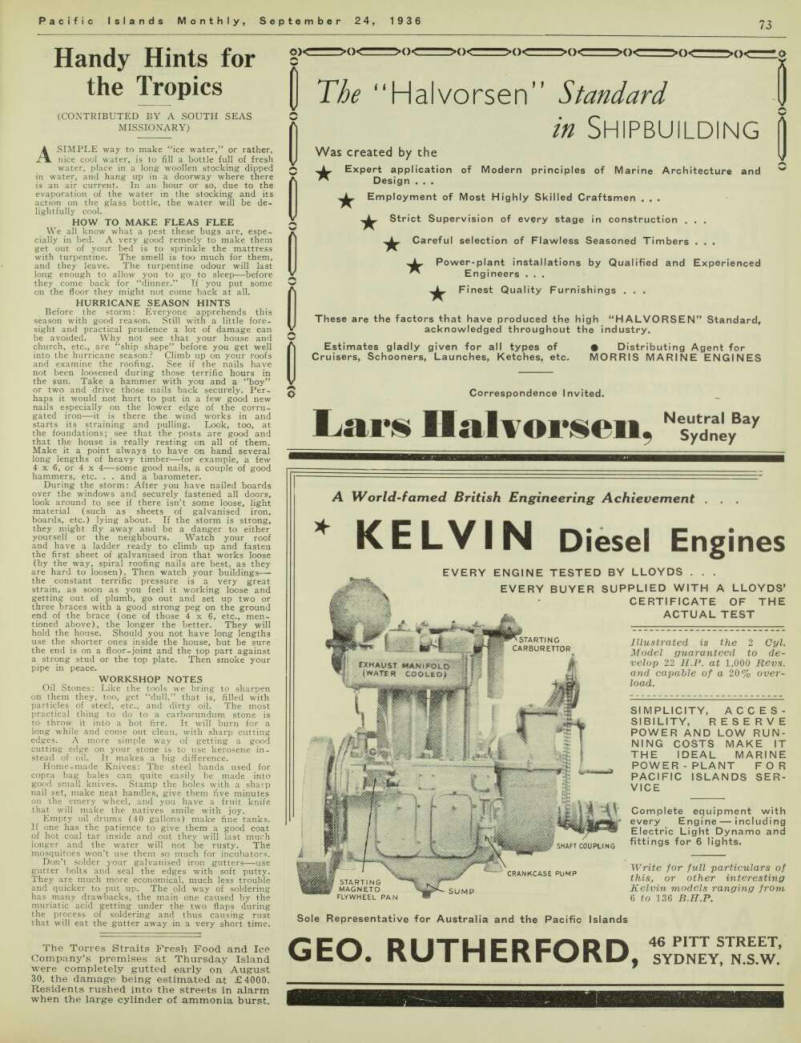
Handy Hints for the Tropics
(Contributed By A South Seas
Missionary)
A SIMPLE way to make “ice water,” or rather, nice coo] water, is to fill a bottle full of fresh water, place in a long woollen stocking dipped in water, and hang up in a doorway where there is an air current. In an hour or so, due to the evaporation of the water in the stocking and its action on the glass bottle, the water will be de
lightfully cool.
How To Make Fleas Flee
We all know what a pest these bugs are, espe cially in bed. A very good remedy to make them get out of your bed is to sprinkle the mattress with turpentine. The smell is too much for them, and they leave. The turpentine odour will last long enough to allow you to go to sleep—before they come back for “dinner.” If' you put some on the floor they might not come back at all.
Hurricane Season Hints
Before the storm: Everyone apprehends this season with good reason. Still with a little fore sight and practical prudence a lot of damage can be avoided. Why not see that your house and church, etc., are “ship shape” before you get well into the hurricane season? Climb up on your roofs and examine the roofing. See if the nails have not been loosened during those terrific hours in the sun. Take a hammer with you and a “boy” or two and drive those nails back securely. Per haps it would not hurt to put in a few good new nails especially on the lower edge of the corru gated iron—it is there the wind works in and starts its straining and pulling. Look, too, at the foundations; see that the posts are good and that the house is really resting on all of them.
Make it a point always to have on hand several long lengths of heavy timber—for example, a few 4 x 6, or 4 x 4 —some good nails, a couple of good hammers, etc. . . and a barometer.
During the storm: After you have nailed boards over the windows and securely fastened all doors, look around to see if there isn’t some loose, light material (such as sheets of galvanised iron, boards, etc.) lying about. If the storm is strong, they might fly away and be a danger to either yourself or the neighbours. Watch your roof and have a ladder ready to climb up and fasten the first sheet of galvanised iron that works loose (by the way, spiral roofing nails are best, as they are hard to loosen). Then watch your buildings—the constant terrific pressure is a very great strain, as soon as you feel it working loose and getting out of plumb, go out and set up two or three braces with a good strong peg on the ground end of the brace (one of those 4x6, etc., men tioned above), the longer the better. They will hold the house. Should you not have long lengths use the shorter ones inside the house, but be sure the end is on a floor-joint and the top part against a strong stud or the top plate. Then smoke your pipe in peace.
Workshop Notes
Oil Stones; Like the tools we bring to sharpen on them they, too, get “dull,” that is, filled with particles of steel, etc., and dirty oil. The most practical thing to do to a carborundum stone is to throw it into a hot fire. It will burn for a long while and come out clean, with sharp cutting edges. A more simple way of getting a good cutting edge on your stone is to use kerosene in stead of oil. It makes a big difference.
Home-made Knives: The steel bands used for copra bag bales can quite easily be made into good small knives. Stamp the holes with a sharp nail set, make neat handles, give them five minutes on the emery wheel, and you have a fruit knife that will make the natives smile with joy.
Empty oil drums (40 gallons) make fine tanks.
If one has the patience to give them a good coat of hot coal tar inside and out they will last much longer and the water will not be rusty. The mosquitoes won’t use them so much for incubators.
Don’t solder your galvanised iron gutters—use gutter bolts and seal the edges with soft putty.
They are much more economical, much less trouble and quicker to put up. The old way of soldering has many drawbacks, the main one caused by the muriatic acid getting under the two flaps during the process of soldering and thus causing rust that will eat the gutter away in a very short time.
The Torres Straits Fresh Food and Ice Company’s premises at Thursday Island were completely gutted early on August 30, the damage being estimated at £4OOO.
Residents rushed into the streets in alarm when the large cylinder of ammonia burst.
Advertisements & other items, p. 75 (1 item)
Lars Halvorsen,
The “Halvorsen” Standard
in Shipbuilding
Was created by the JL Expert application of Modern principles of Marine Architecture and Design . . .
Employment of Most Highly Skilled Craftsmen . . .
Strict Supervision of every stage in construction . . .
Careful selection of Flawless Seasoned Timbers . . . •JL- Power-plant installations by Qualified and Experienced Engineers . . .
Finest Quality Furnishings . . .
These are the factors that have produced the high “HALVORSEN” Standard, acknowledged throughout the industry.
Estimates gladly given for all types of • Distributing Agent for Cruisers, Schooners, Launches, Ketches, etc. MORRIS MARINE ENGINES Correspondence Invited.
Lars Halvorsen,
Sydney
A World-famed British Engineering Achievement .
EVERY ENGINE TESTED BY LLOYDS .
CARBURETTOR
' •- -A*
EXHAUST MANJFOLD
(WATER COOLED^
■ a» ««'„4 'li'S; T
SHAFT COUPLING
START
MAGNETO
FLYWHEEL
PAN
KELVIN Diesel Engines
EVERY BUYER SUPPLIED WITH A LLOYDS’
CERTIFICATE OF THE
ACTUAL TEST
Illustrated is the 2 Gyl.
Model guaranteed to develop 22 H.P. at 1,000 Revs, and capable of a 20% overload.
SIMPLICITY, ACCES-
SIBILITY, RESERVE
POWER AND LOW RUN-
NING COSTS MAKE IT
THE IDEAL MARINE
POWER - PLANT FOR
PACIFIC ISLANDS SER-
VICE
Complete equipment with every Engine including Electric Light Dynamo and fittings for 6 lights.
CRANKCASE PUMP
SUMP
Write for full particulars of thisj or other interesting Kelvin models ranging from 6 to 136 B.H.P.
Sole Representative for Australia and the Pacific Islands
GEO. RUTHERFORD, 4 s™nTw t
The King’S School N.S.W.

THE KING’S SCHOOL, which celebrated its centenary in 1932, attracts boys from the Pacific Islands as well as from N.S.W. and the other Australian States.
During the last two years extensive additions have been made, the most important being the erection of a new dormitory house, alterations to the main buildings (class-rooms, laboratories, etc.) and the installation of a modern filter plant in the swimming bath. The total cost of this work approximated £30,000. This large expenditure has provided the School with living and class-room
accommodation of the most modern type. The School library has also been modernised and re furnished, and the School Technical Society, which controls many of the out-of-school activities of the boys, has installed a modern “talkie” equip ment.
Early application for vacancies for 1937 and 1938 is advised.*** Mr. R. M. Watson, S.M., who has been Acting Chief Judge in Samoa for several months, returned to New Zealand by the Maui Pomare at the beginning of Sep tember.
Hebrides
Postal Facilities In New
JN a letter to the Editor of the Pacific Islands Monthly, a well-known re sident of the New Hebrides complains of the lack of facilities in the group for ob taining postal notes and money orders.
He says: “Although for many years it has been possible to obtain on the French inter-island steamer Bucephale a Mandat de Poste to France or any of the French colonies, there is no such service to any British possession, even at the Post Office in Vila. Furthermore, though Burns, Philp and Co’s inter-island vessel Mirani delivers registered letters, outgoing let ters cannot be registered on board her.
They have to be entrusted to the super cargo who delivers them for registration in Vila.
“To isolated settlers in the Group this practice is very strange in view of the fact the B.P. receive an annual subsidy for the carriage of mails. Inquiries have been made at the company’s offices, but they put the blame on the Condominium’s postal service.”
H.M.S. “Leith” Wins Fiji
Trophy
From Our Own Correspondent.
SUVA, Sept. 3. was a cheery gathering on board H.M.B. Leith in Suva Harbour on August 27, when Mr. W. E. Hancock, Commodore of the Suva Yacht Club, pre sented a trophy to the crew of the Leith’s boat which won the open sailing race at Suva in July.
Congratulating Leading Seaman Tibben ham and his boat’s crew, Mr. Hancock handed over the trophy—a polished turtle shell, suitably engraved. He said the Yacht Club’s members were extremely pleased that the Leith had won in view of the fact that the warship was in quaran tine at the time and the men were not able to land and share in the round of gaiety being indulged in by the two other war ships, Dunedin and Wellington.
The Southport School
TO Pacific Islands parents faced with the prob lem of getting their sons away to complete their secondary education under healthful sur roundings, the even climate and recreational facili ties at the Southport School, in Southern Queens land, must make a strong appeal.
Standing in its own 100-acre ground, the school is ideally situated. In addition to its well-kept ground and sports oval, there are two playing fields, and seven tennis courts. The facilities pro vided by the Nerang River are availed of for rowing and swimming. A feature of the school, is the well-equipped gymnasium.
While the physical and sporting sides of the school play an important part, the scholastic and religious sides are of greater importance. In struction by an experienced and qualified staff of masters, enables the boys to attain a high standard of proficiency in all subjects. St. Alban’s Memorial Chapel, with its magnificent organ, and religious instruction by the Head Master and School Chaplain, completes an environment which leaves nothing to be desired.*** Mr. Robert Boyd, the oldest resident of >lisima, Eastern Papua, and the pioneer prospector of Newell Mine (known as Umuna) has been seriously ill for some time at Misima, but the latest reports are that his condition is improving. Mr.
Boyd is well over 70 years of age, and arrived in Misima in the early 90’s.
Advertisements & other items, p. 76 (1 item)
Kerr Brothers Limited
Established N.H. 1894
ISLAND MERCHANTS & AGENTS
Assembly Hall Building,
1 JAMIESON STREET, SYDNEY
PRODUCE:
Cacao, Coffee, Copra, Peanuts, Shell: Ship to us for best returns. Produce shipped overseas on behalf of clients and may be drawn on.
PLANTATION REQUIREMENTS:
We have over 40 years’ experience to help you. Agents for Cacao, Coffee and Castor Seed Machinery; Agricultural implements and Power Cultivators; Tractors and Trailers; Paints; Marine, Fire and Earthquake Insurance.
MERCHANDISE PURCHASED AT BEST PRICES
AND ORIGINAL INVOICES SUPPLIED
G.P.O. Box 3838 T
Cable Address:
“CARE, SYDNEY”
Buy Direct from Manchester!
Pacific Traders can save money and obtain High Quality Goods and Dependable Service by writing to us for Quotations. We are manufacturers of—
GREY, WHITE AND COLOURED TEXTILES
Pillow Cases. Sweat Rags.
Quilts. Bias Binding.
Bedspreads. Braids.
Art Silk Piece Printed Calicos.
Goods. Poplins.
Bath Wraps. Woven Coloured Glass Cloths. Ginghams, etc. It will be to your interest, in the end, to Buy and Distribute
British-made goods.
A. Webb & Company (Manchester) Ltd.
86 GEORGE STREET, MANCHESTER
Extract from a letter sent to us by an Islands storekeeper who recently retired: Milne Bay, Papua. 1/10/34.
". . .a success due —in a great measure —to the excellent service rendered for so many years by your firm. Yours faithfully, H. DEXTER.”
Contractors to H.M. and Foreign Governments. Bentley’s Code, and ABC Code Ath and sth Editions. Telegraphic Address : “WABTOCK” Manchester.
The Pitcairners
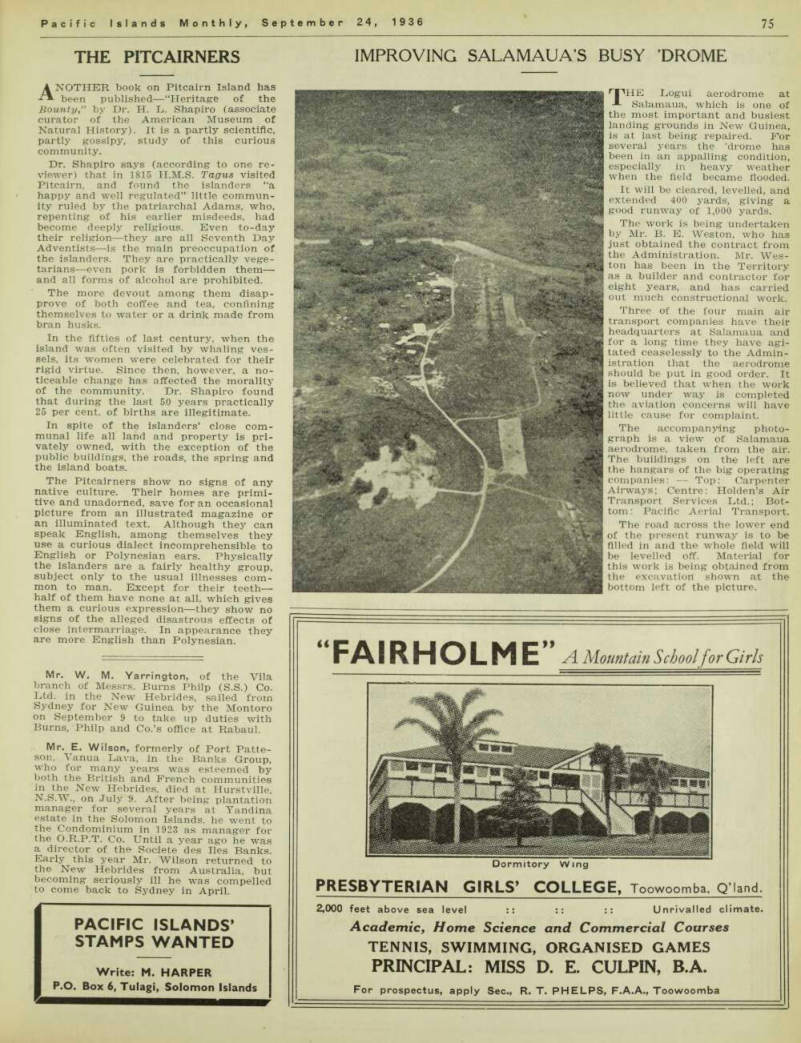
ANOTHER book on Pitcairn Island has been published—“ Heritage of the Bounty ," by Dr. H. L. Shapiro (associate curator of the American Museum of Natural History). It is a partly scientific, partly gossipy, study of this curious community.
Dr. Shapiro says (according to one re viewer) that in 1815 H.M.S. Tagus visited Pitcairn, and found the islanders “a happy and well regulated” little commun ity ruled by the patriarchal Adams, who, repenting of his earlier misdeeds, had become deeply religious. Even to-day their religion—they are all Seventh Day Adventists—is the main preoccupation of the islanders. They are practically vege tarians —even pork is forbidden them— and all forms of alcohol are prohibited.
The more devout among them disap prove of both coffee and tea, confining themselves to water or a drink made from bran husks.
In the fifties of last century, when the island was often visited by whaling ves sels, its women were celebrated for their rigid virtue. Since then, however, a no ticeable change has affected the morality of the community. Dr. Shapiro found that during the last 50 years practically 25 per cent, of births are illegitimate.
In spite of the islanders’ close com munal life all land and property is pri vately owned, with the exception of the public buildings, the roads, the spring and the island boats.
The Pitcairners show no signs of any native culture. Their homes are primi tive and unadorned, save for an occasional picture from an illustrated magazine or an illuminated text. Although they can speak English, among themselves they use a curious dialect incomprehensible to English or Polynesian ears. Physically the islanders are a fairly healthy group, subject only to the usual illnesses com mon to man. Except for their teeth— half of them have none at all, which gives them a curious expression—they show no signs of the alleged disastrous effects of close intermarriage. In appearance they are more English than Polynesian.
Mr. W. M. Yarrington, of the Vila branch of Messrs. Burns Philp (S.S.) Co.
Ltd. in the New Hebrides, sailed from Sydney for New Guinea by the Montoro on September 9 to take up duties with Burns, Philp and Co.’s office at Rabaul.
Mr. E. Wilson, formerly of Port Patte son, Vanua Lava, in the Banks Group, who for many years was esteemed by both the British and French communities in the New Hebrides, died at Hurstville, N.S.W., on July 9. After being plantation manager for several years at Yandina estate in the Solomon Islands, he went to the Condominium in 1923 as manager for the O.R.P.T. Co. Until a year ago he was a director of the Societe des lies Banks.
Early this year Mr. Wilson returned to the New Hebrides from Australia, but becoming seriously ill he was compelled to come back to Sydney in April.
Improving Salamaua’S Busy ’Drome
THE Logui aerodrome at Salamaua, which is one of the most important and busiest landing grounds in New Guinea, is at last being repaired. For several years the ’drome has been in an appalling condition, especially in heavy weather when the field became flooded.
It will be cleared, levelled, and extended 400 yards, giving a good runway of 1,000 yards.
The work is being undertaken by Mr. B. E. Weston, who has just obtained the contract from the Administration. Mr, Wes ton has been in the Territory as a builder and contractor for eight years, and has carried out much constructional work.
Three of the four main air transport companies have their headquarters at Salamaua and for a long time they have agi tated ceaselessly to the Admin istration that the aerodrome should be put in good order. It is believed that when the work now under way is completed the aviation concerns will have little cause for complaint.
The accompanying photo graph is a view of Salamaua aerodrome, taken from the air.
The buildings on the left are the hangars of the big operating companies: Top: Carpenter Airways: Centre: Holden’s Air Transport Services Ltd.; Bot tom: Pacific Aerial Transport.
The road across the lower end of the present runway is to be filled in and the whole field will be levelled off. Material for this work is being obtained from the excavation shown at the bottom left of the picture.
Advertisements & other items, p. 77 (2 items)
j
Pacific Islands’
STAMPS WANTED
Write: M. HARPER P.O. Box 6, Tulagi, Solomon Islands
Islands Produce
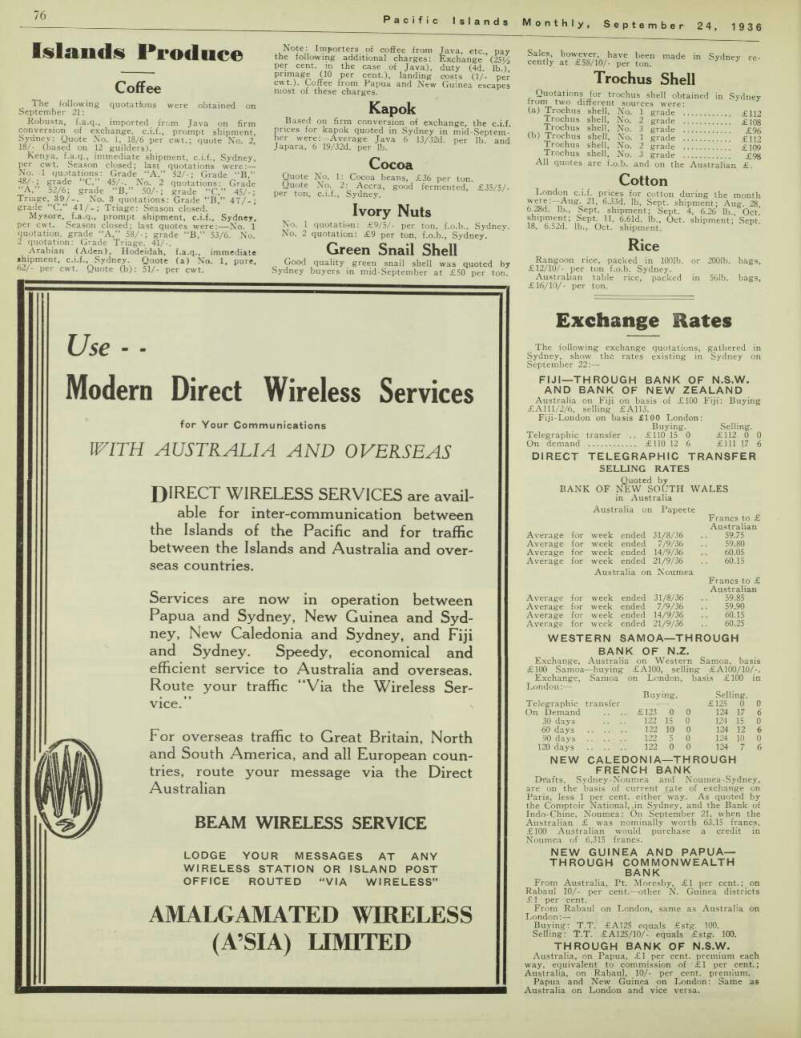
Coffee
The following quotations were obtained on September 21: Robusta, f.a.q., imported from Java on firm conversion of exchange, c.i.f., prompt shipment, Sydney: Quote No. 1, 18/6 per cwt.; quote No. 2, 18/- (based on 12 guilders).
Kenya, f.a.q., immediate shipment, c.i.f., Sydney, per cwt. Season closed; last quotations were:— No. 1 quotations: Grade “A,” 52/-; Grade “B,” 48/-; grade “C, ’ 45/-. No. 2 quotations: Grade “A, 52/6; grade “B,” 50/-; grade “C,” 45/-; Triage, 89/-. No. 3 quotations: Grade “B,” 47/-; grade “C,” 41/-; Triage: Season closed.
Mysore, f.a.q., prompt shipment, c.i.f., Sydney, per cwt. Season closed; last quotes were:—No. 1 quotation, grade “A,” 58/-; grade “B,” 53/6. No. 2 quotation: Grade Triage, 41/-.
Arabian (Aden), Hodeidah, f.a.q., immediate shipment, c.i.f., Sydney. Quote (a) No. 1, pure. 62/- per cwt. Quote (b): 51/- per cwt.
Note; Importers of coffee from Java, otc., pay the following additional charges: Exchange (25 y 2 per cent, in the case of Java), duty (4d. lb.), primage (10 per cent.), landing costs (1/- per cwt.). Coffee from Papua and New Guinea escapes most of these charges.
Kapok
Based on firm conversion of exchange, the c.i.f. prices for kapok quoted in Sydney in mid-Septem-' ber were: Average Java 6 13/32d. per lb. and Japara, 6 19/32d. per lb.
Cocoa
Quote No. 1: Cocoa beans, £36 per ton.
Quote No. 2: Accra, good fermented, £35/5/per ton, c.i.f., Sydney.
Ivory Nuts
No. 1 quotation: £9/5/- per ton, f.0.b., Sydney.
No. 2 quotation: £9 per ton, f.0.b., Sydney.
Green Snail Shell
Good quality green snail shell was quoted by Sydney buyers in mid-September at £5O per ton.
cli"; a h t ow £ e s v B7io/ ha p v ' foT made in Sydney -
Trochus Shell
Quotations for trochus shell obtained in Sydney irom two different sources were: (a) Trochus shell, No. 1 grade £H2 Trochus shell. No. 2 grade £lOB Trochus shell, No. 3 grade £O6 Ch) Trochus shell, No. 1 grade £ll2 Trochus shell. No. 2 grade £lO9 Trochus shell, No. 3 grade £9B All quotes are f.o.b. and on the Australian £.
Cotton
London c.i.f. prices for cotton during the month y^® : ~Aug. 21, 6.33 d. lb, Sept, shipment; Aug. 28, 6 28d. lb., Sept, shipment; Sept. 4, 6.26 lb., Oct. sMpment; Sept !!, 6.61 d. lb., Oct. shipment; Sept. 18, 6.52 d. lb., Oct. shipment.
Rice
Rangoon rice, packed in 1001 b. or 2001 b. bags, £l2/10/- per ton f.o.b. Sydney.
Australian table rice, packed in 561 b. bags, £l6/10/- per ton.
Exchange Rates
The following exchange quotations, gathered in Sydney, show the rates existing in Sydney on September 22:
Fiji—Through Bank Of N.S.W.
And Bank Of New Zealand
Australia on Fiji on basis of £lOO Fiji; Buying £AIII/2/6, selling £AII3.
Fiji-London on basis £lOO London:
Direct Telegraphic Transfer
Selling Rates
Quoted by
Bank Of New South Wales
in Australia
Western Samoa—Through
Bank Of N.Z.
Exchange, Australia on Western Samoa, basis £lOO Samoa —buying £AIOO, selling £AIOO/10/-.
Exchange, Samoa on London, basis £lOO in London;—
New Caledonia—Through
French Bank
Drlafts. Sydney-Noumea and Noumea-Sydney, are on the basis of current rate of exchange on Paris, less 1 per cent, either way. As quoted by the Comptoir National,,in Sydney, and the Bank of Indo-Chine, Noumea: On September 21, when the Australian £ was nominally worth 63.15 francs, £lOO Australian would purchase a credit in Noumea of 6,315 francs.
New Guinea And Papua
Through Commonwealth
Bank
From Australia, Pt. Moresby, £1 per cent.; on Rabaul 10/- per cent. —other N. Guinea districts £1 per cent.
From Rabaul on London, same as Australia on London:— Buying: T.T. £AI2S equals £stg. 100.
Selling: T.T. £AI2S/10/- equals £stg. 100.
Through Bank Of N.S.W.
Australia, on Papua, £1 per cent, premium each way, equivalent to commission of £1 per cent.; Australia, on Rabaul, 10/- per cent, premium.
Papua and New Guinea on London; Same as Australia on London and vice versa.
Buying. Selling.
Telegraphic transfer .. £110 15 0 £112 0 0 On demand £110 12 6 £111 17 6
Australia on i Papeete Average for week ended 31/8/36 Francs to £ Australian 59.75 Average for week ended 7/9/36 59.80 Average for week ended 14/9/36 60.05 Average for week ended 21/9/36 60.15 Average for Australia on week ended Noumea 31/8/36 Francs to £ Australian 59.85 Average for week ended 7/9/36 59.90 Average for week ended 14/9/36 60.15 Average for week ended 21/9/36 60.25
Buying. Selling.
Telegraphic transfer £125 0 0 On Demand .. .. £123 0 0 124 17 6 30 days ... 122 15 0 124 15 0 60 days 122 10 0 124 12 6 90 days 122 5 0 124 10 0 120 days 122 0 0 124 7 6
Advertisements & other items, p. 78 (1 item)
Modern Direct Wireless Services
Use - -
for Your Communications
WITH AUSTRALIA AND OVERSEAS
J)IRECT WIRELESS SERVICES are avail-
able for inter-communication between the Islands of the Pacific and for traffic between the Islands and Australia and overseas countries.
Services are now in operation between Papua and Sydney, New Guinea and Sydney, New Caledonia and Sydney, and Fiji and Sydney. Speedy, economical and efficient service to Australia and overseas.
Route your traffic “Via the Wireless Service.” \ For overseas traffic to Great Britain, North and South America, and all European countries, route your message via the Direct Australian
BEAM WIRELESS SERVICE
LODGE YOUR MESSAGES AT ANY
WIRELESS STATION OR ISLAND POST
OFFICE ROUTED “VIA WIRELESS”
AMALGAMATED WIRELESS
(A’SIA) LIMITED
Market Quotations
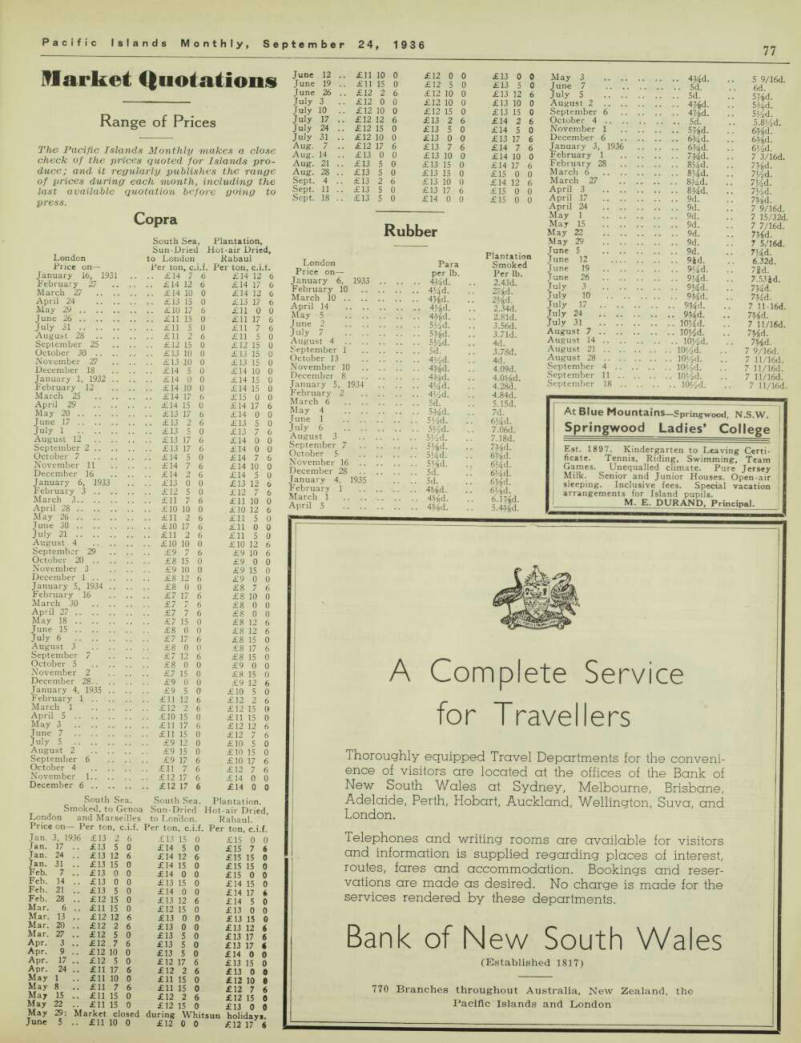
Range of Prices
The Pacific Islands Monthly makes a close check of the prices quoted for Islands pro duce; and it regularly publishes the range of prices during each month , including the last available quotation before going to press.
Copra
South Sea. South Sea. Plantation.
Smoked, to Genoa Sun-Dried Hot-air Dried, London and Marseilles to Lon'don. Rabaul.
Price on— Per ton, c.i.f. Per ton, c.i.f. Per ton, c.i.f.
Rubber
May 3 .. .. 4Hd. 5 9/16d.
June 7 6d.
Ct /.a July 5 5d August 2 .. .. 4J4d. sy 4 d.
September 6 .. .. .. .. 4m. sy 2 d.
October 4 .. .. 5d. 5.8 l / 2 d. 6V s d.
November 1 December 6 .. .. 6^d. 6Hd.
January 3, 1936 .. .. 6J4d. • 7$4d ey 2 d.
February 1 7 3/16d. 7Hd.
February 28 .. .. 8!4d.
March 6 March 27 .. .. S'Ad. . 8yd .. ?y 2 d. .. 7y 2 d.
April 3 .. .. 8^d.
April 17 .. .. 9d. 7%d.
April 24 . 9d 7 9/16d. 7 15/32d. 7 7/16d.
May 1 . 9d May IS May 22 7Hd.
May 29 7 5/16d.
June 5 7%d.
June 12 .. .. 9Jd. 6.32d.
June 19 .. .. 9J4d. .. 7gd.
June 26 .. .. 9j4d. 7.53Jd.
July 3 .. .. 9%d. 7Y A d.
July 10 .. .. 9^d. .. 7Hd.
July 17 .. .. 9V A d. 7 ll-16d.
July 24 .. .. 9V 4 d. 7^d.
July 31 .. .. 10l4d. 7 ll/16d.
August 7 7m.
August 14 7m.
August 21 .. .. 10/ 2 d. 7 9/16d.
August 28 .. .. 10/ 2 d. 7 ll/16d.
September 4 . .. I0y 2 d. 7 11/16d.
September 11 .. .. .. .. 10/ 2 d. 7 ll/16d.
September 18 .. .. .. .. 10^d. 7 ll/16d.
June 12 . . £11 10 0 £12 0 0 £13 0 0 June 19 . . £11 15 0 £12 5 0 £13 5 0 June 26 . . £12 2 6 £12 10 0 £13 12 6 July 3 . . £12 0 0 £12 10 0 £13 10 0 July 10 . . £12 10 0 £12 15 0 £13 15 0 July 17 . . £12 12 6 £13 2 6 £14 2 6 July 24 . . £12 15 0 £13 5 0 £14 5 0 July 31 . . £12 10 0 £13 0 0 £13 17 6 Aug. 7 . . £12 17 6 £13 7 6 £14 7 6 Aug. 14 . . £13 0 0 £13 10 0 £14 10 0 Aug. 21 ., , £13 5 0 £13 15 0 £14 17 6 Aug. 28 .. , £13 5 0 £13 15 0 £15 0 0 Sept. 4 .. £13 2 6 £13 10 0 £14 12 6
Sept.
11 .. £13 5 0 £13 17 6 £15 0 0 Sept. 18 .. £13 5 0 £14 0 0 £15 0 0
South Sea, Plantation.
Sun-Dried Hot-air Dried.
London to London Rabaul Price on — Per ton, c.i.f.
Per ton, c.i .f.
January 16, 1931 . .. £14 7 6 £14 12 6 February 27 .. . . .. £14 12 6 £14 17 6 March 27 . .. £14 10 0 £14 12 6 April 24 . .. £13 15 0 £13 17 6 May 29 . .. £10 17 6 £11 0 0 June 26 . .. £11 15 0 £11 17 6 July 31 . .. £11 5 0 £11 7 6 August 28 . .. £11 2 6 £11 5 0 September 25 .. . . .. £12 15 0 £12 15 0 October 30 . .. £13 10 0 £13 15 0 November 27 .. . . .. £13 10 0 £13 IS 0 December 18 .. . . .. £14 5 0 £14 10 0 January 1, 1932 .. . . .. £14 0 0 £14 15 0
February 12 ,
. .. £14 10 0 £14 15 0 March 25 . .. £14 17 6 £15 0 0 April 29 . .. £14 15 0 £14 17 6 May 20 17 6 £14 0 0
June 17
2 6 £13 5 0 July 1 . .. £13 5 0 £13 7 6 August 12 . .. £13 17 6 £14 0 0 September 2 . .. £13 17 6 £14 0 0 October 7 . .. £14 5 0 £14 7 6 November 11 ... . .. £14 7 6 £14 10 0 December 16 ... . .. £14 2 6 £14 5 0 January 6, 1933 . .. £13 0 0 £13 12 6
February 3
. .. £12 5 0 £12 7 6 March 3 . .. £11 7 6 £11 10 0 April 28 10 0 £10 12 6 May 26 . .. £11 2 6 £11 5 0
June 30
6 £11 0 0 July 21 2 6 £11 5 0 August 4 0 £10 12 6 September 29 .. £9 7 6 £9 10 6 October 20 .. £8 15 0 £9 0 0 November 3 .. .. .. £9 10 0 £9 15 0 December 1 .. £8 12 6 £9 0 0 January 5, 1934 .. .. .. £8 0 0 £8 7 6 February 16 .. £7 17 6 £8 10 0 March 30 .. £7 7 6 £8 0 0 April 27 7 6 £8 0 0 May 18 15 0 £8 12 6 June 15 .. £8 0 0 £8 12 6
July 6
.. £7 17 6 £8 15 0 August 3 .. £8 0 0 £8 17 6
September 7 .. ..
.. £7 12 6 £8 15 0 October 5 .. £8 0 0 £9 0 0 November 2 .. .. .. £7 15 0 £8 15 0 December 28 0 0 £9 12 6 January 4, 1935 .. .. .. £9 5 0 £10 5 0 February 1 .. £11 12 6 £12 2 6 March 1 .. £12 2 6 £12 IS 0 April 5 0 £11 15 0 May 3 .. £11 17 6 £12 12 6 June 7 .. £11 15 0 £12 7 6 July 5 0 £10 5 0 August 2 .. £9 15 0 £10 15 0
September 6 .. ..
.. £9 17 6 £10 17 6 October 4 .. £11 7 6 £12 7 6 November 1 .. £12 17 6 £14 0 0 December 6 6 £14 0 0
Jan. 3, 1936 £13 2 6 £13 15 0 £15 0 0 Jan. 17 .. £13 5 0 £14 5 0 £15 7 6 Jan. 24 .. £13 12 6 £14 12 6 £15 IS 0 Jan. 31 .. £13 15 0 £14 15 0 £15 15 0 Feb. 7 .. £13 0 0 £14 0 0 £15 0 0 Feb. 14 .. £13 0 0 £13 15 0 £14 15 0 Feb. 21 .. £13 5 0 £14 0 0 £14 17 6 Feb. 28 .. £12 15 0 £13 12 6 £14 5 0 Mar. 6 .. £11 15 0 £12 15 0 £13 0 0 Mar. 13 .. £12 12 6 £13 0 0 £13 15 0 Mar. 20 .. £12 2 6 £13 0 0 £13 12 6 Mar. 27 .. £12 5 0 £13 5 0 £13 17 6 Apr. 3 .. £12 7 6 £13 5 0 £13 17 ( Apr. 9 .. £12 10 0 £13 5 0 £14 0 0 Apr. 17 .. £12 5 0 £12 17 6 £13 15 o Apr. 24 .. £11 17 6 £12 2 6 £13 0 0 May 1 .. £11 10 0 £11 IS 0 £12 10 e May 8 .. £11 7 6 £11 15 0 £12 7 6 May 15 .. £11 15 0 £12 2 6 £12 15 o May 22 .. £11 15 0 £12 15 0 £13 a o May 29: Market closed during Whitsun holiday s.
June 5 .. £11 10 0 £12 0 0 £12 17 6
London Plantation Para Smoked Price on— per lb.
Per lb.
January 6, 1933 .. . .. 4J4d. 2.43d.
February 10 . .. 4>4d. 2~/id.
March 10 • 4Jjjd. 2%d.
April 14 . .. 4^d. 2.34d.
May 5 2.81d.
June 2 . .. 5^d. 3.56d.
July 7 . .. 5^d. 3.71d.
August 4 . .. S'/ 3 d. 4d.
September 1 3.78d.
October 13 .. .. . .. 4'/ 2 d. 4d.
November 10 .. .. • •• 4^d. 4.09d.
December 8 .. .. . .. 446d. 4.0Ad.
January 5, 1934 .. . . .. 4'Ad. 4.28d.
February 2 ■ .. 4Ad. 4.84d.
March 6 . .. 5d 5.15d. 7d.
May 4 . .. Stfd.
June 1 ey A d.
July 6 7.06d.
August 3 . .. 5/;d.’ 7.18d.
September 7 • • • S'Ad 7H d. 6 Ad.
October 5 . .. 5'Ad.
November 16 December 28 . .. 5Ad. . .. 5d. 6'Ad. 6Ad. 6Hd.
January 4. 1935 . .. 5d.
February 1 • • • 4^d. 6*Ad.
March 1 • •• 4%d.
e^i^d.
April 5 • •• 4^d. 5.4^d.
Advertisements & other items, p. 79 (1 item)
for Travellers
At Blue Mountains— Springwood, N.s.w.
Springwood Ladies* College
Est. 1897. Kindergarten to Leaving Certificate. Tennis, Riding, Swimming, Team Games. Unequalled climate. Pure Jersey Milk. Senior and Junior Houses. Open-air sleeping. Inclusive fees. Special vacation arrangements for Island pupils.
M. E. DURAND. Principal.
A Complete Service
for Travellers
Thoroughly equipped Travel Departments for the convenience of visitors are located at the offices of the Bank of New South Wales at Sydney, Melbourne, Brisbane, Adelaide, Perth, Hobart, Auckland, Wellington, Suva, and London.
Telephones and writing rooms are available for visitors and information is supplied regarding places of interest, routes, fares and accommodation. Bookings and reservations are made as desired. No charge is made for the services rendered by these departments.
Bank of New South Wales
(Established 1817) 770 Branches throughout Australia, New Zealand, the Pacific Islands and London
Shipping Services in the Pacific
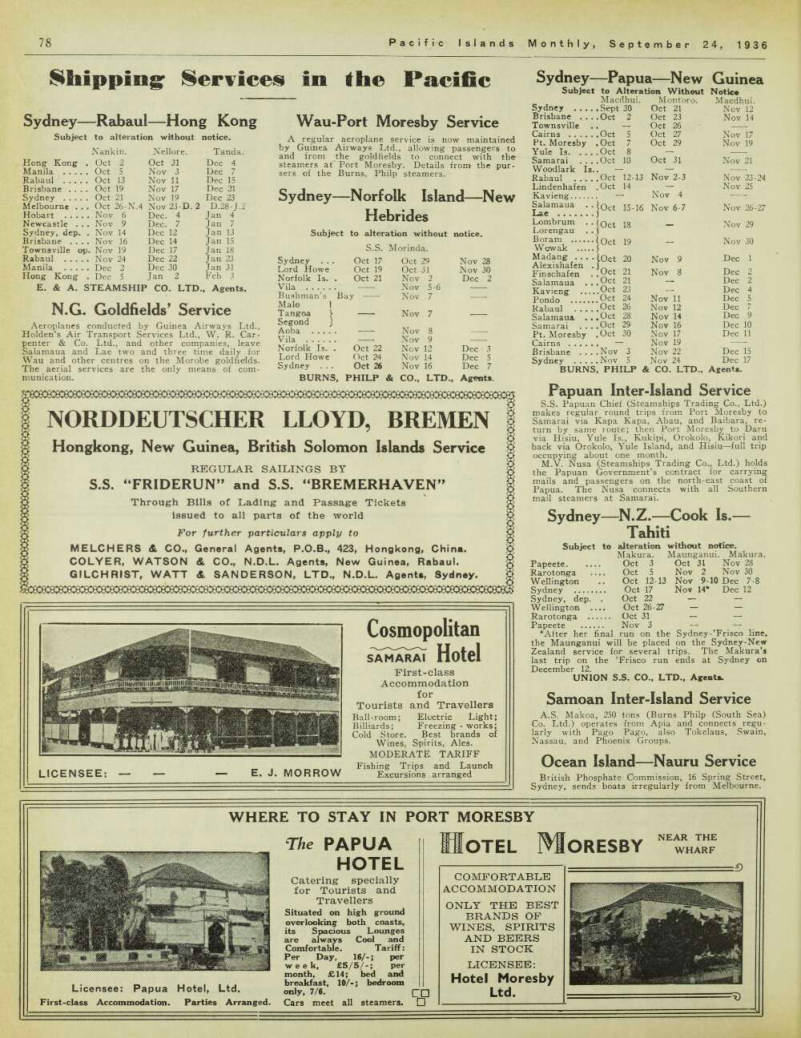
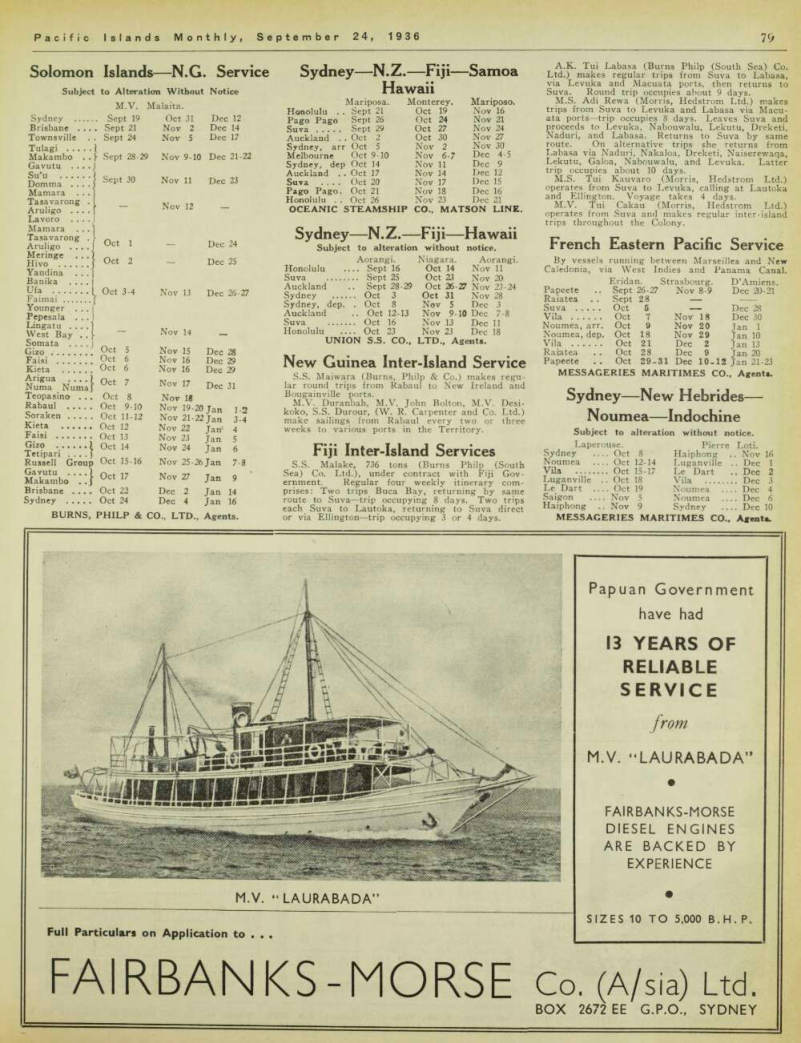
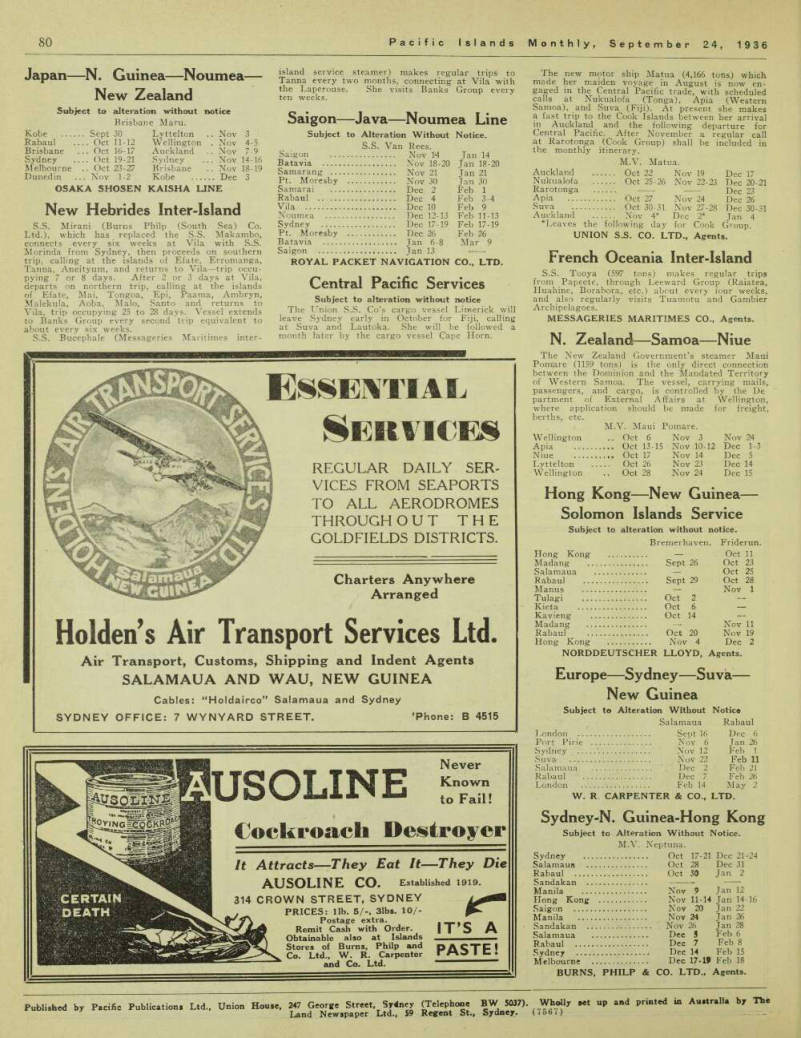
Sydney—Rabaul—Hong Kong Subject to alteration without notice.
N.G. Goldfields’ Service
Aeroplanes conducted by Guinea Airways Ltd., Holden’s Air Transport Services Ltd., W. R. Car penter & Co. Ltd., and other companies, leave Salamaua and Lae two and three time daily for Wau and other centres on the Morobe goldfields.
The aerial services are the only means of com munication.
Wau-Port Moresby Service
A regular aeroplane service is now maintained by Guinea Airways Ltd., allowing passengers to and from the goldfields to connect with the steamers at Port Moresby. Details from the pur sers of the Burns, Philp steamers.
Sydney—Norfolk Island—New
Hebrides
Subject to alteration without notice.
Sydney—Papua—New Guinea Subject to Alteration Without Notie*
Papuan Inter-Island Service
S.S. Papuan Chief (Steamships Trading Co., Ltd.) makes regular round trips from Port Moresby to Samarai via Kapa Kapa, Abau, and Baibara, re turn by same route; then Port Moresby to Daru via Hisiu, Yule Is., Kukipi, Orokolo, Kikori and back via Orokolo, Yule Island, and Hisiu —full trip occupying about one month.
M.V. Nusa (Steamships Trading Co., Ltd.) holds the Papuan Government’s contract for carrying mails and passengers on the north-east coast of Papua. The Nusa connects with all Southern mail steamers at Samarai.
Sydney—N.Z.—Cook Is.—
Tahiti
Subject to alteration without notice.
Samoan Inter-Island Service
A.S. Makoa, 250 tons (Burns Philp (South Sea) Co. Ltd.) operates from Apia and connects regu larly with Pago Pago, also Tokelaus, Swain, Nassau, and Phoenix Groups.
Ocean Island—Nauru Service
British Phosphate Commission, 16 Spring Street, Sydney, sends boats irregularly from Melbourne.
Nankin.
Nellore.
Tanda.
Hong Kong . Oct 2 Oct 31 Dec 4 Manila . . . , . . Oct 5 Nov 3 Dec 7 Rabaul . . • . . . Oct 13 Nov 11 Dec 15 Brisbane . . . . Oct 19 Nov 17 Dec 21 Sydney ..., . . Oct 21 Nov 19 Dec 23 Melbourne . . . Oct 26 - X.4 Nov 23-D. 2 D.28-J.2 Hobart . . .
Dec. 4 Jan 4 Newcastle . . . Nov 9 Dec. 7 Jan 7 Sydney, dep. . Nov 14 Dec 12 Jan 13 Brisbane . . .. Nov 16 Dec 14 Jan IS Townsville op. Nov 19 Dec 17 Jan 18 Rabaul . . .
Dec 22 Jan 23 Manila . . Dec 2 Dec 30 Jan 31 Hong Kong . Dec 5
Jan 2
Feb 3 E. & A.
Steamship Co. Ltd.
, Agents.
Sydney . . . s.s.
Oct 17 Morinda.
Oct 29 Nov 28 Lord Howe Oct 19 Oct 31 Nov 30 Norfolk Is. .
Oct 21 Nov 2 Dec 2 Vila Nov 5-6 Nov 7 Bushman’s Bay Male 1 Tangoa )■ Nov 7 Segond J Nov 8 Nov 9 Nov 12 Vila Norfolk Is. .
Oct 22 Dec 3 Lord Howe Oct 24 Nov 14 Dec 5 Sydney . . .
Oct 26 Nov 16 Dec 7
Burns
, Philp
& Co., Ltd.,
Agents.
Sydney Brisbane . . .
Macdhui.
Sept 30 Oct 2 Montoro.
Oct 21 Oct 23 Macdhui.
Nov 12 Nov 14 Townsville Cairns Ort 5 Oct 26 Oct 27 Nov 17 Nov 19 Pt. Moresby Oct 7 Oct 29 Yule Is Oct 8 — Samarai . . . .Oct 10 Oct 31 Nov 21 Woodlark Is.. — — Rabaul Oct 12-13 Nov 2-3 Nov 23-24 Lindenhafen Oct 14 — Nov 25 Kavieng Nov 4 Salamaua Oct 15-16 Nov 6-7 Nov 26-27 Lombrum . , Oct 18 Nov 29 Lorengau
Boram \
■ Oct 19 Nov 30
Wewak J
Madang . . . . j [
lOct
20 Nov 9 Dec 1 Alexishafen . j Finschafen
'Oct
21 Nov 8 Dec 2 Salamaua . .
Oct 21 — Dec 2
Kavieng
Oct 23 — Dec 4 Pondo Oct 24 Nov 11 Dec 5 Rabaul ...
Oct 26 Nov 12 Dec 7 Salamaua . .
Oct 28 Nov 14 Dec 9 Samarai Oct 29 Nov 16 Dec 10 Pt. Moresby Oct 30 Nov 17 Dec 11 Cairns Nov 19 — Brisbane . • .
Nov 3 Nov 22 Dec 15 Sydney ...
Nov 5 Nov 24 Dec 17
Burns
Philp &
T Co. Ltd.,
Agentc.
Makura. Maunganui. Makura.
Papeete Oct 3 Oct 31 Nov 28 Rarotonga Oct 5 Nov 2 Nov 30 Wellington Oct 12-13 Nov 9-10 Dec 7-8 Sydney Oct 17 Nov 14* Dec 12 Sydney, dep. .
Oct 22 - - Wellington ...
Oct 26-27 — - Rarotonga ... .. Oct 31 - — Papeete Nov 3 — — *After her final run on the Sydney-’Frisco line. the Maunganui will be placed on the Sydney-New Zealand service for several trips. The Makura’s last trip on the ’Frisco run ends at Sydney on December 12.
Union S.S. Co., Ltd., Agent*.
Solomon Islands —N.G. Service Subject to Alteration Without Notice
Sydney—N.Z.—Fiji—Samoa Hawaii
Sydney—N.Z.—Fiji—Hawaii Subject to alteration without notice.
New Guinea Inter-Island Service
5.5. Maiwara (Burns, Philp & Co.) makes regu lar round trips from Rabaul to New Ireland and Bougainville ports.
M.V. Duranbah, M.V. John Bolton, M.V. Desi koko, S.S. Durour, (W. R. Carpenter and Co. Ltd.) make sailings from Rabaul every two or three weeks to various ports in the Territory.
Fiji Inter-Island Services
5.5. Malake, 736 tons (Burns Philp (South Sea) Co. Ltd.), under contract with Fiji Gov ernment. Regular four weekly itinerary com prises: Two trips Buca Bay, returning by same route to Suva —trip occupying 8 days. Two trips each Suva to Lautoka, returning to Suva direct or via Ellington—trip occupying 3 or 4 days.
A.K. Tui Labasa (Burns Philp (South Sea) Co.
Ltd.) makes regular trips from Suva to Labasa, via Levuka and Macuata ports, then returns to Suva. Round trip occupies about 9 days.
M.S. Adi Rewa (Morris, Hedstrom Ltd.) makes trips from Suva to Levuka and Labasa via Macu ata ports—trip occupies 8 days. Leaves Suva and proceeds to Levuka, Nabouwalu, Lekutu, Dreketi, Naduri, and Labasa. Returns to Suva by same route. On alternative trips she returns from Labasa via Naduri, Nakaloa, Dreketi, Naiserewaqa, Lekutu, Galoa, Nabouwalu, and Levuka. Latter trip occupies about 10 days.
M.S. Tui Kauvaro (Morris, Hedstrom Ltd.) operates from Suva to Levuka, calling at Lautoka and Ellington. Voyage takes 4 days.
M.V. Tui Cakau (Morris, Hedstrom Ltd.) operates from Suva and makes regular inter-island trips throughout the Colony.
French Eastern Pacific Service
By vessels running between Marseilles and New Caledonia, via West Indies and Panama Canal.
Sydney—New Hebrides— Noumea—lndochine Subject to alteration without notice.
M.V.
Malaita.
Sydney Sept 19 Oct 31 Dec 12 Brisbane . . .
Townsville . Sept 21 . Sept 24 Nov 2 Nov 5 Dec 14 Dec 17 ) Makambo . .
Gavutu ...
Su’u }• Sept 28-29 Nov 9-; 10 Dec 21-22 Domma ...
Mamara Tasavarong .
Aruligo ...
Lavoro ...
Mamara . . .
Tasavarong .
Aruligo . . . .
Meringe . . .
Hivo > isept JO Oct 1 Oct 2 Nov 11 Nov 12 Dec 23 Dec 24 Dec 25 Yandina . . .
Banika . . . .
Ufa Oct 3-4 Nov 13 Faimai
Jj€C Zo-Z/
Younger . . .
Pepesala ... I
Lingatu . . , . ]
West Bay . . [
Somata Gizo : Oct 5 Nov 14 Nov IS Dec 28 Faisi Oct 6 Nov 16 Dec 29 Kieta Oct 6 Nov 16 Dec 29 Arigua . . . . ) Numa NumaJ Teopasino . ..
Rabaul Oct 7 Oct 8 Oct 9-10 Oct 11-12 Oct 12 Oct 13 Oct 14 Oct 15-16 Oct 17 Oct 22 Oct 24 Nov 17 Nov 18 Nov 19- Nov 21- Dec 31 20 Jan 1-2 22 Jan 3-4 Jan’ 4 Jan 5 Soraken Kieta Faisi
In O V Zz
Mnir 02 Gizo )
In Ov Zj
Tetipari . . . . ) Russell Group Gavutu . . .. ) Makambo . . J Brisbane Sydney i’uv it jan o Nov 25-26 Jan 7-8 Nov 27 Jan 9 Dec 2 Jan 14 Dpp d Tan
Burns,
Philp &
Co., Ltd
., Agents.
Mariposa.
Monterey.
Mariposo.
Honolulu . , Sept 21 Oct 19 Nov 16 Pago Pago Sept 26 Oct 24 Nov 21 Suva Sept 29 Oct 27 Nov 24 Auckland . . Oct 2 Oct 30 Nov 27 Sydney, arr Oct 5 Nov 2 Nov 30 Melbourne Oct 9-10 Nov 6-7 Dec 4-5 Sydney, dep Oct 14 Nov 11 Dec 9 Auckland . . Oct 17 Nov 14 Dec 12 Suva Oct 20 Nov 17 Dec 15 Pago Pago . Oct 21 Nov 18 Dec 16 Honolulu . Oct 26 Nov 23 Dec 21
Oceanic
Steamship Co.. Matson Line
Aorangi. Niagara. Aorangi.
Honolulu Sept 16 Oct 14 Nov 11 Suva Sept 25 Oct 23 Nov 20 Auckland .. Sept 28-29 Oct 26-2 7 Nov 23-24 Sydney Oct 3 Oct 31 Nov 28 Sydney, dep. . Oct 8 Nov 5 Dec 3 Auckland .. Oct 12-13 Nov 9-10 Dec 7-8 Suva Oct 16 Nov 13 Dec 11 Honolulu Oct 23 Nov 23 Dec 18
Union S.S. Co., Ltd., Agents.
Eridan.
Strasbourg.
D’Amiens.
Papeete Sept 26-27 Nov 8-9 Dec 20-21 Raiatea . .
Sept 28 Suva . .
Oct 5 Dec 28 Vila . . , Oct 7 Nov 18 Dec 30 Noumea, arr.
Oct 9 Nov 20 Jan 1 Noumea, dep.
Oct 18 Nov 29 Jan 10 Vila . . , Oct 21 Dec 2 Jan 13 Raiatea . .
Oct 28 Dec 9 Tan 20 Papeete Oct 29- 31 Dec 10-12 Jan 21-23
Messageries
Maritimes Co.
, Agents.
Laperouse. Pierre Loti.
Sydney Oct 8 Haiphong .. Nov 16 Noumea Oct 12-14 Luganville .. Dec 1 Vila Oct 15-17 Le Dart .. Dec 2 Luganville .. Oct 18 Vila Dec 3 Le Dart ... Oct 19 Noumea ... Dec 4 Saigon Nov 5 Noumea Dec 6 Haiphong .. Nov 9 Sydney Dec 10
Messageries Maritimes Co., Amenta.
Japan—N. Guinea —Noumea—
New Zealand
Subject to alteration without notice Brisbane Maru.
Kobe Sept 30 Lyttelton .. Nov 3 Rabaul ... Oct 11-12 Wellington . Nov 4-5 Brisbane ... Oct 16-17 Auckland .. Nov 7-9 Sydney Oct 19-21 Sydney ... Nov 14-16 Melbourne .. Oct 23-27 Brisbane .. Nov 18-19 Dunedin ... Nov 1-2 Kobe Dec 3
Osaka Shosen Kaisha Line
New Hebrides Inter-Island
5.5. Mirani (Burns Philp (South Sea) Co.
Ltd.), which has replaced the S.S. Makambo, connects every six weeks at Vila with S.S.
Morinda from Sydney, then proceeds on southern trip, calling at the islands of Efate, Erromanga, Tanna, Aneityum, and returns to Vila—trip occu pying 7or 8 days. After 2or 3 days at Vila, departs on northern trip, calling at the islands of Efate, Mai, Tongoa, Epi, Paama, Ambryn, Malekula, Aoba, Malo, Santo and returns to Vila, trip occupying 25 to 28 days. Vessel extends to Banks Group every second trip equivalent to about every six weeks. 5.5. Bucephale (Messageries Maritimes inter
island service steamer) makes regular trips to Tanna every two months, connecting at Vila with the Laperouse. She visits Banks Group every ten weeks.
Saigon—Java—Noumea Line
Subject to Alteration Without Noitice.
Central Pacific Services
Subject to alteration without notice The Union S.S. Co’s cargo vessel Limerick will leave Sydney early in October for Fiji, calling at Suva and Lautoka. She will be followed a month later by the cargo vessel Cape Horn.
The new motor ship Matua (4,166 tons) which made her maiden voyage in August is now en gaged in the Central Pacific trade, with scheduled calls at Nukualofa (Tonga), Apia (Western Samoa), and Suva (Fiji). At present she makes a fast trip to the Cook Islands between her arrival in Auckland and the following departure for Central Pacific. After November a regular call at Rarotonga (Cook Group) shall be included in the monthly itinerary.
French Oceania Inter-Island
S.S. Tooya (597 tons) makes regular trips from Papeete, through Leeward Group (Raiatea, Huahine, Borabora, etc.) about every four weeks, and also regularly visits Tuamotu and Gambier Archipelagoes.
Messageries Maritimes Co., Agents.
N. Zealand —Samoa—Niue
The New Zealand Government’s steamer Maui Pomiare (1159 tons) is the only direct connection between the Dominion and the Mandated Territory of Western Samoa. The vessel, carrying mails, passengers, and cargo, is controlled by the De partment of External Affairs at Wellington, where application should be made for freight, berths, etc.
Hong Kong—New Guinea— Solomon Islands Service Subject to alteration without notice.
Europe—Sydney—Suva— New Guinea Subject to Alteration Without Notice
Sydney-N. Guinea-Hong Kong Subject to Alteration Without Notice.
s.s.
Van Rees.
Saigon Jan 14 Batavia ... Nov 18-20 Jan 18-20
Samarang
... Nov 21 Jan 21 Pt. Moresby ... Nov 30 Jan 30 Samarai ... Dec 2 Feb 1 Raban 1 Feb 3-4 Vila Feb 9 Noumea ... Dec 12-13 Feb 11-13 Sydney ... Dec 17-19 Feb 17-19 Pt. Moresby ... Dec 26 Feb 26 Batavia Jan 6-8 Mar 9 Saigon —
Royal Packet
Navigation
Co., Ltd,
M.V. Matua.
Auckland Oct 22 Nov 19 Dec 17 Nukualofa Oct 25-26 Nov 22-23 Dec 20-21 Rarotonga Dec 23 Apia Oct 27 Nov 24 Dec 26 Suva Oct 30-31 Nov 27-28 Dec 30-31 Auckland Nov 4* Dec 2* Jan 4 the following day for Cook Group.
Union S.S. Co. Ltd., Agents.
M.V. Maui Pomare.
Wellington .. Oct 6 Nov 3 Nov 24 Apia 13- 15 Nov 10-12 Dec 1-3 Niue Oct 17 Nov 14 Dec 5 Lyttelton Oct 26 Nov 23 Dec 14 Wellington Oct 28 Nov 24 Dec IS
Hong Kong Bremerhaven. Friderun. — Oct 11 Madang Oct 23 Salamaua ... — Oct 25 Rabaul Oct 28 Manus — Nov 1 Tulagi Oct 2 — Kieta — Kavieng — Madang Nov 11 Rabaul Oct 20 Nov 19 Hong Kong — Dec 2
Norddeutscher Lloyd,
Agents.
Salamaua Rabaul London Sept 16 Dec 6 Port Pirie Nov 6 Jan 26 Sydney ' Nov 12 Feb 1 Suva Nov 22 Feb 11 Salamaua Dec 2 Feb 21 Rabaul Dec 7 Feb 26 London Feb 14 May 2
W. R Carpenter & Co., Ltd.
M.V . Neptuna.
Oct 17-21 Dec 21-24 Oct 28 Dec 31 Oct 30 Tan 2 Tan 12 Hong Kong Saigon Manila Nov 11-14 Nov 24 fan 14-16 fan 22 fan 26 Sandakan Nov 26 fan 28 Sd 1 21 m 3 u <i Dec J 1 Feb 6 Rabaul Dec 7 Feb 8 Sydney Dec 14 Feb 15 Dec 17-19 Feb 18
Burns. Philp
& Co. Ltd.,
Agents.
Advertisements & other items, pp. 80-84 (2 items)
Cosmopolitan
NORDDEUTSCHER LLOYD, BREMEN
Hongkong, New Guinea, British Solomon Islands Service
REGULAR SAILINGS BY
S.S. “FRIDERUN” and S.S. “BREMERHAVEN”
Through Bills of Lading and Passage Tickets issued to all parts of the world For further particulars apply to MELCHERS A CO., General Agents, P. 0.8., 423, Hongkong, China.
COLYER, WATSON A CO., N.D.L. Agents, New Guinea, Rabaul.
GILCHRIST, WATT A SANDERSON, LTD., N.D.L. Agents, Sydney.
LICENSEE:
E. J. MORROW
Cosmopolitan
samaraT Hotel
First-class Accommodation for Tourists and Travellers Ball-room; Electric Light; Billiards; Freezing - works; Cold Store. Best brands of Wines, Spirits, Ales.
MODERATE TARIFF
Fishing Trips and Launch Excursions arranged
WHERE TO STAY IN PORT MORESBY
-'1:.'...
Licensee: Papua Hotel, Ltd.
First-class Accommodation. Parties Arranged.
The PAPUA
HOTEL
Catering specially for Tourists and Travellers Situated on high ground overlooking both coasts, its Spacious Lounges are always Cool and Comfortable. Tariff: Per Day, 16/-; per week, £5/5/-; per month, £l4; bed and breakfast, 10/-; bedroom only, 7/6. CO Cars meet all steamers. □
Hotel Moresby
COMFORTABLE
ACCOMMODATION
ONLY THE BEST
BRANDS OF
WINES, SPIRITS
AND BEERS
IN STOCK
LICENSEE:
Hotel Moresby
Ltd.
—wrn: ♦ivX f«l»»* * «*»«? ~«< ■ .^•^2 unis*!
IS 4
M.V. “LAURABADA”
Full Particulars on Application to . . .
Papuan Government
have had
13 YEARS OF
RELIABLE
SERVICE
from
M.V. “LAURABADA”
FAIRBANKS-MORSE
DIESEL ENGINES
ARE BACKED BY
EXPERIENCE
SIZES 10 TO 5,000 B.H. P.
FAIRBANKS-MORSE Co. (A/sia) Ltd.
BOX 2672 EE G.P.0., SYDNEY
•jJJKSSsx Essential
Beu vices
REGULAR DAILY SER-
VICES FROM SEAPORTS
TO ALL AERODROMES
THROUGH OUT THE
GOLDFIELDS DISTRICTS.
Charters Anywhere Arranged
Holden’s Air Transport Services Ltd.
Air Transport, Customs, Shipping and Indent Agents
SALAMAUA AND WAU, NEW GUINEA
Cables: “Holdairco” Salamaua and Sydney SYDNEY OFFICE: 7 WYNYARD STREET. ’Phone: B 4515 L-'
Bio m
USOLINE
Never Known to Fail!
Cockroach Destroyer
It Attracts —They Eat It—They Die AUSOLINE CO. Established 1919.
314 CROWN STREET, SYDNEY
PRICES; lib. 5/-, 3lbs. 107- Postage extra.
Remit Cash with Order.
Obtainable also at Islands Stores of Burns, Philp and DACTpI Co. Ltd., W. R. Carpenter ■MJI »- . and Co. Ltd.
IT’S A
THE WORLD’S LARGEST
AERIAL FREIGHTING SERVICE
GUINEA AIRWAYS LTD. was established in 1927; and it has grown in the following way, until it is to-day the largest freight-carrying air-service in the world: Guinea Airways Ltd. operates regular air services in New Guinea and Papua, and uses over 30 Aerodromes and Landing-grounds in the two Territories.
Unloading a Racehorse and Miscellaneous Cargo from a 3-engined Junker Monoplane, brought to Wau, New Guinea, by Guinea Airways Ltd.
AERIAL-TRANSPORT Speedy, Safe and Dependable made possible the Rapid Development of the great Morobe Goldfield , and the Consequent Enrichment of the Mandated Territory. Aeroplanes, running on Regular Schedules , without Difficulty or Delay , carried in Dredges , Crushing Mills, Cyaniding Plants, Motor Vehicles , Hydro-Electric Machinery , and Every Kind of Goods Needed by a Large and Growing European Community.
GUINEA AIRWAYS L™
LAE - SALAMAUA
HEAD OFFICE: NEW GUINEA OFFICE:
BROOKMAN BUILDINGS LAE
GRENFELL STREET MANDATED TERRITORY OF
ADELAIDE, S.A. NEW GUINEA
BRANCH OFFICES AND AGENTS AT WAU, SALAMAUA, PORT MORESBY, AND SYDNEY wul A v.
WELCOME CARGO
"Lower away” — and what a welcome cargo it is!
Resell’s Pilsener—in the famous long bottle—the drink which eases the white man’s burden!
Call for a bottle to-night and relish its malt and
hop flavour.
RESCH’S
LONG BOTTLE
PILSENER
80
Pacific Islands Monthly, September 24, 1 936
Published by Pacific Publications Ltd., Union House. 247 George Street Sydney (Telephone BW 5037). Wholly set up and printed in Australia by The Land Newspaper Ltd., 59 Regent St., Sydney. (<567)