Pacific
Islands
Monthly
Vol. VI.—No. 2
September 24th, 1935
at the G.P.0., Sydney for transmission hy post as a newspaper .]
6 d
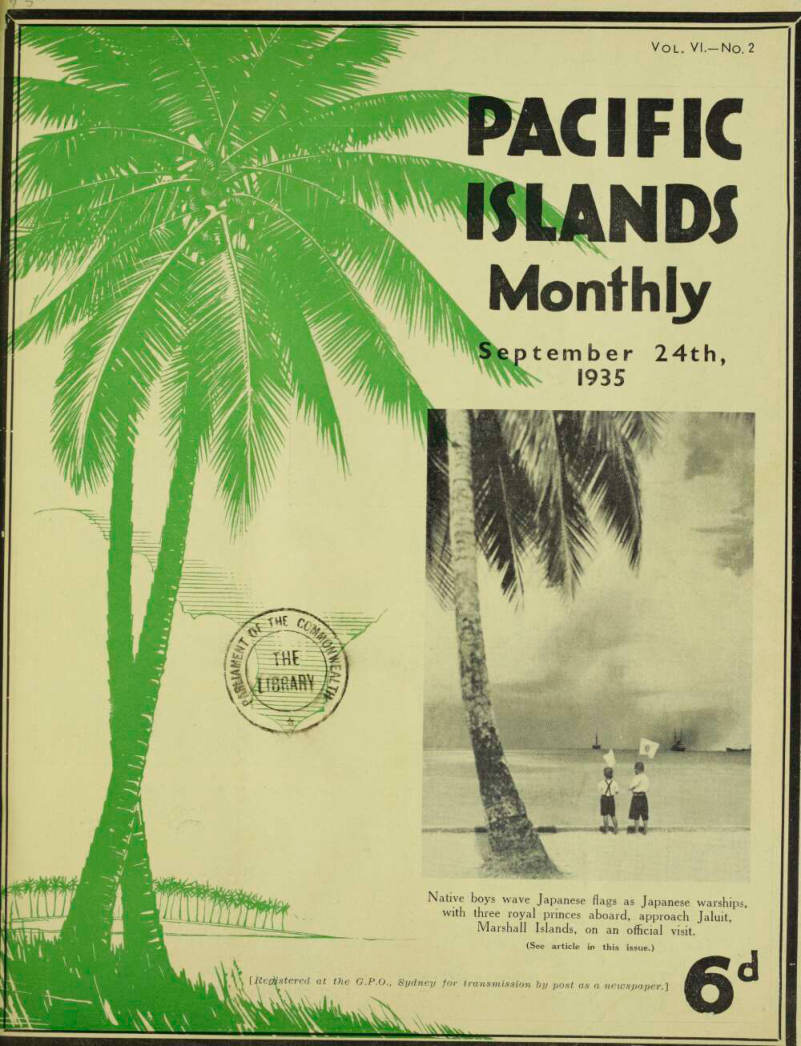
Native boys wave Japanese flags as Japanese warships, with three royal princes aboard, approach Jaluit, Marshall Islands, on an official visit. (See article in this issue.)
Advertisements & other items, p. 2 (1 item)
Assisting Development and Progress in
the Pacific
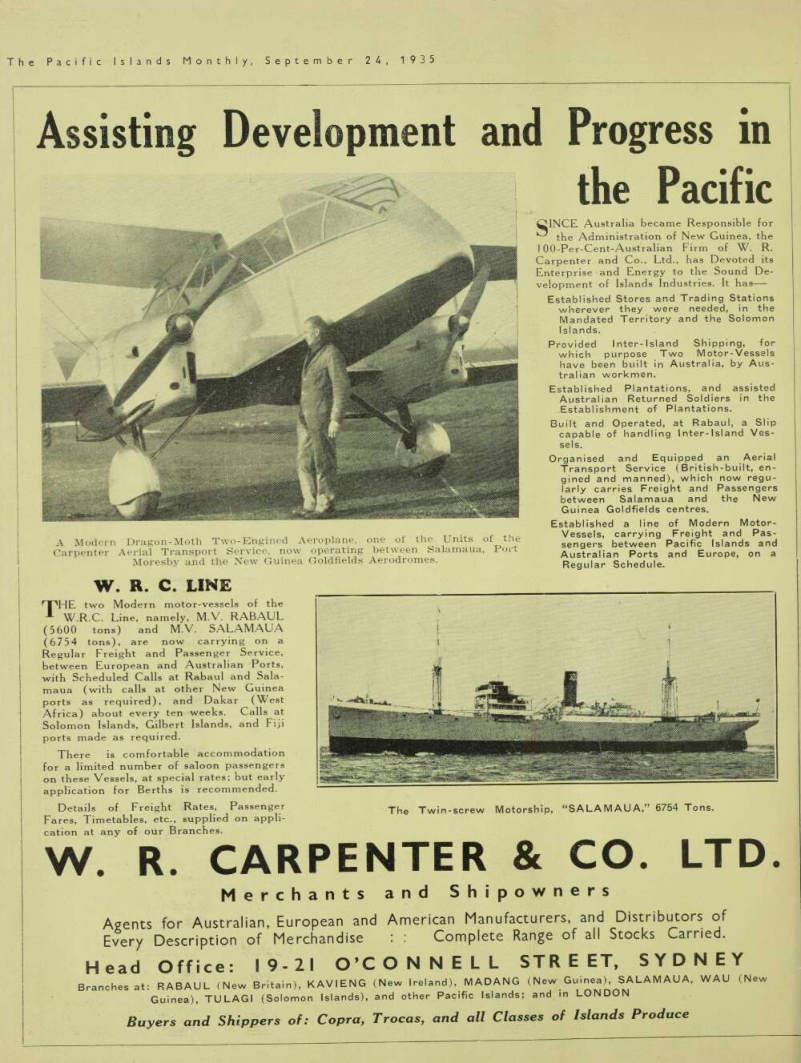
V- - !f ;. « ;V m A Modern Carpenter Dragon-Moth Two-Engined Aeroplane, one of the Units of the Aerial Transport Service, now operating between Salamaua, Port Moresby and the New Guinea Goldfields Aerodromes.
CINCE Australia became Responsible for the Administration of New Guinea, the I 00-Per-Cent-Australian Firm of W. R.
Carpenter and Co., Ltd., has Devoted its Enterprise and Energy to the Sound Development of Islands Industries. It has Established Stores and Trading Stations wherever they were needed, in the Mandated Territory and the Solomon Islands.
Provided Inter-Island Shipping, for which purpose Two Motor-Vessels have been built in Australia, by Australian workmen.
Established Plantations, and assisted Australian Returned Soldiers in the Establishment of Plantations.
Built and Operated, at Rabaul, a Slip capable of handling Inter-Island Vessels.
Organised and Equipped an Aerial Transport Service (British-built, engined and manned), which now regularly carries Freight and Passengers between Salamaua and the New Guinea Goldfields centres.
Established a line of Modern Motor- Vessels, carrying Freight and Passengers between Pacific Islands and Australian Ports and Europe, on a Regular Schedule.
W. R. C. LINE
THE two Modern motor-vessels of the W.R.C. Line, namely, M.V. RABAUL (5600 tons) and M.V. SALAMAUA (6734 tons), are now carrying on a Regular Freight and Passenger Service, between European and Australian Ports, with Scheduled Calls at Rabaul and Salamaua (with calls at other New Guinea ports as required), and Dakar (West Africa) about every ten weeks. Calls at Solomon Islands, Gilbert Islands, and Fiji ports made as requ ired.
There is comfortable accommodation for a limited number of saloon passengers on these Vessels, at special rates; but early application for Berths is recommended.
Details of Freight Rates, Passenger Fares, Timetables, etc., supplied on application at any of our Branches. : ■ The Twin-screw Motorship, “SALAMAUA,” 6754 Tons.
W. R. CARPENTER & CO. LTD.
Merchants and Shipowners
Agents for Australian, European and American Manufacturers, and Distributors of Every Description of Merchandise : : Complete Range of all Stocks Carried.
Head Office: 19-21 O’CONNELL STREET, SYDNEY
Branches at: RABAUL (New Britain), KAVIENG (New Ireland), MADANG (New SALAMAUA, WAU (New Guinea), TULAGI (Solomon Islands), and other Pacific Islands; and in LONDON Buyers and Shippers of: Copra, Trocas, and all Classes of Islands Produce
Pacific Islands Travellers
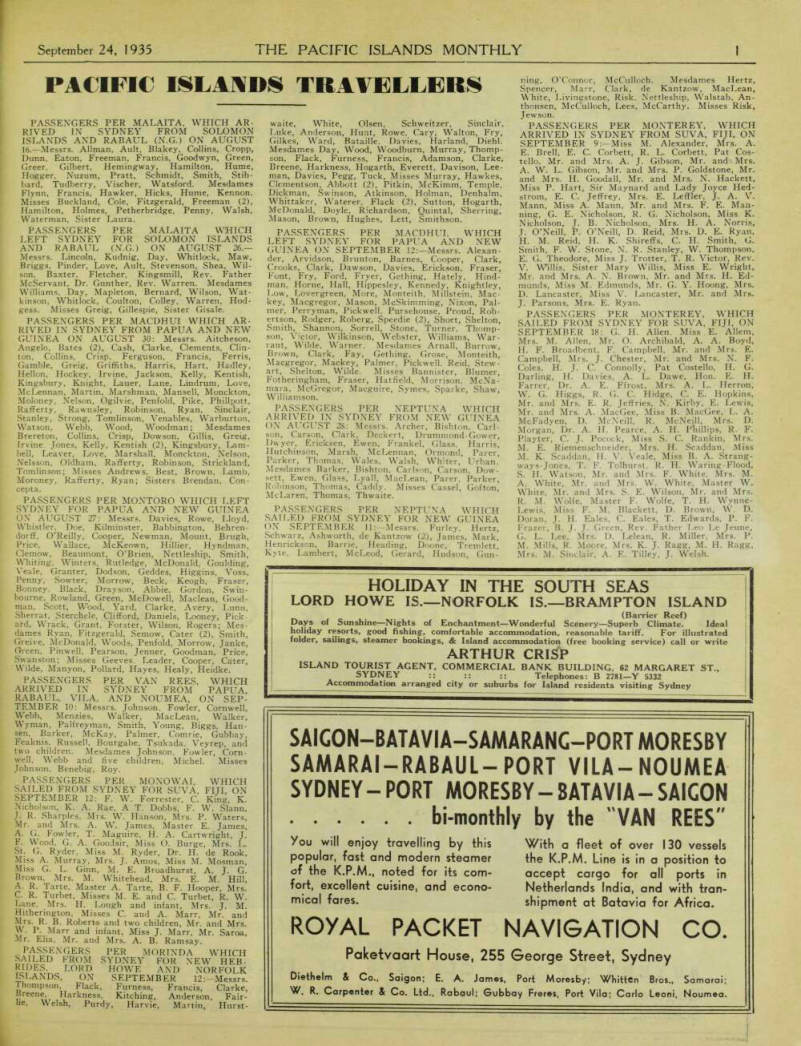
Passengers Per Malaita, Which Ar
Rived In Sydney From Solomon
Islands And Rabaul (N.G.) On August
16. —Messrs. Allman, Ault, Blakey, Collins, Cropp, Dunn, Eaton, Freeman, Francis, Goodwyn, Green, Greer. Gilbert, Hemingway, Hamilton, Hume, Hogger, Nuzum, Pratt, Schmidt, Smith, Stib bard, Tudberry, Vischer, Watsford. Mesdames Flynn, Francis, Hawker, Hicks, Hume, Kennon.
Misses Buckland, Cole, Fitzgerald, Freeman (2), Hamilton, Holmes, Petherbridge, Penny, Walsh, Waterman, Sister Laura.
Passengers Per Malaita Which
Left Sydney For Solomon Islands
And Rabaul (N.G.) On August 26.
Messrs. Lincoln, Kudnig, Day, Whitlock, Maw, Briggs, Pinder, Love, Ault, Stevenson, Shea, Wil son, Baxter. Fletcher, Kingsmill, Rev. Father McServant, Dr. Gunther, Rev. Warren. Mesdames Williams. Day, Mapleton, Bernard, Wilson, Wat kinson, Whitlock, Coulton, Colley, Warren, Hod gess. Misses Greig, Gillespie, Sister Gisale.
Passengers Per Macdhui Which Ar
RIVED IN SYDNEY FROM PAPUA AND NEW GUINEA ON AUGUST 30: Messrs. Aitcheson, Angelo, Bates (2), Cash, Clarke, Clements, Clin ton, Collins, Crisp, Ferguson, Francis, Ferris, Gamble, Greig, Griffiths, Harris, Hart, Hadley, Hellon, Hockey, Irvine, Jackson, Kelly, Kentish, Kingsbury, Knight, Lauer, Lane, Lindrum, Love, McLennan, Martin, Marshman, Mansell, Monckton, Moloney, Nelson, Ogilvie, Penfold, Pike, Phillpott, Rafferty, Rawnsley, Robinson, Ryan, Sinclair, Stanley, Strong, Tomlinson, Venables, Warburton, Watson, Webb, Wood, Woodman; Mesdames Brereton, Collins, Crisp, Dowson, Gillis, Greig, Irvine Jones, Kelly, Kentish (2), Kingsbury, Lam bell, Leaver, Love, Marshall, Monckton, Nelson, Nelsson, Oldham, Rafferty, Robinson, Strickland, Tomlinson; Misses Andrews, Best, Brown, Lamb, Moroney, Rafferty, Ryan; Sisters Brendan, Con cepta.
Passengers Per Montoro Which Left
Sydney For Papua And New Guinea
ON ALTGUST 27: Messrs. Davies, Rowe, Lloyd, Whistler, Doe, Kilminster, Babbington, Behren dorff, O’Reilly, Cooper, Newman, Mount, Brugh, Price, Wallace, McKeown, Hillier, Hyndman, Clemow, Beaumont, O’Brien, Nettleship, Smith, Whiting. Winters, Rutledge, McDonald, Goulding, Veale, Granter, Dodson, Geddes, Higgins, Voss, Penny, Sowter, Morrow, Beck, Keogh, Fraser, Bonney, Black, Drayson, Abbie, Gordon, Swin bourne, Rowland, Green, McDowell, Maclean, Good man, Scott, Wood, Yard, Clarke, Avery, Lunn, Sherrat, Sterchele, Clifford, Daniels, Looney, Pick ard, Wrack, Grant, Forster, Wilson, Rogers; Mes dames Ryan, Fitzgerald, Semow, Cater (2), Smith, Greive, McDonald, Woods, Penfold, Morrow, Janke, Oreen, Pinwell, Pearson, Jenner, Goodman, Price, Swanston; Misses Geeves, Leader, Cooper, Cater, Wilde, Manyon, Pollard, Hayes, Healy, Heidke.
Passengers Per Van Rees, Which
Arrived In Sydney From Papua,
Rabaul, Vila, And Noumea, On Sep
TEMBER 10; Messrs. Johnson, Fowler, Cornwell, Webb, Menzies, Walker, Mac Lean, Walker, Wyman, Palfreyman, Smith, Young, Biggs, Han sen, Barker, McKay, Palmer, Comrie, Gubbay, Feaknis, Russell, Bourgabe, Tsukada, Veyrep, and two children. Mesdames Johnson, Fowler, Corn well, Webb and five children, Michel. Misses Johnson, Benebig, Roy.
Passengers Per Monowai, Which
SAILED FROM SYDNEY FOR SUVA, FIJI, ON SEPTEMBER 12; F. W. Forrester, C. King, K.
Nicholson, K. A. Rae, A T. Dobbs, F. W. Slann, J. R. Sharpies, Mrs. W. Hanson, Mrs. P. Waters, Mr. and Mrs. A. W. James, Master E. James, A. G. Fowler, T. Maguire, H. A. Cartwright, J.
F. Wood, G. A. Goodsir, Miss O. Burge, Mrs. L.
St. G. Ryder, Miss M. Ryder, Dr. H. de Rook, Miss A. Murray, Mrs. J. Amos, Miss M. Mosman, Miss G. L. Ginn, M. E. Broadhurst, A. J. G.
Brown, Mrs. M. Whitehead, Mrs. E. M. Hill, A. R. Tarte, Master A. Tarte, B. F. Hooper, Mrs.
C. R. Turbet, Misses M. E. and C. Turbet, R. W.
Lane, Mrs. H. Lough and infant, Mrs. J. M.
Hitherington, Misses C. and A. Marr, Mr. and Mrs. R. B. Robert-s and two children, Mr. and Mrs.
W. P. Marr and infant, Miss J. Marr, Mr. Saroa, Mr. Elia, Mr. and Mrs. A. B. Ramsay. c ;T£^ S T?r NGERS PER morinda which
Railed From Sydney For New Heb
fJr D ES- LORD HOWE AND NORFOLK
Islands, On September 12-Messrs.
1 hompson, Flack, Furness, Francis, Clarke, Breene, Harkness, Kitching, Anderson, Fair he, Welsh, Purdy, Harvie, Martin, Hurst
waite, White, Olsen, Schweitzer, Sinclair, Luke, Anderson, Hunt, Rowe, Cary, Walton, Fry, Gilkes, Ward, Bataille, Davies, Harland, Diehl.
Mesdames Day, Wood, Woodburn, Murray, Thomp son, Flack, Furness, Francis, Adamson, Clarke, Breene, Harkness, Hogarth, Everett, Davison, Lee man, Davies, Pegg, Tuck, Misses Murray, Hawkes, Clementson, Abbott (2), Pitkin, McKimm, Temple, Dickman, Swinson, Atkinson, Holman, Denhalm, Whittaker, Waterer, Flack (2), Sutton, Hogarth, McDonald, Doyle, Richardson, Quintal, Sherring, Mason, Brown, Hughes, Lett, Smithson.
Passengers Per Macdhui, Which
Left Sydney For Papua And New
GUINEA ON SEPTEMBER 12:—Messrs. Alexan der, Arvidson, Brunton, Barnes, Cooper, Clark, Crooks, Clark, Dawson, Davies, Erickson, Fraser, Font, Fry, Ford, Fryer, Gething, Hately, Hind man, Horne, Hall, Hippesley, Kennedy, Knightley, Low, Lovergreen, More, Monteith, Millstein, Mac key, Macgregor, Mason, McSkimming, Nixon, Pal mer, Perryman, Pickwell, Pursehouse, Proud, Rob ertson, Rodger, Roberg, Speedie (2), Short, Shelton, Smith, Shannon, Sorrell, Stone, Turner, Thomp son, Victor, Wilkinson, Webster, Williams, War rant, Wilde, Warner. Mesdames Arnall, Burrow, Brown, Clark, Fay, Gething, Grose, Monteith, Macgregor, Mackey, Palmer, Pickwell, Reid, Stew art, Shelton, Wilde. Misses Bannister, Blumer, Fotheringham, Fraser, Hatfield, Morrison, McNa mara, McGregor, Macguire, Symes, Sparke, Shaw, Williamson.
Passengers Per Neptuna Which
Arrived In Sydney From New Guinea
ON AUUUST 28: Messrs. Archer, Bishton, Carl son, Carson, Clark, Deckert, Drummond-Gower, Dwyer, Ericksen, Ewen. Frankel, Glass, Harris, Hutchinson, Marsh, McLennan, Ormond, Parer, Parker, Thomas, Wales, Walsh, Whiter, Urban.
Mesdames Barker, Bishton, Carlson, Carson, Dow sett, Ewen, Glass, Lyall, Mac Lean, Parer, Parker, Robinson, Thomas, Caddy. Misses Cassel, Gofton, McLaren, Thomas, Thwaite.
Passengers Per Neptuna Which
Sailed From Sydney For New Guinea
ON SEPTEMBER 11; —Messrs. Furley, Hertz, Schwarz, Ashworth, de Kantzow (2), James, Mark, Henrickson, Barrie, Heading, Doone, Tremlett, Kyte, Lambert, McLeod, Gerard, Hudson, Gun
ning, O’Connor, McCulloch. Mesdames Hertz, Spencer, Marr, Clark, de Kantzow, Mac Lean, White, Livingstone, Risk, Nettleship, Walstab, An thonsen, McCulloch, Lees, McCarthy. Misses Risk, Jewson.
Passengers Per Monterey, Which
ARRIVED IN SYDNEY FROM SUVA, FIJI, ON SEPTEMBER 9: —Miss M. Alexander, Mrs. A.
E. Brell, E. C. Corbett, R. L. Corbett, Pat Cos tello, Mr. and Mrs. A. J. Gibson, Mr. and Mrs.
A. W. L. Gibson, Mr. and Mrs. P. Goldstone, Mr. and Mrs. H. Goodall, Mr. and Mrs. N. Hackett, Miss P. Hart, Sir Maynard and Lady Joyce Hed strom, E. C. Jeffrey, Mrs. E. Leffler, J. A. V.
Mann, Miss A. Mann, Mr. and Mrs. F. E. Man ning, G. E. Nicholson, R. G. Nicholson, Miss K.
Nicholson, J. B. Nicholson, Mrs. H. A. Norris, J. O’Neill, P. O’Neill, D. Reid, Mrs. D. E. Ryan, H. M. Reid, H. K. Shireffs, C. H. Smith, G.
Smith, F. W. Stone, N. R. Stanley, W. Thompson, E. G. Theodore, Miss J. Trotter, T. R. Victor, Rev.
V. Willis, Sister Mary Willis, Miss E. Wright, Mr. and Mrs. A. N. Brown, Mr. and Mrs. H. Ed munds, Miss M. Edmunds, Mr. G. Y. Hoong, Mrs.
D. Lancaster, Miss V. Lancaster, Mr. and Mrs.
J. Parsons, Mrs. E. Ryan.
Passengers Per Monterey, Which
SAILED FROM SYDNEY FOR SUVA, FIJI, ON SEPTEMBER 18: G. H. Allen, Miss E. Allem, Mrs. M. Allen, Mr. O. Archibald, A. A. Boyd, H. F. Broadbent, F. Campbell, Mr. and Mrs. E.
Campbell, Mrs. J. Chester, Mr. and Mrs. N. F.
Coles, H. J. C. Connolly, Pat Costello, H. G.
Darling, H. Davies, A. L. Dawe, Hon. E. H.
Farrer, Dr. A. E. Ffrost, Mrs. A. L. Herron, W. G. Higgs, R. G. C. Hidge, C. E. Hopkins, Mr. and Mrs. E. R. Jeffries, N. Kirby, E. Lewis, Mr. and Mrs. A. Mac Gee, Miss B. Mac Gee, L. A.
McFadyen, D. McNeill, R. McNeill, Mrs. D.
Morgan, Dr. A. H. Pearce, A. H. Phillips, R. F.
Playter, C. J. Pocock, Miss S. C. Rankin, Mrs.
M. E. Riemenschneider, Mrs. H. Scaddan, Miss M. K. Scaddan, H. V. Veale, Miss B. A. Strang ways-Jones, T. F. Tolhurst, R. H. Waring-Flood, S. H. Watson, Mr. and Mrs. F. White, Mrs. M.
A. White, Mr. and Mrs. W. White, Master W.
White, Mr. and Mrs. S. E. Wilson, Mr, and Mrs.
R. M. Wolfe, Master F. Wolfe, T. H. Wynne- Lewis, Miss F. M. Blackett, D. Brown, W. D.
Doran, J. H. Eales, C. Eales, T. Edwards, P. F.
Frazer, B. J. J. Green, Rev. Father Leo Le Jeune, G. L. Lee, Mrs. D. Lelean, R. Miller, Mrs. P.
M. Mills, R. Moore, Mrs. K. J. Ragg, M. H. Ragg, Mrs. M. Sinclair, A. E. Tilley, J. Welsh.
Advertisements & other items, p. 3 (1 item)
Saicon-Batavia-Samarang-Port Moresby
HOLIDAY IN THE SOUTH SEAS
LORD HOWE IS.—NORFOLK IS.—BRAMPTON ISLAND
(Barrier Reef) Days of Sunshine—Nights of Enchantment—Wonderful Scenery—Superb Climate. Ideal holiday resorts, good fishing, comfortable accommodation, reasonable tariff. For illustrated folder, sailings, steamer bookings, & Island accommodation (free booking service) call or write
ARTHUR CRISP
ISLAND TOURIST AGENT, COMMERCIAL BANK BUILDING, 62 MARGARET ST., SYDNEY :: ;; :: Telephones: B 2781—Y 5332 Accommodation arranged city or suburbs for Island residents visiting Sydney
SAICON-BATAVIA-SAMARANG-PORT MORESBY
SAMARAI-RABAUL- PORT VILA-NOUMEA
SYDNEY - PORT MORESBY - BATAVIA - SAIGON
bi-monthly by the "VAN REES"
You will enjoy travelling by this popular, fast and modern steamer of the K.P.M., noted for its comfort, excellent cuisine, and economical fares.
With a fleet of over 130 vessels the K.P.M. Line is in a position to accept cargo for all ports in Netherlands India, and with transhipment at Batavia for Africa.
ROYAL PACKET NAVIGATION CO.
Paketvaart House, 255 George Street, Sydney
Diethelm & Co., Saigon; E. A. James, Port Moresby; Whitten Bros., Samarai; W. R, Carpenter & Co. Ltd., Rabaul; Gubbay Freres, Port Vila; Carlo Leoni, Noumea.
Advertisers
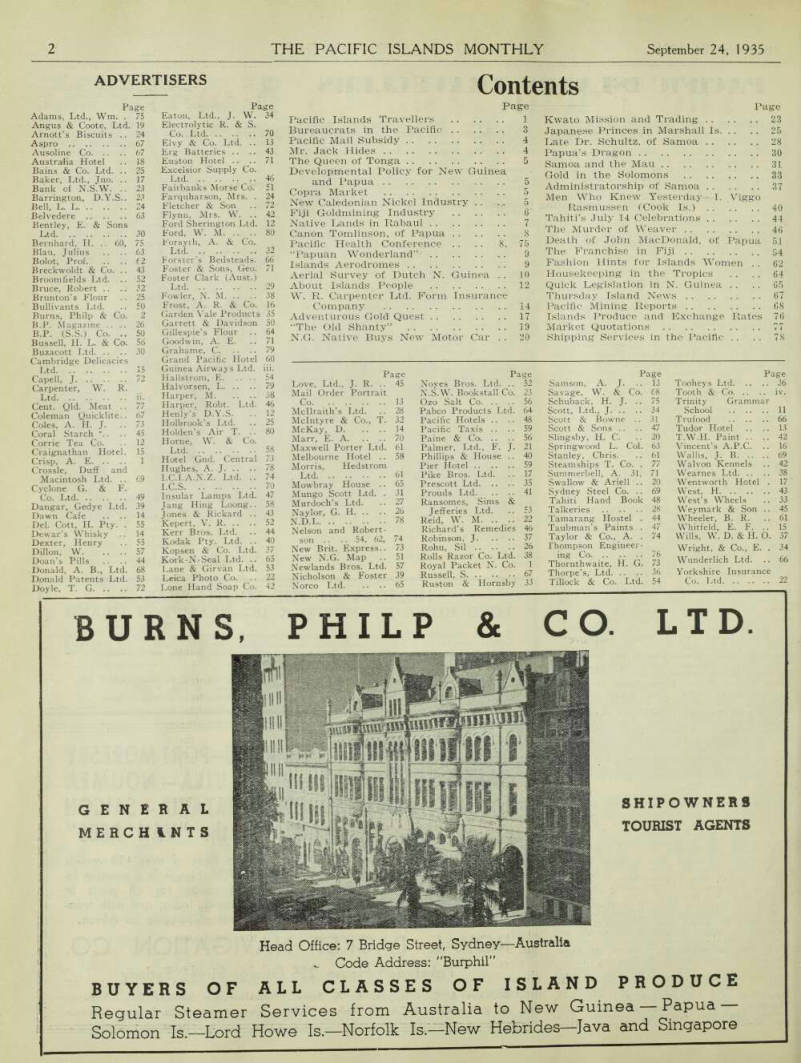
Page Adams, Ltd., Wm. . 75 Angus & Coote, Ltd. 19 Arnott’s Biscuits .. 24 Aspro .. 67 Ausoline Co 67 Australia Hotel .. 18 Bains & Co. Ltd. .. 25 Baker, Ltd., Jno. .. 17 Bank of N.S.W. .. 23 Barrington, D.Y.S.. 23 Bell, L. L 24 Belvedere 63 Bentley, E. & Sons Ltd 30 Bernhard, H. .. 60, 75 Blau, Julius .. .. 63 Bolot, Prof 62 Breckwoldt & Co. .. 43 Broomfields Ltd. .. 52 Bruce, Robert .. .. 32 Brunton’s Flour .. 25 Bullivants Ltd. .. 50 Burns, Philp & Co. 2 B.P. Magazine ... 26
B.P. (S.S.) Co. .. 50
Bussell, H. L. & Co. 56 Buzacott Ltd 30 Cambridge Delicacies Ltd 15 Capell, J 72 Carpenter, W. R.
Ltd ii.
Cent. Qld. Meat .. 77 Coleman Quicklite.. 67 Coles, A. H. J. .. 73 Coral Starch *.. .. 45 Corrie Tea Co. .. 12 Craignathan Hotel. 15 Crisp, A. E 1 Crossle, Duff and Macintosh Ltd. .. 69 Cyclone G. & F.
Co. Ltd 49 Dangar, Gedye Ltd. 39 Dawn Cafe .. .. 14 Del. Cott, H. Pty. . 55 Dewar’s Whisky .. 14 Dexter, Henry .. 55 Dillon, W 57 Doan’s Pills .. .. 44 Donald, A. 8., Ltd. 68 Donald Patents Ltd. S 3 Doyle, T. G 72
Page Eaton, Ltd., J. W. 34 Electrolytic R. & S.
Co. Ltd 70 Elvy & Co. Ltd. .. 13 Erg Batteries .. .. 43 Euston Hotel .. .. 71 Excelsior Supply Co.
Ltd 46 Fairbanks Morse Co. SI Farquharson, Mrs. . 24 Fletcher & Son .. 72 Flynn, Mrs. W. .. 42 Ford Sherington Ltd. 12 Ford, W. M 80 Forsyth, A. & Co.
Ltd .. 32 Forster’s Bedsteads. 66 Foster & Sons, Geo. 71 Foster Clark (Aust.) Ltd 29 Fowler, N. M 38 Frost, A. R. & Co. 16 Garden Vale Products 35 Garrett & Davidson 50 Gillespie’s Flour .. 64 Goodwin, A. E. .. 71 Grahame, C 79 Grand Pacific Hotel 60 Guinea Airways Ltd. iii.
Hallstrom, E 54 Halvorsen, L 79 Harper, M 38 Harper t Robt. Ltd. 46 Henly’s D.Y.S. 12 Holbrook’s Ltd. .. 25 Holden’s Air T. .. 80 Horne, W. & Co.
Ltd 58 Hotel Gnd. Central 73 Hughes, A. J 78
1.C.1.A.N.Z. Ltd. .. 74
I.C.S 70
Insular Lamps Ltd. 47 Jang King Loong.. 58 Jones & Rickard .. 43 Kepert, V. R 52 Kerr Bros. Ltd. .. 44 Kodak Pty. Ltd. .. 40 Kopsen & Co. Ltd. 37 Kork-N-Seal Ltd. .. 65 Lane & Girvan Ltd. 53 Leica Photo Co. .. 22 Lone Hand Soap Co. 42
Page Love, Ltd., J. R. .. 45 Mail Order Portrait Co 13 Mcllraith’s Ltd. .. 28 Mclntyre & Co., T. 32 McKay, D 14 Marr, E. A 70 Maxwell Porter Ltd. 61 Melbourne Hotel .. 58 Morris, Hedstrom Ltd 61 Mowbray House .. 65 Mungo Scott Ltd. . 31 Murdoch’s Ltd. .. 27 Naylor, G. H 26
N.D.L 78
Nelson and Robert son .. .. 54, 62, 74 New Brit. Express.. 73 New N.G. Map .. 51 Newlands Bros. Ltd. 57 Nicholson & Foster 39 Norco Ltd 65
Page Noyes Bros. Ltd. .. 52 N.S.W. Bookstall Co. 23 Ozo Salt Co 56 Pabco Products Ltd. 64 Pacific Hotels .. .. 48 Pacific Taxis .. .. 59 Paine & Co 56 Palmer, Ltd., F. J. 21 Phillips & House .. 40 Pier Hotel 59 Pike Bros. Ltd. .. 17 Prescott Ltd 35 Prouds Ltd. .. .. 41 Ransomes, Sims & Jefferies Ltd. .. 53 Reid, W. M 22 Richard’s Remedies 46 Robinson, J 37 Rohu, Sil 26 Rolls Razor Co. Ltd. 38 Royal Packet N. Co. 1 Russell, S 67 Ruston & Hornsby 33
Page Samson, A. J. .. 13 Savage, W. & Co. 68 Schuback, H. J. .. 75 Scott, Ltd., J 34 Scott & Bowne .. 31 Scott & Sons .. .. 47 Slingsby, H. C. ..20 Springwood L. Col. 63 Stanley, Chris. .. 61 Steamships T. Co. . 77 Summerbell, A. 31, 71 Swallow & Ariell .. 20 Sydney Steel Co. .. 69 Tahiti Hand Book 48 Talkeries 28 Tamarang Hostel . 44 Taubman’s Paints . 47 Taylor & Co., A. . 74 Thompson Engineer ing Go 76 Thornthwaite, H. G. 73 Thorpe’s, Ltd 36 Tillock & Co. Ltd. 54
Page Tooheys Ltd 36 Tooth & Co iv.
Trinity Grammar School 11 Trufood 66 Tudor Hotel .. .. 13 T.W.H. Paint .. .. 42 Vincent’s A.P.C. .. 16 Wallis, J. B 69 Walvon Kennels .. 42 Wearnes Ltd 38 Wentworth Hotel . 17 West, H 43 West’s Wheels .. 33 Weymark & Son .. 45 Wheeler, B. R. .. 61 Whitfeld, E. F. .. 15 Wills, W. D. &H. O. 37 Wright, & Co., E. . 34 Wunderlich Ltd. .. 66 Yorkshire Insurance Co. Ltd 22
Contents
Page Pacific Islands Travellers 1 Bureaucrats in the Pacific 3 Pacific Mail Subsidy 4 Mr. Jack Hides 4 The Queen of Tonga 5 Developmental Policy for New Guinea and Papua 5 Copra Market .. 5 New Caledonian Nickel Industry . . . . 5 Fiji Goldmining Industry 6 Native Lands in Rabaul 7 Canon Tomlinson, of Papua 8 Pacific Health Conference .. . . 8, 75 “Papuan Wonderland’’ 9 Islands Aerodromes 9 Aerial Survey of Dutch N. Guinea 10 About Islands People 12 W. R. Carpenter Ltd. Form Insurance Company 14 Adventurous Gold Quest 17 “The Old Shanty” 3 9 N.G. Native Buys New Motor Car . , 20
Page Kwato Mission and Trading 23 Japanese Princes in Marshall Is 25 Late Dr. Schultz, of Samoa 28 Papua’s Dragon 30 Samoa and the Mau 31 Gold in the Solomons 33 Administratorship of Samoa 37 Men Who Knew Yesterday—l. Viggo Rasmussen (Cook Is.) 40 Tahiti’s July 14 Celebrations 44 The Murder of Weaver 46 Death of John MacDonald, of Papua 51 The Franchise in Fiji . . 54 Fashion Hints for Islands Women .. 62 Housekeeping in the Tropics . . . . 64 Quick Legislation in N. Guinea .. .. 65 Thursday Island News 67 Pacific Mining Reports 68 Islands Produce and Exchange Rates 76 Market Quotations 77 Shipping Services in the Pacific . . .. 78
Advertisements & other items, p. 4 (1 item)
Burns, Philp & Co. Ltd.
GENERAL
MERCK IINTS
mu s , is H- ■
SHIPOWNERS
TOURIST AGENTS
Head Office: 7 Bridge Street, Sydney— Australia „ Code Address: "Burphil"
BUYERS OF ALL CLASSES OF ISLAND PRODUCE Regular Steamer Services from Australia to New Guinea Papua Solomon Is.—Lord Howe Is.—Norfolk Is.—New Hebrides—Java and Singapore
The Pacific Islands Monthly
The Newspaper-Magazine Of The South Seas
[ Registered at G.P.0., Sydney, for transmission ly post as a newspaper ]
Published Once Each Month and Circulated in Australia and New Zealand and in the following Pacific Territories and Islands Groups:
Crown Colony of Fiji.
Australian Territory of Papua.
Mandated Territory (Australia) of New Guinea, Bismarck Archipelago, and Northern Solomon Islands.
Mandated Territory (Japan) of Marshall, Caroline and Marianna Islands.
French Territory of New Caledonia.
British and French Condominium of New Hebrides.
American Territory of Eastern Samoa.
American Territory of Guam.
Mandated Territory of Nauru.
British Crown Colony of Gilbert and Ellice Islands.
Mandated Territory (New Zealand) of Samoa.
British Solomon Islands Protectorate.
British Protectorate of Tongan Islands.
New Zealand Territory of Cook Islands.
Australian Territory of Norfolk Island.
French Colony of Oceania (Tahiti, etc.).
American Territory of Hawaiian Islands.
Owned and Produced by Pacific Publications Ltd,, Union House, 247 George Street, Sydney,
Telephone Bw 5037
P.O. Box 3408 R
Contributions Articles, Stories, and Photographs dealing with Pacific Islands Subjects are invited, and will be paid for on publication at usual rates.
Subscription Rates Per Annum, within British Empire, Prepaid Post Free 6/- Per Annum, elsewhere, prepaid, Post Free . 8/- Single Copies 6d.
Editor and Publisher;
R. W. Robson.
Advertisements
Advertising rates furnished on application.
Colours, etc. by Arrangement.
Process Blocks made at Advertiser’s expense when required. Screen, 100.
Changes of Advertising Copy should reach this Office by Bth of each month, otherwise previous advertisement may be repeated.
Registered Address for Radiograms and Cables; “PACPUB” Sydney Agents The following are authorised to receive subscrip tions for “The Pacific Islands Monthly”— Islands Branches of Burns, Philp & Co., Ltd., and Burns Philp (South Seas) Co., Ltd.
Islands Branches of W. R. Carpenter & Co., Ltd.
All Branches of Morris, Hedstrom & Co., Ltd.
G. Thomas & Co., Rabaul.
Whitten Bros., Ltd., Samarai.
P. Costello, Suva, Fiji.
J. Muir, Suva.
All Branches and Representatives of W. H. Grove and Sons, Ltd., Auckland.
S. Russell, Papeete, Tahiti.
Cook Islands Trading Co., Rarotonga.
Vol. VI.. No. 2
Sydney, September 24, 1935
Prin« I 6d - Per Copy rnce j Prepaid: 6/- p.a.
Bureaucrats Of The Pacific
bureaucrats sit high in the saddle, in these days of degenerate democracy, and the harassed and over burdened taxpayer knows not how to unseat them. If that is so, in countries where there is a “Parliamentary form of government,” how much more is it the case in the Pacific territories, where the Administrators derive their authority from overseas!
This is not a condemnation of Pacific administrations generally. As a matter of fact, taking them by and large, the territories of the Pacific are admirably governed. Provided that the head men are chosen successfully, there can be no better form of government —for example: Papua, under Murray; Fiji, under Fletcher; New Guinea, under Griffiths.
European history tells us that there were no freer, happier, or more progressive nations than those led by benevolent tyrants.
The weakness of the system is this, that if the man on top is not very wise and very strong, there soon will spring into being, under the shelter of his authority, a gang of officials who are sycophantic in their relationship with
the High Command, and autocratic and intolerant in their dealings with the people they are supposed to serve. In a hundred petty and irritating ways, they abuse the governmental authority which necessarily is delegated to them. There are hundreds of them in Australia, com missioners and departmental heads of all kinds; and it seems sometimes that for every one who exercises his delegated power wisely and justly, there are two or three who take a peculiar delight in stamping upon the little remaining per sonal liberty of the people, and generally in showing what splendid little Napo leons they are. But, in Australia, we can at least make a protest against the bureaucrats, and the public newspapers, even now, are filled with our howls.
Residents of the Islands territories have no recourse —they must simply swear and bear it. Judging by some of the echoes which reach Sydney, the swearing fre quently is loud and deep.
A newspaper editor, to whom come the attacks on bureaucracy, is often in a difficult situation. He knows full well that in all public services there is a proportion of men who are permitted to
occupy positions of responsibility, yet who are temperamentally unfitted exercise authority over their fellow-men; and he knows, also, that in every com munity there are people who naturally will always resist authority, and who dislike all officials whether good or bad, and who can be controlled only by the forthright exercise of authority. There is not a public officer anywhere in the Islands who has not met some of these curious misanthropes, and been vastly puzzled as to the best way of handling them. It is often impossible, on the data presented, to judge whether the official concerned is a power-drunk bureaucrat, or the complainant merely a trouble making crank. Of course, when the real crank gets into holts with the bull necked bureaucrat, the wisest Solomon of all would flee from the judgment.
We have a case in point, at Rabaul.
The report is that the Administration is coolly filching the land of the Matupi villagers, for purposes of an aerodrome, and that the natives are talking of revolt.
This is an incredible story; but an uncer tain and disturbing factor in the situa tion is the presence in Rabaul of certain officials who enjoy a first-class reputation as dyed-in-the-wool bureaucrats. We heard hair-raising stories of their activ
ities and exploits during the Wisdom regime; but they faded into the back ground in June, 1932, when Thomas Griffiths took charge. The report to which we refer is quite clearly an attempt to create the impression that, under the new Administrator, the bureaucrats are seeking power again; and, therefore, until more is known, the report must be treated with caution. But it cannot be ignored. We may not forget what hap pened in Samoa. An organisation of bureaucrats, of the heavy-footed militar istic school, treated the native Samoans with ignorance, tactlessness, and intoler ance, and, being unchecked, created in Samoa a situation that will remain, for all time, a blot upon the British colonial system. Yet it was not the fault of Britain, nor of the Colonial Office, nor of the system. It was the fault of a little, pin-headed bureaucracy, which was left unchecked by an inexperienced Mandatory.
Australia cannot afford to let anything like that happen in New Guinea —even although Australia itself is the happy hunting-ground of every size and de scription of bureaucrats. Far more hangs upon efficient administration in New Guinea than merely the welfare of New Guinea. The reputation of Australia as the controller of Pacific territories must be protected. Australia's record in Papua is an excellent one; and, so far as New Guinea is concerned, there is noth ing for which either explanation or apology is needed. General Wisdom, as Administrator, earned no coronet; but General Wisdom had to mould a public service out of very rough and unpromis ing material, and he did the job well.
General Griffiths was the ideal Adminis trator, only he did not possess the tem perament to enable him to bear fools gladly —especially political fools. Gen eral McNicoll has gone to the Territory with a splendid record of administration in other spheres, and Australia hopes for much from him.
But it is a critical time. If Australia's record justifies it, Australia may be con firmed in the possession of New Guinea, and her guardianship may be extended over the Solomon Islands —a develop ment which can be justified on a score of grounds. But if Australia muddles her administrative work —and especially if she displays indifference towards na tive interests —that consummation is not likely to occur; and, moreover, support will be provided for the inevitable appeal by Germany for the return of her colo nies.
Withdraw”
“Union Co. Will
Outspoken Statement Causes Stir in Pacific Shipping Crisis
IT required the downright pronounce ment of the head of the P. and O.
Line —that, unless some protection were afforded against the heavily subsidised American liners, the Union Company will discontinue, within a few months, its trans-Pacific services between Australia and North America —to get action from Australia and New Zealand. They said, then, that they were arranging to hold in London, before the end of the year, a conference attended by the representa tives of the Matson Line, the Union Line, and the Governments of Australia, New Zealand and, presumably, Fiji.
The London conference idea is in line with the feeble policy which has been followed by Australia and New Zealand — and the British Government, too —ever since this trouble developed, at least three years ago.
The position is perfectly plain. The Matson Line, assisted by huge subsidies from the United States Government, has been able to build and to run luxury liners between San Francisco and Aus tralia and New Zealand, and has mopped up the cream of the Pacific and trans- Tasman trade. The Union Company, be ing unsubsidised, and being moreover forbidden by American laws from engag ing in the trade between Hawaii and Western America, has fought a gallant, but definitely a losing battle.
For a dozen obvious reasons —which will appeal just as strongly to the Ameri cans as to ourselves British shipping servicing British countries must be al lowed to compete on equal terms at least with American shipping; and if the British lines are not to have subsidies, then they must be given some correspond ing assistance. It is unthinkable that, in the present condition of world affairs, British shipping lines should be driven out of the Pacific in any circumstances —and especially by such conditions as are rep resented by the Matson subsidies.
The situation calls now—as it has called for three years—for quick firm, intelligent action by the British, Australia and New Zealand Governments, acting in unison, and the impulse must come from Aus tralia and New Zealand. Mr. Lyon’s London conference plan and the consul tation with the Matson Line —which was received with astonishment by the P. and O. spokesman —is an exhibition of flabbi ness which is irritating to competent observers, and profoundly discouraging to the shipping interests concerned.
When Mr. Lyons went off on his recent holiday trip, he was expected to discuss this matter of Pacific shipping in London.
Apparently, he did nothing at all, until he found himself in San Francisco, about to board a Matson liner; then he had a pleasant little chat with some of the Matson directors, and this precious London plan was evolved.
If we have to depend upon Messrs.
Lyons and Forbes, we need not look for any remedial measures for another period of years. Fortunately, the P. and O. Company now is on the warpath, and the British Government does not not try to solve its problems by forgetting them.
Mr. Jack Hides
A hectic month has been spent in Syd ney by Mr. Jack Hides. He has lectured to all sorts and conditions of societies, given many radio “talks,” and been entertained by a wide variety of luncheon clubs. He must be very sick and tired of telling the story of his successful patrol across the hitherto unknown cen tral plateau, and of the new types he found there. Mr. O’Malley, also, has been much in the limelight.
Mr. Hides had the courage to say that he thought the missionaries should keep out of the new country, until they were called upon to protect the primitive tribes against the inevitable invasion of Euro pean “civilisation.” Whereupon, Mr.
Hides was attacked by some rather noisy exponents of Christianity. Very wisely, he did not enter into a controversy.
Mr. M. Harper, a well-known trader and recruiter of Mandoliana Island, Solo mon Islands, visited New Guinea at the end of August. In September he was the guest of Messrs. J. Avenell and F. Cook, of Sunshine Gold Development Co., at Bulwa on the Morobe goldfield. Miv Harper intends later to go to Hongkong.
Mr. Hides with Nambu, the one friendly native whom he met in the heart of the Tari Furoro district, Central Papua. Nambu guided the patrol to the source of the Waga River, and in the direction of civilisation.
The Call of Papua
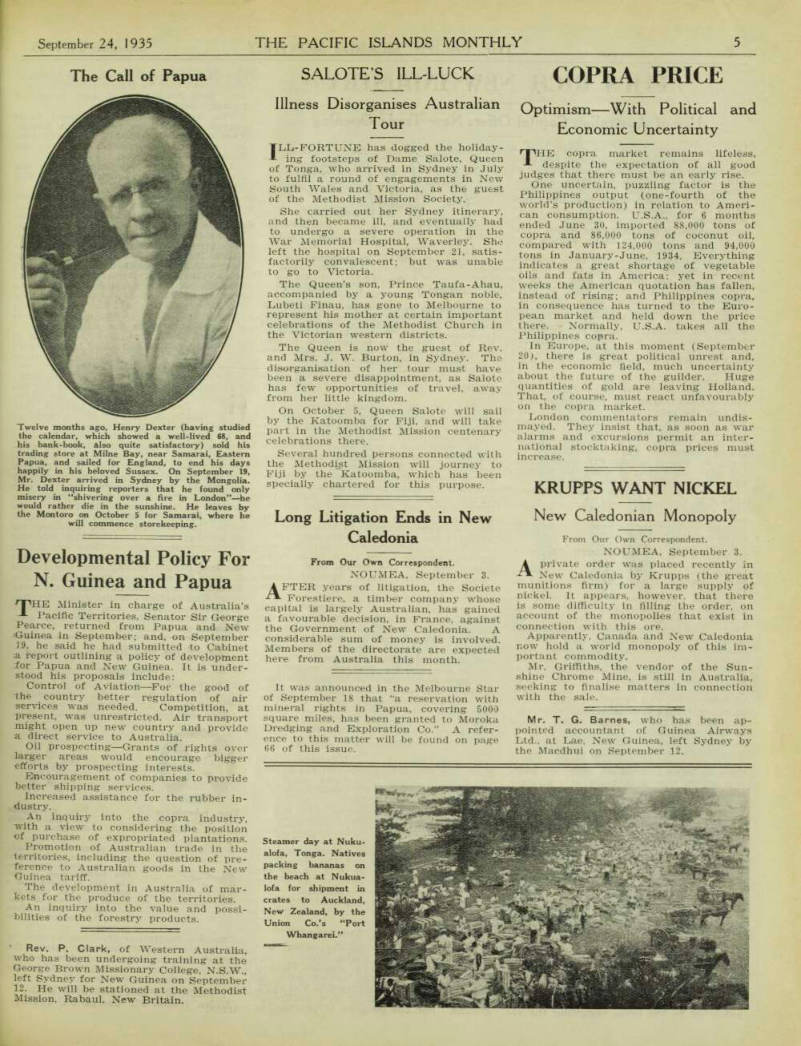
Twelve months ago, Henry Dexter (having studied the calendar, which showed a well-lived 68, and his bank-book, also quite satisfactory) sold his trading store at Milne Bay, near Samarai, Eastern Papua, and sailed for England, to end his days happily in his beloved Sussex. On September 19, Mr. Dexter arrived in Sydney by the Mongolia.
He told inquiring reporters that he found only misery in “shivering over a fire in London”—he would rather die in the sunshine. He leaves by the Montoro on October 5 for Samarai, where he will commence storekeeping.
Developmental Policy For N
N. Guinea and Papua
THE Minister in charge of Australia’s Pacific Territories, Senator Sir George Pearce, returned from Papua and New 'Guinea in September; and, on September 19, he said he had submitted to Cabinet •a report outlining a policy of development Tor Papua and New Guinea. It is under stood his proposals include; Control of Aviation—For the good of the country better regulation of air services was needed. Competition, at present, was unrestricted. Air transport might open up new country and provide a direct service to Australia.
Oil prospecting—Grants of rights over larger areas would encourage bigger efforts by prospecting interests.
Encouragement of companies to provide better shipping services.
Increased assistance for the rubber in dustry.
An inquiry into the copra industry, with a view to considering the position of purchase of expropriated plantations.
Promotion of Australian trade in the territories, including the question of pre ference to Australian goods in the New Guinea tariff.
The development in Australia of mar kets for the produce of the territories.
An inquiry into the value and possi bilities of the forestry products.
Rev. P. Clark, of Western Australia, who has been undergoing training at the George Brown Missionary College, N.S.W., left Sydney for New Guinea on September 12. He will be stationed at the Methodist Mission, Rabaul, New Britain.
Salote’S Ill-Luck
Illness Disorganises Australian Tour
ILL-FORTUNE has dogged the holiday ing footsteps of Dame Salote, Queen of Tonga, who arrived in Sydney in July to fulfil a round of engagements in New South Wales and Victoria, as the guest of the Methodist Mission Society.
She carried out her Sydney itinerary, and then became ill, and eventually had to undergo a severe operation in the War Memorial Hospital, Waverley. She left the hospital on September 21, satis factorily convalescent; but was unable to go to Victoria.
The Queen’s son, Prince Taufa-Ahau, accompanied by a young Tongan noble, Lubeti Finau, has gone to Melbourne to represent his mother at certain important celebrations of the Methodist Church in the Victorian western districts.
The Queen is now the guest of Rev. and Mrs. J, W, Burton, in Sydney. The disorganisation of her tour must have been a severe disappointment, as Salote has few opportunities of travel, away from her little kingdom.
On October 5, Queen Salote will sail by the Katoomba for Fiji, and will take part in the Methodist Mission centenary celebrations there.
Several hundred persons connected with the Methodist Mission will journey to Fiji by the Katoomba, which has been specially chartered for this purpose.
Long Litigation Ends in New
Caledonia
From Our Own Correspondent.
NOUMEA, September 3.
AFTER years of litigation, the Societe Forestiere, a timber company whose capital is largely Australian, has gained a favourable decision, in France, against the Government of New Caledonia. A considerable sum of money is involved.
Members of the directorate are expected here from Australia this month.
It was announced in the Melbourne Star of September 18 that “a reservation with mineral rights in Papua, covering 5000 square miles, has been granted to Moroka Dredging and Exploration Co.” A refer ence to this matter will be found on page 66 of this issue.
Copra Price
Optimism—With Political and Economic Uncertainty
THE copra market remains lifeless, despite the expectation of all good judges that there must be an early rise.
One uncertain, puzzling factor is the Philippines output (one-fourth of the world’s production) in relation to Ameri can consumption. U.S.A., for 6 months ended June 30, imported 88,000 tons of copra and 86,000 tons of coconut oil, compared with 124,000 tons and 94,000 tons in January-June, 1934. Everything indicates a great shortage of vegetable oils and fats in America: yet in recent weeks the American quotation has fallen, instead of rising; and Philippines copra, in consequence has turned to the Euro pean market and held down the price there. Normally, U.S.A. takes all the Philippines copra.
In Europe, at this moment (September 20), there is great political unrest and, in the economic field, much uncertainty about the future of the guilder. Huge quantities of gold are leaving Holland.
That, of course, must react unfavourably on the copra market.
London commentators remain undis mayed. They insist that, as soon as war alarms and excursions permit an inter national stocktaking, copra prices must increase.
Krupps Want Nickel
New Caledonian Monopoly
From Our Own Correspondent.
NOUMEA, September 3.
A private order was placed recently in New Caledonia by Krupps (the great munitions firm) for a large supply of nickel. It appears, however, that there is some difficulty in filling the order, on account of the monopolies that exist in connection with this ore.
Apparently, Canada and New Caledonia now hold a world monopoly of this im portant commodity.
Mr. Griffiths, the vendor of the Sun shine Chrome Mine, is still in Australia, seeking to finalise matters in connection with the sale.
Mr. T. G. Barnes, who has been ap pointed accountant of Guinea Airways Ltd., at Lae, New Guinea, left Sydney by the Macdhui on September 12.
Steamer day at Nuku alofa, Tonga. Natives packing bananas on the beach at Nukua lofa for shipment in crates to Auckland, New Zealand, by the Union Co.’s “Port Whangarei."
Fiji’S Rich New Industry
Use of Australian Capital Offers New Trade Opening
THERE seems to be no doubt that a rich, new gold-mining industry has been established in Fiji, on the northern side of Viti Levu. Its birth, however, was at tended by so much mad speculation — particularly in Melbourne —that the actual value of the development has been under suspicion: many people thought that it was impossible that anything worth while could exist when so many rogues and near-rogues were active.
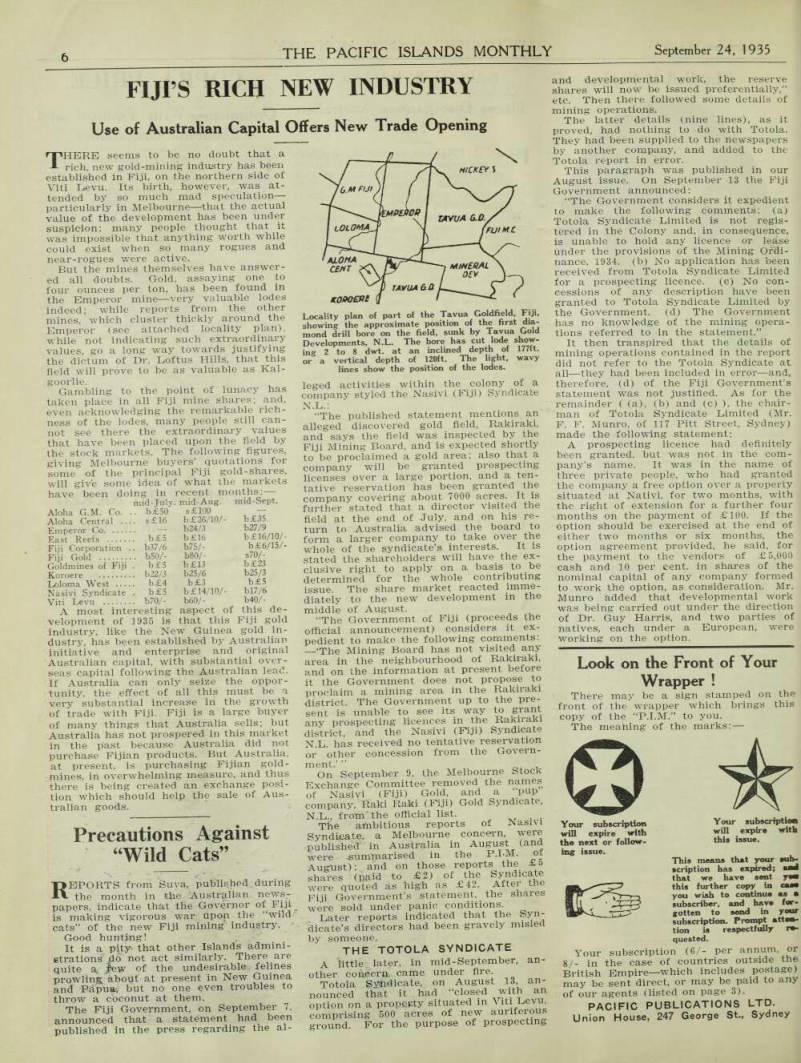
But the mines themselves have answer ed all doubts. Gold, assaying one to four ounces per ton, has been found in the Emperor mine—very valuable lodes indeed; while reports from the other mines, which cluster thickly around the Emperor (see attached locality plan), while not indicating such extraordinary values, go a long way towards justifying the dictum of Dr. Loftus Hills, that this field will prove to be as valuable as Kal goorlie.
Gambling to the point of lunacy has taken place in all Fiji mine shares; and, even acknowledging the remarkable rich ness of the lodes, many people still can not see there the extraordinary values that have been placed upon the field by the stock markets. The following figures, giving Melbourne buyers’ quotations for some of the principal Fiji gold-shares, will give some idea of what the markets have been doing in recent months:
A most interesting aspect of this de velopment of 1935 is that this Fiji gold industry, like the New Guinea gold in dustry, has been established by Australian initiative and enterprise and original Australian capital, with substantial over seas capital following the Australian lead.
If Australia can only seize the oppor tunity, the effect of all this must be a very substantial increase in the growth of trade with Fiji. Fiji is a large buyer of many things that Australia sells; but Australia has not prospered in this market in the past because Australia did not purchase Fijian products. But Australia, at present, is purchasing Fijian gold mines, in overwhelming measure, and thus there is being created an exchange posi tion which should help the sale of Aus tralian goods.
mid-July. mid-Aug. mid-Sept.
Aloha G.M. Co. .. b£S0 s£100 — Aloha Central s£16 b £26/10/- b£35 Emperor Co — b24/3 East Reefs b£5 b£16 b£ 16/10/- Fiji Corporation .. b37/6 b75/- b£6/15/- Fiji Gold bSO/- b80/- s70/- Goldmines of Fiji . b£5 b£13 £>£23 Koroere b22/3 b2S/6 b25/3 Loloma West b£4 b£3 b£S Nasivi Syndicate . b£5 b£14/10/- bl7/6 Viti Levu b70/- b60/- b40/-
Precautions Against
“Wild Cats”
REPORTS from Suva, published.during
the month in the Australian news papers, indicate that the Governor of Fiji is making vigorous war tipon the “wild cats” of the new Fiji mining industry.
Good hunting!
It is a pity that other Islands admini strations\do not act similarly. There are quite a, £ew of the undesirable felines prowling about at present in New Guinea and Papua, but no one even troubles to throw a coconut at them.
The Fiji Government, on September 7, announced that a statement had been published in the press regarding the al-
leged activities within the colony of a company styled the Nasivi (Fiji) Syndicate N.L.; “The published statement mentions an alleged discovered gold field, Rakiraki, and says the field was inspected by the Fiji Mining Board, and is expected shortly to be proclaimed a gold area; also that a company will be granted prospecting licenses over a large portion, and a ten tative reservation has been granted the company covering about 7000 acres. It is further stated that a director visited the field at the end of July, and on his re turn to Australia advised the board to form a larger company to take over the whole of the syndicate’s interests. It is stated the shareholders will have the ex clusive right to apply on a basis to be determined for the whole contributing issue. The share market reacted imme diately to the new development m the middle of August.
“The Government of Fiji (proceeds the official announcement) considers it ex pedient to make the following comments: —‘The Mining Board has not visited any area in the neighbourhood of Rakiraki, and on the information at present before it the Government does not propose to proclaim a mining area in the Rakiraki district. The Government up to the pre sent is unable to see its way to grant any prospecting licences in the Rakiraki district, and the Nasivi (Fiji) Syndicate N.L. has received no tentative reservation or other concession from the Govern ment.’ ” .
On September 9, the Melbourne Stock Exchange Committee removed the names of Nasivi (Fiji) Gold, and a ‘ pup company, Raki Raki (Fiji) Gold Syndicate, N.L., from the official list.
The ambitious reports of Nasivi Syndicate, a Melbourne concern, were published' in Australia in August (and were summarised in the P.I-M. or August); and on those reports the £5 shares (paid to £2) o£ the Syndicate were quoted as high as £42. Aftei the Fiji Government’s statement, the shares were sold under panic conditions.
Later reports indicated that the Syn dicate’s directors had been gravely misled by someone.
The Totola Syndicate
A little later, in mid-September, an other concern came under fire.
Totola gSyhdicate, on August 13, an nounced that it had “closed with an option on a property situated in Viti Levu, comprising 500 acres of new auriferous ground. For the purpose of prospecting
and developmental work, the reserve shares will now be issued preferentially,” etc. Then there followed some details of mining operations.
The latter details (nine lines), as it proved, had nothing to do with Totola.
They had been supplied to the newspapers by another company, and added to the Totola report in error.
This paragraph was published in our August issue. On September 13 the Fiji Government announced: “The Government considers it expedient to make the following comments: (a) Totola Syndicate Limited is not regis tered in the Colony and, in consequence, is unable to hold any licence or lease under the provisions of the Mining Ordi nance, 1934. (b) No application has been received from Totola Syndicate Limited for a prospecting licence, (c) No con cessions of any description have been granted to Totola Syndicate Limited by the Government, (d) The Government has no knowledge of the mining opera tions referred to in the statement.”
It then transpired that the details of mining operations contained in the report did not refer to the Totola Syndicate at all —they had been included in error—and, therefore, (d) of the Fiji Government’s statement was not justified. As for the remainder ( (a), (b) and (c) ), the chair man of Totola Syndicate Limited (Mr.
F. F. Munro, of 117 Pitt Street, Sydney) made the following statement: A prospecting licence had definitely been granted, but was not in the com pany’s name. It was in the name of three private people, who had granted the company a free option over a property situated at Nativi, for two months, with the right of extension for a further four months on the payment of £lOO. If the option should be exercised at the end of either two months or six months, the option agreement provided, he said, for the payment to the vendors of £5,000 cash and 10 per cent, in shares of the nominal capital of any company formed to work the option, as consideration. Mr.
Munro added that developmental work was being carried out under the direction of Dr. Guy Harris, and two parties of natives, each under a European, were working on the option.
Locality plan of part of the Tavua Goldfield, Fiji, showing the approximate position of the first dia mond drill bore on the field, sunk by Tavua Gold Developments, N.L. The bore has cut lode show ing 2 to 8 dwt. at an inclined depth of 177ft. or a vertical depth of 120ft. The light, wavy lines show the position of the lodes.
Advertisements & other items, p. 8 (1 item)
Wrapper !
Look on the Front of Your
There may be a sign stamped on the front of the wrapper which brings this copy of the “P.1.M.” to you.
The meaning of the marks: O ★ Your subscription Your subscription will expire with wdl expire with the next or follow- this issue, ing issue. subscriber, and have forgotten to send in your subscription. Prompt attention is respectfully requested.
Your subscription (6/- per annum, or 8/- in the case of countries outside the
British Empire—which includes postage)
may be sent direct, or may be paid to any of our agents (listed on page 3).
PACIFIC PUBLICATIONS LTD.
Union House, 247 George St., Sydney This means that your subscription has expired; and that we have sent you this further copy in caao you wish to continue as a
New Guinea
Native Protest In
Alleged Government Threat to Seize Land
The following article which was dated “Rabaul, September 14,” and which carried startling headings, was published in “The Herald,” Melbourne, on September 14:— WHAT is probably the most serious native trouble the Administration has had to face since the native mutiny during the Wisdom-Page administration in 1929 has broken out, following an at tempt to seize a large area of ground which comprises coconut groves and food gardens owned by the Matupi village natives.
The Administration states that the ground is required for the erection of an aerodrome.
Matupi is a show village, situated two miles from Rabaul, and the inhabitants are reckoned to be the best educated and most advanced natives in the territory, comprising amongst them taxi-owners, printers, bookbinders and skilled trades men of every description.
Great secrecy was observed previous to the seizure when Government surveyors marked the area, and recently Matupi natives visiting their holdings were driven off by Government employees and threatened with imprisonment. Immedi ately the Matupi villagers held an in dignation meeting, at the conclusion of which hundreds of the inhabitants, in cluding men, women and children, marched to Rabaul to demand an ex planation.
Missions of every denomination and many white residents are strongly sup porting the native view, pointing out that another suitable site for an aerodrome can be found nearer to Rabaul. It is also recalled that Messrs. Ball and Wal stab, who have been conducting the negotiations for the Administration, came in for severe public criticism during the 1929 mutiny.
Natives throughout the district are clamouring for the return of the previous Administrator, General Griffiths, who, they state, treated them like human beings and not like “wild dogs.”
General Wisdom was for many years Administrator of New Guinea and re tired recently. Mr. H. Page is a pro minent official in the Administration. He is a brother of the Leader of the Country Party, Dr. Earle Page. Brigadier- General McNicoll, the present Adminis trator, was M.H.R, for Werriwa during the first Parliament of the Lyons adminis tration. He has a distinguished war record, and after the war he became Principal of the Presbyterian Ladies’
College at Goulburn.
Whether by accident or design, a strong body of native police in charge of a native sergeant, and armed with bayoneted service rifles, was drawn up on the Rabaul-Matupi Road, but, dis regarding them, the natives quietly pro ceeded to Rabaul and requested an inter view with the Administration. This was not granted, but later an official named Walstab visited Matupi and told the natives in the name of the Government that they must sell the ground. In reply a native spokesman bitterly denounced the bad faith of the McNicoll-Page Ad ministration, pointing out that the land seized was vitally necessary to the in habitants.
They recalled that previously the Gov ernment had seized a big area for a native hospital, promising that no more would be taken; nevertheless, shortly afterwards, another big area of coconut groves was seized for the erection of a racecourse; and, following this, a big area was taken to provide golf links. Should more land be seized the natives would face starvation.
Feeling is running very high, as the Matupi kanakas swear they will oppose force to force and the Government will only secure the ground “when every throat in the village has been cut.”
Another official named Ball is now endeavouring to persuade the villagers to give up the land peacefully.
EDITORIAL NOTE.—We have reprinted the above exactly as it was published. Pending some further information, we refrain from comment upon the merits of the situation. We refuse to believe that the Administrator has acted in the high handed manner described. The tenor of the article suggests that it was written by some one bitterly hostile to the Administration, and of a mischief making disposition.
Administrator States The Position
Position
We radio’d Rabaul and asked if we might be advised of the actual position, and, on Septem ber 18, the Administrator very courteously sup plied the following statement:— “The Administration, seeking a site for a possible aerodrome, caused a prelimin ary survey to be made of possible avail able land in the vicinity of Matupi.
“The natives protested, on the ground
that the alienation of further lands would interfere with their food supplies, and were exercised because marks indicating a survey had been placed.
“An officer, detailed to make a full in quiry into the position, is domiciled in the village, and his report is awaited.
“The native representations were made in orderly fashion, and no incident is known which might suggest a revolt.
“The normal procedure to acquire land, by making a preliminary survey and then to negotiate for purchase, has been fol lowed in this instance.’’
Administration’s Dilemma
A CORRESPONDENT, “Veritas et Jus titia,” writing from Rabaul on Sep tember 9, comments on the situation: The ideal place for an aerodrome is the flat area between the town of Rabaul and Matupi native village. This area is in two large, unequal parts, which are owned respectively by the Administra tion and the Matupi natives. The Ad ministration’s part is closer to Rabaul and was made a public reserve only last year, and is used as a combined golf ground and racecourse. The area could with very little trouble and expense be made into an ideal aerodrome. The area owned by the natives is heavily planted with coconuts and banana gardens.
The Matupi people number at present approximately 1,000 and have consider ably increased in recent years, and obtain the major portion of their food from their adjoining land.
In recent years, portions of the native lands have been alienated for hospital
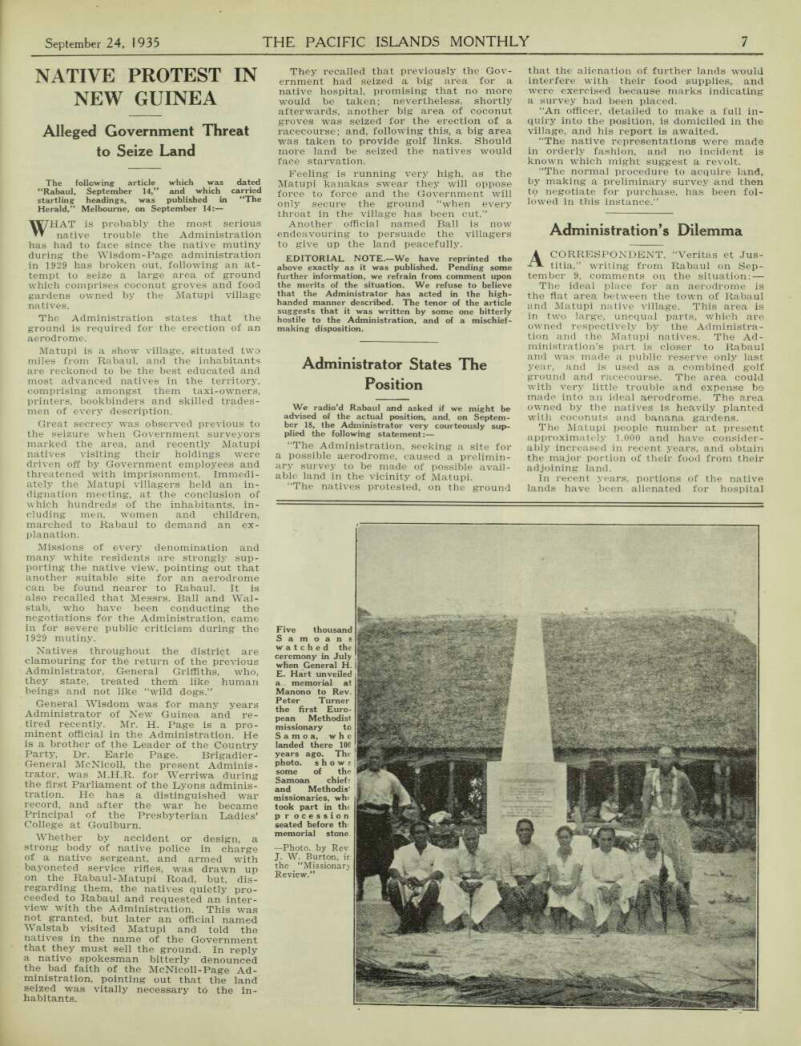
Five thousand Samoans watched the ceremony in July when General H.
E. Hart unveiled a memorial at Manono to Rev.
Peter Turner the first Euro pean Methodist missionary to Samoa, who landed there 100 years ago. The photo. shows some of the Samoan chiefs and Methodis missionaries, who took part in the procession seated before tho memorial stone Photo, by Rev J. W. Burton, in the “Missionary Review.”
and compound purposes, while last year a request was made by the Administra tion that the people should cede another strip to complete the reserve. When the natives were reluctant to part with any more of the land, obviously necessary for them to produce food and firewood, the Administration, after enquiry, admitted that the people had no more land than is necessary to provide for their reason able requirements; and that if the natives would agree to cede this last strip of land the Administration would not alien ate another inch of the natives’ land.
This information, at the Administra tion’s request, was communicated to the natives explicitly by the local Catholic missionary (Father G. Madigan) through the medium of the native lan guage.
In the circumstances, one would think that the Government reserve would be chosen for the aerodrome and the natives left in undisputed possession of what is admittedly necessary for their existence.
Rabaul has a population of about 750 Europeans, and approximately 35 play golf intermittently; while races are held only a few times in the year. Very little inconvenience and no loss would be in curred by asking the clubs to withdraw from land that does not belong to them.
A few weeks ago, surveyors appeared on different parts of the area in ques tion; and, when they crossed over into the portion owned by the natives, the people became uneasy. The Administra tion again sought the aid of the Catholic missionary to assure the people, through their own language, that they were not to be alarmed, as the Government sur veyors were merely marking out the land in the vicinity owned by the Adminis tration. Imagine the consternation of both missionary and people when, on September 5, surveyors with native labourers were marking and pegging the portion of the land owned exclusively by the natives for the aerodrome, and leav ing the Government reserve entirely un touched.
During the process 64 coconut trees and 24 banana trees were cut down. The land has not been resumed and not one of its owners had been apprised of what was contemplated.
Naturally, the almost frantic people, who believed the official information com municated to them by the missionary, appealed to the missionary, and when the latter approached the same responsible official who had emphatically stated that nothing had been determined and that the surveyors were on the area for an entirely different purpose, he learned for the first time that a very large portion of the natives’ land had been marked for an aerodrome. The indignation of the ■natives was difficult to control —practically the entire population went to Rabaul to protest against the injustice. An offer was made that the people should give the land in exchange for some place far distant from their home.
The people have now been assured by the responsible official that the Adminis trator has ordered that nothing shall be done until he has had an enquiry made as to whether the people have sufficient land to grow their food; and that an official will enquire next week.
The position of the Administration is unenviable. Everyone admits the neces sity of the proposed aerodrome. Experts say the land in question is the only suit able site available. A choice must be made between alienating land admittedly neces sary for the existence of the natives, or incurring the displeasure of the few European golfers and the racing club.
Forty-four Years in Papua
Canon S. Tomlinson
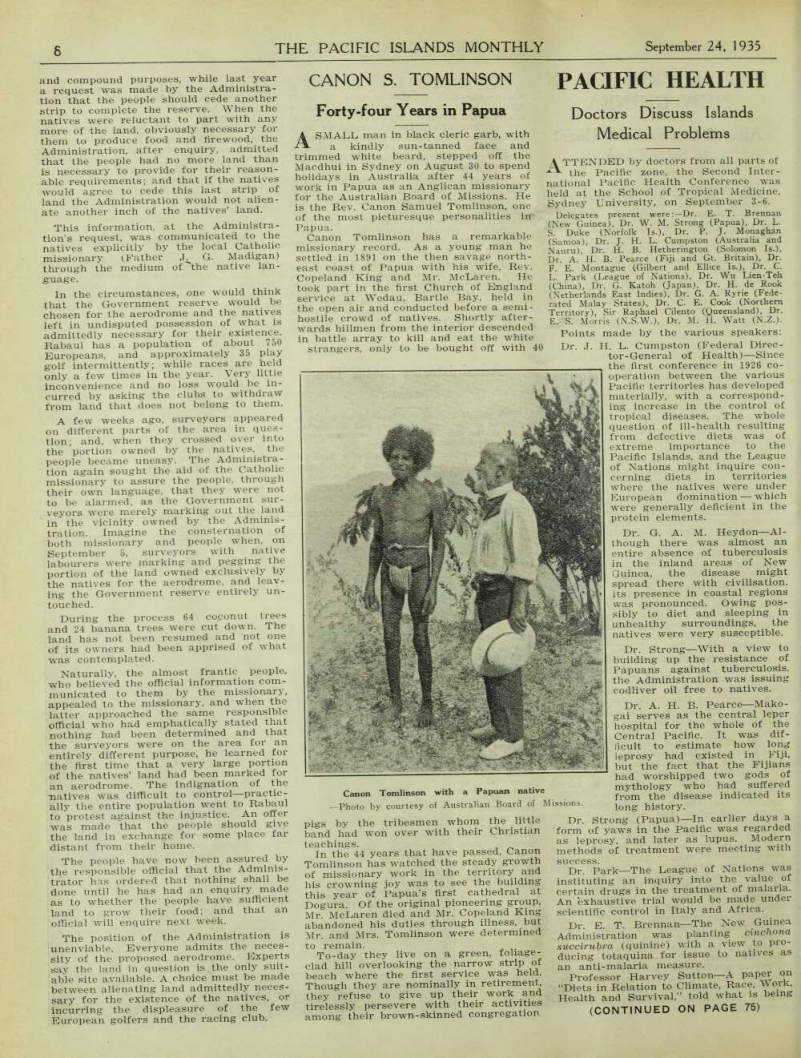
A SMALL man in black cleric garb, with a kindly sun-tanned face and trimmed white beard, stepped off the Macdhui in Sydney on August 30 to spend holidays in Australia after 44 years of work in Papua as an Anglican missionary for the Australian Board of Missions. He is the Rev. Canon Samuel Tomlinson, one of the most picturesque personalities in Papua.
Canon Tomlinson has a remarkable missionary record. As a young man he settled in 1891 on the then savage north east coast of Papua with his wife, Rev.
Copeland King and Mr. McLaren. He took part in the first Church of England service at Wedau, Bartle Bay, held in the open air and conducted before a semi hostile crowd of natives. Shortly after wards hillmen from the interior descended in battle array to kill and eat the white strangers, only to be bought off with 40
pigs by the tribesmen whom the little band had won over with their Christian tpa china’s In thef 44 years that have passed, Canon Tomlinson has watched the steady growth of missionary work in the territory and his crowning joy was to see the building this year of Papua’s first cathedral at Dogura Of the original pioneering group, Mr. McLaren died and Mr. Copeland King abandoned his duties through illness, but Mr. and Mrs. Tomlinson were determined to remain.
To-day they live on a green, foliageclad hill overlooking the narrow strip of beach where the first service was held.
Though they are nominally in retirement, they refuse to give up their work and tirelessly persevere with their activities among their brown-skinned congregation.
Canon Tomlinson with a Papuan native Photo by courtesy of Australian Board of Missions.
Pacific Health
Doctors Discuss Islands Medical Problems
\ TTENDED by doctors from all parts of the Pacific zone, the Second Inter national Pacific Health Conference was held at the School of Tropical Medicine, Sydney University, on September 3-6.
Delegates present were: —Dr. E. T. Brennan (New Guinea), Dr. W. M. Strong (Papua), Dr. L.
S. Duke (Norfolk Is.), Dr. P. J. Monaghan (Samoa), Dr. J. H. L. Cumpston (Australia and Nauru), Dr. H. B. Hetherington (Solomon Is.), Dr. A. H. B. Pearce (Fiji and Gt. Britain), Dr.
F. E. Montague (Gilbert and Ellice Is.), Dr. C.
L. Park (League of Nations), Dr. Wu Lien-Teh (China), Dr. G. Katoh (Japan), Dr. H. de Rook (Netherlands East Indies), Dr. G. A. Ryrie (Fede rated Malay States), Dr. C. E. Cook (Northern Territory), Sir Raphael Cilento (Queensland), Dr.
E. S. Morris (N.S.W.), Dr. M. H. Watt (N.Z.).
Points made by the various speakers: Dr. J. H. L. Cumpston (Federal Direc
tor-General of Health) —Since the first conference in 1926 co operation between the various Pacific territories has developed materially, with a correspond ing increase in the control of tropical diseases. The whole question of ill-health resulting from defective diets was of extreme importance to the Pacific Islands, and the League of Nations might inquire con cerning diets in territories where the natives were under European domination which were generally deficient in the protein elements.
Dr. G. A. M. Heydon—Al though there was almost an entire absence of tuberculosis in the inland areas of New Guinea, the disease might spread there with civilisation, its presence in coastal regions was pronounced. Owing pos sibly to diet and sleeping in unhealthy surroundings, the natives were very susceptible.
Dr. Strong—With a view to building up the resistance of Papuans against tuberculosis, the Administration was issuing codliver oil free to natives.
Dr. A. H. B. Pearce —Makogai serves as the central leper hospital for the whole of the Central Pacific. It was dif ficult to estimate how long leprosy had existed in Fiji, but the fact that the Fijians had worshipped two gods of mythology who had suffered from the disease indicated its long history.
Dr. Strong (Papua)—ln earlier days a form of yaws in the Pacific was regarded as leprosy, and later as lupus. Moder n methods of treatment were meeting with success. „„ Dr. Park—The League of Nations was instituting an inquiry into the value of certain drugs in the treatment of malaria.
An ‘exhaustive trial would be made undei scientific control in Italy and Africa, Br. E T B re nnan—The New Guinea Administration was planting cinchona succiruhra (quinine) with a view to pro ducing totaquina for issue to natives as an an ti- ma laria measure, Pro fessor Harvey Sutton—A paper on « Diets in Relation to Climate, Race, Work, jjealth and Survival,” told what is being
(Continued On Page 75)
done in Papua and New Guinea, and in the laboratories of the School of Tropical Health and Medicine.
Dr. F. W. Clements —The casual organ isms of tropical ulcers were spirochetes and fusiform bacilli. A survey last year of Papuan and New Guinea natives showed 90 per cent, of adults harbouring these organisms in their mouths. Tropi cal ulcers were most common where the inhabitants lived almost entirely on native sago. Where they augmented their diet by fish and taro there was a noticeable decrease of the disease. The introduction of proteins (taro, etc.) had a marked effect in reducing the number of cases.
Dr. Cumpston—An order made by the Nauru Administration several years ago forbidding natives to drink palm wine, fomented by yeast, caused an outbreak of beri-beri, particularly among infants, and it was necessary to use substitutes, in cluding codliver oil.
Dr. W. M. Strong—A handful of doctors had to care for 300,000 natives. The health authorities sought the assistance of the more intelligent natives, to whom they taught the rudiments of medical practice. The scheme had been success ful, and the native medical assistants were allowed to attend to a great deal of work. One of the Papuan medical students, Lahui Ako, read a paper to the conference, relating in simple language their duties in the inland areas.
“Papuan Wonderland”
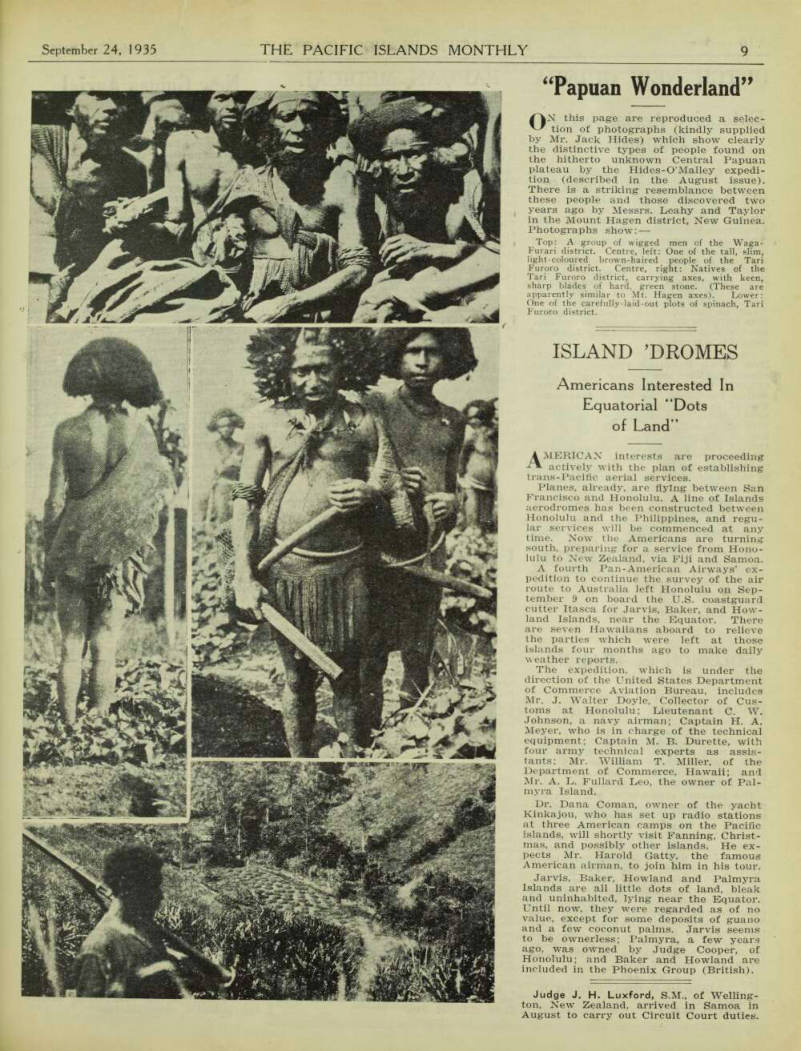
this page are reproduced a selec tion of photographs (kindly supplied by Mr. Jack Hides) which show clearly the distinctive types of people found on the hitherto unknown Central Papuan plateau by the Hides-O’Malley expedi tion (described in the August issue).
There is a striking resemblance between these people and those discovered two years ago by Messrs, Leahy and Taylor in the Mount Hagen district, New Guinea.
Photographs show: Top: A group of wigged men of the Waga- Furari district. Centre, left: One of the tall, slim, light-coloured brown-haired people of the Tari Furoro district. Centre, right: Natives of the Tari Furoro district, carrying axes, with keen, sharp blades of hard, green stone. (These are apparently similar to Mt. Hagen axes). Lower; One of the carefully-laid-out plots of spinach, Tari Furoro district.
Island ’Dromes
Americans Interested In Equatorial “Dots of Land”
A MERICAN interests are proceeding actively with the plan of establishing trans-Pacific aerial services.
Planes, already, are flying between San Francisco and Honolulu. A line of Islands aerodromes has been constructed between Honolulu and the Philippines, and regu lar services will be commenced at any time. Now the Americans are turning south, preparing for a service from Hono lulu to New Zealand, via Fiji and Samoa.
A fourth Pan-American Airways’ ex pedition to continue the survey of the air route to Australia left Honolulu on Sep tember 9 on board the U.S. coastguard cutter Itasca for Jarvis, Baker, and How land Islands, near the Equator. There are seven Hawaiians aboard to relieve the parties which were left at those islands four months ago to make daily weather reports.
The expedition, which is under the direction of the United States Department of Commerce Aviation Bureau, includes Mr. J. Walter Doyle, Collector of Cus toms at Honolulu; Lieutenant C. W.
Johnson, a navy airman; Captain H. A.
Meyer, who is in charge of the technical equipment; Captain M. B. Durette, with four army technical experts as assis tants; Mr. William T. Miller, of the Department of Commerce, Hawaii; and Mr. A, L. Fullard Leo, the owner of Pal myra Island.
Dr. Dana Coman, owner of the yacht Kinkajou, who has set up radio stations at three American camps on the Pacific islands, will shortly visit Fanning, Christ mas, and possibly other islands. He ex pects Mr. Harold Gatty, the famous American airman, to join him in his tour.
Jarvis, Baker, Howland and Palmyra Islands are all little dots of land, bleak and uninhabited, lying near the Equator.
Until now, they were regarded as of no value, except for some deposits of guano and a few coconut palms. Jarvis seems to be ownerless; Palmyra, a few years ago, was owned by Judge Cooper, of Honolulu; and Baker and Howland are included in the Phoenix Group (British).
Judge J. H. Luxford, S.M., of Welling ton, New Zealand, arrived in Samoa in August to carry out Circuit Court duties.
Extensive Aerial Survey
Dutch New Guinea
Extensive Aerial Survey Planned
From Our Own Correspondent.
WAU, August 22. its formation in Holland 18 months ago, the New Guinea Com mittee, under the presidency of His Excellency Mynheer D. Fock, Minister of State and former Governor-General of Dutch East Indies, has been very actively engaged in gathering and collating all possible information concerning Dutch New Guinea and, to a lesser degree, Papua and the Mandated Territory of New Guinea. The time has now arrived when the Committee is to put into opera tion its plan for the economic develop ment of D.N.G., which until now has been virtually stagnated.
Almost immediately the Netherlands New Guinea Petroleum Company (60 per cent. American and 40 per cent. Dutch capital) will commence a large scale search for oil in the Dutch possession.
The oil investigations will be started by an extensive topographical survey of an area of 25 million acres allotted to the big oil companies. This work is to be carried out by three twin-engined aero planes under the direction of Flying- Captain de Ruyten van Stevennick, late of the D.E.I. Airways, a sister company of the N.L.M. (Royal Dutch Airways).
The search for oil will be followed by gold exploration carried out by the Nederlandich Nieuw Guinea Mynboun Maatschappij (Netherlands New Guinea Mining Co., with 49 per cent- British, and 51 per cent. Dutch capital). The British capital was supplied mostly by Oroville Dredging Co., whose mining area adjoins their Fly river area in Papua. The British company also has another block near Manokwari, where Dutch Government mining engineers found gold traces.
Solomon Is. Trading
Letter to the Editor. ■DEGARDING the prices alleged by “Non-Trader” as having J>een charged the natives by a British trader in the Solomons, all I can say is that the prices enumerated are, without exception, ex actly double those charged by the generality of British and Chinese traders in the Solomons.
The internal evidence of your corres pondent’s letter reveals to any experi enced Islander: (a) That the natives were pitching a “tale of woe” into “Non- Trader’s” receptive ear. (b) The British traders mentioned were exceptional freaks. Like any other body we British traders have our museum pieces.
In any case, the articles quoted— pencils, writing pads, metal and boot polishes, rubber shoes (in a largely un educated and barefooted country)—taken in the mass are scarcely worth while for the trader to stock, as they constitute perhaps only one half of one per cent, of his total turnover. He carries them more for service than for profit.
I am etc.,
Leslie F. Gill (“Trader”).
Gizo, S.I.
June 14, 1935.
Papuan Medical
Trainees
Third Party Arrives For Sydney University
A THIRD party of 17 Papuans, of ages ranging from 15 to 24 years, arrived in Sydney by the Macdhui on August 30 to undergo six months’ training in elementary medicine at Sydney University.
Th£y were accompanied by Dr. Walter M.
Strong, Chief Medical Officer of Papua, who came South to attend the. Pacific Health Conference.
Neatly dressed in Boy Scout uniform, the Papuans attracted considerable attention in Sydney and were the centre of interest at the Health Conference on September 6 when Lahui Ako, one of the students, read a paper dealing with their medical work in Papua. This paper had been compiled in conjunction with another native medical assistant, Morea Toua. During their stay in Sydney, the party will live at the Quarantine Station, under the care of Pro fessor Harvey Sutton and Dr. F. W.
Clements (tutor) of the School of Tropical Health and Medicine.
Some interesting material concerning the work of the Papuan students has kindly been supplied to us by Dr. Strong, and an article dealing with the system of training natives to be medical assistants in Papua will appear in next issue.
Cocoa-growing in New
Guinea
IN a letter to the Editor of the Pacific Islands Monthly, Mr. J. Nixon-West wood, of London, who was formerly a planter in the South Seas, makes some comment on the cocoa industry in New Guinea “l have read the May issue with great interest,” he writes, “but cannot say that I agree with the New Guinea authorities on agricultural questions.
“I have yet to learn that the young would-be-experts who are attached to agricultural divisions can gather much information of use to the planter by lightning visits to various parts of the world. When all is said and done the methods employed in the production of cocoa in the West Indies and Ceylon, etc., are not in any way applicable to the South Seas.
“The system, although perhaps based on one, may I say, formula, must neces sarily be altered according to climatic conditions, and any man who grows cocoa and who studies the local conditions sufficiently well to enable him to take care of the fermentation of the beans and then properly cures them cannot fail to produce a good marketable product. All the visits in the world are useless unless the man who is the actual grower realises the foregoing.
“I am afraid I must repeat myself when I say that if the Adminstration of New Guinea is really anxious to produce mar ketable cocoa beans it has, at its door, experts in the shape of German planters who are resident in Samoa, and having worked with them I can vouch for their knowledge of this branch of agriculture.”
Mr. Allan Bowler has accepted a seat on the board of directors of Viti Levu Gold N.L., of Fiji.
Transport
New Guinea Aerial Transport
THERE have been some changes in the increasing fleets of aeroplanes which carry on the New Guinea goldfields ser vices.
Guinea Airways Ltd. have lost three machines lately. Two small Moths were smashed on the aerodromes owing to engine failures and one—and probably both —will not be regarded as repairable.
A De Havilland 31, one of the fleet which Guinea Airways recently bought) from West Australian Airways, crashed on Wau aerodrome on its first flight in frorrv the coast, and was badly wrecked- No one was injured in any of these accidents.
It is expected that Guinea Airways will introduce new machines in place of those damaged.
It is reported that some firm or person is bringing four 14-seater Douglas machines to Sydney, to be re-shipped to New Guinea, but no such machines have been ordered, as far as can be ascertain ed, by any of the aviation companies operating in the Territory.
The Pacific Aerial Transport Co., of Sala maua, New Guinea, has added a four passenger aeroplane to its fleet. Kevin Parer, in charge of P.A.T., wirelessed his agent in Melbourne to secure a ’plane and ship it all haste. The order was received on September 5. After a hurried search, the agent located a machine built in Mel bourne six years ago, but not then in com mission. Within a few hours, mechanics were working to overhaul and refit it. On September 7 the machine, a De Havilland 50, was shipped by the freighter Wear to Sydney, arriving on September 10. The aeroplane was unloaded at Sydney and taken aboard the B.P. liner Neptuna. It was landed at Salamaua on the 19th, just a fortnight after the order reached Melbourne.
Enterprise at Wau
Flourishing Farm
Success of Hunter Kirke’s Enterprise at Wau
From a Special Correspondent.
WAU, Sept. 2.
Thoroughness is a synonym for ex-Digger Hunter Kirke, ,of Wau.
When he took over a huge acreage for an orchard and market garden, samples of soil from various parts of the farm were sent to the Agricultural Dept, in Sydney to ascertain the exact require ments in superphosphates.
Recently he marketed five acres of potatoes—the finest seen in the Territory —and they averaged Bd. per lb.! Then the tomatoes came in for attention; ’planes came from all parts of the gold fields area to buy these delicious products of the first market garden in these parts.
The fruit averaged 3 lbs. each, and were so firm that they were eaten as a dessert.
A splendid up-to-date piggery is now established on this plantation, and by the next incoming Macdhui 350 head of prize poultry from Townsville, including tur keys, ducks, fowls and geese are arriving.
Mr. Hunter Kirke has also five acres of oranges and five acres of lemons, besides other fruit that will be in full bearing next year. When one considers that oranges are 1/6 each and eggs 4/6 doz., the foresight of this enterprising ex-sol dier is highly commendable.
Tropicalities
WHILE Commonwealth and State Governments, in September, were very busily entertaining Japan’s “Ambas sador Extraordinary and Plenipotentiary,” sent on a goodwill mission to Australia, Australian pearl-fishers (who are fighting a losing battle against Japanese fishers in the Timor Sea) were reporting that Japanese fishing-vessels are regularly landed, careened, cleaned, repaired and watered on Bathurst Island, in defiance of about fifty laws which guard Aus tralian territorial rights. Other reports stated that Japanese poachers are busy again among the pearlshell beds of New Guinea; and that, to combat the Japanese poachers, the Commonwealth Government has decided to purchase two very fast patrol vessels, one of which will be stationed in Darwin, and the others, de signed according to the requirements of the Administrator of New Guinea, will be stationed at Rabaul. The launch for Darwin will arrive in Australia from England before the end of the year.. * * * IT was announced in mid-September that Mr. W. R. Carpenter, head of the well-known Islands trading and shipping firm, had made a most generous donation to the Maternal and Infant Welfare Fund.
He has given his beautiful house and grounds at Wollstonecraft, Sydney, to be used as a Jubilee Maternity Hospital, together with £ 5000 in cash to be used for the endowment of the institution. The total value of the gift is £20,000.
“W.R.C.” was never a man to do things by halves.
The Federal Government expressed warm appreciation of the full-bodied gift. ■“Sir William Randolph Carpenter” should be a pretty sound tip for the New Year.
OF 1868 cases heard by the native courts, 1776 convictions were secured, many on curious charges, stated the New Guinea Administrator in the last report to the League of Nations. For failure to cease singing and dancing at 9 p.m. 33 natives were convicted, while 27 were convicted for playing football in places not prescribed. Twenty-one were tried tor spreading false reports, 116 for steal ing, 46 for sorcery, 54 for having intoxi cating liquor, five for unlawfully wearing clothes on the upper part of the body, and 118 for failing to appear for census taking, while three were convicted for remaining in Rabaul for a longer period than four days without employment. * * * "W/ITH the caption “In the Good Old »» Days,” this little story was sent by a resident of Vanua Levu, Fiji, who was for many years a trader in the group and who is now an established planter. It is with more than a passing suspicion of the identity of the knavish trader con cerned that we print the anecdote: The trader had weighed the Fijian’s copra on his “Ambush Scales” (those that lie in weight) and had paid the native £2/16/-. The native counted the money twice, and again checked weights and price. By his “ready reckoner” the native made it £3/16/-, not £2/16/-. A slight argument followed, the trader insisting that £2/16/- was correct, the native stuck to £3/16/-.
"Your ready reckoner must be wrong,” said the trader, “Let’s have a look at it.
Of course it’s wrong; £2/16/- is correct.
That’s last year’s book, not this year’s, that you’ve got there!”
WE have been informed that about 1906 Captain Charles Memmuir, a repre sentative of the Royal Shipwreck Relief and Humane Society, was captain of a vessel named the Upolu and that this vessel went to Thursday Island and ob tained there 30,000 live specimens of pearl shell and took the consignment to Suwar row Lagoon in the Northern Cooks and planted the pearl shell there. Does any old hand in the Pacific know, anything about this? It would be very interesting to know if such an experiment was made and what was the result of it. * * * ALTHOUGH there are only 10 miles of formed roads on the island of Nauru, the community there owns and operates no less than 50 motor cars, not to men tion several motor cycles and innumerable bicycles. This is characteristic of Pacific Islands communities generally. There are an astonishing number of motor vehicles in use in such places as Port Moresby, Rabaul, Vila, and Rarotonga; while the number of motor cars owned privately or run for hire in Suva, Noumea, and Tahiti seems to be out of all propor tion to the population. So far as bicycles are concerned, it seems to be the ambition of every Europeanised native to own a machine of some sort —although the fre quent sight of one uncomplaining bicycle carrying three or even four natives sug gests a communal rather than an indi vidual ownership.
WE get many visitors at the Melane sian Mission Press,” says Mr. F. R.
Isom, in a letter from the Solomons. Mr.
Isom is the printer there, and he is as sisted in his interesting work by his wife.
“Two recent visitors were a Rennel Island native and his wife. Mr. and Mrs.
Printer were both setting up type at their cases.
“ ‘Good morning, master,’ said the na tive male to the white male; and, on receiving a polite reply, he looked towards Mrs. Printer, and for a moment seemed
at a loss. Then his face brightened, and. with a cheerful smile, he inclined his head to Mrs. Printer, saying, ‘Good morning, Boss/ “Gracious reply from white missis!” * * * ONE of the objects of ethnological in terest studied by Professor Peter Buck, of the Bishop Museum, Honolulu, during his recent survey of European Museums, was a wooden image presented to Queen Victoria in 1841 by the Samoan King Malietoa. The figure was repro duced in Kraemer’s “Die Samoa-Inseln.” and aroused considerable discussion. Be fore examining it in the British Museum Professor Buck was inclined to the view that it was of post-European manufac ture. Doubt as to the purely native origin of the image vanished, however, as soon as he held it in his hand. His opinion now is that it was made locally in Samoa by an inferior artist who was either Ton gan, or who was acquainted with the general appearance of images made in Hapaii.
When John Williams, the famous mis sionary, visited the Tongan Group in 1830 he was shown “five goddesses hanging by the neck” by Taufaahau (better known in later years as King George I.). On asking, Mr, Williams was given one of the images, which he took to England,, and reproduced a drawing of it. Unfortun ately, it has not since been traced as, presumably, it did not pass into the Bri tish Museum with other objects (now of priceless value) from the London Mis sionary Society’s collection.
Nevertheless, Professor Buck came across a similar figure in the celebrated collection of Captain A. W. F. Fuller, and was thus enabled to make an interesting comparison. Two other figures, similar to Captain Fuller’s, are in the Oldman Collection in London. Professor Buck says there is a strong possibility that one of them is the image George Tubou gave to John Williams.
Mr. E. H. Cherry, who has been en gineer in charge of the Seventh Day Adventist Mission’s activities at Aore, South Santo, New Hebrides, for three years, arrived in Sydney by the Laperouse on September 14. He was accompanied by his wife and two sons.
Advertisements & other items, pp. 13-14 (1 item)
Srinitg (Grammar
S>ummft ®jill mth
NEW SOUTH WALES
A Church of England Boarding and Day School (One of the Associated Schools of N.S.W.) The Boarding House stands in 1 3 acres, with 3
Playing Fields, Tennis Courts, Gymnasium, etc.
Boys are received from the age of eight years, and are taken to the Leaving Certificate Standard on either the Classical or the Modern side. The School has an excellent record in Public Examinations.
Special vacation facilities are available for Boarders from the Islands.
Address applications for Prospectus to the Bursar at Strath field Headmaster: REV. P. W. STEPHENSON, M.A., B.D.
’Phone FL 1266. ’Phone FL 1266
HENLY’S
DRIVE YOURSELF
SERVICE
197 William Street :: Sydney Cars Hired without Drivers on a Mileage Basis as under: — OPEN CARS—By the Day, 3d per Mile.
Minimum, 30 Miles Week Days. 60 Miles Sundays.
SEDANS —By the Day, 4d. per Mile.
Minimum, 30 Miles Week Days. 60 Miles Sundays.
Special quotations for holidays.
Payment, plus 2/6 per day or 7/6 per week for insurance. A deposit must be left on car, which is refunded when car is returned.
Our Fleet of Cars includes 1934 Plymouths, Hired at a Slight Increase.
Ccpdie Tea Cc’s
JtujAgKvck TEAS $ CCffCES.
{s£ m sen
ANNOUNCEMENT . . .
In response to numerous requests, The Corrie Tea Co. have decided to make their famous blends available throughout THE WHOLE OF THE PACIFIC ISLANDS. You will find Corrie’s Teas are “deliciously different,” and are already THE MOST POPULAR TEAS IN FIJI, where they enjoy an immense demand.
Should you, as yet, be unable to procure, please forward name of your Storekeeper, and A
GENEROUS SAMPLE WILL BE SENT YOU
Ask for “CORRIE’S”
—The Tea that is “Deliciously
Different”
Correspondence Invited.
THE CORRIE TEA CO.
39 Bathurst St., Sydney.
LIGHT, STRONG SUITCASES
fr&t five ItcvnJ
mU (stliM aie
fiS
BELTS FOR MEN
Stoutly made of leather in many colours and designs, Ford Sherington Belts are fitted with easily adjusted nickel fastenings. They are smart and hard-wearing. Ask for F.S. Leather Belts.
Made of the toughest fibre obtainable, Globite Suit Cases, in grained or smooth finish, are as smart as leather . . . but lighter to carry and lower in price. They are reinforced to stand the roughest handling.
FORDITE are economy cases . . . cheaper than Globite, and made with broad grain finish.
Traders are invited to write in for full particulars of these quick
selling lines
Ford Sherington, Ltd.
Manufacturers (Wholesale only)
KIPPAX STREET. SYDNEY, N.S.W.
About Islands People
Mr. G. M. Keogh, Assistant District Officer in the New Guinea Administration, returned to the territory after long leave in Australia by the Montoro on August 27. Before leaving New Guinea on fur lough, he was A.D.O. at Ambunti, the Government station 250 miles up the Sepik River, North-West New Guinea.
Mr. Michael Parer, father of Mr, Ray mond J. Parer, the well-known New Guinea airman, died at Brisbane on August 28. Born in Spain and educated in France, he came to Australia at the age of 20. Three other sons are residents of the Morobe goldfields, New Guinea.
Mr. F. P. Archer, of Jame plantation,.
Buka Passage, Bougainville, who is a representative of the Planters’ Associa tion of New Guinea, arrived in Sydney by the Neptuna on August 28 to spend several months’ holiday in Australia.
Mr. Donald Reid, chairman of direc tors of Gold Mines of Fiji N.L. and Fiji Gold N.L., left Sydney for Suva, Fiji, by the Mariposa on August 21.
Mr. F. W. Eggleston, a former Attor ney-General of Victoria, was elected the Australian member of the Pacific Coun cil of the Institute of Pacific Relations at the third annual meeting of the Common wealth Council of the Australian Institute of International Affairs held in Brisbane in August.
M rs. Bob Franklin, of the Kiandi Hotel, Edie Creek, New Guinea, is spending some months’ vacation in Sydney with. her people at Rose Bay.
Mr. Larry Knightley left Sydney by the Macdhui for New Guinea on September 12, after holidays in Australia. It was his first vacation in the 11 years he has spent on the N.G. goldfields.
Mr. J. Pearce, of Morobe goldfield, New Guinea, has been spending furlough in Australia with another old Territory iden tity, Mr. Ted Nichterlein. Both left Syd ney by the Van Rees for New Guinea early in September and will now be asso ciated with Messrs. Spence and Smith Ltd., mining engineers, at Wau.
Mr. T. Blakey, formerly manager of Day Dawn Mine, Edie Creek, New Guinea, who had the misfortune to break his leg, arrived in Australia recently and Is quietly recuperating in Sydney.
Mr. A. G. Sorrell left Sydney for New Guinea by the Macdhui on September 12 to take up duties with the office staff of Messrs. Holden’s Air Transport Services Ltd., at Salamaua.
Mr. and Mrs. J. Hobbs, of Ba, Fiji, with their small son, arrived in Sydney by the Aorangi on September 6.
Mr. E. K. Abraham, who recently re signed from the New Guinea Administra tion after occupying for many years the position of Postmaster at Rabaul, arrived in Queensland by the Montoro on August 10. He has now taken up duties with the Federal Taxation Department in Bris bane.
Mr. W. W. (“Nobby”) Clarke, of Edie Creek, New Guinea, who has been spend ing two months’ holiday in Sydney, has had a series of family misfortunes. His small daughter, Heather, while playing on the beach at Manly, swallowed a toy whistle and had to be rushed into hos pital for an X-ray and immediate opera tion which, fortunately, was successful.
Then Mrs. Clarke became seriously ill with throat trouble for some weeks, and as a finale the six-months-old baby de veloped measles.
Dr. and Mrs. W. E. Giblin, of Port Moresby, Papua, are coming South in a few weeks. Their two sons, who were for many years pupils at Mowbray House, Chatswood, are now boarders at St. Ig natius College, Riverview.
Mr. Fred Deckert, of Edie Creek, New Guinea, has sold his transport business; and is now living in Sydney.
Mr. and Mrs. O. Hertz, who have spent three months’ holiday in New South Wales, left by the Neptuna on September 11 for their home at Kokola planta tion, New Ireland district, New Guinea.
Mrs. Hertz, who was formerly Miss Eileen Deery, of Sydney, was married in 1917 to Mr. S. A, Whiteman, who earned fame during the War by discovering the camouflaged German vessel Comet in a bay at Talasea. After Mr. Whiteman’s death in 1920, she carried on his trading station and coconut plantation. Having remarried, Mrs. Hertz still assists in run ning the plantation, and until this trip South had not visited Australia for 12 years.
Rev. W. Burvill, of the Quetta Cathed ral, Thursday Island, arrived in Brisbane early in September by the Changte to attend the Anglican Provincial Synod.
Major C. A. Swinbourne, 0.8. E., Senior Administrative Officer of the Gilbert and Ellice Islands Colony, has returned to the Gilbert Islands after nine months’ fur lough in Australia. Proceeding to Rabaul, New Guinea, by the Montoro from Syd ney on August 27, he embarked on the Carisso for direct passage to Tarawa, the administrative centre of the group.
Mr. Swinbourne has been in various posts in the Pacific for the Colonial Service for 26 years, and prior to going to the Gilberts, he was for some years in Fiji.
Mr. Ivan Nelson, principal of the Is lands merchant and shipping firm of Nelson and Robertson Ltd., Sydney, re turned from Rabaul with his wife on August 30 by the Macdhui.
Lieut.-Colonel Leslie Fraser Standish Hore, M.C., of Luburua plantation, Kavi eng, New Guinea, died in New Ireland on September 1. He had held the positions of Chief Judge and Crown Law Officer in the Mandated Territory, but since 1927 had managed his own plantation. He is survived by a widow, a daughter, and two sons. Mr. Hore was born in India in 1870 and his life was strangely linked with Quetta, his birthplace. He married Miss Emily Lacy, one of the survivors of the Quetta which foundered in Torres Strait, and his death occurred but a few weeks after the Indian town had been devastated by an earthquake.
Mr. W. H. Carpenter, a director of Messrs. J. B. Carpenter and Co. Ltd., Thursday Island, arrived in Sydney by the Changte on September 9.
Captain W. Hamilton, who has plan tation interests in the Solomon Islands, returned to Brisbane with his daughter by the Malaita in August.
Mr. K. J. S. Chamberlain, Deputy Colo nial Treasurer of Fiji, left Suva by the Niagara recently for Gibraltar, where he has been appointed Colonial Treasurer.
He served in Kenya from 1924 until he was transferred to Fiji in 1933. Mr.
Chamberlain is a young man in the middle thirties and during his term in Fiji had displayed exceptional ability.
Mr. G. McLean, shipping manager of Messrs. W. R. Carpenter and Co. Ltd., New Guinea, arrived in Sydney from Rabaul by the Van Rees on September 10.
Mr. McKinna, formerly of Fiji and New Zealand, arrived in Apia, Western Samoa, in August to take up the position of mer chandise manager for Messrs. O. F. Nel son and Co. Ltd.
Mr. B. T. Heading, who has been ap pointed by Holden’s Air Transport Ser vices Ltd. to be ground engineer at Sala maua, New Guinea, left Sydney by the Neptuna on September 11. He said that the company’s second Ford passenger carrying 'plane is now in commission on the field.
Mr. R. D. Eden, manager of Vailala plantation, left Apia, Samoa, with his wife for furlough in New Zealand by the Maui Pomare on August 22.
Mr. D. Gubbay, head of the French trading firm Societe Commerciale Gubbay Freres, at Vila, New Hebrides, arrived in Sydney on September 10 by the Dutch Steamer Van Rees.
Advertisements & other items, p. 15 (2 items)
About Islands People
13
THE PACIFIC ISLANDS MONTHLY
September 24, 1935
ABOUT ISLANDS PEOPLE
Kurrajong
Wheeny Creek Farm
Forty-five miles from Sydney Superior modem accommodation, abundance of cream, eggs, and poultry. S acres orchard. Tennis, etc.
Tariff: Double, £2/2/- each; Single, £2/10/- ’Phone: Kurrajong 42 Proprietor: A. J. SAMSON Formerly New Guinea Public Service
An Ideal Xmas Gift A Portrait In Oils Few people realise the beautiful portraits that can be made from photos and snapshots of loved members of the family or well remembered scenes. Old and faded originals can be made into most lifelike portraits when reproduced by our staff of highly skilled artists.
The Mail Order Portrait Co. have decided to extend operations to the Pacific Islands, thus enabling you to obtain high class portraiture at less than usual city prices. This is made possible by your DEALING DIRECT WITH OUR STUDIOS and thereby eliminating salesman’s commissions, travelling and hotel expenses, etc.
In order to make our work known throughout the Islands we are making this
SPECIAL XMAS ADVERTISING OFFER
One beautiful Portrait in Oils, framed complete, measuring 22 x 18 inches: Usual price £3/10/- Specially reduced to £3/-/-
INSTRUCTIONS FOR ORDERING:
Post photograph, or snap of subject, stating clearly colour of hair, eyes, complexion, draperies, etc. Whether three-quarter, bust or full length required; also in case of one to be taken from a group, mark clearly. All originals will be carefully returned.
All orders must be accompanied by a deposit of at least 15/-, and the balance need not be paid until you receive the portrait from your post office.
Write for illustrated circular, sent post free.
MAIL ORDER PORTRAIT CO.
205 Miller Street, North Sydney, N.S.W. (Australia)
RECORDS from EEVY’S
ELVY’S, Sydney’s famous old-established Music House, can send you every Record that you may want. Special Mail Department for Island residents.
Here are some new releases:
MURGATROYD AND WINTERBOTTOM
(Known to the Police as Ronald Frankau and Tommy Handley), with Monte Crick at the piano: A6IBS (4/-). Clothes. The Seaside.
LESLIE HUTCHINSON, singing at the piano. A 6179 (4/-): Vienna in Springtime.
With All My Heart and Soul.
Done Before (from the film “Reckless”).
E.A.1506, 4/-.
NEW MAYFAIR ORCHESTRA: Ballad
Memories —Parts 1 and 2—lntroducing “Sweet and Low,” “Garden of Sleep,”
“Come, Sing to Me,” “Three Fishers Went Sailing,” “Sally in Our Alley,” “The Dear Little Shamrock,” “God Send You Back to Me,” “Lazily, Drowsily,” “The Bells of St.
Mary’s.” New Mayfair Orchestra (with Vocalists). C. 2716, 6/-.
AL BOWLLY—With Ray Noble’s Orchestra; You Opened My Eyes. Ey’rything’s Been Write for complete free lists. Elvy’s are noted for prompt service. Order Now.
ELVI A CO. LTD.
397 George Street, Sydney. ’Phone: M 2319.
TUDOR HOTEL
Room Only Rate, 5/- per day. Meals a la carte. Accommodation for 100 guests. One minute from G.P.O.
127 PHILLIP ST. Tel.: BW 2788
Next door to Martin Place
Sydney
Coinage
Silver For New T.N.G.
From Our Own Correspondent.
WAU, August 7.
A sum of £34,000 was appropriated in the estimates of expenditure for 1934-35 for purchase of silver and other metals and costs for the new coinage system for the Territory. The new coins wall be 1/-, 6d-, 3d. and Id. denomina tions.
Some 240,000 ounces of silver were purchased recently at 2/1 per ounce.
Later prices of 2/10 and 3/- per ounce show that the purchase was fortunate, saving over ninepence an ounce.
Samoan Produce
Trial Shipments Of
From Our Own Correspondent.
APIA, August 28.
BY the last Maui Pomare, which tooic a full shipment of Samoan bananas for the South Island market, small trial shipments of various other Samoan pro ducts were forwarded to New Zealand. A quantity of green beans was sent to Wel lington, also 45 cases of pawpaws (or mummy-apples), a fruit which deserves to be better known in New Zealand for its splendid digestive qualities.
As usual, a few tons of Samoan cocoa beans were shipped to N.Z. factories, also a small trial shipment of Samoan coffee beans, of the Liberia and Robusta varieties, addressed to the External Affairs Department. Samoan coffee is of excellent quality and many inquiries for it have been received from New Zealand and other parts overseas. At present a large portion of the local consumption is made up of Samoan coffee, which is bet ter, purer and cheaper than the imported brand.
Mr. H. V. Searle has joined the board of directors of Day Dawn (New Guinea) Limited.
W. R. Carpenter & Co.
Form New Insurance Organisation
Ittessrs. W. R. Carpenter And Co.
Ltd., have added insurance to their numerous other activities, which include merchandising, shipping, planting, desic cated coconut manufacture, shipyards,, refrigeration, aerial transport, bakeries,, etc- The following was published among new registrations early in September: Southern Pacific Insurance Company, Ltd. (August 27). Nominal capital, £250,000, in £1 shares. Objects: To carry on the business of general insur ance, etc. Subscribers: —W. R. Carpenter, J. A. Carpenter, H. B. Carpenter, C. H. V, Carpenter, J- T. Wallis, H. S. Cramer, and: W. G. Higgs (one share each).
Mr. W. R. Carpenter, chairman of W..
R. Carpenter and Co., Ltd., at the annual meeting on August 30, said that during the past year the company had acquired the whole of the as sets of Coconut Products, Limited, consisting of plantations and desiccated coconut factory. The yield from the properties acquired would add consider ably to the profits of the company. The company also acquired the whole of the preference share issue of W. R- Carpenter and Co. (Sol. Is.), Ltd., on terms con sidered to be equitable by its auditors, and good results could be expected.
The chairman went on to say that as insurances over properties, vessels, pro duce in transit, etc., placed by the com pany ran into very substantial figures, it was considered advisable to participate in general insurance business, as with what the company had to offer substantial reciprocal business could be expected. A company had been registered under the title of the Southern Pacific Insurance Company, Ltd., with a nominal capital of £250,000, paid up to £25,000, and the whole of such shares would be held by W. R. Carpenter and Company, Ltd.
Whatever profits were earned by par ticipating in the insurance business, therefore, would benefit shareholders in the company.
Mr- Carpenter said that it appeared to him that there was a possibility of a crisis in world affairs, and consequently markets were disturbed. However, there was a definite shortage of edible fats, and ordinarily prices should be firm, but until normal conditions prevailed no increase in prices could be expected. In the mean time, the company had to assist its plan tation clients to work their properties without loss, and for that reason the fullest possible prices had to be paid for produce, and the margin of profit was reduced to a very narrow one indeed.
Advertisements & other items, p. 16 (2 items)
Dewars
Where You Will Meet Your Friends in Sydney (Late Silver Slipper) Hot Dinners, Grills, Toasted Sandwiches, etc. 53 ROWE ST., next Hotel Australia Bridge Parties Catered For
Dawn
•Y APPOINTMENT
AGE
is the Crowning Stage in a series of fermentations. Fermentation means Life. Age dissipates its roughness, rounds off its edges, and refines its character, leaving nothing behind but the Rarest Elixir of Life.
Dewar’s is the Veteran of Stimulants. It is ripe for Promotion to your Palate.
DEWARS
The WHISKY
Books, Magazines & Newspapers
TO ANY PART OF THE ISLANDS
BARGAIN OFFER.—We will send half a dozen latest American Monthly Magazines for 4/-, post free.
We specialise in selecting reading matter for those unable to choose personally. We specialise in Mall Orders. Parcels posted by every boat. Send tor our price list and full particulars of this unusual service for Island residents. You will find your instructions carried out promptly, carefully, and with intelligence.
McKAY’S BOOKSTALL
ROYAL ARCADE, SYDNEY
N.G. Mine Managers
Official Conference
11TANY matters relating to the mining industry in Morobe, New were discussed on August 20 at a lengthy meeting at the Warden’s Office, Wau, between Mr. Gerald Hogan, head of the Crown Law Department, and the follow ing mine-owners and mine-managers: T. D. Harris, Placer Development Ltd., Bulolo Gold Dredging Ltd.
E. A. de Lautour, New Guinea Goldfields Ltd.
H. Taylour, Enterprise of New Guinea, N.L.
R. M. Brain, Mt. Lawson Prospecting and Option Syndicate N.L., and Upper Watut Gold Alluvials No Liability.
H. E. Hallam, Sandy Creek Gold Sluicing Ltd.
A. L. Joubert, Koranga Gold Sluicing Ltd.
J. M. Spence and R. D. Smith, Consulting En gineers representing various Companies.
W. T. Adamson, Bulolo Gold Deposits Ltd.
W. Digby, New Morobe and Morobe Alluvials. 0. Moen, Sunshine Gold Development Ltd.
H. Williams, Upper Sepik Prospecting Company.
C. W. Marshall, Superintendent, New Guinea Goldfields Ltd., Edie Creek.
Hon. N. P. H. Neal.
Messrs. D. M. Cook, W. F. Anderson, K. A. 0. Soltwedel, E. C. N. Helton, W. V. Quinn, G.
Butterworth, A. Dickson, J. Cromie, F. A. J.
Carter, H. T Allan, R. V. Wild, J. F. Stewart, V. A. Florence, H. P. Wilkins, A. J. Hoile, all lease holders; and C. W. G. Fox, Acting Warden, and A. Hyde, Mining Registrar.
Matters contained in Ordinance No. 19 of 1935 and proposed new legislation were discussed at length.
After the meeting Mr. H. Taylour, on behalf of all present, moved a vote of thanks to Mr. Hogan for meeting and discussing matters with the miners, and expressed a hope that senior officials from Rabaul would visit the field more often to keep in touch with the progress of the place, and get better understanding of the requirements of residents of the field- Mr. Hogan expressed his appreciation of the kindness with which he had been received in the District and said that the Administrator and the officers of the Ad ministration were desirous of doing everything possible to help the mining community.
£25,000 Aid for Papuan
Planters
From Our Own Correspondent.
Pt. Moresby. Aug. 3.
of the supplementary esti- U mates for 1934-35 passed in the recent session of the Legislative Council show that the total amount paid by the Govern ment during the last financial year to as sist copra growers was £6,881. The amount received by rubber planters rep resenting a refund of 2d per lb. of the Commonwealth duty was £19,022.
Right Rev. Dr. S. Davies. Bishop of Carpentaria, arrived in Brisbane from Thursday Island early in September by the Changte.
Goldfields Area, N.G.
Dr. Von de Boch’s Work In Goldfields Area, N.G.
From a Special Correspondent.
WAU, September 3. jDEMARKABLE changes have taken Place in the health of the goldfields community in the last six to nine months.
Dr. Von de Boch has worked miracles.
Apart from being a noted authority on materia medica, he has done a great deal of research work on tropical hygiene, and his knowledge of Islands diseases has been the means of saving many lives here.
Until his arrival, the dreaded Japanese River fever had taken toll of.many lives as, in its initial stages, it closely re sembles typhoid and has, too, been diag nosed as malignant malaria. Recently two men from the Watut district were sent into the European hospital at Wau suffering from what had been diagnosed as typhoid. But Dr. Von de Boch’s trained eye saw the dreaded bush “mok kers,” or ticks, covering the men’s legs, and, making a blood test, discovered they were both suffering from Japanese River fever.
In the treatment of the mysterious periodic dysentery outbreaks at Edie Creek the doctor has worked wonders.
Time was when this area had the second highest death rate in the world; to-day all that is changed, and for over nine months now Edie Creek has never been quarantined, as in the old days before Dr. Von de Boch’s advent.
Popular Samoan Wedding
From Our Own Correspondent.
APIA, August 30.
TN spite of low copra prices and hard times, the Samoan still to celebrate his family feasts and chiirch festivities with due pomp and ceremony irrespective of cost.
A wedding is announced in the near future of a young local born boy and a Samoan girl of a high chief’s family from Manono Island, a taupou (village virgin) of high rank. For the taunafataga (the great wedding feast in midday) and for the dinner and dance in the evening in vitations have been sent out to hundreds of European and Samoan guests The families of the bride and bridegroom have collected £2OO each to pay for the ex pense of the elaborate celebrations.
A dividend of 6d. per share (equal to 10 per cent, per annum) for the quarter ended June 30 was declared payable by Messrs, Holden’s Air Transport Services Ltd. on August 31.
Advertisements & other items, pp. 17-18 (1 item)
CRAIGNATHAN—Private Hotel,
A HOME FOR SCHOOLBOYS
“EEDDICOTT”
School House offers a solution of the problem of education by providing a home for boys attending school in Sydney.
Prospectus on application to
E. F. WHITFELD, B.A.
McMAHON’S POINT, SYDNEY
THE NEW €A9IItHI»«E
Limiled
Are Manufacturers of
HIGH-CLASS DELICACIES & SMALLGOODS
And can always be relied upon for the very best of sugar-cured Hams and Bacon, as their raw material is secured from the best of the country’s meat productions. The kindly-hearted Seers of the years gone by, when Australia was pioneered, were always careful in producing a good product for their future requirements, and were certainly well informed on matters of production and selection, and many young men have made their future success on their advice, viz., to go and procure from the fullness of the earth, the products which would make for a happy and contented people.
THE NEW CAMBRIDGE DELICACIES LIMITED, recognising this, aim at giving to the public the finest quality products from Australia’s resources.
Their manufactured goods are obtainable from all leading Storekeepers in the City, Suburbs and Country.
And in the Islands of the Pacific from . . .
MESSRS. W. R. CARPENTER & CO. LTD.
Factory: Bourke and Phillip Streets, Redfern, N.S.W.
Telephones: MA 6213-14-15
TELEGRAPHIC ADDRESS: ‘‘DELICACIES,” REDFERN
Ask for a “Cambridge” Ham for Xmas.
CRAIGNATHAN—Private Hotel,
•15 minutes from Situated right at Neutral Bay Wharf
G.P.O.
IS AN IDEAL RESIDENCE FOR THE ISLAND VISITOR
TO SYDNEY.
Families spociaUy catered for. Full Tariff from 10/- per day.
Telegram.: T ° TERMS ’ ETC - ON APPLICATION TO MANAGER.
NEUTRAL BAY
:: SYDNEY ::
Swimming Baths Tennis Billiards Boatsheds (Halvorsen’s).
Spacious Grounds FACING THE PICTURESQUE
HARBOUR.
Phc
■pOR 16 years sufferers from Headache, Neuralgia, Rheumatism, Lumbago, Sciatica, Neuritis, Sleeplessness, Influenza and Nerve and Muscular pains have found quick, safe relief in Genuine
VINCENT'S A.P.C
Powders and Tablets 12 for 1/6. 24 for 2 6
gen
Your DOCTOR. DENTIST, CHEM-
IST, NURSE, all recommend Genuine VINCENT’S A.P.C. because it is prepared on the scientific hospital formula All chemists and stores or direct from Vincent Chemical Companv Limited. Sydney.
For SAFETY’S SAKE, say “VINCENT'S’
The “Papuan Courier”
From Our Own Correspondent.
Port Moresby, August 18.
MR. E. A. JAMES, editor and publisher of the “Papuan Courier,” the only newspaper published in the Territory of Papua, has acquired the interests of all shareholders in his paper, excepting the seven nominal shareholders. He is, there fore, the sole proprietor of the paper, which circulates in Papua and New Guinea.
The “Papuan Courier” made its appear ance about 25 years ago when it was named the “Papuan Times,” and the late W. C. Bruce as editor conducted a one sided warfare with his turbulent pen.
Twenty-One Years Under
New Zealand
From Our Own Correspondent.
APIA, September 2.
ON August 29 the 21st anniversary of the raising of the British flag and the occupation of Western Samoa by New' Zealand troops was celebrated. The day was observed as a public holiday and for the first time after a lengthy interval the Apia Turf Club conducted a race meeting.
Though the events were marred by un favourable weather, racing fans were re warded by good sport. It is hoped that the efforts of the Apia Turf Club to revive the “sport of kings” in Samoa shall in future meet with better luck and more support by the general public.
Mr. Ray H. Mansell, of Bathurst, New South Wales, who has been relieving pilot for Guinea Airways Ltd., Lae, New Guinea, for several months, returned to Australia by the Macdhui on August 30.
Crime On Goldfields
Murder and Suicide at Wau
From a Special Correspondent.
WAU, Sept. 1.
ONE of the most startling crimes that has occurred in the goldfields area of the Mandated Territory, took place in August in front of a dozen people on the verandah of the Bulolo Hotel, Wau.
Without any warning Mrs. Elizabeth A.
Henderson, a well-known resident, drew a revolver and shot dead Mr. William Henry Hockey, who was a resident of Merri Creek. Then taking a razor out of her bag, she cut her throat from ear to ear and died in a few minutes.
News of the tragedy spread in an amaz ing manner and in no time people seemed to arrive as if by magic from as far afield as the Watut.
The following day three well-known residents nearly shared a similar fate, and only by the tactful handling of the age-old “eternal triangle” was a greater tragedy averted.
The men who were arrested at Edie Creek for gold stealing were tried at Wau recently. One received two years’ im prisonment and the other three years.
Sons of two well-known Southern fami lies, whose fathers hold high public posi tions, were deported in August—one for non-payment of debts and the other for a more grievous offence against the moral law.
Rev. F- O. Theile, of Brisbane, who is the directing force in Australia of the Lutheran Mission in New Guinea, arrived in Sydney early in September, and went on to Victoria and South Australia, on a lecturing tour.
Advertisements & other items, p. 18 (1 item)
A. Ift. Frost «& Co.
(A. R. FROST, late of E. F. Wilks & Co., Ltd.)
LAVEST IN ALL MAKES OF RADIOS,
REFRIGERATORS AND RECORDS
ill 'Value/
RADIOS from £l5-15
REFRIGERATORS from £49-10
Special Care taken in Packing.
Deliveries by Return Mail.
xoPPmbia
PORTABLE
£4*lo*o
Agents for: RADIOLA, S.T.C., AIRZONE, Stromberg-Carlson RADIOS.
Latest COLUMBIA, H.M.V., REGAL,
PHONE RECORDS.
PARLO-
Semi-Automatic Refrigerator
A. R. FROST .i CO.
129 The Boulevard, Her Majesty’s Arcade Sydney Telephone, MA 7394
Adventurous Quest
Mining Engineer’s Journey To N.G. Under Sealed Orders
IN June last Mr. Bartle Ryan, a Mel bourne mining engineer, left Syd ney by the Macdhui with boring and shafting equipment to test an alluvial property in New Guinea. There was much secrecy about his destination. He told the Pacific Islands Monthly that he was under sealed orders. “Until I get to Kavieng I am uncertain exactly where I shall go,” he replied to inquiries. “Wait till I return in August, then I’ll be able to tell the story,” he said assuringly.
Came August 30, and as the Macdhui pulled into B.P.’s No. 6 wharf, sure enough there was the grey-haired mining man leaning contentedly on the rails, ready to tell his tale.
“On arrival at New Ireland,” began Mr.
Ryan, “I opened the envelope, finding that with three white men and 13 natives I had to cross by launch to Tatau Island, in the Tabar Group, 80 odd miles south east of Kavieng. I inspected the property, made tests, and found it to carry not alluvial gold, but a payable lode for mation.
“On the way back to Kavieng,, in the open sea, the launch ran into a gale,” he said. “The rudder was torn from the boat and we were disabled and helpless in a big sea. Repairs could not be effected and we were tossed about for hours. Just when we were beginning to fear that we would be swamped and drowned, another vessel came over the horizon. It was W. R. Carpenter and Co.’s motor vessel Desikoko, on a course taken only occasionally, “With difficulty we were rescued and landed at a plantation 100 miles south of Kavieng. When the weather moderated, we rigged up an improvised rudder and had to beat our way back to port.
“The discovery of gold at Tatau was remarkable,” continued Mr. Ryan. “It appears that an Islands schooner was driven into the lee of the island for shel
ter. As he prepared to leave the cove, the skipper noticed gold in the mud on the anchor when he raised it. He told a few friends of the find, including Mr.
Charles Petterson, a veteran planter of Maragon, New Ireland.
“Petterson prospected the place and won 200 ounces of gold, which he thought to be alluvial. He formed a small syn dicate, and on their behalf I was ap proached to go to New Guinea to look over the property. Yes, I think the area has promising possibilities,” he con cluded, “but, of course, the future de velopment of it lies in the hands of the syndicate.”
Norfolk Island Council
ON the recommendation of Sir George Pearce (Federal Minister in Charge of Islands Territories) who visited Norfolk Island early in the year, the N.I. Execu tive Council was abolished, to be replaced by an Advisory Council wholly elected by residents and with no nominated mem bers. The Island was divided into four wards, each to elect two representatives.
The first election was held in the middle of August with the following result: Ball Bay, Messrs. C. R. Christian and F. C Nobbs; Cascades, Messrs. W. M. McLach lan and F. L. Quintal; Kingston, Messrs.
C. C. R. Nobbs and E. C. Robinson; Mt.
Pitt, Messrs. S. Cole and A. J. MacGrath.
The new councillors were sworn in at Kingston Court House on August 28, and immediately afterwards commenced their first session at which Mr. Charles Chase Ray Nobbs was elected President and Mr. William McLachlan, Deputy Presi dent. The term of office is until July next year.
Mr. A. J. Samson, formerly a magis trate in the Mandated Territory of New Guinea, is now living in New South Wales. He resigned from the N.G. Pub lic Service in January, 1934, and acquir ing a farm at Kurrajong, has erected a modern guest house. Both he and Mrs.
Samson will be pleased to welcome any Islands people who care to inspect their lovely home.
Advertisements & other items, pp. 19-20 (1 item)
Wentworth
Be Sensibly Dressed
this Summer . . .
Wear a Quality
TWO-PIECE
KOOL-WATE
Summer Suit
Price ... 79/6
Light and comfortable and they keep their original style and smartness.
Obtainable in popular Biscuit, Lawn & Grey Shades
Pike Brothers
LIMITED
Of Queen Street -- Brisbane
SHAVING
OUTFIT
Complete 1 Full Hollow Ground Razor. 1 Double Leather Strop. 1 Shaving Brush. 1 Comb. 1 Stick Shaving Soap.
21/6 complete
Post Free for Cash with Order.
W. JNO BAKER LTD,
SHUNTER ST., SYDNEY
“hhe
Wentworth
CHURCH HILL.
m
£ii>i{f|l||B|g
Pla n m s 1 i
4’a» «
HIF/
sydney Jmt&mM
Phone: 81V1361 Telegraphic Address: “Mum,” Sydney
Sydnefy Exclusive Residential Hotel
s itua ted °n |y tw ° minutes from the General Post Office, Railway Station and leading theatres. All rooms Steam-heated in Winter and Air-cooled in Summer, and equipped with Telephone, and Hot and Cold Water Excellent Cuisine.
Tariff-. Room and Breakfast, from 10/6 per day; Inclusive from 18/- per day.
For full particulars apply to The Manager
The Pacific Islands Monthly, Sept. 24. 193 5.
The
Holiday Time . . .
Suggests Sydney and
‘THE AUSTRALIA
Australia
I H^trl
i
“The Australia*’
Martin Place Extension
(As illustrated)
Opening Shortly
Christmas inevitably suggests “The Australia —its scenes of gaiety—its special holiday attractions —its famous cuisine—and, above all, the fact that guests of “The Australia have the very real satisfaction of being in the heart of social and commercial activities —a most important consideration in a cosmopolitan metropolis like Sydney.
Here, amid the limitless resources of one of the world’s great hotels, your holiday or business trip will be enjoyed to the full.
NEW “ROOM
ONLY” RATES
Single Room, from 10/6 per day Double Room, from 20/- per day FS • Telegraphic Address: “Austraotel, Sydney ” tfrfl er m •ti? ■ m
The Old Shanty
Frank Pryke, Morobe goldfield pioneer, writes cheerily from Brisbane,, where he recently went to say “au revoir” to Les. Joubert and George Arnold, who have returned to New Guinea.
“George,” writes Mr. Pryke, “was a pretty sick man; but a letter from Les., a few days ago, tells me that our friend is much better. They are back on Koranga Creek.”
Mr. Pryke sends along another poem—he is a tireless writer —and it is printed below. It will have its own message for “the old hands”; but the uninitiated may as well know that the “shanty” was on the Tiveri, in the early days of the Lake kamu rush; that C. Lumley, now in the Trobriands, was manager, and Whitten Bros., owners; and that it was the custom there, when the manager wanted to retire, to place so many bottles on the counter, and divide the cost among all present.
What was left, in the morning, was credited, in .strict proportion, to the customers’ accounts. Big drinkers and small drinkers, they all paid the same, and never argued. Someone stiid to an old fossicker who was not drinking: “This arrange ment isn’t much good to you!” “Oh, that s all right,” he answered; “I’ll feel much better than you in the morning.” Mr. Lumley’s cheeses were notorious. He sent them up and down the river, in the “Bulldog’s” enginerocm, to ripen them; “and,” says Frank Pryke, “they could nearly take a walk on their own!”
Not a single stick is standing— For ’tis twenty years, or more, Since at Tiveri Landing You kept that trading store.
The miners had, for many weeks, Been making for the field — When Ironstone and Reeky creeks Both gave a decent yield.
And men will sail across the main, Should they be young or old — A mighty hard thing to explain Is this strange lure of gold. ’Twas khaki pants, and flannels then; Our clothes were rough and scanty— But days and nights were happy, when You kept that store and shanty.
I still think of that cheese you kept, And seem to smell it still; Remember that you nearly wept When I bowled it down the hill!
The “Bulldog’s” navigators, Arrived the following week And told of alligators Lying dead along the creek!
Of course you had to skite a bit About our shooting skill.
I don’t believe we’d got a hit, Or made one single kill.
You may doubt it if you please But I believe it’s true — Those old crocks had smelt your cheese, And met their Waterloo!
At night we round the shanty sat And sang some ancient rune, With husky voices, mostly flat, And sadly out of tune.
Then Ned the Welshman used to sing— His voice both loud and shrill— How Harlech’s men went marching, Or “The Moon Behind the Hill.”
In those old days we used to boast We always played the game— It mattered not who drank the most We’d always pay the same- Those gcod old mates great-hearted, We may never see them more.
The good days have departed.
With The Shanty and The Store.
Frank Pryke.
Mr. R. F. Finder, of the Audit Depart ment of the High Commission for the Western Pacific, was a passenger from Sydney for Tulagi, Solomon Islands, by the Malaita on August 26.
S.D.A. Missions
MISSION work occupied the time of the delegates at the Seventh Day Adven tist Conference in Sydney on August 30.
Pastor A. G. Stewart, who recently visited the Mandated Territory of New Guinea, re ported on the work now being carried on in the inland mountain areas.
A new mission station was established a short while ago at Ramu, 6000 f- above sea-level. A number of Solomon Island teachers, trained at Batuna, are carrying on the work among the Ramu natives, under the supervision of a white mis
sionary. The sole means of communica tion between Ramu and the coast is by aeroplane.
Pastor Stewart spoke of native tribes hitherto untouched by any mission body, and the mission board of the conference discussed plans for sending - additional workers among - them.
The conference had under consideration an extensive building programme, which would require about £15,000 to carry out.
Mr. Brian Lane, of Edie Creek, New Guinea, was married on July 30 at Sala maua to Miss Joan Kerr, of Wau.
Advertisements & other items, p. 21 (1 item)
Angus & Coote
'S
Mail Order Service
conveys these beautiful goods to you—or to any address you name.
There is no extra charge for postage. Safe delivery is guaranteed. £25 PI.l. .mi exclusive and lovely Ring of 18ct. white gold. Two perfectly-matched diamonds of whiteness and brilliance are set in the centre, and two more sparkle from each shoulder. Settings are of pure platinum. £l4/10/0 P 1.4, £6/10/0 P 1.5.
Two-stone Diamond Rings in modern settings of platinum. 18ct. gold.
Shoulders ate diamond-studded. £lO PI. 2. Ten Pounds for the two!
A three-stone Diamond Ring, with diamond-set shoulders, and carved shank. The wedding ring is carved to match. Both are 18ct. Gold—white or yellow as preferred. Settings are platinum. £lO/10/0 P 1.6. £l2/10/0 P 1.7.
Three-stone Diamond Rings of great beauty. 18ct. gold. Diamond-set shoulders. Settings of platinum. £27/10/0 PI. 3.
A mount carved with unbelievable delicacy and charm, and diamond studded, sets forth the glorious large diamond displayed there. The ring is of 18ct. white gold and platinum. 1
PRESENTATION DIAMOND BROOCHES
60/-. PI.IO.
A particularly dainty engraved bar of 9ct. gold, with diamond in fancy platinum setting.
Larger Diamond, 84/-. £5. PI.B. A Stylish ••Baguette’’ Watch which would delight the heart of any lady. Is 9ct. gold, and fitted with a jewelled movement of great precision which is warranted to give 10 years’ service at least. Angus and Coote keep this watch in order free for 12 months, and supply it complete with a smart black cordette wrist band. 70/-. Oct. Pl.ll.
White Gold of 9ct. quality is used for this beautiful brooch. The diamond is in a hexagonal platinum setting. Larger Diamond, £5. 75/-. P 1.9. A 9ct. Gold Australian-made Case which is wonderfully strong—as well as being a thing of beauty. It is richly engraved, and fitted with a jewelled lever movement which will give a minimum of 10 years’ good service. It is maintained in perfect order by Angus and Coote free of charge the first 12 months. Complete with smart black mounted moire ribbon band.
More of these Beautiful Goods are illustrated in Angus and Coote’s Catalogue, and it will be a pleasure to post one to you if you will kindly send your name and address.
Angus & Coote
500 George Street, Sydney
Tq El ED EfO P 1.12. 95/-.
THE “INDESTRUCTIBLE” LEVER
The Only Watch for the Tropics.
This Chromium Watch, with its steel back, is indestructible. You could swim wearing it; knock it; drop it, but it will not get out of order. No foreign matter whatever can gain access into the hermetically sealed case. Every part is cushioned. It is warranted to give 25 years’ wear, and kept in perfect order by Angus and Coote 2 years free. Complete with strap, it is only 95/-.
Twenty-five Years With B.P.
From Our Own Correspondent.
APIA, September 2.
ON Thursday, August 29, Mr. R. H.
Brown, the popular manager of the local branch of Messrs. Burns Philp (S.S.) Co. Ltd., celebrated the 25th anni versary of his entering the service of this well-known South Seas concern. Mr.
Brown was host at a jolly little luncheon party in celebration of the event, at which a number of representative citizens and friends took occasion to tender their congratulations and good wishes.
Native Buys A New
Motor Car
Transaction Causes Stir in Rabaul
Contributed.
THE natives of Matupi, a village situated a few miles south of Rabaul, New Guinea, recently purchased a new sedan Chevrolet motor car—the latest model —and paid cash for it, £290.
The event, which is a precedent, created a mild sensation and, as was anticipated, even by the natives, gave rise to ex pressions of the most conflicting views among the Europeans in and around Rabaul.
A sane, logical and thoughtful section, with a sympathetic interest in native welfare, said: “Why not? This must of necessity come here, as in all parts of the world. Natives have demonstrated their fitness to drive and repair cars for Europeans. Why not permit them to em bark on the enterprise of working for themselves?”
This reasonable plea, however, was far from being unanimous. In the clubs and hotels, small, but noisy groups, whose fixed and settled views are that the colour of the native’s skin condemns him to the unchangeable state of a beast of burden, set up “straw courts,” and belched forth heated rhetoric drawing attention to the possible and probable dangers to the Empire unless this latest move of these dark skinned potential enemies is reduced to impotence. Every expedient was suggested and examined but apparently with little hope of finding relief.
The Mandate expressly says that the “moral and material welfare of the native races must be the first consideration of the Administration.” No law or ordinance hinders or restrains a competent native from owning a car. Australia is only a caretaker not an owner of the Mandated Territory and, willingly or unwillingly, she must accept instructions from Geneva and do what she is told.
Vincent Lo Popat, the registered owner of the car, is a highly intelligent and no less industrious native. For years past he has, with a staff of Matupl natives, conducted a laundry for a ship ping company, and is well liked by shipping officials and passengers- As the natives of the Matupi and other villages, contiguous to Rabaul often find it neces sary to hire a car late in the evening, or in inclement weather, Vincent Lo Popat reasoned that as approximately £6O had been spent in this way during twelve months the purchase of a car would be a wise investment. He communicated his views first to a few of his native friends who enthusiastically offered assistance.
Lo Popat’s next move was to mention the matter to a number of Europeans with whom he came daily in contact in con nection with his work. Many urged him to act at once, others while favouring the proposal had a vague idea that the law did not permit a native to own a car.
In his uncertainty, Lo Popat referred the matter to the missionary of his village —Father J. G. Madigan—with whom he could fully discuss the matter in the native language. Father Madigan ex plained the law and pointed out that it was a big undertaking for a few natives to invest such a large sum in a car, and afterwards maintain it. The natives were determined to purchase and, naturally sought the assistance of the missionary in attending to the details of the transfer.
Father Madigan urged a little delay until he discussed the matter with the Superin tendent of Police and the Administrator, remarking that if the Administration al lowed the natives to purchase the car the natives could, if molested, seek the pro tection of the Administration.
The outcome of these interviews was that the case was sent to the Crown Law Office and the answer was that there was nothing in the law to prevent a native from purchasing a car.
A few days later the new Chevrolet, proudly displaying itself at the mam entrance of Burns Philp’s store, passed into the possession of Vincent Lo Popat.
Lo Popat secured the services of a friend, a careful driver and skilled mechanic, and intends to reimburse himself and his friends for their outlay by hiring his car- This latter intention seems to have caused some criticism. It is alleged that groups of natives, on a few occ f s^ ol J s ' have hired cars from Chinese and have gone to and misbehaved themselves m distant villages. The accusation is Pro ably correct, but the abuse of a thing does not take away its lawful use. T-he writer has observed Europeans OT J ® cor of occasions doing the same thing and going to greater excess than anything
that has been imputed to natives. It is also urged that people may be disinclined to use a car which has been used by natives. People are not so sensitive. All the hired cars here to-day are used by natives more often than by whites. Prac tically all cars have native drivers.
Natives are the only cooks and domestic servants for the Europeans. No one objects to consuming the foods native
servants have prepared nor wearing clothes that have been washed by natives.
The missionary has been criticised for assisting the natives, although they are his own people. He has been blamed, not because he failed to give correct advice, but because he did not give deceitful in formation. With his influence with the natives, he could, when approached by them, have crushed the ambitious scheme by alleging they were not allowed to purchase the car- He lost an opportunity of rising in popularity.
The manager of Burns, Philp Ltd. has been blamed for permitting the purchase at all. As if his refusal would have hindered the natives securing a car when the law favours them! Many Europeans would have gladly acted for them for a pound or two.
As one interested in native welfare I am of opinion that, while the natives taken in globo in this Territory are not yet sufficiently developed to undertake business propositions, individual natives and groups of natives are fully competent and, as in the present case, when the initiative came from the natives them selves, it is deserving of consideration and encouragement.
Advertisements & other items, pp. 22-24 (2 items)
Swallow & Ariel!
Slingsby Trucks,
Ladders, Barrows
and Castors
COMMISSION AGENT, with connections in Gilbert and Ellice Islands Colony, Marshall Islands, Norfolk Island, and Tongan Islands, required to make contact with factories, mills, wharves, stores, etc. Send references and rough map of territory usually covered
to; H. c. SLINGSBY
97 Kingsway, London, W.C.2, England
Swallow & Ariel!
LIMITED
Port Melbourne Australia Manufacturers Since 1854 of
HIGH QUALITY
\ Ship and Cahiii Biscuits CABIN (Including Small Cabin)
PACIFIC CABIN
CABIN CRACKERS
BREAKFAST BISCUITS
NAVY & PILOT BREAD
Packed expressly for export in tins up to 501bs.
PALMERS, Sydney
Palmers
Tailored
To-measure
keep cool Suit
Well Tailored, of dependable light weight, All Wool Tropical Worsted Suitings. 3- Piece Tailored-to-Measure. Honest Value, £ 4/4/- Send for FREE Patterns and Self-Measure Chart.
Our Mail Order Catalogue brings our Store right to your door.
Kindly add Carriage on all Mail Orders.
Postal Address:
Box 3907TT, G.P.O.,
Sydney.
Buy by Mail at Lowest Sydney Prices at
PALMERS, Sydney
Men’s Ready-to-wear Clothing.
fii efliA m m t13 I Vi m,
Palmers Amazing Special, 49/6
Men’s Ready-to-wear Suits, latest Two-button model, in the newest Fawn and Brown shades of Briarproof Tweeds. Sizes from 3 to 7. The greatest Suit value in Sydney 49/6 Men’s Black Rubber Reversible Waterproof Coats, two-in-one, can be worn either way.
Navy one side. Raglan shoulders and belted.
Guaranteed. Sizes 3 to 8 217- Men’s latest Single-breasted Blazer Coats, in All Wool Flannel, Navy, Royal, Maroon, and Green, with newest shades of chevron braids.
Sizes 3 to 7 .. .. ... 22/6 Men’s good White Drill Sac Coats, with step or patrol collar. Sizes 34in. to 42in. chest 10/6 Men’s Flannel Sports Trousers, in mid and light Grey shades. Sizes 30 to 40in. waist 12/6 Men’s serviceable Trousers, in strong hardwearing Striped Cotton Tweeds, dark shades.
Sizes 30in. to 46in. waist 12/6 Men’s good Cream Cotton Gabardine Trousers.
Sizes 30 to 44in. waist 12/6, 15/6 Men’s Cream Gabardine Trousers, irr good All Wool Gabardine. 30 to 44in. waist, 21/-, 257- Men’s Khaki Drill Trousers, with plain bottoms.
Sizes from 30in. to 40in. waist 10/6 Men’s Cotton Cord Trousers, medium weight, Khaki shades, plain bottoms 13/6 Men’s Cotton Twist Trousers, medium weight, dark Grey shades. 30 to 46in. waist .. 16/6 Men’s Overalls, bib and brace, in Navy Drill 5/11, 7/6, 10/6 Men’s Overall Trousers, Blue Denim, double seat and knees 9/6 Men’s Khaki Drill Shorts 4/6, 5/6 Men’s “Oshkosh” Combinations, in heavyweigh Navy Jean and Khaki Drill .. .. 17/6 Men’s Ready-to-wear Riding Breeches, correctly cut, with strapped knees. In good Cotton Gabardine, Fawn and Olive shades. Sizes 34in. to 38in. waist 25/-, 35/-
Men’s Dependable Mercery.
Men’s White Mercerised Tennis Shirts, with turn-down collar and pocket, or open Sports collar, half or long sleeves, 4/11, 5/11, 6/11 Men’s Khaki, Grey and Navy Blue Drill Shirts, with collar and pocket 4/11 Better qualities, with two pockets, 5/11, 6/11 Men’s high-grade Black Mercerised Shirts.
From 3/11 to 5/11 Men's Striped Oxford or Harvard Work Shirts, with turn-down collar and pocket, good wearers and washers 4/11, 6/11 Men’s high-grade Poplin Golf Shirts, with two soft collars to match, or Coat Style, with collar attached, in a big range of Stripes and Checks 4/11, 5/11, 6/11 Men’s Striped Poplin Pyjamas, new designs, light weights, with roll or ordinary collars, 4/11, 5/11, 6/11, 8/11, 10/6 Men’s Silk and Lisle Socks in Grey, Fawn, and Brown Check and Figured designs, 1/3 to 2/6 Men’s White Sport Socks, all cotton, 1/6 & 1/11 Art Silk 2/6. Wool and Cotton, 2/6 and 2/11 Sizes 9iin. to 12in.
All Wool Socks 2/6, 2/11, 3/6, 4/6 Men’s Fashionable Broadway Ties 1/-. 1/6, 1/11, 2/6, 2/11, 3/6, 4/6 A Reduction for Three.
Men’s Cotton Athletic Singlets, sleeveless, 1/11, 2/6, 2/11 Men’s Art Silk Athletic Singlets, 2/11, 3/11 Knee Drawers to match, clastic waist 3/11, 5/11 Men’s Cotton “Speedo” Bathing Costumes, halfskirt, all sizes, 6/11. Extra Out Sizes .. 7/G Men’s Wool Cashmere Bathing Costumes famous “Speedo” comfortable half-skirt, big variety of colours 14/6
AKUBRA’S FAMOUS HATS.
Famous AKUBRA Hats, in latest shapes and shades, popular 2in. narrow Snap Brim c u L . r 17/6 22/6. 307- Sombreros, 4im. brim, Fawn shades only, 35/-
Palmers’ Trench Boot!
F J PALMER&S ON U
TWO /TORE/
PARK ST aAo 390 GEORGE ST G.RO BLOCK Sturdy Tan Hide Trench Boot (as illustrated), extra heavy soles, high leg, and buckle top. Sizes 5 to 10, 3Z/6 Heavy Duty Work Booi solid leather soles, screwe and slugged. Sizes 5 t 10 13/11, 18/' Superior quality Tenn Shoes, no back seam black rubber sole .. 7/1 Crepe Sole, heavy-weigh 8/11, 11/9.
Oose Calf Golf Sho waterproof u p p e “Nublick” rubbe soles. Half-sizes, to 10 .. 24
W. M. REID
C/o Robert Reid & Co., Ltd.
32-34 YORK STREET, SYDNEY
Wholesale Exporter of Goods of all Classes from Australia
The Yorkshire Insurance Coy.
LIMITED
Established in York —1824
FIRE ACCIDENT MARINE
Total Assets exceed £15,000,000
Agents and Attorneys throughout the Pacific Islands: SUVA: A. Q. McGowan & Co. PAPUA: SALAMAUA: A. Innes. Port Moresby: E. A. James.
KAVIENG: F. V. Saunders. Samarai: E. J. Morrow.
NEW GUINEA BRANCH: Park St., RABAUL. E. G. MacADAM, Manager.
For Speedy, Accurate and
Versatile Photography . . . there’s nothing like the
LEICA
Camera
(MODEL i)
HERE ARE THE REASONS WHY
1. —BUILT-IN SHORT BASE RANGE
FINDER gives you perfect focus automatically.
2. —FOCAL PLANE SHUTTER with
the greatest range of shutter speeds on any camera —1 second, I, in addition to all regular speeds between l/20th and l/500th second. speed, wide angle lenses, and others. 4. PICTURES from a single roll of cinema film. Sharp negatives.
Enlargements up to any size.
5. SMALL, COMPACT, FITS THE
POCKET, easy and fast to operate. Very inexpensive to maintain.
1. —ELEVEN INTERCHANGEABLE
LENSES, including telephoto,
6. —DOUBLE EXPOSURES are im
possible.
FiiUJN O-tLio, inciuuiiig For the above reasons the name LEICA is not merely the name of a modern photographic instrument; it has come to be associated in the photographic world with a new conception of photography, marked by new possibilities of pictorial and optical precision previously unachieved. To-day it forms the pasis of a unique photographic process that is o^d^ a r A y p U pnr '** range of application. The process is known as the LEICA PROLtbb.
Write NOW, for further particulars to
LEICA PHOTO SERVICE
KYLE HOUSE, 31 MACQUARIE PLACE, SYDNEY
(The only Leica Specialists in Australia ) LEICA SALES REP rK > o l ?V.v l c ddimtinip ENLARGING POS i7mP m ß ak7np G DEVELOPING SLI 5 a IN r G PD ai R e
PRINTING CAMERA REPAIRS
COLOURING F\LM SUPPLIES
Six Deaths
Liver Disease Ravages Samoans
From Our Own Correspondent.
Apia, Aug. 28.
SAMOA has been ravaged again by an influenza epidemic affecting prac tically the whole European population and many of the natives. Fortunately it was only a mild, though extremely un pleasant, form of the disease, and with the recent change of weather has now practically disappeared.
There have been, however, some cases of a catarrhal disease of the liver among natives in the West Coast District of Upolu, chiefly in the villages of Mulifanua, Fasitootai, Vailutai and Vaimoso. The disease had a most virulent character and caused six deaths. The Medical Depart ment is investigating these cases and a post-mortem was performed on one of the victims. The cause of the disease was at first believed to be due to contamina tion of the water supply. This was, how ever, found to be incorrect, as the disease spread over a large area and to villages where the pure water of the Afega pipe line is used.
It is the first time that this disease, though observed previously in a mild form, has been found in Samoa in a viru lent form. It is hoped that the change of weather may stop a further spreading of the sickness.
Store Destroyed at Apia
From Our Own Correspondent.
APIA, September 2.
THE old-established Chinese store of Ah Soon, on Taufusi Road, was com pletely destroyed by fire shortly after midnight on August 29. The fire brigade arrived too late to save any of the con tents of the building, only a safe with some books and documents being left un damaged. A Chinese restaurant, recently opened by Ah Soon near the store, did not suffer from the conflagration.
Kwato Mission And
Trading
Letter to the Editor.
I HAVE read Mr. Abel’s reply to criti cism about the trading activities of the Kwato Mission, and I consider his remarks with reference to the Samarai Chamber of Commerce to be misleading.
A person reading same would come to the conclusion that this body took no action in the matter. As this is not the case, I give below a copy of a minute passed by this body at its regular monthly meeting held on January 14, 1935, and which was confirmed on February 11: KWATO MISSION. The matter of what was considered unfair competi tion, which different sections of the general public were up against as regards the Kwato Mission, came up for discussion, and on the motion of Mr. Irvine, seconded by Mr. Coleman, it was decided that a deputation of three should wait on His Excellency to put the case before him, and it was resolved, on the motion of Mr. Arm strong, seconded by Mr. Morrow, that the deputation should consist of Messrs.
Irvine, Izod and Whyte.
It may be as well to mention that Mr.
Abel had seen this minute before writing his letter mentioned above, as he came into my office and wanted to know what action the Chamber of Commerce had taken in reference to Kwato, as he was replying to the various criticism, and I let him read the minute which I have quoted.
The publication of this letter is in your hands.
I am, etc.,
Samarai Chamber Of Commerce,
Percy J. Wood,
Honorary Secretary.
Samarai, Papua.
August 17.
Kwato’s Activities
|Y|R. E. W. HARRISON, of Sebulu gomwa, Eastern Papua, writes at considerable length in reply to Mr. Abel’s defence of Kwato Mission’s activities, and makes the following points: Mr. Abel said that all white tradesmen seemed to be fully occupied—there was room for all, and for a little healthy com petition. But there is now only one white house carpenter at Samarai, instead of three, as formerly. There used to be two or three boatslips at or near Samarai; to-day one is closed down, and the staff dispersed, and the owner of another says that for eight months of 1934 he earned less than £5O. Shipwrights, carpenters and engineers have been forced to go into the Papuan bush to seek a living.
Outside tradesmen, having neither public subscriptions nor Government grants, cannot compete against the Mission.
“In quoting the names of the various firms and individuals who have made use of the Kwato workshops, Mr. Abel makes public at last the extent of his commer cial activity achieved by the simple pro cess of price-cutting. By means of Government grants, public subscriptions, etc, (not forgetting the use of natives to do the work), Mr. Abel can under-quote the local tradesmen without difficulty.
“The fact that a firm, or an individual, makes use of the Kwato workshops is no evidence of sympathy with the Kwato system; it is simply a matter of getting a job done more cheaply in these hard and difficult times.”
Kwato, it is argued, must earn money and maintain itself. But why do it at the expense of white traders and trades men? Kwato is able to keep from 15 to 20 missionaries living in comparative ease on that small island; what they all do to fill in time when work is slack is a matter for conjecture. To add further to the congestion on the island, a doctor has been imported from Europe, although there are three efficient Government hos pitals within a mile or two of Kwato which cater solely for natives, and a hos pital for whites which has been in active operation almost as long as Kwato.
The whites in Papua belong to three divisions, or bodies of people, who have little sympathy with each other, or com mon interest. They form three distinct and separate communities. Government
officials and missionaries get on fairly amicably by following the policy of “You scratch my back and I’ll scratch yours,” but they are both in entire agreement that the commercial community in gen eral, and traders in particular, are a blot on the landscape, a wart on the nose of the otherwise comely face of Papua.
Some missionaries give full rein to their feelings, and by economic warfare en deavour to eliminate the aforementioned blots from the local scenery. This latter is the system at present being vigorously operated by Inc. Kwato Extension Asso ciation (No Dividends).
E. W. Harrison.
The comparative statement of Papuan revenue and expenditure for the 12 months ended June, 1934, and June, 1935, shows that receipts for the last financial year increased by £31,999 to £152,611.
Expenditure increased by £32,123 to £152,473. Customs and excise revenue in the territory increased by £7,877 to £43,427 last year.
The Montoro, which left Papua for Australia on August 11, took 1,206 cases of desiccated coconut, 188 bags of coffee (8J tons), 1,230 packages of rubber and 140 bags of copra from Port Moresby.
Advertisements & other items, pp. 25-26 (1 item)
Bank of New South Wales
’Phone: FX 3378 ’Phone: FX 3378
BARRINGTON’S
DRIVE YOURSELF
SERVICE
Cars Hired without Drivers from 10/- per day; Tourers, 3d. per mile; Sedans, 4d. and sd. per mile. Our Fleet includes 1934 Dodge Sedans.
Write for Reservations, or ’phone when in city and we will deliver Car to your address.
243 ANZAC PARADE, SOUTH
KENSINGTON, N.S.W.
SYDNEY’S BRIGHTEST BOOKSHOP . . .
A few of the latest titles selected from our large stocks of Fiction and General Literature. We will be pleased to register your name for all book lists.
THE HOUSE OF THE FOUR WINDS,
by John Buchan. Later doings of the personages of Hunting Tower and Castle Gay. 7/6, post sd.
THE STARS LOOK DOWN, by Dr. Cronin.
A powerful and descriptive story of life in a mining town. 10/6, post 7cL
THE CAMBERWELL BEAUTY, by Louis
Golding. Although the chief character in this story is a beautiful butterfly, the human element is delightful. 10/6, post 6d.
FORSYTES, PENDYCES AND OTHERS,
by John Galsworthy. 8/6, post sd.
TIME’S DOOR, by Esther Meynell. Another charming musical novel written with this author’s usual skill. 8/-, post sd.
TEMPEST IN PARADISE, by Janet
Mitchell. A first novel of outstanding merit, centred around Manchuria. 7/6, post sd.
GONE RAMBLING, by Cecil Roberts. We ramble along delightful lanes, enchanted valleys and lovely hills. 7/6, post 6d.
SHE TRAVELLED ALONE IN SPAIN,
by Nina Murdock. The amusing and interesting experiences of the author’s own adventures in Spain. 9/6, post 7d.
N.S.W. Bookstall Co. Ltd.
CastlereagH Streets
Sydney
MO
ERS
TH 0 HE The Bank of New South Wales provides complete facilities for the transaction of banking business throughout Australasia and with other countries.
The Bank establishes commercial credits by mail or cable. It issues drafts and makes money transfers by letter or telegraph. It negotiates and collects Bills of Exchange and issues for the convenience of travellers, Letters of Credit and Travellers’ Cheques, available all over the world. •
Bank of New South Wales
(Established 1817) 735 branches in Australia, New Zealand, The Pacific Islands and London. Agents and Correspondents throughout the world. 138—1935
CRAFTS AND HOBBIES
Correspondence Tuition in Weaving, Spinning, Basketry, Flower-making, Felt, and Woollen Toys, etc. Principal: Mrs. G.
Farquharson, Kembla Building, 58 Margaret Street, Sydney, or c/o. Pacific Publications Ltd., Box 3408 R, Sydney.
LLBELL,Fio.(Syd)
OPTICIAN
WINGELLO HOUSE,
ANGEL PLACE :: SYDNEY
Prescriptions for Glasses made up and Despatched by Return Mail.
New Lenses or Frames supplied on receipt of the broken parts.
The best Goggles for Aviators, Motorists, Welders and Mechanics.
“Cash on Delivery Post”: Sydney Prices
THERE’S NO SUBSTITUTE
FOR QUALITY
ARNOTT’S SAO BISCUITS are the result of half a century of specialization, they have that light flaky texture —that perfection of quality which makes them delicious with butter, cheese, ham paste or fruit, and exceedingly popular with everyone.
On cold nights try them this way: Butter the SAO Biscuits, grate a little cheese over each, and sprinkle with cayenne pepper—one minute in a hot, dry oven and serve whilst hot.
ARNOTtS
FAMOUS
SAO
BISCUITS
Always ask your Grocer for Arnett's
“THEY ARE BETTER THAN EVER”
the Money
New Guinea's Surplus
What Might be Done With the Money
TT is reported on March 31, 1935, the New Guinea Administration was show ing a surplus of £67,000 for the nine months, including £22,000 brought for ward from the previous year. It is probable that the surplus on June 30, 1935, will be shown as something near £90,000 —mostly the result of the ever growing gold royalty.
New Guinea interests are now on the qui vive. What will the Administration do with the surplus funds? Here are some of the alternative suggestions: Reduce the burden on the mining and transport companies by reducing the duty on mining machinery, aeroplanes and parts, and petrol.
Assist the whole goldfields population by paying a subsidy to the aerial trans port companies, on condition that the latter correspondingly reduce freights cLinicl. f3<ros Use the money to write down the value of expropriated plantations which are held under debt to the government, thus reducing the burden on planters.
Use the money to establish new agri cultural industries in New Guinea, to partly take the place of coconut planting.
Another Estimate
From Our Own Correspondent.
WAU, August 4.
TT is expected that the financial year of A the Mandated Territory of New Guinea ended June, 1935, will disclose a surplus of approximately £50,000, of which £26,127 was brought forward from July, 1934- The estimated revenue for 1934-35 was £358,000. This is likely to be exceeded by £25,000 or £30,000, due mainly to the increased customs revenues, mining royalties and various mining fees. Ex penditure for the year should prove less than estimated, and should be about £364,000, salaries amounting to £170,000.
All external interest bearing loans during the last few years have been repaid owing to the prosperous gold in dustry, also necessary public buildings and dwellings have been undertaken, without any increase in the 5 per cent, gold royalty.
Over £83,400 was appropriated out of 1934-35 revenue for new works, of which £60,000 has been expended. A balance of £23,420 has been brought forward and included in the appropriated amount for new works for 1935-36, amounting in all to £90,000.
And Rabaul
Road To Link Bainings
From Our Own Correspondent.
WAU, August 5.
SETTLERS in the Bainings district, New Britain, are pleased to learn that a surveyor is to proceed shortly to in vestigate the possibilities of constructing a road from the Bainings to Rabaul.
This will mean a great saving of time and money in the carriage to and from the capital of produce and stores which up to the present time are transported by water by small schooners.
Japanese Princes In Marshall Islands
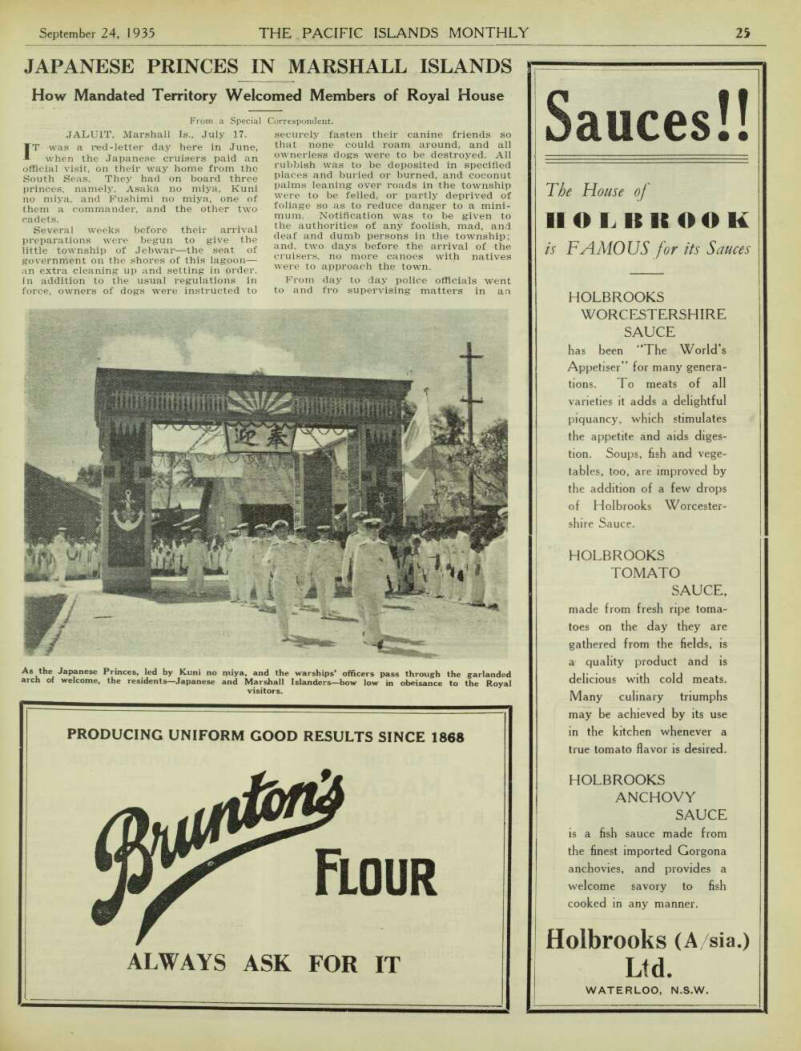
How Mandated Territory Welcomed Members of Royal House
From a Special Correspondent.
JALUIT, Marshall Is., July 17.
IT was a red-letter day here in June, when the Japanese cruisers paid an official visit, on their way home from the South Seas. They had on board three princes, namely, Asaka no miya, Kuni no miya, and Fushimi no miya, one of them a commander, and the other two cadets.
Several weeks before their arrival preparations were begun to give the little township of Jebwar—the seat of government on the shores of this lagoon— an extra cleaning up and setting in order.
In addition to the usual regulations in force, owners of dogs were instructed to
securely fasten their canine friends so that none could roam around, and all ownerless dogs were to be destroyed. All rubbish was to be deposited in specified places and buried or burned, and coconut palms leaning over roads in the township were to be felled, or partly deprived of foliage so as to reduce danger to a mini mum. Notification was to be given to the authorities of any foolish, mad, and deaf and dumb persons in the township; and, two days before the arrival of the cruisers, no more canoes with natives were to approach the town.
From day to day police officials went to and fro supervising matters in an
As the Japanese Princes, led by Kuni no miya, and the warships’ officers pass through the garlanded arch of welcome, the residents—Japanese and Marshall Islanders—bow low in obeisance to the Royal visitors.
energetic endeavour to attain perfection in the preparations for Royalty.
A four-square arch of light lumber was erected on the land end of the principal wharf —the wharf that in the German time belonged to the Jaluit Gesellschaft.
Another arch, a simpler one, was con structed at the head of the path leading to the village playground. There a house of native material was constructed for the Royal party, from which could be witnessed native games arranged for their diversion. A couple of days prior to the great day, the outer surfaces of the arches mentioned above were coated with bright green leaves arranged in scale fashion with appropriate symbolism, greetings, etc., while the inner surfaces were covered with green plaited coconut leaves.
Early in the morning of the ships’ ar rival, a great crowd of Japanese and Islanders assembled along the outer shores of Jebwar, right down to the end of the township facing the passage. All were arrayed in their very best; many were perfumed, also, and most carried small Rising Sun flags. In the distance, in the direction of the rising sun, the expected warships could be seen as they headed for the passage, visible emblems of Japan’s power and might at this, the outermost bounds of the Empire.
As the cruisers entered the passage, the crowds along the shore cried out
“Banzai! Banzai!” again and again. At the same time, brass bands on the vessels struck up some stirring martial air. The big grey cruisers slid into the compara tively calm waters of the lagoon, and came to anchor opposite Jebwar.
At 1 p.m. a siren sounded, and Japanese and natives began to line up at specified places along one side of the wharf, and beside the road leading to the govern ment offices. After some time a party of cadets landed, marched up the wharf, and dispersed. A little later, another group followed suit. Then some coolies swept the sanded track, leaving not a footprint of those who had gone before.
Someone said, “They will soon be here now.”
All were on the qui vive. A few minutes passed, then a speed launch dashed up
to the wharf with the Royal visitors, and other ships’ officers. The party marched up the wharf, with the Princes in the lead. As they passed along, all nearby onlookers bowed low, and did not raise their heads until the party had passed on.
Meantime, not a sound was heard, save a couple of curt words of command.
Subsequently, at the sport grounds, the Royal party witnessed native dancing old style, and a hybrid new.
At night, bright electric lights flashed out words of welcome. A paper lantern procession marched up and down along the lagoon shores, opposite the cruisers, while from on board powerful search lights played to and fro.
On the third morning, to the tune of “Auld Lang Syne,” the cruisers took their departure, amid much flag-waving and cheering, and headed for the Carolines, and then on to Nippon.
Native canoe, Jaluit, Marshall Islands-town of Jebwar in the background.
Advertisements & other items, pp. 27-28 (1 item)
Sauces!!
The House of
no i. n n ook
is FAMOUS for its Sauces
HOLBROOKS
WORCESTERSHIRE
SAUCE
has been "‘The World’s Appetiser” for many generations. To meats of all varieties it adds a delightful piquancy, which stimulates the appetite and aids digestion. Soups, fish and vegetables, too, are improved by the addition of a few drops of Holbrooks Worcestershire Sauce.
HOLBROOKS
TOMATO
SAUCE.
made from fresh ripe tomatoes on the day they are gathered from the fields, is a quality product and is delicious with cold meats.
Many culinary triumphs may be achieved by its use in the kitchen whenever a true tomato flavor is desired.
HOLBROOKS
ANCHOVY
SAUCE
is a fish sauce made from the finest imported Gorgona anchovies, and provides a welcome savory to fish cooked in any manner.
Holbrooks (A/sia.)
Ltd.
WATERLOO, N.S.W.
PRODUCING UNIFORM GOOD RESULTS SINCE 1868
9
Flour
ALWAYS ASK FOR IT
For Pianos, Organs and
all Musical Instruments
STRINGS AND FITTINGS OF
EVERY DESCRIPTION
Sole Agents for the famous
“SENATOR” ACCORDEONS
“ROYAL” MUSICAL STRINGS
Special Attention to Mail Orders
G. H. NAYLOR
133 Castlereagh Street, Sydney
“OUR HANDS MAKE GOOD ARMS”
Firearm Repairs.
Firearms sent C.O.D.
.303 Service Rifle Converted
to a Sporting Model
Write for my new folder— “ Recommended Sporting Reloads for .303 Cartridges”
Reloading Set, 42/6. Bullet Mould, 30 - Primers, per 1000 14/- and 19 - Powder —Amberite, per pound 13/6 Sharpshooter, Dupont No. 17% and *®> all 20/- per pound. Freight extra.
H/ATTTT Gunsmith, Importer of High-grade Firearms and Fishing O-ILi XVI lITLI I Late I Tackle Specialist. •Phone: MA 3540 * AIF - * 143 Elizabeth St., Sydney (near Market St.)
“FISHING TACKLE TO TACKLE FISHING”
With good barrel, 110/-
With new barrel, 160/-
Postage Extra These rifles cannot he imported into Papua or New Guinea
READ THE
B.P. MAGAZINE
SPRING NUMBER
Now on Sale Short Stories Pictures Travel Articles Pages for the Children. Stage.
Latest Fashions Screen One Shilling per Copy ON SALE AT ALL NEWSAGENTS AND BOOKSELLERS BE
Administration
Three ’Planes For N.G.
From Our Own Correspondent.
WAIT, August 10.
AEROPLANE service for admini strative purposes will soon become a commonplace. It is reported that within the last few months three aeroplanes have been imported into the Territory for the Administration, one of which is tc be stationed at Madang, where an aerodrome has already been constructed.
Rev. Father G. McServant, S.M., left Sydney by the Malaita on August 26 for Kieta, Bougainville, after six months leave in Australia. A missionary of the Marist Order, he has spent 25 years in the Vicariate Apostolic of Northern Solo mon Islands, and has been stationed in recent years at Hanahan, on the nort east coast of Buka Island.
Mr. Arthur H. Fletcher, of the Mela nesian Mission, Fauabu, North Mala.
Solomon Islands, returned to the Protec torate at the end of August, after nine months’ furlough in New Zealand. As the Mission’s architect and builder he has served in Melanesia since 1927. Mr.
Fletcher said that the work of erecting a new mission hospital in the Solomons will be commenced at the end of this year.
Advertisements & other items, p. 29 (1 item)
Tropical
flur docli* 8 Special Values in Men’s Wear
Underwear
Men’s Cream all wool Athletic Singlets, sizes 34in. to 42in 2/9 Cream Cashmere all wool Athletic Singlets, sizes 32in. to 40in. 4/6; 42in. and 44in. 4/9.
“Cellnet” (Regd.) Singlets for men, a porous and cool English cotton fabric.
Short sleeves. 34in. to 42in. 3/6; 44in. and 46in. 3/11; 48in. 4/3; 50in. 4/6.
fiercer^
Fancy Cashmere or Art Silk Socks, large range of colors and designs.
Pair 2/6; 3 pairs 7/3.
Fully fashioned fancy English Cashmere Socks, shades of Navy, Grey, Fawn, and Brown Pair 6/6; 3 pairs 19/-.
Men’s Elastic Braces, leather end, Pair 1/6, 1/11, 2/6, 3/6, 4/6, 5/6.
Men’s Leather Belts, lin. with fancy patent buckle .. 1/6, 2/6, 2/11, 3/11, 4/6
Swimming
Costumes
Men’s splendidly made fine elastic all wool rib knit skirted Costumes, Colours of Maroon, Black, Ocean, Royal and Grey. Y back style, 34in. to 40in., 6/6.
Two tone and striped top Costumes for men, skirted style, Maroon and Sun Tan, Royal and Ocean Blue, 34in. and 36in., 10/6; 38in., 11/6; 40in., 12/6.
Ladies’ superior quality “Kossie” (Regd.) Costumes, skirted style, medium or low sunback. Plain colors with band on skirt. 34in. and 36in., 12/6; 38in., 13/6; 40in., 14/6; 42in„ 15/6.
Footwear
Two tone Shoes for men, leather soles and heels. Black and Whit© or Tan and White Calf; Black Patent and White Calf 19/6.
White Canvas Sports Shoes with joint strap and chrome leather or red rubber soles, without heels 13/11.
Tan Calf or White Nubuck Shoes, with heavy red rubber soles 17/6
Pyjamas
Poplin d© Luxe Pyjamas, Blue, Fawn, and Pink stripes, polo or roll collar style.
Sizes S.M., M„ 0.5., and X.O.S. 5/11, 8/11, 10/6, 12/6, 14/6, 16/6, 19/6.
Self coloured Poplin de Lux© Pyjamas with contrasting colours on roll collar and pocket. Blue and Fawn shades.
Sizes S.M., M., and O.S.
Prices 7/6 and 10/6.
We Pay Freight
Write to Desk “C 44”
Hats A Panamas
Special showerproof composition Sun Helmets, leather binding and chin strap, specially ventilated around inside leather, conforms to any shape and ensures perfect fitting. Smart self Puggaree, White or Khaki Drill 18/6 Pocketweight Fur Felt Hats for men, made to fold up; weight 2Jozs., “Snap Brim,” eyeletted 18/6 and 22/6 Genuine South American “Alpine” shape Panamas 12/6 Showerproof “Bangkok” Panamas, Alpine shape, flexible fibre, silk lined. Will not crack. Price 13/6
Shirts
Men’s Golf Shirts in Fawn, Blue, and Grey stripings, Cambric 3/11 and 4/11; Poplin de Luxe 5/11 & 6/11, 7/6, 8/6, 10/6 Natural shade Coat or Tennis Shirts in Silk 8/6, 13/6 Poplin de Luxe Coat Shirts. Grey, Blue, and Fawn stripes 4/6, 5/11, 6/11 Men’s Work Shirts in checked Oxford material, woven design, two flap pockets 4/11 Navy or Khaki Jean Drill 4/6
Trousers
Ready for Service Sturdy Cotton Tweed Work Trousers 5/11, 8/11, 10/6 Men’s Flannel Sports Trousers, Light or Mid Grey and Fawns, 8/11, 10/6, 12/6, 15/6, 21/- Men’s Cream Sports Trousers—Cream Gabardine 10/6, 13/6 Woollen Gabardine 19/6, 21/-, 25/-, 30/- All Ready for Service Sports Suits Servic e f ° r Men’s Grey or Fawn fancy Tweed Sports Suits, single breasted style, three patch pockets, plain back, roll lapels. Sports Trousers. Ready for serv J c e 35/-, 45/-, 50/- Men’s two piece double breasted Flan- ?®L, Sui . ts - Li^ht and Mid Grey shades.
With six button front, sports trousers 45/-, 50/-, 55/-
Overalls
Bib and brace style. Blue Drill 6/3.
Toughite” (Regd.) Blue Drill 11/9.
Khaki Drill 7/11. “Toughite” (Regd.) d D ini 1 / 11/9 - “ Tou Shite” unbleach-
Dressing: Gowns
Fancy Brocade Dressing Gowns for men, roll collar style .. 23/-, 35/-, 40/-, 50/- Woollen Dressing Gowns 27/6, 32/6, 39/6, 45/-, 50/-.
ToweHing Gowns in the new Black and White effects 20/-
Tropical
Suitings
\ ) ■ I
Cool and Comfortable . . .
“BANTAM”
weight Suitings (unlined)
8 /»
TO MEASURE
When the Mercury soars, there is no Suit which offers such cool comfort as a Murdoch “Bantam” weight tropical Worsted Suit to Measure.
In grey stripes, also in grey English Mohair.
Two garments to your .CO /Q /Q measures / O / y Light or Dark Fawn Mixtures, in higher grades, 75/- to £6/6/- White Drill Mess Jackets to measure 24/6 Unshrinkable Khaki Cotton Drill Trousers to measure 16/6
M_U_lt DOCK'S LIMITED. PARK & GEORGE STREETS, SYDNEY
N.G. Mummies
From Our Own Correspondent.
WAU, August 21.
ANE of the preserved mummies found by Dr. Atcherley in the caves near Mapos, inland from Salamaua in the Morobe district, has been forwarded to Rabaul for scientific investigation- The caves are now under the protection of the District Officer, as in their present untouched condition they may prove to be an important field for archaelogical research.
Both Mr. F. E. Williams and Dr. Reo Fortune, two well-known anthropologists in the island of New Guinea are of the opinion that the mummified remains are contemporary w r ith the present natives of the district. These experts emphatically disagree with Professor Raymond Firth, of the London Anthropological Society, who advanced the theory that there might be some connection between the New Guinea mummies and the Egyptians.
Dr. Fortune, who recently returned from the Ramu area, considers the mummifi cation to be due to limestone action.
Too much publicity, he said, has been given to a natural geological phenomenon.
Administrator and Scientist Late Dr
Scientist Late Dr. Schultz of Samoa
From Our Own Correspondent.
"* APIA, August 9.
THE news of the death of the last Ger man Governor of Samoa, Dr. Schultz - Ewerth, recalls the fact that he was not only a distinguished officer of the German Colonial Service, but also a well-known and respected scientist, deeply conversant with culture, laws and customs of the Samoan natives entrusted to his adminis trative care. He had published a number of works dealing with the object of his studies.
Dr. Schultz was specially interested in the preparation of new administrative methods in colonial administration, for which purpose in 1907 there was pub lished in Germany a volume containing the tribal laws of native inhabitants of all the German colonies. This was to serve as a basis for a new system of administration which since has been im proved and introduced in many British colonies by the late Lord Lugard, former Governor of British Nigeria and foremost authority on colonial administration in the British Empire.
The essentials of this new method of administration may be described as fol lows; Preservation of the original cul ture of the natives, participation of the native representatives (chiefs) in the inner administration, training of the natives for self-government by gradual adaptation to changed (Europeanised) cultural conditions, elimination of in stitutions incompatible with European conceptions (torture, ordeals, etc.) Such a self-government, with the hand of Euro pean government felt only indirectly, was actually in existence in Samoa, as Dr.
Schultz stated, “spontaneously, as a logi cal result of local conditions.’’
Though this “indirect rule” of native people has adversaries, it is certain that every native administration should be in possession of a knowledge of the social organisation and tribal laws of the natives in its care. The German Government gathered a wealth of material relating to native laws, and this material was sifted and published by a committee of colonial experts, amongst whom was Dr. Schultz, who, besides being chief editor, also wrote the Samoan portion of the volume, which, as he stated, was actually the firs" collective presentation of Samoan native law. . „ i Dr. Schultz proved himself an ideal Colonial Governor, who, with exemplary performance of his official duties, com bined a deep knowledge of the colony and its inhabitants, their language, history and culture, so that he was able to enrich science with valuable publications.
Miss Dora Simson, who has been work ing in the Melanesian Mission field since 1920, arrived in Australia from the Torgil school, Banks Islands, New Hebrides, at the end of August. After a brief stay on the mainland, she went on to Tasmania to spend her leave with relatives.
Mr W C. Abbie, a well-known figure on the Morobe goldfield; returned to the territory by the Montoro on August //. after receiving medical attention in Aus tralia. He underwent three operations while in Sydney and had recovered splen didly. Having been nine years on the field, Mr. Abbie is now running his own “show” on Merri Creek.
Advertisements & other items, p. 30 (1 item)
Mcilrath’N
RECORDS
-POSTED FREE
SEND FOR LISTS
Australia’s finest Record Shop, specialising in Mail Orders.
Any Records procured and sent same day.
Dozens of clients in the Pacific Islands. We pay freight.
THE TALKERIES
QUEEN VICTORIA BUILDINGS
SYDNEY, AUSTRALIA
FOR QUALITY GOODS AND QUALITY
SERVICE
Buy of
McILRATH’N
r f|ic Soul horn I'ood Slor<*
I.X.L. Best Assorted Jams, 240 z. tins (4 doz.) 10/3 doz. 34/- case Hardman’s Navy Bread, including tins and crates nl , 28/- per lOOlbs.
Finest Roller Flour, 501bs 4/9 bag, 8/3 tin Finest Dressed Rice, 561 b. bags •••;•. o/a ? g Arnott’s “King’s Own” Biscuits, Special Tins . . o f'V Kraft Cheese, Boz. pkls pkt., 8/3 doz.
Rosa Cornflour, 16oz. tins 9d- }m, 8/6 doz.
Australian Cream of Tartar, loose 1/9 lb., ! 20/- doz.
Rosa Custard Powder, 16oz. tins 1/2 tin, 13/6 doz.
Royle Rock Oysters, lOoz. tins I/- tin, 11/6 doz.
Horseshoe Salmon, 16oz. tins l/4 2 tin, 16/- doz.
New Season’s Evap. Apricots, 3-crn. loose lid. lb., 10/6 doz.
Bisto Gravy Maker, 16oz. tins 1/5 tin, 16/- doz.
Rex Pye, 16oz. tins j Z ‘ I.X.L. Tomato Sauce, lOoz. bots 7|d. bot., 7/4 2 doz.
I.X.L. Baked Beans, lOoz. tins 6Jd. tin, 6/- doz.
Special Vintage Dry Sherry, 260 z 2/6 bot., 29/6 doz.
Yoga Tea, Finest Ceylon Blend, per lb. 1/11 pkt., 2/3 tin Prices f.o.b. Sydney
EXPORT PRICE LISTS AVAILABLE ON APPLICATION
McILRATH’S LTD.
Export Department 202 Pitt Street
SYDNEY. AUSTRALIA
Papua
Diet And Native
Health
Dr. Clements’ Researches In Papua
From Our Own Correspondent.
Port Moresby, August 24.
T'kß. F. W. CLEMENTS, on the staff of the School of Public Health and Tropical Medicine at the Sydney Uni versity, who left in June for the Mekeo district, with Mr. K. Clinton, a biological chemist, to make a survey of health conditions as affected by various altitudes in one district in Papua, returned to Port Moresby on August 2, after travelling from the coastlands by Yule Island to the high mountain ranges of the Goilala country at 9,000 ft.
Throughout his journey inland, he made an exhaustive survey of the different health conditions of each group he en countered as affected by diet, altitude, and ruling living and social conditions.
He was impressed by the large numbers of healthy sturdy men and women en countered in the Mekeo district, where apparently there was abundance of food.
On his return to Port Moresby, Dr.
Clements made a medical inspection of the large group of villages near the capital, and the reports of his tests for the various diseases to which natives are prone after contact with European civili sation extending over many years, should be of interest to those making a study of tropical medicines.
The investigators left Papua for Aus tralia by the Macdhui on August 23. Dr.
Clements intends to return next year to make a survey of the health conditions of the Purari Delta, where a large popu lation live along the mud banks of the labyrinth of waterways which form the mouths of the Purari.
Influenza’S Toll On
Ocean Is.
TTEALTH authorities on tiny Ocean -■■■*• Island (situated just below the equa tor, in the south-west of the Gilbert Group, Central Pacific) have been fight ing a mild epidemic of influenza. Up to the beginning of August, 11 deaths had been caused by the germ. Medical officials now have the position in hand.
The steamer Simonside, which arrived at Lyttelton, New Zealand, on September 1, was unable to load phosphates when she reached Ocean Island during the middle of August, because the Islanders and Chinese were too ill to operate the loading gear.
Guinea Again
Jap. Poachers In New
From Our Own Correspondent.
WAU, August 20.
A CCOUNTS continue to reach the mainland that Japanese poachers have returned to New Guinea waters to fish the reefs around the islands of the Admiralty Group. These marauders ap proach in fast vessels carrying wireless.
It is reported that several Japanese landed recently at Anwin and insolently demanded shell from a European, with out payment. They searched his store, but finding no shell, left the island.
Rev. Arthur D. Lelean, Methodist mis sionary at Ra, who has given notable service in Fiji for many years, will return to Australia in April next. He has ac cepted the position of superintendent of the Donald circuit, New South Wales, in succession to Rev. A. Bligh.
Advertisements & other items, pp. 31-32 (1 item)
Foster Clark's
This delicious sweet
-for six people
costs only
10 ld 2 m
FREE RECIPE BOOK
Write to Foster Clark (Australia) Ltd., Dept.
R. 8., 17 Thurlow St., Redfern, N.S.W., enclosing Id. stamp, and Elizabeth Craig’s Recipe Book will he posted free. v> VA
MARBLE GELEE
f oz. gelatine
1 pkt. FOSTER CLARK’S RASPBERRY
JELLY
1 pt. FOSTER CLARK’S LEMON CUS
TARD
Soak gelatine in a little cold water fo 10 minutes. Then drain and pour in tin hot custard made according to instruc tions. Stir well till gelatine is dissolved Make this jelly and allow both custan and jelly to cool. Rinse jelly mould ou with ice-cold water. Place mould it another basin full of cracked ice. Fil alternately with spoonfuls of jelly am custard, but let each layer set slightly before adding the next. Serve turned ou and surrounded with mandarins or witl strawberries. You’ll like it!
Foster Clark's
creamy CUSTARD
«/ FCrt-185
Specialists in
TWINES and
CORDAGE
Cotton-Hemp Jute Plough Reins Halter’s Sewing Twines Fishing Lines And Sash Cords / All Enquiries Invited S' 47 And where Not Represented Agents are Desired Prices on Application kf Fitzroy St., Marrickville, N.S.W.
CABLE ADDRESS;
“BENTLEYSON,” SYDNEY
nWVW 1
o x c ' ’ft* THESE HO\ T 44 LET VOI DOHA ”
No Valves to Grind
Steady Running
A New Buzacott Record <b *r C ° V >
.v-rf’, *^°b.
Robust construction with accessibility the feature of their construction, all PETTER ENGINES, both marine and stationary, give steady running, low operation costs, and are dependable.
No Adjustments
PETTER ENGINES
run at any load without adjustment.
Write for illustrated catalogue. From 4 to 450 B.H.P. s iUIIMt
Extremely Low-running Costs
Extremely easy to start and operate. Spare parts always available.
Diesel & Semi-diesel—Marine & Stationary Moves from Tree to Tree The Buzacott New Record Drag Saw is simple in design and strong in construction. No gears or chains. A one-man Saw that must be useful to you. Four operated by Bulolo Gold Mines, two by New Guinea Administration; Lever Bros, bought one and then six more. Write for particulars.
r Buzacott & C° Limited
7-11 MARKET STREET, SYDNEY
Fetter Engines
for
DEPENDABILITY
Papua’S Dragon
Does the Komodo Really Exist ?
From Our Own Correspondent.
Port Moresby, August 20.
T>EV. OWEN PARRY of the London Missionary Society, Lawes College, Fife Bay, who is an honorary collector of snakes in Papua for Taronga Zoo logical Gardens, Sydney, recently made reference to the presence of the Komodo dragon in Papua. It is understood that he has already made arrangements for a specimen to be brought down to the coast to the government station in the Gulf.
The Komodo dragon, a gigantic monitor lizard; which derives its name from one of several small islands lying between the larger islands of Sumbawa and Flores in the Dutch East Indies, goes by the zoological name of Varanus Kovnodoensis.
Its ancestors are believed to be the originals of the traditional dragon of Chinese art. Early this year a party led by Lord Moyne visited the island of Komodo to secure specimens for the Lon don Zoo. He obtained three, but not of unusual size, though he and his party saw several measuring up to 12 feet in length.
Whether the Komodo dragon seen in Papua belongs to the same species of lizard as that found in Dutch East Indies has not definitely been proved. Few people have seen them, though for many years past reports have been circulated both by white people and natives of their appearance in different parts of the Ter
ritory—on the banks of the Laloki, Kikori, and Oriomo rivers, and on the Mekeo flats. The reptiles are feared greatly by the Koiari around Hombron Bluff and are familiar to the Nara, Kiwi, and Mekeo people who know them by different names (Lorio, Eleraru, and Siai).
It is interesting to note that the de scriptions of these creatures from each widely separated district tally- They appear to measure from 10 to 12 feet in length, their necks are thick and their heads resemble those of the Iguana, the tails are long and thick and taper to a point. They stand on squat bow-legs with wide spread feet and claws about 2 feet from the ground.
The dragons are said to live in trees, from which they attack their quarry (pigs and wallabies), and after killing their victims carry them up into the branches where they devour them. Heaps of bones have been found at the foot of trees both on the banks of the Oriomo river and near Hombron Bluff, where they have been encountered.
On one occasion in 1933, it was stated that one of these reptiles attacked a white man with a number of natives near the Oriomo river, charging them with wide open jaws, and that it took three shots to kill it. The body was carried across to Daru by the natives, where unfortunately before the white man was aware, it was partly eaten and destroyed and no remains could be found.
The arrival of the specimen at Taronga Park, and the scientific report that will follow should establish the fact whether the Komodo dragon exists in Papua or not, for in spite of the frequent reports of its appearance in the territory, it has been generally regarded as one of the myths of Papua.
Death of Mr. J. W. Sharpe
Forty-Four Years In
Cook Is.
From Our Own Correspondent.
RAROTONGA, August 11.
A FORMER manager of the Cook Islands Trading Co., Mr. Joseph William Sharpe, died at Rarotonga on July 28, aged 74. Forty-four years ago he went to Penrhyn in charge of Messrs. Hender son and McFarlane’s store, where he re mained until offered the management of W. H. Grove and Son’s Rarotonga branch, which he later relinquished to take over the C.1.T.C., finally retiring from business in 1916.
Mr. Sharpe, who had not left his plan tation at Titikaveka for 19 years, was little known to the present generation, although his figure was a familiar enough sight to those passing along the Rutaki road. He took a keen interest in political economics, and was very certainly the only man in these islands to have ever bought and studied each successive issue of the N.Z. Govt.’s Hansard.
Nauru’s 1934 Report to League
of Nations
¥ ESS than square miles in area, -■-* Nauru Island, held under League of Nations mandate by Britain, New Zeal and and Australia, is a paradise. It has no public debt, no drunkenness, no maternal mortality, and no woman has been gaoled there for nearly eight years.
These facts are included in the annual report to the Council of the League of Nations on the administration of Nauru by the present Administrator (Comman der R. C. Garsia). The island has a population of 2,677, of whom 1,567 are native Nauruans.
Its imports for 1934 amounted to £98,085, and its sole export—rock phos phates—was worth £470,872. The gen eral revenue was £19,798, to which a trust fund for royalties on the phosphate recovered added £2,703.
Expenditure included £2,010 on native education, £4,106 on health, and £4,658 on public works. There were 58 births during the year. Despite vigorous steps to combat leprosy, three mild cases oc curred. Generally, the health of the in habitants was good.
At the end of 1934, 928 Chinese workers were employed in the phosphate mines, and remittances to relatives in China during the year amounted to £9,886.
Mr. A. Travers Black, Sydney mining engineer, who has had considerable ex perience in New Guinea, left Sydney by the August Montoro for Port Moresby, later to fly across to Wau. During a three months’ stay in the Mandated Ter ritory, he will investigate several areas for an Australian mining syndicate.
Samoa And The
Mau
Late Administrator’s Claims are Challenged
From Our Own Correspondent.
APIA, September 1.
THE former Administrator of Western Samoa, Sir Herbert Hart, on his re turn to New Zealand, granted interviews to various press representatives, in which he described the political and economic conditions of the territory as very satis factory. He claimed that there had been a vast improvement during his admini strative period, which had just found public recognition by an official pro nouncement of the New Zealand Govern ment.
Some of the statements are unfounded in fact and look suspiciously like self advertisement. For instance, Sir Herbert asserts that all trouble with the Samoan Mau ceased 18 months ago. The late Administrator must know that this is not so—as he had ample opportunity to ob serve during his last official malaga through the group. That the Mau, at present, shows no outward signs of activity is solely due to the fact that the Administration wisely left the natives alone and refrained from irritating and provocative measures. That the Mau exists and is strong is shown by a report that at the present moment a collection is being taken up among Mau members for funds, in preparation for the antici pated return of the exiled leader, O. F.
Nelson. It is expected that at the coming New Zealand elections the Labour Party will gain a majority and that the banish ment of Mr. Nelson will be cancelled.
Sir Herbert said that the co-operation of the native Samoans was most notable in the Health Department. Quite apart from the fact that the medical service was better organised and more extensive under Sir Herbert Hart’s predecessors (General Richardson and Colonel Allen), better sanitary and health conditions— especially in regard to the prevalence of yaws—have been brought about by a yaws campaign, made financially possible by the splendid support of the Rocke-
feller Foundation, and partly by the work of the only private medical practitioner in Samoa, Dr- Dawson.
Figures quoted by Sir Herbert show an increase in population from 37,865 in 1926, to 53,087 in 1935 —a natural increase of 40 per cent, in the last nine years. But the latter figure is an estimate based on a count made in connection with the yaws campaign and is, for all practical purposes, valueless. It is believed to be far too high; the actual population, at present, does not exceed 45,000.
It would lead too far to refute the various other statements made by Sir Herbert Hart regarding the financial and economic conditions in Samoa. Planters and merchants are still struggling through difficult times. Produce prices are low, the cocoa crop has so far been a washout, and there is at present a large surplus of bananas, unexportable owing to lack of transport. Sir Herbert Hart has not been sympathetic concern ing the problems of the planters and traders. Not once, during the four years of his administration did he set foot oh a privately-owned European plantation, though posing as an expert on agricul tural matters and passing judgment on the planting industry.
His attitude of indifference was recip rocated by the European community, not to mention the native Samoans. Reports of a newspaper correspondent, connected with the Apia Administration, who de scribed the splendour of farewell func tions given in honour of Sir Herbert and Lady Hart before their departure, caused
some merriment in Apia. As a matter of fact, farewell functions were almost ex clusively attended by the official set, and the paid Samoan officials; while the non official residents, as well as the majority of Samoans, who still belong to the Mau Movement, were conspicuous by their absence.
Advertisements & other items, pp. 33-34 (2 items)
kòkl
Start him right
—and you’ll keep
him right
Start your baby on a course
of SCOTT’S
EMULSION
from the earliest days. Its vitamin-rich cod liver oil and
bone building hypophosphites
are the ideal tonic extra to to every diet natural artificial. & or Ask your doctor. He will agree
that SCOTT’S EMULSION
taken regularly gives your
baby a better chance of steady growth and freedom from infection. It costs so little, but it means so much—to
your baby.
Insist on genuine A
SCOTT’S
Emulsion
For your baby
kòkl
While You Sleep the Remedy Heals
A WELL-PROVEN
REMEDY FOR PILES
This preparation has been on the market for several months, and it has effected a Cure in every case in which it has been tried.
Cases of Long Standing often Cured within One Month, with one bottle only.
For External Use only—Stainless, Painless and Odourless.
PRICE: 3/6 PER BOTTLE. Posted securely packed for 5/- per bottle. Copies of Testimonials forwarded on request..
Read the Report of an Eminent Analytical Chemist:
THE LABORATORY,
20 and 22 Napoleon Street, Sydney, March 14th, 1933.
ROBERT BRUCE, Esq.
Dear Sir, —The formula of your pile cure submitted to me could have no effect other than beneficial. I gave your sample to a Client who had suffered many years, and before he had used half the bottle he reported himself completely cured.
Faithfully yours,
GROVE JOHNSON. F.C.S. (Lend.)
“Honours,” City and Guilds of London Institute.
Analytical and Consulting Chemist.
Supplies obtainable from—
Robert Bruce
Room 7, 2nd Floor,
15 HUNTER STREET, SYDNEY
and also at 14 Upper Bay view St., North Sydney
PAINT .
HORSE SHOE BRAND
IN PASTE OR READY
MIXED FORM
Made in Scotland
fni
WHITE LEAD, WHITE ZINC,
AND ALL COLOURS
—therefore Reliable!
Thomas Mclntyre & Co. Ltd., Glasgow. Scotland
Save time, trouble, temper specify these universally preferred
ROPES, CORDAGES&TWINES
Made by the largest Rope and Cordage manufacturers in Australasia, “Kookooburra” Ropes, Cordages, and Twines are tested to provide that extra endurance, which is only found in “Kookooburrfi*' quality lines.
Specially manufactured for the stresses of tropical conditions.
Other well-known products include Sash Cords, Halters, Plow Reins, Jute and Hemp Seaming Twines.
KOOKOORIIRRA
BRAND
A. FORSYTH & Co. Ltd
s' ~ui A A<irlr»cc> “Rone.” Svdnev
339 KENT ST.
• SYDNEY.
Cable Address: “Rope,” Sydney
¥NNERCLEAN Intestinal Laxative.
*• -A.n Aromatic Herb compound Adjuvant for Constipation. Perfected by Prof. Arnold Ehret. %/% packet. Send Twopenny stamp for sample.
A. SUMMERBELL
••Wyoming," Hunter Street, Sydney
Hen Eggs From Vavau,
Tonga
From left to right: First four are White Leghorn eggs, hens and male bird were imported by Mr. A.
Schulke, of Vavau, from N.Z.; last four are Tongan hens’ eggs of various strains. Weight: No. 1, 3oz. 2 ½ dr.; No. 2,2oz. 5dr.; No. 3, 2 ½ oz. ; No. 4, 2oz.; Tongan eggs: No. 5, loz. 4½ dr.; No. 6, loz. 3dr.; No. 7, loz. 2 ½ dr.; No. 8, loz. Note the peculiar shape of No. 1 White Leghorn egg.
Photo.; W. Finau, Vavau.
Interesting Agricultural Experi
On Papuan Upland
Interesting Agricultural Experi ment in Goilala District
From Our Own Correspondent.
PT. MORESBY, August 22.
AN interesting agricultural experiment at an altitude of 6,000 feet is being carried out in the Central Division by the Papuan Administration. Pear, apple, peach, nectarine and plum trees are being cultivated with apparent success at the Police Camp in the Goilala district, which extends to the western slopes of Mt. Albert Edward. Even grape vines have been planted at the station.
English potatoes thrive well in this district, also vegetables of all kinds ex cepting the cauliflower. In spite of de termined efforts to preserve it the latter refuses to flourish in the tropics even at this altitude.
The Goilala Police Camp has but re cently been established. It is a three days’ journey from the old Kambisi Camp near ivionda and is the furthest outpost in the division.
Application to Cut Kunai Grass
in N. Guinea
From Our Own Correspondent.
WAU, August 22.
A considerable amount of interest has been caused in the Territory by an application from Australia for the right to harvest kunai grass over wide areas.
The Land Ordinance (1922-35) does not yet provide for such grants, but it is reported that the matter is receiving con sideration and that future legislation will make the necessary provisions for suc cessful application.
Gold In The Solomons
OLD in the Solomons! Of course there is. G-g-gold . . . plenty.”
The words gurgled drunkenly in his throat. “Haven’t we seen it, me and Hall, up in the hills near . . . Ugh!”
The exact site of that gold mine re mained unspoken. Even when a man is doped, some mysterious guardian keeps watch over his inmost thoughts. “The Solomons” had been waiting to hear that unspoken word for many years, but the opportunity passed.
“G-g-gold! It’s there, all right!”
His babbling ceased; he slept.
Over the hospital locker, a newly scheduled card told the world at large that Christopher Ackroyd, prospector, aged 32, admitted that very morning with an inflamed foot, occupied the bed. He had, in fact, been operated upon an hour earlier. The ward was very quiet now, save for the sounds that came from out side, the drone of the sea upon the reef and the thrashing of a palm against the wall. The bed opposite was occupied by an old man huddled under the quilt; all the others were empty.
As if to mark his contempt for the silence, the patient Ackroyd suddenly be gan to snore loudly.
His dreams followed the theme of his half unconscious talk . . . Gold, gold, gold . . . While other men had been searching the archipelago for years, Hall and he had been lucky enough to strike it almost at once, high up on the enormous bulk of Domingo, the big island that lies to windward of the group. Hall, the Australian, was a clever prospector; and Ackroyd, with his sound North Country sense, made an able second. Day after
day, up there in the high jungle, w'here an occasional break in the foliage ahead showed them, for below, the sea curving to an upended horizon, they had worked with 'feverish haste.
After the first breathless discovery of a lead, they had followed the vein of pre cious metal till the reef was gradually laid bare. Day after day, they had added to their haul in the little canvas bags which in their optimism they had brought with them from Laguti. That optimism had not been misplaced.
One day, heralded by an unusual burst of profanity, Ackroyd told all and sundry that he had stubbed his toe, and it soon became so painful and swollen that Hall insisted upon his returning to Laguti to see the doctor. With his boy’s help he had managed to get down the hill some how, hired a canoe, and reached the settlement, taking with him their first bag of specimens. The prospector had first confided his secret to Fillis, the banker; and, after seeing the gold locked up in the office safe, had limped up to the doctor’s house and shown him his foot.
A twinge of pain made him wake up to find a nurse looking down at him.
“How do you feel, Mr. Ackroyd.”
“Tip-top,” he answered.
“Any pain?”
“NO--00, nothing to speak of. What an awful smell in here.”
The girl laughed. “It’s the ether, that’s all.”
“Foof! What did he do at the opera tion?”
“Only took your nail off; you’ll soon be better.”
The patient, rubbing a turned-up nose, raised his blue eyes to the nurse, and his rather square tanned face broke into k smile.
“Did I say anything when I was going under?”
“Swearing, do you mean? Oh, no, you were very good.”
“I’m a bit noisy sometimes; I thought I might have disturbed the other patients.”
“There’s only old Charley in that bed over there. He wouldn’t take any notice.”
“Is that the old fellow who’s always hanging round the beach?”
“That’s him, and a regular old nuisance he is when he’s in here —won’t do any thing he’s told. Most of the people in Laguti think he is half-witted —mad about gold.”
“What’s he got to say about it?” asked Ackroyd, naively.
“Oh, he reckons he’s found a gold mine somewhere in the group, and he pesters everyone he meets to buy it.”
“Where does he say he’s found it?”
Ackroyd was becoming interested.
“He doesn’t know, really, and I don’t believe any one else does either. What do you think, Mr. Ackroyd? Is there any gold in the Solomons? They’re always hunting for it.”
But his only answer was a snore. The ether-sodden man had fallen asleep again.
Gold, gold, gold! In his dreams, he saw Hall standing knee-deep in the mountain stream, yelling to him to look at the clean-up . . . Then came the vision of that never-ending journey to Laguti, the slippery hillside track, the vines that caught and tore his hands, and his foot throbbing like the devil , . . The canoe on its way to town, motionless under the peaks of Bougainville, its mat sail hang
ing limp and still . . . The burning heat, the glare of the sea. . . , Outside the trade wind was freshening up, and a clock in the corridor struck eleven. It was just the hour that Fillis, in his private room, was examining Ack royd’s specimens under a glass for the twentieth time, and saying to himself that there would be no more talk about shutting up that branch. “This fellow’s saved the Solomons,” was his unspoken verdict.
Gold, gold, gold! . . . The ether mask, and the face of that fresh young nurse gazing down at him with her serious eyes . . . all woven together in the woof of his dream.
Twelve o’clock.
Low voices coming from behind the screen round Charley’s bed brought him to his waking self. He remembered Char ley quite well. The very day Hall and he had landed at Laguti from Sydney, the old man had come up to them on the waterfront, winking and looking wise, in a senile way, trying to spin some yarn on them about his gold mine. He and Hall had laughed at his tale, and they laughed at it again later on when they found it themselves. Charley, in the hos pital, appeared about as futile as Charley on the beach.
“Now, Charley, you must be good. Keep still!”
The ether surged back into his lungs again, and a sudden blankness descended on him. . . . Then once more he was wide awake, really awake this time—he pinched himself to make sure.
A gust of wind blew the screen curtains across the frame, exposing the bed and its occupant to Ackroyd’s view. The old man was struggling feebly with a cross looking nurse—not his nurse, of course— and a man with his back towards him was sitting on the bed.
“That’s the doctor,” said Ackroyd to himself. “What’s he there for, I wonder?”
He didn’t like that doctor chap; a young fellow with sharp features and black hair, very black —“Sure sign of a villain, that.” He passed his hand over his own fair, curly head. . . . “Don’t like the feller; up to some dirty trick now all right.”
“Tell us about the gold, Charley.” At this remark, Ackroyd’s interest deepened.
“Yes, tell the doctor,” came in a per suasive tone from the nurse.
“I won’t.”
“You won’t get better if you don’t do what the doctor wants you to, Charley.”
“You mean he won’t get out alive,” added the doctor, grimly.
Ackroyd began to get alarmed at the turn the conversation was taking. A duet of bass and contralto snapped across the bed in a running fire of questions, while the old man in tremulous tones defied his tormentors.
“Is the gold on Malaita?” the bass in toned.
“Is it on Bougainville?” echoed the alto.
“It’s on neither. Leave me alone, I tell you!”
The breeze played with the curtains, and finally let them fall in place again, so that the prospector could see no more.
But what he had heard was sufficient.
These two were out to discover the secret of Charley’s gold mine—by now, Ackroyd was ready to believe it really existed —and he gathered that certain papers which were under the old man’s pillow would supply the clue. But Charley appeared to be defending his property: the sound of a scuffle, followed by a stifled shriek, reached him as he lay in bed.
“About time I went over,” thought the young man, and he tried to move his legs, but failed. An attempt to call out was equally unsuccessful. He could do noth ing to assist. As he lay there, amazed at his helplessness, the curtains suddenly
.•swung aside again. What he saw across the ward made Ackroyd’s eyes grow wide with terror.
They had overpowered the old man. He watched the doctor seize his victim by the throat with one hand and stretch it out in a line of grisly flesh, while with the other he produced a razor from under the bed and swept it across the tautened tissues in a long gaping cut. God! The blood . . . the sheets were dripping with it, the floor under the bed flooded in a ■crimson stream.
And then the curtain fell again, shut ting off his view, and leaving him staring at its snowy surface.
He heard the rustle of papers, and an exclamation from the nurse.
“You don’t mean to say he’s sold it?”
“Yes, I do. To Hall and Ackroyd. It’s here in black and white.”
“Ackroyd knows all about it, then?” she whispered.
“Of course, he does; he’ll be the next.”
“Sssh! He’ll hear you!”
“Not he —he’s not out of the anaesthetic yet.”
“We’ll never get it out of him; he’s too ■close.”
“Won’t we? This talks.” Ackroyd imagined him flashing the razor. “If he •doesn’t, there’ll be another death under an anaesthetic, that’s all.”
A significant silence followed, during which Ackroyd made another attempt to move his limbs, without success. It was his own safety that he was concerned about now. . . . Another death under an anaesthetic, and he, Chris Ackroyd, the victim. . . Anaesth ... tic ... tic .. . Gold, gold, gold!
He woke again in a cold sweat, gazed blankly at the screen across the ward, now discreetly drawn, and remembered with a start of horror what lay behind it. He must get out of this at once. This time he succeeded in raising his legs from under the bedclothes, swept them free, and sat up.
There was no one about. Feverishly he fumbled in the locker beside the bed, drew out his clothes and struggled into them.
Carrying his suitcase, he lurched down the empty corridor.
It was the lunch hour: a buzz of talk came from the nurses’ dining room, and a high-pitched voice was holding forth as one having authority. Just as he sneaked by, he heard his own nurse, the pretty probationer, break in in her clear young tones: “Oh, matron, he was sleep ing quite soundly a few minutes ago. I’ll go in as soon as I’ve finished lunch.”
“She doesn’t know what’s been going on in the ward, anyway,” though the ex patient. “I am sure she would have helped me get away.”
Whereat it appears that Chris Ackroyd may have been inoculated with some other dope than ether.
A moment later he was out of earshot, and steering an erratic course for the town.
Strong hands took charge of him at the hotel, and someone asked him why he was back so soon. As he was helped to his room, he heard a woman’s voice answer ing the telephone, “Yes, he’s here, doctor.
Quite all right, but a bit sleepy. I’ll put him to bed and watch him. Let you know if ...” he wondered vaguely whom she was talking about.
The last thing he was aware of was Mrs.
Baker smoothing his pillow and dropping eau-de-Cologne on his forehead. The relief at his escape from the hospital was wonderful . . . Gold, gold, gold . . .
The next morning, feeling very fit after a good breakfast, he went out and sat
down on the verandah. His head had cleared and the memory of Charley’s mur der came back, tinged with doubt. Still, it was too real as yet to be entirely dis regarded. He longed to ask if anyone had heard of it, but his native caution held him back. While he was pondering over it. he suddenly turned in his chair; the doctor chap was looking down at him.
“Good morning, young fellow,” was the medico’s greeting.
Ackroyd, greatly embarrassed, mumbled something in reply.
“Feeling all right to-day?”
“Yes, thanks.”
“What happened to you yesterday?”
Ackroyd looked down unhappily at his boots.
“Got windy, did you?” went on the doc tor.
Ackroyd looked up at last and thtur eyes met. The doctor’s hair was certainly very black, but his face was smiling, and he did not look like a murderer. He decided to be frank.
“Well, doc., I did get windy. It must have been a bad dream I had, I think.”
“What about?” inquired the other with interest.
“That old man in there. 1...er . . .
thought ...”
“That’s the trouble, you shouldn’t try to think after an anaesthetic —but go on.”
“I thought I saw you and the nurse . . . er . . Oh, it was only a dream, but very real to me, then ... I thought you’d cut his throat.”
“Cut his throat! This grows interest ing. What did you see me do, exactly?”
“I saw his neck all stretched out and you brought out your razor and ... I must have been dreaming.”
“Dreaming!” The doctor began to laugh. “What you saw in your dream was the ward sister and I giving him his weekly shave. The old wretch wouldn’t let her do it, and I had to help her. So you thought your turn was coming next, and cleared out before you had your own cut, eh? Great Scott, that’s a good one!”
Ackroyd was laughing with him now.
“What’ll Ido about it, doc.? Shout cham pagne?” .
“Yes, I guess it’s worth it. But wait till I’ve fixed your toe up. And that reminds me, your little friend, Nurse Foster, told me to bring you back dead or alive. She hasn’t finished nursing you yet, she says.
I’m going to drive down presently; are you coming?”
At which message, Christopher Ackroyd blushed for the first time in this story.
G. H. Vernon.
„ „ , . , , „ - „ Mr. A. S. Burton, Islands trayellei foi Messrs. Tooth and Co. Ltd., returned to t a o iia -ew Sia nian tr produ™f, S hTsaW, 5 ' beer imported into Noumea was subject to a duty Of 8 - per dozen bottled; the Dutch Japanese, and Indo-China articles paid only 1/9, he added.
Advertisements & other items, pp. 35-38 (1 item)
West’s Wheel
Works
(F. H. Bishop, Proprietor)
60-64 Bay St., Sydney
MANUFACTURERS
OF ALL TYPES OF WHEELS
FOR WAGGONS, CARTS,
TRAILERS, CARS
SUPPLIERS
OF WHEEL PARTS, RIMS,
SPOKES, AXLES, BOXES, etc.
We have the plant and have been established forty years Write for Information and Quotations
ii
Ruston” and “Lister” Marine Diesel Engines
and Marine Auxiliaries
m
SPECIAL FEAT
Cold Starting, Compression
Ignition, Airless Fuel Injection,
Four Cycle Principle.
LOW FUEL CONSUMPTION
Guaranteed and Maintained • In Sizes up to 650 B.H.P.
Stocks of Representative sizes always on hand, available for immediate delivery Full particulars from RUSTON & HORNSBY (Aust.) PTY., LTD
SYDNEY
P.O. Box 1569 E
MELBOURNE
P.O. Box 4508
BRISBANE
P.O. Box 366 E
Timber Joinery
ETC.
PREPARED BUILDINGS
ready for erection a speciality.
SHIP and BOAT BUILDING
TIMBERS specially catered for
FIBROLITE, PLYWOODS.
GALVANISED IRON,
CANEC.
O CONSIGNMENTS shipped
by RETURN STEAMERS
to the Islands.
John W. Eaton Ltd.
WEST CRESCENT ST.,
NORTH SYDNEY
TELEPHONES: X 5051 (5 lines)
Woven Wire for All Industry
COPRA DRYING TRAYS. FLOORS. Etc.
FRUIT DRYING TRAYS. MINING SCREENS
Heavy Mosquito Gauze in Phosphor Bronze and Other Metals Impervious to Salt Sea Air WIRE DOOR MATS AND GENERAL WIRE WORKS o f: Or £
E. U RIGHT A CO. LTD.
Office and Works: 148-152 Cleveland St., Sydney, N.S.W.
Telegraphic Address: “Wrightmake,” Chippendale.
Scott’s Renown Brand Rope,
Cordage and
Binder
Cable Addreae Ropeyard, Sydney. iSS 9 ■'
Twine
of Every
Description
MANUFACTURED AT
MASCOT, N.S.W.
By
J. Scott Ltd.
Head Office and Store:
163 CLARENCE ST.,
SYDNEY, N.S.W.
PRESCOTT UP SYDNEY
ar-e sole whoLesals ab<snis /d?^
PINEAPPLE BACON & HANS
DAISV BRAND BUTTER
FRESCO BRAND BUTTER
LEA & PERRINS’ SAUCE
Always ..
make sure you have at hand an ample Reserve of these Australia s Choicest Products : Brussels Sprouts White Turnips Sweet Corn Tomato Puree Tomato Sauce Tomato Soup Tutti Fruit Sauce (Worcestershire flavor) Green Peas French Beans Cauliflower Beetroot Spinach Cabbage Carrots Parsnips Celery »i 1
Delicious . .
Garden
Vale
cn m Ready-toserve Vegetables I it
“BAINOL”
WHITE ANT PREVENTIVE
BORER EXTERMINATOR
WOOD PRESERVATIVE
The most scientific preparation on the ( market for the above purposes “BAINOL” is packed in containers to suit any size job, and is sold in quarts, halfgallon, one-gallon and four-gallon tins, and in 45-gallon drums at a reduced rate.
Prices: Quarts 2/11, Gallons 7/11, 4-Gallons £l/«/3, 45 Gallons £.13/4/2.
Australian Currency, F. 0.8., Sydney Sole Manufacturers:
Bains While Ant Exterminator
BW 6462 CO. LTD. LM 1025
Established 40 Years.
Scottish House, 17-19 Bridge St., Sydney lnquiries Regarding Agency Invited.
FEED for . . .
POULTRY
DAIRY COWS
HORSES and DOGS
We ship throughout the Islands our special feeds for all classes of stock.
These feeds offer stock owners the highest value for cost that is obtainable and can be depended upon to give the best results.
Write for free literature.
THORPES LTD.
I Stock & Poultry Feed
I Manufacturers,
313-317 Sussex St., Sydney
Sailor
Search For A Lost
From Our Own Correspondent.
PAPEETE, August 4.
AN incident, which might easily have had a more serious termination, oc curred during the stay of H.M.N.Z.S.
Dunedin at the island of Borabora, Lee ward Group. One of the ship’s petty officers, an ardent mountain climber, found his ambition stirred afresh by the sight of the fantastic peaks which have never yet been scaled and which, as every old timer knows, provide nothing but an extremely treacherous and crumbly foot hold for the unwary mountaineer.
He set out early in the morning and when night came was missing. A search was at once instituted by the natives of the island, assisted by Captain Mourral and men of the French naval schooner Zeelee, which had been sent to Borabora with a message of welcome to Commodore Drummond from His Excellency Governor Sautot. "A party of men from the Dunedin also took part in the search, and the island was flooded by searchlights.
Some 36 hours elapsed, however, before the missing bluejacket was finally located in a crevice from which he was unable to extricate himself, or make any sort of signal which could be observed from the ship. Fortunately his injuries proved to be very slight.
H.M.N.Z.S. Dunedin called in at the island of Tahaa and then proceeded to Moorea where she anchored in Oponohu Bay on August 2. There a lively native party was provided for the officers at the home of Mr. and Mrs. L. Phillips. The Dunedin is expected in Papeete in August 6.
Advertisements & other items, p. 38 (1 item)
Toomeys
TPOHEYS.
LACi?
SURE
TOOMEYS
PILSENER.
Administratorship of Samoa Petition
Samoa Petition for Appointment of Mr. A. C. Turnbull
From Our Own Correspondent.
APIA, Sept. 1.
A MOVEMENT has been started amongst citizens of Apia, to petition the New Zealand Government for the permanent appointment of the present Acting Administrator, Mr. A. C. Turnbull.
Mr. Turnbull during the past few years as Secretary to the Administration has acquired a deserved popularity by his approachable and courteous manner and willingness to assist people struggling through the present difficult times. He is conversant with local conditions and people, and has shown tact and diplomacy in difficult situations. The citizens of Samoa say they would prefer to have a man well known and sympathetic to wards them as Administrator, than to be experimented upon by a new and un known official who would need consider able time to find his feet and get ac quainted with the difficult problems of the territory.
The petition to the New Zealand Gov ernment was exhibited for signature by the citizens at a public place. In order to reach New Zealand before the return of the Prime Minister (Mr. Forbes) it was forwarded there by wireless.
Judge Ayson’s Claim
WRITING in July from Montreal, Canada, Mr. Marc. T. Greene, in a letter to the editor, makes some interest ing comment on the Samoan administra torship. Sent to Samoa a few years ago to study political and economic conditions there, Mr. Greene, who is an active Ameri can newspaper correspondent, proved himself a keen student of Samoan affairs, and his opinions and views on Samoa and its problems received considerable atten tion.
“The possibility of Judge Ayson, Resi dent Commissioner of the Cook Islands, being made the next Administrator of Western Samoa interests me greatly, be cause I have urged it repeatedly and advocated it at Wellington,” he writes. “I do not think it is too much to say that there is not an executive post in the en tire Pacific having to do with adminis tration of native peoples that Judge Ayson is not qualified to fill, and that he would not fill with distinction. If Samoa gets him as successor to General Hart it will be a most excellent thing and cer tainly will continue the progress General Hart has made toward reconciling the situation there.
“It was a great pleasure and a satis faction to read in the June issue of the Pacific Islands Monthly of the honour awarded by the Empire to Brigadier- General H. E. Hart. Since the same honour was paid two of his predecessors though in one of the cases for just what reason it would be difficult to discover—it was logically due General Hart. But what is more to the point, it was due him for the things he has accomplished in Wes tern Samoa under the most trying con ditions. I, therefore, who ought to and do know something about it, subscribe most enthusiastically to your comments on the award of a knighthood, to him.”
Pan-Pipe Music
Primitive Papuan Orchestra
IN a broadcast address through Sydney radio stations on August 22, Mr. Jack Hides, assistant resident magistrate in the Papuan Administration, referred to the charming music he heard from Pan pipes played by natives inhabiting a val ley through which he passed on his long patrol recently. Their instruments, he said, were made from a combination of
short and long reeds from the river banks.
The. expedition enlisted the services of friendly natives as guides for the journey through the river-basin, stated Mr. Hides, and whenever a halt was called for rest ing purposes, the natives played delightful tunes on the pipes. He once heard a band of 200 natives playing in unison and he would never forget the beauty and rhythm of the music. The harmony was perfect.
The notes from one or a few pipes were difficult to catch except at close quarters, but the great orchestra of 200 kept him and his party enthralled until the last note died away.
Advertisements & other items, pp. 39-40 (1 item)
Hyisdyd
SHIP CHANDLERY...
W. Kopsen &V Co. Limited
Manufacturers of PIONEER BRAND ASH OARS AND IMPLEMENT HANDLES.
Sole Agents for: KOPSEN'S SPECIAL YELLOW METAL SHEATHING AND NAILS.
Large Stocks of Chains, Anchors, Manilla and Wire Ropes, Wood and Iron Blocks, Oakum, Tar, Pitch, Oils, Paints, Leads, Zincs, Varnishes, Shackles, Rigging, Screws, Sheathing, Felt, Larapware, etc.
Special Under Bond Prices for Island trade.
68-70 CLARENCE STREET, SYDNEY
Cables: “Kopsen.” ’Phone: BW 1114-5
A YACHT TO BE PROUD OF
... AT A PRICE WITHIN REASON
m
EXPERT BOATBUILDER
AND DESIGNER. . .
ISLAND WORK A
SPECIALITY. . . .
R.M.Y.C. “Hoona” (Vice Com’re Victor Heine) BIN SO Nj 8 School St., Balmain, N.S.W.
m
GODVBOI J.nO AAVN
HYISdYD
' v- * W ■■ J * -•■••. ■..
Ss*"^ 1/7*7
M. HARPER
MANDOLIANA ISLAND,
NORTH GELA, S. I.
Postal Address; P.O. Box 6, Tulagi, Solomon Islands.
Recruiting Contracts Undertaken.
Auxiliary Vessel “Papari” available for Charter.
Full details of Services from
BURNS, PHILP (S.S.) CO., LTD.
Makambo (8.5.1.) and Sydney.
BRITAIN’S PRICELESS CONTRIBUTION TO MAN’S
COMFORT AND HAPPINESS
ROLLS-RAZOR
The Aristocrat of all Safety Razors SOLE AGENTS for Australia and the Islands of the Pacific.
THE ROLLS RAZOR CO. OF AUSTRALIA LTD.
Mendes Chambers, 8a Castlereagh Street, Sydney.
SERVICE. —We have a complete equipment for Repairs in case of accident to your Razor. Blades can be Reset and adjustments made by return mail.
“WYRNWAY” BRAND
SHIRTS, PYJAMAS
UNDERWEAR AND TIES
ARE QUALITY PRODUCTS
WEARNES LIMITED
MANUFACTURERS 17 PARKER ST.. SYDNEY
VICTORY Camp Folding Furniture
The Folding Bed, Open 6ft. Sin. by 2ft. 3in.; when Folded, 36in. by 7in. by 3in.
The Strongest Collapsible Stretc+ier made —will stand the hardest wear.
THE VICTORY CAMP STOOL
useful for all purposes where a strong lightweight Stool is required.
Tents, Tarpaulins, Bedding and Wire Mattresses etc., quoted for.
The Victory Furniture can be supplied through All Burns, Philp & Co.’s Branches Catalogue* available on application Manufactured by: N. M. FOWLER, Elizabeth St., Newtown, Sydney
Gold in North-west New Guinea
From a Special Correspondent.
WEWAK, August 3.
THERE have been no further gold finds recently in the Aitape or Sepik dis tricts. Several prospectors have left the areas with no new additions. A boring plant for a southern company is in opera tion and is making steady progress.
Prospectors have been round the big mountains and still fail to find from whence the gold is shedding. Tests taken on lower areas show very little values. In
some places no gold is found below certain altitudes and on certain falls only. Notice able, too, is that different value gold is found on the same falls adjacent to one another.
Mr. Galet arrived by the last Macdhui with an assistant and gear to prospect further the areas he has pegged on behalf of his company on the Yellow River.
Mr. G. Eichhorn has gone out to prospect an area that he thinks may yet prove valuable. It is in a remote corner many miles away from other finds.
Noticing that Upper Sepiks are quoted at high rates on southern stock exchanges, everyone here has been asking where the “show” is situated. Are there two Sepiks or does the name bear no resemblance to the place? At the time of writing no com pany has been on the Sepik to take over options or is holding claims or leases.
Messrs. Johnstone and Kavanagh have been prospecting the areas between the Sepik mouth and Wewak. Good colours have been found in some places, but nothing yet payable enough to work.
Rarotonga
Polynesian Traveller Revisits Rarotonga
From Our Own Correspondent.
RAROTONGA, August 11. 11/I R. H. H. HEMUS, travelling inspector for Messrs. A. B. Donald and Co.’» wideflung Pacific interests, is paying Rarotonga one of his periodical visits.
Mr. Hemus’s island memories date back 47 years, commencing with his first voyage on the old Countess of Richmond in 1888, when that vessel made a regular six weeks’ trip from Auckland, calling at Tonga, Samoa, Tahiti, and Rarotonga. On that occasion Robert Louis Stevenson came aboard at Samoa and was a guest of the ship’s officers at dinner. In those days A. B. Donald and Co. was knowrn as Donald and Edenburgh, but among the natives it was spoken of as the Taporo Co. on account of being the first to make large purchases of island lemons.
To present residents it seems a far cry to the time when all cargo had to be unloaded in whaleboats and there was only one white woman on Rarotonga.
Glancing at the Union Co.’s extensive waterfront buildings and the gaily dressed crowd which gravitates thither on mail days, it is difficult indeed to believe that such changes have taken place in the short span of 47 years.
N.I. Fruit Industry
THE rehabilitation of the banana grow ing industry in Australia has given rise to serious repercussions in Norfolk Island. N.I. growers had attempted to cater for the depleted mainland market by planting fresh areas. Now that bananas from northern N.S.W. and Queensland have reached such large quantities, the Islanders are finding great difficulty in disposing of surplus produce, since the New Zealand market is shut to them.
The N.S.W. Director of Fruit Culture (Mr. C. G. Savage), who recently inves tigated the N.I. fruit industry on behalf of the Federal Government, said he emphasised to the growers the import ance of choosing the best site for banana and orange plantations. The soil of Nor folk Island was of a rich volcanic nature and excellent crops of juicy, thin-skinned Valencia oranges were being obtained.
Subterranean Caves In
Fiji
Natural Wonders of The Yasawas
I HAVE read with interest various ar ticles in the Pacific Islands Monthly referring to ancient Chinese symbols dis covered in Fiji by Mr. A. J. Vogan, writes Mr. Arthur Robinson, of Natovo Estate, Vanua Levu, Fiji.
The symbols are said to be 3000 years old, and were found in a cave in the Yasawa Group, Northern Fiji. Having been a trader there for 20 years, I know the caves and the peculiar carving very well.
I have a little to add concerning the extraordinary nature of the Yasawas Caves where the carved symbols exist.
The main cave is reached by a passage through limestone, and is apparently a single one, with a straight up and down wall open at the top. The bottom of the cave is filled with crystal clear water close to the entrance, which gradually deepens into a dark blue. On one side is a rock resembling a pulpit. If one swims to the far side of the cave, just near the big rock, under the water is an entrance to a second cave.
One can reach a third cave through an underwater entrance on the far side.
The only way to reach these two caves is by diving down at the side until one sees a faint glow of light in front, and then swims under water a few feet to come up inside the caves. The light is caused by small openings in the roof of the caves.
Once inside the subterranean cave, the entrance hole can plainly be seen.
The first experience of diving into the cave awes the swimmer, and for that reason hundreds have funked the dive under water —I funked it myself for years, but eventually did both dives. Once in side one finds thousands of names and dates chalked on the walls by people who have been there. There are plenty of ledges jutting out to rest on while in the inner caves. I generally used an electric torch to explore the caverns.
Mr. Vogan does not mention whether he examined these under-water caves; probably, like hundreds of others, he would not risk a dive into, darkness. Yet there is plenty of room inside above water to the roof of the caves. There are no carvings on the inside cave walls. Pro bably the people who left their records on the walls of the main cave did not know other caves existed, the entrances to which are under water, through the walls of the main cave where the symbols are situated high up on the straight smooth walls.
Mr. R. J. Winters, consulting geologist, left Sydney on August 27 by the Montoro to inspect and report upon gold-bearing areas at Misima Island, Papua. He will be engaged at Misima until the middle of October, when he will leave for New Guinea to visit the property of Sandy Creek Gold Sluicing Ltd., near Wau. At Sandy Creek he will confer with Mr.
Andrew J. Smeaton, the local represen tative, who was recently appointed a director, and will be on the field when the company’s No. 1 sluicing plant is inaugurated. Mr. Winters, who made some of the original discoveries on the Edie Creek field in the early days, will return to Australia in December.
More Dredging Claims On
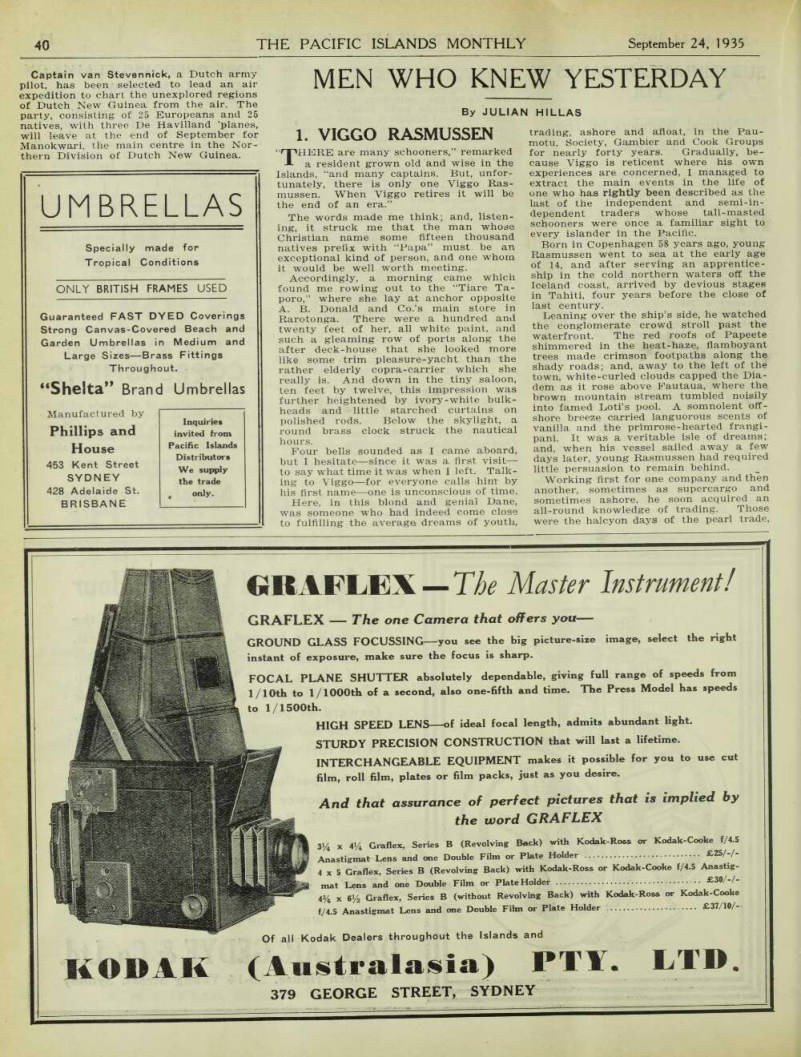
Lakekamu
From Our Own Correspondent.
Port Moresby, August 3.
A further 920 acres have been taken up on the Lakekamu goldfields by Mr.
Peter Radcliffe for gold dredging claims known as Swamp Creek No. 1,2, 3 and 4, situated on Swamp Creek near Casso wary Creek.
Interest in the abandoned claims of the Astrolabe has been revived since the suc cessful venture of Mr. A. Christie. It is reported that among other claims two have been taken up by a resident of Port Moresby, one of which is already under option to a large mining concern.
Mr. F. Whitlock, of Lever’s Pacific Plantations Pty. Ltd., West Bay, Solomon Islands, returned to S.I. by the Malaita from Sydney on August 26.
Captain van Stevennick, a Dutch army pilot, has been selected to lead an air expedition to chart the unexplored regions of Dutch New Guinea from the air. The party, consisting of 25 Europeans and 25 natives, with three De Havilland ’planes, will leave at the end of September for Manokwari, the main centre in the Nor thern Division of Dutch New Guinea.
Advertisements & other items, pp. 41-42 (1 item)
DIESEL Engine
SHIP & GENERAL
COPPERSMITHS
Manufacturers of all kinds of Pipe Work, Petrol, Water, and Buoyancy Tanks for Ships, Yachts, and Motor Boats, Copper Water-jacketed Exhaust Pipes & Silencers a speciality.
Copper Pans and Stills made to specification
Nicholson & Foster
BALMAIN, SYDNEY
5 h.p. for Hd. per Hour
JJ" N every part of the world where the work is hardest, the going heaviest, and an engine is left almost to look after itself; there will be found the Lister Diesel.
Any purchaser of a Lister Diesel can look forward to years of trouble-free service, and the last ounce of power will be got out of the fuel which is put into it.
For full particulars regarding this remedy for all power troubles, write at once to Desk P.M., Box 509 AA G.P.0., Sydney.
DIESEL Engine
WRITE FOR CATALOGUE NO. 53
DANGAR, GEDYE & Co. Ltd.
Malloch House, 10-14 Young Street, Sydney
UMBRELLAS
Specially made for Tropical Conditions
ONLY BRITISH FRAMES USED
Guaranteed FAST DYED Coverings Strong Canvas-Covered Beach and Garden Umbrellas in Medium and Large Sizes —Brass Fittings Throughout.
“Sheila” Brand Umbrellas
Manufactured by
Phillips and
House 453 Kent Street
SYDNEY
428 Adelaide St.
BRISBANE
Inquiries invited from Pacific Islands Distributors We supply the trade , only.
Men Who Knew Yesterday
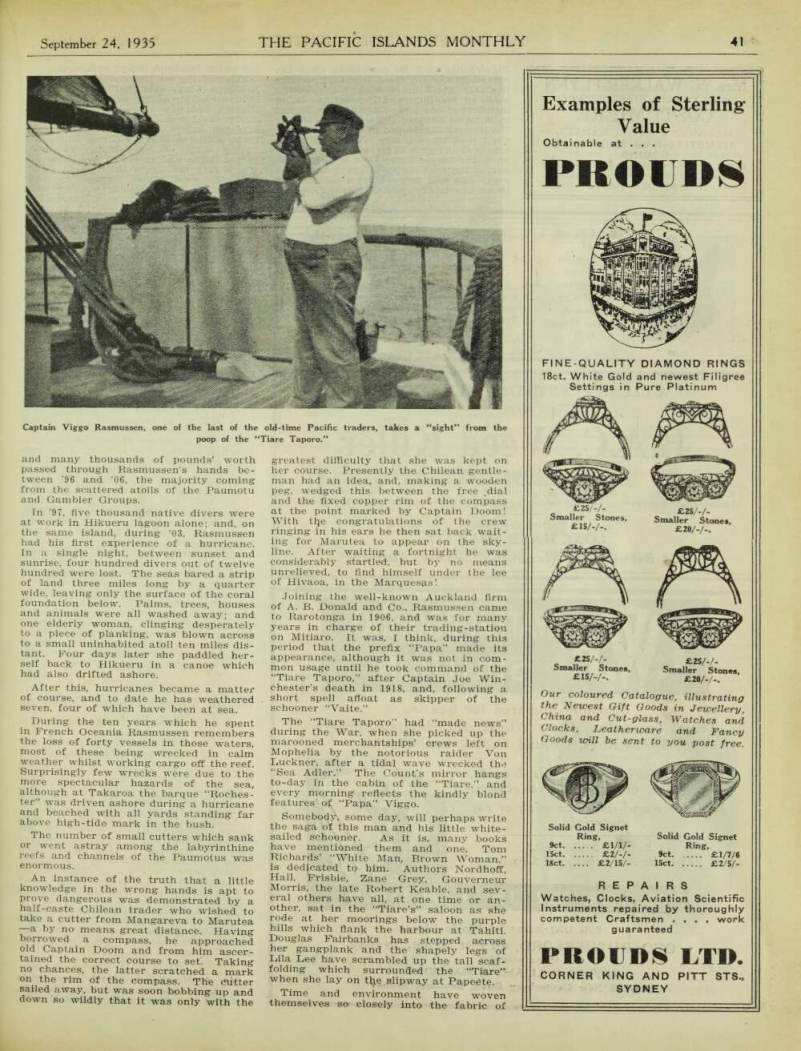
By Julian Hillas
1. Viggo Rasmussen
"T'HERE are many schooners,” remarked JL a resident grown old and wise in the Islands, “and many captains. But, unfor tunately, there is only one Viggo Ras mussen. When Viggo retires it will be the end of an era.”
The words made me think; and, listen ing, it struck me that the man whose Christian name some fifteen thousand natives prefix with “Papa” must be an exceptional kind of person, and one whom it would be well worth meeting.
Accordingly, a morning came which found me rowing out to the “Tiare Ta poro,” where she lay at anchor opposite A. B. Donald and Co.’s main store in Rarotonga. There were a hundred and twenty feet of her, all white paint, and such a gleaming row of ports along the after deck-house that she looked more like some trim pleasure-yacht than the rather elderly copra-carrier which she really is. And down in the tiny saloon, ten feet by twelve, this impression was further heightened by ivory-white bulk heads and little starched curtains on polished rods. Below the skylight, a round brass clock struck the nautical hours.
Four bells sounded as I came aboard, but I hesitate —since it was a first visit — to say what time it was when I left. Talk ing to Viggo—for everyone calls him by his first name—one is unconscious of time.
Here, in this blond and genial Dane, was someone who had indeed come close to fulfilling the average dreams of youth,
trading, ashore and afloat, in the Pau motu, Society, Gambier and Cook Groups for nearly forty years. Gradually, be cause Viggo is reticent where his own experiences are concerned, I managed to extract the main events in the life of one who has rightly been described as the last of the independent and semi-in dependent traders whose tall-masted schooners were once a familiar sight to every islander in the Pacific.
Born in Copenhagen 58 years ago, young Rasmussen went to sea at the early age of 14, and after serving an apprentice ship in the cold northern waters off the Iceland coast, arrived by devious stages in Tahiti, four years before the close of last century.
Leaning over the ship’s side, he watched the conglomerate crowd stroll past the waterfront. The red roofs of Papeete shimmered in the heat-haze, flamboyant trees made crimson footpaths along the shady roads; and, away to the left of the town, white-curled clouds capped the Dia dem as it rose above Fautaua, where the brown mountain stream tumbled noisily into famed Loti’s pool. A somnolent off shore breeze carried languorous scents of vanilla and the primrose-hearted frangi pani. It was a veritable isle of dreams; and, when his vessel sailed away a few days later, young Rasmussen had required little persuasion to remain behind.
Working first for one company and then another, sometimes as supercargo and sometimes ashore, he soon acquired an all-round knowledge of trading. Those were the halcyon days of the pearl trade,
and many thousands of pounds’ worth passed through Rasmussen’s hands be tween ’96 and ’O6, the majority coming from the scattered atolls of the Paumotu and Gambier Groups.
In ’97, five thousand native divers were at work in Hikueru lagoon alone; and, on the same island, during ’O3, Rasmussen had his first experience of a hurricane.
In a single night, between sunset and sunrise, four hundred divers out of twelve hundred were lost. The seas bared a strip of land three miles long by a quarter wide, leaving only the surface of the coral foundation below. Palms, trees, houses and animals were all washed away; and one elderly woman, clinging desperately to a piece of planking, was blown across to a small uninhabited atoll ten miles dis tant. Four days later she paddled her self back to Hikueru in a canoe which had also drifted ashore.
After this, hurricanes became a matter of course, and to date he has weathered seven, four of which have been at sea.
During the ten years which he spent in French Oceania Rasmussen remembers the loss of forty vessels in those waters, most of these being wrecked in calm weather whilst working cargo off the reef.
Surprisingly few wrecks were due to the more spectacular hazards of the sea, although at Takaroa the barque “Roches ter” was driven ashore during a hurricane and beached with all yards standing far above high-tid© mark in the bush.
The number of small cutters which sank or went astray among the labyrinthine reefs and channels of the Paumotus was enormous.
An instance of the truth that a little knowledge in the wrong hands is apt to prove dangerous was demonstrated by a half-caste Chilean trader who wished to take a cutter from Mangareva to Marutea —a by no means great distance. Having borrowed a compass, he approached old Captain Doom and from him ascer tained the correct course to set. Taking no chances, the latter scratched a mark on the rim of the compass. The cutter sailed away, but was soon bobbing up and down so wildly that it was only with the
greatest difficulty that she was kept on her course. Presently the Chilean gentle man had an idea, and, making a wooden peg, wedged this between the free dial and the fixed copper rim of the compass at the point marked by Captain Doom!
With tl}e congratulations of the crew ringing in his ears he then sat back wait ing for Marutea to appear on the sky line. After waiting a fortnight he was considerably startled, but by no means unrelieved, to find himself under the lee of Hivaoa, in the Marquesas!
Joining the well-known Auckland firm of A. B. Donald and Co., Rasmussen came to Rarotonga in 1906, and was for many years in charge of their trading-station on Mitiaro. It was, I think, during this period that the prefix “Papa” made its appearance, although it was not in com mon usage until he took command of the “Tiare Taporo,” after Captain Joe Win chester’s death in 1918, and, following a. short spell afloat as skipper of the schooner “Vaite.”
The “Tiare Taporo” had “made news” during the War, when she picked up the marooned merchantships’ crews left on Mophelia by the notorious raider Von Luckner, after a tidal wave wrecked the “Sea Adler.” The Count’s mirror hangs to-day in the cabin of the “Tiare,” and every morning reflects the kindly blond features' of “Papa” Viggo.
Somebody, some day, will perhaps write the saga of this man and his little white sailed schooner. As it is, many books have mentioned them and one, Tom Richards’ “White Man, Brown Woman,” is dedicated to him. Authors Nordhoff, Hall, Prisbie, Zane Grey, Gouverneur Morris, the late Robert Keable, and sev eral others have all, at one time or an other, sat in the “Tiare’s” saloon as she rode at her moorings below the purple hills which flank the harbour at Tahiti.
Douglas Fairbanks has stepped across her gangplank and the shapely legs of Lila Lee have scrambled up the tall scaf folding which surrounded the “Tiare” when she lay on slip way at Papeete.
Time and environment have woven themselves set closely into the fabric of
Captain Viggo Rasmussen, one of the last of the old-time Pacific traders, takes a “sight” from the poop of the “Tiare Taporo.”
Viggo’s life that he now looks upon the inhabitants of the Cook Islands, and par ticularly those in the remote northern atolls of Manihiki and Penrhyn, as being members of one large family which he has voluntarily adopted. Much concerned by the poverty occasioned in these islands by the fall in copra prices “Papa” Viggo en couraged the girls to go in for hat-making on a far bigger scale than hitherto and, during the past couple of years, has taken away and sold upwards of a thousand of those beautifully plaited white rito hats
for which Manihiki Island is famous.
Commenting on the changes which he has seen, Viggo said that nothing struck him so forcibly as the difference between the old and new types of trader. For merly, these seemed to be almost without exception sailors, so that the Islands weie really a kind of Fiddlers Green, where the ageing souls of sea-captains remained within sight and sound of the ocean on which they had spent their lives. Some of them were rather strange in their methods of book-keeping but, as they always managed to show a substantial profit at the end of the year, I was left to draw my own conclusions regarding the modern genus and the relative values of accountancy and efficiency.
“The colour bar,” said “Papa” Viggo, in answer to a further question, “never existed in those days, just as it does not exist now, either in Tahiti or Rarotonga* among people of real standing. Of course,” and I will not swear that there was not a suspicious twinkle in his eye* “of course, you must remember there were very few white women here then.’ "V iggo himself is married to a Penrhyn islander, and has his home on that lonely 40-miles riband of palm-tufted coral which rings 108 square miles of lagoon, containing some of the best pipi pearl-shell beds in the Southern Pacific.
Rowing ashore again, after a lunca which included fresh eels brought over from Mitiaro in kerosene tins, I turned and looked back at the “Tiare,” with the short rotund figure of her captain sil houetted against the saloon companion way, and I found myself repeating the old resident’s words. “When Viggo retires it will be the end of a definite era.”
It was true. A man may be the last of his kind, and yet not represent any thing of the epoch of which he is part, while another, on relinquishing his activi ties, marks his passing as it were with a full stop.
A new age is dawning in the Islands; the sands of “yesterday” are fast slip ping through the hour-glass of time, and, for better or worse, the glamorous days of romance, of adventure and of kindly leisurely contact with the natives are already numbered.
There will never be another “Papa Viggo born into this era of feverish com mercialism; and, even if there were, I greatly doubt if he would be able to find therein a counterpart of the “Tiare Taporo.”
Advertisements & other items, pp. 42-44 (1 item)
GBAFLJSX —The Master Instrument!
KODAK
GRAFLEX The one Camera that offers you — GROUND GLASS FOCUSSING —you see the big picture-size image, select the right instant of exposure, make sure the focus is sharp.
FOCAL PLANE SHUTTER absolutely dependable, giving full range of speeds from 1/1 Oth to 1/1000th of a second, also one-fifth and time. The Press Model has speeds
to 1/1500th.
HIGH SPEED LENS of ideal focal length, admits abundant light.
STURDY PRECISION CONSTRUCTION that will last a lifetime.
INTERCHANGEABLE EQUIPMENT makes it possible for you to use cut film, roll film, plates or film packs, just as you desire.
And that assurance of perfect pictures that is implied by
the word GRAFLEX
3 i/i x 414 Graflex, Series B (Revolving Back) with Kodak-Ross or Kodak-Cooke f/4.S Anastigmat Lens and one Double Film or Plate Holder £25/-/- 4x5 Graflex, Series B (Revolving Back) with Kodak-Ross or Kodak-Cooke f/4.5 Anastigmat Lens and one Double Film or Plate Holder £3O/-/- 4 3 A x 6V 2 Graflex, Series B (without Revolving Back) with Kodak-Ross or Kodak-Cooke f/4.5 Anastigmat Lens and one Double Film or Plate Holder £37/10/- Of all Kodak Dealers throughout the Islands and
(Australasia) PTA. LTD
379 GEORGE STREET, SYDNEY
Examples of Sterling
Value
Obtainable at . . .
PROUDB
rs a m &
FINE-QUALITY DIAMOND RINGS
18ct. White Gold and newest Filigree Settings in Pure Platinum £25/-/- Smaller Stones,
SIS/-/-.
m&r* £,25/-/- Smaller Stones, £2O/-/.. £ta A £2S/-/- Smaller Stones, £l5/-/-. £25/-/- Smaller Stones, £2O/-/-.
Our coloured Catalogue, illustrating the Nexoest Gift Goods in Jewellery, China and Cut-glass. Watches and Clocks, Leatherware and Fancy Goods will he sent to you post free.
Solid Gold Signet Ring, Set £l/1/- 15ct £2/-/- 18ct £2/15/- Solid Gold Signet Ring, Set £l/7/6 15ct £2/5/-
REPAIRS
Watches, Clocks, Aviation Scientific Instruments repaired by thoroughly competent Craftsmen ... work guaranteed
PROCDS LTD.
CORNER KING AND PITT STS.,
SYDNEY
Mrs. N. WALKER-FLYNN
Late 35 POWELL STREET, COOGEE
COSTUMIERE
MALAGUNA ROAD, RABAUL
HEMSTITCHING AND PICOT
EDGING
Copies of Mab’s Fashions; Roma’s Pictorial Fashions and Home Fashions available.
P.O. Box 116. TeL: 141
Head Study of Champion Walvon Admiration, Challenge Winner, Sydney Royal, 1934
The Noted Walvon Kennels
Premier Breeders of Scottish Terriers, Sealyhams, and Wire-haired Fox Terriers.
Puppies available all the year round. Orders direct to Walvon Kennels, 1 Merlin St., Nth.
Sydney, or through Burns Philp & Coy. Ltd., or Mcllraths, Ltd.
A CLEAN PLANTATION GUARANTEED
WITH
B.A.C. Weed Killer
Used on Malay States Rubber Plantations; approved by British Malay Rubber Institute FOB Sydney. Sold in 4 gallon tins—2 tins to a case. 4/3 per gallon (Australian Currency). In concentrated form. Agents wanted m every group Particulars from:
LONE HAND SOAP CO.
554 Botany Rd., Alexandria, Sydney, Australia
WATERPROOFING
SOLUTION
Specially prepared for treating Tents, Tarpaulins, Cart, Wheat and Haystack Covers, Horse Rugs, Ground Sheets, and Oilskins Free of injurious chemicals & acids, penetrates, binds, and strengthens.
Is flexible and does not stick or rot material.
J. R. CLAY & CO. LTD.,
Agent for Port Moresby and Samarai
MADE I Nl5 COLORS
Sole Distributor for Pacific Islands GEO. RUTHERFORD, 46 Pitt Street, Sydney Manufacturer:
TAYLOR WILLIAMS & HALLIDAY
185-195 New Canterbury Road, Belmoro, Sydney
Sick Furlough
British Consul Leaves Tahiti on Sick Furlough
From Our Own Correspondent.
PAPEETE, August 4.
DR. W. J. WILLIAMS, for many years H.B. Majesty’s Consul at Tahiti, left Papeete for San Francisco by the Maun ganui on July 17 for a few months’ leave of absence on account of ill-health.
At the beginning of the year, Dr. Wil liams contracted a severe chill and in fluenza, which made disastrous inroads upon his strength, so that he has been more or less an invalid ever since. It is satisfactory to learn by wireless that his condition is now improving daily and that we may hope to see him back again fully restored to health.
Mrs. Williams remained in Tahiti to take care of the doctor’s private inter ests; while for the time being the Con sulate is in charge of the Vice-Consul, Mr. S. Russell.
Mr. A. H. Wilson, Chief Surveyor in the Lands Department, Solomon Islands, returned to Tulagi by the August Malaita.
Lively Election Day
Cook Is. Council
• From Our Own Correspondent.
RAROTONGA, August 11.
ON August 7 European residents exer cised their right to vote for a repre sentative on the Cook Islands Council.
Two candidates were nominated, Mr. Bei t Shearman, sitting member, and Mr. Wil liam Mcßirney, one of the oldest white planters in the island. The election, which is only the second contested elec tion since voting was established locally, devolved into a fight between the two largest business groups, supported on the one hand by the official vote and on the other by the non-trading interests.
More than 90 votes were recorded, Mr.
Shearman being returned by a majority of 39. The result was generally antici pated, Mr. Mcßirney having stood largely to infuse a dash of colour into proceed ings which, through lack of public in terest, were in possible danger of ulti mately becoming nominational rather than electoral. In this respect the elec tion was certainly a success, both parties running round in motor cars unearthing septuagenarian voters, and figures seldom seen abroad at any other time were ob served flitting like ghosts in and out of the polling booth.
In a small community such as this, where opinions are all either known or very well suspected, the position of the various religious factions is difficult. One cannot but commend the tactful attitude adopted by both the Catholic and Seventh Day Adventist missions by abstaining from any active part in what might have savoured of political or personal par tisanship.
“McLaren” opossum
Discovery of New Marsupial in St. Matthias Group, N.G.
A NEW species of ring-tailed opossum from New Guinea is intriguing Aus tralian naturalists and scientists. Cap tured in the St. Matthias Group, away to the north-east of the N.G. mainland, specimens were brought to Victoria re cently by Captain G. H. McLaren, a for mer S.D.A. missionary in the Mandated Territory, who presented them to Pro fessor Wood Jones, of the University of Melbourne.
Professor Wood Jones has prepared an official scientific description of the new specimens, naming them after Mr.
McLaren. Two of the specimens are merely carcases, one a male and the other a female, but the third is a lively ball of white fur which has been living deli cately for weeks upon bananas, passion fruit, biscuits, milk, and honey, with occa sionally a tropical papaw or a nibble of apple or carrot. The specimens are the only three in the world outside their na tive home, St. Matthias, whence an attempt is being made to obtain a mate for the little epicure.
The animal is a cuscus, a marsupial similar in some respects to a rare species in tropical Australia, but instead of being grey, with whitish blotches, it is a pure creamy white, with beautiful fur, and a disarming countenance. In some respects it is like a koala, but smaller.
Mr. R. Nettleship, Customs Officer at Salamaua, departed for New Guinea by the Montoro on August 27, after a holi day in Sydney.
Mr. R. A. Kudnig, mining- engineer, left Sydney for the Solomon Islands by the Malaita on August 2G. Having been en gaged by Sheeba Mining Options Ltd., he will look over a new area on Bougain ville Island which has not previously been reported on. The property is said to carry copper and gold in payable quan tities, and Mr. Kudnig will spend six weeks in the Northern Solomons making thorough tests. Sheeba Mining Options Ltd., registered at Canberra in April last, recently acquired from Sheeba Options No Liability their interests in certain properties being investigated in Papua and New Guinea.
Advertisements & other items, pp. 45-46 (1 item)
Batteries
V. H. Jones & Rickard
Electrical Engineers
525 ELIZABETH STREET
SYDNEY
Specialists in rewinding and repairing all classes and sizes of electricaj machines and equipment.
Special treatment given to work for the tropics.
TELEPHONE: MA 1397
lIAISIfiI WEST - - Sydney’s Sailmaker
r *#■ its y*/. 1 ‘
StCTION Uh UUH SAIL LUH
Caters for every class of
SAIL, CANVAS,
ROPE & WIRE
EQUIPMENT
Send your enquiries to us
ADDRESS:
BALMAIN.
SYDNEY
Wilhelm Itreckwoldt & €o.
9, Lange Muehren, South Sea Bldgs.
HAMBURG GERMANY
(Exporters and Importers) We Export: Trade Goods of any description, Cutlery, Hardware, Miners’
Requisites, etc., etc.
We [mport: Any kind of Island Produce.
CORRESPONDENCE INVITED
FOR LONGER LIFE
USE .. .
ERG
BATTERIES
FOR
CARS, TRUCKS, RADIO,
HOUSELIGHTING,
MARINE WORK,
MOTORCYCLES
If not represented in your district write direct to— ERG BATTERIES LTD, 156 goulburn st., Sydney, n.s.w, TO ELECTRICAL ENGINEERS MANUFACTURERS OF QUALITY BATTERIES
A HOSTEL
For Your Children
Tamarang Hostel, situated on the heights of the Lane Cove River in healthy, open surroundings, is the ideal Sydney home for Islands children.
Sunny rooms, ample playground, good food.
All the care and comfort of home.
House Mother: Mrs. G. Allnutt.
Assistant: Miss E. Allnutt.
Write to:
TAMARANG HOSTEL
Penrose Street, Lane Cove Sydney Telephone: J 6722.
Every Picture tells a Story ' pvO YOU FEEL NERVY, irritable and generally out of sorts, back aching, head aching, limbs aching J Or do you experience urinary troubles, getting up at night, or stiff, inflamed muscles or joints ?
These discomforts warn ycu of weak kidney action; they show that poisons are accumulating in the blood instead of being filtered away. Your troubles will soon vanish and the risk of rheumatism, sciatica, lumbago and renal dropsy will disappear, when you have restored the kidneys to health by taking Doan’s Backache Kidney Pills.
Men and women find this special kidney tonic equally effective.
Look Joy the Leaf Trade Mark
Doan's
Backache Kidney
Pills
“Paris Of The Pacific" In Colourful Mood
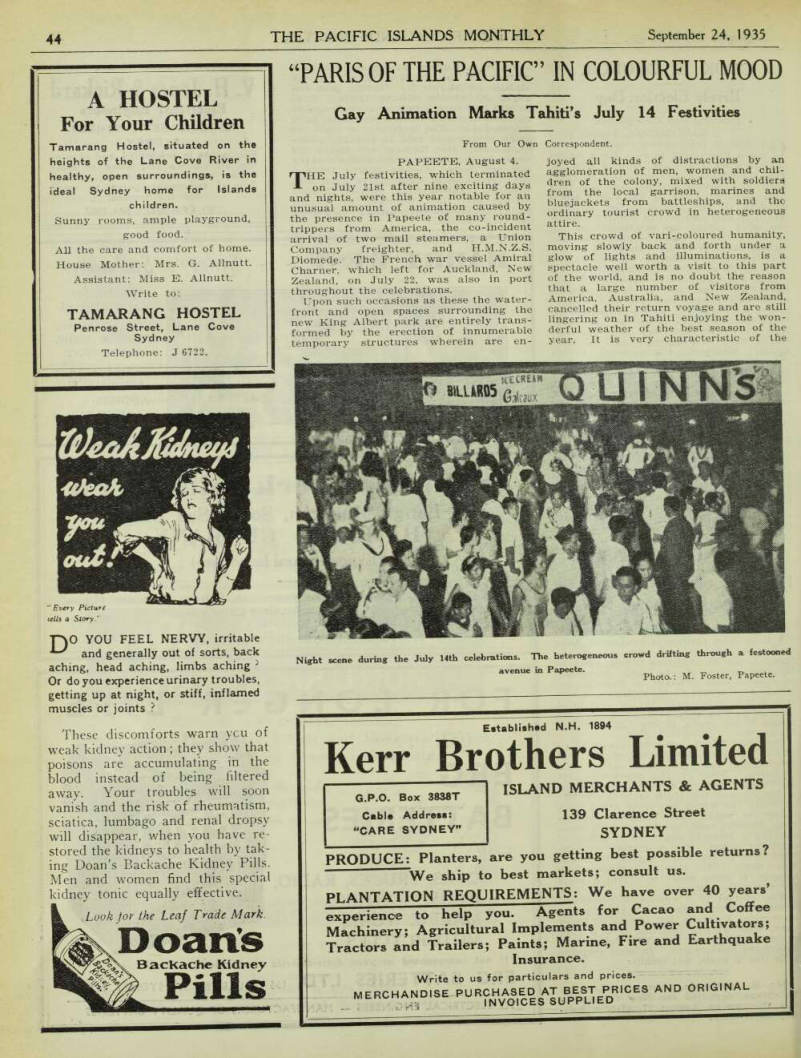
Gay Animation Marks Tahiti’s July 14 Festivities
From Our Own Correspondent.
PAPEETE, August 4. rpRE July festivities, which terminated trippers from America, the co-incident arrival of two mail steamers, a Union Company freighter, and H.M.N.Z.S.
Diomede. The French war vessel Amiral Charner, which left for Auckland, New Zealand on July 22, was also in port throughout the celebrations.
Upon such occasions as these the waterfront and open spaces surrounding the new King Albert park are entirely transformed by the erection of innumerable temporary structures wherein are en-
joyed all kinds of distractions by an agglomeration of men, women and chil attire.
This crowd of vari-coloured humanity, moving slowly back and forth under a glow of lights and illuminations, is a spectacle well worth a visit to this part of the world, and is no doubt the reason that a large number of visitors from America, Australia, and New Zealand, cancelled their return voyage and are still lingering on in Tahiti enjoying the won derful weather of the best season of the year. It is very characteristic of the
Night scene during the July l4th celebrations. The heterogeneous crowd drifting through a festooned avenue in Papeete. photo .. M . Foster , Papeete.
island that, notwithstanding depression in the copra, vanilla, and shell markets, the natives always find the means—how is a standing mystery—to spend lavishly on pleasure during these periods of public enjoyment.
The official side of the celebrations was strengthened on this occasion by the attendance of Captain Cosmo Graham and officers of H.M.N.Z.S. Diomede at the re view held in front of the Post Office, and the ceremony at the monument to the Tahitians who lost their lives in the great war. Both of these functions at tracted a large crowd of the general public, in addition to the detachments of uniformed men, bemedalled officials, and school children who participated. Cap tain Graham placed a wreath on the monument on behalf of the Diomede.
The customary native community sing ing and dancing were carried out, as usual, in front of the Governor’s residence, and these also evoked enthusiasm, and attracted a large crowd. Social events included a ball at Government House on July 14, a ball on board the Amiral Char ner, on July 20, and a reception on the Diomede, also on the 20th. The Diomede was open to local visitors on July 18 and 21, and this privilege was fully taken ad vantage of by Papeete children.
In response to a general disinclination to conclude the festivities at the appointed time of midnight on July 21, Mr. George Bambridge, the Mayor of Papeete, kindly allowed a prolongation till 6 a.m. on the 22nd, when the music finally ceased.
The natives then dispersed .to their various districts with empty pockets but happy, nevertheless, to economise on fish, breadfruit, and other things which can be had without the expenditure of cash.
The proprietors of dance halls, drinking booths, and lotteries commenced to count their gains—and losses —and dismantle their temporary buildings, while Papeete residents, after a visit to the market, retired to their homes to enjoy a well earned rest and recuperate.
Advertisements & other items, p. 46 (1 item)
Kerr Brothers Limited
Established N.H. 1894
G.P.O. Box 3838 T
Cable Address:
“CARE SYDNEY”
ISLAND MERCHANTS & AGENTS
139 Clarence Street
SYDNEY
PRODUCE: Planters, are you getting best possible returns?
We ship to best markets; consult us.
PLANTATION REQUIREMENTS: We have over 40 years’ experience to help you. Agents for Cacao and Coffee Machinery; Agricultural Implements and Power Cultivators; Tractors and Trailers; Paints; Marine, Fire and Earthquake Insurance.
Write to us for particulars and prices.
MERCHANO.SE PUBCHABEC. AT AND ORIGINAL
Papuan Fliers Continue Survey
I^Light-Lieut. Stuart Campbell
and Mr. G. Howden, in the Short Scion seaplane, which was missing for several days in the Fly River district, Papua, resumed in August their work ot making an extensive aerial survey for Orovill© Dredging Ltd., of London.
The disabled machine was towed back to Daru Island by the Papuan Adminis tration’s launch Vailala, and was there fitted with a new engine. Spare parts were also taken on board.
The Royal Australian Air Force South ampton flying boat, under the command of Squadron-Leader Hempel, which went to Campbell’s assistance, was moored at Daru for almost a month, pending the arrival of replacements for a worn en gine. Sent to Thursday Island aboard the Mercur, a new engine was tran shipped there to the launch Goodwill, due to arrive at Daru at the end of August.
The R.A.A.F. boat will later fly to Port Moresby to survey possible landing grounds for an air-mail service between Australia and New Guinea.
Dr. E. T. Brennan, director of public health in the Mandated Territory of New Guinea, arrived in Sydney on August 23 by the Nellore to attend the international conference on Pacific health and medicine held in Sydney on September 3.
Low Returns For Cook Is.
Tomatoes
From Our Own Correspondent.
RAROTONGA, August 11.
T'OMATOES this year have not so far -I- been quite the success hoped for and growers who planted heavily to recoup themselves for losses over orange and banana crops due to the hurricane are highly disappointed at receiving only 1/6 a case “in the shed.” On the previous steamer 2/- was paid, and on the boat before that 3/-.
Dissatisfaction has often been expressed at the wide difference which frequently occurs between the price offered “in the shed” by local fruit buyers and the amounts realised on fruit consigped direct to New Zealand. For instance, when the beach price for tomatoes was 3/-, several growers who consigned their produce got back, after deducting freight and other charges, a net profit of 10/- per case. As has been pointed out, a profit of 200 per cent, for middlemen is excessive. Primary producers seem to “get it in the neck” both ways.
Mr. R. H. Brown, manager of Messrs.
Burns Philp (S.S.) Co. Ltd., Apia, Western Samoa, paid a visit to the company's branch in the Tokelau Islands in August on board H.M.N.Z.S. Leith.
Advertisements & other items, pp. 47-48 (1 item)
Starch
PURE RICE
Always ask for . . .
“CORAL” Brand
100% PURE
CORAL BRAND
rice'starch
CORAL STARCH LTD.
Noted for its
QUALITY
and
WHITENESS
Goes Farthest and gives Lasting Finish
WILL NOT
STICK TO
IRON
Obtainable From Leading Island Stores Manufactured by Coral Starch Ltd.
Sydney, N.S.W.
WE ARE SPECIALISTS!
Let us have your confidence, sixty years is our record of supplying the Leading Houses throughout the World in—
FRESH FRUIT VEGETABLES PRODUCE
WEYMARK & SON LTD.
Fruit and Produce Merchants
14-18 STEAMMILL STREET, SYDNEY
Phones: MA 3612 Cable Address: Codes Bentleys. (4 lines) “Weymarkson” Private.
IS & \
A,.a, s s™ KINKARA tea
£!OOD TEA benefits the health. Science has proved this. As KINKARA is a GOOD tea, it should be used always . . . Morning . . . Noon .. . Night. KINKARA, the Health Tea, calms the nerves; restores energy and banishes mental stress. A cup of KIN- KARA acts like magic. KINKARA Tea is no dearer than ordinary brands. As it is absolutely free of dust, you get nothing but pure tea. KINKARA therefore makes more cups to the pound.
J. R. Love & Co., Ltd., Sydney.
HILL SET
in ANY Weather * \ Available Throughout the Pacific Islands Robert Harper & Co.
LTD.
SYDNEY-
EXCELSIOR SUPPLY CO. LTD
The Most Extensive Manufacturers in the British Empire of . . .
RUBBER STAMPS,
INKS, STENCILS,
MARKING DEVICES,
ACME STAMP PADS
We have a big range of Special
FRUIT CASE MARKING SETS
I We also Manufacture or Supply a complete line of
Spraying Machines
for all purposes.
Let us know your requirements and wo will quote you by return. Ask for our Big Catalogue.
Sole Australasian Distributors of the World Famous SHEAFFER FOUNTAIN
PENS and PENCILS.
EXCELSIOR SUPPLY CO. LTD.
Head Office; 160 GEORGE STREET WEST,
SYDNEY, N.S.W.
The Murder Of
Weaver
A Tale of Papua
By Henry Dexter
THIRTY years ago murder was very much more common than it is to-day in Papua. Then, it was the ambition of every ablebodied native to wear the white feather —the sign that he had killed his man. One could write quite a long list of lonely whites who were found mur dered, or simply disappeared.
But, to-day, each Division has its Resi dent Magistrate, with his Assistant, and his native armed constables.
Of the many murders of whites, I think the one that interested me most was that of Weaver. He lived out on the bank of the Daloki River, and made a living by growing pines, and other fruits and vege tables; and, particularly, by shooting wallabies. As Port Moresby had no cold-storage in those days, the meat found ready sale.
One day, news arrived in Port Moresby that Weaver had been taken by a croco dile. The office of sheriff has since been abolished, but then it was the duty of the sheriff —W. C. Bruce —to investigate such matters.
Sending for his horse, he proceeded— accompanied by his armed police—out to the Laloki. There he was shown some clothes that were recognized as Weaver’s.
These, the local natives said, had been found on the bank of the river; also a pair of boots. There were tracks of booted feet leading down to the river, but none of the wearer having returned.
Every native present was closely ques tioned, and the enquiry closed. Bruce was quite convinced that the man had been taken by a crocodile, whose tracks could be plainly seen along the muddy banks of the river.
Bruce returned to Port Moresby, and made his report.
Some time later, Mrs. Bruce was in a delicate state of health. She spoke to her husband of a nightmare, in which she saw Weaver being clubbed by the natives. This dream recurred night after night, until Bruce —more to satisfy his wife than with any thought of anything being discovered —sent out his shooting boy—Wasagi—with orders to visit the villages round about where Weaver was supposed to have been taken, and to keep his ears open for anything that might be said about the occurrence.
Wasagi carried out his instructions.
After a week’s patrol of the villages, he was one evening under one of the houses, apparently asleep. Close to him came two natives. They held a whispered conver sation, then moved away.
Wasagi stretched, rose, and prepared to leave. When asked if he would not stay the night he said, “No, my talbudda he talk he want me morning time when cockarock sing out” (cock crow).
On his return to Port Moresby, he im mediately told Bruce of the conversation that he had overheard. Bruce reported this to the authorities, and then left with his police for Weaver’s place.
News of his arrival soon ran from vil lage to village, and there was a crowd of natives present. Although Bruce was certain now that Weaver had been mur dered, no trace could be found of the body. If it had been consigned to the river, the chances of recovery were prac tically non-existent —crocodiles would leave no trace.
Among the crowd was a little lad, who approached Bruce and said; “Talbudda, suppose you give me that tomahawk, I show you where Weaver stop.”
Bruce promised him the tomahawk, and the lad led him to a clump of banana trees. Here, under a few inches of soil, they found the body of Weaver. He had been clubbed to death.
Later, certain natives who had been involved in the murder, but who had not actually struck any of the blows that killed Weaver, turned King’s evidence.
One of the reasons for the murder was the fact that Weaver was known by the natives to possess a considerable sum of money in silver.
The actual murderer became a fugitive.
In some colonies —other than British —it is the custom to send out a punitive ex pedition to avenge the murder of a white man. This often leads to the killing of men who were probably miles away when the murder concerned was committed. In Papua, however long it may take, the actual murderer, or murderers, is arrested.
Month after month, the search went on for the wanted man. It transpired, later, that he was given information of the future movements of the patrol by a vil lage policeman. With this assistance, he ■evaded the patrol for a long time.
Why did he not clear out into another district? A “foreign” native in those days would have been quickly speared—in some districts he would have figured in the menu.
At length, he could stand the strain no longer, and came in to Port Moresby, and surrendered. He was tried, pleaded “Guilty,” and was sentenced “to be hanged by the neck in full view of the populace, his body to remain hanging for one hour.”
The execution took place on the flat at Konedobu, about a mile out from Port Moresby.
When Bruce arrived at the place of execution, he found that some well meaning people had screened off the scaf fold with canvas. This, of course, was contrary to the terms of the sentence, and he had the screens removed. A large gathering of natives was present, also Rev. Mr. Lawrence, of the London Mis sionary Society.
Five minutes before the time fixed for the execution Mr. Lawrence asked the condemned man: “In five minutes you will be in the presence of your Maker.
Is there any message of love you desire to leave behind?”
“Yes,” replied the murderer, “I wish the other who were in it with me Avere here also!”
“That is not a message of love, but a message of hate,” replied the missionary. ■“ls there nothing else you Avish to say?”
“Yes. Although it was my son who gave the information, which led to the finding of Weaver’s body, I should like to knoAv that he will be brought up by the Mission.”
“That shall be done,” was the assurance given by the missionary, and the promise AA'as kept.
Advertisements & other items, p. 48 (1 item)
Rheumatism
AND
KIDNEY TROUBLES
DEFINITELY OVERCOME BY “UREX.”
the new scientific remedy which cures by removing the cause. „
RHEUMATISM. LUMBAGO. SCIATICA, NEU-
RITIS. PAINS IN BACK. JOINTS AND LIMBS,
KIDNEY AND BLADDER TROUBLES and all
kindred complaints will vanish like magic before this wonderful remedy.
Neglect is dangerous and will result in a premature decline of your powers, breakdown, and a shortening of life. .
No matter what other remedies you have tried, whether you are seven years of age or seventy, man or woman, “UREX” will relieve you. It “gets right to the spot,” and stops that pain.
Money back if no relief.
Obtainable only from the manufacturer, price 5/6, postage free.
RICHARD’S RELIABLE REMEDIES,
17 Bond Street, Sydney
N.Z. Warships At Apia
From Our Own Correspondent.
APIA, August 14.
August 4 the H.M.N.Z. sloop Leith arrived at Apia, and was followed on the sth by H.M.N.Z.S. Diomede. Officers and men of the warships, many of them on their first visit to the hospitable shores of Samoa, took the opportunity of a few days’ stay here to get acquainted with the country and its inhabitants.
The Diomede left on August 9 for Suva (Fiji) and Auckland, while the Leith de parted on August 10 for the Tokelau Islands, taking the Native Secretary (Mr.
McKay) and an official party for a tour of inspection. The Leith will return to Apia in about 10 days. The Tokelau Is lands are under the administrative care of the Apia Administration.
New Guinea War
Memorial
From Our Own Correspondent.
RABAUL, August 3.
METHODS of raising funds for the erection of the War Memorial Clock Tower were discussed at the annual meeting of the R.S. and S.I.L.A. in Rabaul, when it was pointed out that the balance required was some £4OO.
Already, over £ 300 has been raised and it was resolved that efforts be made to bring the sum to £5OO and then request the Administration to grant a subsidy.
A photograph of the proposed memorial appeared in the January issue of the Pacific Islands Monthly.
Rev. George T. Warren, of the Melane sian Mission School at Maravovo, Guad alcanal, left Sydney for further work in the Solomons by the Malaita on August 26, after a lengthy furlough in England.
He has been a member of the mission since 1913.
Advertisements & other items, pp. 49-50 (1 item)
Paint
The ‘Austral* Auto-Flush Cabinet
The latest in Sanitary Installations for non-sewered areas Approved by the N.S.W. Board of Health.
A Patent Closet that gives you convenience, health, and refinement similar to a w.c. A great advance on anything yet offered.
No water supply required.
Price, £l5 (Aust.), F. 0.8., Sydney Can be installed by any handy man.
Leaflet on application.
INSULAR LAMPS (Sy d.), ltd
42 Market St., SYDNEY
COPRA MATS AND MATTING
Send your enquiries to us for Woven Wire Mesh in Rolls or framed for Copra Drying, and all Screening purposes. Bird Cages, Sieves and Riddles, Builder’s Gravel Screens, Rat Traps, Door Mats, Garden Arches, Chain Wire Mesh, Crimped Wire Mesh for Window Guards, etc.
SCOTT AND SONS
WIREWORKS: RAILWAY PARADE AND MURRAY STREET. MARRICKVILLE
TO, ' € nun !!! fa}?. m y*
RECOMMENDED!
"SUN” Brand Paint on your Home means
definite PROTECTION against tropical
sun and sea-moist air.
Sun Proof and Rain Proof on every Surface
PAINT
W. R. CARPENTER & CO., LTD.
NEW GUINEA, SOLOMON ISLANDS
and all other South Sea Islands.
FIRST-CLASS
WHERE TO STAY IN PORT MORESBY
THE
PAPUA HOTEL
Catering specially for Tourists and Travellers Situated on high ground overlooking both coasts, its Spacious Lounges are always Cool and Comfortable. Tariff: Per Day, 16/-; per week, £5/5/-; per month, £l4; bed and breakfast, 10/-; bedroom only, 7/6.
ACCOMMODATION. Cars meet all steamers.
PARTIES ARRANGED.
Licensee: Papua Hotel, Ltd.
HOTEL MORESBY NEARTHE
WHARF
COMFORTABLE
ACCOMMODATION
ONLY THE BEST
BRANDS OF
WINES, SPIRITS
AND BEERS
IN STOCK
LICENSEE:
Hotel Moresby
Ltd.
ffililWMM
COSMOPOLITAN
HOTEL
Samarai
First-class Accommodation for Tourists and Travellers Ball-room; Electric Light; Billiards; Freezing-works; Cold Store. Best brands of Wines, Spirits, Ales.
MODERATE TARIFF
Fishing Trips and Launch Excursions arranged IdofinßPA • E- .1 Mnrrnw
TAHITI
AND
French Oceania
RECENTLY PUBLISHED
This book, by Samuel Russell, has just been published. It is a valuable work of reference, insofar as it gives, in relation to Tahiti and French Oceania, complete details of administration, commerce, sport, tourist resorts, industries, excursions, hotels, immigration and land laws, etc.
Yachtsmen and fishermen, who are visiting Tahiti in increasing numbers, will find this a most useful handbook.
It also supplies a fascinating account of life in Tahiti—one of the most delightful places of residence in the world.
Copies from; S. RUSSELL, Papeete, Tahiti.
ANY SYDNEY BOOK STORE.
Pacific Publications Ltd.,
247 George Street, Sydney
Price in Australia (posted): Cloth bound, 6/- ; paper-cover, 5/-.
HOTEL BULOLO
WAU, T.N.G.
Picturesquely situated, overlooking the Wau Aerodrome, at the Business centre of the Morobe Goldfields.
FIRST-CLASS CUISINE—3O com-
fortable Bed-rooms —Hot and Cold Showers—Fresh Fruit, Vegetables, and Dairy Produce from the Hotel Gardens, The Hotel Bulolo is famous for its wide, cool verandah-lounge.
Only the Best Brands of Wine*, Spirits, and Beers in stock.
SAMARAI HOTEL
The Rendezvous of the Miners of Eastern Papua.
Comfortable Accommodation for Tourists, Travellers and Residents. Best Brands of Spirits and Wines —Victorian Lager Beers.
FISHING EXCURSIONS ARRANGED
Licensee: Mrs. L. M. SKELLY.
HOTEL HA HALL
COOL AND SPACIOUS LOUNGES - COMFORTABLE
ROOMS - DINNER PARTIES SPECIALLY ARRANGED
Excellent Dance Floor and Music. - :
Wk, ...cA
Under the Personal Management of Mrs. H. Luxmoore
Chimbu Valley
N.G. Patrols are Gradually Bringing Inland People Under Control
From Our Own Correspondent.
WAU, August 11.
A great deal of patrol work has been carried out in recent months in the Chimbu Valley, where two missionaries were murdered last December, and also across the Bismarck Ranges and into the Ramu watershed where the natives are more or less in contact with the Chimbu people.
The Chimbu Valley is still over-run by fierce fighting tribes constantly at war with one another. Inter-tribal fights occur at times within easy reach of the Chimbu-Waghi Police Post, but as patrols push forward with steady persistence from the base camps and posts, the natives are gradually coming under control.
Some of the primitive people give willing assistance to the maintenance of station gardens and transport. There appears to be little or no animosity shown to the missionaries established in the district, and the natives are rapidly acquiring “pidgin” English.
Communications still depend on aero plane transport, but a safe land route.is being established from the Benna Benna post, which has been re-opened. Work is now in progress to make a safe route between the Chimbu and Ramu posts, via Finintegu and Benna Benna. The Ramu post is on the route to Madang,
of Wanderings in Papua
New Travel Book
American Movieman Writes of Wanderings in Papua
[yiß. GEORGE C. DROMGOLD, one of the leaders of the Shackleford- Dromgold expedition which visited Papua last year, writes interestingly to the editor from California under date July 26. ‘‘l am in complete sympathy with James Norman Hall’s article in a recent issue of the Pacific Islands Monthly in which he suggests the preservation of recently discovered stone age tribes in Central New Guinea,” he writes. “An excellent idea this, but I sadly fear the fulfilment of Hall’s ideals will never come to pass.
The three ‘M’s’ will eventually soften up these interesting, primitive people as they have in other remote parts of the big island, “Within the next few weeks I will have finished writing a book-length narrative of the Shackelford and Dromgold moving picture expedition in Papua. The book will be illustrated with approximately one hundred selected photographs made dur ing our wanderings in Papua. Travel books as a rule are deadly, heavy reading, for it seems that nearly everyone has written one. With this in mind, I have endeavoured to keep my narrative light and humorous in the manner of ‘Life and Laughter Midst the Cannibals,’ by Major C. W. Collinson.
“Speaking of Collinson reminds me that only recently I read in the pages of your magazine that his close friend, E. H.
Pybus, passed away in the Solomons. At the time I read this notice I could not
help but wonder if his favourite dish, ‘The Governor’s Joy,’ had something to do with his sudden demise. He was in variably ill after partaking of this original dish, yet he continued to eat it despite the unpleasant consequences.
“I thoroughly enjoyed Samuel Russell’s book on Tahiti and French Oceania. It is very compact and yet answers all questions regarding the Society group in the most reliable manner. Russell is an old-timer in eastern Polynesia and is one of the few white men who speak the Tahitian language perfectly.
“I have just received a very cordial letter from W. T. Wells, Secretary of the Australian Museum, granting me permis sion to use certain material from an article on Motuan Tattooing by R. V. Old ham, of Port Moresby. This interesting article recently appeared in the Museum Magazine.”
Port Moresby
Three Warships to Visit Port Moresby
From Our Own Correspondent.
Port Moresby, August 21.
XJ.M.A.S. CANBERRA, the flagship of the Australian Naval Squadron, will visit Port Moresby on September 15, leaving on the 20th for Rabaul, New Guinea. On her return trip to Australia, she will call in at Samarai, remaining there from October 2 to October 5.
The destroyer Stuart also arrives on September 19, leaving again for Australia on September 21, the same day that the French sloop Amiral Charner puts in at Port Moresby on a cruise through the Pacific. The Amiral Charner will leave Port Moresby on September 23.
Advertisements & other items, p. 51 (1 item)
clone
■ -i; n
SAFE
r.
SR V m T *#• % ,-"T ip* •v"' //W SS w PC
The “Cyclone” RING-LOCK
• ••that no beast can break
The “Cyclone” Ringlock joint is not only proof against breakage by stock—it is proof, too, against breakage by handling, or erection, or wear, or weather. And, in addition, so useful is this joint that it enables a “Cyclone” Fence to follow the sharpest rise or dip of the ground without buckling or twisting the fence.
clone
CYCLONE FENCE CATE C°P"U»
The Grace Building, 77 York St., Sydney And at Melbourne and Adelaide Please send me by return mail your free, illustrated and priced Catalogue of Cyclone Metal uates and King-lock Fences, and comparison of costs.
Name Address P.1.9
Goldfields
Fresh Meat For Morobe
From Our Own Correspondent.
WAU, August 14- \ N application has been lodged with the New Guinea Administration for an extensive pastoral lease of approxi mately 3,000 hectares (nearly 7,500 acres) near Baiune Creek, Morobe district.
Keen interest is being taken in this enterprise w’hich, it is hoped, will provide the goldfields nearby with continual sup plies of fresh food in the near future.
Late Mr. H. S. Griffin
Letter to the Editor T notice in the July number, under the heading of “Samoa’s Troubles,” a letter from a London correspondent in praise of Mr. H. S. Griffin.
Harry Griffin was a pal of mine and one for whom I have always had the highest respect. On account of his know ledge of the Samoan language, he was appointed secretary of Native Affairs, under General Sir George Richardson.
This position is a most important one-
The official is in close contact with the natives, and is the go-between them and the Administrator. It appeared to me that Griffin was inclined to give way too much to the Administrator on matters which were likely to cause unrest. As a master-printer, employed by the London Missionary Society, he lived most of his time while in Samoa at the L.M.S. Col lege, Malua, where one meets natives on their best behaviour. Although both Mr. and Mrs. Griffin had mastered the Samoan language, they would not be acquainted with the Samoans and their intrigues, or know their real character to the same extent as the traders.
Griffin was secretary of Native Affairs when the trouble in Samoa started, and was the Administrator’s adviser. It therefore was Mr. Griffin’s duty to oppose strongly any administrative legis lation that was likely to cause unrest.
Griffin was a man of big stature and of fine personality, but he was not strong enough to oppose Richardson- The natives right up to-day, blame Griffin, for a lot of the trouble, because he per mitted the official mind to over-rule his judgment. He informed me once that on several occasions he did protest, but all his protests were over-ruled.
Griffin was a kindly-disposed gentle man, with a pleasing personality, and liberal-minded, despite his missionary environment. I could never understand his persecution of the high chief, Tama sese, who some years later perished, with a number of other Samoans, in the tragedy of December 29, 1929.
I am, etc.,
G.E.L.W.
Apia, Samoa, 20/8/35.
American Lumber Strike
Affects Tahiti
From Our Own Correspondent.
PAPEETE, August 4.
OWING to the recent strike of lumber workers on the Pacific Coast and the consequent closing down of the lumber yards, the Union Company’s freighter Hauraki arrived on July 16 without her usual cargo of lumber.
Several new buildings now in course of construction in Papeete, notably those belonging to Mr. Charles Browne on the S.C.O. block, are held up on account of the severe shortage of lumber in the town. It is expected that the situation will be relieved on August 26, when the freighter Sheafholm is scheduled to arrive.
Rev. J. W. Burton, M.A., general sec retary of the Methodist Missionary Society of Australasia, arrived back in Sydney in the middle of August from a visit to Western Samoa and Fiji.
Advertisements & other items, p. 52 (1 item)
Gold
AUSTRALIA'S CLEARING HOUSE FOR THE PRECIOUS METALS.
BUYERS OF
OSMIRIDIUM, PLATINUM, SILVER, &c.
GARRETT & DAVIDSON, LTD.
ASSAYERS, BULLION MERCHANTS, METALLURGISTS,
Bank of N.S.W. Buildings, Regent Street, Sydney
BURNS PHILP
(South Sea) Co. Ltd.
Island Traders & Shipowners
Registered Office: Suva, Fiji.
Also Branches at Fiji: Levuka, Lautoka, Labasa, Ba, Sigatoka, Rotuma.
Tonga: Nukualofa, Haapai, Vavau.
Samoa: Apia, Pago Pago (America Samoa).
Solomons: Makambo, Gizo, Faisi.
New Hebrides: Vila.
Gilberts: Tarawa.
Norfolk Is. Nauru. Niue. Wallis Is. Futuna Is.
Code Address: “Burnsouth.”
m BULLIVANTS wire ropes
“THE WORLD’S STANDARD”
LARGEST STOCKS IN AUSTRALASIA - FOR ALL PURPOSES Also Blocks, Hooks, Shackles, Thimbles, Strand, Seizing, Aircraft Cord, etc.
Letters: BULLIVANTS’ Australian Co. Ltd. Tei.gram.:
Box 1298 J, G.P.O.
331-333 KENT STREET, SYDNEY
Prompt Attention! Efficient Service!! Complete Satisfaction!!!
“Bullivants Ltd./ Sydney.
Papua
A Pioneer Of
Death of Mr. John MacDonald
From Our Own Correspondent.
Port Moresby, August 19.
THE death occurred in the European A Hospital on August 10 of Mr. John MacDonald, retired public servant, and one of the oldest and most respected resi dents in Papua.
The late John MacDonald was born in Aberdeen Shire, Scotland, in 1862. He was educated at Madras College, St. Andrew’s, and served his apprenticeship as a ship wright with George Bruce and Co. in Glasgow.
In 1883, he arrived in Australia and settled in Brisbane as a builder and con tractor, joining up with the Queensland Marine Defence Naval Brigade, through which eventually in 1893 he became at tached as Warrant Officer-Instructor, under Sir William MacGregor, for the Nordenfeldt gun, on the government ves sel Merrie England, employed for patrol work in what was then known as British New Guinea.
After several years’ service on the Merrie England, Mr. MacDonald was ap pointed in 1897 as Head Gaoler and Over seer to the Possession and was made a Justice of the Peace. Later, as Superin tendent, he entered the Department of Public Works and in 1923 after 30 years’ service, retired from the public service on superannuation. Since his retirement, Mr- MacDonald lived in Port Moresby,
except for short periods in Australia.
John MacDonald was twice married; his first marriage took place in Brisbane in 1885 to Miss M. McLeod, of Edinburgh, and there were six children, all of whom predeceased their parents. The second marriage to Mrs. E. Todd, took place in Brisbane in 1933, eight years after the death of his first wife.
The funeral on August 11 at Konidobu cemetery was attended by a large gather ing of residents, including His Excellency Sir Hubert Murray (the Lieut.-Governor), chiefs of all Government departments and members of the Masonic Lodge. Rev. D.
E. Ure, of the Ela Protestant Church read the burial service.
Mr. Ure remarked in a short closing speech that it was fitting, perhaps, that the deceased should be laid to rest in the country in which he had served so many years of his life- John MacDonald was one of Papua’s true pioneers; he had done much for his country and what he had done had been of immense value to both Europeans and natives alike.
N.G. Gold Co.’S Escape
High Taxation
From Our Own Correspondent.
WAU, August 22. goldmining companies operating in A New Guinea are fortunate when one compares their advantages to other gold mining companies in South Africa. In the latter country, goldmining leases on government lands are granted subject to the Union Government participating in the profits—in one case, 54 per cent, of working profits being absorbed in this direction, and in income tax and excess profits tax.
In New Guinea, taxation is very low, and shareholders are to be congratulated on the advantages they consequently gain in this part of the world.
Advertisements & other items, p. 53 (1 item)
Fairbanks
FOUR-COLOUR LITHOGRAPH
The Newest and Most
Informative
MAP of
The Goldfields Areas
Papua and New Guinea
With geological notes, gold occurrences and topographical features clearly shown Copyright by J. NASON-JONES,
F.G.S., F.R.G.S.
On sale at Bums, Philp & Co., Ltd., Port Moresby; “Papuan Courier”
Office, Port Moresby; H. E. C. Robinson & Co., Ltd., Sydney *
Paper 307-
Cloth 37/6
or direct from J. Nason-Jones, at Bulldog, Lakekamu Goldfields, Papua.
10 HORSEPOWER MARINE ENGINE, as illustrated, £224 (F.O.B., Sydney)
Fairbanks
Morse
Model 36
Diesel Engines
10 to 160 Horsepower Buy from the Manufacturers and get the Benefit of their EXPERIENCE
STOCKS HELD SPARE PARTS
IN BOND IN ALWAYS
SYDNEY AVAILABLE
Fairbanks, Morse Co.
(AUST.) LTD.
Box 2672EE, G.P.O.,
SYDNEY
Alligators On The Bhamu,
Western Papua
THE Bhamu is one of the numerous rivers of Western Papua and has little to recommend it as a home for even the most primitive of mankind. It ap pears, however, to be a paradise for alligators.
The annual loss of life there, caused by the saurians, is remarkably high. One can only conclude that either the num ber of reptiles in the river is abnormal or that the Bhamu-ites are very fond of bathing. Local officials at Daru do not incline to this latter theory.
A magistrate who recently visited the Bhamu was horrified to hear of the num ber of natives reported missing. Half
the male population presented honour able wounds, either the result of argu ments over the fair sex, or encounters with alligators. Life must be one long thrill on the Bhamu. At one village a constable with his right arm missing did the honours. At the next, the headman had lost his left! Both had been mauled by alligators.
The latest victim was brought into Daru hospital recently for treatment. He had been caught in the river, but got away with the loss of half of the top joint of his middle left finger. He had the nerve to say that the alligator was a full-sized one, though it had a very small “bite”!
Now what was the croc, thinking of, to let the rest of his meal put one over him like that? Do you think he had been chewing Betel Nut? —G.H.V.
Native Education Plan
for N. Guinea What Has Become of It?
Letter to the Editor WHAT has become of the native education plan which Brig.-General T. Griffiths drew up, during the latter period of his term as Administrator of New Guinea?
This very wise and far-seeing man— who, in the opinion of this writer, was driven out of Rabaul by Canberra’s petty and stupid interference with his work — realised that the future of New Guinea will be affected in a major degree by the way in which the natives are educated and trained. His sense of order was of fended by the present haphazard system, under which the education of the native children in controlled areas seems to be the official responsibility of no one.
I know that General Griffiths gave a great deal of tireless study to this prob lem, and that he devoted long periods to consultations with officials and with the heads of the mission organisations.
As a result of all this, he evolved what seemed to be a quite practicable scheme, under which native education should be the joint responsibility of the Admini stration and of the mission bodies, acting in co-operation.
There were many minor difficulties to be smoothed out; but I am convinced that the principle of the plan was sound, and that it could have been economically and efficiently operated. The missionaries would have received fair official recog nition; their educational activities would have been under official supervision; and the vitally important work of giving some kind of education to natives, and thus equipping them for their contact with European civilisation, would have gone on in an orderly manner.
I do not think I am exaggerating when I say that officialdom drove General Griffiths out of the Territory, just at a time when his clear vision, tireless in dustry and hatred of red tape were vitally necessary to the Territory’s future. This education matter is a case in point.
I am, etc-,
S.D.
Sydney, September 3, 1935.
Solomon Is.
Map Of Vella Lavella,
Letter to the Editor.
IN a recent issue, there was published a paragraph appreciating the work of an official in mapping the island of Vella Lavella, S I. The writer hinted that it would be a good idea if this information were made available to the public.
I recently saw the latest chart of Vella Lavella, which embodies the results of the survey referred to, with, in addition, reefs indicated, and which will undoubtedly be of great value to navigators in that region. Evidently the authorities, always on the alert to have their charts up-to date, have anticipated your correspon dent’s hint.
I am, etc.,
Navis.
Tulagi, S.L August 8, 1935.
Advertisements & other items, p. 54 (1 item)
Making Equipment
FAST AUXILIARY KETCHES
AT ONE-THIRD OF SYDNEY PRICES
Offers are invited from anyone wishing to purchase a first-class ocean going ketch. There are eight to be selected from, ranging in size from 13 to over 20 tons, at prices from £350 to £1,300, the largest being a new boat still on the slips.
Apply—
V. R. KEPERT, Pearler, DARWIN, N.A.
SHIP CHANDLERY - HARDWARE
BROOMFIELDS LIMITED, 152 Sussex St., SYDNEY
Large and Complete Slocks of SHIP CHANDLERY, Ironmongery of all kinds—Paints, Whitc Lead and Oils.
Sole Agents for: P. H. MUNTZ & CO.’S 3-CROWN BRAND METAL SHEATHING.
PEACOCK & BUCHANS’ ENGLISH READY-MIXED PAINTS.
WRITE FOR SHIP CHANDLERY CATALOGUE
Special “In Bond” Prices for all Island enquiries quoted on application
CABLES: “BOOM,” SYDNEY
MINING AND ROAD-
MAKING EQUIPMENT
Manufactured by the
GARDNER - DENVER CO.
Equipment with outstanding qualities. Rugged and strong Long life under toughest conditions There is 50 years’ development and experience behind the present modem designs.
GARDNER-DENVER
AUTOMATIC STOPER,
MODEL 77H
A heavy duty type, automatically rotated for wet construction with direct or reverse air feed. Balanced throttle valve.
Rifle bar rotation. Easily handled.
Write for full information of Gardner-Denver Products
GARDNER-DENVER
HAND-HELD DRILL,
MODEL 555
A medium weight drill for excavation road work, shaft sinking, etc. Perfect balance. 4 pawl rotation obviates back-lash.
The fastest drill in its weight class.
N«¥E§ BROS. (SIBIHEI) LTD.
115 CLARENCE STREET, SYDNEY
BRANCHES AT NEWCASTLE AND BRISBANE
In Captain’S Bathtub !
Swedish Sailor's Adventures in Torres Strait
THE spirit of ancient Pacific voyagers lives on. Though Karl Hjelmstrom, a Swedish cadet on the barque C. B. Peder sen, did not conquer the mighty Pacific nor discover alien lands, he certainly achieved a measure of fame for his ex ploits in Torres Strait in July.
Hearing stories of wealth made by pearlers in northern waters, Hjelmstrom dreamed of making an easy fortune. The sight of an old wooden bathtub belonging to the ship’s captain gave him an idea.
He fitted an outrigger of spare pieces of wood, lashed it to the top edge of the bath and made a small mast and sail.
At night when the ship was anchored in Torres Strait, he slipped overboard and set sail for Darnley Island about five miles away. The old bath leaked badly and half filled with water, but Hjelmstrom managed to keep it afloat, and reached Darnley after six hours.
A native councillor at Darnley assisted him, and sent him in a sailing dinghy manned by natives to Yorke Island, whence the native cutter Kismet conveyed him to Thursday Island. The T.I. authorities pounced upon him and he was submitted to a dictation test in French. The unfor tunate cadet, of course, failed to pass the test and was charged with being a pro hibited immigrant. Subsequently he was sentenced to six months’ imprisonment.
The Swedish Consul raised an outcry and the Sydney press championed his case. As a result it was decided that he should not undergo imprisonment, but instead would be deported. Early in September he was jauntily seeing the sights of Sydney and Brisbane pending his return to Sweden.
Racial Prejudices
Letter to the Editor.
JLIR. J- H. CURLE, in his interview with “P.1.M.” (May issue) seems to me to be very inconsistent. He speaks of “pin headed newspaper proprietors circulating sensational articles playing on national or racial prejudices.’’ Yet is he not a strong protagonist of racial prejudice?
All his books are full of it.
In the interview mentioned, he also says: “Imagine the Brazilian population in a few hundred years hence”—inferring that it will be something horrible. Why should it be? One can just as easily imagine it to be as good a population as any other in that time.
That halfcastes have the worst qualities of their parents in a fallacy, or a half truth; they have the best qualities of both, also. The attitude of the pure breeds to the halfcaste is the cause of the latter’s inferiority .complex.
Obviously, the only remedy for inter national strife is to do away with nation ahties. With only one race in the world, the human, there will be no racial pre judice. Therefore, mix them all together by marriage. Simultaneously form the United States of Europe-Asia, North and South America, and Africa. Later mix up these three. Then, in a few hundred jears mankind will be citizens or coun trymen of the world. discussion’ ** 18 &n subject for I am, etc.,
“Nordic."
New Guinea, 25/7/’35.
Being Repaired at Last
Salamaua 'Drome
From Our Own Correspondent.
WAU, August 19.
THE Salamaua aerodrome, one of the most important landing grounds in the Mandated Territory, which has re cently caused a great deal of concern to pilots operating heavy machines between the coast and the goldfields, is now under repair, and the work is proceeding satis factorily.
Hitherto the aerodrome has been in an appalling condition during heavy weather.
At times the aeroplanes have had to take off and land in a miniature lake. The big companies operating on the Morobe gold fields and the Administration use it frequently, and it certainly is not an un timely move to effect the much needed repairs.
Dr. J. Loftus Hills, a Victorian geolo gist, left Sydney for Fiji by the Mariposa on August 21. Commissioned by Nasivi (Fiji) Gold Syndicate N.L. to report upon the Raki Raki area, 30 miles from Tavua, he made a comprehensive sampling and inspection of the property. On Septem ber 10, having check sampled the ma terial, he radio’d his report to the
directors, recommending them to abandon the area as the rocks and so-called lodes exposed were of the wrong type to con stitute a goldfield.
Advertisements & other items, pp. 55-56 (1 item)
mansomcs
DONALDS
Casement Stay
Locks the window—no catches to turn —works automatically—loo% opening—no projections—ideal for screens.
Simplicity and Security in Perfect Partnership Ask your Store for further particulars, or write direct to —
DONALD PATENTS LTD.
PADDINGTON -- SYDNEY
also Wirestrainers, Presses, Jacks, etc.
im.
J
The
“Caledonia Dover”
A COOKING STOVE guaranteed to give cbmplete satisfaction and now recognised as THE BEST on the market. Suitable for coal, coke or wood fuel.
Illustrated Catalogue on request.
LANE & GIRVAN, LTD.,
BONNY BRIDGE, SCOTLAND.
Specially designed for
SUGAR CANE GROWERS
SUtrAK LA
mansomcs
Illustrated literature and all information from —
Ploughs and Implements
A Complete Range to meet all Requirements Made Vy : Ransomes, Sims & Jefferies Ltd.
IPSWICH ENGLAND
Morris Hedstrom Ltd.
Suva, Lautoka and Ba. jy® S* tm
PUMPMOBIL
Light and Portable
MOTOR PUMP
PUMPMOBIL
Sm Complete Plant’s weight, 140 lbs.
Capacity up to 12,000 gallons per hour All heads from 10 to 115 feet Fuel consumption, \ gallon per hour Pressure 55 lbs. square inch Especially suitable prospecting And all Sluicing Requirements
Nelson & Robertson
12 SPRING STREET, SYDNEY
Pays for Itself ■ The
HALLSTROM
Masterpiece Price £.49/10/-, f.0.b., Sydney.
Others from £2O.
FOR EVERY HOME
HALLSTROM
Semi-Automatic
REFRIGERATORS
KEROSENE OPERATED
Have proof of Lasting Service and economical refrigeration efficiency.
No Moving Parts—No Mechanism.
Keep your food fresh and wholesome Write for particulars to the manufacturer:
E. HALLSTROM
462/464 Willoughby Rd., Willoughby
SYDNEY
The Utmost Satisfaction . . .
Aunt Mary’s Pure Food Products ensure the utmost satisfaction to consumers. For thirty years the high quality and supreme excellence of these goods have been appreciated by Pacific Islanders. Specially manufactured and packed to meet Island conditions.
AUNT
MARYJ
PURE FOOD
PRODUCTS
“DEFIANCE” Brand Canned Goods
The proprietors of Aunt Mary’s Pure Food Products also pack "Defiance”
Brand Canned Goods. . . .
Hygienically prepared and hermetically sealed to withstand tropical heat, they are sure of appreciation.
These branded goods are of the highest quality standard, and are prepared and packed only by TILLOCK & CO. LTD. :; n Vp°a?t US e«s Kent and Liverpool Streets, SYDNEY, N.S.W.
Bougainville
Promising Future
For Kupei Goldfield, Bougainville
From Our Own Correspondent.
WAU, August 16. \ PART from the consistent activity of mining on the Morobe goldfields, several prospecting areas have been ap plied for in the Bainings district, New Britain, outside the boundaries of the Talele goldfield.
Much interest is being shown in the Kupei goldfield, Kieta district, Bougain ville, where a quantity of mining machi nery has already been landed and it is anticipated that the gold yield will increase on a large scale.
The discovery of gold was reported in Bougainville in the Northern Solomons, in 1930, at Kompuma Creek, near Kupei village, at a height of 3,500 ft. Prospect ing parties within the last few years have been active in other parts of Bougain ville, and the mining industry there offers a promising future.
In the Sepik district, near Wewak. on the northern coast of the New Guinea mainland, gold continues to be won, though not in considerable quantities.
Fiji
The Franchise In
That Town Hall Meeting
Letter to the Editor.
MAY I trespass upon the space in your Monthly to refer to the article by your own correspondent at page 53 of the issue of July, 1935? In the minds of those who read and who are not aware of the true political situation in the Colony, a wrong impression may arise as to the present state of affairs.
In referring to the debate last May, he does not bring out with sufficient emphasis this most important fact; that while the two Indian Members, Hon. K.
B. Singh and Hon. M. M. Mudaliar, op posed control of the municipalities by the Government in the March session, 1934 (because the Indians wished to be allowed to exercise their own discretion in the choice of their own counsellors “to plead our cause, defend our rights and protect our interests”) in the May ses sion. 1935, fourteen months later, Hon.
K. B. Singh is quite satisfied to move a motion, the outcome of which will be the disenfranchisement of not only Indians but also of Europeans. Neither of the Indian members has given any reasons for this particularly violent change of views, or why they sprang the motion on an astonished Colony without warning.
Nor have Sir Henry Scott and Sir May nard Hedstrom, who seconded the motion, attempted to explain away those three questions, which were put to them at the public meeting referred to by your cor respondent; 1. Why they agreed to the disenfran chisement of the Europeans of the Colony without first obtaining the approval and consent of their electors at least. 2. Their grounds for saying that the “Labour Party,” when it came into power, would force a common roll on the Colony against the best interests of the Fijians —who are a primitive race, in official eyes, and thus a sacred trust. 3. What safeguards there were that, if the nominated form of Legislative Council were accepted to-day, a common roll would not follow to-morrow.
The motion was agreed to by five to three, the minority being Hon. Alport Barker, M.L.C., Hon. J. P. Bayly, M.L.C., and Major the Hon. Willoughby Totten ham M L.C. The Government Members were ordered by the President not to vote- the Fijian Nominated Members did not Vote, though every encouragement was given them to do so by the President.
The reference to those who called the meeting and who addressed it was im proper. The meeting was called by Hon.
Alport Barker, M.L.C. (Mayor of Suva), the motion was moved by Mr. D. M. Is.
McFarlane (an Australian solicitor Prac tising in Suva), and it was seconded by Major the Hon. Willoughby Tottenham.
M.L.C.
Your correspondent’s reference to the presence and arguments of Sir Maynard Hedstrom and Sir Henry Scott showed partiality and inaccuracy. On their en tering the meeting they were receivedl m silence; their opponents on the other hand received a very hearty greeting.
That their argument carried little weight is shown by the vote of 65 to 35, and a number of colonists have openly stated SSt a secret ballot would have very greatly increased the majority. Sir May
nard Hedstrom and Sir Henry Scott have been invited to call a meeting of their own to explain and defend their action.
So far they have not. Why?
Since the meeting, a petition against the change has been drawn up and signed by over 600 Europeans, mostly of the Southern Division of the Colony—i.e. f Suva.
The Indians have held meetings throughout the Colony, at which they have protested against the change in the present elective system and also disso ciate themselves from the views and actions of the two Indian Elected Mem bers. A petition to this effect has been signed by over 4,800 Indians. Further, I am informed that they—the two Indian members —have not called or addressed a public meeting on the issue.
I am, etc.,
W. Willoughby Tottenham.
Suva, August 28, 1935. [EDITORIAL NOTE: The Fiji franchise position was further discussed in the August issue (pages 9 and 41), and no further comment appears to be necessary. The British Colonial Office has decided to make a full inquiry, and consult Fiji residents, before agreeing to any alteration in the franchise.
The references to our correspondent’s report of the meeting do not seem to us to be justified. He appears to have reported the Town Hall meeting quite fairly. His reference to a “somewhat motley assemblage” seems to have given offence where none was intended. Obviously, he meant a “mixed” assemblage.] Mr. J. P. Blaikie Webster, of London, who is chairman of New Guinea Gold fields Ltd. and managing director of the powerful Mining Trust Ltd., returned to Sydney with his wife by the Comorin from England on September 5. On a visit to N.G.G. properties in the Mandated Territory, he will leave Sydney by the Macdhui in October.
Vegetable On The Side
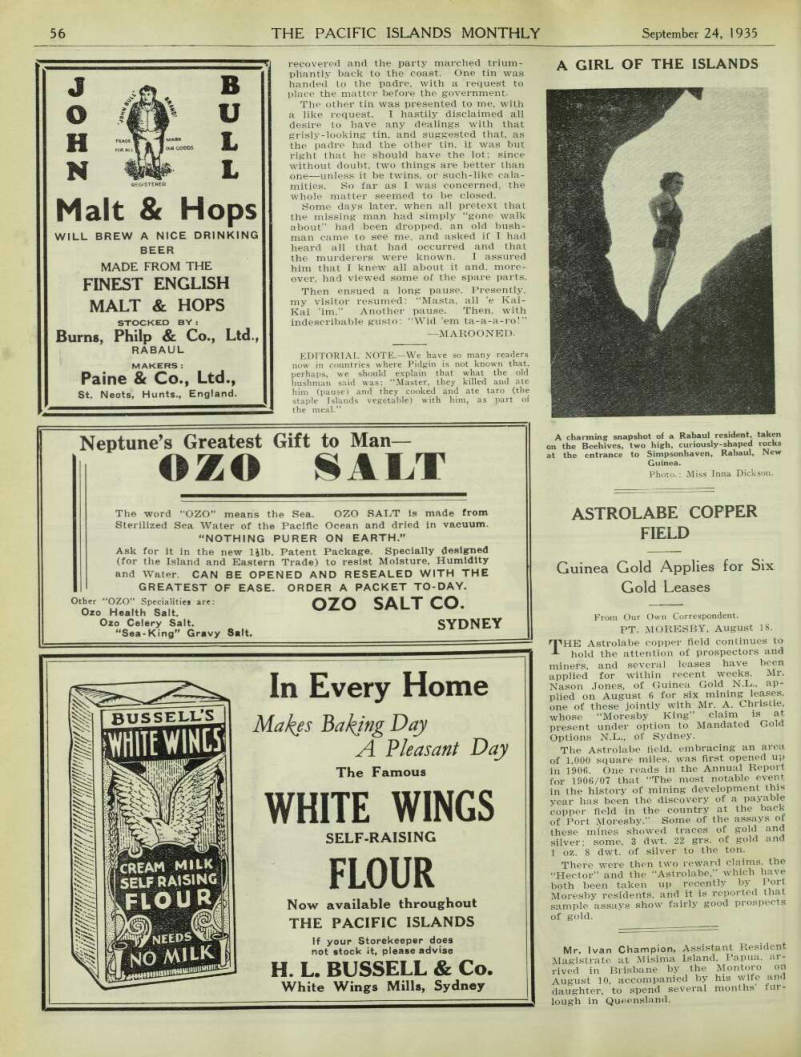
A NATIVE had disappeared in the Am brym hills and none had seen him go.
“Clearly a case of ‘walk about’ ” said the hillmen of his district.
But in the minds of some of the more enlightened and law-abiding salt-water men there grew a shrewd suspicion that things were not as they seemed. Bearing in mind the widespread amours and general rambuctiousness of the missing one, these suspicions appeared to have some foundation. The gentleman’s ac tivities had had no endearing effect on the local husbands and near-husbands.
Moreover, he had been a big hefty brute, most difficult to handle. All things con sidered, the general opinion inclined to the advisability of letting sleeping dogs lie.
But certain enlightened ones, led by a really courageous native teacher, quietly commenced to pry about, asking guarded questions of young boys and girls who, it was possible, had overheard stray re marks.
After some months of careful investi gation, the teacher and his gang collected a mass of evidence pointing to murder; and, eventually, a man was found who declared that he knew where the remains had been buried, in a lonely and unfre quented part of the bush.
Now things really began to move. All that was necessary, of course, was to pro duce the body. So off marched a disin terment party armed with sundry yam spades and like implements and, led by the informer, the grave was found. The searchers were surprised to see that the ground had been recently disturbed.
Nevertheless, they proceeded with their job, digging furiously- Soon it began to dawn that although they had dug an enormous hole they had unearthed no evidence. Obviously, the criminals, becoming alarmed by the in quiries, had removed the remains. Al most, it was decided to give up the busi ness and go home, when someone noticed a small bone among the excavated soil and a frantic search disclosed quite a number of small bones, much discoloured, but in fair condition, and certainly human. Two old salmon tins full were
recovered and the party marched trium phantly back to the coast. One tin was handed to the padre, with a request to place the matter before the government- The other tin was presented to me, with a like request. I hastily disclaimed all desire to have any dealings with that grisly-looking tin, and suggested that, as the padre had the other tin, it was but right that he should have the lot; since without doubt, two things are better than one—unless it be twins, or such-like cala mities. So far as I was concerned, the whole matter seemed to be closed.
Some days later, when all pretext that the missing man had simply “gone walk about” had been dropped, an old bush man came to see me, and asked if I had heard all that had occurred and that the murderers were known. I assured him that I knew all about it and, more over, had viewed some of the spare parts.
Then ensued a long pause. Presently, my visitor resumed: “Masta, all ’e Kai- Kai ’im.” Another pause. Then, with indescribable gusto: “Wid ’em ta-a-a-ro!”
Marooned.
EDITORIAL NOTE.—We have so many readers now in countries where Pidgin is not known that, perhaps, we should explain that what the old bushman said was; “Master, they killed and ate him (pause) and they cooked and ate taro (the staple Islands vegetable) with him, as part of the meal.”
Advertisements & other items, pp. 57-58 (2 items)
Deutz Diesel Engines
PACIFIC TRADERS!
The Blade of Best Quality, and the Most Profitable to Handle, is: These blades are of the three-holed (Gillette) type. I have made a careful test of all blades, over a long period, while I was trading at Milne Bay, Papua, and the British-made Jewel was far ahead of any other. I now have the Pacific agency for Jewel blades, and strongly recommend them Send P. 0.0, for trial gross, post free, 10/- (Australian) or 8/- (sterling). Reduction for quantities. Sample package, 2/6.
Iping, Midhurst, Sussex, England
O^^^SAFETY-
o^STRAZOR
C’A^BLADL
to all traders.
HENRY DEXTER
DEUTZ DIESEL ENGINES
OM Type 8-145 h.p. Sizes
Marine-Stationary - Portable
The Correct Engine for Tropical Requirements ..
Section of OM type showing scavenging air pump ft
DEUI I
Ci
REPRESENTATIVES . . .
HERBERT DEL COTT PTY., LTD.,
Kelvin House, 15 Castlereagh Street, Sydney (And at Melbourne) ’Phone B 3135 Cables: “Voltage,” Sydney
registered
Malt & Hops
WILL BREW A NICE DRINKING
BEER
MADE FROM THE
FINEST ENGLISH
MALT & HOPS
STOCKED BY:
Burns, Philp & Co., Ltd.,
RABAUL
MAKERS:
Paine & Co., Ltd.,
St. Neots, Hunts., England.
Neptune’s Greatest Gift to Man —
OZO SALT
The word “OZO” means the Sea. OZO SALT Is made from Sterilized Sea Water of the Pacific Ocean and dried in vacuum.
“NOTHING PURER ON EARTH/’
Ask for it in the new Ifclb. Patent Package. Specially designed (for the Island and Eastern Trade) to resist Moisture, Humidity and Water. CAN BE OPENED AND RESEALED WITH THE GREATEST OF EASE. ORDER A PACKET TO-DAY.
Other “OZO” Specialities are: ATO C A I T CO Ozo Health Salt. UZ.U DML I V-V.
Ozo Celery Salt. SYDNEY “Sea-King” Gravy Salt.
l[pl[
A Girl Of The Islands
A charming snapshot of a Rabaul resident, taken on the Beehives, two high, curiously-shaped rocks at the entrance to Simpsonhaven, Rabaul, New Guinea.
Photo.: Miss Inna Dickson.
Astrolabe Copper
Field
Guinea Gold Applies for Six Gold Leases
From Our Own Correspondent.
PT. MORESBY, August 18.
THE Astrolabe copper field continues to hold the attention of prospectors and miners, and several leases have been applied for within recent weeks. Mr.
Nason Jones, of Guinea Gold N.L., ap plied on August 6 for six mining leases, one of these jointly with Mr. A. Christie, whose “Moresby King” claim is at present under option to Mandated Gold Options N.L., of Sydney.
The Astrolabe field, embracing an area of 1,000 square miles, was first opened up in 1906. One reads in the Annual Report for 1906/07 that “The most notable event in the history of mining development this year has been the discovery of a payable copper field in the country at the back of Port Moresby.” Some of the assays of these mines showed traces of gold and silver; some, 3 dwt. 22 grs. of gold and 1 oz. 8 dwt. of silver to the ton.
There were then two reward claims, the “Hector” and the “Astrolabe,” which have both been taken up recently by Port Moresby residents, and it is reported that sample assays show fairly good prospects of gold, Mr. Ivan Champion, Assistant Resident Magistrate at Misima Island, Papua, ar rived in Brisbane by the Montoro on August 10, accompanied by his wife and daughter, to spend several months’ fur lough in Queensland.
How “Handsome
Harry” Died
THE dramatic circumstances surround ing the death in Port Moresby of “Handsome Harry” ( P.1.M. , July) make It worthy of being told correctly.
Harry Baker was a German-Swiss, who came to Papua as a passenger on the S.S. Van Linschoten from Darwin. He promptly got a job driving the “Pig and Whistle,” a steam launch owned by Charlie Baldwin. He was a “hard” citi zen but, with his “hard” points, there was much that was good.
Came Christmas Eve, 1914, and a few of us were playing poker in the parlour of Tom McCrann’s hotel. Among them was Ange Frese, a Dane, who was plant ing up a rubber property named Jawa rere. The game went on, and Frese and Baker clashed, with two good hands. The betting proceeded until Frese had no money left.
“I haf no more money left,” said Frese to Baker. “But if I had I would still be betting.”
Baker replied: “Veil, I vill bet £l5 against dat natif woman of yours.”
“Right, it’s a bet!” answered Frese.
They showed hands, and Baker won.
Shortly after that, the game was broken up. I remained for a while, talking to Tommy Powles and Alec Stork. As we were talking, “Handsome” passed and remarked that he was “going to get his Christmas box.”
It was then about 1 a.m. Baker went straight up to the house occupied by Frese. Frese was standing at the top of the steps.
“Veil, Ange,” Baker said, “I’ve come for my voman.”
“You can’t do that,” said Frese. “It vas only a joke.”
They argued. Then they fought. And the end of that phase was that Frese was beaten, and was thrown out of his own house, while Handsome Harry col lected his bet.
In the morning Frese was carrying a gun, and was walking about vowing vengeance.
About 9.30 Frese was in the bar drink ing, when “Handsome” walked in, and saw Frese. Rubbing his hands together, his face wreathed in smiles, he said: “Veil, my poy, it was a lofely Christ mas box.”
Frese snarled at him: “You German Baker advanced in a threatening man ner, “Vat you say—vat you say?” he demanded.
“This!” shouted Frese; and, pulling his gun, he shot “Handsome” through the heart.
Thus died Handsome Harry—a wild end to a wild life.
It was reported in the Pacific Islands Monthly that “Handsome” fought with “Yorkey” Booth, but that is quite in correct. The man whom Charlie Booth “fought under the lamps” was Hardy Gofton. Both men were in hard condi tion, non-smokers, and teetotallers, and both had had considerable experience in the fistic art.
Like all fights—or, rather, most fights— it started over a most trivial incident.
Booth was handicapped by the fact that he was wearing high boots, one of which burst at the side; whilst Hardy Gofton wore a pair of shoes. For over an hour the men fought, and Gofton took a mighty lot of punishment before he was finally knocked out.
Those were the days! The men they’ve got now are not the men they had.
Auna-Auna.
Growth of Louisiade Goldfields,
Eastern Papua
From Our Own Correspondent.
Port Moresby, August 15.
VyDODLARK ISLAND, under the at tention of Mr. Leo Gibbons, of Gold Mines of Papua Ltd., is showing signs of re-assuming its old position as a mining centre in the Territory. It certainly looks as though the old Louisiade goldfields are coming back to their own- The European population both at Woodlark and Misima has increased, at Misima it numbers 100.
Mr. de Kantzow left Sydney by the Neptuna on September 11 for his mining interests on the Watut, New Guinea.
Advertisements & other items, p. 59 (1 item)
Steel Furniture
Position Wanted
Thoroughly competent and healthy young man, age 26 years, wants position on a plantation, New Guinea.
QUALIFICATIONS AND EXPERIENCE
A sound and practical knowledge of bookkeeping in its various branches.
A practical knowledge of the management of cattle, also the control of their various ailments and diseases.
Experienced in the construction with timber, concrete, etc., of buildings, etc., required on plantations.
Acquainted with electrical circuits of all descriptions, also minor repairs all types of motors.
Will forward copies of all references as to ability and character to any interested prospective employer. Am prepared to furnish own passage money if required.
“BOOKKEEPER,”
C/o Box 3408 R. G.P.0., Sydney
MODERN TUBULAR
STEEL FURNITURE
Chromium-plated or Lacquered Finishes
Beds Wires
Bedding
Hospital
Furniture Tubular Steel Furniture Radio Station 2UW, Newlands Steel Furniture 9 QX OX OX ©X ©X OpZr QX 6 G*X QX ox OX ox OX QX QX QX Cloa Chair—Chromium plated Steel.
Complete Catalogues on Request Cab le
NEWLANDS BROTHERS LTD.
Address “NEWLANDBED,” SYDNEY.
Riley Street, Sydney, N.S.W.
AUSTRALIA'S LARGEST MANUFACTURERS OF SLEEPING EQUIPMENT, HOSPITAL FURNITURE AND
STEEL DESIGNS.
Charted
Fiji Reef Wrongly
From Our Own Correspondent.
SUVA, September 4.
IT has just been discovered that a re markable error has occurred in chart ing one of the most dangerous reefs in Fiji waters —the famous Horseshoe Reef.
The error may have been the cause of the Norwegian motor vessel Hoegh Trader going ashore there recently.
The position of the reef on maps is given some six cables (1,200 yards) to the north-west of its actual position.
Customs authorities state now that the reef’s position is latitude 17.39 south and longitude 179.174 east.
Worth £4,000,000
Australia’s Valuation of Fiji Goldfield
From Our Own Correspondent.
SUVA, September 3.
FIJI has figured prominently in the Australian newspapers recently owing to the announcements of the Emperor Mine flotation and of the substantial in terest taken in Loloma by a London group. In both cases one of the leading mining men in Australia, Mr. W. S.
Robinson, is reported to be interested.
The romance of the Emperor Mine lies mainly in the courage shown by Mr Theodore and his associates, who spent £BO,OOO of their own money in proving its possibilities. No one in Fiji grudges them the rich reward they have reaped by their enterprise. Mr. Theodore and his associates made a most graceful ges ture in presenting to the Fiji Government a cheque for £5,000 which, it is under stood, will be applied towards increasing the medical facilities at the Colonial War Memorial Hospital, Suva.
Latest reports of the Emperor Mine are to the effect that its potentialities in crease almost with every fresh piece of development work. So far the existence of the rich lode formation has not been proved to any great depth, but the ex perts are confident that the lode for mation will live to depth. This is borne out by the situation of the Loloma mine,
which is some 200 feet below the Em peror workings.
The mine reports from Loloma continue to picture a deposit of extremely rich ore. Generally speaking, the Tavua field has become the focus of public attention.
The prices which Australian investors are willing to pay for Koroere, Loloma, Em peror and Aloha Central shares continue to increase, and the value set upon what was previously some 700 acres of barren goat country is now somewhere in the neighbourhood of £4,000,000. The mar ket seems rather to have discounted the period of time which must elapse before any of the mines reach full production, and opinion in Fiji is inclined to the view that a reaction in prices is bound to occur.
Work
Aeroplanes For Mission
Progress In New Guinea
r PHE daily papers, especially the Sydney Sun, have recently featured the news that the Anglican Melanesian Mission in tended to undertake mission work in the- Mt. Hagen area of New Guinea by means of an aeroplane. It was asserted that thus the Melanesian Mission would be the first Protestant mission to use an aeroplane for such work.
Both the Lutheran and the Roman- Catholic Missions have penetrated the regions alluded to in the daily press and have established themselves among the tribes that were discovered about two years ago.
The Lutheran Mission during the last eighteen months, has founded numerous stations in that inland region, three of them staffed with six European mission aries, the others with native Christians- In order to overcome the communication and transport difficulties the Lutheran Mission, in February of this year, put its own aeroplane on the wing.
Named “Papua,” it is a Junkers six seater all-metal ’plane. Presented by the German supporters of the mission, the machine cost well over £6OOO Australian before it could rise from its base at Lae- It has already rendered invaluable service.
The Lutheran Mission will celebrate the golden jubilee of its work in New Guinea next year. Its staff of over 120 adult European members and its more than 40,000 Christian natives, look back on a period of remarkable achievement and development. “The most striking feature of the work in New Guinea is the great zeal the young Christians show to go and carry to the heathen tribes inland that which has brought freedom and peace into their own lives, the gospel of Jesus Christ,” says Rev. F. O. Theile, director of Lutheran Missions, in a letter to the editor.
Advertisements & other items, p. 60 (1 item)
Walter Horne& Co. Ltd.
MELBOURNE
HOTEL „
— SUVA -^=
Centrally situated near Government offices. Opposite sea baths and bowling green. Excellent table.
Terms moderate. Best brands of liquor kept, including Hardy’s famous wines.
E. C. DOBELL Proprietor
Suva’s Fashion - Rendezvous
WALTER HORNE& Co. Ltd.
PREMIER DRAPERS, LADIES’, CHILDREN’S
AND MEN’S WEAR SPECIALISTS
LADIES’ HAIRDRESSING AND MANICURING
Frocks Millinery Foundations and Lingerie Hosiery Ladies' Shoes & Sandals Ribbons and Laces Hairdressing Manicuring Dress Fabrics and Silks Household Drapery Clothing T ailoring Mercery Men’s Boots & Shoes Men’s Hats & Caps Island Curios
“IF IT’S NEW...
HORNE’S WILL SHOW IT”
Dependable Merchandise
Reasonably Priced
P.O. Box 117 Cables: “Janinloong”
Jang II lug Loong Company Limited
20-24 THOMSON ST., SUVA, FIJI
IMPORTERS - EXPORTERS
Buyers of Copra, Trocas Shell, Beche-de-mer, Kauri Gum, and other Island Products.
NUMEROUS BRANCHES THROUGHOUT THE COLONY
Fiji’S Trade
Good Recovery for Half Year to June, 1933
THOUGH the trade figures for Fiji for the first six months of 1935 show an excess of imports over exports amount ing to £14,649, the total volume of trade, compared with the same period of 1934, has increased by £219,475. The 1933 trade boom, during which Fiji had a large excess of exports over imports, fell away in 1934 and the excess margin of imports was £36,074. This half-year shows a substantial recovery.
The position is shown by the following figures:
The principal feature of the exports is the growth of the goldmining industry.
The production has been more than doubled (1,805 oz. as against 709 in 1934) and the value has increased by £9,090.
Copra production dropped slightly, from 12,613 tons to 11,951 tons, but a rise in the market price augmented the value by £36,828.
1934 1935 Imports— £ £ Suva . 289,423 372,129 Levuka 8,863 10,264 Lautoka . 146,077 160,995 Total . £444,363 £543,388 Exports— Suva . 152,641 173.285 Levuka . 31,963 35,074 Lautoka . 223,6 85 320,380 Total .£408,289 £528,739 Excess of Imports ... . £36,074 £14,649 Total Trade £852,652 £1,072,127
Exports
In Detail
1934 1935 £ £ Sugar . 212,233 317,707 Copra 66,901 103,729 Bananas 33,738 31,786 Molasses 3.765 4,855 Gold Bullion 5,172 14,262 Trocas Shell 13,289 10,571 Other 73,191 45,829
Anglican Cathedral For Suva
From Our Own Correspondent.
SUVA, Sept. 3.
OWING to the munificence of Lord Nuf field, who recently visited Fiji, the project for building a new Anglican Cathedral in Suva has been brought within measurable distance. Plans have been drawn by Mr. G. W. Johnston.
A.N.Z.1.A., and a meeting to discuss them took place recently in Suva. , The plans at first sight appear to be very ambitious, said Mr. Johnston, but they provide a scheme which, when even tually completed, will give to the Diocese of Polynesia a truly splendid Cathedral church, of which successive portions can be erected as funds permit. He estimated that for £15,000 sufficient accommodation for present needs could be completed.
The question of a site is one that is at present under considerable discussion.
It is hoped that possibly some arrange ment may be made with the Fiji Govern ment to make available the site now occu pied by the Government buildings, as new Government buildings are shortly to be erected on a fresh site.
Mr. Cyril Hylton, a director of East Reefs (Fiji) Ltd., left Sydney for Suva by the Mariposa on August 21 to look over the company’s areas on Vanua Levu.
Hon. A. A. Wright, who was Acting - Governor of Fiji during the absence of Sir Murchison Fletcher earlier in the year, proceeded to England on leave orr August 25.
Mr. Charles R. Turbet, 8.V.5c.,.
M.R.C.V.S., accompanied by his wife and family, arrived in Sydney from Europe en route to Suva, Fiji, by the Strathaird on August 22. He is Senior Veterinary Officer in the Fiji Department of Agri culture, and while in England on leave attended a post-graduate course at the Royal Veterinary College, London.
Advertisements & other items, p. 61 (1 item)
Rewa Hotel -
PACIFIC TAXI
GARAGE - -
(Vincent K. Brothers) Day and night service . . . Most modern hire service in Suva . . .
Excellent drivers.
Our special trips embrace Rewa Valley and Sugar Mill, River Scenery, Lami, Suva Point, and Native Kings’ Town of Bau.
Trips can be arranged on Intersular Road to Ellington, Tavua, Ba, Lautoka, and Sigatoka.
Cables: “Vincent,” Suva. 'Phone 33.
In Suva . . . Stay at
The Pi or Hotel
( Licensee : D. B. COSTELLO.)
The Rendezvous of the Miners
Situated in hub of city. Absolutely fireproof building. Commodious and comfortable rooms. Excellent cuisine. All the best brands of drinks stocked.
Tariff n[ 6 per day
Cable address: “Pier,” Suva Hi
UNDER SAME MANAGEMENT
REWA HOTEL -
Picturesquely Situated in the Cane Country on the Rewa River Motor trips arranged around Island. Modern cars driven 5 y expert drivers.
Have the advantage of staying in either Hotel on same Tariff
FREE TRANSPORT BETWEEN THE TWO HOTELS
Suva Bowling Carnival
From Our Own Correspondent.
SUVA, August 29.
ONE of Fiji’s most successful social activities is that of the Suva Bowling Club, which each year runs a carnival at Suva. The 11th annual carnival took place early in August. As usual, a num ber of overseas bowlers made the trip specially to Suva and all sorts of enter tainments were arranged in their honour.
The development of the Suva Bowling Club owes a great deal to a small band of enthusiasts, who are justly proud of the success which has attended their efforts. The carnival just concluded was the most successful in the club’s history.
New Zealand teams won the South Paci fic pennant and singles championship, while Australia took the Pacific pairs title.
Brown & Joske Ltd., Fiji
A PROFIT of £3451 was earned by Brown and Joske Ltd., merchants, of Suva, Fiji, for the year ended March 31, 1935, compared with £1636 in 1934, and £lB4O in 1933. Preference divi dends of 7 per cent, absorbed £1400; and 3 per cent, is proposed on ordinaries, absorbing £1843.
The improvement is due to the fact that losses on produce have been avoided while trading condi tions have become steadier.
Misima Is. Petitions for Direct
Mail Service
From Our Own Correspondent.
Port Moresby, August 24-
T>ESIDENTS of Misima Island in the Louisiade Archipelago, the mining centre at the eastern end of the Territory, seem definitely in favour of an amended itinerary for the mail contract steamers between Australia, Papua and New Guinea.
At a public meeting convened there recently by leading citizens, a petition was drawn up and signed by most of the residents, supported by six of the gold mining companies, including Gold Mines of Papua Ltd. The entreaty upheld the suggestion made by members of the Legislative Council in July that a direct service between Australia and Papua should be provided and that this purely Papuan service should call at Misima Island, in addition to the ports usually served.
The petition was forwarded to Port Moresby and was later sent on to Aus tralia to the Federal Minister in Charge of Islands Territories (Sir George Pearce).
Sir Maynard and Lady Hedstrom ar rived in Sydney by the Monterey on Sep tember 9, and left the same evening by express for Melbourne. Sir Maynard, who is the executive head of Messrs.
Morris, Hedstrom Ltd., of Fiji, is a mem ber of the Fiji Executive Council and an elected member of the Legislative Council.
He will remain in Australia on business for a month, returning to Suva by the Mariposa on October 16,
Successful Shipments To
Fiji Bananas
Successful Shipments To Canada
From Our Own Correspondent.
SUVA, Sept. 2.
THE experimental shipments of bananas to the Canadian market have turned out a success. Dr. H. W. Jack, Director of Agriculture, in a recent interview said that over 1,000 bunches have gone for ward in each of the last three monthly shipments.
No trouble appears to have been ex perienced in the carriage of the fruit, which reached the Canadian market in good condition, thanks to the assistance given by the Union Steam Ship Co. Sat isfactory prices have resulted and all con cerned have co-operated to make the project successful. Canada appears now to realise that fruit packed in cases is good fruit and not rejects, as was their first impression.
The Department of Agriculture has been conducting propaganda amongst the Fijians, who are planting up more fruit.
Dr. Jack said that towards the end of the year the monthly shipments will be in the vicinity of 1,500 or 2,000 bunches.
Every credit is due to the Agricultural Director for his initiative and energy in practically starting and certainly develop ing this outlet.
Mr. C. Harley Nott, of Fiji, was mar ried at Suva on August 16 to Miss Marion McFarlane, of Auckland. The couple left shortly afterwards for England to spend their honeymoon.
Advertisements & other items, p. 62 (1 item)
Pacific
Collector of shells desires to make reciprocal arrangement with collectors of shells (marine, land and fresh water) in Pacific Islands, with view to exchanging specimens.
Write H. Bernhard. 92 Derby Street, Rockhampton, Queensland.
N The PREMIER Social Rendezvous of Fiji . . .
Grand Pacific Hotel - - Fiji
EXCELLENT CUISINE. EFFICIENT TRAINED INDIAN WAITERS AND SERVANTS.
MODERNLY EQUIPPED.
Grand
Pacific
Hotel
SUVA, FI J
I ( Delightfully situated in tropical gardens overlooking Suva harbour and the Pacific Ocean.
TARIFF: from 17/6 per Day Accommodation Reserved by Wireless Cable address: "Grandpacif”
Suva
System
Opposed To Nominee
Three Elected Members Would Test Public Feeling in Fiji
From Our Own Correspondent.
SUVA, Sept. 3.
THE question of a change in the political constitution of Fiji continues to oc cupy public attention. The Honourables J. P. Bayly, Alport Barker, and Major W.
E. Tottenham have publicly stated that they are prepared to accept the challenge thrown out by a correspondent in the local newspaper to resign their seats in order to test public feeling. The other three European elected members have not however, followed suit.
The Indian Association of Fiji has en tered the lists and has published reports of meetings of protest against the pro posals to revert to a nominee system. Ap parently they have also communicated with India, and these communications may have a possible repercussion upon the Secretary of State for the Colonies.
No doubt the question will be fully dealt with by Sir Murchison Fletcher at the next meeting of the Legislative Coun cil. In the meantime, a local resident has pointed out that in the Colony’s Esti mates for 1935, £2OO had been allocated for a general election in Fiji this year.
He suggests that this money might be utilised to hold a referendum of the colonists.
That Indian “Bogey”!
7VTR. F. L. FADDY, under date of Suva, August 16, writes somewhat violently on the subject of the franchise in Fiji, and our correspondent’s reference in August to “a motley assemblage.” Says Mr. Faddy, inter alia: “It is very palpable that your corres pondent is a civil servant —one who has no interest in the welfare of the Colony nor holds a franchise in Municipal or Legislative affairs —and, what is more palpable, he was not present at the meeting, for by no stretch of imagination could anyone with a mentality above a sycophant designate the meeting of re putable citizens a ‘motley assemblage.' “What your correspondent forgot to mention was that, included in the 35 votes approving the action of those elected members supporting the Nominative System, were at least six recorded by ladies who, like your correspondent, haven’t the franchise. On the other hand a great many more votes would have been added to the 65 supporting the Elective system (all electors) had it been a secret ballot instead of a show of hands for, sad to relate, we have amongst us a great many people who for various reasons in a small place like this cannot afford to disclose openly their political opinions.
I would add that your correspondent has, quite unwittingly, designated the so called ‘cry for common roll’ of the Indians by its correct name—viz., ‘a bogey’—for I can assure you that that is just what it is—a bogey specially manufactured for the occasion by supporters of the Nomi nation system.” (EDITORIAL NOTE—Mr. Faddy is in deed a very short-sighted man if he would dismiss the Indian demand for the common roll as a “bogey.” It is easily the biggest and most significant problem that the Crown Colony is faced with. The Fiji Europeans live so close to the danger
that they cannot appreciate it. They are like the peasants, whose farms and villages cluster about the slopes of Mt.
Vesuvius. Everyone can see the menace except they themselves.)
Fire In Suva Store
From Our Own Correspondent.
SUVA, Sept. 2.
AFIRE which broke out in the bulk rice store and mill of Messrs. A. Q.
McGowan and Co., Suva, destroyed clean ing mills and other machinery. Over 500 sacks of paddy rice and a quantity of beans were damaged by fire and water.
The interior of the building was severely damaged.
The outbreak is believed to have been caused by friction of a bean crushing machine igniting the inflammable dust.
The building, store, and plant were covered by insurance.
Mr. George Rolph, until recently man ager of Lancefield South Gold Options N.L., of Victoria, has been appointed by Viti Levu Gold N.L. to take charge of their interests in Fiji.
Captain Sir Maxwell Maxwell-Ander son, Chief Justice of Fiji, accompanied by Lady Maxwell-Anderson, sailed from Syd ney for England by the Strathaird on September 7. Although it was Lady Maxwell-Anderson’s first visit to Sydney, her husband was here 30 years ago as an officer in the Royal Navy on H.M.S, Sparrow. While Captain Sir Maxwell- Anderson is in Europe, the Hon. R. S.
Thacker will act as Chief Justice of Fiji.
Miss M. Harris, of Watnabara, New 'Guinea, left Sydney for Rabaul by the Nankin on August 14, after leave spent in Victoria. She has been working with the Methodist Mission for over 15 years.
Advertisements & other items, pp. 63-64 (1 item)
Morris, Hedstrom, Ltd
ISLAND SHIPPING
Freight, Forwarding and Customs Service. Import and Export.
B. R. Wheeler 17-19 Bridge St., SYDNEY Correspondence Invited. Tel.: B 5396
For Fresh Fruit, Vegetables, and Produce Island residents can rely on the old-established Shipping Providers.
Ctf
lit®*
Only Address: 421 Sussex St., SYDNEY All Orders Promptly Attended Island Representatives: Nelson & Robertson W. M. Reid
BITUMENOID ROOFING
MADE IN AUSTRALIA
Bitumenoid Roofings, Dampcourses and Insulating Felts are made from the world’s best raw materials. Warranted to stand the most rigid tests.
BITUMENOID THE BEST
Roofing, 1,2, 3-ply; Flooring, Waterproof Materials; Saturated Felt; Resilient Road Jointing; Natural Asphalt Dampcourse; 2 and 3-ply Dampcourse; l-21b. Lead-core Dampcourse; Roofing Cement; Asphalt Paints; Roofing Compound.
SAMPLES AND PRICE LISTS ON APPLICATION.
MAXWELL PORTER & SON LTD.
ESTABLISHED 1888. BUILDERS’ SUPPLIES
107 REDFERN ST., REDFERN, SYDNEY, N.S.W. ’Phone, M 3157. Cables: Bitumenoid
MORRIS, HEDSTROM, Ltd
FIJI
Sole Agents in Fiji for . . .
Vacuum Oil Company (Pty.) Limited
Imperial Chemical Industries Limited
Nobel (Australasia) Pty Ltd.—Explosives
Full Stocks of
MINERS AND PROSPECTORS’
REQUISITES
Also SODIUM CYANIDE, ZINC
DUST. Etc, Etc.
Sydney Office:
DALTON HOUSE, 115 PITT ST., SYDNEY
Branches throughout the gold hearing areas Lautoka, Ba.
T avua, Penang, Nadi and Sigatoka
VITAMATE
VITAMATE is a delicious bever-
age which has wonderful Tonic
properties, and because of its bene-
ficial influence on the Liver and
Kidneys is excellent for people
living in the tropical countries.
• Chemists and Doctors would be well advised to look up Yerba Mate in the British Medical Journal as VITAMATE is made from this product. Very favourable reference will be found therein.
If your Storekeeper does not stock it, send to the Australian Distributors
Nelson & Robertson
12 Spring Street, SYDNEY
FREE DANCING LESSONS
\i:w WAY
-TO LGAKM
Numerous Self-styled Professors Imitate My Style, but Never Equal It
NO MATTER HOW POORLY YOU
DANCE NOW even if you’ve never danced a step in your life I GUARANTEE to teach you in a few hours, without music or partner, by my
original CORRESPONDENCE SYSTEM
of Instruction. Thousands have learned to dance by this amazing method; and
now IT’S YOUR TURN!
PROF. BOLOT, F.A.R., E.A.D.M.
Established 25 Years.
YOU CAN’T FAIL!
Yes, the “Bolot” charts and illustrated directions are actually EASY AS A.8.C., and you will be delighted with the entire system. Moreover, a few minutes’ practice a day, for seven days, will suffice to make you a really accomplished dancer, popular, admired and sought after as a partner. You positively CANNOT FAIL to learn by this system; and you are now given a special opportunity to secure Prof. Bolot’s latest book on the subject FREE of charge, if you send AT
ONCE.
You can learn the “MODERN,” OLD- TIME and JAZZ DANCING if you follow these simple charts. BUT this offer will remain open for another month only. To avoid disappointment send for your copy
TO-DAY.
Post This Coupon NOW m
PROF. J. BOLOT, F.A.R.,
French Dancing Academy, Studio P, 66 Oxford Street, SYDNEY 1 am interested in your special offer.
Please forward me Two Dancing Lessons ABSOLUTELY FREE, and a copy of your latest book, “Dancing as a Fine Art.”
I enclose 4d. in stamps for postage.
NAME
(Mr., Mrs., or Miss)
ADDRESS
STATE
(Note: Please write very plainly)
Fashion Hints for Islands Women
By Therese
OF all delightfull summer materials (and their name is legion) linen takes pride of place, the uncrushable variety being the most popular and justifying itself all the way. For mornings in town, for afternoon wear, and again for even ing, it pops up with delightful persistency and in such lovely shades that it charms the hearts of us all.
A lovely shade of pink herringbone glace linen, with a soft gloss that is ex tremely attractive, makes a frock of in finite charm. Its square neck fastens at each shoulder with a large navy button and a wide navy belt of suede encircles its slim waist. A hat with wide pink brim and shallow crown of navy com pletes a picture of perfect colour har mony. Two-piece linen suits with either long or short sleeves flaunt gay little blouses, feminine or tailored as the whim
diqtates.
Simple dresses of cotton have an ap pealing way with them, and are ideal wear for a tropical Clime. Lovely colour ings and designs make them Spring-like in effect. White, an ever-present help in time of need, is coolness personified, and takes on a Dr. Jekyll and Mr. Hyde exist ence by the addition and many changes of brightly coloured scarves, belts, buttons, and bows.
Jackets, be they of linen, cotton, or silk, give yeoman service. They come in varied lengths—bolero, hip length, three quarter, or full, and cover a variety of frocks. Sun back dresses with bracer straps don little coats, and are ready for more formal oc
casions. A taffeta coat covers an after noon frock of printed silk, and linen and pique jackets give dual service for day or evening, their crisp charm ensuring them instantaneous success.
Printed' silks —of washing propensities— go softly draped for afternoon wear.
Graceful spiral draperies may adorn them, or they go self-trimmed with pleats or much shirring, their own glorious col ourings being sufficient unto them. It is amazing what frills and draperies can do with simple frocks. There is magic in them that entirely changes their charac ter. Spectator sports frocks come in varieties infinite, and whether with work manlike shirt collars, Peter Pan, Quaker or the so becoming square neck, there is nothing to equal them for almost every occasion. Always they possess the happy knack of being fashion-right—a know ledge that adds charm and assurance to one’s manner and wit to one’s conver sation.
Skirts are distinctly shorter, which gives them surprising dash and a definite air dlf chic.
There are blouses for every mood and for every hour the clock round. Delight fully feminine affairs with variations of sleeve and neckline and of charm indes cribable; small wonder the blouse and skirt vogue enjoys such popularity.
Sleeves are varied as a woman’s whims.
Afternoon gowns with voluminous sleeves have elastic at the wrist" to make the sleeves whatever length you will, while plain or little pleated sleeves, and sleeves with little bits and pieces sticking out at odd angles belong to less formal occa sions. An afternoon gown of flat crepe has large kimono sleeves and wide swathed belt which gives an enviable slim effect.
Evening clothes, scintillating and thrill ing, are packed with exciting charm. Se quins and rhinestones wink their wicked way to glamour. Taffetas swish and sway romantically and georgettes drape softly or take unto themselves innumerable frills and flounces with altogether fem inine allure. It matters not one whit whether your blood leaps to the skirl of pipes since tartan evening frocks are the dernier cri. Bbuffant of skirt, slim of bodice, rustle of bustle, with gay colour combinations, there is absolute charm in every fold.
Stiffened cotton lace frocks, in those exquisite sweet pea shades, are delightful for tropical nights, and the wardrobe should boast at least one of these alto gether charming frocks. Figured or ganzas, and muslins of all sorts, go to the making of festive frocks for festive hours. Appeal and economy go with them —a much desired combination —so what more could one ask?
Taffeta frocks slip off the shoulder with Victorian charm. Qualms as to their safety are quite unjustified, but if you must have that little extra assurance, two shoulder straps, caught together at the back, will lull you into a sense of se curity.
One of the most delightful and in genious ideas in the new season’s clothes is the large sailor collar of pique with extended shoulders, which takes the place of a light wrap for evenings. It looks the acme of coolness, yet gives sufficient pro tection from evening air. Capes hold their pride of place for both day and evening wear. Whatever their length, success is their portion. Lengths of chif fon shirred at each end and caught to
.gether to form cuffs make attractive little wraps. Sequinned or diamante studded, they are most alluring.
Accessories are more charming than •ever. Belts, bags, gloves, shoes, seem to gather charm as they go.
Wide belts of pig skin, suede, panama, fabric, furniture webbing, and so on, ad infinitum , are intriguing and different.
Suede and leather belts are steel studded -and carry an air that is different and a chic that is undeniable.
Pique gloves, collars, handbags, lift .simple frocks to the heights and look en trancingly cool —an art in itself. Giddy little scarves knot at the neck with gipsy abandon, whispering of flying curls and flying feet, and all life’s gay adventure.
Knots of flowers snuggle gently into the soft folds of cowl neck lines, flaunt them selves gaily at waist or shoulder line, make gay our hats, and generally give an air of Spring to our toilette. From the exotic orchid to the humble field flower none is forgotten, and each lends en chantment to day and evening, and brings joy to our hearts.
“Trowsis”
‘'THE matter of the nether undergar -1 ments of the native ladies—consisting, so one is informed, of a lava-lava, more ■or less adequately made fast with a round turn and a couple of half hitches of bagging twine—appeared to the Mem sahib to require revision.
Quoth she:—“You know, nice little ■undies would be much more the thing.
I think I’ll give Nina a pair of mine.
I'm sure she would appreciate them, and then the idea will be sure to take on with the other women.”
Now, Nina, being our sort of char oum-washlady—without portfolio, as it were—was fairly well known to me; and, therefore, considering her large propor tions as compared with small Memsahib, it seemed to me that, when their new owner came to be fitted into those un dies, something would just have to happen. Whether it would be that the undies would give, or whether some of Nina’s more ample curves would be forced to shift anchorage, was a moot point.
Anyway, it was none of my business.
Besides, when one considered with what astounding dexterity the local New Hebrides native could handle a corkscrew when occasion offered, it seemed only reasonable to suppose that they could, with like facility, handle a shoe-horn- The garment was duly presented and •explained and, apparently, gave satisfac tion. Not that that was much to go by: the gift horse is not looked in the mouth in these islands—at least, whilst the •donor is about. And so home, doubtless to try ’em on.
Presently, sounds as of strife, also of woe and lamentation, from the nearby village, wherein abode Nina and her old man. Memsahib, being a sympathetic small person, must needs investigate.
Soon she returned —much flushed and most indignant.
“When I got to that beastly village,” said she, “there was Nina in her hut, ab solutely naked and crying and quite in consolable. She had evidently been beaten. All the other women were cry ing, too. Outside, squatted beside a log, was that wretched old man of hers, bush knife in hand, hacking away at the re maining shreds of the undies I had given to Nina. He was muttering to himself: Trowsis? My word! Me me savvy givem you trowsis, you (sanguinary lady bullock) you’!”
Marooned.
The Right Hon. Earl Beauchamp, P.C., arrived in Tahiti by the Messageries steamer Ville de Verdun on July 26, and proceeded immediately to the Punaavia district, where he has .taken the Murnau establishment for a time. His Grace, who is accompanied by his secretary, Mr.
Smyth, expects to remain in Tahiti for two months, after which he will join the Union Co.’s steamer for Australia.
Miss Esther Williams, 8.A., of the Methodist Missionary Society, arrived on a brief visit to Australia by the Mari posa on August 12. She is in charge of the girls’ school at Lautoka, Fiji.
Advertisements & other items, pp. 65-66 (1 item)
Location BELVEDERE
AT BLUE MOUNTAINS
SPRINGWOOD, N.S.W.
Springwood Ladies* College
Est. 1897. Kindergarten to Leaving Certificate. Tennis, Riding, Swimming, Team Games. Unequalled climate. Pure Jersey Milk. Senior and Junior Houses. Open-air sleeping. Inclusive fees. Special vacation arrangements for Island pupils.
M. E. DURAND, Principal.
The Islanders’ Sydney Home . . .
Location BELVEDERE
81 BAYSWATER ROAD, DARLINGHURST
Exclusive.
A fine house with its wealth of pleasant old associations.
The Garden Suites, designed on most modern lines.
Excellent grounds with beautifully kept gardens—and dotted with comfortable garden seats.
Private telephones if desired.
An atmosphere of rest and grateful quietness.
Ideal location.
Near White City Tennis Courts.
Seven minutes to 0.P.0.
Close to Shopping Centre.
Trams stop at gates.
BELVEDERE is Controlled and Supervised by Island People for Island People TERMS: From £2/12/6 Weekly.
MR. & MRS. C. WAGER (late of Fiji), Proprietors.
r iVvc V ,
* N L\ei UoW
K , nC e >, u oo LC
GILLESPIE’S
“ANCHOR”
FLOUR
TRADE
MARK
The Standard of Quality .
PABCO
ENAMEL SURFACED
SQUARES
Are the Ideal Floor Coverings for Pacific Islands Homes
PABCO
FLOOR COVERING
IBSgl
There a
PABCO
FLOOR COVERING
EASILY CLEANED
are many good reasons ... • APPEARANCE: The large variety of delightful colour designs brings brightness and a new interest to any room or verandah. • DURABILITY: Pabco Squares are not affected by climate, and are made for long service from the highest grade material. • EASE OF CLEANING: Beinq waterproof, by simply wipmg over with a damp mop they appear bright and fresh. : n • ECONOMICAL: The low cost and long life of Pabco Squares ma e em e 9 easy TRANSPORT; Pabco Squares are compactly rolled and securely packed in a heavy tube, and are cheaply and safely transportable.
PABCO SQUARES ARE
PABCO SQUARES made in following sizes: oft v 12ft 6ft. x 9ft. 9ft. x 9ft. 9ft. x 10ft. 6m. 9ft. x l^tt. i An extensive pattern range of these leautiful vet priced floor coverings can he seen any store of Burns, Philp & Co., Ltd. — W. R. Carpenter&_Co^_Ltd.
IpABCO PRODUCTS (AUSTRALIA) LTD., SYDNEY, N. .
WATERPROOF
% V
Housekeeping in the Tropics
Conducted by “Dorothea ”
It Happened One Day
(With Acknowledgments to “Tiaki,”
Tulagi, Solomon Islands) ONE morning before leaving home in the cutter, I told “cookie” to kill a fowl ready for to-morrow’s dinner, but not to kill it before sundown. I arrived home a few hours earlier than I expected and was surprised to see a fowl already plucked hanging by its legs from a beam in the kitchen.
I called the boy and asked why he had killed it before sundown. He grabbed it off the hook, saying, “Me no kill ’im yet, master,” and prodding, “Look, him ’e live yet.” To my horror the fowl flapped its wings.
He had plucked it without killing it.
Tropical Fare
HAVING lived in the East for a year, I learned while there to make the real “Pucca” curry, writes “Tabian.” of Ocean Island. Living in the South Seas now, and not being able to get the proper fresh curry powders, I have worked out from experience the nearest thing with tinned curry powder.
Ingredients; . ' . , Hb. mutton (cut into small pieces), four peeled onions, half a lime.
One heaped tablespoon tinned curry powder.
Two cloves of garlic (chopped up).
One small teaspoon of cayenne pepper.
One dessertspoon of butter, pinch of salt.
Six old coconuts containing milk.
First prepare the coconut milk, by husking the nuts, split open, and pour the liquid into a basin- Next have a native servant scrape the nuts on a proper scraper into a large dish. Into this pour the coconut liquid and three large breakfast cups of cold water. Mix all well together and squeeze through a potato squeezer or a few folds ot butter muslin. When all the grated coconut has been used, strain the milk through a coffee strainer into another large basin. .
Now place the butter in a saucepan, bring to the boil. Drop in cut-up onions and cook for a few minutes. Stir often and do not let brown. Add. cut-up mutton and cook for a few minutes more- To this add curry powder, garlic, cayenne, salt, and juice of half a lime. Stir well together and heat over fire. Add a cup of coconut milk and stir well, then pour in remainder of the milk and bring to the boil for a few minutes. .
Place a little to the side of stove and simmer gently for four hours (without lid) stirring now and again so that it does not catch. When the curry has become very thick and the meat is tender, serve with hot rice on hot dishes.
Banana Pudding
As bananas are so plentiful in the Islands, I am sending along a recipe for a pudding in which this fruit is the main ingredient, says Bititamboa, of Tulagi, Solomon Is.
One cup flour, one tablespoon sugar.
One tablespoon butter, four ripe bananas.
One teaspoon cream of tartar.
Half-teaspoon of carb. soda.
Rub butter into flour sifted with cream of tartar and soda. Add sugar and bananas well mashed.
Steam for two hours. Serve with coconut sauce, made from milk extracted from grated coconut- Add a little sugar and thicken with corn flour or custard powder. Or if preferred, serve with custard or cream.
Quick Legislation
Sydney Journal is Caustic
The following appeared in Sydney “Bulletin” of September 11: J>ABAUL’S Legislative Council put up records in its fifth session, the busi ness portion of which was shoved through in one short sitting day- Although it has I an ornate chamber to meet in, and prints “Hansard” on an imposing scale, it is I pleasing to learn that “no ceremonial was I observed” at the opening.
In the first hour, laws relating to birth- I and-death registration, cemeteries, cele bration of marriages, legal appeals, ap- I propriations for a few months and some I other small matters were tossed off. By I lunch-time 13 new enactments had been I approved of, and the Treasurer had I presented the estimates and announced an accumulated surplus of £46,000, So it j was possible to take things easily in the afternoon in dealing with the remaining • 12 ordinances up for consideration.
All the bills were presented by officials, who form the majority of the Council; I but an hour or so was reserved at a second day’s sitting to allow the tax payer-representatives to have their say.
They had nothing to bring forward except a motion which the President said lay I "‘outside the province of New Guinea ad- I ministration.” They have learned from I experience that it is useless to initiate business.
If legislation can be disposed of at the rate of about 10 minutes per bill, it seems 1 an expensive waste of time to take private j honorables from their plantations and offices to do little more than have their names recorded in “Hansard” after those of a list of public servants whose wages they pay.
Government enterprise has not done much for this territory. Before the gold days, when the main industry was ex propriation and most of the plantations were under official control, the place was a dilapidation and a muddle which justly earned the scorn of visitors. It became self-supporting only with the entry of . private enterprise, which finds most of the £200,000 in taxation, plus another £170,000 in rentals, fees and payments for services. Private enterprise dis covered the goldfields, and made their working possible by the development of aerial services. Private enterprise built up the New Guinea trade from £1,670,000 —imports and exports—in 1925-26 to £2,700,000 in 1933-34—this in spite of the depression, of the low price of copra and of steadily increasing taxes, which are to be mitigated for the first time by the removal of about £20,000 in native-labour tax.
Gold production will make New Guinea revenues highly buoyant within the next year or two- If there is to be local gov ernment, it should be responsible govern ment. And while a system is being framed there might be a Federation of Papua, the Mandated Territory and the Solomons. It is absurd that three sets of official heads with three Councils should nave to be maintained for adjacent territories with so much in common.
Rev. G. H. D. Voss, formerly attached to the staff of St. Peter’s, Broken Hill New South Wales, has been appointed by the Bishop of Melanesia to the Mandated Territory. He left for Rabaul by the Montoro on August 27, and will be sta tioned at Arawe, on the south coast of New Britain, where he will assist Rev.
“■ Thompson.
N.G. Administration Uses
Pedal Radio Sets
From Our Own Correspondent.
PWAU, August 4.
ORTABLE wireless sets have been in stalled in New Britain, New Ireland, Sepik, Morobe and Kieta districts for the service of District Officers. The es tablishments of these plants will be invaluable for communication with Rabaul, and will mean a great saving of time and money to the Administration.
At first some trouble was experienced with the pedal gears, but after a few adjustments the machines are now in satisfactory working order.
Wireless Telephones For
Papua
From Our Own Correspondent.
PT. MORESBY, August 10.
THE Administration has decided to equip field stations with wireless telephone sets. For a trial, two sets will be provided almost immediately. One will be stationed at Port Moresby and the other at an out station of the territory.
If the experiment is successful all government stations in Papua will be pro vided with similar machines. To date several private sets have been used in the territory with satisfactory results
Advertisements & other items, pp. 67-68 (1 item)
Kork-N-Seal
FOR ALL HOME BOTTLING - THE
LITTLE CAP THAT WILL RE-SEAL
1.000 TIMES
KORK-N-SEAL (Aust.) Ltd.
106 COMMONWEALTH STREET
SYDNEY, AUSTRALIA
FOR HOME USE
Applied Airtight Pressure Proof Hand
NORCO CO-OP
LIMITED
SUSSEX STREET,
SYDNEY
AUSTRALIA’S LEADING MANUFACTURERS AND DISTRIBUTORS OF CHOICEST
BUTTER, BACON, HAMS AND TINNED GOODS
NORCO LUNCH
BRAWN
PORK SAUSAGES
lib. and lb. Tins.
PIGS’ TONGUES
PIGS’ TROTTERS
lib. Tins Only.
HAM PATE
3oz. and Tim.
$
MOWBRAY HOUSE SCHOOL
CHATSWOOD. SYDNEY, N.S.W.
(Established in 1906.) A Boarding School for Boys. Surrounded by spacious playing fields, on heights of the North Shore line.
The School Offers: A Home Atmosphere
An Unrivalled Health Record A Sound Physical, Mental,
and Moral Training.
The curriculum extends from the earliest stages to the Intermediate xammation, and provides a specially designed course of COMMERCIAL EDUCATION for boys entering a business career or work on the land. fc. e AM«J? rovi , S i 0n is made to meet the requirements of boys from THE ISLANDS, which includes facilities for spending School Vacations at the School Country House.
Applications for enrolment in 1936 are now being received Illustrated Prospectus and Over-Seas Leaflet on Application.
HEADMASTER: L. BAVIN
Get your
FREE
COPY
of the
NEW TRUFOOD
RECIPE BOOK
69 specially tested recipes—all kinds of new ideas for attractive things to cook cakes, pastry, puddings, custards, desserts, savouries, sauces, etc.
POST THIS COUPON TODAY
Recipe Department " c/- Box 4267 Y, G.P.0., Sydney.
Please send me POST FRKE, a copy of The Trufood Book of 69 Tempting Recipes Name Addrt
(BLOCK LETTERS)
80.74.34
THEY DO NOT
SAG OR CRACK
MODERN
IN DESIGN
FIRE-RESISTANT
ALWAYS SAFE
OVERHEAD
NO REPAIRS
LOW COST
TO INSTAL
*1 w
EASY AND
CLEAN TO
ERECT
<AI*T METAL CEILINGS
MD.45
HOUSE-HOLD WORDS Throughout the SOUTHERN HEMISPHERE .
Forster’s “OLYMPIC’’ Bedsteads
Illustrated is one of many strong and suitable bedsteads we manufacture for the Islands.
Obtainable also in four post designs and in any colour.
Gold shaded colourings produce a very pleasing effect.
Established in 1859 and still the leading manufacturers of high grade metaUic and wooden bedsteads— hospital furniture—steel office furniture and shelving —refrigerator cabinets—ice chests—general furn.ture m metal or wood porcelain enamelling, etc., is the record of
FORSTER’S BEDSTEADS LTD.
MARY ANN STREET. ULTIMO. SYDNEY. SKIIU*•
Cables: Bedsteads, Sydney. uoaes. -Demi y
New Samoan Stamps
From Our Own Correspondent.
APIA, August 9.
ON August 7 the old postage stamps of the terri tory were withdrawn and replaced by a new pictorial issue. The designs are artis tically executed by New Zealand artists, Messrs.
L. C. Mitchell, J. Berry and W. J. Cooch, of Wellington. They have been printed by Messrs.
De la Rue and Co., London, by the intaglio pro cess on “N.Z. Star” watermark paper.
The issue consists of nine stamps, of the values y 2 d., Id., 2d., 2y 2 d., 4d., 6d., 1/-, 2/-, and 3/-.
The various denominations depict: d., Samoan girl in native dress with typical Islands scenery in the background; Id., the capital Apia, looking to the west; 2d., river scene with a Samoan paddling outlayer canoe; Samoan chief with his wife standing in front of a typical Samoan “fale” or house; 4d., fishermen with their deep sea bonito canoe; 6d., “Vailima,” the former home of R. L. Stevenson, now the residence of the Administrator of Samoa; 1/-, the tomb of Robert Louis Stevenson, or “Tuisitala” as the Samoans lovingly called him; 2/-, picturesque Lake Lanu too, high up in the mountains, a small water filled crater formerly a favourite week-end resort for Apia residents; 3/-, Falefa waterfalls, 12 miles east of Apia, one of the beauty spots of Samoa.
Dr. Gunther left Sydney at the end of August for Gavutu, Solomon Islands, to relieve Dr. F. L. Pinching, chief medical officer for Lever’s Pacific Plantations Pty.
Ltd., who has been seriously ill in Tulagi hospital.
Tax On Fiji Gold
Former Missionary’s Plan To Assist Natives
HAVE natives any moral rights to a material share in the wealth won from their land? That was the question asked in an address recently in Melbourne by Rev. L. M. Thompson, who was a Metho dist missionary at Rewa, Fiji, for 15 years.
He urged that a tax should be levied on gold exported from Fiji and that the funds should be used solely for the benefit of the Fijians.
“Fiji was given freely by its people to. the British Crown,” he said, “and under it they have enjoyed peace and freedom. They have, however, many needs which have never been met, always on the plea of lack of funds. In the villages thousands of children have no adequate facilities for education, and much might be done to stop infant mortality. Is all the wealth of the Fiji goldfields to be taken away from the natives’ land by strangers? Will their needs go unrecognised and will they receive only the rewards of labour?”
Tihe suggestion of a gold tax was en dorsed by a Fijian native teacher, Inoke Thakautini, who is conducting a lecture tour of Victoria, under the auspices of the Methodist Overseas Mission.
“Though some 15,000 Fijian children are being educated,” he said, “there are more than 10,000 who are not. Many of them are girls, who cannot even read or write their own language. We want to teach them practical subjects—domestic arts and crafts, sewing, and first-aid —but many of them are being neglected because there is. not sufficient money. I hope my remarks' cause no trouble,” he added, “but one does, not like to see all the gold taken away and the natives left in poverty.”
Inoke Thakautini is himself a fine example of the response made by an in telligent Fijian to European culture. He could not speak a word of English at the age of 13 years; to-day, aged 28 years, he speaks the language with fluency.
Papuan Prospecting Co.
IT was reported in August that a new prospecting company to operate in Papua, the Moroka Dredging and Explora-. tion Co. Ltd., had been floated in London and Australia; and that a preliminary syndicate had gathered necessary data and obtained promises of concessions from th* Papuan Government. Moroka D. and Ei Co. intended to take up a reservation wxtl mineral rights over 5000 square miles u Central Papua.
The Prime Minister’s Department, Can berra, has informed us that the Lieutenant!
Governor of Papua (Sir Hubert Murrays has advised the Department that the states ment regarding the promises of conces sions is not correct.
New Mission Launch
BUILT for the New Zealand Presbyteris Church from funds subscribed by N.. children, a new mission boat was launch*] in Sydney on September 12. The launcj was named Break of Day by Rev. Clan Duff, Presbyterian Moderator, and deo: cated for New Hebrides mission woe directed by Rev. B. R. Nottage.
paying vlSfe
Thursday Is. News
From Our Own Correspondent.
Thursday Is., Sept. 14.
General sir julius brusche, k.c.b., until recently Chief of the Australian Mili tary Staff, recently paid a visit to the island. He has been the guest of the Lord Bishop of Car pentaria, making a tour of the Torres Strait islands.
Mr. Fitzgerald, of Darwin, has been spending a month here. He arrived on the Merkur with a view to returning immediately on the Marella, but the steamers failed to connect. He has paid visits to Booby Island, Cape York, and Hammond Island Mission.
Mr. Harry Pidgeon, of Los Angeles, has been staying in the harbour on his small vessel The Islander. He was here in 1923 when he went round the world in the same boat single-handed, and he is now on a similar journey, his next place of call being Timor. Mr. Pidgeon gave two lantern lec tures in the Town Hall under the auspices of the Royal Geographical Society.
Alderman Robert Fergusson has arrived back from his tour in Australia looking remarkably fit.
Matron Fisher, of the local hospital, and Mrs.
Upton, have also returned from the South. The latter will soon become the lessee of the Grand Hotel on the sea-front.
Bishop Davies, of Carpentaria, has administered the rite of confirmation to seven candidates in the Quetta Cathedral.
Mr. Michael Portley has commenced his work as inspector of Aboriginal Schools with a short tour of some of the Torres Strait Islands in order vr tbe children. The Government vessel Melbidir is much in commission nowadays.
Mr. and Mrs. Harvey, of Daru, Western Papua, who have been staying on Thursday Island, have now proceeded to Sydney for surgical attention to Mr. Harvey.
Dr. G. H. Vernon, M.C., also of Daru, is at present acting as locum tenens for Dr. Nimmo, who is absent on holidays.
Mrs. Gordon Vidgen has been at Badu, Torres Strait, for a change, as the guest of Mrs. Murphy at “Dogai.”
Miss Joan Hennessey has left for Brisbane for a holiday prior to taking up a position in the Diocesan Registry.
Mrs. Angell, of T. 1., has returned to Brisbane upon receipts of news of the sudden death of her husband from pneumonia following an operation.
Uert Angell was well respected on the island.
Messrs. Thorpe and Vidgen have dissolved part nership and the business will now be continued under the sole charge of Mr. E. K. Thorpe.
Mr. W. Turnbull has been placed in charge of Saibai Island, Torres Strait, during the temporary absence of the Government teacher. . A Main Roads Board surveyor has been survey ing some of the chief thoroughfares of Thursday Island, with a view to laying down permanent tSffic SUrfaces ’ sultable f <> r the growing motor K L Dunwoddie has left for Aus tralia to join his wife and family on holidays. a , M i T r urner - of Gayndah, has been appointed ?°r V re? s“ait! eaCher " charire oi Damle * Mrs. Zahel, of Badu Island, has bought Cant Mortensen s home, the captain and his wife havmg now removed to Townsville. “ J a .9, k lawyer has disposed of his nrooertv future 6 Mrs nd r Wi r retUl ? *° En & lan d in the who C £ wlmgr ’ 9 f Daru, Western Papua, here. h Purchaser, will be spending more time W? Ca £zow has been appointed manager with M^/rt nC V , Messrs -. Bums, PhilpT Co " witn Mr. Charles Mills as assistant manager.
Our popular postmaster, Mr. Grenier has re hnd d ° f ff his . t / ansfer to Childers, Queens **e bas effected many improvements in the Island. SCrVICe dUriDg his tCrm of d uty oJ Thursday for^Br^bane 1 Station Staff ’ “ with r ‘ a J View er ?^ n estaiS;hYn arrived here r «*ntly Practice. has been a P erma f nent dental
paying vlSfe
Ray Parer’s Fast Flight
Australia To Papua In
Six Hours
From Our Own Correspondent.
Pt. Moresby, Aug. 20.
FLYING from Somerset, Cape York, in the Moth ’plane in which he and Mr. Hemsworth competed in the England to Australia air race last year, Mr. Ray Parer landed at Port Moresby Aerodrome on August 10, at 6 o’clock in the evening, after a non-stop flight of only six hours.
Mr. Parer left on the following Monday, August 12, for Wau, New Guinea, but was forced to land on Hisiu Beach to the west of Port Moresby, owing to engine trouble. Returning to Port Moresby, he took off finally on August 13, and reached Wau early that morning.
Advertisements & other items, p. 69 (1 item)
Aspro'
SAMUEL RUSSELL
ESTATE AND GENERAL AGENT
P.O. Box 64, Papeete, Tahiti
Real Estate. Investments. Estate Management and Administration. Valuations and Reports. Houses and Lands for Lease or Sale.
Sole Proprietor: TAHITI PERFUMES Cables: Russell, Tahiti (Bentley’s Code)
COLEMAN INSTANT LITE IRON
—and what an Iron!
Beautiful in Appearance.
Blue Porcelain Enamel Body.
Perfect in Design.
Two Pointed, Bevelled Edged Base.
Air Pack Lid Plates.
Splendid in Construction.
Like Gas, it lights with the application of a match.
The Coleman Iron Just Glides
Along
Apply at your Island Store for particulars
COLEMAN LAMP & STOVE CO., LTD.
TORONTO, CANADA 500 KENT STREET, SYDNEY
Coleman
USOLINE
COCKROACH DESTROYER
Never Known to Fall!
It Attracts—They Elat It- w They Dii
AUSOLINE CO.
814 CROWN STREET, SYDNEY
Established 1919 PRICES: lib. 5/-, 31bs. 10/-. Postage Extra.
Remit Cash with Order.
It’s Paste
FIVE MINUTES FOR RELIEF
There is nothing indefinite about ASPRO.” Its service is QUICK— safe, effective, and definite. It gives you relief in 5 to 10 minutes, and then goes on to dispel or dissolve the cause of the pain, allowing Nature to effect the desired relief. Furthermore, you get no harmful after effects from “ASPRO 1 ” as y °r 0t n ° Sasuns: " w ™ szrsttss
ASPRO'
DOES NOT HARM THE HEART
Reports
Pacific Mining
From Fiji
Fiji Gold N.L.
Dr, Loftus Hills, in his preliminary report to Fiji Gold N.L. on Budd’s area, stated it is lo cated in the extreme south-western portion of the Tavua goldfield, lying to the south-west of the original Costello 500 acres now constituting the Koroere, the Aloha Central, and the Dolphin. Its location is on the slopes of the northern spur •coming down from the Koromboya Range. The greater part of the surface, therefore, consists of the dolorite series, but there is one spur standing up between two deep gorges which consists of the lower auriferous rock series. Two lodes are ex posed on that spur which warrant exploration.
The existence of these two lodes is important, in view of the fact that they demonstrate a fur ther westerly extension of the Tavua lode systems than the Dolphin, which was previously regarded as the most westerly. The more westerly of the two lodes is exposed in the lower portion of the
southern gorge, and an adit is now being driven into it. With regard to F. S. Ragg’s block, he states the area is located in the eastern por tion of the field, and the rocks exposed to the surface in the higher portions of this area are the upper poorly auriferous rock series and several lode formations are possible therein. One of these has been exposed by trenching, and a shaft 60 feet deep. In the trenches a well defined shear is exposed, a sample of which over a foot in width gave an assay of 8 dwt. a ton. In the eastern portion of the area the country has been dissected by a deep gorge, and this should be closely prospected as it probably cuts down into the lower rock series. The existence of the shear ing, combined with the undoubted proximity of the lower rock series, justifies serious attention to the area.
Gold Mines Of Fiji, N.L.
Following the return from Fiji of Mr. Donald Reid, a director of Gold Mines of Fiji N.L., and the receipt of a favourable report on Flemon’s area, block 271, by Dr. Loftus Hills, in which he recommends the formation of a development company with adequate financial resources to develop this block, the board has decided to carry out his recommendation and form a strong development company. A draft prospectus of the development company has been forwarded to the Governor of Fiji for his approval, and imme
diately on receipt of this the board’s policy will be put into operation, and an announcement made accordingly. A diamond drilling plant to drill to 600 ft. has been obtained. It is expected that the plant and a drill expert will be on the field to commence operations this month.
Emperor Mines Ltd.
A progress report of Emperor Mines Ltd., Tavua, Fiji, for the period ended 29th August, stated that values in No. 3 Crosscut averaged 11 dwt. per ton, fine gold; in No. 4 crosscut, 17 dwt.; in No. 10 crosscut, 11 dwt. An advance cut 10 feet wide, on face of ore 30 ft. high, gave 26 dwt. average per ton. Grab samples from winze at No. 5 crosscut averaged 15 dwt.
Koroere Gold N.L.
Assays obtained by Koroere Gold N.L., Tavua, Fiji, in continuing developmental work, remain low. A progress report received by the manage ment on September 9 was as follows;—Tunnels: No. 1 stopped at 325 ft. Opened out S. at 145 ft.
Advanced 30 ft. Value, 1 dwt. No. 2, to 308 ft.
Traces. No. 3, to 298 ft. Hard andesite. No. 4, stopped at 235 ft., in crushed country. Opened out on vertical formation at 175 ft. Advanced 11 ft. Average 5 dwt. Cardigan W., to 30 ft.
Value, 2 dwt. To 35 ft., 6 dwt. No wall. N., to 20 ft. Lode 3 ft. Value, 2 dwt. Brewster, to 24 ft. Value, 2 dwt. No wall. On the Car digan area the manager is preparing for the erec tion of head and frame at the main shaft.
Granites Development N.L-
A cabled synopsis was received early in Sep tember by Mr. A. J. Phillips, manager of Granites Development N.L., from Dr. Loftus Hills, on the Waindoi area, Fiji. Dr. Hills states the reser vation contains at least one lode system in an desite and andesitic tufts. The lode type, apparent width, indicated length along the strike, free gold in the creeks, and assays up to 4 dwt. a ton on the surface outcrops, all warrant active pros pecting. The methods to be used and in which direction work should proceed have been indicated to the field manager. On the geological evidence it is an area demanding legitimate prospecting.
It is somewhat difficult country, but the indica tions warrant serious attention.
Mt. Morgan Developments, Ltd-
Mount Morgan Developments, Ltd., have an nounced that the chairman (Mr. Eric Campbell), the managing director (Mr. A. Boyd), and the inspecting engineer (Mr. N. Kirby), pro ceeded to Fiji by the Monterey on September 18, to conclude negotiations regarding a number of gold mining areas under offer to the company, and to inspect and examine the same with a view to development. The company also an nounced its intention of establishing a technical organisation in Fiji under the direction of Mr.
Boyd, who will remain in Fiji. This organisa tion, in addition to developing such areas as the company may decide upon, will be available for reporting on, managing and developing areas held by others who may be in need of expert technical assistance.
East Reefs Consolidated, N.L.
East Reefs, Consolidated, N.L., has received cabled advice from Mr. H. Meeking, mine manager at Vanua Levu, Fiji, that prospects have been proved continuous for 1800 ft. on the west side, into the northern block, held under prospecting licence. Good prospects are showing on the eastern side of this block. Total length of crosscutting is now 350 ft.
Mt. Kasi Mines Ltd.
The secretary of Mt. Kasi Mines, Ltd., has received the following report from the mine man ager in Vanua Levu, Fiji:—Crushed for July 1382 tons of an average head value of 9.7 dwts., and for four weeks ending August 28, 1664 tons— work interrupted 11 days on account of heavy rains.
Tavua Gold Developments Ltd.
Tavua Gold Developments Ltd., has received a message from Dr. Loftus Hills, stating that examination of core results of the No. 1 bore, sunk by the company on its area at Tavua, riji, show that these developments are the most im portant indication of stability of the Tavua gold field disclosed since the recognition of teluride from the Loloma property. According to Dr Hills the bore definitely proves the Emperor lode sys tems continuing downwards into block No. AJi as being of a strong and very favourable lod* type. The core is from the first real depth pene trated at Tavua. No. 2 bore cut the .Emperov lode at depth 125 ft. vertical. Lode u 10 ft wide and assayed 2 dwt. for first 5 ft. a . dwt. for second 5 ft. Results of the bore Dn Hills states, show that his interpretation of th geological structure is quite correct. Preparation! are in hand for drilling two more holes to cu.
the lode north and south of the present position.
The Co. has a nominal capital of £lOO,OOO di vided into 400,000 fully paid shares of 5/- each. Of the shares, 180,000 are issued, while 80,000 were paid to Tavua Gold Options in taking over all of that company’s areas. Mineral Developments Ltd. and Australian Mining Trust and other in terests received 20,000 shares, while 30,000 shares are held by both those companies under option for two years at 7/6 a share.
Rewa Prospecting Syndicate.
In accordance with the advice of Mr. F. A.
Roberg, Rewa Prospecting Syndicate, N.L., Fiji, has put in a drive 34 feet on the Wainivesi area, where a lode has been struck carrying what ap pears to be sulphides. The drive is being con tinued to expose more of the lode, and samples are being assayed.
Vees United, N.L.
Vees United, N.L., reports having received ad vice from the company’s representative in Fiji to the effect that he has secured an option over a property in the Lautoka district, in western Viti Levu, and that assays already taken are reported up to 5 ounces. The representative later advised that he is negotiating an option on an additional 1000 acres adjoining the option pre viously obtained.
Fiji Prospecting Co., N.L.
Results obtained by Fiji Prospecting Co., N.L., from the prospecting operations conducted on the Sigatoka area, in the south-west of Viti Levu Island, Fiji, over which the company has an option of purchase, did not justify further work, and it has been decided to abandon the option.
The company’s representatives are now inspecting other areas.
Totola Syndicate Ltd.
The directors’ report submitted at the statutory meeting of the Totola Syndicate, Ltd., early in September stated that seven properties in Fiji were rejected before the present option over 500 acres at Viti Levu was taken. Dr. Guy Harris had reported that values obtained on the pro perty were from 6 dwt. upwards, and that con siderable tonnages were indicated. A new issue of two shares for every three held having been made and oversubscribed, the directors stated that sufficient funds were in hand to develop the area.
In a report on the area Dr. Harris states that the field has a striking resemblance to the geo logical formation of the Tavua field. A little gold appears in the overburden, but in sinking definite lode formation is encountered which has shown gratifying dish results. These samples assayed locally showed a minimum result of 6 dwt. and a maximum result of 8 dwt. The width of this auriferous area is as yet undetermined, but is undoubtedly of great extent. Dr. Harris adds that he has not seen any area possessing so much promise. Two parties are at work on the area.
Directors are Messrs. C. E. Hopkins and F. F.
Munro, and the secretary is Mr. J. M. Dunlop, of Pitt Street, Sydney.
References to the Totola Syndicate appear else where.
Aloha Central G.M.
Shareholders of Aloha Central Gold Mines, N.L., Fiji, at an extraordinary meeting on September 9, sanctioned an increase in the nominal capital from £12,500 to £25,000 by the creation of 2500 new shares of £5 each. The chairman of directors (Mr. A. T. Day), who presided, said that although Dr. Loftus Hills had advised that he was of opinion that prospects already disclosed warranted the floating of a company to work the property, the directors desired to have further prospecting carried out before launching a new company. The increased capital would furnish the additional money required. The company was operating under an option granted last April by Mr. P.
Costello, of Suva, in respect of a block of 500 acres held under prospecting licence by Mr. Cos tello. An option over 470 acres of the block was given in December, 1933, by Mr. Costello, to Mr.
E. G. Theodore, who had since transferred the block to the Koroere company. When giving the option over the 470 acres to Mr. Theodore, Mr.
Costello also gave Mr. Theodore rights to work the No. 2 lode, known as the Cardigan, to any depth beneath the 30-acre block. The Cardigan lode was situated approximately 550 feet west of the boundary, and ran parallel with it. Dr.
Loftus Hills had reported that in his considera tions of the estimated potentialities of the Aloha Central block, the existence of the Cardigan lode had been deliberately excluded as a factor affect ing the potentialities, and assuming the underlay of the Cardigan corresponded to the general aver age throughout the field so far disclosed the down ward continuation of the Cardigan should pass through the western boundary of the Aloha Cen tral block at a vertical depth of approximately 1000 feet. It was not proposed to proceed with the new issue of shares until the position was more clearly defined. The company had secured an extension of the option until December 31.
Upper Waimanu Area.
A syndicate is being formed to test an area on the Upper Waimanu River, in Fiji, which was pre viously rejected by Aloha Alluvials, N.L., which is to be placed in liquidation. A party which recently visited the area found gold in the creek beds. Mr. W. G. Johnson, a member of the party, considers that the property should have been tested further before being abandoned.
Loloma Gold Mines.
Reconstruction proposals were agreed to by shareholders of Loloma Gold Mines N.L., Tavua, Fiji, at an extraordinary meeting on September 13.
The existing company will be wound up, and a new company, Loloma (Fiji) Gold Mines N.L., formed, with a nominal capital of £225,000, in 900,000 shares of 5/- each. The chairman of direc tors (Mr. P. F. Cody) said the directors were now satisfied that the transfer of the lease would be granted to the new company on the same rights.
The managing director (Mr. E. G. Theodore) said the lode had been proved to be permanent for the length and depth as far as operations had progressed. A depth of 70 feet had been reached, and the lode channel was clearly defined, although the dimensions were so far unknown. The average width had to be determined, but the lode was known to be wide. The main shaft would be deepened to 120 feet, and the lode driven on at 100 feet. Work had been confined to the Loloma lode. Other lodes were known to exist, and would be well worth exploring. The reconstruc tion would provide funds to complete the under ground development programme, install a mill and bring the property to the production state. Mr.
E. G. Banks, mining engineer and a director, said he had never seen a property that was so promising with such a comparatively small amount of work done. A depth of only 70 feet had been reached, but in many places along the line of lode values had been consistent. One crosscut from the adit level had exposed the lode for 30 feet, for an average value of 3 oz. a ton, and it was known that in other places there was a bigger width of ore. A length of 700 feet had been
proved, but it was expected to develop payable ore for a length of 1000 feet, or a greater dis tance. The directors did not expect any serious trouble in treating the ore, and were hopeful that in a few weeks they would adopt a flow
sheet, preparatory to the construction of a mill.
He was hopeful production would start within 12 months.
Nasivi (Fiji) Gold Syndicate.
Having inspected the Raki Raki field, Fiji, and check sampled the material, Dr. Loftus Hills, geo logist, has recommended to the directors of Nasivi (Fiji) Gold Syndicate N.L. that the area be aban doned. A summarised opinion of Dr. Loftus Hills regarding the company’s activities on the field states the rocks and so-called lodes exposed in the Raki Raki district were of the wrong type to constitute a goldfield. The so-called lodes should geologically never have been expected to carry more than very low values. The high gold contents reported from No. 1 trench definitely were not contained in the trench materials. Check sampling showed only traces of gold. All other trenches showed similar results. Nevertheless the locality where trenches had been sunk was near the intersection point of two important regional shear systems. This would present favourable requisites for the occurrence of a possible gold field, but the rock system in which this might occur would be at least 2000 feet below the sur face. In view, however, of the uncertainty as to the existence and detailed character of such rock system the possibility did not enter into the range of present practicability.
The syndicate was formed in March last with a nominal capital of £lO,OOO, in 2000 shares of £5 each, of which 1500 were subscribed for at £2 a share; 250, fully paid, were issued to the promoters, and 250 were under option to Mr. M.
J. Foster for 12 months at such price as the shares were called up to upon the date on which the option was exercised. The option was exercised on July 18.
Following the recent visit to Fiji of Mr. G.
Hume, a director, 142 samples of ore from the mine were sent to Melbourne to be assayed.
The results of the assay were disappointing, ranging in most cases from 4 to 8 grains of gold a ton. Immediately after this development the Fiji Government announced that it did not intend to proclaim the Raki Raki district a gold mining area. The announcement caused a panic on the Melbourne Stock Exchange, and the £5 shares, paid to £2, which had previously soared to £57, slumped to 17/6.
Loloma West Ltd.
The representative in Fiji of Loloma West Ltd. reported on August 19; —Drumasi; No. 2 adit ex tended 15 ft.; No. 4 adit extended 24 ft.; No. 6 adit extended 8% ft. All without change. Samples from No. 1 tunnel were assayed for no value.
Hotsprings: Continuing costeening on both sides of river. Assays of low value. Government sur vey completed. Roskelly’s: Continuing costeening, assays show trace only, but indications of early improvement. Complete diamond drilling equip ment is due in Suva on September 3.
Fiji Mining Corporation, N.L.
A report received in Melbourne in September by Fiji Mining Corporation N.L. from the mine at Tavua, Fiji, states that the crosscut from the shaft has been extended to 11 ft. The lode was cut at 7 ft., being heavily mineralised and giving fair prospects. Assays will be made available later. The deep cut at 400 ft. east disclosed a new make of stone, giving good prospects, but insufficient work has yet been done to prove its width.
Advertisements & other items, pp. 70-72 (1 item)
A. B. Donald Ltd.
“STAR” BRAND-«i.
SHOVELS SCOOPS SPADES
All Sizes All Styles for All Purposes
Quality Tools Fully Warranted
Made by experts Blades manufactured from special English carbon-manganese steel under correct oil heat treatment. Fitted with high grade Australian mountain ash handles. Well over 200,000 supplied to satified customers, including Commonwealth Government and al Australian State Governments, Mines, and Industrial undertakings.
Enquiries solicited from bona fide Wholesale Traders.
Literature and Price Lists on request.
Sole Makers:
W. SAVAGE & CO. LTD.
155 George St., Erskineville, Sydney, N.S.W.
Telegraphic Address: “Starshovel.” Sydney
Also Stone Forks, Digging Forks, etc.
A. B. DONALD Ltd.
AUCKLAND
Island Traders
P.O. Box 1509 ::
:: General Merchants
Cables and Telegrams: “Kingdom,” Auckland Branches at Rarotonga and throughout the Cook Islands At Papeete and throughout the Society, Marquesas and Paumotu Islands
trading as “ETABLISSEMENTS DONALD, TAHITI”
At Fiji: Trading as “Dominion Fruit C 0.,” Suva
Mining Ore Treatment
Machinery
Complete Cyanide Plants Supplied.
Dorr Classifiers.
Dorr Thickeners.
Dorr Agitators.
Oliver Filters.
Merril Crowe Zinc Dust.
Gold Precipitation.
Richardson Mine Fans.
FANS AND AIR HEATERS
For Ventilation, Copra Drying Rooms, etc.
Enquire from
CROSSLE, DUFF AND
MACINTOSH LTD.
52 Bridge Street, SYDNEY.
STRUCTURAL STEELWORK
DESIGNS BY COMPETENT ENGINEERS
All Classes of Steel Framework and Reinforcement Agents for— EXPANDED METAL FOR CONCRETE AND PLASTER WORK
“PUDLO” FOR WATERPROOFING CEMENT
Send your enquiries to
THE SYDNEY STEEL CO. LTD.
MARRICKVILLE, N.S.W. Cable Address: SYDSTEEL, SYDNEY
PLANT
Portable Batteries. Fixed Batteries. Tube and Ball Mills, Sho es and Dies.
Screens, Copper Plates, Trucks, Challenge” Ore Feeders, Rock Crushers, Cyanide Tanks, Pipe Lines, Pumps
PROSPECTING PLANT
Casing, Drilling Tools, Engine Rigs, Sampling Gear, Pumps, Wire Ropes, etc.
DREDGING PLANT
Large or Small Designed and Built Agents for HADFIELD S Manganese Steel Buckets, Tumblers, Gears, Carbon and Alloy Steels
J. B. WALLI§ «& CO.
CHALLIS HOUSE :: SYDNEY
Gold Mining
Latest Revised Courses "”S
INTERNATIONAL
CORRESPONDENCE SCHOOLS
140 Elizabeth Street, Sydney Sirs, — Please send me free prospectus showing how I can succeed in the occupation I have marked.
-GOLD MINING & METALLURGY
—METAL MINING ENGINEERING
-PROSPECTING -ASSAYING
-MINING-ELECT. -SURVEYING
-COPPER MINING & METALLURGY
Other New Courses
-DIESEL ENG. -WELDING ENG.
—AIR CONDITIONING
REFRIGERA TION ELEC. ENG
—ELECTRICAL ILLUMINATION
-INTERNAL COMBUSTION -RADIO
Enquiries cost only aid. stamp. Post Now!
Address.. 5..11 P.M.
E. A. MARK
108 MILLER STREET, PYRMONT
Telphone: MW 2296
Mining and General Machinery Merchant*
Engineers
5 and 10 Head Mining Batteries, Steam-Driven and Portable Air Compressors—all sizes. Centrifugal and Steam Pumps—Piping from Jin. to 6in. Black or Gal. Pipe and Air Fittings. 400 Tons of Steel Rails, 14lbs. to lOOlbs. (New Condition). 200 Tons Steel Girders (all sizes).
Large Stock of Boilers, Suction Gas and Steam Engines, Winches, Pulleys, Rock-Crushers, Petrol and Crude Oil Engines, Elec. Motors, etc.
Write for Quotations for all types of Mining Machinery.
GOLD
HIGHEST PRICES
PROMPT SETTLEMENTS
ACCURATE WEIGHTS AND
ASSAYS
are assured to producers and sellers of gold bullion who forward their consianments to The Electrolytic Refining and Smelting Co. of Aust. Ltd. for treatment and realisation.
RECORD PRICE.— On 6th March, 1935, this company paid to its clients at the rate of £.9/4/6 net per fine ounce, which is the highest price ever paid for gold in Australia.
SPECIALLY ORGANISED SER-
VICE is available to clients in New Guinea, Fiji and other Pacific Island centres.
Address consignments from outside Australia to the Company’s Sydney office. ** .
Weighing a Pacific Islands consignment of gold bullion at an E.R. & S. receiving office.
The Electrolytic Refining & Smelting Co.
OF AUSTRAL IA LIMITED.
Melbourne: Works: Sydney: Collins House. Port Kembla, N.S.W. 25 O’Connell Street.
Purchasers and Refiners of Gold, Silver, Copper in any form BANKERS. —The English, Scottish and Australian Bank Ltd.
From New Guinea
Sunshine Gold Development, Ltd.
Directors of Sunshine Gold Development, Ltd., have issued a progress report regarding the Watut areas, New Guinea. Construction of the water race on the Consolidated claims is nearing com pletion. This work should be finished by the time the final shipment of plant arrives on the ground.
This is due on September 20. The first shipment of piping, including the inverted syphon, has been placed in position. Drilling operations on the Sunshine claims continue to disclose satisfactory values. On the recommendation of the general manager, an additional 145 acres have been ac quired. This area adjoins the 430 acres held under option, which without cost to the company had been extended to June 30 next. This will enable the extensive drilling plans arranged for the combined area to be efficiently carried out.
Ramu (N.G.) Gold Syndicate
In their report on the lease on three tributaries of the Ramu River held under option by the Ramu (New Guinea) Gold Syndicate N.L., Messrs.
Spence and Smith state that some of the pits gave promising values, but owing to heavy water encountered, bedrock was not reached in many places. On several sections the wash is too shal low to provide sufficient yardage for dredging purposes, while the overburden is_ comparatively deep. Transport from the existing aerodrome would be easy, but with freight at 6d. a lb. much better values would be required for the property to be worth consideration. In view of this report the directors have abandoned the option.
Enterprise Of N. Guinea.
Production of Enterprise of New Guinea ML., from the western slope of the Oriabanda claims, from July 24 to August 31, was 33 oz 7 dwt. of retorted gold, from 642 cubic yards. The property is being tested by bulk sampling, and the gold was recovered by hand sluicing. The return equals a yield of over 1 dwt. a yard, and with gold at £8 per oz., is approximately 8/2 a yard. In cos teening the western slope of the Oriabanda claims a quartzitic formation has been cut, carrying traces of gold. Additional work is necessary to prove the extent and values.
Further testing on the Oriabanda property re sulted in a recovery of 7 oz. of gold from 108 yards, an average of approximately 9/- a yard.
The first clean up from the testing plant at bur prise Creek returned 6?4 oz. from 248 cubic yards.
A nozzle is being installed to increase production.
Upper Sepik Gold Syndicate
Mr. M. I. Murchie, legal manager in Melbourne of Upper Sepik Gold Syndicate N.L., has received a comprehensive report from Mr. H. Williams, mining engineer, to the effect that he h spected and partially tested the area recently ac quired under option at Sandy Creek ’ b d New Guinea. It consists of an old river bed some 900 feet wide by 6000 yards long ad ™rabl y situated for cheap working by sluicing methods.
Abundant timber is available; there are no trans port difficulties, and water is plentiful. The only water for mining purposes in the district is em bodied in the option, and is held by the syndicate under water rights, which is a valuable asset, as all mines operating in the immediate vicinity are dependent on this supply. Satisfactory arrange ments should be possible in allowing adjacent com panies to participate. Mr. Williams adds that the .gold recovered from the property is the purest in the district, being 91 per cent, fine, most of it being coarse and clean. The further inspection of this area leads Mr. Williams to anticipate that his estimate of values at 16/- a cubic yard will be exceeded when the result of the first clean up comes to hand.
Bulolo Gold Dredging Ltd.
Guinea Dredging Syndicate.
In the first report of Guinea Dredging Syndicate A.L. the directors state that following the rejec tion of properties at the Sepik River, in New Guinea, several options at the Yellow River were offered to the company, which also proved unsuit able. Areas on Woodlark Island, off Papua, were pegged out, but assays were not sufficiently at tractive to warrant the formation of a company to work them. An area in New South Wales was offered. Portion of the property had been taken up by an English group, and an engineer had reported on its behalf. His decision was awaited by the board. At June 30 cash in hand amounted to £431. Sundry creditors were owed £34, and sundry debtors were £3l.
Gum River Development N.L.
Gum River Development N.L. is issuing 20,000 shares to test its property on Gum River near .ladang, New Guinea. These have been under by Eric J- Morgan and Co., and 5000 by Mr. W. I. Potter, sharebrokers. Directors * re i^n® srs ‘ E ‘ J- Morgan, G. F. Davies, A, . „VV*™™ S John Brown. Nominal capital is £25,000 m 4/- shares.
Mt. Lawson Prospecting And Option
Syndicate, N.L.
At the first annual meeting of the Mount Lawson Prospecting and Option Syndicate N.L., P ul “ ea > hehl in Melbourne on September 13, ■ -}* J- McClelland, who presided, said that smee March 31 Upper Watut Gold Alluvials N.L. had been floated. The syndicate had several op tions offered to it in New Guinea, but the only 7if S the Ir °wat property. Results ob- W d V. the Ys n^ ors of this area were excel lent, and it could be worked simply by ordinary |rou nd sluicing. The option t e amaiy Wted CS P K° pe ? y : - near , Edie L Creek, had been re jected No decision had been made in regard to other options on offer, but this question would
be gone into carefully. The areas tested on the Irowat property contained about 1,000,000 cubic yards, with values about 3/9 a yard, not includ ing the rich ground in the creek, and cost would not be more than 9d. a yard. Mr. J. M. Spence, who was superintending the testing of the area, was of opinion that values would be maintained throughout the property, and that the area con tained from 5,000,000 to 6,000,000 yards. The hydro-electric scheme on the Upper Watut was in course of construction, and it was expected that the work would be completed about the end of January. It had not been decided whether dredg ing or gravel pumps would be employed, but it was proposed to commence with gravel pumps to get into production as soon as possible, which should be within six months. Mr. Colin Mackay, a director, said that the flotation of Irowat Gold Alluvials N.L. would take place shortly. Capital would be £lOO,OOO, in 800,000 shares of 2/6 each, and shareholders of the syndicate would receive 250 fully-paid shares and the right to subscribe for 300 contributing shares. The syndicate would receive a cash consideration to reimburse it for
money expended, and this would be kept intact for future testing operations.
New Guinea Alluvials Ltd.
In their report for the year ended March 31 last directors of New Guinea Alluvials Limited, New Guinea, state that tests of properties on Bougainville Island, Northern Solomons, re vealed that further expenditure was not war
*June.
July.
Aug.
Cubic yds. treated (4 dredges) 930,000 968,000 .. 961,000 Bullion, 02 13,021 15,647 .. 17,009 Containing fine gold oz 9,061 10,847 .. 11,837 Value of production £79,284 . £94,911 .. £103,574 profit ... £52,045 £66,894 .. £77,227 tBased on gold at £8/15/- (Australian) . an 02. *No. 2 dredge worked nine days practically without revenue, preparing pond for deeo-difftnntr dredge now being designed, , and in this period dredged 69,000 cubic yards of tailings.
ranted. The option on property on the Bulolo River, New Guinea, was also unsatisfactory, and was abandoned. With the exception of the known payable deposits which were being worked by other companies along Edie Creek, Koranga Creek, and the Bulolo River, there appeared to be little pos sibility of locating large gold-bearing alluvial areas with sufficient yardage and values to justify equipment, and prospecting in New Guinea was discontinued. The directors are of the opinion that no good purpose can be served by continuing prospecting activities, and it is proposed to call up the remainder of the contributory capital of 2/- a share to provide funds to exercise the option to subscribe at par for 16,000 shares in Gold Mines of Papua Limited. It is further suggested that the company should go into voluntary liquidation, which would enable a distribution to be made to shareholders of four fully paid shares of 5/- each in Gold Mines of Papua Limited for every five fully paid shares in New Guinea Alluvials Lim ited. There would also probably be a small cash distribution.
New Morobe Gold N.L.
Directors of New Morobe Gold N.L., New Guinea, have informed shareholders that in a pre liminary report on an area of about 960 acres, consisting of two dredging claims applied for by the company, situated near the Sunshine aero drome, New Guinea, the engineers Messrs. Spence and Smith, of Wau, state that the wash consists of fine grits and gravels, with a silt overburden, and there is an absence of large boulders; also that the physical character of the wash and over burden is ideal for dredging, with the probability of the wash going down to great depth. They consider the leases to be sufficiently attractive to warrant boring and testing, and as the wash is likely to be deep, boring should be done with a
power drill. The large lode area known as Kela.
Ridges, portion of which is held under option from Malinar (New Guinea) Gold Ltd., will be in spected by Mr. T. R. Victor, who is now on a visit to New Guinea. In the meantime, Mr. J. W.
Ashworth has been appointed by the directors to take charge and develop the property. The com pany also holds an option over the Ornapinka and Yonka alluvial areas, situated on the Ranm River, which are being worked by the vendors, who are reported by Messrs. Spence and Smith to be obtaining rich returns.
Morobe Alluvials N.L.
Morobe Alluvials N.L., the first subsidiary o£ New Morobe Gold N.L., was registered in Mel bourne early in September. Capital of the com pany is £75,0000 divided into 150,000 shares of 10/each. Mr. T. R. Victor is chairman of directors- Other directors are Brigadier-General E. A. Wis dom and Messrs. Wallace H. Smith, R. Blake more, A. D. Douglas, and W. G. Digby. Mr.
Digby will act as local director in Wau, New Guinea. The entire capital was underwritten by- Mr. Smith, and it is understood that the issue was oversubscribed. The company took over the property at Little Wau Creek, New Guinea, oa September 1, with Mr. T. Anderson as manager.
It is proposed to install a modern plant to bring the property into full production. In the mean time, by carrying on with the existing plant, the company will be one of the few to produce gold from its inception. About 3,000,000 cubic yards of material with a value of approximately 10/- a yard, based on gold at £5 an oz., are re ported to have been proved. The inspecting engineers have reported that the proved area is on a false bottom, and that below this higher values may be expected, as the gold is coarse and nuggetty. In order to prove the ground below this bottom, a keystone power drill is being installed. Operations have been commenced with one white man and 20 native boys.
New Guinea (Nth.) Development N.L.
A wireless message received in Melbourne in September by New Guinea (North) Development N.L., from Mr. R. M. Glasson, in charge of the company’s expedition in New Guinea, states that Mr. Ray Parer has arrived at Boram and located the aerodrome, which should be completed in two weeks. Immediately on completion of the aero drome, the party will proceed inland.
Malinar (N.G.) Gold Ltd.
Directors of Malinar (New Guinea) Gold Ltd. announce that in addition to the large lode for mation in the Kela Ridges (now under option to New Morobe Gold N.L.) the company’s represen tative in New Guinea has pegged two leases com prising in all 1,000 acres. In a preliminary report, Messrs. Spence and Smith, mining engineers, state that from the terraces along the river and from the pits already sunk there is a marked absence of large stones, and the wash as a whole is ideal for dredging. The area is readily acces sible to the sea and to a port, and is covered with light scrub and canegrass. Work was Com menced on 30 pits, but has been abandoned owing to heavy rains. Those sunk disclosed overburden averaging 3 ft. to 4 ft. in depth, consisting of fine loam and silt that offers no difficulty in re moving or treating. A boring plant capable of sinking to 80 ft. in depth is being assembled on the leases and a programme of scout boring is being outlined by Messrs. Spence and Smith.
Oriomo Explorations Ltd.
Reports received by Oriomo Explorations Ltd. from the Bulolo area, advise that drilling is pro ceeding and that values to date are up to expecta tions, based on results of the preliminary pittmg.
Mr, G. A. More left for the field by the Sep tember Macdhui. Arrangements are in hand for a geophysical survey of the pastoral areas. Re sults will define the trend of the old river beds and indicate scope, yardage, and depths for determination of the boring programme. • A later report stated. —Bulolo: Boring the 145 acres consolidated claims; bores completed on river and terraces give results rising from 17 to over 19 grains per cubic yard in depths ranging from 39 to 43 ft.
New Guinea Goldfields, Ltd.
The monthly returns of production and esti mated profits of New Guinea Goldfields, Ltd., are as follows: —
Alluvial— June. July. Aug.
Fine gold, oz 1,561 1,599 3<250 Fine silver, oz ... 1,180 1,-51 927 Mill (Golden Ridge), tnnc 3,541 Fine gold, oz 1,331 1.^5 Fine silver, oz 885 1,095 1,065
DEVELOPMENT.-At Edie Creek, 273 ft. in country rock. Edie No. 1 shaft, restarted sinking and advanced sft. Karuka main shaft started and sunk 55ft. Upper ridges, 12-ton bulk sample from the rise assayed 2.10 z. gold and l.Soz. silver per ton.
Estimated profit— May.
June.
July.
Alluvial £8,012 £9,000 £7,818 Mill 7,214 5,989 7,449
Advertisements & other items, pp. 73-74 (1 item)
lEuston lEotel
irrigation is one of the best methods of cleansing the lower bowel, and is recommended by the medical profession.
Treatment is obtainable at
A. E. SUMMERBELL’S
ROOMS
Wyoming, Macquarie Street, Sydney
TARIFF:
Bed and Breakfast 8/6 per day, £2/10/- weekly
CENTRALLY SITUATED
lEuston lEotel
Modern Services Throughout
272 GEORGE ST., SYDNEY
> I'l t. I , Luncheon and Dinner a la Carte
A. HOBAN, Prop.
opp. Wynyard Station
GOLD MINING PLANT
Stamper Batteries, Huntington Mills,
Jaw Crushers, Pelton Wheels, etc.
Illustration shows our 2-Head Nissen Stamper Battery, also made with 4-Head. Stamps 1,200 1b5. each, also made in lighter weights.
Write for full particulars We are also Makers of Brick, Tile, and Pipe Making Machinery, etc., Machine Moulded Gear Wheels up to 14ft. dia. x 24in. face
George Foster & Sons Ltd
Prince’s Highway, St. Peters, N.S.W.
Code: A.B.C. sth Edition Telegraphic and Cable Address “Fosterion,'’ SYDNEY
1 o
MINING EQUIPMENT.
We specialise in welded, mild steel constructions for all classes of pipework, copra dryers, tanks, pressure vessels, frames and machine bedplates Consult us when next requiring quotations All Welded M.S. Receivers.
A. E. Goodwin,
RAILWAY PARADE
LIDCOMBE, N.S.W.
'Phone UX 7941
KETCHES,
SCHOONERS,
LAUNCHES
And All Types of Boats suitable for Islands work A large fleet of sound and reliable craft on hand. Let me know your requirements or instruct your Sydney Agent to inspect on your behalf.
My experience is at your service.
J. CAPELL
Boatbuilder and Engineer
ELITE SHEDS,
RUSHCUTTER BAY, SYDNEY
DOYLE’S famous VETERINARY REMEDIES
REDUCINE—Cures Your Lame Horse. Cures him painlessly and you can work him aU the time.
Cures Splints, Curbs, Capped Hocks, Sprung Tendons. Bog Spavins, and all Bony and Bursal Enlargements. Price. 12/« per can. Postage 1/-.
LARYNGINE.—A sure cure for Coughs, Colds, Strangles, etc. Price, 5/- per can. Postage, 1/-.
SKIN DRESSING.—A certain remedy for Mango and Allied Parasitic Skin Diseases in Horses, Dogs, etc. Price, 7/6 (large), 3/6 (small). Postage, 1/-.
DISTEMPER MIXTURE.—A safe and reliable remedy for Coughs, Colds, Asthma, etc. Price, 2/6. Postage, 9d. .
T. G. DOYLE, v.s„ 9 KING STREET. RANDWICK, N.S.W.
Write for Free Veterinary Advice and Booklet &
ORES*
Do You Know that the Famous
“YOUNGER”
STOVES AND
RANGES
made with extended Firebox specially for long Wood fuel, are Self-Setting and, provided sufficient Flue Piping is attached, can be used in almost any position?
Jr The No 7W. “Younger” Range can now be supplied fitted with Legs, as per illustration. Ask for quotation for this Range, also Illustrated Catalogue and Price List for both Single and Double Oven Stoves.
Younger Stoves are Widely Used Throughout the Pacific Islands.
G. FLETCHER & SON SO Oxford Street, Sydney
From Papua
Misima Gold Reefs (N.G.) N.L.
Driving of Waterfall adit on the property of Misima Gold Reefs (New Guinea) N.L., situated on Misima Island, Papua, has disclosed the exist ence of two new and unexpected lodes, both carrying exceptionally good gold and silver values.
This information has been received by Mr. W.
Blewett, a director of the company. Oroville Dredging Cos. Ltd., of London, which holds an option over the Misima Gold Reefs leases, is in full control of developmental work. The first new lode in Waterfall adit, which is 500 ft. below the first adit, and gives 1,000 ft. of backs, was cut at 270 ft. from the adit mouth. It is nearly 12 ft. wide, and runs parallel to the main line of lode, values being described as the richest on Misima Island. A number of assays showed an average of slightly more than 1 oz. 1 dwt. of gold and 4 oz. 6 dwt. of silver to the ton. The second lode was cut at approximately 300 ft. from the adit mouth, and assayed 1 oz. 10 dwt. of gold and 1 oz. 7 dwt. of silver a ton. It is expected that the main lode, which is the objective of the adit, will be cut in about another 60 ft. of driving. In view of the latest developments, it appears almost certain that the Oroville Dredging Company will exercise its option and form a new company. A first deposit is due before the end of this month, and will g|ive the right to an extension for a further six months. The orig inal extension of option was granted to enable work to be carried out in Waterfall adit.
Cassowary Dredging N.L.
Application has been made in Melbourne for the registration of Cassowary Dredging N.L.
Nominal capital is £BOOO, in 80 shares of £lO each, of which 60 have been subscribed for. The company is interested in an area on the Lake kamu goldfield, Papua. The directors are Messrs.
O. T. Lempriere, A. Pratt, F. G. Hughes, T.
Owen, and C. G. Lyon. Mr. C. Cameron, 395 Collins Street, Melbourne, is the legal manager.
Lakekamu Goldfields (Papua)
Development, N.L.
Mr. R. A. Clinton, superintending engineer to Lakekamu Goldfields (Papua) Development N.L., was in Melbourne in the middle of September, having been detained at Sydney through illness.
Mr. Clinton reports that boring to date on some of the areas has proved satisfactory, and further work in accordance with the programme laid ■down prior to his departure from Papua is in progress. The board has adopted Mr. Clinton’s recommendations. Mr. Clinton hopes to return to Papua shortly, when he will furnish the company with a full report on the various properties.
Misima United N.L-
Mr. H. F. Pearson has forwarded to Misima United N.L. his preliminary report on the com pany’s properties. Mr. Pearson reports that in No. 2 adit on the Louisiade leases, a quartz-man ganese lode, 10 to 12 ft. wide, was cut, but the average value was under 2 dwt. a ton. Adit 2Y
has cut this body 30 feet lower. This adit is being stopped and a drive south is being commenced on the ore channel, also a winze to test the lode at depth. In No. 6 adit a rubbly quartz vein was cut at 100 feet, and assayed 3 1 / 2 dwt. a ton.
Driving is in progress along the vein. Adit 1A will be stopped to concentrate on Nos. 2 and 6 to determine whether there is any improvement at depth. In Louisiade No. 4 a belt of graphitic schist has been located in mineralised country.
Prospecting work will be commenced on other leases held.
New Misima Gold Mines Ltd.
Mr. F. W. Cuthbert, managing director of New Misima Gold Mines Ltd., Misima Island, Eastern Papua, reported on August 5 as follows:—For the month ending July 31, 1154 tons of ore were put through the mill yielding 874 tons of sand and 280 of slime for gold buillion of approximate value in Australian currency of £3451/17/4. To facilitate the handling of mine timber about half a mile of new road was made. Mine work was carried
on as usual. Main levels were extended 94 ft., crosscuts 59 ft., rises 30 ft., repairs to main levels 190 ft. Monthly dividend, No. 45, of ?/per share, was declared payable.
Advertisements & other items, pp. 75-76 (1 item)
Hotel Grand Central
New Britain Express
Delivery.
GENERAL OVERSEAS AGENTS.
GENERAL CARRIERS, BAGGAGE
and FORWARDING AGENTS
ROYAL MAIL CONTRACTORS
Reliable Cars and Trucks
We aim to give quick and reliable Service at reasonable costs. P.O. Box 116. ’Phone 141.
W. WALKER-FLYNN, Proprietor, Malaguna Road, Rabaul, T.N.G.
Coles
Regalia
Sydney
ALF. H. J. COLES
Established 1920.
Masonic Regalia, Jewels and General Requisites.
Master Masons’ Aprons 42/- and 457- Leather Regalia Cases, 16-inch, from 16/6 P.M. Jewels a Speciality.
Inquiries Solicited :: Prices Australian Currency
Room 19, Royal Arcade, Sydney
HOTEL GRAND CENTRAL
151 CLARENCE STREET, SYDNEY (opp. G.P.0.)
THE POPULAR “ROOM-ONLY”
TARIFF
is specially designed to meet modern requirements of business and pleasure. It enables patrons to enjoy every advantage of hotel life, at the same time keeping hotel expenses down to a minimum.
SERVICES INCLUDE:
Theatre Booking and Information Bureau.
Travel and Sightseeing Tours arranged.
Up-to-date Barber's Shop.
Cleaning and Pressing Service.
Garage accommodation nearby at usual rates.
Spacious Dining Room. All meals a la carte. rj :■ ■ 1
THE HOTEL GRAND CENTRAL LTD.
151 CLARENCE STREET, SYDNEY (opp. G.P.0.)
Telephone: BW 1531 (3 line.) Box 716 FF, Sydney Radio Cables and Telegrams: “Grancentral,” Sydney
FRASER WEBSTER, Manager.
DIESEL ENGINES
INSTAL THE DIESEL THAT HAS BEEN GOING STRONG SINCE 1929 AND HAS PROVED ITSELF IMMUNE FROM ALL DIESEL WEAKNESS.
Series, 45 to 160 b.h.p., in 3,4, 6, and 8 cylinder sizes at 700 to 900 r.p.m, D.B. Series, 24 to 96 b.h.p., in 2,3, 4,6, and 8 cylinder sizes, at 1000 r.p.m.
Australian Agents;
H. G. THORNTHWAITE & CO.
KEMBLA BUILDING.
MARGARET STREET, SYDNEY, N.S.W.
TELEGRAMS: “ORTHORN,” SYDNEY TELEPHONE: B 5240
0 'te.
Uy % ip a: IP Confidence in the cartridges one uses not only makes shooting more pleasurable, but it assures
BETTER SHOOTING.
With the knowledge that every cartridge is scientifically accurate in its production and tested before marketing, the user of Eley & Kynoch Cartridges can always depend upon reliability in performance.
Obtainable
Everywhere
“ There’s Not A Faulty Cartridge In A Million:’ 402 I I m
Allen Taylor & Co. Ltd.
SYDNEY
Sawmillers and Wholesale Suppliers of Hardwoods for Constructional Purposes GIRDERS . . . PILES . . • POLES . . . SLEEPERS, ETC,
EXPORTING TO PACIFIC ISLANDS SINCE 1893
Cables: Tuxedo, Sydney
SKANDIA ENGINES
• LOW FUEL CONSUMPTION
TYPES FOR ALL BOATS
[Force Feed
Circulating Lubrication 1
MARINE AND STATIONARY
FULL DIESEL - - SEMI DIESEL
Reliable, Efficient, Economical, Immediate Starting on Crude Oil Particulars from NELSON & ROBERTSON, 12 spring street, Sydney
Warden’S Reports
Progress on Morobe Goldfield
THE Acting Warden of the Morobe, N.G. Gold field (Mr. C. W. G. Fox) has reported for July;—- Gold and silver exported amounted to 30,454 ounces, valued at £A184,984.
Geological Survey: The month was spent chiefly in compiling reports and preparation of plans of the Upper Watut and Sandy Creek areas, tield mapping for the latter area was completed.
Keystone Drilling: An active deep drilling cam paign is being conducted over the areas adjacent to Wau by New Guinea Goldfields Ltd. and Bulolo Gold Dredging Ltd., to test theories of presence of deep gold-bearing gravels in the locality. Key stone drills are being employed conjointly with the sinking of shafts.
Koranga Gold Sluicing Ltd.
Ground sluicing at No. 1 face continued during the month, with satisfactory results. At tribute on Lower Koranga, two paddocks were stripped, and one boxed with fair results. At this end an accident on the 4th instant occurred, resulting in the deaths of two natives.
Sunshine Gold Development Ltd.
Consolidated Watut Claims: Baiune Water Race Construction- 5725 feet of benching was completed.
Transportation: 120 tons of plant arrived at Lae per Neptuna. Of this amount 118 tons has been air-transported to Bulwa ’drome, and delivered by motor truck on to the Consolidated Claims and Inverted Syphon site. Apart from plant trans ported a total of 22,000 lbs. of food supplies and native issues has also been transported from Bulwa ’drome. Included in the plant transported to the property is 5885 feet of piping varying from 28m. diameter to 9in. diameter. .
A log bridge was erected across the Baiune River to facilitate transportation of plant.
Four houses have been completed for the use of the staff. c Drilling; Drilling was in progress on the Sun shine Leases under the supervision of Mr. W. 1.
Dunne, and on the Ono Leases under Mr. L.
Duchatel.
New Guinea Goldfields Ltd.
Edie Lode No. 1: No. 2 level, west drive, ad vanced 156 feet to 366 feet. No. 2 level, west drive cuddy south at 360 feet, commenced and advanced 16 feet from centre of drive. No. 2 level. No. 2 winze, advanced 39 feet to 44 feet.
Karuka Vein; Haulage crosscut advanced 92 feet to a total of 689 feet. Diamond drill hole No. 3 commenced and sunk to a depth of 138 feet.
Day Dawn South (N.G.) N.L.
No. 1 Vein—34o foot level; North drive off west x-cut has been advanced 55 feet in ore. Total 130 feet. . , , .
West X Cut: At 80 feet in the above drive a small X-cut was put out a distance of 8 feet.
Total 8 feet. This showed the lode to be 6 feet wide.
Bulolo Gold Dredging Ltd.
Dredge Operation; All dredges operated satis factorily; 968,000 cubic yards were mined, which yielded 15,647 ozs. (not fine) gold.
Drilling and Testing; A keystone drill is work ing double shifts on the Bulolo Gold Deposits ter races, near Wau, and a hand drill resumed opera tions in the same vicinity. Three Keystone drills are employed in the Bulolo area, one on double shifts. Three shifts were employed on the pros pect shafts during the month.
Power: Erection of steel poles on the main power line between Bulolo and Bulwa continued.
Buildings; Good progress was made with the erection of the buildings for married quarters at Bulwa, and some repairs and extensions were made at Bulolo to meet requirements. The erection of a Town Hall at Bulolo is well under way.
Labour; Total Company employees on July 31 were: 230 white, 5 Chinese, 1017 natives.
June Report
THE following items of interest have been ex tracted from the June report of the Warden of the Morobe goldfield, New Guinea : Gold and silver exported; approximately 16,657 ounces, valued at £A98,939.
The contract for the construction of the Wau- Bulolo Road between Cliffside and Bulolo Power House has been let and construction commenced.
During the month, three fatal accidents to natives employed upon alluvial workings or con structional works connected therewith, occurred.
All after due enquiry were pronounced purely acci dental. The early appointment of an Inspector of Mines would greatly assist in minimising such accidents which are mainly due to inexperience of European supervisors in charge of workings.
Progress in the matter of mining surveys is far from adequate. Survey operations have been seriously hampered by, firstly, recreation and long leave of several officers of Survey Branch synchronising-; secondly, the practice pursued of engaging mining survey staff upon duties other than mining survey work; and thirdly, inadequacy of type and supply of survey labour.
Sunshine G.D. Limited
Baiune Water Race Construction. —An average of 4 Europeans and 120 natives were engaged on benching. The benching is completed for a distance of miles from the intake of the Inverted Syphon.
Road Construction. —The Baiune Gorge Road was made of sufficient width for motor truck work.
Transport.—During the period 23,000 lbs. of plant and food - supplies were transported from Bulwa. A Fordson Tractor arrived at Bulwa Drome on June 26 to facilitate the transport of a large consignment of pipes.
Bulolo Gold Dredging Ltd.
General.—An exceptionally dry month was ex perienced, only 132 points of rain being registered at the main camp. The Diesel Shovel completed repairs to the Bulolo-Bulwa road. The company abandoned its option over Dredging Claim No. 361, near Wau.
Both power-houses functioned well—Baiune again taking most of the load. Erection of steel power line poles between the two camps was continued.
Construction of new married quarters at Bulolo was completed during the month, as was, also, the machinery shelter shed. Additional married quarters are being completed at Bulwa.
Mr. G. A. More, of Oriomo Explorations Ltd., left Sydney on September 12 for Bulolo, New Guinea, where his company is carrying out drilling operations. He was accompanied by Mr. M. Milstein, a geophysical surveyor.
White Prisoner Retaken In New Guinea
New Guinea
/"'kN August 20, Ludwig Schmidt escaped from Wewak gaol, New Guinea, where he was held on a charge of murdering natives. Mr. Kyle, A.D.0., went after him, with native police. Schmidt headed in land, and posed among the villages as a missionary. A local chief on August 24. persuaded Schmidt to stay and receive food and shelter, while a message was despatched to the pursuing A.D.0., three miles away.
When Mr. Kyle approached, he sent a native medical assistant to engage Schmidt in conversation, while he and a lance-corporal crept upon the house in which the escapee was sitting. Kyle rushed upon Schmidt, and held him, while the native constable seized his knife and a revolver—which proved to be an in geniously made dummy. There was a violent struggle, but Schmidt was master ed eventually, and marched back to Wewak gaol.
Mr. Charles Francis Warde, of Buin, Kieta district, New Guinea, died at Nama nula hospital, Rabaul, on August 25. He was one of the oldest and most efficient patrol officers in the N.G. Administration.
Joining the A.N. and M.E.F. in 1919, he remained in New Guinea with the military force and after the war did much patrol work in the hinterland. Later he was plantation overseer at Aitape and in 1922 was transferred to the Kieta district, where he served continuously until his death.
Mr. Pat Costello, who is prominently connected with the Fiji gold industry, paid a brief visit to Australia in September. He arrived in Sydney by the Monterey on September 9, and after a quick trip to Melbourne, left for Fiji by the same liner on September 18.
N.G. Public Service
THE following alterations in the staff of the Public Service of New Guinea were gazetted in the Administration’s Bulletin No. 41:—
Appointments And Promotions
William McGregor Pestell, Inspector and In structor, Dept, of Agriculture; Frederick James Jeffrey, Inspector and Instructor, Dept, of Agri culture; James Frederick Collins, Medical Assist ant, Grade 1., Public Health Dept.; J. L. Street, Registrar of Titles and Official Trustee, promoted from 2nd division to Ist division; G. T. Wells, Dept, of District Services, promoted to Clerk; L.
R. Bultitude, Medical Assistant, Grade 1., pro moted to Clerk, Govt. Secretary’s Dept,; H. A.
Gregory, appointed Acting District Officer, District Services Dept.
Transfers
F. Boisen, Assistant Teacher, Rabaul to Kavieng; C. J. Burch, Assistant Instructor, Technical School, Kavieng to Rabaul; R. J. McConnell, Clerk, District Service, Rabaul to Kokopo; J. H. McDon ald, A.D.O, Rabaul to A. C. Koskey, Clerk, District Service, Kokopo to Salamaua; J.
Woodville, Clerk, District Service, Wewak to Rabaul; J. I. Merrylees, A.D.0., Kieta to Rabaul; A H. Ross, Patrol Officer, Rabaul to Salamaua; C. F. Warde, Patrol Officer, Kieta to Rabaul; H.
L. R. Niall, Patrol Officer, Madang to Rabaul; Miss K. M. Murray, Nurse, Rabaul to Salamaua; C. H. E. Cox, Medical Assistant, Grade 11., Kieta to Rabaul; J. F. Collins, Medical Assistant, Grade 1., Rabaul to Salamaua; I. Clark, Medical Assist ant, Grade 1., Madang to Edie Creek; Warrant Officer A. E. Halley, Angoram to Wewak.
Temporary Appointments
L. A. Gibson, Clerk, District Service; L. C.
Saunders, Storeman, Treasury Dept.; A. Cameron Roadmaster, Public Works Dept.; F. Robartson, Chamman, Lands Dept., transferred from Wau to Salamaua.
Mr. C. J. J. T. Barton, 0.8. E., M.A., senior assistant Colonial Secretary of the Crown Colony of Kenya, East Africa, has been appointed Colonial Secretary of Fiji. Joining the Colonial Service in 1914 he was sent to the East African Protec torate as assistant district commissioner.
In 1923 he was given the post of assis tant secretary, and acted as senior assis tant from 1924 to 1926. Three years ago he was appointed permanently to the position of senior assistant Colonial Sec retary.
Mr. H. E. Hallam, acting mine manager of Sandy Creek Gold Sluicing Ltd., New Guinea, has resigned, and Mr. W. Johnsen has been appointed mine manager. Mr.
Johnsen has had considerable experience in hydraulic mining operations and for some time past has been manager of Kildare Consolidated Gold Mining Co., St.
Bathans, Central Otago, New Zealand.
Mr. G. Williams departed from Sydney early in September for New Guinea, where he will join the office staff of Guinea Airways Ltd. at Lae.
Captain Josef Steffany, a well-known identity of the Central Pacific, died at Pago Pago, American Samoa, in July, at the age of 66. Born in Holland, he roamed the world for 15 years before arriving in Samoa in 1901 as mate of the schooner Serena Thayer. Of late years he had been in command of Islands vessels plying between Apia and Pago Pago.
Advertisements & other items, p. 77 (2 items)
75
THE PACIFIC ISLANDS MONTHLY
Pacific Health Conference (Continued from page 8)
September 24, 1935
Scorching Sun, Rain
POSITION WANTED
By student of Diseases in Plants and of Scientific Dairy Feeding for Results. Experienced in General Farming—Orcharding—Cotton and Canegrowing —Vegetables and Horticulture. Contract work for last 15 years. Handy with tools. Understands German. Strictly Sober, Honest, and Reliable.
First-class references. Would like change of environment. Will accept position on Wages, with chance of partnership. Write—
H. BERNHARD
82 DERBY ST, ROCKHAMPTON, Q.
Exchange of Stamps
Correspondents for Exchange of Postage Stamps wanted.
H. J. SCHUBACK,
201 A Virginia Ave., San Francisco, Cal., U.S.A.
Scorching Sun, Rain
and Sea-aif
Cannot o^c^TERRODOR”
Your buildings, whether built of iron, steel, or wood, will be perfectly protected against the ravages of the weather if painted with the most enduring paint you can buy—
FERRODOR
PAINT
(ANTI-
CORROSIVE)
Ferrodor is used extensively by N.S.W. Government Railways and Public Works Departments—definite proof of its quality.
Ferrodor is non - poisonous, and available in a full range of colours.
Obtainable at all leading Paint Houses and the Sole Agents
WILLIAM ADAMS L COMPANY
175 Clarence Street, Sydney
Islands Produce
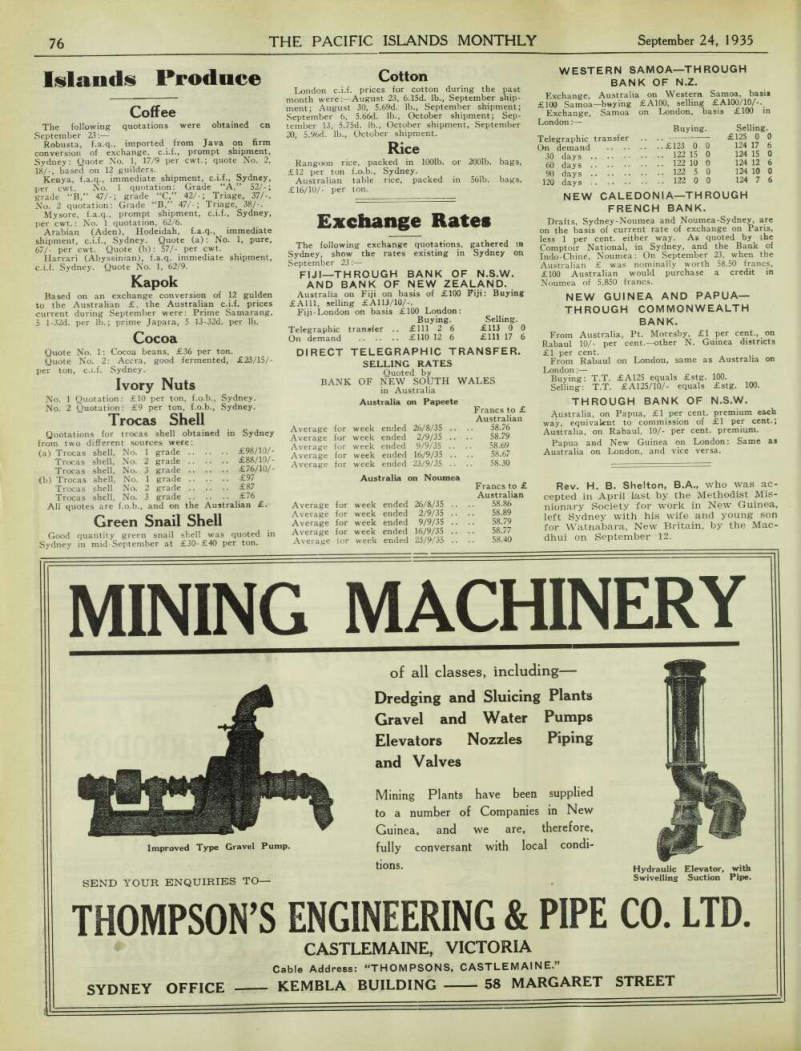
Coffee
The following quotations were obtained cn September 23; Robusta, f.a.q., imported from Java on firm conversion of exchange, c.i.f., prompt shipment, Sydney: Quote No. 1, 17/9 per cwt.; quote No. 2, 18/-, based on 12 guilders.
Kenya, f.a.q., immediate shipment, c.i.f., Sydney, per cwt. No. 1 quotation: Grade “ A,” 52/-; grade “B,” 47/-; grade “C,” 42/-; Triage, 37/-.
No. 2 quotation: Grade “B,” 47/-; Triage, 38/-.
Mysore, f.a.q., prompt shipment, c.i.f., Sydney, per cwt.; No. 1 quotation, 62/6.
Arabian (Aden), Hodeidah, f.a.q., immediate shipment, c.i.f., Sydney. Quote (a): No. 1, pure, 67/- per cwt. Quote (b); 57/- per cwt.
Harrari (Abyssinian), f.a.q. immediate shipment, c.i.f. Sydney. Quote No. 1, 62/9.
Kapok
Based on an exchange conversion of 12 gulden to the Australian £, the Australian c.i.f. prices current during September were: Prime Samarang, 5 l-32d. per lb.; prime Japara, 5 13-32 d. per lb.
Cocoa
Quote No. 1; Cocoa beans, £36 per ton.
Quote No. 2; Accra, good fermented, £23/15/per ton, c.i.f. Sydney.
Ivory Nuts
No. 1 Quotation: £lO per ton, f.0.b., Sydney.
No. 2 Quotation: £9 per ton, f.0.b., Sydney.
Trocas Shell
Quotations for trocas shell obtained in Sydney from two different sources were: (a) Trocas shell, No. 1 grade £9B/10/- Trocas shell. No. 2 grade £BB/10/- Trocas shell, No. 3 grade £76/10/- (b) Trocas shell, No. 1 grade £97 Trocas shell No. 2 grade £B7 Trocas shell, No. 3 grade £76 All quotes are f.0.b., and on the Australian £.
Green Snail Shell
Good quantity green snail shell was quoted in Sydney in mid-September at £3O-£4O per ton.
Cotton
London c.i.f. prices for cotton during the past month were:— August 23, 6.15 d. lb., September ship ment; August 30, 5.69 d. lb., September shipment; September 6,5.66 d. lb., October shipment; Sep tember 13, 5.75 d. lb., October shipment, September 20, 5.96 d. lb., October shipment.
Rice
Rangoon rice, packed in 1001 b. or 2001 b. bags, £l2 per ton f.0.b., Sydney.
Australian table rice, packed in 561 b. bags, £l6/10/- per ton.
Exchange Rates
The following exchange quotations, gathered m Sydney, show the rates existing in Sydney on September 23: — FlJl—through bank of n.s.w.
And Bank Of New Zealand.
Australia on Fiji on basis of £lOO Fiji: Buying £AIII, selling £AII3/10/-.
Fiji-London on basis £lOO London:
Direct Telegraphic Transfer.
Selling Rates
Quoted by
Bank Of New South Wales
in Australia
Western Samoa—Through
Bank Of N.Z.
Exchange, Australia on Western Samoa, basis £lOO Samoa—buying £AIOO, selling £AIOO/10/-.
Exchange, Samoa on London, basis £lOO m London; —■
New Caledonia—Through
French Bank.
Drafts, Sydney-Noumea and Noumea-Sydney, are on the basis of current rate of exchange on Paris, less 1 per cent, either way. As quoted by the Comptoir National, in Sydney, and the Bank of Indo-Chine, Noumea; On September 23, when the Australian £ was nominally worth 58.50 francs, £lOO Australian would purchase a credit in Noumea of 5,850 francs.
New Guinea And Papua
Through Commonwealth
Bank.
From Australia, Pt. Moresby, £1 per cent., on Rabaul 10/- per cent.—other N. Guinea districts £1 per cent.
From Rabaul on London, same as Australia on London: — Buying: T.T. £AI2S equals £stg. 100.
Selling: T.T. £AI2S/10/- equals £stg. 100.
Through Bank Of N.S.W.
Australia, on Papua, £1 per cent, premium each way, equivalent to commission of £1 per cent.; Australia, on Rabaul, 10/- per cent, premium.
Papua and New Guinea on London: Same as Australia on London, and vice versa.
Rev. H. B. Shelton, 8.A., who was ac cepted in April last by the Methodist Mis nionary Society for work in New Guinea, left Sydney with his wife and young son for Watnabara, New Britain, by the Mac dhui on September 12.
Buying.
Selling.
Telegraphic transfer . . £111 2 6 £113 0 0 On demand . £110 12 6 £111 17 6
Average for Australia on Papeete week ended 26/8/35 ..
Francs to £ Australian 58.76 Average for week ended 2/9/35 .. 58.79 Average for week ended 9/9/35 .. 58.69 Average for week ended 16/9/35 .. 58.67 Average for week ended 23/9/35 .. 58.30 Average for Australia on Noumea week ended 26/8/35 ..
Francs to £ Australian 58.86 Average for week ended 2/9/35 .. 58.89 Average for week ended 9/9/35 .. 58.79 Average for week ended 16/9/35 .. 58.77 Average lor week ended 23/9/35 .. 58.40
Buying. Selling.
Telegraphic transfer .. .. £125 0 0 On demand £123 0 0 124 17 6 30 days 122 15 0 124 15 0 60 days 122 10 0 124 12 6 90 days 122 5 0 124 10 0 120 days 122 0 0 124 7 6
Advertisements & other items, p. 78 (1 item)
Mining Machinery
Improved Type Gravel Pump.
SEND YOUR ENQUIRIES TO-
of all classes, including—
Dredging and Sluicing Plants
Gravel and Water Pumps Elevators Nozzles Piping and Valves Mining Plants have been supplied to a number of Companies in New Guinea, and we are, therefore, fully conversant with local conditions.
Hydraulic Elevator, with Swivelling Suction Pipe.
THOMPSON’S ENGINEERING & PIPE CO. LTD.
SYDNEY OFFICE
CASTLEMAINE, VICTORIA
Cable Address; “THOMPSONS, CASTLEMAINE.”
KEMBLA BUILDING 58 MARGARET STREET
Market Quotations
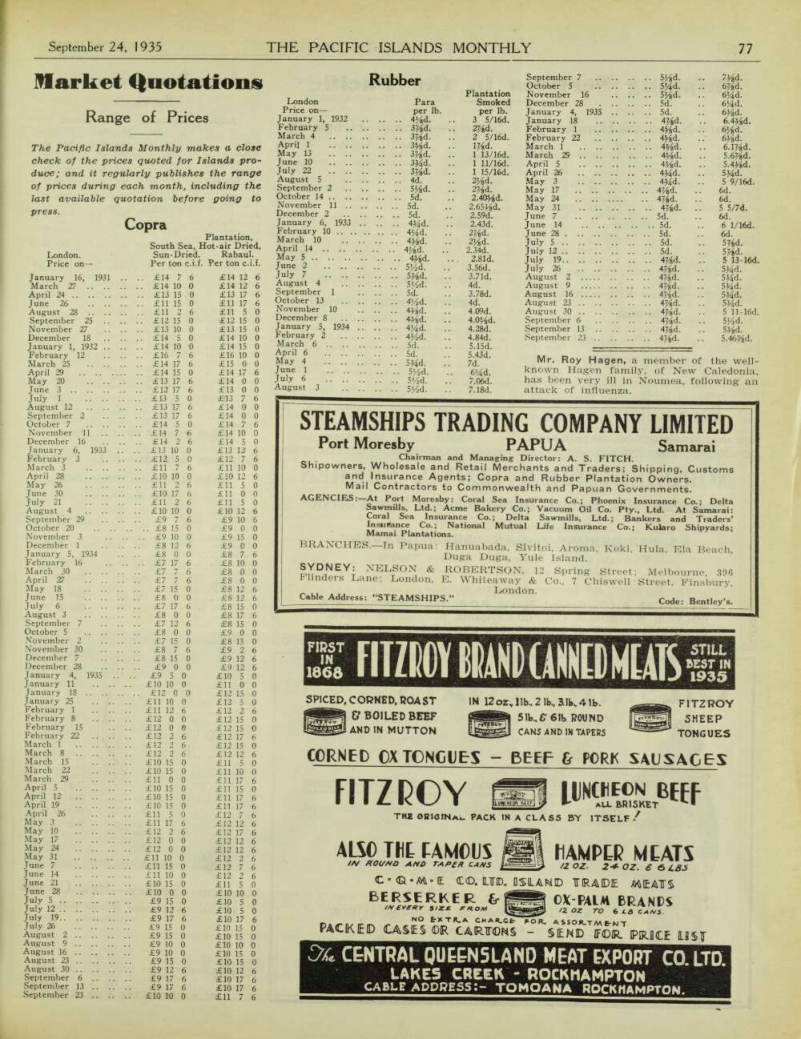
Range of Prices
The Pacific Islands Monthly makes a close check of the prices quoted for Islands pro duce; and it regularly publishes the range of prices during each month, including the last available quotation before going to press.
Mr. Roy Hagen, a member of the well known Hagen family, of New Caledonia, has been very ill in Noumea, following an attack of influenza.
September 7 .. .. . .. 5%d. 7H d.
October 5 ... . .. 5'Ad. 6m.
November 16 . .. 5H d. ey 4 d.
December 28 ... . .. 5d. 6'Ad.
January 4, 1935 .. . 5d. 6$4d.
January 18 .. .. .. .. 4**d. 6.4}id.
February 1 . .. 4Hd. 6y s d.
February 22 .. .. . .. 4^d. 6Hd.
March 1 .. .. 4^d. e.vAd.
March 29 .. .. 4**d. 5.67/sd.
April 5 .. .. 45^d. 5.4Hd.
April 26 . .. 4*4d. 5Ad.
May 3 . .. 4tfd. 5 9/16d.
May 17 . .. 4^d. 6d.
May 24 .. 4*id. . , 6d.
May 31 .. .. 4^d. . . 5 5/7d.
June 7 . .. Sd. 6d.
June 14 .. .. 5d. 6 l/16d.
June 28 . .. Sd. 6d.
July 5 .. .. Sd.
S%d.
July 12 .. .. Sd.
Slid.
July 19 .. .. 4fcd. 5 13-16d.
July 26 . .. 4*id. 5Hd.
August 2 . .. 4ftd.
S^d.
August 9 . .. 4^d. 5Ad- August 16 . .. 4*Sd. 5Hd.
August 23 .. .. 47^d. 5Hd.
August 30 .. .. 47/Sd. 5 ll-16d.
September 6 .. .. .. .. 47^d. sy,d.
September 13 .. .. 4^d. 5Hd.
September 23 . .. 4ftd. 5.46%d.
Rubber
Plantation London Para Smoked Price on — per lb. per lb.
January 1, 1932 4^d. 3 S/16d.
February 5 2m.
March 4 3m. .. 2 5/16d.
April 1 ... 3H d. .. im.
May 13 .. ., 3m. .. 1 13/16d.
June 10 .. .. 3H d. .. 1 ll/16d.
July 22 ... 3m. .. 1 15/16d.
August 5 2y 8 d.
September 2 3%d. .. 2m.
October 14 .. .. 2. 40Hd.
November 11 ..
Sd. 2.65Hd.
December 2 5d. 2.59d.
January 6, 1933 2.43d.
February 10 .. .. .. 2m.
March 10 .. . 4Hd. 2%d.
April 14 .. 2.34d.
May 5 2.81d.
June 2 S'/zd. .. 3.56d.
July 7 3.71d.
August 4 .. . 4d.
September 1 5d. 3.78d. 4d.
October 13 .. .
November 10 4f6d. 4.09d.
December 8 .. . 4.0^d.
January 5, 1934 . 4j4d! !! 4.28d.
February 2 .. . 4.84d.
March 6 5.15d. 5.43d. 7d.
April 6 5d May 4 sy 4 d.
June 1 ... sy 2 d. ey A d.
July 6 7.06d.
August 3 sy 2 d. ” 7.18d.
Copra
Plantation, South Sea, Hot-air Dried, London.
Sun-Dried. Rabaul.
Price on— Per ton c.i.f. Per ton c.i.f.
January 16, 1931 .. .. £14 7 6 £14 12 6 March 27 .. .. .. .. £14 10 0 £14 12 6 April 24 .. .. £13 15 0 £13 17 6 June 26 .. .. .. .. £11 15 0 £11 17 6 August 28 .. .. .. .. £11 2 6 £11 5 0 September 25 .. .. .. £12 15 0 £12 15 0 November 27 .. .. £13 10 0 £13 15 0 December 18 .. .. £14 5 0 £14 10 0 January 1, 1932 .. .. .. £14 10 0 £14 15 0 February 12 .. .. £16 7 6 £16 10 0 March 25 ... .. .. £14 17 6 £15 0 0 April 29 £14 15 0 £14 17 6 May 20 ... .. .. £13 17 6 £14 0 0 June 3 .. .. £12 17 6 £13 0 0 July 1 .. .. .. .. £13 5 0 £13 7 6 August 12 .. .. £13 17 6 £14 0 0 September 2 .. .. £13 17 6 £14 0 0 October 7 .. .. .. .. £14 5 0 £14 7 6 November 11 .. .. £14 7 6 £.14 10 0 December 16 .. .. £14 2 6 £14 5 0 January 6, 1933 .. .. £13 10 0 £13 12 6 February 3 .. .. £12 5 0 £12 7 6 March 3 ... .. .. £11 7 6 £11 10 0 April 28 ... .. .. £10 10 0 £10 12 6 May 26 ... .. .. £11 2 6 £11 5 0 June 30 ... .. .. £10 17 6 £11 0 0 July 21 ... .. .. £11 2 6 £11 5 0 August 4 .. .. £10 10 0 £10 12 6 September 29 .. .. £9 7 6 £9 10 6 October 20 .. .. .. .. £8 15 0 £9 0 0 November 3 .. .. £9 10 0 £9 15 0 December 1 .. .. £8 12 6 £9 0 0 January 5, 1934 .. .. £8 0 0 £8 7 6 February 16 .. .. £7 17 6 £8 10 0 March 30 .. .. .. .. £7 7 6 £8 0 0 April 27 ... .. .. £7 7 6 £8 0 0 May 18 ... .. .. £7 15 0 £8 12 6 June 15 .. .. ,. .. £8 0 0 £8 12 6 July 6 ... .. .. £7 17 6 £8 IS 0 August 3 .. .. .. .. £8 0 0 £8 17 6
September 7
.. .. £7 12 6 £8 15 0 October 5 .. .. .. .. £8 0 0 £9 0 0 November 2 .. .. £7 15 0 £8 15 0 November 30 .. .. £8 7 6 £9 2 6 December 7 .. .. £8 15 0 £9 12 6 December 28 .. .. £9 0 0 £9 12 6 January 4, 1935 . . .. £9 5 0 £10 5 0 January 11 ... £10 10 0 £11 0 0 January 18 .. .. .. .. £12 0 0 £12 15 0 January 25 .. .. .. £11 10 0 £12 5 0 February 1 £11 12 6 £12 2 6 February 8 .. .. £12 0 0 £12 15 0 February 15 .. £12 0 0 £12 IS 0 February 22 .. .. .. £12 2 6 £12 17 6 March 1 .. £12 2 6 £12 15 0 March 8 .. £12 2 6 £12 12 6 March 15 ... .. £10 15 0 £11 5 0 March 22 .. £10 15 0 £11 10 0 March 29 ... £11 0 0 £11 17 6 April 5 £10 15 0 £11 15 0 April 12 .. £10 IS 0 £11 17 6 April 19 £10 15 0 £11 17 6 April 26 ... .. £11 5 0 £12 7 6 May 3 .. £11 17 6 £12 12 6 May 10 .. £12 2 6 £12 17 6 May 17 £12 12 6 May 24 .. £12 0 0 £12 12 6 May 31 £11 10 0 £12 2 6 June 7 .. £11 15 0 £12 7 6 June 14 £11 10 0 £12 2 6 June 21 £11 5 0 June 28 £10 0 0 £10 10 0 July 5 £9 15 0 £10 5 0 July 12 £9 12 6 £10 5 0 July 19 £10 17 6 July 26 £9 15 0 £10 15 0 August 2 £10 15 0 August 9 £9 10 0 £10 10 0 August 16 £10 15 0 August 23 £9 15 0 £10 15 0 August 30 £9 12 6 £10 12 6 September 6 .. .. £9 17 6 £10 17 6
September 13 .. ..
£9 17 6 £10 17 6 September 23 .. .. £11 7 6
Advertisements & other items, p. 79 (1 item)
Fitzroy
STEAMSHIPS TRADING COMPANY LIMITED
Port Moresby PAPUA Samarai
Chairman and Managing Director: A. S. FITCH.
Shipowners, Wholesale and Retail Merchants and Traders; Shipping, Customs and Insurance Agents; Copra and Rubber Plantation Owners.
Mail Contractors to Commonwealth and Papuan Governments.
AGENCIES: At Port Moresby: Coral Sea Insurance Co.; Phoenix Insurance Co.; Delta Sawmills, Ltd.; Acme Bakery Co.; Vacuum Oil Co. Pty., Ltd. At Samarai: Coral Sea Insurance Co.; Delta Sawmills, Ltd.; Bankers and Traders’
Insurance Co.; National Mutual Life Insurance Co.; ICularo Shipyards; Mamai Plantations.
BRANCHES.—In Papua; Hanuabada, Sivitoi, Aroma, Koki, Hula, Ela Beach, Duga Duga, Yule Island.
SYDNSV: NELSON & ROBERTSON. 12 Spring Street; Melbourne Flinders Lane; London, E. Whiteaway & Co., 7 Chiswell Street Cable Address: “STEAMSHIPS,” London. 396 Finsbury, Code: Bentley’s.
FIRST
IN 1868
SPICED, CORNED. ROAST
f? BOILED BEEF
AND IN MUTTON
IN 12 oz y lib., 2 lb., Sib* 41b.
51k. 6’ 6U> ROUND
CANS AND IN TAPERS
FITZROY
SHEEP
TONGUES
CORNED OX TONGUES - BEEF 6 PORK SAUSAGES
FITZROY
I
BjUNCHCQN ftUF
WffiSyttf
THE ORIOINa*- pack in a class by itself /
ALSO THE EAMOUS S HAMPER MEATS
/>V ROL/RD ARO TAPER CARS /2 OZ■ 24- OZ. £ 6 LB3
(L(D. Lira DSEAND TRADE MEATS
BERSERKER OX-PALM BRANDS
MtTCRY 5 ,ZS (aSgSI a TO i i??,, s NO &XTR.A CMAK.C t- ' P OR. A SSOR.TM C-KI T PACKED CASES ©R CAR.TCNS - SEND EOR. IPRJCE LAST Sfc CENTRAL QUEENSLAND MEAT EXPORT CO. LTD
LAKES CREEK - ROCKHAMPTON
CABLE ADDRESS:- TOMOANA ROCKHAMPTON.
London—Sydney—New Guinea
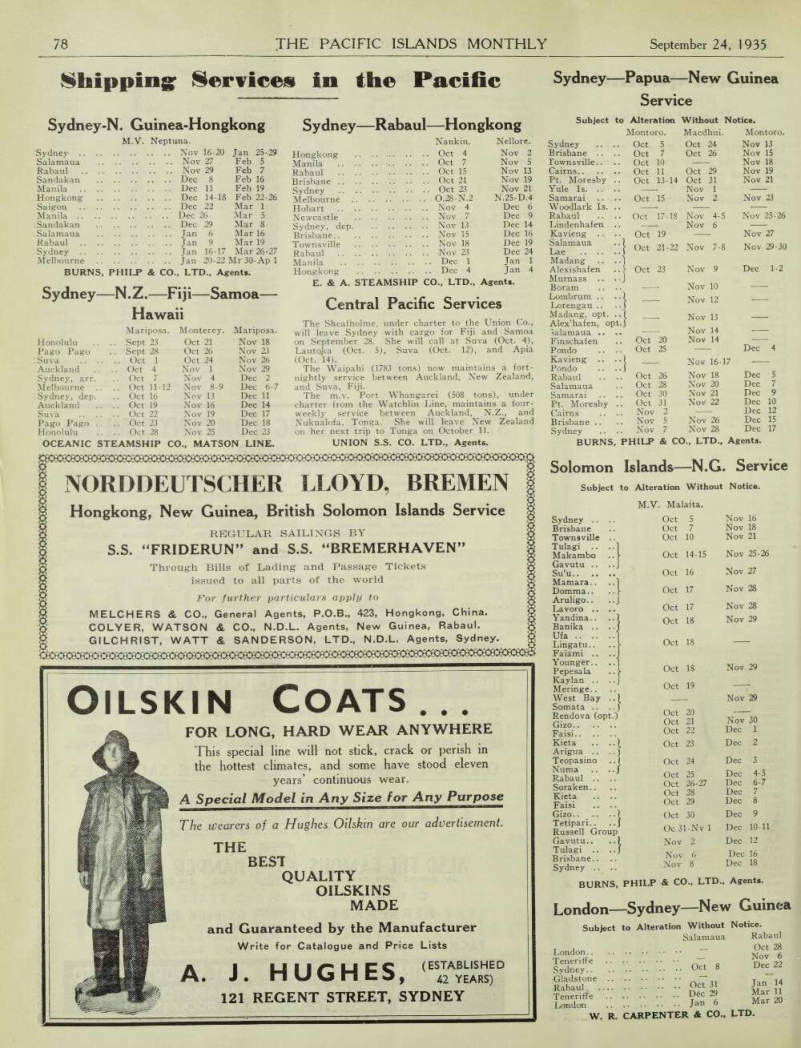
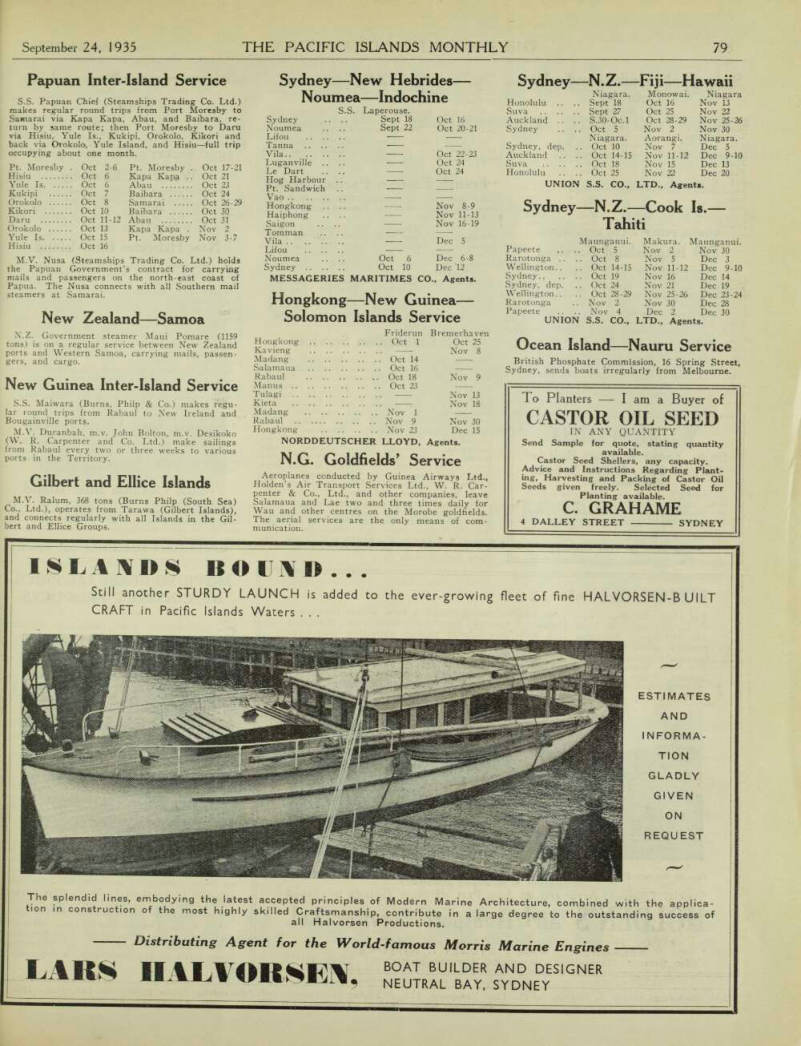
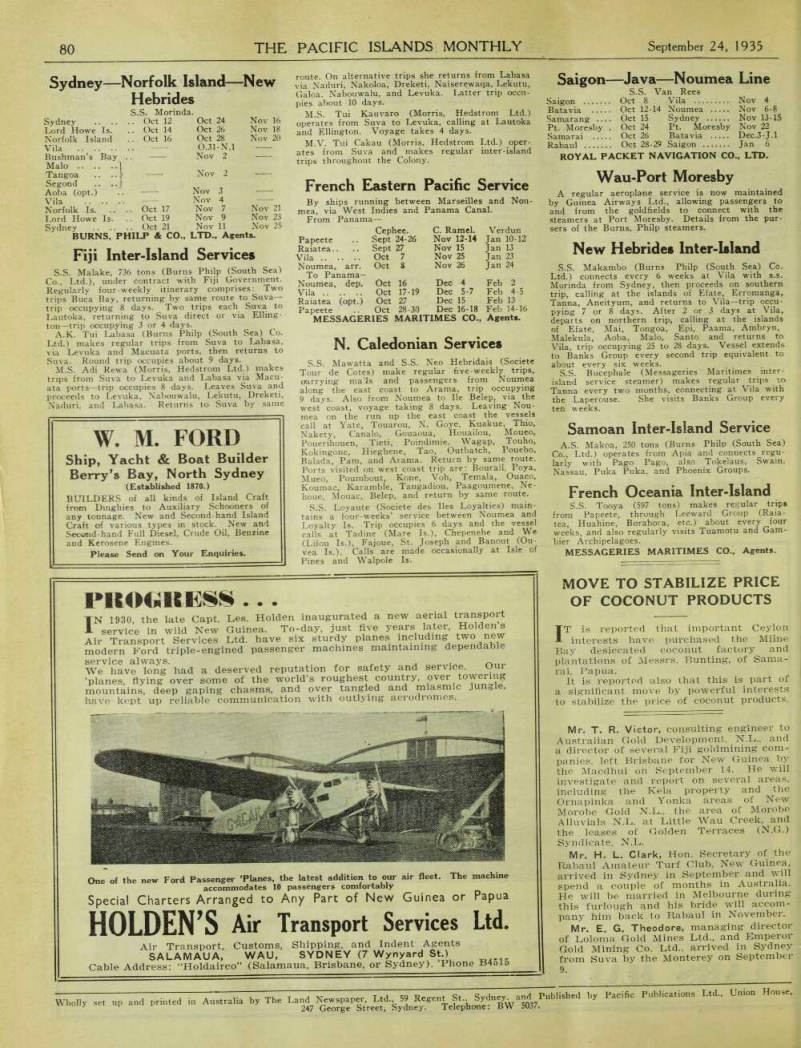
Shipping Services in the Pacific
Sydney-N. Guinea-Hongkong
Sydney—N. Z. —Fi j i—Samoa— Hawaii
Sydney—Rabaul—Hongkong
Central Pacific Services
The Sheafholme, under charter to the Union Co., will leave Sydney with cargo for Fiji and Samoa on September 28. She will call at Suva (Oct. 4), Lautojca (Oct. 5), Suva (Oct. 12), and Apia (Oct. 14).
The Waipahi (1783 tons) now maintains a fort nightly service between Auckland, New Zealand, and Suva, Fiji.
The m.v. Port Whangarei (508 tons), under charter from the Watchlin Line, maintains a four weekly service between Auckland, N.Z., and Nukualofa, Tonga. She will leave New Zealand on her next trip to Tonga on October 11.
Union S.S. Co. Ltd., Agents.
Sydney—Papua—New Guinea Service
Solomon Islands —N.G. Service Subject to Alteration Without Notice.
London—Sydney—New Guinea
M.V.
Neptuna.
Sydney .. 16-20 Jan 25-29 Salamaua 27 Feb 5 Rabaul .. .. 29 Feb 7 Sandakan 8 Feb 16 Manila 11 Feb 19 Hongkong 14-18 Feb 22-26 Saigon .. .. 22 Mar 1 Manila .. ..
Mar 5 Sandakan 29 Mar 8 Salamaua 6 Mar 16 Rabaul .. .. Jan 9 Mar 19 Sydney .. .. 16-17 Mar 26-27 Melbourne 20-22 Mr 30 -Ap 1
Burns,
Philp
& CO., LTD., Agents.
Mariposa.
Monterey.
Mariposa.
Honolulu . .. Sept 23 Oct 21 Nov 18 Pago Pago .. Sept 28 Oct 26 Nov 23 Suva .. .. Oct 1 Oct 24 Nov 26 Auckland . .. Oct 4 Nov 1 Nov 29 Sydney, arr. .. Oct 7 Nov 4 Dec 2 Melbourne .. .. Oct 11-12 Nov 8-9 Dec 6-7 Sydney, dep. .. Oct 16 Nov 13 Dec 11 Auckland .. .. Oct 19 Nov 16 Dec 14 Suva .. .. Oct 22 Nov 19 Dec 17 Pago Pago .. .. Oct 23 Nov 20 Dec 18 Honolulu .. .. Oct 28 Nov 25 Dec 23
Oceanic
Steamship Co.. Matson Line.
Nankin.
Nellore.
Hongkong .. Oct 4 Nov 2 Manila .. Oct 7 Nov 5 Rabaul .. Oct 15 Nov 13 Brisbane .. Oct 21 Nov 19 Sydney .. Oct 23 Nov 21 Melbourne . 0.28-N.2 N.25-D.4 Hobart ..
Dec 6 Newcastle .. Nov 7 Dec 9 Sydney, dep Dec 14 Brisbane .. Nov 15 Dec 16 Townsville Dec 19 Rabaul Dec 24 Manila .. Dec 1 Jan 1 Hongkong .. Dec 4 Jan 4
E. & A. Steamship
Co., Ltd.,
Agents.
Subject to Alteration Without Notice.
Montoro.
Macdhui. Montoro.
Sydney
.. Oct 5 Oct 24 Nov 13 Brisbane .. .. Oct 7 Oct 26 Nov 15 Townsville.. .. Oct 10 — Nov 18 Cairns..
Oct 29 Nov 19 Pt. Moresby • • Oct 13-14 Oct 31 Nov 21 Yule Is. .. .. .
Nov 1 — Samarai .. Oct 15 Nov 2 Nov 23 Woodlark Is. . . £ — Rabaul .. Oct 17-18 Nov 4-5 Nov 25-26 Lindenhafen Nov 6 — Kavieng .. • • Oct 19 — Nov 27 Salamaua Lae ”\ Oct 21-22 Nov 7-8 Nov 29-30 Madang Alexishafen Oct 23 Nov 9 Dec 1-2 Murnass .. ..J Boram Nov 10 -— Lombrum .. ..] Nov 12 Lorengau .. .
Madang, opt.
' *1 Nov 13 Alex’hafen, opt.j jalamaua .. ..
Nov 14 — Finschafen .. Oct 20 Nov 14 — Pondo .. Oct 25 —— Dec 4 Kavieng .. -I — Nnv 16-17 Pondo ..j Rabaul .. Oct 26 Nov 18 Dec 5 Salamaua .. Oct 28 Nov 20 Dec 7 Samarai .. Oct 30 Nov 21 Dec 9 Pt. Moresby .. Oct 31 Nov 22 Dec 10 Cairns .. Nov 2 — Dec 12 Brisbane .. ., Nov 5 Nov 26 Dec 15 Sydney Nov 7 Nov 28 Dec 17
Burns, Philp & Co., Ltd.,
, Agents.
M.V. Malaita.
Sydney .. ..
Oct 5 Nov 16 Brisbane Oct 7 Nov 18 Townsville ..
Oct 10 Nov 21 Tulagi ..
Makambo Oct 14-15 Nov 25-26 Gavutu ..
Su’u Oct 16 Nov 27 Mamara..
Domma..
Oct 17 Nov 28 Aruligo..
Lavoro .. ..
Oct 17
Nov 28
Yandina..
Oct 18 Nov 29 Banika .. ..
Ufa Lingatu..
Oct 18 Faiami .. ..
Younger.. ..
Pepesala Oct 18 Nov 29 Kaylan .. ..
Meringe..
Oct 19 West Bay ..] [ Nov 29 Somata .. .. J Oct 20 Oct 21 Rendova (opt.) Nov 30 Faisi Oct 22 Dec 1 Kieta .. .. 1 L Oct 23 Dec 2 Arigua .. .. j \ Teopasino .. i [ Oct 24 Dec 3 Numa .. ..j Rabaul ..
Soraken..
Kieta ..
Faisi .. ..
Oct 25 Oct 26-27 Oct 28 Oct 29 Dec Dec Dec Dec 4-5 6-7 7 8 Gizo ] I Oct 30 Dec 9 Tetipari.. ..J Russell Group ’ Oc 31-Nv 1 Dec 10-11 Gavutu..
I Nov 2 Dec 12 Tulagi .. ..J Brisbane..
Sydney .. ..
Nov 6 Nov 8 Dec 16 Dec 18
Burns,
Philp & Co., Ltd.
, Agents.
Subject to Alteration Without Notice.
Salamaua Rabaul Teneriffe Sydney Oct 8 Oct 28 Nov 6 Dec 22 Gladstone „ Rabaul Oct 31 Teneriffe Dec 29 London J an ° Jan 14 Mar 11 Mar 20
W. R. Carpenter & Co.,
Ltd.
Papuan Inter-Island Service
S.S. Papuan Chief (Steamships Trading Co. Ltd.) makes regular round trips from Port Moresby to Samarai via Kapa Kapa, Abau, and Baibara, re turn by same route; then Port Moresby to Daru via Hisiu, Yule Is., Kukipi, Orokolo, Kikori and back via Orokolo, Yule Island, and Hisiu —full trip occupying about one month.
M. Nusa (Steamships Trading Co. Ltd.) holds the Papuan Government’s contract for carrying mails and passengers on the north-east coast of Papua. The Nusa connects with all Southern mail steamers at Samarai.
New Zealand—Samoa
N. Government steamer Maui Pomare (1159 tons) is on a regular service between New Zealand ports and Western Samoa, carrying mails, passen gers, and cargo.
New Guinea Inter-Island Service
S.S. Maiwara (Burns, Philp & Co.) makes regu lar round trips from Rabaul to New Ireland and Bougainville ports.
M.V. Duranbah, m.v. John Bolton, m.v. Desikoko (W. R. Carpenter and Co. Ltd.) make sailings from Rabaul every two or three weeks to various ports in the Territory.
Gilbert and Ellice Islands
M.V. Ralum, 368 tons (Burns Philp (South Sea) Co., Ltd.), operates from Tarawa (Gilbert Islands), and connects regularly with all Islands in the Gil bert and Ellice Groups.
Sydney—New Hebrides— Noumea—lndochine
Hongkong—New Guinea— Solomon Islands Service
N.G. Goldfields’ Service
Aeroplanes conducted by Guinea Airways Ltd., Holden’s Air Transport Services Ltd., W. R. Car penter & Co., Ltd., and other companies, leave Salamaua and Lae two and three times daily for Wau and other centres on the Morobe goldfields.
The aerial services are the only means of com munication.
Sydney—N.Z.—Fiji—Hawaii
Sydney—N.Z.—Cook Is.— Tahiti
Ocean Island—Nauru Service
British Phosphate Commission, 16 Spring Street, Sydney, sends boats irregularly from Melbourne.
Pt. Moresby . Oct 2-6 Pt. Moresby . Oct 17-21 Hisiu Oct 6 Kapa Kapa .. Oct 21 Yule Is Oct 6 Abau Oct 23 Kukipi Oct 7 Baibara Oct 24 Orokolo Oct 8 Samarai Oct 26-29 Kikori Oct 10 Baibara Oct 30 Daru Oct 11-12 Abau Oct 31 Orokolo Oct 13 Kapa Kapa . Nov 2 Yule Is Oct IS Pt. Moresby Nov 3-7 Hisiu Oct 16
S.S. Laperouse.
Sydney Sept 18 Oct 16 Noumea .. ..
Sept 22 Oct 20-21 Vila Oct 22-23 Duganville .. .. — Oct 24 Le Dart — Oct 24 Hog Harbour .. — Pt. Sandwich — Vao Hongkong ..
Nov 8-9 Haiphong .. — Nov 11-13 Saigon .. .. — Nov 16-19 Tomman — — Vila — Dec 5 Lifou — — Noumea .. ..
Oct 6 Dec 6-8 Sydney Oct 10 Dec 12
Messageries
Maritimes
CO., Agents.
Friderun Bremerhaven Hongkong . Oct 1 Oct 25 Kavieng .
Nov 8 Madang . Oct 14 Salamaua . Oct 16 Rabaul Oct 18 Nov 9 Manus . Oct 23 Tulagi , Nov 13 Kieta .
Nov 18 Madang Nov 1 — Rabaul Nov 9 Nov 30 Hongkong Nov 23 Dec 15
Norddeutscher
Lloyd,
Agents.
Niagara.
Monowai.
Niagara Honolulu Sept 18 Oct 16 Nov 13 Suva Sept 27 Oct 25 Nov 22 Auckland SJO-Oc.l Oct 28-29 Nov 25-26 Sydney .. ..
Oct 5 Nov 2 Nov 30 Sydney, dep.
Niagara.
Aorangi.
Niagara.
Oct 10 Noy 7 Dec 5 Auckland ..
Oct 14-15 Nov 11-12 Dec 9-10 Suva Oct 18 Nov IS Dec 13 Honolulu .. ..
Oct 25 Nov 22 Dec 20
Union
S.S. Co.,
Ltd.,
Agents.
Maunganui. Makura. Maunganui.
Papeete .. .. Oct 5 Nov 2 Nov 30 Rarotonga .. .. Oct 8 Nov 5 Dec 3 Wellington.. .. Oct 14-15 Nov 11-12 Dec 9-10 Sydney Oct 19 Nov 16 Dec 14 Sydney, dep. .. Oct 24 Nov 21 Dec 19 Wellington.. .. Oct 28-29 Nov 25-26 Dec 23-24 Rarotonga .. Nov 2 Nov 30 Dec 28 Papeete .. .. Nov 4 Dec 2 Dec 30
Union S.S. Co., Ltd., Agents.
Sydney—Norfolk Island—New Hebrides
Fiji Inter-Island Services
S.S. Malake, 736 tons (Burns Philp (South Sea) Co., Ltd.), under contract with Fiji Government.
Regularly four-weekly itinerary comprises: Two trips Buca Bay, returning by same route to Suva— trip occupying 8 days. Two trips each Suva to Lautoka, returning to Suva direct or via Elling ton—trip occupying 3 or 4 days.
A.K. Tui Labasa (Burns Philp (South Sea) Co.
Ltd.) makes regular trips from Suva to Labasa, via Levuka and Macuata ports, then returns to Suva. Round trip occupies about 9 days.
M.S. Adi Rewa (Morris, Hedstrom Ltd.) makes trips from Suva to Levuka and Labasa via Macu ata ports—trip occupies 8 days. Leaves Suva and proceeds to Levuka, Nabouwalu, Lekutu, Dreketi, Naduri. and Labasa. Returns to Suva by same
route. On alternative trips she returns from Labasa via Naduri, Nakoloa, Dreketi, Naiserewaqa, Lekutu, Galoa, Nabouwalu, and Levuka. Latter trip occu pies about 10 days.
M.S. Tui Kauvaro (Morris, Hedstrom Ltd.) operates from Suva to Levuka, calling at Lautoka and Ellington. Voyage takes 4 days.
M.V. Tui Cakau (Morris, Hedstrom Ltd.) oper ates from Suva and makes regular inter-island trips throughout the Colony.
French Eastern Pacific Service
By ships running between Marseilles and Nou mea, via West Indies and Panama Canal.
From Panama —
N. Caledonian Services
5.5. Mawatta and S.S. Neo Hebridais (Societc Tour de Cotes) make regular five-weekly trips, carrying ma'Js and passengers from Noumea along the east coast to Arama, trip occupying 9 days. Also from Noumea to He Belep, via the west coast, voyage taking 8 days. Leaving Nou mea on the run up the east coast the vessels call at Yate, Touarou, N. Goye, Kuakue, Thio, Nakety, Canalo, Gouaoua, Houailou, Moueo, Pouerihouen, Tieti, Poindimie, Wagap, Touho, Kokingone, Hieghene, Tao, Outbatch, Pouebo, Balada, Pam, and Arama. Return by same route.
Ports visited on west coast trip are; Bourail, Poya, Mueo, Poumbout, Kone, Voh, Temala, Ouaco, Koumac, Karamble, Tangadiou, Paagoumene, Ne houe, Mouac, Belep, and return by same route. 5.5. Loyaute (Societe des lies Loyalties) main tains a four-weeks’ service between Noumea and Loyaltv Is. Trip occupies 6 days and the vessel calls at Tadine (Mare Is.), Chepenehe and We (Lifou Is.), Fajoue, St. Joseph and Banout (Ou vea Is.). Calls are made occasionally at Isle of Pines and Walpole Is.
Saigon—Java—Noumea Line
Wau-Port Moresby
A regular aeroplane service is now maintained by Guinea Airways Ltd., allowing passengers to and from the goldfields to connect with the steamers at Port Moresby. Details from the pur sers of the Burns. Philp steamers.
New Hebrides Inter-bland
5.5. Makambo (Burns Philp (South Sea) Co.
Ltd.) connects every 6 weeks at Vila with s.s.
Morinda from Sydney, then proceeds on southern trip, calling at the islands of Efate, Erromanga, Tanna, Aneityum, and returns to Vila—trip occu pying 7 or 8 days. After 2 or 3 days at Vila, departs on northern trip, calling at the islands of Efate, Mai, Tongoa, Epi, Paama, Ambryn, Malekula, Aoba, Malo, Santo and returns to Vila, trip occupying 25 to 28 days. Vessel extends to Banks Group every second trip equivalent to about every six weeks. 5.5. Bucephale (Messageries Maritimes inter island service steamer) makes regular trips to Tanna every two months, connecting at Vila with the Laperouse. She visits Banks Group every ten weeks.
Samoan Inter-Island Service
A.S. Makoa, 250 tons (Burns Philp (South Sea) Co., Ltd.) operates from Apia and connects regu larly with Pago Pago, also Tojcelaus, Swain, Nassau, Puka Puka, and Phoenix Groups.
French Oceania Inter-Island
S.S. Tooya (597 tons) makes regular trips from Papeete, through Leeward Group (Raia tea, Huahine, Borabora, etc.) about every four weeks, and also regularly visits Tuamotu and Gam bier Archipelagoes.
Messageries Maritimes Co., Agents.
S.S. Morinda.
Sydney .. Oct 12 Oct 24 Nov 16 Lord Howe Is. .. Oct 14 Oct 26 Nov 18 Norfolk Island .. Oct 16 Oct 28 Nov 20 Vila — 0.31-N.l — Bushman’s Bay
Malo ]
— Nov 2 —
Tangoa .. ..
Segond .. ..J — Nov 2 Aoba (opt.) — Nov J — Vila — Nov 4 — Norfolk Is. .. Oct 17 Nov 7 Nov 21 Lord Howe Is. .. Oct 19 Nov 9 Nov 23 Sydney .. Oct 21 Nov 11 Nov 25
Burns, Philp & Co.,
LTD.. Agents.
Cephee.
C. Ramel.
Verdun Papeete Sept 24-26 Nov 12-14 Jan 10-12 Raiatea..
Sept 27 Nov 15 Jan 13 Vila Oct 7 Nov 25 Jan 23 Noumea, arr.
Oct 8 Nov 26 Jan 24 To Panama- Noumea, dep.
Oct 16 Dec 4 Feb 2 Vila Oct 17-19 Dec 5-7 Feb 4-5 Raiatea (opt.) Oct 27 Dec 15 Feb 13 Papeete Oct 28-30 Dec 16-18 Feb 14-16
Messageries
Maritimes Co.,
Agents.
s.s.
Van Rees Saigon Oct 8 Vila Nov 4 Batavia Oct 12- 14 Noumea Nov 6-8 Samarang Oct IS Sydney Nov 13-15 Pt. Moresby .
Oct 24 Pt. Moresby Nov 22 Samarai Oct 26 Batavia Dec.3-J.l Rabaul Oct 28-29 Saigon Jan 6
Royal Packet Navigation Co.
, Ltd.
Advertisements & other items, pp. 80-82 (1 item)
Oilskin Coats...
NORDDEUTSCHER LLOYD, BREMEN
Hongkong, New Guinea, British Solomon Islands Service
REGULAR SAILINGS BY
S.S. “FRIDERUN” and S.S. “BREMERHAVEN”
Through Bills of Lading and Passage Tickets issued to all parts of the world For further particulars apply to MELCHERS & CO., General Agents, P. 0.8., 423, Hongkong, China.
COLYER, WATSON & CO., N.D.L. Agents, New Guinea, Rabaul.
GILCHRIST, WATT & SANDERSON, LTD., N.D.L. Agents, Sydney.
Oilskin Coats...
FOR LONG, HARD WEAR ANYWHERE
This special line will not stick, crack or perish in the hottest climates, and some have stood eleven years’ continuous wear.
A Special Model in Any Size for Any Purpose The wearers of a Hughes Oilskin are our advertisement.
THE
BEST
QUALITY
OILSKINS
MADE
and Guaranteed by the Manufacturer Write for Catalogue and Price Lists
A. J. HUGHES, TyemT
121 REGENT STREET, SYDNEY
To Planters I am a Buyer of
CASTOR OIL SEED
IN ANY QUANTITY
Send Sample for quote, stating quantity available.
Castor Seed Shellers, any capacity.
Advice and Instructions Regarding Planting, Harvesting and Packing of Castor Oil Seeds given freely. Selected Seed for Planting available.
C. GRAHAME
4 DALLEY STREET SYDNEY
ISLANDS HOUND...
Still another STURDY LAUNCH is added to the ever-growing fleet of fine HALVORSEN-B UILT CRAFT in Pacific Islands Waters . . . t W? I
ESTIMATES
AND
INFORMA-
TION
GLADLY
GIVEN
ON
REQUEST
The splendid lines, embodying the latest accepted principles of Modern Marine Architecture, combined with the application in construction of the most highly skilled Craftsmanship, contribute in a large degree to the outstanding success of all Halvorsen Productions.
Distributing Agent for the World-famous Morris Marine Engines LAltSi IV A 1 A/'lißSi'K'lV BOAT BUILDER AND DESIGNER
" VMSHiII, NEUTRAL BAY, SYDNEY
W. M. FORD
Ship, Yacht & Boat Builder
Berry’s Bay, North Sydney
(Established 1870.) BUILDERS of all kinds of Island Craft from Dinghies to Auxiliary Schooners of any tonnage. New and Second-hand Island Craft of various types in stock. New and Second-hand Full Diesel, Crude Oil, Benzine and Kerosene Engines.
Please Send on Your Enquiries.
nto^aeiss...
IN 1930, the late Capt. Les. Holden inaugurated a new aerial transport service in wild New Guinea. To-day, just five years later, Holdens Air Transport Services Ltd. have six sturdy planes including two new modern Ford triple-engined passenger machines maintaining dependable service 8.1w3,ys We have long had a deserved reputation for safety and service. Our ’planes, flying over some of the world’s roughest country, over towering mountains, deep gaping chasms, and oyer tangled and miasmic jungle, have kept up reliable communication with outlying aerodromes. d One of the new Ford Passenger ’Planes, the latest addition to our air fleet. The machine accommodates 10 passengers comfortably Special Charters Arranged to Any Part of New Guinea or Papua
HOLDEN’S Air Transport Services Ltd.
Air Transport, Customs, Shipping, and Indent Agents
SALAMAUA, WAU, SYDNEY (7 Wynyard SU
Cable Address: “Holdairco” (Salamaua, Brisbane, or Sydney). Phone 84515
Move To Stabilize Price
Of Coconut Products
IT is reported that important Ceylon interests have purchased the Milne Bay desiccated coconut factory and plantations of Messrs. Bunting, of Sama rai, Papua.
It is reported also that this is part of a significant move by powerful interests to stabilize the price of coconut products.
Mr. T. R. Victor, consulting engineer to Australian Gold Development, N.L., and a director of several Fiji goldmining com panies, left Brisbane for New Guinea by the Macdhui on September 14. He will investigate and report on several areas, including the Kela property and the Ornapinka and Yonka areas of New Morobe Gold N.L.. the area of Morobe Alluvials N.L. at Little Wau Creek, and the leases of Golden Terraces (N.G.) Syndicate, N.L.
Mr. H. L. Clark, Hon. Secretary of the Rabaul Amateur Turf Club, New Guinea, arrived in Sydney in September and will spend a couple of months in Australia.
He will be married in Melbourne during this furlough and his bride will accom pany him back to Rabaul in November.
Mr. E. G. Theodore, managing director of Loloma Gold Mines Ltd., and Emperor Gold Mining Co. Ltd., arrived in Sydney from Suva by the Monterey on September 9.
Advertisements & other items, pp. 82-84 (2 items)
80
September 24, 1933
THE PACIFIC ISLANDS MONTHLY
Wb.Br se. up and pHn.ed in Aua.ra.ia hr The P “ b,i “ tio " S ““
Guinea Airways L™
lAFETY' EFFICIENCY' ECONOMY
' " - - .. ;■ I ft n m Top Left: One of the Company’s new 14-Passengers, Triple-engined Aeroplanes.
Right: Some of the massive machinery carried into the interior of New Guinea by ’planes: The -Bulolo Gold Dredging Co.’s new hydroelectric station at Bouyeo, Lower Left: The interior of a passenger ’plane, New Guinea Airways service.
The Value of Aerial Transport
Has Been Convincingly
Demonstrated in
New Guinea
/ AERIAL TRANSPORT MADE THE MOROBE GOLDFIELD POSSIBLE JN New Guinea, where a few years ago there was only primitive unexplored jungle, there is now a flourishing gold industry. There are several townships, four great modern dredges, many sluicingplants and crushing-mills, two large hydro-electric stations, power transmission lines, motor roads,
schools, cinemas, hotels, stores, etc.
All this has been made possible by Aerial Transport. There is no road or track between the Goldfields and the coast. Aeroplanes, flying in all weathers on regular time-tables, have carried in a large European population, thousands of native labourers, machinery and equipment, foodstuffs, livestock, etc. r freight cost at first was high—but not nearly so high as it would have been if the Administration had had to tax the Goldfields community to build Arterial Roads. And it is now being steadily reduced.
Guinea Airways Ltd. launched its unique aerial transport service seven years ago, with one machine and a handful of men. To~day, it operates a fleet of modern aeroplanes , and employs very large European and native staffs.
GUINEA service aeroplanes carry on one of the biggest transport organisations in the world, in one of the world’s most primitive tropical countries; yet no aerial transport system in the world can show a smaller percentage of accidents, or a better record of efficiency and
dependability.
A visit to Central New Guinea, in one of Guinea Airways’ speedy and comfortable air-liners, is a unique and delightful experience.
Travellers may leave the steamer at Port Moresby, fly across to Morobe (time of journey, 1 hour 45 minutes) and spend nine days in the Goldfield centres before rejoining steamer at Lae for Rabaul. Or, after visiting Rabaul, they may disembark at Salamaua or Lae, spend several days on the Goldfields, and fly to Port Moresby to rejoin the steamer. All information from Pursers on the steamers.
GUINEA AIRWAYS L™
LAE - SALAMAUA
gg»>\ ' " V X v -
SN'X
A tf i v.V' ' ' -J/
ensures a
PERFECT DRINK
attc/t/i( J
PRESERVES THE FLAVOUR
When ordering lager, first look for the Diamondshaped Label —that is your guarantee of quality.
Then notice the < ’ < *Spot , * ) Crown Seal, it is designed to retain that quality, and ensure perfect freshness and flavour in any climate.
R.L. 13.27