Advertisements & other items, pp. 1-2 (2 items)
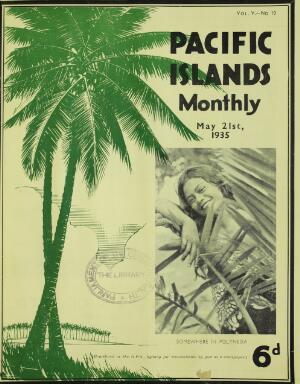
Islands
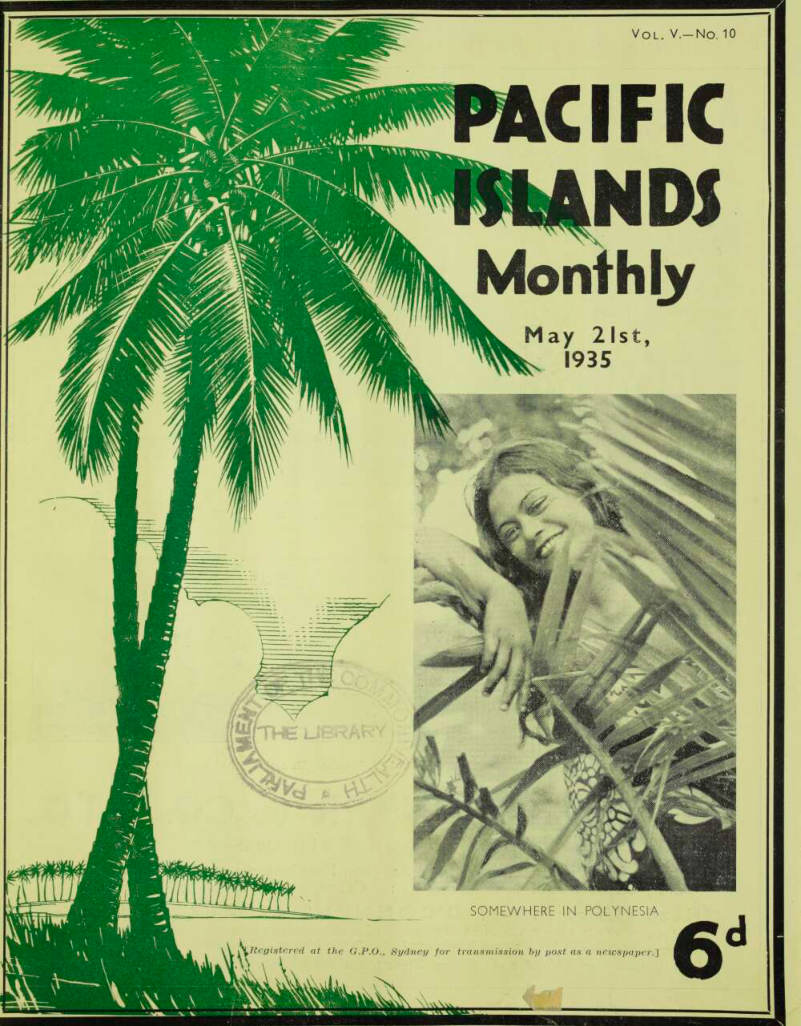
PACIFIC
Monthly
Vol. V.-No. 10
May 21st, 1935
[Registered at the G.P.O., Sydney for transmission by post as a newspaper.]
6 d
SOMEWHERE IN POLYNESIA
the Pacific
Assisting Development and Progress in
SINCE Australia became Responsible for the Administration of New Guinea, the 100-Per-Cent-Australian Firm of W. R.
Carpenter and Co., Ltd., has Devoted its Enterprise and Energy to the Sound Development of Islands Industries. It has Established Stores and Trading Stations wherever they were needed, in the Mandated Territory and the Solomon Islands.
Provided Inter-Island Shipping, for which purpose Two Motor-Vessels have been built in Australia, by Australian workmen.
Established Plantations, and assisted Australian Returned Soldiers in the Establishment of Plantations.
Built and Operated, at Rabaul, a Slip capable of handling Inter-Island Vessels.
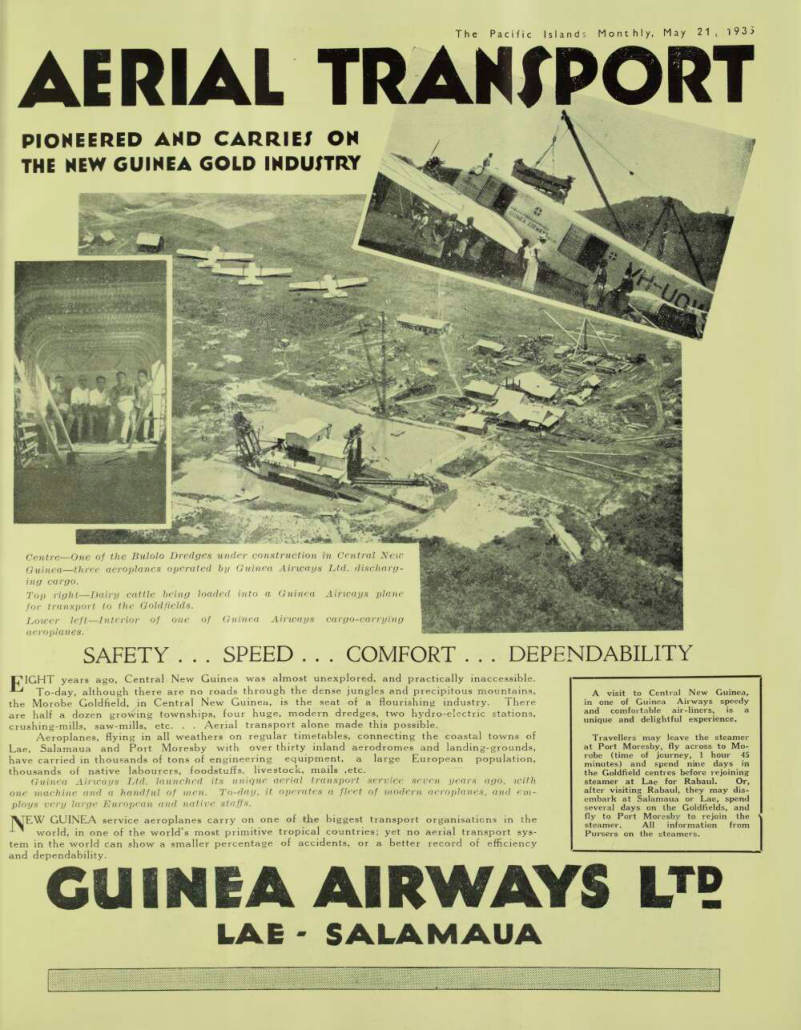
Organised and Equipped an Aerial Transport Service ( British-built, engined and manned), which now regularly carries Freight and Passengers between Salamaua and the New Guinea Goldfields centres.
Established a line of Modern Motor- Vessels, carrying Freight and Passengers between Pacific Islands and Australian Ports and Europe, on a Regular Schedule.
W. R. C. LINE
THE two Modern motor-vessels of the A W.R.C. Line, namely, M.V. RABAUL (5600 tons) and M.V. SALAMAUA (6754 tons), are now carrying on a Regular Freight and Passenger Service, between European and Australian Ports, with Scheduled Calls at Rabaul and Salamaua (with calls at other New Guinea ports as required), and Dakar (West Africa) about every ten weeks. Calls at Solomon Islands, Gilbert Islands, and Fiji ports made as required.
There is comfortable accommodation for a limited number of saloon passengers on these Vessels, at special rates; but early application for Berths is recommended.
Details of Freight Rates, Passenger Fares, Timetables, etc., supplied on application at any of our Branches.
W. R. CARPENTER & CO. LTD.
Merchants and Shipowners
Agents for Australian, European and American Manufacturers, and Distributors of Every Description of Merchandise : : Complete Range of all Stocks Carried.
Head Office: 19-21 O’CONNELL STREET, SYDNEY
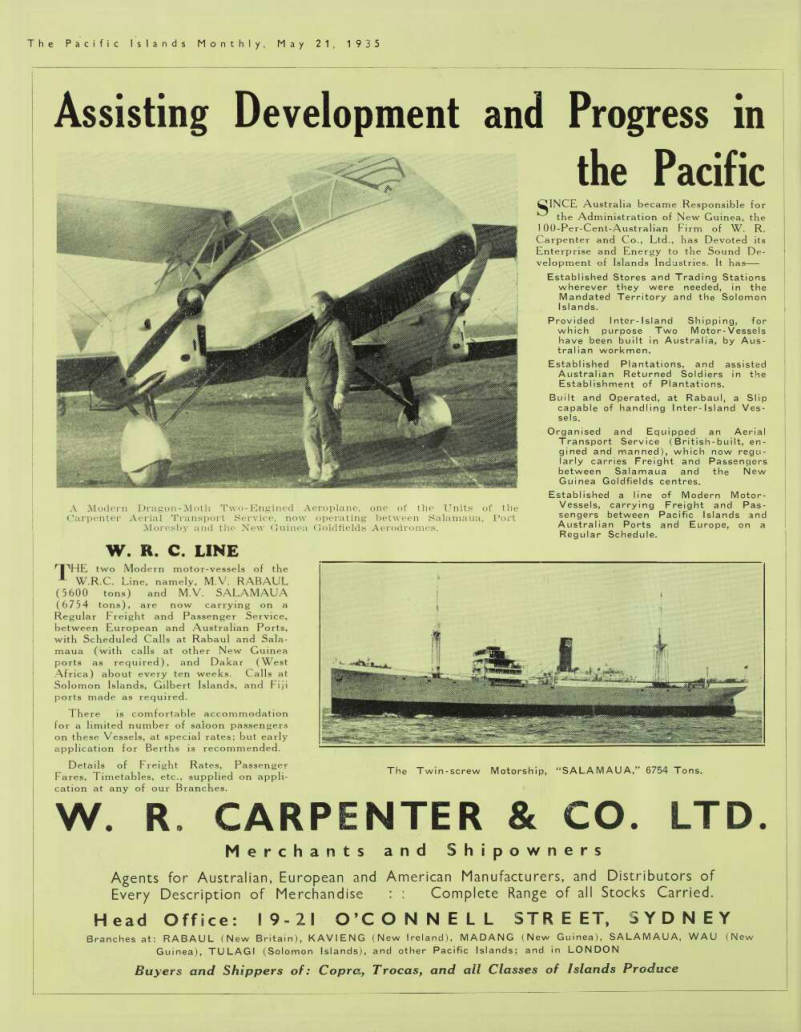
Branches at: RABAUL (New Britain), KAVIENG (New Ireland), MADANG (New Guinea), SALAMAUA, WAU (New Guinea), TULAGI (Solomon Islands), and other Pacific Islands; and in LONDON Buyers and Shippers of: Copra, Trocas, and all Classes of Islands Produce The Twin-screw Motorship, “SALAMAUA,” 6754 Tons.
A Modern Dragon-Moth Two-Engined Aeroplane, one of the Units of the Carpenter Aerial Transport Service, now operating between Salamaua, Port Moresby and the New Guinea Goldfields Aerodromes.
Pacific Islands Travellers
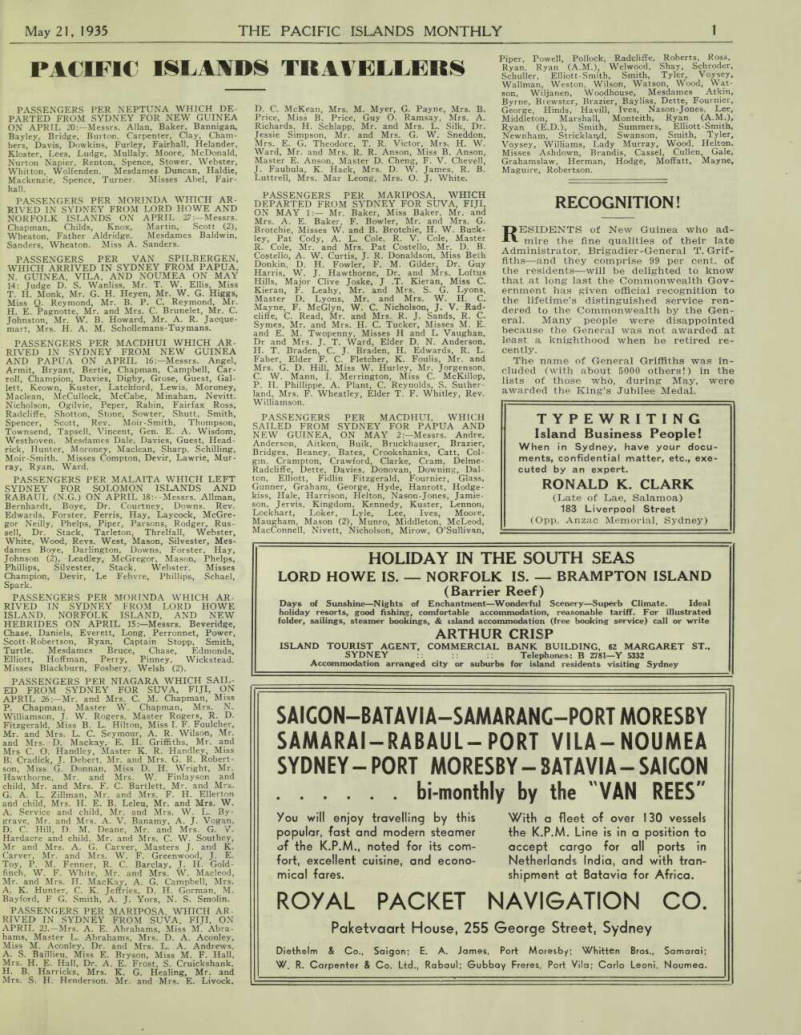
Passengers Per Neptuna Which De
Parted From Sydney For New Guinea
ON APRIL 20: —Messrs. Allan, Baker, Bannigan, Bayley, Bridge, Burton, Carpenter, Clay, Cham bers, Davis, Dowkins, Furley, Fairhall, Helander, Kloster, Lees, Ludge, Mullaly, Moore, McDonald, Nurton Napier, Renton, Spence, Stower, Webster, Whitton, Wolfenden. Mesdames Duncan, Haldie, Mackenzie, Spence, Turner. Misses Abel, Fair hall.
Passengers Per Morinda Which Ar
RIVED IN SYDNEY FROM LORD HOWE AND
Norfolk Islands On April 27—Messrs.
Chapman, Childs, Knox, Martin, Scott (2), Wheaton, Father Aldridge. Mesdames Baldwin, Sanders, Wheaton. Miss A. Sanders.
Passengers Per Van Spilbergen,
Which Arrived In Sydney From Papua,
N. GUINEA, VILA, AND NOUMEA ON MAY 14: Judge D. S. Wanliss, Mr. T. W. Ellis, Miss T. H. Monk, Mr. G. H. Heyen, Mr. W. G. Higgs, Miss Q. Reymond, Mr. B. P. C. Reymond, Mr.
H. E. Pagnotte, Mr. and Mrs. C. Brunelet, Mr. C.
Johnston, Mr. W. B. Howard, Mr. A. R. Jacque mart, Mrs. H. A. M. Schollemans-Tuymans.
Passengers Per Macdhui Which Ar
Rived In Sydney From New Guinea
AND PAPUA ON APRIL 16:—Messrs. Angel, Armit, Bryant, Bertie, Chapman, Campbell, Car roll, Champion, Davies, Digby, Grose, Guest, Gal lett, Keown, Kuster, Latchford, Lewis, Moroney, Maclean, McCullock, McCabe, Minahan, Nevitt.
Nicholson, Ogilvie, Peper, Rabin, Fairfax Ross, Radcliffe, Shotton, Stone, Sowter, Shutt, Smith, Spencer, Scott, Rev. Moir-Smith, Thompson, Townsend, Tapsell, Vincent, Gen. E. A. Wisdom, Westhoven. Mesdames Dale, Davies, Guest, Head rick, Hunter, Moroney, Maclean, Sharp, Schilling, Moir-Smith. Misses Compton, Devir, Lawrie, Mur ray, Ryan, Ward.
Passengers Per Malaita Which Left
Sydney For Solomon Islands And
RABAUL (N.G.) ON APRIL 18;—Messrs. Allman, Bernhardt, Boye, Dr. Courtney, Downs. Rev.
Edwards, Forster, Ferris, Hay, Laycock, McGre gor Neilly, Phelps, Piper, Parsons, Rodger, Rus sell, Dr. Stack, Tarleton, Threlfall, Webster, White, Wood, Revs. West, Mason, Silvester, Mes dames Boye, Darlington, Downs, Forster, Hay, Johnson (2), Leadley, McGregor, Mason, Phelps, Phillips, Silvester, Stack, Webster. Misses Champion, Devir, Le Febvre, Phillips, Schael, Spark.
Passengers Per Morinda Which Ar
Rived In Sydney From Lord Howe
Island, Norfolk Island, And New
HEBRIDES ON APRIL 15;—Messrs. Beveridge, Chase, Daniels, Everett, Long, Perronnet, Power, Scott-Robert son, Ryan, Captain Stopp, Smith, Turtle. Mesdames Bruce, Chase, Edmonds, Elliott, Hoffman, Perry, Pinney, Wickstead.
Misses Blackburn, Fosbery, Welsh (2),
Passengers Per Niagara Which Sail
ED FROM SYDNEY FOR SUVA, FIJI, ON APRIL 26:—Mr. and Mrs. C. M. Chapman, Miss P. Chapman, Master W. Chapman, Mrs. N.
Williamson, J. W. Rogers, Master Rogers, R. D.
Fitzgerald, Miss B. L. Hilton, Miss I. F. Foulcher, Mr. and Mrs. L. C. Seymour, A. R. Wilson, Mr. and Mrs. D. Mackay, E. H. Griffiths, Mr. and Mrs C. O. Handley, Master K. R. Handley, Miss B. Cradick, J. Debert, Mr. and Mrs. G. R. Robert son, Miss G. Donnan, Miss D. H. Wright, Mr.
Hawthorne, Mr. and Mrs. W. Finlayson and child, Mr. and Mrs. F. C. Bartlett, Mr. and Mrs.
G. A. L. Zillman, Mr. and Mrs. F. H. Ellerton and child, Mrs. H. E. B. Leleu, Mr. and Mrs. W.
A. Service and child, Mr. and Mrs. W. L. By grave, Mr. and Mrs. A. V. Banamy, A. J. Vogan, D. C. Hill, D. M. Deane, Mr. and Mrs. G. V.
Hardacre and child, Mr. and Mrs. C. W. Southey, Mr and Mrs. A. G. Carver, Masters J. and K.
Carver, Mr. and Mrs. W. F. Greenwood, J. E.
Toy, P. M. Fenner, R. C. Barclay, J. H. Gold finch, W. F. White, Mr. and Mrs. W. Macleod, Mr. and Mrs. H. Mac Kay, A. G. Campbell, Mrs.
A. K. Hunter, C. K. Jeffries, D. H. Gorman, M.
Bayford, F G. Smith, A. J. Yors, N. S. Smolin.
Passengers Per Mariposa, Which Ar-
RIVED IN SYDNEY FROM SUVA, FIJI, ON APRIL 23. —Mrs. A. E. Abrahams, Miss M. Abra hams, Master L. Abrahams, Mrs. D. A. Aconley, Miss M. Aconley, Dr. and Mrs. L. A. Andrews, A. S. Baillieu, Miss E. Bryson, Miss M. F. Hall, Mrs. H. E. Hall, Dr. A. E. Frost, S. Cruickshank, H. B. Harricks, Mrs. K. G. Healing, Mr. and Mrs. S. H. Henderson. Mr. and Mrs. E. Livock,
D. C. McKean, Mrs. M. Myer, G. Payne, Mrs. B.
Price, Miss B. Price, Guy O. Ramsay, Mrs. A.
Richards, H. Schlapp, Mr. and Mrs. L. Silk, Dr.
Jessie Simpson, Mr. and Mrs. G. W, Sneddon, Mrs. E. G. Theodore, T. R. Victor, Mrs. H. W.
Ward, Mr. and Mrs. R. R. Anson, Miss B. Anson, Master E. Anson, Master D. Cheng, F. V. Chevell, J. Faubula, K. Hack, Mrs. D. W. James, R. B.
Luttrell, Mrs. Mar Leong, Mrs. O. J. White.
Passengers Per Mariposa, Which
Departed From Sydney For Suva, Fiji,
ON MAY 1: — Mr. Baker, Miss Baker, Mr. and Mrs. A. E. Baker, F. Bowler, Mr. and Mrs. G.
Brotchie, Misses W. and B. Brotchie, H. W. Buck ley, Pat Cody, A. L. Cole, R. V. Cole, Master R. Cole, Mr. and Mrs. Pat Costello, Mr. D. B.
Costello, A. W. Curtis, J. R. Donaldson, Miss Beth Donkin, D. H. Fowler, F. M. Gilder, Dr. Guy Harris, W. J. Hawthorne, Dr. and Mrs. Loftus Hills, Major Clive Joske, J .T. Kieran, Miss C.
Kieran, F. Leahy, Mr. and Mrs. S. G. Lyons, Master D. Lyons, Mr. and Mrs. W. H. C.
Mayne, F. McGlyn, W. C. Nicholson, J. V. Rad cliffe, C. Read, Mr. and Mrs. R. J. Sands, R. C.
Symes, Mr. and Mrs. H. C. Tucker, Misses M. E. and E. M. Twopenny, Misses H and L Vaughan, Dr and Mrs. J. T. Ward, Elder D. N. Anderson, H. T. Braden, C. J. Braden, H. Edwards, R. L.
Faber, Elder F. C. Fletcher, K. Foulis, Mr. and Mrs. G. D. Hill, Miss W. Hurley, Mr. Jorgenson, C. W. Mann, I. Merrington, Miss C. McKillop, P. H. Phillippe, A. Plant, C. Reynolds, S. Suther land, Mrs. F. Wheatley, Elder T. F. Whitley, Rev.
Williamson.
Passengers Per Macdhui, Which
Sailed From Sydney For Papua And
NEW GUINEA, ON MAY 2:—Messrs. Andre, Anderson, Aitken, Buik, Bruckhauser, Brazier, Bridges, Beaney, Bates, Crookshanks, Catt, Col gin, Crampton, Crawford, Clarke, Cram, Delme- Radcliffe, Dette, Davies, Donovan, Downing, Dal ton, Elliott, Fidlin Fitzgerald, Fournier, Glass, Gunner, Graham, George, Hyde, Hanrott, Hodge kiss. Hale, Harrison, Helton, Nason-Jones, Jamie son, Jervis, Kingdom, Kennedy, Kuster, Lennon, Lockhart, Loker, Lyle, Lee, Ives, Moore, Maugham, Mason (2), Munro, Middleton, McLeod, MacConnell, Nivett, Nicholson, Mirow, O’Sullivan,
Piper, Powell, Pollock, Radcliffe, Roberts, Ross, Ryan. Ryan (A.M.), Welwood, Shay, Schroder, Schuller, Elliott-Smith, Smith, Tyler, Voysey, Wallman, Weston, Wilson, Watson, Wood, Wat son, Wiljanen, Woodhouse, Mesdames Atkin, Byrne, Brewster, Brazier, Bayliss, Dette, Fournier, George, Hinds, Havill, Ives, Nason-Jones, Lee, Middleton, Marshall, Monteith, Ryan (A.M.), Ryan (E.D.), Smith, Summers, Elliott-Smith, Newnham, Strickland, Swanson, Smith, Tyler, Voysey, Williams, Lady Murray, Wood, Helton.
Misses Ashdown, Brandis, Cassel, Cullen, Gale, Grahamslaw, Herman, Hodge, Moffatt, Mayne, Maguire, Robertson.
Recognition!
RESIDENTS of New Guinea who ad mire the fine qualities of their late Administrator, Brigadier-General T. Grif fiths —and they comprise 99 per cent, of the residents —will be delighted to know that at long last the Commonwealth Gov ernment has given official recognition to the lifetime’s distinguished service ren dered to the Commonwealth by the Gen eral. Many people were disappointed because the General was not awarded at least a knighthood when he retired re cently.
The name of General Griffiths was in cluded (with about 5000 others!) in the lists of those who, during May, were awarded the King’s Jubilee Medal.
Advertisements & other items, p. 3 (1 item)
Saicon-Batavia-Samarang-Port Moresby
TYPEWRITING
Island Business People!
When in Sydney, have your documents, confidential matter, etc., executed by an expert.
RONALD K. CLARK
(Late of Lae, Salamoa) 183 Liverpool Street (Opp. Anzac Memorial, Sydney)
HOLIDAY IN THE SOUTH SEAS
LORD HOWE IS. NORFOLK IS. BRAMPTON ISLAND
(Barrier Reef)
Days of Sunshine—Nights of Enchantment—Wonderful Scenery—Superb Climate. Ideal holiday resorts, good fishing, comfortable accommodation, reasonable tariff. For illustrated folder, sailings, steamer bookings, & island accommodation (free booking service) call or write
ARTHUR CRISP
ISLAND TOURIST AGENT, COMMERCIAL BANK BUILDING, 62 MARGARET ST., SYDNEY Telephones: B 2781—Y 5332 Accommodation arranged city or suburbs for island residents visiting Sydney
SAICON-BATAVIA-SAMARANG-PORT MORESBY
SAMARAI-RABAUL- PORT VILA-NOUMEA
SYDNEY - PORT MORESBY - BATAVIA - SAIGON
bi-monthly by the "VAN REES”
You will enjoy travelling by this popular, fast and modern steamer of the K.P.M., noted for its comfort, excellent cuisine, and economical fares.
With a fleet of over 130 vessels the K.P.M. Line is in a position to accept cargo for all ports in Netherlands India, and with transhipment at Batavia for Africa.
ROYAL PACKET NAVIGATION CO.
Paketvaart House, 255 George Street, Sydney Diethelm & Co., Saigon; E. A. James, Port Moresby; Whitten Bros., Samarai; W. R. Carpenter & Co. Lid., Rabaul; Gubbay Freres, Port Vila; Carlo Leoni, Noumea.
Page
A. Powders .. 57 Antinea Drug Co. .. 19 Arnott’s Biscuits .. 57 Asprey’s Compound 32 Aspro 45 Ausoline Co. 29 Austen, Geo. & Co. 16 Aus. Scale Co. .. 20 Bains & Co. Ltd. .. 58 Bank of N.S.W. .. 25 Barnes, Jas. 38 Barrington, D.Y.S. 54 Bell, L.L. 74 Belvedere 13 Bentley, E. 47 Bernhard, H. 16 Blau, Julius .. .. 58 Breckwoldt & Co. .. 26 Broomfields, Ltd. .. 20 Bruce, Robert .. .. 40 Brunton’s Flour .. 35 Bullivants Ltd. .. 49 Burns, Philp & Co. 2 B. Magazine.. .. 44
B.P. (S.S.) Co. .. 48
Burton, F. W. 28 Bussell, H. L. & Co. 14 Buzacott Ltd 55 Byrne, C. R. .. 24 Campbell’s Canoes.. 25 Capell, J. 46 Carpenter, W. R. .. ii Clark, R. 1 Coleman Quicklite.. 49 Coles, A. H. J. .. 16 Cooper, W. and Nephews Ltd. .. 71 Coral Starch .. .. 12 Craignathan .. .. 56 Crisp, A. E. 1 Cropleys Ltd 13 Croston, W. E. .. 23 Cyclone G. & F. .. 72 Dangar, Gedye .. 63 Dawn Cafe .. .. 34 Death Notice .. .. 57 Doans 52 Donald Patents Ltd. 37 Doyle, T. G. 22 Eaton, Ltd., J. W. 42 Electrolytic R. & S.
Co. 68
Page Elvy & Co., Ltd. .. 22 Erg Batteries .. .. 54 Euston Hotel .. .. 57 Evans, H. A. & Son 80 Excel Battery Co. .. 69 Excelsior Supply .. 51 Fairbanks Morse .. 75 Farquharson, Mrs. 61 Fletcher & sons .. 70 Flexibo Lighting .. 30 Flynn, Mrs. W. .. 58 Ford, W. M. 49 Ford Sherington Ltd. 17 Forsyth, A. 40 Forster’s Bedsteads 43 Foster & Sons, Geo. 68 Fowler, N. M. 16 Frost, A. R. & Co. 76 Garrett & Davidson 38 Gillespie’s Flour .. 60 Gleniffer Engines .. 48 Grahame, C. 31 Gregory, A. 33 Griffin, Brian .. .. 49 Guinea Airways .. iii Hallstrom, E. 25 Halvorsen, L. 47 Hammett, Al. 45 Harper, M. 31 Harper, Robt. 36 Henly’s D.Y.S. .. 21 Holbrook’s Ltd. .. 39 Holden’s Air T. .. 80 Hordern Bros. 59 Hotel Gnd. Central 12 Hughes, A. J. 23
I.C.I.A.N.Z. 56
I.C.S 71
Insular Lamps Ltd. 74 Jones, A. 20 Kelvin Engines .. 66 Kepert, V. R. 80 Kerr Bros. 67 Killrust 36 Kodak Pty. Ltd. .. 15 Kopsen & Co. 78 Kork-N-Seal .. .. 61 Kriesler Ltd 65 Lane and Girvan .. 51 Langbecker, C. .. 22 Light, N. 29 Legal Notice .. .. 23
Page Leica Photo Co. .. 31 Link Belt Co. 42 Littlewood 24 Lone Hand Soap .. 62 Love Ltd. J. R. .. 73 Lysaght & Co. .. 28 McHugh 76 Mcllraith’s, Ltd. .. 18 McKay .. 40 Mangrovite Belting 34 Marr, E. A. 70 Martins, D.Y.S. .. 55 Matthews, A. E. .. 62 Maxwell Porter .. 56 Mungo Scott, Ltd... 64 Murfray, Ltd., D. W. 60 Naylor, G. H. 14
N.D.L. 79
Nelson & Robertson 33 New Brit. Express 77 Norco 32 Noyes Bros. 24 Ozo Salt Co. 62 Pabco Products .. 37
Page Pacific Hotels .. .. 53 Pacific Is. Assoc. .. 56 Paine & Co. 26 Pike Bros. 70 Pioneer Spring Co... 36 Position Wanted .. 69 Pottery Shop .. .. 16 Prescott, Ltd. 35 Prouds, Ltd. 41 Ramsay, Valmai .. 13 Reid, W. M. 29 Reilingh, W. .. .. 75 Richard’s Remedies 28 Robinson, J. 12 Rohu, Sil 66 Rolls Razor .. .. 77 Royal Packet N. Co. 1 Russell, S. 28 Ruston & Hornsby 49 Scott, Ltd., J. 38 Scott & Bowne .. 64 Scott & Sons .. .. 28 Selby, H. B. 68 Shaw, E. 78
Page Smith, Geo. E. 66 Springwood L. Col. 17 Standard Drug .. 75 Stanley, Chris. .. 61 Steamships T. Co... 78 Steel Imp. Co. 32 Sterling Varnish Co. 11 Summerbell, A. .. 45 Swallow & Ariell .. 74 Tahiti Hdbk. 53 Talkeries 45 Taubman’s Paints .. 29 Thompson’s Eng. Co. 30 Thornthwaite, H. G. 48 Tillock & Co., Ltd. 61 Titon 67 Tooheys Ltd. 34 Tooth & Co. iv Traders, Ltd. 26 Trufood 48 Tudor Hotel .. .. 13
T.W.H. 21
Typewriter Trading 44 Vacuum Oil. Co. .. 27
Page Victor Chemical .. 66 Vincent’s A.P.C. .. 18 Vincent Bros. 77 Waddells Ltd. 52 Wallis, J. B. 69 Walvon Kennels .. 14 Ward, L. A. 24 Ward’s Steves .. 19 Wearnes 35 Webb, A. 21 Wesley College .. 20 West, H. 63 West’s Wheels .. 49 Weymark & Son .. 46 Wheeler, B. R. ..66 Williams, W. H. 17, 23 Wills, W. D. & H. O. 46 Wilshire, H. 18 Wood’s Peppermint 39 Wright & Co. 44 Wright & Co., E. .. 42 Wunderlich, Ltd. .. 54
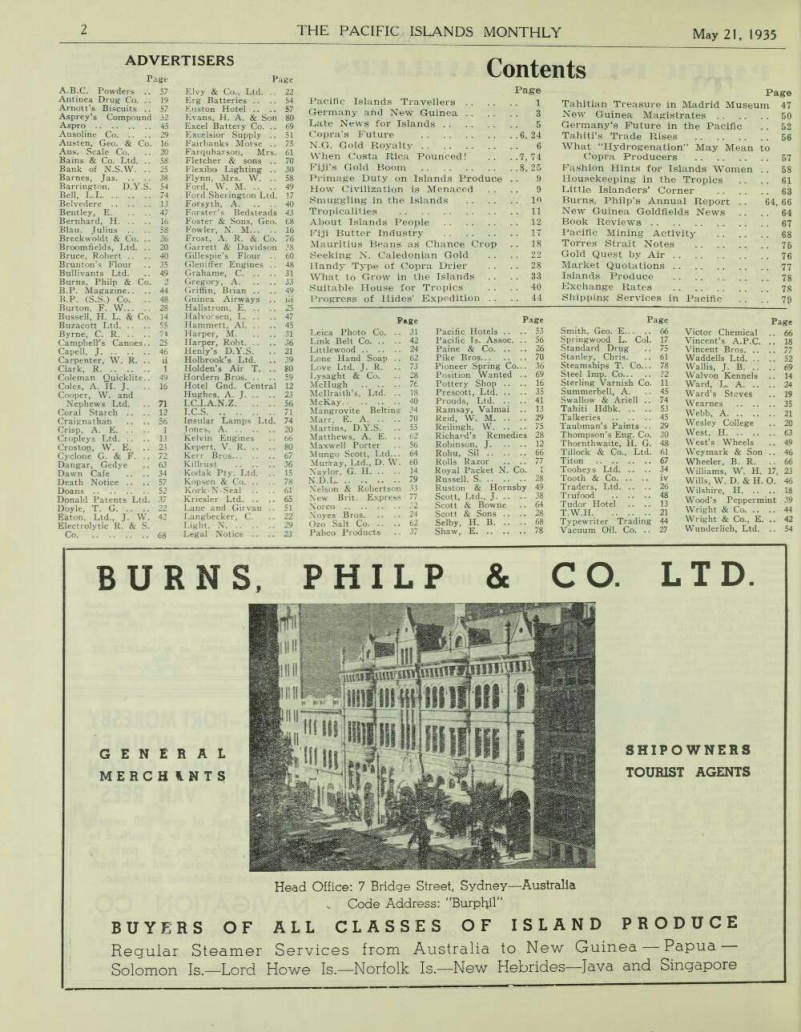
Contents
Advertisers
Page Pacific Islands Travellers 1 Germany and New Guinea 3 Late News for Islands 5 Copra’s Future 6,24 N.G. Gold Royalty 6 When Costa Rica Pounced! .. ..7,74 Fiji’s Gold Boom 8,25 Primage Duty on Islands Produce . . 9 How Civilization is Menaced . . .. 9 Smuggling in the Islands 10 Tropicalities 11 About Islands People 12 Fiji Butter Industry 17 Mauritius Beans as Chance Crop .. 18 Seeking N. Caledonian Gold . . .. 22 Handy Type of Copra Drier . . .. 28 What to Grow in the Islands . . . . 33 Suitable House for Tropics . . . . 40 Progress of Hides’ Expedition . . .. 44
Page Tahitian Treasure in Madrid Museum 47 New Guinea Magistrates 50 Germany’s Future in the Pacific .. 52 Tahiti’s Trade Rises 56 What “Hydrogenation” May Mean to Copra Producers 57 Fashion Hints for Islands Women .. 58 Housekeeping in the Tropics .. .. 61 Little Islanders’ Corner 63 Burns, Philp’s Annual Report . . 64, 66 New Guinea Goldfields News .. . . 64 Book Reviews 67 Pacific Mining Activity 68 Torres Strait Notes 75 Gold Quest by Air 76 Market Quotations 77 Islands Produce 78 Exchange Rates 78 Shipping Services in Pacific . . .. 79
Advertisements & other items, p. 4 (1 item)
Burns, Philp & Co. Ltd.
GENERAL
MERCHANTS
Head Office: 7 Bridge Street, Sydney—Australia Code Address: "Burphil"
SHIPOWNERS
TOURIST AGENTS
BUYERS OF ALL CLASSES OF ISLAND PRODUCE Regular Steamer Services from Australia to New Guinea Papua Solomon Is. —Lord Howe Is.—Norfolk Is. —New Hebrides —Java and Singapore
The Pacific Islands Monthly
The Newspaper-Magazine Of The South Seas
[Registered at G.P.O., Sydney, for transmission by post as a newspaper .] Published Once Each Month and Circulated in Australia and New Zealand and in the following Pacific Territories and Islands Groups:
Crown Colony of Fiji.
Australian Territory of Papua.
Mandated Territory (Australia) of New Guinea, Bismarck Archipelago, and Northern Solomon Islands.
Mandated Territory (Japan) of Marshall, Caroline and Marianna Islands.
French Territory of New Caledonia.
British and French Condominium of New Hebrides.
American Territory of Eastern Samoa.
American Territory of Guam.
Mandated Territory of Nauru.
British Crown Colony of Gilbert and Ellice Islands.
Mandated Territory (New Zealand) of Samoa.
British Solomon Islands Protectorate.
British Protectorate of Tongan Islands.
New Zealand Territory of Cook Islands.
Australian Territory of Norfolk Island.
French Colony of Oceania (Tahiti, etc.).
American Territory of Hawaiian Islands.
Owned and Produced by Pacific Publications Ltd., Union House, 247 George Street, Sydney .
Telephone Bw 5037
P.O. Box 3408 R
Contributions Articles, Stories, and Photographs dealing with Pacific Islands Subjects are invited, and will be paid for on publication at usual rates.
Subscription Rates Per Annum, within British Empire, Prepaid Poet Free 6/- Por Annum, elsewhere, prepaid, Post Free .. 8/- Single Copies 6d.
Editor and Publisher:
R. W. Robson.
Advertisements Advertising rates furnished on application.
Colours, etc.
Process Blocks made at Advertiser’s expense when required. Screen, 100.
Changes of Advertising Copy should reach this Office by 8th of each month, otherwise previous advertisement may be repeated.
Registered Address for Radiograms and Cables; “PACPUB” Sydney Agents The following are authorised to receive subscrip tions for “The Pacific Islands Monthly”— Islands Branches of Burns, Philp & Cos., Ltd., and Burns Philp (South Seas) Cos., Ltd.
Islands Branches of W. R. Carpenter & Cos., Ltd.
All Branches of Morris, Hedstrom & Cos., Ltd.
G. Thomas & Cos., Rabaul.
Whitten Bros., Ltd., Samarai.
P. Costello, Suva, Fiji.
All Branches and Representatives of W. H. Grove and Sons, Ltd., Auckland.
S. Russell, Papeete, Tahiti.
Cook Islands Trading Cos., Raratonga.
Vol. V., No. 10.
Sydney, May 21, 1935.
Price 6c. Per Copy Prepaid; 6/- p.a.
Germany And New Guinea
IT is necessary to set out, without equivocation or apology, the position of the Mandated Territory of New Guinea as we see it, in relation to international affairs.
The Germans are masters of the art of propaganda. Germany is seeking to convert British public opinion to the idea of returning to Germany the colonies which Germany lost in 1914. Germany wants New Guinea because of the rich goldfields there.
There are several arguments which support Germany’s plea for the return of her former colonies. They have been stated several times in this journal. This great nation, so skilled in productiveness and so competent in administration, cannot be kept indefinitely within the boundaries imposed by Versailles. Germany must trade with the rest of the world; and, to do that, she must have overseas sources of raw materials and foreign exchange; she must have new territories where her colonising genius can express itself.
We have previously expressed the view, which we still hold, that the colo-
nial and territorial needs of Germany can be provided for in Africa. If Ger many wishes to return to the Pacific, a series of difficult problems, both econo mic and strategic, immediately present themselves.
We said, last year, that the return of Germany to the Pacific might be wel comed by Britain, France, and America.
Since then, we have been introduced to a Germany which shows not the slightest wish to at peace with her neighbours and which literally is forcing all Europe to re-arm.
Under present conditions the Pacific Ocean is indeed pacific. There is not within it at present one disturbing factor. Many of us, it is true, await anxiously the growth and expansion of Japan. Some day, maybe, Japan will wish to advance officially southwards of the equator; but so far Japan has made no move in that direction. At present, Japan is completely preoccupied with the enormous task which she has assumed in Eastern Asia; and, therefore, from the point of view of the nationalities estab lished in the South Pacific, Japan is a
good neighbour. She is too busy, in Asia, to be a bad neighbour in the Pacific.
If the Germans were peaceful, quiet people they would be welcome in the Pacific. But the German nation now seems to be just as aggressive and na tionalistic under Hitler as it was prior to 1918, under the Prussianised Hohen zollerns. We British people emphatically do not want this disturbing element right alongside us in New Guinea, or in Samoa, within a few hundred miles of Fiji and New Zealand. The concentra tion of a few hundred German aero planes in those places might give an entirely different complexion to the out break of another war. Australia and New Zealand, with the assistance of the French and Japanese, completely bottled up the German military and naval forces in 1914. But enormous damage could be done by hostile aeroplanes before they were destroyed.
Germany recognises that her former Pacific Islands Territories could be very easily chopped off in the event of war— that, in other words, they represent a strategical weakness. Why, then, does she seek their return? Because of the value of the Morobe goldfield in New Guinea.
But the Morobe goldfield was not taken from Germany in 1914. When the Australian forces seized New Guinea, there were not half-a-dozen white men in the whole of Morobe—it was unexplored and practically un known. The Morobe goldfield has been opened up since 1923 by Australian prospectors and Anglo-Australian enter prise, assisted by Australian, British, and American capital. The Germans have not the slightest moral claim to the goldfield. If it had been developed by German enterprise and capital the argu ment would have been different.
Germany, being the aggressor and having been defeated, had to pay for war damages. Against the damages as sessed against her were set the value of her colonies, which were taken over. In that way the British Empire has already paid for New Guinea; and the estimate of the value of New Guinea was reached without the Morobe goldfield being taken into calculation. The Morobe goldfield, in 1918-1919, was unknown.
There is another argument against the return of the Pacific territories. Japan, in the plainest language, has made it known that she will not give up her hold on the Caroline, Marshall, and Mari anne Islands, held by Germany until 1914. If Japan regards the retention of those territories as necessary on strategic grounds, surely Australia is entitled to view New Guinea in the same light.
It is desirable that Australian and British public opinion be better informed in regard to these matters. The Austra lian people are certainly quite indiffer ent about them, and, so far as Australian interests in New Guinea are concerned, the Commonwealth Government is asleep. In that territory there is a large and rapidly growing community, and the trade connected therewith is valuable.
Recent figures show that that trade is being taken away from British interests by other countries.
Huge quantities of rice are consumed in New Guinea by native labourers.
Until two or three years ago, it came mostly from Rangoon British-grown rice. To-day, it is coming almost wholly in foreign ships from Saigon—foreign grown rice, A few years ago, a very large proportion of the goods going into New Guinea were of British origin, and Australia had her fair share. To-day, more than half of New Guinea’s imports are of foreign origin. We have under notice an order given recently by an Australian firm for 200,000 yards of cheap cotton prints. The Australian firm wanted to buy from British sources; but was compelled to place the order in
Japan—compelled because, while New Guinea is an Australian territory, New Guinea gives no preference whatever to British goods.
If the Commonwealth Government had been awake to the value and sig nificance of this trade, it would have followed the example of the British Ad ministrations in the adjoining territories of Solomon Islands, Gilbert and Ellice Islands, Fiji, etc., where the existing tariffs impose a very definite preference in favour of British goods.
If the Commonwealth Government, at long last, is to be compelled to carry out what is its obvious duty, and give ade quate protection to British interests in New Guinea, it should give particular attention to the subject of German shipping. There is no use in blinking the fact any longer that the German shipping interests in New Guinea are the agents of German propaganda in favour of the return of New Guinea to Germany. It is likely that in the next session of the Commonwealth Parlia ment attention will be drawn to the fact that certain public officials in New Guinea have been accepting favours at the hands of the German shipping inter ests —favours which are customarily given and received in commercial circles, but which have a special and most unde sirable significance as between units of the New Guinea Administration and the Germans.
Those small German ships, equipped with pedlar’s licences, and manned by Chinese, are still busily trading between all ports in New Guinea, and, if the Commonwealth is not blind to what is going on, they must soon be given official attention. They may represent a check upon the freight and merchandising rates charged by British firms, and in that way they may have some immediate value; but, actually, they represent a threat that is growing and a danger that is fundamental. It may not be possible to keep them out of New Guinea; but at least the Commonwealth authorities should impose some tax upon them — 10/- per ton upon all goods imported or exported in foreign bottoms, or some thing of the sort —so that the spectacle of German ships actually cutting into British commercial interests, while at the same time acting as the agents of Ger man propaganda, will no longer con tinue.
Certain aspects of this shipping posi tion cannot be too strongly emphasised.
While the German ships trading in New Guinea are manned by Chinese, the British ships with which they are com peting are manned either wholly by
white British crews, or by British com plements aided by New Guinea natives.
Great Britain long ago imposed an import duty of 10/- per ton on all copra not grown in British countries —a very generous gesture towards the coconut planters of the Empire. Yet, to-day, we have the extraordinary spectacle of Empire-grown copra being carried to the British market in foreign ships, and thus defeating one of the main objects which the British Government had in mind in imposing the copra duty. This applies more particularly to New Guinea.
It is time that Australia was awak ened to what is going on, and realised that it is an important part of the British Empire. We have a warm regard for the German people and we sincerely hope that there will be no further war between us. But we dare not ignore the fact that this new Germany, that has ap peared under the emblem of the swas tika, is just as an aggressive and warlike a Germany as we knew prior to 1914; and it seems to be even more necessary to protect ourselves against her.
There is a political job of work to be done in New Guinea; and people with Imperial interests truly at heart will see to it that Canberra fs given no rest until Canberra recognises the position and does the obvious thing.
Air Fleets
More Big ’Planes For New Guinea
BEING- evidently confident that the main transport system of the New Guinea goldfield in the future will be by air, the New Guinea aerial transport companies are steadily building up their fleets and improving their ground organisation.
Within a short time, Guinea Airways will have two large Ford passenger ma chines in commission; and the Holden Co. also will have two.
The most recent purchase of Guinea Airways is described as “a Continental luxury liner, beautifully fitted”; this should arrive at Lae in June.
Guinea Airways also have purchased from West Australian Airways (Major Brearley’s company) two De Haviland 61’s (similar to the “Canberra,” well known on the goldfield).
At the other end of New Guinea, in Dutch territory, active developmental enterprises are afoot, in which aeroplane transport is being extensively used.
Aeroplanes, also, to a steadily increasing degree, are being used for the develop ment of Central and North Australia.
It seems inevitable that the aeroplane will be used to a great extent in the future development of the Pacific Terri torities generally.
Late News
Sydney, May 20.
MAILS from Papua, New Guinea and Fiji which have reached us on May 20, just as we go to press, contain much interesting Islands news. The following is a brief summary.
An experienced mining engineer who recently visited Fiji told a “P.I.M.” representative that there easily might be 2000 men working on the Fiji goldmines within a short time.
The new goldfields road from Wau to Edie Creek (New Guinea) is open. The first motor traffic used it on Anzac Day.
It is described as “a god-send.” Head quarters of New Guinea Goldfields Ltd. are now at Edie Creek, and it is rapidly “becoming an important centre.
Much damage was done by a flood in the Edie and Merri Creeks on the night of April 15.
The King’s Jubilee was celebrated with much impressive ceremonial on May 6 at the Islands centres, notably Suva, Rabaul, and Port Moresby.
Papuan planters and merchants are urging the Administration to agitate for the removal of the Australian primage duty. (See article on page 9.) Mrs. Martha Aston, died in Samarai hospital on April 30, at the age of 77.
She was closely connected with mission ary enterprise in the Pacific, and was greatly loved for her personal qualities.
The managing director of the Kwato Mission, Samarai, has sent for publica tion (now to appear in June issue) a notable reply to various criticism recently directed against the mission’s commercial activities.
The March report of the Warden of the Morobe goldfield (New Guinea) indicates further rapid progress on the field. Gold and silver exported in March were worth £132,495 (Australian).
The foundation stone of a new Masonic temple was laid in Rabaul on April 25.
His Honour Chief Judge D. S. Wanliss, of New Guinea, has left the territory on four months’ furlough, which he will spend in Australia.
Captain Kendrick, who has been some time in Port Moresby, is impressed with the possibilities of the auriferous country near the Brown River, within 150 miles of Pt. Moresby. He is urging a geo logical survey.
Good reports have been received of dredging progress by the Tiveri Co. in the Lakekamu district, Papua. Gold yields are satisfactory.
The Fiji sugar output for 1935 promises to surpass that for 1934. The export for 1934 was 104,000 tons, valued at £868,438.
The estimate for 1935 is around 123,000 tons.
Personal Notes From Fiji
Mr. H. H. Hemus, supervising inspector for Messrs. A. B. Donald, joined the Niagara at Auck land, and after a brief stay in Suva in May, at tending to the affairs of the company, returned to New Zealand by the Monterey.
Mr. D. M. Deane, a mining engineer, left Sydney recently for Suva by the Niagara. Mr. Deane represents the Sukulaki Gold Development Co.
N.L., which was registered in Melbourne. The company has a lease of a block at Tavua, miles east of the Emperor mine. It is the com pany’s intention to commence operations imme diately, and Mr. Dean has three mining men with him. He is very confident about the future pros pects of the goldfield. He considers that, though the mining laws of the colony are still in their infancy, the recent Government legislation to
control more strictly the issuing of prospecting licences is a step in the right direction.
Mr, A. G. Campbell returned to Suva on the Niagara in May, and proceeded straight to Tavua, where he made further investigations for a private client. He returned to Australia on the Monterey, thoroughly satisfied with the work he had com pleted.
Mr. C. A. Barden returned to Suva at the be ginning of May, after an absence of ten years.
He resumed duty at the cable station, Suva, after having been in Vancouver, Fanning Island, and Auckland for his company.
Sir Henry and Lady Marks returned to Suva at the beginning of May on the Niagara, accom panied by their daughter, Mrs. M. V. Abel.
Mr. H. J. S. Allen, Collector of Customs at Lautoka, returned to Suva by the Niagara in May.
He was accompanied by his wife and two daugh ters.
Mr. E. J. Pratt returned to Lautoka on May 4, after spending his leave in New Zealand. He was accompanied by his wife, his sister (Miss A.
Pratt) and his daughter Peggy.
Mr. R. M. Boyd, who represents the well known Australian stockbrokers, Messrs. J. B.
Were and Co., has been visiting Fiji, and returns on the Monterey. He is a reticent man, but it is believed that he thinks well of Fiji’s gold-mining possibilities.
Mr. R. H. Norman, of the Orient Line, has been in Suva, making arrangements for adequately en tertaining those who take “luxury cruises to Fiji.”
Mr. Julius Blau, well-known Sydney business man, is in Suva at present, staying at the Grand Pacific Hotel, The Governor of Tahiti returned to France by the Cephee early in May.
Record Of The
“Monsunen”
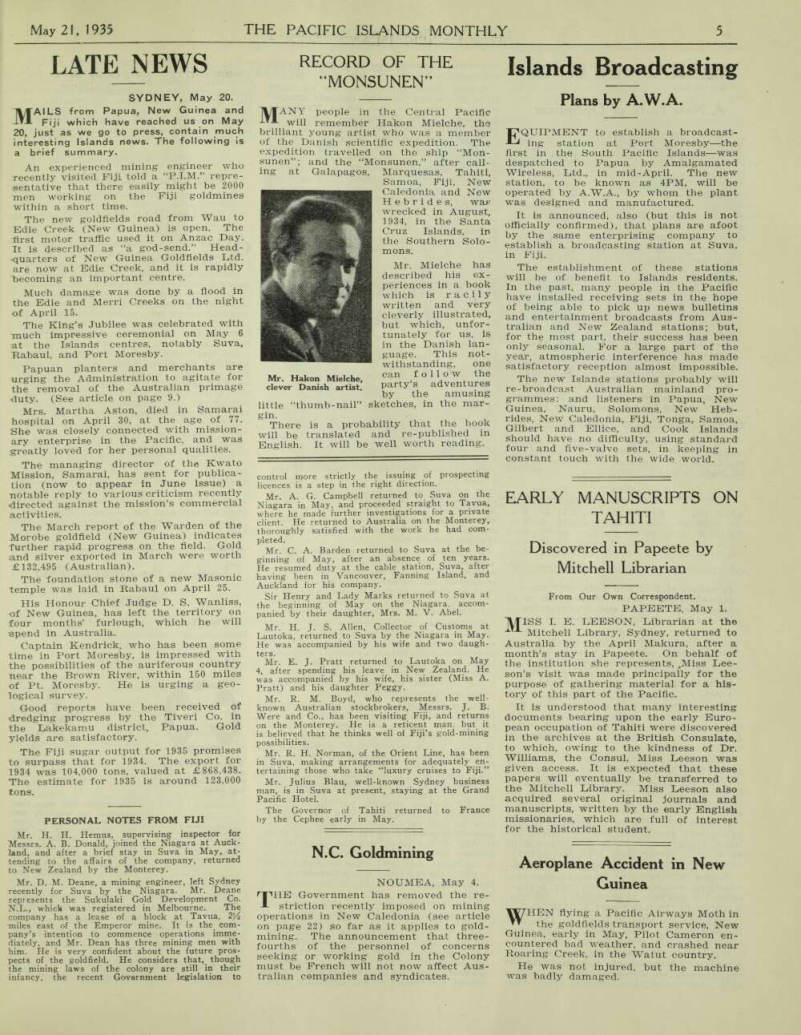
MANY people in the Central Pacific will remember Hakon Mielche, the brilliant young artist who was a member of the Danish scientific expedition. The expedition travelled on the ship "Mon sunen”; and the “Monsunen,” after call ing at Galapagos, Marquesas, Tahiti,
Samoa, Fiji, New Caledonia and New Hebrides, war wrecked in August, 1934, in the Santa Cruz Islands, in the Southern Solo mons.
Mr. Mielche has described his ex periences in a book which is racily written and very cleverly illustrated, but which, unfor tunately for us, is in the Danish lan guage. This not withstanding, one can follow the party’s adventures by the amusing
little “thumb-nail” sketches, in the mar gin.
There is a probability that the book will be translated and re-published in English. It will be well worth reading.
Mr. Hadron Mielche, clever Danish artist.
N.C. Goldmining
Noumea, May 4.
THE Government has removed the re striction recently imposed on mining operations in New Caledonia (see article on page 22) so far as it applies to gold mining. The announcement that three fourths of the personnel of concerns seeking or working gold in the Colony must be French will not now affect Aus tralian companies and syndicates.
Islands Broadcasting
Plans by A.W.A.
EQUIPMENT to establish a broadcast ing station at Port Moresby—the first in the South Pacific Islands —was despatched to Papua by Amalgamated Wireless, Ltd., in mid-April. The new station, to be known as 4PM, will be operated by A.W.A., by whom the plant was designed and manufactured.
It is announced, also (but this is not officially confirmed), that plans are afoot by the same enterprising company to establish a broadcasting station at Suva, in Fiji.
The establishment of these stations will be of benefit to Islands residents.
In the past, many people in the Pacific have installed receiving sets in the hope of being able to pick up news bulletins and entertainment broadcasts from Aus tralian and New Zealand stations; but, for the most part, their success has been only seasonal. For a large part of the year, atmospheric interference has made satisfactory reception almost impossible.
The new Islands stations probably will re-broadcast Australian mainland pro grammes: and listeners in Papua, New Guinea, Nauru, Solomons, New Heb rides, New Caledonia, Fiji, Tonga, Samoa, Gilbert and Ellice, and Cook Islands should have no difficulty, using standard four and five-valve sets, in keeping in constant touch with the wide world.
Discovered in Papeete by
Early Manuscripts On
Tahiti
Discovered in Papeete by Mitchell Librarian
From Our Own Correspondent.
Papeete, May 1.
MISS I. E. LEESON, Librarian at the Mitchell Library, Sydney, returned to Australia by the April Makura, after a month’s stay in Papeete. On behalf of the institution she represents, Miss Leeson’s visit was made principally for the purpose of gathering material for a his tory of this part of the Pacific.
It is understood that many interesting documents bearing upon the early Euro pean occupation of Tahiti were discovered in the archives at the British Consulate, to which, owing to the kindness of Dr.
Williams, the Consul, Miss Leeson was given access. It is expected that these papers will eventually be transferred to the Mitchell Library. Miss Leeson also acquired several original journals and manuscripts, written by the early English missionaries, which are full of interest for the historical student.
Aeroplane Accident in New
Guinea
WHEN flying a Pacific Airways Moth in the goldfields transport service, New Guinea, early in May, Pilot Cameron en countered bad weather, and crashed near Roaring Creek, in the Watut country.
He was not injured, but the machine was badly damaged.
Copra’S Future
A New Note of Optimism
WE find, in “Review of the Oil and Fat markets, 1934,” issued by Messrs.
Faure, Blattmann and Co., London, a note of optimism that had been missing, for some years, from this most valuable an nual compilation.
This is how the cautious editor summed up his conclusions, at the end of a very careful review of the world markets and prospects, as on 31st December, 1934: “We did not commit ourselves in our last Review to any forecast as to the future movement of prices, as the position at the end of 1933 was still too unclear.
“To-day we are faced with a definite world shortage of Oils and Fats avail able for consumption, spread over all the principal oil-producing materials, and which a year ago would have seemed impossible.
“All indications point to the full ef fect of this shortage, especially the shortage in the United States, not yet having been felt; and, even if Ger many should have to reduce her con-
The copra market is moving steadily upward. This is what has happened to the London c.i.f. quotation since we went to press in April:
sumption of Oils and Fats very con siderably, as a result of her lack of foreign exchange, a still higher price level seems to be inevitable.
“In other words, we may safely as sume that we have now reached a turning point where we must look up on the abnormally low level of prices for Oils and Fats to which we have been accustomed for a number of years, as a thing of the past.”
The “Review” deals seriatim with the world position of copra and of the var ious commodities which compete in some degree with coconut oil. The following are its conclusions: Lard: Owing to the American drought production has decreased 23 per cent.
Olive Oil: The 1933-34 crop showed a reduction, and the 1934-35 crop, owing to unfavourable weather, will be smaller still.
Linseed Oil: North American crops again very small, but shortage offset by large Argentine crop. 1935 supplies will be slightly larger than 1934, but appre ciable increase in consumption expected.
Cotton Oil: Owing to American crop re strictions, combined with drought, a con siderable shortage is expected, to become manifest in the latter part of 1935.
Peanuts: Supplies in sight for 1935 are the smallest for many years. Indian crop probably will be down 40 per cent.
Whale Oil: The 1933-34 catch has been completely disposed of, and the 1934-35 catch, owing to late start and unfavour able conditions, is expected (for the
first time for many years) to be less than estimated.
Copra: Such reports as are to hand from producing countries indicate smaller supplies this year than usual. Typhoons suffered by the Philippines during the latter part of 1934 are reported to have seriously damaged the trees, ruining the young nuts. Low prices during the last year or two have necessitated economies on the plantations, with a result that a good many of the copra gardens are suf fering from neglect which will reduce the crops. However, it must not be over looked that there is always a hidden re serve for export in the quantity con sumed locally, and higher prices will draw upon what in the ordinary way would be domestic supplies.
South Seas Sundried.
Rabaul Hot-air-Dried April 19 . . . £10 15 0 .. £11 17 6 26 . . . . 11 5 0 12 7 6 May 3 11 17 6 12 12 6 10 . . . . 12 2 6 12 17 6 17 . . . . 12 0 0 12 12 6
Royalty
New Guinea Gold
Report That Differential System Is Advocated
ARGUMENTS in favour of a revision of the system of imposing a royalty (now 5 per cent.) on the value of gold ex ported from New Guinea have been placed before the Administration of the Terri tory.
One report says that it has been sug gested that the present royalty on dredge won gold should be maintained (presum ably because it is considered easy to get), while there should be a reduction of the royalty on “boxing gold,” and a further reduction on lode gold, because that is the hardest to win.
A number of cogent arguments against a differential gold royalty can be pre sented, and it is to be hoped, for the pro tection of the future of the Morobe field, that no change of this far-reaching char acter will be made without the most care ful consideration of the issues involved.
The system of imposing a gold royalty has been adopted in many countries; but, so far as is known, not one country has applied a differential system. Moreover, the task of checking the source of the gold presented for royalty assessment, on a big field such as Morobe, would present great practical difficulties.
The introduction of the proposed sys tem would discriminate directly against the Bulolo group—a manifestly unfair thing. It still has to be proved that gold is more easily recovered by dredging. It may look easy, in the case of Bulolo; but that is because the Bulolo group made their plans with remarkable foresight, and carried them through with promptness and great organising ability. The design ing of dredges suitable for Bulolo, their transport by aeroplanes, and their opera tion in this primitive and well-nigh in accessible country, so far from being easy, is one of the most notable feats in the history of goldmining. Large profits are being made, but they were well and truly earned. So far from being penalised, the Bulolo group should be encouraged and assisted.
It is not desirable, at this stage, to make invidious distinctions: but it is possible to argue that, if certain com panies in New Guinea are lode mining more expensive, in proportion to gold recovery, than dredging, the dif ference may be due rather to organisa tion and capitalisation, rather than to the natural difficulties of the terrain.
Put it in another way. If the Admin istrator is to be asked to impose a dif ferential royalty, he should be permitted also to examine the documented history of the different companies, in relation to capitalisation, organisation, and engineer ing efficiency, before deciding that one method of gold recovery is more expensive than another.—R.W.R.
Mr. H. C. Cardew
Death on May 14
ONE of the best known members of the Public Service of New Guinea, Mr. H.
C. Cardew, died at Rabaul on May 14, Mr. Cardew joined the Papuan Public Service in 1909. He rose to the position of Resident Magistrate; but left this ser vice during the war period, when there was a demand for experienced officials to carry on the administration of New Guinea, just then taken over by Austra lia.
Mr. Cardew was sent as District Officer to Kieta, in Bougainville, where he car ried on under the military regime. Later, he was appointed the first Commissioner of Native Affairs and Director of Educa tion in the New Guinea Civil Administra tion, and was a member of the Advisory Council. Owing to his legal knowledge and experience of native affairs he undertook the task of drafting the first Native Labour Ordinance put into opera tion in New Guinea and this measure, although amended to meet changing con ditions, is still in force. Mr. Cardew also organised the existing system of native schools. He was a man always held in high esteem and his advice was of great value to the various Administrators. He had been in ill health for some time.
Advertisements & other items, p. 8 (1 item)
Wrapper!
Look on the Front of Your
There may be a sign stamped on the front of the wrapper which brings this copy of the “P.I.M.” to you.
The meaning of the marks: — Your subscription (6/- per annum, or 87in the case of countries outside the British Empire—which includes postage) may besent direct, or may be paid to any of our agents (listed on page 3).
PACIFIC PUBLICATIONS LTD.,
Union House. 247 George St., Sydney Your subscription will expire with the next or following issue.
Your subscription will expire with this issue.
This means that your subscription has expired; and that we have sent you this further copy in case you wish to continue as a subscriber, and have forgotten to send in your subscription. Prompt attention is respectfully requested.
When Costa Rica Pounced!
that the leaders of the expedition con sulted the Foreign Office concerning the ownership of the island and were informed that, although its status had never been
Amusing Story of Cocos Island
Treasure-Seekers The Thing
the Expedition Forgot
A RECENT news item is as follows: A new attempt to locate the treasure . worth £25,000,000, reputed to have been buried on Cocos Island in the Pacific by old-time buccaneers, commenced in February with the departure from Lowestoft in the motor drifter Veracity (45 tons ) of Commander F. Worsley, the Antarctic explorer, who is leading the expedition. The trouble with the Costa Rican Government, which impeded pre vious expeditions, has now been over come. The rights on Cocos Island have been secured from the Costa Rican Government, who in return will take a third of any treasure found. The Costa Rican Government has provided a police guard of ten for the expedition, which is expected to be there for about a year.
The following article was written before the above news item arrived.
IT is reported that the English company known as Treasure Recovery Ltd., is to make another visit to Cocos Island, in an attempt to retrieve the disaster it suffered last year when the members of the expedition were arrested and depor ted by the Costa Rican police.
In the circumstances it may be worth while retelling the romantic story of the search for the Cocos Island treasure.
Altogether there have been 14 expe ditions organised to seek for the pirates’ hoard. It is believed by many people that there are two or three separate hoards buried upon Cocos Island; and it is stated in the Foreign Office Handbook that the probable value of the treasure buried there at various times by various people —mostly pirates—is £12,000,000. Other estimates have placed it as high as £25,000,000. It is clear that the main treasure upon which these estimates are based is that supposed to have been taken from the city of Lima early last century.
As a matter of fact there is now the gravest doubt as to whether the Lima treasure actually was taken away by sea to Cocos Island. But of that more anon.
The English company called Treasure Recovery Ltd. was organised about the end of 1933. The men at its head —who ultimately became the four directors and who led the expedition to Cocos Island —are Commander F. A. Worsley, D.S.O., O.B.E., R.N.R. (who is famous as one of the joint leaders of the Shackleton Polar Expedition of 1925); Commander J. R.
Stenhouse, D.S.O., O.B.E., D.S.C., R.N.R. (who was the commander of the “Aurora,” also famous in connection with Antarctic exploration); Mr. Stratford D. A. Jolly (who is noted as a seeker of buried treasure and who spent 10 months on Cocos Island in 1932); and Captain Charles O. Polkinghorne. The shares were sold publicly in London in December and January, 1933-34, and the expedition re ceived an extraordinary amount of pub licity. Some of the newspaper financial writers were very critical.
However, a substantial sum (said to have been £80,000) was subscribed and the expedition was organised in a very businesslike manner. It sailed for Cocos Island at the end of September 1934, in the beautiful green and white yacht Queen
of Scots, a 600-tons twin screw vessel which had been loaned for the purpose by Mr. A. J. Drexel. The official leader of the expedition, which numbered 20, was Mr. S. MacFarlane Arthur, and the personnel included Colonel J. E. Leckie,
C.M.G., C.B.E., D.S.O., F.R.G.S. (A Min-
ing engineer who was connected with the Pacific Treasure Exploration, which sailed on M.V. Silver Wave in 1932-33); Dr. J. W. Harris, B.Sc., Ph. D. (geologist); Mr. J. T. Marten (a radio operator and aviator); and there were also various other gentlemen with scientific qualifica tions, in addition to Commanders Wors ley and Stenhouse, Captain Polkinghorne, and Mr. Jolly.
The expedition was luxuriously equipped with scientific apparatus. It was intended to locate treasure in the following manner: “Our experts will tackle the hunt as an engineering problem. We have definite evi dence as to where the treasure is buried close to the shore. We shall electrify an area and probe the ground with in struments and on getting a response we shall send down a core drill. If there is anything there we shall get a sample of it. We are using an aeroplane for sur vey purposes and telephones will link up the camp and the works. We shall apply geo-electrical methods, used in the detec tion of mineral deposits.”
The expedition’s plans appear to have been made with great thoroughness, and its departure from London aroused much public interest.
Only one thing appears to have been overlooked—but it was vital.
It seems to have been assumed by all previous expeditions, and by everyone in terested, that Cocos Island (which lies about 500 miles due west of the Panama Canal) was a no-man’s land. It appears
defined internationally, the republic of Costa Rica claimed sovereignty over it; and the Foreign Office suggested that Costa Rica should be asked for permis sion to make a landing.
But no one seems to have troubled about Costa Rica. That, perhaps, is not to be wondered at. Costa Rica is a tiny comic opera republic near the Panama Canal zone, in Central America.
But, if the expedition was not con cerned about Costa Rica, Costa Rica was passionately interested in the expedition, and its confident hope of recovering any thing up to £25,000,000 worth of treasure.
So far as Costa Rica was concerned, the share-selling publicity of Treasure Re covery Ltd.—and particularly the bits about £25,000,000, and the value of the new scientific methods of recovery—had registered 100 per cent!
So much treasure, it was calculated would pay off the national debt of Costa Rica and make most of the Costa Ricans millionaires for life. So Costa Rica bided its time.
The luxurious yacht, Queen of Scots, duly passed through the Suez Canal and landed the expedition on Cocos Island early in October, 1934. No one went near Punta Arenas, which is the port of Costa Rica, nor was any courtesy call made at San Jose, where the President of Costa Rica resides.
Thereupon the Government of Costa Rica became very busy indeed.
On October 13, 1934, the Government of Costa Rica assembled the Costa Rican navy (two small motor vessels) embarked a section of the army (26 soldiers and four colonels) and despatched the lot from Punta Arenas to Cocos Island “to re move the 19 members of the British treasure hunting expedition which, by
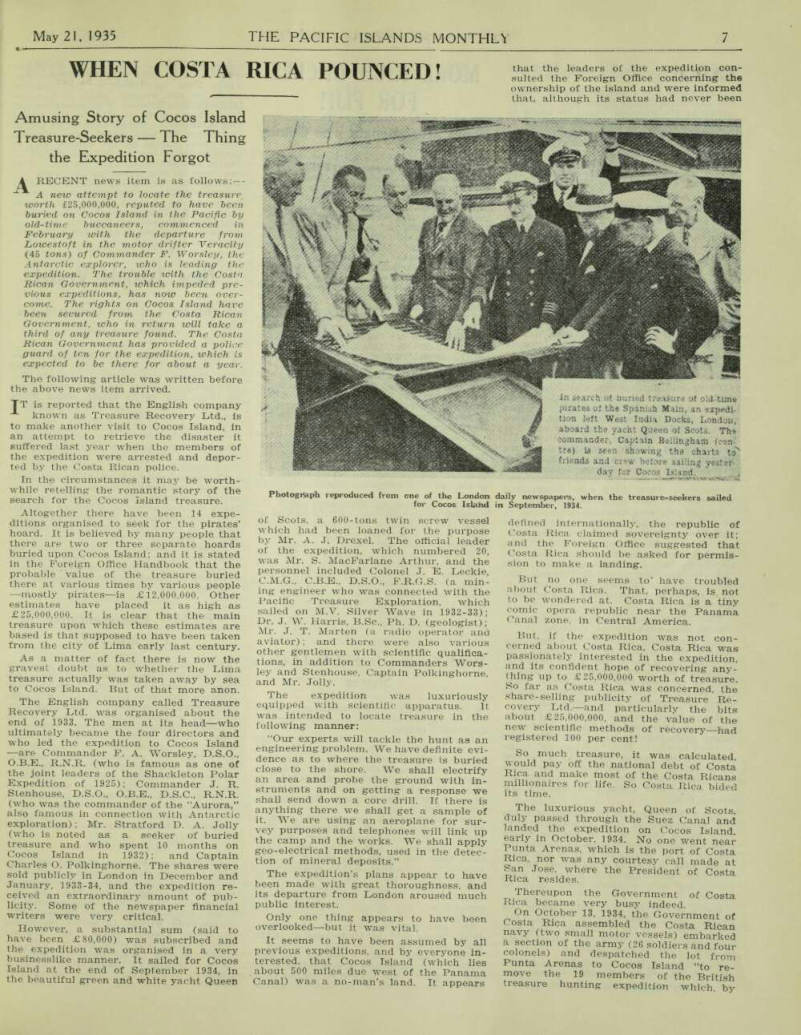
Photograph reproduced from one of the London daily newspapers, when the treasure-seekers sailed for Cocos Island in September, 1934.
in search of buried treasure of old-time pirates of the Spanish Main, an expedition left West India Docks, London, aboard the yacht Queen of Scots. The commander, Captain Bellingham (centre) is seen, showing the charts to friends and crew before sailing yester day for Cocoa Island.
landing there recently, have infringed Costa Rican territory.”
Meanwhile the yacht, Queen of Scots, had landed the expedition and had re turned to the Panama Canal en route to England. She was promptly held up in Cristobal, Panama, by the American authorities on the ground that, if they allowed her to sail, the treasure seekers who were being ejected from Cocos Island would be thrown as a charge upon the Panama authorities, and with no means of getting home.
It was a most startling development which aroused world wide attention, in view of the publicity which had been given previously to the departure of the expedition.
The expedition’s leaders had early radio advice of what was brewing. They came to Panama on the Queen of Scots, and rushed across to Costa Rica, and made due obeisance to the Costa Rican authorities, offering all sort of undertak ings and promises.
But it was too late. Costa Rica was on the warpath. If there was any treasure in Cocos Island, Costa Rica was going to have it. Costa Rica, for once, was sit ting on top of the world.
There was anti-climax when the Costa Rican expedition, which had sailed from Punta Arenas, did not arrive at Cocos Island when expected; and it was feared that the gallant troops had been lost. But it transpired afterwards that the radio had gone out of order and that the Costa Ricans had become very sea-sick. They eventually reached Cocos Island, and duly arrested the 19 British treasure seekers —by whom they were entertained with courtesy and much hospitality.
Troops and treasure-seekers arrived in Punta Arenas on October 28, 1934. It was understood that the treasure-seek ers were to be gaoled; but Costa Rica found a formula by which they were im mediately set free, because they were “‘merely the servants of Treasure Recovery Ltd.,” and they were allowed to proceed to Cristobal, where they rejoined the Queen of Scots.
The whole expedition thereupon re turned disconsolately to England.
The far-seeing Republic of Costa Rica seized the whole of the expedition’s equipment and stores which had been dis embarked on Cocos Island, on the ground that, as no steps had been taken to clear the vessel at the Costa Rican customs office, the material was contraband.
Naturally, there was a good deal of in dignation expressed in London, when a funny little country like Costa Rica was allowed to act in this “outrageous” man ner: but the British Government refused to interfere. It was quite clear from what had been done —or what had not been done —that Costa Rica had the law on its side.
Since the return of the Queen of Scots the organisers of the expedition have been doing their best to placate Costa Rica and secure permission to resume the search. But, of course, that is not easy.
Costa Rica holds the whip-hand; and in this case the whip-hand means a large portion of any treasure which may be recovered.
But a letter that was published In the London Daily Telegraph in August, 1934, from Admiral B. M. Chambers, has cast very grave doubt upon the whole story of the Cocos Island treasure.
The story is that, about 1820, Lima, a city of almost unbelievable riches, was
(Continued On Page 74.)
in danger of being raided; and that an enormous mass of gold and silver articles was placed for safe keeping upon a British vessel called the Mary Dier, under the command of Captain Thompson, in the belief that the English reputation for fair-dealing and honesty could always be trusted. The Mary Dier sailed away with the treasure; but the temptation was too much for Captain Thompson, and he and his men one night seized their passengers and murdered them; and the Mary Dier was eventually taken to Cocos Island, where 12 boat-loads of gold and silver were taken ashore and buried. It was estimated that the Mary Dier treasure was worth between £7,000,000 and £8,000,000.
Admiral Chambers has stated, in most emphatic manner, that he has devoted much time and industry to the investi gation of this story and he is convinced that it is completely a myth. He says that this “horrible act of piracy” is un known at the Peruvian Legation: it was
equally unknown in Peru, where he spent many months in the port of Callao, only 60 years after it was supposed to have occurred; it is not mentioned in any con tempory publication, in Spanish or Eng lish, although he examined many of them: neither the Registrar of Shipping nor Lloyd’s Register knows anything about a ship named the Mary Dier, or anything like it; the journal of Captain Basil Hall (H.M.S. Conway), written in 1820-22 at the time of the occupation of Lima by San Martine, contains nothing about the Mary Dier incident, but there is instead a statement that the treasures of the city were sent away into the interior.
In other words, says Admiral Chambers, there is not anywhere in official history a single word to support the story of the fabulous Cocos Island treasure —or the main section of it, at any rate.
For Fiji!
More Rich Uncles
Boom Must Benefit The Colony
THERE is every indication, as we go to press, of an increasing boom in the shares of the Fiji gold companies.
A number of people sound a cautious note; but their voices are quite over whelmed by the opinions of those who declare that this new goldfield in north ern Viti Levu is going to be proved enormously rich. The optimists insist that this is a “telluride” goldfield, which is of a character not known to the Aus tralian experts, but which is well known in western America, A further flutter has been caused by the action of a syndicate, comprising Messrs. William Borthwick (discoverer of the Tavua lode), P. and D. Costello, W. Lawler and Blair, in pegging an area of 2000 acres on the headwaters of the Waimanu River. This appears to be one of the tributaries of the Rewa and the area apparently is in the high country towards the centre of Viti Levu, and southwards of the Tavua field. It is re ported that the Aloha Syndicate, whose shares have gone to extraordinary values in Australia lately, is connected with the new area referred to.
It is difficult to keep track of all these Fiji companies and their jumping shares: and we certainly do not envy the Govern ment of Fiji, which has undertaken the task of separating the sheep from the goats, with a view to discovering wild cats!
It is reported in Melbourne that the interest of speculators in Fiji gold is so keen that a cloud of depression has fallen upon West Australian gold shares, which previously held the market.
We imagine that it is going to turn out badly for someone—probably for over optimistic speculators —but the boom cer tainly will benefit Fiji. Hundreds of people are rushing off to the Colony; and, even if they do not find the gold they expect, the money they spend in Suva and thereabouts will not do anyone any harm.
Wild Trading in Fiji Gold Co.'s
Shares
AUSTRALIAN stock exchange specu lators are still going crazy over Fiji gold-mine shares.
Further big leaps to large premiums marked trading in Loloma and Koroere, selected Fijian gold shares, on the Mel bourne exchange, early in May. Both are paid only to 3/-. Loloma jumped 3/9 to 45/- cash, while business was written at 46/- for six weeks’ delivery. Koroere rose 1/6 to 26/6.
Australian Gold Development, which will participate in the forthcoming Em peror flotation, advanced from £60 to £66, closing at £64. Two days later, they were selling at £68 and £70. The market expects that A.G.D. shareholders will have rights of subscription to at least 50 shares in the Emperor. Aloha Central and Viti Levu also regained some ground, but Fiji Mining Corporation was weaker.
In April, £10 shares in the Aloha Syndicate were sold in Melbourne at £170, £300, and £430!
The “Argus” said: Close on 20 Aus tralian companies are interested in areas in Fiji, chiefly Tova Tova, six miles from Tavua, on the island of Viti Levu, and
engineers who have inspected the Tavua area are impressed with its possibilities.
Apart from operations at the Emperor mine, on the western slope of Koroere Hill, which at present is privately owned, development work is still in the initial stages, and the vital question to be solved is whether the lodes which have returned rich assay values on the surface and at shallow levels, persist to any degree of depth and maintain their values. This can only be determined by the work un dertaken by the leading companies or oy diamond drilling. Chief interest is centred in operations of the Loloma and Koroere companies. The property of the former company adjoins the Emperor mine on the west side, and several lodes traverse the area.
New Islands Vessel
Contract Let for Union Co.’s M.V. Karu
THE Union Steam Ship Company of New Zealand Ltd. have placed a contract with Messrs. Hawthorne, Leslie and Co., Newcastle-on-Tyne, for the construction of their new cargo motor vessel Karu.
Delivery of the ship will be taken in twelve months ’time.
The Karu will be of 3900 tons, and will have accommodation for 40 passengers.
She will run between Auckland, Fiji, Tonga, and Samoa, being engaged in the fruit trade.
The vessel will be fitted with a 100 watts wireless telegraphy transmitter and receiver, designed and constructed in Aus tralia by Amalgamated Wireless (A/sia) Ltd. Details of the new ship were pub lished in the April issue of the “Pacific Islands Monthly.”
Messrs. Hawthorne, Leslie and Co, built the Union Co.’s cargo steamer Wainui in 1930. This vessel is now suc cessfully engaged in the Melbourne-New Zealand trade.
Fiji and N.Z.
“P.I.M.” Representative in Fiji and N.Z.
THE advertising manager of the “Pacific Islands Monthly,” Mr. Jack Debert, left Sydney in April by the Niagara for New Zealand and Fiji, and is at present in Suva. The circulation of the magazine in Fiji has grown steadily during recent years, and the object of Mr. Debert’s visit is to make better arrangements for distribution there, in view of developments brought about by the Fiji gold discoveries.
Interest in gold, and the continued improvement in the copra market, are causing rapid improvement in economic conditions in all the Territories.
Mr. Debert, in June, will spend a couple of weeks in New Zealand, and will return to Sydney on June 29.
Sir Thomas Henley, K.B.E., who has been prominent in Australian public life for over 30 years, fell from a ferry in Sydney Harbour on May 14, and was drowned. He will be remembered by many residents in New Guinea, Fiji, Samoa and Tonga, to which territories he made several visits. Sir Thomas Henley wrote four books dealing with the Pacific Islands: “Fiji. Land of Promise,”
“New Guinea,” “Australia’s Pacific Islands Mandates,” and “A Pacific Cruise.”
Primage Anomaly
Officialdom “Pulls the Legs” of Territories’ Producers
THE planters of New Guinea and Papua, though residents of Aus tralian territories, are still being thrashed by the Commonwealth Department of Customs in the matter of primage duty; and, apparently, officialdom has no in tention of granting any relief.
Early in 1934 we directed attention to the fact that the products of Papua and New Guinea, when brought to Australia, were being made subject to primage duty, amounting in some cases to 6 per cent.
In other words. New Guinea and Papua were being treated in this matter as if they were foreign countries.
The Sydney Chamber of Commerce brought the anomaly under the notice of the Federal Government; and the Min ister responsible replied smoothly that the matter certainly would have attention when primage duties were being revised.
It was announced, early this year, that as from March 15, the products of the Territories imported to Australia would be subject to primage duty at the same rates as similar goods admitted under the British preferential tariff.
This appeared satisfactory. Islands merchants felt that, at long last, justice had been done.
But Australian officialdom merely was pulling the Territories’ collective leg!
There is practically no concession.
Importers of desiccated coconut, for in stance, found the tariff unchanged. The same applied to various other products, which are peculiar to the tropical islands.
Much perplexed, we applied to the Col lector of Customs, Sydney, for an ex planation, and were courteously supplied with copies of Customs Proclamations Nos. 288, 289, and 290. And there the whole plot was exposed!
Primage duty has been removed from, or reduced, on goods from Papua and New Guinea only when similar articles, which are “the produce or manufacture of Great Britain,” come in at concession rates under the British preferential tariff.
Britain does not produce desiccated coconut, or coffee, or rubber, or a score of similar things; and so such imports into Australia, from New Guinea and Papua, are treated still exactly as if they were the produce of foreign countries.
Could official fatuousness go further!
A grave injustice is being done to these Territories, so the fight must go on. The matter will be brought up at the next session of the Commonwealth Govern ment; and we suppose that more months will pass while we are trying to induce some bored and weary Minister to give it attention.
Meanwhile the Legislative Councils of Papua and New Guinea could help along the good work by taking some official notice of the subject.
Mr. A. R. Lowell, very well known in Papua, where he was at one time a member of the Public Service, died on April 15 at Port Moresby Hospital, fol lowing a long illness. Before going to Papua, he was for some years a barris ter of the Inner Temple, London.
Mr. E. H, Griffiths, manager of the C.S.R. Co.’s mill at Penang, has returned to Fiji after a lengthy stay at the Bel vedere Guest House, Sydney.
Dyott Expedition Will Explore
In Search Of The
“Devil-Pig”
Dyott Expedition Will Explore Sepik Country
PLANS are practically complete for the expedition led by Commander G. M.
Dyott to depart from England and pro ceed to New Guinea to spend a year in scientific research in the Sepik River country, says a Melbourne newspaper.
Besides making a plane table survey of the country traversed, the party will study the primitive culture of the Sepik tribes. It is stated that the expedition hopes to obtain conclusive evidence of the existence of the “devil-pig,” a gra minivorous animal with cloven feet.
This strange creature is greatly feared by Sepik natives, but so far only its tracks have been seen by white men.
Captain C. A. W. Monckton, a former New Guinea official, makes reference to the mysterious animal in his book “Recollections of a New Guinea Magis trate.”
The expedition, which has the support of the Royal Geographical Society and the goodwill of the Commonwealth Government, will include Mr. Dyott, two English explorers, and Mr. H. L. Wil liams, an Australian anthropologist. The collections made while the party is in the Mandated Territory will be divided be tween the Pitt River’s Museum at Oxford, England, and scientific institutions in Australia.
Dutch New Guinea
Many Plans for Development
UNDER the encouragement of the Dutch Government, there is much activity, proceeding and planned, in connection with the development of the rich but gen erally unknown resources of Dutch New Guinea.
We are informed that several com panies have either sent representatives to the Territory, or are getting ready to do so, in order to investigate possibilities of settlement, planting, goldmining, oil discovery, etc.
The well-known Dutch scientist, Dr.
W. C. Klein, representative of the New Guinea Committee established at The Hague a couple of years ago to assist the development of Dutch New Guinea, ar rived in Port Moresby at the end of April, in order to carry out a study of economic conditions in both Papua and the Man dated Territory of New Guinea, with a view to acquiring data which will be of use to his Committee.
Dr. Klein went on in the Dutch steamer to Rabaul, chief town of New Guinea.
He is accompanied by Mr. S. van Oosten, who has spent a year in studying New Guinea data at the Royal Colonial Insti tute in Amsterdam. They will remain a month in Rabaul and thence will proceed to the Morobe goldfields; and, after a few weeks there, will settle down for a fur ther period in Port Moresby.
Mr. and Mrs. C. W. Southey, of Vuni samaloa, Ba, Fiji, returned to Suva by the Niagara at the end of April, after residing for a month at Belvedere Guest House, Darlinghurst. While in Sydney Mr. Southey suffered from a serious attack of duodenal ulcers, which delayed his return to Fiji.
How Civilization is
Menaced Opinions of J. H. Curie, World Traveller, Who is About to Visit New Guinea
NEW GUINEA and Papua, in the coming month, will be examined by the wise eye of Mr. J. H. Curie, famous writer of travel books, who has travelled one and a half million miles during his lifetime, and has looked into every hole and corner of this old earth. He leaves by the “Macdhui” this month to see personally “the romance of the Morobe goldfield.”
Those who meet Mr. Curie will hear some fascinating comment upon human kind and the probable future of the world.
“I sometimes try to picture this world as it will be a thousand years hence,” he said, to the Editor of the Pacific Islands Monthly, “and the mental picture makes me sick with horror. Mankind is doing so much to control the forces of nature, and so little to control itself. Unless something is done to prevent the rapid inter-breeding of races, I can see a world completely populated, in a few hundred years, by a crinkly-haired, chocolate coloured people, with some attractive physical characteristics, but with mental and moral standards very different to the standards set up by the great nations of to-day.”
Mr. Curie has just arrived in Sydney from South America; and he had pointed comment to make about the racial mix tures which he has studied during his various visits to that continent.
“In Brazil, for instance, one sees some ten millions of African negroes, the des cendants of slaves, rapidly breeding in with the Brazilians, who themselves are a mixture of Portuguese and South Ameri can Indian races. Imagine the Brazilian population of a few hundred years hence!”
Mr. Curie believes that another great European war is inevitable, and it will come soon; and its effect on European civilisation will be calamitous. It will be largely a war between aerial navies, and the destruction which will be wrought by bombs from aeroplanes will be something that at present almost baffles description.
Such a calamity—and it is almost upon us —will destroy much of European civi lisation as we know it now; yet this mad ness of “nationalism” is driving steadily on to war.
“This madness of nationalism,” which Mr. Curie regards as a threat to our present civilisation is largely the creation of the great “popular” newspapers—con cerns which, for the most part, are largely over-capitalised, and which in conse quence bend all their energies and thought to the making of dividends, and subvert to that end the primary purpose of news papers, which is to lead and mould public opinion. “They sacrifice all considerations to that of gaining circulation,” he said.
“Their main and indeed only purpose is to excite the people, whip up public in terest, so that newspapers may be bought; and how easy it is to do this by scares, alarms and excursions in international politics.
“Ninety per cent, of the civilised peoples of the earth do not want wars,” he con tinued. “They want only peace and com parative comfort and freedom from anxiety. And how easy it would be to
create such a world, now that science has come in such large measure to our aid.
There are a number of international so cieties, working to that end; yet all their efforts, over a period of years, can be destroyed in a day by one pin-headed, irresponsible newspaper proprietor, trying to work up circulation with an ill informed, sensational article playing on national or racial prejudices.
“No,” he went on, in reply to the obvious question. “I can see no remedy for it. What individual or government will dare to interfere with ‘the liberty of the press’—even although the press—or a section of it —is drivng the world to self destruction!”
Islands
Smuggling In The
One Effect of New Hebrides Tariff
SMUGGLING appears to be a lost art in the world nowadays. International commerce is too closely checked, and borders and frontiers too closely guarded.
A little smuggling still goes on, but its volume is very small indeed compared with what is was 100 years ago.
The widely scattered territories of the Pacific, however, with their innumerable tariffs and countless small traders voyag ing from group to group, still offer op portunities for this form of enterprise, and a good deal of smuggling goes on in this area.
It is practically impossible to stop it.
There are about 14 separate and distinct administrations in the Pacific, and most of them are small and without facilities for keeping an adequate guard over their boundaries.
For many years, until recently, the cus toms duties imposed in these territories were negligible and, therefore, the smuggler had few chances to apply his craft. But in more recent times, since the depression created difficulties in the balancing of budgets, new tariffs have been imposed and existing tariffs have been increased, and there is little doubt that a number of people who have no respect for fiscal laws are reaping a modest harvest.
An example of this comes under notice in relation to the New Hebrides. Wher ever French governments rule, one finds ferocious tariffs, and the New Hebrides are no exception. There is a general tariff there of 12 per cent, ad valorem, but extra special duties are placed on such articles as whisky and cartridges.
Why this tariff has been placed on cart ridges is difficult to understand, for am munition is practically a necessity in that group. The effect is as might have been expected. Excellent cartridges are made in Australia and there is no doubt that very considerable consignments are pur chased in Australian ports, and are smuggled by devious ways into the New Hebrides, where they are sold at rates •which, while much under those obtaining in the main stores, still return a substan tial profit to tlje smugglers.
Probably as a result of this paragraph, the New Hebrides authorities will try to stop this traffic. We think that in the circumstances this is impossible. The only way to check smuggling is to re move oppressive duties—and that should be done in the case of cartridges in the New Hebrides.
Islands Wedding
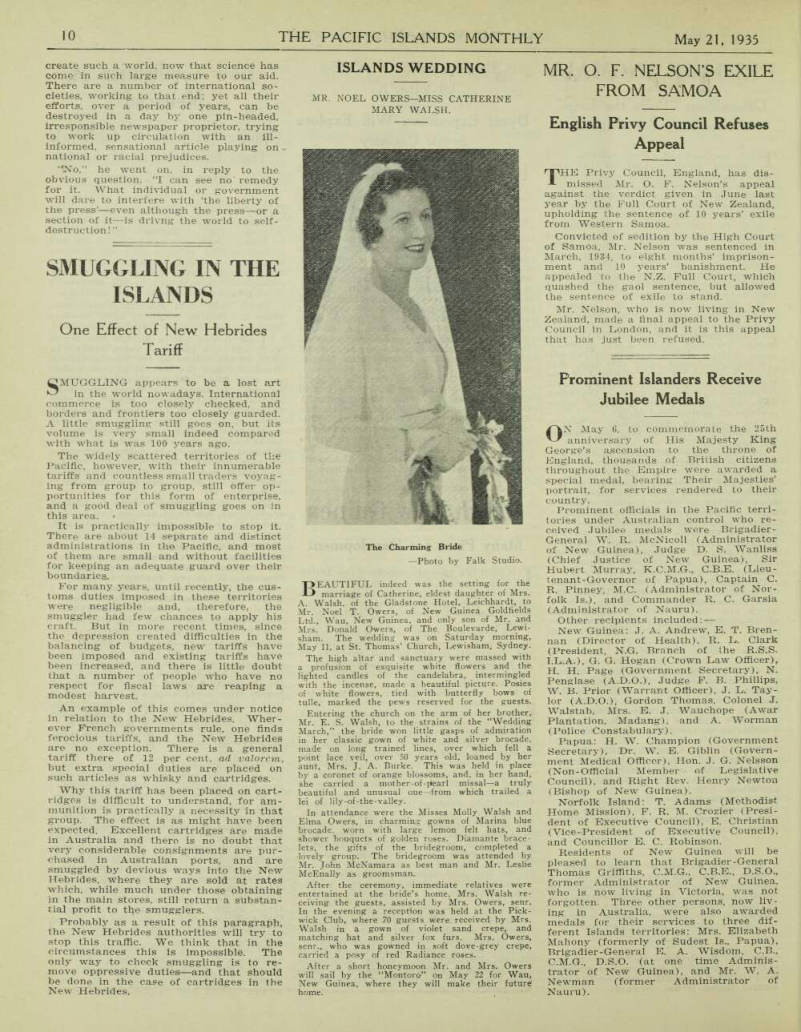
Mr. Noel Owers—Miss Catherine
Mary Walsh.
BEAUTIFUL indeed was the setting for the marriage of Catherine, eldest daughter of Mrs.
A. Walsh, of the Gladstone Hotel, Leichhardt, to Mr. Noel T. Owers, of New Guinea Goldfields Ltd., Wau, New Guinea, and only son of Mr. and Mrs. Donald Owers, of The Boulevarde, Lewi sham. The wedding was on Saturday morning, May 11, at St. Thomas’ Church, Lewisham, Sydney.
The high altar and sanctuary were massed with a profusion of exquisite white flowers and the lighted candles of the candelabra, intermingled with the incense, made a beautiful picture. Posies of white flowers, tied with butterfly bows of tulle, marked the pews reserved for the guests.
Entering the church on the arm of her brother, Mr. E. S. Walsh, to the strains of the “Wedding March,” the bride won little gasps of admiration in her classic gown of white and silver brocade, made on long trained lines, over which fell a point lace veil, over 50 years old, loaned by her aunt, Mrs. J. A. Burke. This was held in place by a coronet of orange blossoms, and, in her hand, she carried a mother-of-plearl missal —a truly beautiful and unusual one —from which trailed a lei of lily-of-the-valley.
In attendance were the Misses Molly Walsh and Elma Owers, in charming gowns of Marina blue brocade, worn with large lemon felt hats, and shower bouquets of golden roses. Diamante brace lets, the gifts of the bridegroom, completed a lovely group. The bridegroom was attended by Mr. John McNamara as best man and Mr. Leslie McEnally as groomsman.
After the ceremony, immediate relatives were entertained at the bride’s home, Mrs. Walsh re ceiving the guests, assisted by Mrs. Owers, senr.
In the evening a reception was held at the Pick wick Club, where 70 guests were received by Mrs.
Walsh in a gown of violet sand crepe, and matching hat and silver fox furs. Mrs. Owers, senr., who was gowned in soft dove-grey crepe, carried a posy of red Radiance roses.
After a short honeymoon Mr. and Mrs. Owers will sail by the “Montoro” on May 22 for Wau, New Guinea, where they will make their future home.
The Charming Bride —Photo by Falk Studio.
Appeal
Mr. O. F. Nelson’S Exile
From Samoa
English Privy Council Refuses Appeal
THE Privy Council, England, has dis missed Mr. O. F. Nelson’s appeal against the verdict given in June last year by the Full Court of New Zealand, upholding the sentence of 10 years’ exile from Western Samoa.
Convicted of sedition by the High Court of Samoa, Mr. Nelson was sentenced in March, 1934, to eight months’ imprison ment and 10 years’ banishment. He appealed to the N.Z. Full Court, which quashed the gaol sentence, but allowed the sentence of exile to stand.
Mr. Nelson, who is now living in New Zealand, made a final appeal to the Privy Council in London, and it is this appeal that has just been refused.
Prominent Islanders Receive
Jubilee Medals
ON May 6, to commemorate the 25th anniversary of His Majesty King George’s ascension to the throne of England, thousands of British citizens throughout the Empire were awarded a special medal, bearing Their Majesties’ portrait, for services rendered to their country.
Prominent officials in the Pacific terri tories under Australian control who re ceived Jubilee medals were Brigadier- General W. R. McNicoll (Administrator of New Guinea), Judge D. S. Wanliss (Chief Justice of New Guinea), Sir Hubert Murray, K.C.M.G., C.B.E. (Lieu tenant-Governor of Papua), Captain C.
R. Pinney, M.C. (Administrator of Nor folk Is.), and Commander R, C. Garsia (Administrator of Nauru).
Other recipients included: New Guinea: J. A. Andrew, E. T. Bren nan (Director of Health), R. L. Clark (President, N.G. Branch of the R.S.S.
I.L.A.), G. G. Hogan (Crown Law Officer), H. H. Page (Government Secretary), N.
Penglase (A.D.O.), Judge F. B. Phillips, W. B. Prior (Warrant Officer), J. L. Tay lor (A.D.O.), Gordon Thomas, Colonel J.
Walstab, Mrs. E. J. Wauchope (Awar Plantation, Madang), and A. Worman (Police Constabulary).
Papua; H. W. Champion (Government Secretary), Dr. W. E. Giblin (Govern ment Medical Officer), Hon. J. G, Nelsson (Non-Official Member of Legislative Council), and Right Rev. Henry Newton (Bishop of New Guinea).
Norfolk Island: T. Adams (Methodist Home Mission), F. R. M. Crozier (Presi dent of Executive Council), E. Christian (Vice-President of Executive Council), and Councillor E. C. Robinson.
Residents of New Guinea will be pleased to learn that Brigadier-General Thomas Griffiths, C.M.G., C.B8.E., D.S.O., former Administrator of New Guinea, who is now living in Victoria, was not forgotten. Three other persons, now liv ing in Australia, were also awarded medals for their services to three dif ferent Islands territories: Mrs. Elizabeth Mahony (formerly of Sudest Is., Papua), Brigadier-General E. A. Wisdom, C.B., C.M.G., D.S.O. (at one time Adminis trator of New Guinea), and Mr. W. A.
Newman (former Administrator of Nauru).
Tropicalities
THAT Pacific prototype of Trader Horn, Henry Dexter, left Papua last year with money in his pocket and joy in his over-youthful heart. He was counting the days until he could reach England—“a kindly green country, with no fever, where one could get cool.” Alas for human hopes! Henry Dexter finds that all his old friends are gone, all his old sailing clubs are in the hands of a new genera tion, and that the English climate is atrocious. He is sitting over a “damned radiator,” bitterly envying the man who bought his trade-store in Milne Bay. “If you don’t see me back in the Pacific within six months you can reasonably assume that I am dead,” writes Henry, under date of March 17. * * * A WORLD wanderer with an interesting personality arrived in Sydney recently —Colonel Gouzy, a distinguished French soldier and explorer. Colonel Gouzy has spent many years in Africa, which great continent he appears to know well from Algiers to Cape Town. He has been recently in French Oceania, and he now is on his way across Central Australia to Darwin.
In making his way back from the Tua motus to Tahiti on a native schooner, Colonel Gouzy had a unique experience.
It rained pitilessly one night, and the 40 natives aboard, who usually slept on deck, crowded into the one cabin below.
Colonel Gouzy liked their company well enough, but the odour of packed hu manity was more than he could bear, and he returned on deck, into the rain.
There the roving eye of the experienced explorer noticed one solitary shelter near the stern —the common “convenience.” He examined it and found it weatherproof.
Inside, there was a Polynesian whe seemed anxious to remain there. The Colonel prowled about the deck, awaiting his chance; but, becoming thoroughly wet and numbed from cold, he pulled the native out of the little house and ensconced himself there, with his coat wrapped around his shivering body. He spent the night in this unusual resting place. He admitted that it was a "situation extraordinaire,” and he said that whatever sanitation experts might argue, he found it preferable to the conditions in the packed cabin. * * * IF ever there was a journalistic Jack-in the-box it is our friend Marc. T.
Greene, American world-wanderer, who regularly bobs up in the most unexpected places. Some two years ago, he was in Tahiti; then he appeared as a correspon dent among the contending armies in China; next he was in Sydney; then he went to Samoa, where his breezy articles stirred various worthy gentlemen to frenzy: from there he went to U.S.A., and spent some time in Boston and New York.
Now comes a cheery letter, dated March 4, from Buenos Aires, and a copy of a daily newspaper of that city, wherein the provocative views of M.T.G. are clearly set forth. We can only hope that the fiery Argentines do not slay him. He writes: “This is a breath-taking city, this Buenos Aires —two and a half millions of people from all over the world here to make money—if they can. The size and magnificence of the place would seem to indicate that some has been made by somebody, and even now there is the ap
pearance of far more prosperity here than in most cities. Before coming here I was in Rio de Janeiro, which is beautiful as a dream—all that has been said of it and more. I expect to return there presently for a longer stay.” * * * A FEW years ago a man now prominent in Suva was manager of a firm in Levuka. In his employ as a packer was a European who owned a herd of cows, and supplemented his packer’s wages by supplying milk to the townsfolk. The manager was one of his customers.
One morning, the manager’s wife found an extraordinary little creature in the milk. They thought at first it was an overgrown microbe; but their servant diagnosed it expertly as a freshwater prawn, which swarm in the Fijian creeks.
The manager grimly wrapped the body in a piece of paper and strode off to his office. He summoned his packer-milkman.
“We found this in the milk this morn ing,” he said. “Can you explain it?”
“What is it?” asked the packer.
“It is a prawn,” declaimed the manager.
“Well, isn’t that remarkable!” said the packer. “I am very glad to have this. I am just sick and tired of telling those boys of mine that they must not use the water from the creek.” * * * THE Melbourne “Herald,” for some time, has been carrying on a campaign with the object of getting legislation to compel mining companies to issue to their shareholders periodical reports of opera tions, such reports to be in language intelligible to the layman.
The Melbourne paper is to be con gratulated. If ever a reform were needed in connection with the share-selling business, this is the one. In recent years there have been hundreds of small com panies, in one form or another, floated in
Australia to prosecute the search for gold in the Pacific territories; but it is quite impossible to keep track of them. A very few of them get beyond the stage of optimism and share-selling—the rest just disappear, and the unfortunate share holders do not know anything about their fate —not even enough to justify a few tears over their demise. This magazine for the past three years has been trying to keep track of the various syndicates companies, etc., which have been formed to seek gold in the Islands; but it is a hopeless task. And there is more than a suspicion that a considerable propor tion of the reports that are issued are deliberately couched in language that no one can really understand. * * * GERMANY’S plea for the return of her colonies, so that she may be given a source of raw materials, and scope for her colonising enterprise, grows steadily more insistent. During the month, a new note was added to the discussion.
Sir Abe Bailey, the South African min ing magnate, in a strongly-worded letter in the London “Daily Telegraph,” said: “Germany lost her colonies by a just verdict of the sword. The Power which imposed on prostrate Russia and Roumania the ruthless treaties of Brest-Litovsk and Bucharest has no right to protest against the terms of the so-called dictated peace.”
It is a not untimely reminder of an aspect of the Great War which many of us have forgotten. When the Prussian had his foot on the neck of Russia and Roumania, and thought he was winning the war, he showed very little of the con sideration he now is asking for, in a revision of the Versailles settlement.
Still, two wrongs do not make right, even in international affairs. * * * THE death has taken place at Te Kuiti (New Zealand) of Hotu, a well-known Maori identity, who caused a sensation some years ago by coming alive at his own tangi. He had been “dead” for four days, and was about to be buried when he awakened, enraged, to find that all his pigs had been slain for the feasting of the numerous visitors.
Advertisements & other items, pp. 13-14 (1 item)
Sterling
HOME PAINT
Guaranteed
LOOKS
BETTER
LONGER
MADE BY
STERLING VARNISH CO.
For
Tropical
Sun and Salt-laden Air
SYDNEY, N.S.W.
PURE RICE
STARCH
Always ask for . . .
“CORAL” Brand
100% PURE
Noted for its
QUALITY
and
WHITENESS
Goes Farthest and gives Lasting Finish
WILL NOT
STICK TO
IRON
Obtainable From Leading Island Stores Manufactured by Coral Starch Ltd.
Sydney, N.S.W.
advt
HOTEL GRAND CENTRAL
151 CLARENCE STREET, SYDNEY, (opp. G.P.O.)
THE POPULAR “ROOM-ONLY”
TARIFF
is specially designed to meet modem requirements of business and pleasure. It enables patrons to enjoy every advantage ef hotel life, at the same time keeping hotel expenses down to a minimum.
SERVICES INCLUDE:
Theatre Booking and Information Bureau.
Travel and Sightseeing Tours arranged.
Up-to-date Barber’s Shop.
Cleaning and Pressing Service.
Garage accommodation nearby at usual rates.
Spacious Dining Room. All meals a la carte.
The HOTEL GRAND CENTRAL Ltd.
151 CLARENCE STREET, SYDNEY (opp. G.P.O.)
Telephone: BW 1531 (3 lines) Box 716 FF, Sydney Radio Cables and Telegrams: “Grancentral,” Sydney
FRASER WEBSTER, Manager.
About Islands People
Dr. J. C. Beaglehole, who did post graduate work at Yale University last year under Professor Peter H. Buck, is now at Puka Puka, in the Northern Cook Group, where he intends spending six months carrying out ethnological research.
Dr. Beaglehole is a graduate of Victoria University College, of Wellington, New Zealand. His recently published volume, “Exporation of the Pacific” has been favourably reviewed in England, America, and Australia.
Professor and Mrs. Peter H. Buck, of the Bishop Museum, returned to Honolulu by the last trip of the Monterey. The pro fessor received a warm welcome in his native New Zealand, especially from his old friends of the Auckland Savage Club, who made him a presentation of an illu minated address. Accompanied by Sir Apirana Ngata, he visited his native Maori people at Urenui, in the Taranaki district, which he always makes a point of doing when re-visiting New Zealand.
Mr. N. A. Pyne, formerly of Tonga, who was driven out of that territory by the depression a couple of years ago, is now doing very well in business in Sydney.
He took over a factory called Panels Ltd.,
producing veneers and panels, and has benefited considerably in the general business recovery in Australia.
Mr. A. E. Lee returned by the Macdhui in May to Bulolo Gold Dredging Co.’s camp, on the Morobe goldfield, New Guinea, after leave in Australia, Mr. F. J. Giles, of the N.G. Public Health Department, arrived in Sydney with his wife on six months’ long leave by the April Montoro from New Guinea.
Rev. George H. West, who has been with the Melanesian Mission since 1913, left Sydney to return to his work at Santa Cruz and the Reef Islands, Solo mons Group, by the Malaita on April 18.
He had been in Australia on short fur lough.
Mr. R. St. George Ryder, formerly man ager of Messrs. Morris Hedstrom’s branch at Devuka, Fiji, has been transferred to the head office at Suva.
Mr. J. H. Curie, world-famous as an author of fascinating travel books, in tends to make an early visit to the New Guinea goldfield, and it is just pos sible that he will tell the fascinating story of that new industry and com munity. He has referred to the activities of the Bulolo Gold Dredging Co., and of Guinea Airways Ltd., as one of the greatest romances of its kind in the world. Mr. Curie, as well as being a writer, is a highly qualified mining en gineer.
Mr. G. H. Murray, Director of Agricul ture in New Guinea, accompanied by Mrs.
Murray, left Sydney by the Mariposa on May 1, for America and Europe, Mr. Mur ray will spend some time in Hawaii, where he will examine the results of the entomological researches carried out un der the auspices of combined sugar planters of Hawaii.
Mr. W. R. Woods, general manager of the Malayta Co., Ltd., Sydney, departed by the Malaita for Solomon Islands on April 18. He will make the round tour, visiting all the Malayta Co.’s branches in the Group.
Rev. and Mrs. Alfred Mason, Mela nesian missionaries at North Mala, Solomon Islands, returned for further work at their station by the April Malaita.
Dr. D. C. M. Macpherson recently re turned to Fiji after an absence of 18 months spent in study and travel in the United States and Great Britain. Dr.
Macpherson is well known in the South Pacific as a Government Medical Officer in the Gilbert and Ellice Islands, and was awarded a Fellowship by the International Health Division of the Rockefeller Founda tion in 1933. He has now been trans ferred to the Colony of Fiji, where he is presently to take charge of the Central Medical School at Suva.
Mr. M. Crocker, Inspector and Instruc tor of the Department of Agriculture in New Guinea, recently arrived in New South Wales on four months’ furlough.
Mr. H. L. Downing, Assistant District Officer in the New Guinea Administration, left Sydney for Rabaul by the May Macdhui.
Mr. C. O'Sullivan, of New Guinea Gold fields Ltd. staff at Golden Ridges, return ed to New Guinea by the Macdhui on May 2.
Mr. J. Nason Jones, Guinea Gold’s well known prospector and explorer, returned to Papua with his wife by the Macdhui on May 2, after furlough in Australia since January.
Right Rev. Henry Newton, D.D., Bishop of New Guinea, has announced that he will retire from the New Guinea Mission at the end of the year. His Lordship has completed over 30 years of mission work in Papua and New Guinea. He joined the New Guinea Mission staff 16 years ago; and, later, was elected Bishop of Carpentaria. In 1921 he was translated from the Diocese of Carpentaria to be Bishop of New Guinea, and, with head quarters at Samarai, he has served in Papua ever since.
Miss Mollie Hodge, who has charge of the Methodist Girls’ School at Salamo, Papua, returned to Port Moresby by the Macdhui from Sydney on May 2.
Rev. H. T. Shotton, M.A., arrived in Sydney by the Macdhui from Papua on April 16. With his wife and son, he went on to Victoria where they will spend their furlough. After a brief visit to Tas mania, Mr. Shotton will return to the Methodist Mission at Kiriwina, Papua.
Mr. H. Morris Smith, assistant secretary and accountant, and Mr. R. M. Buik, auditor, of Guinea Airways Ltd., left Sydney by the May Macdhui for Papua.
They caught their company’s big Ford passenger ’plane at Port Moresby and flew across to Guinea Airways Ltd’s headquarters at Lae, New Guinea.
Mr. G. M. Rodger, of the Malayta Co.
Ltd., Sydney, left by the Malaita on April 18, for Cape Marsh, Solomon Islands. He will visit all his company’s branches in the group and return to Australia in August.
Mr. Pat Costello, one of the pioneers of the Fiji gold industry, returned to Suva by the Mariposa early in May after a business visit to Melbourne.
Miss Inez E. Foulcher, returned to Fiji by the Niagara on April 26. She is principal of the girls’ school at Matavelo, which is conducted by the Methodist Missionary Society.
Mr. H. B. Jamieson and Mr. H. G. Hyde, directors of Sandy Creek Gold Sluicing Ltd., left Sydney by the Macdhui at the beginning of May for their company’s property near Wau, New Guinea. Mr. M.
Crookshanks, mining engineer, accom panied them to carry out testing opera tions on the Sandy Creek leases.
Dr. L. A. Andrews, accompanied by his wife, arrived in Sydney en route to Europe by the Mariposa from Tonga via Fiji on April 25. He has been assistant Government medical officer at Haapai and, later, Nukualofa for several years, and has now retired on pension. Before going to Tonga, Mr. Andrews was for many years attached to the C.S.R. Co’s, staff in Fiji, and later was in the service
of the Vancouver Fiji Sugar Co. at Navua.
On their return from the continent he and his wife will reside in Sydney.
Lady Murray, wife of the Papuan Ad ministrator, returned to Port Moresby by the Macdhui on May 2, after a holiday visit to Australia.
Mr. A. E. Allman left Sydney by the Malaita on April 18 for Makambo, Solo mon Islands. He recently joined the staff of Messrs. Burns Philp (S.S.) Ltd. and will be stationed at Makambo as book keeper.
Mr. R. R. Anson, of Fiji, arrived in Sydney with his wife and two children by the Mariposa on April 23, On behalf of the Cotton Growing Association, Mr.
Anson has been experimenting with cotton plants for a number of years at Sigatoka.
He was able to evolve a new type of cotton which is thought to be most ap plicable to Fiji conditions. Having com pleted his work in the Colony Mr. Anson has now been transferred to the Sudan.
Mr. Peter Radcliffe, New Guinea pros pector and explorer, left Sydney for Papua by the Macdhui on May 2. He returned to Port Moresby and then set off into the interior for the Tauri area, where he is supervising operations for Golden Stream N.L.
Mr. W. J. Candler, travelling inspector for Messrs. Gillespie Bros. Ltd., the well known manufacturers of Anchor flour, Sydney, returned from New Guinea by the Tanda in April, and will leave shortly on a business trip to Fiji.
Mr. G. R. Robertson, manager of the Colonial Sugar Refining Co.’s mill at Lautoka, returned to Fiji by the April Niagara after furlough. Other C.S.R. officials who returned to the Colony on the Niagara after leave spent in Austra lia were Mr. and Mrs. G. A. L. Zillman (of Penang), Mr. and Mrs. W. F. Greenwood (of Lautoka), and Mr. and Mrs. L. C. Sey mour.
Mr. John Dalton, of the prospecting staff of Placer Development Ltd v re turned to Bulolo, New Guinea, by the Macdhui on May 2.
Mrs. Ove Hertz, better known to many as Mrs. Eileen Whiteman, has been seriously ill in the Namanula hospital, New Guinea, for several weeks. Latest reports indicate that her condition has improved.
Miss Juliette Bernard, of the Shell Co., was in Melbourne recently on her way to France to spend her annual furlough with her sister in Paris. She is a mem ber of the Shell Go’s, staff at Noumea, New Caledonia.
Mr. Arthur J. Vogan, well-known traveller and writer on Pacific affairs, sailed from Sydney for Suva by the Niagara at the end of April. He will pursue his archaelogical investigations in the Colony.
Dr. Northcote Deck, who for 20 years was a missionary in the Solomon Islands for the South Seas Evangelical Mission, recently returned to Australia from Eng land. He is now deputation secretary of the mission, residing at Gordon, N.S.W.
For many years he was captain of the mission ship “Evangel” in the Solomons.
Dr. Deck was the first white man to cross the then cannibal island of Malaita and, for his exploratory work in the group, he was elected a Fellow of the Royal Geographical Society.
Miss Smythe, who was for many years in charge of the C.S.R. Go’s, rest-house at Lautoka, Fiji, is now living in retire ment at Belvedere Guest House, Darling hurst, N.S.W.
Mr. C. W. Mann, M.A., left Sydney for Suva, Fiji, by the Mariposa on May 1.
He has been awarded a grant by the Carnegie Trust, America, to make a close investigation of the problem of education in Fiji. Mr. Mann will work in co operation with the Fiji Government.
Rev. N. H. Wright, B.A., Methodist Missionary among the Indians at Ba, Fiji, will leave Suva shortly for Auck land, New Zealand, on two months’ sick leave.
Rev. Stephen Lehner, Superintendent of the Lutheran Mission (Neuendettelsau.
Mission Society) at Finschafen, recently left New Guinea on extended furlough by the “Friderun” for Hongkong and Europe.
He has been in the Mandated Territory for 32 years, and is a noted authority on matters pertaining to the country, its natives, and their culture. His place has been taken by Rev. William Flierl, son of Rev. John Flierl, D.D., founder and first Superintendent of the mission, and who is now living in retirement in South Aus tralia. The new Superintendent, who re ceived his theological training in Ger many and America, was formerly in charge of the native seminary at Helds bach, New Guinea.
Mr. H. Hawker, of the mechanical staff of the “Rabaul Times,” New Guinea, has arrived in Sydney on furlough. He is being relieved by Mr. E. Palmer (on leave from the Halstead Printing Co., Ltd., Syd ney), who will spend six months in Ra baul.
Mr. F. Fournier, a geologist, who is attached to the prospecting staff of Placer Development Ltd., returned to Bulolo, New Guinea on May 2, after furlough in Aus tralia. While in Sydney Mr. Fournier was married to Miss Jean MacDearmid, who. recently arrived in Australia from Van couver, Canada.
Brigadier-General E. A. Wisdom, C.B., C.M.G., D.S.O., returned to Sydney by the Macdhui from Papua on April 17. He left immediately for Melbourne to report to his co-directors of Lakekamu Gold fields (Papua) Development, N.L., the results of his tour of inspection of the areas held by them on the Lakekamu field.
Sister Mary Ignatius returned to Buin on the southern coast of Bougainville Island, New Guinea, by the April Malaita. She has completely recovered from her illness which necessitated a 16 months’ health rest in Australia. For over 25 years she has been attached to the Marist mission station at Buin.
Mr. B. G. Edgell, of Messrs. Edgell and Whiteley, proprietors of Pak plan tations, Manus, New Guinea, arrived in Sydney in April on furlough after spend ing some months in the East. He is spending a few weeks in Australia before returning to the territory.
Mr. G. Fulton, who was general man ager in Sydney for several years for Messrs. Lever’s Pacific Plantations Pty.
Ltd. and who now has retired, left for England at the end of April. He intends to spend the next few years in Europe.
Mr. H. W. G. Nobbs, who is a director of Messrs. Holbrooks (A/sia) Ltd., ac companied by Mrs. Nobbs, will leave by the m.v. Malaita on May 30, on a tour of the Solomon Islands and New Guinea.
They will spend a few days in Rabaul and will return to Sydney by the Mac dhui.
Mr. Sydney Nobbs, of Norfolk Island, who has been in Australia on a holiday visit for some weeks, will leave Sydney for Lord Howe Island by the Morinda on June 8.
Mr. Wallace E. Hayes has been ap pointed a director of Edie Options Ltd., a Melbourne company formed to seek gold in New Guinea.
Advertisements & other items, pp. 15-18 (2 items)
About Islands People
13
THE PACIFIC ISLANDS MONTHLY
May 21, 1935
ABOUT ISLANDS PEOPLE
Location BELVEDERE
BE TAUGHT
TO DANCE
IN
SYDNEY
BY VALMAI RAMSAY, ASSOC. MEMBER
IMPERIAL SOC. TEACHERS OF DANCING
LONDON
SCHOOL OF LONDON
DANCING
333 GEORGE STREET. SYDNEY
TEL: BW 5120
The Islanders’ Sydney Home . . .
Location BELVEDERE
81 BAYSWATER ROAD, DARLINGHURST
Exclusive.
A fine house with its wealth of pleasant old associations.
The Garden Suites, designed on most modern lines.
Excellent grounds with beautifully kept gardens—and dotted with comfortable garden seats.
Private telephones if desired.
An atmosphere of rest and grateful quietness.
Ideal location.
Near White City Tennis Courts.
Seven minutes to G.P.O.
Close to Shopping Centre.
Trams stop at gates.
BELVEDERE is Controlled and Supervised by Island People for Island People TERMS: From £2/12/6 Weekly.
MR. & MRS. C. WAGER (late of Fiji), Proprietors.
“Your Shoes Were Most Comfortable” .. . .
—WRITES AN ISLANDS CUSTOMER
22/6 You are assured of the same service.
Good Shoes, well made Cropley quality.
TSO2. Tan or Black Calf Shoes, medium or Wide toe, flexible welt sole, half size fittings, 5 to 10, 22/6; size 11, 24/6. In Black Calf Boots, 5 to 10, 24/6. (Kindly add postage.) Catalogue upon request CROPLEIS Ltd. 736 George Street, Sydney, N.S.W,
TUDOR HOTEL
Room and Breakfast from 7/6 per day. All meals a la carte. Accommodation for 100 guests. Two minutes from G.P.O. 127 PHILLIP ST. - Tel.: BW 27M One door from the New Martin Place,
SYDNEY
For Pianos, Organs and
all Musical Instruments
STRINGS AND FITTINGS OF
EVERY DESCRIPTION
Sole Agents for the famous
“SENATOR” ACCORDEONS
“ROYAL” MUSICAL STRINGS
Special Attention to Mail Orders
G. H. NAYLOR
133 Castlereagh Street, Sydney
Head Study of Champion Walvon Admiration, Challenge Winner, Sydney Royal, 1934
The Noted Walvon Kennels
Premier Breeders of Scottish Terriers, Sealyhams, and Wire-haired Fox Terriers.
Puppies available all the year round. Orders direct to Walvon Kennels, 1 Merlin St., Nth.
Sydney, or through Burns Philp & Coy. Ltd., or McIlwraiths, Ltd.
advt
For Travel
For Speed-Work
For Pictures Indoors
For Night Photography
RETINA
For those hundreds of unusual, thrilling and dramatic pictures that you wouldn’t have got otherwise?
RETINA
Retina is photography’s latest thrill opens up a new world of photography.
Retina is that fine high-precision instrument you’ve always wanted, but could not previously afford. And it’s a Kodak product easy to use nothing new to learn!
Daylight loading and unloading with 35 mm. Kodak Panatomic Film Cassette, for 36 exposures, size 36 x 24 mm., using Automatic Exposure Counter.
F/3.5 Xenar Lens assures needle-sharp definition for tremendous enlargement, Compur Shutter to 1/300th second, stops fastest action.
PRICE £10/10/- (which is the English List Price)
for Special Retina Folder
KODAK Pupille
Yet Another Miniature Marvel Huge world-demand makes possible substantial reduction in the price of the Pupille. Was £17/10/-. NOW £13.
Jewel-like in its exquisite finish! Amazing in its versatility. Lightning-fast lens captures snapshots in almost any light. Makes 16 pictures of size 1¼ x 1 5/8in., on popular V.P.K. Panatomic Film, capable of great enlargement.
With Cooke f/3.5 Lens, Compur Shutter, speeds to 1/300th sec. Leather case, range finder, color filters, etc. Price was £17/10/-; now reduced to £13.
OF ALL KODAK DEALERS THROUGHOUT
THE ISLANDS AND
KODAK
(Australasia) PTY. LTD.
379 GEORGE STREET, SYDNEY
SEEDS that SUCCEED
Vegetable and Flower Seeds 3d. and 6d. per Packet Spraying Fluids Stocked
George Austen and Co
Seed Merchants 4 Parker Street, SYDNEY Established 1898.
(COLLECTOR of shells desires to make reciprocal arrangement with collectors of shells (marine, land and fresh water) in Pacific Islands, with view to exchanging specimens.
Write H. Bernhard, 92 Derby Street, Rockhampton, Queensland.
BLACK BIRD PIE CRUST
FUNNELS
1/9 EACH—2/- POSTED
THE POTTERY SHOP
12 Rowe Street, Sydney Hand made Pottery from near and far.
Inspection invited.
Coles
Regalia
Sydney
ALF. H. J. COLES
Established 1920.
Masonic Regalia, Jewels and General Requisites.
Master Masons’ Aprons 42/- and 457- Leather Regalia Cases, 16-inch, from 16/6 P.M. Jewels a Speciality.
Inquiries Solicited :: Prices Australian Currency
Room 19, Royal Arcade, Sydney
VICTORY Camp Folding Furniture
The Folding Bed, Open 6ft. Sin. by 2ft. 3in.; when Folded, 36in. by 7in. by 3in.
The Strongest Collapsible Stretcher made —will stand the hardest wear.
THE VICTORY CAMP STOOL
useful for all purposes where a strong lightweight Stool is required.
Tents, Tarpaulins, Bedding and Wire Mattresses etc., quoted for.
The Victory Furniture can be supplied through All Burns, Philp & Co.’s Branches Catalogues available on application Manufactured by: N. M. FOWLER, Elizabeth St., Newtown, Sydney
Death Penalty
For Murderer of A.D.O.
McDonald
From Our Own Correspondent.
RABAUL, April 18 CHIEF Judge D. S. Wanliss yesterday sentenced to death the former native constable Sipei, who was found guilty of the murder of A.D.O. Edward Colin Mc- Donald at Ambunti, at the end of Feb ruary.
It was disclosed during the hearing of the case that McDonald arrived at Am bunti from Angoram on February 24, with a native constable named Bei. The follow ing day Acting Patrol Officer Hepburn arrived by the Govt. schooner Thetis, and went into quarters at the Patrol Officer’s bungalow, where the deceased was already in residence.
Just after dawn of the morning of the 28th., Hepburn heard a report coming from McDonald’s room, and immediately after heard the A.D.O. cry, “My God, I’m shot.” Hepburn jumped out of bed and ran into McDonald’s room. He saw at a glance that McDonald was fatally wound ed and dashed out of the room in time to see a native in police uniform dis appearing around the kitchen corner. He gave chase, calling to the figure to stop; but the native continued on and climbed down the slope of a cliff.
Hepburn returned to McDonald, who
was unconscious; medical assistance was sent for, but the A.D.O. died shortly after wards.
The accused pleaded provocation and gave evidence, corroborated in some in stances by fellow police-boys, to the effect that the deceased had assaulted him after an argument. It was alleged that after the assault the accused was made to travel in a canoe, towed behind the launch for three days. Another incident, an un successful claim for a dog by Sipei was also mentioned. These incidents, the de fence claimed, constituted a series of in dignities which led up to the accused first planning suicide, and then the mur der of the deceased and his own suicide.
Sipei in his evidence tendered a full confession of the crime, and described his attempted suicide, first by stabbing with a small knife and then by throwing himself from a tree which rendered him unconscious.
After carefully weighing the evidence, His Honour the Chief Judge returned a verdict of guilty and later passed a sen tence of death upon the accused.
Mr. Maunsell-Turner appeared for the Crown and Mr. F. W. Mantle A.D.O.
Rabaul, for the defence.
In Search Of Gold
Two Adventurers Sail for Papua in 32-ft. Yawl
Gitana II., a 32ft. sturdily built cruising yacht with an eight horsepower auxiliary engine, manned by two young farm hands, sailed from Williams town, Victoria, on April 25 for a cruise of the Western Pacific in search of gold.
Becoming weary of life on a farm at Port Albert, the two adventurers, J. R.
Vicary and R. B. Moffat, decided to seek their fortune in Papua. Neither has had much experience with the sea, but they both have been studying navigation and sailing since the Gitana II. was launched at the end of last year.
They intend to sail to Lord Howe Island, then make north-east for the Louisade Archipelago, Papua. At Misima Island they will be joined by Captain G. Pent land, and then will set off to conduct a gold search among the surrounding islands.
Copra Price In Northern
Cooks
From Our Own Correspondent.
Rarotonga, April 19.
MR. SAM BENNETT, former co-manager of Rarotonga’s leading store, re cently returned from furlough to take over control of Messrs. A. B. Donald and Co.’s interests in the Cook Islands. Alive to the problems of “depression trading,” Man ager Bennett plans to increase business by a rigid internal economy and closer co-operation between local firms for the purpose of securing mutual benefits.
Raising the price of copra to £2/6/8 per ton in the Northern Islands of the Group, one of his first moves was to make it quite clear that this amount would be subject to the £1 per ton tax which is to be re introduced on July 1. Executives have formerly taken into account any taxation before fixing prices and, consequently, a large number of native growers remained ignorant of the existence of such.
Fiji Butter
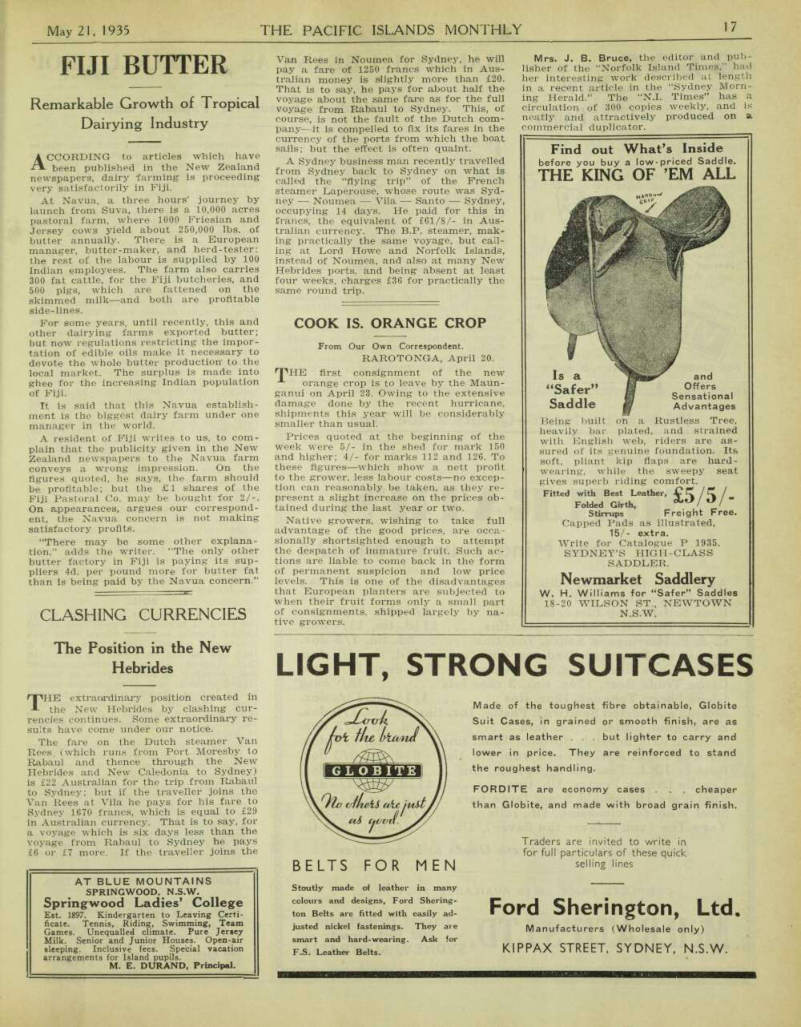
Remarkable Growth of Tropical Dairying Industry
ACCORDING to articles which have been published in the New Zealand newspapers, dairy farming is proceeding very satisfactorily in Fiji.
At Navua, a three hours’ journey by launch from Suva, there is a 10,000 acres pastoral farm, where 1000 Friesian and Jersey cows yield about 250,000 lbs. of butter annually. There is a European manager, butter-maker, and herd-tester: the rest of the labour is supplied by 100 Indian employees. The farm also carries 300 fat cattle, for the Fiji butcheries, and 500 pigs, which are fattened on the skimmed milk—and both are profitable side-lines.
For some years, until recently, this and other dairying farms exported butter; but now regulations restricting the impor tation of edible oils make it necessary to devote the whole butter production' to the local market. The surplus is made into ghee for the increasing Indian population of Fiji.
It is said that this Navua establish ment is the biggest dairy farm under one manager in the world.
A resident of Fiji writes to us, to com plain that the publicity given in the New Zealand newspapers to the Navua farm conveys a wrong impression. On the figures quoted, he says, the farm should be profitable: but the £1 shares of the Fiji Pastoral Co. may be bought for 2/-.
On appearances, argues our correspond ent, the Navua concern is not making satisfactory profits.
“There may be some other explana tion,” adds the writer. “The only other butter factory in Fiji is paying its sup pliers 4d. per pound more for butter fat than is being paid by the Navua concern.”
Clashing Currencies
The Position in the New Hebrides
THE extraordinary position created in the New Hebrides by clashing cur rencies continues. Some extraordinary re sults have come under our notice.
The fare on the Dutch steamer Van Rees (which runs from Port Moresby to Rabaul and thence through the New Hebrides and New Caledonia to Sydney) is £22 Australian for the trip from Rabaul to Sydney; but if the traveller joins the Van Rees at Vila he pays for his fare to Sydney 1670 francs, which is equal to £29 in Australian currency. That is to say, for a voyage which is six days less than the voyage from Rabaul to Sydney he pays £6 or £7 more. If the traveller joins the
Van Rees in Noumea for Sydney, he will pay a fare of 1250 francs which in Aus tralian money is slightly more than £20.
That is to say, he pays for about half the voyage about the same fare as for the full voyage from Rabaul to Sydney. This, of course, is not the fault of the Dutch com pany—it is compelled to fix its fares in the currency of the ports from which the boat sails; but the effect is often quaint.
A Sydney business man recently travelled from Sydney back to Sydney on what is called the “flying trip” of the French steamer Laperouse, whose route was Syd ney — Noumea — Vila — Santo — Sydney, occupying 14 days. He paid for this in francs, the equivalent of £61/8/- in Australian currency. The B.P. steamer, mak ing practically the same voyage, but call ing at Lord Howe and Norfolk Islands, instead of Noumea, and also at many New Hebrides ports, and being absent at least four weeks, charges £36 for practically the same round trip.
Mrs. J. B. Bruce, the editor and pub lisher of the “Norfolk Island Times,’’ had her interesting work described at length in a recent article in the “Sydney Morn ing Herald.” The “N.I. Times” has a circulation of 300 copies weekly, and is neatly and attractively produced on a commercial duplicator.
Cook Is. Orange Crop
From Our Own Correspondent.
Rarotonga, April 20.
THE first consignment of the new orange crop is to leave by the Maun ganui on April 23. Owing to the extensive damage done by the recent hurricane, shipments this year will be considerably smaller than usual.
Prices quoted at the beginning of the week were 5/- in the shed for mark 150 and higher: 4/- for marks 112 and 126. To these figures—which show a nett profit to the grower, less labour costs —no excep tion can reasonably be taken, as they re present a slight increase on the prices ob tained during the last year or two.
Native growers, wishing to take full advantage of the good prices, are occa sionally shortsighted enough to attempt the despatch of immature fruit. Such ac tions are liable to come back in the form of permanent suspicion and low price levels. This is one of the disadvantages that European planters are subjected to when their fruit forms only a small part of consignments, shipped largely by na tive growers.
Advertisements & other items, pp. 19-20 (2 items)
Light, Strong Suitcases
Find out What’s Inside
before you buy a low-priced Saddle.
THE KING OF ’EM ALL
Is a
“Safer”
Saddle
and Offers Sensational Advantages Being built on a Rustless Tree, heavily bar plated, and strained with English web, riders are a sured of its genuine foundation. Its soft, pliant kip flaps are hardwearing, while the sweepy seat gives superb riding comfort.
Fitted with Best Leather, Folded Girth, £5/5/- Stirrups Freight Free.
Capped Pads as illustrated, 15/- extra.
Write for Catalogue P 1935.
SYDNEY’S HIGH-CLASS
SADDLER.
Newmarket Saddlery
W. H. Williams for “Safer” Saddles
18-20 WILSON ST., NEWTOWN
N.S.W.
LIGHT, STRONG SUITCASES
BELTS FOR MEN
Stoutly made of leather in many colours and designs, Ford Sherington Belts are fitted with easily adjusted nickel fastenings. They are smart and hard-wearing. Ask for F.S. Leather Belts.
Made of the toughest fibre obtainable, Globite Suit Cases, in grained or smooth finish, are as smart as leather . . . but lighter to carry and lower in price. They are reinforced to stand the roughest handling.
FORDITE are economy cases cheaper than Globite, and made with broad grain finish.
Traders are invited to write in for full particulars of these quick
selling lines
Ford Sherington, Ltd.
Manufacturers (Wholesale only)
KIPPAX STREET, SYDNEY, N.S.W.
STOP
Tired nerves are the cause of Headache, Neuritis, Neuralgia, Rheumatism, Lumbago, Sciatica. Get instant relief from all nerve pains with Genuine VINCENT’S A.P.C. as recommended by Doctors, Dentists, Chemists, and Nurses. 12 for 1/6, 24 for 2/6.
All Chemists and Stores, or direct from Vincent Chemical Company Limited, Market St., Sydney, Australia
Nerve
Pains
FOR SAFETY’S SAKE. SAY “VINCENT’S"
Prices at the Nadir— Quality at the Zenith
BUY FROM
McILRATH’S
and Mind Your P’s and Q’s
Australian 1A Sugar, 70lb. bags 14/- bag Best Roller Flour, 50lb. bags 5/- bag Rosa Self-Raising Flour, 5lb. pkts 1/- pkt., 11/6 doz.
Osprey Blueback Salmon, ½lb. tins ... 11½d. tin, 11/- doz.
C. & B. Herrings in Sauce, 7oz. tins 8d. tin, 7/3 doz.
Brunswick Canadian Sardines, 4oz. tins . . 4½d. tin, 4/- doz.
Globe Trade Beef, 12oz. tins (4 doz.) . . 5/3 doz., 19/- case Globe Trade Beef, 12oz. tins, 3 case lots 18/- case Globe Sheep Tongues, 12oz. tins 1/1½ tin, 13/- doz.
Morton’s Assorted Sandwich Pastes, 1oz. tins, 2d. tin, 1/9 doz.
Eta Peanut Butter, 3½oz. jars 8½d. jar, 8/3 doz.
Garden Vale Brussels Sprouts, 16oz. tins . 9d. tin, 8/6 doz.
Rosa or I.X.L. Apricots in Syrup, 1lb. tins . 6½d. tin, 6/3 doz.
Rosa or I.X.L. Pears in Syrup, 1lb. tins 7½d. tin, 7/3 doz.
Excello Dripak Prunes, 1lb. tins 11½d. tin, 11/- doz.
Rosa Pure Household Soap, large bars . 8½d. bar, 8/- doz.
Steel Wool for cleansing, 1lb. rolls 1/9 roll, 20/- doz.
Yoga Tea (you’ll favor the flavor), 1lb. . . . 2/- pkt., 2/4 tin Potatoes, Onions and Fresh Goods at lowest rates
COMPLETE PRICE LISTS AVAILABLE, POST FREE
McILRATH’S LTD
Export Department 202 Pitt Street
SYDNEY, AUSTRALIA
Springwood Ladies’ College
AT BLUE MOUNTAINS
SPRINGWOOD, N.S.W.
Est. 1897. Kindergarten to Leaving Certificate. Tennis, Riding, Swimming, Team Games. Unequalled climate. Pure Jersey Milk. Senior and Junior Houses. Open-air sleeping. Inclusive fees. Special vacation arrangements for Island pupils.
M. E. DURAND, Principal.
Mauritius Beans As A Chance Crop
A Few Words in Season for Papuan Planters
THREE or four years ago, when I was planning to exchange a prosaic job in Australia for a career on the land in Papua, I felt I had one small trump card up my sleeve that would never fail me.
When estimates, on investigation, began to show less rosy prospects than expected, I consoled myself with the thought that Mauritius Beans would at least keep the pot boiling during the lean years while a permanent crop was coming into bearing.
My text books told me nothing about growing Mauritius Beans for sale, although I knew that a good many small planters produced them, and I had to depend on a few newspaper comments and a list of market prices ranging over five or six years.
Since then I have been growing the Beans for two years, and have gained a Tophet of a lot of experience, some of which I confided to the Editor of the P.I.M. He said that other growlers might
be interested in what I told him —hence this article, which attempts to show how to grow and harvest the beans, the costs of doing so, and the returns that may be expected.
Probably, there is nothing written here that is not known to every Bean grower, with the possible exception of the “surprise ending” to the tale; but, remembering my own fruitless hunt after information, these notes may be of use to somebody similarly placed. I have since learned that the Queensland De partment of Agriculture have published a pamphlet on the subject, but my experi ence did not tally with it —not by a long chalk. Any grower reading that pamph let’s account of the yield of Mauritius Beans might think his fortune was made.
There is a story current in Papua that, at a meeting of a now defunct planters’ association held many years ago, an ex perienced member stated that the Mauri tius Bean was the greatest curse ever introduced into the country. He was, of course, referring to the plant as a cover crop, and not as a revenue producer. The Bean is, however, not a curse, for it at least puts back a little nitrogen into the soil; but as a cover crop it may rightly be termed a fraud. It does not cover; it simply soars, allowing Lalang (the long grass that invades neglected plantations and which really is a curse) to flourish all the better underneath it.
But, I ask you, where does Lalang not flourish?
But our present consideration of Beans is as a chance, not a cover crop. In course of time, the vine bears beans which are used by North Queensland sugar farmers to fertilise their cane fields; and hence it has a definite market value which may help on the poor Island planter while more ambitious schemes are developing.
Soil.
It is said, the poorer the soil the better the yield. I have seen a good crop raised among granite boulders where there was practically no soil, and I have raised a tidy few myself on good fat loam. In fact, it does not seem particular about soil, though it refused to grow on water logged ground; and, when planted among heavy Lalang, showed a slightly reduced yield. Probably it likes best an arid sandy soil, and certainly a dryish climate so soon as fruit has set is a great help in harvesting.
Absolutely clean land in Papua appears to be a myth, or at least an ideal. When the time came to sow, my land was like the general run, somewhat of a wilder ness. That is to say, it had been neither ploughed nor hoed, was covered with vigorous weed growth, and the Passiflora was beginning to take possession. But the Bean did not seem to mind a little competition. It germinated well and shot up from the jump till it soon over topped everything in reach. Probably the
yield would be greater on ploughed land, but the expense is prohibitive, and most planters will do as I did and sow without great preparations. Any young trees or banana clumps already in the line of the rows can be left as supports, and will probably permit of a greater yield on the vines that utilize them.
Poling
Supports are necessary and must be placed in position first. I leave the mathematically minded to work out how many poles will be required per acre if placed in rows of eight feet from one another and six apart in the rows. Then multiply the result by the number of acres you intend to plant. The number will surprise you The stronger and higher the support the better the yield; but quite frail sticks or young scrub trees will hold them up nobly, so that, in view of that bugbear "costs," it is not necessary to be too particular. I used mangrove poles chiefly, the majority of which are doing duty for the second year.
Sowing, at stake in the loose earth at the foot of the poles, can be done during the rains. January sowing, with me, produced marketable beans in August, April sowing up to November. But it is wise to get on to the market early in the season and the November consignment must be the last.
An occasional clean up of very rampant neighbours is necessary, especially Passiflora, which in the early stages hooks on to the vines and prevents them going up the supports.
Yield.
If you want an optimist’s estimate, consult the pamphlet already referred to, where it is stated that the best (!) soil will produce up to 100 bushels per acre, and that 30 is the average. Against this, I place my own yield of about 12, which I consider could be increased to 16 or even 18 by closer planting and more attention.
This was my experience, and maybe I am the mug; but, after all, the Mauritius Bean is a Mauritius Bean and not a sweet pea. That 100-bushel yield makes me think of an old lady in gardening gloves and a watering-can and only one vine to look after.
Harvesting
If Bean growing has been all fair sailing so far, we now come (to mix metaphors) to the “worm i’ the bud,” in other words, the snag.
The method of shelling adopted was to tap each bean sharply near the curved point and along the hilum with a footlong piece of hardwood, about the thickness of the thumb. If hit in the right plane, the pod splits and a scoop with the finger does the rest. The process sounds rather tedious; in reality, it is
damnably so, and if anyone knows a better way I should be glad to hear of it.
An average boy can shell a bushel in a seven hours day—if supervised, I tried flailing, both in heaps on the ground and in bags, but failed. More over, flailing is more likely to injure the beans and spoil germination. There is a germination test of about 80 per cent. imposed on imports to Queensland; so, apart from commercial ethics, it is advisable to go over the shelled product and remove "bad eggs."
Although the bunches of beans may be picked and brought in with a certain amount of moisture in them, it is inad visable to attempt to shell till they are bone dry. Premature attempts on moist beans reduce the shelling rate to a quarter of the normal, so do not be in a hurry; wait till the beans are try, and save time and labour. To expedite drying, place the pods in the sun on trays, and take them in at night. A very wet climate, after July, is a distinct obstacle to a successful issue, and if excessive, might be considered almost prohibitive.
Beans grown along the dry North Queens land littoral can be harvested in August; whereas, in a wetter climate, I was labouring till mid-November.
Kiln-dried Beans from Fiji were unpopular in Queensland some years ago, as the artificial heat affected germination adversely.
I was told of a method whereby the beans were soaked in water overnight and left to split open in the sun in the morning. This system does not appeal to me; it appears to be a short cut to mould and premature germination. If generally adopted, it might bring the whole Papuan crop into disfavour.
Mould must be guarded against, as I have known a whole crop to be destroyed by it, so no method of shelling that mentions the word water receives any en couragement from me.
After shelling, a careful sunning is ad visable, but, like the shorn lamb, freshly shelled Beans are tender, and a good cooking in the sun may cause wrinkling and a trip to the rubbish heap with the previous day’s work.
An ordinary copra sack is used for bagging. It holds well over three bushels at first, but comes down in weight from subsequent desiccation and the imposition of that mysterious penalty termed “Tare.” An occasional glance through the bags while in the shed to detect signs of mould will not be time wasted.
Cost Of Production,
I quote my own figures as an example, I shipped 120 bushels of beans from the 12 acres, part of the crop being left for seed and part being too late for the market. The cost of producing these, computed at the ordinary rates of labour
in Papua, amounted to £84. (Of these, £20, or nearly a quarter, went in marketing expenses—bags, freight, charges, etc.) This works out at £7 an acre for the whole area, but only the crop from 10 acres was sent for sale.
I employed a boss boy and three others most of the time, reducing the staff to three during the growing season, and augmenting it by day labour very con siderably during the harvesting. But these figures could be slightly reduced, as the staff were able to do a certain amount of future developing work apart from the beans, and the boss boy is a luxury that a hard working planter might be ready to forego.
Anticipated Returns
These were computed on prices ruling for 1933, which were £1 per bushel F.O.B. Port Moresby. This may be regarded as the normal, for prices have been fairly constant over a period of many years, and were not apparently affected by the depression. My returns, therefore, should have been £120.
Undoubtedly, the pleasantest phase of Mauritius Bean growing is the arrival of the agent’s cheque; but in this uncertain world one should never count on it till one handles it. As my balance sheet shows (expenditure of £84 and anticipated returns of £120), it is obvious that Bean growing can be conducted at a profit. Mine should have been a matter
of £36. And a very nice little sum too —when you get it!
Actual Returns From 1934
Export.
Like O. Henry’s stories, my Mauritius Bean venture suffered a surprise ending.
When the 120 bushels had safely arrived in Cairns, a malign fate took a hand in the sequel.
Owing to an abnormal train of circum stances, drought principally, shortage of cash among sugar farmers, and large early consignments from Fiji, the market went “phut.” It absolutely dried up, with over 200 bushels of Papuan-grown Mauritius Beans left without a buyer.
Included in that lot were my 120 bushels.
I am told that only one Papuan grower sold his crop, and that was at 12/6 under contract—a price that is not very attractive. The actual return, conse quently, as far as I am concerned, was exactly nil, to say nothing of £80 odd out of pocket. Further comment is un necessary.
I don’t mention my experience in the hope of stopping others who wish to ven ture, though it may serve as a warning of the uncertainty of such enterprises.
One can only hope it won’t happen again —all the more as I have some 60 bushels in view for 1935 picking. With all the unsold consignments in hand it is not likely that prices will be very good this year, or the demand very great.
Another adverse factor is that the N.Q. farmer is always coming across substi tutes for Mauritius Beans, and one of these may eventually knock the Papuan product flat, for good and all. It will be time, then, to think of some other way of keeping the pot boiling.
In conclusion, gentle reader, I have to explain my reasons for remaining anony mous. Had I pocketed that anticipated profit, all the world might know who has written this effusion. But seeing that I got never a “Bean” for my Beans, my heart is sad thereby, and sign myself—
Disappointed Planter.
Advertisements & other items, pp. 20-22 (1 item)
Languages, Mathematics,
SCIENCES
Correspondence Courses Maintain Your Cultured Connections with Sydney.
Write: HECTOR WILSHIRE, M.A.
(3 Scholarships, 3 Medals)
COACHING SCHOOL
All Examinations, Expert Graduate Staff.
327 GEORGE STREET, SYDNEY
So-called
“Simple” Remedies
are useless
in Tropic
Skin Infection
Half measures are valueless when it comes to dealing with Dhobie Itch, Too Rot, Ringworm of the Nail, etc. Skin specialists regard these diseases as being amongst the most difficult skin complaints to treat successfully; a few years ago they were considered incurable. Recent laboratory tests, however, prove that Antinea Antiseptic Lotion, a combination of powerful germicidal oils, affords a highly successful treatment for Tropic Ringworm in all its forms. It is the one positive treatment; powerful enough to completely destroy the germs, yet harmless to the most tender skin.
Treatment with Antinea is simple. First wash the affected area and dry thoroughly.
Then paint Antinea on the skin, allowing it to dry on. Repeat this treatment every night and morning; within a short time every germ will be destroyed and the skin freed from infection.
An Island resident writes: "I have been suffering from Singapore Foot for the past 10 years. I think I have tried everything under the sun to cure this terrible disease without success until I was advised to try Antinea. I am now completely cured by using less than one bottle, and tender my thanks at being relieved from so distressing a malady ”
Antinea is obtainable at all branches of Burnt Philp and Co., Ltd.; Morris Hedstrom and Co., Ltd. (Suva); A. J. Swann and Co., Ltd. (Suva); Brown and Joske (Suva); Michelmore and Co. (Suva); W. R. Carpenter and Co., Ltd.
ATIMEA
ANTISEPTIC LOTION
COMMONWEALTH & DOMINION AGENCIES
LTD., 168 Day Street, Sydney, N.S.W.
“Singapore Foot”
completely cured
with ANTINEA
Small Size,
Triple Quantity,
fr nfiim Catalogues sent on Request Competitive Prices
WARD’S famous
Fuel Stoves
Illustrated at left
The “BEACONLIGHT"
Specially Made for Islands.
Cast Iron Throughout. Long Firebox Manufacturers of Double Oven Heavy Duty Ranges. From 3ft. 6in. to 7ft.
Ship Staves and Dover Fuel Stoves
JAMES WARD LTD.,
372 Pitt Street, Sydney
“Don’t lose any
more weights! "
This ASCO No. 568 Platform Scale has no small weights, or loose parts to get lost, or come adrift. The new Sliding Poise Beam is quick, accurate, and easy to use. Worth writing for full particulars.
AUSTRALASIAN SCALE CO. LTD.
89-91 QUAY ST., SYDNEY
SHIP CHANDLERY-HARDWARE
BROOMFIELDS LIMITED, 152 Sussex St., SYDNEY
Large and Complete Stocks of SHIP CHANDLERY.
Ironmongery of all kinds Paints, White Lead and Oils.
Sole Agents for: P. H. MUNTZ & CO.’S 3-CROWN BRAND METAL SHEATHING.
PEACOCK & BUCHANS’ ENGLISH READY-MIXED PAINTS.
WRITE FOR SHIP CHANDLERY CATALOGUE.
Special “In Bond” Prices for all Island enquiries quoted on application.
CABLES: "BOOM.” SYDNEY.
WESLEY COLLEGE
ST. KILDA ROAD, MELBOURNE, VIC.
ONE OF THE SIX ASSOCIATED PUBLIC SCHOOLS OF VICTORIA GIITHE NEW BUILDINGS incorporate the latest ideas and conveniences both in the Classrooms and in the
Boarding House.
Special Classes in WOOLCLASSING and
AGRICULTURAL SCIENCE and in AC-
COUNTANCY, in addition to a THOROUGH
GENERAL EDUCATION.
PREPARATORY SCHOOL BOYS, from 6 to
13, have separate School and Boarding Establishment.
Term Dates for 1935: February 12, June 4, September 17 All details may be obtained from H. STEWART, M.A., Headmaster
For Tents, Tarpaulins, Horse Rugs, Birkmyre Coats, Sails & Riggings, Rope all sizes stocked write
ALBERT JONES
MAKER.
173 CLARENCE STREET, SYDNEY
Pacific Island Business Catered for
Norfolk Island Trade
Mr. and Mrs. H. T. Downs, of Rendova, Solomon Islands, left Sydney for Gavutu by the Malaita on April 18, after fur lough at Mittagong, New South Wales.
Right Rev. W. H. Baddeley, Bishop of Melanesia, who has been attending and addressing mission conferences in Aus tralia, departed from Brisbane, Queens land, for Makambo, S.I., by the Malaita on April 20.
Imports
Month From Aust.
From N.Z.
March, 1934 . £2671 Nil March, 1935 . £2179 Nil
Exports
Month To Aust.
To N.Z.
March, 1934 .. £774 Nil March, 1935 .. £268 Nil
Advertisements & other items, p. 23 (1 item)
Water-Melons—Yum!
Native children hold a water-melon session at the Melanesian Mission Station at Lolowai, Aoba, New Hebrides. —Photo.: A. Lewis Milner.
Visits Papua
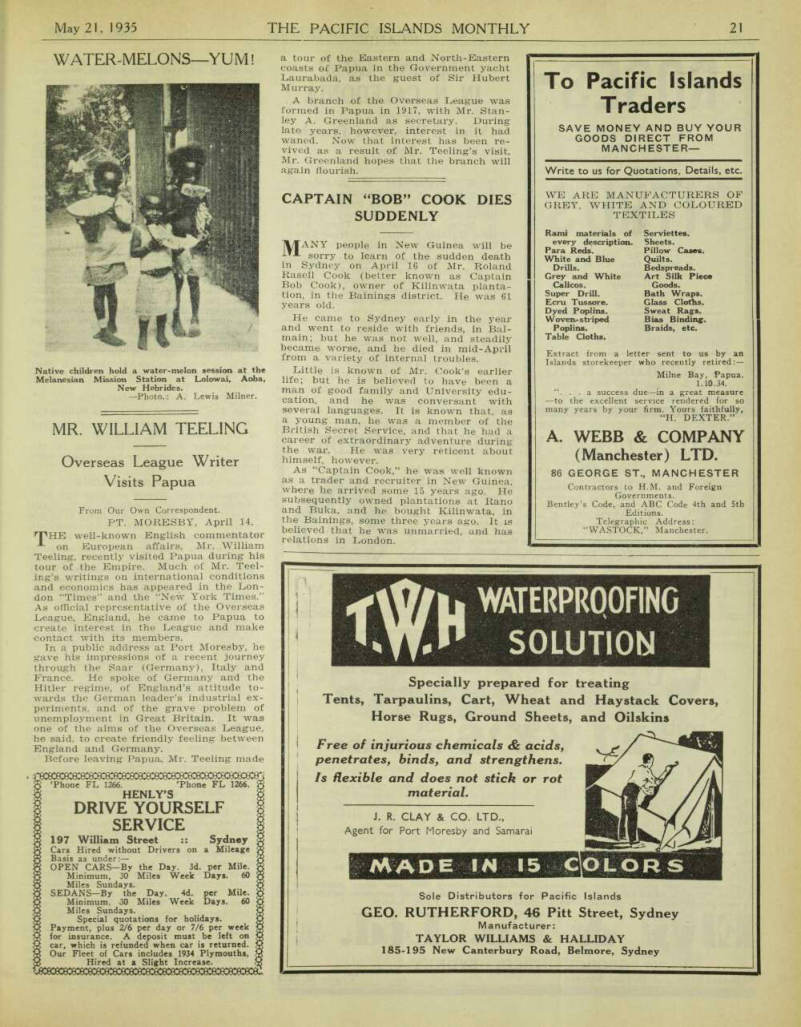
Mr. William Telling
Overseas League Writer Visits Papua
From Our Own Correspondent.
Pt. Moresby, April 14.
THE well-known English commentator on European affairs, Mr. William Teeling, recently visited Papua during his tour of the Empire. Much of Mr. Teel ing’s writings on international conditions and economics has appeared in the Lon don “Times” and the “New York Times.”
As official representative of the Overseas League, England, he came to Papua to create interest in the League and make contact with its members.
In a public address at Port Moresby, he gave his impressions of a recent journey through the Saar (Germany), Italy and France. He spoke of Germany and the Hitler regime, of England’s attitude to wards the German leader’s industrial ex periments, and of the grave problem of unemployment in Great Britain. It was one of the aims of the Overseas League, he said, to create friendly feeling between England and Germany.
Before leaving Papua, Mr. Teeling made
a tour of the Eastern and North-Eastern coasts of Papua in the Government yacht Laurabada, as the guest of Sir Hubert Murray.
A branch of the Overseas League was formed in Papua in 1917, with Mr. Stan ley A. Greenland as secretary. During late years, however, interest in it had waned. Now that interest has been re vived as a result of Mr. Teeling’s visit, Mr. Greenland hopes that the branch will again flourish.
Captain “Bob” Cook Dies
Suddenly
MANY people in New Guinea will be sorry to learn of the sudden death in Sydney on April 16 of Mr. Roland Rasell Cook (better known as Captain Bob Cook), owner of Kilinwata planta tion, in the Bainings district. He was 61 years old.
He came to Sydney early in the year and went to reside with friends, in Bal main; but he was not well, and steadily became worse, and he died in mid-April from a variety of internal troubles.
Little is known of Mr. Cook’s earlier life; but he is believed to have been a man of good family and University edu cation, and he was conversant with several languages. It is known that, as a young man, he was a member of the British Secret Service, and that he had a career of extraordinary adventure during the war. He was very reticent about himself, however.
As “Captain Cook,” he was well known as a trader and recruiter in New Guinea, where he arrived some 15 years ago. He subsequently owned plantations at Rano and Buka, and he bought Kilinwata, in the Bainings, some three years ago. It is believed that he was unmarried, and has relations in London.
Advertisements & other items, pp. 23-24 (1 item)
Waterproofing
To Pacific Islands
Traders
SAVE MONEY AND BUY YOUR
GOODS DIRECT FROM
MANCHESTER—
Write to us for Quotations, Details, etc.
WE ARE MANUFACTURERS OF
GREY, WHITE AND COLOURED
TEXTILES
Rami materials of every description.
Para Reds.
White and Blue Drills.
Grey and White Calicos.
Super Drill.
Ecru Tussore.
Dyed Poplins.
Woven- striped Poplins.
Table Cloths.
Serviettes.
Sheets.
Pillow Cases.
Quilts.
Bedspreads.
Art Silk Piece Goods.
Bath Wraps.
Glass Cloths.
Sweat Rags.
Bias Binding.
Braids, etc.
Extract from a letter sent to us by an Islands storekeeper who recently retired: Milne Bay, Papua. 1.10.34.
“. . .a success due—in a great measure —to the excellent service rendered for so many years by your firm. Yours faithfully,
“H. DEXTER.”
A. WEBB & COMPANY
(Manchester) LTD.
86 GEORGE ST., MANCHESTER
Contractors to H.M. and Foreign Governments.
Bentley’s Code, and ABC Code 4th and 5th Editions.
Telegraphic Address: “WASTOCK,” Manchester.
WATERPROOFING
SOLUTION
Specially prepared for treating Tents, Tarpaulins, Cart, Wheat and Haystack Covers, Horse Rugs, Ground Sheets, and Oilskins Free of injurious chemicals & acids , penetrates, binds, and strengthens.
Is flexible and does not stick or rot material.
J. R. CLAY & CO. LTD.,
Agent for Port Moresby and Samarai
MADE IN 15 COLORS
Sole Distributors for Pacific Islands GEO. RUTHERFORD, 46 Pitt Street, Sydney Manufacturer:
TAYLOR WILLIAMS & HALLIDAY
185-195 New Canterbury Road, Belmore, Sydney
’Phone FL 1266. ’Phone FL 1266.
HENLY’S
DRIVE YOURSELF
SERVICE
197 William Street :: Sydney Cars Hired without Drivers on a Mileage Basis as under: — OPEN CARS—By the Day. 3d. per Mile.
Minimum, 30 Miles Week Days. 60 Miles Sundays.
SEDANS—By the Day. 4d. per Mile.
Minimum, 30 Miles Week Days. 60 Miles Sundays.
Special quotations for holidays.
Payment, plus 2/6 per day or 7/6 per week for insurance. A deposit must be left on car, which is refunded when car is returned.
Our Fleet of Cars includes 1934 Plymouths, Hired at a Slight Increase.
ROSES
The finest quality young Rose Trees for beautiful blooms. 10/- doz. 57postage. A great variety to choose from.
CITRUS
The very best quality trees, free from pest, very strong and from exceptionally heavy bearers.
Prices on request.
ILLUSTRATED CATALOGUE
FREE ON REQUEST
C. LANGBECKER
Rose & Fruit Tree Specialist
BUNDABERG, QUEENSLAND
DOYLE’S famous VETERINARY REMEDIES
REDUCINE—Cures Your Lame Horse. Cures him painlessly and you can work him all the time.
Cures Splints, Curbs, Capped Hocks, Sprung Tendons, Bog Spavins, and all Bony and Bursal Enlargements. Price. 12/6 per can. Postage, 1/-.
LARYNGINE. —A sure cure for Coughs, Colds, Strangles, etc. Price, 5/- per can. Postage, 1/-.
SKIN DRESSING.—A certain remedy for Mange and Allied Parasitic Skin Diseases in Horses, Dogs, etc. Price, 7/6 (large), 3/6 (small). Postage, 1/-.
DISTEMPER MIXTURE—A safe and reliable remedy for Coughs, Colds, Asthma, etc. Price, 2/6. Postage, 9d, T. G. DOYLE, v.s., 9 KING STREET, RANDWICK, N.S.W.
Write for Free Veterinary Advice and Booklet
ELVY’S
FOR
RECORDS
A selection of records which we recommend: — Malcolm McEachern — The Gobbler’s Song (from Chu Chin Chow); “I’m a Roamer” (from “Son and Stranger”), 10 inch 4/- Chicago Symphony Orchestra — “Emperor Waltz” (Strauss) 8/- Terence Casey (Cinema Organ)— Selection of Wilfred Sanderson Songs 6/- You can be sure if you buy at Elvy’s your records will reach you by return mail safely wrapped, and the price you pay will be the lowest possible.
COLUMBIA, PARLOPHONE, and REGAL ZONOPHONE catalogues will be posted you FREE upon application.
Elvy’s seventy-two years’ trading in musical instruments ensures that your every requirement in RADIO, PIANOS, PLAYER PIANOS, ORGANS and ANY OTHER musical instrument will be fulfilled to your utmost satisfaction. Special terms for those resident in the Pacific Islands.
Richard Crooks — “Killarney” (Balfe); “Good-bye” (Tosti) 8/- The Western Brothers (Kenneth & George)— “The Old School Tie”; “Ain’t it Gorgeous” 12 inch 6/- Regal Virtuosi Orchestra — “Stephani Gavotte” (Czibulka); “Berceuse” (Jarnefelt), 10 inch 4/-
Elvy & Co. Ltd
EST. 1863
397 GEORGE STREET, SYDNEY
Between King and Market Streets.
'Phone M 2319
Seeking Gold
In N. Caledonia
Mineral Wealth of French Colony
THE development of goldmining activity in New Caledonia means that there are now five Pacific Terri tories in which the recovery of gold is being undertaken. They are: New Guinea, Papua, Fiji, New Cale donia and Solomon Islands. the flotation of several companies in Australia to work the Diahot River, in New Caledonia, the Government of New Caledonia has adopted a mining policy giving prominence to the question of personnel rather than to the supervision of control of conditions in the industry.
In the New Caledonian “Bulletin of Commerce,” of March 16, 1935, the fol lowing notice, addressed to the directors of certain companies appeared; NOUMEA, 8th March, 1935.
Sir, —I have the honour to inform you that the Consultative Committee of Mines has expressed the intention that in every
mining company, society, or enterprise operating in the colony, the directors executives, or the personnel, engineers, exploitation managers or their equiva lents, should be in the minimum propor tion of three-quarters persons of French nationality or under French protection.
Consequently I ask you to be good enough to make arrangements henceforth to select your principal assistance from French citizens or people under French protection.
I think that recruiting in France ought to be very easy in the future, and that the reduction in passage money ought to make it very feasible.
Yours faithfully, (Signed) SIADOUS.
Governor of New Caledonia.
Exactly what effect this policy is likely to have on the Australian companies al ready operating with Australian capital cannot be known until the qualifications, ability, and business acumen of the avail able directors, executives, engineers, and managers are known.
At present three companies are opera ting in New Caledonia, two owing their origin to Adelaide capital, the third hav ing been formed in Sydney. The former group consists of: (1) Upper Diahot Dredging Co. (2) The Caledo-Austral Gold Mining Co.
The Sydney concern has been registered as the Diahot Gold Dredging Co.
A further syndicate is either in the process of formation or has already been formed in Melbourne.
Nickel And Chrome
Although the search for gold has pro ceeded in New Caledonia over many years, the real mining done there is on the nickel and chrome fields, which constitute New Caledonia’s principal industry.
The nickel industry has been booming for at least a year now. Some say that this is due to the threat of another world war; but more probably it is caused by the increasing, world-wide use of brass.- All the mines and smelters are working at full capacity.
This nickel mine activity has been good for Australian trade. Three steamers have been running constantly between Australia and New Caledonia with coal. They carry mostly Kembla coal, from the South coast —it is a fine coal, very suitable for coke, which is made for the smelters in New Caledonia. There are, on the New Cale donian coast, one steamer and about four hulks, bringing nickel ore from the dif ferent mines to the smelters at Noumea.
All the New Caledonian nickel mines and smelters are owned and operated by one concern, which is understood to be part of the Rothschild international or ganisation.
The largest chrome mine in the world is in New Caledonia (at La Tiebaghi, near Paagoumene) and 1½ million tons of ore have been mined there. It is owned mostly by British shareholders, operating as a French company. The industry, com pared with nickel, is dull. The mine is being worked, but not very actively. The company which owns the N.C. chrome mines is part of an international combina tion which appears to control the world’s chrome output. This combine owns an other chrome mine in Rhodesia, and the latter, a few months ago, was working full time.
Mr. D. A. Madden, surveyor in the Lands Department, New Guinea, arrived in Sydney from Rabaul on four months’ leave by the Montoro on April 1.
World-wide Circulation
Praise For P.I.M.
Subscribers who have supported the Pacific Islands Monthly in the South Seas, and thus made its establishment and progress possible, may be glad to know that the magazine is gaining readers in nearly every country in the world, and particularly Britain, France, United States, Holland, Germany, and the nations of the Far East. The interest in the South Seas, displayed by people in very distant countries, is really remarkable.
Recently, in the one mail, we received evidence of this interest from three widely separated places.
We received a copy of a well known German review, published in Berlin, wherein there are copious extracts from the Pacific Islands Monthly.
From Paris there arrived the December issue of “L’Oceanie Francaise,” the bulle tin of the Comite de l’Oceanie Francaise, in which there are two articles containing kindly references to the editor of the Pacific Islands Monthly.
Finally, there is a copy of the “Hono lulu Star-Bulletin” of March 30, in which the literary editor, Dr. Slaten, says this:
Pacific Islands Monthly Next To
Trip To S. Seas
Though Hawaii is an integral part of the United States politically, it is by original connection re lated in its life and interests to the other island groups with which nature has peppered the Pacific.
The Pacific Islands Monthly, newspaper maga zine of the South Seas, is published by Pacific Publications Ltd., Union House, 247 George St., Sydney, Australia, the subscription rate being 2 dollars a year.
To hand is the November, 1934, issue, a 72-page magazine packed with news from the islands com munities. With it in hand, slippered, arm-chaired and evening-lamped, we cruise, free from seasick ness and tips to the steward, to all points south and west.
The cover bears a picture, “Muscular Manhood. —The half-caste fisherman son of the late Paul Gauguin, famous artist, who lived for several years in French Oceania.” We’re off at once in fancy with Jack London and Somerset Maugham and Herman Melville and the rest of the South Sea yarners.
The inside brings up the South Sea scene like an opera glass. “Pacific Travellers” —a list of arrivers in Sydney from Solomon Islands, New Guinea, Papua, Norfolk, Lord Howe, Fiji. There are personals that make these far away places seem as familiar as Fort Street.
There’s news about the goldfields in New Guinea, so inaccessible that machinery is carried there by airplane, re-assembled and put to work; fashion hints for Islands women; discussion whether the Governor of Fiji should be also the H.C. for W.P., if that registers with you.
In a contest as to which is the most interesting magazine in the world “The Pacific Islands Month ly” would be a high ranker. Until the depression is over it is the next best way of visiting the South Seas.
Incidentally, the literary page of the Honolulu Star-Bulletin, published every Saturday, ought to be known to all Pacific peoples. It is edited with outstanding ability, and it makes a feature of review ing most of what is published throughout the world dealing with life and politics in the Pacific Territories.
Mr. R. W. Dawson left Sydney for New Zealand and Fiji by the Niagara on April 25, to complete plans for a projected cruise through Central Pacific. He is the son of Captain Dawson, of H.M.S. Pen guin, who prepared the first charts of New Hebrides and the north-east coast of Fiji.
A “Township”
The Indignation of Suva
SUVA, the busy capital of Fiji, is to lose the right to call itself a city.
Although residents have protested bit terly, the Government proposes to in troduce a bill abolishing the municipal council, which for years has managed local affairs (say “Sydney Morning Herald”).
Suva is to be officially described as a township, and, as such, will be controlled solely by the Governor through a town board of officials and two Europeans, two Fijians, and two Indians, all nominated by the Governor, whose word is final.
Levuka, at the same time, will cease to be a town, and will officially become a township.
Other proposed legislation which has aroused local indignation will allow the Governor to resume land for “a public purpose” without any right of appeal to either court or arbitrator. These bills will be carried by the official majority.
Mr. D. C. J. Hill, director and consult ing geologist of Nasivi (Fiji) Gold Syn dicate, N.L., departed from Sydney for Fiji by the Niagara on April 26. On arrival at Suva he proceeded to Tavua goldfield to look over certain properties in which his company is intei'ested.
Mr. and Mrs. S. Elliott-Smith, of Ioma, Papua, returned to Port Moresby by the Macdhui from Sydney on May 2, after spending a pleasant holiday at Bathurst, New South Wales, since February last.
Mr. Elliott-Smith is a Patrol Officer in the Papuan Administration service.
Advertisements & other items, pp. 25-26 (1 item)
Oilskin Coats
LEGAL NOTICE
IN THE SUPREME COURT OF NEW SOUTH WALES. —IN EQUITY No. 183 of 1935 and IN THE MATTER of the COMPANIES ACT 1899 AND IN THE MATTER of SOLOMON ISLANDS
DEVELOPMENT COMPANY LIMITED.—
NOTICE is hereby given that the order of the Supreme Court of New South Wales in its Equitable Jurisdiction dated the 8th day of April 1935 confirming the reduction of the capital of the above named company from £100,000 to £50,000 and the minute approved by the court showing in respect of the capital of the company as altered the several particulars required by the above Statute were registered by the Registrar of Joint Stock Companies on the 17th day of April 1935. The said minute is in the words and figures following:— “The capital of Solomon Islands Development Company Limited is £50,000 divided into 1000 shares of £50 each instead of the former capital of £100,000 divided into 1000 shares of £100 each.”
DATED this 17th day of April 1935. McMAS- TER HOLLAND & CO., Solicitors for the Company, 129 Pitt Street, Sydney.
A FREE BELT
Made of strong plaited kangaroo, is given away to every purchaser of 2 pairs of our
RIDING TROUSERS.
RIDING TWIST, expertly tailored. Shades: Dark Grey, Fawn, and Olive. 14/6 a pair.
W. H. WILLIAMS:
18-20 WILSON-STREET,
NEWTOWN.
Makers of Newmarket Safer Saddlery.
W. E. CROSTON, (Prop.) SALFORD KENNELS
Bred from English Imported Stock. For Show or Breeding Purposes Always available. CERTIFIED PEDIGREES SUPPLIED.
I am not a dealer, and all stock is bred by me from selected stock.
Dogs at Stud.
Salford-bred Terriers win at all the leading Shows in Australia and New Zealand. Write stating requirements to- 22 Thurlow Street, Redfern, N.S. Wales.
Oilskin Coats
FOR LONG, HARD WEAR ANYWHERE
This special line will not stick, crack or perish in the hottest climates, and some have stood eleven years’ continuous wear.
A Special Model in Any Size for Any Purpose The Wearers of a Hughes Oilskin are our advertisement.
THE
BEST
QUALITY
OILSKINS
MADE
and Guaranteed by the Manufacturer Write for Catalogue and Price Lists
A. J. HUGHES, (Established 42 years)
121 REGENT STREET, SYDNEY
TENNIS
TROPICAL RESTRINGS AND GUT
CONSULT
L. A. WARD
WEST END SPORTS DEPOT.
8 GEORGE ST. WEST SYDNEY
“Invincible” and “Duralife”
EST.
1925
ALUMINIUM WARE
MANUFACTURED BY
C. R. Byrne 187-9 William Street, Bankstown, N.S.W.
Island Traders apply for Price Lists and Agency Terms
"Service"
Est. 1916
LEATHER BELTING
The secret of the success of “Service” Brand Belting is in the long tanning process.
Laminated Belting and Mechanical Leathers “Service” Brand is Unequalled for all classes of Drives.
W. H. LITTLEWOOD
38 EWART ST.. MARRICKVILLE, N.S.W. Tel. 552 Pet.
Tannery: ULLADULLA, N.S.W.
Catalogue on Application. Applications received for Agency.
Above: Gardner-Denver V type 4 - cyl.
Compressor with standard steel wheel mounting.
At Side: The new Gardner- Denver Model 555 hand-held drill.
MINING and ROAD
MAKING EQUIPMENT
Included in the range of equipment for Mining and general Road Constructional and Maintenance work stocked by Noyes Bros, are the products of the Gardner- Denver Co., makers of Pneumatic Rock Drills, Compressors, etc., for nearly half a century.
The efficiency, rugged construction, ample power and long-wearing life of Gardner- Denver units mean savings in time, money and labour on every job.
Portable Compressors are now available powered by compression ignition or petrol engines. These units are also made on spring-mounted rubber-tyred wheel assemblies, as well as the standard steel road wheels.
Ask for details of the full range
NOYES BROS.
(Sydney) LIMITED
115 CLARENCE STREET, SYDNEY
Branches at Newcastle and Brisbane
Melanesian Mission Press Books
SAMPLES are to hand of another series of books published by the Melanesian Mission Press, Guadalcanal, Solomon Islands. They in clude a primer in the native language for the use of school teachers in Aoba, New Hebrides; morning and evening prayers in English for the use of the members of the Melanesian Brother hood; and a well-bound book of 364 pages con taining matins, evensong, psalms, services, etc., in the language of Fiu, north Mala, Solomon Islands. The technical excellence and finish of all this printing work are most praiseworthy; it is clear that Mr. Fred Isom takes a keen interest in his fascinating job. It is impossible to exaggerate the importance of teaching the natives some form of reading and writing, and that is what is being accomplished by this steady out put of books from the Melanesian Mission Press.
Copra Market
London Advices
ADVICES from London, written at the end of March, say that importance price movements in the copra market are unlikely until American buyers resume operations; and the latter, apparently, have been awaiting the outcome of a bill which has been before the American Con gress Committee of Ways and Means.
This bill provides for an import excise tax of 3 cents per lb. (that is, at the same rate as the present processing tax) on all imported oils and fats to which the processing tax is not applicable. There appears to be a good deal of opposition, and it may not come before Congress: but if it should become law it would con siderably disturb the oils and fats market in America.
It is estimated that the carry-over of cotton seed oil at the end of the cotton crop represented 245,000 barrels monthly, against a demand of 344,000 barrel monthly. It is likely, therefore, that the price of this commodity will be firm.
The latest reports on whale oil show that at the end of February 1,944,620 barrels had been produced, compared with 2,206,653 barrels at the same time last year. Practically the whole of the 1934-35 catch has been sold, and some cargoes brought over £16 per ton.
It is also stated that despite all restric tions, Germany has been able to come into the European market for her full requirements of oils and fats, and is securing the necessary amount in spite of the exchange difficulties. She is taking oils and fats, particularly whale oil, rather than oil seeds, so that German crushers are still not working at capacity.
Soya Bean Competition.
A London cablegram, in April, said that, according to the chairman of a leading East Indies copra company, the imposition of a Budget duly on Man churian Soya beans would operate to the advantage of copra, producers of which have found in the last three years that Soya beans are seriously prejudicing the market for Empire copra. Both copra and palm oil have been holding their recent market gains for the first time for many years, he said. It is assumed that the British Government is being asked to place a duty on soya beans from Man churia.
The imports of Manchurian soya beans into European countries during recent years have been (in tons):
Dr. G. H. Vernon, of Daru, Western Papua, crossed over to Thursday Island in March and there caught a steamer and went off on a holiday visit to Japan and the Far East. A mutual friend informs us that the popular medico had a rough crossing from Daru. “When he landed here in Thursday Island after a six days’ trip across Torres Strait, he would have passed anywhere for the worst type of shipwrecked mariner; but I will spare you the details,” he says.
1931. 1932. 1933. 1934.
Britain .. 110,300 160,569 157.428 177,194 Germany .. 1,014,573 1,186,992 1,170,900 913,740 Holland .. 31,218 40,435 38,067 126,602 Denmark .. 235,524 225,481 231,215 268,753 Japan and Java are also large consumers.
Fiji Fortunes
Made from Tavua Goldfield
Announcements by Australian newspapers that Mr. E. G. Theodore is now a millionaire, as a result of his activities in connection with the Fiji (Tavua) goldfield, and that fortunes have been made by Mr. Pat Costello, of Suva, and by Mr. Borthwick, prospector, have again stirred Australian interest to fever heat; and speculators and company pro moters are giving much attention to the Colony.
Congratulations extended to the men concerned are quite sincere. Mr. Theo dore always has been a bold operator; he risked a huge sum on the develop ment of Tavua, and he won out, and de serves all he made.
Mr. Theodore
Mr. Theodore is a well-known figure in Australia. He entered politics as a La bour member, in 1909, when only 25 years old, and he was a Minister there from 1915 until 1919, and Premier 1919-25. In his early life he held advanced political views, and in consequence he was known as “Red Ted.’’ He entered the Federal Parliament in 1927, and was Common wealth Treasurer in 1930-31. He left Parliamentary life as a result of Labour Party squabbles—another example of how Labour’s underground engineers destroy their best leaders. Perhaps, as he is now very rich, he will decide to re-enter politics. It is to be hoped so: the Commonwealth needs men of his outstanding ability.
Mr. Costello.
Mr. Pat Costello has been seeking gold in Fiji for 15 years. His faith never wavered. Suva men used to jeer at him —but he only grinned. He left Sydney for Suva at the end of April, and his smile was wider than ever. He was won dering if they still are jeering in Suva.
But even those who scoffed will offer sin cere congratulations to the genial Pat rick. He, too, deserves his win.
Stricter Control Of
Prospecting
The Government of Fiji has decided that the issue of gold prospecting licences in Fiji will be even more strictly con trolled than previously, and the condi tions of the licence more rigidly enforced.
In making this announcement in the “Fiji Royal Gazette,” published on April 13, the Government declares that its earlier statement of policy regarding the Tavua field applies equally to the Yana wai mining area and to any other mining areas which may be proclaimed. Appli cations for prospecting licences will be considered by any parties who can prove that they are able and have the neces sary capital to prospect, in the fullest sense of the term, the areas for which they apply. The Government cannot see its way to issue prospecting licenses to parties having little or no capital. In the event of the applicant failing to satisfy the Mining Board on these con ditions, the board may refuse the applica tion, but the applicant may make a fresh application subsequently.
A further amendment to the regula tions provides that the holder will prose cute vigorously and continuously pros pecting operations to the satisfaction of the board, and will promptly, and at the latest within 60 days of discovery, report to the board all mineral discoveries con sidered or found to be of a payable na ture. A holder shall not be deemed to be prospecting according to the stipula
tions unless there be engaged in the operations persons in the opinion of the board qualified and competent to pros pect in the proportion of at least one to every 250 acres, and a staff of labourers in the proportion of at least one to every 25 acres of the prospecting area. These obligations may be suspended in certain circumstances.
Besides having in view the employ ment on prospecting areas of a larger number of men, the amended regulations provide for the proper medical care of employees in mines.
Major C. B. Joske, of Suva, Fiji, who has been in Sydney and Melbourne on business connected with Fijian gold-min ing, left by the Mariposa for Suva on May 1.
The capital of Solomon Islands Develop ment Co. Ltd. has been reduced from £100,000 in 1000 shares of £100 each to £50,000 in 1000 shares of £50 each, on each of which shares £45 has been paid, The reduction is effected by cancelling paid-up capital that has been lost or is unrepresented by available assets.
Advertisements & other items, pp. 27-28 (1 item)
Bank of New South Wales
CANOES, Iron or Canvas
Built to the highest specification Suitable for Islands 7 to 10ft. Lowest Prices
131 KENT ST., SYDNEY
“A Thousand Miles
from the nearest ice-works, and yet we always have ice cubes for drinks and all the conveniences of an electric refrigerator.” —Extract from letter from satisfied Island client.
HALLSTROM’S non-electric Refrigerators give efficient refrigeration without trouble. So simple a child can operate it.
Price £49/10/- f.o.b. Sydney. Others from £20. Write for descriptive folder to the manufacturer.
E. MAELSTROM
462 Willoughby Road, Willoughby
SYDNEY
Five per Cent.
is the Maximum Overdraft Rate
The rate of interest now charged on overdrafts by the Bank of New South Wales does not exceed 3% per annum.
This is the lowest maximum rate in the 118 years’ history of the Bank.
Producers, Manufacturers and others who can profitably use money to extend their activities are invited to discuss their financial problems with the Manager of any of the Bank’s 723 branches.
Bank of New South Wales
(ESTABLISHED 1817)
The Oldest and Largest Bank in Australasia.
REGISTERED
Malt & Hops
(SOLID BEER)
MADE FROM THE
FINEST ENGLISH
MALT & HOPS
STOCKED BY;
Burns, Philp & Co., Ltd.,
RABAUL
MAKERS :
Paine & Co., Ltd.,
St. Neots, Hunts., England.
Wilhelm Breckwoldt & Co.
9, Lange Muehren, South Sea Bldgs.
HAMBURG GERMANY
(Exporters and Importers) We Export: Trade Goods of any description, Cutlery, Hardware, Miners’
Requisites, etc., etc.
We Import: Any kind of Island Produce.
CORRESPONDENCE INVITED
ABOVE ALL—
Aeroplane Pure Fruit Jellies Aeroplane High-Grade Custard Powder Aeroplane Junket Crystals Aeroplane Flavouring Essence Products of Distinction Manufactured by
TRADERS LTD.
NEWTOWN
SYDNEY
Aeroplanes in North
Pacific American and Japanese Enterprise
AVIATION developments in the North Pacific are worth watching. Much is going on there which may affect political and strategical considerations in the South Pacific.
The Americans plan a regular aerial service westwards from San Francisco to the Philippines. The first stage, from ’Frisco to Honolulu, was opened late in April by a flying-boat of the Pan- American Company. It is intended to extend this service through Midway Island, Wake Island, and Guam, to Manilla. Tiny uninhabited atollss —mere sandbanks with a few scrubby trees —are to become places of great value as aero dromes.
The Japanese are to compete with the United States in linking up those North Pacific groups with aeroplane services. It was announced, some months ago, that regular aviation services would connect Japan with the Bonin, Marianne, Caro line and Marshall groups. The three
latter groups were part of the German Pacific colonies in 1914, and were given to Japan by the League of Nations, under mandate, in 1919. Japan, however, has quite definitely announced her intention of keeping them, as part of the Japanese Empire, Those Japanese Islands are nearer to Rabaul (the administrative centre of the Territory of New Guinea) than is Bris bane, or even Townsville. It is only a matter of months, probably, before Japanese aeroplanes from the Carolines, or American machines from Manila, ex tend their services through New Guinea to Australia. Or will Australians get in first, and establish a regular air service at least between Queensland and Papua and New Guinea?
It may be that American enterprise will bridge the gap between America and Aus tralia by running aeroplanes south-west wards from Honolulu, through the Phoenix group, or the Northern Cooks, and then via Samoa, Fiji and New Cale donia. But the map offers some dis couragement. Once the equator is reached, it is fairly plain going to Aus tralia—the South Pacific is dotted with islands of all descriptions. But from Hawaii southwards to the equator there is an ugly stretch of some 800 miles of empty ocean. Yet it is not nearly so wide as that empty stretch from Midway to Wake Island, and nor a third as far as the worst hop of all—from ’Frisco to Honolulu.
Fiji's Salato Nettle
Letter to the Editor.
CAN any reader of your valuable paper inform me of cure for the sting of the “Salato” leaf? I have tried all sorts of remedies without success, even to the native “cure” of scraping the bark off both limbs and roots and rubbing on the affected parts; but without success.
Salato is “hot stuff warmed up,” in the way of a stinging leaf. Some five weeks ago I bumped into the large leaves and was stung from above the knees down to the bottom of my knees. I was wearing shorts at the time. The sting developed about half an hour after I touched the plant, and about two days after contact the stinging itch was fully developed.
To-day, five weeks after contact, the stinging itch comes on suddenly, especi ally at night, and the more you scratch or rub it the more it itches and stings, and you can’t refrain from rubbing it.
The salato leaf is a fine large green leaf, with pinkish ribs, quite smooth and shiny, no sign of downy fur, such as one would expect to find, as on a stinging nettle; and it is found all over Fiji bushlands.
I am, etc.,
Tui Nalovo.
Vanua Levu, Fiji, March 16.
Two Japanese Warships Will
Visit Apia in June
From Our Own Correspondent.
APIA, April 14.
THE visit of two Japanese training ships is announced for the King’s birthday, June 3 next. The last Japanese man-of-war to call at Western Samoa visited Apia in 1915, during the war.
The visiting warships, the Yakumo and Asama, each of over 9,000 tons, have a complement of 1,600 men. They will constitute the largest naval units to arrive in Samoa since the visit of the American battlecruisers Maryland and Western Virginia.
Advertisements & other items, pp. 29-30 (1 item)
PLUME the highest quality Motor Spirit
VACUUM OIL COMPANY Pty Ltd
INCORPORATED IN AUSTRALIA
RHEUMATISM
AND
KIDNEY TROUBLES
DEFINITELY OVERCOME BY “UREX.”
the new scientific remedy which cures by removing the cause.
RHEUMATISM, LUMBAGO, SCIATICA, NEU-
RITIS, PAINS IN BACK, JOINTS AND LIMBS,
KIDNEY AND BLADDER TROUBLES and all
kindred complaints will vanish like magic before this wonderful remedy.
Neglect is dangerous and will result in a premature decline of your powers, breakdown, and a shortening of life.
No matter what other remedies you have tried, whether you are seven years of age or seventy, man or woman, “UREX” will relieve you. It “gets right to the spot,” and stops that pain.
Money back if no relief.
Obtainable only from the manufacturer, price 5/6, postage free.
RICHARD’S RELIABLE REMEDIES,
17 Bond Street, Sydney.
COPRA MATS AND MATTING
Send your enquiries to us for Woven Wire Mesh in Rolls or framed for Copra drying, and all Screening purposes, Bird Cages, Sieves and Riddles, Builder’s Gravel Screens, Rat Traps, Door Mats, Garden Arches, Chain Wire Mesh, Crimped Wire Mesh for Window Guards, etc.
SCOTT AND SONS
WIREWORKS: RAILWAY PARADE AND MURRAY STREET, MARRICKVILLE
For Well Bred
FOXIES, CATTLE KELPIES,
POMERANIANS or Any Other (Both Sexes) Established 5 Years.
Write to
57 Goulburn St., Sydney
(A Feeding Chart with Every Animal.) Satisfaction Guaranteed
ISLAND PATRONS RECEIVE SPECIAL ATTENTION.
LYSAGHT
QUEENS HEAD
AUSTRALIA
LYSAGHT’S
DEPENDABLE
Galvanized Iron
is most suitable for constructional work on new kilns and driers. Make sure when erecting your new drier and when constructing a new building you use the correct brand of Galvanized Iron.
Lysaciits "Queen’s Head"
Obtainable from Burns, Philp & Co. Ltd., at all Island Trading Centres
Handy Type Of Copra Drier
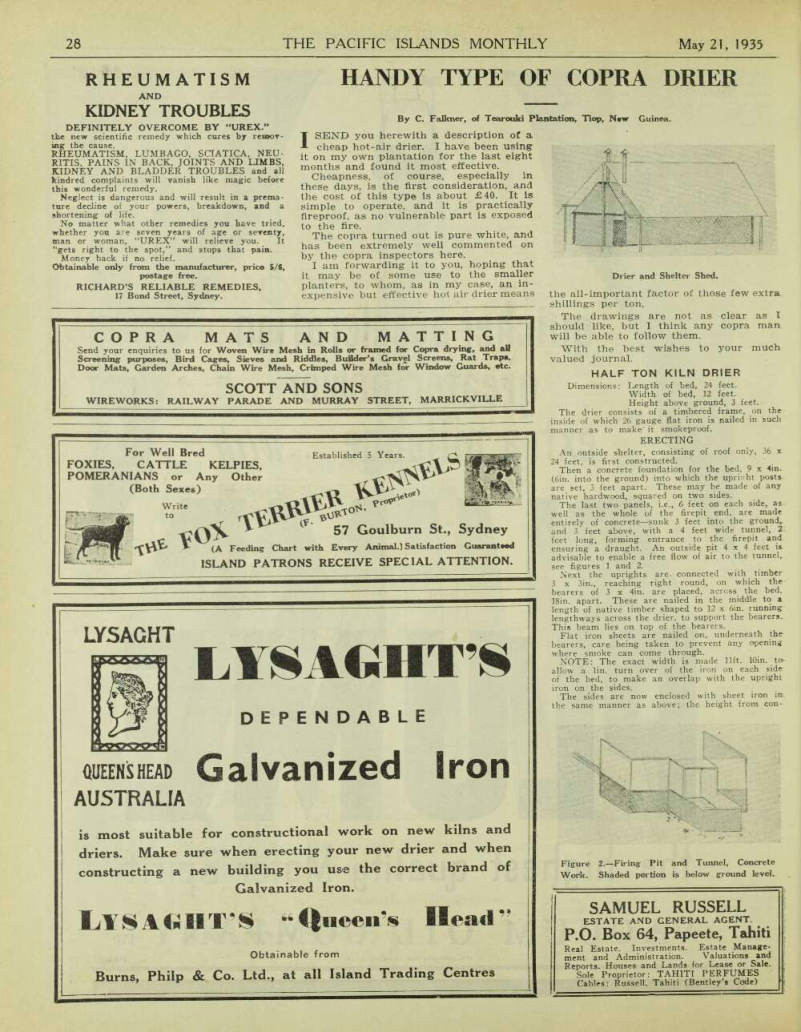
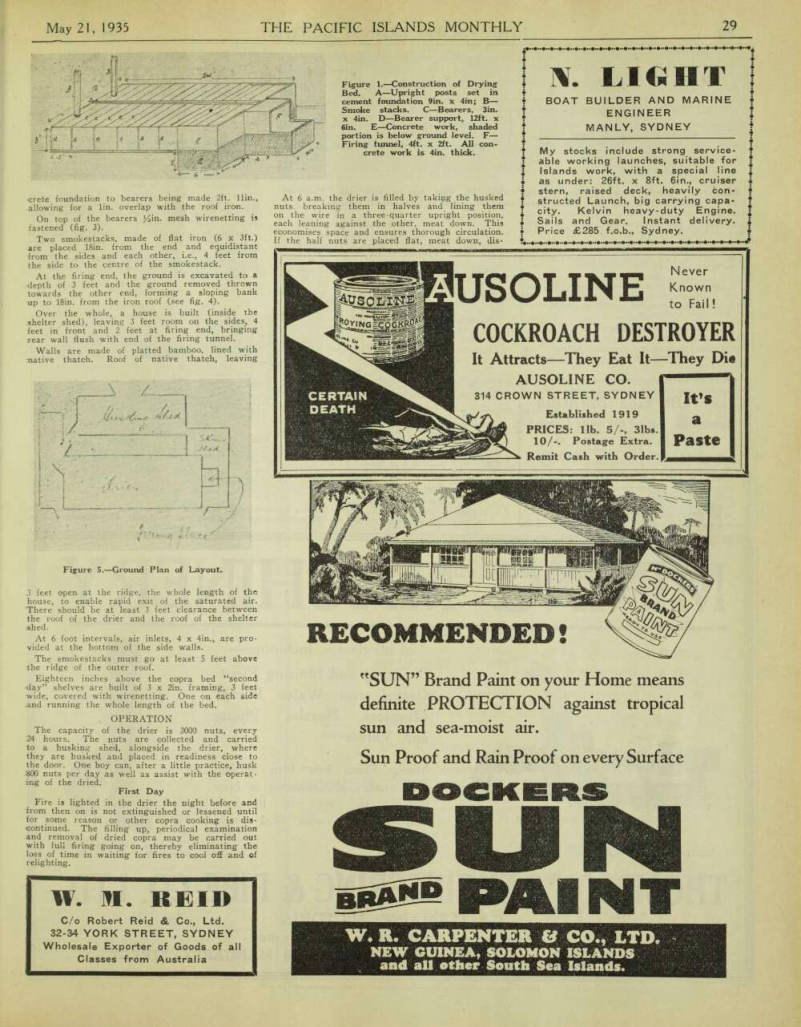
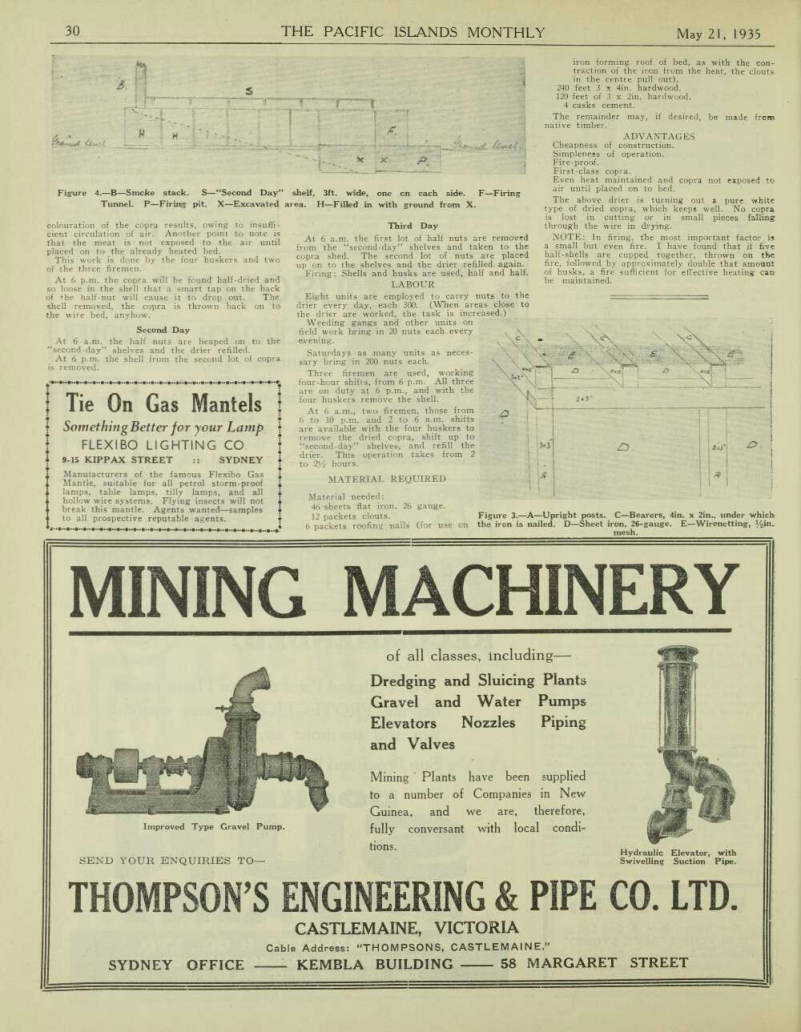
By C. Falkner, of Tearouki Plantation, Tiop, New Guinea.
I SEND you herewith a description of a cheap hot-air drier. I have been using it on my own plantation for the last eight months and found it most effective.
Cheapness, of course, especially in these days, is the first consideration, and the cost of this type is about £40. It Is simple to operate, and it is practically fireproof, as no vulnerable part is exposed to the fire.
The copra turned out is pure white, and has been extremely well commented on by the copra inspectors here.
I am forwarding it to you, hoping that it may be of some use to the smaller planters, to whom, as in my case, an in expensive but effective hot air drier means
the all-important factor of those few extra shillings per ton.
The drawings are not as clear as I should like, but I think any copra man will be able to follow them.
With the best wishes to your much
valued journal.
Half Ton Kiln Drier
Dimensions: Length of bed, 24 feet.
Width of bed, 12 feet.
Height above ground, 3 feet.
The drier consists of a timbered frame, on the inside of which 26 gauge flat iron is nailed in such manner as to make it smokeproof.
Erecting
An outside shelter, consisting of roof only, 36 x 24 feet, is first constructed.
Then a concrete foundation for the bed, 9 x 4in. (6in. into the ground) into which the upright posts are set, 3 feet apart. These may be made of any native hardwood, squared on two sides.
The last two panels, i.e., 6 feet on each side, as well as the whole of the firepit end, are made entirely of concrete —sunk 3 feet into the ground, and 3 feet above, with a 4 feet wide tunnel, 2 feet long, forming entrance to the firepit and ensuring a draught. An outside pit 4x4 feet is advisable to enable a free flow of air to the tunnel, see figures 1 and 2. .
Next the uprights are connected with timber 3 x 3in., reaching right round, on which the bearers of 3 x 4in. are placed, across the bed, 18in. apart. These are nailed in the middle to a length of native timber shaped to 12 x 6in. running lengthways across the drier, to support the bearers.
This beam lies on top of the bearers.
Flat iron sheets are nailed on, underneath the bearers, care being taken to prevent any opening where smoke can come through.
NOTE: The exact width is made 11ft. 10in. to allow a 1in. turn over of the iron on each side of the bed, to make an overlap with the upright iron on the sides.
The sides are now enclosed with sheet iron ire the same manner as above; the height from con-
Figure 2.—Firing Pit and Tunnel, Concrete Work. Shaded portion is below ground level.
Drier and Shelter Shed.
crete foundation to bearers being made 2ft. 11in., allowing for a 1in. overlap with the roof iron.
On top of the bearers mesh wirenetting is fastened (fig. 3).
Two smokestacks, made of flat iron (6 x 3ft.) are placed 18in. from the end and equidistant from the sides and each other, i.e., 4 feet from the side to the centre of the smokestack.
At the firing end, the ground is excavated to a depth of 3 feet and the ground removed thrown towards the other end, forming a sloping bank up to 18in. from the iron roof (see fig. 4).
Over the whole, a house is built (inside the shelter shed), leaving 3 feet room on the sides, 4 feet in front and 2 feet at firing end, bringing rear wall flush with end of the firing tunnel.
Walls are made of platted bamboo, lined with native thatch. Roof of native thatch, leaving
Figure 5. —Ground Plan of Layout. 3 feet open at the ridge, the whole length of the house, to enable rapid exit of the saturated air.
There should be at least 3 feet clearance between the roof of the drier and the roof of the shelter shed.
At 6 foot intervals, air inlets, 4 x 4in., are pro vided at the bottom of the side walls.
The smokestacks must go at least 5 feet above the ridge of the outer roof.
Eighteen inches above the copra bed “second day” shelves are built of 3 x 2in. framing, 3 feet wide, covered with wirenetting. One on each side and running the whole length of the bed.
Operation
The capacity of the drier is 3000 nuts, every 24 hours. The nuts are collected and carried to a husking shed, alongside the drier, where they are husked and placed in readiness close to the door. One boy can, after a little practice, husk 800 nuts per day as well as assist with the operating of the dried.
First Day Fire is lighted in the drier the night before and from then on is not extinguished or lessened until for some reason or other copra cooking is dis continued. The filling up, periodical examination and removal of dried copra may be carried out with full firing going on, thereby eliminating the loss of time in waiting for fires to cool off and of relighting.
At 6 a.m. the drier is filled by taking the husked nuts, breaking them in halves and lining them on the wire in a three-quarter upright position, each leaning against the other, meat down. This economises space and ensures thorough circulation.
If the half nuts are placed flat, meat down, dis-
Figure 1. —Construction of Drying Bed. A—Upright posts set in cement foundation 9in. x 4in; B— Smoke stacks. C—Bearers, 3in. x 4in. D —Bearer support, 12ft. x 6in. E—Concrete work, shaded portion is below ground level. F— Firing tunnel, 4ft. x 2ft. All con crete work is 4in. thick.
colouration of the copra results, owing to insuffi cient circulation of air. Another point to note is that the meat is not exposed to the air until placed on to the already heated bed.
This work is done by the four huskers and two of the three firemen.
At 6 p.m. the copra will be found half-dried and so loose in the shell that a smart tap on the back of the half-nut will cause it to drop out. The shell removed, the copra is thrown back on to the wire bed, anyhow.
Second Day At 6 a.m. the half nuts are heaped on to the “second-day” shelves and the drier refilled.
At 6 p.m. the shell from the second lot of copra is removed.
Third Day At 6 a.m. the first lot of half nuts are removed from the “second-day” shelves and taken to the copra shed. The second lot of nuts arc placed up on to the shelves and the drier refilled again.
Firing: Shells and husks are used, half and half.
Labour
Eight units are employed to carry nuts to the drier every day, each 300. (When areas close to the drier are worked, the task is increased.)
Weeding gangs and other units on field work bring in 20 nuts each every avening.
Saturdays as many units as neces sary bring in 200 nuts each.
Three firemen are used, working four-hour shifts, from 6 p.m. All three are on duty at 6 p.m., and with the four huskers remove the shell.
At 6 a.m., two firemen, those from 6 to 10 p.m. and 2 to 6 a.m. shifts are available with the four huskers to remove the dried copra, shift up to “second-day” shelves, and refill the drier. This operation takes from 2 to 2½ hours.
Material Required
Material needed; 46 sheets flat iron, 26 gauge. 12 packets clouts. 6 packets roofing nails (for use on
iron forming roof of bed, as with the con traction of the iron from the heat, the clouts in the centre pull out). 240 feet 3 x 4in. hardwood. 120 feet of 3 x 2in. hardwood. 4 casks cement.
The remainder may, if desired, be made from native timber.
Advantages
Cheapness of construction.
Simpleness of operation.
Fire-proof.
First-class copra.
Even heat maintained and copra not exposed to. air until placed on to bed.
The above drier is turning out a pure white type of dried copra, which keeps well. No copra is lost in cutting or in small pieces falling through the wire in drying.
NOTE: In firing, the most important factor is a small but even fire. I have found that if five half-shells are cupped together, thrown on the fire, followed by approximately double that amount of husks, a fire sufficient for effective heating can be maintained.
Figure 4.—B—Smoke stack. S—“Second Day” shelf, 3ft. wide, one on each side. F—Firing Tunnel. P—Firing pit. X—Excavated area. H—Filled in with ground from X.
Figure 3.—A—Upright posts. C—Bearers, 4in. x 2in., under which the iron is nailed. D—Sheet iron, 26-gauge. E—Wirenetting, ½in. mesh.
Advertisements & other items, pp. 30-32 (1 item)
P.O. Box 64, Papeete, Tahiti
SAMUEL RUSSELL
ESTATE AND GENERAL AGENT-
Real Estate. Investments. Estate Management and Administration. Valuations and Reports. Houses and Lands for Lease or Sale.
Sole Proprietor: TAHITI PERFUMES Cables: Russell. Tahiti (Bentley’s Code)
N. LIGHT
BOAT BUILDER AND MARINE
ENGINEER
MANLY, SYDNEY
My stocks include strong serviceable working launches, suitable for Islands work, with a special line as under: 26ft. x 8ft. 6in., cruiser stern, raised deck, heavily constructed Launch, big carrying capacity. Kelvin heavy-duty Engine.
Sails and Gear. Instant delivery.
Price £285 f.o.b., Sydney.
AUSOLINE
Never Known to Fail !
COCKROACH DESTROYER
It Attracts—They Eat It —They Die
AUSOLINE CO.
314 CROWN STREET, SYDNEY
Established 1919 PRICES: 1lb. 5/-, 3lbs. 10/-. Postage Extra.
Remit Cash with Order.
It’s a Paste
RECOMMENDED!
"SUN” Brand Paint on your Home means
definite PROTECTION against tropical
sun and sea-moist air.
Sun Proof and Rain Proof on every Surface
W. R. CARPENTER & CO., LTD.
NEW GUINEA, SOLOMON ISLANDS
and all other South Sea Islands.
W. M. REID
C/o Robert Reid & Co., Ltd.
32-34 YORK STREET, SYDNEY
Wholesale Exporter of Goods of all Classes from Australia
Tie On Gas Mantels
Something Better for your Lamp
FLEXIBO LIGHTING CO,
9-15 KIPPAX STREET SYDNEY
Manufacturers of the famous Flexibo Gas Mantle, suitable for all petrol storm-proof lamps, table lamps, tilly lamps, and all hollow wire systems. Flying insects will not break this mantle. Agents wanted—samples to all prospective reputable agents.
MINING MACHINERY
Improved Type Gravel Pump.
SEND YOUR ENQUIRIES TO—
of all classes, including—
Dredging and Sluicing Plants
Gravel and Water Pumps Elevators Nozzles Piping and Valves Mining Plants have been supplied to a number of Companies in New Guinea, and we are, therefore, fully conversant with local conditions.
Hydraulic Elevator, with Swivelling Suction Pipe.
THOMPSON’S ENGINEERING & PIPE CO. LTD.
SYDNEY OFFICE
CASTLEMAINE, VICTORIA
Cable Address; “THOMPSONS, CASTLEMAINE.”
KEMBLA BUILDING 58 MARGARET STREET
Shipbreakers
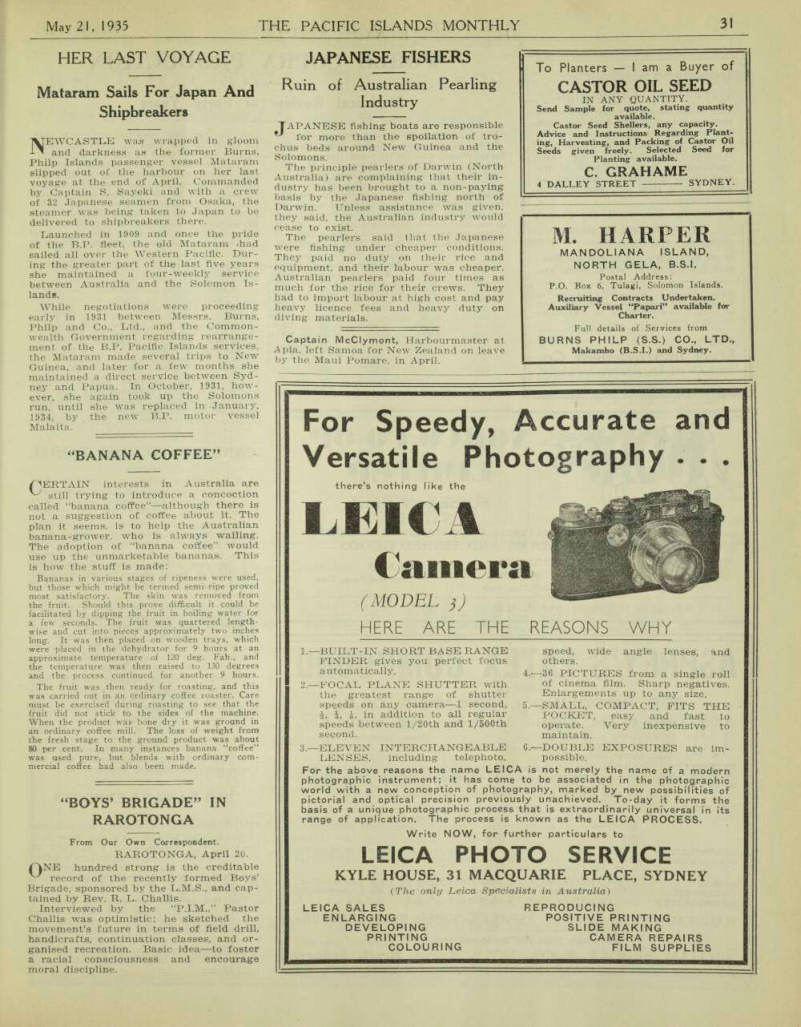
Her Last Voyage
Mataram Sails For Japan And Shipbreakers
NEWCASTLE was wrapped in gloom and darkness as the former Burns, Philp Islands passenger vessel Mataram slipped out of the harbour on her last voyage at the end of April. Commanded by Captain S. Sayeki and with a crew of 32 Japanese seamen from Osaka, the steamer was being taken to Japan to be delivered to shipbreakers there.
Launched in 1909 and once the pride of the B.P. fleet, the old Mataram had sailed all over the Western Pacific. Dur ing the greater part of the last five years she maintained a four-weekly service between Australia and the Solomon Is lands.
While negotiations were proceeding early in 1931 between Messrs. Burns, Philp and Co., Ltd., and the Common wealth Government regarding rearrange ment of the B.P. Pacific Islands services, the Mataram made several trips to New Guinea, and later for a few months she maintained a direct service between Syd ney and Papua. In October, 1931, how ever, she again took up the Solomons run, until she was replaced in January. 1934, by the new B.P. motor vessel Malaita.
“Banana Coffee”
(CERTAIN interests in Australia are still trying to introduce a concoction called “banana coffee” —although there is not a suggestion of coffee about it. The plan it seems, is to help the Australian banana-grower, who is always wailing.
The adoption of “banana coffee” would use up the unmarketable bananas. This is how the stuff is made: Bananas in various stages of ripeness were used, but those which might be termed semi-ripe proved most satisfactory. The skin was removed from the fruit. Should this prove difficult it could be facilitated by dipping the fruit in boiling water for a few seconds. The fruit was quartered length wise and cut into pieces approximately two inches long. It was then placed on wooden trays, which were placed in the dehydrator for 9 hours at an approximate temperature of 120 deg. Fah., and the temperature was then raised to 130 degrees and the process continued for another 9 hours.
The fruit was then ready for roasting, and this was carried out in an ordinary coffee roaster. Care must be exercised during roasting to see that the fruit did not stick to the sides of the machine.
When the product was bone dry it was ground in an ordinary coffee mill. The loss of weight from the fresh stage to the ground product was about 80 per cent. In many instances banana “coffee” was used pure, but blends with ordinary com mercial coffee had also been made.
Rarotonga
“Boys’ Brigade” In
From Our Own Correspondent.
Rarotonga, April 20.
hundred strong is the creditable record of the recently formed Boys’
Brigade, sponsored by the L.M.S., and cap tained by Rev. R. L. Challis.
Interviewed by the “P.I.M.,” Pastor Challis was optimistic; he sketched the movement’s future in terms of field drill, handicrafts, continuation classes, and or ganised recreation. Basic idea —to foster a racial consciousness and encourage moral discipline.
Industry
Japanese Fishers
Ruin of Australian Pearling Industry
JAPANESE fishing boats are responsible for more than the spoliation of tro chus beds around New Guinea and the Solomons.
The principle pearlers of Darwin (North Australia) are complaining that their in dustry has been brought to a non-paying basis by the Japanese fishing north of Darwin. Unless assistance was given, they said, the Australian industry would cease to exist.
The pearlers said that the Japanese were fishing under cheaper conditions.
They paid no duty on their rice and equipment, and their labour was cheaper.
Australian pearlers paid four times as much for the rice for their crews. They had to import labour at high cost and pay heavy licence fees and heavy duty on diving materials.
Captain McClymont, Harbourmaster at Apia, left Samoa for New Zealand on leave by the Maui Pomare, in April.
Advertisements & other items, pp. 33-34 (1 item)
Leica
To Planters I am a Buyer of
CASTOR OIL SEED
IN ANY QUANTITY.
Send Sample for quote, stating quantity available.
Castor Seed Shellers, any capacity.
Advice and Instructions Regarding Planting, Harvesting, and Packing of Castor Oil Seeds given freely. Selected Seed for Planting available.
C. GRAHAME
4 DALLEY STREET SYDNEY.
M. HARPER
MANDOLIANA ISLAND,
NORTH GELA, B.S.I.
Postal Address; P.O. Box 6, Tulagi, Solomon Islands.
Recruiting Contracts Undertaken, Auxiliary Vessel “Papari” available for Charter.
Full details of Services from
BURNS PHILP (S.S.) CO., LTD.,
Makambo (B.S.I.) and Sydney.
For Speedy, Accurate and
Versatile Photography . . . there’s nothing like the
LEICA
Camera
(MODEL 3)
HERE ARE THE REASONS WHY
1. BUILT-IN SHORT BASE RANGE
FINDER gives you perfect focus automatically.
2. FOCAL PLANE SHUTTER with
the greatest range of shutter speeds on any camera—l second, I, I, in addition to all regular speeds between 1/20th and 1/500th second.
3. ELEVEN INTERCHANGEABLE
LENSES, including telephoto, speed, wide angle lenses, and others. 4. —36 PICTURES from a single roll of cinema film. Sharp negatives.
Enlargements up to any size.
5. SMALL, COMPACT, FITS THE
POCKET, easy and fast to operate. Very inexpensive to maintain.
6. DOUBLE EXPOSURES are im-
possible.
For the above reasons the name LEICA is not merely the name of a modern photographic instrument; it has come to be associated in the photographic world with a new conception of photography, marked by new possibilities of pictorial and optical precision previously unachieved. To-day it forms the basis of a unique photographic process that is extraordinarily universal in its range of application. The process is known as the LEICA PROCESS.
Write NOW, for further particulars to
LEICA PHOTO SERVICE
KYLE HOUSE, 31 MACQUARIE PLACE, SYDNEY
(The only Leica Specialists in Australia )
LEICA SALES
ENLARGING
DEVELOPING
PRINTING
COLOURING
REPRODUCING
POSITIVE PRINTING
SLIDE MAKING
CAMERA REPAIRS
FILM SUPPLIES
Impregno Steel Surface
Hardening Compound
For local hardening by sprinkling the compound on the hot steel part, or for case hardening to a depth of one thirty-second of an inch by treating the object to be casehardened in a molten bath of the compound. Equipment required, an open fire, a steel pot, and a tin of compound.
IMPREGNO Case Hardening Crystals
For muffle case hardening.
IMPREGNO Quenching Oil is an invaluable aid to the satisfactory hardening of gears, tools, etc.
Firms handling Engineers’ Supplies or Hardware are invited to communicate with us with a view to acting as distributors for these lines.
THE . .
Steel Improvement Co.
102 BAY ROAD, NORTH SYDNEY,
N.S.W,
NORCO CO-OP.
LIMITED
SUSSEX STREET,
SYDNEY
AUSTRALIA’S LEADING MANUFACTURERS AND DISTRIBUTORS OF CHOICEST
BUTTER, BACON, HAMS AND TINNED GOODS
NORCO LUNCH
BRAWN
PORK SAUSAGES
1lb. and ½ lb. Tins.
PIGS’ TONGUES
PIGS’ TROTTERS
1lb. Tins Only.
HAM PATE
3oz. and 1½ oz. Tins.
IDEAL FOR LUNCHES AND PICNICS
ASPREY’S LATEX COMPOUND
(PATENTED)
FOR IMPROVING LUBRICATING OILS
Adds Years to the Life of Machinery and Motor Cars LATEX COMPOUND improves any oil, adds extra oiliness, resists heat and makes the oil last twice as long, saves wear and tear, and halves lubrication and maintenance costs
INTERNAL
COMBUSTION
ENGINES
Add ½ pint of Asprey’s Latex Compound to each gallon of lubricating oil for motor cars, lorries, tractors and stationary engines, and note cooler and sweeter running, lower fuel consumption, greater power, fewer repairs and lower oil consumption.
FARMING Add ½ pint of Asprey’s Latex Compound to each gallon of lubri- MACHINERY eating oil for headers, harvesters, reapers and binders, ploughs. drills, mowers, disc cultivators windmills, separators, chaffeutters, etc., and save time and repair bills SAWMILLING Add ½ pint of Asprey’s Latex Compound to each gallon of oil for MACHINERY saw spindle bearings and all sawmilling machinery and be free from hot and scored bearings.
STEAM Add ½ pint of Asprey’s Latex Compound to each gallon of oil, CYLINDER which will result in more horsepower with lessened oil consumption LUBRICATION and general increase in efficiency.
MANUFACTURERS ALSO OF ASPREYS SUPER BELT DRESSING Obtainable from the Trade and from WILLIAM BROOKS & CO., LTD., 35 Pitt Street, Sydney.
World Copra Production
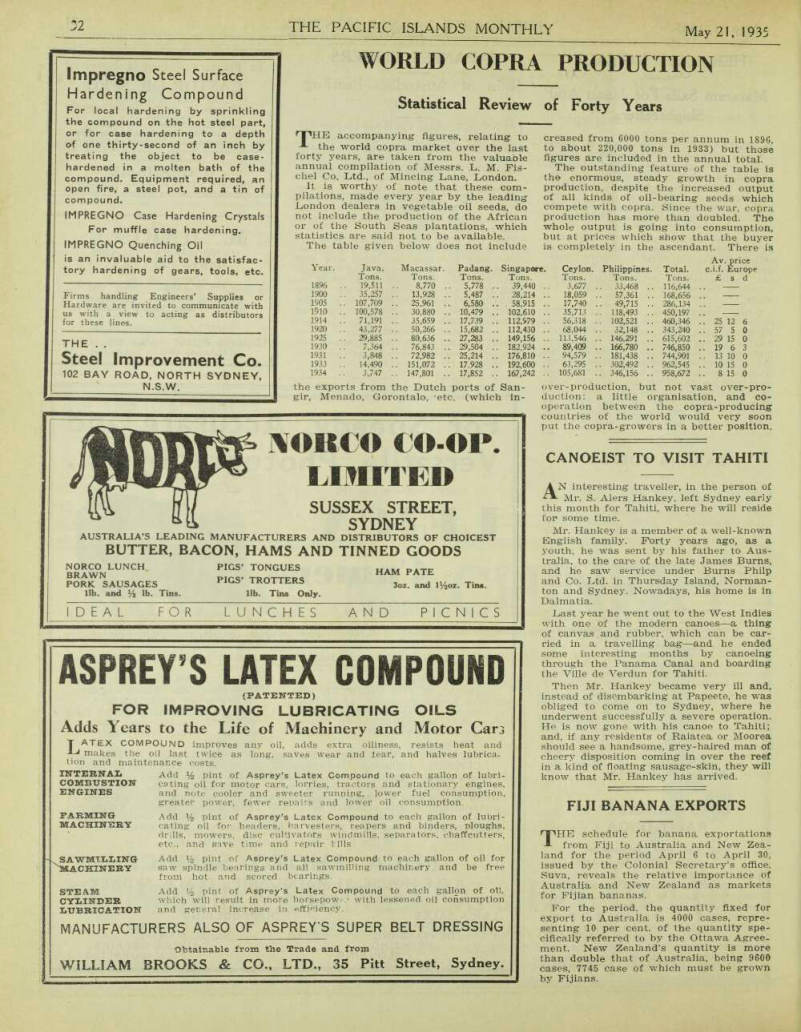
Statistical Review of Forty Years
THE accompanying figures, relating to the world copra market over the last forty years, are taken from the valuable annual compilation of Messrs. L. M. Fis chel Co. Ltd., of Mincing Lane, London.
It is worthy of note that these com pilations, made every year by the leading London dealers in vegetable oil seeds, do not include the production of the African or of the South Seas plantations, which statistics are said not to be available.
The table given below does not include
the exports from the Dutch ports of Sangir, Menado, Gorontalo, ‘etc. (which in-
creased from 6000 tons per annum in 1896, to about 220,000 tons in 1933) but those figures are included in the annual total.
The outstanding feature of the table is the enormous, steady growth in copra production, despite the increased output of all kinds of oil-bearing seeds which compete with copra. Since the war, copra production has more than doubled. The whole output is going into consumption, but at prices which show that the buyer is completely in the ascendant. There is
over-production, but not vast over-pro duction: a little organisation, and co operation between the copra-producing countries of the world would very soon put the copra-growers in a better position.
Year.
Java. Tons.
Macassar. Tons.
Padang. Tons.
Singapore. Tons.
Ceylon. Tons.
Philippines. Tons.
Total. Tons.
Av. price c.i.f. Europe £ s d 1896 19,511 8,770 5,778 39,440 3,677 33,468 116,644 1900 35,257 13,928 5,487 28,214 18,059 57,361 168,656 1905 107,709 25,961 6,580 58,915 17,740 49,715 286,134 1910 100,578 30,880 10,479 102,610 35,713 118,493 450,197 1914 71,191 35,659 17,739 112,579 56,318 102,521 460,346 25 12 6 1920 43,277 50,266 15,682 112,430 68.044 32,148 343,240 57 5 0 1925 29,885 80,636 27,283 149,156 113,546 146,291 615,602 29 15 0 1930 7,364 76,843 29,504 182,924 89,409 166,780 746,850 19 6 3 1931 3,848 72,982 25,214 176,810 94,579 181,438 744,901 13 10 0 1933 14,490 151,072 17.928 192,600 63,295 302,492 962,545 10 15 0 1934 3,747 147,801 17,852 167,242 105,681 346,156 958,672 8 15 0
Canoeist To Visit Tahiti
AN interesting traveller, in the person of Mr. S. Alers Hankey, left Sydney early this month for Tahiti, where he will reside for some time.
Mr. Hankey is a member of a well-known English family. Forty years ago, as a youth, he was sent by his father to Australia, to the care of the late James Burns, and he saw service under Burns Philp and Co. Ltd. in Thursday Island, Norman ton and Sydney. Nowadays, his home is in Dalmatia.
Last year he went out to the West Indies with one of the modern canoes—a thing of canvas and rubber, which can be car ried in a travelling bag—and he ended some interesting months by canoeing through the Panama Canal and boarding the Ville de Verdun for Tahiti.
Then Mr. Hankey became very ill and, instead of disembarking at Papeete, he was obliged to come on to Sydney, where he underwent successfully a severe operation.
He is now gone with his canoe to Tahiti; and, if any residents of Raiatea or Moorea should see a handsome, grey-haired man of cheery disposition coming in over the reef in a kind of floating sausage-skin, they will know that Mr. Hankey has arrived.
Fiji Banana Exports
THE schedule for banana exportations from Fiji to Australia and New Zea land for the period April 6 to April 30, issued by the Colonial Secretary’s office, Suva, reveals the relative importance of Australia and New Zealand as markets for Fijian bananas.
For the period, the quantity fixed for export to Australia is 4000 cases, repre senting 10 per cent, of the quantity spe cifically referred to by the Ottawa Agree ment. New Zealand’s quantity is more than double that of Australia, being 9600 cases, 7745 case of which must be grown by Fijians.
What To Grow In The Islands
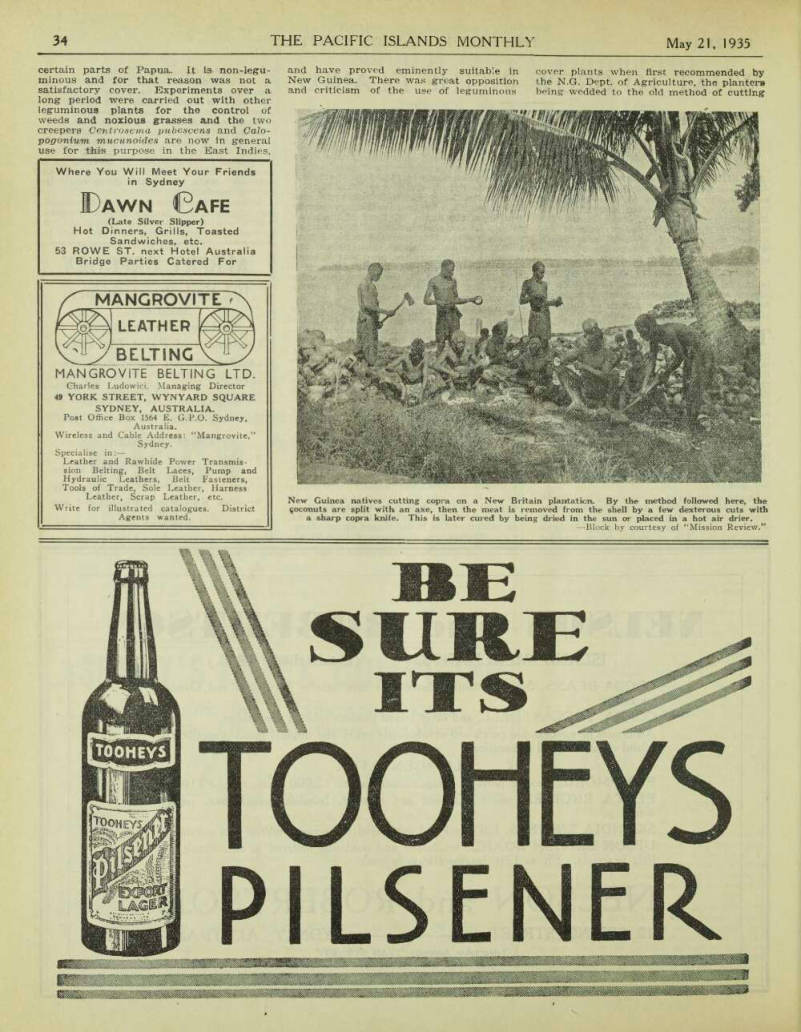
How New Guinea Dept, of Agriculture is Experimenting to Assist Planters
A VERY valuable and interesting review of agriculture and recent developments in primary production in the Mandated Territory of New Guinea was given by Mr. George H. Murray, New Guinea Di rector of Agriculture, in an address de livered to members of the New South Wales branch of the Australian Institute of Agricultural Science in April.
The peculiar merit of the address lies in the fact that Mr. Murray, in addition to giving his expert agricultural knowledge, has made an economic survey of the pos sibilities of the various plants.
TAKE Mandated Territory of New Guinea, which includes the Bismarck Archi pelago, he said, contains about 91,000 miles. In this vast area climatic condi tions vary from the humid lowlands near the coast to the cool mountain peaks over 12,000 feet high suitable for the growth of every crop of equatorial regions. In the early days of the German regime prac tically all the settlements were confined to the coast. Coconuts, being easily grown and suitable for such districts, was the first crop to be cultivated, and remains the staple product to this day, our export of copra being approximately 60,000 tons per annum.
In the early days of coconut planting in the Pacific, methods of cultivation were more primitive than they are to-day on well-managed coconut estates in Malaya and Ceylon. The coconuts were planted
more or less regularly 28 to 30ft. apart each way and they received very little cultiva tion, other than to keep the grass cut down, which, as cultivation, is hardly worthy of the name. Several of the plan tations in the early stages of the German regime were inter-planted with cotton, the cultivation of which also helped the coconuts, and the cotton crop was of some assistance in reducing labour costs. The low price of cotton to-day, however, hardly warrants the cultivation of cotton in New Guinea even for this purpose.
It should be remembered that there is practically no resting period in plant growth in the tropics, particularly in dis tricts with heavy rainfall. Consequently, weeds are growing all the time, and the methods employed in orchard cultivation in temperate zones are quite inapplicable in the humid tropics. About 25 years ago, therefore, selective weeding and use of cover plants came into practice. The for mer meant encouraging the growth of leguminous weeds to combat those of an injurious nature.
Cover Crops
Passiflora foetida was one of the first to be used as a cover plant in competition with the noxious grass, he continued.
Imperata arundinaceal, known by various names, in the eastern tropics to which it is confined: in Ceylon it is known as Illuk, in Malaya and the East Indies as Lalang corruption of the Malay name alang alang, in the Philippines as Cogon, in the Terri
tory of New Guinea as Kunai, in Papua by its Motuan name of Kuru kuru, and commonly known in the warmer parts of Australia as blady grass. Its growth in Australia, except in North Queensland, is much less rank than in New Guinea, In cidentally, this grass can be manufactured into paper, a sample of which is on show at the Agriculture Dept., Rabaul. Such an industry could never be worked on a profitable basis, however, except on an extensive scale, where the grass could be cut by machinery.
Although Passiflora has proved success ful in combating Kunai in New Guinea, where soil conditions are favourable, It proved quite unsuitable in heavy soil in
certain parts of Papua. It is non-legu minous and for that reason was not a satisfactory cover. Experiments over a long period were carried out with other leguminous plants for the control of weeds and noxious grasses and the two creepers Centrosema pubescens and Calo pogonium mucunoides are now in general use for this purpose in the East Indies,
and have proved eminently suitable in New Guinea. There was great opposition and criticism of the use of leguminous
cover plants when first recommended by the N.G. Dept, of Agriculture, the planters being wedded to the old method of cutting
New Guinea natives cutting copra on a New Britain plantation. By the method followed here, the coconuts are split with an axe, then the meat is removed from the shell by a few dexterous cuts with a sharp copra knife. This is later cured by being dried in the sun or placed in a hot air drier. —Block by courtesy of “Mission Review.”
the kunai with scythes made of suitable sharpened hoop iron formerly practised by Germans in the early days before the more scientific method of cover plants came into use. Many planters to-day, however, are using cover plants on their plantations, one of whom informed me that since he had established these plants on his pro perty he was able to dispense with his gang of 60 grass cutters. Another plan tation of approximately 500 acres is en tirely covered with such plants, not a single labourer being employed in weed control. Centrosema pubescens takes a considerable time to get established, 6 to 12 months, but Calopogonium grows very rapidly once the plant commences to run, and one planter who says he cannot re member its name, calls it “galloping home again.” The latter plant dies back during a continuously long period of dry weather, but the former makes a permanent cover when once established.
Copra Curing Methods
In very shallow soil neither plant grows satisfactorily, but coconuts will not thrive in such soil either. Copra, the cured meat of the coconut, Mr. Murray said, is pre pared for market by drying in the sun, over smoke fires, or in specially con structed driers heated by hot air, or in a few cases by steam. The best sun cured copra is of the best quality but only dis tricts having considerable sunshine are suitable for this method. What is known as the Ceylon type of drier is the most satisfactory artificial method of drying.
Even with this method, however, it is ad visable to give the green (uncured) copra one day in the sun before putting in the drier. This method necessitates transfer ring the copra from one platform to an other for five consecutive days after which it should be of first class quality. This method was recommended to the planters in New Guinea and plans and particulars supplied by the Department of Agricul ture.
Like many new methods that have been recommended it received criticism in cer tain quarters. One company after a short trial condemned it for the reason that it was said to require 44 units to produce one ton of copra. Another planter in his first attempt at curing in accordance with this method cured his copra at a labour cost of 34 units to the ton, and there can be no doubt but after his labourers were thoroughly accustomed to the work that labour costs could be greatly reduced.
This has been proved as another planter who has always followed the advice of the Department of Agriculture informed me that his labour cost was 17 units per ton, and he has been producing first class copra, obtaining a considerably higher price than Rabaul Sun-dried. The coco nut planter in New Guinea and elsewhere must realise that the only way to make his plantation pay to-day is to reduce costs of plantation maintenance and improve the quality of his copra by curing in some such method as the Cey’on type of drier.
This drier can be modified to suit large or small properties. That such methods are practicable is proved by the fact that a large estate of 18,000 acres in Malaya pro duces copra at an all-in-cost of less than £5 per ton f.o.b.
Every endeavour is being made by "he Department of Agriculture to raise the standard of N.G. copra by a system of copra inspection by qualified inspectors.
The scheme of copra inspection has raised the standard of our copra so that planters have received as much as 12/6 per ton over South Sea at which N.G. copra was pre viously rated, he added.
Sexava Insect Pest
Coconuts in New Guinea are compara tively free from serious disease, but they
are subject to attack by several insect pests common to the Pacific. We have, however, a very serious pest in New Guinea so far unknown to other Pacific Islands, but very closely akin to a species in Moluccas and the Taland Group of Islands in the D.E.I. It belongs to the family Tettigoniidae and the genus Sexava.
These insects may frequently be present on a plantation for years, but not in sufficient numbers to cause serious damage.
Then they may suddenly increase with alarming rapidity, reaching plague proportions. The insects can best be described as long horned tree hoppers, sturdily built and about four inches long. They are ravenous eaters and the noise made by eating (they eat mainly at night) resembles
a gentle breeze passing through the tops of the palms. Palms that have been heavily attacked are often stripped of their foliage and resemble an umbrella frame.
Ordinary methods of insect control are quite inapplicable for such a pest. In studying the problem I found that the same, or kindred insect, was found in Amboina in the Moluccas, where it was kept under control by a minute Chalcid wasp, Leefmansia Bicolor, parasitic on the Sexava egg. After correspondence with Dr. Leefmans, Director of the Institute of Plant Disease, Buitenzorg, Java, recom mendations were submitted to the Admin istrator (General Wisdom) in 1928 for the introduction of the parasites from the Moluccas to New Guinea. Considerable
correspondence ensued, but as often hap pens no action was taken. Too much can not be said for the action taken by General Griffiths, Acting Administrator, in the matter, for when the recommendation was submitted to him at the end of 1932 he sent for me and within an hour the scheme was put in motion. A Government schooner was prepared for sea and, within
little more than a month after necessary official action had been taken, left Rabaul for Amboina with Mr. J. L. Froggatt, en tomologist, on board. Mr. Froggatt suc ceeded in obtaining a large number of parasitised eggs and landed them safely at a field laboratory at Manus, in the charge of Mr. J. F. Caldwell.
Many thousands of local Sexava eggs were duly parasitised by the Leefmansia and breeding operations were then estab lished. The parasites have been ob tained from Sexava eggs collected in the field, and we have good reason to believe that they are established in that district.
The field laboratory has since been re moved to New Hanover under Mr. B.
O’Connor and his reports show that the parasites are gradually distributing them selves in Sexava infested areas on the Island. It is too soon yet to say what the ultimate result will be, but we cer tainly have good reason to hope that this campaign against Sexava will be a suc cess.
Other Islands Crops
It is very unwise that any country should depend upon one crop for its agri cultural development, he said, and the Department has made every effort to en courage the cultivation of crops other than coconuts. About the middle of 1928 operations were started for the develop ment of the Keravat Demonstration Plan tation, about 30 miles from Rabaul. Con trary to what has been said in certain quarters our records show that many ex periments and introduction of new crop plants have been made there.
Apparently many planters and even; officials have the idea that there are many tropical crops at present not cultivated in New Guinea, that can be grown profitably by Europeans. In New Guinea such how ever is not the case, particularly as the only districts at present accessible for development are those comparatively near the ccast. Some tropical crops are suit able on y for peasant cultivation, or on the other hand, on a very extensive scale, re quiring expensive machinery.
Pimento, for which there is but a limited demand, is practically grown only in Jamaica where there is little more than a peasant crop.
Nutmegs take long years to come into bearing and the prices ruling would not justify any planter growing them exten sively. It is a crop that requires careful handling and packing. There are a few trees bearing on some of the plantations to which the owners might well give their attention. The nutmegs are very subject to insect attack after harvesting and re quire careful packing. They should be packed in paper lined boxes weighing 56 lbs. each. The nutmegs also should be wrapped in paper and the joins or seams of the boxes sealed with adhesive tape.
Cloves have not yet been introduced to New Guinea, but the market for this spice is limited, and more than supplied by Pamba and Zanzibar (British Protectorate) and the Moluccas, D.E.I.
Pepper has been introduced by the De partment and is coming into bearing at the Demonstration Plantation and Botanic Gardens. This crop takes about six years to be in full profit and requires as inten sive cultivation as a market garden..
Ordinarily, the stock of pepper on the London market is 4,000 tons, but there are at present 25,000 tons, and so this crop would be of no assistance in relieving planters in the present copra slump.
Arrowroot, ginger, cardamons and cinnamon are minor crops cultivated at the Demonstration Plantation and Botanic Gardens, Rabaul, but the planter would be ill-advised who entered on their culture extensively, owing to the limited market.
Vanilla, another minor crop grown at the Demonstration Plantation, has greater possibilities, but only as a side line. As is well-known, vanilla is an orchid, and in New Guinea must be hand-pollinated to get any crop.
The fibre plants, Manila hemp, Sanse viera hemp and Mauritius and jute are all grown at the Demonstration Plantation and the Botanical Gardens, Rabaul, but not one of these could be grown profitably in New Guinea, for reasons unnecessary to specify here. An improved variety or sub-species of Sisal hemp also introduced to the Demonstration Plantation could pro ably be grown profitably in New Guinea, but only if grown on a very extensive scale. and under able and skilled manage ment. A great deal of expensive machinery wou'd be necessary for the successful cul tivation of this crop. The same applies to Tapioca, although this is a crop more
easily dealt with. Its production, however, on a profitable commercial scale by Euro pean planters requires considerable finan cial resources on account of machinery for its preparation. This crop is also being grown at the Demonstration Plantation and experiments are to be made in its preparation by simpler methods.
Desiccated coconut is also produced, there being three mills in operation, but there is little likelihood of expansion in this industry for the present.
The Derris Plant
Mr. Murray said the leguminous plant Derris is now receiving some attention as a plantation crop, and experiments are being made at the Demonstration Planta tion in the cultivation of an introduced species, probably Derris Malacceasis, and the indigenous species at present unidenti fied. A small sample of New Guinea Derris was sent by the Department to the Imperial Institute in London and was favourably reported on. Its rotenone con tent was approximately 4 per cent, and considered equal to the Malay product.
The rotenone content in this plant seems to be very variable, and until we have sufficient roots to make a trial shipment to London the Agriculture Department would not be justified in advising planters to enter upon its cultivation. It takes about 21 months from planting before the roots are ready for harvesting. The main toxic property in the roots is rotenone, which is now coming into use for insecti cidal purposes.
Adlay, a cereal crop introduced from the Philippines, is growing very well at the Demonstration Plantation, but both Euro peans and natives would need to acquire the taste for it before it could ever become an important crop in N.G. The grain, how ever, is appreciated by poultry.
The very few tropical crops left that could be grown profitably in New Guinea
are cocoa, rubber, coffee (Robusta and the Arabics), tea, cinchona, kapok, West Afri can oil, and sugar, all of which are culti vated at the Demonstration Plantation, except tea and cinchona.
Cocoa, Rubber And Coffee
During the German regime there was a considerable production of cocoa in the colony, but during military occupation such plantations were greatly neglected. Efforts are now being made to revive the industry and according to returns the exports of cocoa in 1933/34 amounted to 167 tons. Mr.
E. C. Green, of the Department of Agri culture, who took a post-graduate course at the Imperial College of Tropical Agri culture in Trinidad, was advised before his departure from Rabaul to specialise on cocoa and after his return he was specially detailed to inspect cocoa plantations in the Territory and advise the growers as to how to improve their methods. Before my de parture on leave, he continued, the Depart ment received very appreciative letters on the work of this officer, and there has al ready been a decided improvement in some of the cocoa exported from the Territory.
Amongst the cocoa trees in the Botanic Gardens, Rabaul, there are a few trees yielding beans of good type, round full seeds and light colour in longitudinal sec tion. These trees have been selected as mother trees for seed purposes and it has also been proposed to obtain some speci ally selected high quality plants from Java if regulations in that country permit.
A small coffee industry has been estab lished, there being four plantations of Robusta now coming into bearing. In N.G. this crop is far behind Papua, the exports for the last year from the latter territory being 122,000 lbs. as against our 11,000 lbs.
Owing to the large consumption of rub ber in Australia there are possibilities of this crop being worked on a profitable basis if up-to-date methods are employed.
No rubber is produced in the Mandated
Territory of New Guinea, but there are plantations in Papua, though I doubt if the maximum yield of dry rubber per acre in that Territory is more than 400 lbs. By the modern methods of rubber planting now practised in the D.E.I. and Malaya, that is by planting budded trees from specially selected high yielding clones, 1,500 lbs. per acre or more may be expected.
By an agreement between the main rub ber producing countries it is impossible to get any plant material from these high yielding clones, but if a thorough investi gation of the rubber tree were made in Papua by the estate managers there in co operation with Mr. Dwyer, our economic botanist, it is possible that we might dis
cover clones equal to some of the record yielders of Sumatra and Java.
At the Agricultural Station, Wau, in the Morobe goldfields district, at an elevation of little more than 3000 ft., the Department introduced Coffee Arabica of the famous Bue Mountain variety from Jamaica. Un fortunately, the station is now in private hands, but the trees are yielding heavy crops of excellent quality which find a ready local market. The rich mountain land on the Upper Ramu and many other parts of New Guinea are eminently suit able for Arabian coffee, high quality tea, and Chinchona, but it is useless to con sider the cultivation of these crops until suitable roads have been constructed into the interior. This is a matter, however, dealing with policy, on which it is not advisable for me to speak.
Mr. C. Stammerjohn, a pioneer German settler in Fiji, died at Suva at the end of March. He went to Levuka from Hamburg in 1883, and for many years was a planter at Vala Vala. During the Great War he was repatriated to Ger many, living there for several years before returning to Fiji to engage in planting and trading at Yalave, Fawn Harbour, Vanua Levu.
Advertisements & other items, pp. 35-40 (1 item)
Nelson And Robertson
ALBERT GREGORY
107 York Street, Sydney.
Saddlery,
Saddler’s Ironmongery
Leather and Paint Merchant.
LEATHERS —Art Work, Sole, Harness, Roans, Suedes, Bag, Kangaroo, Bridles, Belts, Spurs, Stirrups, Breastplates. SADDLES Race, Exercising, Park and Stock.
Leather Belting and Pump Cups.
Paint Merchant.
For House and Roofs, ready mixed . . .. 13/6 gallon Special Value House Paint 10/6 gallon Brushes, Kalsomine, White Lead and Oil.
Samples of Leathers on Application.
NELSON and ROBERTSON
ISLAND MERCHANTS. (Established, 1895.)
COCOA BEANS: Special attention devoted to their sale in Australian and Oversea markets.
COPRA, TROCAS SHELL, and other Island produce sold on commission.
All classes of merchandise purchased at wholesale prices and original invoices supplied to Island clients. Small commission.
SOLE AGENTS FOR
PUMPMOBIL, genuine portable pump, capacity up to 12,000 galls., weight 110 lbs.
PENTA ENGINES, utility outboard and inboard, Swedish manufacture, powers 4-60 h.p.
SKANDIA ENGINES, full diesel and semi-diesel, all powers, marine and stationary.
UPSON BRITISH BOARD, wallboard and insulating material in one, strong and light in weight. 6ft. to 1 2ft. lengths always in stock.
NELSON and ROBERTSON
12 SPRING STREET SYDNEY, AUSTRALIA
Telegraphic Address: “IVAN SYDNEY.”
Where You Will Meet Your Friends in Sydney
Dawn Cafe
(Late Silver Slipper) Hot Dinners, Grills, Toasted Sandwiches, etc. 53 ROWE ST. next Hotel Australia Bridge Parties Catered For
MANGROVITE
LEATHER
BELTING
MANGROVITE BELTING LTD.
Charles Ludowici, Managing Director
49 YORK STREET, WYNYARD SQUARE
SYDNEY, AUSTRALIA.
Post Office Box 1564 E. G.P.O. Sydney, Australia.
Wireless and Cable Address; “Mangrovite,”
Sydney.
Specialise in:— Leather and Rawhide Power Transmission Belting, Belt Laces, Pump and Hydraulic Leathers, Belt Fasteners, Tools of Trade, Sole Leather, Harness Leather, Scrap Leather, etc.
Write for illustrated catalogues. District Agents wanted.
TOOHEYS
PILSENER.
PRESCOTT Ltd Sussex St Sydney are sole wholesale agents for
PINEAPPLE BACON & HAMS
DAISY BRAND BUTTER
FRESCO BRAND BUTTER
LEA & PERRINS’ SAUCE
“WYRNWAY” BRAND
SHIRTS, PYJAMAS
UNDERWEAR AND TIES
ARE QUALITY PRODUCTS
WEARNES LIMITED
MANUFACTURERS 17 PARKER ST., SYDNEY
PRODUCING UNIFORM GOOD RESULTS SINCE 1868
Flour
ALWAYS ASK FOR IT
THE
SILVER STAR
ROBERT HARPER AND COMPANY
LIMITED
Is RUST Destroying Your Property—?
We have much pleasure in announcing that Killrust is now available in WHITE and GREY, both of which are specially suitable for Tropical Countries. Killrust Metal Paint serves two distinct purposes: It kills the growth of rust and it protects iron against acids, alkalies, salt water and other corrosive agents. It is tasteless and non - poisonous, and therefore recommended for painting roofs and the interior of fresh-water containers.
3. KILLRUST METAL
FLUID is a colourless solution for neutralising the growth of rust when ordinary coloured paints or lacquers are to be applied.
It is used extensively on motor bodies, petrol storage tanks, etc.
4. KILLRUST ROOF
PAINT. Red, White, Grey.
For rusted iron roofs and general structural painting.
Write for or ask your Sydney agents to procure from us Descriptive Leaflets
METAL PRESERVATION CO, of N.S.W.
56 MARGARET STREET, SYDNEY, N.S.W. G.P.O. BOX 571 FF
1. KILLRUST METAL
PAINT Elastic Finish (Black) is a penetrating and quick drying paint for protecting surfaces which come in contact with water and for general Inside work. It is also used for descaling badly rusted iron. (See instructions.)
2. KILLRUST SUPER
COAT (Black) is a powerful heavily-bodied paint, which can be used on surfaces exposed to the hottest tropical sun, and will also stand up to constant immersion in water.
Factory Distributors:
Cable Address: “PIOSPRING. Established 42 Years.
PIONEER SPRING CO. LTD.
McEVOY STREET, ALEXANDRIA, SYDNEY, N.S.W.
Are the leading Springmakers, manufacturing Coil, Volute, and Laminated Springs for all Motor Cars, Trucks, Tractors, all kinds of Locomotives and Rolling Stock.
Write for our Catalogue and Price List We are also Expert Forgers and Blacksmiths.
DONALDS
Wt. 4½1bs.
Price. 22/6. Send for Free Catalogue.
WIRE STRAINER
Requires no skill—takes an unlimited length of loose wire—quick and efficient—stretches plain, netted or barb—light, and folds into small compass—stretches at any part of fence or at post—works automatically—used for endless other purposes besides fencing.
PRESSES, for baling Wool, Tobacco, Copra, etc.
CASEMENT STAYS, JACKS, etc.
DONALD PATENTS LTD.
PADDINGTON, SYDNEY
Your Store Can Secure
PABCO
HIGH GRADE
ENAMEL SURFACE
RUGS
A wonderful selection in an extensive range of beautiful patterns and modern colourations is always available in these durable, low-cost Squares. You are certain to find amongst them a delightful, low-cost Pabco Square for any room in your home be it bedroom, lounge, dining-room or verandah. Pabco Squares are so easily cleaned—just wipe a damp mop lightly over the surface—they can be laid on any wooden floor that is reasonably smooth.
LOW-COST, BRIGHT AND DURABLE
Patterns of this beautiful, economical Floor Covering can be seen at any store of — Burns, Philp & Co. Ltd. W. R. Carpenter & Co. Ltd.
PABCO PRODUCTS (Australia) LIMITED, Sydney, N.S.W
GLOBEX
(GLOBE BEEF EXTRACT)
GLOBEX
FOR GOOD BEEF TEA
GLOBEX
FOR SOUPS & GRAVIES
GLOBEX
DELICIOUS SPREAD THINLY ON BREAD
Obtainable in 2 ox. jars and in 4 and 8 oz. containers Obtainable from All Island Traders
AUSTRALIA’S CLEARING HOUSE FOR THE PRECIOUS METALS.
BUYERS OF
GOLD
OSMIRIDIUM, PLATINUM, SILVER, &c.
GARRETT & DAVIDSON, LTD.
ASSAYERS, BULLION MERCHANTS, METALLURGISTS,
Bank of N.S.W. Buildings, Regent Street, Sydney
Cable Address Ropeyard, Sydney.
Scott’s Renown Brand Rope,
Cordage and
Binder
Twine
of Every
Description
MANUFACTURED AT
MASCOT, N.S.W.
By
J. Scott Ltd.
Head Office and Store:
163 CLARENCE ST.,
SYDNEY, N.S.W.
Fruit Shortage
Result of Samoa’s Bad Weather
From Our Own Correspondent.
APIA, April 11.
PUNCTUALLY, and true to Samoan tradition, the wet season, which has been very severe, terminated on March 31. The first days of April brought us a welcome change of weather with bright sunshine, cool easterly trade winds and clear, cold and starry nights with occa sional refreshing showers of rain.
The strong winds in January and Feb ruary blew down many banana plants on European and native plantations, which resulted in a considerable shortage of exportable fruit. Thus the last Maui Pomare cargo was short by over 2,000 cases. The Indien, expected here on April 17 to take about 4,000 cases of bananas for the Auckland market, may be unable to obtain a full cargo.
The continuous torrential rains and blows since January last have also done a lot of damage on cocoa plantations.
Cocoa planters have had a very small and unsatisfactory crop, with little to expect during the next six months. This prevents them from taking advantage of the improved market prices ruling at present for their produce.
A Trading Incident in Fiji
“Tinned Cat”
years back, when I was trading in the Yasawas (Northern Fiji) I had a case of tinned rabbit in stock, and my first attempt to sell it was to a Waya native, who wanted a 1lb. tin of corned beef. I proposed he buy a 2lb. tin of rabbit, which was the same price as a 1lb. tin of corned beef.
I explained to him what a rabbit was, and that it ate grass, etc. He could not or would not understand, so for short I said its a bush vusi (cat). After long argument and explanations, he still per sisted in his belief that they did not put cats (or vusis) into tins. Besides, on the tin was a picture of both sheep and cattle.
I then said to him: “You give me 5/-, and I’ll open a tin for you. If it’s ‘cat' you pay for the tin and I’ll give you four more tins for your 5/-, which pays for the opened tin. If it is not ‘cat’ I return your 5/- and give you four tins as a pre sent, free.”
He thought it out, and when I repeated the offer a second time, up came the 5/-,. which he was certain he would get back, with four free tins of what he thought would be “bullmakau” (beef).
I opened the tin, put the contents on a plate, and showed him the “cat’s” shoul der-blade, ribs, backbone, and thigh or leg bones, and invited him to taste the “cat.’' By this time we had ceased entirely call ing it rabbit: it was vusi now.
He tasted it, squared up to the plate and devoured the lot. When he had finished he apologised for doubting my word, stood still, and with a far-away look in his eyes, said: “Turaga cats real good eating. My town is FULL of cats. When I go back home,
they are all mine!’’-
Tui Nalovo
The Lone Draftsman
Unenviable Job In Pacific Territories
ONE of the most important duties of a Law Officer in a Crown Colony or a Territory is the drafting of legislation.
The Law Officer is responsible to the Governor or Administrator for advising him in every way connected with legisla tion, both as regards the substance and the form. Every year fresh points pre sent themselves for legislative action— administrative difficulties that have arisen in the past year, new policies that require legislative embodiment, developments of old institutions that require a recasting of the whole.
The Law Officer has to go into each matter from every point of view. As he has to consider Government policy and the interests of the community and the individual, he cannot accept departmental official proposals without adequate en quiries.
When we read Acts, Ordinances, and Regulations, few realise what the work of the draftsman is. It is taken for granted that the rules of good drafting are simply the rules of literary composi tion, as applied to cases where precision of language is required, and accordingly any one who is competent to draw in apt and precise terms a conveyance, a con tract, or a pleading, is competent to draw an Act or Ordinance. It is thought that a knowledge of English and a knowledge of the form and arrangement of Statutes are all that is necessary.
Much more is required. If the drafts man is to do his work well, he must be more than a mere shaper of words and forms. He must be a lawyer of wide knowledge, with constructive imagination.
The first essential is that the drafts man should be a sound lawyer with a wide experience in all branches of law. In addition, the ordinary training and prac tice of a barrister require to be largely supplemented for the purpose of drafting legislation. The draftsman must be con versant with the branch of law which re lates to the administrative duties and
powers of public authorities. He must understand the machinery of administra tion. There are questions which a prac tising lawyer does not have to consider, but which arise in the preparation of almost every legislative measure.
Before beginning to draft legislation, it is essential to master the subject matter.
It is needful to know the existing law and practice. The law is to be found in Acts, Ordinances, etc., in judicial decisions, and in legal textbooks. The practice—that is to say, the way in which the law actually works—is less easily learned. It must often be derived from personal experience or supplied by persons having such ex perience. A lawyer who has not had con siderable experience as a practising law yer is without one of the essentials of a draftsman.
“What is commonly called the technical part of legislation is incomparably more difficult than what may be called the ethi cal. In other words, it is far easier to conceive justly what would be a useful law than so to construct that same law that it may accomplish the design of the lawgiver” (Austin, Jurisprudence). “Noth ing is so difficult as to construct Acts of Parliament properly; and nothing so easy as to pull them to pieces” (Lord St.
Leonards).
Educating Papuan Girls
AS a result of mission educational work among Papuan girls, their mental power is equal to that boys, stated Rev. Harold Short, L.M.S. missionary of Papua, at a meeting at the. Congrega tional Assembly Hall, Sydney, in April.
The mission schools prepared the chil dren for an examination in English con ducted by a member of the Queensland Education Department. In these exami nations, said Mr. Short, the percentage of passes by girls was high.
He praised Miss E. M. Riley, an educa tional worker from New South Wales, for her excellent work among Port Moresby children. The Papuan girls’ learning, however, concluded Mr. Short, was lost later on among the mundane jobs of housework and gardening, which were the only avenues open to them at present.
Advertisements & other items, pp. 41-42 (1 item)
Sauces!!
The House of
lIOIjII kook
is FAMOUS for its Sauces
HOLBROOKS
WORCESTERSHIRE
SAUCE
has been “The World’s Appetiser’’ for many generations. Fo meats of all varieties it adds a delightful piquancy, which stimulates the appetite and aids digestion. Soups, fish and vegetables, too, are improved by the addition of a few drops of Holbrooks Worcestershire Sauce.
HOLBROOKS
TOMATO
SAUCE.
made from fresh ripe tomatoes on the day they are gathered from the fields, is a quality product and is delicious with cold meats.
Many culinary triumphs may be achieved by its use in the kitchen whenever a true tomato flavor is desired.
HOLBROOKS
ANCHOVY
SAUCE
is a fish sauce made from the finest imported Gorgona anchovies, and provides a welcome savory to fish cooked in any manner.
Holbrooks (A/sia.)
Ltd.
WATERLOO, N.S.W,
Add a robust slice of health, Don’t neglect some hours of leisure, Even in pursuit of wealth.
Shun the shadows, sunshine wooing, Colds and coughs do not endure, Health successfully renewing With the Woods’ Great Peppermint Cure Woods’ Great Peppermint Cure For Children’s Hacking Coughs.
Books, Magazines & Newspapers
TO ANY PART OF THE ISLANDS
BARGAIN OFFER.—We will send half-a-dozen assorted Magazines for 4/- (post free).
We specialise in selecting reading matter for those unable to choose personally. We specialise in Mail Orders. Parcels posted by every boat. Send for our price list and full particulars of this unusual service for Island residents. You will find your instructions carried out promptly, carefully, and with intelligence.
McKAY’S BOOKSTALL
ROYAL ARCADE, SYDNEY
While You Sleep the Remedy Heals
A WELL-PROVEN
REMEDY FOR PILES
This preparation has been on the market for several months, and it has effected a Cure in every case in which it has been tried.
Cases of Long Standing often Cured within One Month, with one bottle only.
For External Use only—Stainless, Painless and Odourless.
PRICE: 3/6 PER BOTTLE. Posted securely packed for 5/- per bottle. Copies of Testimonials forwarded on request.
Read the Report of an Eminent Analytical Chemist:
THE LABORATORY,
20 and 22 Napoleon Street, Sydney, March 14th, 1933.
ROBERT BRUCE, Esq.
Dear Sir, —The formula of your pile cure submitted to me could hare no effect other than beneficial. I gave your sample to a Client who had suffered many years, and before he had used half the bottle he reported himself completely cured.
Faithfully yours,
GROVE JOHNSON, F.C.S. (Lond.)
“Honours,” City and Guilds of London Institute.
Analytical and Consulting Chemist, Supplies Obtainable from—
Robert Bruce
Room 7, 2nd Floor,
15 HUNTER STREET, SYDNEY
and also at 14 Upper Bayview St., North Sydney
Save time, trouble, temper — specify these universally preferred
ROPES, CORDAGES & TWINES
Made by the largest Rope and Cordage manufacturers in Australasia, “Kookooburra” Ropes, Cordages, and Twines are tested to provide that extra endurance, which is only found in “Kookooburra” quality lines.
Specially manufactured for the stresses of tropical conditions.
Other well-known products include Sash Cords, Halters, Plow Reins, Jute and Hemp Seaming Twines.
KOOKOOBURRA
BRAND
A. FORSYTH & Co. Ltd. 339 Kent St. Sydney.
Cable Address: “Rope,’' Sydney
Suitable House For Tropics
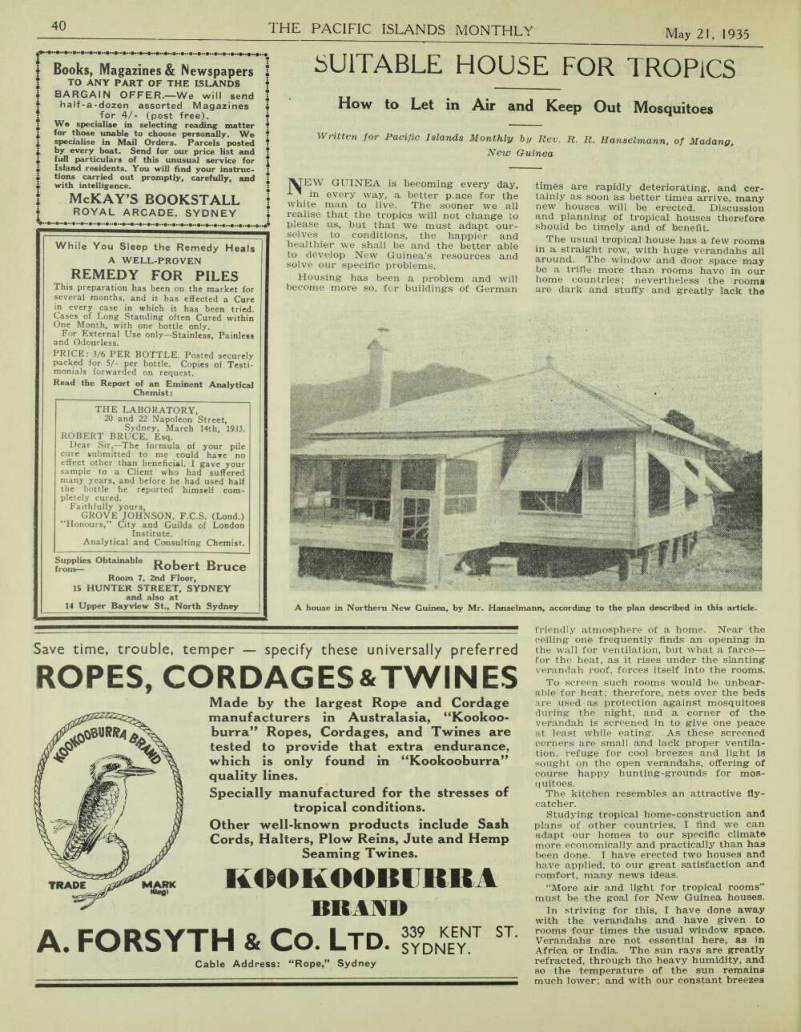
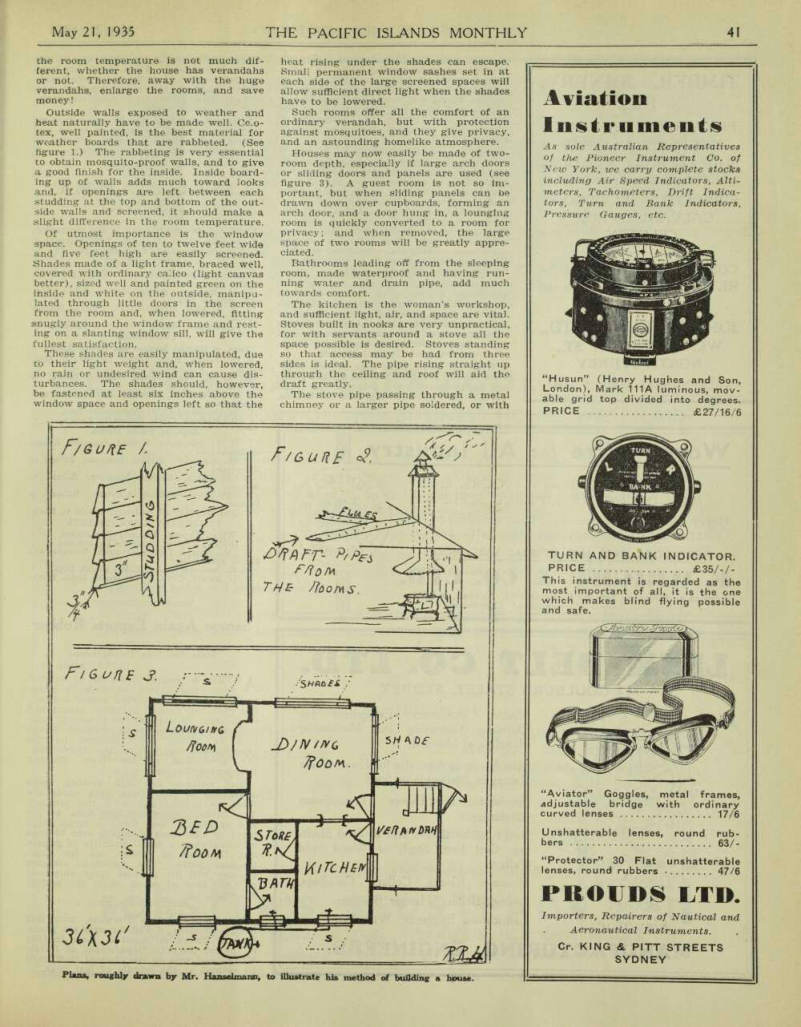
How to Let in Air and Keep Out Mosquitoes
Written for Pacific Islands Monthly by Rev. R. R. Hansehnann, of Madang, New Guinea
NEW GUINEA is becoming every day, in every way, a better place for the white man to live. The sooner we all realise that the tropics will not change to please us, but that we must adapt our selves to conditions, the happier and healthier we shall be and the better able to develop New Guinea’s resources and solve our specific problems.
Housing has been a problem and will become more so, for buildings of German
times are rapidly deteriorating, and cer tainly as soon as better times arrive, many new houses will be erected. Discussion and planning of tropical houses therefore should be timely and of benefit.
The usual tropical house has a few rooms in a straight row, with huge verandahs all around. The window and door space may be a trifle more than rooms have in our home countries; nevertheless the rooms are dark and stuffy and greatly lack the
friendly atmosphere of a home. Near the ceiling one frequently finds an opening in the wall for ventilation, but what a farce — for the heat, as it rises under the slanting verandah roof, forces itself into the rooms.
To screen such rooms would be unbear able for heat; therefore, nets over the beds are used as protection against mosquitoes during the night, and a corner of the verandah is screened in to give one peace at least while eating. As these screened corners are small and lack proper ventila tion, refuge for cool breezes and light is sought on the open verandahs, offering of course happy hunting-grounds for mos quitoes.
The kitchen resembles an attractive fly catcher.
Studying tropical home-construction and plans of other countries, I find we can adapt our homes to our specific climate more economically and practically than has been done. I have erected two houses and have applied, to our great satisfaction and comfort, many news ideas.
“More air and light for tropical rooms” must be the goal for New Guinea houses.
In striving for this, I have done away with the verandahs and have given to rooms four times the usual window space.
Verandahs are not essential here, as in Africa or India. The sun rays are greatly refracted, through the heavy humidity, and so the temperature of the sun remains much lower; and with our constant breezes
A house in Northern New Guinea, by Mr. Hanselmann, according to the plan described in this article.
the room temperature is not much dif ferent, whether the house has verandahs or not. Therefore, away with the huge verandahs, enlarge the rooms, and save money!
Outside walls exposed to weather and heat naturally have to be made well. Celo tex, well painted, is the best material for weather boards that are rabbeted. (See figure 1.) The rabbeting is very essential to obtain mosquito-proof walls, and to give a good finish for the inside. Inside board ing up of walls adds much toward looks and, if openings are left between each studding at the top and bottom of the out side walls and screened, it should make a slight difference in the room temperature.
Of utmost importance is the window space. Openings of ten to twelve feet wide and five feet high are easily screened.
Shades made of a light frame, braced well, covered with ordinary calico (light canvas better), sized well and painted green on the inside and white on the outside, manipu lated through little doors in the screen from the room and, when lowered, fitting snugly around the window frame and rest ing on a slanting window sill, will give the fullest satisfaction.
These shades are easily manipulated, due to their light weight and, when lowered, no rain or undesired wind can cause dis turbances. The shades should, however, be fastened at least six inches above the window space and openings left so that the
heat rising under the shades can escape.
Small permanent window sashes set in at each side of the large screened spaces will allow sufficient direct light when the shades have to be lowered.
Such rooms offer all the comfort of an ordinary verandah, but with protection against mosquitoes, and they give privacy, and an astounding homelike atmosphere.
Houses may now easily be made of two room depth, especially if large arch doors or sliding doors and panels are used (see figure 3). A guest room is not so im portant, but when sliding panels can be drawn down over cupboards, forming an arch door, and a door hung in, a lounging room is quickly converted to a room for privacy; and when removed, the large space of two rooms will be greatly appre ciated.
Bathrooms leading off from the sleeping room, made waterproof and having run ning water and drain pipe, add much towards comfort.
The kitchen is the woman’s workshop, and sufficient light, air, and space are vital.
Stoves built in nooks are very unpractical, for with servants around a stove all the space possible is desired. Stoves standing so that access may be had from three sides is ideal. The pipe rising straight up through the ceiling and roof will aid the draft greatly.
The stove pipe passing through a metal chimney or a larger pipe soldered, or with
Plans, roughly drawn by Mr. Hanselmann, to illustrate his method of building a house.
shoes resting over the galvanised roof, will prevent any rain coming down. A metal hood fastened to the bottom of this pipe or chimney, about four feet above and cover ing the stove, will catch heat, smoke and vapors and keep the temperature of the kitchen low. (Figure 2.) Screening of kitchens is the first step for sanitary homes.
Should more air circulation be desired, it can easily be achieved by connecting each room with a flue eight inches in diameter, rising from a register in the ceiling to a rotary style ventilator on the ridge of the roof; or, when possible, connected with the above-mentioned chimney, and a draft will be caused by the heat rising and escaping.
Registers in the floors, with wind funnels under the house, cause a flow of air into the rooms usually not considered possible.
With dampers in these flues, the draft can be controlled. (See figure 2.) A cut-off in the water pipe, leading from the water guttering to the tank, would mean much for cleaner water. After the roof has been rinsed off, permit water to flow into the tank. Just these little things mean much for health and happiness—and even a new house is not beyond the limits of any permanent tropical dweller.
With pit saws, have logs broken down to a two or three-inch thick slabs. These are easily handled and transported. On a portable saw mill, flooring, weather boards,
tongue and grooving, moulding, and all can be cut and dressed. These plants are light and not costly. Pit saws and a five horse power plant is the most practical and economical equipment for small undertak ings and repair work.
Although we may not be carpenters by trade, we can all do much to make our houses and stations practical, adapted to the tropics, sanitary and comfortable.
Advertisements & other items, pp. 43-44 (1 item)
Prouds Ltd.
Aviation
Instruments
As sole Australian Representatives of the Pioneer Instrument Go. of New York, we carry complete stocks including Air Speed Indicators, Altimeters, Tachometers, Drift Indicators, Turn and Bank Indicators, Pressure Gauges, etc.
“Husun” (Henry Hughes and Son, London), Mark 111A luminous, movable grid top divided into degrees.
PRICE £27/16/6
TURN AND BANK INDICATOR.
PRICE £35/-/-
This instrument is regarded as the most important of all, it is the one which makes blind flying possible and safe.
“Aviator” Goggles, metal frames, adjustable bridge with ordinary curved lenses 17/6 Unshatterable lenses, round rubbers 63/- “Protector” 30 Flat unshatterable lenses, round rubbers 47/6
PROUDS LTD.
Importers, Repairers of Nautical and Aeronautical Instruments.
Cr. KING & PITT STREETS
SYDNEY
TIMBER, JOINERY,
Etc.
PREPARED BUILDINGS
ready for erection a speciality.
SHIP and BOAT BUILDING
TIMBERS specially catered for
FIBROLITE, PLYWOODS,
GALVANISED IRON.
CELOTEX.
CONSIGNMENTS shipped by
RETURN STEAMERS to the
Islands.
JOHN W. EATON LTD.,
WEST CRESCENT ST.,
NORTH SYDNEY
TELEPHONES: X5051 (5 lines)
Woven Wire for All Industry
COPRA DRYING TRAYS, FLOORS. Etc.
FRUIT DRYING TRAYS. MINING SCREENS
Heavy Mosquito Gauze in Phosphor Bronze and Other Metals Impervious to Salt Sea Air WIRE DOOR MATS AND GENERAL WIRE WORKS
E. WRIGHT & CO. LTD.
Office and Works: 148-152 Cleveland St., Sydney, N.S.W.
Telegraphic Address: “Wrightmake,” Chippendale.
LINK-BELT CO. LTD.
17 GOULBURN STREET, SYDNEY
Centrifugal
Discharge
Bucket Elevator Modern Machinery Equipment for Elevating, Conveying and Mechanical Handling of Material.
Sole Agents in Australia for Ewart Chain Belting in Malleable or Steel.
Specialists in Power Transmission Machinery.
Large Stocks always kept of Steel Shafting, Cast Iron, Steel, or Wood Split Pulleys.
Plummer Blocks, Collars, Couplings, Leather Belting, Hangar Bearings.
Lubricators, Engineers’ Wrenches.
MANUFACTURING ENGINEERS
Service
New Guinea Public
THE following changes in the personnel of the New Guinea Administration staff were gazetted in Bulletin No. 37;
Appointments
Lloyd R. Lucas, Draftsman, Dept, of Public Works.
E. D. Robinson, Acting District Officer, Dis trict Services Dept.
H. L. R. Niall, Acting A.D.O., Dept, of District Services.
J. L. Froggatt, Acting Director of Agriculture.
Transfers
Dept, of District Services and Native Affairs R. M. Farlow, Patrol Officer, Gasmata to Sala maua.
H. L. R. Niall, Acting A.D.O., Rabaul to Madang.
J. R. Hyde, Cadet, Rabaul to Kavieng (en route Namatanai).
L. A. Considine, Clerk, Wau to Salamaua.
C. H. Maclean, Clerk, Rabaul to Kavieng.
Dept. of Public Health J. H. L. McGuigan, Medical Assistant, Rabaul to Namatanai.
C. M. McArthur, Medical Assistant, Rabaul to Namatanai.
A. R. Parry, Medical Assistant, Rabaul to Kokopo.
A. Coomber, Medical Assistant, Rabaul to Wewak.
A. J. Long, Medical Assistant, Rabaul to Kieta.
Temporary Appointments
T. White, Typiste, Treasury Department.
J. Gridley, Typiste, Treasury Department.
G. M. Alday, Typiste, District Services and Native Affairs Dept.
A. H. Anthony, Nurse, Public Health Dept.
R. G. Barnet, Clerk, Public Health Dept., trans ferred from Rabaul to Kavieng.
Samoa Again Exports Rubber
From Our Own Correspondent.
APIA, April 12.
AFTER a lengthy interval of several years the export of Samoan plan tation rubber has started again, indicat ing that the rubber industry, abandoned on account of unprofitable prices, is con sidered a paying proposition again. Seven tons of rubber were shipped by the Inverbank recently from the Aleisa rub ber plantation of the New Zealand Reparation Estates.
The natives are still cutting large quantities of copra and Apia sheds are filled to overflowing with the product.
The Inverbank, which left Apia at the end of March, took away a large ship ment of 2,300 tons of copra, over 50 tons of cocoabeans, a small quantity of papain and 75 cases of rubber, all for Con tinental ports. The American steamer Carisso will lift another large shipment of 1,500 tons of copra about the middle of April.
Mr. Henry James Parsons, who had been a resident of Fiji for over six years, died at Tavua on April 4. Late in 1928 he joined the Fiji Department of Public Works and was on the clerical staff until he retired at the middle of last year.
Advertisements & other items, pp. 45-46 (1 item)
Forster’S Bedsteads Ltd
SEVENTY SIX YEARS AGO
THE FOUNDATIONS OF THIS BUSINESS HOUSE WERE LAID Just think of it! When Dickens was writing his books Forster's Bedsteads Ltd. commenced manufacturing. Employing highly skilled craftsmen—men who took a pride in their work—and backed with the Firm’s ideals of quality, and a fair dealing to all, a really worthwhile reputation was established.
To-day, in Ultimo, the latest modern methods are wedded to the ancient craft.
Up-to-date equipment worked by skilled men—men who still take a pride in their work—enables the Olympic Productions of Forster’s Bedsteads Ltd. to stand supreme in the Commonwealth.
We are proud of the reputation that our earnest endeavours have gained for us.
No other Australian furniture organisation—and few others the world over—offer to the public such a wide variety of proved products as Forster’s Bedsteads Ltd.
MANUFACTURERS OF
HIGH-GRADE FURNITURE
METALLIC AND WOOD BEDS
WIRE MATTRESSES
HOSPITAL FURNITURE
ICE-CHESTS
CHAIRS
REFRIGERATOR CABINETS, COM-
MERCIAL AND HOUSEHOLD
SHIPS’ ALL-METAL BERTHS
STEEL SHELVING
STEEL LOCKERS AND FILING
CABINETS, &c.
PORCELAIN ENAMELLING
WE WOULD APPRECIATE TRADE ENQUIRIES
FORSTER’S BEDSTEADS LTD
MARY ANN STREET, ULTIMO, SYDNEY, NEW SOUTH WALES.
Cables: “Bedsteads,” Sydney. Codes: Bentley’s, and Private.
The Recognised Leading Typewriter House in Australia for Rebuilt and Used
TYPEWRITERS
And the safest place to buy Portable, Desk, and every size, in every known make. Buy with confidence.
Royals, Remingtons, Underwoods, Coronas, L. C. Smiths, Imperials, etc., etc. Hundreds to choose from.
Prices include packing and delivery to Island Ports.
Hundreds to choose from; From £4 to £14 each Ask the man who bought here.
Best selection in Australia
Typewriter Trading Co.
140 Castlereagh Street
SYDNEY
Our Good Name is Your Safeguard
G.P.O. Box 2743 N
Cables: Telegrams: “Tytraco”
Telephone MA 4340 Manager: FREDK. G. TUNKS Established 25 Years.
READ THE
B.P. MAGAZINE
AUTUMN NUMBER
Now on Sale Short Stories Pictures Travel Articles Pages for the Children. Stage.
Latest Fashions Screen One Shilling per Copy ON SALE AT ALL NEWSAGENTS AND BOOKSELLERS
RESISTS CORROSION, STRONGER THAN STEFL
EASILY WORKED, CANNOT RUST
f SALT WATER TANKS, PROPELLER SHAFTS
J or MOSQUITO NETTING, MARINE HARDWARE
Full information gladly from the Australian Distributors WRIGHT & COMPANY, 81 Clarence St., Sydney MONEL METAL is a Registered Trade Mark Cables: “CORNRIGHT,” SYDNEY
Approaching Mount Hagen Area
Progress of Papuan Expedition Under Jack Hides
IN the middle of December last Mr. Jack Hides, A.R.M. of the Papuan Adminis tration, and Patrol Officer J. O’Malley left Port Moresby by the “Vailala” with native police and carriers in an attempt to penetrate the unexplored country be tween the headwaters of the Strickland River and the great Purari River which rises in the Mandated Territory of New Guinea and flows southwards across Papua to the Gulf.
The expedition sailed across the Gulf of Papua to Daru, in the Western Division, and from thence journeyed up the Fly River to Everill’s Junction. In the “Vai lala” they proceeded up the Strickland River to Douglas Bend, over 100 miles from the junction with the Fly. The party with their stores and equipment were then transferred to canoes and slowly made their way up the Strickland. After several weeks’ journey by canoe the party discovered a large river flowing into the Strickland from the east. This was named the Rentoul, presumably after Mr. Alex Rentoul, who was Resident Magistrate at Misima Island when Jack Hides was A.R.M. there.
As this river flowed from the direction in which their course lay, Mr. Hides de cided to follow it. After 40 miles by
water, hampered greatly by floods and rapids, the party disembarked, and at the middle of February were about to make a long trek overland through absolutely unexplored territory to reach the lago River, north-east Delta Division, and
later journey down the Purarl River to the coast. The party appeared then to be making satisfactory progress, and if all continues to go well news should be re ceived at the end of May that the expe dition have attained their objective, thus bringing credit to the Papuan Adminis tration, and fresh laurels to the intrepid young leader for his daring feat.
The following letter written by Jack Hides on February 19, when he was camp ed on the eastern watershed of the Ren toul River, was received by a resident of Port Moresby early in April, This was Mr. Hides’ last communication with civil isation before he made the dash inland for the Mount Hagen-Purari area: “Forty days have elapsed since the
Mr. Jack Hides, leader of the Papuan Government’s expedition, was born in Papua and knows the country and natives like a book. Before being given the job of leading this important expedition across unknown Papua, he was A.R.M. at Misima Island, south-eastern Papua. Previously he was a very successful Patrol Officer in the Administration service.
‘Vailala’ landed our party on an island above Douglas Bend, and in that period we have transported 50 men and about 8 tons of stores and equipment over 84 miles of water, most of the time con tending with floods. It was a terrific task: the fact that our camp is 4750 ft. above sea level will convey some idea of what was achieved. I have never seen the Gulf coast natives to better advantage than when they literally carried the loaded canoes over difficult rapids. At one stage we hauled them by ropes over a roaring cataract.
“On February 6, a river was discovered entering the Strickland from the east. It was a large river with its mouth partly concealed, and as it seemed to lead to the north I decided to follow it. For reference it has been named the Rentoul River.
“We have advanced 41 miles up the Rentoul, the last 20 miles being over rapids. Further progress by water is Im possible: high mountains are now crowd ing upon us, and the rapids are really cataracts. Three canoes have been de stroyed to remove all temptation from the carriers to desert, and the fourth will leave here in the morning with four police boys and two sick carriers. This leaves us with 10 police boys and 28 carriers. We are camped on the eastern watershed of the Rentoul, at approximately latitude 6 degrees 16.5 minutes and two miles west of meridian 142 degrees 30 minutes—or, roughly speaking, about 85 miles south west of Mount Hagen (in the Mandated Territory).
“The Rentoul appears to drain a large area of country. One confluent strikes N.N.E., draining high mountains near the Carrington River, as far east as 50 miles from the Cecilia Junction (where the Carrington joins the Strickland): and along this north-east line of mountains there rises a gigantic precipice—a huge wall of rock 10 to 12 miles in length and with a sheer drop of over a mile. These high mountains appear to be all of lime stone.
“A second arm of the Rentoul extends eastwards from our camp for a distance of 30 miles or so, losing itself in some high mountains that probably form the top watershed of the Kikori River (which eventually flows into the centre of the Gulf of Papua). In this direction there appears to be a large basin, flanked by these mountains and still higher ones to the north.
“I cannot quite make out this country yet: there are parts where I can see as far as the eye can reach, without a lofty mountain on the horizon. The main Ren toul —that which we are now following— seems to disappear into the north-east between mountains 8,000 and 9,000 feet high. I am inclined to believe that the country which lies ahead of us is of open grass valleys, densely populated. I may be wrong: but it is certainly inhabited.
“To the north and east of our present base the country is fringed with gardens —the first we have seen to date, though the territory we have passed through is all populated. As one looks back down the Rentoul, the hills soon disappear and the country in the vicinity of the Strick land assumes the character of an enor mous plain. This lower region, from the Carrington River in the north to the Dupotata Creek in the south —an area of approximately 1,000 square miles—is in habited for the most part by nomadic tribes, thinly scattered over swamp and forest. They are brown-skinned natives, wearing the grass sporan of the Gulf Kukukuku, and having a ring of dried human entrail as an ornament in the nose septum. The Strickland headhunters ob tain their heads from these primitive people.
“I saw some small areas cleared with stone axes, upon which the natives have
with difficulty raised banana and sugar cane crops, but of villages there were none. The people have accepted presents of steel from us, which we left at a dis tance, and they appear to be friendly. One day I came upon a sago encampment where a number of men, women, and children were making sago. They did not attempt to run away nor did they try to molest me, but when one of our armed constables got himself into a helpless condition in the mud, the men tried to murder him.
“It is difficult to estimate the number of these nomads, and I think it will always be difficult, because they are all wanderers and the whole forest is their playground.
There is probably no other part of Papua so full of game as this huge area of un dulating forestlands, and it is on account of this fact, I suppose, that these primi tive people are here, living to-day as they did probably before corn was discovered in Egypt. They are surely a part of the oldest inhabitant of this great island.
“We have three months’ stores left, and I expect it will take us fully that time to reach, the laro River (which crosses into Papua from the Mandated Territory of New Guinea and flows in a south-westerly direction, eventually to reach the Purari River and on into the Papuan Gulf). Once
we reach the Iaro River our journey to the coast should not be very difficult.
“We now start relaying into the moun tains. This will be slow—painfully slow —for some time, but once the rice is down to just that amount which we can carry off at once as a mobile force, then we shall move quickly, making a wide swing to the north and south and covering a large area of country in our last dash.
“I do not expect that we shall have any of our own food left by the time that we reach the Purari. In that area, however, I know what is ahead of us, and we shall be able to live, however, uncomfortably, on the country.
“O’Malley and I are fit and well and have flowing beards, like corsairs.”
Advertisements & other items, pp. 47-48 (1 item)
15 Proved Uses for
INNERCLEAN Intestinal Laxative.
An Aromatic Herb compound Adjuvant for Constipation. Perfected by Prof. Arnold Ehret. 3/6 packet. Send Twopenny stamp for sample.
A. SUMMERBELL
"Wyoming," Hunter Street, Sydney
Records
- POSTED FREE
SEND FOR LISTS
Australia’s finest Record Shop, specialising in Mail Orders.
Any Records procured and sent same day.
Dozens of clients in the Pacific Islands. We pay freight.
THE TALKERIES
QUEEN VICTORIA BUILDINGS
SYDNEY, AUSTRALIA
BE A SOCIAL SUCCESS—LEARN TO PLAY THE
PIANO in Modern Dance Style
BY OUR SPECIAL CORRESPONDENCE COURSE
You are never too old to learn. Whether you have had previous experience with the piano or not, our course will teach you rapidly. Everything is carefully graded, making it concise and the essence of simplicity. Only the one course needed to make you a proficient pianist.
Moderate Fees. We guarantee results. Write for our prospectus.
AL HAMMETT’S
SCHOOL OF MODERN DANCE MUSIC
3rd FLOOR, REVUE HOUSE, 104 KING ST., SYDNEY Mr. Hammett will personally test, select, and have shipped any Musical Instrument that any of our readers may be interested i n, free of charge.
15 Proved Uses for
'ASPRO'
1 — It relieves Headaches in 5 to 10 minutes. 2 It brings Sweet Sleep to the Sleepless. 3 It relieves Rheumatism in one night. 4 It will ease the Nagging Pains of Neuritis and Neuralgia. 5 Take “ASPRO” to relieve Toothache. 6 “ASPRO” taken according to directions will smash up a Cold or ’Flu attack in 24 hours. 7 It brings relief without harming the heart. 8— It soothes away Irritability. 9 —It speedily reduces Temperature. 10— The stabbing pains of Sciatica and Lumbago can be hunted out with “ASPRO.” 11— It can be taken at any time, in Tram, Train, at Home, at Business, anywhere—everywhere. 12— It gives great relief to women when depressed. 13— It relieves ill after effects of Alcohol. 14— It relieves Dengue and Malaria by reducing the fever. 15— As a Gargle “ASPRO” is wonderful for Sore Throats and Tonsilitis.
FOR SALE
Two fine Boats that are extra good buying and carry my personal recommendation
(1) KETCH RIG.
37ft. 6in. x 10ft. 6in. Draught 4ft. 16 h.p. Fetter Diesel Engine, metalled bottom. Engine and hull in perfect order.
Wonderful sea boat; built by Hayes; 7 years old ... £700
(2) RAISED DECK AUXILIARY
CRUISER.
34ft. Beautifully built. 16 h.p.
Hercules Marine Engine. Good accommodation for four. Large cockpit with fish ice box. Perfect order £800 Apply—
Jack Capcll
Boat Builder and Engineer
RUSHCUTTER BAY
SYDNEY
Telephone - - - FM 1442
WE ARE SPECIALISTS!
Let us have your confidence, sixty years is our record of supplying the Leading Houses throughout the World in—
FRESH FRUIT VEGETABLES PRODUCE
WEYMARK & SON LTD.
Fruit and Produce Merchants
14-18 STEAMMILL STREET, SYDNEY
Phone: MA 3612 Cable Address: Codes—Bentleys. (4 lines) "Weymarkson’ Private.
CAPSTAN
CIGARETTES
CORK-TIPPED
OR PLAIN
CAPSTAN
NAVY CUT TOBACCO
Capital
O. F. Nelson Ltd. Reduce
From Our Own Correspondent.
APIA, April 14.
THE well-known firm of O. F. Nelson and Co., Ltd., of Apia, Samoa, re cently reduced their capital to half the nominal amount. There are persistent local reports that negotiations are pro ceeding to sell out to a South Sea Islands concern at present not domiciled in Samoa. It is reported that negotiations have so far not led to any definite arrangement.
Freak Coconut Tree
Letter to the Editor.
ABOUT July last, you published the photograph of a seedling coconut which threw a small head of young nuts about the size of grapes.
I now can advise you of a freak coconut tree which does not bear coconuts at all.
Instead it throws out of each spathe a young healthy growing coconut tree or seedling. There is absolutely no sign of a nut. The seedling tree is attached to the bole of the main tree.
This tree is at present growing on Mr.
J. G. Taylor’s estate at Uou Kaea on the island of Taveuni, Fiji.
The head of the tree is one mass of young growing coconut trees, on the bole of the tree there are quite a few young trees firmly attached to the mother tree.
Mr. Taylor has on several occasions cut a tree off, and planted it, but the young trees do not live.
There was only the one freak tree until a few years ago, when the wog passed to three trees in the next line of trees, and those three trees, which had previously borne good heads of ordinary nuts, started to throw varas (young seedlings) instead.
Mr. Taylor, getting “breezy” (who would not!) cut the three new contacts down; but is keeping the original tree as a curiosity.
This tree is well known by all residents of Taveuni as well as to the Agricultural Department, Suva.
Are there any similar trees in the Paci fic, I wonder?
I am, etc.,
Arthur Robinson.
Natovo Estate, Vanua Levu, 18/3/’35.
Cabaret
Raid On Samoan
Police Seize “Sly-grog”
From Our Own Correspondent.
APIA, April 12.
ON Saturday, April 6, during the per formance of a ‘‘Hawaiian Night,” with Hawaiian dances and songs, Apia police raided the Moana Cabaret and confiscated a quantity of beer and other liquor.
The owner of the cabaret, Mr. E. Fab ricius, had sold tickets for the entertain ment at 10/- for men and 5/- for ladies, which entitled clients to free entrance, free refreshments, and a free supper.
The police found that amongst the re freshments supplied were whisky and beer.
It is believed that the police will prosecute the owner of the cabaret for illegal sale of liquor and beer, which con stitutes an offence under the existing prohibition regulations. This will be an interesting test case, as a conviction would automatically stop the dispensing of liquor and beer at several other establishments in Apia.
Mr. Arthur Henry Wastall, of Navua, Fiji, died in the Colonial War Memorial Hospital, Suva, on April 10, following a recent bad accident. He was born in Kent, England, and, after residing in Australia and South Africa, arrived in Fiji with his wife some 12 years ago.
Until recent years he was manager of “Miramar” boarding house in Suva.
Tahitian Treasure In Madrid Museum
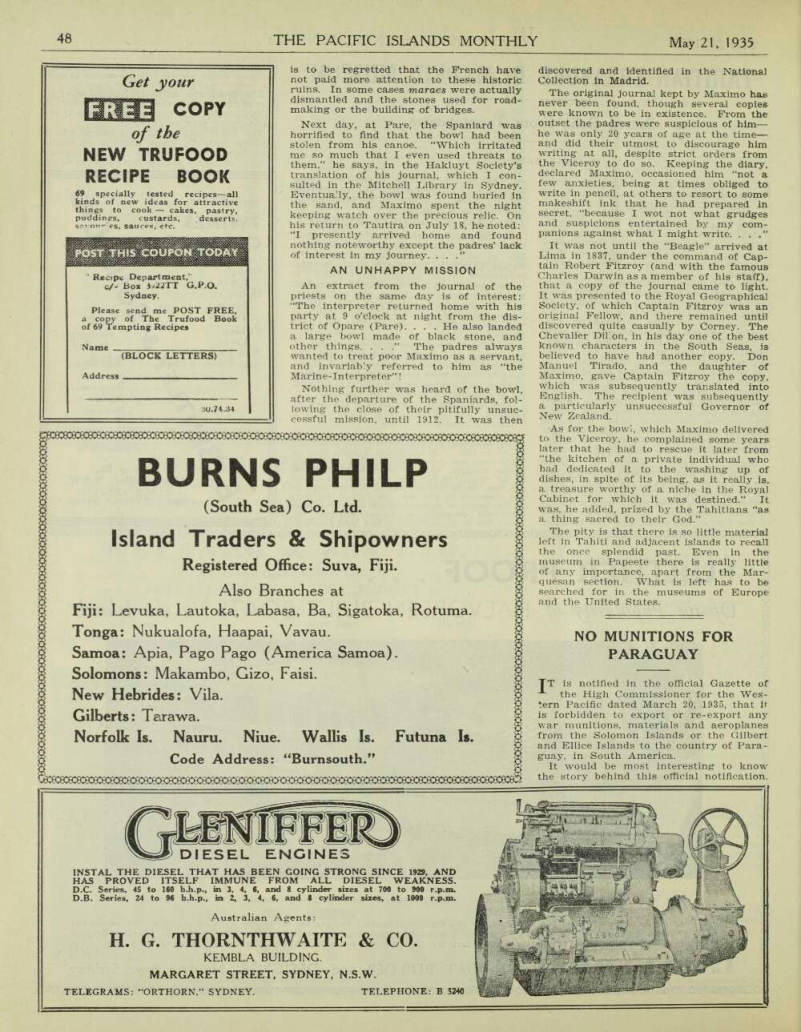
Sacred Relic From Taputapuatea
By Eric Ramsden
IT is not generally known that one of the greatest Polynesian treasures, probably the only one of its kind now in existence in the world, is in Madrid. I am referring to the umete, or bowl of black dolerite, which the Spanish interpreter, Maximo Rodriguez, removed from the Taputapuatea marae at Punauuia, Tahiti, in 1775, and took to his patron, the Viceroy Amat, at Lima.
The bowl eventually found its way to Spain but not before it was used as a receptacle for washing up dishes at Lima.
The story is quite a romantic one.
Maximo was the only member of the party of four Spaniards left by Don Domingo Bonechea at Tautira in 17/4 to achieve any popularity with the Tahitians. The two priests shut themselves up, obviously afraid for their lives. The seaman in attendance upon them was a surly fellow and, through his own foolishness, almost met with the fate that the padres feared.
Maximo, on the other hand knew the Tahitian tongue, and although somewhat narrow-minded—due, doubtless to his re ligious training — was well liked.
When in Tahiti recently I visited Tautira, and was interested to learn that the site of Bonechea’s grave is still a mattor of conjecture. The local tradition is that a valuable jewel was buried with the Spanish commander, when he was buried at the foot of the cross, near the mission,
on the return of the expedition from Raiatea. In all probability the suggestion has no basis in fact. The mission, of course, was a failure,
Maximo Rodriguez’S Journal
In his racy narrative—which by good fortune was found in London some years ago in quite an unexpected manner by Bolton Glanvill Corney—there are several references to the famous black bowl. It is be to have been manufactured in Maupiti, which at that time was subsidiary to Puni, the celebrated chief of Pora Pora.
From Pora Pora it was taken to Raiatea, and then handed over to Tu, the first p om are Maximo came across it in the course of a tour of the island, and had not the slightest hesitation in asking for it. That the Tahitians were not particularly pleased to part with such a sacred object is evident by a subsequent attempt to steal it.
The passages in Maximo’s diary are of interest. On July 10, 1774, when visiting Pomare's people, he wrote: "It dawned clear and calm. I took leave of the chiefs, and came on accompanied by the arii, Otu's (Tu’s) brother. A beautifully wrought bowl of black stone was delivered over to me. This is a unique treasure, which I heard of through one of the natives as being in the possession of the arii Otu, which, on my begging it from him, he had consented to give me. He kept it however, in the district of Atehuru, where there is a large Stone-built cemetery, or marae, whereat they swear him in as arii. . . . . This bowl had been
dedicated to their god Eatua, and consequently I had some doubts whether I should succeed in gain ing possession of it. . . . ”
The bowl was actually handed over at Punauuia or, as the Spaniard calls it, “Teypunagui.” It was so large that it re quired four men to carry it.
The exact locality of this marae, where Maximo saw “a large number of skulls and human remains set out in regular order,” is also a matter for conjecture. It
is to be regretted that the French have not paid more attention to these historic ruins. In some cases maraes were actually dismantled and the stones used for road making or the building of bridges.
Next day, at Pare, the Spaniard was horrified to find that the bowl had been stolen from his canoe. “Which irritated me so much that I even used threats to them,” he says, in the Hakluyt Society’s translation of his journal, which I con sulted in the Mitchell Library in Sydney.
Eventually, the bowl was found buried in the sand, and Maximo spent the night keeping watch over the precious relic. On his return to Tautira on July 18, he noted: “I presently arrived home and found nothing noteworthy except the padres’ lack of interest in my journey. ...”
An Unhappy Mission
An extract from the journal of the priests on the same day is of interest: “The interpreter returned home with his party at 9 o’clock at night from the dis trict of Opare (Pare). . . . He also landed a large bowl made of black stone, and other things. . . .” The padres always wanted to treat poor Maximo as a servant, and invariably referred to him as “the Marine-Interpreter”!
Nothing further was heard of the bowl, after the departure of the Spaniards, fol lowing the close of their pitifully unsuc cessful mission, until 1912. It was then
discovered and identified in the National Collection in Madrid.
The original journal kept by Maximo has never been found, though several copies were known to be in existence. From the outset the padres were suspicious of him — he was only 20 years of age at the time— and did their utmost to discourage him writing at all, despite strict orders from the Viceroy to do so. Keeping the diary, declared Maximo, occasioned him “not a few anxieties, being at times obliged to write in pencil, at others to resort to some makeshift ink that he had prepared in secret, “because I wot not what grudges and suspicions entertained by my com panions against what I might write. . . .”
It was not until the “Beagle” arrived at Lima in 1837, under the command of Cap tain Robert Fitzroy (and with the famous Charles Darwin as a member of his staff), that a copy of the journal came to light.
It was presented to the Royal Geographical Society, of which Captain Fitzroy was an original Fellow, and there remained until discovered quite casually by Corney. The Chevalier Dillon, in his day one of the best known characters in the South Seas, is believed to have had another copy. Don Manuel Tirado, and the daughter of Maximo, gave Captain Fitzroy the copy, which was subsequently translated into English. The recipient was subsequently a particularly unsuccessful Governor of New Zealand.
As for the bowl, which Maximo delivered to the Viceroy, he complained some years later that he had to rescue it later from “the kitchen of a private individual who had dedicated it to the washing up of dishes, in spite of its being, as it really is, a treasure worthy of a niche in the Royal Cabinet for which it was destined.” It was, he added, prized by the Tahitians "as a thing sacred to their God.”
The pity is that there is so little material left in Tahiti and adjacent islands to recall the once splendid past. Even in the museum in Papeete there is really little of any importance, apart from the Mar quesan section. What is left has to be searched for in the museums of Europe and the United States.
Advertisements & other items, pp. 49-50 (1 item)
Of the Popularity of HALVORSEN BUILT BOATS in the Islands
Specialists in
TWINES and
CORDAGE
Cotton-Hemp Jute Plough Reins Halter’s Sewing Twines Fishing Lines And Sash Cords All Enquiries Invited And where Not Represented Agents are Desired Prices on Application Fitzroy St., Marrickville, N.S.W.
CABLE ADDRESS:
“BENTLEYSON,” SYDNEY
FURTHER PROOF . . .
Of the Popularity of HALVORSEN BUILT BOATS in the Islands The new 40 ft. Seventh Day Adventist Mission launch Malalagi being loaded on to the Montoro.
Morris Marine Engines are just the Engines for the Pacific Islands. No matter what the type of craft, a 14ft. runabout or 42ft. cruiser, or even in the case of a really big yacht requiring an auxiliary, there is a Morris Marine Engine that will do the work efficiently with economy and supreme dependability throughout a very long life.
L. HALVORSEN, BOAT BUILDER and DESIGNER. Neutral Bay, Sydney
Get your
FREE
of the
NEW TRUFOOD
RECIPE BOOK
69 specially tested recipes—all kinds of new ideas for attractive things to cook cakes, pastry, puddings, custards, desserts. savouries, sauces, etc.
'Recipe Department,' c/- Box 3922TT G.P.O.
Sydney.
Please send me POST FREE, a copy of The Trufood Book of 69 Tempting Recipes Name
(BLOCK LETTERS)
Address
BURNS PHILP
(South Sea) Co. Ltd.
Island Traders & Shipowners Registered Office: Suva, Fiji.
Also Branches at Fiji : Levuka, Lautoka, Labasa, Ba, Sigatoka, Rotuma.
Tonga: Nukualofa, Haapai, Vavau.
Samoa: Apia, Pago Pago (America Samoa).
Solomons: Makambo, Gizo, Faisi.
New Hebrides: Vila.
Gilberts: Tarawa.
Norfolk Is. Nauru. Niue. Wallis Is. Futuna Is.
Code Address: “Burnsouth.”
DIESEL ENGINES
INSTAL THE DIESEL THAT HAS BEEN GOING STRONG SINCE 1929, AND HAS PROVED ITSELF IMMUNE FROM ALL DIESEL WEAKNESS.
D.C. Series, 45 to 160 b.h.p., in 3,4, 6, and 8 cylinder sizes at 700 to 900 r.p.m.
D.B. Series, 24 to 96 b.h.p., in 2,3, 4,6, and 8 cylinder sizes, at 1000 r.p.m.
Australian Agents:
H. G. THORNTHWAITE & CO.
KEMBLA BUILDING.
MARGARET STREET, SYDNEY, N.S.W.
TELEGRAMS: “ORTHORN,” SYDNEY. TELEPHONE: B 5240
No Munitions For
Paraguay
IT is notified in the official Gazette of the High Commissioner for the Wes tern Pacific dated March 20, 1935, that it is forbidden to export or re-export any war munitions, materials and aeroplanes from the Solomon Islands or the Gilbert and Ellice Islands to the country of Para guay, in South America.
It would be most interesting to know the story behind this official notification.
Evangelising Fiji
A Century of Mission Progress
"THE conversion of the Fijians to the ‘Lotu’ is one of the most romantic stories in the history of the Christian Church,” wrote Rev. W. Deane, M.A., B.D., in the “Sydney Morning Herald” of April 6.
In the course of a long article he tells of the struggle of early Methodist mis sionaries to combat cannibalism and other hideous barbarian practices. He recounts how they sowed the seeds of Christianity, which later were to flourish under the devoted service of such work ers as Williams, Hunt, Hazelwood, and Watsford, until a century later Fiji was completely evangelised.
Four days’ sail from Tonga lies the Lau Group of Fiji, and to the small island of Lakemba journeyed Revs. William Cross and David Cargill, M.A., in 1835.
These two missionaries are generally re garded as the founders of the Fijian Mis sion, writes Mr. Deane. Already in the group, however, were two Tahitians, refugees from the Society Group, who had been landed at Oneata Island by the Hibernia, and who had influenced many natives towards Christianity. There were, also, a few Tongan Christians settled in the group.
Relating the circumstances that brought Cross and Cargill to Lakemba, Mr. Deane says that there had been a remarkable re vival in Tonga under the preaching of Nathaniel Turner. As a result the two missionaries decided to undertake the evangelisation of the “Cannibal Islands.”
King George of Tonga strongly supported them, sending an official ambassador with presents for Tui Nayau, King of Lakemba.
Cross and Cargill arrived in Fiji in the Blackbird on October 12, 1835, and went ashore in a small boat, anxiously await ing their fate. Making their way through a menacing crowd of natives they reached the King’s residence, and were hospitably received. Tui Nayau agreed to build houses for them, and when the dwellings were ready the families of the mission aries came ashore from the schooner to live and work among the natives in the name of their church. Later a native chapel was erected.
The landing 100 years ago will be cele brated in Fiji this year. On October 12, a great memorial church, now being built, will be opened. Twelve massive pillars will support the roof, and the church will look out towards the spot where the first in trepid white men landed.
The first convert at Lakemba, continued Mr. Deane, was a Tongan named Faubula.
He married a Fijian girl, and because of his newly-confessed faith was driven
away to Tonga. There he entered the na tive ministry, his son following in his footsteps. Faubula’s grandson also joined the missionary ranks and studied theology under Rev. A. H. Wood, M.A., B.D., at Tubou College, Nukualofa, and at the Mel bourne College of Divinity. He is Rev.
Jiotame Faubula, L.Th., who is now in Australia doing deputation work in the various States for the Methodist Mission ary Society of Australasia.
Aerial Transport In
New Guinea
BEFORE he sailed on his return to London, Mr. J. P. Blaikie Webster, the new head of New Guinea Goldfields Ltd., made contracts with the New Guinea aerial transport companies for the hand ling- of N.G.G. freight. The lion’s share goes to Guinea Airways Ltd., and the balance is divided between Holden’s Air Transport Services Ltd. and Carpen ter’s Aerial Service. We understand the currency of the new contracts is one year.
If, as is reported, N.G.G. at last are to undertake a more active programme of development and gold-getting, they will have a substantial volume of freight be tween the coast and Wau.
Advertisements & other items, p. 51 (1 item)
West’s Wheel
Works
(F. H. Bishop, Proprietor)
60-64 Bay St., Sydney
MANUFACTURERS
OF ALL TYPES OF WHEELS
FOR WAGGONS, CARTS,
TRAILERS, CARS
SUPPLIERS
OF WHEEL PARTS, RIMS,
SPOKES, AXLES, BOXES, etc.
We have the plant and have been established forty years Write for Information and Quotations
ISLANDERS VISITING SYDNEY . . .
Can with confidence place their requirements in my hands.
BRIAN GRIFFIN, REAL ESTATE
75 DARLINGHURST ROAD, KING’S CROSS
I have a most comprehensive list of furnished and unfurnished flats and bungalows conveniently situated at prices to suit all.
Letters and telegrams receive immediate attention and accommodation can be ready on your arrival. Telephone: F 3588
COLEMAN INSTANT LIGHTING
Lamps - Lanterns - Irons
A tremendous IMPROVEMENT on anything we have before manufactured.
INSTANT-LITE Table Lamps, with Creme Shane, Automatic Generator, built-in Pump, Patent Air Release Tank.
INSTANT-LITE Irons, with Roto Generator, Porcelain Enamel Body— two Hot Points—Bevelled and Cambered Base.
Ask your Island Storekeeper for Catalogues and Information
Coleman Lamp & Stove Co. Ltd.
Toronto, Canada 500 Kent Street, Sydney
BULLIVANTS wire ropes
“THE WORLD’S STANDARD”
LARGEST STOCKS IN AUSTRALASIA ... FOR ALL PURPOSES Also Blocks, Hooks, Shackles, Thimbl es, Strand, Seizing, Aircraft Cord, etc.
Letters: BULLIVANTS’ Australian Co. Ltd. Telegrams: Box 1298J, G.P.O. 331-333 KENT STREET, SYDNEY Prompt Attention! Efficient Service!! Complete Satisfaction!!!
N.G. Magistrates
Plea For Appointment Of Non-official Justices
By Gordon Thomas
THE report from Canberra that resi dents of Norfolk Island are to be appointed Justices of the Peace revives the question of the appointment of New Guinea residents as Justices.
On more than one occasion this matter has been brought up in the N.G. Legis lative Council and, though the suggestion has been tabbed “for consideration" by the Administration, no definite action has been taken. Most likely nothing will be done unless the matter arouses the in terest of Canberra and there is some practical and outstanding illustration of the need for a change in the present method.
Although the classification of the Pub lic Service allows for a Stipendiary Magistrate at a salary ranging from
£804 to £900 per annum, this office has been vacant since the death of Colonel Shillington in 1931. The duties since then have been carried on by officials of the District Service staff, who naturally were Government officials and, not un naturally, imbued with the Government outlook.
It is not my intention to infer that there has been any “miscarriage of jus tice” in the Lower Courts in Rabaul, but what I do wish to point out is the pos sible tendency for Administration officials, serving under Administration discipline and schooled in the Administration policy which, as a result of the terms of mandate from the League of Nations, is a partiality towards natives, being biassed in their findings when cases arise between the colours. There is the pos sibility that a finding on facts may be substituted for a verdict in favour of the “ignorant native” who is struggling to find his level in the social scheme of things.
Were a Magistrate appointed by the Governor-General in Australia and not numbered amongst the personnel of the Territory’s Public Service, it is reason able to expect that he would feel more free and unhampered in his duties on the Bench than if he were an Adminis tration official, whose verdicts, in the interests of justice, at times must be unsympathetic towards the general Ad ministration policy with possible em barrassing results.
A Stipendiary Magistrate should be appointed for Rabaul and Justices of the Peace should also be appointed both for Rabaul and outlying districts. Such action would undoubtedly be welcomed by magistrates themselves, as well as satis fying a large section of the general public.
It would be difficult to select a more suitable man for the position of “Stipe” than a certain District Officer who has almost completed 20 years in the service, and whose experience and knowledge of this Territory is unique. In the ordinary course of events he will, presumably, retire and occupy his time growing bal sams in a city suburb down South; thereby the Territory will lose the ser vices of an expert on native “fashion” and evidence, as his work on the Bench, on out-stations and in Rabaul has al ready proved.
Cook Is. Trading
Schooners Busy Again
From Our Own Correspondent.
Rarotonga, April 20.
FOLLOWING their annual hibernation in Penhyrn Lagoon, the trading schooners Tiare Taporo and Tagua arrived back in Rarotonga last week. The Tagua came direct from the Northern Group, and Tiare Taporo via Tahiti, where for the second time during the past year she has undergone extensive repairs.
Both schooners left almost immediately for Mangaia, where they will ship 3000 cases of oranges, returning again in time to connect with the up-going mail steamer.
Considerable dickering took place by inter-island radio before the shipment was arranged, but this was finally affected on a satisfactory basis.
The Resident Commissioner, Judge H.
F. Ayson, C.M.G., was a passenger on the Tiare Taporo, paying one of those swift visits of inspection which have enabled him, over a period of 13 years, to keep his finger so unerringly on the Cook Island pulse.
Advertisements & other items, p. 52 (1 item)
Less
W. M. FORD
Ship, Yacht & Boat Builder
Berry’s Bay, North Sydney
(Established 1870.) BUILDERS of all kinds of Island Craft from Dinghies to Auxiliary Schooners of any tonnage. New and Second-hand Island Craft of various types in stock. New and Second-hand Full Diesel, Crude Oil, Benzine and Kerosene Engines.
Please Send on Your Enquiries.
Illustrating a 4-cyl. Ruston Marine Engine of 36 B.H.P. with Reverse and Reduction Gears. Made in a representative range of sizes up to 650 B.H.P. it Costs
Less
to Run a “RUSTON”
Every boat owner expects many years of service from his engine, and Reliability. The installation of a RUSTON Marine Fuel Oil Engine ensures
this. Why Hesitate?
SOLE AGENTS FOR AUSTRALIA AND THE ISLANDS
RUSTON & HORNSBY (Australia) Pty. Ltd.
REGISTERED OFFICE: 174-180 KING STREET, MELBOURNE
Cables: HORNSBYS, Melbourne Branches at SYDNEY (642-644 Jones Street); and BRISBANE (Barry Parade) Cables: RUSTON-HORNSBY, Brisbane.
Cables: RUSTHORN, Sydney.
Seven Hours In
Raging Seas
Brave Feat of Torres Strait Native Women
MANY Islanders throughout the groups and territories that dot the vast Paci fic have won deserved reputations for feats of heroism and endurance, but there has scarcely been a parallel with the feat performed at the end of last century by a young native woman of Darnley Island, Torres Strait, named Mauara Lifu.
Her courageous deed was recalled re cently when a handsome memorial of white coral and shells was erected by Darnley Islanders over her grave on Thursday Island.
At the height of the pearling season in March, 1899, the coast of North Queens land was suddenly swept by a desolating cyclone, and the fishing boats off Cape Melville received the gale’s full force. In the maelstrom of lashing seas and howling winds, 70, fishing ketches were wrecked, with the loss of seven white men and 300 natives.
When two white men were flung over board as their boat heeled over under the impact of mountainous waves, the young Darnley Island woman dived from her father’s lugger to the rescue. As she reached the semi-conscious men her own boat quivered drunkenly from stem to stern and capsized. Supporting the two half-drowned white men on her back, she swam for seven hours through violent and seething seas, until exhausted and in a state of collapse she and the rescued men managed to scramble ashore at a little beach on the Queensland coast.
Her courageous and daring feat attract ed considerable attention, and she was awarded the gold medal of the Royal Humane Society of England, being the first native woman to receive such a cov eted honour.
Amiral Charner
Now Stationed at Tahiti
From Our Own Correspondent.
PAPEETE, April 16.
THE French war vessel, Amiral Charner, a light scout cruiser of 2,800 tons, ar rived in Tahiti recently to take the place of the Bellatrix, which returned to France last year to be scrapped. This new vessel —one of the latest additions to the French navy—is an oil burner, developing a speed of 18 knots, and, like her sister ship the Rigaud de Genouilly, which visited Papeete last year, is a gracefully built craft.
She was built at Bordeaux, and launched in August 1933. On her maiden voyage, the Amiral Charner left Toulon in April last year for the South Seas.
After proceeding through Suez Canal and calling at many French ports en route, the vessel reached New Caledonia at the end of 1934. At Noumea orders were re ceived to proceed direct to Tahiti and thus it was not possible to visit New Zealand as was originally intended.
The arrival of the Amiral Charner on March 31 was announced by the unac customed humming of a ’plane, which aroused the worthy citizens of Papeete from their usual Sabbath siesta, and sent them hurrying to the waterfront to be present at the reception. Since then the town has been more or less en fete and
the 122 officers and men have been well entertained in characteristic Tahitian style. His Excellency Governor Montagne gave a ball at Government House on Saturday, April 6, and a similar function was given by the Mayor of Papeete (Mr.
George Bambridge) on the 13th, which wound up the festivities for the time be ing.
The Amiral Charner is commanded by Capitaine de Fregate Monsieur Adelus, who was a distinguished aviator during the great war, and who holds the Legion d’Honneur and many other decorations.
The sea ’plane carried by this vessel is a scouting ’plane capable of carrying two men and remaining in the air for over three hours.
Advertisements & other items, pp. 53-54 (1 item)
Excelsior Supply Co. Ltd
The
“Caledonia Dover”
A COOKING STOVE guaranteed to give complete satisfaction and now recognised as THE BEST on the market. Suitable for coal, coke or wood fuel.
Illustrated Catalogue on request.
LANE & GIRVAN, LTD.,
BONNY BRIDGE, SCOTLAND.
EXCELSIOR SUPPLY CO. LTD
The most extensive Manufacturers in the British Empire of
RUBBER STAMPS,
INKS. STENCILS.
Marking Devices.
ACME STAMP PADS
We have a big range of Special
FRUIT CASE MARKING SETS
We also Manufacture or Supply a complete line of
Spraying Machines
for all purposes.
Let us know your requirements and we will quote you by return. Ask for our Big Catalogue.
Sole Australasian Distributors of the World Famous SHEAFFER FOUNTAIN
PENS and PENCILS.
EXCELSIOR SUPPLY CO. LTD.
Head Office: 160 GEORGE STREET WEST,
SYDNEY, N.S.W.
Weak Kidneys
are Serious!
Never was there greater need for a special kidney tonic—for a medicine to put an end to backache, urinary disorders, rheumatic twinges and other warnings of kidney weakness.
The times we live in are partially responsible. Worry and anxiety as well as colds and chills, help to strain the kidneys. You will not feel better until the kidneys are strong and active again, and the surest road to health is to use Doan’s Backache Kidney Pills.
Men and women of all ages have obtained relief from Sciatica Rheumatism, Lumbago, Rena
Dropsy, Backache and Urinary
Disorders, thanks to DOAN’S.
Be sure to insist upon Backache Kidney
Doan’s
Pills
Specially Manufactured for the Tropics
WADDELLS LIMITED
Waddell's
Tennis Rackets
Our Complete Range of Rackets are finished in attractive colours with our exclusive Waterproof Process, that will not chip or crack. All the latest ideas in shape and vital point reinforcements.
ASK FOR AUSTRAL, THE SHEEP GUT
THAT HAS STOOD THE TEST OF ALL
CLIMATES
Inspect our range at your local Sports Depot If not procurable write us direct for Price Lists Manufacturers of High- RALPH STREET grade Sporting Goods. ALEXANDRIA., Sydney
Germany’s Future in
the Pacific Will There be Union With Japan?
SOME short while ago the subject of Germany re-entering the Pacific was mooted in these columns. The bias of the article was distinctly, if guardedly, favourable, and at first sight there seems much to support that attitude.
But only at first sight.
The old sabre-rattling Junker Germany is admittedly dead. Potsdam haute ecole has become Munich basse ecole. But the same aggressive imperialism which coloured the former still tints the latter under its brown shirt.
Individually, we have no prejudices.
The characteristics which we have grown to assdciate with certain nationalities are so minutely present in each member that we hardly notice them at all. It is only when the individuals of a nation come together to form a national herd that we begin perhaps to dislike them.
The Germans one meets casually, in the Islands and elsewhere, are excellent fellows —on their own. Collectively, how ever, they immediately acquire a “na tional consciousness,” becoming, as ardent Nazis, a menace to world peace just as potent as their pre-war prototypes.
Nazism is the antithesis of inter nationalism. Broadly interpreted, it means “Germany for the Germans, and as much else as can be acquired.” It is a militant race-conscious fever running a dangerously high temperature.
If Germany returns to the Pacific she will do so as a strong Nazi-Fascist influence.
It is true that neither the Samoans nor the Marshall Islanders are likely to be come “Hitlerised.” If that were the only consideration, there would be no argu ment. Similarly, if sane administration was the focus of attention, there would be even less to say, since it is almost impossible to imagine a more hopeless muddle than has been made by New Zea land over the Mandated Territory of Samoa.
Unfortunately, the situation is rather more complicated.
The two great forces in world politics to-day are Fascism and Communism—the latter typified by the U.S.S.R. Between these two diametrically opposed prin ciples the war clouds are as surely gathering as they gathered in 1914, and every indication points to an alliance be tween Imperialist Japan and Fascist Germany, both bent upon the same ob jective (the expansion of their frontiers) but with the interests of neither con flicting.
Given naval and military bases in the Pacific, Germany would be in a unique position to aid Japan, and, granted that such an alliance matured successfully, what would be the probable result? Ger many, as her share, would recover the “Polish corridor” plus a substantial cut of Soviet territory; while Japan would not only annex further Pacific holdings (she has already declared her intention of retaining the Mandated Islands), but would also acquire complete commercial and strategic possession of these waters.
The question is not one of whether communist Russia should or should not be attacked, but rather of the effect of such an attack on neutral peoples. Any move which tends to increase the pos sibilities of war and the further extension of Asiatic influence in the Pacific is a grave error to be avoided at all costs, particularly at the trifling one of a little false sentiment over the return of the ex-German colonies.
The possible reply to this, that in the event of a successful campaign Germany would guarantee the protection of exist ing interests, is all “boloney,” for in these days of political realism nobody has much serious consideration for those who are too weak, or who have let slip the oppor tunity, to help themselves.
R. Julian Dashwood.
Colonies?
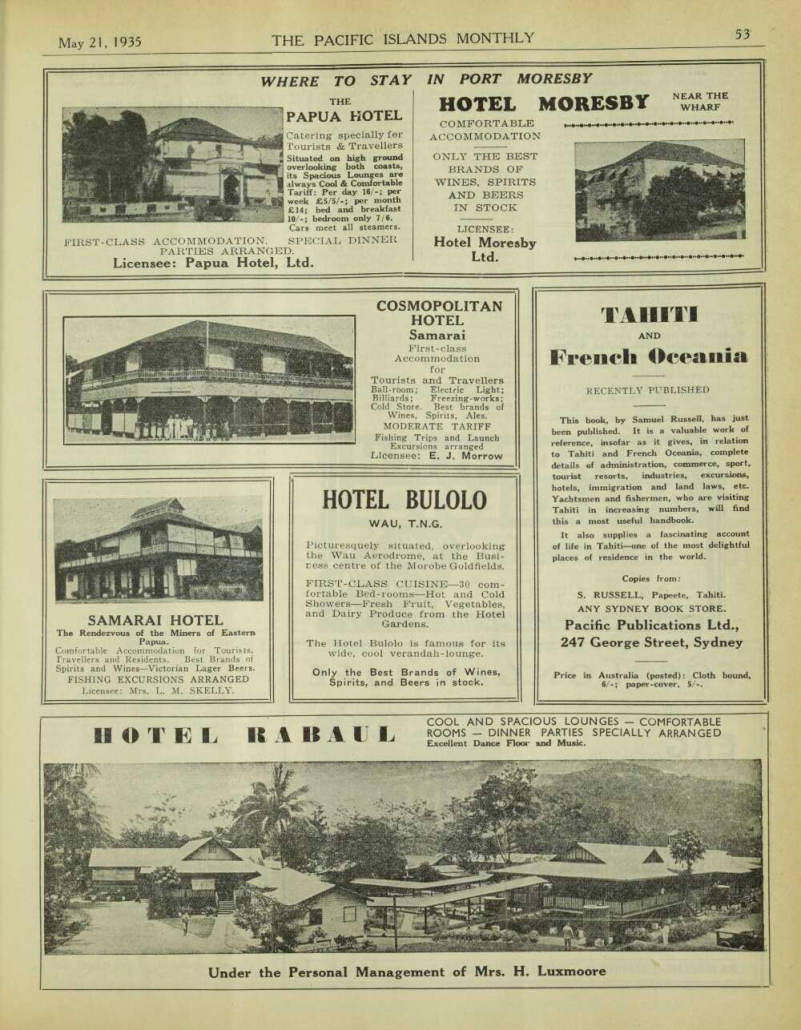
Shall We Return the German Colonies?
Letter to the Editor THE serious situation that may arise in the Pacific through the aspirations of a recreated Germany, so vividly expressed in the able article in your January issue, is worth of all the consideration that dwellers in this Territory can give it.
If it be accepted that the effect of the vote by the German nationals in the Saar Valley, for a return to full citizenship of their native land, will act as an inspiration to that country to re commence a programme of Empire building over seas, it is certainly time we began to think what can be done about it. An added incentive to do the right thing would be our acceptance as sincere of Hitler’s recent utterances to the effect that Ger man aims are all directed towards universal peace.
There may be pathos in the hysterical attitude of France, whose feelings of terror are engendered by propinquity and past experience. On the other hand, we have an arrogant Japan backed by an expensive navy. We must set our faces against all this kind of thing and approach the subject in a big hearted way.
Our recent action in wiping out an attempt by a German shipping line to establish themselves in these waters (because they would interfere with, our trade, forsooth!) can only create unfriendly feelings and convey an impression that any hint of German expansion will be bitterly resented by us.
Yet with a renewal of colonisation by Germany in the Pacific we must accept the fact that German shipping would follow as a national sequence.
But that need not concern us greatly for if, as the inference of your article suggests, we carry out this act of restitution and hand the Mandated Territory back to Germany, it would be unlikely that many of our nationals would remain in it, so that the necessity for British shipping lines would
practically disappear.
It is more or less upon this issue that the writer feels unable to go quite all the way with you. Even if we feel that the Mandate was thrust upon us in the first place and that we have really
no right to be here, it might be contended that we have done something towards the country’s de velopments, during the last 10 years, at any rate, and that we are due for some reward. To meet this contention, and as this letter is meant to be constructive, it is suggested that when this ques tion of colonisation is awakened in earnest —if it must be—Germany might be offered the return of the islands of New Britain and New Ireland and their surroundings as they stand to-day while we retain that portion of the mainland which we now occupy. It is submitted that, in this way, we would return to the Germans not only most of their lost territory but almost all of the value of the indemnity that they agreed to pay as well.
Their colonisation would be almost the same as it was after their previous 50 years’ occupancy and
our own conscience would be clear!
The position of this portion of the Territory then would be unique. It would have the agreeable distinction of being practically the only solvent and surplus producing State in the world—in fact there would be nothing to hold it back.
The whole question certainly merits the concen trated study of all those who have the interests and well being of all other nations—and our own, of course—at heart.
I am etc.,
Janus.
Wau
26th February, 1935.
EDITORIAL NOTE: While the argument in the article to which our correspondent refers was in favour of the return of the German colonies, we have expressed the opinion repeatedly that the restoration of the Pacific Islands (New Guinea, Marshalls and Carolines, Samoa) is not practical politics. Those islands are at the end of 10,000 miles of communications and are very difficult to defend. Germany can get full scope for her colonising genius, and a rich source of raw ma terials, by arranging the return of her former African territories.
At the third annual general meeting of the members of the Pacific Islands Asso ciation held on April 4 the following Council was elected;—Sir Hubert Murray (President). Sir J. Maynard Hedstrom (Vice-president), Hon. Alport Barker, M.L.C., Messrs. J. Colclough, J. W. Baldie, R. W. Robson, W. B. Rainsford, and G.
M. Rodger, Drs. W. L. Calov and C. C.
Simson, Rev. M. A. Warren and Capt. S.
G. Green.
Advertisements & other items, pp. 55-56 (1 item)
Hotel Bulolo
WHERE TO STAY IN PORT MORESBY
THE
PAPUA HOTEL
Catering specially for Tourists & Travellers Situated on high ground overlooking both coasts, its Spacious Lounges are always Cool & Comfortable Tariff: Per day 16/-; per week £5/5/-; per month £14; bed and breakfast 10/-; bedroom only 7/6.
Cars meet all steamers.
FIRST-CLASS ACCOMMODATION. SPECIAL DINNER
PARTIES ARRANGED.
Licensee: Papua Hotel, Ltd.
HOTEL MORESBY
COMFORTABLE
ACCOMMODATION
ONLY THE BEST
BRANDS OF
WINES, SPIRITS
AND BEERS
IN STOCK
LICENSEE:
Hotel Moresby
Ltd.
COSMOPOLITAN
HOTEL
Samarai
First-class Accommodation for Tourists and Travellers Ball-room; Electric Light; Billiards; Freezing-works; Cold Store. Best brands of Wines, Spirits, Ales.
MODERATE TARIFF
Fishing Trips and Launch Excursions arranged Licensee: E. J. Morrow
TAHITI
AND
French Oceania
RECENTLY PUBLISHED
This book, by Samuel Russell, has just been published. It is a valuable work of reference, insofar as it gives, in relation to Tahiti and French Oceania, complete details of administration, commerce, sport, tourist resorts, industries, excursions, hotels, immigration and land laws, etc.
Yachtsmen and fishermen, who are visiting Tahiti in increasing numbers, will find this a most useful handbook.
It also supplies a fascinating account of life in Tahiti—one of the most delightful places of residence in the world.
Copies from: S. RUSSELL, Papeete, Tahiti.
ANY SYDNEY BOOK STORE.
Pacific Publications Ltd.,
247 George Street, Sydney
Price in Australia (posted): Cloth bound, 6/-; paper-cover, 5/-.
HOTEL BULOLO
WAU, T.N.G.
Picturesquely situated, overlooking the Wau Aerodrome, at the Business centre of the Morobe Goldfields.
FIRST-CLASS CUISINE—30 com-
fortable Bed-rooms—Hot and Cold Showers—Fresh Fruit, Vegetables, and Dairy Produce from the Hotel Gardens.
The Hotel Bulolo is famous for its wide, cool verandah-lounge.
Only the Best Brands of Wines, Spirits, and Beers in stock.
SAMARAI HOTEL
The Rendezvous of the Miners of Eastern Papua.
Comfortable Accommodation for Tourists, Travellers and Residents. Best Brands of Spirits and Wines —Victorian Lager Beers.
FISHING EXCURSIONS ARRANGED
Licensee: Mrs. L. M. SKELLY.
HOTEL RABAUL
COOL AND SPACIOUS LOUNGES - COMFORTABLE
ROOMS - DINNER PARTIES SPECIALLY ARRANGED
Excellent Dance Floor and Music.
Under the Personal Management of Mrs. H. Luxmoore
Phone FX 3378 Phone FX 3378
BARRINGTON’S
DRIVE YOURSELF
SERVICE
Cars Hired without Drivers from 10/- per day; Tourers, 3d. per mile; Sedans, 4d. and sd. per mile. Our Fleet includes 1934 Dodge Sedans.
Write for Reservations, or 'phone when in city and we will deliver Car to your address.
243 ANZAC PARADE, SOUTH
KENSINGTON, N.S.W.
ISLAND HOME BUILDERS.-You can now
erect everlasting Homes quickly and at LOW COST by using DURABESTOS (Asbestos Cement) Building Sheets for Walls and Ceilings, Big, sturdy sheets —economical to transport — easy to fix—fireproof—does not need painting.
Write for prices and Free Catalogue, “Durabestos Homes of Colourful Beauty,” WUNDERLICH LTD..
Box 474 AA. G.P.O., SYDNEY.
RESISTS TIME-WEATHER-WHITE A
FOR LONGER LIFE
USE . . .
ERG
BATTERIES
FOR
CARS, TRUCKS, RADIO,
HOUSELIGHTING,
MARINE WORK,
MOTORCYCLES
If not represented in your district write direct to — ERG BATTERIES LTD. 156 Goulburn St., Sydney, N.S.W.
TO ELECTRICAL ENGINEERS MANUFACTURERS OF QUALITY BATTERIES
Rarotonga
Lord Baden-Powell
Banana-Leaf Banquet in Rarotonga
From Our Own Correspondent.
Rarotonga, April 16.
THE Chief Scout, Lord Baden-Powell, A accompanied by Lady Baden-Powell and their two daughters, passed through the Cook Islands last month on the Maun ganui. Local Girl Guides paraded for in spection on the L.M.S. grounds at Taka moa, where a number of European ex servicemen were also present. Afternoon tea followed, and the visitors then left for a native umukai, prepared by the Return ed Soldiers’ Association in the Osana Hall.
As the small soldierly figure appeared drums whirred, thumped and pounded. A statuesque, half-clad Rarotongan leaped forward, stamped the ground, advanced, shook like forty thousand jellies, and fell back among the spectators. Delighted, the Chief Scout took photos., and insisted on a repetition of the dance.
Received by Capt. J. D. Campbell, the party were then introduced to a bewilder ing array of Cook Island dishes served on banana leaves spread along the floor of the hall.
During the meal two large pearl-shell hooks were presented, the gift being made in a singularly apt speech of welcome by a local native. Replying, Lord Baden- Powell expressed the hope that on his next visit he would find not only Girl Guides, but also a troop of Boy Scouts on the is land.
Caroline
On South Seas Cruise
Douglas Fairbanks in Yacht Caroline
From Our Own Correspondent.
Suva, May 12.
ON an extensive cruise of the Pacific Islands, the motor yacht Caroline, owned by Mr. Johnson, of New York, ar rived in Suva Harbour, Fiji, on May 6.
On board was Mr. Douglas Fairbanks, the famous film actor, who has made and directed several motion pictures in con nection with the South Seas. His last visit to the Islands was to French Oceania to take part in the production of “Robin son Crusoe,” in which he played a lead ing role. On the present occasion, how ever, he devoted his time to fishing and the enjoyment of Islands sports.
Two women, the owner’s wife and Lady Ashley, were also passengers. When the latter’s husband sued her for divorce in London recently, Douglas Fairbanks was named as co-respondent.
Before reaching Fiji, the yacht voyaged through French Oceania, landing several screen stars at Papeete in mid-April.
From Tahiti the party cruised among the Society Islands, then sailed across to Pago Pago, American Samoa, where they spent several days.
After three days at Suva, the Caroline sailed for the Solomon Islands, Japan, China, and the East Indies, and finally will go to Southhampton, England.
Lance-Corporal J. H. M. Bower, of the Samoan Constabulary, was in New Zea land on furlough at the end of April.
Pioneer Planter Fears Native

Trouble
Letter to the Editor.
I READ with interest and sincere approval the letter by “Veri” in your issue of December last. It is in my opinion the soundest and most honest plea for a revision of the conditions under which managers, especially of isolated plantations, are suffering to-day, and have suffered ever since the inception of Civil Administration.
I am an Australian returned soldier with eighteen years of experience of handling native labour, with a good record; yet have to travel per boot 100 miles to take in witnesses, to say nothing of swimming several rivers to lay a com plaint against a native. The essence of punishment to a native is its promptness.
After days of delay on the road —weeks, if the rivers are up—the offence, to the native mind, is lost sight of; and often I have to parade the erring boy before a youth in the Administration who can scarcely speak Pidgin.
If the white man on the plantation is considered capable—as he is certainly held responsible—to doctor, ration, pay, generally look after and apportion work to his natives, he should be empowered to maintain discipline on the job, and he can’t do that without the aid of a cane.
The boys themselves prefer summary jus tice and were much happier under the old regime. They knew then where they stood. At present, they do not, as wit
ness the numerous cases of rape and indecent assault on white children and women. Five such cases were reported in a recent issue of the Rabaul Times.
Ten years’ imprisonment was given in some cases. Ten strokes on the tail ad ministered when the rot first set in would have prevented all this. In fact, there would have been no rot.
Often have I had boys, when bowled out in things they should not do (and knew they shouldn’t do) ask me to administer punishment and finish with it. I have done so, and realised the grave risk I was running. My contention is, there should be no risk in the perform ance of an essential, although distasteful task. Incidentally, the requests are made not from fear of calaboose —far from it! but swift retribution is native style, and that is all they understand, even with all our years of coddling.
After long years of pioneering in this country, which I like, and after planning to spend my old age here, I am really afraid of big native trouble in the near future, and I intend selling out when a fair price offers. I am aware my selling will not alter the Administration’s policy, but it will mean some other white man must face the grave issues I am tired of facing.
I am, etc.
Pioneer.
New Ireland, 22/2/35.
Distinguished Soldier
Visits Rarotonga
From Our Own Correspondent.
Rarotonga, April 19.
'Peripatetic Capt. A. J. Carfax-Foster paid us a final visit last month, and will return again by the Maunganui to Wellington, where he is at present in business. Capt. Foster formerly owned the “hoodoo” plantation of Arakuo, and later was connected with various activities in the Group.
Besides the M.C., M.M., and Croix de Guerre (2 palms), he holds the distin guished foreign decorations of Commander of the Redeemer (Greece) and Knight of the Sun and Eion (Persia). Second son of the late Sir Harry Graham Foster, Bt., he nearly succeeded to the title in 1931. He would have done so had not his elder brother relinquished American citizenship and returned to England.
Advertisements & other items, pp. 57-58 (1 item)
These Buzacott Lines must Interest You
DRIVE YOURSELF
during your stay
in Sydney
in a 1934 Model Sedan at 6d per mile. Minimum from 15/ per day.
Write or cable, and we will reserve a car for you. Free Service all over N.S.W., with advantages enjoyed by N.R.M.A. members.
Martin’s Drive Yourself
Service
191 WILLIAM ST., SYDNEY
F 1092.
These Buzacott Lines must Interest You
Illustrated is one of the
PETTER
Diesel and Semi-Diesel
ENGINES
They are available from 5 h.p. upwards.
These are unquestionably the best engines manufactured.
The "Digger” Winch is a one-man machine with tremendous pulling power.
Deep rooted stumps and trees are child’s play when it gets busy on them.
"Alston” Windmills
—the best and most economical of their kind made anywhere. Size and type to suit every requirement.
Buzacott Spray
Pumps
Reasonably priced constructed and absolutely reliable.
Buzacott Gates and
Fences
Products with a reputation for fine quality and thorough workmanship.
Also Chain Wire, all meshes and gauges, for Copra Trays.
The BUZACOTT
“New Record” Drag Saw
Saws through logs up to 7ft. in diameter. It can easily be handled by one man in almost any type of country, because it is mounted on two large, wide-tyred wheels. Operated by a Buzacott Engine, it is a utility aid to the user inasmuch as the power unit can be used for many other purposes. As supplied to New Guinea Administration, Lever Bros.
Pacific Plantations, and Bulolo Gold Mines Ltd.
For full explanatory literature for all these lines, write to
BUZACOTT & Co. Ltd.
7-11 MARKET STREET, SYDNEY, AUSTRALIA.
All- British
OBTAINABLE EVERYWHERE
AT POPULAR PRICES
BITUMENOID ROOFING
MADE IN AUSTRALIA
Bitumenoid Roofings, Dampcourses and Insulating Felts are made from the world’s best raw materials. Warranted to stand the most rigid tests.
BITUMENOID THE BEST
Roofing, 1,2, 3-ply; Flooring, Waterproof Materials; Saturated Felt; Resilient Road Jointing; Natural Asphalt Dampcourse; 2 and 3-ply Dampcourse; 1-21b. Lead-core Dampcourse; Roofing Cement; Asphalt Paints; Roofing Compound.
SAMPLES AND PRICE LISTS ON APPLICATION.
MAXWELL PORTER & SON LTD.
ESTABLISHED IMS. BUILDERS’ SUPPLIES
107 REDFERN ST., REDFERN, SYDNEY, N.S.W. ’Phone M 3157 Cables: Bitumenoid
Pacific Islands Association
Founded in 1931 to Advance the Interests of Residents of the Pacific; Assist Islands Trade; Provide Information to Tourists; and Promote the Welfare of the Native Races.
NATIONAL MUTUAL BUILDING, 350 GEORGE STREET, near G.P.O.
SYDNEY, AUSTRALIA Telephone: B 5067 Cable Address: “CERTAC,” Sydney.
All Pacific Islands residents visiting Sydney are invited to call and sign the Visitors’ Book kept at the Association’s office
CRAIGNATHAN— Private Hotel,
NEUTRAL BAY
SYDNEY
Situated right at Neutral Bay Wharf 15 minutes from
G.P.O.
IS AN IDEAL RESIDENCE FOR THE ISLAND VISITOR
TO SYDNEY.
Families specially catered for.
Swimming Baths — Tennis Billiards Boatsheds (Halvorsen’s).
Spacious Grounds FACING THE PICTURESQUE
HARBOUR.
Full Tariff from 10/- per day.
FULL INFORMATION AS TO TERMS, ETC., ON APPLICATION TO MANAGER.
Telegrams: “Craignathan,” Neutral Bay. ’Phone: X 2472
Tahiti’S Trade
Rises
Review of French Colony’s 1934 Statistics
From Our Own Correspondent.
PAPEETE, April 17.
THE 1934 trade statistics for French Oceania —published in the “Journal Officiel” of April 1, 1935 —show a consider able upward tendency in both imports and exports, particularly in the latter, which, with a total of 16,879,000 francs gives an increase of 2,126,000 francs over 1933. The total imports and exports amounted to 37,012,000 francs in 1934, which is 2,788,000 francs more than in 1933.
An examination of the returns discloses that the increase in exports is entirely ac counted for under the headings of copra and vanilla. Copra, which amounted to 17,920 tons valued at 7,893,000 francs in 1933, increased to 23,877 tons valued at 9,565,000 francs in 1934. The whole of the 1934 copra output went to France. Vanilla also showed an increase both in quantity and value, the respective figures being 52.9 tons valued at 793,000 francs in 1933 as against 103 tons valued at 2,280,000 francs in 1934.
Phosphate rock exports from the island
of Makatea showed a small decrease from 79,044 tons in 1933 to 77,470 tons in 1934.
Most of this rock was shipped to Japan.
Only 60 tons of mother-of-pearl shell were exported during 1934, the market for this commodity being in a stagnant condition.
M-O-P shell, copra and vanilla make up 91 per cent, of the value of all exports from the Colony. Included in the remain ing 9 per cent, are hides, bees-wax, beche de-mer, sweet potatoes, pearls, sugar, coffee, fungus, rum, and tobacco, all in negligible quantities.
As usual, the U.S.A. sold more goods to French Oceania during 1934 than any other country, American imports being worth 6,061,000 francs. France took second place with 5,143,000 francs. Australia and New Zealand together supplied 4,023,000 francs worth; China 2,426,000 francs (mostly sugar and soft goods); England 1,210,000 francs; and other countries 957,- 000 francs.
The French share of the import busi ness amounted to 25.54 per cent, and of the exports 68.85 per cent, the latter showing a constant increase since 1930 when it amounted to only 29.10 per cent.
This change has been brought about largely by the introduction of a bonus on copra shipped to France, and the in auguration of a regular service between France and Tahiti, via Panama, by Mes sagerie Maritimes steamers.
As anticipated in last year’s reports the transportation and re-export business, which amounted in 1933 to 13,233,000 francs dropped to 671,000 francs in 1934 owing to the complete cessation of the liquor traffic between Tahiti and Mexico.
Formerly, before the repeal of prohibition in America, the transhipment of liquor cargoes from Canada, Scotland and Europe was quite a lucrative business in Tahiti. The liquor was taken aboard tramp steamers, landed in Mexico and smuggled across the border into U.S.A.
A total of 68 vessels entered the Colony during 1934, with a total tonnage of 264,131. Of these 37 were British (144,211 tons), 19 French (67,427 tons), three American (25,309 tons), and the remain ing nine from other foreign countries (27,184 tons).
Trend Of Rubber
A London trade report published in mid-March expressed the opinion that the immediate outlook for the rubber grower continued adverse, and prospects did not appear so promising now that actual production from the principal pro ducing countries was known for another six months at least.
Mr. R. C. Laycock, a well-known plan ter and trader of Ysabel, Solomon Islands, returned to Tulagi in connection with his business interests by the Malaita on April 18. He intends to remain in the Group for about a year.
May Mean to Copra
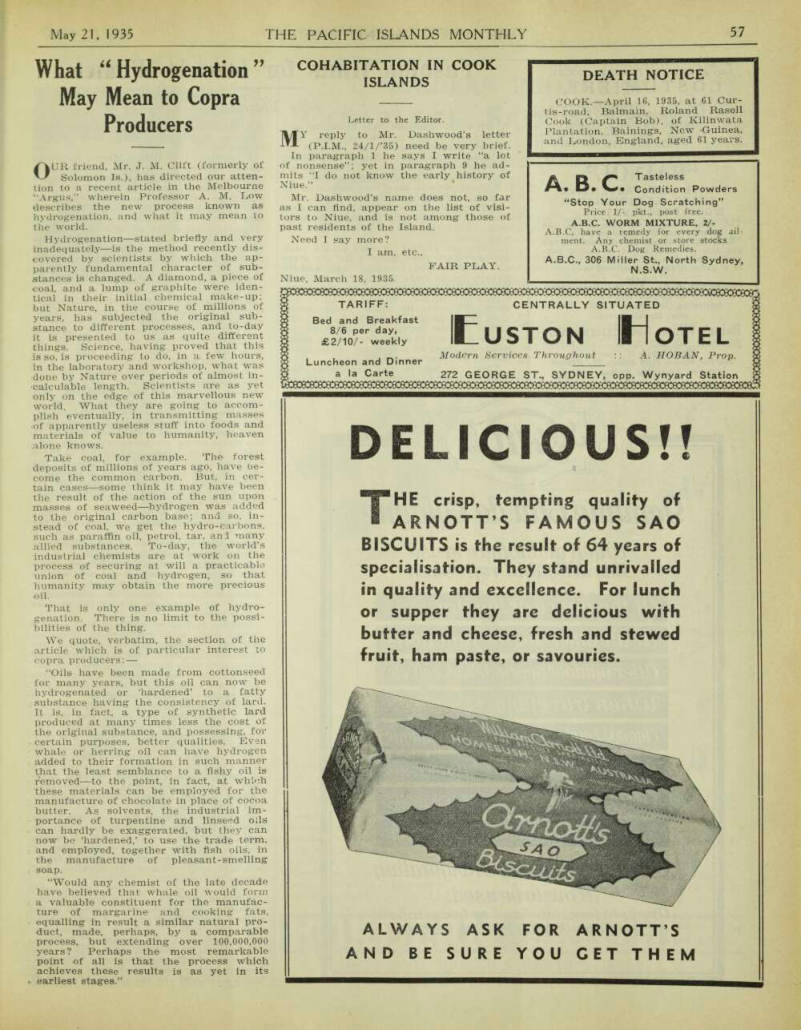
What “Hydrogenation”
May Mean to Copra Producers
OUR friend, Mr. J. M. Clift (formerly of Solomon Is.), has directed our atten tion to a recent article in the Melbourne "Argus,” wherein Professor A. M. Low describes the new process known as hydrogenation, and what it may mean to the world.
Hydrogenation—stated briefly and very inadequately—is the method recently dis covered by scientists by which the ap parently fundamental character of sub stances is changed. A diamond, a piece of coal, and a lump of graphite were iden tical in their initial chemical make-up; but Nature, in the course of millions of years, has subjected the original sub stance to different processes, and to-day it is presented to us as quite different things. Science, having proved that this is so, is proceeding to do, in a few hours, in the laboratory and workshop, what was done by Nature over periods of almost in calculable length. Scientists are as yet only on the edge of this marvellous new world. What they are going to accom plish eventually, in transmitting masses .of apparently useless stuff into foods and materials of value to humanity, heaven alone knows.
Take coal, for example. The forest deposits of millions of years ago, have be come the common carbon. But, in cer tain cases—some think it may have been the result of the action of the sun upon masses of seaweed —hydrogen was added to the original carbon base; and so, in stead of coal, we get the hydro-carbons, such as paraffin oil, petrol, tar, an! many allied substances. To-day, the world’s industrial chemists are at work on the process of securing at will a practicable union of coal and hydrogen, so that humanity may obtain the more precious oil.
That is only one example of hydro genation. There is no limit to the possi bilities of the thing.
We quote, verbatim, the section of the article which is of particular interest to copra producers: ‘‘Oils have been made from cottonseed for many years, but this oil can now be hydrogenated or ‘hardened’ to a fatty substance having the consistency of lard.
It is, in fact, a type of synthetic lard produced at many times less the cost of the original substance, and possessing, for certain purposes, better qualities. Even whale or herring oil can have hydrogen added to their formation in such manner that the least semblance to a fishy oil is removed —to the point, in fact, at which these materials can be employed for the manufacture of chocolate in place of cocoa butter. As solvents, the industrial im portance of turpentine and linseed oils can hardly be exaggerated, but they can now be ‘hardened,’ to use the trade term, and employed, together with fish oils, in the manufacture of pleasant-smelling soap.
“Would any chemist of the late decade have believed that whale oil would form a valuable constituent for the manufac ture of margarine and cooking fats, equalling in result a similar natural pro duct, made, perhaps, by a comparable process, but extending over 100,000,000 years? Perhaps the most remarkable point of all is that the process which achieves these results is as yet in its earliest stages.”
Cohabitation In Cook
Islands
Letter to the Editor.
MY reply to Mr. Dashwood’s letter (P.I.M., 24/1/’35) need be very brief.
In paragraph 1 he says I write “a lot of nonsense”; yet in paragraph 9 he ad mits ‘‘I do not know the early history of Niue.”
Mr. Dashwood’s name does not, so far as I can find, appear on the list of visi tors to Niue, and is not among those of past residents of the Island.
Need I say more?
I am, etc.,
Fair Play.
Niue, March 18, 1935
Advertisements & other items, pp. 59-60 (1 item)
Delicious!!
DEATH NOTICE
COOK—April 16, 1935, at 61 Curtis-road, Balmain, Roland Rasell Cook (Captain Bob), of Kilinwata Plantation, Bainings, New Guinea, and London, England, aged 61 years.
A.B.C.
Tasteless Condition Powders “Stop Your Dog Scratching”
Price 1/- pkt., post free.
A.B.C. WORM MIXTURE, 2/-
A.B.C. have a remedy for every dog ailment. Any chemist or store stocks A.B.C. Dog Remedies.
A.B.C., 306 Miller St., North Sydney,
N.S.W.
TARIFF: CENTRALLY SITUATED
Euston Hotel
. . Modern Services Throughout :: A. HOBAN, Prop.
Luncheon and Dinner a la Carte 272 GEORGE ST., SYDNEY, opp. Wynyard Station Bed and Breakfast 8/6 per day, £2/10/- weekly
DELICIOUS!!
THE crisp, tempting quality of
ARNOTT’S FAMOUS SAO
BISCUITS is the result of 64 years of specialisation. They stand unrivalled in quality and excellence. For lunch or supper they are delicious with butter and cheese, fresh and stewed fruit, ham paste, or savouries.
ALWAYS ASK FOR ARNOTT’S
AND BE SURE YOU GET THEM
Mrs. N. WALKER-FLYNN.
Late 35 POWELL STREET, COOGEE
COSTUMIERE,
MALAGUNA ROAD, RABAUL
HEMSTITCHING and PICOT EDGING.
Copies of Mab’s Fashions; Roma’s Pictorial Fashions and Home Fashions available. — P.O. Box 116. Tel.: 141.
“BAINOL”
WHITE ANT PREVENTIVE
BORER EXTERMINATOR
WOOD PRESERVATIVE
The most scientific preparation on the market for the above purposes “BAINOL” is packed in containers to suit any size job, and is sold in quarts, halfgallon, one-gallon and four-gallon tins, and in 45-gallon drums at a reduced rate.
Prices: Quarts 2/11, Gallons 7/11, 4-Gallons £1/6/3, 45 Gallons £13/4/2.
Australian Currency, F.O.B., Sydney Sole Manufacturers:
Bains’ White Ant Exterminator
BW 6462 CO. LTD. LM1025
Established 40 Years.
Scottish House, 17-19 Bridge St., Sydney Enquiries Regarding Agency Invited.
Genuine 6au de Cologne
When and where to use this delightful refresher.
At the dance or theatre At all other social functions After outdoor sports: tennis, golf, etc.
When traveling In bath and wash basin In illness and convalescence Cooling - Fragrant - Invigorating How to he used: Apply to face, forehead or body, inhale from handkerchief, spray in room.
Fashion Hints for Islands Women
By Therese
NEWS of the new hats comes to us— humorous and interesting news, that fills us with excitement. All sorts of in triguing designs are offered, and ribbon or flower trimmed or not trimmed at all, we hail them with exceeding delight.
Though crowns may soar skywards for evening, the light of day sees them flat ter than ever—almost crownless, if such could be, as shown by the Spanish influ ence. Very toreador-ish —bull fights and what nots.
Brims are pushed forward with a rush, and there are poke bonnets for the jeune fille of wide-eyed innocence and naivete.
Square fronts have sawn-off backs and brims rolled or twisted at the side, with a cock-a-hoop air. Sailors, small or me dium, are made in shiny black straw, with brims turned skywards. Pique bows, patent leather straps, and gaily striped bands trim the tailored hats, while pastel panamas revel in a glorious confusion of flowers of every variety.
There is joy in the knowledge that stitched taffeta, piques and linen hats are
still to be our friends, for they offer such infinite possibilities with their jaunty freshness.
Blue, since it is Queen Mary’s favourite colour, is well to the fore. A blue linen frock, with hat, bag, and gloves of deeper blue, is really charming, and if you are adventuresome try the same blue frock with pink accessories. You will be de lighted with the result.
Sports clothes are of extreme simplic ity, with skirts a little wider and a little fuller. Polished wooden buttons and buckles add distinction to this type of frock.
There is youthful charm, that is flatter ing about the little frocks of printed cot tons and silks in fast colours; frilled or smartly tailored without severity. They are all the heart could desire.
White, printed with blue spots, makes a most attractive frock, with its kerchief of blue tied cowl effect, with a knot at the back of the neck.
A pastel linen is worth considering with the drooping shoulder line forming the sleeves, buttons on the shoulders and, down the sides of the bodice, making it marvellously simple to slip in and out of- The neck is cut square, lower at the back than the front, and a vivid belt knotted at the waist forms the necessary colour con trast. A very cleyer combination of three colours —fashion’s newest whim —is the skirt of pale blue, topped by a blouse of faintest pink, and over all a lilac coat. It is a study in coolness, and offers infinite variety of accessories.
Finger length jackets lined with ma terial to match blouse or dress are the last word in chic. For tropical wear, a rather wide facing can be substituted for the full lining quite successfully.
A hip length mandarin-like jacket worn back to front buttons all the way up. Its slashed front and three-quarter sleeves reveal belt and blouse in contrasting shade. The hat falls in with the general colour scheme.
Stripes and spots aplenty! But stripes on the cross to be really chic. A cross over frock of green and white stripes, ties at throat and waist with perky kitten ear bows, and with its very low back, is ab solutely ideal beach wear. The addition of a short sleeved little bolero jacket and it is ready for varied occasions.
Delightful variations, not only in white but in pastel blues and pinks, play an im portant role in the wardrobe. A last sea son’s frock needs refurbishing; and hey presto! With all speed come intriguing little collars, interchangeable gillets, jabots that tie or button on, odds and ends of gaily coloured scarves to play their part in the scheme of things, whereby a limited income finds unlimited possibili ties by their magic aid.
Cartridge pleating for both day and evening is again sponsored, and lovely is the coat of green velvet with its raglan sleeves, cartridge pleated on shoulders and at wrist. A large squashy bow of crim son and gold adorns the neckline, and beauty is complete.
Skirts are skirts, purely and simply.
Plain and well cut, they lend dignity equally to the frivolous little blouse or its more sober tailored sister. A softly gath ered frill falls from neck to waistline, trims itself with the tiniest of buttons, “tinker, tailor” fashion, and makes the daintiest of afternoon blouses. Basqued blouses and waistcoats of linen, plain or Roman striped, are the smartest sporting
Wedding At Wau
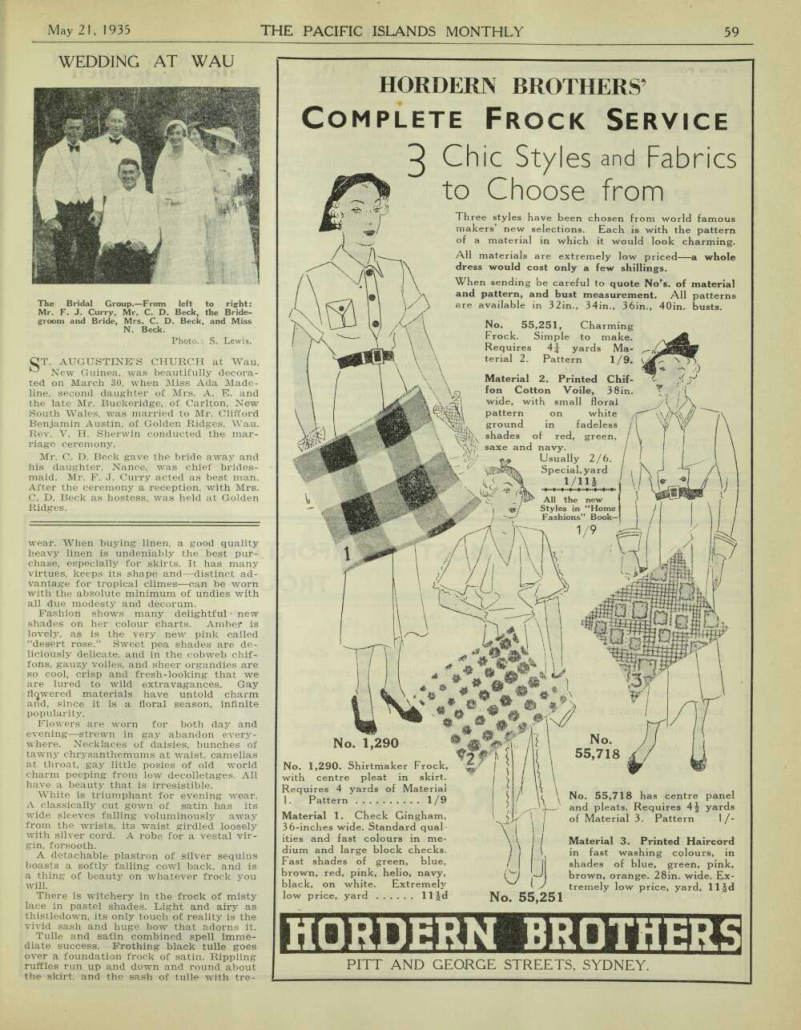
St. Augustine’S Church At Wau,
New Guinea, was beautifully decora ted on March 30, when Miss Ada Made line, second daughter of Mrs. A. E. and the late Mr. Buckeridge, of Carlton, New South Wales, was married to Mr. Clifford Benjamin Austin, of Golden Ridges, Wau.
Rev. V. H. Sherwin conducted the marriage ceremony.
Mr. C. D. Beck gave the bride away and his daughter, Nance, was chief brides maid. Mr. F. J. Curry acted as best man.
After the ceremony a reception, with Mrs.
C. D. Beck as hostess, was held at Golden Ridges. wear. When buying linen, a good quality heavy linen is undeniably the best pur chase, especially for skirts. It has many virtues, keeps its shape and —distinct ad vantage for tropical climes —can be worn with the absolute minimum of undies with all due modesty and decorum.
Fashion shows many delightful new shades on her colour charts. Amber is lovely, as is the very new pink called “desert rose.” Sweet pea shades are de liciously delicate, and in the cobweb chif fons, gauzy voiles, and sheer organdies are so cool, crisp and fresh-looking that we are lured to wild extravagances. Gay flowered materials have untold charm and, since it is a floral season, infinite popularity.
Flowers are worn for both day and evening—strewn in gay abandon every where. Necklaces of daisies, bunches of tawny chrysanthemums at waist, camelias at throat, gay little posies of old world charm peeping from low decolletages. All have a beauty that is irresistible.
White is triumphant for evening wear.
A classically cut gown of satin has its wide sleeves falling voluminously away from the wrists, its waist girdled loosely with silver cord. A robe for a vestal vir gin, forsooth.
A detachable plastron of silver sequins boasts a softly falling cowl back, and is a thing of beauty on whatever frock you will.
There is witchery in the frock of misty lace in pastel shades. Light and airy as thistledown, its only touch of reality is the vivid sash and huge bow that adorns it.
Tulle and satin combined spell imme diate success. Frothing black tulle goes over a foundation frock of satin. Rippling ruffles run up and down and round about the skirt, and the sash of tulle with tre
The Bridal Group.—From left to right: Mr. F. J. Curry, Mr. C. D. Beck, the Bride groom and Bride, Mrs. C. D. Beck, and Miss N. Beck.
Photo. : S. Lewis.
mendous bow, is caught on the hip with gleaming jewelled clip.
With an evening gown of crimson, huge ruffles of gathered tulle in brilliant green are slipped on just about the elbow. These ruffles are newer than sleeves, and offer tremendous scope for clever combinations.
A gold belt and gold slippers lift a black frock to dizzy heights.
Saris, Eastern-princess fashion cleverly modulated, are causing a sensation abroad.
This fascinating mode can be emulated by a cleverly arranged detachable scarf of immense width, that drapes over the head and falls in soft folds at the side.
Puffed sleeves, wide belts, bouffant skirts are in league to make waists slim mer than ever, and are very feminine in their appeal.
Charming gowns for informal evening wear, are made on shirtmaker lines, reaching to the toes, and depending on gay buttons and vivid belt or sash for their festive air.
Buttons, buckles and clips in the new composition “prystal,” a glass of delicious dullness, are a welcome change from the crystal and brilliant ornaments that have enslaved us for many seasons.
Slumber wear is more entrancing than ever. Cut on the cross and evolved in shimmering satin, nighties are scarcely distinguishable from evening gowns.
There is an ingenious new strapless brassiere on the market, guaranteed to stay up without assistance —a boon, since the off-the-shoulder mode still persists for evening wear. Its delightful twin, the pan tie girdle, is a marvellous foundation gar ment that eliminates all unnecessary bulk and gives the sleek, svelte line that spells success to both sophistication and sim plicity in modern clothes.
Advertisements & other items, pp. 61-62 (1 item)
Complete Frock Service
HORDERN BROTHERS’
Chic Styles and Fabrics
to Choose from
Three styles have been chosen from world famous makers new selections. Each is with the pattern of a material in which it would look charming.
All materials are extremely low priced a whole dress would cost only a few shillings. n sending be careful to quote No’s, of material pattern, and bust measurement. All patterns available in 32in., 34in., 36in., 40in. busts.
No. 55,251, Charming Frock. Simple to make.
Requires 4¼ yards Material 2. Pattern 1/9.
Material 2. Printed Chiffon Cotton Voile, 38in. wide, with small floral pattern on white ground in fadeless shades of red, green, saxe and navy.
Usually 2/6.
Special, yard All the new Styles in “Home Fashions” Book- When sending be careful to quote No's. of material and pattern, and bust measurement. All patterns are available in 32in., 34in., 36., 40in. busts.
No. 1,290 No. 55,251 Charming No. 55,718 No. 1,290. Shirtmaker Frock, with centre pleat in skirt.
Requires 4 yards of Material 1. Pattern 1/9 Material 1. Check Gingham, 36-inches wide. Standard qualities and fast colours in medium and large block checks.
Fast shades of green, blue, brown, red, pink, helio, navy, black, on white. Extremely low price, yard 11½d
PITT AND GEORGE STREETS, SYDNEY.
No. 55,718 has centre panel and pleats. Requires yards of Material 3. Pattern 1/- Material 3. Printed Haircord in fast washing colours, in shades of blue, green, pink, brown, orange. 28in. wide. Extremely low price, yard, 11½d
GILLESPIE’S
“ANCHOR”
FLOUR
TRADE
MARK
The Standard of Quality.
THE SMARTEST, MOST COMFORTABLE TROUSERS
They just button on
No belts, no side straps
See how smoothly Gripu Trousers fit. The patented and guaranteed elastic waistband sets to any required tension. One button adjusts it to your comfort. Gripus are never too tight or too slack. They are resilient, and they hold the shirt neatly down. Worn by the world’s greatest tennis and cricket stars. Gripu Trousers are ideal for sport. They are ideal, too, for tropical wear. Ask your outfitter for Gripu Trousers . . . Creams and Coloured Flannels are available.
GRIPU TROUSERS
Gripu Trousers are one of the special Challenge lines. The Challenge range includes all men’s wear as well as Blankets, Sheets, Pillowcases and British Chief and Murralta all-purpose summer fashions. See the samples on display by our representative during his regular island trip.
WHOLESALE DISTRIBUTORS
D. & W. MURRAY, LTD., SYDNEY
Cook Is.
After 15 Years In
Mr. E. H. Townsend Returns to New Zealand
From Our Own Correspondent.
Rarotonga, April 20.
RETURNING to Head Office after more than 15 years in Polynesia, Mr. E. H.
Townsend will leave for New Zealand with his family by the Maunganui on April 23.
Arriving in Rarotonga in 1920, he ad vanced rapidly through all the successive stages, from junior assistant to manager of Messrs. A. B. Donald and Co.’s main store here. He assumed the managership on the retirement of Mr. E. J. Matthews, in 1927.
Taking over at the peak of the boom, Mr. Townsend has had the difficult task of steering a large concern, built up on a tradition of prosperity and “good times,” through a period of unprecedented de pression. That he accomplished this suc cessfully merits the warmest admiration for his commercial stamina.
Cultured and artistic, his departure fur ther impoverishes Rarotonga’s social circle. As a former president of the local tennis club and captain of the cricket team, he will be equally missed in sport ing circles.
Twice married, Mr. Townsend’s present wife is a daughter of Mr. R. M. Forester, until recently manager of the Cook Island branch of W. H. Grove and Sons, Ltd., of Auckland, N.Z.
Housekeeping in the Tropics
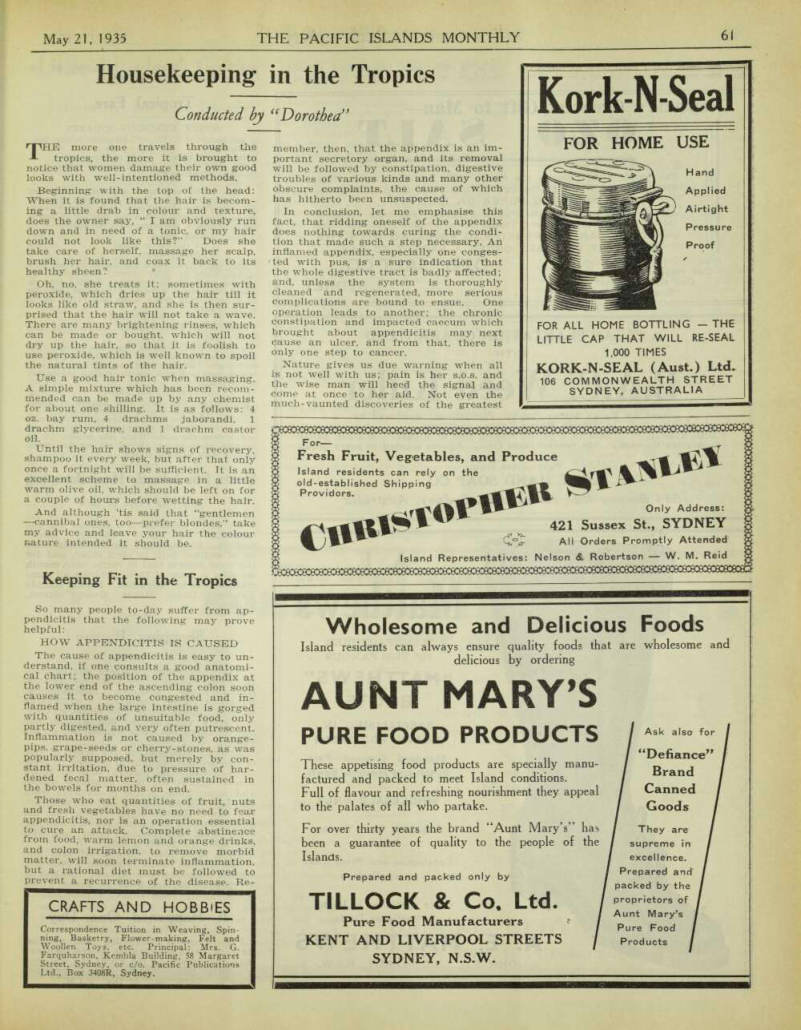
Conducted by “Dorothea”
THE more one travels through the tropics, the more it is brought to notice that women damage their own good looks with well-intentioned methods.
Beginning with the top of the head: When it is found that the hair is becom ing a little drab in colour and texture, does the owner say, “ I am obviously run down and in need of a tonic, or my hair could not look like this?” Does she take care of herself, massage her scalp, brush her hair, and coax it back to its healthy sheen?
Oh, no, she treats it; sometimes with peroxide, which dries up the hair till it looks like old straw, and she is then sur prised that the hair will not take a wave.
There are many brightening rinses, which can be made or bought, which will not dry up the hair, so that it is foolish to use peroxide, which is well known to spoil the natural tints of the hair.
Use a good hair tonic when massaging.
A simple mixture which has been recom mended can be made up by any chemist for about one shilling. It is as follows: 4 oz. bay rum, 4 drachms jaborandi, 1 drachm glycerine, and 1 drachm castor oil.
Until the hair shows signs of recovery, shampoo it every week, but after that only once a fortnight will be sufficient. It is an excellent scheme to massage in a little warm olive oil, which should be left on for a couple of hours before wetting the hair.
And although ’tis said that ‘‘gentlemen —cannibal ones, too —prefer blondes,” take my advice and leave your hair the colour nature intended it should be.
Keeping Fit in the Tropics
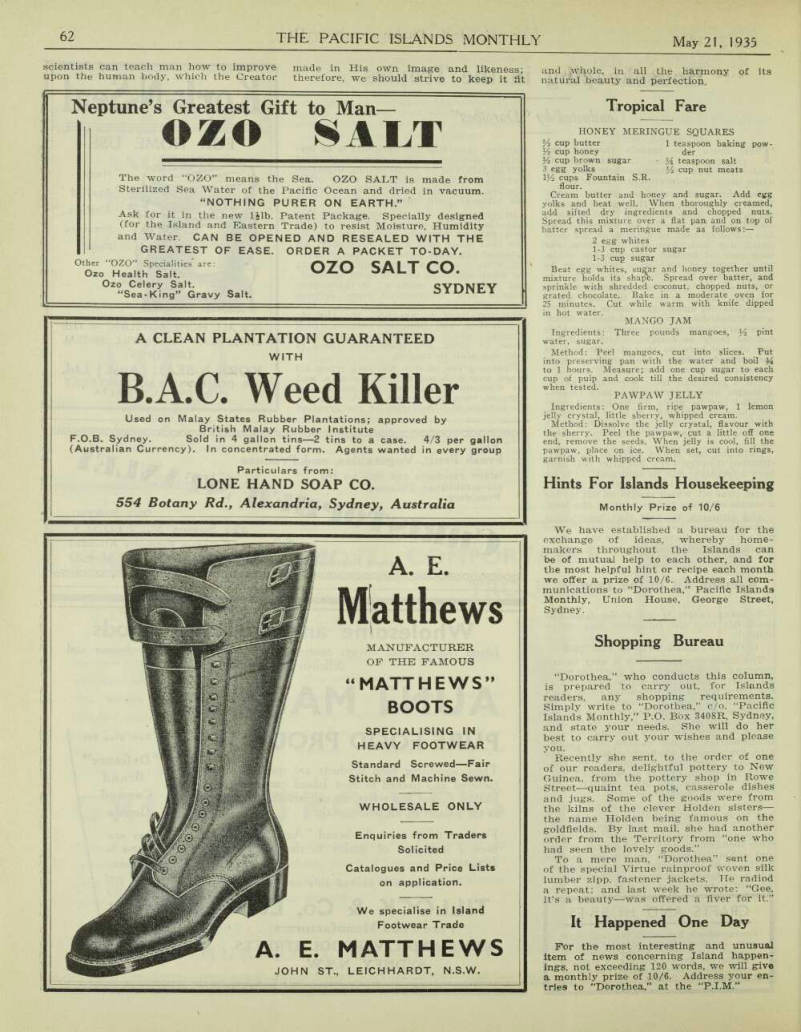
So many people to-day suffer from ap pendicitis that the following may prove helpful:
How Appendicitis Is Caused
The cause of appendicitis is easy to un derstand, if one consults a good anatomi cal chart; the position of the appendix at the lower end of the ascending colon soon causes it to become congested and in flamed when the large intestine is gorged with quantities of unsuitable food, only partly digested, and very often putrescent.
Inflammation is not caused by orange pips, grape-seeds or cherry-stones, as was popularly supposed, but merely by con stant irritation, due to pressure of har dened fecal matter, often sustained in the bowels for months on end.
Those who eat quantities of fruit, nuts and fresh vegetables have no need to fear appendicitis, nor is an operation essential to cure an attack. Complete abstinence from food, warm lemon and orange drinks, and colon irrigation, to remove morbid matter, will soon terminate inflammation, but a rational diet must be followed to prevent a recurrence of the disease. Re
member, then, that the appendix is an im portant secretory organ, and its removal will be followed by constipation, digestive troubles of various kinds and many other obscure complaints, the cause of which has hitherto been unsuspected.
In conclusion, let me emphasise this fact, that ridding oneself of the appendix does nothing towards curing the condi tion that made such a step necessary. An inflamed appendix, especially one conges ted with pus, is a sure indication that the whole digestive tract is badly affected; and, unless the system is thoroughly cleaned and regenerated, more serious complications are bound to ensue. One operation leads to another; the chronic constipation and impacted caecum which brought about appendicitis may next cause an ulcer, and from that, there is only one step to cancer.
Nature gives us due warning when all is not well with us; pain is her s.o.s. and the wise man will heed the signal and come at once to her aid. Not even the much-vaunted discoveries of the greatest
scientists can teach man how to improve upon the human body, which the Creator
made in His own image and likeness; therefore, we should strive to keep it fit
and whole, in all the harmony of its natural beauty and perfection.
Advertisements & other items, pp. 63-64 (1 item)
Kork-N-Seal
FOR ALL HOME BOTTLING - THE
LITTLE CAP THAT WILL RE-SEAL
1,000 TIMES
KORK-N-SEAL (Aust.) Ltd.
106 COMMONWEALTH STREET
SYDNEY, AUSTRALIA
FOR HOME USE
Applied Airtight Pressure Hand Proof
For— Fresh Fruit, Vegetables, and Produce Island residents can rely on the old-established Shipping Providers.
Island Representatives: Nelson & Robertson — W. M. Reid Only Address: 421 Sussex St., SYDNEY All Orders Promptly Attended
Wholesome and Delicious Foods
Island residents can always ensure quality foods that are wholesome and delicious by ordering
AUNT MARY’S
PURE FOOD PRODUCTS
These appetising food products are specially manufactured and packed to meet Island conditions.
Full of flavour and refreshing nourishment they appeal to the palates of all who partake.
For over thirty years the brand “Aunt Mary’s” has been a guarantee of quality to the people of the Islands.
Prepared and packed only by
TILLOCK & Co. Ltd.
Pure Food Manufacturers
KENT AND LIVERPOOL STREETS
SYDNEY, N.S.W.
Ask also for "Defiance”
Brand Canned Goods They are supreme in excellence.
Prepared and packed by the proprietors of Aunt Mary’s Pure Food Products
CRAFTS AND HOBBIES
Correspondence Tuition in Weaving, Spinning, Basketry, Flower-making, Felt and Woollen Toys, etc. Principal: Mrs. G.
Farquharson, Kembla Building, 58 Margaret Street, Sydney, or c/o. Pacific Publications Ltd., Box 3408R, Sydney.
Neptune’s Greatest Gift to Man—
OZO SALT
The word “OZO” means the Sea. OZO SALT is made from Sterilized Sea Water of the Pacific Ocean and dried in vacuum.
“NOTHING PURER ON EARTH.”
Ask for it in the new Patent Package. Specially designed (for the Island and Eastern Trade) to resist Moisture, Humidity and Water. CAN BE OPENED AND RESEALED WITH THE GREATEST OF EASE. ORDER A PACKET TO-DAY.
Other “OZO” Specialities are: Ozo Health Salt.
Ozo Celery Salt.
“Sea-King” Gravy Salt.
OZO SALT CO.
SYDNEY
A CLEAN PLANTATION GUARANTEED
WITH
B.A.C. Weed Killer
Used on Malay States Rubber Plantations; approved by British Malay Rubber Institute F.O.B. Sydney. Sold in 4 gallon tins —2 tins to a case. 4/3 per gallon (Australian Currency). In concentrated form. Agents wanted in every group Particulars from:
LONE HAND SOAP CO.
554 Botany Rd., Alexandria, Sydney, Australia
A. E.
Matthews
MANUFACTURER
OF THE FAMOUS
“MATTHEWS”
BOOTS
SPECIALISING IN
HEAVY FOOTWEAR
Standard Screwed—Fair Stitch and Machine Sewn.
WHOLESALE ONLY
Enquiries from Traders Solicited Catalogues and Price Lists on application.
We specialise in Island Footwear Trade
MATTHEWS
JOHN ST., LEICHHARDT, N.S.W.
Tropical Fare
Honey Meringue Squares
½ cup butter 1 teaspoon baking powder ½ cup honey ½ cup brown sugar ¼ teaspoon salt 3 egg yolks ½ cup nut meats 1½ cups Fountain S.R. flour.
Cream butter and honey and sugar. Add egg yolks and beat well. When thoroughly creamed, add sifted dry ingredients and chopped nuts.
Spread this mixture over a flat pan and on top of batter spread a meringue made as follows: 2 egg whites 1-3 cup castor sugar 1-3 cup sugar Beat egg whites, sugar and honey together until mixture holds its shape. Spread over batter, and sprinkle with shredded coconut, chopped nuts, or grated chocolate. Bake in a moderate oven for 25 minutes. Cut while warm with knife dipped in hot water.
Mango Jam
Ingredients: Three pounds mangoes, ½ pint water, sugar.
Method: Peel mangoes, cut into slices. Put into preserving pan with the water and boil to 1 hours. Measure; add one cup sugar to each cup of pulp and cook till the desired consistency when tested.
Pawpaw Jelly
Ingredients: One firm, ripe pawpaw, 1 lemon jelly crystal, little sherry, whipped cream.
Method: Dissolve the jelly crystal, flavour with the sherry. Peel the pawpaw, cut a little off one end, remove the seeds. When jelly is cool, fill the pawpaw, place on ice. When set, cut into rings, garnish with whipped cream.
Hints For Islands Housekeeping
Monthly Prize of 10/6 We have established a bureau for the exchange of ideas, whereby home makers throughout the Islands can be of mutual help to each other, and for the most helpful hint or recipe each month we offer a prize of 10/6. Address all com munications to “Dorothea,” Pacific Islands Monthly, Union House, George Street, Sydney.
Shopping Bureau
“Dorothea,” who conducts this column, is prepared to carry out, for Islands readers, any shopping requirements.
Simply write to “Dorothea,” c/o. “Pacific Islands Monthly,” P.O. Box 3408R, Sydney, and state your needs. She will do her best to carry out your wishes and please you.
Recently she sent, to the order of one of our readers, delightful pottery to New Guinea, from the pottery shop in Rowe Street —quaint tea pots, casserole dishes and jugs. Some of the goods were from the kilns of the clever Holden sisters — the name Holden being famous on the goldfields. By last mail, she had another order from the Territory from “one who had seen the lovely goods.”
To a mere man, “Dorothea” sent one of the special Virtue rainproof woven silk lumber zipp. fastener jackets. He radiod a repeat; and last week he wrote: “Gee, it’s a beauty—was offered a fiver for it.”
It Happened One Day
For the most interesting and unusual item of news concerning Island happen ings, not exceeding 120 words, we will give a monthly prize of 10/6. Address your en tries to "Dorothea,” at the "P.I.M.”
Little Islanders’ Corner
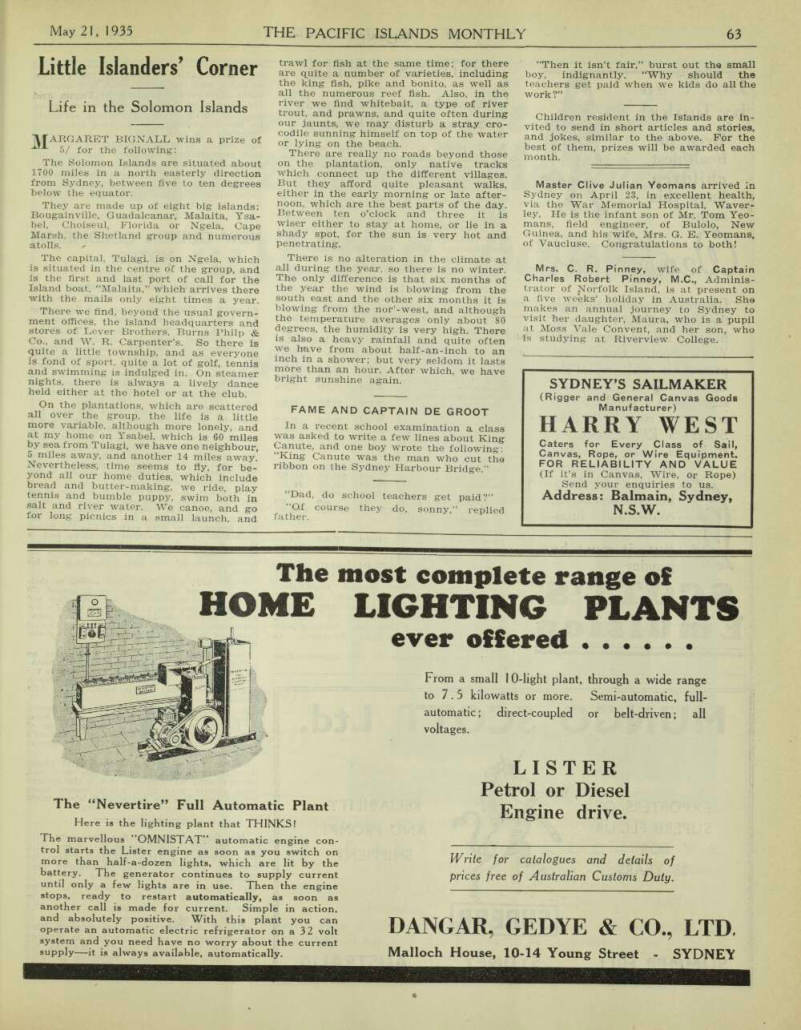
Life in the Solomon Islands
MARGARET BIGNALL wins a prize of 5/ for the following: The Solomon Islands are situated about 1700 miles in a north easterly direction from Sydney, between five to ten degrees below the equator.
They are made up of eight big islands: Bougainville, Guadalcanar, Malaita, Ysa bel, Choiseul, Florida or Ngela, Cape Marsh, the Shetland group and numerous atolls.
The capital, Tulagi, is on Ngela, which is situated in the centre of the group, and is the first and last port of call for the Island boat, “Malaita,” which arrives there with the mails only eight times a year.
There we find, beyond the usual govern ment offices, the island headquarters and stores of Lever Brothers, Burns Philp & Co., and W, R. Carpenter’s. So there is quite a little township, and as everyone is fond of sport, quite a lot of golf, tennis and swimming is indulged in. On steamer nights, there is always a lively dance held either at the hotel or at the club.
On the plantations, which are scattered all over the group, the life is a little more variable, although more lonely, and at my home on Ysabel, which is 60 miles by sea from Tulagi, we have one neighbour, 5 miles away, and another 14 miles away.
Nevertheless, time seems to fly, for be yond all our home duties, which include bread and butter-making, we ride, play tennis and bumble puppy, swim both in salt and river water. We canoe, and go for long picnics in a small launch, and
trawl for fish at the same time; for there are quite a number of varieties, including the king fish, pike and bonito, as well as all the numerous reef fish. Also, in the river we find whitebait, a type of river trout, and prawns, and quite often during our jaunts, we may disturb a stray cro codile sunning himself on top of the water or lying on the beach.
There are really no roads beyond those on the plantation, only native tracks which connect up the different villages.
But they afford quite pleasant walks, either in the early morning or late after noon, which are the best parts of the day.
Between ten o’clock and three it is wiser either to stay at home, or lie in a shady spot, for the sun is very hot and penetrating.
There is no alteration in the climate at all during the year, so there is no winter.
The only difference is that six months of the year the wind is blowing from the south east and the other six months it is blowing from the nor’-west, and although the temperature averages only about 80 degrees, the humidity is very high. There is also a heavy rainfall and quite often we have from about half-an-inch to an inch in a shower; but very seldom it lasts more than an hour. After which, we have bright sunshine again.
Fame And Captain De Groot
In a recent school examination a class was asked to write a few lines about King Canute, and one boy wrote the following: “King Canute was the man who cut the ribbon on the Sydney Harbour Bridge.”
“Dad, do school teachers get paid?”
“Of course they do, sonny,” replied father.
“Then it isn’t fair,” burst out the small boy, indignantly. “Why should the teachers get paid when we kids do all the work?”
Children resident in the Islands are in vited to send in short articles and stories, and jokes, similar to the above. For the best of them, prizes will be awarded each month.
Master Clive Julian Yeomans arrived in Sydney on April 23, in excellent health, via the War Memorial Hospital, Waver ley. He is the infant son of Mr. Tom Yeo mans, field engineer, of Bulolo, New Guinea, and his wife, Mrs. G. E. Yeomans, of Vaucluse. Congratulations to both!
Mrs. C. R. Finney, wife of Captain Charles Robert Finney, M.C., Adminis trator of Norfolk Island, is at present on a five weeks’ holiday in Australia. She makes an annual journey to Sydney to visit her daughter, Maura, who is a pupil at Moss Vale Convent, and her son, who is studying at Riverview College.
Advertisements & other items, pp. 65-66 (1 item)
Home Lighting Plants
SYDNEY’S SAILMAKER
(Rigger and General Canvas Goods Manufacturer)
HARRY WEST
Caters for Every Class of Sail, Canvas, Rope, or Wire Equipment.
FOR RELIABILITY AND VALUE
(If it’s in Canvas, Wire, or Rope) Send your enquiries to us.
Address: Balmain, Sydney,
N.S.W.
The most complete range of
HOME LIGHTING PLANTS
ever offered
The “Nevertire” Full Automatic Plant Here is the lighting plant that THINKS!
From a small 10-light plant, through a wide range to 7.3 kilowatts or more. Semi-automatic, fullautomatic ; direct-coupled or belt-driven; all voltages.
LISTER
Petrol or Diesel
Engine drive.
The marvellous "OMNISTAT” automatic engine control starts the Lister engine as soon as you switch on more than half-a-dozen lights, which are lit by the battery. The generator continues to supply current until only a few lights are in use. Then the engine stops, ready to restart automatically, as soon as another call is made for current. Simple in action, and absolutely positive. With this plant you can operate an automatic electric refrigerator on a 32 volt system and you need have no worry about the current supply it is always available, automatically.
Write for catalogues and details of prices free of Australian Customs Duty.
DANGAR, GEDYE & CO., LTD.
Malloch House, 10-14 Young Street - SYDNEY
Don’t go
by looks!
Even the healthiest children have this same weak spot Disease germs enter through the tissues of the throat and lungs. This is your child’s Weak Spot. Guard and protect it with SCOTT’S
EMULSION. Nothing
strengthens a child’s resistance more completely than
SCOTT’S EMULSION.
It builds body, bone and blood. It ensures vitality. It defin-
itely resists coughs,
colds and bronchitis.
But, it must be
genuine
SCOTT’S
Emulsion
advt
Burns, Philp
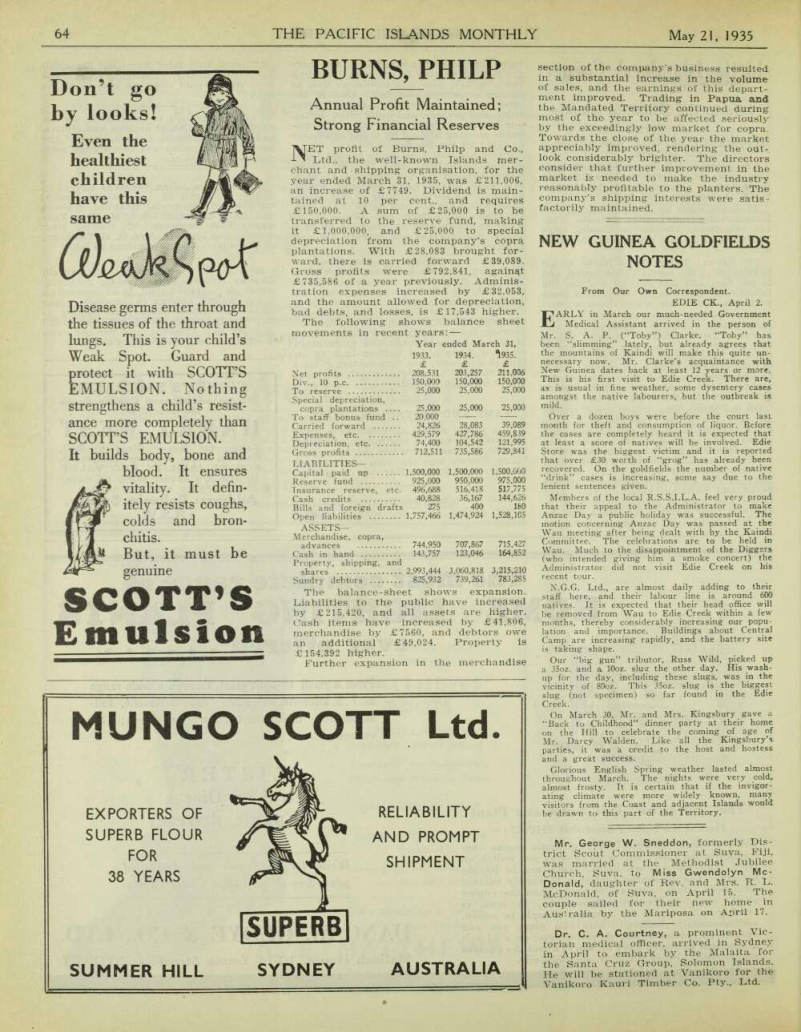
Annual Profit Maintained;
Strong Financial Reserves
NET profit of Burns, Philp and Co., Ltd., the well-known Islands mer chant and shipping organisation, for the year ended March 31, 1935, was £211,006, an increase of £7749. Dividend is main tained at 10 per cent., and requires £150,000. A sum of £25,000 is to be transferred to the reserve fund, making it £1,000,000, and £25,000 to special depreciation from the company’s copra plantations. With £28,083 brought for ward, there is carried forward £39,089.
Gross profits were £792,841, against £735,586 of a year previously. Adminis tration expenses increased by £32,053, and the amount allowed for depreciation, bad debts, and losses, is £17,543 higher.
The following shows balance sheet movements in recent years:
section of the company’s business resulted in a substantial increase in the volume of sales, and the earnings of this depart ment improved. Trading in Papua and the Mandated Territory continued during most of the year to be affected seriously by the exceedingly low market for copra.
Towards the close of the year the market appreciably improved, rendering the out look considerably brighter. The directors consider that further improvement in the market is needed to make the industry reasonably profitable to the planters. The company’s shipping interests were satis factorily maintained.
Year ended March 31, 1933. £ 1934. £ 1935 £ Net profits 208,531 203,257 211,006 Div., 10 p.c 150,000 150,000 150,000 To reserve 25,000 25,000 25,000 Special depreciation, copra plantations 25,000 25,000 25,000 To staff bonus fund 20,000 — — Carried forward 24,826 28,083 39,089 Expenses, etc 429,579 427,786 459,859 Depreciation, etc. 74.400 104,542 121,995 Gross profits 712,511 735,586 729,841
Liabilities—
Capital paid up 1,500,000 1,500,000 1,500,000 Reserve fund 925,000 950,000 975,000 Insurance reserve, etc. 496,688 516,418 517,775 Cash credits 40,828 36,167 144,626 Bills and foreign drafts 275 400 180 Open liabilities 1,757,466 1,474,924 1,528,105
Assets—
Merchandise, copra, advances 744,950 707,867 715,427 Cash in hand 143,757 123,046 164,852 Property, shipping, and shares 2,993,444 3,060,818 3,215,210 Sundry debtors ... 825,932 739,261 783,285 The balance-sheet shows expansion.
Liabilities to the public have increased by £215,420, and all assets are higher.
Cash items have increased by £41,806, merchandise by £7560, and debtors owe an additional £49,024. Property is £ 154.392 higher.
Further expansion in the merchandise
New Guinea Goldfields
Notes
From Our Own Correspondent.
EDIE CK., April 2.
EARLY in March our much-needed Government Medical Assistant arrived in the person of Mr. S. A. P. (“Toby”) Clarke. “Toby” has been “slimming” lately, but already agrees that the mountains of Kaindi will make this quite un necessary now. Mr. Clarke’s acquaintance with New Guinea dates back at least 12 years or more.
This is his first visit to Edie Creek. There are, as is usual in fine weather, some dysentery cases amongst the native labourers, but the outbreak is mild.
Over a dozen boys were before the court last month for theft and consumption of liquor. Before the cases are completely heard it is expected that at least a score of natives will be involved. Edie Store was the biggest victim and it is reported that over £30 worth of “grog” has already been recovered. On the goldfields the number of native “drink” cases is increasing, some say due to the lenient sentences given.
Members of the local R.S.S.I.L.A. feel very proud that their appeal to the Administrator to make Anzac Day a public holiday was successful. The motion concerning Anzac Day was passed at the Wau meeting after being dealt with by the Kaindi Committee. The celebrations are to be held in Wau. Much to the disappointment of the Diggers (who intended giving him a smoke concert) the Administrator did not visit Edie Creek on his recent tour.
N.G.G. Ltd., are almost daily adding to their staff here, and their labour line is around 600 natives. It is expected that their head office will be removed from Wau to Edie Creek within a few months, thereby considerably increasing our popu lation and importance. Buildings about Central Camp are increasing rapidly, and the battery site is taking shape.
Our “big gun” tributor, Russ Wild, picked up a 35oz. and a 10oz. slug the other day. His washup for the day, including these slugs, was in the vicinity of 80oz. This 35oz. slug is the biggest slug (not specimen) so far found in the Edie Creek.
On March 30, Mr. and Mrs. Kingsbury gave a “Back to Childhood” dinner party at their home on the Hill to celebrate the coming of age of Mr. Darcy Walden. Like all the Kingsbury’s parties, it was a credit to the host and hostess and a great success.
Glorious English Spring weather lasted almost throughout March. The nights were very cold, almost frosty. It is certain that if the invigor ating climate were more widely known, many visitors from the Coast and adjacent Islands would be drawn to this part of the Territory.
Mr. George W. Sneddon, formerly Dis trict Scout Commissioner at Suva, Fiji, was married at the Methodist Jubilee Church, Suva, to Miss Gwendolyn Mc- Donald, daughter of Rev. and Mrs. R. L.
McDonald, of Suva, on April 15. The couple sailed for their new home in Australia by the Mariposa on April 17.
Dr. C. A. Courtney, a prominent Vic torian medical officer, arrived in Sydney in April to embark by the Malaita for the Santa Cruz Group, Solomon Islands.
He will be stationed at Vanikoro for the Vanikoro Kauri Timber Co. Pty., Ltd.
Advertisements & other items, pp. 67-68 (1 item)
Economy —Sensitivity
TESTIMONIAL FROM N.L.N.,
CLUB HOTEL, DARWIN, N.T.,
dated 2/4/'35.
“A few lines in respect to your Wireless Sets. I myself have one of your Sets installed here in the Billiard Saloon—a 7-Valve All-Wave, and it is the only Set here in Darwin that gives results. They have various kinds of Sets here, but none of them work to satisfaction.
“I have different people coming here listening in and all are surprised as to the result—it is absolutely the best here.”
Economy —Sensitivity
Tone —Reliability
Performance . . . .
DESIGNED AND MANUFACTURED SOLELY FOR TROPIC CONDITIONS
KRIESLER BATTERY ALL-WAVE
The Super 7 Valve —or the New 5 Valve —All Wave
THE BEST SET AT ANY PRICE
Address: KRIESLER A/ASIA, LTD., Myrtle, Pine & Beaumont Sts., Chippendale. ’Phone M 4391-2 AGENTS & DISTRIBUTORS IN ALL STATES. DISTRICTS STILL OPEN Sole Distributors for Queensland: KRIESLER SALES (QUEENSLAND) PTY., LTD. Rowe’s Building, 235 Edward St. f Brisbane
ISLAND SHIPPING
Freight, Forwarding and Customs Service. Import and Export.
B. R. Wheeler 17-19 Bridge St., SYDNEY Correspondence Invited. Tel.: B 5396
IN CASES OF EMERGENCY YOUR
HOME IS INCOMPLETE WITHOUT A
MEDICINE CABINET. BE PREPARED!
You can purchase the highest quality surgical dressings, pharmaceutical requirements and all chemists sundries at the lowest possible prices direct from
The VICTOR PHARMACEUTICAL
AGENCIES
Phillip House, Phillip St., Sydney.
Orders, inquiries and quotations attended to immediately. Enclose postage for reply.
Address all mail to The Manager, Box 374955, G.P.O., Sydney
FOR
Pedigreed Terriers, Kelpies, Spaniels,
Greyhounds, Bull Terriers, etc.
Write
GEO. F. SMITH
(Judge for Many N.S.W. Dog Societies) Dealer in All Kinds of Live Animals. Zoos Supplied.
777 GEORGE STREET, SYDNEY.
Repairs. “OUR HANDS MAKE GOOD ARMS” Firearms sent C.O.D.
“The Wonder Rifle"
There is no better Rifle made than the WALTHER. It uses 22 cal. long rifle cartridges. It is a single shot, Repeater and Automatic ALL IN ONE RIFLE. Price, £10/10/-, postage extra.
Winchester latest 22 S.S. Rifle, model 67, 27 inch barrel. Price 45/postage extra SIL ROHU, (late A.I.F.) Gunsmith, Importer of High-grade Firearms and Fishing Tackle Specialist. 143 ELIZABETH STREET, SYDNEY (near Market Street).
“FISHING TACKLE TO TACKLE FISHING.”
Kelvin Marine and Stationary Engines
All running parts, liable to damage, of the Kelvin Engines are enclosed, and yet a piston and connecting rod may be removed and replaced in 7 minutes.
All repairs can be carried out without removing engine from boat.
Such accessibility is essential for Island marine work.
ACCESSIBILITY
Types for All Kinds of Craft
All kinds of New or Second-hand Craft estimated for. Engine repairs carried out.
CATALOGUES AND FULL PARTICULARS DIRECT FROM
G. RUTHERFORD, 46 Pitt Street, Sydney
Burns, Philp Annual Review
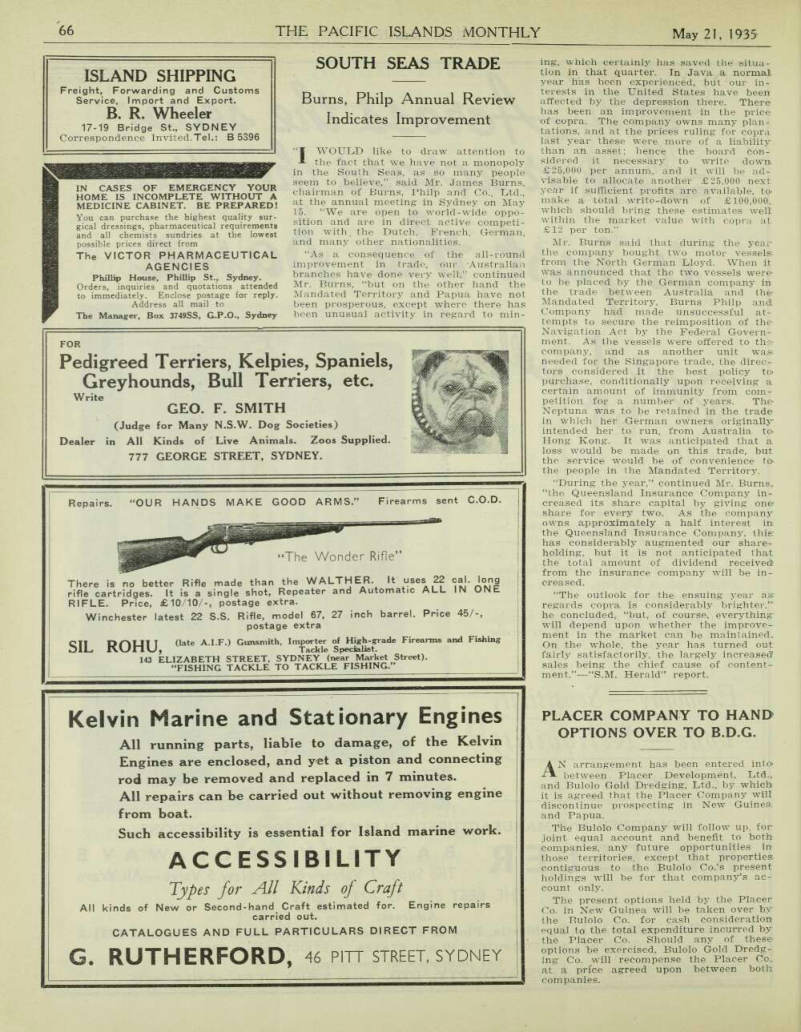
South Seas Trade
Burns, Philp Annual Review Indicates Improvement
“I WOULD like to draw attention to the fact that we have not a monopoly in the South Seas, as so many people seem to believe,” said Mr. James Burns, chairman of Burns, Philp and Co., Ltd., at the annual meeting in Sydney on May 15. “We are open to world-wide oppo sition and are in direct active competi tion with the Dutch, French, German, and many other nationalities.
“As a consequence of the all-round improvement in trade, our Australian branches have done very well,” continued Mr. Burns, “but on the other hand the Mandated Territory and Papua have not been prosperous, except where there has been unusual activity in regard to min
ing, which certainly has saved the situa tion in that quarter. In Java a normal year has been experienced, but our in terests in the United States have been affected by the depression there. There has been an improvement in the price of copra. The company owns many plan tations, and at the prices ruling for copra last year these were more of a liability than an asset; hence the board con sidered it necessary to write down £25,000 per annum, and it will be ad visable to allocate another £25,000 next year if sufficient profits are available, to make a total write-down of £100,000. which should bring these estimates well within the market value with copra at £12 per ton.”
Mr. Burns said that during the year the company bought two motor vessels: from the North German Lloyd. When it was announced that the two vessels were to be placed by the German company in the trade between Australia and the Mandated Territory, Burns Philp and Company had made unsuccessful at tempts to secure the reimposition of the Navigation Act by the Federal Govern ment. As the vessels were offered to the company, and as another unit was. needed for the Singapore trade, the direc tors considered it the best policy to purchase, conditionally upon receiving a certain amount of immunity from com petition for a number of years. The Neptuna was to be retained in the trade in which her German owners originally intended her to run, from Australia to Hong Kong. It was anticipated that a loss would be made on this trade, but the service would be of convenience to the people in the Mandated Territory. ‘‘During the year,” continued Mr. Burns, “the Queensland Insurance Company in creased its share capital by giving one share for every two. As the company owns approximately a half interest in the Queensland Insurance Company, this has considerably augmented our share holding, but it is not anticipated that the total amount of dividend received from the insurance company will be in creased.
“The outlook for the ensuing year as regards copra is considerably brighter,” he concluded, “but, of course, everything will depend upon whether the improve ment in the market can be maintained.
On the whole, the year has turned out fairly satisfactorily, the largely increased sales being the chief cause of content ment.”—“S.M. Herald” report.
Options Over To B.D.G.
Placer Company To Hand
AN arrangement has been entered into between Placer Development, Ltd., and Bulolo Gold Dredging, Ltd., by which it is agreed that the Placer Company will discontinue prospecting in New Guinea: and Papua.
The Bulolo Company will follow up, for joint equal account and benefit to both companies, any future opportunities in those territories, except that properties, contiguous to the Bulolo Co.’s present holdings will be for that company’s ac count only.
The present options held by the Placer Co. in New Guinea will be taken over by the Bulolo Co. for cash consideration equal to the total expenditure incurred by the Placer Co. Should any of these options be exercised, Bulolo Gold Dredg ing Co. will recompense the Placer Co. at a price agreed upon between both companies.
New Books
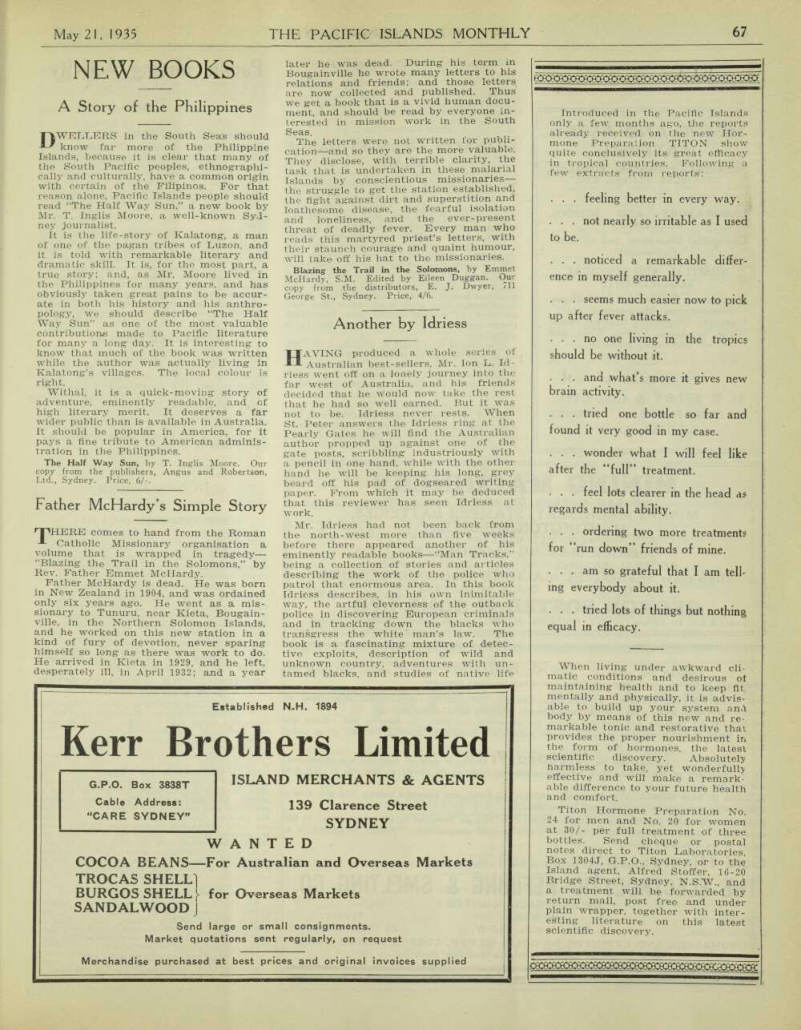
A Story of the Philippines
DWELLERS in the South Seas should know far more of the Philippine Islands, because it is clear that many of the South Pacific peoples, ethnographi cally and culturally, have a common origin with certain of the Filipinos. For that reason alone, Pacific Islands people should read “The Half Way Sun,” a new book by Mr. T. Inglis Moore, a well-known Syd ney journalist.
It is the life-story of Kalatong, a man of one of the pagan tribes of Luzon, and it is told with remarkable literary and dramatic skill. It is, for the most part, a true story; and, as Mr. Moore lived in the Philippines for many years, and has obviously taken great pains to be accur ate in both his history and his anthro pology, we should describe “The Half Way Sun” as one of the most valuable contributions made to Pacific literature for many a long day. It is interesting to know that much of the book was written while the author was actually living in Kalatong’s villages. The local colour is right.
Withal, it is a quick-moving story of adventure, eminently readable, and of high literary merit. It deserves a far wider public than is available in Australia.
It should be popular in America, for it pays a fine tribute to American adminis tration in the Philippines.
The Half Way Sun, by T. Inglis Moore. Our copy from the publishers, Angus and Robertson, Ltd., Sydney. Price, 6/-.
Father McHardy’s Simple Story
THERE comes to hand from the Roman Catholic Missionary organisation a volume that is wrapped in tragedy— “Blazing the Trail in the Solomons,” by Rev. Father Emmet McHardy.
Father McHardy is dead. He was born in New Zealand in 1904, and was ordained only six years ago. He went as a mis sionary to Tunuru, near Kieta, Bougain ville, in the Northern Solomon Islands, and he worked on this new station in a kind of fury of devotion, never sparing himself so long as there was work to do.
He arrived in Kieta in 1929, and he left, desperately ill, in April 1932; and a year
later he was dead. During his term in Bougainville he wrote many letters to his relations and friends; and those letters are now collected and published. Thus we get a book that is a vivid human docu ment, and should be read by everyone in terested in mission work in the South Seas.
The letters were not written for publi cation —and so they are the more valuable.
They disclose, with terrible clarity, the task that is undertaken in these malarial Islands by conscientious missionaries — the struggle to get the station established, the fight against dirt and superstition and loathesome disease, the fearful isolation and loneliness, and the ever-present threat of deadly fever. Every man who reads this martyred priest’s letters, with their staunch courage and quaint humour, will take off his hat to the missionaries.
Blazing the Trail in the Solomons, by Emmet McHardy, S.M. Edited by Eileen Duggan. Our copy from the distributors, E. J. Dwyer, 711 George St., Sydney. Price, 4/6.
Another by Idriess
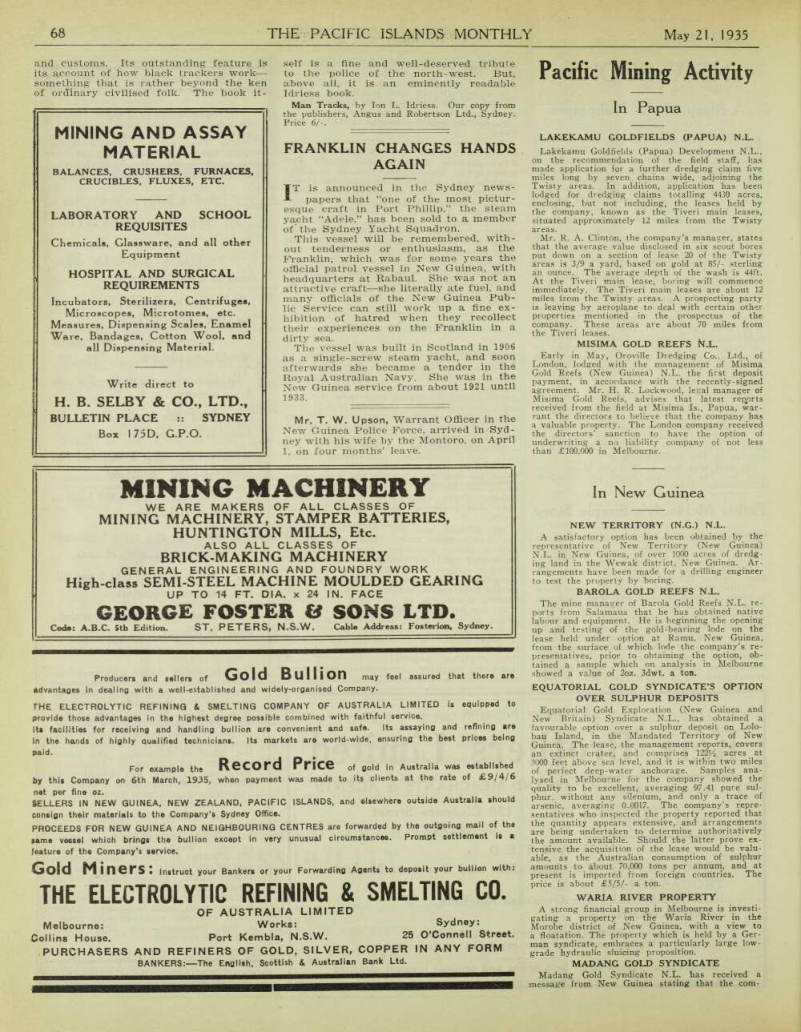
HAVING produced a whole series of Australian best-sellers, Mr. Ion L. Idriess went off on a lonely journey into the far west of Australia, and his friends decided that he would now take the rest that he had so well earned. But it was not to be. Idriess never rests. When St. Peter answers the Idriess ring at the Pearly Gates he will find the Australian author propped up against one of the gate posts, scribbling industriously with a pencil in one hand, while with the other hand he will be keeping his long, grey beard off his pad of dogseared writing paper. From which it may be deduced that this reviewer has seen Idriess at work.
Mr. Idriess had not been back from the north-west more than five weeks before there appeared another of his eminently readable books —“Man Tracks,’’ being a collection of stories and articles describing the work of the police who patrol that enormous area. In this book Idriess describes, in his own inimitable way, the artful cleverness of the outback police in discovering European criminals and in tracking down the blacks who transgress the white man’s law. The book is a fascinating mixture of detec tive exploits, description of wild and unknown country, adventures with un tamed blacks, and studies of native life
and customs. Its outstanding feature is its account of how black trackers work — something that is rather beyond the ken of ordinary civilised folk. The book it
self is a fine and well-deserved tribute to the police of the north-west. But, above all, it is an eminently readable Idriess book.
Mein Tracks, by Ion L. Idriess. Our copy from the publishers, Angus and Robertson Ltd., Sydney.
Price 6/-.
Advertisements & other items, pp. 69-70 (1 item)
Kerr Brothers Limited
Introduced in the Pacific Islands only a few months ago, the reports already received on the new Hormone Preparation TITON show quite conclusively its great efficacy in tropical countries. Following a few extracts from reports; . . . feeling better in every way, . . . not nearly so irritable as I used to be. . . . noticed a remarkable differ-
ence in myself generally.
. . . seems much easier now to pick
up after fever attacks.
... no one living in the tropics
should be without it.
. . . and what’s more it gives new
brain activity.
. . . tried one bottle so far and found it very good in my case. . . . wonder what I will feel like
after the “full” treatment.
. . . feel lots clearer in the head as
regards mental ability.
. . . ordering two more treatments
for “run down” friends of mine.
... am so grateful that I am tell-
ing everybody about it.
. . . tried lots of things but nothing
equal in efficacy.
When living under awkward climatic conditions and desirous ot maintaining health and to keep fit, mentally and physically, it is advisable to build up your system and body by means of this new and remarkable tonic and restorative that provides the proper nourishment in the form of hormones, the latest scientific discovery. Absolutely harmless to take, yet wonderfully effective and will make a remarkable difference to your future health and comfort.
Titon Hormone Preparation No. 24 for men and No. 20 for women at 30/- per full treatment of three bottles. Send cheque or postal notes direct to Titon Laboratories, Box 1304J, G.P.O., Sydney, or to the Island agent, Alfred Stoffer, 16-20 Bridge Street, Sydney, N.S.W., and a treatment will be forwarded by return mail, post free and under plain wrapper, together with interesting literature on this latest scientific discovery.
Established N.H. 1894
Kerr Brothers Limited
ISLAND MERCHANTS & AGENTS
139 Clarence Street
SYDNEY
WANTED
COCOA BEANS—For Australian and Overseas Markets
TROCAS SHELL
BURGOS SHELL for Overseas Markets
SANDALWOOD
Send large or small consignments.
Market quotations sent regularly, on request Merchandise purchased at best prices and original invoices supplied
G.P.O. Box 3838 T
Cable Address:
“CARE SYDNEY"
MINING AND ASSAY
MATERIAL
BALANCES, CRUSHERS. FURNACES,
CRUCIBLES, FLUXES, ETC.
LABORATORY AND SCHOOL
REQUISITES
Chemicals, Glassware, and all other Equipment
HOSPITAL AND SURGICAL
REQUIREMENTS
Incubators, Sterilizers, Centrifuges, Microscopes, Microtomes, etc.
Measures, Dispensing Scales, Enamel Ware, Bandages, Cotton Wool, and all Dispensing Material.
Write direct to
H. B. SELBY & CO., LTD.,
BULLETIN PLACE ;; SYDNEY
Box 175D, G.P.O.
MINING MACHINERY
WE ARE MAKERS OF ALL CLASSES OF
MINING MACHINERY, STAMPER BATTERIES,
HUNTINGTON MILLS, Etc.
ALSO ALL CLASSES OF
BRICK-MAKING MACHINERY
GENERAL ENGINEERING AND FOUNDRY WORK
High-class SEMI-STEEL MACHINE MOULDED GEARING
UP TO 14 FT. DIA. x 24 IN. FACE
GEORGE FOSTER & SONS LTD.
Coda: A.B.C. 5th Edition. ST. PETERS, N.S.W. Cable Address: Fosterion, Sydney.
Producers and sellers of Gold Bullion may feel assured that there are advantages in dealing with a well-established and widely-organised Company.
THE ELECTROLYTIC REFINING & SMELTING COMPANY OF AUSTRALIA LIMITED is equipped to provide those advantages in the highest degree possible combined with faithful service.
Its facilities for receiving and handling bullion are convenient and safe. Its assaying and refining are In the hands of highly qualified technicians. Its markets are world-wide, ensuring the best prices being paid.
For example the Record Price of gold in Australia was established by this Company on 6th March, 1935, when payment was made to its clients at the rate of £9/4/6 net per fine oz.
SELLERS IN NEW GUINEA, NEW ZEALAND, PACIFIC ISLANDS, and elsewhere outside Australia should consign their materials to the Company’s Sydney Office.
PROCEEDS FOR NEW GUINEA AND NEIGHBOURING CENTRES are forwarded by the outgoing mail of the same vessel which brings the bullion except in very unusual circumstances. Prompt settlement is a feature of the Company’s service.
Gold Minerss: Instruct your Bankers or your Forwarding Agents to deposit your bullion with:
THE ELECTROLYTIC REFINING & SMELTING CO.
OF AUSTRALIA LIMITED
Melbourne: Works: Sydney: Collins House. Port Kembla, N.S.W. 25 O’Connell Street.
PURCHASERS AND REFINERS OF GOLD, SILVER, COPPER IN ANY FORM BANKERS:—The English, Scottish & Australian Bank Ltd.
Franklin Changes Hands
Again
IT is announced in the Sydney news papers that “one of the most pictur esque craft in Port Phillip,” the steam yacht “Adele,” has been sold to a member of the Sydney Yacht Squadron.
This vessel will be remembered, with out tenderness or enthusiasm, as the Franklin, which was for some years the official patrol vessel in New Guinea, with headquarters at Rabaul. She was not an attractive craft —she literally ate fuel, and many officials of the New Guinea Pub lic Service can still work up a fine ex hibition of hatred when they recollect their experiences on the Franklin in a dirty sea.
The vessel was built in Scotland in 1906 as a single-screw steam yacht, and soon afterwards she became a tender in the Royal Australian Navy. She was in the New Guinea service from about 1921 until 1933.
Mr. T. W. Upson, Warrant Officer in the New Guinea Police Force, arrived in Syd ney with his wife by the Montoro, on April 1, on four months’ leave.
Pacific Mining Activity
In Papua
Lakekamu Goldfields (Papua) N.L.
Lakekamu Goldfields (Papua) Development N.L., on the recommendation of the field staff, has made application for a further dredging claim five miles long by seven chains wide, adjoining the Twisty areas. In addition, application has been lodged for dredging claims totalling 4430 acres, enclosing, but not including, the leases held by the company, known as the Tiveri main leases, situated approximately 12 miles from the Twisty areas.
Mr. R. A. Clinton, the company’s manager, states that the average value disclosed in six scout bores put down on a section of lease 20 of the Twisty areas is 3/9 a yard, based on gold at 85/- sterling an ounce. The average depth of the wash is 44ft.
At the Tiveri main lease, boring will commence immediately. The Tiveri main leases are about 12 miles from the Twisty areas. A prospecting party is leaving by aeroplane to deal with certain other properties mentioned in the prospectus of the company. These areas are about 70 miles from the Tiveri leases.
Misima Gold Reefs N.L.
Early in May, Oroville Dredging Co., Ltd., of London, lodged with the management of Misima Gold Reefs (New Guinea) N.L. the first deposit payment, in accordance with the recently-signed agreement. Mr. H. R. Lockwood, legal manager of Misima Gold Reefs, advises that latest reports received from the field at Misima Is., Papua, war rant the directors to believe that the company has a valuable property. The London company received the directors’ sanction to have the option of underwriting a no liability company of not less than £100,000 in Melbourne.
In New Guinea
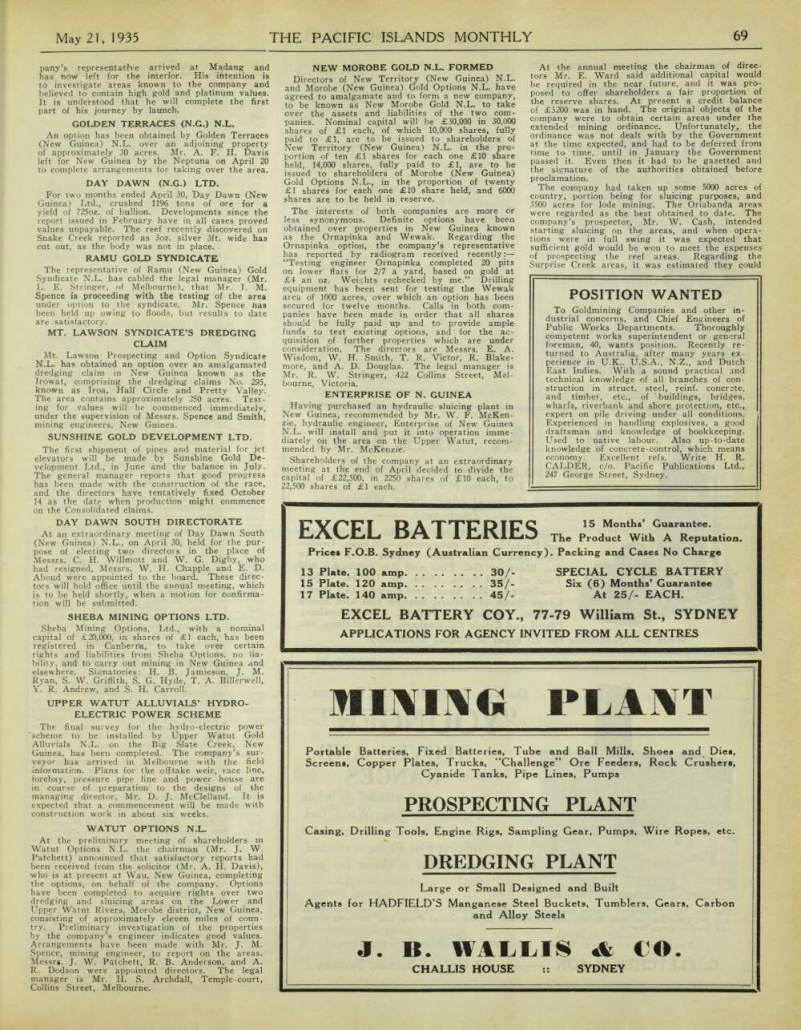
New Territory (N.G.) N.L.
A satisfactory option has been obtained by the representative of New Territory (New Guinea) N.L. in New Guinea, of over 1000 acres of dredg ing land in the Wewak district, New Guinea. Ar rangements have been made for a drilling engineer to test the property by boring.
Barola Gold Reefs N.L.
The mine manager of Barola Gold Reefs N.L. re ports from Salamaua that he has obtained native labour and equipment. He is beginning the opening up and testing of the gold-bearing lode on the lease held under option at Ramu, New Guinea, from the surface of which lode the company’s re presentatives, prior to obtaining the option, ob tained a sample which on analysis in Melbourne showed a value of 2oz. 3dwt. a ton.
Equatorial Gold Syndicate’S Option
Over Sulphur Deposits
Equatorial Gold Exploration (New Guinea and New Britain) Syndicate N.L., has obtained a favourable option over a sulphur deposit on Lolo bau Island, in the Mandated Territory of New Guinea. The lease, the management reports, covers an extinct crater, and comprises 122½ acres at 3000 feet above sea level, and it is within two miles of perfect deep-water anchorage. Samples ana lysed in Melbourne for the company showed the quality to be excellent, averaging 97.41 pure sul phur. without any silenium, and only a trace of arsenic, averaging 0.0017. The company’s repre sentatives who inspected the property reported that the quantity appears extensive, and arrangements are being undertaken to determine authoritatively the amount available. Should the latter prove ex tensive the acquisition of the lease would be valu able, as the Australian consumption of sulphur amounts to about 70,000 tons per annum, and at present is imported from foreign countries. The price is about £5/5/- a ton.
Waria River Property
A strong financial group in Melbourne is investi gating a property on the Waria River in the Morobe district of New Guinea, with a view to a floatation. The property which is held by a Ger man syndicate, embraces a particularly large low grade hydraulic sluicing proposition.
Madang Gold Syndicate
Madang Gold Syndicate N.L. has received a message from New Guinea stating that the com
pany’s representative arrived at Madang and has now left for the interior. His intention is to investigate areas known to the company and believed to contain high gold and platinum values.
It is understood that he will complete the first part of his journey by launch.
Golden Terraces (N.G.) N.L.
An option has been obtained by Golden Terraces (New Guinea) N.L. over an adjoining property of approximately 30 acres. Mr. A. F. H. Davis left for New Guinea by the Neptuna on April 20 to complete arrangements for taking over the area.
Day Dawn (N.G.) Ltd.
For two months ended April 30, Day Dawn (New Guinea) Ltd., crushed 1196 tons of ore for a yield of 725oz. of bullion. Developments since the report issued in February have in all cases proved values unpayable. The reef recently discovered on Snake Creek reported as 3oz, silver 3ft. wide has cut out, as the body was not in place.
Ramu Gold Syndicate
The representative of Ramu (New Guinea) Gold Syndicate N.L. has cabled the legal manager (Mr.
L. E. Stringer, of Melbourne), that Mr. J. M.
Spence is proceeding with the testing of the area under option to the syndicate. Mr. Spence has been held up owing to floods, but results to date are satisfactory.
Mt. Lawson Syndicate’S Dredging
Claim
Mt. Lawson Prospecting and Option Syndicate N.L. has obtained an option over an amalgamated dredging claim in New Guinea known as the Irowat, comprising the dredging claims No. 295, known as Iroa, Half Circle and Pretty Valley.
The area contains approximately 250 acres. Test ing for values will be commenced immediately, under the supervision of Messrs. Spence and Smith, mining engineers, New Guinea.
Sunshine Gold Development Ltd.
The first shipment of pipes and material for jet elevators will be made by Sunshine Gold De velopment Ltd., in June and the balance in July.
The general manager reports that good progress has been made with the construction of the race, and the directors have tentatively fixed October 14 as the date when production might commence on the Consolidated claims.
Day Dawn South Directorate
At an extraordinary meeting of Day Dawn South (New Guinea) N.L., on April 30, held for the pur pose of electing two directors in the place of Messrs. C. H. Willmott and W. G. Digby, who had resigned, Messrs. W. H. Chappie and E. D.
Aboud were appointed to the board. These direc tors will hold office until the annual meeting, which is to be held shortly, when a motion for confirma tion will be submitted.
Sheba Mining Options Ltd.
Sheba Mining Options, Ltd., with a nominal capital of £20,000, in shares of £1 each, has been registered in Canberra, to take over certain rights and liabilities from Sheba Options, no lia bility, and to carry out mining in New Guinea and elsewhere. Signatories: H. B. Jamieson, J. M.
Ryan, S. W. Griffith, S, G. Hyde, T. A. Billerwell, Y. R. Andrew, and S. H. Carroll.
Upper Watut Alluvials’ Hydro
Electric Power Scheme
The final survey for the hydro-electric power scheme to be installed by Upper Watut Gold Alluvials N.L. on the Big Slate Creek, New Guinea, has been completed. The company’s sur veyor has arrived in Melbourne with the field information. Plans for the offtake weir, race line, forebay, pressure pipe line and power house are in course of preparation to the designs of the managing director, Mr. D. J. McClelland. It is expected that a commencement will be made with construction work in about six weeks.
Watut Options N.L.
At the preliminary meeting of shareholders m Watut Options N.L. the chairman (Mr. J. W.
Patchett) announced that satisfactory reports had been received from the solicitor (Mr. A. H. Davis), who is at present at Wau, New Guinea, completing the options, on behalf of the company. Options have been completed to acquire rights over two dredging and sluicing areas on the Lower and Upper Watut Rivers, Morobe district, New Guinea, consisting of approximately eleven miles of coun try. Preliminary investigation of the properties by the company’s engineer indicates good values.
Arrangements have been made with Mr. J. M.
Spence, mining engineer, to report on the areas.
Messrs. J. W. Patchett, R. B. Anderson, and A.
R. Dodson were appointed directors. The legal manager is Mr. H. S. Archdall, Temple-court, Collins Street, Melbourne.
New Morobe Gold N.L. Formed
Directors of New Territory (New Guinea) N.L. and Morobe (New Guinea) Gold Options N.L. have agreed to amalgamate and to form a new company, to be known as New Morobe Gold N.L. to take over the assets and liabilities of the two com panies. Nominal capital will be £30,000 in 30,000 shares of £1 each, of which 10,000 shares, fully paid to £1, are to be issued to shareholders of New Territory (New Guinea) N.L. in the pro portion of ten £1 shares for each one £10 share held, 14,000 shares, fully paid to £1, are to be issued to shareholders of Morobe (New Guinea) Gold Options N.L., in the proportion of twenty £1 shares for each one £10 share held, and 6000 shares are to be held in reserve.
The interests of both companies are more or less synonymous. Definite options have been obtained over properties in New Guinea known as the Ornapinka and Wewak. Regarding the Ornapinka option, the company’s representative has reported by radiogram received recently:— “Testing engineer Ornapinka completed 20 pits on lower flats for 2/7 a yard, based on gold at £4 an oz. Weights rechecked by me.’’ Drilling equipment has been sent for testing the Wewak area of 1000 acres, over which an option has been secured for twelve months. Calls in both com panies have been made in order that all shares should be fully paid up and to provide ample funds to test existing options, and for the ac quisition of further properties which are under consideration. The directors are Messrs. E. A.
Wisdom, W. H. Smith, T. R. Victor, R. Blake more, and A. D. Douglas. The legal manager is Mr. R. W. Stringer, 422 Collins Street, Mel bourne, Victoria.
Enterprise Of N. Guinea
Having purchased an hydraulic sluicing plant in New Guinea, recommended by Mr. W. F. McKen zie, hydraulic engineer, Enterprise of New Guinea N.L. will install and put it into operation imme diately on the area on the Upper Watut, recom mended by Mr. McKenzie.
Shareholders of the company at an extraordinary meeting at the end of April decided to divide the capital of £22,500, in 2250 shares of £10 each, to 22,500 shares of £1 each.
At the annual meeting the chairman of direc tors Mr. E. Ward said additional capital would be required in the near future, and it was pro posed to offer shareholders a fair proportion of the reserve shares. At present a credit balance of £5200 was in hand. The original objects of the company were to obtain certain areas under the extended mining ordinance. Unfortunately, the ordinance was not dealt with by the Government at the time expected, and had to be deferred from time to time, until in January the Government passed it. Even then it had to be gazetted and the signature of the authorities obtained before proclamation.
The company had taken up some 5000 acres of country, portion being for sluicing purposes, and 3500 acres for lode mining. The Oriabanda areas were regarded as the best obtained to date. The company’s prospector, Mr. W. Cash, intended starting sluicing on the areas, and when opera tions were in full swing it was expected that sufficient gold would be won to meet the expenses of prospecting the reef areas. Regarding the Surprise Creek areas, it was estimated they could
be equipped for £3500. The policy would be to initiate a plan of progress on blocks 11, 12, and 13 of the Surprise Creek areas, also on the Oria banda property, and to prospect the larger area above Surprise Creek, which showed indications of being a valuable property for lode development.
In addition, an important work would be to acquire areas under the new ordinance.
The meeting favoured a proposal that the num ber of directors should be increased from three to five, and that the remuneration of each member of the board be £100 a year. Mr. Donald Reid, of Melbourne, has accepted a seat on the board of directors.
Oriomo Explorations Ltd.
An extraordinary meeting of shareholders of Oriomo Explorations Ltd. in Sydney during April decided to increase the capital from £24,000 to £100,000 by the creation of an additional 304,000 shares of 5/- each. The issue is to be made whenever it may appear to the directors to be warranted. Adressing shareholders, Mr. E. L.
Walters said that a six-months’ option had been obtained on favourable terms of an area of 140 acres of terraces, gravels, and alluvial flats on both sides of the Bulolo River, New Guinea, for about 62 chains. Nine pits completed on the terraces disclosed an average value of 70d a cubic yd., with gold at £6 an oz sterling, average depth being 33ft. Preliminary information was to the effect that there were valuable terraces from which gold of a high quality was being re covered to a depth of 4 feet. Mr. S. N. McLean had investigated the areas, and would endeavour to obtain improved terms from the vendors.
Oriomo Oil Ltd.
The directors of Oriomo Oil Ltd., in a circular
to shareholders, state that by reason of its share holding the company is entitled to apply for 41,520 shares of 5/- each at par in the new issue in Oriomo Explorations Ltd. They have decided to give shareholders the right to apply direct for one share in the new issue for every four shares held in Oriomo Oil Ltd.
Bulolo Dredge Production
Production of the four dredges of the Bulolo Gold Dredging Ltd. for April compares with that of the previous two periods as follows;
Feb- Mar. April.
Nos. 1, 2, 3, and 4 Dredges— Cubic yards 820,000 919,000 892,000 Bullion, oz 14,417 16,601 15,357 Gold, fine oz 10,022 11,521 10,540
Value-
Aust. currency .. *£85,187 t£102,248 t£93,542 per cubic yard ... /24.94 /26.70 /25.17 Working profit £58,318 £73,529 £65,257 * At £A8/10/- per fine ounce, t At £A8/17/6 per fine ounce.
Advertisements & other items, pp. 71-72 (1 item)
Mining Plant
POSITION WANTED
To Goldmining Companies and other industrial concerns, and Chief Engineers of Public Works Departments. Thoroughly competent works superintendent or general foreman, 40, wants position. Recently returned to Australia, after many years experience in U.K.. U.S.A., N.Z., and Dutch East Indies. With a sound practical and technical knowledge of all branches of construction in struct, steel, reinf. concrete, and timber, etc., of buildings, bridges, wharfs, riverbank and shore protection, etc., expert on pile driving under all conditions.
Experienced in handling explosives, a good draftsman and knowledge of bookkeeping.
Used to native labour. Also up-to-date knowledge of concrete-control, which means economy. Excellent refs. Write H. R.
CALDER, c/o. Pacific Publications Ltd., 247 George Street, Sydney.
EXCEL BATTERIES
15 Months’ Guarantee.
The Product With A Reputation.
Prices F.O.B. Sydney (Australian Currency). Packing and Cases No Charge 13 Plate. 100 amp 30/- SPECIAL CYCLE BATTERY 15 Plate. 120 amp 35/- Six (6) Months’ Guarantee 17 Plate. 140 amp 45/- At 25/- EACH.
EXCEL BATTERY COY., 77-79 William St., SYDNEY APPLICATIONS FOR AGENCY INVITED FROM ALL CENTRES
MINING PLANT
Portable Batteries, Fixed Batteries, Tube and Ball Mills, Shoes and Dies, Screens, Copper Plates, Trucks, "Challenge” Ore Feeders, Rock Crushers, Cyanide Tanks, Pipe Lines, Pumps
PROSPECTING PLANT
Casing, Drilling Tools, Engine Rigs, Sampling Gear, Pumps, Wire Ropes, etc.
DREDGING PLANT
Large or Small Designed and Built Agents for HADFIELD’S Manganese Steel Buckets, Tumblers, Gears, Carbon and Alloy Steels
J. B. WALLIS & CO.
CHALLIS HOUSE SYDNEY
Khaki or white
SHORTS
Ready to wear all sizes 8/6
STATE SIZE
WHEN
ORDERING
PIKE BROTHERS Ltd
in Queen St.
BRISBANE
E. A. MARR
108 MILLER STREET, PYRMONT
Telephone: MW 2296
Mining and General Machinery Merchants
Engineers 5 and 10 Head Mining Batteries, Steam-Driven and Portable Air Compressors —all sizes. Centrifugal and Steam Pumps—Piping from ½in. to 6in. Black or Gal. Pipe and Air Fittings. 400 Tons of Steel Rails, 14lbs. to 100lbs. (New Condition). 200 Tons Steel Girders (all sizes).
Large Stock of Boilers, Suction Gas and Steam Petrol and Crude Oil Engines, Elec. Motors, etc.
Write for Quotations for all types of Mining Machinery.
Engines, Winches, Pulleys, Rock-Crushers,
Engineers
Do You Know that the Famous
"YOUNGER”
STOVES AND
RANGES
made with extended Firebox specially for long Wood fuel, are Self-Setting and, provided sufficient Flue Piping is attached, can be used in almost any position?
The No. 7W. “Younger” Range can now be supplied fitted with Legs, as per illustration.
Ask for quotation for this Range, also Illustrated Catalogue and Price List for both Single and Double Oven Stoves.
Younger Stoves are Widely Used Throughout the Pacific Islands.
G. FLETCHER & SON 50 Oxford Street, Sydney
In Fiji
Nasivi (Fiji) Syndicate N.L.
Advice has been received from the representa tive of Nasivi (Fiji) Syndicate N.L., in Fiji, indi cating that be has secured an option over a promising property. The lode where opened up shows an average width of 10 to 12 feet. Pan samping over 250 feet along the lode has given satisfactory values. In addition to the above, negotiations are proceeding for another property.
The company’s engineer and geologist recently left Sydney for Fiji and will carry out a geological survey and assays are all ore, and also direct the prospecting policy of the syndicate on the pro perty under option.
Loloma West Ltd.
Advice has been received by the management of Loloma West Ltd. that the Hon. H. Ragg, of Suva, has been nominated as director of the company in Fiji, and that 200 shares reserved for Fiji applications have been subscribed. The com pany has been granted prospecting rights, and the field representative is now on the properties.
The Co. has acquired options over 500 acres of land at Drumasi, on the eastern Tavua gold field, on which developments show three gold-bearing lodes and 500 acres at Momi Bay. Additional miners are being sent to Fiji to supervise de velopment work.
Mr. A. J. Phillips, manager in Melbourne of Loloma West Ltd., has received a copy of a new agreement made between Messrs. R. H. Roskelly and C. F. Michell, varying the terms of option to purchase prospecting licence No. 221, Tavua, Fiji.
The old purchase price of £7000 cash has been reduced to £1000 cash, but 5 per cent, fully paid shares in any company formed has been substituted as compensation for the reduced cash.
Sukulaki Gold Development
Sukulaki Gold Development N.L. has been formed to acquire an option over an application for a prospecting licence, No. M.B. 42/34, on the Tavua field, Fiji, known as the Sukulaki area, covering approximately 494 acres, and to systematically test and prospect the area. The area is approxi mately two miles due east of the Emperor lease.
Only a small portion of the area has so far been prospected, but from loaming payable gold has been obtained. The area embraces the andesite formation, in which the payable gold-bearing lodes on the Tavua field are found. Large outcrops of quartz occur adjacent to the payable learnings.
In one trench a reef has been opened up, dis closing 13 dwt. values. The area has been ex amined by an expert, and recommended as a property worthy of vigorous development. Capi tal is £30,000, in 3000 shares of £10 each, of which 2000 shares paid up to £2 (application and allotment) have been underwritten by Messrs.
Wallace H. Smith and Co., of Melbourne, and Messrs. C. H. Smith and McCaghern, of Sydney.
The directors are Messrs. W. H. Smith, H. C.
Tucker and R. B. Randell. The legal manager is Mr. H. Smith, 360 Collins Street, Melbourne.
Aloha Central G.M.
The following party left Sydney on May 1 by the Mariposa for Fiji on behalf of Aloha Central Gold Mines N.L.: Dr. Loftus Hill, who has been retained to advise and report upon the work to be done on the company’s property at Tavua; Mr. G. Baker (mine manager), Mr. P. H. Philippe (assayer), Mr. J. T. Rowe (foreman), and three working miners. Mr. G. Baker had been for 28 years on the west coast of Tasmania, as under ground manager of the Hercules and Rosebery
mines for Electrolytic Zinc Co. of Aust. Ltd. He was for six years connected with Kauri Freehold Gold Estates, New Zealand, one of his workmen on this occasion being Mr. Borthwick, who is credited as being the discoverer of the Tavua field.
It is announced that the company has secured an option over 348 acres, covered by Prospecting Licence No. 216 issued to W. B. Ragg, at Tavua, Fiji. This property will be prospected vigorously, jointly with the 30-acre block over which an-option has been acquired from Mr, P. Costello.
Loloma Gold Mines
The management of Loloma Gold Mines N.L., Tavua, Fiji, has been advised by Mr. T. R.
Victor, mining engineer, and a director of the company, that he check sampled the lode in No. 1 shaft from 15 to 20 feet and assays made in Sydney gave an average return of 16oz. 12 dwt.
The average of the samples taken by Mr. Victor and the mine manager is therefore 28oz. 6 dwt. a ton. Tellurides are showing freely in the ore, which is almost wholly sulphide. Mr. Victor also check sampled the lode in No. 2 shaft from 15 to 20 feet, and his assays returned 6oz. a ton. Ore in this shaft is about one-half sulphide. The lode in both No. 1 and No. 2 shafts has gone into the footwall, and shafts have now been turned on to the underlay.
The Co. later reported the following assay re sults: Sixty tons of ore stacked at creek, partly from outcrop, south side of creek, where adit is commenced, but mainly from loose ore taken by mine manager from bed of creek. Three samples taken by mine manager averaged 12oz. a ton; hanging wall section, No. 1 shaft, 17 feet from sur face, 5 feet width, assay 58 oz. a ton; No. 2 shaft, 22 feet deep, hanging wall section, 5 feet width, 9½ oz. a ton; 2 feet on footwall, 2oz. a ton; and boulders in creek, 300 feet upstream from outcrop, assay ½oz. a ton. No. 3 shaft, at 36 feet, is not yet in the lode.
Aloha Alluvials N.L.
Directors of Aloha Alluvials N.L. have engaged Mr. E. T. Lewis to go to Fiji and test thoroughly by boring, pitting, or otherwise the extensive alluvial areas on the upper and lower Waimanu River and Waidamu River, over which rights are held by Aloha Syndicate G.M. N.L. Mr. Lewis has been instructed to engage in Australia com
petent men as assistants to accompany him and to obtain plant and equipment to take with him.
The party will leave for Fiji on May 25.
An inquiry having been made to Mr. H. Rich mond, acting legal adviser of Aloha Syndicate G.M, N.L. relative to an area of 2000 acres on the Upper Waimanu River, Viti Levu, reported to have been pegged by Mr. Borthwick, a cablegram on the subject was sent to the legal manager (Mr.
F. M. Gilder), who is in Fiji. Mr. Gilder replied that the inquiry undoubtedly referred to areas pegged out in the hill country above the head of the Upper Waimanu River. This did not infringe in any way on the rights of the com pany. The chairman of the mining board had informed him that no application had yet been lodged for the areas. The rights of the company on both rivers were for the alluvial deposits only, and did not cover reefs or lode formations. It was understood the 2000 acre area was for reefs and/or lodes. The members of the prospecting syndicate were Messrs. Borthwick, Blair, and Lawler. Mr. Borthwick had returned to Suva on May 7, but the remaining members would not return until later.
Fiji Mining Corporation
Mr. W. J. Nicol, engineer to Fiji Mining Cor poration N.L. advises that he has pegged and applied for a prospecting licence over a promising area at Yako, about four miles north-east of Momi, on the west coast of Viti Levu Island. The appli cation is receiving the consideration of the mining board. Mr. Nicol states this district is the best he has yet inspected. Arrangements have also been made to prospect vigorously P.L. No. 214, over which the company holds an option.
East Reefs (Bendigo) Nl.
Dr. A. E. Ffrost, chairman of directors of East Reefs (Bendigo) N.L., has returned from Fiji, and advises that Mr. V. Terry has applied for a prospector’s licence over 500 acres. An assay of the outcrop showed 10 dwt. Mr. T. J. Rogers In tends to apply for a similar area adjoining Terry’s application. The company has also secured an option over a property having a lode which assayed 18 dwt. a ton. This property is being resampled for check assay.
Fiji Prospecting Co.
The management of Fiji Prospecting Co. N.L.
announces that it has secured, on favourable terms, a nine months’ working option of purchase over a property in the Korolevu Bay district of Fiji, which was reported upon by Mr. A. G.
Campbell.
Rewa Prospecting Syndicate
Work carried out by Rewa Prospecting Syndi cate N.L. on the prospecting rights area in the Tavua district, Fiji, disclose several ore bodies carrying gold. Five of these ore bodies, heavily mineralised and up to 6 feet wide, traverse the area. Expert opinion, the management reports, is that they bear a striking similarity to the Koroere formation.
Gold Mines Of Fiji N.L.
Gold Mines of Fiji N.L. has been formed in Victoria to send a mining engineer to Fiji, to prospect and work options obtained by the com pany. These options include the Emperor North area, adjoining the Emperor and Loloma leases, and six other areas in the Tavua gold field.
Capital is £30,000, in 3000 shares of £10 each. Two thousand shares are being issued at £5 each. The legal manager is Mr. J. D. Morrison, Bank House, Bank Place, Melbourne.
At the preliminary meeting of shareholders held early in May Messrs. D. J. McClelland, G. R.
Clarke, D. Reid, A. Bowler, S. Wright-Smith, and F. V. Smith were appointed directors. A nominee of Sir Henry Scott in Fiji is also to be appointed to the Board. Shareholders were in formed that the directors had been unofficially advised that the application of Mr. J. C. Flemon for the Emperor North lease, over which an option is held, would be granted. Vigorous pros pecting was in progress on other leases in which the company was interested.
Later Mr. H. V. Francis, engineer, and Mr. A.
Bowler, a provisional director, sailed for Suva by the Mariposa. They went on to the field to examine Mr. Goodsir’s block and reported that it shows considerable quantities of lode matter. Ex amination of the Flemon block and the Emperor lease, which it adjoins, indicates that it is prac tically certain that the Emperor lode traverses Flemon’s block.
Kasi Development Ltd.
Kasi Development Ltd. has been registered in Sydney with a nominal capital of £30,000, in 120,000 shares of 5/- each. The objects of the company are to acquire goldmines in the Yanawai district, Fiji, and the prospecting licences held by Mount Kasi Mines Ltd. First directors: D. W. Robert son, H. M. Peacock, H. H. McNail, and G. Mit chell. Registered office: Suva, Fiji. New South Wales agent; R. V. Frazer, c/o. Craig and Frazer, 115 Pitt Street, Sydney,
Tavua Gold Developments Ltd.
One of the syndicates which was “in early” on
the Tavua field, Fiji, Tavua Gold Options Ltd,, has now been floated into a bigger company, Tavua Gold Developments Ltd., with a nominal capital of £100,000, divided into 400,000 shares of 5/- each. 180,000 shares were being offered to the public early in May. 80,000 are to be allotted to Tavua Gold Options Ltd.; 8,000 shares go to the Australian Mining Trust Ltd.; 8,000 shares ta Mineral Developments Ltd.; while 4,000 fully paid shares, as vendor’s consideration, are to go to the vendor (presumably Tavua Gold Options Ltd.).
The Australian Mining Trust and Mineral Develop ments Ltd. are each to have an option for two years over 30,000 shares at a premium of 2/6 per share, and 60,000 are to be held in reserve. The provisional directors of the new company are Sir Charles Marr (Sydney), Sir Henry Scott (Suva), Mr. H. E. Sizer (Melbourne), Mr. E. G. Banks (Melbourne), Mr. W. R. Carpenter (Sydney), Dr.
H. R. R Grieve (Sydney), and Mr. H. J. Napthali (Sydney).
Advertisements & other items, pp. 73-74 (1 item)
Cooper
Gold Mining
Latest Revised Courses
INTERNATIONAL
CORRESPONDENCE SCHOOLS
140 Elizabeth Street, Sydney Sirs,—Please send me free prospectus showing how I can succeed in the occupation I have marked.
GOLD MINING & METALLURGY
METAL MINING ENGINEERING
PROSPECTING — ASSAYING
MINING-ELECT. SURVEYING
COPPER MINING & METALLURGY
Other New Courses !
DIESEL ENG. -WEEDING ENG.
AIR CONDITIONING
REFRIGERATION ELEC. ENG
ELECTRICAL ILLUMINATION
INTERNAL COMBUSTION RADIO
For Skin Diseases
KUR-MANGE —the famous English remedy for all parasitic skin diseases. In powder form, mixes readily with water, superior to ointments and greasy dressings. 4oz, tin (sufficient to make one gallon curative wash), 2/6, Sydney.
For Fleas and Vermin
PULVEX —the “‘different” vermin powder. Kills the fleas instead of only stupefying them. Keeps others off for from 7 to 14 days afterwards.
NON-POISONOUS, NON-IRRITANT, ODOURLESS.
2oz. tin, 1/3; 4oz. tin, 2/-; 1lb. tin, 6/, Sydney
For a Germicidal Wash
LAVENE—a cleansing wash, possessing highly germicidal and insecticidal properties. Kills fleas, lice and all parasites. Gives a thick and abundant lather which removes all dirt and scurf from both coat and skin. Imparts a brilliant lustre to the coat. 2 pint tin, 1/6; pint tin, 2/6; quart tin, 4/6 each, Sydney.
COOPER
DOG REMEDY
All enquiries to
William Cooper & Nephews
(Australasia) Ltd.,
4 O’CONNELL STREET, SYDNEY
'CYCLONE'
STEEL
POST
(showing standard boring) used with a plain wire fence.
Why you should use
clone
STEEL FENCE
POSTS
They are: Fireproof. White-ant proof.
Indestructible. Easily handled.
Easy to Drive. Quickly Erected.
Light, but very strong.
Made of special T Section rolled for the purpose.
APPROXIMATE WEIGHT:
5ft. long 6lbs. each 5ft. 6in. long each PRICE, 10½d. per post.
The standard punching for these posts, starting from top of post, is 6in., 6in., 8in., 6in., 5in., 5in., 6in. Posts are also slotted and punched at top to take barbed wire. A Driving Cap is supplied free with every 250 posts. Can be punched to customers’ own specifications if required.
clone
CYCLONE FENCE & GATE Co. Pty Ltd The Grace Building, 77 York St., Sydney
And at Melbourne and Adelaide
‘CYCLONE’
STEEL
POST
used in conjunction with “Cyclone” 5 lines 26 inch high Sheep Fence Please send me by return mail your free, illustrated and priced Catalogue of Cyclone Metal Gates and Ring-lock Fences, and comparison of costs.
Name Address
Ray Parer
Returns to New Guinea
AFTER being absent from New Guinea for over nine months, Mr. Raymond Parer, famous Australian aviator who has been conducting an aerial freighting ser vice in the Mandated Territory since 1926, has returned to the Morobe gold fields.
With Mr. Geoffrey Hemsworth, also of New Guinea he went to England during the latter part of last year to take part in the London-Melbourne Air Race.
Leaving Mildenhall on October 20 in a Fairey Fox ’plane they met with many hazardous adventures, eventually being compelled to withdraw from the big race.
They jogged along by easy stages to Australia, reaching Melbourne on Feb ruary 13.
Mr. Parer spent a month’s holiday in Sydney, and on March 30 left Mascot ’drome for Brisbane, Queensland. He was compelled to remain in hospital at Bris bane for a week, suffering from tetanus due to a scratch. Later, he went on to Cape York to inspect the landing ground prepared there some time ago by Mr.
Vidgen, Jun., of Thursday Island, for Pilot Marshall.
He remained several weeks at Cape York, investigating possible sites for an aerodrome. Then, so typical of Ray Parer, he left unostentatiously for New Guinea with Mr. J. Thompson as passen ger, in a ’plane owned by Mr. Davies, who recently joined P.A.T. Co.’s staff. Flying high, he passed over Thursday Island on April 20, went on to Port Moresby, Pa pua, and thence across to the New Guinea goldfields.
Mr. Parer plans to return to Australia by the first available steamer to fly his own machine back to New Guinea.
Mr. Geoffrey Hemsworth, his companion on the flight from England, had already returned to the Mandated Territory by the Macdhui on March 14, to take up duties again with Pacific Aerial Trans port Ltd., on the Morobe field.
Magistrate
Rabaul Protest at Removal of Magistrate
NEARLY all the non-official citizens of Rabaul, New Guinea, have signed a petition and presented it to the Adminis trator, asking for the retention as magis trate of the District Court of District Officer Waugh, whom it has been pro posed to transfer to an out-station, Madang. His efficiency in dealing with native cases is considered irreplaceable.
Advertisements & other items, pp. 75-76 (1 item)
Good Tea
a life Saver!
“A cup of good tea is an excellent ‘life-saver' for anyone who suffers from fainting spells.”
These convincing words were uttered by Dr.
William Brady, an authority on such matters
KINKARA TEA
“Kinkara”, the health tea, is a good tea. All dust and foreign matter are extracted and each packet contains only “super-sorted” specially selected leaves, giving rich, juicy liquors.
“Kinkara” is economical, because it makes more cups to each pound.
Never infuse for more than five minutes.
This is the new design of all containers of “Mother’s Choice” lines.
“Mother’s Choice” Products
“Mother’s Choice products in New South Wales command a ready sale, and the following goods are packed under this well-known brand:—
BAKING POWDER
CUSTARD POWDER
JELLY CRYSTALS
FLAVOURING
ESSENCE
CURRY POWDER
FRUIT SALINE
MIXED CUT PEEL
SPAGHETTI
BAKED BEANS
Try them To-day Sold throughout “The Islands”
The ‘Austral' Auto-Flush Cabinet
The latest in Sanitary Installations for non-sewered areas Approved by the N.S.W. Board of Health.
A Patent Closet that gives you convenience, health, and refinement similar to a w.c. A great advance on anything yet offered.
No water supply required.
Price, £15 (Aust.), F.O.B., Sydney Can be Installed by any handy man.
INSULAR LAMPS (Syd.), ltd.
Leaflet on application. 47 Market St., SYDNEY
Swallow & Ariell’s
WORLD RENOWNED
Canterbury
Calces
FRUIT
PLAIN
SEED
PLUM
ALMOND
PRESERVED
GINGER
SULTANA
CHERRY
RIPE
GENOA
Each Cake is Enclosed, by special process, in air-tight tin, and is warranted to keep its condition for a considerable period
Methodist Mission Cruise
Pilgrimage to Fiji is Popular
SCHEDULED to leave Sydney on October 5 on a religious cruise to Fiji, the Katoomba has been completely booked out by Methodist ministers and their friends. Rev. Richard Piper, of the- Methodist Mission Society, which is con ducting the cruise, is seeking to charter a second vessel, to cope with the demands for accommodation.
Carrying 450 passengers, the Katoomba will arrive at Lakemba on October 12.
The company will disembark at precisely the same spot where the pioneer Method ist missionaries, Revs. Cargill and Cross, landed exactly 100 years ago. Native Fijian Methodists will be hosts, and for those who wish it accommodation has been arranged in the native village.
The following day the party will be taken to Taveuni Is. and landed at an other historic spot, Somo Somo. The excursionists will visit Levuka, the former European capital, and Bau, the old native capital of the group where King Thakambau, the paramount Fijian chief lived. En route to Lakemba the- Katoomba will call at Lautoka, where many of the passengers will leave the ship and cross by the new road, 120' miles, overland through marvellous Islands scenery to rejoin the Katoomba at Suva, Mr. K. A. Marlow, son of Mr. A. H..
Marlow, of Suva, returned to Fiji, after a vacation in Sydney, by the Niagara on April 26.
Mrs. Hinds, wife of Mr. Percy Hinds, well-known merchant, of Port Moresby, returned to Papua with her small daughter by the Macdhui from Australia on May 2.
Advertisements & other items, p. 76 (2 items)
When Costa Rica Pounced!
(CONTINUED FROM PAGE 8)
L.L. Bell, F.I.O. (Syd.)
OPTICIAN
WINGELLO HOUSE,
ANGEL PLACE :: SYDNEY
Prescriptions for Glasses made up and Despatched by Return Mail.
New Lenses or Frames supplied on receipt of the broken parts.
The best Goggles for Aviators, Motorists, Welders and Mechanics.
“Cash on Delivery Post”: Sydney Prices
Torres Strait News
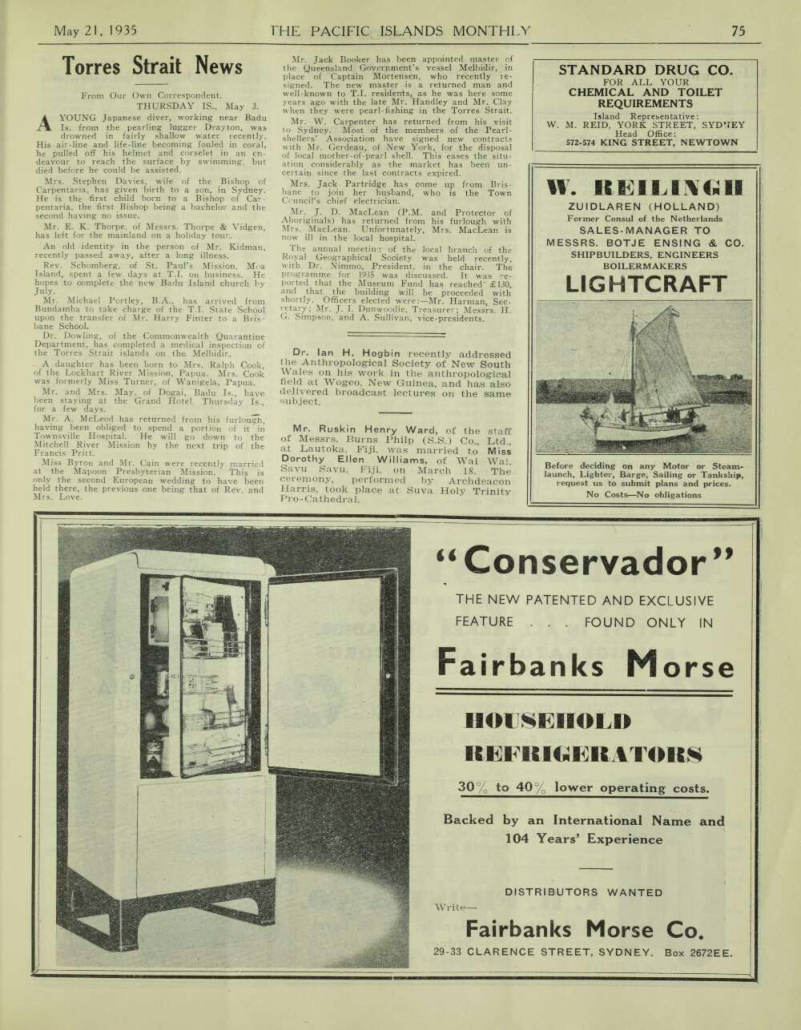
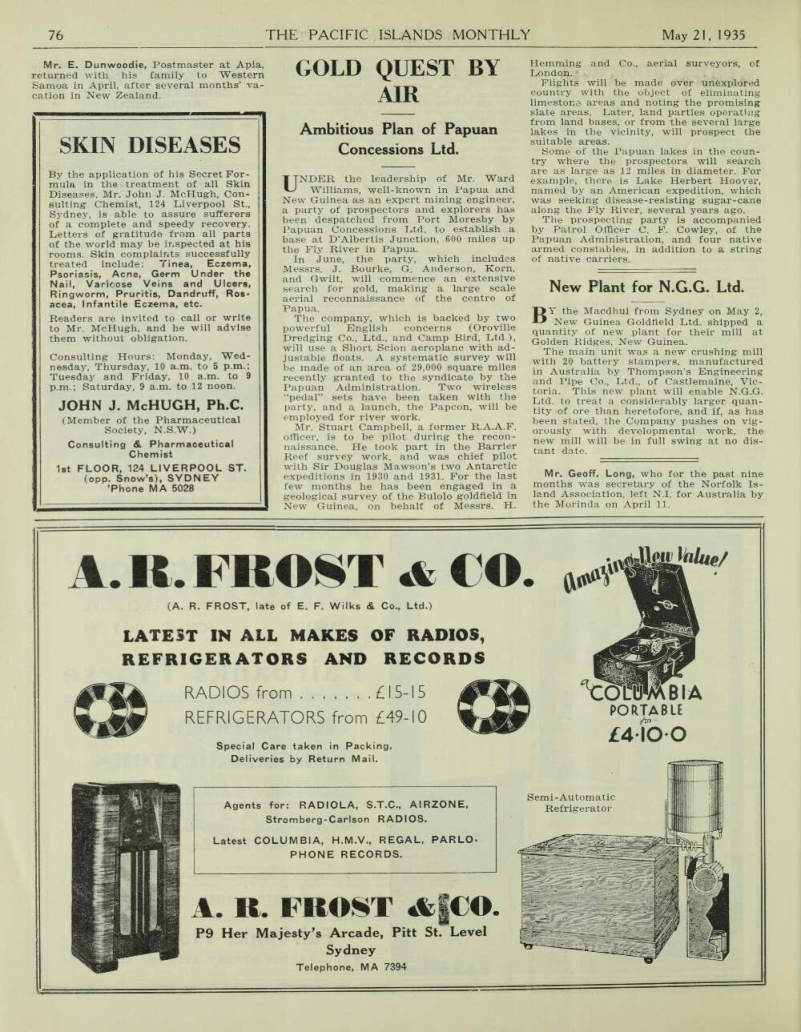
From Our Own Correspondent.
Thursday Is., May 3.
A YOUNG Japanese diver, working near Badu Is. from the pearling lugger Drayton, was drowned in fairly shallow water recently.
His air-line and life-line becoming fouled in coral, he pulled off his helmet and corselet in an en deavour to reach the surface by swimming, but died before he could be assisted.
Mrs. Stephen Davies, wife of the Bishop of Carpentaria, has given birth to a son, in Sydney.
He is the first child born to a Bishop of Car pentaria, the first Bishop being a bachelor and the second having no issue.
Mr. E. K. Thorpe, of Messrs. Thorpe & Vidgen, has left for the mainland on a holiday tour.
An old identity in the person of Mr. Kidman, recently passed away, after a long illness.
Rev. Schomberg, of St. Paul’s Mission, Moa Island, spent a few days at T.I. on business. He hopes to complete the new Badu Island church by July.
Mr. Michael Portley, B.A., has arrived from Bundamba to take charge of the T.I. State School upon the transfer of Mr. Harry Finter to a Bris bane School.
Dr. Dowling, of the Commonwealth Quarantine Department, has completed a medical inspection of the Torres Strait islands on the Melbidir.
A daughter has been born to Mrs. Ralph Cook, of the Lockhart River Mission, Papua. Mrs. Cook was formerly Miss Turner, of Wanigela, Papua.
Mr. and Mrs. May, of Dogai, Badu Is., have been staying at the Grand Hotel, Thursday Is., for a few days.
Mr. A. McLeod has returned from his furlough, having been obliged to spend a portion of it in Townsville Hospital. He will go down to the Mitchell River Mission by the next trip of the Francis Pritt.
Miss Byron and Mr. Cain were recently married at the Mapoon Presbyterian Mission. This is only the second European wedding to have been held there, the previous one being that of Rev. and Mrs. Love.
Mr. Jack Booker has been appointed master of the Queensland Government’s vessel Melbidir, in place of Captain Mortensen, who recently re signed. The new master is a returned man and well-known to T.I. residents, as he was here some years ago with the late Mr. Handley and Mr. Clay when they were pearl-fishing in the Torres Strait.
Mr. W. Carpenter has returned from his visit to Sydney. Most of the members of the Pearl shellers’ Association have signed new contracts with Mr. Gerdeau, of New York, for the disposal of local mother-of-pearl shell. This eases the situ ation considerably as the market has been un certain since the last contracts expired.
Mrs. Jack Partridge has come up from Bris bane to join her husband, who is the Town Council’s chief electrician.
Mr. J. D. MacLean (P.M. and Protector of Aboriginals) has returned from his furlough with Mrs. MacLean. Unfortunately, Mrs. MacLean is now ill in the local hospital.
The annual meeting of the local branch of the Royal Geographical Society was held recently, with Dr. Nimmo, President, in the chair. The programme for 1935 was discussed. It was re ported that the Museum Fund has reached £130, and that the building will be proceeded with shortly. Officers elected were:—Mr. Harman, Sec retary; Mr. J. I. Dunwoodie, Treasurer; Messrs. H.
G. Simpson, and A. Sullivan, vice-presidents.
Dr. Ian H. Hogbin recently addressed the Anthropological Society of New South Wales on his work in the anthropological field at Wogeo, New Guinea, and has also delivered broadcast lectures on the same subject.
Mr. Ruskin Henry Ward, of the staff of Messrs. Burns Philp (S.S.) Co., Ltd., at Lautoka, Fiji, was married to Miss Dorothy Ellen Williams, of Wai Wai.
Savu Savu, Fiji, on March 18. The ceremony, performed by Archdeacon Harris, took place at Suva Holy Trinity Pro-Cathedral.
Mr. E. Dunwoodie, Postmaster at Apia, returned with his family to Western Samoa in April, after several months’ va cation in New Zealand.
Advertisements & other items, pp. 77-78 (1 item)
“Conservador”
STANDARD DRUG CO.
FOR ALL YOUR
CHEMICAL AND TOILET
REQUIREMENTS
Island Representative:
W. M. REID, YORK STREET, SYDNEY
Head Office:
572-574 KING STREET, NEWTOWN
W. REILINGH
ZUIDLAREN (HOLLAND)
Former Consul of the Netherlands
SALES-MANAGER TO
MESSRS. BOTJE ENSING & CO.
SHIPBUILDERS, ENGINEERS
BOILERMAKERS
LIGHTCRAFT
Before deciding on any Motor or Steamlaunch, Lighter, Barge, Sailing or Tankship, request us to submit plans and prices.
No Costs—No obligations
“Conservador”
THE NEW PATENTED AND EXCLUSIVE
FEATURE . . . FOUND ONLY IN
Fairbanks M orse
household
REFRIGERATORS
30% to 40% lower operating costs.
Backed by an International Name and 104 Years’ Experience
DISTRIBUTORS WANTED
Write—
Fairbanks Morse Co.
29-33 CLARENCE STREET, SYDNEY. Box 2672EE.
SKIN DISEASES
By the application of his Secret Formula in the treatment of all Skin Diseases, Mr. John J. McHugh, Consulting Chemist, 124 Liverpool St., Sydney, is able to assure sufferers of a complete and speedy recovery.
Letters of gratitude from all parts of the world may be inspected at his rooms. Skin complaints successfully treated include: Tinea, Eczema, Psoriasis, Acne, Germ Under the Nail, Varicose Veins and Ulcers, Ringworm, Pruritis, Dandruff, Rosacea, Infantile Ecz-ema, etc.
Readers are invited to call or write to Mr. McHugh, and he will advise them without obligation.
Consulting Hours: Monday, Wednesday, Thursday, 10 a.m. to 5 p.m.; Tuesday and Friday, 10 a.m. to 9 p.m.; Saturday, 9 a.m. to 12 noon.
JOHN J. McHUGH, Ph.C.
(Member of the Pharmaceutical Society, N.S.W.) Consulting & Pharmaceutical Chemist
1st FLOOR, 124 LIVERPOOL ST.
(opp. Snow’s), SYDNEY 'Phone MA 5028
A. R. FROST & CO
(A. R. FROST, late of E. F. Wilks & Co., Ltd.)
LATEST IN ALL MAKES OF RADIOS,
REFRIGERATORS AND RECORDS
RADIOS from £15-15
REFRIGERATORS from £49-10
Special Care taken in Packing.
Deliveries by Return Mail.
Agents for: RADIOLA, S.T.C., AIRZONE, Stromberg-Carlson RADIOS.
Latest COLUMBIA, H.M.V., REGAL, PARLO-
PHONE RECORDS.
A. R. FROST & CO.
P9 Her Majesty’s Arcade, Pitt St. Level
Sydney
Telephone, MA 7394 Semi-Automatic Refrigerator
Gold Quest By
Air
Ambitious Plan of Papuan Concessions Ltd.
UNDER the leadership of Mr. Ward Williams, well-known in Papua and New Guinea as an expert mining engineer, a party of prospectors and explorers has been despatched from Port Moresby by Papuan Concessions Ltd. to establish a base at D’Albertis Junction, 600 miles up the Fly River in Papua.
In June, the party, which includes Messrs. J. Bourke, G. Anderson, Korn, and Gwilt, will commence an extensive search for gold, making a large scale aerial reconnaissance of the centre of Papua.
The company, which is backed by two powerful English concerns (Oroville Dredging Co., Ltd., and Camp Bird, Ltd.), will use a Short Scion aeroplane with ad justable floats. A systematic survey will be made of an area of 29,000 square miles recently granted to the syndicate by the Papuan Administration. Two wireless “pedal” sets have been taken with the party, and a launch, the Papcon, will be employed for river work.
Mr. Stuart Campbell, a former R.A.A.F. officer, is to be pilot during the recon naissance. He took part in the Barrier Reef survey work, and was chief pilot with Sir Douglas Mawson’s two Antarctic expeditions in 1930 and 1931. For the last few months he has been engaged in a geological survey of the Bulolo goldfield in New Guinea, on behalf of Messrs. H.
Hemming and Co., aerial surveyors, of London.
Flights will be made over unexplored country with the object of eliminating limestone areas and noting the promising slate areas. Later, land parties operating from land bases, or from the several large lakes in the vicinity, will prospect the suitable areas.
Some of the Papuan lakes in the coun try where the prospectors will search are as large as 12 miles in diameter. For example, there is Lake Herbert Hoover, named by an American expedition, which was seeking disease-resisting sugar-cane along the Fly River, several years ago.
The prospecting party is accompanied by Patrol Officer C. F. Cowley, of the Papuan Administration, and four native armed constables, in addition to a string of native carriers.
New Plant for N.G.G. Ltd.
BY the Macdhui from Sydney on May 2, New Guinea Goldfield Ltd. shipped a quantity of new plant for their mill at Golden Ridges, New Guinea, The main unit was a new crushing mill with 20 battery stampers, manufactured in Australia by Thompson’s Engineering and Pipe Co,, Ltd., of Castlemaine, Vic toria. This new plant will enable N.G.G.
Ltd. to treat a considerably larger quan tity of ore than heretofore, and if, as has been stated, the Company pushes on vig orously with developmental work, the new mill will be in full swing at no dis tant date.
Mr. Geoff. Long, who for the past nine months was secretary of the Norfolk Is land Association, left N.I. for Australia by the Morinda on April 11.
Market Quotations
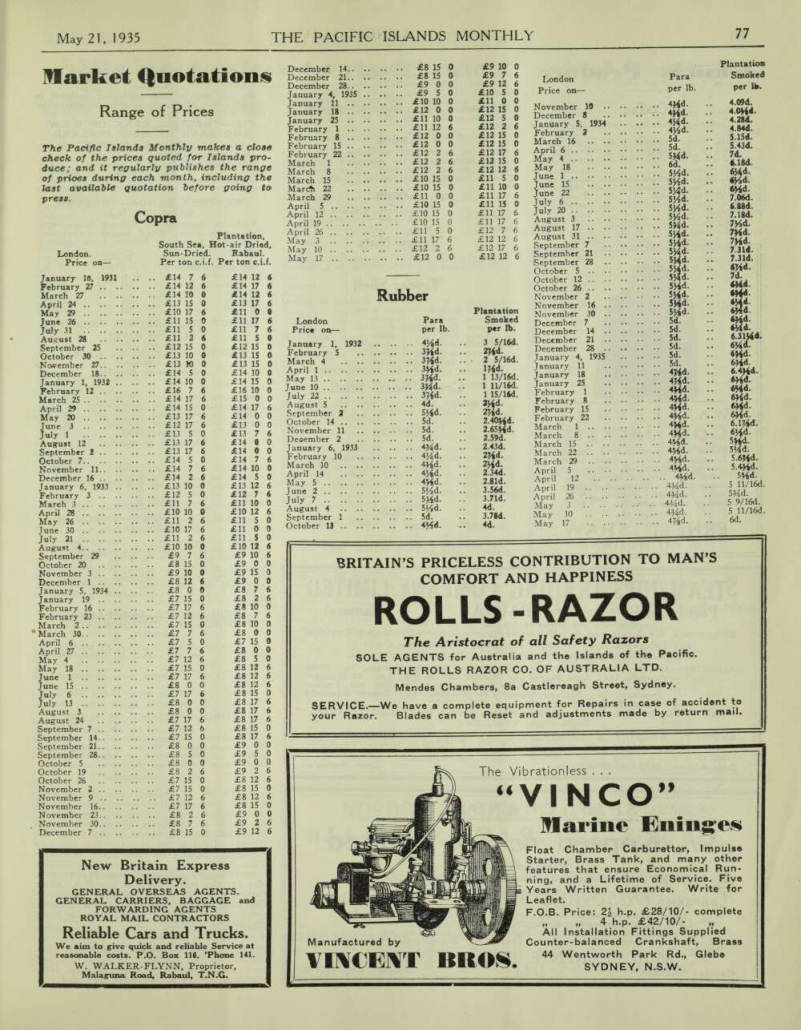
Range of Prices
The Pacific Islands Monthly makes a close check of the prices quoted for Islands pro duce; and it regularly publishes the range of prices during each month, including the last available quotation before going to press.
December 14 . .. £8 15 0 £9 10 0 December 21 £8 15 0 £9 7 6 December 28 . .. £9 0 0 £9 12 6 January 4, 1935 .. . . .. £9 5 0 £10 5 0 January 11 . .. £10 10 0 £11 0 0 January 18 . .. £12 0 0 £12 15 0 January 25 . .. £11 10 0 £12 5 0 February 1 . .. £11 12 6 £12 2 6 February 8 . .. £12 0 0 £12 15 0 February 15 . .. £12 0 0 £12 15 0 February 22 . .. £12 2 6 £12 17 6 March 1 . .. £12 2 6 £12 15 0 March 8 £12 2 6 £12 2 6 March 15 £10 15 0 £11 5 0 March 22 . .. £10 15 0 £11 10 0 March 29 £11 10 0 £11 17 6 April 5 . .. £10 15 0 £11 15 0 April 12 , .. £10 15 0 £11 17 6 April 19 .. £10 15 0 £11 17 6 April 26 . .. £11 5 0 £12 7 6 May 3 , .. £11 17 6 £12 12 6 May 10 . .. £12 2 6 £12 17 6 May 17 . .. £12 0 0 £12 12 6
London Price on—
Rubber
Para per lb.
Plantation Smoked per lb.
January 1, 1932 45*d. 3 5/16d.
February 5 3Kd. •• 2Hd.
March 4 2 5/16d.
April 1 3Hd. ..
IJid.
May 13 1 13/16d.
June 10 3tfd. .. 1 ll/16d.
July 22 3?*I. .. 1 1S/1 id.
August 5 4d.
VAd- September 2 Stfd. .. 2J<d.
October 14 5d. 2.40tfd. 2.65Hd.
November 11 5d.
December 2 Sd. 2.59d.
January 6, 1933 W- .. 2.43d.
February 10 *'Ad. 2J4d.
March 10 AHd. .. w.
April 14 4J*d. 2.34d.
May 5 4*d. .. 2.81d.
June 2 S'Ad. .. 3.56d.
July 7 5* d. 3.71d.
August 4 S'Ad. 4d.
September 1 5d. 3.78d.
October 13 4^d. 4d.
London Price on— November 10 December 8 January 5, 1934 February 2 Para per lb. .. .. 5d.
Plantation Smoked per lb. 4.09d. 4.0*4. 4.284. 4.84d. 5.15d. .. .. 5d. , , 5.43d, .. .. 5*4. m 7d. .. .. 6d. 6.184. .. .. 5*d. 8£ 6*d.
Tune 15 June 22 .. .. 5*d.
July 20 August 3 .. .. 5*d. .. .. 5*d. .. .. 5*d. .. .. S*d. 7.06d. 6.88d. 7.184. 7*4.
August 31 September 7 September 21 September 28 .. .. 5*d. .. .. 5*d. .. .. 5*4. .. .. 5*d. 7*4. 7*4. 7.314. 7.31d. 6*4. .. .. 5jJd. 7d. .. .. 5*d. 88: it §}d! 6 31144. 6*(T 6*4. 6*4.
November 2 November 16 November 30 December 7 December 14 December 21 December 28 January 4, 1935 .. .. s*d. .. .. S*d. .. .. 5d. .. .. 5d. .. .. 5d. .. .. 5d. .. .. 5d. .. .. 5d. , , .. .. 4*d. m 6.4*4.
February 1 February 8 February 15 February 22 March 1 March 8 March 15 March 22 March 29 April 5 April 12 April 19 May 3 May 10 May 17 .. .. 4*4. .. .. 4*4. .■ .. 4*4. .. .. 4*4. •• 6*4. 6*4. 6*4- 88: 6.1*4. 6*4.
P 5.6*4. 5.4*4. 5*4. 5 11/164. 5*4. 5 9/16d. 5 11/164. 6d.
Copra
Plantation, Hot-air Dried, Rabaul. Per ton c.i.f.
South Sea, Sun-Dried. Per ton c.i.f.
London. Price on— January 19, 1931 .. .. £14 7 6 £14 12 6 February 27 .. .. £14 12 6 £14 17 6 March 27 .. .. £14 10 0 £14 12 6 April 24 £13 15 0 £13 17 6 May 29 .. .. £10 17 6 £11 0 0 June 26 £11 15 0 £11 17 6
July 31
.. .. £11 5 0 £11 7 6 August 28 .. .. £11 2 6 £11 5 0
September 25
.. .. £12 15 0 £12 15 0 October 30 £13 10 0 £13 15 0 November 27 .. .. £13 10 0 £13 15 0 December 18 .. .. £14 5 0 £14 10 0 January 1, 1932 .. .. £14 10 0 £14 15 0 February 12 .. .. £16 7 6 £16 10 0 March 25 .. .. £14 17 6 £15 0 0 April 29 .. .. £14 15 0 £14 17 6 May 20 .. .. £13 17 6 £14 0 0
June 3
.. .. £12 17 6 £13 0 0
July 1
£13 5 0 £13 7 6 August 12 .. .. £13 17 6 £14 0 0 September 2 .. .. £13 17 6 £14 0 0 October 7 .. .. £14 5 0 £14 7 6 November 11 .. .. £14 7 6 £14 10 0 December 16 .. .. .. £14 2 6 £14 5 0 January 6, 1933 .. .. £13 10 0 £13 12 6 February 3 .. .. £12 5 0 £12 7 6 March 3 .. .. £11 7 6 £11 10 0
April 28
.. .. £10 10 0 £10 12 6 May 26 .. .. £11 2 6 £11 5 0 June 30 .. .. £10 17 6 £11 0 0 July 21 .. .. £11 2 6 £11 5 0 August 4 .. .. £10 10 0 £10 12 6 September 29 ... £9 7 6 £9 10 6 October 20 ... £8 15 0 £9 0 0 November 3 ... £9 10 0 £9 15 0 December 1 ... £8 12 6 £9 0 0 January 5, 1934 ... £8 0 0 £8 7 6 January 19 ... £7 15 0 £8 2 6 February 16 .. .. £7 17 6 £8 10 0 February 23 £7 12 6 £8 7 6 March 2 ... £7 15 0 £8 10 0 March 30 ... £7 7 6 £8 0 0 April 6 ... £7 5 0 £7 15 0 April 27 .. .. £7 7 6 £8 0 0 May 4 .. .. £7 12 6 £8 5 0 May 18 .. .. £7 15 0 £8 12 6
June 1
£7 17 6 £8 12 6 June 15 ... £8 0 0 £8 12 6
July 6
£7 17 6 £8 15 0 July 13 .. .. £8 0 0 £8 17 6 August 3 ... £8 0 0 £8 17 6 August 24 .. .. £7 17 6 £8 17 6 September 76 ... £7 12 6 £8 15 0 September 146 .. .. £7 15 0 £8 17 6 September 216 ... £8 0 0 £9 0 0 September 28 ... £8 5 0 £9 5 0 October 5 ... £8 0 0 £9 0 0 October 19 ... £8 2 6 £9 2 6 October 26 ... £7 15 0 £8 12 6 November 2 ... £7 15 0 £8 15 0 November 9 .. .. £7 12 6 £8 12 6 November 16 ... £7 17 6 £8 15 0 November 23 ... £8 2 6 £9 0 0 November 30 .. .. £8 7 6 £9 2 6 December 7 .. .. £8 15 0 £9 12 6
Advertisements & other items, p. 79 (1 item)
Rolls-Razor
BRITAIN’S PRICELESS CONTRIBUTION TO MAN’S
COMFORT AND HAPPINESS
The Aristocrat of all Safety Razors SOLE AGENTS for Australia and the Islands of the Pacific.
THE ROLLS RAZOR CO. OF AUSTRALIA LTD.
Mendes Chambers, 8a Castlereagh Street, Sydney.
SERVICE.—We have a complete equipment for Repairs in case of accident to your Razor. Blades can be Reset and adjustments made by return mail.
Manufactured by
VINCENT BROS.
The Vibrationless . . .
“VINCO”
Marine Eninges
Float Chamber Carburettor, Impulse Starter, Brass Tank, and many other features that ensure Economical Running, and a Lifetime of Service. Five Years Written Guarantee. Write for Leaflet.
F.O.B. Price: 2½ h.p. £28/10/- complete „ „ 4 h.p. £42/10/- All Installation Fittings Supplied Counter-balanced Crankshaft, Brass 44 Wentworth Park Rd., Glebe
SYDNEY, N.S.W.
New Britain Express
Delivery.
GENERAL OVERSEAS AGENTS.
GENERAL CARRIERS, BAGGAGE and
FORWARDING AGENTS
ROYAL MAIL CONTRACTORS
Reliable Cars and Trucks.
We aim to give quick and reliable Service at reasonable costs. P.O. Box 116. 'Phone 141.
W. WALKER-FLYNN, Proprietor, Malaguna Road, Rabaul, T.N.G.
Exchange Rates
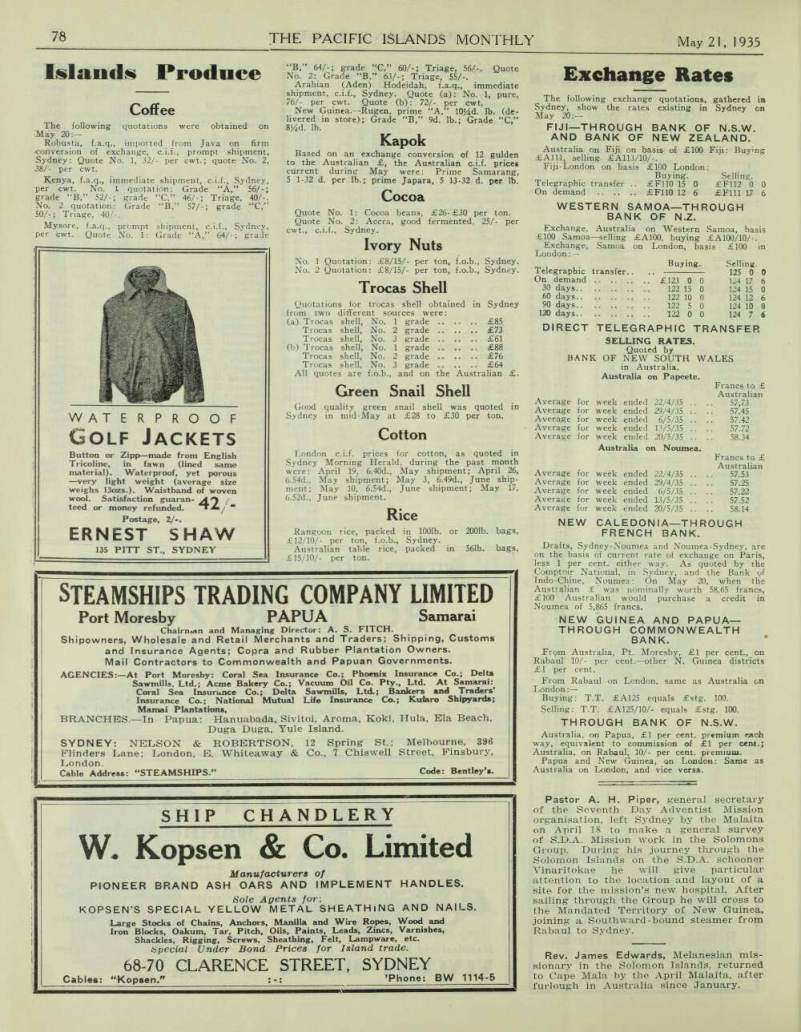
Islands Produce
Coffee
The following quotations were obtained on May 20:— Robusta, f.a.q., imported from Java on firm of exchange, c.i.f., prompt shipment, Sydney; Quote No. 1, 32/- per cwt.; quote No. 2, -38/- per cwt.
Kenya, f.a.q., immediate shipment, c.i.f., Sydney, per cwt. No. 1 quotation: Grade “A,” 56/-; grade “B,” 52/-; grade “C,” 46/-; Triage, 40/-.
No. 2 quotation: Grade “B,” 57/-; grade “C,” 50/-; Triage, 40/-.
Mysore, f.a.q., prompt shipment, c.i.f., Sydney, per cwt. Quote No. 1; Grade “A,” 64/-; grade
“B,” 64/-; grade “C,” 60/-; Triage, 56/-. Quote No. 2: Grade “B,” 63/-; Triage, 55/-.
Arabian (Aden) Hodeidah, f.a.q., immediate shipment, c.i.f., Sydney. Quote (a): No. 1, pure, 76/- per cwt. Quote (b): 72/- per cwt.
New Guinea.—Rugen, prime “A,” lb. (de livered in store); Grade “B,” 9d. lb.; Grade “C,”
Syid. lb.
Kapok
Based on an exchange conversion of 12 gulden to the Australian £, the Australian c.i.f. prices current during May were: Prime Samarang, 5 1-32 d. per lb.; prime Japara, 5 13-32 d. per lb.
Cocoa
Quote No. 1: Cocoa beans, £26-£30 per ton.
Quote No. 2; Accra, good fermented, 25/- per cwt., c.i.f., Sydney.
Ivory Nuts
No. 1 Quotation: £8/15/- per ton, f.o.b., Sydney.
No. 2 Quotation: £8/15/- per ton, f.o.b., Sydney.
Trocas Shell
Green Snail Shell
Good quality green snail shell was quoted in Sydney in mid-May at £28 to £30 per ton.
Cotton
London c.i.f. prices for cotton, as quoted in Sydney Morning Herald, during the past month were: April 19, 6.40 d., May shipment; April 26, 6.54 d., May shipment; May 3,6.49 d., June ship ment; May 10, 6.54 d., June shipment; May 17, 6.52 d., June shipment.
Rice
Rangoon rice, packed in 100lb. or 200lb. bags, £12/10/- per ton, f.o.b., Sydney.
Australian table rice, packed in 56lb. bags, £15/10/- per ton.
Exchange Rates
The following exchange quotations, gathered in Sydney, show the rates existing in Sydney on May 20:—
Fiji—Through Bank Of N.S.W.
And Bank Of New Zealand.
Australia on Fiji on basis of £100 Fiji: Buying £A111, selling £A113/10/-.
Fiji-London on basis £100 London: Buying. Selling.
Telegraphic transfer .. £F110 15 0 £F112 0 0 On demand £FIIO 12 6 £F111 17 6
Western Samoa—Through
Bank Of N.Z.
Exchange, Australia on Western Samoa, basis £100 Samoa—selling £A100, buying £A100/10/-.
Exchange, Samoa on London, basis £100 in London:—
Direct Telegraphic Transfer
Selling Rates.
Quoted by
Dank Of New South Wales
in Australia.
New Caledonia—Through
French Bank.
Drafts, Sydney-Noumea and Noumea-Sydney, are on the basis of current rate of exchange on Paris, less 1 per cent, either way. As quoted by the Comptoir National, in Sydney, and the Bank of Indo-Chine, Noumea: On May 20, when the Australian £ was nominally worth 58.65 francs, £100 Australian would purchase a credit in Noumea of 5,865 francs.
New Guinea And Papua
Through Commonwealth
Bank.
From Australia, Pt. Moresby, £1 per cent., on Rabaul 10/- per cent. —other N. Guinea districts £1 per cent.
From Rabaul on London, same as Australia on London : Buying; T.T. £A125 equals £stg. 100.
Selling: T.T. £A125/10/- equals £stg. 100.
Through Bank Of N.S.W.
Australia, on Papua, £1 per cent, premium each way, equivalent to commission of £1 per cent.; Australia, on Rabaul, 10/- per cent, premium.
Papua and New Guinea, on London: Same as Australia on London, and vice versa.
Pastor A. H. Piper, general secretary of the Seventh Day Adventist Mission organisation, left Sydney by the Malaita on April 18 to make a general survey of S.D.A. Mission work in the Solomons Group. During his journey through the Solomon Islands on the S.D.A. schooner Vinaritokae he will give particular attention to the location and layout of a site for the mission’s new hospital. After sailing through the Group he will cross to the Mandated Territory of New Guinea, joining a Southward-bound steamer from Rabaul to Sydney.
Rev. James Edwards, Melanesian mis sionary in the Solomon Islands, returned to Cape Mala by the April Malaita, after furlough in Australia since January.
Quotations for trocas shell obtained from two different sources were: in Sydney (a) Trocas shell, No. 1 grade .. .. .. £85 Trocas shell, No. 2 grade .. .. £73 Trocas shell, No. 3 grade .. .. .. £61 (b) Trocas shell, No. 1 grade .. .. .. £88 Trocas shell, No. 2 grade .. .. .. £76 Trocas shell, No. 3 grade .. .. .. £64 All quotes are f.o.b., and on the Australian £.
Telegraphic transfer..
Buying.
Selling. 125 0 0 On demand .. £123 0 0 124 17 6 30 days 122 15 0 124 15 0 60 days 122 10 0 124 12 6 90 days 122 5 0 124 10 0 120 days 122 0 0 124 7 6
Average for week ended 22/4/35 .. .. 57,73 Australia on Papeete.
Francs to £ Australian Average for week ended 29/4/35 .. 57.45 Average for week ended 6/5/35 .. 57.42 Average for week ended 13/5/35 .. 57.72 Average for week ended 20/5/35 .. 58.34 Average for week ended 22/4/35 .. 57.53 Australia on Noumea.
Francs to £ Australian Average for week ended 29/4/35 .. 57.25 Average for week ended 6/5/35 .. 57.22 Average for week ended 13/5/35 .. 57.52 Average for week ended 20/5/35 .. 58.14
Advertisements & other items, p. 80 (1 item)
W. Kopsen & Co. Limited
WATERPROOF
Golf Jackets
Button or Zipp—made from English Tricoline, in fawn (lined same material). Waterproof, yet porous —very light weight (average size weighs 13ozs.). Waistband of woven wool. Satisfaction guaranteed or money refunded. 42/- Postage, 2/-.
ERNEST SHAW
135 PITT ST.. SYDNEY
Steamships Trading Company limited
Port Moresby PAPUA Samarai
Chairman and Managing Director: A. S. FITCH.
Shipowners, Wholesale and Retail Merchants and Traders; Shipping, Customs and Insurance Agents; Copra and Rubber Plantation Owners.
Mail Contractors to Commonwealth and Papuan Governments.
AGENCIES:—At Port Moresby: Coral Sea Insurance Co.; Phoenix Insurance Co.; Delta Sawmills. Ltd.; Acme Bakery Co.; Vacuum Oil Co. Pty., Ltd. At Samarai: Coral Sea Insurance Co.; Delta Sawmills, Ltd.; Bankers and Traders' Insurance Co.; National Mutual Life Insurance Co.; Kuiaro Shipyards; Mamai Plantations, BRANCHES.—In Papua: Hanuabada, Sivitoi, Aroma, Koki, Hula, Ela Beach, Duga Duga, Yule Island.
SYDNEY: NELSON & ROBERTSON, 12 Spring St.; Melbourne. 396 Flinders Lane; London, E. Whiteaway & Co.. 7 Chiswell Street, Finsbury, London.
Cable Address: “STEAMSHIPS.” Code; Bentley's.
SHIP CHANDLERY
W. Kopsen & Co. Limited
Manufacturers of PIONEER BRAND ASH OARS AND IMPLEMENT HANDLES.
Sole Agents for : KOPSEN’S SPECIAL YELLOW METAL SHEATHiNG AND NAILS.
Large Stocks of Chains, Anchors, Manilla and Wire Ropes, Wood and Iron Blocks, Oakum, Tar, Pitch, Oils, Paints, Leads, Zincs, Varnishes, Shackles, Rigging, Screws, Sheathing, Felt, Lampware, etc.
Special Under Bond Prices for Island trade.
68-70 CLARENCE STREET, SYDNEY
Cable.; “Kopsen." :-: ’Phone: BW 1114-6
July 4-5
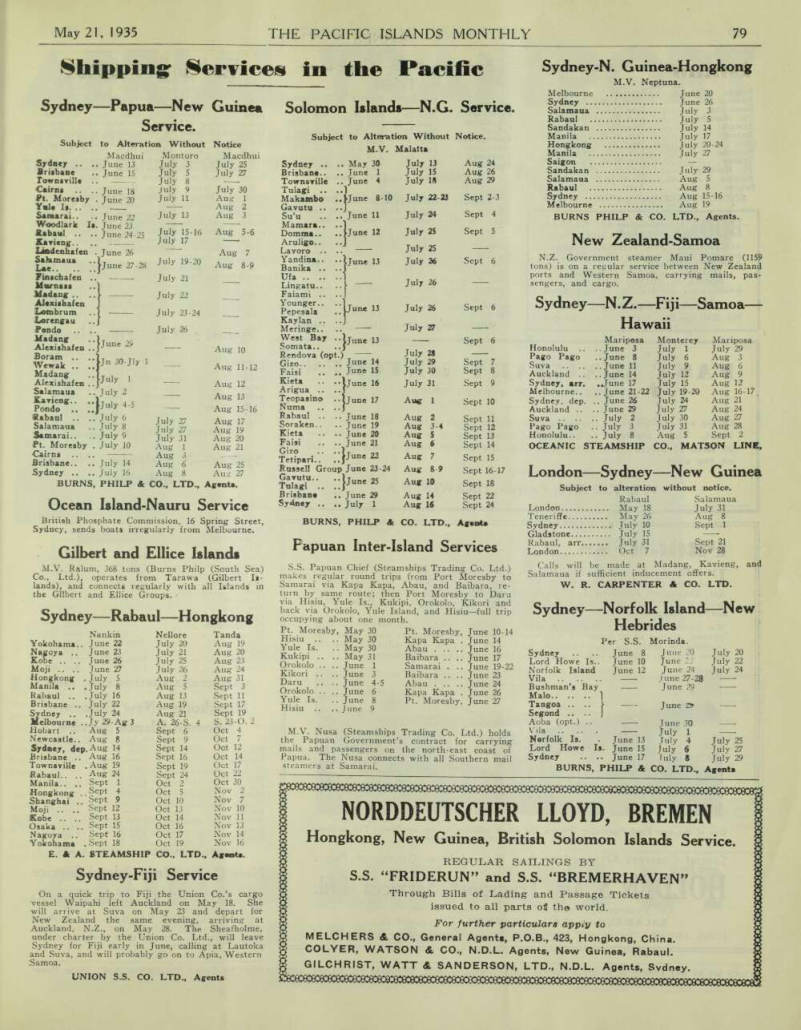
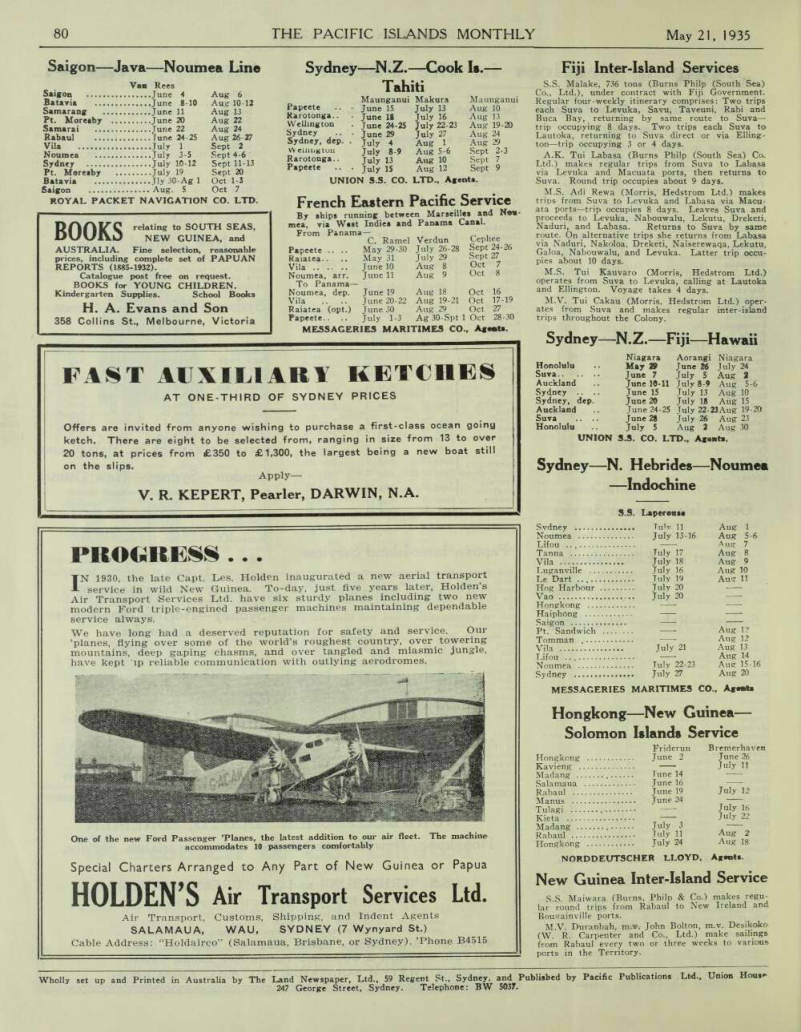
Shipping: Services in the Pacific
Sydney—Papua—New Guinea Service.
Subject to Alteration Without Notice
Ocean Island-Nauru Service
British Phosphate Commission, 16 Spring Street, Sydney, sends boats irregularly from Melbourne.
Gilbert and Ellice Islands
M.V. Ralum, 368 tons (Burns Philp (South Sea) Co., Ltd.), operates from Tarawa (Gilbert Is lands), and connects regularly with all Islands in the Gilbert and Ellice Groups.
Sydney—Rabaul—Hongkong
Sydney-Fiji Service
On a quick trip to Fiji the Union Co.’s cargo vessel Waipahi left Auckland on May 18. She will arrive at Suva on May 23 and depart for New Zealand the same evening, arriving at Auckland, N.Z., on May 28. The Sheafholme, under charter by the Union Co. Ltd., will leave Sydney for Fiji early in June, calling at Lautoka and Suva, and will probably go on to Apia, Western Samoa.
Union S.S. Co. Ltd., Agents
Solomon Islands —N.G. Service.
Papuan Inter-Island Services
S.S. Papuan Chief (Steamships Trading Co. Ltd.) makes regular round trips from Port Moresby to Samarai via Kapa Kapa, Abau, and Baibara, re turn by same route; then Port Moresby to Darn via Hisiu, Yule Is., Kukipi, Orokolo, Kikori and back via Orokolo, Yule Island, and Hisiu —full trip occupying about one month.
Pt. Moresby, May 30 Pt. Moresby, June 10-14 Hisiu .. .. May 30 Kapa Kapa . June 14 Yule Is. .. May 30 Abau . .. .. June 16 Kukipi .. .. May 31 Baibara .. .. June 17 Orokolo .. .. June 1 Samarai . June 19-22 Kikori .. .. June 3 Baibara .. .. June 23 Daru .. .. June 4-5 Abau June 24 Orokolo .. .. June 6 Kapa Kapa . June 26 Yule Is. .. June 8 Pt. Moresby, June 27 Hisiu .. .. June 9 M.V. Nusa (Steamships Trading Co. Ltd.) holds the Papuan Government’s contract for carrying mails and passengers on the north-east coast of Papua. The Nusa connects with all Southern mail steamers at Samarai.
Sydney-N. Guinea-Hongkong M.V. Neptuna,
New Zealand-Samoa
N.Z. Government steamer Maui Pomare (1159 tons) is on a regular service between New Zealand ports and Western Samoa, carrying mails, pas sengers, and cargo.
Sydney—N.Z.—Fiji—Samoa—
Hawaii
London—Sydney—New Guinea Subject to alteration without notice.
Sydney—Norfolk Island —New Hebrides
Macdhui Montoro Macdhui Sydney June 13 July 3 July 25 Brisbane June 15 July 5 July 27 Townsville July 8 Cairns June 18 July 9 July 30 Pt. Moresby June 20 July 11 Aug 1 Yule Is.
Aug 2 Samarai June 22 July 13 Aug 3 Woodlark Is.
June 23 Rabaul June 24-25 July 15-16 Aug 5-6 Karieng July 17 Lindenhafen June 26 Aug 7 Sakmaua Lae 27-28 July 19-20 Aug 8-9 Finschafen July 21 Murnass Madang July 22 Alixishafen Lorobrum July 23-24 Lorengau Pondo July 26 Madang Alexishafen June 29 Aug 10 Boram Wewak Jn 30-JIy 1 Aug 11-12 Madang Alexishafen July 1 Aug 12 Salamaua Karieng Pondo July 2
July 4-5
Aug 13 Aug 15-16 Rabaul Salamaua Samarai July 6 July 8 July 9 July 27 July 27 July 31 Aug 17 Aug 19 Aug 20 Pt. Moresby July 10 Aug 1 Aug 21 Cairns Aug 3 Brisbane July 14 Aug 6 Aug 25 Sydney July 16 Aug 8 Aug 27
Burns, Philp & Co., Ltd., Agents.
Nankin Nellore Tanda Yokohama June 22 July 20 Aug 19 Nagoya June 23 July 21 Aug 20 Kobe June 26 July 25 Aug 23 Moji June 27 July 26 Aug 24 Hongkong July 5 Aug 2 Aug 31 Manila July 8 Aug 5 Sept 3 Rabaul July 16 Aug 13 Sept 11 Brisbane July 22 Aug 19 Sept 17 Sydney Melbourne July 24 Jy 29-Ag 3 Aug 21 A. 26-S. 4 Sept 19 S. 23-O. 2 Hobart Aug 5 Sept 6 Oct 4 Newcastle Aug 8 Sept 9 Oct 7 Sydney, dec. Aug 14 Sept 14 Oct 12 Brisbane Aug 16 Sept 16 Oct 14 Townsville Aug 19 Sept 19 Oct 17 Rabaul Aug 24 Sept 24 Oct 22 Manila Sept 1 Oct 2 Oct 30 Hongkong Sept 4 Oct 5 Nov 2 Shanghai Sept 9 Oct 10 Nov 7 Moji Sept 12 Oct 13 Nov 10 Kobe Sept 13 Oct 14 Nov 11 Osaka Sept 15 Oct 16 Nov 13 Nagoya Sept 16 Oct 17 Nov 14 Yokohama Sept 18 Oct 19 Nov 16 E. & A. STEAMSHIP CO., LTD., Agents.
Subject to Alteration Without Notice.
M.V. Malaita Sydney May 30 July 13 Aug 24 Brisbane June 1 July 15 Aug 26 Townsville June 4 July 18 Aug 29 Tulagi Sept 2-3 Makambo June 8-10 July 22-23 Gavutu Sept 4 Su’u June 11 July 24 Mamara Sept 5 Domma June 12 July 25 Aruligo 1 July 25 Lavoro Yandina Banika June 13 July 26 Sept 6 Ufa Lingatu July 26 Faiami Younger Pepesala June 13 July 26 Sept 6 Kaylan July 27 Meringe West Bay Somata
June 13
Sept 6 Rendova (opt.) July 28 Giro June 14 July 29 Sept 7 Faisi June 15 July 30 Sept 8 Kieta Arigua
June 16
July 31 Sept 9 Teopasino Numa June 17 Aug 1 Sept 10 Rabaul June 18 Aug 2 Sept 11 Soraken June 19 Aug 3-4 Sept 12 Kieta June 20 Aug 5 Sept 13 Faisi Giro Tetipari June 21 Aug 6 Sept 14 June 22 Aug 7 Sept 15 Russell Group June 23-24 Aug 8-9 Sept 16-17 Oavutu Tulagi June 25 Aug 10 Sept 18 Brisbane June 29 Aug 14 Sept 22 Sydney July 1 Aug 16 Sept 24
Burns, Philp &Co. Ltd., Agents
Melbourne June 20 Sydney June 26 Salamaua July 3 Rabaul July 5 Sandakan July 14 Manila July 17 Hongkong July 20-24 Manila July 27 Saigon Sandakan July 29 Salamaua Aug 5 Rabaul Aug 8 Sydney Aug 15-16 Melbourne Aug 19
Burns Philp & Co. Ltd., Agents.
Mariposa Monterey Mariposa Honolulu June 3 July 1 July 29 Pago Pago June 8 July 6 Aug 3 Suva July 9 Aug 6 Auckland June 14 July 12 Aug 9 Sydney, arr.
June 17 July 15 Aug 12 Melbourne June 21-22 July 19-20 Aug 16-17 Sydney, dep.
June 26 July 24 Aug 21 Auckland June 29 July 27 Aug 24 Suva July 2 July 30 Aug 27 Pago Pago July 3 July 31 Aug 28 Honolulu July 8 Aug 5 Sept 2
Oceanic Steamship Co., Matson Line,
Rabaul Salamaua London May 18 July 31 Teneriffe May 26 Aug 8 Sydney July 10 Sept 1 Gladstone July 15 Rabaul, arr.
Sept 21 London Oct 7 Nov 28 Calls will be made at Madang, Kavieng, and Salamaua if sufficient inducement offers.
W. R. Carpenter & Co. Ltd.
Per S.S. Morinda.
Sydney June 8 June 20 July 20 Lord Howe Is.
June 10 June 22 July 22 Norfolk Island June 12 June 24 July 24 Vila June 27-28 Bushman’s Bay June 29 Malo Tangoa June 29 Segond Aoba (opt.) June 30 Vila July 1 Norfolk Is.
June 13 July 4 July 25 Lord Howe Is.
June 15 July 6 July 27 Sydney June 17 July 8 July 29
Burns, Philp & Co. Ltd., Agents
Saigon—Java—Noumea Line
Sydney—N.Z.—Cook Is.— Tahiti
French Eastern Pacific Service
By ships running between Marseilles and Nou mea, via West Indies and Panama Canal.
From Panama—
Fiji Inter-Island Services
S.S. Malake, 736 tons (Burns Philp (South Sea) Co., Ltd.), under contract with Fiji Government.
Regular four-weekly itinerary comprises: Two trips each Suva to Levuka, Savu, Taveuni, Rabi and Buca Bay, returning by same route to Suva— trip occupying 8 days. Two trips each Suva to Lautoka, returning to Suva direct or via Elling ton —trip occupying 3 or 4 days.
A.K. Tui Labasa (Burns Philp (South Sea) Co.
Ltd.) makes regular trips from Suva to Labasa via Levuka and Macuata ports, then returns to Suva. Round trip occupies about 9 days.
M.S. Adi Rewa (Morris, Hedstrom Ltd.) makes trips from Suva to Levuka and Labasa via Macu ata ports—trip occupies 8 days. Leaves Suva and proceeds to Levuka, Nabouwalu, Lekutu, Dreketi, Naduri, and Labasa. Returns to Suva by same route. On alternative trips she returns from Labasa via Naduri, Nakoloa, Dreketi, Naiserewaqa, Lekutu, Galoa, Nabouwalu, and Levuka. Latter trip occu pies about 10 days.
M.S. Tui Kauvaro (Morris, Hedstrom Ltd.) operates from Suva to Levuka, calling at Lautoka and Ellington. Voyage takes 4 days.
M.V. Tui Cakau (Morris, Hedstrom Ltd.) oper ates from Suva and makes regular inter-island trips throughout the Colony.
Sydney—N.Z.—Fiji—Hawaii
Sydney—N. Hebrides —Noumea —Indochine
Hongkong—New Guinea — Solomon Islands Service
New Guinea Inter-Island Service
S.S. Maiwara (Burns, Philp & Co.) makes regu lar round trips from Rabaul to New Ireland and Bougainville ports.
M.V. Duranbah, m.v. John Bolton, m.v. Desikoko (W. R. Carpenter and Co., Ltd.) make sailings from Rabaul every two or three weeks to various ports in the Territory.
Saigon Van Rees Aug 6 Batavia Aug 10-12 Samarang Aug 13 Pt. Moresby Aug 22 Samarai Aug 24 Rabaul Aug 26-27 Vila July 1 Sept 2 Noumea Sept 4-6 Sydney Sept 11-13 Pt. Moresby Sept 20 Batavia Oct 1-3 Saigon Oct 7
Royal Packet Navigation Co. Ltd.
Maunganui Makura Maunganui Papeete .. . June 15 July 13 Aug 10 Rarotonga.. . June 18 July 16 Aug 13 Wellington . June 24-25 July 22-23 Aug 19-20 Sydney .. . June 29 July 27 Aug 24 Sydney, dep. . July 4 Aug 1 Aug 29 Wellington July 8-9 Aug 5-6 Sept 2-3 Rarotonga.. July 13 A ug 10 Sept 7 Papeete .. . July 15 Aug 12 Sept 9
Union S.S. Co. Ltd., Agents.
C. Ramel Verdun Cephee Papeete May 29-30 July 26-28 Sept 24-26 Raiatea May 31 July 29 Sept 27 Vila June 10 Aug 8 Oct 7 Noumea, arr.
June 11 Aug 9 Oct 8 To Panama— Noumea, dep.
June 19 Aug 18 Oct 16 Vila June 20-22 Aug 19-21 Oct 17-19 Raiatea (opt.) June 30 Aug 29 Oct 27 Papeete July 1-3 Ag 30-Spt 1 Oct 28-30
Messageries Maritimes Co., Agents.
Niagara Aorangi Niagara Honolulu May 29 June 26 July 24 Suva June 7 July 5 Aug 2 Auckland June 10-11 July 8-9 Aug 5-6 Sydney June 15 July 13 Aug 10 Sydney, dep.
June 20 July 18 Aug 15 Auckland June 24-25 July 22-23 Aug 19-20 Suva June 28 July 26 Aug 23 Honolulu July 5 Aug 2 Aug 30
Union S.S. Co. Ltd., Agents.
Svydney S.S. Laperouse Aug 1 Noumea Aug 5-6 Lifou Aug 7 Tanna July 17 Aug 8 Vila Aug 9 Luganville Aug 10 Le Dart Aug 11 Hog Harbour Vao July 20 Hongkong Haiphong Saigon Pt. Sandwich .
Aug 12 Tomman Aug 12 Vila Aug 13 Lifou Aug 14 Noumea Tuly 22-23 Aug 15-16 Sydney Aug 20
Messageries Maritimes Co. Agents.
Friderun Bremerhaven Hongkong June 26 Kavieng July 11 Madang Salamaua Rabaul July 12 Manus Tulagi July 16 Kieta July 22 Madang Rabaul Tuly 11 Aug 2 Hongkong Aug 18
Norddeutscher Lloyd. Agents.
Advertisements & other items, pp. 81-84 (2 items)
Norddeutscher Lloyd, Bremen
Hongkong, New Guinea, British Solomon Islands Service.
REGULAR SAILINGS BY
S.S. “FRIDERUN” and S.S. “BREMERHAVEN”
Through Bills of Lading and Passage Tickets issued to all parts of the world.
For further particulars appiy to MELCHERS & CO., General Agents, P.O.B., 423, Hongkong, China.
COLYER, WATSON & CO., N.D.L. Agents, New Guinea, Rabaul.
GILCHRIST, WATT & SANDERSON, LTD., N.D.L. Agents. Sydney.
BOOKS
relating to SOUTH SEAS,
NEW GUINEA, and
AUSTRALIA. Fine selection, reasonable prices, including complete set of PAPUAN
REPORTS (1885-1932).
Catalogue post free on request.
BOOKS for YOUNG CHILDREN.
Kindergarten Supplies. School Books
H. A. Evans and Son
358 Collins St., Melbourne, Victoria
FAST AUXILIARY KETCHES
AT ONE-THIRD OF SYDNEY PRICES
Offers are invited from anyone wishing to purchase a first-class ocean going ketch. There are eight to be selected from, ranging in size from 13 to over 20 tons, at prices from £350 to £1,300, the largest being a new boat still on the slips.
Apply—
V. R. KEPERT, Pearler, DARWIN, N.A.
PROGRESS ...
IN 1930, the late Capt. Les. Holden inaugurated a new aerial transport service in wild New Guinea. To-day, just five years later, Holden’s Air Transport Services Ltd. have six sturdy planes including two new modern Ford triple-engined passenger machines maintaining dependable service always.
We have long had a deserved reputation for safety and service. Our ’planes, flying over some of the world’s roughest country, over towering mountains, deep gaping chasms, and over tangled and miasmic jungle, have kept ip reliable communication with outlying aerodromes.
One of the new Ford Passenger ’Planes, the latest addition to our air fleet. The machine accommodates 10 passengers comfortably Special Charters Arranged to Any Part of New Guinea or Papua
HOLDEN’S Air Transport Services Ltd.
Air Transport, Customs, Shipping, and Indent Agents
SALAMAUA, WAU, SYDNEY (7 Wynyard St.)
Cable Address: “Holdairco” (Salamaua, Brisbane, or Sydney). ’Phone 84515
AERIAL TRANSPORT
PIONEERED AND CARRIES ON
THE NEW GUINEA GOLD INDUSTRY
Centre—One of the Bulolo Dredges under construction in Central New Guinea—three aeroplanes operated by Guinea Airways Ltd. discharging cargo.
Top right — Daily cattle being loaded into a Guinea Airways plane for transport to the Goldfields.
Lower left—Interior of one of Guinea Airways cargo-carrying aeroplanes
SAFETY
SPEED
COMFORT
DEPENDABILITY
EIGHT years ago, Central New Guinea was almost unexplored, and practically inaccessible.
To-day, although there are no roads through the dense jungles and precipitous mountains, the Morobe Goldfield, in Central New Guinea, is the seat of a flourishing industry. There are half a dozen growing townships, four huge, modern dredges, two hydro-electric stations, crushing-mills, saw-mills, etc. . . Aerial transport alone made this possible.
Aeroplanes, flying in all weathers on regular timetables, connecting the coastal towns of Lae, Salamaua and Port Moresby with over thirty inland aerodromes and landing-grounds, have carried in thousands of tons of engineering equipment, a large European population, thousands of native labourers, foodstuffs, livestock, mails ,etc.
Guinea Airways Ltd. launched its unique aerial transport service seven years ago, with one machine and a handful of men. To-day, it operates a fleet of modern aeroplanes, and employs very large European and native staffs.
NEW GUINEA service aeroplanes carry on one of the biggest transport organisations in the world, in one of the world’s most primitive tropical countries; yet no aerial transport system in the world can show a smaller percentage of accidents, or a better record of efficiency
and dependability.
A visit to Central New Guinea, in one of Guinea Airways speedy and comfortable air-liners, is a unique and delightful experience.
Travellers may leave the steamer at Port Moresby, fly across to Morobe (time of journey, 1 hour 45 minutes) and spend nine days in the Goldfield centres before rejoining steamer at Lae for Rabaul. Or, after visiting Rabaul, they may disembark at Salamaua or Lae, spend several days on the Goldfields, and fly to Port Moresby to rejoin the steamer. All information from Pursers on the steamers.
GUINEA AIRWAYS Ltd
LAE - SALAMAUA
The most important
feature of
RESCH’S PILSENER
is the “SPOT” crown seal Resch’s Pilsener is protected against tropical heat by this specially designed “Spot” Crown Seal.
It ensures perfect freshness in all climates.
RESCH'S
LONG BOTTLE
PILSENER
80
May 21, 1935
THE PACIFIC ISLANDS MONTHLY
Wholly set up and Printed in Australia by The Land Newspaper, Ltd., 59 Regent St.. Sydney, and Published by Pacific Publications Ltd., Union House 247 George Street, Sydney. Telephone; BW 5037.