Pacific
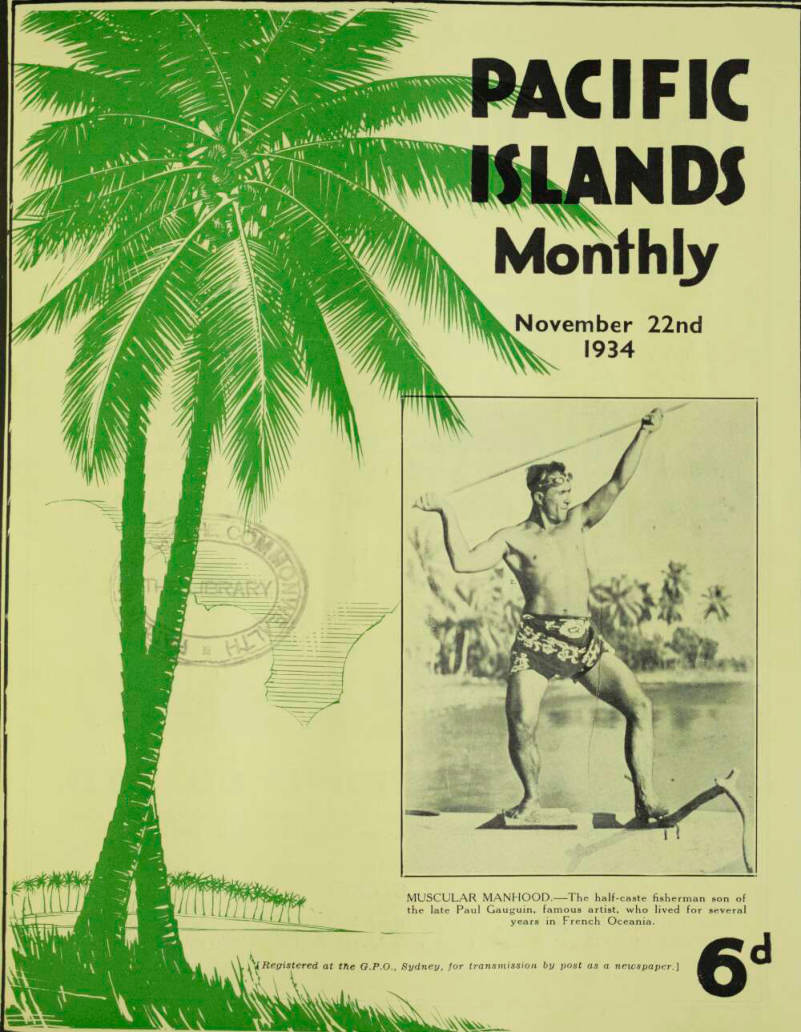
Islands
Monthly
November 22nd 1934
[Registered at the G.P.O., Sydney, for transmission by post as a newspaper.]
6 d
MUSCULAR MANHOOD.-The half-caste fisherman son of the late Paul Gauguin, famous artist, who lived for several years in French Oceania.
Advertisements & other items, pp. 2-3 (1 item)
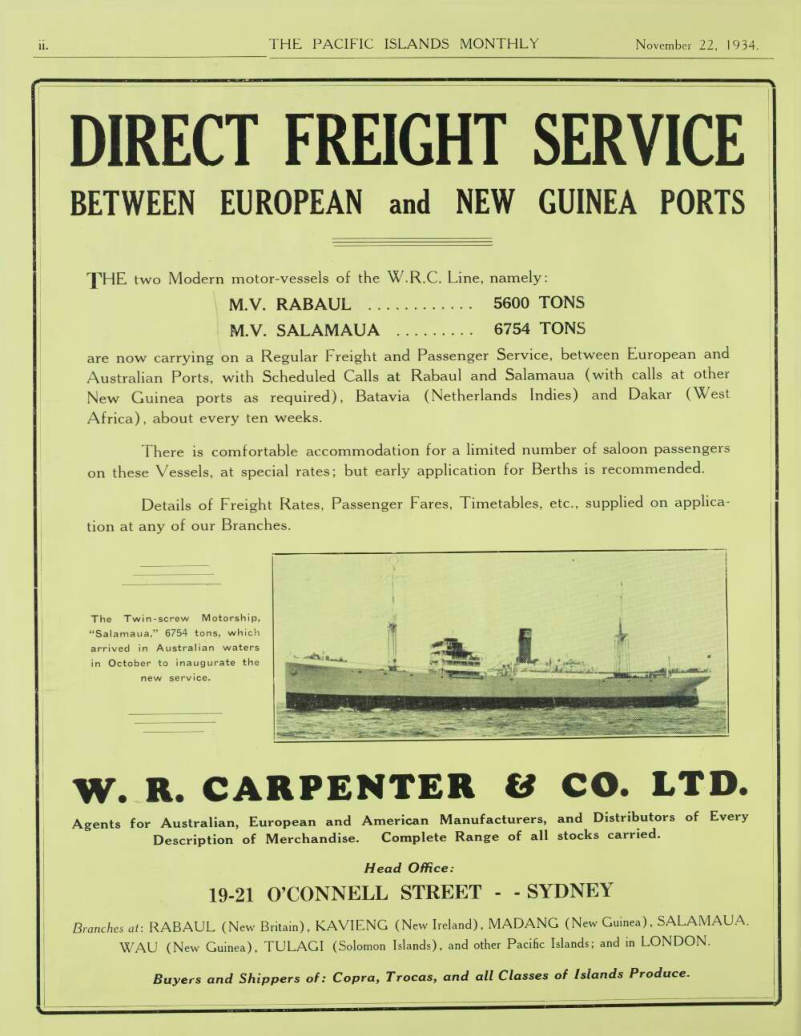
Direct Freight Service
BETWEEN EUROPEAN and NEW GUINEA PORTS
THE two Modern motor-vessels of the W.R.C. Line, namely:
M.V. RABAUL 5600 TONS
M.V. SALAMAUA 6754 TONS
are now carrying on a Regular Freight and Passenger Service, between European and Australian Ports, with Scheduled Calls at Rabaul and Salamaua (with calls at other New Guinea ports as required), Batavia (Netherlands Indies) and Dakar (West Africa), about every ten weeks.
There is comfortable accommodation for a limited number of saloon passengers on these Vessels, at special rates; but early application for Berths is recommended.
Details of Freight Rates, Passenger Fares, Timetables, etc., supplied on application at any of our Branches.
The Twin-screw Motorship, “Salamaua,” 6754 tons, which arrived in Australian waters in October to inaugurate the new service.
W. R. CARPENTER & CO. LTD.
Agents for Australian, European and American Manufacturers, and Distributors of Every Description of Merchandise. Complete Range of all stocks carried.
Head Office:
19-21 O’CONNELL STREET - - SYDNEY
Branches at: RABAUL (New Britain), KAVIENG (New Ireland), MADANG (New Guinea), SALAMAUA, WAU (New Guinea), TULAGI (Solomon Islands), and other Pacific Islands; and in LONDON.
Bayers and Shippers of: Copra, Trocas, and all Classes of Islands Produce.
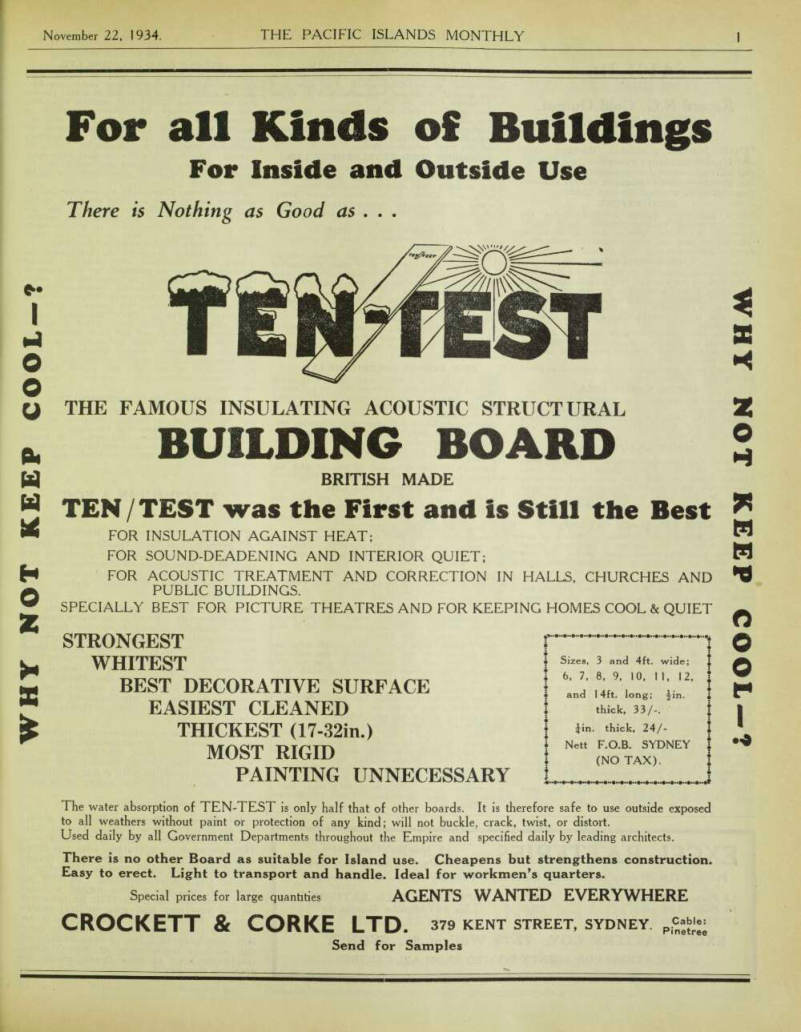
For all Kinds of Buildings
For Inside and Outside Use
There is Nothing as Good as .. .
THE FAMOUS INSULATING ACOUSTIC STRUCTURAL
BUILDING BOARD
BRITISH MADE
TEN/TEST was the First and is Still the Best
FOR INSULATION AGAINST HEAT;
FOR SOUND-DEADENING AND INTERIOR QUIET:
FOR ACOUSTIC TREATMENT AND CORRECTION IN HALLS. CHURCHES AND
PUBLIC BUILDINGS.
SPECIALLY BEST FOR PICTURE THEATRES AND FOR KEEPING HOMES COOL & QUIET
STRONGEST
WHITEST
BEST DECORATIVE SURFACE
EASIEST CLEANED
THICKEST (17-32 in.)
MOST RIGID
PAINTING UNNECESSARY
Sizes, 3 and 4ft. wide; 6, 7, 8, 9, 10, 11, 12, and 14ft. long; £in. thick, 33/-. £in. thick, 24/-
Nett F.O.B. SYDNEY
(NO TAX).
The water absorption of TEN-TEST is only half that of other boards. It is therefore safe to use outside exposed to all weathers without paint or protection of any kind; will not buckle, crack, twist, or distort.
Used daily by all Government Departments throughout the Empire and specified daily by leading architects.
There is no other Board as suitable for Island use. Cheapens but strengthens construction.
Easy to erect. Light to transport and handle. Ideal for workmen’s quarters.
Special prices for large quantities AGENTS WANTED EVERYWHERE CROCKETT & CORKE LTD. 379 KENT STREET, SYDNEY.
Send for Samples
Record N.G. Gold Output
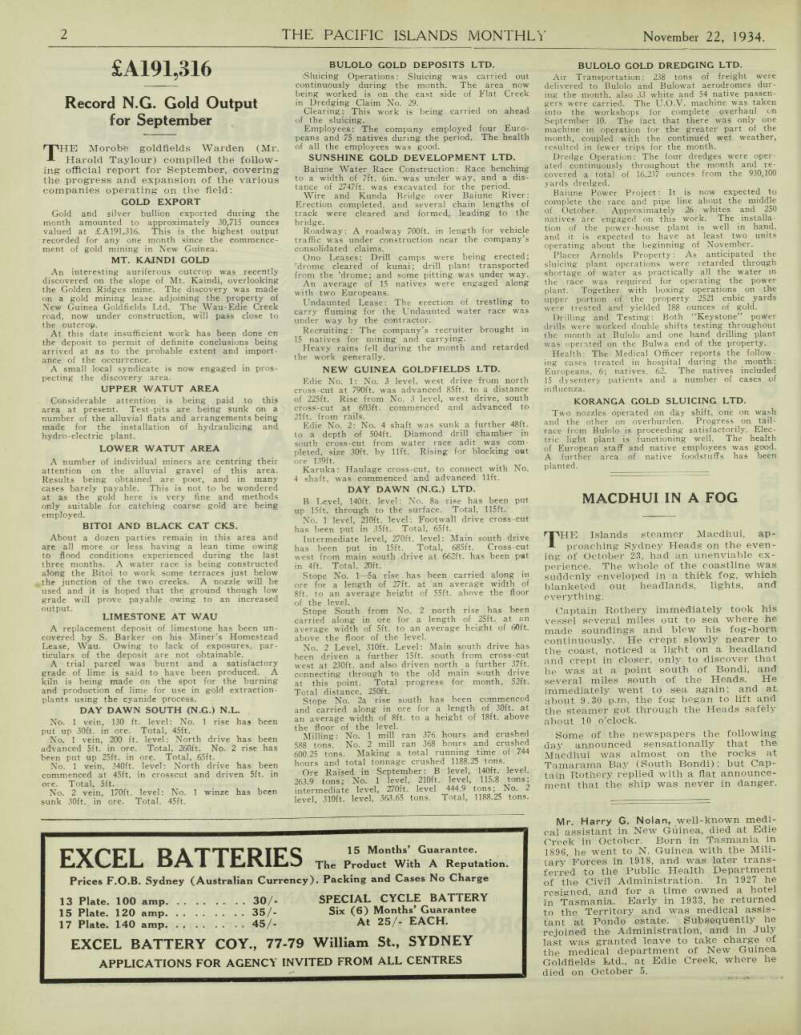
£A191,316 Record N.G. Gold Output for September
THE Morobe goldfields Warden (Mr.
Harold Taylour) compiled the follow ing official report for September, covering the progress and expansion of the various companies operating on the field:
Gold Export
Gold and silver bullion exported during the month amounted to approximately 30,715 ounces valued at £A191,316. This is the highest output recorded for any one month since the commence ment of gold mining in New Guinea.
Mt. Kajndi Gold
An interesting auriferous outcrop was recently discovered on the slope of Mt. Kaindi, overlooking the Golden Ridges mine. The discovery was made on a gold mining lease adjoining the property of New Guinea Goldfields Ltd. The Wau-Edie Creek road, now under construction, will pass close to the outcrop.
At this date insufficient work has been done on the deposit to permit of definite conclusions being arrived at as to the probable extent and import ance of the occurrence.
A small local syndicate is now engaged in pros pecting the discovery area.
Upper Watut Area
Considerable attention is being paid to this area at present. Test-pits are being sunk on a number of the alluvial flats and arrangements being made for the installation of hydraulicing and hydro-electric plant.
Lower Watut Area
A number of individual miners are centring their attention on the alluvial gravel of this area.
Results being obtained are poor, and in many cases barely payable. This is not to be wondered at as the gold here is very fine and methods only suitable for catching coarse gold are being employed.
Bitoi And Black Cat Cks.
About a dozen parties remain in this area and are all more or less having a lean time owing to flood conditions experienced during the last three months. A water race is being constructed along the Bitoi to work some terraces just below the junction of the two creeks. A nozzle will be used and it is hoped that the ground though low grade will prove payable owing to an increased output.
Limestone At Wau
A replacement deposit of limestone has been un covered by S. Barker on his Miner’s Homestead Lease, Wau. Owing to lack of exposures, par ticulars of the deposit are not obtainable.
A trial parcel was burnt and a satisfactory grade of lime is said to have been produced. A kiln is being made on the spot for the burning and production of lime for use in gold extraction plants using the cyanide process.
Day Dawn South (N.G.) N.L.
No. 1 vein, 130 ft. level: No. 1 rise has been put up 30ft. in ore. Total, 45ft.
No. 1 vein, 200 ft. level: North drive has been advanced sft. in ore. Total, 260 ft. No. 2 rise has been put up 25ft. in ore. Total, 65ft.
No. 1 vein, 340 ft. level: North drive has been commenced at 45ft. in crosscut and driven sft. in ore. Total, sft.
No. 2 vein, 170 ft. level: No. 1 winze has been sunk 30ft. in ore. Total, 45ft.
Bulolo Gold Deposits Ltd.
(Sluicing Operations: Sluicing was carried out continuously during the month. The area now being worked is on the east side of Flat Creek in Dredging Claim No. 29.
Clearing; This work is being carried on ahead of the sluicing.
Employees: The company employed four Euro peans and 75 natives during the period. The health of all the employees was good.
Sunshine Gold Development Ltd.
Baiune Water Race Construction: Race benching to a width of 7ft. 6in. was under way, and a dis tance of 2747 ft. was excavated for the period.
Wire and Kunda Bridge over Baiune River: Erection completed, and several chain lengths of track were cleared and formed, leading to the bridge.
Roadway: A roadway 700 ft. in length for vehicle traffic was under construction near the company’s consolidated claims.
Ono Leases: Drill camps were being erected; ’drome cleared of kunai; drill plant transported from the ’drome; and some pitting was under way.
An average of 15 natives were engaged along with two Europeans.
Undaunted Lease: The erection of trestling to carry fluming for the Undaunted water race was under way by the contractor.
Recruiting: The company’s recruiter brought in 15 natives for mining and carrying.
Heavy rains fell during the month and retarded the work generally.
New Guinea Goldfields Ltd.
Edie No. 1: No. 3 level, west drive from north cross-cut at 790 ft. was advanced 85ft. to a distance of 225 ft. Rise from No. 3 level, west drive, south cross-cut at 603 ft. commenced and advanced to 21ft. from rails.
Edie No. 2: No. 4 shaft was sunk a further 48ft. to a depth of 504 ft. Diamond drill chamber in south cross-cut from water race adit was com pleted, size 30ft. by lift. Rising for blocking out ore 139 ft.
Karuka: Haulage cross-cut, to connect with No. 4 shaft, was commenced and advanced lift.
Day Dawn (N.G.) Ltd.
B Level, 140 ft. level; No. 8a rise has been put up 15ft. through to the surface. Total, 115 ft.
No. 1 level, 210 ft. level: Footwall drive cross-cut has been put in 35ft. Total, 65ft.
Intermediate level, 270 ft. level; Main south drive has been put in 15ft. Total, 685 ft. Cross-cut west from main south drive at 662 ft. has been put in 4ft. Total, 20ft.
Stope No. 1—5a rise has been carried along in ore for a length of 27ft. at an average width of 8ft. to an average height of 55ft. above the floor of the level.
Stope South from No. 2 north rise has been carried along in ore for a length of 25ft. at an average width of sft. to an average height of 60ft. above the floor of the level.
No. 2 Level, 310 ft. Level; Main south drive has been driven a further 15ft. south from cross-cut west at 230 ft. and also driven north a further 37ft. connecting through to the old main south drive at this point. Total progress for month, 52ft.
Total distance, 250 ft.
Stope No. 2a rise south has been commenced and carried along in ore for a length of 30ft. at an average width of 8ft. to a height of 18ft. above the floor of the level.
Milling; No. 1 mill ran 376 hours and crushed 588 tons. No. 2 mill ran 368 hours and crushed 600.25 tons. Making a total running time of 744 hours and total tonnage crushed 1188.25 tons.
Ore Raised in September: B level, 140 ft. level, 263.9 tons; No. 1 level, 210 ft. level, 115.8 tons; intermediate level, 270 ft. level 444.9 tons; No. 2 level, 310 ft. level, 363.65 tons. Total, 1188.25 tons.
Bulolo Gold Dredging Ltd.
Air Transportation: 238 tons of freight were delivered to Bulolo and Bulowat aerodromes dur ing the month, also 33 white and 54 native passen gers were carried. The U.O.V. machine was taken into the workshops for complete overhaul on September 10. The fact that there was only one machine in operation for the greater part of the month, coupled with the continued wet weather, resulted in fewer trips for the month.
Dredge Operation: The four dredges were oper ated continuously throughout the month and re covered a total of 16,237 ounces from the 930,100 yards dredged.
Baiune Power Project: It is now expected to complete the race and pipe line about the middle of October. Approximately 26 whites and 250 natives are engaged on this work. The installa tion of the power-house plant is well in hand, and it is expected to have at least two units operating about the beginning of November.
Placer Arnolds Property: As anticipated the sluicing plant operations were retarded through shortage of water as practically all the water in the race was required for operating the power plant. Together with boxing operations on the upper portion of the property 2521 cubic yards were treated and yielded 188 ounces of gold.
Drilling and Testing; Both “Keystone” power drills were worked double shifts testing throughout the month at Bulolo and one hand drilling plant was operated on the Bulwa end of the property.
Health: The Medical Officer reports the follow ing cases treated in hospital during the month: Europeans, 6; natives, 62. The natives included 15 dysentery patients and a number of cases of influenza.
Koranga Gold Sluicing Ltd.
Two nozzles operated on day shift, one on wash and the other on overburden. Progress on tail race from Bulolo is proceeding satisfactorily. Elec tric light plant is functioning well. The health of European staff and native employees was good.
A further area of native foodstuffs has been planted.
Macdhui In A Fog
THE Islands steamer Macdhui, ap proaching Sydney Heads on the even ing of October 23, had an unenviable ex perience. The whole of the coastline was suddenly enveloped in a thick fog, which blanketed out headlands, lights, and everything.
Captain Rothery immediately took his vessel several miles out to sea where he made soundings and blew his fog-horn continuously. He crept slowly nearer to the coast, noticed a light on a headland and crept in closer, only to discover that he was at a point south of Bondi, and several miles south of the Heads. He immediately went to sea again; and at about 9.30 p.m. the fog began to lift and the steamer got through the Heads safely about 10 o’clock.
Some of the newspapers the following day announced sensationally that the Macdhui was almost on the rocks at Tamarama Bay (South Bondi); but Cap tain Rothery replied with a flat announce ment that the ship was never in danger.
Mr. Harry G. Nolan, well-known medi cal assistant in New Guinea, died at Edie Creek in October. Born in Tasmania in 1896, he went to N. Guinea with the Mili tary’ Forces in 1918, and was later trans ferred to the Public Health Department of the Civil Administration. In 1927 he resigned, and for a time owned a hotel in Tasmania. Early in 1933, he returned to the Territory and was medical assis tant at Pondo estate. Subsequently he rejoined the Administration, and in July last was granted leave to take charge of the medical department of New Guinea Goldfields Etd., at Edie Creek, where he died on October 5.
Advertisements & other items, p. 4 (1 item)
Excel Batteries
15 Months’ Guarantee.
The Product With A Reputation.
Prices F.O.B. Sydney (Australian Currency). Packing and Cases No Charge
EXCEL BATTERIES
13 Plate. 100 amp 30/- SPECIAL CYCLE BATTERY 15 Plate. 120 amp 35/- Six (6) Months’ Guarantee 17 Plate. 140 amp 45/- At 25/- EACH.
EXCEL BATTERY COY., 77-79 William St., SYDNEY APPLICATIONS FOR AGENCY INVITED FROM ALL CENTRES
Pacific Travellers
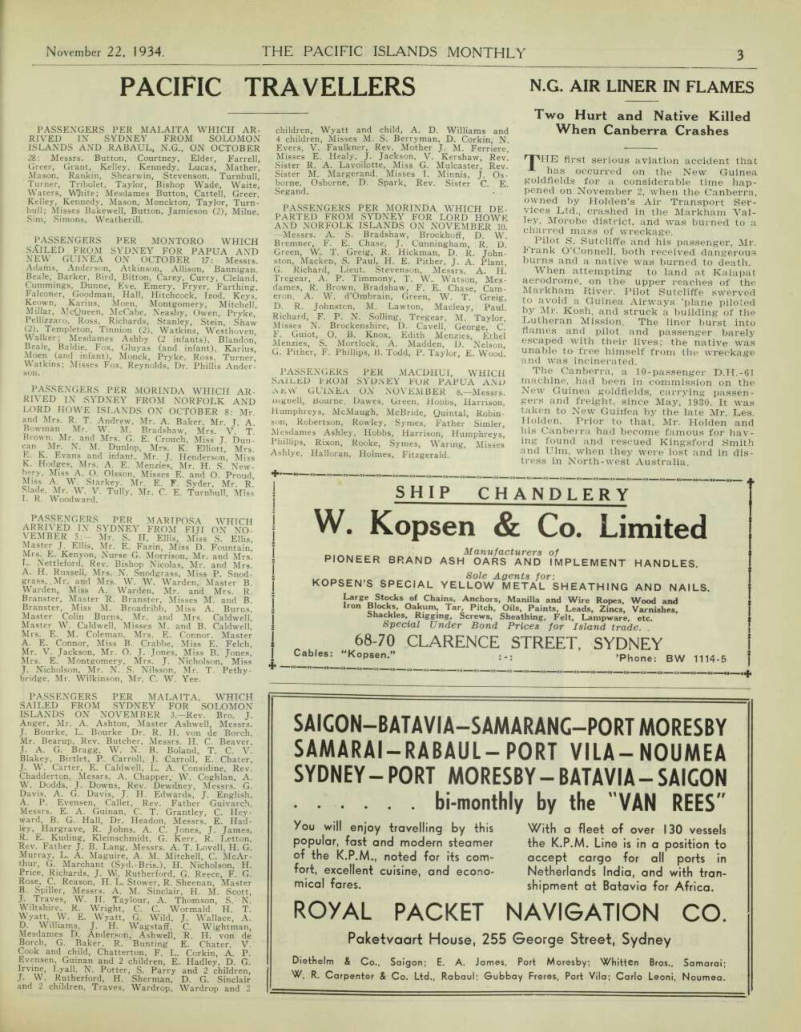
Passengers Per Malaita Which Ar
Rived In Sydney From Solomon
Islands And Rabaul, N.G., On October
28: Messrs. Button, Courtney, Elder, Farrell, Greer, Grant, Kelley, Kennedy, Lucas, Mather, Mason, Rankin, Shearwin, Stevenson, Turnbull, Turner, Tribolet, Taylor, Bishop Wade, Waite, Waters, White; Mesdames Button, Cattell, Greer, Kelley, Kennedy, Mason, Monckton, Taylor, Turn bull; Misses Bakewell, Button, Jamieson (2), Milne, Sim, Simons, Weatherill.
Passengers Per Montoro Which
Sailed From Sydney For Papua And
New Guinea On October 17: Messrs.
Adams, Anderson, Atkinson, Allison, Bannigan, Beale, Barker, Bird, Bitton, Carey, Curry, Cleland, Cummings, Dunne, Eve, Emery, Fryer, Farthing, Falconer, Goodman, Hall, Hitchcock, Izod, Keys, Keown, Karius, Moen, Montgomery, Mitchell, Millar, McQueen, McCabe, Neasby, Owen, Pryke, Pellizzaro, Ross, Richards, Stanley, Stein, Shaw (2), Templeton, Tinnion (2), Watkins, Westhoven, Walker; Mesdames Ashby (2 infants), Blandon, Beale, Baldie, Fox, Gluyas (and infant), Karius, Moen (and infant), Monck, Pryke, Ross, Turner, Watkins; Misses Fox, Reynolds, Dr. Phillis Ander son.
Passengers Per Morinda Which Ar
Rived In (Sydney From Norfolk And
LORD HOWE ISLANDS ON OCTOBER 8: Mr. and Mrs. R. T. Andrew, Mr. A. Baker, Mr. J. A.
Bowman Mr. W. M. Bradshaw, Mrs. V. T.
Brown, Mr. and Mrs. G. E. Crouch, Miss J. Duncan, Mr. N. M. Dunlop, Mrs. K. Elliott, Mrs.
E. K. Evans and infant, Mr. J. Henderson, Miss K. Hodges, Mrs. A. E. Menzies, Mr. H. S. New bury, Miss A. O. Olsson, Misses E. and O. Proud, Miss A. W. Starkey. Mr. E. F. Syder, Mr. R.
Slade, Mr. W. V. Tully, Mr. C. E. Turnbull, Miss I. R. Woodward.
Passengers Per Mariposa Which
ARRIVED IN SYDNEY FROM FIJI ON NO- VEMBER 5: Mr. S. H. Ellis, Miss S. Ellis, Master J. Ellis, Mr. E. Fazin, Miss D. Fountain, Mrs. E. Kenyon, Nurse G. Morrison, Mr. and Mrs.
L. Nettleford, Rev. Bishop Nicolas, Mr. and Mrs.
A. H. Russell, Mrs. N. Snodgrass, Miss P. Snodgrass, Mr. and Mrs. W. W. Warden, Master B.
Warden, Miss A. Warden, Mr. and Mrs. R.
Branster, Master R. Branster, Misses M. and B.
Branster, Miss M. Broadribb, Miss A. Burns, Master Colin Burns, Mr. and Mrs. Caldwell, Master W. Caldwell, Misses M. and B. Caldwell, Mrs. E. M. Coleman, Mrs. E. Connor, Master A. E. Connor, Miss B. Crabbe, Miss E. Felch, Mr. V. Jackson, Mr. O. J. Jones, Miss B. Jones, Mrs. E. Montgomery, Mrs. J. Nicholson, Miss J. Nicholson, Mr. N. S. Nilsson, Mr. T. Pethy bridge, Mr. Wilkinson, Mr. C. W. Yee.
Passengers Per Malaita, Which
Sailed From Sydney For Solomon
Islands On November 3.—Rev. Bro. J.
Anger, Mr. A. Ashton, Master Ashwell, Messrs.
J. Bourke, L. Bourke Dr. R. H. von de Borch, Mr. Bearup, Rev. Butcher, Messrs. H. C. Beaver, J. A. G. Bragg, W. N. B. Boland, T. C. V.
Blakey, Birtlet, P. Carroll, J. Carroll, E. Chater, J. W. Carter, E. Caldwell, L. A. Considine, Rev.
Chadderton, Messrs. A. Chapper, W. Coghlan, A.
W. Dodds, J. Downs, Rev. Dewdney, Messrs. G.
Davis, A. G. Davis, J. H. Edwards, J. English, A. P. Evensen, Callet, Rev. Father Guivarch, Messrs. E. A. Guinan, C. T. Grantley, C. Hey ward, B. G. Hall, Dr. Headon, Messrs. E. Had ley, Hargrave, R. Johns, A. C. Jones, J. James, R. E. Kuding, Kleinschmidt, G. Kerr, R. Letton, Rev. Father J. B. Lang, Messrs. A. T. Lovell, H. G.
Murray, L. A. Maguire, A. M. Mitchell, C. McAr thur, G. Marchant (Syd.-Bris.), H. Nicholson, H.
Price, Richards, J. W. Rutherford, G. Reece, F. G.
Rose, C. Reason, H. L. Stower, R. Sheenan, Master B. Spiller, Messrs. A. M. Sinclair, H. M. Scott, J. Traves, W. H. Taylour, A. Thomson, S. N.
Wiltshire, R. Wright, C. C. Wormald, H. T.
Wyatt, W. E. Wyatt, G. Wild, J. Wallace, A.
D. Williams, J. H. Wagstaff, C. Wightman, Mesdames D. Anderson, Ashwell, R. H. von de Borch, G. Baker, R. Bunting, E. Chater, V.
Cook and child, Chatterton, F. L. Corkin, A. P.
Evensen, Guinan and 2 children, E. Hadley, D. G.
Irvine, Lyall, N. Potter, S. Parry and 2 children, J. W. Rutherford, H. Sherman, D. G. Sinclair and 2 children, Traves, Wardrop, Wardrop and 2
children, Wyatt and child, A. D. Williams and 4 children, Misses M. S. Berryman, D. Corkin, N.
Evers, V. Faulkner, Rev. Mother J. M. Ferriere, Misses E. Healy, J. Jackson, V. Kershaw, Rev.
Sister R. A. Lavoilotte, Miss G. Mulcaster, Rev.
Sister M. Margerand, Misses I. Minnis, J. Os borne, Osborne, D. Spark, Rev. Sister C. E.
Segand.
Passengers Per Morinda Which De
Parted From Sydney For Lord Howe
And Norfolk Islands On November 10.
—Messrs. A. S. Bradshaw, Brockhoff, D. W.
Bremner, F. E. Chase, J. Cunningham, R. D.
Green, W. T. Greig, R. Hickman, D. R. John ston, Macken, S. Paul, H. E. Pither, J. A. Plant, G. Richard, Lieut. Stevenson, Messrs. A. H.
Tregear, A. P. Timmony, T. W. Watson, Mesdames, R. Brown, Bradshaw, F. E. Chase, Cam eron, A. W. d’Ombrain, Green, W. T. Greig, D. R. Johnston, M. Lawton, Macleay, Paul, Richard, F. P. N. Soiling, Tregear, M. Taylor, Misses N. Brockenshire, D. Cavell, George, C.
F. Guiot, O. B. Knox, Edith Menzies, Ethel Menzies, S. Mortlock, A. Madden, D. Nelson, G. Pither, F. Phillips, B. Todd, P, Taylor, E. Wood.
Passengers Per Macdhui, Which
Sailed from Sydney for Papua and
New Guinea On November 8—Messrs,
Bignell, Bourne, Dawes, Green, Hobbs, Harrison, Humphreys, McMaugh, McBride, Quintal, Robinson, Robertson, Rowley, Symes, Father Simler, Mesdames Ashley, Hobbs, Harrison, Humphreys, Phillips, Rixon, Rooke, Symes, Waring, Misses Ashlye, Halloran, Holmes, Fitzgerald.
N.G. Air Liner In Flames
Two Hurt and Native Killed When Canberra Crashes
THE first serious aviation accident that has occurred on the New Guinea goldfields for a considerable time hap pened on November 2, when the Canberra, owned by Holden’s Air Transport Ser vices Ltd., crashed in the Markham Val ley, Morobe district, and was burned to a charred mass of wreckage.
Pilot S. Sutcliffe and his passenger, Mr.
Frank O’Connell, both received dangerous burns and a native was burned to death.
When attempting to land at Kaiapat aerodrome, on the upper reaches of the Markham River, Pilot Sutcliffe swerved to avoid a Guinea Airways ’plane piloted by Mr. Kosh, and struck a building of the Lutheran Mission. The liner burst into flames and pilot and passenger barely escaped with their lives; the native was unable to free himself from the wreckage and was incinerated.
The Canberra, a 10-passenger D.H.-61 machine, had been in commission on the New Guinea goldfields, carrying passen gers and freight, since May, 1930. It was taken to New Guirtea by the late Mr. Les.
Holden. Prior to that, Mr. Holden and his Canberra had become famous for hav ing found and rescued Kingsford Smith and Ulm, when they were lost and in dis tress in North-west Australia.
Advertisements & other items, p. 5 (1 item)
W. Kopsen & Co. Limited
SHIP CHANDLERY
Manufacturers of PIONEER BRAND ASH OARS AND IMPLEMENT HANDLES.
Sole Agents for: KOPSEN’S SPECIAL YELLOW METAL SHEATHING AND NAILS.
Iron Blocks, Oakum, Tar, Pitch, Oils, Paints, Leads, Zincs, Varnishes, ohackles, Rigging, Screws, Sheathing, Felt, Lampware, etc.
Special Under Bond Prices for Island trade.
68-70 CLARENCE STREET, SYDNEY
Cables: “Kopsen." ’Phone: BW 1114-5
SAICON-BATAVIA-SAMARANG-PORT MORESBY
SAMARAI-RABAUL- PORT VILA-NOUMEA
SYDNEY - PORT MORESBY - BATAVIA - SAIGON
bi-monthly by the "VAN REES"
You will enjoy travelling by this popular, fast and modern steamer of the K.P.M., noted for its comfort, excellent cuisine, and economical fares.
With a fleet of over 130 vessels the K.P.M. Line is in a position to accept cargo for all ports in Netherlands India, and with transhipment at Batavia for Africa.
ROYAL PACKET NAVIGATION CO.
Paketvaart House, 255 George Street, Sydney
Diethelm & Co., Saigon; E. A. James, Port Moresby: Whitten Bros., Samarai; W. R. Carpenter & Co. Ltd., Rabaul; Gubbay Freres, Port Vila; Carlo Leoni, Noumea,
Advertisers
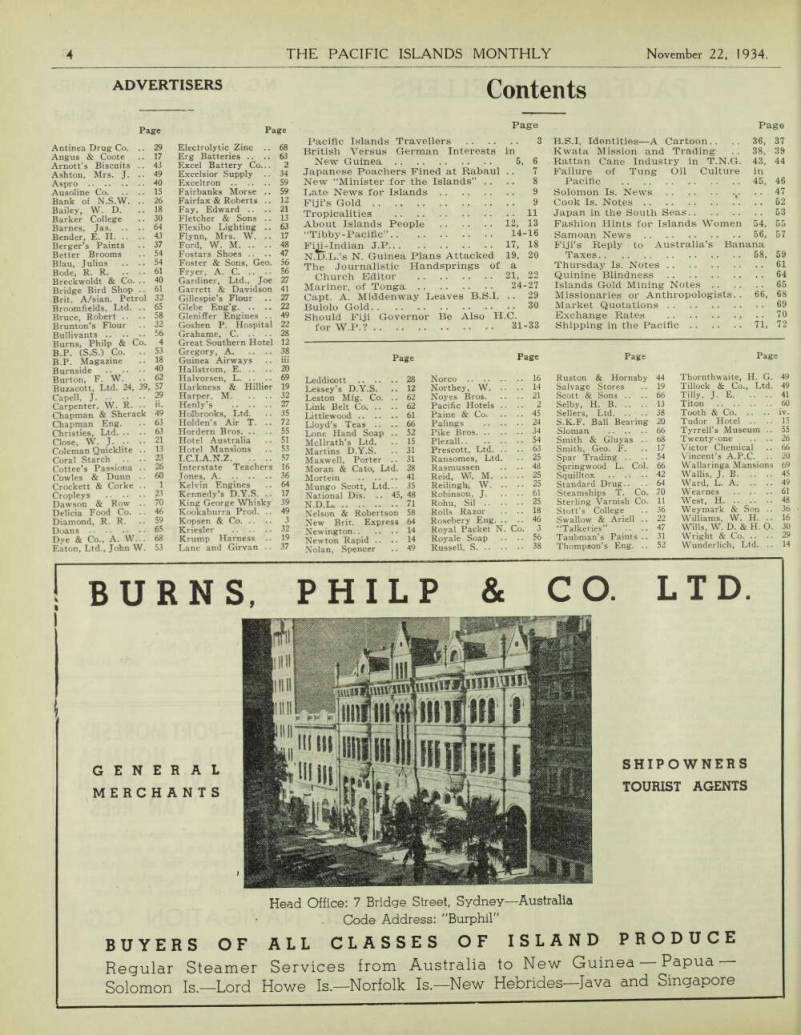
Page Antinea Drug Co. .. 29 Angus & Coote .. 17 Arnott’s Biscuits .. 43 Ashton, Mrs. J. .. 49 Aspro 40 Ausoline Co. 15 Bank of N.S.W. .. 26 Bailey, W. D. ..18 Barker College .. 30 Barnes, Jas. 64 Bender, E. H. 43 Berger’s Paints .. 37 Better Brooms .. 54 Blau, Julius .. .. 54 Bode, R. R. 61 Breckwoldt & Co. .. 40 Bridge Bird Shop .. 61 Brit. A/sian. Petrol 32 Broomfields, Ltd. .. 65 Bruce, Robert .. .. 58 Brunton’s Flour .. 32 Bullivants 56 Burns, Philp & Co. 4
B.P. (Sjs.) Co. .. 53
B.P. Magazine .. 18 Burnside 40 Burton, F. W. .. 62 Buzacott, Ltd. 24, 39, 57 Capell, J. 29 Carpenter, W. R. ii.
Chapman & Sherack 49 Chapman Eng.63 Christies, Ltd 63 Close, W. J. 21 Coleman Quicklite .. 13 Coral Starch .. 23 Cottee’s Passiona .. 26 Cowles & Dunn .. 60 Crockett & Corke .. 1 Cropleys 23 Dawson & Row .. 70 Delicia Food Co. .. 46 Diamond, R. R. 59 Doans 65 Dye & Co., A. W... 68 Eaton, Ltd., John W. 53
Page Electrolytic Zinc .. 68 Erg Batteries .. .. 63 Excel Battery Co... 2 Excelsior Supply .. 34 Exceltron 59 Fairbanks Morse .. 59 Fairfax & Roberts .. 12 Fay, Edward .. .. 21 Fletcher & Sons .. 13 Flexibo Lighting . • 63 Flynn, Mrs. W. .. 17 Ford, W. M. 48 Fostars Shoes .. .. 47 Foster & Sons, Geo. 56 Fryer, A. C. 56 Gardiner, Ltd., Joe 27 Garrett & Davidson 41 Gillespie’s Flour .. 27 Glebe Eng’g 22 Gleniffer Engines .. 49 Goshen P. Hospital 22 Grahame, C. 28 Great Southern Hotel 12 Gregory, A. 38 Guinea Airways .. iii Hallstrom, E. 20 Halvorsen, L. 69 Harkness & Hillier 19 Harper, M. 32 Henly’s 27 Holbrooks, Ltd. .. 35 Holden’s Air T. .. 72 Hordern Bros. 55 Hotel Australia .. 51 Hotel Mansions .. 53
I.C.I.A.N.Z. 57
Interstate Teachers 16 Jones, A. 36 Kelvin Engines . 64 Kennedy’s D.Y.S. .. 17 King George Whisky 39 Kookaburra Prod. .. 49 Kopsen & Co. 3 Kriesler 32 Krump Harness .. 19 Lane and Girvan .. 37
Page Leddicott 28 Lessey’s D.Y.S. .. 12 Leston Mfg. Co. .. 62 Link Belt Co. 62 Littlewood. 61 Lloyd’s Teas .. .. 66 Lone Hand Soap .. 52 Mcllrath’s Ltd. .. 15 Martins D.Y.S. .. 31 Maxwell, Porter .. 31 Moran & Cato, Ltd. 28 Mortein 41 Mungo Scott, Ltd... 35 National Dis. .. 45, 48
N.D.L. 71
Nelson & Robertson 58 New Brit. Express 64 Newington 14 Newton Rapid .. .. 14 Nolan, Spencer .. 49
Page Norco 16 Northey, W. 14 Noyes Bros. 21 Pacific Hotels .. .. 2 Paine & Co. 45 Palings 24 Pike Bros. 34 Plezall 54 Prescott, Ltd 63 Ransomes, Ltd. .. 25 Rasmussen .. .. 48 Reid, W. M. 25 Reilingh, W. 25 Robinson, J. 61 Rohu, Sil 25 Rolls Razor .. .. 18 Rosebery Eng. 46 Royal Packet N. Co. 3 Royale Soap .. . 56 Russell, S. 38
Page Ruston & Hornsby 44 Salvage Stores .. 19 Scott & Sons .. .. 66 Selby, H. B. 13 Sellers, Ltd. 38 S.K.F. Ball Bearing 20 Sloman 66 Smith & Gluyas .. 68 Smith, Geo. F. .. 17 Spar Trading .. .. 54 Springwood L. Col. 66 Squilltox 42 Standard Drug.. .. 64 Steamships T. Co. 70 Sterling Varnish Co. 11 Stott’s College .. 36 Swallow & Ariell .. 22 “Talkeries” .. 47 Taubman’s Paints .. 31 Thompson’s Eng. .. 52
Page Thornthwaite, H. G. 49 Tillock & Co., Ltd. 49 Tilly, J. E. 41 Titon 60 Tooth & Co. iv.
Tudor Hotel .. .. 15 Tyrrell’s Museum .. 55 Twenty-one .. .. 26 Victor Chemical .. 66 Vincent’s A.P.C. .. 20 Wallaringa Mansions 69 Wallis, J. B. 45 Ward, L. A. 49 Wearnes 61 West, H. 48 Weymark & Son .. 36 Williams, W. H. .. 16 Wills, W. D. & H. O. 30 Wright & Co. 29 Wunderlich, Ltd. .. 14
Contents
Page Pacific Islands Travellers 3 British Versus German Interests in New Guinea 5, 6 Japanese Poachers Fined at Rabaul .. 7 New “Minister for the Islands” .. .. 8 Late News for Islands 9 Fiji’s Gold 9 Tropicalities 11 About Islands People 12, 13 “Tibby-Pacific” 14-16 Fiji-Indian J.P. 17, 18 N.D.L.’s N. Guinea Plans Attacked 19, 20 The Journalistic Handsprings of a Church Editor 21, 22 Mariner, of Tonga 24-27 Capt. A. Middenway Leaves 8.5.1. .. 29 Bulolo Gold 30 Should Fiji Governor Be Also H.C. for W.P.? 31-33
Page B.S.I. Identities—A Cartoon.. .. 36, 37 Kwata Mission and Trading . . 38, 39 Rattan Cane Industry in T.N.G. 43, 44 Failure of Tung Oil Culture in Pacific 45, 46 Solomon Is. News . 47 Cook Is. Notes 52 Japan in the South Seas 53 Fashion Hints for Islands Women 54, 55 Samoan News 56, 57 Fiji’s Reply to Australia’s Banana Taxes 58, 59 Thursday Is. Notes 61 Quinine Blindness 64 Islands Gold Mining Notes 65 Missionaries or Anthropologists.. 66, 68 Market Quotations 69 Exchange Rates 70 Shipping in the Pacific 71, 72
Advertisements & other items, p. 6 (1 item)
Burns, Philp & Co. Ltd.
GENERAL
MERCHANTS
Head Office: 7 Bridge Street, Sydney— Australia Code Address; "Burphil”
SHIPOWNERS
TOURIST AGENTS
BUYERS OF ALL CLASSES OF ISLAND PRODUCE Regular Steamer Services from Australia to New Guinea Papua Solomon Is. —Lord Howe Is.—Norfolk Is. —New Hebrides — Java and Singapore
The Pacific Islands Monthly
The Newspaper-Magazine Of The South Seas
[Registered at G.P.O., Sydney, for transmission 6 y post as a newspaper .]
Published Once Each Month and Circulated in Australia and New Zealand and in the following Pacific Territories and Islands Groups:
Crown Colony of Fiji.
Australian Territory of Papua.
Mandated Territory (Australia) of New Guinea, Bismarck Archipelago, and Northern Solomon Islands.
Mandated Territory (Japan) of Marshall, Caroline and Mariana Islands.
French Territory of New Caledonia.
British and French Condominium of New Hebrides.
American Territory of Eastern Samoa.
American Territory of Guam.
Mandated Territory of Nauru.
British Crown Colony of Gilbert and Ellice Islands.
Mandated Territory (New Zealand) of Samoa.
British Solomon Islands Protectorate.
British Protectorate of Tongan Islands.
New Zealand Territory of Cook Islands.
Australian Territory of Norfolk Island.
French Colony of Oceania (Tahiti, etc.).
American Territory of Hawaiian Islands.
Owned and Produced by Pacific Publications Ltd., Union House, 247 George Street, Sydney.
Telephone Bw 5037
P.O. Box 3408 R
Contributions Articles, Stories, and Photographs dealing with Pacific Islands Subjects are invited, and will be oaid for on publication at usual rates.
Subscription Rates
Per Annum, within British Empire, Prepaid Post Free 6/- Per Annum, elsewhere, prepaid, Post Free .. 8/- Single Copies 6d.
Editor and Publisher:
R. W. Robson.
Advertisements Advertising rates furnished on application.
Colours, etc. by Arrangement.
Process Blocks made at Advertiser’s expense when required. Screen, 100.
Changes of Advertising Copy should reach this Office by 8th of each month, otherwise previous advertisement may be repeated.
Registered Address for Radiograms and Cables: “PACPUB" Sydney
Agents The following are authorised to receive subscriptions for “The Pacific Islands Monthly"— Islands Branches of Burns, Philp & Co., Ltd., and Burns, Philp (South Seas) Co., Ltd.
Islands Branches of W. R. Carpenter & Co., Ltd.
All Branches of Morris, Hedstrom & Co., Ltd.
G. Thomas & Co., Rabaul.
Whitten Bros., Ltd., Samarai.
P. Costello, Suva, Fiji.
All Branches and Representatives of W. H. Grove and Sons. Ltd., Auckland.
S. Russell, Papeete, Tahiti.
Cook Islands Trading Co., Rarotonga.
Vol. V., No. 4
Sydney, November 22, 1934.
Price 6d. Per Copy Prepaid: 6/- p.a.
British Versus German Interests
In New Guinea
THE decision of the Norddeutscher Lloyd Company to run a new line of ships through New Guinea has stirred into much liveliness a situation that always has been attended by a certain amount of ferment—namely, German shipping activities in the Mandated Ter ritory of New Guinea. The matter now is receiving the attention of the Australian and Imperial Governments.
Three former German colonies in the Pacific are now held under the Mandate system —Australia has New Guinea, Japan has the Marshalls and Carolines, and New Zealand has Western Samoa.
The same authority—a “C” Class Man date—operates in each case; and the essential clause therein is Article 2: “The mandatory shall have full power of Administration and Legislation over the Territory, subject to the present Mandate, as an integral portion of (name of mandatory) and may apply the laws of (name of mandatory) to the
Territory, subject to such local modifica tions as circumstances may require . . . ”
The three mandatories named have placed each its own interpretation upon that clause. Japan has made the Marshalls and Carolines a close preserve for the settlement and trade of her own nationals—European ships, traders, and even casual travellers are sternly warned off. New Zealand has not closed the door into Samoa in the same manner; but no foreign ships trade coastwise in Samoa, and the Samoan tariff gives a very substantial preference to British goods.
In New Guinea, on the other hand, Australia has displayed an extraordinary generosity. At first, the terms of the Australian Navigation Act were imposed, giving a rigid preference to Australian ships; but this operated so harshly against the Territory’s interests that it was withdrawn, after lengthy inquiry, some ten years ago, and then Australia
went to the other extreme, and allowed the ships of all nations to enter the New Guinea transport trade.
The most notable effect of this lati tude was the development of the German shipping business. The little Bremer haven began to run between Hongkong and New Guinea ports, taking away copra and bringing back goods of Ger man, Japanese, and Chinese manufac ture. Australian trading interests did not like the development, but three separate influences supported the Ger mans —the Lutheran (German) mission stations, which export a good deal of copra; the large and growing Chinese trading community which brings in much merchandise from the East; and a section of the British population, which argued that the German ship was the
only protection they had against the
monopolistic power of Messrs. Burns Philp and Co. Ltd. and Messrs. W. R.
Carpenter and Co. Ltd. So the Bremer haven remained on this run, and pre sently it was joined by the Friderun; and now it is arranged that those two little steamers shall remain in the group as “feeders,” and that two 6000-tons motor vessels shall inaugurate a new N.D.L.
service between Australia and Hongkong, calling regularly at Salamaua and Rabaul.
The most extraordinary feature of this period of N.D.L. activity and develop ment is that Australia left the trading field wide open —there is a tariff, but it is only a revenue tariff, and gives no preference to British or Australian goods.
Australia, notoriously a country of high protection, allowed free trade in New Guinea!
Apart altogether from strategic con siderations, Australia’s interests in the Pacific Islands are substantial and valu able —that is recognised officially in the fact that the Commonwealth pays a large annual subsidy to Messrs. Burns Philp and Co. Ltd. for the maintenance of regular mail and passenger services. Aus tralia’s Islands trade would have suffered a severe set-back, as a result of the copra market disorganisation, had it not been for the discovery and development of the gold industry. The new goldfields have been proved and exploited largely as a result of Australian activity and enter prise. Furthermore, Australia has far more at stake in New Guinea than is represented by the investments of trading firms and shipping companies. The Com monwealth originally provided the finance necessary to enable large num bers of Australians to acquire and develop plantations in the Mandated Territory; and, when the depression came, and the planters were not able to keep up their repayments to the Com monwealth, the latter granted a mora torium, which is still in existence. The sum due by the planters to the Common wealth is about £2,500,000; and Austra lia at the moment is allowing the New Guinea planters to have the use of that sum, free of cost. As a matter of fact, it is very unlikely that the money ever will be repaid —there probably will be a revaluation and a writing-off. But that does not alter the fact that a large pro portion of the private planting industry in New Guinea was financed by Austra lian public funds. Similar considera tions may apply, perhaps, in connection with the two big Australian trading firms; they also financed planters liber ally in the good years, and have given them substantial concessions in the de pression period, and they also have very large sums at stake in the Territory.
In this connection, it is worth noting that New Guinea planters who are in debt to the big firms do not consider it politic to ship or trade with the German
line. That may be the inspiration of a suggestion, said to be now under con sideration, that the Australian mora torium should extend only to those plan ters who make use of British ships.
Why should Australia, in the circum stances described, permit other nations to come in and enjoy the trade which she herself has created and protected? There is much to be said in favor of free trade; but in the last two decades the whole world has gone crazy “economic nationalism,” as expressed in unsur mountable tariffs and indefensible sub sidies, has forced even that pillar of international trade freedom, Great Britain, to impose a protective tariff, and seriously to consider a policy of subsi dising the red ensign. By far the most embarrassing problem before the Com monwealth Parliament to-day is the need for finding markets for Australian pro ducts, so that Australia can meet her oversea debt commitments. Why should Australia, faced with an unbroken and virtually unbreakable barrier of “econ omic nationalism”, permit free trade in New Guinea?
The surprising thing is not that Aus tralia is now planning action to block the N.D.L. enterprise, but that for so long she has permitted that enterprise to continue. Her toleration apparently has been the result, partly of a quixotic interpretation of the Mandate, and partly of a fear on the part of the Ter ritory people that, if they become more definitely a part of the Commonwealth, they may have to submit to some of the Australian industrial laws which obvi ously would cause chaos in New Guinea.
The action that the Commonwealth Government is being urged to take is not directed necessarily against Germany.
As a matter of fact, one finds, even among those who most strongly urge the greater protection of Australian inter ests, a very real sympathy with the situ ation in which the Germans are placed.
They came late into the world as colon isers, but, by energy and genius, they ac quired valuable colonial territories; they lost those territories in the war which German militarism forced upon the world; they suffered the penalty, and now a re-born and vigorous Germany is eager to engage in international trade; Germany cannot buy foreign goods un less she sells her own goods and services, which include shipping; and her attempt to establish this new Hongkong-Aus tralian service has, from the international point of view, every economic justifica
tion. If the German nation is to be a factor in future world trade —and it must be —the German shipping and trading interests must dig in somewhere.
But, unhappily, this New Guinea shipping and trading difficulty is not merely a matter as between Britain (or Australia) and Germany; it is part of a world-wide problem, and must be treated as such. It would be sheer foolishness for Australia to grant privileges to the German shipping line, while the British Empire, as a whole, is fighting against a world of hostile tariffs and subsidies. If concessions are to be given to Germany, they should be part of an Imperial plan.
There is no real need for the German shipping services in New Guinea —the available British services are ample for all requirements. There is no doubt that the running of the new German motor vessels between Rabaul, Salamaua, and Australia will take away considerable trade from the British lines. Why, in view of all the circumstances, should that be permitted? New Guinea probably will mention the “monopoly of the big firms." If there is an oppressive monopoly in that direction, that surely is a domes tic matter for the consideration of Aus tralia; and should not be allowed to in terfere with the adjustment of the much larger and more important Imperial
problem.
Advertisements & other items, p. 8 (1 item)
Your Wrapper!
Look on the Front of
There may be a sign stamped on the front of the wrapper which brings this copy of the “P.I.M.” to you.
The meaning of the marks: Your subscription will expire with the next or following issue.
Your subscription will expire with this issue.
This means that your subscription has expired; and that we have sent you this further copy in case you wish to continue as a subscriber, and have forgotten to send in your subscription. Prompt attention is respectfully requested.
Your subscription (6/- per annum, or 8/in the case of countries outside the British Empire —which includes postage) may be sent direct, or may be paid to any of our agents (listed on page 5).
PACIFIC PUBLICATIONS LTD.,
Union House, 247 George St., Sydney
As Deck Cargo
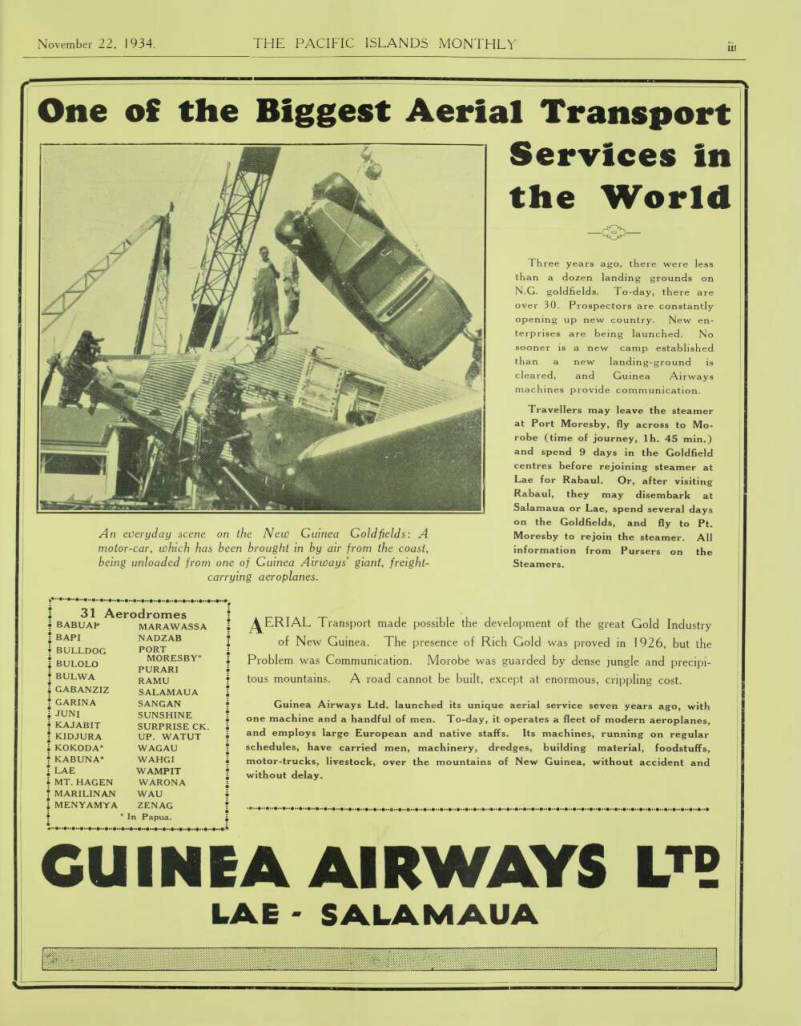
Guinea Airways' Huge 'Plane Shipped to Lae
WHEN the Macdhui left Sydney for New Guinea on November 8, she carried on specially constructed decking, aft of the main deck, the large new Ford aeroplane which arrived in Sydney from England in October for Guinea Airways Ltd., and which will enter the goldfields transport services.
Originally it was intended that Mr. Eric Chater, one of Guinea Airways’ pilots, should fly the machine from Mascot to Lae, New Guinea, as the Macdhui’s hatch was too small to take the fuse lage—46 feet in length. Eventually, how ever, the machine, packed in three giant crates, was taken to the wharf; and the crates were loaded aboard the vessel as deck cargo—one behind the main deck, one behind the stern hatch, and the third on the port side at right angles to the others.
It was a difficult job—the crates stretched from gunwale to gunwale— but the Macdhui left on time with the huge crates securely fastened in place.
The huge aeroplane will be assembled at Guinea Airways’ workshops at Lae.
New Guinea.
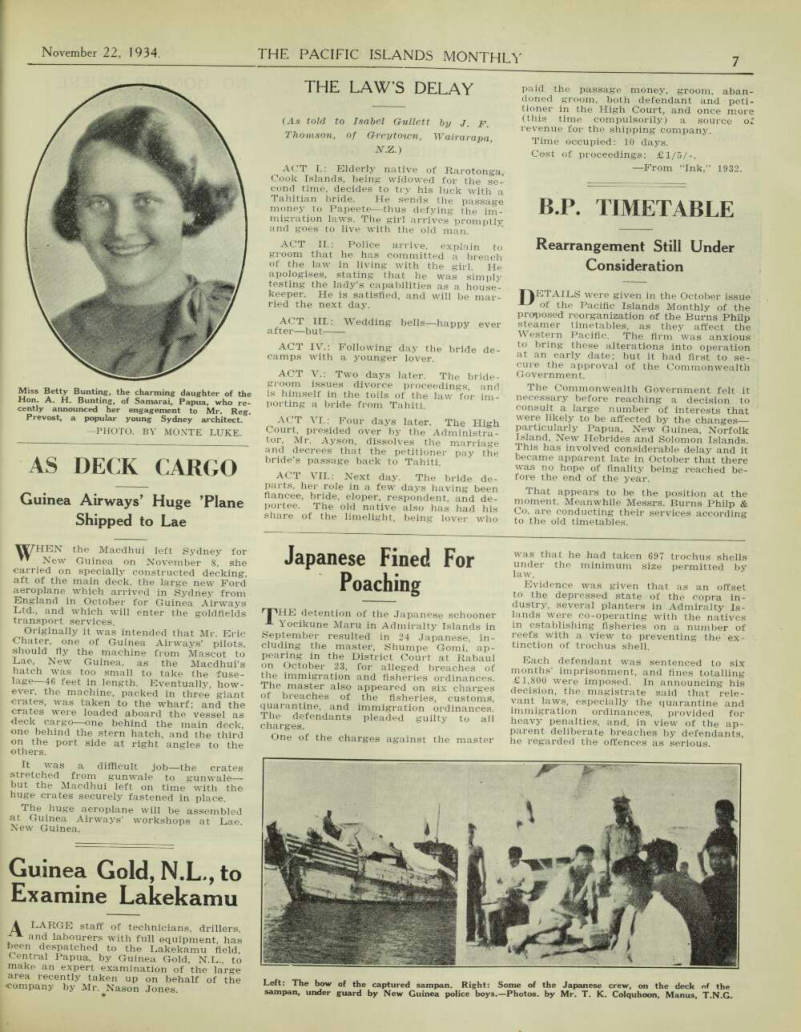
Miss Betty Bunting, the charming daughter of the Hon. A. H. Bunting, of Samarai, Papua, who recently announced her engagement to Mr. Reg.
Prevost, a popular young Sydney architect.
—Photo. By Monte Luke.
Guinea Gold, N.L., to Examine Lakekamu
Examine Lakekamu
A LARGE staff of technicians, drillers, and labourers with full equipment, has been despatched to the Lakekamu field, Central Papua, by Guinea Gold, N.L to make an expert examination of the large area recently taken up on behalf of the company by Mr. Nason Jones.
The Law’S Delay
(As told to Isabel Gullett by J. F.
Thomson, of Greytown, Wairarapa, N. Z.) ACT I.: Elderly native of Rarotonga, Cook Islands, being widowed for the second time, decides to try his luck with a Tahitian bride. He sends the passage money to Papeete—thus defying the immigration laws. The girl arrives promptly and goes to live with the old man.
ACT II.: Police arrive, explain to groom that he has committed a breach of the law in living with the girl. He apologises, stating that he was simply testing the lady’s capabilities as a house keeper. He is satisfied, and will be married the next day.
ACT HI.: Wedding bells—happy ever after—but — ACT IV.: Following day the bride decamps with a younger lover.
ACT V.: Two days later. The bridegroom issues divorce proceedings, and is himself in the toils of the law for importing a bride from Tahiti.
ACT VI.; Four days later. The High Court, presided over by the Administrator, Mr. Ayson, dissolves the marriage and decrees that the petitioner pay the bride’s passage back to Tahiti.
ACT VII.: Next day. The bride departs, her role in a few days having been fiancee, bride, eloper, respondent, and deportee. The old native also has had his share of the limelight, being lover who
paid the passage money, groom, abandoned groom, both defendant and petitioner in the High Court, and once more (this time compulsorily) a source of revenue for the shipping company.
Time occupied; 10 days.
Cost of proceedings: £1/5/-. —From “Ink,” 1932.
B.P. Timetable
Rearrangement Still Under Consideration
DETAILS were given in the October issue of the Pacific Islands Monthly of the proposed reorganization of the Burns Philp steamer timetables, as they affect the Western Pacific. The firm was anxious to bring these alterations into operation at an early date; but it had first to se cure the approval of the Commonwealth Government.
The Commonwealth Government felt it necessary before reaching a decision to consult a large number of interests that were likely to be affected by the changes— particularly Papua, New Guinea, Norfolk Island, New Hebrides and Solomon Islands.
This has involved considerable delay and it became apparent late in October that there was no hope of finality being reached be fore the end of the year.
That appears to be the position at the moment. Meanwhile Messrs. Burns Philp & Co. are conducting their services according to the old timetables.
Poaching
Japanese Fined For Poaching
THE detention of the Japanese schooner Yocikune Maru in Admiralty Islands in September resulted in 24 Japanese, including the master, Shumpe Gomi, appearing in the District Court at Rabaul on October 23, for alleged breaches of the immigration and fisheries ordinances.
The master also appeared on six charges of breaches of the fisheries, customs, quarantine, and immigration ordinances.
The defendants pleaded guilty to all charges.
One of the charges against the master
was that he had taken 697 trochus shells under the minimum size permitted by law.
Evidence was given that as an offset to the depressed state of the copra industry, several planters in Admiralty Islands were co-operating with the natives in establishing fisheries on a number of reefs with a view to preventing the extinction of trochus shell.
Each defendant was sentenced to six months’ imprisonment, and fines totalling £1,800 were imposed. In announcing his decision, the magistrate said that relevant laws, especially the quarantine and immigration ordinances, provided for heavy penalties, and, in view of the apparent deliberate breaches by defendants, he regarded the offences as serious.
Left: The bow of the captured sampan. Right: Some of the Japanese crew, on the deck of the sampan, under guard by New Guinea police boys.—Photos, by Mr. T. K. Colquhoon, Manus, T.N.G.
Islands”
New “Minister For The
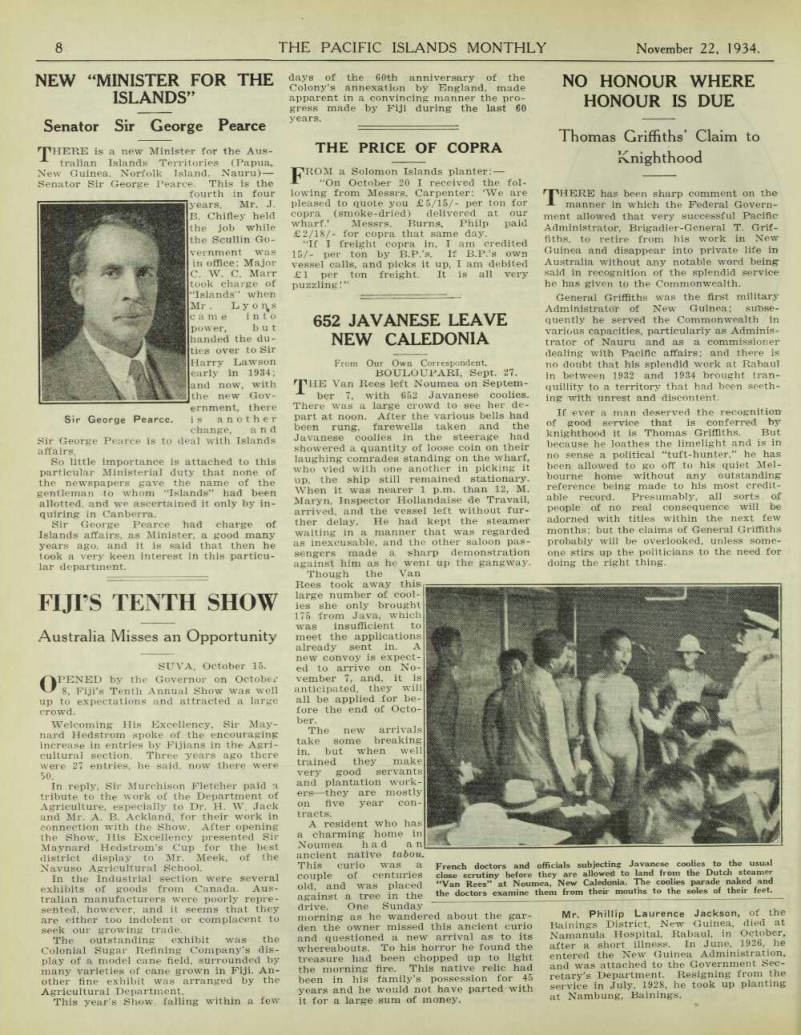
Senator Sir George Pearce
THERE is a new Minister for the Australian Islands Territories (Papua, New Guinea, Norfolk Island, Nauru) — Senator Sir George Pearce. This is the fourth in four
years. Mr. J.
B. Chifley held the job while the Scullin Go vernment was in office; Major C. W. C. Marr took charge of “Islands” when Mr. Lyons came into power, but handed the du ties over to Sir Harry Lawson early in 1934; and now, with the new Gov ernment, there is another
change, and Sir George Pearce is to deal with Islands affairs.
So little importance is attached to this particular Ministerial duty that none of the newspapers gave the name of the gentleman to whom “Islands” had been allotted, and we ascertained it only by inquiring in Canberra.
Sir George Pearce had charge of Islands affairs, as Minister, a good many years ago, and it is said that then he took a very keen interest in this particu lar department.
Sir George Pearce.
Fiji’S Tenth Show
Australia Misses an Opportunity
SUVA, October 15.
OPENED by the Governor on October 8, Fiji’s Tenth Annual Show was well up to expectations and attracted a large crowd.
Welcoming His Excellency, Sir May nard Hedstrom spoke of the encouraging increase in entries by Fijians in the Agri cultural section. Three years ago there were 27 entries, he said, now there were 50.
In reply, Sir Murchison Fletcher paid a tribute to the work of the Department of Agriculture, especially to Dr. H. W. Jack and Mr. A. B. Ackland, for their work in connection with the Show. After opening the Show, His Excellency presented Sir Maynard Hedstrom’s Cup for the best district display to Mr. Meek, of the Navuso Agricultural School.
In the Industrial section were several exhibits of goods from Canada. Aus tralian manufacturers were poorly repre sented, however, and it seems that they are either too indolent or complacent to seek our growing trade.
The outstanding exhibit was the Colonial Sugar Refining Company’s dis play of a model cane field, surrounded by many varieties of cane grown in Fiji. An other fine exhibit was arranged by the Agricultural Department.
This year’s Show, falling within a few
days of the 60th anniversary of the Colony’s annexation by England, made apparent in a convincing manner the pro gress made by Fiji during the last 60 years.
The Price Of Copra
FROM a Solomon Islands planter: “On October 20 I received the fol lowing from Messrs. Carpenter; ‘We are pleased to quote you £5/15/- per ton for copra (smoke-dried) delivered at our wharf.’ Messrs. Burns, Philp paid £2/18/- for copra that same day.
“If I freight copra in, I am credited 15/- per ton by B.P.’s. If B.P.’s own vessel calls, and picks it up, I am debited £1 per ton freight. It is all very puzzling!”
New Caledonia
652 Javanese Leave
From Our Own Correspondent.
Bouloupari, Sept. 27.
THE Van Rees left Noumea on Septem ber 7, with 652 Javanese coolies.
There was a large crowd to see her de part at noon. After the various bells had been rung, farewells taken and the Javanese coolies in the steerage had showered a quantity of loose coin on their laughing comrades standing on the wharf, who vied with one another in picking it up, the ship still remained stationary.
When it was nearer 1 p.m. than 12, M.
Maryn, Inspector Hollandaise de Travail, arrived, and the vessel left without fur ther delay. He had kept the steamer waiting in a manner that was regarded as inexcusable, and the other saloon pas sengers made a sharp demonstration against him as he went up the gangway.
Though the Van Rees took away this large number of cool ies she only brought 175 from Java, which was insufficient to meet the applications already sent in. A new convoy is expect ed to arrive on No vember 7, and, it is anticipated, they will all be applied for be fore the end of Octo ber.
The new arrivals take some breaking in, but when well trained they make very good servants and plantation work ers —they are mostly on five year con tracts.
A resident who has a charming home in Noumea had an ancient native tabou.
This curio was a couple of centuries old, and was placed against a tree in the drive. One Sunday
morning as he wandered about the gar den the owner missed this ancient curio and questioned a new arrival as to its whereabouts. To his horror he found the treasure had been chopped up to light the morning fire. This native relic had been in his family’s possession for 45 years and he would not have parted with it for a large sum of money.
Knighthood
No Honour Where
Honour Is Due
Thomas Griffiths’ Claim to Knighthood
THERE has been sharp comment on the manner in which the Federal Govern ment allowed that very successful Pacific Administrator, Brigadier-General T. Grif fiths, to retire from his work in New Guinea and disappear into private life in Australia without any notable word being said in recognition of the splendid service he has given to the Commonwealth.
General Griffiths was the first military Administrator of New Guinea; subse quently he served the Commonwealth in various capacities, particularly as Adminis trator of Nauru and as a commissioner dealing with Pacific affairs; and there is no doubt that his splendid work at Rabaul in between 1932 and 1934 brought tran quillity to a territory that had been seeth ing with unrest and discontent.
If ever a man deserved the recognition of good service that is conferred by knighthood it is Thomas Griffiths. But because he loathes the limelight and is in no sense a political “tuft-hunter.” he has been allowed to go off to his quiet Mel bourne home without any outstanding reference being made to his most credit able record. Presumably, all sorts of people of no real consequence will be adorned with titles within the next few months; but the claims of General Griffiths probably will be overlooked, unless some one stirs up the politicians to the need for doing the right thing.
Mr. Phillip Laurence Jackson, of the Bainings District, New Guinea, died at Namanula Hospital, Rabaul, in October, after a short illness. In June, 1926, he entered the New Guinea Administration, and was attached to the Government Sec retary’s Department. Resigning from the service in July, 1928, he took up planting at Nambung, Bainings.
French doctors and officials subjecting Javanese coolies to the usual close scrutiny before they are allowed to land from the Dutch steamer “Van Rees” at Noumea, New Caledonia. The coolies parade naked and the doctors examine them from their mouths to the soles of their feet.
Fiji’S Gold
Governor’s Precautions Against Speculators
THE future of the gold-mining industry in Fiji was referred to in optimistic terms by the Governor at the meeting of the Legislative Council in Suva on Oc tober 12.
Sir Murchison Fletcher said that the gold-mining industry continues to de velop and a Mining Board has been ap pointed to deal with it. “The Tavua area (in the north-east of Viti Levu) is now to a certain extent a proved gold field and while traces of free gold are to be found in the shallow surface soil over a large tract, deep excavation is ne cessary in order to prove lodes and their values; and for this purpose skilled men and the employment of much capital are required.”
The question of general mining policy seems to be giving the Governor some concern and he has referred it to the Secretary of State for the Colonies. His Excellency pointed out that “the gold is the property of the community as rep resented by the Crown, and it is in equitable that this property should be transferred to an individual whose claim to it lies in the fact that he happens to have been first in a scramble to peg out •claims in the Land Office. It is difficult to find a satisfactory demarcation be tween on the one hand the genuine pros pector who is ready and able to prove in a scientific manner such area as may be allotted to him, and on the other hand the man whose only object is to obtain a right which he can sell to the highest bidder and so get something for nothing.
The Government will not move hastily, and it is not the intention to issue further prospecting licenses in the Tavua or Yanawai areas, except upon full investi gation of an applicant’s intentions and of his ability to carry them into effect.
“If a prospector should make a dis covery in some other part of the Colony and should obtain a prospecting license, and should thereupon proceed to pros pect vigorously and continuously, it is
proposed that no further licenses should be issued in respect of land in the im mediate vicinity, until the first-comer should have had time to prove his dis covery. I referred to this matter in my address to this Council on the 13th Oc tober last year.”
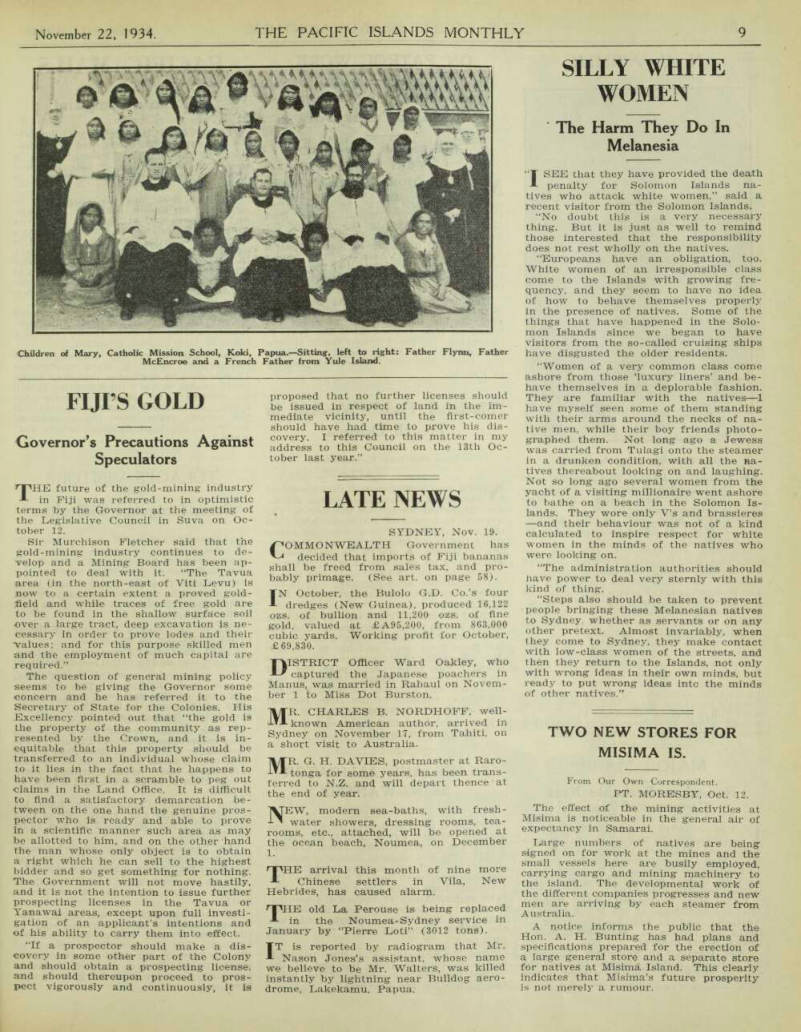
Children of Mary, Catholic Mission School, Koki, Papua.—Sitting, left to right: Father Flynn, Father McEncroe and a French Father from Yule Island.
Late News
Sydney, Nov. 19.
COMMONWEALTH Government has decided that imports of Fiji bananas shall be freed from sales tax, and pro bably primage. (See art. on page 58).
IN October, the Bulolo G.D. Co.’s four dredges (New Guinea), produced 16,122 ozs. of bullion and 11,200 ozs. of fine gold, valued at £A95,200, from 863,000 cubic yards. Working profit for October, £69,830.
DISTRICT Officer Ward Oakley, who captured the Japanese poachers in Manus, was married in Rabaul on Novem ber 1 to Miss Dot Burston.
Mr. Charles B. Nordhoff, Well
known American author, arrived in Sydney on November 17, from Tahiti, on a short visit to Australia.
MR. G. H. DAVIES, postmaster at Raro tonga for some years, has been trans ferred to N.Z. and will depart thence at the end of year.
NEW, modern sea-baths, with fresh water showers, dressing rooms, tea rooms, etc., attached, will be opened at the ocean beach, Noumea, on December 1.
THE arrival this month of nine more Chinese settlers in Vila, New Hebrides, has caused alarm.
THE old La Perouse is being replaced in the Noumea-Sydney service in January by “Pierre Loti” (3012 tons).
IT is reported by radiogram that Mr.
Nason Jones’s assistant, whose name we believe to be Mr. Walters, was killed instantly by lightning near Bulldog aero drome, Lakekamu, Papua.
Women
Silly White
The Harm They Do In Melanesia
“I SEE that they have provided the death penalty for Solomon Islands na tives who attack white women,” said a recent visitor from the Solomon Islands.
“No doubt this is a very necessary thing. But it is just as well to remind those interested that the responsibility does not rest wholly on the natives.
“Europeans have an obligation, too.
White women of an irresponsible class come to the Islands with growing fre quency, and they seem to have no idea of how to behave themselves properly In the presence of natives. Some of the things that have happened in the Solo mon Islands since we began to have visitors from the so-called cruising ships have disgusted the older residents.
“Women of a very common class come ashore from those ‘luxury liners’ and be have themselves in a deplorable fashion.
They are familiar with the natives —I have myself seen some of them standing with their arms around the necks of na tive men, while their boy friends photo graphed them. Not long ago a Jewess was carried from Tulagi onto the steamer in a drunken condition, with all the na tives thereabout looking on and laughing.
Not so long ago several women from the yacht of a visiting millionaire went ashore to bathe on a beach in the Solomon Is lands. They wore only V’s and brassieres —and their behaviour was not of a kind calculated to inspire respect for white women in the minds of the natives who were looking on.
“The administration authorities should have power to deal very sternly with this kind of thing.
“Steps also should be taken to prevent people bringing these Melanesian natives to Sydney whether as servants or on any other pretext. Almost invariably, when they come to Sydney, they make contact with low-class women of the streets, and then they return to the Islands, not only with wrong ideas in their own minds, but ready to put wrong ideas into the minds of other natives.”
Misima Is.
Two New Stores For
From Our Own Correspondent.
Pt. Moresby, Oct. 12.
The effect of the mining activities at Misima is noticeable in the general air of expectancy in Samarai.
Large numbers of natives are being signed on for work at the mines and the small vessels here are busily employed, carrying cargo and mining machinery to the island. The developmental work of the different companies progresses and new men are arriving by each steamer from Australia.
A notice informs the public that the Hon. A. H. Bunting has had plans and specifications prepared for the erection of a large general store and a separate store for natives at Misima Island. This clearly indicates that Misima’s future prosperity is not merely a rumour.
N. G. Airmen
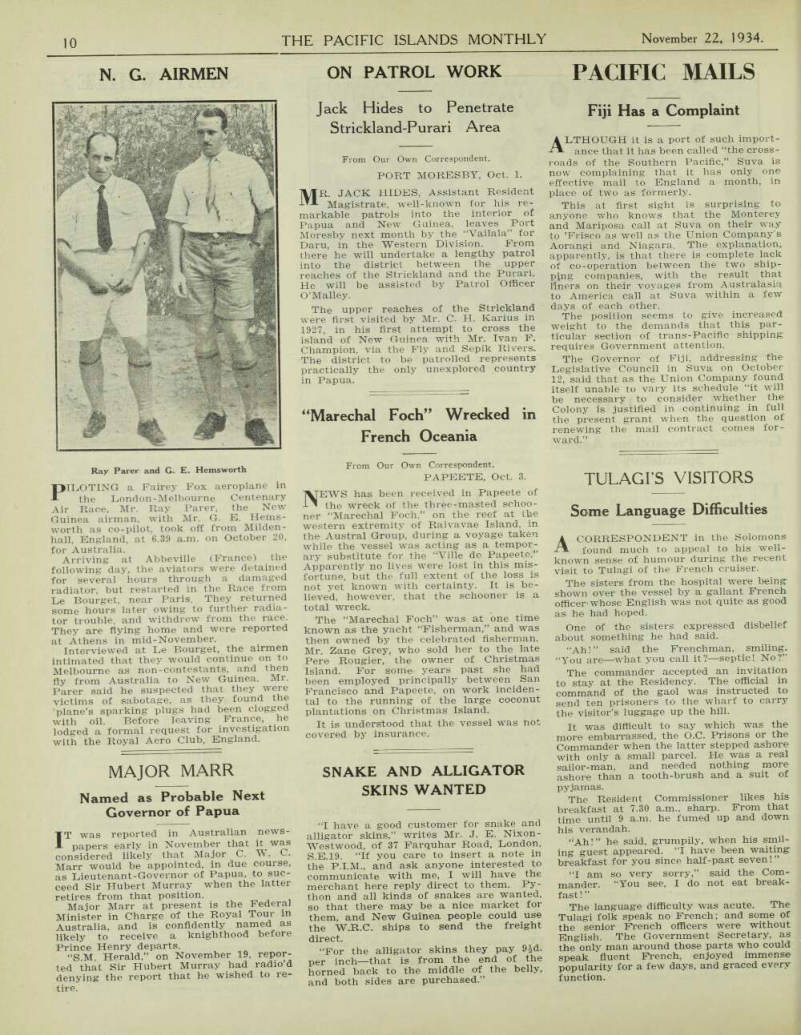
PILOTING a Fairey Fox aeroplane in the London-Melbourne Centenary Air Race, Mr. Ray Parer, the New Guinea airman, with Mr. G. E. Hems worth as co-pilot, took off from Milden hall, England, at 6.39 a.m. on October 20, for Australia.
Arriving at Abbeville (France) the following day, the aviators were detained for several hours through a damaged radiator, but restarted in the Race from Le Bourget, near Paris. They returned some hours later owing to further radia tor trouble, and withdrew from the race.
They are flying home and were reported at Athens in mid-November.
Interviewed at Le Bourget, the airmen intimated that they would continue on to Melbourne as non-contestants, and then fly from Australia to New Guinea. Mr.
Parer said he suspected that they were victims of sabotage, as they found the ’plane’s sparking plugs had been clogged with oil. Before leaving France, he lodged a formal request for investigation with the Royal Aero Club, England.
Ray Parer and G. E. Hemsworth
Major Marr
Named as Probable Next Governor of Papua
IT was reported in Australian news papers early in November that considered likely that Major C. W. C.
Marr would be appointed, in due course, as Lieutenant-Governor of Papua, to suc ceed Sir Hubert Murray when the latter retires from that position.
Major Marr at present is the Federal Minister in Charge of the Royal Tour in Australia, and is confidently named as likely to receive a knighthood before Prince Henry departs.
“S.M. Herald,” on November 19, repor ted that Sir Hubert Murray had radio’d denying the report that he wished to re tire.
Strickland-Purari Area
On Patrol Work
Jack Hides to Penetrate Strickland-Purari Area
From Our Own Correspondent.
Port Moresby, Oct. 1.
MR. JACK HIDES, Assistant Resident Magistrate, well-known for his re markable patrols into the interior of Papua and New Guinea, leaves Port Moresby next month by the “Vailala” for Daru, in the Western Division. From there he will undertake a lengthy patrol into the district between the upper reaches of the Strickland and the Purari.
He will be assisted by Patrol Officer O’Malley.
The upper reaches of the Strickland were first visited by Mr. C. H. Karius in 1927, in his first attempt to cross the island of New Guinea with Mr. Ivan F.
Champion, via the Fly and Sepik Rivers.
The district to be patrolled represents practically the only unexplored country in Papua.
“Marechal Foch” Wrecked in French Oceania
French Oceania
From Our Own Correspondent.
Papeete, Oct. 3.
NEWS has been received in Papeete of the wreck of the three-masted schoo ner “Marechal Foch,” on the reef at the western extremity of Raivavae Island, in the Austral Group, during a voyage taken while the vessel was acting as a tempor ary substitute for the “Ville de Papeete.”
Apparently no lives were lost in this mis fortune, but the full extent of the loss is not yet known with certainty. It is be lieved, however, that the schooner is a total wreck.
The “Marechal Foch” was at one time known as the yacht “Fisherman,” and was then owned by the celebrated fisherman, Mr. Zane Grey, who sold her to the late Pere Rougier, the owner of Christmas Island. For some years past she had been employed principally between San Francisco and Papeete, on work inciden tal to the running of the large coconut plantations on Christmas Island.
It is understood that the vessel was not covered by insurance.
Snake And Alligator
Skins Wanted
“I have a good customer for snake and alligator skins,” writes Mr. J. E. Nixon- Westwood, of 37 Farquhar Road, London, S.E.19. “If you care to insert a note in the P.I.M., and ask anyone interested to communicate with me, I will have the merchant here reply direct to them. Py thon and all kinds of snakes are wanted, so that there may be a nice market for them, and New Guinea people could use the W.R.C. ships to send the freight direct.
“For the alligator skins they pay 9½d. per inch—that is from the end of the horned back to the middle of the belly, and both sides are purchased.”
Pacific Mails
Fiji Has a Complaint
ALTHOUGH it is a port of such import ance that it has been called “the cross roads of the Southern Pacific,” Suva is now complaining that it has only one effective mail to England a month, in place of two as formerly.
This at first sight is surprising to anyone who knows that the Monterey and Mariposa call at Suva on their way to ’Frisco as well as the Union Company's Aorangi and Niagara. The explanation, apparently, is that there is complete lack of co-operation between the two ship ping companies, with the result that liners on their voyages from Australasia to America call at Suva within a few days of each other.
The position seems to give increased weight to the demands that this par ticular section of trans-Paciflc shipping requires Government attention.
The Governor of Fiji, addressing the Legislative Council in Suva on October 12, said that as the Union Company found itself unable to vary its schedule “it will be necessary to consider whether the Colony is justified in continuing in full the present grant when the question of renewing the mail contract comes for ward.”
Tulagi’S Visitors
Some Language Difficulties
A CORRESPONDENT in the Solomons found much to appeal to his well known sense of humour during the recent visit to Tulagi of the French cruiser.
The sisters from the hospital were being shown over the vessel by a gallant French officer-whose English was not quite as good as he had hoped.
One of the sisters expressed disbelief about something he had said.
“Ah!” said the Frenchman, smiling.
“You are —what you call it?—septic! No?”
The commander accepted an invitation to stay at the Residency. The official in command of the gaol was instructed to send ten prisoners to the wharf to carry the visitor’s luggage up the hill.
It was difficult to say which was the more embarrassed, the O.C. Prisons or the Commander when the latter stepped ashore with only a small parcel. He was a real sailor-man, and needed nothing more ashore than a tooth-brush and a suit of pyjamas.
The Resident Commissioner likes his breakfast at 7.30 a.m., sharp. From that time until 9 a.m. he fumed up and down his verandah.
“Ah!” he said, grumpily, when his smil ing guest appeared. “I have been waiting breakfast for you since half-past seven! ”
“I am so very sorry,” said the Com mander. “You see, I do not eat break fast!”
The language difficulty was acute. The Tulagi folk speak no French; and some of the senior French officers were without English. The Government Secretary, as the only man around those parts who could speak fluent French, enjoyed immense popularity for a few days, and graced every function.
Tropicalities
HENRY DEXTER, of Milne Bay, Papua —now migrating Englandwards—told us that he overheard this in Tom McCrann’s hotel, in Port Moresby in 1910: Matt Crowe to Bill Sheehan (the local baker); “So you’re against the Govern ment, Bill?”
“Av coorse I’m agin the Government, Matt!”
“And are you in favor of Home Rule Bill?”
“Av coorse I’m in favor of Home Rule.
Matt! ”
“And if Home Rule was brought in, would you be agin the Government, Bill?”
“Av coorse I’d be agin the Govern ment, Matt!” * * * Writing to renew his subscription to the P.I.M.. an old Island trader adds: “Our mail usually arrives late on Satur day night. Two oldtimers usually blow along on Sunday morning. There are no less than nine publications to choose from. But I wish I could pick the win ner of the Melbourne Cup as easily as I can guess which of the above nine will be monopolised for the next hour —it is in variably my two copies of the P.I.M.” * * * TWO curious proclamations are made in the Western Pacific High Commission Gazette of September 26. They are in identical terms, except that one refers to the Solomon Islands, and the other to the Gilbert and Ellice Islands Colony. They mean, in ordinary language, that it is now unlawful to ship munitions of war and aeroplanes, or parts thereof, from the Solo mon or Gilbert and Ellice Islands to Bo livia and Paraguay. There is no smoke without fire. Who is the enterprising trader who has been countering the copra market depression by selling war material to the South American republics? Or have those quiet islands been used as transhipment ports by European dealers in munitions?
Stranger things have happened. Firms in Tahiti, during American prohibition, made tens of thousands of pounds by acting as transhipment agents for international
bootleggers.”
* * * I ASKED Frank Pryke the other day how Edie Creek got its name. He thought it was a mutilation of a native name— "Eti” or “Eudi.” Mr. Pryke, however, gave me with more certainty the origin of another name—he said that it was old Matt Crowe who christened the discoverer of Edie Creek “Sharkeye”
Park. * * * THE following sentences, which refer to the vessel upon which Western Samoa depends mainly for its communica tion with the outside world, are taken from a letter written by an Australian to a friend in the East Indies, and submitted to editor of this journal: The Maui Pomare is a perfectly wretched vessel owned by the New Zea land Government. It is the most poorly equipped passenger ship on which I have ever travelled; and the quantity and quality of the food are extremely poor.
You people believe in good food and plenty of it; the New Zealand Govern merit believes in poor food and little of it. And fancy having the lavatory next door to the pantry!”
“THE King of Apamama said it all when he divided the whites into three classes: ‘First, him cheat a litty; second, him cheat plenty; and, third, him cheat too much.’ ” —From Frederick O’Brien’s “Mystic Isles.” * * * AFTER completing his usual pains taking preparations. Sir Charles Kingsford Smith, accompanied by Cap tain P. G. Taylor as navigator, left Brisbane for Suva early on October 21, in the Lady Southern Cross on the first hop of a trans-Pacific flight to San Francisco, America. He landed safely at Albert Park, Suva, the same evening.
The airmen left Suva on October 24 for Naselai Beach, Fiji, where they were to take off on the second hop to Hono lulu. Exceedingly bad weather, how ever, delayed their departure for several days. Leaving Naselai for Hawaii on October 29, they covered the 3150 miles hop in 25 hours.
The final hop was completed when the Lady Southern Cross left Hawaii on Saturday, November 3, and landed at Oakland, California, the following morn ing after an eventless flight. * * * AN appeal to the Commonwealth Government and the New Guinea Administration for a remission of part of the sentence of ten years’ imprison ment imposed on James Larkin has been prepared, and will be submitted, probably in the form of a petition.
The facts of the case, and of several other cases which have a bearing upon the Larkin case, have been very care fully examined set out, and the point is made that, whatever may have been the circumstances when the sen tence was imposed, a good deal has happened in the last two or three years to justify a review of the sentence.
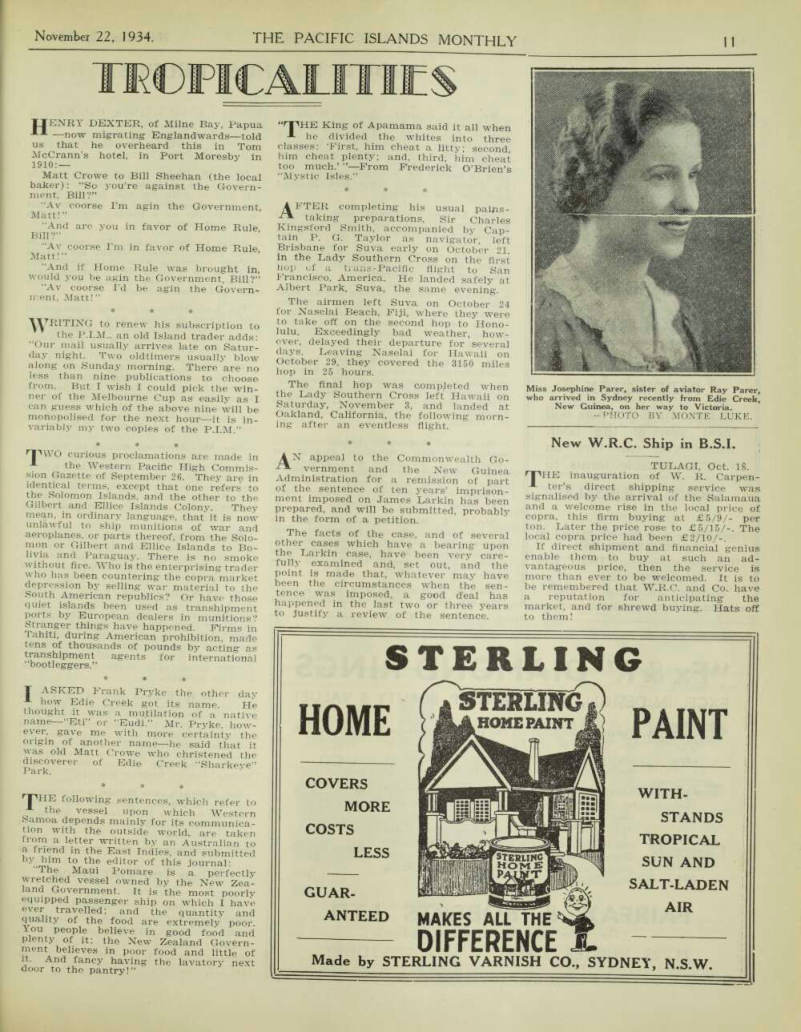
Miss Josephine Parer, sister of aviator Ray Parer, who arrived in Sydney recently from Edie Creek, New Guinea, on her way to Victoria.
—Photo By Monte Luke.
New W.R.C. Ship in B.S.I.
Tulagi, Oct. 18.
THE inauguration of W. R. Carpenter’s direct shipping service was signalised by the arrival of the Salamaua and a welcome rise in the local price of copra, this firm buying at £5/9/- per ton. Later the price rose to £5/15/-. The local copra price had been £2/10/-.
If direct shipment and financial genius enable them to buy at such an ad vantageous price, then the service is more than ever to be welcomed. It is to be remembered that W.R.C. and Co. have a reputation for anticipating the market, and for shrewd buying. Hats off to them!
Advertisements & other items, p. 13 (1 item)
Home
STERLING
COVERS
MORE
COSTS
LESS
GUAR-
ANTEED
STERLING
A HOME PAINT
MAKES ALL THE
DIFFERENCE
PAINT
WITH-
STANDS
TROPICAL
SUN AND
SALT-LADEN
AIR
Made by STERLING VARNISH CO., SYDNEY, N.S.W.
Norfolk Island Trade
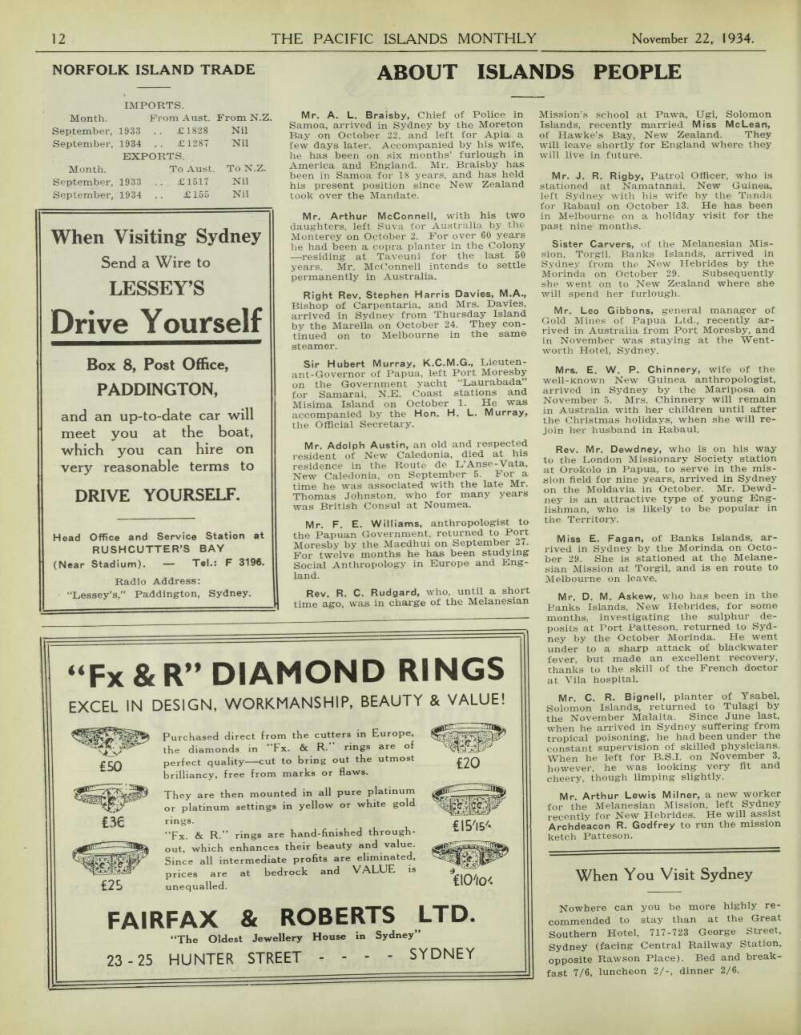
Month.
Imports.
From Aust.
From N.Z, September, 1933 .. £1828 Nil September, 1934 .. £1287 Nil Month.
Exports.
To Aust.
To N.Z.
September, 1933 .. £1517 Nil September, 1934 .. £155 Nil
About Islands People
Mr. A. L. Braisby, Chief of Police in Samoa, arrived in Sydney by the Moreton Bay on October 22, and left for Apia a few days later. Accompanied by his wife, he has been on six months’ furlough in America and England. Mr. Braisby has been in Samoa for 18 years, and has held his present position since New Zealand took over the Mandate.
Mr. Arthur McConnell, with his two daughters, left Suva for Australia by the Monterey on October 2. For over 60 years he had been a copra planter in the Colony —residing at Taveuni for the last 50 years. Mr. McConnell intends to settle permanently in Australia.
Right Rev. Stephen Harris Davies, M.A., Bishop of Carpentaria, and Mrs. Davies, arrived in Sydney from Thursday Island by the Marella on October 24. They con tinued on to Melbourne in the same steamer.
Sir Hubert Murray, K.C.M.G., Lieuten ant-Governor of Papua, left Port Moresby on the Government yacht “Laurabada” for Samarai, N.E. Coast stations and Misima Island on October 1. He was accompanied by the Hon. H. L. Murray, the Official Secretary, Mr. Adolph Austin, an old and respected resident of New Caledonia, died at his residence in the Route de L’Anse-Vata, New Caledonia, on September 5. For a time he was associated with the late Mr.
Thomas Johnston, who for many years was British Consul at Noumea.
Mr. F. E. Williams, anthropologist to the Papuan Government, returned to Port Moresby by the Macdhui on September 27.
For twelve months he has been studying Social Anthropology in Europe and Eng land.
Rev. R. C. Rudgard, who, until a short time ago, was in charge of the Melanesian
Mission’s school at Pawa, Ugi, Solomon Islands, recently married Miss McLean, of Hawke’s Bay, New Zealand. They will leave shortly for England where they will live in future.
Mr. J. R. Rigby, Patrol Officer, who is stationed at Namatanai, New Guinea, left Sydney with his wife by the Tanda for Rabaul on October 13. He has been in Melbourne on a holiday visit for the past nine months.
Sister Carvers, of the Melanesian Mis sion, Torgil, Banks Islands, arrived in Sydney from the New Hebrides by the Morinda on October 29. Subsequently she went on to New Zealand where she will spend her furlough.
Mr. Leo Gibbons, general manager of Gold Mines of Papua Ltd., recently ar rived in Australia from Port Moresby, and in November was staying at the Went worth Hotel, Sydney.
Mrs. E. W. P. Chinnery, wife of the well-known New Guinea anthropologist, arrived in Sydney by the Mariposa on November 5. Mrs. Chinnery will remain in Australia with her children until after the Christmas holidays, when she will re join her husband in Rabaul.
Rev. Mr. Dewdney, who is on his way to the London Missionary Society station at Orokolo in Papua, to serve in the mis sion field for nine years, arrived in Sydney on the Moldavia in October. Mr. Dewd ney is an attractive type of young Eng lishman, who is likely to be popular in the Territory.
Miss E. Fagan, of Banks Islands, ar rived in Sydney by the Morinda on Octo ber 29. She is stationed at the Melane sian Mission at Torgil, and is en route to Melbourne on leave.
Mr. D. M. Askew, who has been in the Banks Islands, New Hebrides, for some months, investigating the sulphur de posits at Port Patteson, returned to Syd ney by the October Morinda. He went under to a sharp attack of blackwater fever, but made an excellent recovery, thanks to the skill of the French doctor at Vila hospital.
Mr. C. R. Bignell, planter of Ysabel, Solomon Islands, returned to Tulagi by the November Malaita. Since June last, when he arrived in Sydney suffering from tropical poisoning, he had been under the constant supervision of skilled physicians.
When he left for B.S.I. on November 3, however, he was looking very fit and cheery, though limping slightly.
Mr. Arthur Lewis Milner, a new worker for the Melanesian Mission, left Sydney recently for New Hebrides. He will assist Archdeacon R. Godfrey to run the mission ketch Patteson.
Mr. E. A. Callanan arrived in Sydney from America on October 8, to take over the position of Chairman and Managing Director of the Vacuum Oil Co. Pty. Ltd., from Mr. C. Cornforth, who is retiring after 33 years of service. Mr. Callanan enlisted in the U.S. Aviation Corps when America entered the Great War, and later was in charge of an Army aviation train ing school. After the War he served with General Motors Corporation and then joined the Vacuum Oil Co. Mr. Callanan has held many positions in the company’s technical and sales departments and is an expert on all phases of the oil business.
Rev. G. P. Lassam, of East Cape, Papua, has resigned from the Papua dis trict of the Methodist Mission, owing to his wife’s illness. They intend to return to Sydney late in November.
Mr. J. S. Neill, British Consul and Agent in the Tongan Islands, arrived in Suva, Fiji, from London by the m.v.
Waiwera on October 16, en route to Nukualofa. With his wife, he had been on furlough in England.
Miss M. H. Hodge, who has been at the Methodist Mission, Salamo, Papua, ar rived in Sydney on furlough by the November Montoro.
Mr. N. B. Casey, of Fiji, was presented with the insignia and certificate of M.B.E., which had been conferred on him by the King in June last, by Sir Murchi son Fletcher, when the Legislative Coun cil was opened in Suva on October 12.
When investing Mr. Casey with the de coration His Excellency said it was in recognition of Mr. Casey’s valuable ser vices as Superintendent of Prisons and as Chairman of the European Unemploy ment Relief Board.
Right Rev. C. J. N icholas, Roman Catholic Bishop of Fiji, arrived in Syd ney by the Mariposa on November 5, on his way to attend the Melbourne Eucha ristic Congress. Bishop Nicholas, who is a native of France, has been engaged in mission work in Fiji for 45 years.
Mr. H arris, who for the past 16 months has been superintending the erection of church buildings on several of the Torres Strait Islands, returned to his home in Bathurst, N.S.W., in October.
Dr. Jabin Dudognon, a surgeon of the French Army, who has served in Morocco and Cochin China, arrived in Sydney by the Ville d’Amiens on November 5, en route to Noumea for further service.
Rev. Dumas, Rev. Jeivarch, and Rev.
Lang, Maronite priests, arrived in Sydney from France on November 5 by the Ville d’Amiens, on their way to the Pacific Islands for mission work. Fathers Jeiv arch and Lang are en route to Papua, while Father Dumas is on his way to the Gilbert Islands.
Mrs. W. R. McNicoll, wife of the Ad ministrator of New Guinea, was the guest of honour at a meeting of the Harbour side branch of the Country Women’s Association held in Sydney on October 17. Many members were present to bid her farewell prior to her departure to join Brigadier-General McNicoll in Rabaul. At the meeting, a suggestion was advanced that a branch of the C.W.A., under the leadership of Mrs. McNicoll, should be formed in the Territory.
Rev. A, Mason, of Fiu, North Mala, British Solomon Islands, accompanied by Mrs. Mason, arrived in Sydney by the
Malaita on October 28. For 20 years they have been working in the Solomons for the Melanesian Mission, and are now going to New Zealand on leave.
Mr. Harry Steele Wisdom, manager of the Fiji firm of Marlows Ltd., died in Suva on October 24 after a sudden illness.
Going to Fiji as an accountant, Mr. Wis dom joined the staff of the Vancouver- Fiji Sugar Co. at Navua. Later, when the company closed down, he was en gaged by Marlows Ltd. as manager and secretary. For the past two years Mr.
Wisdom was President of the Defence Club. He is survived by his wife and two children —Joan and John, both at pre sent in New Zealand.
Bishop Thomas J. Wade, of the Marist Mission at Kieta, Bougainville, in the Northern Solomons, arrived in Sydney by the Malaita on October 28. After visiting Melbourne for the Roman Catholic Con gress he will leave for Rome, by way of America.
Madame Ledamoisel, an old and re spected resident of New Caledonia re turned to Noumea in November, after a holiday visit to France.
Mr. H. Finter, Queensland Inspector of Aboriginal schools, returned to Brisbane in October after completing a tour of in spection of schools on the Torres Strait Islands.
Miss Gladys Thomas, who has been serving in Papua as a missionary sister
for the Methodist Mission, has retired, and returned to Sydney by the Mataram on October 5, owing to ill-health.
When You Visit Sydney
Nowhere can you be more highly re commended to stay than at the Great Southern Hotel, 717-723 George Street, Sydney (facing Central Railway Station, opposite Rawson Place). Bed and break fast 7/6, luncheon 2/-, dinner 2/6.
Advertisements & other items, pp. 14-15 (2 items)
Drive Yourself
When Visiting Sydney
Send a Wire to
LESSEY’S
Drive Yourself
Box 8, Post Office,
PADDINGTON,
and an up-to-date car will meet you at the boat, which you can hire on very reasonable terms to
DRIVE YOURSELF.
Head Office and Service Station at
RUSH CUTTER’S BAY
(Near Stadium). Tel.; F 3196.
Radio Address: “Lessey’s,” Paddington, Sydney.
“Fx & R” DIAMOND RINGS
EXCEL IN DESIGN, WORKMANSHIP, BEAUTY & VALUE! £50 £25 Purchased direct from the cutters in Europe, the diamonds in “Fx. & R.“ rings are of perfect quality cut to bring out the utmost brilliancy, free from marks or flaws.
They are then mounted in all pure platinum or platinum settings in yellow or white gold rings.
“Fx. & R.“ rings are hand-finished throughout, which enhances their beauty and value.
Since all intermediate profits are eliminated, prices are at bedrock and VALUE is unequalled.
FAIRFAX & ROBERTS LTD.
“The Oldest Jewellery House in Sydney 23 -25 HUNTER STREET - - - - SYDNEY
“Younger”
MINING AND ASSAY
MATERIAL
BALANCES, CRUSHERS, FURNACES,
CRUCIBLES. FLUXES, ETC.
LABORATORY AND SCHOOL
REQUISITES
Chemicals, Glassware, and all other Equipment
HOSPITAL AND SURGICAL
REQUIREMENTS
Incubators, Sterilizers, Centrifuges, Microscopes, Microtomes, etc.
Measures, Dispensing Scales, Enamel Ware, Bandages, Cotton Wool, and all Dispensing Material, Write direct to
H. B. SELBY & CO., LTD.,
BULLETIN PLACE SYDNEY
Box 175D, G.P.O.
COLEMAN INSTANT LIGHTING
Lamps - Lanterns - Irons
A tremendous IMPROVEMENT on anything we have before manufactured.
INSTANT-LITE Table Lamps, with built-in Pump, Patent Air Release Tank.
INSTANT-LITE Irons, with Roto Generator, Porcelain Enamel Body— two Hot Points —Bevelled and Cambered Base.
W. R. Carpenter & Co , Ltd.
Or, Write for Coloured Catalogue to Creme Shade, Automatic Generator, Sold by All Branches of Coleman Quick-Lite Co., 500 Kent Street, Sydney
Coleman Jk
Do You Know that the Famous
“YOUNGER”
STOVES AND
RANGES
made with extended Firebox specially for long Wood fuel, are Self-Setting and, provided sufficient Flue Piping is attached, can be used in almost any position?
The No. 7W. “Younger” Range can now be supplied fitted with Legs, as per illustration.
Ask for quotation for this Range, also Illustrated Catalogue and Price List for both Single and Double Oven Stoves.
Younger Stoves are Widely Used Throughout the Pacific Islands.
G. FLETCHER & SON
50 Oxford Street, Sydney
“Nut-Fall” Experiments
In B.S.I.
From Our Own Correspondent.
Tulagi, Oct. 10.
Ever since the creation of an Agricul tural Committee, and the arrival of Mr.
Lever to take an officially scientific inter est in the coconut palm, experiments have been under way to solve the “nut-fall” and other planters’ problems.
More extensive experiments are now be ing carried out. One of Lever’s best, and one of the poorest-bearing plantations, has been equipped with sun-gauges (and se lected trees with thermometers), the re cords of which are being kept with a view to comparison, which may throw further light on the coconut problems. Rainfall records have been kept since the firm started operations here.
“Tibby-Pacific”
A Popular Citizen of New Caledonia
A SORTING-CLERK in the Chief Post Office in Paris stood one day glaring at a post-card in his hand. “Sacre bleu!” quoth he, and took the post-card to his next-in-command. The card bore two words: Tibby Pacific.
The clerks, having no recourse, put it in a mail-bag for Noumea, New Cale donia, Central Pacific.
The card came duly to the table of a postal official in Noumea, He grinned, and five seconds later dropped the card straight into the letter-box of Messrs.
Hagen Freres.
That same day, it was placed respect fully upon the desk of M. Nicholas Hagen, who is addressed boisterously all over the Pacific Ocean, and in four great capitals —London, Paris, New York, and Sydney —as “Tibby.”
On the card was a message: “When you get this, send me a radiogram,” and it was signed by a man in whose good company Nicholas had made acquaint ance with some of the brighter lights of Paris.
The radiogram was sent. A year later, M.
Hagen made inquiries in person. He dis covered that his friend had made a bet
that a card posted anywhere in the world to “Tibby, Pacific,” would reach its des tination; and that, when the radio’d re ceipt came, his friend collected an ex cellent dinner. Monsieur Nicholas was vociferously certain that somehow he had been ill-treated; so four cheery gentle men took him to the best restaurant in Paris, and there soothed his ruffled feelings. ...
To start the history of Nicholas Hagen in the right place, we must go back quite a few years—to 1871, to be exact; and the place is a big German store, in Apia, Samoa.
The peace of a soporific afternoon was disturbed suddenly. A large, bearded man came roaring in at the sunlit door way, and strode through the darkened store. “Where is the durned skunk!” he shouted. “I’ll tear his lousy head off and ram it into his bloody copra! Where is he?”
The noisy gentleman was Captain Bully Hayes, and he appeared to be seeking
the life of the little, old German store keeper, as one easy way of settling a trade dispute. The German scuttled rapidly away into a back room, and Bully went in pursuit.
The storekeeper’s assistant, a tall, blond, heavily-built young man, stepped
M. Nicholas Hagen.—A snapshot on the vehicular ferry, 30 miles from Noumea, in September last.
out in front of the raging captain. “You please will leave the boss alone,” he said.
Bully bellowed, and struck. The young man guarded—and in two seconds the store was rocking to one of the prettiest little fights Apia had ever seen. And Apia, in the seventies, was accustomed to the arbitrament of the clenched fist.
Bully was knocked unconscious, and was taken away to his ship. He en joyed no sympathy—he was everlastingly fighting. There was more concern over the young Scandinavian. It was inevit able that Captain Hayes would return, seeking revenge. Apia was a lawless place. Better get the Scandinavian under cover, and quickly, said the wise ones.
Early next morning a schooner pulled out of Apia, for the westward, and the Scandinavian was aboard. He was val orous, but his friends insisted that he be also discreet.
A few weeks later he arrived in Nou mea; and he settled there, acquired French citizenship, and became influen tial and rich, and the founder of the fa mous Hagen family.
Nicholas Hagen is one of his sons.
There are several brothers —all men of personality and eminence. They have been merchants, traders, bankers, ship owners, pastoralists, planters; their col onising spirit and enterprise have as sisted enormously in French progress in New Caledonia and New Hebrides. But there have been two disastrous hurri canes in the New Hebrides, in addition to the Depression, and the great firm of Hagen Freres has taken it somewhat in the neck. Residents of Vila told me about this evil fortune; and when I got to Noumea I offered respectful condo lences to Nicholas Hagen.
He laughed his great, merry laugh.
“Oh, la, la!” he said. “I weigh nineteen stone, and I sit on my troubles!”
The hospitality of this jolly Frenchman is proverbial. He took me to his home, built by his father near a palm-girt bay behind Noumea, where I met his still beautiful wife and his handsome children; and he and his charming son-inlaw, M. Danton (a descendant, by the way, of that famous Georges Jacques Danton of the Revolution) insisted on driving me over half of New Caledonia.
They showed me the New Caledonian cattle, of most excellent quality, but mar ketless; New Caledonian deer, which roam the verdured ranges in tens of thousands, strangely ignored by Southern sportsmen; the splendid forests and the glorious coastline; and they gave me an oyster-and-crab luncheon, washed down with rare liquor, in the old, sun-drenched township of La Foa, that will linger always among my choicest Pacific memories.
M. Hagen drove like a devil. And, as he drove, he sang. None could resist his gay humour. We all sang; and the wild deer fled in terror over the nether most hills. When he was not singing, he quoted Goethe to express his philosophy of life; and he retailed delicious gossip from London and New York; and he re minded me of what Voltaire said about Shakespeare, and of what Luther said about human existence: He who loves not wine, women, and song, He is a fool, all his life long.
He told me some delightful stories of his roving life in the Islands. One night, he left a kanaka in charge of his schooner, while he slept. He gave the native a course to follow, as indicated by a particular star. When he awoke, he was distressed to find the schooner far off its course, and he spoke violent
words to the native. “All right, master!” said the kanaka. “Me losem one star— but me catchem anudder star.” . . . He told me also that the Pidgin-speaking na tive’s name for the Seventh-Day Adven tists is “Man he kaikai grass!”
Nicholas Hagen is now the directing force behind the Noumea shipping com pany, which runs the coastal steamship services around New Caledonia, and be
tween that great island and the Loyal ties. He has imagination and the true pioneer spirit, and is seeking constantly for new trade and new transport. He initiated a service between Noumea and Brisbane recently with the little steamer Loyalty. The plan was based on thor oughly sound reasoning. The big French colony needs large quantities of the goods that Australia produces, and it is only 700 miles from New Caledonia to Brisbane. But, so far, the service is not flourishing as it should, simply because of artificial interference with trade. Aus tralia’s tariff against French goods has caused New Caledonia to erect tariff bar riers against Australian goods; and, for some reason that is as obscure as it is unsatisfactory, the French merchants cannot buy flour in Brisbane for New Caledonian consumption with the facility that they can buy it in Sydney. Yet it is 250 miles further to Sydney. If only the gentlemen responsible for “economic nationalism” could be taken away to a quiet place, and efficiently drowned, it would be possible to develop a very valu able two-ways trade between Australia and New Caledonia; and, in that event, M. Hagen would be prominently in the picture. With incurable optimism, he is fighting for the development of that trade, even under present conditions.
Nicholas Hagen insists that “the soul of me is French” —and so it is—but he nevertheless is a complete cosmopolitan.
He speaks English perfectly, and almost without accent; he knows London and New York nearly as well as his beloved Paris; and he has wandered in far, strange places. “The last time my son in-law and I ate together at a strange table,” he said, as we attacked the viands of New Caledonia, “we were the guests of an Arab chieftain in Marrakesh, in Cen tral Morocco.” Five minutes later he was arguing with Mr. Holger Rosenberg (of Copenhagen and himself a very fa mous traveller) about the merits of a strange liquor they brew in some corner of South America.
R.W.R.
Advertisements & other items, pp. 16-17 (2 items)
Wunderlich
Inquiries for all classes of Sails, Canvas, and General Boat Equipment invited
W. NORTHEY
CANVAS GOODS MANUFACTURER
Quotations Free.
Island Trade specially catered for Established over 40 years.
Taylors Wharf, Pyrmont
SYDNEY
WUNDERLICH
DURABESTOS
ISLAND HOME BUILDERS.—You can now
erect everlasting Homes quickly and at LOW COST by using DURABESTOS (Asbestos Cement) Building Sheets for Walls and Ceilings.
Big, sturdy sheets—economical to transporteasy to fix—fireproof—does not need painting.
Write for prices and Free Catalogue, “Durabestos Homes of Colourful Beauty,” WUNDERLICH LTD.
Box 474 AA, G.P.O., SYDNEY.
RESISTS TIME -WEATHER - WHITE
Newington College
STANMORE, SYDNEY
Day and Boarding School for Boys
Offers all the advantages of a Great Public School, with unrivalled facilities for Boarders, of any age.
Splendidly situated, with a fine health record.
Magnificent playing fields, of 20 acres (3 ovals), tennis courts, swimming pool, gymnasium.
New Term commences February 5, 1935.
Write for Prospectus and all particulars as to Bursaries, Scholarships and other matters to — P. R. Le Couteur, M.A. (Melb. and Oxon.), Headmaster.
SHORTHAND With us you
TYPEWRITING can qualify for BOOKKEEPING a position in FOUR MONTHS. A good demand exists for competent girls. Enrol now and be placed early in the New Year. Day, evening, and Postal.
Easy payments. Tele., M 3253.
NEWTON COLLEGE, over Fay’s Liverpool Street, Sydney.
TUDOR HOTEL
Room and Breakfast from 7/6 per day. All meeds a la carte. Accommodation for 100 guests. Two minutes from G.P.O.
127 PHILLIP ST. Tel.: BW 2788
One door from the New Martin Place,
SYDNEY
AUSOLINE
Never Known to Fail!
COCKROACH DESTROYER
It Attracts—They Eat It—They Die
AUSOLINE CO.
314 CROWN STREET, SYDNEY
Established 1919 PRICES: 1lb. 5/-, 3lbs. 10/-. Postage Extra.
Remit Cash with Order.
It’s Paste
IT’S JUST LIKE "GOING SHOPPING”
to send a Mail Order to
McILRATH’S
“AUSTRALIA’S LEADING FOOD DISTRIBUTORS”
Finest Roller Flour, 50lb 5/- bag, 8/- tin Australian I.A. Sugar, 70lb. bags 14/- bag Australian I.A. Sugar, 70lb bags (3 bag lots) ... 13/9 bag Libby’s Evaporated Milk, 6oz. tins (8 doz.) 19/4 case Capital Powdered Skim Milk, 1lb. tins 9½d. tin, 9/3 doz.
Ration Tea, 58lb. chests 1/- lb.
Best Fine Salt, lewt. bags 7/6 bag Pyramid Fine Salt, 1cwt. bags 5/6 bag Best Coarse Salt, 186lb. sacks 9/- sack Mixed Crown Soap, wrapped, 56’s and 72’s 24/6 case Mixed Crown Soap, unwrapped, 56’s and 72’s 23/6 case Mosque Mosquito Spirals (boxes of 12) ... 7½d. box, 7/- doz.
Australian Edam Cheese, 4lb. balls 1/3 lb.
Vincente de Vega Aromatic Bitters, 2oz. bots. (non-spirituous) 2/6 bot.
Rex Pye, ½lb tins 6½d. tin, 6/3 doz.
Rex Pork Sausages, 1lb. tins .. .. 1/1 tin, 12/6 doz.
PRICES F.O.B. SYDNEY
Export Price Lists available on application.
McILRATH’S LTD.
Pacific Is. Association
At the quarterly meeting of the Committee held on October 10, the following new members were admitted to the Pacific Islands Association: Messrs.
W. G. Whiteside, E. F. Kaad, R. H. C. Bentley and Chief Garagsau (Tukagsau), all of Rotuma, Fiji.
It has been decided to inaugurate a luncheon club under the auspices of the Association to meet monthly at Millions House. The first luncheon for the purpose of bringing together members of the Association and others interested in Island affairs was held on October 23.
The “Big Six” And
Others
MR. G. MACDONALD, an old-time trader of Salamaua, New Guinea, is on fur lough in Sydney at present and this writer has had the opportunity of an interesting chat with him about the old miners on the Morobe goldfield.
Mr. Macdonald was there at the begin ning and he was the beach agent for the “Big Six,” when they were carrying on their struggle to open the new goldfield on Edie Creek.
In the course of conversation Mr. Mac donald was asked if he knew what has become of those men who made themselves famous owing to their early association with the famous goldfield; and Mr. Mac donald dug into the depths of his memory and made the following summary.
Bill Royal—is now running a small allu vial “show” on Koranga Creek, just below the Golden Ridges mill, in the Bulolo Val ley.
Dick Glasson—reported to be prospecting for gold at the back of Aitape.
Joe Sloan —living in Australia.
Chisholm—dead.
Arthur Royal—has settled down happily as a farmer in Victoria.
Bill Money—has settled down as a planter in the Siassi Islands, and is doing well.
That accounts for the whole of the “Big Six.” Here is something about some of the other early identities.
“Sharkeye” Park —went to Vancouver.
There were various reports about him, but it is now generally believed that he is dead.
Harry Darby—died in tragic circum stances.
Herb. Wilson —one of the really old hands who used to be on Koranga; had a run of bad luck and died practically penni less.
Frank Pryke—well and prosperous, and settled down in Coogee, Sydney.
Rabaul Pioneer Passes
From Our Own Correspondent.
Rabaul, Oct. 10.
ONE of Rabaul’s oldest pioneers, Cap tain I. Komine, the well-known Japanese pearler, recruiter, and ship-builder, died on October 3, at the age of 69.
Arriving in New Guinea over 30 years ago, he set up a slip and ship-building yards at Rabaul. Later he acquired plan tation interests in the Manus district.
Captain Komine assisted the Australian Navy in 1914 in locating and capturing German ships hiding in the Territory, His funeral on October 4 was attended by the Acting-Administrator (Chief Judge Wanliss) and other Administration officials.
Captain Komine is survived by his wife..
Advertisements & other items, p. 18 (2 items)
Kemp
NORCO CO-OP.
LIMITED
SUSSEX STREET,
SYDNEY
AUSTRALIA’S LEADING MANUFACTURERS AND DISTRIBUTORS OF CHOICEST
BUTTER, BACON, HAMS AND TINNED GOODS
PIGS’ TONGUES HAM PATE
PIGS’ TROTTERS 3 oz. and 1½oz. Tins, 1lb. Tins Only.
NORCO LUNCH
BRAWN
PORK SAUSAGES
1lb. and ½lb. Tins.
IDEAL
FOR
LUNCHES
AND
PICNICS
The Genuine
KEMP
Safer for Horse and Rider Improved Design This super quality masterpiece contains all that is wise and new in modern craftsmanship. The KEMP is specially designed for Island use, being built on a rustless, heavily bar-plated tree, oiled kip leather throughout, and handsewn. Extra long flaps. Pads 3” or 4” high, 4½” dip in seat.
Fitted with Bevelled Leathers, Folded Girth, 4-bar Stirrups & Surcingle £7/7/-
FREIGHT FREE
until you ride in the Kemp can appreciate its superb riding comfort.
Write for new Catalogue P.. 1934. you Registered Office and Factory:
Sydney’s High-class Saddler
NEWMARKET SADDLERY
W. H. Williams for “Safer” Saddles.
18-20 WILSON STREET, NEWTOWN, N.S.W.
Interstate Teachers’ Agency
Teachers of all grades, Governesses, Tutors, Book-keepers, Matrons, etc.
27 Swanston Street, Melbourne Established 21 years Has supplied members of the teaching staff tonearly all the leading church and private collegesthroughout Australasia. Lists of teachers onapplication.
The Fiji-Indian, J.P.
Article in P.I.M. Causes a Stir
From our Own Correspondent.
Suva, Oct. 12.
AN article from a Suva contributor under the heading of “Fiji-Indian J.P.,” which appeared in the September issue of the “Pacific Islands Monthly,” caused something of a stir in Suva, and this had its culmination to-day, when His Excellency the Governor (Sir Mur chison Fletcher) referred to it in his opening address at the meeting of the legislative Council.
The article stated that an Indian resi dent, Mr. K. B, Singh, had been appointed a J.P.; that on a court day at Naduru loulou, Rewa, he presented himself at the District Commissioner’s office and de manded that he be allowed to sit on the bench with the presiding magistrate; that the latter refused and that Mr. Singh then appealed to the Governor; and that the latter gave instructions “that Mr.
Singh was to be allowed to sit on the bench whenever he pleased—a privilege which he has since exercised.”
His Excellency said: “I will state the facts. It has been my declared policy to govern the Fijians through their Chiefs, and to select prom inent men from among the Indian com munity who are capable of leading their people. In furtherance of this policy I have opened to Fijians and Indians the honorable office of Justice of the Peace, which has heretofore been confined to Europeans, and I have appointed to this office two Fijians and two Indians, three of whom are members of this Council, “In furtherance again of this same policy I have asked the District Commis sioners to extend to the Fijian and Indian Justices the occasional courtesy of an in vitation to sit with them on the Bench.
There is no question of a Justice of the Peace having any title of claim to this courtesy. It must be remembered in this connection that Europeans frequently sit as assessors in the Supreme Court. Jus tices of the Peace, who sit on the Bench, take no part in the proceedings.
“The District Commissioner, Rewa, who is a member of this Council, in due course issued an invitation to Mr. K. B. Singh, who is also a member of this Council; the invitation was accepted, and Mr.
Singh has sat on one occasion. The initi ative was taken by the District Commis sioner. There was no claim or request by Mr. Singh, and there was no appeal or reference to myself.
“A similar invitation was given by the District Commissioner to Ratu Popi Seniloli Cakobau, who is also a Justice for the Rewa District and a member of this Council. Those who understand the trend of local antipathies will be aware that a similar story composed about a Fijian Chief would be without interest to that audience whom the writer of the article is addressing.
“It is with reluctance that I transgress the rule that the Government does not reply to articles in the Press, but in the present instance I regard it as against the public interest that an untrue statement, which is calculated; to stir up racial feeling, should remain unanswered.
There is no shadow of truth in the malicious insinuation that I have in effect badly snubbed my Senior District Commissioner at the instance of an Indian, and the allegations of action taken by Mr. Singh to force his way to a seat upon the Bench are wholly without foundation.
Beach gossip translated into cold print and broadcast to the world may become
dangerous, when it has recourse to a false premiss in order to arouse racial antag onism and to bring discredit upon the Government,”
Editorial Note
The line “From our own correspondent,” above the original article, was placed there in error. The article was supplied by a Fiji resident who evidently felt keenly about the matter. We had no reason to doubt his good faith. In the next mail, the same statement in different words, was supplied by another person, a resident of the Rewa district.
About October 20, we received a letter dated October 10, from Captain M. Godley, private secretary to the Governor, stating the “facts of the matter.” The facts are substantially as given in His Excellency’s address. Mr. Godley says: “The Rewa magistrate sent an invitation to Mr. K.
B. Singh, which was accepted. There
was no question of a claim or request made by Mr. Singh, or of a refusal by the magistrate, and there was no appeal or reference to the Governor.”
Nothing could be more definite or explicit than that. His Excellency is equally definite; and this journal, of course, accepts the official statement without question or equivocation. It is only fair to say, however, that there has been serious misunderstanding some where; because, in the mail which brings the report of His Excellency’s speech (to hand October 29) there are two letters, one from each of the gentlemen referred
to —and each of them refers to the official denial, and each reaffirmed the truth of the original article. We have suggested to each of them that, in the circumstances as they have developed, only two courses are open to them. They must either make their charge openly in Fiji; or re frain from subtle propaganda designed to stir up racial antagonism.
Fiji people should realise that Sir Murchison Fletcher, in connection with Indian affairs, has upon his hands one of the most awkward little problems in the Empire; and that anything he does has a repercussion far beyond Fiji. Be fore they begin to shoot criticism at the Governor, and charge him with “pro- Indianism,” let them take a look at the constitutional position in India, and the expression at present on the faces of cer tain gentlemen in Whitehall whenever they discuss India; let them spend a quiet hour in a reference library, and read up the history of Indian settlement in Natal and East Africa; and then maybe they will begin to understand the delicacy of the Governor’s position. The Fiji-Indian problem is not one of the Governor’s mak ing; but he has to deal with it —and not as a Fiji matter, but as a thing affecting inter-imperial relations.
One sympathises wholeheartedly with the Europeans in Fiji. When the Indians enter local politics in a British Dominion
—as they do inevitably as soon as they are allowed to settle down and attain prosperity—they become a nuisance and a menace; and they can appeal very em barrassingly to John Bull’s love of justice and fairplay. But that is no reason why the Europeans should jump upon their Governor. Maybe—who can guess what is in the mind of a Governor! —he feels just as they do about it. But he carries the weight of an Imperial responsibility, of which the man-in-the-street knows nothing. If the latter gentleman wants to kick someone, let him give his atten tion to the misguided interests which promoted Indian settlement in Fiji.
Advertisements & other items, pp. 19-20 (2 items)
Angus & Coote
TO ISLANDERS VISITING SYDNEY—HIRE A CAR AND DRIVE YOURSELF 25 High-grade Models to choose from, including 1934 V 8 Sedans Rates from 3½d per mile; minimum from 12/6 per day.
KENNEDYS DRIVE YOURSELF SERVICE
Free Service throughout New South Wales. Write or cable when leaving and a car will be waiting on arrival.
Head Office: Oxford and Victoria Sts., Darlinghurst. Thone F 2424; after hours, Drummoyne 379
FOR
Pedigreed Terriers, Kelpies, Spaniels,
Greyhounds, Bull Terriers, etc.
Write
GEO. F. SMITH
(Judge for Many N.S.W. Dog Societies) Dealer in All Kinds of Live Animals. Zoos Supplied.
777 GEORGE STREET, SYDNEY.
WEARING
THIS WATCH
AND YET
NOT HARM IT
YOU COULD KNOCK IT OR
DROP IT AND YET NOT BREAK IT.
IT IS “THE INDESTRUCTIBLE LEVER."
This amazing timepiece is hermetically sealed so that no outside matter whatever can penetrate the case. The glass is unbreakable. The Chrome case has an acid-proof stainless back.
The movement is immune from magnetism—so can be worn near electrical machinery. It is an accurate timekeeper, warranted to wear 25 years—and kept in order 2 years free of any charge. The “Indestructible Lever” is the only watch for the Tropics.
SEND YOUR NAME AND ADDRESS FOR OUR FREE CATALOGUE.
500 GEORGE STREET
SYDNEY
ANGUS & COOTE
W. D. BAILEY
Naval Architect
DESIGNER of SENSIBLE SEAWORTHY
CRUISERS, MOTOR, SAILING, or
AUXILIARY ISLAND TRADING
VESSELS
Over Thirty Years’ Experience—British, American and Australian.
Stock plans of all types and sizes at nominal prices.
Building supervised—Surveys anywhere. Special Plans for Amateur Builders with Free Advice.
Address: Como, N.S.W.; or
7 Barrack Street, Sydney
BRITAIN’S PRICELESS CONTRIBUTION TO MAN’S
COMFORT AND HAPPINESS
ROLLS-RAZOR
The Aristocrat of all Safety Razors SOLE AGENTS for Australia and the Islands of the Pacific.
THE ROLLS RAZOR CO. OF AUSTRALIA LTD.
Mendes Chambers, 8a Castlereagh Street, Sydney.
SERVICE. —We have a complete equipment for Repairs in case of accident to your Razor. Blades can be Reset and adjustments made by return mail.
ON SALE AT ALL
READ THE
B.P. MAGAZINE
SUMMER NUMBER
on Sale, 1st December, 1934 Short Stories Pictures Travel Articles Pages for the Children. Stage.
Latest Fashions Screen One Shilling per Copy
NEWSAGENTS AND BOOKSELLERS
Mrs. N. Walker-Flynn,
COSTUMIERE,
Market Street, RABAUL.
HEMSTITCHING and PICOT EDGING.
Copies of Mab’s Fashions; Roma’s Pictorial Fashions and Home Fashions available. —P.O. Box 116. Tel.: 141.
Through Stormy Seas
In a 10-tons Yacht
From Our Own Correspondent.
APIA, Sept. 27.
A PROBABLY unprecedented trip was undertaken by Captain C. O. Ander son, well-known Island skipper, when, by order of the present owner, Mr. R. D.
Head, he took the small yacht “Viking" (10 tons) from Pago Pago (American Samoa) via Suva (Fiji) and Niue Island to Haapai and Nukualofa, in the Tongan Islands.
The “Viking” had been chartered by Mr. Lawler and Dr. Stewart, who, coming from Apia to Pago Pago, had missed the connection with the Matson liner at Pago Pago, to convey them from Pago Pago to Suva. The engine went on strike shortly after leaving American Samoa, but Suva was reached after a fair weather trip, under sail, on June 18, At Suva, Captain Anderson was in structed to take the vessel to Niue, 780 miles. After a voyage of 13½ days, battling against stiff trade winds all the time, and calling on the way at Lifuka (Haapai Group) Niue was reached, where Captain Anderson had a wonderful re ception and a well-earned rest, for two weeks. He enjoyed the utmost hospi tality from the few Europeans on the island, especially from the genial Com missioner (Captain Bell) and the “Vi king’s” owner (Mr. R. D. Head). On July 25, the “Viking” was off again for Nukua lofa, and possibly Auckland.
The crew by this time consisted only of Captain Anderson and a faithful Raro tongan boy, Sione. The other member of the crew, young Robert Rex, of Niue, had preferred to stay behind, not finding the expected “romance of the sea” quite true to label.
After the first 152 miles had been done in 18 hours, the barometer started falling rapidly, the wind increased, and stiff squalls followed each other. On July 26 the south-wester increased to a gale.
Things got worse on the next day, a sea-anchor was got out, with an oil-bag over the weather bow, sails were stowed, and all efforts directed to keeping the little vessel under steering control.
Buckets and empty tins had to be used for baling. After many hours, the sea moderated, and the skipper and his boy heartily enjoyed their first cup of coffee, reinforced with the product of good old Scotland.
Owing to the direction of the wind, it proved impossible to reach Nukualofa direct; so sails were hoisted again and Lifuka Harbour (Haapai) was safely reached for the second time, late on July 28.
From there the Viking went to Nukua lofa in fine weather. The yacht was dis posed of to some Tongan buyers, and.
Captain Anderson returned to Apia.
N.D.L’S New Guinea Plans
Attacked
Representations to Australian and Imperial Governments
THE announcement of the Norddeutcher Lloyd Company that it intends to establish a new line of steamers running between Hongkong and Australian ports, via Salamaua, Rabaul, Sandakan (Bor neo), and Manila, has caused a rearrange ment of shipping plans affecting New Guinea generally, and a pretty stir in the shipping world.
The first vessel of the new service, the M. V. Neptun, is due to leave Sydney on December 5, and it is announced that she will call at Brisbane, Salamaua, and Rabaul, en route to the East.
It is understood that the two small N.D.L. steamers, Bremerhaven and Fri derun, which have been running between the ports of New Guinea and Hongkong for some years, will now remain entirely in the Group, and presumably will trans fer cargo to the main-line steamers at Salamaua or Rabaul.
To deal with this development, the N.D.L. Co. has rearranged its agencies in New Guinea. Messrs. Golyer, Watson & Company, of 22 Bridge Street, Sydney, traders and shippers, who have some con nection with New Zealand, have taken over the Rabaul agency, and Mr. Colyer has visited Rabaul in order to make necessary arrangements. A small staff for the Rabaul office left Sydney recently.
The Salamaua agency has been taken over by Holden’s Air Transport Services Ltd. It formerly was held by Mr. G.
Macdonald, trader, of Salamaua.
Invasion of the New Guinea field by German interests has stirred the Anglo- Australian shipping interests to very vigorous protests, and it is understood that the whole situation has been brought formally under the notice of the Common wealth Government, and that it is likely to have the attention of the Imperial authorities.
To meet the German competition, Messrs. Burns, Philp & Co. Ltd. have made a proposal to reorganise their ship ping services so that the growing port of Salamaua may have a frequent five days’ connection with Sydney: and that plan is now under the consideration of the Commonwealth Government (details of these proposals were given In the Oc tober issue).
The following letter was published in
the “Sydney Morning Herald” of Novem ber 1, and it presents in brief the argu ments which are being offered against the proposed development of the German line in New Guinea: We desire, through your columns, to direct public attention to the latest in stance of foreign shipping competition in intra-British trade.
It had been announced that the Nord deutcher Lloyd in the near future will place two 6000-ton motor vessels in the trade between Hong Kong and Australia, via Manila, Sandakan, Salamaua, and Rabaul, and will also maintain two smaller vessels in the inter-island services of the Mandated Territory of New Guinea to act as feeders for the larger vessels.
This trade, at the present time, is effi ciently catered for by steamers running regularly under the British flag belonging to the following companies:—Eastern and Australian Steamship Co., Ltd.; Austra lian-Oriental Line, Ltd.; Burns, Philp & Co., Ltd.; W. R. Carpenter & Co., Ltd.
The British lines mentioned above were responsible for the initiation and develop ment of Australian trade with the East, and have maintained their regular ser vices for periods of up to 60 years. They all employ either purely British and Aus tralian crews or Australian officers and engineers, and in addition to the wages paid to the personnel, spend hundreds of thousands of pounds annually in Australia
in ships’ stores, docking, repairs, over haul, etc.
Every port of call along the route of the new German service, with the single ex ception of Manila, is British, and the Bri tish lines view the impending entry of the N.D.L. into this trade with serious appre
hension, as they consider it will inevitably result in heavy losses which may well prove to be disastrous for the British
lines. German shipping to-day is prac tically a national undertaking, and what ever losses the German line itself suffers will no doubt be regarded as expenditure in the national interests.
It will be specially observed that the N.D.L. vessels propose to compete not only in the through trade between Aus tralia and Hong Kong, but also in the inter-island traffic of the Mandated Ter ritory. The trade of the territory is grow ing rapidly. The value of imports last year totalled £912,000, and exports £1,581,000, of which approximately £1,000,000 was represented by gold. Ger many is definitely setting out to secure a larger share of this British Pacific trade, not only by competing with British ship ping, but also with British and Australian merchandise.
From the time Australia received the mandate to govern the territory, it be came, for purposes of administration and trade, practically an integral part of the Commonwealth. Australia was entitled to a share of the war reparations, but as a set-off against her share she took the German plantations in the Mandated Ter ritory of New Guinea and sold them to individual planters, mostly on terms. The amount still outstanding on these plan tations, i.e., still due to the Common wealth Government, is £2,500,000, and, apart from anything else, this represents the Australian people’s share in the ter ritory. Australian capital has been large ly used in its development, and has also
materially assisted in the establishment of the gold industry, which to-day pro vides more than two-thirds of the total value of its exports.
From 1920 to 1925 the Commonwealth Navigation Act restrained foreign ship ping from competing in the domestic trade between Australia and the territory and the islands of the group, but in the latter year the protection afforded by that Act was removed. Under present conditions foreign shipping is free to compete un restrictedly with the British lines in this trade, whereas every other nation in the Pacific protects its domestic trade.
In view of recent discussions in the Bri tish House of Commons, which disclosed that under present conditions of competi tion from foreign subsidised shipping the very existence of British shipping is threatened, it should not be necessary fur ther to labour the need there is for Aus tralia to join with Great Britain and other British dominions in taking immediate steps to deal with the situation.
We are, etc.,
Macdonald, Hamilton, & Co.,
G. S. Yuill & Co., Ltd.,
James Burns,
W. R. Carpenter.
Sydney, October 30.
The N.D.L. Side.
To that broadside, the N.D.L. interests did not make any immediate reply. It was known, however, that there was a good deal of liveliness on the Canberra front, where both sides were making strong representations to the Government.
Mr. David A. S. Campbell, writing to the “Sydney Morning Herald” on Novem ber 7, introduced a new angle to the situ ation bv pointing out that Australia ur gently needs an extended market for her wool; that the German wool market is very important; that obviously Germany cannot buy wool unless she creates credits abroad; and that the development of her shipping services is one of the few ways in which she can create such foreign
To Canberra
The position was placed before Senator sir George Pearce, Minister for External Affairs, at Canberra, on Novemberkalian a deputation representing Australian shinning interests. It included Messrs.
Joseph Mitchell and S. E Furley (Burns, Philp & Co.. Ltd.) and J A. Carpenter (W. R. Carpenter & Co., Ltd.).
Advertisements & other items, pp. 21-22 (1 item)
Dependable Power Plants
ENGLISH HUNTING SADDLES
A “Krump” Master Made Product Guaranteed Quality The most Comfortable Saddle Made As illustrated with super, qual.
Mountings £8/10/-. No. 2 Quality, £6, £7, Mounted All Saddles and Leather Goods Freight Free We also manufacture Plantation Collars, Harness and all class of Leather Goods
The Krump Collar and Harness
Mfg. Coy.
39 ALBERT ST., AUCKLAND, C.I., N.Z.
GALL.
Plus postage.
PAINT NOW—!
“I have used your paint and found it equal to the best.” (Signed, L. J Bankstown.) Here is an opportunity to buy first-grade Paint at half the usual price. We have purchased the entire output of this paint, which usually sells for 17/- per gallon, and will sell it at 8/6 per gallon. Obtainable in Browns, Stones, Greens, Blues, Greys, Cream, White, Reds, etc. Packed Free.
Obtainable only at
THE SALVAGE STORES (Reg.)
36 York Street, Sydney
DEPENDABLE POWER PLANTS
WE HAVE AVAILABLE WOOD BURNING, SUCTION GAS, SEMI-DIESEL, or DIESEL from 40 h.p. to 350 h.p., condition guaranteed. Demonstration on full load arranged if required and tuition given to drivers.
CYLINDER GRINDING
ENGINE RECONDITIONING
WE HAVE THE LARGEST CYLINDER GRINDING MACHINE in the Southern Hemisphere to RECONDITION YOUR PRESENT PLANT, to grind Cylinders inch to 20 inches in diameter.
HARKNESS & HILLIER LTD.
MANUFACTURING ENGINEERS
MOTOR Sydney, Australia Cable Address: “NESSHILL,” Sydney
GENERAL
AERONAUTICAL
STOP
Tired nerves are the cause of Headache, Neuritis, Neuralgia, Rheumatism, Lumbago, Sciatica. Get instant relief from all nerve pains with Genuine VINCENT’S A.P.C. as recommended by Doctors, Dentists, Chemists, and Nurses. 12 for 1/6, 24 for 2/6.
All Chemists and Stores, or direct from Vincent Chemical Company, Market St., Sydney, Australia
Nerve
Pains
FOR SAFETY’S SAKE, SAY “VINCENT’S”
MAELSTROMS
non-electric
REFRIGERATORS
KEROSENE OPERATED
ENJOY the comfort of having cool drinks, cold meats and salads, delicious savouries and sweets, and nice
firm the" new"'semiautomatic model
gives wonderfully efficient refrigeration without trouble, and at a trifling cost. f It has no moving parts to wear a °rHTLDCAN order, and is so simple to operate that a CHILD CAiN DO IT. All there is to do is to fill the lamp once a Price^Hfitt/10/-, 1 f.0.b., Sydney. Write for descriptive Non-Electric Refrigerators Manufactured and guaranteed . b y. AL^TROM
462 WILLOUGHBY RD., WILLOUGHBY, SYDNEY
BALL AND
ROLLER
BEARINGS
for all Industrial purposes.
Plummer Blocks Couplings Hangers Pulleys Replacement Bearings for all Cars, Trucks and Tractors SKF Engineering Service available free of charge Write for Catalogue and Price List
THE
BALL BEARING CO. LTD.
352 Kent Street Sydney Telegrams: “Bearings"
The Journalistic Handsprings of a Church Editor
Church Editor
By R. W. Robson.
SENSATION-mongering —the deliberate manufacture of scares and scare heads —seems to have become part of our established journalistic procedure; with th© result that very much that appears in some newspapers nowadays, is not ac cepted literally by the cautious reader.
It is surprising, however, to find a re ligious newspaper indulging in journal istic handsprings—looks as if the spirit of modernism is invading some of our most venerable institutions.
In the October issue, I published an article about developments in Central New Guinea. I said that I should like to see this magnificent country kept for the native peoples who inhabit it; but that it was too rich, too occupiable, to encourage the hope that it might remain as a preserve for primitive man. In view of that, I discussed the possibilities of this new ‘‘Anglo-Australian Dominion”; and, figuratively, I waved the flag and shouted ‘‘Advance Australia!”
Judge of my amazement then, to dis cover a quite savage attack on me in the “Church Times,” which appears to repre sent the Church of England in Australia.
The ingenious editor picks one sentence out of my article —namely: “I am the last man to advocate the disturbance of an established happy
indigenous community—I am most
heartily in sympathy with those who urge that the newly - discovered Benna-Benna and Wahgis be left alone, free from trading, and educa tion, and missionaries and all the other curses of ‘civilisation.’ ”
And, having completely divorced this sentence from the qualifying context, he proceeds to tell the Church of England that I have bracketed trading, education and missions for the purpose of “a group insult,” and that I have “scorned the noblest work of Christians.” He goes on to say that Christian missionaries must follow in the track of the pioneers and colonists, to save the native from vice
and disease and the inevitable results of exploitation. Which is precisely what I have said myself, in this journal, on a score of occasions.
Then the editor quotes half a dozen most excellent people in support of his contention that missionaries do a noble work. And he heads his article “A Great Christian Work Derided—An Attack on Missions.” Bless his heart!
Just in case some of my many mis
sionary friends in the Pacific may read the “Church Times” headings, and won der if I suddenly have gone mad, I will quote the essential parts of the letter I sent, in reply, to the editor of the “Church Times”: “May I say that I think it is grossly unfair that you should seize upon a sen tence from a carefully-reasoned article; divorce it entirely from its context, and then direct against me a charge that I am ‘insulting the mission bodies.’ I have never insulted a missionary organisation,
and I count many South Seas mission aries amongst my best friends.
“This is what I wrote and published more than two years ago, and it still re presents, without any alteration, my per sonal view on the much debated mission ary question.
“ ‘We must do honour to the great body of missionaries. They saved and pro tected these simple people of the coral islands, when trade and commerce merely exploited and debauched them. They gave the natives hospitals and schools, when the majority of other white men thought only of profits and gratification of the baser appetites. They have co operated in invaluable fashion with the various Islands’ Administrations in es tablishing well-governed, educated native communities in the Pacific, where pre viously there were social conditions which could bring nothing but shame upon the white race.
“ ‘If there had been no European penetration of the Pacific, it might have been better that the natives —or at least the Melanesian section of them —were left alone, to live in their natural conditions.
without the white man’s always fatal interference. But, since that was impos sible, the European nations were fortu nate that so many able and genuinely pious men were to be found, prepared to devote themselves to a life of poverty and isolation, so that the balance might be fairly held between the invading and the indigenous races, and justice done in the name of our common humanity.’
“But, with equal force, I advance the view that it is not a desirable thing that missionaries should go among primitive peoples who are untouched by European ‘civilisation,’ unless it can be shown that such people are in a condition of physical or moral degeneracy. The tribes in the newly-discovered region of Central New Guinea appear to be a high-spirited, in telligent and healthy people, who are not necessarily treacherous towards whites.
Sooner or later, I suppose, this country will be penetrated by Europeans in suffi cient numbers to break down the ancient tribal customs and standards of the natives; and so will begin that seemingly inevitable process of degeneracy that I have seen in a score of other countries.
It is time enough for the European mis sionary to enter when the old tribal cul ture is collapsing; but, until then, it surely is not too much to ask that the tribes be left alone. A missionary, working upon a simple, trusting people, can do just as much harm, from the anthropological standpoint, as the hard-boiled trader.
“I know, of course, what you would reply—that there is a duty laid upon all true Christians to carry their teachings into the uttermost ends of the earth. I do not accept that at all —so there is no use in our arguing. But that does not lessen my resentment that you should have charged me, both actually and by implication, with holding our missionaries up to insult and contempt. Anyone who has read my journal regularly knows there is no justification for such a state ment. Anyone, indeed, who read the whole of the article you have quoted from, instead of the one isolated sentence, would admit that there was no justifica tion for the scare headings employed by the ‘Church Times’.”
Advertisements & other items, pp. 23-24 (1 item)
An Easy Pull..
W. J. CLOSE
ENGINEER AND MACHINERY
MERCHANT
Erecting and Adjusting Diesel Engines.
Agent for Ailsa Craig (no trouble) Diesel Marine Oil Engine Specialist in British Diesel Engines, Harland and Wolff Ltd., Belfast; Barford and Perkins, Blounte Two Stroke; Diesel Engines and Motors; Mining Plants; Oil and Petrol Engines and all complements; Air Compressors; Jack Hammers; Water Piping in all sizes. 24-26 Taylor St., off Flinders St.,
SYDNEY.
An Easy Pull..
and Up Goes a TON!
Outstanding features are the small head room required, triple gearing, and quick lifting with the lightest pull. Supplied in ¼-ton to 20 tons.
Herbert Morris, Ltd., England, are specialists in the manufacture of Pulley Blocks, which stand in the foremost rank for speed, steadiness, accuracy, reliability, strength, duration and safety. Each Morris Pulley Block is carefully tested, before leaving the works, with a load 30 per cent, greater than the working capacity.
This overload is the best possible guarantee of safety.
Large stocks are held of both Morris Blocks and spare parts.
Sole Agents:
NOYES BROS.
(SYDNEY) LTD.
SYDNEY
NEWCASTLE
BRISBANE
LISMORE: A. W. MACKINNON.
MORRIS
TRIPLE GEAR
Pulley Blocks
P54. Ladies’ Latest T BAR SUMMER SANDALS, in White or Brown Calf or Black Patent. Genuine pump soles, covered sports heels. Half sizes, 2 to 7. 9/9. Please add postage P55. Men’s WHITE BUCKSKIN OXFORDS, good fitting medium square toes, either punched or perfectly plain. Gen.’ welted soles. Half sizes, 5 to 10. 17/9. Please add postage EDWARD FAY LTD Pitt & Liverpool Sts, Sydney, N.S.W. Australia.
GOSHEN PRIVATE
HOSPITAL
(Sister E. W. YEAMAN), 37 Gloucester Road, Hurstville, Sydney General and Private Wards. Spacious Grounds. High and Cool Situation.
Moderate Fees.
Ladiew' Afternoon Tea Biscuits Queen's On Mixed Biscuits Scotch Fingers (In Special Tins) Canterbury Cakes Plum Puddings
MADE BY
SWALLOW & ARIELL LIMITED
PORT MELBOURNE : : : : AUSTRALIA 1854 - 1934
GLEBE
Engineering Works
Cook Street
GLEBE, SYDNEY
Telephone: MW1903 General and structural engineers, blacksmiths, boilermakers, oxy and electric welders.
Specializing in mining machinery, trucks, kipples, conveyors and elevators, water pipes.
Estimates Free of Charge Construction and machines made to any design.
Completion
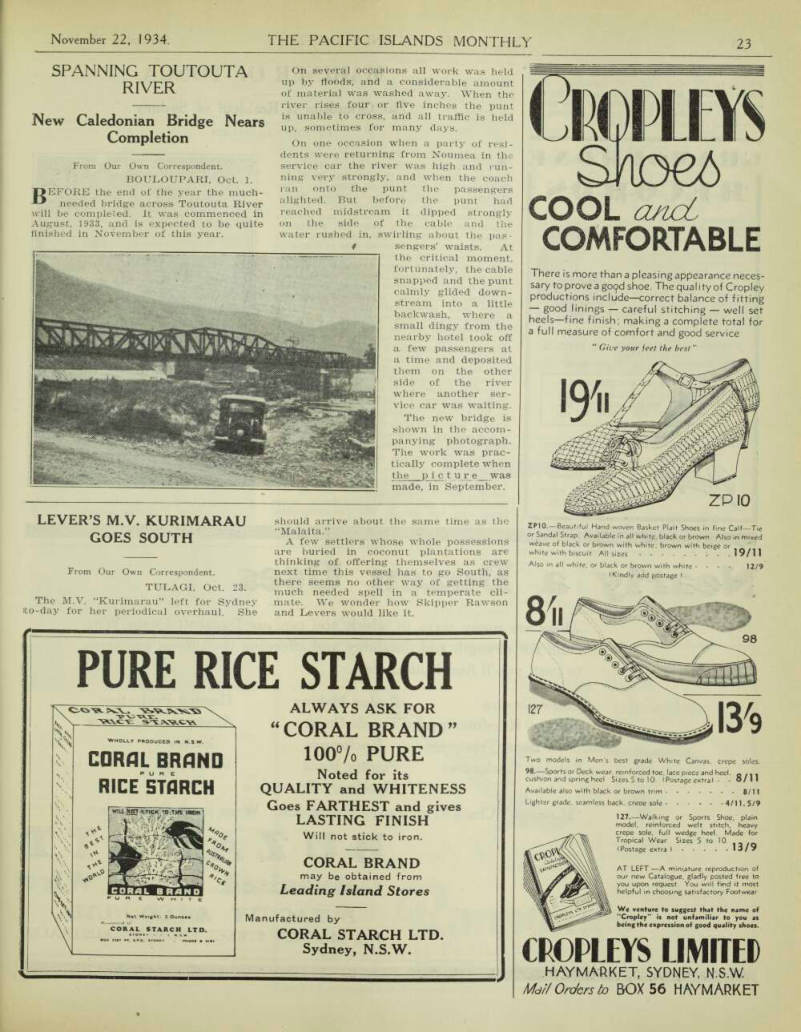
Spanning Toutouta
River
New Caledonian Bridge Nears Completion
From Our Own Correspondent.
Bouloupari, Oct. 1.
BEFORE the end of the year the muchneeded bridge across Toutouta River will be completed. It was commenced in August, 1933, and is expected to be quite finished in November of this year.
On several occasions all work was held up by floods, and a considerable amount of material was washed away. When the river rises four or five inches the punt is unable to cross, and all traffic is held up, sometimes for many days.
On one occasion when a party of resi dents were returning from Noumea in the service car the river was high and run ning very strongly, and when the coach ran onto the punt the passengers alighted. But before the punt had reached midstream it dipped strongly on the side of the cable and the water rushed in, swirling about the pas
sengers’ waists. At the critical moment, fortunately, the cable snapped and the punt calmly glided down stream into a little backwash, where a small dingy from the nearby hotel took off a few passengers at a time and deposited them on the other side of the river where another ser vice car was waiting.
The new bridge is shown in the accom panying photograph.
The work was prac tically complete when the picture was made, in September.
Lever’S M.V. Kurimarau
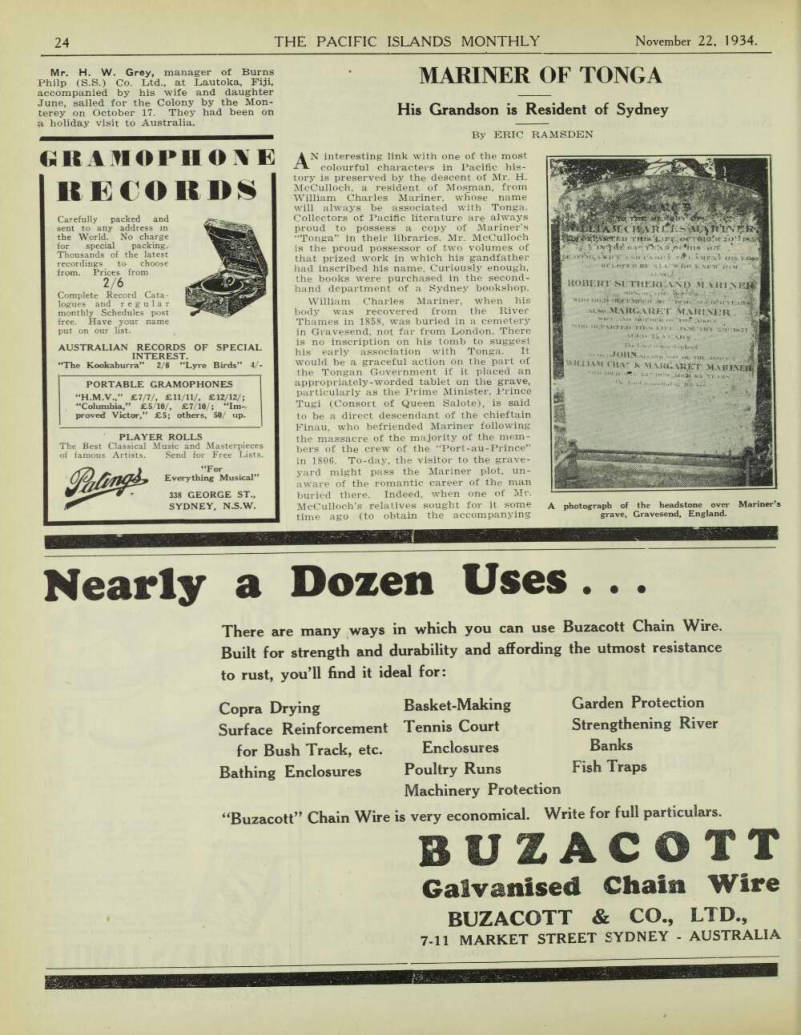
Goes South
From Our Own Correspondent.
Tulagi, Oct. 23.
The M.V. “Kurimarau” left for Sydney to-day for her periodical overhaul. She
should arrive about the same time as the “Malaita.”
A few settlers whose whole possessions are buried in coconut plantations are thinking of offering themselves as crew next time this vessel has to go South, as there seems no other way of getting the much needed spell in a temperate cli mate. We wonder how Skipper Rawson and Levers would like it.
Mr. H. W. Grey, manager of Burns Philp (S.S.) Co. Ltd., at Lautoka, Fiji, accompanied by his wife and daughter June, sailed for the Colony by the Mon terey on October 17. They had been on a holiday visit to Australia.
Advertisements & other items, pp. 25-26 (1 item)
Cropleys
Shoes
COOL and
COMFORTABLE
There is more than a pleasing appearance necessary to prove a good shoe. The quality of Cropley
productions include—correct balance of fitting
good linings careful stitching well set
heels—fine finish; making a complete total for a full measure of comfort and good service “Give your feet the best "
ZP 10 ZP10. —Beautiful Hand-woven Basket Plait Shoes in fine Calf—Tie or Sandal Strap Available in all white, black or brown Also in mixed weave of black or brown with white, brown with beige or white with biscuit All sizes ... 19/11 Also in all white, or black or brown with white . . . . 12/9 (Kindly add postage) Two models in Men's best grade White Canvas, crepe soles. 98.—Sports or Deck wear, reinforced toe, lace piece and heel. cushion and spring heel Sizes 5 to 10. (Postage extra) Available also with black or brown trim 8/11 Lighter grade, seamless back, creoe sole 4/11.5/9 127.—Walking or Sports Shoe, plain model, reinforced welt stitch, heavy crepe sole, full wedge heel. Made for Tropical Wear Sizes 5 to 10. (Postage extra) 13/9 AT LEFT —A miniature reproduction of our new Catalogue, gladly posted free to you upon request. You will find it most helpful in choosing satisfactory Footwear We venture to suggest that the name of “Cropley” is not unfamiliar to you as being the expression of good quality shoes.
CROPLEYS LIMITED
HAYMARKET, SYDNEY, N.S.W
Mail Orders to BOX 56 HAYMARKET
PURE RICE STARCH
ALWAYS ASK FOR
“CORAL BRAND”
100% PURE
Noted for its
QUALITY and WHITENESS
Goes FARTHEST and gives
LASTING FINISH
Will not stick to iron.
CORAL BRAND
may be obtained from Leading Island Stores Manufactured by
CORAL STARCH LTD.
Sydney, N.S.W.
GRAMOPHONE
RECORDS
Carefully packed and sent to any address in the World. No charge for special packing.
Thousands of the latest recordings to choose from. Prices from Complete Record Catalogues and regular monthly Schedules post free. Have your name put on our list.
AUSTRALIAN RECORDS OF SPECIAL
INTEREST.
“The Kookaburra” 2/6 “Lyre Birds” 47-
PORTABLE GRAMOPHONES
“H.M.V.,” £7/7/, £11/11/, £12/12/;
“Columbia,” £5/10/, £7/10/; “Improved Victor,” £5; others, 50/ up.
PLAYER ROLLS
The Best Classical Music and Masterpieces of famous Artists. Send for Free Lists. 2/6 “For Everything Musical"
338 GEORGE ST.,
SYDNEY. N.S.W.
Nearly a Dozen Uses ...
There are many ways in which you can use Buzacott Chain Wire.
Built for strength and durability and affording the utmost resistance to rust, you’ll find it ideal for: Copra Drying Surface Reinforcement for Bush Track, etc.
Bathing Enclosures Basket-Making Tennis Court Enclosures Poultry Runs Machinery Protection Garden Protection Strengthening River Banks Fish Traps “Buzacott” Chain Wire is very economical. Write for full particulars.
BUZACOXT
Galvanised Chain Wire
BUZACOTT & CO., LTD.,
7-11 MARKET STREET SYDNEY - AUSTRALIA
Mariner Of Tonga
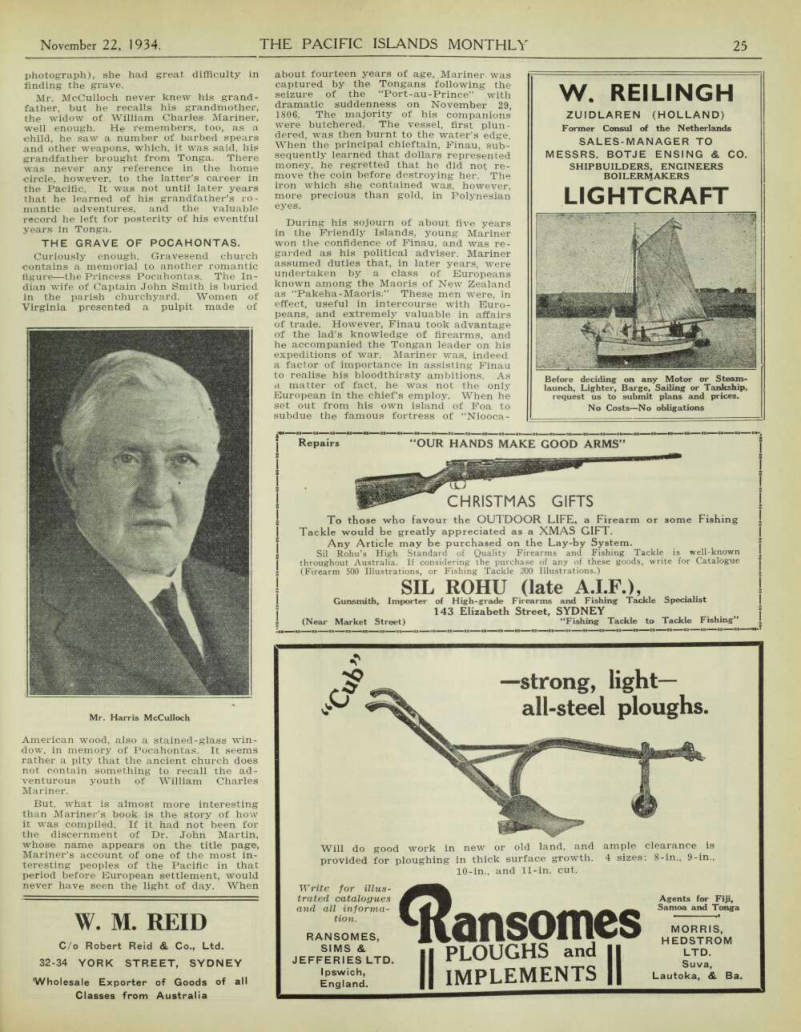
His Grandson is Resident of Sydney
By Eric Ramsden
AN interesting link with one of the most colourful characters in Pacific his tory is preserved by the descent of Mr. H.
McCulloch, a resident of Mosman, from William Charles Mariner, whose name will always be associated with Tonga.
Collectors of Pacific literature are always proud to possess a copy of Mariner’s “Tonga” in their libraries. Mr. McCulloch is the proud possessor of two volumes of that prized work in which his gandfather had inscribed his name. Curiously enough, the books were purchased in the second hand department of a Sydney bookshop.
William Charles Mariner, when his body was recovered from the River Thames in 1858, was buried in a cemetery in Gravesend, not far from London. There is no inscription on his tomb to suggest his early association with Tonga. It would be a graceful action on the part of the Tongan Government if it placed an appropriately-worded tablet on the grave, particularly as the Prime Minister, Prince Tugi (Consort of Queen Salote), is said to be a direct descendant of the chieftain Finau, who befriended Mariner following the massacre of the majority of the mem bers of the crew of the “Port-au-Prince” in 1806. To-day, the visitor to the grave yard might pass the Mariner plot, un aware of the romantic career of the man buried there. Indeed, when one of Mr.
McCulloch’s relatives sought for it some time ago (to obtain the accompanying
A photograph of the headstone over Mariner’s grave, Gravesend, England.
photograph), she had great difficulty in finding the grave.
Mr. McCulloch never knew his grand father, but he recalls his grandmother, the widow of William Charles Mariner, well enough. He remembers, too, as a child, he saw a number of barbed spears and other weapons, which, it was said, his grandfather brought from Tonga. There was never any reference in the home circle, however, to the latter’s career in the Pacific. It was not until later years that he learned of his grandfather’s ro mantic adventures, and the valuable record he left for posterity of his eventful years in Tonga.
The Grave Of Pocahontas.
Curiously enough, Gravesend church contains a memorial to another romantic figure—the Princess Pocahontas. The In dian wife of Captain John Smith is buried in the parish churchyard. Women of Virginia presented a pulpit made of
American wood, also a stained-glass win dow, in memory of Pocahontas. It seems rather a pity that the ancient church does not contain something to recall the ad venturous youth of William Charles Mariner.
But, what is almost more interesting than Mariner’s book is the story of how it was compiled. If it had not been for the discernment of Dr. John Martin, whose name appears on the title page, Mariner’s account of one of the most in teresting peoples of the Pacific in that period before European settlement, would never have seen the light of day. When
about fourteen years of age, Mariner was captured by the Tongans following the seizure of the “Port-au-Prince” with dramatic suddenness on November 29, 1806. The majority of his companions were butchered. The vessel, first plun dered, was then burnt to the water’s edge.
When the principal chieftain, Finau, sub sequently learned that dollars represented money, he regretted that he did not re move the coin before destroying her. The iron which she contained was, however, more precious than gold, in Polynesian eyes.
During his sojourn of about five years in the Friendly Islands, young Mariner won the confidence of Finau, and was re garded as his political adviser. Mariner assumed duties that, in later years, were undertaken by a class of Europeans known among the Maoris of New Zealand as “Pakeha-Maoris.” These men were, in effect, useful in intercourse with Euro peans, and extremely valuable in affairs of trade. However, Finau took advantage of the lad’s knowledge of firearms, and he accompanied the Tongan leader on his expeditions of war. Mariner was, indeed a factor of importance in assisting Finau to realise his bloodthirsty ambitions. As a matter of fact, he was not the only European in the chief’s employ. When he set out from his own island of Foa to subdue the famous fortress of “Niooca
Mr. Harris McCulloch
lofa” (as Mariner called the present capital of the Kingdom of Tonga), there were fifteen other Europeans with Finau: eight of them were armed with muskets.
Mariner has left us a pen-picture of the chieftain. Seated in an arm-chair (taken from the “Port-au-Prince”) he directed the fire of guns taken from the same vessel against the fortification —which, incidentally, had withstood attacks for eleven years. Eventually, with the as sistance of his expert allies, Finau re duced the fortress. Mariner has de scribed. too, how Finau’s men entered, clubs in hand, and slew every man, woman and child within. The English boy was later offered something which he believed to be pork. When he found that it was human flesh, he threw it in the face of the chief who had given it to him.
Iron Rather Than Gold
Like all Polynesians, Finau was ex tremely intelligent. He continually plied Mariner with questions concerning the great world beyond the seas. Money, though he had little of it, seemed to fas cinate him. What was it made of, he asked, and could it be fashioned from iron into various useful weapons? If money could be made, it was argued by Finau. then every man should spend his time making it ! On one occasion, after he had heard Mariner explain the con trol of currency, he exclaimed: “I under stand now very well what it is that makes the foreigners so selfish —it is this love of money!”
Mariner also revealed to his savage lord the pulsations of his pulse. Finau was
extremely interested. A few days after wards one of the chief’s servants annoyed him exceedingly by some unwarrantable act. The man expected to be killed.
Finau waxed wroth, cursed the slave in all the Tongan he knew, and then, to everyone’s surprise, calmed down. He had recalled what the English boy had told him of the association of the passions and his pulse. Applying his hand to his wrist he found the pulse beating vio lently. Turning to young Mariner, he said, “You are right!” Finau’s discovery put him into such a good temper that he let the poor slave, who sat trembling in the presence of his master, depart with a caution.
But though life in Tonga was interest ing enough, Mariner longed for his Eng lish home. An opportunity to escape came when an American whaler arrived off the island of Vavau. When the master told him, however, that he had more than sufficient hands, Mariner could hardly be lieve the evidence of his ears!
The arrival of the brig “Favourite" some time later from Port Jackson pro vided another chance. On this occasion the master was more sympathetic. By this time the original Finau was dead; the chief had been succeeded by his son.
Describing a visit paid by his young master to this vessel, Mariner declared: “He ate a very hearty dinner at the captain’s table, including a plentiful supply of roast pork.
The young king particularly admired the flavour of the sage and onions. For the first tune in his life he handled a fork and knife, with the greatest dexterity. Sometimes, indeed, his Majesty would forget himself a little and held the meat in his fingers, but, instantly recol lecting that he had done wrong, he put it down again, exclaiming: ‘Oh, I forgot myself!
Young Finau wanted to sleep in an English bed. “So that I can fancy myself in England!” he declared. The captain, who granted the request, obligingly gave up his own bunk to the Tongan. But, Finau’s own people were greatly alarmed when he did not return that night. As a matter of fact, the chieftain was most anxious to come to Sydney and proceeds to England, and it was only by subterfuge that Mariner was able to leave him.
Meanwhile, he had secured the log of the unlucky “Port-au-Prince,” and had en deavoured to persuade some of the other- Europeans to escape. Some, however, had been so long in Tonga, which rightly enough they considered an earthly para dise, that they declined to return. One of these men was William Singleton, an other survivor of the “Port-au-Prince.”
He was still living in Tonga with a native wife, when, years later, the Rev. Walter Lawry arrived from Sydney to establish, the Wesleyan Mission. (Continued overleaf)
“Port-Au-Prince” Survivor
Singleton is the subject of comment in several of Mr. Lawry’s letters preserved in the Hassall Correspondence in the Mitchell Library. In one, dated October 3, 1822, he mentioned Mariner’s account of Tonga. “I suppose the Tonga islands are some of the richest and prettiest in the world,” he commented in a letter to his brother-in-law, the Rev. Thomas Hassall, of Cobbitty. “Mr. Mariner’s ac count is far from a ‘Panegyriek’ that the half of Tonga’s Excellencies has not been told in his books. . . ” Singleton, he added, told him that in the wars prior to his arrival, “50,000 people fell in one week.” That rather sounds as if the ex sailor had been, to use a common phrase, pulling the missionary’s leg!
Mariner’s return to England quite natu rally excited considerable interest. A Dr.
Martin desired to test some of Mariner’s statements. So he arranged a meeting with another escapee, one Jeremiah Hig gins. “When they spoke the Tongan lan guage,” he declared, “I at once noticed the similarity of the pronunciation.” At the request of Martin, Mariner promised he would make some notes concerning his stay in Tonga, “in order that his memory might spontaneously furnish more.” He returned from a voyage to the West Indies with “a description of the more important religious ceremonies, and a vocabulary of between 4000 and 5000 words.”
Eventually, it was resolved that Dr.
Martin should undertake the composition and arrangement of the work he had in mind, while Mariner directed his atten tion “to the materials, noting down all that he had seen and heard such as had occurred to his mind.” Higgins was also called in to give the benefit of his mem ory. The result was one of the most fascinating records in the history of Pacific literature, a record, too,, that has since been of the utmost value to scien tists and other investigators. Mariner is still quoted. Only recently I came across references to his work in a critical study of Polynesian music by Johannes Ander sen, in the “Journal” of the Polynesian Society.
Mariner’s subsequent career in England does not appear to have been particularly interesting. His grandson says that he believed Mariner had an office in Throg morton Street, London, and was in busi ness as a stockbroker. The family lived for many years in Gravesend after his death.
The “Mataram” left Papua on Septem ber 28 for Cairns, Brisbane and Sydney.
The following cargo was taken from Port Moresby: 764 cases of desiccated coco nut, 1015 packages of rubber, 168 bags of coffee, and 200 bundles of sandalwood.
Advertisements & other items, pp. 27-29 (1 item)
all-steel ploughs.
W. REILINGH
ZUIDLAREN (HOLLAND)
Former Consul of the Netherlands
SALES-MANAGER TO
MESSRS. BOTJE ENSING & CO.
SHIPBUILDERS, ENGINEERS
BOILERMAKERS
LIGHTCRAFT
Before deciding on any Motor or Steamlaunch, Lighter, Barge, Sailing or Tankship, request us to submit plans and prices.
No Costs—No obligations
Repairs
OUR HANDS MAKE GOOD ARMS’
CHRISTMAS GIFTS
To those who favour the OUTDOOR LIFE, a Firearm or some Fishing Tackle would be greatly appreciated as a XMAS GIFT.
Any Article may be purchased on the Lay-by System.
Sil Rohu’s High Standard of Quality Firearms and Fishing Tackle is well-known throughout Australia. If considering the purchase of any of these goods, write for Catalogue (Firearm 500 Illustrations, or Fishing Tackle 200 Illustrations.)
SIL ROHU (late A.I.F.),
Gunsmith, Importer of High-grade Firearms and Fishing Tackle Specialist 143 Elizabeth Street, SYDNEY (Near Market Street) “Fishing Tackle to Tackle Fishing”
—strong, light-
all-steel ploughs.
Will do good work in new or old land, and ample clearance is provided for ploughing in thick surface growth. 4 sizes: 8-in., 9-in., 10-in., and 11-in. cut.
Write for illustrated catalogues and all information.
RANSOMES,
SIMS &
JEFFERIES LTD.
Ipswich, England.
PLOUGHS and
IMPLEMENTS
Agents for Fiji, Samoa and Tonga
MORRIS,
HEDSTROM
LTD.
Suva, Lautoka, & Ba.
W. M. REID
C/o Robert Reid & Co., Ltd.
32-34 YORK STREET, SYDNEY
Wholesale Exporter of Goods of all Classes from Australia
PASSIONA
Australia’s
Wonder
Passionfruit
Cordial
Passiona is made from pure seedless juice of Passionfruit, and has all its delicious rich flavour.
With iced water or soda water it is wonderfully refreshing and invigorating.
Unequalled as a flavoring lor high-class fruit salads, ice cream, fruitcups and cocktails.
Solely manufactured by
COTTEE’S
PASSIONA LTD.
Sydney.
Local agencies solicited where not already on sale
Money Transfers
Throughout the World
The Bank of New South Wales makes complete facilities available for the transaction of banking business throughout Australasia and between Australia and all other parts of the world.
The Bank establishes commercial credits by mail or by cable. It issues drafts and makes money transfers by letter or telegraph. It negotiates and collects Bills of Exchange and issues, for the convenience of travellers, Letters of Credit available all over the world.
Exchange quotations direct on all countries are issued daily and trained officers of the Bank are always available to advise customers on matters relating to overseas money transactions.
Bank of New South Wales
(ESTABLISHED 1817)
with which the Western Australian Bank and The Australian Bank of Commerce Ltd. are amalgamated. 67
ELIZABETH BAY
“TWENTY-ONE” ELIZABETH BAY
ROAD
Newly-furnished and decorated Modern Guest House. Hot water, Harbour Views.
Sun in all rooms. Single and double rooms.
Meals optional. Room and breakfast from 7/6 per day—3s/- per week. Full board from 2½ guineas to 3½ guineas per week.
Handy theatres, beaches and all main attractions. 10 minutes city.
For further particulars:
TELEPHONE SECRETARY, FL 2030,
21 ELIZABETH BAY ROAD,
ELIZABETH BAY, SYDNEY
’Phone FL 1266. ’Phone FL 1266.
HENLY’S
DRIVE YOURSELF
SERVICE
197 William Street :: Sydney Cars Hired without Drivers on a Mileage Basis as under;— OPEN CARS—By the Day. 3d. per Mile.
Minimum, 30 Miles Week Days. 60 Miles Sundays.
SEDANS —By the Day, 4d. per Mile.
Minimum, 30 Miles Week Days. 60 Miles Sundays.
Special quotations for holidays.
Payment, plus 2/6 per day or 7/6 per week for insurance. A deposit must be left on car, which is refunded when car is returned.
Our Fleet of Cars includes 1934 Plymouths, Hired at a Slight Increase.
N.G. Public Service
In Bulletin No. 31, issued by the New Guinea Administration at the end of September, the fol lowing particulars regarding Public Service altera tions were gazetted:
Permanent Staff
Appointments J. H. Hutchinson, Clerk, District Services Dept.
C. H. Mac Lean, Clerk, Dept, of Government Secretary.
J. W. Baker, Medical Assistant, Public Health Department.
H. O. Mocatta, Assistant, Keravat Plantation.
K. W. Bilston, Acting Patrol Officer.
T ransfers G. Greathead, A.P.0., Salamaua to Rabaul.
K. J. Hickey, A.P.0., Kavieng to Wewak.
J. K. McCarthy, Patrol Officer, Rabaul to Madang.
F. W. Mantle, A.D.O., Rabaul to Kokopo.
E. C. McDonald, A.D.O., Kavieng to Wewak.
W. Upton, Medical Assistant, Salamaua to Rabaul.
J. H. L. McGuigan, Medical Assistant, Rabaul to Salamaua.
J. W. Baker, Medical Assistant, Rabaul to Sala maua.
Temporary Appointments.
J. H. Dowsett, Clerk, Dept. Public Works.
J. A. Kerr, Typiste, District Services Dept.
N.G. Police Force N. B. N. Blood appointed Warrant Officer, 2nd class.
H. J. Stevenson appointed Warrant Officer, 2nd class.
H. W. Thompson appointed Warrant Officer, 2nd class.
Mr. T. D. Harris, general manager of Bulolo Gold Dredging Ltd., arrived in Sydney at the end of October on his way to America.
Advertisements & other items, pp. 29-30 (1 item)
Joe Gardiner Ltd
GILLESPIE’S
“ANCHOR”
FLOUR
TRADE
MARK
The Standard of Quality.
SATISFACTION GUARANTEED
16/6 P.M. 14 A Craftsman Built Quality Shoe Black Tan Polishing Calf Featuring the popular raised corded trim and good fitting wide tread . . . Full round toe... Seamless back lining All leather genuine welted soles, PM 15 Sensational Value !
Hand Plaited Basket Shoes in Sandal Bar or Oxford Tie Styles.
All White , Black and White Of Brown and Fawn Calf.. Ideal for hot weather... Genuine pump soles ...
Cov. sports heels... Full and half sizes 2 to 7
SHOES FOR TROPICAL CLIMATES
Write for our BIG CATALOGUE. Post Free
STOREKEEPERS. Ask for our Special Terms
JOE GARDINER Ltd
GEORGE ST SYDNEY. Box 2559 E. G.P.O.
A HOME FOR SCHOOLBOYS
“LEDDICOTT”
School House offers a solution of the problem of education by providing a home for boys attending school in Sydney.
Prospectus on application to
E. F. WHITFELD, B.A.,
McMahon’s Point :: :: Sydney
For All You Require In
Dependable Groceries
You CANNOT Do Better Than At
Moran & Cato’s
Australia’s Largest Grocery Organisation
The fact that Moran & Cato Ltd. has 180 branches throughout the Commonwealth of Australia is sufficient indication of their vast buying power, and is the reason why—when quality is taken into consideration—their
PRICES ARE UNBEATABLE.
SPECIAL OFFERS TO OVERSEAS RESIDENTS ARE:—
Trefavenne Sardines, tins 8d, 7/9 doz.
Norwegian Sild, 2 lb. tins 7½ d, 7/3 doz.
Morton’s Herrings in Sauce, 14oz. tins 9d, 8/9 doz.
“Congress” Chum Salmon, 1lb. tins B/3 doz.
“Parachute” Fancy Pink Salmon, 1lb. tins 9½d, 9/3 doz.
“Eveready” Red Salmon, 1lb. tins 1/3, 14/6 doz.
Fruit Salad, “Summerland,” 1lb. tins 7½d, 7/3 doz.
Strawberry Conserve, Q.P., 1lb. tins 9½d, 9/3 doz.
Sweet Corn, Gartsides, 10oz. tins 6½d, 6/3 doz.
Prunes in Syrup, “Summagold,” 1lb. tins 6d, 5/9 doz.
Dessert Prunes, 7lb, tins 3/6 per tin Eta Peanut Butter, 12oz. tins . 1/4½, 16/- doz.
Dripping, lib. pats 6d, 5/6 doz.
“Riverstone” Sheep Tongues, 12oz, tins 10½d, 10/3 doz.
Asparagus Soup Cuts (and for sandwiches) 30oz. tins 1/- ea.
Essences, Full Strength, “Summagold” 2oz. bots, 1/- ea.
Morton’s Assorted Fish Pastes, 6 kinds, 1 tins . . . 2/3 per doz.
“Rosella” Products, Arnott’s Biscuits, Holbrook’s Goods, and all other Australian and Imported Products at Lowest Possible Prices.
We Pack and Deliver Free to Boat Sydney, Cash against Documents.
WRITE FOR OUR COMPLETE GROCERY CATALOGUE.
Moran & Cato Ltd.
122-128 Cleveland Street Chippendale, Sydney, Australia.
Founders Near Gela
Solomons Cutter
From Our Own Correspondent.
Tulagi, Sept. 12.
Natives recently brought word that a Malaita cutter, with four natives on their way from Auki to Balesuna to procure a cutter at Balesuna, opened up between Malaita and Gela.
Two natives are reported to have been drowned. One native reached Gela after a day in the sea, and another after three days’ immersion, during which he lost practically all his skin. Three of the na tives were Malaitamen and the fourth, a Western native.
Further West
Leahy Bros. Out Beyond Mt. Hagen, N.G.
THOSE well-known New Guinea prospectors and explorers, Messrs. Mick and Dan Leahy, left the Ramu district recently on a “walkabout” for a few months. They have gone westward into the unknown region beyond Mount Hagen.
The brothers on previous occasions reached Mount Hagen and reported that to the westward of Mount Hagen there is apparently a continuation of the magnifi cent plateau country that lies eastward of Mount Hagen, in the Purari and Ramu valleys.
The country westward of Mount Hagen is quite unexplored, and it is not known that any white men have set foot there.
It is believed that ’it carries a very large population of natives of a superior type, and that the country generally is well cultivated.
The report of the Leahy brothers will be awaited with interest.
In Wild Goilala Country
New Papuan Police
Camp
From Our Own Correspondent.
Port Moresby, Oct. 14.
A NEW police camp is to be established this month in the Central Division in the heart of the turbulent Goilala country. In this area the fiery little in habitants still indulge in the diversions of murder and raiding among the neigh bouring mountain tribes, though they have long recognised the authority of the Government.
The new camp, which is to be in charge of Mr. R. H. Speedie, A.R.M., assisted by Patrol Officer Watkins, is a three days’ journey over difficult country from the present police camp at Kambesi. It lies between Mt. Chamberlain and Mt. Nelson, and is situated near the headwaters of the Alabule River, which runs eventually into the St. Joseph.
The Goilala Valley was first visited in 1918 by Messrs. Grist, Wilson, and Storey from loma, in the Northern Division, after a raid by the Goilala people into their division. The expedition penetrated far into the previously unvisited district and met with determined opposition. Mr.
Grist’s carriers deserted and the party was besieged for three months. The position was desperate until Mr. Ney land’s party arrived from Yule Island with police and carriers.
Advertisements & other items, p. 30 (1 item)
Castor Oil Seed
To Planters—I am a Buyer
of
IN ANY QUANTITY.
Send Sample for quote, stating quantity available.
Castor Seed Shellers, any capacity.
Advice and Instructions Regarding Planting, Harvesting, and Packing of Castor Oil Seeds given freely. Selected Seed for Planting available.
C. GRAHAME
4 DALLEY STREET SYDNEY.
Popular D.O. Leaves Gizo
Capt. A. Middenway
Farewelled
From a Special Correspondent.
GIZO, Sept. 20.
ON the evening of September 7 one of the largest gatherings of residents seen at Gizo, congregated at the house of Mr, Luttrell, manager of the local branch of Burns Philp and Co., to say farewell to Captain Arthur Midden way, District Officer, on the occasion of his retirement from the B.S.I. Public Service.
Capt. Middenway was presented with a handsome silver casket, suitably inscribed, as a memento of his long period of office as D.O., Gizo, a period which exceeded that of any of his predecessors. Eulo gistic references to his ability, public spirit and invariable courtesy as an ad ministrative officer, and the high esteem in which he was held by all sections of the community, were made by various speakers, among whom were Rev. J. F.
Goldie, Mr. D. Mackirinon, Mr. J. Sim, Capt. Musgrave, Mr. and Mrs. J. W. Bury, and Mr. Luttrell.
Following the speeches and presenta tion, dancing and singing provided en joyable entertainment until nearly dawn when the M.V. Malaita arrived from Rabaul. Capt. Middenway embarked for Sydney a few hours later, amid many evi dences of goodwill and friendship on the part of European and native residents of the district.
Capt. Middenway, who is a son of the late Mr. J. S. Middenway, of Vaucluse, N.S.W., was at one time in the service of the C S.R., Fiji, subsequently he entered the Fiji Civil Service in which he remain ed until the outbreak of war when he left for England. Enlisting in a cavalry regi ment, he was later transferred to the Monmouthshire Regiment with which he saw service in France. Afterwards he fought with troops in Mesopotamia at taining the rank of Captain.
On being demobilized, Capt. Midden way returned to his post in Fiji, and, in 1921, was appointed Government Secre tary of the British Solomon Islands Pro tectorate. Thereafter he was posted in various districts as administrative officer and magistrate, the last of these being Gizo from which he retired recently on attaining the age limit prescribed by the Colonial Office.
Mrs. Middenway preceded her husband to Australia some time ago, in order to establish their son Pat at Wesley Col lege, Melbourne, but it is now their inten tion to take up residence in Sydney.
Capt. Middenway’s successor as D.O., Gizo, is Mr. C. E. J. Wilson, who held a similar post in Guadalcanal district, Eas tern Solomons.
Early Papua
Top Hats And Cut
Lasses!
“Bentinck’s” Strange Cargo for Early Papua
From Our Own Correspondent.
Port Moresby, Sept. 13.
MR. HENRY DEXTER, of Milne Bay, a well-known pioneer storekeeper in the Eastern Division of Papua, leaves the Territory shortly, not to return. He will be sadly missed by his many friends in the east of the Territory.
Mr. Dexter first came to the Territory in June 1910, arriving in the “Bentinck,” owned by the British New Guinea De velopment Co. Ltd.
The “Bentinck” arrived in Papua load ed to the full with cargo—machinery, plants and stores. There were stores of every variety; among which the most in teresting items, perhaps, were leg-irons, handcuffs, top hats and an assortment of old cutlasses, amazing quantities of cho colates and delicate china in great variety. Large quantities of horse shoes made to fit horses such as never were on sea or earth were also landed.
Mr. Dexter’s description of his early days in the country in the employ of the B.N.G.D. Co., makes interesting and amusing narratives.
Advertisements & other items, p. 31 (1 item)
Monel Metal
Expert Engineers , Designers and Builders of All Classes Islands Boats and Pleasure Craft Good Fleet of Boats on Hand.
Estimates Given Freely.
Buyers/Sellers write:
Jack Capell,
Elite Boat Shed
RUSHCUTTER BAY,
SYDNEY
The Proven Specific for Tropic Skin Infections
ANTINEA Antiseptic LOTION
Why temporise with “home remedies” that can give no more than passing relief? Why experiment with palliatives or temporary measures when ANTINEA Antiseptic Lotion will fix the trouble quickly and surely! Antinea is the one definite treatment for Tropic Skin Infections such as Toe Rot, Dhobie Itch, Ringworm, etc. Doctors strongly recommend Antinea; it penetrates to the root of the trouble—-the infection beneath the skin. Antinea is a combination of powerful germicidal oils—many times stronger than carbolic; thus it destroys the germs completely. Should fresh infection be contracted later, apply Antinea at once; it will prevent the disease from developing past the initial stage.
Antinea Lotion is obtainable at all branches of Burns Philp and Co., Ltd., Morris, Hedstrom and Co., Ltd. (Suva), A. J.
Swann and Co., Ltd. (Suva), Brown and Joske (Suva), Michelmore and Co (Suva), W. R. Carpenter and Co., Ltd.
COMMONWEALTH & DOMINION AGENCIES LTD., 168 DAY ST., SYDNEY, N.S.W. 7-74
ANTINEA
Small Size, 2/6; Triple Quantity, 5/6
ANTISEPTIC
LOTION
Monel Metal
FOR PROPELLER SHAFTS
You’ve Heard of its STRENGTH ... Its PERFECT BALANCE ... Its RESISTANCE to CORROSION Have You Seen Pictures of World Famous Motor Boats Fitted with MONEL SHAFTS? If not we will gladly send you a set.
WRIGHT & COMPANY, 81 Clarence St., Sydney, MONEL METAL-is a Registered Trade Mark Cables: “CORNRIGHT,” SYDNEY
Crime In The Solomons
A resident of the B.S.I. writes; There has been much discussion lately, through your pages and otherwise, of the reason for the unusual number of assault cases in the Solomons. I can suggest one reason in the Medical Department of Tu lagi.
My daughter, aged 16 years, was visit ing friends in Tulagi, and developed a boil above the knee. She was accom panied by her host and hostess as far as the hospital and left there in the hands of a medical officer, for advice and atten tion. He took her into the dispensary, asked her to sit down, examined the boil, asked her to wait, and left her. Pre
sently a full-grown native male attend ant appeared alone, with basin and dress ings, and proceeded to attend to the wound.
My daughter was too astounded and frightened to protest; at the same time, she expected the M.O. to return at any minute. However, he did not appear, and after the dressing was finished, she left the dispensary to find that, to all appearances, she was entirely alone in the small building, though other Euro peans may have been in the vicinity.
With two nurses and a resident, as well as a travelling, doctor on the staff, it is surprising that natives should be al lowed to attend to European ladies in this manner.
Bulolo Gold
Frank Pryke, one of the best known of the “Big Six” (discoverers of the rich New Guinea mining field) finds his golden idleness heavy upon his hands. So—and we apologise for the shock we are giving to all old-timers—he has taken to writing poetry. The shameful fact might have been hid den; only, unfortunately, it is good poetry, and some of it must be published. He has kindly per mitted us to make selections from his work, and the following poem is the first of them. Others will be published in later issues—“ Old Samarai,”
“Matt Crowe,” “Little George,” and “Old Jew.”
The titles alone will have a definite meaning for old hands in Papua and New Guinea.
IN town a quiet whisper once more is running round: Away in far New Guinea, good gold is being found.
We’ve heard this whisper often in the days that have gone by, And we’ve sailed on leaky luggers for dis tant Samarai.
We climbed the broken ranges, and swam the flooded streams; Our days were filled with dangers, our nights with fevered dreams.
But again the whisper stirs us, as it did in days of old, And waiting only frets us —for Sharkeye’s on good gold!
Perhaps you will remember the days of which I speak; The days of German Harry and Nicholas the Greek; When B.P.’s islands schooners went sail ing to and fro.
When Inman sailed the Myrtle, and Steele the Ivanhoe.
Men came from far Coolgardie, and Mur chison and Cue — Old-timers tough and hardy, who’d heard the rumour, too.
And now in quiet Cooktown Street the story is retold, That up on the Bulolo old Sharkeye’s getting gold.
We’ve seen them inland marching, a gal lant band: and then We’ve seen them drifting back again, dis heartened, broken men.
Malaria took its toll of them, the natives killed a few — Some lie in rotten jungle swamp; the toughest battled through.
And disappointed, limping, their bodies wracked with pain, They drag their weary limbs along and straggle back again.
We dare not let this chance go—though getting grey and old, We swing our swags aboard the ship—Old Sharkeye’s getting gold!
We’ve packed the battered swag once more, the bag’s filled to the brim; Again we’ll seek that far-off shore, let it be sink or swim; Though disillusion greeted us on many a previous trip, This is the final, lucky chance —we dare not let it slip.
We’ll leave a crowded ship again, and on that lonely shore, We’ll load the carriers up with goods, at Burleigh Gorman’s store.
We’ll chase the yellow gleam again, as oft in days of old — Our sight is growing dimmer, but —Old Sharkeye’s on good gold!
Frank Pryke.
Advertisements & other items, p. 32 (1 item)
Barker College
HORNSBY
(Established 1890) Chairman of Council . . . Mr. Justice Boyce
DAY AND BOARDING SCHOOL FOR BOYS
Healthy dry atmosphere: 620 ft. above sea level; 15 miles from G.P.O., Sydney. Own cows, poultry and vegetables. War Memorial Oval: 20 acres of ground. Hygienic filtered swimming pool. Classrooms centrally heated in winter. All subjects (Classical and Modern) to Leaving Certificate Standard; also Wool Classing. Illustrated Prospectus on application to W. S. LESLIE, M.A. :: :: Headmaster.
CAPSTAN
NAVY CUT TOBACCO
CAPSTAN
CIGARETTES
CORK-TIPPED
P LA I N
Should Fiji Governor Be Also The
H. C. For W.P.?
Some Bitter Comments from the Solomons
Letter to the Editor.
This article comes as a letter to the editor, from a B.S.I. planter, under date October 20; but it is accompanied by betters from two other Solomon Islands residents, stating that they subscribe to every word in it.
Seldom does refutation of an expressed opinion come so speedily and emphati cally as was instanced in the August number of the “Pacific Islands Monthly.’’
In the course of the editorial headed “Pacific Administrators,” eulogistic ref erence is made to the administrative ability displayed by Sir Murchison Fletcher, in his capacity of High Com missioner for the Western Pacific, which concludes with the remark that “History should have something very flattering to say of this particular High. Commis sioner.”
Commencing on page 17 of the same issue, under the caption “Chorus from the Solomons,” there is set out an abstract of 11 letters received from resi dents containing adverse criticism of the administration, all of them “biting in character.” Clearly, whatever bouquets “history” may bestow, they will not be subscribed to by contemporary opinion in the Solomons.
If the High Commissioner is to receive credit for acts that may seem wise and statesmanlike, he must also accept re sponsibility for those that are otherwise, when they apply to territory nominally under his aegis and authority.
Sir Murchison Fletcher is doubtless a widely experienced and competent Administrator, but it is glaringly and in creasingly manifest that neither he nor anyone else, however capable, can combine the dual offices of Governor of the Colony of Fiji, and High Commis sioner for the "Western Pacific with satis faction and credit to himself, and justice to the inhabitants of such widely-scat tered and diverse territories as those which are embraced by the Western Pacific Commission.
The gubernatorial office is an important and responsible position, demanding the full time and close attention of the Governor, and the consequence is that the affairs of the Western Pacific Colonies and Protectorates, represented to the High Commissioner by various Resident Commissioners, are relegated to subord inate officials quartered at Suva who are lacking in sympathy, knowledge and understanding of the manifold problems that affect those territories and their in habitants. but on which they adjudicate, and on whose recommendations the High Commissioner—himself lacking in ex perience of the islands, and without time or opportunity for personal contact —has, perforce, to act.
The sooner the shackles which fetter island administrations to a bureaucracy at, Suva are severed the better for all concerned. If there must be a High Com missioner for the Western Pacific let the appointment be for that comprehensive
office alone, so that the Administrator may exercise real and not nominal con trol of the territories under his jurisdic tion, with time and freedom to become acquainted with his responsibilities at first hand.
Whatever may be the conditions existing in sister groups of the Western Pacific Commission, it is strikingly evident from the correspondence and articles which appear in your columns that deep discontent rages in the Solomons Protectorate, and that such should be the case in: a country possessing so relatively small a population, and with an administration not only free from debt, but having £60,000 or £70,000 of surplus funds at its disposal, can only indicate that discreditable failure must be attributed to a stupid and utterly unsuitable system of government.
The causes giving rise to dissatisfaction need not be recapitulated here. Your numerous correspondents have touched upon most of them over a long period, with varying degrees of heart-felt invective.
The policy of encouraging and pandering to Asiatic traders is uppermost in the minds of many at the moment, and with
reason. That policy was dictated, it is claimed, to assure better service to the natives than was given by Europeans; a fallacious idea founded on inexcusable ignorance of trading conditions in the Solomons, and failure to realise the moral and psychological effect upon natives of the contacts thrust upon them with the weight and authority of government, Charges of exploitation of the natives by white traders—once a favorite slogan— were unwarranted and unsubstantiated, But Asiatic traders have developed a subtle technique in that direction and the Administration may wake up one day to find the fact an inconvenient embarrass ment.
But why this deliberate attempt to oust British traders who pioneered the group, and helped to make it fit for Govern ment officials to live and thrive in? How much of the handsome surplus referred to was contributed by aliens? Very little, indeed! It is high time that the idiotic,
traditional policy favored by British Administrators, of truckling to the inter ests of every race under the sun—but their own—came to an end. Or, if they would be consistent, why not staff tha civil service with Orientals? They would probably be cheaper, and perhaps more competent. Kipling’s caustic portrayal of what happens “when the troopship’s on. the tide” might well be borne in mind by those in authority. Saviours of the Empire will not be found among the pam pered friends of the moment.
And what of native administration?
Has success in that direction been such as to compensate for the discontent existing among Europeans? Definitely and irre futably, no! If there is one phase of administration more than another of which the Colonial Office, or whoever is responsible, has reason to be ashamed, it is the administration of native affairs in the Solomons. But that does not emerge in public references, for the natives are inarticulate, especially when “Govern ment” are the oppressors.
The natives, also, are feeling the pinch these days, with their principal product (copra) bringing them (when they are able to sell it) a small fraction of the price they received a few years ago. Yet to many of them no mercy is shown; they have been informed that if their tax is not paid they must go to gaol. That will not bring grist to the Government crushing mill. The labour they can perform while in gaol is un productive, and they will have to be fed at public expense.
In relatively prosperous times the natives can quite well meet the annual levy imposed upon them by the Govern ment; but, under present conditions, many cannot do so without undue hardship and suffering. The pound of flesh, however, is to be exacted, even if it means dis rupting family and communal life, the neglect of gardens —practically the only source of their food supply —and the in culcation of a deep and abiding hatred of everything pertaining to “Govern ment.”
Of those who have gained their confi dence —not lightly given—the question is often asked: “Why do we have to pay tax? What do we get for it?” And echo answers, What! Their most pressing need is medical service, a primary con sideration with every enlightened admin istration in the world. In the Solomons there is at present one qualified medical officer (permanently stationed at Govern ment headquarters) and two “native medical practitioners” to serve a popula tion estimated to number close on 100,000!
These are facts that may be easily veri fied. Will it be contended that an effec tive service is rendered by the medical establishment when it is remembered that the Protectorate is made up of islands scattered over an area of approxi mately 14,000 square miles?
The Administration, which expends between £50,000 and £60,000 a year on its civil service, has neither an educational system nor policy. In short, nothing whatever is done by the Government for natives of the Protectorate from whom it extorts many thousands of pounds per annum in direct taxation.
For these and other reasons that space does not permit of here, the Solomons Pro tectorate will definitely and emphatically decline to subscribe to any testimonial extolling the virtues of the British Colonial Administration in the Western Pacific. Europeans, discouraged and dis gusted, have shed the last pretence of loyalty to it; and the natives, from sheer neglect—except by the tax-collector —are moribund. That is an achievement and state of affairs for which the system of administration deserves nothing but unmitigated discredit.
Mr. Fraser Light, who was for some time a resident of New Caledonia and who went abroad a year ago, returned to Sydney recently. He has sold his interests in New Caledonia and probably will settle down in Sydney.
Advertisements & other items, pp. 33-36 (1 item)
Brand
DRIVE YOURSELF
during your stay
in Sydney
in a 1934 Model Sedan at 6d per mile. Minimum from 15/ per day.
Write or cable, and we will reserve a car for you. Free Service all over N.S.W., with advantages enjoyed by N.R.M.A. members.
Martin’s Drive Yourself
Service
191 WILLIAM ST., SYDNEY
F 1092.
BITUMENOID ROOFING
MADE IN AUSTRALIA
Bitumenoid Roofings, Dampcourses and Insulating Felts are made from the world’s best raw materials. Warranted to stand the most rigid tests.
BITUMENOID THE BEST
Roofing, 1, 2 3-ply; Flooring, Waterproof Materials; Saturated Felt; Resilient Road Jointing- Natural Asphalt Dampcourse; 2 and 3-ply Dampcourse; 1-2lb. lead-core Dampcourse; Roofing Cement; Asphalt Paints; Roofing Compound.
SAMPLES AND PRICE LISTS ON APPLICATION.
MAXWELL PORTER & SON LTD.
ESTABLISHED 1888.
107 REDFERN ST., REDFERN, SYDNEY, N.S.W.
BUILDERS’ SUPPLIES
’Phone M 3157 Cables: Bitumenoid
SUN
DOCKERS
BRAND
PAINT
Made expressly to keep a lustrous, full gloss finish
against the varying con-
ditions of moist weather exposure, and prevent the decaying ravages of rain and extreme heat by
giving a long lasting pro-
tection to all surfaces.
SUN PROOF
RAIN PROOF
"Stronger than the Weather ”
W. R. CARPENTER
& CO. LTD.
New Guinea, Solomon Islands, and all other South Sea Islands.
PRODUCING UNIFORM GOOD RESULTS SINCE 1868
ALWAYS ASK FOR IT
B.A.P.
Super Heavy Duty
BATTERIES
Are Guaranteed tor 18 Months Built by experts by the latest known scientific methods from the highest grade materials.
Port. Oxford Cedar Separates, Dunlop Hard Rubber Cases.
The B.A.P. Battery is manufactured for long life and dependability by the British Australasian Petroleum Company, Limited
169 LIVERPOOL STREET. SYDNEY.
M. HARPER
MANDOLIANA ISLAND,
NORTH GELA, B.S.I.
Postal Address: P.O. Box 6, Tulagi, Solomon Islands.
Recruiting Contracts Undertaken.
Auxiliary Vessels “Papan” and Trader available for Charter.
Full details of Services from
BURNS PHILP (S.S.) CO., LTD.,
Makambo (B.S.I.) and Sydney.
Across the seas .. or across the street
is just the same
A FEW 1935 FEATURES
Two speed Mica Aero dial. 100 per cent. Automatic volume control .
Floating tuner, prevents vibration.
Super class “B" Audio.
Seven 2-volt Valves. 100 amp. A Battery.
Economy, Astounding.
Fractional microvolt sensitivity.
Higher Fidelity.
New tone control.
New design-ech-absorbing-cabinet New type dynamic speaker.
Positively Climatic Proofed.
GUARANTEES FOREIGN
STATIONS
FULL, CLEAR AND RICH
Price,
£38-10-0 with
Complete
KRIESLER
BATTERY "ALLWAVE"
The BEST Set at ANY Price!
Dealers, send for technical data and particulars re franchise KRIESLER (Aust.) Ltd., Myrtle, Pine and Beaumont Sts., Chippendale, Sydney, n.s.w.
Indian
Pith
Helmets
The CALCUTTA, covered with white Drill 22/6 The CEYLON, covered with Khaki Drill 25/- The BENGAL, covered with Grey Alpaca 27/6 Send size with order to
Pike Brothers Ltd.
In Queen Street :: BRISBANE.
EXCELSIOR SUPPLY CO. LTD.
The meet extensive Manufacturers In the British Empire of
RUBBER STAMPS,
INKS, STENCILS.
Marking Devices.
ACME STAMP PADS
We have a big range of Special
FRUIT CASE MARKING SET
Wa also Manufacture or Supply a complete line of
Spraying Machines
for all purposes.
Let us know your requirements aad we will quote you by return. Ask for our Big Catalogue.
Sole Australasian Distributors of the World Famous SHEAFFER FOUNTAIN
PENS and PENCILS.
EXCELSIOR SUPPLY CO. LTD.
Head Office:— 160 GEORGE STREET WEST,
SYDNEY. N.S.W.
A Polynesian
Fete
Tuamotuans Prepare for Huge Festival
From Our Own Correspondent.
Papeete, Oct. 2.
THE natives of the Tuamotu Archi pelago (sometimes known as the Low or Dangerous Archipelago) are organising a huge “Arearea” (fete) on the principal Island of Pakarava, which is scheduled to last from November 10 to November 17. Already many families in Tahiti and adjacent islands are making preparations for the journey they will have to under take in order to participate in the festi vities.
Visitors are also expected from the Cook Group, from Pitcairn Island, and also from New Zealand, Australia, Hawaii and California. Prom all over the Tua motu’s —which cover an area of 700 miles by 500 miles —the natives will assemble in the great lagoon of Pakarava by means of sailing cutters, while those travelling from Papeete will be catered for by local trading schooners and by the new 400 ton motor vessel, recently acquired by the Messagerie Maritimes Co. for the inter-island services.
Community dancing (oeta) in ancient costumes, singing in the manner peculiar to the Tuamotu’s, and competitions for the most elaborate orations in the native tongue, will all be features of great in terest.
But it is more particularly in aquatic sports that the Tuamotu athletes excel, and it is quite probable that wonderful per formances will be given in swimming and diving. Ordinarily divers for mother-of pearl shell can reach a depth of 37 metres, naked diving, and some among them can dive to 42 metres or more without diffi culty. In the pursuit of the sea turtle the Tuamotu native has also acquired a dex terity and adaptability to the water which is little short of marvellous.
An event which is entirely unique, and which is sure to evoke a great amount of enthusiasm, is that of the Patia fa (throw ing the Tuamotuan spear). The target for this sport is a coconut placed at 12 metres above the ground and some 25 metres from the spearman, and the winner is the one whose spear is planted on the highest part of the target. This sport demands incredible strength and skill.
Not the least of the attractions will be races between the sailing cutters—between 20 and 30 —which will have gathered in the lagoon for the “big week,” decorated with the traditional insignia of its particular island. As the lagoon of Pakarava contains some 320 square miles of water, there is ample room for some exciting sport.
His Excellency Monsieur Montagne, Governor of French Oceania, will person ally preside at these entertainments, there by demonstrating the interest taken by the Administration in the development of the native physique, and in the perpetuation of healthy and interesting Polynesian pas times.
In anticipation of a certain large influx of visitors the natives of Pakarava are now constructing a temporary village of coconut leaf huts for their accommodation.
New Power Station On N.G. Goldfields
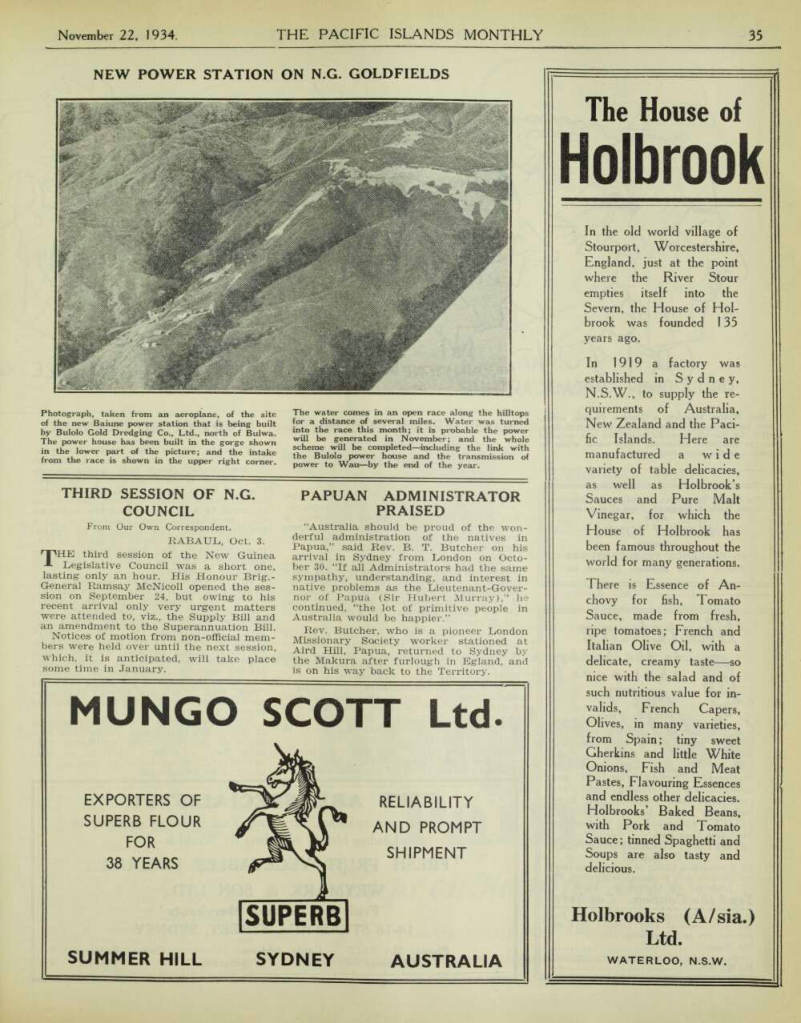
Photograph, taken from an aeroplane, of the site of the new Baiune power station that is being built by Bulolo Gold Dredging Co., Ltd., north of Bulwa.
The power house has been built in the gorge shown in the lower part of the picture; and the intake from the race is shown in the upper right corner.
The water comes in an open race along the hilltops for a distance of several miles. Water was turned into the race this month; it is probable the power will be generated in November; and the whole scheme will be completed—including the link with the Bulolo power house and the transmission of power to Wau —by the end of the year.
Third Session Of N.G.
Council
From Our Own Correspondent.
Rabaul, Oct. 3.
THE third session of the New Guinea Legislative Council was a short one, lasting only an hour. His Honour Brig.- General Ramsay McNicoll opened the ses sion on September 24, but owing to his recent arrival only very urgent matters were attended to, viz., the Supply Bill and an amendment to the Superannuation Bill.
Notices of motion from non-official mem bers were held over until the next session, which, it is anticipated, will take place some time in January.
Papuan Administrator
Praised
“Australia should be proud of the won derful administration of the natives in Papua,” said Rev. B. T. Butcher on his arrival in Sydney from London on Octo ber 30. “If all Administrators had the same sympathy, understanding, and interest in native problems as the Lieutenant-Gover nor of Papua (Sir Hubert Murray),” he continued, “the lot of primitive people in Australia would be happier.”
Rev. Butcher, who is a pioneer London Missionary Society worker stationed at Aird Hill, Papua, returned to Sydney by the Makura after furlough in Egland, and is on his way back to the Territory.
Advertisements & other items, pp. 37-38 (1 item)
advt
The House of
Holbrook
In the old world village of Stourport, Worcestershire, England, just at the point where the River Stour empties itself into the Severn, the House of Holbrook was founded 133 years ago.
In 1919 a factory was established in Sydney, N.S.W., to supply the requirements of Australia, New Zealand and the Pacific Islands. Here are manufactured a wide variety of table delicacies, as well as Holbrook’s Sauces and Pure Malt Vinegar, for which the House of Holbrook has been famous throughout the world for many generations.
There is Essence of Anchovy for fish. Tomato Sauce, made from fresh, ripe tomatoes; French and Italian Olive Oil, with a delicate, creamy taste —so nice with the salad and of such nutritious value for invalids, French Capers, Olives, in many varieties, from Spain; tiny sweet Gherkins and little White Onions, Fish and Meat Pastes, Flavouring Essences and endless other delicacies.
Holbrooks’ Baked Beans, with Pork and Tomato Sauce; tinned Spaghetti and Soups are also tasty and delicious.
Holbrooks (A/sia.)
Ltd.
WATERLOO, N.S.W.
advt
For Tents, Tarpaulins, Horse Rugs, Birkmyre Coats, Sails & Riggings, Rope all sizes stocked write
ALBERT JONES
MAKER.
173 CLARENCE STREET, SYDNEY
Pacific Island Business Catered for
Sketching
is the hobby that pays!
Would you like to sell sketches to Editors, Publishers and Advertisers? Provided you have the aptitude for sketching, whatever your age, and whether you have had little or no previous training, STOTT’S can teach you to produce Sketches that sell.
STOTT’S CORRESPONDENCE
100 Russell St., Melb.; 70 Pitt St., Sydney; 290 Adelaide St., Brisbane; 49 Flinders St., Adelaide; 359 Murray St., Perth.
Send the Coupon. Cut here.
Without obligation, please send me free full particulars of your Courses in Commercial Art and Sketching, etc.
My Name Address
P.I.M., 334
COLLEGE
Soap From Coconuts
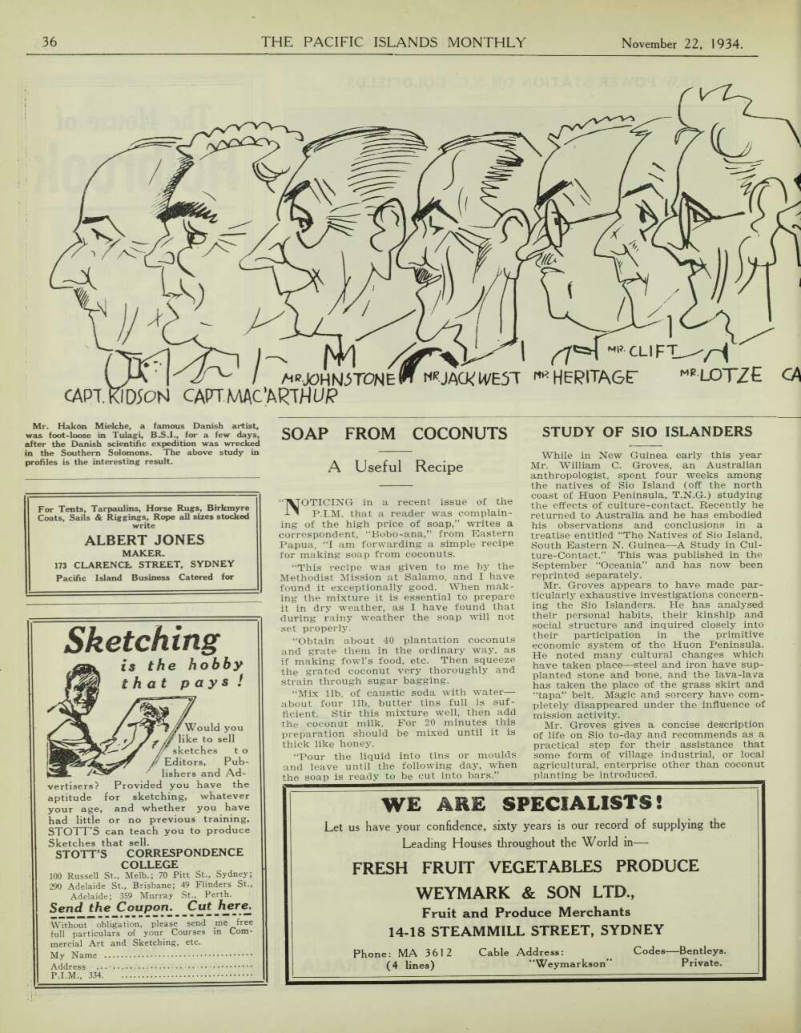
A Useful Recipe
NOTICING in a recent issue of the P.I.M. that a reader was complain ing of the high price of soap,” writes a correspondent, “Bobo-ana,” from Eastern Papua, “I am forwarding a simple recipe for making soap from coconuts.
“This recipe was given to me by the Methodist Mission at Salamo, and I have found it exceptionally good. When mak ing the mixture it is essential to prepare it in dry weather, as I have found that during rainy weather the soap will not set properly.
“Obtain about 40 plantation coconuts and grate them in the ordinary way, as if making fowl’s food, etc. Then squeeze the grated coconut very thoroughly and strain through sugar bagging.
“Mix 1lb. of caustic soda with water — about four 1lb. butter tins full is sufficient. Stir this mixture well, then add the coconut milk. For 20 minutes this preparation should be mixed until it is thick like honey.
“Pour the liquid into tins or moulds and leave until the following day, when the soap is ready to be cut into bars.”
Mr. Hakon Mielche, a famous Danish artist, was foot-loose in Tulagi, for a few days, after the Danish scientific expedition was wrecked in the Southern Solomons. The above study in profiles is the interesting result.
Study Of Sio Islanders
While in New Guinea early this year Mr. William C. Groves, an Australian anthropologist, spent four weeks among the natives of Sio Island (off the north coast of Huon Peninsula, T.N.G.) studying the effects of culture-contact. Recently he returned to Australia and he has embodied his observations and conclusions in a treatise entitled “The Natives of Sio Island, South Eastern N. Guinea —A Study in Cul ture-Contact.” This was published in the September “Oceania” and has now been reprinted separately.
Mr. Groves appears to have made par ticularly exhaustive investigations concern ing the Sio Islanders. He has analysed their personal habits, their kinship and social structure and inquired closely into their participation in the primitive economic system of the Huon Peninsula.
He noted many cultural changes which have taken place—steel and iron have sup planted stone and bone, and the lava-lava has taken the place of the grass skirt and “tapa” belt. Magic and sorcery have com pletely disappeared under the influence of mission activity.
Mr. Groves gives a concise description of life on Sio to-day and recommends as a practical step for their assistance that some form of village industrial, or local agricultural, enterprise other than coconut planting be introduced.
Advertisements & other items, p. 38 (1 item)
We Are Specialists!
Let us have your confidence, sixty years is our record of supplying the Leading Houses throughout the World in—
FRESH FRUIT VEGETABLES PRODUCE
WEYMARK & SON LTD.,
Fruit and Produce Merchants
14-18 STEAMMILL STREET, SYDNEY
Phone: MA 3612 Cable Address: Codes Bentleys. (4 lines) “Weymarkson” Private.
Limping Across
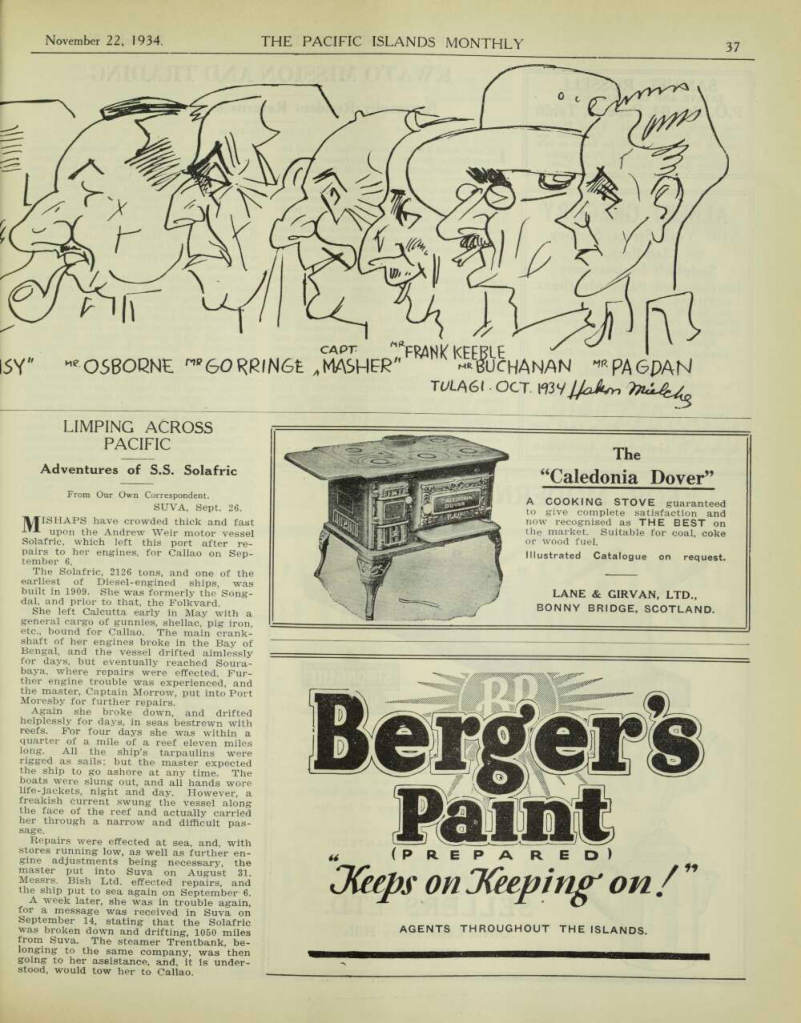
Pacific
Adventures of S.S. Solafric
From Our Own Correspondent.
SUVA, Sept. 26.
MISHAPS have crowded thick and fast upon the Andrew Weir motor vessel Solafric, which left this port after re pairs to her engines, for Callao on Sep tember 6.
The Solafric, 2126 tons, and one of the earliest of Diesel-engined ships, was built in 1909. She was formerly the Song dal, and prior to that, the Folkvard.
She left Calcutta early in May with a general cargo of gunnies, shellac, pig iron, etc., bound for Callao. The main crank shaft of her engines broke in the Bay of Bengal, and the vessel drifted aimlessly for days, but eventually reached Soura baya, where repairs were effected. Fur ther engine trouble was experienced, and the master, Captain Morrow, put into Port Moresby for further repairs.
Again she broke down, and drifted helplessly for days, in seas bestrewn with reefs. For four days she was within a quarter of a mile of a reef eleven miles long. All the ship’s tarpaulins were rigged as sails; but the master expected the ship to go ashore at any time. The boats were slung out, and all hands wore life-jackets, night and day. However, a freakish current swung the vessel along the face of the reef and actually carried her through a narrow and difficult pas sage.
Repairs were effected at sea, and, with stores running low, as well as further en gine adjustments being necessary, the master put into Suva on August 31.
Messrs. Bish Ltd. effected repairs, and the ship put to sea again on September 6.
A week later, she was in trouble again, for a message was received in Suva on September 14, stating that the Solafric was broken down and drifting, 1050 miles from Suva. The steamer Trentbank, be longing to the same company, was then going to her assistance, and, it is under stood, would tow her to Callao.
Advertisements & other items, pp. 39-40 (1 item)
“Caledonia Dover”
The
A COOKING STOVE guaranteed to give complete satisfaction and now recognised as THE BEST on the market. Suitable for coal, coke or wood fuel.
Illustrated Catalogue on request.
LANE & GIRVAN, LTD.,
BONNY BRIDGE, SCOTLAND.
(PREPARED)
"Keeps on Keeping on!"
AGENTS THROUGHOUT THE ISLANDS.
SAMUEL RUSSELL
ESTATE AND GENERAL AGENT.
P.O. Box 64, Papeete, Tahiti
Real Estate. Investments, Estate Management and Administration. Valuations and Reports. Houses and Lands for Lease or Sale.
Sole Proprietor: TAHITI PERFUMES Cables: Russell, Tahiti (Bentley’s Code)
ALBERT GREGORY
107 York Street, Sydney.
Saddlery,
Saddler’s Ironmongery
Leather and Paint Merchant.
LEATHERS— Art Work, Sole, Harness, Roans, Suedes, Bag, Kangaroo, Bridles, Belts, Spurs, Stirrups, Breastplates. SADDLES Race, Exercising, Park and Stock.
Leather Belting and Pump Cups.
Paint Merchant.
For House and Roofs, ready mixed 13/6 gallon Special Value House Paint 10/6 gallon Brushes, Kalsomine, White Lead and Oil.
Samples of Leathers on Application.
“FOR MODERN KITCHENS!”
Bright - Strong - Hygienic
Made from Purest Aluminium and Sturdily Constructed to give Years of Service.
EVERY ARTICLE GUARANTEED!
Write for Catalogue, to
SELLERS LTD.
Olivia Lane, Surry Hills
SYDNEY
Kwato Mission And Trading
Normanby Resident Returns to the Attack
Letter to the Editor
IT was with great interest that I read the letter by Mr. E. W. Harrison in your issue of May on the subject of Traders and Missions.
His criticism of Kwato was quite justi fied. I was within a mile of them when they were trading shovels, dishes and picks to the local natives in return for gold; and, further, I had made no less than four complaints to the magistrate at Samarai about illicit trading in gold by Kwato em ployees.
Further, previous to coming to Nor manby Island, I was at Bubuletta, in Milne Bay. when a Kwato native employee ar rived with scales and bought gold from the locals.
Mr. Harrison is to be commended for the manner in which he has expressed the views of the population in the Eastern end of the Territory, although, as he states, none have so far had the courage to take action.
Nothing has been published, so far, but the opinion of the general public is that some years ago Kwato broke away from the L.M.S. and formed themselves into a company under the name of Kwato Exten sion Incorporated which, as the latter word implies, was done in America.
For some unknown reason, although this
Company was clearly a trading concern, our benevolent government still continued to pay them a large subsidy every year, and also still granted them immunity from the Native Labor Ordinances and Regulations.
This grant is, we understand, given osten sibly for the purpose of conducting a technical school for natives at Kwato. The amount of the grant is a secret. Enquiries from officials at this end elicit the same reply: they don’t know how much or under what heading the grant is classified in the estimates.
This is a matter for the Federal Parlia ment to take up and ask this Administra tion why this registered Company is given a large grant every year and allowed all the privileges of a Mission Society, when it is well known that it is a trading con cern, and with the help of this grant and privileges is allowed to compete against Europeans who are struggling for a bare living these times. With the generous help of the government, and the privileges ac corded them, this Company can underquote any tradesman or traders in the Territory, and when it comes to scratching for a few weights for a bare living, the poor old fos sicker has no earthly chance against them.
That this advantage has been recognised by the manager of Kwato is shown by the very versatile business he is conducting.
It covers storekeeping, trading, carpenter ing, plumbing, boat builders, shipwrights, shop proprietors, tailors, printers, wharf lumping, and working and buying alluvial gold.
The ordinary man, to secure labor, has to give an order to a licensed recruiter, or else obtain a boat and do it himself. If the latter, he must obtain a boat complying with the regulations. He must not carry more than the registered tonnage allows.
He then has to sign the native on, which costs 7/-. He must pay the minimum wage of 10/- per month, supply a blanket, calico, plate and spoon, and mosquito net where necessary. Then the recruited native has to be given so many cubic feet of air space in the building approved by the govern ment; supply list of rations; all medicines; hospital fees 2/- a day; vitamins A to Z; and lastly, but not least, usually 20/- to send him home after his time has expired.
Persons exempt from the Ordinance can use any old boat they like, carry an un limited number on board, no question as to what wages or food are supplied, no sign fees, no hospital fees and, under these privileges, are evidently exempt from even vitamins considered so important by our C.M.O. for all natives in the employ of Europeans.
When one considers the state of the copra market, and the fact that trading is gener ally stagnant, it is a marvellous thing for this Company to maintain 17 Europeans and a large native staff on the small island of Kwato.
Mr. Harrison remarks, in reference to this Company’s activities in Milne Bay, that it was up to the local men to com plain. Perhaps they may have had the same treatment as I got when I complained.
I reported to the magistrate, twice verb ally and twice by letter, that Kwato natives were illegally buying gold for the manager of Kwato. I was told verbally that the matter would be looked into. My letters were ignored altogether. Further, I fol lowed this up and wrote to His Excellency about the unfair competition of this Corn
pany, and also asked the Samarai Chamber of Commerce to support me, which they did by interviewing the Governor in Samarai. The result I have not yet heard and have had no reply from the Governor.
I had to shift out of Milne Bay owing to the Kwato natives pegging all the ground; and on arrival at Normanby Island I find them here as well.
Two men just recently interviewed the Governor in Samarai and asked for some assistance to search for gold. They were told it was impossible, as if they were to get assistance everyone else would want the same. And yet here is this registered Company getting very considerable assist ance, and they are apparently using it in a feverish search for gold all over the Eastern end of the Territory.
The L.M.S. stronghold was in Milne Bay.
One could safely say that the whole of the population there were followers of what they term “Kwato Mission”: and they are still ardent followers. They do not know anything about Incorporated Companies, therefore an outsider has absolutely no chance of competing against a trading con cern mixed with the missionary business.
In my opinion, the manager of Kwato is not to blame for making all he can in a legitimate manner. I blame the lax atti tude of the government for allowing such things to happen. If they give a subsidy for technical purposes, it is up to them to see that the whole of that amount is spent on the business for which it is given. If it is, neither Mr. Harrison nor myself can complain. If it is not, then our complaints are justified.
I was always under the impression that all grants were subject to the Common wealth Audit Department. Is this Com pany also exempt from this? They cer
tainly appear exempt from all building re gulations. They have had the best allot ment in Samarai for the last 24 years, to my knowledge, lying idle, anyone else has to build within 12 months.
As the finding of gold is about the only thing that will save this country, it would not be a bad idea for the Governor to read what the Queensland Government are doing in assisting the unemployed to find it, and also the wonderful success which they are having. It would be surely more appro priate to assist Australians, out of work after years in this country, than to be so generous to a foreign Company—especially America, with their antagonistic attitude towards Britain over the war debts. The cost of sendings native medical students to Sydney to learn nothing, except more bad habits, would have equipped an expedition inland to look for gold.
There were a number in Samarai who were openly complaining about the unfair competition of Kwato. Now is the time to hop out in the open—let’s hear from them!
I am, etc.,
Reg. Fletcher.
Kwanaula, Normanby Island, Papua. 23/6/34.
Colonel Hooper, a Queensland school in spector, who has been inspecting the vari ous schools in Papua, left Port Moresby for Brisbane on his return by the Macdhui on October 17.
Mr. L. P. Armour, who has been ap pointed to take charge of the Shell Com pany’s depot at Suva, Fiji, left Sydney for the Colony in October. Formerly, he was in charge of the Shell depot at Townsville, Queensland.
A wireless comedian complains that there are very few new jokes. Listeners have always known that.
Advertisements & other items, p. 41 (1 item)
Harvey Implements
THE WHISKY THEY
ASK FOR AGAIN
"HARVEY”
DISC
CULTIVATOR
with reversible Discs
"HARVEY”
Reversible
DISC
PLOUGH
FOR EVERY PURPOSE
HARVEY IMPLEMENTS
Horse-drawn and Tractor-drawn implements of all Descriptions For any conceivable tillage requirement there is a Harvey Implement to make cultivation easier and better.
They will work the hardest ground with ease and so close to trees that hand labor is unnecessary. Whatever the conditions, whatever the job, Harvey Implements do their work to perfection.
For full particulars write to Buzacott's
7-11 MARKET STREET, SYDNEY.
AUSTRALIA.
"HARVEY” RIDING SPRING-TOOTH
CULTIVATOR
Fitted with Pole or Forecarriage
Mandoliana Island
Massacre in 1880 on Mandoliana Island Names of Murdered Blue jackets
IN the June issue of the “Pacific Islands Monthly,” we published an article en titled “How Kalekona Got His Head,” describing how an officer and several ratings from the British warship “Sand fly” were massacred on Mandoliana Is land, B.S.I., in 1880. This interesting article had been published from material supplied by Mr. M. Harper, an ex-Aus tralian Navy man, who is now a trader on Mandoliana Island.
At considerable trouble, Mr. Harper had verified the details of the murder and eventually identified the exact spot where the officer and his men died. Mr. Harper was desirous of marking the bluejackets’ graves on the island, and offered to place over the burial ground a concrete slab inscribed with a brief outline of the tra
gedy and the victims’ names, if he could correctly ascertain them.
After making inquiries from the Bri tish Admiralty regarding the incident, the “Pacific Islands Monthly” received the following particulars from the Official Secretary, who asked us to convey same to Mr. Harper: “The names of the officers and ratings, about whom you were inquiring, are: Lieutenant James St. C. Bower, Leading Seaman Benjamin Venton, Alfred Cam, A.B., John O’Neill, A.B., William Patterson, A.B., and Robert Buckle, A.B.
“The latter rating was shot by natives during the subsequent search by Acting- Lieutenant E. Bradford and a party from H.M.S. Sandfly, who discovered the de capitated bodies of Lieutenant Bower, Leading Seaman Venton, Able Seaman Patterson, and a fourth, supposed to be Able Seaman Cam, Those bodies were buried on the island. The body of the other rating was never found, but was believed to have drifted out to sea, as he was bathing when shot. It is not known where Able Seaman Buckle was buried.
“The only survivor of the party who had been working with Lieutenant Bower was Robert Savage, A.B.”
Another Colonizing “Scheme”
A South Sea Utopia
EVERY now and again, with the same regular monotony as the high-flown reassuring phrases of company promoters, comes an announcement that a group of nature lovers intend to hie themselves to some far-away South Sea isle and there live a life of languorous ease, amid blue skies and waving palm trees.
The latest such scheme to come under our notice has just been announced by Mr. Maurice Allard, President of Nature’s Recreative Association. The story, pub lished in an American paper, is as fol lows: “Utopia, a languorous paradise on a tropical isle in the South Seas, is beck oning—to anybody who can pay the en trance fee of 1000 dollars (£200).
“As soon as we have raised sufficient funds to purchase the island, and a small steamer to take us there, said Mr. Allard, at least 160 San Francisco nudists will start on a one-way trip to Paradise.
“The retreat will be on the island of Vanna Vanna, in the Gambier Group, 250 miles south from Tahiti, where coconuts, mangroves, guava, pineapples and bread fruit grow while you look at them.
“Mr. Allard has it all worked out.
Money? he said, we won’t need any Clothes? We won’t need any. There’ll be no butcher’s bill. Fish, crabs, turtles, and shrimps abound.
“Even the prospective little nudists are being provided for, because all who enter this ultra-nudist island must be married.
Inter-marriage between their descendants is planned, so that ultimately a race of super-nudists will grow up.
“The islanders will need to work only four hours a day, explained Mr. Allard, and in their spare moments they will be able to work up a mother-of-pearl trade, and get a little pocket money.
“He did not explain, however, what they will do for pockets.”
That is the scheme, differing little from its many predecessors. Invariably, how ever, little is achieved, save, perhaps, pro viding some sympathetic reporter with front-page “copy,” which in turn brings a breath of romance to hundreds of weary typistes and a longing for adventure to their flat-chested, would-be lotus-eating boy friends.
That many people view these schemes with faithful sincerity lends truth to the glib Mr. Barnum’s interesting theory.
Selwyn Hughes.
Advertisements & other items, p. 42 (2 items)
Aspro'
Wilhelm Breckwoldt & Co.
9 Lange Muhren
HAMBURG, GERMANY
(Exporters and Importers) We export trade goods of any description Cutlery. Hardware, Miners’
Requisites, etc., etc.
We import any kind of Island Produce.
CORRESPONDENCE INVITED
HOW TO STOP FEVER
BEFORE IT GETS YOU DOWN
THERE are many forms of fever—Dengue—Malaria—Five Days Fever, A etc. All are characterized by high body temperature —thirst—loss of strength, etc. Fever may develop from a chill. A quick, safe and effective method of combating fever is to take “ASPRO” according to the directions on the leaflet in each packet as soon as you develop a temperature. ASPRO reduces temperature and fever conditions because, after ingestion in the system, it is anti-pyretic or fever reducing, and is an antiseptic, anti-periodic and anti-fermentative. It is also a powerful germicide. You take no risk with “ASPRO” because it is pure medicine in tablet form. “ASPRO conforms to the standard of purity laid down by the British Pharmacopoeia (the guiding authority of the Medical Profession). It does not harm the heart and is much preferable to quinine. There are no injurious after-effects.
ASPRO'
NIPS FEVER IN THE BUD
Australian Hardwoods
TO PACIFIC ISLANDS BUILDERS
AND CONTRACTORS
For all classes of Buildings and heavy Constructional work, Wharves, Jetties, etc.
Send details and we will quote by radio or return mail, as desired.
Islands Timbers
We should be glad to have details of any Islands Timbers which might be suitable for sale in Australia.
E. J. BURNSIDE & CO. LTD.
Australia House, Wynyard Square
SYDNEY
Cable address: “GRADATIM,” Sydney.
Japan Buys N. Caledonian
Chrome
From Our Own Correspondent.
Bouloupari, Sept. 30.
Japan is entering the field as a buyer of chrome from New Caledonia. Her earl ier purchases consisted of only a few tons.
In a few weeks, however, the “Nipponais du Nippon” is expected here with a cargo of merchandise and will load from New Caledonia a cargo of 800 tons of chrome.
She will also load 20 tons of nickel, as a sample.
Cocoa-Culture
An Inquiry from London
Letter to the Editor.
I WONDER if anyone out there is taking up cocoa? I should like to clear a thousand acres and plant it for a decent company. They would get a return in five years, and by then the Commonwealth would have a definite policy for its own tropical products, I have a man, who is also an expert in the cultivation and cur ing of cocoa, and with proper land, there should be not less than 500 tons p.a. from the 1000 acres, say, at the end of 8/10 years. With to-day’s prices for fine fer mented cocoa, the profit should be at least £8 per ton net, and the costs of bringing to bearing not more than £20 per acre.
A capital of £20,000 would be ample, and a return of 20 per cent, is what would be aimed at; and cocoa is a good thing with users growing in numbers, and, at pre sent, as far from the cocoa producing world as is possible.
If any of the plantation-minded people are interested, I shall be glad to go into the matter, and feel that not only Papua but New Guinea has some wonderful land for the growing of this product.
I am etc.,
J. E. Nixon-Westwood.
37 Farquhar Road, London, S.E.19, 30/9/34. [EDITORIAL NOTE. —The above letter, prob ably, was not written for publication; but this is a time when South Seas planters should know all the opportunities that are offering. Mr. Nixon- Westwood was a cocoa-grower in West Africa, and was in the South Pacific a couple of years ago.]
May Cause Shortage of
New B.S.I. Wage Scale
May Cause Shortage of Native Labour
From Our Own Correspondent.
Tulagi, Sept. 23.
THE time is approaching when the new native wages scale will come into force. Though the new scale could well have come sooner, the time is opportune, as very few recruits are now required, and the native will certainly not recruit readily at 50 per cent, of his former wages.
Anticipating the inevitable reluctance of “boys” to recruit until they readjust themselves to the new order of things, at least one big firm has had the foresight to break the old contracts of selected and specially useful labourers and re-engage them for a further period at present rates. This procedure should tide over the recruiting lull (and probably increased recruiting costs), that must be expected.
This breaking and renewal of old con tracts has been criticised as inconsistent, inasmuch as planters have been agitating for a reduction in labour costs. But, con sidering the dearth of labour offering, likely to follow the new regulation, the precaution is wise; and less inconsistent than later, as an emergency measure, to pay a rate above the regulation minimum, through lack of prescience in anticipating a serious hiatus in recruiting.
Actual recruiters rather fear the new regulation; although most of them are now pretty well out of business, in any case. Economic conditions, as they have forced the new scale of pay and eventu ally closed down or forced the sale of many plantations, will probably induce
the native to work for the new wage.
That is, if in the meantime, the habit of going to work has not become completely lost.
Advertisements & other items, pp. 43-44 (1 item)
Mortein
KILLS Flies Fleas
mosouitoes
NON POISONOUS
WILL NOT STAIN
MADE IN
AUSTRALIA
NOW DOUBLE STRENGTH
BETTER THAN EVER
Obtainable through all Island Merchants, or write Samuel Taylor, Box 9, Surry Hills Sydney.
AUSTRALIA’S CLEARING HOUSE FOR THE PRECIOUS METALS.
BUYERS OF
GOLD
OSMIRIDIUM, PLATINUM, SILVER, &c.
GARRETT & DAVIDSON, LTD.
ASSAYERS, BULLION MERCHANTS, METALLURGISTS,
Bank of N.S.W. Buildings, Regent Street, Sydney
3 h.p TILLY Marine Engine 2 7/8 bore, 2¾ stroke. Balanced crankshaft, dia., float, feed carburettor, Robert Bosch magneto. Equipment: Silencer, Propeller, Shaft, Stuffing Box, and Free Clutch.
PRICE £31/-/- F.O.B.
J. E. TILLY
25 RENWICK STREET, REDFERN
’Phone: MA 3430.
"Yes Sir!!! Rats!
Rats and Mice ONLY
“Squilltox”
Is harmless to ALL ELSE!
Harmless to Humans, also to Poultry, Dogs, and all Live Stock.
NO MORE POISON DANGERS
USED UNDER CONTRACT.
NO CURE—NO PAY
(FOR PAST FOUR YEARS)
by the largest Firm of Pest Destroyers in the Commonwealth Houghton & Byrne on a guarantee basis.
150 Baits from 1-oz.!
Mixes readily with a wide variety of foods Fish, Meal, Cereals, Meat, etc.
C.S.R, CO. LTD., after practical tests, orders over 300 lbs. of “Squilltox” (sufficient for 720,000 baits) for plantation usage. 1 oz. tins 5 oz. tins 1 lb. tins
"K F." KILLS
on FLEAS
Dogs, Cats, also kills Lice and Red Mites on Cage Birds and Poultry. Non-poisonous (and non-sickening). With “KF” at hand your Birds, Dogs and Cats are freed from irritation and your home too will be kept flea-free. 2 oz. tins ½ lb. tins 1 lb. tins
15 YEARS
OF
TESTING
in
White Ant and
Borer Eradication
“Timbertox” has been used in all classes of outdoor and exposed timbers in bridges, fences, etc., as well as indoors in dwellings, etc., in all States of Australia for upwards of 15 years.
Endorsed by leading Architects and Builders, and used by Government Departments.
WITH
Having its active poison base in COMPLETE SOLUTION with Oil “Timbertox” is unaffected by rain, dampness, or heat nothing can bleach it out. Simple to apply by either brush or spray.
Does not affect workmen’s hands. It kills the Borers and White Ants and prevents further attack.
Timbertox
"Flyzol” Liquid SPRAY The new death-dealer to Flies and all insect pests. Combines a quick “KNOCK- DOWN” action with a “keep-on-killing” effect.
Non-poisonous stainless. Guaranteed effective. ½ pint, 1 pint and 1 gal. tins These products are solely manufactured by Messrs. Houghton and Byrne, of Sydney, and all Australian States the largest contracting firm of Pest Destroyers in Australia. Contractors to over 34 Steamship Coy’s and Government Departments throughout the Commonwealth.
Every product is unique in its class in that it has been developed out of 20 years actual service in Pest Destroying on a “No Cure-No Pay” basis.
“The Poison in Oil”
1 gal. tins 5 gal. drums 48 gal. drums
Coupon
Wholesale Distributors in Pacific Islands:
BURNS PHILP & CO. LTD.
PORT MORESBY
(Papua)
RABAUL
(New Guinea) SAMARAI (Papua) APIA (Samoa)
ISLAND BRANCHES:
BA (Fiji) SUVA (Fiji)
SALAMAUA
(New Guinea)
VILA
(New Hebrides)
MADANG
(New Guinea)
LAUTOKA (Fiji)
MAKAMBO
(Solomon Islands)
NORFOLK ISL’D.
Name Burns, Philp & Co., Ltd., (Address nearest branch) Please forward me booklets and full particulars of
SQUILLTOX
FLYZOL
KF (strike out those TIMBERTOX not wanted) Address
P.I.M.
Rattan Cane
Development of New Industry for N. Guinea
ABOUT the end of 1933 a well-known Australian visited the island of Bou gainville (Northern Solomons), which is included in the Mandated Territory of New Guinea. This gentleman had been in the East Indies; and in Dutch West Borneo had seen huge rafts of timber coming down the rivers laden with bundles of Rattan cane, which were transported to Singapore and thence distributed to the markets of the world.
When he was in the Buin district, South Bougainville, he was surprised to find the same kind of cane growing freely in large areas of jungle. This was not cane which the natives usually use freely in building their houses—it is a variety which he found in all parts of the Bougainville jungle and which seemed to have no use there, what ever.
Before he left Bougainville he arranged that a parcel of about 7 cwt. of this cane should be cut in the jungle and shipped to him in Australia. This was done. The cane was cut in the crudest fashion, and without any attempt at selection.
On his return to Australia he secured statistics which showed that Australia an nually consumes about £5,000 worth of this cane, which is procured from Java, Singapore, Malaya and China. His -con signment from Bougainville came duly to hand and he made arrangements for its distribution among manufacturers of sea grass and cane furniture. He found that simultaneously a representative of Messrs.
Bums Philp and Co. Ltd. was also visiting the furniture manufacturers, with a sample of Bougainville cane; and as he was merely seeking to open up a new industry for New Guinea, he saluted the prompt business enterprise of the big firm.
The furniture manufacturers reported that some of the cane was of very poor quality, obviously the result of unskilful selection, but that some portions of the samples indicated that cane of good quality could be secured from Bougainville, which would be quite suitable for the manufac ture of furniture.
One of the manufacturers said that if the people in Bougainville would select cane in straight lengths, of from 14 to 16 feet, with a diameter of from five-eighths to nine-eighths of an inch and of suitable colour and pliability, he would be quite prepared to purchase them at a price that, while considerably under the East Indies price, would still return the producer in Bougainville a satisfactory profit.
The question of freight arose. It ap peared that Messrs. Burns Philp & Co.
Ltd. charged £14/6/ per ton (or about 50 per cent, more than freezer cargo); but it cost only 38/- per ton to bring the same class of goods (Rattan cane) from Singa pore.
In February, 1934, the Australian busi ness man concerned reported fully upon the whole matter to the Administrator (General Griffiths) and the latter displayed keen interest in the possibility of develop ing this new industry. He was informed that the market in Australia absorbs Rat tan at £40 per ton upwards—some qualities bringing £70 per ton. The freight probably would be in excess of that from Singapore; but the freedom from exchange charges would favour the Bougainville product. The Administrator thought that this industry could be established in New Ouinea, if the Government took steps to
see that only cane of correct pliability and good colour reached the Australian mar ket.
When General Griffiths returned to Ra baul in April last he placed the whole matter in the hands of the Director of Agriculture and asked that inquiries be made.
During April, 1934, the Administrator discussed with Messrs. Burns Philp and Co., Ltd., Rabaul, the question of freight on this cane; and the local manager (Mr.
Coote) took an active interest in the mat ter and wrote to Sydney, recommending that this cane, provided it be made into compact bundles, be carried at the same rate as copra—namely, 35/- per ton dead weight.
About the end of April the Director of Agriculture, Rabaul, sent out to District Officers some details about the proposed Rattan cane industry and added instruc tions showing how Rattan should be pre pared.
We understand that shipments of this cane are now coming to Australia through the merchandising department of Messrs.
Burns Philp and Co., Ltd., and that it is being purchased by furniture manufac
turers, etc., in Australia. This is an excel lent development for the Territory—with the exception that freight is still being charged at over £14 per ton, and the Australian manufacturers are being charged £40 per ton.
An observer, writing to the P.I.M., says: “The user is prepared to pay this £40, as even then he is better off than with Rattan brought down from Java, owing to the exchange position; but you can see that if £10 per ton were allowed for freight, merchandising and profit, the plantation owner or trader in New Guinea would get a gross return of £30 per ton. The natives in Bougainville are glad to bring in as much cane as is wanted for £8 per ton — and so you can see the possibilities of profit in this trade. No Islands produce can pay a freight rate of £14 per ton and exist, unless the trader is merely a milch cow for the shipping interests.”
Advertisements & other items, p. 45 (1 item)
Arnott’S
PRUNE-SEN
SYRUP OF
PRUNES
With
SENNA & CASCARA
For Constipation, Purifying the Blood, and all complaints of the Stomach, Liver and Bowels.
Price - - 1/6 Prune-Sen Manufacturing Co., Sydney
R. H. BENDER, M.P.C.
689 ANZAC PARADE, MAROUBRA,
SYDNEY
Agents now being arranged
Delicious Biscuits
in sealed moisture-proof wrappers . . . ideal for afternoon tea, lunch, or supper.
ARNOTT’S
famous
Shredded Wheatmeal Biscuits
a valuable appetising health food;
Popso Cracker Biscuits
the perfect base for savouries;
Spicy Fruit Roll Biscuits
put in the oven for one minute and served with cream or milk make a most delicious sweet.
Cattle Expert Visits The
Solomons
From Our Own Correspondent.
Tulagi, Oct. 10.
On behalf of Messrs. Levers Pacific Plantation Pty. Ltd., a cattle expert is visiting the Solomons and giving advice and assistance in connection with stock troubles. A little outside information should result in an improvement in the various herds, and save local managers much future worry.
Mr. Kelly’s report will be of interest and value.
Raised Gardens Now In
Daru
TALKING about vegetables: The June number of the P.I.M. had not long gone the rounds in Daru, Papua, when many of the white residents were talking about making a “raised garden,” as described by Mr. Hanselmann, of Ma dang. And now two are already in exist ence and shaping well for the forthcoming dry season.
This is one of the most useful articles that has appeared in your pages. But, Mr.
Editor, can you not add to it by asking Mr. Hanselmann to give particulars of the varieties which he finds grow best in the New Guinea climate? It looks as if this gentleman has a lot of information up his sleeve that would prove very useful to Island residents, and we would all like to share in it. May we expect “some more”?
Incidentally, it may be of some advantage to mention that a new variety of tomato seeds, called Woodward’s Sensation, ob tainable from Foster’s, Sydney, deserves publicity. From them, crops of fruit that beat all previous records in Daru, were obtained last year.
Still another!
Our cookboy was handed a packet of dried haricot beans, put up by a well known firm for culinary purposes. They looked as if they might have come out of Tutankhamen’s tomb, for all the signs of life they showed.
A week later, Cookie came and asked a question.
“Taubada,” he said. “Bern beans you give any good for plant.”
The answer was a most emphatic NO.
“Well, you come look here.”
The artful one led the way to his own cabbage-patch, and proudly pointed to two of the long-deceased beans in a flourishing state of germination.
“Bern’s growing all right,” he said.
Cookie subsequently explained: “I try ’em first time, suppose they no grow, I no speak, but if they come up, I show ’em.”
The beans are now being tried out in the raised garden.
G.H.V.
EDITORIAL NOTE. —The invitation hereby is extended to Mr. Hanselmann.
B.S.I. Schooners Change
Hands
From Our Own Correspondent.
Tulagi, Oct. 12.
That enterprising B.S.I. pioneer, planter and trader, Mr. R. C. Laycock, has disposed of his well-known vessel “Gwen” to the Melanesian Mission.
The ship formerly belonged to the S.S.E.
Mission, but was almost wholly rebuilt when Mr. Laycock bought her. “Gwen” should know her way to Siota, the Melan esian headquarters, as on most trips of the “Mataram” she conveyed passengers to see the Mission —one of the most popular ex cursions on the round trip.
Mr. Laycock has purchased from Messrs.
W. R. Carpenter & Co. the “Fauro Chief,” a fine Fisher-built 21-ton schooner, whose new owner is rechristening her the “Joan,” and is proceeding to make her as spic and span as the “Gwen.”
Advertisements & other items, p. 46 (1 item)
Ruston - Lister
MARINE DIESEL
ENGINES
and Marine Auxiliaries
SPECIAL FEATURES:
Cold Starting, Compression Ignition, Airless Fuel Injection, Four- Cycle Principle; Low Fuel Consumption Guaranteed.
MADE IN SIZES UP TO 650-B.H.P.
Illustration shows a Mark 4VQM Four- Cylinder Engine of 70-B.H.P.
Sole Agents for Australia and the Islands:
RUSTON & HORNSBY (Australia) PTY. LIMITED
Registered Office: 174-180 KING STREET, MELBOURNE Cables: “HORNSBYS,” Melbourne.
Branches at SYDNEY, 642 Jones St. (off Broadway), and BRISBANE (Barry Parade)
Tropical Territories

Failure of Tung Oil Culture in Tropical Territories
Letter to the Editor
IN the “Pacific Islands Monthly” of July there is an article on the “Cultivation of Tung Trees” in which my name is mentioned, and I would be glad therefore if you would publish the following in order to correct any wrong impressions regarding the suitability of this tree for low elevations in the humid tropics: During the past few years the tung oil tree (Aleurites Fordii) has been advo cated in many quarters as suitable for cultivation in the tropics, notwithstanding the fact that the climate in its country of origin has a pronounced wintering season.
The tree is indigenous to Central and Western China, thriving on the dry hill sides in the Valley of the Yangtze, where summers are hot and humid, and winters dry, cold and frosty. A kindred species, A. Montana, occurs in the same region but favours the more tropical climate to the south, while A. Fordii dominates in the cooler or northerly climate. That be ing so it can hardly be expected that A.
Fordii would thrive at low elevations a few degrees from the Equator.
However, to test the suitability or otherwise of New Guinea for this plant, ten pounds (10 lbs.) of seeds were ob tained through the favour of Mr. H. C.
Sampson, C.I.E., Economic Botanist of the Royal Botanic Gardens, Kew, England.
Two pounds were supplied to a planter whose property is situated at an elevation of 900 to 1000 ft. above sea level in the Kokopo district, and the remaining eight pounds were planted in the Rabaul Bo tanic Gardens and the Demonstration Plantation, Keravat.
The seeds supplied to the private planter did not give satisfactory results, and neither the Secretary of the Planters’
Association nor myself has ever heard of Tung Oil trees having been success fully cultivated in the Kokopo district. I understand there are fifteen (15) trees on a plantation in that district now four (4) years old, but they have not borne any fruit to date.
The seeds sown by the Department of Agriculture in the Botanic Gardens, Ra baul. and Demonstration Plantation, Kera vat, germinated well, but the growth of the plants was most unsatisfactory in deed.
Possibly the plant might thrive in the mountain districts of New Guinea at ele vations of 3000 to 5000 ft., but the experi ments carried out by this Department prove conclusively that the plant is not suited for low elevations in latitudes a few degrees from the Equator.
In the Botanic Gardens, Rabaul, there are three plants of the kindred A. Mon tana which have flowered twice, but have never yet borne any fruit, showing that even this species, which requires more tropical conditions than A. Fordii, is un
suited for the latitude and elevation of Rabaul.
Experiments have been made with Tung Oil (A. Fordii) in other parts of the tropics under the auspices of the Royal Botanic Gardens, Kew, and in the report on such work it is stated (Bulletin Miscel laneous Information 1933, Royal Botanic Gardens, Kew), as follows: “Tung Oil (Aleurites Fordii). It is now definitely established that this species will not thrive in the moist tropics; though where there are definite dry seasons and the elevation is sufficiently great to alle viate the temperature, the possibilities of this becoming a crop of economic import ance are still being studied.”
I am etc..
George H. Murray.
Director of Agriculture Rabaul, T.N.G. 29/8/’34.
EDITORIAL NOTE.—We are very much obliged to Mr. Murray for this interesting and valuable information. It bears out the contention of this journal over the past three years—namely, that the prolific Fordii variety cannot be expected to produce satisfactorily except under climatic conditions similar to those of Central and Northern China. It is clear that the only place where Fordii might be grown successfully within the tropics is on a high elevation, on a land mass on 4000-5000 feet, on the mainland of New Guinea, for instance. All the information we have had, up
to date, indicates that the trees will grow in the tropics with every appearance of health and strength, but that they will not bear fruit satis factorily, if at all. Even far south, in New Cale donia, that was the experience of those who ex perimented with tung oil.
(Continued overleaf)
WRITING subsequently from Rabaul in reference to Tung oil trees in the Kokopo district, T.N.G., Mr. Murray says that after searching through the files of the P.I.M. he found in the October 1932 issue a photograph of a Tung tree at Kokopo. “This photo,” he writes, “shows a mediocre example of a 20 months’ old Tung tree, but I cannot find any mention in later issues of its having borne fruit.”
Mr. Murray desires further particulars regarding this tree, which is said to have
borne fruit in three years. He requires this information, he says, because “the statement is apt to induce planters to go to unnecessary expense and labour in attempting to cultivate the plant in un suitable districts.” (So far as we can recollect now, the photograph was given to us, with the data referred to, by a resident of Bita Paka. We have not heard anything more about the experiment.—Ed.) Mr. Murray also comments upon the editorial note on the article in October, 1932, wherein we stated “it is possible that the Montana variety from Cochin China, although not such a prolific bearer as the Fordii, will grow satisfactorily in the Pacific Islands.”
“The Aleurites Montana,” writes Mr, Murray, “does not produce Tung oil, but oil of different characteristics and much less value.”
Advertisements & other items, pp. 47-48 (1 item)
Mining Plant
Malt & Hops
(SOLID BEER)
MADE FROM THE
FINEST ENGLISH
MALT & HOPS
STOCKED BY:
Burns, Philp & Co., Ltd.,
RABAUL
MAKERS:
Paine & Co., Ltd.,
St. Neots, Hunts., England.
MINING PLANT
Portable Batteries, Fixed Batteries, Tube and Ball Mills, Shoes and Dies, Screens, Copper Plates, Trucks, “Challenge” Ore Feeders, Rock Crushers, Cyanide Tanks, Pipe Lines, Pumps
PROSPECTING PLANT
Casing, Drilling Tools, Engine Rigs, Sampling Gear, Pumps, Wire Ropes, etc.
DREDGING PLANT
Large or Small Designed and Built Agents for HADFIELD S Manganese Steel Buckets, Tumblers, Gears, Carbon and Alloy Steels
J. B. WALLIS & CO.
CHALLIS HOUSE SYDNEY
FREE to oil listeners under this Xm To make it still more popular, we are offering another The “Wizard” Wave Controller positively cuts out Station Interference and improves reception on all Radio sets 100 per I lo ®® FREE TO LISTENERS, under cent. Fits all Radio Sets Easily.'our new Advertising Plan. (Post this free coupon TO-DAY with 2d. stamp to the National Distributing Company, National Buildings, 250 Pitt St., Sydney.
NATIONAL DISTRIBUTING
COMPANY
250 Pitt Street :: Sydney Name
ADDRESS
Enclose 2d stamp for postage. P.I.M.
Delicia
Food Products
PURE MALT VINEGAR
TOMATO SAUCE
JELLY CRYSTALS
PURE FLAVOURING
ESSENCE
CHUTNEY
BAKED BEANS with Pork, in Tomato Sauce SPAGHETTI in Tomato Sauce
Delicia Food Products
Co.
DANKS STREET, WATERLOO,
N.S.W.
Danish Scientists Sail
For Home
THE members of the Danish scientific expedition who were cast away on the Santa Cruz Islands, Southern Solo mons, when the “Monsunen” was wrecked there, were taken to Tulagi in September, and in October they left on the m.v.
Salamaua, of the new Carpenter line, bound for Europe via New Guinea, Bata via, and West Africa.
Mr. Hakon Mielche, in a letter to the editor of the “Pacific Islands Monthly,” asked us to convey to the people of Tulagi the very best thanks of the members of the expedition for “endless hospitality and help” received while in that Territory.
N.I. Population Increased
PARTICULARS in regard to the popu lation of Norfolk Island, gathered at the Commonwealth census last year were made available in Canberra early in Oc tober. The census figures show that the population of the island on June 30, 1933, was 1231, made up of 662 males and 569 females.
Since the 1921 census there had been an increase of 323 males, or 95 per cent.,, and an increase of 191 females, or 51 per cent., making the particularly large aggregate increase of 514 persons, or 72 per cent., in a period of 12 years. The greater part of the increase in the popu lation was by migration from New Zea land, British Isles, and Australia.
Of the population at the 1933 census, 53 per cent, were born in Norfolk Island, compared with 73 per cent, at the pre vious census.
The number of breadwinners totalled 576, or 47 per cent, of the population, compared with 239 persons, or 33 per cent., at the 1921 census. During the in tercensal period the number of bread winners increased by 141 per cent., and dependents by 37 per cent.
Hebrides
New Co. To Trade In New
ANEW company, with a nominal capi tal of 200,000 francs, was registered in Paris in September, to trade in the New Hebrides, with headquarters in Vila. Its name is: “Societe Commerciale Francaise des lies Francaises du Pacifique,” and its Paris address is: 28, Rue de Chateaudun, Paris.
Advertisements & other items, p. 48 (2 items)
46
November 22, 1934.
THE PACIFIC ISLANDS MONTHLY
Tung Oil Trees in Kokopo (Continued from page 45)
The Westinghouse
JUST PLUG IN!
In Arid Desert or in most Humid Clime, the Sealed in Steel mechanism of
Dual-Automatic REFRIGERATOR
carries on UNATTENDED DUTIFUL faithful and unceasing in its efficiency . . .
Wherever alternating current supply is available, in the cities and the far flung corners of the Globe THE WESTINGHOUSE is giving trouble-free refrigeration — convenient — economical and
DEPENDABLE. . .
Write for full particulars and let us tell you why the new WESTING- HOUSE is so suitable for the Pacific Islands
Rosebery Engine Works Ltd.
13 MARKET STREET, SYDNEY
ONLY THE WESTINGHOUSE IS DUAL-AUTOMATIC
B.S.I. News

Residents Appreciate New Flogging Laws
From Our Own Correspondent.
Tulagi, Sept. 13.
THE official announcement of the introduction of legislation to enable cer tain types of native criminals to be dealt with in the only way likely to impress offenders or potential offenders, has been received with satisfaction.
Some effort to achieve this should have been made by officials years ago, when this class of crime started. The present announcement, if it becomes defin itely known to natives with criminal tendencies, will have a wholesome re straining effect; and it must be remem bered also that our long-suffering Euro pean community, patient as it has been, was not prepared to allow this class of crime to continue. The Government, in making this law, has probably saved members of the public some nasty work, as this rape business had to be checked.
Tardy though it is, Sir Murchison Fletcher’s pronouncement is appreciated.
Proposed Radio Station
The Malayta Company has under con sideration a proposal for the erection of a wireless transmitting and receiving sta tion on their Yandina estate. This idea has proved successful in Australia, and should be a boon here, although radio installations in the Solomons do not al ways function perfectly.
The saving in time and expense in the management of big interests like the Malayta Company, should be great.
Old Pioneers’ Stories
It is a pity that no institution or His torical Society exists to interest folk in the preservation of reminiscences and re cords of the old pioneers who have passed away. It would be interesting to compare those folk and what they have done for the group with the Asiatic element that has now practically driven the Island trader out of existence.
It is a great pity that Mr. J. Newman’s reminiscences were never written down.
Mr. Frank Wickham’s carefully-kept diaries, if preserved, would have been a revelation and there is a Shortland Islands family that, for generations, have
lived romance and adventure, the story of which is probably still available.
All Islanders are eagerly looking for ward to reading Mr. Cromer’s book, “Jock of the Islands.” For years those who heard “Jock’s” interesting yarns were barracking for his life in book form.
Some folk possess copies of quite re cent works of real interest and showing real talent —as, for instance, one or two poems by the late Mr. Tas. Walton —well worthy of a place in Islands literature.
Anyone possessing any documents of this kind owes it to the Protectorate and to literature, to see that they are preserved for posterity,
Paper Currency
There is talk of ceasing to issue the Solomon Islands paper money. The paper currency, until Mr. Bernett’s term as Acting Resident Commissioner, was either Australian banknotes, or, more commonly, Burns, Philp notes, which were called in. Whether there has been any profit or advantage in the Protec torate issuing its own notes is doubtful.
The very ugly penny-halfpenny stamp is to be replaced, so philatelists will have another to add to their collections.
Steamer Service
The prospect of the “Macdhui” being substituted for the “Malaita” on all or occasional trips, rather interests Island folk. Of course, it is not to please B.S.I. settlers that the shipping company is considering making changes, and in any case, no fault can be found with the “Malaita” — except that it is, as some prophesied, “too good to last.” But the steamer is our link with the world, and a change of vessels is quite an event.
With the certainty of one visit, and the possibility of more, by Carpenter’s fine vessels and an occasional ship like the “Oronsay,” our mail service from Aus tralia to Tulagi is much improved.
Buka Copra Driers
The Buka driers, much used in New Guinea, are becoming popular in the British Solomons. The S.I.D. and asso ciated companies, and the Malayta Com
pany, are both installing a number of Buka driers. The driers appear to be a very practical, simple, and compara tively inexpensive method of kiln-drying.
Mr. Berry is erecting the driers for the S.I.D. companies and Mr. Sid Warrant for the Malayta Co.
Pending perfection of some system of direct extraction of oil from green copra, the Buka drier seems the best solution of copra preparation yet devised.
Personal Notes
Mr. James Farrar, for years a familiar figure amongst recruiters, has sold his vessel, the “Lady Laurel” to the South Seas Evangelical Mission and returned to Sydney. Their many friends will wish Mr. and Mrs. Farrar all success and hap piness in their Australian home.
Mr. J. Adam has been placed in charge of the engineering department at Gavutu.
Mr. W. Heritage, the genial manager of Messrs. W. R. Carpenter Ltd., Tulagi, has now recovered from his serious illness.
He is a real old-timer, and his many friends will rejoice at seeing him out of hospital, directing again the business at “Number Two.” * It seems quite likely that Mr. F. L.
Pinching may yet be persuaded to carry on with his medical work for Levers, rather than leave the firm at the critical juncture when so many changes in exe cutive are taking place. His friends look forward to such a decision on his part.
Mr. Ward, so long familiar to lonely planters and traders, as chief engineer of s.s. “Malanta” and s.s. “Mitiaro,” is now on the engine-room staff of the m.v.
“Malaita.” His numerous friends rejoiced to see “Wardy’s” cheerful face again in the Solomons.
Mrs. F. Keeble has returned to the Solomons. Mr. Keeble is running the temporary bar erected after the Tulagi Hotel was destroyed. In this connection it is pleasing to note that although the new building will be smaller than the old hotel, the accommodation will be separ ate from the bar, which is very much to be desired.
Advertisements & other items, pp. 49-50 (1 item)
Store
TWL7O.
White Calf Derby Tie.
Black or Brown Silk Calf Trims.
Medium round toe.
Sports Cuban heels.
Pump soles . . . 10/6
STORE
Fostars guarantee to
save you money ... to deliver all footwear
safely... and satisfy you
perfectly.
Fostars new Catalogue is the most complete Shoe Catalogue ever issued in Australia. Every possible type in footwear is to be found in it. Ladies Genuine Pumps from 7/11 to 39/6.
Mens Genuine Welts from 9/9 to 37/6.
Childrens and Sports Shoes — Slippers Heavy Duty Work Boots —etc., etc.— all at Factory prices which save up to 15/- per pair, as Fostars are manufacturers selling direct to you.
TWT 16.
♦White Glace Calf. ♦Sandal T Strap. ♦ Medium round toe. ♦ Junior spike heels. ♦Genuine pump soles, 12/9
CTO 116.
♦ Tan or Dark Tan or Black Willow Calf or Black Patent. ♦ Neatly stitched. ♦ Genuine welted soles 12/- Buying your shoes by mail is simplicity itself when you buy From Fostars COMPLETE Shoe Catalogue.
Write For FREE Catalogue to "ISLANDS" Department, Fostars Shoes Ltd. Box 3959 v. G.P.O. Sydney, Aust Storekeepers, traders etc. write For special terms.
"SATISFIED CUSTOMERS HAVE BUILT OUR BUSINESS"
Records Posted Free
SEND FOR LISTS
Australia’s finest Record Shop, specialising in Mail Orders.
Any Records procured and sent same day.
Dozens of clients in the Pacific Islands.
We pay Freight.
THE TALKERIES
QUEEN VICTORIA BUILDINGS
SYDNEY, AUSTRALIA
W. M. FORD
Ship, Yacht & Boat Builder
Berry’s Bay, North Sydney
(Established 1870.) BUILDERS of all kinds of Island Craft from Dinghies to Auxiliary Schooners of any tonnage. New and Second-hand Island Craft of various types in stock. New and Second-hand Full Diesel, Crude Oil, Benzine and Kerosene Engines.
Please Send on Your Enquiries.
SYDNEY’S SAILMAKER
(Rigger and General Canvas Goods
Manufacturer)
HARRY WEST
Caters for Every Class of Sail, Canvas, Rope, or Wire Equipment.
FOR RELIABILITY AND VALUE
(If it’s in Canvas, Wire, or Rope) Send your enquiries to us.
Address: BALMAIN, SYDNEY,
N.S.W.
25% MORE MILES
PER GALLON
WITHTHIS AERO-OIL
VAPORATOR
ALL MOTORISTS will be interested in this new invention which puts waste fumes back to work in a NEW WAY.
THREE DISTINCT PRIN-
CIPLES combine to make the Aero-Oil Yaporator the ONE
AND ONLY ECONOMISER
WHICH HAS STOOD ALL
TESTS AND RISEN
TRIUMPHANT.
1000 FREE TO MOTORISTS
To make it still more popular, I am giving before February another
1000 FREE TO MOTORISTS,
under my new distributing plan.
YOUR RESULTS ARE
GUARANTEED.
It fits all cars, trucks and tractors easily without drilling, tapping or cutting. Send for yours NOW; Enclose 2d. stamp for postage.
FREE COUPON
J. R. WALSH.
National Distributing Coy., 250 Pitt Street. Sydney.
Ny Name is My Address is My Car is a (2d. Stamp Enclosed.)
P.I.M
Weak Men Made Strong!
MEN who have LOST YOUTHFUL POWERS; whose brains are dulled; whose energy and VITALITY is weakened; whose memory is bad
SEND FOR
Alfaline Vitality Pills
(Send for Circular on Pills and Lost Vitality Treatment)
BLOOD, SKIN,
RHEUMATISM
POST.
NERVE, BLADDER, KIDNEY, AND LIVER COMPLAINTS,
NEURITIS, ASTHMA, SUCCESSFULLY TREATED BY
(MEDICINES POSTED UNDER PLAIN COVER.)
ALL TOILET AND RUBBER GOODS STOCKED
(Send for Price List).
HERR RASMUSSEN (Danish Herbalist)
541 GEORGE ST., SYDNEY, N.S.W.
From Papua
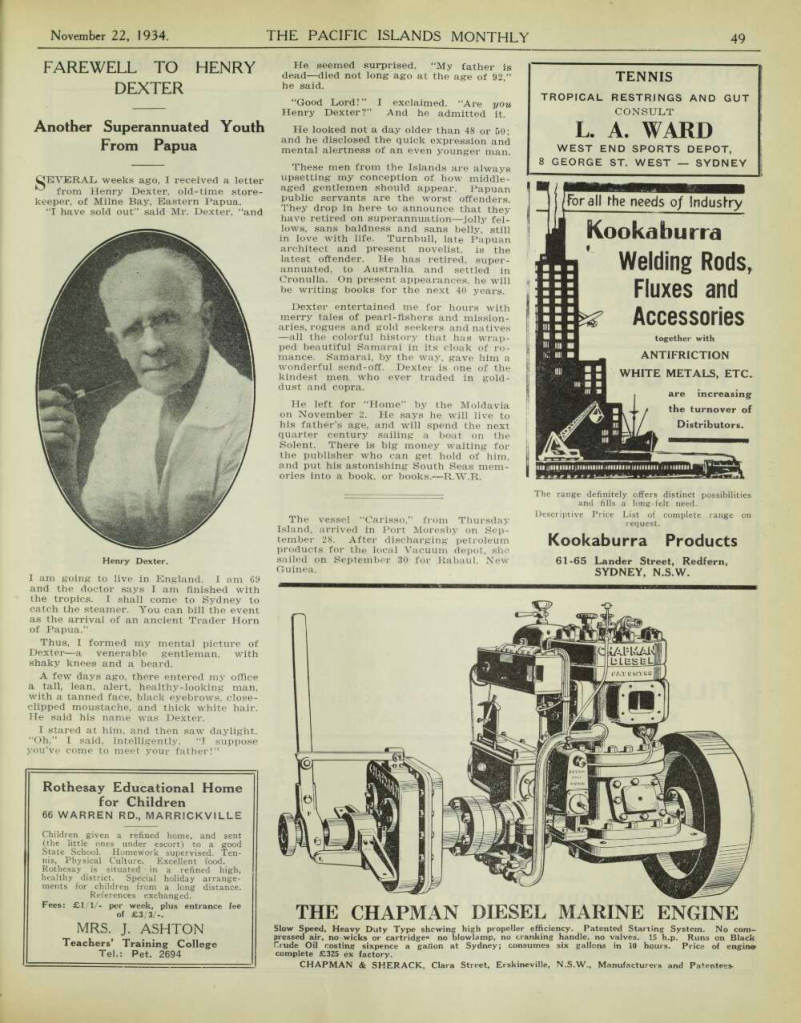
Farewell To Henry
Dexter
Another Superannuated Youth From Papua
Several weeks ago, I received a letter from Henry Dexter, old-time store keeper, of Milne Bay, Eastern Papua.
“I have sold out” said Mr. Dexter, “and
I am going to live in England. I am 69 and the doctor says I am finished with the tropics. I shall come to Sydney to catch the steamer. You can bill the event as the arrival of an ancient Trader Horn of Papua.”
Thus, I formed my mental picture of Dexter—a venerable gentleman, with shaky knees and a beard.
A few days ago, there entered my office a tall, lean, alert, healthy-looking man, with a tanned face, black eyebrows, close clipped moustache, and thick white hair.
He said his name was Dexter.
I stared at him, and then saw daylight.
“Oh,” I said, intelligently. “I suppose you’ve come to meet your father!”
He seemed surprised. “My father is dead—died not long ago at the age of 92,” he said.
“Good Lord!” I exclaimed. “Are you Henry Dexter?” And he admitted it.
He looked not a day older than 48 or 50; and he disclosed the quick expression and mental alertness of an even younger man.
These men from the Islands are always upsetting my conception of how' middle aged gentlemen should appear. Papuan public servants are the worst offenders.
They drop in here to announce that they have retired on superannuation—jolly fel lows, sans baldness and sans belly, still in love with life. Turnbull, late Papuan architect and present novelist, is the latest offender. He has retired, super annuated, to Australia and settled in Cronulla. On present appearances, he will be writing books for the next 40 years.
Dexter entertained me for hours with merry tales of pearl-fishers and mission aries, rogues and gold seekers and natives —all the colorful history that has wrap ped beautiful Samarai in its cloak of ro mance. Samarai, by the way, gave him a wonderful send-off. Dexter is one of the kindest men who ever traded in gold dust and copra.
He left for “Home” by the Moldavia on November 2. He says he will live to his father’s age, and will spend the next quarter century sailing a boat on the Solent. There is big money waiting for the publisher who can get hold of him, and put his astonishing South Seas mem ories into a book, or books.—R.W.R.
The vessel “Carisso,” from Thursday Island, arrived in Port Moresby on Sep tember 28. After discharging petroleum products for the local Vacuum depot, she sailed on September 30 for Rabaul, New Guinea.
Henry Dexter.
Advertisements & other items, pp. 51-52 (1 item)
Welding Rods,
TENNIS
TROPICAL RESTRINGS AND GUT
CONSULT
L. A. WARD
WEST END SPORTS DEPOT,
8 GEORGE ST. WEST SYDNEY
For all the needs of Industry
Kookaburra
Welding Rods,
Fluxes and
Accessories
together with
ANTIFRICTION
WHITE METALS, ETC.
are increasing the turnover of Distributors.
The range definitely offers distinct possibilities and fills a long-felt need.
Descriptive Price List of complete range on request.
Kookaburra Products
61-65 Lander Street, Redfern,
SYDNEY, N.S.W.
THE CHAPMAN DIESEL MARINE ENGINE
Slow Speed, Heavy Duty Type shewing high propeller efficiency. Patented Starting System. No compressed air, no wicks or cartridges, no blowlamp, no cranking handle, no valves. 15 h.p. Runs on Black Crude Oil costing sixpence a gallon at Sydney; consumes six gallons in 10 hours. Price of engi complete £325 ex factory.
CHAPMAN & SHERACK, Clara Street, Erskineville, N.S.W., Manufacturers and Patentees-
Rothesay Educational Home
for Children
66 WARREN RD., MARRICKVILLE
Children given a refined home, and sent (the little ones under escort) to a good State School. Homework supervised. Tennis, Physical Culture. Excellent food.
Rothesay is situated in a refined high, healthy district. Special holiday arrangements for children from a long distance.
References exchanged.
Fees: £1/1/- per week, plus entrance fee of £3/3/-.
MRS. J. ASHTON
Teachers’ Training College
Tel.: Pet. 2694
SPENCER NOLAN
DENTIST
28 OXFORD STREET
(Over Winns’ Ltd.)
SYDNEY
’Phone F3215 Cable Address: Fastplate, Sydney
SPENCER NOLAN
DENTIST
139 ELIZABETH STREET
(2 doors from Market St.)
SYDNEY
’Phone F3215
The Utmost Satisfaction . . .
AUNT
MARY'S
PURE FOOD
PRODUCTS
Aunt Mary’s Pure Food Products ensure the utmost satisfaction to consumers. For thirty years the high quality and supreme excellence of these goods have been appreciated by Pacific Islanders. Specially manufactured and packed to meet Island conditions.
“DEFIANCE” Brand Canned Goods
The proprietors of Aunt Mary’s Pure Food Products also pack “Defiance”
Brand Canned Goods.
Hygienically prepared and hermetically sealed to withstand tropical heat, they are sure of appreciation.
These branded goods are of the highest quality standard, and are prepared and packed only by
TILLOCK & CO. LTD.
PURE FOOD
MANUFACTURERS
Kent and Liverpool Streets, SYDNEY, N.S.W.
INSTAL THE DIESEL THAT HAS BEEN GOING STRONG SINCE 1929, AND has proved itself immune from all diesel weakness.
D.C. Series, 45 to 160 b.h.p., in 3,4, 6, and 8 cylinder sizes at 700 to 900 r.p.m. d!b. Series, 24 to 96 b.h.p,, in 2,3, 4,6, and 8 cylinder sizes, at 1000 r.p.m.
Australian Agents:
H. G. THORNTHWAITE & CO.
KEMBLA BUILDING.
MARGARET STREET, SYDNEY, N.S.W.
TELEGRAMS: “ORTHORN,” SYDNEY. TELEPHONE: B 5240
Progress on N.G. Goldfield
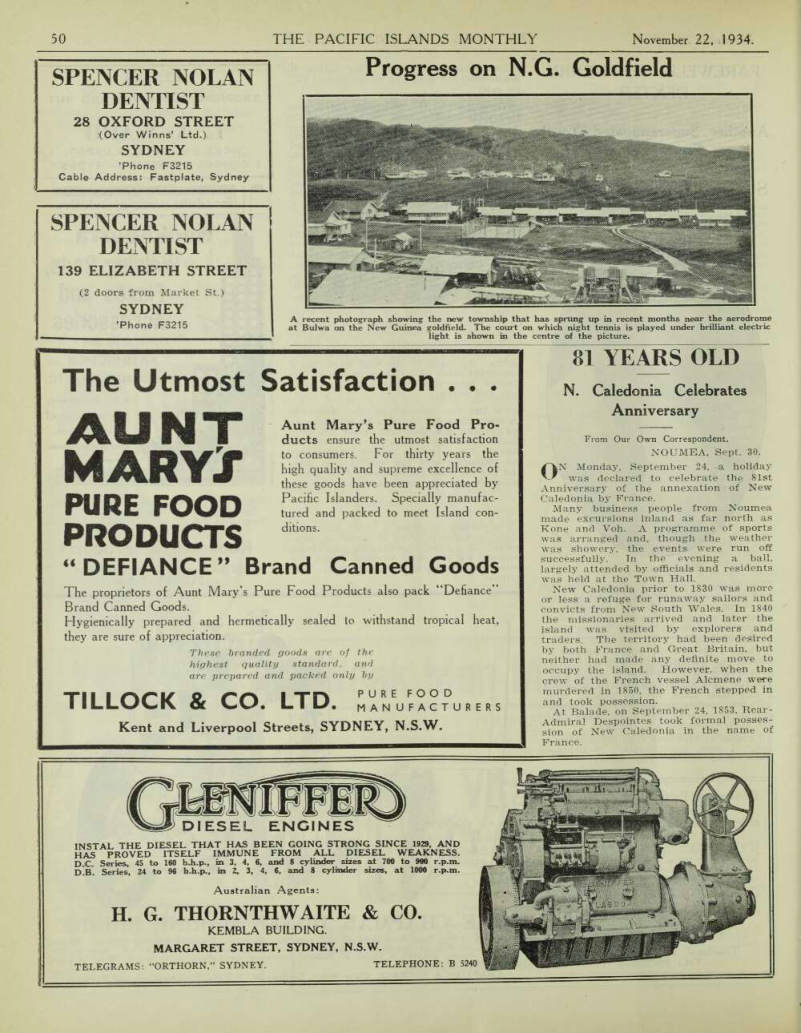
A recent photograph showing the new township that has sprung up in recent months near the aerodrome at Bulwa on the New Guinea goldfield. The court on which night tennis is played under brilliant electric light is shown in the centre of the picture.
81 Years Old
N. Caledonia Celebrates Anniversary
From Our Own Correspondent.
Noumea, Sept. 30.
ON Monday, September 24, a holiday was declared to celebrate the 81st Anniversary of the annexation of New Caledonia by France.
Many business people from Noumea made excursions inland as far north as Kone and Voh. A programme of sports was arranged and, though the weather was showery, the events were run off successfully. In the evening a ball, largely attended by officials and residents was held at the Town Hall.
New Caledonia prior to 1830 was more or less a refuge for runaway sailors and convicts from New South Wales. In 1840 the missionaries arrived and later the island was visited by explorers and traders. The territory had been desired by both France and Great Britain, but neither had made any definite move to occupy the island. However, when the crew of the French vessel Alcmene were murdered in 1850, the French stepped in and took possession.
At Balade, on September 24, 1853, Rear- Admiral Despointes took formal posses sion of New Caledonia in the name of France.
Advertisements & other items, p. 53 (1 item)
Hotel
"The Australia” Winter-Garden —a cosmopolitan rendezvous.
“The Australia" Vestibule —the centre of social activity.
"The Australia” Dining-room —cuisine recherche!
The Australia
Hotel
SYDNEY
From the five continents
and the seven seas, by
express and liner, come
the guests of “The Aus-
tralia.” That these con-
noisseurs in travel should
be so unanimous in their
preference is something
of which we are indeed
proud
May we commend their choice as a guide when you, too, come to Sydney? Your holiday or business trip will truly be favoured with grace and pleasant comfort.
You will find personal appreciation of the brilliant atmosphere, the notable social life, the splendid appointments and convenient location at this world-famous hotel.
NEW “ROOM-ONLY” RATES:
Single Room from . . . . 10/6 Double Room from . . . 20/- Telegraphic Address “Austraotel, Sydney.”
Write for illustrated rate-card.
“After all there s only one
Australia"
Suites de Luxe —one of the spacious sitting-rooms.
Cook Island Notes
From Our Own Correspondent.
Rarotonga, Oct. 3.
THE schooner “Tahitien,” bound from Papeete to Auckland, put into Raro tonga on September 22 for repairs. A wire stay had carried away, endangering the stability of the main mast. Temporary repairs were made here, after which the vessel proceeded on her way four or five days later.
An announcement was recently made by the Administrator that approval had been given for the installation at the local hospital of a mobile X-ray plant. Many native people, naturally, are quite unaware of the nature of X-ray apparatus, and one young fellow expressed the firm belief that the machine was a kind of telescope, with mirror arrangements, by means of
which a doctor could look right inside a person.
Mail advices from the lower group dis close that one or two of the islands have experienced a more profitable fruit season this year than for some years previously.
New Zealand market reports speak highly of the choiceness and soundness of the oranges from our outer islands.
Several officials who have put in some years of good service here are reported to be returning to the temperate climes again. Amongst these are Miss D. Kings bury, of the local post office, and Mr. J.
Wright, of the Customs office.
Recently the well-known Rarotongan chief, Makeanui Ariki, formally announc ed Ringiao Manarangi as his leading Mataiapo, with the added rank of Taunga (High Priest). The function took the form of a native ceremony and feast to which the Administration officials were
invited to be present. Ringiao Manarangi is an official himself and is the son of Manatangi, who for many years (until his death in February last) was the spokesman for Makeanui at all his public functions.
A general medical survey of the natives of the northern Cook Islands showed that very little sickness exists amongst them.
The primitive diet of the northern islan ders —coconuts and fish—possibly has much to do with their good state of health.
The natives in those more isolated islands are reported to have magnificent sets of sound teeth, with which they are able to tear the husks off coconuts.
The local branch of the Union Company has scrapped its gas lighting plant and is preparing to install electricity at its jetty and throughout its offices and sheds.
Dr. McKnight, who has been relieving Chief Medical Officer at the Group for eight or ten months, leaves in a few days for New Zealand. During the latter part of their stay here the doctor’s wife suffered a severe breakdown in health and considerable sympathy is felt for the doctor in having to leave Rarotonga under circumstances of anxiety.
A book on native education by Mr. W.
C. Groves, a well-known anthropologist who has been at work in New Guinea, will be published in March by the Mel bourne University Press. Another book by Mr. Groves, entitled “Captivity,” and dealing with war experiences, will be published by Messrs. Angus and Robert son early in 1935.
Advertisements & other items, p. 54 (1 item)
Mining Machinery
A CLEAN PLANTATION GUARANTEED
WITH
B.A.C. Weed Killer
Used on Malay States Rubber Plantations; approved by British Malay Rubber Institute F.O.B. Sydney. Sold in 4 gallon tins—2 tins to a case. 4/3 per gallon (Australian Currency). In concentrated form. Agents wanted in every group Particulars from:
LONE HAND SOAP CO.
554 Botany Rd., Alexandria, Sydney, Australia
MINING MACHINERY
Improved Type Gravel Pump.
SEND YOUR ENQUIRIES TO—
of all classes, including—
Dredging and Sluicing Plants
Gravel and Water Pumps Elevators Nozzles Piping and Valves Mining Plants have been supplied to a number of Companies in New Guinea, and we are, therefore, fully conversant with local conditions.
Hydraulic Elevator, with Swivelling Suction Pipe.
THOMPSON’S ENGINEERING & PIPE CO. LTD.
CASTLEMAINE, VICTORIA
Cable Address: “THOMPSONS, CASTLEMAINE.”
SYDNEY OFFICE KEMBLA BUILDING 58 MARGARET STREET
Japan’S Pacific
Islands
Are They Fortified?—Pertinent Questions at Geneva
THE Japanese, for years, have kept Europeans out of the Pacific Islands north of the Equator, which they hold under mandate from the League of Na tions. The groups are: Marshall Islands —32 islands and 867 reefs, scat tered over 800 square miles of ocean. Popula tion; About 10,000.
Caroline Islands —549 large and small islands and reefs, containing 1320 square kilometres of land. Population: About 40,000. (This includes the Pelew (or Palau) group.) Mariana (or Ladrone) Islands —14 islands, con taining 639 square kilometres. Population: About 12,000.
A few Europeans have passed through the groups on direct steamers during the last 15 years, but no white men have been allowed to travel at will through the Territory. In consequence, there have been many startling stories in circulation about fortifications, etc., in the groups.
Japan’s announcements, in recent years, that she did not accept the authority of the League of Nations, and would in no circumstances surrender these Pacific groups, gave colour to the sinister ac counts of Japanese secrecy, activities, and intentions.
Therefore, the following report from Geneva on November 6 has a special significance for Pacific Islands residents: The Japanese delegate, Mr. Ito, was searchingly questioned at the meeting of the Mandates Commission, which for five hours discussed the Marshall and other Japanese mandated islands in the Pacific.
The Commission has called on Japan to explain the large expenditure on harbours and aerodromes. The chairman, Mar quis Theodoli (Italy) stated that it now rested on the Mandatory Power to dis prove the criticisms that had been made.
Delegates asked why aircraft and de stroyers of all nations were not allowed to use the facilities on the islands, and thus allay suspicion of the adaptation of the islands for naval purposes.
Mr. Ito’s explanation that the construc tion of the harbour at Saipan (chief town of the Marianas) was necessary owing to heavy seas and the obligation to provide facilities for vessels of 3000 tons did not appear to satisfy the Commission.
Asked why a big aerodrome was being built at Saipan, Mr. Ito replied that it was because aircraft could there study atmospheric and fishing conditions.
Marquis Theodoli (Italy) suggested that if Japan wished to dispel suspicion she could afford unrestricted access to the islands. He said it rested with Japan to
dispose of the allegations made against her conduct.
Mr. Ito deprecated newspaper references to the subject, and added: “The nations must exercise prudence, as there is trouble in that part of the world.”
A message from Washington on No vember 5 said: The revelation before the League of Nations Mandate Commission that Japan had refused the American Government permission to send a warship to the Mariana Islands to observe a solar eclipse in February was discussed cau tiously by the Acting Secretary of State (Mr. Phillips) to-day. He said the request had been made two years previously.
Japan had countered by offering a Japan ese vessel to carry the scientists, but later the expedition was abandoned and the matter had not been further con sidered.
Since Japan’s resignation from the League, the final disposition of the man dated islands, which lie in a strategic position between the Philippines and Hawaii, have been a constant source of speculation by observers of the Far Eas tern situation, but the State department has maintained and continued to maintain reticence.
Saipan is the name of the principal island and town in the Mariana Islands.
It is close to the large island of Guam, which also is in the Marianas, but is an American possession and naval station.
Advertisements & other items, pp. 55-56 (1 item)
Hotel Mansions
TIMBER, JOINERY,
Etc.
PREPARED BUILDINGS
ready for erection a speciality.
SHIP and BOAT BUILDING
TIMBERS specially catered for
FIBROLITE, PLYWOODS,
GALVANISED IRON,
CELOTEX.
CONSIGNMENTS shipped by
RETURN STEAMERS to the
Islands.
JOHN W. EATON LTD.,
WEST CRESCENT ST.,
NORTH SYDNEY
TELEPHONES; X5051 (5 lines)
BURNS PHILP
(South Sea) Co. Ltd.
Island Traders & Shipowners
Registered Office: Suva, Fiji.
Also Branches at Fiji: Levuka, Lautoka, Labasa, Ba, Sigatoka, Rotuma.
Tonga: Nukualofa, Haapai, Vavau.
Samoa: Apia, Pago Pago (America Samoa).
Solomons: Makambo, Gizo, Faisi.
New Hebrides: Vila.
Gilberts: Tarawa.
Norfolk Is. Nauru. Niue. Wallis Is. Futuna Is.
Code Address: “Burnsouth.”
TARIFF:
Single Room and Breakfast from 8/per night.
WEEKLY
from £2/2/-
HOTEL MANSIONS
SYDNEY’S IDEALLY SITUATED PALATIAL HOTEL
Renowned for Exquisite Cuisine, Perfect Service and Luxurious Appointments.
Make the Mansions your home whilst in Sydney and enjoy Unsurpassed Comfort at Moderate Cost.
INDIVIDUAL, DOUBLE ROOMS AND FAMILY SUITES
WIRES: “Mansions,” Sydney. ADDRESS: Bayswater
INCLUSIVE
TARIFF:
Single Room from 12/per diem.
WEEKLY
from £3/10/- Address: Bayswater Rd., King’s Cross.
The
fragrant
refresher invigorates and revives.
Genuine
Eau de
Cologne
JULIUS BLAU
Factory Representative for Australia.
Australia House, Carrington Street, Sydney.
BETTER BROOMS
FOR
“BETTER BROOMS"
Manufacturers Regal Special Vice-Regal Windsor Sovereign National and the No. 4 Special Millet Brooms.
Agents Wanted Throughout the Islands. Price List on Application BETTER BROOMS, 12 James Street, Redfem, Sydney
Plezall ... (Please-All)
PLEZALL
is specially manufactured and packed to suit the island conditions. The mixture will keep indefinitely.
PLEZALL
may be obtained from all Island Stores.
PLEZALL FOOD PRODUCTS
NEWTOWN, SYDNEY, N.S.W.
So Good . . . So Nice Worth Double the Price This extraordinary Ready Made Scone Mixture will Delight You Surprise You Amaze You.
Nothing to do No other ingredient to add simply mix with water and bake.
Delicious Milk or Wholemeal Scones in Ten Minutes.
What Is Being Worn
Fashion Hints for Islands Women
By Therese.
“THE flowers that bloom in the spring, tra la” have out-bloomed themselves in their desire to capture the errant fancy of the modern woman. They lend them selves in all sorts of delightful designs to cottons, chiffons, taffetas, and silks; and so great is their charm that “My Lady” succumbs to them completely, and uses them for afternoon and evening gowns with tremendous success.
Since sashes are worn, she swathes her waist with sashes soft and sashes crisp, some of them with bows of such enormity that by contrast her waist assumes the waspish proportions of the good old days of the gay 90’s.
Belts take their place, too, and a belt of gold tucked tissue with a decorative jet or jade clasp, gives chic to the nth degree to a plain, well-cut dinner gown of black crepe. All sorts of odds and ends of gaily coloured wools crocheted together, go to the making of a most at tractive belt, which boasts as its fasten ing a miniature log of polished wood. It does the most exciting things to a frock of any shade.
Reptile skin bags and belts are as popular as ever, while skin shoes give splendid service. And now comes the
reptile skin hat, delightfully soft and adaptable, and of tremendous chic.
Inspiration for evening gowns comes to us from the courts of Bonaparte, and those glamorous old world frocks make of the modern Josephine one for whom any Napoleon would count the world well lost.
Rythmic ripples flow softly to the hem of a gown of sea green chiffon, softly patterned in the most exquisite flowered design suggestive of all the airiness of spring.
Clouds of drift down gossamer-like tulle are seen on many models. The charming, provocative Miss clothes her slim beauty in gauze—sheer white organza, trimmed with row on row of tulle ruchings. A vivid sash falls to the hemline and she is loveliness complete.
The evening decolletage is varied as a woman’s whims. Deep V’s narrow to the front waistline (for which, by the way, a new type of brassiere has been evolved): low wide square necks and softly falling monk’s hood collars, offer a wide choice for us all. The back slit-to-the-waist mode is being sponsored by our ultra and more daring sisters for day wear, too.
Feathers are used with success; and if in the dim recesses of some almost for gotten place you can find some tucked away you may count yourselves among Fortune’s favoured, since they are fash ion’s latest decree.
A tawny wing effect of cock’s plumes adorns the shoulder of an evening gown of the clearest yellow, while the hem of an evening gown boasts ostrich feather trims —sometimes at the back, sometimes at the side, but always delightful where e’er they be.
A combination of colours is the mode of the moment. Two shades of blue are a delight, while green and white become a duet in coolness. The two colour vogue extends to evening gowns, too. Have a skirt of satin and vary your blouses as your wayward fancy wills. Introduce a third colour per medium of a sash and hi presto! you have materialised a dream.
Fastenings no longer being things to hide, we flaunt them openly. Indeed with the so delightful buttons coming to us in sizes and shapes of infinite variety what else could we do? Glass buttons are ours but glass with a difference—a dull sheen that has much appeal.
Fronts of blouses are poked forward and pinched together, as it were, by link buttons —an intriguing and amusing ar rangement.
For the suit which one must possess, what could be better than linen tweed. It is really marvellous. With it is worn a mannish waistcoast —multi-coloured as Joseph’s raiment; or, in plain or contrast ing shades, and it gives that intangible something, designated “chic.” Slipped over a plain well cut frock joy is yours.
A silk frock of polka dots gives dis tinction, with an air of difference, and
with the addition of a coat it rises to the heights.
In your wardrobe an ensemble you must have, spelling as it does economy and elegance with a capital “E.” It is the direct and almost miraculous addi tion whereby one outlay becomes a com plete wardrobe in itself —a different blouse, a change of frock, all under the one yeoman service coat. It fills us with delight, and adds further to its virtues by gladdening the heart of a man to whom extravagance is a bugbear.
Short fitting bolero jackets vie with the swagger variety and bolero fronts are added to frocks with great success.
Mesh materials, the gift of the gods to appease tropic dwellers on the matter of climate, make admirable frocks and blouses, and when extended to undies give coolness all along the way.
Blouses in jacket and jaunty basque effects are the dernier cri. Bodices are tucked and pleated in devious ways, neck lines are swathed, and the vogue for the one-sided effect is rampant. Rows of hail spot muslin forming a jabot effect look deliciously crisp and lend untold charm to sober frocks.
For sunshine days, there is the frock of floral linen of a freshness that enchants us, and the dimity with its quaintly sprigged patterns serves us the clock round. Tailored skirts are slim and shor ter than of yore, featuring the slashed side or front which maintains the straight lines, while allowing the necessary free dom of movement.
Beach accessories are enthralling. Col oured string and the humble hessian make the most attractive belts, bags, cushions and so on, ad infinitum. All sorts and conditions of quaint designs are couched on the hessian with vivid string—little ships with sails gaily aflutter in the breeze; jolly little hornpiping jack tars, undulating lines suggestive of the sea, quaint little fish, their popping eyes wide with wonderment at their own intriguing shapes; all add to the call of the sea in holiday time.
Throwing caution to the winds, the surfing girl answers the call in the briefest possible swim suit, after which, with the enchanting contradiction which is essen tially woman, she wraps herself com pletely in a neck to knee wrap or cape, and basks in the sunshine, happily com placent at this belated display of modesty.
Hats come to us in infinite variety— fine and coarse straws, frivolous and tailored, large and diminutive, they are all delightful. Berets are not longer as we once knew them —large, squashy, pan cake effects; shallow tricornes, strange one-sided models, all of which we wear with a prayer in our hearts that they are our type.
Hair ceases to stray and curls lovingly upward about the head, and more than ever must it be well groomed if to be soignee is your ultimate desire.
Advertisements & other items, pp. 56-57 (1 item)
Permanently Wave
YOUR OWN HAIR
With a “RAYWAVE” Curling Set (Pat. 16608/34). Waves last 6 to 9 months guaranteed. Anyone can use. NO ELEC- TRICITY. Simple instructions. 15/per set. Postage 3/- extra.
Spar Trading Co., 10 Rawson Place, Sydney
HORDERN BROTHERS
PITT & GEORGE STS.. SYDNEY WE PAY CARRIAGE
1/0½ FADELESS
WOVEN ZEPHYR
36 inch. This Woven and Fadeless Zephyr is showing an attractive plaid design in smart two color effects of red, saxe, brown and green all with black on white grounds. Usually 1/0½.
Special, yard
1/11½ PRINTED
CHIFFON VOILE
36 inch. Particularly attractive is the smart fruit and leaf design featured in fadeless colorings of sky-saxe, orange-brown, rose-sky and green-lemon on white grounds. Usual Price, yard, 1/11½. Special Price, Yard
1/9½ NEWEST
PTD. CAMBRICS
Guaranteed fast washing colours in neat designs, small floral, fancy check and novelty patterns.
Illustrated berry design is in blue - pink, green - orange, lemon-green on white grounds. Usual 1/9½.
Special, yard
28 inch FADELESS
PTD. HAIRCORD
A fine quality and excellent wearing fabric.
The floral pattern as illustrated is obtainable in blue, pink and green on white grounds. Also in fancy diagonal stripes, novelty checks and stripes in light and dark colorings.
Special, yard wearing fabric.
SPECIAL OFFER! We will send you three dilierent Dress Lengths in good quality Cambric.
Zephyr and Voile for the amazing low price of 10/-
OLD ISLANDS
PHOTOGRAPHS
We have a unique collection of several thousands of original photographs of Natives and Scenes in New Guinea, Solomons, Tonga, Fiji, Samoa, New Hebrides, etc., taken during the years 1875 to 1895.
These supply invaluable records of fastdisappearing races.
Full-plate prints, 1/- each, or 12 for 10/-.
Details on application
TYRRELL’S MUSEUM,
281 GEORGE ST., SYDNEY
French Sloop At Rabaul
The French sloop, “Rigault de Genou illy,” which sailed from France on March 2, 1934, a day after it was completed, ar rived in Rabaul on October 6, coming from Tulagi, its last port.
Leaving France the sloop called at West African ports and proceeded to Pernambuco (South America) and then passing through the Straits of Magellan, proceeded to Callao in Chile. From there it called at Easter Island, Marquesas, Tahiti, and on to Honolulu, and then over to the British Solomons. The sloop left Rabaul on October 10 for Salamaua and Madang.
Samoan News
“Palolo” Season is Approaching
From Our Own Correspondent.
APIA, October 18.
ABOUT a fortnight ago the dry spell in Samoa, which had caused an in fluenza epidemic and done considerable damage on the plantations, was at last broken and ample rains set in to the joy and satisfaction of the hard struggling planters.
We are approaching the “Palolo” sea son, when the mysterious worm, dweller
of the deep seas, invades the coasts of the South Sea Islands and is eagerly pursued and caught by the natives, who are ex tremely fond of the tasty delicacy. As “Palolo” time always means a lot of rain we are sure of a sufficiency in the near future.
Maui Pomare Busy
Numerous officials are due for leave in New Zealand, and our “Home” steamer, the Maui Pomare, is fully booked for the next few months. To give banana planters a chance to make a badly needed few shillings for the Xmas season, the Maui Pomare is to shorten her stay in N.Z. in November, in order to make two trips from Samoa with banana cargoes in December.
The quality of Samoan bananas, as re cognised by the N.Z. buyers, is very good and it is a great pity that we have to be satisfied with the small shipments by the Maui Pomare, when we could easily ship double the quantity, thereby enabling us to buy considerably more goods in New Zealand to our mutual benefit.
New Organ
A splendid new organ, specially built for -the tropics, donated by a Catholic Mission Society in Aachen, Germany, was landed by the last cargo steamer. The organ is to be installed in Apia Cathedral, which had to undergo some slight altera tion to receive the large instrument. Un fortunately, the organ builder who was to undertake the installation, was prevented from travelling to Apia by the last Maui Pomare so that the work, which was to have been completed before the Christmas holidays, may be somewhat delayed.
Bishop’S Tour
His Lordship Bishop Darnand with the Rev. Father Deihl left recently by the Makoa for an official visit to Wallis Island, seat of the College and Seminary of the Diocese. Father Deihl will also visit the Roman Catholic community in the Tokelau Islands. The Bishop and Father Deihl are expected back in Apia at the end of October.
Cocoa Crop
The cocoa crop of Samoa for 1934 pro mises to constitute a record in produc tion, as it will probably surpass the pre vious high mark of over 1200 tons.
Natives should produce about 250 tons, while the N.Z. Reparation Estates, the
Government concern, might also reach the 250 tons mark.
In spite of the dry spell and wrong winds, weather has been generally more favourable to cocoa production than in the past years; while a large area of new cultivation has come into bearing.
Personal Items
By the October Maui Pomare, which brought only a few tourists this trip, Mr.
Littlejohn, a popular Post Office Official, left for Wellington, N.Z., where he has been transferred. Mrs. Littlejohn, the daughter of our Postmaster (Mr. E. E.
Dunwoodie), accompanied her husband.
Mr. Dunwoodie himself will go on vaca tion in December next. Mr. Littlejohn has been replaced at the Post Office by Mr. Prout.
Mr. Dyer arrived in Apia recently to work at the Apia Observatory.
Mr. Robson, Resident Commissioner of Savaii, left by the Maui Pomare for a well earned holiday in New Zealand.
Some of our oldest European residents recently celebrated their birthdays in good health. They are Mr. Paul Hoeflich, 78 years of age, and Mr. G. W. Partsch, 82 years of age. These gentlemen are not the oldest inhabitants of our Colony, as there are several ladies and gentlemen higher up in the 80’s.
Dr. Lambert, the well known represen tative of the Rockefeller Foundation, and Dr. Watt, Chief of the N.Z. Medical Ser vice, have completed a tour of Savaii to investigate into the effects of the injec tions in connection with the Yaws Cam paign, conducted some time ago.
Advertisements & other items, p. 58 (1 item)
BULLIVANTS wire ropes
for HOUSEHOLD as well as TOILET Purposes...
Royale Soaps Manufactured in Australia from Purest Ingredients Special Quotes to Island Storekeepers—Samples on Application ROYALE SOAP CO., 24-26 Briggs St., Camperdown, Sydney
HUON PINE BOAT PLANKS
AND
SPOTTED GUM TIMBERS
The World’s Best and the Cobra Does Not Like Huon Pine.
A. C. FRYER, 110 Miller Street, Pyrmont, Sydney.
Will Gladly Give Full Quotations for Any Sizes.
MINING MACHINERY
WE ARE MAKERS OF ALL CLASSES OF
MINING MACHINERY, STAMPER BATTERIES,
HUNTINGTON MILLS, Etc.
ALSO ALL CLASSES OF
BRICK-MAKING MACHINERY
GENERAL ENGINEERING AND FOUNDRY WORK
High-class SEMI-STEEL MACHINE MOULDED GEARING
UP TO 14 FT. DIA. x 24 IN. FACE
GEOR6E FOSTER & SONS LTD.
Code; A.B.C. 5th Edition. ST. PETERS, N.S.W. Cable Address: Fosterion, Sydney.
BULLIVANTS wire ropes
“THE WORLD’S STANDARD”
LARGEST STOCKS IN AUSTRALASIA - FOR ALL PURPOSES Also Blocks, Hooks, Shackles, Thimbles, Strand, Seizing, Aircraft Cord, etc.
Letters: BULLIVANTS’ Australian Co. Ltd. Telegrams:
Box 1298 J, G.P.O. 331-333 KENT STREET, SYDNEY Prompt Attention! Efficient Service!! Complete Satisfaction!!! ‘Bullivants Ltd.,’
Sydney.
New Guinea Judges
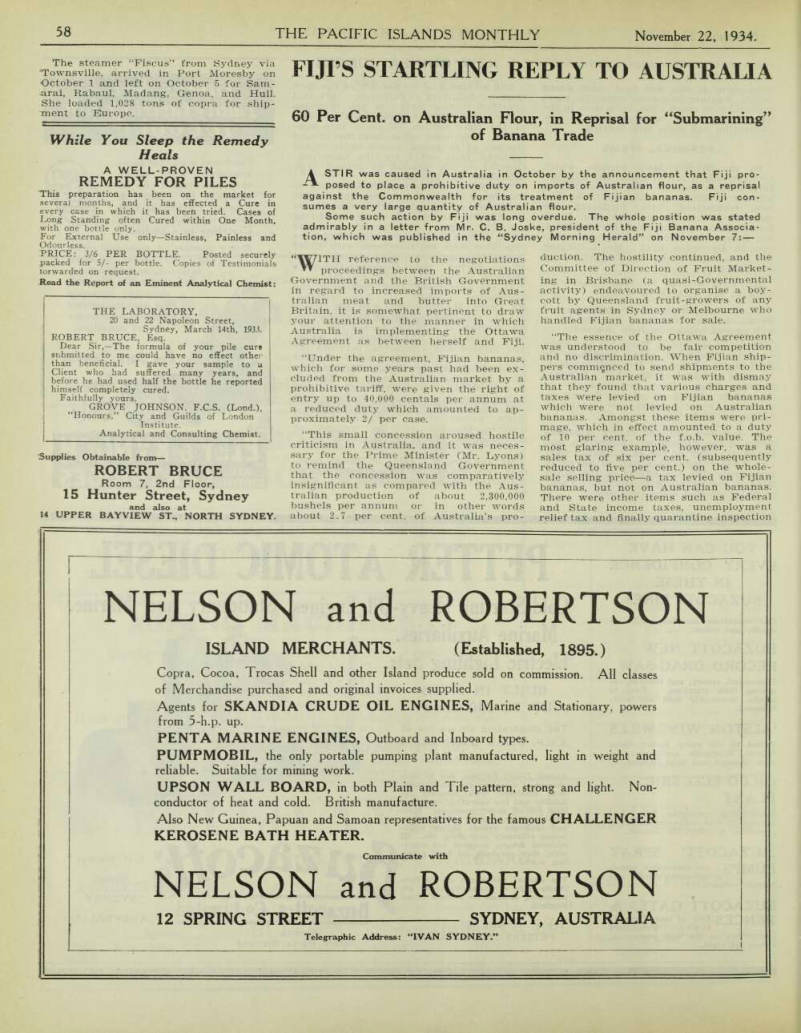
Sub-section 3 of section 8B of the New Guinea Judiciary Ordinance, 1921-1934 provides that a Judge of the Supreme Court, other than a judge holding office at the time section 8B came into ope ration, shall hold office until he attains the age of 65 years, unless he is sooner removed from office by the Governor- General on the ground of proved mis behaviour or incapacity.
The object of the amendment made in February, 1934, by the insertion in the Ordinance of the sub-section was to give security of tenure and to fix a retiring age for judges. The conditions under which judges then holding office had been appointed were not interfered with. Chief Judge Wanliss and Judge Phillips hold office during the Governor-General’s pleasure.
At the September, 1934, Session of the Legislative Council of New Guinea, Mr. Clark, M.L.C., moved and Mr. Grose, M.L.C., seconded a motion to allow the introduction of a Bill to amend the Judi ciary Ordinance. The private Bill, which was printed and circulated, provides for a change in the tenure of office of Chief Judge Wanliss and Judge Phillips. In effect it creates a life tenure of office for these judges. It provides that Chief Judge Wanliss and Judge Phillips shall hold office until they die or voluntarily retire, unless sooner removed by the Governor-General on the ground of proved misbehaviour or incapacity.
Mr, and Mrs. R. Taylor, of Tulagi, Solo mon Islands, are at present staying at Wallaringa Mansions, Neutral Bay, Syd ney.
The steamer “Fiscus” from Sydney via 'Townsville, arrived in Port Moresby on October 1 and left on October 5 for Sam urai, Rabaul, Madang, Genoa, and Hull.
She loaded 1,028 tons of copra for ship ment to Europe.
Advertisements & other items, pp. 59-60 (1 item)
Fetter Atomic Diesel
"There's Not A
Faulty Cartridge In A
1,000,000!"
Produced with that same precision with which they perform, it can be claimed for Eley & Kynoch Cartridges that there is “Not a Faulty Cartridge in a Million.”
Every process of manufacture is by the most modern methods , and their loading is carried out vnth a scientific accuracy that assures perfect performance under all conditions.
Use
Only
For Sure Shooting
ELEY & KYNOCH
BRITISH CARTRIDGES
YOU CAN HAVE
EVERY CONFIDENCE
IN THESE
BUZACOTT LINES
Our reputation has been built on quality and value.
BUZACOTT NEW
RECORD DRAG-SAW
Economical, speedy, and efficient, requiring little attention. Easy to handle, thoroughly built and wellbalanced.
‘ALSTON’ WINDMILLS
Priced to suit every pocket, these famous Windmills are noted for their strength and light running.
GILCO ELECTRIC
PLANT
Wind-driven, providing free electricity, no fuel costs—minimum of attention. A PROVED success.
‘BUZACOTT’ SPRAY
PUMPS are reasonably priced, well-constructed, and entirely reliable.
BUZACOTT GATES &
FENCES One of our “trump” lines. Recognised everywhere as the best procurable.
Prices Eire right.
FETTER ATOMIC DIESEL
Cold-Starting Heavy-Oil Engines, Stationary and Marine,
Marine Auxiliaries.
Electric Lighting Sets.
BUILT IN SIZES
UP TO 540 B.H.P.
The illustration shows the 42 B.H.P. Atomic Diesel Marine Oil Engine.
Atomic Diesel Engines, due to their absence of vibration and silent operation, combined with absolute reliability and low operating costs, are ideal for all power purposes. Their simple design, strong construction, and moderate speeds ensure maintained efficiency over long life. Of enclosed design, compact yet accessible, they are built for hard gruelling work.
The marked ascendency of the twostroke-cycle is demonstrated in the increasing demand for Atomic Diesel Engines.
Built by
FETTERS LTD., ENGLAND
7-11 Market Street
SYDNEY
AUSTRALIA
Agents.
Spare Parts Stocked
While You Sleep the Remedy
Heals
A WELL-PROVEN
REMEDY FOR PILES
This preparation has been on the market for several months, and it has effected a Cure in every case in which it has been tried. Cases of Long Standing often Cured within One Month, with one bottle only.
For External Use only—Stainless, Painless and Odourless.
PRICE: 3/6 PER BOTTLE. Posted securely packed for 5/- per bottle. Copies of Testimonials forwarded on request.
Read the Report of an Eminent Analytical Chemist:
THE LABORATORY,
20 and 22 Napoleon Street, Sydney, March 14th, 1933.
ROBERT BRUCE, Esq.
Dear Sir,—The formula of your pile cure submitted to me could have no effect other than beneficial. I gave your sample to a Client who had suffered many years, and before he had used half the bottle he reported himself completely cured.
Faithfully yours,
GROVE JOHNSON. F.C.S. (Lond.),
“Honours,” City and Guilds of London Institute.
Analytical and Consulting Chemist.
Supplies Obtainable from—
ROBERT BRUCE
Room 7, 2nd Floor,
15 Hunter Street, Sydney
and also at
14 UPPER BAYVIEW ST., NORTH SYDNEY.
NELSON and ROBERTSON
ISLAND MERCHANTS. (Established, 1895.)
Copra, Cocoa, Trocas Shell and other Island produce sold on commission. All classes of Merchandise purchased and original invoices supplied.
Agents for SKANDIA CRUDE OIL ENGINES, Marine and Stationary, powers from 3-h.p. up.
PENTA MARINE ENGINES, Outboard and Inboard types.
PUMPMOBIL, the only portable pumping plant manufactured, light in weight and reliable. Suitable for mining work.
UPSON WALL BOARD, in both Plain and Tile pattern, strong and light. Nonconductor of heat and cold. British manufacture.
Also New Guinea, Papuan and Samoan representatives for the famous CHALLENGER
KEROSENE BATH HEATER.
Communicate with
NELSON and ROBERTSON
12 SPRING STREET SYDNEY, AUSTRALIA
Telegraphic Address: “IVAN SYDNEY.”
Fiji’S Startling Reply To Australia
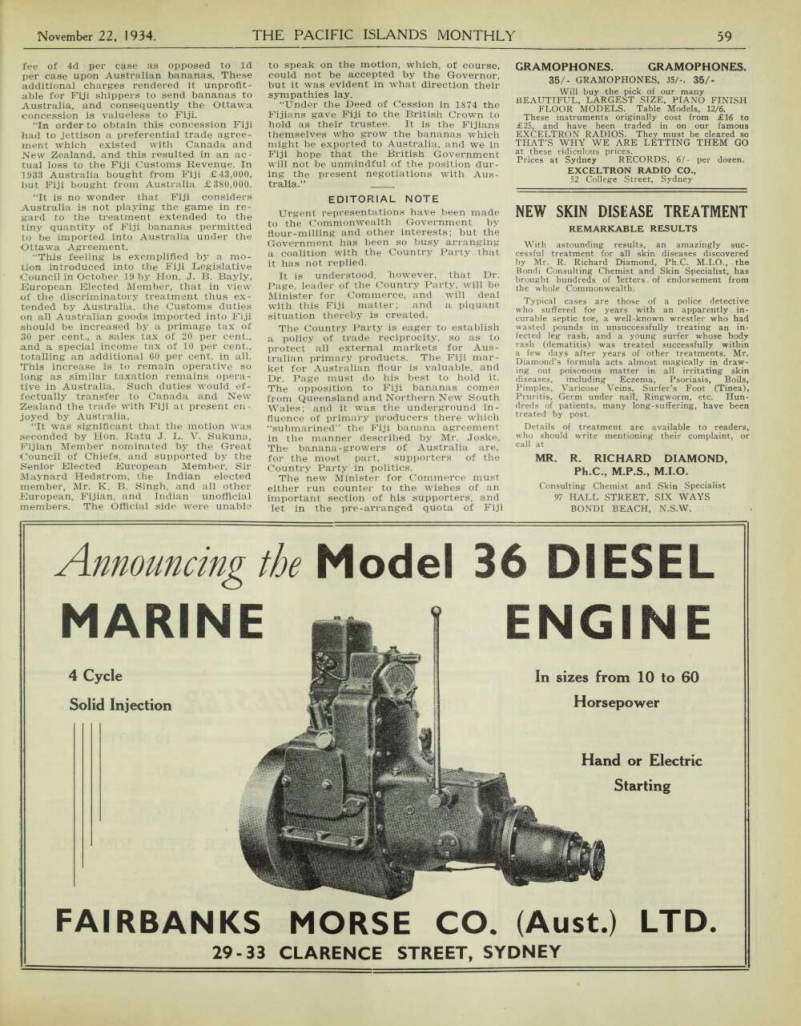
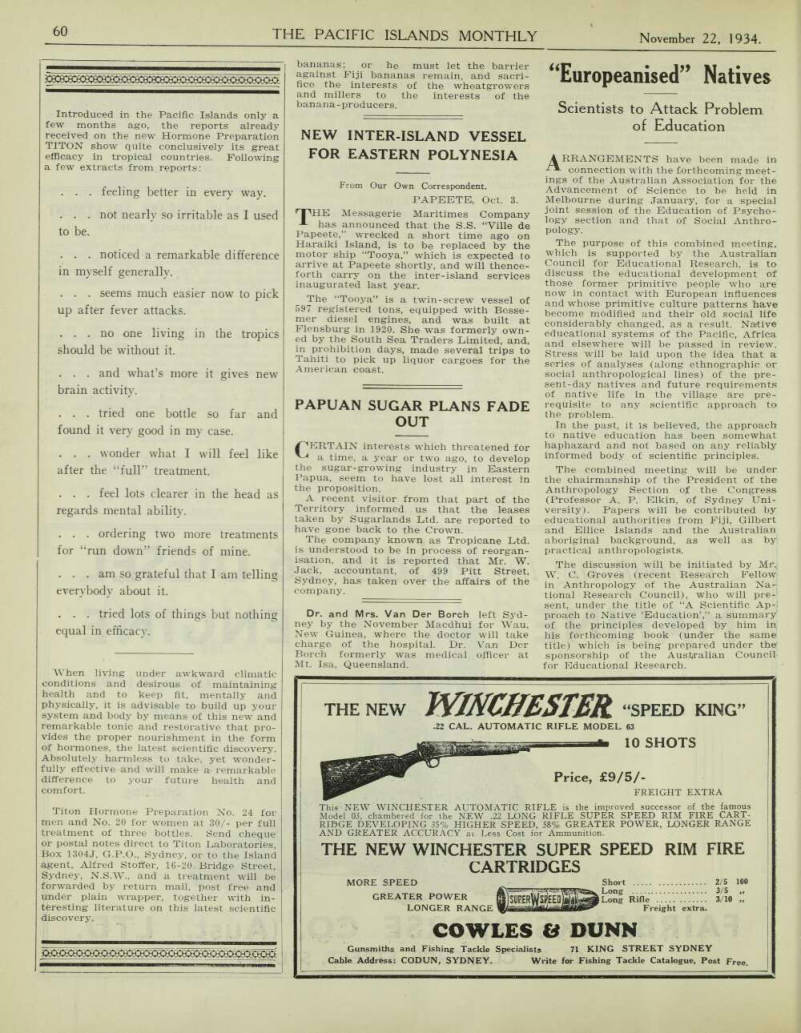
60 Per Cent. on Australian Flour, in Reprisal for “Submarining” of Banana Trade
A STIR was caused in Australia in October by the announcement that Fiji proposed to place a prohibitive duty on imports of Australian flour, as a reprisal against the Commonwealth for its treatment of Fijian bananas. Fiji con sumes a very large quantity of Australian flour.
Some such action by Fiji was long overdue. The whole position was stated admirably in a letter from Mr. C. B. Joske, president of the Fiji Banana Associa tion, which was published in the “Sydney Morning Herald” on November 7:
“WITH reference to the negotiations proceedings between the Australian Government and the British Government in regard to increased imports of Aus tralian meat and butter into Great Britain, it is somewhat pertinent to draw your attention to the manner in which Australia is implementing the Ottawa Agreement as between herself and Fiji.
“Under the agreement, Fijian bananas, which for some years past had been ex cluded from the Australian market by a prohibitive tariff, were given the right of entry up to 40,000 centals per annum at a reduced duty which amounted to ap proximately 2/ per case.
“This small concession aroused hostile criticism in Australia, and it was neces sary for the Prime Minister (Mr. Lyons) to remind the Queensland Government that the concession was comparatively insignificant as compared with the Aus tralian production of about 2,300,000 bushels per annum or in other words about 2.7 per cent, of Australia’s pro
duction. The hostility continued, and the Committee of Direction of Fruit Market ing in Brisbane (a quasi-Governmental activity) endeavoured to organise a boy cott by Queensland fruit-growers of any fruit agents in Sydney or Melbourne who handled Fijian bananas for sale.
“The essence of the Ottawa Agreement was understood to be fair competition and no discrimination. When Fijian ship pers commenced to send shipments to the Australian market, it was with dismay that they found that various charges and taxes were levied on Fijian bananas which were not levied on Australian bananas. Amongst these items were pri mage, which in effect amounted to a duty of 10 per cent, of the f.o.b. value. The most glaring example, however, was a sales tax of six per cent, (subsequently reduced to five per cent.) on the whole sale selling price—a tax levied on Fijian bananas, but not on Australian bananas.
There were other items such as Federal and State income taxes, unemployment relief tax and finally quarantine inspection
fee of 4d per case as opposed to 1d per case upon Australian bananas. These additional charges rendered it unprofit able for Fiji shippers to send bananas to Australia, and consequently the Ottawa concession is valueless to Fiji.
“In order to obtain this concession Fiji had to jettison a preferential trade agree ment which existed with Canada and New Zealand, and this resulted in an ac tual loss to the Fiji Customs Revenue. In 1933 Australia bought from Fiji £43,000, but Fiji bought from Australia £380,000.
“It is no wonder that Fiji considers Australia is not playing the game in re gard to the treatment extended to the tiny quantity of Fiji bananas permitted to be imported into Australia under the Ottawa Agreement.
“This feeling is exemplified by a mo tion introduced into the Fiji Legislative Council in October 19 by Hon. J. B. Bayly, European Elected Member, that in view of the discriminatory treatment thus ex tended by Australia, the Customs duties on all Australian goods imported into Fiji should be increased by a primage tax of 30 per cent., a sales tax of 20 per cent., and a special income tax of 10 per cent., totalling an additional 60 per cent, in all.
This increase is to remain operative so long as similar taxation remains opera tive in Australia. Such duties would ef fectually transfer to Canada and New Zealand the trade with Fiji at present en joyed by Australia.
“It was significant that the motion was seconded by Hon. Ratu J. L. V. Sukuna, Fijian Member nominated by the Great Council of Chiefs, and supported by the Senior Elected European Member, Sir Maynard Hedstrom, the Indian elected member, Mr. K. B. Singh, and all other European, Fijian, and Indian unofficial members. The Official side were unable
to speak on the motion, which, of course, could not be accepted by the Governor, but it was evident in what direction their sympathies lay.
“Under the Deed of Cession in 1874 the Fijians gave Fiji to the British Crown to hold as their trustee. It is the Fijians themselves who grow the bananas which might be exported to Australia, and we in Fiji hope that the British Government will not be unmindful of the position dur ing the present negotiations with Aus tralia.”
Editorial Note
Urgent representations have been made to the Commonwealth Government by flour-milling and other interests; but the Government has been so busy arranging a coalition with the Country Party that it has not replied.
It is understood, however, that Dr.
Page, leader of the Country Party, will be Minister for Commerce, and will deal with this Fiji matter; and a piquant situation thereby is created.
The Country Party is eager to establish a policy of trade reciprocity, so as to protect all external markets for Aus tralian primary products. The Fiji mar ket for Australian flour is valuable, and Dr. Page must do his best to hold it.
The opposition to Fiji bananas comes from Queensland and Northern New South Wales; and it was the underground in fluence of primary producers there which “submarined” the Fiji banana agreement in the manner described by Mr. Joske.
The banana-growers of Australia are, for the most part, supporters of the Country Party in politics.
The new Minister for Commerce must either run counter to the wishes of an important section of his supporters, and let in the pre-arranged quota of Fiji
bananas; or he must let the barrier against Fiji bananas remain, and sacri fice the interests of the wheatgrowers and millers to the interests of the banana-producers.
Advertisements & other items, pp. 61-62 (1 item)
Engine
GRAMOPHONES. GRAMOPHONES.
35/- GRAMOPHONES, 35/-. 35/-
Will buy the pick of our many
BEAUTIFUL, LARGEST SIZE, PIANO FINISH
FLOOR MODELS. Table Models, 12/6.
These instruments originally cost from £l6 to £25, and have been traded in on our famous EXCELTRON RADIOS. They must be cleared so THAT’S WHY WE ARE LETTING THEM GO at these ridiculous prices.
Prices at Sydney RECORDS, 6/- per dozen.
EXCELTRON RADIO CO.,
52 College Street, Sydney
NEW SKIN DISEASE TREATMENT
REMARKABLE RESULTS
With astounding results, an amazingly successful treatment for all skin diseases discovered by Mr. R. Richard Diamond, Ph.C. M.I.O., the Bondi Consulting Chemist and Skin Specialist, has brought hundreds of letters of endorsement from the whole Commonwealth.
Typical cases are those of a police detective who suffered for years with an apparently incurable septic toe, a well-known wrestler who had wasted pounds in unsuccessfully treating an infected leg rash, and a young surfer whose body rash (dematitis) was treated successfully within a few days after years of other treatments. Mr.
Diamond’s formula acts almost magically in drawing out poisonous matter in all irritating skin diseases, including Eczema, Psoriasis, Boils, Pimples, Varicose Veins, Surfer’s Foot (Tinea), Pruritis, Germ under nail, Ringworm, etc. Hundreds of patients, many long-suffering, have been treated by post.
Details of treatment are available to readers, who should write mentioning their complaint, or call at
MR. R. RICHARD DIAMOND,
Ph.C., M.P.S., M.I.O.
Consulting Chemist and Skin Specialist
97 HALL STREET, SIX WAYS
BONDI BEACH, N.S.W.
Announcing the Model 3 DIESEL
MARINE
4 Cycle Solid Injection
ENGINE
In sizes from 10 to 60 Horsepower Hand or Electric Starting
FAIRBANKS MORSE CO. (Aust.) LTD.
29-33 CLARENCE STREET, SYDNEY
Introduced in the Pacific Islands only a few months ago, the reports already received on the new Hormone Preparation TITON show quite conclusively its great efficacy in tropical countries. Following a few extracts from reports: . . . feeling better in every way. . . . not nearly so irritable as I used
to be.
. . . noticed a remarkable difference
in myself generally.
. . . seems much easier now to pick up after fever attacks. ... no one living in the tropics should be without it. . . . and what’s more it gives new
brain activity.
. . . tried one bottle so far and found it very good in my case. . . . wonder what I will feel like
after the “full” treatment.
. . . feel lots clearer in the head as
regards mental ability.
. . . ordering two more treatments
for “run down” friends of mine.
. . . am so grateful that I am telling
everybody about it.
. . . tried lots of things but nothing
equal in efficacy.
When living under awkward climatic conditions and desirous of maintaining health and to keep fit, mentally and physically, it is advisable to build up your system and body by means of this new and remarkable tonic and restorative that provides the proper nourishment in the form of hormones, the latest scientific discovery.
Absolutely harmless to take, yet wonderfully effective and will make a remarkable difference to your future health and comfort.
Titon Hormone Preparation No. 24 for men and No. 20 for women at 30/- per full treatment of three bottles. Send cheque or postal notes direct to Titon Laboratories, Box 1304J, G.P.O., Sydney, or to the Island agent, Alfred Stoffer, 16-20. Bridge Street, Sydney, N.S.W., and a treatment will be forwarded by return mail, post free and under plain wrapper, together with interesting literature on this latest scientific discovery.
New Inter-Island Vessel
For Eastern Polynesia
From Our Own Correspondent.
Papeete, Oct. 3.
THE Messagerie Maritimes Company has announced that the S.S. “Ville de Papeete,” wrecked a short time ago on Haraiki Island, is to be replaced by the motor ship “Tooya,” which is expected to arrive at Papeete shortly, and will thence forth carry on the inter-island services inaugurated last year.
The “Tooya” is a twin-screw vessel of 597 registered tons, equipped with Besse mer diesel engines, and was built at Flensburg in 1920. She was formerly own ed by the South Sea Traders Limited, and, in prohibition days, made several trips to Tahiti to pick up liquor cargoes for the American coast.
Papuan Sugar Plans Fade
Out
CERTAIN interests which threatened for a time, a year or two ago, to develop the sugar-growing industry in Eastern Papua, seem to have lost all interest in the proposition.
A recent visitor from that part of the Territory informed us that the leases taken by Sugarlands Ltd. are reported to have gone back to the Crown.
The company known as Tropicane Ltd. is understood to be in process of reorgan isation, and it is reported that Mr. W.
Jack, accountant, of 499 Pitt Street, Sydney, has taken over the affairs of the company.
Dr. and Mrs. Van Der Borch left Syd ney by the November Macdhui for Wau, New Guinea, where the doctor will take charge of the hospital. Dr. Van Der Borch formerly was medical officer at Mt. Isa, Queensland.
“Europeanised” Natives
Scientists to Attack Problem of Education
ARRANGEMENTS have been made in connection with the forthcoming meet ings of the Australian Association for the Advancement of Science to be held in Melbourne during January, for a special joint session of the Education of Psycho logy section and that of Social Anthro pology.
The purpose of this combined meeting, which is supported by the Australian Council for Educational Research, is to discuss the educational development of those former primitive people who are now in contact with European influences and whose primitive culture patterns have become modified and their old social life considerably changed, as a result. Native educational systems of the Pacific, Africa and elsewhere will be passed in review.
Stress will be laid upon the idea that a series of analyses (along ethnographic or social anthropological lines) of the pre sent-day natives and future requirements of native life in the village are pre requisite to any scientific approach to the problem.
In the past, it is believed, the approach to native education has been somewhat haphazard and not based on any reliably informed body of scientific principles.
The combined meeting will be under the chairmanship of the President of the Anthropology Section of the Congress (Professor A. P. Elkin, of Sydney Uni versity). Papers will be contributed by educational authorities from Fiji, Gilbert and Ellice Islands and the Australian aboriginal background, as well as by practical anthropologists.
The discussion will be initiated by Mr.
W. C. Groves (recent Research Fellow in Anthropology of the Australian Na tional Research Council), who will pre sent, under the title of “A Scientific Approach to Native ‘Education’,” a summary of the principles developed by him in his forthcoming book (under the same title) which is being prepared under the sponsorship of the Australian Council for Educational Research.
Advertisements & other items, p. 62 (1 item)
Winchester
THE NEW
“SPEED KING’
.22 CAL. AUTOMATIC RIFLE MODEL 63
10 SHOTS
Price, £9/5/-
FREIGHT EXTRA
This NEW WINCHESTER AUTOMATIC RIFLE is the improved successor of the famous Model 03, chambered for the NEW .22 LONG RIFLE SUPER SPEED RIM FIRE CART- RIDGE DEVELOPING 35% HIGHER SPEED, 58% GREATER POWER, LONGER RANGE AND GREATER ACCURACY ar Less Cost for Ammunition.
THE NEW WINCHESTER SUPER SPEED RIM FIRE
CARTRIDGES
MORE SPEED Short 2/5 100
GREATER POWER Rifle 3/10 Z
LONGER RANGE Freight extra.
COWLES & DUNN
Gunsmiths and Fishing Tackle Specialists 71 KING STREET SYDNEY Cable Address: CODUN, SYDNEY. Write for Fishing Tackle Catalogue, Post Free.
Thursday Island
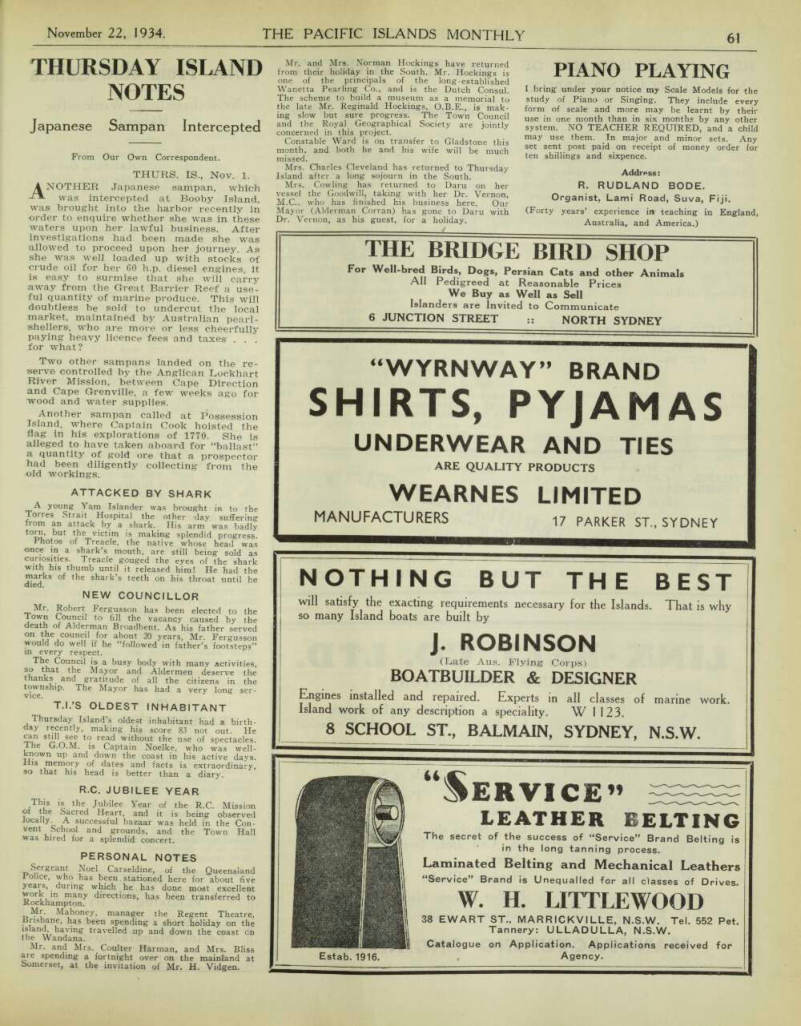
Notes
Japanese Sampan Intercepted
From Our Own Correspondent.
Thurs. Is., Nov. 1.
ANOTHER Japanese sampan, which was intercepted at Booby Island, was brought into the harbor recently in order to enquire whether she was in these waters upon her lawful business. After investigations had been made she was allowed to proceed upon her journey. As she was well loaded up with stocks of crude oil for her 60 h.p. diesel engines, it is easy to surmise that she will carry away from the Great Barrier Reef a use ful quantity of marine produce. This will doubtless be sold to undercut the local market, maintained by Australian pearl shelters, who are more or less cheerfully paying heavy licence fees and taxes . . for what?
Two other sampans landed on the re serve controlled by the Anglican Lockhart River Mission, between Cape Direction and Cape Grenville, a few weeks ago for wood and water supplies.
Another sampan called at Possession Island, where Captain Cook hoisted the flag in his explorations of 1770. She is alleged to have taken aboard for “ballast” a quantity of gold ore that a prospector had been diligently collecting from the old workings.
Attacked By Shark
A young Yam Islander was brought in to the Torres Strait Hospital the other day suffering from an attack by a shark. His arm was badly torn, but the victim is making splendid progress.
Photos of Treacle, the native whose head was once in a shark’s mouth, are still being sold as curiosities. Treacle gouged the eyes of the shark with his thumb until it released him! He had the marks of the shark’s teeth on his throat until he died.
New Councillor
Mr. Robert Fergusson has been elected to the Town Council to fill the vacancy caused by the death of Alderman Broadbent. As his father served on the council for about 20 years, Mr. Fergusson would do well if he “followed in father’s footsteps” in every respect.
The Council is a busy body with many activities, so that the Mayor and Aldermen deserve the thanks and gratitude of all the citizens in the township. The Mayor has had a very long ser vice.
T.I.’S Oldest Inhabitant
Thursday Island’s oldest inhabitant had a birth day recently, making his score 83 not out. He can still see to read without the use of spectacles.
The G.O.M. is Captain Noelke, who was well known up and down the coast in his active days.
His memory of dates and facts is extraordinary, so that his head is better than a diary.
R.C. Jubilee Year
This is the Jubilee Year of the R.C. Mission of the Sacred Heart, and it is being observed locally A successful bazaar was held in the Con vent School and grounds, and the Town Hall was hired for a splendid concert.
Personal Notes
Sergeant Noel Carseldine, of the Queensland Police, who has been stationed here for about five years, during which he has done most excellent work in many directions, has been transferred to Rockhampton.
Mr. Mahoney, manager the Regent Theatre, Brisbane, has been spending a short holiday on the island haying travelled up and down the coast on the Wandana.
Mr. and Mrs. Coulter Harman, and Mrs. Bliss are spending a fortnight over on the mainland at Somerset, at the invitation of Mr. H. Vidgen.
Mr. and Mrs. Norman Hockings have returned from their holiday in the South. Mr. Hockings is one of the principals of the long-established Wanetta Pearling Co., and is the Dutch Consul.
The scheme to build a museum as a memorial to the late Mr. Reginald Hockings, O.B.E., is making slow but sure progress. The Town Council and the Royal Geographical Society are jointly concerned in this project.
Constable Ward is on transfer to Gladstone this month, and both he and his wife will be much missed.
Mrs. Charles Cleveland has returned to Thursday Island after a long sojourn in the South.
Mrs. Cowling has returned to Daru on her vessel the Goodwill, taking with her Dr. Vernon, M.C., who has finished his business here. Our Mayor (Alderman Corran) has gone to Daru with Dr. Vernon, as his guest, for a holiday.
Advertisements & other items, pp. 63-64 (1 item)
Shirts, Pyjamas
PIANO PLAYING
I bring under your notice my Scale Models for the study of Piano or Singing. They include every form of scale and more may be learnt by their use in one month than in six months by any other system. NO TEACHER REQUIRED, and a child may use them. In major and minor sets. Any set sent post paid on receipt of money order for ten shillings and sixpence.
Address:
R. RUDLAND BODE.
Organist, Lami Road, Suva, Fiji. (Forty years’ experience in teaching in England, Australia, and America.)
THE BRIDGE BIRD SHOP
For Well-bred Birds, Dogs, Persian Cats and other Animals All Pedigreed at Reasonable Prices We Buy as Well as Sell Islanders are Invited to Communicate
6 JUNCTION STREET NORTH SYDNEY
“WYRNWAY” BRAND
SHIRTS, PYJAMAS
UNDERWEAR AND TIES
ARE QUALITY PRODUCTS
WEARNES LIMITED
MANUFACTURERS 17 PARKER ST., SYDNEY
NOTHING BUT THE BEST
will satisfy the exacting requirements necessary for the Islands. That is why so many Island boats are built by
J. ROBINSON
(Late Aus. Flying Corps)
BOATBUILDER & DESIGNER
Engines installed and repaired. Experts in all classes of marine work.
Island work of any description a speciality. W 1123.
8 SCHOOL ST., BALMAIN, SYDNEY, N.S.W.
Estab. 1916.
“Service”
LEATHER BELTING
The secret of the success of “Service” Brand Belting is in the long tanning process.
Laminated Belting and Mechanical Leathers “Service” Brand is Unequalled for all classes of Drives.
W. H. LITTLEWOOD
38 EWART ST.. MARRICKVILLE, N.S.W. Tel. 552 Pet.
Tannery: ULLADULLA, N.S.W.
Catalogue on Application. Applications received for Agency.
NEW AND REVISED MAP OF
NEW GUINEA AND PAPUA
Just issued by the Commonwealth Government Printer.—Contains all Details added as result of Most Recent Patrols and Surveys—includes Bouganville Island and large Scale Map of Gazelle Peninsula—Shows Details of Morobe Goldfield, and Newly Discovered Ramu-Mt. Hagen Region, also Aeroplane Landing-grounds Coloured to show Administrative Districts.
Posted direct to any address— On Paper 3/- Mounted on Linen 5/-
PACIFIC PUBLICATIONS LTD.
Union House, 247 George St., Sydney.
P.O. Box 3408 R, Sydney. [May also be obtained direct from Prime Minister’s Department, Canberra, for 2/6 (paper) plus postage,]
For Well Bred
FOXIES, CATTLE KELPIES,
POMERANIANS or Any Other (Both Sexes) Write Established 5 Years.
57 Goulburn St., Sydney
(A Feeding Chart with Every Animal.) Satisfaction Guaranteed
ISLAND PATRONS RECEIVE SPECIAL ATTENTION.
LINK-BELT CO. LTD.
17 GOULBURN STREET, SYDNEY
Modern Machinery Equipment for Elevating, Conveying and Mechanical Handling of Material.
Sole Agents in Australia for Ewart Chain Belting in Malleable or Steel.
Specialists in Power Transmission Machinery.
Large Stocks always kept of Steel Shafting, Cast Iron, Steel, or Wood Split Pulleys.
Plummer Blocks, Collars, Couplings, Leather Belting, Hangar Bearings.
Lubricators, Engineers’ Wrenches.
Centrifugal Discharge Bucket Elevator
MANUFACTURING ENGINEERS
Copra Market
Combine Still Fixing Prices
From a Special Correspondent.
LONDON, October 10.
CONDITIONS have altered very little and the markets for tropical products are about the same. There has been a slight hardening of copra prices in Mar seilles, which may—or may not —indicate a change for the better. But I fear not.
Certain financial interests appear to think that rubber is settled for the better, and two rubber companies are reported to have had successful flotations. The latest flotation, Malacca Rubber Plantations, is said to have been heavily over-subscribed.
Yesterday I was talking with one of the leading sellers of Pacific Islands copra in London. I asked him what the copra market was like, and he said: “Firm. But our friends of Unilever are annoyed and refuse to buy. We just have to meet their wishes, as they are the only buyers in this market.” That, in a nutshell, is the posi tion, of the market in Britain.
There is a world-combination of copra buyers, supreme and unchallenged. The only possible answer to the combine would be a world combination of copra-pro ducers ; and that is an entirely hopeless
proposition.
Notes From New Guinea
New Freezing Works for Rabaul
From Our Own Correspondent.
Rabaul, Oct. 10.
GOOD progress is being made with the erection of the new freezing works at the corner of Kamerere Street and Mango Avenue. The opening of this enterprise will start some competition, no doubt, in fresh food articles. At present we are paying 1/1 per lb for roast sirloin of beef, 10d per lb for leg of mutton, 11d for mutton chops, 1/3 for rump steak, and 2/for fillet steak.
During September 8145 tons of copra: were exported from the Aus tralia received 345 tons, Prance 405 tons, optional European ports 890 tons, 968 tons went to Italy, 2461 tons to Germany, and; 3077 tons to England.
A pretty wedding was held on October 10 at St. George’s Church when Archdea con de Voil performed the marriage cere mony between Miss Beryl Fair and Mr.
Phillip Hooper, 'of the Commonwealth Bank staff. Mr. and Mrs. Hooper departed for Australia the same evening by the s.s.
Nankin.
There have been a few cases of typhoid fever in Rabaul during the past month, and one Chinaman, who landed recently from China, died from the effects. All cases are now well on the road to re covery, and there is no need for alarm of the disease spreading.
In the month of September 6.88 inches of rain fell at Rabaul, which makes a total of 53.42 inches since the beginning of January, 1934. The average annual rain fall for the past twenty years has been 86.54.
The remarks made by the captain of the s.s. “Van Rees” in regard to the need for more up-to-date charts of the waters about this Territory are very timely. Sea faring men are always complaining of the need for hydrographic surveys, espe cially in certain areas, and it is a wonder that the Australian authorities—for their own sake —do not do something in the matter. Not only for commercial, but also for strategical purposes are these surveys needed.
Presents For Kavieng
Lepers
The inmates of the Kavieng Leper Colony, New Guinea, are likely to receive some pleasant sur prises at their forthcoming Christmas treat. Fol lowing the publication of an appeal for gifts by Dr. S. A. Holland, medical officer at the Colony, a Sydney firm has donated a number of games and presents. These have now been supplemented by gifts of toys, dolls, balls, beads, etc. from the public. It is intended to send the presents by the November Montoro, so that they shall arrive in time to be distributed among the 550 patients at their annual party.
Advertisements & other items, p. 64 (1 item)
For Your
FLY SPRAY IODINE
PEROXIDE OF HYDROGEN
LA FLEUR TOILET PRODUCTS
Leston Manufacturing Co.
SYDNEY
Samples and Price Lists on application
Solomon Is. Gold
Discoveries in Guadalcanal
CONVINCED that there is payable gold in Guadalcanal, Mr. P. Courtney re turned to Sydney in October from the Solomon Islands, where, with Mr. Tom Waters, a veteran mining engineer, he has been prospecting for some months.
Mr. Courtney said that he had pene trated deep into Guadalcanal and had proved that, though no definite reef for mations had been located, every water way in a large area contained alluvial gold. The area they examined was only 15 miles from the coast, but owing to the dense jungle and broken limestone coun try they painfully traversed 60 miles to get there. Mr. Waters became sick and had to be carried out on a stretcher.
Further developments are likely. Mr.
Courtney said he had been given every assistance by the Solomon Islands Ad ministration.
Cocoa Beans
Market Sought for N.G. Product
interests are making a very strong effort to organise in Australia a market for cocoa beans from New Guinea. It is reported that the biggest consumers of cocoa beans in Australia— confectionery makers—have displayed in difference, if not hostility, towards the New Guinea product; and a move is now afoot to urge that a tariff be placed on cocoa beans from other than Australian sources.
The most serious difficulty, however, is the poor quality of most of the cocoa beans which are sent from New Guinea.
The beans as grown compare favorably with the beans from other countries; but in New Guinea the washing and cleaning are careless in the extreme, and the fer mentation is very defective. The appear ance of the beans when opened up in Sydney, carrying too much mulch, is not attractive.
If the New Guinea Administration could establish for N.G. cocoa beans the same recognised high standard of quality that it established for copra, it will be doing the Territory a very real service.
Mr. Lauriston Sharp, Harvard University An thropological Research Scholar, is continuing his work among the Gulf tribes of the Cape York Peninsula. He will remain at the Mitchell River Mission during the ensuing wet season. Miss Ursula McConnell, of the Sydney University, who has been similarly engaged in the district, has returned South.
After spending over 12 months in the New Hebrides, Mr. A. J. Marshall, a member of the Oxford University’s South Sea Expedition, arrived in Sydney by the Morinda on September 20. He brought with him many specimens for the Aus tralian Museum.
Papuan Sugar Syndicate Ltd., having nominal capital of 990 ordinary shares of £10 each and 100 founders’ shares of £1 each, was registered in Papua as a local company in September. The company’s registered office is at the office of Mr.
R. D. Bertie, Port Moresby.
Advertisements & other items, pp. 65-66 (1 item)
Christies’
PRESCOTT LTD Sussex St Sydney are sole wholesale agents for
PINEAPPLE BACON & HAMS
DAISY BRAND BUTTER
FRESCO BRAND BUTTER
LEA & PERRINS’ SAUCE
CHRISTIES’
FOR ALL KINDS OF
UMBRELLA UMBRELLAS
REPAIRS CHRISTIES, LTD., 568 George St., Sydney
CHAPMAN ENGINEERING CO.
General Engineers and Iron Founders Manufacturers of Cast Iron Pulleys, Saw Spindles, Special and General Machinery; also Repairs ADOLPHUS ST., BALMAIN, SYDNEY. Any quotation on request
A LASTING PROPOSITION
EFFICIENT
RELIABLE
GUARANTEED
Manufacturers of Quality Batteries
ERG BATTERIES LTD
156 GOULBURN ST., SYDNEY, N.S.W.
Battery Manufacturers and Auto Electrical Engineers
TIE ON GAS MANTLES
Something better for Your Lamp
FLEXIBO LIGHTING COY.,
9-15 KIPPAX STREET :: SYDNEY
Manufacturers of the famous Flexibo Gas Mantle, suitable for all petrol storm-proof lamps, table lamps, tilly lamps, and all hollow wire systems.
Flying insects will not break this mantle. Agents wanted—samples to all prospective reputable agents.
STANDARD DRUG CO.
FOR ALL YOUR
CHEMICAL AND TOILET
REQUIREMENTS
Island Representative;
W. M. REID, YORK STREET, SYDNEY
Head Office:
26 HUTCHISON STREET, SYDNEY
New Britain Express Delivery.
GENERAL OVERSEAS AGENTS.
GENERAL CARRIERS. BAGGAGE AGENTS,
and FORWARDING AGENTS.
Reliable Cars and Trucks.
We aim to give quick and reliable Service at reasonable costs. P.O. Box 116. Telephone 141.
W. WALKER-FLYNN, Proprietor, Market Street. Rabaul. T.N.G.
GLOBEX
(GLOBE BEEF EXTRACT)
GLOBEX
FOR GOOD BEEF TEA
GLOBEX
FOR SOUPS & GRAVIES
GLOBEX
DELICIOUS SPREAD THINLY ON BREAD
OOtainxxU& at 2oz.jar9.oW Obtainable from All Island Traders
KELVIN RICARDO ENGINE S
KELVIN DIESEL ENGINES
Your business calls for more economical working. What are you doing regarding your power units? Every Island Planter, Trader, or person whose business requires mechanical power should enquire into and procure particulars of the latest list of Kelvin Diesel Engines.
These are some of the points that will interest you. Regarding horse power, quality, robust construction regarding Kelvin Diesel Engines. Every engine is tested and certificate is supplied with every engine, cost, fuel consumption, simplicity, compactness, and freedom from unnecessary auxiliary gear, regarded as the Rolls Royce of the Marine world of engines. Their price with equal equipment of equal quality. The following are facts backed by the maker’s guarantee, consume 1.~ you have no need to worry What concerns you is capital Kelvin Diesel Engines have always been cannot be approached by any other make , - Fuel consumption for every 22-horse power Kelvin Diesel Engines ~of ~Crude° oil'per hour, equal'to .41 pints per brake horse power per hour. The consumption of lubricating oil is one gallon every 80 hours running. Put into simple language, a 22-Horse Power Kelvin Diesel Engine would consume 108 gallons of fuel oil and 11/ gallons of lubricating every 100 hours running at full speed. The present price of fuel oil is less than 6d. per gallon, lubricating oil If. per gallon, before V gallons of fuel oil a. 6d per gallon, £2/14/-; 1.1/4 gallons lubricating oil 6A 7/6 Total cost, £3 1/6 per 100 hours running In the average boat this engine would be used in a speed of about seven, miles an hour should be attained. This works out at a total running cost of Id. per mile, half the cost of a ride, one section on the tram in Sydney. .
KELVIN DIESELS are compact, therefore you have the advantage of a very much greater carrying capacity from your cratt have the maker’s guarantee and the certificate of Lloyds that your actual engine was tested and complies with these details.
When you buy a Kelvin you buy a complete equipment. You know you have everything for a complete installation, air to worry about and no vigorous cranking; just a simple arrangement for starting.
These engines can also be produced fitted with electric generator, bilge pump and search light.
Horse Power.
You No compressed Sizes. I Cylinder, 22 44 66 88 132
Cylinders, 22
33 44 Horse Power 1000 Revolutions per Minute. 750 Revolutions per Minute.
PRICES: £350 to £1450. FREE ON BOARD SYDNEY. IN BOND.
I have a first-class workshop and can undertake all kinds of engine repairs or the supply of all kinds of machinery. „ Send along your enquiries giving full particulars of your requirements, and you will receive full details by return post. Estimates given for all k nds of caf .
Sole Australian and South Sea Island Representative.
GEORGE RUTHERFORD, Endeavour House, 46 Pitt Street,Sydney.
Quinine Blindness
Well-known Miner's Experiences in Purari Region, T.N.G.
MR. J. L. PEADON, who has been gold prospecting and gold mining in the Ramu-Purari districts, Central New Guinea, for the past two years, arrived recently in Sydney in order to seek ex pert attention for his eyesight. It ap pears that Mr. Peadon is suffering from a rare form of what virtually is quinine poisoning—and, incidentally, Mr. Pea don’s experience should be noted by all people in the tropics who may be obliged to use quinine freely.
Mr. Peadon, when he went up to the high, cold country in Central New Gui nea, suffered from bad attacks of malaria, and finally he put himself to bed (he was quite alone, except for his team of native boys) and took no fewer than 70 grains of quinine in 24 hours. He is a man who has taken large quantities of quinine in past years—he had been 12 years in New Guinea —and he did not regard the drug as dangerous.
He broke the fever, but when he got up he was practically blind. Gradually, his sight returned, but he found that his field of vision was very much limited; al though he could see objects straight ahead quite clearly, he could see nothing at the sides. He therefore proceeded to Sydney as soon as possible and placed himself in the hands of a skilled oculist.
The latter, however, does not give him much hope; he is of opinion that, while Mr. Peadon’s remaining sight is safe, he will not recover much, if any, of the sight that he has lost. He has consequently abandoned for the present any thought of returning to the New Guinea gold field. Specialists have told him that there is always a danger of quinine af fecting the eyesight, though cases such as this are rare.
Mr. Peadon was on the Ramu for a
while, and on the upper reaches of the Purari, not far from where Captain Ber nard McGrath was murdered by natives; and while there he established a store and licensed hotel. A considerable num ber of miners have pushed into that country from the Morobe goldfields— quite sufficient to justify the hotel and store business. Subsequently, Mr.
Peadon, with 35 natives, went off down the Purari towards the Papuan border, into practically unknown country, and here he found quite profitable alluvial gold. He spent some months in this dis trict out of touch altogether with the small white settlement on the Ramu. He made friendly contact with the local na tives, whom he describes as a very fine and intelligent class, of a type similar to the Benna-Bennas. He found them friendly and tractable and, once he got their confidence, he did not have any dif ficulty in inducing them to work for him in his mining operations. He did not leave this country until driven out by his eyesight trouble.
Mr. Peadon’s store-keeping business on the Ramu has been taken over for the present by the Seventh Day Adventist missionaries. The licensed hotel business probably is in abeyance for the present.
The Ramu-Purari-Mt. Hagen plateau is described by Mr. Peadon as really mag nificent country, with a good climate, comparatively free from the diseases and pests encountered in the coastal areas, and inhabited by a fine type of native.
They are high-spirited people and are always ready for a fight; but their atti tude towards Europeans is friendly, pro vided that the Europeans know how to treat them. Much trouble, however, may be caused if these natives come in con tact with the wrong type of European.
Parties of missionaries are displaying a readiness to push into this country, and the more experienced prospectors, who are anxious that this fine type of native shall remain unspoiled, do not view the arrival of the missionaries with any en thusiasm.
“You may find in that country,” says Mr. Peadon, “one solution of all our poli tical and economic troubles. They are a healthy, happy, contented race of natives without any strikes, political muddles, re ligious differences, or doles.”
Pacific Mining Notes
Enterprise Of N. Guinea
In a progress report to shareholders of En terprise of New Guinea, N.L., the directors state that altogether the company possesses 13 mining tenements in the Morobe goldfield, comprising ap proximately 4400 acres of auriferous country.
Several valuable water-rights have been secured and provide the facilities for the development of adequate economical hydro-electric power.
Samples from the three properties where work is at present concentrated give highly satisfactory results, and it is considered that even an average gold content of 3/- a cubic yard will yield profitable results.
The directors express the hope that the expedi tion at present on the field on the company’s behalf would at an early date report further im portant discoveries.
Equatorial Gold
The representatives of Equatorial Gold Explora tion (New Guinea and New Britain) Syndicate N.L. (Dr. J. R. Atcherley and Mr. A. E. Palmer) ad vise they have located gold deposits in New Brit ain. They are forwarding samples to the Mel bourne office.
Koranga Gold Sluicing
Koranga Gold Sluicing Ltd., New Guinea, showed a net profit of £15,837 for the year ended June 30, compared with £6,213 for the previous year. Divi dends and bonuses totalling 9/6 per share of £1 each absorbed £13,300. Production of 5997oz. bullion, which realised £25,638. The capital of the company is £28,000.
Guinea Gold Now Drilling At
Lakekamu
Guinea Gold, N.L., reports that after a pre liminary reconnaissance of the company’s new properties in the Lakekamu district, Papua, the technical staff of Placer Development, Ltd., has recommended an extensive drilling ’campaign. Two complete units of drilling plant arrived in New Guinea at the end of October. Both are scheduled to be in full operation on the Babuau areas during November. Owing to the great extent of the pro perties it may be six months before comprehen sive reports on values can be submitted.
Misima Central Gold
With a nominal capital of £5000 in £5 shares, Misima Central Gold N.L., has been formed in Melbourne to acquire applications relating to four leases covering 89 acres on the island of Misima, Papua. Four adits have been driven on the south eastern end of the leases known as Misima North east and Misima North-east No. 2, which are situated three and a half miles from the wharf at Bwagaoia. There are two lodes on these leases.
The other leases, known as Misima Central and Misima Central No. 2, are situated on the north ern extension of the line of lode which strikes through the leases of Misima Gold Reefs N.L., New Misima Gold Mines Ltd., and Mt. Sisa Com pany, The lodes are stated to run from end to end on these leases, a distance of 2300 ft., with an approximate width of lift. Assays of four samples showed values ranging from 2dwt. 10gr. to 8dwt. 23gr.
It is proposed to undertake such development work as is deemed necessary to secure further capital to work the mine in a profitable man ner. The public subscribed for 750 shares, and the remaining £250 shares were issued as fully paid to the vendors. The legal manager is Mr. H. R.
Lockwood, of 360 Collins Street, Melbourne.
New Guinea Prospectors, N.L.
The result of the examination of company’s areas in Milne Bay Goldfields (Eastern Papua) has proved unsatisfactory, and the areas are being abandoned.
Day Dawn To Hire Electric
Power
In consequence of the excessive cost of trans portation of steam power plant, the directors cf Day Dawn South (New Guinea) N.L. have de cided to approach another company, operating near the mine, to supply sufficient electric power for a crushing plant. If negotiations are success ful. a plant will be installed immediately. The mine manager, they add, estimates that there is about 4500 tons ore available for milling, aver aging 1oz. 10dwt. fine gold and 100oz. silver per ton. The average width of the reef is 3ft.
Gold Mines Of Papua
In a report to shareholders on November 8, the Directors of Gold Mines of Papua stated that a full programme of work is in progress at their mines on Misima and Woodlark Islands, and that prospects are encouraging. An auxiliary ketch will be purchased to run between Samarai, Misima, and Woodlark; and arrangements will be made for direct wireless communication.
Misima Is. —Development of Mt. Sisa leases being carried out on continually increasing scale. Two lines of lode are being tested for a length of 1700 feet by adits driven at regular horizons, com mencing from creek bed to height of 500 ft. up Mt.
Sisa ridge. Double shift of natives now employed testing ore bodies from the adits. The two main ore bodies are well defined, but the gold distribu tion is erratic.
Woodlark Is. —Preliminary testing at Northern section of Kulumadau lease has been commenced.
No. 1 lode, tapped by short cross-cut, assayed 8.2 dwts for a sampled width of 50in. A North drive has been commenced on this ore body. Samples from No. 2 lode (parallel) show values up to 32.4 dwts. for a width of 30in. This is to be further tested.
Sand and Slimes. —Site for re-treatment of Kulu madau tailings dump has been cleared and prepara tions are being made for installation of plant.
Preliminary tests show the 100,000 tons available have an extraction value of 1.02 dwts.
N.G. Goldfields Notes
THE new hotel at Upper Edie has been taken taken over by Bob Franklin. This venture is proving increasingly popular, as visitors to Wau make a point of going right “to the top” before leaving the goldfields.
The new Administrator spent a few days here and was enthusiastic over the attention and the artistic arrangement of the rooms, the special “green” room being placed at his disposal.
In the dining room, coloured cloths are used, like the ones at Hordern Bros., and each table has flowers to match. Imagine that, right up here, in the heart of N.G.!
History was made recently when Edie Creek cricket team beat Wau. “Snow” Blackley, of course, was the cause of it all; in an innings of 349 he made 124. Then that “bete noir,” Brien Lane, kept up his stonewalling, and the victory went to the Creek. Was there hilarity in conse quence? Now, I ask you!
Mr. Clem Kirke and his brother who have acquired much acreage outside Wau are doing well with their market garden and orchard. Al ready they have planted oranges, lemons, grape vines, acres of bananas, pawpaws, granadillas, melons and potatoes. This venture deserves com mendation, for fresh fruit and vegetables will mean much to the Territory.
The Kirke Bros, are well-known in the Islands, and their eldest brother Captain Errol Kirke was in the landing at Rabaul and was afterwards killed at Pozieres.
Mr. Harry White, who was ordered South with yellow fever from Wau returned on the last Mac dhui, looking very well. Strange how the tropics grip one, Harry says he simply couldn’t live in Sydney again.
A demand for information showing the nature of the agreement made between the British and Commonwealth Govern ments in connection with the search for oil in New Guinea was made in the Com monwealth Parliament on November 2 by Mr. Makin. The Prime Minister pro mised to make details available.
Advertisements & other items, pp. 67-68 (1 item)
Doan’S
Feel Always
Stiff and Achy?
"Every Picture tells a Story"
Kidney Disorders Are Too Serious to Ignore Are you troubled with backache, bladder irritations, and getting up at night?
Then don’t take chances!
Help your kidneys at the first sign of disorder. Use Doan’s Backache Kidney Pills. Successful for more than 30 years. Endorsed by thousands of grateful users.
Get Doan’s to-day and they will soon banish every ailment arising from inactive kidneys.
DOAN’S
BACKACHE KIDNEY PILLS.
All Chemists and Stores
SHIP CHANDLERY-HARDWARE
BROOMFIELDS LIMITED, 152 Sussex St., SYDNEY
Large and Complete Stocks of SHIP CHANDLERY.
Ironmongery of all kinds Paints, White Lead and Oils.
Sole Agents for: P. H. MUNTZ & CO.’S 3-CROWN BRAND METAL SHEATHING.
PEACOCK & BUCHANS’ ENGLISH READY-MIXED PAINTS.
WRITE FOR SHIP CHANDLERY CATALOGUE.
Special “In Bond” Prices fop ail Island enquiries quoted on application.
CABLES: “BOOM,” SYDNEY.
AT BLUE MOUNTAINS
SPRINGWOOD, N.S.W.
Springwood Ladies’ College
Est. 1897. Kindergarten to Leaving Certificate. Tennis, Riding, Swimming, Team Games. Unequalled climate. Pure Jersey Milk. Senior and Junior Houses. Open-air sleeping. Inclusive fees. Special vacation arrangements for Island pupils.
M. E. DURAND, Principal.
IN CASES OF EMERGENCY YOUR
HOME IS INCOMPLETE WITHOUT A
MEDICINE CABINET. BE PREPARED!
You can purchase the highest quality surgical dressings, pharmaceutical requirements and all chemists sundries at! the lowest possible prices direct from
The VICTOR PHARMACEUTICAL
AGENCIES
Phillip House, Phillip St., Sydney.
Orders, inquiries and quotations attended to immediately. Enclose postage for reply.
Address all mail to The Manager, Box 374955, G.P.O., Sydney
Lloyd’s Teas
Tea drinkers expect more than a mere drink.
That easy, relaxed feeling, that sense of contentment and glow of real satisfaction must be there . . . not once in a while, but with every cup.
Try Lloyds for purity. Try the consistent goodness of quality tea. Try the delicious aroma that is such a feature of Lloyd’s tea blending.
Obtainable at all good island stores.
COPRA MATS AND MATTING
Send your enquiries to us for Woven Wire Mesh in Rolls or framed for Copra drying, and all Screening purposes. Bird Cages, Sieves and Riddles, Builder’s Gravel Screens, Rat Traps, Door Mats, Garden Arches, Chain Wire Mesh, Crimped Wire Mesh for Window Guards, etc.
SCOTT AND SONS
WIREWORKS: RAILWAY PARADE AND MURRAY STREET, MARRICKVILLE
FOR SALE—AT ATTRACTIVE PRICES
New and High Grade Used Machinery for
Mining and Other Purposes
150 tons Assorted Steel Rails, from 14lb. to 40lb. per yard. 27,000 ft.
Galvanised and Black Water Pipes, from the smallest diameter to 4in Two and Three Head Prospector’s Batteries, Rockcmshers, and Crushing Rolls, Portable and Stationary Air Compressors and Receivers, Jackhammers. One Hudson Steam Loco, for 2ft. rail gauge. Trucks, Wheels, and Axles. 6000 ft. x 6in. Piping, Pulleys, Belting, Pumps for every proposal. Oil and Water Storage Tanks, Petrol and Crude Oil Engines, Winches, Wire Ropes, Ore Buckets, Lifting Blocks, Boilers, and Compact High Speed Steam Engines, Screening, Bed] Mills, Blowers, and Fans.
Inquiries Invited. Cable address: “Easincog,” Sydney.
E. A. SLOMAN
Machinery Merchant, 12 Rothschild Ave., Rosebery, Sydney
Missionaries Or Anthropologists
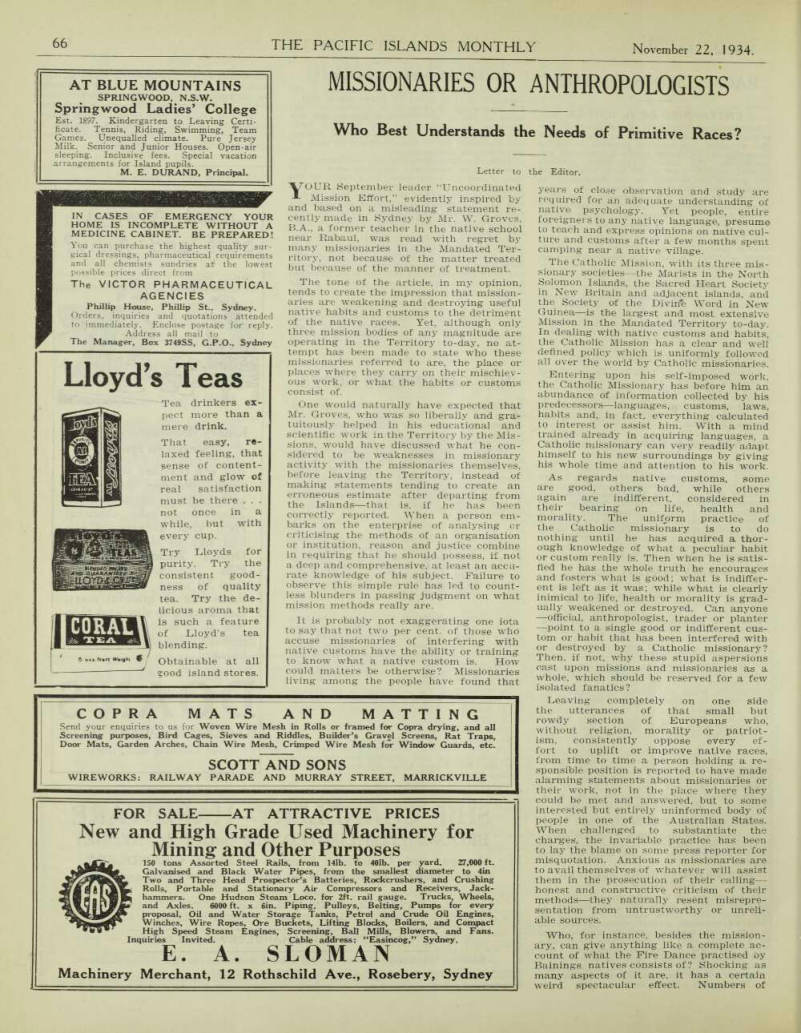
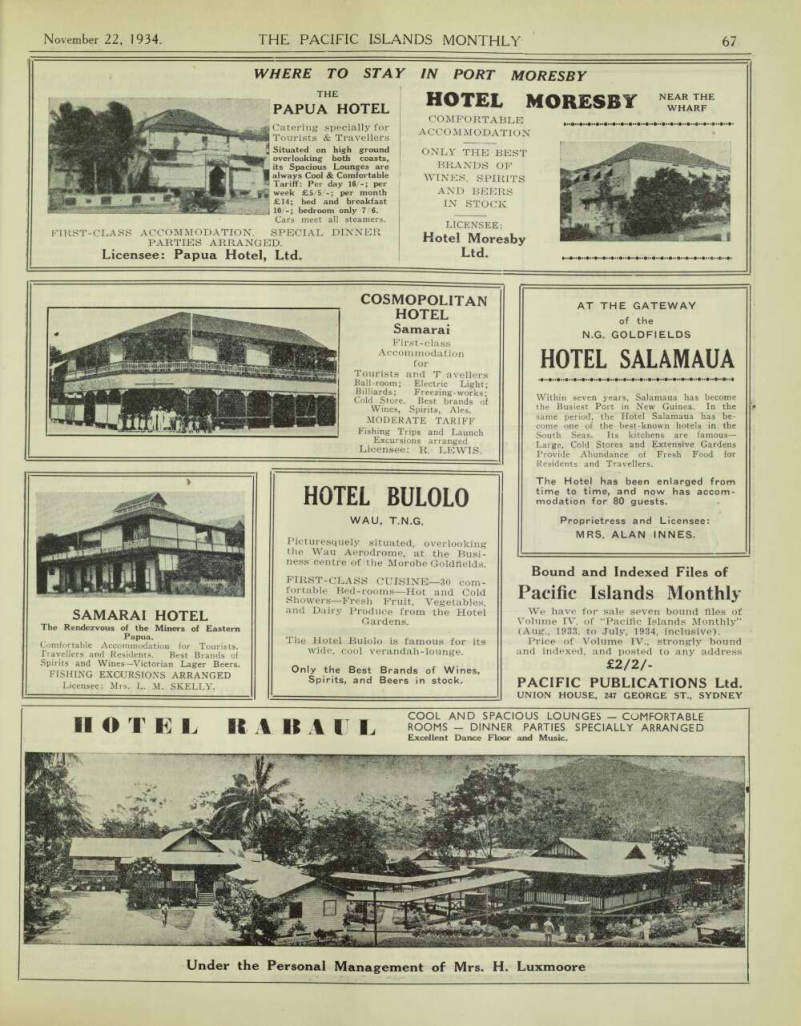
Who Best Understands the Needs of Primitive Races?
Letter to the Editor.
YOUR September leader “Uncoordinated Mission Effort,” evidently inspired by and based on a misleading statement re cently made in Sydney by Mr. W. Groves, B.A., a former teacher in the native school near Rabaul, was read with regret by many missionaries in the Mandated Ter ritory, not because of the matter treated but because of the manner of treatment.
The tone of the article, in my opinion, tends to create the impression that mission aries are weakening and destroying useful native habits and customs to the detriment of the native races. Yet, although only three mission bodies of any magnitude are operating in the Territory to-day, no at tempt has been made to state who these missionaries referred to are, the place or places where they carry on their mischiev ous work, or what the habits or customs consist of.
One would naturally have expected that Mr. Groves, who was so liberally and gra tuitously helped in his educational and scientific work in the Territory by the Mis sions, would have discussed what he con sidered to be weaknesses in missionary activity with the missionaries themselves, before leaving the Territory, instead of making statements tending to create an erroneous estimate after departing from the Islands—that is, if he has been correctly reported. When a person em barks on the enterprise of analysing or criticising the methods of an organisation or institution, reason and justice combine in requiring that he should possess, if not a deep and comprehensive, at least an accu rate knowledge of his subject. Failure to observe this simple rule has led to count less blunders in passing judgment on what mission methods really are.
It is probably not exaggerating one iota to say that not two per cent, of those who accuse missionaries of interfering with native customs have the ability or training to know what a native custom is. How could matters be otherwise? Missionaries living among the people have found that
years of close observation and study are required for an adequate understanding of native psychology. Yet people, entire foreigners to any native language, presume to teach and express opinions on native cul ture and customs after a few months spent camping near a native village.
The Catholic Mission, with its three mis sionary societies—the Marists in the North Solomon Islands, the Sacred Heart Society in New Britain and adjacent islands, and the Society of the Divine Word in New Guinea—is the largest and most extensive Mission in the Mandated Territory to-day.
In dealing with native customs and habits, the Catholic Mission has a clear and well defined policy which is uniformly followed all over the world by Catholic missionaries.
Entering upon his self-imposed work, the Catholic Missionary has before him an abundance of information collected by his predecessors—languages, customs, laws, habits and, in fact, everything calculated to interest or assist him. With a mind trained already in acquiring languages, a Catholic missionary can very readily adapt himself to his new surroundings by giving his whole time and attention to his work.
As regards native customs, some are good, others bad, while others again are indifferent, considered in their bearing on life, health and morality. The uniform practice of the Catholic missionary is to do nothing until he has acquired a thor ough knowledge of what a peculiar habit or custom really is. Then when he is satis fied he has the whole truth he encourages and fosters what is good; what is indiffer ent is left as it was; while what is clearly inimical to life, health or morality is grad ually weakened or destroyed. Can anyone —official, anthropologist, trader or planter —point to a single good or indifferent cus tom or habit that has been interfered with or destroyed by a Catholic missionary?
Then, if not, why these stupid aspersions cast upon missions and missionaries as a whole, which should be reserved for a few isolated fanatics ?
Leaving completely on one side the utterances of that small but rowdy section of Europeans who, without religion, morality or patriot ism, consistently oppose every ef fort to uplift or improve native races, from time to time a person holding a re sponsible position is reported to have made alarming statements about missionaries or their work, not in the place where they could be met and answered, but to some interested but entirely uninformed body of people in one of the Australian States.
When challenged to substantiate the charges, the invariable practice has been to lay the blame on some press reporter for misquotation. Anxious as missionaries are to avail themselves of whatever will assist them in the prosecution of their calling— honest and constructive criticism of their methods —they naturally resent misrepre sentation from untrustworthy or unreli able sources.
Who, for instance, besides the mission ary, can give anything like a complete ac count of what the Fire Dance practised by Bainings natives consists of? Shocking as many aspects of it are, it has a certain weird spectacular effect. Numbers of
deaths from poisoning have followed each dance, yet I have known Europeans, after long residence in the Territory, strongly urging the natives to repeat the Fire Dance for the amusement of a few visitors. Again, how many have the slightest notions of the barbarous practices that have been con demned in the Duk-Duk and Tubuan cus toms —which also have a really fine spec tacular aspect, and which are so common here during the month of May each year?
In my opinion the native has to-day more songs and dances than ever before, European songs have been translated into native languages and as for dances, the native now moves about from village to village and takes part not only in local amusements but in those of villages far apart. Question the old natives who are now disappearing. Listen to their views of life, with its terrifying aspects, before the coming of missionary and civil admin istration broke down the barriers that separated adjacent villages. I have never yet met natives who would exchange the freedom, joy and protection that obtain to-day for the old regime that has happily disappeared.
It is not correct to say that Christianity is a substitute for or displaces any useful or indifferent social practices in village life. Rather, Christianity perfects and re fines all that is good and useful in native customs. On Matupit Island, for instance.
the native custom was for a mother to kill one of twins soon after birth. Naturally, the Christian ideal weakened and destroyed that barbarous custom.
It is, moreover, well known that natives are disappearing rapidly, precisely in those places where there are no missionaries, such as Aua, Ninigo, and Matthias Islands, as well as in the Southern and Western portions of New Ireland; and increasing when under missionary influence.
In an excellent report on the affairs of the Mandated Territory, Colonel Ains worth said the missionaries were the only people who had any useful knowledge of the natives. He was only stating the bare truth, for the simple reason that they are the only people who have really studied the natives in the villages through the native languages.
What useful or reliable knowledge can the student of anthropology, without the slightest knowledge of a native language or even of the “pidgin,” gain by living for twelve or eighteen months close to a native village. Yet many depart with a quantity of information, after spending shorter periods in the Islands. And where does the information come from ? In most cases whatever is really useful has been adopted and adapted from the patient researches of the real anthropologist—the missionary.
I am, etc.,
A Catholic Missionary.
Rabaul, N.G.
Oct., 1934.
EDITORIAL NOTE: We are glad to publish this moderately-phrased, well-reasoned article. But “A Catholic Missionary” and others make a mis take in assuming that the writers whom they challenge have attacked missionaries and mission work. That is not so. Emphatically, Christian missions have a definite place in the Pacific Is lands, and an important work to do, and they are entitled to all the support that can be given to them. They are an essential part of the organisa tion which has “Europeanised” the Pacific peoples.
Criticism comes from another angle. Some an thropologists are of opinion that it would be pos sible to improve vastly the methods of imparting religious teaching to these primitive peoples.
Others, who are not necessarily scientists, argue that it is not desirable that missionaries should go among primitive peoples who are entirely un touched by European civilisation—that there is no call upon missionaries, or anyone else, to save the natives until they have to be saved from the demoralising effect of contact with Europeans.
Advertisements & other items, pp. 69-70 (1 item)
Hotel Bulolo
WHERE TO STAY IN PORT MORESBY
THE
PAPUA HOTEL
Catering- specially for Tourists & Travellers Situated on high ground overlooking both coasts, its Spacious Lounges are always Cool & Comfortable Tariff: Per day 16/-; per week £5/5/-; per month £14; bed and breakfast 10/-; bedroom only 7/6.
Cars meet all steamers.
FIRST-CLASS ACCOMMODATION. SPECIAL DINNER
PARTIES ARRANGED.
Licensee: Papua Hotel, Ltd.
HOTEL MORESBY
NEAR THE
WHARF
COMFORTABLE
ACCOMMODATION
ONLY THE BEST
BRANDS OF
WINES, SPIRITS
AND BEERS
IN STOCK
LICENSEE:
Hotel Moresby
Ltd.
COSMOPOLITAN
HOTEL
Samarai
First-class Accommodation for Tourists and T.avellers Ball-room; Electric Light; Billiards; Freezing-works; Cold Store. Best brands of Wines, Spirits, Ales.
MODERATE TARIFF
Fishing Trips and Launch Excursions arranged Licensee; R. LEWIS.
AT THE GATEWAY
of the
N.G. GOLDFIELDS
HOTEL SALAMAUA
Within seven years, Salamaua has become the Busiest Port in New Guinea. In the same period, the Hotel Salamaua has become one of the best-known hotels in the South Seas. Its kitchens are famous— Large, Cold Stores and Extensive Gardens Provide Abundance of Fresh Food for Residents and Travellers.
The Hotel has been enlarged from time to time, and now has accommodation for 80 guests.
Proprietress and Licensee:
MRS. ALAN INNES.
HOTEL BULOLO
WAU, T.N.G.
Picturesquely situated, overlooking the Wau Aerodrome, at the Business centre of the Morobe Goldfields.
FIRST-CLASS CUISINE—30 com-
fortable Bed-rooms—Hot and Cold Showers—Fresh Fruit, Vegetables, and Dairy Produce from the Hotel Gardens.
The Hotel Bulolo is famous for its wide, cool verandah-lounge.
Only the Best Brands of Wines, Spirits, and Beers in stock.
SAMARAI HOTEL
The Rendezvous of the Miners of Eastern Papua.
Comfortable Accommodation for Tourists, Travellers and Residents. Best Brands of Spirits and Wines—Victorian Lager Beers.
FISHING EXCURSIONS ARRANGED
Licensee: Mrs. L. M. SKELLY.
Bound and Indexed Files of
Pacific Islands Monthly
We have for sale seven bound flies of Volume IV. of “Pacific Islands Monthly” (Aug., 1933, to July, 1934, inclusive).
Price of Volume IV., strongly bound and indexed, and posted to any address £2/2/-
PACIFIC PUBLICATIONS Ltd.
UNION HOUSE, 247 GEORGE ST., SYDNEY
Hotel Rabaul
COOL AND SPACIOUS LOUNGES COMFORTABLE
ROOMS - DINNER PARTIES SPECIALLY ARRANGED
Excellent Dance Floor and Music.
Under the Personal Management of Mrs. H. Luxmoore
A. W. DYE
and Company
ASSAYERS, ANALYSTS,
METALLURGISTS
Buyers of Gold, Silver, Platinum, etc .
T. & G. BUILDING,
ELIZABETH STREET,
SYDNEY, N.S.W.
Established 1914.
Bankers: Commercial Bank of Australia, Ltd.
EVERYTHING FOR THE GOLD-MINER AND ENGINEER
The Largest Distributors of Centrifugal Pumps in Australia
A. B. Smith & Gluyas
61-65 MACARTHUR STREET, ULTIMO, SYDNEY.
Producers and sellers of Gold Bullion may feel assured that there are advantages in dealing with a well-established and widely-organised Company.
THE ELECTROLYTIC REFINING & SMELTING COMPANY OF AUSTRALIA LIMITED is equipped to provide those advantages in the highest degree possible combined with faithful service.
Its facilities for receiving and handling bullion are convenient and safe. Its assaying and refining are in the hands of highly qualified technicians. Its markets are world-wide, ensuring the best prices being paid.
For example the Record Price of gold in Australia was established by this Company on 11th October, 1934, when payment was made to its clients at the rate of £8/16/9½ net per fine oz.
SELLERS IN NEW GUINEA, NEW ZEALAND, PACIFIC ISLANDS, and elsewhere outside Australia should consign their materials to the Company’s Sydney Office.
PROCEEDS FOR NEW GUINEA AND NEIGHBOURING CENTRES are forwarded by the outgoing mail of the same vessel which brings the bullion except in very unusual circumstances. Prompt settlement is a feature of the Company’s service.
Gold Miners:
Instruct your Bankers or your Forwarding Agents to deposit your bullion with:
THE ELECTROLYTIC REFINING & SMELTING CO.
OF AUSTRALIA LIMITED
Melbourne: Works: Sydney: Collins House. Port Kembla, N.S.W. 25 O’Connell Street.
PURCHASERS AND REFINERS OF GOLD, SILVER, COPPER IN ANY FORM BANKERS:—The English, Scottish & Australian Bank Ltd.
Lever Combine And Copra
Prices
“I am glad to note from your journal that Mr. W. R. Carpenter seems to think there is a possibility of the copra market rising,” writes a London correspondent on September 24. ‘‘A London buyer, whom I met a day or so ago, tells me it is true, as Marseilles has risen 15/- in the last 3 weeks; but he agrees that the Lever Combine are at the bottom of the low prices; and detailed his reasons for say ing so. There is no doubt that the dead capital in the Lever corporation makes the position difficult, and when one takes into account the number of companies the combine have absorbed, and paid for them in paper, the position is very diffi cult —more so when it is noted that a number of the absorbed concerns were closed down, lock stock and barrel. The first was Vinolia.
“Anyway, as far as I can see, the posi tion does not show much alteration, and the prices in London are little, if any, altered.”
Market Quotations
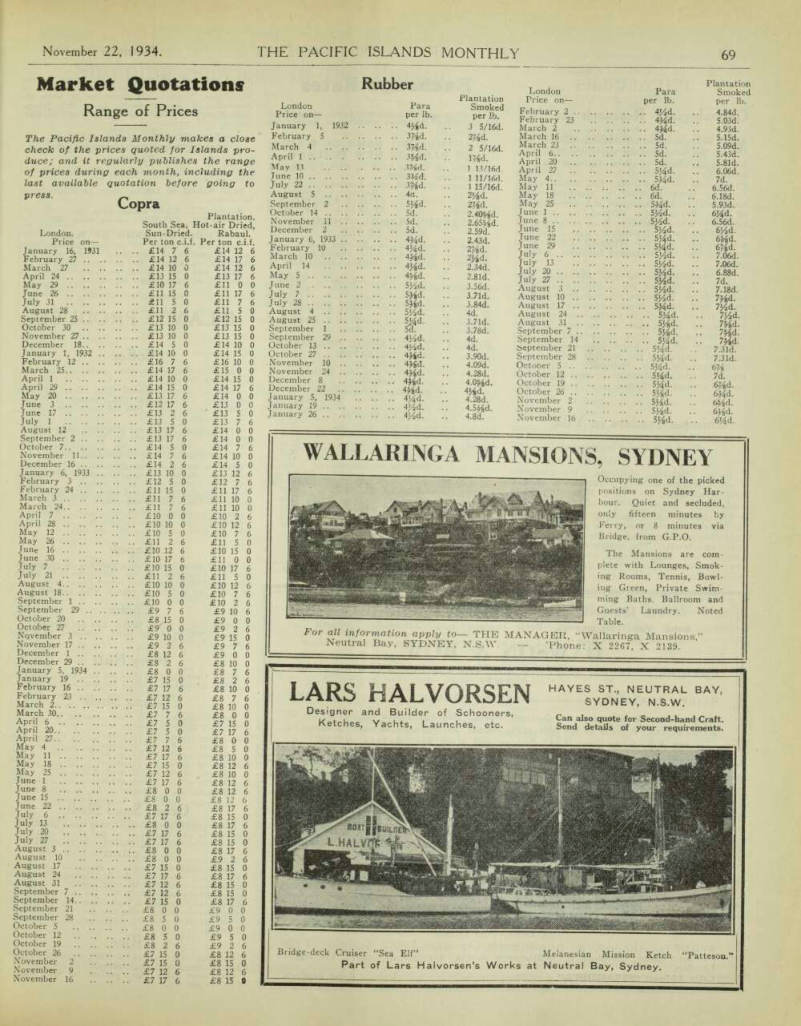
Range of Prices
The Pacific Islands Monthly makes a close check of the prices quoted for Islands pro duce; and it regularly publishes the range of prices during each month, including the last available quotation before going to
Rubber
Plantation London Para Smoked Price on — per lb. per lb.
January 1, 1932 4*d. 3 S/16d.
February 5 md. 2^d.
March 4 md. 2 5/16d.
April 1 Md. md.
May 13 37*d. 1 13/16d.
June 10 3Md. 1 11/16H.
July 22 1 15/16d. 4d. 2 J /id.
September 2 sad. 2Hd.
October 14 5d. 2.405^d. 5d 2.65^d. 2.59d.
December 2 5d.
January 6, 1933 W. 2.43d.
February 10 4J4d. 2^d.
March 10 4^d. 2j£d.
April 14 4/ 8 d. 2.34d.
May 5 4Hd. 2.81d.
June 2 syid. 3.56d.
July 7 5^d. 3.7ld.
July 28 5**d. 3.84d.
August 4 5/ a d. 4d.
August 25 S%d. 3.71d.
September 1 Sd 3.78d. 4d.
September 29 4j/ a d.
October 13 4}4d. 4d.
October 27 4Jid. 3.90d.
November 10 4Hd. 4.09d.
November 24 4Hd. 4.28d.
December 8 December 22 January 5, 1934 4fid. 4^d. 4^d. 4.0^d. 4^d. 4.28d.
January 19 4.5f$d.
January 26 4j4d. 4.8d.
Plantation London Para Smoked Price on — per lb. per lb.
February 2 4/d. 4.84d.
February 23 4J4d.
S.03d.
March 2 4^d. 4,93d.
March 16 5d. 5.15d.
March 23 S.09d.
April 6 5d. 5.43d.
April 20 5d. 5.81d.
April 27 5j*d. 6.06d.
May 4 sy 4 d. 7d.
May 11 6d. 6.56d.
May 18 6.18d.
May 25 5Hd. 5.93d.
June 1 5/d. 6J4d.
June 8 5/d. 6.56d.
June 15 5/d. 6/d.
June 22 5/d 6^d. 67/sd.
June 29 5J4d.
July 6 5/d. 7.06d.
July 13 July 20 5/d. 5j4d. 7.06d. 6.88d.
July 27 sy a d. 7d.
August 3 5/d. 7.18d.
August 10 5'Ad. 7Hd.
August 17 5Hd. 7A d.
August 24 5j4d. 7Ad.
August 31 5j*d. 7V s d.
September 7 S/ 8 d. 7ftd.
September 14 5/d. 7Hd- September 21 S/d. 7.31d.
September 28 5/d. 7.31d.
October 5 5/d. 6 7A October 12 S/d. 7d.
October 19 5/d. 6?*d.
October 26 5^d. 6^d.
November 2 5%d. 6^d.
November 9 6Jid.
November 16 5%d. 6/d.
press.
Copra
Plantation, South Sea, Hot-air Dried.
London.
Sun-Dried.
Rabaul.
Price on— Per ton c.i.f.
Per ton c.i.f.
January 16, 1931 .. .. £14 7 6 £14 12 6 February 27 .. .. £14 12 6 £14 17 6 March 27 .. .. £14 10 0 £14 12 6 April 24 .. .. £13 15 0 £13 17 6 May 29 .. .. £10 17 6 £11 0 0 June 26 .. .. £11 15 0 £11 17 6
July 31
.. .. £11 5 0 £11 7 6 August 28 .. .. £11 2 6 £11 5 0 September 25 .. .. £12 15 0 £12 15 0 October 30 .. .. £13 10 0 £13 15 0 November 27 .. .. £13 10 0 £13 15 0 December 18 .. .. £14 5 0 £14 10 0 January 1, 1932 .. .. £14 10 0 £14 IS 0 February 12 .. .. £16 7 6 £16 10 0 March 25 .. .. £14 17 6 £15 0 0 April 1 .. .. £14 10 0 £14 15 0 April 29 .. .. £14 15 0 £14 17 6 May 20 .. .. £13 17 6 £14 0 0 June 3 .. .. £12 17 6 £13 0 0 June 17 .. .. £13 2 6 ’ £13 5 0 July 1 .. .. £13 5 0 £13 7 6 August 12 .. .. £13 17 6 £14 0 0 September 2 .. .. £13 17 6 £14 0 0 October 7 .. .. £14 5 0 £14 7 6 November 11 .. .. £14 7 6 £14 10 0 December 16 .. .. £14 2 6 £14 5 0 January 6, 1933 .. .. £13 10 0 £13 12 6 February 3 .. .. £12 5 0 £12 7 6
February 24
.. .. £11 15 0 £11 17 6 March 3 £11 10 0 March 24 .. .. £11 7 6 £11 10 0 April 7 .. . £10 0 0 £10 2 6 April 28 £10 12 6 May 12 .. .. £10 5 0 £10 7 6 May 26 .. .. £11 2 6 £11 5 0 Jun e 16 .. .. £10 12 6 £10 15 0 June 30 £11 0 0
July 7
£10 17 6 July 21 £11 5 0 August 4 .. .. £10 10 0 £10 12 6 August 18 £10 7 6 September 1 .. .. £10 0 0 £10 2 6
September 29
... £9 7 6 £9 10 6 October 20 .. .. £8 15 0 £9 0 0 October 27 .. .. £9 0 0 £9 2 6 Nqvember 3 £9 15 0 November 17 .. .. £9 2 6 £9 7 6 December 1 .. .. £8 12 6 £9 0 0 December 29 .. .. £8 2 6 £8 10 0 January 5. 1934 .. .. £8 0 0 £8 7 6
January 19
.. .. £7 15 0 £8 2 6
February 16
.. .. £7 17 6 £8 10 0
February 23
£8 7 6 March 2 £8 10 0 March 30 £8 0 0 April 6 .. £7 5 0 £7 15 0 April 20 .. .. £7 5 0 £7 17 6 April 27 £8 0 0 May 4 .. .. £7 12 6 £8 5 0 May 11 £8 10 0 May 18 £8 12 6 May 25 £8 10 0 June 1 .. .. £7 17 6 £8 12 6
June 8
.. .. £8 0 0 £8 12 6 June 15 £8 12 6
June 22
£8 17 6 July 6 £8 15 0
July 13
£8 17 6
July 20
.. .. £7 17 6 £8 15 0
July 27
.. £7 17 6 £8 15 0 August 3 .. .. £8 0 0 £8 17 6 August 10 .. .. £8 0 0 £9 2 6 August 17 . .. £7 15 0 £8 15 0 August 24 £7 17 6 £8 17 6 August 31 £8 15 0 September 7 £8 IS 0 September 14 £8 17 6 September 21 . .. £8 0 0 £9 0 0
September 28
£9 5 0 October 5 £9 0 0 October 12 £9 5 0 October 19 £9 2 6 October 26 £8 12 6 November 2 £8 15 0 November 9 . .. £7 12 6 £8 12 6 November 16 £7 17 6 £8 15 0
Advertisements & other items, p. 71 (1 item)
Lars Halvorsen
WALLARINGA MANSIONS, SYDNEY
Occupying one of the picked positions on Sydney Harbour. Quiet and secluded, only fifteen minutes by Ferry, or 8 minutes via Bridge, from G.P.O.
The Mansions are complete with Lounges, Smoking Rooms, Tennis, Bowling Green, Private Swimming Baths, Ballroom and Guests’ Laundry. Noted Table.
For all information apply to— THE MANAGER, “Wallaringa Mansions,”
Neutral Bay, SYDNEY. N.S.W ’Phone: X 2267, X 2139.
LARS HALVORSEN
Designer and Builder of Schooners, Ketches, Yachts, Launches, etc.
HAYES ST., NEUTRAL BAY,
SYDNEY, N.S.W.
Can also quote for Second-hand Craft.
Send details of your requirements.
Bridge-deck Cruiser “Sea Elf” Melanesian Mission Ketch “Patteson.”
Part of Lars Halvorsen’s Works at Neutral Bay, Sydney.
Genealogical Research at N.I.
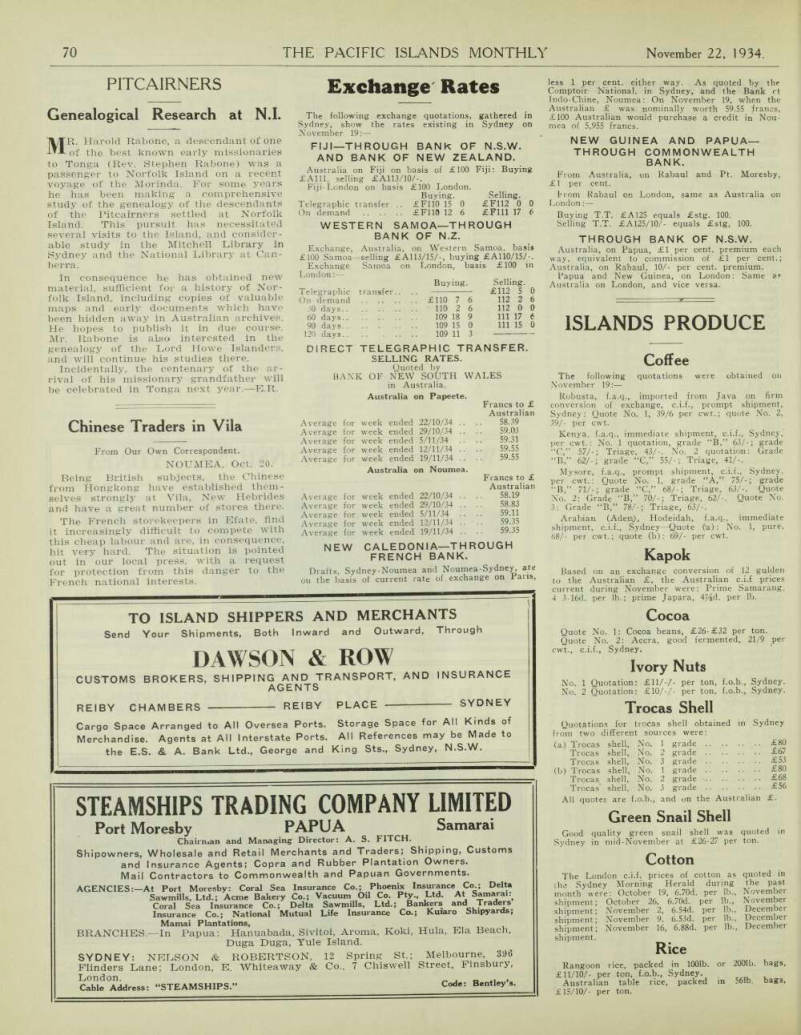
Pitcairners
MR. Harold Rabone, a descendant of one of the best known early missionaries to Tonga (Rev. Stephen Rabone) was a passenger to Norfolk Island on a recent voyage of the Morinda. For some years he has been making a comprehensive study of the genealogy of the descendants of the Pitcairners settled at Norfolk Island. This pursuit has necessitated several visits to the Island, and consider able study in the Mitchell Library in Sydney and the National Library at Can berra.
In consequence he has obtained new material, sufficient for a history of Nor folk Island, including copies of valuable maps and early documents which have been hidden away in Australian archives.
He hopes to publish it in due course.
Mr. Rabone is alsoi interested in the genealogy of the Lord Howe Islanders, and will continue his studies there.
Incidentally, the centenary of the ar rival of his missionary grandfather will be celebrated in Tonga next year.—E.R.
Chinese Traders in Vila
From Our Own Correspondent.
Noumea, Oct. 20.
Being British subjects, the Chinese from Hongkong have established them selves strongly at Vila, New Hebrides and have a great number of stores there.
The French storekeepers in Efate, find it increasingly difficult to compete with this cheap labour and are, in consequence, hit very hard. The situation is pointed out in our local press, with a request for protection from this danger to the French national interests.
Exchange Rates
The following exchange quotations, gathered in Sydney, show the rates existing in Sydney on November 19: —
Fiji—Through Bank Of N.S.W.
And Bank Of New Zealand.
Western Samoa—Through
Bank Of N.Z.
Exchange, Australia, on Western Samoa, basis £100 Samoa—selling £A113/15/-, buying £A110/15/-.
Exchange Samoa on London, basis £100 in London: —
Direct Telegraphic Transfer.
Selling Rates.
Quoted by
Bank Of New South Wales
in Australia.
New Caledonia—Through
French Bank.
Drafts, Sydney-Noumea and Noumea -Sydney, are on the basis of current rate of exchange on Pans,
less 1 per cent, either way. As quoted by the Comptoir National, in Sydney, and the Bank of Indo-Chine, Noumea: On November 19, when the Australian £ was nominally worth 59.55 francs, £100 Australian would purchase a credit in Noumea of 5,955 francs.
New Guinea And Papua
Through Commonwealth
Bank.
From Australia, on Rabaul and Pt. Moresby, £1 per cent.
From Rabaul on London, same as Australia on London;— Buying T.T. £A125 equals £stg. 100.
Selling T.T. £A125/10/- equals £stg, 100.
Through Bank Of N.S.W.
Australia, on Papua, £1 per cent, premium each way, equivalent to commission of £1 per cent.; Australia, on Rabaul, 10/- per cent, premium.
Papua and New Guinea, on London: Same a?
Australia on London, and vice versa.
Australia on Fiji on basis of £100 Fiji: Buying £A111. selling £A113/10/-.
Fiji-London on basis £100 London.
Buying.
Selling.
Telegraphic transfer .. £F110 15 0 £F112 0 0 On demand £F110 12 6 £F111 17 6
Buying. Selling.
Telegraphic transfer.. .. £112 5 0 On demand £110 7 6 112 2 6 30 days 110 2 6 112 0 0 60 days 109 18 9 111 17 6 90 da vs 109 15 0 111 15 0 120 days 109 11 3
Average for week ended 22/10/34 .. 58.39 Australia on Papeete.
Francs to £ Australian Average for week ended 29/10/34 .. 59.03 Average for week ended 5/11/34 .. 59.31 Average for week ended 12/11/34 .. 59.55 Average for week ended 19/11/34 .. 59.55 Average for week ended 22/10/34 .. 58.19 Australia on Noumea.
Francs to £ Australian Average for week ended 29/10/34 .. 58.83 Average for week ended 5/11/34 .. 59.11 Average for week ended 12/11/34 .. 59.35 Average for week ended 19/11/34 .. 59.35
Islands Produce
Coffee
The following quotations were obtained on November 19:— Robusta, f.a.q., imported from Java on firm conversion of exchange, c.i.f., prompt shipment, Sydney: Quote No. 1, 39/6 per cwt.; quote No. 2, 39/- per cwt.
Kenya, f.a.q., immediate shipment, c.i.f., Sydney, per cwt.: No. 1 quotation, grade “B,” 63/-; grade “C,” 57/-; Triage, 43/-. No. 2 quotation: Grade “B,” 62/-; grade “C,” 55/-; Triage, 41/-.
Mysore, f.a.q., prompt shipment, c.i.f., Sydney, per cwt.: Quote No. 1, grade “A,” 75/-; grade “B,” 71/-; grade “C,” 68/-; Triage, 63/-. Quote No. 2: Grade “B,” 70/-; Triage, 62/-. Quote No. 3: Grade “B,” 78/-; Triage, 63/-.
Arabian (Adertj), Hodeidah, f.a.q., immediate shipment, c.i.f., Sydney—Quote (’a): No. 1, pure, 68/- per cwt.; quote (b): 69/- per cwt.
Kapok
Based on an exchange conversion of 12 gulden to the Australian £, the Australian c.i.f prices current during November were: Prime Samarang, 4 3-16d. per lb.; prime Japara, 4 7/8d. per lb.
Cocoa
Quote No. 1: Cocoa beans, £26-£32 per ton.
Quote No. 2: Accra, good fermented, 21/9 per cwt., c.i.f., Sydney.
Ivory Nuts
No. 1 Quotation: £11/-/- per ton, f.o.b., Sydney.
No. 2 Quotation: £10/-/- per ton, f.o.b., Sydney.
Trocas Shell
Quotations for trocas shell obtained in Sydney from two different sources were: (a) Trocas shell, No. 1 grade £80 Trocas shell, No. 2 grade £67 Trocas shell, No. 3 grade £53 (b) Trocas shell, No. 1 grade £80 Trocas shell, No. 2 grade £68 Trocas shell, No. 3 grade £56 All quotes are f.o.b., and on the Australian £.
Green Snail Shell
Good quality green snail shell was quoted in Sydney in mid-November at £26-27 per ton.
Cotton
The London c.i.f. prices of cotton as quoted in c he Sydney Morning Herald during the past month were: October 19, 6.70d. per lb., November shipment; October 26, 6.70d. per lb., November shipment; November 2, 6.54d. per lb., December shipment; November 9, 6.53d. per lb., December shipment; November 16, 6.88d. per lb., December shipment.
Rice
Rangoon rice, packed in 1001b. or 2001b. bags, £11/10/- per ton, f.o.b., Sydney.
Australian table rice, packed in 561b. bags, £15/10/- per ton.
Advertisements & other items, p. 72 (1 item)
Steamships Trading Company Limited
TO ISLAND SHIPPERS AND MERCHANTS
Send Your Shipments, Both Inward and Outward, Through
DAWSON & ROW
CUSTOMS BROKERS, SHIPPING AND TRANSPORT, AND INSURANCE
AGENTS
REIBY CHAMBERS REIBY PLACE SYDNEY
Cargo Space Arranged to All Oversea Ports. Storage Space for All Kinds of Merchandise. Agents at All Interstate Ports. All References may be Made to the E.S. & A. Bank Ltd., George and King Sts., Sydney, N.S.W.
STEAMSHIPS TRADING COMPANY LIMITED
Port Moresby PAPUA Samarai
Chairman and Managing Director: A. S. FITCH.
Shipowners, Wholesale and Retail Merchants and Traders; Shipping, Customs and Insurance Agents; Copra and Rubber Plantation Owners.
Mail Contractors to Commonwealth and Papuan Governments.
AGENCIES:—At Port Moresby: Coral Sea Insurance Co.; Phoenix Insurance Co ; Delta Sawmills, Ltd.; Acme Bakery Co.; Vacuum Oil Co. Pty., Ltd. At Samaras Coral Sea Insurance Co.; Delta Sawmills, Ltd.; Bankers and Traders Insurance Co.; National Mutual Life Insurance Co.; Kuiaro Shipyards; Mamai Plantations, BRANCHES.—In Papua: Hanuabada, Sivitoi, Aroma, Koki, Hula, Ela Beach, Duga Duga, Yule Island.
SYDNEY: NELSON & ROBERTSON, 12 Spring St.; Melbourne, 396 Flinders Lane; London, E. Whiteaway & Co., 7 Cliiswell Street, Finsbury, London.
Cable Address: “STEAMSHIPS.”
Code: Bentley’s.
Shipping Services in the Pacific
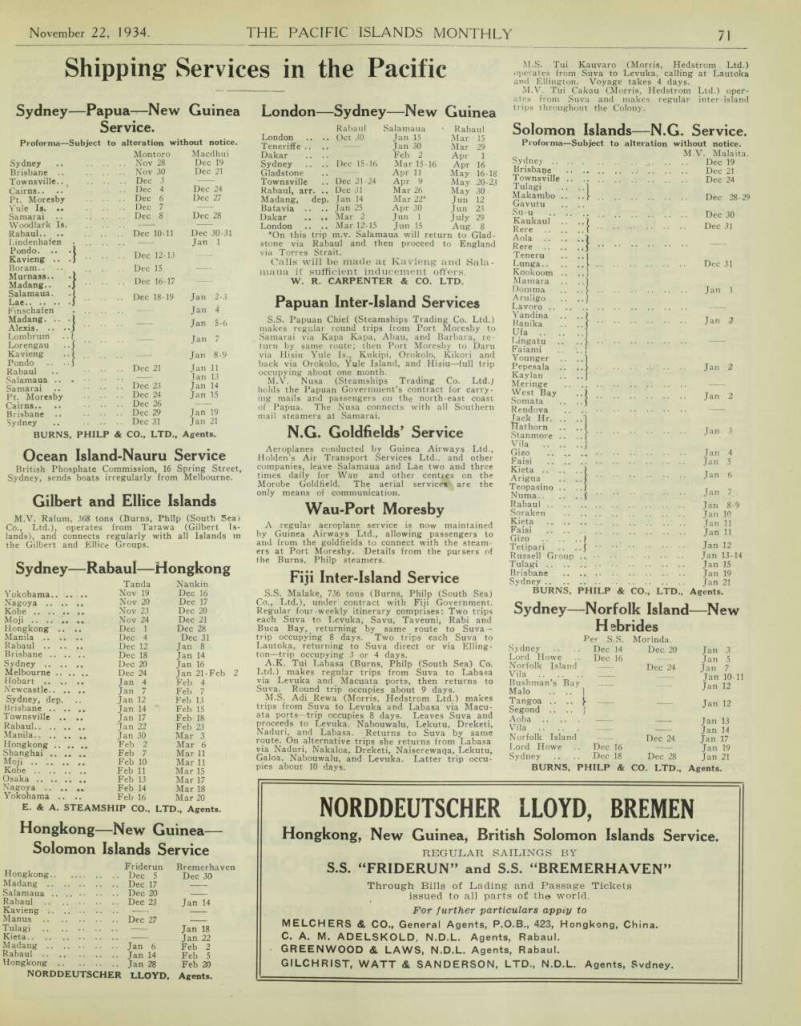
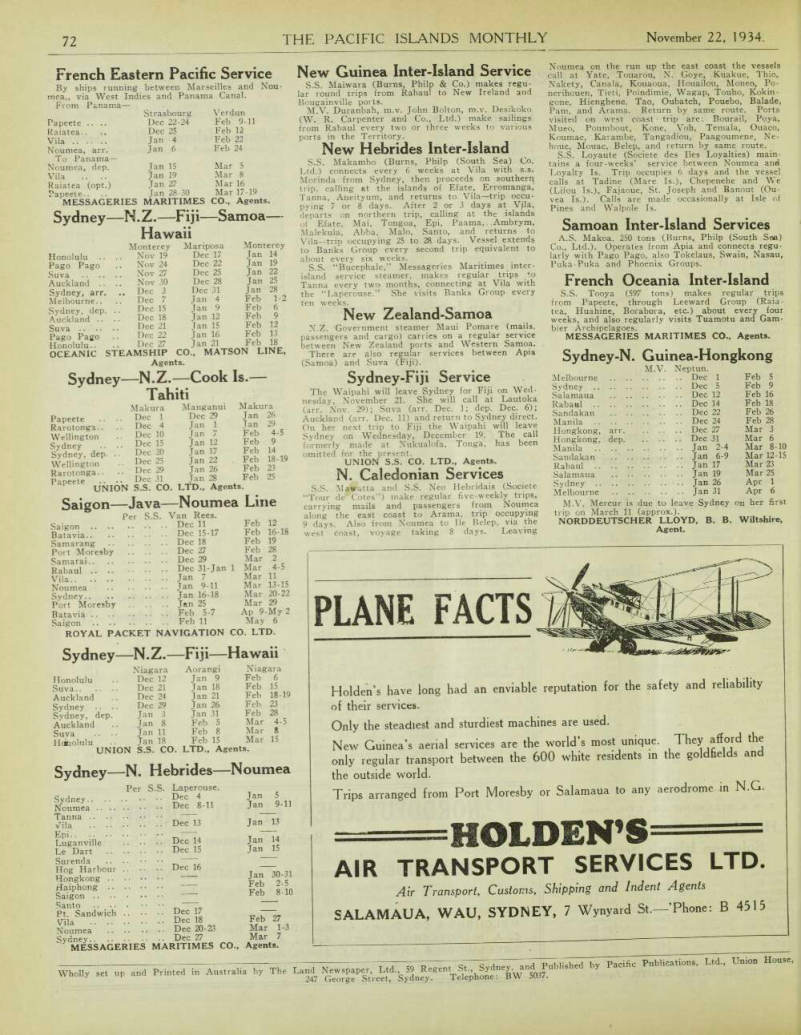
Sydney—Papua—New Guinea Service.
Burns, Philp & Co., Ltd., Agents.
Ocean Island-Nauru Service
British Phosphate Commission, 16 Spring Street, Sydney, sends boats irregularly from Melbourne.
Gilbert and Ellice Islands
M.V. Ralum, 368 tons (Burns, Philp (South Sea) Co., Ltd.), operates from Tarawa (Gilbert Is lands), and connects regularly with all Islands m the Gilbert and Ellice Groups.
Sydney—Rabaul—Hongkong
E. & A. STEAMSHIP CO., LTD., Agents.
Hongkong—New Guinea— Solomon Islands Service
London—Sydney—New Guinea
Papuan Inter-Island Services
S.S. Papuan Chief (Steamships Trading Co. Ltd.) makes regular round trips from Port Moresby to Samarai via Kapa Kapa, Abau, and Barbara, re turn by same route; then Port Moresby to Daru via Hisiu Yule Is., Kukipi, Orokolo, Kikori and back via Orokolo, Yule Island, and Hisiu—full trip occupying about one month.
M.V. Nusa (Steamships Trading Co. Ltd.; holds the Papuan Government’s contract for carry ing mails and passengers on the north-east coast of Papua. The Nusa connects with all Southern mail steamers at Samarai.
N.G. Goldfields , Service
Aeroplanes conducted by Guinea Airways Ltd., Holden’s Air Transport Services Ltd., and other companies, leave Salamaua and Lae two and three times daily for Wau and other centres on the Morobe Goldfield. The aerial services are the only means of communication.
Wau-Port Moresby
A regular aeroplane service is now maintained by Guinea Airways Ltd., allowing passengers to and from the goldfields to connect with the steam ers at Port Moresby. Details from the pursers of the Burns, Philp steamers.
Fiji Inter-Island Service
S.S. Malake, 736 tons (Burns, Philp (South Sea) Co., Ltd.), under contract with Fiji Government.
Regular four-weekly itinerary comprises: Two trips each Suva to Levuka, Savu, Taveuni, Rabi and Buca Bay, returning by same route to Suva trip occupying 8 days. Two trips each Suva to Lautoka, returning to Suva direct or via Elling ton —trip occupying 3 or 4 days.
A.K. Tui Labasa (Burns, Philp (South Sea) Co.
Ltd.) makes regular trips from Suva to Labasa via Levuka and Macuata ports, then returns to Suva. Round trip occupies about 9 days.
M.S. Adi Rewa (Morris, Hedstrom Ltd.) makes trips from Suva to Levuka and Labasa via Macu ata ports—trip occupies 8 days. Leaves Suva and proceeds to Levuka, Nabouwalu, Lekutu, Dreketi, Naduri, and Labasa. Returns to Suva by same route. On alternative trips she returns from Labasa via Naduri, Nakaloa, Dreketi, Naiserewaqa, Lekutu, Galoa, Nabouwalu, and Levuka. Latter trip occu pies about 10 days.
M.S. Tui Kauvaro (Morris, Hedstrom Ltd.) operates from Suva to Levuka, calling at Lautoka and Ellington. Voyage takes 4 days.
M.V. Tui Cakau (Morris, Hedstrom Ltd.) oper ates from Suva and makes regular inter-island trips throughout the Colony.
Solomon Islands—N.G. Service.
Proforma—Subject to alteration without notice.
Sydney—Norfolk Island—New H ebrides
Proforma—Subject to alteration without notice.
Sydney Brisbane Townsville Cairns Pt. Moresby Vule Is.
Samarai Woodlark Is.
Rabaul Lindenhafen Pondo Kavieng Boram Murnass Madang Salamaua Montoro Macdhui Nov 28 Dec 19 Nov 30 Dec 21 Dec 4 Dec 24 Dec 7 Dec 10-11 Dec 30-31 Jan 1 Dec 12-13 Dec 16-17 Dec 18-19 Jan 2-3 Finschafen Madang Alexis.
Lombrum Lorengau Kavieng Pondo Rabaul Salamaua Samarai Pt. Moresby Cairns Brisbane Sydney Jan 4 Jan 8-9 Dec 21 Jan 11 Dec 26 Dec 31 Jan 21
Rabaul Salamaua Rabaul London Oct 30 Jan 15 Mar 15 Teneriffe Jan 30 Mar 29 Dakar Feb 2 Apr 1 Sydney Dec 15-16 Mar 15-16 Apr 16 Gladstone Apr 11 May 16-18 Townsville Dec 21-24 Apr 9 May 20-23 Rabaul, arr. .. Dec 31 Mar 26 May 30 Madang, dep. Jan 14 Mar 22* Jun 12 Batavia Jan 25 Apr 30 Jun 23 Dakar Mar 2 Jun 1 July 29 London Mar 12-15 Jun 15 Aug 8 *On this trip m.v. Salamaua will return to Gladstone via Rabaul and then proceed to England via Torres Strait.
Calls will be made at Kavieng and Salamaua if sufficient inducement offers.
W. R. Carpenter & Co. Ltd.
Sydney Brisbane Townsville Tulagi Makambo Gavutu Su-u Kaukaul M.V. Malaita.
Dec 31 Kere Aola Rere Teneru Lunga Kookoom Mamara Aruligo Lavoro Yandina Banika Ufa Lingatu Jan 2 Faiami Younger Pepesala Kaylan Meringe West Bay Somata Rendova Jack Hr Hathorn Stanmore Vila Gizo Faisi Kieta Arigua .. ..Jan 6 Teopasino Numa Jan 7 Rabaul Jan 8-9 Soraken Jan 10 Kieta Jan 11 Faisi Jan 11 Gizo Tetipari .. Jan 12 Russell Group Jan 13-14 Tulagi Jan 15 Brisbane Jan 19 Sydney Jan 21
Burns, Philp & Co., Ltd., Agents.
Per S.S. Morinda.
Sydney Dec 14 Dec 20 Jan 3 Lord Howe Dec 16 Jan 5 Norfolk Island Dec 24 Jan 7 Vila Bushman’s Bay Male Jan 10-11 Jan 12 Tangoa Jan 12 Segond Aoba Jan 13 Vila Jan 14 Norfolk Island Dec 24 Jan 17 Lord Howe Dec 16 — Jan 19 Sydney Dec 18 Dec 28 Jan 21
Burns, Philp & Co. Ltd., Agents
Tanda Nankin Yokohama Nov 19 Dec 16 Nagoya Nov 20 Dec 17 Kobe Nov 23 Dec 20 Moji Nov 24 Dec 21 Hongkong Dec 1 Dec 28 Manila Dec 4 Dec 31 Rabaul Dec 12 Jan 8 Brisbane Dec 18 Jan 14 Sydney Dec 20 Jan 16 Melbourne Dec 24 Jan 21-Feb 2 Hobart Jan 4 Feb 4 Newcastle Jan 7 Feb 7 Sydney, dep.
Jan 12 Feb 13 Brisbane Jan 14 Feb 15 Townsville Jan 17 Feb 18 Rabaul Jan 22 Feb 23 Manila Jan 30 Mar 3 Hongkong Feb 2 Mar 6 Shanghai Feb 7 Mar 11 Moji Feb 10 Mar 11 Kobe Feb 11 Mar 15 Osaka Feb 13 Mar 17 Nagoya Feb 14 Mar 18 Yokohama Feb 16 Mar 20
Friderun Bremerhaven Hongkong Dec 5 Dec 30 Madang Dec 17 Salamaua Dec 20 Rabaul Dec 23 Jan 14 Kavieng Manus Dec 27 Tulagi Jan 18 Kieta Jan 22 Madang Jan 6 Feb 2 Rabaul Jan 14 Feb 5 Hongkong Jan 28 Feb 20
Norddeutscher Lloyd, Agents.
French Eastern Pacific Service
By ships running between Marseilles and Nou mea,, via West Indies and Panama Canal.
From Panama —
Sydney—N.Z.—Fiji—Samoa— Hawaii
Sydney—N.Z. —Cook Is.— Tahiti
Saigon—Java—Noumea Line
Sydney—N.Z.—Fiji—Hawaii
Sydney—N. Hebrides —Noumea
New Guinea Inter-Island Service
S.S. Maiwara (Burns, Philp & Co.) makes regular round trips from Rabaul to New Ireland and Bougainville ports.
M. Duranbah, m.v. John Bolton, m.v. Desikoko (W. R. Carpenter and Co., Ltd.) make sailings from Rabaul every two or three weeks to various ports in the Territory.
New Hebrides Inter-Island
S.S. Makambo (Burns, Philp (South Sea) Co.
Ltd.) connects every 6 weeks at Vila with s.s.
Morinda from Sydney, then proceeds on trip, calling at the islands of Efate, Erromanga, Tanna, Aneityum, and returns to Vila—trip occu pying 7 or 8 days. After 2 or 3 days at Vila, departs on northern trip, calling at the islands of Efate, Mai, Tongoa, Epi, Paama, Ambrym, Malekula, Abba, Malo, Santo, and returns to Vila —trip occupying 25 to 28 days. Vessel extends to Banks Group every second trip equivalent to about every six weeks.
S.S. “Bucephale,” Messageries Maritimes inter island service steamer, makes regular trips to Tanna every two months, connecting at Vila with the “Laperouse.” She visits Banks Group every ten weeks.
New Zealand-Samoa
N. Government steamer Maui Pomare (mails, passengers and cargo) carries on a regular service between New Zealand ports and Western Samoa.
There are also regular services between Apia (Samoa) and Suva (Fiji).
Sydney-Fiji Service
The Waipahi will leave Sydney for Fiji on Wed nesday, November 21. She will call at Lautoka (arr. Nov. 29); Suva (arr. Dec. 1; dep. Dec. 6); Auckland (arr. Dec. 11) and return to Sydney direct.
On her next trip to Fiji the Waipahi will leave Sydney on Wednesday, December 19. The call formerly made at Nukualofa, Tonga, has been omitted for the present.
Union S.S. Co. Ltd., Agents.
N. Caledonian Services
S.S. Mawatta and S.S. Neo Hebridais (Societe “Tour de Cotes”) make regular five-weekly trips, carrying mails and passengers from Noumea along the east coast to Arama, trip occupying 9 days. Also from Noumea to He Belep, via the west coast, voyage taking 8 days. Leaving
Noumea on the run up the east coast the vessels call at Yate, Touarou, N. Goye, Kuakue, Thio, Nakety, Canala, Kouaoua, Houailou, Moneo, Po nerihouen, Tieti, Poindimie, Wagap, Touho, Kokin gone, Hienghene, Tao, Oubatch, Pouebo, Balade, Pam, and Arama. Return by same route. Ports visited on west coast trip are: Bourail, Poya, Mueo, Poumbout, Kone, Voh, Temala, Ouaco, Koumac, Karambe, Tangadiou, Paagoumene, Ne houe, Mouac, Belep, and return by same route.
S.S. Loyaute (Societe des lies Loyalties) maintains a four-weeks’ service between Noumea and Loyalty Is. Trip occupies 6 days and the vessel calls at Tadine (Mare Is.), Chepenehe and We (Lifou Is.), Fajaoue, St. Joseph and Banout (Ou vea Is.). Calls are made occasionally at Isle of Pines and Walpole Is.
Samoan Inter-Island Services
A.S. Makoa, 250 tons (Burns, Philp (South Saa) Co., Ltd.). Operates from Apia and connects regu larly with Pago Pago, also Tokelaus, Swain, Nasau, Puka-Puka and Phoenix Groups.
French Oceania Inter-Island
S.S. Tooya (597 tons) makes regular trips from Papeete, through Leeward Group (Raia tea, Huahine, Borabora, etc.) about every four weeks, and also regularly visits Tuamotu and Gam bier Archipelagoes.
Messageries Maritimes Co.. Agents.
Sydney-N. Guinea-Hongkong
M.V. Neptun.
Melbourne Dec 1 Feb 5 Sydney Dec 5 Feb 9 Salamaua Dec 12 Feb 16 Rabaul Dec 14 Feb 18 Sandakan Dec 22 Feb 26 Manila Dec 24 Feb 28 Hongkong, arr.
Dec 27 Mar 3 Hongkong, dep.
Dec 31 Mar 6 Manila Jan 2-4 Mar 8-10 Sandakan Jan 6-9 Mar 12-15 Rabaul Jan 17 Mar 23 Salamaua Jan 19 Mar 25 Sydney Jan 26 Apr 1 Melbourne Jan 31 Apr 6 M.V. Mercur is due to leave Sydney on her first trip on March 11 (approx.).
Norddeutscher Lloyd, B. B. Wiltshire,
Agent.
Strasbourg Verdun Papeete Dec 22-24 Feb 9-11 Raiatea Dec 25 Feb 12 Vila Jan 4 Feb 22 Noumea, arr.
To Panama — Jan 6 Feb 24 Noumea, dep.
Jan 15 Mar 5 Vila Jan 19 Mar 8 Raiatea (opt.) Jan 27 Mar 16 Papeete..
Jan 28-30 Mar 17-19
Messageries Maritimes Co., Agents,
Honolulu Pago Pago Monterey Nov 19 Nov 24 Nov 27 Mariposa Dec 17 Dec 22 Dec 25 Monterey Jan 14 Jan 19 Jan 22 Auckland Sydney, arr Melbourne Sydney, dep Auckland Suva Nov 30 Dec 3 Dec 7 Dec 15 Dec 18 Dec 21 Dec 28 Dec 31 Jan 4 Jan 9 Jan 12 Jan 15 Jan 25 Jan 28 Feb 1-2 Feb 6 Feb 9 Feb 12 Pago Pago Honolulu
Oceanic Steamship Co., Matson Line,
Dec 22 Jan 16 Feb 13 Dec 27 Jan 21 Feb 18 Agents.
Makura Manganui Makura Paoeete ... Dec 1 Dec 29 Jan 26 Rarotonga.. .. Dec 4 Jan 1 Jan 29 Sydney** 0 " " BS S t* Sydney, dep. .. Dec 20 Jan 17 Feb 14 Wellington •• Dec g Jan 22 Feb 18-19 Papeete 63 V. .V S£ S fS 2 S i
Union S.S. Co. Ltd., Agents.
Per S.S. Van Rees.
Saigon Batavia Dec 11 Dec 15-17 Feb 12 Feb 16-18 Samarang Dec 18 Feb 19 Port Moresby .. Dec 27 Feb 28 Samarai Dec 29 Mar 2 Rabaul 31-Jan 1 Mar 4-5 Vila Noumea Jan 7 9-11 Mar 11 Mar 13-15 Sydney 16-18 Mar 20-22 Port Moresby 25 Mar 29 Batavia .. Feb 5-7 Ap 9- My 2 Saigon .. Feb 11 May 6
Royal Packet Navigation Co. Ltd.
Niagara Aorangi Niagara Honolulu ..Dec 12 Jan 9 Feb 6 Suva Dec 21 Jan 18 Feb 15 Auckland .. Dec 24 Jan 21 Feb 18-19 Sydney ... Dec 29 Jan 26 Feb 23 Sydney, dep. Jan 3 Jan 31 Feb 28 Auckland .. Jan 8 Feb 5 Mar 4-5 Suva . Jan 11 Feb 8 Mar 8 Honolulu .. Jan 18 Feb 15 Mar 15
Union S.S. Co. Ltd., Agents.
Per S.S. Laperouse.
Jan 5 Jan 9-11 Sydney Dec 4 Dec 8-11 Vila Dec 13 Jan 13 Epi Luganville Le Dart Dec 14 Dec 15 Jan 14 Jan 15 Surenda Hog Harbour Hongkong Dec 16 Jan 30-31 Feb 2-5 Feb 8-10 Haiphong Saigon Pt. Sandwich Vila Dec 18 Feb 27 Noumea Dec 20-23 Mar 1-3 Sydney Dec 27 Mar 7
Messageries Maritimes Co., Agents.
Advertisements & other items, pp. 73-76 (2 items)
Norddeutscher Lloyd, Bremen
Hongkong, New Guinea, British Solomon Islands Service.
REGULAR SAILINGS BY
S.S. “FRIDERUN” and S.S. “BREMERHAVEN”
Through Bills of Lading and Passage Tickets issued to all parts of the world.
For further particulars apply to MELCHERS & CO., General Agents, P.O.B., 423, Hongkong, China.
C. A. M. ADELSKOLD, N.D.L. Agents, Rabaul.
GREENWOOD & LAWS, N.D.L. Agents, Rabaul.
GILCHRIST, WATT & SANDERSON, LTD., N.D.L. Agents, Svdney.
PLANE FACTS
Holden’s have long had an enviable reputation for the safety and reliability of their services.
Only the steadiest and sturdiest machines are used.
New Guinea’s aerial services are the world’s most unique. They afford the only regular transport between the 600 white residents in the goldfields and the outside world.
Trips arranged from Port Moresby or Salamaua to any aerodrome in N.G.
HOLDEN'S
AIR TRANSPORT SERVICES LTD.
Air Transport, Customs, Shipping and Indent Agents SALAMAUA, WAU, SYDNEY, 7 Wynyard St.—’Phone: B 4515
One o£ the Biggest Aerial Transport
Services in
the World
Three years ago, there were less than a dozen landing grounds on N.G. goldfields. To-day, there are over 30. Prospectors are constantly opening up new country. New enterprises are being launched. No sooner is a new camp established than a new landing-ground is cleared, and Guinea Airways machines provide communication.
Travellers may leave the steamer at Port Moresby, fly across to Morobe (time of journey, 1h. 45 min.) and spend 9 days in the Goldfield centres before rejoining steamer at Lae for Rabaul. Or, after visiting Rabaul, they may disembark at Salamaua or Lae, spend several days on the Goldfields, and fly to Pt.
An everyday scene on the New Guinea Goldfields: A Moresby to rejoin the steamer. All motor-car, which has been brought in by air from the coast, information from Pursers on the being unloaded from one of Guinea Airways' giant, freight- Steamers.
carrying aeroplanes.
Transport made possible the development of the great Gold Industry of New Guinea. The presence of Rich Gold was proved in 1926, but the Problem was Communication. Morobe was guarded by dense jungle and precipitous mountains. A road cannot be built, except at enormous, crippling cost.
Guinea Airways Ltd. launched its unique aerial service seven years ago, with one machine and a handful of men. To-day, it operates a fleet of modern aeroplanes, and employs large European and native staffs. Its machines, running on regular schedules, have carried men, machinery, dredges, building material, foodstuffs, motor-trucks, livestock, over the mountains of New Guinea, without accident and without delay.
GUINEA AIRWAYS LTD
LAE - SALAMAUA
To quench a tropic thirst!
TOOTH'S KB a true LAGER.
Clean in flavoursharp to the tastethere’s no drink in the tropics to equal Tooth’s KB a true Lager.
72
November 22, 1934.
THE PACIFIC ISLANDS MONTHLY
Wholly set op and Printed in Australia by The Land Newspaper, Ltd., 59 Regent St., Sydney, and Published by Pacific Publications, Ltd., Union House,