Advertisements & other items, pp. 1-2 (2 items)
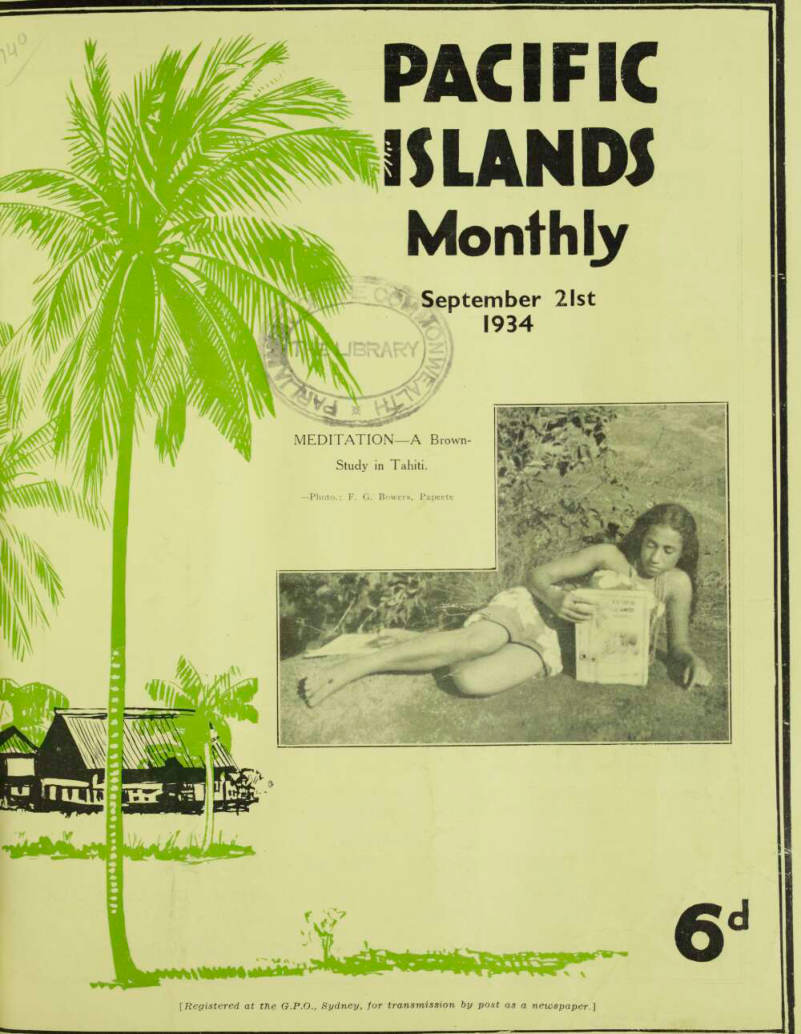
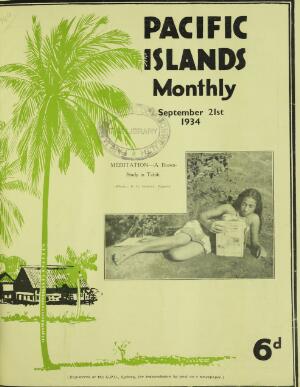
Pacific
ISLANDS
Monthly
September 21st 1934
6 d
[Registered at the G.P.O., Sydney, for transmission by post as a newspaper.]
MEDITATION—A Brown-
Study in Tahiti. —Photo.: F. G. Bowers, Papeete
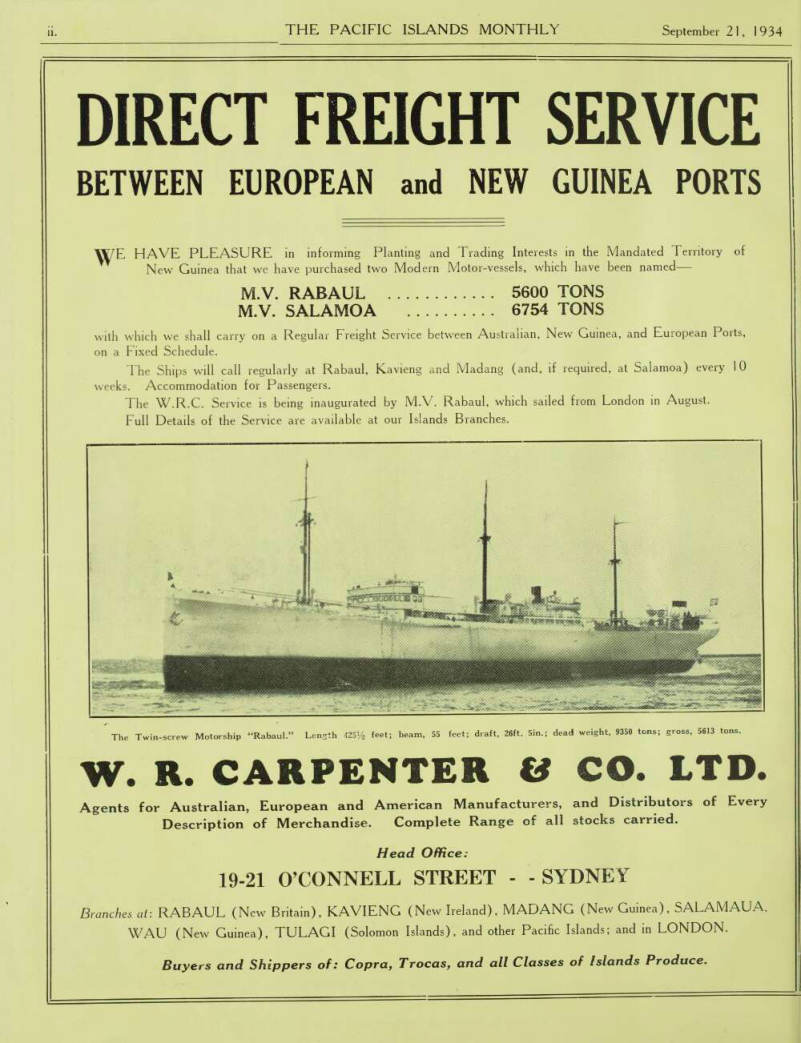
Direct Freight Service
BETWEEN EUROPEAN and NEW GUINEA PORTS
HAVE PLEASURE in informing New Guinea that we have purchased Planting and Trading Interests in the Mandated Territory two Modern Motor-vessels, which have been named — of
M.V. RABAUL 5600 TONS
M.V. SALAMOA 6754 TONS
with which we shall carry on a Regular Freight Service between Australian, New Guinea, and European Ports, on a Fixed Schedule.
The Ships will call regularly at Rabaul, Kavieng and Madang (and, if required, at Salamoa) every 10 weeks. Accommodation for Passengers.
The W.R.C. Service is being inaugurated by M.V, Rabaul, which sailed from London in August.
Full Details of the Service are available at our Islands Branches.
The Twin-screw Motorship “Rabaul.” Length 425½ feet; beam, 55 feet; draft, 26ft. Sin.; dead weight, 9350 tons; gross. 5613 tons.
W. R. CARPENTER & CO. LTD.
Agents for Australian, European and American Manufacturers, and Distributors of Every Description of Merchandise. Complete Range of all stocks carried.
Head Office:
19-21 O’CONNELL STREET - - SYDNEY
Branches at: RABAUL (New Britain), KAVIENG (New Ireland), MADANG (New Guinea), SALAMAUA, WAU (New Guinea), TULAGI (Solomon Islands), and other Pacific Islands: and in LONDON.
Buyers and Shippers of: Copra, Trocas, and all Classes of Islands Produce.
Pacific Islands Travellers
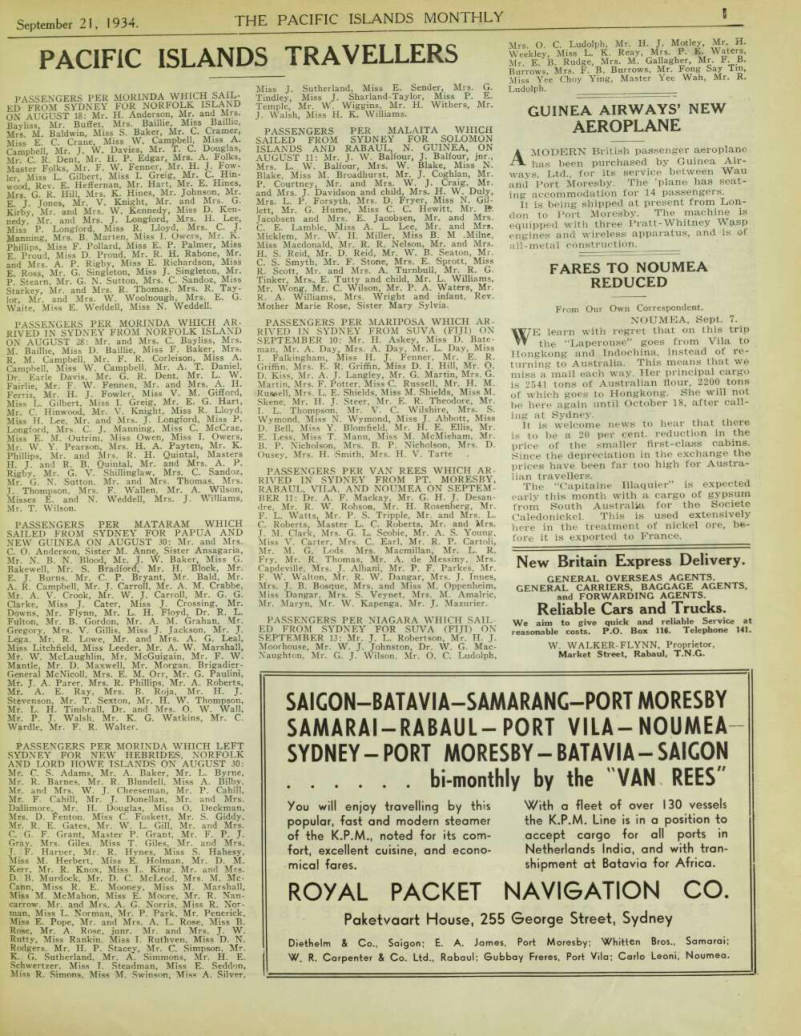
Passengers Per Morinda Which Sail
Ed From Sydney For Norfolk Island
ON AUGUST 18: Mr. H. Anderson, Mr. and Mrs.
Bayliss, Mr. Buffet, Mrs. Baillie, Miss Baillie, Mrs. M. Baldwin, Miss S. Baker, Mr. C. Cramer, Miss E. C. Crane, Miss W. Campbell, Miss A.
Campbell, Mr. J. W. Davies, Mr. T. C. Douglas, Mr. C. R. Dent, Mr. H. P. Edgar, Mrs. A. Folks, Master Folks, Mr. F. W. Fenner, Mr. H. J. Fow ler, Miss L. Gilbert, Miss I. Greig, Mr. C. Hinwood, Rev. E. Heffernan, Mr. Hart, Mr. E. Hines, Mrs. G. R. Hill, Mrs. K. Hines, Mr. Johnson, Mr.
E. J. Jones, Mr. V. Knight, Mr. and Mrs. G.
Kirby, Mr. and Mrs. W. Kennedy, Miss D. Ken nedy, Mr. and Mrs. J. Longford, Mrs. H. Lee, Miss P. Longford, Miss R. Lloyd, Mrs. C. J.
Manning, Mrs. B. Marten, Miss I. Owers, Mr. K.
Phillips, Miss F. Pollard, Miss E. P. Palmer, Miss E. Proud, Miss D. Proud, Mr. R. H. Rabone, Mr. and Mrs. A. P. Rigby, Miss E. Richardson, Miss E. Ross, Mr. G. Singleton, Miss J. Singleton, Mr.
P. Steam, Mr. G. N. Sutton, Mrs. C. Sandoz, Miss Starkey, Mr. and Mrs. R. Thomas, Mrs. R. Tay lor, Mr. and Mrs. W. Woolnough, Mrs. E. G.
Waite, Miss E. Weddell, Miss N. Weddell,
Passengers Per Morinda Which Ar
Rived In Sydney From Norfolk Island
ON AUGUST 28: Mr. and Mrs. C. Bayliss, Mrs.
M. Baillie, Miss D. Baillie, Miss F. Baker, Mrs.
R. M. Campbell, Mr. F. R. Corleison, Miss A.
Campbell, Miss W. Campbell, Mr. A. T. Daniel, Dr. Earle Davis, Mr. G. R. Dent, Mr. L. W.
Fairlie, Mr. F. W. Fennen, Mr. and Mrs. A. H.
Ferris, Mr. H. J. Fowler, Miss V. M. Gifford, Miss L. Gilbert, Miss I. Greig, Mr, E. G. Hart, Mr. C. Hinwood, Mr. V. Knight, Miss R. Lloyd, Miss H. Lee, Mr. and Mrs. J. Longford, Miss P.
Longford, Mrs. C. J. Manning, Miss C. McCrae, Miss E. M. Outrim, Miss Owen, Miss I. Owers, Mr. W. Y. Pearson, Mrs. H. A. Payten, Mr. K.
Phillips, Mr. and Mrs. R. H. Quintal, Masters H. J. and R. B. Quintal, Mr. and Mrs. A. P.
Rigby. Mr. G. V. Shillinglaw, Mrs. C. Sandoz, Mr. G. N. Sutton, Mr. and Mrs. Thomas, Mrs.
J. Thompson, Mrs. F. Wallen, Mr. A. Wilson, Misses E. and N. Weddell, Mrs. J. Williams, Mr. T. Wilson.
Passengers Per Mataram Which
Sailed From Sydney For Papua And
NEW GUINEA ON AUGUST 30: Mr. and Mrs.
C. O. Anderson, Sister M. Anne, Sister Ansagaria, Mr. N. B. N. Blood, Mr. J. W. Baker, Miss G.
Bakewell, Mr. S. Bradford, Mr. H. Block, Mr.
E. J. Burns, Mr. C. P. Bryant, Mr. Bald, Mr.
A. R. Campbell, Mr. J. Carroll, Mr. A. M. Crabbe, Mr. A. V. Crook, Mr. W. J. Carroll, Mr. G. G.
Clarke, Miss J. Cater, Miss J. Crossing, Mr.
Downs, Mr. Flynn, Mr. L. H. Floyd, Dr. R. L.
Fulton, Mr. B. Gordon, Mr. A. M. Grahan, Mr.
Gregory, Mrs. V. Gillis, Miss J. Jackson, Mr. J.
Lega, Mr. R. Lowe, Mr. and Mrs. A. G. Leal, Miss Litchfield, Miss Leeder, Mr. A. W. Marshall, Mr. W. McLaughlin, Mr. McGuigain, Mr. F. W.
Mantle, Mr. D. Maxwell, Mr. Morgan, Brigadier- General McNicoll, Mrs. E. M. Orr, Mr. G. Paulini, Mr. J. A. Parer, Mrs. R. Phillips, Mr. A. Roberts, Mr. A. E. Ray, Mrs. B. Roja, Mr. H. J.
Stevenson, Mr. T. Sexton, Mr. H. W. Thompson, Mr. L. H. Timbrall, Dr. and Mrs. O. W. Wall, Mr. P. J. Walsh. Mr. K. G. Watkins, Mr. C.
Wardle, Mr. F. R. Walter.
Passengers Per Morinda Which Left
Sydney For New Hebrides, Norfolk
AND LORD HOWE ISLANDS ON AUGUST 30: Mr. C. S. Adams, Mr. A. Baker, Mr. L. Byrne, Mr. R. Barnes, Mr. R. Blundell, Miss A. Bilby, Mr. and Mrs. W. J. Cheeseman, Mr. P. Cahill, Mr. F. Cahill, Mr. J. Donellan, Mr. and Mrs.
Dallimore, Mr. H. Douglas, Miss O. Deckman, Mrs. D. Penton, Miss C. Foskett, Mr. S. Giddy, Mr. R. E. Gates, Mr. W. L. Gill, Mr. and Mrs.
C. G. F. Grant, Master P. Grant, Mr. F. P. J.
Gray, Mrs. Giles, Miss T. Giles, Mr. and Mrs.
J. F. Harper, Mr. R. Hynes, Miss S. Hahesy, Miss M. Herbert, Miss E. Holman, Mr. D. M.
Kerr, Mr. R. Knox, Miss L. King, Mr. and Mrs.
D. B. Murdock, Mr. D. C. McLeod, Mrs. M. Mc- Cann, Miss R. E. Mooney, Miss M. Marshall, Miss M. McMahon, Miss E. Moore, Mr. R. Nan carrow, Mr. and Mrs. A. G. Norris, Miss R. Norman, Miss L. Norman, Mr. P. Park, Mr. Penerick, Miss E. Pope, Mr. and Mrs. A. L. Rose, Miss B.
Rose, Mr. A. Rose, junr. Mr. and Mrs. J. W.
Rutty, Miss Rankin. Miss I. Ruthven, Miss D. N.
Rodgers, Mr. H. P. Stacey, Mr. C. Simpson, Mr.
K. G. Sutherland, Mr. A. Simmons, Mr. H. E.
Schwertzer, Miss I. Steadman, Miss E. Seddon, Miss R. Simons, Miss M. Swinson, Miss A. Silver,
Miss J. Sutherland, Miss E. Sender, Mrs. G.
Tindley, Miss J. Sharland-Taylor, Miss P. E.
Temple, Mr. W. Wiggins, Mr. H. Withers, Mr.
J. Walsh, Miss H. K. Williams.
Passengers Per Malaita Which
Sailed From Sydney For Solomon
Islands And Rabaul, N. Guinea, On
AUGUST 11: Mr. J. W. Balfour, J. Balfour, jnr., Mrs. L. W. Balfour, Mrs. W. Blake, Miss N.
Blake, Miss M. Broadhurst, Mr. J. Coghlan, Mr.
P. Courtney, Mr. and Mrs. W. J. Craig, Mr. and Mrs. J. Davidson and child, Mrs. H. W. Duly, Mrs. L. P. Forsyth, Mrs. D. Fryer, Miss N. Gil lett, Mr. G. Hume, Miss C. C. Hewitt, Mr. E.
Jacobsen and Mrs. E. Jacobsen, Mr. and Mrs.
C. E. Lamble, Miss A. L. Lee, Mr. and Mrs.
Micklem, Mr. W. H. Miller, Miss B. M. Milne, Miss Macdonald, Mr. R. R. Nelson, Mr. and Mrs.
H. S. Reid, Mr. D. Reid, Mr. W. B. Seaton, Mr.
C. S. Smyth, Mr. F. Stone, Mrs. E. Sprott, Miss R. Scott, Mr. and Mrs. A. Turnbull, Mr. R. G.
Tinker, Mrs. E. Tutty and child, Mr. L. Williams, Mr. Wong, Mr. C. Wilson, Mr. P. A. Waters, Mr.
R. A. Williams, Mrs. Wright and infant, Rev.
Mother Marie Rose, Sister Mary Sylvia.
Passengers Per Mariposa Which Ar
RIVED IN SYDNEY FROM SUVA (FIJI) ON SEPTEMBER 10: Mr. H. Askey, Miss D. Bate man, Mr. A. Day, Mrs. A. Day, Mr. L. Day, Miss I. Falkingham, Miss H. J. Fenner, Mr. E. R.
Griffin, Mrs. E. R. Griffin, Miss D. I. Hill, Mr. O.
D. Kiss, Mr. A. J. Langley, Mr. G. Martin, Mrs. G.
Martin, Mrs. F. Potter, Miss C. Russell, Mr. H. M.
Russell, Mrs. L. E. Shields, Miss M. Shields, Miss M.
Skene, Mr. H. J. Steer, Mr. E. R. Theodore, Mr.
I. L. Thompson, Mr. V. C. Wilshire, Mrs. S.
Wymond, Miss N. Wymond, Miss J. Abbott, Miss D. Bell, Miss Y. Blomfield, Mr. H. E. Ellis, Mr.
E. Less, Miss T. Mann, Miss M. McMieham, Mr.
B. P. Nicholson, Mrs. B. P. Nicholson, Mrs. D.
Ousey, Mrs. H. Smith, Mrs. H. V. Tarte
Passengers Per Van Rees Which Ar
Rived In Sydney From Pt. Moresby,
Rabaul, Vila. And Noumea On Septem
BER 11: Dr. A. F. Mackay, Mr. G. H. J. Desan dre, Mr. R. W. Robson, Mr. H. Rosenberg, Mr.
F. L. Watts, Mr. P. S. Tripple, Mr. and Mrs. L.
C. Roberts, Master L. C. Roberts, Mr. and Mrs.
J. M. Clark, Mrs. G. L. Scobie, Mr. A. S. Young, Miss V. Carter, Mrs. C. Earl, Mr. R. P. Cartoli, Mr. M. G. Lods, Mrs. Macmillan, Mr. L. R.
Fry, Mr. R. Thomas, Mr. A. de Messiny, Mrs.
Capdeville, Mrs. J. Albani, Mr. P. F. Parkes, Mr.
F. W. Walton, Mr. R. W. Dangar, Mrs. J. Innes, Mrs. J. B. Bosque, Mrs. and Miss M. Oppenheim, Miss Dangar, Mrs. S. Veynet, Mrs. M. Amalric, Mr. Maryn, Mr. W. Kapenga, Mr. J. Mazurier.
Passengers Per Niagara Which Sail
ED FROM SYDNEY FOR SUVA (FIJI) ON SEPTEMBER 13: Mr. J. L. Robertson, Mr. H. J.
Moorhouse, Mr. W. J. Johnston, Dr. W. G. Mac- Xaughton, Mr. G. J. Wilson, Mr. O. C. Ludolph,
Mrs. O. C. Ludolph, Mr. H. J. Motley, Mr. H.
Weekley, Miss L. K. Reay, Mrs. P. E- Waters, Mr E B. Rudge, Mrs. M. Gallagher, Mr. F. B.
Burrows, Mrs. F. B. Burrows, Mr. Fong Say Tin, Miss Yee Choy Ying, Master Yee Wah, Mr. R.
Ludolph.
Aeroplane
Guinea Airways’ New
A MODERN British passenger aeroplane has been purchased by Guinea Air ways, Ltd., for its service between Wau and Port Moresby. The ’plane has seat ing accommodation for 14 passengers.
It is being shipped at present from Lon don to Port Moresby. The machine is equipped with three Pratt-Whitney Wasp engines and wireless apparatus, and is of all-metal construction.
Reduced
Fares To Noumea
From Our Own Correspondent.
Noumea, Sept. 7.
WE learn with regret that on this trip the “Laperouse” goes from Vila to Hongkong and Indochina, instead of re turning to Australia. This means that we miss a mail each way. Her principal cargo is 2541 tons of Australian flour, 2200 tons of which goes to Hongkong. She will not be here again until October 18, after call ing at Sydney.
It is welcome news to hear that there is to be a 20 per cent, reduction in the price of the smaller first-class cabins.
Since the depreciation in the exchange the prices have been far too high for Austra lian travellers.
The “Capitaine Illaquier” is expected early this month with a cargo of gypsum from South Australia for the Societe Caledonickel. This is used extensively here in the treatment of nickel ore, be fore it is exported to France.
Advertisements & other items, p. 3 (1 item)
Royal Packet Navigation Co.
New Britain Express Delivery.
GENERAL OVERSEAS AGENTS.
GENERAL CARRIERS, BAGGAGE AGENTS,
and FORWARDING AGENTS.
Reliable Cars and Trucks.
We aim to give quick and reliable Service at reasonable costs. P.O. Box 116. Telephone 141.
W. WALKER-FLYNN, Proprietor, Market Street, Rabaul, T.N.G.
SAICON-BATAVIA-SAMARANC-PORT MORESBY
SAMARAI-RABAUL- PORT VILA-NOUMEA
SYDNEY - PORT MORESBY - BATAVIA - SAIGON
bi-monthly by the VAN REES"
You will enjoy travelling by this popular, fast and modern steamer of the K.P.M., noted for its comfort, excellent cuisine, and economical fares.
With a fleet of over 130 vessels the K.P.M. Line is in a position to accept cargo for all ports in Netherlands India, and with transhipment at Batavia for Africa.
ROYAL PACKET NAVIGATION CO.
Paketvaart House, 255 George Street, Sydney Diethelm & Co., Saigon; E. A. James, Port Moresby; Whitten Bros., Samarai; W. R. Carpenter & Co. Ltd., Rabaul; Gubbay Freres, Port Vila; Carlo Leoni, Noumea.
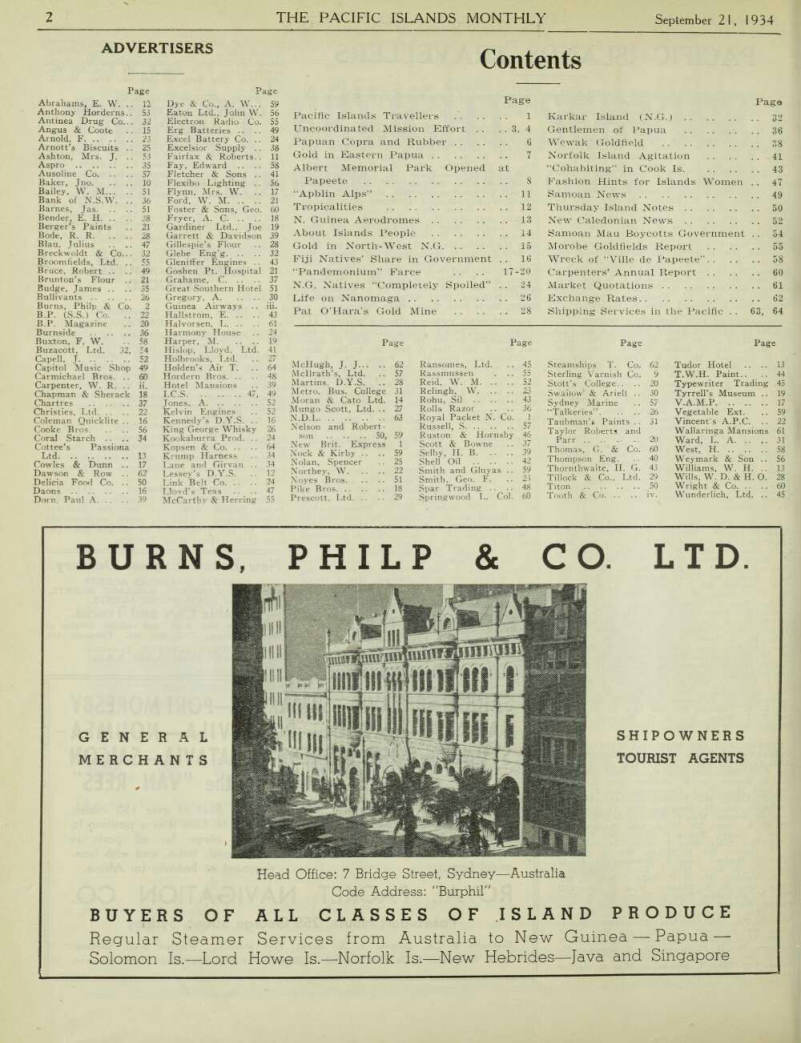
Advertisers
Page Abrahams, E. W. .. 12 Anthony Horderns.. 53 Antinea Drug Co... 32 Angus & Coote .. 15 Arnold, F 23 Arnott’s Biscuits .. 25 Ashton, Mrs. J. .. 53 Aspro 35 Ausoline Co. 57 Baker, Jno 10 Bailey, W. M. 51 Bank of N.S.W. .. 36 Barnes, Jas. 51 Bender, E. H. 38 Berger's Paints .. 21 Bode, R. R. 28 Blau, Julius .. .. 47 Breckwoldt & Co... 32 B/oomfields, Ltd. .. 55 Bruce, Robert, .. .. 49 Brunton’s Flour 21 Budge, James .. .. 35 Bullivants 26 Burns, Philp & Co. 2
B.P. (S.S.) Co. .. 22
B.P. Magazine .. 20 Burnside 36 Buxton, F. W. .. 58 Buzacott, Ltd. 32, 54 Capell, J. 52 Capitol Music Shop 49 Carmichael Bros. .. 60 Carpenter, W. R. .. ii.
Chapman & Sherack 18 Chartres 37 Christies, Ltd 22 Coleman Quicklite .. 16 Cooke Bros. 56 Coral Starch .. .. 34 Cottee’s Passiona Ltd 13 Cowles & Dunn .. 17 Dawson & Row .. 62 Delicia Food Co. .. 50 Daons 16 Dorn. Paul A. 39
Page Dye & Co., A. W... 59 Eaton Ltd., John W. 56 Electron Radio Co. 55 Erg Batteries .. .. 49 Excel Battery Co. .. 24 Excelsior Supply .. 38 Fairfax & Roberts.. 11 Fay, Edward .. .. 58 Fletcher & Sons .. 41 Flexibo Lighting .. 56 Flynn, Mrs. W. ..17 Ford. W. M. 21 Foster & Sons, Geo. 60 Fryer, A. C. 18 Gardiner Ltd., Joe 19 Garrett & Davidson 39 Gillespie’s Flour .. 28 Glebe Eng’g. .. .. 32 Gleniffer Engines .. 43 Goshen Pt. Hospital 21 Grahame, C. 37 Great Southern Hotel 51 Gregory, A. 30 Guinea Airways .. iii.
Hallstrom, E. 43 Halvorsen, L. 61 Harmony House .. 24 Harper, M. 19 Hislop, Lloyd, Ltd. 41 Holbrooks, Ltd. .. 27 Holden’s Air T. ..64 Hordern Bros. 48 Hotel Mansions .. 39
I.C.S. 47, 49
Jones, A. 52 Kelvin Engines .. 52 Kennedy’s D.Y.S. .. 16 King George Whisky 26 Kookaburra Prod. .. 24 Kopsen & Co. 64 Krump Harness .. 34 Lane and Girvan .. 34 Lessey’s D.Y.S. .. 12 Link Belt Co. 24 Llovd’s Teas .. .. 47 McCarthy & Herring 55
Page McHugh, J. J. 62 Mcilrath’s, Ltd. .. 57 Martins, D.Y.S. .. 28 Metro. Bus. College 31 Moran & Cato Ltd. 14 Mungo Scott, Ltd. .. 27
N.D.L. 63
Nelson and Robert son 50, 59 New Brit. Express 1 Nock & Kirby .. .. 59 Nolan, Spencer .. 25 Northey, W. 22 Noyes Bros. 51 Pike Bros. 18 Prescott, Ltd 29
Page Ransomes, Ltd. .. 45 Rassmussen . ..55 Reid, W. M. 52 Relingh, W. 23 Rohu, Sil 43 Rolls Razor .. .. 36 Royal Packet N. Co. 1 Russell, S. 57 Ruston & Hornsby 46 Scott & Bowne .. 37 Selby, H. B. 39 Shell Oil 42 Smith and Gluyas .. 59 Smith, Geo. F. ..23 Spar Trading .. .. 48 Springwood L. Col. 60
Page Steamships T. Co. 62 Sterling Varnish Co. 9 Stott’s College.. .. 20 Swallow' & Ariell .. 30 Sydney Marine .. 57 “Talkeries”. .. .. 26 Taubman’s Paints.. 31 Taylor Roberts and Parr 20 Thomas, G. & Co. 60 Thompson Eng. .. 40 Thornthwaite, H. G. 43 Tillock & Co., Ltd. 29 Titon 50 Tooth & Co iv.
Page Tudor Hotel .. .. 13 T.W.H. Paint.. .. 44 Typewriter Trading 45 Tyrrell’s Museum .. 19
V.A.M.P. 17
Vegetable Ext. .. 59 Vincent s A.P.C. .. 22 Wallaringa Mansions 61 Ward, L. A. 31 West, H. 58 Weymark & Son .. 56 Williams. W. H. .. 13 Wills, W. D. &H. 0. 28 Wright & Co 60 Wunderlich, Ltd. .. 45
Contents
Page Pacific Islands Travellers 1 Uncoordinated Mission Effort . . ..3, 4 Papuan Copra and Rubber 6 Gold in Eastern Papua 7 Albert Memorial Park Opened at Papeete 8 “Apblin Alps” 11 Tropicalities 12 N. Guinea Aerodromes 13 About Islands People 14 Gold in North-West N.G 15 Fiji Natives’ Share in Government . . 16 “Pandemonium” Farce .. .. 17-20 N.G. Natives “Completely Spoiled” .. 24 Life on Nanomaga 26 Pat O’Hara’s Gold Mine 28
Page Karkar Island (N.G.) 32 Gentlemen of Papua 36 Wewak Goldfield 38 Norfolk Island Agitation 41 “Cohabiting” in Cook Is 43 Fashion Hints for Islands Women .. 47 Samoan News 49 Thursday Island Notes 50 New Caledonian News 52 Samoan Mau Boycotts Government . . 54 Morobe Goldfields Report 55 Wreck of “Ville de Papeete” 58 Carpenters’ Annual Report 60 Market Quotations 61 Exchange Rates 62 Shipping Services in the Pacific .. 63, 64
Advertisements & other items, p. 4 (1 item)
Burns, Philp & Co. Ltd.
GENERAL
MERCHANTS
SHIPOWNERS
TOURIST AGENTS
Head Office: 7 Bridge Street, Sydney—Australia Code Address: "Burphil"
BUYERS OF ALL CLASSES OF ISLAND PRODUCE Regular Steamer Services from Australia to New Guinea Papua Solomon Is.—Lord Howe Is. —Norfolk Is.—New Hebrides —Java and Singapore
The Pacific Islands Monthly
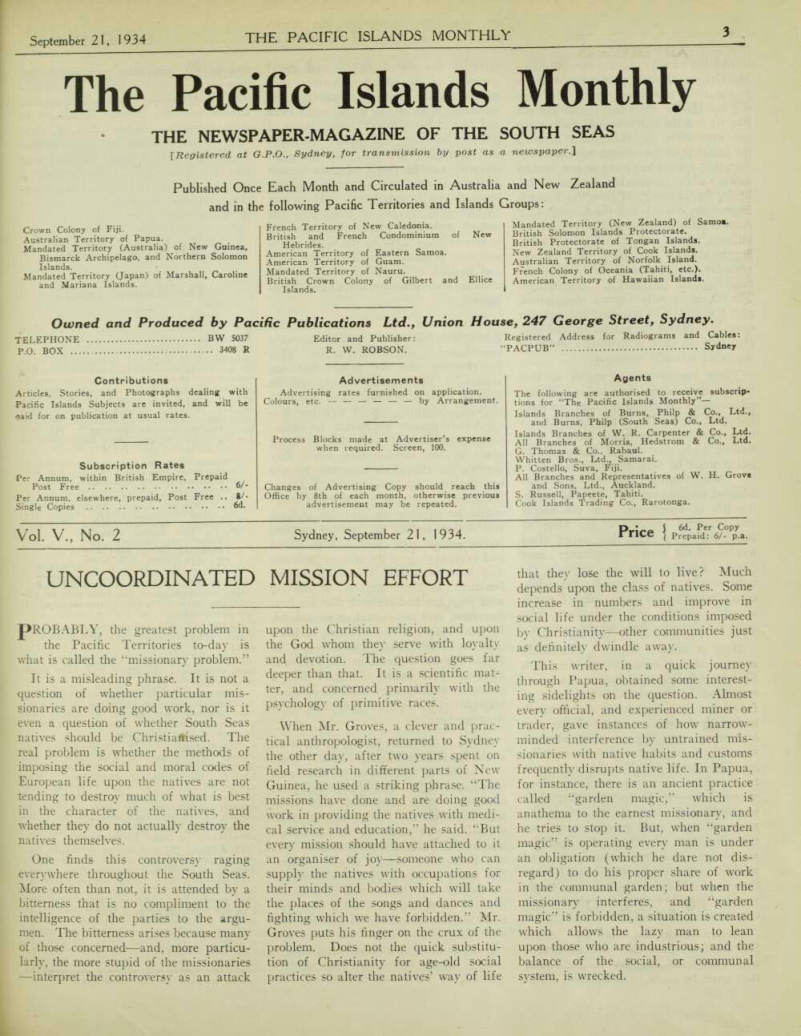
The Newspaper-Magazine Of The South Seas
[Registered at G.P.O., Sydney, for transmission by post as a newspaper.]
Published Once Each Month and Circulated in Australia and New Zealand and in the following Pacific Territories and Islands Groups:
Crown Colony of Fiji.
Australian Territory of Papua.
Mandated Territory (Australia) of New Guinea, Bismarck Archipelago, and Northern Solomon Islands.
Mandated Territory (Japan) of Marshall, Caroline and Mariana Islands.
French Territory of New Caledonia.
British and French Condominium of New Hebrides.
American Territory of Eastern Samoa.
American Territory of Guam.
Mandated Territory of Nauru.
British Crown Colony of Gilbert and Ellice Islands.
Mandated Territory (New Zealand) of Samos.
British Solomon Islands Protectorate.
British Protectorate of Tongan Islands.
New Zealand Territory of Cook Islands.
Australian Territory of Norfolk Island.
French Colony of Oceania (Tahiti, etc.).
American Territory of Hawaiian Islands.
Owned and Produced by Pacific Publications Ltd., Union House, 247 George Street, Sydney.
Telephone Bw 5037
P.O. Box 3408 R
Contributions Articles, Stories, and Photographs dealing with Pacific Islands Subjects are invited, and will be oaid for on publication at usual rates.
Subscription Rates
Per Annum, within British Empire, Prepaid Post Free 6/- Per Annum, elsewhere, prepaid, Post Free .. 8/- Single Copies 6d.
Editor and Publisher:
R. W. Robson.
Advertisements Advertising rates furnished on application.
Colours, etc. by Arrangement.
Process Blocks made at Advertiser’s expense when required. Screen, 100.
Changes of Advertising Copy should reach this Office by Bth of each month, otherwise previous advertisement may be repeated.
Registered Address for Radiograms and Cables: “PACPUB” Sydney
Agents The following are authorised to receive subscrip tions for “The Pacific Islands Monthly”
Islands Branches of Burns, Philp & Co., Ltd., and Burns, Philp (South Seas) Co., Ltd.
Islands Branches of W. R. Carpenter & Co., Ltd.
All Branches of Morris, Hedstrom & Co., Ltd.
G. Thomas & Co., Rabaul.
Whitten Bros., Ltd., Samarai.
P. Costello, Suva, Fiji.
All Branches and Representatives of W. H. Grove and Sons, Ltd., Auckland.
S. Russell, Papeete, Tahiti.
Cook Islands Trading Co., Rarotonga.
Vol. V., No. 2
Sydney, September 21, 1934.
Price 6d. Per Copy Prepaid: 6/- p.a.
Uncoordinated Mission Effort
PROBABLY, the greatest problem in the Pacific Territories to-day is what is called the “missionary problem.”
It is a misleading phrase. It is not a question of whether particular mis sionaries are doing good work, nor is it even a question of whether South Seas natives should be Christiafiised. The real problem is whether the methods of imposing the social and moral codes of European life upon the natives are not tending to destroy much of what is best in the character of the natives, and whether they do not actually destroy the natives themselves.
One finds this controversy raging everywhere throughout the South Seas.
More often than not, it is attended by a bitterness that is no compliment to the intelligence of the parties to the argu men. The bitterness arises because many of those concerned —and, more particu larly, the more stupid of the missionaries —interpret the controversy as an attack
upon the Christian religion, and upon the God whom they serve with loyalty and devotion. The question goes far deeper than that. It is a scientific mat ter, and concerned primarily with the psychology of primitive races.
When Mr. Groves, a clever and prac tical anthropologist, returned to Sydney the other day, after two years spent on field research in different parts of New Guinea, he used a striking phrase. “The missions have done and are doing good work in providing the natives with medi cal service and education," he said. “But every mission should have attached to it an organiser of joy—someone who can supply the natives with occupations for their minds and bodies which will take the places of the songs and dances and fighting which we have forbidden.” Mr.
Groves puts his finger on the crux of the problem. Does not the quick substitu tion of Christianity for age-old social practices so alter the natives’ way of life
that they lose the will to live? Much depends upon the class of natives. Some increase in numbers and improve in social life under the conditions imposed by Christianity—other communities just as definitely dwindle away.
This writer, in a quick journey through Papua, obtained some interest ing sidelights on the question. Almost every official, and experienced miner or trader, gave instances of how narrow minded interference by untrained mis sionaries with native habits and customs frequently disrupts native life. In Papua, for instance, there is an ancient practice called “garden magic,” which is anathema to the earnest missionary, and he tries to stop it. But, when “garden magic” is operating every man is under an obligation (which he dare not dis regard) to do his proper share of work in the communal garden; but when the missionary interferes, and “garden magic” is forbidden, a situation is created which allows the lazy man to lean upon those who are industrious; and the balance of the social, or communal system, is wrecked.
In the early days, Sir William MacGregor allotted particular districts to the rival missionary sects, and they did not clash. Sectarian bigots did not like it; but the natives could neither see nor appreciate the differences between the methods of the various missions. To day, that system has more or less broken down, with lamentable results. One hears, for instance, of how the London Missionary Society and the Seventh Day Adventists are in conflict in one of the villages, and of how each has been seek ing to disturb the other’s day of rest (Sunday, in the case of the L.M.S., and Saturday in the S.D.A. community).
The thing is silly beyond description, and a discredit to religion; but one can quite believe that the natives entered with glee into the plan of making a noise on the other fellow’s Sunday.
There are so many angles to this thing. Some cynic has truly said that missionaries are engaged mainly in forc ing upon the natives a religion that has been abandoned by white men. The outlook and behaviour of secular Euro peans must be very puzzling indeed to the simple-minded native who has adopted Christianity and is trying to live his life in accordance with the simple and beautiful precepts of the Man of Bethlehem. Frankly, this writer often has wondered how a missionary near certain Islands ports can explain, to natives who have adopted the white man’s religion, the behaviour of gangs of white drunks and fornicators who come roaring into their neighbourhood.
Here is another aspect. Practically every missionary who goes into the South Seas is an honest and sincere man —narrow-minded, sometimes, to the point of fanaticism, but courageous, and devoted, and ready for self-sacrifice. These men and women are trying, with absolute sincerity, to assist the natives, morally, mentally and physically. But in a great many cases they are working along wrong lines —it is possible that their uncoordinated attempts to bring the stone-age man, in a generation or two, into line with a culture that includes aeroplanes, and psycho-analysis, and world-broadcasts, do more actual harm than good. If that is so, is it not a tragic waste of some of the finest elements in our white civilisation?
Certain hings are admitted. South Seas natives, once they are in contact with Europeans, may not be left alone: they must be made to understand some
thing of the moral outlook and social structure of the whites, otherwise they will certainly destroy themselves by acquiring most of the white man’s vices and few of his virtues. Some classes of natives, meeting European “culture,” will inevitably die out; but the great majority can be saved, if their contact with the new culture is scientifically and sympathetically controlled. There are an unlimited number of white men and women with high ideals who are ready to devote their lives to the work of in structing primitive peoples in the ways and outlook of the white man, in the manner laid down by the Christian re ligion.
Why cannot the churches and the Administrations get together in some coordinated, scientifically-based plan for carrying out the things that are needed ? The matter should not be difficult of arrangement. The Adminis trations, certainly, would welcome it — all Administrators appreciate the educa tional and medical work that is being done by the missionaries, while they deplore the ridiculous situations created by bigotry, ignorance and sectarian jealousies. The main difficulty would would be in securing unity of outlook and action among the various mission bodies —while some take a wise, broad and tolerant view of the strange problems they have to handle, others are almost fanatical in their method of dealing with practices and customs that are fun damental, and not casual or superficial.
In this regard, it is interesting to learn that the Methodists, whose record of missionary achievement in the Pacific is excellent, will insist in future that a course in anthropology shall be a neces sary part of the equipment of their South Seas teachers.
There is too much jeering at the work of the missionaries in the Pacific. Some of it is due to that section of white men who hate religion, and always will jeer; some to another section of white men, who unconsciously class “niggers” with animals; and some to the low-class traders (of whom few now remain) who are the natural enemies of missionaries.
But much is caused by the missionaries themselves —by those well-intentioned, short-visioned, narrow-minded men who find “sin” in practices and customs that were old before Christ was born, and who try to force upon stone-age people a code of morals so complex that it often puzzles the white men themselves. The
remedy lies with the mission bodies themselves —let them revise and coordi nate their methods, and admit applied science and the lessons of history to their counsels. White men of good class do not like to see their religion laughed at —rather would they be proud that men of their race, in the name of the common Master, really are doing some thing for the advancement of the less fortunate races of mankind.
Larkin Case
The Review Fund
IT is proposed to submit to the New Guinea Administration and the Com monwealth Government a plea that the conviction of James Larkin on a charge of manslaughter, and his sentence of ten years’ imprisonment with hard labour, be reviewed. A fund, for the engagement of skilled counsel in connection with this matter, is being created by public sub scriptions, which were invited through the “Pacific Islands Monthly.” The fol lowing subscriptions have been received by the editor of the “P.1.M.”: “Waiben,” Thursday Is £3 3 0 Pacific Publications Ltd 3 3 0 Henry Dexter, Milne Bay, Papua 2 0 0 “Ex-Manusite,” T.N.G 3 3 0 B. G. Edgell, Manus, T.N.G, .. 10 10 0 W. G. Blundell, Samarai, Papua 10 0 H. Adams, Patlangat, Rabaul .. 3 3 0 “Prospector,” Salamaua, T.N.G,.. S 0 0 Per a New Guinea resident— “Yorks” £1; “Nobby’s” 10/-; Toomba £1; “Mogai” 10/-;“ Lin con” £1; “Denial” £1; “Lono” £1 6 0 0 Total £37 2 0 The subscribers to the fund will be ad vised, by personal letter, of the steps which are being taken.
Some outspoken letters accompanied the above subscriptions. We quote from a few; “Yorks”: “Believe me, the ‘white-men’ here appreciate the effort you have made on Larkin’s behalf.”
“Prospector”: “I think the verdict was a frightful piece of injustice, and thank God someone has moved at last. No greater argument for trial by jury could be quoted than this case.”
“Ex-Manusite”: “I frequently met James Larkin, and he was liked by all.
Even natives had the greatest respect for him for his straightforwardness. . . The crime fell a long way short of murder and the sentence fell short of justice. ... I cannot understand the lack of interest shown by the Returned Soldiers’ Associa tion —Larkin was among their ranks and ever-ready to plead their cause.”
H. Adams: “It is a wrong principle that one presiding judge alone should try a person on a capital charge—this system (the absence of a jury) should certainly be overhauled. It is not for me to say that justice has not been carried out —but I do say that the system is one that would permit a miscarriage of justice. . . The method of taking and translating native evidence could be improved. ‘Pidgin’ has different meanings which vary with the district in which it is spoken. In some cases the native will allow a misinterpre tation to pass, rather than argue."
Australia’s First Military
Prisoners of War
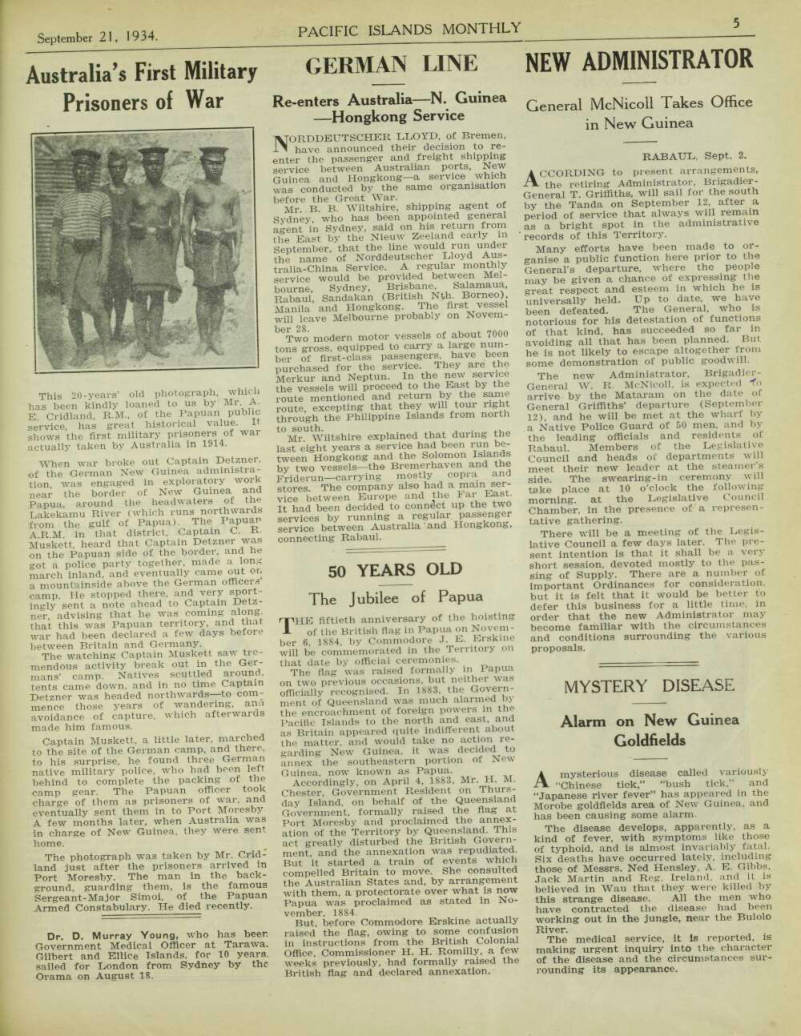
This 20-years’ old photograph, which has been kindly loaned to us by Mr A.
E. Cridland, R.M., of the Papuan public service, has great historical value. It shows the first military prisoners of war actually taken by Australia in 1914.
"When war broke out Captain Detzner, of the German New Guinea administra tion, was engaged in exploratory work near the border of New Guinea and Papua, around the headwaters of the Lakekamu River (which runs northwards from the gulf of Papua). The Papuan A.R.M. in that district, Captain C. R.
Muskett, heard that Captain Detzner was on the Papuan side of the border, and he got a police party together, made a long march inland, and eventually came out on a mountainside above the German officers camp. He stopped there, and very sport ingly sent a note ahead to Captain Detz ner, advising that he was coming along, that this was Papuan territory, and that war had been declared a few days before between Britain and Germany.
The watching Captain Muskett saw tre mendous activity break out in the Ger mans’ camp. Natives scuttled around, tents came down, and in no time Captain Detzner was headed northwards to com mence those years of wandering, ana avoidance of capture, which afterwards made him famous.
Captain Muskett, a little later, marched to the site of the German camp, and there, to his surprise, he found three German native military police, who had been left behind to complete the packing of the camp gear. The Papuan officer took charge of them as prisoners of war, and eventually sent them in to Port Moresby A few months later, when Australia was in charge of New Guinea, they were sent home.
The photograph was taken by Mr. Crid land just after the prisoners arrived in Port Moresby. The man in the back ground, guarding them, is the famous Sergeant-Major Simoi, of the Papuan Armed Constabulary. He died recently.
Dr. D. Murray Young, who has been Government Medical Officer at Tarawa, Gilbert and Ellice Islands, for 10 years, sailed for London from Sydney by the Orama on August 18.
German Line
Re-enters Australia —N. Guinea —Hongkong Service
Norddeutscher Lloyd, Of Bremen,
have announced their decision to re enter the passenger and freight shipping service between Australian ports, New Guinea and Hongkong—a service which was conducted by the same organisation before the Great War.
Mr B. B. Wiltshire, shipping agent of Sydney, who has been appointed general agent in Sydney, said on his return from the East by the Nieuw Zeeland early in September, that the line would run under the name of Norddeutscher Lloyd Aus tralia-China Service. A regular monthly service would be provided between Mel bourne, Sydney, Brisbane, Salamaua, Rabaul, Sandakan (British Nth. Borneo), Manila and Hongkong. The first vessel will leave Melbourne probably on Novem- Two modern motor vessels of about 7000 tons gross, equipped to carry a large num ber of first-class passengers, have been purchased for the service. They are the Merkur and Neptun. In the new service the vessels will proceed to the East by the route mentioned and return by the same route, excepting that they will tour right through the Philippine Islands from north to south.
Mr Wiltshire explained that during the last eight years a service had been run be tween Hongkong and the Solomon Islands by two vessels—the Bremerhaven and the Friderun —carrying mostly copra and stores. The company also had a mam ser vice between Europe and the Bar East.
It had been decided to connect up the two services by running a regular passenger service between Australia and Hongkong, connecting Rabaul.
The Jubilee of Papua
50 Years Old
THE fiftieth anniversary of the hoisting of the British flag in Papua on Novem ber 6, 1884, by Commodore J. E. Erskine will be commemorated in the Territory on that date by official ceremonies.
The flag was raised formally in Papua on two previous occasions, but neither was officially recognised. In 1883, the Govern ment of Queensland was much alarmed by the encroachment of foreign powers in the Pacific Islands to the north and east, and as Britain appeared quite indifferent about the matter, and would take no action re garding New Guinea, it was decided to annex the southeastern portion of New Guinea, now known as Papua.
Accordingly, on April 4, 1883, Mr. H. M.
Chester, Government Resident on Thurs day Island, on behalf of the Queensland Government, formally raised the flag at Port Moresby and proclaimed the annex ation of the Territory by Queensland. This act greatly disturbed the British Govern ment, and the annexation was repudiated.
But it started a train of events which compelled Britain to move. She consulted the Australian States and, by arrangement with them, a protectorate over what is now Papua was proclaimed as stated in No vember, 1884.
But, before Commodore Erskine actually raised the flag, owing to some confusion in instructions from the British Colonial Office, Commissioner H. H. Romilly, a few weeks previously, had formally raised the British flag and declared annexation.
New Administrator
General McNicoll Takes Office in New Guinea
Rabaul, Sept. 2.
ACCORDING to present arrangements, the retiring Administrator, Brigadier- General T. Griffiths, will sail for the south by the Tanda on September 12, after a period of service that always will remain as a bright spot in the administrative records of this Territory.
Many efforts have been made to or ganise a public function here prior to the General’s departure, where the people may be given a chance of expressing the great respect and esteem in which he is universally held. Up to date, we have been defeated. The General, who is notorious for his detestation of functions of that kind, has succeeded so far in avoiding all that has been planned. But he is not likely to escape altogether from some demonstration of public goodwill- The new Administrator, Brigadier- General W. R. McNicoll, is expected to arrive by the Mataram on the date of General Griffiths’ departure (September 12), and he will be met at the wharf by a Native Police Guard of 50 men, and by the leading officials and residents of Rabaul, Members of the Legislative Council and heads of departments will meet their new leader at the steamer’s side. The swearing-in ceremony will take place at 10 o’clock the following morning, at the Legislative Council Chamber, in the presence of a represen tative gathering.
There will be a meeting of the Legis lative Council a few days later. The pre sent intention is that it shall be a very short session, devoted mostly to the pas sing of Supply. There are a number of important Ordinances for consideration, but it is felt that it would be better to defer this business for a little time, in order that the new Administrator may become familiar with the circumstances and conditions surrounding the various proposals.
Mystery Disease
Alarm on New Guinea Goldfields
A mysterious disease called variously “Chinese tick,” “bush tick,” and “Japanese river fever” has appeared in the Morobe goldfields area of New Guinea, and has been causing some alarm.
The disease develops, apparently, as a kind of fever, with symptoms like those of typhoid, and is almost invariably fatal.
Six deaths have occurred lately, including those of Messrs. Ned Hensley, A. E. Gibbs, Jack Martin and Reg. Ireland, and it is believed in Wau that they were killed by this strange disease. All the men who have contracted the disease had been working out in the jungle, near the Bulolo River.
The medical service, it is reported, is making urgent inquiry into the character of the disease and the circumstances sur rounding its appearance.
Catapulting The
Governor
French-American Courtesies in New Caledonia
From Our Own Correspondent.
Noumea, Sept. 7.
Monday, August 27, we received a visit from the American cruiser As toria. She arrived at Noumea early in the morning, and, entering the harbour, fired a salvo of twenty-one guns. After an official visit had been paid upon the Governor (M. Siadous) His Excellency went on board and received a further salvo.
On the following day, keen interest was shown in the four hydroplanes which were catapulted off the ship and made a lengthy flight over Noumea and the surrounding districts. The Governor, who is an experienced aviator, accepted an offer to go up in one of the hydroplanes, and much enjoyed the experiences of being cata pulted off, and of seeing Noumea with its beautiful surrounding coastline spread out beneath him.
On Tuesday afternoon, Madame Siadous held the usual monthly reception at Government House, which had been timed to coincide with the Astoria’s visit. Dancing was soon in full swing, and the American officers were not slow to take advantage of the many charming partners with their soft attractive French voices.
That evening Mr. and Mrs. Perkins, who are here on a visit from New York, en tertained their compatriots at a large dinner at the Grand Hotel du Pacifique (which has lately changed its name from Hotel de la Gare).
On Wednesday, Captain Root and his officers, with a detachment of marines, placed a wreath at the foot of the “Monu ment aux Morts.”
Copra & Rubber
How Papua is Seeking an Extended Market
ON the principle that nothing is to be gained by sitting with folded hands, Waiting for the markets to recover, the leading officials of the Papuan Govern ment are seeking new and extended uses for the Territory’s chief products.
At a recent meeting of the Legislative Council of Papua, Mr. A. P. Lyons urged that an attempt should be made to secure concerted action between Papua, New Guinea and the Solomon Islands, with a view' to improving copra production and securing a higher standard grade from those-Territories. The suggestion found favour; and inquiries now are being made among the copra-producers of Papua, with a view to formulating practical sugges tions for submission to the other Terri tories.
Air Crash In New Guinea
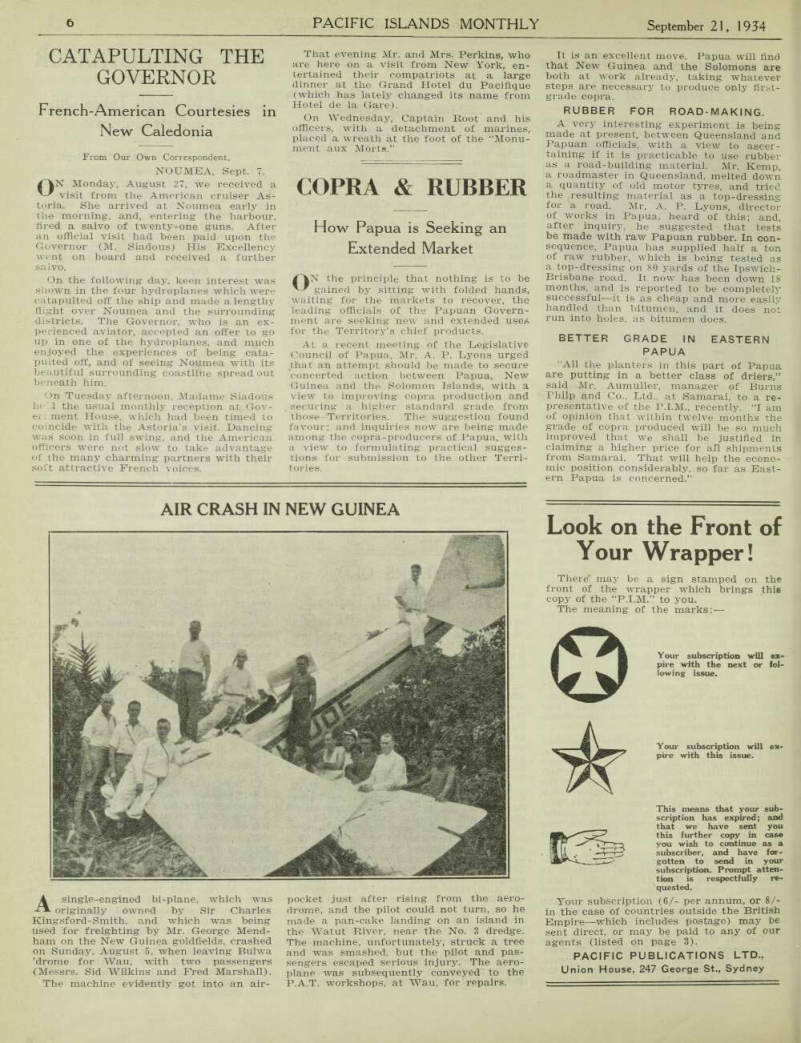
A single-engined bi-plane, which was originally owned by Sir Charles Kingsford-Smith, and which was being used for freighting by Mr. George Mend ham on the New Guinea goldfields, crashed on Sunday, August 5, when leaving Bulwa ’drome for Wau, with two passengers (Messrs, Sid Wilkins and Fred Marshall).
The machine evidently got into an air
pocket just after rising from the aero drome, and the pilot could not turn, so he made a pan-cake landing on an island in the Watut River, near the No. 3 dredge.
The machine, unfortunately, struck a tree and was smashed, but the pilot and pas sengers escaped serious injury. The aero plane was subsequently conveyed to the P.A.T. workshops, at Wau, for repairs.
It is an excellent move. Papua will find that New Guinea and the Solomons are both at work already, taking whatever steps are necessary to produce only first grade copra.
Rubber For Road-Making.
A very interesting experiment is being made at present, between Queensland and Papuan officials, with a view to ascer taining if it is practicable to use rubber as a road-building material. Mr. Kemp, a roadmaster in Queensland, melted down a quantity of old motor tyres, and tried the resulting material as a top-dressing for a road. Mr. A. P. Lyons, director of works in Papua, heard of this; and, after inquiry, he suggested that tests be made with raw Papuan rubber. In con sequence, Papua has supplied half a ton of raw rubber, which is being tested as a top-dressing on 80 yards of the Ipswich- Brisbane road. It now' has been down 18 months, and is reported to be completely successful —it is as cheap and more easily handled than bitumen, and it does not run into holes, as bitumen does.
Better Grade In Eastern
Papua
“All the planters in this part of Papua are putting in a better class of driers,” said Mr. Aumuller, manager of Burns Philp and Co., Ltd., at Samarai, to a re presentative of the P.1.M., recently. “I am of opinion that within tw'elve months the grade of copra produced wall be so much improved that we shall be justified in claiming a higher price for all shipments from Samarai. That will help the econo mic position considerably, so far as East ern Papua is concerned.”
Advertisements & other items, p. 8 (1 item)
Your Wrapper!
Look on the Front of
There may be a sign stamped on the front of the wrapper which brings this copy of the “P.I.M.” to you.
The meaning of the marks:— Your subscription will expire with the next or following issue.
Your subscription will expire with this issue.
This means that your subscription has expired; and that we have sent you this further copy in case you wish to continue as a subscriber, and have forgotten to send in your subscription. Prompt attention is respectfully requested.
Your subscription (6/- per annum, or 8/in the case of countries outside the British Empire—which includes postage) may be sent direct, or may be paid to any of our agents (listed on page 3).
PACIFIC PUBLICATIONS LTD..
Union House, 247 George St., Sydney
Returned Soldiers’ Reunion At Kopopo, N. Guinea
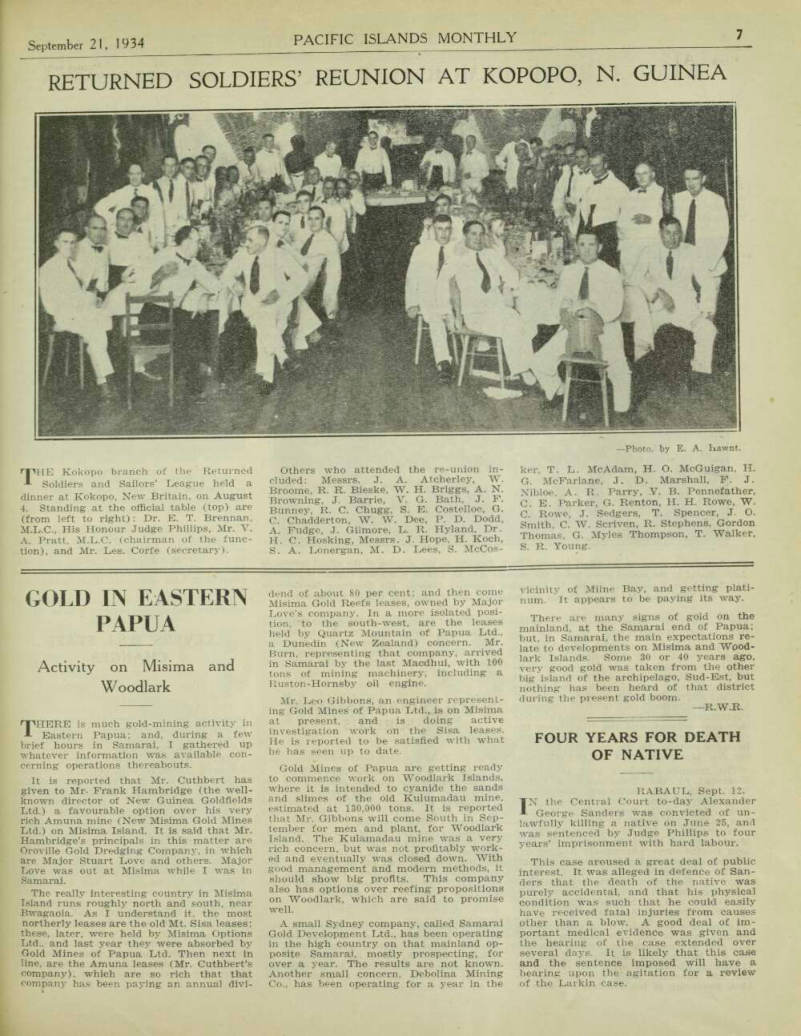
THE Kokopo branch of the Returned Soldiers and Sailors’ League held a dinner at Kokopo, New Britain, on August 4. Standing at the official table (top) are (from left to right): Dr. E. T. Brennan, M.L.C., His Honour Judge Phillips, Mr. V.
A. Pratt, M.L.C. (chairman of the func tion), and Mr. Les. Corfe (secretary).
Others who attended the re-union in cluded: Messrs. J. A. Atcherley, W.
Broome, R. R. Bieske, W. H. Briggs, A. N.
Browning, J. Barrie, V. G. Bath, J. F.
Bunney, R. C. Chugg, S. E. Costelloe, G.
C. Chadderton, W. W. Dee, P. D. Dodd, A. Fudge, J. Gilmore, L. R. Hyland, Dr.
H. C. Hosking, Messrs. J. Hope, H. Koch, S. A. Lonergan, M. D. Lees, S. McCos-
ker, T, L. McAdam, H. O. McGuigan, H.
G. McFarlane, J. D. Marshall, F. J.
Nibloe, A. R. Parry, Y. B. Pennefather, C. E. Parker, G. Renton, H. H. Rowe, W.
C. Rowe, J. Sedgers, T. Spencer, J. O.
Smith, C. W. Scriven, R. Stephens, Gordon Thomas, G. Myles Thompson, T. Walker, S. R. Young.
Papua
Gold In Eastern
Activity on Misima and Woodlark
THERE is much gold-mining activity in Eastern Papua; and, during a few brief hours in Samarai, I gathered up whatever information was available con cerning operations thereabouts.
It is reported that Mr. Cuthbert has given to Mr. Frank Hambridge (the well known director of New Guinea Goldfields Ltd.) a favourable option over his very rich Amuna mine (New Misima Gold Mines Ltd.) on Misima Island. It is said that Mr.
Hambridge’s principals in this matter are Oroville Gold Dredging Company, in which are Major Stuart Love and others. Major Love was out at Misima while I was in Samarai.
The really interesting country in Misima Island runs roughly north and south, near Bwagaoia. As I understand it, the most northerly leases are the old Mt. Sisa leases; these, later, were held by Misima Options Ltd., and last year they were absorbed by Gold Mines of Papua Ltd. Then next in line, are the Amuna leases (Mr. Cuthbert’s company), which are so rich that that company has been paying an annual divi
dend of about 80 per cent; and then come Misima Gold Reefs leases, owned by Major Love’s company. In a more isolated posi tion, to the south-west, are the leases held by Quartz Mountain of Papua Ltd., a Dunedin (New Zealand) concern. Mr.
Burn, representing that company, arrived in Samarai by the last Macdhui, with 100 tons of mining machinery, including a Ruston-Hornsby oil engine.
Mr. Leo Gibbons, an engineer represent ing Gold Mines of Papua Ltd., is on Misima at present, and is doing active investigation work on the Sisa leases.
He is reported to be satisfied with what he has seen up to date.
Gold Mines of Papua are getting ready to commence work on Woodlark Islands, where it is intended to cyanide the sands and slimes of the old Kulumadau mine, estimated at 130,000 tons. It is reported that Mr. Gibbons will come South in Sep tember for men and plant, for Woodlark Island. The Kulamadau mine was a very rich concern, but was not profitably work ed and eventually was closed down. With good management and modern methods, it should show big profits. This company also has options over reefing propositions on Woodlark, which are said to promise well.
A small Sydney company, called Samarai Gold Development Ltd., has been operating in the high country on that mainland op posite Samarai, mostly prospecting, for over a year. The results are not known.
Another small concern, Debolina Mining Co., has been operating for a year in the
vicinity of Milne Bay, and getting plati num. It appears to be paying its way.
There are many signs of gold on the mainland, at the Samarai end of Papua; but, in Samarai, the main expectations re late to developments on Misima and Wood lark Islands. Some 30 or 40 years ago, very good gold was taken from the other big island of the archipelago, Sud-Est, but nothing has been heard of that district during the present gold boom.
R.W.R.
Four Years For Death
Of Native
Rabaul, Sept. 12.
IN the Central Court to-day Alexander George Sanders was convicted of un lawfully killing a native on June 25, and was sentenced by Judge Phillips to four years’ imprisonment with hard labour.
This case aroused a great deal of public interest. It was alleged in defence of San ders that the death of the native was purely accidental, and that his physical condition was such that he could easily have received fatal injuries from causes other than a blow. A good deal of im portant medical evidence was given and the hearing of the case extended over several days. It is likely that this case and the sentence imposed will have a bearing upon the agitation for a review of the Larkin case.
King Albert Memorial Park
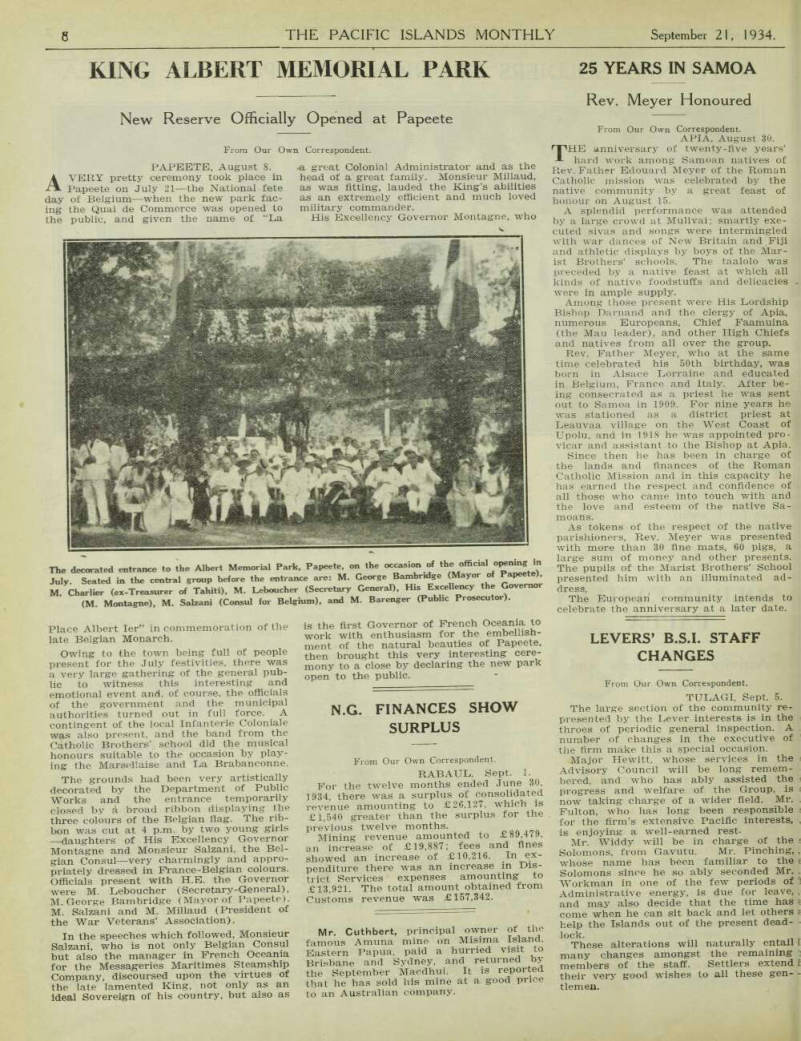
New Reserve Officially Opened at Papeete
From Our Own Correspondent.
PAPEETE, August 8.
A VERY pretty ceremony took place in Papeete on July 21—the National fete day of Belgium—when the new park facing the Quai de Commerce was opened to the public, and given the name of “La
a great Colonial Administrator and as the head of a great family. Monsieur Millaud, as was fitting, lauded the King’s abilities as an extremely efficient and much loved military commander.
His Excellency Governor Montagne, who
Place Albert Ier” in commemoration of the late Belgian Monarch.
Owing to the town being full of people present for the July festivities, there was a very large gathering of the general pub lic to witness this interesting and emotional event and, of course, the officials of the government and the municipal authorities turned out in full force. A contingent of the local Infanterie Coloniale was also present, and the band from the Catholic Brothers’ school did the musical honours suitable to the occasion by play ing the Marsellaise and La Brabanconne.
The grounds had been very artistically decorated by the Department of Public Works and the entrance temporarily closed by a broad ribbon displaying the three colours of the Belgian flag. The rib bon was cut at 4 p.m. by two young girls —daughters of His Excellency Governor Montagne and Monsieur Salzani, the Bel gian Consul —very charmingly and appro priately dressed in France-Belgian colours.
Officials present with H.E. the Governor were M. Leboucher (Secretary-General), M. George Bambridge (Mayor of Papeete).
M. Salzani and M. Millaud (President of the War Veterans’ Association).
In the speeches which followed, Monsieur Salzani, who is not only Belgian Consul but also the manager in French Oceania for the Messageries Maritimes Steamship Company, discoursed upon the virtues of the late lamented King, not only as an ideal Sovereign of his country, but also as
is the first Governor of French Oceania to work with enthusiasm for the embellish ment of the natural beauties of Papeete, then brought this very interesting cere mony to a close by declaring the new park open to the public.
The decorated entrance to the Albert Memorial Park, Papeete, on the occasion of the officia l i n July. Seated in the central group before the entrance are: M. George Bambridge Mayor of Papeete).
M. Charlier (ex-Treasurer of Tahiti), M. Leboucher (Secretary General), H IS Excellency the Governor (M. Montague), M. Salzani (Consul for Belgium), and M. Barenger (Public Prosecutor).
N.G. Finances Show
Surplus
From Our Own Correspondent.
Rabaul, Sept. 1.
For the twelve months ended June 30, 1934, there was a surplus of consolidated revenue amounting to £26,127, which is £1,540 greater than the surplus for the previous twelve months.
Mining revenue amounted to £89,479, an increase of £19,887; fees and fines showed an increase of £10,216. In ex penditure there was an increase in Dis trict Services expenses amounting to £13,921. The total amount obtained from Customs revenue was £157,342.
Mr. Cuthbert, principal owner of the famous Amuna mine on Misima Island, Eastern Papua, paid a hurried visit to Brisbane and Sydney, and returned by the September Macdhui. It is reported that he has sold his mine at a good price to an Australian company.
25 Years In Samoa
Rev. Meyer Honoured
From Our Own Correspondent.
APIA, August 30.
THE anniversary of twenty-five years’ hard work among Samoan natives of Rev. Father Edouard Meyer of the Roman Catholic mission was celebrated by the native community by a great feast of honour on August 15.
A splendid performance was attended by a large crowd at Mulivai; smartly exe cuted sivas and songs were intermingled with war dances of New Britain and Fiji and athletic displays by boys of the Mar ist Brothers’ schools. The taalolo was preceded by a native feast at which all kinds of native foodstuffs and delicacies were in ample supply.
Among those present were His Lordship Bishop Darnand and the clergy of Apia, numerous Europeans, Chief Faamuina (the Mau leader), and other High Chiefs and natives from all over the group.
Rev. Father Meyer, who at the same time celebrated his 50th birthday, was born in Alsace Lorraine and educated in Belgium, France and Italy. After be ing consecrated as a priest he was sent out to Samoa in 1909. For nine years he was stationed as a district priest at Leauvaa village on the West Coast of Upolu, and in 1918 he was appointed pro vicar and assistant to the Bishop at Apia.
Since then he has been in charge of the lands and finances of the Roman Catholic Mission and in this capacity he has earned the respect and confidence of all those who came into touch with and the love and esteem of the native Sa moans.
As tokens of the respect of the native parishioners, Rev. Meyer was presented with more than 30 fine mats, 60 pigs, a large sum of money and other presents.
The pupils of the Marist Brothers’ School presented him with an illuminated ad dress.
The European community intends to celebrate the anniversary at a later date.
Levers’ B.S.I. Staff
Changes
From Our Own Correspondent.
Tulagi, Sept. 5.
The large section of the community re presented by the Lever interests is in the throes of periodic general inspection. A number of changes in the executive of the firm make this a special occasion.
Major Hewitt, whose services in the Advisory Council will be long remem bered, and who has ably assisted the progress and welfare of the Group, is now taking charge of a wider field. Mr.
Fulton, who has long been responsible for the firm’s extensive Pacific interests, is enjoying a well-earned rest.
Mr. Widdy will be in charge of the Solomons, from Gavutu. Mr. Pinching, whose name has been familiar to the Solomons since he so ably seconded Mr.
Workman in one of the few periods of Administrative energy, is due for leave, and may also decide that the time has come when he can sit back and let others help the Islands out of the present dead lock.
These alterations will naturally entail many changes amongst the remaining members of the staff. Settlers extend their very good wishes to all these gen tlemen.
The Monsunen
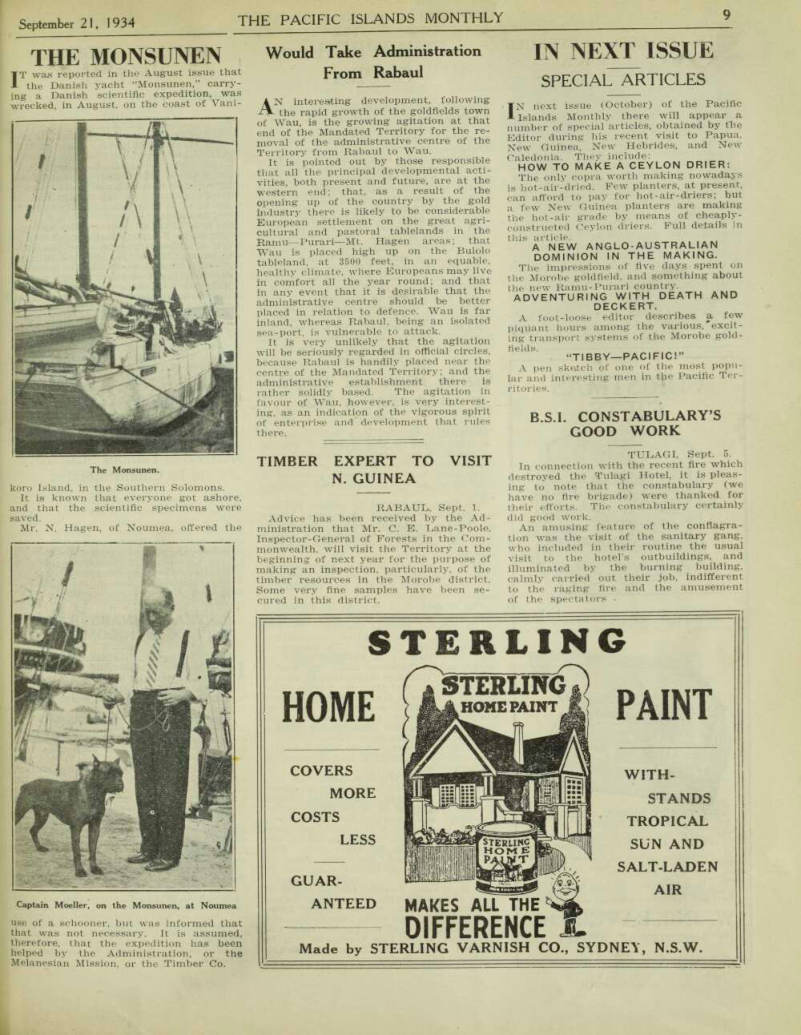
IT was reported in the August issue that the Danish yacht “Monsunen,” carry ing a Danish scientific expedition, was wrecked, in August, on the coast of Vani-
koro Island, in the Southern Solomons.
It is known that everyone got ashore, and that the scientific specimens were saved.
Mr. N. Hagen, of Noumea, offered the
use of a schooner, but was informed that that was not necessary. It is assumed, therefore, that the expedition has been helped by the Administration, or the Melanesian Mission, or the Timber Co.
The Monsunen.
Captain Moeller, on the Monsunen, at Noumea
From Rabaul
Would Take Administration From Rabaul
AN interesting development, following the rapid growth of the goldfields town of Wau, is the growing agitation at that end of the Mandated Territory for the re moval of the administrative centre of the Territory from Rabaul to Wau.
It is pointed out by those responsible that all the principal developmental acti vities, both present and future, are at the western end; that, as a result of the opening up of the country by the gold industry there is likely to be considerable European settlement on the great agri cultural and pastoral tablelands in the Ramu —Purari —Mt. Hagen areas; that Wau is placed high up on the Bulolo tableland, at 3500 feet, in an equable, healthy climate, where Europeans may live in comfort all the year round; and that in any event that it is desirable that the administrative centre should be better placed in relation to defence. Wau is far inland, whereas Rabaul, being an isolated sea-port, is vulnei'able to attack.
It is very unlikely that the agitation will be seriously regarded in official circles, because Rabaul is handily placed near the centre of the Mandated Territory; and the administrative establishment there is rather solidly based. The agitation in favour of Wau, however, is very interest ing, as an indication of the vigorous spirit of enterprise and development that rules there.
N. Guinea
Timber Expert To Visit
Rabaul, Sept. 1.
Advice has been received by the Ad ministration that Mr. C. E. Lane-Poole, Inspector-General of Forests in the Com monwealth. will visit the Territory at the beginning of next year for the purpose of making an inspection, particularly, of the timber resources in the Morobe district.
Some very fine samples have been se cured in this district.
In Next Issue
Special Articles
IN next issue (October) of the Pacific Islands Monthly there will appear a number of special articles, obtained by tbe Editor during his recent visit to Papua.
New Guinea, New Hebrides, and New Caledonia. They include:
How To Make A Ceylon Drier:
The only copra worth making nowadays is hot-air-dried. Few planters, at present, can afford to pay for hot-air-driers; but a few New Guinea planters are making the hot-air grade by means of cheaply constructed Ceylon driers. Full details in this article.
A New Anglo-Australian
Dominion In The Making.
The impressions of five days spent on the Morobe goldfield, and something about the new Ramu-Purari country.
Adventuring With Death And
Deckert.
A foot-loose editor describes a few piquant hours among the various, excit ing transport systems of the Morobe gold fields.
“Tibby—Pacific!”
A pen skatch of one of the most popu lar and interesting men in the Pacific Ter ritories.
B.S.I. Constabulary’S
Good Work
Tulagi, Sept. 5.
In connection with the recent fire which destroyed the Tulagi Hotel, it is pleas ing to note that the constabulary (we have no fire brigade) were thanked for their efforts. The constabulary certainly did good work.
An amusing feature of the conflagra tion was the visit of the sanitary gang, who included in their routine the usual visit to the hotel’s outbuildings, and illuminated by the burning building, calmly carried out their job, indifferent to the raging fire and the amusement of the spectators.
Advertisements & other items, p. 11 (1 item)
Home
STERLING
COVERS
MORE
COSTS
LESS
GUAR-
ANTEED
STERLING
HOME PAINT
MAKES ALL THE
DIFFERENCE
PAINT
WITH-
STANDS
TROPICAL
SUN AND
SALT-LADEN
AIR
Made by STERLING VARNISH CO., SYDNEY, N.S.W.
Gold-Stealers Sentenced
At Salamaua
From Our Own Correspondent.
RAbaul, Sept. 1.
His Honour Judge Wanliss (the Chief Judge) and Mr. Maunsell Turner, of the Crown Law Department, visited Salamaua recently and held a Circuit Court there between August 13 and 16. and dealt with several cases connected with gold-steal ing and gold-buying.
T. P. Featherstone, charged with ille gal gold-buying was found guilty and sentenced to two-and-a-half years’ im prisonment.
T. R. O. Clay, found guilty of gold stealing, was sentenced to three months’ and eighteen months’ imprisonment, to be served concurrently.
R. J. V. Sutherland was found guilty of stealing gold specimens and sentenced to three months’ on the the first count and four years’ on the second, to be served concurrently- Peter Zuccola, charged with illegally buying gold, was found guilty and fined £20.
Philippines
Copra
EARLY in August the Fiji Coconut Planters’ Union sent its members the following account of the latest develop ments in connection with copra from the Philippine Islands.
“Writing under date of July 6, our Lon don brokers again emphasise the very large extent to which Philippine copra has been offered in the European market. In fact, it has become so cheap that English crushers have found they can import it, pay the 10 per cent, tax, and yet find it good value compared with other grades.
“Normally, of course, practically the en tire Philippine production of close on 300,000 tons is taken by the United States.
With the Processing Tax now imposed on coconut oil in the United States, tens of thousands of tons of Philippine copra has had to find a home in Europe.
“However, well informed opinion in San Francisco holds the view that sooner or later the United States must re-commence buying copra and we should imagine that this moment will not be long delayed.” ,
Use of Morse and Telephone
Radio Sets in N.G.
THERE have been very interesting de velopments in New Guinea in the use of wireless telegraphy as a means of com munication between isolated centres; and remarkable success has been achieved in this direction by Amalgamated Wireless Ltd.
The apparatus used is simple, but ap parently very efficient —it consists simply of Morse transmitting and receiving sets, operated on power supplied by a native, who sits on a thing like a bicycle frame, and pedals lustily.
Such a set had been in operation be tween Buka Passage and Kieta wireless station for seven months, and it is giving satisfactory results.
The manager of A.W.A. in Rabaul is now putting similar units into operation at Namatanai, Talasea, Gasmata, Weewak, and other administrative sub-stations throughout the Territory. The apparatus for these stations is being supplied by Amalgamated Wireless Ltd., the district officials are teaching themselves to use the Morse system; and they are having satis factory success in communicating between themselves. The new system of com munication is not yet officially in ope ration among these stations —the officials are practising with each other.
The Buka Passage—Kieta circuit, having been proved practicable, is now open for public traffic.
Amalgamated Wireless Ltd. has also been experimenting with radio-telephone sets in the Territory. These also operate on power supplied by a pedalling native.
Using one of these sets, Mr. Twycross, at Rabaul, carried on a two-ways conversa tion, quite clearly, over a period of two hours with Bulolo, 450 miles away. This radio-telephone set has now gone to Papua, where experiments also will be made.
It is evident already that the use of these radio-telegraph and radio-telephone sets will solve one of the greatest prob lems of life in the Pacific Islands —namely, communication—and the further results.of operations in the two Territories will be watched with interest by every Admini stration in the Pacific.
Sydney
Papuan Medical
Students
Further Party to Study in Sydney
From Our Own Correspondent.
PT. MORESBY, August 11.
THE Chief Medical Officer of Papua (Dr. Walter M. Strong) will leave Port Moresby for Sydney in September, with another batch of native students, to undergo a course of elementary medical training to fit them out for medical patrol work in Papua.
The first batch of students, who returned to Papua in February last, are already at work at different points along the coast and inland. It is as yet too early to judge by results; but it is confidently hoped by the authorities, that these natives will do a great deal towards providing elemen tary treatment among the coastal tribes and more settled people of the interior, who are in need of medical attention.
They are all stationed under the imme diate supervision of the Resident Magis trates of the different Divisions they were sent to. The Magistrates send them out in parties of three to patrol the villages of the district, and reports of their work are sent to the Chief Medical Officer in Port Moresby.
Dr. Lawes
Arrival of Famous Missionary to be Commemorated
THAT famous missionary, Dr. W. G.
Lawes, landed at Hanuabada village, in Port Moresby Harbour, on November 21, 1874, and the London Missionary So ciety leaders in Papua propose to com memorate the 60th anniversay of the event by the erection of a memorial —probably a granite obelisk —in some suitable place.
The arrangements are in the hands of Rev. D. E. Ure, of Port Moresby.
Extraordinary Radio
Tax In Solomons
Letter to the Editor.
I NOTICED the statement in your issue of June about the wireless license fees, and I feel proud that the wireless listeners of Papua are solid that they will not pay license fees.
Here in the Solomons we have to pay £1 a year fee, and, personally, I do not think the Government can force us to pay that amount, as it only goes into revenue.
The only two stations we do get clearly, after 7 p.m., are Townsville and Brisbane, and the Solomons Government should be made pay something towards their upkeep, if we are still to pay that £1.
It would be a good thing in these hard times if you would see into this matter, as I am sure all listeners would be grate ful for your advice.
I am, etc.,
B.B.I. Planter.
Ysabel, B.S.I., August 2, 1934. , EDITORIAL NOTE.—This certainly is one of the “hottest” imposts we ever have heard of. The only reason for taxing radio listeners-in anywhere is to provide essential revenue for the broadcasting stations. The B.S.I. Administration cannot collect such a tax unless there is a law or ordinance giv ing direct authority for same. We have not heard of such a law.
Advertisements & other items, p. 12 (1 item)
Christmas
GIFTS
Ladies Scissor Case, made of fancy leather, containing 4 pairs nickle-plated Scissors, 37/6 containing 3 pairs nickle-plated Scissors, 25/-
NEW EMPIRE MODEL WILKINSON
SAFETY RAZOR
This is a Self-stropping Razor, without removing the blade from the frame.
No. 7. —Same as above, with, 2 blades, 14/6 Extra Blades (packet of five), 7/6 each Postage 3d.
Post Free for cash with order.
Send for Illustrated Catalogue, Post Free.
W. JNO. BAKER Ltd.
3 HUNTER ST., SYDNEY.
Hebrides
British Copra in New Hebrides Removal of French Duty Sought
THE British Resident Commissioner at Vila is negotiating with France with a view to having British-grown copra in the New Hebrides imported into France, free of duty, stated Mr. C. Sullivan, Islands merchant, who returned to Syd ney on August 18, after a visit to the Condominium.
A heavy duty was placed on copra from any but French colonies, continued Mr.
Sullivan but the Resident Commissioner at Vila claimed that British-grown copra from the New Hebrides should be admit ted tax-free because the Group was governed by both France and England.
If negotiations were successful, said Mr.
Sullivan, it was possible that they might be negatived by further action on the part of the French Government, which was considering a bounty to French producers of copra. This would bring prosperity to the New Hebrides, but the bounty would be paid only to French producers, thus leaving the English growers at a disadvantage.
The Montoro
THE B.P. Islands steamer Montoro, which early in August appeared to be hopelessly wrecked on the coast of New Guinea, and which was salvaged as a re sult of splendid seamanship and engineer ing skill, is now in dry dock in Sydney undergoing repairs.
We are officially informed that the re pair work is making excellent progress, and that it will be completed by the middle of October. The Montoro will be recommissioned immediately and will take up her Papua-New Guinea schedule on October 17 —only a week late. It is probable that the Macdhui’s November timetable will also be set back a week.
It is not known yet who will have com mand of the Montoro when she sails on October 17. Captain G. E. Williams, who received much of the credit for a splendid salvage feat, has been feeling the severe strain of recent weeks, and is to enjoy a quiet holiday, after which he will take up port duty in Sydney for a time.
Carpenter Ships
First Due in October
THE first steamer (m.v. Salamaua) of the new Carpenter service will arrive in Sydney from London, via West African and South Australian ports, in the first week of October. She is due in Rabaul direct from Sydney on October 21 and thence will visit New Guinea ports—prob ably Kavieng, Madang. and Salamaua — and is due in Batavia on November 13.
Then she will pass around South Africa, calling at Dakar (West Africa) and is due in London on December 29.
The m.v. Rabaul is expected in Sydney via West African ports on December 15, and will proceed to Rabaul via Queensland ports, arriving there towards the end of December. She is due in London via Batavia and West Africa, in March.
These new vessels are carrying about 12 passengers each, and the fare between Australia, or New Guinea and London is £35.
“Apblin Alps”
Nason Jones’ Exploratory Work in New Guinea and Papua
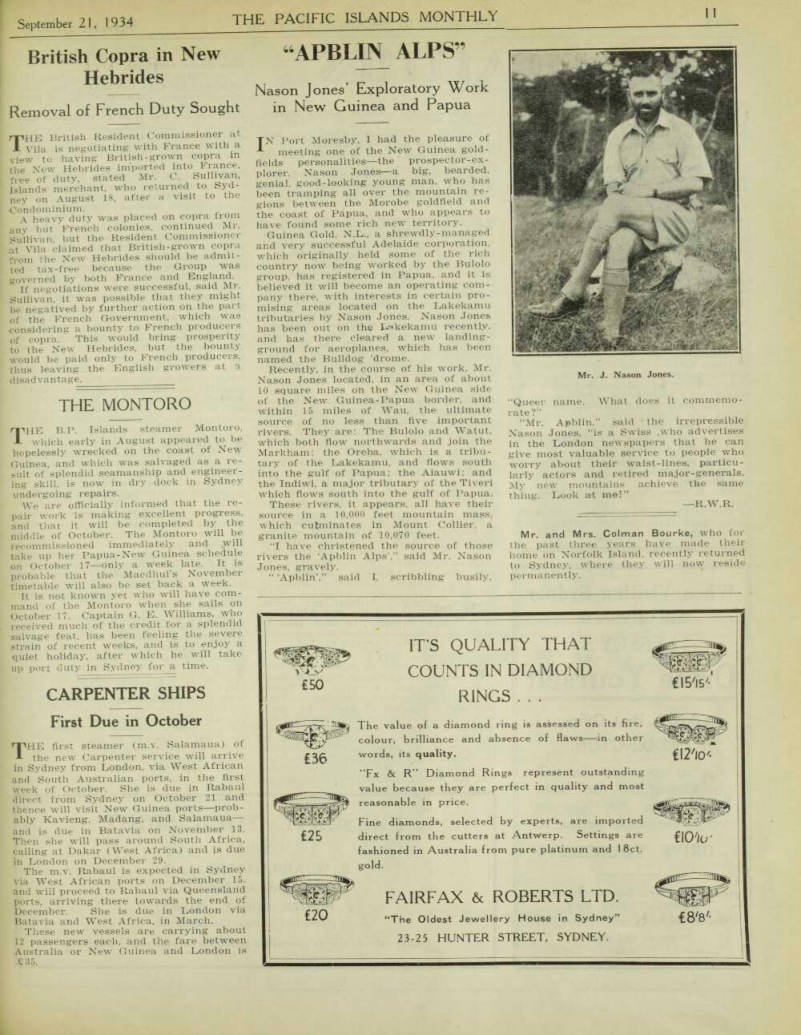
IN Port Moresby, I had the pleasure of meeting one of the New Guinea gold fields personalities—the prospector-ex plorer, Nason Jones —a big, bearded, genial, good-looking young man, who has been tramping all over the mountain re gions between the Morobe goldfield and the coast of Papua, and who appears to have found some rich new territory.
Guinea Gold, N.L., a shrewdly-managed and very successful Adelaide corporation, which originally held some of the rich country now being worked by the Bulolo group, has registered in Papua, and it is believed it will become an operating com pany there, with interests in certain pro mising areas located on the Lakekamu tributaries by Nason Jones. Nason Jones has been out on the Lakekamu recently, and has there cleared a new landing ground for aeroplanes, which has been named the Bulldog ’drome.
Recently, in the course of his work. Mr.
Nason Jones located, in an area of about 10 square miles on the New Guinea side of the New Guinea-Papua border, and within 15 miles of Wau, the ultimate source of no less than five important rivers. They are: The Bulolo and Watut, which both flow northwards and join the Markham; the Oreba, which is a tribu tary of the Lakekamu, and flows south into the gulf of Papua; the Aiauwi: and the Indiwi, a major tributary of the Tiveri which flows south into the gulf of Papua.
These rivers, it appears, all have their source in a 10,000 feet mountain mass, which culminates in Mount Collier, a granite mountain of 10,070 feet.
“I have christened the source of those rivers the ‘Apblin Alps’,” said Mr. Nason Jones, gravely.
“ ‘Apblin’,” said I, scribbling busily.
“Queer name. What does it commemorate?”
“Mr. Apblin.” said the irrepressible Nason Jones, “is a Swiss who advertises in the London newspapers that he can give most valuable service to people who worry about their waist-lines, particu larly actors and retired major-generals.
My new mountains achieve the same thing. Look at me!”
R.W.R.
Mr. and Mrs. Colman Bourke, who for the past three years have made their home on Norfolk Island, recently returned to Sydney, where they will now reside permanently.
Mr. J. Nason Jones.
Advertisements & other items, p. 13 (1 item)
It’S Quality That
£50
COUNTS IN DIAMOND
RINGS . . .
£36 £25 The value of a diamond ring is assessed on its fire, colour, brilliance and absence of flaws in other words, its quality.
“Fx & R” Diamond Rings represent outstanding value because they are perfect in quality and most reasonable in price.
Fine diamonds, selected by experts, are imported direct from the cutters at Antwerp. Settings are fashioned in Australia from pure platinum and I Bct. gold.
FAIRFAX & ROBERTS LTD.
£20 “The Oldest Jewellery House in Sydney"
23-25 HUNTER STREET. SYDNEY.
Tropicalities
ONE can overtrain a house-boy.
A Rabaul woman had spent many fretful hours, teaching a “monkey” exactly how to wait at table, and the use of the various articles.
One day, there came to luncheon a gentleman of much personal merit; but he had been trained in a hard school, and his table manners were not quite of the best. He talked loudly; and, while he talked, he seized a piece of bread in his left hand and, with his own knife, reached across the table to nip off a piece of butter.
The watching “monkey” jumped in, seized the butter-knife, and thrust it upon the guest. “No, no, master —’im ’e feller butter” he cried, pushing the knife into the gentleman’s hand.
The guest was a sport. He grinned, and used the butter-knife.
THERE are few more devoted couples than Resident Magistrate Cridland, of the Papuan Service, and his clever, goodlooking wife; but this cynical scribe can record, with satisfaction, that he saw a domestic brawl in the making. It was at Cairns, and people were leaving the Mac dhui to visit Barron Falls.
“You people coming?” said someone to Mr. and Mrs. Cridland.
“No,” said the magistrate. “Got an appointment this afternoon. Got to get my hair cut.”
“Get it done this morning,” said the other man.
“Can’t. Going out into the Delta Divi sion, where there are no barbers, so I always leave the cutting of my hair to
the last possible moment, before leaving Australia.”
“But what do you do when your hair grows? Come back to Australia?”
“Oh, no—then I have to let my wife cut it!”
Mrs. Cridland was swallowing hard, pre paratory to the commencement of a long speech, when the interrogator fled.
Major Clifford collinson, of Simbo, Solomon Islands, tells a very amusing story of a visit to Sydney with one of his “boys.” He took the “boy” to the Sydney Zoo and had many a good laugh at the amazement of the native. On seeing an elephant the “boy” refused to believe it was true until he touched the animal and its trunk swung around. The “boy” jumped about three feet in the air, and with horror-stricken face exclaimed, “Masta, what name this fella? ’E carry one fella tail along front, one fella tail along behind. Which way ’e go?” Need less to say, Mr. Collinson was too doubled up with laughter to reply.—S.L.
THE numerous exploration feats per formed by Mr. E. W. P. Chinnery, N.G. anthropologist and explorer, among the Kukukuku and other less-known tribes of New Guinea received much attention when he was in England recently. A special representative of one of the lead ing London daily newspapers interviewed Mr. Chinnery at Australia House. The next day the following tersely written “thumb-nail biography” appeared in the paper: “Works in wool pullover because, after 25 years in the bush, feels cold in Eng land’s July. Rolls his own, and many of them. Trusted on sight by savages, ani mals, and children. Hero-worshipped by men who work with him. Never knowm to lose temper. Combines authority (scientific and administrative) with patience, sympathy, humour, and charm.
Entirely without vanity. In civilisation, gains weight rapidly. In bush, lean as razor on poor food and rough leg-work.
But in either place always fit.”
“WAIBEN ” sends us a scientific note on “Head-hunting in Torres Straits.”
A few years ago, he writes, the Torres Strait Islanders were notorious as hun ters and collectors of heads, not as a hobby but as a means of barter with the natives of Papua. The “Tree of Skulls” at Boigu Island bears silent witness to the grim past. With the advent of the Europeans such practices were rigorously suppressed, and, to-day, the authorities will not permit the natives of the Strait
to visit New Guinea friends and acquire their dusky craniums.
The “Guv’ment,” however, does not seem to object to the milder, but much more extensive, “head-hunting” as prac tised by the Islands women. Very few Islanders are free from an enormous sized species of head-louse, and it is quite common to see females picking lice out of another party’s head and eating them.
They declare the lice to be “plenty fat.”
THE Chief Officer of the Macdhui, Mr.
Campbell, is a cheery soul, and well loved by the European residents of Mela nesia. But on matters connected with the weaker and more deceitful side of human nature, he is hard, and cynical and sour.
Gain Mr. Campbell’s confidence, and you will learn why. One of the windows of Mr. Campbell’s cabin opens out on the only dark corner on the Macdhui —a cun ningly-set angle of the boat deck, into which two deck-chairs fit comfortably.
More often than not, when lying in bed in the darkness, Mr. Campbell has been compelled either to bury his head under stifling blankets, or arise and noisily upset his water-bottle. He says he can bear up with plain spooning; but the tale which the middle-aged commercial traveller pours into the ear of the unsophisticated Islands lass makes him sick; while ap parently one out of every three married women travelling alone has a husband who is either without refinement or is an unsympathetic, misunderstanding brute.
THE fauna of New Guinea is sparse, and of few varieties, and white men to day are busily introducing many common animals, from guinea-pigs to racehorses.
But there is one new-comer that is not welcomed —he is what mining men know as the “wild cat.” His advance agent usually is a shrewd-eyed, smooth-spoken, gentleman from “south,” who is anxious to acquire some land that reputedly is gol(Vbearing. There are scores ready to oblige, and the gentleman returns south, with data for a pretty story in the pros pectus of the “Paradise Plumes Gold Seeking and Development Company,” which makes its impressive appearance soon afterwards.
Sometimes, a kind of mining engineer blows in a little later from the coast, pessimistically collects a few “boys” and a little equipment, makes a dismal investi gation, and fades out again. But usually the prospectus and the formal registra tion in Wau are the end of it: a few score of trusting folk have been separated from their surplus cash, and proudly dis play their “Paradise” stock until they for get all about “my speculation in New Guinea gold.” Scores of these “wild cats” have appeared on the Morobe field in the last few years, to the discredit of a great industry.
Now, there is a movement afoot to stop the thing. One proposal is that members
of the Institute of Mining and Metallurgy who are interested in New Guinea should form a local branch, with the special ob ject of protecting the good name of min ing: and that this body, with Administra tion support, should keep a watch for “wild cats,” and deal with the undesirable animals as circumstances require. • • • • RIPPLING streams of cold, clear water are encountered everywhere on the Morobe goldfield in New Guinea —the gift of the mist-swathed mountains to the cool and fertile table-lands. In the circum stances, no one should be thirsty. Actually, it is one of the thirstiest communities on earth. There is an, enormous, incredible consumption of beer, brought from Aus tralia by steamer and aeroplane and lorry. Recently, when the young men of Wau and Edie Creek held a week-end cricket match at Edie Creek, the beer consumption was nine cases. There are 48 bottles in each case and each bottle costs, at Edie Creek, 3/9. One is not advised to drink the tempting water in this district —they say it carries the germs of dysen try, THEY tell this one in Papua.
A well-known trader of South Euro pean birth c'ame into Port and asked the price of copra.
“Oh, just the same,” he was told.
“H’m —I s’pose he go backward again— he always go back,” commented the trader. “It all this b Lever Com pound!”
Advertisements & other items, p. 14 (1 item)
Drive Yourself
When Visiting Sydney
Send a Wire to
LESSEY’S
Drive Yourself
Box 8, Post Office,
PADDINGTON,
and an up-to-date car will meet you at the boat, which you can hire on very reasonable terms to
DRIVE YOURSELF.
Head Office and Service Station at
RUSH CUTTER’S BAY
(Near Stadium). Tel.: F 3196.
Radio Address: “Lessey’s,” Paddington, Sydney.
PRESERVE YOUR SIGHT
CONSULT
E. W. ABRAHAMS, M.I.O.
Optometrist and Optician
7 HUNTER STREET, SYDNEY.
(Over McCarthy’s, Chemist.) Pacific Islands clients specially catered for at reasonable prices.
Wau Hotel Reported
Sold
WAU, Sept. 1.
IT is reported that the well-known Hotel Bulolo at Wau, which was established here “in the beginning” by Mrs. Stewart, has been sold to Mr. Frank Fraser, of North Queensland, at a very substantial figure.
The hotel was a very small place when first established: but it was added to by degrees until it now is capable of accom modating several scores of people. It is quite a frequent thing for between 70 and 100 people to have luncheon or dinner there. The long, wide, cool verandah, with its outlook over Wau aerodrome, is a kind of social centre for the goldfields.
If the report is correct, and Mr. and Mrs. James Stewart are to leave New Guinea, there will be many regrets, for they have been very popular and useful pioneers and citizens.
It is reported that Mr. Fraser has no intention personally of running the hotel —he will appoint a manager. It is under stood that he contemplates making con siderable purchases of real estate in this part of the world. Good luck to him! Men of his calibre are very welcome on these rich undeveloped tablelands.
New Guinea Dromes
Who Is Responsible for Salamaua?
FOR a considerable time past there has been a conflict of opinion concerning responsibility for the maintenance of the aerodrome at Salamaua.
The Salamaua aerodrome is one of the three busiest in New Guinea, and its con dition leaves very much to be desired.
The Administration, apparently, has con sidered the maintenance of this landing ground to be the responsibility of New Guinea Goldfields Limited; whereas the latter company quite naturally has argued that as the ’drome is used by the aero planes of practically all the companies, its maintenance should be the care of the Administration. The argument seems to have involved the question of responsi bility for the maintenance of all landing grounds in New Guinea. A good many of these have been cleared by private en terprise ; but when the aerial services have been eventually established for the public benefit, the parties concerned have natu rally asked the Government to take re sponsibility for the continued good order of the aerodromes.
While the discussion has been proceeding the Salamaua ’drome has got into a truly deplorable condition. It is, in any event, subject to inundation, following heavy rains. It is felt that, if its use is to be continued, the Administration should tackle the problem of either raising the level of the ’drome or providing some quick get-away for flood waters.
We are advised that the whole subject of aerodrome maintenance —particularly with reference to Salamaua —is under con sideration at the present time by the T.N.G, Administration and that a decision will be made at an early date.
Papuan Revenue
From Our Own Correspondent.
Port Moresby, August 11.
The statements of the Administration revenue and expenditure for Papua for the year ended June 30 last show that the total revenue was £121,148, as compared with £127,043 for 1933.
The receipts include £6,000, received as an additional Commonwealth subsidy. Tak ing the extra subsidy into account, the fall in local revenue in comparison with last year was £11,895.
Advertisements & other items, p. 15 (2 items)
Kemp
PASSIONA
Australia’s
Wonder
Passionfruit
Cordial
Passiona is made from pure seedless juice of Passionfruit, and has all its delicious rich flavour.
With iced water or soda water it is wonderfully refreshing and invigorating.
Unequalled as a flavoring for high-class fruit salads, ice cream, fruitcups and cocktails.
Solely manufactured by
COTTEE’S
PASSIONA LTD.
Sydney.
Local agencies solicited where not already on sale
The Genuine
KEMP
Improved Design Safer for Horse and Rider This super quality masterpiece contains all that is wise and new in modern craftsmanship. The KEMP is specially designed for Island use, being built on a Vustless, heavily bar-plated tree, oiled kip leather throughout, and handsewn. Extra long flaps. Pads 3” or 4” high, dip in seat.
Fitted with Bevelled Leathers, Folded Girth, 4-bar Stirrups & Surcingle £7/7/-
FREIGHT FREE
Not until you ride in the Kemp can you appreciate its superb riding comfort.
Write for new Catalogue P., 1934.
Sydney’s High-class Saddler
NEWMARKET SADDLERY
W. H. Williams for “Safer” Saddles.
Registered office and factory: 18-20 WILSON STREET, NEWTOWN, N.S.W.
Tudor Hotel
Room and Breakfast from 7/6 per day. All meals a la carte. Accommodation for 100 guests. Two minutes from G.P.O.
127 PHILLIP ST. Tel.: BW 2788
One Door from the New Martin Place.
SYDNEY
About Islands People
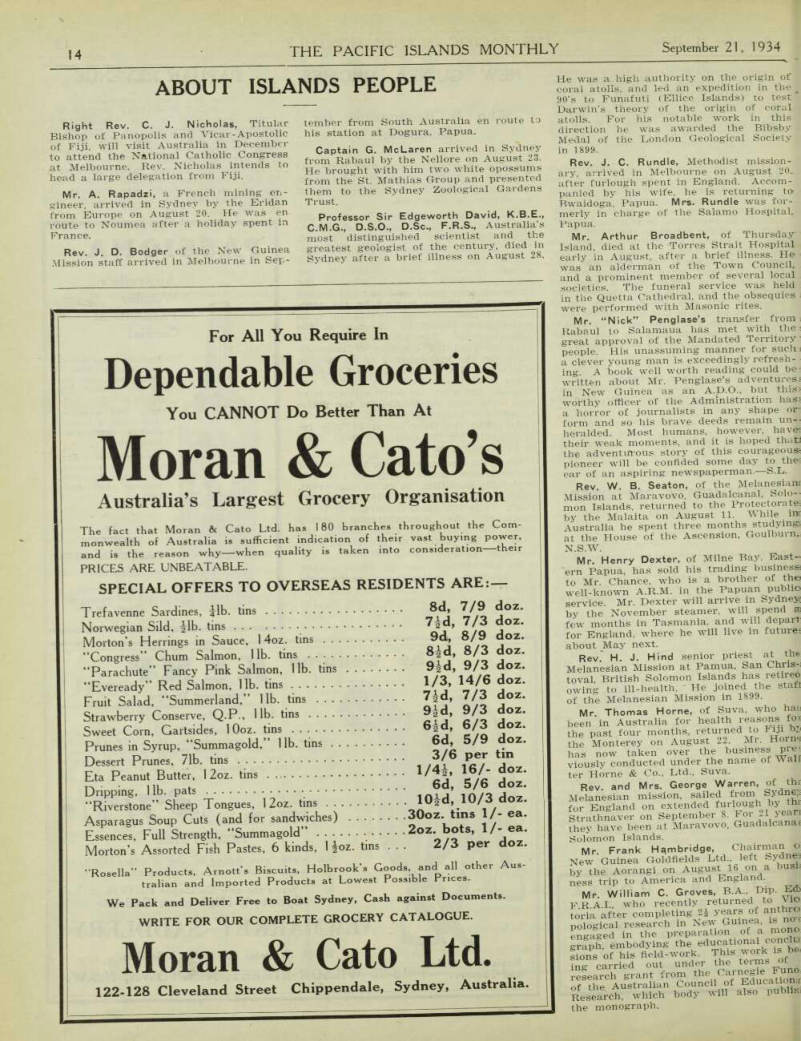
Right Rev. C. J. Nicholas, Titular Bishop of Panopolis and Vicar-Apostolic of Fiji, will visit Australia in December to attend the National Catholic Congress at Melbourne. Rev. Nicholas intends to head a large delegation from Fiji.
Mr. A. Rapadzi, a French mining en gineer, arrived in Sydney by the Eridan from Europe on August 20. He was en route to Noumea after a holiday spent in France.
Rev. J. D. Bodger of the New Guinea Mission staff arrived in Melbourne in Sep
tember from South Australia en route to his station at Dogura, Papua.
Captain G. McLaren arrived in Sydney from Rabaul by the Nellore on August 23.
He brought with him two white opossums from the St. Mathias Group and presented them to the Sydney Zoological Gardens Trust.
Professor Sir Edgeworth David, K.B.E., C.M.G., D.S.O., D.Sc., F.R.S., Australia’s most distinguished scientist and the greatest geologist of the century, died in Sydney after a brief illness on August 28.
He was a high authority on the origin of coral atolls, and led an expedition in the 90’s to Funafuti (Ellice Islands) to test Darwin’s theory of the origin of coral atolls. For his notable work in this, direction he was awarded the Bibsby Medal of the London Geological Society in 1899.
Rev. J. C. Rundle, Methodist mission ary, arrived in Melbourne on August 20after furlough spent in England. Accom panied by his wife, he is returning to Bwaidoga, Papua. Mrs. Rundle was for merly in charge of the Salamo Hospital,.
Papua.
Mr. Arthur Broadbent, of Thursday Island, died at the Torres Strait Hospital early in August, after a brief illness. He was an alderman of the Town Council, and a prominent member of several local societies. The funeral service was held in the Quetta Cathedral, and the obsequies were performed with Masonic rites.
Mr. “Nick” Penglase’s transfer from Rabaul to Salamaua has met with the great approval of the Mandated Territory people. His unassuming manner for such a clever young man is exceedingly refreshing. A book well worth reading could be written about Mr. Penglase’s adventures in New Guinea as an A.D.O., but this worthy officer of the Administration has a horror of journalists in any shape or form and so his brave deeds remain un heralded. Most humans, however, have their weak moments, and it is hoped that the adventurous story of this courageous pioneer will be confided some day to the ear of an aspiring newspaperman. —S.L.
Rev. W. B. Seaton, of the Melanesianr Mission at Maravovo, Guadalcanal, Solo mon Islands, returned to the Protectorate by the Malaita on August 11. While in Australia he spent three months studying at the House of the Ascension, Goulburn,
N.S.W.
Mr. Henry Dexter, of Milne Bay. East ern Papua, has sold his trading business to Mr. Chance, who is a brother of the well-known A.R.M. in the Papuan public service. Mr. Dexter will arrive in Sydney by the November steamer, will spend as few months in Tasmania, and will depart for England, where he will live in future about May next.
Rev. H. J. Hind senior priest at the Melanesian Mission at Pamua, San Christoval British Solomon Islands has retire owing to ill-health. He joined the staff of the Melanesian Mission in 1899.
Mr. Thomas Horne, of Suva, who has been in Australia for health reasons for the past four months, returned to Fiji on the Monterey on August 22. Mr. Horne has now taken over the business previously conducted under the name of Walter Horne & Co., Ltd., Suva.
Rev. and Mrs. George Warren, of the Melanesian mission, sailed from Sydney for England on extended furlough by the Strathnaver on September 8. For 21 years they have been at Maravovo, Guadalcanal Solomon Islands.
Mr. Frank Hambridge, Chairman of New Guinea Goldfields Ltd., left Sydney by the Aorangi on August 16 on a business trip to America and England.
Mr. William C. Groves, B.A., Dip. Ed.
F R.A.I., who recently returned to Victoria after completing 2½ years of anthropologioal research in New Guinea is now engaged in the preparation of a monograph, embodying the educational conclusions of his field-work. This work is being carried out under the terms of research grant from the Carnegie Funo of the Australian Council of Educational Research which body will also publish the monograph.
Advertisements & other items, p. 16 (1 item)
Moran & Cato’s
For All You Require In
Dependable Groceries
You CANNOT Do Better Than At
Moran & Cato’s
Australia’s Largest Grocery Organisation
The fact that Moran & Cato Ltd. has 180 branches throughout the Commonwealth of Australia is sufficient indication of their vast buying power, and is the reason why—when quality is taken into consideration—their
PRICES ARE UNBEATABLE.
SPECIAL OFFERS TO OVERSEAS RESIDENTS ARE: — Trefavenne Sardines, ¼lb. tins Norwegian ½lb, tins Morton’s Herrings in Sauce, 14oz. tins “Congress” Chum Salmon, 1lb. tins “Parachute” Fancy Pink Salmon, 1lb. tins “Eveready” Red Salmon, 1lb. tins Fruit Salad, “Summerland,” 1lb. tins Strawberry Conserve, Q.P., 1lb. tins Sweet Corn, Gartsides, 10oz. tins Prunes in Syrup, “Summagold,” 1lb. tins Dessert Prunes, 7lb. tins Eta Peanut Butter, 12oz. tins .
Dripping, 1lb. pats “Riverstone” Sheep Tongues, 12oz. tins Asparagus Soup Cuts (and for sandwiches) Essences, Full Strength, “Summagold”
Morton’s Assorted Fish Pastes, 6 kinds, 1 tins . . .
Bd, 7/9 doz. 7½d, 7/3 doz. 9d, 8/9 doz. 8½d, 8/3 doz. 9½d, 9/3 doz. 1/3, 14/6 doz. 7½d, 7/3 doz. 9½d, 9/3 doz. 6½d, 6/3 doz. 6d, 5/9 doz. 3/6 per tin 1/4½, 16/- doz. 6d, 5/6 doz. 10½d, 10/3 doz. 30oz. tins 1/- ea. 2oz. bots, 1/- ea. 2/3 per doz.
“Rosella”
Products, Arnott’s Biscuits, Holbrook’s Goods, and all other Australian and Imported Products at Lowest Possible Prices.
We Pack and Deliver Free to Boat Sydney, Cash against Documents.
WRITE FOR OUR COMPLETE GROCERY CATALOGUE.
Moran & Cato Ltd.
122-128 Cleveland Street Chippendale, Sydney, Australia.
Gold in N.-West
New Guinea Dredging Leases Pegged in Aitape District
From a Special Correspondent.
AITAPE, August 7.
NOTHING of a startling nature regard ing gold-mining has occurred recently in the North-west section of New Guinea, though many areas have been undergoing thorough treatment by both boxes and dishes. The position at present may be summarised briefly.
Mr. Galet, in the interests of a local company, has taken up extensive dredg ing leases in the far West section, about six days behind Aitape township, at the headwaters of the Yellow River and what is known locally as the Wapi area. After his arrival in the district, Mr. Goff, a local recruiter, induced Mr. Galet to in spect an area which he thought carried good gold. A large section of country was pegged out, and a base established at which an aerodrome site has been made. Another site has been cleared near Aitape township. Mr. Galet will proceed South later to raise more monev to carry on with what he considers to be an ex cellent proposition.
Further down the coast at Wewak steady prospecting proceeds, but with no new developments.
The Sepik patches on the headwaters of the Yuat River to which Messrs. Glas son, Belfleld and Schultze returned, were not up to expectations, so the party dis banded and returned to their base, leav ing Mr. Schultze on the field. This area, some two weeks inland, showed varied amounts to a dish, but the distance com bined with its inaccessibility and lack of native foods made it almost impossible to work. An assay taken by the Bulolo Gold Dredging Co. of specimens sent by Mr.
Schultze from this area showed a 95 per cent, pure gold, 3 per cent, silver, 2 per cent, dirt—a record for the Territory.
The Yuat River Alluvial Company is following up the river on the left hand side where other good prospects have been found.
Another new company entered the field of operations by re-opening the Dugumor area, some seventy miles from Madang, where gold and platinum prospects have been found. This area has been visited by a geologist and several of the local experienced men, but in every case the result has been negative.
Messrs. Crookshanks, Forrester, and Cook are still out across the Ramu River in the Bismarcks towards Mount Hagen, but up to the present have not reported any find.
Dr. Schnelizing, a German geologist, who is working in the interests of a British company, has returned after an absence of 32 years from the Territory in search of certain minerals he has con fidence in finding. He has set down a base for an aerodrome some twenty miles from Madang on the Coast, from whence he will work inland towards the aero dromes on the Ramu River.
Oronsay Tourists
Tulagi Eagerly Awaited
From Our Own Correspondent.
Tulagi, Aug. 31.
The projected visit of the Oronsay, the first luxury ship to call at the Solomons, has created great interest and excite ment.
The owners of the Tulagi Hotel, re cently destroyed by fire, are erecting a temporary bar for the occasion. Several small ships have been chartered to con vey tourists to points of interest in the short time the liner will be here.
It is hoped that the visit will be a suc cess from the tourist point of view, and lead to a few more such visits.
To Tulagi
Islands Pioneer Returns
From Our Own Correspondent.
Tulagi, Sept. 6.
Captain Hamilton and Miss Hamilton, who have spent a fair amount of time in Bougainville, have again been in the British Solomons. This indomitable pioneer, after all these years of struggle, is still compelled to battle round here, where his company’s interests lie.
Miss Hamilton ably backs the captain, and it is this spirit which (if anything can) will save the industry.
Advertisements & other items, pp. 17-18 (1 item)
Swim
You Could
Wearing this Watch and yet not harm it.
It is the
"INDESTRUCTIBLE LEVER”
WHICH IS WATER-PROOF, SHOCK-PROOF, KNOCK-PROOF,
:: ACCIDENT-PROOF AND IMMUNE FROM MAGNETISM :: The case of this amazing timepiece is hermetically sealed so that no outside matter whatever can penetrate it to harm the splendid jewelled lever movement it contains. In addition, every part is cushioned to withstand the knocks and shocks of ordinary active life. Further still, the mechanism is immune from magnetism, so that the watch may be worn near electrical machinery without fear of the consequences. This wonderful timepiece is sent post free anywhere for £4/17/6.
The “Indestructible” 'watch is ideal for the energetic wrist of the “Sport” and for the Tropics it cannot be bettered. Absolutely no water or moisture can get through either the case or crown.
Case has modern chromium finish, with acid-proof, stainless steel back, which perspiration does not mark. It is in the modern tonneau shape, has a luminous dial, and is complete with the leather wristband shown.
The “Indestructible” Lever is warranted to give 25 years’ wear, and Angus & Coote keep it in order for the first two years free of any charge.
“INDESTRUCTIBLE” WATCHES ARE SUPPLIED WITH A VARIETY OF DIALS AND FINISHES, AND FOR LADIES AS WELL AS GENTLEMEN. A FULL RANGE IS ILLUSTRATED IN ANGUS & COOTE’S NEW CATALOGUE WHICH WILL ISSUE
IN NOVEMBER.
Send your name and address for this useful Shopping Guide illustrating Watches, Clocks, Jewellery, Silverplate, China, Cut Glass, Leather Goods and English Cutlery.
ORDERS BY MAIL ARE WELCOME: EXPERTLY PACKED; AND SAFE DELIVERY TO ANY ADDRESS IS GUARANTEED BY
ANGUS & COOTE
500 GEORGE STREET, SYDNEY
Is Your Rest
Disturbed ?
Every Picture tells a Story me Deal Promptly with Bladder Irregularities Heed promptly bladder
irregularities, burning,
scanty and too frequent passage and getting up at night.
They may warn of some disordered kidney or bladder condition. Try Doans Backache Kidney Pills.
No other advertised diuretic is so widely used. None so well recommended. Get
Doans to-day.
DOAN’S
BACKACHE KIDNEY PILLS
All Chemists and Stores.
TO ISLANDERS VISITING SYDNEY—HIRE A CAR AND DRIVE YOURSELF 25 High-grade Models to choose from, including 1934 V 8 Sedans Rates from 01/2do l / 2 d per mile; minimum from 12/6 per day.
KENNEDYS DRIVE YOURSELF SERVICE
Free Service throughout New South Wales. Write or cable when leaving and a car will be waiting on arrival.
Head Office: Oxford and Victoria Sts., Darlinghurst. ’Phone F 2424; after hours, Drummoyne 379
Laundry Without Drudgery
COLEMAN BLUE PORCELAIN
ENAMEL IRON
This Iron is supplied with Stand, Pump, Wrench, and Special Filling Can
COLEMAN IRONS LIGHT INSTANTLY
and are ready to use at once. No Fuss, No Pre-heating. Just strike a match, open the valve, and the Iron is Alight.
Supplied with Long Life Automatic ROTO GENERATOR Beautiful Cambered and Bevelled Nickel Base.
Apply all Branches of W. R. Carpenter & Co. Ltd. or write for catalogue to Coleman Quick-Lite Co., 500 Kent St., Sydney.
Fiji Natives’ Share in Government
Colony’s Diamond Jubilee—Splendid Record of Administrative Achievements
THE Crown Colony of Fiji, on October 10, 1934, celebrates the diamond jubi lee of British administration in these islands.
The Fijians have advanced far along the path of human development since their leading chiefs signed the Deed of Cession at Levuka (then the capital town) 60 years ago.
Although they ceded their country vol untarily and unconditionally, the Fijians have always retained a considerable share of the duties of government, more espe cially those which concern their domestic affairs.
A code of Native Regulations provides for this share of administration being un dertaken by responsible bodies of native officials, and the Code is, in fact, a modi fied form of unwritten native law as it was found at the time of Cession. Trained native magistrates hold court for dealing with offences by natives, and native scribes are selected for secretarial work in respect of Fijian affairs in each of the 19 provinces into which the Colony is divided. These officers are paid from Government funds, and also receive small additional allowances from the revenue of the province in which they work.
At the close of each year the province holds its annual council meeting, attended by chiefs and people, and presided over by either the Secretary for Native Affairs or a deputy, who is usually the European Commissioner for that province. The meeting is apprised by the headman of each district of the province as to the health and condition of the people of his district, and by-laws are made relating to the general welfare of the inhabitants of the province, which, if approved by the Governor, are then enforceable in the native courts referred to above.
It is apposite to mention here the
scheme of medical supervision of the Fijians. Suitable youths, after receiving a general education in one of the higher Government or Mission schools, are put through a four-years’ training course in medical subjects in the Central Medical School at Suva, an institution conducted by the combined endeavours of the ad ministrations of Fiji, Samoa, Gilbert, and Ellice Islands, British Solomon Islands Protectorate, Tonga, Cook Islands, and New Hebrides, all of which contribute to wards its maintenance and send in can didates for training, who on qualification return for duty in their respective terri tories. To each province in Fiji is ap pointed one or more of such native prac titioners, who either take sole charge of an area or a hospital, or act under the direct guidance of a European medical officer.
The population of Fijian natives has been increasing for the last 25 years, and the estimated figure now stands at 97,000.
The Administration devotes especial atten tion to child welfare work among the Fijians, and the Fijians themselves give their services and add the force of their interest to make a success of this import ant work.
It is good to be able to record that the accounts of the Colony at the close of last year showed that the excess of assets over liabilities totalled £201,000, the highest, figure in the history of Fiji.
Quite recently the Secretary of State for the Colonies authorised and the Legis lative Council agreed to the borrowing of a sum of £290,000 for works which, on completion, will be of permanent value to the country; and, of this figure, the construction of new roads and bridges will consume approximately £177,000.
Part of this last-named amount will be used to build a section of the road along the south coast of Viti Levu Island —a new enterprise—and, when built, there will be a circular trunk road round the island, over 300 miles in length.
Local opinion has been generally in favour of such an island highway, for it is realised that the possibility of making a motor tour right round this “Eden in the ocean” is going to be an added attrac tion for visitors from overseas, who con tinue to come in increasing numbers, and for whose entertainment in the islands nothing is too much trouble.
Only an actual visit to this tropical paradise can convince those who have not yet made it of the enjoyment which Fiji can offer to anyone seeking something new in the way of a holiday.
Well might be adopted the slogan: “We who believe in Fiji are going forward.”
Kingsley Roth.
Tourists At Vila
From Our Own Correspondent.
VILA, Sept. 9.
THE Orient cruiser Oronsay arrived here this morning with 500 tourists. The weather was fine until mid-day, and the voyagers had an interesting time ashore.
A party of local residents were the. guests of the Orient Company at luncheon aboard the liner.
“Pandemonium” Farce
Day’s Amusing Experiences In Vila — Interesting Theory To Explain Britain’s Position In New Hebrides.
By R. W. Robson
THEY call it the “Pandemonium Govern ment”; and it is surely one of the quaintest and queerest administrations in the world.
Those who live-in the New Hebrides revile the Condominium. Those who visit the place, jeer at it. Surely, they say, here is historic evidence of the stupidity and stubbornness of John Bull and Jean Crapaud. Surely say the serious-mind ed, the Governments of two great nations can get together in a spirit of compromise, and put an end to this thing that perches so ludicrously on the shores of beautiful Vila Harbour.
Two kinds of police—French and Bri tish —parade solemnly along the beach, ignoring each other’s presence, but poun cing with great ferocity upon any poor roysterer who raises his voice in song. If he sings in French, the French police march him away to the lock-up; if his bibulous outburst be in English, the Bri tish police, thanking God for a break in the monotony, put an efficient half-nelson on him, and take him away to face a charge of drunk and disorderly.
On Efate, behind Vila, there are now many miles of roads. So there are a few score motor-cars and lorries. If the owner is British, the registration is British, and the driver keeps to the left, as is British and proper. If the owner is French, he goes on the French register, and the driver may keep to the right, according to the rule of the road in all the dominions of France. When a British car meets a French car, it is a trifle difficult: but they do not worry about little things like that, in the Condominium.
THE officials employed by the Con domijnium have an interesting life.
There is no boredom. If an official finds himself with nothing to do, he gets the latest tables of currency exchange, and tries to figure out his income. It is very exciting. Officials are paid half their salaries in French currency, and half in English sterling.
When the Condominium was created, Britain and Prince were on the gold standard, and apparently for eternity. But, in the following quarter-century, much world-history was made. For a time, Bri tish currency was tied to gold, and the franc was “wild.” Then the franc was stabilised with gold, and sterling went see sawing. These matters can be adjusted more or less simply, as between French and British territories; but in the Con dominium, where the two currencies march side by side in the one country, the wretch ed Treasury officials spent days and years on the edge of the madhouse. It was bad
enough to try to balance the Condominium budget, with currency values hopping about like insane kangaroos; but think of the mental condition of the New Heb rides Customs official who was trying to figure out Customs duties in two languages and three mad currencies!
For there is a third, and very disturbing factor in this Condominium finance. A bas l'Australie! Australian interests are very strong in the group; much trade is done with Australia; and, while the pound sterl ing is jumping about in relation to the franc, the pound Australian is ignoring both, and jumping about on its own ac count. Is it any wonder that the French official, who likes a quiet, peaceful life in the tropics, bares his teeth and reaches for his trusty stiletto whenever he meets an Australian in the streets of Vila!
The men of the Condominium, in an effort to get something stable in then chaotic world, fixed the exchange between the franc and sterling at 124 francs to the English £. That was several years ago, when both Britain and Prance were on
gold, and after the franc had been stabi lised. Australia, also, was then on gold: and, for a week or two, everything was very well. In recent times, Britain has gone off gold, while Australia is away from both gold and sterling. But, for purposes of currency adjustment between British and French official interests in the Con dominium, the exchange rate remains fixed surprisingly at 124 francs to the £ sterling.
Now, let us see what happens to the harassed public servant of the Condomi nium, who receives half his salary in francs and half in pounds sterling, with exchange at the rate of 124. Suppose his interests are in Australia, and he is re ceiving £300 per annum, nominally. He gets £150 in sterling, and £150 converted into francs at the rate of 124 to the £— l namely, 18,600 francs. He now converts his £l5O into Australian currency, and it becames £187/10/- Australian; and his 18,600 francs, converted into Australian at the rate ruling here today (62) gives him £300 Australian. In other words, his £300 per annum Condominium is equal to £487/10/- Australian.
If our friend is an Englishman, and cal culates on the basis of London, he gets £150 sterling, and 18,600 francs, which, converted at the rate ruling today between London and Paris, is equal to exactly £238 sterling. That is, his £300 per annum Condominium becomes £388 per annum In sterling.
I am not quite sure how this Gilbertian system works out in the case of the French
officials; but if, as seems apparent, they receive half their salaries in pounds sterl ling, purchased at the rate of 124 francs to the £, they certainly do take it in the neck on pay-days. So far as I could as certain, they must suffer under this ar bitrary fixation of exchange. There are numerous institutions which will give a British £ for every 78 francs; but there is no bank or storekeeper in the New Hebrides which will give the Frenchman 124 francs for each British £ he has re ceived by way of salary. I do know that, in the British quarter, the movement of ex change is watched by the public servants with a tender, passionate interest.
THE symbol of the farce —124 —domi- A nates the Post Office, also. By the time I reached this interesting establish ment, my head was in a ferment of figures, and I could not follow proceedings. I was of opinion that, with my Australian money, I should pay four pennies for each franc; yet I found myself purchasing 50-centimes stamps for one penny, and 5-francs stamps for tenpence. We had an ardent stamp-collector aboard our steamer; and when I left the Post-Office he was ges ticulating wildly in front of the counter,
buying sheets of stamps, and declaring he had found a way of providing without effort for his old age.
I sent a radiogram—nine words in plain English. Payment for this service was a process that ate considerably into an hour of time. The official explained, courteously and with apologies, that the cost of a radiogram in the New Hebrides has to be worked out in three dimensions —Condominium, French and British —and I had unwittingly added a fourth dimension (Australian currency) into which the whole complicated thing had to be con verted. He made columns and columns of figures, got the square root of the grand total, and took away the number I first thought of. It came out at about eighteen pence per word.
When, wiping a fevered brow, I stag gered out into the open air, I saw the Union Jack of Old England and the Tri colour of the great republic waving amic ably, side by side, over the coconut palms, and I took off my hat to them. They have achieved something very notable—even if it is only a very notable farce.
I went to the British Administration, and asked for a copy of the Customs Tariff of the New Hebrides —I said that I should like to publish it, for the assis tance of Australian exporters. The man I addressed looked at me compassionately for a moment; then he decided that pos sibly my condition was an act of God, and not my fault, and he reached wearily for a portfolio, full of strange documents, cuttings and hieroglyphics. He began to explain that the accursed 124 dominates all Customs calculations, but with modi fications introduced from time to time to meet new complications as they arose. I tried hard to follow —but finally I left him abruptly, and fled into the sunny after noon. in another three minutes, I should have been a raving lunatic. If any Aus tralian exporter wants that tariff, he can go to Vila and get it. If he is crazy about cross-word puzzles and the mysteries of algebraical formulae, he will enjoy himself in Vila.
I called at the British Administration and met courteous, efficient officials who were quite ready to supply me with statis tics, etc., but who developed the charac teristics of the oyster when I tried to lead the conversation into political channels.
Did they think that British interests were holding their own in New Hebrides? The British officials shrugged their shoulders.
Did they not find their work in the New Hebrides disheartening and discouraging 7 Another shrug—but one cheery soul ven tured the opinion that a man was lucky to have a job in these hard times. So I left.
IN the main street, I met sundry British suffering under a sense of violent grievance. They told me—what I already had deduced from the statistics —that the British planters of the New Hebrides are almost a vanished quantity. The decay of the British colony commenced several years ago, when the labour question be came acute. Native (New Hebrides) labour is practically unprocurable. The French brought in Tonkinese labourers, under a system of strict indenture, and worked their plantations efficiently and profitably.
Naturally, the British wanted to do the same, and sought the co-operation of the Colonial Office. The latter moved cau tiously, and a commission made an inquiry.
It is known that the commission recom mended that the British be permitted to indent labour; but no offical explanation has ever been given of the fact that the recommendation was not given effect to.
From that day to this, the position has not altered: the unfortunate British are
not allowed to employ foreign labour, al though the Frenchman on the next plan tation can have as many Tonkinese labourers as he can pay for.
There is more than a suspicion that this ridiculous situation arose because some snuffling politician in Australia de cided that the use of Asiatic labour by British in the New Hebrides would cast a reflection upon the White Australia policy. It may seem incredible —but it lines up with a score of other things for which Australia’s degenerate democracy is responsible. At any rate, it has had this result; that the New Hebrides, eco nomically, have been lost to the British Empire.
French interests are now almost com pletely paramount in the archipelago. The discouraged British planters either sold out to the French or sought French nation ality, and there are few British plan tations left. Except for the Burns, Philp store, shipping and plantations, and the stations of the Presbyterian Mission, the New Hebrides are French.
And there is no need for the British to be sore against the French. The French have played the game by their nationals, and the British emphatically have not.
The Frenchmen were supplied with labourers; the British were left helpless.
The French planters who suffered in a series of hurricanes were substantially compensated; the British planters did not get a penny piece. When the world de pression knocked endways the prices of primary products, and the planters were faced with bankruptcy, the French Gov ernment poured millions of francs into the group and kept the planters going with very cheap loans; the British got no financial help at all.
The New Hebrides are virtually French; and they ought to be. The French are businesslike—and merciless. Two or three British men, who have been years in the group, planting and managing trading stations and plantations, have just left.
The properties have passed into the pos session of the French, and there is no place thex-e now for Britishers. They spoke very bitterly; they do not blame the French, but they feel that they have been aban doned by Britain.
I WENT from this atmosphere of gloom and savagery, into a circle where —as soon as I mentioned the object of my visit —much hilarity reigned. I was seeking the latest information about the Joint Court.
I got it —in full measure, and flowing over.
There is so much of it, and it is so as tonishing in character, that I cannot deal adequately with the subject here.
Stated briefly, the Joint Court is the tribunal which deals with all matters which require adjustment as between the two nations (Britain and France) in the New Hebrides. It is international in char acter, completely independent, and su preme. There is no appeal from its judg ments. There are assessors (or assistant
judges) appointed respectively by France and Britain: there is a Chief Judge, who is nominated by an independent nation (the Count de Buena Esperanza, who was appointed on the nomination of the King of Spain, retired in 1933, and a judge nominated by the King of Belgium has taken his place); and officials of the Court are Dutch and Belgian, The Court gives judgments from which there really is no appeal; but it has no means of enforcing its judgment—the police forces are controlled respectively b y the French and British. The Court is sup posed to examine all claims for land in the group, and issue titles. It certainly has speeded up its operations during the last year, under the new judge; but even at the present rate of progress it will take a couple of centuries to deal with all the land claims in the New Hebrides. Presumably, it is the only way of avoiding constant squabbling and friction between British and French in the Group: but it is ac knowledged by everyone to be a most un wieldy, expensive and slow-moving in stitution.
It is, as a matter of fact, simply a glorious tropical picnic for a number of European jurists, who seem to spend about one year abroad for every twenty months or so that they remain in the group. It is so re garded by the people of New Hebrides.
They may hold individual officers of the Court in respect—that seems to depend upon the officers—but in referring to the Court itself, they employ every known
kind of disrespectful and contemptuous term, in about four different languages.
I LEFT the New Hebrides with my mind greatly puzzled. The conditions in that archipelago did not fit in at all with the record of British Colonial Administration throughout the world.
I found that the French had taken possession of the New Hebrides, in an economic sense, not because of British de fault, expressed in carelessness and in efficiency, but because Britain appeared to be completely indifferent to what happened in the New Hebrides. I went to Port Vila with a prior knowledge of conditions there, but with a theory that British officialdom somehow had let us down, and should
receive a journalistic thrashing; and I wanted material for a few savage articles.
Also, I was prepared to urge that, as the French already have the group in their grip, we British would be well advised to end this Condominium farce, and get out gracefully, making the best bargain pos sible in the circumstances.
I came away with the feeling that while all the factors were much as I sup posed, the position did not quite fit to gether in a way to support the logical arguments I had prepared. The British were simply squatting complacently, and letting the French get all the economic and industrial glory; and that was not like the British. I felt that there was a New Hebrides puzzle, and that an essential piece of it was missing.
Two days later, in New Caledonia, I was in conversation with a wise old man; and I think he gave me the key of the puzzle.
“The Condominium certainly is a farce,” he said. “But do not imagine for one moment that Britain will accept that as a reason for getting out. Britain will not go out of the New Hebrides, now or at any other time.
“The considerations that matter are strategic, not economic. Britain does not care twopence about the trade of the New Hebrides —it is not worth competing for.
If France wants it, and is prepared to spend millions of francs in susidising her settlers there, she is welcome to it. Britain certainly is not going to pour huge sums of money into New Hebrides, while ignoring the claims of equally deserving planters in
the Solomons, and Fiji, and Tonga and the Gilbert and Ellice Islands.
“Look at the map. From New Guinea right down south to Suva, the only really good harbours are in the New Hebrides.
Port Havannah or Port Patteson could give shelter to the whole British Pacific fleet, if necessary; and there are no other ports to which British warships could go, in an emergency, within hun dreds of miles. That is why Britain is quite happy to pay, each year, a sub stantial sum which represents her share of cost of running the ‘Pandemonium Gov ernment’. It gives her the right to shelter her warships in what might be, sometime, a strategically-important part of the Pacific.”
PROBABLY, that is the missing piece of the puzzle.
Originally, Britain was prepared to do her share in the economic development of the New Hebrides. Then there came this trouble over indentured labour. Bri tain, as usual, was not anxious to sear the sensitive soul of Australia by bringing Asiatic labourers to a Pacific group within 1200 miles of the Australian group. Much time was wasted. Meanwhile, France was showing great vigour and activity in de veloping her interests in the group, and eventually she began to pour in millions of francs, wherewith to subsidise settle ment. Britain, with scores of other colonies awaiting development, declined to enter into this kind of competition, and decided to leave the group to France, while retaining sufficient interest there to protect certain strategical considerations.
In the process, a number of British- Australian planters have been sacrificed.
They must blame, for their plight, not the British Colonial Office, but the politician ridden government of the Commonwealth of Australia.
Advertisements & other items, pp. 19-22 (1 item)
"The Vamp”
“HIS MASTER’S VOICE”
The World’s Greatest Entertainer Gives You the Music You Want —When You Want It.
We Stock and Sell all Numbers. Send Your Orders to us.
Prompt Service is our motto, and a satisfied customer our best advertisement.
"THE VAMP”
(Miss Crawford)
Victoria Arcade Music Parlour
(Opp. Hotel Australia), SYDNEY ‘‘His Master’s Voice” Portables—Records —Needles. We will gladly post you Catalogues on request.
THE NEW WINCH “SPEED KING”
.22 CAL. AUTOMATIC RIFLE MODEL 63
10 SHOTS
Price, £9/5/-
FREIGHT EXTRA
This NEW WINCHESTER AUTOMATIC RIFLE is the improred successor of the famous Model 03, chambered for the NEW .22 LONG RIFLE SUPER SPEED RIM FIRE CART- RIDGE DEVELOPING 35% HIGHER SPEED, 58% GREATER POWER, LONGER RANGE AND GREATER ACCURACY ar Less Cost for Ammunition.
THE NEW WINCHESTER SUPER
CARTRIDGES
MORE SPEED
GREATER POWER SSrWSPEEdE^
LONGER RANGE 'ilrHi
SPEED RIM FIRE
Short 2/5 100 Long 3/5 „ Long Rifle 3/10 „ Freight extra.
COWLES & DUNN
Gunsmiths and Fishing Tackle Specialists 71 KING STREET SYDNEY Cable Address: CODUN, SYDNEY. Write for Fishing Tackle Catalogue, Post Free.
Mrs. N. WALKER-FLYNN,
COSTUMIER E,
Market Street, RABAUL.
HEMSTITCHING and PICOT EDGING.
Copies of Mab’s Fashions; Roma’s Pictorial Fashions and Home Fashions available. —P.O. Box 116. Tel.: 141.
FREE
A COMPLETE ILLUSTRATED
CATALOGUE OF
MEN’S WEAR
Pike Brothers comprehensive General Catalogue will be issued in October. This most complete guide to Men’s Wear is yours for the asking. There are 128 pages profusely illustrated, and every article required by Planters, Mine Officials, and Residents in the Tropics is featured. You can shop through its pages with the utmost confidence. Write for your copy to-day. Post Free. State address clearly.
WRITE TO-DAY TO DESK P.C.M.
PIKE BROTHERS LTD.
Queen Street, Brisbane.
HUON PINE BOAT PLANKS
AND
SPOTTED GUM TIMBERS
The World’s Best and the Cobra Does Not Like Huon Pine.
A. C. FRYER, 110 Miller Street, Pyrmont, Sydney.
Will Gladly Give Full Quotations for Any Sizes.
THE CHAPMAN DIESEL MARINE ENGINE
Slow Speed, Heavy Duty Type showing high propeller efficiency. Patented Starting System. No compressed air, no wicks or cartridges, no blowlamp, no cranking handle, no valves, 15 h.p. Runs on Black Crude oil costing sixpence a gallon at Sydney; consumes six gallons in 10 hours. Price of engine complete £325 ex factory.
CHAPMAN & SHERACK, Clara Street, Erskineville, N.S.W., Manufacturers and Patentees
OLD ISLANDS
PHOTOGRAPHS
We have a unique collection of several thousands of original photographs of Natives and Scenes in New Guinea, Solomons, Tonga, Fiji, Samoa, New Hebrides, etc., taken during the years 1875 to 1895.
These supply invaluable records of fastdisappearing races.
Full-plate prints, 1/- each, or 12 for 10/-.
Details on application
TYRRELL’S MUSEUM,
281 GEORGE ST., SYDNEY
SHOES by MAIL
with Economy and Satisfaction, from
JOE GARDINER Ltd.
Either of these Smart Styles
SSSK POSTAGE
EXTRA
PM10. —Genuine Hand-Plaited Basket Shoes, in All White, Black and White, or Brown and Fawn. T Bar as illustrated or to Lace up. Pump Soles, Covered Sports Heels. Sizes, 2 to 7.
PM11.—Men’s Black or Brown Calf or Black Patent Oxfords. Smart, Good fitting medium shape. Guaranteed all Solid Leather, Welted Soles and Heels.
Sizes, 5 to 10.
WRITE FOR BIG CATALOGUE
of Men’s, Women’s and Children’s Footwear suitable for Tropical Climates STOREKEEPERS! Ask for Our Special Terms
JOE GARDINER Ltd.
BOX 2559 E, G.P.O., SYDNEY
M. HARPER
MANDOLIANA ISLAND,
NORTH GELA, B.S.I.
Postal Address: P.O. Box 6, Tulagi, Solomon Islands.
Recruiting Contracts Undertaken.
Auxiliary vessel “Papari” available for Charter.
Full details of Services from
BURNS PHILP (S.S.) CO., LTD.,
Makambo (B.S.I.) and Sydney.
Certain-to-sell
Short Stories A Vic. Weekly paid £7/18/- for one story.
Numerous other students have also obtained good prices. Read: — “ ‘Nocturne,’ printed by ‘Smith’s’ recently, brought me between £5 and £6.”
“I have had nine stories published since I started your course.”
“The first story I sent to America has been accepted.”
“I received more for my stories while studying with you than I paid in fees.’’
“I received £6/2/6 for two stories in the ‘Australian Journal.’ ”
“ ‘The Bulletin’ headlined my story, ‘Justice.’ I received £4/18/6 for it.”
“I have just received a cheque for £6/13/6 from ‘The Bulletin’ for my story, ‘Old George’.”
“I received £5 from the ‘Sydney Mail’ for my first story, ‘Twin Ships’.”
Stott’s Correspondence
College
100 Russell St.. Melb.; 70 Pitt St., Sydney; 290 Adelaide St., Brisbane; 49 Flinders St., Adelaide; 359 Murray St., Perth.
SEND THE COUPON; CUT HERE
You, too, can win success as a writer by taking STOTT’S Postal Course. Send this Coupon for Free Literary Prospectus.
NAME
ADDRESS
P.I.M.134
When in Sydney cali in and consult TAYLOR and ROBERTS and H. G. PARR concerning your eyes. Glasses prescribed only when necessary.
L. A. ROBINSON, M.I.O.
Optometrist and Optician Note new address: SYDNEY MORNING HERALD BUILDING,
’Phone: 84673 66 PITT STREET, SYDNEY
READ THE
B. P. MAGAZINE
SPRING NUMBER
NOW ON SALE
Short Stories Pictures Travel Articles Music Melbourne Centenary Latest Fashions Screen One Shilling per Copy ON SALE AT ALL NEWSAGENTS AND BOOKSELLERS
Beatrice Grimshaw’S
Tobacco Plantation
Sold
From Our Own Correspondent.
PT. MORESBY, August 10.
The country home of Miss Beatrice Grimshaw, the well-known South Seas novelist, on the Laloki River (15 miles outside Port Moresby) has been sold to the Hon. W. M. Strong, Chief Medical Officer of the Territory. Miss Grimshaw with her brother (Mr. Ramsay Grimshaw) had been experimenting with tobacco on the plantation for some time. It is under stood that the cultivation of tobacco will be continued by Dr. Strong, under the management of Mr. Jekinson, a tobacco expert from Queensland.
Miss Grimshaw is leaving Papua by the August Montoro for an extended tour of America and Europe. She will be absent from the Territory for a year or two, but will return to Port Moresby, where she has lived for many years since her arrival in Papua in 1907.
Receipts for customs revenue at Port Moresby, Papua, amounted to £1,785/12/3 for the month of July. The total was made up of: Import duties, £1,440/11/11; primage duties, £331/13/9; export duties. £1/17/8; shipping and other fees, £11/8/11.
For Plantation Work
275 Chinese Coolies Arrive in Samoa
From Our Own Correspondent.
APIA, August 4.
THE Chinese transport Seistan arrived at Apia on July 27, bringing a batch of 275 newly recruited Chinese coolies.
On the 19 days’ trip from Hongkong several stowaways were discovered hid den on board. Amongst them was a Well known identity of Apia—a tailor named Ah Quoi, whose case had been before the New Zealand Parliament a few years ago and who had been repatriated, leaving a Samoan wife and a family of 13 children behind. Ah Quoi, who had made an un successful attempt to return to Samoa by the last transport, was allowed to land this time, after having paid the usual landing deposit of £50.
The new coolies seem to be of the sturdy and frugal peasant type, most suitable for plantation work in Samoa. About 30 of the new men are reported to have worked in Samoa previously. That the reduced rate of 1/9d per day has not lessened the supply of labour is shown by the fact that men stow away to get to Samoa.
Over 400 of the time expired coolies were repatriated by the Seistan, when she left on July 30. Hundreds of Samoans, Samoan women and their relations gath ered around the wharf to farewell the de parting labourers. Notwithstanding rumours on the beach, only six of the 400 men due for repatriation failed to put in an appearance. Consequently, they will be treated as deserters.
Those Sunny South Sea
Isles
AWAKENED to the sound of summer rain.
By the time the “breakfast’s ready” call came, the summer storm had developed into an all-seasons storm, with lightning and thunder added, to flavour the mix ture.
Not a wonderful outlook for a day in which we had planned to explore a bay of about one hundred islands, adjacent to our isle. However, the proverbial silver lining appeared while the morning was yet young.
Started out with “Pal,” and a native, in the Rolls (Ford-made) for the wharf.
Boarding a small launch, we ran down a canal, through the entrance lagoon and across a mile of bay; and transhipped to a larger launch. Then the “day out” really started.
The engine did not like the weather, and, despite a fluent flow of language (mostly in Papuan, which, fortunately, I do not understand) from “Pal,” refused to start.
This gave the weather-cock time to take another turn. A black squall swept over us and spilled sufficient water to fill another bay. It either had lost its way or liked the scenery, and it stayed with us for hours.
During a lull we decided to make a dash for home. We arrived early in the afternoon, with “Pal” in an improvised raincoat of copra sacks —about their only use at present!—and my cape a little more elegant—the waterproof skylight cover, off the launch.
The bungalow is not such a bad place to spend a spare Saturday after all. —Estelle Hughes.
Solomons Development Co.
Islands Development
CO., LTD., sustained for the year ended March 31, 1934, a loss of £2743. For 1932-33 there was £660 net profit, and the trading debit balance is £1279. Paid-up capital is £95,000.
In their report the directors state that in view of the present-day values of coco nut plantations, the asset value of the company’s plantations has depreciated by £50,000. The debit balance shown in the accounts is thus raised to £51,279.
The board recommends shareholders to reduce, the paid-up capital by writing off the loss in asset values which the company has sustained. After writing off £50,000 the value of the plantations is £33,872.
Output of copra for the year was 789 tons, against 926 tons for 1932-33, and is the lowest since 1925. With copra values at present levels it is impossible, the board states, to make earnings meet expenditure.
The directors have agreed to waive their fees while losses are being incurred.
The total area of the plantations is 8157 acres.
Advertisements & other items, pp. 23-24 (1 item)
Flour
W. M. FORD
Ship, Yacht & Boat Builder
Berry’s Bay, North Sydney
(Established 1870.) BUILDERS of all kinds of Island Craft from Dinghies to Auxiliary Schooners of any tonnage. New and Second-hand Island Craft of various types in stock. New and Second-hand Full Diesel, Crude Oil, Benzine and Kerosene Engines.
Please Send on Your Enquiries.
GOSHEN PRIVATE
HOSPITAL
(Sister E. W. YEAMAN), 37 Gloucester Road, Hurstville, Sydney General and Private Wards. Spacious Grounds. High and Cool Situation.
Moderate Fees.
Flour
ASK FOR IT
ESTABLISHED 1868.
Berger's Paint
(PREPARED)
"Keeps on Keeping on!"
AGENTS THROUGHOUT THE ISLANDS.
STOP
Tired nerves are the cause of Headache, Neuritis, Neuralgia, Rheumatism, Lumbago, Sciatica. Get instant relief from all nerve pains with Genuine VINCENT’S A.P.C. as recommended by Doctors, Dentists, Chemists, and Nurses. 12 for 1/6, 24 for 2/6.
All Chemists and Stores, or direct from Vincent Chemical Company, Market St., Sydney, Australia
Nerve
Pains
FOR SAFETY’S SAKE, SAY “VINCENT’S”
CHRISTIES’
FOR ALL KINDS OF
AND
UMBRELLA
REPAIRS
UMBRELLAS
CHRISTIES, LTD., 568 George St.. Sydney
BURNS PHILP
(South Sea) Co. Ltd.
Island Traders & Shipowners
Registered Office: Suva, Fiji.
Also Branches at Fiji: Levuka, Lautoka, Labasa, Ba, Sigatoka, Rotuma.
Tonga: Nukualofa, Haapai, Vavau.
Samoa: Apia, Pago Pago (America Samoa).
Solomons: Makambo, Gizo, Faisi.
New Hebrides: Vila.
Gilberts: Tarawa.
Norfolk Is. Nauru. Niue. Wallis Is. Futuna Is.
Code Address: “Burnsouth.”
Mr. R. M. Bunting
Death of Well-known Papuan Planter
PT. MORESBY, August 21.
NEWS was received in Port Moresby on August 16 of the sudden death in Mel bourne Hospital the previous day of Mr.
Robert M. Bunting, of Doini Island, Samarai, who was one of the best known and most popular residents of the Terri tory. The deceased, who was 52 years of age, had been ill for some time, and left for Australia in July for treatment.
Mr. Bunting arrived in Papua in 1900, and settled near Samarai. His early years were taken up with planting and mining, and he had a varied career in commer cial life, being at times recruiter, miner, storekeeper, and planter.
His interests were on the island of Doini, and in the Engineer group, where he had plantations. He was also interested in the Ahionia desiccating factory, of which he was manager until he left for Australia in July.
Mr. Bunting leaves a widow (a daughter of R. W. Whitten), and is survived by his mother and two brothers in Papua— the Hon. A. H. Bunting, of Samarai, and Mr. Fred Bunting, of Sanaro. A sister, Mrs. Loxton, is the wife of the gene ral manager of Burns, Philp and Co. in Queensland.
Samoa Is Becoming
Self-Contained
Local Coffee, Soap and Tobacco in Demand
From Our Own Correspondent.
APIA, August 4.
SAMOA is still in the throes of the de pression, with little prospects for an immediate improvement. There is some consolation, however, in the fact, that prices for some commodities have dropped lately and that with regard to some ne cessities Samoa is becoming self-sustain ing and independent of imports.
For instance, it is possible now to buy excellent beef and pork for 6d. a pound against a former charge of 1/-. At present a bread war is raging between local bakeries which has extended to country districts and in consequence of which the price for a 2lb. loaf of bread has dropped to 6d from 1/- per loaf. A splendid washing soap is manufactured by an enterprising Apia Chinaman and sold at half the price of the imported article. This local soap is made from copra.
Of late some quite decent and smok able cigars and cigarettes have been sold in Apia made from Samoan tobacco grown of imported seeds. As the price is low and means a considerable saving for the large local community of smokers, the demand is very satisfactory.
Another article of local provenance. coming into its own lately, is local-grown coffee. At various places in Upolu and Savaii coffee of superior quality is grown and all varieties of the bean are repre sented here—Arabian, Mocca, Liberian and Robusta. Coffee is grown by Euro pean as well as native Samoan planters and the price charged is, according to quality, anything from 3d to 1/- per lb.
There is a large demand for the local coffee, which at present cannot be satis fied fully by local production.
Owing to the low price of copra, on some plantations (for instance, the N.Z.
Reparation Estates) the motor lorries are being withdrawn from planation work and are being replaced by the old time ox cart, as in the time before the advent of the motor car. Not a few of the strug gling planters, who previously sported elegant motor cars, have dolefully re turned to the faithful horse and buggy.
Pacific Islands Curios
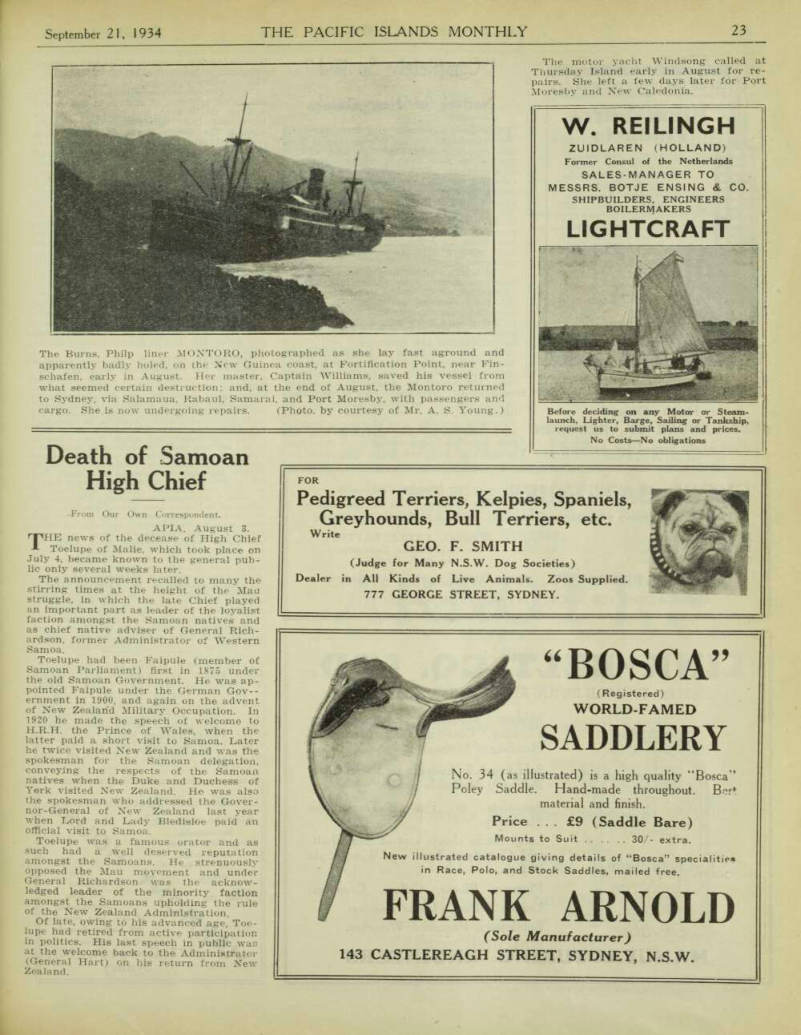
We have received a copy of their catalogue dealing with Pacific Islands curios from Messrs.
F. W. Pritchard Curio and Trading Company, Leone Tutuila, Pago Pago, American Samoa.
This firm has been in the curio trade for 15 years and has been exporting specimens all over the world during that period without any com plaint of non-delivery. The company has on hand large supplies of mats, tapa cloth, kava bowls, canoes, Samoan and Hawaiian style hulas, etc.
Price list and all information can be obtained from them.
The motor yacht Windsong called at Thursday Island early in August for repairs. She left a few days later for Port Moresby and New Caledonia.
The Burns, Philp liner MONTORO, photographed as she lay fast aground and apparently badly holed, on the New Guinea coast, at Fortification Point, near Fin schafen, early in August. Her master, Captain Williams, saved his vessel from what seemed certain destruction: and, at the end of August, the Montoro returned to Sydney, via Salamaua, Rabaul, Samarai, and Port Moresby, with passengers and cargo. She is now undergoing repairs. (Photo, by courtesy of Mr. A. S. Young.)
Advertisements & other items, p. 24 (1 item)
W. Northey
Inquiries for all classes of Sails, Canvas* and General Boat Equipment invited
CANVAS GOODS MANUFACTURER
Quotations Free.
Island Trade specially catered for Established over 40 years.
Taylors Wharf, Pyrmont
SYDNEY
High Chief
Death of Samoan High Chief
From Our Own Correspondent.
APIA, August 3.
THE news of the decease of High Chief A Toelupe of Malie, which took place on July 4, became known to the general public only several weeks later.
The announcement recalled to many the stirring times at the height of the Mau struggle, in which the late Chief played an important part as leader of the loyalist faction amongst the Samoan natives and as chief native adviser of General Richardson, former Administrator of Western Samoa.
Toelupe had been Faipule (member of Samoan Parliament) first in 1875 under the old Samoan Government. He was appointed Faipule under the German Government in 1900, and again on the advent of New Zealand Military Occupation. In 1920 he made the speech of welcome to H.R.H. the Prince of Wales, when the latter paid a short visit to Samoa. Later he twice visited New Zealand and was the spokesman for the Samoan delegation, conveying the respects of the Samoan natives when the Duke and Duchess of York visited New Zealand. He was also the spokesman who addressed the Gover nor-General of New Zealand last year when Lord and Lady Bledisloe paid an official visit to Samoa.
Toelupe was a famous orator and as such had a well deserved reputation amongst the Samoans. He strenuously opposed the Mau movement and under General Richardson was the acknowledged leader of the minority faction amongst the Samoans upholding the rule of the New Zealand Administration.
Of late, owing to his advanced age, Toelupe had retired from active participation in politics. His last speech in public was at the welcome back to the Administrator (General Hart) on his return from New Zealand.
Advertisements & other items, pp. 25-26 (1 item)
Frank Arnold
W. REILINGH
ZUIDLAREN (HOLLAND)
Former Consul of the Netherlands
SALES-MANAGER TO
MESSRS. BOTJE ENSING & CO.
SHIPBUILDERS, ENGINEERS
BOILERMAKERS
LIGHTCRAFT
Before deciding on any Motor or Steamlaunch, Lighter, Barge, Sailing or Tankship, request us to submit plans and prices.
No Costs—No obligations
FOR
Pedigreed Terriers, Kelpies, Spaniels,
Greyhounds, Bull Terriers, etc.
Write
GEO. F. SMITH
(Judge for Many N.S.W. Dog Societies) Dealer in All Kinds of Live Animals. Zoos Supplied.
777 GEORGE STREET, SYDNEY.
“BOSCA”
(Registered)
WORLD-FAMED
SADDLERY
No. 34 (as illustrated) is a high quality “Bosca”
Poley Saddle. Hand-made throughout. material and finish.
Price ... £9 (Saddle Bare) Mounts to Suit 30/- extra.
New illustrated catalogue giving details of “Bosca” speciality* in Race, Polo, and Stock Saddles, mailed free.
FRANK ARNOLD
(Sole Manufacturer)
143 CASTLEREAGH STREET, SYDNEY, N.S.W.
For all the needs of Industry
Kookaburra
Products
are outstandingly superior for Welder, Engineer, Garageman and Householder.
Welding Accessories, Rods, Fluxes. etc.
Antifriction White Metals, Surface Hardening, Pipe Joint and Valve Grinding Compounds. Iron Cements, Belt Drivings, etc. etc.
Descriptive Price List on request from
Head Office:
61-65 LANDER ST., REDFERN
Applications invited for Agencies.
EXCEL BATTERIES
15 Months’ Guarantee.
The Product With A Reputation.
Prices F.O.B. Sydney (Australian Currency). Packing and Cases No Charge 13 Plate. 100 amp 30/- SPECIAL CYCLE BATTERY 15 Plate. 120 amp 35/- Six (6) Months’ Guarantee 17 Plate. 140 amp 45/- At 25/- EACH.
EXCEL BATTERY COY., 77-79 William St., SYDNEY APPLICATIONS FOR AGENCY INVITED FROM ALL CENTRES
LINK-BELT CO. LTD.
17 GOULBURN STREET, SYDNEY
Centrifugal Discharge Bucket Elevator Modern Machinery Equipment for Elevating, Conveying and Mechanical Handling of Material.
Sole Agents in Australia for Ewart Chain Belting in Malleable or Steel.
Specialists in Power Transmission Machinery.
Large Stocks always kept of Steel Shafting, Cast Iron, Steel, or Wood Split Pulleys.
Plummer Blocks, Collars, Couplings, Leather Belting, Hangar Bearings.
Lubricators, Engineers’ Wrenches.
MANUFACTURING ENGINEERS
“Completely Spoiled”
Natives of New Guinea
TOO close a contact with Europeans has completely spoiled the natives of New Guinea, especially those in and around Rabaul, in New Britain, according to Mr.
C. Buchanan, of Townsville, who has just returned from a business visit to the Man dated Territory. Anybody who had first known the Territory nine or ten years ago, Mr. Buchanan told a Brisbane reporter, could be filled with nothing but amaze ment on revisiting it, at the change which had come over the natives there and at their altered attitude towards the white man.
The latter was no longer regarded with respect but with only a contemptuous in difference which the natives frequently did not even take the trouble to conceal.
Cases of impertinence and insults offered to Europeans, both men and women, had become so frequent that nowadays they hardly excited any comment.
This was largely to be attributed to the Administration’s policy of promoting the native to practically the status of a white man, for which he was totally unfitted, asserted Mr. Buchanan. As usually hap pened with all primitive races, he had interpreted this to mean that the white man was treating him in such a manner only because he was afraid of him and had acted in accordance with this idea.
In some parts of the Island the native had
become almost unmanageable and worked only when he felt so inclined, his em ployer being powerless to do anything.
The system of accepting the uncor roborated evidence of natives in the courts against white men had also resulted in numerous false charges being brought against Europeans, some of whom were convicted and heavily punished on evi dence which nine or ten years ago would have been dismissed as manifestly false.
All these things had contributed towards giving the native an erroneous idea of his own importance, with disastrous results for the white population which had to employ him.
In his own primitive way the native had grasped the fact that amongst the white community there were conflicting elements which were always ready to make use of him for political and semi political reasons, and he had capitalised this to his own advantage. One of the greatest mistakes which had ever been made had been to explain to the native that he was virtually a ward of the League of Nations and that it was the League’s function to see that the Administration pampered him to the greatest degree pos sible. [EDITORIAL NOTE.— Mr. Buchanan describes a condition that represents one of the most diffi cult problems in this new and rapidly developing Territory; but he does not deal with the causes.
Cheap labour is needed, and the alternative to using native labour is indentured Asiatic labour.
Fiji and Tahiti are sad examples of what the latter system may mean. Australia, in developing New Guinea, has taken bush natives out of their ancient environment, and taught them to live in labour barracks under semi-European conditions.
This system worked fairly well while native labour generally was under the control of experienced planters (although the Solomons have shown that even plantation labour can degenerate dangerously); but when the goldfields began to use thousands of “boys,” the trouble commenced. The majority of Morobe employers know how to handle natives, but there are a large minority who, in their con tacts with native labourers, are absolute fools.
They try to make friends with them, and permit familiarities which completely break down the wall that should always be maintained between peoples of completely different development. The “boys” quite naturally and eagerly seize the posi tion of equality offered to them—with the lament able results described by Mr. Buchanan. One is inclined to suggest that the only remedy would be much closer supervision of the employer-em ployed relationship by the Administration; but what Mr. Buchanan says is only too true —the Administration, labouring under the Geneva com plex, is itself doing something towards creating these unhappy conditions in New Guinea.] Lady Hadfield, O.B.E., and her nephew, Count Michel de Buisseret, left Papeete for Hawaii by the City of Los Angeles on July 11. During her four months at Tahiti, her Ladyship made a great num ber of friends. Her stay in French Oceania was terminated by a native banquet given at Mr. James Norman Hall’s residence at Arue. From Honolulu Lady Hadfield and her party proceeded to California en route to England.
Advertisements & other items, p. 26 (1 item)
Gramophone Specialists
Band and Orchestral Instruments.
String Fittings and Accessories.
At Lowest Prices.
From the 177 George St. (N.), At 55/- Our Special Portable Gramophones at 55/-, plus postage All Latest Records.
Only Address:
Sydney
Burns, Philp And The
Unions
Letter to the Editor.
AFTER reading the report of Burns, Philp’s annual meeting in the Sydney Morning Herald (16/5/’34) a feeling of perplexed amazement comes over us at two apparently contradictory statements contained therein.
In the first instance the Chairman com plains that the principal difficulties against which the Company has to con tend in operating its shipping services are “the onerous conditions of the Navi gation Act,” and the “high wages and overtime and the demands of the shipping unions.”
The second statement seems to imply that these difficulties are largely self inflicted, that B.P. need not tolerate them unless they wish to, for the Chair man continues: “Owing to Papua and the Mandated Territory having been declared exempt under the Navigation Act, we can at any moment change over from Aus tralian crews, and man our vessels with South Sea Islanders, Chinese, or Malays “Well, why on earth (or sea) doesn’t the Company do so and thereby give us cheaper freights” is the unanimous shout of the sorely beset producers of the Is lands.
On the face of it, it seems inadequate to imagine that a powerful firm like B.P. would voluntarily labour under the diffi culties mentioned unless there were a very serious consideration involved. We should therefore like to enquire whether the Commonwealth Government’s subsidy is the determining factor? Whether that subsidy is only paid contingent upon B.P. manning the ships with white labour at Australian rates and obeying the condi tions of the Navigation Act?
Yet, upon reflection, what an empty concession would that exemption from the Navigation Act be to the Territories concerned, if the mail steamers that serve them were shorn of their subsidy upon availing themselves of such exemption.
That appears too silly to be true.
On the other hand, it is equally in credible that Burns, Philp would sacrifice the interests of the Island people whom they are subsidised to serve by bowing to the demands of the unions, when by claiming the exemption they could free themselves from union tyranny—unless the subsidy were involved.
It is certain that both the Subsidy and the Exemption were granted by the Com monwealth to help the Island trade with Australia. The Islands need cheaper freights to assist producers through these bad times. It was never contemplated by anyone that shipping services should be run in the interests of the unions.
I am etc.,
Lagoon.
Solomon Is. 18/7/’34.
Coffee-growing in Papua
THE project for growing coffee on a large scale in Papua collapsed just when it appeared at the point of taking practical shape.
All plans were drawn up and Mr. Regan, the man who had had the initial experi ence in planting coffee, left to spend a couple of days at Hisiu. That night, at Hisiu, he went to bed about 11 p.m., apparently in excellent health. Half an hour later he was dead. As a result of this, the plan was abandoned.
Legend of Dog's Hill
C. Vogel Lighthouse
THE only lighthouse along the coast of N.E. Papua, running up from Samarai to the border of the Mandated Territory, is the Dog’s Hill, or Cape Vogel. It was instituted by the Anglican Mission many years ago, but is now the responsibility of the Government and na tive boys from the Mission station at Mukawa climb the hill each evening to light the lamps perched on the top of the knob.
An interesting native legend attaches to Dog’s Hill. In the remote past, the people in the vicinity possessed no fire, but as the neighbouring big island of Goodenough had it, they sent a dog across to procure some. The dog duly started home with fire tied on to his tail, but was drowned on the way.
A second dog was sent; he came back on top of a floating stone, and after land ing on the beach, left the stone there, ran up the hill with the fire, and in his haste set the hill on fire. Hence the name Dog’s Hill.
Pastor A. H. Ferris, superintendent of the S.D.A. Mission at Lord Howe Island, arrived in Australia by the Morinda on August 28. He has been a missionary in the service of the Seventh Day Adventist Union for 22 years.
Advertisements & other items, pp. 27-28 (1 item)
Arnott’S
SPENCER NOLAN
DENTIST
139 ELIZABETH STREET
(2 doors from Market St.)
SYDNEY
’Phone F 3215
SPENCER NOLAN
DENTIST
28 OXFORD STREET
(Over Winns’ Ltd.)
SYDNEY
’Phone F 3215 Cable Address: Fastplate, Sydney
Delicious Biscuits
in sealed moisture-proof wrappers . . . ideal for afternoon tea, lunch, or supper.
ARNOTT’S
famous
Shredded Wheatmeal Biscuits
a valuable appetising health food;
Popso Cracker Biscuits
the perfect base for savouries;
Spicy Fruit Roll Biscuits
put in the oven for one minute and served with cream or milk make a most delicious sweet.
THE WHISKY THEY
ASK FOR AGAIN
Records Posted Free
SEND FOR LISTS
Australia’s finest Record Shop, specialising in Mail Orders.
Any Records procured and sent same day.
Dozens of clients in the Pacific Islands.
We pay Freight.
THE TALKERIES
QUEEN VICTORIA BUILDING:
SYDNEY, AUSTRALIA
BULLIVANTS wire ropes
“THE WORLD’S STANDARD”
LARGEST STOCKS IN AUSTRALASIA - - - - FOR ALL PURPOSES Also Blocks, Hooks, Shackles, Thimbles, Strand, Seizing, Aircraft Cord, etc.
Letters: BULLIVANTS’ Australian Co. Ltd.
Box 1298J, G.P.O. 331-333 KENT STREET, SYDNEY Prompt Attention! Efficient Service!! Complete Satisfaction!!!
Telegrams: "Bullivants Ltd.,"
Sydney.
Life On Nanomaga
How the “Jeanette” Was Wrecked
By “Nonofoia”
THE trim little brigantine “Jeanette,” then belonging to the Samoa Shipping and Trading Co., Ltd., left Funafuti, El lice Islands, towards the end of Novem ber, 1925, on a trading trip to the other northern islands in the group.
After visiting the islands of Nukufetau, Vaitupu and Niutao, in good weather, and taking copra aboard, we made for Nan omaga, where, towards sundown, we an chored in about 9 fathoms of water on a shoal about two miles north of the island.
In the early morning, with a nice breeze, we made for the island, tacking to and fro about two miles from shore, as there is no anchorage. Soon we had lots of natives aboard, and were making arrange ments to take delivery of their copra. The brigantine was then opposite the village.
The breeze died away and a fairly strong current took the brigantine along nearer the reef.
It was impossible, after she missed stays, to do anything; and so she landed in a cleft of the reef, nose first, and there she stayed. It was very calm weather, but she was so firmly fixed that she could not be moved on any of the succeeding high tides, although extremely long kedge ropes were put into use. The water was about 100 fathoms deep, just outside the reef. The island has only a shore reef, all round, and shelves down almost per pendicularly.
The natives built a plaited coconut leaf shed, and we started salvage opera tions.
Nearly all gear was brought ashore, and so also was about 50 tons of copra. Then a strong wind and heavy sea came up, and we were unable for days to go aboard.
By the time the sea had calmed down, the brigantine had shifted much farther on to the reef.
A few more tons of copra were brought ashore, later on, but the brigantine started breaking up and so salvage opera tions ceased.
All of us lived ashore for several weeks, with the exception of the skipper, mate, and two of the crew, who very soon after left in the lifeboat for Funafuti, to report the wreck.
The natives on the island were excep tionally kind and looked after us exceed ingly well, from 5th December, 1925, till the Government yacht “Pioneer” picked us up after the New Year.
And so “Tofa, Jeanette!”
The Ellice Islands have been the grave of several sailing ships and auxiliaries; but none of the Islands are safe in this respect.
The Nanomaga natives are a very happy and contented lot, and most of their time is spent dancing and fishing. The latter is mostly done in canoes at night, after flying fish. These fish are abundant all round the island, just off the reef. Lighted leaves are held by one man in the bow of the canoe; there are two paddlers, and one or two men, each with a small net, shaped like a butterfly net, on a long stick, ready to scoop the fish into the canoe. The fish are attracted by the light and, after a few hours, the canoe returns with hundreds of fish weighing up to 2lbs. each.
Line fishing is indulged in when the weather permits, the fisherman standing almost up to his neck in water at the very edge of the reef. Some fairly weighty fish are caught in this way.
For sustenance, the natives depend al most entirely on fish and coconuts, as only pawpaws, bananas, and pula’a (a species of taro) grow there. The island, being only a coral atoll, there is very little soil, and what there is is planted in food stuffs. The babies are mostly fed on ka leve (coconut toddy) taken fresh from the trees every morning and evening, and they are all fat and healthy.
The native Samoan missionaries of the London Missionary Society generally con trol the younger natives, and, on special occasions, they decorate the village church, which is built of coral, stone, and lime, and has an iron roof.
The dancers keep very good time, in deed, and are quite a picture to see. They practise a lot, and take pride in this ac complishment. To strangers they usually present foodstuffs, such as pula’a and fowls, and give a good display of their dancing ability as an introduction to the presentation.
One can quite easily walk around the island in an hour, along nice white, sandy beaches, and the native boys, when the tide is suitable, indulge in shooting the breakers on top of the reef, with pieces of case wood for surf boards.
The cemetery is about half a mile from the village, and the graves are covered over, some with headstones made with a mixture of coral limestone and sand, and covered again with native made mats; others have a thatched roof, right over the grave. It is customary to put the owner’s eating utensils (such things as plates, cups, spoons, and forks), on top of the grave immediately after the body is interred.
U.S.S. Astoria At Suva
From Our Own Correspondent.
SUVA, August 18.
ON Monday, August 6, Suva welcomed the officers and crew of the U.S.S.
Astoria, a new American 10,000-ton cruiser, at present making a tour of the Pacific.
Commissioned last April, the Astoria is the last word in up-to-date warships, and the present cruise is in the nature of a “shakedown” trip to get everything in working order before she joins the fleet.
Captain E. S. Root, the commanding officer, entertained His Excellency the Governor. His Honour the Chief Justice, the Mayor and other officials to dinner in his own quarters.
Darnley Is. Teacher Dead
From Our Own Correspondent.
THURSDAY IS., August 21.
The Government Teacher of Darnley Island (Mr. H. Macintosh Murray) has just been buried. Instead of packing up ready to return to his work after the re cent Teachers’ Conference, he took his life.
Poor Murray was a fine fellow and had worked wonders out at Darnley in several directions. He will be sadly missed, and all T.I. residents have the deepest sym pathy for the young widow and her three little ones. He had not been himself for some time, but it was hoped that the pros pect of an immediate holiday in Australia would put him right.
Mr. Murray had been up here for about seven years, but had not been South for four years. This was too long a stretch without a complete change.
The teachers on the Torres Strait Islands have many varied duties to per form which absorb practically all their waking moments, and they are sometimes awakened during the night to attend to urgent medical cases. The periods of iso lation experienced by these gallant people will be considerably curtailed when the hostel on Thursday Island, projected by the Home Secretary for Queensland, is an actual fact.
T.I. Lugger Fatality
From Our Own Correspondent.
THURSDAY IS., August 21.
A JAPANESE diver, only 22 years of age, met his death recently while pearling. He was working with only a helmet and corselet, and it is thought water accidentally surged up into his hel met. His compatriots, thinking that he was only suffering from an attack of diver’s paralysis, lowered him again into the sea for the usual treatment that often cures this, but in vain. This is the third similar fatality from the same lugger dur ing the past few months.
Near Darnley Island there is a special place, not far from the Great Barrier Reef, which is very deep, and its richness in M.O.P. shell attracts the alien divers, notwithstanding the risk which has fre quently been fatal. Few of the Japanese divers use the complete dress nowadays, but only don the helmet and the corselet.
They say that they can ascend quicker than wearing the whole outfit.
Islands Correspondents
Wanted
Letter to the Editor.
AS a regular subscriber to your most interesting publication I make bold to ask a favour of you and your readers by a request for some pen-friends in the Pacific.
I wonder if any readers residing in any of the island groups of the Southern, Cen tral, and Eastern Pacific would care to correspond with me. I should prefer friends of about my own age (20) and of either sex. I cannot run into details here, but I promise to answer every let ter received. It is to be hoped that there are at least a few readers willing to oblige a fellow back here in “the Old Country.”
Yours etc.,
Leonard Perry.
91, Trafalgar Road, Moseley, Birmingham, 13, England.
June 20, 1934.
Advertisements & other items, pp. 29-30 (1 item)
Holbrook
The House of
In the old world village of Stourport, Worcestershire, England, just at the point where the River Stour empties itself into the Severn, the House of Holbrook was founded 135 years ago.
In 1919 a factory was established in Sydney, N.S.W., to supply the requirements of Australia, New Zealand and the Pacific Islands. Here are manufactured a wide variety of table delicacies, as well as Holbrook’s Sauces and Pure Malt Vinegar, for which the House of Holbrook has been famous throughout the world for many generations.
There is Essence of Anchovy for fish, Tomato Sauce, made from fresh, ripe tomatoes; French and Italian Olive Oil, with a delicate, creamy taste —so nice with the salad and of such nutritious value for invalids, French Capers, Olives, in many varieties, from Spain; tiny sweet Gherkins and little White Onions, Fish and Meat Pastes, Flavouring Essences and endless other delicacies.
Holbrooks’ Baked Beans, with Pork and Tomato Sauce; tinned Spaghetti and Soups are also tasty and delicious.
Holbrooks (A/sia.)
Ltd.
WATERLOO, N.S.W.
MUNGO SCOTT Ltd.
EXPORTERS OF
SUPERB FLOUR
FOR
38 YEARS
SUPERB
RELIABILITY
AND PROMPT
SHIPMENT
SUMMER HILL SYDNEY
AUSTRALIA
PIANO PLAYING
I bring under your notice my Scale Models for the study of Piano or Singing. They include every form of scale and more may be learnt by their use in one month than in six months by any other system. NO TEACHER REQUIRED, and a child may use them. In major and minor sets. Any set sent post paid on receipt of money order for ten shillings and sixpence.
Address:
R. RUDLAND BODE.
Organist, Lami Road, Suva, Fiji. (Forty years’ experience in teaching in England, Australia, and America.)
GILLESPIE’S
“ANCHOR”
FLOUR
TRADE
MARK
The Standard of Quality.
CAPSTAN
CIGARETTES
CORK-TIPPED
OR. PLAIN
CAPSTAN
NAVY CUT TOBACCO
Pat O’Hara’s Secret Gold
Mine A Memory of Early Papua
AN old resident of Papua, Mr. Robert Bruce, was much interested recently to learn of the intense activity on the various goldfields of Papua. He knows the Territory well as a gold prospector, and he believes that there is much rich gold to be located there. Incidentally, he has many interesting memories of the early days in Papua.
“Thirty years ago,” he said, “I led a small party of 15 native labourers into the interior from Cloudie Bay and on one of the rivers there —I have forgotten its name —we came upon an extraordinary sight.
“Some scores of European miners had been at work there on good gold. The natives were unfriendly, and the miners were nervous. One day a miner on an isolated creek heard a noise in the bush, and fired his rifle. No natives were seen, but an alarm was given and a gong struck right throughout the settlement. Every man there collected what necessary things he could carry and bolted. Within two days the place was completely deserted.
“I got this history later, but when I arrived there with my party there was not a man to be seen, but picks, shovels, camping equipment, and all sorts of things were there simply abandoned. I spent some time there seeking payable gold, but I did not find it. What I obtained was merely sufficient to pay expenses.
“There is good gold in that end of Papua, however. At the time I am speak ing of —thirty years ago—there was a big Irishman named Pat O’Hara, who used to go over into the mainland from Samarai and disappear into the mountains; and he never came back without a large chamois bag full of gold. Many attempts were made to follow him, to discover where his secret mine was, but he was too clever for us. Sometimes he would be away a week or two —sometimes months.
One day he disappeared on one of these expeditions, and he never returned.
“Mrs. Elizabeth Mahony was the then
proprietress of the Cosmopolitan Hotel in Samarai, and when Pat arrived with his gold he virtually took possession of the hotel. Everyone became his guest, and for a time he would not allow anyone to pay for anything. All drinks were free.
There was always a dance to celebrate Pat’s return; and Pat, in new white mole skins and new red shirt, always led the dance, clumping round in his big heavy boots in the most jolly manner, “I have had reports recently from Milne Bay that good gold has been found in that vicinity. I wonder if that was the district from which Pat O’Hara got his gold.”
New Crops for Samoa
SOUNDING a note of encouragement for Samoan planters, Mr. Welhelm Hage dorn, in an address delivered recently on “Tropical Culture in Samoa” said he be lieved that cocoa, bananas and pineapples would be the salvation of Samoan growers now that copra had slumped. Mr. Hage dorn was for many years a prominent planter in Western Samoa in pre-war days, and is now engaged in tobacco cultivation at Cairns, North Queensland, where he gave his interesting lecture to members of the Queensland Naturalists Club.
Samoa is producing a first-class cocoa, he said, and persistent effort should be made to make it better known to cocoa buying countries. Though the cocoa mar ket is depressed, he expressed the view that the fall in price is only temporary and that values will recover.
Samoan bananas are exceptionally fine, he continued, but at present the export trade is handicapped by lack of adequate shipping facilities. He commented also on banana flour and urged that its manu facture should be concentrated on more seriously. Europe and America consume large quantities of this product and he believed Samoa could supply a large pro portion of their requirements if the Samoan product was widely advertised.
Fijian Footballers
Defeat Tongans
From Our Own Correspondent.
SUVA, August 16.
Reports received from Nukualofa indi cate that the team of Fijian footballers which has been visiting the Tongan Islands has had a very successful tour, winning two out of the three test matches played.
In the first test, Fiji won by 16 to 6, while in the second test, the Tongans triumphed by the narrow margin of 6 to 5. In the third and final test played on August 15, Fiji won by 30 points to 8.
Advertisements & other items, p. 30 (1 item)
Drive Yourself
during your stay
in Sydney
in a 1934 Model Sedan at 6d per mile. Minimum from 15/ per day.
Write or cable, and we will reserve a car for you. Free Service all over N.S.W., with advantages enjoyed by N.R.M.A. members.
Martin’s Drive Yourself
Service
191 WILLIAM ST., SYDNEY
F 1092.
Ivory Nuts In Solomon
Islands
NEXT to copra, ivory nuts are the most important agricultural export of the British Solomon Islands; in 1932, 1,108 tons of nuts valued at £8,818 were exported to China, Japan, and England.
Ivory nuts are the seeds of the fruit of a palm tree botanically known as Phytele phas ruacrocarpa. The palms grow plenti fully in the swampy Solomon marshes, which are unfit for the cultivation of coco nuts. They grow to a height of about 16 feet and have immense leaves —generally about 15 feet to 20 feet in length.
When mature the nuts are approximately the size of an ordinary potato, are ex tremely hard and are black and woody in appearance. When washed and polished, however, they closely resemble elephant ivory. About six to nine nuts are con tained in the fruit, which is as large as a man’s head. The nuts are formed in the interior of the fruit and at first consist of a clear insipid substance which turns white, then gradually hardens into the kernel.
In the Solomon Islands the ivory nut trade is almost wholly in the hands of Chinese traders, who buy them from the natives. At the trade store they are bagged and finally shipped by the N.D.L. steamers to Europe and China, where at present they bring about £10 per ton.
As the ivory palm grows wild and bears fruit only once, after maturing for at least 10 years, the cultivation of ivory nuts on a commercial basis is impracticable. Each palm bears about three cwt. of nuts and, when they are exported, it is a regular practice in the Solomons to deduct 10 per cent, of the quantity to compensate buyers for nuts which are eventually rejected.
The kernels of the nuts under the name of vegetable ivory (sometimes called Corozo nuts) are in constant demand as a sub stitute for elephant ivory. They are used mostly for turning and carving, for mak ing buttons, umbrella handles, piano keys, billiard balls, knobs and many small articles of domestic use.
Allowed to Share Magisterial
Fiji Indian J.P.
Allowed to Share Magisterial Bench
From Our Own Correspondent.
SUVA, August 16.
ON the occasion of the King’s Birthday, His Excellency the Governor appoint ed Mr. K. B. Singh, Indian member of the Legislative Council, and two high Fijian chiefs, one of whom was the paramount chief of the Colony, Ratu Popi Cakobau, to be Justices of the Peace. In Fiji, this has always been looked upon as a purely honorary distinction, and, according to old residents, J.P.’s here have never at tempted to exercise the right of sitting on the magisterial bench, being content to leave this to the trained District Com missioners. This system has worked very well in the past.
However, apparently Mr. Singh is not accepting his appointment as an honorary one. Recently on a court day at Naduru loulou, Rewa, to which district he be longs, he presented himself at the Dis trict Commissioner’s office, and asked to be allowed to sit on the bench with the presiding magistrate. It is reported that when he was refused, he went to His Ex cellency, and reported the D.C. for refus ing him the right to sit on the bench.
It is understood, on very good authority, that Mr. Singh returned to Rewa in a highly satisfied state of mind, with ex plicit instructions from His Excellency to the D.C., to the effect that Mr. Singh was to be allowed to sit on the bench whenever he pleased—a privilege which he has since exercised.
Old residents comment most unfavour ably on this state of affairs. They point out that its effect on the minds of more or less untutored Indians is a most un fortunate one. An ignorant litigant en ters the court and sees another Indian sharing the bench with the official ma gistrate. His opponent might be a friend of the Indian J.P., and then if the litigant loses his case, the impression left on his mind is that justice has been influenced against him. Not that it is suggested for one moment that that is so, for our D.C.’s are too scrupulously fair to be influenced by any outside interests.
The harm is done by the fact that an ignorant litigant does not understand that the Government official cannot be in fluenced in that way, for he can see no more than the evidence before his eyes.
Altogether, the innovation, which is un precedented, is most unpopular.
Pope’S Medal For Brave
Fijian
SUVA, August 17.
Recognition by His Holiness the Pope of a brave deed performed last year has come to Josefu, the Fijian native master of the R.C. Mission’s cutter St. Michael, by the awarding to him of the Pope’s medal, a coveted honour of the Roman Catholic Church.
The incident which led to the award occurred about 3 o’clock one morning when the St. Michael was struggling along in a rough sea.
A mission sister, who was a passenger on the cutter, fell overboard, and Josefu went to her rescue. He succeeded in lo cating her in the inky darkness only after considerable difficulty. Despite the heavy sea that was running at the time, he held her above water for about half an hour until they were picked up.
The case was referred to Rome by the local mission authorities and, as a result, the Pope’s medal for Josefu was received a short time ago. It will be presented by His Lordship Bishop Nicolas at the open ing of a new school at Kadavu shortly.
Advertisements & other items, pp. 31-32 (1 item)
Prescott Ltd
are sole wholesale
PINEAPPLE BACON & HAMS
DAISY BRAND BUTTER
FRESCO BRAND BUTTER
LEA & PERRINS’ SAUCE
AUNT
MARY'S
PURE FOOD
PRODUCTS
For more than thirty years these quality food products have been supplied to the people of the Islands.
Specially manufactured and packed to meet Island conditions they can be relied on to give positive satisfaction.
DEFIANCE
Brand
Canned Goods
These high-grade canned goods are prepared and packed by the proprietors of Aunt Mary’s Pure Food Products. Hermetically sealed to withstand tropical heat, they are sure of consumer appreciation.
The Proprietors of these branded foods keep faith with their clients and consumers by packing only the finest quality goods.
Prepared and packed only by
TILLOCK & CO. LTD.
Pure Food Manufacturers
KENT and LIVERPOOL STREETS, SYDNEY, N.S.W.
ALBERT GREGORY
107 York Street, Sydney.
Saddlery,
Saddler’s Ironmongery
Leather and Paint Merchant.
LEATHERS— Art Work, Sole, Harness, Roans, Suedes, Bag, Kangaroo, Bridles, Belts, Spurs, Stirrups, Breastplates. SADDLES Race, Exercising, Park and Stock.
Leather Belting and Pump Cups.
Paint Merchant.
For House and Roofs, ready mixed . . . . 13/6 gallon Special Value House Paint 10/6 gallon Brushes, Kalsomine, White Lead and Oil.
Samples of Leathers on Application.
SCOTCH FINGERS
(In Special Tins)
SHORTBREAD
(In Round Tins)
VARIETY WAFERS
CANTERBURY CAKES
PLUM PUDDINGS
Made by
SWALLOW & ARIELL
LIMITED
Port Melbourne, Australia (Estd. 1834)
To Colonise Lonely Sunday Is.
New Zealand Group’s Ambitious Plans
A SMALL group of New Zealand men and women will proceed shortly to un inhabited Sunday Island (in the Kermadec Group) to settle there and grow tropical fruit. The intending colonists have no visions of an idyllic existence, but intend to work hard and cultivate fruit on a large commercial scale for the New Zealand mar ket. The party has formed a company to provide a passenger and cargo steamer service between Sunday Island and Auck land.
Triangular in shape, Sunday Island is about 600 miles northwards of Auckland and contains some 7,200 acres of rich vol canic soil.
The chequered history of Sunday Island reads like a page from a tale of fiction.
Discovered and named Raoul Island in 1793 by D’Entrecasteaux, when he was search ing for traces of the ill-fated La Perouse expedition, the present name was bestowed upon it by Captain Rawson of the Britannia, who sighted the island on Sunday, November 6, 1796.
For the next 40 years the island was frequented by the crews of whaling vessels who set up an “ocean post office” there.
In 1837 two adventurers named Reid and Baker, with their families settled on the island and eked out a hardy existence by trading fresh vegetables and wood with the whaling vessels. After six years of hardships and privations, Reid and his family left the island. Shortly afterwards, following a minor earthquake, Baker also withdrew. Incidentally, the numerous goats now on Sunday Island were Intro duced by Baker after a visit to Samoa in 1842.
Then followed a settler named Halstead (an American) who was joined by Henry Cook and a number of Maoris. They stayed for two years before abandoning their plantations and leaving after the island’s volcano had erupted.
Mr. Bell, of Samoa, then settled on Sun day Island in 1878. He had with him some Niue Islanders and an attempt was made to cultivate vegetables to supply the itinerant whalers. Largely through a de crease in the number of whaling vessels calling at the island the scheme failed.
Bell and his party remained there until 1914, when they, too, went to New Zealand, leaving the island uninhabited.
During the War the Kermadec Group came into prominence when the Union Company’s steamer Wairuna was sunk off the Group by the German raider Wolf. It was there also that Count Von Luckner was recaptured by the crew of the cable steamer Iris, after his dramatic escape from internment in the scow Moa.
Fiji
Trading Conditions In
Brown and Joske Ltd., a Fiji trading corporation, reports that the company made a profit of £1636 during the year ended March 31, compared with £306 for the previous year. With £2198 carried forward, there was available £3834, out of which were paid two half yearly dividends at the rate of 7 per cent, per annum on preference shares, ac counting for £1400. The balance is £2434. Gross profit was £9810, a fall of £2071.
Among the assets, freehold and lease hold land and buildings at £30,414, approximately £7800 higher than in the previous balance-sheet. This is due to further progress with a new building in the business block of Suva.
The directors report that trading con ditions in Fiji have not been good, but they have been better than in other Islands groups, due to the sugar industry, which in turn is dependent upon the pre ferential treatment accorded by Great Britain to sugar produced in the Crown colonies. The 1933-34 season was less favourable than that of the previous years and the community suffered accordingly- Low prices for copra caused a loss.
If prices remain at their present level (£8/10/- a ton at the end of June, compared with £27 a ton in 1928), the re serves of the company will need to be utilised to the full in writing down cer tain assets.
The reserves are stated in the balance sheet at £10,525. Capital is £69,440, of which £20,000 is in cumulative prefer ence shares.
In Extremis
Plantation Owners in the Solomons
From a Special Correspondent.
Tulagi, July 30.
To show that it is necessary that the Administration take steps, promptly and urgently, to assist the coconut plant ers in this group, it is necessary only to take stock of the privately owned plan tations. Let us make a tour in the north ern islands.
On this tour we will not take into ac count Levers’ plantations, because Levers are not in quite the same position as the independent owners.
Starting in the far eastern end of the Gizo district at the Marovo Lagoon, we will proceed west to Vella Lavella and Ranonga at the other end, and take stock on the way. Names of persons and es tates must necessarily be omitted for fear of hurting troubled folks’ feelings.
In the Marovo two of the four princi pal coconut plantations are now run by one of the Big Firms, while of the men who owned or leased them one died (of worry, largely, it is alleged), and the other has gone out. The other two prin cipal estates in the Lagoon are holding on with skeleton labour forces.
On Rendova Island, our next call, is an abandoned plantation of about 250 acres, smothered in jungle. The other estate on this Island is carrying on with greatly reduced forces.
Coming into the Roviana Lagoon, we find the property of an old pioneer sold to pay his debts; the next property, also that of a very old timer, practically fore closed by one of the Firms; whilst, lastly, a 500-acres estate is in process of being closed down.
On Ranonga Island, one of the three estates there has practically been fore closed on, while the other two are being held by greatly reduced forces.
Then comes Vella Lavella. Of eleven properties, one estate of 300 planted acres has been abandoned, and four others to talling 1050 acres virtually so, while the owners of the others are fighting for their lives, striving their hardest to keep off, or to slip no further down, the toboggan of debt.
Finally, news comes from Choiseul that an estate which in the not so very long ago gave employment to two white men and about 40 or 50 boys is about to be closed down.
The tour is ended. Is the evidence suf ficient to convince the Administration that the industry is in grave danger? Its pulse is very low. A little lower, and it will turn to the Government no more for justice or succour. For it will be dead.
To paraphrase Dickens: “Dead, Your Excellency! Dead, our High Commissioners and Resident Com missioners! Dead, our Special Commis sioners and Commissioners of every kind, born with never a trace of Heavenly com passion in your hearts. And dying thus around us every day.”
Gundoa Reaches Suva
SUVA, August 20.
AFTER a very rough trip from Sydney via Norfolk Island, the 25-tons yacht Gundoa, owned by Mrs. G. Vine, an Eng lishwoman, and commanded by Captain L. Kingdon, well-known in the Islands, arrived in Suva on August 14.
The Gundoa left Sydney on July 7, and encountered a heavy westerly, which helped her well on her way, but made
conditions on board most uncomfortable.
Arriving at Norfolk Island on the 21st, she cleared there for Suva three days later, and struck more heavy weather all the way up.
Those on board are Mrs. Vine, Captain Kingdon, Mr. C. Belfrage, a London jour nalist, making a tour of the world on be half of the “Sunday Express,” and Mr.
McCarthy, engineer. Mrs. Vine’s plans are somewhat indefinite at present, but she hopes to stay here for some weeks, and then go on to Tonga and Samoa.
Advertisements & other items, pp. 33-34 (2 items)
Dockers
Develop Your Slumbering Talent
COURSES AVAILABLE;
Shorthand Typing Bookkeeping Business Principles Company Secretarial Accountancy Business Correspondence English Journalism Short Story Writing
ANY SUBJECT IN GENERAL
Matriculation Free Lance Journalism Advertising Advertisement Copy Writing Arithmetic
EDUCATION
SEND FOR DETAILS.
WE TEACH WHEREVER MAILS REACH
Metropolitan Business College
(77 Firsts in last two years) 6 DALLEY STREET - - - SYDNEY
SEIZE THIS OPPORTUNITY. WRITE FOR DETAILS.
DOCKERS
Made expressly to keep a lustrous, full gloss finish
against the varying con-
ditions of moist weather exposure, and prevent the decaying ravages of rain and extreme heat by
giving a long lasting pro-
tection to all surfaces.
SUN PROOF
RAIN PROOF
*Stronger than the Weather”
W. R. CARPENTER
& CO. LTD.
New Guinea, Solomon Islands, and all other South Sea Islands.
So-called
“simple” remedies
are useless
in Tropic
Skin Infection
Half measures are valueless when it comes to dealing with Dhobie Itch, Toe Rot, Ringworm of the Nail, etc. Skin specialists regard these diseases as being amongst the most difficult skin complaints to treat successfully; a few years ago they were considered incurable. Recent laboratory tests, however, prove that Antinea Antiseptic Lotion, a combination of powerful germicidal oils, affords a highly successful treatment for Tropic Ringworm in all its forms. It is the one positive treatment; powerful enough to completely destroy the germs, yet harmless to the most tender skin.
Treatment with Antinea is simple. First wash the affected area and dry thoroughly.
Then paint Antinea on the skin, allowing it to dry on. Repeat this treatment every night and morning: within a short time every germ will be destroyed and the skin freed from infection.
“Singapore Foot”
completely cured
with ANTINEA
An Island resident writes; “I have been suffering from Singapore Foot for the past 10 years. I think I have tried everything under the sun to cure this terrible disease without success until I was advised to try Antinea. I dm now completely cured by using less than one bottle, and tender my thanks at being relieved from so distressing a malady Antinea is obtainable at all branches of Burns Philp and Co., Ltd.; Morris Hedstrom and Co., Ltd. (Suva); A. J. Swann and Co., Ltd. (Suva); Brown and Joske (Suva); Michelmore and Co. (Suva); W. R. Carpenter and Co., Ltd.
ANTINEA
ANTISEPTIC LOTION
Small Size,
2/6
Triple Quantity,
5/6
COMMONWEALTH & DOMINION AGENCIES
LTD., 168 Day Street, Sydney, N.S.W. 4-94.
L. A. Ward
TENNIS
TROPICAL RESTRINGS AND GUT
CONSULT
L. A. WARD
WEST END SPORTS DEPOT,
8 GEORGE ST. WEST SYDNEY
Karkar, N.G.
Why Should Rich Island be Kept as Close Preserve?
By W. Hall.
KARKAR or Dampier Island lies some ten miles as the crow flies from the mainland of New Guinea, and 35 miles or so to the northward of Madang, which is its nearest port.
It is some 150 square miles in extent, rising to an extinct volcanic cone, 4800 feet high, situated in the centre of the island; it has one small volcanic crater, from which smoke issues at the present time, and is apparently still active.
It has a population of approximately 8000 natives, contains 10 plantations (some being worked and others yet not producing), and a number of Mission leases, the property of the two Missions operating on the island, the Lutheran Mis sion and the Roman Catholic Mission.
Its principal drawback is a dearth of harbours, and the two best anchorages on the island are, as is usual in this country, in the hands of the Missions. It comprises easily the best fertile land in the terri tory, and its productiveness, and general
commercial possibilities, should easily make it an outstanding asset of this ter ritory.
Here, however, is the “nigger in the woodpile.” As is known, natives must consent to the alienation of their land, be fore it is leased by the Administration, although they may have unwanted land to burn, as in the case of the Karkar natives. Urged by inexperienced and un reflecting Government officials and non secular bodies, they refuse to let any ter ritory of theirs be disposed of and opened up, with its subsequent effect on the de velopment of the territory, and their own benefit. It is a purely dog-in-the-manger policy, as when the fertility of their land is taken into account, the extensive acre age of land which they do not require and which at present is lying dormant and unproductive, could be put to a com mercial use with due advantage to the natives.
If this island was closed to recruiting, except for local work, as was previously partly done (for the life of me, I do not know why it was reopened) and enough plantations formed to absorb the local labour offering, it would be of consider able benefit to the Karkar native; he would get money, sleep in his village every night (there is no village on the island he cannot return to for the week end), get regular food, medical attention, good accommodation and other facilities, and those (as a very experienced and cap able officer at present conducting an en quiry into European land titles on the Island told me) are the ideals which the Government is striving for in its efforts to improve and ameliorate the conditions of native labour.
The same officer is, as I said before, a man of some thirty years’ official ex perience, and his handling of natives and their problems, more especially land, on which he is an authority, makes him pre-eminent amongst inexperienced and inept officials. He is traversing all the land on the island and scouts the idea after scrutiny and investigation, I under stand, of the natives having insufficient land for their needs, and the matter ought to be left to him, with full powers. This is the first time an experienced and cap able man has dealt with the question thoroughly. Previously much piffle has been talked by persons who view the mat ter with jaundiced eyes and express gen eralities that will react only to their own advantage.
I have heard that in Papua, a land of outstanding and excellent administration it was found necessary to enact an ordin ance enabling the administration to use land not required by natives who would not otherwise dispose of it, and some thing similar will have to be done here
if the country is to be allowed to de velop coincidently with native interests.
The matter is such an urgent and serious one for one who has the interests of this territory at heart, that if no action be taken here (as usual) it might be found necessary to circularise our legis lators in Canberra on the matter when they meet, for after all they are respon sible for and have the last say in affairs in this territory.
It is to be remembered that the Mis sions operating at Karkar are foreign bodies, with their headquarters elsewhere than in Australia, on whose protection they exist, and it is not cricket as we know it to attempt to oust the control this Government is attempting to exert and to prevent the proper development of this territory. It is also to be remem bered that in the present unsettled state of European and Asiatic politics it may become necessary to ensure that the-con trol and supervision of these bodies be tightened, and their ultimate destiny re viewed.
Advertisements & other items, p. 34 (1 item)
Wilheim Breckwoldt & Co.
GLEBE
Engineering Works
Cook Street
GLEBE, SYDNEY
Telephone: MW 1903 General and structural engineers, blacksmiths, boilermakers, oxy and electric welders.
Specializing in mining machinery, trucks, kipples, conveyors and elevators, water pipes.
Estimates Free of Charge Construction and machines made to any design.
Wilheim Breckwoldt & Co.
9 Lange Miihren
GERMANY
(Exporters and Importers) We export trade goods of any description—Cutlery, Hardware. Miners’
Requisites, etc., etc.
We import any kind of Island Produce.
CORRESPONDENCE INVITED
N.G. Air Tender Rejected
T’HE Federal Cabinet has rejected the only tender received for the New Guinea seaplane service, and no further action is to be taken until after the elec tions this month.
New tenders will probably be called on a more attractive basis but consideration will also be given to a proposal for the establishment of a civil aviation base at Rabaul, to establish a Government-owned and operated seaplane service in New Guinea.
Papeete Celebrates July 14
In Gay Mood
From Our Own Correspondent.
PAPEETE, August 7.
THE anniversary of the taking of the Bastille (July 14) was celebrated in Papeete with the customary eclat, in spite of low copra prices and a consequent shortage of spending money. The gaiety of the occasion was greatly enhanced by the presence in port of H.M.S. Dunedin from which a detachment of marines came ashore to be present at the official cere mony, which took place at the monument erected in the Saint Amelie Avenue in memory of the Tahitian soldiers killed in the Great War.
The festivities, which commenced, as usual, with a torchlight procession on the evening of July 13, and continued without interruption till midnight on the 22nd, included a generous programme of native events, such as community singing and dancing. The water-sports this year were rendered exceedingly attractive by a canoe sailing race, something which has not been seen in Papeete harbour for several years. The Comite de Fetes, of which Mr. George Bambridge is president, is to be congratulated upon the successful re sult of its efforts to preserve the purely Tahitian character of the old time songs and dances.
When native people wriggle through a barbaric dance clothed in knee length cos tumes of bark over long European dresses and trousers—as has been noticed some times in the past—the thing becomes meaningless and a farce, and the onlooker, who has perhaps travelled to the Islands especially to be present, walks away dis
appointed, if not disgusted, with the show.
This year, however, a special edict went out from the Comite des Fetes which pro hibited any such antics.
Other diversions of the Fete week in cluded horse races on the Fautaua course, a ball given at Government House by His Excellency the Governor and Madame Montagne, at which many local celebrities and the officers of H.M.S. Dunedin were present: a ‘Bal Publique” in the open space in front of the Governor's residence, and a reception and dance aboard the Dunedin given by Rear Admiral Burgess- Watson and the Ward Room Officers.
T.I. Teachers’ Conference
From Our Own Correspondent THURSDAY IS., August 15.
FOR the past-three days the first annual conference of Teachers of Aboriginals in the Somerset district has been in ses sion. This district includes all the islands in the Torres Strait, from most of which the schoolmasters were present.
The holding of such a gathering, espe cially under the able chairmanship of the present Protector of Aboriginals, is a step in the right direction, and such con ferences should become increasingly valu able to all concerned. Amongst those invited to assist in the discussions were the Lord Bishop of Carpentaria, Rev. Darke, Rev. Doyle, Doctors Dowling and Nimmo, Mr. Finter (head teacher of the T.I. State School), and Mr. May, manager of Aboriginal Industries, branches of which have been set up on several islands.
In honour of the delegates to the con ference, Mr. McLean (the Protector) and his wife invited a number of local citi zens to the Residency for a most pleasant evening.
Advertisements & other items, p. 35 (1 item)
-Harvey Implements
“HARVEY”
DISC
CULTIVATOR
with reversible Discs
HARVEY
Reversible
DISC
PLOUGH
FOR EVERY PURPOSE
-HARVEY IMPLEMENTS
Horse-drawn and Tractor-drawn implements ot all Descriptions For any conceivable tillage requirement there is a Harvey Implement to make cultivation easier and better.
They will work the hardest ground with ease and so close to trees that hand labor is unnecessary. Whatever the conditions, whatever the job, Harvey Implements do their work to perfection.
For full particulars write to
7-11 MARKET STREET, SYDNEY.
AUSTRALIA.
‘HARVEY” RIDING SPRING-TOOTH
CULTIVATOR
Fitted with Pole or Forecarriage
Hymen At Western Samoa
From Our Own Correspondent.
APIA, August 1.
ONE of the largest and best organised weddings Apia has seen for a long time, was celebated in July, when Miss Stella Dunwoodie, only daughter of the Apia Postmaster (Mr. E. E. Dunwoodie) was married at Apia Cathedral to Mr. C.
H. S. Littlejohn, of the Apia Post Office, formerly of Remuera, New Zealand.
The Cathdral was decorated prettily and Rev. Father Delhi performed the marriage ceremony. A large and well attended re ception was subsequently held at Tifaga Playhouse, where the large hall had been tastefully and artistically decorated.
The young couple will leave for New Zealand shortly, where Mr. Littlejohn is to be transferred.
At a meeting of Directors of Holden’s Air Transport Services Ltd. held on Au gust 23, an interim dividend of sixpence per share (equal to ten per cent, per an num) was declared for the quarter ended June 30, Dividend was payable on Au gust 31. The transfer books of the com pany were closed from August 29 to August 31.
From Aitape To The
Sepik
A.D.O. Robinson’s Patrol
From a Special Correspondent.
AITAPE, August 7.
A PATROL of much interest combined with the duties of Assistant Warden was brought to a close when Mr. E. C.
Robinson, A.D.O., Sepik, reached Wewak on July 31.
Setting out on July 5 from Aitape with a number of police boys and carriers, the patrol started towards the headwaters of the Yellow River, to inspect the country which Mr. Galet was pegging in the interests of a mining syndicate. The distance was some 60 air miles over the main range.
After going over this country and finishing his work in that connection, Mr.
Robinson in company with Mr. Galet pro ceeded down the Yellow River to its con fluence with the main Sepik. This part of the country, Mr. Robinson reports, is alive with all sorts of game and native foods, such as yams, etc., are in abun dance. The district is swarming with natives who, although timid at first con tact, joined in with the patrol and often proceeded with it for many miles.
The Yellow River winds and turns like a snake for some 120 miles before reach ing the Sepik. Here they were met by by the Government Patrol Boat, “Osprey,” with A.D.O. Keogh, who came up to meet the party. A return trip of miles downstream was then begun to Ambunti (250 miles from the sea). Later on they proceeded to Timbunki, 120 miles further down the river, and commenced another three days’ trek to Wewak.
Mr. Robinson then proceeded a further 100 miles to his station at Aitape. This trip makes the fifth crossing of this sec tion of the Territory, and shows that al though the Service is sadly depleted and short of staff the officers are doing their utmost to do everything possible to open up the country. What is needed is a permanent official station in these un known areas to educate the natives to the customs of the white man, as they soon forget the patrol’s good work.
“Carrie Finn” Returns To
Tahiti
From Our Own Correspondent.
PAPEETE, August 3.
THE City of Los Angeles, which arrived here on July 9, brought back to us that popular couple whose fishing exploits have become so widely known —Mr. and Mrs. Eastham Guild. To their friends and in the sporting world they are more familiarly known as “Ham Fish” and “Carrie Finn.”
For many months they have been cruis ing in the palatial Fleichmann yacht and stayed for a time in Africa where they did some big game hunting in the hinter land. They have now settled down again in their residence at Paea and have re turned to sword-fishing with the same enthusiasm as before.
Among other arrivals by the American liner was Mr. Gump, proprietor of a San Francisco emporium, who is a famous dealer in antiques and objects of art. He is staying with his daughter, Mrs. L.
Phillips, at Moorea.
Mr. and Mrs. Axel Wichfeld, of New York, are here again on another extended visit, and are located at the Murnau establishment at Punaavia.
Advertisements & other items, p. 36 (1 item)
Pure Rice Starch
THE
KRUMP COLLARS
FOR PLANTATION USE.
COLLARS CAN BE PROCURED
THROUGH THE VARIOUS
BRANCHES BURNS, PHILP, &
CO., THE FIRM THAT SELL
QUALITY GOODS
Or direct from the Manufacturers.
Guaranteed Quality.
SPECIFICATIONS
Solid Leather back, thong sewn, rim and outer seam. Leather Lining, Solid Leather car, double buckle fastening on top, 15-inch draught, and extended hame lugs.
WHEN BUYING
ASK FOR KRUMPS
THE
KRUMP Collar & Harness
Mfg. Coy.
39 Albert St., Auckland, C.I., N.Z.
The
“Caledonia Dover”
A COOKING STOVE guaranteed to give complete satisfaction and now recognised as THE BEST on the market. Suitable for coal, coke or wood fuel.
Illustrated Catalogue on request.
LANE & GIRVAN, LTD.,
BONNY BRIDGE, SCOTLAND.
PURE RICE STARCH
ALWAYS ASK FOR
“CORAL BRAND”
100% PURE
Noted for its
QUALITY and WHITENESS
Goes FARTHEST and gives
LASTING FINISH
Will not stick to iron.
CORAL BRAND
may be obtained from Leading Island Stores Manufactured by
CORAL STARCH LTD.
Sydney, N.S.W.
Organised Crime In Fiji
Indian and Five Natives Convicted
From Our Own Correspondent.
SUVA, August 16.
QUITE an organised crime “racket” was disclosed in the Police Court recently, when Parbhu, an Indian storekeeper, was called on to explain how he came into possession of a large quantity of goods found in his store, which were suspected of having been stolen. He failed to satisfy the Acting Chief Police Magistrate (Mr.
W. Burrows) that he had come by them honestly, and he was fined £ 50, plus three months in gaol.
A sequel to the Lower Court hearing of the case was the imprisonment of five Fijian youths for terms varying from one month to six months for theft of various articles from local stores. In their state ments in court, these youths said that Parbhu paid them to steal from the vari ous stores in town, and placed the goods brought to him in his own stock. In the execution of a search warrant, the police found large quantities of toothpaste, safety razors, watches, pencils, brillian tine etc., in Parbhu’s store, most of which had been stolen from other establish ments in Suva and Nausori. The organ ised thieving apparently had been going on for some time.
Samoa Escapes Many Troubles
Care-Free People
From Our Own Correspondent.
APIA, August 3.
AN outsider most certainly observes very little of the hard times in Samoa.
Lately, there have been celebrated a large number of weddings, birthday par ties, dances, picnics, and other festivities, where hundreds of people, dressed in finery, enjoyed themselves and seemed to be happy and contented, and where mostly a marvellous spread of eatables was served in truest Samoan style, with the old well-known hospitality so typical of the South Sea Islands. But appearances are very often deceptive.
A New Zealand business man on a plea sure trip to Samoa, a keen observer and friend of Islands life, pointed out in con versation that the Europeans in Samoa are much better off than the average New
Zealander. The latter has to provide for a heavy burden of various taxes. Clothes, coal, rent, and various other items which are the bane of his every-day life, do not worry the island resident the least bit.
And though life in the Islands is most certainly not what it was 20 years ago and the hardships of the depression have changed things considerably to the worse, yet the worst features of unemployment and suffering are absent and the hustle and bitter competition in the struggle for life are less pronounced than in the more civilised countries.
Samoan Mau Still Active
From Our Own Correspondent.
APIA, August 3.
EUROPEAN and Samoan residents have taken the decision in the Nelson case very quietly. The strong view of Mr.
Justice Blair, expressed in his decision in
the Nelson appeal case and dissenting from the views of his fellow judges, has caused considerable comment, however, and doubtless has encouraged the adher ents of Mr. Nelson and the Mau move ment.
The Mau held a Fono (meeting) re cently, at which the future attitude of the Samoan Nationalists towards the Admin istration was discussed. The majority of the Samoans seem still opposed to a re conciliation with the powers that be. After a lot of argument they resolved to con tinue with their money collections for the purpose of enabling Mr. Nelson to carry on his legal fight and. if possible, to take his appeal to the Privy Council in London.
Rev. W. T. Taylor has been appointed by the Australian Board of Missions to the N.G. Mission station at Wanigela, on the north-eastern coast of Papua. He and his wife sailed for the Territory by the Macdhui on September 20.
Advertisements & other items, pp. 37-38 (1 item)
'Aspro'
HOW TO STOP FEVER
BEFORE IT GETS YOU DOWN
THERE are many forms of fever—Dengue—Malaria—Five Days Fever, etc. All are characterized by high body temperature—thirst—loss of strength, etc. Fever may develop from a chill. A quick, safe and effective method of combating fever is to take “ASPRO” according to the directions on the leaflet in each packet as soon as you develop a temperature. ASPRO reduces temperature and fever conditions because, after ingestion in the system, it is anti-pyretic or fever reducing, and is an antiseptic, anti-periodic and anti-fermentative. It is also a powerful germicide. You take no risk with “ASPRO” because it is pure medicine in tablet form. “ASPRO conforms to the standard of purity laid down by the British Pharmacopoeia (the guiding authority of the Medical Profession). It does not harm the heart and is much preferable to quinine. There are no injurious after-effects.
'ASPRO'
NIPS FEVER IN THE BUD
REFRIGERATION
“BUDGE” automatic or manually controlled refrigeration and ice making plants, using ammonia in the large and sulphur dioxide in the small units, as illustrated.
Electric or Crude oil engine driven —Supplied to Commonwealth and Island Governments, C.S.R. Coy. and numerous Island clients.
JAMES BUDGE LIMITED
Refrigeration Engineers McEvoy and Harley Streets Alexandria
SYDNEY
ESTABLISHED 1890
TO PACIFIC ISLANDS BUILDERS
AND CONTRACTORS
AUSTRALIAN HARDWOODS
For all classes of Buildings and heavy Constructional work, Wharves, Jetties, etc.
Send details and we will quote by radio or return mail, as desired.
Islands Timbers
We should be glad to have details of any Islands Timbers which might be suitable for sale in Australia.
E. J. BURNSIDE & CO. LTD.
Australia House, Wynyard Square
SYDNEY
Cable address: “GRADATIM,” Sydney.
BRITAIN’S PRICELESS CONTRIBUTION TO MAN’S
COMFORT AND HAPPINESS
ROLLS-RAZOR
The Aristocrat of all Safety Razors SOLE AGENTS for Australia and the Islands of the Pacific.
THE ROLLS RAZOR CO. OF AUSTRALIA LTD.
Mendes Chambers, 8a Castlereagh Street, Sydney.
SERVICE. —We have a complete equipment for Repairs in case of accident to your Razor. Blades can be Reset and adjustments made by return mail.
LAUTOKA
branch
FIJI
UNDER TROPICAL SKIES
Many thousands of miles separate some of the 709 branches of the Bank of New South Wales.
So widespread is the organisation of this great Australian Bank that branches are found in the Tropical Islands of the Pacific ; the goldfields of New Zealand j the cattle country of Northern Queensland and the pearling centres of North-West Australia. The Bank is constantly opening up in new territory where the development of trade and production can be stimulated by the provision of banking facilities.
The Bank of New South Wales was established 117 years ago. It is the oldest Bank in Australia ; the largest in the Southern Hemisphere and the third largest m the Empire outside the United Kingdom.
Bank of New South Wales
(ESTABLISHED 1817)
with which the Western Australian Bank and The Australian Bank of Commerce Ltd. are amalgamated. 24
Gentlemen Of Papua
By Arthur Wyborn
I LOOKED at the buck as he came to the door of my office. He returned my look boldly.
“What do you want?” I queried, gently, as his beautifully-starched white pants registered themselves on my mind. He straightened his necktie, and his eye roved appraisingly over my cotton singlet and old khaki shorts.
“I wanta work here, boss; you very good man; that way I want!”
My grey matter simmered, as it usually does when a gentleman of that type tells me I’m a good man—especially when he
speaks from the depths of trousers and tie. However, I’m a strong, silent man, and controlled my emotions.
“What do you know?”
He didn’t take this as a request for the latest from the horse’s mouth, but replied impressively: “Taubada, I savi every somethink. Lorries, engine, carpen ter, I savi makem bread, washem clothes.
I savi too much! You pay me ten pounds one moon, alright, I work like ’ell! Savi too much, me!”
“Ten pounds, eh? Did you iron those trousers you’re wearing?”
“Not plurry likely, boss. My cookboy ’e do ’em!” and he pointed to another Papuan product who stood behind him, literally glowing with reflected glory.
He must have gathered from the glint in the mirrors of my soul that there was nothing doing, for he changed his tactics.
“Boss,” he whispered, confidentially, with an artistic glance round to see that no one was near enough to hear, “boss, I savi another somethink! I savi where gold he stop along ground!”
And he stepped back a pace to see the effect of his bombshell.
I listened coldly to his variation of our own old gold-brick yarn, and waited for the yarn of the Fiji uncle, or his Papuan relative. He didn’t appear, however; the buck may have decided that he was wast ing the sweetness of his eloquence, for he again changed the subject of his dis course.
“Boss, I gotta good canoe. You wanta buy ’im?”
I nodded, for I needed an extra canoe.
“Horright, I bring ’im to-morrow,” he said.
Next day he turned up with an canoe which he pulled alongside the bank of the river. It was made from a beautiful pair of logs, and I made an offer as soon as I saw it. I was peeved, because I had not offered less, for he accepted with alacrity.
I returned to the office, and was just going to get the cash from the safe, when my bossboy came to the door.
“You havem canoe tied up again, tau bada?”
In a flash, I saw the light. That adjec tive noun of a buck had pinched my own largest canoe from where it was moored up the river, re-tied it and disguised it a bit with planks stolen from my sawpit nearby, cut a few fancy marks on the sides of the logs, and nearly sold it to me.
Luckily, I had on my heaviest boots, and life was real and life was earnest for a few moments. It wasn’t on the Sands of Time that I left my footprints, how ever.
After the buck had fled, I was wearily wading through the Native Ordinances (which are framed to prevent iniquitous white men from taking advantage of the unsophisticated native) when the news reached me.
It appeared that, while I was dealing with the mastermind, his confederate had carefully cleaned up the clothes-line.
It would have meant three days’ walk to the local Government station to prose cute, and my time is fully occupied, so that the two products of young Papua ac tually won. The-iron entered into my soul as I realised it; enough to make a six inch nail, I imagine.
In the course of a tour of the Empire, Lord and Lady Baden Powell will visit Thursday Island in December next. Con tingents of native scouts from the Torres Strait Islands will assemble at T.L to greet their distinguished chief.
When “Mick” Leahy Bought
A Teapot Tale
When “Mick” Leahy Bought a Pewter
COMING through Bena Bena (New Guinea) recently on one of his adven turous trips, Mr. “Mick” Leahy called in to see Mr. Lance Peadon and, being very Australian, sipped many a cup of tea in between talks. The tea was delicious, and “Mick” asked what kind of special pot was used.
Mr. Peadon said it was pewter, so the next order from the Leahys to civilisation was for a pewter teapot, without realising exactly what they were asking for except that they knew it brewed good tea.
The request was sent South, and soon afterwards the teapot and bill were landed at the Mogai aerodrome. “Mick’s” eyes looked as though they were cemented in his head, they moved neither one way nor the other. The reason? No, not the tea pot, but the bill—£3/19/6, plus 2/3 per lb freight.
Mention pewter teapots to “Mick” now and he is likely to swing one of his sou venir battle axes in your direction.
Now Mr. Peadon, was the teapot pewter
or heavy aluminium?—S.L.
Anthropologist
Honour For Papuan
Mr. F. E. Williams Awarded Wellcome Medal
From Our Own Correspondent.
PT. MORESBY, August 10.
MR. F. E. WILLIAMS, anthropologist to the Papuan Administration, who was awarded a Rockefeller Fellowship last year, and who is studying in Europe, has secured the Wellcome Gold Medal for Anthropological Research for his paper “Education and Culture Contact.” The Wellcome Gold Medal is awarded each year by the Royal Anthropological Insti tute through the generosity of Sir Henry S. Wellcome, LLD., F.R.S.
The Medal was awarded by the Anthro pological Institute on the recommendation of a Medal Committee. The Medal Com mittee consists of the President of the Anthropological Institute, the Conserva tor of the Wellcome Historical Medical Museum, and three members nominated respectively by the President of the An thropological Institute, the Royal Empire Society, and the African Society.
Mr. Williams in his paper “Education and Culture Contact” deals mainly with the adaptation to meet the conditions of the times of native customs that are good and the destruction of those that are bad.
He says that by enlarging and enriching their culture by positive contributions from our higher civilisation we can make up for those customs eliminated, thus raising the level of the native. He deals also with the problem of improving and modernising native crafts and agriculture, and gives suggestions for an agricultural school.
Chiefly, he lays stress on the importance of education —useful and suitable educa tion which will enable the native to face and adjust himself to the vastly changed conditions in which he has been placed by the intrusion of the white man.
Speaking of scholastic education, he takes English to be the most valuable gift that can be bestowed upon a native. It opens a gate, he believes, for wider fields of ex perience and knowledge, and provides a communication between the white man and the black. “The very basement of the maladjustment between natives and Euro peans,” he states, “lies in the fact that we do not understand one another.”
Suitable education, he considers, will provide understanding, helpfulness, and good-will between natives and Europeans, and enable the native to develop his latent powers and live a fuller and richer life.
T.I. Sardine Industry Suspended
From Our Own Correspondent.
THURSDAY IS., August 17.
THE work of the sardine fisheries that was started some time ago on a com mercial scale, is at a standstill. The launch bought for transport purposes is now on the Brisbane River taking visi tors from North Quay to Bishop’s Island.
It is a great pity, as much capital was expended on buildings and gear.
The price for sardines in Java was always low. and when the price dropped still further it did not pay the company to carry on the industry. One important factor was not taken into account, appar ently, and that was the entire absence of the succulent fish during the breeding season for the space of about three months. The great Pacific firm of Burns, Philp was helpful in co-operating in the scheme by charging only a nominal amount for freight, but Giant Depression has suspended the operations. Local resi dents are hopeful that the work will be taken up again, later on.
Advertisements & other items, pp. 39-40 (2 items)
Scott's
Doesn't she
look fit?
How a mother thrills to hear her child so described.
Yet thousands of children miss real fitness because they lack that little extra energy which SCOTT’S Emulsion gives.
SCOTT’S Emulsion balances the diet. It builds bone. Puts on weight. Resists disease. It is easy to take, children love it.
SCOTT'S
Emulsion
The best bodybuilder
CHARTRES,
STOTT & HOARE’S
CORRESPONDENCE
COLLEGE
Founded 1885.
Pioneers and Specialists in Postal Instruction.
All Educational and Commercial subjects taught thoroughly and efficiently by correspondence.
Experienced Certificated Instructors. Write for Particulars Chartres, Stott & Hoare’s Correspondence
College
Liverpool Street, Sydney, Australia.
PRUNE-SEN
SYRUP OF
PRUNES
With
SENNA & CASCARA
For Constipation, Purifying the Blood, and all complaints of the Stomach, Liver and Bowels.
Price - - 1/6 Prune-Sen Manufacturing Co., Sydney
R. H. BENDER, M.P.C.
689 ANZAC PARADE, MAROUBRA,
SYDNEY
Agents now being arranged
EXCELSIOR SUPPLY CO. LTD.
The moit extensive Manufactnrera In the British Empire of
RUBBER STAMPS,
INKS, STENCILS,
Marking Devices.
ACME STAMP PADS
We have a big range of Special
FRUIT CASE MARKING SETS
We alto Manufacture or Supply a complete line of
Spraying Machines
for all purposes.
Let us know your requirements am we will quote you by return. Ask fo our Big Catalogue.
Sole Australasian Distributors of the World Famous SHEAFFER FOUNTAIN
PENS and PENCILS.
EXCELSIOR SUPPLY CO. LTD.
Head Office: —160 GEORGE STREET WEST,
SYDNEY. N.S.W.
Castor Oil Seed
To Planters—I am a Buyer
of
IN ANY QUANTITY.
Send Sample for quote, stating quantity available.
Castor Seed Shellers, any capacity.
Advice and Instructions Regarding Planting, Harvesting, and Packing of Castor Oil Seeds given freely. Selected Seed for Planting available.
C. GRAHAME
4 DALLEY STREET SYDNEY.
Wewak Goldfield
Glimpses of the Gold-Seekers
From a Special Correspondent.
WEWAK. August 7.
IN the early part of the year people again heard a rumble in the earthquake of gold—this time, a “find” near Wewak.
Those who were conversant with the area turned it over rapidly in their minds, and tried to place some spot where, in their imagination, the goal of all men could be.
Others not knowing the area asked all sorts of questions regarding the country and its nature.
In the Territory are to be found miners and would-be miners, and, strange as it may seem, it has fallen to the lot of the latter to hit upon the richest claims. Back four years ago Mr. Tex Roberts, of motor car fame, left the party of Messrs. Glas son, Stork, and Virgo to prospect further an area in the vicinity of the Siling River.
In this section of the country he found traces of shedding gold. Thinking the place not payable, he passed on, at least for the time being. Early this year he
induced Mr. Yeomans, of the Bulolo Gold Dredging, to visit this area—the result being the Wewak “find.”
Next we find the “Drina” from Rabaul bringing a load of passengers, stores, and mining equipment. Its passengers con sisted of Dr. Spence, a geologist of no mean repute, Les Clarke, of the Bay Loo Company, Ben Costello, of dental fame, Eric Granter, the Rabaul carrier, Dick Moore, of Rabaul Airways, and Duke of Yorks, Jack Thurston, of the “Drina,” and George McKechnie, its engineer, George Broadbent, of Burns, Philp and Co., using up his holidays with gold seeking as a hobby and last, but not least, Mc- Hutchinson, of sulphur fame. Local planters consisting of Messrs. Ifould, Cobb, and Davies, also tried out the field. The former found the plantation a better pro position- “Cobby,” as he is locally known, enlisted the aid of his wife, who, during his absence seeking labour, also ran the box.
Then we find Vic. Pennefather, ex D.O. and planter of Rabaul, trying his hand.
Following him with plenty of mining gear came the first unofficial member of the Legislative Council —Jack Mullaly. He was accompanied by another well-known Rabaul planter—Bertie Heron. Later, fresh from his travels up the Yuat River, came one of the “Big Six,” Dick Glasson, with George Eichhorn, another old pros pector from Papua, who for many years was seeking the elusive metal on the Sepik.
The decision of the Warden, D.O.
Townsend, after taking out prospects was that the area, in his opinion, did not show sufficient quantities to declare it a payable goldfield, and so until that time arrives the area is still more or less a field of prospectors. The prospectors’ daily earn ings are from a few dwts. up to in some cases half an ounce, but the prospects ot finding more gold seem very rosy. With that goal in view they labour on, each wishing the other that he may strike it.
Local Champion Defeated
Boxing In Fiji
From Our Own Correspondent SUVA, August 16.
IN one of the finest fights that has ever been seen in Suva, Micky Holland, for mer lightweight champion of the Atlantic Fleet, and now of H.M.S. Diomede, de feated Billy Bentley, lightweight cham pion of Fiji, on points in a ten-round bout during the recent visit of H.M.S. Diomede.
The local boy put up a much better showing than was expected, and, in the first three rounds, had the naval man really bustled. However, the sailor im proved, and gave a brilliant exhibition of boxing, his greater experience telling the inevitable tale. He is a born infighter, and in all the clinches gave Bentley a terrific battering around the ribs.
At the conclusion of’the fight, Holland remarked as he came out of the ring, that he had not expected to meet with such opposition, a spontaneous tribute to the local man’s prowess. The fight was notable for the cleanness and good spirit with which it was fought, qualities which are sometimes, unfortunately, lacking in local boxing.
The bout attracted a large house, and was under the patronage of His Excel lency the Governor, the Mayor (Mr. Al port Barker), Captain Cosmo Graham, and other officers of H.M.S. Diomede.
Experiments in Queensland
Papuan Smoked Rubber
From Our Own Correspondent.
PT. MORESBY, August 17.
SOME months ago, as a result of nego tiations between the Director of Agri culture (Hon. A. P. Lyons) and the Com missioner for Main Roads in Queensland (Mr. J. R. Kemp), about a quarter of a ton of smoked sheet rubber was forwarded by the Papuan Government free of charge to the Queensland Main Roads Commis sion for the purpose of making experi ments in the use of rubber for road making.
The Commissioner had previously made experiments in the use of rubber for roads. The experiments had been carried out with old rubber tyres, but until now no experiments had been made with crude rubber.
Experiments with rubber surfaced roads have been made in Singapore with planta tion latex, while in England vulcanised blocks were tried, but so far no experi ments using smoked sheets have been instituted. Laboratory tests are now being made by the Commissioner in an endeavour to find some satisfactory pro cess for its application to road making.
Should the experiments prove a suc cess the market in Australia for Papuan rubber would be greatly enlarged.
Inverbank Stranded.
From Our Own Correspondent.
SUVA, August 16.
WHILE en route from Suva to Elling ton on the morning of August 14, the motor vessel Inverbank (5149 tons), which is under charter to the Colonial Sugar Refining Co. to load sugar at El lington, Labasa and Lautoka. went ashore on the Chaumimmasi reef, near the mouth of the Ba River. An attempt to refloat the vessel at high water on the night she went ashore was unsuccessful.
The vessel is in sheltered water, and in no immediate danger. She is not mak ing water, so apparently no damage has been done. It is thought that there will not be much difficulty in refloating her with the assistance of another vessel, and the Burns, Philp (South Sea) Co. inter insular steamer Malake is proceeding to the scene of the mishap from Lautoka. If further assistance is required, the m.v.
Beulah, which is at Lautoka, will also be diverted to the Inverbank.
Captain W. Forster is in command of the Inverbank, which came to Fiji from Auckland. The future movements of the vessel depend on the result of an exam ination of the hull when she is refloated.
After several attempts the Inverbank was refloated on August 21, during a spring tide. The vessel returned to Suva for examination.
Soya Beans In The East
WRITING from Western Samoa, Mr. H.
C. Reed, of Apia, sends us some useful notes on the uses of the Soya bean in the East.
“Not only is this bean a prolific oil pro ducer (says Mr. Reed), but it is an esteemed article in the diet of many peoples in the Far East. A wide range of products such as flour, jam-filler, candies, soap, meat substitutes, and curd cheese are made from the beans.
“Shoyu sauce, the basis of many Euro pean sauces in use to-day, is also a pro duct of this versatile bean. Soya bean curd cheese is in great demand in China and Japan, where it is served with Shoyu sauce or with Ajinomoto—the recently dis covered synthetic meat powder.
“In the East, the Soya bean is now made into an attractive and palatable bean candy. On account of its high nutritive value and its low retail price, this candy commands a considerable sale in school cafeterias.
“The Soya bean thrives well in the tropics in any good soil, though the more humus in the earth the better is the crop.
The seeds —there are several varieties and colours —are planted in the ordinary fashion and the crop matures in about five or six weeks.”
A correspondent, Mr. John North, writing in the “Sydney Morning Herald” recently, gives some pertinent facts regarding the Soya bean in China and its growing rivalry with butter.
“For cooking the Chinese use bean oil, a derivative of the wonderful soya bean of Manchukuo (writes Mr. North), which is coming into increasing use the world over.
On account of its quality and cheapness, it is even displacing to some extent the use of olive oil for cooking among the poorer Mediterranean peoples.
“It is most improbable that butter could ever compete with it. As a competitor con fronting the use of second-grade butter for culinary purposes, bean oil is likely to be encountered, not only in China, but eventu ally universally.
“Again, better classes of margarine are manufactured wholly or in part from soya beans. So excellent is the article that it
is scarcely to be distinguished from real butter. The Chinese commodity most re sembling our cheese is made from the soya bean.”
Advertisements & other items, p. 41 (1 item)
Hotel Mansions
MINING AND ASSAY
MATERIAL
BALANCES, CRUSHERS, FURNACES,
CRUCIBLES, FLUXES, ETC.
LABORATORY AND SCHOOL
REQUISITES
Chemicals, Glassware, and all other Equipment
HOSPITAL AND SURGICAL
REQUIREMENTS
Incubators, Sterilizers, Centrifuges, Microscopes, Microtomes, etc.
Measures, Dispensing Scales, Enamel Ware, Bandages, Cotton Wool, and all Dispensing Material.
Write direct to
H. B. SELBY & CO., LTD.,
BULLETIN PLACE SYDNEY
Box 1 73D, G.P.O.
WANTED TO BUY
POSTAGE STAMPS
Papua, New Guinea, Pacific Islands Used or Unused Any Quantity Books, Pamphlets, Govt. Reports, Photos, etc., British New Guinea and Papua.
PAUL A. DORN
Collector of New Guineana Box 343, Redlands, California, U.S.A.
Offers Solicited Correspondence - Invited Reference: R. W. ROBSON, 247 George St.
Sydney.
AUSTRALIA’S CLEARING HOUSE FOR THE PRECIOUS METALS.
BUYERS OF
GOLD
OSMIRIDIUM, PLATINUM, SILVER, &c.
GARRETT & DAVIDSON, LTD.
ASSAYERS, BULLION MERCHANTS, METALLURGISTS,
Bank of N.S.W. Buildings, Regent Street, Sydney
TARIFF:
Single Room and Breakfast from 8/-
HOTEL MANSIONS
SYDNEYS IDEALLY SITUATED PALATIAL HOTEL
INCLUSIVE
TARIFF:
Single Room from 12/per diem. per night.
WEEKLY
from £2/2/- Renowned for Exquisite Cuisine, Perfect Service and Luxurious Appointments.
Make the Mansions your home whilst in Sydney and enjoy Unsurpassed Comfort at Moderate Cost.
INDIVIDUAL, DOUBLE ROOMS AND FAMILY SUITES
WIRES; “Mansions,” Sydney. ADDRESS: Bayswater
WEEKLY
from £3/10/- Rd., King’s Cross.
Levuka
May be Closed as Port of Entry
From Our Own Correspondent.
SUVA, August 16.
MUCH adverse comment has been aroused by a Government proposal to close the port of Levuka as a port of entry. Levuka businessmen are up in arms on the subject, and at a largely-attended meeting recently, it was unanimously de cided to forward a vigorous protest to the Governor.
A special committee is to visit Levuka shortly with a view to investigating the possibility of further Government econo mies. It is a well-founded belief in the old capital that the closing of the port is one suggested economy. The protest is based on the ground that Levuka is in a central position for the shipping of many of the Colony’s products, and that although a lean time has been experienced for the last few years, this will un doubtedly change in the future, and Le vuka again become a shipping centre, of importance. It is pointed out that the closing of the port will effect most ad versely those who have invested con siderable capital in the businesses of the town, and that the proposed action would be false economy.
In a leading article on the subject, the “Fiji Times and Herald” said: "This ten dency to centralise everything in Suva has its dangers, and as far as the adminis tration is concerned, should be guarded against in order to avoid accelerating a movement which has an adverse effect upon the general welfare of the Colony.
It has to be admitted that a port can not exist on the water that flows in and
out of the harbour. Trade has to flow in or out, and at the present time this is not by any means plentiful.
“We would suggest, however, that in a year or two years’ time from now it might be possible to have a really de finite idea as to the future value of copra, and that in the meantime it might be possible to keep the port open with the assistance of necessary economies. If so, it would be postponing a retrograde step which, with some future improvement in the price of copra, might not become necessary.”
Beckman Process Trial
In The Solomons
Letter to the Editor.
IN an article under the heading of “Oil Extraction —Experiment with Beckman Process in B.S.I.,” appearing in the July issue of your journal, it was said that “the experiment has not been successful . . . ” and, later, that "... the small experimental plant established at Cape Marsh has not completely fulfilled what was expected of it.”
These statements convey rather an erroneous impression. The fact is that at the time the article was written, the ex perimental plant had not been operated at all. When the plant was opened up on arrival at Cape Marsh, one or two small parts were missing, and a couple of units found to be inadequate for the pur pose required of them.
Erection of the plant was accordingly suspended for six weeks, pending arrival by the following steamer of the missing parts and a more powerful engine. The work of installation was resumed last month, but when the writer left Cape Marsh on July 28, a couple of days’ work
still remained to be done before the plant could be brought into operation. As it was not possible for any subsequent news to arrive from Yandina before the article was published, it was quite premature to say that the experiment had not been successful, when, in fact, the process had not been put into operation.
In the article entitled “Cultivation of Tung Trees” published in the same issue, it was said that tung oil trees (Fordii) planted at Su’u “ . . . eventually grew into strong trees.” This was not so. The seedlings at Su’u grew quite well for a few months, attaining a height of three or four feet, but after shedding their first leaves they produced no others and died out completely. A few seeds of the Mon tana variety also were sent to Su’u, but none germinated.
We realise that the statements which appeared in your journal were made in good faith, so that in furnishing you with these corrections we do so in no critical spirit. We have a high opinion of the journal, which serves a variety of useful purposes, and we shall be pleased at any time to help you in maintaining accuracy in its contents.
I am, etc.,
W. Wood,
General Manager, Malayta Company Ltd.
Sydney, August 15, 1934.
With 339 passengers, most or whom were Indian residents of Fiji returning to the Colony after a holiday in India, the steamer Ganges arrived in Suva from Calcutta on August 16. The newcomers were quarantined on Nukulau Island be fore being allowed to land. The Ganges left for Calcutta with passengers from Fiji on August 21.
Advertisements & other items, p. 42 (1 item)
Mining Machinery
Improved Type Gravel Pump.
SEND YOUR ENQUIRIES TO—
of all classes, including—
Dredging and Sluicing Plants
Gravel and Water Pumps Elevators Nozzles Piping and Valves Mining Plants have been supplied to a number of Companies in New Guinea, and we are, therefore, fully conversant with local conditions.
Hydraulic Elevator, with Swivelling Suction Pipe.
THOMPSON’S ENGINEERING & PIPE CO. LTD.
CASTLEMAINE, VICTORIA
Cable Address; “THOMPSONS, CASTLEMAINE.”
SYDNEY OFFICE KEMBLA BUILDING 58 MARGARET STREET
N.I. Agitation
Silly Criticism of Sound Administrator
A SECTION of the people of Norfolk Island have formed a “Norfolk Island Association,” and are agitating strongly for (a) the recall of the present Adminis trator (Captain C. R. Pinney); (b) a re form of the system of administration; (c) a stern revision of finances.
So far as the attack on the Adminis trator is concerned, these people may save their breath and their energy. The record of Captain Pinney, both before and since his appointment to N.I., places him far beyond the reach of the malicious malcontents of that tiny territory. The extravagance of the terms in which they have criticised their Administrator pro vides a very sound reason why they should have no share in the government of this island.
The tendency throughout the world to-day is to give people self-government, and N.I., on that account, is justified in seeking a more democratic control of pub lic affairs. But people who want some concessions in that direction must show themselves broad-minded and tolerant, as an indication that the majority will not oppress the minority. The people who have been agitating for reform in N.I. have so far shown themselves to be not exactly the kind of people who should be given any kind of authority.
So far as finance is concerned, the Nor folk Islanders have a much better case. It has been shown that in the three years ended 30 June, 1933, public finance was as follows:
It is clear enough that the cost of gov erning this little community of 660 adults is ridiculously high. The people are fairly heavily taxed (660 adults contribute over £5000 per annum): but they do not object to taxation, if the revenue is spent in a beneficial manner. They claim, with reason, that a retired magistrate at about £500 per annum, and a thoroughly effi cient officer to act as Postmaster. Customs Collector, Registrar, etc., would pro vide this small community with all the “government” required, and the revenue thus saved could be spent on a dozen public works that are urgently necessary.
There is sound reason in this. N.I. seems to be an outstanding example of the curse of over-government. Little was said in the good years, when public re venues could stand the strain; but to-day the over-burdened communities every where are rising in revolt.
The Norfolk Islanders’ attack on the system is justifiable, and should be vigor ously prosecuted in Canberra; but the at tack on Captain Pinney is silly and un justified, and it immediately puts the Islanders out of court. The present ad ministration method has grown up over
the years, and Captain Pinney, as the man at present in charge, does no more than carry out his duty when, to the best of his ability, he administers that system.
Revenue.
Customs duties Land Cars and drivers’ licenses ... 961 Miscellaneous 915 Other items Total
Expenditure.
Salaries Repairs and maintenance 2,580 Travelling Ex. (Admin’n) 390 Transport 564 Motor car maintenance 236 Miscellaneous
Guinea Gold Registered in Papua
From Our Own Correspondent.
PT MORESBY, August 21.
HE parent company of Placer and Bulolo enterprises in New Guinea, Guinea Gold, N.L., has been registered in Papua.
Big developments are now expected on the Lakekamu goldfields, where Guinea Gold has applied for large areas for dred ging claims.
Dying Race
The Marquesans-A
THAT the population of the Marquesas Islands in French Oceania is rapidly dying out was the opinion expressed by Pastor G. L. Sterling, Seventh Day Adven tist missionary, when he arrived in Sydney by the Makura on August 25.
The number of Marquesas in the Group to-day, he said, is less than one-fifth of the inhabitants of the six islands 50 years ago. At Taiohae Bay at that time there were over 3000 virile natives; to-day there were only 500. The total population of the group, he thought, was now about 2000.
Pastor Sterling ascribed the decline in population mainly to tuberculosis.
Advertisements & other items, pp. 43-44 (1 item)
"Younger”
45 57/6 676 67 6 79 6 charged A Guarantee supplied with every Battery.
Battery Catalogue Free on Request.
Volt 11 plate 80 amps 37/6 ea.
Prices F.O.B., Sydney, Australian Currency. All batteries are fully charged ready for installation on arrival. Prompt Shipments Guaranteed
SPARE PARTS AND MOTOR ACCESSORIES
GET OUR PRICES
WRITE FOR PRICES.
each Alemite Nipples .. 6d.
Battery Terminals 8d Fan Belts, 2/6, 3/6, 4/6 Starter Springs .. 1/9 Tail Light Bulbs.. 6d Head Light Bulbs, 1/- Double Fil. Bulbs, 1/3 Crown Wheels, Axles, Valves, King Pins, Radiators,
FIRST.
each Hydrometers 4/6 Insulation Tape 6d Hydraulic Jacks .. 39/- Spark Plugs 4/6 Oil Filters 16/- Piston Ring Com. . 1/- Piston Rings, .. 2/- Pistons, Timing Chains, Keen Prices
HISLOP, LLOYD LIMITED
335-7 PITT STREET, SYDNEY
Branches at 135 William St., and 1-3 Wentworth Ave., Sydney.
'Phone: M 6141
Do You Know that the Famous
"YOUNGER”
STOVES AND
RANGES
made with extended Firebox specially for long Wood fuel, are Self-Setting and, provided sufficient Flue Piping is attached, can be used in almost any position?
The No. 7W. “Younger” Range can now be supplied fitted with Legs, as per illustration Ask for quotation for this Range, also Illustrated Catalogue and Price List for both Single and Double Oven Stoves.
Younger Stoves are Widely Used Throughout the Pacific Islands.
G. FLETCHER & SON 50 Oxford Street, Sydney
Not only in the islands, but all round the world. Shell stands for quality.
OIL AND SPIRIT
“Cohabiting”
Problem in Cook Islands
Letter to the Editor
IN your issue of March there appears an article “Co-Habiting” and you have thought wise to append an Editorial note, criticising the New Zealand Government for permitting the enforcement of the law against such behaviour. Apparently you are not sufficiently conversant with the matter, otherwise you would, most likely, have refrained from expressing an opinion.
Unless the full facts are known it is fre quently unsafe to pass an opinion. Being included in the Cook Islands, Niue is under the jurisdiction of New Zealand and is, therefore, covered by your note. Since I can only presume as far as other Adminis trations are concerned, I will confine my remarks to this Island.
In our case the New Zealand Govern ment had absolutely nothing to do with the passing of the enactment, beyond, of course, approving. It is purely and simply an Ordinance passed by the local native Council and is an expression of the desire of the people to keep under control, as far as is possible, immorality. Therefore co habiting was placed on the “black” list.
In so far as is possible, it is the duty of the police officers to see that the law is carried out. If they fail to do so they are very soon reminded of their duty by the Elders of the Island.
In spite of the inference, contained in your note, that the Polynesian is rather free and easy as far as morals are con cerned, history proves otherwise, as fol lows: — Previous to the advent of the Mis sionaries the penalty, in the first place, for immorality was death. Later, the penalty took another turn and must surely have made intending offenders look before they leapt! Offenders were encircled by a crowd of warriors with long poles and tossed into the air, caught again on the end of the poles as they came down and tossed again and again. Death, surely, was pre ferable to this form of torture for those who lived to tell the tale were cripples for the remainder of their lives. Then came the Missionaries and the more civilised and humane method of the stocks was used.
Later still these were replaced by still fur ther humane methods and offenders were compelled to clear, from weeds and rub bish, certain specified portions of road and village green. When the New Zealand Government took over the jurisdiction of the Island this law was embodied in the local Ordinances and justice was meted out accordingly. In 1915 the Cook Islands Act came into force but no provision was made
for immorality—other than, of course, adultery of married persons—and so there was a period of freedom. The young folk certainly took full advantage of this period of freedom and things became so bad that the Elders clamoured for action to be taken and it was taken in the manner I have already mentioned. You will, therefore, readily see that it was the desire of the people that immorality be kept under con trol and that it is not the New Zealand Government which is trying to impose on the native our idea of Victorian morality.
Rather than call the law ridiculous one should laud the principle of it for, in care fully studying the history of immorality
here, it clearly shows that, instead of assisting - to keep the people moral, the white man, with his civilised law and humane ideas, has tended to lower the standard in spite of the efforts of the Elders to the contrary.
As much as many Europeans may con sider that the law is a ridiculous one, the fact still remains that these people wish it to be exercised and that, I consider, settles all argument. Also, since there can not be one law for the white man and another for the brown, then no distinctions must be made. When an Englishman takes up his residence in Italy, say, he must obey the laws of that country. Therefore why should not a white man also be made to obey the laws of the brown when living in the brown man’s country? If he is not prepared to take his gruel without squeal ing then he should not be in the country.
I am, etc.,
Niue, 24/6/’34.
Fair Play.
Advertisements & other items, pp. 45-46 (1 item)
Refrigerators
Repairs. “OUR HANDS MAKE GOOD ARMS.”
MAUSER MAGAZINE RIFLE FOR 303 BRITISH CARTRIDGES, 25 inch taper barrel; Tangent sight 1,000 yards, single trigger model, £14/10/- post free. The design and balance of this rifle, make it a Perfect Weapon.
MAKE YOUR SHOTGUN A BIG GAME RIFLE. The shot is taken out of 12 gauge cartridge, and a Witzleben lead bullet with wooden tail is inserted. Can be fired in choke barrels, 4/- doz., postage 1/-.
Accurate shooting 100 yards.
Write for reloading Booklet and Catalogue.
SIL ROHU (late A.I.F.),
IMPORTER OF HIGH-GRADE FIREARMS AND FISHING TACKLE SPECIALIST 143 ELIZABETH STREET, SYDNEY (near Market Street).
“FISHING TACKLE TO TACKLE FISHING”
HALLSTROM’S
NON-ELECTRIC
REFRIGERATORS
KEROSENE OPERATED
ENJOY the comfort of having cool drinks, cold meats and salads, delicious savouries and sweets, and nice firm butter on the hottest days.
THE NEW SEMI-AUTOMATIC MODEL
gives wonderfully efficient refrigeration without trouble, and at a trifling cost.
It has no moving parts to wear out, or get out of order, and is so simple to operate that a CHILD CAN DO IT. All there is to do is to fill the lamp once a day and light it —that’s all.
Price, £49/10/-, f.o.b., Sydney. Write for descriptive illustrated Folder.
Other types of Chemical Non-Electric Refrigerators from £20.
Manufactured and guaranteed by E. HALLSTROM
462 WILLOUGHBY RD., WILLOUGHBY, SYDNEY
Gleniffer Diesel Engines INSTAL THE DIESEL THAT HAS BEEN GOING STRONG SINCE 1929, AND HAS PROVED ITSELF IMMUNE FROM ALL DIESEL WEAKNESS.
D.C. Series, 45 to 160 b.h.p., in 3,4, 6, and 8 cylinder sizes at 700 to 900 r.p.m.
D.B. Series, 24 to 96 b.h.p., in 2,3, 4,6, and 8 cylinder sizes, at 1000 r.p.m.
Australian Agents:
H. G. THORNTHWAITE & CO.
KEMBLA BUILDING.
MARGARET STREET, SYDNEY, N.S.W.
TELEGRAMS: “ORTHORN,” SYDNEY. TELEPHONE: B 5240
Announcement to Merchants
Waterproofing
Solution
is now going to be sold to
the island Trade
This product has been on the Australian market for the last two years, and has been exceptionally well received.
It is being used for the water-proofing of fabrics of all descriptions, such as: Canvas, Jute, Flax, Duck, Japara, Calico, and Sheeting.
The uses of T.W.H. on these various fabrics are Waterproof Coats, Tarpaulins, Cart Covers, Bowling Green Mats, Tents, Tent Flys, Awning Blinds, Tramway Blinds, Mail Bags, and Letter Carriers’ Bags, Canoes, and for all classes of Canvas and Duck. For Shipping, this solution has proved itself invaluable; Yacht Owners have also found this product excellent for all their Canvas work.
In Australia, we are at present supplying various Government Departments, who have given it exhaustive tests to prove the durability of the proofing and test the colors. We guarantee this product as a waterproofing solution and the colors which are fast.
We have no agents, at present, outside Australia and New Zealand, and should you be interested and desire further information and samples, write us direct, and we will only be too glad to supply you with any information you require.
TAYLOR WILLIAMS & HALLIDAY
180 Elizabeth Street, Sydney, N.S.W.
Branches in All States.
Plea For Primitive Man
Letter to the Editor.
A NOBLE thought prompted Mr. J. N.
Hall, of Tahiti, to express his opinion in the P.I.M. of April, that Central New Guinea should be kept as a sanctuary for primitive man. Considering the large num ber of Pacific Islands people who are giv ing up the ghost, and the great number of depopulated islands in the Pacific, it would be a glorious thing and a service to pos terity to save untarnished by contact with our “splendid precepts but awful ex amples," a race of primitive people, still in the state of Nature.
Preserves are found for many of the fast-disappearing fauna of the earth, so why not a sanctuary for that most in teresting creature, man. If our conven tional missionaries are to Christianise these newly-discovered races, what must happen? The same as with other native races of the Islands. For, as no virtue can be seen by missionaries in their strange beliefs and customs, they will be made to relinquish the whole of their own moral ideas, their dances, and their interesting customs.
Even their thoughts and emotions will be suppressed. Their interpretation of life has been on a different plane to ours for ages past—why not leave it so. They will be compelled to absorb our “model” social and ethical standards. In such cir cumstances, the native pines away. He loses heart and abandons all interest in life, and soon disappears.
I am, etc,,
Charles Reed.
Apia. Samoa, July, 1934.
The Polynesian Maid
God gave thee beauty, nut-brown maid.
As soft and gentle as the dove.
With form divine, by nature crowned, And langorous eyes of love.
He made thee queen of all the isles, Caressed by Flora, happy sprite!
Bright flowers deck thy wonder-hair, As stars bedeck the summer night.
The ukelele’s plaintive notes Ring through the hills and flowery bays, The quaint sweet music of a race, Who fill with joy their nights and days.
“Through tears I see my lover cross The yellow sands that fringe the sea.
Will he, for whom I’d give my life, Offer his soft white hand to me?
“Perhaps embrace me, as they do In white-man’s land, when lovers meet?
He said my lips were made to kiss And give caresses that are sweet.
“Will his proud mother take me home To live with them in English town?
No! No! Alas, alas, my heart!
His hands are white —and mine are brown!
“I’ll take thee to my gold-green isle.
Where everlasting summer dwells; Where olden songs are sweeter far Than e’en the white man’s wedding bells.
“Then come with me, my lover true; We’ll be as free as birds on wing; I’ll be your loving nut-brown wife And you will be my husband-king!”
E. Skelton Garton.
Rabaul, N.G. 16/6/34.
Judge Luxford to Leave Samoa
From Our Own Correspondent.
APIA, August 4.
IT is announced by the Administration that Chief Judge Luxford. whose term of office has expired, will leave Samoa by the September “Maui Pomare.” He has been appointed Stipendiary Magistrate for the Thames District of New Zealand, in place of Mr. P. W. Platts, C.M.G., who has resigned.
The departure of the Judge is generally regretted here. Judge Luxford only lately heard the Nelson case in the High Court of Samoa, and the fairness with which he dealt with the accused and the latitude he granted to him in his defence was gener ally commented on.
Judge Luxford has been one of the few high officials who have taken great in terest in Samoan folklore and history and he also spoke the Samoan language. He had studied deeply the very intricate ques tions of Samoan laws under different governments and some of his judgments in land claims reaching back to the old times are extremely interesting to read.
Judge Luxford has just recently com pleted a book on the old legends of Samoa and on Samoa under the German Govern ment. The book will be ready for the pub lisher shortly.
Advertisements & other items, p. 47 (1 item)
ansomes
The Recognised
Leading Typewriter House in Australia for Rebuilt and Used
TYPEWRITERS
And the safest place to buy Portable, Desk, and every size, in every known make. Buy with confidence.
Royals, Remingtons, Underwoods, Coronas, L. C. Smiths, Imperials, etc., etc. Hundreds to choose from.
Prices include packing and delivery to Island Ports.
Hundreds to choose from: From £4 to £14 each Ask the man who bought here.
Best selection in Australia
Typewriter Trading Co.
140 Castlereagh Street
SYDNEY
Our Good Name is Your Safeguard
G.P.O. Box 2743 N
Cables: Telegrams: “Tytraco”
Telephone MA 4340 Manager: FREDK. G. TUNKS Established 25 Years.
ISLAND HOME BUILDERS.—You can now
erect everlasting Homes quickly and at LOW COST by using DURABESTOS (Asbestos Cement) Building Sheets for Walls and Ceilings Big, sturdy sheets —economical to transporteasy to fix—fireproof—does not need painting.
Write for prices and Free Catalogue, “Durabestos Homes of Colourful Beauty,” WUNDERLICH LTD
Box 474 AA, G.P.O., SYDNEY.
RESISTS TIME - WEATHER - WHITE ANTS
The popular
light steel ploughs
VICTORY
and
CERES
Write for illustrated catalogues showing these and numerous other ploughs md implements for animal or tractor draught.
Agents for Fiji, Samoa & Tonga
MORRIS, HEDSTROM LTD.
Suva, Lautoka and Ba.
Made by
RANSOMES, SIMS & JEFFERIES,
Ipswich, England.
LTD.,
Combine maximum strength with minimum weight and draught.
“Ceres”—Size of furrow up to Sins, deep x 9ins. wide.
Weight 601bs.
“Victory”—Size of furrow up to 6ins. deep x lOins. wide.
Weight 851bs.
Both can be supplied with medium or long handles, and with one wheel, two wheels, or skid.
ansomes
PLOUGHS
and
IMPLEMENTS
Cook Island Notes
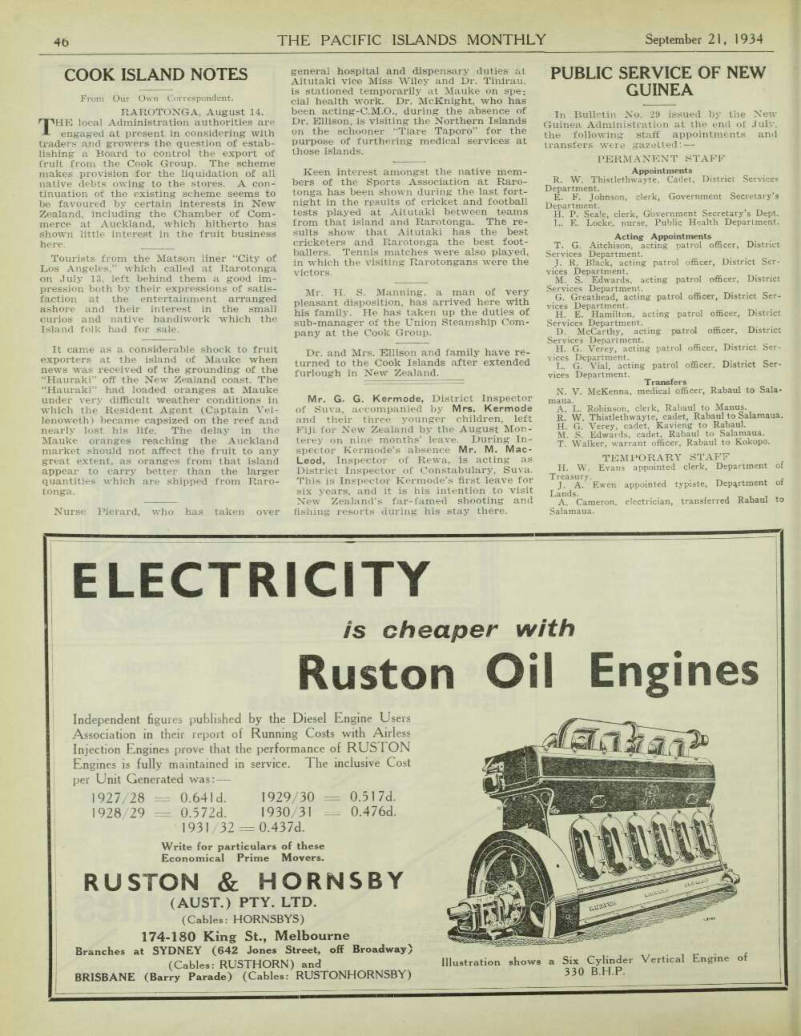
From Our Own Correspondent.
RAROTONGA, August 14.
THE local Administration authorities are engaged at present in considering with traders and growlers the question of estab lishing a Board to control the export of fruit from the Cook Group. The scheme makes provision for the liquidation of all native debts owing to the stores. A con tinuation of the existing scheme seems to be favoured by certain interests in New Zealand, including the Chamber of Com merce at Auckland, which hitherto has shown little interest in the fruit business here.
Tourists from the Matson liner “City of Los Angeles,” which called at Rarotonga on July 13, left behind them a good im pression both by their expressions of satis faction at the entertainment arranged ashore and their interest in the small curios and native handiwork which the Island folk had for sale.
It came as a considerable shock to fruit exporters at the island of Mauke when news was received of the grounding of the “Hauraki” off the New Zealand coast. The “Hauraki” had loaded oranges at Mauke under very difficult weather conditions in which the Resident Agent (Captain Velbecame capsized on the reef and nearly lost his life. The delay in the Mauke oranges reaching the Auckland market should not affect the fruit to any great extent, as oranges from that island appear to carry better than the larger quantities which are shipped from Raro tonga.
Nurse Pierard, who has taken over
general hospital and dispensary duties at Aitutaki vice Miss Wiley and Dr. Tinirau, is stationed temporarily at Mauke on spe cial health work. Dr. McKnight, who has been acting-C.M.O., during the absence of Dr. Ellison, is visiting the Northern Islands on the schooner “Tiare Taporo” for the purpose of furthering medical services at those islands.
Keen interest amongst the native mem bers of the Sports Association at Raro tonga has been shown during the last fort night in the results of cricket and football tests played at Aitutaki between teams from that island and Rarotonga. The re sults show that Aitutaki has the best cricketers and Rarotonga the best foot ballers. Tennis matches were also played, in which the visiting Rarotongans were the victors.
Mr. H. S. Manning, a man of very pleasant disposition, has arrived here with his family. He has taken up the duties of sub-manager of the Union Steamship Com pany at the Cook Group.
Dr. and Mrs. Ellison and family have re turned to the Cook Islands after extended furlough in New Zealand.
Mr. G. G. Kermode, District Inspector of Suva, accompanied by Mrs. Kermode and their three younger children, left Fiji for New Zealand by the August Mon terey on nine months’ leave. During In spector Kermode’s absence Mr. M. Mac- Leod, Inspector of Rewa, is acting as District Inspector of Constabulary, Suva.
This is Inspector Kermode’s first leave for six years, and it is his intention to visit New Zealand’s far-famed shooting and fishing resorts during his stay there.
Guinea
Public Service Of New
In Bulletin No. 29 issued by the New Guinea. Administration at the end of July, the following staff appointments and transfers were gazetted: —-
Permanent Staff
Appointments R. W. Thistlethwayte, Cadet, District Services Department.
E. F. Johnson, clerk, Government Secretary’s Department.
H. P. Seale, clerk, Government Secretary’s Dept.
L. E. Locke, nurse, Public Health Department.
Acting Appointments T. G. Aitchison, acting patrol officer, District Services Department.
J. R. Black, acting patrol officer, District Ser vices Department.
M. S. Edwards, acting patrol officer, District Services Department.
G. Greathead, acting patrol officer, District Ser vices Department.
H. E. Hamilton, acting patrol officer. District Services Department.
D. McCarthy, acting patrol officer, District Services Department.
H. G. Verey, acting patrol officer, District Ser vices Department. .
L. G. Vial, acting patrol officer, District Ser vices Department.
Transfers N. V. McKenna, medical officer, Rabaul to Sala maua.
A. L. Robinson, clerk, Rabaul to Manus.
R. W. Thistlethwayte, cadet, Rabaul to Salamaua.
H. G. Verey, cadet, Kavieng to Rabaul.
M. S. Edwards, cadet, Rabaul to Salamaua.
T. Walker, warrant officer, Rabaul to Kokopo.
Temporary Staff
H. W. Evans appointed clerk, Department of Treasury. , J. A. Ewen appointed typiste, Department of A. Cameron, electrician, transferred Rabaul to Salamaua.
Advertisements & other items, p. 48 (1 item)
Electricity
is cheaper with
Ruston Oil Engines
Independent figures published by the Diesel Engine Users Association in their report of Running Costs with Airless Injection Engines prove that the performance of RUSTON Engines is fully maintained in service. The inclusive Cost per Unit Generated was; — 1927/28 0.641 d. 1929/30 = 0.31 7d. 1928/29 = 0.372 d. 1930/31 = 0.476 d. 1931/32 —0.437 d.
Write for particulars of these Economical Prime Movers.
RUSTON & HORNSBY
(AUST.) PTY. LTD.
(Cables: HORNSBYS) 174-180 King St., Melbourne Branches at SYDNEY (642 Jones Street, off Broadway) (Cables: RUSTHORN) and BRISBANE (Barry Parade) (Cables: RUSTONHORNSBY) Illustration shows a Six Cylinder Vertical Engine of
330 B.H.P.
Fashion Hints for Islands Women
By Therese.
UNDER Spring’s influence clothes are more fascinating than ever and pass ing strange it seems that in a season gay with colour navy should be the dernier cri.
Never has it risen to such heights as in this year of grace. It is Fashion’s most important dictate and the secret of its success may be read in the fact that the new season s colours take so kindly to it.
Varying shades of yellows, greens, blues, mauves and pinks come under its charm and it does exciting things to them all.
Unbelievably cool is the navy suit of lightweight silk, sporting beneath its open coat a jacquette of white sheer linen with huge gauntlet cuffs and demure quaker collar. For the dweller in the tropics the jacquette may be short sleeved, with the gauntlet cuffs an accessory to be attached to the coat. A navy hat with white under brim completes a picture well worthy of emulation.
Navy is in great demand for accessor ies, too, and the effect of blouse, shoes, hat and bag, worn with a suit of dusty pink (that new and very becoming shade) is entirely charming. Brown also does de lightful things to this lovely shade of pink, and whether it be a brown blouse worn with a suit, or buttons, belt, hat, shoes, and gloves of brown with a simple frock, immediate success is assured.
One suit, at least, must your wardrobe boast. Have it in any shade to please your individual taste and lift it to the heights by clever colour schemes in your accessories which, by the way, are more important than ever in these days when chic depends so much on bits and pieces cleverly and introduced.
Blouse And Skirt.
The blouse and skirt —that economical standby—is again enjoying well deserved popularity. Dear little blouses go straight to our hearts and —more materially—ap peal to our purses. They are of such negligible cost that we can afford to have as many as half a dozen to one well-cut linen skirt. A bit of kilting here, a bit of tucking there, a piece of lace, a softly falling jabot—truly the ways of the blouse are many and fascinating.
Skirts come to us for the most part pleated and well tailored. Those that do not carry pleats are of the simple two
piece variety—no longer do we see the skirt of many gores. All of them are slim and straight, emphasizing the new flat back figure which we rush to cultivate with unseemly haste. It is Grecian—then beautiful, of course.
With the new figure, the old type of foundation corset is as extinct as the dodo. The woman who cares buys the new two-way elastic foundation, with clever buttonless suspenders that lie smoothly under her slinkiest and most revealing gowns. Such a relief it is, for those button suspenders have ever been an enemy to the smooth svelte line.
Pleats and still more pleats for every occasion if you will be tres chic. Kiltings as trimmings predominate and are used in devious ways.
As a sole adornment for a flowered afternoon frock, large goffered fan bows are highlights of Spring. They spread from shoulder to shoulder, and oft times from their centre peeps the sweetest of field-flower posies, adding charm to charm.
A slim fitting evening gown of taffeta, rows of goffering trimming its swishing hem line, takes on a dual personality when over it Miss Ingenue pops a frock of organdi. The taffeta sash serves both occasions, and she pins a posy of real flowers high on the shoulder line. Ir. varying shades of green it is dewy as the morning, and would delight the heart of any maid be she blonde, brunette or in between.
Lace Prevalent
Lace is everywhere in Fashion’s picture.
Evening gowns of this cobwebby material are an ever-present stand-by in ones hour of need. Narrow laces edge collars and cuffs. Rows of wider laces, softly falling from neckline and sleeve lend an old world air and are reminiscent of our courtly and completely charming ances tors with their gaily coloured satins, their wigs and their ruffles of lace.
Lace incrusted lingerie is enchanting.
Motifs of coffee and paris lace are appli qued in many ingenious ways to our un dies and the result is ravishing. Flowered georgettes and crepe de chines claim us as devotees for undies —a delightful use for last season’s floral evening gown. A remnant of all-over lace supplies the little
necessary extra and keeps you up to the minute in slumber-time chic.
Floral georgette dressing wraps are charming accessories and ideal for a warm climate since they are light and airy, and will launder beautifully with ordinary care.
Hand stitchery is a feature of many summer models. Hand veining on light materials, cross stitch on linens, smock ing and Roumanian peasant embroidery on blouses, all add an expensive touc and an air of difference.
Cotton materials are all that could be desired. Fadeless ginghams, in checks and stripes and polka dots, pique voiles, batistes, muslins plain and figured or daintily sprigged come to us in delicious colourings.
Printed and plain ensembles offer in finite variety. The printed short sleeved frock with its loose coat, hip or three quarter length, evolved in linen, silk or cotton, is sure of success wherever it goes.
Stripes are in the forefront of fashion and when cut so that they run in different di rections are a sure winner.
Beach Wear.
More and more fascinating becomes our beach wear as it grows less and less. It has now reached an almost irreducible minimum. Beach frocks are entirely back less and sport matching capes or coats for modest moments, while shorts are shorter than ever before.
Shoes? Custom stales not their infinite variety. Beach shoes in gay striped awn ing, Roman, Grecian, Mexican sandals, sandals with body and sole held together by mere strips of rope or leather, all take their place in the gay mad whirl of Fash ion’s maelstrom.
For dashing out-of-door’s wear nothing is so triumphant as the two-tone sports shoes, and the “all hour” skirt frock that gives us yeoman service for so many oc casions would be incomplete without them.
White mesh shoes promise coolness for tropical climates, and when one considers the .possibilities of matching bag and gloves, they become even more attractive in our eyes and we hasten to acquire them.
Then there is the übiquitous court shoe.
It comes in tucked stitched, and wind swept designs and is always delightful.
Hats for utility and sports wear match our frocks. Linens, silks, cottons, what ever the frock, so will be the hat. A de lightful whim for which we are extremely grateful. Our afternoon hats are charming albeit amusing. Large saucer-like hats held in place by elastic which dis creetly hides itself under one’s locks, eyes smartly shadowed under new square brims, little provocative travesties of the sailor mode, flatly brimmed or pertly up turned, offer a wide choice for even the most exacting among us.
Advertisements & other items, p. 49 (1 item)
Lloyd's Teas
Full Course — -2156 pages, 16 volumes.
Beautifully bound in flexible Blue Art Craft 2000 step-by-step illustrations Ca'slogue Post Free WRITE TO-DAY
To Miss GRACE GALE
Woman’s Institute, c/o I.C.S. 140 Elizabeth St.,Sydney Mark subject interested with X —Dressmaking and Designing —Dress Designing with Pattern Drafting —Practical Millinery —Pattern Drafting and Ladies’ Tailoring Name Address
Lloyd's Teas
Tea drinkers expect more than a mere drink.
That easy, relaxed feeling, that sense of contentment and glow of real satisfaction must be there . . . not once in a while, but with every cup.
Try Lloyds for purity. Try the consistent goodness of quality tea. Try the delicious aroma that is such a feature of Lloyd’s tea blending.
Obtainable at all good Island stores.
Just a few drops inhaled from the handkerchief will alleviate headache and banish fatigue. Fragrant and refreshing in bath and handbasin too.
FACTORY REPRESENTATIVE FOR AUSTRALIA,
NEW ZEALAND AND PACIFIC ISLANDS:
JULIUS BLAU
AUSTRALIA HOUSE,
CARRINGTON STREET, SYDNEY
Americans Explore
Samoa
From Our Own Corresgondent.
APIA, August 3.
THE American liner “City of Los An geles” of the Matson S.N. Company dropped anchor in Apia outer harbour on July 26, on her second so-called South Seas Exploration Cruise. Shortly after wards most of her 200 tourists came ashore to enjoy an interesting programme prepared for them by the entertainment manager.
Parties of tourists went to the Samoan
Boys’ School at Avele, Vailima and Ste venson’s grave; others went to the east to the famous Falefa waterfalls, while a large party attended native dances at Lepea (near Apia), the village of the Man leader, High Chief Faamuina, where 100 Solo-Solo natives gave a splendid and most interesting performance of dancing and singing.
Some very good business was done by native curio sellers, as there was a large demand for mats, baskets, fans, kava bowls, etc. Otherwise, however, the tour ists did not spend as freely as the pre vious visitors. In the evening a dance was held at the Catholic Club and was attended by the tourists.
It was regretted that, owing to the late
arrival of the steamer, very little time was left for the tourists to see the scenic attractions of Samoa, the native life and the outside districts and plantations. It is hoped that the management of the creuises will see their way to time the arrival of the next steamer for the early morning in order to give the tourists a full ashore.
Advertisements & other items, p. 50 (1 item)
Hordern Brothers
PERMANENTLY WAVE
YOUR OWN HAIR
with a “RAYWAVE” Curling Set. (Prov.
Pat. 16608/34). Waves last 6 to 9 months.
Anyone can use. NO ELECTRICITY.
Simple instructions. Failure impossible. 15/per set. Postage 3/- extra.
Spar Trading Co., 10 Rawson Place, Sydney
LARGE BRIMS DECREED BY FASHION
Illustrated at left: A charming Leghorn Hat, in fancy weave, Tuscan shade. Field flowers and satin ribbon to tone add a refreshing touch.
Head sizes 21½ and 15/11 Illustrated at right: A large, very feminine, soft Hat, of Swiss Straw in shades of White, Pink, Blue, Almond Green, and Biscuit. Dainty ribbon and flower add the correct finish. Head sizes 21 to 23 inches.
Price 8/11 THERE’S STYLE AND WEAR IN EACH PAIR Illustrated at left: Sturdy Sports Derby Shoe, In White Crock, with White Calf, White All sizes and half sizes.
Price Pair Illustrated at right Smart Derby Tie Shoe, featuring all over stitching trim, neat round toe and Baby Louis heel.
In White Calf with black stitching and Black Glace with black stitching.
All sizes and half
Pair:, 15/H
14/11
HORDERN BROTHERS
PITT & GEORGE STS., SYDNEY. WE PAY CARRIAGE
Samoan News
Bad Weather Mars Visit of Marama
THE eagerly expected first visit to Apia of the U.S.S. Company’s Marama on a tourist cruise on August 14 was unfor tunately shortened by unfavorable weather conditions. Striking headwinds between Fiji and Samoa, the steamer was delayed and arrived in Apia at 2 p.m.. instead of 6 a.m.
The day of the arrival was the rainiest and windiest we have had for many weeks and Apia beach in bad weather is a most ungainly sight. Nevertheless, the tourists went on excursions to Falefa waterfall, Stevenson’s grave, and Papasee’a rocks.
Before leaving for Tonga at midnight the tourists attended a native taalolo at Mulinuu village, and witnessed native dances and sivas.
Copra And Cocoa.
The local copra market is still fluctuat ing and there seems little prospect of an improvement in the near future.
Cocoa, however, seems to have sold bet ter lately and a recent sale in London is reported at the satisfactory price of 45/-.
We are between the crops at the present time and only small quantities are de livered to Apia buyers.
Anniversary Sports.
On August 29, the 20th anniversary of the raising of the British flag in Samoa, was celebrated with sports for European and Samoan children of the local schools.
A varied programme of events had been drawn up by the committee and the events were followed by a large and at tentive gathering of Europeans and na tives.
In the school events the Marist Brothers’ school was the most successful competi tor.
Samoans Farewell Judge
Luxford.
A native farewell feast was given at Mulinuu in honour of Chief Judge Lux ford, who is to leave Samoa by next Maui Pomare. Judge Luxford, in his position as Chief Judge and President of the Land and Titles Commission, during his five years’ stay in Samoa, has taken great in terest in the history and folklore of the Samoans and also in their general wel fare. Appreciative speeches at the func tion included such by the Administrator and the Hon. Mataafa. A native tauma fataga (dinner), sivas and songs conclud ed the proceedings, which showed the re
spect and esteem in which the Judge is held by the native population.
Publicity For Samoa.
After a lengthy period Samoa seems to be again in the searchlight of publicity.
Not less than three books on Samoa and Samoan history have been published lately or are announced to appear in print. They are a book on Western Samoa by Dr. Keesing, a history of Samoa from the mission standpoint in the French language by His Lordship Bishop Darn and, and a book in two volumes on Sa moan mythology, genealogy, and the his tory of Samoa under German occupation written by Judge Luxford of the Adminis tration.
Poachers and ’Planes in Torres Strait
Torres Strait
REPORTS from Thursday Island indi cate that Japanese shell poachers are at work again on the Torres Strait reefs.
On September 2, two coast pilots, Messrs. Elliott and Rule, while on the tanker Solen en route to Borneo saw a Japanese sampan near Turtle Island, 60 miles from Thursday Island. The craft was making for a reef four miles to the east of Turtle Island.
The steamer Ampullaria sent a radio message to T.I. on September 6, stating that when she was passing Haggerston Is. (near Cape Grenville), a foreign sam pan was seen lying at anchor with her mast down.
A third report was received from the ketch This Land the following day that she had sighted a Japanese fishing vessel, which was of about 40 tons, was painted black and had eight boats out at work near Cairncross Reef. The master of the This Land also reported having sighted two ’planes in the vicinity.
Fishermen on board the Alee confirmed the report concerning the two mystery aeroplanes when they arrived at Thursday Island. They stated that they saw the ’planes flying at an altitude of about 500 feet in the direction of Milman Island.
Advertisements & other items, pp. 51-52 (2 items)
Radio
INSTRUCTION
I. C. S. & R. C. A.
By Special Arrangement International Correspondence Schools (A/asia) Ltd 140 Elizabeth Street. Sydney Name Age Address
A WELL-PROVEN
REMEDY FOR PILES
This preparation has been on the market for several months, and it has effected a Cure in every case in which it has been tried. Cases of Long Standing often Cured within One Month, with one bottle only.
For External Use only—Stainless, Painless and Odourless.
PRICE: 5/- PER BOTTLE. Posted, securely packed, for 6/9 per bottle. Copies of Testimonials forwarded on request.
Read the Report of an Eminent Analytical Chemist:
THE LABORATORY,
20 and 22 Napoleon Street, Sydney, March 14th, 1933.
ROBERT BRUCE, Esq.
Dear Sir,—The formula of your pile cure submitted to me could have no effect other than beneficial. I gave your sample to a Client who had suffered many years, and before he had used half the bottle he reported himself completely cured.
Faithfully yours,
GROVE JOHNSON, F.C.S. (Lend.),
Analytical and Consulting Chemist.
Supplies Obtainable from—
ROBERT BRUCE
Room 7, 2nd Floor,
15 Hunter Street, Sydney
and also at
14 UPPER BAYVIEW ST., NORTH SYDNEY.
A LASTING PROPOSITION
EFFICIENT
RELIABLE
GUARANTEED
Manufacturers of Quality Batteries
ERG BATTERIES LTD.
156 GOULBURN ST., SYDNEY, N.S.W.
Battery Manufacturers and Auto Electrical Engineers
PUMPMOBIL
Portable Pumping
Plant
Equipped with carrying handles.
Total weight 120 lbs. 4 2 h.p. Engine, direct coupled to 3”
Centrifugal Pump.
All Heads up to 100 Feet, 50lbs. Pressure.
Especially Suitable for Sluicing and Mining.
Nelson & Robertson
12 SPRING STREET, SYDNEY.
Delicia
Food Products
PURE MALT VINEGAR
TOMATO SAUCE
JELLY CRYSTALS
PURE FLAVOURING
ESSENCE
CHUTNEY
BAKED BEANS with Pork, in Tomato Sauce SPAGHETTI in Tomato Sauce
Delicia Food Products
Co.
DANKS STREET, WATERLOO,
N.S.W.
Parlours
CAPITOL MUSIC
Specialist in Player Rolls, Gramophone Records and Sheet Music.
Portable Gramophones and Player Pianos.
199 HAY STREET
SYDNEY
MA 3208.
Ownership
Quarrel Over Land
Leads to Samoan Native’s Death
From Our Own Correspondent.
APIA, August 2.
THERE are in Samoa eternal dissensions, court cases and squabbles going on since the oldest times amongst the various tribes and families of every Samoan vil lage over titles and rights to native lands. A special Land and Title Commis sion has been appointed by the Adminis tration, and holds sittings whenever neces sary to decide and arbitrate in these mat ters. Sometimes, however, the natives de cide to use their own methods and revert to the ways of the cavemen to obtain redress.
At the back of the Upolu village of Tuanai (west of Apia), two natives, Sifaga and Siaosi, working in a taro patch, started to argue over the ownership of the land Sifaga was working on. When Sifaga and his family laughed at Siaosi’s claims to the land, he became so angry that he seized a crowbar and, it is alleged, hit Sifaga with it. The blow caused him to drop to the ground insensible.
At Apia Hospital Dr. Mitford operated at once on the wounded man, who had sustained a fracture of the skull. The doctor was unable to save his life and Sifaga died on July 15.
Siaosi has been arrested and charged with murder.
Tulagi
New B.P. Store For
From Our Own Correspondent.
Tulagi, Sept. 6.
Shades of old Island traders! —Burns Philp are erecting a cash and carry store on Tulagi between the Lands Office and Hollis Brothers. With bated breath people talk of tiled fronts, and wonder how far this progress is going during the pre sent generation’s time.
Mr. Alec Glenn will be in charge of this enterprise, and under his able man agement, the cash and carry should be a great success.
Notes
Thursday Is.
Chinese Junk Fou Po Wrecked
From Our Own Correspondent.
Thursday Is., August It.
NEWS has been received that the Chi nese junk, the Fou Po II., which was in the harbour recently, has come to grief in the Gulf of Papua. When many miles from the shore her mast carried away during a gale, and the rigging became en tangled in the rudder. The vessel was eventually cast up on to the beach.
Fortunately, Captain de Bischopp and his companion escaped injuries, and were able to reach Port Moresby. They will stay there until the season of the S.E. wind is over, and then make their way to Sydney.
New Church At Badu.
Mr. Harris, a master builder from Bathurst (N.S.W.), is making great head way with the building of the new concrete and fibrolite church at Badu Island with voluntary native labour. It is understood that about £1800 is being spent on the materials, to which cost the Badu Islan ders have willingly agreed to contribute funds during the next few years.
There is a friendly competition here with the people of St. Paul’s Mission on Moa Island, who are also erecting a very handsome concrete church by easy stages.
Visitors are loud in their praises of the workmanship that is being put into these buildings, which prove what can be done by natives under skilled direction.
Cape Otway.
The Commonwealth Lighthouse Service steamer Cape Otway has been in the har bour for a few days attending to stores and repairs. She is towing the Service launch Rooganah across to the Great Bar rier Reef to assist in the erection of two new unattended lights. These will help the navigation by night of what is con sidered to be the most dangerous portion of the coast of Australia. By means of
these lights the passage known as the Inner Route is being rendered compara tively safe for those who are familiar with the reefs and shoals.
T.I. Post Office.
The new Thursday Island Post Office is now almost completed, and should be opened shortly for public business. The telephone exchange was transferred about a week ago. The new building has a pleasing style, and is a distinct, addition to the public buildings of the township.
Tourists can see the Post Office as they leave the jetty.
Australia’S Early History.
An able, informative, and interesting lecture was given recently by Mr. P. R.
Frith, of Murray Island, at the monthly meeting of the T.l. branch of the Royal Geographical Society. Dr. Nimmo, Government Medical Officer, was in the chair as President, and there were a number of visitors. The lecture, entitled “Terra Australis Incognita,” was illus trated by several well-drawn maps in colour.
Personal Notes.
Mr. and Mrs. May, of Badu Island, are the guests of Mrs. Broadbent at Thursday Island for a few days.
Miss Sadie Brown, of Brisbane, is stay ing for a month with Mr. and Mrs. Harry Finter at the State School House.
Mr. and Mrs. Hennessey and their two younger daughters are looking very well after their holiday in Brisbane, Montville, and Sydney. The Misses Gladys and Joan Hennessey are now journeying to Maori land for their southern holiday.
Shooting parties continue to visit the swamps at the tip of Cape York Pen insula. A party which went across re cently got a splendid bag of wild ducks; the top score (21) fell to the gun of Mr.
J. Dunwoodie.
A dust-haze has been prevalent here for several days, a most unusual pheno menon caused by heavy storms in S.
Queensland. The bad visibility caused steamers to anchor in the daylight for some days both on the east coast and be tween here and Darwin.
Our local Aquatic Club held a dance a few nights ago, at which were presented the prizes for the last season. The club holds regular fortnightly sailing races in the harbour during the season, which al ways attract a large crowd of spectators.
The new 105 h.p. engine in the muni cipal power-house is now in active opera tion and running satisfactorily. Smoke boxes have been installed to abate the smut nuisance.
Mr. J. L. Adams, manager of the local branch of Messrs. Burns, Philp Limited, Mrs. J. L. Adams, and Mrs. Nimmo, wife of our Government M.O., have returned from Singapore after an enjoyable round trip.
Mr. and Mrs. Brookes have returned to Brisbane, having spent a brief holiday on Thursday Island. They speak highly of its beauties and the hospitality of its resi dents.
Mr. Tom Cussens is making slow headway as an inmate of the Torres Strait Hospital. The daily run given him by Mr.
Cleveland in his car is helping consider ably towards the recovery of the patient, whom we hope will soon be out and about once more.
We are glad to see Dr. Vernon, M.C., again, who is to be here for about a month as locum tenens. He is looking well and fit. Dr. Nimmo has gone across to the mainland on a medical trip, and will go overland to the Mitchell River Mission, in the company of Mr. McLean, the local Protector of Aboriginals.
Mr- W. Carpenter has returned from the Aru Islands, and is now off to the South on a brief business visit. He is somewhat concerned about the future of our local pearlshelling industry, as the clouds have not yet lifted.
Advertisements & other items, p. 52 (1 item)
Tropics And
Scientific Research Offers
A New and Remarkable
Tonic and Restorative
indirectly, to Hormone Deficiency, and especially in tropical countries, the unfavourable climatic conditions, illness, and disease, and also the continuous and unavoidable doses of drugs, such as quinine, etc., show the ill-effects, sooner or later, on everyone. Through lack of stimulations, the nervous system and mental faculties become impaired, the activity of the glandular system is decreased, and the cells and the tissues of the body are lacking proper nourishment, resulting in general weariness, nervous debility, poorness of blood, mental fatigue, irritability, brain fag, inability to recuperate after illness, etc.
The real remedy may now be found in this new Hormone Preparation. The results_ obtained so far have been far above expectations, and show quite conclusively its great efficacy. It will be in the interest of Island Residents to investigate this treatment, and if they will write to Titon Laboratories, Box 1304 J, G.P.O., Sydney, N.S.W., or to the Island Distributor, A. Stoffer, 16-20 Bridge street, Sydney, complete literature will be forwarded post free and under plain cover.
A Hormone Preparation;
In order to avoid further loss of time, the distributors will also be pleased—on receipt or order and cheque to forward a supply of this preparation by return mail, post free, and under plain wrapper, marked “medicinal tablets”; and ail those already acquainted with hormonetherapy, or who have heard about this remarkable preparation, will, no doubt, avail themselves of this offer.
The preparation is known as Titon No. 24 lor men; whilst for women Titon No. 20, with a slightly different formula, is specially prepared.
It is sold at 10/6 per bottle (10 days), or 30/per complete course of three bottles. Titon is produced according to very latest scientific pnnciples, wonderfully effective, and yet absolutely harmless to take even to delicate constitutions; and there need be no fear of enslavement to habit or reaction in after years, but, on the contrary, building up your system with hormone will make a wonderful difference to your future health and comfort.
Producing Unprecedented Results
TROPICS AND
HEALTH
The great new discovery of Hormone Preparations is one of the most wonderful that scientific research has offered to the world. Many methods of building up a deteriorated system have been tried with varying results, and it was only in recent years that safe and lasting results through the adjustment of the hormone balance of the system have been proved by scientific and medical experiments.
By means of this remarkable preparation a new and plentiful supply of hormones is ensured to renew vitality and a harmonious working of the whole body. It stimulates the nervous and glandular system, the brain, and all its mental faculties are revivified, and provides the proper nourishments for the cells and the tissues.
The secretions, or hormones as they are called, have a wonderful power over the health and vitality of the body, its rate of working, and the co-operation of all its parts; in fact, they are essential to life and health.
Many complaints are due, either directly or
NOW OFFERED FOR THE FIRST TIME IN THE PACIFIC ISLANDS
When You Visit Sydney
Nowhere can you be more highly re commended to stay than at the Great Southern Hotel, 717-723 George Street, Sydney (facing Central Railway Station, opposite Rawson Place). Bed and break fast 7/6, luncheon 2/-, dinner 2/6.
Misima G.M. Ltd.
Real Gold Mine!
Phenomenal Profits of New Misima G.M. Ltd.
WE have received from Mr. Frank Hambridge a copy of the annual report and balance sheet of New Misima Gold Mines Ltd., which works the phenomen ally rich Aumuna mine, on Misima Island, Eastern Papua.
During the year ended April 30 last this Co., which has a total subscribed capital of £14,000, made a profit of £17,017, and paid dividends totalling 18/- per share, equal to 90 per cent.
Against the issued capital of £14,000 there is a reserve, in hard cash, of £9000, and plant and equipment, written down to £16,739.
Mr, F. W. Cuthbert is chairman of directors, and Mr. Gilbert Wilkinson is a director.
It is reported that an option over this mine has been given recently to another company.
Advertisements & other items, pp. 53-54 (1 item)
Globex
W. D. BAILEY
Naval Architect
DESIGNER of SENSIBLE SEAWORTHY
CRUISERS, MOTOR, SAILING, or
AUXILIARY ISLAND TRADING
VESSELS
Over Thirty Years’ Experience—British, American and Australian.
Stock plans of all types and sizes at nominal prices.
Building supervised—Surveys anywhere. Special Plans for Amateur Builders with Free Advice.
Address: Como, N.S.W.; or
7 Barrack Street, Sydney
GLOBEX
(GLOBE BEEF EXTRACT)
GLOBEX
FOR GOOD BEEF TEA
GLOBEX
FOR SOUPS e*GRAVIES
GLOBEX
DELICIOUS SPREAD THINLY ON BREAD
Obtainable from All Island Traders
A Helpful Brochure
If you are interested in Electrical Plant, Motors, Switchgear, Cables, Lamps, Accessories, etc., Oil Engines, General and Industrial Machinery, Road Plant, Metals, etc..
Building Materials, Sanitary Ware, Radio Receivers and Accessories, Cutlery, Glassware, Sporting Goods, etc., we will be pleased to send you this Brochure.
NOYES BROS.
(SYDNEY) LIMITED
115 Clarence Street, Sydney
’Phone B 7581 (10 lines) Warehouse: 213 Kent Street, Sydney 11 Watt Street, Newcastle.
Elizabeth Street, Brisbane
W. M. REID
C/o Robert Reid & Co., Ltd.
32-34 YORK STREET, SYDNEY
Wholesale Exporter of Goods of all Classes from Australia
For Tents, Tarpaulins, Horse Rugs, Birkmyre Coats, Sails & Riggings, Rope all sizes stocked write
ALBERT JONES
MAKER.
173 CLARENCE STREET, SYDNEY
Pacific Island Business Catered for
Expert Engineers, Designers and Builders of All Classes Islands Boats and Pleasure Craft Good Fleet of Boats on Hand.
Estimates Given Freely.
Buyers/Sellers write:
Jack Capell,
Elite Boat Shed
RUSHCUTTER BAY,
SYDNEY
KELVIN DIESEL ENGINES KELVIN RICARDO ENGINES
Your business calls for more economical working. What are you doing regarding your power units? Every Kelvin^^lesll or person whose business requires mechanical power should enquire into and procure particulars of the latest list of Kelvin Diesel^ Engines.
These are some of the points that will interest you. Regarding horse power, quality, robust construction regarding Kelvin Diesel Engines. Every engine is tested and certificate is supplied with every engine, cost, 'fuel consumption, simplicity, compactness, and freedom from unnecessary auxilary gear. you have no need to worry What concerns you is capital luixi uu UCCCSMI , Kelvin Diesel Engines have always been rec-arded as the Rolls Royce of the Marine world of engines. Their price with equal equipment cannot be approached by .any other make of equal quality The following are facts backed by the maker’s guarantee. Fuel consumption for every 22-horse power Kelvin Diesel Engines 6/. per gallon, therefore 1d. per hour half the cost of a ride, one section on the tram in Sydney. therefore you have the advantage of a very much greater carrying capacity from your craft.
You running. total running cost of 1d. per hour, have No compressed air to worry about and no vigorous cranking; just a simple arrangement for starting.
These engines can also be produced fitted with electric generator, bilge pump and search lights.
Sizes. 1 Cylinder, 22 Horse Power. 2 Cylinders, 22 Horse Power 44- 66 88 132 You know you have everything for a complete simple arrangement for starting, electric generator, bilge pump and search light.
Horse Power. 2 Cylinders, 22 Horse Power 3 „ 33 „ 4 .. 44 „ 1000 Revolutions per Minute. 750 Revolutions per Minute.
PRICES: £350 to £1450. FREE ON BOARD SYDNEY.
IN BOND.
Send along your enquiries Sole Australian and South Sea Island Representative.
GEORGE RUTHERFORD, Endeavour House, 46 Pitt Street, Sydney.
News From New Caledonia
Revival of Mining and Timber Industries
From Our Own Correspondent.
BOULOUPARI, August 15.
THE Laperouse arrived in Noumea early on July 31. She was expected at noon, but at 8 a.m. a whistle blew and the town awakened to the fact that she was in the harbour. She carried more passengers than usual and a crowd soon gathered at the wharf and there was much excitement and handshaking to greet the visitors. The captain had speeded up to make the com munication with the Ville de Strasbourg, which left Noumea that afternoon for France.
Among the passengers on board the Laperouse were Mr. and Mrs. Perkins, Mr. and Mrs. Bergmann from America, Mr. Park, Mr. Sullivan, Mr. Stepp and Miss Muriel Dangar. Mr. Perkins was for a number of years in charge of the American mining interests in New Caledonia and has now been transferred to headquarters in New York. During their previous sojourn in New Caledonia both he and his charm ing wife made themselves extremely popu lar and all in Noumea joined in welcoming them back again, even though it is but for a short stay.
Mr. Park, whom we see frequently, and who handles a large volume of business from Australia, remained in Noumea, but Mr. Sullivan and Mr. Stepp proceeded on the round trip through the New Hebrides, also on business.
Timber Industry
There has recently been signs of revival in two of our most important industries — mining and timber. One would not imagine that such a remote island as New Cale donia would be affected by the strikes in San Francisco, but such has been the case.
For the time being it has become impos sible to import Oregon from America and the demand for local soft woods has be come keen. The milling companies have been able to place some of their old stocks and have become more active.
Before the heavy taxes were imposed by Australia we used to market a lot of tim ber there and since that market has been closed the industry has almost been at a standstill. It is to be hoped that the local demand will not fall away when trade re lations with America again become normal.
Chrome Deposits
It may perhaps be of interest to readers in other parts of the world to know that New Caledonia is 250 miles long and 30 miles wide, and for its size is the richest mineral area in the world. The minerals chiefly found are nickel, chrome, cobalt, copper and gypsum. The latter is used in the treatment of nickel and has a high local value.
The “Societe de Tietaghie,” an English controlled company with its headquarters in London, has the largest chrome mine in the world and the chrome found is of the highest quality, yielding 56 per cent, pure chrome. From 1914 to the present time this company has mined over 500,000 tons of mineral, and there are at the pre sent time 100,000 tons ready for export.
“La Societe Chimique du Chrome” is controlled from New York and has the latest and most up-to-date installations.
Its output goes to America. In 1932, 8,179 tons were exported and, in 1933, 15,394 tons. Australia barely enters into the market for chrome; in 1932 and in 1933 five tons were her full complement for each year.
Nickel Exports
The two nickel companies of New Cale donia amalgamated in 1931 and though the combined output fell by 1000 tons this was more than compensated for by the greater economy of working. In 1932, 3,915 tons of mattes of nickel were exported, and in 1933, 5,978 tons. Apart from the ordinary uses of nickel, there are at present about twenty-eight countries using nickel coin age.
“La Societe Caledonickel” imports the bulk of the coal for her fleet of steamers and her smelting-works from Australia; the figures for 1933 amounted to 82,000 tons.
Bourail’S Rich Flats
I noticed on a recent visit to Bourail that the rich alluvial flats have not been culti vated this year, many being sadly ne glected and overgrown. Usually they have large crops of “ail” (garlic), which is such a necessary factor in French cooking. At present one cannot buy a kilo in the centre of Bourail, and I understand that a local merchant has had, for the first time in many years, to place an order in Australia.
A sad reminder of the last cyclone is the fallen war monument, which was executed in France by a well-known artist. All that remains of it are the soldiers’ boots with the inscribed tablet below. It is singularly in keeping with the overgrown and uncultivated flats.
Samoan Finances
From Our Own Correspondent.
APIA, August 30.
THE Administration estimates of Revenue and Expenditure for the year 1934-35 have just been issued, after be ing confirmed by the New Zealand Gov ernment, and present a more favourable picture of the Administration’s finances than was to be expected in the circum stances.
The receipts during the financial year, 1933-34, amounted to £90,613 compared with an estimate of £86,325, while the ex penditure during the year came to £89,955 against an estimate of £94,919, thus showing a surplus for the year of £658 against an estimated deficit of £8,594.
The comparatively favorable result of last year was mainly due to higher re ceipts for export duty on copra, cocoa and bananas, and on the other side the saving of over £5,000 effected by re trenchment in all Administration depart ments.
For the current year, terminating on March 31, 1935, receipts are estimated at £71,520, and expenditure at £74,101, giving an estimated deficit of £2,581.
Owing to the drop in copra and cocoa prices during the current year and the re sulting decrease in revenue for the Ad ministration it may be considered very doubtful whether this year’s estimated de ficit can be confined to the amount given in the estimates. There are at present no indications whatever of an improve ment in the economic situation of most of the Pacific Islands.
Advertisements & other items, p. 55 (1 item)
Toys
“The Senior Store"
“Truth in Advertising and in Every Act"
ANTHONY HORDERNS’
TOYS
that will brighten the hearts of many!
SCOOTERS
A Scooter will keep small boys occupied for hours at a time . . and besides, they afford health - giving exercise. The “Cyclops” is 44 inches long, 35ins. high and is fitted with 12in. rubber-tyred disc wheels, roller-bearing, fitted with brake and rubber footboard mat.
Anthony Horderns’
Price. 28/9.
Freight 8/6 extra.
DOLLS
What a merry time little girls will have in choosing a Doll from Anthony Horderns’ large and varied stocks. Prices range from 6d. to 33/6.
Christmas Stockings
Christmas Stockings, bigger and better than ever. Packed with all kinds of interesting toys.
Prices range from 6d. to 5/-.
MOTOR CARS
The delight of small boysl A motor car that he can drive himself! The “Rover” is suitable for children from 2 to 5 years. It is 20 inches high, 34 inches long. Made with all steel frame and 9 inch rubber-tyred wheels. Anthony Horderns’ Price, 25/-. There is also a comprehensive range of other Motor Cars. Prices 43/6, 52/6. Freight approx. 20/- extra
DOLLS’ PRAMS
What a time a little girl wouk have with a pram like this. I is made just like Mother’s, with movable hoods, rubber tyred wheels and tastefully enamelled in Blue or Pink. Featured in Cane Matting Anthony Horderns’ Price, each 17/6 Others, 22/9, 27/9, and 45/-.
Freight 8/6 extra
DON’T DELAY! ORDER EARLY TO ENSURE
CHRISTMAS DELIVERIES.
WHEN ORDERING, ADD FREIGHT.
Anthony Hordern & Sons Ltd.
’Phone: M 2401 Day & Night
SYDNEY
Postal Address:
Box 2712 C, G.P.O.
Rothesay Educational Home for Children
66 WARREN RD., MARRICKVILLE
Children given a refined home, and sent (the little ones under escort) to a good State School.
Homework supervised. Tennis, physical culture. Excellent food.
Rothesay is situated in a refined high, healthy district.
Special holiday arrangements for children from a long distance.
References exchanged.
MRS. J. ASHTON
Teachers’ Training College Tel.: Pet. 2694
Samoan Mau
Attempts to Boycott Govern ment’s Banana Shipments
From Our Own Correspondent.
Apia, Aug. 30.
THE Administration of Western Samoa, for some considerable time, has been hard pressed to obtain the revenue necessary to cover expenditure, though the latter has gradually been cut down, especially public works and medical service. A large num ber of Europeans, mostly planters, owe the Administration big amounts for taxes, rents, overhead expenses of Chinese coolies, hospital accounts, etc. During the last few years the Administration collect ed these debts from Europeans shipping bananas by the Maui Pomare by deduct ing 6d per case of bananas shipped.
The Mau, or anti-Government faction of the Samoans, has refused since 1927 to pay the customary poll-tax and other taxes to the Administration and, in con sequence, the Adiministration in 1929 abolished the poll-tax altogether. This was replaced by a similar amount being added to the copra export duty, payable by the copra exporters, which in turn led to a reduction of the copra price paid to the natives by the merchants.
The taxes, however, for the years 1927 to 1929 remained unpaid and in spite of the imprisonment of numerous defaulters the Administration did not succeed in col lecting more than an inconsiderable por tion of the taxes.
Meanwhile the banana export industry
has been firmly established in Samoa and among the 400 individual shippers of ba nanas there are a considerable number of Samoans who are adherents of the Mau movement and who still owe the Govern ment their old taxes. Very properly the Administration decided a short time iago, to treat these Samoans in the same way as European debtors and accordingly in formed them by letter, that in future 1/per case of bananas shipped would be deducted off their banana payments to settle tlleir long outstanding tax ac counts.
A deduction of 1/- per case out of 4/6 cannot be considered a hardship, especi ally as some individual natives are draw ing up to £20 and £30 per month and are much better off than many workless and hard-struggling Europeans. Neverthe less, the Mau leaders considered the mat ter warranted action by the Mau and sent orders out to all Mau adherents not to ship any bananas by the August Maui Pomare, thus hoping the Administration would be considerably inconvenienced.
Leauvaa village on the West Coast of Upolu since the beginning of the banana export industry has consistently shipped the largest quantity of best quality ba nanas. Though most of the villagers are firm Mau adherents, the Administration has always given the Leauvaa people pre ference, even before the loyalist natives, and consequently the former have even in these hard times fared much better than other villagers.
When the Leauvaa natives received orders to boycott Government banana shipments they became indignant and sent a letter to the Mau headquarters.
They pointed out that bananas formed practically their sole revenue and that
they did not want to lose this source of income. But back from Vaimoso came the stern reply “Do as we told you and may the Lord help you for the future!”
Heated discussions followed among the Leauvaa chiefs as to what they should do. To ship bananas meant disobeying the Mau leaders and causing dissension in the Mau movement; not to ship meant losing all revenue and being unable to purchase the accustomed necessities and luxuries of life. Finally the majority de cided to sacrifice Mau loyalty to material welfare. As in Leauvaa, the other villages where many Mau adherents reside also disobeyed the Mau orders.
Among those who rebelled against the Mau are some of the highest and most influential chiefs in the movement. It is rather farcical when the Mau attempts to collect money for propaganda purposes from the very people whom it wants to deprive of their main income.
As there was a large overproduction of bananas by European as well as native producers, the Administration had no dif ficulty in obtaining a full cargo of fruit for the Maui Pomare.
The Samoans who. in accordance with the Mau orders, refused to ship their banana quotas by the August steamer will be excluded from further shipments.
The Mau leader of the village of Leau vaa has punished those families of his village who shipped bananas by the Maui Pomare and thereby defied Mau orders.
He ordered them to pay a fine of five pigs each and threatened them with stronger measures should they dare to defy the Mau orders again. It remains to be seen whether the authority of the Mau or the wish for material gain is the stronger influence with the Samoans.
Advertisements & other items, p. 56 (1 item)
Ringknot
BIG PRICE REDUCTIONS for
“BUZACOTT” FARM GATES
FIELD FENCES
FROM
Per Mile
FIG
636 830 and
RINGKNOT
FIELD FENCES
Following an increased demand and improving times, production costs for these well-known lines have been considerably reduced.
Whilst the whole of these lowered costs is passed on in the form of reduced prices, the high standard of quality and workmanship are in no way affected. Buzacott quality is constant.
Write for particulars. 7-11 Market St.
SYDNEY
Australia
ALL PRICES QUOTED
F.O.R. SYDNEY
Also Agents for
FETTER
ATOMIC DIESEL
ENGINES.
Cold-starting, heavy oil.
Stationary and Marine.
Mining Wardens
Report
Progress on Morobe Goldfields
THE official summary of the progress and development made in June, 1934, on the Morobe goldfields, New Guinea, compiled by the Min ing Warden (Mr. H. Taylour) is as follows:
Gold Export
Bullion exported for the month amounted to approximately 25,580ozs. valued at £147,617 (Australian currency). The gold production from the Morobe goldfields for the twelve months ended June 30, 1934, amounted to 257,038ozs. approximately, valued at £A1,365,225.
Wau-Edie Creek Road.
Work on the construction of the new portion of this road was commenced early in the month.
Three Europeans and 230 natives are engaged on the work, and by the end of the month excellent progress had been made.
Salamaua-Wau Road.
Two survey parties, each under a licensed sur veyor, commenced preliminary surveys for the construction of this road.
Wau-Bulolo Road.
The survey for the construction of the final section of this road was completed during the month. It is anticipated that this road will be finished during the next twelve months. Forty miles of continuous road will then be available between Edie Creek Post Office and the Baiune Creek power station.
Sunshine Gold Ltd.
Gold Foil and Adjoining Leases.—Clearing and planting of gardens was under way, also the select ing of suitable timbers for piles for houses.
Timber Mill Site, Reedy Creek.—Several water race grade lines were surveyed, to ascertain if power was available, for driving a sawmill.
Undaunted Lease.—The contractors, Messrs. Roy Hyde and M. McNaughton, were engaged cutting the water race from the Bulolo River, and prepar ing timbers for high fluming. A quantity of sluic ing plant was transported on to this lease, from the Bulolo ’drome.
Bulolo Gold Deposits.
The 22in. diameter was relaid, and all the com pany’s 18in. diameter pipes connected up to same.
This pipe line is being extended northerly along Flat Creek by connecting up all the remaining 11in. and 9in. diameter pipes. The extension of the smaller diameter pipes, proceeds as the sluicing faces advance, in a northerly direction. Sluicing was also under way during the period, also the clearing and burning off of timber.
The staff comprised five whites and seventy six natives.
Koranga Gold Sluicing.
One nozzle operated continuously on landslide, and another at No. 1 face with satisfactory results.
Very little yardage was put through owing to terrific quantity of boulders.
The construction of tail race from Bulolo to Bring in fall is proceeding satisfactorily.
Health of European and native employees has been excellent. A further area of native field fruits has been planted.
Bulolo Gold Dredging.
Air Transportation.—A total of 244 tons of freight was delivered at Bulolo and Bulowat aero dromes during the month, and 34 white and 106 native passengers. The company’s No. 3 ’plane —URQ —was brought into operation on June 11 and has been operating satisfactorily since that date.
Dredge Operation.—Nos. 1,2, and 3 dredges were operated continuously throughout the month, and recovered a total of 14,106 ounces from the 688,700 cubic yards dredged.
Baiune Power Project.—The construction of the race is progressing well with power shovel, bull dozer, scoop, and a good force of native labour.
The main power station building was completed during the month, and work has Been started on the switch-house. The machinery is now arriving and installation will shortly be commenced.
Placer Arnolds.—lt is expected to complete the installation of the hydraulic plant in the fore part of July, and the plant should be in operation before the middle of the month.
Work proceeded on the erection of additional housing accommodation required at Bulolo and Bulowat.
The two “Keystone” power drills were operated continuously throughout the month at Bulolo and two hand drills were operated at Bulowat.
The Medical Officer reports that the health of the community has been good throughout the month. A few cases of dysentry occurred amongst the natives, and the usual seasonal epidemic of influenza colds amongst the whites.
The Company had totals of approximately 250 Europeans and 870 Natives in its employ at the end of June.
Day Dawn South (N. G.), N.L.
No. 1 Vein —130 foot level.—North Drive has been advanced 33 feet in ore. Total 241 feet.
No. 1 Vein—2oo foot level.—North Drive has been advanced 20 feet in ore. Total, 216 feet.
No. 1 Rise has been put up 14 feet in crushed slates and hold through to No. 1 Winze from 130 foot level. Total, 75 feet.
No. 1 Winze has been sunk 18 feet in ore.
Total, 30 feet.
Preparation for lower adit.—No. 1 Vein has been cut with a series of costeens along the strike of lode for a distance of 350 feet further south than
the adit at 200 foot level, and about 100 feet lower in depth, and it would appear that a satis factory position for a lower adit will be obtained at about 250 feet along the strike of lode from the mouth of adit at 200 foot level.
Day Dawn (New Guinea) Ltd.
B. LEVEL—140ft. level.—No. 8a Rise has been put up 24ft. Total, 34ft.
No. 1 Level —210 ft LEVEL.—Stope No. 2a Rise North has been carried along in ore for a length of 30ft. at an average width of 4ft. 6in. to an average height of 54ft. above the floor of the level.
Rise at 60ft. Portal has been put up 15ft. to the surface. Total, 30ft.
Intermediate Level)—
Stope No. 82 —No. 9 Rise has been carried along in ore for a length of 30ft. at an average width of sft. to an average height of 52ft. above the floor of the level.
Stope No. 8a 9 No. 8 Rise has been carried along in ore for a length of 35ft. at an average width of 4ft. 3in. to an average height of 43ft. above the floor of the level.
Stope No. 1 Rise North has been commenced and carried along in ore for a length of 27ft. at an average width of 4ft. 6in. to an average height of 16ft. above the floor of the level.
Stope No. 2 Rise North has been commenced and carried along in ore for a length of 16ft. at an average width of 4ft. to an average height of 16ft. above the floor of the level.
Rise from Stope No. 2 North Rise South has been put up 15ft. through to the No. 1 level.
No. 2 LEVEL (310 FT. LEVEL).—Main South Drive has been advanced 40ft. Total, 215 ft. Winze in North Manganese Drive has been commenced and put down 9ft. Total, 9ft. North Drive on Manganese Lode has been advanced 30ft. Total, 85ft MILLING.—For the month of June, No. 1 Mill ran 370 hours and crushed 715.25 tons of ore.
No. 2 Mill ran 338 hours and crushed 629 tons making a total of 708 hours running time, and total tonnage crushed 1,344.25 tons.
N. Guinea Goldfields Ltd.
EDIE LODE No. I.—No. 3 Level, West Drive was advanced 16 feet to a total of 792, and stopped.
No. 3 Level, North Crosscut at 790 ft. (from above heading) commenced and advanced to 102 feet from centre of drive.
No. 3 Level, South Crosscut at 709 ft. (from West Drive) commenced and advanced to 60 feet from centre of drive.
No. 3 Level, West Drive from North Crosscut at 790 feet commenced and advanced to 3 feet irom centre of crosscut.
EDIE LODE No. 2.—No. 3 Level East Winze, sunk a further 3 feet, to 84 feet, where opera tions were temporarily suspended owing to the amount of water making.
No. 4 Shaft was unwatered and sinking re
sumed. Progress 6 feet, to a total depth of 418 feet.
Rising, for the blocking out of ore preparatory to stopping, was commenced, and a total of 137 feet of rises were put in.
Summary of Footages.
N. 1 Level Intermediate Level ..
No. 2 Level Surface .. 210ft. Level —431.85 tons .. 270ft. Level—678.00 „ Total .. .. .. .. 1344.25 „
Driving Crosscussing 162 „ Winzing Rising .. 137 „ Shaft Sinking Total ” 327 ft.
Advertisements & other items, pp. 57-58 (1 item)
McCarthy & Herring
Inquiries invited by
for
MINING MACHINERY
BOILERS ENGINES PUMPS
TANKS WINCHES CRANES
BELTING
McCarthy & Herring Machinery Merchants
46A BRIDGE ROAD, PYRMONT,
SYDNEY
Special Attention to Island Trade
SHIP CHANDLERY—HARDWARE
BROOMFIELDS LIMITED, 152 Sussex St., SYDNEY
Large and Complete Stocks of SHIP CHANDLERY.
Ironmongery of all kinds Paints, White Lead and Oils.
Sole Agents for: P. H. MUNTZ & CO.’S 3-CROWN BRAND METAL SHEATHING.
PEACOCK & BUCHANS’ ENGLISH READY-MIXED PAINTS.
WRITE FOR SHIP CHANDLERY CATALOGUE.
Special “In Bond” Prices for all Island enquiries quoted on application.
CABLES: “BOOM,” SYDNEY.
WEAK MEN MADE STRONG
and YOUTH REGAINED
MEN who have LOST YOUTHFUL POWERS; whose brains are dulled; whose energy and VITALITY is weakened; whose memory is bad and faulty and feel despondent should take
ALFALINE VITALITY PILLS
Bottles, 6/-
(Send for Circular on Pills and Lost Vitality Treatment) BLOOD, SKIN, NERVE, BLADDER, KIDNEY, AND LIVER COMPLAINTS,
RHEUMATISM, NEURITIS, ASTHMA, SUCCESSFULLY TREATED BY
POST. (MEDICINES POSTED UNDER PLAIN COVER.)
ALL TOILET AND RUBBER GOODS STOCKED
(Send for Price List).
HERR RASMUSSEN (Danish Herbalist)
541 GEORGE ST., SYDNEY, N.S.W.
GRAMOPHONES. GRAMOPHONES.
35/- GRAMOPHONES, 35/-. 35/-
Will buy the pick of our many
BEAUTIFUL, LARGEST SIZE, PIANO FINISH
FLOOR MODELS. Table Models, 12/6.
These instruments originally cost from £l6 to been traded in on our famous CELTRON RADIOS. They must be cleared so THAT’S WHY WE ARE LETTING THEM GO at these ridiculous prices.
Prices at Sydney RECORDS, 6/- per dozen
EXCELTRQN RADIO CO.,
52 College Street, Sydney
TITON GAS MANTLES
Something better for Your Lamp
FLEXIBO LIGHTING COY.,
9-15 KIPPAX STREET SYDNEY
Manufacturers of the famous Flexibo Gas Mantle, suitable for all petrol storm-proof lamps, table lamps, tilly lamps, and all hollow wire systems.
Flying insects will not break this mantle. Agents wanted —samples to all prospective reputable agents.
Cable Address: Flexibo, Sydney
TIMBER, JOINERY,
Etc.
PREPARED BUILDINGS
ready for erection a speciality.
SHIP and BOAT BUILDING
TIMBERS specially catered for
FIBROLITE, PLYWOODS,
GALVANISED IRON,
CELOTEX.
CONSIGNMENTS shipped by
RETURN STEAMERS to the
Islands.
JOHN W. EATON LTD.,
WEST CRESCENT ST.,
NORTH SYDNEY
TELEPHONES: X 5051 (5 lines)
WE ARE SPECIALISTS!
Let us have your confidence, sixty years is our record of supplying the Leading Houses throughout the World in—
FRESH FRUIT VEGETABLES PRODUCE
WEYMARK & SON LTD.,
Fruit and Produce Merchants
14-18 STEAMMILL STREET, SYDNEY
Phone: MA 3612 Cable Address: Codes Bentleys. (4 lines) “Weymarkson” Private.
Musical Instruments and Accessories
Accordeons, Concertinas, Mouth-Organs, Guitars, Ukuleles, Banjos, Mandolines, Violins, Bows, Cases and all Accessories. Black Diamond and Bell Steel Strings for all instruments.
Latest Types Portable Phonographs, also Phonograph Springs.
Wholesale Distributors, also Radio and Electrical Accessories
COOKE BROS. LTD.
477-483 KENT STREET, SYDNEY
CABLES: “OCTAGO,” SYDNEY.
N.G. Electric Power
Bulolo Supply More Than Doubled
THE new hydro-electric works which Bulolo Gold Dredging Ltd., is install ing in the low ranges northwards of Bulwa aerodrome are rapidly nearing completion and the progress of installa tion was inspected at the end of August by Mr. L. V. Waterhouse, a director of the company who made a special visit to the territory.
The power house then was partly erected and the heavy machinery there for was being transported by Guinea Airways aeroplanes from Lae. Several miles of water-race have been dug and the intake and settling dams have been practically completed. The water will come from the Baiune River which, flow ing out of the mountain ranges to the north-east of the Baiune, supplies an ex cellent permanent supply.
The power from the new station will be taken to Bulolo and joined with the power from the present hydro-electric works at the northern end of the Bulolo leases.
The joint supply will fully meet the re quirements of the present four dredges of the Bulolo Company and all other imme diate demands of the company; and, it will also enable the company to sell a sub stantial amount of power to New Guinea Goldfields, Ltd., for their activities in and around Wau, including the Golden Ridges mine and crushing mill. It is hoped that it will be possible also to send a supply of power from this source up the ranges to Edie Creek. The transmission line from Bulolo to Golden Ridges and Wau is now in course of erection.
General Mcnicoll’S Home
Robbed
On the eve of his departure for New Guinea to take up duties as Administrator, Brigadier-General W. R. McNicoll’s home at Rose Bay was broken into by burglars and robbed of £100.
General McNicoll and his wife were re turning from a function shortly after mid night and while garaging the car saw the thieves leaving the house hurriedly. Among the jewellery stolen were several valuable heirlooms —a watch and two rings which had been in the possession of the General’s family for four generations.
When General McNicoll left Sydney for New Guinea by the Mataram on August 30. the jewellery was still missing.
Captain E. A. Mustar, General Manager of Guinea Airways, Ltd., arrived in Syd ney by the Macdhui on September 13 on furlough.
Value £A1,365,225
New Guinea’s Gold Production Last Year
From Our Own Correspondent.
Rabaul, Sept. 1.
THE output of gold from the Morobe A goldfields for the year ended June 30, 1934, was 257,038oz., valued at approximately £A1,365,225.
This value exceeds the total value ex ported for the whole period from 1925 to 1932. The value of gold exported for 1933 was £A933,940.
There is every indication that the value for the coming year will even exceed that of 1933-1934.
Alain Gerbault
From Our Own Correspondent.
VILA, Sept. 3.
THE Danish scientific expedition on the “Monsunen,” encountered the famous French author-traveller, Alain Gerbault, during February last at Hiva-Oa, in the Marquesas.
He was attired in a loin cloth only, and his body was deeply browned by the sun.
He was living quite in native fashion and stated then that he intended remaining among the Marquesans for the rest of his life. He likes their native customs and intends helping to preserve them.
One member of the "Monsunen” stated that Gerbault when invited on his arrival at Tahiti to a grand dinner in his honour, appeared bare-legged and bare-chested in his favourite loin cloth, much to the con sternation of the other guests, who wore evening dress.
Battleground
Memorial On 20-years , -old Battleground
Rabaul, Sep. 11.
THE foundation stone of a memorial to the first Australians killed in the Great War” (Captain Pockley and Able Seamen Williams, Walker, Moffat, and Street) was today placed in position by the retiring Administrator, General Griffiths—exactly 20 years after the Australian landing at Kabakaul and the march to Bitapaka to capture the German radio station. The battle occurred several miles inland where the ground rises to the station and the memorial is being erected there.
General Griffiths in his address said that the memorial should have been erec ted long ago.
This ceremony represented General Griffiths’ last official duty. He sails for the South tomorrow.
An indication of the continued progress of Rabaul is provided in the fact that a new freezing company, for the supply of fresh food to the town, has been estab lished by Messrs. Greenwood and Laws.
This firm recently has extended its activi ties to the goldfields end of the Territory, and Mr. R. A. Laws is in charge of the branch at Wau.
Advertisements & other items, p. 59 (1 item)
Mcilrath’S
SAMUEL RUSSELL
ESTATE AND GENERAL AGENT.
P.O. Box 64, Papeete, Tahiti
Real Estate. Investments. Estate Management and Administration. Valuations and Reports. Houses and Lands for Lease or Sale.
Sole Proprietor; TAHITI PERFUMES Cables: Russell, Tahiti (Bentley’s Code)
Bgad
CERTAIN
DEATH
USOLINE
Never Known to Fail !
COCKROACH DESTROYER
It Attracts They Eat It They Die
AUSOLINE CO.
3 U CROWN STREET, SYDNEY
Established 1919 PRICES : 1 lb. 5/-, 3 lbs. 10/-. Postage Extra Remit Cash with Order
McILRATH’S
SELL QUALITY FOODSTUFFS
AND
GIVE QUALITY SERVICE
Libby’s Evaporated Milk, 6oz. tins (8 doz.) 19/4 case Globe Assorted Trade Beef, 12oz. tins (4 doz.), 5/3 doz., 19/- case Globe Assorted Trade Beef, 12oz. tins, 3 case lots, 18/- case Castle Fancy Assorted Meats, 16oz. tins (4 doz.), 11/- doz., 41/- case Union Lighting Kerosene (8.1/3 gals.) 12/6 case Japanese Safety Matches (50 gross cases) 3/ gross, 112/6 case Finest Roller Flour, 50lb 5/6 bag, 8/6 tin Rosa S.R. Flour, 2lb. pkts 5d pkt., 4/9 doz.
Rosa Peaches in Syrup, 30oz. tins 8½d tin, 8/3 doz.
Pullar’s Prunes in Syrup, 16oz. tins 7d tin, 6/6 doz.
Rosa Dripak Dessert Prunes, 7lb. tins ... 5/6 tin, 60/- doz.
Bisto Gravy Maker, 1lb. tins 1/5 tin, 16/- doz.
Rosa Pure Garden Honey, 2lb. tins 1/3 tin, 14/6 doz.
Parke Davis’ Effervescent Saline, lge. bots., 2/6 bot., 28/- doz.
Capital Linoleum Wax, 1lb. tins 11d tin, 10/6 doz.
All Prices F.O.B. Sydney Export Price Lists Available on Application
McILRATH’S LTD
Sydney Marine Agency
Brokers for the Sale or Purchase or Construction of Luggers, Schooners, Ketches, Cruisers, Yachts, Launches, Speed Boats, Engines, Equipment, etc.
Prices range from £100 to £1000.
Send for our Price List.
Sydney Marine Agency
72 PITT STREET, SYDNEY.
Works: Lavender Bay.
New Guinea Population
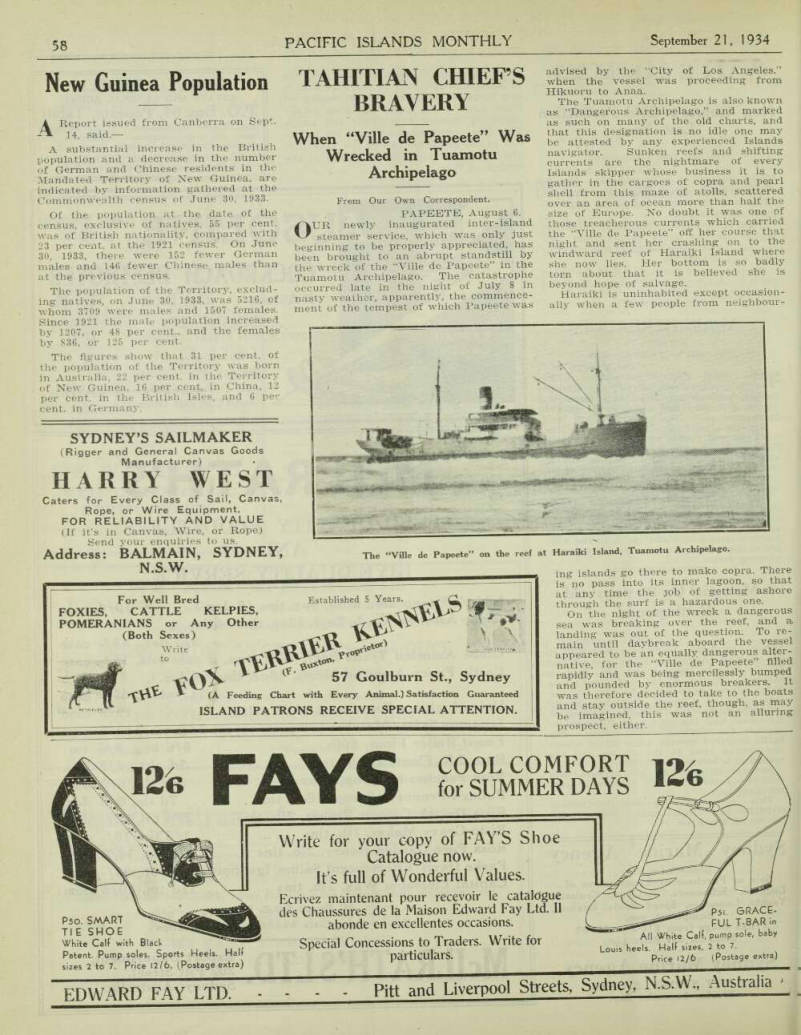
4 Report issued from Canberra on Sept. 14, said. — A substantial increase in the British population and a decrease in the number of German and Chinese residents in the Mandated Territory of New Guinea, are indicated by information gathered at the Commonwealth census of June 30, 1933.
Of the population at the date of the census, exclusive of natives, 55 per cent, was of British nationality, compared with 23 per cent, at the 1921 census. On June 30, 1933, there were 152 fewer German males and 146 fewer Chinese males than at the previous census.
The population of the Territory, exclud ing natives, on June 30, 1933, was 5216, of whom 3709 were males and 1507 females.
Since 1921 the male population increased by 1207, or 48 per cent., and the females by 836, or 125 per cent.
The figures show that 31 per cent, of the population of the Territory was born in Australia, 22 per cent, in the Territory of New Guinea, 16 per cent, in China, 12 per cent, in the British Isles, and 6 per cent, in Germany.
Tahitian Chief’S
Bravery
When “Ville de Papeete” Was Wrecked in Tuamotu Archipelago
From Our Own Correspondent.
PAPEETE, August 6.
OUR newly inaugurated inter-island steamer service, which was only just beginning to be properly appreciated, has been brought to an abrupt standstill by the wreck of the “Ville de Papeete” in the Tuamotu Archipelago. The catastrophe occurred late in the night of July 8 in nasty weather, apparently, the commence ment of the tempest of which Papeete was
advised by the “City of Los Angeles,” when the vessel was proceeding from Hikuoru to Anaa.
The Tuamotu Archipelago is also known as “Dangerous Archipelago,” and marked as such on many of the old charts, and that this designation is no idle one may be attested by any experienced Islands navigator. Sunken reefs and shifting currents are the nightmare of every Islands skipper whose business it is to gather in the cargoes of copra and pearl shell from this maze of atolls, scattered over an area of ocean more than half the size of Europe. No doubt it was one of those treacherous currents which carried the “Ville de Papeete” off her course that night and sent her crashing on to the windward reef of Haraiki Island where she now lies. Her bottom is so badly torn about that it is believed she is beyond hope of salvage, Haraiki is uninhabited except occasion ally when a few people from neighbour-
ing islands go there to make copra. There is no pass into its inner lagoon, so that at any time the job of getting ashore through the surf is a hazardous one.
On the night of the wreck a dangerous sea was breaking over the reef, and a landing was out of the question. To re main until daybreak aboard the vessel appeared to be an equally dangerous alter native, for the “Ville de Papeete” filled rapidly and was being mercilessly bumped and pounded by enormous breakers. It was therefore decided to take to the boats and stay outside the reef, though, as may be imagined, this was not an alluring prospect, either.
The “Ville de Papeete” on the reef at Haraiki Island, Tuamotu Archipelago.
The disembarkation of the vessel’s per sonnel and her dozen passengers was very capably and courageously managed by Capt. Vincent and Capt. L’Hotellier (super cargo for the Messageries Company).
With one exception, a mechanic, who sus tained some minor injuries, the whole party was successfully got into the boats and beyond the reach of immediate dan ger, though the situation was still any thing but an enviable one. For their fine behaviour throughout the disembarkment the following members of the ship’s per sonnel deserve special mention: Captain L’Hotellier, Captain Faivre (second cap tain), M. Snow (wireless operator), M.
Flosse (purser), M. Perreau (chief en gineer), and loria lori (mate).
The following dawn revealed an ugly and menacing reef which no ordinary man would dare to tackle; but, luckily for the people in the boats, one of the passengers was Nohorai Sue, the Chief of Hikueru, a fine type of native of the old school, who, like all Tuamotu natives, is as much at home in the sea as on land.
Nohorai Sue took a cord, and, watching his chance, was shot over the craggy reef of Haraiki on the crest of a comber. He swam the intervening distance to the shore and took a bight around the nearest coconut tree. After this it was a com paratively easy matter to haul a good sized cable ashore, by means of which the whole party eventually were landed. The conspicuous courage displayed by the brave Chief of Hikuaru has been officially recognised by the Government.
When the news of the wreck reached Papeete, the schooner Huahutu was des patched at once to the scene, and brought the whole party away, none the worse for their adventure.
The interruption of this much needed service owing to the wreck naturally has caused a good deal of local concern, for it is known that a considerable number of tourists were awaiting the return of the vessel in order feo make a tour of the Leeward Group and other places of in terest. Representations have been made on the subject to the Government by seve ral public bodies, including the Chamber of Agriculture, the Economic and Finan cial Delegation, and the Syndicate dTni tiative (Tourist Bureau). The Messageries Maritimes Company is at present actively engaged with the problem of finding a substitute vessel for the “Ville de Papeete” and it is hoped that a definite announce ment will be made shortly.
The “Ville de Papeete” is a steel screw coal burning steamer of 615 tons gross, and was built by the Ailsa Shipbuilding Company at Troon, Scotland, in 1928; she was classed 100 A.I. at Lloyds. At the time of the wreck she had on board about 115 tons of copra which were covered by insurance.
Advertisements & other items, pp. 60-62 (2 items)
Fays
SYDNEY’S SAILMAKER
(Rigger and General Canvas Goods Manufacturer)
HARRY WEST
Caters for Every Class of Sail, Canvas, Rope, or Wire Equipment.
FOR RELIABILITY AND VALUE
(If it’s in Canvas, Wire, or Rope) Send your enquiries to us.
Address: BALMAIN, SYDNEY,
N.S.W.
For Well Bred
FOXIES, CATTLE KELPIES,
POMERANIANS or Any Other (Both Sexes) Write Established 5 Years.
57 Goulburn St., Sydney
(A Feeding Chart with Every Animal.) Satisfaction Guaranteed
ISLAND PATRONS RECEIVE SPECIAL ATTENTION.
126
FAYS
COOL COMFORT 12/6
for SUMMER DAYS
P5O. SMART
TIE SHOE
White Calf with Black Patent. Pump soles. Sports Heels. Half sizes 2 to 7. Price 12/6. (Postage extra)
EDWARD FAY LTD.
Write for your copy of FAY’S Shoe
Catalogue now.
It’s full of Wonderful Values.
Ecrivez maintenant pour recevoir le catalogue des Chaussures de la Maison Edward Fay Ltd. Il abonde en excellentes occasions.
Special Concessions to Traders. Write for
particulars.
P51. GRACE-
FUL T-BARin
All White Calf, pump sole, baby Louis heels. Half sizes, 2 to 7.
Price 12/6 (Postage extra) Pitt and Liverpool Streets, Sydney, N.S.W., Australia
Kirby's
PENTA
Marine Engines 3-90 h.p.
Utility Outboards 3-4 h.p.
Supplied to all Governments Prices Reasonable.
Particulars
Nelson & Robertson
SYDNEY
SUGAR DIABETES
DIABETES-MELLITUS.
The proprietors of "DIABETIN” have published a booklet, outlining and explaining the most modern treatment of this disease. Diet Chart, scientific methods of urine testing simply explained, tables of food values, height and weight tables for men and women. It is invaluable to all sufferers from DIABETES.
This booklet will be enclosed with each bottle of “DIABETIN.”
“DIABETIN” is a safe and reliable scientific distillation, specially prepared for the treatment of Diabetes-Mellitus; and is strongly recommended for the speedy reduction of BLOOD SUGAR.
Bottles containing 96 doses, £1/1/- (a month’s supply). Post free.
VEGETABLE EXTRACTS
24 Bond St., Sydney, Australia Cable Address: COMPUTE, Sydney.
Write for a copy of
NOCK & KIRBYS
CATALOGUES
Kitchenware, Crock-
ery and Glassware, Builders’ Material or Ship Chandlery catalogues posted Free on request
NOCK &
KIRBY'S
Postal Address; Desk PM
Box 68CC, G.P.O., SYDNEY
A. W. DYE
and Company
ASSAYERS, ANALYSTS,
METALLURGISTS
Buyers of Gold, Silver, Platinum, etc.
T. & G. BUILDING,
ELIZABETH STREET,
SYDNEY, N.S.W.
Established 1914.
Bankers: Commercial Bank of Australia, Ltd.
ENGINEERING & MINERS’ SUPPLIES
Engineer 3 , Miner 3, Planters, etc. Get in touch with us for any of the following lines:—“Star” Brand Shovels—the best shovel made; Picks, Mattocks, Handles, Centrifugal Pumps, Petrol Engines, and Engines converted for Charcoal Gas. Belting and Pulleys, etc. Pipes and Valves; Truck Wheels and Trucks; Copra Flues and Screens: Oils for all purposes; Files and all Sundries. Write for Particulars and Prices.
A. B. SMITH & GLUYAS
61-65 Macarthur St., Ultimo, Sydney, N.S.W.
AT BLUE MOUNTAINS
SPRINGWOOD, N.S.W.
Springwood Ladies’ College
Est. 1897. Kindergarten to Leaving Certificate. Tennis, Riding, Swimming, Team Games. Unequalled climate. Pure Jersey Milk. Senior and Junior Houses. Open-air sleeping. Inclusive fees. Special vacation arrangements for Island pupils.
M. E. DURAND, Principal.
MINING MACHINERY
WE ARE MAKERS OF ALL CLASSES OF
MINING MACHINERY, STAMPER BATTERIES,
HUNTINGTON MILLS, Etc.
ALSO ALL CLASSES OF
BRICK-MAKING MACHINERY
GENERAL ENGINEERING AND FOUNDRY WORK
High-class SEMI-STEEL MACHINE MOULDED GEARING
UP TO 14 FT. DIA. x 24 IN. FACE
GEORGE FOSTER & SONS LTD.
Code: A.B.C. 5th Edition. ST. PETERS, N.S.W. Cable Address; Fosterion, Sydney.
CARMICHAEL BROS.
BOILERMAKERS, ENGINEERS,
AND WELDING CONTRACTORS
Portable Electric Welding Plants Sent Anywhere New and Used Boilers in Stock Mining and Marine Repairs a Speciality.
LOOKES AVENUE, BALMAIN EAST, SYDNEY
If you are a planter or trader in New Guinea we can do your buying or selling in a large or small way.
If you reside elsewhere and want something in New Guinea: write to us. If it is obtainable we’ll get it for you.
Our twenty-odd years’ experience in this Territory is the foundation of our business.
G. THOMAS & COMPANY, Rabaul
GENERAL AGENTS STOCK & SHARE BROKERS
Radios; “Gortom, Rabaul.” P.O. Box 9.
FOR PROPELLER SHAFTS
You’ve Heard of its STRENGTH ... Its PERFECT BALANCE ... Its RESISTANCE to CORROSION Have You Seen Pictures of World Famous Motor Boats Fitted with MONEL SHAFTS? If not we w.ll gladly send you a set.
WRIGHT & COMPANY, 81 Clarence St., Sydney, MONEL METAL is a Registered Trade Mark Cables: “CORNRIGHT.” SYDNEY
Messrs. Carpenter Report
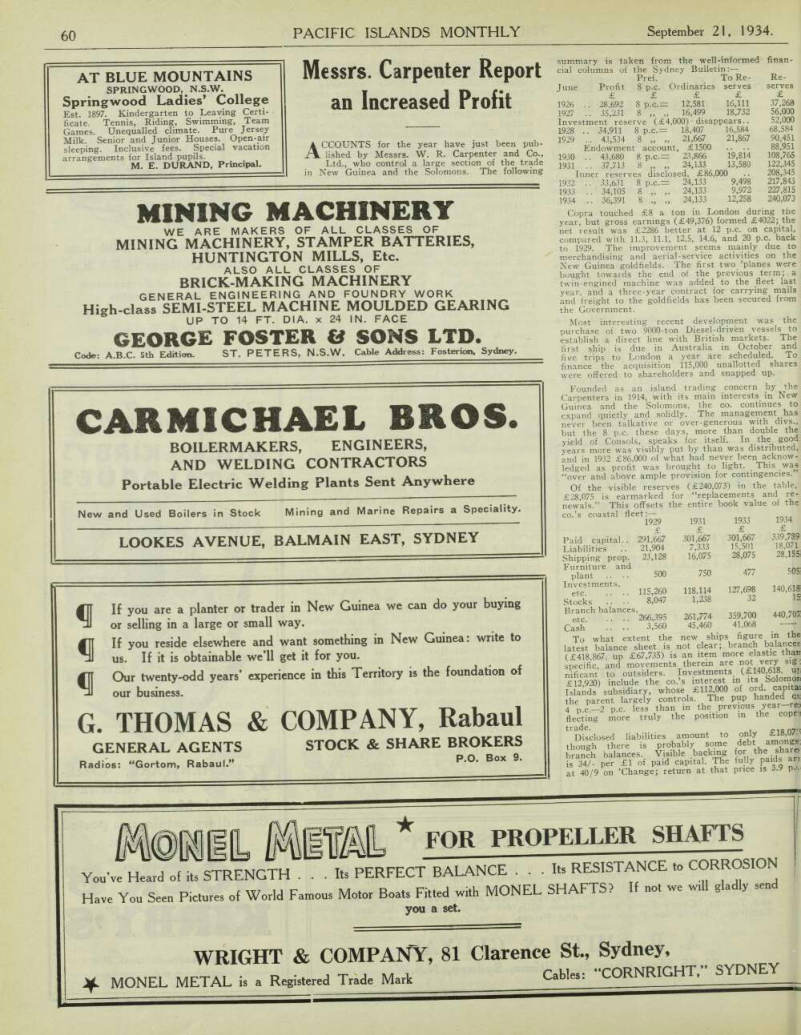
an Increased Profit
ACCOUNTS for the year have just been pub lished by Messrs. W. R. Carpenter and Co., Ltd., who control a large section of the trade in New Guinea and the Solomons. The following
summary is taken from the well-informed finan cial columns of the Sydney Bulletin: —
Copra touched £8 a ton in London during the year, but gross earnings (£49,376) formed £4022; the net result was £2286 better at 12 p.c. on capital, compared with 11.3, 11.1, 12.5, 14.6, and 20 p.c. back to 1929. The improvement seems mainly due to merchandising and aerial-service activities on the New Guinea goldfields. The first two ’planes were bought towards the end of the previous term; a twin-engined machine was added to the fleet last year, and a three-year contract for carrying mails and freight to the goldfields has been secured from the Government.
Most interesting recent development was the purchase of two 9000-ton Diesel-driven vessels to establish a direct line with British markets. The first ship is due in Australia in October and five trips to London a year are scheduled. To finance the acquisition 115,000 unallotted shares were offered to shareholders and snapped up.
Founded as an island trading concern by the Carpenters in 1914, with its main interests in New Guinea and the Solomons, the 00. continues to expand quietly and solidly. The management has never been talkative or over-generous with divs., but the 8 p.c. these days, more than double the yield of Consols, speaks for itself. In the good years more was visibly put by than was distributed, and in 1932 £ 86,000 of what had never been acknow ledged as profit was brought to light. This was “over and above ample provision for contingencies."
Of the visible reserves (£240,073) in the table, £28,075 is earmarked for “replacements and re newals.’’ This offsets the entire book value of the co.’s coastal fleet: —
To what extent the new ships figure in tho latest balance sheet is not clear; branch balances; (£418,867, up £67,735) is an item more elastic than specific, and movements therein are not very significant to outsiders. Investments. (£140,618, up £12,920) include the co. s interest in its Solomon Islands subsidiary, whose £112,000 of ord. capital the parent largely controls. The pup handed out 4 p.c.—2 p.c. less than in the previous year—refleeting more truly the position in the copra trade.
Disclosed liabilities amount to only £18,073 though there is probably some debt amongst branch balances. Visible backing for the shares is 34/- per £1 of paid capital. The fully paids an at 40/9 on ’Change; return at that price is 3.9 p.a.
Pref.
To Re- Re- June Profit 8 p.c. Ordinaries serves serves £ £ £ £ £ 1926 28,692 8 p.c.— 12,581 16,111 37,268 1927 35,231 8 „ „ 16,499 18,732 56,000 Investment reserve (£4,000) disappears.. 52,000 1928 34,911 8 p.c.— 18,407 16,584 68,584 1929 43,534 8 „ „ 21,667 21,867 90,451 Endowment account, £1500 88,951 1930 43,680 8 p.c.= 23,866 19,814 108,765 1931 37,713 8 „ 24,133 13,580 122,345 Inner reserves disclosed, £86,000 208,345 1932 33,631 8 p.c.— 24,133 9,498 217,843 1933 34,105 8 „ ,, 24,133 9,972 227,815 1934 36,391 8 „ „ 24,133 12,258 240,073
co.'s coastal fleet:— 1929 1931 1933 1934 £ £ £ £ Paid capital.. 291,667 301,667 301,667 339,789 1 Liabilities 21,904 7,333 15,501 18,071 Shipping prop. 23,128 16,075 28,075 28,1551 Furniture and plant .. 500 750 477 505: Investments, etc. 115,260 118,114 127,698 140,6185 Stocks 8,047 1,238 32 15 Branch balances etc. ’266.395 261,774 359,700 440,707 Cash 3,560 45,460 41,068
Market Quotations
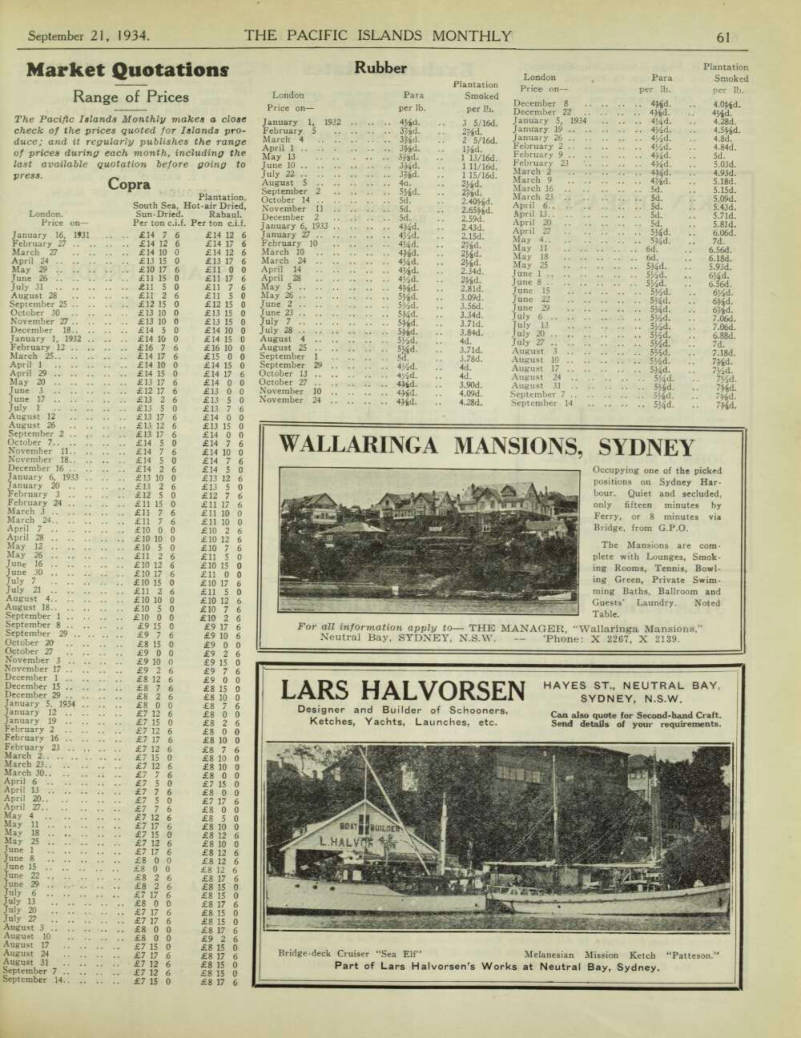
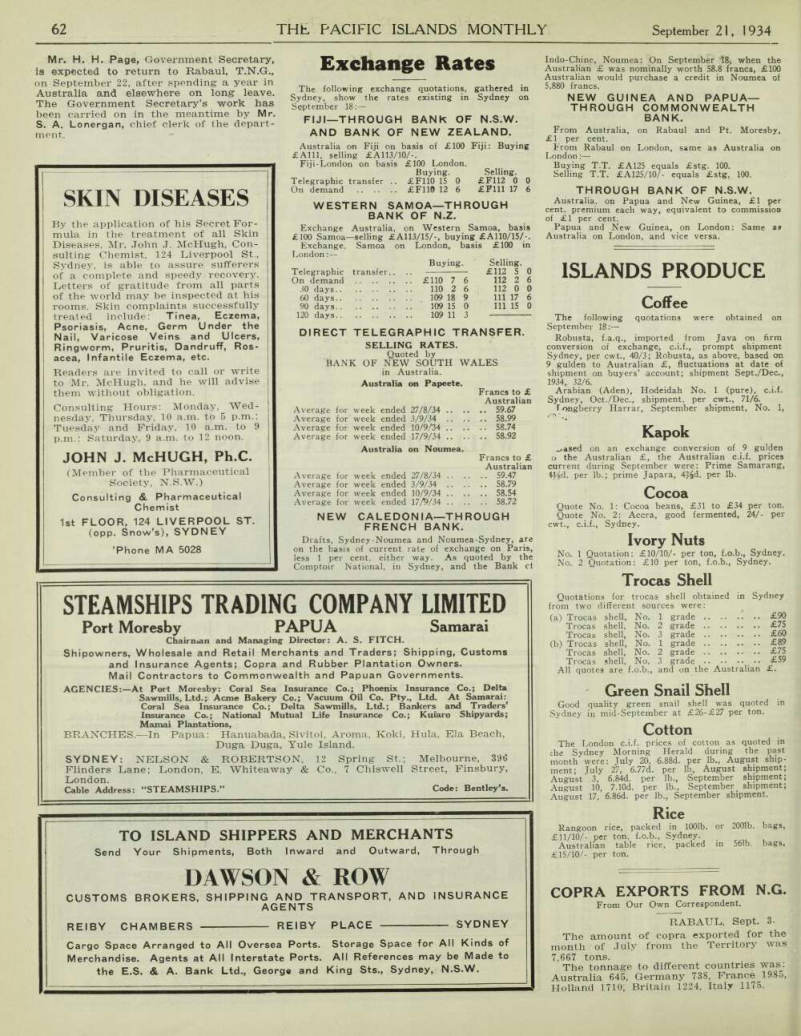
Range of Prices
The Pacific Islands Monthly makes a close check of the prices quoted for Islands pro duce; and it regularly publishes the range of prices during each month, including the last available quotation before going to
press.
London
Rubber
Para Plantation Smoked Price on — per lb. per lb.
January 1, 1932 4Hd. 3 S/16d.
February 5 3^d. 2^d.
March 4 3^d. 2 5/16d.
April 1 3$*d. md.
May 13 3&d. 1 13/16d.
June 10 3^d. 1 ll/16d.
July 22 3Jid. 1 15/16d.
August 5 4a. 2/gd.
September 2 5j*d. 2^d.
October 14 5d. 2.40^d.
November 11 5d. 2.65f$d.
December 2 5d. 2.59d.
January 6, 1933 4J4d. 2.43d.
January 27 4'/ 2 d. 2.15d.
February 10 4J4d. 2^d.
March 10 4J$d. 2y a d.
March 24 4J4d. 2% d.
April 14 4^d. 2J4d.
April 28 4^d. 2**d.
May 5 4^d. 2.81d.
May 26 5j*d. 3.09d.
June 2 5j/ a d. 3.56d.
June 23 3.34d.
July 7 5Hd. 3.7ld.
July 28 3.84d.
August 4 S/ 3 d. 4d.
August 25 3.71d.
September 1 5d 3.78d.
September 29 4d.
October 13 4d.
October 27 3.90d.
November 10 4.09d.
November 24 4Jid. 4.28d.
London Para Plantation Smoked Price on— per lb. per lb.
December 8 .. .. 4^d. 4.0**d.
December 22 .. .. 4J*d. 4Jid.
January 5, 1934 .. .. 4-Ad. 4.28d.
January 19 .. .. 4-/ 3 d. 4.5^d.
January 26 .. .. 4-Ad. 4.8d.
February 2 .. .. 4-Ad. 4.84d.
February 9 .. .. 4Hd. 5d.
February 23 .. .. 4Ad. 5.03d.
March 2 .. .. 4Ad. 4.93d.
March 9 .. .. 4^d. 5.18d.
March 16 .. .. Sd. 5.15d.
March 23 5.09d.
April 6 .. .. 5d. 5.43d.
April 13 5.71d.
April 20 .. .. 5d. 5.81d.
April 27 .. .. 5-Ad. 6.06d.
May 4 .. .. sy 4 d. 7d.
May 11 .. .. 6d. 6.56d.
May 18 6.18d.
May 25 .. .. sy 4 d. 5.93d.
June 1 .. .. 5-Ad. 6-Ad.
June 8 .. .. 5-Ad. 6.56d.
June 15 .. .. 5-Ad. 6-Ad.
June 22 .. .. 5y 4 d. 6Hd.
June 29 .. .. 5V 4 d. 6Ad.
July 6 .. .. 5-Ad. 7.06d.
July 13 .. .. 5-Ad. 7.06d.
July 20 6.88d.
July 27 .. .. 5-Ad. 7d.
August 3 .. .. 5-Ad. 7.18d.
August 10 .. .. 5-Ad. 7Ad.
August 17 .. .. 5Hd. 7-Ad.
August 24 .. .. 5-Ad. 7-Ad.
August 31 .. 5-Ad. 7Hd.
September 7 .. 5-Ad. 7H& September 14 7Hd.
Copra
South Sea, Plantation, Hot-air Dried, London.
Sun-Dried.
Rabaul.
Price on — Per ton c.i.f. Per ton c.i.f.
January 16, 1931 .. .. £14 7 6 £14 12 6 February 27 .. .. £14 12 6 £14 17 6 March 27 .. .. £14 10 0 £14 12 6
April 24
.. .. £13 15 0 £13 17 6 May 29 .. .. £10 17 6 £11 0 0 June 26 .. .. £11 15 0 £11 17 6 July 31 .. .. £11 5 0 £11 7 6 August 28 .. .. £11 2 6 £11 5 0 September 25 .. .. £12 15 0 £12 15 0 October 30 .. .. £13 10 0 £13 IS 0 November 27 .. .. £13 10 0 £13 15 0 December 18 .. .. £14 5 0 £14 10 0 January 1, 1932 .. .. £14 10 0 £14 15 0 February 12 .. .. £16 7 6 £16 10 0 March 25 .. .. £14 17 6 £15 0 0 April 1 .. .. £14 10 0 £14 15 0 April 29 .. .. £14 15 0 £14 17 6 May 20 .. .. £13 17 6 £14 0 0 June 3 .. .. £12 17 6 £13 0 0 June 17 .. .. £13 2 6 £13 5 0 July 1 .. .. £13 5 0 £13 7 6 August 12 .. .. £13 17 6 £14 0 0 August 26 .. .. £13 12 6 £13 15 0 September 2 .. .. £13 17 6 £14 0 0 October 7 £14 7 6 November 11 .. .. £14 7 6 £14 10 0 November 18 £14 7 6 December 16 .. .. £14 2 6 £14 5 0 January 6, 1933 .. .. £13 10 0 £13 12 6 January 20 £13 5 0 February 3 .. .. £12 5 0 £12 7 6
February 24
.. .. £11 15 0 £11 17 6 March 3 £11 10 0 March 24 £11 10 0 April 7 £10 2 6 April 28 .. .. £10 10 0 £10 12 6 May 12 £10 7 6 May 26 £11 5 0 June 16 £10 IS 0 June 30 £11 0 0
July 7
£10 17 6 July 21 £11 5 0 August 4 £10 12 6 August 18 £10 7 6 September 1 .. .. £10 0 0 £10 2 6 September 8 £9 17 6 September 29 .. .. £9 7 6 £9 10 6 October 20 .. .. £8 15 0 £9 0 0 October 27 £9 2 6 November 3 £9 IS 0 November 17 £9 7 6 December 1 £9 0 0 December 15 .. .. £8 7 6 £8 IS 0 December 29 £8 10 0 January 5, 1934 .. .. £8 0 0 £8 7 6
January 12
£8 0 0
January 19
.. .. £7 15 0 £8 2 6
February 2
£8 0 0 February 16 .. .. £7 17 6 £8 10 0
February 23
£8 7 6 March 2 £8 10 0 March 23 £8 10 0 March 30 £8 0 0 April 6 £7 15 0 April 13 £8 0 0
April 20
£7 17 6 April 27 £8 0 0 May 4 £8 5 0
May 11
£8 10 0 May 18 £8 12 6
May 25
£8 10 0 June 1 . .. £7 17 6 £8 12 6
June 8
£8 12 6 June 15 £8 12 6 June 22 £8 17 6 June 29 £8 IS 0
July 6
£8 IS 0
July 13
£8 17 6
July 20
.. .. £7 17 6 £8 15 0
July 27
£8 15 0
August 3
.. .. £8 0 0 £8 17 6 August 10 £9 2 6 August 17 £8 15 0
August 24
£7 17 .6 £8 17 6
August 31
£8 15 0
September 7
£8 15 0
September 14
£8 17 6
Mr. H. H. Page, Government Secretary, is expected to return to Rabaul, T.N.G., on September 22, after spending a year in Australia and elsewhere on long leave.
The Government Secretary’s work has been carried on in the meantime by Mr.
S. A. Lonergan, chief clerk of the depart ment.
Advertisements & other items, pp. 63-64 (1 item)
Lars Halvorsen
WALLARINGA MANSIONS, SYDNEY
Occupying one of the picked positions on Sydney Harbour. Quiet and secluded, only fifteen minutes by Ferry, or 8 minutes via Bridge, from G.P.O.
The Mansions are complete with Lounges, Smoking Rooms, Tennis, Bowling Green, Private Swimming Baths, Ballroom and Guests’ Laundry. Noted Table.
For all information apply to— THE MANAGER, “Wallaringa Mansions,”
Neutral Bay, SYDNEY, N.S.W. ’Phone: X 2267, X 2139.
LARS HALVORSEN
Designer and Builder of Schooners, Ketches, Yachts, Launches, etc.
HAYES ST., NEUTRAL BAY,
SYDNEY, N.S.W.
Can also quote for Second-hand Craft.
Send details of your requirements.
Bridge-deck Cruiser “Sea Elf” Melanesian Mission Ketch “Patteson.”
Part of Lars Halvorsen’s Works at Neutral Bay, Sydney.
SKIN DISEASES
By the application of his Secret Formula in the treatment of all Skin Diseases, Mr. John J. McHugh, Consulting Chemist, 124 Liverpool St., Sydney, is able to assure sufferers of a complete and speedy recovery.
Letters of gratitude from all parts of the world may be inspected at his rooms. Skin complaints successfully treated include; Tinea, Eczema, Psoriasis, Acne, Germ Under the Nail, Varicose Veins and Ulcers, Ringworm, Pruritis, Dandruff, Rosacea, Infantile Eczema, etc.
Readers are invited to call or write to Mr. McHugh, and he will advise them without obligation.
Consulting Hours: Monday, Wednesday, Thursday, 10 a.m. to 5 p.m.; Tuesday and Friday, 10 a.m. to 9 p.m.: Saturday, 9 a.m. to 12 noon.
JOHN J. McHUGH, Ph.C.
(Member of the Pharmaceutical Society, N.S.W.) Consulting & Pharmaceutical Chemist
Ist FLOOR, 124 LIVERPOOL ST.
(opp. Snow’s), SYDNEY ’Phone MA 5028
STEAMSHIPS TRADING COMPANY LIMITED
Port Moresby PAPUA Samarai
Chairnian and Managing Director: A. S. FITCH.
Shipowners, Wholesale and Retail Merchants and Traders; Shipping, Customs and Insurance Agents; Copra and Rubber Plantation Owners.
Mail Contractors to Commonwealth and Papuan Governments.
AGENCIES:—At Port Moresby: Coral Sea Insurance Co.; Phoenix Insurance Co.; Delta Sawmills, Ltd.; Acme Bakery Co.; Vacuum Oil Co. Pty., Ltd. At Samarai: Coral Sea Insurance Co.; Delta Sawmills, Ltd.; Bankers and Traders' Insurance Co.; National Mutual Life Insurance Co.; Kuiaro Shipyards; Mamai Plantations, BRANCHES.—In Papua: Hanuabada, Sivitoi, Aroma, Koki, Hula, Ela Beach, Duga Duga, Yule Island.
SYDNEY: NELSON & ROBERTSON, 12 Spring St.; Melbourne, 396 Flinders Lane; London, E. Whiteaway & Co., 7 Chiswell Street, Finsbury, London, Cable Address: “STEAMSHIPS.” Code: Bentley’s.
TO ISLAND SHIPPERS AND MERCHANTS
Send Your Shipments, Both Inward and Outward, Through
DAWSON & ROW
CUSTOMS BROKERS, SHIPPING AND TRANSPORT, AND INSURANCE
AGENTS
REIBY CHAMBERS REIBY PLACE SYDNEY
Cargo Space Arranged to All Oversea Ports. Storage Space for All Kinds of Merchandise. Agents at All Interstate Ports. All References may be Made to the E.S. & A. Bank Ltd., George and King Sts., Sydney, N.S.W.
Exchange Rates
The following exchange quotations, gathered in Sydney, show the rates existing in Sydney on September 18:
Fiji—Through Bank Of N.S.W.
And Bank Of New Zealand.
Australia on Fiji on basis of £100 Fiji: Buying £A111, selling £A113/10/-.
Fiji-London on basis £100 London.
Western Samoa—Through
Bank Of N.Z.
Exchange Australia, on Western Samoa, basis £100 Samoa—selling £A113/15/-, buying £A110/15/-.
Exchange, Samoa on London, basis £100 in London :
Direct Telegraphic Transfer.
Selling Rates.
Quoted by
Bank Of New South Wales
in Australia.
New Caledonia—Through
French Bank.
Drafts, Sydney-Noumea and Noumea-Sydney, are on the basis of current rate of exchange on Paris, less 1 per cent, either way. As quoted by the Comptoir National, in Sydney, and the Bank ct
Indo-Chine, Noumea; On September 18, when the Australian £ was nominally worth 58.8 francs, £100 Australian would purchase a credit in Noumea of 5,880 francs.
New Guinea And Papua
Through Commonwealth
Bank.
From Australia, on Rabaul and Pt. Moresby, £1 per cent.
From Rabaul on London, same as Australia on London:— Buying T.T. £A125 equals £stg. 100.
Selling T.T. £A125/10/- equals £stg, 100.
Through Bank Of N.S.W.
Australia, on Papua and New Guinea, £1 per cent, premium each way, equivalent to commission of £1 per cent.
Papua and New Guinea, on London: Same a» Australia on London, and vice versa.
Buying. Selling.
Telegraphic transfer .. £F110 15 0 £F112 0 0 On demand £F110 12 6 £F111 17 6
Buying. Selling.
Telegraphic transfer.. .. £112 5 0 On demand £110 7 6 112 2 6 30 days 110 2 6 112 0 0 60 days 109 18 9 111 17 6 90 days 109 15 0 111 IS 0 120 days 109 11 3
Australia on Papeete.
Average for week ended 27/8/34 .. .. 59.67 Francs to £ Australian Average for week ended 3/9/34 .. .. .. 58.99 Average for week ended 10/9/34 .. .. 58.74 Average for week ended 17/9/34 .. .. 58.92 Australia on Noumea.
Average for week ended 27/8/34 .. .. 59.47 Francs to £ Australian Average for week ended 3/9/34 .. .. 58.79 Average for week ended 10/9/34 .. 58.54 Average for week ended 17/9/34 .. .. 58.72
Islands Produce
Coffee
The following quotations were obtained on September 18: — Robusta, f.a.q., imported from Java on firm conversion of exchange, c.i.f., prompt shipment Sydney, per cwt., 40/3; Robusta, as above, based on 9 gulden to Australian £, fluctuations at date of shipment on buyers’ account; shipment Sept./Dec., 1934, 32/6.
Arabian (Aden), Hodeidah No. 1 (pure), c.i.f.
Sydney, Oot./Dec., shipment, per cwt., 71/6.
Longberry Harrar, September shipment, No. 1, ■ ,
Kapok
Based on an exchange conversion of 9 gulden to the Australian £, the Australian c.i.f. prices current during September were: Prime Samarang, 4f6d, per lb.; prime Japara, 4 7/8d. per lb.
Cocoa
Quote No. 1: Cocoa beans, £31 to £34 per ton.
Quote No. 2: Accra, good fermented, 24/- per cwt., c.i.f., Sydney.
Ivory Nuts
No. 1 Quotation: £10/10/- per ton, f.o.b., Sydney.
No. 2 Quotation; £10 per ton, f.o.b., Sydney.
Trocas Shell
Quotations for trocas shell obtained in Sydney from two different sources were:
Green Snail Shell
Good quality green snail shell was quoted in Sydney in mid-September at £26-£27 per ton.
Cotton
The London c.i.f. prices of cotton as quoted in che Sydney Morning Herald during the past month were: July 20, 6.88 d. per lb., August ship ment; July 27, 6.77 d. per lb, August shipment; August 3,6.84 d. per lb., September shipment; August 10, 7.10 d. per lb., September shipment; August 17, 6.86 d. per lb., September shipment.
Rice
Rangoon rice, packed in 100lb. or 200lb. bags, £11/10/- per ton, f.o.b., Sydney. .
Australian table rice, packed in 56lb. bags, £15/10/- per ton.
(a) Trocas shell, No. 1 grade £90 Trocas shell, No. 2 grade £75 Trocas shell, No. 3 grade £60 (b) Trocas shell, No. 1 grade £89 Trocas shell, No. 2 grade £75 Trocas shell, No. 3 grade £59 All quotes are f.o.b., and on the Australian £.
Copra Exports From N.G.
From Our Own Correspondent.
Rabaul, Sept. 3-
The amount of copra exported for the month of July from the Territory was 7,667 tons.
The tonnage to different countries was: Australia 645, Germany 738, France 1985, Holland 1710, Britain 1224, Italy 1175.
Shipping Services in the Pacific
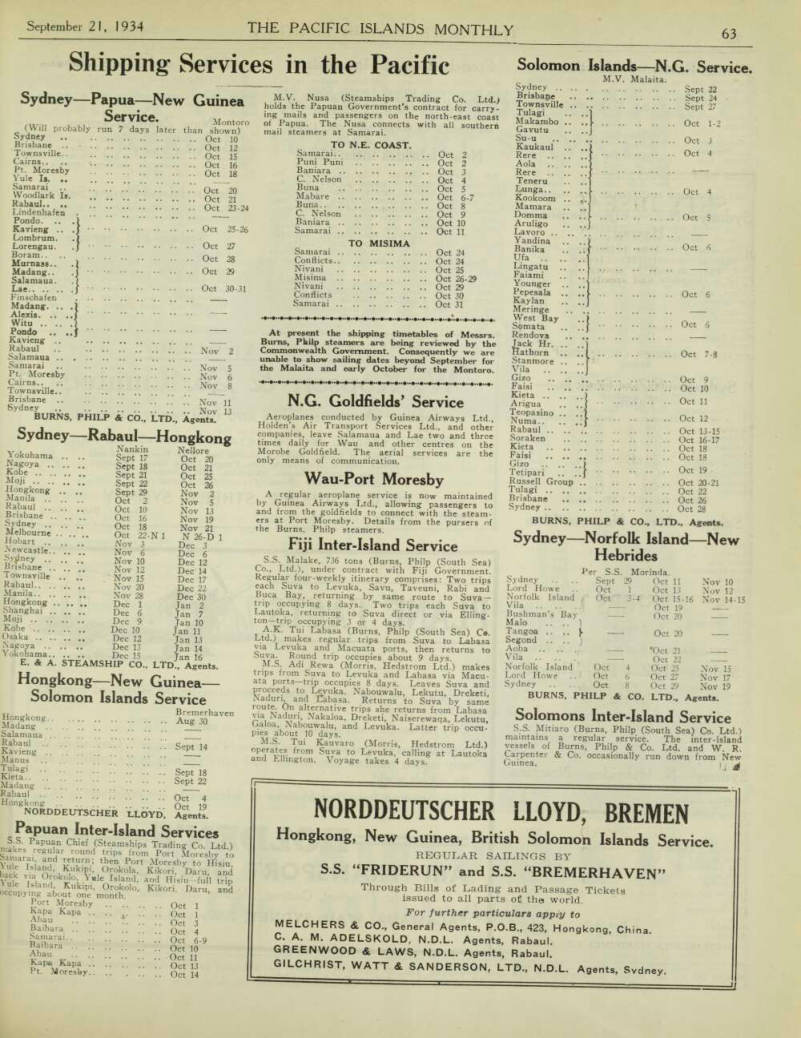
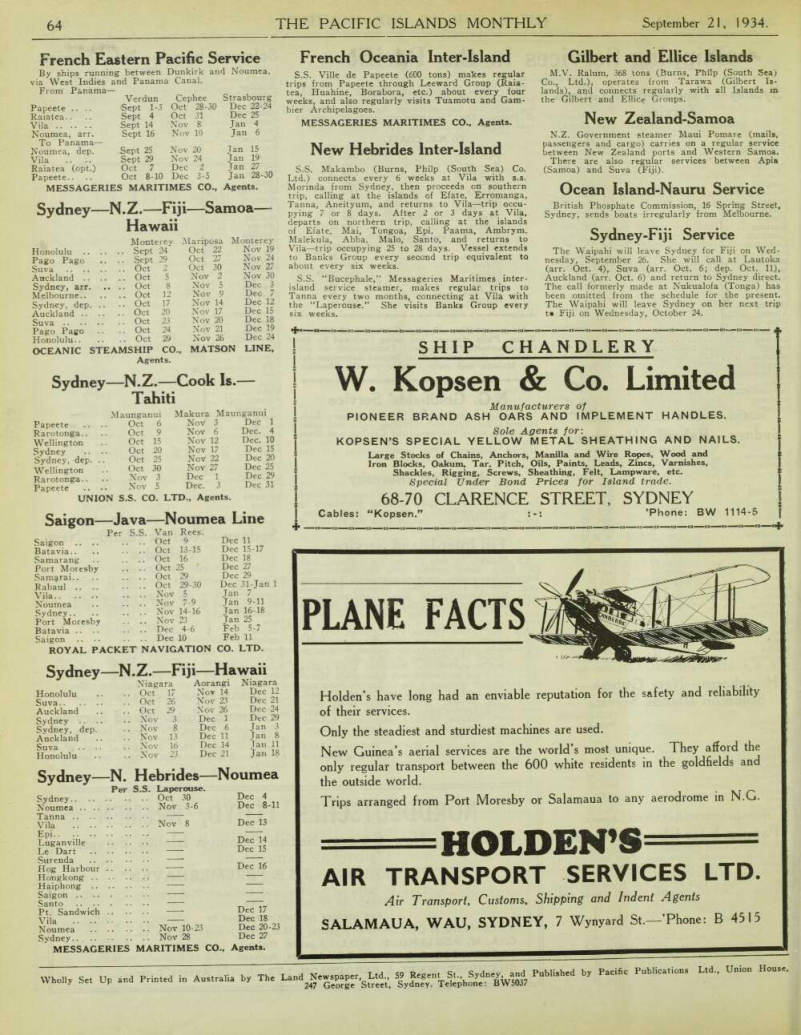
Sydney—Papua—New Guinea Service.
Montoro (Will probably run 7 days later than shown)
Sydney—Rabaul— Hongkong
Hongkong—New Guinea— Solomon Islands Service
Papuan Inter-Island Services
S.S. Papuan Chief (Steamships Trading Co. Ltd ) makes regular round trips from Port Moresby to Samarai, and return; then Port Moresby to Hisiu, Yule Island, Kukipi, Orokola, Kikori, Daru and back via Orokolo, Yule Island, and Hisiu—full trip Yule Island, Kukipi, Orokolo, Kikori, Daru, and occupying about one month.
Port Moresby Oct 1 Kapa Kapa .. .. Oct 1 Abau Oct 3 Baibara Oct 4 Samarai Oct 6-9 Baibara Oct 10 Abau „ Oct 11 Kapa Kapa Oct 13 Pt. Moresby Oct 14
M.V. Nusa (Steamships Trading Co. Ltd.) holds the Papuan Government’s contract for carry ing mails and passengers on the north-east coast of Papua. The Nusa connects with all southern mail steamers at Samarai.
At present the shipping timetables of Messrs.
Bums, Philp steamers are being reviewed by the Commonwealth Government. Consequently we are unable to show sailing dates beyond September for the Malaita and early October for the Montoro.
N.G. Goldfields’ Service
Aeroplanes conducted by Guinea Airways Ltd., Holden’s Air Transport Services Ltd., and other companies, leave Salamaua and Lae two and three times daily for Wau and other centres on the Morobe Goldfield. The aerial services are the only means of communication.
Wau-Port Moresby
A regular aeroplane service is now maintained by Guinea Airways Ltd., allowing passengers to and from the goldfields to connect with the steam ers at Port Moresby. Details from the pursers of the Burns, Philp steamers.
Fiji Inter-Island Service
S.S. Malake, 736 tons (Burns, Philp (South Sea) Co., Ltd.), under contract with Fiji Government.
Regular four-weekly itinerary comprises: Two trips each Suva to Levuka, Savu, Taveuni, Rabi and Buca Bay, returning by same route to Suva— trip occupying 8 days. Two trips each Suva to Lautoka, returning to Suva direct or via Elling ton—trip occupying 3 or 4 days.
A-K. Tui Labasa (Burns, Philp (South Sea) Ce.
Ltd.) makes regular trips from Suva to Labasa via Levuka and Macuata ports, then returns to Suva. Round trip occupies about 9 days.
M.S. Adi Rewa (Morris, Hedstrom Ltd.) makes trips from Suva to Levuka and Labasa via Macu ata ports—trip occupies 8 days. Leaves Suva and proceeds to Levuka, Nabouwalu, Lekutu, Drekcti, Nadun and Labasa. Returns to Suva by same route. On alternative trips she returns from Labasa via Nadun, Nakaloa, Dreketi, Naiserewaqa, Lekutu, Galoa, Nabouwalu, and Levuka. Latter trip occu pies about 10 days.
M.S. Tui Kauvaro (Morris, Hedstrom Ltd.) operates from Suva to Levuka, calling at Lautoka and Ellington. Voyage takes 4 days.
Solomon Islands—N.G. Service,
Sydney—Norfolk Island—New Hebrides
Solomons Inter-Island Service
S.S. Mitiaro (Burns, Philp (South Sea) Co. Ltd.) maintains a regular service. The inter-island vessels of Burns, Philp & Co. Ltd. and W. R.
Carpenter & Co. occasionally run down from New Guinea.
To N.E. Coast.
Samarai .. Oct 2 Puni Puni Baniara C. Nelson Buna .. Oct 5 Mabare .. Oct 6-7 Buna .. Oct 8 C. Nelson .. Oct 9 Baniara .. Oct 10 Samarai . Oct 11
To Misima
Samarai . Oct 24 Conflicts . Oct 24 Nivani . Oct 25 Misima . Oct 26-29 Nivani . Oct 29 Conflicts . Oct 30 Samarai . Oct 31
Sydney Brisbane ..
Townsville . .
Tulagi .. ..
Makambo .. ..
Gavutu .. ..
Su-u Kaukaul .. ..
Here Aola M.V. Malaita.
Rere Teneru .. ..
Lunga Kookoom ..
Mamara .. ..
Domma . . ..
Aruligo .. ..
Lavoro Yandina .. ..
Oct 6 Banika Ufa Lingatu Faiami Younger ..
Repesala .. ..
Kaylan ,. ..
Merinee West Bay Somata ..
Oct 6 Rendova ..
Jack Hr.
Hathorn ..
Stanmore .. ..
Vila Gizo .. ..
Faisi Kieta Arigua .. ..
Teopasino ..
Numa Oct 12 Rabaul Soraken .. . .
Kieta Faisi Gizo Tetipari .. ..
Oct 19 Russell Group ..
Oct 20-21 Tulagi Brisbane .. ..
Sydney
Burns, Philp & Co., Ltd., Agents.
Sydney Per S.S. Morinda.
Sept 29 Oct 11 Nov 10 Lord Howe Oct 1 Oct 13 Nov 12 Norfolk Island Oct 3-4 Oct 15- 16 Nov 14-15 Vila Oct 19 Bushman’s Bay Oct 20 Malo .. ..
Tangoa .. ..
Oct 20 Segond ..
Aoba Oct 21 Vila Oct 22 Norfolk Island Oct 4 Oct 25 Nov 15 Lord Howe Oct 6 Oct 27 Nov 17 Sydney Oct 8 Oct 29 Nov 19
Burns, Philp & Co. Ltd., Agents.
Sydney 10 Brisbane .. Oct 19 Townsville.. Oct IS Oct 16
a.’S-ir °««
Samarai .. Oct 90
k 19 • •• o?t 1?
SlSShifa . °« 2324
Pondo. .. .
Lombrum. .
Lorengau. . Oct 27 Boram. . ., Oct 28 Murnass.. . Oct 28 Salamaua. .
Finschafen Madang. .. .
Alexis.
Witu Pondo ..
Kavieng ..
Rabaul Nov 2 Salamaua Samarai Nov 5 Pt. Moresby Nov 6 Cairns. . Nov 8 Townsville..
Brisbane Nov 11 Sydney Nov 13
Burns, Philp & Co., Ltd., Agents.
Yokohama Nagoya Kobe .. ..
Nankin Sept 17 Nellore Oct 20 Oct 21 Oct 25 Oct 26 Nov 2 Nov 5 Moji .. ..
Hongkong Manila ..
Rabaul ..
Sept 29 Brisbane ..
Sydney ..
Melbourne .
Hobart ..
Oct 18 Nov 21 Newcastle. .
Sydney ..
Brisbane ..
Nov 10 Dec 6 Dec 12 Dec 14 Townsville Rabaul.. ..
Manila.. ..
Nov 15 Dec 14 Dec 17 Dec 22 Hongkong Shanghai Moji Kobe Osaka Dec 30 Jan 2 Jan 7 Jan 10 Jan 11 To 11 Nagoya Jan 13 Jan 14 Yokohama..
E. & A. STEAMSHIP CO., LTD., Agents.
Jan 14 Jan 16
Hongkong Bremerhaven Madang Salamaua Rabaul Kavieng Sept 14 Manus Tulagi 19 Kieta pt g Madang Sept 22
Rabaul .. Oct 4
Hongkong rw 10
Norddeutscher Lloyd. Agents.
French Eastern Pacific Service
Sydney—N.Z.—Fiji—Samoa — Hawaii
Sydney—N.Z.—Cook Is. — Tahiti
Saigon—Java—Noumea Line
Sydney—N.Z.—Fiji—Hawaii
Sydney—N. Hebrides —Noumea
French Oceania Inter-Island
S.S. Ville de Papeete (600 tons) makes regular trips from Papeete through Leeward Group (Raia tea, Huahine, Borabora, etc.) about every four weeks, and also regularly visits Tuamotu and Gam bier Archipelagoes.
Messageries Maritimes Co., Agents.
New Hebrides Inter-Island
S.S. Makambo (Burns, Philp (South Sea) Co.
Ltd.) connects every 6 weeks at Vila with s.s.
Morinda from Sydney, then proceeds on southern trip, calling at the islands of Efate, Erromanga, Tanna, Aneityum, and returns to Vila —trip occu pying 7 or 8 days. After 2 or 3 days at Vila, departs on northern trip, calling at the islands of Efate, Mai, Tongoa, Epi, Paama, Ambrym.
Malekula, Abba, Malo, Santo, and returns to Vila —trip occupying 25 to 28 days. Vessel extends to Banks Group every second trip equivalent to about every six weeks.
S.S. “Bucephale,” Messageries Maritimes interisland service steamer, makes regular trips to Tanna every two months, connecting at Vila with the “Laperouse.” She visits Banks Group every six weeks.
Gilbert and Ellice Islands
M. Ralum, 368 tons (Burns, Philp (South Sea) Co., Ltd.), operates from Tarawa (Gilbert Is lands), and connects regularly with all Islands in the Gilbert and Ellice Groups.
New Zealand-Samoa
N. Government steamer Maui Pomare (mails, passengers and cargo) carries on a regular service between New Zealand ports and Western Samoa.
There are also regular services between Apia (Samoa) and Suva (Fiji).
Ocean Island-Nauru Service
British Phosphate Commission, 16 Spring Street, Sydney, sends boats irregularly from Melbourne.
Sydney-Fiji Service
The Waipahi will leave Sydney for Fiji on Wed nesday, September 26. She will call at Lautoka (arr, Oct. 4), Suva (arr. Oct. 6; dep. Oct. 11), Auckland (arr. Oct. 6) and return to Sydney direct.
The call formerly made at Nukualofa (Tonga) has been omitted from the schedule for the present.
The Waipahi will leave Sydney on her next trip to Fiji on Wednesday, October 24.
By ships running between Dunkirk and Noumea, via West Indies and Panama Canal.
From Panama — Verdun Cephee Strasbourg Papeete 'Sept 1-3 Oct 28-30 Dec 22-24 Raiatea Sept 4 Oct 31 Dec 25 Vila Sept 14 Nov 8 Jan 4 Noumea, arr.
To Panama — Sept 16 Nov 10 Jan 6 Noumea, dep.
Sept 25 Nov 20 Jan 15 Vila Sept 29 Nov 24 Jan 19 Raiatea (opt.) Oct 7 Dec 2 Jan 27 Papeete Oct 8-10 Dec 3-5 Jan 28-30
Messageries Maritimes Co., Agents.
Monterey Mariposa Monterey Honolulu 24 Oct 22 Nov 19 Pago Pago .. .. Sept 29 Oct 27 Nov 24 Suva 2 Oct 30 Nov 27 Auckland 5 Nov 2 Nov 30 Sydney, arr .. .. Oct 8 Nov 5 Dec 3 Melbourne.. 12 Nov 9 Dec 7 Sydney, dep Oct 17 Nov 14 Dec 12 Auckland .. Oct 20 Nov 17 Dec 15 Suva 23 Nov 20 Dec 18 Pago Pago .. Oct 24 Nov 21 Dec 19 Honolulu.. .. Oct 29 Nov 26 Dec 24
Oceanic Steamship Co. , Matson Line,
Agents.
Maunganui Makura Maunganui Papeete .. Oct 6 Nov 3 Dec 1 Rarotonga..
Oct 9 Nov 6 Dec. 4 Wellington Oct 15 Nov 12 Dec. 10 Sydney Oct 20 Nov 17 Dec IS Sydney, dep.
Oct 25 Nov 22 Dec 20 Wellington Rarotonga..
Oct 30 Nov 3 Nov 27 Dec 1 Dec 25 Dec 29 Papeete Nov 5 Dec. 3 Dec 31
Union S.S. Co. Ltd., Agents.
Per S. S. Van Rees.
Saigon .. Oct 9 Dec 11 Batavia.. .. Oct 13-15 Dec 15-17 Samarang .. Oct 16 Dec 18 Port Moresby .. Oct 25 Dec 27 Samurai.. .. Oct 29 Dec 29 Rabaul .. .. Oct 29-30 Dec 31-Jan 1 Vila .. Nov 5 Jan 7 Noumea .. Nov 7-9 Jan 9-11 Sydney.. .. Nov 14-16 Jan 16-18 Port Moresby 23 Jan 25 Batavia .. Dec 4-6 Feb 5-7 Saigon .. .. Dec 10 Feb 11
Royal Packet Navigation Co. Ltd.
Niagara Aorangi Niagara Honolulu .. ..Oct 17 Not 14 Dec 12 Suva Oct 26 Nov 23 Dec 21 Auckland .. .. Oct 29 Nov 26 Dec 24 Sydney Nov 3 Dec 1 Dec 29 Sydney, dep. .. Nov 8 Dec 6 Jan 3 Auckland .. .. Nov 13 Dec 11 Jan 8 Suva Nov 16 Dec 14 Tan 11 Honolulu .. .. Nov 23 Dec 21 Jan 18
Per S.S. Laperouse.
Sydney Oct 30 Dec 4 Noumea Nov 3-6 Dec 8-11 Tanna — — Vila Nov 8 Dec 13 Epi
Luganville
— Dec 14 Le Dart — Dec 15 Surenda — — Hog Harbour — Dec 16 Hongkong — — Haiphong — — Saigon — Santo Pt. Sandwich Dec 17 Vila — Dec 18 Noumea Nov 10-23 Dec 20-23 Sydney..
Nov 28 Dec 27
Messageries Maritimes Co., Agents.
Advertisements & other items, pp. 65-68 (2 items)
Norddeutscher Lloyd, Bremen
Hongkong, New Guinea, British Solomon Islands Service.
REGULAR SAILINGS BY
S.S. “FRIDERUN” and S.S. “BREMERHAVEN”
Through Bills of Lading and Passage Tickets issued to all parts of the world.
For further particulars appiy to MELCHERS & CO., General Agents, P.O.B., 423, Hongkong, China.
C. A. M. ADELSKOLD, N.D.L. Agents, Rabaul.
GREENWOOD & LAWS, N.D.L. Agents, Rabaul.
GILCHRIST, WATT & SANDERSON, LTD., N.D.L. Agents, Sydney.
SHIP CHANDLERY
W. Kopsen & Co. Limited
Manufacturers of PIONEER BRAND ASH OARS AND IMPLEMENT HANDLES.
Sole Agents for: KOPSEN’S SPECIAL YELLOW METAL SHEATHING AND NAILS.
Large Stocks of Chains, Anchors, Manilla and Wire Ropes, Wood and Iron Blocks, Oakum, Tar, Pitch, Oils, Paints, Leads, Zincs, Varnishes, Shackles, Rigging, Screws, Sheathing, Felt, Lampware, etc.
Special Under Bond Prices for Island trade.
68-70 CLARENCE STREET, SYDNEY
Cables: “Kopsen.” 'Phone; BW 1114-5
PLANE FACTS
Holden’s have long had an enviable reputation for the safety and reliability of their services.
Only the steadiest and sturdiest machines are used.
New Guinea’s aerial services are the world’s most unique. They afford the only regular transport between the 600 white residents m the goldfields and the outside world.
Trips arranged from Port Moresby or Salamaua to any aerodrome in N.G.
HOLDEN’S
AIR TRANSPORT SERVICES LTD.
Air Transport, Customs, Shipping and Indent Agents SALAMAUA, WAU, SYDNEY, 7 Wynyard St.—’Phone; B 4515
ONE OF THE WORLD’S MOST NOTABLE
AERIAL TRANSPORT SERVICES
At right: The epoch-marking character of the New Guinea goldfields aerial transport service is shown by this photograph. It was decided to hold a racemeeting at Wau (the goldfields centre), and all the competitors and visitors travelled in by aeroplane—as a matter of course, for there are no roads or railways in this country. In this picture, an Australian racehorse has just been taken out of a Guinea Airways ’plane.
Below: One of the four Bulolo dredges, nearly ready for operation. All this heavy machinery was carried in by aeroplanes.
AERIAL Transport made possible the development of the great Gold Industry of New Guinea. The presence of Rich Gold was proved in 1926, but the Problem was Communication. Morobe was guarded by dense jungle and precipitous mountains. A road cannot be built, except at enormous, crippling cost.
Guinea Airways Ltd. launched its unique aerial service seven years ago, with one machine and a handful of men. To-day, it operates a fleet of modern aeroplanes, and employs large European and native staffs. Its machines, running on regular schedules, have carried men, machinery, dredges, building material, foodstuffs, motor-trucks, livestock, over the mountains of New Guinea, without accident and without delay.
Three years ago, there were less than a dozen landing grounds on the goldfields.
To-day, there are over 30. Prospectors are constantly opening up new country.
New enterprises are being launched. No sooner is a new camp established, than a new landing-ground is cleared, and Guinea Airways machines provide communication.
Travellers may leave the steamer at Port Moresby, fly across to Morobe (time of journey, Ih. 45min.) and spend 9 days in the Goldfield centres before rejoining steamer at Lae for Rabaul.
Or, after visiting Rabaul, they may disembark at Salamaua or Lae, spend several days on the Goldfields, and fly to Pt. Moresby to rejoin the steamer.
All information from Pursers on the Steamers.
GUINEA AIRWAYS Ltd
LAE - SALAMAUA
The game is well worth the winning when a glass of this satisfying Pilsener awaits the players!
There’s an old-world flavour of malt and hops in
every glass—that’s why it
has proved so popular.
RESCHS
PILSENER
64
September 21, 1934.
THE PACIFIC ISLANDS MONTHLY
Wholly Set Up end Printed In Australia by The Land Newspaper, Ltd., 59 Regent St., Sydney, and Published by Pacific Publications Ltd., Union House 247 George Street, Sydney, Telephone: BW5037