Pacific
Islands
Monthly
May 17th 1934
6 d
[Registered at trie G.P.O., Sydney, for transmission by post as a newspaper.]
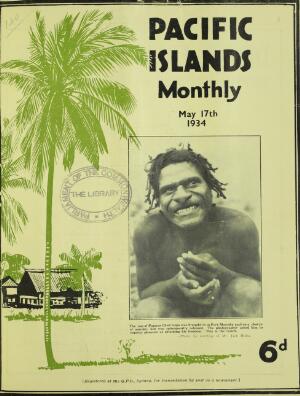
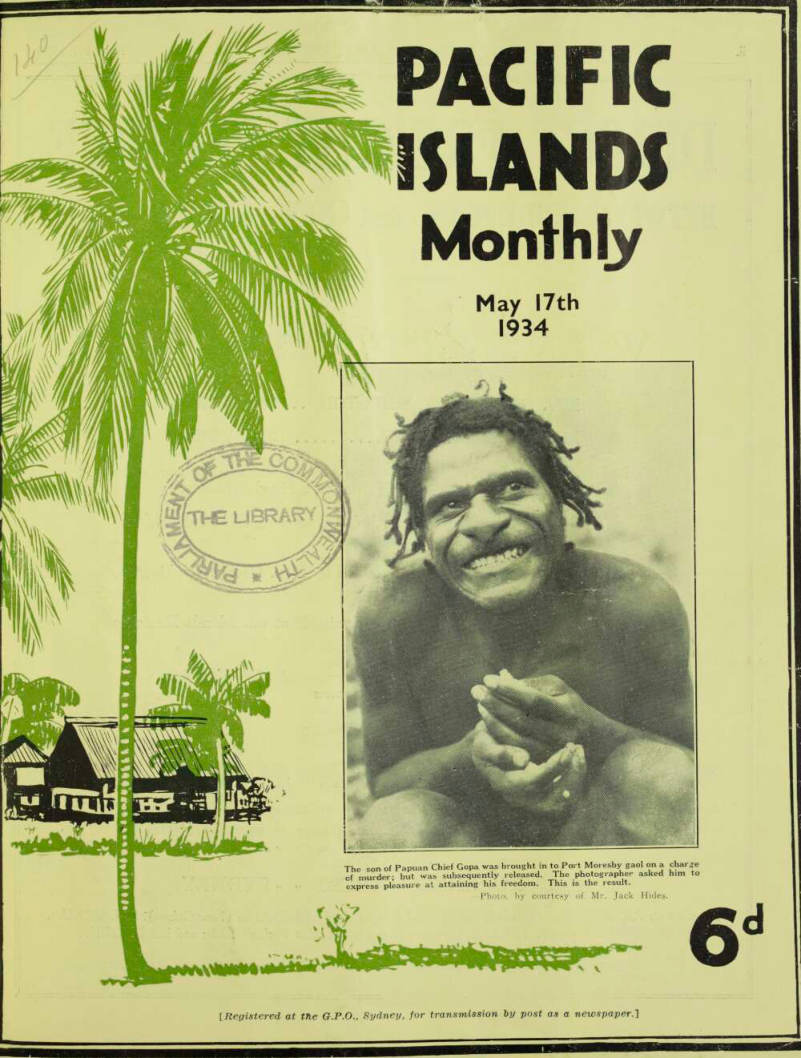
The son of Papuan Chief Gopa was brought in to Port Moresby gaol on a charge of murder; but was subsequently released. The photographer asked him to express pleasure at attaining his freedom. This is the result. —Photo, by courtesy of Mr. Jack Hides.
Advertisements & other items, p. 2 (1 item)
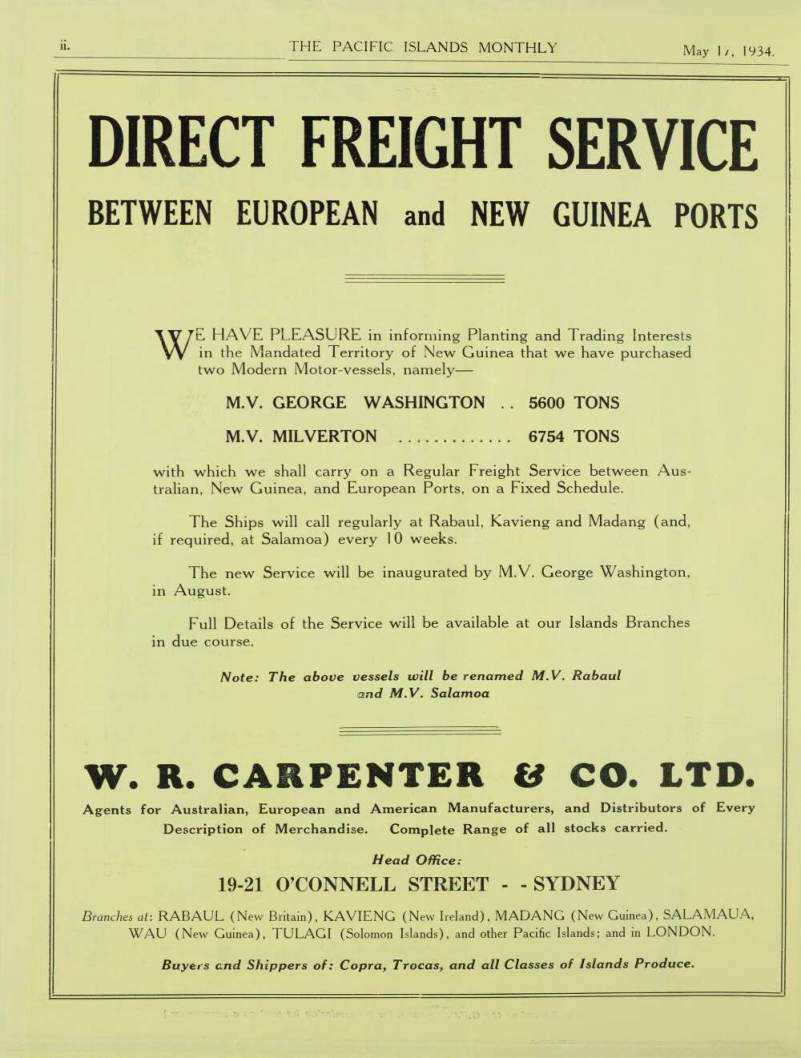
Direct Freight Service
BETWEEN EUROPEAN and NEW GUINEA PORTS
WE HAVE PLEASURE in informing Planting and Trading Interests in the Mandated Territory of New Guinea that we have purchased two Modern Motor-vessels, namely— M.V. GEORGE WASHINGTON . . 5600 TONS
M.V. MILVERTON 6754 TONS
with which we shall carry on a Regular Freight Service between Australian, New Guinea, and European Ports, on a Fixed Schedule.
The Ships will call regularly at Rabaul, Kavieng and Madang (and, if required, at Salamoa) every 10 weeks.
The new Service will be inaugurated by M.V. George Washington, in August.
Full Details of the Service will be available at our Islands Branches in due course.
Note: The above vessels will be renamed M.V. Rabaul and M.V. Salamoa
W. R. CARPENTER & CO. LTD.
Agents for Australian, European and American Manufacturers, and Distributors of Every Description of Merchandise. Complete Range of all stocks carried.
Head Office:
19-21 O’CONNELL STREET - - SYDNEY
Branches at: RABAUL (New Britain), KAVIENG (New Ireland), MADANG (New Guinea), SALAMAUA, WAU (New Guinea), TULAGI (Solomon Islands), and other Pacific Islands; and in LONDON.
Buyers and Shippers of: Copra, Trocas, and all Classes of Islands Produce.
Pacific Travellers
Passengers Per Morinda Which Ar
Rived From Lord Howe And Norfolk
ISLANDS IN SYDNEY ON APRIL 23: Miss O.
Angermunde, Mr. W. Bathurst, Miss M. Beveridge, Mr. R. Bradfield, Mr. J. J. Busby, Mr. A. Carroll, Mr. B. Chapman, Miss R. Day, Mr. P. Game, Miss N. L. King, Mr. F. Lane, Mr. J. Pollock, Mrs.
Searby, Mr. G. Walton.
Passengers Per Morinda Which
Sailed From Sydney For Lord Howe
AND NORFOLK ISLANDS ON APRIL 4: Mr.
L. M. Addison, Miss O. Angermunde, Mr. F. Bow den, Miss H. Brown, Mr. L. V. Brossey, Mrs.
P. W. Dignam and infant, Mr. W. H. Edgar, Mr. J. Ionn, Mrs. F. Lane, Miss E. Locke, Mrs.
E. G. Mackey, Miss M. Martyn, Captain C. R.
Pinney, Mrs. Pinney, Mr. F. Payten and two children, Mr. G. Walton, Mrs. R. Wilson.
Passengers Per Montoro Which
Sailed From Sydney For Papua And
NEW GUINEA ON APRIL 26: Mr. Allen, Mrs.
D. Abel, Miss D. Abel, Mr. J. A. Bayer, Mr. E.
Brown, Mrs. J. E. Brien and 2 infants, Mr. T.
Carr, Mr. and Mrs. Cox and child, Miss C. Coul son, Mr. and Mrs. T. H. Cross, Mr. W. Digby, Mr. A. E. Ewing, Mr. K. D. Fooke, Mr. and Mrs.
A. W. Guy, Miss E. Guy, Rev. E. Griffin, Mr. E.
A. Griffin, Mr. L. W. Gordon, Miss J. Hart, Mr.
J. G. Hides and Mrs. Hides, Mr. Horan, Mr. Hil der, Mr. C. Hawkes, Mr. J. Hooton, Mr. Irvine, Miss Joseph, Mr. and Mrs. J. Kuder and three children, Mr. D. Lyall, Mr. Love, Mr. T. L.
McAlpine, Mrs. G. McKechnie, Mr. W. L. Mit chell and Mrs. Mitchell, Miss M. Mulligan, Mr.
McComb, Mrs. M. Merrell, Mr. J. Minahan, Mr.
W. Mayers, Mr. F. Mason, Mr. Ogilvie, Miss I.
Pearce, Rev. H. Robison, Rev. Rankin, Mr. and Mrs. Smeaton and infant, Mr. and Mrs. Stewart, Miss D. Swinfield, Mr. Swanson, Mrs. J. A. Sen yard, Mr. and Mrs. J. Sheringham, Mr. Stewart, Master Stewart, Mr. F. V. Saunders, Mr. Smith, Rev. and Mrs. Tuckett, Mrs. Thomas, Mr. and Mrs. Vertigan. Mr. and Mrs. H. C. Woolcott, Mr. Wallace, Mr. R. G. Watson.
Passengers Per Montoro Which Ar
RIVED IN SYDNEY FROM PAPUA AND NEW GUINEA ON APRIL 18: Mr. A. G. Allen, Mr.
A. A. Bloxham, Miss H. M. Bradshaw Mrs. A.
Bowering, Mr. E. G. Baker, Miss I. C. Baker, Mr.
E. B. Bignolds, Mr. S. E. Cruickshank, Mr. A.
Caiman, Mr. P. D. Cahill, Miss J. S. Cahill, Mr.
R. D. Cahill, Miss N. E. Cahill, Mr. and Mrs.
A. Cridland, Miss L. E. Cheeseman, Mr. and Mrs.
C. W. Chalmers, Mr. C. E. Disney, Mr. W. J.
Englert, Mr. J. Eisenberg, Mr. and Mrs. P. E.
Fliehler, Mrs. A. Frost, Mr. A. Freeman, Mr. E.
G. Gaude, Mr. and Mrs. H. R. Glanville, Mr. C.
R. Gurney, Mr. R. Gofton, Mr. R. H. Gall, Mr.
A. C. Harlow, Mr. J. W. Hicks, Mr. B. A. Hark ness, Miss W. Jolly, Mr. R. James, Mrs. E. J.
Ledingham, Mr. L. Miels, Mr. J. Meek. Mr. E.
C. Monck Mr. C. Moen, Mr. D. H. McKenzie, Mr. H. McCorristom, Misses L. T. and E. C. Pietz, Mr. A. O. Pollard, Mr. E. Priebe, Mr. F. W.
Reed, Miss F. Reid, Mr. G. H. Shaw, Mr. R. P.
Sumners, Mr. G. W. Skelly, Mr. V. G. Smith, Mr.
T. J. Shepherd, Mrs. S. Taylour, Mr. H. A. Wil liamson, Miss W. M. Woodhouse, Mr. W. H.
Wright, Mr. T. Yeomans.
Passengers Per Morinda Which
Sailed From Sydney For Lord Howe
Island. Norfolk Island. And New
HEBRIDES ON APRIL 26: Mr. and Mrs. R. K.
Bennett, Miss J. Bell, Mr. W. F. Bell, Mr. F. C.
Bigg, Miss M. Auckland, Mr. W. Clark, Mr. A.
Clark, Mr. P. Cruyl, Mr. A. de J. Carey, Mr. L.
Conway, Mr. P. B. Cohen, Mr. L. Courlander, Mrs. L. Case, Miss M. Corderoy, Miss E. Cor deroy, Miss S. Carmichail, Mr. and Mrs. J. C.
Doyle, Mr. H. A. Drew. Mrs. M. Dawkins, Mrs.
W. T. Fenn, Mrs. V. Flesher, Miss H. Flesher, Mr. A. Gibbons, Rev. Godfrey, Mrs. W. Goodwin, Miss F. Godbee, Mr. W. Johnston. Mr. E. C.
Lockyer and Mrs. Lockyer, Mr. and Mrs. G. E.
Lamble, Mr. and Mrs. E. Lord, Mr. F. P. Leonard, Mrs. E. Lancon, Mrs. T. P. Leonard, Miss Lord, Miss A. Lord, Mr. W. H. McClung, Mr. Mason, Mr. S. O. Marton, Mr. Moncrieff, Mrs. E. Mar tin, Miss McRae, Miss G. Martin, Miss M. Marshall, Miss J. Marshall, Miss Owen, Rev. and Mrs. Nottage, Mr. L. Pike, Miss M. Pike, Mr. and Mrs. Purdy, Mr. B. Parker, Miss M. Rankin, Mrs. J. Rankin, Mrs. Rossiter and infant, Mr. and Mrs. C. Ross, Mr. G. V. Shillinglaw, Mr. and Mrs. W. Sanders and two infants, Mr. F. M.
Soiling, Mr. R. Stewart, Mr. V. Stephenson, Mrs.
F. C. Suggate, Mrs. D. Seagoe, Mrs. Smith, Miss C. Sadler, Miss I. Sadler, Mr. L. E. Webb, Mr. and Mrs. Wills. Mr. R. Watson, Mr. and Mrs. F. E.
Wallace, Mr. and Mrs. G. H. Wickstead, Miss Wills.
Passengers Per Aorangi, Which
Sailed From Sydney For Suva Fiji
ON APRIL 26: Sir Henry and Lady Marks, Mr.
P. Rogers, Mr. D. R. Barry, Mr. G. K. Smith, Miss R. Rodger, Mr. and Mrs. F. W. Fenner, Mr. and Mrs. F. J. Marshall, Mr. G. F. Grahame, Mrs. G. F. Grahame, Mr. and Mrs. A. B. Far quhar and child, Mr. and Mrs. A. G. Slocombe and child, Mr. and Mrs. G. Coles, Mr. C. Fenner, Mrs. C. Fenner, Miss S. A. Coles, Mrs. E. H.
Young, Mrs. L. G. Zillman, Mr. G. J. R. Dupre, Mr. and Mrs. F. E. Wood, Mr. H. G. Millard and wife, Miss J. Millard, Mrs. F. H. Ellerton and child, Miss C. E. Moore, Mrs. M. McCullagh, Mrs. M. A. Sheedy, Miss D. Sheedy, Mr. V. L.
Couzens and wife, Miss M. Couzens, Miss J.
Couzens, Miss A. Couzens, Miss S. Major, Miss E. R. Marlin, Mr. A. T. B. Edwards, Mrs. A. T.
B. Edwards and two children, Mrs. D. R. Beiers, Mrs. M. E. Hobbs, Miss J. Hobbs, Master Peter Hobbs, Mr. and Mrs. S. R. McKay and infant, Mr. and Mrs. O. Major, Mr. and Mrs. A. B.
Snodgrass, Miss J. N. Snodgrass, Miss M. L.
Snodgrass, Mr. A. J. Snodgrass, Master D. M.
Snodgrass, Miss N. C. Snodgrass, Mr. G. A.
Hutchings, Mrs. G. A. Hutchings and two child ren, Miss M. P. Ragg, Mrs. I. Swales-Eyre, Miss S. Grahame, Miss P. Chapman, Mr. J. D. May, Mr. W. Chapman, Mr. J. K. Moulton, Mr. J. E.
Makmson, Mr. and Mrs. H. G. Nicholl, Mr. E.
J. Morland, Mr. A. C. Higgs, Mr. A. A. C.
Wilson, Mrs. J. F. Procter, Mr. G. Lucas, Mr.
E. L. P. Bradnam, Mrs. F. W. Reekie.
Passengers Per Monterey, Which
Sailed From Sydney For Suva And
AMERICAN SAMOA ON MAY 2: Mr. V. Adami, Mrs. V. Adami, Miss Margaret Dight, Miss S. M.
Edmondson, Mr. H. S. Gray, Mrs. H. S. Gray, Mrs. F. M. Garnett, Master K. Garnett, Miss Betty Gray, Master B. Gray, Miss A. Garnett, Master R. Garnett, Mr. D. H. Heap, Mrs. D. H.
Heap, Mr. W. G. Nicholson, Mr. and Mrs. H. W.
Nicholls, Miss M. Pearce, Mr. H. Pearce, Mrs.
N. G. Windred, Miss Daphne Hill, Mr. and Mrs.
J. Peterson, Dr. W. A. Stewart, Mr. J. F. Wills, Mrs. E. Wooley, Master L. F. Wooley.
Passengers Per Tanda, Which
Left Sydney For Rabaul, New Guinea,
ON APRIL 14: Mr. E. Henry, Mrs. E. Henry, Mrs. M. Forsyth, Mr. W. D. Marquis, Mrs. W.
D. Marquis, Miss Thelma Robins.
Passengers Per Nankin, Which Ar
Rived In Sydney From Rabaul, New
GUINEA, ON APRIL 18: Mrs. J. S. Newport, Mr. I. Clark, Miss G. E. Backhouse, Miss S. M.
Backhouse, Mr. C. K. Norris, Mr. G. A. Todd, Miss M. McLaren, Mr. A. C. Eldridge, Miss R.
E. Hagon, Mrs. Ehert, Mr. W. A. Sinfield.
Passengers Per Monterey. Which
Arrived In Sydney From Suva, Fiji,
AND AMERICAN SAMOA, ON APRIL 23: Miss V. Graham, Mr. and Mrs. J. Griffiths, Mr. F. R.
Hockey, Mr. Thomas Horne, Dr. R. L. Jack, Mr.
F. H. Jackson, Mr. H. W. Kierath, Mr. J. P.
Mayne, Mr. and Mrs. D. McGregor, Mrs. H.
McLeod, Mr. F. S. Parrett, Mrs. F. S. Parrett, Miss Jean Parrett, Mrs. E. Rixson, Mr. D. W.
Robertson, Mrs. D. W. Robertson, Mrs. E. M.
Robertson, Miss M. Thomas, Mr. C. E. Thomas, Dr. W. Yum, Mrs. W. Yum, Mr. E. Drummond, Mr. Royd D. Elliott, Miss R. Grant, Mr. C. E.
Leembruggen, Mr. and Mrs. P. McConnell, Mr.
U. Nicholls, Father B. Roe, Rev. Father Peter Schwer, Miss S. M. Sandland, Mr. R. C. C. Smith, Mrs. T. L. Witherow, Master Phillip Witherow.
Passengers Per Macdhui, Which
Arrived In Sydney From Papua And
NEW GUINEA ON MAY 7:—Mr. H. F. Adams, Mr. and Mrs. J. H. Ahearn, Mr. B. Arnold, Mr.
F. J. Bannigan, Mr. H. S. Buchanan, Mr. W. W.
Clarke, Mr. and Mrs. S. W. Cook, Mrs. M. E.
Dee, Mr. E. L. Eidler, Miss G. M. Elvy, Mr. A.
E. Emerson Mr. J. S. Fitzgerald, Mr. K. T.
Frank, Miss A. Furnifull, Mr. T. Goulding, Mr.
A. M. Graham, Mr. and Mrs. E. J. Gunn, Mr.
C. I. Harper, Mr. and Mrs. E. Hedgcock, Mr. H.
Hitchcock, Mr. and Mrs. V. G. Hildebrand, Mr.
C. James, Mr. and Mrs. J. Jukes, Mr. H. Ken nedy, Mr. W. T. Korn, Mr. and Mrs. J. R. Lewis, Mr. D. H. Maclean, Mr. A. C. Meldrum, Mr. N.
Mendham, Miss G. M. Monteath, Mrs. J. Osborne, Mr. P. F. O’Sullivan, Mr. F. P. Parkinson, Mr.
T. E. Pike, Mr. T. Prince, Mr. J. Schuller, Mr.
A. A. Sinclair, Mrs. D. Sharp, Pastor A. G.
Stewart, Mr. and Mrs. H. J. Streeter, Mr. J. F.
Sullivan, Mr. L. H. Thompson, Pastor W. J.
Westerman, Mr. W. Whitton.
Passengers Per Malaita Which Ar
Rived In Sydney From Rabaul, N.G.,
AND SOLOMON ISLANDS ON MAY 11; Mr. S.
Wall, Mrs. M. Wall, Mrs. A. Leeds, Miss C. D.
Miller, Mr. G. E. Guthrie, Mr. W. J. Knox, Capt.
F. J. L. Butler, Mr. L. Keen, Capt. O. Svenson, Mr. A. Mayberry, Mr. J. K. Pace, Mrs. G. Love, Dr. W. S. Porter, Miss J. Bell, Miss M. Har grave, Miss E. Gooud, Baron Von Freyberg, Mrs.
E. Stuart, Miss B. M. Holmes, Mr. W. A. Caines, Mr. W. G. Wells, Mr. R. P. Johnson, Rev. T.
Dent, Mr. G. Howes, Mr. H. J. Grassick, Mr.
D. L. Cameron, Mr. C. Meller, Mr. J. A. Phillips, Mr. and Mrs. G. H. Train, Mr. and Mrs. P.
Colley, Mr. and Mrs. C. King. Mr. L. L. Williams, Capt. C. Swanson, Mr. H. Robinson, Mr. J. W.
Brown. Mr. D. J. Ranken, Mr. and Mrs. W. E.
Newall, Mr. S. Moreau, Mr. H. Davidson, Miss M.
Tracey, Mr. and Mrs. E. M. King, Major W. E.
Foxall.
Advertisements & other items, p. 3 (1 item)
bi-monthly Freight and Passenger Service
New Britain Express Delivery.
GENERAL OVERSEAS AGENTS.
GENERAL CARRIERS, BAGGAGE AGENTS,
and FORWARDING AGENTS.
Reliable Cars and Trucks.
We aim to give quick and reliable Service at reasonable costs. P.O. Box 116. Telephone 141.
W. WALKER-FLYNN, Proprietor, Market Street, Rabaul, T.N.G.
bi-monthly Freight and Passenger Service
by the fast and modern K.P.M. Steamer VAN REES as under;
SAIGON
BATAVIA
SAMARANG
PORT MORESBY
SAMARAI
RABAUL
PORT VILA
Saloon class passengers carried in comfortable and airy cabins.
Cargo for Africa accepted for transhipment at Batavia.
NOUMEA
ROYAL PACKET
NAVIGATION CO.
255 GEORGE STREET, SYDNEY.
SYDNEY
PORT MORESBY
BATAVIA
SAIGON
E. A. James, Port Moresby; Whitten Bros., Samarai; W. R. Carpenter & Co., Ltd., Rabaul; Gubbay Freres, Port Vila; Carlo Leoni, Noumea; Diethelm & Co., Saigon.
N.G. Gold Shares
The following table shows the weekly price fluc tuations of shares of the three major gold pro ducing companies operating on the New Guinea goldfields:—
Bulolo G.D.
N.G.G. Ltd.
Placer D’t.
March 17 .. .. b£6/17/b7/8 b£ 17/18/- March 24 .. .. s£6/18/b7/9 b £17/15/• March 28 .. .. s£6/16/b7/10 b£ 17/10/- April 7 .. .. .. b £7/0/6 b 7/7 b£18/5/- April 14 .. .. .. s£7/2/b8/b£ 18/15/- April 21 .. .. b £7/2/6 b7/4 b£20/5/ - April 28 .. b£8/l/b7/3 b £23/15/ - May 5.. .. .. b £7/15 / 6 b 7/3 b £22/18/-
New Co. For Papua
A new company, Angabunga Plantations, Ltd., was registered in Sydney at the end of April to acquire land in Papua and to grow and cultivate rubber, rice, coconuts and tea. The nominal capital of the company is £3000 and the first directors are Messrs. D. Manion and L. Russell.
Races In Rabaul
Rabaul, Apl. 27.
A successful race meeting was held at the Laku nai Race Course on April 14 under the auspices of the Rabaul Amateur Turf Club.
The feature of the meeting was the good per formance by Enchant, a Kokopo horse, trained by Mr. Ewen, who had two wins on the day and lowered her own time for the five-and-a-half fur longs, which is now 1.11 4-5.
Queen Malka, a new racer imported by Messrs.
Clark and Renton, and ridden by Mr. Sherry, was unfortunate in falling in the Easter Mile, and in doing so the rider’s spur entered her side. Her condition is improving satisfactorily.
Pacific Is. Association
The following residents of the Pacific Islands were elected to membership of the Association at a recent meeting: Hon. Alport Barker, M.L.C., Mayor of Suva, Fiji; Dr. G. H. Vernon ,surgeon and planter, Daru. Papua; Maitre Gaston Bour dinat, barrister, New Caledonia; Mr. S. Russell, commercial agent, Tahiti; Mr. W. S. Orford, miner, Papua; Mr. V. A. Florance, barrister and solici tor, New Guinea.
Contents
Page Pacific Islands Travellers 1 Copra Under Another Cloud . . . . 3, 4 New N.G. Shipping Service 5 American Copra Tax 6 Tropicalities 8 About Islands People 9 Tahiti’s Trade 11 Anthropologizing in N. Guinea .. ..14,15 Indians in Fiji 16 N.G. Planter Raided Again .. .. 17 Samoan Mau Still Sullen 20 Career of Mr. E. W. P, Chinnery . . 22
Page Protests in Larkin Case 24 Mr. O. F. Nelson, of Samoa . . .. 26 New Guinea News 29, 38 Soya Beans in America 31 Tongan Notes 32 Fiji’s Sound Finances 34 Chinese Trading in N. Guinea . . .. 35 Traders and Missions 37 Fashions for Islands Women . . . . 41 Aid for Fiji Copra Growers . . . . 42 Market Quotations 45 Exchange Rates 46 Shipping Services in the Pacific ..47,48
Advertisers
Page Antinea Drug Co. .. 11 Arnott’s Biscuits .. 28 Aspro 33 Ausoline Co 18 Baker, Jno 12 Bank of N.S.W. .. 34 Broomfields, Ltd. .. 10 Bruce, Robert .. .. 43 Brunton’s Flour .. 19 Brush, J 26 Burns, Philp & Co. 2 Burns, Philp (S.S.) Co 21 B.P. Magazine .. 36 Burnside 15 Buzacott, Ltd 42 Capell, J 31 Carpenter, W. R.
Cover ii.
Central Q’land Meat Co 30 Chapman & Sherack 18 Coleman Quicklite .. 41 Coral Starch .. .. 48 Dangar, Gedye, Ltd. 38 Dawson & Row .. 46 Doans 43
Page Duval Trading.. .. 44 Dye, A. W. & Co. .. 16 Delicia Food Co. .. 17 Excelsior Supply .. 17 Fletcher & Sons .. 23 Ford, Noel P 36 Ford, W. M 30 Flynn, Mrs. W. .. 19 Garrett & Davidson 29 Gillespie’s Flour .. 28 Glebe Eng’g 20 Goshen Pt. Hospital 19 Grahame, C 27 Gregory, A 18 Guinea Airways Cover hi.
Halvorsen, L. .. 45 Hallam, Ltd 36 Harper, M 20 Holbrooks, Ltd. .. 23 Holden’s Air T. ..
“Holmecroft” .. .. 18 Holmes, W 22 Hotel Mansions .. 20
I.C.I.A.N.Z., Ltd. .. 10
I.C.S 35
Kelvin Engines .. 34
Page Kodak, Ltd 12 Kreisler Radio .. .. 39 Kopsen & Co 30 Lane & Girvan .. 20 Lessey’s D.Y.S. .. 8 Lloyds Teas .. .. 27 Mcllrath’s, Ltd. .. 37 Metro. Bus. College 11
N.D.L 47
Nelson & Robertson 13, 15 New Brit. Express 1 Nolan, Spencer .. 29 Noyes Bros 35 Oldfield 40 Pike Bros 16 Porter, N. C 25 Prescott, Ltd 21 Rabaul Carr’g. Co... 32 Ransomes, Ltd. .. 32 Rasmussen 16 Rohu, Sil 40 Royal Packet N. Co. 1 Russell, S 30 Ruston & Hornsby.. 22 Sands, T. E 32 Scott and Bowne .. 41
Page Smith & Gluyas .. 44 Springwool L. Col. 35 Steamships T. Co., Ltd 46 Sterling Varnish Co. 9 “Stillholme” .. .. 31 Swallow and Ariell, Ltd 13 Sydney Marine Agency 37 “Talkeries ... 40 Taubman’s Paints .. 27 Thomas, G. & Co. .. 44 Tillock & Co., Ltd. 29 Thompson’s Eng’g. 14 Toole, J. E 19 Tooth & Co iv.
Vincent Bros 15 Wanted to Buy .. 31 Wallaringa Mansions 45 Ward, L. A 43 Wills, W. D. & H. O. 31 Wimbledon Sports.
Co 16 Wunderlich, Ltd. .. 33 Wright & Co 24
Advertisements & other items, p. 4 (1 item)
Burns, Philp & Co. Ltd.
General Merchants
Shipowners
Tourist Agents, Etc.
Buyers of all Classes
of Island Produce
Head Office - 7 Bridge Street, Sydney - Australia Code Address: “BURPHIL”
Regular Steamer Services From Australia to New Guinea, Papua, Solomons, Lord Howe, Norfolk Islands, New Hebrides, Java and Singapore
The Pacific Islands Monthly
The Newspaper-Magazine Of The South Seas
[Registered at G.P.O., Sydney, for transmission by post as a newspaper.]
Published Once Each Month and Circulated in Australia and New Zealand and in the following Pacific Territories and Islands Groups:
Crown Colony of Fiji.
Australian Territory of Papua.
Mandated Territory (Australia) of New Guinea, Bismarck Archipelago, and Northern Solomon Islands.
Mandated Territory (Japan) of Marshall, Caroline and Mariana Islands.
American Territory of Guam.
Mandated Territory of Nauru.
British Crown Colony of Gilbert and Ellice Islands.
French Territory of New Caledonia.
British and French Condominium of New Hebrides.
American Territory of Eastern Samoa.
Mandated Territory (New Zealand) of Samoa.
British Solomon Islands Protectorate.
British Protectorate of Tongan Islands.
New Zealand Territory of Cook Islands.
Australian Territory of Norfolk Island.
French Colony of Oceania (Tahiti, etc.).
American Territory of Hawaiian Islands.
Owned and Produced by Pacific Publications, Ltd., Union House, 247 George Street, Sydney.
Telephone Bw 5037
P.O. Box 3408 R
Editor and Publisher:
R. W. Robson.
Registered Address for Radiograms and Cables: “PACPUB” Sydney
Contributions Articles, Stories, and Photographs dealing with Pacific Islands Subjects are invited, and will be oaid for on publication at usual rates.
Subscription Rates Per Annum, within British Empire, Prepaid Post Free 6/- Per Annum, elsewhere, prepaid, Post Free .. 8/- Single Copies 6d.
Advertisements Advertising rates furnished on application.
Colours, etc. by Arrangement.
Process Blocks made at Advertiser’s expense when required. Screen, 100.
Changes of Advertising Copy should reach this Office by Bth of each month, otherwise previous advertisement may be repeated.
Agents The following are authorised to receive subscript tions for “The Pacific Islands Monthly”— Islands Branches of Burns, Philp & Co., Ltd., and Burns, Philp (South Seas) Co., Ltd.
Islands Branches of W. R. Carpenter & Co., Ltd.
All Branches of Morris, Hedstrom & Co., Ltd.
G. Thomas & Co., Rabaul.
Whitten Bros., Ltd., Samarai.
P. Costello, Suva, Fiji.
All Branches and Representatives of W. H, Grove and Sons, Ltd., Auckland.
S. Russell, Papeete, Tahiti.
Cook Islands Trading Co., Rarotonga.
Mrs. M. Campbell, Cascades, Norfolk Island.
Vol. IV., No. 10.
Sydney, May 17, 1934.
Price 6d - Per Copy Prepaid: 6/- p.a.
Copra Under Another Cloud
WE make no excuse for returning to a discussion of the future of the copra industry. The position is most difficult and obscure, even in a world of complex economic problems.
Writing in March, we named four factors as responsible for the desperately low price of copra—namely, general depression; the use of other vegetable oil seeds, made possible by scientific dis coveries and processes; over-production; and the operations of the Unilever com bine. The outlook then was gloomy; but, as one shrewd and experienced Sydney merchant expressed it, “every bit of copra that is being offered is being purchased and consumed, even although the price is low’’—and in that fact lay good reason for belief that the commodity would join other primary products in the slow, steady recovery in price. That conclusion was supported by the special despatch received from London by Sir Hubert Murray, of Papua, at the end of February, when he pointedly asked
High Authority whether coconut-planting might be regarded as a “dying industry.’’
Then, in an apparently clearing sky, there appeared another black cloud. The United States, than which no nation pur chases more copra, has made a drastic plan to discourage the use of coconut oil, so that its domestic production of veget able and animal oils may be assisted.
The development is described in an article elsewhere in this issue. At the moment of this writing, it looks as if a great proportion of the Philippine Islands copra will be thrown upon the European mar ket. World production of copra varies from 1,000,000 to 1,230,000 tons per annum. The Philippines’ share, varying from 25 to 40 per cent., hitherto has gone to U.S.A.
News of the American development had reached other copra-producing coun tries, and was causing corresponding alarm, at the end of February. But the tidings did not come to light-hearted Australia until about the end of April;
and, even to-day, no one seems to be upset about it. “Only another brain wave of the American brain-trust—it will pass,” is the official attitude in Australia.
Our information is that, while the original plan of a 5 cents per lb. excise tax on coconut oil has been abandoned, the 3 cents rate will be passed by the American Senate. And that will give the Ameri can copra trade its coup-de-grace.
Recent proceedings of the Fiji Legis lative Council are significant. An official committee was set up last October to devise means of giving relief to Fiji copra producers; and a carefully planned series of recommendations was submitted to the Governor in March. But before the Governor and his Council could settle down to serious consideration of the Com mittee’s report, the Governor received details of the American development.
His Excellency asked, in view of this, what was the use of straining the finances of the Colony in giving temporary relief to planters, when it now appeared likely that the copra industry would be most seriously and perhaps permanently dis rupted. In the circumstances, said the Governor, there was only one thing to
do—namely, place the whole position before the British Government, and ap peal for protection for the industry. His Council, which includes members of the special committee referred to, accepted his arguments and conclusions. If the position was going to develop as indicated, little could be gained by the relief mea sures they had planned.
Since then, we understand, representa tions of the most urgent character have been made to the Colonial Office by Sir Murchison Fletcher. It is a grave prob lem, so far as he is concerned. As High Commissioner for the Western Pacific, he has in his charge not only Fiji, but also the copra-producing territories of Solo mons, Tonga and the Gilbert and Ellice group.
We may expect an early move by Britain—possibly in collaboration with Holland. The world’s copra comes chiefly from Philippines (American), East Indies (Dutch), various French territories, and a whole host of small countries under the immediate control of the British Colonial Office, such as Cey lon, Malaya, West Indies, Pacific Islands and East Africa. America proposes to abandon the Philippines copra producers —possibly because that territory is on the verge of enjoying complete independ ence. France has adopted a new law, under which only French-produced copra is to be admitted tax-free to the important markets in France. Germany, hitherto a mighty consumer of copra, has imposed almost prohibitory tariffs against coconut oil, in an effort to encourage domestic industries. The problem before Britain and Holland needs no elaboration.
Britain imports enormous quantities of foreign-grown oil-seeds—soya beans from Manchuria, for instance, ground-nuts from various parts of Asia, cotton seed from India, and castor seed and linseed from many places. Here are the imports, in tons, of some oil-seeds by the various nations in 1933:
One recommendation that is being urged upon Britain is that she should again place a heavy tariff on soya beans.
which are produced mostly in Manchuria, and thus encourage the use of Empire grown copra. Statistics show that, since the end of the war, the importation of copra by Britain has increased very slightly, while the consumption of soya beans has grown substantially.
A glance at the copra column in the tabulated figures above indicates that Britain does not hold the key to the copra market—far too large a proportion of the world’s copra is disposed of on the Continent of Europe. For that, perhaps, we must thank Unilever; the post-war operations of that international combine did much towards limiting the copra milling industry in Britain, transferring operations to other countries and thus reducing Britain’s ability to consume copra. That did not matter so much, before the outbreak of this lunacy which we now call “economic nationalism.”
But it matters a great deal to-day, when each nation is using its command over certain industries and raw materials to bargain with other countries, and the fate of the British Empire’s copra industry is in the balance.
Frankly, after examining the statistics available (up to the end of 1933), we are inclined to wonder what Britain can do to help her dominions and colonies in this copra crisis. The British coconut planters produce about 236,000 tons of copra per annum (Straits Settlements 152,000, Ceylon 64,000, South Seas 40,000), and Great Britain herself con sumes only about 100,000 tons, from all sources. She might assist a little by taxing soya beans, as suggested; but she cannot interfere with the ground-nut and cotton seed industries, which are based largely on Indian production. Of course, she might follow the example of France, and place a sharp duty on all copra produced in non-British countries. That, inci dentally, would not be of much use to the copra produced in Papua and New Guinea. The products of Australian territories are not likely to receive specially favoured treatment in Britain, so long as Australia maintains her present tariff against British goods.
It is likely that Fiji will ask all other copra-producing countries to join with her in a consideration of the copra crisis; and that will bring in Australia, as the authority responsible for Papua and New Guinea. So far, the Commonwealth Government, although it has a huge sum at stake in coconut plantations in its ter ritories, has displayed indifference towards
the world aspect of the copra problem. It was strongly urged by the New Guinea Planters’ Association to consider certain aspects of the industry; but, so far as we know, it has taken no action.
Ground Soya Cotton Copra Nuts Beans Seed Britain .. .. 103,424 128,049 157,489 457,875
U.S.A 295,031
France .. .. 196,451 782,978 15,142 Holland .. .. 42,771 108,873 39,244 Germany.. .. 119,273 310,681 1,152,460 Italy .. .. 39,042 81,433 6,312 Belgium .. .. 6,500 33,573 Denmark .. 72,204 33,279 234,683 3,791 Sweden .. .. 18,618 1,259 57,883 Japan ... 12.909 421,665 42,117
Papuan Patrol
Officer
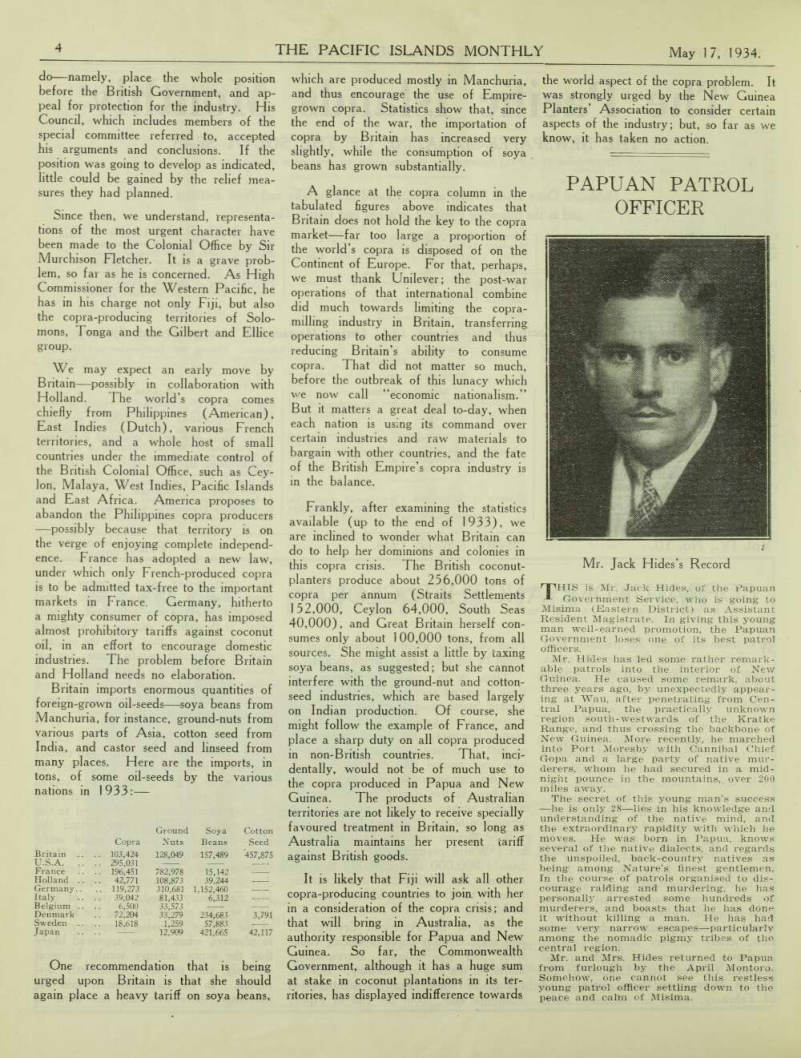
This is Mr. Jack Hides, of the Papuan Government Service, who is going to Misima (Eastern District) as Assistant Resident Magistrate. In giving this young man well-earned promotion, the Papuan Government loses one of its best patrol officers.
Mr. Hides has led some rather remark able patrols into the interior of New Guinea. He caused some remark, about three years ago, by unexpectedly appear ing at Wau, after penetrating from Cen tral Papua, the practically unknown region south-westwards of the Kratke Range, and thus crossing the backbone of New Guinea. More recently, he marched into Port Moresby with Cannibal Chief Gopa and a large party of native mur derers, whom he had secured in a mid night pounce in the mountains, over 200 miles away.
The secret of this young man’s success —he is only 28 —lies in his knowledge and understanding of the native mind, and the extraordinary rapidity with which he moves. He was born in Papua, knows several of the native dialects, and regards the unspoiled, back-country natives as being among Nature’s finest gentlemen.
In the course of patrols organised to dis courage raiding and murdering, he has personally arrested some hundreds of murderers, and boasts that he has done it without killing a man. He has had some very narrow escapes—particularly among the nomadic pigmy tribes of the central region.
Mr. and Mrs. Hides returned to Papua from furlough by the April Montoro.
Somehow, one cannot see this restless young patrol officer settling down to the peace and calm of Misima.
Mr. Jack Hides’s Record
Prominent Missionary Dead
ON April 28 the death occurred at Waverley, Sydney, of the Rev.
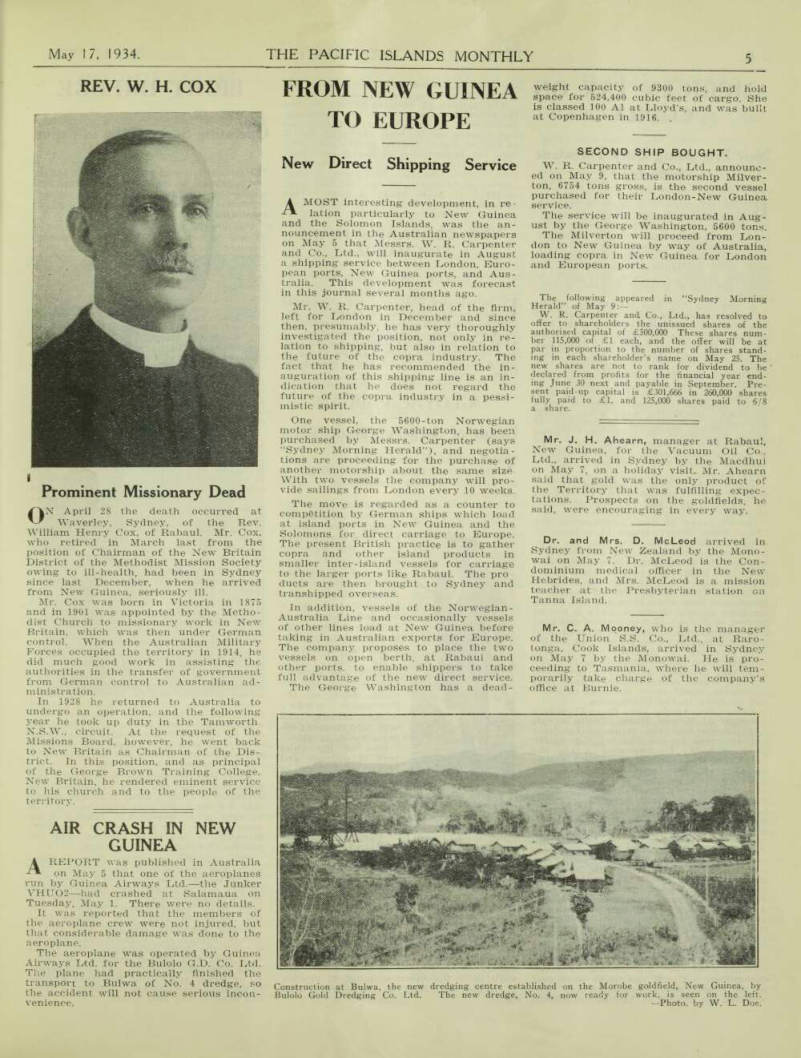
William Henry Cox, of Rabaul. Mr. Cox, who retired in March last from the position of Chairman of the New Britain District of the Methodist Mission Society owing to ill-health, had been in Sydney since last December, when he arrived from New Guinea, seriously ill.
Mr. Cox was born in Victoria in 1875 and in 1901 was appointed by the Metho dist Church to missionary work in New Britain, which was then under German control. When the Australian Military Forces occupied the territory in 1914, he did much good work in assisting the authorities in the transfer of government from German control to Australian ad ministration.
In 1928 he returned to Australia to undergo an operation, and the following year he took up duty in the Tamworth N.S.W., circuit. At the request of the Missions Board, however, he went back to New Britain as Chairman of the Dis trict. In this position, and as principal of the George Brown Training College, New Britain, he rendered eminent service to his church and to the people of the territory.
Rev. W. H. Cox
Air Crash In New
Guinea
A REPORT was published in Australia on May 5 that one of the aeroplanes run by Guinea Airways Ltd.—the Junker VHUO2 —had crashed at Salamaua on Tuesday, May 1. There were no details.
It was reported that the members of the aeroplane crew were not injured, but that considerable damage was done to the aeroplane.
The aeroplane was operated by Guinea Airways Ltd. for the Bulolo G.D. Co. Ltd.
The plane had practically finished the transport to Bulwa of No. 4 dredge, so the accident will not cause serious incon venience.
From New Guinea
To Europe
New Direct Shipping Service
A MOST interesting development, in relation particularly to New Guinea and the Solomon Islands, was the an nouncement in the Australian newspapers on May 5 that Messrs. W. R. Carpenter and Co., Ltd., will inaugurate in August a shipping service between London, Euro pean ports, New Guinea ports, and Aus tralia. This development was forecast in this journal several months ago.
Mr. W. R. Carpenter, head of the firm, left for London in December and since then, presumably, he has very thoroughly investigated the position, not only in re lation to shipping, but also in relation to the future of the copra industry. The fact that he has recommended the in auguration of this shipping line is an in dication that he does not regard the future of the copra industry in a pessi mistic spirit.
One vessel, the 5600-ton Norwegian motor ship George Washington, has been purchased by Messrs. Carpenter (says “Sydney Morning Herald”), and negotia tions are proceeding for the purchase of another motorship about the same size With two vessels the company will pro vide sailings from London every 10 weeks.
The move is regarded as a counter to competition by German ships which load at island ports in New Guinea and the Solomons for direct carriage to Europe.
The present British practice is to gather copra and other island products in smaller inter-island vessels for carriage to the larger ports like Rabaul. The pro ducts are then brought to Sydney and transhipped overseas.
In addition, vessels of the Norwegian- Australia Line and occasionally vessels of other lines load at New Guinea before taking in Australian exports for Europe.
The company proposes to place the two vessels on open berth, at Rabaul and other ports, to enable shippers to take full advantage of the new direct service.
The George Washington has a dead
weight capacity of 9300 tons, and hold space for 524,400 cubic feet of cargo. She is classed 100 A 1 at Lloyd’s, and was built at Copenhagen in 1916.
Second Ship Bought.
W. R. Carpenter and Co., Ltd., announc ed on May 9, that the motorship Milver ton, 6754 tons gross, is the second vessel purchased for their London-New Guinea service.
The service will be inaugurated in Aug ust by the George Washington, 5600 tons.
The Milverton will proceed from Lon don to New Guinea by way of Australia, loading copra in New Guinea for London and European ports.
The following appeared in “Sydney Morning Herald’’ of May 9: — W. R. Carpenter and Co., Ltd., has resolved to offer to shareholders the unissued shares of the authorised capital of £500,000 These shares num ber 115,000 of £1 each, and the offer will be at par in proportion to the number of shares stand ing in each shareholder’s name on May 25. The new shares are not to rank for dividend to be declared from profits for the financial year end ing June 30 next and payable in September. Pre sent paid-up capital is £301,666 in 260,000 shares fully paid to £l, and 125,000 shares paid to 6/8 a share.
Mr. J. H. Ahearn, manager at Rabaul, New Guinea, for the Vacuum Oil Co., Ltd., arrived in Sydney by the Macdhui on May 7, on a holiday visit. Mr. Ahearn said that gold was the only product of the Territory that was fulfilling expec tations. Prospects on the goldfields, he said, were encouraging in every way.
Dr. and Mrs. D. McLeod arrived in Sydney from New Zealand by the Mono wai on May 7. Dr. McLeod is the Con dominium medical officer in the New Hebrides, and Mrs. McLeod is a mission teacher at the Presbyterian station on Tanna Island.
Mr. C. A. Mooney, who is the manager of the Union S.S. Co., Ltd., at Raro tonga, Cook Islands, arrived in Sydney on May 7 by the Monowai. He is pro ceeding to Tasmania, where he will tem porarily take charge of the company’s office at Burnie.
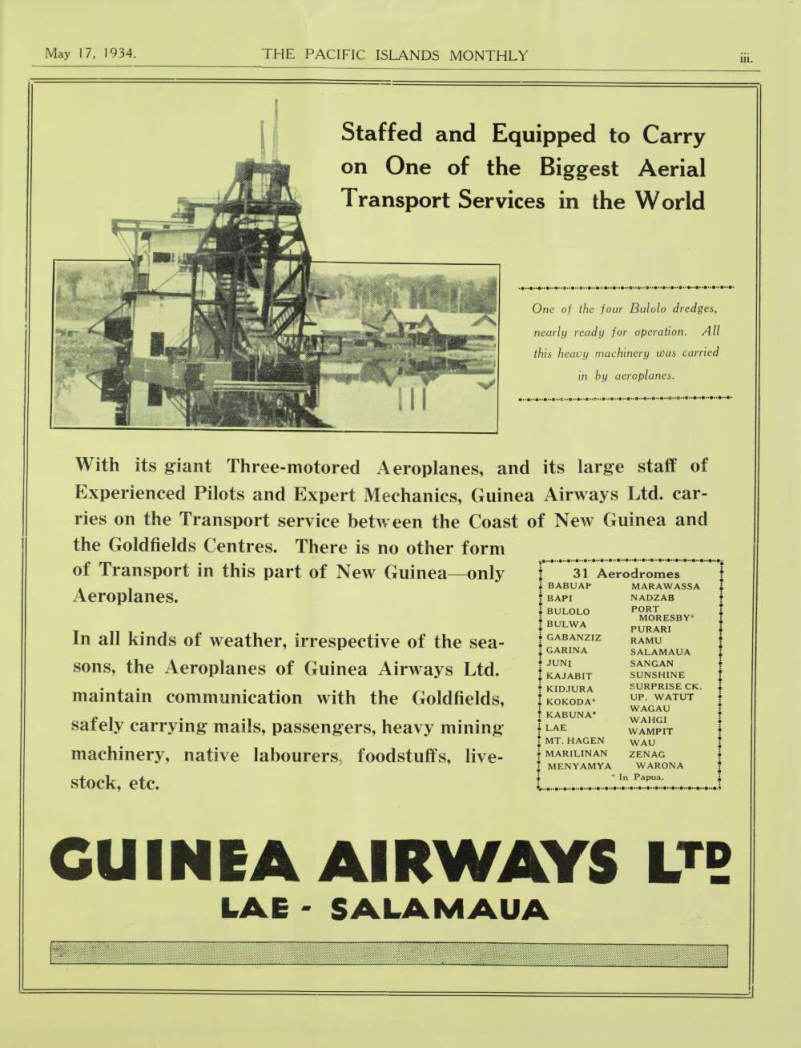
Construction at Bulwa, the new dredging centre established on the Morobe goldfield, New Guinea, by Bulolo Gold Dredging Co. Ltd, The new dredge, No. 4, now ready for work, is seen on the left. —Photo, by W. L. Doe.
Copra
American Tax On
New Processing Duty Threatens Industry
BRIEF reference was made in the last issue of the “Pacific Islands Monthly” to a development which had occurred in the United States and which threatened most seriously to effect the immediate future of the copra industry. We had only brief particulars then; but in the ensuing month we have been able to learn something further of what is pro posed.
A new tax bill was introduced in the American Congress early in the year. It proposed a multiplicity of taxes, and among them was provision for an excise duty on coconut oil equal to 5 cents per lb. It was then explained that the pur pose of the tax was to encourage two important domestic industries of the United States —namely, the production of cotton seed oil and the production of lard.
The proposal alarmed American copra interests. Obviously, such a tax would practically prohibit the importation of copra or coconut oil into the United States. But, for some reason, not a word of the proposal reached Australia; and only the mildest references were made to it in London.
The tax bill passed the House of Repre sentatives in Washington on February 21, by 388 votes to 7, and was sent on to the Senate.
On February 24 there appeared in the “New York Times” (page 14, column 5) a lengthy article reporting that the pro posed coconut oil excise duty had seriously alarmed the Philippines. It was indicated that the Philippine people were afraid that the tax would destroy one of their most important industries, and prepara tions were then afoot from one end of the territory to the other, to make a strong protest to U.S.A. It was pointed out that the Philippines annually produced and sent to U.S.A. between 400,000 and 500,000 tons of copra per annum; and if these exports were barred from U.S.A. by the new tax, the huge production would be thrown upon other markets and that inevitably would cause the ruin of coco nut planting in the Philippines.
Early in April, the San Francisco manager of Messrs. Burns, Philip & Co., Ltd., wrote that the proposed tax was not approved by the Finance Committee of the Senate. He appeared to take the view that the proposed tax ought not to be taken seriously, as it was “nothing but a lot of cheap politics.”
It subsequently transpired that, while there will be no tariff imposed on copra imported into the United States, it is still intended to impose what is called a pro cessing tax (in other words, an excise tax) of 3 cents per lb. on coconut oil.
This processing tax will be applied also to oil obtained from Sesame, Palm, Palm Kernel, Sunflower seeds, Whale, Fish and marine animals. But, apparently, it will not be imposed upon oils processed from cotton seed, ground nuts and soya beans.
An article elsewhere in this issue directs attention to the enormous increase in the production of Soya beans in the United States.
The latest information we have is that the tax in the above form has been recommended by the Senate Finance Committee, but still has to be confirmed by the Senate, and strong influences were working on behalf of Philippine Islands
interests to prevent the imposition of the tax so far as it applied to coconut oil.
The opinion of keen observers is that the tax of 3 cents per lb. is not absolutely prohibitory, as would have been the case had 5 cents per lb. been approved, but it is still so heavy that it is likely to pre vent the importation of the greater part of the Philippine Islands production. If that is so, and the Philippine Islands copra is thrown on to the European market, it must cause a considerable delay in the recovery of copra prices.
New Companies’ Plans
For Papua.
From Our Own Correspondent.
Pt. Moresby, May 2.
IT is reported that two big companies are being planned to carry out ex tensive operations in Papua—the growing of sisal hemp, and the production of wood pulp for paper manufacture are said to have attracted them. Large areas in the west are said to be under considera tion.
Death of Sergeant-Major Simoi
A Loyal Papuan
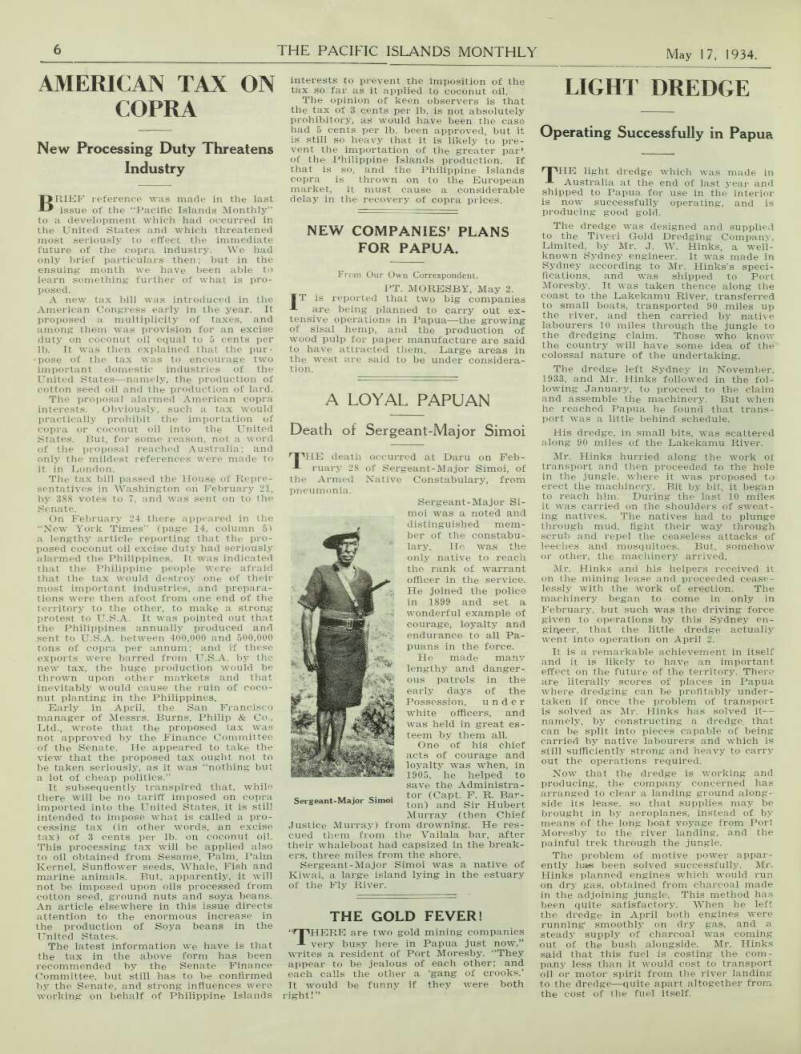
T'HE death occurred at Daru on Feb February 28 of Sergeant-Major Simoi, of the Armed Native Constabulary, from pneumonia.
Sergeant-Major Si moi was a noted and distinguished mem ber of the constabu lary. He was the only native to reach the rank of warrant officer in the service.
He joined the police in 1899 and set a wonderful example of courage, loyalty and endurance to all Pa puans in the force.
He made many lengthy and danger ous patrols in the early days of the Possession, under white officers, and was held in great es teem by them all.
One of his chief acts of courage and loyalty was when, in 1905, he helped to save the Administra tor (Capt. F. R. Bar ton) and Sir Hubert Murray (then Chief
Justice Murray) from drowning. He res cued them from the Vailala bar, after their whaleboat had capsized in the break ers, three miles from the shore.
Sergeant-Major Simoi was a native of Kiwai, a large island lying in the estuary of the Fly River.
Sergeant-Major Simoi
The Gold Fever!
THERE are two gold mining companies very busy here in Papua just now,” writes a resident of Port Moresby. “They appear to be jealous of each other; and each calls the other a ‘gang of crooks.’
It would be funny if they were both right! ”
Light Dredge
Operating Successfully in Papua
T'HE light dredge which was made in Australia at the end of last year and shipped to Papua for use in the interior is now successfully operating, and is producing good gold.
The dredge was designed and supplied to the Tiveri Gold Dredging Company, Limited, by Mr. J. W. Hinks, a well known Sydney engineer. It was made in Sydney according to Mr. Hinks’s speci fications, and was shipped to Port Moresby. It was taken thence along the coast to the Lakekamu River, transferred to small boats, transported 90 miles up the river, and then carried by native labourers 10 miles through the jungle to the dredging claim. Those who know the country will have some idea of the colossal nature of the undertaking.
The dredge left Sydney in November, 1933, and Mr. Hinks followed in the fol lowing January, to proceed to the claim and assemble the machinery. But when he reached Papua he found that trans port was a little behind schedule.
His dredge, in small bits, was scattered along 90 miles of the Lakekamu River.
Mr. Hinks hurried along the work or transport and then proceeded to the hole in the jungle, where it was proposed to erect the machinery. Bit by bit, it began to reach him. During the last 10 miles it was carried on the shoulders of sweat ing natives. The natives had to plunge through mud, fight their way through scrub and repel the ceaseless attacks of leeches and mosquitoes. But, somehow or other, the machinery arrived.
Mr. Hinks and his helpers received it on the mining lease and proceeded cease lessly with the work of erection. The machinery began to come in only in February, but such was the driving force given to operations by this Sydney en gineer, that the little dredge actually went into operation on April 2.
It is a remarkable achievement in itself and it is likely to have an important effect on the future of the territory. There are literally scores of places in Papua where dredging can be profitably under taken if once the problem of transport is solved as Mr. Hinks has solved it — namely, by constructing a dredge, that can be split into pieces capable of being carried by native labourers and which is still sufficiently strong and heavy to carry out the operations required.
Now that the dredge is working and producing, the company concerned has arranged to clear a landing ground along side its lease, so that supplies may be brought in by aeroplanes, instead of by means of the long boat voyage from Port Moresby to the river landing, and the painful trek through the jungle.
The problem of motive power appar ently ha« been solved successfully. Mr.
Hinks planned engines which would run on dry gas, obtained from charcoal made in the adjoining jungle. This method has been quite satisfactory. When he left the dredge in April both engines were running smoothly on dry gas, and a steady supply of charcoal was coming out of the bush alongside. Mr. Hinks said that this fuel is costing the com pany less than it would cost to transport oil or motor spirit from the river landing to the dredge—quite apart altogether from the cost of the fuel itself.
Pierre Loti
Tahiti Remembers a Gifted Author
From Our Own Correspondent.
PAPEETE, April 17.
THE “Comite Pierre Loti,” an organisa tion initiated two years ago by M.
Andre Ropiteau, has announced the arrival of the monument which it is proposed to erect to the memory of the celebrated author, whose tender idyll, “Le Mariage de
Loti,” exudes the very essence of that romantic charm for ever associated with the beautiful island of Tahiti.
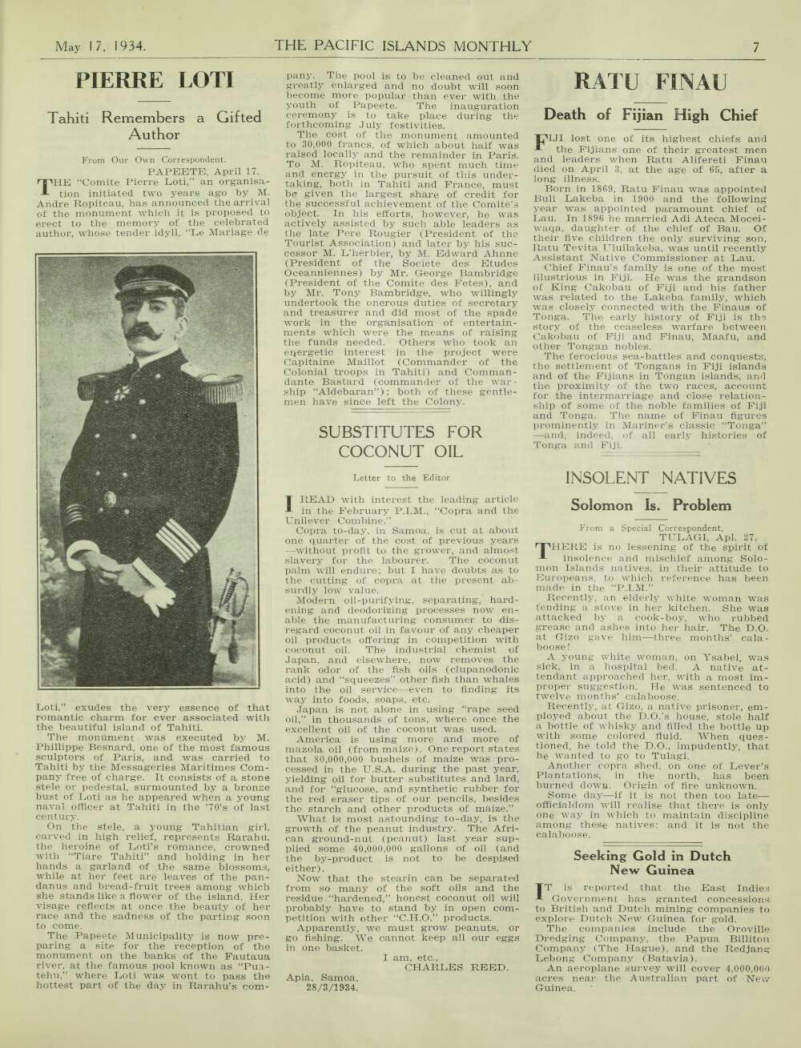
The monument was executed by M.
Phillippe Besnard, one of the most famous sculptors of Paris, and was carried to Tahiti by the Messageries Maritimes Com pany free of charge. It consists of a stone stele or pedestal, surmounted by a bronze bust of Loti as he appeared when a young naval officer at Tahiti in the ’70’s of last century.
On the stele, a young Tahitian girl, carved in high relief, represents Rarahu, the heroine of Loti’s romance, crowned with “Tiare Tahiti” and holding in her hands a garland of the same blossoms, while at her feet are leaves of the pan danus and bread-fruit trees among which she stands like a flower of the island. Her visage reflects at once the beauty of her race and the sadness of the parting soon to come.
The Papeete Municipality is now pre paring a site for the reception of the monument on the banks of the Fautaua river, at the famous pool known as “Pua tehu,” where Loti was wont to pass the hottest part of the day in Rarahu’s com
pany. The pool is to be cleaned out and greatly enlarged and no doubt will soon become more popular than ever with the youth of Papeete. The inauguration ceremony is to take place during the forthcoming July festivities.
The cost of the monument amounted to 30,000 francs, of which about half was raised locally and the remainder in Paris.
To M. Ropiteau, who spent much time and energy in the pursuit of this under taking, both in Tahiti and France, must be given the largest share of credit for the successful achievement of the Comite’s object. In his efforts, however, he was actively assisted by such able leaders as the late Pere Rougier (President of the Tourist Association) and later by his suc cessor M. L’herbier, by M. Edward Ahnne (President of the Societe des Etudes Oceanniennes) by Mr, George Bambridge (President of the Comite des Fetes), and by Mr. Tony Bambridge, who willingly undertook the onerous duties of secretary and treasurer and did most of the spade work in the organisation of entertain ments which were the means of raising the funds needed. Others who took an energetic interest in the project were Capitaine Maillot (Commander of the Colonial troops in Tahiti) and Comman dant© Bastard (commander of the war ship “Aldebaran”); both of these gentle men have since left the Colony.
Substitutes For
Coconut Oil
Letter to the Editor IREAD with interest the leading article in the February P.I.M., “Copra and the Unilever Combine.”
Copra to-day, in Samoa, is cut at about one quarter of the cost of previous years —without profit to the grower, and almost slavery for the labourer. The coconut palm will endure; but I have doubts as to the cutting of copra at the present ab surdly low value.
Modern oil-purifying, separating, hard ening and deodorizing processes now en able the manufacturing consumer to dis regard coconut oil in favour of any cheaper oil products offering in competition with coconut oil. The industrial chemist of Japan, and elsewhere, now removes the rank odor of the fish oils (clupanodonic acid) and “squeezes” other fish than whales into the oil service—even to finding its way into foods, soaps, etc.
Japan is not alone in using “rape seed oil,” in thousands of tons, where once the excellent oil of the coconut was used.
America is using more and more of mazola oil (from maize). One report states that 80,000,000 bushels of maize was pro cessed in the U.S.A. during the past year, yielding oil for butter substitutes and lard, and for “glucose, and synthetic rubber for the red eraser tips of our pencils, besides the starch and other products of maize.”
What is most astounding to-day, is the growth of the peanut industry. The Afri can ground-nut (peanut) last year sup plied some 40,000,000 gallons of oil (and the by-product is not to be despised either).
Now that the stearin can be separated from so many of the soft oils and the residue “hardened,” honest coconut oil will probably have to stand by in open com petition with other “C.H.O.” products.
Apparently, we must grow peanuts, or go fishing. We cannot keep all our eggs in one basket.
I am, etc.,
Charles Reed.
Apia, Samoa, 28/3/1934.
Ratu Finau
Death of Fijian High Chief
FIJI lost one of its highest chiefs and the Fijians one of their greatest men and leaders when Ratu Alifereti Finau died on April 3, at the age of 65, after a long illness.
Born in 1869, Ratu Finau was appointed Buli Lakeba in 1900 and the following year was appointed paramount chief of Lau. In 1896 he married Adi Ateca Mocei waqa, daughter of the chief of Bau. Of their five children the only surviving son, Ratu Tevita Uluilakeba, was until recently Assistant Native Commissioner at Lau.
Chief Finau’s family is one of the most illustrious in Fiji. He was the grandson of King Cakobau of Fiji and his father was related to the Lakeba family, which was closely connected with the Finaus of Tonga. The early history of Fiji is the story of the ceaseless warfare between Cakobau of Fiji and Finau, Maafu, and other Tongan nobles.
The ferocious sea-battles and conquests, the settlement of Tongans in Fiji islands and of the Fijians in Tongan islands, and the proximity of the two races, account for the intermarriage and close relation ship of some of the noble families of Fiji and Tonga. The name of Finau figures prominently in Mariner’s classic “Tonga” —and, indeed, of all early histories of Tonga and Fiji.
Insolent Natives
Solomon is. Problem
From a Special Correspondent.
Tulagi, Apl. 27.
THERE is no lessening of the spirit of insolence and mischief among Solomon Islands natives, in their attitude to Europeans, to which reference has been made in the “P.I.M.”
Recently, an elderly white woman was tending a stove in her kitchen. She was attacked by a cook-boy, who rubbed grease and ashes into her hair. The D.O. at Gizo gave him —three months’ cala boose!
A young white woman, on Ysabel, was sick, in a hospital bed. A native at tendant approached her, with a most im proper suggestion. He was sentenced to twelve months’ calaboose.
Recently, at Gizo, a native prisoner, em ployed about the D.O.’s house, stole half a bottle of whisky and filled the bottle up with some colored fluid. When ques tioned, he told the D.O., impudently, that he wanted to go to Tulagi.
Another copra shed, on one of Lever’s Plantations, in the north, has been burned down. Origin of fire unknown.
Some day—if it is not then too late — officialdom will realise that there is only one way in which to maintain discipline among these natives: and it is not the calaboose.
Seeking Gold in Dutch
New Guinea
IT is reported that the East Indies Government has granted concessions to British and Dutch mining companies to explore Dutch New Guinea for gold.
The companies include the Oroville Dredging Company, the Papua Billiton Company (The Hague), and the Redjang Lebong Company (Batavia).
An aeroplane survey will cover 4,000,000 acres near the Australian part of New Guinea.
Tropicalties
DIE CREEK has “struck it rich” again.
Mr. E. M. Turner, a resident of the Goldfields, received advice during last month to the effect that he had won the first prize of £5,000 in a recent drawing of the N.S.W. State Lottery. The news travelled around the goldfield very fast.
That night, at the Edie Creek store, all his old friends gathered to offer their hearty congratulations and drink his health in seven different colours.
Amid the happy jubilations a gloomy planter from the coast was heard to say: “You goldfields blokes have all the luck— our copra’s down, the overdraft is due, the missus’s family is coming to stay, and when I win a fiver in the Lottery some Goldfieldsite gets the £5000. O Death, where is thy sting?”
A LADY resident of New Britain has for warded to us the following account of an incident at a well-known hotel in Rabaul : Older residents in the Islands are doubt less used to this sort of thing, but being more or less a newcomer, I found it amusing and, at the time, rather discon certing. I left a book on a table in the lounge of the hotel the other day and re turned some time later to look for it.
As the book was not in sight, I decided to enquire of the “boy on watch.”
I: You look ’im one fella book ’e stop?
Boy: ’lm ’e red fella book?
I (relievedly): Yes; red fella book.
Boy: Me no look ’im.
What is there left to say, in a case like that?
RESIDENTS of the Pacific Islands arriving in Australia have been embar rassed frequently in the past by the Australian regulations relating to the ownership of revolvers. The Australian laws are very strict in regard to the carry ing of revolvers, and only persons who have convinced the police that the posses sion of a revolver is necessary in their case are allowed to carry the weapons.
A very large proportion of Pacific Islands residents “carry a gun” and many of them, when visiting Australia, have the useful tool with them—usually in their luggage. They know nothing about the Australian laws and omit to disclose pos session of the revolver, with the result that they may be severely fined. When they do declare, the revolver is usually seized by the Customs authorities and held by them until the traveller departs again. The traveller, of course, may make application for a license to carry a revolver in Aus tralia —but this is a complicated and heartbreaking business, and hardly worth while.
Pacific Islands residents are warned al ways to declare possession of a revolver on arrival in Australia.
From a grateful citizen of U.S.A., Mr.
Paul Dorn, who collects documents relating to early Papua; “I wish to take this opportunity to remark on the splendid co-operation and unfailing courtesy that I have received at the hands of the various officials of the Papuan Public Service in the course of my investigations into vari ous questions regarding their country. I have had occasion to address letters to a large number of these men—to whom I am a total stranger many thousand miles away —and I cannot speak too highly of their efforts to supply me with the information
I desire. I have no doubt that many times it would have been much easier for them to say to me that the information desired was not available and let it go at that; but, on the contrary, I have met with a very gratifying spirit of tolerance and sympathy with the objects of my search, even though it cost them considerable trouble to adopt such an attitude and reply to my numerous queries, many of which must have seemed to them of no import ance. I cannot but conclude that they are a group of men far superior in education and vision to the average, and I shall feel forever grateful for their many kindnesses to me.”
THE interest of the Dutch in the Pa cific Islands continues to grow and develop.
A committee of prominent Government officials, mining engineers, merchants and publicists, has been formed in the Hague to deal with Dutch New Guinea affairs and to gather information about New Guinea and distribute same among per sons interested.
This committee apparently places great value upon the “Pacific Islands Monthly.”
It has made arrangements by which a copy of each month’s issue is forwarded immediately to The Hague by the first available air mail—a very expensive pro cedure in the case of a printed journal of the size of the “P.I.M.”
A CORRESPONDENT in Samarai writes to make sour comment on “Paradise Plumes,” a novel with a Papuan setting, written by Mr. G. M. Turnbull, of the Territory service:—“One fact impresses those here who have read it—the writer, deliberately or unconsciously, portrays the official mind with regard to those who are engaged in commercial pursuits in this country—traders, especially, being regarded as a low-down lot of wasters, who would be better dead (preferably having been first hung by the neck).
“Having read Mr. Turnbull’s book now know the significance of that slight protuberance to be seen near the shoulder-blades of most government offi cers, and, in our ignorance, attributed by us to overwork, and long hours spent toiling at office tables. The secret is out at last, thanks to Mr. Turnbull—wings!”
We are afraid that our correspondent found offence where none existed, and really is using Mr. Turnbull as a means of working off an accumulated grouch against many foolish writers (who have systematically presented the islands trader as “an unshaven, gin-sodden wreck”) and against public servants in general (who, in these depressed days, enjoy the safety of a sheltered job). Cer tainly, Mr. Turnbull’s Papuan-magistrate hero was far too good to be true, and was calculated to make hard-bitten Papuan settlers foam at the mouth. But has our correspondent never heard of poetic license?
A VALUED correspondent in the Solomon Islands sent the following dole ful paragraph:— “Things are bad in this part of the Group—the low price of copra does not induce the natives to make the com modity. Chinese traders swarm over all the islands and gobble up what little business there is. For some reason our
Administration seems to be partial to the Chinese.
“They are encouraged and we are left to starve. We old traders think that the men who opened up this Group to trad ing and who put all their savings into plantations should have any preference that is going—but that argument seem ingly does not appeal to the official mind.
“The latest shock given to our white community is the report that a white man has been compelled to accept employment from a native. The white man certainly has been down and out, but report has it that he once occupied an official position of some importance. The native was once involved in a case which concerned the murder of a European. Later, he joined a mission, and, enjoying the good-will of the missionaries and the Administration, he has become a power in the land.
“Some fool writer once called these the ‘happy Isles of Eden.’ I wish the blighter were here trying to wring a bare living out of a depressed plantation and a de crepit trading station in the face of Chinese competition and official indiffer ence.”
Late N.G. News
Bulolo dredges (1, 2, and 3) produced 9803 ounces of bullion in April (giving 6605 ounces fine gold) from 612,700 cubic yards.
Working profit, £36,380 (Australian).
Aviator Ulm, in his “Faith in Australia,” will leave Melbourne at 4 a.m. on June 16, with the first official air mail for New Guinea. He will fly via Queensland and Port Moresby to Lae, where he is due on June 18; and he will return four davs later.
Guinea Airways Ltd (issued capital £75,000) made a net profit of £30,401 in the year ended February last, compared with £13,053 in last year, and £28,725 in 1932. Details next issue.
Guinea Gold, N.L., an Adelaide holding and prospecting company, with an issued capital of £50,000, made a net profit last year of £8175.
Advertisements & other items, p. 10 (1 item)
Drive Yourself
When Visiting Sydney
Send a Wire to
LESSEY’S
Drive Yourself
Box 8, Post Office,
PADDINGTON,
and an up-to-date car will meet you at the boat, which you can hire on very reasonable terms to
DRIVE YOURSELF.
Head Office and Service Station at
RUSH CUTTER’S BAY
(Near Stadium). Tel.: F 3196.
Radio Address: “Lessey’s,” Paddington, Sydney.
About Islands People
Dr. Felix M. Keesing and Mrs. Keesing, of Auckland, New Zealand, will leave London in June to join the staff of the University of Hawaii. They have been doing research work for the Institute of Pacific Relations for the last four years, travelling widely in the Orient and South Seas, and finally spending a period in England and Europe. A part of their observations has been published in two books this year, “Modern Samoa,” and “Taming Philippine Headhunters.”
Archdeacon R. Godfrey, of the Melan esian Mission, Lolowai Bay, Aoba, New Hebrides, arrived in Sydney by the La perouse on April 19, on a health visit. He returned to the New Heb rides on April 26, by the Morinda. He has been in the New Hebrides 16 years doing missionary, medical, and educa tional work. He is the principal of the teachers’ training college at Lolowai.
Captain Charles Frilet, who relin quished command of the French steamer Laperouse in 1930, arrived in Sydney dur ing April in command of the Ville d’Amiens, from Marseilles. Captain Rene Vigier, who was last in Sydney ten years ago, was a passenger by the Ville d’Amiens, to join the Laperouse as com mander, in the Noumea-Sydney service.
His wife and two children will live in Sydney.
Rev. Susie Rankin, wife of. Rev. Robert Rankin, of Saroa, Papua, is progressing favourably after a long illness in a Mel bourne hospital. She is the only or dained woman missionary in Papua, and went out to the London Missionary So ciety’s station at Saroa in 1925. Mr.
Rankin, who is at present in Victoria on furlough, will return to Papua shortly, but Mrs. Rankin will not join him until later in the year.
Mr. Richard Archbold, mammalogist of the American Museum of Natural History, arrived in Sydney by the Van Rees on April 17, after com pleting a successful natural his tory expedition in Papua. Mr. Arch bold said that the party camped for a month on Mount Albert Edward (13,000 ft.) at an altitude of 12,500 ft., and found a large plateau of an area of about 30 miles long and 12 miles wide. His com panions, Dr. A. L. Rand, a Canadian orni thologist, and Mr. L. J. Brass, of Queens land, also arrived by the Van Rees.
Miss Hilda Taylor, who was recently appointed to the Jasper Williams Metho dist Boarding School at Lautoka, Fiji, left Sydney for Suva by the Mariposa on April 4.
Rev. T. Watt Leggart, Presbyterian Minister of Victoria, has announced his intention of retiring after 48 years in the Ministry. He will be remembered by many old residents of the New Hebrides, where he was a missionary for over 20 years.
Mr. H. F. Pearson, who was formerly Inspector of Mines at Broken Hill, New South Wales, has been appointed Assist ant Mining Warden at Wau, Mandated Territory of New Guinea.
Brother Herman, a well-known teacher at the Marist Brothers school, Apia, has left via Pago Pago, in American Samoa, on a visit to his people in Germany.
Mr. P. Cruyl, president of the Condo minium Court, New Hebrides, and Judge
A. de J. Carey, British member of the Court, left Sydney on April 26 for Vila by the Morinda.
The Administrator of Samoa (Brig.- General Hart) is spending a short fur lough in New Zealand. Mr. A. C. Turn bull, Secretary to the Administration, is Acting-Administrator during General Hart’s absence.
Miss L. E. Cheesman, who has been in Papua doing research work on behalf of the British Museum, arrived in Sydney by the Montoro on April 19. She has been in the interior of Papua for a year studying insect life, and has secured about 42,000 specimens of insects, and many varieties of frogs and snakes. Most of the specimens are new, and should create much interest among English en tomologists when she returns to London shortly.
Mr. Alfred Guthman, of the Argentine, arrived in Sydney by the Ville d’Amiens on April 20, en route to the New Heb rides. He left later for Malekula and Santo, where he will study native cus toms and collect specimens and curios for the National Geographic Museum, Paris. Mr. Guthman was in the New Hebrides some time ago, and had many interesting experiences while exploring Malekula. Travel in the Group, he said is dangerous, because of the continual inter-tribal warfare; but if strangers did not interfere they were fairly safe.
Dr. G. H. Vernon, formerly the well known and highly esteemed medical offi cer at Thursday Island, and now engaged in planting and trading at Daru, Western Papua, arrived in Sydney by the Van Rees at the end of April and since then has been looking up old friends and undergoing a medical overhaul. He went into St. Luke’s Hospital, Sydney, for brief attention early in May; but a few days later was energetically making prepara tions to return to the Territory, via
Thursday Island, at the end of this month.
Mrs. Leek, wife of Rev. Robert Leek, Anglican missionary at Samarai, Papua, is spending a three months’ holiday in Mel bourne, Victoria.
Mr. John Paul Tarby, of Fiji, died, after a long illness, at his residence in Suva on April 1, at the age of 67. Mr. Tarby was born in Mauritius in 1867 and at the age of 17 went to Fiji with his brother, who was a sugar boiler at the Holmhurst mill.
Fiji. After some years there he was en gaged by the Fiji Sugar Co. at Navua, and in 1894 was appointed plantation manager.
When the company w r as sold to American interests, Mr. Tarby entered the Fiji Public Service and in 1917 became In spector of Plantations in the Agricultural Department. The following year he was engaged in special work in connection with the Government rice mill and was appoint ed manager of the mill in 1919. Last year he retired from the Public Service owing to ill-health.
Rev. M. Leonard Hurst, of Manchester, England, has been appointed to succeed Rev. G. J. Williams as Secretary for Aus tralia and New Zealand of the London Missionary Society. Mr. Hurst will leave England for Australia next September. In future the Melbourne and Sydney offices of the Society will be amalgamated and the mission work controlled from Sydney.
Mr. W. Dupain, manager of the Port Moresby branch of Burns, Philp and Co., Ltd., is at present in Melbourne. He is combining business with pleasure during his short stay, and will return to Papua on May 17 by the Macdhui.
Mr. R. E. P. Dwyer, an officer of the New South Wales Agricultural Depart ment, has been appointed by the Federal Government to the post of economic bota nist in New Guinea. Mr. Dwyer will in vestigate cro problems in the territory.
Mr. A. J. Vogan, F.R.G.S., who left for a northern island in the Fiji group some months ago, with the intention of taking casts of some ancient Asiatic inscriptions he discovered in a cave there, has radio’d that he got back safely to Lautoka with his casts, and is returning soon to Sydney.
Mrs. Bowring, of Edie Creek, New Guinea, entertained a large dinner party at the Hotel Metropole, Sydney, during her holiday South. She sails by the “Macdhui,” taking with her a real bath, which will be the envy of the many “bush shower” and wash-basin artists on the goldfields. It will be the second bath at Edie Creek, the first being in the Euro pean hospital of New Guinea Goldfields Limited.
Mr. “Bob” Gurney, of New Guinea Air ways, Lae, who has performed some re markable feats in aviation towards help ing the rapid progress of the New Guinea goldfields, is at present on his annual leave. Mr. Gurney is just as popular South as he is up North, so that he has been already a guest at some of Sydney’s brightest parties.
Mr. Wally Digby flew to Brisbane to catch the April “Montoro,” en route to Samarai, where he will stay three months investigating a new “find.” Mr. Digby is one of those fortunate people who seem to be born with a gold spoon in their mouths —everything he touches turns to gold. He is a director of Day Dawn Ltd., Edie Creek.
Mr. W. Edwards, formerly of N.G.G.
Ltd., is now to be found at New Guinea Airways Ltd., Lae. He is apparently under the spell of the tropics, for all the fingers on both hands do not add up to the number of years he has been in New Guinea without coming South for a holi day. Mr. Edwards is a recognised authority on “pidgin English.”
Mr. W. Philpotts, of Burns, Philp and Co., Rabaul, has been made Tourist Manager for the cruise of the “Otranto” in June. Bookings are heavy. One of the “early birds” was Mr. Philpotts’ fiancee, Miss Gwen Newbery, of Newport, Sydney.
With Mr, Philpotts in charge of the social activities, “Otranto” passengers can be assured of a very good time ashore in Rabaul.
News comes from Edie Creek, New Guinea, of the sudden death of Mr. D.
Lyall, Snr., from pneumonia. Mr. Lyall with his son, Dave, were among the first in the “gold rush” to Edie Creek in the early days. Dave was in Sydney prepar ing for a world tour when the news came and he hastened to catch the “Montoro,” and returned to the “El Dorado” at Kaindi.
Mr. H. Hemas, well known throughout the Eastern Pacific in connection with the Auckland firm of Messrs. A. B. Donald Ltd., arrived in Tahiti by the S.S. Makura recently on one of his periodical tours of inspection. He probably will remain there for several months.
Advertisements & other items, pp. 11-12 (1 item)
Home
STERLING
COVERS
MORE
COSTS
LESS
GUAR-
ANTEED
STERLING
HOME PAINT
MAKES ALL THE
DIFFERENCE
PAINT
WITH-
STANDS
TROPICAL
SUN AND
SALT-LADEN
AIR
Made by STERLING VARNISH CO., SYDNEY, N.S.W.
Be Sure YOU
Have the Right
Cartridges
The choice of cartridges is an all-important factor to really good shooting, for upon their accuracy of performance satisfactory results depend.
All British Cartridges Are the Choice of Keen Shooters because of their proved dependability consequent upon scientifically accurate production and loading.
There’s an “Eley & Kynoch” Cartridge to suit every gun and every sportsman —no matter what the game he is after—combining everything to be desired in high velocity, effective pattern, low recoil, long range and perfect ignition.
Obtainable
Everywhere
At Popular Prices... 375 A
Royalty to Visit Fiji
THE announcement that Prince George would visit Fiji early next year on his return to England from the, Melbourne Centenary celebrations has created much interest among Fiji residents.
The Governor of the Colony (Sir Mur chison Fletcher) received the following cable from the Secretary of State for the Colonies (Mr. J. H. Thomas) on March 29: “Prince George gladly accepts invitation to visit Fiji. It has been arranged that he will leave New Zealand on January 21 on H.M.A.S. Australia.”
The Governor replied:—“The Colony is most grateful that it is to have the privi lege of receiving Prince George. I assure His Royal Highness of a welcome from the hearts of the people.”
Later, at the end of April, the Dominions Office, London, advised that Prince George would not visit Australia and New Zealand because the South African tour, which he had just completed, had been particularly long and arduous. His place will be taken by his elder brother Prince Henry, Duke of Gloucester.
The arrangements for the Royal tour remain unaltered.
Copra
New Hebrides
French Tax May Be Removed
From Our Own Correspondent PT. VILA, April 10.
ALTHOUGH the New Hebrides group is nominally under Condominium law, conditions for copra selling are at present very different for French and English traders. The following facts will show the disadvantages under which English plant ers and traders are working in the New Hebrides.
Copra, which is bringing £6/17/6 sterling per ton in London at the present time, is bought from the English planters and traders here at £3/10/- per ton. Mean while, French firms are giving 500 francs (£7/6/6) per ton to the French planters and traders, who, moreover, have a Gov ernment bonus in view.
To pay the labour, the English trader has either to continue selling at a dead loss or give up altogether. It is a sheer impossibility for him to compete against the French trader who can offer £5 or even £6 per ton to the natives.
The reason for this unsatisfactory posi tion is that French copra enters France untaxed, while all foreign copra is taxed at 175 francs per ton. Copra produced by British planters in New Hebrides is classed as foreign copra.
However, some improvement may be ex pected, as it is rumoured that in the near future all New Hebrides copra will be con sidered as being French; and then English planters in the group will receive the same price as their French neighbours. If this rumour becomes fact the English trader will be again on the same footing as his French rival, and also will receive twice the price for his copra that he is getting at present.
Much Rain In Tahiti
From Our Own Correspondent.
Papeete, May 1.
SO far April has proved an unusually wet month in Tahiti, more than 400 milli metres having fallen in the Papeari dis trict to date. The figures for the month will probably be a record for April, which is generally marked by fine weather and only a moderate amount of rain.
Owing to this abnormal precipitation the Chinese market gardens have suffered severely and there is a consequent scar city of vegetables, with comparatively high prices. Weather conditions now appear to be more settled.
Advertisements & other items, p. 12 (1 item)
Ship Chandlery-Hardware
BROOMFIELDS LIMITED, 152 Sussex St., SYDNEY
Large and Complete Stocks of SHIP CHANDLERY.
Ironmongery of all kinds Paints, White Lead and Oils.
Sole Agents for : P. H. MUNTZ & CO.’S 3-CROWN BRAND METAL SHEATHING.
PEACOCK & BUCHANS’ ENGLISH READY-MIXED PAINTS.
WRITE FOR SHIP CHANDLERY CATALOGUE.
Special “In Bond” Prices for all Island enquiries quoted on application.
CABLES: “BOOM,” SYDNEY.
Tahiti’S Trade
Remarkable Effect of U.S.A.
Prohibition
From Our Own Correspondent.
PAPEETE, April 17.
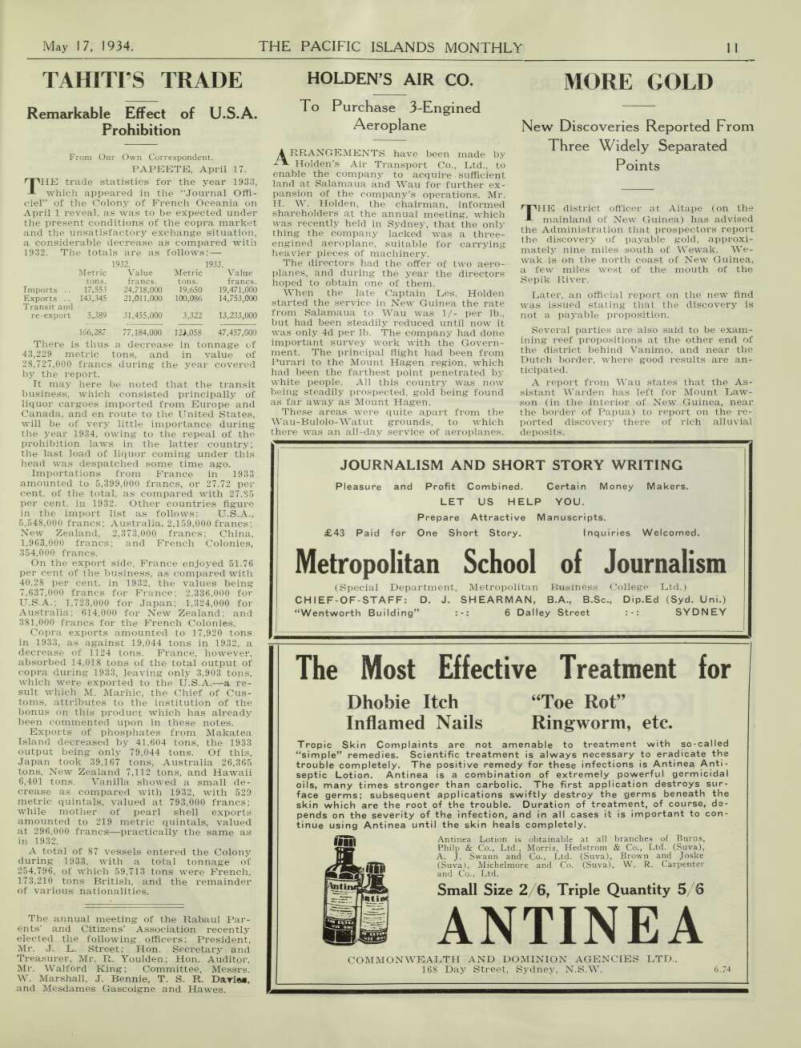
THE trade statistics for the year 1933, which appeared in the “Journal Offi ciel” of the Colony of French Oceania on April 1 reveal, as was to be expected under the present conditions of the copra market and the unsatisfactory exchange situation, a considerable decrease as compared with 1932. The totals are as follows:
There is thus a decrease in tonnage of 43,229 metric tons, and in value of 28,727,000 francs during the year covered by the report.
It may here be noted that the transit business, which consisted principally of liquor cargoes imported from Europe and Canada, and en route to the United States, will be of very little importance during the year 1934, owing to the repeal of the prohibition laws in the latter country; the last load of liquor coming under this head was despatched some time ago.
Importations from France in 1933 amounted to 5,399,000 francs, or 27.72 per cent, of the total, as compared with 27.85 per cent, in 1932. Other countries figure in the import list as follows: U.S.A., 5,548,000 francs; Australia, 2,159,000 francs; New Zealand, 2,373,000 francs; China, 1,963,000 francs; and French Colonies, 354,000 francs.
On the export side, France enjoyed 51.76 per cent of the business, as compared with 40.28 per cent, in 1932, the values being 7,637,000 francs for France; 2,336,000 for U.S.A.; 1,723,000 for Japan; 1,324,000 for Australia: 614,000 for New Zealand; and 381,000 francs for the French Colonies.
Copra exports amounted to 17,920 tons in 1933, as against 19,044 tons in 1932, a decrease of 1124 tons. France, however, absorbed 14,018 tons of the total output of copra during 1933, leaving only 3,903 tons, which were exported to the U.S.A.—a re sult which M. Marine, the Chief of Cus toms, attributes to the institution of the bonus on this product which has already been commented upon in these notes.
Exports of phosphates from Makatea Island decreased by 41,604 tons, the 1933 output being only 79,044 tons. Of this, Japan took 39,167 tons, Australia 26,365 tons, New Zealand 7,112 tons, and Hawaii 6,401 tons. Vanilla showed a small de crease as compared with 1932, with 529 metric quintals, valued at 793,000 francs; while mother of pearl shell exports amounted to 219 metric quintals, valued at 296,000 francs—practically the same as in 1932.
A total of 87 vessels entered the Colony during 1933, with a total tonnage of 254,796, of which 59,713 tons were French, 173,210 tons British, and the remainder of various nationalities.
The annual meeting of the Rabaul Par ents’ and Citizens’ Association recently elected the following officers: President, Mr. J. L. Street; Hon. Secretary and Treasurer, Mr. R. Youlden; Hon. Auditor, Mr. Walford King; Committee, Messrs.
W. Marshall, J. Bennie, T. S, R. Dariea, and Mesdames Gascoigne and Hawes.
1932. 1933.
Metric Value Metric Value tons. francs. tons. francs.
Imports 17,553 24,718,000 19,650 19,471,000 Exports 143,345 21,011,000 100,086 14,753,000 Transit and re-export 5,389 31,455,000 3,322 13,233,000 166,287 77,184,000 123,058 47,457,000
Aeroplane
Holden's Air Co.
To Purchase 3-Engined Aeroplane
ARRANGEMENTS have been made by Holden’s Air Transport Co., Ltd., to enable the company to acquire sufficient land at Salamaua and Wau for further ex pansion of the company’s operations. Mr.
H. W. Holden, the chairman, informed shareholders at the annual meeting, which was recently held in Sydney, that the only thing the company lacked was a three engined aeroplane, suitable for carrying heavier pieces of machinery.
The directors had the offer of two aero planes, and during the year the directors hoped to obtain one of them.
When the late Captain Les. Holden started the service in New Guinea the rate from Salamaua to Wau was 1/- per lb., but had been steadily reduced until now it was only 4d per lb. The company had done important survey work with the Govern ment. The principal flight had been from Purari to the Mount Hagen region, which had been the farthest point penetrated by white people. All this country was now being steadily prospected, gold being found as far away as Mount Hagen.
These areas were quite apart from the Wau-Bulolo-Watut grounds, to which there was an all-day service of aeroplanes.
More Gold
New Discoveries Reported From Three Widely Separated Points
THE district officer at Aitape (on the mainland of New Guinea) has advised the Administration that prospectors report the discovery of payable gold, approxi mately nine miles south of Wewak. We wak is on the north coast of New Guinea, a few miles west of the mouth of the Sepik River.
Later, an official report on the new find was issued stating that the discovery is not a payable proposition.
Several parties are also said to be exam ining reef propositions at the other end of the district behind Vanimo, and near the Dutch border, where good results are an ticipated.
A report from Wau states that the As sistant Warden has left for Mount Law son (in the interior of New Guinea, near the border of Papua) to report on the re ported discovery there of rich alluvial deposits.
Advertisements & other items, p. 13 (1 item)
Antinea
JOURNALISM AND SHORT STORY WRITING
Pleasure and Profit Combined. Certain Money Makers.
LET US HELP YOU.
Prepare Attractive Manuscripts. £43 Paid for One Short Story. Inquiries Welcomed.
Metropolitan School of Journalism
(Special Department, Metropolitan Business College Ltd.) CHIEF -OF-STAFF: D. J. SHEARMAN, 8.A., B.Sc., Dip.Ed (Syd. Uni.) “Wentworth Building” : -: 6 Dailey Street SYDNEY
The Most Effective Treatment for
Dhobie Itch
Inflamed Nails
“Toe Rot”
Ringworm, etc.
Tropic Skin Complaints are not amenable to treatment with so-called “simple” remedies. Scientific treatment is always necessary to eradicate the trouble completely. The positive remedy for these infections is Antinea Antiseptic Lotion. Antinea is a combination of extremely powerful germicidal oils, many times stronger than carbolic. The first application destroys surface germs; subsequent applications swiftly destroy the germs beneath the skin which are the root of the trouble. Duration of treatment, of course, depends on the severity of the infection, and in all cases it is important to continue using Antinea until the skin heals completely.
Antinea Lotion is obtainable at all branches of Burns, Philp & Co., Ltd., Morris, Hedstrom & Co., Ltd. (Suva), A. J. Swann and Co., Ltd. (Suva), Brown and Joske (Suva), Michelmore and Co. (Suva), W. R. Carpenter and Co., Ltd.
Small Size 2/6, Triple Quantity 5/6
ANTINEA
COMMONWEALTH AND DOMINION AGENCIES LTD.,
168 Day Street, Sydney, N.S.W. 6.74
New Britain Planters
From Our Own Correspondent.
Rabaul, Apr. 12.
OBJECTION has been taken to the statement, appearing in the March P.I.M., that the planters of New Britain are dissatisfied with the operations of the Executive Council of the Planters’ Asso ciation of New Guinea. It should have been pointed out that, whereas the New Britain branch is merely a local body of planters, the Executive is the body con trolling the many branches in the whole Territory.
Mr. Cutler, president of the New Britain branch of the Planters’ Association of New Guinea, states that the branch was formed solely for the convenience of the majority of planters in the Kokopo area and who, functioning in co-operation with the executive council in Rabaul, would be able to have a wider scope and thus assist the central body.
“There has never been a suggestion of dissatisfaction of any description,” said Mr. Cutler. “The planters of New Guinea realise —only too well —the good work which has been done by the Executive Council.”
Station
Townsville Radio
Special Broadcast for Islands
AT the recent Pacific Administrators’
Conference held in Canberra, Major C.
W. C. Marr, Minister-in-Charge of Islands Territories, stated that investigations were being made to evolve a scheme under which a special broadcast from Townsville would be made available to residents of the Pacific Islands.
In order to obtain more details of the scheme we wrote to the Postmaster-Gen eral’s Department of the Commonwealth Government at Melbourne. We have now received from the Director-General of that Department an official statement regarding the proposed broadcast.
The communication is as follows: “In connection with your inquiry of April 13, 1934, regarding Islands Broad casting Service, satisfactory reception of broadcasting in the Pacific Islands under the control of Australia presents some
difficulties in the absence of suitable sta tions in those territories.
“A short wave station, 3LR, located near Melbourne, is operating on a frequency of 9580 kc/s (31.31 metres), and recently commenced transmitting programmes of the National Broadcasting Service each evening between the hours of 6.15 p.m. and 10.30 p.m. daily, except Sundays. There is a possibility of satisfactory reception of this station in the Islands judging by re ports already received from other places.
“A contract has also been let for a high powered national broadcasting station at Townsville, Queensland, and it is antici pated that this station will be in operation by the end of the present year. It is ex pected that this station will give improved broadcasting facilities to listeners in the Islands generally.”
French Oceania
Inter-Islands Services
From Our Own Correspondent.
Papeete, May 1.
THE Messageries Maritimes Company has just announced certain changes in its Inter-Islands time-table which should be of interest to prospective visitors to French Oceania.
Instead of every seven weeks, as pre viously reported in these notes, there will be a voyage of four days’ duration through the Leeward Group in every month, from May to December, commencing from May 14.
The alternative itineraries through the Gambiers and the Tuamotu Archipelago will now be every month, instead of every seven weeks as before.
The abstract of average liabilities and assets of the Commonwealth Bank in the Mandated Territorv of New Guinea during the quarter ended March 31, 1934, shows deposits not bearing interest at £103,067; deposits bearing interest, at £81,244; coined gold, silver and other coined metals, at £5607; Australian notes at £10,135; and advances, etc., £2466.
Advertisements & other items, p. 14 (2 items)
Just off
the Press!
Secure your copy of the
CINE-KODAK &
KODASCOPE Catalogue
A very handsome pictorial production, just overflowing with information concerning every section of amateur movie work.
Covers complete range of Cine-Kodaks and Kodascopes, Cine- Kodak Safety Film, as well as information regarding making movies at night and all the latest in accessories.
IT’S FREE—POST THE COUPON NOW
TO KODAK ( AUSTRALASIA ) PTY., LTD.
Please forward me copy of the new Cine-Kodak Catalogue.
Name Address
KODAK (Australasia), PTY., LTD
379 George Street, Sydney.
And All States.
Enjoy a Comfortable
Shave with this Razor.
Please Write for Free Illustrated Catalogue for Knives, Razors Scissors, etc.
Best quality Sheffield Steel 4 in. 10/6 each Post Free for Cash.
W. JNO. BAKER LTD.
3 HUNTER ST., SYDNEY,
N.S.W.
Fijians Increasing
Colony’s Vital Statistics
OF scientific interest to all people con cerned with the future life and de velopment of the South Sea natives is the announcement by the Governor of Fiji that the number of Fijian births in 1933 exceeded the number of deaths by over 2,500. Speaking in the Legislative Council recently, he said that the number of births, at 3,393, is the highest recorded for the five-years period 1929-1933. The number of deaths was 1,713, which is the lowest rate per 1,000 during the same period.
This is most interesting because it sug gests that an intelligent race, once it re covers from the “impact” of European culture, may increase in numbers under the sympathetic care of a good Govern ment. Previously, the Maoris, under the clement treatment of New Zealand, were the only indigenous people of Polynesia and Micronesia definitely known to be in creasing in numbers.
During the early nineteenth century the devastating effect of Western civilisation, with its accompanying pestilences of con sumption, influenza, measles, venereal disease, etc., caused the Polynesian races to dwindle rapidly, and they have never since recoverd. Particularly in Hawaii, Tahiti, Cook Islands, and the Marquesas did the diseases of the white man ravage the native populations. The pathetic story of this tragedy is told by Frederick O’Brien in his famous book of the Mar quesas and the Marqesans, “White Shadows in the South Seas.”
Melanesian islands have not been pene trated by white men to such an extent as those of Polynesia, and the majority of Melanesian peoples have not yet been affected by western “culture.”
Cook Is. Oranges
Bad Fruit and Small Profits
Letter to the Editor I AM instructed to inform you that my Association takes strong exception to statements appearing in the issues of the “Pacific Island Monthly” of February 20 and March 16, 1934, in regard to the Cook Islands’ fruit trade.
The quality of Cook Islands oranges has steadily deteriorated in recent years and the shipments have been landing in New Zealand in very bad condition. The Cook Is. Administration has endeavoured to im prove matters, but notwithstanding strin gent regulations, the quality and condition of fruit on arrival in New Zealand has made it impossible to market the fruit at profitable prices.
Regarding the imputation that importers are making large profits, I am directed to state that importing firms are prepared to have their accounts checked. If it be proved they have made 6d per case profit on their importations from the Cook Islands during the past few years they are pre pared to donate £50 to any charity your Magazine cares to name, provided a simi lar sum is donated by you if it be proved that importers have not made 6d per case profit.
I am, etc.,
H. Fisher
Secretary, Auckland Fruit Importers’ Assn.
Auckland, New Zealand, April 13, 1934.
Polynesia
Radio In Eastern
New Wireless Stations
From Our Own Correspondent.
Papeete, May 1.
ANOTHER step in the linking up of the outermost parts of French Oceania has been completed by the establishment of a wireless station in Mangareva, the principal island of the Gambier Group, situated some 1000 miles from Papeete, In a south-easterly direction. The station is not yet open for public messages.
Other wireless stations in the Colony are at Raiatea and Borabora, two islands of the Leeward Group, and at Atuona and Taiohae, in the Marquesas Islands (Hivaoa and Nukahiva). All of these are available for public correspondence.
Further additions to the wireless system within the Colony are projected for the immediate future.
Advertisements & other items, p. 15 (1 item)
Strength!
PENTA
Marine Engines 3-90 h.p.
Utility Outboards 3-4 h.p.
Supplied to all Governments Prices Reasonable.
Particulars Nelson & Robertson
SYDNEY
Building up
Strength!
MILK ARROWROOT
Biscuits
"Best for Baby"
Nothing will make a quicker or more permanent improvement in your baby than Swallow & Ariell’s Milk Arrowroot Biscuits. This has been proved again and again by Australian mothers whose children TODAY stand as convincing proof of the body-building and strengthening qualities of these wonderful biscuits.
They are so pure, the milk and the arrowroot are to accurately apportioned, they art so universally successful, that you will see the necessity for insisting on "Swallow & Ariell’s” when buying Milk Arrowroot Biscuits.
Ash your Grocer!
Wherever you trade — buy Austalian
Anthropologizing!
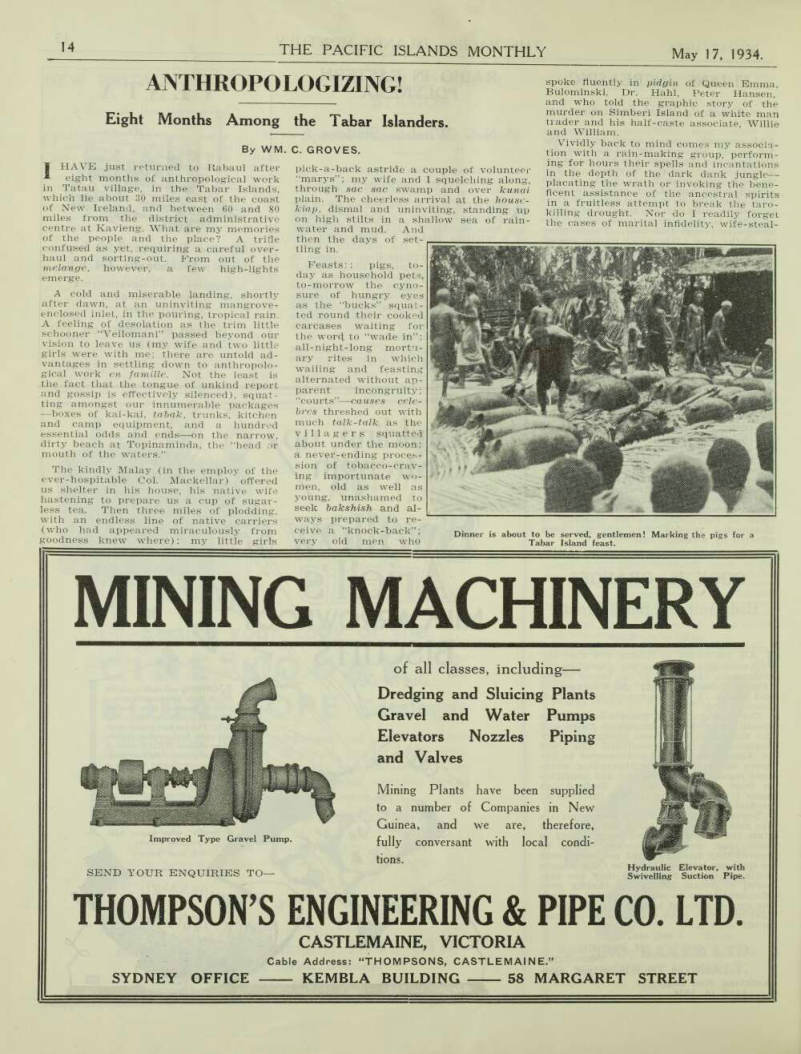
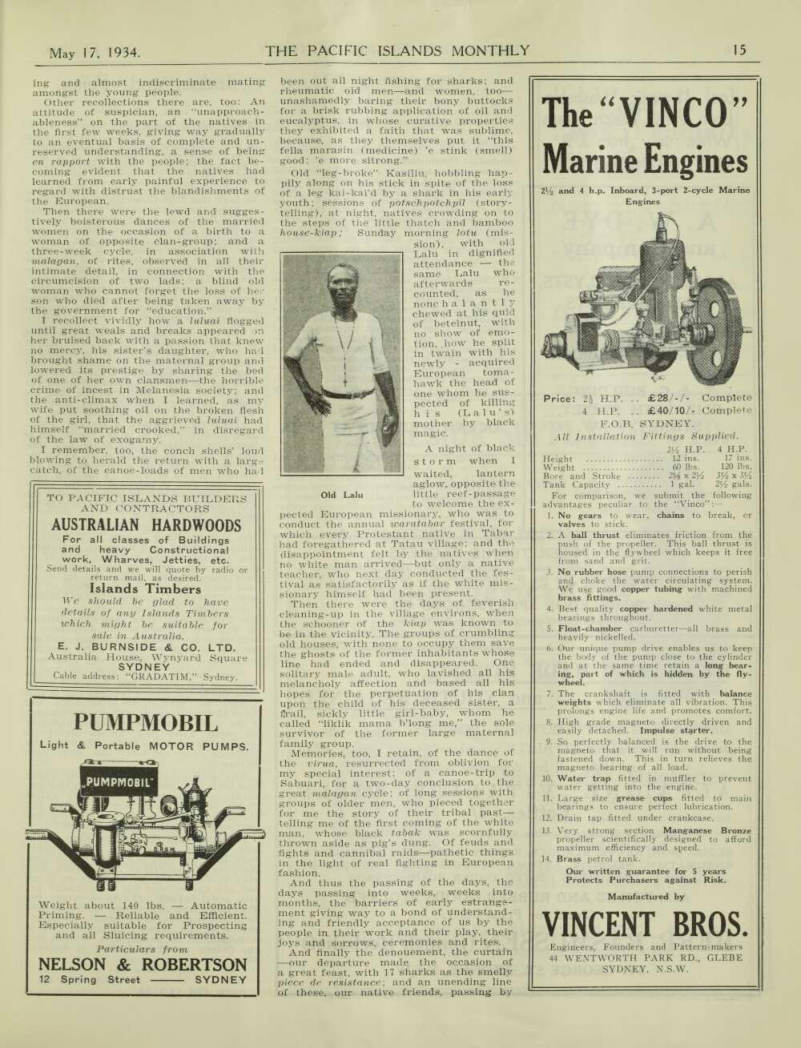
Eight Months Among the Tabar Islanders.
By Wm. C. Groves.
I HAVE just returned to Rabaul after eight months of anthropological work in Tatau village, in the Tabar Islands, which lie about 30 miles east of the coast of New Ireland, and between 60 and 80 miles from the district administrative centre at Kavieng. What are my memories of the people and the place? A trifle confused as yet, requiring a careful over haul and sorting-out. From out of the melange, however, a few high-lights emerge.
A cold and miserable landing, shortly after dawn, at an uninviting mangrove enclosed inlet, in the pouring, tropical rain.
A feeling of desolation as the trim little schooner “Veilomani” passed beyond our vision to leave us (my wife and two little girls were with me; there are untold ad vantages in settling down to anthropolo gical work en famille. Not the least is the fact that the tongue of unkind report and gossip is effectively silenced), squat ting amongst our innumerable packages —boxes of kai-kai, tabak, trunks, kitchen and camp equipment, and a hundred essential odds and ends —on the narrow, dirty beach at Topinaminda, the “head or mouth of the waters.”
The kindly Malay (in the employ of the ever-hospitable Col. Mackellar) offered us shelter in his house, his native wife hastening to prepare us a cup of sugar less tea. Then three miles of plodding, with an endless line of native carriers (who had appeared miraculously from goodness knew where); my little girls
pick-a-back astride a couple of volunteer “marys”; my wife and I squelching along, through sac sac swamp and over kunai plain. The cheerless arrival at the house kiap, dismal and uninviting, standing up on high stilts in a shallow sea of rain
water and mud. And then the days of set tling in.
Feasts; : pigs, to day as household pets, to-morrow the cyno sure of hungry eyes as the “bucks” squat ted round their cooked carcases waiting for the word to “wade in”; all-night-long mortu ary rites in which wailing and feasting alternated without ap parent incongruity; “courts” —causes cele bres threshed out with much talk-talk as the villagers squatted about under the moon: a never-ending proces sion of tobacco-crav ing importunate wo men, old as well as young, unashamed to seek bakshish and al ways prepared to re ceive a “knock-back”; very old men who
spoke fluently in pidgin of Queen Emma, Bulominski, Dr. Hahl, Peter Hansen, and w r ho told the graphic story of the murder on Simberi Island of a white man trader and his half-caste associate, Willie and William.
Vividly back to mind comes my associa tion with a rain-making group, perform ing for hours their spells and incantations in the depth of the dark dank jungle— placating the wrath or invoking the bene ficent assistance of the ancestral spirits in a fruitless attempt to break the taro killing drought. Nor do I readily forget the cases of marital infidelity, wife-steal-
Dinner is about to be served, gentlemen! Marking the pigs for a Tabar Island feast.
ing and almost indiscriminate mating amongst the young people.
Other recollections there are, too: An attitude of suspician, an “unapproach ableness” on the part of the natives in the first few weeks, giving way gradually to an eventual basis of complete and un reserved understanding, a sense of being en rapport with the people; the fact be coming evident that the natives had learned from early painful experience to regard with distrust the blandishments of the European.
Then there were the lewd and sugges tively boisterous dances of the married women on the occasion of a birth to a woman of opposite clan-group; and a three-week cycle, in association with malagan, of rites, observed in all their intimate detail, in connection with the circumcision of two lads; a blind old woman who cannot forget the loss of her son who died after being taken away by the government for “education.”
I recollect vividly how a luluai flogged until great weals and breaks appeared on her bruised back with a passion that knew no mercy, his sister’s daughter, who had brought shame on the maternal group and lowered its prestige by sharing the bed of one of her own clansmen—the horrible crime of incest in Melanesia society; and the anti-climax when I learned, as my wife put soothing oil on the broken flesh of the girl, that the aggrieved luluai had himself “married crooked,” in disregard of the law of exogamy.
I remember, too, the conch shells’ loud blowing to herald the return with a large catch, of the canoe-loads of men who had
been out all night fishing for sharks; and rheumatic old men—and women, too — unashamedly baring their bony buttocks for a brisk rubbing application of oil and eucalyptus, in whose curative properties they exhibited a faith that was sublime, because, as they themselves put it ‘‘this fella marasin (medicine) ’e stink (smell) good: ’e more sitrong.”
Old “leg-broke” Kasiliu, hobbling hap pily along on his stick in spite of the loss of a leg kai-kai’d by a shark in his early youth; sessions of potschpotchpil (story telling), at night, natives crowding on to the steps of the little thatch and bamboo house-kiap; Sunday morning lotu (mis-
sion), with old Lain in dignified attendance the same Lain who afterwards re counted, as he nonchalantly chewed at his quid of betelnut, with no show of emo tion, how he split in twain with his newly - acquired European toma hawk the head of one whom he sus pected of killing his (Lalu’s) mother by black magic.
A night of black storm when I waited, lantern aglow, opposite the little reef-passage to welcome the ex
pected European missionary, who was to conduct the annual waratabar festival, for which every Protestant native in Tabar had foregathered at Tatau village; and the disappointment felt by the natives when no white man arrived —but only a native teacher, who next day conducted the fes tival as satisfactorily as if the white mis sionary himself had been present.
Then there were the days of feverish cleaning-up in the village environs, when the schooner of the kiap was known to be in the vicinity. The groups of crumbling old houses, with none to occupy them save the ghosts of the former inhabitants whose line had ended and disappeared. One solitary male adult, who lavished all his melancholy affection and based all his hopes for the perpetuation of his clan upon the child of his deceased sister, a frail, sickly little girl-baby, whom he called “liklik mama b’long me,” the sole survivor of the former large maternal family group.
Memories, too, I retain, of the dance of the virua, resurrected from oblivion for my special interest; of a canoe-trip to Sabuari, for a two-day conclusion to the great malagan cycle; of long sessions with groups of older men, who pieced together for me the story of their tribal past— telling me of the first coming of the white man, whose black tabak was scornfully thrown aside as pig’s dung. Of feuds and fights and cannibal raids —pathetic things in the light of real fighting in European fashion.
And thus the passing of the days, the days passing into weeks, weeks into months, the barriers of early estrange ment giving way to a bond of understand ing and friendly acceptance of us by the people in their work and their play, their joys and sorrows, ceremonies and rites.
And finally the denouement, the curtain —our departure made the occasion of a great feast, with 17 sharks as the smelly piece de resistance ; and an unending line of these, our native friends, passing by
Old Lalu
(Continued from page 15.) to bid us individually au revoir, each offer ing some simple token of friendly remem brance—a dog’s tooth, a shell, a carved miniature malagan, a woman’s taro-peel ing shell.
Carriers on the move again; a laughing, heavily-laden line making for Topina minda. Ceremonial wailing on the beach as we made our way to the schooner. And a recurrence of that early feeling of deso lation and sorrow of the day of our land ing, as we stood against the back railing of the “Veilomani” watching the fast disappearing, mangrove and sago swampy shores of Tabar. Somehow one felt that one had been permitted, during those eight months, the rare privilege of sharing a primitive people’s life. * * * “You measure skulls and collect curios and all that sort of thing, you anthropolo gists, don’t you?” asked an enquiring lady tourist on our voyage home. And, absent mindedly, I answered in the affirmative.
For how could I explain to madam that we measure, not skulls, but human emo tions and motives; that, by the nature of our approach to them, we came to appre ciate the ethos of a primitive people— something of their racial spirit; to know, in short, and knowing, understand, the way of their life.
Advertisements & other items, pp. 16-18 (1 item)
Mining Machinery
Improved Type Gravel Pump.
SEND YOUR ENQUIRIES TO-
of all classes, including—
Dredging and Sluicing Plants
Gravel and Water Pumps Elevators Nozzles Piping and Valves Mining Plants have been supplied to a number of Companies in New Guinea, and we are, therefore, fully conversant with local conditions.
Hydraulic Elevator, with Swivelling Suction Pipe.
THOMPSON’S ENGINEERING & PIPE CO. LTD.
CASTLEMAINE, VICTORIA
Cable Address: “THOMPSONS, CASTLEMAINE.”
SYDNEY OFFICE —— KEMBLA BUILDING 58 MARGARET STREET
The “VINCO"
Marine Engines
2½2 and 4 h.p. Inboard, 3-port 2-cycle Marine Engines Price: 2½ H.P. .. £28/-/- Complete 4 H.P. . . £40/10/- Complete
F.O.8. SYDNEY.
All Installation Fittings Supplied. 2½ h.p. 4 h.p.
Height 12 ins. 17 ins.
Weight 60 lbs. 120 lbs.
Bore and Stroke x 2/t x Tank Capacity 1 gal. 2 y 2 gals.
For comparison, we submit the following advantages peculiar to the “Vinco”: — 1. No gears to wear, chains to break, or valves to stick. 2. A ball thrust eliminates friction from the push of the propeller. This ball thrust is housed in the flywheel which keeps it free from sand and grit. 3. No rubber hose pump connections to perish and choke the water circulating system.
We use good copper tubing with * machined brass fittings. 4. Best quality copper hardened white metal bearings throughout. 5. Float-chamber carburetter—all brass and heavily nickelled. 6. Our unique pump drive enables us to keep the body of the pump close to the cylinder and at the same time retain a long bearing, part of which is hidden by the flywheel. 7. The crankshaft is fitted with balance weights which eliminate all vibration. This prolongs engine life and promotes comfort. 8. High grade magneto directly driven and easily detached. Impulse starter. 9. So perfectly balanced is the drive to the magneto that it will run without being fastened down. This in turn relieves the magneto bearing of all load. 10. Water trap fitted in muffler to prevent water getting into the engine.
H. Large size grease cups fitted to main bearings to ensure perfect lubrication. 12. Drain tap fitted under crankcase. 13. Very strong section Manganese Bronze propeller scientifically designed to afford maximum efficiency and speed. 14. Brass petrol tank.
Our written guarantee for 5 years Protects Purchasers against Risk.
Manufactured by
VINCENT BROS.
Engineers, Founders and Pattern-makers
44 WENTWORTH PARK RD., GLEBE
SYDNEY, N.S.W.
TO PACIFIC ISLANDS BUILDERS
AND CONTRACTORS
AUSTRALIAN HARDWOODS
For all classes of Buildings and heavy Constructional work, Wharves, Jetties, etc.
Send details and we will quote by radio or return mail, as desired.
Islands Timbers
We should he glad to have details of any Islands Timbers which might he suitable for sale in Australia.
E. J. BURNSIDE & CO. LTD.
Australia House, Wynyard Square
SYDNEY
Cable address: “GRADATIM,” Sydney.
PUMPMOBIL
Light & Portable MOTOR PUMPS.
Weight about 140 lbs. Automatic Priming. Reliable and Efficient.
Especially suitable for Prospecting and all Sluicing requirements.
Particulars from
NELSON & ROBERTSON
12 Spring Street SYDNEY
Cool hygienic Washable Linen wrist Watch Straps White only Jrom
PIKE BROTHERS LTD
A. W. DYE
and Company
ASSAYERS, ANALYSTS,
METALLURGISTS
Buyers of Gold, Silver, Platinum, etc.
T. & G. BUILDING,
ELIZABETH STREET,
SYDNEY, N.S.W.
Established 1914.
Bankers: Commercial Bank of Australia, Ltd.
BLUE PETER TENNIS RACKETS
Are all made from seasoned English Ash, and are hand-made by expert craftsmen—not a mass production frame. Imperial Flat Top, 75/-; Commodore, 65/-; Commander, 50/-. Wimbledon Tropical or Klipspringer Gut Restrings, 20/-. If unable to obtain locally, write direct to
WIMBLEDON SPORTSGOODS CO.
Dymocks Buildings, George St., SYDNEY
WEAK MEN MADE STRONG
and YOUTH REGAINED
MEN who have LOST YOUTHFUL POWERS; whose brains are dulled; whose energy and VITALITY is weakened; whose memory is bad and faulty and feel despondent should take
ALKALINE VITALITY PILLS
Bottles, 6/-
(Send for Circular on Pills and Lost Vitality Treatment) BLOOD, SKIN, NERVE, BLADDER, KIDNEY, AND LIVER COMPLAINTS,
RHEUMATISM, NEURITIS, ASTHMA, SUCCESSFULLY TREATED BY
POST. (MEDICINES POSTED UNDER PLAIN COVER.)
ALL TOILET AND RUBBER GOODS STOCKED
(Send for Price List).
HERR RASMUSSEN (Danish Herbalist)
541 GEORGE ST., SYDNEY, N.S.W.
Ocean Tourists At Suva
The big P. and O. liner Strathaird arrived in Suva on a tourist cruise to Fiji on April 14. There were 1100 tourists on board.
Dances, sight-seeing drives, natives’ mekes and displays of fire-walking had been ar ranged and the passengers spent an enjoy able two days on Viti Levu before return ing direct to Sydney.
Indian and Fijian.
Letter to the Editor THE letter, under the caption of “A A Problem and a Curse,” that appeared in your February number, by “John Bull,” is vexatious and slanderous. It is one sided and contains gross misrepresenta tion of facts.
“John Bull” betrays bitter animus when he says that “the Governor does not seem to have the power either to protect the native Fijian, or assist British enterprise in Fiji. The Indian is pampered and spoon-fed both by Governor and Council.
The Indian is assisted in every way, whether he breaks the law or preaches sedition. His crimes are overlooked in many cases. Corruption is rampant.”
This statement which is nothing less than sedition, is entirely and utterly incorrect and unfounded. Sedition and corruption are unknown in Fiji.
The Fiji Government does its level best to protect and assist the native Fijian. It is not true that the Indian is pampered and spoon-fed both by Governor and Council. The Indian, as a matter of fact, does not receive the treatment meted out to others. It is equally untrue that the Indian preaches sedition and that his crimes are overlooked in many cases.
“John Bull” betrays a strange ignor ance of fact when he says “the Indian is becoming arrogant. He defies any one, and he considers the European as an in terloper.” This silly statement does not contain an iota of truth. I can only sup pose that this is pabulum for the Euro peans living in Fiji, in order to paint the Fiji Indians black and thus create an agitation against them.
The European and Indian subjects of His Majesty King George in Fiji live in mutual concord and harmony, maintain ing, not merely the material glory of an Empire more glorious than history has ever recorded, but sustaining its moral and spiritual basis in the interests of the great Britannic Commonwealth of Nations.
Satirically, “John Bull,” as a tirade on the Fiji Indians, says that “The Indians in Fiji are a problem and a curse . . .
Fiji in a few years cannot and will not be able to support them. India does not want them back. Where will they go?”
From this it is quite clear that “John Bull” is not aware and does not know that the Indians were brought out to this Colony for permanent colonization and have their permanent stake in the Colony.
I am quite at a loss to understand how on earth “John Bull” knows that India does not want them back. By such silly remarks, he exhibits his malevolent nature.
The statement that the native Fijian has been betrayed by the British Govern ment is palpably absurd. The native Fijian is very nicely treated by the Fiji Government, and he is given every op portunity in life to improve himself.
It is true that the Indians were origin ally brought out to this Colony under indenture, but that is a thing of the past.
Now we live in Fiji as free settlers. Our stay in Fiji is not beneficial to us alone, but the Colony and the Government de rive equal benefit. The Government, the European, and the native Fijian benefit to a very great extent from the man power of the Indian community. It is admitted, on all hands, that without this the Colony would be doomed to destruc tion.
I am, etc.,
J. A. Kirpal.
Suva, Fiji, 14/3/’34.
N.G. Planter Raided Again
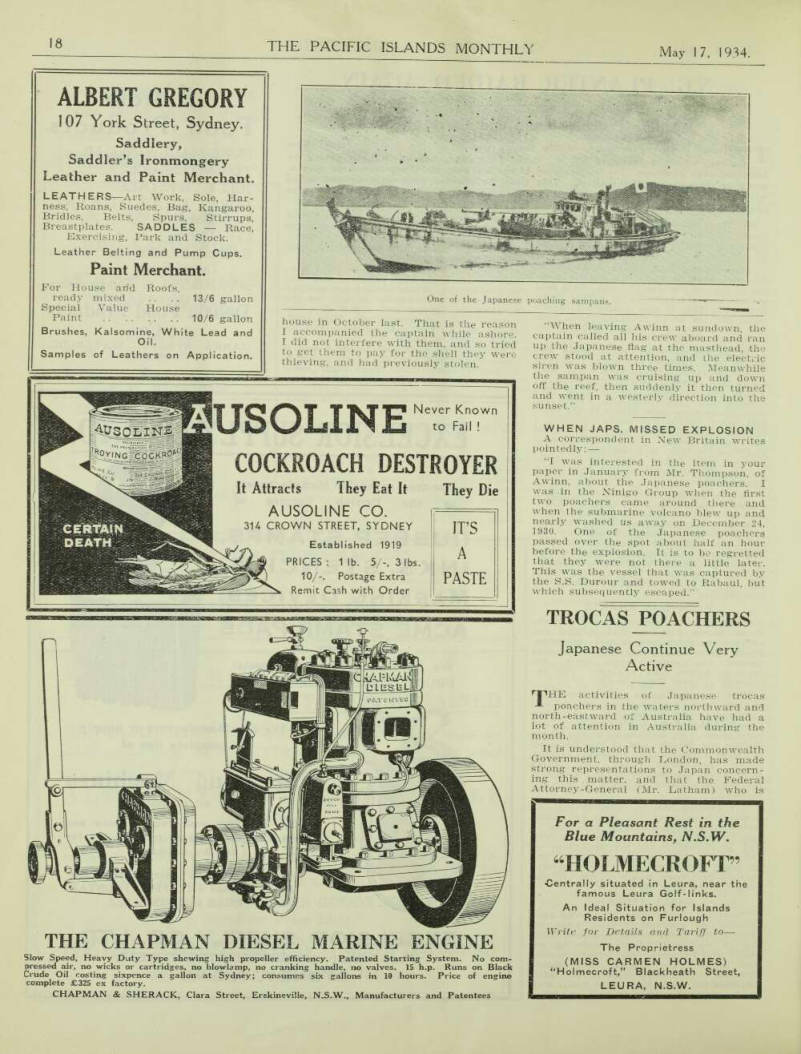
Japanese Poachers Land and Carry off Shell
THE lonely Awinn Plantation, in the Ninigo Group, off the north coast of New Guinea, which is managed by Mr. S. C. Thompson, has again been raided by Japanese shell poachers. On the occasion of the last raid Mr. Thompson fired several shots at them, but without effect. This time, he boarded their sampan and spoke with the captain. A quantity of trocas and greensnail shell was taken before the raider departed.
Mr. Thompson’s own account of the in cident, which he sent to the “Pacific Islands Monthly,” under date March 18, is as follows: “I have again been raided at Awinn by Japanese shell poachers in a similar man ner to that of October 27, 1933. This raid occurred on the morning of Friday, Feb ruary 16, 1934; it was conducted in the usual manner as of previous visits, only this time I was successful in getting into conversation with them.
“When one of their fishing boats was within forty yards of my house I showed myself to them, and in each hand, held above my head, I had trocas shell. I waded out to them, and they in turn climbed into their boat and waited for me. There were eight divers in the boat, and when within five yards of them, 1 showed them the shell and they smiled and “talked place.” I reached their boat and spoke to them in Australian and pid gin, but they either could not speak or would not, they only smiled and shook hands with me.
“In the meantime the sampan seeing the boat stationary, came back quickly. I managed to make them understand that I wanted to see the captain of the sampan, so I got into their boat (amongst my own shell) and was rowed out to the sampan.
The sampan was of exactly the same type as that pictured in your article of Janu ary 23, 1934, only it had wireless masts up, and I saw a small receiving and transmitting set.
Pacific Is. Charts
“The captain received me politely, shook hands with me and saluted me, offering me refreshments and cigarettes.
There were only twenty-four Japanese aboard the sampan this time, the captain, bo’sun and engineer, the re mainder of crew being divers.
“The captain seemed anxious to know if there were any steamers due to call at islands of the Ninigo Group, and when I replied that I did not know, he looked hard at me. He had charts of the North Pacific and Manila, and of the Mainland of New Guinea and adjacent islands, North Queensland coast, and Torres Straits. He also had prominent marks on the charts showing positions of wireless stations.
“I requested him to cease diving and demanded payment for shell previously stolen upon three occasions at Awinn. I also pointed to the place where his crew had previously burnt my sun-plant on October 27, 1933, but he only smiled and shrugged his shoulders. He suggested that we go ashore, which we did (accompanied by eight of his divers).
Shell Stolen
“Near my house there was some shell (trocas and greensnail) lying upon the ground. He spoke to his men, and turn ing to me. said, “You” (meaning the shell), and I replied “Yes” (that the shell was mine). The captain then walked through to the other end of the atoll, which is 800 yards long by 50 yards wide in the centre. I went with him, and when
we returned to the house his crew had taken away the last of the shell that was lying on the ground. I was very angry, and tried to tell him so, but he only shrugged his shoulders.
“They were here from 9 a.m. till 5 p.m., and got about six bags of trocas and four of greensnail. While aboard the sampan I requested the captain to lift up the hatches, he agreed, and I saw that the hatches were three-quarters filled with trocas shell. The hatches were 15ft. in depth by 9ft. in width.
“At one end of Saboh Island I had a copra house with 360 tons of sun copra in it and I was afraid they might come ashore and ‘cook’ it, like they did the sun-
house in October last. That is the reason I accompanied the captain while ashore.
I did not interfere with them, and so tried to get them to pay for the shell they were thieving, and had previously stolen.
“When leaving Awinn at sundown, the captain called all his crew aboard and ran up the Japanese flag at the masthead, the crew stood at attention, and the electric siren was blown three times. Meanwhile the sampan was cruising up and down off the reef, then suddenly it then turned and went in a westerly direction into the sunset.”
When Japs. Missed Explosion
A correspondent in New Britain writes pointedly: “I was interested in the item in your paper in January from Mr. Thompson, of Awinn, about the Japanese poachers. I was in the Ninigo Group when the first two poachers came around there and when the submarine volcano blew up and nearly washed us away on December 24, 1930. One of the Japanese poachers passed over the spot about half an hour before the explosion. It is to be regretted that they were not there a little later.
This was the vessel that was captured by the S.S. Durour and towed to Rabaul, but which subsequently escaped.”
One of the Japanese poaching sampans.
Advertisements & other items, pp. 19-20 (1 item)
Excelsior Supply Co. Ltd.
Delicia
Food Products
PURE MALT VINEGAR
TOMATO SAUCE
JELLY CRYSTALS
PURE FLAVOURING
ESSENCE
CHUTNEY
BAKED BEANS with Pork, in Tomato Sauce SPAGHETTI in Tomato Sauce
Delicia Food Products
Co.
DANKS STREET, WATERLOO,
N.S.W.
EXCELSIOR SUPPLY CO. LTD.
The most extensive Manufacturers In the British Empire of
RUBBER STAMPS,
INKS, STENCILS.
Marking Devices.
ACME STAMP PADS
We have a big range of Special
FRUIT CASE MARKING SETS
We also Manufacture or Supply a complete line of
Spraying Machines
for all purposes.
Let us know your requirements and we will quote you by return. Ask for our Big Catalogue.
Sole Australasian Distributors of the World Famous SHEAFFER FOUNTAIN
PENS and PENCILS.
EXCELSIOR SUPPLY CO. LTD
Head Office:—160 GEORGE STREET WEST,
SYDNEY. N.S.W.
ALBERT GREGORY
107 York Street, Sydney.
Saddlery,
Saddler’s Ironmongery
Leather and Paint Merchant, LEATHERS —Art Work, Sole, Harness, Roans, Suedes, Bag, Kangaroo, Bridles, Belts, Spurs, Stirrups, Breastplates. SADDLES Race, Exercising, Park and Stock.
Leather Belting and Pump Cups.
Paint Merchant.
For House arid Roofs, ready mixed 13/6 gallon Special Value House Paint 10/6 gallon Brushes, Kalsomine, White Lead and Oil.
Samples of Leathers on Application.
AUSOLINE
COCKROACH DESTROYER
It Attracts They Eat It They Die
AUSOLINE CO.
3U CROWN STREET, SYDNEY
Established 1919 PRICES: 1lb. 5/-. 3 lbs 10/-. Postage Extra Remit Cash with Order
IT’S
A
PASTE
THE CHAPMAN DIESEL MARINE ENGINE
Slow Speed, Heavy Duty Type shewing high propeller efficiency. Patented Starting System. No compressed air, no wicks or cartridges, no blowlamp, no cranking handle, no valves. IS h.p. Runs on Black Crude Oil costing sixpence a gallon at Sydney; consumes six gallons in 10 hours. Price of engine complete £325 ex factory.
CHAPMAN & SHERACK, Clara Street, Erskineville, N.S.W., Manufacturers and Patentees
Trocas Poachers
Japanese Continue Very Active
THE activities of Japanese trocas poachers in the waters northward and north-eastward of Australia have had a lot of attention in Australia during the month.
It is understood that the Commonwealth Government, through London, has made strong representations to Japan concern ing this matter, and that the Federal Attorney-General (Mr. Latham) who is
now en route to Japan, will deal also with the matter.
The Commonwealth Government, how ever, while arguing that the cost of meas ures against poaching should be borne by Japan rather than by Australia, does not propose to wait indefinitely. Already plans are afoot for the establishment of patrols in the form of fast motor launches which will be capable of pur suing the specially-engined sampans em ployed by the Japanese. The use of aero planes has been urged. Aeroplanes cer tainly would give the patrol a wider view, and could cover an immensely greater area of ocean, but otherwise the aero plane is practically helpless—unless it Could drop bombs on the poachers.
One serious difficulty before the Aus tralian authorities concerns their rights t© beds of pearlshell and trocas outside the three-miles territorial limit. It may be argued that, outside those limits, the Japanese have as much right to operate as have the British. It is disclosed, for instance, that Australia probably has no legal authority over the Great Barrier Reef.
The British Parliament has given the Australian Government a general power to control fisheries in “Australian waters.”
This power is understood to apply to waters outside the territorial limit, but the area to which it applies is not defined, and it is thought that in certain circum stances efforts to regulate the operations of vessels regarded as poachers might provoke a protest from the nation to which they belong. It is believed that the uncertainty can only be resolved by legis lation by the Federal Parliament.
The following appeared in Australian newspapers on April 13: — Mr. A. T. Sullivan, of Thursday Island, a partner in the pearl-fishing company of Morey and Co., said that there were two Japanese mother ships operating with their sampans in and close to Aus tralian waters. He is at present visiting Innisfail, inquiring into the Japanese vessel which was reported this week to be fishing for trocas shell.
Mr. Sullivan said he understood that there were 18 vessels in a Japanese fleet which had its headquarters in the Malay States. Some of them worked pearl shell, and the two which penetrated to Austra lian waters would probably remain for two or three months before returning to their bases.. The operations of the Japan ese had occupied the attention of the owners of the pearling fleet at Thursday Island, who had to pay Australian license fees, while the captains of the boats also had to be licensed.
Advertisements & other items, p. 20 (1 item)
“Holmecroft”
For a Pleasant Rest in the Blue Mountains, N.S.W.
Centrally situated in Leura, near the famous Leura Golf-links.
An Ideal Situation for Islands Residents on Furlough Write for Details and Tariff to — The Proprietress
(MISS CARMEN HOLMES)
“Holmecroft,” Blackheath Street,
LEURA, N.S.W.
Fine-Gold Saving Machine
Mr. Reginald Mcalister, Of High
Street, Bankstown, Sydney, has in vented and successfully demonstrated in the presence of a number of expert gold miners, a “fine-gold saving machine,” which he claims will greatly assist pros pectors and others in the search for gold.
During one demonstration a ton of “dirt” was put through the machine and old prospectors expressed surprise when specks of gold, some hardly visible to the naked eye and others which floated on the water used, were saved.
Simple in construction, the machine is driven by power, having a capacity to treat 20 tons of “dirt” a day easily. It can be assembled by two men and can
be used in any locality.-
S.L.
Japanese Sampan
Boarded by T.I. Lugger Crew
EARLY in March, another Japanese sampan marauder was reported to be operating near Thursday Island.
Later, interesting details regarding the vessel were supplied when survivors of the Torres Straits lugger Mildred, which was wrecked during a cyclone which swept the north coast of Queensland in March, reached Cairns. The survivors of the Mildred stated that on March 5, a few days before the cyclone, they boarded the mysterious vessel north of Cape Tri bulation, Queensland.
The vessel was a Japanese boat named the Eachi Maru, about 70 feet long, 18 feet beam, and with a draft of about 6 feet. It had an 80-horse power Japanese Diesel engine. There were more than 30 persons on board the vessel, which was procuring trochus shell and a certain weed used extensively in Japan for medi cinal purposes. There was a number of revolvers and rifles on board.
The Japanese informed the men from the Mildred that it would be all right if a Japanese boat approached, but if white men came near they would fire. The vessel was painted a dull white, and con tained no cabins, the crew sleeping on the hatch and deck. There was a small bridge on the vessel for look-out pur poses.
The Japanese on the sampan stated
that when they noticed any ships passing they all put on women’s clothing in order to give the impression that the sampan was a passenger boat. The Mildred and the sampan anchored alongside each other on the night of March 6, and shortly after dawn the sampan left. The follow ing morning a destroyer was noticed steaming towards Thursday Island, but the sampan by that time was well out of the reefs and out of view of the des troyer.
Advertisements & other items, pp. 21-22 (1 item)
Flour
Mrs. N. WALKER - FLYNN,
COSTUMIERE,
Market Street; RABAUL.
HEMSTITCHING and PICOT EDGING.
Copies of Mab’s Fashions; Roma’s Pictorial Fashions and Home Fashions available. — P.O. Box 116. Tel.: 141.
GOSHEN PRIVATE
HOSPITAL
(Sister E. W. TEAMAN), 37 Gloucester Road, Hurstville, Sydney General and Private Wards. Spacious Grounds. High and Cool Situation.
Moderate Fees.
Flour
ASK FOR IT
ESTABLISHED IB6S.
STEEL RAILS 8C RAILWAY EQUIPMENT
New and Good Second-Hand
RAILS 14 lbs. to 100 lbs. per yard; also Portable Track, Trucks of all types, Wheels and Axles, Points and Crossings, Turntables, Locomotives, Bolts and Nuts, Dogspikes, etc. We also carry stocks of New and Used Mining and Industrial Machinery of all descriptions.
Send us your enquiries. Prompt attention,
J. E. TOOLE & COMPANY
Engineering Contractors, Machinery Merchants and Agents
70 Hunter Street, SYDNEY
Telegrams and Cables: “Tooles,” Sydney.
M. HARPER,
MANDOLIANA ISLAND,
NORTH GELA, B.S.I.
Postal Address: P.O. Box 6, Tulagi, Solomon Islands.
Recruiting Contracts Undertaken.
Auxiliary vessel “Papari” available for Charter.
Full details of Services from
BURNS PHILP (S.S.) CO., LTD.,
Makambo (B.S.I.) and Sydney,
GLEBE
Engineering Works
Cook Street
GLEBE, SYDNEY
Telephone: MW1903 General and structural engineers, blacksmiths, boilermakers, oxy and electric welders.
Specializing in mining machinery, trucks, kipples, conveyors and elevators, water pipes.
Estimates Free of Charge Construction and machines made to any design.
The
“Caledonia Dover”
A COOKING STOVE guaranteed to give complete satisfaction and now recognised as THE BEST on the market. Suitable for coal, coke or wood fuel.
Illustrated Catalogue on request.
LANE & GIRVAN, LTD.,
BONNY BRIDGE, SCOTLAND.
HOTEL MANSIONS
Breakfast from 8/per night.
WEEKLY
from £2/2/-
SYDNEY’S IDEALLY SITUATED PALATIAL HOTEL
Renowned for Exquisite Cuisine, Perfect Service and Luxurious Appointments.
Make the Mansions your home whilst in Sydney and enjoy Unsurpassed Comfort at Moderate Cost.
INDIVIDUAL, DOUBLE ROOMS AND FAMILY SUITES
WIRES: “Mansions,” Sydney. ADDRESS: Bayswater Rd.,
INCLUSIVE
TARIFF:
Single Room from 12/per diem.
WEEKLY
from £3/10/- King’s Cross.
Mau Will Not Be Wooed
But Better Prices Compensate for Political Stalemate
From Our Own Correspondent
APIA, April 17.
THE expectations of optimists, that the conviction and exile of Mr. O. F. Nel son would mean the collapse of the Mau Movement, have, as foretold by the “old timers,” been disappointed.
Efforts have been made during the last weeks to bring the two factions (the Mau adherents and the Malo or Government supporters) together. Fonos and Taaloles have been held in Mulinuu, attended by both parties and by the most important Chiefs and leaders; and, several times, the Administrator himself and other high officials were present.
The result of all the efforts, and the pas sionate speeches made by representatives of all interested, has been nil. The Mau remained adamant and insisted on the impossible “conditio sine qua non”—viz., the immediate return of Nelson from New Zealand and remission of his sentence— before any further negotiations could be started.
So we are back again where we started.
It is gratifying, however, to report that in contrast to the political, the econmoic situation is considerably easier since my last letter.
Owing to a noticeable improvement in the European and American cocoa mar kets, the local cocoa price, which had dropped to the unprecedented low record record of £12/10/ per ton, delivered on the beach, has now been raised to £20 per ton.
This rate is still unprofitable to the Euro pean planter, but gives most encouraging prospects for further improvement at a time when the planters are bringing a very prolific crop in.
As previously stated, the natives in most districts and especially in Savaii had completely stopped cutting their copra, dis satisfied with the very low rate at which the merchants weighed the product in.
The Administration, therefore, has felt
compelled to make a second cut in the copra export duty, from £1 to 10/- per ton for native copra, and of 5/- for European copra. This has enabled the merchants to raise the price to natives from 1/- to 1/6 per 100 lbs. in Savaii and Upolu out-dis tricts and to 2/6 in Apia district.
Prior to the rise only one quarter to one third of the normal copra deliveries had reached Apia. The increased rate operates as from April 1.
Regarding bananas, the controversy be tween the fruiterers of Christchurch and Mr. Sullivan, M.P., on the one side, and Messrs. Turner and Growers and the Prime Minister on the other side, has been fol lowed here with considerable interest, and we are gratified to know that the good quality of the Samoan bananas is appre ciated in New Zealand.
We also notice that a far larger quan tity of bananas could be assimilated by the N.Z. market, and doubtless sufficient ba nanas would be available in Samoa, if only a larger carrier than the tiny “Maui Po mare” could be made available.
Samoa’s Political Future
From Our Own Correspondent.
APIA, April 20.
Mr. C. McKay, secretary of Native Affairs here, who has a thorough know ledge of the Samoan language, does not take a pessimistic view of the future. He thinks the recent reconciliation between the Mau and the Malo (loyalists) is a big step forward.
Although the Administrator’s extraor dinary patience in meeting the Samoan people in a series of conferences during March was without immediate result, it is believed that he has actually instilled a spirit of reconciliation and that they will presently become reconciled to the Ad ministration. There are indications al ready that a very large section of the younger Samoans are more interested in their village life, and in the newly-intro duced game of cricket, than in old-time political troubles.
The Administrator will be back at the end of May. Then, if there is no prospect of a settlement, it is possible that sterner measures may be taken to suppress the Mau altogether.
High Chief Faamuina.
The well-known High Chief Flame Faa muina, President of the Mau. was seated at his typewriter in his well-furnished fale at Lepea model village, when your corre spondent paid him a visit.
The giant Chief, whose splendid physique was much commented upon during his last visit to New Zealand, bade me a smiling
and jovial welcome. He showed me some books with personal dedications, pre sented to him by the famous author and artist, Hendrik van Loon, who passed through Samoa in February by the “Fran conia,” and who spent a few hours with the Samoan leader.
Regarding the political situation, how ever, Faamuina had little to say. Though he is the elected leader of the Mau, he has to do what the Council of Chiefs instruct him, and they insist, before any further discussions regarding the Samoan demands are started, that Nelson should be brought back to Samoa. Of course, they now want to wait for the result of Nelson’s appeal, in Wellington.
Faamuina, who talks English fluently, though with an accent, is moderate in his views and he told me that he very often has to suppress and object to foolhardy and impossible proposals of hotheads in the Movement, who want to risk an open clash with the Administration.
There are hopeful signs of the moderates in the Mau Movement gaining slowly but surely the ascendancy.
Magnificent Yacht
“Hussar” Causes Stir In Papeete
From Our Own Correspondent.
PAPEETE, March 22.
MANY private yachts call in at Papeete, ranging from tiny one-man craft, to palatial modern cruisers like the “Nahlin” and the “lolanda,” but we never have been privileged to see a more beautiful example of the ship-builder’s art than that pre sented by the yacht “Hussar,” when she came into port on March 12.
In the gracefulness of her lines, in lavish luxuriousness of appointments and equipment, and in sheer expensiveness, this vessel represents the last word in modern pleasure craft construction.
The “Hussar” is owned by E. F. Hut ton, New York stockbroker, whose brother is principal partner in the celebrated Woolworth ten-cent stores, and was built to his order at Kiel, Germany, in 1931. She is a four-masted barque, with a hull of Krupp steel, and top gear and rigging of English manufacture, and is of 2340 gross tonnage. Her machinery, which alone is stated to have cost her owner 2,500,000 dollars, consists of four Krupp Deisel en gines of 900 horse-power each for the generation of electricity, by means of which the ship is propelled when under power and by which her sails are operated when in use.
Naturally, there are electrical gadgets everywhere, including push buttons in every stateroom and gramophones cap able of playing 300 records automatically, to say nothing of a full sized talkie cinema outfit and an electrically operated laundry. Unfortunately, owing to the ab sence of wind, the sightseers along the waterfront were denied the pleasure of seeing this fine vessel come up under sail.
Mr. Hutton’s yacht flies the flag of the New York Yacht Club, and is said to have a cruising radius under power of 20,000 miles, without re-fuelling. She is com manded by Captain Larsen and carries a personnel of 72 officers and men, mostly Americans of Scandinavian origin.
The “Hussar” arrived here by way of the Panama Canal, having called in at the Galapagos Islands en route, and she left again for Honolulu after a very short stay of two days. With the exception of the owner and his wife and daughter, there were no passengers aboard the vessel.
And Clothes
Mission Natives’ Food
Letter to the Editor THE article of your correspondent who signs himself “Solomaniac,” published in the March issue of the P.I.M., is full of inaccuracies and malicious falsehoods.
Seventh-day Adventists do not prohibit natives of the Solomon Islands or those of any other South Sea Island Group, the use of flesh foods and fish as articles of diet.
The Book of the Sacred Law condemns swine’s flesh as food. This is the text book of Seventh-day Adventists, hence the tabu.
Leading medical men and anthropolo gists who have studied the question of diet for natives agree that tobacco, and betel nut, are definitely not beneficial to the physical and moral well-being of those who use them. Tobacco as used by natives is a most unclean habit. Betel nut chewing causes pyorrhoea, drugs the user and is a filthy habit. The eating of half-cooked swine’s flesh—the scavenger of the village —is most unhealthful and unhygienic.
The natives of the Territory of New Guinea are not prohibited from wearing clothes other than a lavalava. All the police boys in the Territory have issued to them each, a woollen pullover, shorts and khaki coat. Most of the women in the Territory wear blouses; in fact, in his own
village a native can wear just as much or as little as he desires. The women of the Solomon Islands are not compelled to wear bloomers, neither are the men compelled to wear singlets.
Your correspondent should first of all acquaint himself with facts and then write the truth. I am, etc.,
G. Mclaren.
T.N.G. Mission of Seventh-day Adventists.
Matupi, New Guinea, 4/5/’34.
Officials Nearly Drowned
APIA, April 10.
A remarkable accident occurred in the evening of April 6, when the Govern ment motor launch, “Tahutu,” which had made a trip to the Aleipata district for medical inspection and had the C.M.O., Dr.
Hunt, the matron and a nurse of Apia Hospital on board, on her return to Apia, with Harbourmaster Captain McClymont at the wheel, was run full speed on to the Mulinuu reef, in the harbour entrance, and seriously damaged.
Dr. Hunt, by the shock of the collision, was catapulted into the sea and very nearly drowned. A member of the crew then swam ashore and brought help to the ship wrecked people, who were taken ashore in a state of collapse.
The Harbourmaster explained by stating that he had misjudged the lights.
Advertisements & other items, p. 23 (1 item)
Burns, Philp
PRESCOTT LTD
are sole wholesale
PINEAPPLE BACON & HAMS
DAISY BRAND BUTTER
FRESCO BRAND BUTTER
LEA & PERRINS’ SAUCE
BURNS, PHILP
(South Sea) Co. Ltd.
Island Traders & Shipowners Registered Office: Suva, Fiji.
Also Branches at Fiji: Levuka, Lautoka, Labasa, Ba, Sigatoka, Rotuma.
Tonga: Nukualofa, Haapai, Vavau.
Samoa: Apia, Pago Pago (America Samoa).
Solomons: Makambo, Gizo, Faisi.
New Hebrides: Vila.
Gilberts: Tarawa.
Norfolk Is. Nauru. Niue. Wallis Is. Futuna Is.
Code Address: “Burnsouth.”
Brilliant Career Of
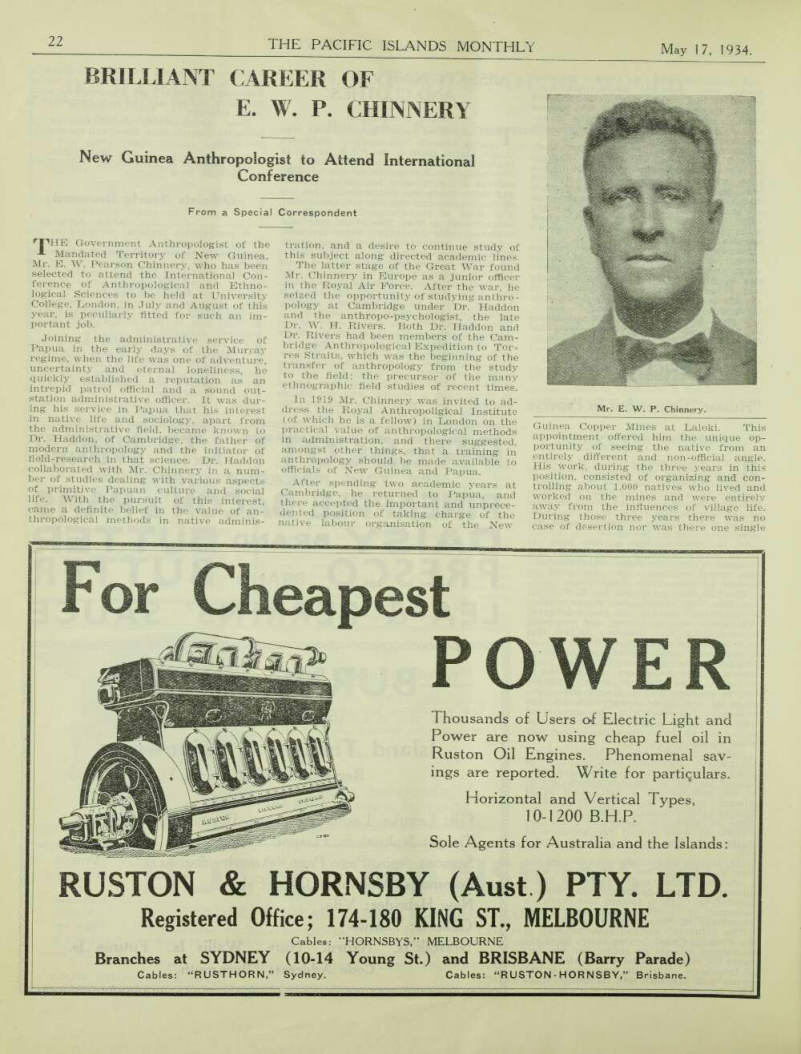
E. W. P. Chinnery
New Guinea Anthropologist to Attend International Conference
From a Special Correspondent
THE Government Anthropologist of the Mandated Territory of New Guinea, Mr. E. W. Pearson Chinnery, who has been selected to attend the International Con ference of Anthropological and Ethno logical Sciences to be held at University College, London, in July and August of this year, is peculiarly fitted for such an im portant job.
Joining the administrative service of Papua in the early days of the Murray regime, when the life was one of adventure, uncertainty and eternal loneliness, he quickly established a reputation as an Intrepid patrol official and a sound out station administrative officer. It was dur ing his service in Papua that his interest in native life and sociology, apart from the administrative field, became known to Dr. Haddon, of Cambridge, the father of modern anthropology and the initiator of field-research in that science. Dr. Haddon collaborated with Mr. Chinnery in a num ber of studies dealing with various aspects of primitive Papuan culture and social life. With the pursuit of this interest, came a definite belief in the value of an thropological methods in native adminis
tration, and a desire to continue study of this subject along directed academic lines.
The latter stage of the Great War found Mr. Chinnery in Europe as a junior officer in the Royal Air Force. After the war, he seized the opportunity of studying anthropology at Cambridge under Dr. Haddon and the anthropo-psychologist, the late Dr. W. H. Rivers. Both Dr. Haddon and Dr. Rivers had been members of the Cam bridge Anthropological Expedition to Tor res Straits, which was the beginning of the transfer of anthropology from the study to the field; the precursor of the many ethnographic field studies of recent times.
In 1919 Mr. Chinnery was invited to ad dress the Royal Anthropoligical Institute (of which he is a fellow) in London on the practical value of anthropological methods in administration, and there suggested, amongst other things, that a training in anthropology should be made available to officials of New Guinea and Papua.
After spending two academic years at Cambridge, he returned to Papua, and there accepted the important and unprece dented position of taking charge of the native labour organisation of the New
Guinea Copper Mines at Laloki. This appointment offered him the unique op portunity of seeing the native from an entirely different and non-official angle.
His work, during the three years in this position, consisted of organizing and con trolling about 1,000 natives who lived and worked on the mines and were entirely away from the influences of village life.
During those three years there was no case of desertion nor was there one single
Mr. E. W. P. Chinnery.
complaint laid to the Government by any native employee. Mr. Chinnery was, in effect, the welfare officer of the labourers.
In 1928, Section 2 of the Pan-Pacific Science Congress, held at Melbourne, asked the Commonwealth Government to give consideration to the appointment of a Gov ernment anthropologist to New Guinea (Papua had done so in 1921, thus leading the world in this important step); and to endow a Chair of Anthropology at Sydney University, introducing the cadet training system to New Guinea. Both suggestions were favourably received by the Common wealth Government and Mr. Chinnery was the obvious choice for the post of Govern ment Anthropologist.
Arriving in Rabaul in 1924, he quietly set about the enormous job of reducing to some order the mass of data already gath ered regarding native cultures in the Ter ritory. He published six comprehensive official reports, and was largely instru mental in getting the Australian National Research Council interested in the New Guinea field of research for its workers, under the Rockefeller fund. In 1931 he visited U.S.A. as a Rockefeller travelling research-fellow, and there studied certain aspects of demography. The same year he accompanied the Australian delegation to the League of Nations as adviser, and gave interesting illustrated talks to the august Mandates Commission as well as in Paris and London.
In 1932, when there was a unification of all sections of the Administration that were concerned with native affairs, he became the first Director of Native Affairs and District Services, which position he still holds. He is, ex-officio, a member of the newly-created Legislative Council of New Guinea. In that year, too, he was President of Section F of the Australian Association for the Advancement of Science, his presidential address, in Syd ney, being a survey of the subject of Applied Anthropology in New Guinea, which subject he approached from his customary practical angle.
For long years Mr. Chinnery, in his quiet and unobtrusive way, and in defiance of an almost unimaginably hostile European community, waited to see the day when in New Guinea there would be a body of re search workers engaged in the systematic study of the native, and handing on their knowledge to the Administration to de
cide on policies to be adopted. Now, only in the early forties, there should be long years of useful service ahead of “Chin.”
A good companion and an excellent racon teur, adaptable to almost any situation or assembly, he will worthily represent Australia at the important conference where the whole world will be represented, and he will, it is believed, go on to Geneva later to assist our representatives before the League of Nations.
Good luck, “Chin.”! The goodwill of all who acknowledge allegiance to Anthropos goes with you!
Advertisements & other items, p. 24 (1 item)
For Cheapest
POWER
Thousands of Users of Electric Light and Power are now using cheap fuel oil in Ruston Oil Engines. Phenomenal savings are reported. Write for particulars.
Horizontal and Vertical Types,
10-1200 B.H.P.
Sole Agents for Australia and the Islands:
RUSTON & HORNSBY (Aust) PTY. LTD.
Registered Office; 174-180 KING ST., MELBOURNE
Cables: “HORNSBYS,” MELBOURNE
Branches at SYDNEY (10-14 Young St.) and BRISBANE (Barry Parade) Cables: “RUSTH ORN,” Sydney. Cables: “RUSTON - HORNSBY,” Brisbane.
Hurricane Causes Damage
In N. Caledonia
NOUMEA, April 4.
THE hurricane which occurred here on March 26 was one of the worst on re cord. Much damage was done to planta tions and to small craft, both in New Caledonia and New Hebrides. Many plantations in the latter group have been ruined, particularly on Santo.
A disaster occurred on the west coast of New Caledonia. The steamer St. Jo seph was towing one of the hulks, which are used for transporting ore from one of the mines at Voh. The storm over whelmed the hulk and it foundered, witn 19 persons aboard, including one woman.
All were lost.
The mission ketch Patteson —which had made three attempts to get to New Heb rides from Sydney—left Noumea just be fore the hurricane. It was not heard of for a week, and everyone was sure it was lost. It duly appeared at Vila, however, after a very rough trip.
N.G. Air Mail Fee
The deputy director, post and telegraphs department (Mr. Lawson) advises that the air mail fee for Port Moresby-Wau-Bulo lo-Salamaua air mail service, has been reduced from 2d to 1½d per oz. The new rate is in addition to ordinary postage.
Advertisements & other items, p. 25 (1 item)
Holbrook
The House of
In the old world village of Stourport, Worcestershire, England, just at the point where the River Stour empties itself into the Severn, the House of Holbrook was founded 135 years ago.
In 1919 a factory was established in Sydney, N.S.W., to supply the requirements of Australia, New Zealand and the Pacific Islands. Here are manufactured a wide variety of table delicacies, as well as Holbrook’s Sauces and Pure Malt Vinegar, for which the House of Holbrook has been famous throughout the world for many generations.
There is Essence of Anchovy for fish, Tomato Sauce, made from fresh, ripe tomatoes; French and Italian Olive Oil, with a delicate, creamy taste —so nice with the salad and of such nutritious value for invalids, French Capers, Olives, in many varieties, from Spain; tiny sweet Gherkins and little White Onions, Fish and Meat Pastes, Flavouring Essences and endless other delicacies.
Holbrooks’ Baked Beans, with Pork and Tomato Sauce; tinned Spaghetti and Soups are also tasty and delicious.
Holbrooks (A / sia.)
Ltd.
WATERLOO, N.S.W.
The No. 7W. “Younger Range can now be Do You Know that the Famous
“YOUNGER”
STOVES AND
RANGES
made with extended Firebox specially for long Wood fuel, are Self-Setting and, provided sufficient Flue Piping is attached, can be used in almost any position? supplied fitted with Legs, as per illustration.
Ask for quotation for this Range, also Illustrated Catalogue and Price List for both Single and Double Oven Stoves.
Younger Stoves are Widely Used Throughout the Pacific Islands.
G. FLETCHER & SON 50 Oxford Street, Sydney
Attack On Larkin Brings
Protest From N.G.
In the February issue of the P.I.M. we published a letter regarding the Larkin case from a correspondent in Sydney who signed himself “N.G. Planter.” In this letter the writer stated that James Larkin, whose case is well-known to all residents of Melanesia, had a bad record. He contented that the sentence of ten years' hard labour was fully justified.
By the last New Guinea mail we received numerous letters protesting against what one correspondent called “ the vindictive and malicious inaccuracies of one who had probably never been in the Islands.” We publish below three letters typical of others we received.
Letter to the Editor
Your correspondent who signed himself “N.G. Planter of Sydney” writes suspiciously like a member of the genus that W. Lucas, of B.P. and Expro. Board fame termed “Balmain Bushmen," or “Pitt Street Planters.” Even if “N.G.
Planter” has ever been in the Islands, by his letter he has admitted that he has never handled natives.
He believes “there was one occasion when Larkin very narrowly escaped a severe sentence at the hands of a respon sible D.O.” It is quite safe and very game to publish one’s belief of a man when it is utterly impossible for the said man to reply or even attempt to defend himself. Jim Larkin is considered to be one of the few white men who kept Manus safe for whites, and in this no D.O., responsible or otherwise, is included.
More white men have been murdered and murderously attacked in Manus than in any other district, although it is the smallest. Among the more recent crimes, a German was hacked to pieces in cold blood, his murderers were executed owing to the crime happening in the days of the Military Occupation. The lads lacked foresight; had they delayed the attack a little they could have escaped comfortably.
I have had sixteen years’ experience here, and in the opinion of old-timers Jim Larkin is a martyr to the old regime, when every native was right and every white man wrong, except, of course Govt officials.
“N.G. Planter” mentions Jim Larkin’s record. Does he realise that every headmaster of every school in the world had a worse “record”? Two open-handed smacks given to insolent natives consti tute a “record” in New Guinea. If “N.G.
Planter” has a child and has trained that child in the way it should be he has an infinitely worse “record” than Jim Lar kin had prior to his last conviction.
I can only repeat my doubt whether
“N.G. Planter of Sydney” has ever seen New Guinea.
I am, etc.,
N.G. Planter Of New Guinea.
N. Guinea, 24/3/’34.
Unreliable Native Evidence
Letter to the Editor I HAVE lived many years in New Guinea, and think I understand the native mind as well or as little as any white man can. I wish to state that the most vital point in the Larkin case has been completely lost sight of, that is, his conviction upon native evidence.
Recently such a glaring case of the ab solute untrustworthiness of such evidence came to light that I feel it my duty to air same. I am aware that in the Larkin case a white medical assistant’s evidence was accepted, but his evidence was not of the actual occurrence. In support of my contention of the utter unreliability and danger of accepting native evidence I will quote two recent happenings that can be proved to the hilt, and there have been dozens of similar occurrences. 1. An anthropologist of world renown, innocent of any crime, had a narrow es cape from having to face a charge of murder. At an inquiry into the death of a native, held by a D.O., natives gave evidence to the effect that the anthro pologist was responsible for the boy’s death. With other natives ready to cor roborate the native’s evidence, there was every chance of the anthropologist “going along,” perhaps aloft also.
Luckily for him, the anthropologist knew the natives’ language, and with this to aid him, forced the natives to admit they were lying. When asked by him why they lied on such a grave charge, they replied, “We thought the D.O. wanted us to say it.” But for his know ledge of languages we may have had the spectacle of a noted and perfectly inno cent scientist joining James Larkin in gaol. Unfortunately in most cases the
natives think the D.O. or Judge “wants them to say so.” 2. I attended a trial in Rabaul recently when a white man was charged with assaulting a D.O., for which he could have received a long term of imprison ment. The D.O. in his evidence under oath, stated that the defendant struck him with a very light back-handed slap in the face, like a contemptuous flick, not hard enough to hurt a child.
A trusted native police sergeant and a native Chief, also under oath, when asked how the blow was given, stated in identi cal words, and with identical gestures, il lustrated in court, how the defendant brutally punched the D.O. in the face whilst he was seated, smashing in his face, knocking him on his back with blood flying everywhere.
No voice was raised at these well rehearsed lies. At the conclusion of the trial an official was approached regard ing the natives perjury and he replied airily, “Oh well, they both belong to the Government, you know, and thought they were doing the D.O. a good turn.”
On the evidence of native witnesses, James Larkin, one of the whitest men who ever served on the Western Front or settled in the Western Islands, is serv ing ten years’ imprisonment in N.S.W.
It is not realised that a lone white man managing a big gang of natives is ab solutely at the mercy of their massed perjury and conspiracy, particularly if the natives have an idea that their master is not popular with the Government and that if they thought the D.O. “wanted them to say so.”
British justice demands an immediate review of the Larkin Case.
I am etc.,
New Guinea,
Namanula.
26/3/’34.
Result of Official Weakness
Letter to the Editor.
AS a planter of seven years’ experience in the Mandated Territory, I was astonished to read in your February issue the letter signed “N.G. Planter” on the Larkin Case.
In my humble opinion any planter who thinks that James Larkin was justly treated is of such an unjust and cruel nature, that he himself would be cap able of almost any crime had he been placed in the position James Larkin un doubtably was.
The whole trouble was caused through the weakness of Government officials in Manus in dealing with unruly natives.
I am etc.,
Another N.G. Planter.
Rabaul. 22/3/’34.
Advertisements & other items, p. 26 (1 item)
Propeller Shafts
FOR STRENGTH, RIGIDITY, RESISTANCE TO CORROSION, DURABILITY.
The Perfection of Straightness to which Monel Metal Shafting is drawn ensures Dynamic Balance—its remarkable rigidity minimises vibration and whipping.
Monel Metal is also stocked in Sheets, Wire, Flats, Hexagon, Tubes and Woven Wire insect screen. Monel Metal Shafting up to 3 inches diameter on hand.
WRICHT & COMPANY
81 CLARENCE STREET, SYDNEY
Cables: “CORNRIGHT,” SYDNEY
Uniformity
Keynote of Administrators’
Recent Conference
THE Conference of Pacific Administra tors was held in Canberra just before we went to press in March and we were able only to indicate briefly the nature of its discussions and recommendations.
It is believed that, as a result of the Conference, there will be closer co-opera tion between Administrators and that an effort will be made by everyone concerned to co-ordinate more closely the laws and regulations under which the four Terri tories (Papua, New Guinea, Norfolk Island and Nauru) are governed by Australia.
The Minister-in-Charge of Island Terri tories (Major Marr), in his opening address to the Conference on March 12, made this interesting statement: “From our assumption of responsibility for the control of the first of these terri tories —Papua, in 1905 —the Australian ad ministration was extended in 1913 to Nor folk Island; in 1920, under mandates of the League of Nations, Australia was vested with the care and administration of New Guinea, and, in conjunction with the British and New Zealand Governments, of Nauru. Acquired at such different periods, ordinances were promulgated as required to meet the continuous develop ment in each territory.
“As, broadly, the principles of adminis tration are the same, I believe that a round table conference such as this will result in an interchange of views and illustration of methods which must prove of benefit to the Territories and to the Commonwealth.
“For instance, New Guinea and Papua, adjoining as they do, need uniformity in matters such as mining, education, native labour and many other things. Much has been seen in other parts of the trouble and expenditure caused through different stan dards and laws operating within a distance of a few miles and I have no doubt that all realise the necessity of preventing such an anomalous condition of affairs coming into being in our Territories. Health and the prevention of disease are common to all, and should offer an early field for the codifica tion of laws and ordinances.
“There are many vital matters affecting the services in relation to the conditions of the staffs, particularly those of employ ment and superannuation. There are so many points inviting attention that we must envisage in the future the practicabil ity of the establishment of an Australian Territorial Service upon the lines of the British Colonial Service. It will be appre ciated, therefore, if you, the Administra tors, bear that point in mind, not as an immediate measure but, as intimated be fore, a future aim.
“The Territories are a responsibility of the Commonwealth and each year a sub stantial amount appears on the Common wealth Estimates as a subsidy. As our national income has dropped so consider ably it may be taken for granted that the Territories in turn desire to assist Austra lia. By extensive development of their own resources to increase further their own incomes appears to be the only method by which this can be brought about.”
Captain W. Stewart, of Suva, Fiji, and master of several inter-island vessels, ar rived by the Aorangi on April 20, follow ing a cabled request that he should take a sailing vessel from Sydney to Suva. He received the message two hours before the Aorangi sailed.
Advertisements & other items, p. 27 (1 item)
Powerplus
“POWERPLUS” REPAIR OUTFIT
for Big Punctures or Blow-Outs
Quick —Safe—Enduring—Self-Vulcanising
Guaranteed not to lift in the hottest weather Powerplus Tube Repair Outfits stand up to the most severe conditions in New Guinea, Darwin, Fiji, etc. “Powerplus” is the only patch that will not lift under the terrific heat of these territories. A thorough job guaranteed!
Large Outfit, 5/-. Medium Outfit, 3/6.
Each contains Rubber, Cement, Scissors and Roughener.
“Powerplus” 5-Minute Vulcanizer
Complete with Damp proof Patches, 5/- each.
“Powerplus” 5-Minute Vulcanizer Patches
(Damp-proof)
Tins of 12 patches, 2/6 each; tins of 6 patches, 1/6 each.
“Powerplus” Black Hood
Dressing
15oz. tins, 3/- each; ½ pint tins, 2/- each.
“Powerplus” Gasket Cement
2oz. bottle, with Brush, 1/- each; ½ pint tins, 2/3 each.
“Powerplus” Radiator Cement- Powder Large, 2/9 each; Small, 1/- each.
And many other dependable lines.
Makers of Powerplus Products:
NORMAN C. PORTER & Co. Ltd.
324 Cleveland Street, SYDNEY Address all mail: Box 8, P.O., Surry Hills, Sydney.
All “Powerplus” Products obtainable from all branches of W. R. Carpenter & Co., Ltd., or Burns Philp, Ltd., or we will gladly send C.O.D. freight free any article required.
Garage Proprietors and Storekeepers. Liberal Discounts from these prices are obtainable.
Trade enquiries invited.
POWERPLUS
O. F. Nelson, Of Samoa.
His Extraordinary Rise and Remarkable Character
From Our Own Correspondent.
THE most remarkable trial ever held in a Samoan Court—the case against O.
F. Nelson on a charge of sedition—is over now and has ended with the conviction of the accused, a prison sentence of eight months and exile from Samoa for 10 Nelson has been sent away to New Zealand, though he was later granted bail until the hearing of his appeal before the Supreme Court of New Zealand at Wellington. It was intended to carry the case, if the decision of the Supreme Court should confirm the Apia decision, right to the Privy Council in London, the highest judicial authority of the British Empire.
Who is this man, who has managed to be in the limelight of Samoan politics for the last eight years, who has obtained such a remarkable influence over the Samoan natives and whose stubborn and practically single-handed struggle against the New Zealand Administration of the Mandated Territory of Western Samoa, has caused the latter such a lot of trouble and expense? From the beginning of the "Mau" Movement, he has been the driving power behind the natives, supplying the spiritual weapons and a large portion at least of the necessary funds to continue the fight.
Nelson was born in Samoa 56 years ago, the son of a Swedish mariner and a Samoan woman of a chiefly family, of the Savaii village of Safune. He was educated at the Marist Brothers School at Apia,
where most of the local-born boys re ceived their education. He was a remark ably intelligent scholar and, after leaving school, he entered the service of the Ger man D.H. & P.G., as office boy and appren tice. His father, having settled in Samoa as one of the numerous traders for the German firm, later started trading on his own account, and young Olaf entered his father’s firm, of which he became the head several years before the war, after his father’s death. He married Miss R. Moors, daughter of that veteran trader, pioneer and friend of R. L. Stevenson, who played such a prominent part in Samoan politics and literature.
After he left school, .O. F. Nelson pro ceeded to educate himself by self-study, helped by remarkable mental gifts and a wonderful memory.
Though he was a shrewd business man, having benefited by his apprenticeship with the German firm, and though he did a fair enough business, he was unable to extend his operations much, owing to the power and old-established reputation of the D.H.P.G., which company held what amounted to a monopoly in Samoa. His opportunity, however, came with the out break of war. Samoa was occupied by New Zealand troops.
Under the Military Occupation, the Ger man firm was liquidated and prohibited from exporting and importing, and Nelson saw, like many others, his opportunity. He captured a large share of the business.
Copra, needed badly for war purposes, reached a price level never dreamed of formerly, and the firm of O. F. Nelson and Son, as it was then styled, reaped enor mous profits. It occupied first place in the trading community of Samoa. In later years, when the Mau, under Nelson’s leadership, had started its struggle against the Administration, a high official of the latter once stated, referring to Nelson: “New Zealand has made him and New Zealand will break him.”
Nelson was not a figure of importance under the German Government; he was simply one of a number of well educated and intelligent local-born boys, and did not interest himself socially or politically. A hobby of his was Samoan history, folklore and family history; and, as proof of a mar vellous and extraordinary memory, he could in congenial society enumerate end less generations of Samoan ancestors by name; give genealogical items and details, never related in books; and visibly enjoy delving into Samoan stories.
Shortly after the war, Nelson took over the business of his father-in-law, H. J.
Moors, and amalgamated that trading concern with his own firm. At that time, the firm was at the peak of prosperity with over 40 trading stations in the group, and offices in Auckland and Sydney.
Nelson was now an outstanding person ality on the Apia beach; and, knowing his thorough acquaintance with all things Samoan, several of the New Zealand Ad ministrators, Colonel Logan, Colonel Tate, and later, General Richardson, sought his advice occasionally and were on a friendly footing with him. He became a leading member of the Legislative Council.
It is not known when the idea to become political leader of the Samoans first en tered his head. His great success as a business man perhaps caused him to look for laurels in other fields. In the terrible
influenza epidemic of 1918/19, which rav aged Samoa and cost thousands of lives, Nelson lost his mother, his only son, and his only brother, with several other rela tives. It was rumoured that when Nelson went to Europe, England and the Con tinent after the war, and was travelling about in the style of a wealthy man, that he was snubbed in England on several occasions on account of his colour, and that he returned with very bitter feelings against the white race. Though his stand ing with the Administration was excellent at the time and, after he had become a naturalized Britisher, it was whispered that a knighthood was within his reach, Nelson chose the other way, and went into opposition. In October, 1926, the Mau Movement was started, of which he has been the leading and most active figure ever since.
He now is fanatically devoted to the Mau cause. His critics say that self ag grandisement and vanity play an import ant part in his mental outlook. This is indicated by some of the statements he made in letters and documents found by the police in his possession.
Though his trial was a terrific strain on him, he triumphantly believed that he had succeeded in giving publicity to all his numerous grudges and complaints, during the hearing, and that, for the first time, he had been able to give a complete story of the Mau Movement to the world.
We must give Nelson credit for sin cerity of purpose, and a true and heartfelt love of his native country—sentiments which, indeed, he has proved not by words and empty phrases, but by personal sacri fice and suffering. But the methods he used were not always fair and proper; though he asserted they were, and blamed his associates for any lapses, maintaining at the same time that he was never given a fair deal by the Administration.
Several times, it is said, when a settle ment of the trouble was within reach. Nel son was approached; and practically all the various and far-reaching demands of the Mau would have been granted by a weary Administration. But Nelson refused to be tempted by personal advantage, and insisted on points which the Government was unable to concede.
Perhaps international politics have con tributed, in a certain degree, to strengthen his determination and stubbornness. Pic tures of Mussolini, de Valera, and Hitler, successful dictators and leaders of their peoples, may have inflamed his imagina tion. One of his last orders before the famous raid on his residence was to intro duce the Fascist Salute for the Mau ad herents! Regarding the argument that a man of mixed blood could not be considered a leader of the native Samoans, Mr. Nelson pointed out in his “Guardian” that Hitler’s Austrian birth, de Valera’s Spanish mother and Napoleon’s Corsican associations did not debar them from leadership!
What was Nelson’s aim and the final object of his ambition? Some of the Sa moan Mau witnesses bluntly stated that the Mau wanted the substitution of a
purely local and native Government for the present New Zealand Administration.
Others, going much further, wanted the complete elimination of the white man from Samoan soil.
It is truly astonishing, as Chief Judge Luxford very properly remarked in his final address in court to Nelson, when pro nouncing sentence on him, that a man endowed with his outstanding mental and spiritual capability, who would have been prominent in any country of the world, should have wasted the best years of his life on schemes and conspiracies, which a man of his intelligence should have re cognized as impossible of fulfilment.
Advertisements & other items, pp. 28-29 (1 item)
John Brush
Specialists in Harness, Saddlery, Leather Coats & Riding Wear Made to prevent the horse from rubbing Bridle off.
The “Homestead”
Saddle i” 17/6 n/ ‘ is built on a Galvanised Steel-plated Tree, and has forged Steel Stirrup Bars and Copper-plated Tacks, which will stand tropical conditions. The Seat is of oiled Kip Leather and Flaps of Bullock Hide. Super Quality. Fitted as illustrated £-7/10/
371 George St., Sydney .N.S.W.
432 QUEEN St., BRISBANE, Queensland
The “Bonser”
Stock Whip
20/-, posted free.
Write for Our 56 Page Catalogue.
The Super
“STATION
POLEY”
Built on similar lines to the Homestead. Is a Saddle also recommended by us for Island use. Black wax sewn with best fittings as illustrated. £7/10/-.
Riding Bridles
“THE STOCKMAN”
A Popular Bridle. ¾in 10/6 12/6 12/6 14/6 1in 14/6 16/6
To Planters—I am a Buyer of
CASTOR OIL SEED
IN ANY QUANTITY.
Send Sample for quote, statin? quantity available.
Castor Seed Shelters, any capacity.
Advice and Instructions Regarding Planting, Harvesting, and Packing of Castor Oil Seeds given freely. Selected Seed for Planting available.
Note change of Address:
C. GRAHAME
4 DALLEY STREET SYDNEY.
N.G. Public Service
The following alterations in the staff of the New Guinea Public Service were gazetted in Bulletin No. 25 of the N.G. Administration issued in March: — Transfers —Perm. Staff.
R. T. Squires, Medical Assistant, from Rabaul to Ambunti.
C. W. Thomas, Medical Assistant, from Rabaul to Manus.
C. B. Walsh, Medical Assistant, from Rabaul to Salamaua.
K. J. Hickey, Cadet, from Rabaul to Kavieng.
G. W. Hatton, Clerk, from Rabaul to Salamaua.
E. D. Robinson, A.D.O., from Rabaul to Aitape.
R. Melrose, D.O., from Rabaul to Salamaua.
J. Davidson, Asst. Teacher, from Rabaul to Kavieng.
H. R. Taylor, Warrant Officer, from Wau to Rabaul.
J. R. Preston, Warrant Officer, from Kokopo to Rabaul.
A. L. Jones, Warrant Officer, from Rabaul to Kavieng.
W. J. Livingstone, Warrant Officer, from Rabaul to Salamaua.
Temporary Staff—Appointments.
A- Cameron Plant Engineer and Electrician.
J. E. Webster, Schooner Engineer.
J. Godson, Instructor, Dept, of Agriculture.
H. Rundnagel, Typiste.
Advertisements & other items, p. 29 (2 items)
27
THE PACIFIC ISLANDS MONTHL.Y
May 17, 1934.
Lloyd’s Teas
Tea drinkers expect more than a mere drink.
That easy, relaxed feeling, that sense of contentment and glow of real satisfaction must be there . . . not once in a while, but with every cup.
Try Lloyds for purity. Try the consistent goodness of quality tea. Try the delicious aroma that is such a feature of Lloyd’s tea blending.
Obtainable at all good island stores.
Made expressly to keep a lustrous, full gloss finish
against the varying con-
ditions of moist weather exposure, and prevent the decaying ravages of rain and extreme heat by
giving a long lasting pro-
tection to all surfaces.
SUN PROOF
RAIN PROOF
"Stronger than the Weather”
W. R. CARPENTER
& CO. LTD.
New Guinea, Solomon Islands, and all other South Sea Islands.
White Women
Natives’ Attacks on White Women Kanakas Should Not Roam Freely in Big Cities
Letter to the Editor RESIDENTS in New Guinea, Papua, and the Solomons, seem to be greatly per turbed at the present time concerning the increase in the number of assaults by na tives upon European women and girls. To my mind the reason for such an increase and the prevention of same is quite a simple matter.
The reason is that numbers of natives are regularly taken to Sydney and other Australian cities as servants, boat crews, etc., where they invariably meet a class of women who follow the world’s oldest pro fession. Upon their return home, their experiences are related at length to all and sundry, and the teller is hailed as a con quering hero.
The Melanesian native, in his present state of evolution, is incapable of distin
guishing one class of women from another —they are all white women to him. Con sequently, he or any other native who be lieves his story thinks the women in these islands possess the same morals as those he met in Sydney.
Although I have not spent many years in this Territory, I have met no less than five boys who have started to tell me of their experiences with white women in Sydney and elsewhere. I say started, because as soon as I realised what they were talking about, the tale ended rather suddenly.
Surely it would entail no great hardship on anybody if this practice were stopped, and no native allowed to leave the country under any consideration. As for people who take natives South as personal ser vants the ban would really be doing them a good turn, as the only possible reason they can have for taking natives with them is to show off.
Some people may argue that a native servant is a great help to a woman with two or three children in Sydney, but to my mind this only increases the responsibility by one more, as the native must require more looking after than the children.
There is no need to go into the matter of sleeping accommodation, sanitary conveni
ences, travelling arrangements, etc. The person who does not object to a native using the same convenience as himself in Sydney would protest loudly if such a thing happened up here. Probably the only people such an edict would affect adversely are the shipping companies which send their boats South for repairs.
If it were found to be too expensive to re place the native crew with a white crew for the journey, perhaps arrangements could be made for native crews not to be allowed ashore, while in Sydney or Brisbane.
When reading some time ago of the proposal to send Papuan natives to Sydney University for medical training, I remarked that something in the nature of the hap penings hinted at in your February issue was certain to occur. One can now imag ine the tales these students will have to tell on their return to Papua, and the cor responding drop in white prestige there.
As I do not know the Motuan native very well, I hesitate to criticize the policy that sent those boys to Sydney, beyond saying that even though they possessed double the intelligence of the New Guinea native (which I very much doubt) the idea of their acquiring more medical knowledge than could be given in their own home is laughable. I hope the Pa puan residents will realise what they have to blame for it, if there is an increase in the number of assault cases in the Terri tory.
I am, etc..
W Oli.
Namatanai, New Guinea, 20/3/’34.
Miss Alice M. Ussher, only daughter of Mr. and Mrs. N. J. Ussher, who were for merly residents of the New Hebrides for 25 years, was married on March 24 to Mr. H. Newton, of Hyde, N.S.W. The ceremony took place at Smithfield, N.S.W., where Mr. and Mrs. Ussher now reside.
Advertisements & other items, p. 30 (1 item)
Biscuits
IDEAL for SAVOURIES
Made to break into three fingers of ideal size and shape, the perfect base for savoury items. They are new — different —delightful. Be wise, have a tin in the pantry.
ARNOTTS
FAMOUS
POPSO
CRACKER
BISCUITS
GILLESPIE’S
"ANCHOR”
FLOUR
TRADE
MARK
The Standard of Quality.
Notes From New Guinea
From Our Own Correspondent
RABAUL, April 14.
Mrs. Doris Booth, of Bulolo, was a Ra baul visitor for a few days recently, but has now returned to her home in the gold fields.
Mrs. Gerald Hogan and daughter, Geral dine, departed for Australia at the begin ning of March. Crown Law Officer Hogan followed later by the Van Rees, which left here on Easter Tuesday.
Mr. and Mrs. R. A. Laws and infant are spending a holiday in Australia, and it is reported that on their return they will make their home in the goldfields area, where the firm of Greenwood & Laws is opening up a branch.
Mr. F. V. Saunders, well-known Kavieng business man, is away in Australia on a business trip.
A. D. O. Robinson, who is well-known in Australia for the good work he has per formed in the Sepik River district, after having spent some time in the New Britain area, has returned to his haunts along the “River of Death” (as the Sepik is often called). He will be stationed at Wewak.
Mrs. E. W. P. Chinnery, the wife of our Director of District Services, made a hur ried return trip to the Territory and had time to sprain her ankle, pack up the family silver and take the next boat down South with her husband, who is journeying to Europe. Mrs. Chinnery will accompany her husband to Europe.
Mr. S. E. Furley, of Messrs. Burns, Philp & Co., paid a business visit to Rabaul.
Arriving from Papua, he returned to Syd ney by the “Malaita.”
Mrs. C. C. Judd, a well-known old-time resident of Rabaul. has proceeded to the goldfields, where she will join her husband.
Whilst staying over in Rabaul, she was the guest of her sister, Mrs. Orten Townsend.
Miss Midge Rogers, who has been stay ing for some months with her sister, Mrs.
George Murray, has returned to her home in Australia.
Mr. and Mrs. H. G. Brinston sailed by the last “Friderun” for Hongkong. Before their departure a number of friends gath ered at the Rabaul Hotel and toasted them, wishing them “bon voyage” and the best of good luck on their travels.
Mr. Phillpot, who has been managing the B.P. branch at Kavieng for some time, is spending a few months in Rabaul.
Mr. R. W. Crouch, the headmaster of the Rabaul European school, has again taken over his duties here after holidays South.
During his absence his place was filled by Mr. Davidson: the latter has now pro ceeded to Kavieng, where he will be in charge of the new European school in that district.
Mr. A. Drummond-Thomson, general manager of the Buka Plantations and Trading Company, whose chief estate is Numa Numa, down in Bougainville, spent a few days in Rabaul recently. Mrs.
Drummond-Thomson has recently returned from Australia.
Mr. W. H. Vandercook, of New York, who is engaged taking photographs for the “National Geographic Magazine” and is a well-known writer, arrived with his wife from the British Solomon Islands by the m.v. Malaita, intending to proceed to Manila and thence back to the United States; but as the E. and A. boats are filled at this time of the year, they departed on the Macdhui for Sydney. Whilst in the B.S.I., they had the opportunity of calling at Malaita Island, where they made
extensive studies of the natives and ob tained some good photographs of the life there.
Brother Hermann Mueller died on March 19 at Vunapope Mission. The deceased had been in the Territory since 1892, and was well-known for his wonderful command of the native languages in various dis tricts.
Major W. E. Poxall, a director of the Rugen Harbour Plantations, Ltd., the big coffee enterprise in Bougainville, at Raua Bay, arrived by the March Montoro and is making his annual inspection of the properties there. He left shortly after his arrival by the m.s. John Bolton and was accompanied by Director Murray, of the Agricultural Department, who is also mak ing an inspection of the properties.
Mr. D. Ewing, of the B.P. staff at Ra baul, returned recently after a round-the
world trip. He went to Europe by the Suez Canal and returned by Panama.
Mrs. “Ted” Hawnt has departed from us once again; this time for a visit to her daughter, Mrs. Ian Dickson, up at the Wau.
The Fiji Customs revenue for January and February was £46,191, being a decrease on the estimates of £4,361. Import duties totalled £41,304; export duties, £158; port and customs service tax, £4,729.
Advertisements & other items, pp. 31-32 (1 item)
Aunt Mary's
SPENCER NOLAN
DENTIST
139 ELIZABETH STREET
(2 doors from Market St.)
SYDNEY
’Phone F 3215 Cable Address: Fastplate, Sydney.
SPENCER NOLAN
DENTIST
28 OXFORD STREET
(Over Winns’ Ltd.)
SYDNEY
’Phone F 3215 Cable Address: Fastplate, Sydney.
AUSTRALIA’S CLEARING HOUSE FOR THE PRECIOUS METALS.
BUYERS OF
GOLD
OSMIRIDIUM, PLATINUM, SILVER, &c.
GARRETT & DAVIDSON, LTD.
ASSAYERS, BULLION MERCHANTS, METALLURGISTS,
Bank of N.S.W. Buildings, Regent Street, Sydney
AUNT MARY'S
“Defiance”
Brand
Canned
Goods
PURE FOOD
PRODUCTS
—are prepared and packed by the proprietors of Aunt Mary’s Pure Food Products.
The finest quality goods are hermetically sealed to withstand tropical heat and give to consumers maximum satisfaction.
Supreme in quality and flavor, these pure food products have been supplied to the people of the Islands for more than thirty years. Specially manufactured and packed to meet Island conditions, they give complete satisfaction to both retailer and consumer.
Prepared and Packed only by—
TILLOCK & CO. LTD.
PURE FOOD MANUFACTURERS
KENT AND LIVERPOOL STREETS,
SYDNEY, N.S.W.
W. M. FORD
Ship, Yacht & Boat Builder
Berry’s Bay, North Sydney
(Established 1878.) BUILDERS of all kinds of Island Craft from Dinghies to Auxiliary Schooners of any tonnage. New and Second-hand Island Craft of various types in stock. New and Second-hand Full Diesel, Crude Oil, Benzine and Kerosene Engines.
Please Send on Your Enquiries.
SHIP CHANDLERY
W. Kopsen & Co. Limited
Manufacturers of PIONEER BRAND ASH OARS AND IMPLEMENT HANDLES.
Sole Agents for: KOPSEN’S SPECIAL YELLOW METAL SHEATHING AND NAILS.
Large Stocks of Chains, Anchors, Manilla and Wire Ropes, Wood and Iron Blocks, Oakum, Tar, Pitch, Oils, Paints, Leads, Zincs, Varnishes, Shackles, Rigging, Screws, Sheathing, Felt, Lampware, etc.
Special Under Bond Prices for Island trade.
68-70 CLARENCE STREET, SYDNEY
Cables: “Kopsen.” ’Phone: BW 1114-5
SPICED, CORNED, ROAST
& BOILED BEEF
AND IN MUTTON
CANS AND IN TAPEBS
FITZROY
SHEEP
TONGUES
FITZROY
iPKSyaf
THE ORIGINAL PACK IN A CLASS BY ITSELF
ALSO THE FAMOUS
HAMPER MEATS
IN ROUND AND TAPER CANS 12oz. 24oz. & 6lbs.
SPECIALLY PACKED FOB THE ISLAND TRADE
SEND FOP PP/CE L/SF - NO EXTRA The CENTRAL QUEENSLAND MEAT EXPORT CO. LTD.
- LAKES CREEK - ROCKHAMPTON
CABLE address;- TOMOANA ROCKHAMPTON.
N.G. Goldfield Notes
Leaving Edie Creek for a well-earned holiday in Sydney is Mrs. Bowring, who runs the guest house at that high altitude.
Further up the famous Creek at Kiandi, the Parer’s ultra-modern hotel (the first in that part of the territory) is nearing completion and will be ready for guests before another new moon arrives.
Mr. McKenzie, who runs one of the motor trucks between Wau and Kiandi, had the misfortune to overturn it when negotiating a hair-pin bend, near the Creek. Fortunately no one was hurt, but the trip up to “the top” (Kiandi) is a nerve wracking experience, as the narrowness of the track and the many dangerous turns require skilled driving and an iron nerve. “Mac” has both.
It is said the “books” cleaned up over £5000 during the Easter meeting at Wau when “Gliding Light” was declared winner of the Kiandi Handi cap. The owner-trainer and jockey of one horse were disqualified for 12 months.
Much cheering and celebrating attended the winning of the coveted Levien Trophy at Easter by the Wau cricket team, who defeated Salamaua by six wickets.
Travel Impressions of N.G.
Judge F. B. Phillips
Magistrate
AFTER a nine months’ tour of the world, in which he visited 29 countries, Judge F. B. Phillips, of Rabaul, New Guinea, ar rived in Melbourne recently by the m.s.
Tisnaren. He will spend three months in Victoria with his mother before returning to Rabaul.
Leaving Rabaul last year on his tour.
Judge Phillips proceeded to Malaya, Sin gapore, where he inspected the naval base, and then on to French Cochin-China. In Cochin-China he was impressed by the progress made by the French authorities.
He said that Japanese merchants were dumping goods there at ridiculous prices and had a monopoly on almost all goods save flour, which was imported from Aus tralia.
From the French territory, Judge Phil lips went through Asia to Europe via India, Iraq, Egypt and Syria. While in Syria he journeyed along the route of the oil pipe line which is now under con struction from Mosul to Haifa, the port of Palestine.
Western Europe, said the Judge, was in a state of uneasiness and unrest, but England seemed to have regained her solid foundations and overcome to a great degree the economic chaos which threat ened to engulf Europe during the past three years of depression.
Commenting on the Roosevelt N.R.A. plan, Mr. Phillips said that many of the President’s schemes were regarded in the States as experiments and the people were waiting hopefully for successful results.
The main opposition to Mr. Roosevelt’s plans, he said, came from the conservative section of Wall Street (the financial cen tre of New York). This section had always disapproved of the President’s radical measures, but, whereas formerly it had been taciturn, it was now voicing its opin ions loudly.
Seaplane Service for New
Guinea
The Australian Government is inviting tenders for a seaplane service for three years for New Guinea. .
The service will be available to residents in re mote parts of the territory. Tenderers are asked to quote the rate per mile at which they are pre pared to establish and maintain an aircraft service for carrying passengers and goods. They will be permitted to use the machines for commercial and other purposes of their own at any time when the machines are not required by Government officials. An air base is to be established at Rabaul.
Arrangements have been made for the Adminis trator to guarantee the contractor a minimum annual payment of £1600. The seaplanes will be required to carry wireless and a suitable lifebelt for each passenger. The contractor must be of British nationality, and no company will be eligible to tender unless it is registered in the Common wealth, and unless all its directors and share holders are British subjects.
A site will be provided at Rabaul free of rental for the erection of a hangar, workshops, etc. Ten ders are returnable on 6th June.
Advertisements & other items, p. 32 (1 item)
Samuel Russell
ESTATE AND GENERAL AGENT.
P.O. Box 64, Papeete, Tahiti
Real Estate. Investments. Estate Management and Administration. Valuations and Reports. Houses and Lands for Lease or Sale.
Sole Proprietor: TAHITI PERFUMES Cables: Russell, Tahiti (Bentley’s Code)
America
Soya Beans In
Possible Effect on Copra Trade
The following article appeared in the March (1934) issue of the “Malayan Agri cultural Journal.”
THE United States of America have in past imported substantial quantities of copra and palm oil from Malaya, Philip pines, and other tropical countries and despite the prevailing depression, exports of this produce from Malaya to the United States have been maintained even though there has been a marked decrease in the export in the year 1932 as the following figures show:
It has, from time to time, been suggested in the United States of America that the importation of these products competes with local dairy produce and recently there has been a further revival of this contention in a more acute degree.
Foreign oils and fats, other than coconut oil, in 1932, constituted only 56-100 of 1 per cent, of the foreign oil ingredients of oleomargarine in the United States of America, while only 5½ per cent, of the edible oil and fat consumption of that country in 1932 was of foreign origin and most of this was used in the baking and confectionery trades. Practically all the imported oils and fats are the necessary raw materials of industries which are producing manufactured products of a non-edible nature, such as paint, varnish, soap, linoleum, tin-plate, and tanners of oils.
The above are the industries in the United States which absorb the bulk of the imports from Malaya of the products from the coconut palm and the oil palm.
It is evident that there is not at present any real grounds for a conflict of interests with dairymen.
In the post-war period, the United States of America has been the largest single consumer of coconut oil, absorbing about one-third of the world’s supplies, and the restriction of imports of copra and palm oil into the United States would un doubetdly have a marked effect on these industries in the producing countries.
The demand for coconut oil depends largely on the expansion of the soap in dustry and on the competition of other vegetable oils and fats and animal and marine fats used in this industry. The same applied, in a large measure, to palm oil, although in this case, it is believed that it is finding increasing favour in the United States for edible purposes.
In the “Malayan Agricultural Journal” published in March, 1933, the question of the substitution of other oils for coconut
oil and palm oil is discussed in abstracts from a report by (1) The Empire Market ing Board and (2) The United States Tariff Report on Certain Oils.
These reports, however, do not include figures relating to the growth of the soya bean industry in the United States which have recently been published in “The Journal of Chemical Education,” Vol. L, No. 10 (January, 1933).
It appears from this article that the area under soya beans in the United States has increased from 50,000 acres in 1917 to 3,497,000 acres in 1931, and that this crop, which was formerly grown as a forage crop, is now grown to a large extent for crushing purposes. The quantities of beans crushed in recent years have been as follows: 1925- 10,520 tons. 1926- 10,036 „ 1927- 16,728 „ 1928- 26,448 „ 1929- 48,038 „ 1930- 121,455 „ If the importation of copra and oil palm products into the United States is restricted in order to encourage home pro duction of oil-producing crops, it is not improbable that the demand for coconut and oil palm products in the United States will in the future tend to diminish.
1930 1931 1932 1933 tons tons tons tons
Copra
27,579 23,350 10,579 17,618 Palm oil.. 772 1,267 925 2,991
Fire Loss At Kavieng
A fire at Kavieng, New Guinea, on April 10, completely destroyed the build ings which housed the engineering works carried on by Messrs. Allen and Bell. The property destroyed included a complete engineering plant, a store, and an office and all the books and records of Mr. F.
V. Saunders, owner of the property, who occupied an office in the building. The engineering firm, until recently, was car ried on as Saunders and Bell; but Mr.
Saunders sold out his share of the busi ness to Mr. Allen. The buildings were insured, but the loss is a very serious one for all parties concerned. Mr. Saunders was on his way to Sydney in the Tanda at the time and received the news by radio. He returned to New Guinea in the April Montoro.
Advertisements & other items, p. 33 (2 items)
Jack Capell,
WANTED TO BUY
In South Seas or in East Indies Two to 5 acres, in picturesque locality, on sand beach, with smooth water suitable for keeping launch, with or without house.
Might consider 40-50 acre coconut plantation if cheap.
Send fullest particulars to
H. W. KINNEY,
4-3 Nogi-machi, Dairen, Manchuria.
Expert Engineers, Designers and Builders of All Classes Islands Boats and Pleasure Good Fleet of Boats on Hand.
Estimates Given Freely.
Craft Buyers/Sellers write:
Jack Capell,
Elite Boat Shed
RUSHCUTTER BAY,
SYDNEY
m PS
CAPSTAN
CIGARETTES
CORK-TIPPED
OR PLAIN
CAPSTAN
NAVY CUT TOBACCO
“Stillholme”
Convalescent and Rest Home
81 MUSTON ST., MOSMAN
SYDNEY
Sunny Rooms, Verandahs, Harbour Views, Lawns.
Centrally Situated, handy to Trams, Ferries, and City.
Sisters RAINSFORD and HILL Y 1655.
Tongan Notes
From a Special Correspondent.
Nukualofa, Mch. 30.
MUCH to the relief of the Government and the poor taxpayers of the King dom, the Government Despatch Vessel, “Hifofua,” has been at last put into ser vice, after it being laid up for eight months. Since the vessel was bought it had acquired the habit of breaking down at intervals. This last breakdown, how ever, was due to a broken crank shaft.
This is the second time the vessel has had its crank shaft broken.
During the eight months of the ship’s idleness the Captain and Engineer were drawing full pay, and the mate and two
greasers were drawing half pay for look ing after her, as she was lying safely in front of Nukualofa.
The quarterly Session of the Supreme Court has just been completed. This was the first Session of the newly appointed Acting Chief Justice, Mr. Ragnar Hyne, therefore much interest was centred in the Court’s proceedings.
During March a complainant in the Chief Police Magistrate’s Court disclosed his intention of appealing against the decision of that Court. The appeal, if launched, is to be heard by the Acting Chief Justice: but, queerly enough, the Chief Police Magistrate and the newly appointed Acting Chief Justice are one and the same person. Consequently, the appeal will await the return of the Chief
Justice, Mr. Murray-Aynsley, who is at present absent on leave in Europe.
Mr. Ragnar Hyne is a man of many parts. Before he received his present appointment he was Secretary to the Pre mier, Chief Police Magistrate, Director of Education, Principal of the Government College and Legal Adviser, besides holding other honorary offices in the European community here, such as President of the Golf Club, Secretary to the Victoria Memorial Hall Committee, etc. So he is one of those, if not born with greatness, upon whose shoulders greatness is thrust; and he bears it all with his usual cheerful grin.
The price of copra is very low here, as elsewhere. People find it very hard to purchase clothing, kerosene, soap, and other commodities which civilisation has forced on them, let alone paying their poll tax, land lease, horse tax, gun license, etc. The one source of income on which they rely to meet these de mands is their bananas; and the price of bananas nowadays is 3/- a case.
In spite of the hard times, the Govern ment seems to be optimistic, for it re cently voted £8000 for the reconstruction of the cement wharf at Nukualofa, and that work has just been completed.
Another big public work under way is the erection of a bond shed at the wharf.
One wonders why such works were left to be done at a time like this. However, one does not want nor dare criticise the profundity of the Government’s action.
Perhaps it is due to some profound econo mical reason; probably to give employ ment to the Tongan taxpayers. How ever, as far as one can ascertain, most of the labourers employed are Fijians, who were brought specially for these works. [EDITORIAL NOTE. —The action of the Tongan Government, in undertaking such public works at the present time, is sound economics. The Govern ment has a large accumulated surplus—something over £100,000. The taxpayers (which is the State) are suffering from a seriously diminished income, the result of what is hoped are temporarily de pressed markets. This, therefore, is the time when the State’s savings should be used, particularly in necessary public works. But the practice of countering the effects of world-wide depression by spending the State’s savings on public works is based on the theory that the money shall, as far as possible be kept in the country. The report that labourers from another country have been brought in to do the work, therefore, is most sur prising.]
A Useful Catalogue
The wide range of garden and plantation machi nery made by the British engineering firm of Ransomes, Sims and Jeffries, Ltd., Ipswich, Eng land, is pictured in their new 1934 lawn mower catalogue. Electric and motor models of late design and manufacture are illustrated and described in this comprehensive publication. Lawn mowers for every conceivable purpose are shown and the machines for cutting grass on playing fields, golf courses and aerodromes are particularly ingenious.
A section of the catalogue also deals with bowling green and tennis court rollers. Residents of the Pacific Islands can obtain copies of the catalogue, post free, by writing direct to Messrs. Ransomes, Sims and Jeffries, Ltd., Ipswich, England.
Advertisements & other items, p. 34 (2 items)
Miansomcs
KEMICO
ODOURLESS
CLOSETS
The Red Ball self-heating kettle —½ a pint of petrol boils the kettle four times.
COMPLETE PORTABLE CLOSET with pan. No. 6 Model, £4/10/-; No. 2 Model, with Back or Front Door for removal of pan, £7/10/-; No. 3 Model, Self-emptying Seepage Closet, no pan used, £l2/10/-. AH F.O.B. Melbourne, less 10% discount.
DEMON COOKING STOVES, burns 6 hours on 1 pint Kerosene.
The Handi Pumpless Self Heating Iron, 31/6.
LAMPS OF ALL MAKES.
T. W. SANDS, 372 Lonsdale St., Melbourne, Victoria, Australia
LIGHT STEEL
WALKING
CULTIVATORS
Designed for use with one bullock or horse in sugar cane, cotton, maize, and other crops. The tines are adjustable for pitch and the points are reversible.
Sizes: —“Midget”—fixed, 5-tines, width covered 24ins. BTSL —Single-lever, 5-tines, width adjustable from 14ins. to 24ins. BTDL—2 levers, 5 or 7 tines, width also adjustable from 14ins. to 24ins.
A variety of points can be supplied.
Miansomcs
Write for illustrated catalogues of ploughs and implements for animal and tractor draught.
AGENTS FOR FIJI, SAMOA AND TONGA:
MORRIS, HEDSTROM LTD., Suva, Lautoka, and Ba
Rabaul Carrying Co.
GENERAL FORWARDING
AGENTS CUSTOMS AGENTS,
INSURANCE STORAGE.
Transport Work and Forwarding Work of Every Description Undertaken.
Modern Transport Equipment.
Telephones: Radio Address: Rabaul 176 and 135. “Rabcarco.”
E. M. GRANTEE, Manager.
Health Hints
Useful Tips for the Tropics
"Your medical hints published recently were quite good,” writes Mr. N. G.
Hunt, of Bua, Fiji, “and the following tips may interest your readers: —
Care Of The Feet.
“Relating to the care of the feet, Condy’s crystals are good, but Dysol is much better, and is more soothing. it stops the itching almost instantly. If white ulcers form between the toes, and they are very itchy, use a dusting powder made of equal parts of zinc powder, bora cic powder and starch powder.
“Procure a fair size tin —a cocoa or rolled oats tin with an airtight lid for preference. Into this, empty all three powders, close the lid and shake well with a circular movement. When mixed empty the contents out on to a sheet of clean paper and roll the powdered mixture with a clean glass bottle to break up any lumps. When this is done, again empty mixture into tin, and give a final shaking.
This procedure is followed only if you are in the back country away from a chemist, who ordinarily could mix it for you.
“The mixture is then ready for use.
Keep the lid of the jar or tin tightly closed at all times to avoid dampness. The mixture should be dusted between the toes before retiring, and also rubbed well in on the back and front of feet. It is quite good for most skin eruptions, such as heat rash, eczema, etc.
To Kill Cockroaches.
“Boracic acid powder sprinkled in cor ners, crevices and cracks will satisfactorily rid the place of cockroaches. They eat the powder and it forms into a hard cement like substance in their insides, and they die.”
A Cool Drink.
“A good refreshing drink on a hot day is half a lemon squeezed into a green coconut. Procure a nice ‘fizzy’ one—your boy will select a good one for you. This drink is much better than lemonade and is more refreshing.”
Capt. Bernard McGrath’s
Career
With the death of Captain Bernard McGrath, who was murdered on Feb ruary 17 by hostile natives near the Karu manantina River, north-west of the Morobe Goldfields, New Guinea, Australia lost one of her most gallant pioneers.
Mr. McGrath was born in Victoria in 1895, and was the son of the late Mr. L.
B. McGrath, mining engineer and lecturer in mining at the Bendigo School of Mines.
He commenced his career as a cadet on a training-ship and accompanied Sir Doug las Mawson on an expedition to the Ant arctic in 1911.
During the war he was an officer in the Royal Naval Reserve. After the armistice he was given command of an American vessel, the Montauk, and for many years traded in the British Solomon Islands and New Guinea. When gold was discovered in New Guinea at Edie Creek in February, 1926, Captain McGrath was one of the first white men on the field.
The prospecting expedition on which he was killed was sent to New Guinea by a Melbourne company, which had been floated by Captain McGrath, the Purari Alluvials (New Guinea) N.L., to examine its leases on the Karumanantina River.
The company has called for designs for a suitable headstone for his grave—the furthest inland grave in New Guinea.
Many were the messages of condolence
received by his family from those who knew Captain McGrath as a congenial friend and a valiant man. Major C. W. C.
Marr, Minister-in-Charge of Islands Ter ritories, in a letter to his sister, said, “His death is not only a loss to New Guinea— but to Australia also.” His former chief and friend, Sir Douglas Mawson, wrote of him: “His adventurous spirit took him from Pole to Equator, and now he has shared the fate, so often theirs, of those who dare so much.”
Pacific Is. Association
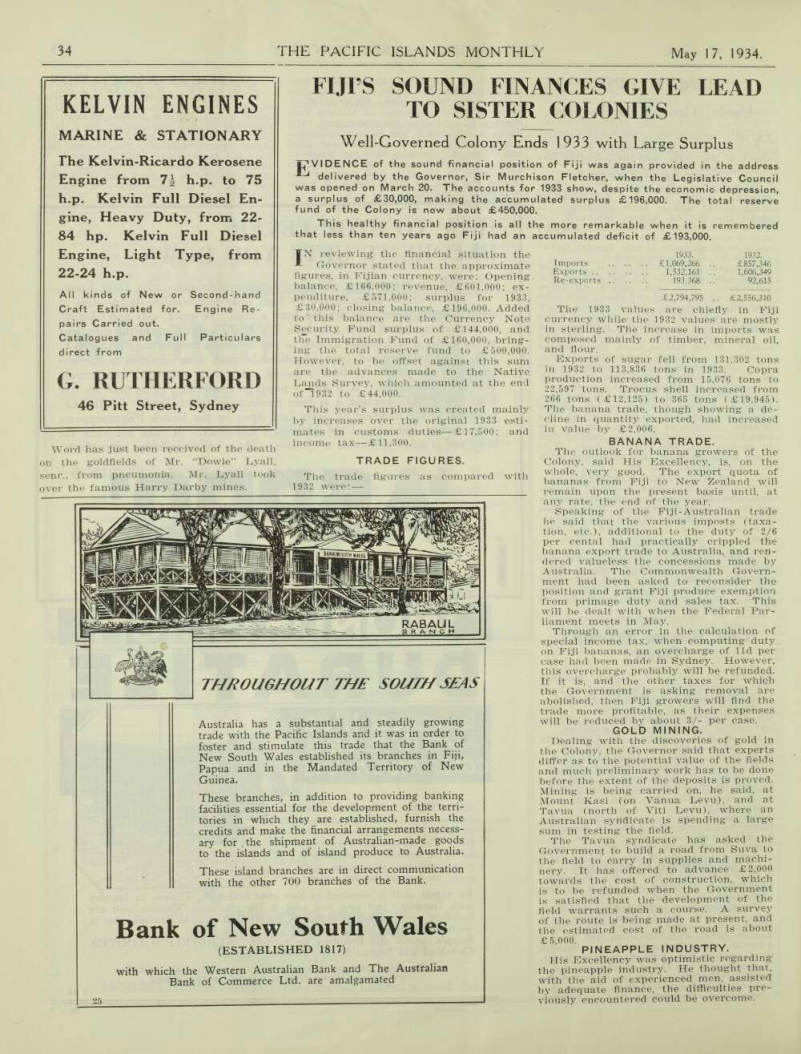
At the Second Annual General Meeting of the Pacific Islands Association held on April 18, at Millions House, Sydney, the following Council was elected: Sir J. H. P.
Murray (President), Sir J. Maynard Hed strom (Vice-President), Hon. Alport Bar ker, M.L.C., Messrs. J. Colclough, J. W.
Baldie, H. A. Ross, R. W. Robson, W. B.
Rainsford, P.C.A. (Aust.), and G. M. Rod ger, Drs. W. L. Calov, and C. C. Simson, Rev. M. A. Warren and Capt. S. G. Green.
Word has just been received of the death on the goldfields of Mr. “Dowie” Lyall, senr., from pneumonia. Mr. Lyall took over the famous Harry Darby mines.
Advertisements & other items, pp. 35-36 (1 item)
Duratile
HOW TO STOP FEVER
BEFORE IT GETS YOU DOWN
THERE are many forms of fever—Dengue—Malaria—Five Days Fever, etc. All are characterized by high body temperature—thirst—loss of strength, etc. Fever may develop from a chill. A quick, safe and effective method of combating fever is to take “ASPRO” according to the directions on the leaflet in each packet as soon as you develop a temperature. “ASPRO” reduces temperature and fever conditions because, after ingestion in the system, it is anti-pyretiC or fever reducing, and is an antiseptic, anti-periodic and anh-fermentative. It is also a powerful germicide. You take no risk with ASPRO because it is pure medicine in tablet form. “ASPRO” conforms to the standard of purity laid down by the British Pharmacopoeia (the guiding authority of the Medical Profession). It does not harm the heart and is much preferable to quinine. There are no injurious after-effects.
NIPS FEVER IN THE BUD
DURATILE
DURATILE is Wunderlich Asbestos Cement Sheeting, patterned to look like 4 four-inch square til es. The surface has been treated by an exclusive chemical process, enabling decoration with paint or enamel in any colour.
No expert skill is required to line your bathroom, kitchen or laundry with Duratile; just saw and nail it like timber. Whether you are building or remodelling property, make full use of Duratile for a washable, hygienic wall covering.
Sample, prices and literature on request. WUNDERLICH LIMITED, Cleveland and Baptist Streets, Redfern, Sydney.
Duratile can be transported compactly; an added advantage when freight has to be considered.
KELVIN ENGINES
MARINE & STATIONARY
The Kelvin-Ricardo Kerosene Engine from 7½ h.p. to 75 h.p. Kelvin Full Diesel Engine, Heavy Duty, from 22- 84 hp. Kelvin Full Diesel Engine, Light Type, from 22-24 h.p.
All kinds of New or Second-hand Craft Estimated for. Engine Repairs Carried out.
Catalogues and Full Particulars direct from
G. RUTHERFORD
46 Pitt Street, Sydney
RABAUL
BRANCH
THROUGHOUT THE SOUTH SEAS
Australia has a substantial and steadily growing trade with the Pacific Islands and it was in order to foster and stimulate this trade that the Bank of New South Wales established its branches in Fiji, Papua and in the Mandated Territory of New Guinea.
These branches, in addition to providing banking facilities essential for the development of the territories in which they are established, furnish the credits and make the financial arrangements necessary for the shipment of Australian-made goods to the islands and of island produce to Australia.
These island branches are in direct communication with the other 700 branches of the Bank.
Bank of New South Wales
(ESTABLISHED 1817)
with which the Western Australian Bank and The Australian Bank of Commerce Ltd. are amalgamated 25
Fiji’S Sound Finances Give Lead
To Sister Colonies
Well-Governed Colony Ends 1933 with Large Surplus
EVIDENCE of the sound financial position of Fiji was again provided in the address delivered by the Governor, Sir Murchison Fletcher, when the Legislative Council was opened on March 20. The accounts for 1933 show, despite the economic depression, a surplus of £30,000, making the accumulated surplus £196,000. The total reserve fund of the Colony is now about £450,000.
This healthy financial position is all the more remarkable when it is remembered that less than ten years ago Fiji had an accumulated deficit of £193,000.
IN reviewing the financial situation the Governor stated that the approximate figures, in Fijian currency, were: Opening balance, £166,000; revenue, £601,000; ex penditure, £571,000; surplus for 1933, £30,000; closing balance, £196,000. Added to this balance are the Currency Note Security Fund surplus of £144,000, and the Immigration Fund of £160,000, bring ing the total reserve fund to £500,000.
However, to be offset against this sum are the advances made to the Native Lands Survey, which amounted at the end of 1932 to £44,000.
This year’s surplus was created mainly by increases over the original 1933 esti mates in customs duties—£17,500; and income tax —£11,300.
Trade Figures.
The trade figures as compared with 1932 were:
The 1933 values are chiefly in Fiji currency while the 1932 values are mostly in sterling. The increase in imports was composed mainly of timber, mineral oil, and flour.
Exports of sugar fell from 131,302 tons in 1932 to 113,836 tons in 1933. Copra production increased from 15,076 tons to 22,597 tons. Trocus shell increased from 266 tons (£12,125) to 365 tons (£19,945).
The banana trade, though showing a de cline in quantity exported, had increased in value by £2,006.
Banana Trade.
The outlook for banana growers of the Colony, said His Excellency, is, on the whole, very good. The export quota of bananas from Fiji to New Zealand will remain upon the present basis until, at any rate, the end of the year.
Speaking of the Fiji-Australian trade he said that the various imposts (taxa tion, etc.), additional to the duty of 2/6 per cental had practically crippled the banana export trade to Australia, and ren dered valueless the concessions made by Australia. The Commonwealth Govern ment had been asked to reconsider the position and grant Fiji produce exemption from primage duty and sales tax. This will be dealt with when the Federal Par liament meets in May.
Through an error in the calculation of special income tax, when computing duty on Fiji bananas, an overcharge of lid per case had been made in Sydney. However, this overcharge probably will be refunded.
If it is, and the other taxes for which the Government is asking removal are abolished, then Fiji growers will find the trade more profitable, as their expenses will be reduced by about 3/- per case.
Gold Mining.
Dealing with the discoveries of gold in the Colony, the Governor said that experts differ as to the potential value of the fields and much preliminary work has to be done before the extent of the deposits is proved.
Mining is being carried on, he said, at Mount Kasi (on Vanua Levu), and at Tavua (north of Viti Levu), where an Australian syndicate is spending a large sum in testing the field.
The Tavua syndicate has asked the Government to build a road from Suva to the field to carry in supplies and machi nery. It has offered to advance £2,000 towards the cost of construction, which is to be refunded when the Government is satisfied that the development of the field warrants such a course. A survey of the route is being made at present, and the estimated cost of the road is about £5,000.
Pineapple Industry.
His Excellency was optimistic regarding the pineapple industry. He thought that, with the aid of experienced men, assisted by adequate finance, the difficulties pre viously encountered could be overcome.
1933. 1932.
Imports .. ., £1,069,266 .. £857,346 Exports 1,532,161 .. 1,606,349 Re-exports .. . 193,368 .. 92,615 £2,794,795 £2,556,310
Chinese Trading In New Guinea
Letter to the Editor.
TOURING the past sixteen months, much has been written in your journal about Chinese trading in this, and other Pacific Territories. I propose to deal only with conditions as I have seen them in the Mandated Territory.
I recently have completed a very thorough 18 months’ tour of the most thickly populated agricultural portion of the Territory: and my observations are those of a trained commercial traveller of many years’ experience in dealing with primary producers and wholesale indentors.
In your issue of July, 1933, you made a comparison of trading conditions in Chinatown in its early period, and the conditions to-day. The reason given for the competition with Europeans being “of little account” in pre-war days was the fact that the traders then made their purchases through the then existing large German firms. The method in existence at that time was that indenting could be done by the Chinese through the firms at 10 per cent, on original invoice cost. But, when sundry charges were added for the passing of customs entries, etc., this 10 per cent, really amounted to somewhere in the region of 17½ per cent. In other words, the big German firms definitely controlled the Chinese trade.
With the passing of the Military Occu pation, two Australian firms obtained a secure footing in the business of this Ter ritory. This has now developed into a virtual monopoly. The present Chinese trading position was brought about pri marily through the short vision of those Australian firms.
Prior to, and during the war period, representatives of English, Australian and German firms regularly visited this Territory, in which they did a consider able business. The German firms here, even though they had their own buying organisations in Australia and abroad, were always pleased to see those repre sentatives, treated them with courtesy, and business was done to mutual advan tage.
But as the newly-established Australian firms gained a secure footing, they curtly
informed the arriving manufacturers’ re presentatives that “they did not wish to see them or do business with them,” as they already had their own buying organisations both in Australia and abroad.
Those experienced travellers or manu facturers’ representatives, having come to the Territory at considerable expense, did not intend to go away empty handed, and so they approached the Chinese mer chants in Chinatown with their wares, and thus inaugurated the present day direct importing and indenting by Chinese, over which so much fuss is being made.
I do not altogether agree with your contention that the difference between the European and the Chinese trader is “racial and a difference in the standard of living.” This antagonism towards the Chinese as a whole has, as its origin, a psychological condition of the Australian character, kept alive from time to time by the Australian politician, and the “White Australia Policy.”
Professor Shann, in his “Economic History of Australia,” gives instances of Australian antagonism towards Chinese, in Victoria, as early as 1853, wherein the same old cry was raised, i.e., “they were taking the pickings”: they were “sending their money out of the country,” etc.
Mention is also made of how, through the dictation of public outcry, politician? tried the expedient of entry taxes and poll taxes, without serving any good pur pose—a feature which I mention because similar suggestion has been put forward by a public body in this Territory.
To get down to the actual trading with natives: The Chinese, in his trade store, is often what might be termed “a born salesman,” though even in this category I doubt if, in numbers, the proportion would be greater than those Europeans who could be similarly described —that is, if they tried! With the Chinese, however, even in the small store in a remote place, there is always a good and varied assort ment of goods for sale, and he has, to good purpose, studied the requirements of his clients.
During my recent tour, I visited and took particular notice of the contents of the so-called “trade stores” on planta tions. Approximately 5 per cent, carried a stock fit to compete with any Chinese trade store. The remaining 95 per cent, had, apart from a small quantity of trade twist tobacco, and a few bags of rice, and lava lavas, not £5 worth of stock.
As I have already said, a good number of the Chinese traders are “salesmen” out to dispose of their stock; whilst the European planter, suffering from a superiority complex, shows utter con tempt for his black clients, and is very often abusive at having been diverted from some duty or pleasure, to attend to his trade store. If the business or trade of the native, and the receipt of his money, is as valuable to the planter as one is led to believe by all which has been
written, why adopt the attitude of arro gant contempt in dealing with him?
With the exception of slightly under 5 per cent., the planters in the Territory are under financial and trading obliga tions to the large Australian firms estab lished here. They are, therefore, com pelled to purchase their requirements from the firms to whom they are “tied” financially. The firms, in supplying a plantation with “trade goods” for sale in the plantation trade store, under pre sent conditions, are merely increasing, or “piling up,” an already large debt, as they receive only the produce of the planta tion, not yet having evolved a system whereby they receive any cash payment from the “sale proceeds'” of trade goods.
In these circumstances, the firms do not relish this class of business, whereby they are merely providing the where withal for some additional spending money for their planter client. For this reason, one firm, to my knowledge, adopts the policy of “let the Chinese have the trade store business.”
I am optimistic enough to firmly believe in the agricultural future of this Terri tory, and in the time when the bulk of the present “tied” planters will become freed from their present obligations.
When that time arrives, with a change of attitude and a different method of stocking the plantation trade store, I am of opinion that the European planter will more than hold his own against any Oriental competition, when dealing with natives.
With the development of the Territory there can be expected an increased Euro pean population. Whereas, the Chinese population is now restricted to present numbers, plus natural increase, and as time passes the ratio will be an increase in favour of the European.
At the present time, as we all seem to agree, the problem is a most difficult one.
However, in the future, we shall be able to look back and think “there was much ado about nothing.”
There are always two sides to every question, and in this vexatious one which appears to have many sides, I have, per haps, opened up a new avenue of ap proach, as after all, the whole question is merely one of economics in which the easy going, free spending, Australian is suffering under what he considers to he a grievance, and is apprehensive of what may be unfair competition. Much of what has been written has been sound com monsense, but much shows bias and venom, with an indulgence in per sonalities.
However, from the different angle in which I have viewed the position.
I am of opinion that we should be con tent to leave the Chinese alone, work harder to compete with him, and not re sort to the expedient of unfair political action.
I am, etc.,
Commercial Traveller.
Rabaul, 25/3/1934.
Advertisements & other items, pp. 37-38 (1 item)
Battery - Operated Radio
AT BLUE MOUNTAINS
SPRINGWOOD, N.S.W.
Springwood Ladies’ College
Est. 1897. Kindergarten to Leaving Certificate.
Tennis, Riding, Swimming, Team Games.
Unequalled climate. Pure Jersey Milk. Senior and Junior Houses. Open-air sleeping. Inclusive fees. Special vacation arrangements for Island pupils. M. E. DURAND, Principal.
That all jobs now call for
EXPERT KNOWLEDGE!
TO IGNORE THIS FACT IS
INVITING UNEMPLOYMENT
Do not flirt with DISASTER when you can acquire so easily, through the I.C.S.,
THE TRAINING YOU MUST HAVE!
FOR YOUR OWN SAKE WRITE FOR THE FREE
ADVICE WE CAN GIVE YOU
THE I.C.S. ILLUSTRATION METHOD
MAKES HOME STUDY PRACTICAL
International Correspondence
Schools (Australasia) Ltd.
140 ELIZABETH STREET. SYDNEY
Sirs, —Please send me a free prospectus showine how I can succeed in the occupation I have marked.
Accountant (Inst Ex) Secretarial (Inst Ex) Com. Illustrator, Fashion Droning.
Cnri’tures & C’toons Poster Drawing, Journalism, Short Story Writing.
Show Card Writer, Salesman(any branch) Advert’r (any branch) Business M’gement, General Bookkeeper, Station Bookkeeper, Retail Management, Business Letters, General Education, Matriculation, Leaving Certificate, Intermediate, Nurses' Entrance Examination, Shorthand-Typing, Dressmaking, Aeroplane Engin’r, Aeroplane Rigger.
Aero. Designing, Motor Engineer, Diesel Engineer.
Motor Mech. Exam.
Electrical Ettpineet Elec. Mech. Exam.
El. Wiremen’s Ex., Radio Engineering, Radio Servicing, Radio (Talkies) Building Contractor, Concrete Engin’r, Structural Eng’r.
Draughtsmanship (name which branch) Architect, Shire Engineer.
Shire Overseer’s Examination, Mechanical Engin' r, Steam Certifica'es, Chemistry (Analy) (There are over 4,000,000 I.C.S. Students, over 100,000 of these being in Australasia).
ENQUIRIES COST NOTH IN G POST NOW Name Age Occupation.
Address P.M
STROMBERG- CARLSON
Battery - Operated Radio
No longer are the latest advances in Radio confined to all-electric sets. Here are two Battery-operated Receivers embodying the full advantages of the superheterodyne principle that give listeners reception comparable to the finest electrically-operated sets available.
MODEL 704 (illustrated), 7-valve Superheterodyne, bringing ALL the advantages of an all-electric set.
Brings in Stations that were previously inaudible.
The handsome six-legged Cabinet is of period design, finished Queensland Walnut.
PRICE, £44/2/6.
MODEL 504. —Stromberg-Carlson’s newest 5-valve Battery-operated Receiver. Battery consumption is very low.
PRICE, £35/15/-.
Sets are fully equipped. Easy Terms available.
NOYES BROS. [Sydney] LTD.
Radio Dept.: 78 CLARENCE STREET, SYDNEY
11 Watt St., Newcastle. Keen St., Lismore.
Elizabeth St., Brisbane.
ATTAIN CHARMING
PROPORTIONS
WITHOUT RISK.
FORD’S
CORPOREAL
CAPSULES
This is a sure remedy for overweight. Endorsed ingredients act on fatty tissues only.
No special diet or exercises. Scores of testimonials prove its effectiveness. Many women reduced 14lb. in six weeks. Send 10/ for six weeks’ treatment.
Three months’ treatment for 20/-. Sent in plain wrapper.
Post Free.
NOEL P. FORD.
M.P.S. (Syd. Uni.),
CHEMIST,
247 King Street, Newtown
SYDNEY, N.S.W.
TROPICAL MEDICAL SAFEGUARDS
SOLUTION ARGYROL.—Recommended for Eye Infections, etc. 3/6 Bottle.
Post Free.
ALCOHOLIC SOLUTION OF CORROSIVE SUBLIMATE.—Recommended for
Ear Infections. 2/6 Bottle. Post Free.
HALLAM’S “IODENTONE” TOOTH PASTE (IODIZED). For Teeth, Gums, and Mouth. Tube 1/9, Post Free. (As recommended in February’s P.I.M.) HALLAM’S “QUINCAPS.”—The most soluble and effective form of Quinine.
On sale everywhere.
HALLAM LTD. Dispensing Chemists
SYDNEY AND SUBURBS. ESTABLISHED 50 YEARS.
Head Office: 312 GEORGE STREET
Prescriptions, Recipes, Drugs, Chemicals, Patent Medicines, Surgical Rubber Goods, and all Surgical Requirements posted to all parts at shortest notice.
Ninety-Six Pages of
Pleasure
The Autumn Number is full of absorbing reading. Fascinating articles on Australian and foreign subjects. Good stories and the usual features. The beautiful cover is “Tranquility” by Banks.
Planters In Distress
From Our Own Correspondent RABAUL, April 27.
OWING to the low price of copra and the general economic depression, where agriculture products are concerned, it has come to the notice of the Planters’
Association of New Guinea that there have been cases of distress among planters.
Pride has prevented several planters from making their true position known, and as a result sickness has laid them low, and the diagnosis of their cases has been malnutrition.
This matter was brought up at a recent meeting of the executive body of the Association, and it was decided to make representations to the Administration for some form of assistance.
Fiji Pineapple Co. Sold
SUVA, March 25.
THE assets of West Coast Pines Ltd., whose plantations are at Nadi, Viti Levu, were auctioned recently and sold to Mr. Brose, who has been in Fiji investi gating the pineapple industry for a New Zealand syndicate.
The growers around the cannery have taken new hope, and are preparing land for new areas to be planted, while new growers are enquiring about new areas.
It is to be hoped that for the good of the Colony this industry goes with a swing. Everybody seems to think that with adequate capital and proper working the pineapple industry should be a success.
Pineapples grow to perfection here.
There is something in the soil of Fiji which costs the Hawaiian canning people a small fortune to renew annually. This fertile soil accounts for the sweetness of our fruit, and the excellent flavour of our bananas.
The Traders And The Missions
Letter to the Editor.
SOME time ago you were kind enough to afford traders space to ventilate a griev ance re competition by missionaries in trade, and other commercial ventures.
Largely as the result of the matter being made public in your paper, the local branch of the Methodist Missionary So ciety, about whom the complaint was concerned, took prompt steps to bring to a conclusion the system that was the cause of the trouble, and are doing all that is possible to avoid interference with the traders in their district, or in any way competing with them. Rev. J. W. Burton, M.A. (General Secretary of the Society), and Mr. J. W. Kitto, Deputy Postmaster- General (a member of the Mission Board), upon their recent visit to Papua, personally assured the writer that trading by their Missionaries would not be tolerated.
It is also to the credit of the Anglican Missionary Society working on the N.E. coast of Papua that, without any request or complaint on the part of traders resident within their “sphere of endeavour,” they voluntarily closed some stores, lest in these hard and difficult times they might do harm to local business men, most of whom are facing financial ruin.
In view of this example of practical Christian charity it is regrettable to have to place on record that there are still some Missionaries in Papua so indifferent to the present tragic position of most of the planters and traders here that they are openly competing with them in every ave nue that offers a chance of profit. For some years past the London Missionary Society, one of the wealthiest and best endowed missions in the world, in the person of its representative at Kwato, Samarai, has openly conducted trading operations, to the detriment of the legitimate traders and business men living in his district. Secure in his position as a salaried representative of a wealthy Society, supported by monies contributed by people on the other side of the world, he is able to undersell the local traders, and pay prices for native products that leave no profit for those who depend upon trade for a livelihood.
So long as he confined his trading opera tions to his own district vce did not feel inclined to make any public comment; it was largely the concern of those traders resident in his vicinity. Lately, however, not satisfied with practically a trading monopoly within his own district, he is going further afield, and has established his native agents on the eastern side of Normanby Island to buy gold from the natives and sell trade goods to them. This is in direct opposition to traders on the spot, one of whom has been dealing hon estly and fairly with the local inhabitants for twenty years.
When one considers the present financial situation, the tragic position in which
planters and traders now find themselves, and the sheer hopelessness of the immedi ate future, it is an unfortunate thing that the representative of such a wealthy So ciety should be allowed to compete with these men for the few remnants of trade by means of which they are striving to maintain life and respectability. That missionaries living in comfortable homes, attended by efficient servants, provided with safe travelling facilities, and who have practically all the benefits of civilization close at hand, should covet the pitiful scraps of trade still left in the outer islands, shows a callous disregard for the present calamity through which the coun try is passing, and for the welfare of their fellow white men.
Regretting the necessity for this letter.
I am, etc.,
E. W. Harrison.
Sebulugomwa, Papua, 3/4/1934.
The Growth Of Wau
THE little town of Wau, centre of the now world famous New Guinea gold fields, is progressing by leaps and bounds. It now boasts a Masonic Temple, a Church, a school with master’s resi dence attached, a talkie theatre with ac commodation for 250 at 7/6 per seat, an up-to-date hotel and a race-course.
And all this has been accomplished by means of aviation. There is no road — aeroplanes have carried in every bit of food, and every pound of building material and machinery. New gold is being found; the gold fields are growing; and Wau will be much bigger yet.
Who knows—the original domain of King Midas may be found somewhere in the interior? Mr. Ripley would find good copy for his “believe it or not” series in
New Guinea.-
S.L.
The two cruisers of the N.Z. Division of the Royal Navy, H.M.S. Diomede and H.M.S. Dunedin, will visit Suva, Fiji, dur ing this year. The Dunedin will arrive on June 21 and depart on June 29. H.M.S.
Etfomede will arrive on July 24 and be in port for six days.
Advertisements & other items, p. 39 (2 items)
Mcilrath’S
SHOPPING BY MAIL
is simple when you buy from
Send a trial order and test our service "St. George” Fancy Meats, 7-oz. tins Prices F.O.B. Sydney Export Price Lists Available on Application.
McILRATH’S LTD.
Export Department, 202 Pitt Street,
SYDNEY, AUSTRALIA.
Agency
SYDNEY MARINE
Can Supply All You Need in— Luggers, Schooners, Ketches, Cruisers, Yachts, Launches, Speedboats, Engines, and Equipment, etc.
ENQUIRIES APPRECIATED.
SYDNEY MARINE AGENCY
72 PITT ST., SYDNEY
Works: Lavender Bay Tel. 8W6493. After Hours, FU 8209.
New Guinea Notes
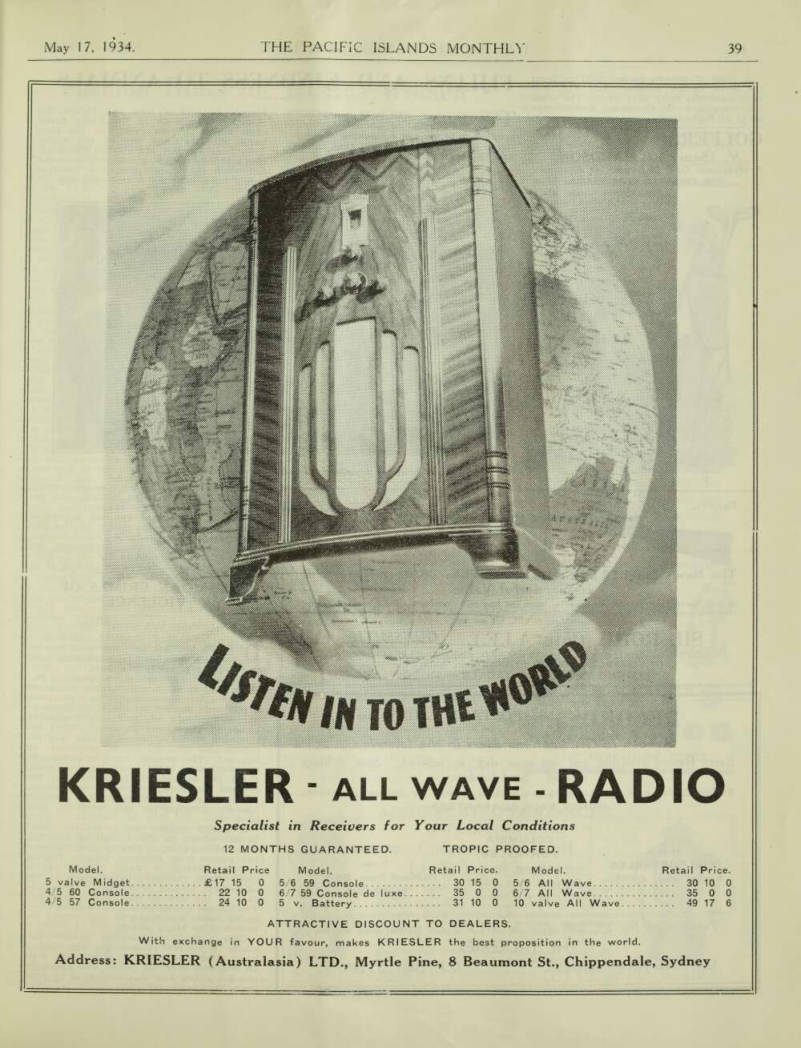
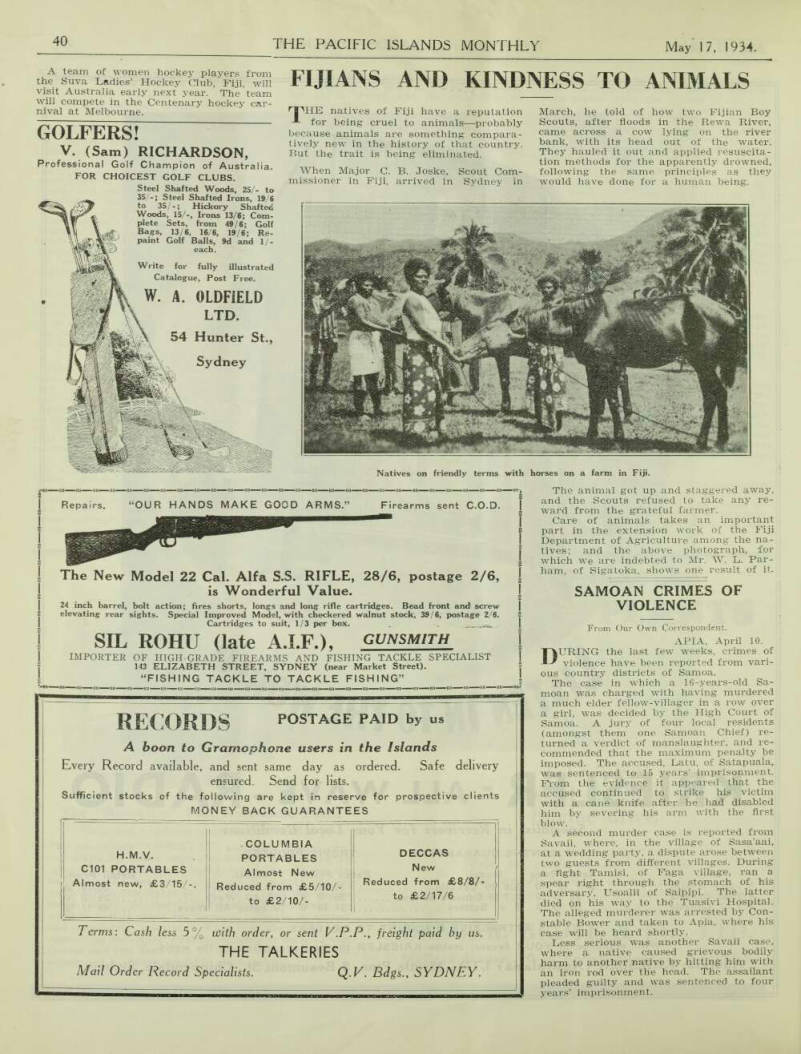
From Our Own Correspondent.
Rabaul, Apl. 27.
A LETTER of appreciation was re ceived recently from Mr. A. H.
O’Connor, manager of the Australian National Travel Association, at San Francisco, by the Administrator, who had despatched to Mr. O’Connor a number of curios and photographs of New Guinea for display purposes in California. Mr.
O’Connor stated that the collection caused quite a sensation, when he made a display of them at one of the prominent hotels in Pasadena. Quite a number of American tourists evinced a desire to see the country from which the primitive articles came.
Trade Tobacco The A.B.C. Tobacco Company, which is supplying local-made native trade tobacco, reports a keen demand for the stick tobacco which it is putting out at the present time. It is selling here in Rabaul for 3/9 per lb.
A Seaplane Service The new seaplane, manufactured at Mascot, Sydney, arrived safely by the last Macdhui. It already has been put into commission and has completed a charter from Rabaul to Madang and on to the Sepik River district. Pilot Gaten by is in charge of the machine, and states that he is quite satisfied with the way in which it works.
A unique addition to this seaplane is the attachment of two rudders to the floats. There was some doubt when it was being constructed as to the advisa bility of this addition, as it was thought that possibly the rudders might affect the flying, although being of assistance in the water; later, after the trials, it was found
that the float rudders considerably assist the steering of the ’plane while flying.
Mr. R. K. Moore was the originator of the suggestion.
Typhoid Several cases of typhoid fever have been reported from Salamaua and other adjacent parts of the Morobe district. The cases are not increasing and the Depart ment of Health has taken every pre caution to keep the epidemic under con trol. Dr. Brennan left by the last Mac dhui to make an inspection of the distinct.
It is not expected that the outbreak will be serious.
Automobile Club The newly-formed Automobile Club of New Guinea offered a prize for the best design for a car badge. At a recent Council meeting of the Club a number of entries were judged, and the design ac cepted was that of Mr. W. L. McGowan, of the Public Works Department, Rabaul.
The design has been forwarded to Sydney where a die will be made and badges cast, both for radiator and clip-on purposes.
Copra Export For the month of March 8,107 tons of copra were exported from the Territory, not including the shipment made by the m.v. Malaita. The greatest proportion of this was shipped to France, while Hol land secured over a thousand tons. Aus tralia obtained only 537 tons.
Anzac Day in Rabaul An Anzac Day service was held in Rabaul at the Regent Theatre when the Revs. Thompson and Lewis conducted the proceedings, which were organised by the R.S. and S.I.L.A. Both General Griffiths (the Administrator) and Colonel Wanliss (Chief Judge) were in attendance; both are Anzacs.
After the service, a pilgrimage was made to the cemetery, where wreaths were placed upon the graves of the sol diers who fell during the capture and occupation of this Territory. General Griffiths placed a wreath upon the grave of Captain Pockley, who probably was the first member of the Australian forces to fall in the Great War.
Freemasonry
The Rabaul Masonic Lodge held its an nual installation and investiture of offi cers on Anzac Day, and afterwards a banquet was held in the Rabaul Hotel.
Wor. Bro. Gascoigne was installing Mas ter, and Wor. Bro. Tom Ellis Director of Ceremonies. Bro. Gordon Thomas was installed Master of the Lodge, with Bro.
V. A. Pratt, Senior Warden, and Bro.
Fritz Haslam, Junior Warden. Brother L. Tribolet was appointed secretary, and Bro. H. L. Clark elected as Treasurer.
Keravat Plantation The government demonstration planta tion at Keravat is now quite self-support ing; it grows its own rice and native foods. The growing of rice in the Terri tory is an industry that is gradually ex tending.
The Regent Theatre management has added to its improvements lately by the installation of a loud-speaker in the centre of the ceiling in the hall. Recently fans were installed which added greatly to the comfort of the audiences.
Visitors have stated that the Regent Theatre in Rabaul is the best picture theatre in the South Seas.
Rabaul now has fire-fighting apparatus.
A rotary pump, engine and hose arrived by the last Macdhui and was tested re cently, when it proved quite satisfactory.
It is an approved pattern from the Mel bourne Fire Brigade.
A team of women hockey players from the Suva Ladies’ Hockey Club, Fiji, will visit Australia early next year. The team will compete in the Centenary hockey car nival at Melbourne.
Advertisements & other items, pp. 40-42 (1 item)
Home Lighting Plants
The most complete range of
ever offered
The “Nevertire” Full Automatic Plant Here is the lighting plant that THINKS!
From a small 10-light plant, through a wide range to 7.5 kilowatts or more. Semi-automatic, fullautomatic; direct-coupled or belt-driven; all voltages.
LISTER
Petrol or Diesel
Engine drive.
The marvellous "OMNISTAT” automatic engine control starts the Lister engine as soon as you switch on more than half-a-dozen lights, which are lit by the battery. The generator continues to supply current until only a few lights are in use. Then the engine stops, ready to restart automatically, as soon as another call is made for current. Simple in action, and absolutely positive. With this plant you can operate an automatic electric refrigerator on a 32 volt system and you need have no worry about the current supply it is always available, automatically.
Write for catalogues and details of prices free of Australian Customs Duly.
DANGAR, GEDYE & CO., LTD.
Malloch House, 10-14 Young Street - SYDNEY
LISTEN IN TO THE WORLD
KRIESLER - all wave - RADIO
Specialist in Receivers for Your Local Conditions
12 MONTHS GUARANTEED.
TROPIC PROOFED.
Model. Retail Price Model. Retail Price. Model. 5 valve Midget £17 15 0 5/6 59 Console 30 15 0 5/6 All Wave 4/5 60 Console 22 10 0 6/7 59 Console de luxe 35 0 0 6/7 All Wave 4/5 57 Console 24 10 0 5 v. Battery 31 10 0 10 valve All Wave Retail Price. .. . 30 10 0 .. . 35 0 0 .. . 49 17 6
ATTRACTIVE DISCOUNT TO DEALERS.
With exchange in YOUR favour, makes KRIESLER the best proposition in the world.
Address: KRIESLER (Australasia) LTD., Myrtle Pine, 8 Beaumont St., Chippendale, Sydney
GOLFERS!
V. (Sam) RICHARDSON,
Professional Golf Champion of Australia.
FOR CHOICEST GOLF CLUBS.
Steel Shafted Woods, 25/- to 35/-; Steel Shafted Irons, 19/_ to 35/-; Hickory Shafted Woods, 15/-, Irons 13/6; Complete Sets, from 49/6; Golf Bags, 13/6, 16/6, 19/6; Repaint Golf Balls, 9d and 1/each.
Write for fully illustrated Catalogue, Post Free.
W. A. OLDFIELD
LTD.
54 Hunter St.,
Sydney
Repairs
“OUR HANDS MAKE GOOD ARMS.”
Firearms sent C.O.D.
The New Model 22 Cal. Alfa S.S. RIFLE, 28/6, postage 2/6,
is Wonderful Value.
24 inch barrel, bolt action; fires shorts, longs and long rifle cartridges. Bead front and screw elevating rear sights. Special Improved Model, with checkered walnut stock, 39/6, postage 2/6.
Cartridges to suit, 1/3 per box. . ,
SIL ROHU (late A.I.F.),
IMPORTER OF HIGH-GRADE FIREARMS AND FISHING TACKLE SPECIALIST 143 ELIZABETH STREET, SYDNEY (near Market Street).
“FISHING TACKLE TO TACKLE FISHING”
RECORDS POSTAGE PAID by us
A boon to Gramophone users in the Islands Every Record available, and sent same day as ordered. Safe delivery ensured. Send for lists.
Sufficient stocks of the following are kept in reserve for prospective clients
MONEY BACK GUARANTEES
Terms : Cash less 3% with order, or sent V.P.P., freight paid by us.
THE TALKERIES
Mail Order Record Specialists. Q.K. Bdgs., SYDNEY.
Fijians And Kindness To Animals
THE natives of Fiji have a reputation for being cruel to animals—probably because animals are something compara tively new in the history of that country.
But the trait is being eliminated.
When Major C. B. Joske, Scout Com missioner in Fiji, arrived in Sydney in
March, he told of how two Fijian Boy Scouts, after floods in the Rewa River, came across a cow lying on the river bank, with its head out of the water.
They hauled it out and applied resuscita tion methods for the apparently drowned, following the same principles as they would have done for a human being.
The animal got up and staggered away, and the Scouts refused to take any re ward from the grateful farmer.
Care of animals takes an important part in the extension work of the Fiji Department of Agriculture among the na tives; and the above photograph, for which we are indebted to Mr. W. L. Par ham, of Sigatoka, shows one result of it.
Natives on friendly terms with horses on a farm in Fiji.
Violence
Samoan Crimes Of
From Our Own Correspondent.
APIA, April 10.
DURING the last few weeks, crimes of violence have been reported from vari ous country districts of Samoa.
The case in which a 16-years-old Sa moan was charged with having murdered a much elder fellow-villager in a row over a girl, was decided by the High Court of Samoa. A jury of four local residents (amongst them one Samoan Chief) re turned a verdict of manslaughter, and re commended that the maximum penalty pe imposed. The accused, Latu, of Satapuala, was sentenced to 15 years’ imprisonment.
From the evidence it appeared that the accused continued to strike his victim with a cane knife after he had disabled him by severing his arm with the first blow.
A second murder case is reported from Savaii, where, in the village of Sasa’aai, at a wedding party, a dispute arose between two guests from different villages. During a fight Tamisi, of Faga village, ran a spear right through the stomach of his adversary, Usoalii of Saipipi. The latter died on his way to the Tuasivi Hospital.
The alleged murderer was arrested by Con stable Bower and taken to Apia, where his case will be heard shortly.
Less serious was another Savaii case, where a native caused grievous bodily harm to another native by hitting him with an iron rod over the head. The assailant pleaded guilty and was sentenced to four years’ imprisonment.
Fashion Hints for Islands Women
(By Therese.)
AS ye sew so shall ye gather—that is the watchword of the fashion world this season; so row on row of gathers adorn our sleeves and we frou-frou softly as we walk, for our skirts are frilled from knee to hemline.
Everything the wardrobe boasts (except of course sports frocks and tailored cos tumes) carries a gather of some descrip tion —a softly falling jabot, a frilled collar, a ruffle round the neck, for frills do the most amazing things to one’s face, and tired lines disappear like magic under their softening influence.
To the secret delight of the mere male, who deplored the freakish whims of fashion’s dictates, the eternal feminine in us holds sway once more. No longer do we pluck our eyebrows to a thin line; gone are the extremes slavishly followed in search of chic; and the toast of the world is “This charmingly natural woman —God bless her!”
An evening cape of georgette in one’s most becoming colour, the whole thing shirred and ending in shaded frills to tone is a thing of beauty and would be a most cherished possession. Evolved in tulle it is akin to that indefinable something of which only dreams are made.
When we do not gather we make our bow with many bows. They pop up any where and everywhere, and the more un expected their popping, just so much greater advantage have we gained over our less enterprising sisters.
Chic taffeta or organdie bows slotted through the neck or shoulder lines, give a tremendous air of chic, while the soft lingerie bows that adorn our afternoon frocks are but further evidence of delight ful femininity.
So much ingenuity has been used in the perfecting of the new season’s clothes —a minus something here, a plus some thing there—and in the twinkling of an eye our simple frock becomes a complete wardrobe in itself.
Two buttons perch on each shoulder and to these a plastron front is attached: a cape swings gaily debonair, or a jerkin rings the changes. A cowl drapery, an amusing cart horse collar with cuffs in the same loose design, a scarf slotted or threaded in many ingenious and intrigu ing ways, all add their quota of charm to the foundation frock which depends com pletely on its cut for trim perfection.
The secret of the success of this type of frock is its slim fitting skirt cut on the cross, hugging the hips beautifullv, and flaring just sufficiently for comfort.
There is still but one kind of neckline —high. Fortunately it has so many varia tions, that one of them at least must prove kind to those who shun the simply severe. Balm for the tropic dweller, too, it can be adapted to suit the climate, thereby justifying its existence and giv ing the satisfactory feeling of not having been altogether forgotten in the scheme of things.
The soft drape of the cowl collar has earned its popularity and either the back or the front of the bodice can be treated in this way with equal success.
With becoming modesty we further strive to emulate the religieux, and the hood collar is the result. It is quite the newest idea for both afternoon and eve ning wear and when a wrap of satin is treated this wise, and has a lining of silver lame or some vivid contrasting colour, it immediately becomes an am biguity, for while retaining its modesty.
it simply shrieks sophistication—a mar vellous achievement, don’t you agree?
One of the prettiest of fashion’s whims is the hem of the evening gown, lined with a two-inch strip of vivid contrast ing colour. The skirt of a black satin gown clings closely to the figure till it reaches the knees, then flares out in fish tails or delightful ruffles. A brilliant green or cocktail red lines the hem and a fascinating glimpse of colour is revealed as the wearer moves.
The smart decolletage for evening is high in front and low at the back and the addition of long tight sleeves adds an air of distinction.
Faille and moire are demanding our attention for dance frocks and since it is decreed that we must rustle, they fill the bill to our complete satisfaction.
For the little frock that cries aloud for sash and bow, there is nothing more de lightful than these materials, and they should be called into commission at a moment’s notice.
Since hats are hats no longer, hair has become doubly important. In place of the wind-swept coiffure, followed by all and sundry with reckless abandon, shorter, neater, closer-to-the-head curls are seen, and these are very youthful and fasci nating. Ears are worn, too, as a tiny touch of rouge must be applied to each lobe if they are to call forth admiring comment on their first appearance.
Hair bands and hair ornaments are again in vogue, and with careful choice can lend originality and charm to any coiffure.
For informal evening occasions, a dia dem hat is absolutely devastating when made in black velvet and the smaller it becomes so much extra chic does it gather.
Variety is the keynote of the fashion world, and there has never been so much scope for individuality. To-day it is not so much the mode as the interpretation of it that marks the woman of chic.
IT was reported in last issue that “Genairco Airway Limited” had been registered in Papua as a foreign company and that the Public Officer was “W. D.
Dupoin.” This obviously was an error.
The correct announcement should have read as follows: “Guinea Airways Limited has been registered in Papua as a foreign company with a nominal capital of £100,000. The registered office is at the office of Messrs.
Burns Philp and Co., Ltd., Port Moresby, and the Public Officer is W. D. Dupain.”
Reports received via Paris state that heavy damage was caused in New Cale donia early in April by a hurricane which whipped that part of the Pacific Ocean.
In the French colony 18 persons were drowned and 12 small craft were sunk.
Advertisements & other items, p. 43 (1 item)
Emulsion
Don’t take
risks yourself
Many a woman guards her family’s health but risks her own. Yet SCOTT’S Emulsion exactly meets her needs too.
It is a vital tonic extra to the normal diet. It nourishes the nerves; strengthens and sustains the system. It resists disease. It guards the lungs. Take genuine
SCOTT’S
Emulsion
The best food tonic
ADMIRAL BYRD’S ANTARCTIC
EXPEDITION USES
Coleman Instant
Lighting Lanterns
Ccleman large size Instant Lite Lantern has no compeer. It just hands out BRILLIANCE— Steady, Clear, and Insistent—at ½d. per hour.
Coleman Junior Instant Lite Lantern, with one Mantle. Roto Generator — positive, non-spilling fount and Patent Fuel Release Tank. Burns at Vid per hour, and is a Real Darkness Chaser.
Full range Instant Lite Coleman units at the stores of W. R. CARPENTER & CO., Or write for Catalogue to COLEMAN QUICK-LITE CO., 500 Kent St., Sydney
Aid For Fiji Copra Growers
A REPORT of a valuable character dealing with the position and prospects of the copra industry was submitted to the Legislative Council of Fiji on March 23J The committee was appointed in October, 1933, and has made a very complete investigation.
The report is of a voluminous character, and the following is a summary.
THE value of the Fiji copra industry is estimated at £2,000,000. About £1,000,000 of European capital has been invested in coconut plantations. The industry is of such importance that it is recommended that copra producers should receive temporary assistance from the Government.
The fall in the value of copra is shown by the following prices (c.i.f. London): 1893 £14 per ton 1903 £14 per ton 1913 £28 per ton 1923 £26 per ton 1933 £8/10/- per ton After investigation the committee agreed that profitable production is im possible at the present rates. With one dissentient, the committee reported that relief grants from Public Funds should apply equally to all sections of the copra producing community. It suggests that income from the Immigration Fund should be used for relief of copra producers.
Apparently the committee argued the proposition that the Fiji exchange rate on London should go from £112 Fijian (to £100 sterling) to £125 as a means of assisting copra producers, but, by 4 votes to 3, decided against it. The com mittee, however, urged that all export taxation on copra (port and customs
services, 1/- per ton; wharfage, 6d per ton; export tax, 1/6 per ton; making a total of 2/6 per ton) should be removed.
Export Bounty.
The committee recommended the pay ment of a temporary export bounty on copra and suggested that for this purpose the following sums be utilised: £3,000 p.a. from the inter-insular services taxa tion; Immigration Fund interest £5,500 p.a.; £2,100 p.a. now paid to the coconut committee —equal to £10,600 p.a. The committee was opposed to the idea of a copra marketing board financed and con trolled by the Government. On a majority decision it agreed in principle that the introduction of copra grading is desirable.
Interest Reduction.
The committee recommended legisla tion requiring reduction of interest on plantation mortgages and loans to 5 per cent, and the declaration of a moratorium for 5 years.
Empire Tariff.
Dealing with the fact that Great Britain recently removed the tariff of 10 per cent, which, she had imposed upon foreign grown Soya beans, the committee ex pressed the following opinion: ‘‘The unrestricted importation of this and other foreign oil products which are sold
in competition with copra and coconut oil is causing grave disability to the in terests of the whole of the copra pro ducing territories of the Colonial Empire, and the Secretary of State for the Colonies again should be requested to give consideration to tariff protection, on the basis of that granted to sugar and butter, for Empire oil products against foreign oils and oil seeds.”
The committee recommended the re duction of rentals of Crown lands leased for coconut cultivation.
The committee said that it had received evidence that the opinion is widely held that copra prices are being affected by the operations of monopolistic combines: but had no evidence on which to form an opinion.
Local Oil Mill.
The committee did not favour a plan for local processing of copra because there is no local market for oil cake and the importation of oil containers would be costly. It also was opposed to a plan for more copra shipping ports in Fiji because of lack of port facilities outside the three main ports.
The committee pointed out that its proposals, involving taxation relief and an export bounty, would be equal to a direct subsidy to copra producers of 10/2 per ton. In addition, copra producers would benefit from the reduction in Crown rentals, reduction in interest rates, moratorium and copra grading.
Mr. Joske’S Report.
A subsidiary report was submitted by Major Joske, who said that he was not in agreement with the majority of recom mendations of the committee on two points.
The committee said “a further depre ciation of the currency in order to benefit
all exports would scatter the relief over the whole country, benefiting all ex porters and all debtors and penalizing all importers and creditors.”
Major Joske concludes his lengthy, cogently-reasoned arguments in favour of a depreciation of currency (higher exchange rate) with these observations: “It seems axiomatic that the interests of the primary producer should receive pri mary consideration. ... It seems equit able therefore to give prior consideration to the effect of a higher exchange on the primary producer rather than the effect upon the salaried or investing class.”
In regard to the proposed export bounty tax, Major Joske closely examines the economic condition of the Colony wfith the result that he argues that the finan cial salvation of the copra producer could be achieved more effectively and cheaply by a direct Government subsidy based on all wages paid on coconut plantations.
C.S.R. Operations.
It is clear from Major Joske’s interest ing arguments that Fiji has a economic problem of a peculiar character. The complicating factor is the presence in Fiji of the Colonial Sugar Refining Com pany, whose huge operations are respon sible for the bulk of Fiji trade, and w r hich is largely owned outside of Fiji. The trade figures of Fiji show an enormous surplus of exports. But payment for these exports does not come back to Fiji except in a limited degree. A large proportion of the payments made for sugar exported from Fiji goes to Australia and else where, and into the pockets of C.S.R. shareholders. The payments for sugar exports which go back to Fiji are suf ficient merely to pay for C.S.R. operations.
The surplus is not spread around in Fiji for the general benefit of the country— it goes elsewhere. Therefore, leaving the sugar position out of account, one finds in Fiji an economic position very different to that which is suggested by the totals of imports and exports; and a position, moreover, which gives a large measure of justification to Major Joske’s interesting demand for the depreciation of the Fijian currency.
The same considerations—namely, the somewhat overwhelming effect ol; C.S.R. operations on employment and wages conditions—affect the plan for an export bounty on copra. Major Joske’s idea is to give the benefit directly to the Euro pean copra-grower, and he argues that this can be done more effectively by a subsidy on wages rather than by a bounty on exports.
Mr. Edward Duncan, another member of the committee, also arguing in favour of a higher exchange rate, points out that the utmost relief provided for in the plan by the committee’s recommendations is 12/- per ton. He urges that 30/- per ton at least is required. He points out also that for several months (in 1932-1933) the 25 per cent, exchange rate ran in the Colony without marked harm resulting.
Mr. Duncan also argues strongly for compulsory grading of copra in Fiji.
The recommendations of the committee came before the Legislative Council in Suva on March 27.
The Governor, Sir Murchison Fletcher,
discussing the committee’s report, ex pressed the opinion that, owing to very recent developments, temporary financial relief wmuld not tide the copra industry over its present depression. The only recourse was to the British Government —some tariff assistance must be given by Great Britain to the copra industry just as she had given it to the sugar industry. The Governor said that if the American tax became effective he could see an enormous quantity of Philippine and other copra being thrown on the European market.
Commenting on other proposals, His Excellency said that if the exchange rate were altered in Fiji, the vast majority of residents there would secure little benefit.
He hesitated to give tax reductions and a reduction of mortgage interest in the manner proposed—if such relief were to be given, it should be given to the com munity as a whole, and not to any par ticular section. He would not agree to any law which would interfere w T ith pri vate contracts.
American Tax.
The subsequent discussion was vitally affected by the news, just then received in Fiji, that America planned a prohibi tory tax on coconut oil. Most of the speakers took the view that, in the cir cumstances that this development had created, the only possible salvation of the copra industry lay in assistance from Great Britain.
Sir Maynard Hedstrom declared that if the American development had been cor rectly represented, the outlook for the copra industry was very black indeed, and it would be foolish to strain the finances of Fiji in order to provide an export bounty that would be of very little value in the long run. If there was any prospect of a recovery in the industry, however, he thought assistance along the lines suggested would be justified.
It was finally agreed that strong repre sentations should be made to the British Government in relation to the matter.
Meanwhile His Excellency said that he wmuld carefully examine the whole plans for giving some temporary relief to the coconut planters.
Advertisements & other items, pp. 44-45 (1 item)
Electric Light?
The Wind Costs You Nothing
WHY NOT USE IT TO PROVIDE YOU WITH
The GILCO
WIND DRIVEN ELECTRIC PLANT
Works without Fuel and is a
Proven Success
It runs without noise and attention and operates even at low wind velocities. GILCO harnesses the free wind over 24 hours of the day and generates electricity which is “GILCO” generates 32 volts but is also available for 50 and 110 volts. It can be used with any existing petrol-driven plant and in a very short time . . .
SAVES ITS OWN COST
stored for your needs. As it works without fuel its economy is obvious. “GILCO” is governed and may be shut off when desired. It is fully guaranteed. . .
Further details sent post free, with pleasure.
BUZACOTT & CO., LTD.
FURTHER
“BUZACOTT”
LINES OF
DEPENDABLE VALUE
“BUZACOTT” ENGINES are
a marvel of efficiency and are noted for their low operating costs and long life.
“BUZACOTT” PUMPS pro-
vide the means for ensuring your water supplies with the greatest economy. All sizes and types available.
“BUZACOTT” PUMPER-an
ideal Windmill Auxiliary—fits any mill pump.
“BUZACOTT” GATES AND
FENCING —known far and wide for their durability.
CHAIN WIRE—AII meshes and gauges for Copra Trays.
“PETTER” CRUDE OIL
ENGINES—Marine and Stationary. Simple, reliable, and cheap to run. Spare parts stocked.
“ALSTON” WINDMILLS
Prices recently reduced. These famous Windmills are now within the reach of every one.
A WELL-PROVEN
REMEDY FOR PILES
This preparation has been on the market for several months, and it has effected a Cure in every case in which it has been tried. Cases of Long Standing often Cured within One Month, with one bottle only.
For External Use only—Stainless, Painless and Odourless.
PRICE: 5/- PER BOTTLE. Posted, securely packed, for 6/9 per bottle. Copies of Testimonials forwarded on request.
Read the Report of an Eminent Analytical Chemist:
THE LABORATORY,
20 and 22 Napoleon Street, Sydney, March 14th, 1933.
ROBERT BRUCE, Esq.
Dear Sir,—The formula of your pile cure submitted to me could have no effect other than beneficial. I gave your sample to a Client who had suffered many years, and before he had used half the bottle he reported himself completely cured.
Faithfully yours,
GROVE JOHNSON, F.C.S. (Lond.),
Analytical and Consulting Chemist.
Supplies Obtainable from —
ROBERT BRUCE
Room 1, 2nd Floor,
15 Hunter Street, Sydney
and also at
14 UPPER BAYVIEW ST., NORTH SYDNEY.
TENNIS
TROPICAL RESTRINGS AND GUT
CONSULT
L. A. WARD
WEST END SPORTS DEPOT,
8 GEORGE ST. WEST SYDNEY
New Guinea
Sound Finance In
Effect of Gold Industry
Notwithstanding that the New Guinea Administration waived the duty on copra exported since the be ginning of November, statements pub lished in April disclose a sound financial position for the Administration during the nine months’ period ended March 31.
Revenue, £264,739, compared with the same period last year, shows an increase of £20,916, due mainly to the increase in gold royalties by £15,600, and Customs revenue by £4309. Expenditure, £256,933, increased by £22,803, including £3100 for the leprosarium established in New Ire land.
All external interest-bearing loans were extinguished by the final payment of £15,468, thus saving £6000 annually. The existing surplus is £32,394, of which £7806 is for this period.
Gold exported from the Morobe district in the period amounted to 187,966 ounces, valued at £973,510.
Advertisements & other items, p. 45 (1 item)
Doan’S
WATCH YOUR
KIDNEYS!
“Every Picture tells a Story.”
Don’t Neglect Kidney and Bladder Irregularities If bothered with bladder irregularities, getting up at night and nagging backache, heed promptly these symtoms. They may warn of some disordered kidney or bladder condition. For 30 years grateful users have relied upon Doan’s Backache Kidney Pills . Praised the country over. Buy a bottle to-day, and start taking them at once, and you will soon be well again.
DOAN’S
BACKACHE KIDNEY PILLS.
All Chemists and Stores
Help For Car Owners
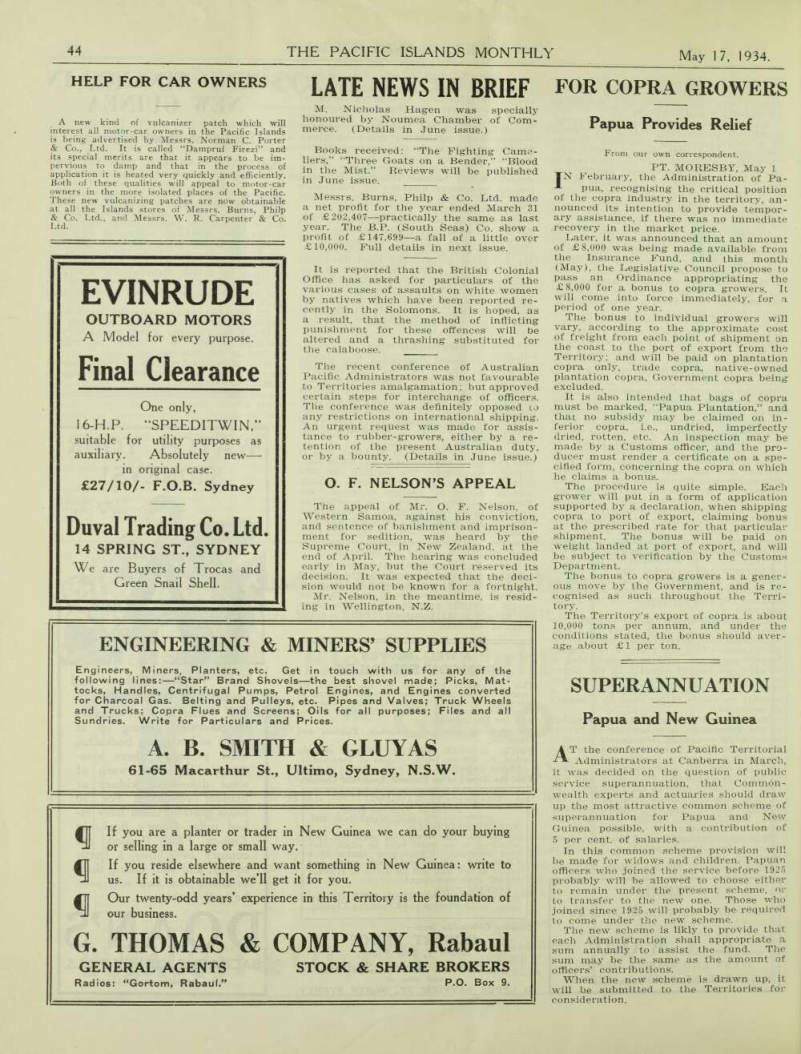
A new kind of vulcanizer patch which will interest all motor-car owners in the Pacific Islands is being advertised by Messrs. Norman C. Porter & Co., Ltd. It is called “Dampruf Firezi” and its special merits are that it appears to be im pervious to damp and that in the process of application it is heated very quickly and efficiently.
Both of these qualities will appeal to motor-car owners in the more isolated places of the Pacific.
These new vulcanizing patches are now obtainable at all the Islands stores of Messrs. Burns, Philp & Co. Ltd., and Messrs. W. R. Carpenter & Co.
Ltd.
Late News In Brief
M. Nicholas Hagen was specially honoured by Noumea Chamber of Com merce. (Details in June issue.) Books received: “The Fighting Came liers,” “Three Goats on a Bender,” “Blood in the Mist.” Reviews will be published in June issue.
Messrs. Burns, Philp & Co. Ltd. made a net profit for the year ended March 31 of £202,407 —practically the same as last year. The B.P. (South Seas) Co. show a profit of £147,699 —a fall of a little over £10,000. Full details in next issue.
It is reported that the British Colonial Office has asked for particulars of the various cases of assaults on white women by natives which have been reported re cently in the Solomons. It is hoped, as a result, that the method of inflicting punishment for these offences will be altered and a thrashing substituted for the calaboose.
The recent conference of Australian Pacific Administrators was not favourable to Territories amalgamation; but approved certain steps for interchange of officers.
The conference was definitely opposed to any restrictions on international shipping.
An urgent request was made for assis tance to rubber-growers, either by a re tention of the present Australian duty, or by a bounty. (Details in June issue.)
O. F. Nelson’S Appeal
The appeal of Mr. O. F. Nelson, of Western Samoa, against his conviction, and sentence of banishment and imprison ment for sedition, was heard by the Supreme Court, in New Zealand, at the end of April. The hearing was concluded early in May, but the Court reserved its decision. It was expected that the deci sion would not be known for a fortnight.
Mr. Nelson, in the meantime, is resid ing in Wellington, N.Z.
For Copra Growers
Papua Provides Relief
From our own correspondent.
Pt. Moresby, May 1
IN February, the Administration of Papua recognising the critical position of the copra industry in the territory, an nounced its intention to provide tempor ary assistance, if there was no immediate recovery in the market price.
Later, it was announced that an amount of £8,000 was being made available from the Insurance Fund, and this month (May), the Legislative Council propose to pass an Ordinance appropriating the £8,000 for a bonus to copra growers. It will come into force immediately, for a period of one year.
The bonus to individual growers will vary, according to the approximate cost of freight from each point of shipment on the coast to the port of export from the Territory; and will be paid on plantation copra only, trade copra, native-owned plantation copra, Government copra being excluded.
It is also intended that bags of copra must be marked, “Papua Plantation,” and that no subsidy may be claimed on in ferior copra, i.e., undried, imperfectly dried, rotten, etc. An inspection may be made by a Customs officer, and the pro ducer must render a certificate on a spe cified form, concerning the copra on which he claims a bonus.
The procedure is quite simple. Each grower will put in a form of application supported by a declaration, when shipping copra to port of export, claiming bonus at the prescribed rate for that particular shipment. The bonus will be paid on weight landed at port of export, and will be subject to verification by the Customs Department.
The bonus to copra growers is a gener ous move by the Government, and is re cognised as such throughout the Terri tory.
The Territory’s export of copra is about 10,000 tons per annum, and under the conditions stated, the bonus should aver age about £1 per ton.
Superannuation
Papua and New Guinea
AT the conference of Pacific Territorial Administrators at Canberra in March, it was decided on the question of public service superannuation, that Common wealth experts and actuaries should draw up the most attractive common scheme of superannuation for Papua and New Guinea possible, with a contribution of 5 per cent, of salaries.
In this common scheme provision will be made for widows and children. Papuan officers who joined the service before 1925 probably will be allowed to choose either to remain under the present scheme, or to transfer to the new one. Those who joined since 1925 will probably be required to come under the new scheme.
The new scheme is likly to provide that each Administration shall appropriate a sum annually to assist the fund. The sum may be the same as the amount of officers’ contributions.
When the new scheme is drawn up, it will be submitted to the Territories for consideration.
Advertisements & other items, p. 46 (1 item)
Evinrude
OUTBOARD MOTORS
A Model for every purpose.
Final Clearance
One only,
16-H.P. “SPEEDITWIN,”
suitable for utility purposes as auxiliary. Absolutely new— in original case. £27/10/- F.O.B. Sydney
Duval Trading Co. Ltd.
14 SPRING ST., SYDNEY
We are Buyers of Trocas and Green Snail Shell.
ENGINEERING & MINERS’ SUPPLIES
Engineers, Miners, Planters, etc. Get in touch with us for any of the following lines: —“Star” Brand Shovels —the best shovel made; Picks, Mattocks, Handles, Centrifugal Pumps, Petrol Engines, and Engines converted for Charcoal Gas. Belting and Pulleys, etc. Pipes and Valves; Truck Wheels and Trucks; Copra Flues and Screens; Oils for all purposes; Files and all Sundries. Write for Particulars and Prices.
A. B. SMITH & GLUYAS
61-65 Macarthur St., Ultimo, Sydney, N.S.W.
If you are a planter or trader in New Guinea we can do your buying or selling in a large or small way.
If you reside elsewhere and want something in New Guinea: write to us. If it is obtainable we’ll get it for you.
Our twenty-odd years’ experience in this Territory is the foundation of our business.
G. THOMAS & COMPANY, Rabaul
GENERAL AGENTS STOCK & SHARE BROKERS
Radios: “Gortom, Rabaul." P.O. Box 9.
Market Quotations
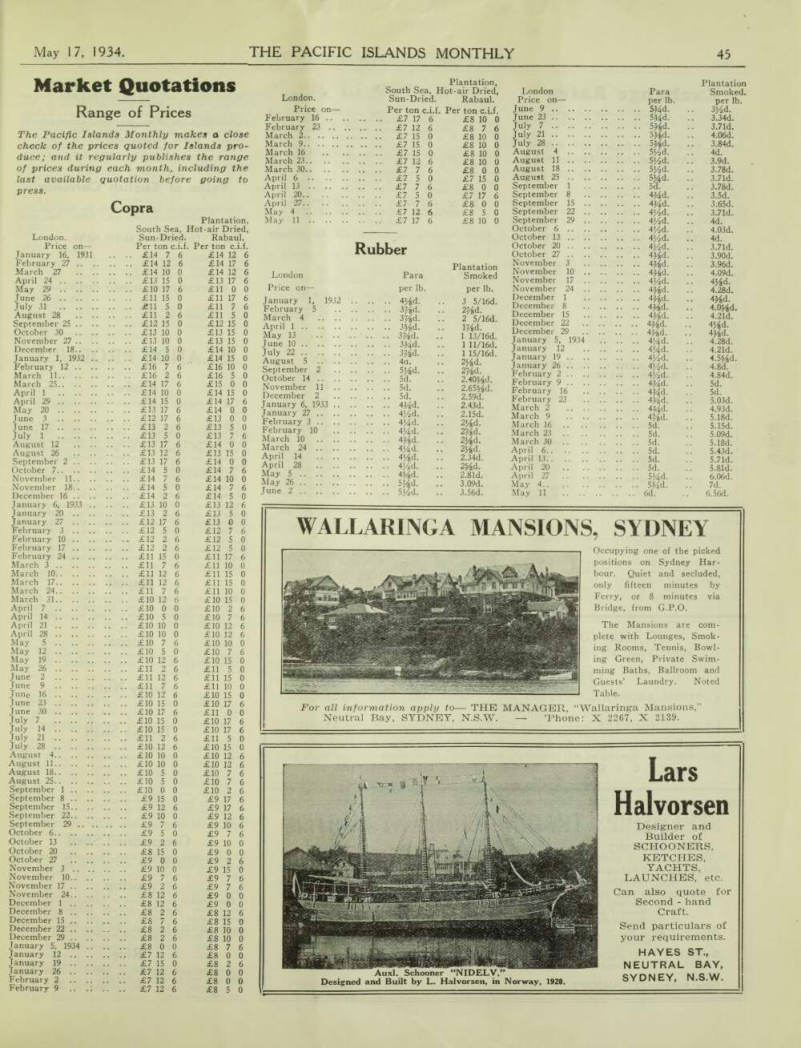
Range of Prices
The Pacific Islands Monthly makes a close check of the prices quoted for Islands pro duce; and it regularly publishes the range of prices during each month, including the last available quotation before going to press.
London.
Plantation,
South Sea, Hot-air Dried.
Sun-Dried.
Rabaul.
Price on— Per ton c.i.f.
Per ton c.i.f.
February 16 6 £8 10 0 February 23 6 £8 7 6 March 2 0 £8 10 0 March 9 0 £8 10 0 March 16 . .. £7 15 0 £8 10 0 March 23 6 £8 10 0 March 30 6 £8 0 0 April 6 . .. £7 5 0 £7 15 0 April 13 6 £8 0 0 April 20 0 £7 17 6 April 27 6 £8 0 0 May 4 . .. £7 12 6 £8 5 0 May 11 . .. £7 17 6 £8 10 0
London
Rubber
Para Plantation Smoked Price on — per lb. per lb.
January 1, 1932 4}^d. 3 5/16d.
February 5 3^d. 2V»d.
March 4 3fcd. 2 5/16d.
April 1 3^d.
VAd.
May 13 .. .. .. .. .. 3%d- 1 13/16d.
June 10 3^d. 1 ll/16d.
July 22 Md. 1 15/16d.
August 5 .. .. 2%d.
September 2 5j*d. 2m.
October 14 .. .. 5d. 2A0m.
November 11 .. 5d. 2.65^d.
December 2 5d. 2.59d.
January 6, 1933 .. 4Hd. 2.43d.
January 27 .. .. 4^d. 2.15d.
February 3 .. .. 4J4d. 2 m- February 10 4^d. 2V*d.
March 10 .. .. 4^d. 2%d.
March 24 .. .. *%d. 2'A d.
April 14 ... 4^d. 2.34d.
April 28 .. .. 4/ 2 d. 2m.
May 5 2.81d.
May 26 3.09d.
June 2 3.56d.
Plantation London Para Smoked.
Price on— per lb. per lb.
June 9 5Md. 3Ad.
June 23 5$4d. 3.34d.
July 7 5^d. 3.71d.
July 21 5Hd. 4.06d.
July 28 5**d. 3.84d.
August 4 5J4 d. 4d.
August 11 S'Ad. 3.9d.
August 18 sy 2 d. 3.78d.
August 25 5^d. 3.71d.
September 1 ..
Sd. 3.78d.
September 8 .. . 4*4d. 3.5d.
September 15 .. 4^d. 3.65d.
September 22 .. 4/ 2 d. 3.71d.
September 29 .. 4^d. 4d.
October 6 4^d. 4.03d.
October 13 4J/ 2 d. 4d.
October 20 4^d. 3.71d.
October 27 3.90d.
November 3 .. . 4Hd. 3.96d.
November 10 .. . 4Hd. 4.09d.
November 17 .. . 4^d. 4Jid.
November 24 .. 4^d. 4:28d.
December 1 .. . 4^d.
December 8 .. . 4Hd. 4.0Hd.
December 15 .. . 4Hd. 4.21d.
December 22 ... 4*Ad.
December 29 ... 4Hd. 4Hd.
January 5, 1934 4J4d. 4 28d.
January 12 .. . 4.21d.
January 19 d. 4.55^d.
January 26 4j/ 2 d. 4.8d.
February 2 4^d. 4.84d.
February 9 4$4d.
Sd.
February 16 .. . 4^d.
Sd.
February 23 .. . 4^d.
S.03d.
March 2 4.93d, March 9 VAd. 5.18d.
March 16 5d. 5.15d.
March 23 5.09d.
March 30 5.18d.
April 6 5d. 5.43d.
April 13 5d. 5.71d.
April 20 5d. 5.81d.
April 27 5J4d. 6.06d.
May 4 5Md. 7d.
May 11 6.56d.
Copra
Plantation, South Sea, Hot-air Dried, London.
Sun-Dried.
Rabaul.
Price on — Per ton c.i.f Per ton c.i.f.
January 16, 1931 .. .. £14 7 6 £14 12 6 February 27 .. .. .. .. £14 12 6 £14 17 6 March 27 .. .. £14 10 0 £14 12 6 April 24 .. .. £13 15 0 £13 17 6 May 29 .. .. £10 17 6 £11 0 0 June 26 .. .. £11 15 0 £11 17 6 July 31 .. .. £11 5 0 £11 7 6 August 28 .. .. .. .. £11 2 6 £11 5 0 September 25 .. .. .. .. £12 15 0 £12 15 0 October 30 .. .. .. .. £13 10 0 £13 15 0 November 27 .. .. .. £13 10 0 £13 15 0 December 18.. .. .. .. £14 5 0 £14 10 0 January 1, 1932 .. .. .. £14 10 0 £14 15 0 February 12 .. .. .. .. £16 7 6 £16 10 0 March 11 .. .. £16 2 6 £16 5 0 March 25 .. .. £14 17 6 £15 0 0 April 1 .. .. £14 10 0 £14 15 0 April 29 £14 17 6 May 20 .. .. £13 17 6 £14 0 0 June 3 .. .. £12 17 6 £13 0 0 June 17 .. .. £13 2 6 £13 5 0 July 1 .. .. £13 5 0 £13 7 6 August 12 .. .. .. .. £13 17 6 £14 0 0 August 26 .. .. .. .. £13 12 6 £13 15 0 September 2 .. .. .. .. £13 17 6 £14 0 0 October 7 .. .. £14 5 0 £14 7 6 November 11.. .. .. £14 7 6 £14 10 0 November 18.. .. .. .. £14 5 0 £14 7 6 December 16 .. .. .. £14 2 6 £14 5 0 January 6, 1933 .. .. .. £13 10 0 £13 12 6 January 20 .. .. .. .. £13 2 6 £13 5 0 January 27 .. .. .. .. £12 17 6 £13 0 0 February 3 .. .. .. .. £12 5 0 £12 7 6 February 10 .. .. .. .. £12 2 6 £12 5 0 February 17 .. .. .. .. £12 2 6 £12 5 0 February 24 .. .. .. .. £11 15 0 £11 17 6 March 3 .. .. £11 7 6 £11 10 0 March 10 .. .. £11 12 6 £11 15 0 March 17 .. .. £11 12 6 £11 15 0 March 24 .. .. £11 7 6 £11 10 0 March 31 .. .. £10 12 6 £10 15 0 April 7 .. .. £10 0 0 £10 2 6 April 14 .. .. £10 5 0 £10 7 6 April 21 .. .. £10 10 0 £10 12 6 April 28 £10 12 6 May 5 .. .. £10 7 6 £10 10 0 May 12 .. .. £10 5 0 £10 7 6 May 19 .. .. £10 12 6 £10 15 0 May 26 .. .. £11 2 6 £11 5 0 June 2 .. .. £11 12 6 £11 IS 0 June 9 .. .. £11 7 6 £11 10 0 June 16 .. .. £10 12 6 £10 15 0 June 23 .. .. £10 15 0 £10 17 6 June 30 £11 0 0 July 7 .. .. £10 15 0 £10 17 6 July 14 £10 17 6 July 21 .. .. .. .. .. £11 2 6 £11 5 0 July 28 £10 15 0 August 4 .. .. £10 10 0 £10 12 6 August 11 £10 12 6 August 18 £10 7 6 August 25 £10 7 6 September 1 .. .. .. .. £10 0 0 £10 2 6 September 8 .. .. .. .. £9 15 0 £9 17 6 September 15.. .. .. .. £9 12 6 £9 17 6 September 22.. .. .. .. £9 10 0 £9 12 6 September 29 .. .. ... £9 7 6 £9 10 6 October 6 £9 7 6 October 13 .. .. £9 10 0 October 20 .. .. .. .. £8 15 0 £9 0 0 October 27 .. .. .. .. £9 0 0 £9 2 6 November 3 .. .. .. .. £9 10 0 £9 15 0 November 10.. .. .. .. £9 7 6 £9 7 6 November 17 .. .. .. .. £9 2 6 £9 7 6 November 24.. .. ... £8 12 6 £9 0 0 December 1 .. .. .. £8 12 6 £9 0 0 December 8 .. .. .. .. £8 2 6 £8 12 6 December IS .. .. .. .. £8 7 6 £8 15 0 December 22 .. .. .. .. £8 2 6 £8 10 0 December 29 .. .. .. .. £8 2 6 £8 10 0 January 5, 1934 .. .. .. £8 0 0 £8 7 6 January 12 .. .. .. .. £7 12 6 £8 0 0 January 19 .. .. .. .. £7 IS 0 £8 2 6 January 26 .. .. £8 0 0 February 2 .. .. .. .. £7 12 6 £8 0 0 February 9 .. .; .. .. £7 12 6 £8 5 0
Advertisements & other items, p. 47 (1 item)
Advt
Auxl. Schooner “NIDELV."
Designed and Built by L. Halvorsen, in Norway, 1920.
Lars
Halvorsen
Designer and Builder of
SCHOONERS,
KETCHES,
YACHTS,
LAUNCHES, etc.
Can also quote for Second - hand Craft.
Send particulars of your requirements.
HAYES ST.,
NEUTRAL BAY,
SYDNEY, N.S.W.
Exchange Rates
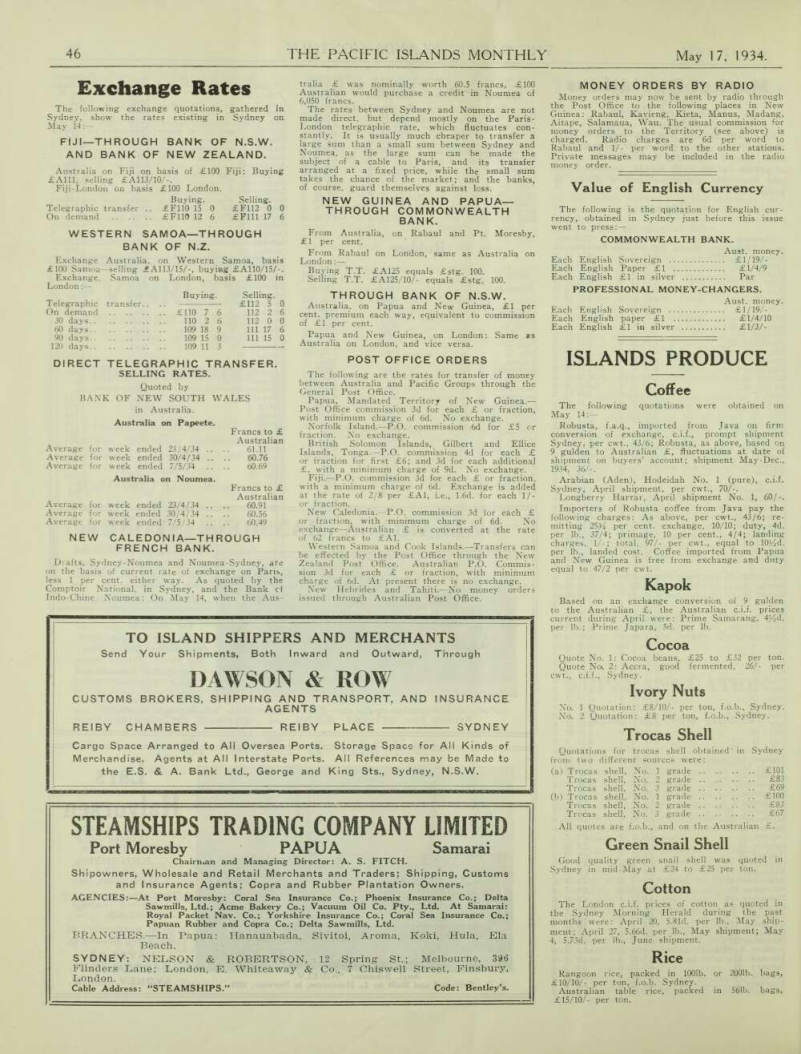
The following exchange quotations, gathered in Sydney, show the rates existing in Sydney on May 14: —
Fiji—Th Rough Bank Of N.S.W.
And Bank Of New Zealand.
Australia on Fiji on basis of £100 Fiji: Buying £A111, selling £A113/10/-.
Fiji-London on basis £100 London.
Western Samoa—Through
Bank Of N.Z.
Exchange Australia, on Western Samoa, basis £100 Samoa—selling £A113/15/-, buying £A110/15/-.
Exchange Samoa on London, basis £100 in London;—
Direct Telegraphic Transfer.
Selling Rates.
Quoted by
Bank Of New South Wales
in Australia.
New Caledonia—Through
French Bank.
Drafts, Sydney-Noumea and Noumea-Sydney, are on the basis of current rate of exchange on Paris, less 1 per cent, either way. As quoted by the Comptoir National, in Sydney, and the Bank cl Indo-Chine, Noumea: On May 14, when the Aus
tralia £ was nominally worth 60.5 francs, £100 Australian would purchase a credit in Noumea of 6,050 francs.
The rates between Sydney and Noumea are not made direct, but depend mostly on the Paris- London telegraphic rate, which fluctuates con stantly. It is usually much cheaper to transfer a large sum than a small sum between Sydney and Noumea, as the large sum can be made the subject of a cable to Paris, and its transfer arranged at a fixed price, while the small sura takes the chance of the market; and the banks, of course, guard themselves against loss.
New Guinea And Papua
Through Commonwealth
Bank.
From Australia, on Rabaul and Pt. Moresby, £1 per cent.
From Rabaul on London, same as Australia on London:— Buying T.T. £A125 equals £stg. 100.
Selling T.T. £A125/10/- equals £stg L 100.
Through Bank Of N.S.W.
Australia, on Papua and New Guinea, £1 per cent, premium each way, equivalent to commission of £1 per cent.
Papua and New Guinea, on London: Same as Australia on London, and vice versa.
Post Office Orders
The following are the rates for transfer of money between Australia and Pacific Groups through the General Post Office.
Papua, Mandated Territory of New Guinea.— Post Office commission 3d for each £ or fraction, with minimum charge of 6d. No exchange.
Norfolk Island. —P.O. commission 6d for £5 or fraction. No exchange.
British Solomon Islands, Gilbert and Ellice Islands, Tonga.—P.O. commission 4d for each £ or fraction for first £6; and 3d for each additional £, with a minimum charge of 9d. No exchange.
Fiji.—P.O. commission 3d for each £ or fraction, with a minimum charge of 6d. Exchange is added at the rate of 2/8 per £A1, i.e., 1.6 d. for each 1/or fraction.
New Caledonia.—P.O. commission 3d for each £ or fraction, with minimum charge of 6d. No exchange—Australian £ is converted at the rate of 62 francs to £A1.
Western Samoa and Cook Islands. —Transfers can be effected by the Post Office through the New Zealand Post Office. Australian P.O. Commis sion 3d for each £ or fraction, with minimum charge of 6d. At present there is no exchange.
New Hebrides and Tahiti. —No money orders issued through Australian Post Office.
Money Orders By Radio
Money orders may now be sent by radio through the Post Office to the following places in New Guinea: Rabaul, Kavieng, Kieta, Manus, Madang, Aitape, Salamaua, Wau. The usual commission for money orders to the Territory (see above) is charged. Radio charges are 6d per word to Rabaul and 1/- per word to the other stations.
Private messages may be included in the radio money order.
Buying.
Selling.
Telegraphic transfer £F110 15 0 £F112 0 0 On demand £F110 12 6 £F111 17 6
Buying. Selling.
Telegraphic transfer.. .. £112 5 0 On demand £110 7 6 112 2 6 30 days 110 2 6 112 0 0 60 days 109 18 9 111 17 6 90 days 109 15 0 111 15 0 120 days 109 11 3
Australia on Papeete.
Francs to £ Australian Average for week ended 23 / 4/34 .. .. 61.11 Average for week ended 30/4/34 .. .. 60.76 Average for week ended 7/5/34 .. .. 60.69 Australia on Noumea.
Francs to £ Australian Average for week ended 23/4/34 .. .. 60.91 Average for week ended 30/4/34 .. .. 60.56 Average for week ended 7/5/34 .. .. 60.49
Value of English Currency
The following is the quotation for English cur rency, obtained in Sydney just before this issue went to press:—
Commonwealth
Bank.
Aust. money.
Each English Sovereign £1/19/- Each English Paper £1 £1/4/9 Each English £1 in silver ... Par
Professional Money-Changers.
Aust. money.
Each English Sovereign £1/19/- Each English paper £1 £1/4/10 Each English £1 in silver £1/3/-
Islands Produce
Coffee
The following quotations were obtained on May 14:— Robusta, f.a.q., imported from Java on firm conversion of exchange, c.i.f., prompt shipment Sydney, per cwt., 43/6; Robusta, as above, based on 9 gulden to Australian £, fluctuations at date of shipment on buyers’ account; shipment May-Dec., 1934, 36/-.
Arabian (Aden), Hodeidah No. 1 (pure), c.i.f.
Sydney, April shipment, per cwt., 70/-.
Longberry Harrar, April shipment No. 1, 60/-.
Importers of Robusta coffee from Java pay the following charges: As above, per cwt., 43/6; re mitting per cent, exchange, 10/10; duty, 4d. per lb., 37/4; primage, 10 per cent., 4/4; landing charges,, 1/-; total, 97/- per cwt., equal to per lb., landed cost. Coffee imported from Papua and New Guinea is free from exchange and ditty equal to 47/2 per cwt.
Kapok
Based on an exchange conversion of 9 gulden to the Australian £, the Australian c.i.f. prices current during April were: Prime Samarang, per lb.; Prime Japara, sd. per lb.
Cocoa
Quote No. 1: Cocoa beans, £25 to £32 per ton.
Quote No. 2: Accra, good fermented, 26/- per cwt., c.i.f., Sydney.
Ivory Nuts
No. 1 Quotation: £8/10/- per ton, f.o.b., Sydney.
No. 2 Quotation: £8 per ton, f.o.b., Sydney.
Trocas Shell
Quotations for trocas shell obtained' in Sydney from two different sources were: (a) Trocas shell, No. 1 grade £101 Trocas shell, No. 2 grade £83 Trocas shell, No. 3 gradg £69 (b) Trocas shell, No. 1 grade £100 Trocas shell, No. 2 grade £83 Trocas shell, No. 3 grade £67 All quotes are f.o.b., and on the Australian £.
Green Snail Shell
Good quality green snail shell was quoted in Sydney in mid-May at £24 to £25 per ton.
Cotton
The London c.i.f. prices of cotton as quoted in the Sydney Morning Herald during the past months were: April 20, 5.81d. per lb., May shipment; April 27, 5.66 d. per lb., May shipment; May 4,5.73 d. per lb., June shipment.
Rice
Rangoon rice, packed in 100lb. or 200lb. bags, £10/10/- per ton, f.o.b. Sydney.
Australian table rice, packed in 56lb. bags, £15/10/- per ton.
Advertisements & other items, p. 48 (1 item)
Steamships Trading Company Limited
TO ISLAND SHIPPERS AND MERCHANTS
Send Your Shipments, Both Inward and Outward, Through
DAWSON & ROW
CUSTOMS BROKERS, SHIPPING AND TRANSPORT, AND INSURANCE
AGENTS
REIBY CHAMBERS REIBY PLACE SYDNEY
Cargo Space Arranged to All Oversea Ports. Storage Space for All Kinds of Merchandise. Agents at All Interstate Ports. All References may be Made to the E.S. & A. Bank Ltd., George and King Sts., Sydney, N.S.W.
STEAMSHIPS TRADING COMPANY LIMITED
Port Moresby PAPUA Samarai
Chairman and Managing Director: A. S. FITCH.
Shipowners, Wholesale and Retail Merchants and Traders; Shipping, Customs and Insurance Agents; Copra and Rubber Plantation Owners.
AGENCIES:—At Port Moresby: Coral Sea Insurance Co.; Phoenix Insurance Co.; Delta Sawmills, Ltd.; Acme Bakery Co.; Vacuum Oil Co. Pty., Ltd. At Samarai: Royal Packet Nav. Co.; Yorkshire Insurance Co.; Coral Sea Insurance Co.; Papuan Rubber and Copra Co.; Delta Sawmills, Ltd.
BRANCHES.—In Papua: Hanauabada, Sivitoi, Aroma, Koki, Hula, Ela Beach.
SYDNEY: NELSON & ROBERTSON, 12 Spring St.; Melbourne, 39G Flinders Lane; London, E. Whiteaway & Co., 7 Chiswell Street, Finsbury, London.
Cable Address; “STEAMSHIPS.” Code: Bentley’s.
Shipping Services in the Pacific
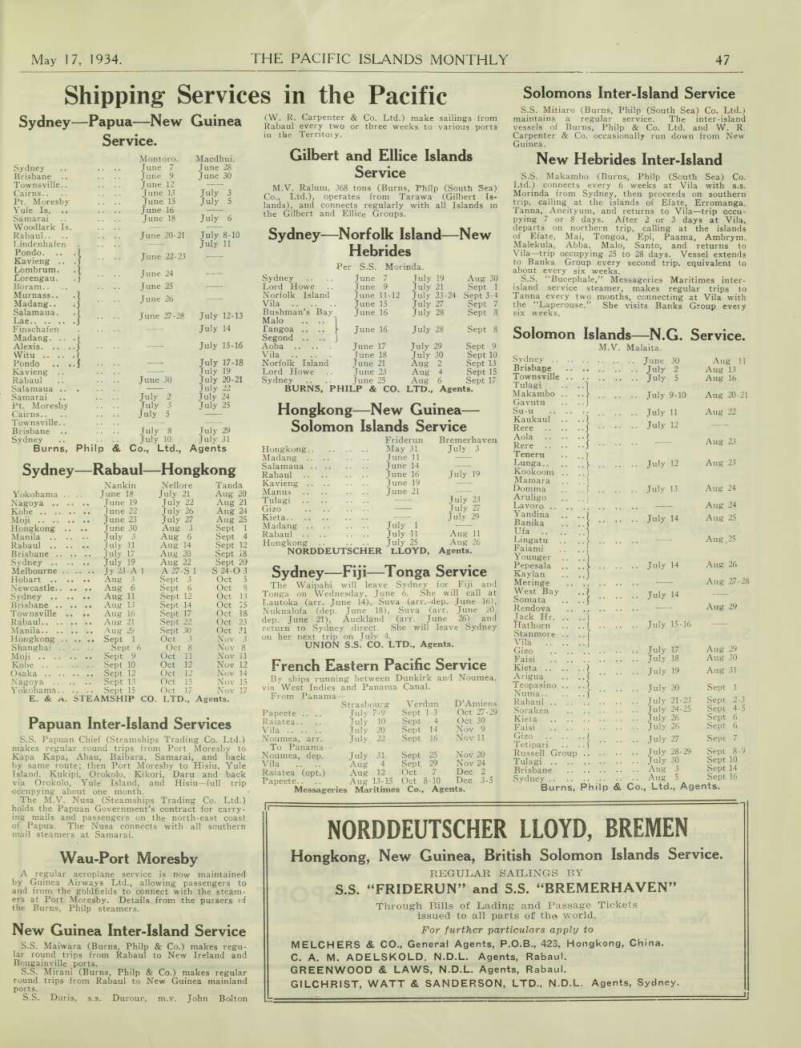
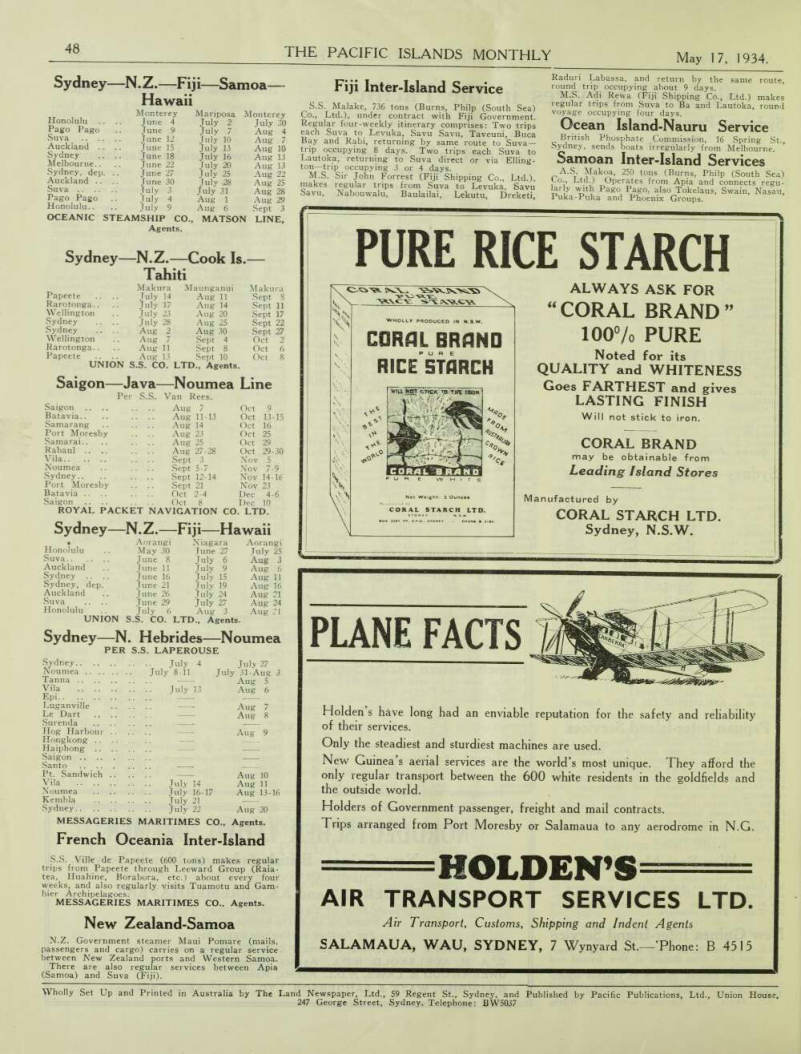
Sydney—Papua —New Guinea Service.
Sydney—Rabaul—Hongkong
Papuan Inter-Island Services
S.S. Papuan Chief (Steamships Trading Co. Ltd.) makes regular round trips from Port Moresby to Kapa Kapa, Abau, Baibara, Samarai, and back by same route; then Port Moresby to Hisiu, Yule Island, Kukipi, Orokolo, Kikori, Daru and back via Orokolo, Yule Island, and Hisiu —full trip occupying about one month.
The M.V. Nusa (Steamships Trading Co. Ltd.) holds the Papuan Government’s contract for carry ing mails and passengers on the north-east coast of Papua. The Nusa connects with all southern mail steamers at Samarai.
Wau-Port Moresby
A regular aeroplane service is now maintained by Guinea Airways Ltd., allowing passengers to and from the goldfields to connect with the steam ers at Port Moresby. Details from the pursers of the Burns, Philp steamers.
New Guinea Inter-Island Service
S.S. Maiwara (Burns, Philp & Co.) makes regular round trips from Rabaul to New Ireland and Bougainville ports.
S.S. Mirani (Burns, Philp & Co.) makes regular round trips from Rabaul to New Guinea mainland ports.
S.S. Duris, s.s. Durour, m.v. John Bolton
(W. R. Carpenter & Co. Ltd.) make sailings from Rabaul every two or three weeks to various ports in the Territory.
Gilbert and Ellice Islands
Service
M.V. Ralum, 368 tons (Burns, Philp (South Sea) Co., Ltd.), operates from Tarawa (Gilbert Is lands), and connects regularly with all Islands in the Gilbert and Ellice Groups.
Sydney—Norfolk Island—New
Hebrides
Hongkong—New Guinea— Solomon Islands Service
Sydney—Fiji—Tonga Service
The Waipahi will leave Sydney for Fiji and Tonga on Wednesday, June 6. She will call at Lautoka (arr. June 14), Suva (arr.-dep. June 16), Nukualofa (dep. June 18), Suva (arr. June 20. dep. June 21), Auckland (arr. June 26) and return to Sydney direct. She will leave Sydney on her next trip on July 4.
Union S.S. Co. Ltd., Agents.
French Eastern Pacific Service
By ships running between Dunkirk and Noumea, via West Indies and Panama Canal.
From Panama—
Solomons Inter-Island Service
S.S. Mitiaro (Burns, Philp (South Sea) Co. Ltd.) maintains a regular service. The inter-island vessels of Burns, Philp & Co. Ltd. and W. R.
Carpenter & Co. occasionally run down from New Guinea.
New Hebrides Inter-Island
S.S. Makambo (Burns, Philp (South Sea) Co.
Ltd.) connects every 6 weeks at Vila with s.s.
Morinda from Sydney, then proceeds on southern trip, calling at the islands of Efate, Erromanga, Tanna, Aneityum, and returns to Vila—trip occu pying 7 or 8 days. After 2 or 3 days at Vila, departs on northern trip, calling at the islands of Efate, Mai, Tongoa, Epi, Paama, Ambrym, Malekula, Abba, Malo, Santo, and returns to Vila—trip occupying 25 to 28 days. Vessel extends to Banks Group every second trip, equivalent to about every six weeks.
S.S. “Bucephale,” Messageries Maritimes interisland service steamer, makes regular trips to Tanna every two months, connecting at Vila with the “Laperouse.” She visits Banks Group evety six weeks.
Solomon Islands—N.G. Service.
Montoro.
Macdhui.
Sydney June 7 June 28 Brisbane ..
June 9 June 30 Townsville..
June 12 — Cairns..
June 13 July 3 Pt. Moresby June IS July 5 Yule Is. ..
June 16 — Samarai June 18 July 6 Woodlark Is. — — Rabaul..
June 20-21 July 8-10 Lindenhafen — July 11 Pondo.
Kavieng ..
June 22-23 Lombrum.
Lorengau.
June 24 — Boram..
June 25 — Murnass..
June 26 Madang..
Salamaua.
Lae June 27-28 July 12-13 Finschafen — July 14 Madang July 15-16 Alexis. — Witu July 17-18 Pondo .. .
Kavieng .. — July 19 Rabaul June 30 July 20-21 Salamaua .. — July 22 Samarai July 2 July 24 Pt. Moresby July 3 July 25 Cairns..
July 5 — Townsville.. — — Brisbane July 8 July 29 Sydney July 10 July 31 Burns, Philp & Co., Ltd., Agents
Nankin Nellore Tanda Yokohama ..
Tune 18 July 21 Aug 20 Nagoya .. .
July 22 Aug 21 Kobe .. ..
July 26 Aug 24 Moji July 27 Aug 25 Hongkong . . .. June 30 Aug 3 Sept 1 Manila .. . .. July 3 Aug 6 Sept 4 Rabaul .. . . .. July 11 Aug 14 Sept 12 Brisbane .. .. .. July 17 Aug 20 Sept 18 Sydney .. .
Aug 22 Sept 20 Melbourne .. .. .. Jy 23-A 1 A 27-S 1 S 24-0 3 Hobart .. .
Sept 3 Oct 5 Newcastle..
Sept 6 Oct 8 Sydney .. .
Sept 12 Oct 13 Brisbane ..
Sept 14 Oct 15 Townsville . . .. Aug 16 Sept 17 Oct 18 Rabaul.. ..
Sept 22 Oct 23 Manila..
Sept 30 Oct 31 Hongkong .. .. .. Sept 1 Oct 3 Nov 3 Shanghai .. .. .. Sept 6 Oct 8 Nov 8 Moji .. ..
Oct 11 Nov 11 Kobe ..
Oct 12 Nov 12 Osaka .. ..
Oct 12 Nov 14 Nagoya ..
Oct 15 Nov 15 Yokohama..
Oct 17 Nov 17
E. & Steamship Co. Ltd., Agents.
Per S.S. Morinda.
Sydney June 7 July 19 Aug 30 Lord Howe June 9 July 21 Sept 1 Norfolk Island June 11-12 July 23-24 Sept 3-4 Vila June 15 July 27 Sept 7 Bushman’s Bay June 16 July 28 Sept 8 Pangea .. ..
June 16
July 28 Sept 8 Segond ..
Aoba June 17 July 29 Sept 9 Vila June 18 July 30 Sept 10 Norfolk Island June 21 Aug 2 Sept 13 Lord Howe June 23 Aug 4 Sept 15 Sydney June 25 Aug 6 Sept 17
Burns, Philp & Co. Ltd., Agents.
Friderun Bremerhaven Hongkong May 31 July 3 Madang June 11 — Salamaua June 14 — Rabaul June 16 July 19 Kavieng June 19 — Manus June 21 — Tulagt — July 23 Gizo July 27 Kieta — July 29 Madang July 1 — Rabaul .. .. ..
July 11 Aug 11 Hongkong .. ..
July 25 Aug 26
Norddeutscher Lloyd, Agents.
Strasbourg Verdun D’Amiens Papeete .. ..
July 7-9 Sept 1 1-3 Oct 27-29 Raiatea..
July 10 Sept 4 Oct 30 Vila July 20 Sept 14 Nov 9 Noumea, arr.
To Panama— July 22 Sept 16 Nov 11 Noumea, dep.
July 31
Sept 25 Nov 20 Vila ..
Aug 4 Sept 29 Nov 24 Raiatea (opt.) Aug 12 Oct 7 Dec 2 Papeete..
Aug 13-15 Oct 8 -10 Dec 3-5 Messageries Maritimes Co., Agents.
M.V. Malaita.
Sydney June 30 July 2 Aug 11 Aug 13 Brisbane .. .
Townsville .. .
July 5 Aug 16 Tulagi .. ..
Makambo .. ..
July 9-10 Aug 20-21 Gavutu .. ..
July 11 Aug 22 Kaukaul ..
Rere July 12 —— Aola Rere — Aug 23 Teneru ..
Lunga .. ..
July 12 Aug 23 Kookoom ..
Mainara Domma July 13 Aug 24 Aruligo .. ,.
Lavoro .. — Aug 24 Yandina .. ..
Banika .. ..
July 14 Aug 25 Ufa ...
Lingatu ..
Aug ,25 Faiami Younger .. ..
Pepesala .. .. . .. ..
July 14 Aug 26 Kaylan .. ..
F Aug 27-28 Meringe .. — West Bay Somata i July 14 — Rendova — Aug 29 Jack Hr Hathorn July 15-16 —- Stanmore Vila Gizo July 17 Aug 29 Faisi July 18 Aug 30 Kieta July 19 Aug 31 Arigua Teopasino Numa July 20 Sept 1 Rabaul July 21-23 Sept 2-3 Soraken July 24-25 Sept 4-5 Kieta July 26 Sept 6 Faisi July 26 Sept 6 Gizo July 27 Sept 7 Tetipari Russell Group .
July 28-29 Sept 8-9 Tulagi Brisbane .. .
July 30 Sept 10 Aug 3 Sept 14 Sydney Aug 5 Sept 16 Burns, Philp & Co., Ltd., Agents.
Sydney—N.Z.—Fiji—Samoa— Hawaii
Sydney—N.Z.—Cook Is.— Tahiti
Saigon—Java—Noumea Line
Sydney—N.Z.—Fiji—Hawaii
Sydney—N. Hebrides—Noumea
Per S.S. Laperouse
French Oceania Inter-Island
S.S. Ville de Papeete (600 tons) makes regular trips from Papeete through Leeward Group (Raia tea, Huahine, Borabora, etc.) about every four weeks, and also regularly visits Tuamotu and Gam bier Archipelagoes.
Messageries Maritimes Co.. Agents.
New Zealand-Samoa
N.Z. Government steamer Maui Pomare (mails, passengers and cargo) carries on a regular service between New Zealand ports and Western Samoa.
There are also regular services between Apia (Samoa) and Suva (Fiji).
Fiji Inter-Island Service
S.S. Malake, 736 tons (Burns, Philp (South Sea) Cos., Ltd.), under contract with Fiji Government.
Regular four-weekly itinerary comprises: Two trips each Suva to_ Levuka, Savu Savu, Taveuni, Buca Bay and Rabi, returning by same route to Suva— trip occupying 8 days. Two trips each Suva to Lautoka, returning to Suva direct or via Elling ton —trip occupying 3 or 4 days.
M.S. Sir John Forrest (Fiji Shipping Cos., Ltd.), makes regular trips from Suva to Levuka, Savu Savu, Nabouwalu, Baulailai, Lekutu, Dreketi,
Raduri Labassa, and return by the same route, round trip occupying about 9 days.
M.S. Adi Rewa (Fiji Shipping Cos., Ltd.) makes regular trips from Suva to Ba and Lautoka, round voyage occupying four days.
Ocean Island-Nauru Service
British Phosphate Commission, 16 Spring St., Sydney, sends boats irregularly from Melbourne.
Samoan Inter-Island Services
A.S. Makoa, 250 tons (Burns, Philp (South Sea) Cos., Ltd.) Operates from Apia and connects regu larly with Pago Pago, also Tokelaus, Swain, Nasau, Puka-Puka and Phoenix Groups.
Honolulu Monterey Mariposa Monterey June 4 July 2 July 30 Pago Pago June 9 July 7 Aug 4 Suva .. .
June 12 July 10 Aug 7 Auckland June 15 July 13 Aug 10 Sydney June 18 July 16 Aug 13 Melbourne..
June 22 July 20 Aug 13 Sydney, dep . .. June 27 July 25 Aug 22 Auckland ..
June 30 July 28 Aug 25 Suva .. ..
July 31 Aug 28 Pago Pago July 4 Aug 1 Aug 29 Honolulu.. .. July 9 Aug 6 Sept 3
Oceanic Steamship Co., Matson Line,
Agents.
Papeete ..
Makura Maunganui Makura July 14 Aug 11 Sept 8 Rarotonga..
July 17 Aug 14 Sept 11 Wellington July 23 Aug 20 Sept 17 Sydney July 28 Aug 25 Sept 22 Sydney Aug 2 Aug 30 Sept 27 Wellington Aug 7 Sept 4 Oct 2 Rarotonga..
Aug 11 Sept 8 Oct 6 Papeete ..
Aug 13 Sept 10 Oct 8
Union S.S. Co. Ltd., Agents.
Saigon Per S.S. Van Rees.
Aug 7 Oct 9 Batavia..
Aug 11-13 Oct 13-15 Samarang Aug 14 Oct 16 Port Moresby Aug 23 Oct 25 Samarai..
Aug 25 Oct 29 Rabaul Aug 27-28 Oct 29-30 Vila Sept 3 Nov 5 Noumea Sept 5-7 Nov 7-9 Sydney..
Sept 12-14 Nov 14-16 Port Moresby Sept 21 Nov 23 Batavia ..
Oct 2-4 Dec 4-6 Saigon .. ..
Oct 8 Dec 10
Royal Packet Navigation Co. Ltd.
Aorangi Niagara Aorangi Honolulu .. May 30 Tune 27 July 25 Suva June 8 July 6 Aug 3 Auckland .. June 11 July 9 Aug 6 Sydney .. .. June 16 July 15 Aug 11 Sydney, dep. June 21 July 19 Aug 16 Auckland .. June 26 July 24 Aug 21 Suva .. .. June 29 July 27 Aug 24 Honolulu .. July 6 Aug 3 Aug 21
Union S.S. Co. Ltd., Agents.
Sydney July 4 July 27 Noumea July 8-11 July 31-Aug 3 Tanna — Aug 5 Vila Aug 6 Luganville Aug 7 Le Dart — Aug 8 Surenda Hog Harbour . .
Aug 9 Hongkong .. ..
Haiphong Saigon ..
Santo Pt. Sandwich .. — Aug 10 Vila Aug 11 Noumea July 16-17 Aug 13-16 Kembla July 21 Sydney July 22 Aug 20
Messageries Maritimes Co., Agents.
Advertisements & other items, pp. 49-52 (2 items)
Norddeutscher Lloyd, Bremen
Hongkong, New Guinea, British Solomon Islands Service.
REGULAR SAILINGS BY
S.S. “FRIDERUN” and S.S. “BREMERHAVEN”
Through Bills of Lading and Passage Tickets issued to all parts of the world.
For further particulars apply to MELCHERS & CO., General Agents, P.O.B., 423, Hongkong, China.
C. A. M. ADELSKOLD, N.D.L. Agents, Rabaul.
GREENWOOD & LAWS, N.D.L. Agents, Rabaul.
GILCHRIST, WATT & SANDERSON, LTD., N.D.L. Agents, Sydney.
PURE RICE STARCH
WHOLLY PRODUCED IN N.S.W.
CORAL BRAND
RICE STARCH
Net Weight 3 Ounces
CORAL STARCH LTD.
ALWAYS ASK FOR
“CORAL BRAND”
100% PURE
Noted for its
QUALITY and WHITENESS
Goes FARTHEST and gives
LASTING FINISH
Will not stick to iron.
CORAL BRAND
may be obtainable from Leading Island Stores Manufactured by
CORAL STARCH LTD.
Sydney, N.S.W.
PLANE FACTS
Holden's have long had an enviable reputation for the safety and reliability of their services.
Only the steadiest and sturdiest machines are used.
New Guinea's aerial services are the world’s most unique. They afford the only regular transport between the 600 white residents in the goldfields and the outside world.
Holders of Government passenger, freight and mail contracts.
Trips arranged from Port Moresby or Salamaua to any aerodrome in N.G.
HOLDEN’S
AIR TRANSPORT SERVICES LTD.
Air Transport, Customs, Shipping and Indent Agents SALAMAUA, WAU, SYDNEY, 7 Wynyard St.—’Phone: B 4515
Staffed and Equipped to Carry
on One of the Biggest Aerial Transport Services in the World One of the four Bulolo dredges, nearly ready for operation. All this heavy machinery was carried in by aeroplanes.
With its giant Three-motored Aeroplanes, and its large staff of Experienced Pilots and Expert Mechanics, Guinea Airways Ltd. carries on the Transport service between the Coast of New Guinea and the Goldfields Centres. There is no other form of Transport in this part of New Guinea—only Aeroplanes.
In all kinds of weather, irrespective of the seasons, the Aeroplanes of Guinea Airways Ltd. maintain communication with the Goldfields, safely carrying mails, passengers, heavy mining machinery, native labourers, foodstuffs, livestock, etc.
GUINEA AIRWAYS Ltd
LAE • SALAMAUA
To quench a tropic thirst!
TOOTH'S KG a true Lager Clean in flavoursharp to the tastethere’s no drink in the tropics to equal Tooth’s KB a true Lager.
48
May 17, 1934.
THE PACIFIC ISLANDS MONTHLY
Wholly Set Up and Printed in Australia by The Land Newspaper, Ltd., 59 Regent St., Sydney, and Published by Pacific Publications, Ltd., Union House, 247 George Street, Sydney. Telephone: 8W5037